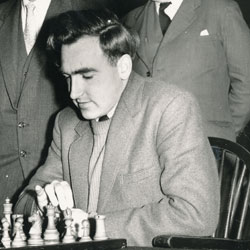
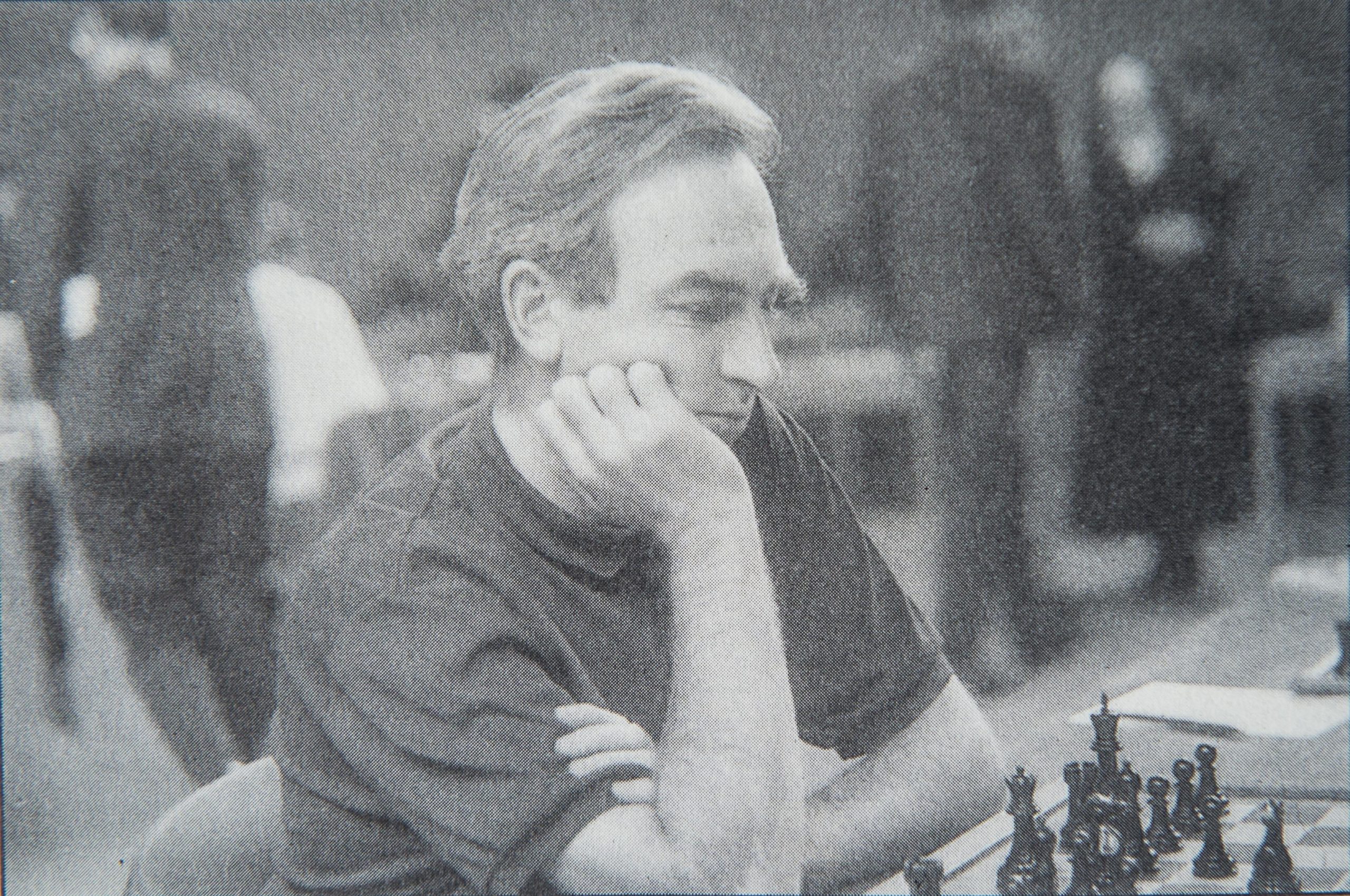
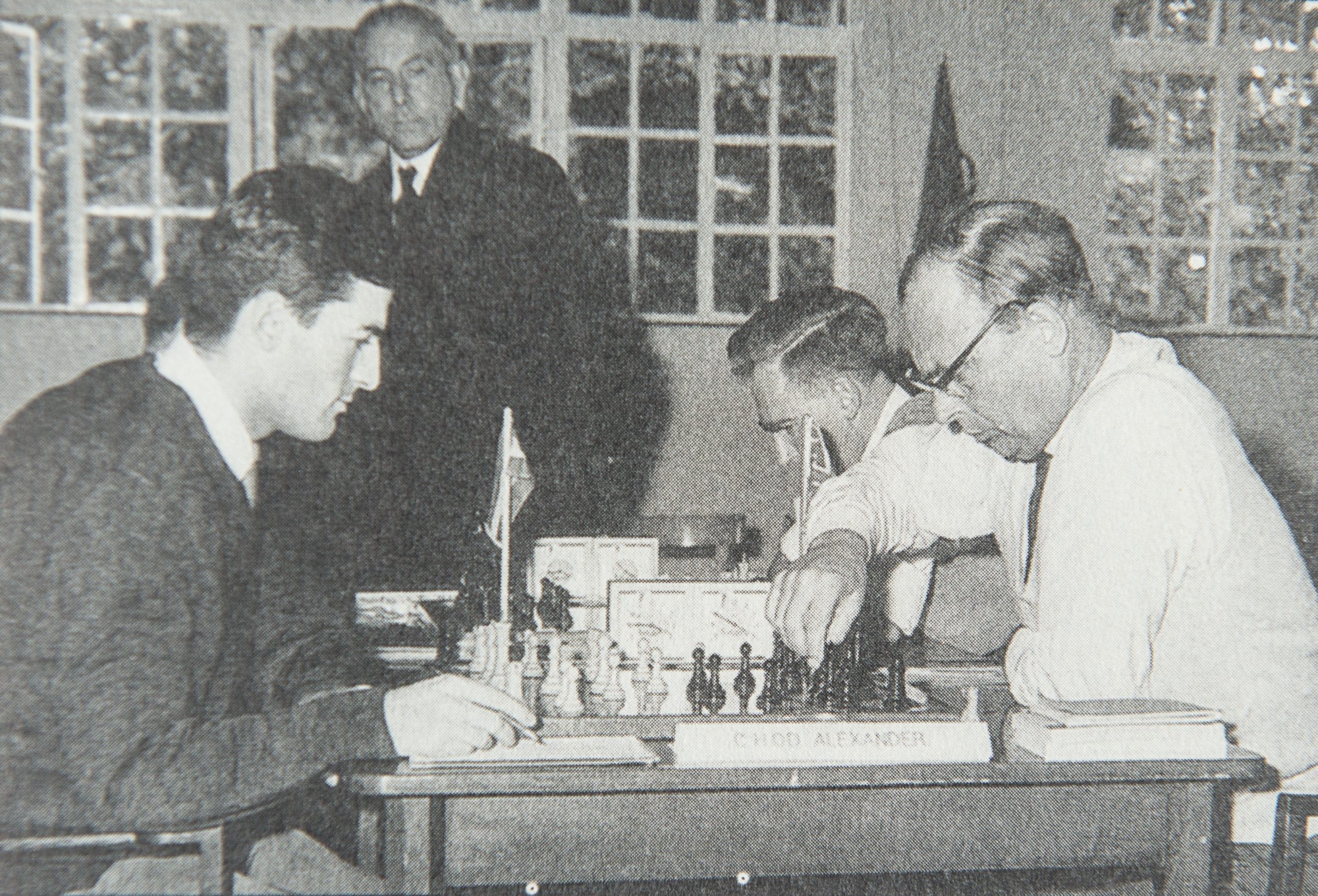
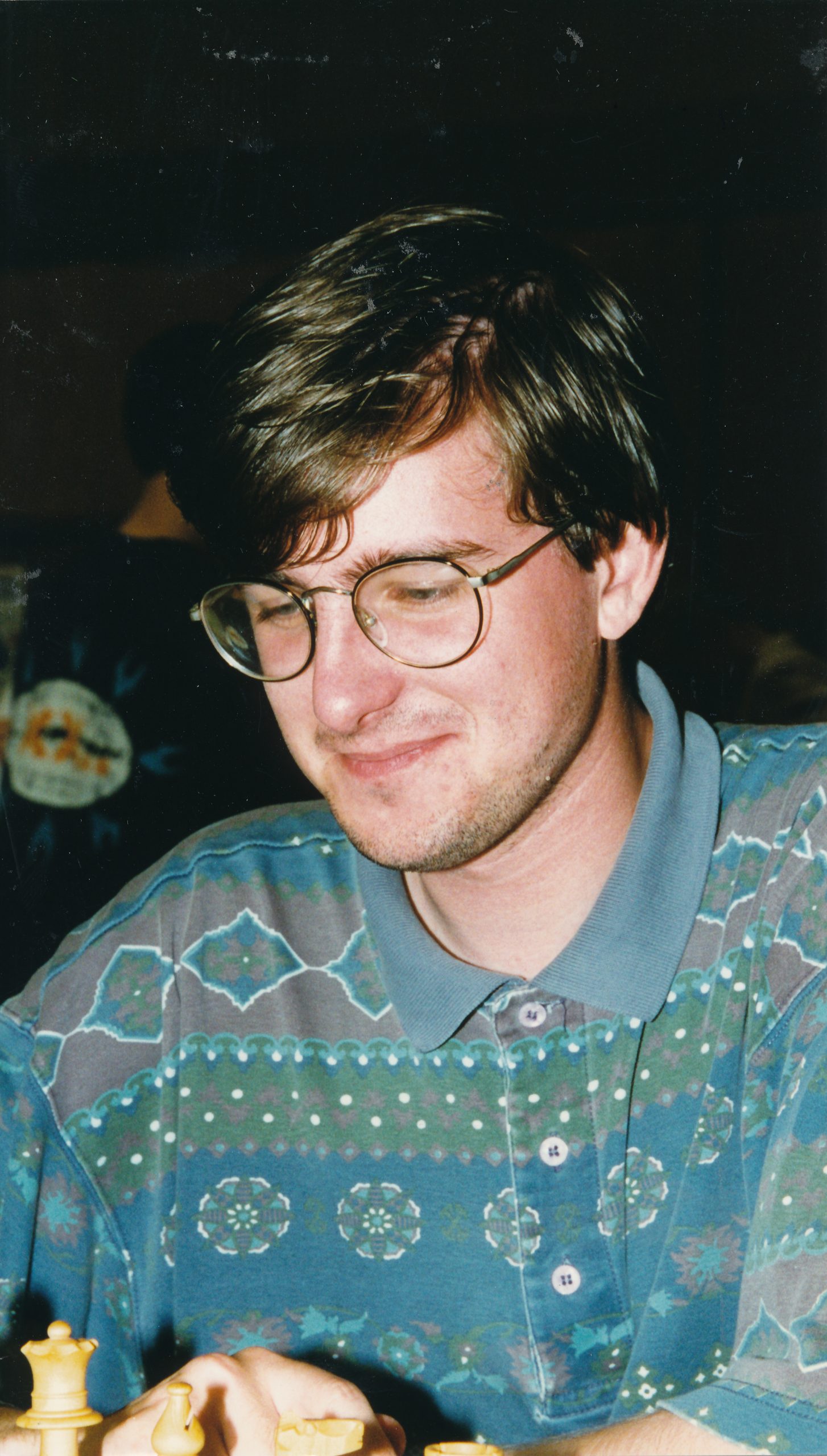
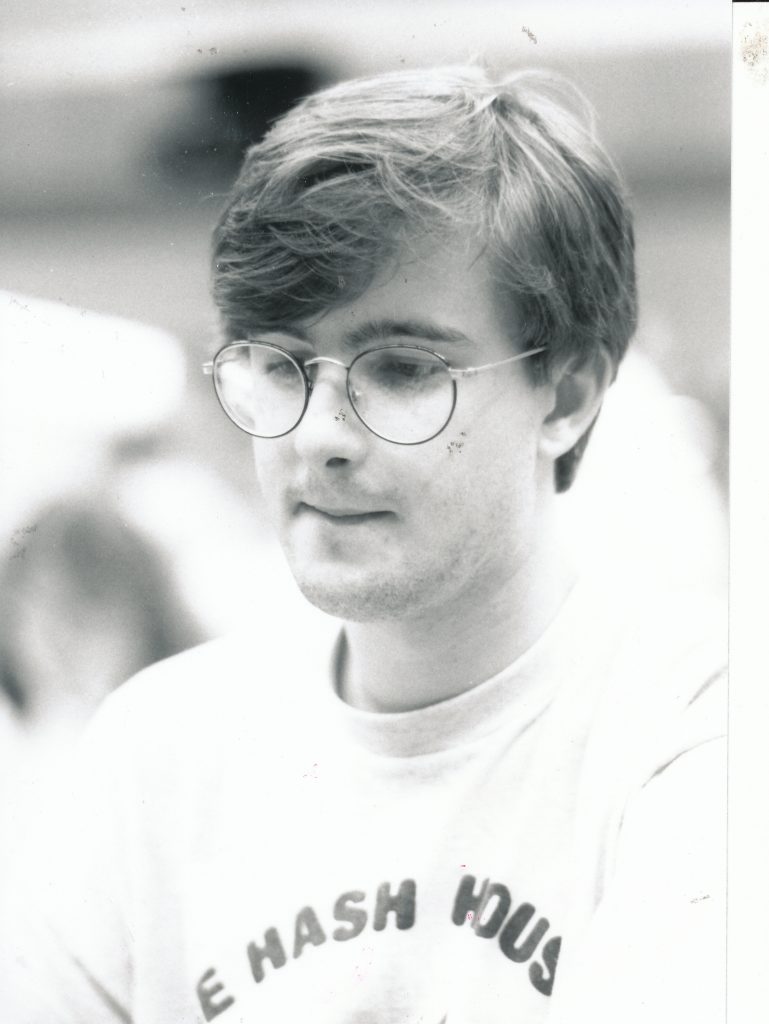
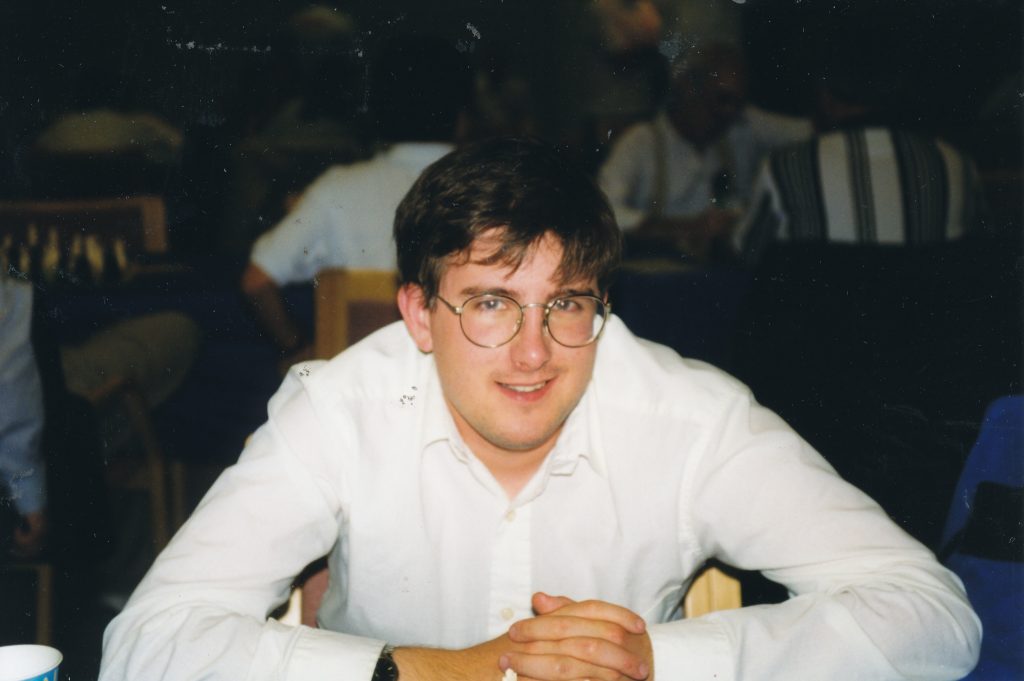
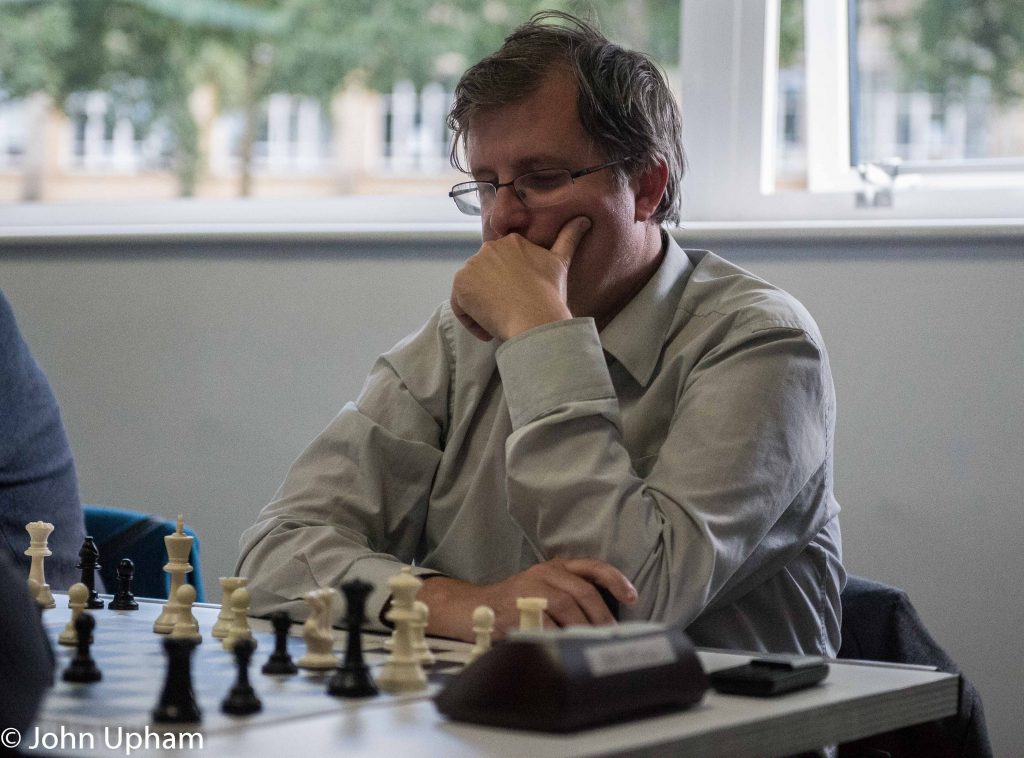
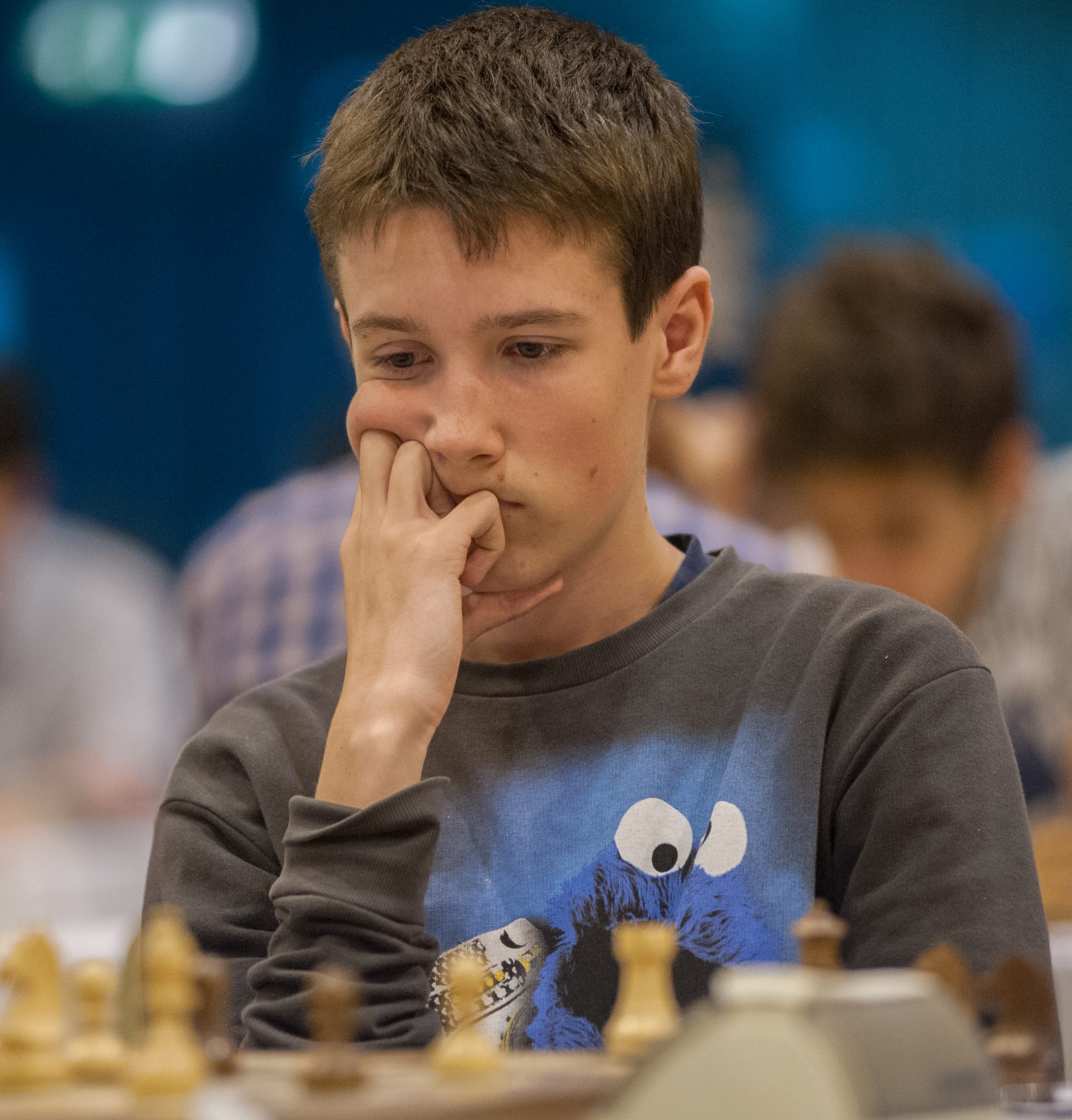
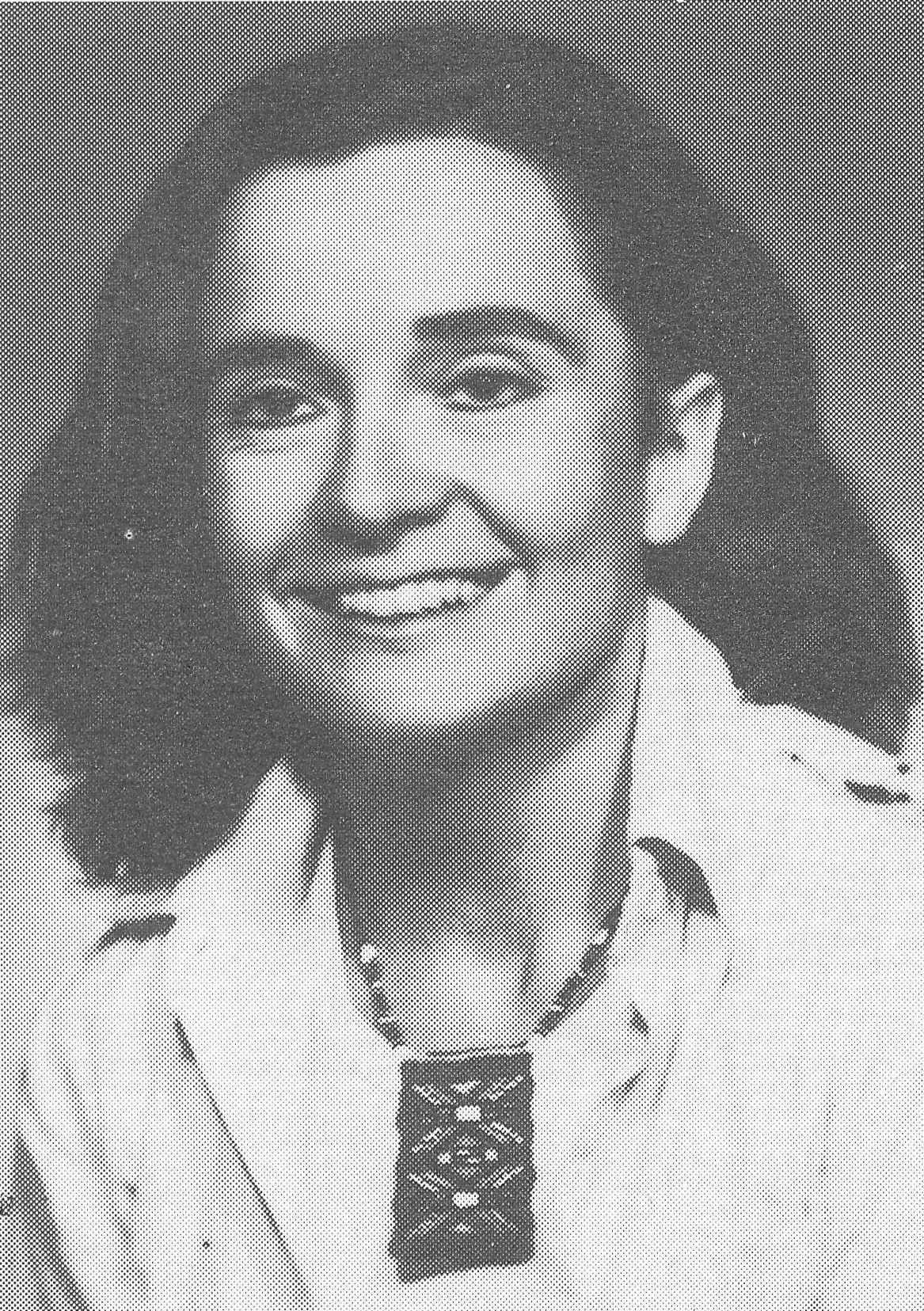
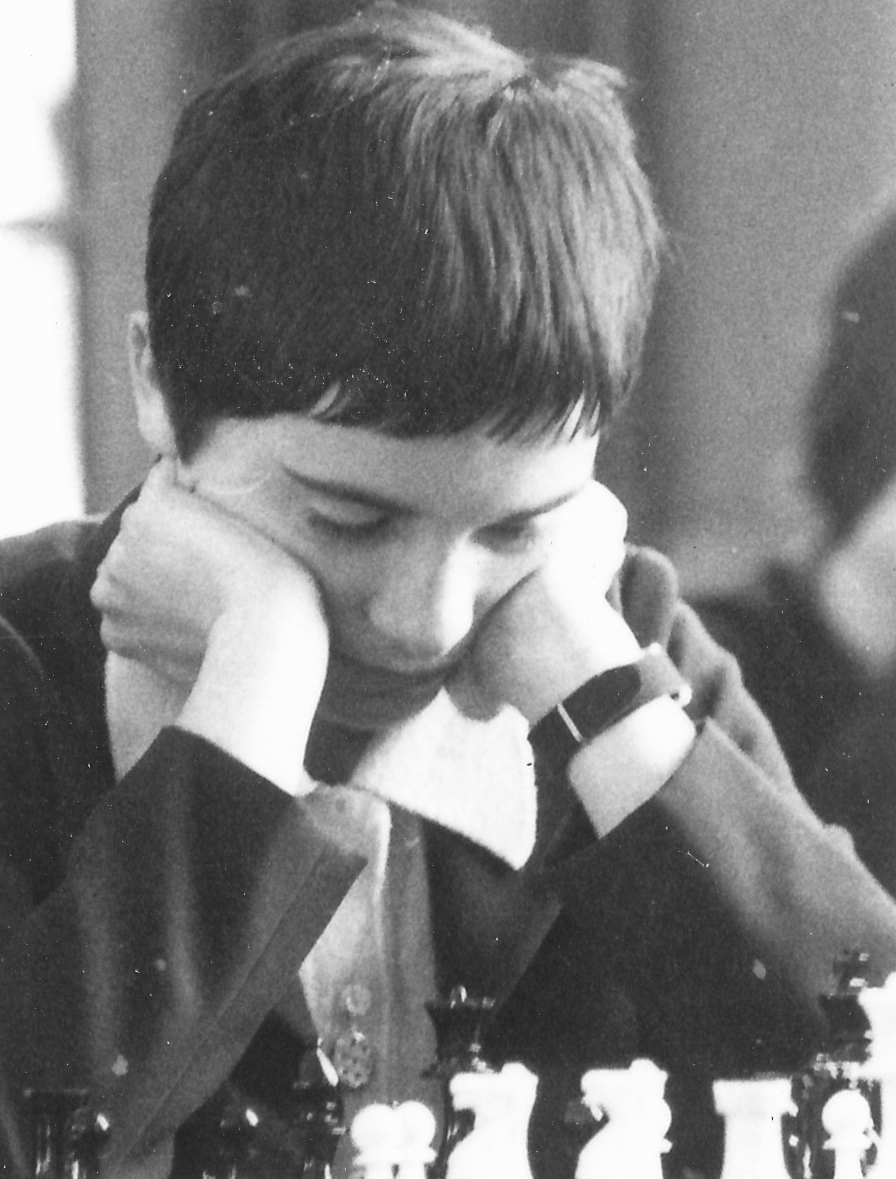
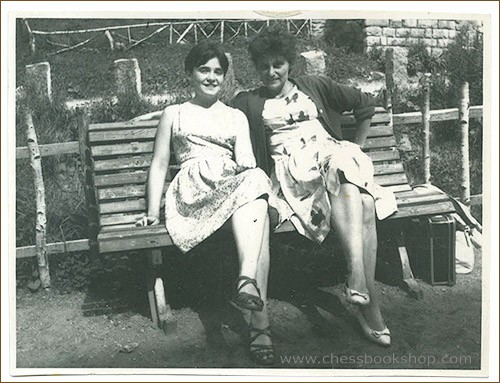
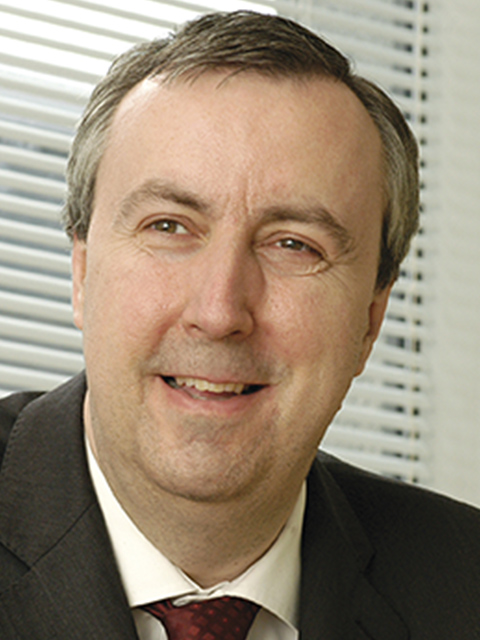
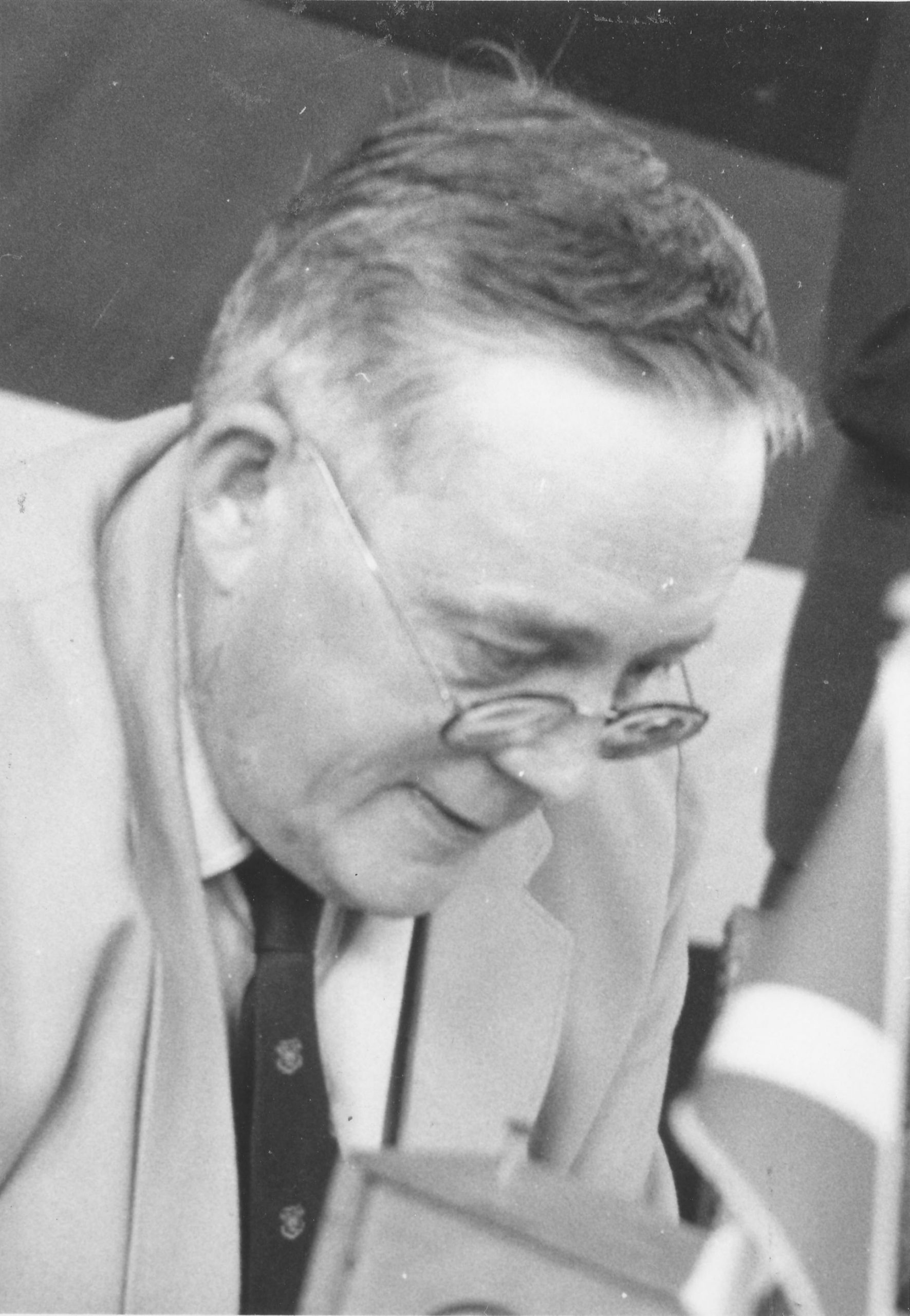
John Upham is the founder of British Chess News, staff photographer and the IT Manager.
John performed similar roles for British Chess Magazine from 2011 until 2015.
John is an English Chess Federation accredited coach and has taught in schools and privately since 2009. John started chess relatively late(!) at the age of twelve following the huge interest in the Spassky-Fischer World Championship match in 1972.
John is Membership Secretary of Camberley Chess Club and an ordinary member of Crowthorne and Guildford Chess Clubs.
John plays for Hampshire and for 4NCL Crowthorne.
John is Secretary of the Hampshire Junior Chess Association and the Berkshire Chess Association and manages the Chess for Schools partnership.
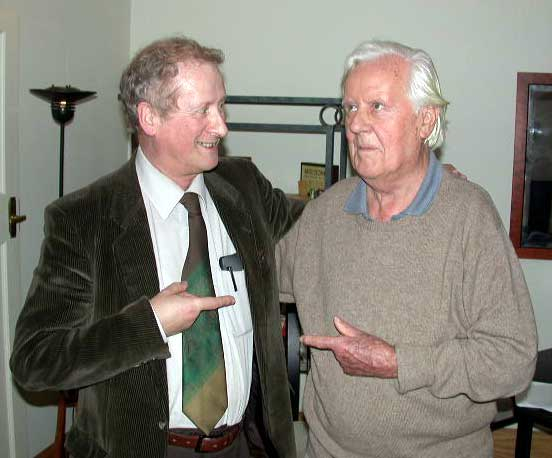
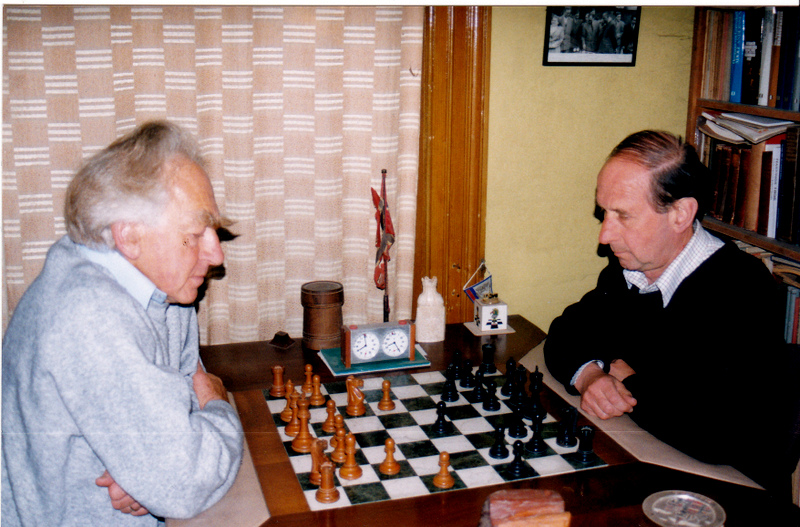
David Parlett (lhs) & David Pritchard (rhs) in 2005. Editors of Games & Puzzles magazine
We remember David Pritchard who passed away on Monday, December 12th, 2005.
David Brine Pritchard was born on Sunday, October 19th, 1919. On this day the first US Distinguished Service Medal was awarded to a living female recipient, Anna Howard Shaw.
He was born in Wandsworth taking his mothers’ Winifred maiden name of Brine (as was customary in those days). His father was Arthur Pritchard (DoB : 4th January 1890) and he was the managing director of an Engineering Company. Arthur and Winifred married in Maidenhead, Berkshire in 1917.
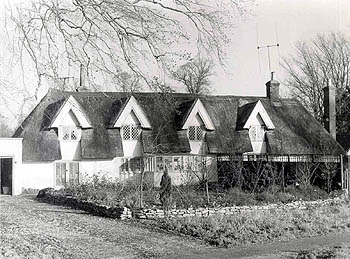
At the time of the 1939 census David was a chiropodist and recorded as single and living in Munee Cottage, Main Street, Bedford. Main Street appears to have been renamed to Main Road which is in Biddenham. It is likely DBPs cottage was something like :
48 and 50 Main Road Biddenham, Bedford, Hertfordshire
During the second world War David joined the Royal Air Force and was stationed in the Far East and following the war, he switched to intelligence work also for the RAF. He attained the rank of Squadron Leader and played much chess during this period of his life.
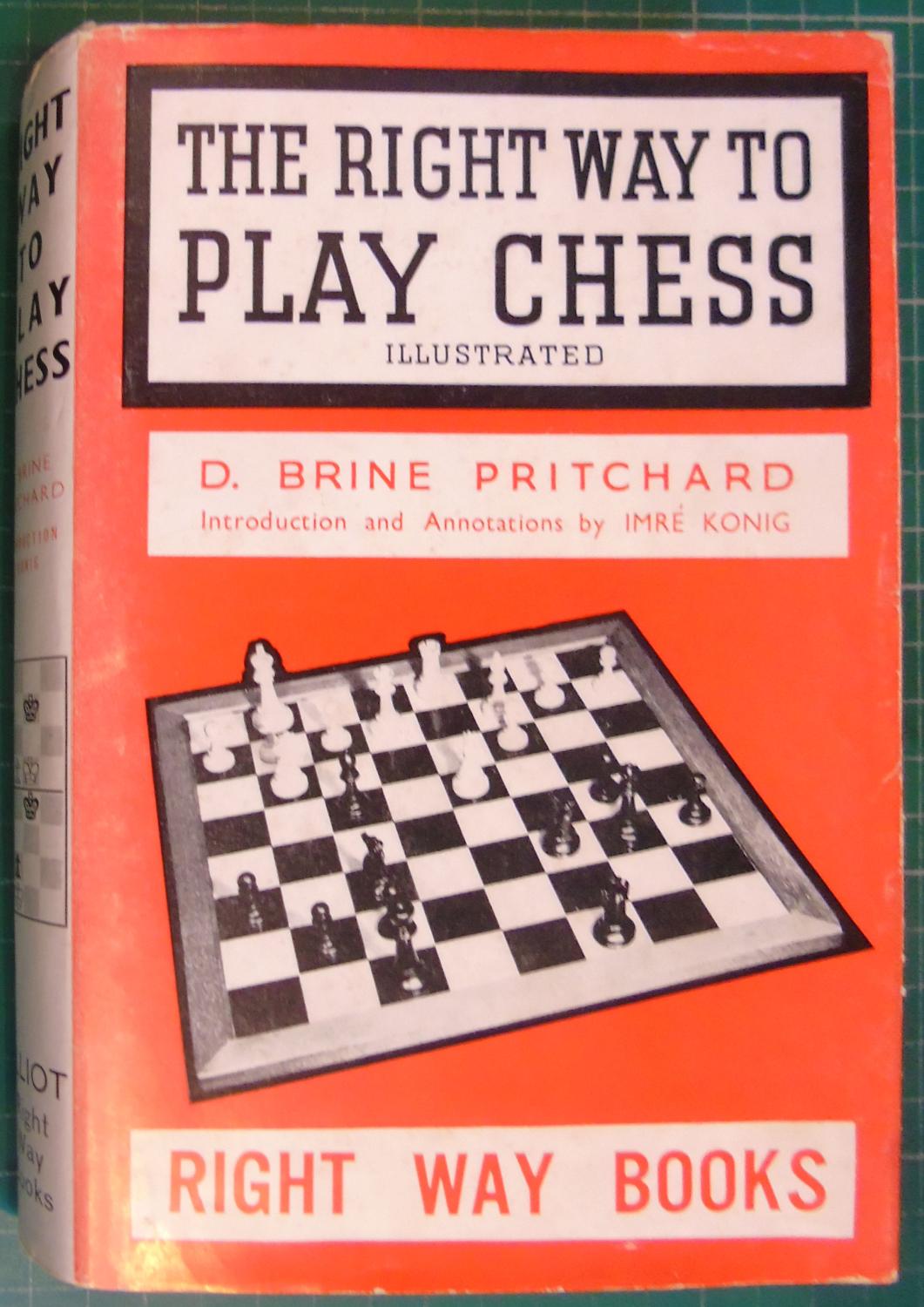
In 1950 David completed his first book : The Right Way to Play Chess, Elliot Right Way Books, 1950, ISBN1-58574-046-2
The Right Way to Play Chess, Elliot Right Way Books, DB Pritchard, 1950.
(Ed : This was the first chess book of this article’s author and was thoroughly consumed!)
On page 224 of said book David wrote :
Chessplayers – and this must be whispered – are generally an egotistical, ill-mannered crowd. If they conformed to common rules of decorum these words would not have to be written
followed by
I once carried out a private survey at a well-known chess restaurant where a large number of ‘friendly’ games are always in progress. In less than 30 per cent of those observed was resignation made with a good grace. In two-thirds of the games the loser either knocked his king over, abruptly pushed the pieces into the centre of the board, started to set up the men for a fresh game, or got up and walked away without saying a word to his opponent.
He married Elaine Saunders in between January and March of 1952 in the Cheslsea Registry Office.
Elliot Right Way Books was an excellent choice of publisher for David and only 36 minutes by car from his new home in Godalming.
He won the Singapore Championship in 1954 and the Malaysian Championship in 1955.
David and Elaine had a daughter, Wanda on March 21st 1958. She became Wanda Dakin who was also a successful chess player. Wanda attended Guildford High School for Girls and then Royal Holloway College, Egham.
David was Southern Counties (SCCU) champion for the 1958-59 and 1965-66 seasons.
From the British Championships, 1959 in York we have this sparkling game with Frank Parr :
By now David had developed an interest in chess variants and board games in general.
David was the Chairman of the organising committee for the Battle of Britain Chess Tournament : he was runner-up in the first year to RF Boxall.
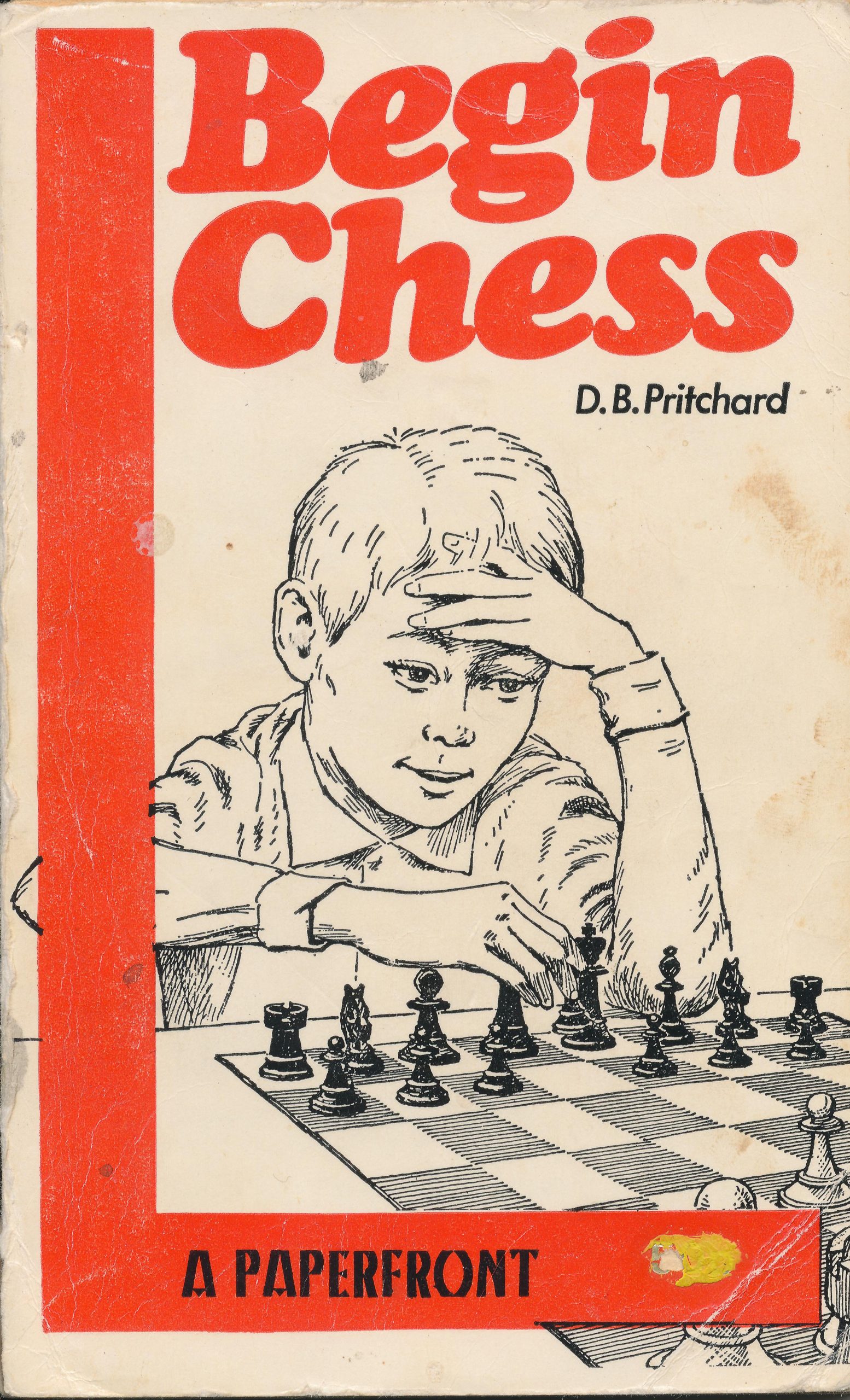
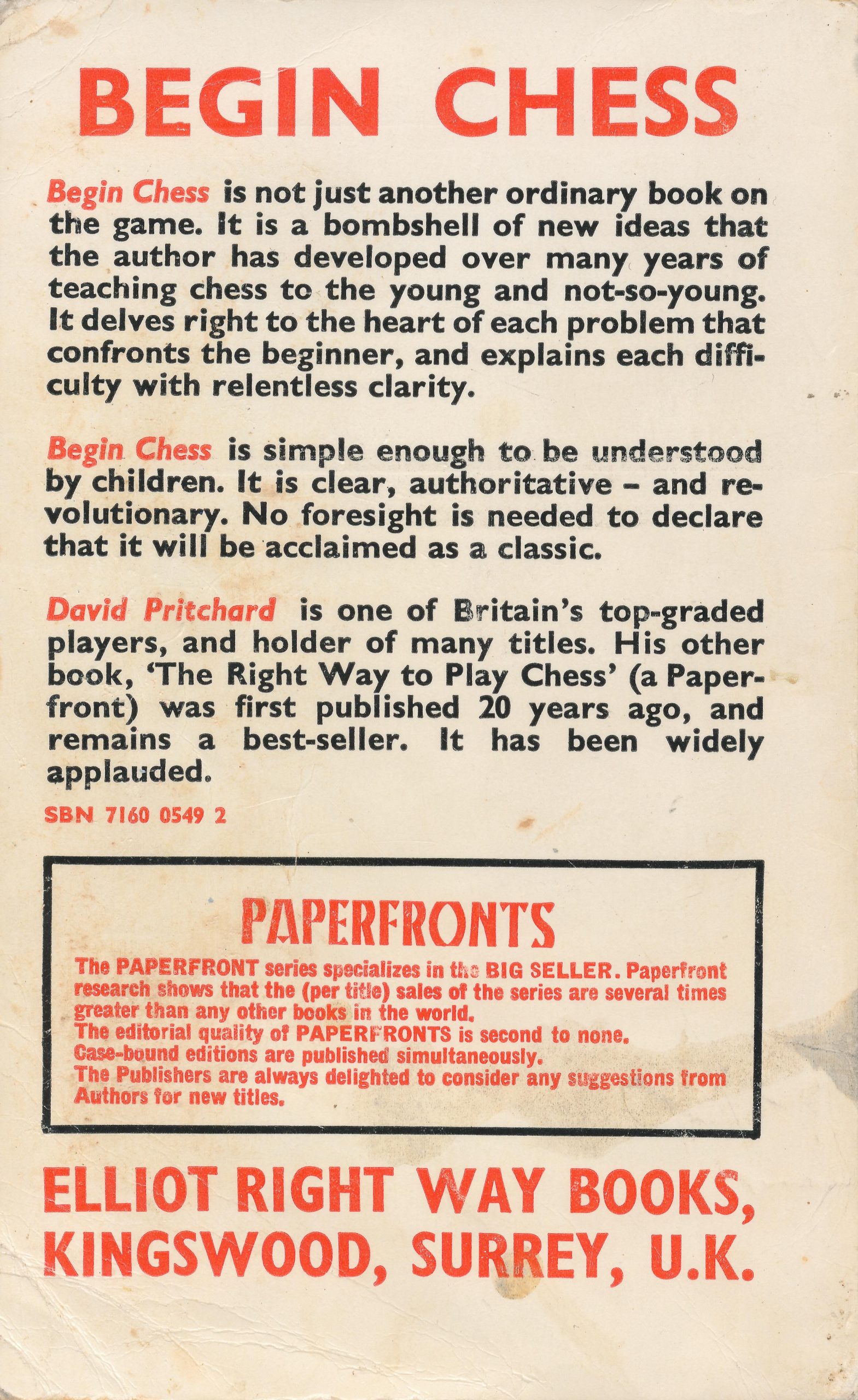
In 1970 he brought out his third book : Begin Chess, David Pritchard, Elliot Right Way Books, 1952
Begin Chess by David Brine Pritchard, Elliot Right Way Books, 1970Begin Chess by David Brine Pritchard, Elliot Right Way Books, 1970
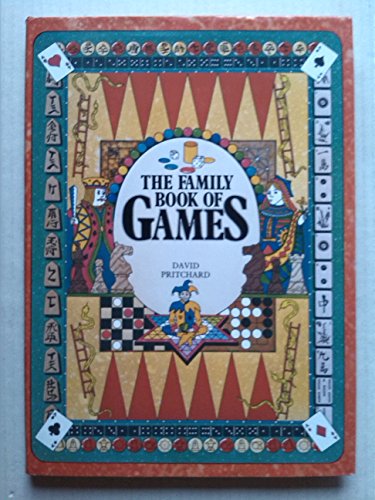
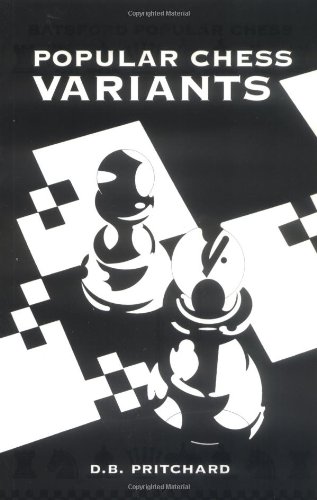
David became President of British Chess Variants Society and wrote many books on variants and indoor games.
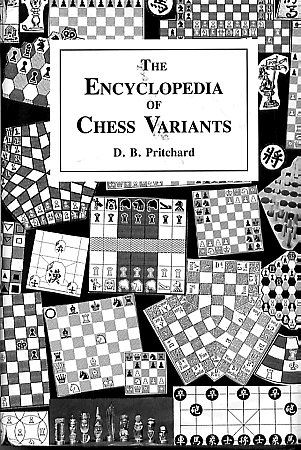
Here is an interview compiled by Hans Bodlaender about David’s Encyclopedia of Chess Variants :
Encyclopedia of Chess Variants, DB Pritchard, GAMES & PUZZLES PUBLICATIONS, 1994
Particularly interesting was this Q&A :
Do you think computers and the Internet will have effect on chess and on chess variants? If so, in what way?
I think that the Internet will inevitably introduce chess to more players but I forsee chess variants, because of their novelty, benefitting in particular from publicity on the net. I expect variants to gain more and more adherents in the future.
David was preparing a second edition before he passed away. This was completed and made available on-line by John Beasley.
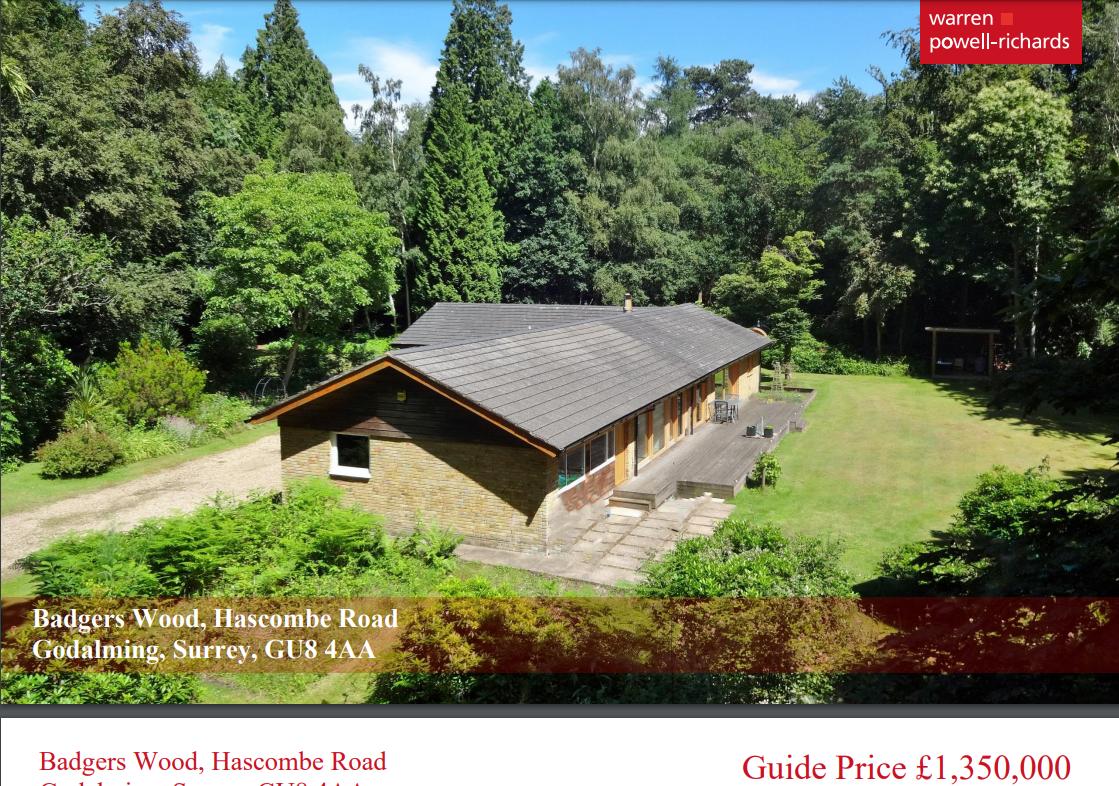
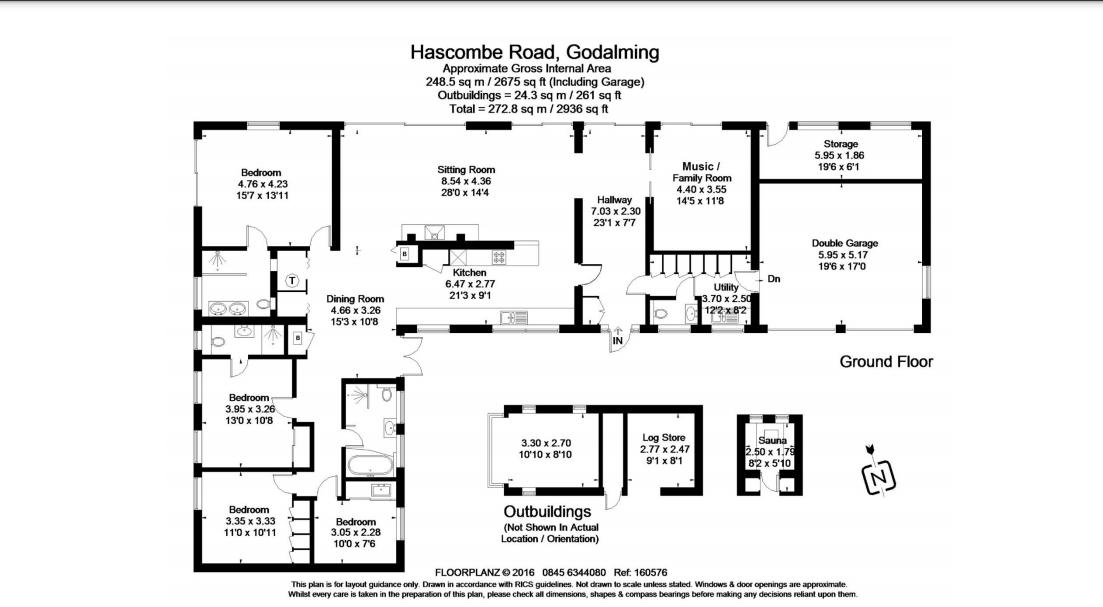
The Pritchard family lived at Badgers Wood, Hascombe Road, Godalming, Surrey, GU8 4AA in an idyllic location :
At the time of his passing he had five grand children.
From British Chess Magazine, Volume CXXVI (126, 2006), Number 2 (February), page 76 :
“David Brine Pritchard (19 x 1919 Streatham, London – 12 xiii 2005, London) has died following a fall . He was a strong amateur player and a successful author of books on chess and other games.
David Pritchard was a Squadron Leader in the RAF during the war and later rejoined it to work in intelligence. Whilst serving with the RAF he won the Malayan Chess Championships in 195, and he was also instrumental in the running the UK event known as the Battle of Britain Tournament which attracted a strong field in its heyday and generated revenue for the RAF Benevolent Fund.
He was a dangerous attacking played who scored a number of notable scalps in the British Championship including Penrose and Miles, without ever achieving the consistency required to challenge for the leading positions. He won the Southern Counties championships in 1959 and 1966.
As an author, Pritchard’s most successful book was The Right Way to Play Chess (Elliott, 1950, with numerous reprints), which is still to be found for sale in many British bookshops.
He will also be remembered as a leading authority on chess variants: he was reported to be in the process of preparing a second edition of The Encyclopedia of Chess Variants (1994) at the time of his death. He was also a very good correspondence player, an inventor composer of chess puzzles of all sorts (some of which appeared in BCM) and his interest in Fairy chess dated back to the 1940s.
His wife Elaine Pritchard, the leading woman player of the 1950s and 1960s, and their daughter Wanda (who also played competitive chess) survive him. We send them our condolences on behalf of BCM and its readers.”
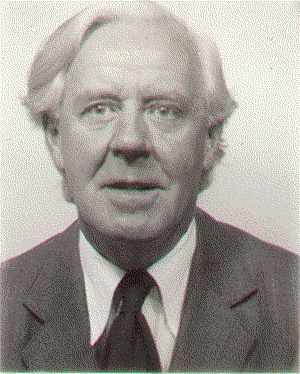
David Pritchard (19-x-1919 12-xii-2005), Passport photograph
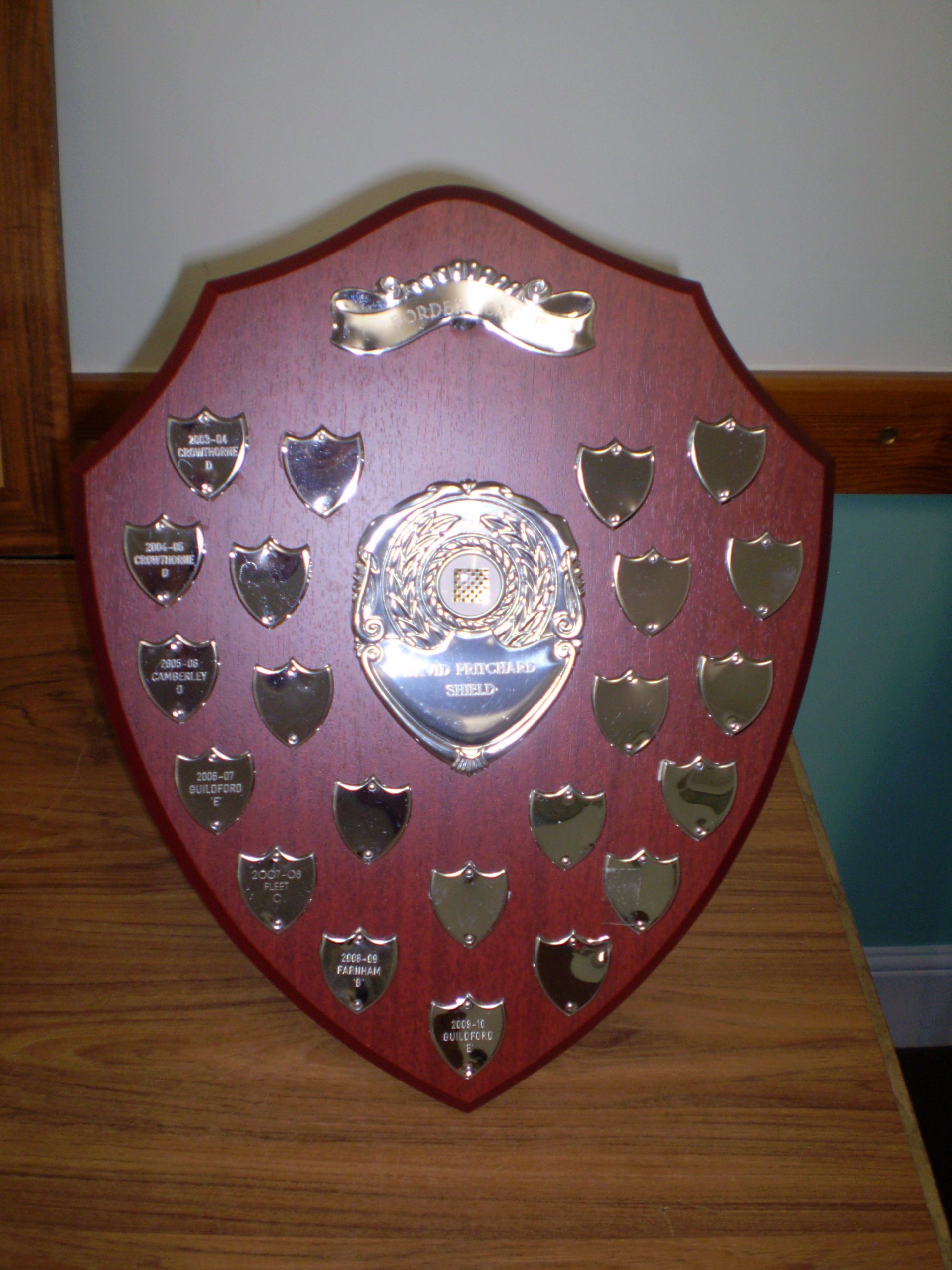
He was a leading member of Godalming Chess Club and played in the Surrey Border League. The David Pritchard Shield was presented in his memory.
The David Pritchard Shield from the Surrey Border League
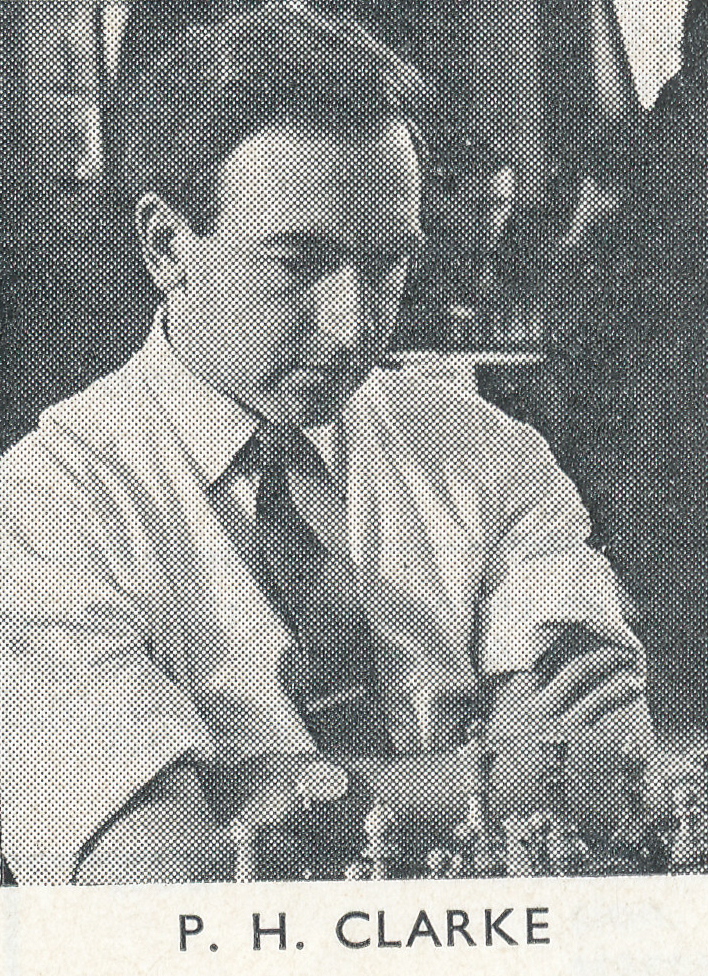
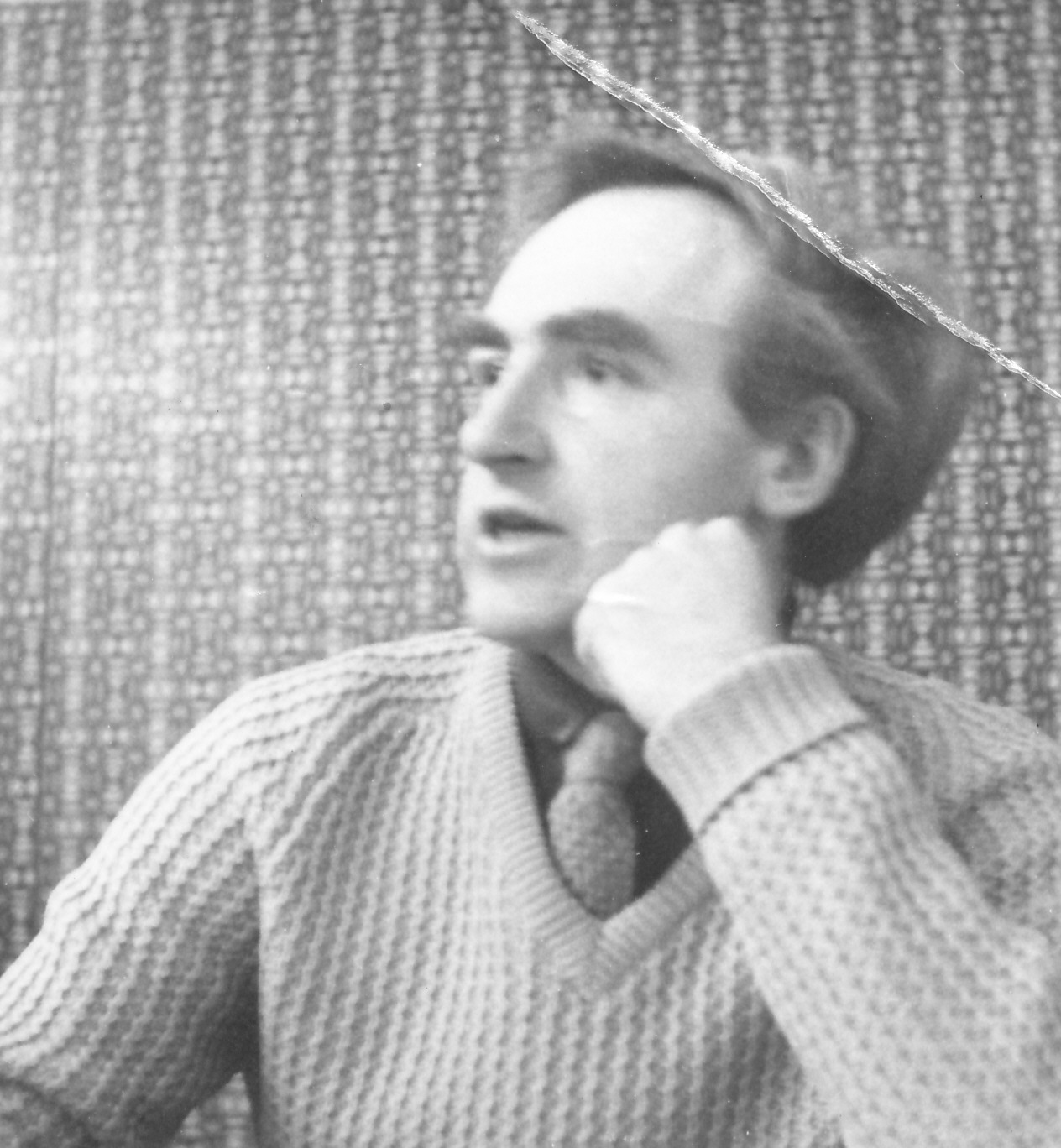
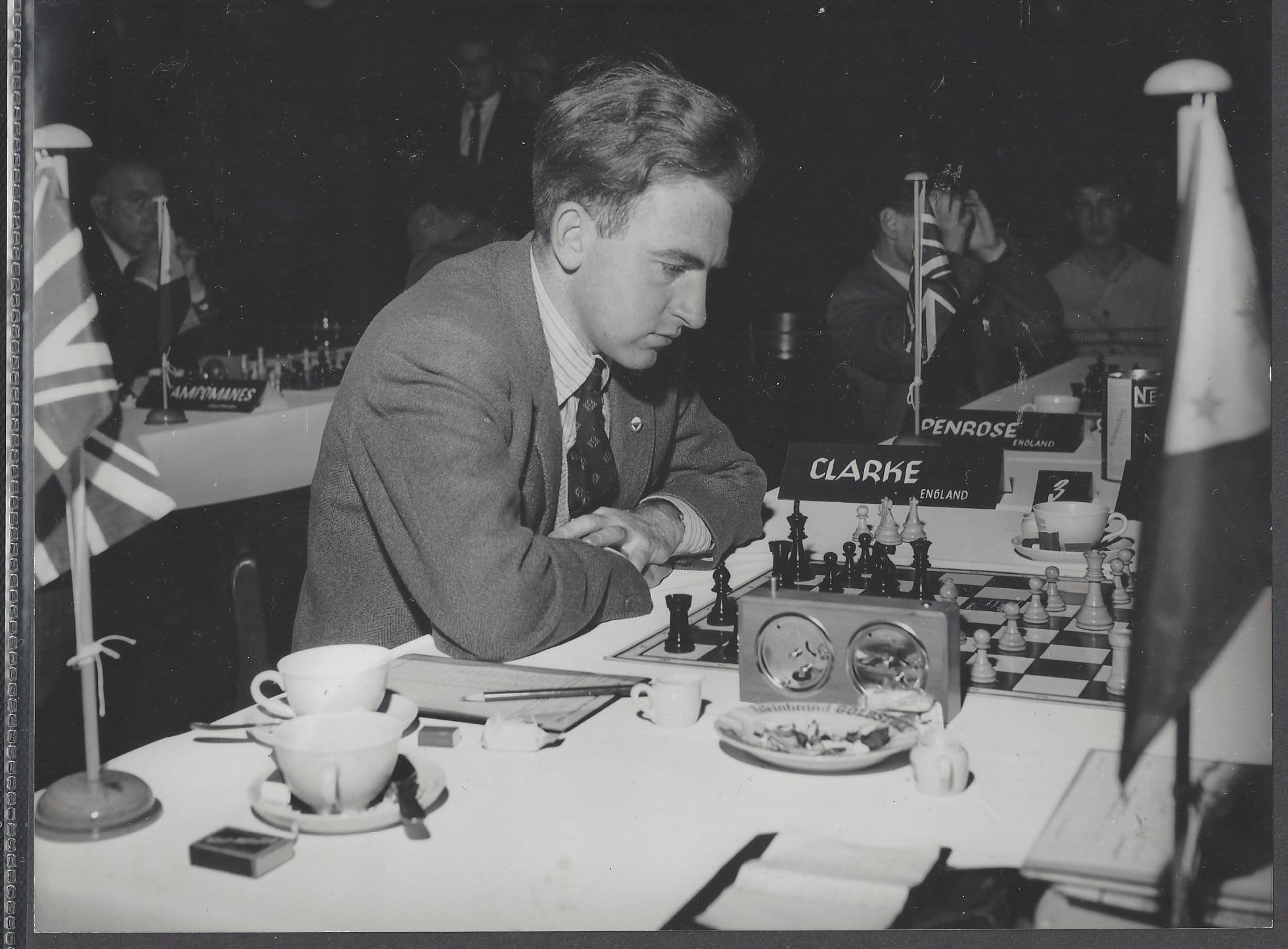
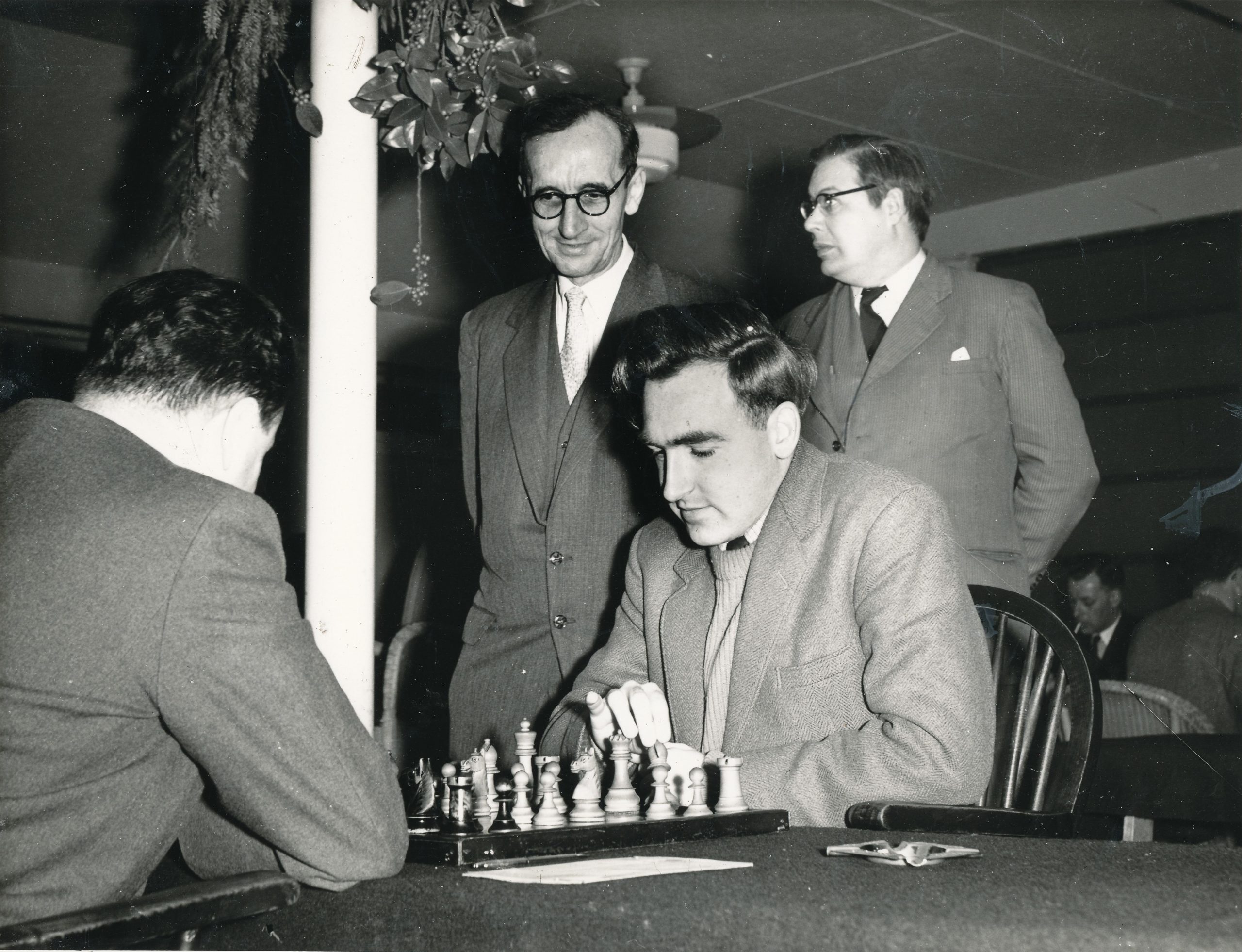
Peter Clarke at the 1963 Ilford Whitsun Congress. Source : British Chess Magazine, Volume LXXXIII, Number 7 (July), page 194PH Clarke
We remember FM Peter Clarke who passed away on Thursday, December 11th, 2014 whilst living at Chapel House, Bude, Cornwall, EX23 9SQ
Peter Hugh Clarke was born on Saturday, March 18th 1933 in West Ham, London. Peter was born to Hugh Clarke (21st April 1905, West Ham – April 1961)and Gertrude Olive (née Ekblom) (7th May 1909, Bournemouth – October 2005, Stratton, Cornwall). Hugh and Gertrude married on June 4th 1932 in Forest Gate in Essex.
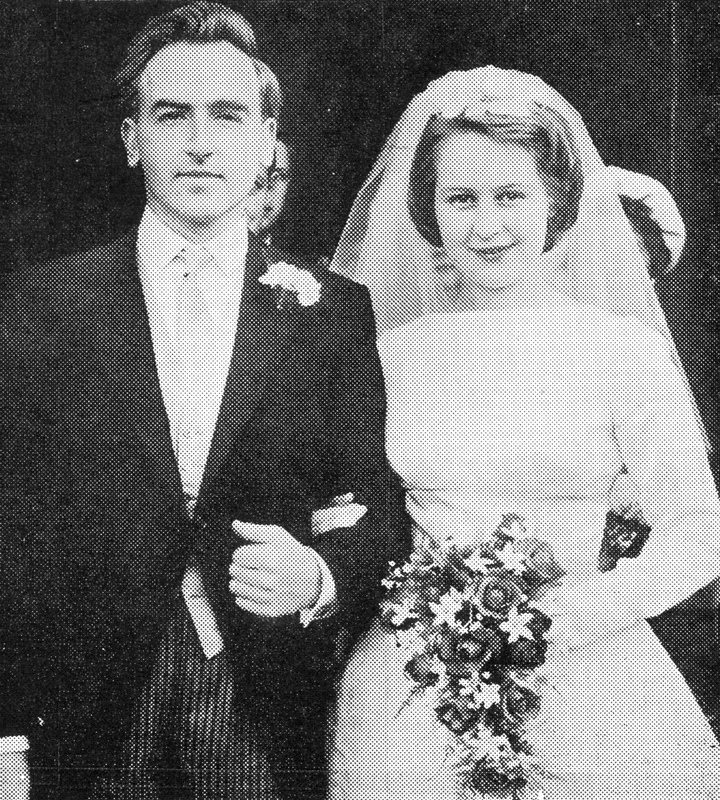
In July 1962 Peter married Margaret Eileen Elizabeth (Peggy) Wood, the daughter of BH Wood. Margaret passed away in 2018 in Bude, Cornwall.
From The Modest Master of Morwenstow by James Pratt (sadly, as yet, unpublished) :
“Peter Hugh Clarke was born in London on 18th March, 1933. At the age of eight or nine he taught himself the game from ‘The Book of Knowledge’ and played friendly games with his cousin, who was about a year older. Peter’s father supported his game for many years. PHC was a student at St. Bonaventures School and London University. World War II, and its even longer aftermath, robbed him of a number of playing opportunities. It is surprising that he had no childhood heroes, although later the play of Botvinnik, Keres and Smyslov impressed him.”
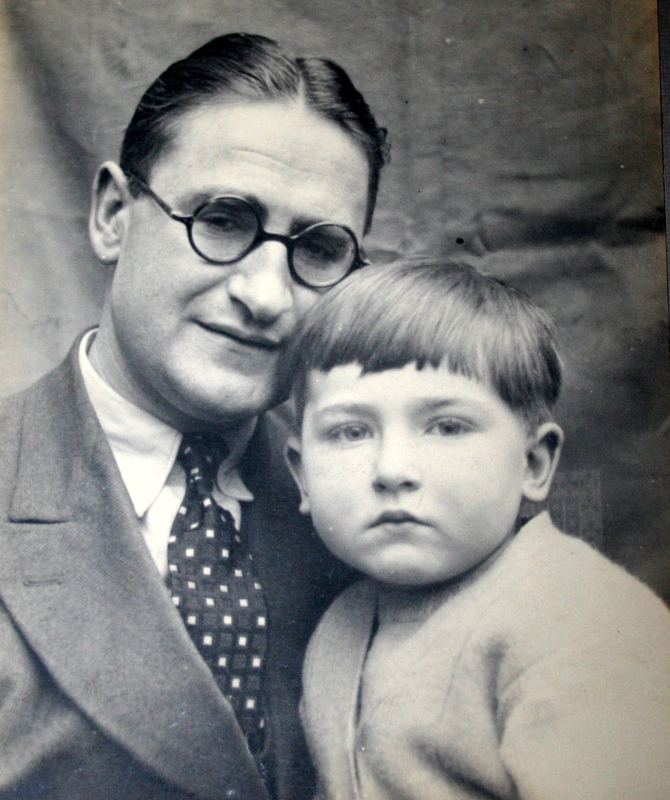
Peter Clarke with father, Hugh Clarke, Courtesy of Keverel Chess
From British Chess (Pergamon, 1983) written by George Botterill :
Chess correspondent of The Sunday Times, Clarke played for England in the Olympiads of 1954, 56, 58, 60, 62, 66 and 68. He has never won the British Championship but has come 2nd on 5 occasions.
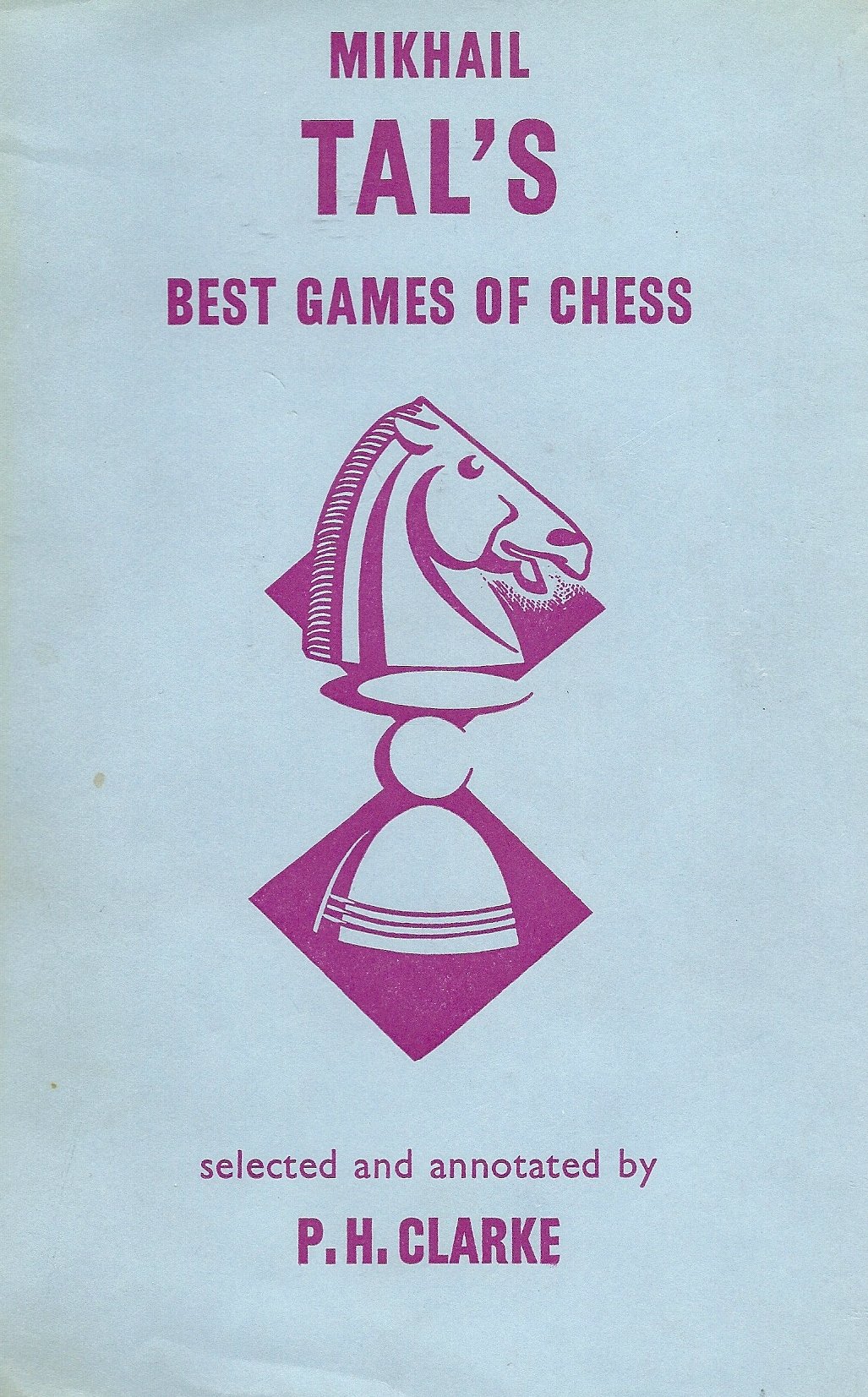
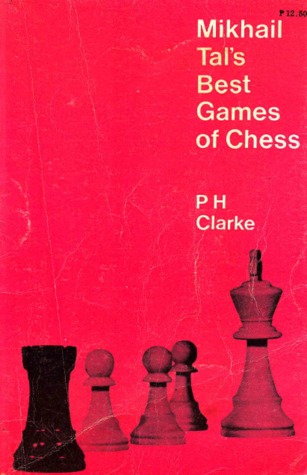
A fine writer. His best books are Mikhail Tal’s Best Games of Chess
Mikhail Tal’s Best Games of Chess, PH Clarke, Bell, 1961
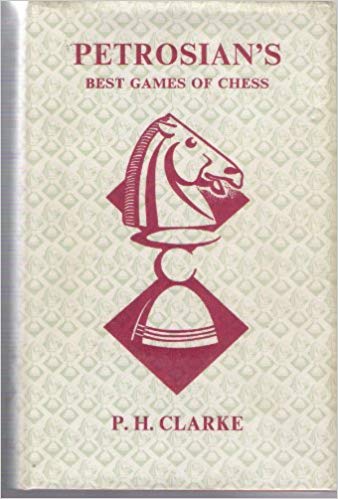
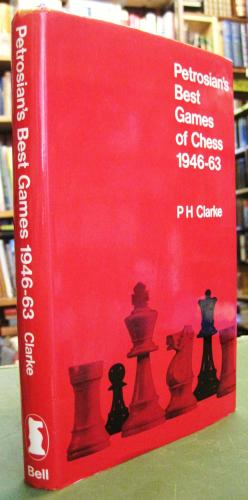
and Petrosian’s Best Games of Chess 1946-1963 both published by Bell.
Petrosian’s Best Games of Chess 1946-1963, PH Clarke, George Bell & Sons Ltd, 1964
The most remarkable thing about Clarke’s chess career was they way in which he became transformed, in about 1968-9, into the most drawish of players. In British tournaments he has become notorious for correct but dull solidity.”
“FIDE and British Master P.H. Clarke will be best remembered as biographer to Tal and to Petrosyan, but he was so much more. The young Clarke played for Ilford CC in the London League and for Essex at county level. Doing national service he was to learn the Russian that was to so shape his writings.
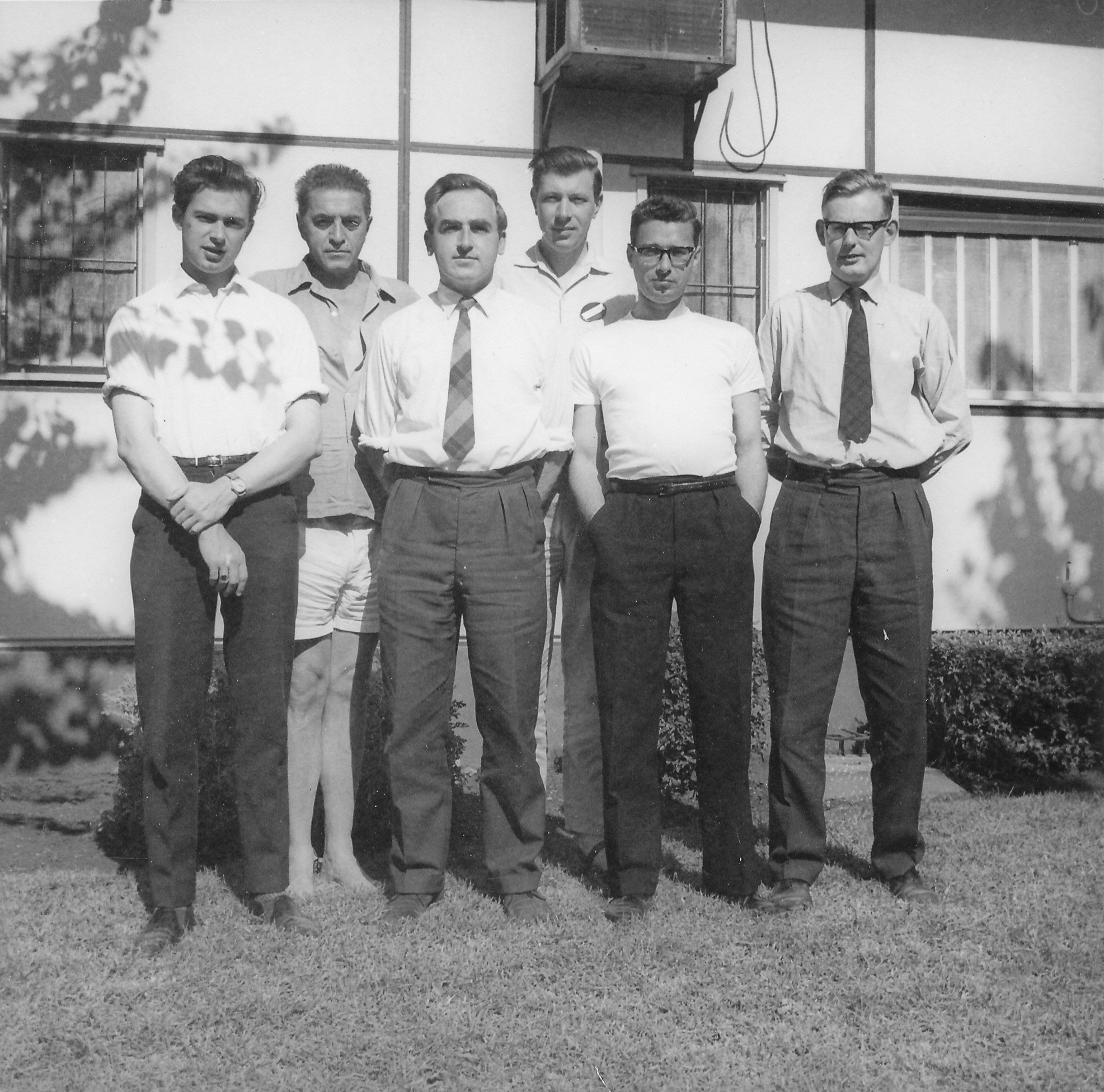
The 1964 England Olympiad (Tel Aviv) Team : Owen Hindle, Čeněk Kottnauer, Peter Clarke, Michael Franklin, Norman Littlewood & Michael Haygarth
For a brief period in the late 1950s, and early sixties, he was the number two player in England, ahead of the vastly more experienced Alexander and Golombek. He played, of course, below Jonathan Penrose, a partnership that bore fruit when preparing openings; latterly they both became Correspondence Grandmasters.”
FM Peter Hugh Clarke
FM Peter Clarke
“At the British Championships itself he finished second on his first appearance; he was to tie for silver medal on no less than five occasions, appearing, almost without a break for thirty years, a run that ended in 1982. He represented the BCF – as it then was – in eight Olympiads, playing on top board in 1966.
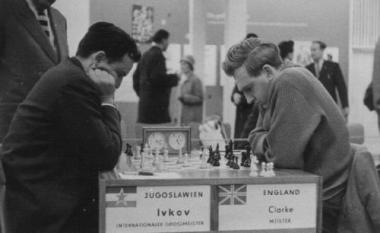
Borislav Ivkov playing Peter Clarke at the 1960 Leipzig Olympiad. The game was a QGA which was drawn
The Clarke family moved to the West of England in the late Sixties. PHC played in thirteen WECU Championships, and lost only twice. As a player he could be cautious, agreeing too readily to draws. Accuracy and respect meant more to him than ambition. The biographer became a journalist as illness cut short his playing career. In his time he beat Larsen, Penrose and Szabo.
In 1962 he married BH Wood’s daughter, Peggy. They had three daughters. In 1975 my mother happened across Peter and Peggy on Morecambe prom. ‘Never’ she was later to tell me, ‘have I seen a couple more in love.'”
Peter Clarke & Peggy Wood in 1962, Courtesy of Keverel Chess
We are grateful to James Pratt to allow us to quote from the the sadly unpublished “Modest Master from Morwenstow” as follows :
“Peter had a relatively short career at the top and it is interesting to comment on his style. In essence, his great strength lay in positional understanding which backed-up his defensive skills rather than helped his ability to create wins; in other words, he won games in which his opponents over-pressed or opted for dubious positional moves.
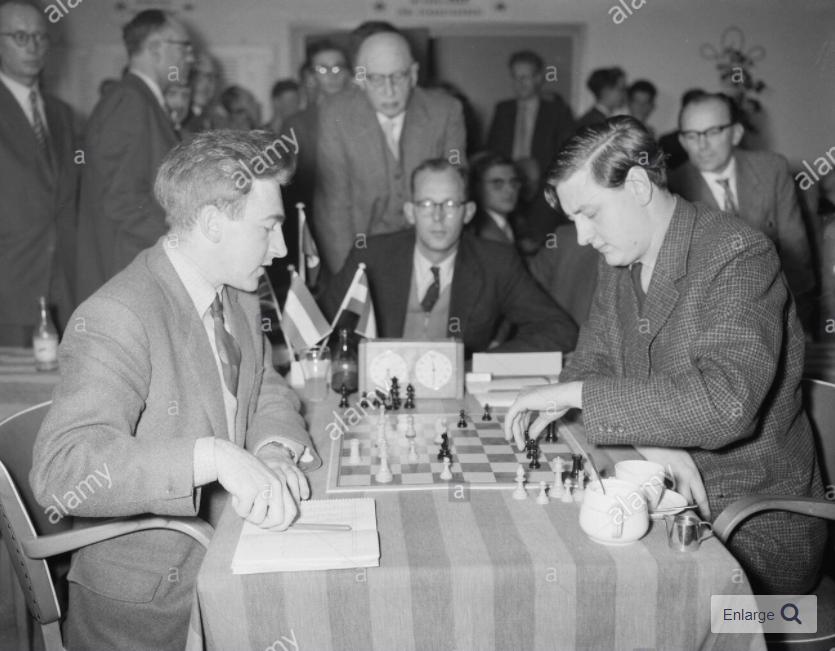
Peter Hugh Clarke (left) and Donner (right) Date: November 26, 1957 at the Wageningen Zonal, The Netherlands. Courtesy of Alamy
After doing well in English chess, he was perhaps pushed into international chess too early for him to develop his own personal creative style. Playing for England and meeting strong players, he tended towards a rather negative approach that may have been necessary for the team but was not good for his own personal progress, as shown when he later met English opponents who outstripped him in their positive will-to-win. His friendship with Penrose (a far stronger player) led to far too many draws which did neither of them any good.
Mikhail Tal’s Best Games of Chess, PH Clarke. Bell, 1961
To be fair, Peter was not an easy player to beat but, on the other hand, he was not too hard to draw against if you felt so inclined. His forte lay in his knowledge of the game and his excellent writing skills, where he was at his happiest; there is hardly a book of his that I haven’t enjoyed.”
Petrosian’s Best Games of Chess 1946-1963, PH Clarke, Bell, 1971
Writing in BCM 04/64, John Littlewood called PHC a self-style non-tactician and disagreed with Clarke’s belief in the inner logic (‘I have made no mistakes and therefore my position is OK.’) of positions where tactics are to the fore.
“Peter’s contribution to British Chess was important as a player and even more so as a writer. His best period was 1956-61. He, Penrose and myself used to stay in the same hotel during the British Championships and prepare and analyse together, although we played hard when actually paired. Peter was the solid man in the English team, gradually taking over the role of Golombek. It was important that we did reasonably well in this period which provided a bridge between the Alexander/Golombek era and the rise of Keene/Hartston.
Meliton Borja of the Philippines v. Peter Clarke from the 1958 Munich Olympiad played on October 9th 1958. The game was drawn in 49 moves. From the collection of David Jarrett with many thanks.
Peter was always a good friend to me and his family gave me hospitality each year during the Ilford Congress. Peter’s books, especially the one about Tal, were real works of scholarship in an era where there were no computers to facilitate the job. He could have achieved more as a player if he had been able to concentrate fully on that, but the economic climate then was poor for professionals.”
Peter and life long friend, Jonathan Penrose, Courtesy of Keverel Chess
“Right up to that point of his illness in the 1980’s he had worthily defended the reputation of the older generation in the British Championship, as the last survivor, still active at that level, from the Penrose era. I first saw Peter at the 1951 British Championship at Chester and first played him at the 1952 Bristol Universities individual contest.
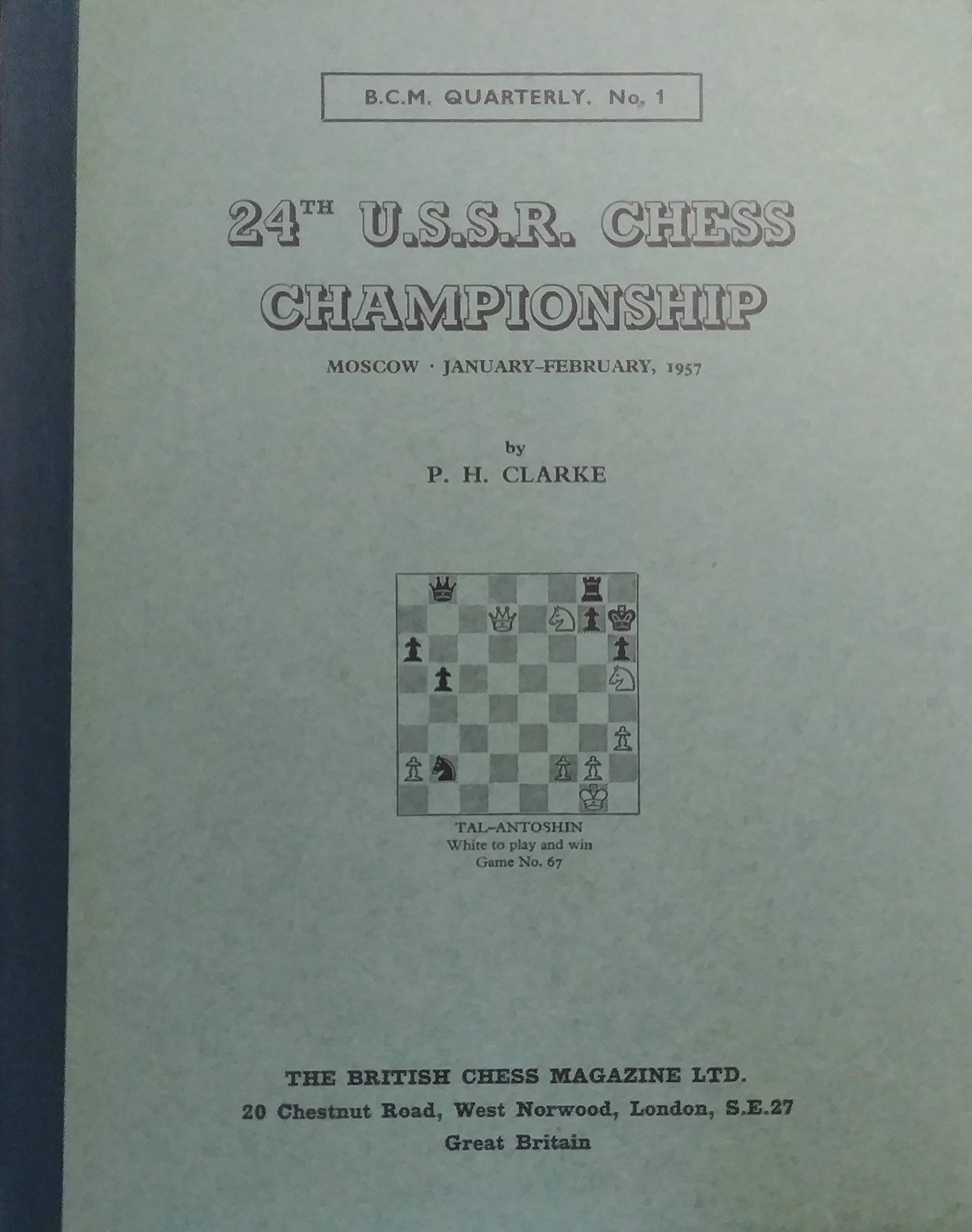
24th USSR Chess Championships, PH Clarke, British Chess Magazine, 1959
He left the University of London before taking his degree (study of chess rather taking over his life), but then had the good fortune to go on to study Russian while doing his National Service, around 1954-55. Or was he still in the Army when the Moscow 1956 Olympiad took place? He certainly did well there, perhaps less affected than other Westerners by the strangeness of the place that was just recovering slightly from the depths of Stalin’s baleful influence.
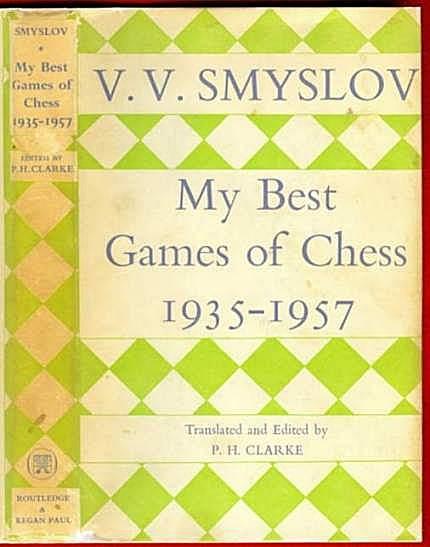
VV Smyslov – My Best Games of Chess, edited and translated by PH Clarke, Routledge and Kegan Paul, 1958
I do recall that for a couple of years Peter changed his cautious style. This was around 1957-58 when he scored one of his two wins against Penrose. Was it at Ilford?* I remember that the game appeared with notes by B.H. Wood in ‘The Illustrated London News’ column.
(*Subsequent to this article being posted LWB was kind enough to clear up BCs above query :
I used to see Peter regularly at the Paignton and Hastings Congresses in the 1990’s but not in the last couple of years. His health seems restored.”
Peter with Brian Reilly observing playing ? with ? in the background.
PHC by Ken Harman :
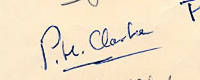
“I am very pleased to hear about your book about Peter Clarke; not sure I can contribute much as I wasn’t a friend of his so only knew him through seeing him and Margaret at chess tournaments. He was a quiet spoken gentleman who played such quiet positional chess that I would call it ‘monastic chess’. I think Clarke thought chess a search for spiritual truth, only to be found in the cloisters of spiritual truth, only to be found in the cloisters of contemplative life – ‘The Thomas Merton of Chess’, if you like. Of course, I have no idea if he was a spiritual man in real life but his chess always struck me as if he was reaching for heaven and found hell in a doubled pawn. He seemed like a nice man and I suspect his wife Margaret was the dominant one. I have his book on Mikhail Tal’s Best Games of Chess (Bell 1961) which is signed by him and may well have been his copy, because as you open the book – there is a small newspaper clipping and a photo of Clarke sellotaped which is rather unusual being that the book is about Tal, and not him. ”
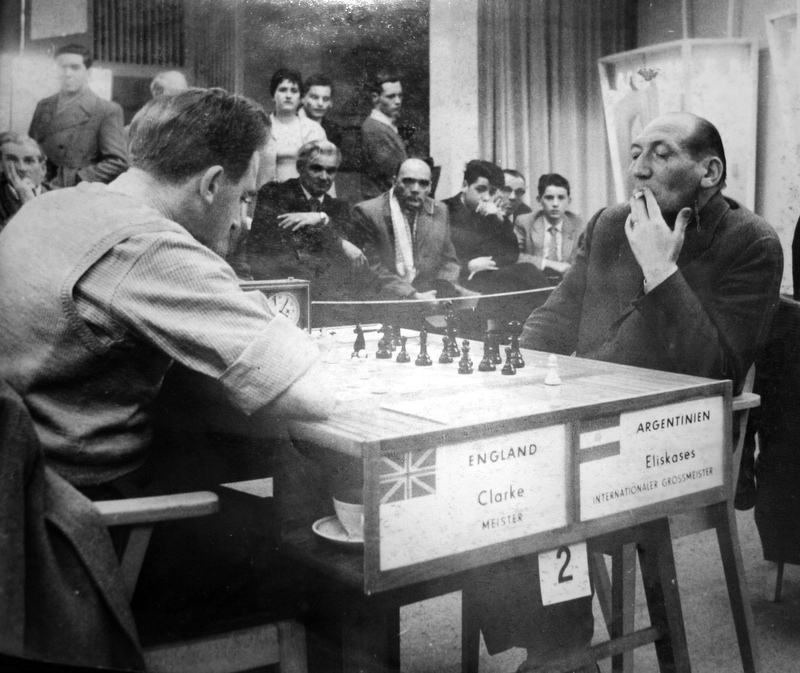
Peter plays Erich Gottlieb Eliskases at the 1960 Leipzig Olympiad
PHC by Alan P. Borwell (ICCF Honorary President) :
“I first met Peter at the 1959 BCF Congress in York when I was a member of local organising committee and then at Paignton and when York played & won the National Club Championship in 1964/5.
In 1966 I played Peter in the British Chess Championship in last round in Sunderland.”
Peter analyses “al fresco” at Tel Aviv 1958 with Owen Hindle and (back to camera) Harry Golombek and Michael Haygarth : thanks Leonard Barden.
Peter Hugh Clarke (18 March 1933 – 11 December 2014) was an English chess player, who hold titles FIDE master (FM) and International Correspondence Chess Grandmaster (1980), FIDE International arbiter (1976), Chess Olympiad individual silver medal winner (1956).
Peter Clarke started playing chess at the age of six. He twice won the London Boys’ Chess Championship (1950, 1951). He was British Chess Championship multiplier participant where five times won silver medal.
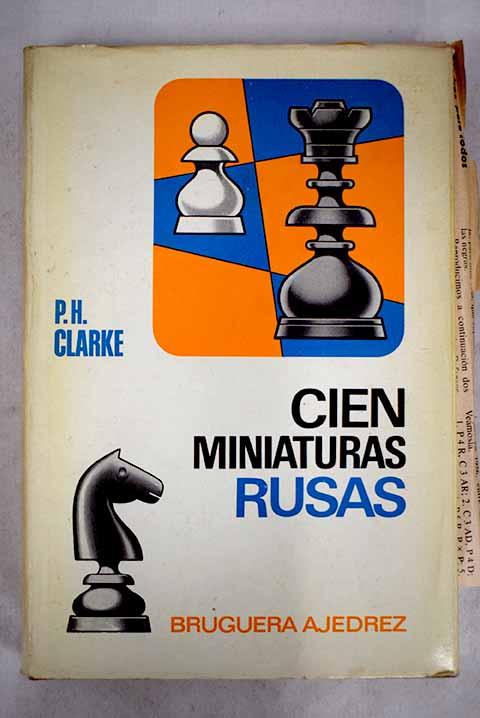
Since 1959, Peter Hugh Clarke has been working as a chess journalist in the newspaper Sunday Times and magazine British Chess Magazine. He known as the biographical book’s author of Mikhail Tal (1961) and Tigran Petrosian (1964). Thanks to his good knowledge of Russian language, he translated the book about Vasily Smyslov in 1958. In 1963 he wrote a book 100 Soviet Chess Miniatures.
Peter Clarke played for England in the Chess Olympiads :
In 1954, at second reserve board in the 11th Chess Olympiad in Amsterdam (+2, =2, -3),
In 1956, at reserve board in the 12th Chess Olympiad in Moscow (+7, =5, -0) and won individual silver medal,
In 1958, at fourth board in the 13th Chess Olympiad in Munich (+2, =10, -3),
In 1960, at third board in the 14th Chess Olympiad in Leipzig (+4, =7, -3),
In 1962, at second board in the 15th Chess Olympiad in Varna (+3, =10, -2),
In 1964, at second board in the 16th Chess Olympiad in Tel Aviv (+2, =8, -2),
In 1966, at first board in the 17th Chess Olympiad in Havana (+2, =10, -1),
In 1968, at third board in the 18th Chess Olympiad in Lugano (+0, =7, -1).
Also he played for England in the World Student Team Chess Championship (1954, 1959)and in the Clare Benedict Chess Cup (1960-1961, 1963, 1965, 1967-1968) where won team silver medal (1960) and 4 bronze medals (1961, 1963, 1967, 1968).
In later years, Peter Clarke active participated in correspondence chess tournaments. In 1977, he won British Correspondence Chess Championship. In 1976, Peter Clarke was awarded the International Correspondence Chess Master (IMC) title and received the International Correspondence Chess Grandmaster (GMC) title four years later.
We remember English player Joseph Blake who passed away on Tuesday, December 11th, 1951.
Joseph Henry Blake was born on Thursday, February 3rd, 1859 in Farnborough, Hampshire. His parents were Joseph Denner and Eliza Blake (née Early). In 1871 Joseph (aged 12) had a brother Frank (aged 10), sisters Annie (8), Elizabeth S (7), Eliza E (1) and a servant, Kate Longman aged 18. The family lived in Lydia Cottage, Hewitts Road, Millbrook, South Stoneham, Hampshire.
According to the 1861 census Joseph was two years old and living with his parents and Frank in Rotten Row, Yeovil, Somerset.
In 1881 the family has upped sticks again and moved to 2 St. Lawrence Road, Saint Mary, Eastleigh, Hampshire. This address is also given as the South West Telegraph Office. Eliza was now the head of the household and a widower. Apart from Eliza E aged 11 everyone worked for the railway.
In 1891 Joseph had become Head of the Household (aged 32) and they had acquired a servant (Anna M Cornell) and a blacksmith (Francis Cornell) from Braintree in Essex.
In 1900 Joseph married Alice New in Cheltenham, Gloucestershire. They lived at 24, Barton Road, Eastleigh, Hampshire. Tragically, Alice passed away in 1903.
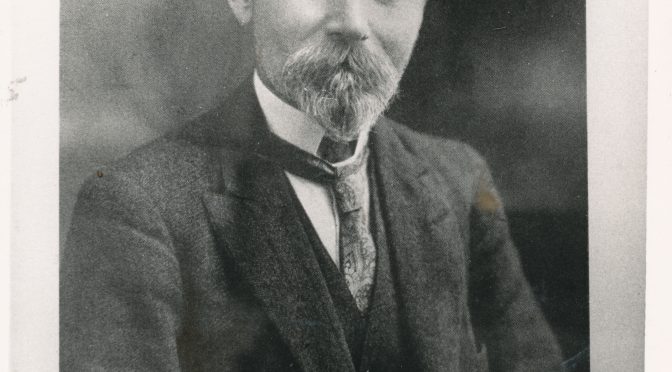
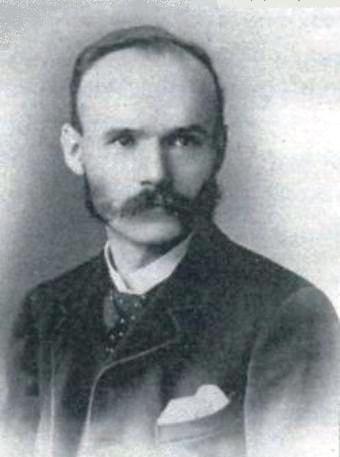
Joseph Henry Blake
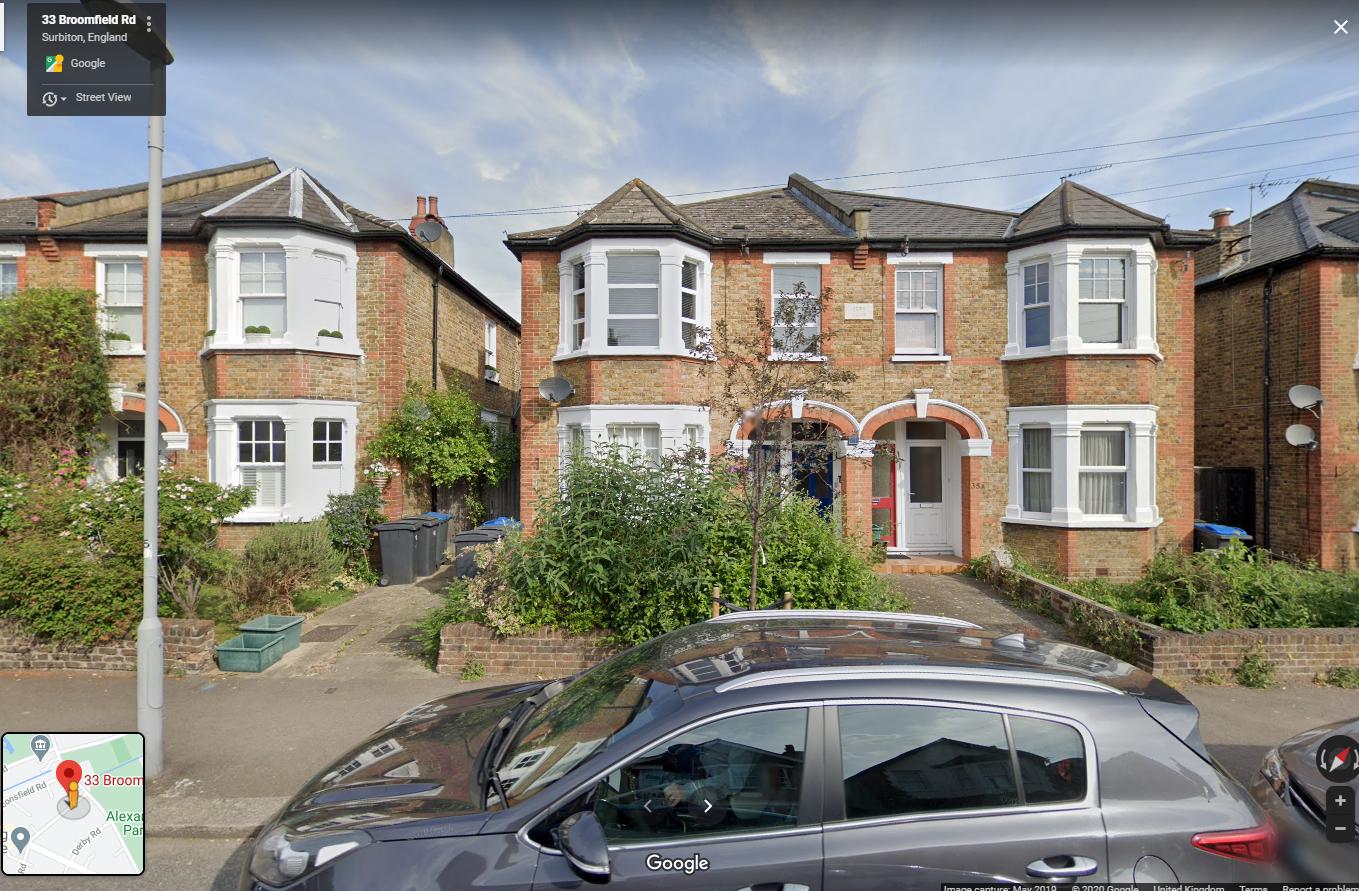
By 1911 Joseph was 52 and had retained his career as a Railway Clerk. He lived at 33, Broomfield Road, Tolworth, Surrey :
33, Broomfield Road, Tolworth, Surrey
He is recorded as the head of a household of one and a widower.
In 1939 Joseph was living at 10 Springfield Court, Springfield Road, Kingston Upon Thames, Surrey. He was now retired.
No doubt there would have been other addresses not captured by the census records.
According to The Encyclopedia of Chess, (Batsford, 1977), Harry Golombek OBE :
“A leading British player in the 1890s and for many years editor of the Games Section of the British Chess Magazine between the two world wars. Blake’s best tournament performance came at the age sixty-three when, at Weston-super-Mare in 1922, he came 1st ahead of Maróczy, Kostić, Sir George Thomas and Yates.
The remarkable feature about Blake’s chess career is that he retained his skill and his comprehension of the game for a much longer period that most chess players. This extended from 1887 when he was 1st at the Counties Chess Association tournament at Stamford ahead of Bird and Pollock, a performance he was to repeat in 1891 at Oxford, to 1909 when he tied with H. E. Atkins for first place in the British Championship, to 1923 when he won the Weston-super-Mare tournament, right into the 1930s when he was principal annotator for the British Chess Magazine.”
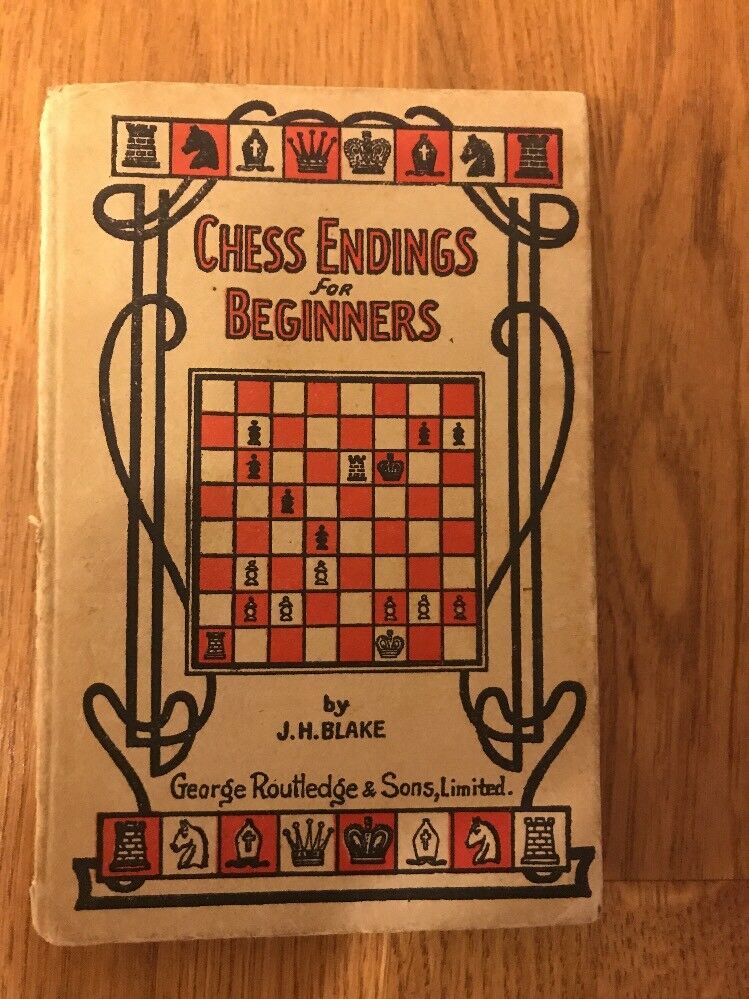
Chess Endings for Beginners, JH Blake, George Routledge First Edition (1900)
and according to The Encyclopedia of Chess (Robert Hale, 1970 & 1976), Anne Sunnucks :
“One of the leading British players at the end of the last century and the beginning of the present century. Born on 3rd February 1859. Represented England in the Anglo-American cable matches in 1902 and 1909. His best results were 1st in the Counties’ Chess Association Tournament 1887, ahead of Bird and MacDonnell; =1st with HE Atkins in the 1909 British Championship, but lost the play-off for the title; 1st at Weston-super-Mare 1922 ahead of Maroczy, Kostich, Sir George Thomas and Yates, and winner of the brilliancy prize for his game against Sir George Thomas; 2nd in the international correspondence chess tournament organised by Le Monde Illustre in 1895.
Blake was President of the Southern Counties Chess Association in 1911 and President of the Hampshire Chess Association from 1910-1912 and from 1927-1929. He was also Hon. Secretary of the City of London Chess Club for some years.”
According to Tim Harding in the excellent Correspondence Chess in Britain and Ireland, 1824-1987 :
Railway clerk Joseph Henry Blake, the leading English correspondence player of the 1890s; also a strong OTB amateur player. He was a regular contributor to British Chess Magazine from the 1880s to the late 1930s.
In British Chess Magazine, Volume XXXIX (39, 1919), Number 3 (March) we have the following from Julius du Mont : “I presume it relates more particularly to chess professionals in this country, at any rate, it does not seem to me that the jews hold rank amongst first-class amateurs in proportion to their numbers.
In London there are very few if any of the class of RC Griffith, GA Thomas, JH Blake, HG Cole, EG Sergeant, and many others to say nothing of the younger recruits , W.Winter and RHV Scott.”
From the 1949 British Chess Magazine (written by RN Coles) we have this :
JH Blake is Ninety
After an absence of ten years I looked in recently on the Kingston and Thames Valley Chess Club. There were many new faces and a number of familiar ones, among the latter one of rosy countenance, trim beard and twinkling eyes, none other than JH Blake, more vigorous than ever and attaining his 90th birthday on the 3rd February.
Twenty years ago in this same club I (RN Coles) was learning the game, now middle age approaches. Blake was an elderly man in those days, who had retired from all competitive play because of the strain it imposed; now, so far from showing the weight of years, he is back in competitive chess again. He won the club championship last year and is in a fair way to repeating his victory this year. Of all the ‘Grand Old Men’ of chess, few have still been champions in their 90th year.
Older readers of the BCM will remember him as their Games Editor for many years, but few memories will cover the whole series of his successes beginning with a 1st at Stamford in 1887. Even 1922 must seem a distant year to the generation of today. That was the year that Maroczy and Kostic were invited to Weston-super-Mare to meet such rising young English masters as FD Yates and Sir George Thomas. And the first prize amongst those talented players was won by JH Blake, who had been born just when Morphy returned to England after his Paris Victory over Anderssen !
All readers of the BCM and all players everywhere will wish Britain’s oldest master continued health and increasing vigour, and those who knew him today will be surprised if he does not continue his attack for another decade at least.
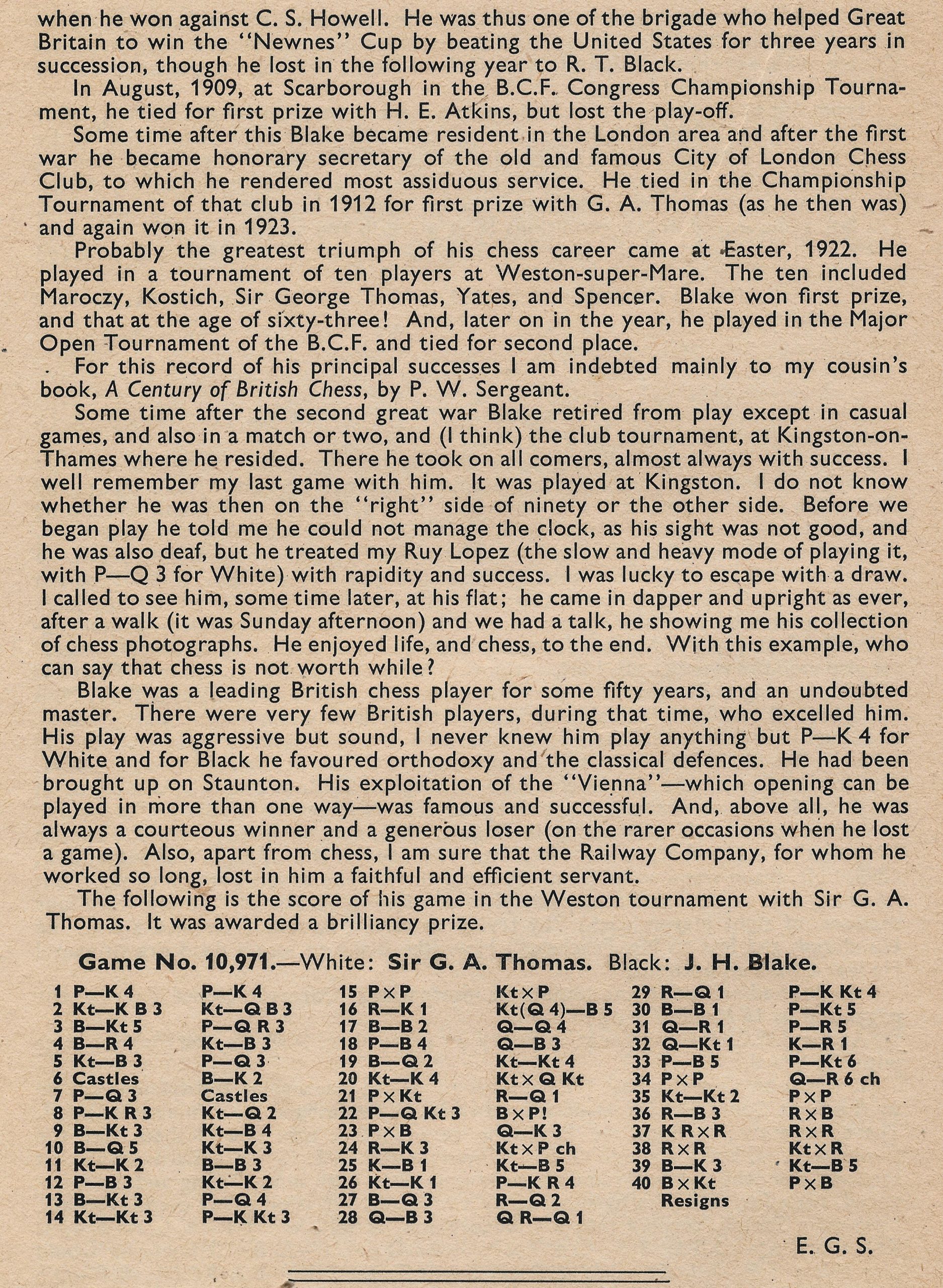
Besides winning the first prize at Weston Blake also won the brilliancy prize with the following game : (#10,229)
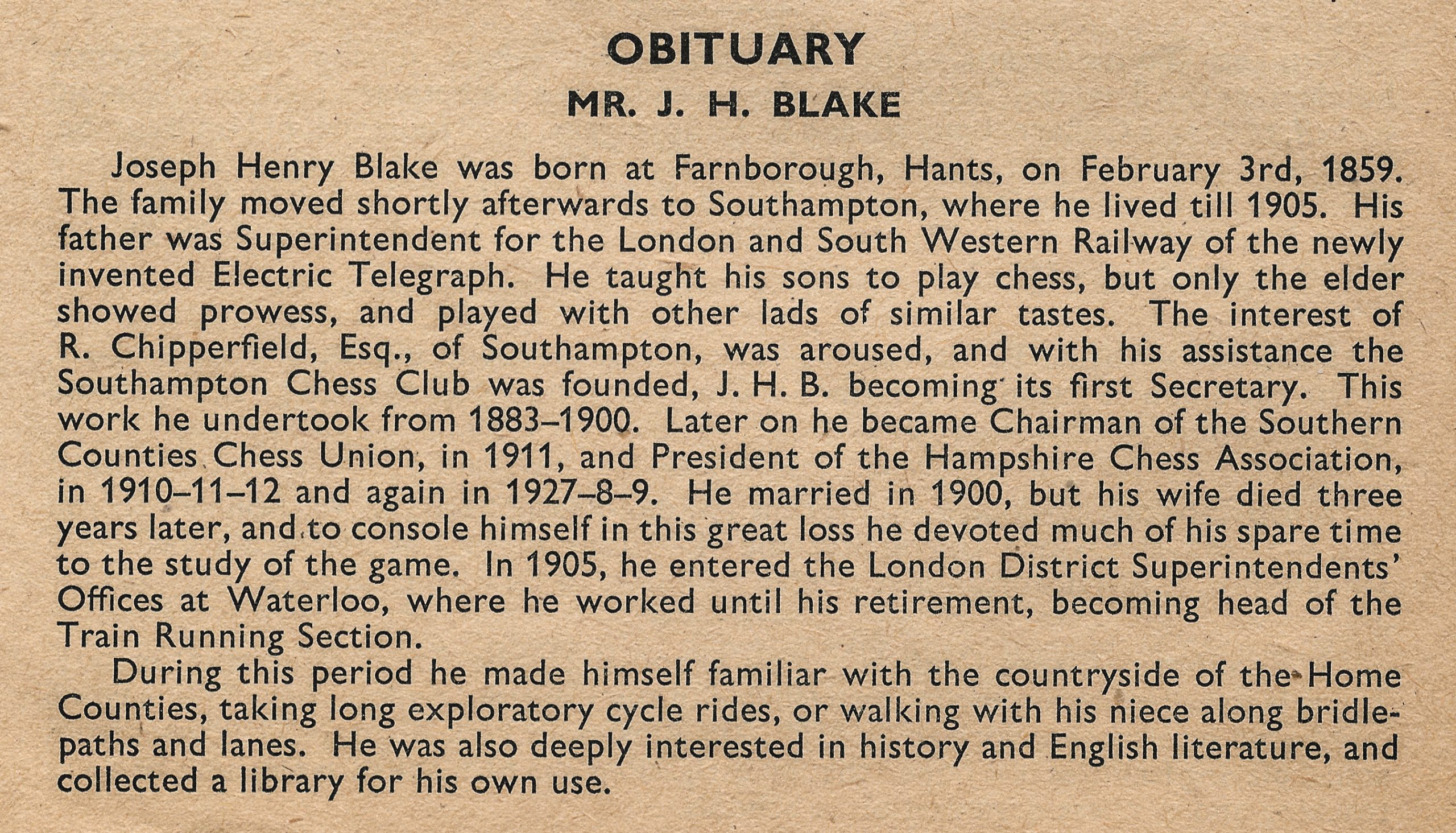
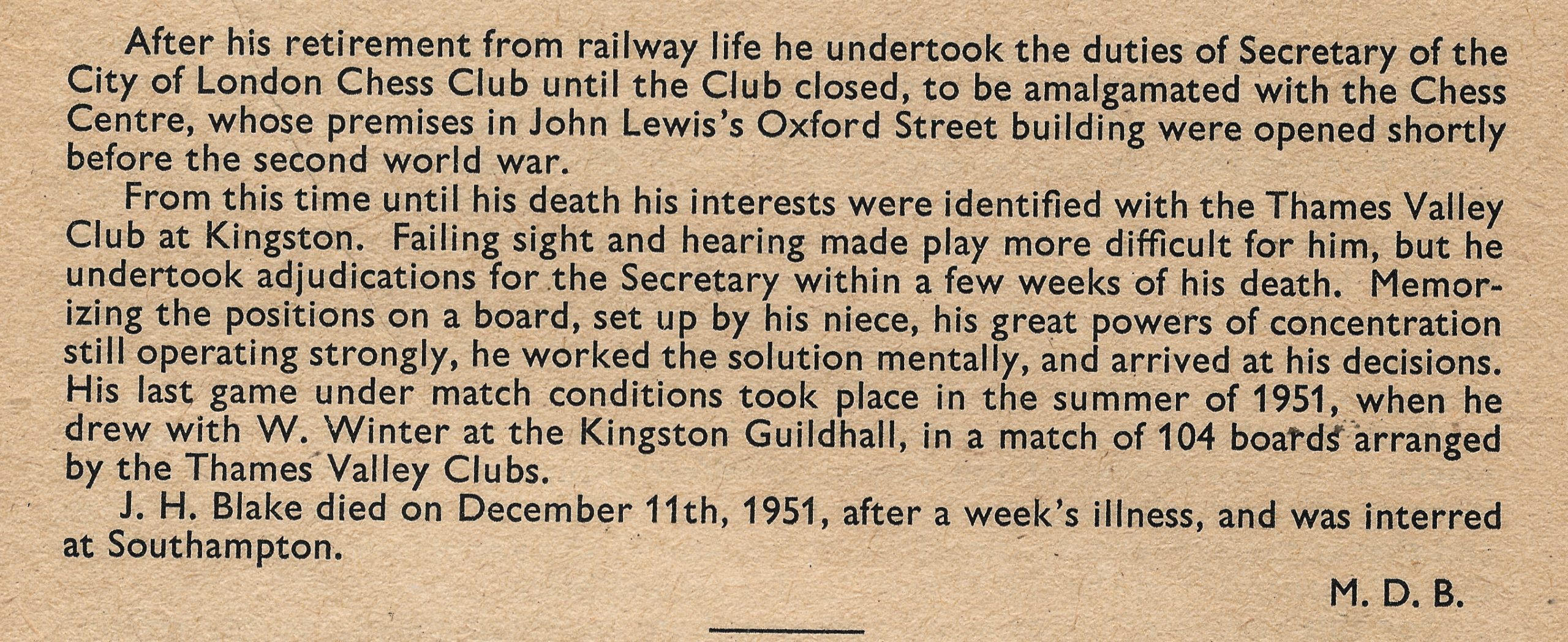
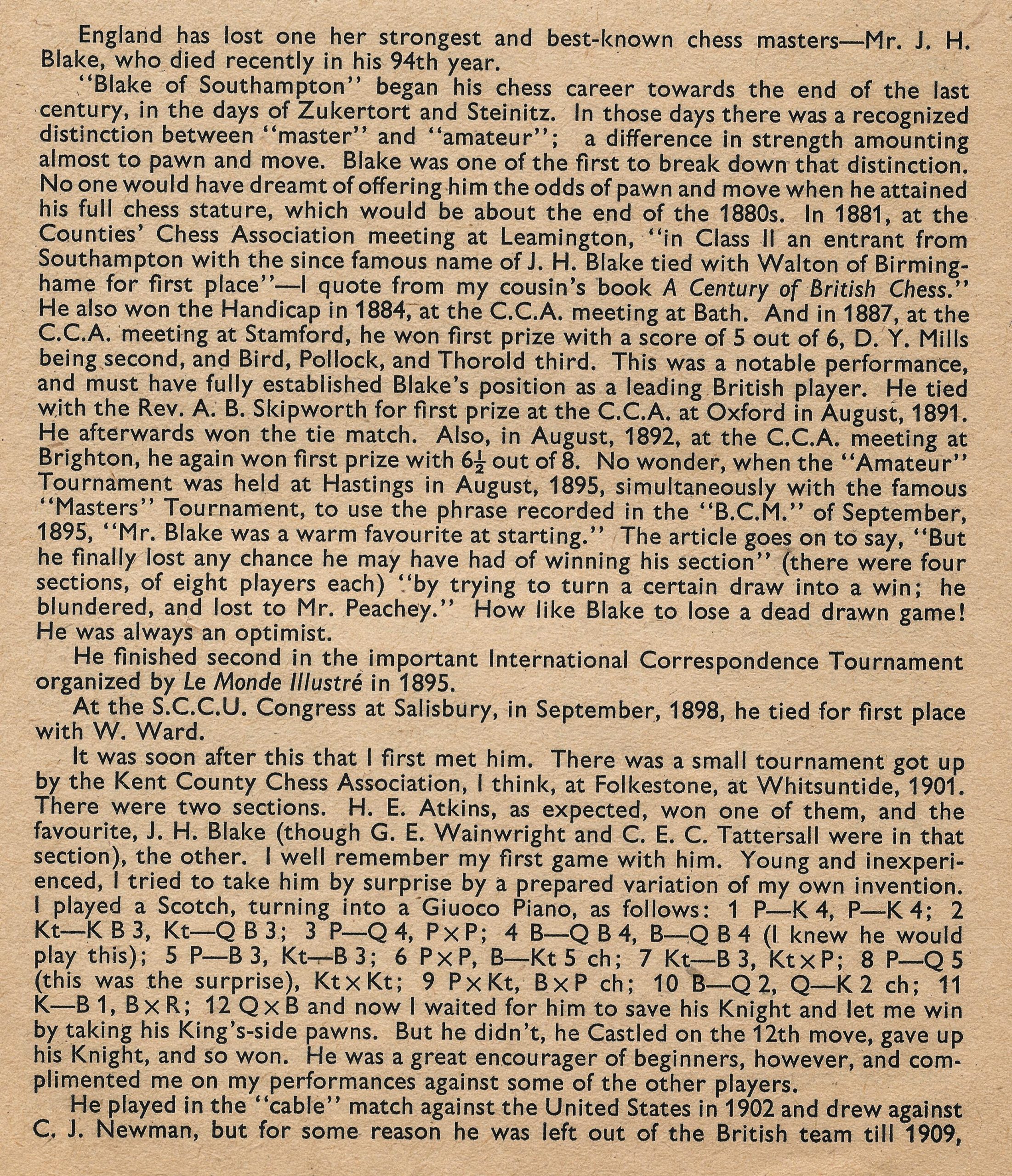
British Chess Magazine, Volume LXXII (72, 1952), Number 2 (February), pp.44-46 contained an obituary with articles from MDB* :
*(Careful investigation by Richard James suggest that MDB is Mabel Dorothy Barker, JHB’s niece in 6th Cross Road.)
British Chess Magazine, Volume LXXII (72, 1952), Number 2 (February) pp. 44 – 46British Chess Magazine, Volume LXXII (72, 1952), Number 2 (February) pp. 44 – 46
“Joseph Henry Blake (3 February 1859, Farnborough, Hampshire – 11 December 1951, Kingston-upon-Thames) was an English chess master.
Blake won many tournaments played in England toward the end of the 19th century and the beginning of the 20th century. He won at Stamford 1887, Oxford 1891 (joint), Brighton 1892, Cambridge 1893, and Salisbury 1898 (joint). He also took 5th at Manchester 1882, tied for 3-4th at Birmingham 1883 (Section B), took 4th at Bath 1884, tied for 6-8th at London 1889 (Henry Bird won), took 2nd at Cambridge 1890, tied for 3rd-4th at Woodhall Spa 1893, shared 2nd at Craigside 1895, took 3rd at Hastings (Amateur) 1895, took 2nd, behind Henry Ernest Atkins, at Bristol 1896, and won at Folkestone 1901.
He took 2nd in an international correspondence tournament organised by Le Monde Illustré in 1895, shared 1st in the 1909 British Championship in Scarborough but lost to Atkins the play-off, and shared 1st at London 1911. He was British correspondence champion in 1922.
Blake represented England in cable matches against the United States in 1902, 1909 and 1910.
His best achievement was victory, ahead of Géza Maróczy, George Alan Thomas, Fred Yates and Boris Kostić, at Weston-super-Mare 1922. He shared 2nd at London 1922 (Major Open), tied for 7-8th at Hastings International Chess Congress 1922/23 (Akiba Rubinstein won), took 2nd, behind Thomas, at London 1923, took 5th at Liverpool 1923 (Jacques Mieses won), tied for 7-8th at Hastings 1923/24 (Max Euwe won), tied for 6-7th at Weston-super-Mare 1924 (Euwe won), took 2nd, behind R.P. Michell, at London 1925, took 4th at London 1926 (Victor Buerger won), and tied for 7-9th at Weston-super-Mare 1926 (Euwe won).”
He is the author of Chess endings for beginners (London 1900).
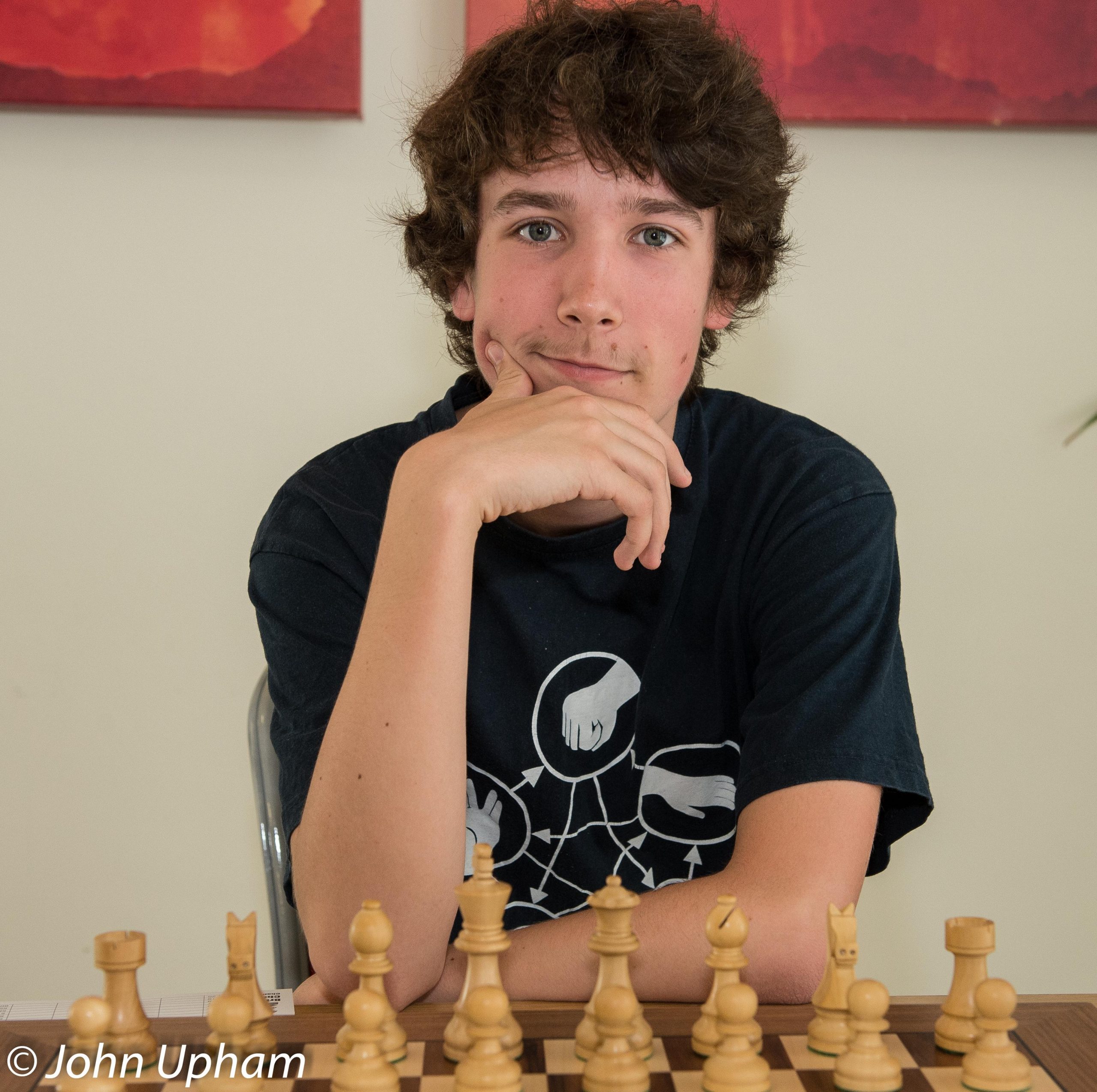
FM Peter Batchelor at the 2014 British Championships, Courtesy of John Upham Photography
Best wishes to FM Peter Batchelor on his birthday.
Peter J Batchelor was born on Tuesday, December 10th, 1996. “Breath” by The Prodigy was the UK Number One Single. His father is the player Guy Batchelor.
Peter’s first recorded rapidplay event was on the 17th of July 2005 in the Barnet Knights Under-9 tournament where he scored 4/6 and his first (!) standard play event was on August 20th 2005 being the British Land UK Terafinal which was not such a happy result.
His first published ECF grading was 56E in July 2006 at the age of ten with a rapidplay grading of 57A.
Peter played league chess in the Middlesex and London Leagues playing initially for Willesden & Brent and then with Wanstead & Woodford both with his father Guy.
Peter attended the Capital City Academy which is a “specialist sports and arts Academy in Willesden, North West London, in the borough of Brent.” He has returned there post-graduation to teach chess and run the school chess club.
Peter studied mathematics at the University of Warwick and now lives in London.
According to Ben Purton : “I captain Peter in the 4NCL chess league, he is one of the most professional and talented players on my squad. He is extremely smart and nice to be around. Peter would be an asset to any organisation in the future and any graduate scheme would be foolish not to take such a person on.
I have seen him grow in to one of the best U21 chess players in the UK and hope to see him gain his IM title soon.”
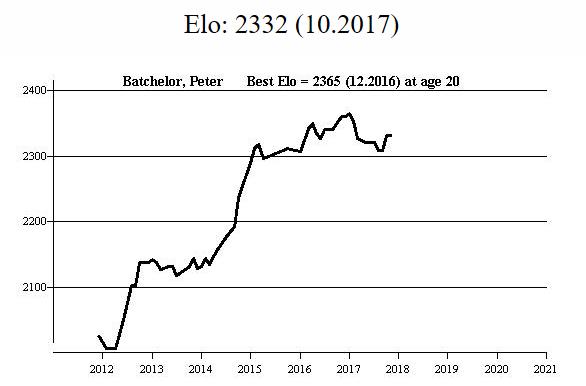
Peter became a FIDE Master in 2015 and, according to Felice and Megabase 2020 his peak FIDE rating was 2365 in December 2016.
FIDE rating profile for Peter Batchelor according to Megabase 2020
Peter plays for Grantham Sharks in the Four Nations Chess League (4NCL).
With the white pieces Peter plays the Queen’s Gambit and the Trompowsky Attack.
As the second player Peter plays the Classical variation of the Caro-Kann and the Alartortsev Variation.
On chess.com Peter plays under the nom de plume of Pbatch.
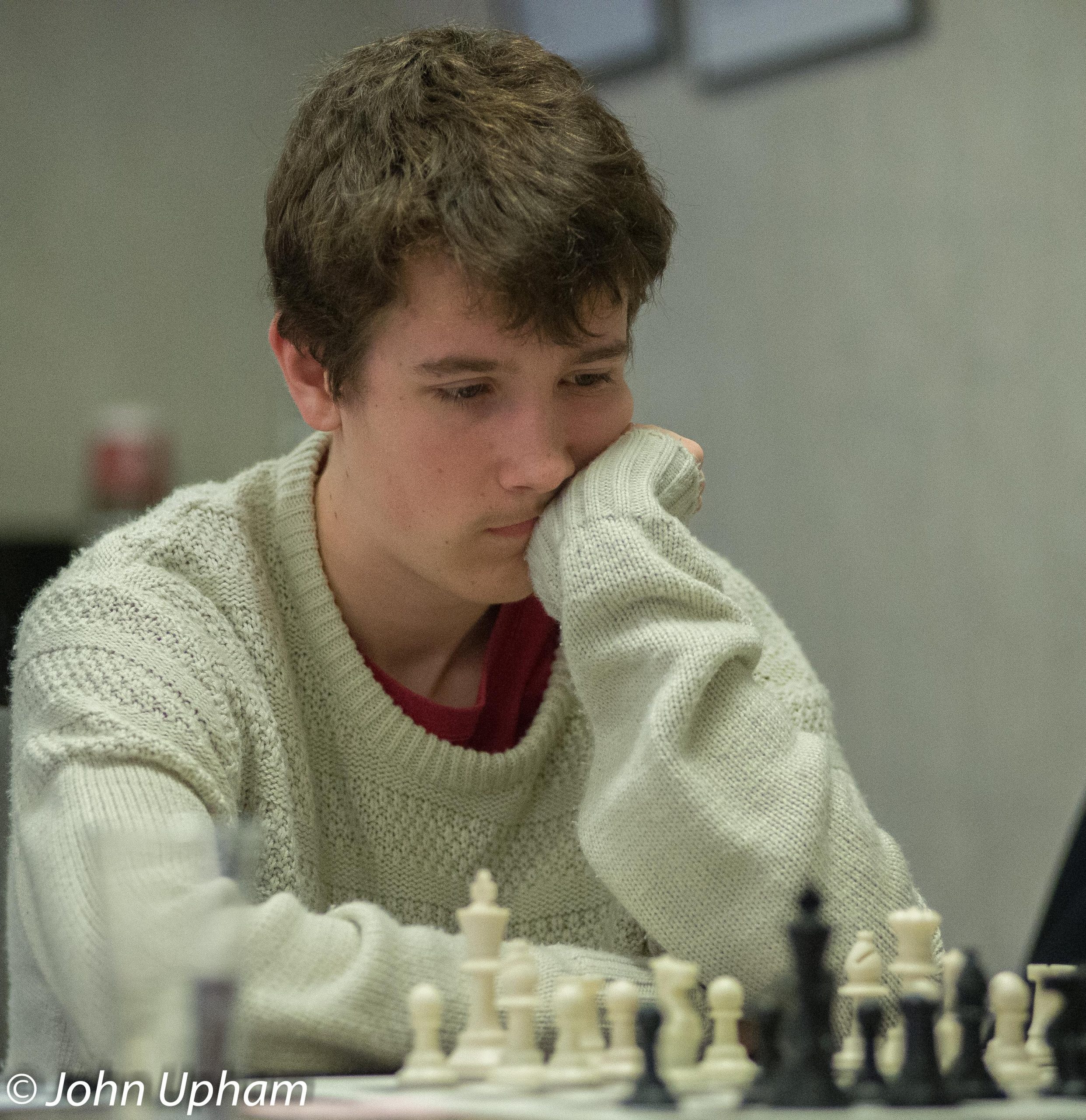
Peter Batchelor, 4NCL Final weekend, 2014, Courtesy of John Upham Photography
FM Peter Batchelor at the 2013 British Championships, Courtesy of John Upham Photography
WGM Dr. Jana Bellin, Courtesy of John Upham Photography
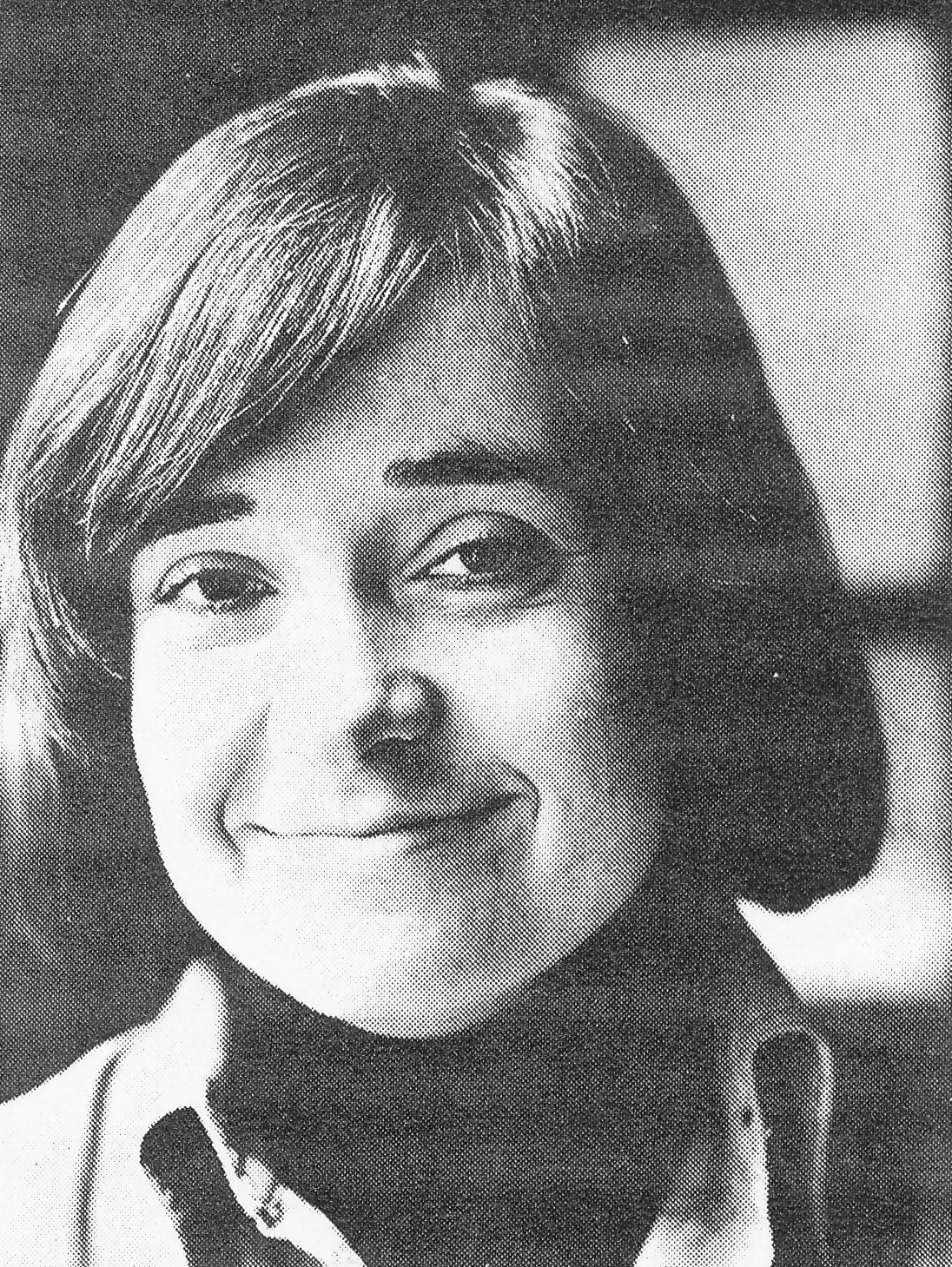
Happy birthday WGM Dr. Jana Bellin on this day (December 9th) in 1947.
Jana Malypetrova
From The Encyclopedia of Chess (Robert Hale, 1970 & 1976), Anne Sunnucks :
“International Woman Master (1969), Czech Woman Champion in 1965 and 1967 and British Woman Champion since 1970.
Jana Malypetrova
Jana was born in Prague on the 9th December 1947 and learned to play chess at the age of eleven. She made her first appearance in the international field when she played 2nd board for Czechoslovakia in Women’s Chess Olympiad in Oberhausen in 1966.
Jana Malypetrova and Inna Vesela, Harrachov 1963
In the same year she represented Czechoslovakia in the Zonal tournament at Varna and came 11th.
Jana Malypetrova
She is now married to the British International Master, William Hartston, and played 1st board for England in the Women’s Chess Olympiad in Skopje in 1972 and represented England in the Zonal tournament in Wijk aan Zee in 1973 in which she tied for 1st place. In the same year she came =6th in the Interzonal Tournament. She is a doctor.”
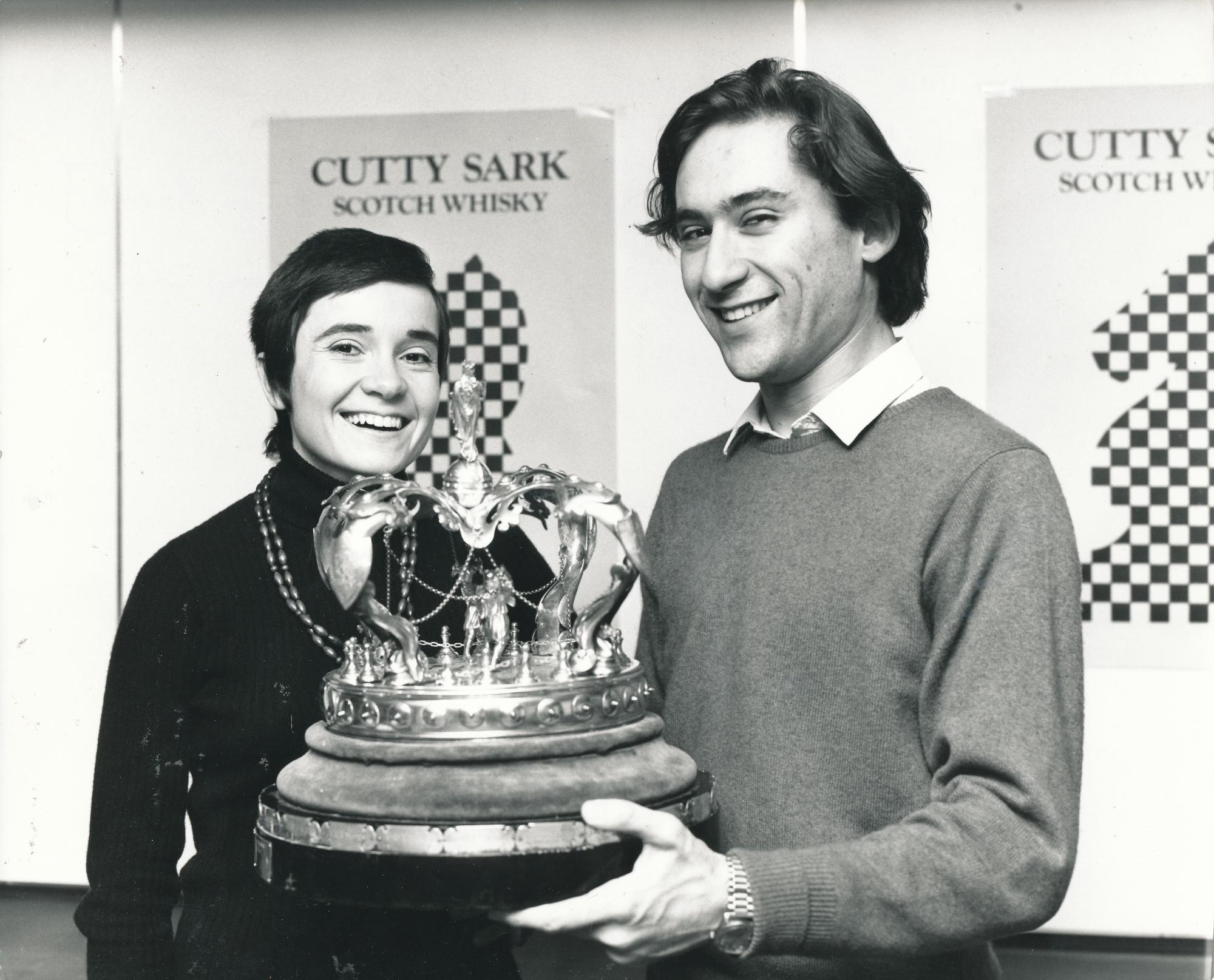
Jana & Bill Hartston celebrate a family double at the British Championships in 1973 at Eastbourne
From The Encyclopedia of Chess (Batsford, 1977), Harry Golombek OBE :
“Born in Prague, Czechoslovakia, but moved to England in 1970 after her marriage to WR Hartston. Czechoslovak Woman champion in 1965 and 1967 (under her maiden name of Malypetrova) and British Ladies champion in the five years 1970 to 1974. International Woman master since 1969.”
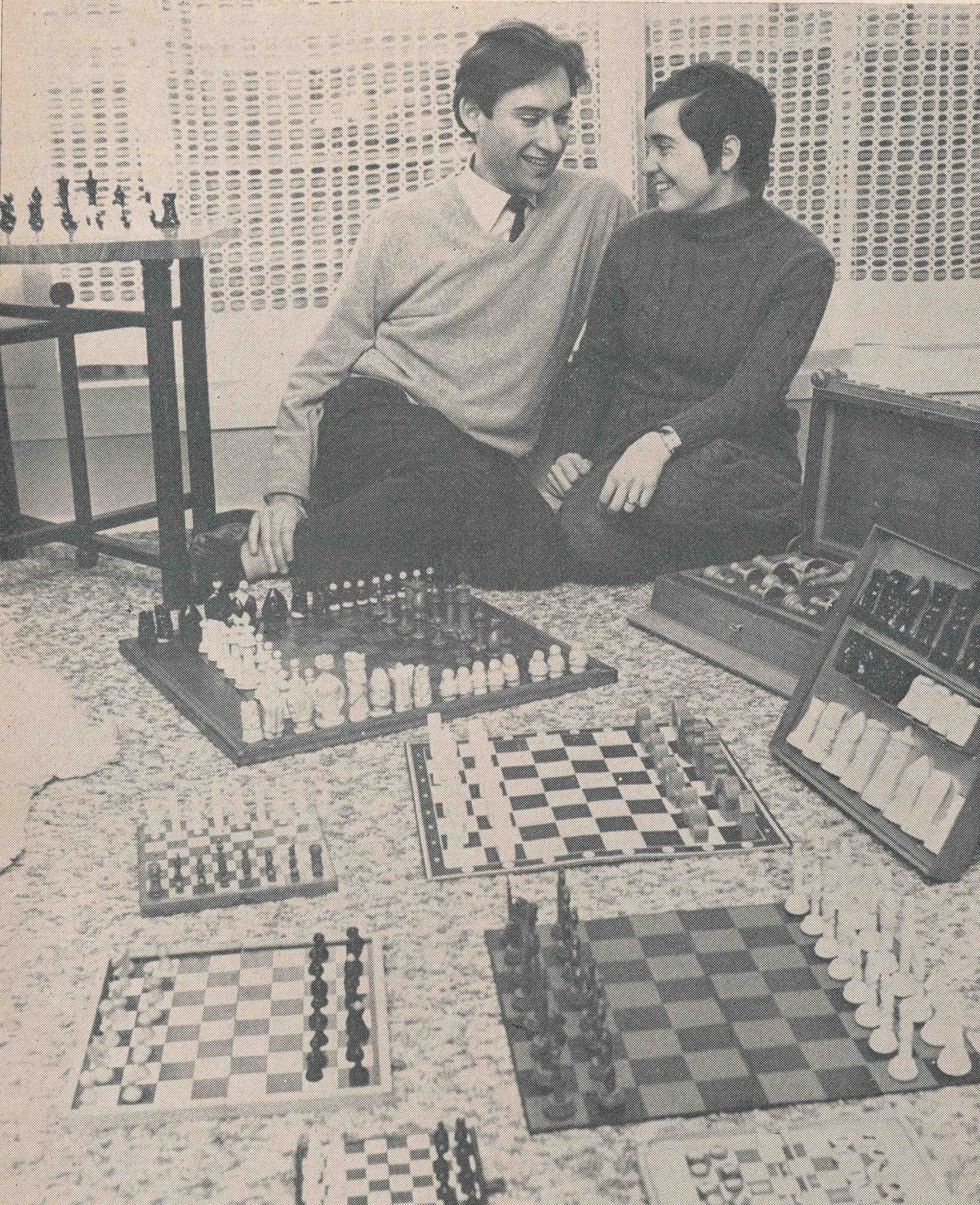
Bill and Jana Hartston are shown with some of their many chess sets. CHESS, August 1973, page 323
From British Chess (Pergamon Press, 1983) Botterill, Levy, Rice and Richardson :
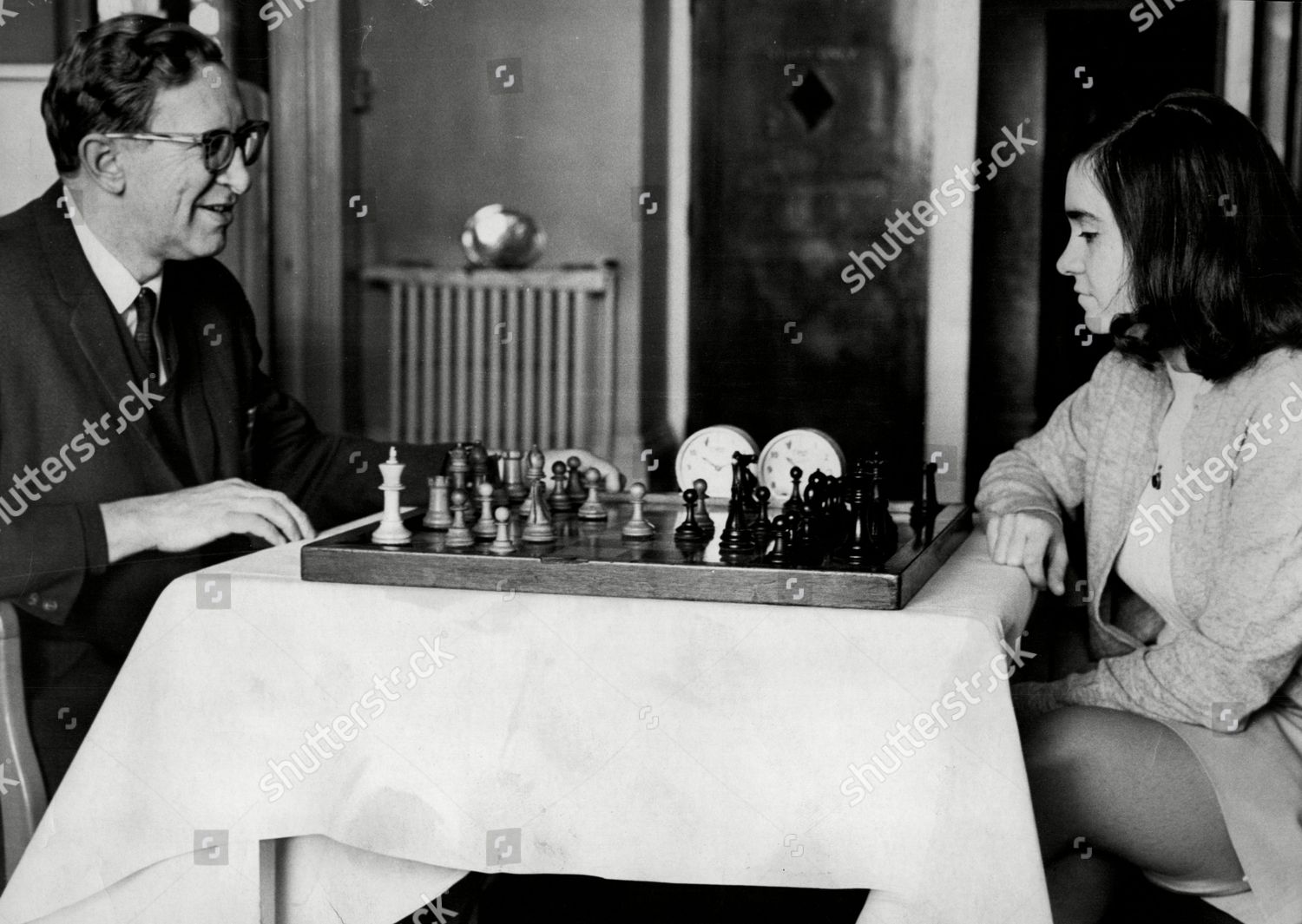
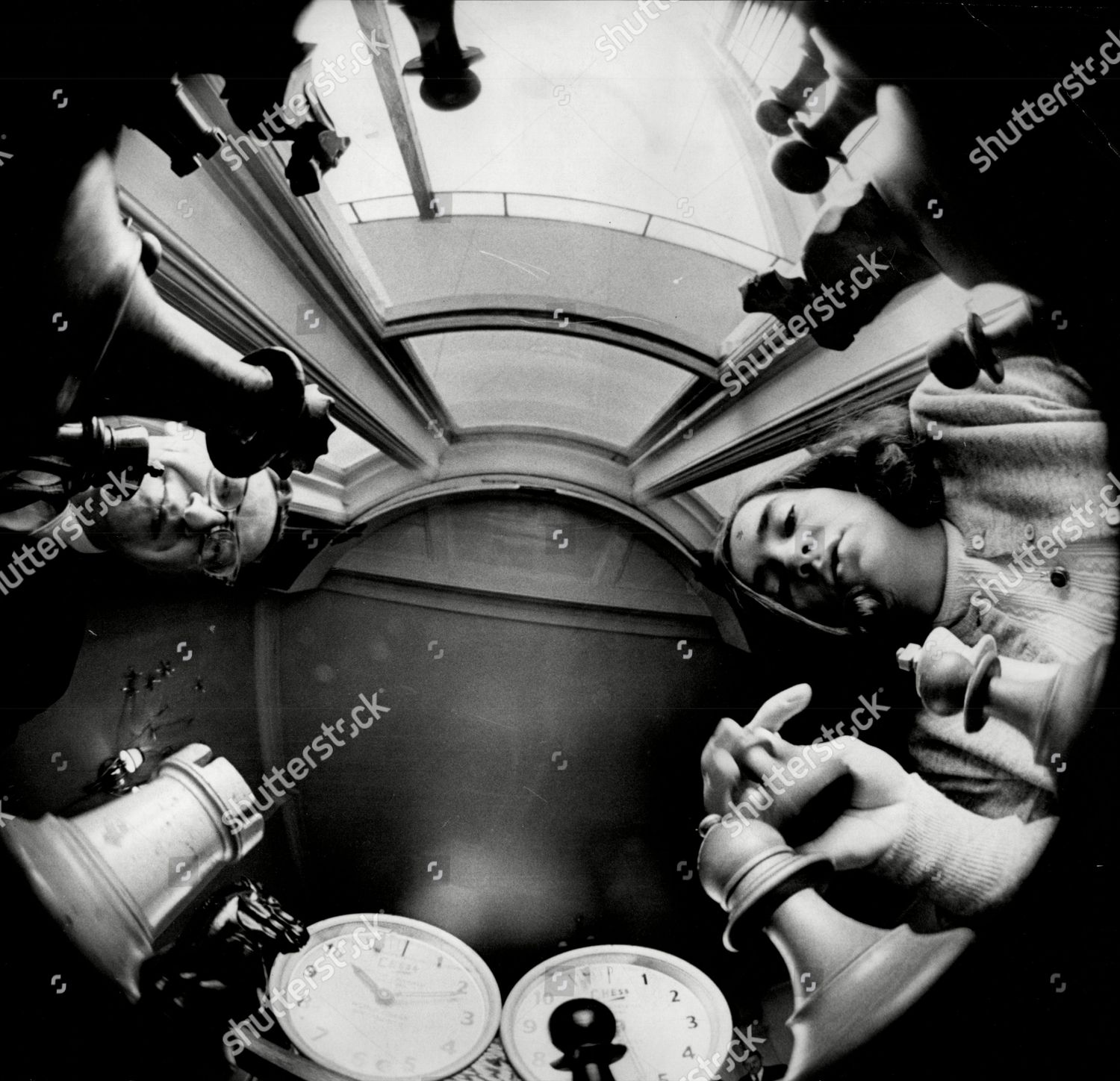
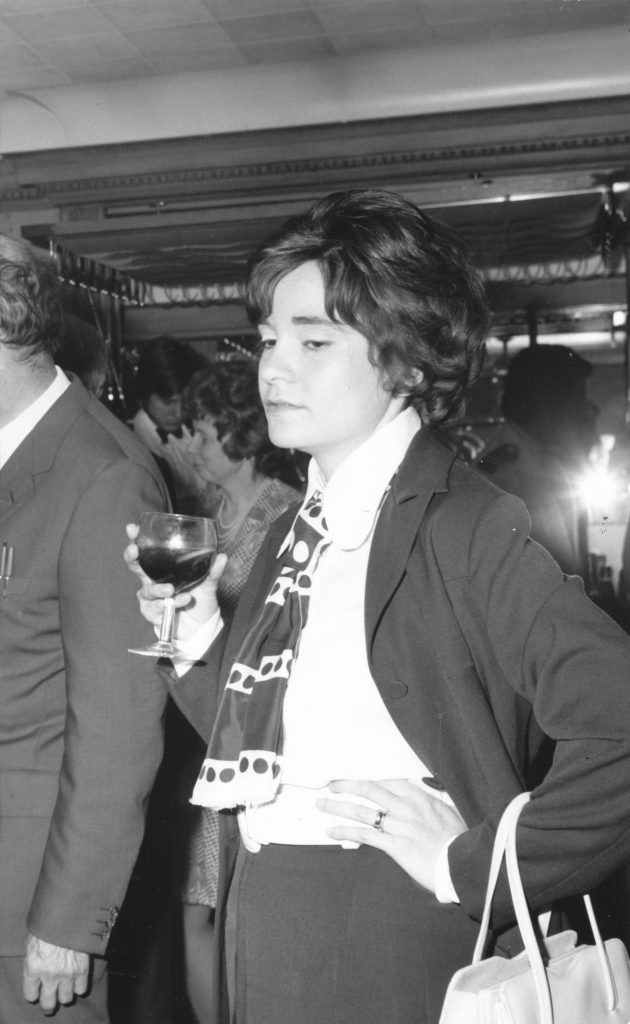
Hastings International Chess Congress 21 year old Jana Malypetrova From Czechoslovakia And Vassily Smyslov From Russia. Mandatory Credit: Photo by Michael Fresco/ANL/Shutterstock (1876232a)
“Jana Miles was born 9 December 1947 in Prague, Czechoslovakia. She moved to England when she married Bill Hartston. Divorced from Hartston in 1978, she subsequently married Tony Miles.
Hastings International Chess Congress 21 year old Jana Malypetrova From Czechoslovakia And Vassily Smyslov From Russia. Mandatory Credit: Photo by Michael Fresco/ANL/Shutterstock (1876232a)
She was Czech woman champion in 1965 and 1967 and has regularly been the British Ladies Champion since moving to this country. She is a doctor of medicine.”
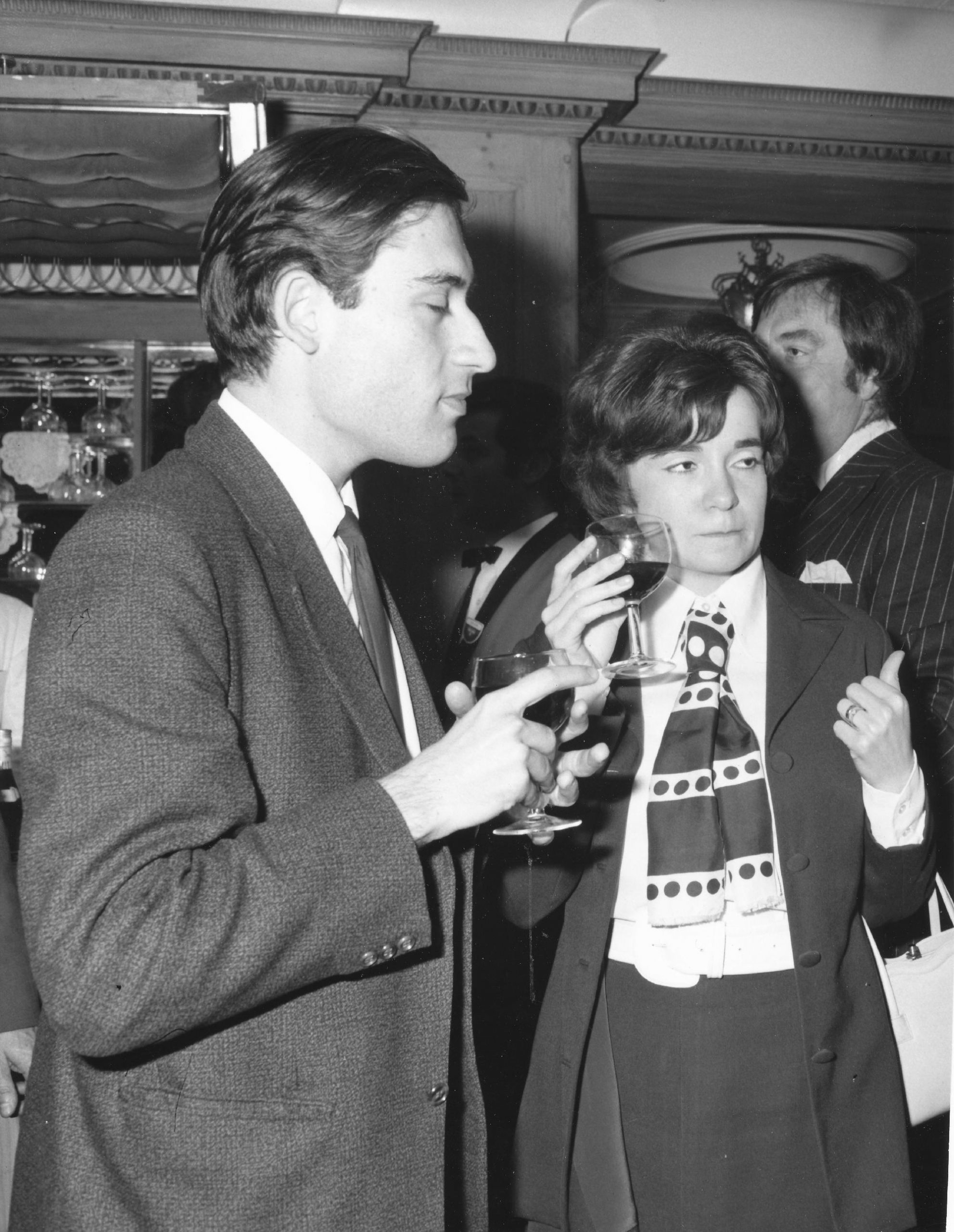
Bill and Dr, Jana Hartston (née Malypetrova)
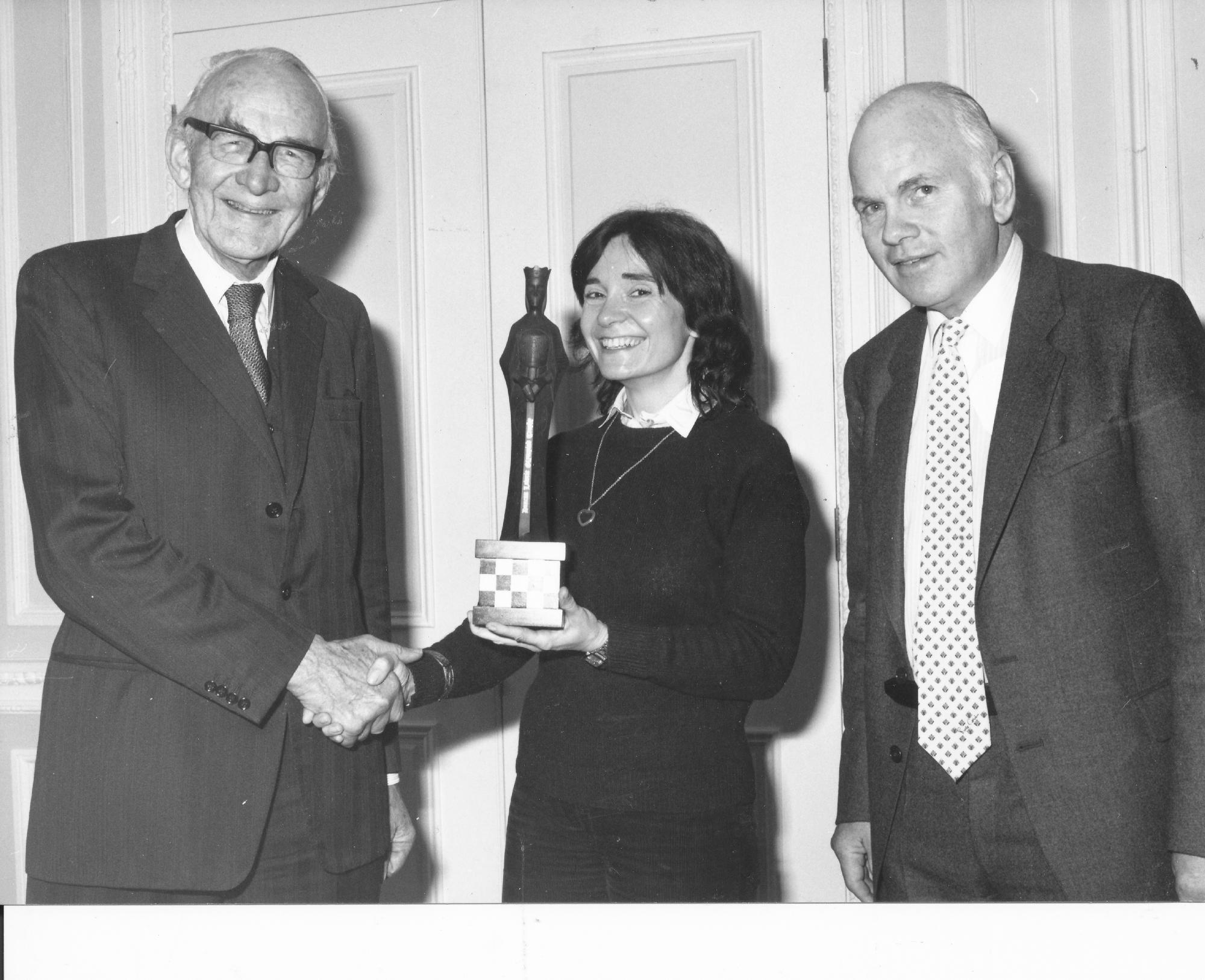
Sir Philip Stuart Milner-Barry OBE presents Dr. Jana Hartston with the ? prize
“Jana Bellin (née Malypetrová; born 9 December 1947) is a British, formerly Czechoslovak chess player. She was awarded the Woman International Master chess title in 1969 and the Woman Grandmaster title in 1982.
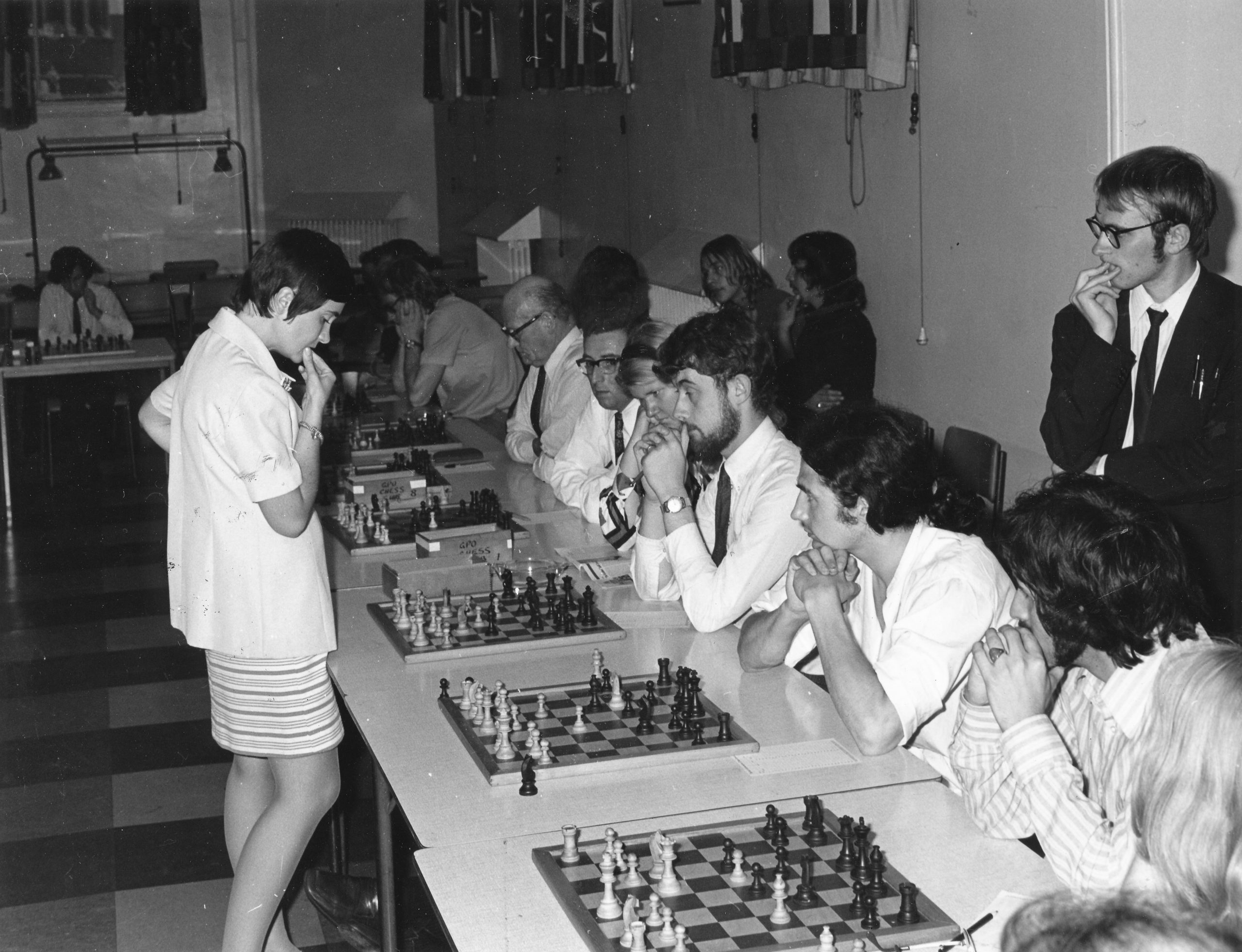
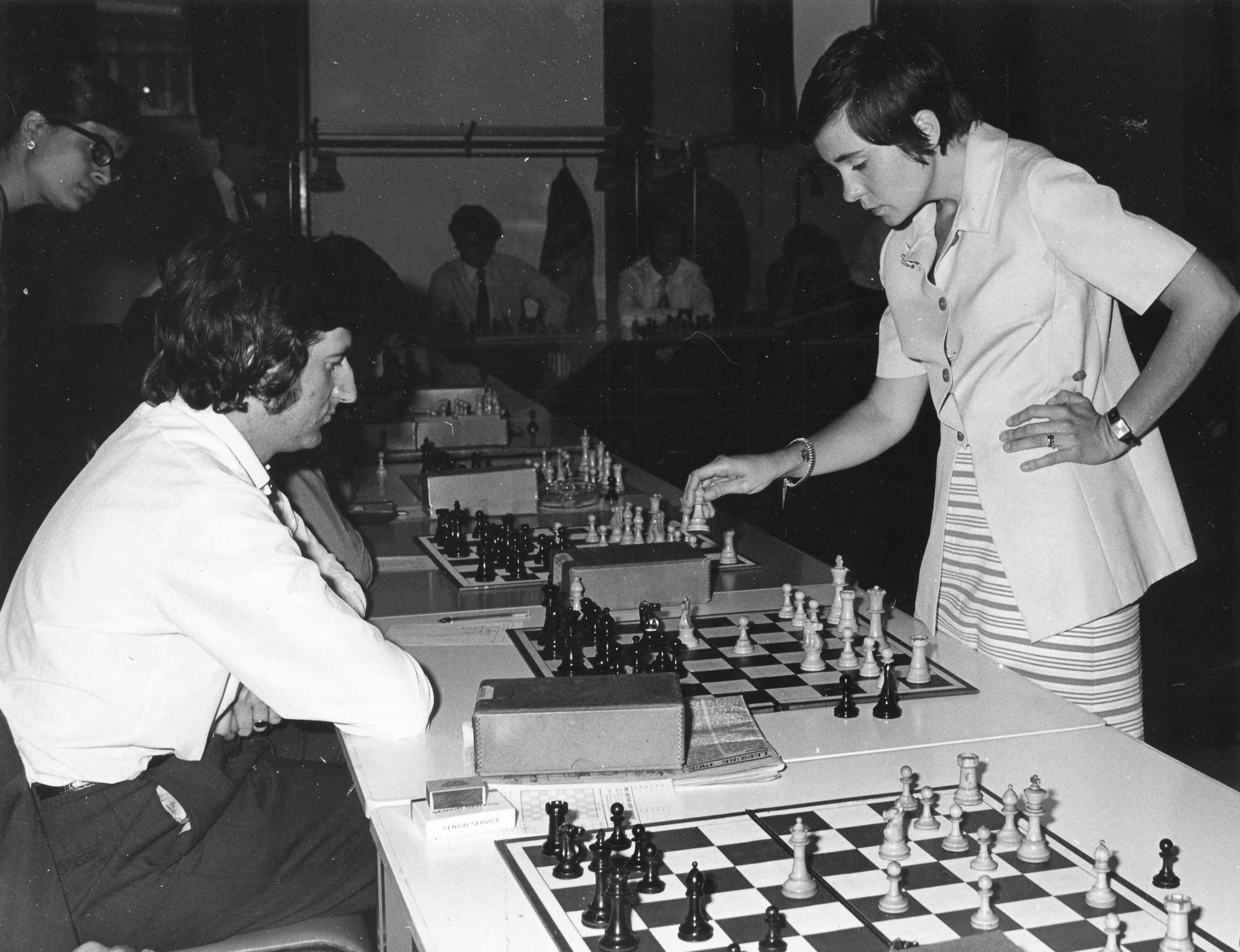
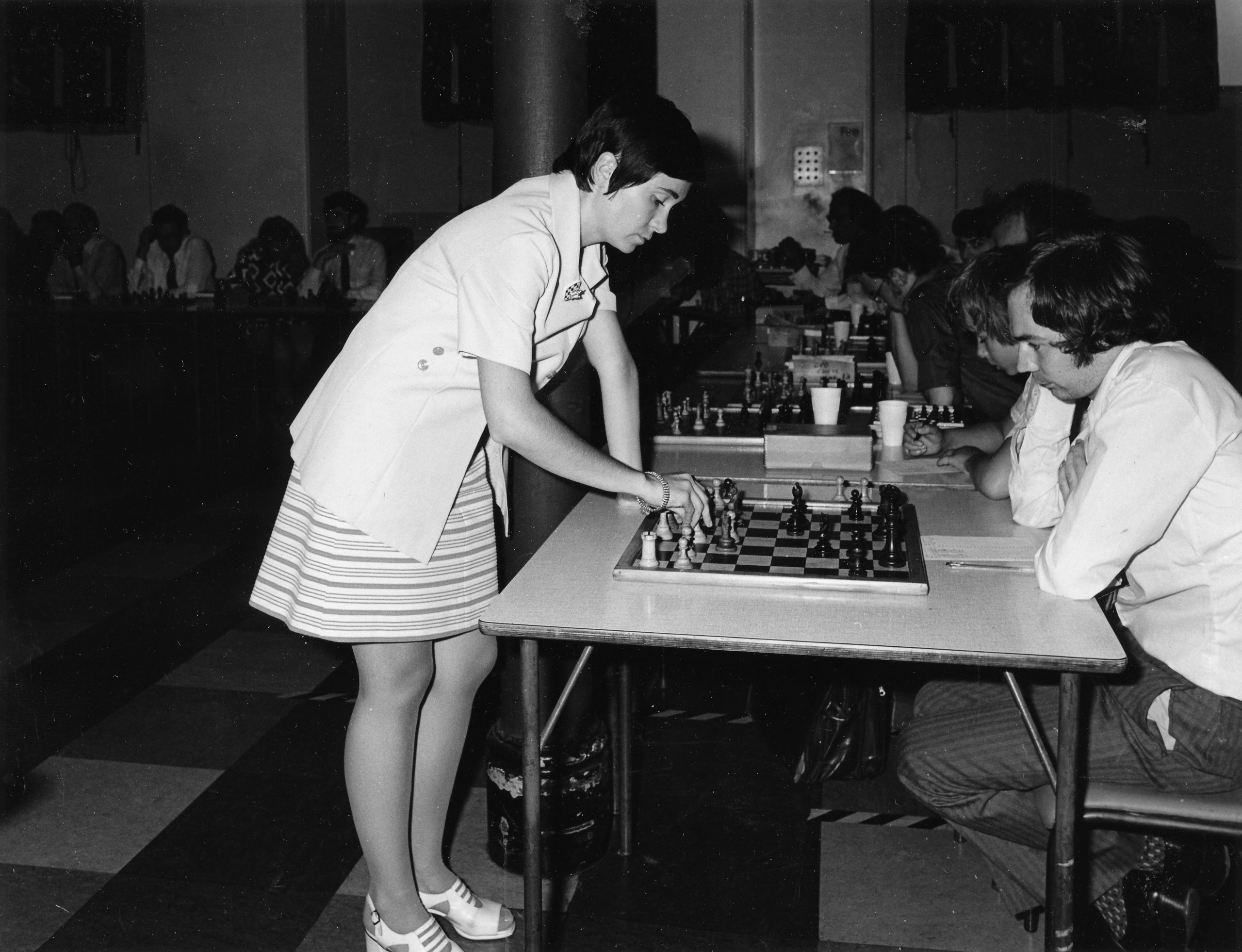
Moment of concentration for reigning women’s champion of Great Britain Jana Hartston and some of the 30 Post Officer players – all men who challenged her at postal headquarters London on September 6. Jana beat seven, drew with sixteen and lost to seven.
Bellin was born in Prague, Czechoslovakia. She was the Czech Women’s Champion in 1965 and 1967 under her maiden name of Malypetrová. After her marriage to William Hartston she moved to England in 1970 and won the British Women’s Championship in 1970, 1971, 1972, 1973, 1974, 1976, 1977 (after a play-off), and 1979.
Moment of concentration for reigning women’s champion of Great Britain Jana Hartston and some of the 30 Post Officer players – all men who challenged her at postal headquarters London on September 6. Jana beat seven, drew with sixteen and lost to seven.
She has fifteen appearances in the Women’s Chess Olympiads, representing Czechoslovakia in 1966 and 1969 and England thirteen times from 1972 through 2006, seven times on first board.
Moment of concentration for reigning women’s champion of Great Britain Jana Hartston and some of the 30 Post Officer players – all men who challenged her at postal headquarters London on September 6. Jana beat seven, drew with sixteen and lost to seven.
At the Olympiad she earned individual silver medals in 1966 and 1976, a team bronze medal in 1968 with the Czechoslovakian team, and a team silver in 1976 with England.
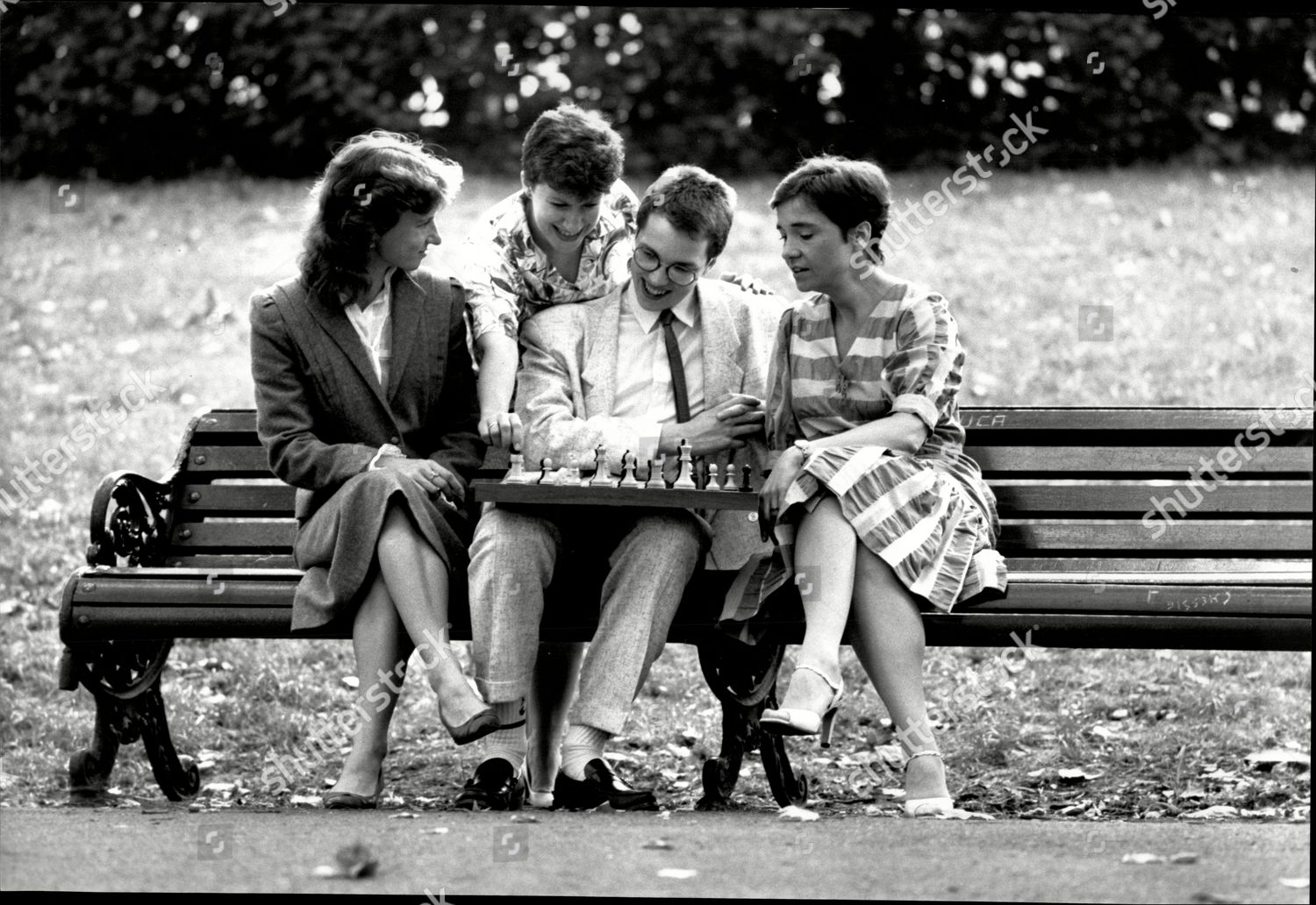
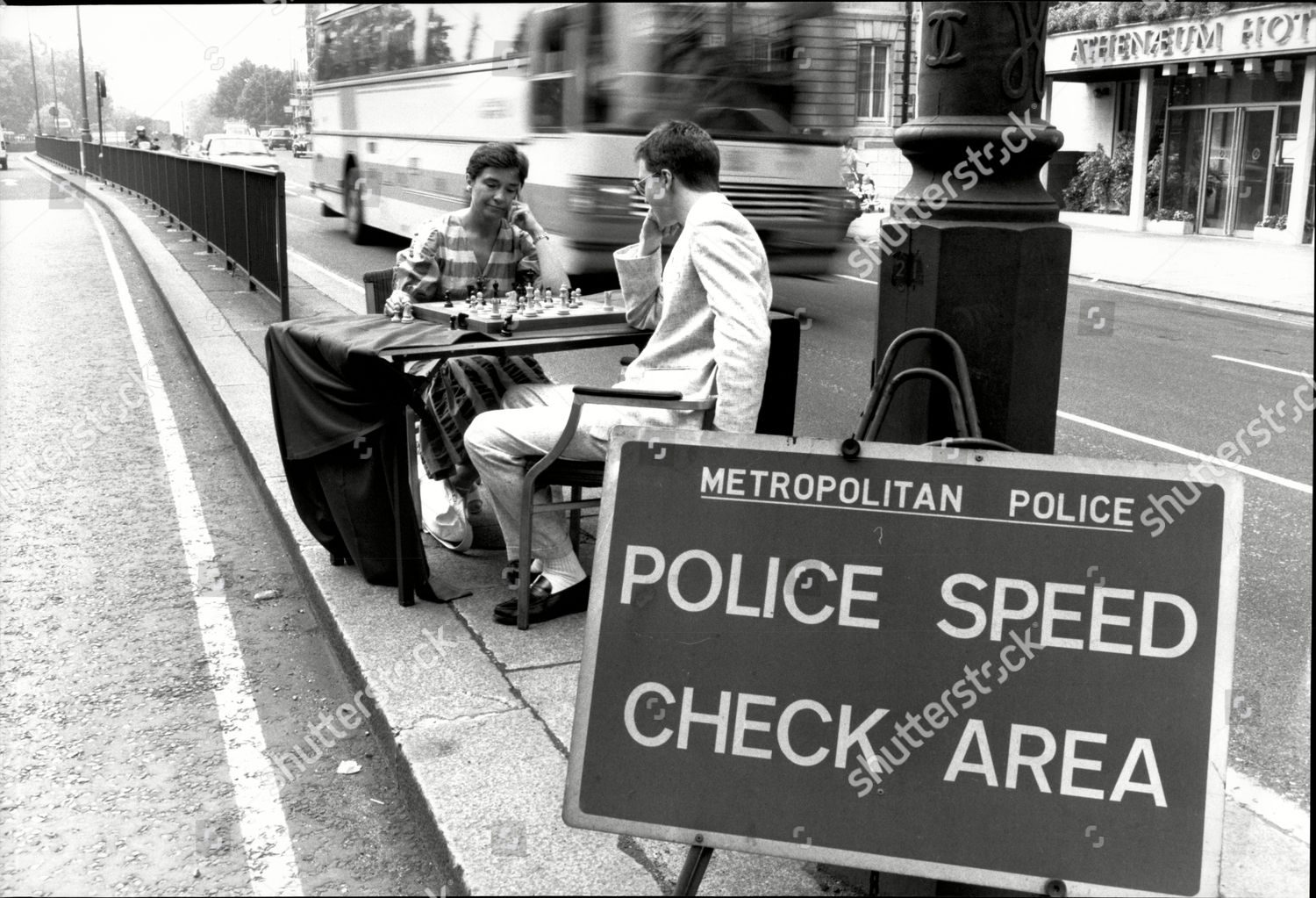
British Speed Chess Championship Grandmaster Nigel Short Playing Chess In The Park With L-r Susan Arkell Sheila Jackson And Dr Jana Miles. Courtesy of Shutterstock
“Bellin is a medical doctor specialising in anaesthetics, and works in intensive care at Sandwell General Hospital, West Bromwich, England.
Jana with Sheila Jackson to her left
She is also Chairman of the FIDE Medical Commission, which supervises drug testing of chess players.
British Speed Chess Championship Grandmaster Nigel Short Playing Chess In The Street With Woman Grandmaster Dr Jana Miles : Credit : Shutterstock
Bellin was married first to International Master William Hartston, then to Grandmaster Tony Miles, and after that to International Master Robert Bellin. She and Bellin have two sons: Robert (born 1988) and Christopher (born 1991).”
Dr. Jana Bellin
She is the granddaughter of thrice Prime Minister of Czechoslovakia, Jan Malypetr. and cousin of author and human rights campaigner Jiří Stránský.
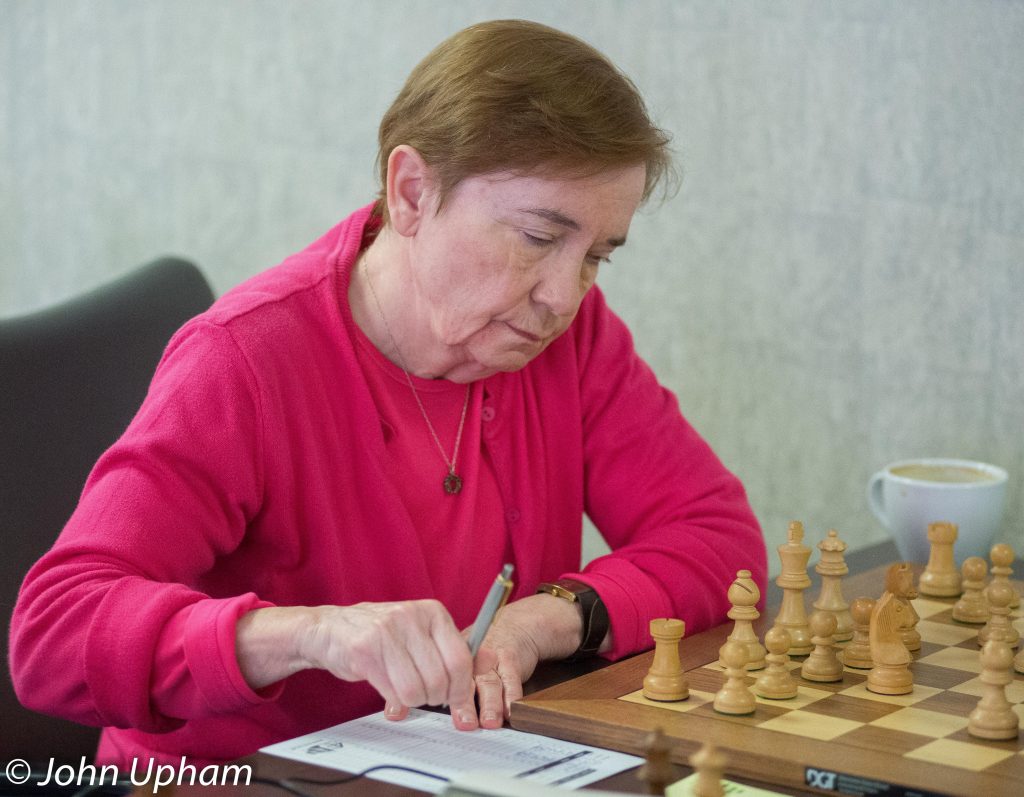
WGM Dr. Jana Bellin, Courtesy of John Upham Photography
We remember John Fuller who passed away aged 76 on Wednesday, December 8th 2004. His death was recorded in the district of Lancaster. At the end of his life he lived in Carnforth, in Lancashire.
John Arthur Fuller was born in Hendon, Middlesex on Saturday, May 12th 1928. His parents were Horace Arthur Fuller (a Bank Officer) and Phyllis Fuller (née Gooch).
John had three brothers: Julian Frederick who was two years older, Nigel Anthony who was three years younger and Adrian Easterbrook who was six years younger.
They lived at 12, High View, Pinner in Middlesex.
12, High View, Pinner, Middlesex, HA5 3PA
On August 26th 1939, aged eleven, John (described as a scholar) departed from Liverpool on board the SS Ceramic (part of the Shaw Savill & Albion Company shipping line) and duly arrived one hundred and twenty days later in Sydney, New South Wales.
The family returned to Liverpool in March 1945 on board the Athlone Castle which was of the Union-Castle Mail Steamship Company Ltd. John was now sixteen years old.
According to ancestry.co.uk he is survived by a son, Robin. The family tree indicates that John had two sons and two daughters but his wife is marked as Private and so her name is not visible. We speculate that it may be Ann Fuller (née ?) but this is awaiting confirmation.
From The Encyclopedia of Chess (Robert Hale, 1972 & 1976) by Anne Sunnucks :
“British Master, British Boy Champion in 1946 and British Correspondence Champion from 1953-1955. Born on 12th May 1928 Fuller learned to play chess when he was 11. In 1946 , the year in which he won the British Boys Championship, he also tied for the London Boys Championship. He went on to win the Middlesex Championship three times and the Warwickshire Championship twice. Fuller played for England in matches between Scotland and the Netherlands and in the Clare Benedict International Team Tournament. He also had the best British score in the Premier Tournament at Hastings in 1949 and 1955.
He was a design engineer.”
From The Encyclopedia of Chess (Batsfords, 1977) by Harry Golombek:
“British master and design engineer by profession. British Boy Champion in 1946. Fuller was a player of great promise with a fine understanding of the game. But a serious illness disturbed the even flow of his chess career and, though he recovered and made some more appearences in the chess world, he eventually withdrew from chess on an international and national level.
Fuller played twice in the Hastings Premier tournament: =5th 1949/50 and 6th in 1955/6.”
BCN would like to acknowledge help received from Richard James, Leonard Barden, Rob Fuller and John Upham in putting this article together.
Subsequent to this post being originally published in 2020 our attention was kindly drawn by John Saunders to the obituary in BCM, Volume 125 (2005), #5 (May), page 247. Here is the article:
John Fuller (12 v 1928 – 8 xii 2004, Carnforth) was a British Master and British correspondence champion in 1954 and 1955. Having spent some of the war years in Australia, he quickly made his mark in junior chess on his return to Britain. He shared first place with Leonard Barden in the 1946 London Boys’ Championship and went on to win the British Boys’ Championship in 1946 with 5/5 in the final section, ahead of Gordon Crown and Leonard Barden. He beat an off-form Crown in nine moves in the last round (see game above) He played a number of correspondence games with Crown, himself a richly gifted player, who w0as to die tragically young in 1947, and it was reported that Fuller had the better of these encounters.
Fuller became a design engineer, but his business and chess careers were both affected by a serious bout of tuberculosis when he was a young man. He won the Hastings Premier Reserves ‘B’ with 8/9 in 1947/48 ahead of Alan Phillips and Arthur Winser, and in 1949 Leonard Barden remembers playing off with him for a place in the 1949/50 Hastings premier after the two of them had made similar scores at the 1949 British Championship.
“We played the match at Sir George Thomas’s flat in autumn 1949… and John crushed me in that. Not sure of the score, I think it was 2.5- 0.5.”
He played in the Hastings Premier in 1949/50 and again in 1955/56,and made the best British scores on both occasions – 4/9 and 3.5/9 respectively. He also represented England in matches against Scotland and the Netherlands, and in the Clare Benedict team tournament. He only appeared three times in British Championships, scoring 6.5 in 1949, 5.5 in 1950 and 6.5 in 1958. He ranked in the top ten of the British Chess Federation Grading List on six occasions, with a best place of third equal in 1958. He seems to have dropped out of over the board competition chess shortly after being awarded the (now defunct) British Master title in 1963/64.
Harry Golombek referred to Fuller in The Encyclopaedia of Chess (1977) as a player of great promise with a fine understanding of the game”. Alan Phillips told BCM that he was “one of the most promising players of his generation… he slaughtered me three times”.
Leonard Barden had the following memories of John Fuller: “He was a member of West London Chess Club, which was historically significant as his good friend and fellow member (both living in Harrow) was Jim Slater, who 25 years later told me that knowing John was one of the factors which kept his interest in chess up to the point where he became our Maecenas… John was a tall redhead, outgoing and friendly, and a natural talent who also worked on theory. With the better opportunities available to later generations I’m sure he would have reached IM strength.”
We wish happy birthday to IM John Hawksworth born on Friday, December 6th, 1963.
John Crofton Hawksworth was born in Brighton, England, in December 1963 to Robert Marshall Hawksworth and Norah Connor Hawksworth née Crofton. He was baptised at St Saviour’s Church of England church in Pimlico, London, in 1964.
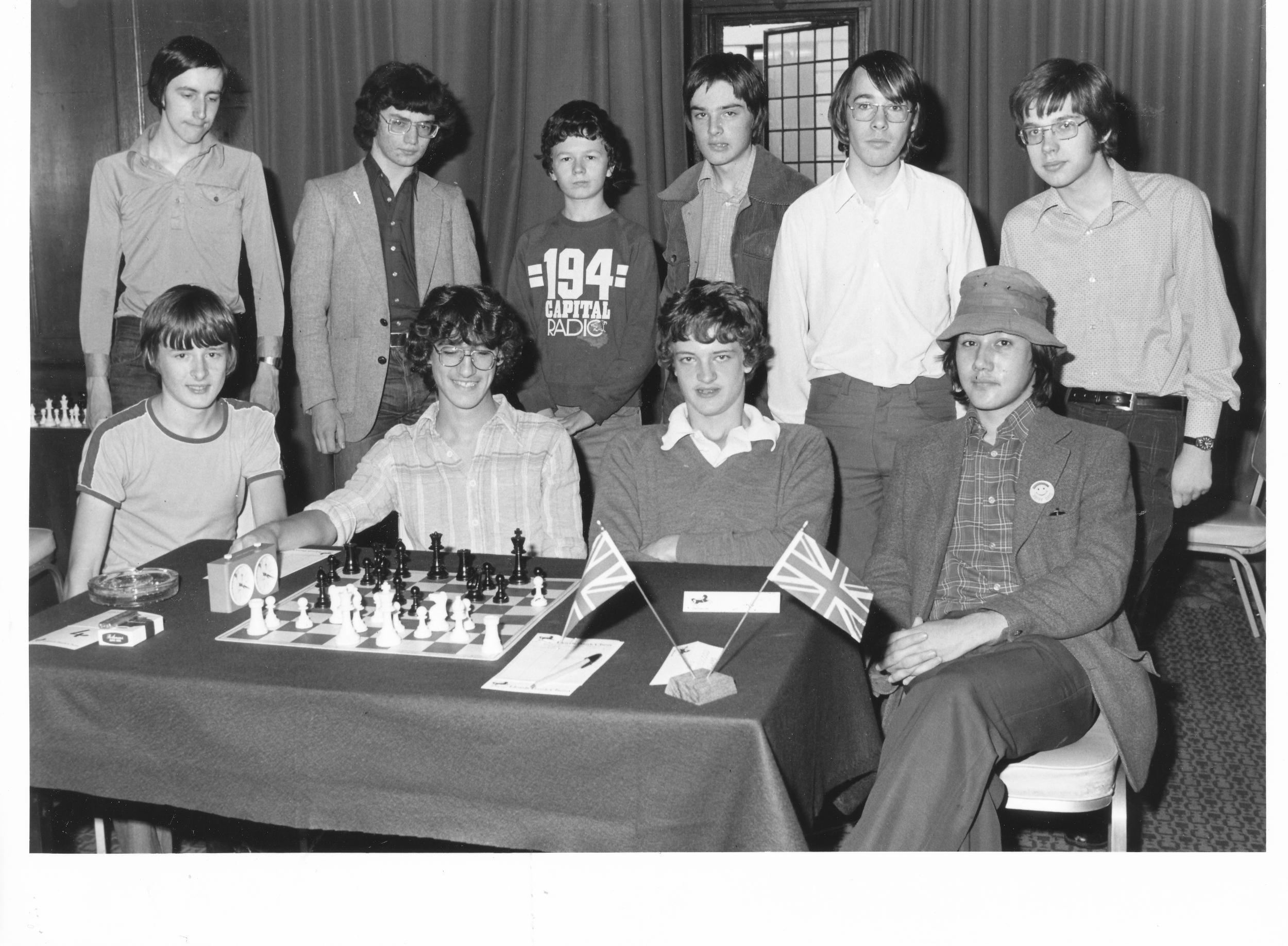
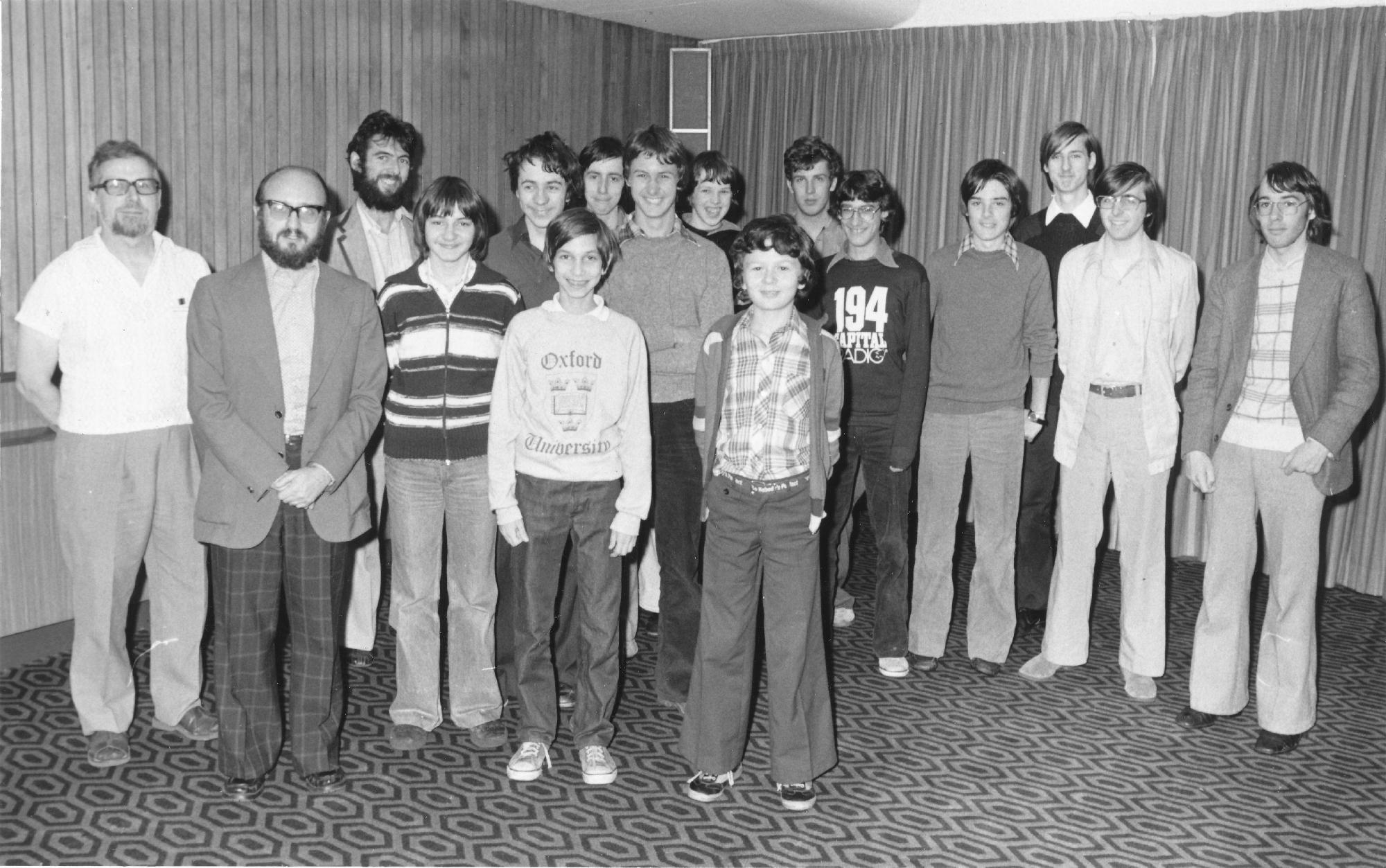
The following was written (presumably by LWB) about John who was 15 just prior to the Spassky vs the BCF Junior Squad simultaneous display in 1979 :
“Bradford Grammar and Bradford. Rating 194. Yorkshire under-18 champion.”
He was awarded the IM title in 1986.
According to ChessBase his highest FIDE rating was 2370 in January, 1990 aged 27 which was the last year of serious competition at the 77th British Championships in Eastbourne.
IM John Crofton Hawksworth (standing, second from right)At the Lloyds Bank Masters : Front (l-r) : Joel Benjamin, Ian Wells, Rear : Peter Morrish, Stewart Reuben, Richard Beville, Gary Senior, Richard Webb, John Hawksworth, Andrew King, Nigel Short, Mark Ginsburg, Daniel King, David Cummings, Erik Teichmann, John Brandford and Micheal Pagden
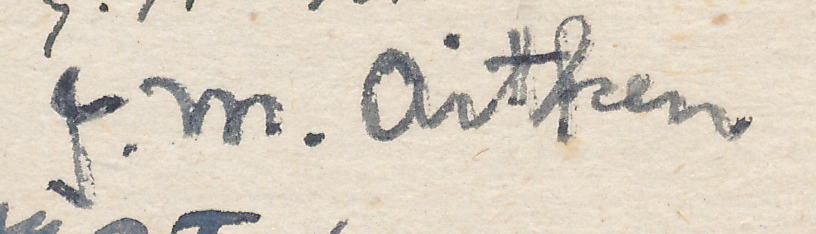
Signature of JM Aitken from a Brian Reilly “after dinner” postcard from Hastings Christmas Congress, 1945-1946
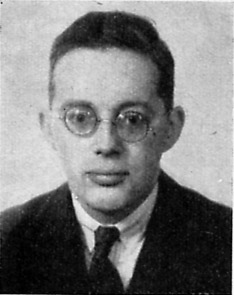
We remember Dr. James Aitken who passed away on Saturday, December 3rd, 1983.
James Macrae Aitken was born on Tuesday, October 28th 1908 in Calderbank, Lanarkshire, Scotland. His parents were David Aitken and Mary Ann Parlane Baird.
His very early history is best recorded here at the wonderful Chess Scotland web site.
He attended Balliol College, Oxford.
Luckily for all of us Scottish chess enthusiast Geoff Chandler is transcribing JMAs games from the players personal scorebooks. We hope to see these games appearing in Britbase and other locations in the near future.
From The Anglo-Soviet Radio Chess Match by Klein and Winter :
“JM Aitken was born in 1908 in Scotland, and learned chess at the age of eight. He played several times in the Scottish Championship, and won it in 1935. In the Stockholm international team tournament, 1937, he played for Scotland. His best performance in international chess was at Hastings, 1945, when he scored 6 points and did best among the British contingent.
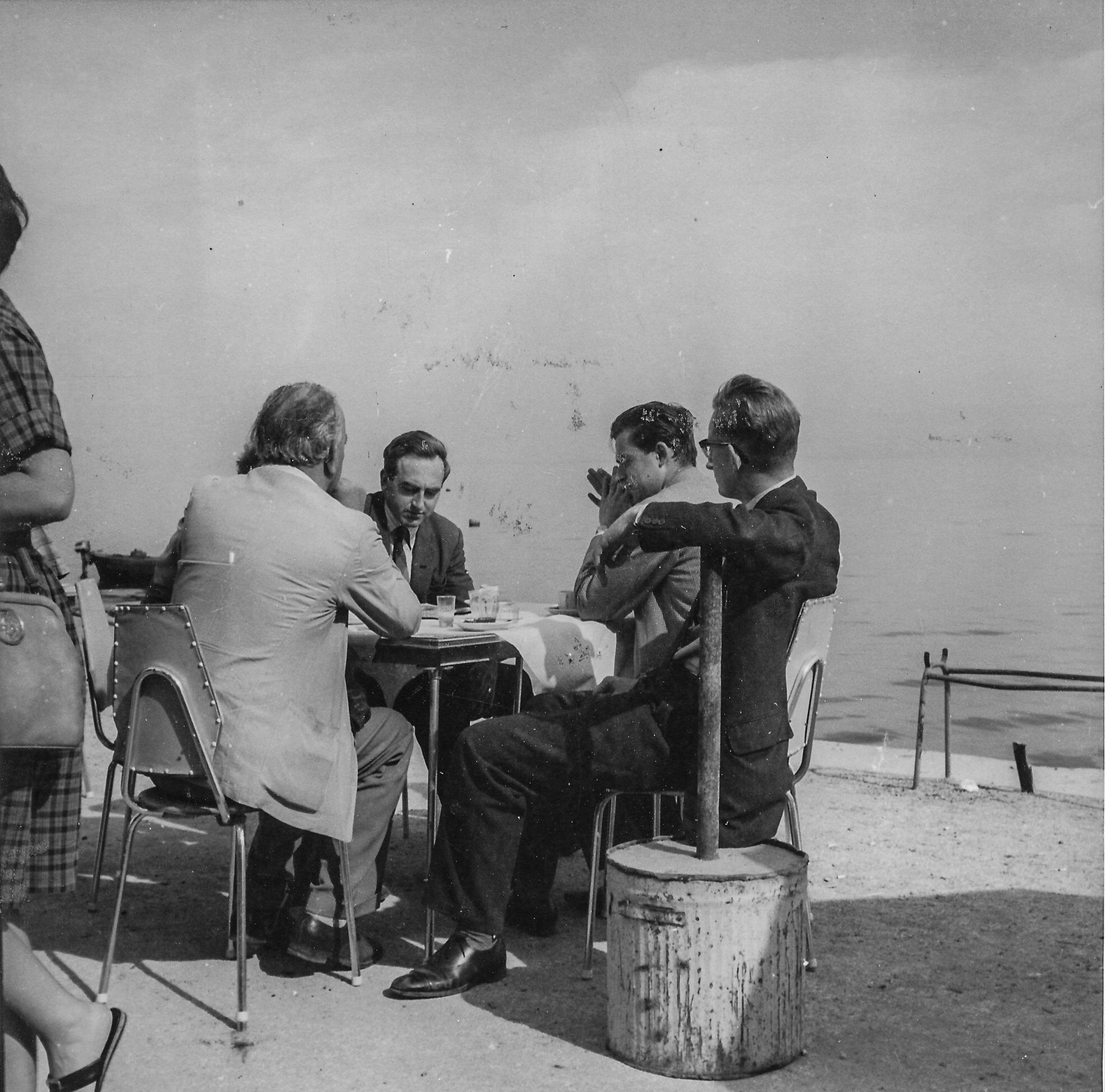
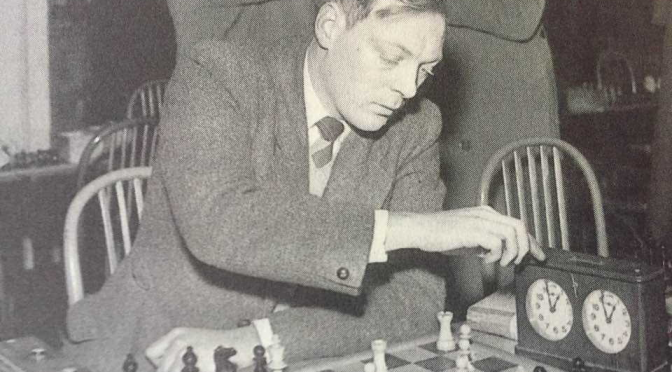
James Aitken Enschede Zonal 1963
He is a graduate of both Oxford and Edinburgh, and a Ph.D. At the beginning of the war he joined the Foreign Office. ”
The Aitken Variation is a line recommended in the British Chess Magazine of 1937 of the Giuocco Piano as follows :
From British Chess Magazine, Volume CIV (104, 1984), Number 1 (January), page 65 :
“Dr. James Macrae Aiken (27 October 1908 – 3 December 1983) died at his home in Cheltenham on the Saturday morning when he was due to turn out in a county match that afternoon. Sh he was active to the end, since he played in the veterans’ competition in both at the Southport BCF Congress and at the Guernsey tournament in October.
Ten times Scottish Champion, the worthy doctor represented Scotland at Olympiads both pre- and post-war. At the 1937 Stockholm Olympiad he beat Ståhlberg, while later on he also had the grandmaster scalps of Bogoljubow and Tartakower to his credit.
He retired from his work at the Foreign Office some ten years ago, and continued playing in West Country chess, always taking a high board for Gloucestershire. At the BCM we have a particular cause to remember him with gratitude since he was both a book reviewer and occasional annotator for two decades, and a life-long subscriber.
As a person he was always friendly and objective in his judgements both of chess positions and personalities. Your editor recalls many interesting conversations with him at BCF Congresses. The loss is greatest, of course. for Scottish Chess.
Perhaps we may close on a lighter note, since the following anecdote reminds one that Dr Aitken also turned out for Great Britain in matches just after the war. At an early FIDE Congress after the war the first official FIDE list of masters and grandmasters was being drawn up. The BCF made application for recognising the mastership of HE Atkins. The Soviet delegate, Kotov, objected since he thought he heard the name of Aitken, whom he knew had lost both games to Bondaresvky on board eight of the 1946 GB-USSR Radio Match. It was gently pointed out that the application concerned a player who had come ahead of no less than Chigorin at Hannover 1902. End of objection!
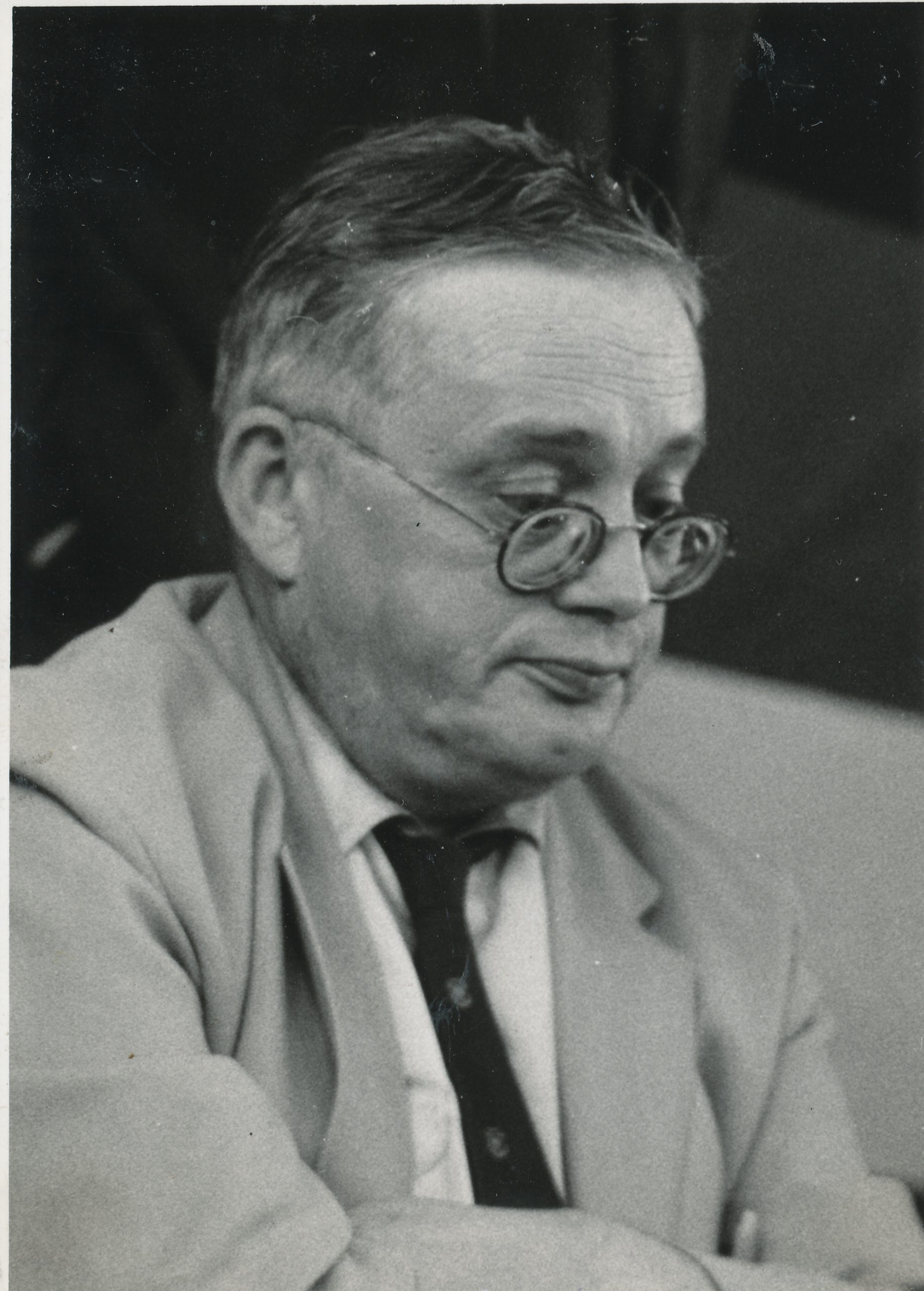
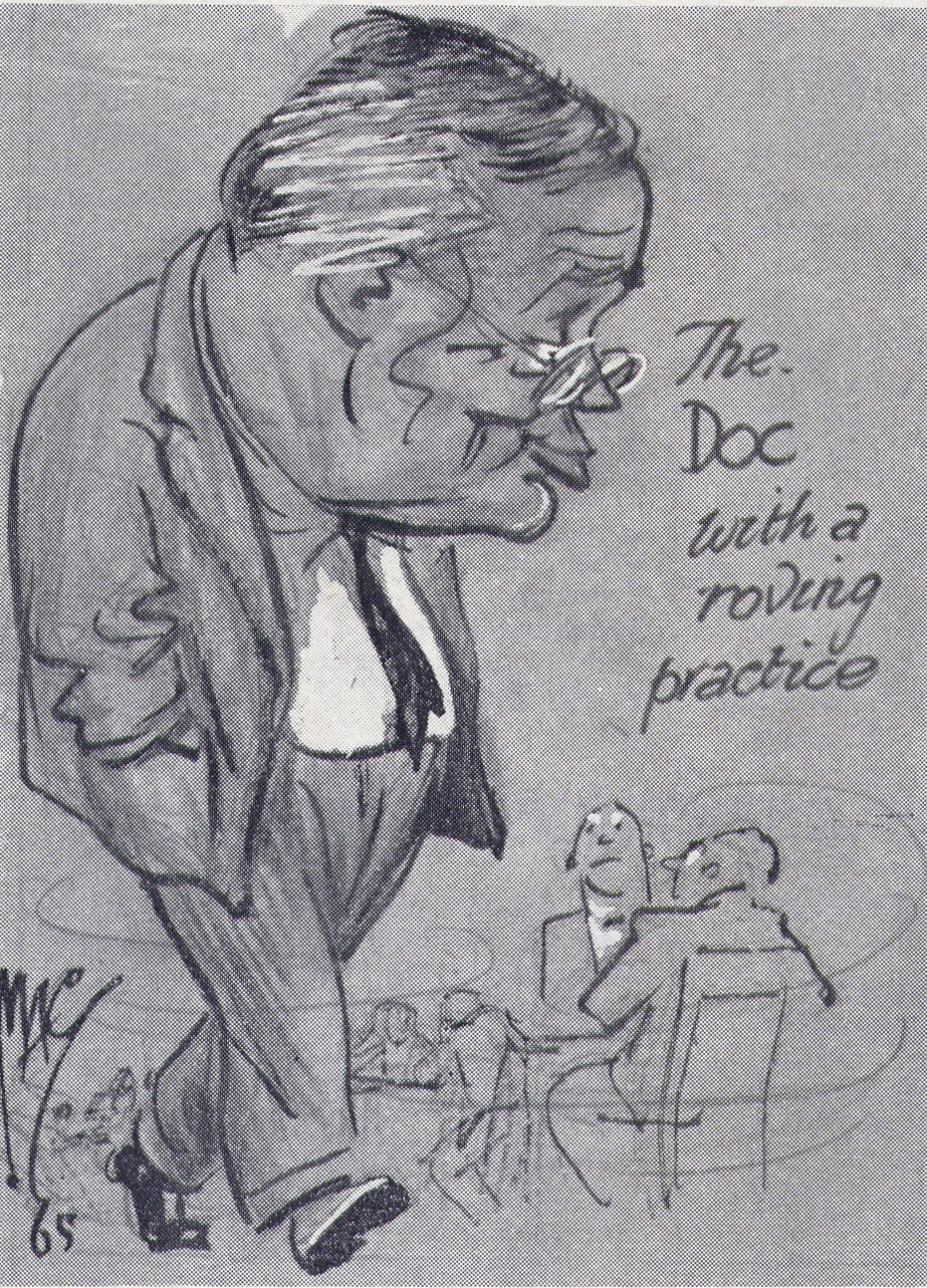
James Macrae Aitken in 1965 by “Mac”
We take this game from the Bournemouth tournament played on the eve of the Second World War.
From The Encyclopedia of Chess (Batsford, 1977), Harry Golombek OBE :
“Talented Scottish amateur who won the Scottish championship ten times, Dr. Aitken’s chief international activity was representing Scotland in the Olympiads.
At Stockholm 1937 he scored 32.4% on top board but he had the distinction of beating the Swedish grandmaster Ståhlberg. At Munich 1958 he scored 67.6% on 2nd board; at Tel Aviv 1964, 28.1% on 2nd board; at Skopje 1972, 38.9% on 6th board.”
Both Sunnucks and Hooper & Whyld are silent on Aitken.
“James Macrae Aitken (27 October 1908 – 3 December 1983) was a Scottish chess player.[1][2] Aitken was born in Calderbank, Lanarkshire, Scotland. In 1938 he received a PhD from Edinburgh University on the topic of ‘The Trial of George Buchanan Before the Lisbon Inquisition’.[3]
Aitken learned chess from his father at age 10.[4] He was Scottish champion in 1935, 1952, 1953, 1955, 1956, 1957, 1958, 1960, 1961 and 1965, the latter jointly with PM Jamieson.[1] He was also London Champion in 1950.[1] In 1959 he had his best result in the British Championship, finishing tied for seventh place.[4] Aitken represented Scotland in four Chess Olympiads. He played top board at Stockholm 1937, scoring only 32.4% but he did defeat Swedish GM Gideon Ståhlberg[4][5] and draw with American GM Samuel Reshevsky.[4] He played second board at Munich 1958 and Tel Aviv 1964, scoring 67.6% and 28.1% respectively. Aitken played sixth board at Skopje 1972, scoring 38.9%.”
“Aitken represented Great Britain in matches against the USSR and Yugoslavia.[4] In the 1946 radio match between the United Kingdom and the USSR he lost his match with Igor Bondarevsky on board 8.[6] Aitken defeated GM Savielly Tartakower at Southsea 1949[4][7] and GM Efim Bogoljubow at Bad Pyrmont 1951.[4][8]
During World War II, Aitken worked in Hut 6 at Bletchley Park on solving German Enigma machines.[9] On 2 December 1944 Bletchley Park played a 12-board team match against the Oxford University Chess Club. Bletchley Park won the match 8–4 with C.H.O’D. Alexander, Harry Golombek, and Aitken on the top three boards.[10] Aitken wrote many book reviews for the British Chess Magazine.[11] Aside from chess his hobbies included golf, philately, bridge, and watching cricket.[4] He died in Cheltenham in 1983, aged 75.[2]”
We focus on the British Chess Scene Past & Present!
This website uses cookies to improve your experience. We'll assume you're ok with this, but you can opt-out if you wish. Cookie settingsACCEPT
Privacy & Cookies Policy
Privacy Overview
This website uses cookies to improve your experience while you navigate through the website. Out of these cookies, the cookies that are categorized as necessary are stored on your browser as they are as essential for the working of basic functionalities of the website. We also use third-party cookies that help us analyze and understand how you use this website. These cookies will be stored in your browser only with your consent. You also have the option to opt-out of these cookies. But opting out of some of these cookies may have an effect on your browsing experience.
Necessary cookies are absolutely essential for the website to function properly. This category only includes cookies that ensures basic functionalities and security features of the website. These cookies do not store any personal information.