We remember Alexander McDonnell who died aged 37 on September 14th, 1835 in Tavistock Square, London.
Please note : We have referenced a number of secondary and tertiary sources on AM and they agree on heritage. However, following painstaking research of primary sources by James O’Fee and Tim Harding it has been demonstrated that the father of AM was not Dr. Alexander McDonnell but, in fact, Thomas McDonnell, a merchant.
Also, we do not have a primary source confirming the date of birth. 22-iv-1798 which was obtained from the family tree of a distant relative.
Hopefully we will be permitted to publish further details unearthed by James O’Fee
Alexander McDonnell was born on Tuesday, May 22nd 1798 in Belfast, Antrim, Northern Ireland to Dr Alexander McDonnell, age 34. His mother is unknown.
His (half-)brother Robert died (in a riding accident) on 19 July 1818 in Belfast, Antrim, when Alexander was 20 years old. He also had one sister, Eliza (Elizabeth)
From The Oxford Companion to Chess (OUP, 1983) by Hooper & Whyld :
The best player in England around 1830, Born in Belfast, the son of a doctor, he spent some years in the West Indies and later worked in London as
secretary of the Committee of West Indian Merchants. William Lewis, who taught McDonnell in the 1820s, soon found that he could not successfully offer odds of pawn and move to his pupil; but challenged to play even Lewis declined, fearing for his reputation.
From June to October 1834 McDonnell played six matches against La Bourdonnais; of the 85 games that were played McDonnell won 27, drew 13, and lost 45. McDonnell’s lack of experience against strong opponents was a serious handicap. On occasion his combinative play could be brilliant and imaginative, but his opening play (based on Lewis’s teachings) and his technique were inferior. He is described as ‘quiet, reserved, outwardly imperturbable’ with ‘an insular sense of’decorum’, quite different from his extrovert opponent.
Whereas La Bourdonnais played fast and with ease, McDonnell concentrated at length upon his moves and retired from a playing session exhausted, sometimes ‘walking his room the greater part of the night in a dreadful state of excitement’. His contemporaries believed that this long period of stress hastened his death from Bright’s disease. The games were regarded as the finest ever played. They were first published in England where they greatly stimulated interest in the game.
Unlike his great rival, McDonnell died wealthy; besides chess he was interested in political economy on which he wrote half a dozen books or
pamphlets.”
From The Encyclopedia of Chess (Robert Hale, 1970 & 1976) by Anne Sunnucks :
“The greatest player Ireland has ever (1976) produced, McDonnell is remembered mainly for his series of games against La Bourdonnais in 1834 which were described by Morphy as ‘beautiful models of chess strategy’.
The son of a Belfast doctor, McDonnell’s profession of Secretary to the Committee of West India Merchants brought him to London., where he took chess lessons from William Lewis and as a member of the West London Chess Club soon established the reputation of being the strongest amateur of his day. He was also a strong blindfold player.
In 1823 he lost some games against La Bourdonnais. These were probably played in Paris, since there is no record of the players meeting in England. In 1834 La Bourdonnais came to London, and a further contest was arranged. There are a number of conflicting reports on the sub-division of the games into matches,but a total of 84 games were played, of which McDonnell scored +27-44=13 before La Bourdonnais was recalled to Paris on business.
It was intended that the series should be continued, but before this could be arranged McDonnell fell ill with Bright’s disease and died on 14th September 1835.”
From The Encyclopedia of Chess (Batsford, 1983) by Harry Golombek :
“Britain’s leading player before Staunton. McDonnell was Irish born, the son of a Belfast doctor. He was secretary to the Committee of West India Merchants in London. After he studied chess with Lewis, he rose to the front rank of British players.
In 1834 he was engaged in a marathon series of matches with the visiting French champion La Bourdonnais. Five complete matches of varying lengths were played and a sixth was left unfinished, comprising a probable total of 85 games (there is some dispute among chess historians over the details of the final two matches), with the victory going to La Bourdonnais by 45 games to 27 with 13 draws. The standard of play was high and these contests did much to kindle interest in chess in both France and England. McDonnell died the following years of Bright’s disease.”
“Alexander McDonnell (1798–1835) was an Irish chess master, who contested a series of six matches with the world’s leading player Louis-Charles Mahé de La Bourdonnais in the summer of 1834.
In 1825 he became a pupil of William Lewis, who was then the leading player in Britain. But soon McDonnell had become so good that Lewis, fearing for his reputation, simply refused to play him anymore.
Around 1825–1826, McDonnell played Captain Evans, while the latter was on shore leave in London. McDonnell was beaten with what is now regarded in chess circles as the creation of the Evans Gambit (1.e4 e5 2.Nf3 Nc6 3.Bc4 Bc5 4.b4).[3]
La Bourdonnais matches
Main article: La Bourdonnais – McDonnell chess matches
At that time the world’s strongest player was the French aristocrat Louis-Charles Mahé de La Bourdonnais. Between June and October 1834 La Bourdonnais and McDonnell played a series of six matches, a total of eighty-five games, at the Westminster Chess Club in London. McDonnell won the second match, while La Bourdonnais won first, third, fourth and fifth. The sixth match was unfinished.
In the first game of the third match, McDonnell successfully introduced a new variation in the King’s Gambit (1.e4 e5 2.f4 exf4 3.Nf3 g5 4.Bc4 g4 5.Nc3) known today as the McDonnell Gambit.”
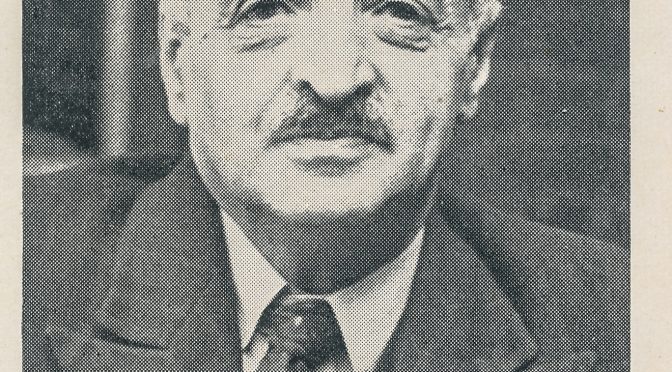
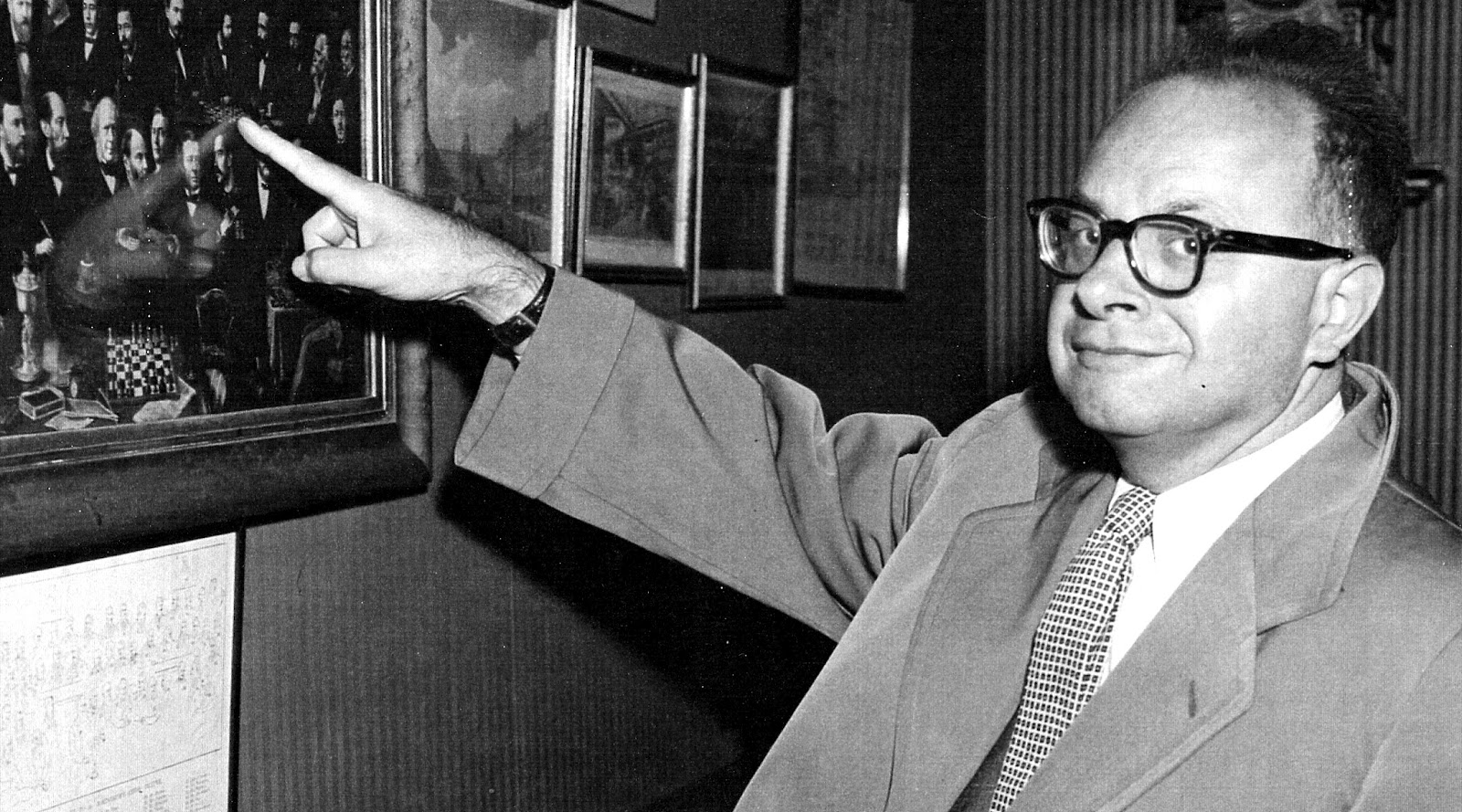
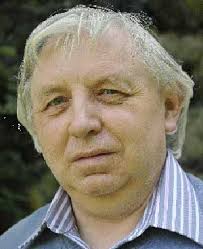
We are not convinced that the photograph above is of AM. We received this reply from Tim Harding :
“I don’t recall ever seeing ANY image that was definitely of him, but I have referred your enquiry to James O’Fee in Belfast who is probably the only person who might know of one.
It doesn’t help that he had in Belfast an almost exact contemporary of the same name (who came to work in Dublin and long outlived the chess player) and there is some issue about which one was the son of a doctor and which the son of a merchant. So even if you found an image online it’s more likely to be of the wrong man.
Unless I am wrong there was never any image of Alexander McDonnell in a chess context.
The main chance would perhaps be in connection with his lobbying for the Demerara planters.
From The Anglo-Soviet Radio Chess Match by Klein and Winter :
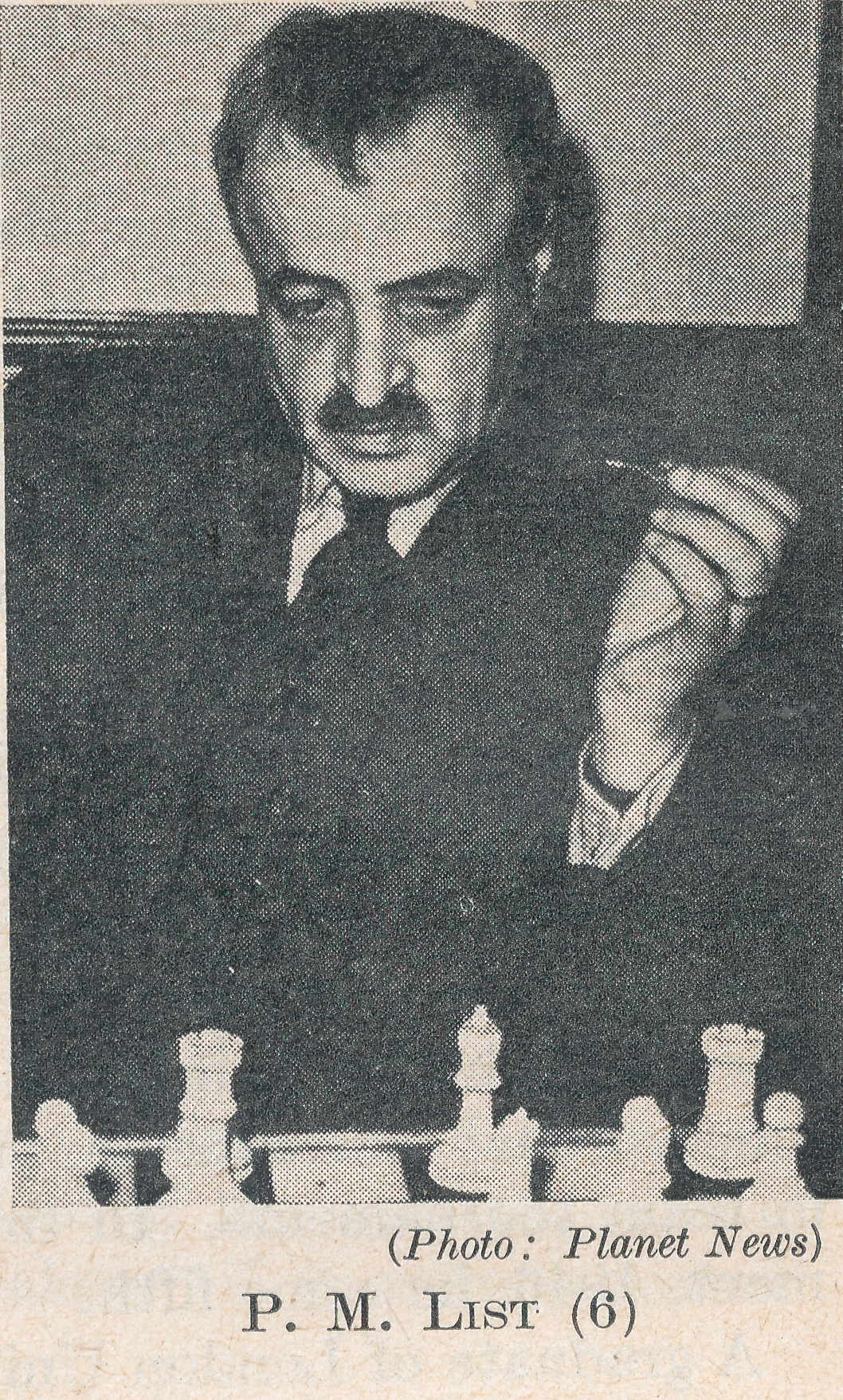
“Paul M List was born in Memel, Lithuania in 1887. After living in Berlin for many years, where he was manager of the bridge and chess rooms in a well-known café-restaurant, he came to this country in 1936.
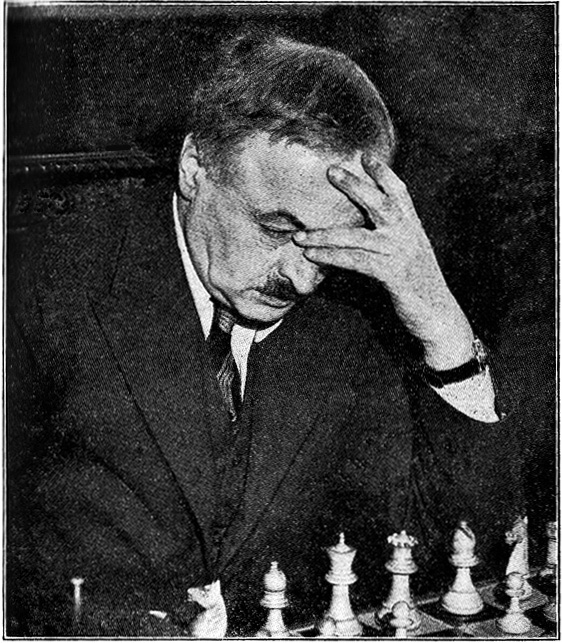
Paul M List
He has competed in many tournaments, local and international. He, too, failed to get into the prize list in the recent London International Tournament, but he is a resourceful player, particularly in defensive positions.
His best performance was Berlin, 1925 where he came first, ahead of Richter. Since he came to this country he has become an art dealer, but chess is still one of his foremost activities.”
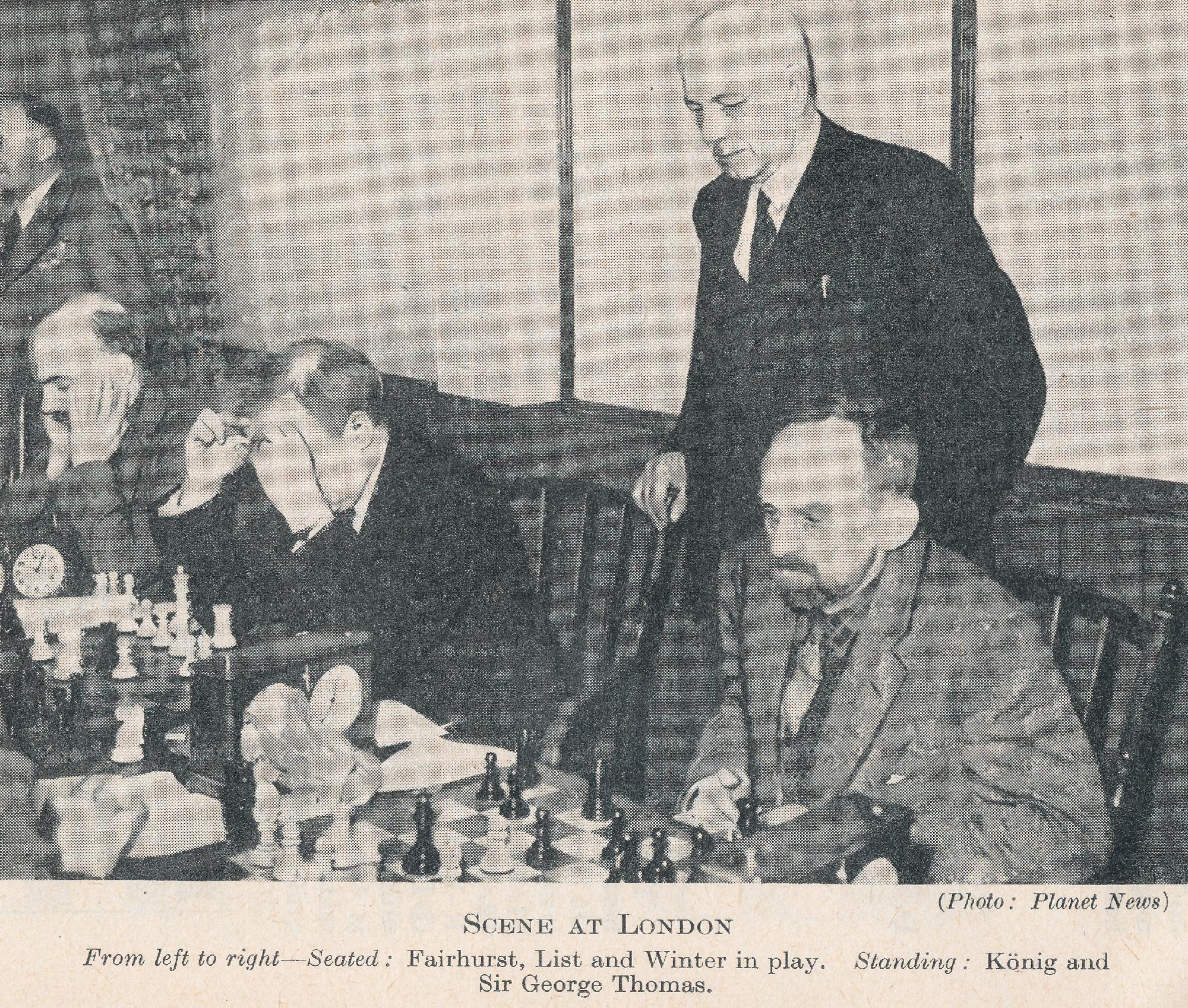
Scene at London. From left to right – Seated : Fairhurst, List and Winter in play. Standing König and Sir George Thomas
Here is an article by Matthew Sadler on the 1953 British Lightning Championship event won by List (but not the title)
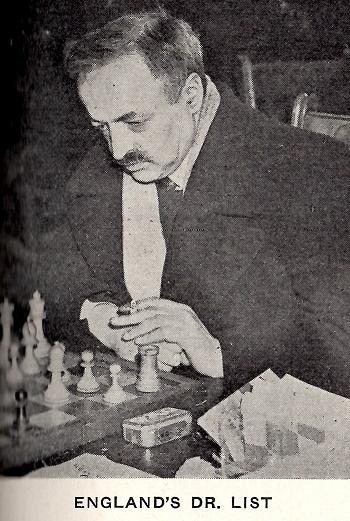
Dr. Paul List (09-ix-1887 09-ix-1954). Source : The Anglo-Soviet Radio Chess Match.
Here is his (surprisingly brief) obituary from British Chess Magazine, Volume LXXIV (1954), Number 10 (October), page 324 :
“Dr. Paul List, the British Lightning Championship winner a year ago (though he could not hold the title because he was not a naturalised Briton), died in London at the age of 66. A player of master strength, Dr. List left his native Russia for Germany in the 1920’s, and began on his second exile in 1938 when sought refuge in this country from Germany.”
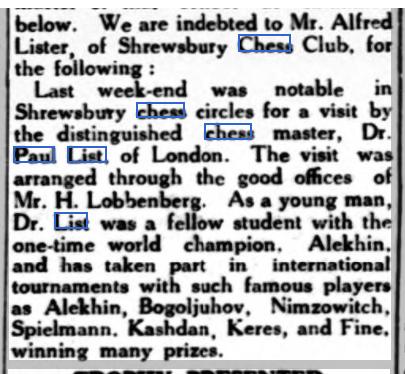
Item from Kington Times – Saturday 02 June 1951 regarding the visit of Dr. List
From The Illustrated London News in 1953 (by BH Wood) :
“Sixty-five-year-old Dr. (not of medicine) Paul List, the oldest competitor, who settled in Britain about 1937 and has been thinking of becoming naturalised ever since, finished with a marvellous fifteen-and-a-half points out of a possible eighteen”
Dr. Paul M. List. Source : https://www.kingpinchess.net/wp-content/uploads/2016/03/They-provided-their-own-heat1.jpg
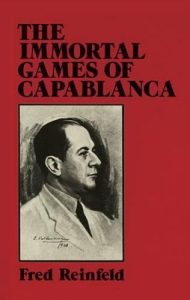
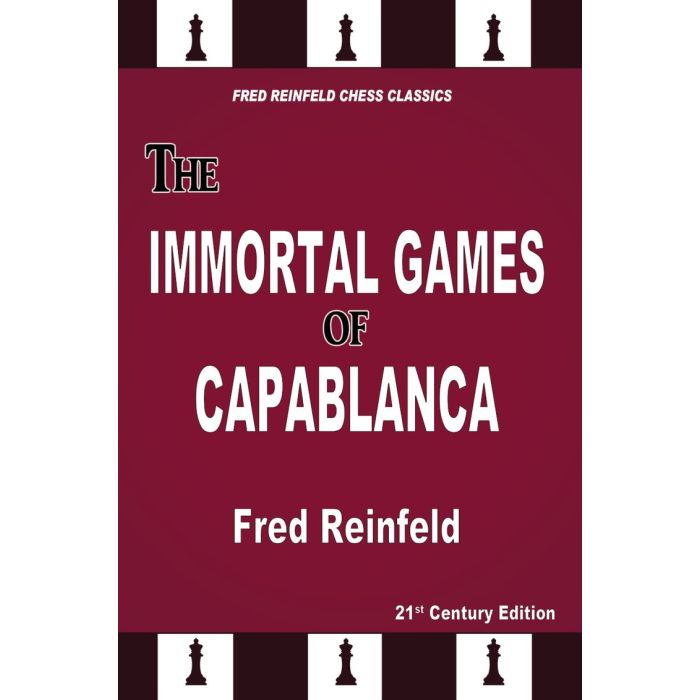
“We are pleased to release another book in the Fred Reinfeld Chess Classics series. The Immortal Games of Capablanca was – and continues to be – one of Reinfeld’s most popular books. A detailed biography of the third world chess champion introduces the 113 games. They are presented chronologically, with clear and instructive annotations.
This 21st century edition has been revised and reformatted to meet the expectations of the modern chessplayer. This includes:
(a) The original English descriptive notation has been converted to modern figurine algebraic notation;
(b) Over 200(!) diagrams have added, along with more than a dozen archival photos; and
(c) The Index of Openings now has ECO codes.
Reinfeld’s annotations were also cross-checked by Stockfish 14, one of the most powerful engines available. When Stockfish had a different, meaningful evaluation from that of Reinfeld’s, the engine’s suggestion is indicated by “S14:” followed by the specific line.
As in our other “21st Century Editions,” and with the exception of the occasional supplement by Stockfish, Reinfeld’s original text has been preserved.
Follow the life and games of the brilliant Cuban world champion in Reinfelds’s timeless classic The Immortal Games of Capablanca.”
“Fred Reinfeld (January 27, 1910 – May 29, 1964) was an American writer on chess and many other subjects. He was also a strong chess master, often among the top ten American players from the early 1930s to the early 1940s, as well as a college chess instructor.”
In July 2019 Richard James reviewedFred Reinfeld: The Man Who Taught America Chess, with 282 Games and perhaps you might like to read this to get a better feel for FRs legacy.
Russell Enterprises (via New In Chess) with this new edition have, to date, added a total of eight titles to their Fred Reinfeld Classic Series: the more the merrier!
Over the years many have looked down their noses at publications from Reinfeld, Chernev, Schiller and others but if we are completely honest then Reinfeld and Chernev have brought a huge amount to the chess buying public and many have found much benefit from their publications.
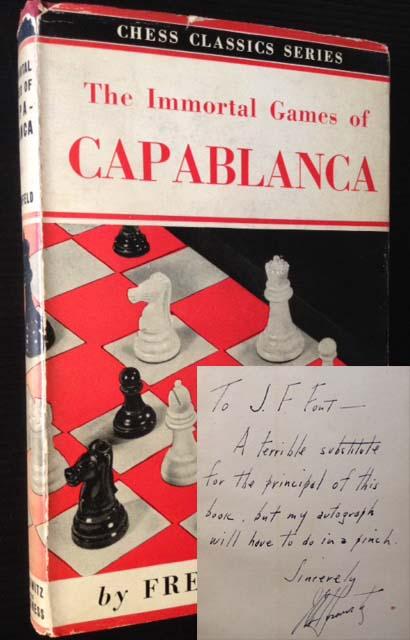
The Immortal Games of Capablanca by Russell Enterprises is (to use a modern phrase) a “re-imagining” of a timeless classic. Most of us reading this review would have almost certainly had one of the previous versions. The first edition dates from 1942 and, interestingly, the copyright lies with Beatrice Reinfeld rather than Fred, himself. Published by Horowitz and Harkness, New York here is an original first edition copy from the collection of Jose Font:
The Immortal Games of Capablanca, Fred Reinfeld, Horowitz and Harkness, New York, 1942.
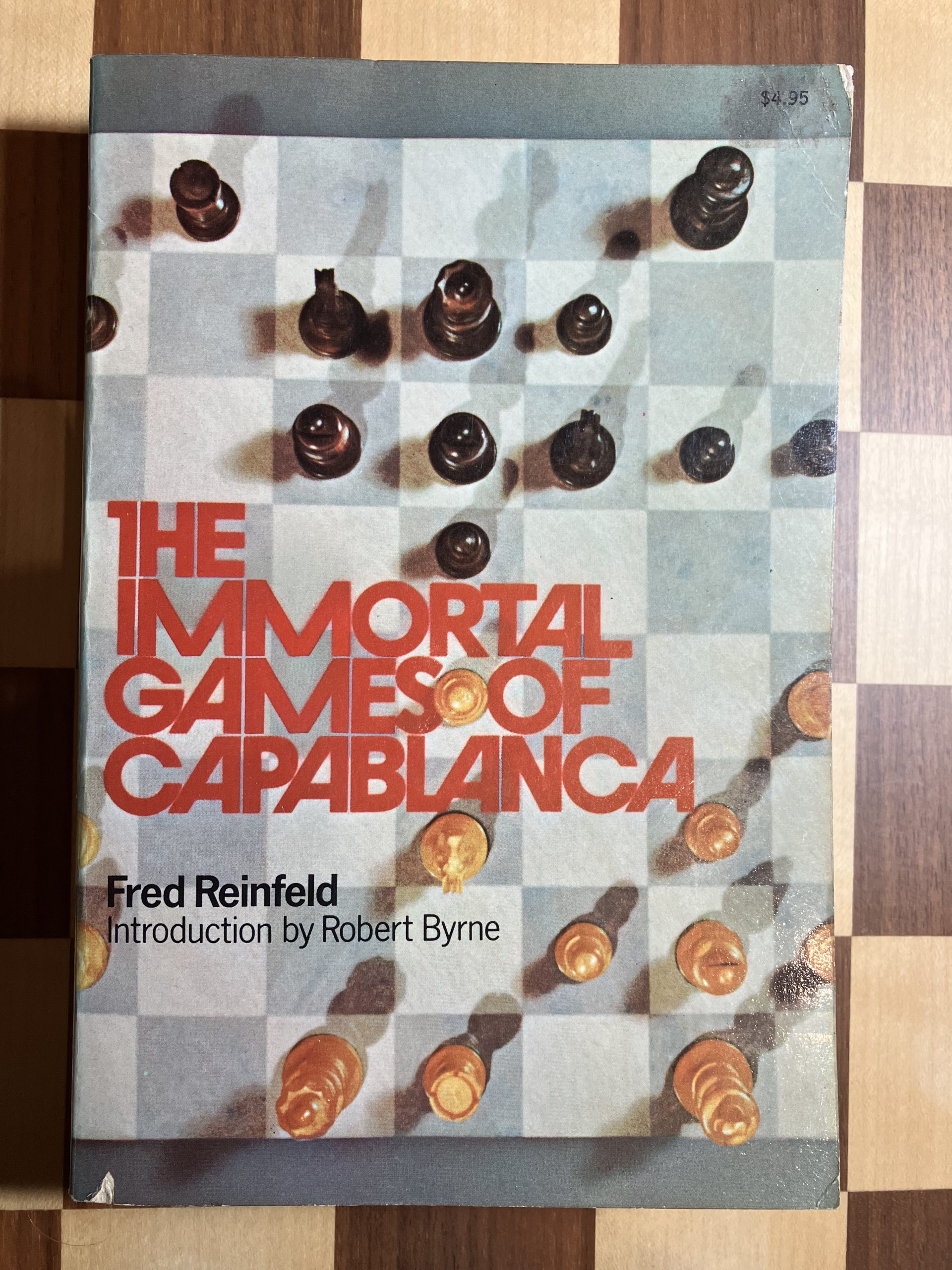
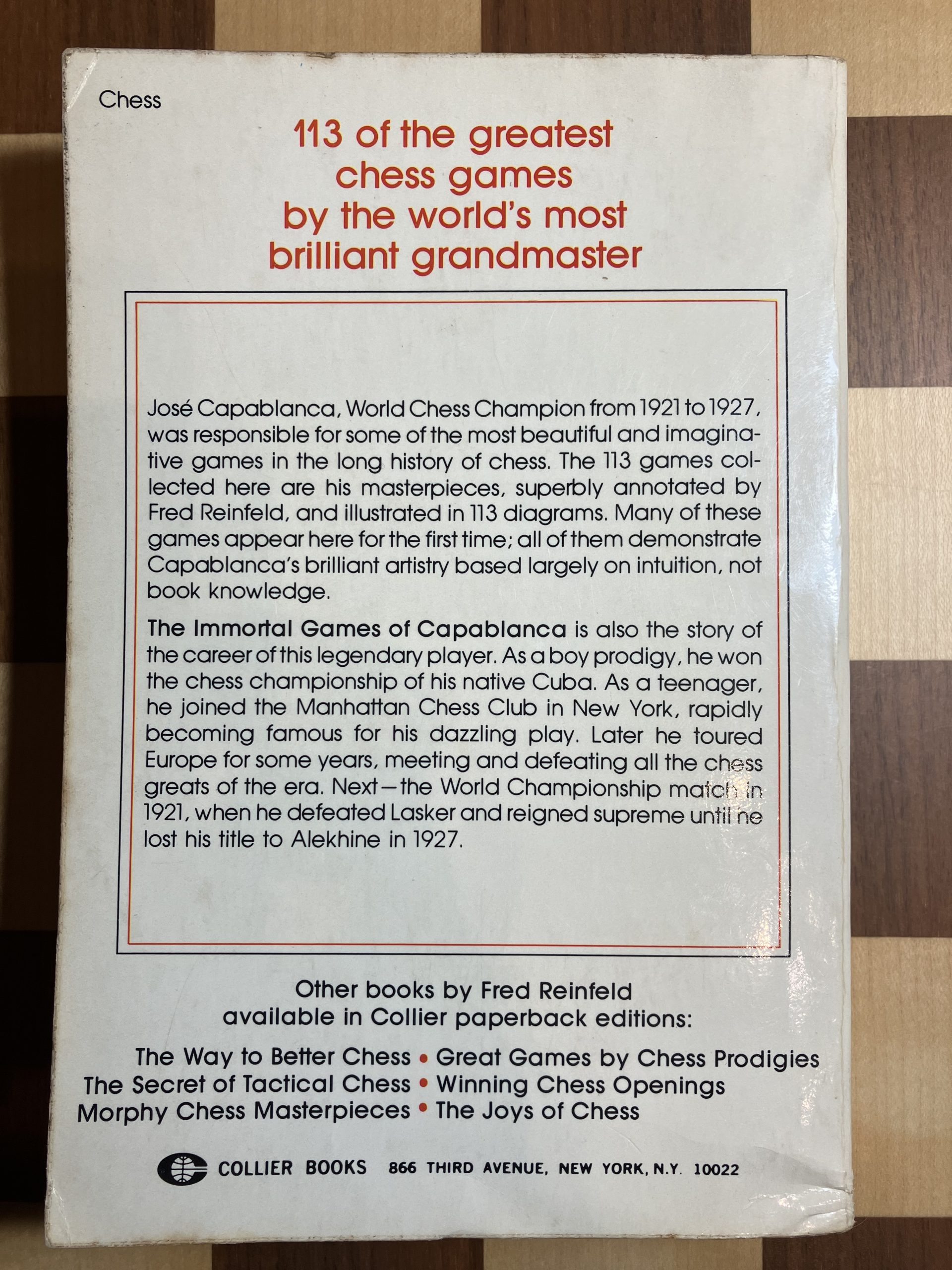
Betts (Chess: An Annotated Bibliography of Works Published, 1850-1968) informs us that this very edition was re-issued in 1953 by the same publisher. In 1974, Collier Books (A Division of Macmillan Publishing Co., Inc. New York) brought out their own edition and added an Introduction by Robert Byrne, Chess Editor of The New York Times. This had the following appearance front and rear:
The Immortal Games of Capablanca, Fred Reinfeld, Collier Books, New York, 1974The Immortal Games of Capablanca, Fred Reinfeld, Collier Books, New York, 1974
and, for the sake of completeness, and because it is worth reading, here is the Introduction from Robert Byrne:
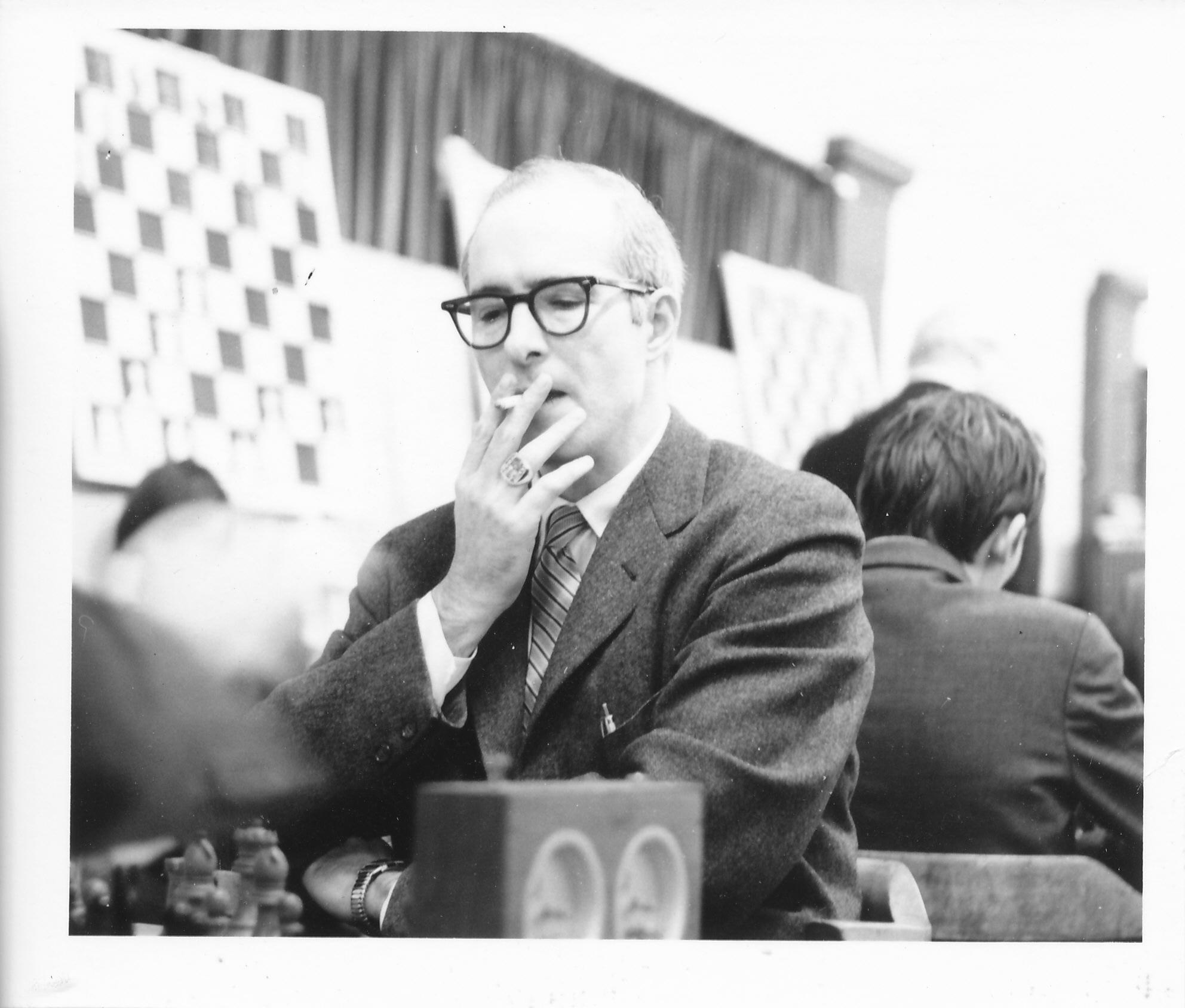
Robert Byrne, Hastings 1971-72
Introduction
I joined the Manhattan Chess Club a year or so after Capablanca’s death, and the afterglow of the great Cuban’s presence still filled his favourite haunts. There was an old white-haired patzer, Richard Warburg, who would collar me, my brother Donald, and several other young high school players to tell us the “compliment” Capa had once paid him. What Capa had said was, “Warburg, nobody plays the Rinky-Dink the way you do!” So overcome with pride and delight was Warburg that the great man had deigned to remark on his play that he never stopped to think why Capa had dubbed his Accelerated Dragon Variation the “Rinky-Dink.” Needless to say, the ironic joshing of Capablanca’s remark was totally lost on him.
Moreover, it would not have mattered, for Capablanca was so idolized that it was deemed a privilege to breathe the same air he did. Not only did his fans feel that way about him, but the man from whom he won the world championship, Emanuel Lasker, said of him, “I have known many chess players, but only one chess genius.” Capablanca’s successor, Alexander Alekhine, also termed him “a very great genius whose like we shall never see again.”
What lent Capablanca the glamour that was denied to his fellow champions of the game was the incredible speed of his play. Hard work at the board, consuming the full two and one half hours for forty moves, was unknown to him at the peak of his career. Brilliant strategic plans, marvellous com binational possibilities, scintillating turns in the play came tumbling out of him in response to his extraordinarily quick sight of the configuration before him.
He did not consider what he achieved as coming under the head of thinking, scandalizing his colleagues by insisting that chess was not an intellectual game. For him it was nothing remotely resembling problem solving, but rather flashes of intuition in which he grasped the essential pattern governing each individual position. That is why he looked upon chess playing as an aesthetic activity.
Quite obviously, no greater natural player ever lived. At the age of four, Capablanca learned the moves by watching his father play and, years later, he declared that he had never bothered to study the game. Of course, growing up in the fertile chess climate of Havana and later New York, he honed himself on very strong opposition. Watching the games of his competitors could hardly have failed to serve as an education in itself.
In chess style, Capablanca was the master par excellence of reduction, stripping positions down to the bare backbone by exchanging off all irrelevant material. In what were for others
positions of unfathomable complexity, he could, with uncanny lucidity, expose the genuinely dominant but often hidden theme that dictated the strategy to be pursued.
It is this astonishing clarity in Capablanca’s conceptions that makes his games a gold mine for the aspiring student. The elements of chess strategy can all be seen here purged of the confusion introduced by side issues. The late Fred Reinfeld has made an excellent selection of 113 Capablanca games which give a rounded picture of the scope and invention of Cuba’s greatest genius. These are the wonderful performances that have so heavily shaped the play of current world champion Bobby Fischer, Capablanca’s spiritual descendant.
One of my favourites, which I have replayed many times, is game 6, from Capablanca’s match with Frank Marshall (see page 39 ). It is not too much to say that this is the indispensable stem game for the understanding of how White develops a kingside attack in the Ruy Lopez. Another lesson in the Ruy Lopez, this time in the exchange variation by transposition, is given by game 17 against David Janowski (see page 83). Capablanca’s handling of the pawn structure and his fine rook play in the ending beautifully illuminate a formation reintroduced into current practice by Bobby Fischer.
In the realm of bishops-of-opposite-colour play, the drawing chances of the defence can only be defeated by the kind of positional mastery Capablanca evinces in game 2L against Richard Teichmann (see page 97 ) and in game 25 against Aron Nimzovich (see page 111). Capablanca’s terrifically coolheaded defensive play shows up in his defeat of Frank Marshall’s anti-Ruy Lopez gambit in game 36 (see page 157), which the American champion kept under wraps for eight years to spring on him. I could go on and on, but, if I must limit myself to just one more, Capablanca’s best-played-prize-winning Caro-Kann Defense in game 63 against Aron Nimzovich (see page 276) would be my choice. It is a wonderfully instructive masterpiece of infiltration tactics to undermine a passive position and score with Zugzwang.
Fred Reinfeld’s annotations are clear and schematic and give a dramatic portrayal of these epic battles. Fred, the epitome of the hero-worshipper, is a little too harsh in fastening on the very human foibles that brought about Capablanca’s loss of the world championship to Alekhine. With the ease of success Capablanca enjoyed, it was all but impossible for him to have taken Alekhine’s challenge seriously, especially since Capablanca had a 6-O record against him going into the match. No one could have guessed the fanatic zeal that Alekhine put into his preparation for the struggle.
Moreover, the last word on Capablanca’s enormous capacity can be gleaned from Alekhine’s behaviour. He sought lesser opponents rather than give the awesome genius a return match.
-Robert Byrne”
In 1990 Dover did their usual “reprint” thing and re-issued the Horowitz and Harkness, New York, 1942 version with this cover:
The Immortal Games of Capablanca, Fred Reinfeld, Horowitz and Harkness, Dover Publishing, 1990 and then 2011 by Sam Sloan
and in 2011 Sam Sloan put on his anti-copyright Ye-Ha! cowboy spurs and re-issued his version with the original 1942 cover.
So, in 2022, what do we have that is new in this 21st century edition?
Firstly, we have FAN or figurine algebraic notation which should help to bring in those for whom English Descriptive is old hat (their words not ours).
Secondly, thirteen photographs of of Capa and his opponents liven up the pages that once contained a single image of Capa giving a simultaneous display at the Imperial Chess Club in London, 1911. Printing quality could have been improved but welcome they are nonetheless.
The format has transitioned from the old style single column with diagrams few and far between to a double column format with a liberal sprinkling of diagrams of greater printed clarity than the originals. Each game has been allocated an ECO code (or Rabar Index for our more mature readers). Indeed, the font is a little smaller than it was in 1942 but quite readable all the same.
The authors pithy annotation style has been retained for the modern student to enjoy and engine worshippers (“I cannot read a chess book that has not been engine checked”) are acknowledged using supplemental comments indicated by a Stockfish (S14) label.
We carried out a detailed edition comparison with the Collier edition and found some subtle differences. As noted previously the Robert Byrne Introduction is not present but then again, it wasn’t in the original. Game 2a, Corzo-Capablanca is now Game 3 and the comment “This game discovered just as the book was going to press” is no longer present.
Capablanca-Voight, Philadelphia, 1910 is labelled as a Team Match between Manhattan CC and Franklin CC in 1942 and in 2022 as a simultaneous display game. Both Megabase 2023 and Chessgames.com concur with the recent verdict: any Capa scholars (EGW) out there with definitive knowledge?
Game 15 is now identified as Capablanca – Bacu Arus from a blindfold simul whereas Black was listed simply as “Amateur” in the original.
Through out this fresh, new edition there are subtle additions of detail together with corrections to the original which are to be admired.
The Stockfish (S14) comments are sparse and unobtrusive but of value. For example, from Capablanca- Janowski we have reproduced the comments to Black’s 24th move only:
In summary it was an absolute pleasure to be re-united with this timeless classic and Russell Enterprises are to be congratulated on producing this fresh new edition with added value.
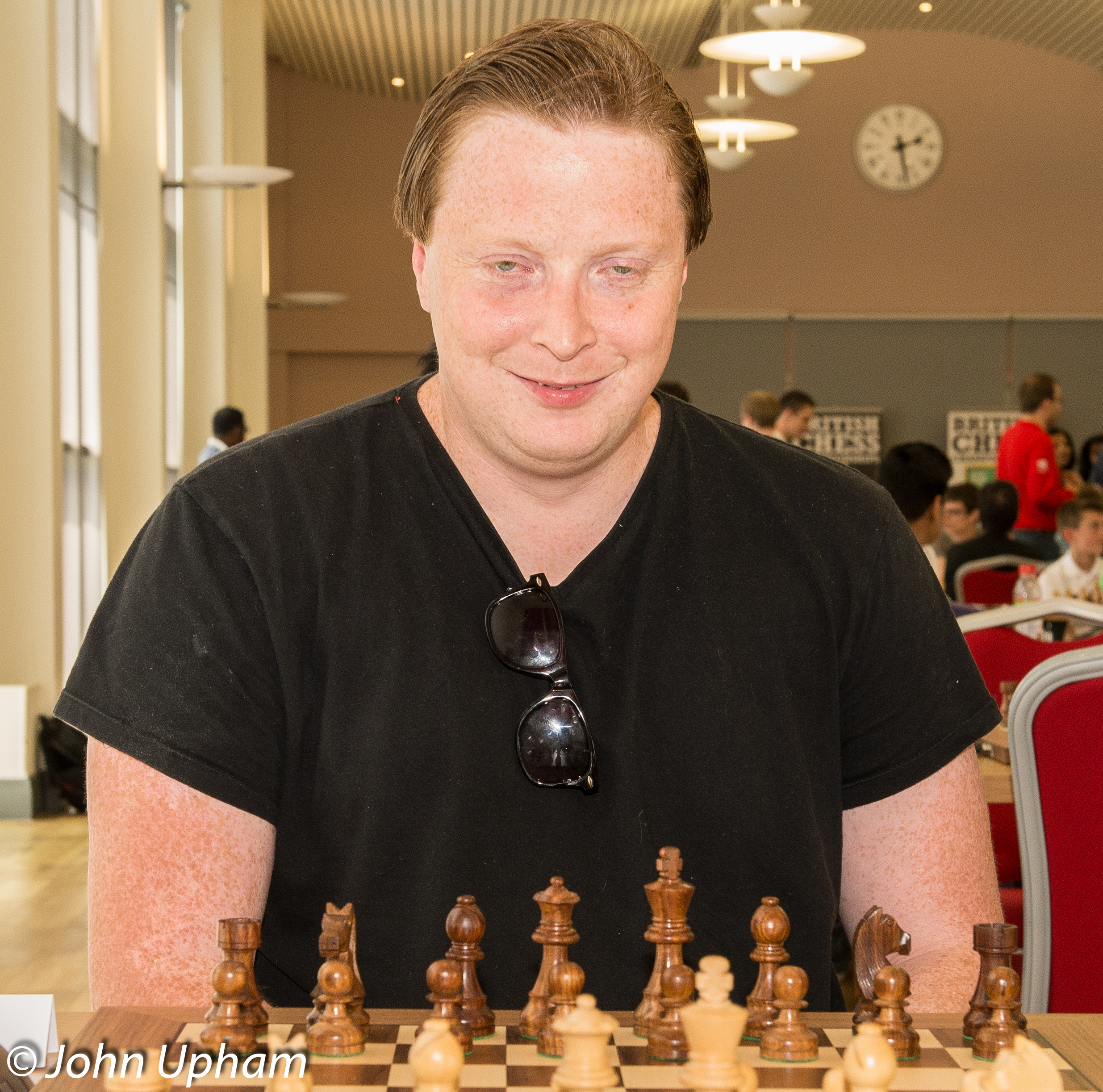
John Upham, Cove, Hampshire, 2nd March 2023
John Upham
Book Details :
Softcover : 256 pages
Publisher: Russell Enterprises (September 12, 2022)
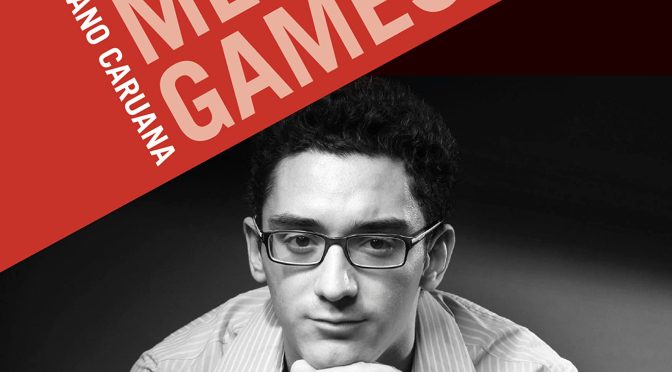
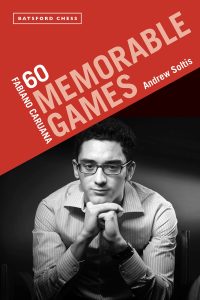
“Following on from the enduring success of one of the most important chess books ever written, Bobby Fischer: My 60 Memorable Games, and the recently released Magnus Carlsen: 60 Memorable Games, celebrated chess writer Andrew Soltis delivers a book on Fabiano Caruana, the Grandmaster set to rival current world champion Magnus Carlsen.
This book details Caruana’s remarkable rise from chess prodigy to one of the best chess player in the world, exploring how he acquired the skills of 21st-century grandmaster chess over such a short period of time.
This book dives into how he wins by analysing 60 of the games that made him who he is, describing the intricacies behind his and his opponent’s strategies, the tactical justification of moves and the psychological battle in each one.”
About the Author:
“International Grandmaster Andrew Soltis is chess correspondent for the New York Post and a very popular chess writer. He is the author of many books including What it Takes to Become a Chess Master, Studying Chess Made Easy and David Vs Goliath Chess.”
GM Andrew Soltis
If you’ve read and enjoyed the companion volume on Carlsen, you’ll want this as well. Many readers collect games collections, and will be eager to add a book on one of today’s leading practitioners to their shelves. This isn’t the only book on Caruana available: there’s one, for example, by Lakdawala, a writer with a very different style. If you like Soltis’s annotations you may well not like Lakdawala’s, and vice versa. They’ve both been doing what they do for a long time and understand their readership.
Here, then, we have sixty of Caruana’s most interesting games, not all of them wins, mostly from the last decade, but a few earlier, starting with a game from 2002. Most are standardplay games, but there are also a few rapid, blitz and internet encounters.
In his introduction, Soltis looks at what makes Caruana different from other top players.
And if he had a celebrity personality – that of a Magnus Carlsen, a Bobby Fischer or a Garry Kasparov – his story would be known well beyond chess circles. But Caruana is Caruana. “He is shy and modest, like a conservatory student”, one of his teachers said. He is content to let his moves do most of the talking.
He identifies several traits in Caruana’s play.
He’s a concrete player, relying on calculation more than intuition.
He doesn’t only rely on computer analysis, using curiosity and self-discipline to investigate the secrets of a position.
He believes the board and the pieces, playing the way the pieces tell him to play regardless of the tournament situation.
He is able to manage his nerves and emotions.
He chooses moves that push his opponents out of their comfort zone.
He is very patient, often playing quiet ‘little moves’ which slightly improve his position.
He employs deep opening preparation, much more than, for example, Carlsen.
An occasional flaw in his play is that he sometimes fails to deliver the knockout blow.
He has emotional stamina: he can deal with his mistakes and knows how to react when things go wrong.
The introduction also tells about Caruana’s early life in New York, and about the influence of the Soviet Chess School on his studies there.
Then we have, yes, sixty memorable games, each prefaced with a catchy title and a brief introduction. Just like another book of 60 Memorable Games.
The best way to describe this book, is, perhaps, to show you a few examples of Soltis’s style of annotations.
This is from Caruana – Aronian (Sao Paulo 2012).
Members of Caruana’s generation grew up with computers and Kasparov games. Many of them had little interest in games played before 1990.
Hikaru Nakamura called the classic books “a waste of time” and complained to his father, “Why do I have to study dead people?”.
Caruana studied them. He understood how White can benefit from d4-d5 in this pawn structure, as Bobby Fischer had in a celebrated game against Viktor Korchnoi.
16. d5
But in another textbook game (Tal – Panno Portoroz 1958) White scored with the alternative plan e4-e5. Here 16. e5! dxe5 17. dxe5 opens the b1-h7 diagonal. This does a better job than 16. d5 of exploiting the diversion of Black’s bishop to h5.
Black cannot protect his knight after 17… Nd5 18. Be4! with Be6.
Also unfavourable for him is 17… Nd7 18. axb5 axb5 19. Be4.
What do you think? Helpful? Informative? Instructional? Interesting?
This is from another Caruana – Aronian game, this time played in the Sinquefield Cup in 2014. Caruana has just played 13. Bd2.
The pawn structure created by 11. Bxe6 gave Black a choice of four basic policies:
(a) Leaving the pawn structure intact. He could pursue a kingside plan such as 13… Qe8 and … Qh5/… Ng6.
(b) Change it by trading knights with 13… Nd4. His pieces would be freed a bit by 13… Nd4 14. Nxd4 exd4 15. Ne2 c5. This would expose his queenside to greater pressure after 16. a4 and Qb1 – b3.
(c) Attack the queenside. Thanks to 13. Bd2, White can respond to 13… Qd7 14. Na2 a5 with 15. c3. Black can add 15… d5 into the mix, with uncertain prospects.
13… d5
Aronian chooses (d), Gain space with this move, followed by … Qd6 or … Bd6 and potentially … d4/… a5.
The reader learns from this how to create plans based on the pawn formation, specifically with regard to this position, and perhaps also more generally.
Do you like this style of annotation, or would you prefer something rather less dry? Perhaps you’d go to the other extreme, hoping to sees long computer-generated variations to demonstrate these plans.
Finally, another Sinquefield Cup game, this time with Caruana playing white against Nakamura in 2018, and considering his 26th move.
It was time for long-range thinking:
White could try for e4-e5 after offering an exchange of queens: 25. Qf4.
But even after 25… Qe7 26. e5 Bd5 it is not clear he is making progress.
For instance, 27. Nxd5 exd5 28. Rxd5 c3 or 28… Qb4.
If e4-e5 isn’t a good plan, what about a kingside pawn march?
This would show promise after 25. g4 Be8 26. h4.
For example, 26… Bc6 27. g5! hxg5 28. hxg5 and Qh4/Rh1.
But the attack abruptly halts if Black swaps rooks, 26… Rd8! 27. g5 Rxd2 28. Rxd2 hxg5 29. hxg5 Rd8 30. Rxd8 Qxd8.
Then White’s knight has few good squares. But Black’s queen does (31. Qc5 Qd2 or 31. Qf4 Qd4).
25. Qc5!
Psychologically, the best move.
It gives Black a choice of playing an inferior endgame – which is likely to be drawn – or giving up a pawn he might lose anyway.
Nakamura mistakenly went for the inferior ending and eventually lost.
Did you find this clear and easy to follow, or confusing and hard to follow? Or just about right?
Whether you’ll enjoy this book, then, is very much about whether you like Soltis’s style of annotation. Me, I’ve been a long-term fan so I enjoyed the book very much, but it’s very much a matter of taste, isn’t it?
If you appreciate annotations of this nature, you won’t want to miss this. You can, of course, be sure that you’ll get 60 top class games from recent elite GM praxis, expertly selected and with commentary from one of the most experienced writers in the business.
Games collections such as this are popular with many readers, and all chess book collectors with an interest in contemporary grandmaster chess will want at least one book about Caruana on their shelves. If that describes you, you’ll certainly want to consider this book.
You might well ask how much a club standard player can learn from the games of someone 1000 or so points stronger. It’s a good question, but I think Soltis does a pretty good job of making the games both accessible and instructive.
The book is well produced to Batsford’s usual standards, although one or two diagram and notation errors escaped the proofing. I don’t care much for the title of this or the companion Carlsen book, which some might consider disrespectful to Fischer, but I guess the publishers choose the title they think will sell most copies.
If the extracts I’ve presented appeal, you won’t be disappointed. An excellent book from a highly respected author recommended for competitive players of all standards, for connoisseurs of fine chess, and for all interested in chess culture.
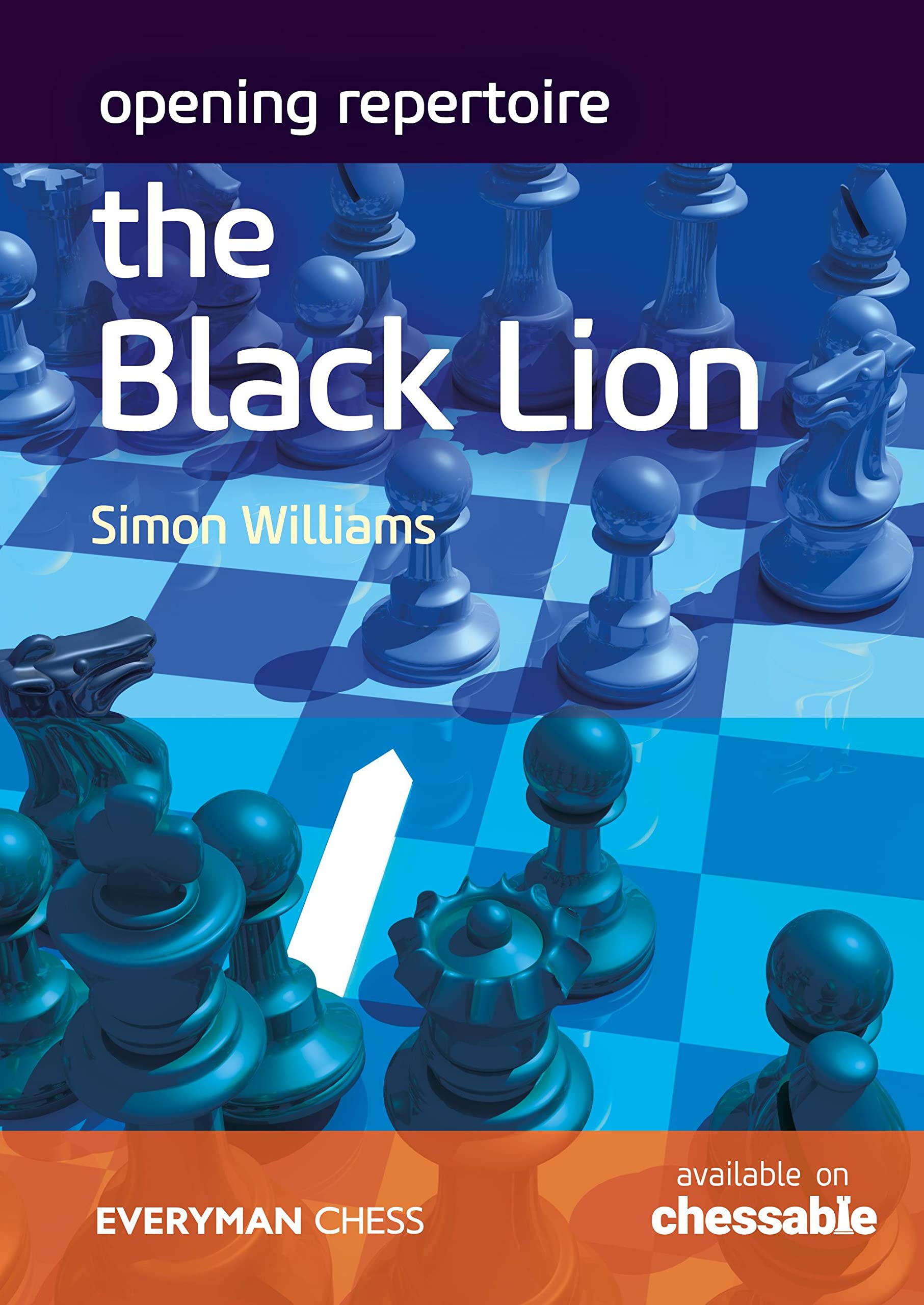
Here is the publishers blurb from the rear cover :
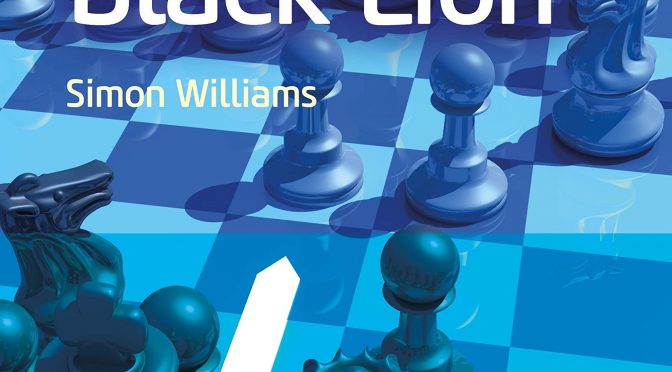
“The Black Lion is a thoroughly modern counterattacking system that is a nightmare to face. This wild and aggressive line attempts to take away White’s initiative from a very early stage and is guaranteed to throw your opponents off balance.
The Black Lion is essentially a contemporary and aggressive interpretation of the Philidor Defence (1 e4 e5 2 Nf3 d6). The Black Lion starts with a slightly different move order, 1 e4 d6 2 d4 Nf6 3 Nc3, and now the lion family splits into two different animals: the risky lion (3…Nbd7) or the tame lion (3…e5). Both treatments are thoroughly investigated in this book.
Simon Williams (the Ginger GM) is the ideal guide to explain how to whip up an extremely dangerous attack using either treatment. Williams is well known for his swashbuckling, attacking play and the Black Lion suits his style perfectly. His commentary and annotations are always instructive and entertaining. * The Black Lion is an unusual and dangerous system with little established theory. * White cannot rely on simple, safe moves as such a strategy is liable to be overrun. * The Black Lion is fun and exciting to play!”
About the author:
GM Simon Williams
“Simon Williams is a Grandmaster, a well-known presenter and a widely-followed streamer, as well as a popular writer whose previous books have received great praise. He is much admired for his dynamic and spontaneous attacking style.”
As with every recent Everyman Chess publication high quality paper is used and the printing is clear. Each diagram is clear as is the instructional text. Figurine algebraic notation is used throughout. The usual and reliable formatting from Brighton-based typesetter IM Byron Jacobs is employed.
The diagrams do not have a “to move” indicator or any kind of caption so you will need to work out for yourself how they relate to the text that they are embedded in. However, this is fairly obvious.
There is a helpful Index of Variations and an Index of completed games.
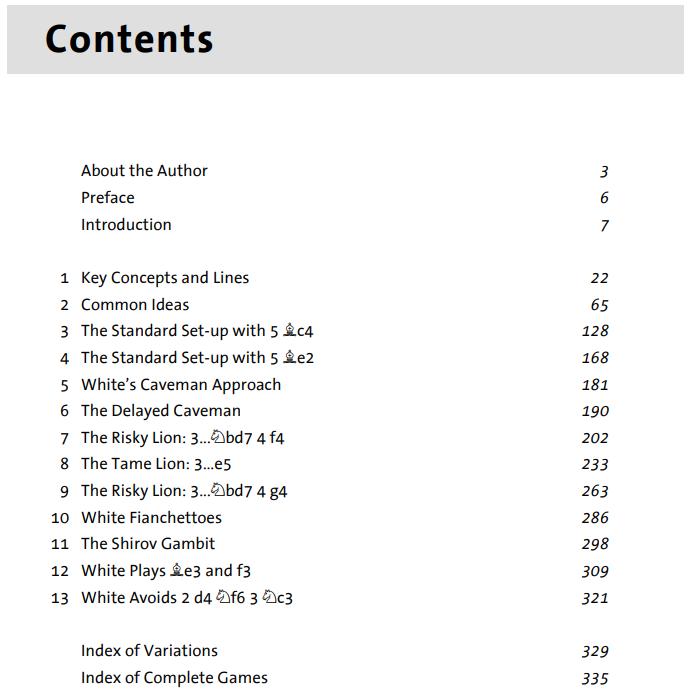
The table of contents is:
Opening Repertoire: Black Lion, Simon Williams, Everyman Chess, 15 Aug. 2022, ISBN-13 : 978-1781946282
Before we continue it is worth taking a look at the pdf extract which includes the Contents, Preface and pages 128 – 141.
(One thing to note is that despite being published in August 2022, the most recently played cited games are dated from 2019 and, essentially, we have a Chessable course migrated into physical book form. I can’t imagine that this task was straightforward for editor IM Richard Palliser.)
Overall, this book offers a repertoire for Black (against 1.e4 essentially but 1.d4 d6 2.e4 Nf6 could transpose of course) after White has played 3.Nc3 as follows:
and from here on in offering Black the choice of two main continuations which are closely related but which Black can make distinctly different.
We have
which most would characterise as The Modern Philidor rather than a Black Lion (so named in the wonderful The Black Lion: The Chess Predator’s Choice Against Both 1.e4 and 1.d4 by Jerry Van Rekom and Leo Jansen (New in Chess, 2008).
Alternatively Black can essay the more provocative
which you could also term a Modern Philidor or a Lion Defence depending on Black’s subsequent handling of the position.
The Black Lion and Modern Philidor diverge based on what Black does with the Queen’s knight. If Black castles short and leaves the knight on d7 (initially) then we probably have a Modern Philidor. Deferring castling, re-routing the d7 knight to f8, playing h6 and g5 and then the knight goes to g6 and then f4 really is The Black Lion proper.
Anyway, enough of my pedantic nomenclature rambling…
As implied the transpositional possibilities are numerous so organising the material cannot have been easy. One thing to note is that the author advocates 5…Be7 in the main line which is a move order improvement over the older 5…h6 Lion move order. The Introduction lays out the ‘philosophy’ of the approach clearly differentiating the 3…e5 and 3…Nbd7 choices and together with early games provides background knowledge for those new to this …d6 dark square system.
Chapter One: Key Concepts and Lines essentially clothes the skeleton created by the Introduction and includes ideas such as the once feared Shirov Attack:
which is detailed in Chapter 11.
Chapter Two: Common Ideas is the first real exposé of the key Lion idea and spends pages 65 – 128 and 14 full games detailing the really quite profound idea of rerouting the d7 knight to f4. Anyone new to the Lion should study this chapter carefully before moving on.
Chapter Three: The Standard Set-up with Bc4 takes as its starting position
in which Black has deferred castling to allow the knight relocation manoeuvre.
Chapter Four: The Standard Set-up with 5.Be2 allocates twelve pages on a line that probably will never be seen by most second players but will be of interest nonetheless.
A consequence of the move order advocated in Chapter three is that White may attempt various ‘capturing on f7 type hacks’ and these are treated in detail in Chapters Five and Six.
Arguably the most obvious attempt to refute the 3…Nbd7 move order is the aggressive 4.f4 dealt with in Chapter Four: The Risky Lion: 3…Nbd7 4 f4
and then …e5
As indicated Black may chose to go down the “Modern Philidor” (although the author refers to this as “The Tame Lion) route as in Chapter Eight with
covering in detail the queenless middlegame variations. The more common White choice of 4.Nf3 is assumed to be covered elsewhere such as Chapters Three to Six, or is it…?
Coverage is completed with Chapters on various g4 ideas by White plus insipid ideas such as g3 and f3.
In summary, The Black Lion is a welcome take on an increasingly popular dark square defence to 1.e4 with the accent on the trademark knight manoeuvre and deferred castling providing many lessons learnt from the 2008 book which introduced the idea.
I would argue that a chapter is missing on the so-called Tame Lion / Modern Philidor move order making Qc7 less desirable and I am thinking of
arising from a typical move order such as 1.e4 d6 2.d4 Nf6 3.Nc3 e5 4. Nf3 Nbd7 5.Bc4 Be7 6.00 00 7.a4 c6 which has 3465 games in MegaBase 2023. No doubt the author will argue that this position where White has tried around 20 (!) different 8th moves deserves an entire book in its own right and I would agree with that.
As a consequence of the migration of the contents from Chessable course to book (which cannot have made life easy for the editor!) there is degree of repeated déjà vu as one reads the same comments. Presumably this is measure of the Chessable philosophy of learning through reinforcement and would not normally happen in a “normal” physical book.
Bearing in mind my earlier comments regarding 2019 this book is a valuable addition to opening literature. Enjoy!
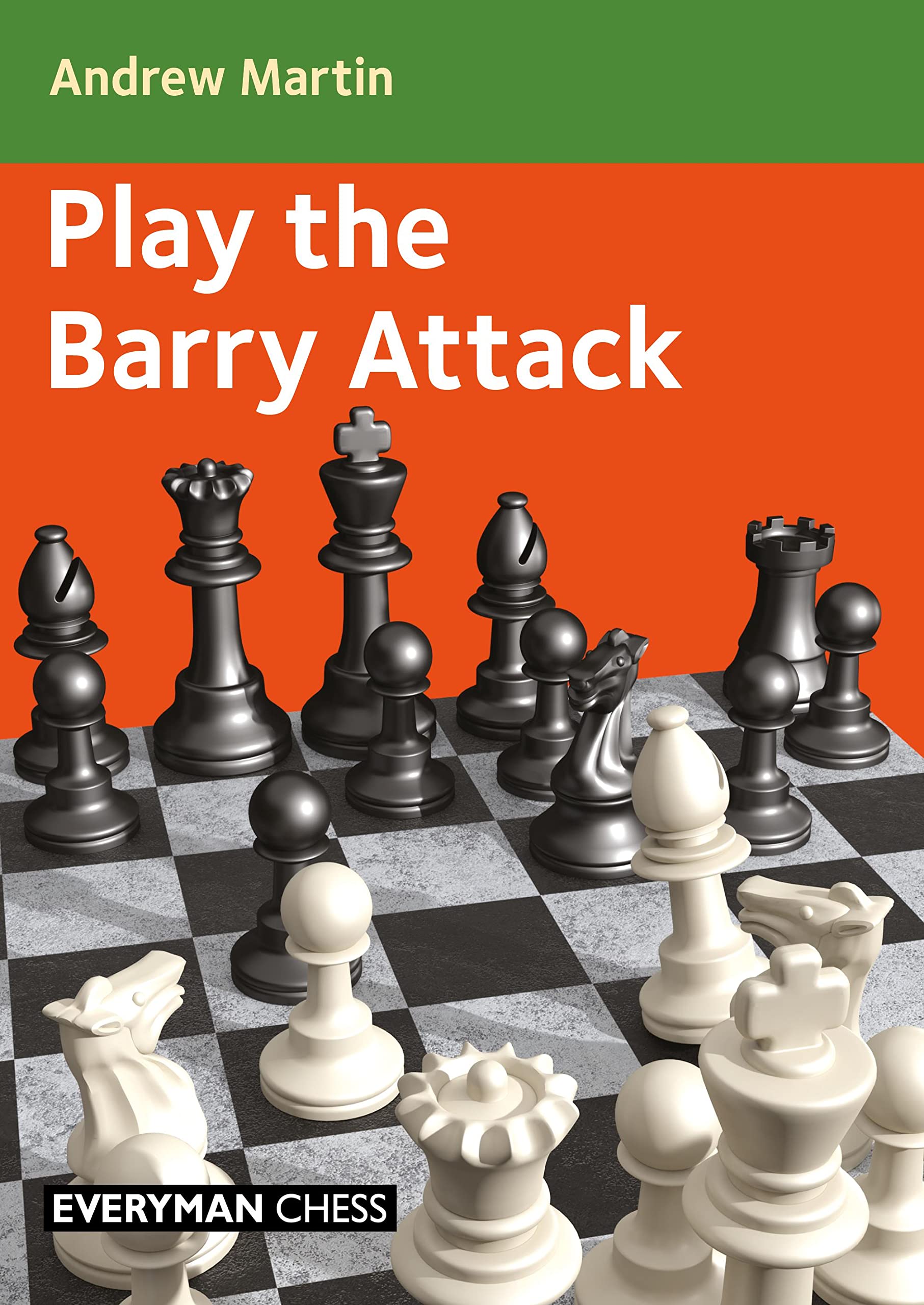
“The Barry Attack is a highly aggressive system that arises after 1 d4 Nf6 2 Nf3 g6 3 Nc3 d5 4 Bf4. Although the concept of the Barry Attack has been known for a century or so, the modern interpretation (as with a number of other dynamic white systems) has mainly been developed by English grandmasters over the past couple of decades. This “modern interpretation” is often not very subtle.
If Black provides a target by castling early on the kingside, White will often let rip with moves such as Qd2, Bh6, 0-0-0 and h4-h5, playing very directly for a quick checkmate. If this strikes you as too crude to have a chance against a sophisticated and competent defender, then a quick glance through this book will undoubtedly change your mind. You will witness countless games where very strong players are destroyed on the black side in less than 30 moves. Sometimes a lot less.
This makes the Barry an ideal weapon for those who love to attack. Black’s defence has to be very accurate. If not, a quick annihilation is on the cards. Play the Barry Attack is the ideal guide to this fascinating opening. Anyone who reads this book carefully and studies all White’s attacking ideas will have a fearsome weapon in their armoury.”
About the author:
IM Andrew Martin
“Andrew Martin is a FIDE Senior Trainer and International Master. He teaches in twelve schools, is an experienced chess writer and has produced numerous chess DVDs.”
And now on with the review:
As with every recent Everyman Chess publication high quality paper is used and the printing is easy to read. Each diagram is clear as is the instructional text. Figurine algebraic notation is used throughout. The usual and reliable formatting from Brighton-based typesetter IM Byron Jacobs is employed.
The diagrams do not have a “to move” indicator or any kind of caption so you will need to work out for yourself how they relate to the text that they are embedded in. However, this should be fairly obvious.
The cover of the paperback appears to be of thinner material than usual: We miss the versions with built-in book markers at each end.
There is a most helpful Index of Variations and an Index of completed games.
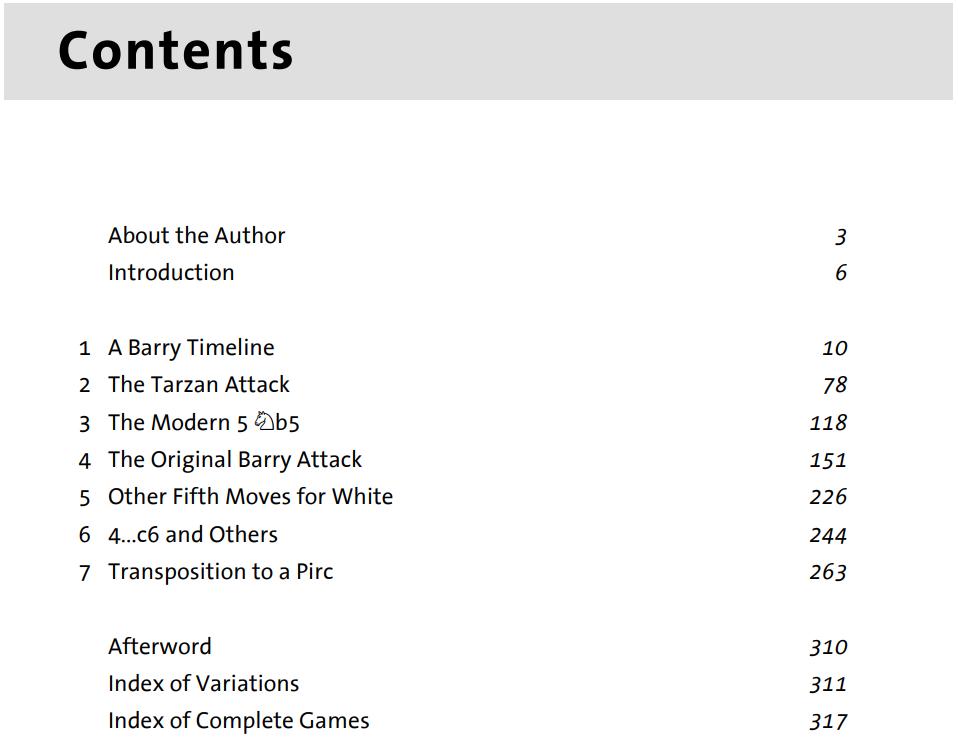
The table of contents is:
Play the Barry Attack: Table of Contents
Before we continue it is worth taking a look at the pdf extract which includes the Contents, Preface and pages 118 – 137.
At this point we feel the need to make a couple of small confessions: we have played the Barry (and 150/1800) Attacks with the White pieces (but not the Black side) for some years and and share an emotional bond with the opening. We have been friends with the author since we were both members of the famous CentYMCA chess club in Tottenham Court Road, London between 1978 and 1983.
It is worth noting that this book follows-on from the publication (July 2021) of a ChessBase DVD entitledThe Barry Attack (by the same author) which (we don not have but) is likely to provide a useful compliment to this book. However, the book contains more recent content.
We were disappointed not to find a bibliography of sources since we have a particular interest in the development of this opening. For example, there was not a single mention of Aaron Summerscale’s superb A Killer Chess Opening Repertoire, 1998, Everyman Chess, which was one of the first (if not the first) books to discuss The Barry in detail: never mind! Aaron also recorded a superb DVD for Foxy Openings (#7, Anti King-Indian & Grunfeld System) which is still worth watching even in 2023.
Chapter 1, A Barry Timeline is an in-depth history lesson on how the Barry (what was it called before George Hodgson named it? We presume the usual “Queen’s Pawn Opening” type label) developed by examining thirty games spanning from Tartakower – Wahltuch, 1922 to Sadhwani-Jones from 2022, one hundred years later. Fascinating stuff! If only more opening books bothered to do this it would give them a USP over their rivals.
The first real foray in explicit theory is via Chapter Two and the unlikely named Tarzan Attack (whoever gave it this epithet? Mark Hebden or Julian Hodgson perhaps?)
The Tarzan (or Lord Greystoke) is as subtle as a brick (rather akin to the 150 / 1800 Attack) and forms the basis for Chapter Two. We remember for some years that the Barry Attack section of GM Tony Kosten’s ChessPublishing.com and its associated forum had many posters swooning over 5.Qd2 and it soon became the line de rigeur. Of course, adequate resources were found for Black and these are examined in detail. The author tries his best to make 5.Qd2 playable and, of course, at club level (where anything goes according to Lombardy) it is worth a punt. Nineteen games are analysed and the most plausible and critical lines covered so you should be well prepared with either colour.
Chapter three (The Modern 5. Nb5) must be one of the first serious studies of what first appears to be “a bit of a patzer” line with the ambitious
which in 2023 is “all the rage” amongst Barry experts. Thirty-two pages are used to examine eleven games in detail and 5.Nb5 would appear to be a most playable and intriguing line. Almost certainly the first player will be more up-to-date than the second so well worth a try!
For many Barry die-hards Chapter Four (The Original Barry Attack) will be their first port of call to refresh their knowledge. At Seventy-Five pages and thirty-four examined games this is the most substantial chapter covering the most interesting struggles starting with
The author provides a balanced approach showing reliable methods for Black’s defence. Conclusions: you will have to purchase the book to find out what these are!
Chapter Five (Other fifth moves for White) tidies things up with seventeen pages and seven games. This material will mainly be of interest to the second player but there are some idea based around early h4 attempts by White.
The sixth Chapter (4…c6 and Others) will be of interest to the first player since it contains arguably less critical tries for Black where an early …c5 is punted. All good for completeness of course.
Chapter Seven (Transposition to a Pirc) might at first glance be discussing the 150 / 1800 Attack that a Barry move order can become.
However, appearences are deceptive and it contains forty-six pages and twenty-one games where White continues with 5. Bf4 against a Pirc type structure.
(whereas the more common approach would be
which is subtly different)
This is likely to be a good choice against a King’s Indian / Pirc player who is likely not to be familiar with the set-up. I’m not sure these positions have been given a detailed treatment such as this in the literature previously. Interesting stuff!
All in all “Play the Barry Attack” is a welcome and fresh treatment with much original analysis from real games. The author has and continues to be a supporter of lines developed by British players such as the Barry.
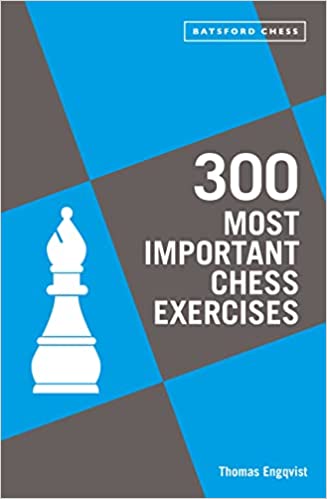
300 Most Important Chess Exercises, Thomas Engqvist, Batsford (5 May 2022), ISBN-13 : 978-1849947510
From the Batsford web site:
“An informative and accessible new book by Thomas Engqvist, the practical follow up to his previous two authoritative chess books: 300 Most Important Chess Positions and 300 Most Important Tactical Chess Positions.
Filled with 300 engaging chess exercises and complete solutions in the end of the book, this book will allow you to apply and consolidate your newfound knowledge. The book is divided into four key sections: ·75 exercises practising positional ideas in the opening/middlegame ·75 exercises covering the endgame ·75 tactical exercises in the opening/middlegame ·75 tactical endgames.
The exercises featured in the book are taken from real game positions from various renowned chess players, including Capablanca and Magnus Carlsen.”
About the Author:
“Thomas Engqvist is an International Master from Sweden. He has over 30 years’ experience as a chess coach and teacher. He has worked with players at world championship level in both junior and correspondence chess. He is the author of 300 Most Important Chess Positions and 300 Most Important Tactical Chess Positions, both published by Batsford.
From the back cover:
In-depth analysis of the 300 most important exercises according to the famous principle “less is more”. The less you study the less you forget.
Practice the most important positional and tactical ideas in all phases of the game by solving just five positions every week for one year.
Find out if the positional or tactical idea crops up in your mind, regardless of whether you have seen the idea before or not.
Well, if you solve five positions every week it will take you 60 rather than 52 weeks to complete the book, but never mind. The claim that you’ll improve more by studying less is also rather silly: the real point is that the quality rather than the quantity of your study is important.
It continues:
In this highly instructive exercise book, International Master and experienced chess coach Thomas Engqvist outlines the 300 most important chess exercises. A sequel to 300 Most Important Chess Positions and 300 Most Important Tactical Chess Positions, this is the perfect manual for players who want to reach a higher level but don’t have the time to spend hours every week on less productive study.
Each numbered position is a test-yourself quiz to help cement the positional and tactical understanding that you have acquired. This book can be your life-long companion, enabling you to apply and solidify your positional and tactical chess knowledge.
Swedish International Master Thomas Engqvist has almost 40 years experience as a chess coach, teacher, writer and player. He has successfully worked with players at world championship level in both junior and correspondence chess. He works as a teacher at a school outside Stockholm. He is the author of eight chess books. This is his third book for Batsford Chess.
Yes, I get the point. Not everyone who wants to improve has the sort of time to spare that would be required to benefit from a book like this. Most of us have other commitments: just solving five exercises a week might be ideal. And what about the title? Are these exercises more important than the positions in the previous books? Who is to determine importance anyway. An exercise that’s important to me might not be important to you.
Let’s see what the author has to say in his introduction.
300 Most Important Chess Exercises starts off with 150 opening and middlegame positions to solve and the quota is 75 exercises where you practice positional ideas, and 75 exercises where the focus is on tactics. The other half of the book deals with 75 positional endings and 75 tactical endings. This is the only hint the solver will get.
This, then, is the final volume of a trilogy, with exercises based on the material in Engqvist’s two earlier Batsford books. If you’ve read and enjoyed them (sadly, I haven’t) you’ll undoubtedly want this as well. However, the author points out that it’s not necessary to have read them to read and benefit from this book.
The back cover claims that it’s a Universal book – suitable for players of all strengths.
No, it’s not. There’s an assumption that readers are proficient players with a good understanding of the game – say about 1500 strength. At the same time, some of the exercises will be familiar to more experienced players. I’d put the target range for this book, then, as in the region of 1500-2000 rating, although slightly weaker and slightly stronger players may also benefit.
I found Engqvist’s comments on the very first position in the book particularly interesting.
This is from a Morphy – Schulten game (New York 1857) with White to play.
White played 10. Bf4 here, but was it best? What would you suggest?
Engqvist:
Morphy claimed his 10th move was an improvement on 10. Qxd6 which was given in the leading treatises of the day (Hanstein – von der Lasa in Staunton’s “Handbook”). However this is not true if one consults the computer programs Komodo and Stockfish. It’s good to capture the d6-pawn as long as White can maintain pressure on the d-file. What’s more is that there is an even better move, suggested by both computers, namely 10. Nc3!. This is very interesting since Komodo makes good evaluations and Stockfish is good at deep calculations, but they still come up with the same move!
This simple Knight move also follows Lasker’s principle that a knight should be developed before the bishop. The idea is to prepare Bf4 next move without allowing the d-file to be closed after …d5 . Morphy played according to the principle of development so his move is understandable, but the computers’ choice is the most precise. Even if we do know that development is on the agenda, we must also think carefully which piece to move first.
This tells you a lot about the author. Here we have someone who is well versed in chess history and culture, but also able to use modern technology effectively. Beyond that he has the ability to explain abstact concepts clearly and unambiguously.
Although that example may have been familiar to you if you’ve studied Morphy’s games, there are other exercises which you almost certainly won’t have seen before. Like this one, number 79, so it’s a tactical puzzle.
What would you play for White here?
This is from the less than Famous Game Kludacz – Pavlovskaya (Hasselbacken Open (Women) Stockholm 2001).
The whole game is interesting for anyone playing the Queen’s Gambit with either colour. White has launched a Minority Attack and now continued with 21. e4? which Black met with Bxh3!?, eventually winning the game.
Did you see how she could have done better?
21. h4! Ne6 22. Nce4!!
Presumably Kludacz missed the following knight sacrifice…
22… dxe4 23. Nxe4
White exploits the tactical weaknesses on f6 and c6. Black has no effective defence.
23… Qc7
If 23… Qe7 then 24. Qxc6
24. Nf6+ Kf8
White doesn’t need to cash in on f8 but can exploit the pin on the c-file.
25. d5!
Now Black’s position collapses and White wins.
Helpfully, Engqvist provides the whole game here so that readers can see how the position arose from the opening.
The second half of the book covers endgame exercises. Like other authors such as Judit Polgar and RB Ramesh, whose books I’ve reviewed recently, Engqvist believes that solving endgame studies is a very valuable form of chess training, so here we have a mix of studies and positions from practical play. He finds pawn endings especially fascinating, so there are plenty here.
Take this one, for example.
It’s White to play here (Kalinicev – Schulz Cham 1992). What would you suggest.
I guess most players, like me, would play 1. Ke7 here without a second thought, but it’s not the correct answer.
Engqvist:
The first time I saw this endgame I wrote in my private annotations that it’s “incredible that this move doesn’t win!” From a visual point of view it certainly seems that White’s king will wipe out the whole kingside of pawns like a vacuum cleaner, but that turns out to be an optical illusion. The key move to winning is to play according to Nimzowitsch’s rule, which states that you should hem in the target before blockading it and only then destroy it!
1. g4! would have prevented Black from moving his f-pawn to f5. Then 1… Kd3 2. Ke7 f6 3. Kf7 Ke2 4. f4 Kf3 5. f5. The f-pawn is now blockaded and a future attacking target. 5… Kg3 6. Kxg7 Kxh3 7. Kxh7 (7. Kxf6 Kxg4 8. Ke6 also wins but it’s unnecessary to give Black some hope even though that would be futile.) 7… Kxg4 8. Kg6 and White’s f-pawn decides.
Instead, the game concluded:
1. Ke7? f5 2. Kf7 Kd3 3. Kxg7 f4!! 4. Kxh7 Ke2 5. g4 Kxf2 6. g5 f3 7. g6 Kg3! 8. g7 f2 9. g8=Q+ Kxh3 with a drawn position because an eventual Qg3+ will be met by Kh1.
If you mistakenly went for Ke7 here then this may well be the book for you.
It does beg a question, though. This is billed as a positional endgame exercise, which it undoubtedly is, but it’s certainly tactical as well.
Of course positional and tactical chess are inextricably entwined, and, by the time you get to the ending, they’re really the same thing. The whole idea of splitting endgame exercises into ‘positional’ and ‘tactical’ seems very artificial to me. I’d guess this was the publisher’s rather than the author’s decision.
You probably hadn’t seen that position before (it’s not even in MegaBase), but if you’ve read anything on pawn endings you’ll almost certainly have seen the Famous Ending Cohn – Rubinstein (St Petersburg 1909), which you’ll also meet here. “If you only study one endgame with many pawns this is the one”, according to Engqvist, who discusses it over two pages. Regular readers of endgame manuals will find several other old friends as well: there’s six pages devoted to another Famous Ending, Timman – Velimirović (Rio de Janeiro 1979), to take just one example. Exercises 212-214 cover the ending of RB v R: the solutions cover 11 pages: extremely useful if you want to learn this ending, but I guess it’s debatable how important it is for average club players.
Here’s a quick endgame study from the last section of the book: tactical endgame exercises. See if you can solve it yourself before reading on.
White to play and draw (Prokes 1939)
A very game-like position, you’ll agree, and you were probably brought up with the knowledge that, in the absence of kings, two pawns on the sixth rank beat a rook.
In this instructive study, White’s king, contrary to appearances, is just about close enough.
I hope you managed to solve this. But was it purely tactical or positional as well? What do you think?
To sum up, then, it’s very clear from this book that Thomas Engqvist is an exceptional teacher, who, like all exceptional teachers, knows exactly what he’s doing and why he’s doing it. Unlike some less experienced authors he doesn’t just throw a load of GM positions at you, show you a pile of computer generated variations and expect you to play like Carlsen.
To refer again to two other excellent books I’ve reviewed recently, if you find Ramesh too heavy and Polgar’s exciting enthusiasm grating, I’m sure Engqvist will hit the sweet spot for you. In that case you’ll probably want to investigate his two earlier Batsford books as well, and perhaps read them first. As the authors take very different approaches and cover different topics, ambitious club players would do well to buy both Polgar and Engqvist. Young players who are aiming for IM or GM titles and have plenty of time to study would, on the other hand, be better off with Ramesh.
I’m just not sure that the format of the book is the best way to present Engqvist’s material, especially since endgames are both positional and tactical at the same time. (What the best format actually would be is an interesting question: different readers will prefer different formats. If you really, as Engqvist does, want to make the training environment resemble a tournament game you might want to mix the positions up rather than give a clue as to whether it’s a positional or tactical exercise.) I’m also not sure that the subtitle ‘Study five a week to become a better chess player’ is particularly helpful or realistic. Some of the positions require little time and explanation while others require a lot. The author himself doesn’t suggest in his introduction that this is the best way to use his book. As I suggested above, this book, notwithstanding the claims on the back cover, is far too advanced for beginners, but would be a great choice for anyone rated in the region of 1500-2000, or perhaps a bit higher.
But of course publishers do whatever it takes to sell copies, including resorting to unhelpful titles and unrealistic claims, and people don’t always buy chess books for rational reasons. Which is why it’s a good idea to read impartial reviews first.
The book is published to Batsford’s usual standards and appears to be free from the typos that mar books by some other publishers. The English might not always be totally idiomatic but is perfectly comprehensible throughout. I note that there is no mention of translators or proofreaders at the front of the book.
A book by an outstanding teacher, then, and, if the style and contents appeal to you, very highly recommended for club standard players ambitious to improve their rating.
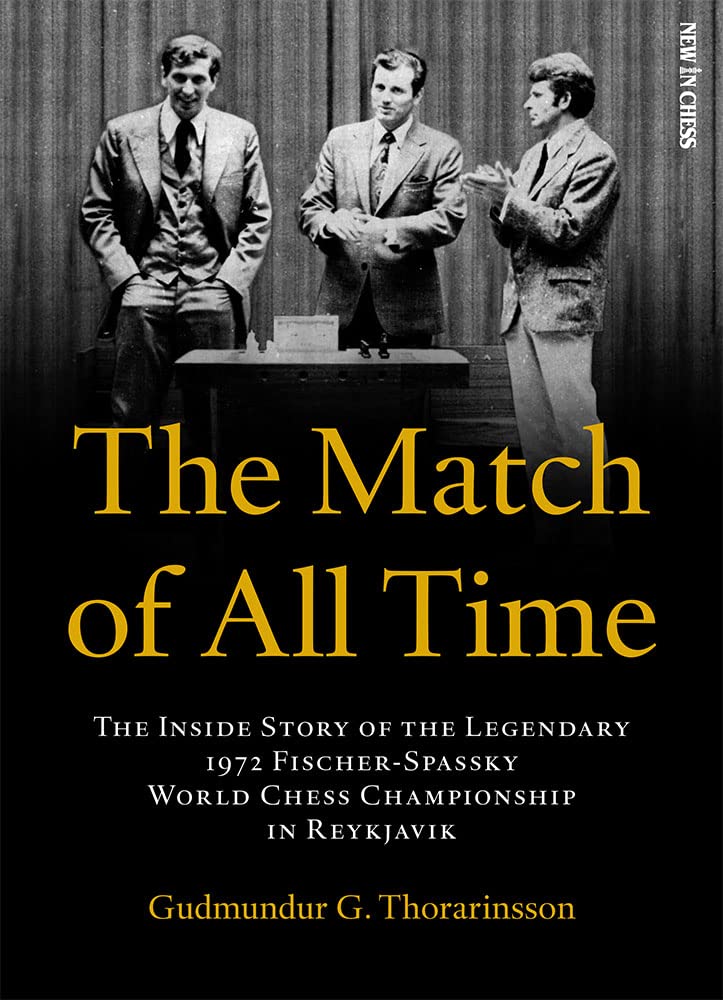
The Match of All Time: The Inside Story of the legendary 1972 Fischer-Spassky World Chess Championship in Reykjavik, Gudmundur Thorarinsson, New In Chess (30 Jun. 2022), ISBN-13 : 978-9493257474
From the publisher:
“When the Icelandic Chess Federation made a bid to host the 1972 world title match between Soviet icon Boris Spassky and American challenger Bobby Fischer, many Icelanders were rightly shaking their heads in disbelief. How could their small island country in the middle of the Atlantic Ocean with a population of less than 300 thousand people stage such a prestigious event in the first place?
“Undeterred and naively optimistic, the young President of the Icelandic Chess Federation, Gudmundur Thorarinsson, set to work and to everyone’s astonishment theirs was the winning bid. But that was only the beginning of one of the most amazing stories in chess history… Bobby Fischer’s demands and whims constantly jeopardised the match. First the American chose not to board his plane in New York, and then he came late for the first game. That game he lost after a silly blunder and the second game he lost because he didn’t turn up in a fight about noisy cameras. But next he won the third game, that was played in a back room, and the rest…. is history.
“Fifty years on, Gudmundur Thorarinsson has written a tell-all book about ‘The Match of the Century’, crammed with behind-the-scenes stories and improbable twists and turns. Reading his gripping account of probably the most iconic sports contest during the Cold War, you will understand why he prefers to call it ‘The Match of All Time’. And why reliving this most unlikely adventure he comes to the conclusion: ‘It was not possible to organise this match, nor was it possible to rescue it…but still it was done!'”
“Gudmundur Thorarinsson is a chess organizer and businessman from Iceland. In 1972, as the chairman of the Icelandic Chess Federation he organized the Match of All Time, the World Championship Match between the Russian incumbent champion Boris Spassky and the American challenger Bobby Fischer.”
Half a century on from the legendary Fischer – Spassky World Championship match, and still the books keep on coming.
From Chapter 1 (Prologue):
Why write another book about the World Chess Championship match in 1972? Approximately 140 books have been published about the match already, plus films, TV and radio programs, newspapers and magazine articles. To add another book to this list seemed too much to me. But many people have been encouraging me to write about the match, people working for radio and television, chess players and friends. But many have simply said: ‘We still do not have a book written by someone who was working behind the scenes, where the bombs were falling.
One thing is certain: a long time ago this match acquired a life of its own. Nowadays people tend to look at the course of events from a different perspective. Looking at the match from afar enables the observer to put the whole saga into another context, broadening the horizon, so to speak. It may be true that the viewpoint and experiences of those of us who were on the frontline during the planning and execution of the event have not been widely documented. Those who wrote about the match in the following months, or even years after it happened, did so mostly by annotating the games, explaining the battle from the perspective of the chess players or the audience.
If you’re looking for the games of the match you’ll be disappointed: but of course they are readily available elsewhere.
What you have instead is a source document telling the story of what was going on in the background, written by someone who was there and very closely involved at the time.
The book is designed to be interesting to the general reader as well as the chess specialist. Chapter 2, therefore, looks at the origins of chess, including a contribution from GM Fridrik Olafsson, an expert in this field, and, specifically, the early history of chess in Iceland.
Chapter 3 relates the history of the world chess championship prior to Spassky, starting with Stamma and Philidor, and taking us as far as Petrosian. There is little here that will be new to readers familiar with chess history.
Chapter 4, on the prelude to the 1972 match, is where things start getting interesting. We read about Fischer’s wins in his Candidates Matches against Taimanov, Larsen and Petrosian before being introduced to the two protagonists, with background information about their family, upbringing and chess career. Then the bidding process for the match venue is discussed, with Iceland, a small country in the Atlantic Ocean, but with a proud chess history, unexpectedly being selected.
The author of this book had, as a young man, been appointed President of the Icelandic Chess Federation in 1969. He had been proposed in his absence by his brother and not wanting to cause embarrassment, felt he had no choice but to accept. As a result, he found himself in the middle of negotiations which would have a dramatic effect on the history of chess.
Chapter 5, the longest in the book, covers the match itself in fascinating and engrossing detail. Everyone who was interested in chess at the time will have vivid memories of Fischer’s demands and conditions, and of the problems and arguments these caused. Thorarinsson was at the heart of everything that was happening, and it was to no small extent due to his diplomatic skills, often described here in a self-deprecating way, that the match eventually started and, more or less successfully, concluded with Bobby as the new World Champion. There’s a lot of documentary material here which will be new to many readers.
Chapter 6 describes the aftermath of the match. Fischer’s life over the next three and a half decades is related, including his return match with Spassky in 1992. Bobby spent the last few years of his life in Iceland, and Thorarinsson was again very much involved with expediting his journey from a Japanese detention centre, and with helping him settle in for what would be his rather sad endgame.
This and the final section, the author’s tribute to his friend, which he delivered at Fischer’s memorial service, are both intensely moving.
If you’re looking for chess moves, this won’t be the book for you. But if you want to know more about Fischer, and about the background to the 1972 match, it will be an essential purchase.
The book is, like everything from this publisher, beautifully produced and copiously illustrated with photographs and cartoons. There are many entertaining and enlightening anecdotes to keep you amused as well. It’s a great story, reminiscent of a Greek tragedy, and well told here from the author’s unique perspective. Whether or not you’re familiar with what happened half a century ago, you’ll find it a gripping read.
Do bear in mind, though, that while it may be an important source document for future historians (and we really need a fully sourced and referenced biography of Fischer) it’s a memoir with its fair share of uncertainty and speculation. You read that ‘Harry Golombek states in one of his books…’: yes, but which one? Or, to take another example, ‘According to some sources…’. Which ones?
I have a few other issues, just as I do with many New in Chess books, essentially coming down to the fact that it could have benefitted from a firmer editorial hand and a final read-through from a native English speaker. There are odd words and sentences that are not quite idiomatic. There’s also a certain amount of repetition (Fischer’s parentage is discussed on page 82, and again on pages 90-92) and one or two places where I felt continuity might have been improved.
Nevertheless, this book is essential reading for anyone with an interest in Fischer as a person, or in the 1972 Fischer – Spassky match. If the subject matter appeals to you, and, if you have any interest at all in chess culture and history, it undoubtedly will, don’t hesitate.
You’ll find pricing and other details here and sample pages here.
The Match of All Time: The Inside Story of the legendary 1972 Fischer-Spassky World Chess Championship in Reykjavik, Gudmundur Thorarinsson, New In Chess (30 Jun. 2022), ISBN-13 : 978-9493257474
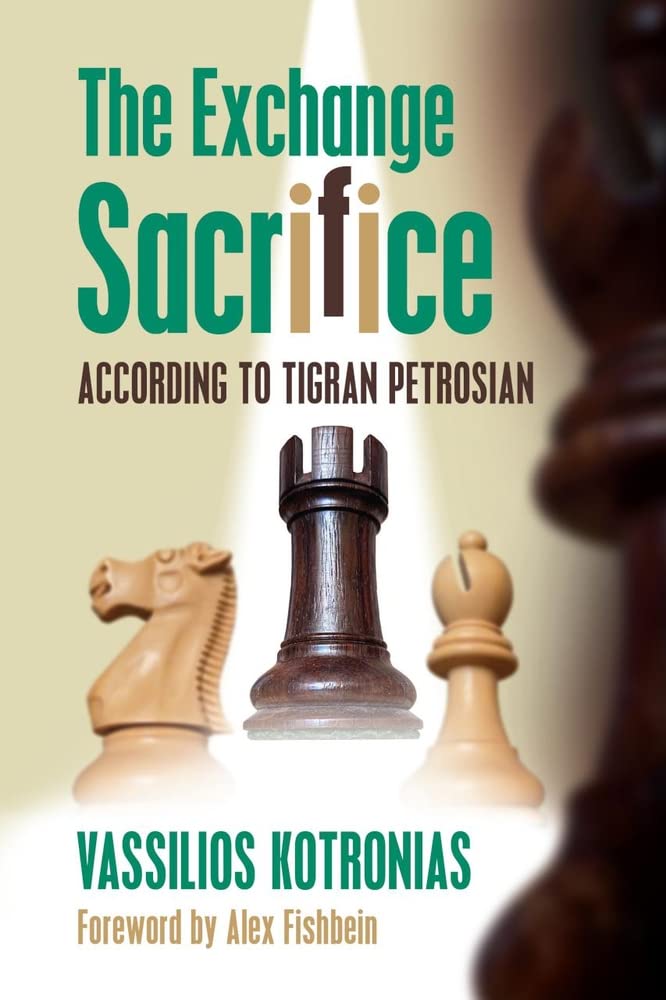
The Exchange Sacrifice According to Tigran Petrosian, Vassilios Kotronias, Russell Enterprises, 15th September 2022, ISBN-13 : 978-1949859485
From the rear cover :
“Tigran Petrosian, the ninth world chess champion, was one of the deepest thinkers the chess world has ever seen. His handling of complex positions was legendary.
With his rare strategic feeling and exceptional vision, Petrosian gradually became one of the top exponents of the art of the exchange sacrifice, and perhaps the leading protagonist for the positional exchange sacrifice.
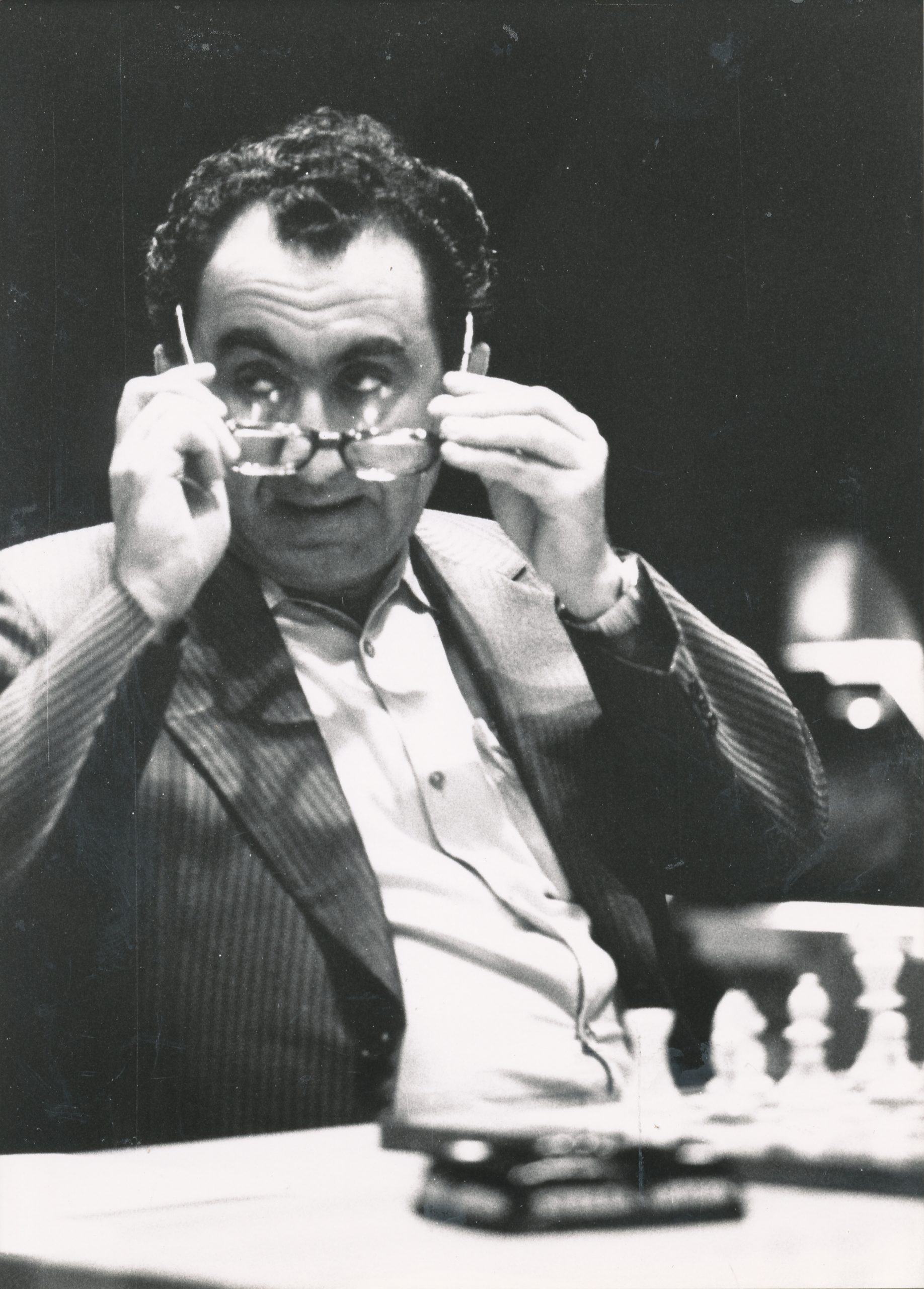
Tigran Vartanovich Petrosian
Acclaimed author Vassilios Kotronias has assembled a splendid collection of Petrosian’s games, exemplifying the artist at work. The Greek grandmaster presents 36 games – all deeply annotated – in which he puts the Tiger’s signature sacrifice under the analytical microscope. And each game has an exceptional introduction putting it into historical perspective.
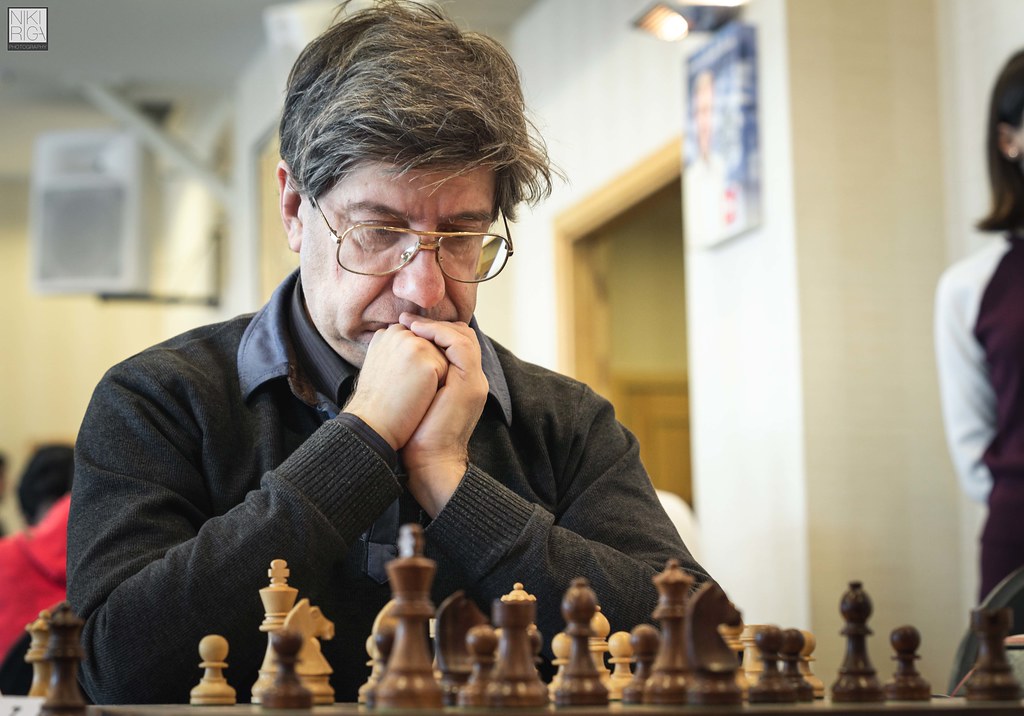
Flickr Vasilios Kotronias | Photo by Niki Riga | Gibraltar International Chess Festival | Flickr
As noted by American grandmaster Alex Fishbein in the Foreword:
You will find your share of positional exchange sacrifices here. But you will also see exchanges sacrificed in the midst of a crushing attack. You will see sacrifices born of desperation, to save a bad ending. You will see correct and incorrect sacrifices. In fact, Tigran Petrosian will lose some games here. This is real life; there are mistakes, and the author explains it all to you.
Vassilios Kotronias has brought you the material in a way that will enhance your appreciation of chess as an art form. He has also offered you practical lessons you can use in your own chess endeavours.
You are already familiar with the exchange sacrifice as an art form. Now enjoy the brilliant games of its greatest artist, Tigran Petrosian.”
About the Book
This is a very interesting and enjoyable book.
It is also a very unusual, or rather original, book in that it focuses on a specific facet of one great player’s handling of chess positions. Certainly there are books dedicated, say, to Tal’s attacks or Karpov’s endgame play, but it is difficult to think of other books with such a specific subject based on a single player. All of which makes Kotronias’ book all the more enticing to look at. Plus, of course, it is a facet of the game for which Petrosian was justly famous.
As stated in the blurb above, the bulk of the book (257 of the 304 pages) is devoted to 36 annotated games, presented in chronological order spanning the years 1947-1980. Many of the games feature the strongest possible opponents from those times, eg Spassky, Botvinnik, Smyslov, Tal, Gligoric, Fischer, Hubner, Korchnoi amongst others. The book also gives the unannotated scores of a further 88 games. Kotronias does this for three reasons:
1 completeness ;
2 to give the reader food for thought (he invites readers to analyse the games without initially using computer assistance) ;
3 aesthetics! As Kotronias puts it: “Many of the examples which follow are true gems of sacrificial play and a treat for the eye”.
A nice touch is that these games, although unannotated, have a diagram near the point where the exchange sac occurs, so that readers who are too lazy for reason 2 can at least appreciate reason 3!
The book also includes:
– an Introduction by the author, which adds another annotated game (less deeply than the others) – the famous Reshevsky-Petrosian exchange sac (…Re6!)
– a nice foreword by GM Alex Fishbein ;
– an index of players ;
– an index of openings (ECO codes, not names).
Kotronias’ Style of Annotation
The annotated games, to a greater or lesser extent, follow a pattern:
– an introduction, of varying length, which puts the game into its sporting and historical context and provides an overview of the game;
– the whole game itself is analysed, especially the middlegames and most deeply around and after the exchange sac;
– a short epilogue where the author sums up the game, and often draws conclusions that can be applied more widely.
Despite his evident admiration for Petrosian, Kotronias’ annotations are objective. Indeed, some of the annotated games are losses for Petrosian, and in other games the author points out when the exchange sac was unsound (or a second-rate choice) even when Tigran prevailed.
As befits a player of Kotronias’ strength (he was regularly in the world’s top 100 players in the 2000’s, with a 2600+ rating) his analysis is sometimes very deep, but he favours explanations over lengthy variations, reserving the heavy analysis for the most complex positions. Indeed, he is a very readable annotator.
Example Game Annotation
Anyway, here is an excerpt, taken from the famous Petrosian-Spassky 1966 match, game 10:
Other quotes from the book
In the intros and epilogues to the games, Kotronias makes a number of observations, some of them quite repeatable, for example:
“Choosing the right way to attack requires perhaps a greater sense of danger than the one required to choose the best way of defence.”
“We should never forget that we are only human beings and not machines, and thus, as long as players of approximately the same level compete, psychology and energy will always play a small or bigger role for the final outcome. A trivial thought, but the exceptional depends on a number of trivial factors, do you not think?”
Conclusion
“I sincerely hope that you will find the games presented in this book not only enjoyable, but instructive.” writes the author in his introduction.
Well, this reviewer always enjoys well-annotated game collections of great players which are written by an engaging writer, and this book hits the mark in all these respects.
The theme is an interesting one (in both parts, Petrosian and the exchange sac) and the selected games are fascinating. The book isn’t a formal study of when/why exchange sacrifices work and when they don’t (perhaps the point is that knowing this comes from accumulated experience, calculation and judgement) but it is easy to believe that study of these games will help players improve their judgement in this area.
There is something in this book for a wide range of playing strengths and is highly recommended.
The Exchange Sacrifice According to Tigran Petrosian, Vassilios Kotronias, Russell Enterprises, 15th September 2022, ISBN-13 : 978-1949859485
We focus on the British Chess Scene Past & Present!
This website uses cookies to improve your experience. We'll assume you're ok with this, but you can opt-out if you wish. Cookie settingsACCEPT
Privacy & Cookies Policy
Privacy Overview
This website uses cookies to improve your experience while you navigate through the website. Out of these cookies, the cookies that are categorized as necessary are stored on your browser as they are as essential for the working of basic functionalities of the website. We also use third-party cookies that help us analyze and understand how you use this website. These cookies will be stored in your browser only with your consent. You also have the option to opt-out of these cookies. But opting out of some of these cookies may have an effect on your browsing experience.
Necessary cookies are absolutely essential for the website to function properly. This category only includes cookies that ensures basic functionalities and security features of the website. These cookies do not store any personal information.