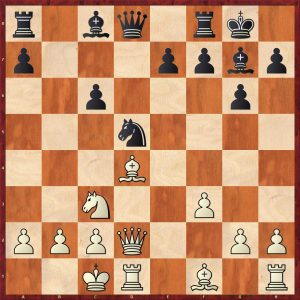
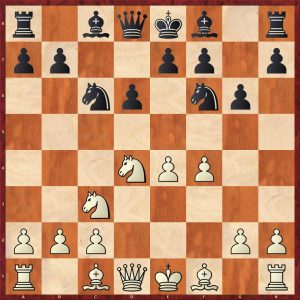
The Exchange Sacrifice According to Tigran Petrosian, Vassilios Kotronias, Russell Enterprises, 15th September 2022, ISBN-13 : 978-1949859485
From the rear cover :
“Tigran Petrosian, the ninth world chess champion, was one of the deepest thinkers the chess world has ever seen. His handling of complex positions was legendary.
With his rare strategic feeling and exceptional vision, Petrosian gradually became one of the top exponents of the art of the exchange sacrifice, and perhaps the leading protagonist for the positional exchange sacrifice.
Tigran Vartanovich Petrosian
Acclaimed author Vassilios Kotronias has assembled a splendid collection of Petrosian’s games, exemplifying the artist at work. The Greek grandmaster presents 36 games – all deeply annotated – in which he puts the Tiger’s signature sacrifice under the analytical microscope. And each game has an exceptional introduction putting it into historical perspective.
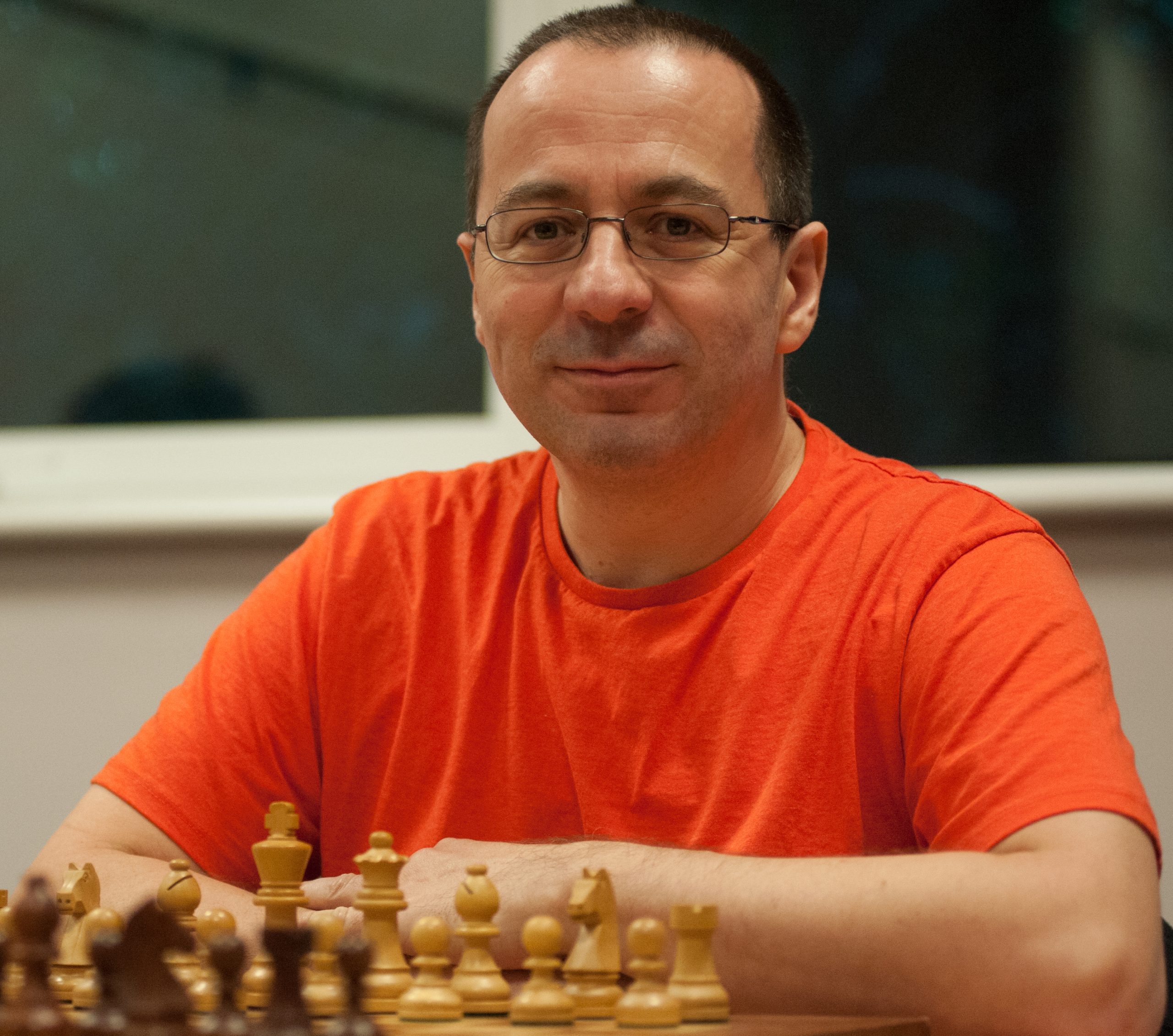
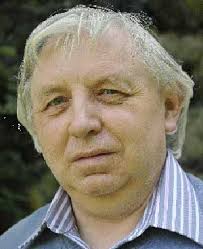
Flickr Vasilios Kotronias | Photo by Niki Riga | Gibraltar International Chess Festival | Flickr
As noted by American grandmaster Alex Fishbein in the Foreword:
You will find your share of positional exchange sacrifices here. But you will also see exchanges sacrificed in the midst of a crushing attack. You will see sacrifices born of desperation, to save a bad ending. You will see correct and incorrect sacrifices. In fact, Tigran Petrosian will lose some games here. This is real life; there are mistakes, and the author explains it all to you.
Vassilios Kotronias has brought you the material in a way that will enhance your appreciation of chess as an art form. He has also offered you practical lessons you can use in your own chess endeavours.
You are already familiar with the exchange sacrifice as an art form. Now enjoy the brilliant games of its greatest artist, Tigran Petrosian.”
About the Book
This is a very interesting and enjoyable book.
It is also a very unusual, or rather original, book in that it focuses on a specific facet of one great player’s handling of chess positions. Certainly there are books dedicated, say, to Tal’s attacks or Karpov’s endgame play, but it is difficult to think of other books with such a specific subject based on a single player. All of which makes Kotronias’ book all the more enticing to look at. Plus, of course, it is a facet of the game for which Petrosian was justly famous.
As stated in the blurb above, the bulk of the book (257 of the 304 pages) is devoted to 36 annotated games, presented in chronological order spanning the years 1947-1980. Many of the games feature the strongest possible opponents from those times, eg Spassky, Botvinnik, Smyslov, Tal, Gligoric, Fischer, Hubner, Korchnoi amongst others. The book also gives the unannotated scores of a further 88 games. Kotronias does this for three reasons:
1 completeness ;
2 to give the reader food for thought (he invites readers to analyse the games without initially using computer assistance) ;
3 aesthetics! As Kotronias puts it: “Many of the examples which follow are true gems of sacrificial play and a treat for the eye”.
A nice touch is that these games, although unannotated, have a diagram near the point where the exchange sac occurs, so that readers who are too lazy for reason 2 can at least appreciate reason 3!
The book also includes:
– an Introduction by the author, which adds another annotated game (less deeply than the others) – the famous Reshevsky-Petrosian exchange sac (…Re6!)
– a nice foreword by GM Alex Fishbein ;
– an index of players ;
– an index of openings (ECO codes, not names).
Kotronias’ Style of Annotation
The annotated games, to a greater or lesser extent, follow a pattern:
– an introduction, of varying length, which puts the game into its sporting and historical context and provides an overview of the game;
– the whole game itself is analysed, especially the middlegames and most deeply around and after the exchange sac;
– a short epilogue where the author sums up the game, and often draws conclusions that can be applied more widely.
Despite his evident admiration for Petrosian, Kotronias’ annotations are objective. Indeed, some of the annotated games are losses for Petrosian, and in other games the author points out when the exchange sac was unsound (or a second-rate choice) even when Tigran prevailed.
As befits a player of Kotronias’ strength (he was regularly in the world’s top 100 players in the 2000’s, with a 2600+ rating) his analysis is sometimes very deep, but he favours explanations over lengthy variations, reserving the heavy analysis for the most complex positions. Indeed, he is a very readable annotator.
Example Game Annotation
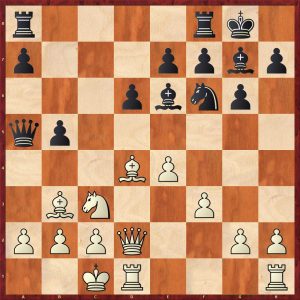
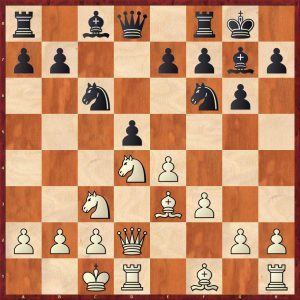
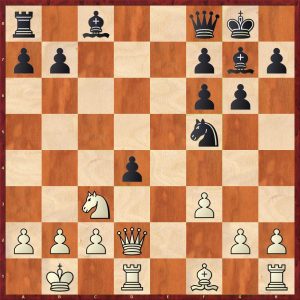
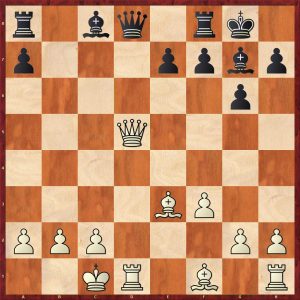
Anyway, here is an excerpt, taken from the famous Petrosian-Spassky 1966 match, game 10:
Other quotes from the book
In the intros and epilogues to the games, Kotronias makes a number of observations, some of them quite repeatable, for example:
“Choosing the right way to attack requires perhaps a greater sense of danger than the one required to choose the best way of defence.”
“We should never forget that we are only human beings and not machines, and thus, as long as players of approximately the same level compete, psychology and energy will always play a small or bigger role for the final outcome. A trivial thought, but the exceptional depends on a number of trivial factors, do you not think?”
Conclusion
“I sincerely hope that you will find the games presented in this book not only enjoyable, but instructive.” writes the author in his introduction.
Well, this reviewer always enjoys well-annotated game collections of great players which are written by an engaging writer, and this book hits the mark in all these respects.
The theme is an interesting one (in both parts, Petrosian and the exchange sac) and the selected games are fascinating. The book isn’t a formal study of when/why exchange sacrifices work and when they don’t (perhaps the point is that knowing this comes from accumulated experience, calculation and judgement) but it is easy to believe that study of these games will help players improve their judgement in this area.
There is something in this book for a wide range of playing strengths and is highly recommended.
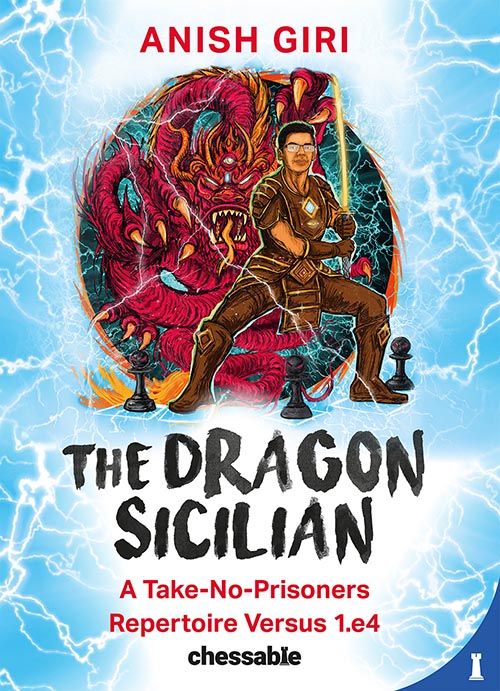
The Dragon Sicilian: A Take-No-Prisoners Repertoire Versus 1.E4, Anish Giri, New in Chess / ChessAble, 15th November 2022, ISBN-13 : 978-9493257351
From the publisher:
“The Dragon Sicilian is the perfect choice for club players searching for chaotic and imbalanced positions. This opening manual shows how Black can turn up the heat against 1.e4, and enjoy dynamic winning chances game after game. Top-10 player Anish Giri is the best tutor to bring this complicated opening across to ‘everyday’ club players. Anish serves up his super-GM lines and clearly explains the ideas and strategies behind the moves. So when game time comes, you know exactly which moves to play, at what moment, and how to deliver the knockout blow. Make no mistake: This repertoire’s take-no-prisoners-strategy means you will sometimes reach razor-sharp positions, where both sides must play ‘only moves’. But that’s why you’ll love having Anish Giri as your opening coach. Giri delivers just the right mix of cutting-edge analysis and practical guidance for players of all levels with his trademark witty and down-to-earth teaching style. The Dragon Sicilian also covers all other major systems Black could face, including what to play against Anti-Sicilians such as the Rossolimo, the 2.c3 Alapin, and the Grand-Prix Attack.”
Anish Giri
“Anish Giri became a chess Grandmaster at the age of 14 years, 7 months and 2 days. At the time, in 2009, that meant he was the youngest grandmaster in the World. Starting from the January 2013 list, the Dutch grandmaster was the leading junior player in the FIDE World Rankings. In June 2014 he turned twenty, which ended his junior years. Giri is a top-GM with a 2700-plus ELO rating.”
I am impressed with this colourful book, which is an accessible, lucid introduction to the Sicilian Dragon. The repertoire guide is a well- produced hardback book with an attractive vibrant front cover, good quality paper and many large diagrams, typically two per page and sometimes three making the work pleasant to browse and study.
The back cover blurb on the volume states that the opening manual work is aimed as an introduction for everyday club players, and it succeeds admirably in this respect. This title does not purport to be a major theoretical treatise or a “latest developments” style of publication, however, there is some cutting-edge theory and new ideas, some of which are new to the reviewer, who is a life-long Dragon addict.
The reviewer is not going to do a detailed theoretical critique the lines chosen by Giri for several reasons: time; my knowledge of some of the lines recommended is not sufficiently well-developed yet and thirdly these surveys can often come down to a thicket of engine analysis which can be off putting for less experienced players and does not always enhance understanding: it is important to understand the typical ideas, so when your opponent deviates from the book main lines/engine main lines, you can work out a solution at the board.
Despite my comments above, it is important for any reader of an opening tome, to not blindly follow the lines and take everything as gospel: check with an engine and use other sources.
The book has a short, didactic introduction to the Sicilian Dragon introducing the ideas, and nineteen chapters.
Dragon Starting Position
The book is effectively divided into four sections:
Move orders, Accelerated Dragon and Drago(n)Dorf (two chapters)
Anti-Sicilians (seven chapters)
Yugoslav Attack Section
The first chapter gives a useful overview of the Yugoslav Attack main line 9.Bc4 variation.
This introductory part briefly surveys the other main systems, other than the recommended repertoire, that occur such as the Chinese Dragon, Soltis Variation, Modern Variation, Topalov Variation. This is a useful pointer for the reader to the myriad of Dragon systems.
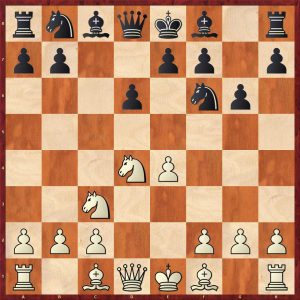
Chapter 2 Yugoslav Attack 9.Bc4 Nxd4
This part covers the book’s suggestion against 9.Bc4 which is the rare system 9…Nxd4.
Yugoslav9…Nxd4
This system was popular in the late 1950s/early 1960s but fell into disuse after some high-profile white victories, such as Fischer-Larsen Portoroz 1958 and Tal-Portisch European Team Championship 1961.
The idea of the line is to reduce white’s attacking potential by exchanging some pieces. I can see the logic of recommending this line as it is a straightforward system which is not popular, so many white players won’t know how to meet it: white must be accurate to even get a small advantage. The disadvantage is that it could be regarded as passive as black defends a slightly inferior, but defensive ending in the main line.
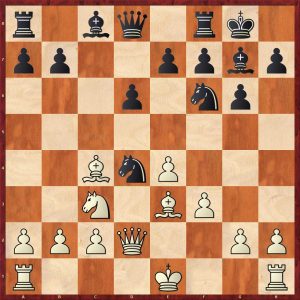
Black’s move order in this variation is critical as Giri points out: black has just played 12…b5!
Yugoslav12…b5
Giri offers a new twist on this ancient line with an intriguing positional pawn sacrifice in a main line, which has been played successfully in a correspondence game. Buy the book to find out.
Chapter 3 Dragon Main Line Konstantinov’s pawn sacrifice sidelines
This chapter covers the sidelines in the main line after 9.0-0-0 d5
White has a fair number of alternatives to the main line of 10.exd5 which are:
10.Bh6
10.h4
10.Nxc6
10.Kb1
10.Qe1
The last two are definitely the most important with Giri covering these with main-line recommendations which are well known and fine for black.
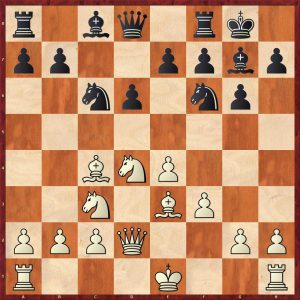
After 10.Kb1 Nxd4 11.e5! Nf5 12.exf6 exf6 13.Bc5 d4! 14.Bxf8 Qxf8, this position is reached:
10.Kb1 Main Line
Black has sacrificed the exchange for active play: Magnus Carlsen has played this way; a host of games has vindicated black’s approach including Short-Carlsen London 2009 which was drawn after a serious of adventures.
Chapter 4 Dragon main line 9.0-0-0 d5 10.exd5
This chapter is divided into two sections covering the greedy pawn grab and what is probably the main line of the entire Dragon at top level.
The (in)famous pawn grab leads to this position:
Pawn Grab Line
This position has been well known since the 1950s, black now plays 13…Qc7! with equality. White has to be accurate to hold on: as a youngster, I won many quick games in this line with black. The author covers this line well with respected well-known variations for black.
The main, main line occurs after 12.Bd4:
Main Line 12.Bd4
Here Giri offers the old main line 12…e5 which has been under pressure in recent years. He offers an interesting, rare approach which if it holds up is very important for Dragon theory. Buy the book to find out.
Chapter 5 The early 9.g4
The idea behind this line is to prevent 9…d5 whilst avoiding one of the main lines 9.Bc4. the author recommends the well-rehearsed response 9…Be6 which is fine for black.
The second section of the book, chapters 6 to 10 cover the following variations:
Classical 6.Be2
Fianchetto System 6.g3
Levenfish 6.f4
6.Bc4 system
Sixth move sidelines
These lines are perfectly respectable but do not threaten to extinguish the Dragon’s breath. Giri covers these with well-known antidotes. For example, in the Levenfish Variation:
Levenfish
Black has just played 6…Nc6! which neutralises white’s main idea to get in e5 to disrupt black’s development.
The third section has a couple of short chapters on the Accelerated Dragon and the Drago(n)dorf. These are really supplementary chapters which are interesting but do not detract from the main book.
The fourth section has seven chapters on the Anti-Sicilians and covers over half the book which is excellent. These systems are very popular at all levels particularly at club level with the obvious intention to avoid reams of theory: we have all got stuffed on the white side of the Sicilian facing an opponent bristling with theoretical barbs. This part is divided as follows:
The Prins system 5.f3
The Hungarian system 4.Qxd4
Moscow Variation 3.Bb5+
Various 3rd moves
Closed Sicilian
Alapin 2.c3
Other second moves
I particularly like the chapter on the Moscow Variation, which introduced the reviewer to some new lines. As well as that, the author covers some excellent points about the importance of move order in the Maroczy system.
FM Richard Webb, Basingstoke, Hampshire, 27th November 2022
Book Details :
Hardcover : 248 pages
Publisher:ChessAble / New in Chess (27 Sept. 2022)
The Dragon Sicilian: A Take-No-Prisoners Repertoire Versus 1.E4, Anish Giri, New in Chess / ChessAble, 15th November 2022, ISBN-13 : 978-9493257351
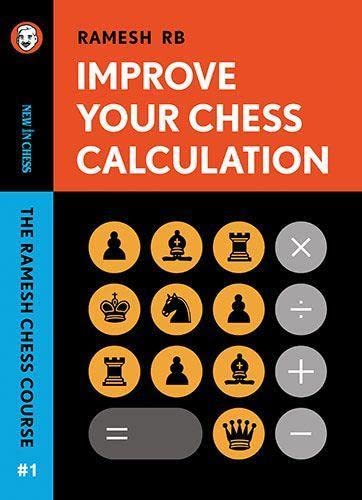
Improve Your Chess Calculation: The Ramesh Chess Course – Volume 1, RB Ramesh, New In Chess (31 May 2022), ISBN-13 : 978-9056919979
From the publisher:
“Calculation is key to winning chess games. Converting your chess knowledge into concrete moves requires calculation and precise visualisation. The bad news: calculation is hard work. You cannot rely on feeling or intuition — you will have to turn on your brainpower.
The good news: you can improve your calculation skills by training. Set up a position on a chessboard and try to solve exercises without moving the pieces! Grandmaster Ramesh RB is the perfect coach to awaken your chess brain and feed you precisely the right exercises. ‘After only a month of intensive training with Ramesh, I could sense a seismic shift in both the precision of my calculation as well as my general level of sharpness’, says GM Daniel Naroditsky.
“GM Ramesh is one of the world’s most successful coaches. He has trained many of India’s top talents at all stages of their development on their journey to become International Masters and Grandmasters. Ramesh understands what mistakes players can make while calculating. He knows that the best move in a specific position may be the opposite of what your intuition is urging you to play. And he serves you the exercises to correct these misconceptions and start finding the right solutions. Every chess player will benefit from the hundreds of exercises in this book. Coach Ramesh will take your calculation skills from a club players level to grandmaster level.”
This is the first of what promises to be a multi-volume series of coaching books under the title of The Ramesh Chess Course. As Ramesh is perhaps the world’s most successful chess coach this promises to be a treat for all ambitious players. As calculation is the single most important skill in chess, there’s no better place to start.
Ramesh starts off by telling us how to use the book. Here are his first two paragraphs.
Have a good look at every position and try to understand what is going on behind the scenes. Compare the king positions, piece placements, pawn structure, material parity, etc., before beginning your analysis.
Before we start analysing any move, we should make a list of reasonable looking moves and only then begin analysing them.
Good advice, although 2. is Kotov’s Candidate Moves idea, which not everyone finds useful in every position. Always useful when tackling the tasks set in this book, though.
The most important paragraph here is the final one, number 10.
I have divided the material into five categories: Level 1 = Elo Rating 1200-1600 Level 2 = Elo Rating 1600-2000 Level 3 = Elo Rating 2000-2400 Level 4 = Elo Rating 2400-2600 Level 5 = Elo Rating 2600 & above
It’s always a problem for authors and publishers of multi-volume coaching courses whether to structure the material horizontally (by topic) or vertically (by difficulty of material). Ramesh and New in Chess have chosen the former rather than the latter route.
If you’re anywhere between 1200 and 2800 strength, then, you’ll find exercises pitched at the right level for you, but you’ll also find much which is either too hard or too easy. If you’re a coach working with students anywhere between 1200 and 2800 strength, likewise you’ll find plenty of great coaching material.
As you’ll see, quite a lot of the book is taken up with Level 5 exercises, which, by their nature, often involve several pages of detailed analysis.
Each exercise is labelled with the appropriate level, with the more complex exercises comprising a number of ‘tasks’. In each case we are told the amount of time the student should be allowed.
The first chapter considers the difference between dynamic and static positions: it’s the former which are the subject of this book. There are two critical areas to study: Calculation and Attack.
The first task is set at Level 1: you have 2 minutes to solve it.
This is Carlsen – Vachier-Lagrave, from a 2021 speed game. Magnus played 34. Bd4+ Rxd4 35. cxd4 Bxd4, which really should have been a draw, but he later managed to win it.
He missed the move I hope you found, 34. Rc8!, which would have forced immediate resignation as after 34… Rxc8 there’s 35. Bd4#. Ramesh points out the 34… Ra8 35. Rxa8 Rxa8 36. Bd4#. I don’t know about you, but I’d have preferred the immediate 35. Bd4# here. A slightly unfortunate start, but I guess it doesn’t really matter.
In Chapter 2 Ramesh shares with us some games and positions he’s used to train his students, aiming to recreate his training sessions and demonstrate typical mistakes. He expects you to look deeply into each position, calculate multiple variations without making mistakes and evaluate the position correctly at the end. I hope readers will find this instructive and exciting.
The first example is an endgame study (there are a lot of studies in this book) composed by Alexandr Grin in 1989.
His student gave the solution as 1. Nb5 a2 2. Na7+? Kc7 3. c6 a1Q with stalemate, overlooking that Black could win in this variation by playing 3… Kb6 instead.
As Ramesh explains over 2½ columns, it’s very easy to get over-excited when you see a beautiful idea and fail to check it through thoroughly.
The correct solution to the study is 2. c6! a1Q+ 3. Na7+ Kd8 4. c7+ Kxc7, again with stalemate. His student had the right idea but failed to execute it correctly.
Chapter 3, The Analytical Process, is the heart of the book. Ramesh explains in detail how to calculate and how to analyse, taking into account psychological as well as purely chess factors.
The advice in this chapter will be of great interest and benefit both to chess coaches and to ambitious players at all levels.
Most of the examples here are extremely complex positions, usually Level 5 (suitable for 2600+ players).
Take, for example, this complex position (Smyslov – Rubinetti Palma de Mallorca Interzonal 1970).
Here, we have 16 pages of detailed analysis, broken down into 27 tasks, with nested variations given labels such as B3113242). You may well, like me, find it hard to follow, even with the copious diagrams provided.
Ramesh comments at the end:
In my training with young players for over a decade, I have seen that analysing very complicated positions without the help of moving pieces on the board is not only possible, but even essential for quicker and long-lasting improvement in a player’s analytical capabilities. This will require the coach to be patient and believe in the capabilities of his student in the long run. From the players’ part, they must put in a genuine effort to try to analyse the positions without giving in to self-defeating doubts. In my academy, even 1800-level players can follow all the analysis like this with some effort and without a chessboard. It is simply a question of patience and perseverance.
If you’re interested in the complete game, here it is. Click on any move for a pop-up window. Black’s last move was a losing blunder: the only way to draw was 44. a1Q.
It’s clear from this book that chess tuition has changed a lot in the past 20 years or so. (60 years ago, when I was learning chess, if you wanted to improve you had no choice but to read a book.) Visualisation exercises and solving endgame studies (recommended by Judit Polgar as well as Ramesh) are now common.
Later in the chapter, Ramesh has this to say.
Even though humans can probably never analyse at the level of engines anymore, it is possible to take the help and inspiration from engines to further our capabilities to previously unknown levels. I have personally trained players with ratings in the range of 1400-1800 to analyse variations that players of previous generations with a rating range of 2200-2400 were unable to do. This is one of the reasons my students in the 9 to 14 age group can quickly become International Masters or grandmasters.
Chapter 4 provides more examples of Forcing Moves. Judit Polgar, like me, uses the acronym CCTV: in her case Checks, Captures, Threats and Variations. Ramesh adds pawn breaks into his definition of Forcing Moves. If you still want to use CCTV you might try Checks, Captures, Threats and pawn leVers perhaps.
Black won this game by using a series of forcing moves: captures and threats: 20… f3 21. Nxf3 Rxf3 22. Bxf3 Nxb4 23. Bxb7 Nxc2 24. Be4 Nxa3 25. Rb3 Qa4 0-1
Ramesh mentions that 20… f3 wasn’t Black’s only strong move here: 20… Nd4 was another way to play for the win.
In Chapter 5 we learn about typical mistakes made while calculating variations.
Ramesh lists 14 types of mistake, starting with not being able to visualise the position in the mind, not seeing forcing moves and not making a list of candidate moves, giving examples and possible solutions.
In this world championship game from 2008 Kramnik, playing White, made a fatal error.
29. Nd4? was a blunder, missing 29… Qxd4 30. Rd1 Nf6! 31. Rxd4 Nxg4 32. Rd7+ Kf6 33. Rxb7 Rc1+ 34. Bf1 Ne3!, when Anand had a winning advantage.
I guess it’s debatable whether Kramnik’s error was one of calculation or evaluation, and whether he’d missed Anand’s 30th or 34th move.
Chapter 6 is devoted entirely to endgame studies.
Here’s Ramesh:
Whenever I feel my student’s calculation skills are not up to the mark, I will make them solve studies for three to four hours a day for around three to five days in a row. Usually, the students will show significant improvement in their calculation skills.
You might like to try your hand at solving this Level 2 study, composed by the great Leonid Kubbel and published in 1911. It’s White to play and draw.
Finally, Chapter 7 offers some more general suggestions for chess improvement. As with the suggestions throughout the book, these cover many aspects of chess psychology as well as practical advice which will be beneficial for all players and teachers.
While there’s an enormous amount of helpful advice both here and elsewhere in the book, there’s also some repetition which might have been better avoided.
For instance, returning for a moment to Chapter 6, we’re told on both p258 and p260 that solving a study might take anywhere between 5 and 40 minutes. I think this might have been picked up by the publishers at editing or proofing stage.
How to summarise?
This is an important book, and, by the look of it, part of an important series. The author is arguably the most successful high level chess teacher in the world, and, reading the book, you can understand why. The positions are all well chosen and the explanations throughout the book display profound insight into the minds of chess players. Although you might think it’s aimed at stronger or at least more ambitious players, it will, for the general advice, in particular that of a psychological nature, be a great read for many players of all levels. Even though not everyone will find the book’s structure particularly helpful, it’s also esssential reading for anyone who teaches chess to students rated 1200+.
Speaking as a retired 1900-2000 strength player, the Level 4 and Level 5 examples, which take up a lot of the book, were way beyond me and not always easy to follow. At one level, it was interesting to see how deeply highly complex positions can be analysed, and how talented young players who are prepared to put in the necessary time and effort can learn to perform these tasks, but at another level I found it rather disspiriting to work through so many pages of dense analysis. To be fair, though, I’m not really part of the target market for this book.
At the same time, the market for books aimed at 2400-2600 strength players must be very limited. What I’d like to see would be a book taking a more structured approach, with, for example, 100 pages each of exercises at Levels 1, 2 and 3 (which is anyone from 1200 to 2400 strength), along with some general advice at either the beginning or the end of the book.
Instead, what we have is a book which is more about how to teach calculation and how to improve your calculation rather than one where you can start at page 1 and work your way through in sequential fashion. Ramesh also expects his students to have seriousness of purpose and a strong work ethic, as well as plenty of time to spend on chess improvement. If you’re just a hobby player looking to have fun and make a bit of progress, you might well find this rather scary.
The approach recommended here certainly isn’t for everyone, but even so, any reader who is prepared to work hard will gain a lot from this book.
I couldn’t really imagine Ramesh exclaiming ‘Awesome move!!’ and ‘Kaboom!!’ like Judit Polgar. If you’d prefer something that also covers calculation skills, but is an easier read taking a more ‘fun’ approach I’d recommend this book instead. They certainly have points in common: teaching you to look for Checks, Captures and Threats, and using endgame studies.
You can find more details here and read some sample pages here.
I’d also, by the way, recommend reading an excellent interview with Ramesh which appeared in New in Chess 2022#3, which puts his methods into context.
I look forward very much to seeing future volumes in this series.
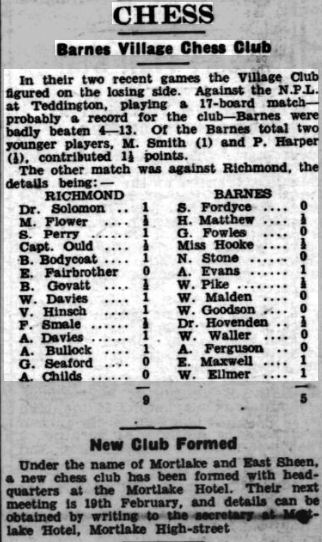
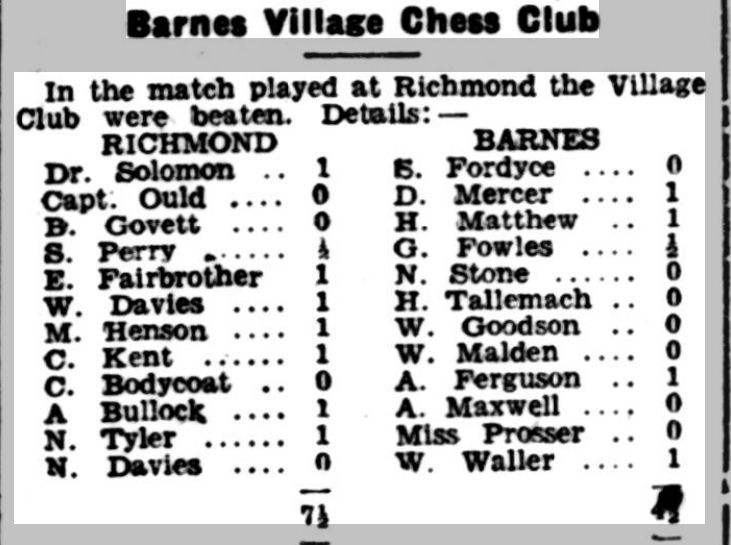
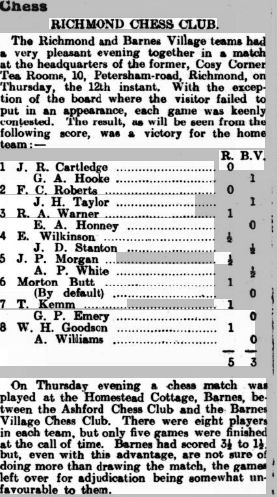
You might remember this from the last Minor Piece. This is a match between Richmond and Barnes Village from 1948. You saw Beatrix Hooke on Board 4 for Barnes, and this time I want to introduce you to Richmond’s Board 5: B Bodycoat.
Way back in 1967, 55 years ago, I won my first chess trophy: the BC Bodycoat Cup. This was the second division of the Richmond & Twickenham Chess Club Championship, for weaker and less experienced players, and continued until sometime in the mid 1970s.
I can’t see that I deserved to win. I played five games, four against weaker opponents, winning two and drawing three. My only strong opponent was Ken Norman, then, as now, a better player than me. It looks from my scorebook as if I won a couple of games by default, one of which may have been against Keith Southan, who’ll be introduced later.
This game wasn’t very distinguished. I won a pawn in the opening, and, instead of capturing another pawn I chickened out by trading queens into a level ending. I then made a horrendous blunder which should have lost a piece, but fortunately for me Ken didn’t notice. Click on any move in any game in this article for a pop-up window.
I had no idea who BC Bodycoat was. Was he Benjamin or Bernard? Brian or Barry? Bertram or Basil? Once I started getting interested in genealogical research I determined to find out. I could never have imagined what a strange story it would turn out to be. Strange in more ways than one.
In fact Mr Bodycoat, during a sadly short life, used three or four different first names and two different surnames. I’ve been waiting some years to tell his story, and the online appearance of the Richmond Herald up to 1950 gives me the opportunity.
It has nothing at all to do with chess, though, so please bear with me as we embark on a journey that will take us around the world.
Our story starts, for want of a better time and place, in the Leicestershire village of Tur Langton in the year 1844.
A few miles north of the town of Market Harborough you’ll find a group of villages collective known as the Langtons. Tur Langton is the furthest north. A mile to the south is Church Langton, and, just a bit further down the road are its associated hamlets, West Langton and East Langton. You’ll then find Thorpe Langton a mile or so to the east of East Langton.
We’re going to meet William Bodycoat and his family. William, like most villagers at the time, was an illiterate agricultural labourer. Born in 1811, he married Elizabeth Gibbins in 1833. They had two sons, Thomas and Joseph. Elizabeth died in 1840, and on Christmas Day 1841 William married her sister Mary, taking on her illegitimate daughter Charlotte.
In 1844 they made a decision that would change their lives (and perhaps my life as well). They emigrated to Australia on an assisted immigration scheme, along with Mary’s sister Lucy, her husband William Bamford, and their children.
Here they are, on board a ship named the Abberton.
They may not have been the first of their family to emigrate to Australia. In 1830, Thomas Bodycoat, who, I suspect, was William’s brother, was transported there for stealing a rabbit, receiving his freedom in 1849. I haven’t yet been able to find out what happened to him.
William Bodycoat and his family, in spite of their humble origins, did very well for themselves. They settled first in Collingwood, Melbourne, before moving out to Wollert (it means, delightfully, ‘where possums abound’). You’ll find Bodycoats Road there today.
When you’re researching family history you often come across stories like this of families who prospered in Australasia or North America. On the one hand, you admire their courage and hard work, and how emigration enabled them to achieve success they could never have dreamt of back at home. On the other hand, you realise that this happened at the expense of the indigenous populations of those continents.
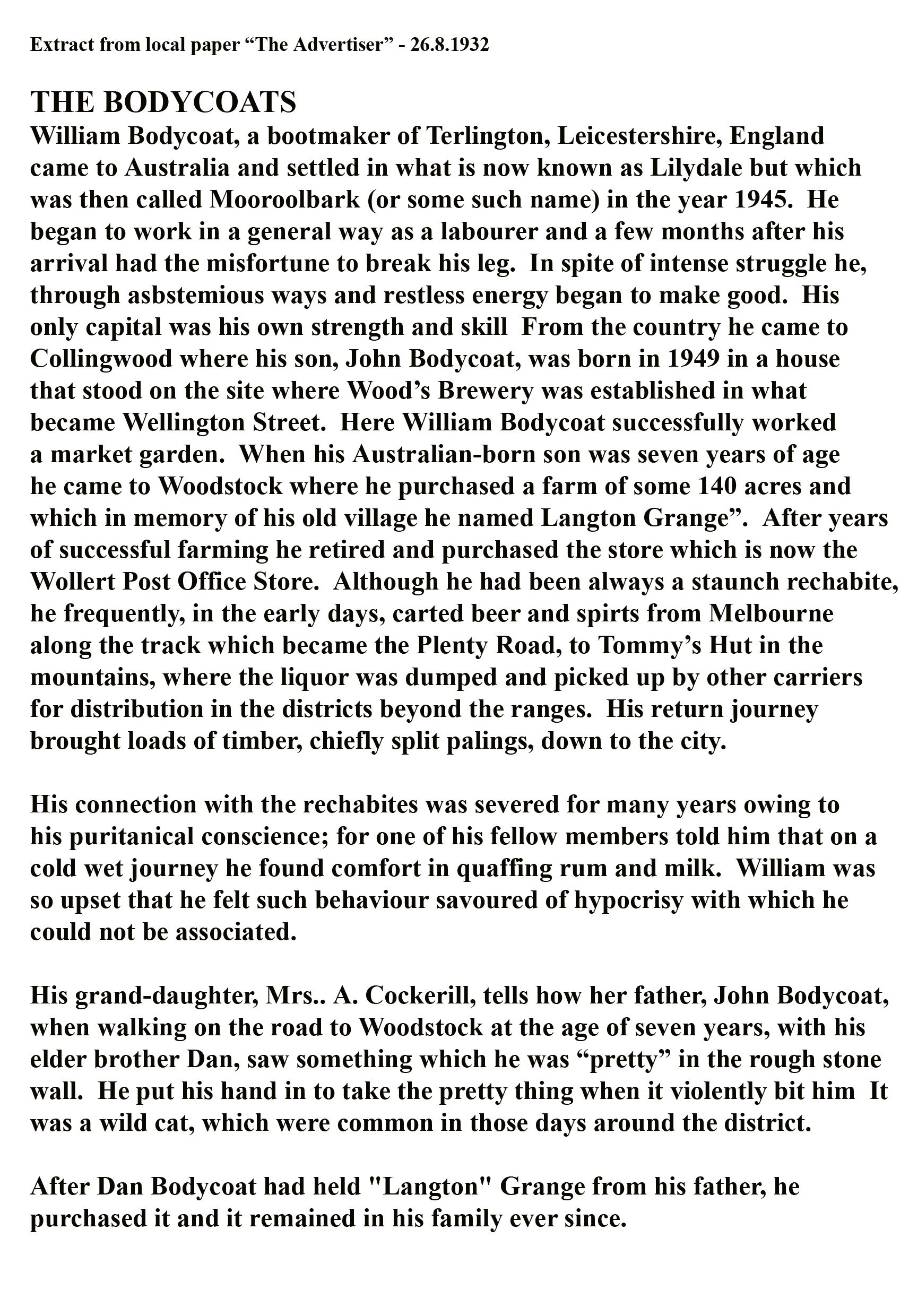
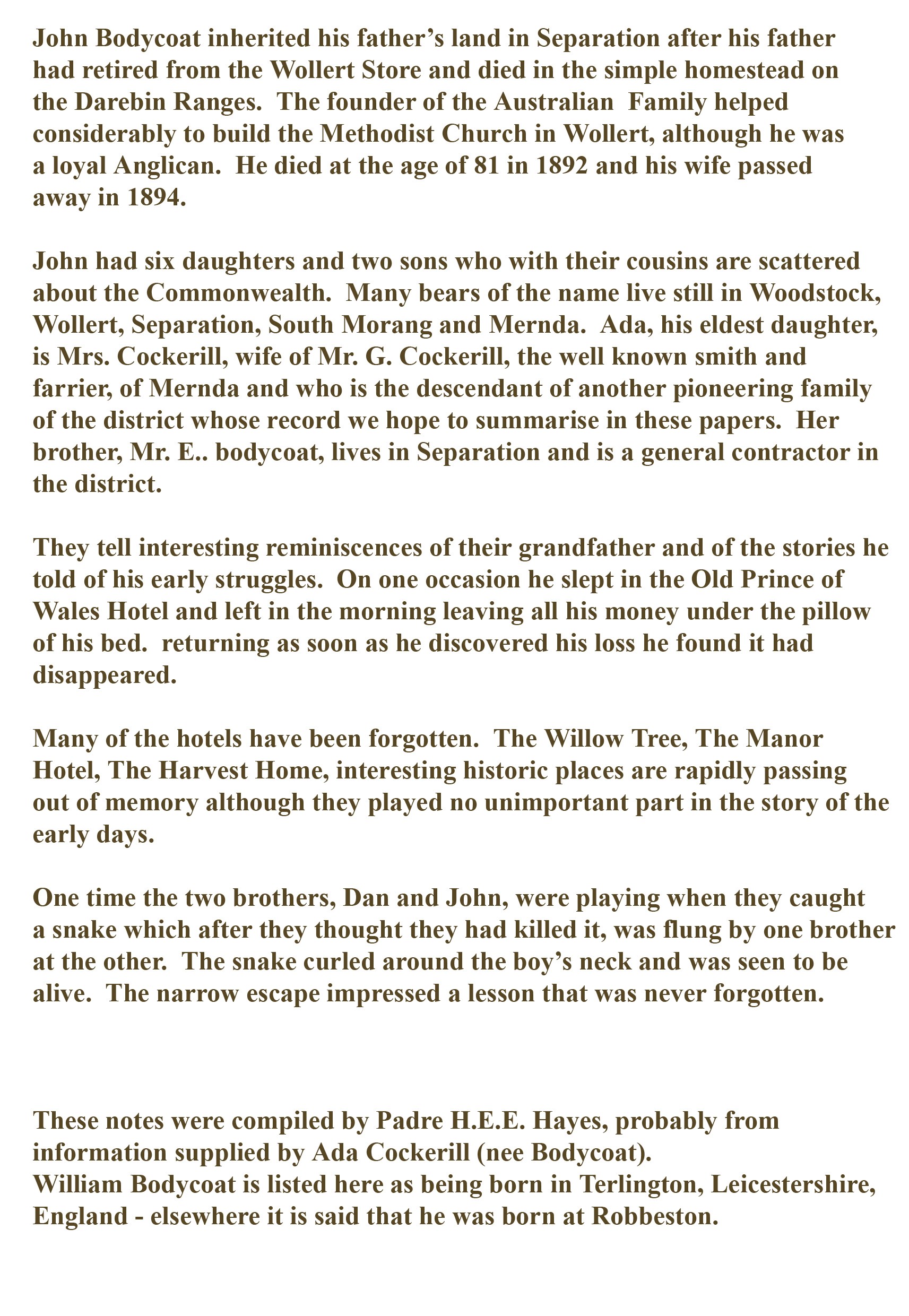
William lived on until 1892, and, 40 years after his death, a local paper published some family reminiscences, which are not necessarily accurate.
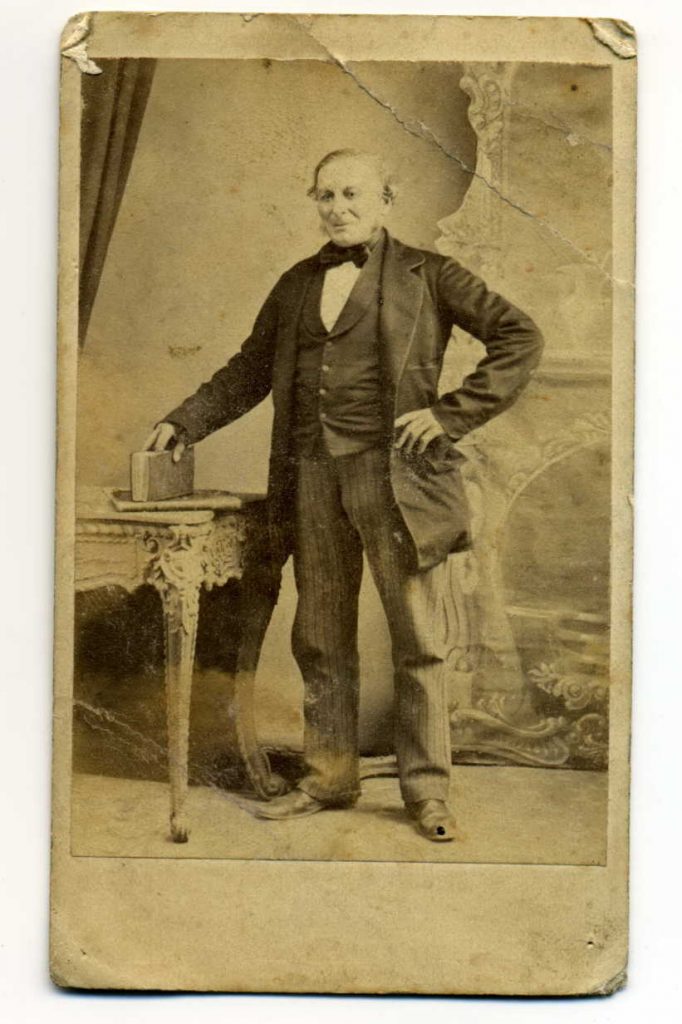
And here he is, a fine looking fellow he was as well.
However, it’s William’s youngest son, Walter, known to the family as Walt, born in 1858, to whom we must now turn our attention.
In 1851 gold was discovered in Victoria, and mines were established in places like Ballarat and Bendigo. A gold rush ensued. Melbourne and the surrounding areas became extremely prosperous as a result. You saw above that Thomas was working as a carter to the goldfields for a time. Perhaps his brother Walter was also involved.
In 1893, three Irish prospectors discovered gold in Kalgoorlie, Western Australia. There were fortunes to be made there as well. Perhaps this was the reason why, in 1897, Walter and his family made the trek to the other side of the continent.
He might possibly have settled in Perth at first, where his younger children were born, but later moved to Kalgoorlie, working there as a labourer.
Walt’s eldest son, born in 1886 shared his name, but was known as Wally. He must have been a bright boy, as he studied at the School of Mines in Kalgoorlie in 1909, training as a gold assayer, testing minerals to determine the amount of gold in them.
He led an adventurous life, travelling to Uruguay before settling in London, where, I suppose, he must have been working for some sort of mining company. This involved a trip to Peru, and then four trips to West Africa, Ghana (it was the Gold Coast then), Cameroon and, in 1913, two more visits to Ghana. These must have been exciting times for young Wally, but he wanted something else in his life. While in London he formed a relationship with a young widow named Ada Eliza Strange (née Hawkins), and, in the short gap between his two 1913 stints in Ghana, a son was conceived.
Ada had a daughter, Lucy Gertrude (usually known by her middle name) from her marriage to William John Strange, whose death had been registered in the 4th quarter of 1912. Gertrude seems to have been what would then have been called a showgirl, and had what might best be described as a very colourful life. If you’d like to find out more, as I’m sure you do, you should read this paper from the Epsom & Ewell History Explorer.
Anyway, moving very swiftly on, Walter and Ada’s son’s birth was registered in Paddington in the 3rd quarter of 1914. He was given the names Walter Charles Bodycoat Strange. Named, you will see, after both his father and grandfather.
This, then, was our man, after whom the Bodycoat Cup was named. But where did the B come from?
The relationship between Wally and Ada didn’t last. Wally returned England on 23 July 1914, perhaps in time to witness the birth of his son, and sailed back to Australia on 12 February the following year. In 1916 he joined the Australian Imperial Force and returned to England, serving in France, where he was wounded in action and awarded the Military Medal.
He was discharged in 1919 and returned to mining, again travelling backwards and forwards to Ghana. In 1920 he married Katie Burt, from Cornwall (perhaps he’d also been involved in mining there) and they eventually returned to Australia, where he bought a farm they named Trevose after a Cornish headland, where they brought up their children Kenneth, Gordon and Barbara. You can read a lot more about Wally (with links to Katie and Ken) here.
The Bodycoats were a sporting family, playing cricket, tennis and golf, but I can’t find any mention of them playing chess. Judging from online family trees, Wally’s children may not have been aware of his guilty secret. They probably are now.
While we’re discussing Cornwall it’s time for another game, this time against Cornwall born Fred Daymond, captain of Richmond & Twickenham’s London League 2nd team for many years. He soon lost a lot of material here.
Now we need to continue the story of the third Walter Bodycoat.
At present I haven’t been able to find him, his mother or his half-sister in the 1921 census. Nothing under Bodycoat and also nothing obvious under Strange.
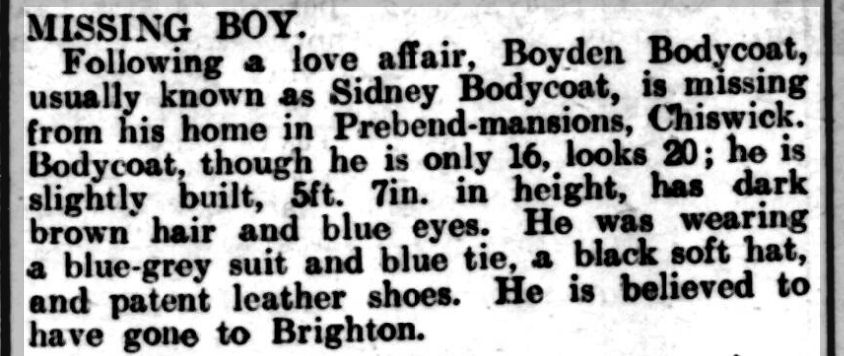
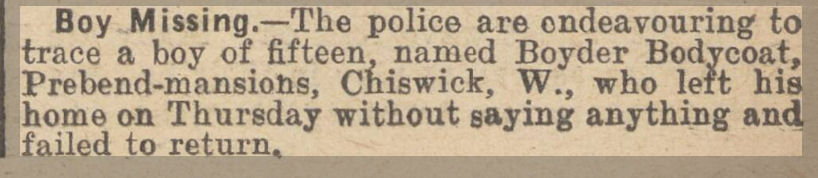
He only reappeared, or rather disappeared, in 1930, where he made the local and national papers.
Richmond Herald 30 August 1930Daily Mirror 30 August 1930
Walter? Boyder? Boyden? Sidney? Aged 15 or 16? Who knows? By this time he was using his father’s surname rather than his mother’s surname. Had they fallen out? Perhaps he didn’t want to be thought of as strange.
Boyder is not otherwise known as a name, and Boyden is very rare. Boyd, yes, but not Boyder and hardly ever Boyden. I suppose Boyder might have been a contraction of ‘Boy Walter’ to distinguish him from his father Wally and grandfather Walt. I’d speculate that he preferred to be known as Boyder, and appearances of ‘Boyden’ were due to misreading someone’s handwriting.
Prebend Mansions is a block of mansion flats on Chiswick High Road, near Stamford Brook Station. If you walk in an easterly direction, you’ll eventually reach Hammersmith Broadway, and then Olympia, a part of the world very familiar to the Hooke family.
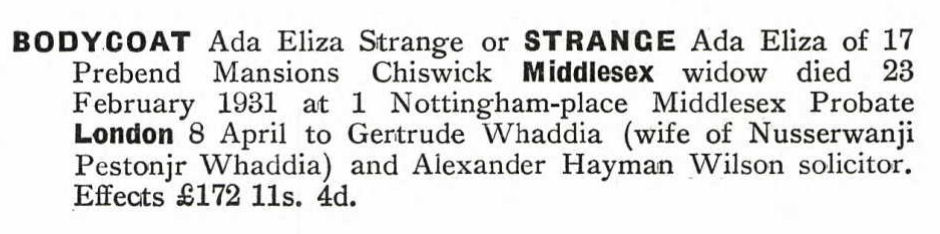
I presume he returned home at some point: at least nothing else appeared in the press. Sadly, six months later, his mother died, leaving him alone, his father in Australia and his sister in a rather dodgy relationship.
Although Ada and Wally only had a brief affair and never married, she sometimes used his surname. The 1930 electoral roll lists no one at 17 Prebend Mansions: seemingly she hadn’t registered to vote. That’s her daughter who was granted probate.
Nottingham Place is in London’s medical district, not far from Harley Street (and also not far from 44 Baker Street), and was used by members of the London School of Medicine for Women. I presume number 1, Treborough House on the corner of Paddington Street, was a private clinic at the time: it’s now converted into very expensive flats.
Young Boyder (or whatever) was clearly a ladies’ man, and it was in 1937 that he married Hilda Lilian Simmonds in Finsbury. Hilda wasn’t from Brighton, but from Mile End. Her father was a Russian Jew who had anglicised his name and seemingly converted to the Church of England. The marriage was recorded twice, with his name as Walter CB Strange and Walter C Bodycoat. A daughter, Diane Bodycoat, was born a year later.
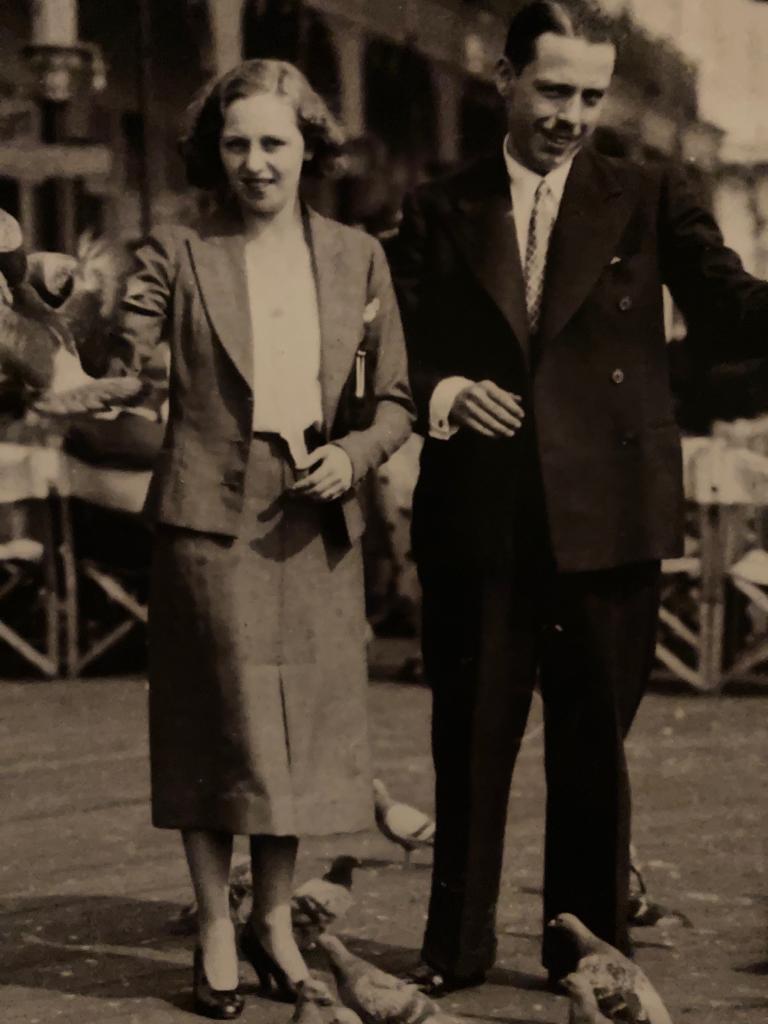
Here are the happy (at the time) couple.
It looks like the marriage didn’t last long. The 1939 Register found Hilda and Diane in St Albans, while Boyder was nowhere to be seen. It’s possible their marriage had already broken up, but it’s also possible his wife and daughter had moved to St Albans to avoid possible future aerial attacks on London. My mother moved from Teddington to nearby Harpenden for that reason.
Hilda and Diane later moved to Cornwall, while, in 1944, Boyder married again, to Bernice Gloria Holmes. This marriage was registered in Surrey North-East, which would have been Richmond or thereabouts. This time he was only Walter C Bodycoat.
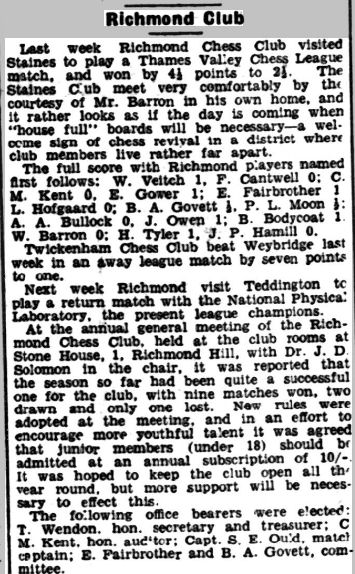
I’ve no idea where and when he learnt to play chess. Very often sons learn from their fathers, but this wouldn’t have been the case for Boyder. Anyway, when Richmond Chess Club reopened its doors in 1947 after a break for the war, he would have been one of its first members. As he often played on a fairly high board he must have been a decent club standard player.
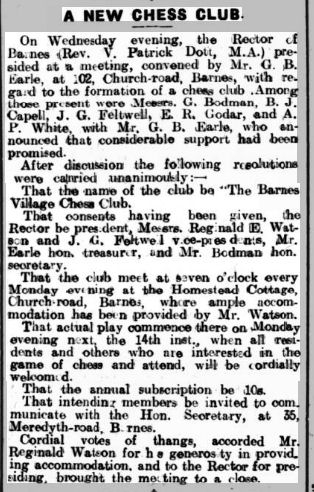
His first appearance, though, wasn’t so successful. Playing against a weaker Barnes Village team he lost his game on Board 9.
Richmond Herald 29 November 1947
He wasn’t the only player with an incorrect initial. On Board 11, defeating girl champion Phyllis Prosser, would have been Harold Augustus Tyler. The first time my father took me to Richmond & Twickenham Chess Club, Harold was the first person we saw. My father knew him from work but didn’t realise he was a chess player.
Here’s our Bodycoat Cup game. Harold didn’t put up much resistance, losing a lot of material in the opening.
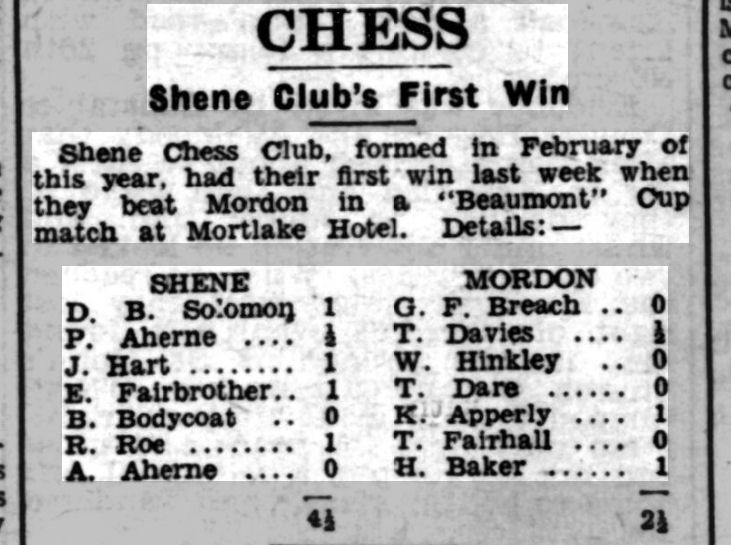
Boyder must have been really keen as he also joined the new Shene (or Sheen if you prefer) Chess Club, but he was again unsuccessful in this match.
Richmond Herald 04 December 1948
At least he was granted his preferred initial on this occasion, unlike Dr John David Solomon on top board. There was a considerable overlap in membership between Richmond and Shene, and the former subsumed the latter a few years later.
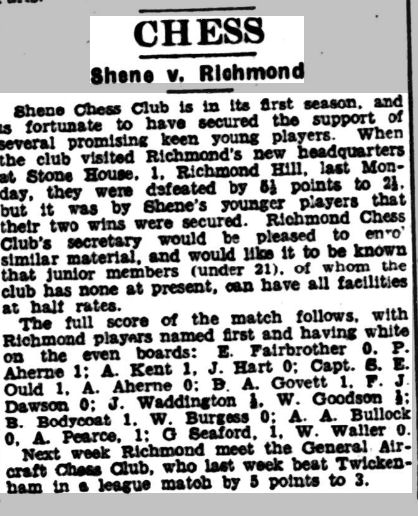
The following month the two clubs met, with Boyder playing for Richmond and winning his game.
Richmond Herald 15 January 1949
It’s interesting to note that Shene, unlike Richmond was attracting younger players at the time. By the 1960s there would be a lot of teenagers in what was by then Richmond & Twickenham Chess Club.
In February he scored another win in a Thames Valley League match against Staines.
Richmond Herald 05 February 1949
Richmond had Walter Veitch (about whom more, perhaps, another time) on top board for this match. He and JD Solomon were two of the strongest London amateurs in the late 1940s. It’s interesting to note that this was a 7-board match. Harold Tyler was this time allotted his correct initial. His opponent, John Hamill, would, some 30 years later, run a chess club at Richmond Community Centre. Percy Moon, the Staines board 4, played twice against me in 1968 and 1972. All this, again, even though I was yet to be born, is my history as well as Boyder Bodycoat’s history.
Richmond Herald 19 February 1949
There were two draws for him in these two matches, one against another of my future opponents, Edwin Sutherland, plus news of the foundation of Surbiton Chess Club and a forthcoming simul.
I played Edwin Sutherland on 20 December 1966, and it was on 15 June 1967 that I played my first Bodycoat Cup game. It resulted in a draw, but I had a winning advantage at various times. Curiously, all three of my black games in this competition featured the same opening variation.
March 1949 witnessed two local derbies, with Shene playing Barnes Village and Richmond playing Twickenham.
Richmond Herald 19 March 1949
More names from my past: George Hogg moved from Barnes Village to Richmond in the 1960s, while John (Jock) Lee and Keith Southan, both in the Twickenham team here, would play for Richmond & Twickenham into the 1970s. Keith was a classics master at Tiffin School, and would often give me lifts to away matches when I first joined the club.
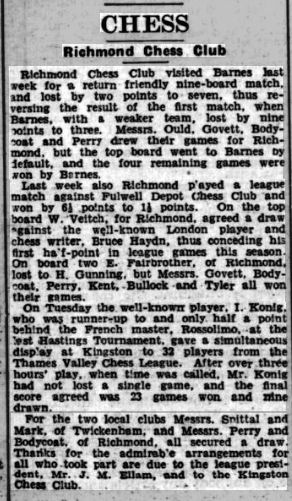
The promised simul duly took place, and Boyder managed to draw his game, also scoring a draw against Barnes Village.
Richmond Herald 02 April 1949
At this point it seems that Barnes were stronger than Richmond, but the roles would soon be reversed.
Chess was very popular amongst the London Bus community (they even had their own magazine for some years), and, in days when works chess teams were very common, it wasn’t surprising to see Fulwell (Bus) Depot in the Thames Valley League, with prominent chess author Bruce Hayden (not Haydn: he was a composer) on top board.
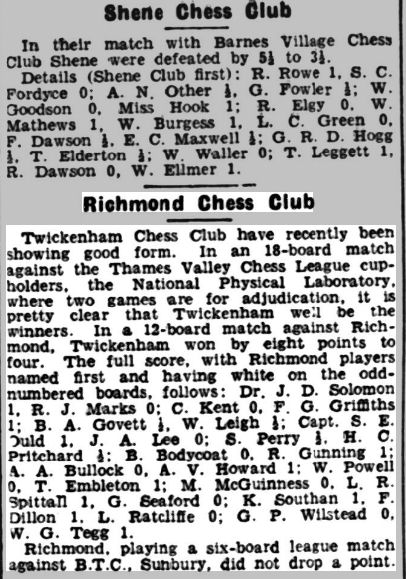
By the autumn of 1949 it was time for another season to start, and here Twickenham and Richmond were in friendly opposition. In the absence of some of the big names, Boyder Bodycoat found himself on top board.
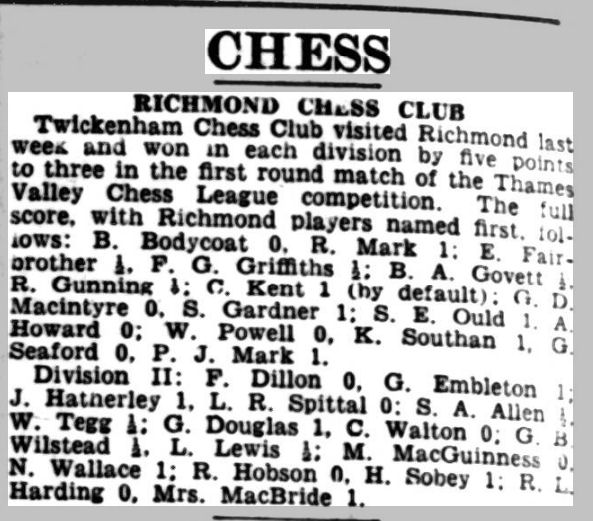
Richmond Herald 05 November 1949
I never met Robert Mark, who must have left Richmond & Twickenham at about the time I joined, but I seem to recall that he was still the club auditor. On the other hand, I did know Ted Fairbrother, Keith Southan, George Seaford and, vaguely, FG (Griff) Griffiths.
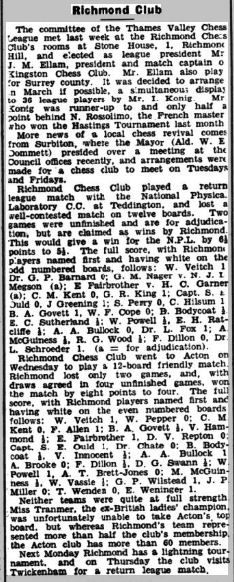
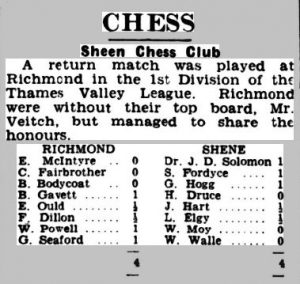
In 1950 Richmond and Shene shared the points, but unfortunately what would have been an interesting top board encounter between Veitch and Solomon didn’t materialise
Richmond Herald 25 March 1950
This suggests, though, that, after a shaky start to his chess career, Boyder Bodycoat, now in his mid 30s, was a decent club standard player, I’d guess around 1800 in new money or 150 in old money. He could hope to make further progress with more experience.
But the world was changing. The Richmond Herald was less consistent in reporting chess results. And, in July that year, Howard and Betty James welcomed their first son into the world.
As he was about to enjoy his first Christmas there was some more news.
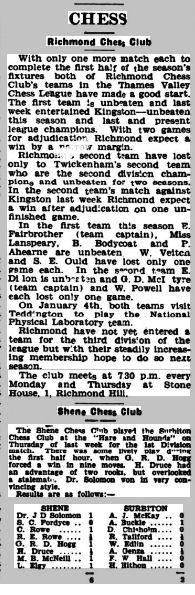
Richmond Herald 23 December 1950
We see that Mr Bodycoat was unbeaten playing for the first team, as was the otherwise unknown Miss Lanspeary (she, like all of us, had her story: you’ll meet her next time).
Surbiton, losing here to Shene, were still getting going, but at least two of their players had long careers at the club. I beat Donald Chisholm in 1973 and drew with Russell Tailford in 1980.
It’s good to see Richmond with female representation in their first team. For many years our most prominent lady player was Hella Kaufmann, who translated Leonard Barden’s book on the Ruy Lopez into German. Hella lived in Barnes, and had also been a member of Barnes Village: I guess she joined shortly after 1950.
Here’s our Bodycoat Cup game from 1967. Her translation work for Leonard must have been the reason for choosing the Marshall Gambit here. If I’d been aware of this I’d no doubt have chosen a different opening. As it was I held onto the pawn but lost it back by playing too passively, ending up in a level ending.
In Spring 1951 Boyder and Gloria decided to take a holiday in Bermuda. They sailed from London on 14 April on the Loch Garth, a ship of the Royal Mail Lines which also had some cabin space, arriving back in Plymouth travelling third class on the Reina del Pacifico, a ship belonging to the Pacific Steam Navigation Company, on 15 June. Their address was given as 3 Sheen Court, Richmond, and they were both hairdressers (as was, I seem to remember, Boyder’s clubmate George Seaford: there may be some connection there). Sheen Court is a prominent block of mansion flats on the Lower Richmond Road near North Sheen Station.
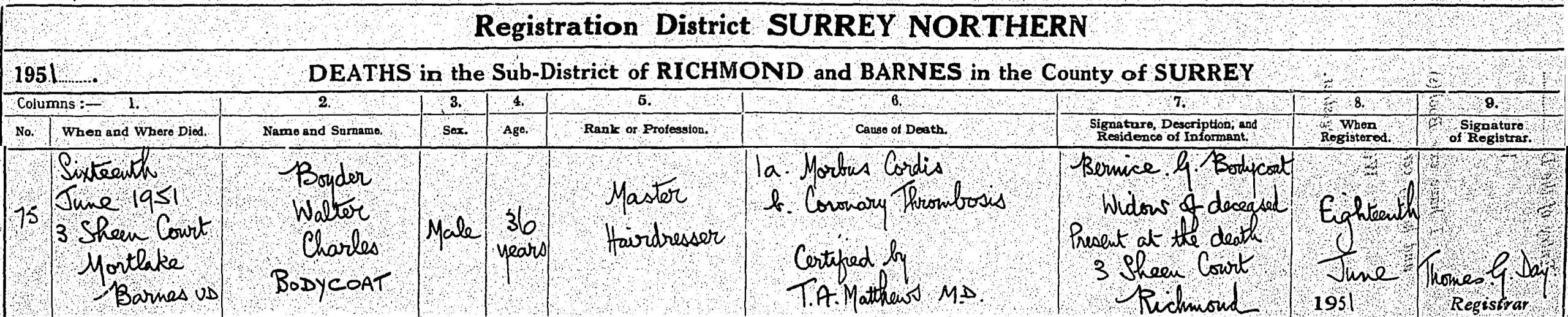
Former Prime Minister Ramsay MacDonald had died on board the Reina del Pacifico in 1937, and Boyder very nearly joined him. They probably travelled back from Plymouth to Richmond by train, and, back at home the very next day, he sadly died at the age of only 36.
The cause of death is given as Morbus Cordis & Coronary Thrombosis: heart disease, specifically a blood clot leading to a heart attack.
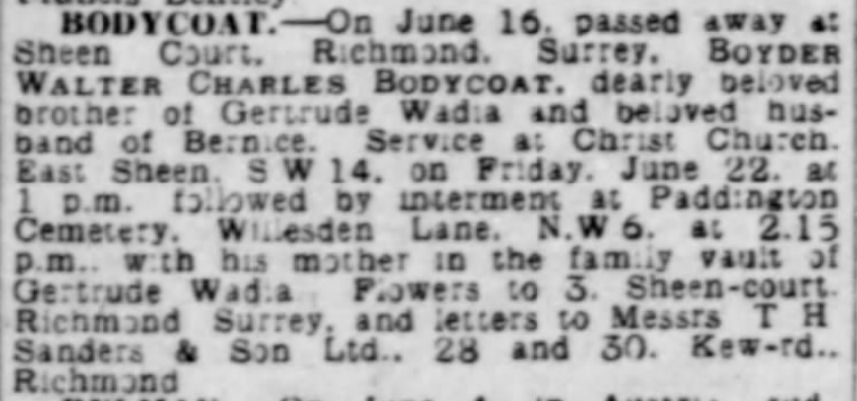
Daily Telegraph 19 June 1951
The death notice in the Daily Telegraph mentions his wife and sister, but not his first wife or their daughter.
The probate record tells is he left almost £700, a small amount of which would have gone, either directly or indirectly. to Richmond Chess Club. They decided to commemorate their member by purchasing a trophy in his name: the trophy I would win in 1967.
Bernice wasted little time in remarrying: her second husband was a Greek Cypriot communist and freedom fighter named Michael Economides. You can find out more about him, and again I’d advise you to do so, here. Yet another colourful character in a story full of them.
To return to my story, my father, Howard James, had been born in Leicester in 1919, but his grandfather, John James, had been born in 1841 in Thorpe Langton, just a mile and a half or so across the fields from Tur Langton, from where, three years later, William Bodycoat would emigrate to Australia. His family were all from various villages in the area and I’ve managed to put together a family tree with a possible link between the two families.
It’s another golden chain. The ancestors of the man whose trophy I won would have been tilling the same fields, drinking in the same pubs (perhaps not in William’s case as he was a Rechabite) and worshipping in the same churches as my ancestors back in the 18th and 19th centuries. The story that links our lives takes us round the world to Australia and back again, visiting South America and Africa along the way. We’re all connected, and chess is the wonderful game that brings some of us together.
The Bodycoat Cup continued to take place until round about the late 1970s: by that time, with so many opportunities for league and tournament chess, there was less appetite for internal competitions in most chess clubs in the London area.
There’s one more Bodycoat Cup game in my files.
In this appropriately strange game Mike Fox lost in only 14 moves by doing exactly what he told Richmond Junior Club members not to do every Saturday morning: bringing out his queen too soon and going pawn hunting.
I’ve no idea what happened to the trophy, or indeed the club championship trophy. If you have information, do please get in touch.
Thanks to Walter/Boyder/Boyden/Sidney for being, posthumously an influence on my chess career. Thanks to Wally and Ada for having an affair. Thanks to Walt for deciding to move to Western Australia. Thanks to William and his family for emigrating to Melbourne.
And thanks to you for reading this. You, too, are part of that golden chain.
Acknowledgements:
ancestry.co.uk
findmypast.co.uk
British Newspaper Library
academia.edu
Carnamah Historical Society & Museum
Epsom & Ewell History Explorer
Ships Nostalgia
Wikipedia
Google Maps
FIDE ratings
Last time we left Alice Elizabeth Hooke in 1914, on the outbreak of the First World War, a member of the London Ladies’ Chess Club and a competitor in the British Ladies’ Championships. She was unmarried, living in Cobham, and working as a Civil Servant for the Post Office Savings Bank near Olympia.
It would have been understandable if she had retired from chess at that point, but in the following decade she made a comeback. And what a comeback it was.
Our first post-war reference is in the 1921 British Championships, where she played in the Second Class A tournament, scoring 4½/11. I presume she wasn’t selected for the British Ladies’ Championship that year. Not having played for some years, and now in her late 50s, perhaps the selectors had good reason.
By 1922 Alice had moved from Cobham to Barnes, much more convenient for her job in Kensington, I suppose. Again, that year’s British Championship saw her competing in the Second Class A tournament, only managing 3/11.
On 27 October 1923 the Cheltenham Chronicle published this position, which, they claimed, won a brilliancy prize in that year’s British Championship. I think they made a mistake: there’s no evidence that Alice played in the British that year, and in any case the subsidiary tournaments were run in a different way. So this game must have been played the previous year, where one of her three wins was against Arthur William Daniel, better known as one of England’s leading problemists of his day. As always, click on any move for a pop-up window.
The pension age for both men and women was reduced from 70 to 65 in 1925, so it’s possible Alice was still working at this point.
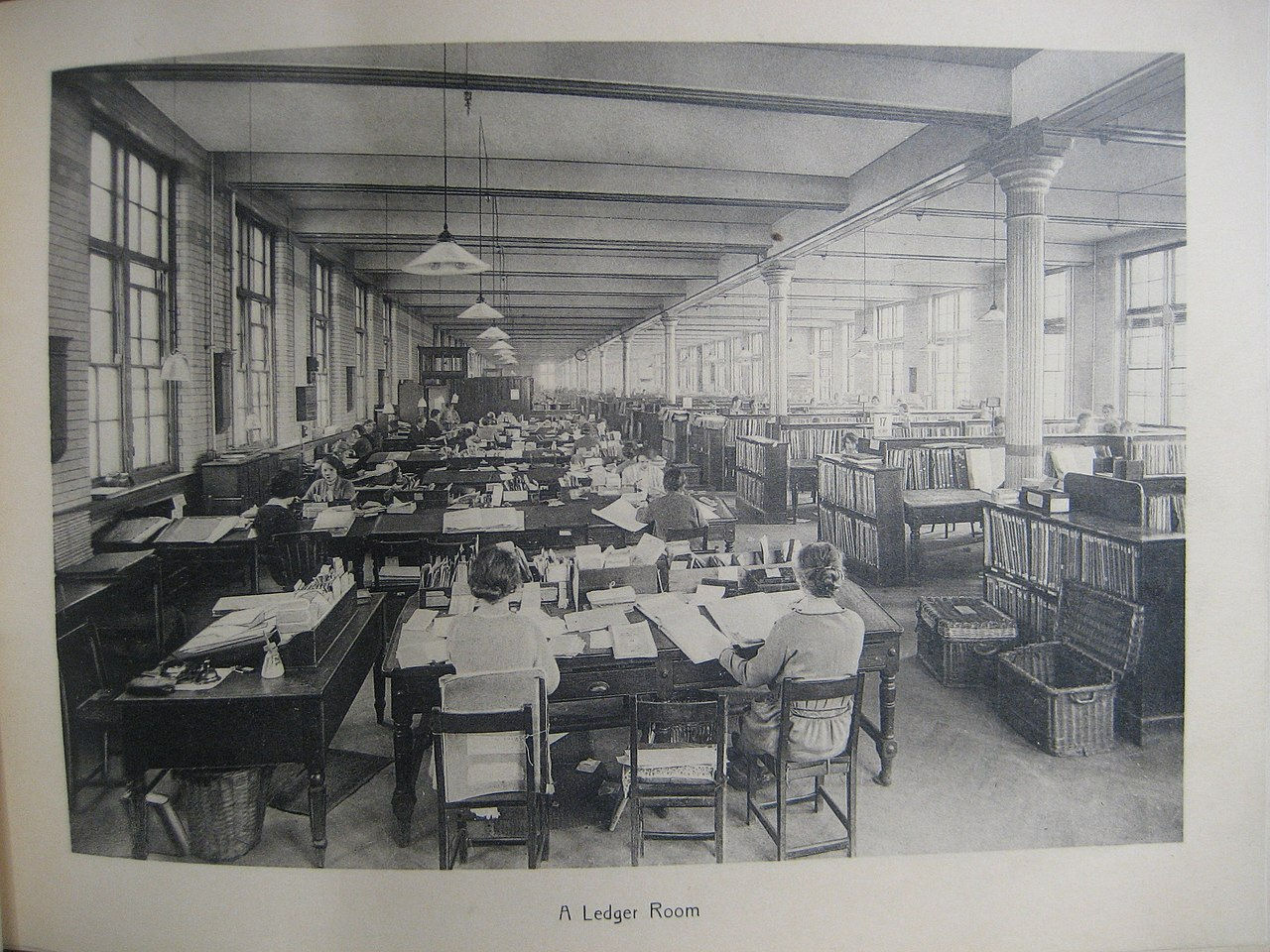
Here, from about 1924, is a Ledger Room in Blythe House. I’d imagine Alice was in a more senior role: perhaps, with her undoubted administrative skills, she was supervising the ladies in this picture.
Source: Wikipedia (Blythe House)
Rather unexpectedly, she moved out of London again at about this point, this time up to Abbots Langley, north of Watford: electoral rolls for the period give her address as The Bungalow, Tanners Hill. If she was still working in London this would have been quite a long commute for her.
By 1925 she was back at the British Championships, this time selected for the British Ladies’ Championship for the first time since 1914. Her score of 4½/11 was very similar to her previous scores in the event.
In 1928 Alice Elizabeth Hooke moved back to London, settling at 14 Brandon Mansions, Queens Club Gardens, W14, a mansion flat on the borders of Fulham and West Kensington, a mile or so from Blythe House (was she still working there?) and within easy reach of Hammersmith Bridge, where a bus would take her to visit her beloved brother George, whose wife would sadly die that year.
The British Championships that year took place in Tenby, and she made the journey to Pembrokeshire, where she more than surpassed her previous performances. She’d always finished mid-table in the past, but this time she finished in 3rd place with a score of 7/11 (including a win by default), behind Edith Charlotte Price and Agnes Bradley (Lawson) Stevenson.
This game, against the tournament winner, doesn’t show her in the best light. Alice chose a dubious plan in the opening and then made a tactical oversight, losing rather horribly.
At this point her chess career really took off. She joined Barnes Village Chess Club and, probably for the first time since the demise of the Ladies’ Chess Club, started playing regularly in club matches. You might have seen this before.
Richmond Herald 15 December 1928
Barnes Village wasn’t the only club she joined. She also, rather improbably, joined Lewisham Chess Club over in South East London, playing for them in the London League and for Metropolitan Kent in a competition against other parts of the county. They had several female members, most notably the aforementioned Agnes Bradley Stevenson, who lived in Clapham and was married to the Kent born organiser Rufus Henry Streatfeild Stevenson: perhaps it was she who encouraged her friends to join Lewisham.
You’ll have seen a photograph of Alice playing Agnes Lawson, as she then was, in the previous article.
In 1929, now very much involved in Kent chess, she took part in their Easter congress, playing in the First Class A section. She also played in the British Ladies’ Championship again, which took place in Ramsgate that year, but found herself back in the middle of the pack, with a score of 5/11.
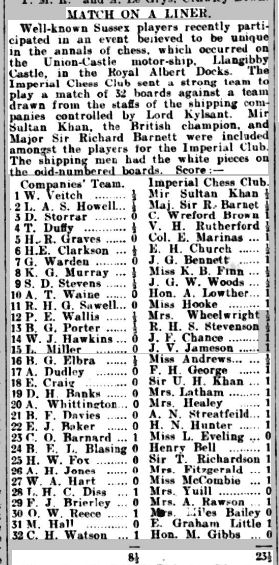
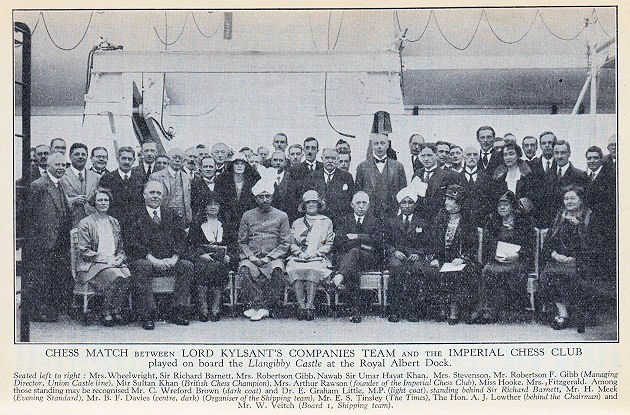
In June 1930 Alice took part in an event which attracted a lot of press attention: a chess match on a liner.
West Sussex Gazette 05 June 1930
There she was, playing in the same team as Sultan Khan and other notables from various fields, one of thirteen ladies in the 32-player team (Board 32 was Mildred Gibbs). There, you’ll see, was Kate Finn, one of the F squad from the London Ladies’ Chess Club, from whom little had been heard since World War One. Although Agnes Stevenson wasn’t playing, her husband was there on board 13. There’s a lot more to say about this match: I’ll return to it in a later Minor Piece.
British Chess Magazine June 1930, copied from Chess Notes (https://www.chesshistory.com/winter/extra/sultankhan.html)
You can see Alice seated second from the right in this photograph of the event.
The British Ladies’ Championship in 1930 required a trip to Scarborough, and it was there that Alice Elizabeth Hooke scored what would be one of her greatest successes. She shared first place with Agnes Stevenson with a score of 8½/11. Although she lost the play-off it seemed that, now in her late 60s, Alice was in the form of her life.
Kent & Sussex Courier 11 July 1930
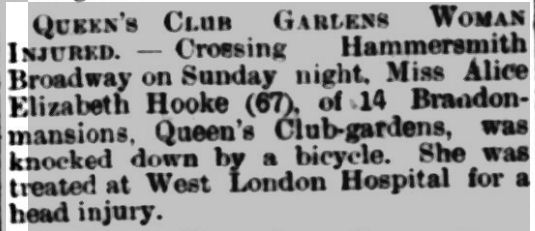
The following month the news wasn’t so good, as Alice was involved in an accident requiring hospital treatment.
Fulham Chronicle 15 August 1930
I can sympathise: Hammersmith Broadway has never been the easiest place to cross the road. Fortunately, she made a full recovery.
In 1931 in Worcester, Alice was less successful at the British Ladies’ Championship, but her score of 6½/11 was very respectable and sufficed for 5th place.
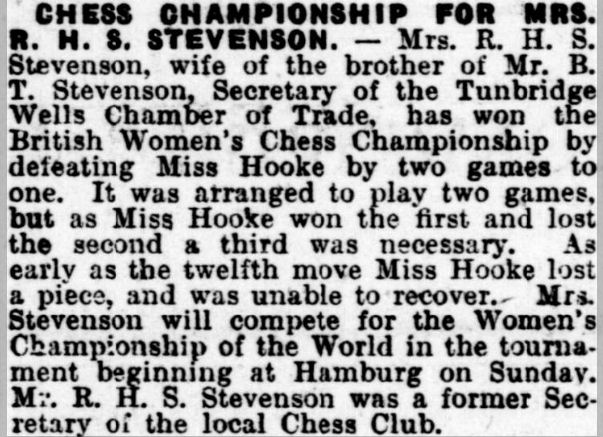
She didn’t have to travel far for the 1932 British Ladies’ Championship, which took place at Whiteley’s department store in Bayswater, which also hosted the Empire Social Chess Club. Perhaps the home advantage helped as she repeated her 1930 success, sharing first place this time with Kingston’s Edith Mary Ann Michell and her old rival Agnes Bradley Stevenson. Her loss to tailender Jeanie Brockett, from Glasgow, who had also beaten her last year, cost her the title.
The first game, played at the Empire Social Chess Club, Bayswater, London, on Thursday 8 September 1932, was a win for Agnes Stevenson against Edith Michell. Subsequent games had to await the return of Alice Hooke from holiday. Two games were played during the week 19-25 September in which Stevenson and Michell both won games from Hooke and Michell won her return game with Stevenson. Scores at that stage: Michell, Stevenson 2/3, Hooke 0/2. Then according to the Times, 3 October 1932, the following Tuesday (27 September) Michell beat Hooke, but then Hooke won against Stevenson on the Thursday (29 September) making the scores Michell 3/4, Stevenson 2/4 and Hooke 1/4. The text in the Times was as follows: “The match to decide the tie for the British Ladies’ Championship has ended in a win for Mrs. R. P. Michell, who defeated Miss Hooke on Tuesday last. There was a possibility of another tie between Mrs. Michell and Mrs. Stevenson, but Miss Hooke put this out of the question by defeating Mrs. Stevenson on Thursday, and the final scores are:—Mrs. Michell 3 points, Mrs. Stevenson 2, and Miss Hooke 1.”
As she approached her 70th birthday, Alice Elizabeth Hooke seemed finally to have established herself as one of the country’s finest woman players (excluding, of course, Vera Menchik). The results from the pre-war years, where she was consistently in the lower middle reaches, must have been a distant memory. Perhaps the standard of play among the British Ladies had declined, but even so, reaching her peak at this time of her life was undoubtedly a remarkable achievement. In between playing in the tournament, she was also supervising social chess at the Imperial Club, which suggests that, even at that age, she wasn’t short of stamina. Well played, Alice!
It’s unfortunate that very few games from the British Ladies’ Championship in these years have survived: if you come across any of Alice Elizabeth Hooke’s games from these events, do get in touch.
This was to be her last great result, though. Her performances in the three subsequent years saw her back in mid-table positions (4/11 in 1933, 5½/11 in 1934 and 5/11 in 1935), and she also played without success in the First Class A section of the 1933 Folkestone Congress. Perhaps her age was finally catching up with her.
Thanks to Brian Denman for providing this game from a county match where Alice was outplayed by a very strong opponent. The top 20 boards of this match were an official county championship match, for which Mackenzie wasn’t eligible.
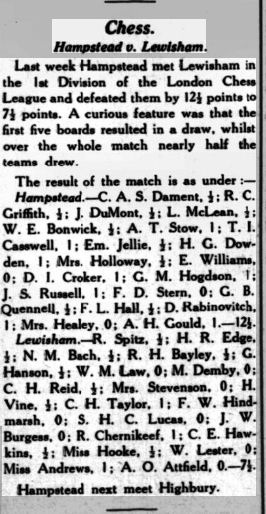
Here she is in 1932 playing for Lewisham in the London League with Mrs Stevenson & Miss Andrews against a strong Hampstead team including another of her regular rivals, Edith Martha Holloway. There are some interesting names on both sides, but for now I’ll just draw your attention to the Hampstead Board 7 Thomas Ivor Casswell (1902-1989). He was still playing for Hampstead in the London League 42 years later: I played him in 1974: the result was a draw. The golden thread that binds us all together.
Hampstead News 24 November 1932
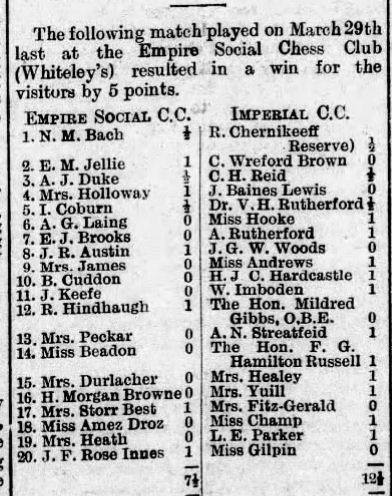
The Imperial Chess Club, which ran between 1911 and the outbreak of World War 2, along with the shorter-lived and similarly named Empire Social Chess Club, in some respects, fulfilled the purpose the Ladies’ Chess Club had served before the First World War. The Imperial was open to ladies and gentlemen for mostly social chess, and was in part designed as a club for visitors from other parts of the British Empire, so it was understandable that Sultan Khan and his patron were members.
Kensington News and West London Times 07 April 1933
You will notice that there were eight ladies in each team of this twenty-board friendly match.
For more information about the Empire Social Chess Club I’d encourage you to read two fascinating articles by Martin Smith here and here.
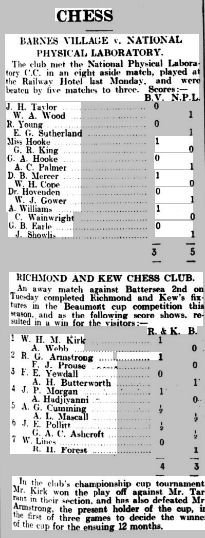
In this 1934 match against the National Physical Laboratory in Teddington she just missed playing metallurgist Edwin George Sutherland (1894-1968).
Richmond Herald 24 March 1934
This was almost certainly the EG Sutherland I played in a 1966 Thames Valley League match between Richmond & Twickenham C and Kingston B. He beat me after I made a horrendous blunder all too typical of my early games in a better position. To the best of my knowledge, he’s also the earliest born of all my opponents in competitive games, whose dates of birth therefore range from the 19th to the 21st centuries.
There are some interesting names in the Beaumont Cup match between Richmond & Kew and Battersea 2: you’ll meet one or two of them in future Minor Pieces.
By the mid 1930s, and now into her 70s, Alice decided it was time to downsize. A new estate of Art Deco mansion flats, called Chiswick Village, had just been built near Kew Bridge, between the A4 and the Thames, which were smaller – and much cheaper – than those in the rather palatial Queen’s Club Gardens. Looking at them now, they’re still remarkably cheap for the area: I was almost tempted to sell off my chess library and buy one myself.
The Brentford & Chiswick Local History Society tells us here that Chiswick Village is the name of the development of four separate blocks containing 280 flats, built on land that was formerly orchards between Wellesley Road and the railway line. The flats, designed by Charles Evelyn Simmons and financed by the People’s Housing Corporation, were built in 1935-6. When the plans were displayed at the Royal Academy, the development was called Chiswick Court Gardens – a more appropriate name than ‘Chiswick Village’ with its connotations of a rural idyll. The 1937 edition of the official guide to Brentford and Chiswick, described Chiswick Village as ‘undoubtedly London’s most remarkable and praiseworthy housing venture’.
In the 1936 electoral roll she was ensconced in 13 Chiswick Village, one of the first occupants of this new development, and was still there, described as a retired civil servant, in 1939.
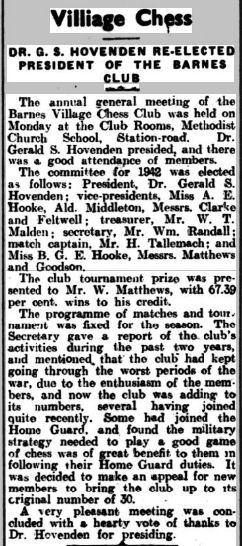
Although she was no longer taking part in the British Ladies’ Championship, Alice was still playing regularly for Barnes Village Chess Club, and still travelling to Kent where, in 1938, she lost to 12-year-old prodigy Elaine Saunders in the first round of the County Ladies’ Championship. Elaine was actually living in Twickenham at the time: her only Kent connection seems to be that it was her father’s county of birth.
Barnes Village was the only club in the area keeping its doors open during the Second World War, and Alice was still, in old age, very much involved both as a player and a committee member.
Richmond Herald 23 May 1942
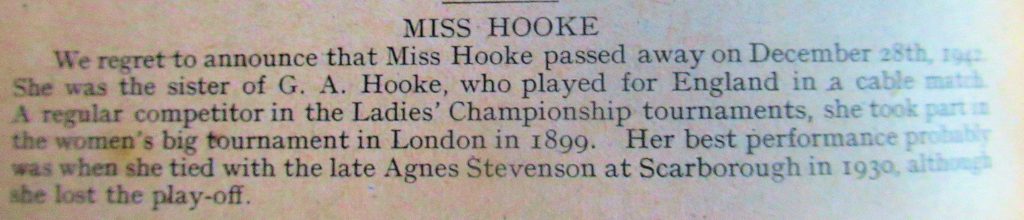
In 1942 she was elected a vice-president at their AGM, while her niece Beatrix was also on the committee. But this would be her last AGM as she died at the end of the year at the age of 80. The BCM, beset by wartime paper shortage, only gave her a six line obituary, mistakenly placing the 1897 Ladies’ International two years later.
British Chess Magazine February 1943
She really deserved better. Alice Elizabeth Hooke played an important part in women’s chess in England for more than forty years, both as a player and as a backroom administrator, from her pioneering work with the Ladies’ Chess Club through to playing club chess into her late 70s. Although she wasn’t all that much more than an average club player herself, she was still good enough to share first place in two British Ladies’ Championships in her late 60s. Reaching your peak at that age is also something to be proud of, I think. As she helped keep Barnes Village club going during the Second World War, you might think that some of her legacy is still present in today’s Richmond & Twickenham Chess Club.
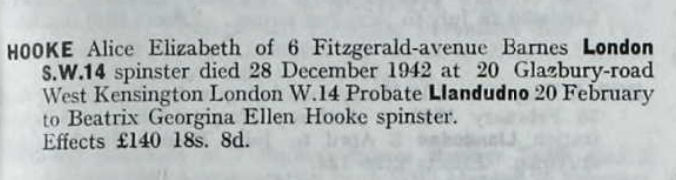
Her probate record indicates that since 1939 she’d moved from Chiswick to Barnes, perhaps to be nearer her brother and niece as well as her chess club. I presume 20 Glazbury Road was, at the time, some sort of nursing home or private hospital.
She didn’t leave very much money: she may well have gifted much of it to her relatives to avoid death duties.
The name of Miss Hooke continued to be prominent in Barnes Village chess through George’s daughter Beatrix.
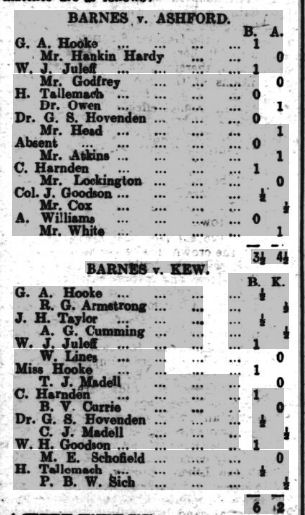
Richmond Herald 14 February 1948
Here she is, in 1948, playing as high as Board 4 in a match against Richmond, who had reconvened after closing during the war. Her opponent, Captain Samuel Ould, had been a Richmond stalwart between the wars, but most of the other Richmond players were relatively new members.
And this is where I come in. I knew George Seaford at what had by that point become Richmond & Twickenham Chess Club, in the 1960s, and Ted Fairbrother into the 1970s, though neither very well. Dr JD Solomon (a strong player) and Stan Perry left Richmond but rejoined for a time in the 1970s, the latter serving a term as Hon Treasurer. There were one or two other Richmond members at the time who would still be involved 20 years later. There was also one player in the team whom I never met, but who had an influence on my early chess career. I’ll write about him another time. The golden thread again.
Richmond Herald 07 October 1950
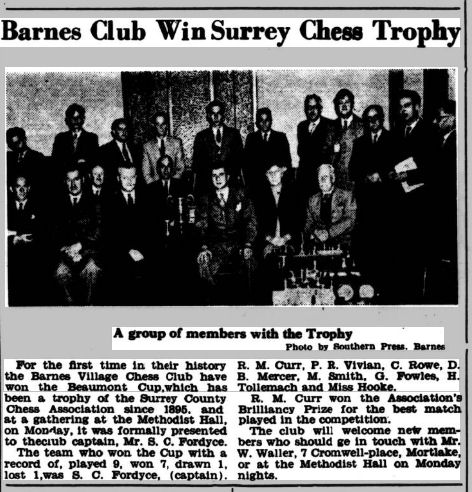
Here Beatrix is again, celebrating Barnes Village winning the Beaumont Cup (Surrey Division 2) for the first time. This was their first, and, as it turned out, their only trophy, as they would eventually be subsumed into Richmond & Twickenham Chess Club. Also in the photograph is young Peter Roger Vivian (1927-1987): I played him at Paignton, also in 1974. Another strand of the thread.
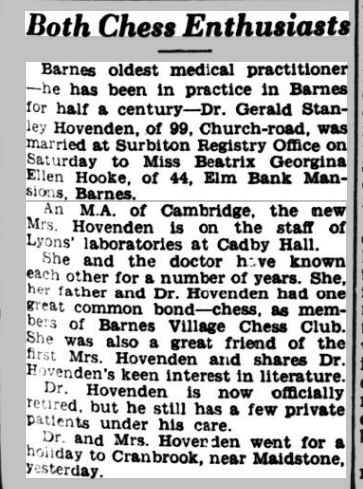
Two of the Barnes Village members had something else to celebrate in 1950: here are Beatrix and her widower clubmate Dr Gerald Hovenden demonstrating how chess can bring people together. At the time of their marriage Beatrix was 57 and Gerald 81.
Richmond Herald 02 September 1950
This tells us she was living in Elm Bank Mansions, right by Barnes Bridge, and working at Cadby Hall near Olympia, just as in the 1939 Register. Perhaps she walked along the riverbank and over Hammersmith Bridge to work, a journey almost identical to that made by her music teacher at St Paul’s Girls School more than 30 years earlier.
This was Gustav Holst, who, at the time, lived in The Terrace, Barnes, just a few yards upstream from Elm Bank Mansions. Always a keen walker, Holst was in the habit of making that journey on foot. Coincidence, or something more?
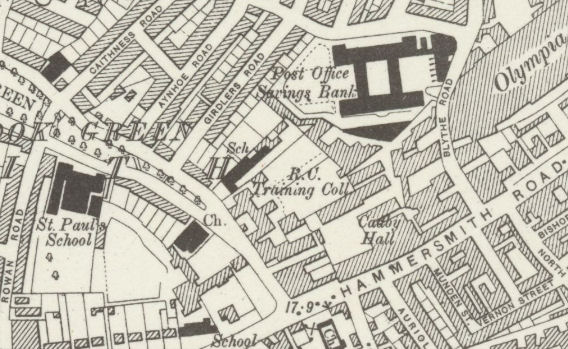
National Library of Scotland Ordnance Survey Maps
In this map you can see the Post Office Savings Bank in Blythe Road, just opposite Olympia, where Alice spent her career. Cadby Hall, just round the corner, was where Beatrix worked, as a statistician according to the 1939 Register. (As a footnote, in 1926 she co-authored a scientific paper on British skulls in prehistoric times.) Just a few yards again took you to St Paul’s Girls School, marked as St Paul School here, where Gustav Holst taught music to Beatrix and her sisters, while their brother Cyril attended St Paul’s Boys School, just off the map opposite the smaller school on Hammersmith Road. I visited there a couple of times myself in the 1960s for school bridge matches: it was rebuilt in Barnes, the other side of Hammersmith Bridge, a few years later. It’s extraordinary how much of the Hooke family’s lives played out within such a small area of London.
If you continue west along Hammersmith Road, you’ll soon reach Hammersmith Broadway, where Alice was knocked down by a cyclist, and the Underground stations. Continue into King Street and you’ll pass a turning on your right taking you to the London Mind Sports Centre, also the home of Hammersmith Chess Club, and then arrive at Latymer Upper School, a place I used to know very well.
Did Gerald and Beatrix continue playing chess after their marriage? Sadly, the online Richmond Herald records only go up to 1950, so I’d have to get out of my chair to find out. Gerald lived on until 1957, while Beatrix retired to Sussex, where she died in 1974.
That concludes the story of the chess playing Hooke family: George, his sister Alice and his daughter Beatrix. George and Alice were prominent players in earlier decades, but through their work and play at Barnes Village Chess Club for a quarter of a century they had a huge influence on chess in the Borough of Richmond upon Thames. It’s the likes of them, organisers behind the scenes as well as players, who make the chess world go round. Raise a glass to them next time you visit us at the Adelaide.
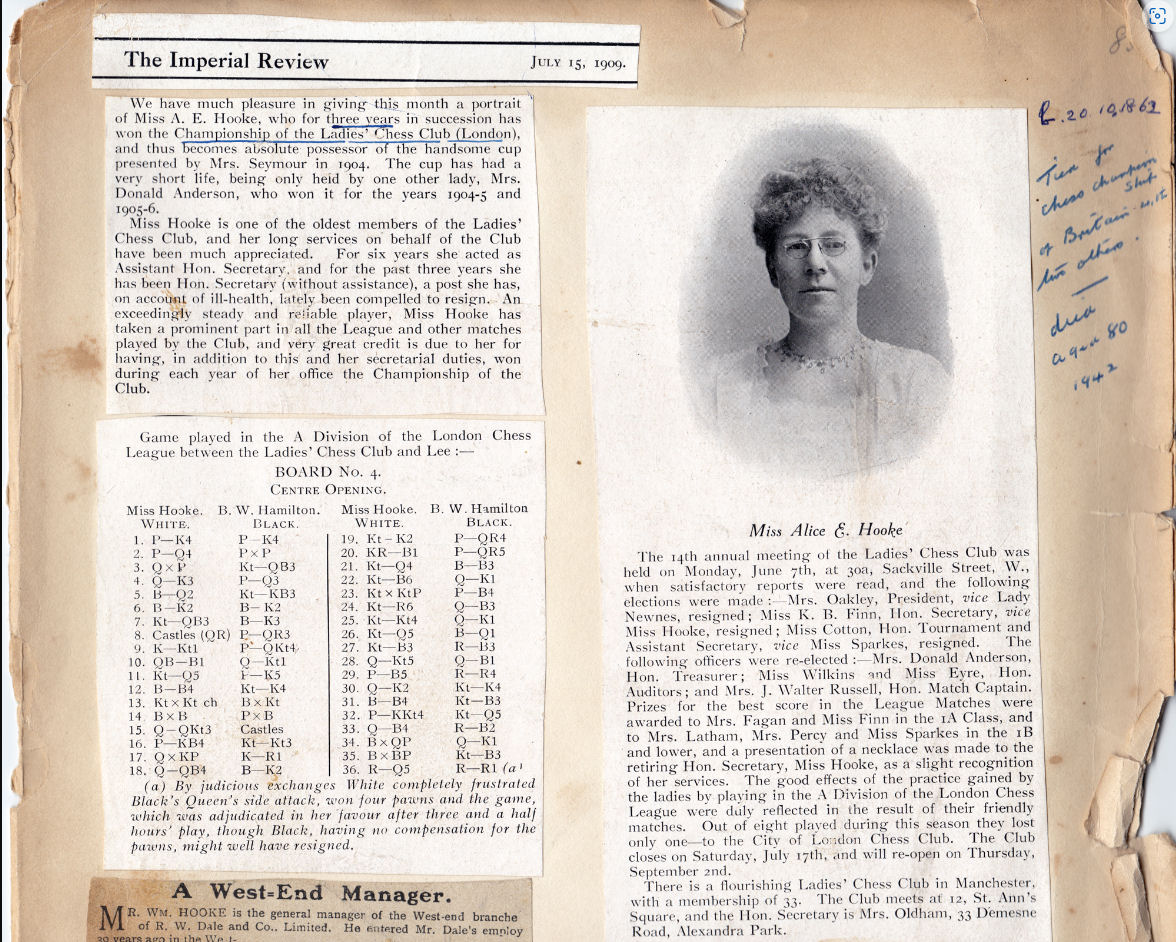
In the last two Minor Pieces (here and here) you met George Archer Hooke. Mention was made of his sister, Alice Elizabeth Hooke, who was also a competitive player: not as strong as her brother, but of more historical significance.
Alice was born on 20 October 1862, and, as expected was living at home in 1871 and 1881, although no occupation is listed for her on the 1881 census. By 1891, still at home, she was, like several of her siblings, working as a clerk (the details aren’t very legible). Presumably she, like George, had learnt chess from her father, but in those days chess clubs weren’t seen as places for women. Some clubs, like Twickenham, specified in their advertisements that they welcomed ‘gentlemen’. No plebs, and no ladies either.
But views on the role of women in society were changing. If men could have chess clubs, why couldn’t women?
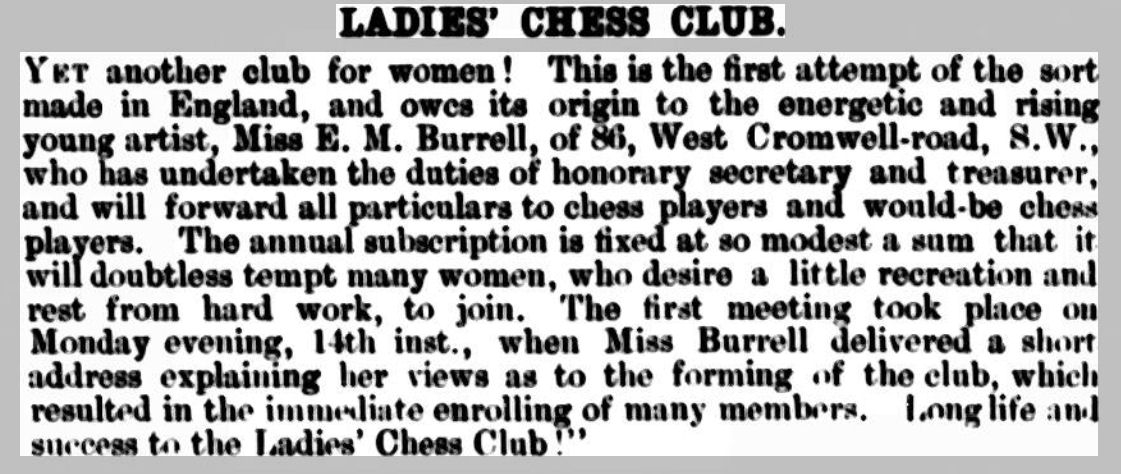
The Queen 19 January 1895
Well, it certainly wasn’t the first Ladies’ Chess Club in England, and portrait painter Edith Mary Burrell (1858-1906) wasn’t all that young either, but the club, as you’ll see, would become very popular and successful.They soon found a venue in the Strand opposite Charing Cross Station and, by May, were playing their first match.
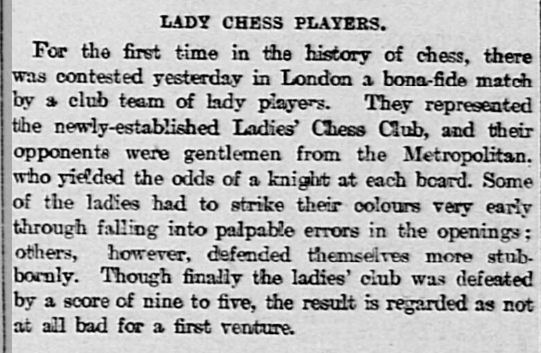
Sheffield Evening Telegraph 24 May 1895
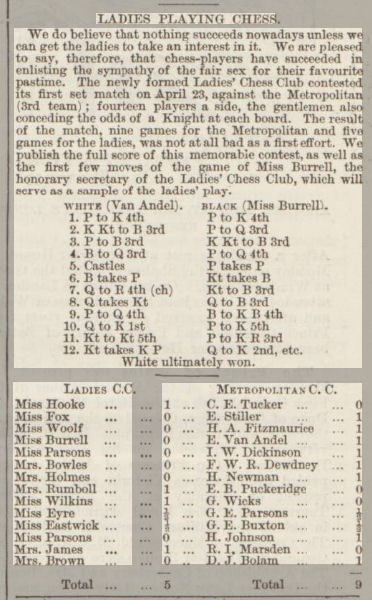
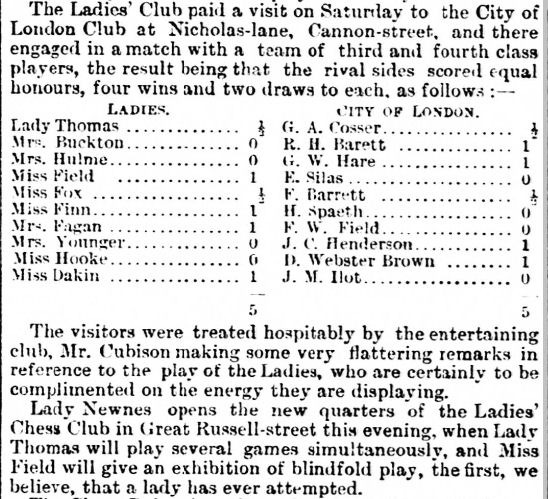
Alice, a keen social chess player, had wasted no time in joining, playing top board in this match. As you’ll see, the gentlemen of the Metropolitan club, as well as giving knight odds, were only their third team players, which suggests that most of the ladies were, at this point, not very strong players.
Penny Illustrated Paper 01 June 1895
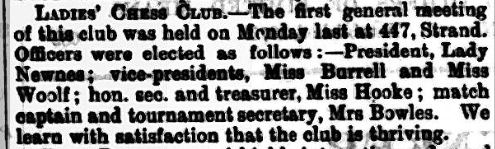
The following month their first Annual General Meeting took place. Miss Alice Elizabeth Hooke was elected Hon Secretary and Treasurer.
Barnet Press 22 June 1895
Most importantly, Mrs Rhoda Bowles was elected match captain and tournament secretary. All chess clubs are only as good as their organisers, and, in Rhoda Bowles, they had an organiser and publicist of exceptional energy and talent, with, I’d imagine, Alice Hooke doing the backroom work with considerable efficiency.
The club continued to thrive, offering a bewildering whirl of activities: internal tournaments, simultaneous displays, including one from Harry Nelson Pillsbury, fresh from his success at Hastings, and matches against other clubs. By October, with their membership having grown to 75, they found more commodious premises in Great Russell Street, close to the British Museum.
Morning Post 21 October 1895
Lady Thomas was the mother of the future Sir George Thomas, and herself a strong player. Alice had been relegated from top board to board 9 by now, partly because of an influx of strong new members. The four players on the middle boards, all, coincidentally, with surnames beginning with F, would go on to play important roles in the Ladies’ Chess Club over the next few years. For the remarkable Louisa Matilda Fagan, I’ll refer you to Martin Smith’s articles referenced below. I hope to write about Gertrude Alison Beatrice Field, Rita Fox and Kate Belinda Finn at some point in the future.
Within a few months they were up to 100 members. Pillsbury visited again and Lasker looked in whenever he was in town.
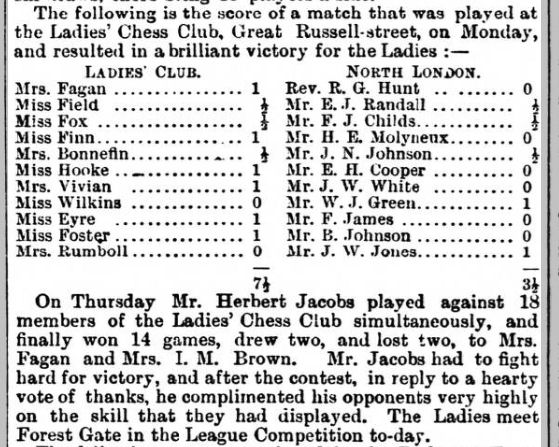
In 1896 the Ladies’ Chess Club entered the London League as well as continuing their programme of internal competitions, friendly matches, such as the one below, against other clubs and simuls, in this case by Herbert Levi Jacobs.
Morning Post 07 December 1896
Here, you see the F-squad in place on the top four boards, with the Belgian Marie Bonnefin on board 5 and Alice on board 6. By now they seem to have established their correct board order. While, for many of their members, the club probably served a social function, their strongest players were intensely competitive.
They had even bigger plans in store for 1897 when, to mark Queen Victoria’s Diamond Jubilee, they planned to hold an International Ladies’ Chess Tournament at the Hotel Cecil in London.
The strongest lady players from around the world were invited, and, naturally enough, these included several of their club members. Alice Elizabeth Hooke was originally a reserve, but when one of the American invitees withdrew, she was granted a place in the competition.
I’ll refer you to two excellent articles (links at the foot of this post) which provide much more information. The tournament, just like the club, predictably attracted a lot of interest in the press and several of the games were published. Alice’s score of 10 points (8 wins over the board, 2 by default and 9 losses) was more than respectable for a reserve.
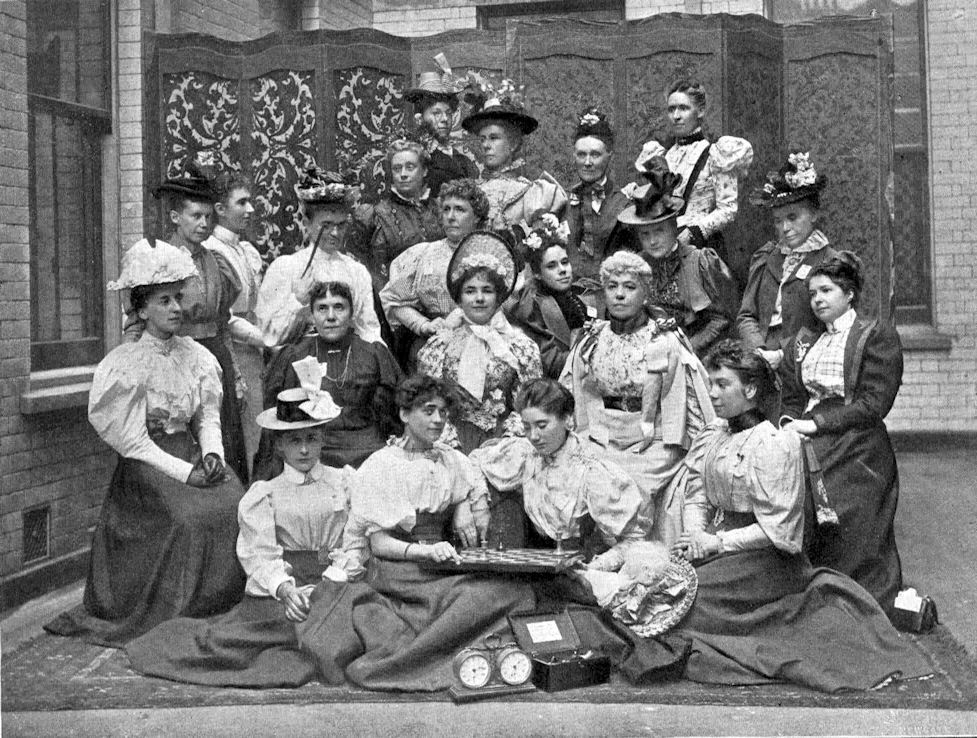
Here’s a photograph of the competitors. Alice, wearing a hat, is standing right at the back against the screen.
In this game against one of the German representatives (her first name is not known, at least to me, but she may well have been related to the organist and composer Carl Müller-Hartung (1834-1908)), her opponent failed to take advantage of an oversight at move 15, after which a poor choice at move 18 allowed Alice to demonstrate some impressive attacking skills. Click on any move in any game in this article for a pop-up board.
Against her Belgian clubmate Marie Bonnefin, Alice lost a vital central pawn, after which her opponent’s passed pawns enabled her to bring the game to a neat conclusion.
Alice’s game against one of the F-squad, Gertrude Field, had an interesting finish. Gertrude played an enterprising and correct piece sacrifice on move 25, but missed the immediate Nf3 on move 27. Defending in chess is always difficult, and Alice could have stayed in the game by playing 28… Ne7.
Her best result came in round 8, with a win against Louisa Fagan, who eventually finished in second place. Only a short extract is available, but the opening must have been a Centre Game (1. e4 e5 2. d4 exd4 3. Qxd4), a favourite of both Alice and her brother George. It’s interesting to note that the two siblings frequently played the same rather unusual openings.
Finally, we have a quick win against Miss Eschwege, who, overlooking that her d-pawn was pinned, blundered a piece and immediately resigned. It’s frustrating that, for many years, the press didn’t see fit to use initials for women. Here, again, we don’t know Alice’s opponent’s first name. Her chess playing father, Hermann, was born in Germany, but lived in London. He had three daughters: Kathleen had married by 1897, but either Ida or Nina would be possible. If you know, do get in touch.
The experience of intensive competitive chess, with two games a day over ten days, must have been an educational experience for Alice and the other lady chess players.
Here’s a game she played the following year, where she crowns a strong attack (she did seem to like castling queenside) with a brilliant rook sacrifice.
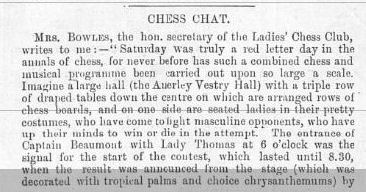
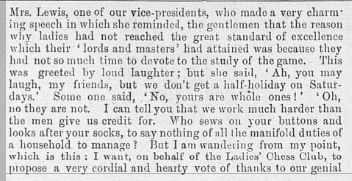
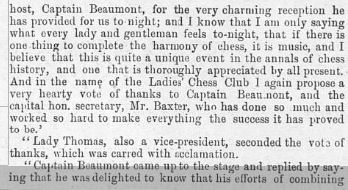
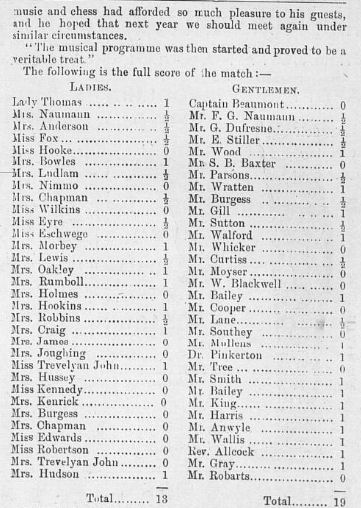
Later that year the Ladies’ Chess Club visited Anerley, near Crystal Palace in South East London, for a combined chess and musical programme.
Illustrated Sporting and Dramatic News 03 December 1898
Captain Alexander Beaumont’s name lives on in the Beaumont Cup, which has, since 1895-96, been the name of the second division of the Surrey Chess League. Frank Gustavus Naumann would later become the first President of the British Chess Federation before losing his life on the Lusitania. Mrs Anderson, on Board 3 for the ladies, was the former Gertrude Alison Beatrice Field, who had just married Donald Loveridge Anderson.
In January 1899 their 4th birthday party’s guests included Lasker, Gunsberg, and, appropriately enough, Antony Guest. As the 20th century approached there was no stopping the Ladies’ programme of matches and social events.
At this time we can find Alice in the 1901 census, living at 27 Croxted Road, Herne Hill with her widowed mother Harriett, and working as a clerk in the General Post Office. This was just 2.3 miles up the A2199 from Anerley Village Hall, and close to Dulwich College School.
At Whitsun that year Alice, along with her clubmates Louisa Matilda Fagan, Kate Finn and Rita Fox, took part in the open section of the Kent County Chess Association Tournament. I haven’t been able to find the full results, but Miss Finn did well to finish in second place.
In 1902 she visited Norwich for the British Amateur Championship, playing in the 3rd Class section along with the Misses Foster and Oakley from the Ladies’ Chess Club (and my favourite chess playing clergyman, Rev W E Evill). Miss Finn, Mrs Anderson and a new member of the Ladies’ Chess Club, Mrs Frances Dunn Herring (née Gwilliam) took part in the 2nd Class section.
In 1903 Alice played in the Kent congress in Canterbury, playing in Section A of the ‘Extra’ (2nd Class) section and sharing 2nd place with a score of 4½/7.
The British Chess Championships took place for the first time in 1904, and from the start, the top places in the British Ladies’ Championship were usually taken by members of the Ladies’ Chess Club. Alice Elizabeth Hooke took part for the first time in Shrewsbury in 1906, winning five games and losing six.
In this game against Scotland’s Agnes Margaret Crum, she lost quickly using the Dutch Defence, an opening also favoured by her brother George.
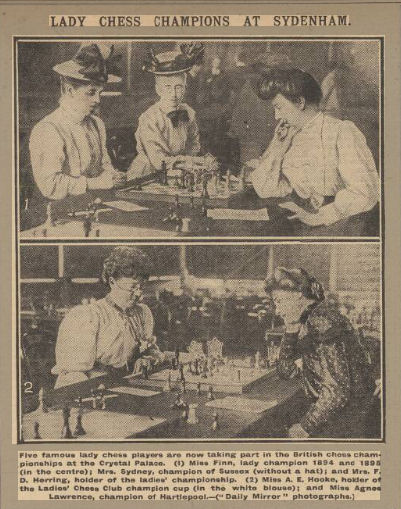
She was back again in Crystal Palace (she wouldn’t have had far to travel) the following year, with a similar result: four wins, one draw and six losses. She was, at this point, and by now in her mid 40s, some way below the best lady players in the country.
Here she is, pictured in the Daily Mirror, on the left in the lower photograph. Her opponent ‘s name was Agnes Lawson, not Lawrence.
Daily Mirror 14 August 1907
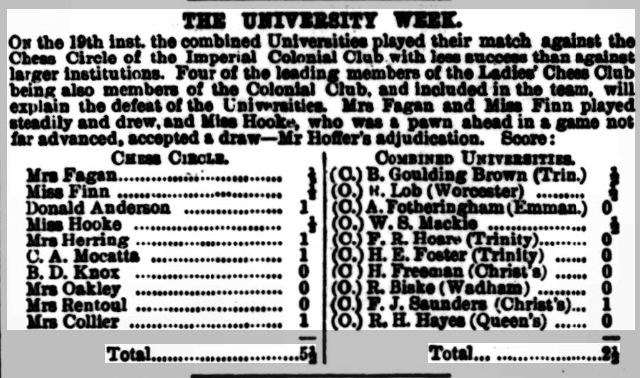
By 1909, Alice had joined a new club, the Imperial Colonial Club, whose chess players seemed mostly to be connected with the Ladies’ Chess Club. There will be a lot more to say about this club in future Minor Pieces.
Field 27 March 1909
I’m not sure why boards 7 and 8 were reported as a loss for both players.
In July, the Imperial Review (perhaps connected with the Imperial and Colonial Club) published a feature on Alice Elizabeth Hooke, with the information that she’d won the Ladies’ Chess Club for the third year in succession, thus acquiring the cup in perpetuity (I wonder what happened to it) but had had to relinquish her post as secretary for health reasons. We also have a rather fine photograph.
From the Hooke Family Archives
Here’s the game for you to play through: you’ll notice the opening variation is the same as that from Alice’s game against Miss Eschwege from 12 years earlier.
Although the Ladies’ Chess Club was still growing, its activities were receiving less publicity in the press. Perhaps the novelty had worn off. It seems that Alice Hooke was less active at this time, perhaps partly because of ill health, and partly because she was having to care for her increasingly frail elderly mother.
By the 1911 census Harriett and Alice had moved to 12 Eatonville Road, Upper Tooting, just a 12 minute walk from Alice’s brother George’s rather more substantial house in Drakefield Road. Alice was now described as a Clerk in the Civil Service.
Harriett died in December 1912, but it wouldn’t be until 1914 that Alice resumed her chess career.
The British Championships took place in Chester that year, and Alice Elizabeth Hooke was back in the Ladies’ Championship, but without much success, winning four games and losing seven.
One game is available, but it doesn’t show her in a good light. She seemed unfamiliar with her opponent’s sharp opening variation, and, after only six moves, had a very bad position. Mrs Holloway was able to offer a bishop sacrifice for a swift victory.
By now she had moved out of London, to Cobham, near Esher in Surrey. Electoral rolls give her address as White Lodge, Cobham. There are two houses of that name in Cobham, about a mile apart. I’d guess it was more likely to be this one than this one. As it was just her and a servant, the smaller and more centrally located property would have been more than adequate. Neither was close to the station, so I wonder how she travelled to work. Jumping ahead for the moment, she was still there in 1921, working as a civil servant in the Post Office Savings Bank in West Kensington.
But then, of course, World War 1 broke out, and, like many others, the Ladies’ Chess Club decided to close its doors for the duration.
As you probably already know from her brother George’s story, this was not the end of Alice Elizabeth Hooke’s chess career. You’ll find out what happened subsequently in the next Minor Piece.
But meanwhile, if you’re interested, there’s a lot more reading material for you.
There’s a lot of information about the Ladies’ Chess Club and the 1897 tournament available in various online sources.
The excellent Batgirl (Sarah Beth Cohen) has written a number of articles on the Ladies’ Chess Club on chess.com.
See here for a full list of her articles on women’s chess.
My good friend Martin Smith has written a wonderful series of articles about Louisa Matilda Fagan. You can read the first of the series here: there are links to the subsequent articles at the end.
There’s a well-researched article by Joost van Winsen concerning the 1897 Ladies’ Chess Tournament on the Chess Archaeology website here.
Another informative article on the same event by Tim Harding can be found on the Chess Café website here.
Master Your Chess with Judit Polgar: Inspirational Lessons from the All-Time Best Female Chess Player by Judit Polgar, Andras Toth, New in Chess, May 31st 2022, ISBN-13 : 978-9493257337
From the publisher:
“Judit Polgar was the best female chess player in the world for a record 26 years. In this book she reveals some of the secrets of her success. Together with prize-winning coach, International Master Andras Toth, she has created a course based on the training she received as a young player. It feels like private lessons from one of the best players in the world.
You will learn how to punish the three most common openings mistakes. And how to spot hidden tactical opportunities and how to force your opponent to play weakening moves. You will be taught how to master one of the most difficult skills in chess: seizing the initiative. And you will find the tools to turn yourself into a lean, mean, attacking machine. Master Your Chess with Judit Polgar covers all aspects of the game: from the opening to the endgame. The manual is accessible both for ambitious beginners wanting to build their chess development on a strong foundation and for intermediate players who have hit a plateau and need new insights to leap forward.”
Judit Polgar has been ranked 1st on the Women’s rating list from 1989 to this day. In 2005 she became the only woman in chess history to participate in the World Championship final.
GM Judit Polgar
What we have here is an online course from chessable.com converted into a book.
Here’s Judit Polgar in the preface:
As an attempt to provide a rock-solid foundation to your game, we are going to cover all aspects of the game from the opening to the endgame. Again, we will do this in a unique and very focused fashion. Instead of wading through masses of opening theory, we are going to examine the main culprits that allow positions to break down.
We are going to look at the foundations of tactical play and will begin to delve into the most common positional themes. Last but not least, we are going to learn about endgame techniques and use endgame studies, not only to establish solid theoretical knowledge but to greatly enhance our calculation skills!
All this is going to be presented to you through a selection of games played by me and other experts of our royal game.
It’s described by Judit as a ‘starter kit’ and on the back cover as for ‘ambitious beginners’. It all depends on what you mean by ‘starter’ and ‘beginner’.
There’s an assumption that the reader is familiar with basic tactical ideas, opening principles and endgame theory, and is able to look ahead and calculate with reasonable proficiency.
For this reason, I’d consider this a book suitable for readers rated in the region of 1500-2000, although ambitious readers of, say, 1250 upwards would also benefit if they were prepared to work hard.
You can read some sample pages on the publisher’s website here.
You’ll observe from the contents that the book covers a wide range of themes across all areas of the game: openings, strategy, tactics and endings. Some of the chapter headings suggest material that wouldn’t be suitable for beginners: for example, Positional Queen Sacrifices, Openings that Thrive on Initiative or Complex Endings. Each chapter is introduced by a page in which the reader is invited to find the best continuation in four diagrammed positions. The diagrams are repeated over the page with the correct answer underneath: these positions are then explained in detail within the chapter.
Judit Polgar is second to none at both playing and selecting games and positions which are at the same time instructive and aesthetically pleasing. Together with her co-author Andras Toth she does an excellent job at explaining the examples, asking questions to the reader where appropriate, avoiding too many variations, and providing short and pertinent nuggets of advice.
Here’s a short game from the second chapter which Judit describes as ‘a particularly educational game to model the dangers of bringing the queen out too soon and neglecting development!’, adding that 12… Nxc3 13. Bxc3 Qb5 14. Nd6+ wins the queen.
Click on any move for a pop-up window.
It’s good to see in Chapter 4 that Polgar, like me, uses the acronym CCTV when teaching tactics, although she refers to Checks, Captures and Threats Variations, while I prefer Checks, Captures, Threats and Violent moves (or looking for Checks, Captures and Threats leads to Victory).
Of course, tactics and strategy always go hand in hand, and, as a brilliant tactician who was brought up on a diet of solving tactical puzzles, even her chapters on strategy include examples with sparkling conclusions. Take this example from Chapter 7 on Misplaced Pieces, where another Hungarian demonstrates his skills.
You’ll find a number of endgame studies scattered throughout the book. Here, from the chapter on Unexpected Tactics, is the conclusion of an extraordinary study composed by Yuri Dorogov (Targoviste 1982).
Black is two queens up, with a pawn seemingly about to promote, but an inspection of the position reveals that there’s no way that 6. b3 can be prevented. Amazing! Who’d have thought it?
Chapter 21, Openings that Thrive on Initiative, includes the Botvinnik Semi-Slav, according to Polgar and Toth a super-exciting opening branch with vast theory and super-complicated games! Here’s an example, described by the authors as a remarkable victory and creative effort by Kaidanov.
This review wouldn’t be complete without an example of Judit Polgar’s play. There are many of her brilliant tactical finishes in the book, but, like all great players, she also excelled in the ending.
This example comes from Chapter 28: Complex Endings. Judit explains: This endgame was a particularly satisfying one as I managed to execute a wide range of strategic and tactical themes within one game, including some awesome king maneuvers…
As you can see, you get 500 pages of terrific chess in this book, with 287 ‘games’. Some of the positions were familiar to me, but most weren’t.
The book is a sturdy, good-looking hardback: a very welcome from the usual rather flimsy softback books. The presentation is rather unusual, and much more colourful than most chess books, as a result of its being produced from an interactive course. The diagrams are graphic rather than character based, in tasteful two-tone brown. I quite like them myself, but perhaps some readers will prefer something more traditional. Some of the diagrams are enhanced with shaded squares and arrows, which, for me, are more appropriate for a screen than a book, where they don’t display especially well. The book uses a wide sans serif font which is perfect for screen display, but again you might prefer a more traditional serif font. I think it looks rather attractive as there isn’t a lot of heavy text in the book, but you might disagree. Questions are asked in blue, which makes them stand out from the rest of the text. On the whole, I thought the book looked really good: much more appealing than many chess books and excellent value for money: you can get it for under £30 if you shop around.
Then there’s the writing style, which tends towards the hyperbolic. The other day I was teaching a 7-year-old beginner. Whenever he found a checkmate in a puzzle I set him he exclaimed ‘Boom’!. In this book you sometimes get ‘Kaboom!’ instead. Moves are often described as ‘awesome’, ‘super-exciting’ or similar epithets. You might find that this enhances your reading experience, making it more like a personal lesson. On the other hand, you might consider it more suitable for a primary school classroom than for a book written for intelligent adults.
One further minor complaint: as with many books from this publisher, it would have benefited from additional proofreading by a native English speaker.
The quality of the material is outstanding throughout – ‘awesome’ if you prefer. The book covers a wide range of important topics suitable for club standard players. The examples are both educational and inspirational, with clear and helpful annotations. You’ll learn a lot about calculation and tactics, about positional play and strategy, but, more than that, you’ll encounter a lot of excitement, creativity and beauty. Studying this course will undoubtedly improve your chess as well as giving you a greater appreciation of the aesthetics of the game. It’s hard to imagine a more enthusiastic and inspiring guide and role model than the world’s strongest ever woman player. If you prefer, you can purchase the online course instead, but if you favour more traditional media, this book will grace your library.
As long as you’re happy with the presentation and writing style, this book deserves a very strong recommendation for all club players, with the caveat that, despite the suggestion on the back cover, it’s not suitable for complete beginners.
You might also want to visit Chessable to hear Judit talking further about the course.
Last time I left you in 1980, when Mike Fox had moved to Birmingham, leaving me in charge of Richmond Junior Club, whose membership included a growing number of very strong and talented young players, inspired by Mike’s teaching and charismatic personality to excel at chess.
I had been the backroom worker to Mike’s front man, but now, reluctantly, I was the front man as well.
My forte was organising rather than teaching, and, wanting to provide experience of serious competitive chess, I ran regular training tournaments for our strongest players.
Here, for instance, is a game from a 1981 training tournament. Aaron Summerscale is now a grandmaster and chess teacher. Nick von Schlippe is now an actor, director and writer, but maintains his interest in chess. Nick was one of a quartet of outstanding players from Colet Court/St Paul’s along with Harry Dixon (now playing chess in South East London), Michael Arundale and Michael Ross.
Click on any move of any game in this article for a pop-up window.
To give you some idea of our strength four decades ago, the leading scores in the 1982 Richmond U14 Championship were:
Nick von Schlippe 5/6
Demetrios Agnos (now a GM) 4½/6
Michael Ross 4/6
Philip Hughes 3½/5
Gavin Wall (now an IM and, for many years Richmond London League captain), Ben Beake, Harry Dixon, Sampson Low (currently secretary of Richmond & Twickenham Chess Club) 3½/6
Ali Mortazavi (now an IM) 3/5 Mark Josse (now a CM), Rajeev Thacker 3/6
and 6 other players, including Chris Briscoe (now a CM).
Here’s a game from that event for your enjoyment.
The results of our 1983 Under 14 Championship told a fairly similar story.
Scores out of games played (there are either two missing scoresheets or two players took byes in Round 4 and two didn’t play in Round 6) were:
Gavin Wall 6/6
Demetrios Agnos 4½/6
Philip Hughes 4/6
Harry Dixon, Ben Beake, Chris Briscoe 3½/6
Aaron Summerscale 3/5
Michael Ross, James Cavendish, Rajeev Thacker, Mark Josse, Bertie Barlow 3/6
Ali Mortazavi 2½/5
Leslie Faizi 2½/6
Grant Woodhams 2/6
Alan Philips, Chris Bynoe 1/5
Daniel Falush 0/6
At some point I’d acquired a copy of Chess Life and discovered that the members of our small suburban junior chess club were, over the top few boards and applying the conversion factor in use at the time, stronger than the juniors in the whole of the USA.
The significant factor in all this is, for me, not just the strength of the players, but how many are still playing, or at least keeping up with the chess world, and, even more so, how many I’m still in touch with, or have spoken to on social media, almost 40 years on. Talking to them now, they always have very fond memories of their time at Richmond Junior Club.
What we were doing, although I wasn’t aware of it then, was building a lifelong chess community. Producing future GMs and IMs was merely a by-product of the actual purpose.
But it was clear that, as the younger players coming into the club were less strong and less interested than their predecessors, changes had to be made. Perhaps I needed someone who was a much better chess teacher than me and, like Mike Fox, had the charisma to attract strong new members into the club. There was no doubt who the best chess teacher was in my part of the world: Mike Basman. He agreed to help and, for a time in 1983-84 we worked together.
Of course, Mike was, and still is, brilliant, but he’s also a maverick, someone who, like me, prefers to do things in his own way. There were a couple of issues, in particular, where we disagreed.
Mike has always been known for his love of eccentric openings, and he’d sometimes give lessons on these. My view was different: children should, in the first instance, be given a thorough grounding in all the major openings. If they decide later that they want to experiment, that’s fine, but understand the basics first.
My second point was that we were inviting near beginners to training tournaments where clocks and scoresheets were used. My view was, and still is, that children should be able to play a reasonably proficient game without giving away pieces before clocks and scoresheets are used. Clocks and scoresheets add to the game’s already bewildering complexity and, if children are not used to them, they will concentrate too much on remembering to press their clock and working out how to write their moves down and forget about how to play good chess.
This is still one of my big problems with junior chess today: we’re putting children who barely know how the pieces move into tournaments with all the accoutrements of proper grown-up chess: clocks, arbiters, strictly observed silence, touch and move. My view is that this is totally wrong, but, even more so today than 40 years ago, I appear to be in a small minority. Very often, these days, parents are insisting that their children should take part in serious external competitions before they’re ready in terms of both chess and emotional development.
You’ll find out next time how I addressed these two issues over the following years. I had to find my own methods of doing exactly what I wanted. If anyone else wanted to come in with me, that was fine, but I was never going to compromise on doing it someone else’s way rather than mine.
Meanwhile, in April 1984 we were offered the chance of a simul given by Hungarian GM Zoltan Ribli, who at that time was ranked 13th in the world with a rating of 2610. Although we had to pay quite a lot for the privilege, this was too good an offer to turn down. According to the scoresheets that were handed in he scored +13 =4 -2: again, a pretty good performance for a suburban junior chess club! Here’s one of his losses.
At that time, we were constitutionally part of Richmond & Twickenham Chess Club, and our accounts were incorporated in theirs. Up to that point we’d made a reasonably healthy profit each year, but in 1983-84 we had only just broken even. At the 1984 AGM the RTCC treasurer wasn’t impressed, thinking we might jeopardise the club’s finances in future, and uttering the immortal words ‘What’s a Ribli Simul?’. (Strangely enough, the other day I chanced upon a record of him playing in a simul some 35 years or so earlier!)
Our turnover was also much larger than that of RTCC so it seemed sensible that we should declare financial independence. I would remain on the committee as the officer responsible for junior chess, providing a link to RJCC. (I still hold that post today, but without the RJCC link.) We already had a parent, Derek Beake, serving as our Treasurer, a role he’d occupy for 22 years, long after his son Ben had given up competitive play.
In 1985 we were again offered the chance of a simul given by a world class player, in this case by local GM John Nunn, who, at the time, was ranked joint 11th in the world (one place behind Ribli) with a rating of 2600. This time we invited a few of our friends from Richmond & Twickenham Chess Club to join us.
Out of 23 games, John scored 14 wins, 6 draws and 3 losses, to RTCC’s Paul Johnstone, a slightly pre-RJCC Richmond Junior (someone suggested the other day I should write something about the pre-RJCC Richmond Juniors, which perhaps I should), to future GM Demetrios Agnos and to the unheralded Leslie Faizi, who had also drawn with Ribli the year before.
Even our lesser lights from that generation could play pretty good chess. Here’s a draw against Alan Phillips, who had beaten Ribli the year before (and who contacted me on Twitter a few years ago).
Yes, many of our stronger players from a few years earlier still kept their association with the club, and with chess in Richmond in general (and some of them still keep that association in the 2020s), although they had now outgrown our Saturday morning sessions. We were also no longer successful in attracting strong players into the club. (I suspect, looking back, they just weren’t around in our area: these things come and go.)
I knew I needed to make changes, and that I had to find my own way of running the club rather than trying to work with anyone else.
I wanted to separate the club in order to differentiate between the players who were able to play a proficient game, and who needed experience playing under more serious conditions using clocks and scoresheets, and those younger and less experienced players who were not yet able to play fluently without making regular oversights.
By now home PCs had become available. I was able to use my (admittedly limited) programming skills to write a grading program in BASIC for my BBC Micro into which I entered all our internal club results. I used a pseudo-BCF system with a crude but reasonably effective iterative process providing anti-deflation factor which would take into account my assumption that our members were either improving or remaining stationary at any point.
This gave me the information to decide, by monitoring all the internal results of all our members, which players should be in which group. The decision was made – and my intuition again turned out to be correct (although it’s not how things work today) – that players of primary school age would move up to the higher group when they reached a grade of 50 (equivalent to 1000 Elo). I’ll write a lot more about this, either here or elsewhere, later.
By the start of the 1986-87 season the club had become something totally different. Two things had also happened which would have an enormous impact on the club’s further development.
You’ll find out what they were, and a lot more besides next time.
Last time we left George Archer Hooke at the age of 32 in 1889, just having married 34 year old Ellen (Nellie) Farmer.
George and Ellen didn’t waste a lot of time starting a family. Their first child, a daughter named Mildred Alice (was her middle name a tribute to George’s sister?) was born on 18 September 1890.
The 1891 census found George, Ellen and baby Mildred at 22 Galveston Road Putney (just off the South Circular between Putney and Wandsworth). George, Ellen, Mildred. By now Ellen was expecting another child, and, on 7 November that year, they welcomed Frances Louisa into the world.
George was still playing club and county chess regularly.
In this game he demonstrated commendable aggression in the middle game against tinned milk pioneer Arthur James Maas, who, perhaps unwisely, opted for one of his opponent’s favourite openings. Click on any move for a pop-up window.
On the very day this game was published, George had another reason to celebrate: the birth of a third daughter, named Beatrix Georgina Ellen.
George Archer Hooke was a member of two clubs but chose to play for North London in the London League. This league had started in 1888, and North London followed Athenaeum as title winners in the 1889-90 season. Their second title would come in 1898-99. Here they are, in 1894, losing to George’s other club.
Illustrated Sporting and Dramatic News 24 Feb 1894
Although his team lost, George won his game against Prussian born Fancy Stationer(!) (John Charles) Frederick Anger. There are some interesting names, as always, on both sides. Regular readers will spot Edward Bagehot Schwann playing for City.
The North London Board 17 is also of interest. Back in the 1960s my father, who sang in his church choir, had a score of Handel’s Messiah, edited by the wonderfully named Ebenezer Prout. I always remembered this – and here he is in 1894 playing chess in the London League. Wikipedia confirms that Ebenezer lived in Hackney and played chess: something I never knew until now.
Three months later his team encountered someone even more interesting.
Hastings and St Leonards Observer 26 May 1894
The Sussex board 14, assuming the middle initial should have been A rather than H, was none other than star of The (Even More) Complete Chess Addict and “Wickedest Man on Earth” Aleister Crowley.
A fourth daughter, given the names Ella Kathleen, was born on 8 April 1895, and she would be followed, on 28 November 1896, by George and Ellen’s last child and only son, Cyril George.
The City of London Championship, which, as regular readers will be aware, would soon become very strong, attracting London’s leading amateur players, had started in 1890, and George was often amongst the entries. The closest he came to winning the event came in the 1896-97 season, in which he won his section but lost to the winners of the other three sections in the play-off, with Thomas Francis Lawrence eventually winning his second title.
In this game of fluctuating fortunes against an Essex player, Hooke escapes from a poor position. His opponent seemed to lose the thread of the game, allowing George’s hanging pawns to become a strength rather than a weakness.
In 1897 his playing strength was recognised by the national selectors, who picked him as a reserve for the Anglo-American Cable Match. His services weren’t required, but he must have felt honoured to have been considered for such a prestigious event.
There are several games from this period of George Archer Hooke’s life available online, but unfortunately most of them are losses. This club game against Walter Montagu(e) Gattie (whose son plays a walk-on part in this Minor Piece) was a missed opportunity: George was beating his formidable opponent but allowed a sacrifice for a perpetual check.
Hooke lost this game against another strong amateur player of the time, Charles Hugh Sherrard, whose sacrificial attack was crowned by an attractively quiet 24th move.
This is another loss against Joseph Henry Blake: an interesting game concluding with a magnet sacrifice to draw the king out, not dissimilar to the one Blake missed against the same opponent a decade earlier (you saw it in the previous article).
By 1900 Hooke had joined another club: Nightingale Lane, based in Clapham, which, belying its rustic sounding name, was one of the strongest clubs in Surrey, winning the Surrey Trophy in the 1902-03 season. Here he is on top board, ahead of Sir Wyke Bayliss.
Norwood News 24 March 1900
By the time of the 1901 census the family had moved three miles away, to 59 Cloudesdale Road Balham. With five young children at home the family now needed to employ a domestic servant, and Ellen’s mother Hannah Farmer was also there, perhaps helping look after the children.
By now there was a lot more chess action for newspapers to report and consequently less space for amateur games from club matches and tournaments, so George’s games were no longer being published. However, the big moment of his chess career was still to come.
This was in 1903, when he finally made his one and only international appearance in the Anglo-American Cable Match. He was pitted against Hermann Helms, an important figure in US chess over many decades, helping to organise the great New York 1924 and 1927 tournaments, and, in 1951, assisting Regina Fischer in finding chess opportunities for her young son.
Although he lost this game, he put up a good fight. You might think he was rather unfortunate not to share the point. 49… Ne3+ was a very natural move but resulted in the loss of his last pawn. 49… Ne1+ would probably have held the draw.
As the decade wore on Hooke’s name appeared much less in chess columns, but he was still active, and would later remember some of his games from this period as among his favourites.
By 1911 the family had moved house again, just half a mile away, to 100 Drakefield Road Upper Tooting, right by Tooting Common. The census records all five children at home, although Mildred is now studying at Newnham College Cambridge. There’s no occupation listed for Frances, but the three younger children are all at school. The girls all attended St Paul’s Girls School in Hammersmith, while Cyril was educated at St Paul’s School nearby.
Mildred would soon be joined at Newnham by her sister Beatrix, known as Trixie in the family.
Hooke Family Archives (also BCM)
With Trixie now having joined Mildred at Cambridge, George (seen in the photo above from about this time) wrote her regular letters between 1912 and 1914, which, remarkably have survived within the family to this day.
They include several mentions of George’s favourite game.
I shall leave your sisters to tell you of their gaieties. My share has been another successful match game at chess but mainly my energies have been occupied with the Men’s Society and exceptional demands at the Office. (10 Nov 1912)
1913 seemed a quiet year for chess – at least he didn’t write much about it in his letters to Trixie, but the first few months of 1914 were busy.
I played chess on Friday and did not finish my game. Whether it will be adjudicated a win for me I do not know. My advantage was a very minute one. (18 Jan 1914)
My Chess has been successful. On Tuesday I was delighted to beat the Champion of the City Club and on Friday I drew with a weaker player. (15 Feb 1914)
This victory would have been the game against Sir George Alan Thomas mentioned in his BCM obituary below. Sadly, I haven’t been able to identify the circumstances and find the moves of this game.
During the past week I have been fortunate enough to win 2 games of Chess I have 2 more to play – to-morrow and the next day and shall then give it a rest. (1 Mar 1914)
There was less chess activity during the First World War: it’s not clear whether or not George continued playing, although there are records of his participation in county matches after the war.
By the time of the 1921 census the family had moved to 3 Woodlands Road, Barnes, described by an estate agent today as a quiet cul de sac conveniently located within a short walk of Barnes station, which offers a frequent service into Waterloo. George, Ellen and Ella (working as a statistician for the League of Nations) were at home. Mildred was working as a maths teacher King Edward VI High School for Girls, Edgbaston, Birmingham. Frances was teaching domestic science at the Misses Mullins Ladies School in Eastbourne (about which I know nothing). I haven’t been able to locate Beatrix: perhaps she was abroad. Cyril was serving in the Royal Field Artillery in Fyzabad, United Provinces, India.
Now he was in his mid 60s, it was time for George to retire from his job with the Board of Trade after 48 years’ service.
East End News and London Shipping Chronicle 26 August 1921
Then, as you saw last time, Barnes Village Chess Club was formed in 1924, right on his doorstep. Now retired, he would have had more time on his hands, and was happy to sign up, soon finding himself with the job of club secretary. The Richmond Herald was eager to report results from clubs within its circulation area, so we suddenly have a lot of information available about George and his new colleagues, not to mention their opponents.
There were a number of new clubs formed in the Richmond area in the inter-war years. One such was Kew, who played Barnes Village in this 1927 match.
Richmond Herald 24 December 1927
It’s good to know that omnibuses stopped at the door of the Railway Hotel, and here it is, with an omnibus stopping outside.
It’s now been converted into flats, but today the 33 bus will take you back to Richmond, Twickenham and Teddington.
Speaking of pubs, if you have a long memory, the surname of the Kew Board 8 might look familiar. His initials are the wrong way round, but this was Percy Bertram Wardell Sich, the son of Steinitz’s opponent Alexander Sich.
The following year was a sad one for George, with the death of his beloved wife Ellen. Perhaps his sister Alice moved in with him at this point.
Richmond Herald 15 December 1928
She certainly joined Barnes Village Chess Club in 1928. There she is on Board 4 in the local derby against Kew. You’ll find out more about her next time, but for the moment I’ll just point out that she was an important figure in the development of Ladies’ Chess in England.
Hooke Family Archives
Here’s a photo of George from towards the end of his life, impressively upright, still looking fit and active.
But by 1934 his health was starting to fail. He was no longer playing top board for his club, and, in this match from December that year, his opponent agreed to play their game at his house.
Richmond Herald 15 December 1934
“Mr Hooke, unfortunately, died during the game”: having just won a piece he announced “That ends the game”, stood up and immediately suffered a fatal heart attack. It must have come as quite a shock to his opponent, Mr Pickard. I suppose, though, that George Archer Hooke died happy, doing what he enjoyed most, and in a winning position as well. “That ends the game” must be the perfect last words for any chess player. Very sad, but, at the same time, entirely appropriate.
From elsewhere in the same issue of the Richmond Herald:
Richmond Herald 15 December 1934
The British Chess Magazine published an excellent obituary the following month.
British Chess Magazine January 1935
What a pity that the scores of most of his favourite games seem to be unavailable. I presume his scoresheets were thrown out many decades ago.
This list demonstrates, though, that he was a dangerous opponent for almost anyone in the country, even into his 60s. Although he wasn’t quite in the same class as some of the other players I’ve featured: George Edward Wainwright, William Ward and Thomas Francis Lawrence, he was still able to beat them and other players of master standard on his day. From the relatively small number of games I’ve been able to find, my impression is that he was a very talented player who played for the love of the game rather than with any ambition to reach the top, and who perhaps hampered himself by his tendency to choose suboptimal openings. I wouldn’t be surprised that, with an important job and five children, he thought he had better things to do with his time than study opening theory. And who could blame him.
He comes across as a man who was liked and respected by everyone who met him, as well as being a formidable chess player. A life well lived, I’m sure you’d agree.
After his retirement from the Board of Trade he took up a new hobby: genealogy, researching the Hooke family back over several centuries. This interest was passed on to his family, along with a lot of letters and photographs, but, as far as I know, not his chess scoresheets.
These are now in the possession of his great grandson Graham Hooke, whose lovingly curated family website has been an inspiration for these articles, and who was himself inspired by the story of George Archer Hooke. Graham has generously given me permission to use the photographs and letters quoted here.
I’d strongly urge you to visit Graham’s website: this is the best place to start.
It remains for me to tell you what happened to George’s children.
Mildred had a distinguished career in education, was Headmistress of Bradford Grammar School for Girls for 28 years, being awarded the OBE. Towards the end of her life, she married the aeronautical engineer Sir William Farren, a friend since university days. There’s a lot more information from Graham here.
Frances seems to have been the quiet one of the family, who devoted much of her life to looking after her parents. However, her life would take an interesting turn. The 1939 Register finds her in Hadley Wood, near Barnet, working as a maid for the family of (Charles) Herbert Lightoller, who had been 2nd Officer on the Titanic. You can find out a lot more about Herbert here and here. He was portrayed by Kenneth More in the 1958 film A Night to Remember.
Beatrix worked as a statistician, and also studied human remains from the Romano-British period, co-authoring a paper on the subject. She also took up chess, joining her aunt Alice in playing for Barnes Village from at least 1937 to 1948.
Richmond Herald 18 December 1937
In this match against, I think, the Croquet Association, it’s notable that both teams fielded three ladies. Reginald Pryce Michell (his name here, as so often, misspelt) was one of England’s strongest players for many years, and his wife Edith Mary Ann (née Tapsell) would have been very well known to Alice Hooke from the world of ladies’ chess. With any luck they’ll be the subject of future Minor Pieces.
In 1950 Beatrix would marry her good friend and teammate Dr Gerald Hovenden, celebrated for being the oldest practicing GP in the country.
Ella, like Frances, never married, and, like Beatrix, also worked as a statistician, although, by 1939 she was working as a school secretary at Nottingham Girls High School, and had been evacuated to Ramsdale Park, a mansion seven miles outside the city.
The only one of George’s children to have a family was Cyril. He joined the Army, winning the Military Cross for gallantry in the First World War, and then serving in India. It was there that he married in 1926, and where his first (of two) sons, named George after his grandfather, was born nine months later. Graham provides a lot more information about his much loved grandfather here.
There will be more about the Hooke family next time, when I tell the story of George Archer Hooke’s chess playing sister Alice Elizabeth.
Sources and Acknowledgements:
ancestry.co.uk
findmypast.co.uk
Wikipedia
EdoChess (George Archer Hooke’s page here)
chessgames.com British Chess Magazine Hooke Family History (many thanks to Graham Hooke)
Brian Denman
Gerard Killoran
Other sources as quoted above
In January 1924 there was some big news for chess players in the Richmond area. A new chess club, the Barnes Village Chess Club, was to be formed.
Richmond Herald 12 January 1924
None of the names at this meeting are familiar, but they soon started playing matches against other local clubs.
Richmond Herald 21 March 1925
Here they are a year or so later, visiting their Richmond neighbours at the charming Cosy Corner Tea Rooms, as well as entertaining Ashford, who may well have travelled by train on the Waterloo line, but not stopping at Whitton or North Sheen: those stations were only opened in 1930.
And, look! They have two pretty strong veterans on the top two boards, no doubt delighted when a new club opened on their doorstep.
Here they are again, more than forty years earlier, playing again on the top two boards for the City of London Chess Club Knight Class in a match against Oxford University.
The Chess Monthly 1883
Messrs Hooke and Taylor were playing in the Knight Class of the City of London Chess Club: they’d have received odds of a knight when playing master strength opponents in the club handicap tournament. The Morning Post (4 December 1882) reported: “The result was a surprise to both parties, and appeared to puzzle the winners just as it did the losers.”
Mr Hooke’s opponent was the very interesting Charles Dealtry Locock, who will surely feature in a future Minor Piece. Mr Taylor faced George Edward Wainwright, a familiar name to Minor Piece readers. (Part 1Part 2Part 3Part 4)
This wasn’t the first appearance of Mr Hooke in the chess news. His first appearance was in the 11th Counties Chess Association Meeting at the Manor House Hotel, Leamington in October 1881, where he played in the second class section, winning this game. You can click on any move in any game in this article for a pop-up window.
The up-and-coming Joseph Henry Blake from Southampton shared first place in the second class section with George E Walton from Birmingham. The information as to where Hooke finished and how many points he scored seems not to be available. The first three places in the top section were filled by members of the clergy: Charles Edward Ranken, John Owen and William Wayte.
Earlier in 1882 he’d beaten Captain Mackenzie in a simul. He’d also travelled to Manchester for the 12th Counties Chess Association Meeting, where he finished fourth in Class 2 with a score of 7½/11. Here, then, was an ambitious and fast improving young player, keen to play whenever the opportunity arose.
By 1884 George Hooke and John Taylor had both graduated to Class 3 (pawn and two moves). In this match they met a team from Cambridge University.
The Chess Player’s Chronicle 16 Apr 1884
Mr Hooke again faced an interesting opponent in John Neville Keynes, the father of economist and Bloomsbury Group member John Maynard Keynes. By contrast, Mr Taylor’s opponent, Rev William Pengelly Buncombe, spent much of his life as a missionary in Japan.
Let’s deal quickly with Mr Taylor. John H Taylor was Irish, born in County Westmeath in 1853, and, by profession a railway accountant, a not uncommon occupation at the time. He was active in the City of London Chess Club in the 1880s and 1890s but seemed to drop out of chess until the Barnes Village club opened its doors, when, in retirement, he threw himself into their activities, right up to the end of his life in 1937.
Richmond Herald 13 February 1937
Mr Hooke was rather stronger, and rather more interesting. He’s most famous for a game he lost against the aforementioned Mr Blake, which has been much anthologised, often with the missed brilliancy on move 9 substituted for the actual conclusion, and often also with an incorrect year. Here’s its first appearance in print.
Illustrated Sporting and Dramatic News 22 September 1888
And here it is for you to play through yourself.
You’ll observe that the annotator, not having the benefit of Stockfish 15 to consult, mistakenly refers to Blake’s 11th move as a very fine move. It was a creative try which worked over the board, but Hooke could have won by playing, amongst other moves, 11… Qc8 or Qb8, making room for his king on d8. I’ve always found the 9. Qxf6 variation particularly attractive, with the knights returning to f3 and c3 to deliver mate.
Joseph Henry Blake was another prominent figure with a very long chess career, the latter part of which took place in Kingston. With any luck he’ll be the subject of some Minor Pieces in future.
George Archer Hooke was born in Chelsea on 28 February 1857, the third of twelve children of William Hooke and Harriet Sanders, six of whom tragically died before reaching the age of 20.
Here, from the family archives, is a photograph of William.
The family are elusive in the 1861 census, but in 1871 we find William working as the manager of a furniture depository living in the Parish of St George’s Hanover Square with his wife and eight children. They have no servants living in, which suggests the family was not especially wealthy.
By 1881 they’re at a different address, but still in the same parish. William seems to be in very much the same job. There are six children at home, along with a granddaughter. George, still living at home, is working as a 3rd Class Clerk in the Seamen’s Registry Office of the Board of Trade. He would remain there for the rest of his working life.
It must have been round about that time that he joined the City of London Chess Club, having learnt the game from his father at the age of about 12. He would soon join the North London Chess Club as well.
Moving into the middle of the 1880s, here’s a game from a match between the City of London and St George’s Chess Clubs, in which he faced the Hon Horace Curzon Plunkett, MP, rancher, agricultural reformer and uncle of writer and chess player Lord Dunsany. (He was ranching in Wyoming at the time: this must have been one of his visits back to London.) As the game was unfinished at the call of time it was adjudicated by Zukertort. His verdict was a draw, but Stockfish 15 disagrees, thinking Hooke had a winning position.
In August that year he played in the 15th Counties Chess Association Meeting in Hereford, playing in Class 1A where he shared first place with his former antagonist Charles Dealtry Locock.
The parallel Class 1B tournament was won by George Edward Wainwright, and the two Georges then contested a 14-game match in London, with George H winning by the odd point. This match wasn’t well reported: it’s not clear whether it was a formal play-off match to decide the winner of the Hereford tournament or purely a friendly encounter.
In this league game against an anonymous opponent Hooke brought off a neat finish, giving up a rook to force checkmate in the ending.
In an 1886 match between City of London and St George’s, he encountered one of the Fighting Reverends, Rev William Wayte, who had been one of England’s strongest players back in the 1850s. (You might notice that his Wikipedia page quotes from The Even More Complete Chess Addict, by M Fox and R James.) This time no adjudication was required: George managed to grind out a win with an extra pawn in a rook ending. Towards the end of his life, he mentioned a win against Wayte from 1885 as one of the games that gave him most pleasure: I presume he intended this one, even though the year doesn’t quite tally.
In the same year, 1886, George won a share of the brilliancy prize for this game in the City of London Chess Club Handicap Tournament against an opponent who got stuck in the mud adopting an unusual defence: we’d now call it a Hippopotamus.
In 1886 Hooke took part in the Amateur Championship of the 2nd British Chess Association Congress in London, scoring an outstanding success. Walter Montagu Gattie won with a score of 15/18, and George Archer Hooke featured in a three-way tie for second with Antony Alfred Geoffrey Guest and George Edward Wainwright. Unfortunately, few of the games from this tournament have been published.
Although most of the games took place during the summer, it was only concluded in October, by which time George was involved in another tournament. This was the British Chess Club 2nd Class Tournament in which he again finished in second place. His score of 3½/5 left him half a point behind Scottish champion Daniel Yarnton Mills. Here’s their game, which resulted in a draw.
Handicap tournaments were a big feature of every competitive chess club at the time, and for many years later. Perhaps they should be revived. They worked something like this.
The players were grouped into classes according to playing strength. If you played someone one class below you, you played Black without your f-pawn. Against someone two classes below you and you were again Black without your f-pawn, but White got to play two moves at the start of the game. Against an opponent three classes below you, you’re White but playing without your queen’s knight. and, against an opponent four classes below you you’re again White and this time without your queen’s rook.
Here’s how George Hooke defeated a player two classes below him who foolishly launched a kamikaze attack right from the opening rather than playing solid, sensible moves. (We start the game with the white pawn already on e4.)
By now, it seems that, while George Archer Hooke continued to play regularly in matches and club tournaments, he no longer had the time to travel to places like Manchester and Hereford for congresses. Perhaps his work with the Board of Trade was taking up more of his time: as a young man of considerable abilities approaching his 30th birthday he would doubtless have been promoted by now.
Perhaps there was another reason as well.
Here he is, on August 27 1889, now aged 32, marrying 34 year old Ellen Farmer at All Saints Church, Fulham, right by Putney Bridge. Congratulations to the happy couple!
And here, for now, we’ll leave George Archer Hooke, a strong amateur chess player, a high-flying civil servant and now a married man who would waste little time starting a family.
You already know that he was still playing chess in the 1920s so there’s lots more to tell.
You’ll find out what happened next in the second instalment of the story of George Archer Hooke, coming very soon to a Minor Piece near you.
Acknowledgements and sources:
ancestry.co.uk
findmypast.co.uk
Wikipedia
EdoChess (George Archer Hooke’s page here)
BritBase
chessgames.com
Chess Notes (Edward Winter)
Chess Scotland Hooke Family History (many thanks to Graham Hooke)
Brian Denman
Gerard Killoran
Save as PDF
We focus on the British Chess Scene Past & Present!
This website uses cookies to improve your experience. We'll assume you're ok with this, but you can opt-out if you wish. Cookie settingsACCEPT
Privacy & Cookies Policy
Privacy Overview
This website uses cookies to improve your experience while you navigate through the website. Out of these cookies, the cookies that are categorized as necessary are stored on your browser as they are as essential for the working of basic functionalities of the website. We also use third-party cookies that help us analyze and understand how you use this website. These cookies will be stored in your browser only with your consent. You also have the option to opt-out of these cookies. But opting out of some of these cookies may have an effect on your browsing experience.
Necessary cookies are absolutely essential for the website to function properly. This category only includes cookies that ensures basic functionalities and security features of the website. These cookies do not store any personal information.
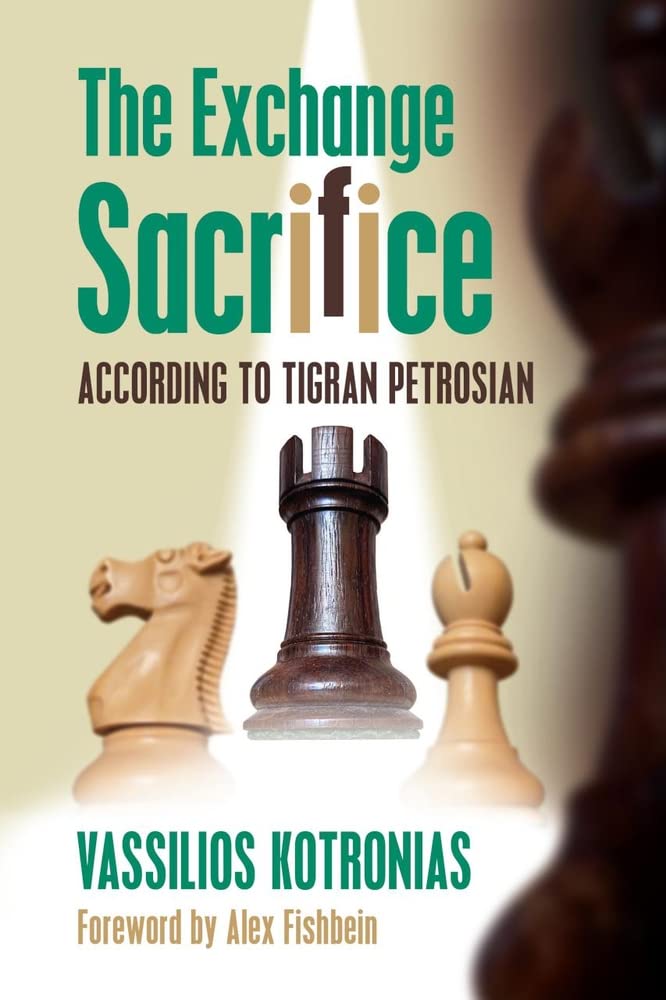
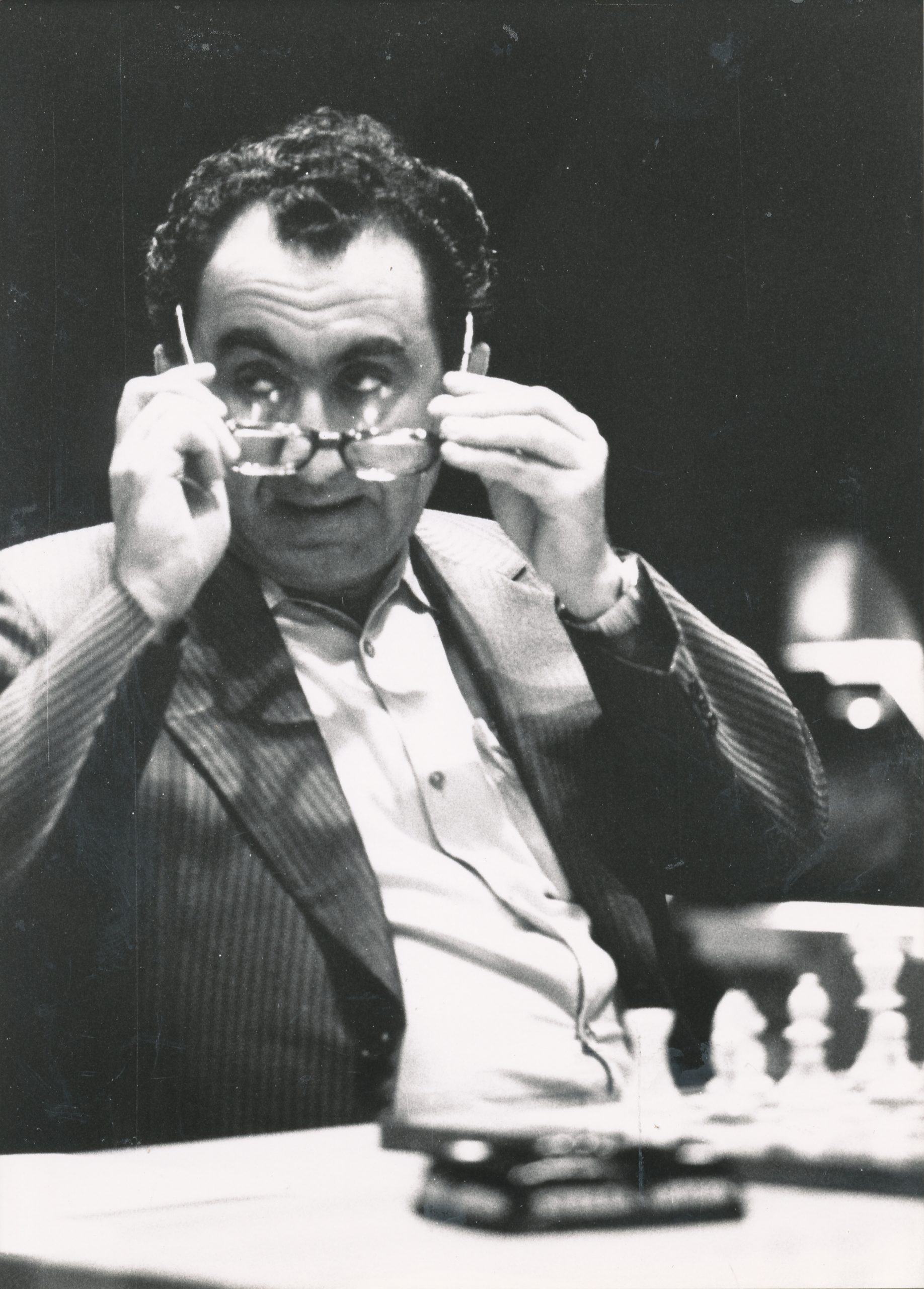
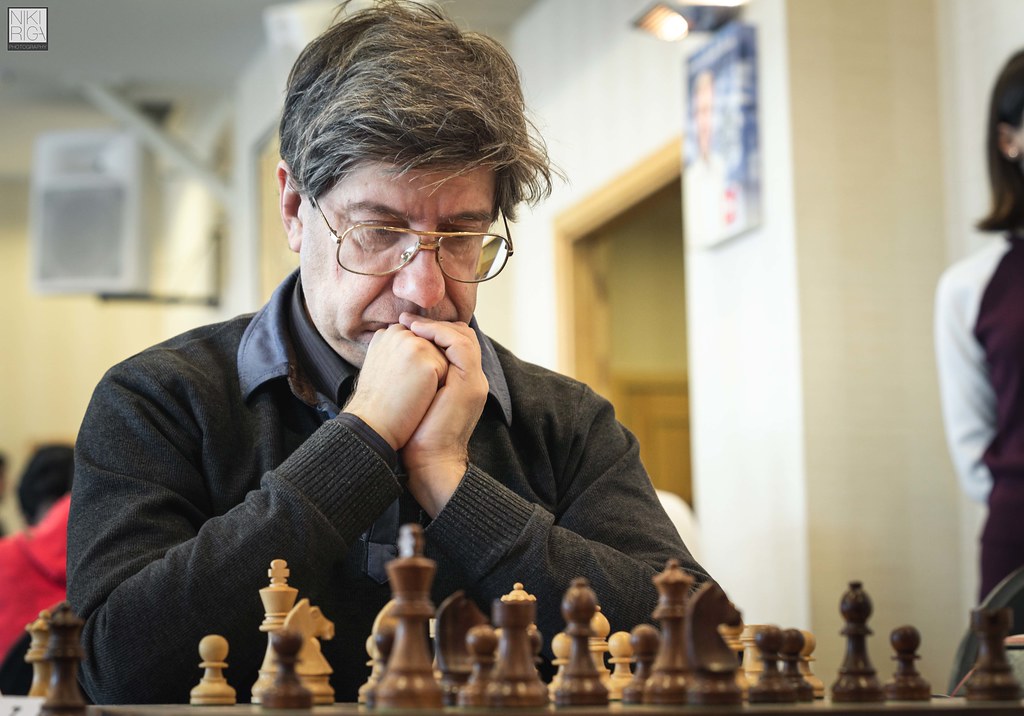
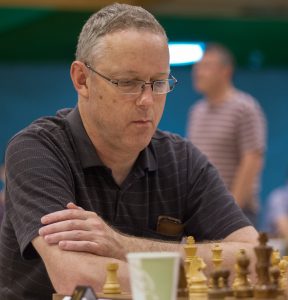
 Save as PDF