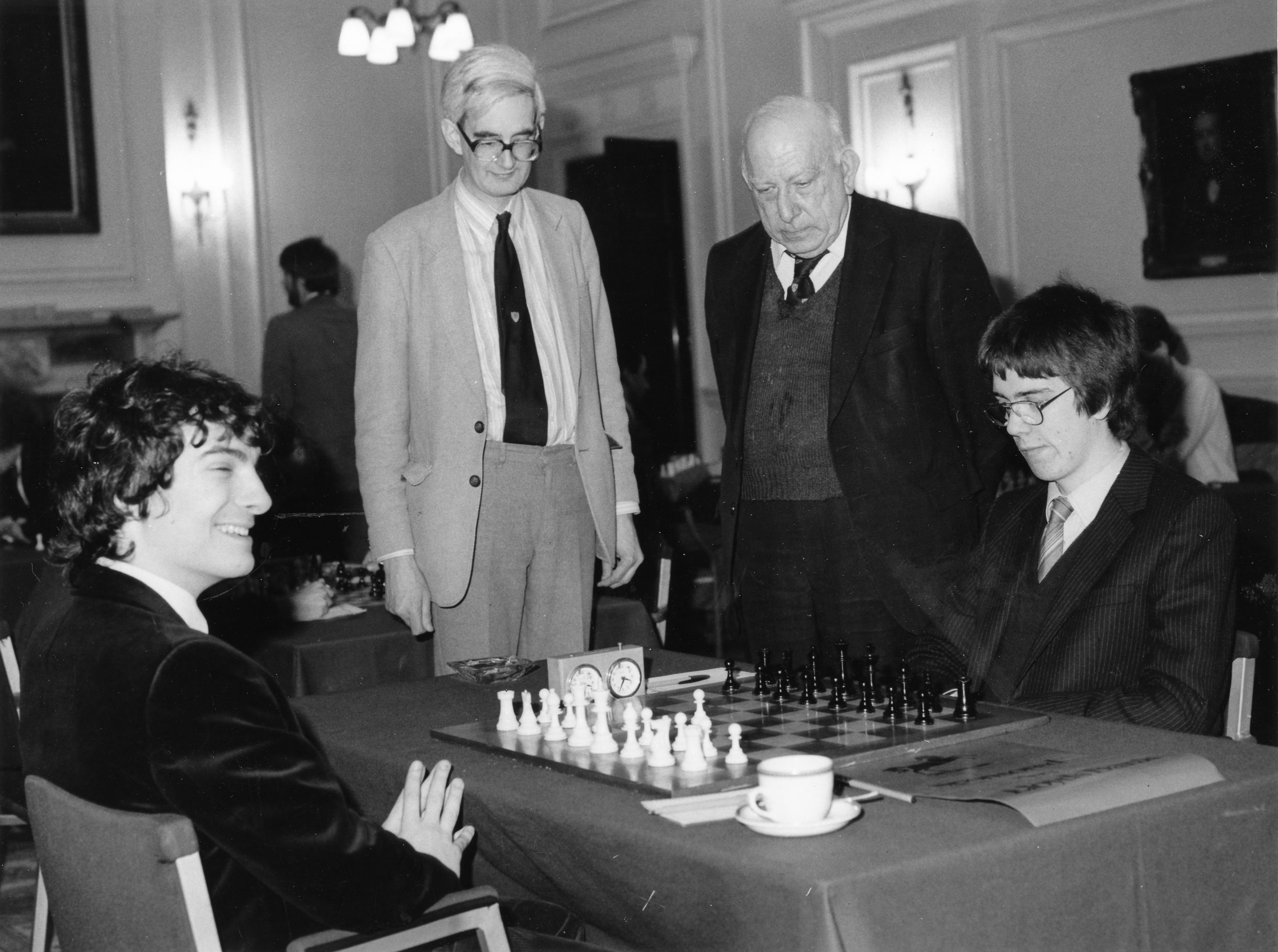
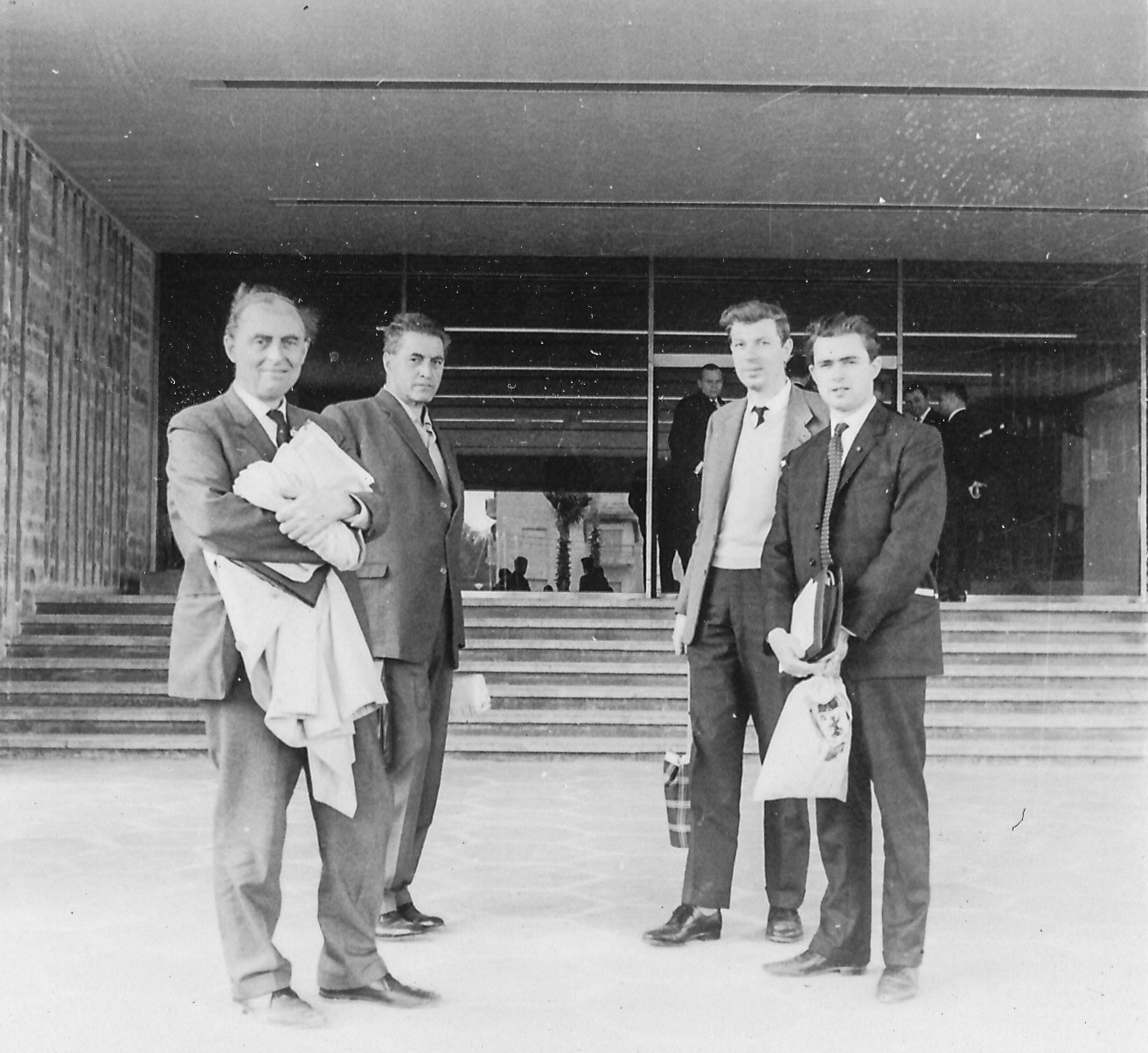
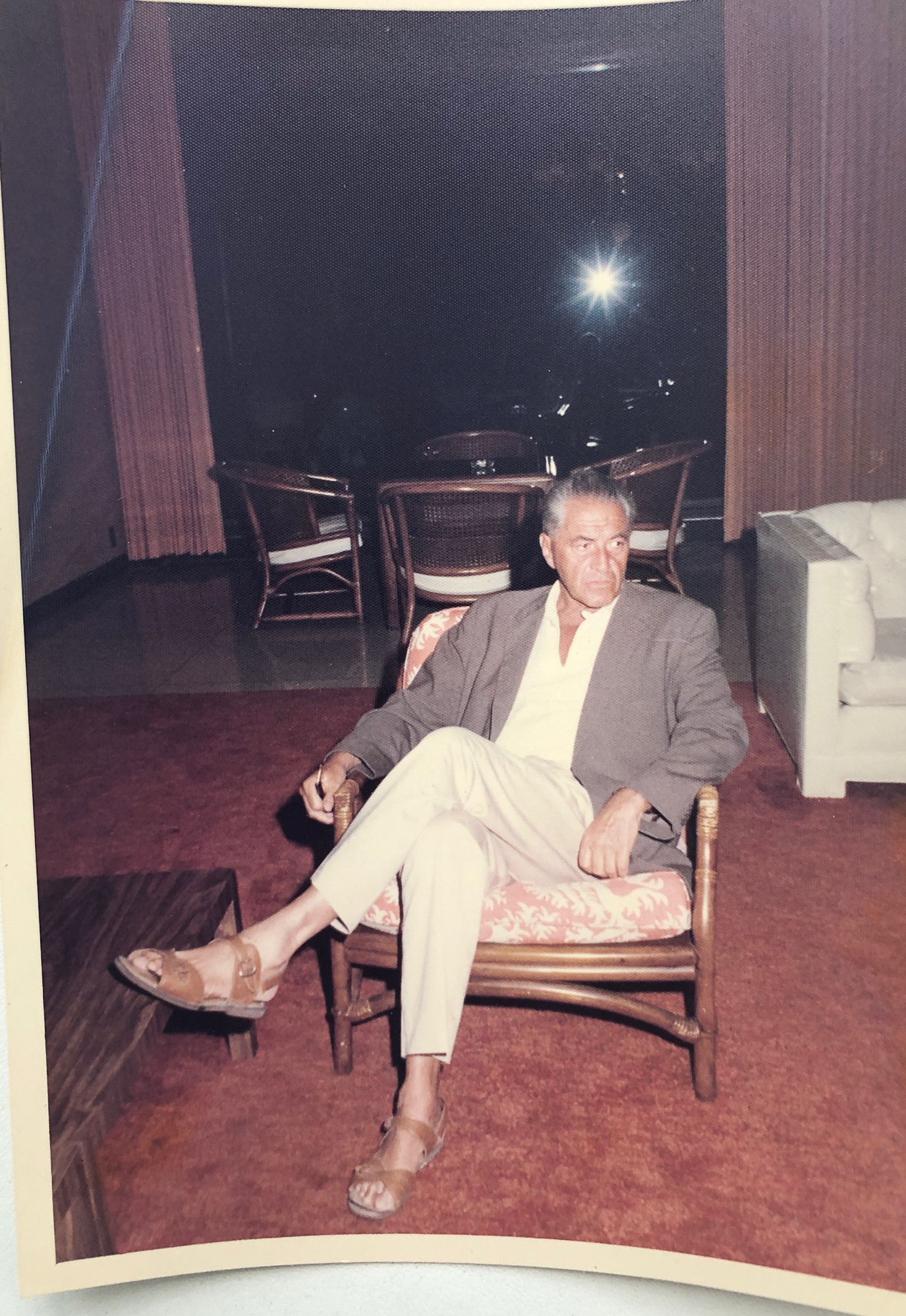
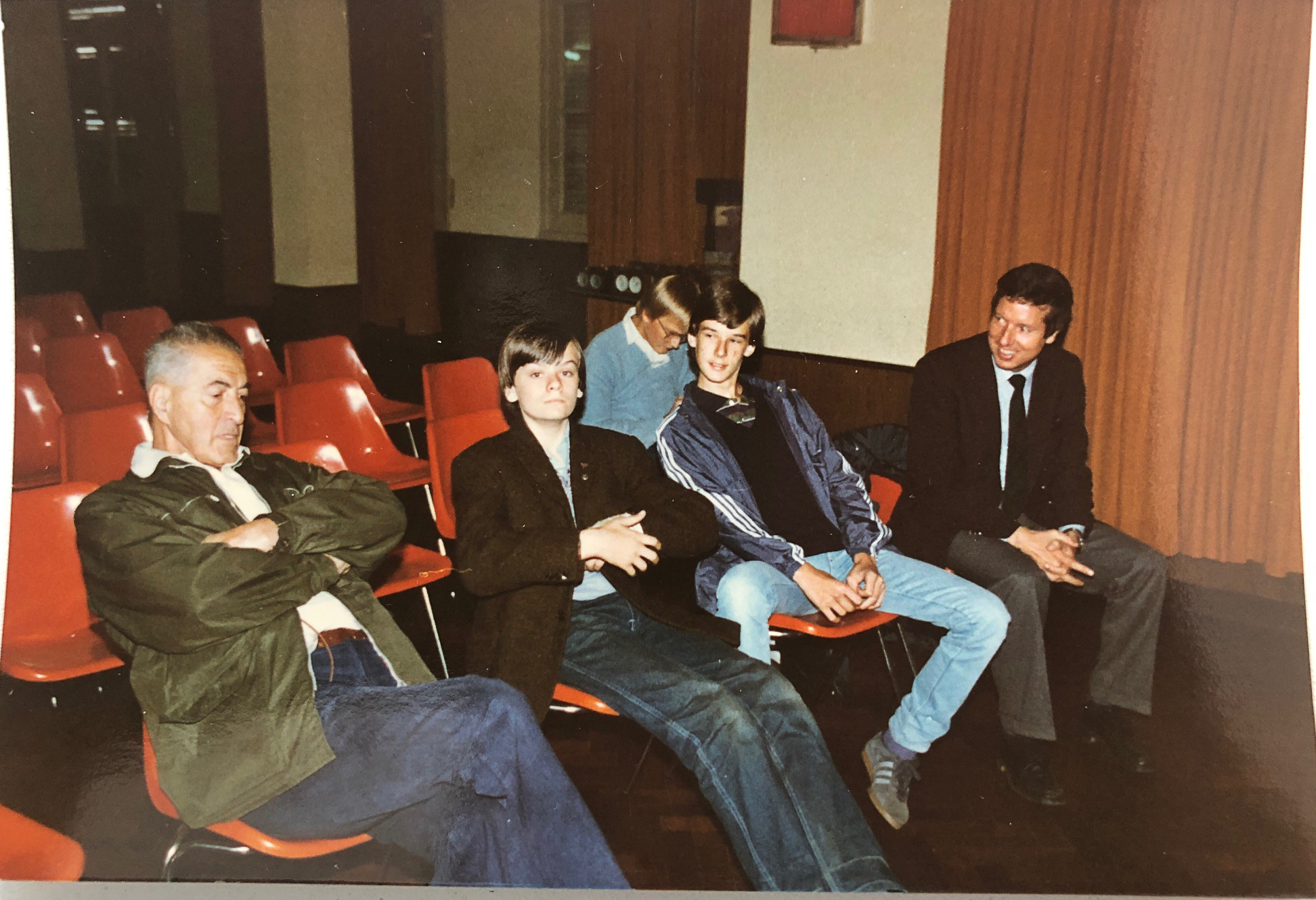
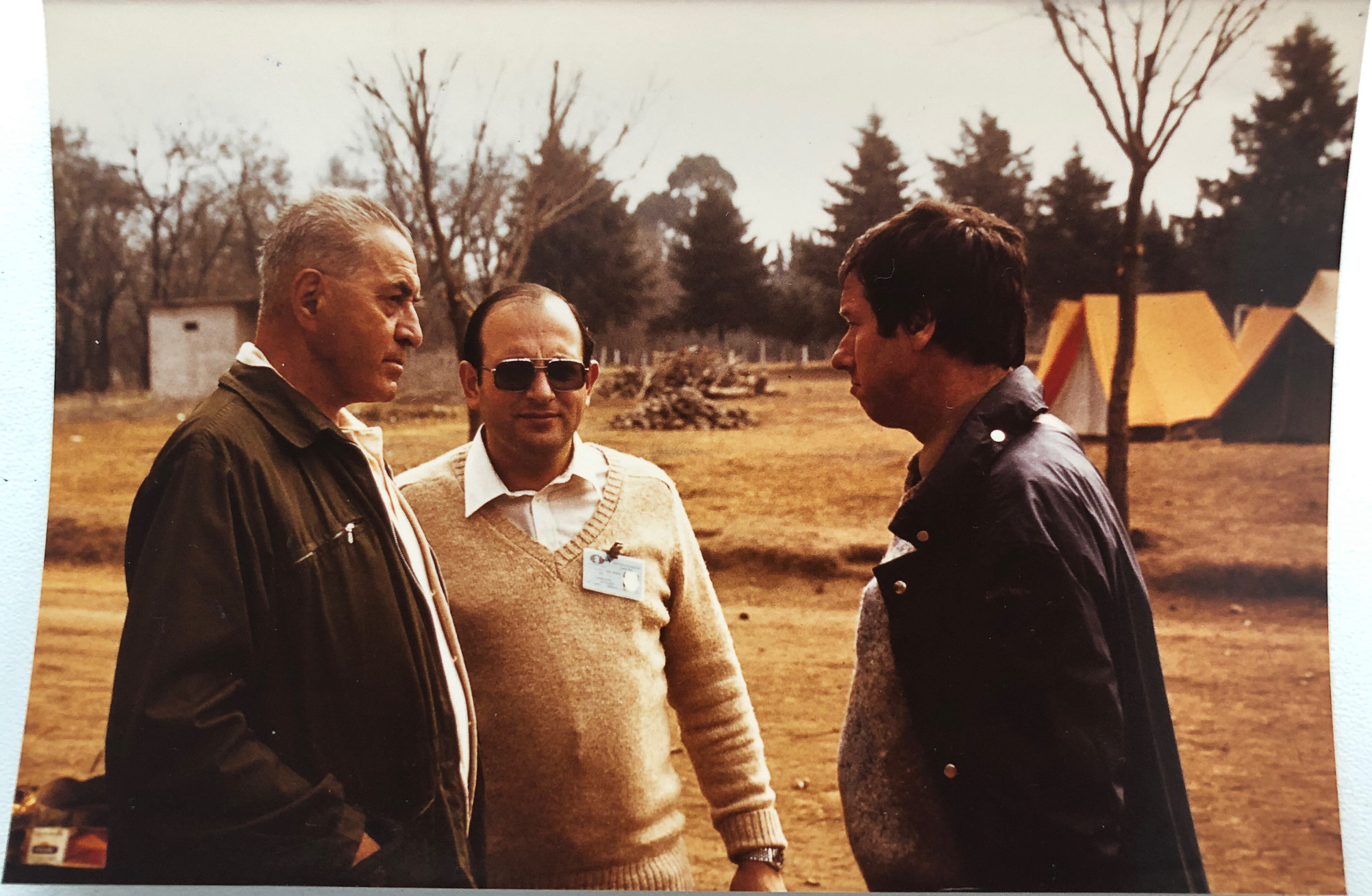
Andrew Horton at the 2014 Team Chess Challenge at Imperial College. Courtesy of John Upham Photography
BCN wishes Happy Birthday to IM Andrew P Horton (15-i-1998)
Andrew became a FIDE Master in 2015 and an International Master in 2018 following the 89th FIDE Congress 2018, 26 Sep – 6 Oct, Batumi, Georgia.
Andrew represents the 3Cs club in the Manchester League and in the Four Nations Chess League (4NCL) (as well as Wood Green) and, in addition, Wotton Hall, Durham City (during his University years) and Northumberland CA for county matches.
Andrew made regular appearences at the Delancey UK Chess Challenge and was placed 1st in the 2014 Terafinal, Challengers section.
Andrew Horton, Challengers C, 1st, 2014, UKCC Terafinal
In 2021 Andrew was invited and played in the London Chess Classic at the Cavendish Conference Centre.
IM Andrew Horton at the London Chess Classic, 2021
Andrew’s ECF standard play rating at January 2023 is 2452K.
You might remember this from the last Minor Piece.
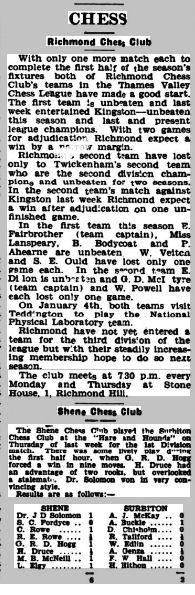
“In the first team this season E. Fairbrother (team captain), Miss Lanspeary, B. Bodycoat and P. Ahearne are unbeaten.”
It’s good to see a lady playing for Richmond’s first team, and unbeaten as well. She must have been a pretty good player. But who was this Miss Lanspeary with her unusual and unfamiliar surname? I wanted to find out.
Searching electoral rolls quickly identified our heroine as Enid Mary Lanspeary, so I looked at online family trees to find out more. She was indeed on a few trees – and I was amazed to discover that one of them was mine! I also discovered, by searching newspaper archives, that there were Lanspearys playing chess all over the country.
Something genealogists like to do is the One-Name Study, which involves finding out everything about everyone bearing a particular unusual surname. We’ll do that now with Lanspeary.
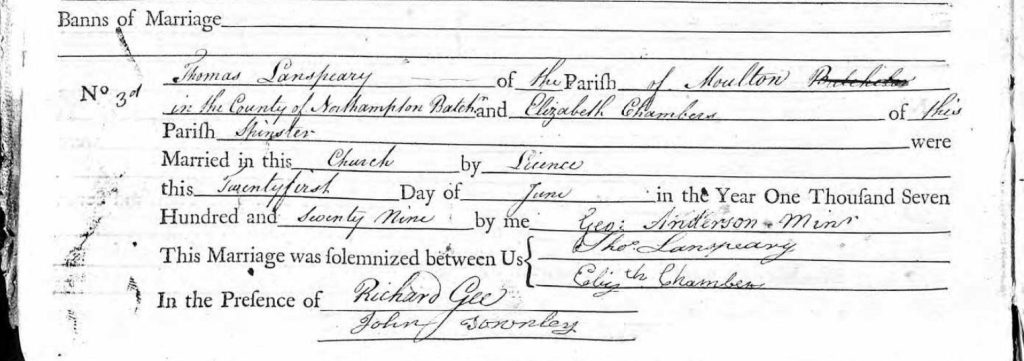
Most British surnames date back to the early middle ages, but Lanspeary has a much more recent origin. To be precise, 21 June 1779.
The family name was originally Lansbury, although some members used other versions as well, but this, the marriage between Thomas Lanspeary and Elizabeth Chambers in the Northamptonshire village of Great Doddington, is the first sighting of Lanspeary. I guess, from the original name, that the stress should be on the first syllable. History doesn’t record why Thomas chose that particular spelling.
You’ll find Great Doddington just south of the town of Wellingborough, famous, like many other Northamptonshire towns, for its place in the boot and shoe industry. According to this website, among those who have come to the county for shoes are HRH Queen Elizabeth II, Darth Vader, Sid Vicious, Jumbo the elephant, Sir Ernest Shackleton and James Bond. It was in the boot and shoe industry that the Lanspeary family originally found their employment.
To continue our one-name study we need to follow the paternal line. Thomas and Elizabeth had two sons, John and Thomas. John, it seems, only had one child, a daughter. Thomas, however, had three sons, William, another Thomas, and David.
In general terms, William was the most interesting. He found a job on the railways, which took him to Carlisle, married in Gretna Green and emigrated to Windsor, Ontario. Windsor is just the other side of the river from Detroit. Motortown, known to music fans as Motown. Due to a geographic anomaly, at this point Canada is south of the river and the USA north of the river. He had three sons, George, David and William, and the family were big in local government. If you visit Windsor now you’ll find Lanspeary Park there. If, in 1910, they had waved across the river, they might have attracted the attention of Alfred Padbury, from Warwick, who was, briefly, involved in manufacturing automobiles there. Alfred was his parents’ only son, but had nine sisters, some of whom you’ll meet later on in this article.
William’s youngest brother, David, moved to Sheffield, where he worked at various times as a warehouseman and dealer, but it’s the middle brother, the third Thomas, who interests us.
Thomas lived all his long life in Great Doddington, working as a shoemaker, and dying at the great age of 96. He had two sons, the younger of whom died in infancy, but it’s his older son, another David Lanspeary, who interests us.
He was also a shoemaker, but went into business, founding a very successful shoemaking company. He must also have been a chess player, as two of his sons played competitive chess to a reasonable level. He also, like his father, lived to be 96.
David and his first wife had one son, Wilfrid Arthur, and three daughters, one of whom died in infancy. After she died he remarried, and had two more sons, Lewis and Reginald.
Wilfrid, born in 1885, worked as a wood machinist, but was also a chess player.
We first pick him up in 1921, in his mid 30s, playing on top board for the Red Triangle (YMCA) team and winning his game against Wellingborough Town chess club. It looks like he was, up to that point, a social player, and, given the chance to try his hand against club standard opposition, discovered he was quite good. He soon joined Wellingborough club, seeing action against their local rivals from Northampton and Peterborough.
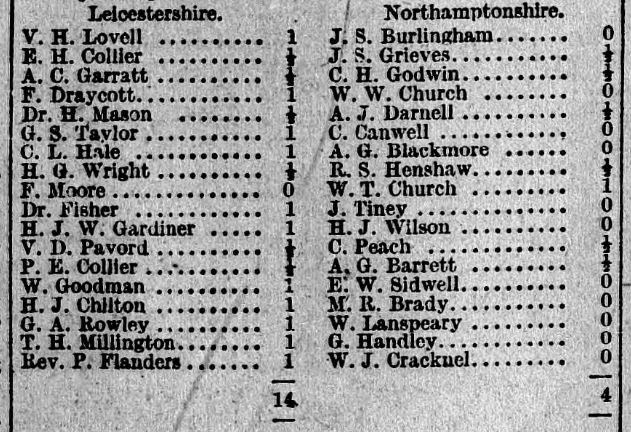
He was even good enough to be selected for his county side. Here he is, in 1924, in a match against Leicestershire, several of whose players I hope to feature in future Minor Pieces.
Birmingham Daily Post 25 November 1924
He seems to have played less often after 1925, but there are occasional mentions up to 1948.
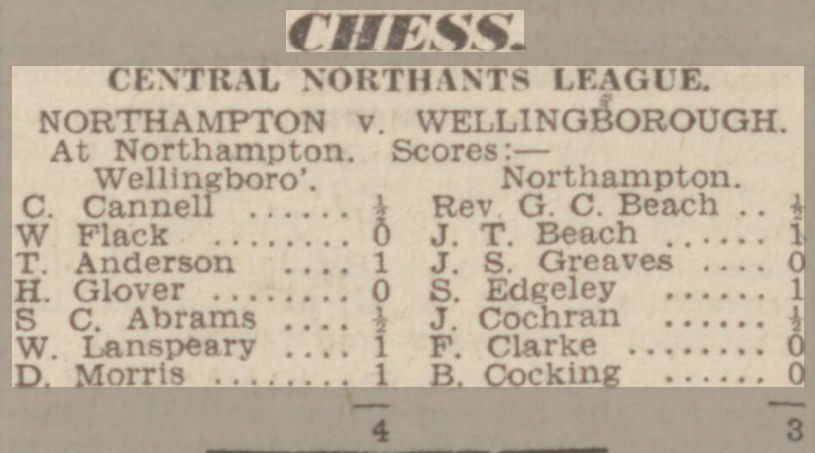
In this 1939 match, two members of the famous Beach family were on the other side of the board. TJ (not JT, but he was known by his middle name, John) would much later write two excellent beginners’ books with CHO’D Alexander.
Northamptonshire Evening Telegraph 29 March 1939
Wilfrid’s youngest half-brother, Reginald, concentrated on helping his father run the family firm, but Lewis, born in 1894, was also a competitive player.
On leaving school, Lewis took a job with Boot’s the Chemists, rising to branch manager. In 1927 we find him in Essex, playing in the minor section of the county championship. He had been living in Luton with his wife and young daughter Enid (yes, that’s her) in the 1921 census but by 1926 he was living in Great Warley, Essex, just outside the M25. Enid had been joined by a brother, Philip John Lanspeary, in 1922. A few years later the family moved to nearby Brentwood, where Lewis joined the chess club.
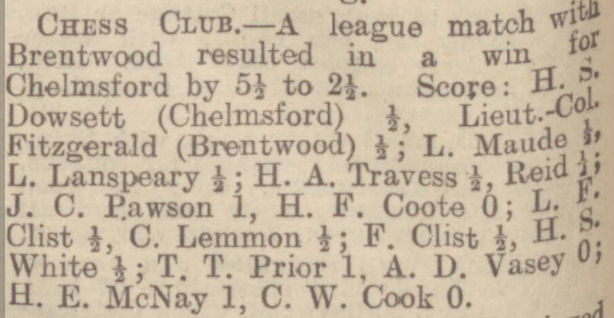
In 1930 he was on Board 2 against Chelmsford, losing to a particularly interesting opponent, Tolstoy’s biographer Aylmer Maude.
Chelmsford Chronicle 19 December 1930
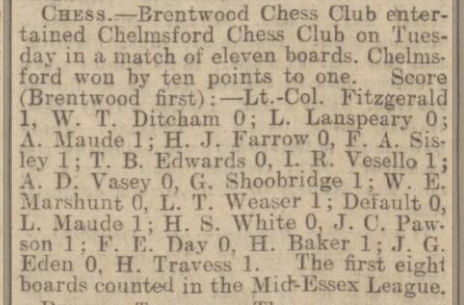
Aylmer wasn’t the only Maude playing chess for Brentwood. Here, in 1935, his son Lionel scored a draw against Lewis Lanspeary.
Chelmsford Chronicle 22 March 1935
Unlike his father and grandfather, Lewis didn’t enjoy a long life, dying young in 1941.
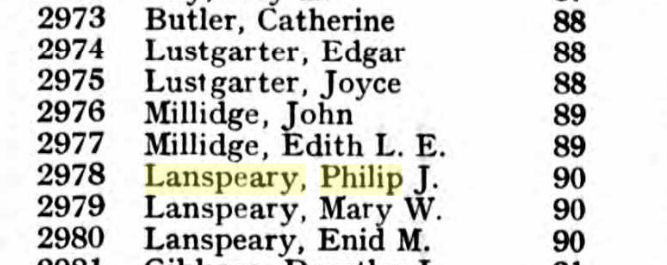
By 1946 Lewis’s widow Mary, along with Enid and Philip, had moved to London, to Kenilworth Court in Putney, eight blocks of Edwardian mansion flats right by Putney Bridge.
And, look! There on the electoral roll, just two doors away, was someone very famous in his day (but with his name misspelt here): Edgar Lustgarten.
Philip didn’t stay there long: in January 1947 he married Gwynneth Evelyn Reeder and moved to Long Eaton in Derbyshire, close to the point where that county meets Nottinghamshire and Leicestershire.
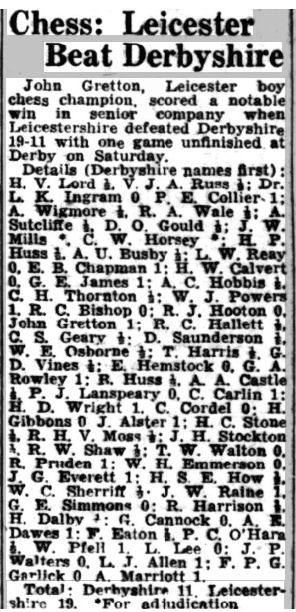
And then, like his father and uncle, he took up competitive chess. He joined his local club and was soon recruited for the county team, playing, like Uncle Wilfrid, against Leicestershire.
Leicester Evening Mail 22 March 1948
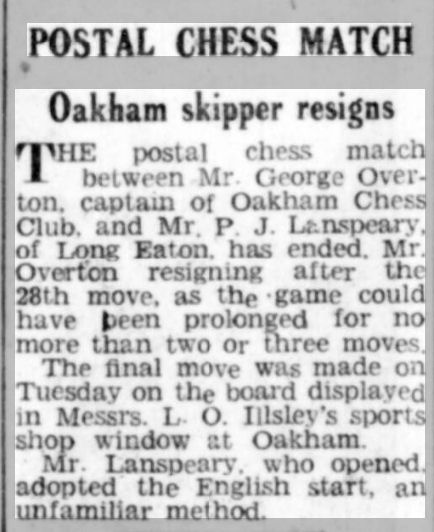
In 1950 he played a postal game which was featured in a sports shop window. You’ll see he adopted the ‘English start’ – presumably the English Opening was intended.
Grantham Journal 17 March 1950
Philip continued playing club and county chess in Long Eaton until 1955, when he, his wife and their young children Susan, born in 1952 and baby David (there are a lot of Davids in this family) moved to the Reading area. A third child, Hazel, was born there in 1957.
We have a much later address for him in the small Hampshire town of Tadley, 6 miles north of Basingstoke and 10 miles south west of Reading, so he might have been living at that point as well. Tadley is near Aldermaston, the home of the Atomic Weapons (Research) Establishment, which, at the time, was the area’s largest employer: perhaps he was working there. If you know, do get in touch.
I don’t have any further records of Philip playing chess after 1955. Perhaps he was still playing, but the local papers have yet to be digitised.
Perhaps, on the other hand, he decided to give up chess to allow himself more time for his other hobby: philately.
Phil was a philatelist, and like many philatelists he specialised in stamps with a particular theme: in his case stamps depicting birds. He even wrote a book on the subject, which you can buy here.
There’s a Bird Stamp Society which was founded in 1986, and Phil wrote an article on the bird stamps of Indonesia which was published in the September 1998 issue of their magazine, Flight. You can read it here: I note that their chairman, appropriately enough, was Robin Martin! Another win for nominative determinism!
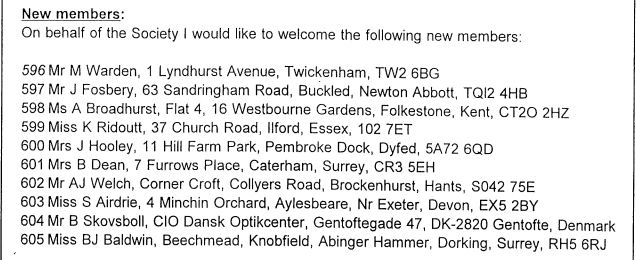
Here’s another coincidence: this issue published a list of new members:
Look at the first name and address. If you’ve ever visited the Chess Palace you’ll spot that Mr M Warden was living at the end of my road. I didn’t know him, but, if I remember correctly, my opponent in my first competitive game of chess, in a match between two Richmond teams, was also M Warden. As far as I know, they weren’t the same person, but there’s another Richmond Chess connection with that surname, which you may discover in a future Minor Piece.
Philip, like his grandfather and great grandfather, lived to be 96. His wife Gwynneth did almost as well, reaching the age of 95.
We really need to return to Enid, who, as I told you at the start, was already on my family tree. The connection is through Gwynneth. She was the illegitimate daughter of Ida Rose Reeder, originally from Norfolk. Ida’s first cousin, John Palmer, moved to London and had a son, Percy John Palmer, who, after the death of his first wife, married Maud Kathleen Padbury. Maud was the youngest sister of Alfred, whom you met building cars in Detroit in 1910, and also the sister of my maternal grandmother Florence Padbury.
So this makes Enid, a member of Richmond Chess Club in 1950, the sister-in-law of the 1st cousin 1x removed of the husband of my Great Aunt Maud. Confused? You will be!
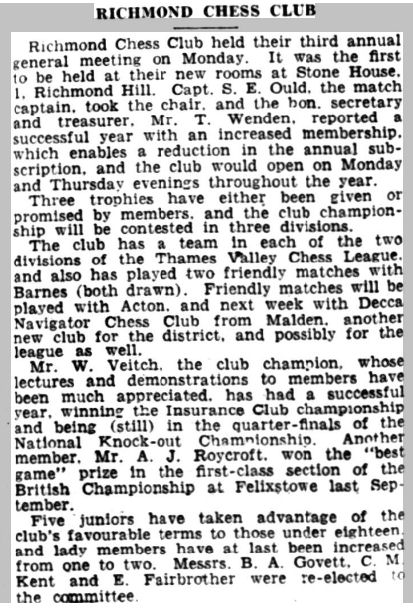
Finally, then, we pick up Enid’s story again. This 1950 report is the only direct mention I have of her playing chess. It’s quite possible she remained a member of Richmond Chess Club for a few more years. If and when later years of the Richmond Herald appear online I’ll perhaps be able to find out.
However, there is this, which is of some interest for several reasons.
Richmond Herald 14 January 1950
“Three trophies have either been given or promised by members…”. Was one of those given or promised by Mr Bodycoat, whose trophy would later be used for the second division of the club championship, was his trophy donated in his memory after his untimely death the following year, or did he leave a legacy to the club?
There’s a reference to Walter Veitch, and also to ‘another member, Mr. A. J. Roycroft’, who won a best game prize. Coincidentally or not, Walter and John were (and John still is, at the age of 93) two of the country’s leading experts on endgame studies.
Here’s the prize winning game. Stockfish isn’t impressed, but judge for yourself. As always, click on any move for a pop-up window.
You’ll also note that the club had five junior members, and had doubled their number of lady members. Was Enid the first, or the second? If the second, who was the first?
Enid and her mother remained in Kenilworth Court until at least 1965 (London electoral registers are currently only available online up to that date) and probably until 1971, when her mother died.
It seems she had rather a lot in common with Beatrix Hooke, living in a mansion flat, concentrating on her job rather than romantic relationships, and also playing chess.
Like Beatrix, she married late in life, seemingly for companionship. While Beatrix married a widowed chess playing doctor, Enid married the twice divorced Charles John Lawrence Bonington, (see also this book) whose background was in the armed forces, in Worthing in 1980. The son of his first marriage was none other than the mountaineer and chess enthusiast Chris Bonington, (see also his website here) whose name was shamefully misspelt in The (Even More) Complete Chess Addict. He played chess and listened to Bach on his expeditions.
Did Charles and Enid meet through a shared passion for chess, I wonder?
Charles died two years later, also in Worthing, while Enid lived on until 1999, where her death was recorded in Basingstoke. It seems likely she’d moved there after her husband’s death to be near her brother and his family.
So there you have the story of the chessing Lanspeary family. Two generations, two pairs of siblings, who played chess in four counties over four decades. None of them were anywhere near master standard, but they were all good players of club/country strength. Players like them were, and still are, the backbone of chess. Wilfrid and Lewis, Enid and Philip, I salute you all.
Before I go, something I forgot last time. You might remember that Mr Bodycoat’s family came from villages close to my father’s family. He may also be the 3rd great-grandnephew of the wife of my 5th great-granduncle. We go back to one John Andrews Buzzard, born in West Langton, Leicestershire in 1697, who may have been my 6th great grandfather. (I have a DNA link with a member of another branch of his family, which suggests that this is at least possible.) One of his sons, William, married Elizabeth Gibbins, whose brother Thomas was the 3rd great grandfather of Walter/Boyder Bodycoat.
So there you have it: a newspaper article from the year I was born mentions two members of the chess club I would later join, one of whom was connected to my mother and the other connected to my father. Another golden thread that links us all together.
By 1986 I’d developed some strong views about education and how they related to chess.
Something else happened as well. I was sitting in my London office one Feburary day wondering how I was ever going to be able to leave a job with no prospects of promotion or doing anything else when the phone rang.
It was my old friend Mike Fox, calling from Birmingham. “This phone call will change your life”, he said. And it did.
He’d been commissioned by Faber & Faber to write a book about chess trivia and invited me to join him as co-author. This would become The Complete Chess Addict (1987) and later The Even More Complete Chess Addict (1993), as well as the Addicts’ Corner column in CHESS which ran for 14 years. I decided that I could make as much money in less time by working freelance, while having time to help Mike with researching and writing the book and having more time to develop RJCC.
In order to improve Richmond Junior Club the first thing I wanted was to be able to find out everything I could about how every member of the club played chess, so that I could provide individual advice to all children and parents.
My view also was that, when teaching younger children and, more generally, less experienced players, everything we did had to happen for a very specific reason. I didn’t want to provide random lessons demonstrating random brilliant games to a random collection of children. Nor did I want to push children into doing too much too soon: using clocks and scoresheets and taking part in external tournaments before they were ready.
What I did (some of this was explained last time) was this:
I split the club into two sections: a morning group lasting two hours for primary school children, and an afternoon group lasting three hours for secondary school children, to which stronger primary school players would also be invited.
I introduced an internal grading system which was revised every few weeks, including all internal games (excluding blitz) so that I could select teams objectively in order of strength and identify when morning group players were ready to move up to the afternoon group. This included a very crude but reasonably effective measure to avoid grading deflation, based on the principle that, at any point, our members will either be improving or stationary.
Although I’d been collecting scoresheets of games played in our tournaments and training days for almost a decade, I now collected all afternoon group games (excluding blitz again) and played through them myself at home. There was no need to collect games played in the morning group as they were played at a lower level and usually decided by the number of pieces left en prise.
Beyond that, I wanted to ensure that our members would be able to try out a wide range of different openings, play games at different time controls, and play different opponents every week.
The primary school age children in our morning group were divided into divisions according to their internal grade. When new members joined we’d do a quick assessment. If they were obviously beginners they’d start in the lowest division. If we already knew about them because they’d played in one of our tournaments we’d already have given them a grade so would be able to put them in the correct division. Otherwise, we’d give them a quick friendly game against a player in a middle division and see how they got on.
I also used the same divisional system in schools for many years to ensure that children played different opponents of a similar strength to themselves every week (until the divisions were changed). This system also catered for the fact that some children played fast and would get through several games in one session while others played slowly and would only play one game. I found this worked much better than a Swiss tournament where everyone played one game a week and children who had finished their games would sometimes interfere with the games still in progress.
Every few weeks, by which time some of the faster and more regular attenders would have played most of the other players in their division, we ran the results through the grading program and restarted the divisions, with the most successful players gaining promotion.
We knew that if we taught children opening principles and then left them to their own devices many games would start with boring Giuoco Pianissimos or Spanish Four Knights, which, because they led to closed positions with few opportunities for pawn breaks, were only superficially good for less experienced players.
So we developed a system which would enable children in this group to experience a range of different openings and position types. Our first rule was that all games in the morning group would start with the moves 1. e4 e5. Over the course of the year (September to July) we’d work through the major open games, starting with simple Four Knights type positions and gradually moving through to the King’s Gambit and (the favourite of many of our members) the Danish Gambit. We’d give a short introductory talk before the games started and expect players to start the game with the moves displayed on the demonstration board.
Ray Keene’s column in the Times always provided a simple tactical puzzle on Saturdays to encourage readers to compete for a prize, and we’d display this on the demo board so that children could attempt to solve it as they arrived. We’d go through the solution in front of the whole class before introducing them to the opening of the week.
We also wanted to ensure that children were introduced to clocks and scoresheets at the appropriate time in their chess development to prepare them for promotion to the afternoon group. As each of these adds a level of complexity to an already difficult game we wanted to do them one at a time, so players in the second division were asked to play their games on clocks (30 minutes per player per game) and, when they reached the top division they were required to notate their games (down to the last five minutes) as well.
For some of our members, the Morning Group was all they wanted and they’d drop out after a year or two. But others would be ambitious to play competitively and move up to the Afternoon Group, which was designed, in the first instance, for players of round about 1000 to 1500 strength. We assumed that, at that point, they’d move on to bigger and better things, but, as our system developed, we were attracting players up to getting on for 2000 strength.
In order to give our Afternoon Group members the chance to try out a wide range of different openings we developed a system involving games using set openings.
It took a few years for this to be fully implemented, but what we did was to divide all the major openings into ten groups, featuring one group every half term. We built a three-year cycle, with some groups happening every year, some twice in three years and some once in three years.
We also wanted to provide a range of different time limits. For younger players up to about 1500 who tend to play fast there’s no real need for slower games, while we also decided that anything less than 10 minutes per player would lead to too many blunders. So our main termly structure eventually looked like this:
Freestyle 30 minute games (3 games in the 3 hour session)
Coach and play – introductory lesson on the openings to be played over the next few weeks followed by two 45 minute games, consulting the opening books
10 minute blitz tournament (in groups with promotion/relegation) with opening variation picked out of the ‘hat’)
30 minute games (3 games in the 3 hour session) using the set openings
Freestyle 10 minute blitz tournament (in groups with promotion/relegation)
Over the year we’d run 12 sessions with 3 30-minute games (at first in groups of 4 (quad tournaments) or 6 (Scheveningen system tournaments) – six freestyle and 6 with set openings. All games would be recorded down to the last five minutes and all scoresheets would be handed it. We used duplicate scoresheets for this purpose so that they all had a copy of their games to take home. I’d then play through all the games again at home, and, once ChessBase became available I’d enter them all into a database.
We’d also run 11 sessions with 10-minute games (as many as they could play in the time available), five freestyle and six with set openings.
We’d run 6 Coach and Play sessions to introduce the openings to be played in the next rapid and blitz sessions.
We also ran one simultaneous display a term. Sometimes we’d use visiting masters, sometimes our own coaches, members of our parent chess club or former RJCC members. We considered these a vital part of our programme for several reasons:
They promoted chess as an adult game, not just a game for young children
They gave our members the chance to meet and play against titled players
They forced our members to slow down and think while the simul giver was going round the room moving on the other boards
Other weeks were filled up with activities such as training games at slower time limits, endgame practice and puzzle solving, while the last week of each term gave our members the chance to enjoy chess variants such as Exchange (Bughouse) and Kriegspiel.
The idea was that each week would have one activity, which would vary from week to week. Very different from the way most junior clubs run, with two activities (lesson and game) a week and the same structure most weeks.
If you want to use our methods, our stationery (now rebranded as Chess Heroes rather than RJCC) is available to download here and here while our opening books (recently updated slightly to include the currently popular London System) can be downloaded here.
Coincidentally, several other important things happened at about this time.
A local primary school, Sheen Mount, appointed a new Headteacher, Jane Lawrence, who was passionate about introducing all her pupils to chess, teaching them the moves and giving them the chance to play competitively at school every day. Many of her pupils joined Richmond Junior Club, and, as you’ll see, two of them, Richard Bates and Tom Hinks-Edwards, went on to become International Masters.
Ray Cannon, whom I vaguely knew from the London chess circuit, brought his young son Richard along to the club. Ray was (and still is) an excellent chess coach and his views on chess teaching were (and still are) very similar to mine, and he soon started to play a vital role in the club, helping with the Afternoon Group as well as spending his Sundays visiting tournaments and passing on the results of our members so that I could incorporate them in our internal grading list.
The other player who played an invaluable part in our successes for many years was Gavin Wall, later an IM, one of our early members who, on returning from University joined our coaching team, working mostly in the Morning Group. Gavin and Ray were both integral to the club for many years: I can’t thank them enough.
Over the next few years we again became very strong, and the system we used in the Afternoon Group undoubtedly played its part.
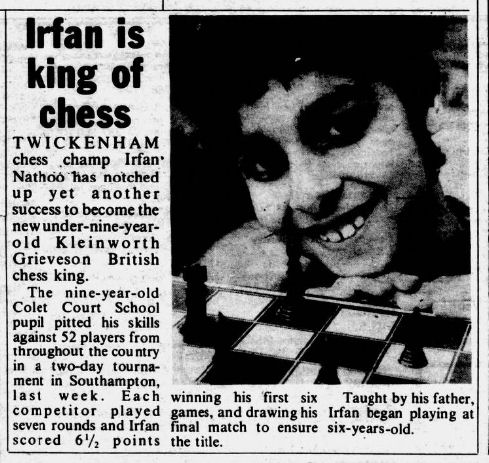
As it happened, the summer of 1986 witnessed our first ever British Champion when Irfan Nathoo took the national Under 9 title.
Richmond Informer 14 August 1986
Here’s a game from later in the year. To play through this or any other game in this article click on any move and a pop-up window will appear.
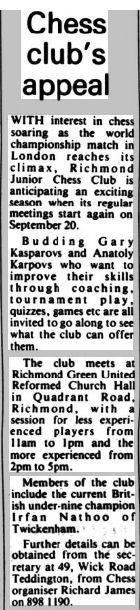
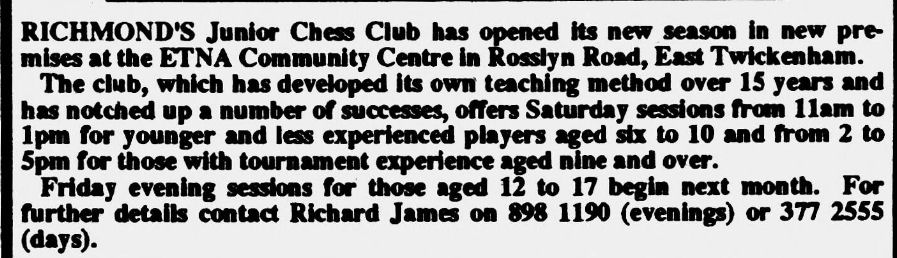
With our new system in place we were able to promote the club in the local press, announcing an exciting season ahead.
Middlesex Chronicle 04 September 1986
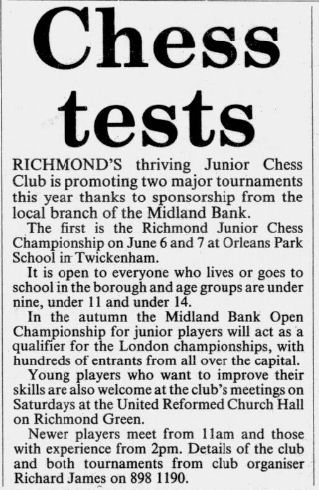
We were actively looking for sponsorship at this point. We received donations from two local charities at various times, and here we found sponsorship from the Richmond branch of Midland Bank.
Richmond Informer 04 June 1987
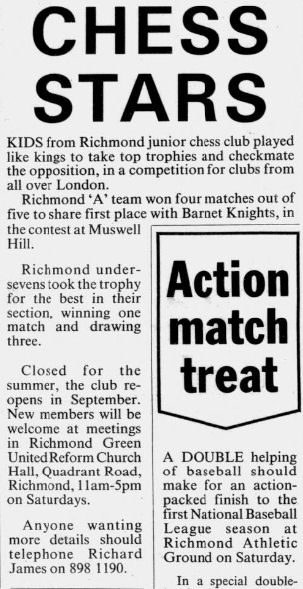
We were also competing successfully in team competitions against other London junior clubs. Barnet Knights, of course, are still going strong today.
Richmond Informer 13 August 1987
One of our new members was a talented Scottish junior, Jonathan Rowson, who had moved from Aberdeen into the same road as me. He used to come round to my house for a game after school, but sadly for us he didn’t stay in the area very long.
In this game from one of our monthly quad tournaments, he demonstrated his class by outplaying Richard Bates in a pawn ending.
During this period I was doing a lot of private tuition. Jonathan was by no means the only one of our members who would visit my house for lessons, either on a regular or an occasional basis. Judging from both individual and team results it must have had some effect on them.
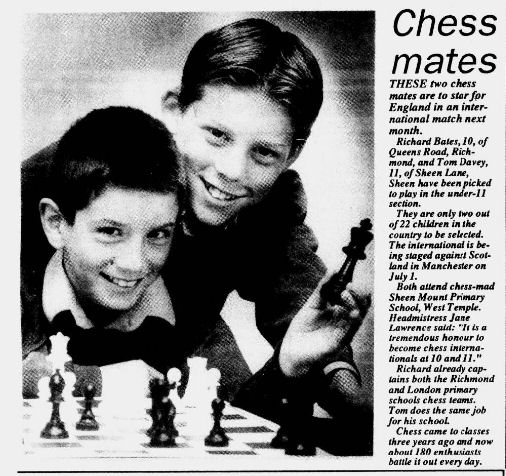
By 1989 Sheen Mount players were making names for themselves on the national stage. Here are future IM Richard Bates and Tom Davey playing for England’s Primary Schools team in a match against Scotland.
Richmond Informer 16 June 1989
Also in June 1989 we were invited to play a match against a visiting team from Arizona. As we had so many strong players by now we split our players into three teams and played a four-way match.
Here’s Richard Cannon’s game against the American board 1.
By the summer of 1989 it was time to move. The church in central Richmond where we met was being redeveloped so we had to find new premises. Richmond & Twickenham Chess Club moved to London Welsh Rugby Club, while Richmond Junior Club found a new home in a large Victorian house in East Twickenham, where we’d meet for more than 15 years.
Richmond Informer 29 September 1989
We also set up a separate group for older children enabling us to enter teams in the Thames Valley League. We played our home matches in Friday evening sessions and scheduled our away matches, as far as possible, during the school holidays.
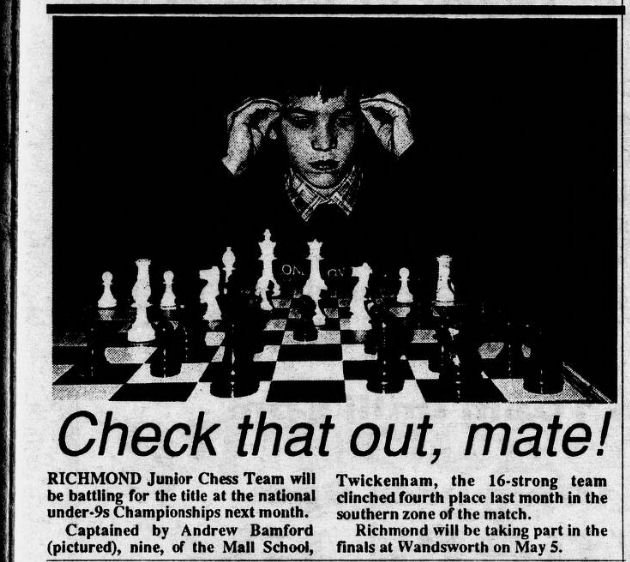
Jane Lawrence was now running Richmond teams in the English Primary Schools Chess Association inter-area competitions, with players from schools around the Borough taking part. Andrew Bamford, like many of the players in these teams, was a member of Richmond Junior Club.
Richmond Informer 20 April 1990
In this game from our 1990 Under 11 Championship a speculative sacrifice proved successful.
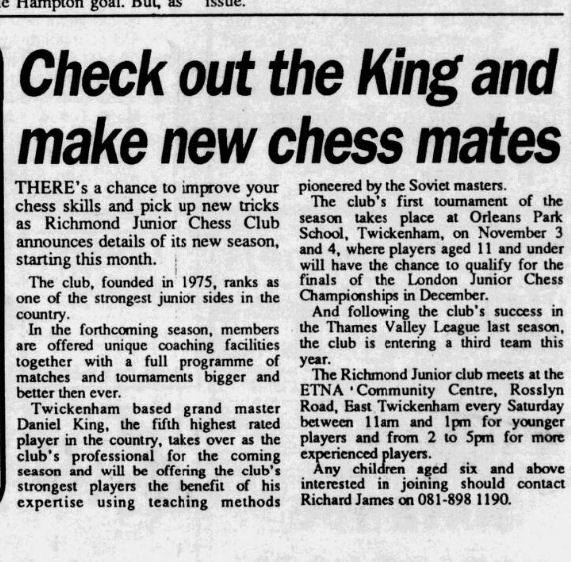
Wanting to provide top level coaching for our strongest players, we appointed GM Daniel King as our club professional in 1990. We were also able to enter a third team in the Thames Valley League.
Richmond Informer 14 September 1990
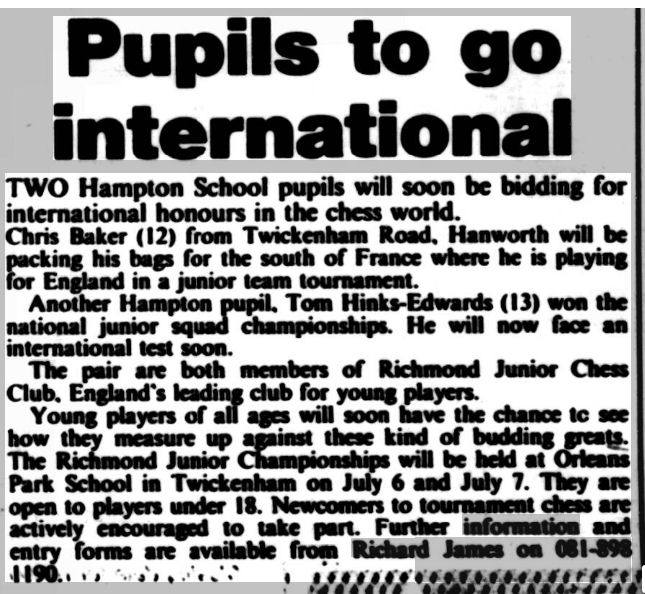
In just a few years since 1986 the club had made tremendous progress, and we were able to bill ourselves, without fear of contradiction, as ‘England’s leading club for young players’. This is Chris A Baker, who hasn’t played competitively for a long time, not to be confused with long-standing Richmond & Twickenham Chess Club member Chris B Baker, who was also a pupil at Hampton School, or indeed IM Chris W Baker.
Middlesex Chronicle 20 June 1991
In this game Tom had the chance to play a Greek Gift sacrifice against an opponent with insufficient experience of the French Defence.
And here’s Chris Baker, beating one of his regular rivals in a club game.
Every summer during this period the parents of our stronger players got together to book accommodation for the British Championships. From 1991 onwards we were rewarded with successes like these:
1991 Richard Bates U14 shared, Luke McShane U9
1992 James Clifford/Luke McShane U14 Andrew Bamford U11
1993 Tom Hinks-Edwards U16 shared
One of our favourite simul givers at the time was Ukrainian IM Petr Marusenko, a regular visit to Hastings (he’s there again this year) who would drop in to visit us after the congress.
In this game James Clifford outplayed him in the ending.
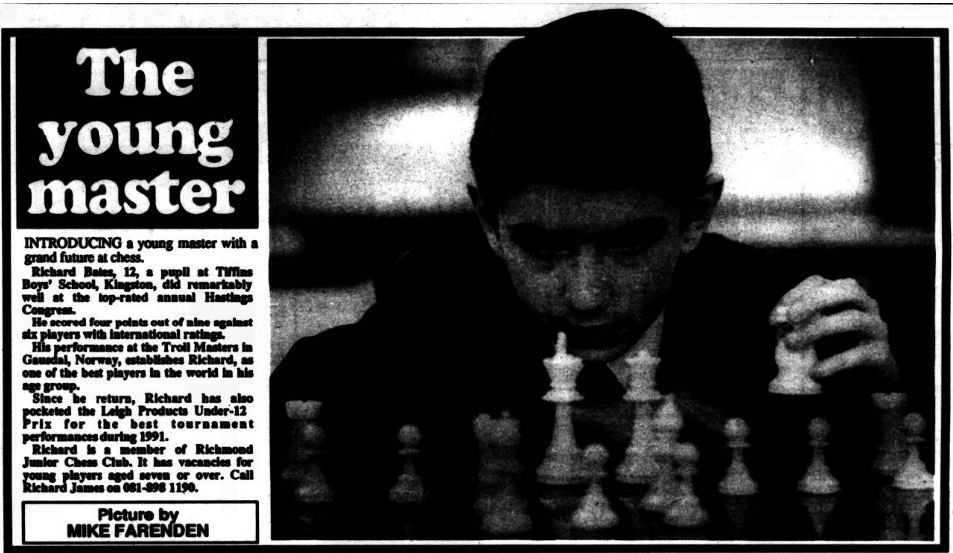
Richard Bates, now at Tiffin School, continued to be successful in 1992, and was rated one of the world’s top players of his age.
Kingston Informer 31 January 1992
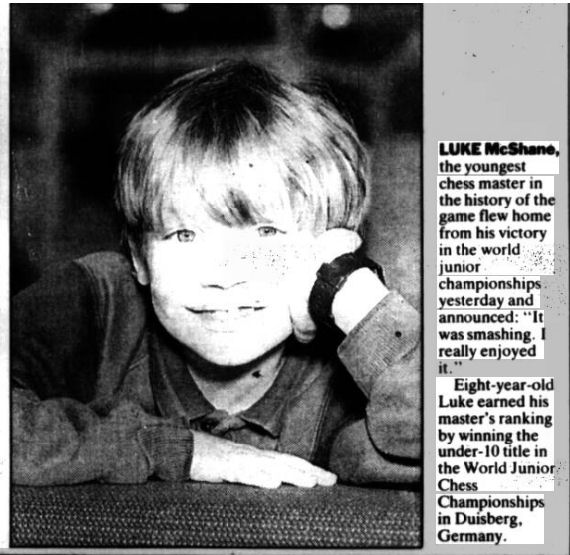
But by that time we had a new member whose feats would outshine even Richard’s. This was Luke McShane, who, at the age of only 8, took the World Under 10 Championship in 1992.
Newcastle Journal 14 July 1992
Luke scored victories against future stars such as Bacrot, Aronian and Grischuk in this event. He was perhaps fortunate to escape from lost positions in the first two of these games, but here’s his win against the Russian representative.
In January 1993 we were privileged to host a junior team from Kiev (now Kiiv), whose top players were, as you might imagine, very strong. We arranged four events: a simul given by Daniel King, a match against a team from Richmond & Twickenham Chess Club, a match against a Richmond Junior Club team and a match against a junior team representing the Southern Counties Chess Union, which included three RJCC players.
Another of our very strong players, Aleksandar Trifunovic, great nephew of Grandmaster Petar Trifunovic, scored an exciting win on board three of the RJCC v Kiev match. His opponent here is now an American IM.
Richard Bates scored a win and a draw against the top two Kiev players. He drew with Spartak Vysochin, now a grandmaster, in the RJCC match and won this game from the SCCU Juniors match.
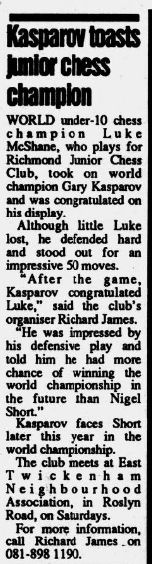
As a result of his performance in the World Junior Championship, Luke was given the opportunity to play a game against Garry Kasparov, in London to discuss the arrangements for his forthcoming World Championship match against Nigel Short.
Richmond Informer 05 March 1993
Here’s the game.
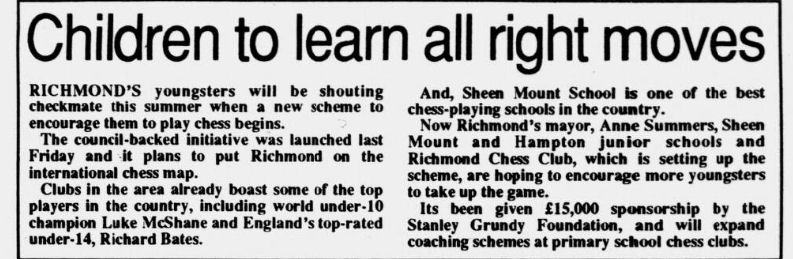
In May 1993, buoyed by these successes, we were asked to be involved in the Richmond Chess Initiative, which, in essence, did very much what Chess in Schools & Communities is doing now, but on a local rather than national level.
Richmond Informer 14 May 1993
Children would learn all the right moves, but would they play them in the right order? You’ll find out in the next part of the history of Richmond Junior Chess Club.
BCN wishes Happy Birthday to GM Daniel Fernandez who at 26 is currently England’s youngest Grandmaster. The previous GM title holder was Jonathan Hawkins in 2014 making two in seven years.
Daniel Howard Fernandez was born in Stockport, Manchester on Sunday, March 5th 1995. “Think Twice” by Celine Dion was top of the UK hit parade.
Daniel started playing chess at the age of seven (after his father taught him the rules) and at this time attended King’s School, Harpenden. His first chess club was Little Heath which became the ECF Small Club of the Year in 2015. They play in the Potter’s Bar area and include IM John Pigott in their membership.
At Little Heath Chess Club Daniel was coached by Mark Uniacke (who worked extensively on the early chess engine HIARCS).
Daniel went up to Queen’s College, Cambridge to read mathematics and left to become a Data Analyst at Mu Sigma Inc. He can speak several languages (including Serbian!) and works as a translator when opportunities arise.
He currently lives in Australia offering coaching and writing chess books (for Thinkers Publishing) and columns for Chessbase. In his spare time (!) Daniel is studying for The Master of Complex Systems degree at The University of Sydney.
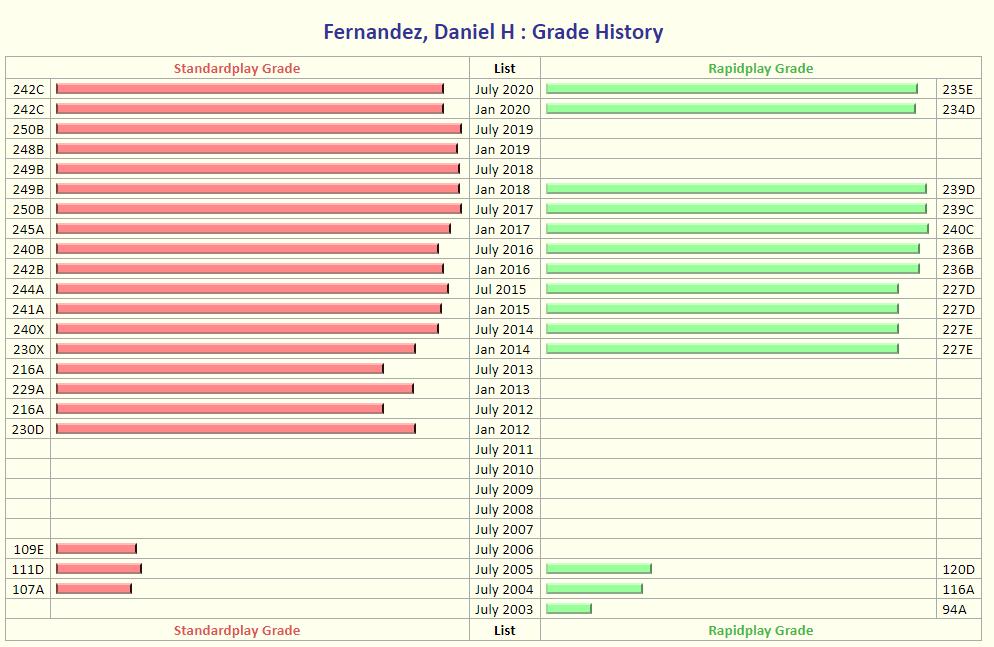
Daniel’s first ECF graded game was rapidplay on July 5th 2003 in the SCCU Junior Under-14 Final.
His first standard play game was in August 2003 at the Edinburgh based British Under-8 Championship.
On August 13th 2004 in Scarborough Daniel became British Under-9 Champion sharing the title with Daniel Hunt & Saravanan Sathyanandha.
The Fernandez family relocated to Singapore in August, Daniel attending the Anglo-Chinese School in Singapore. He was swiftly recruited into the Singapore Chess Federation’s (SCF) National Junior Squad. Also in that squad were Danielle Ho and Howard Chiu (remember this for later!).
Barely three weeks after his Scarborough triumph on September 4th 2004 Daniel played his first FIDE rated game in the 5th Asian Under-10 Championship organised by the ASEAN Chess Confederation. His performance in this event was rewarded with a FIDE Master title in 2005. Because he was no longer active in English events the ECF had the unusual scenario of having a ten year old FIDE Master with a published grade of ~120!
In typically modest fashion Daniel confesses that he did not “deserve” the FM title at this time and that it was the consequence of the strong position of the ASEAN and SCF organisations within world chess. At the same event Wesley So gained his FM title in the Under-12 section.
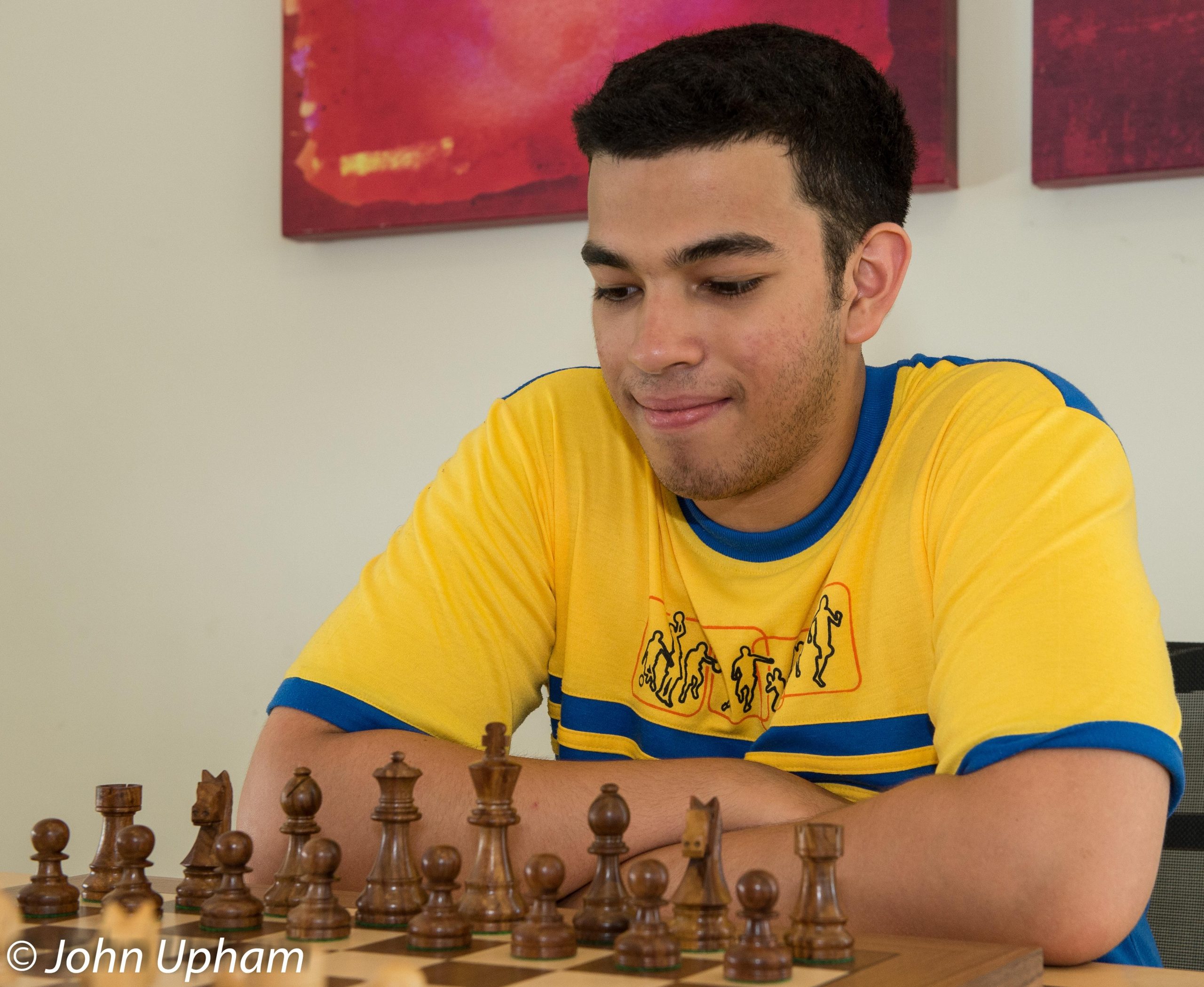
FM Daniel Fernandez
Another interesting consequence of the relocation was that when Daniel returned to England in 2012 his last published grading went from ~ 120 to ~230!
One of the motivations of returning to England was to obtain the necessary entrance requirement to study mathematics at Cambridge. This he did by studying for A-levels at Manchester Grammar School.
Daniel with IM Jovan Petronic during the 2010 world juniors in Chotowa, Poland | Photo: Diana Mihajlova
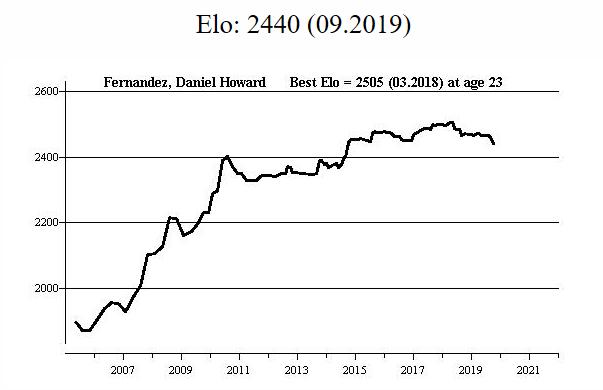
Consequently Daniel’s FIDE rating profile also showed a fast pace of development:
FIDE rating profile for Daniel Fernandez
Sydney 2009 and Sydney 2010 both provided IM norms with the third one coming from Kuala Lumpar 2010 and with these Daniel became an International Master in 2010 the title being confirmed at the 3rd quarter Presidential Board Meeting 2010, 24-25 July 2010, Tromso in Norway.
IM Daniel Fernandez, 100th British Championships, Round 5, Torquay. Courtesy of John Upham Photography
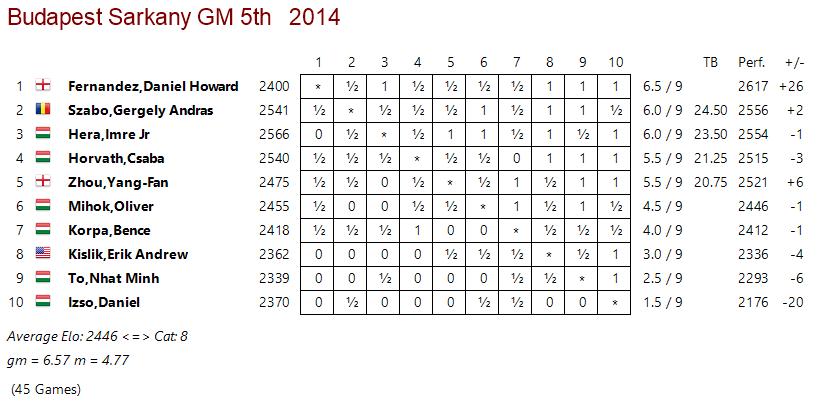
He won the Budapest Sarkany Tournament in 2014 as follows:
Full Crosstable from Budapest Sarkany Tournament, 2014.
earning his first GM norm in the process.
IM Daniel Fernandez, 101st British Championships, Aberystwyth. Courtesy of John Upham Photography
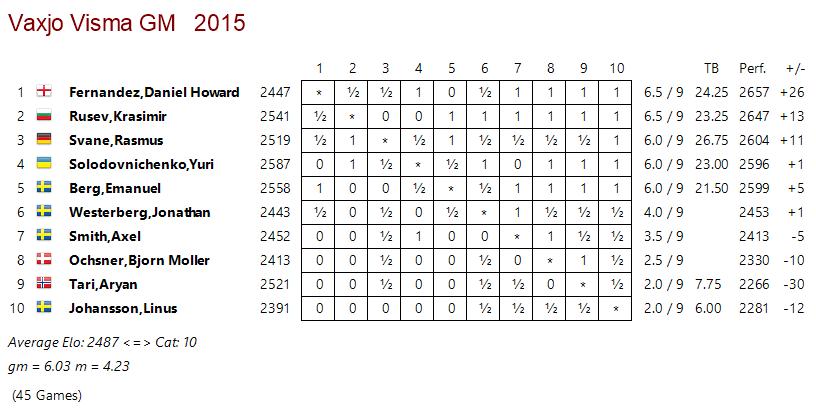
BCN asked Daniel for three of his favourite games. The first one is this Polish Defence game from 2015 played at the Visma Arena in Vaxjo, Sweden. First we have the crosstable showing that Daniel earnt his second GM norm from this event.
Full Crosstable for Vaxjo, Visma tournament in Sweden, 2015.
and here is the game:
and during the 2015/15 4NCL season Daniel obtained his final GM norm playing for Wood Green.
In March 2015 he made his first of three Varsity match appearences for Cambridge re-uniting with Danielle Ho and Howard Chiu (remember those names from earlier?).
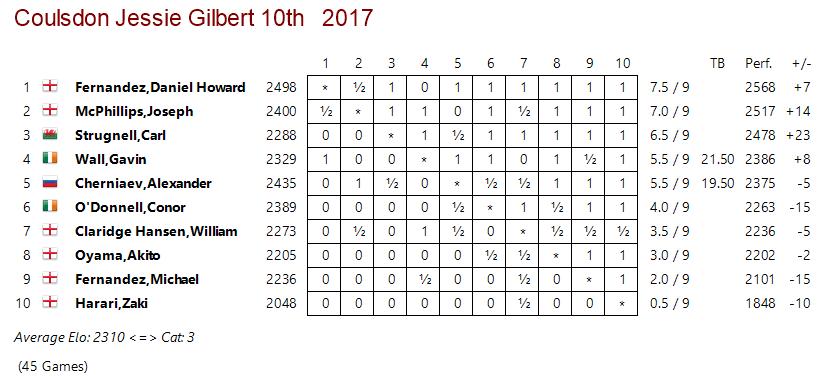
Daniel won the 10th Jessie Gilbert Memorial in 2017:
Full Crosstable from the 2017 10th Jessie Gilbert Memorial
and also in 2017 Daniel was awarded the Grandmaster title at the 88th FIDE Congress 2017, 7-15 October, Goynuk, Antalya, Turkey.
On March 11th Daniel represented Cambridge in the 135th Varsity Match at the RAC Club in Pall Mall. According to chess24.com ‘IM Daniel Fernandez, playing board 2 for Cambridge, was awarded the Brilliancy Prize by GM Ray Keene in consultation with McShane and Speelman, for his “high-class swindle” after recovering from a bad blunder.’ See here for details.
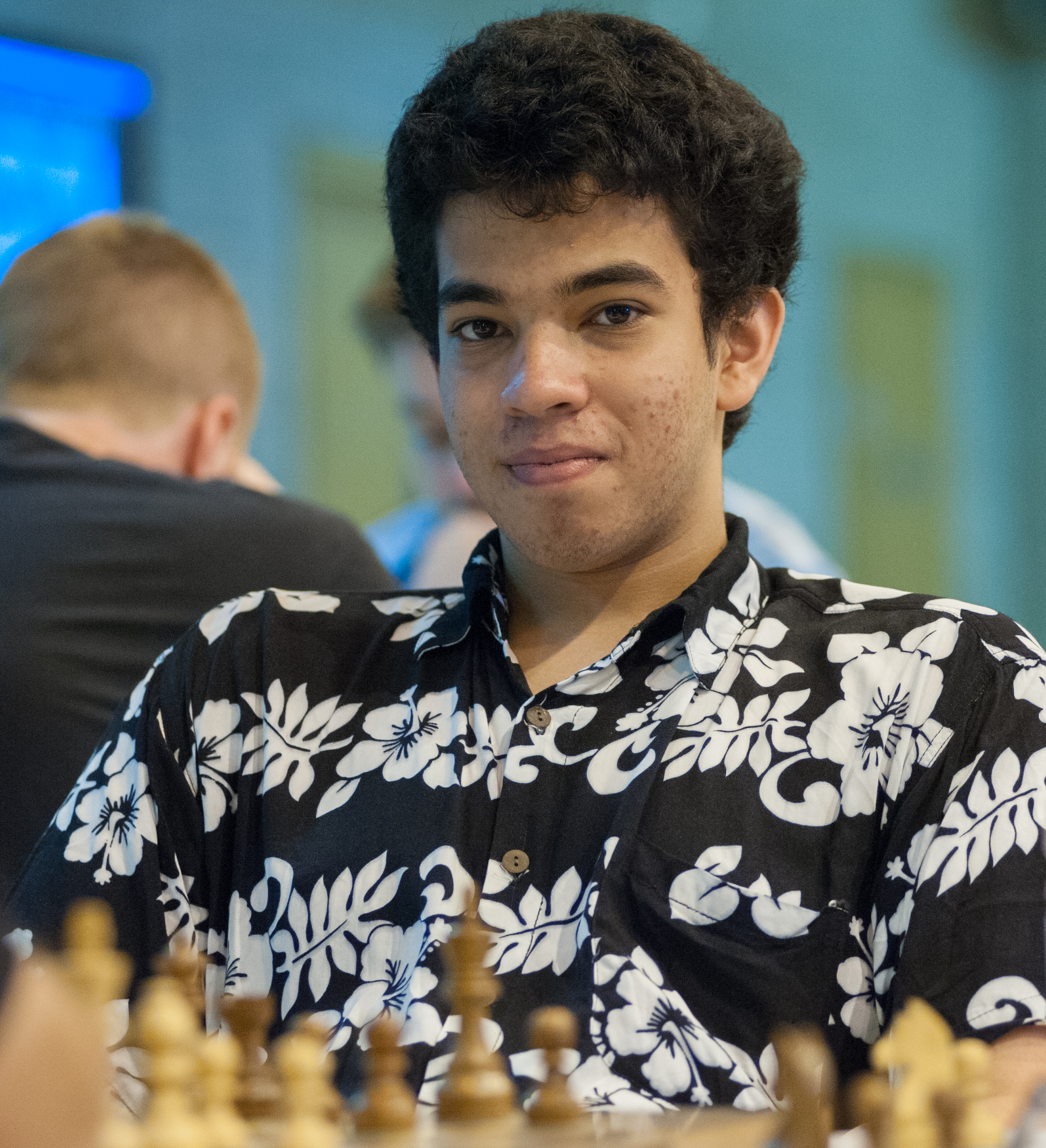
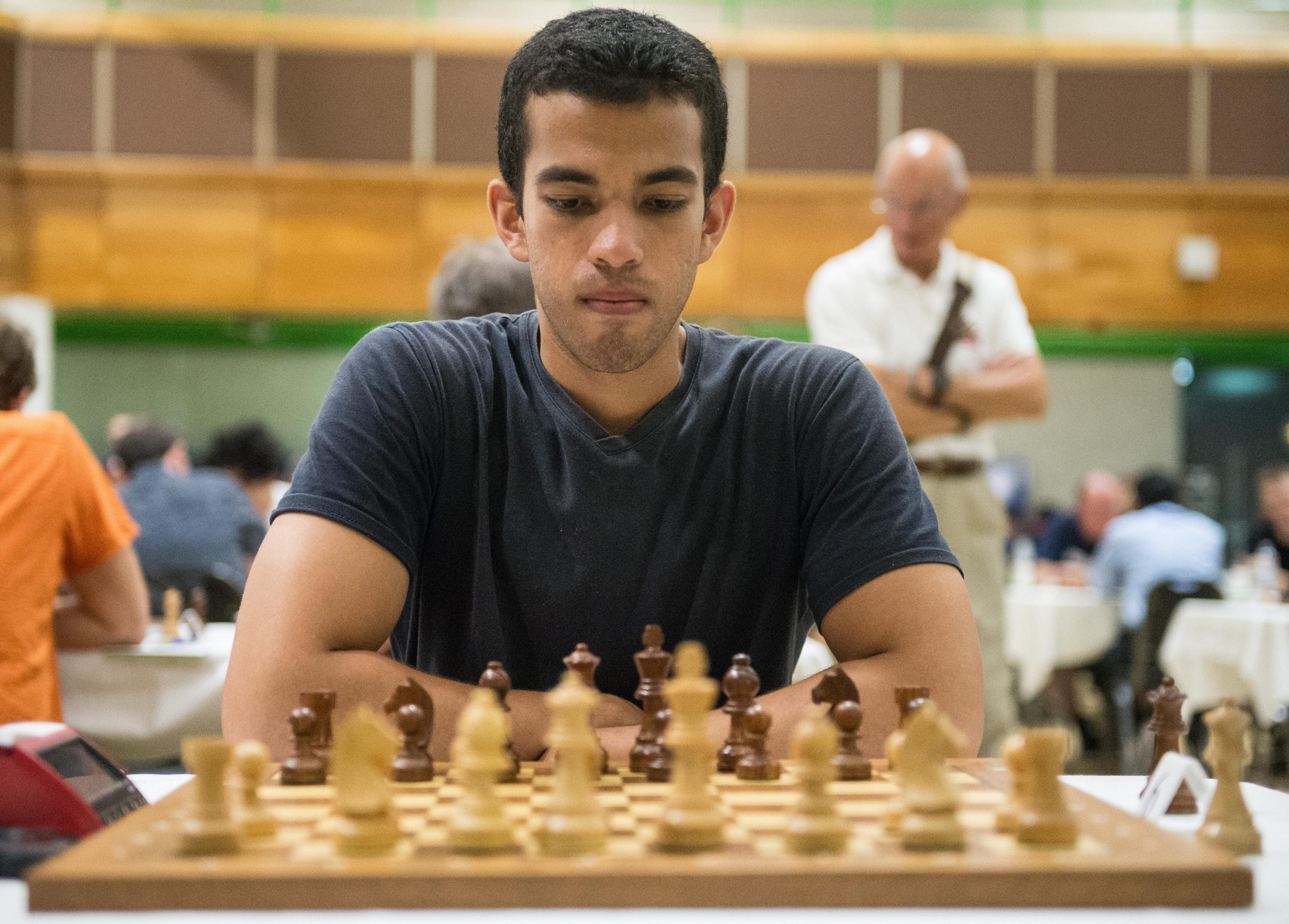
GM Daniel Fernandez, 2019 British Championships, Torquay. Courtesy of John Upham Photography
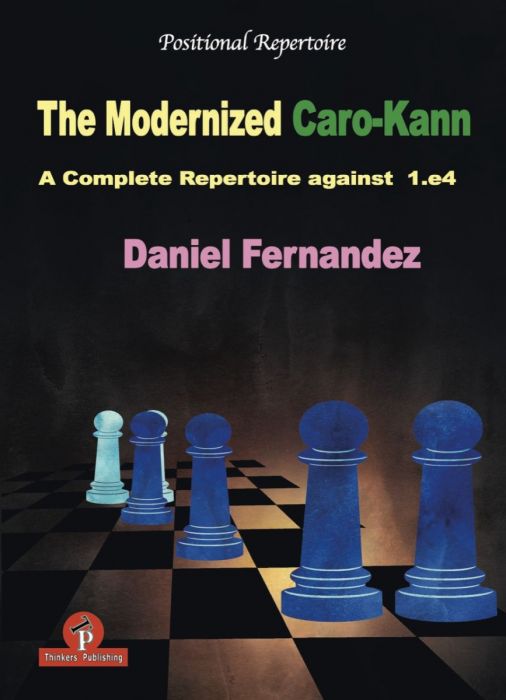
In 2018 Daniel ventured into the world of book writing when Thinker’s Publishing released The Modernized Caro-Kann on September 8th 2018. This was a repertoire book for Black based around the Smyslov Variation :
The Modernized Caro-Kann, Daniel Fernandez, Thinkers Publishing, 2018
From the rear cover we have:
“GM Daniel Fernandez (born 1995) has been an active and accomplished player for several years. He represented his native Singapore twice at Olympiads (2010 and 2012) before transferring to the English chess federation. There, he won the national classical titles at U-18 and U-21 levels and worked to become a Grandmaster while simultaneously studying at Cambridge. The Caro-Kann was instrumental in his quest for that title. Currently, Daniel is known in the chess scene not only as a solid player, but also as a mentor figure to younger English players, as a producer of well-received commentary and analysis, and as a multilingual chess coach. This is his first book.”
From January 2019 we have this interesting encounter between Gawain Jones and Daniel from the annual 4NCL meeting of Guildford and Wood Green:
With the White pieces Daniel has played a wide range of first moves but the majority move by far is 1.e4. His choice versus the Najdorf is some eclectic : sometime ago 6. Rg1 was the favourite and now 6.a4 is preferred.
Against 1…e5 Daniel offers a main line Ruy Lopez.
What does a Caro-Kann expert play against the Caro-Kann? Nowadays the Two Knights Variation is employed!
As the second player he plays the Sicilian Najdorf as well as the Caro-Kann plus an equal mixture of the Grünfeld and King’s Indian Defences.
In 2019 Daniel was interviewed by Edwin Lam on behalf of ChessBase : fascinating reading!
In the same year Daniel joined IM Adam Taylor’s venture Making Grandmasters.
Our final games is from July 2019 :
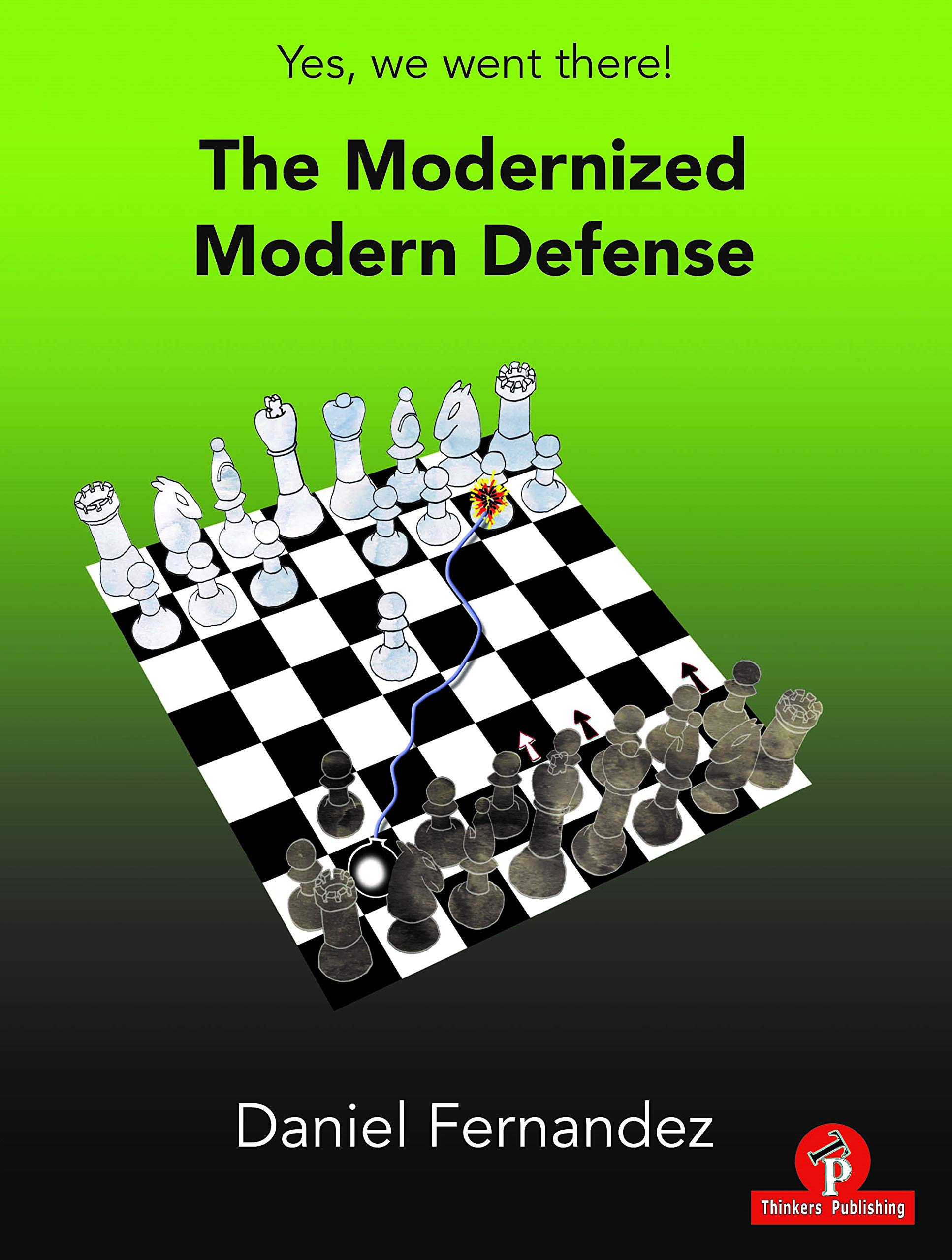
Daniel’s most recent publication is The Modernized Modern Defence from Thinker’s Publishing:
The Modernized Modern Defence, Daniel Fernandez, Thinker’s Publishing, 2021
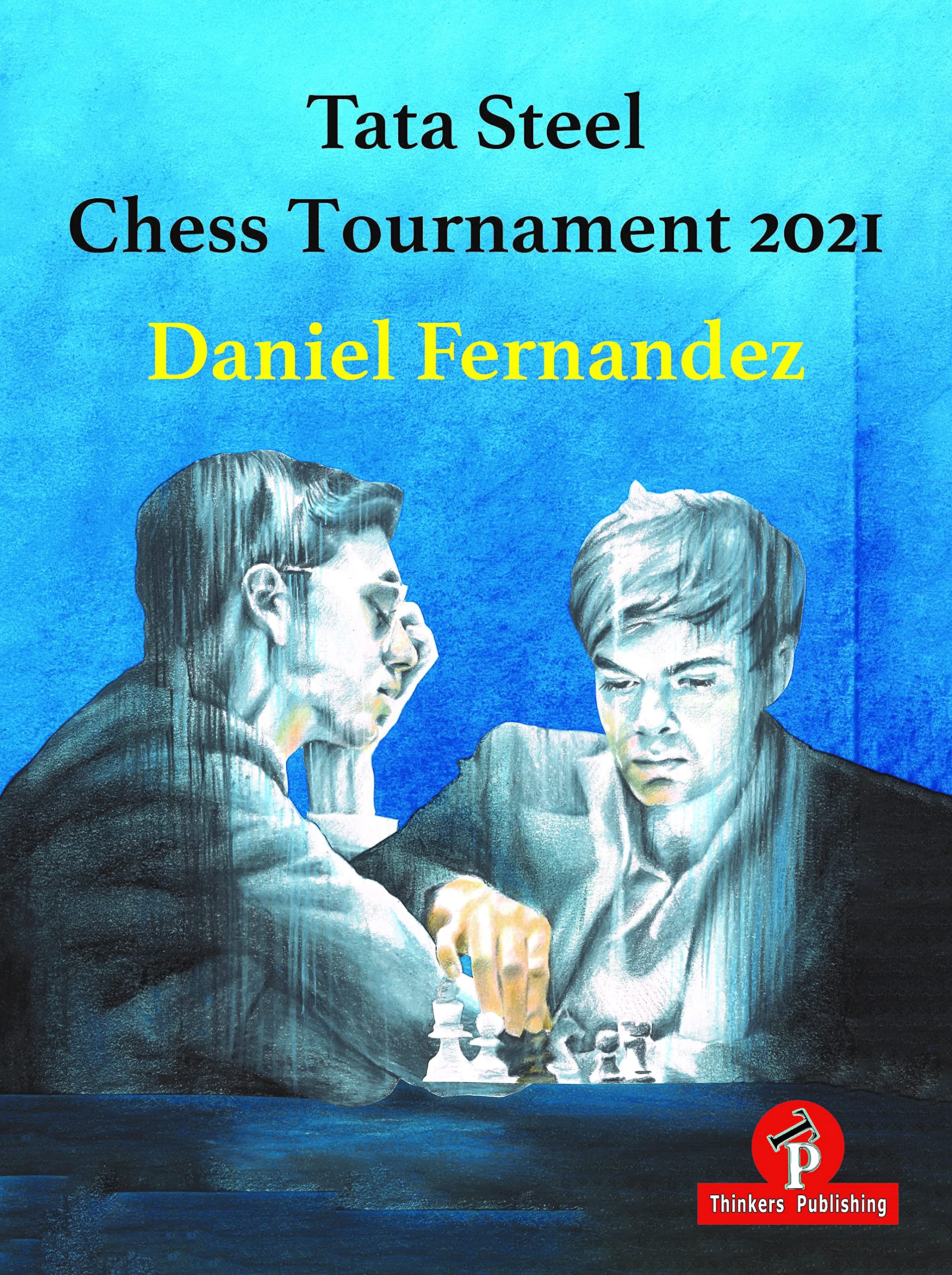
and BCN has been told that Daniel has a book in the pipeline about the Tata Steel 2021 tournament at Wijk aan Zee.
BCN remembers Nancy Elder MBE who passed away on Wednesday, March 4th 1981, i.e. forty years ago in Perth, Western Australia.
Nancy Conchar Gordon was born on Tuesday, May 25th 1915. On the same date was born Robin Day in High Wycombe who went on to design the polypropylene stacking chair.
Nancy was born in Kirmabreck, Kirkcudbrightshire in the Dumfries and Galloway council area of Scotland.
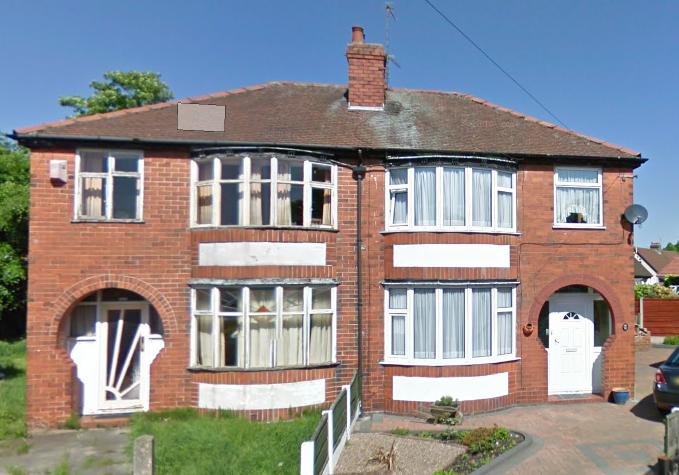
In the 1939 register Nancy was living at 18 Thornton Avenue, Urmston, Manchester, M41 5DJ with a married couple, William Furnish (a railway time keeper) and Gertrude Furnish who performed unpaid domestic duties. Presumably Nancy was their lodger.
18 Thornton Avenue, Urmston, Manchester, M41 5DJ
Her occupation was given as a teacher of music and physical training. At this time she was single at the age of twenty-four.
In the mid-1940s Nancy relocated from Manchester to Dundee where she continued her teaching career at Dundee High School. During that time she encouraged and coached a number of players some of whom represented Scotland.
In 1950 in Tealing, Angus, Scotland Nancy married David Livie Elder. They had a daughter Christine who played chess as a junior. Tealing has a strong connection with the Elder family.
According to Alan McGowan (Chess Scotland): “She was the main instigator in forming both the Schools’ and Primary League in Dundee, and she assisted in the organisation of the Dundee 1967 International Centenary Tournament.”
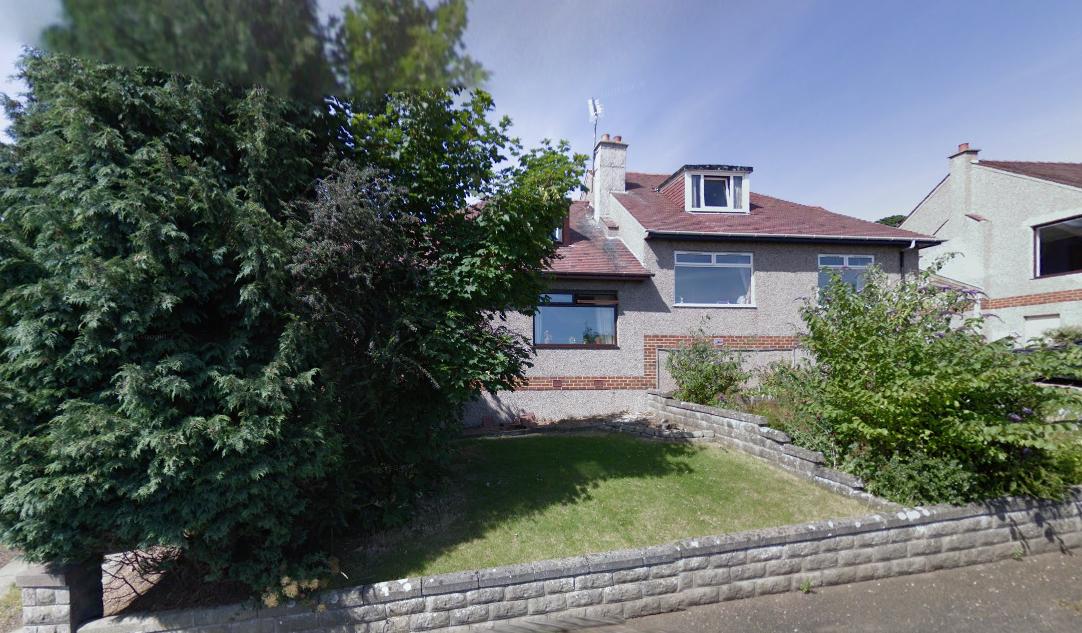
When she passed away Nancy was living at 39 Whitefauld Road, Dundee, DD2 1RJ :
39 Whitefauld Road, Dundee, DD2 1RJ
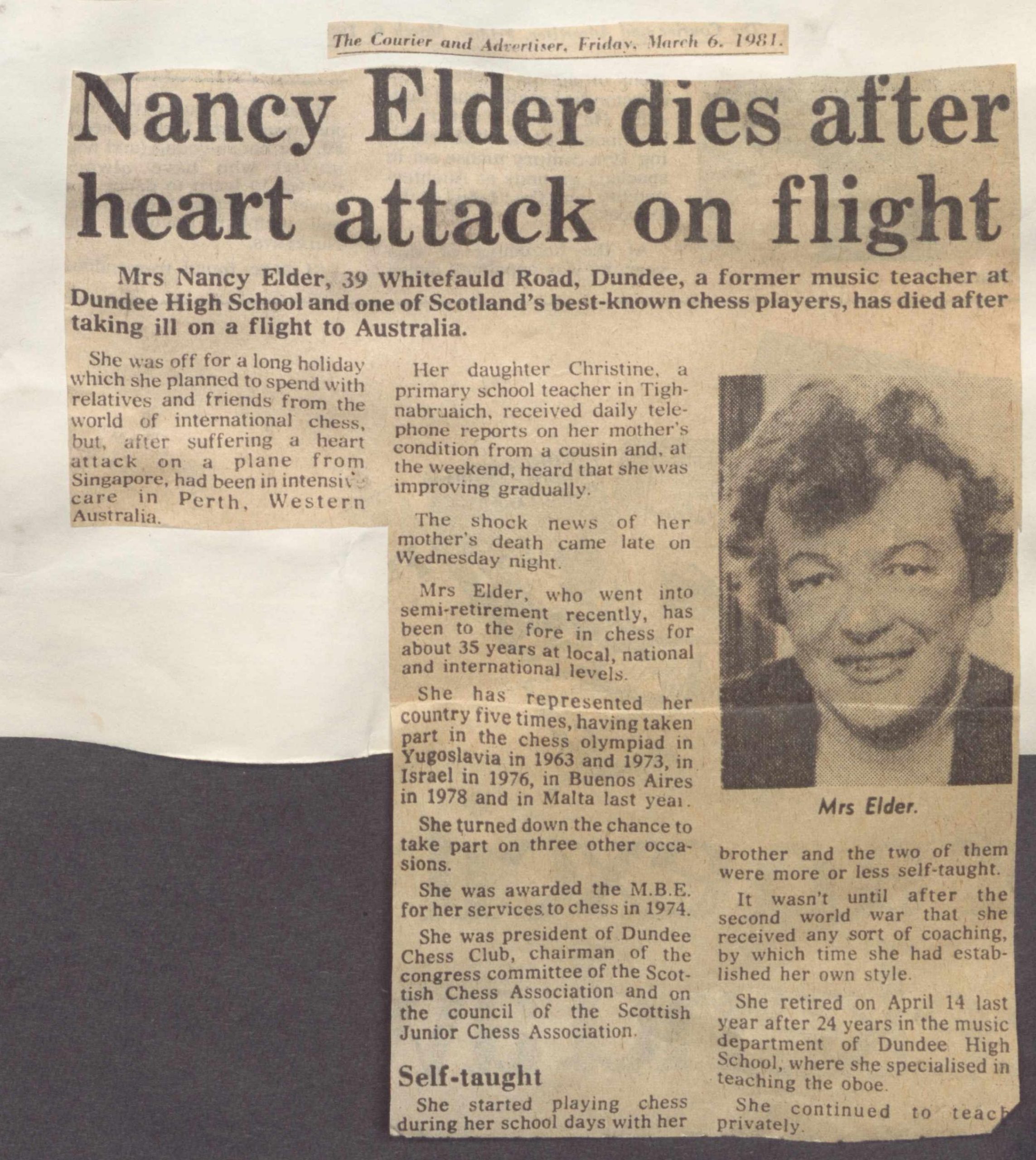
Her passing was reported in the Dundee Courier and Advertiser on March 6th 1981 as follows :
Nancy Elder dies after heart attack on flight
Mrs Nancy Elder 39 Whitefauld Road, Dundee, a former music teacher at Dundee High School and one of Scotland’s best known chess players, has died after taking ill on a flight to Australia.
She was off for a long holiday which she planned to spend with relatives and friends from the world of international chess, but, after suffering a heart attack on a plane from Singapore, had been in intensive care in Perth, Western Australia.
Her daughter Christine, a primary school teacher in Tighnabruaich, received daily telephone reports on her mother’s condition from a cousin and, at the weekend, heard that she was improving gradually.
The shock news of her mother’s death came late on Wednesday night.
Mrs. Elder, who went into semi-retirement recently, has been to the fore in chess for about 35 years at local, national and international levels.
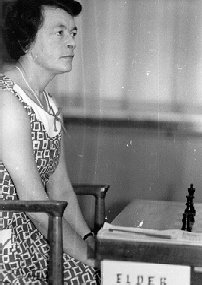
Nancy Elder MBE. Source : Milos Petronic
She has represented her country five times, having taken part in the chess Olympiad in Yugoslavia in 1963 and 1973, in Israel in 1976, in Buenos Aires in 1978 and in Malta last year.
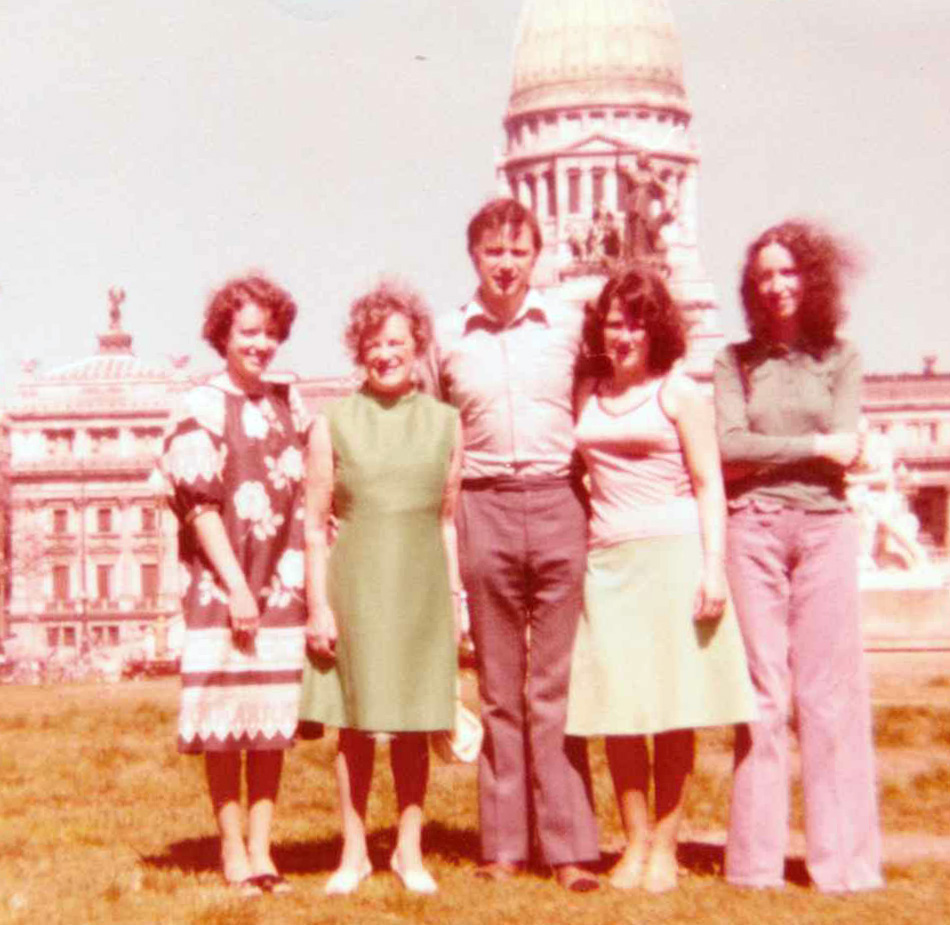
Buenos Aires Olympiad 1978. From left: Morag McGhee, Nancy Elder, Owen Hindle, Kathleen Hindle and Lynne Houston. Courtesy of Chess Scotland
She turned down the chance to take part on three other occasions.
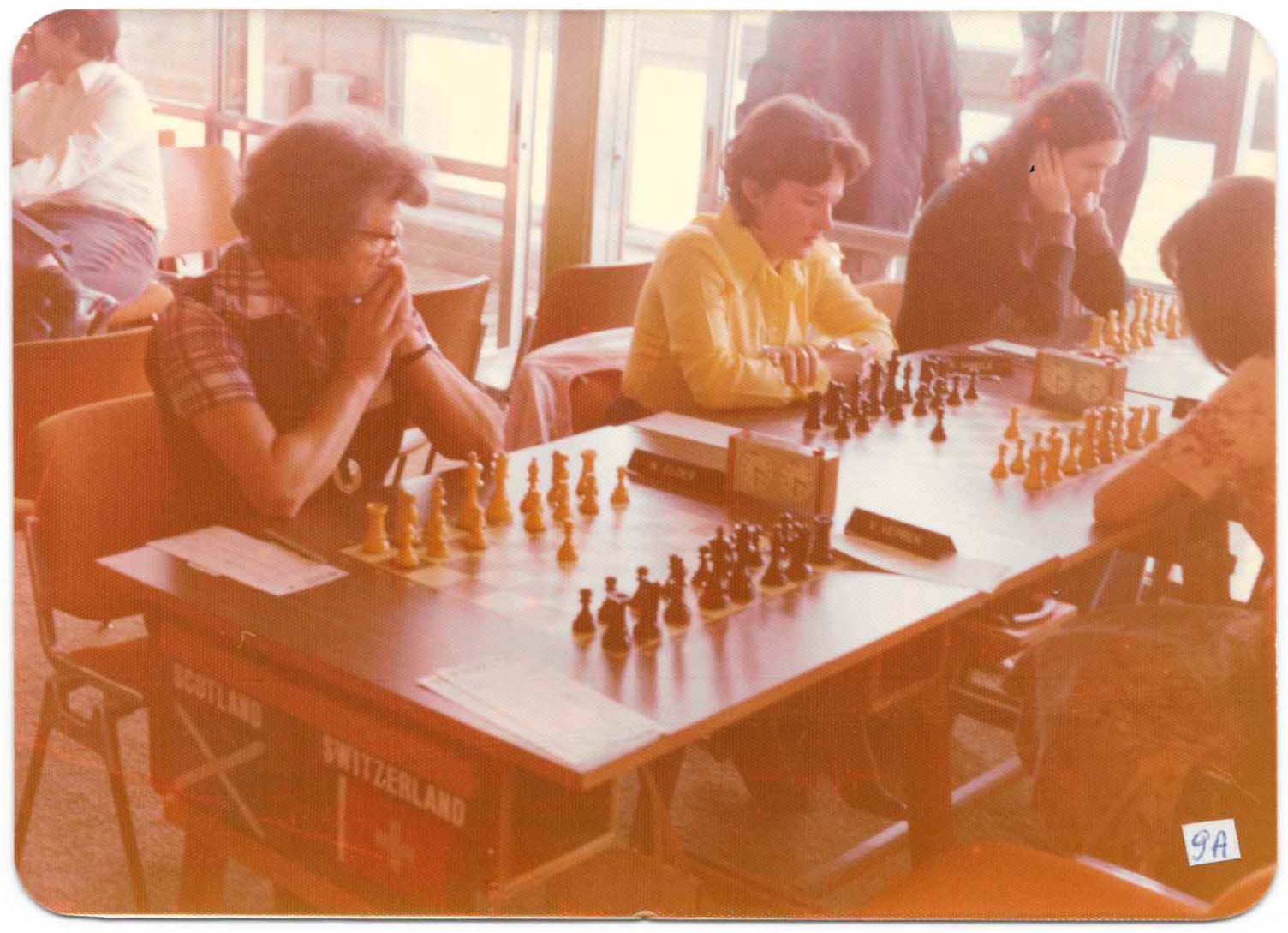
Haifa Olympiad 1976 – Scotland v Switzerland. From left: Nancy Elder, Kathleen Hindle, Lynne Houston. Courtesy of Chess Scotland
She was awarded the MBE for her services to chess in 1974.
She was President of Dundee Chess Club, chairman of the congress committee of the Scottish Chess Association and on the council of the Scottish Junior Chess Association.
Self-taught
She started playing chess during her school days with her brother and the two of them were more-or-less self taught.
It wasn’t until after the Second World War that she received any sort of coaching, by which time she had established her own style.
She retired on April 14th last year after 24 years in the music department of Dundee High School, where she specialised in teaching the oboe.
She continued to teach privately.
Dundee Courier and Advertiser, March 6th 1981
From British Chess Magazine, Volume CI (101, 1981), Number 6 (June), pp. 219-220 we have this obituary from Bernard Cafferty :
“Nancy C. Elder, MBE, died in Perth, Western Australia on March 4th 1981. Mrs. Elder had recently retired after a lifetime of teaching, her last post being in Dundee. I well remember her account of teaching under difficult conditions in World War 2 in Manchester. 15 Scottish Women’s Champion (the record for the event which she set-up at Troon in 1980).
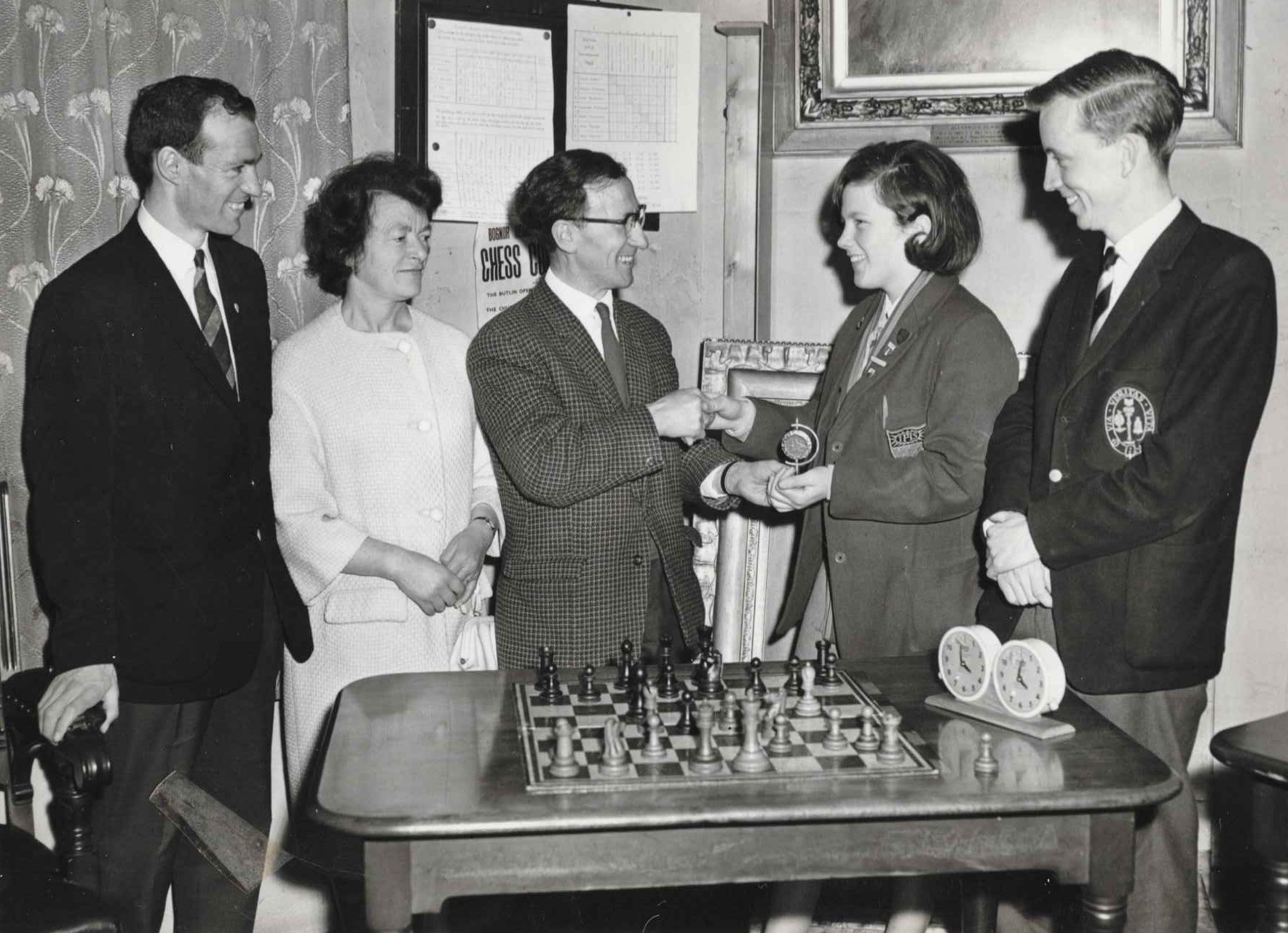
Prizegiving at the 1966 Scottish Championships. From the left: Michael Fallone, Nancy Elder, W.P. McColl, President of Dundee Chess Club, Kathleen Patterson, Gerald Bonner. Courtesy of Chess Scotland
Mrs Elder was a regular competitor in the British Women’s Championship (sometimes in rivalry with her daughter Christine) and showed her playing strength with a score of 5.5/12 on board two for Scotland at the Women’s Chess Olympiad, Malta, 1980.
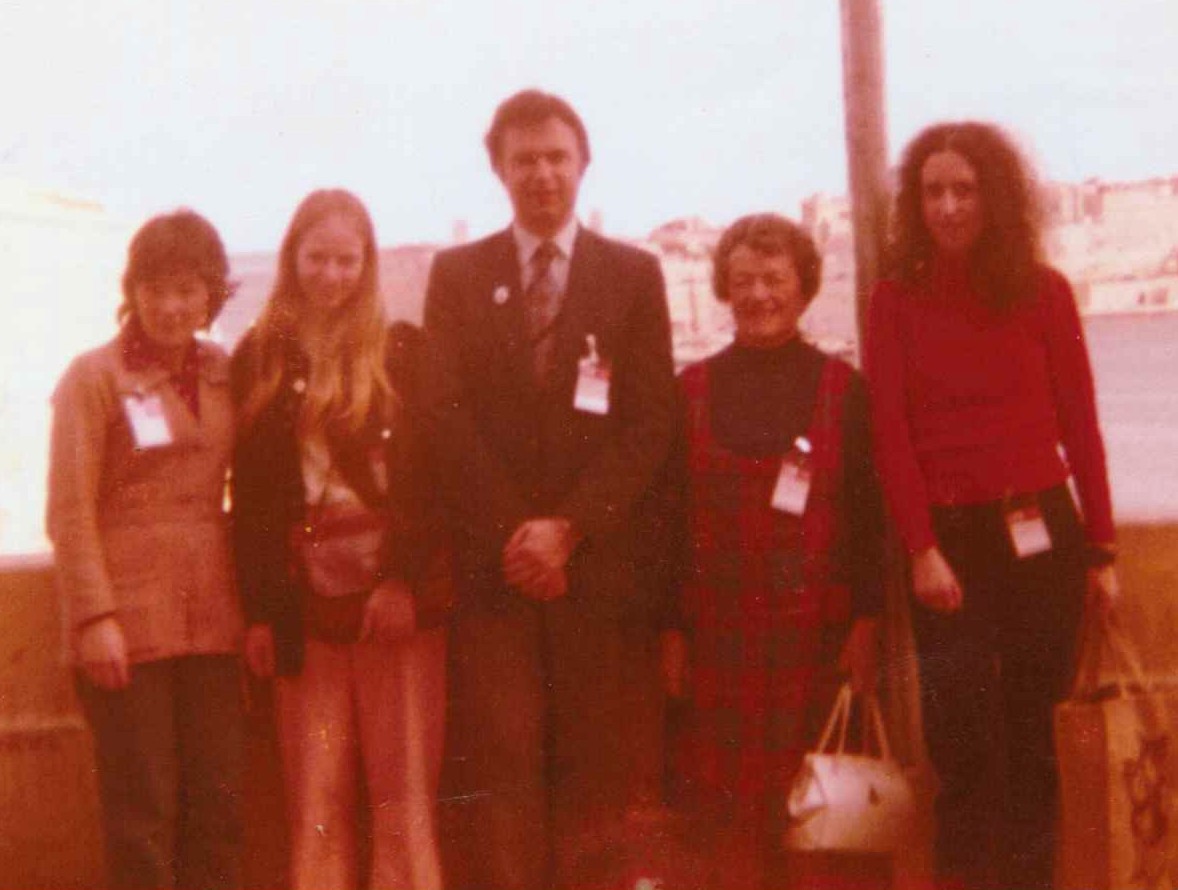
Malta Olympiad 1980 Left-right: Kathleen, Rosie Giulian, Owen Hindle (Team Captain), Nancy Elder, Lynne Houston. Courtesy of Chess Scotland
I am sure she will be best remembered though for her decades of effort in the organising of chess in Scotland, particularly for juniors and in schools, in recognition of which she was awarded the MBE, the only such honour ever given for services to chess ‘north of the border’ as Alan Borwell puts it in his Newsflash obituary.”
Chess Scotland award the Nancy Elder Cup annually for an individual competition for “club level” players.
We are grateful to Helen Milligan who told BCN :
My most memorable incident was when I refused to play in the Scottish Ladies at the annual Congress, preferring to try to improve my chess by playing in the Open section (really the B-Grade, below the Championship proper). I got given a piece of Nancy’s mind for that – she did not approve!
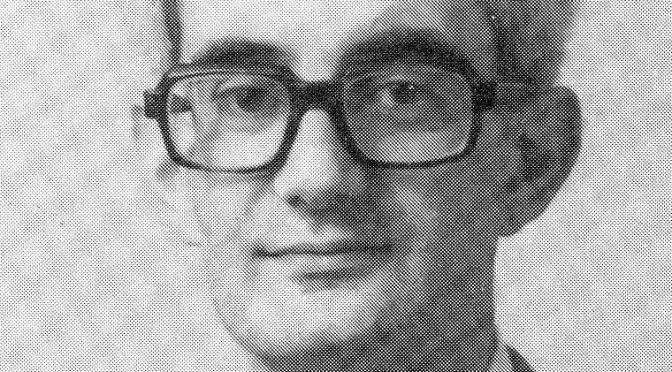
BCN remembers CGM Adrian Hollis who passed away in Wells, Somerset on Tuesday, February 26th 2013 at the age of seventy-two.
Adrian Swayne Hollis was born in Bristol, Avon on Friday, August 2nd 1940. During this critical period the Luftwaffe was wisely extending its Battle of Britain targets to include Britain’s airfields. Furthermore, Bristol was bombed heavily between June 1940 and May 1944. The longest period of regular bombing, known as the ‘Bristol Blitz’ began in autumn 1940 and ended the following spring. The first bombs of the Bristol Blitz fell at around 6 pm on Sunday 24 November 1940.
Adrian was the only child of MI5 director general Roger Henry Hollis KB CBE (later to become Sir Roger Hollis) and Evelyn Esme Hollis (née Swayne) who was Roger’s first wife. Roger was from Wells and Evelyn from Burnham-on-Sea and they were married on July 17th 1937 in Wells Cathedral with Evelyn’s father performing the ceremony.
Adrian won a scholarship in classics to Eton College and then went up to Keble College, Oxford where he took a first in mods and greats. Whilst at Keble Adrian represented Oxford in four varsity matches between 1959 and 1962. Indeed, his support for varsity matches was maintained for many years attending a large number into and beyond the Lloyds Bank era. Stalwart organiser Henry Mutkin would always be sure to extend an invitation.
In 1961 Adrian become the youngest ever West of England Champion at the age of 21.
Adrian met Margaret Mair Cameron Edwards in 1967 at St. Andrew’s University where he taught Classics and she taught German. They married in the parish of St. Leonards in St. Andrews and had two daughters, Jennifer Margaret M (b. 1974) and Veronica Swanye (b. 1977) and a son, Michael David C.
He was the Games Editor for the British Correspondence Chess Association (BCCA) resigning in 1969.
In 1984 Adrian was forced to endure allegations against his father by Chapman Pincher (in CPs book Too Secret too Long) that Sir Roger had been a Soviet spy / mole. These allegations were demonstrated to be false. He may well also have been aware of allegations against his friend and chess mentor Graham Mitchell earlier in 1963. Ironically, it was Adrian’s father who initiated the investigation into Graham. Again, the rumours were shown to be unfounded.
Adrian became a director of the company Centre for Medieval and Renaissance Studies Limited on the September 1st 1996 and resigned on May 12th 2007. He was also a Vice President of the West of England Chess Union (WECU).
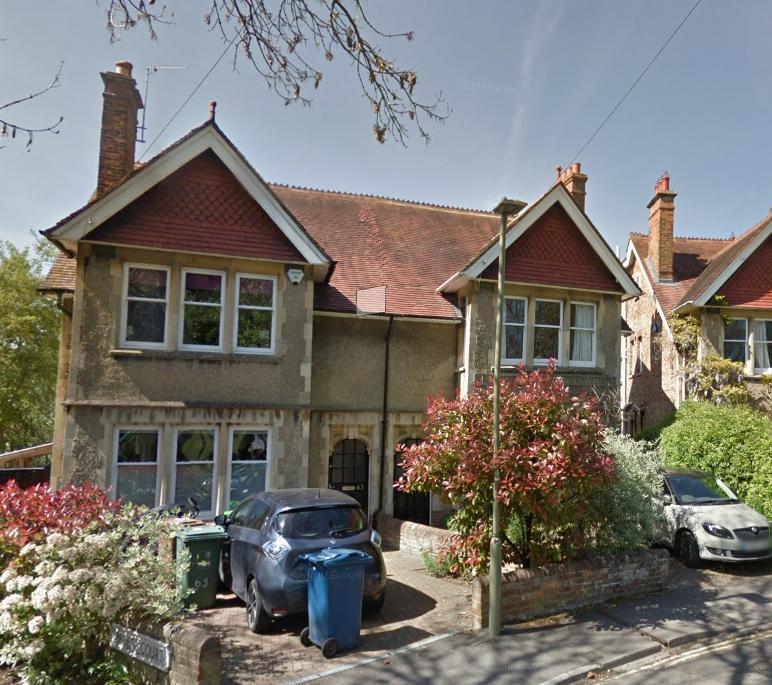
Between 2003 and 2007 (according to the Electoral Roll) Adrian lived at 63, Bainton Road, Oxford, OX2 7AG :
63, Bainton Road, Oxford, OX2 7AG
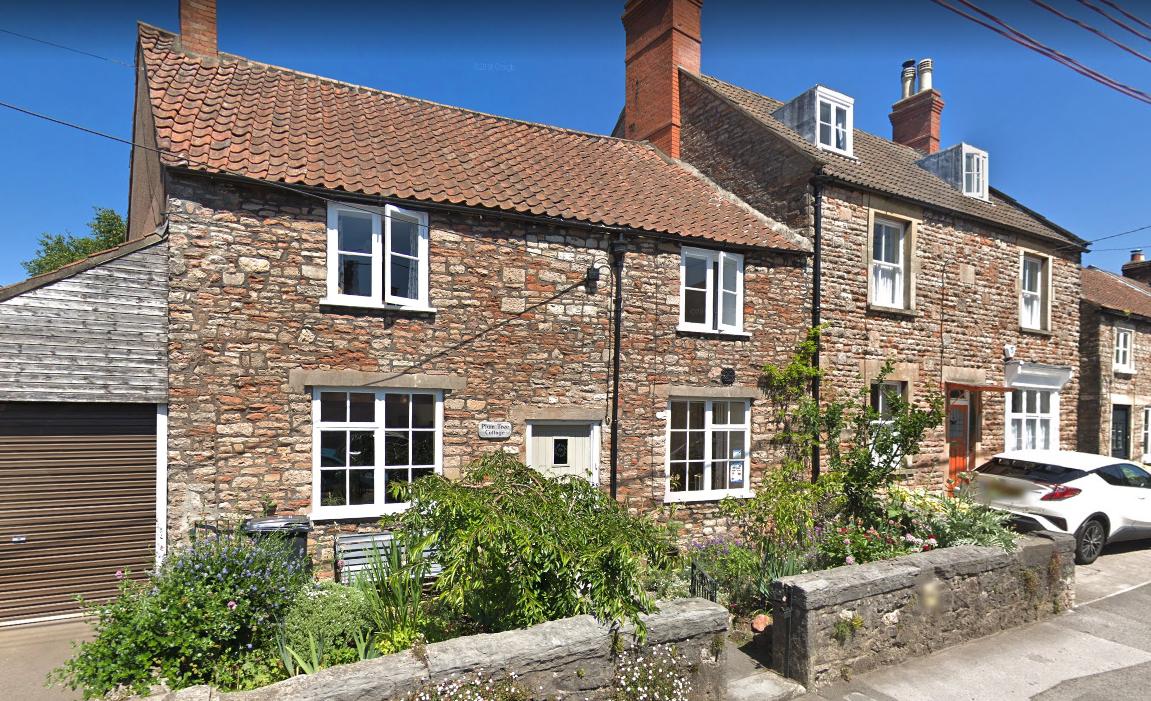
and following his retirement (and the time of the 2008 electoral roll) Adrian had moved to Pound House, Southover, Wells, BA5 1UH :
Pound House, Southover, Wells, BA5 1UH
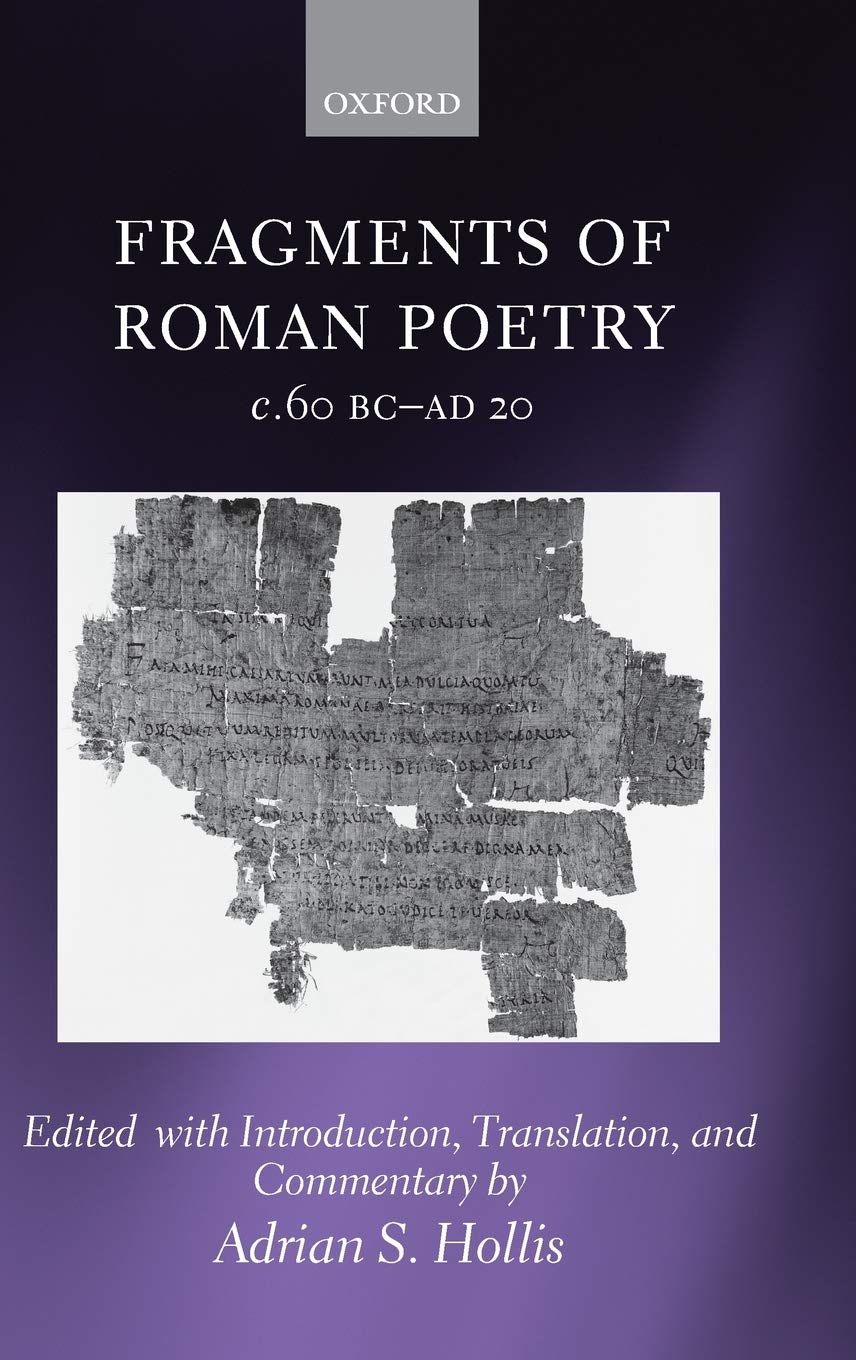
Adrian has written many learned papers and has had two books published :
Fragments of Roman Poetry C.60 BC-Ad 20, AS Hollis, Oxford University Press, 2007
and
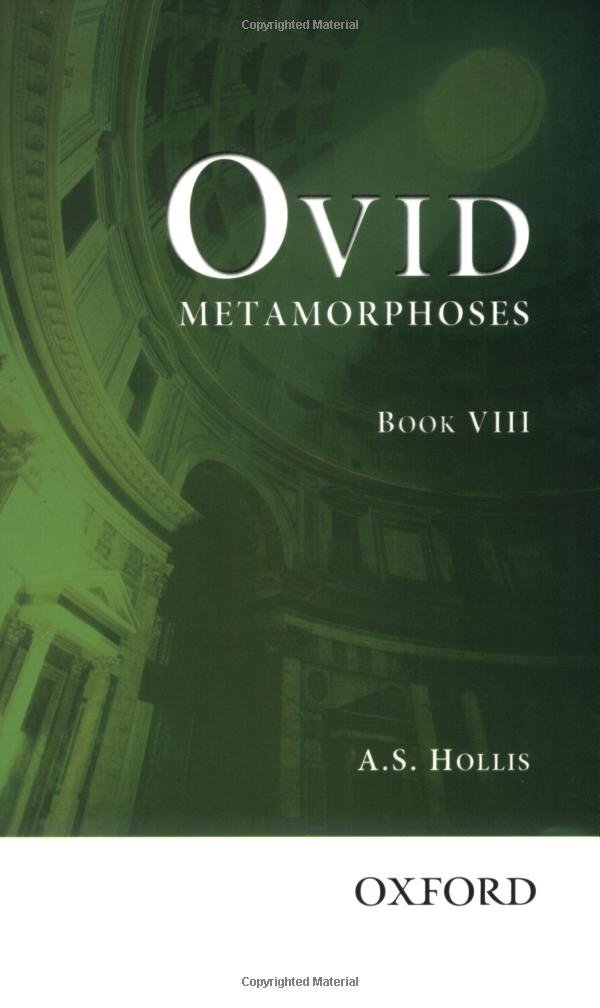
Ovid Metamorphoses VIII (Schools Edition): Bk. 8, AS Hollis. Oxford University Press, 2008
Julian was a personal student of Adrian’s and was kind enough to tell us :
I do remember Adrian well. He could quote Latin verse ad infinitum. He was an expert on Ovid.
In terms of chess he had a huge pile of Informators in his study still in their cardboard packaging. He was very kind to me and insisted I play above him for Keble in the intercollegiate matches.
I gave him a copy of Developments in the Orthodox QGD which I had written in 1987. He was quite taken back when I didn’t want any money for it. He seemed to have quite a lot of respect for me.
I once asked him why he had given me a place at Oxford. He replied that he couldn’t have rejected someone with my passion and enthusiasm.
I kept in touch with Adrian until his passing. He gave me a lovely reference when I resumed my studies in 2007 at Kingston University.
I remember him as a kind and unassuming man. He became a lifelong friend.
CGM Adrian Hollis
From British Chess (Pergamon Press, 1983) Botterill, Levy, Rice and Richardson :
“I was born on August 2nd, 1940, educated at Eton and Christ Church, Oxford and now teach Classics at Keble College, Oxford. I learned the moves at the advanced age of thirteen from a cousin* who himself could have made a good chess player had he not been seduced by Philosophy and brain-teasers; all that remains in the mind from these encounters is a vision of perpetually losing my rooks to fianchettoed bishops.
*We are grateful to John Clarke who informed us that
“The cousin would have been Martin Hollis, who contributed the “Tantaliser” column to the New Scientist for many years. I always enjoyed his puzzles, which for me at any rate were at just the right level of difficulty – neither trivial nor totally impossible.”
Adrian Hollis. Source : The Potter Memorial
My first ever tournament was the London Boys’ Championship 1956-7. In the opening round fate allotted me Black against David Rumens. As it happened, the brochure included a game of his from the previous year in which he had answered 1.d4 with 1…Nc6, quite enough, in my opinion, to condemn him utterly.
(Ed: The above position did not impress Adrian hugely.)
This view seemed confirmed when within twelve moves of an advance French I was two pawns up. Then, however, aided by my over confidence he worked up a fierce attack, and I just escaped with a draw. Nevertheless, I won the tournament; an opponent remarked how quickly I played my moves.
Thereafter the game was never so easy, but I did reasonably, well, winning the championships of the British Universities, West of England and East of Scotland, and playing for England quite regularly during the 1960s (including 7.5/12 in six Anglo-Dutch matches).
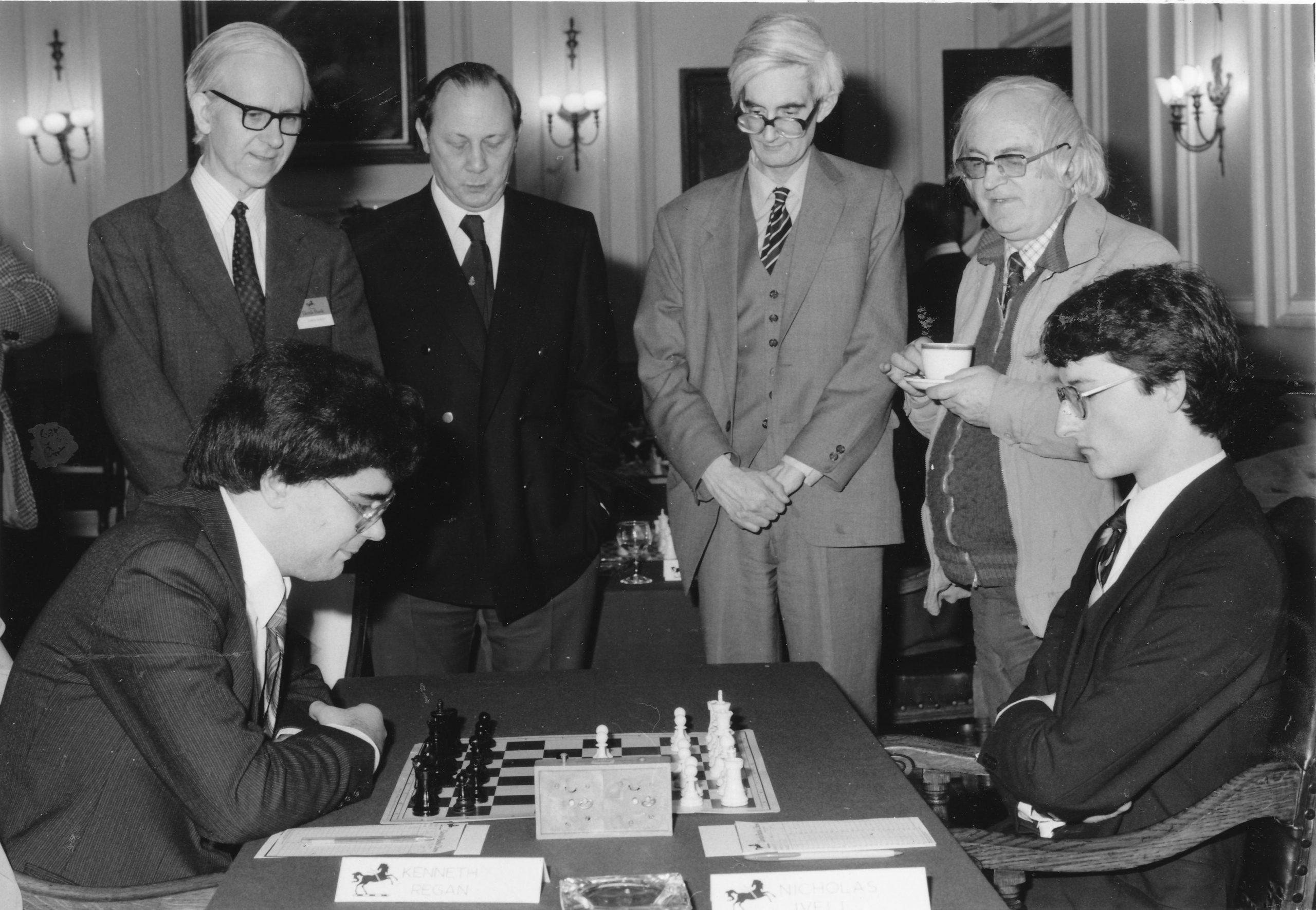
Leonard Barden, Henry Mutkin, Adrian Hollis and Bob Wade observe Nick Ivell vs Ken Regan at the 1983 Varsity match
The high spot of my over-the-board chess was the series of World Student team championships from 1960 to 1964 in glamorous places (Leningrad, Helsinki, Mariánské Lázně, Budva and Cracow); most enjoyable of these being Budva, 1963 where one could bathe every day in the Adriatic and I won the (?) gold medal on Board 1 with 7.5/9., the year after Spassky (this must look good in the records, unless they happen to reveal that for the first time in preliminary and final sections, and that England did not qualify for the top final).
My best chess was probably played at Mariánské Lázně, 1962, where in successive rounds I had favourable draws with Radulov and Hort, coming close to beating the latter. Ironically, I was awarded the British Master title after I had virtually retired from over-the-board chess.
In 1964 I decided that henceforth for me ‘serious’ chess would mean correspondence, while OTB became a pleasant social activity. My introduction to the postal game had been made about 1955 by a colleague of my father’s, International Master Graham Mitchell, to whom I owe an enormous debt for the patience and kindness with which he played a series of games, bearing with me when I lost interest in worsening positions. The switch to postal play was caused by a number of factors, negative and positive : an impending move to Scotland, where there was less OTB chess, frustration at constantly spoiling good positions through mistakes in time pressure – on the other hand a feeling that correspondence chess should suit an academic temperament, and a particularly fascinating game played in 1963-4 with Michael Haygarth (see below) on which I spent so much time and energy that I almost feared it would ruin my post-graduate exams.
In 1964-5 I qualified for the British Championship by winning a candidates’ section with 100%, and then competed three times in the British Championship itself (1965-6, 1966-7, 1970-71), winning on each occasion (the first time jointly with S. Milan) and remaining unbeaten. International play also proved successful, and I soon collected the two norms necessary for the IM title (Ed: awarded in 1970).
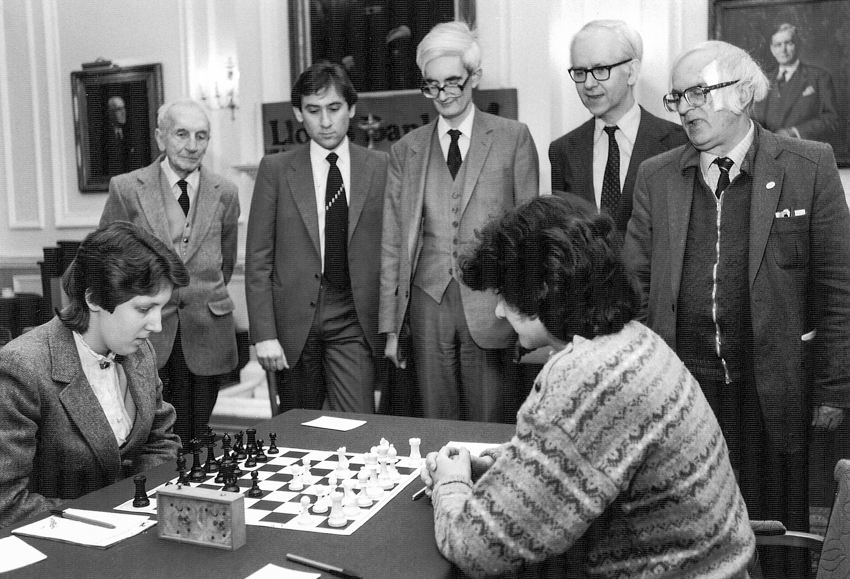
Linda Brownson (Newnham & Basildon), left, playing Maria Eagle (Pembroke & Formby) being observed by John Nunn, Adrian Hollis and Harry Golombek posing for the obligatory “staring at the board” picture for the 1981 Varsity Match sponsored by Lloyds Bank.
The first chance for the Grandmaster title came on Board 1 in the Seventh Olympiad final. Despite a rare loss with the White pieces(my only defeat with white for a stretch of 15 years), things went well, including a lucky win against the reigning World Champion, Horst Rittner, and the enticing prospect beckoned if only I could beat the Russian Moiseyev. He held a slight advantage since the opening, but I thought I saw the chance of tempting him to an incorrect sacrifice. Back came his move; he had indeed made the sacrifice and the envelope burnt a hole in my pocket during an important meeting (my mind was elsewhere). After a mere two days’ thought I sent my reply. The post between England and the USSR takes about a month for the return trip. Soon after posting my move, as I was walking from the Ashmolean Museum to Keble, just passing the front gate of St. John’s, the realisation of what I had overlooked hit me, and there followed an inexorable wait for the death blow which I now saw only too clearly.
So no Grandmaster title, but Great Britain still took the bronze medals, and I scored 6/9 (+5=1-2).
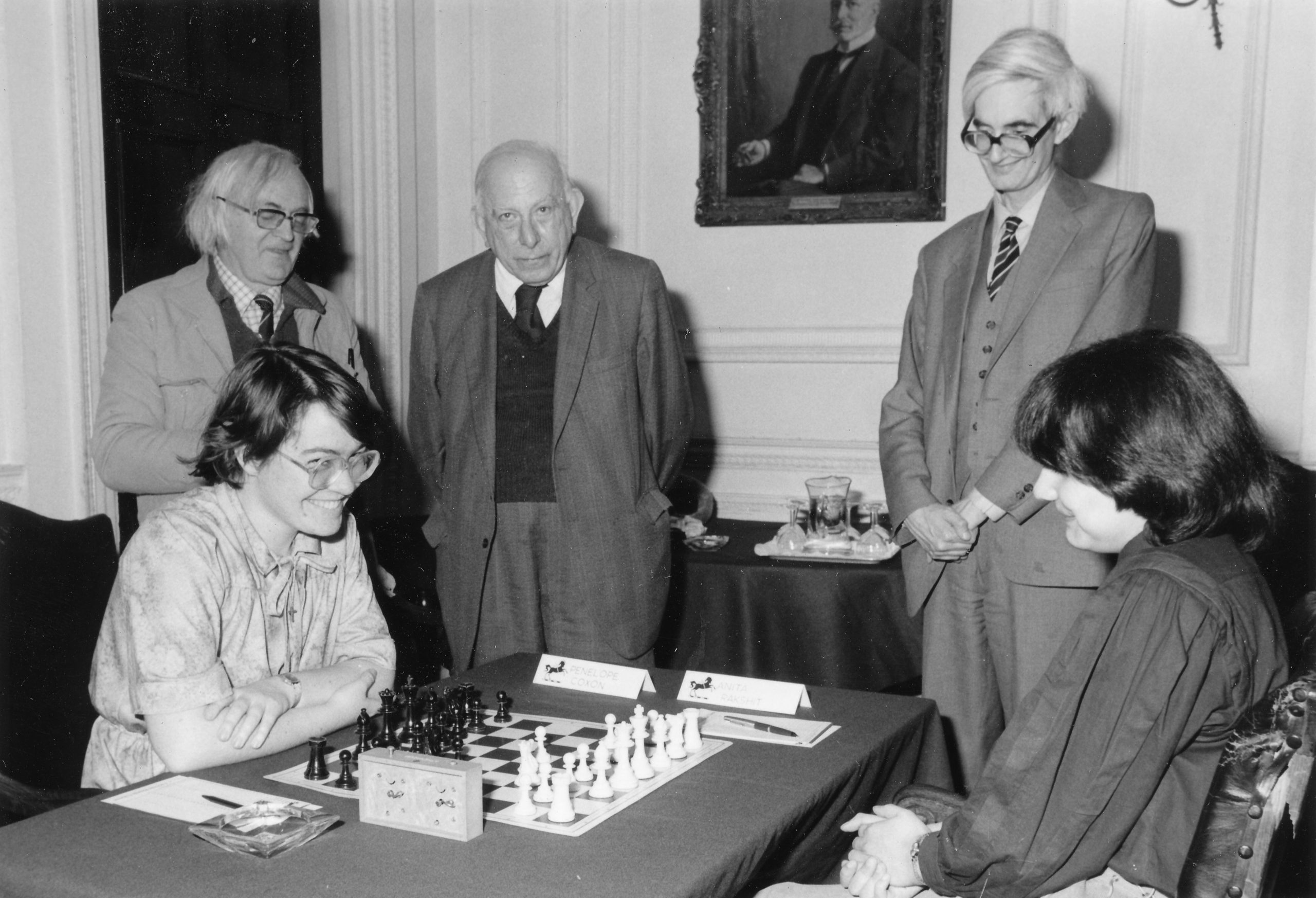
Bob Wade, Harry Golombek and Adrian Hollis observe Penny Coxon (Newnham) and Anita Rakshit (St. Hilda’s) during the 1983 Varsity match sponsored by Lloyds Bank
Another opportunity came when the British Postal Chess Federation organised a tournament (1974-6) in memory of its former secretary RJ Potter. This started inauspiciously for me with a heavy defeat at the hands of Grandmaster Endzelins of Australia., a country which has so far provided my least favourite opposition (not only is the postage extremely expensive, but my score to date is 0/2).
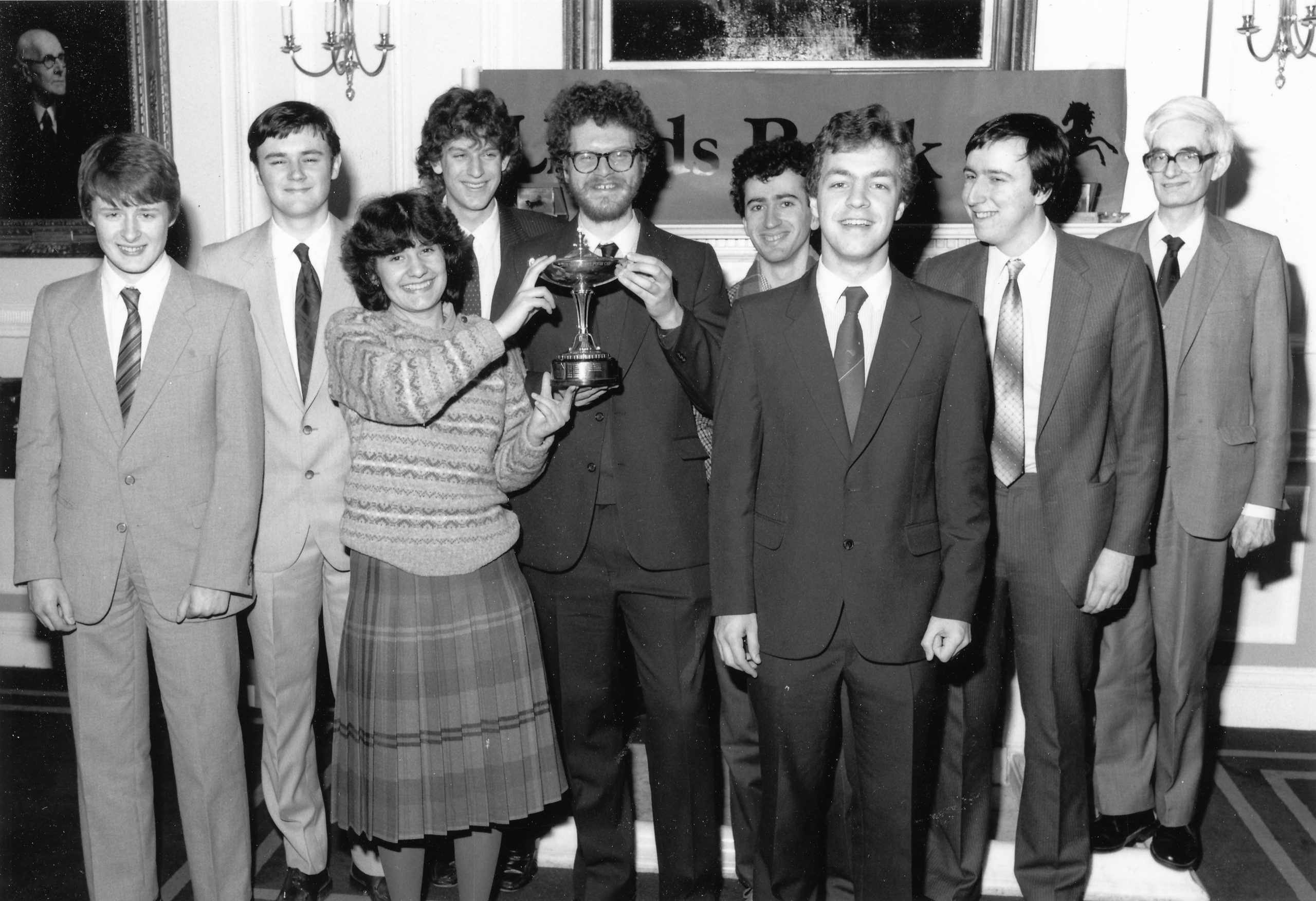
Adrian Hollis (far right) as Club President of the 1985 Oxford team of Peter Wells, Karl Bowden, Anita Rakshit, Kenny Shovel, IM Colin McNab, IM Jon Levitt, FM Neil Dickinson and FM John Hawksworth
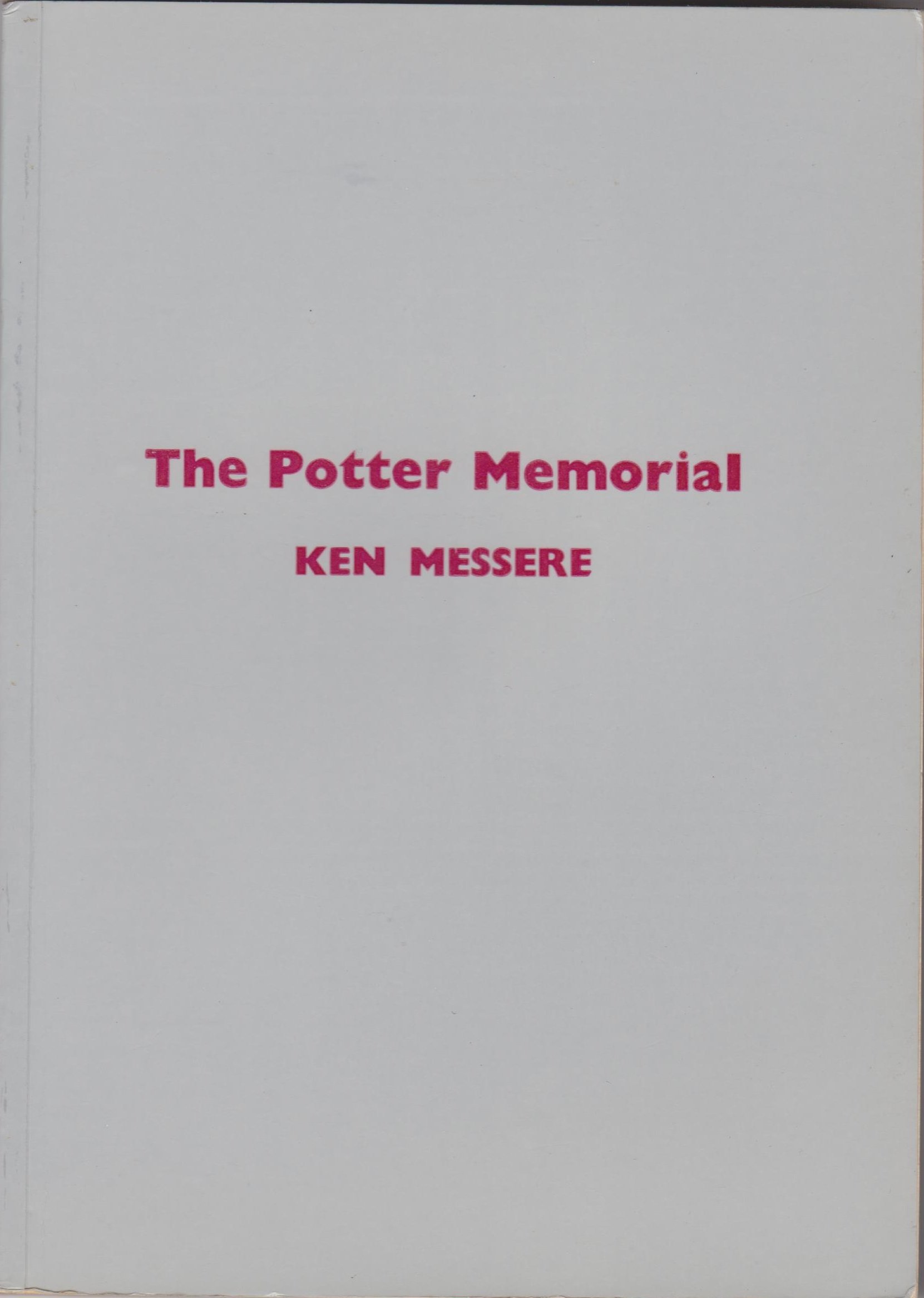
From The Potter Memorial, Ken Messere, Chess (Sutton Coldfield), 1979 we have this potted biography from Ken Messere :
The Potter Memorial, Ken Messere, Chess (Sutton Coldfield), 1979
“Adrian Hollis is 36, was educated at Eton and Oxford, has written two books on the poet Ovid and is a Fellow and Tutor in Classics at Keble College, Oxford. He is a British Master at over the board chess and has been Champion of British Universities, West of England and East Scotland.
In 1964, he went to teach at St. Andrews University where his wife, Margaret, taught German. They were married and moved to Keble College in 1967 and now have two daughters. Jennifer is nearly five and Veronica is two.
Adrian began to concentrate on correspondence chess in 1964 and won the British Correspondence Chess Championship jointly in 1966 and outright in 1967 and 1971. He won the I.M. title in 1970 and his fine score of 6/9 on top board for Great Britain in the I.C.C.F. VIIth Correspondence Chess Olympiad Final contributed to the team’s winning the bronze medal in this event.”
and now back to Adrian’s British Chess article…
Thereafter my fortunes improved; one opponent accepted too trustingly some faulty analysis by Szabo in Informator (for a while it seemed that the Hungarian might earn me not one but two points). The East German Dr. Baumbach failed to find an improvement in a line with which I had been successful in the Seventh Olympiad Final.
Also, I had a win with the Black pieces against the Russian Kopylov. The result was a score of 9/12 (+8=2-2), which sufficed for the grandmaster title and first place half a point ahead of the Finn Kauranen.
Since then I have played quite well on second board behind Keith Richardson in the Eighth Olympiad Final (+5=7-0), and very badly indeed (scoring just about 50% in the Heilimo Memorial Tournament organised from Finland (I was much impressed by the strength of the Finnish players, most of whom I had not encountered before). Having twice narrowly failed, I would still like to qualify for the Final of the Individual World Championship. Of course life becomes increasingly busy, but the examples of Hugh Alexander and Graham Mitchell encourage me to believe that one can continue to play well at postal chess longer than over-the-board. So perhaps around the year 2000, when the children are grown up….”
Adrian Hollis and Harry Golombek observer Andrew Dyson (Trinity) having played 1.d4 versus IM William Watson (Merton) during the 1984 Varsity match sponsored by Lloyds Bank
From British Chess Magazine, Volume CXXXIII (133, 2013), Number 4 (April), pp.194-5 we have this obituary written by James Pratt :
Adrian Swayne Hollis (2 viii 1940 Bristol – 26 ii 2013 Wells), British Master and Correspondence Grandmaster (1976), three times British Correspondence Champion, has died. He played most of his OTB chess as a young man, finishing seventh equal at the British Aberystwyth, 1961, when he beat, amongst others, A.R.B. Thomas and former champion, Alan Phillips. He gave future champion, Jonathan Penrose, a tough fight in the last round before conceding the half-point. He played in the Hastings Premier, 1962/3 and emerged with a plus score in the Anglo-Dutch matches. He was an occasional reviewer for BCM.
From the 1985 Varsity Match : Laura Cohen (Newnham), Brian Reilly (BCM), Bill Hartston (Cambridge), Adrian Hollis (Oxford), Anita Rakshit (St. Hilda’s), Leonard Barden (The Guardian etc) and Bob Wade (BCF)
It was, of course, in the realm of postal player that he shone most brightly!
In 1966 we see him playing board two for England, below Slade Milan, and, two years later, Adrian scored 9/12 in a World Postal Qualifier, narrowly missing a place in the final. In 1971 he won the British Correspondence Championship, easily outdistancing a tough field. He played top board for England in the 1972-7 Olympiad. In 1974-6 he won the Reg Potter Memorial. In the ninth Olympiad – 1982-5 – Adrian Hollis was undefeated on board two. And England took the Gold Medal!
BCN remembers Stanley Kipping who passed away in Walsall on February 17th 1964 at the age of 72 who was always known by friends and family as Stanley.
BCN was fortunate to receive the following part email from John Kipping, a resident of Christchurch, New Zealand.
None of the Kipping family from around that time were referred to by their first name. His brother was Barry (my grandfather), and two sisters, Esme who made jigsaw puzzles and Frieda, named after Frieda Weekly (nee von Richtofen).
(Cyril Henry) Stanley Kipping was born on Saturday, October 10th, 1891 in 7 Milborne Grove, South Kensington, London, SW10 9SN.
7 Milborne Grove, South Kensington, London, SW10 9SN.
His parents were Frederic Stanley Kipping (28) and Lillian Kipping (24, née Holland) : they married in 1888. Stanley was baptised on May 8th, 1892 in West Brompton, London. Frederic died on 30 April 1949 in Pwllheli, Caernarvonshire, at the age of 85 and Lilian passed away on 4 September 1949 in Pwllheli, Caernarvonshire, at the age of 82.
Frederic was Professor of Chemistry at The University of Nottingham. He undertook much of the pioneering work on silicon polymers and coined the term silicone. He was elected a Fellow of the Royal Society in 1897.
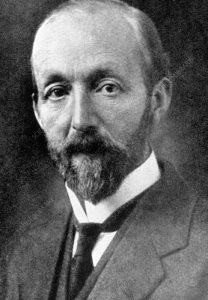
Frederic Stanley Kipping, FRS
In the 1901 census the family lived at Clumber Road West, Nottingham and brother Frederic Barry Kipping was born on April 14th 1901 and his sister Kathleen Esme was born on 3rd May 1904 also in Nottingham. Kathleen died on 30 August 1951 in Pwllheli, Caernarvonshire.
In 1902 Stanley started at Nottingham High School excelling in mathematics and science and in 1906 he obtained the Oxford and Cambridge Board’s Lower Certificate.
On March 2nd 1908 the Sheffield Daily Telegraph published a matriculation list for London University and CHSK was listed as being in the second division. Following that in 1909 Stanley obtained a Oxford and Cambridge Higher Certificate.
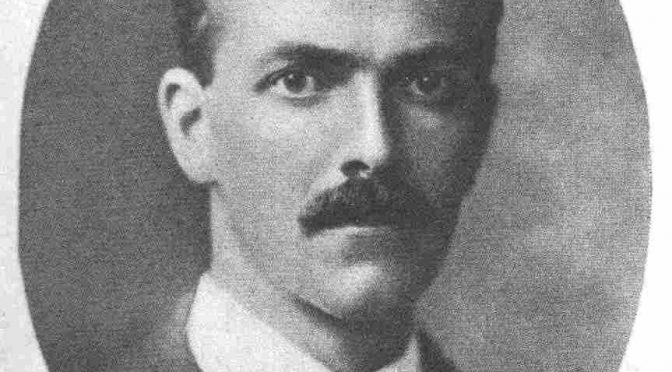
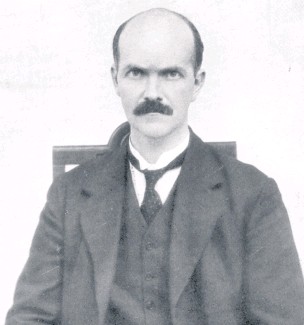
CHS Kipping
As of the 1911 census the household now included Stanley’s maternal Grandmother, Florence Holland (59) plus a parlourmaid, a housemaid, a cook and a nurse. Stanley was recorded as being a 19 year old science student and they lived at 40, Magadala Road, Nottingham which appears to have been replaced by residential flats. Curiously the address on the Census record was obscured by green insulation tape but insufficiently for it to readable.
“He left school in July 1910 and went to Trinity Hall in Cambridge where he read for the National Sciences Tripos. He played tennis for his college and launched into the composition of chess problems.
He obtained a First in Part I of the Tripos in 1912, a First in Part II in 1913, and was awarded the degree of Bachelor of Arts on 7 June 1913. He began researching in organic chemistry at Cambridge, but in September 1914 decided instead to take a teaching appointment at Weymouth College.”
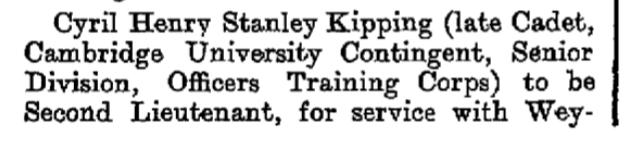
In 1914 The London Gazette announced that Stanley was promoted within the Chaplain Department of the British Army to Second Lieutenant with a service number of 10940.
On December 23rd 1914 The London Gazette announced the following :
The London Gazette, December 22nd 1914, part one
and
The London Gazette, December 22nd 1914, part two
On the 9th October 1918 The London Gazette announced :
The London Gazette, 8th October 1918
Again, according to Stephen C. Askey :
“In January 1919 he took his Master of Arts degree at Cambridge, and joined the teaching staff of Bradfield College in Berkshire. But by the summer of that year he became an assistant master at Pocklington School in Yorkshire, where he spent five happy years.
There he used his talent for juggling in 1920 to train a troupe of jugglers who gave a display at a school concert. This popular performance was repeated annually at Pocklington. Meanwhile be continued to compose chess problems and in 1923 published a book for beginners called The Chess Problem Hobby.”
In the 1939 register Stanley was recorded as residing at 67 Wood Green Road, Wednesbury, Staffordshire, England with Martha Partridge (born 29th June 1886) who was his Housekeeper.
Wood Green Road, Wednesbury, Staffordshire
His probate record appears in the England & Wales Government Probate Death Index 1858-2019 as :
1964 Probate record for Cyril Henry Stanley Kipping
From The Encyclopaedia of Chess (Robert Hale 1970 & 1976), Anne Sunnucks :
“International Master of the FIDE for Chess Compositions (1959) and International Judge of the FIDE for Chess Compositions (1957). Born on 10th October 1891. Died on 17th February 1964. Kipping was famous as a composer and an editor which he combined with is duties as Headmaster of Wednesbury High School from 1925 to 1956.
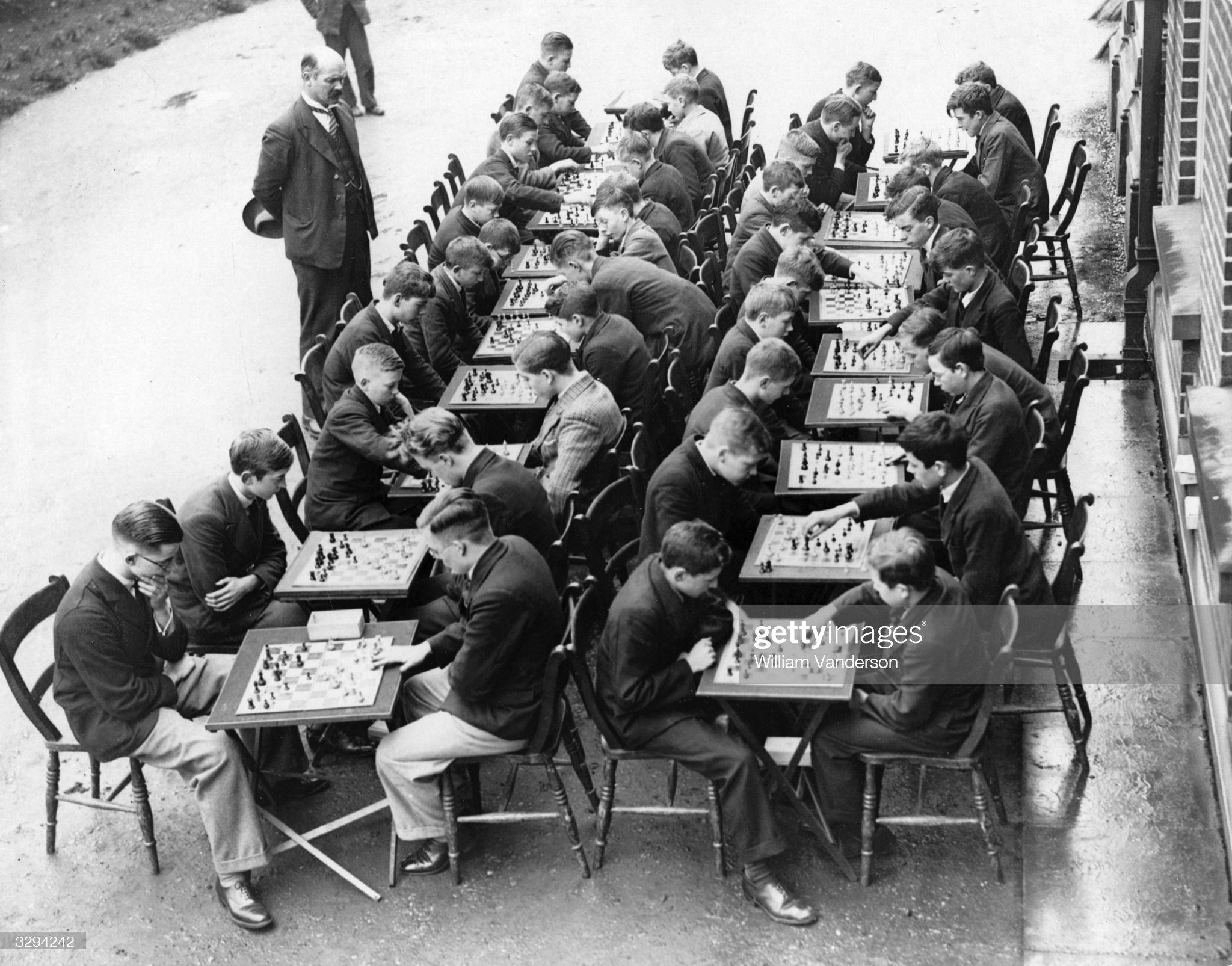
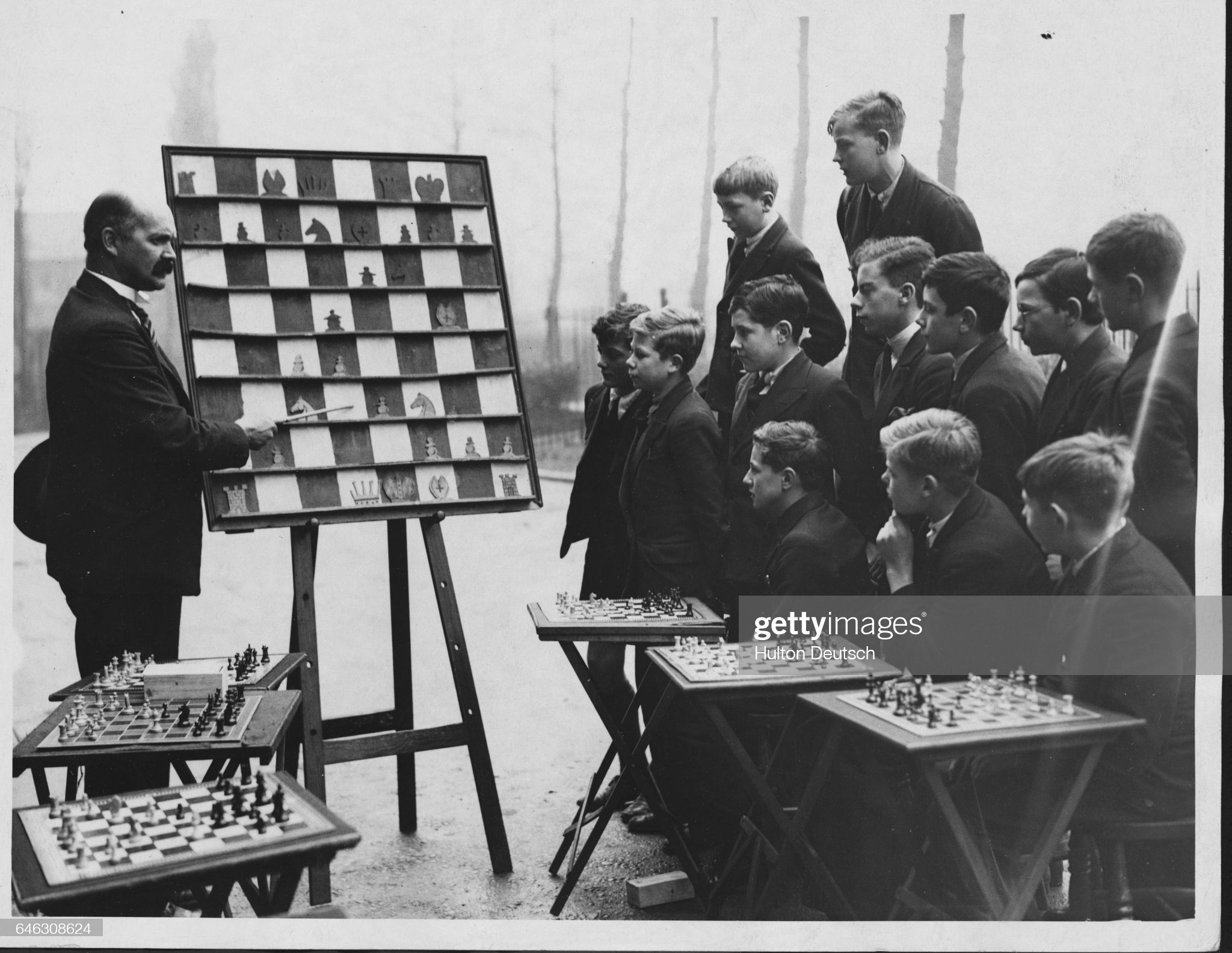
19th November 1934: An inter-form chess match for the pupils is in progress at Wednesbury High School for Boys, supervised by Mr C S Kipping, their headmaster. (Photo by William Vanderson/Fox Photos/Getty Images)
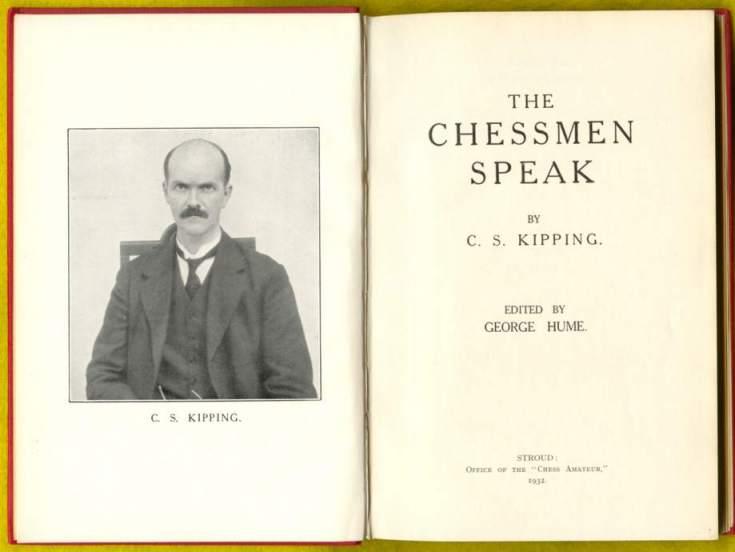
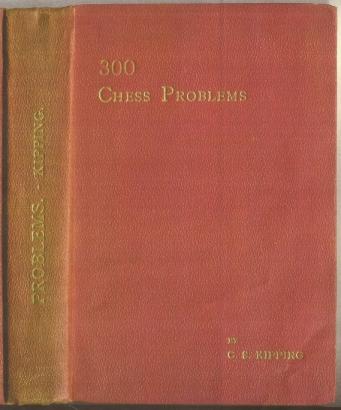
His editorial duties extended over more than forty years, and included the problem sections of Chess, Chess Amateur, and, for 32 years, the specialist magazine The Problemist from 1931. He was noted for his encouragement of beginners. His pamphlet ‘The Chess Problem Hobby‘ is an excellent beginner’s introduction. His other books included Chess Problem Science, The Chessmen Speak and 300 Chess Problems.
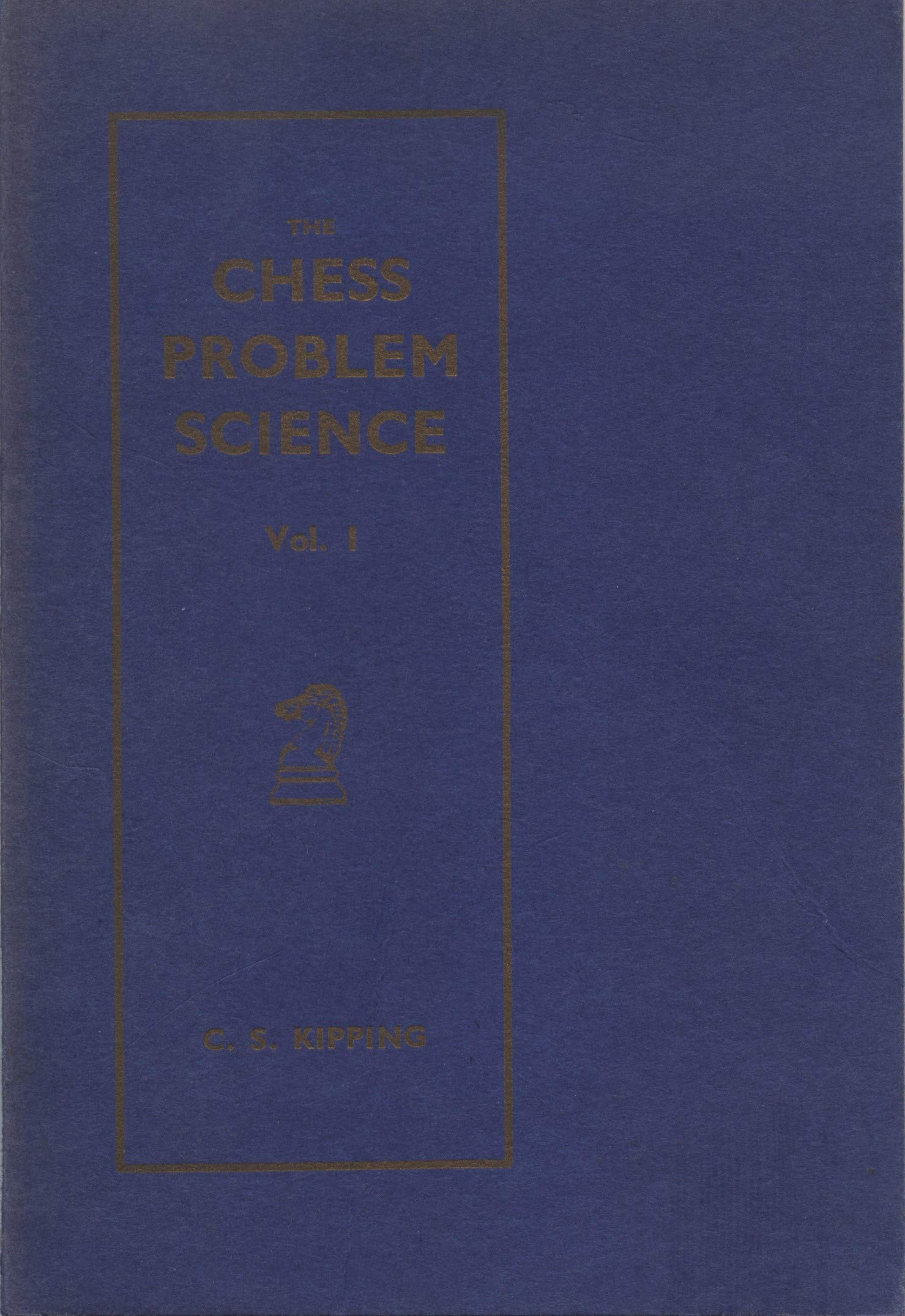
Chess Problem Science, CS Kipping, Whitehead & Miller, 1938
Kipping was one of the most prolific composers of all time, with over 7,000 problems to his credit. Many of his strategic three-movers have become classic. He was leading authority on halfpin two-movers. In his latter years, Kipping affectionately known as CSK – was Chairman of the International Problem Board which is now the FIDE Problem Commission.”
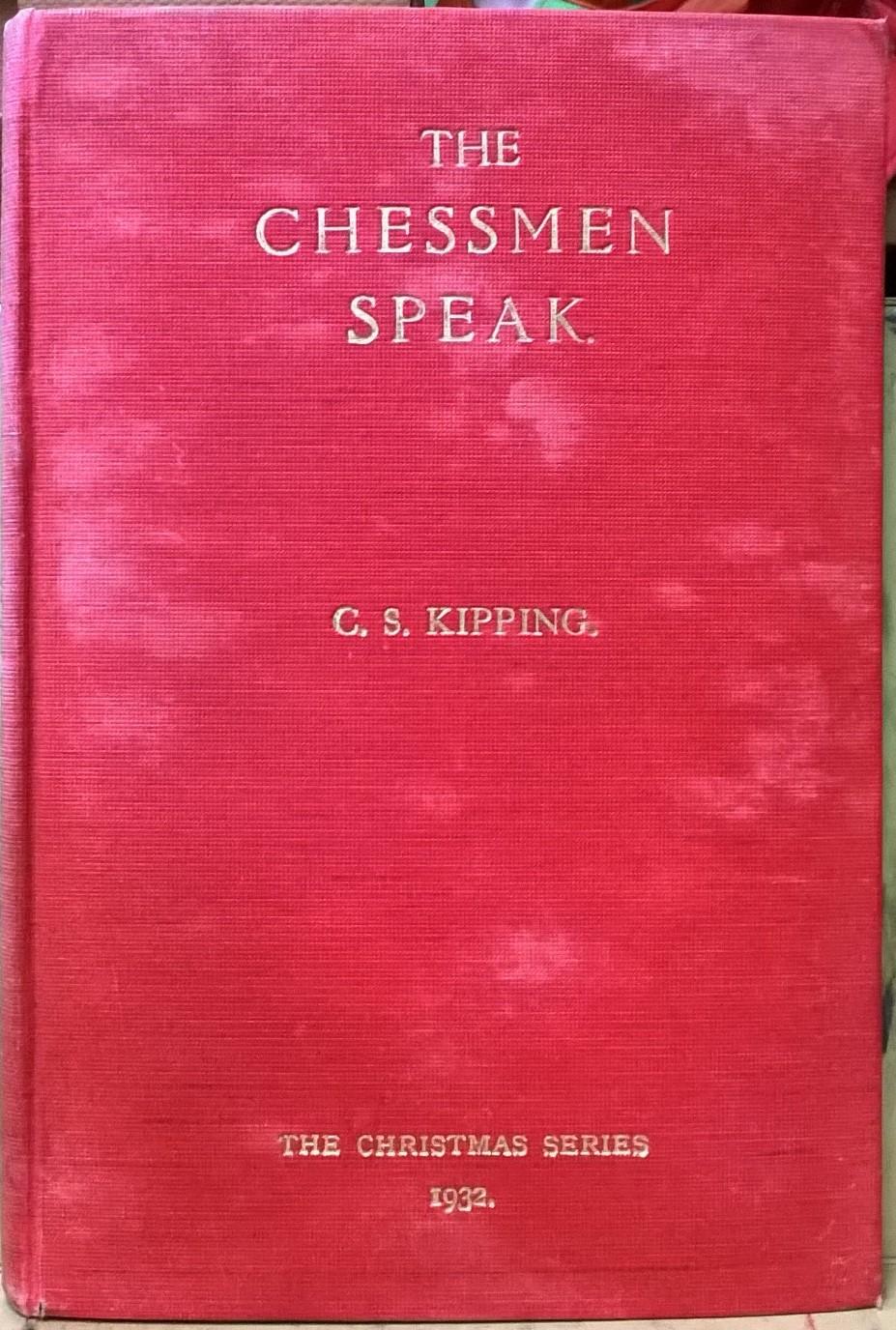
The Chessmen Speak, CS Kipping, The Chess Amateur, Stroud, 1932The Chessmen Speak, CS Kipping, The Chess Amateur, Stroud, 1932
From British Chess Magazine, Volume LXXXIV (84, 1964), Number 4 (April), pp. 122-123 by John Rice:
“CS Kipping, one of the most famous of all British problemists, died during February at the age of seventy-two. As a composer, editor, writer and critic Kipping was without equal. It is impossible to do justice in only a few lines to his vast and unique contribution to chess problems: a few factual notes. most of them kindly supplied by RCO Matthews, must suffice.
Kipping was born in London on October 10th, 1891, After completing his studies, he took up teaching as a career, and in 1924 he was appointed the first headmaster of the newly-opened Wednesbury High School, which post he held until his retirement in 1956. He was a bachelor, and, especially during the later years of his life, his interests were centered mainly on the school and on chess problems.
Most readers will know of Kipping as the editor of The Problemist, the bi-monthly journal of the British Chess Problem Society. Before he took over The Problemist in 1931, he had been in charge of the problem section of the Chess Amateur, which he edited with great energy and enthusiasm. As well as The Problemist, he edited the problem pages of Chess from its first appearance. in 1936 until the section was suddenly discontinued without warning or explanation a few years ago. He also edited other columns at various times. He always took great care to help and encourage beginners, and it is probably true that every composer in this country below the age of about fifty came under his influence at one time or another.
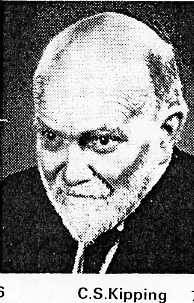
CHS Kipping
As a young man, Kipping was a fierce avant-garde controversialist, championing the the cause of strategy in the three-mover in opposition to the then dominant model-mate school in this country. His attitude to the two-mover, as readers of The Problemist will know, was always a good deal more conservative; he would not tolerate at any price what he called ‘camouflage force,’ even in the modern problem. Yes, he appreciated the aims of the modern two-move composer much more than his writings on the subject suggest, being always ready to applaud excellence in any type of problem.
CHS Kipping
Kipping’s output numbered over 7,000 problems, probably a record. Many of his two-moves especially his ‘aspect’ tasks, were published under pseudonyms, of which the best was known was C.Stanley. He concerned himself little with artistic finish : once he had found a workable setting of a them he was engaged on, he would take little trouble over economy and presentation. Themes in which he interested himself include half-pin (in the two-mover), white King themes, interferences, and the grab theme (in the three-mover), and maximum tasks of all kinds, the subject of one of his books, Chess Problem Science. His other books include 300 Chess Problems (1916), and The Chessmen Speak (1932), in the AC White Christmas series.
300 Chess Problems, CS Kipping, The Chess Amateur, Stroud, 1916
In addition to all his other problem activities, Kipping was chairman of the International Problem Board, and curator of the half-pin section of the White-Hume Collection, which he took over on Hume’s death in 1936.
The majority of Kipping’s best problems were three-movers, three of the most famous of which are quoted here.”
Manchester City News, 1911
Mate in three
1 Ka5
First Prize
Dutch East Indies Chess Association Tourney, 1928
Mate in three
1 Ra3
First Prize
BCM, 1939 (II)
Mate in three
1 Be6
The first problem above was given in The Complete Chess Addict by Mike Fox and Richard James in the Desert Island Chess chapter. It is also given in a discussion of the Steinitz Gambit by ASM Dickins and H Ebert in 100 Classics of the Chessboard. Colin Russ on page 138 of Miniature Chess Problems from Many Countries gives the first problem as does John Rice on page 44 of Chess Wizardry : The New ABC of Chess Problems.
Stanley was the first President of Walsall Kipping Chess Club which includes amongst its members and former members David Anderton OBE and Jana Bellin. We have been provided with the following information by Mike Groombridge:
CS Kipping, strictly speaking, was not the founder of the club, but was involved immediately at the formation of the club, which was originally called The Kipping Chess Club*. [*By March 1945, the club had 3 branches and only then did it formally split into 3 -Walsall, Wolverhampton, and a school (Municipal Secondary School Wolverhampton?) for the purpose of playing in the newly formed Wolverhampton League. Walsall Kipping Chess Club only formally took its name in May 1948, and was separated by then from The Wolverhampton Kipping Chess Club!] The Walsall Club’s minute book contains clippings from a local newspaper of 1942 reporting on the formation of the club. Here are copies:-
‘Walsall’s New Chess Club.-The new chess club, members of which will meet in the evenings for play and social intercourse, already promises to be very successful. The organiser, Mr.A.E.Parsons, of England & Sons, The Bridge (where meetings will be held for the time being) is acting as secretary pro tem, and he has secured as the first president Mr.C.S.Kipping, Headmaster of the Wednesbury High School for Boys, well known as an expert and for the innovation of chess in the curriculum of his school. Mr.Kipping has given valued assistance by the initial provision of boards and pieces. Members will meet on Monday evenings at 6.30 and the club will rely, in the first place, on voluntary subscriptions’. [5.9.42]
and
‘Walsall Chess Club.-Members of the recently formed Chess Club in Walsall had their first meeting on Monday [7th Sept 1942]. They decided to call the club “The Kipping [Chess] Club,” after their president, Mr.C.S.Kipping. Mr. F.D.Fox was appointed chairman, Mr.Gordon Farrell treasurer, and Mr.A.E.Parsons honorary secretary. Mrs.Wright and Miss Powell provided refreshments and were warmly thanked for their contribution to the success of the launching of the club. Mr.H.Lee was subsequently appointed vice-president after occupying the chair for the evening.’ [12.9.42]
Also, here is a copy of a brief sketch of CSK’s chess involvement, penned by David Anderton, for the Club’s Jubilee Chess Tournament:-
C S KIPPING, PRESIDENT 1942-1964
C S Kipping was the editor of the Problemist between 1931 and his death on 17th February 1964 at the age of 72 years. He also edited a problem column in Chess between 1935 and 1960. He [was] one of the most prolific of composers with some 7,000 problems to his name. He pioneered the introduction of strategic three movers in Great Britain and was the leading authority on half pin two movers. He was the Headmaster of Wednesbury Boys High School and introduced chess into the curriculum there in 1927. He gave evidence in the Chancery Division in the case of Re: Dupree’s Trusts in 1944 to the effect that chess teaches concentration, self reliance and reasoning and is a most useful training for the mind. Relying on this evidence, the Court upheld a bequest to establish a junior tournament as charitable and the case still forms the basis of English law on this point.
On a web site now only accessible via the WayBack Machine there is a treasure trove of reminisces and memories of CHSK from himself, friends and pupils.
From The Encyclopaedia of Chess (Batsford, 1977), Harry Golombek OBE, John Rice writes:
“British problemist, enormous output of over 6,000, mainly three-movers but also many two-movers, some published under pseudonyms (e.g. C. Stanley, of Nottingham). Editor of The Problemist, 1931-64. Elected international master honoris causa (1959).”
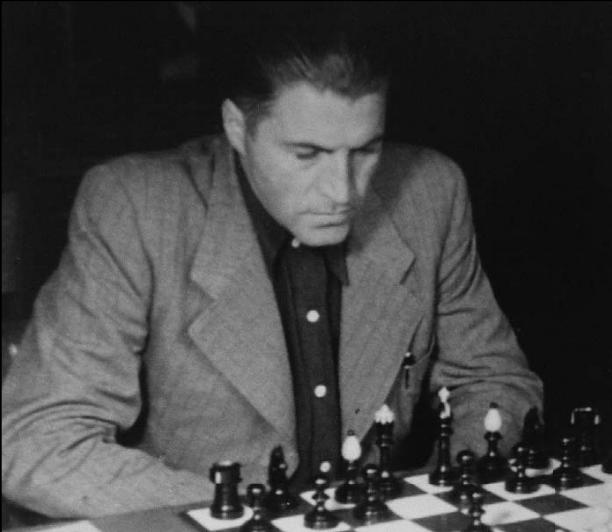
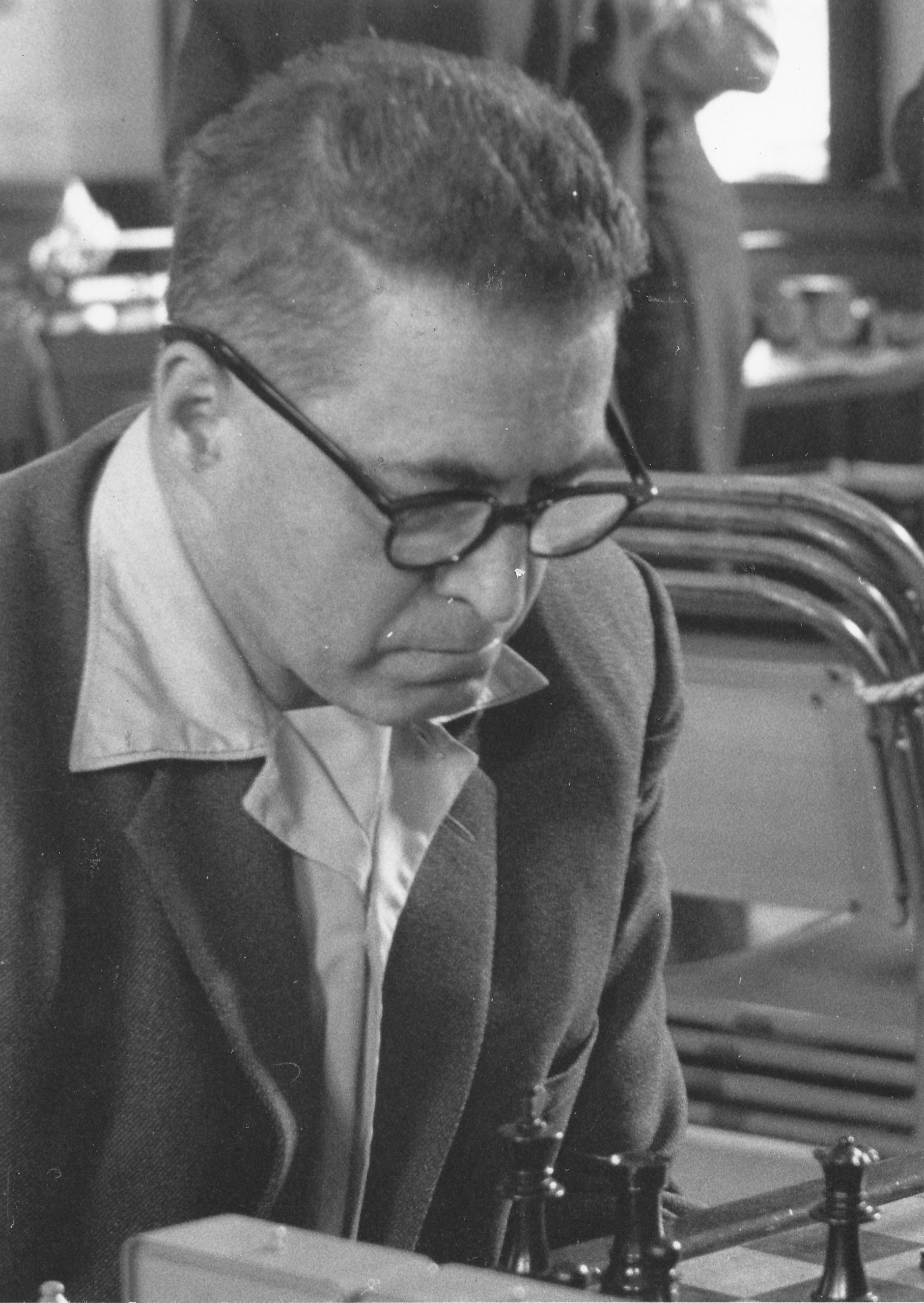
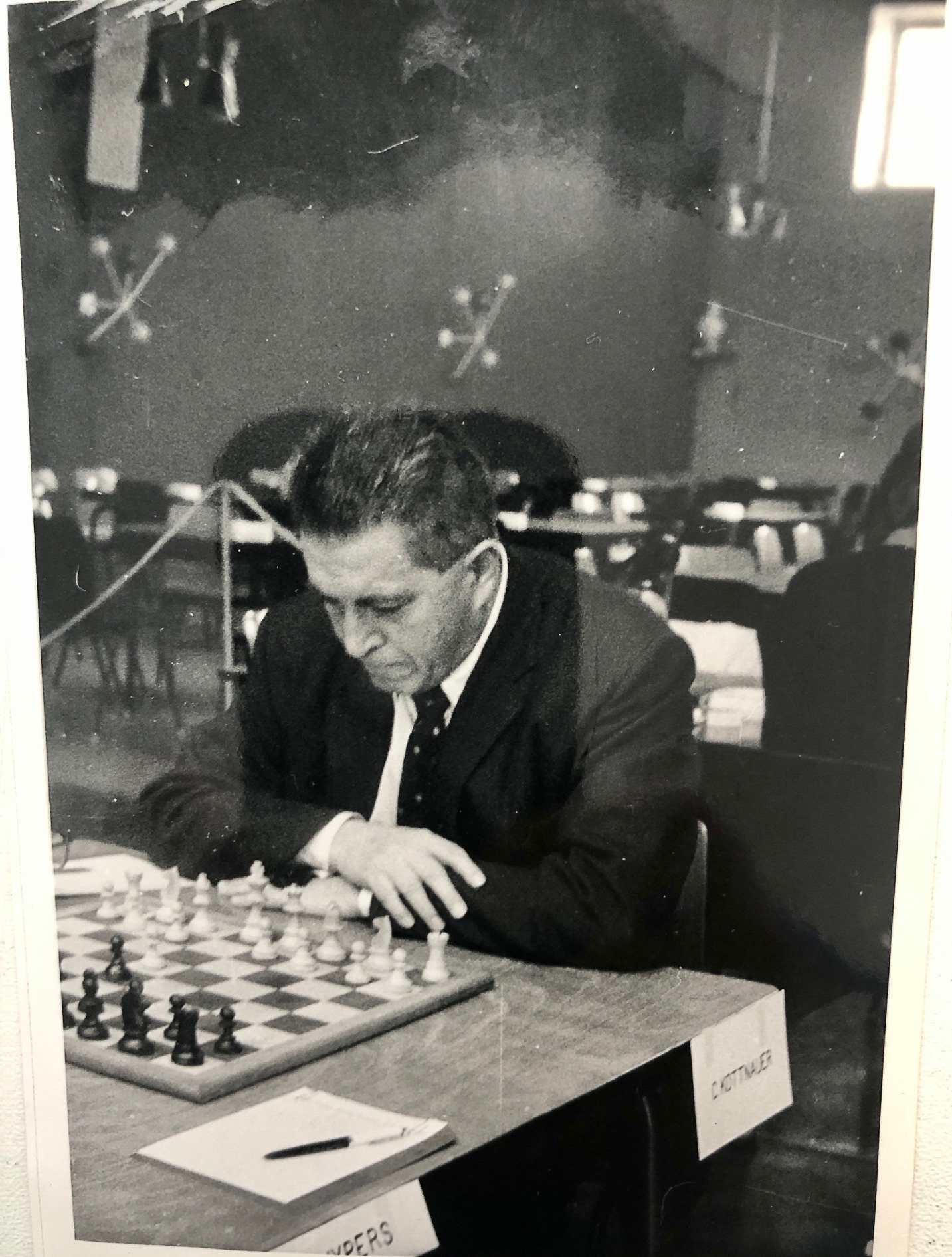
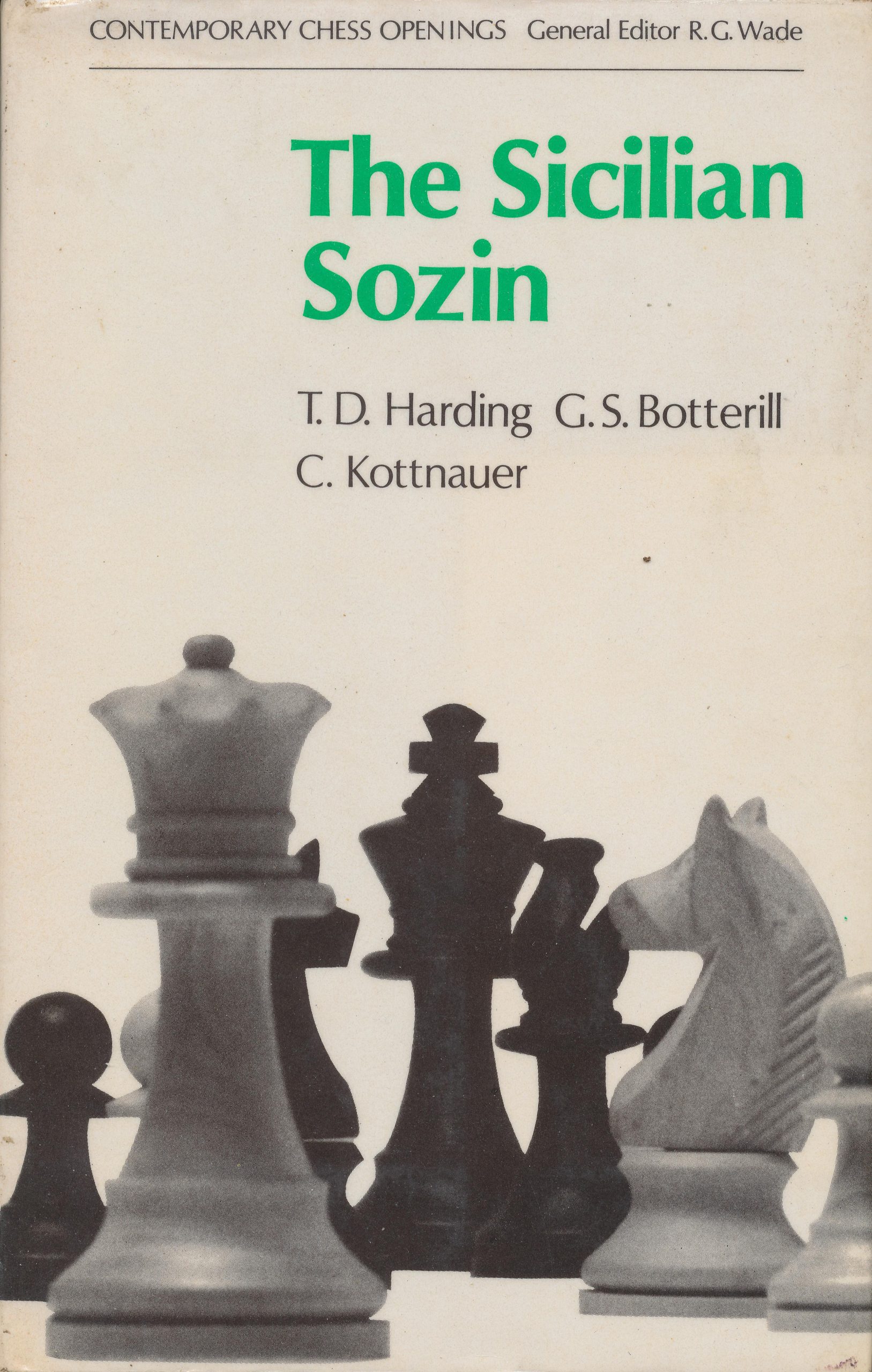
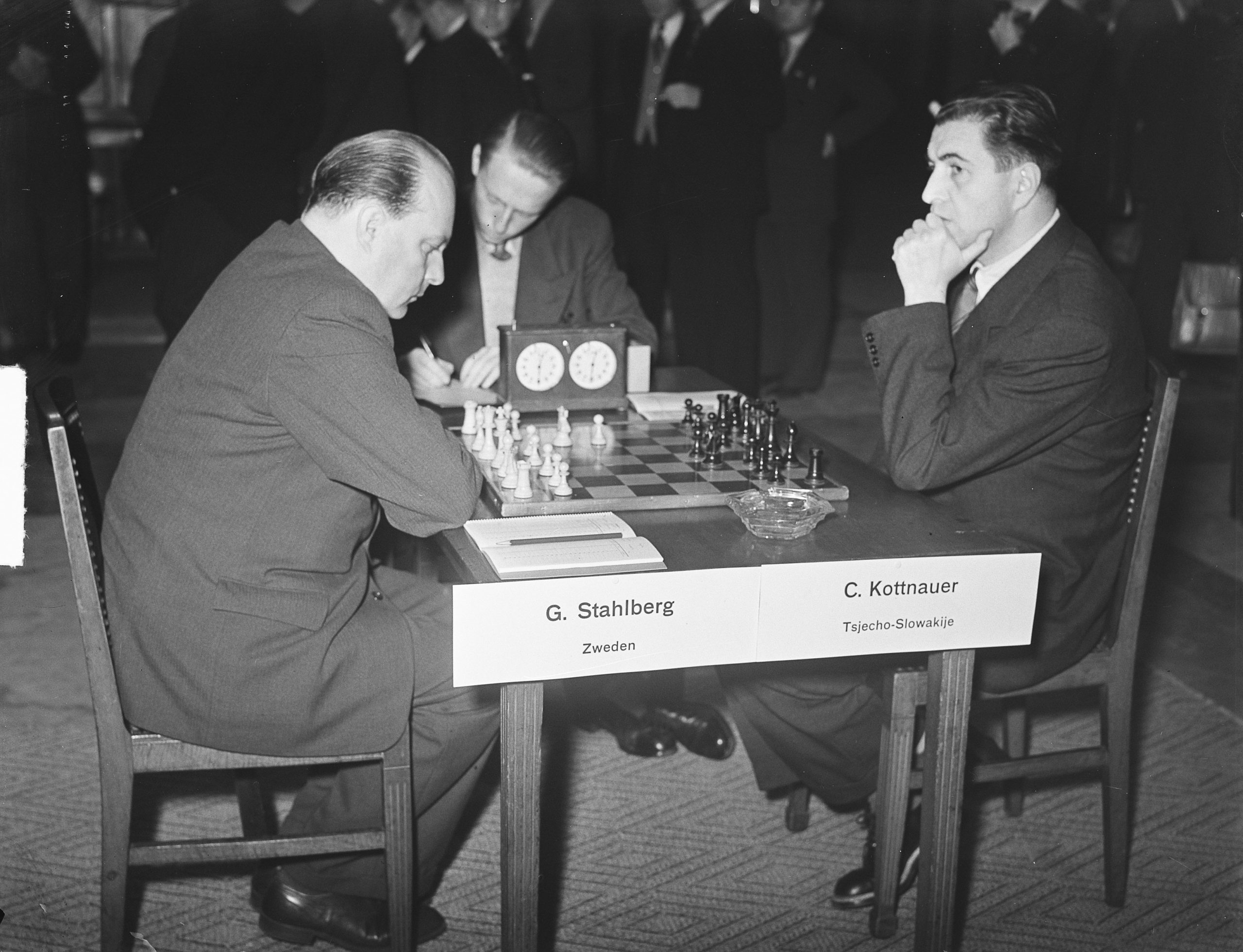
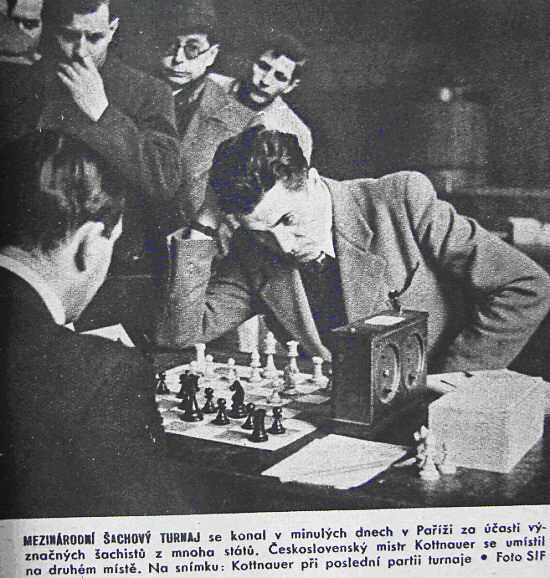
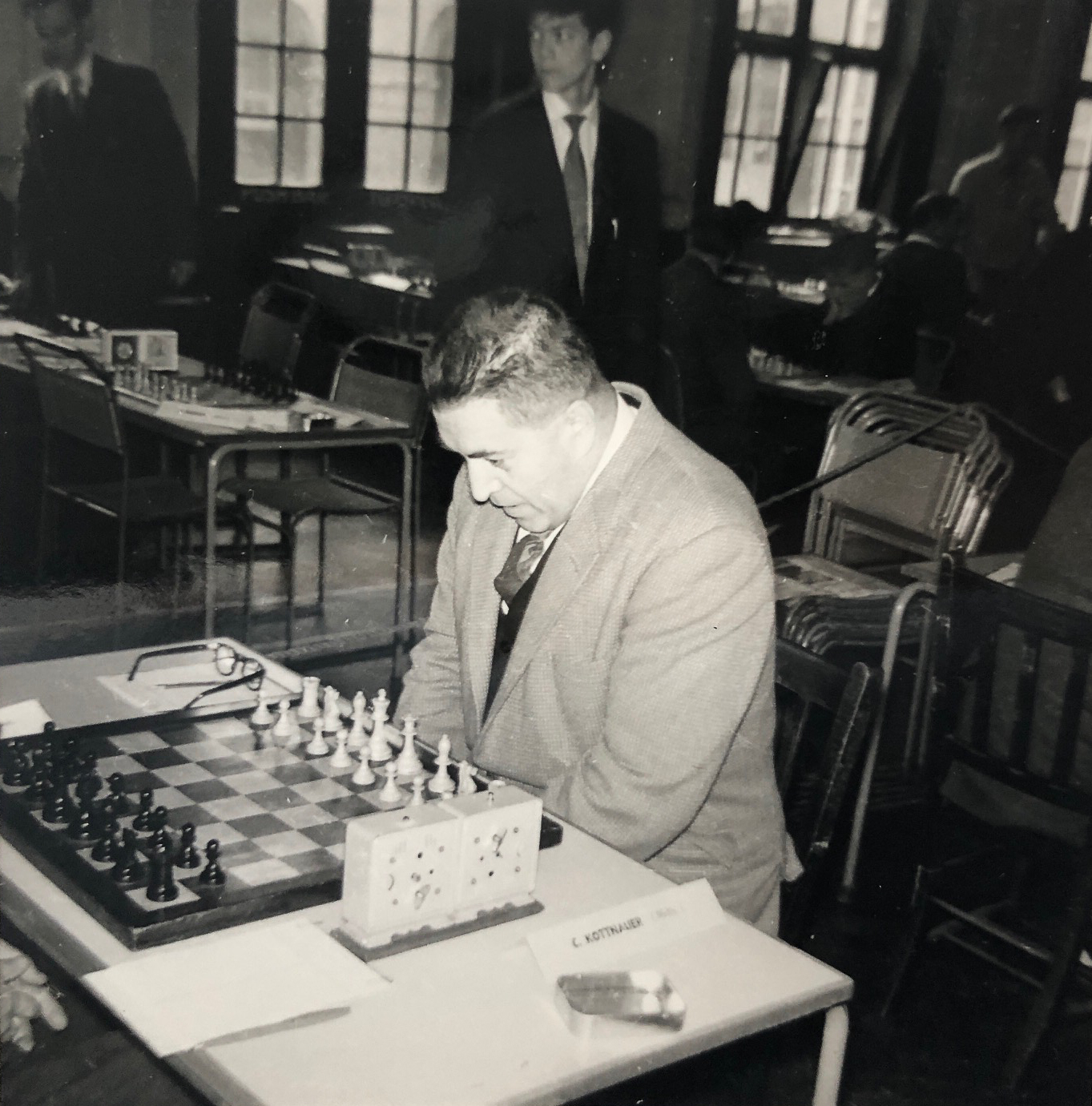
BCN remembers IM Čeněk Kottnauer (24-ii-1910 14-ii-1996)
Čeněk (pronounced CHEnek) Kottnauer was born in Prague on Thursday, February 24th, 1910. Čeněk was employed in the Ministry of Education in Prague.
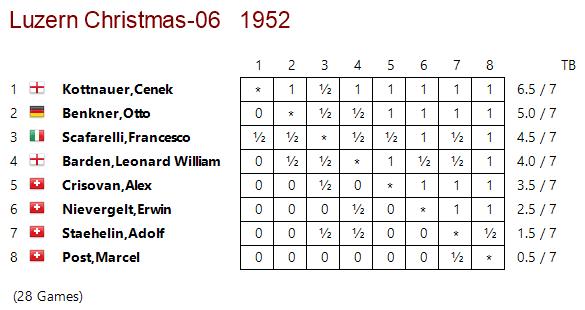
Whilst playing in the Lucerne International tournament (28-xii-1952 03-i-1953) he sought political asylum :
From the Milwaukee Journal, January 3, 1953 we have
“Czech Chess Star Asks for Asylum
Lucerne, Switzerland – Cenek Kottnauer, 42, Czecho-Slovakian chess champion and an employee of the ministry of education in Prague, announced Saturday that he would not return to Czech-Slovakia and would request political asylum in Switzerland. Kottnauer had been participating in a chess tournament.
He said that the political situation in his country had grown “more and more critical” and he wanted “to leave before it is too late”. He said that he had been divorced recently and had no children in Czech-Slovakia”.
In a January 2009 post to the English Chess Forum Leonard Barden wrote :
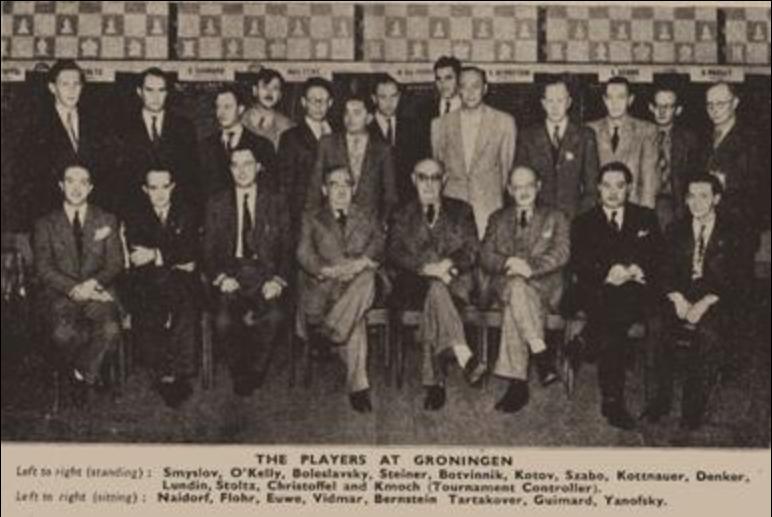
“Cenek Kottnauer defected from Czechoslovakia during the Lucerne New Year tournament of 1952-3 (I am precise on this because I was present). His wife Daniela joined him there, having been smuggled from Prague in the boot of a diplomat’s car. Kottnauer had been a water polo player of international standard before 1939 so came into serious chess only his mid-30s. He made his name with his good showing in the Prague v Moscow match of 1946 and his Bxh7+ win then against Kotov. He competed in great tournaments like Groningen 1946 and Moscow 1947; his first visit to England was in 1947 when the Czech team came here.
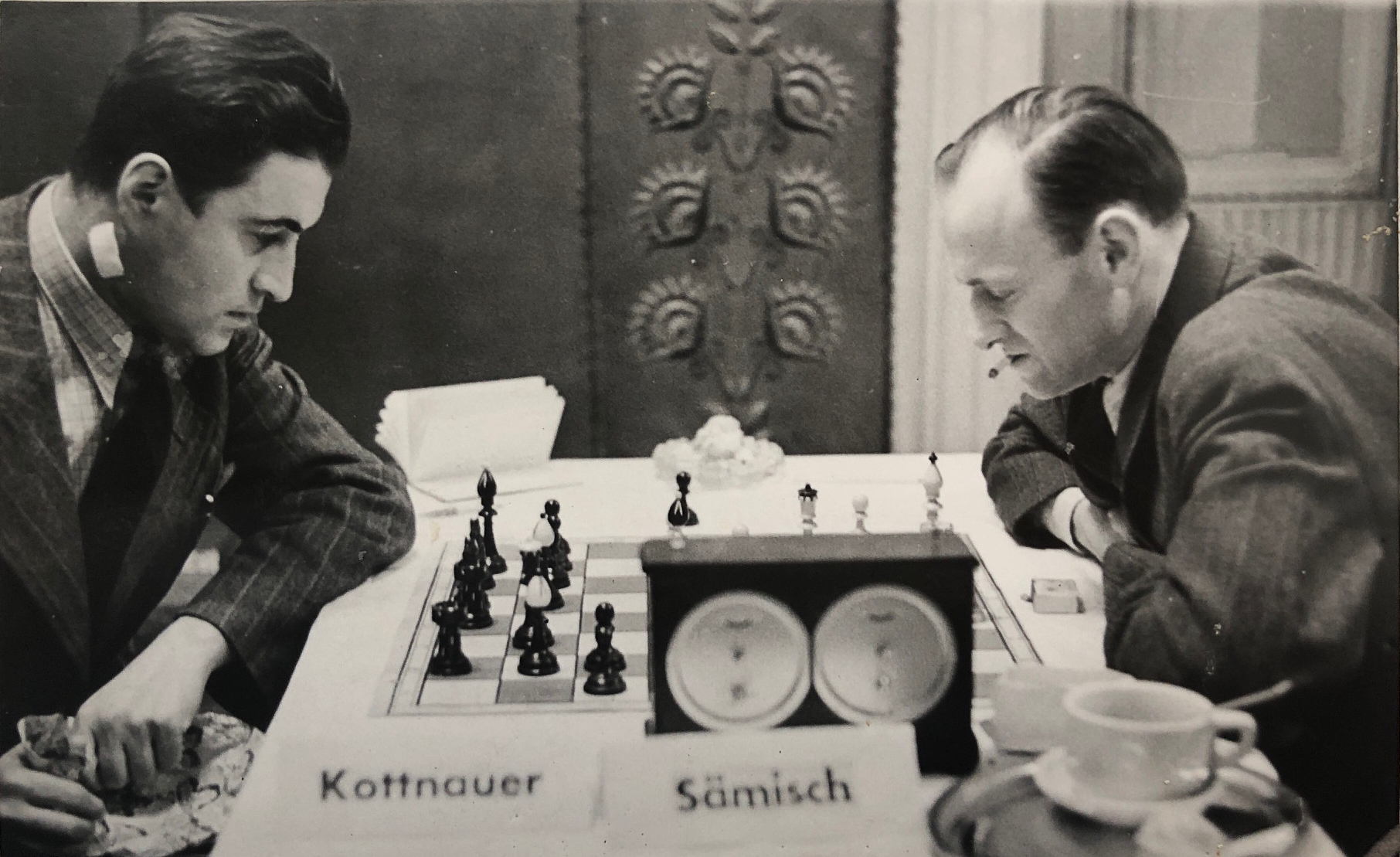
Čeněk Kottnauer plays Friedrich Sämisch during the Duras Memorial in Prague. December 7th 1942, The game was a Slav drawn after 42 moves
In the 1940s he had a job in the Czech sports ministry but got implicated in the purges following the Slansky trial. He also believed that Pachman and Opocensky were involved in the campaign against him.”
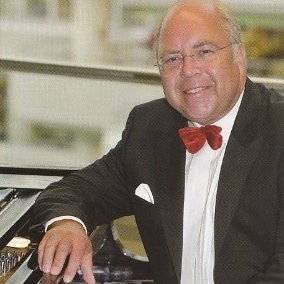
Čeněk married Daniela (née Horska, also Czech, having met in Austria) and they had a son Daniel VR Kottnauer. Daniela was born in 1934 and was 24 years younger than Čeněk. She died on February 20th 2008 in a hospice in Essen, Germany close to where Daniel currently resides. Daniel has been a pianist and singer for 30 years, an event manager for 19 years and a coach and VIP limousine driver for 5 years and may be found on LinkedIn.
Daniel Kottnauer
We thank Daniel for providing photographs.
Čeněk became a British citizen on 16th December 1960 when he obtained naturalisation certificate BNA64338.
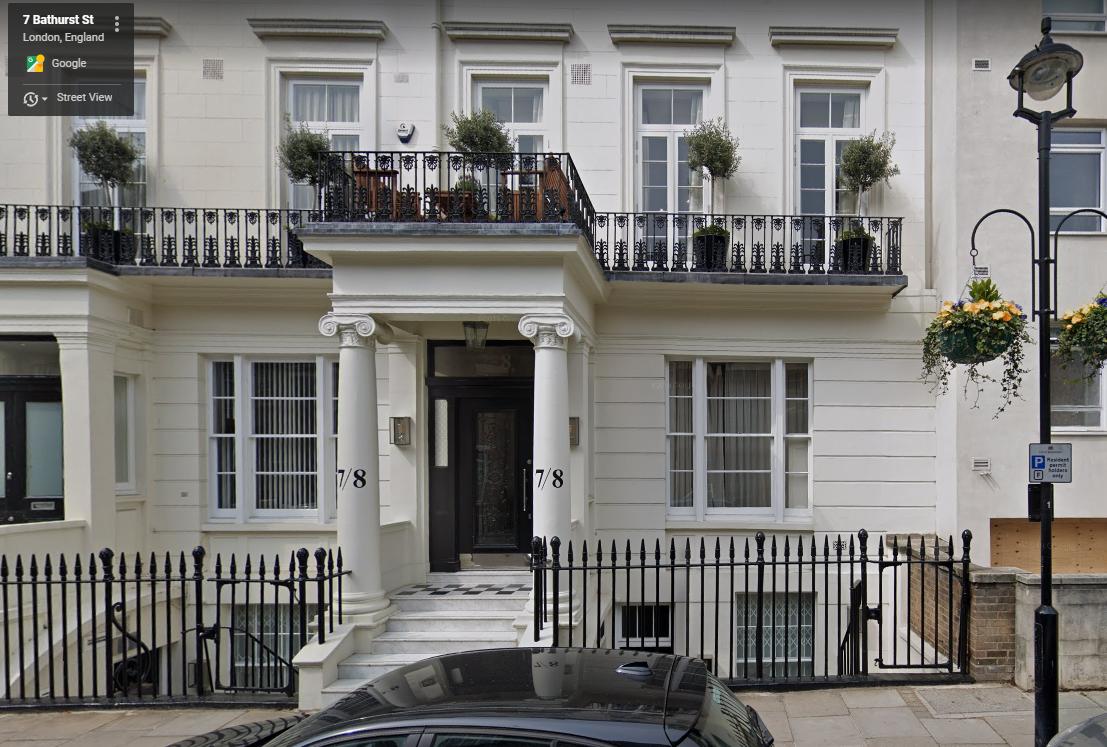
In 1965 Čeněk and Daniela were living at Flat 2, 7-8 Bathurst Street, London, W2.
7-8, Bathurst Street, London, W2
In Kings, Commoners and Knaves (Russell Enterprises, 1999), page 108, Edward Winter wrote :
“The obituaries of Čeněk Kottnauer (1910-1996) have, in common with all of the encyclopaedia entries on him, been strangely wanting in pre-1940s references to his chess career. Czech magazines of the 1930s contain occasional games by ‘Kottnauer’ (no forename or initial given), including the following :
Source : Československý šach, January, 1932, page 9. The score was also given, with notes, by Vera Menchik, on page 153 of the April 1932 issue of The Social Chess Quarterly. ”
From Šachový Týdeník, 25th February, 2010 we learnt that Čeněk was twice Prague lightning champion.
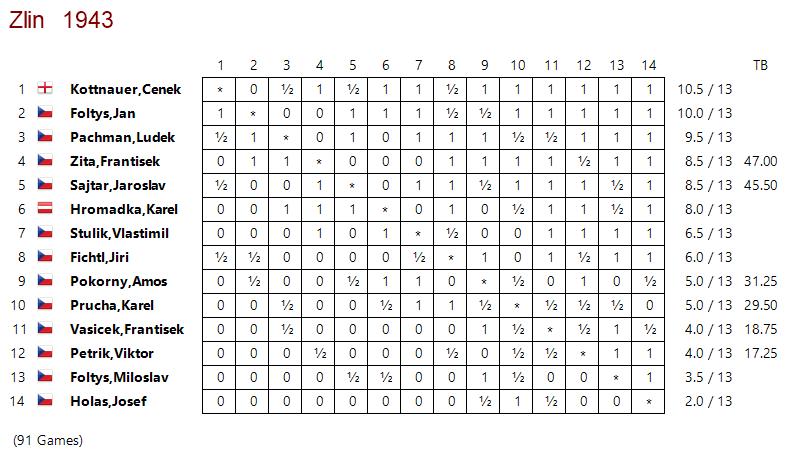
In 1943 Čeněk was a clear first overall with 10.5/13 in the Zlin tournament.
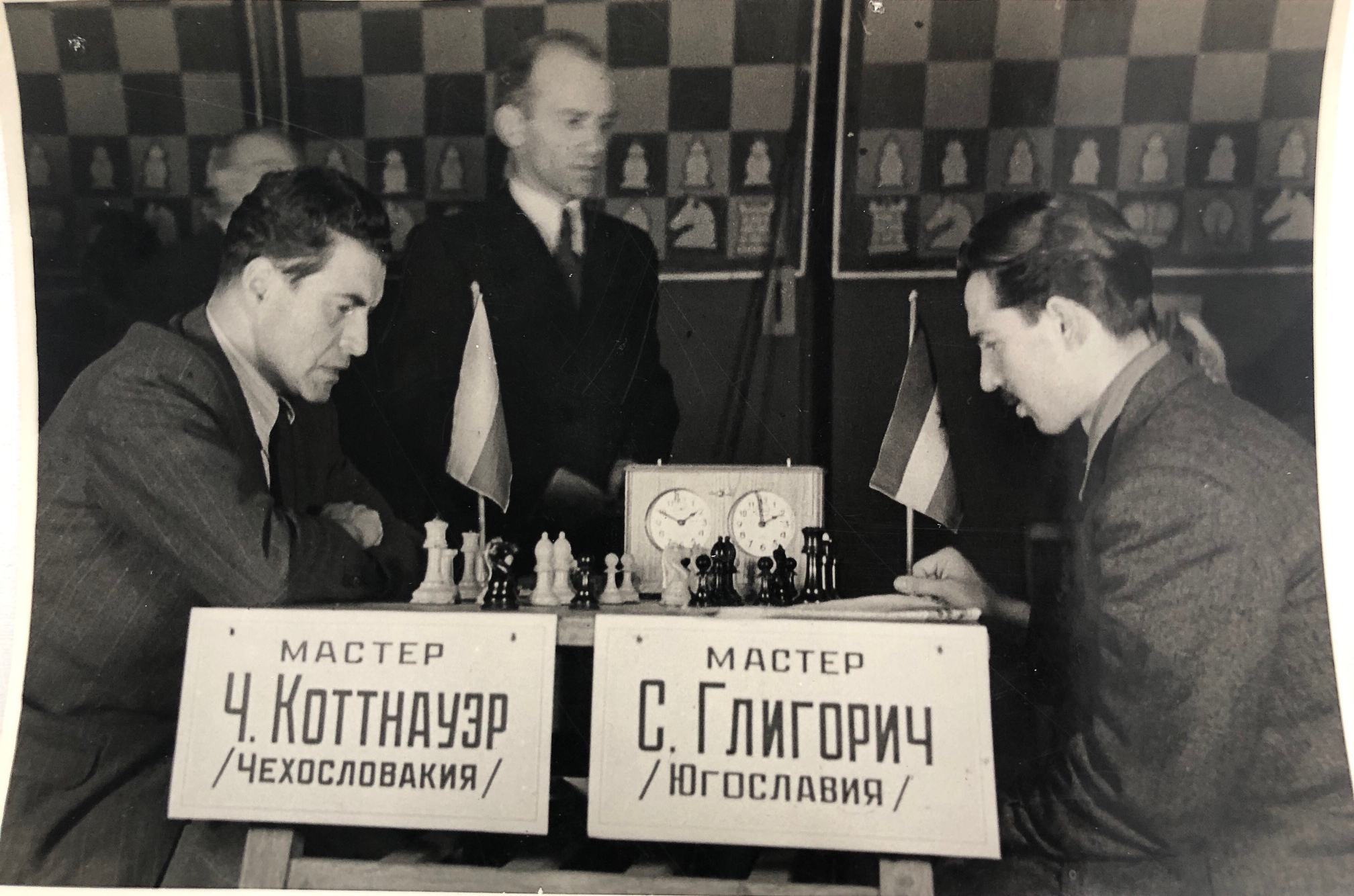
Crosstable for the Zlin (Czechoslovakia) 1943 tournamentČeněk Kottnauer plays Svetozar Gligorić during the Chigorin Memorial, Moscow, November 26th 1947.
From Bronstein on the King’s Indian, Everyman Chess, 1999, game 25 we have :
“This game is from our hisotoric match with the Czechoslovak team, which took place half in Prague and half in Moscow.
My opponent, an intelligent, clever, athletic man, also played water polo. Then at some point he travelled to a tournament in England, fell in love with a beautiful Englishwoman, and decided to settle down there.”
From The Oxford Companion to Chess (OUP, 1984), David Hooper & Ken Whyld :
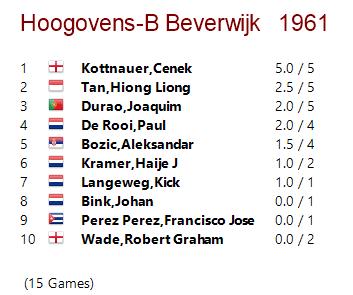
International Master (1950), International Arbiter (1951), a Czech player who emigrated to England in 1953 and was naturalised in 1960. He played in Olympiads for Czechoslovakia (1950*, 1952), on the second occasion making the best score (+10=5) on the fourth board, and in two Olympiads for England (1964, 1968). In 1961 he won the Beverwijk Masters tournament (not the concurrent grandmasters event) with a clean score, a fine achievement.
*Ed : In fact, this is not true since Czechoslovakia did not send a team to Dubrovnik 1950. This was the last year the event was limited to sixteen countries.
Incomplete crosstable for Beverwijk 1961
James Pratt, Basingstoke provides the full results from Gino de Felice, Chess Results, 1961 – 1963, Macfarland, 2013 :
Consulting the 2nd edition (1992) of Hooper & Whyld may cause disappointment since there is no entry for CK.
Čeněk Kottnauer from Šachový Týdeník, 25th February, 2010
From The Encyclopaedia of Chess (Robert Hale 1970 & 1976), Anne Sunnucks :
“International Master (1950) and International Judge (1951).
Born on 24th February 1910. Kottnauer represented Czechoslovakia in the 1952 Olympiad in Helsinki. In the years after the war his successes in international tournaments included 3rd at Beverwijk 1947, =2nd at Vienna 1947, 4th at Bad Gadstein 1948 and 1st at Lucerne 1953.
Crosstable for Lucerne 1952/1953
After the Lucerne tournament he sought political asylum in Switzerland. He later settled in England and became a naturalised British citizen. He played for the British Chess Federation in the Olympiads of 1964 and 1968.
Kottnauer has played in the British Championship twice. In 1961 he came =4th, and in 1962 he came =3rd.”
IM Čeněk Kottnauer
From The Encyclopaedia of Chess (Batsford, 1977), Harry Golombek OBE (entry written by Bill Hartston):
“Born in Czechoslovakia, Kottnauer played for that country in many events including the 1952 Olympiad. He emigrated in 1953 and subsequently took British nationality, representing England in the Olympiads of 1964 and 1968. Awarded FIDE titles of international master in 1950 and International Judge in 1951. Winner of Lucerne 1953 International tournament.
Čeněk Kottnauer plays Frans Kuijpers during the 1964 Anglo-Dutch match at Vlissingen on September 19th
Co-author with TD Harding and GS Botterill of The Sicilian Sozin, Batsford, London, 1974.”
The Sicilian Sozin, TD Harding, GS Botterill, C. Kottnauer, Batsford, 1974
James Pratt, Basingstoke revealed : He would look through opening analysis often proclaiming: ‘What will the master play now?’
From British Chess (Pergamon Press, 1983) we have this insight from Tim Harding :
“At a time when home-grown International Masters were thin on the ground in Britain (the 1950s and 1960s) this Czech-born IM brought a lot of valuable experience to BCF teams.
Amsterdam 1950, first day; Gideon Stahlberg versus Cenek Kottnauer Date: November 11, 1950
After emigrating to England in 1953, he became naturalized and subsequently represented the BCF in the Tel Aviv, 1964 and Lugano, 1968, Olympiads. On board one in 1964 he scored +8 =7 -3 (63.9%) on board two below Penrose in 1968 (with some board one games) he scored 41.7: +3 =5 -4.
Čeněk Kottnauer
When FIDE rating lists appeared in the early 1970s, Kottnauer was listed at 2370 but by this time had more or less retired from active play at the top level, although he took (and still takes) a keen interest in coaching promising young players, He was one of the most regular and most valuable coaches at the one-day junior training events organised by the London Chess Association at the Mary Ward Centre in Bloomsbury, London in the mid-1970s.
IM Čeněk Kottnauer, event unknown
At this time he also wrote many articles for his friend Grandmaster Pachman, who had been freed to live in West Germany where he became editor of Schach-Archiv, and also made a major contribution to the Batsford opening theory work. The Sicilian Sozin, written in collaboration with George Botterill and Tim Harding, and published in 1974.
Kottnauer’s most active years as a player were however 1946-53; in the year that he came to England he took first prize in the Lucerne, 1953 International tournament. Had he been a professional player throughout the the 1950s, there is little doubt that he would have become a grandmaster.
As early as the end of the war, when regular play resumed, he was almost of that strength (as wins against Kotov and Smyslov in the February, 1946 Prague v Moscow match showed) but lacking in experience at the top level, which told against him at Groningen, 1946, when he was placed 13th with 9 points out of a possible 19 in a very strong field. This was the first great post-war tournament, with nine Master and eleven Grandmasters (including Botvinnik and former world champion Euwe).
Players at the 1946 Groningen Tournament
Also in 1946 Kottnauer scored wins against Simagin (in Prague) and Levenfish (in Leningrad) and was clearly one of the up-and-coming stars in a strong Czech team that included Filip and Pachman. In 1950 he was one of the first players to be awarded the FIDE title of International Master.
The following year he was also made a FIDE International Judge (now known as FIDE Arbiter).
Unfortunately there was no Czech representation at the Dubrovnik, 1950 Olympiad, but in 1952, one of his last appearances for Czechoslovakia, Kottnauer achieved a remarkable record playing board four (below Filip, Pachman and Sajtar) at the Helsinki Olympiad. He went through unbeaten with ten wins and five draws (83.3%) and easily won the board prize.
Kottnauer shortly thereafter came to England where he eventually made a successful career as an executive with Trust House Forte’s hotel group; he has also helped with the BBC overseas service Czech-language broadcasts. He lives in West Central London with his wife and their son.
The following is undoubtedly Kottnauer’s most famous win.
and here we have the same game analysed by Tryfon Gavriel :
From British Chess Magazine, Volume CXVI (116, 1996), Number 4 (April), pp 202-203 we have this obituary by Bernard Cafferty :
Čeněk Kottnauer, the Czech/British IM, and the first chess defector died in St. Margaret’s Hospital, London, on 14th February after heart trouble and abdominal cancer.
A giant of a man, a fine athlete and swimmer, he was born on 24th February 1910 and came to prominence in the 1942 tournament in Prague in which Alekhine took part. He extended the great man to 70 moves before resigning. His wins against Kotov and Smyslov in the Moscow-Prague match of 1946 and his 13th place in the great Groningen tournament of the same year confirmed his status, as did his excellent showing for Czechoslovakia in the 1952 Olympiad at Helsinki (+10=5-0 on fourth board). He also took part in the 1947 Chigorin Memorial in Moscow, and won a tournament at Lucerne in early 1953, the same year in which he emigrated to Britain.
Hoogovens, Beverwijk, 1962. In the opening round (played 11th January), Theo van Scheltinga (Netherlands) faces Čeněk Kottnauer (England, formerly ČSSR). (Photo credit: W. van Rossem, ANEFO, via http://gahetna.nl. Courtesy of Douglas Griffin
On this form he would have gained the GM title had he continued playing, but he had to take a full-time job (with Trusthouse Forte) to support his family.
Čeněk had met his much younger wife in Austria, though she too was Czech. They had a son. The master’s appearences were therefore limited to London League matches and other sporadic events. That he had lost none of his skill was shown when he played top board for England at the 1964 Tel-Aviv Olympiad (Penrose was not available) and made +8=7-3. His only other big event was the Lugano Olympiad of 1968 when he was on second board and made +3=5-4.
The 1964 England Olympiad (Tel Aviv) Team : Owen Hindle, Čeněk Kottnauer, Peter Clarke, Michael Franklin, Norman Littlewood & Michael Haygarth
Čeněk (pronounced CHEnek) Kottnauer was one of the early professionals in the German Bundesliga; on a visit to his Bayswater flat in 1995 by Murray Chandler and myself, Čeněk told us about the great transport difficulties he had in those days. He mentioned that he had recently had a heart bypass operation and showed us the medication he had to take on a regular basis, opining that after Golombek and Milner-Barry he would be the next to go.
Hugh Alexander, Čeněk Kottnauer, Michael Franklin and Owen Hindle
Čeněk was involved in junior coaching in London for many years, wrote extensively for the Dutch and German press and in recent years was a regular visitor to the Lloyds Bank Masters to see old friends and acquaintances. Amongst those he coached were Julian Hodgson, William Watson and Dharshan Kumaran, as well as Stuart Conquest.
IM Čeněk Kottnauer in Argentina during the 1981 World Under-16 Championship
In Stuart’s case he came regularly to Hastings to do the coaching which was financed by the Slater Foundation and by Lloyds Bank.
The fruit of his effort was Stuart’s 1981 World U-16 title in Argentina, where Čeněk’s great physical strength came in handy when the huge trophy had to be carried back to Britain.
IM Čeněk Kottnauer with Stuart Conquest during the World Under-16 Championship in Argentina.
All his pupils and friends will attest to his wonderful manner. A great personality has left us.”
According to Leonard Barden “Čeněk’s students included Demis Hassabis, then aged six. He once told me that Dharshan Kumaran, then seven, was the more talented of the pair but that Demis was also ‘very clever and tricky’ ”
Daniel tells us that Nigel Short visited his family home for coaching and we believe that both Anita and Mira Rakshit were CKs students. Doubtless there were many more…
Leonard added :
“After he retired he did chess coaching and, although never named in the BCF’s list of coaches, was the most successful of all in terms of achievements by those he taught. He normally did weekly sessions of a couple of hours and got results through his challenging and sceptical approach to ideas from his pupils.
Kottnauer pupils included Hodgson, Watson, and Kumaran, who all became grandmasters. When he came to our junior invitation tournaments in the mid-seventies I used to give a prize of a game and session with him to exceptional talents. So he played Nigel Short in spring 1975 (probably Short’s first one-to-one with an IM) and was enthusiastic about his promise.
In 1981 when Stuart Conquest was going to the the world U16 championship in Argentina Cenek coached him for several months beforehand and went with him to the event. No news reports were available during the tournament so the first I knew was when Cenek phoned me on his return to London and complained that he was tired having to carry this enormous trophy home (Stuart had broken his arm before the event and played in a sling) and how the food had been terrible but that Eliskases, who was involved in the organisation, had sworn him to secrecy.
IM Čeněk Kottnauer in Argentina during the 1981 World Under-16 Championship
I used to visit him a couple of times a month for talk and blitz sessions and have warm memories. A great guy, and a significant figure in the long departed English chess boom.”
“Cenek Kottnauer was born in Prague. He was awarded the IM title in 1950 and became an International Arbiter in 1951. Kottnauer played the Helsinki Olympiad 1952 on board 4 for Czechoslovakia, scoring +10 =5 -0. In 1953 he won the Lucerne international tournament. That same year, he emigrated to England, and eventually became a naturalized citizen and played for England in the Olympiads of 1964 and 1968. In the 1970s he became one of England’s top coaches of young players.”
Save as PDF
We focus on the British Chess Scene Past & Present!
This website uses cookies to improve your experience. We'll assume you're ok with this, but you can opt-out if you wish. Cookie settingsACCEPT
Privacy & Cookies Policy
Privacy Overview
This website uses cookies to improve your experience while you navigate through the website. Out of these cookies, the cookies that are categorized as necessary are stored on your browser as they are as essential for the working of basic functionalities of the website. We also use third-party cookies that help us analyze and understand how you use this website. These cookies will be stored in your browser only with your consent. You also have the option to opt-out of these cookies. But opting out of some of these cookies may have an effect on your browsing experience.
Necessary cookies are absolutely essential for the website to function properly. This category only includes cookies that ensures basic functionalities and security features of the website. These cookies do not store any personal information.
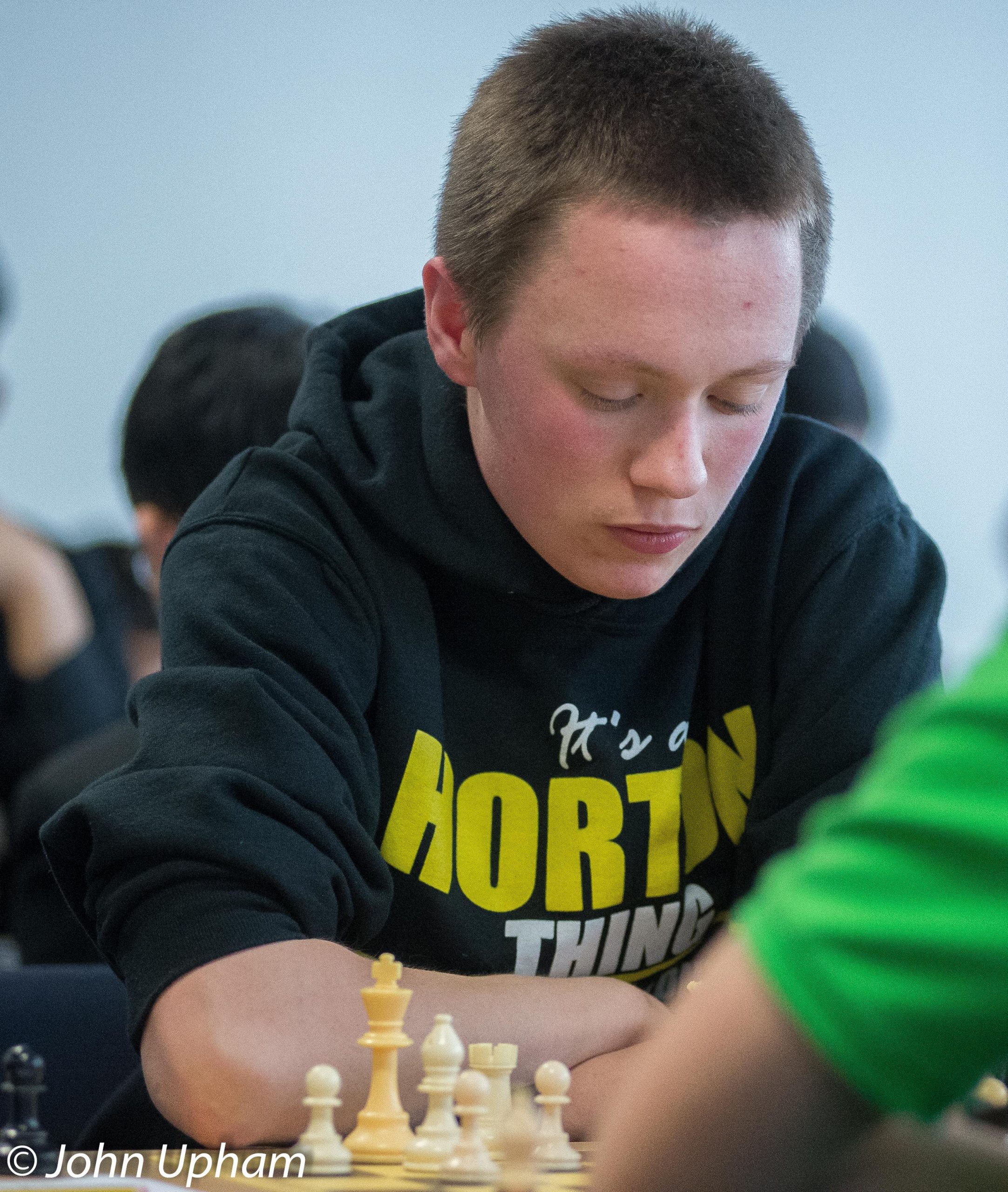
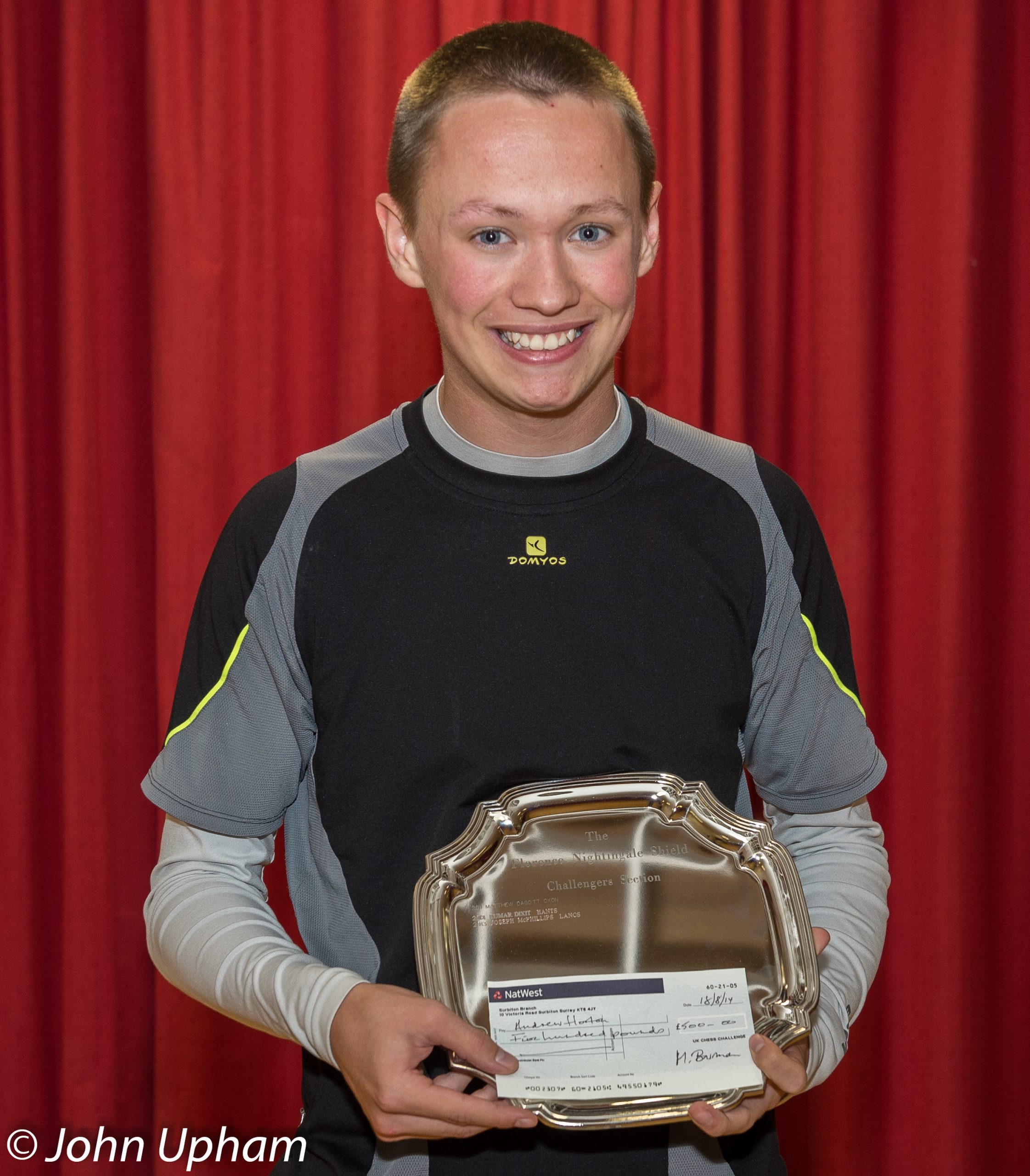
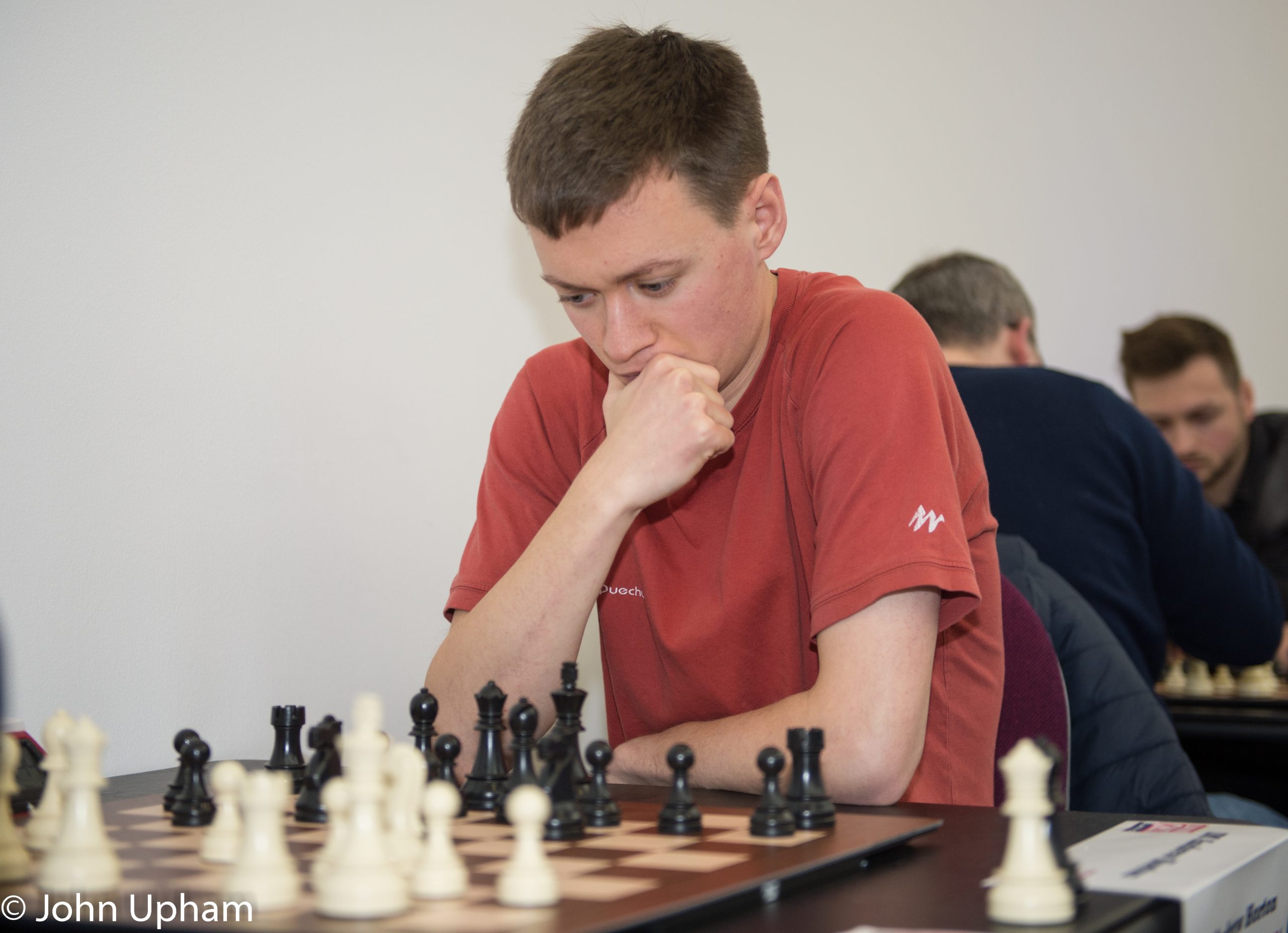
 Save as PDF