This is the third post in my series about George Edward Wainwright, sometime member of Twickenham, Guildford and Surbiton Chess Clubs, and one of the strongest English amateurs of his day.
American Chess Magazine 1898: taken from a public member tree on ancestry.co.uk
We left George in Surbiton in 1911, happily married, with four children and an important job in local government.
That summer he travelled abroad to play chess for the first time. He was playing top board for a team of members and friends of Hastings Chess Club who embarked on a tour of France and Switzerland, scoring 4½/5. I guess he was a friend, rather than a member.
Here’s a game from their match against the Union Amicale des Amateurs de la Régence, where he encountered the Russian diplomat Vassily Soldatenkov. (Click on any move of any game in this article and a Magic Pop-up Chessboard should, with any luck, appear.)
At this point he took a break from tournament chess, not playing in either the 1911 British Championship in Glasgow or the 1911-12 City of London Championship.
He wasn’t inactive, though: in November he took part in a simul at the City of London Club against the up and coming young Cuban Capablanca, where he managed to win his game.
In 1912 he didn’t have far to go for the British Championship, which took place just up the road from him in Richmond – the Castle Assembly Rooms to be precise, down by the river and opposite the Town Hall. Again, he didn’t take part, but was there as a visitor. (I’m considering a future series of Minor Pieces about some of the chessers who descended on Richmond that year.)
Wainwright was back in action in the 1912-13 City of London Championship, but without success. A large entry that year required three qualifying sections, with three qualifiers from each section making the final pool. He was well down the field in his section.
Throughout his life he remained loyal to his home county of Yorkshire: in those days there was no problem representing both Surrey and Yorkshire in county matches.
In this game from a Yorkshire – Middlesex match played in Leicester (a neutral venue) he beat one of his regular London opponents and a future Kingston resident.
Just two days later he took part in another simul against Capablanca, forsaking his usual tactical style and, after his opponent’s ill-advised queen trade, winning in the manner of – Capablanca.
The following year, he did better in the City of London Championship, this time qualifying for the finals by winning this game against a young Dutch master who had crossed the Channel hoping to make money by beating rich Englishmen.
By now it was 1914 and storm clouds were gathering over Europe. The London League kept going for one more season. Wainwright was representing the Lud Eagle club and won this game featuring a rather unusual sacrificial kingside attack in a match against West London. His opponent, William Henry Regan, was a stamp and coin dealer.
The City of London Championship managed to keep going for the duration, albeit with far fewer entries, giving George Edward Wainwright the opportunity to continue playing his favourite game.
He didn’t play in 1914-15 or 1915-16, but returned to the fray in 1916-17. Understandably rusty, he finished in last place behind Edward Guthlac Sergeant. The following year, fulfilling the prophecy from Matthew 20:16 (The last shall be first), later repeated by Bob Dylan (The loser now will be later to win) he shared first place with Philip Walsingham Sergeant (EG’s second cousin) and Edmund MacDonald, winning the play-off and so taking the title for the second time.
He was unsuccessful in defending his title in 1918-19, finishing in midfield behind the Latvian master Theodor Germann as chess started to wake up again following the end of hostilities.
In 1919 the British Chess Federation celebrated with a Victory Tournament in Hastings, where Capablanca won the top section ahead of Kostic. The Ladies’ Championship was included but the title of British Champion itself wasn’t awarded. While in the country, Capa gave a simul at the City of London Club, and, for a third time, lost against Wainwright.
Meanwhile, there were some important changes in Wainwright’s personal life. There was a major reconstruction of local government in 1919: the Local Government Board was abolished, its powers being transferred to the newly created Ministry of Health. It seems likely that at this point Wainwright, a wealthy gentleman whose children had now grown up, decided to retire. At some point in 1920 he and his wife moved to Alice’s home village of Box, Wiltshire. Box is situated in the beautiful Cotswolds, on the A4 between the city of Bath and the market town of Corsham.
The village’s previous claim to chess fame was as the birthplace of Thomas Bowdler (1754-1825), who, when he wasn’t expunging Shakespeare’s rude words, was one of the strongest English players of his day.
The Wainwright family settled in a cottage called Netherby, near the centre of the village, now a Grade 2 listed building. Very charming it looks too.
Source: Google Maps
The Reverend Vere Awdry and his family moved into Lorne House (now a Bed & Breakfast establishment), next to the railway station on the road to Corsham, also in 1920. They’d arrived in the village in 1917, and had lived at two previous addresses there. He and his young son Wilbert used to spend hours watching the steam trains pass by. Many years later, Wilbert, now the Reverend W Awdry, would be inspired by this memory to write the Thomas the Tank Engine books, much loved by generations of young children, including me. George and Vere, as prominent members of the village community, would surely have known each other, and George would have known young Wilbert as well.
By 1920 things were back to normal, and George Edward Wainwright, now retired, was one of those selected for the British Championship in Edinburgh: his first appearance for a decade. His address was given as London and Box in different newspapers, which suggests he’d just moved, or was in the process of moving.
Roland Henry Vaughan Scott was the slightly surprising winner, ahead of the hot favourite Sir George Alan Thomas. Wainwright scored a respectable 4½/11, not bad for a player in his late 50s.
In this game he launched a dangerous kingside attack in typical style, and his opponent wasn’t up to the defensive task. Scottish champion Francis Percival (Percy) Wenman, a former petty thief (of chess books) and later plagiarist, will be well worth a future Minor Piece.
It was now 1921 and time for the census enumerator to pay a visit to the Wainwright residence in Box. George and Alice were there, along with a visitor from Bradford, possibly a family friend, and a general servant.
You’ll find out what happened in the latter stages of his life and chess career next time.
Apologies for the Minor Pieces delay, but I had a deadline on another project. It’s now time to return to George Edward Wainwright.
American Chess Magazine 1898: taken from a public member tree on ancestry.co.uk
Here he is again. You might recall (it was a long time ago) that, in my previous article, we left him in 1901, an English international player, previously a member of Twickenham Chess Club, but now living and playing chess in Guildford.
The chess world would change a lot over the next decade, beginning to look a lot more like the world we know today, with a mixture of club and county matches and tournaments. It was, in the spirit of the times, becoming more competitive. George Edward Wainwright was in his element.
At the end of May 1901 he was in Folkestone for the 3rd Kent County Chess Association Tournament, although his result there was rather indifferent. His opponents included Edward Guthlac Sergeant, Joseph Henry Blake and the endgame expert Creassey Edward Cecil Tattersall, the winner of his section. The other section was won by Henry Ernest Atkins, ahead of Lucien Serraillier, father of the novellist Ian Serriallier (The Silver Sword).
His short draw against Tattersall featured an opening that would become the height of fashion a century later. He mishandled it, but on move 15 his opponent missed the win. 119 years later, English IM Jack Rudd reached the same position and made no mistake. (Click on any move in any game in this article and a pop-up window will magically appear.)
In May 1902 Wainwright took part in the 4th Kent tournament, held in Tunbridge Wells: an all-play-all for 10 players won by the Dutch organist Rudolf Loman, ahead of the likes of Reginald Pryce Michell and (later Sir) George Alan Thomas. Perhaps his most interesting opponent here was the mountaineer Edward Douglas Fawcett.
Against Isle of Wight solicitor Francis Joyce he essayed the relatively new and unexplored Albin Counter-Gambit.
His score of 5½/9 gave him a share of 3rd prize, but he was slightly less successful in the Southern Counties Chess Union Tournament in Norwich, where 4½/11 left him well behind Michell, impressive with 10½/11.
We can see the chess administration we know now coming into shape in this period: county organisations affiliated to regional organisations, who were in turn affiliated to the British Chess Federation. It hasn’t changed very much in the last 120 years: some of us have been saying for years that we need a 21st century rather than a 19th century chess administration in this country.
The 1903 SCCU tournament necessitated a trip to Plymouth (the SCCU covered a much wider area than it does today) where he scored a big success. His score of 7/8 gave him first place ahead of George Edward Horton Bellingham, Wilfred Charles Palmer and Michell.
In October 1903 Wainwright resigned his post as President of Guildford Chess Club, as he had left the area. As we’ll see, he moved to Surbiton, just the other side of Kingston from his previous address in Teddington. Perhaps his job had taken him back from Guildford to Kingston, or perhaps he wanted to be nearer London for both work and chess purposes. Surbiton Station, on the main line into Waterloo, provided – and still provides – regular fast services into the capital. It looks very different now than it would have done in Wainwright’s time: the magnificent Art Deco building dates from 1937 and is considered one of the masterpieces of Scottish railway architect James Robb Scott.
He was soon in action against his former club, who were then, and, to the best of my knowledge, are still on friendly terms. Nearly 120 years later, they’re regular opponents in the Surrey Trophy.
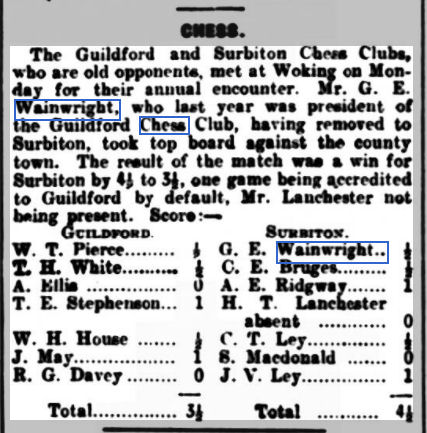
West Surrey Times 21 November 1903
Wainwright drew on top board against William Timbrell Pierce, a problemist and endgame study composer who also gives his name to a variation of the Vienna Gambit. Surbiton came out on top, even though retired architect Henry Jones Lanchester failed to turn up. He certainly wouldn’t have been looking after his baby granddaughter Elsa, who would later become a famous film star – and the wife of Charles Laughton: Henry disowned his daughter Edith (Elsa’s mother) and sent her to a lunatic asylum because of her relationship with a working class Irishman named Shamus.
One of the most important events in London chess for many years up to World War 2 was the City of London Championship, which regularly attracted many of the capital’s finest players. Games took place on weekday evenings, so, now living in Surbiton, he’d be able to get home quickly and easily. He took part for the first time in the 1903-04 season, finishing in midfield behind the largely forgotten William Ward, with Michell in second place.
1904 was a momentous year for British Chess: the first British Championship took place. It’s still, to this day, more or less recognisable. The venue chosen was Hastings: perhaps Wainwright was disappointed not to have been one of the 12 players selected for the championship itself, won by the Anglo-American master William Ewart Napier after a play-off with Atkins. There were three equal First Class sections, and he found himself in Section B, where he shared first place with Charles Hugh Sherrard. Other sections included the British Ladies Championship and sections for Second and Third Class players.
At Southport in 1905 he was promoted to the Championship itself where he scored a very respectable 6/11, finishing in 6th place.
Here’s his exciting victory over the tragic and short-lived Hector Shoosmith, the son of a Temperance Lecturer from Brighton.
In 1906 the British Championship took place in Shrewsbury. Atkins and Michell took the first two places, with Wainwright’s 7/11 giving him a share of third place with Francis Lee, Palmer and Shoosmith. The BCM remarked: The play of … Palmer, Shoosmith, and Wainwright has been specially marked by light and shade. Each lost games through blunders and weak moves, but they have all shared in providing some of the brightest and most interesting chess of the tournament. A comment which could, I suppose, sum up Wainwright’s chess career. His oldest son, George Jnr, took part in one of the Third Class sections but without distinction.
His game against the veteran Blackburne, by now a shadow of his former self, was marked by a finish which would have been worthy of his opponent.
As Autumn arrived it was time for the City of London Club Championship, and it was this tournament that provided George Edward Wainwright with perhaps his greatest success. He ran out a clear winner with 14/17, 2½ points ahead of the runner-up, Shoosmith, with many of London’s leading amateurs trailing in his wake. As well as holding the Gastineau Cup for a year, he received the princely sum of £10 and the championship medal.
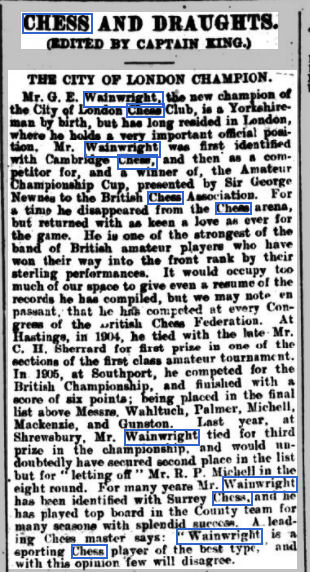
Weekly Journal (Hartlepool) 05 April 1907
The news even reached the chess players of Hartlepool, who were informed that he holds a very important official position, and that, according to a leading Chess Master, he is a sporting Chess player of the best type.
George Edward Wainwright had now, in his mid forties, reached the climax of his chess career. Rod Edwards, in his 1907 rating list, gives him a rating of 2407, placing him 71st in the world. Although 100 points or more behind Atkins and Burn, he was one of the strongest of a group of talented English amateurs rated between about 2300 and 2400, all of whom are of interest for both their lives and their games.
Wainwright didn’t have far to travel for the 1907 British Championship in London, where his 6½/11 was enough for a tie for second place with Blackburne, Michell and EG Sergeant behind Atkins. Another outstanding result: press reports remarked on his vivacious and enterprising style.
Here’s how he dispatched Blake.
In the 1907-08 City of London Championship he couldn’t quite repeat his success of the previous year, finishing a close third behind Thomas Francis Lawrence (you’ll certainly meet him in a future Minor Piece) and William Ward. He didn’t play in the 1908 British Championship, but continued to compete regularly in club and county matches for both Surrey (qualified by residence) and Yorkshire (qualified by birth). He had also returned to playing in the Anglo-American cable matches.
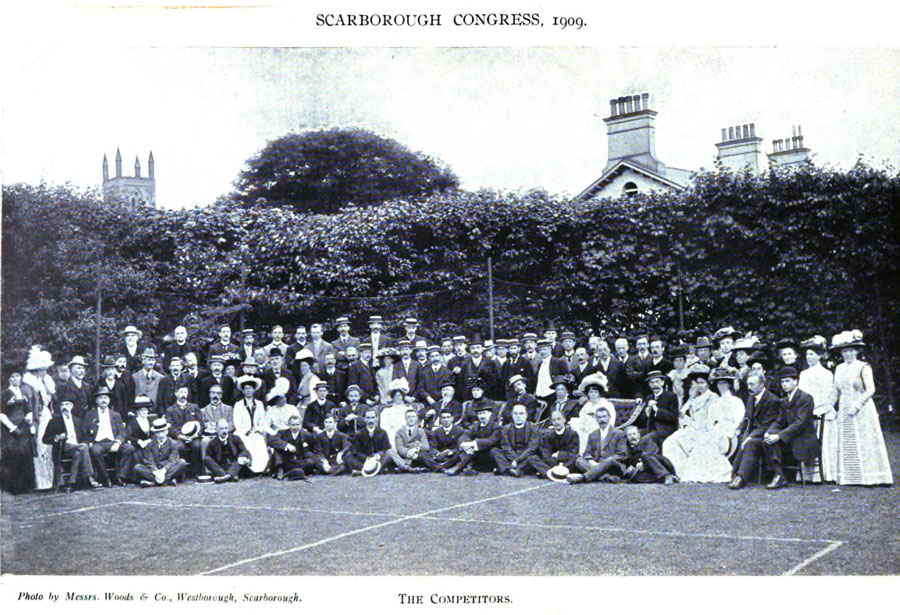
He didn’t play at the British Championships at Tunbridge Wells in 1908, but he was back again at Scarborough the following year, finishing in midfield
He will be somewhere in this rather splendid group photograph.
In this game he again demonstrated his attacking skills, sacrificing a knight to defeat Liverpool’s Harry Holmes, an aural and ophthalmic surgeon.
He had previously finished 3rd in the 1908-09 City of London Chess Club Championship, and, coincidentally, the 1909-10 event saw the same three players taking the first three places: Ward, Blake and Wainwright.
This game, against the problemist Percy Healey, was described by Frederick Winter Markwick, in the Essex Times, as one of the prettiest games I have had the pleasure of watching.
In March 1910 he represented the City of London Chess Club against a visiting team from the Dutch Chess Federation, drawing his game on board 3 against Abraham Speijer, The Dutch team fielded the brothers Arnold and Dirk van Foreest on boards 1 and 7. Arnold is the great great grandfather of GMs Jorden and Lucas van Foreest and their sister Machteld.
The 1910 British Championships took place in Oxford, where he again performed well, sharing 4th place on 6½/11, and beating both Blackburne and the up and coming Fred Dewhirst Yates, who tied for second place behind Atkins.
Here’s how Wainwright beat his fellow Yorkshireman. I guess they were half way towards a comedy sketch!
Wainwright wasn’t quite so successful in the 1910-11 edition of the City of London Club Championship, but, now approaching his half century, a slight decline was only to be expected.
Meanwhile, on 2 April 1911 it was time for the census enumerator to call. Let’s see who was at home.
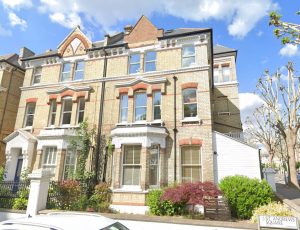
There he was, at 1 St Andrew’s Square, Surbiton, very convenient for the station and trains to London. Very nice it looks, too. George Edward Wainwright and his family seemed to be doing very well for themselves.
Photo: Google Maps
He’s described, rather modestly, as a Principal Clerk working for the Local Government Board. His wife is also at home, as are their two middle children. Philip is a business pupil for a photographic requisites supply company, while Constance has no occupation listed. They also have a visitor, 19-year-old Julie Ross from Glasgow, as well as a cook and a housemaid.
George Jnr was following in his father’s footsteps in more ways than one. He had moved to his father’s home town of Ilkley, where he was also working for the Local Government Board, as a district auditor. 16-year-old David, though, had chosen a different career path: he was a naval cadet undergoing officer training in Dartmouth.
Here, having followed George Edward Wainwright through his forties, the busiest decade of his chess career, is a good place to pause.
Come back soon for the third and final episode of the chess career of the man who, although not a member for long, was by far the strongest player in the first Twickenham Chess Club. Our friends at Surbiton can also claim him as one of their finest players.
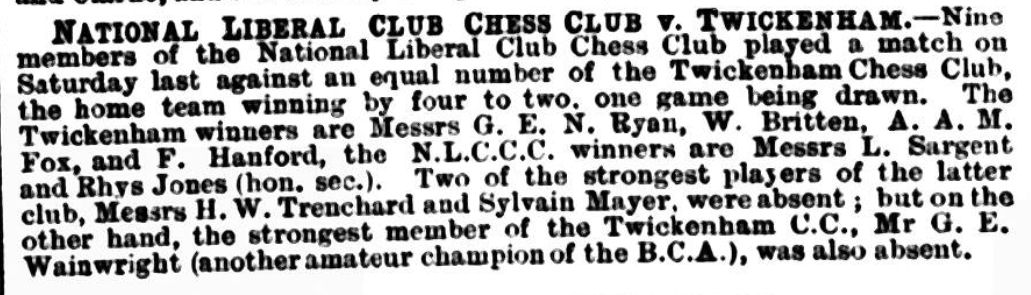
Here’s a match from 1892 between Twickenham Chess Club and the National Liberal Club Chess Club (sounds a bit like Battersea Power Station Station, doesn’t it?).
There are some familiar names among Twickenham’s successful players, but you’ll also see that their strongest player Mr G E Wainwright, an amateur champion of the British Chess Association, was absent.
A name we haven’t seen in other matches, but a very significant one. Players like Ryan, Britten and Fox were strong club players (round about 2000-2200 by today’s standards, I guess, but George Edward Wainwright was a genuine master standard player.
Here he is, from a few years later. Very few photographs seem to have survived.
American Chess Magazine 1898: taken from a public member tree on ancestry.co.uk
George Edward Wainwright was born in Redcar, a seaside resort in North Yorkshire, on 2 November 1861. His father, David, was originally a chemist but later became an independent minister of religion. David sadly died before young George reached his first birthday, and the family moved to Bradford, where his mother Annie (Ann Eliza Tetley) worked as a schoolteacher. At some point before the 1891 census they moved north to the spa town of Ilkley, whose Moor is famous in song. (Ilkley is also famous for its splendid new chess centre, one of whose instigators is Andrew Wainwright. I have no idea at present whether or not he’s related.)
George was a pupil at Bradford Grammar School, where, I’d assume, he learnt chess. In June 1880 he represented his school in a match against the Old Boys. He won an exhibition to University College Oxford later that year, and, the following year was awarded a Classical Scholarship involving five years of study.
Oxford Men and Their Colleges 1880-1892
He was the Treasurer, and later President, of the chess club there and played five times in Varsity matches: on board 6 in 1881 and on board 2 in the subsequent four years. It looks like he improved very rapidly in his first year at Oxford. In March 1882, the University team played a series of matches in which he scored 8½/9, including two wins on top board against the Rev Charles Ranken in a match against former Oxford students.
This game comes from the 1883 Varsity Match. The analysis of all games in this article was produced using Stockfish 14 in ChessBase. Click on any move to display a pop-up board.
After Oxford, it was time for George to find a job – and a wife. On 7 September 1886 he married Alice Margaret Pictor, from the village of Box, in Wiltshire, six miles or so from the city of Bath. The young couple settled in Chiswick, where their first two children, George Edward junior (1887) and Philip Francis (1889) were born.
Here, from shortly before his marriage, is a game from a club match.
George had obtained a clerical job in the Civil Service, working for the Local Government Board, which supervised public health, poor relief and local government, and was also responsible for the registration of births, marriages and deaths. There’s a suggestion in an obituary that he was working on Births, Marriages and Deaths at Somerset House for at least part of his career. I’d assume that some LGB employees would have been based within local government throughout the country, and, if we follow his movements, this might have been the case with George Edward Wainwright.
At some point round about 1890 the family moved to Teddington, and it’s there we find them in the 1891 census. They’re living in a house called St Ronan’s in Kingston Road. This seems to have been next door to the Catholic church close to the junction with Fairfax Road and opposite Normansfield Hospital. (The wonderful theatre is often used as a venue for operas and concerts, and the Museum of Learning Difficulties, well worth a visit, features an information board about Reginald Saunderson.)
As you’d expect, George junior and Philip are there, along with George’s mother Ann, a retired schoolmistress, a 21-year-old cousin named Nelly Fenton and two young servants, Annie Beauchamp and Emily Riley. Although he’s just described as a clerk, he’d already, because of his academic qualifications, be pretty high up and doing well for himself. Alice, of course, was also at home, heavily pregnant with the couple’s only daughter, who would be born that May and given the names Constance Margaret. A third son, David, would be born in 1894.
If George walked back up Kingston Road towards Teddington, he’d soon have what would later become Bushy Park Road on his left (an OS map from a few years later shows it under construction), where, some 40 years later, the Misses Ada and Louisa Padbury would sell ham and beef. A turning on the right a bit further up named Cornelius Road was not at that point built up, but in the 1900s would acquire houses and a new name in honour of the reigning monarch: King Edward’s Grove. It was there that, in the 1920s, one of his future opponents, Edward Guthlac Sergeant, would briefly make his home, and also where the Misses Padbury would move after retiring from their Ham and Beef Stores. Their great nephew would spend the first two years of his life there as well, but that’s another story for another time and place.
George had been very active in chess circles through the later 1880s, most notably winning the British Amateur Championship in 1889. On moving to Teddington, he would have wasted no time joining Twickenham Chess Club. But with a growing family, and, you would imagine, increasing responsibility at work, he played less often during the 1890s, contenting himself with club and county matches.
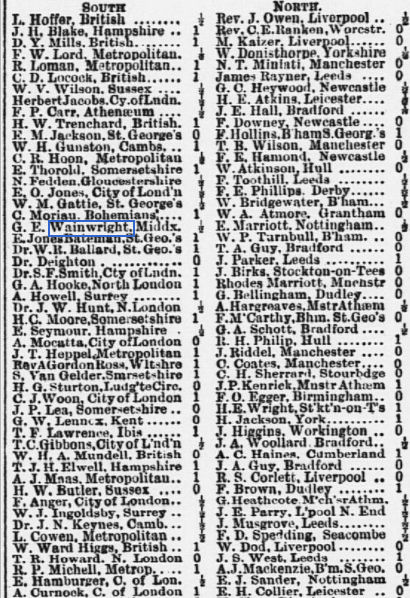
On 7 April 1894, for example, he was on Board 19 in a 108-board match between the South and North of England, where he drew his game against our old friend (and possibly my distant relation by marriage) Edwin Marriott.
Lots of great names there on both sides, some of whom will be featured later in this series, but Wainwright’s position on board 19 suggests that he wasn’t regarded as any more than a strong amateur at that point. He was still, in 1894, representing Middlesex, but he was soon to move, and to leave Twickenham Chess Club.
By 1895 he was living in Guildford, joining the local club and now representing Surrey in county chess.
This game from a county match demonstrates that George was a player with an enterprising style and considerable tactical ability.
The administrative headquarters of Surrey County Council moved from Newington (Southwark) to the newly built County Hall in Kingston in 1893: perhaps he was involved in some way. It’s also possible his job might have then taken him to Guildford, which would explain the move. Perhaps, though, he was commuting to the capital from nearby London Road station, which had opened in 1885. A train would have taken him directly to Waterloo, from where Somerset House was a short walk across the bridge.
With his family now growing he seems to have had more time for chess, and in 1898, as a result of games like the one below, he had come to the attention of the national selectors, being picked as a reserve for the Great Britain team in their third annual cable match against the United States of America.
The following year, he was in the team facing a promising young tactician named Frank Marshall.
A long and exciting game ensued, in which our man was perhaps fortunate to escape into a fortress-like draw.
It seems that, by now in his late 30s, George Edward Wainwright was approaching the peak of his powers over the chessboard.
The 1901 census located the family in the parish of Stoke next Guildford. George, described as a Principal for the Local Government Board, and Alice were at home, along with their three youngest children, George’s mother, a governess to help look after the youngsters, a cook and a housemaid. George junior, meanwhile, was boarding at Pilgrim House School, Westerham, Kent.
We’ll leave him there for the time being, a senior civil servant working for the Local Government Board, a family man, and an English international chess player renowned for his dashing attacks.
The story of George Edward Wainwright’s life and chess career will be continued in the next Minor Piece.
If you want more, and, if you enjoy attacking chess or British chess history you certainly should, historian Gerard Killoran, who lives in Wainwright’s home town, Ilkley, is currently working on a biography. I can’t wait to read it.
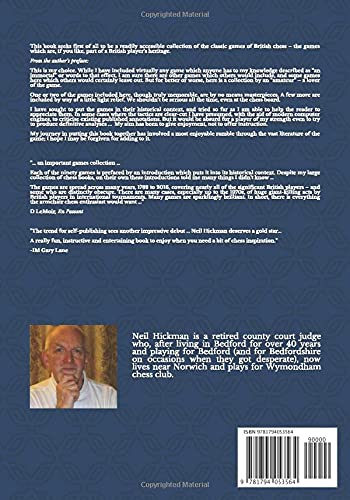
Memorable Games of British Chess, Neil Hickman, Amazon Publishing, 3rd September 2019, ISBN-13 : 978-1794053564
From the back cover:
A collection of the classic games of British chess, including one or two which, though truly memorable, are by no means masterpieces; with a few more included by way of a little light relief. We shouldn’t be serious all the time, even at the chess board.
Neil is a retired county court judge who, after living in Bedford for over 40 years and playing for Bedford (and on Bedfordshire on occasions when they got desperate), now lives near Norwich and plays for Wymondham chess club.
Before going further please take this opportunity to Look Inside.
Despite being published in 2019 BCN was recently offered a copy of Memorable Games of British Chess and was unable to resist the chance to review this self-published Amazon book from Neil Hickman, a friend of Jim Plaskett.
The book is a paperback and of a size making it physically easy to read. Unlike some Amazon published efforts the paper is of decent quality (not yellowing) and the printing is clear. The diagrams are frequent and excellent of a decent size. Each diagram has a [Position after 24.0-0] type caption.
Many of you will be familiar with
British Chess Masters, Past and Present, Fred Reinfeld, George Bell and Sons Ltd., London, 1947.
and
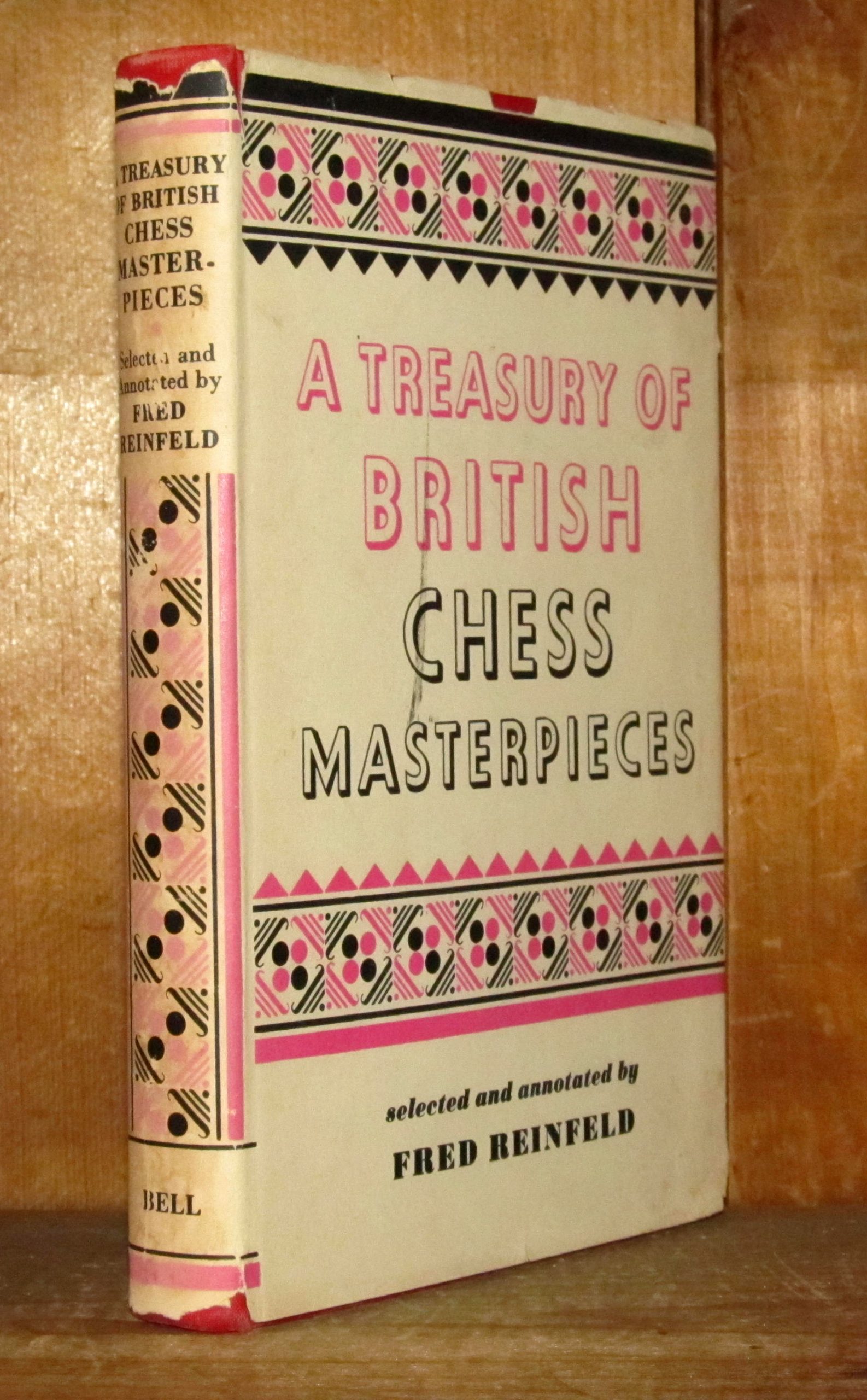
A Treasury of British Chess Masterpieces, Fred Reinfeld, George Bell and Sons Ltd., 1950
and
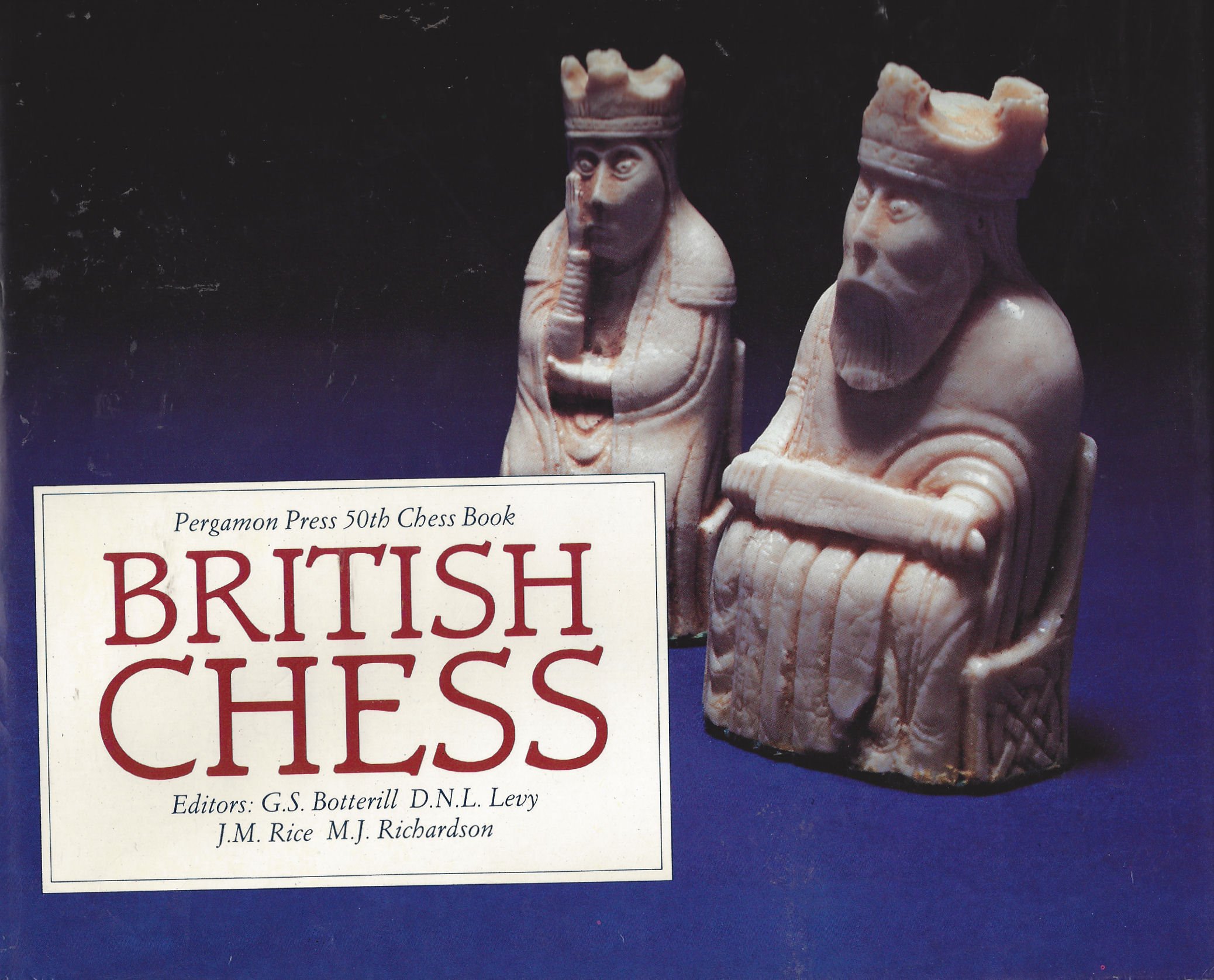
British Chess, Pergamon Press, 1983. Editors : GS Botterill, DNL Levy, JM Rice and MJ Richardson, ISBN 0 08 024134 4
and especially
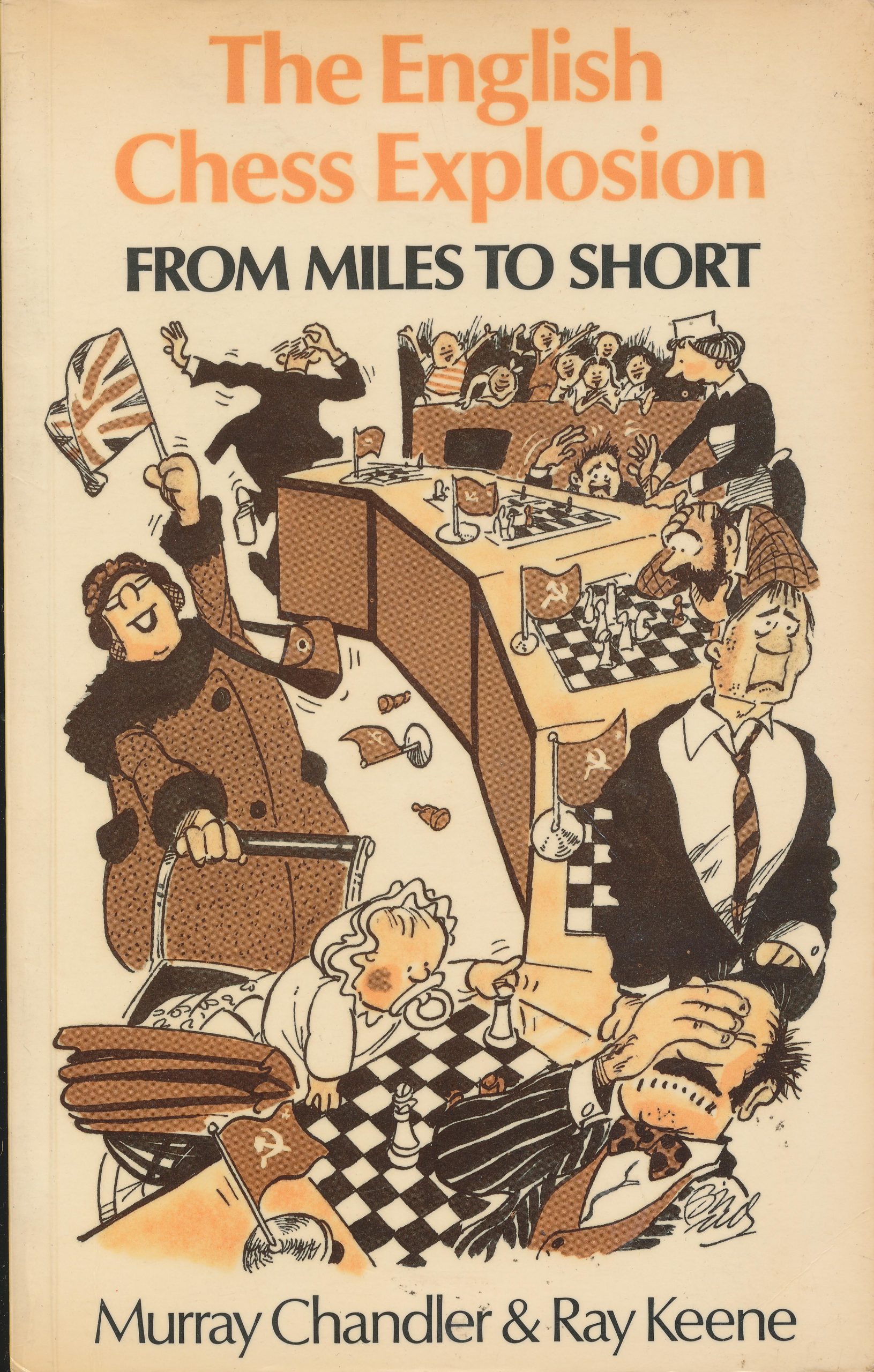
The English Chess Explosion (from Miles to Short), Murray Chandler & Ray Keene, Batsford, 1981, ISBN 0 7134 4009 0
which highlight successes by British chess players.
The authors book presents ninety OTB and correspondence games (which is a nice touch) covering the period 1788(!) to 2016 and selecting just this number must have been challenging to say the very least. Confidence in the book is derived early from a truly excellent List of Sources demonstrating an academic and studious attitude to the job in hand.
Each game is prefaced by background information on the game, venue, circumstances and details of the players all of which is most welcome. The book started well since the first game Bowdler-Conway, London, 1788 was unknown to myself. Instantly memorable however since Thomas Bowdler caused the creation of the verb “Bowdlerise” and the game was one of the very first recorded double rook sacrifices that is also discussed in the charming
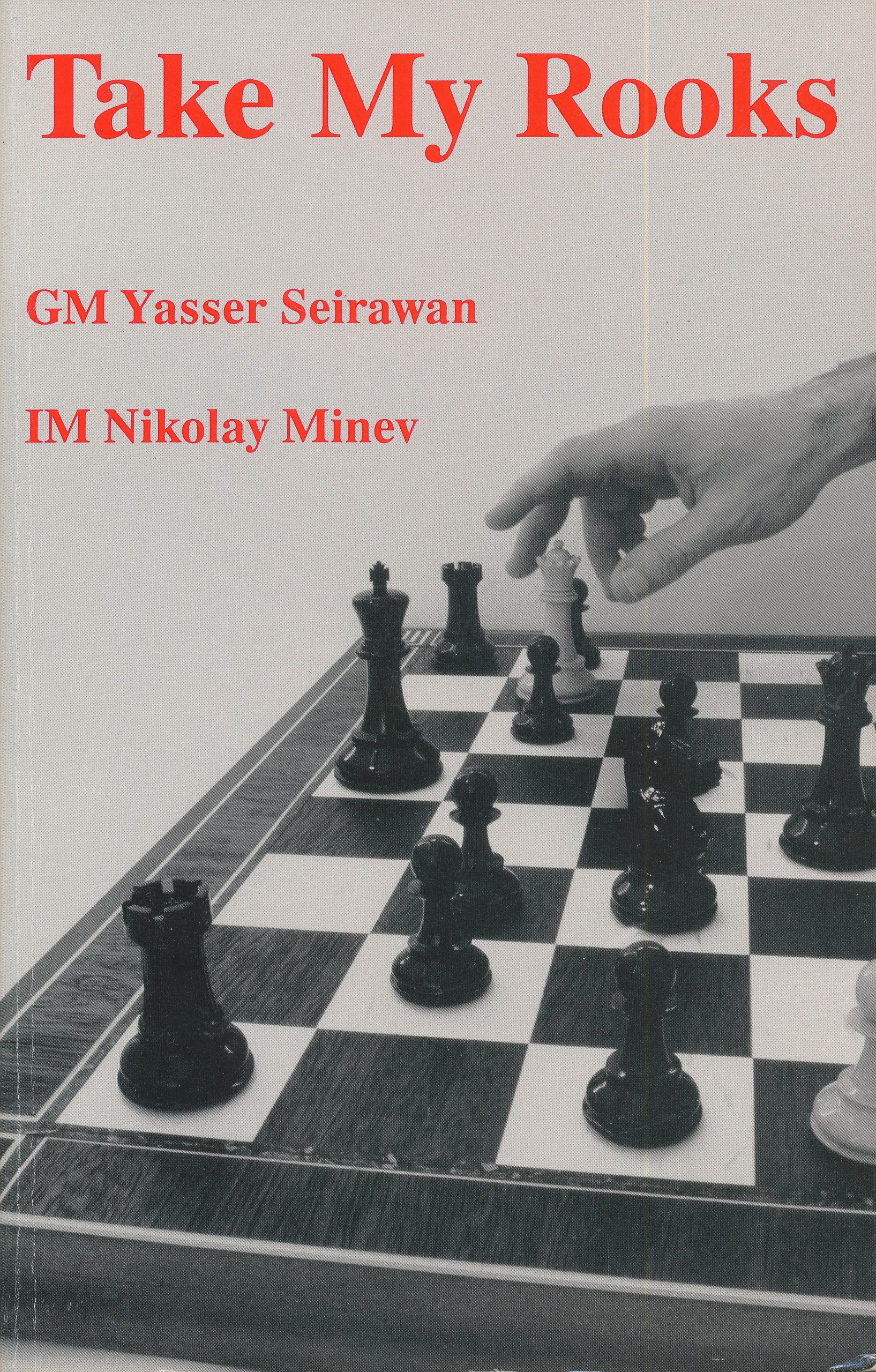
Take My Rooks, Seirawan and Minev, International Chess Enterprises, 1991, 1-879479-01-X
To give you some idea of the annotations here we have game 66, Ligterink-Miles, Wijk aan Zee, 1984:
A wonderful finish to be sure.
and secondly we have Game 58 played in Luton in 1976 between Viktor Korchnoi and Peter Montgomery:
also delightful in its own modest way.
The other 88 games all have their own significance including games of historical significance covering many of the greats with detailed articles on this review web site.
The author clearly has done his homework and a nice touch is the listing for each game of where in the literature it had been previously annotated. The notes are chatty and friendly and not spoilt by reams of dull engine analysis. It was delightful to find mentions of British players who rarely get a mention such as Edward Jackson, Thomas Lawrence, Francis William Viney of the General Post Office, Herbert Francis Gook of HM Customs, Harold Saunders and Kenneth Charlesworth to name but a few.
Of course, the old favourites are given the treatment including Alekhine-Yates, Capablanca-Thomas, Bronstein-Alexander, Penrose-Tal etc plus our modern heroes such as Michael Adams, Luke McShane, Gawain Jones, David Howell, Julian Hodgson, Nigel Short and John Nunn.
I particularly like the annotations which include those from other notable authors and sources and in summary, this is a charming book that would make an excellent coffee table book for any chess enthusiast and you won’t be disappointed.
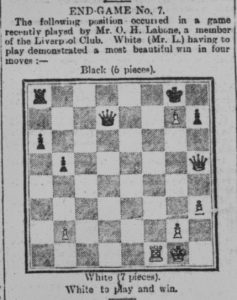
There are a few chess players who, while not being outstanding exponents themselves, achieved immortality through a flash of inspiration. Saavedra is one example, and another is the subject of this article: Oliver Harcourt Labone.
Liverpool Weekly Courier 11 December 1886
You might have seen something like this before, either this position or a similar position published by Lasker ten years later. I’m sure you don’t need me to tell you the answer. (Spoiler: it involves an underpromotion.)
Problemist Steven Dowd posted this on the BCN Facebook page, asking for more information about Labone.
There’s a lot to tell about a man who lived an eventful life, so do come along for the ride. It’s a rather extraordinary story.
Let’s take you back to the Central Criminal Court on 20 August 1861. A solicitor named Richard Austwick Westbrook was accused of manslaughter. He was a divorcee boarding with a lady named Jane Janette Cathrey, whose husband was had emigrated to Australia: both Richard and Jane, who were probably having an affair, had a reputation for being hot-headed and violent. During an argument Richard threw a knife across the table, hitting Jane in the abdomen and causing her death. A hearing in a magistrates’ court earlier in the month had found him guilty of manslaughter, but now the prosecution offered no evidence, believing it was an accident, and Richard walked free. Sounds like a combination of toxic masculinity and male privilege to me. Perhaps it affected his business, though, as he was declared bankrupt two years later.
Richard Austwick Westbrook had been born in Reading in 1815. In 1841 he married Hannah Grant Stiles. They had four children, but she died in 1852, and in 1855 he married Anne Topley at St Paul’s Church, Hammersmith. In 1857, a son, Rowland Martin Westbrook, was born, followed in 1858 by Oliver Harcourt Westbrook. It seems they split up shortly after Ollie’s birth and he went to live with Jane Cathrey. His petition for divorce was granted in 1860, naming a man called Demetrio as co-respondent. In 1862 he married a third time and had two more children.
Meanwhile, there was a Clement Leslie Dalba born in Brentford in 1860 (mother’s maiden name Mesina). There’s no other record of him, or of anyone else in the area with any of those names, so my best guess is he was the Clement Claude Leslie Labone we’ll meet later. The name Demetrio, along with Dalba and Mesina, suggests an Italian connection, so I suspect he was the son of Nicholas Demetrio and Anne Topley, and his birth had been registered using false names.
At some point in late 1860 or early 1861, Nick, Anne and the three boys moved to Glasgow, happy to escape Richard’s hot temper, and, to avoid detection, changed their name to Labone. Rowland’s middle name was also changed, from Martin to MacDonald: you can’t get much more Scottish than that. She also seems to have changed her maiden name from Topley to Copley, and sometimes added Mary in front of Anne.
In the 1861 Scottish census he’s Nicholas Labone, aged 28, living in a boarding house in Glasgow, but described as a Landed Proprietor. In 1862, a daughter, Flora Adelina, was born to Nick and Anne. Nick set up in business as a Professor of Languages, teaching French, German and Italian, but, just like Richard, ran into financial problems and, in 1863, was declared bankrupt. In 1865, a son, Gregory, was born, but sadly died the same year. In 1866 Nick’s publishers were trying desperately to unload 155 copies of his book A French Verbary.
In 1871 Ollie is away at school, but we find Nick, a Professor of Languages, living with his wife Annie M Labone, and two other sons, Rowland M (15) and Leslie C (12). Flora doesn’t seem to be around. Flora would later marry and have a family. Rowland died in his 40s, never apparently marrying or having a job, which suggests some sort of health problem. All I can find out about him is that in 1876 he was looking for a job as a lay evangelist. We’ll return to Clem/Les later.
Nicholas Labone/Demetrio, when he wasn’t teaching languages and writing books, was, it turns out, a chess player. He was very much involved with the Glasgow Chess Club in the early 1870s, both as a player and an administrator. He must have taught the game to Ollie and Clem. Nick and Anne’s marriage doesn’t seem to last. They both move down to Lancashire. Nick, now known as Nicholas Demetrio again, remarried in Barrow-in-Furness in 1882. There’s also a Demetrio who played in chess matches between Manchester and Liverpool in the early 1880s, who, I assume, was Nick. According to a rate book from 1890, he was still in Manchester, living in poverty. In 1891, Annie, claiming to be a widow born in Derby, was living with Rowland in Liverpool.
For the moment, though, we need to follow Ollie. We next pick him up in 1879, now living in Liverpool, where a public notice informs us that he’s no longer working for John Gibbs & Son, Ironfounders and Export Agents. At some point after Nick’s death the family seems to have moved from Glasgow to Liverpool. By 1881, he’s in Manchester, where he married Emily Etchells, the daughter of a Methodist preacher, and at the time of the census the young couple have just set up home together in Salford. Ollie is now described as a Commercial Traveller.
In 1883 he first makes his mark in the chess world, submitting a problem to the Illustrated London News. In 1884 he’s playing for Manchester, and, the following year in Stourbridge, Worcestershire. Over the next few years he’s active in Birmingham and Liverpool, along with half-brother Clem. In 1886 the position that would send his name around the world was published: quite an achievement for the young man.
Here’s a game from 1886.
And Problem 1, a mate in 3 from The Field 1 Jan 1887:
(Solutions to problems are at the end of the article)
Two games from 1888:
I can find no adult male with a name anything like L E Whitby anywhere near Liverpool in 1888 or anywhere else any other time, yet he is often mentioned in chess columns. Can anyone help?
The 1891 census tells us that, now a commission agent, he’s moved to Wolverhampton, along with Emily and their children Walter, Leonard and Marie. Another son, Oliver Martyn, had died at the age of only 4 months the previous year.
Birmingham Daily Post 23 June 1893
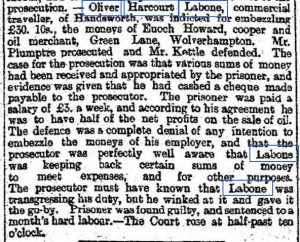
But in 1893 the family’s world was turned upside down. Ollie was up before the law, accused of embezzlement from his business partner, one Enoch Howard, found guilty and sentenced to a month’s hard labour. Naughty Ollie!
Undaunted, though, the following year he took up a new hobby: giving simultaneous displays against weaker clubs. Over the next 20 years or so he travelled the country, possibly connected with his job as a travelling salesman in machine oils, giving simuls wherever he went and gaining a national reputation as an expert simul giver. In 1894 it was Northampton, in 1896 it was Norwich.
He spent much of 1896 playing a match for the Staffordshire Championship with the Reverend John H Robison of Walsall, which he won easily, winning 10 games and drawing 2. In 1898 he faced a more formidable opponent for the county title: Charles William Draycott. Ollie only managed one draw from the first three games, but eventually scored 10 wins and 3 draws to his opponent’s 7 wins.
Here’s the final game of the match:
Against Lasker (it’s not clear at the moment whether this was a casual game or a simul, and exactly where it took place), he played an unambitious opening and a passive middlegame.
In 1901, still a commission agent, but working on his own account, he was living at Ivy Side, Rookery Road, Handsworth, West Bromwich with Emily, Len and Marie, Walt having left home. He was playing a lot of chess, but not playing Happy Families. There were clearly domestic problems of some sort, and, just a few months later, Emily and Marie set sail for New Zealand, as far away as possible from poor Ollie. Marie, would die a few years later, but Walt and Len would later join her with their families. She later married again, perhaps to a younger man she met on board ship, but there’s no evidence that she and Ollie were divorced.
Meanwhile, Ollie had found himself another woman, in fact another Emily, Emily Yates. (Every one was an Emily, ‘e wouldn’t ‘ave a Lily or a Pam.) She had been born in 1877 in Heywood, Lancashire, so perhaps they’d met on one of his visits to Manchester or Liverpool. Perhaps Emily Mark 1 had had enough of his constant travelling, or of his chess addiction. Or perhaps it’s just one of the oldest stories around: a middle-aged man is attracted to a younger woman. A son, Cyril, was born in Norwich in 1903, and another son, Douglas, in Leicester in 1905.
Here’s Problem 2: Mate in 3 from the Illustrated London News 15 Dec 1906.
A game from this period:
Yes, we seem to have found ourselves back in Leicester again, and, of course, Ollie soon threw himself into the chess life of the city, playing in matches and giving simuls, but also visiting Liverpool in 1909 to take part in a blindfold simul against Blackburne. In 1911 they’re in New Bridge Street, not very far from what was then Filbert Street but is now the King Power Stadium. He’s a Commercial Traveller in Oils, while Emily Yates is a Housekeeper. (This was a common euphemism in census returns, but sometimes employers did have affairs with their housekeepers. Ten years later, for example, South Warwickshire farmer Thomas Woolley had an affair with his housekeeper while his wife was in the lunatic asylum. Pretty despicable, you might think, but if he hadn’t done so, you wouldn’t be reading this article today.)
Here’s the Blackburne game, which doesn’t make a very good impression. He misplayed the opening and never stood a chance. You get the impression he was a strong attacking player, but when facing top level opposition he curled up into a ball and defended weakly. As it happens, one of his relations was a much better defender.
A game from his time in Leicester:
It wasn’t long before he was on the move again. By 1913 he was in Blackpool, where his sons would be baptised the following year.
Problem 3, another mate in 3, was published in the Illustrated London News on 9 October 1915.
While his family settled down by the Lancashire coast, he was back on the road, spending some time in Devon and Cornwall, and, of course, giving simuls. He was back in Exeter in 1918, where he played Plymouth champion Thomas Taylor.
In February 1920 he was writing to the Illustrated London News from Belfast, and, a few moths later, he was in Barrow-in-Furness.
Problem 4, mate in 3 Illustrated London News 17 Sep 1921:
At that point it seems he settled down in Blackpool, now running an advertising agency of sorts. In 1925 he was still submitting problems and games for publication in the Illustrated London News.
Problem 5, mate in 3 Illustrated London News 9 May 1925
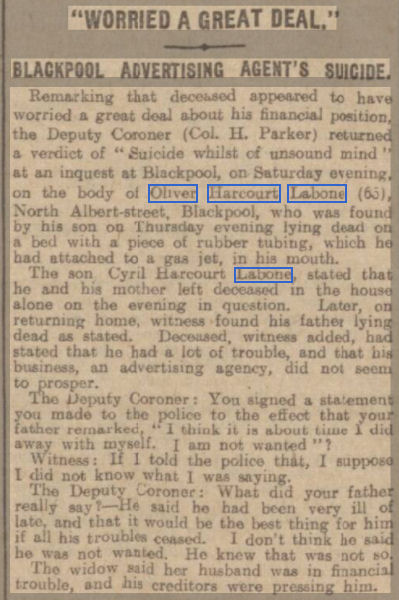
Perhaps he just had time to see this game in print before, beset by financial problems, he decided to take his own life.
Lancashire Evening Post 30 November 1925
His son Cyril would also have an unhappy life, and by 1939 was in a mental hospital, described as a pianist. He died in 1947 at the age of 43.
So that was the sad end of Oliver Harcourt Labone, chess addict, player, problemist and simul giver, indefatigable writer to chess columnists. He must have been a troubled man throughout his life. Did his passion for chess help him through his darkest days, or was it one of the causes of his problems, not leaving him enough time for his work and family? It seems like several members of his family were beset by mental health probems, so my guess would be the former.
Oliver Harcourt (Westbrook) Labone, this was your life.
But it’s not the end of our story. Let’s return to Ollie’s probable half-brother Clement Claude Leslie/Clement Leslie/Leslie Clement, who, as we’ve seen, was also a chess player, but at a lower level. He had a much less eventful life, in spite of job changes. He was a schoolmaster in 1891, a book-keeper in 1901 and a mercantile clerk (which might, I suppose, involve book-keeping) in 1911. He was active as a club player between 1885 and 1894, annotating a consultation game in 1891. After that, I suppose, family life and work took over. He remained in Liverpool all his life, living in West Derby in 1891 and 1901, and in Everton in 1911. If you were following football in the 1960s the names Labone and Everton will be inextricably linked. Any connection?
Clem married Fanny Price and had four children, the oldest of whom, born in 1887, was also named Clement Claude Leslie Labone, and, by 1939, had become a Dining Room Proprietor. He married Edith Birch and had three sons, the middle one of whom was named Arthur Leslie Labone. Arthur, in 1939 a Lead Merchant’s Travelling Agent (sounding not unlike great uncle Ollie) married an Irish girl named Bridget (Patricia) Rice. Their son was indeed Brian Leslie Labone (1940-2006), the Everton and England footballer, who, unlike his great great uncle, excelled at defending. He wasn’t the only footballer in the family: his uncle Harold played as a centre forward for Aston Villa.
There’s more yet. When I posted about the connection between Ollie and Brian on Twitter, my good friend John Foley replied that he was also related to Brian Labone (verified by DNA), whose mother’s maiden name was Foley. So Brian Labone, assuming Clem senior and Ollie were indeed blood relations, was related to chess players on both sides of his family.
It’s a small world, as you’ll find out when we return to Twickenham for future Minor Pieces.
John Upham recently chanced upon a 1947 game in which an otherwise unknown English player, C Bridle, defeated former World Championship challenger Bogoljubov in a 1947 tournament in Flensburg, Germany.
I’d come across the game myself many years ago, in Fred Reinfeld’s 1950 anthology A Treasury of British Chess Masterpieces, and wondered about C Bridle, a name I hadn’t encountered elsewhere. At some point, perhaps from a magazine article somewhere, I’d seen his first name given as Cliff. A few years ago, now with access to online genealogy records and newspaper archives, I decided to do some research.
We all know who Efim Bogoljubov (1889-1952) was, though. He’s in so many inter-war tournament photographs: the corpulent, beer-swilling figure in the front row, genial and self-confident. “When I’m white I win because I’m white”, he said, “when I’m black I win because I’m Bogoljubov.” It’s easy to forget that, throughout the 1920s and early 1930s he was one of the world’s strongest players, although no match for the mighty Alekhine in two world championship matches. Even in the final years of his career, after World War 2, he was still a formidable opponent. So how come he lost to an otherwise unknown adversary?
It’s well worth looking at the game. I also asked my silicon chum Stockfish 14 to comment on Reinfeld’s annotations. Needless to say, he(?) wasn’t impressed. Stocky v Freddy: let battle commence.
1. d4 e6
2. c4 f5
Stocky, who, sadly for me as a long standing devotee of that opening, doesn’t think much of the Dutch Defence, would aware this a ?!.
3. Nf3 Nf6
4. g3 b6?!
A ? from Freddy, another ?! from Stocky.
5. Bg2 Bb7
6. O-O Be7
7. Nc3
Stocky suggests that White can, and should, play the immediate d5 here: 7. d5! exd5 8. Nd4 g6 9. cxd5 Bxd5 (9… Nxd5 10. Bh6) 10. Bxd5 Nxd5 11. Nxf5)
7… Ne4
8. d5 Nxc3
9. bxc3
Freddy correctly opines that Black has chosen a bad opening, but adds that the fianchetto of the queen’s bishop is generally avoid because of the possibility of d5. A strange comment, as the Queen’s Indian Defence is, and was back in 1950, perfectly respectable. The idea of d5 in this sort of position would, I think, have been considered fairly advanced knowledge at the time. I guess the ever optimistic Bogo was gambling on his inexperienced opponent not knowing this. If White just plays developing moves, it’s very easy for Black to play move like Ne4, g5, g4, Qh4 and get an automatic attack.
9… O-O
10. Nd4
Threatening d6 as well as dxe6.
10… Qc8?
Freddy and Stocky agree that this deserves a question mark. Freddy suggests that Black should play 10… e5 when White should retreat his knight with advantage because of the poorly placed bishop on b7. Stocky continues this with 11. Nb3 d6 12. c5 (a thematic tactic: 12… bxc5 13. Nxc5 dxc5 14. Qb3 regaining the piece) 12… a5 13. c6 Bc8 with only a slight advantage for White. He also thinks Black could consider the pawn sacrifice 10… Bd6 11. dxe6 Bxg2 12. Kxg2 Qe7 13. exd7 Nxd7 with some compensation.
11. e4 c5
12. Ne2 Bf6
13. Qd3 Na6
14. exf5 exf5
15. g4!?
Freddy gives this a shriek mark: ‘instinctive and strong’. Stocky is not so convinced, meeting it with 15… Nb4! to drive the queen away. White might then consider the exchange sacrifice 16. cxb4!? Bxa1 17. Bf4 Bb2 18. Rb1 Bf6 19. g5 Be7 20. Ng3 d6. He thinks White could have maintained a winning advantage by playing a move like Bf4 or h4 rather than trying to force the issue.
15… fxg4
16. Be4 g6
17. Ng3!?
Freddy claims 17. Bxg6 is premature. Again, Stocky begs to differ, analysing 17. Bxg6! hxg6 18. Qxg6+ Bg7 19. Bh6 Rf7 20. Ng3 Qf8 21. Nh5 Rf6 22. Qxg7+ Qxg7 23. Bxg7 Rf3 24. Rae1 Rh3 25. Re5 Rxh5 26. Rxh5 Kxg7 27. f3 with a winning advantage because Black’s queen side pieces are still out of play)
17… Kg7?
No comment from Freddy, but a question mark from Stocky, who thinks Qe8 was Black’s only defence.
18. Bf4 Nc7
19. Rae1 Ne8
20. Nh5+!!
Double shriek mark from Freddy. This time Stocky agrees. Stocky is happy with Freddy’s analysis of 20… gxh5 21. Bh6+!!, but points out that the more prosaic 21. Bxh7! is equally good. Some variations:
Stocky tells me this throws away most of White’s advantage: he should be opening the position rather than closing it, so 23. f3 was called for, when Black has nothing better than g3 in reply.
23… Nxe4
24. Rxe4 Rxe4
25. Qxe4 Qe8
26. Qd3 Qg8?
Moving the queen off the critical e-file. 26… Kg8 was the most tenacious defence, but Freddy didn’t notice.
27. f5 g5
28. f6?!
Pushing the passed pawn too soon, giving the black queen access to g6. White has two winning ideas here, according to Stocky. He wants to capture on g4 before Black has time to start counterplay with h5. Perhaps the simpler option is:
28. Qe4! Qe8 (28… Re8 29. Qxg4 and Black’s kingside will soon collapse) 29. Be5 Rd8 (now the e-file is sealed White can continue in similar fashion to the game) 30. f6 Qg8 31. Bd6 Re8 32. Qe7+ Rxe7 33. fxe7+ Kg6 34. Rf8 and wins.
The second path to victory is:
28. Qg3! h5 (28… Ba6 29. Qxg4 Re8 30. Qh5+ Kf6 31. h4 Bxc4 32. Qh6+ Kf7 33. hxg5) when White has the spectacularly beautiful 29. Be7!! with elements of both interference (on the e-file) and clearance (on the diagonal). Play might continue 29… Kxe7 (29… Re8 30. Qd6 Rxe7 31. f6 Re3 32. Qxd7+ Kg6 33. f7 Qf8 34. Qf5+ Kh6 35. Qf6+ Kh7 36. Qxg5 Rf3 37. Qxh5+ Qh6 38. Qxh6+ Kxh6 39. Rxf3 gxf3 40. f8=Q+) 30. Qc7 Ba6 (30… Qf7 31. f6+ Kf8 32. Rf5 Re8 33. Qd6+ Kg8 34. Rxg5+ Kh8 35. Rg7 Qf8 36. Qf4) (30… Bc8 31. Re1+ Kf7 32. Qd6 Qg7 33. Re7+ Kf8 34. Rxg7+ Kxg7 35. Qe7+ Kh6 36. Qf7 h4 37. Qg6#) 31. Re1+ Kf8 32. Qd6+ Kg7 33. Re7+
28… Qg6??
A Bogo booboo, missing Cliff’s 30th move. Instead, he could have equalised by occupying the e-file first. After 28… Re8, with Qg6 to follow, everything, according to Stocky, is about equal. (28… Re8 29. Qf5 (29. Be7 Qg6 30. Qg3) 29… Bc8 30. Qxg4 Qg6)
But Freddy was asleep and let both players’ 28th moves pass without comment.
‘A very attractive game’, according to Freddy. An interesting but inaccurate game according to Stocky. You might, I suppose, see it as a classic example of bishops of opposite colours favouring the attacker in the middlegame, and note that Black’s queenside pieces were offside.
You should also look at some of the tactics, especially 29. Be7!! in the note to White’s 28th move.
It’s still mightily impressive for an unknown amateur to beat a top grandmaster with a brilliant queen sacrifice.
Congratulations, Cliff!
But who was Mr Bridle, anyway, and what was he doing in Flensburg? Perhaps he was just enjoying a summer holiday. It seems that Cliff spent most of his life in the shadows. Let’s have a look and see what we can find out.
Clifford Bridle was born in Weymouth, Dorset on 11 February 1914. His father was George Bridle, originally from Wareham, who had divorced his first wife in 1910 and married Susan Jane Smith in 1912. Cliff had an older sister, Greta, and two younger brothers, Jack and Victor, as well as a half sister, Sarah Bessie. The 1911 census reveals that George was a house decorator. Not the sort of comfortable upper middle-class background you’d expect from a strong chess player, but the world was changing. Before World War 1, chess had been, at least at higher levels, very much associated with the comfortably off, but in the inter-war years the game was broadening its demographics, and players from working class backgrounds could sometimes be found playing at higher levels.
We pick Cliff up for the first time as a chess player in 1932, where he was playing correspondence chess for his home county. He also started playing over the board, and, in April 1933, the Western Morning News pointed out that he’d won every game he played for Dorset, while lamenting the lack of an inter-club competition in his county. There was an individual county championship, though, and Cliff, one of the young ones, reached the final, where he lost to Swanage schoolmaster Bennett William Wood. The Western Gazette (23 June 1933) reported that “Mr. Bridle, who is only 18 years of age, is to be congratulated on the excellent fight he made for the championship. Congratulations again, Cliff. In those days the county champion got to play top board the following season, so Cliff didn’t quite make Number One.
He continued to play county chess, usually on about board 9 or 10, throughout the 1930s. The 1939 Register found him, a bachelor boy, living with his mother and brothers at 13 Milton Road, Weymouth. He was following in his father’s footsteps, working, like his brother Jack, as a house decorator and glazier, while young Victor seemed to be moving up in the world, having found clerical work with an estate agent. Cliff’s date of birth is given incorrectly as 11 July 1914. And then the trail goes dead, until 1947, when he turned up in Flensburg.
Here’s Wikipedia on Flensburg:
Flensburg is an independent town in the north of the German state of Schleswig-Holstein. Flensburg is the centre of the region of Southern Schleswig. After Kiel and Lübeck, it is the third largest town in Schleswig-Holstein.
In May 1945, Flensburg was the seat of the last government of Nazi Germany, the so-called Flensburg government led by Karl Dönitz, which was in power from 1 May, the announcement of Hitler’s death, for one week, until German armies surrendered and the town was occupied by Allied troops. The regime was effectively dissolved on 23 May when the British Army arrested Dönitz and his ministers – the dissolution was formalized by the Berlin Declaration which was progmulated on 5 June.
The nearest larger towns are Kiel (86 kilometres (53 miles) south) and Odense in Denmark (92 km (57 mi) northeast). Flensburg’s city centre lies about 7 km (4 mi) from the Danish border.
The 3rd Royal Tank Regiment was based there on behalf of the British Army of the Rhine (BAOR) between 1945 and 1948, and CHESS, reporting the tournament, described Bridle as being of the BAOR. I can find nothing in online Forces records, so perhaps he was working for them in a civilian capacity. Maybe they needed a glazier to replace the broken windows. Not a summer holiday for Cliff, then.
The tournament was led by three prominent masters, while locally based players finished lower down. The final scores, according to BCM, were: Bogoljubov, 8.5; Enevoldsen (Copenhagen) and F. Sämisch 8; Nürnberg (Augsburg), 7; Sepp (Estonia), 5.5; H. Gomoluch (Flensburg), 5; Clausen (Denmark), 4; P. Gomoluch (Flensburg), 3.5; C. Bridle (England) and Kornbeck (Denmark), 2.5; Borgaa (Denmark), 0.5.
Cliff Bridle was 33 at the time, no longer a young one, so hardly, at least by today’s standards, the ‘youthful unknown’ described by Reinfeld. His win against Bogo attracted some attention and was published by ME Goldstein in the Chess Review, Sydney. This was in turn picked up by the Hastings and St Leonards Observer, who copied it on 28 August 1948.
Did he take up tournament chess on returning to England? Seemingly not very much. However, he ended up not all that far from my part of the world.
In 1954, the BCF published its second national grading list, and there, in category 4b, which would later become 185-192, or about 2100 in today’s money, is C Bridle of Wimbledon. So he must have been playing some competitive chess in the early 1950s. No sign of him in 1955, though.
In 1964 he suddenly appeared on the electoral roll, living, apparently on his own, at 147 Worple Road, Wimbledon, a road I know very well. It runs parallel with the railway line between Raynes Park and Wimbledon, therefore taking me to Wimbledon Chess Club for Thames Valley League matches. Was he still a bachelor boy? Perhaps not, in 1965, the last year for which London electoral rolls are currently available online, he’s been joined by Karen Bridle. Who was Karen? His wife? His daughter? Karen, originally a Danish name, only became popular in the English speaking world in the 1940s. I can’t find a marriage record for Cliff or a birth record for Karen, so, as we know he spent time in Flensburg, near the Danish-German border, perhaps he married there. I found an online tree with a Karen Bridle from Wimbledon, born in 1925, who married John Anthony Williams, who died at sea in 1970. The same person? No idea.
There’s one further record. The Middlesex County Times, which often reported Ealing Chess Club’s results, is available online. In 1968 Cliff Bridle was playing on board 3 for Wimbledon against Ealing in a Thames Valley League match (he won with the white pieces against E (Francis Edwin) Weninger), so he was still occasionally active into his mid 50s.
At some point he returned to his native Dorset, dying there in February 2001 at the age of 87.
Here, again, is the game on which his fame rests.
Update (27 Aug 21)
Thanks to everyone for their interest in this article.
Particular thanks to Jon D’Souza-Eva, who has discovered that Cliff Bridle’s wife seems to have been Katharina Cäcilia Martha Lauer, born 2 January 1927, died 6 April 1989: her address was given as Flat 1, Steeple Court, 36, St Marys Road, SW19, just round the corner from the All England Lawn Tennis Club. I presume she was born in Germany and married Cliff somewhere in the Flensburg area round about 1947. They later divorced and in 1970 she married John Anthony Williams, also a divorcee, who had been born in Ludlow in 1921. Sadly, John died on 6 August 1972: his probate record shows his address was also Steeple Court. (An online tree incorrectly gives his death year as 1970, not 1972, and claims he had died at sea, off the coast of Somerset, while working.)
Particular thanks also to Brian Denman, who has contributed another Cliff Bridle game.
Source: Sussex Daily News (21 Apr 1955), which gives neither the date nor the occasion.
In this game, Cliff is hardly recognisable as the same player who beat Bogo, is he? A pretty poor effort. Black could even have won a pawn with the Stock Tactic 5… Nxd5 with Bg7 to follow if White captures either way. I guess we all have bad days.
Bruce Hayden, or, if you prefer, Hendry Ellenband, was himself an interesting character, who, because of his local connections, might be worth a future Minor Piece.
Continuing my series about Arthur Towle Marriott’s Leicester opponents, we reach W Withers, almost certainly William. Apologies to those of you who’ve been eagerly awaiting this article, but I’ve been busy on other projects. You’ll find out more later.
Great song, and I hope you all have a lovely day, but this wasn’t William Harrison Withers Jr.
W Withers, sometimes WJ Withers (or were they two different people?), first appeared in Leicester chess records in 1874, when he was elected Club Secretary, and continued his involvement, representing Leicester, and the smaller club, Granby, in matches against other Midlands towns and cities, until 1900. But who was he?
Withers is a surprisingly common name in the East Midlands. One of James Towle’s fellow Luddites bore the name William Withers, but his family were from Nottingham rather than Leicester and seem not to have been related to the chess player.
There were several gentlemen named William Withers in Leicester at the time. We can assume, because, as a young man he was the club secretary, that he came from an educated background. The only W Withers who fits the bill is William John Withers, who lived most of his life in Leicester, although his birth was registered in the St Pancras district of London in the second quarter of 1853, and who died in the Harrow/Hendon area on 23 December 1934.
William’s father, George Henry Withers, was the son of John Withers, born in the chess town of Hastings. John had a varied career. Originally a lace maker, he joined the police, rising to the rank of inspector. He then went to work on the railways, first as a station master, and then as a railroad contractor, before becoming a commission agent, and, finally, a clerk at a coal wharf. Was there any job he couldn’t turn his hand to? In between times, he found time to father eight children: seven sons and a daughter. Not for the first time in Minor Pieces, his seventh son was named Septimus.
George Henry Withers was John’s eldest son. Born in about 1830, he followed his father into the railways, a very common occupation at the time. When he married Mary Ann Caunt in 1849, he was a railway clerk, living in the Leicestershire town of Melton Mowbray, famous for its pork pies. He was described as being ‘of full age’: it’s not certain that this was true. By the 1851 census he was a station master living in Orston, Nottinghamshire.
This was presumably Elton Station, now called Elton and Orston, half way between those two villages, which had only opened to passenger traffic the previous year. In 2019/20, it was the second least used station in the country.
He didn’t stay there long. By 1853, when our man William was born, he was in the St Pancras area of London, perhaps working at one of the London railway termini: St Pancras itself, Kings Cross next door, or nearby Euston.
Just a few months later he’d moved again. Sadly, the death of his oldest child, Albert, was recorded in Grantham, and he was buried in the nearby village of Great Gonerby, whose inhabitants are known as ‘Clockpelters’, from their habit of trying to strike the face of the church clock with stones or snowballs.
We pick him up again in 1857, when, now working as a bailiff, he was appointed a Freeman of the City of Leicester. Later census records see him working as a commission agent, an accountant, a bookkeeper and a gardener. Like his father, a many of many skills and occupations.
It’s more than time to find out more about William John Withers. His first job was as a clerk in a coal office, and when he married in 1873, he was still in the same job. His wife, Annie Clarke, was the daughter of a house painter, the same occupation that was followed by my grandfather Tom Harry James. Their first child, Horace, was born the following year, when William was also elected to the post of Secretary of Leicester Chess Club. It seems that he didn’t stay in that post long, though.
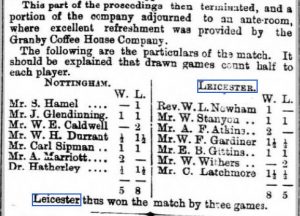
On 29 October 1880, he represented Leicester in a match against a visiting team from Nottingham Chess Club, where he faced Minor Pieces hero Arthur Towle Marriott.
The Leicester Chronicle (6 November 1880) reported what sounds like a convivial affair. Half way through, they all stopped playing to witness a presentation to Mr Sharland, the Leicester Club Secretary, who, in less than five years, had increased the club membership from 18 to 61. Various speeches were made before the gentlemen of Leicester and Nottingham resumed their games.
It seems that only one game was played on top board, while the other boards played two games each. Arthur Towle Marriott, the only Nottingham player to win both his games, seems to have been playing on too low a board.
Here’s his game with White.
The game followed well known (at the time) Evans Gambit theory for some way. Black’s 7th move is brave: 7… Nge7 and 7… d6 are most often played, but the engines like 7… Nf6 8. e5 d5. 10… b5 was also a bold choice: again 10… Nge7 would have been more circumspect. Marriott had stronger, but difficult, options on move 13, but his choice proved successful when the Leicester man blundered horribly in reply.
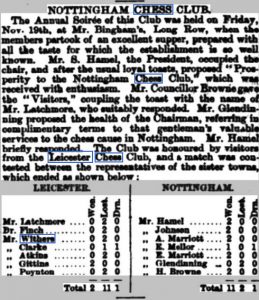
Three weeks later the Leicester chessers visited Nottingham for the return match, this time with a much weaker team. Mr Bingham’s restaurant provided an excellent supper, with speeches and toasts, before play started. Arthur Marriott, after his success in the earlier match, had been promoted to board 3, and again found himself facing William Withers.
The Nottingham Journal (27 November 1880) reported on an overwhelming victory for the home team. 11½-2½ was very different from the earlier 5-8 defeat.
These matches appear to have been social events rather than the competitive inter-club matches with which we’re all familiar. Although there was considerable interest in the result, the eating and drinking seemed just as important. Perhaps that’s how club matches should be.
Again, we have the game where Marriott played White against Withers.
This time, Withers chose to avoid the Evans Gambit, but playing 3… Nf6 without knowing the theory isn’t a good idea. Even then, it was known that 5… Nxd5 wasn’t best, giving White a choice of two strong options, 6. d4 and that primary school favourite, 6. Nxf7, the Fried Liver Attack.
Engines now confirm that 8… Ne7 in the Fried Liver is losing, but 8… Nb4 might just keep Black in the game. Marriott missed a couple of better moves, but Withers panicked on move 13, losing even more quickly and horribly than three weeks earlier.
By today’s standards, the chess of William John Withers makes a poor impression: a player with a patchy knowledge of opening theory along with tactical vulnerability.
Note that A F Atkins, who played for Leicester in these matches, was Arthur Frederick Atkins, originally from Coventry, and no relation to the great Henry Ernest Atkins, about whom more next time.
By now William had a new job: the 1881 census told us he was a bookseller in Loseby Lane, Leicester, only a few yards away from where a later and stronger Leicester chess player would, several decades later, also run a bookshop. You may well meet him in a future article. He was also just a short walk from what is now De Montfort University, the new home of the English Chess Federation library and also, as it happens, my alma mater.
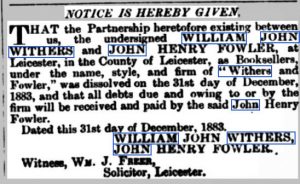
An announcement in the Leicester Journal (5 January 1884) suggests that his bookselling business hit a problem.
It was time for him to turn over a new leaf. By 1891 he was an antiques dealer, having moved just round the corner to Silver Street, and doing well enough to employ a servant. The 1901 and 1911 censuses told the same story: in the latter year he styled himself a ‘dealer in genuine antiques’.
At some point after that, perhaps after the death of his father in 1913, he moved to London. The 1921 census, due for release next January, will reveal more.
We can pick William up again in 1932, when he made his last will and testament, granting generous bequests to his children and grandchildren. Still working as an antique dealer, his address was given as 48 George Street, Manchester Square, WC1, only a few minutes’ stroll from 44 Baker Street, where, had he been able to travel through time, he’d have been able to stock up on the latest chess books.
His antique dealing had clearly been very successful. He died in 1934, and probate records reveal that he left effects to the value of £15,240 17s 9d, which, depending on how you calculate it, amounts to anywhere between one and seven million pounds in today’s money.
So there you have it. While his chess playing didn’t impress, he played an important role in chess life in Leicester. Away from the board, in both business and family life, he seems to have done very well for himself. Well played, William John Withers!
Continuing from my last article about Arthur Towle Marriott, I promised a series of articles on his Leicester opponents.
This is an interesting period in chess history, witnessing the start of inter-club competitions as we used to know them before Covid-19.
The two matches between Leicester and Nottingham in January and February 1877 seem to have been Leicester’s first matches against another club. Nottingham, however, had previous form: the earliest match I can find was against Derby in 1872. Train services from Nottingham to Derby started in 1839, with trains to Leicester available the following year, but by now rail transport had become more frequent and more affordable. It was the 3.35 servicethat took the Nottingham chess players to Leicester on 25 January 1877.
The following week the Leicester Journal reported:
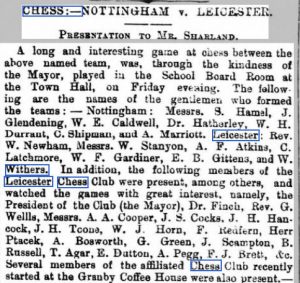
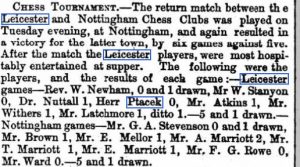
An interesting event in connection with this club, took place on Thursday week, in the Mayor’s Parlour of the old Town Hall, kindly lent for the occasion by the Mayor, W. Winterton Esq., when the majority of the members assembled to welcome six gentlemen of the Nottingham Chess Club, who arrived by the 3.35 train, to spend, by invitation, a few hours in friendly contest at Chess. The high reputation of the Nottingham Club, caused considerable interest to be felt in the visit, and it was thought that the home players would have but little chance of maintaining a creditable stand. When, therefore, at the close of the contest, it was found that Nottingham had won the match by only one in their favour, considerable gratification was experienced at so favourable a result. The following gentlemen represented the Nottingham Club: S. Hamel Esq., President, Messrs. Stevenson, Marriott, Glendenning, Brown, and Kirk, while Rev. W. L. Newham, Mr W. Stanyon (president), Dr. Nuttall, Herr Ptacek, Messrs. Atkins and Withers did battle for Leicester, winning eight games to their opponent’s nine. The play of the Nottingham gentlemen was much admired for the skill and ingenuity evinced, and, as a consequence of their visit to Leicester, it may be safely asserted that the impetus given to the study of this most intellectual of games among the members of the Home Club, will not soon pass away. The return match we are given to understand will be played at Nottingham on Tuesday next, February 6th, at the Club Room, Long-row. In connection with the Leicester Chess Club we are pleased to learn that its members during the present session have almost doubled, and that new life and energy seem to pervade all its movements.
Chess matches in those days were always described as ‘interesting’ (see also below). Or if not ‘interesting’, then ‘pleasant’.
(Note that the Mr Atkins active at that time was seemingly not related to the great Henry Ernest Atkins, about whom more later.)
It’s not clear from this report whether Nottingham’s Mr Marriott was Arthur or one of his brothers. Zavatarelli assumes it was Arthur: it’s possible that other reports not available online will confirm this.
The week after next, a Leicester team took the train north. Here’s the report from the Nottinghamshire Guardian:
On Tuesday evening a most interesting and spirited match at chess took place between the clubs of Nottingham and Leicester, at the rooms of the former, which are at Mr. Bingham’s restaurant, Long-row. Seven members of the Leicester club took part in the game against eight of Nottingham. About nine o’clock in the evening the members ofboth clubs adjourned, and sat down to supper, when Mr. Hamel, president of the Nottingham society, occupied the chair. After the usual loyal toasts had been honoured, that of “Continued success and prosperity to the Nottingham Chess Club” was proposed by the chairman and enthusiastically drunk. In the course of his remarks, the chairman referred in very feeling terms to the death of Mr. Thomas Hill, one of the oldest and most respected members of the club, and whose lost he (the chairman) was sure, must be deeply regretted and mourned by all. The president next referred to the Cambridge match, which had resulted so successfully, and to the honour of Nottingham – (hear, hear) – they having won both games, and having declared in one game a mate in ten moves, a point which the Cambridge University could not see. (Applause.) Dr. Worth, the vice-president, after alluding to his thirty years’ connection with the club, proposed, in a complimentary manner, the “Health of the Visitors”, which was responded to by the Rev. Mr. Newham, of Leicester, and Mr. Thompson, the celebrated problem composer of Derby, in very cordial terms. The health of the respected president (Mr. Hamel) having been proposed and drunk with due honours, the members left the supper table, and again proceeded with their games, which were carried on until a late hour. The following is a list of the players – Leicester, Messrs. Ptacek, Withers, Atkins, Latchmore, Stanyon, Nuttall, and the Rev. – Newham. Nottingham: Messrs. E. Marriott, T. Marriott, A. Marriott, Roe, Alderman W. G. Ward, Hugh Browne, T. A. Stevenson, and Mellors. At midnight, the contest was concluded, when it was announced that Nottingham had won six games, lost five, and drawn one. The match resulted in favour of Nottingham by one game.
We only have the names here, but, fortunately the Leicester Chronicle provided more details:
Leicester Chronicle 10 February 1877
Here, we’re told that Arthur Towle Marriott played on board 4 against Herr Ptacek, winning both his games.
Nottingham’s chess star Sigismund Hamel was present, but, for some reason, didn’t play in the match. However, he annotated (rather inaccurately, according to Stockfish 14) Arthur’s two games for the Nottingham Daily Express (not available online).
In the first game, Arthur’s opponent put up little resistance. This is why I often recommend the Ruy Lopez to novices. If Black isn’t familiar with the opening he can end up in a lost position very quickly. This is just the sort of game I like to use when introducing my pupils to this opening.
But who was Herr Ptacek? What was someone with such an exotic name doing in Leicester?
It’s a very good question, with a very interesting answer.
I really need to introduce you to Robert Ralph Noel.
R R Noel (1802-1883) was born in Kirkby Mallory (as in Mallory Park race circuit), the son of a clergyman. He was very well connected: knowing, either directly or indirectly, almost everyone who was anyone in 19th century England: George Eliot, Charles Darwin, Lord Byron (Ada Lovelace, a distant relation, lived in Kirkby Mallory as a young girl). He married a German Baroness whose family had an estate in Bohemia, which gave him connections to the likes of Goethe right across Europe. He wrote a book on phrenology, which you can, if you so desire (but I wouldn’t bother if I were you), read today.
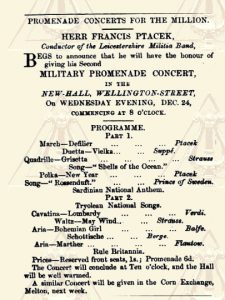
However, his day job involved running the Leicestershire Militia (the volunteer forces), and, like all forces in those days, they needed a good military band, with a good bandmaster to lead it. For much of the 19th century England was known as ‘the land without music’, so when a musician was required it was tempting to look abroad. Mrs Noel had heard good things about a young man from Prague called Franz Ptacek (he’d often be known as Francis in England), and, in 1854, he was engaged to run a military band in Leicester. It seems he was very successful and popular, but, after 12 years or so, following some sort of dispute, he felt obliged to resign his position.
He then set up a new orchestra and concert society, and resumed giving concerts in Leicester. He was also a composer, pianist and organist seemingly much in demand. Light classical music concerts (think the Strauss family: waltzes, polkas, marches, that sort of thing) were a very popular entertainment at the time. He was more ambitious than this, though, writing an opera and programming two of Handel’s great oratorios: Saul and Samson.
It’s time for some music. Ptacek was particularly renowned for his interpretation of the famous Dead March from Saul. I’d have liked to offer you the Leicester Militia playing this in 1860, but instead you’ll have to do with the next best thing: the Band of the Coldstream Guards recorded in 1910.
He also found time to indulge in his (and our) favourite hobby: chess. He was selected to represent his adopted city in what was perhaps their first competitive match, where he met our hero, Arthur Towle Marriott.
His play in the first game wasn’t at all impressive, but he conducted his troops rather better in the return game. Perhaps the supper provided by Bingham’s Restaurant had some effect. His Scotch Gambit led to a winning position, only for him to throw away the win with one careless mistake.
Chess matches in those days served a social rather than a competitive purpose. The result, while eagerly anticipated, didn’t really matter that much. It was more an excuse for players from neighbouring towns or cities to meet for some enjoyable games, with a supper in between. Over the next decade or so there would be many changes, as you’ll see in future Minor Pieces.
A few years later, though, something went wrong. For a second time he lost his orchestra and had to resort to teaching the pianoforte, taking private pupils as well as acting as a peripatetic teacher at Miss Lomas’s school.
At Christmas 1885, Ptacek travelled to Chatham to spend the holiday period with his friend Rudolf Sawerthal, another Czech born military musician. He was just about to return to Leicester when he suffered a fatal heart attack, at the age of only 52.
The Leicester Chronicle published a lengthy obituary:
It is with feelings of sincere regret that we announce the death of Herr Ptacek, which took place at Chatham on Thursday morning. The death of this eminent local musician was totally unexpected, and the intelligence of his sudden decease was received with great surprise amongst his intimate friends. About ten days ago Herr Ptacek proceeded to Chatham on a visit to Herr Sawerthal, the accomplished master of the band of the Royal Engineers, whose performance in the Floral Hall during Christmas week gave such exceptional satisfaction to everyone who heard them. He contemplated returning to Leicester on Thursday morning, and had made every preparation for his departure, when he was suddenly seized with pain at the heart. A medical man was immediately summoned, but before he could arrive Herr Ptacek had expired. A telegram was shortly afterwards despatched to Mr. J. Herbert Marshall, of the Rutland-Street music depot, one of the deceased’s most intimate friends, and that gentleman communicated the sad intelligence to his friends in Leicester, all of whom heard the occurrence with much regret. To many the name Herr Ptacek will be unknown, but his name will not be forgotten by those ardent lovers of music who twenty years ago were charmed with the brilliant company of artistes he gathered around him. The deceased came to Leicester a comparative stranger, but his abilities soon won favourable recognition, and he speedily became possessed of amerited reputation for musical accomplishments, which was not confined to the limits of the borough. In 1855 Herr Ptacek was introduced to Leicester by Major and Mrs Noel, who were convinced of his sterling worth as an organiser and conductor. He left Prague, where he had been brought up under cultivating influences, and took charge of the militia band, which was in want of complete and thorough organisation. So well did Herr Ptacek succeed at his appointed task that before long the band was selected to play before the Queen at Aldershot, and the fine playing of the men under his control elicited warm expressions of Royal approval. The band subsequently played several times before a distinguished company at Belvoir Castle. Some disagreement ultimately took place between him and the officers of the regiment, in consequence of which – in order to maintain his self-respect – he felt it necessary to resign. The resignation was accepted, and he renounced the position of bandmaster, amid many expressions of regret. His efforts to improve the musical taste of the town were not, however, forgotten. On December 16, 1867, he was presented by Mr. T. T. Paget, M.P., at a largely-attended meeting of influential inhabitants, with a purse containing 150 guineas, as some acknowledgement of the efforts he had put forth for twelve years to cultivate musical taste and provide for the public enjoyment. The purse was worked by Mrs Noel, and, in accepting the gift, Herr Ptacek made a humorous and appropriate speech. Some time after his severance of the connection with the militia band, Herr Ptacek organised a band of his own, which he trained to an exceptional point of perfection, and also became the conductor of the New Orpheus Society, a musical association partly, if not completely, antagonistic to the then Philharmonic Society. His charge of that society was marked by masterful activity, his abilities in controlling the resources of an orchestra being strikingly exhibited. Under the auspices of this society, Samson and Saul were given before large audiences in the chief hall of the town, and the magnificent way in which the “Dead March” was rendered has not yet faded from the recollection of those who heard it. Herr Ptacek also for about 14 years filled the position of organist at St. George’s Church, where his cultivated playing was greatly appreciated. He excelled more as a pianist than as an organist, although his skill in playing the more ponderous instrument was of no mean order. Upon his retirement from active musical life he was again the recipient of a testimonial subscribed for by his admiring friends. He lived in comparative retirement, and his name has not been connected with musical efforts in the town for many years past, although we believe he continued to take pupils who wished to e instructed in the mysteries of the pianoforte. From the commencement of his labours in Leicester his energies had been invariably directed towards the education of the inhabitants, and in this respect he has probably never been excelled, although it would be idle to say he has not been equalled. He was uniformly courteous, and his geniality endeared him to all who came in contact with him. His life was arduous and self-sacrificing, and the news of his death will not fall to awaken feelings of sorrow. He was about 52 years of age. We understand that instructions have been given to have the deceased interred in the Leicester Cemetery.
His memorial unfortunately misspells both his names, making him Frances rather than Francis (‘i’ for ‘im, ‘e’ for ‘er, as my mother taught me).
The inscription reads, in part:
An accomplished musician he was endeared to his many pupils and to all who knew him, not more by his varied attainments than by his honesty and frankness and by the warmth of his attainments. Those who now sorrow over his grave may well say he came among us as a stranger and he departed leaving many warm and devoted friends.
This site provides more information: his date of birth is given as 1831, but this may be wrong: other records suggest it was 2 December 1832. It’s also incorrect in stating that his wife was Czech.
Further information, including from a source about Masonic Music and Musicians in Leicestershire and Rutland, can be found here.
As far as I can tell, none of his music has survived, but I did find a polka written by his friend Rudolf Sawerthal, arranged for accordion:
There you have it: Arthur Towle Marriott’s opponent Francis Ptacek leads us on a tour of chess and musical life in Leicester in the 1870s and 1880s. Who will we discover next? You’ll find out here soon enough.
And, by the way, if you’re interested in the sociology of chess in the English Midlands in the 19th century, you can read Rob Ensor’s 2016 Masters Thesis on Nottingham chess here. My thanks to Rob for making this available, and also to John Swain for bringing it to my attention.
It’s Monday 28 August 1871. Join me at Simpson’s Divan in the Strand, where, after a satisfying lunch of roast beef, accompanied by a bottle of their finest claret, followed by a glass of brandy and a Havana cigar, we adjourn to the chess room to watch the great Wilhelm Steinitz in action.
He introduces us to his friend Mr Sich, who is, he informs us, a wine merchant. The two gentlemen are engaged in an exciting battle. At one point Herr Steinitz is a rook ahead but his king seems to be in trouble. He manages to survive and win the game, but could Mr Sich have done better?
I reach into my pocket. “Look, Herr Steinitz! I’m a time traveller from 150 years into the future. I can press a few buttons on this small machine and talk to anyone in the world. I can press a few more buttons, enter the moves of the game you just played and show you both where you went wrong.”
“You might have been impressed by Ajeeb, but my machine is a million times better. You see, Mr Sich, you might have played your rook to queen one on move 28, announcing check to Herr Steinitz’s king. You were still winning, though, but on move 32, if you’d played your queen to queen’s knight five you could then have exchanged everything off on queen seven and advanced your king’s bishop’s pawn to the end of the board. Two moves later, you could still have drawn by exchanging rooks, but instead you left your own king defenceless.”
But now it’s time to bid our farewells and leave: we have a journey to make. Our destination is Hammersmith. We’re excited by the prospect of travelling on the Underground Railway, so head for Charing Cross Station. Just eight weeks earlier, following a banquet attended by Mr Gladstone two days previously, the District Railway started running trains round part of what would become the Inner Circle. In a few years time we’ll be able to take the train directly to Hammersmith, and the line will later be extended to exotic destinations such as Richmond and Ealing. 90 years later a schoolboy playing his friends on the train between Ravenscourt Park and Richmond will develop a lifelong chess obsession, but that’s another story for another time.
For now, we must take the underground train as far as Paddington, and change onto the Hammersmith and City Railway. When we reach our destination we spot a pub called the George just round the corner: it was rebuilt in 1911 and is now part of the Belushi’s chain. We could stop for a drink there, or in several other pubs nearby, but instead we’ll take a stroll down King Street.
After half a mile or so we’ll pass what is now Hammersmith Town Hall, which we visited in our last journey, and notice, in 2021, that it’s being redeveloped. If we look across the street we’ll see Dalling Road, and the building which, we hope, will soon be the site of a new Mind Sports Centre.
Then we pass another pub. This was the Hampshire Hog, but is now just the Hampshire, serving Indian cuisine as well as beers, wines and spirits. Mine’s a pint of London Pride: what are you having?
Why have I brought you here? Because this pub, like the George and many others in the area, was owned by the Sich family. The brewery was purchased by one John Sich in 1790 and later run by his sons, John junior and Henry. The two brothers both had numerous children, many of whom were involved in the family business.
But let’s stop there. News has just come in that Herr Steinitz and Mr A Sich played again two days after the game we witnessed. Again, Herr Steinitz survived a totally lost position to win, in an encounter which was even more exciting that their previous game, with a lot of bamboozling tactics. Probably worth a separate article, I think.
You’ll notice that Mr S missed a simple mate in 5 on move 38 before blundering away first the win and then the draw. Still impressive, though, that he could achieve winning positions in level play against the world’s strongest active player.
What else do we know about him? He was very active in the St James’s Club from 1860 onwards, where he was a second category player, receiving odds from Loewenthal and Valentine Green, but conceding odds to weaker players. We’ll meet at least one of his opponents, EE Humphreys, in a later article. He played published games on level terms against Steinitz in 1871, as we’ve seen, and against Loewenthal in 1873 and 1874, before disappearing from the chess scene. Tim Harding comments that his forename is unknown, but perhaps we can find out. Let’s continue our walk.
Back in the 1960s, when such things were allowed, the Hampshire Hog was the place where teachers from nearby Latymer Upper School would take their pupils for a drink. We’re now going to head away from King Street towards the river. Not so easy to cross the Great West Road, but we could perhaps cheat (as I’m an alumnus they might let me in) by following in the distinguished footsteps of the likes of GM Michael Stean and IM David Goodman, taking the school’s Secret Subway to the dining hall and the Prep department, and then out onto Upper Mall.
We’re now at the start of the notorious Round the River Run (or, in my case, walk) which takes you along the river, over Barnes Railway Bridge, along the towpath on the other side, across Hammersmith Bridge and back to where you started. We won’t do that now, not least because Hammersmith Bridge is currently closed for repairs, but will take a gentle walk by the river in the direction of Chiswick.
Passing the Old Ship, we’ll stop off at the Black Lion. Thanks for offering: I’ll have another pint of Pride. It would be rude not to, given how close we are to where it’s brewed. Above one of the corner tables is a portrait of local resident AP Herbert, whose wife was regularly seen at the Hammersmith Town Hall chess tournaments.
While we’re here, news comes in that Herr Steinitz and Mr A Sich have played another game.
I’m not sure what 7. Ng5 was all about: my pupils get their knuckles rapped if they play moves like that. Steinitz chose to go for the attack rather than regain the exchange on move 26, but Sich missed a draw on move 34.
It’s time to continue our walk, passing Fuller’s (London Pride) Brewery and soon reaching St Nicholas’s Church. Turning up Church Street towards the busy Hogarth Roundabout, a stark contrast to the bucolic views of the Thames, you’ll see a tower on your right with the words LAMB BREWERY. This was the name of the Sich family concern: little other than the tower remains.
But we still haven’t identified A Sich. Let’s return to John and Henry. John had a son named Alexander who was born in 1837, while, two years later, Henry’s son Arthur John was born. So we have two gentlemen named A Sich who were of the right age. As he was active from 1860 onwards, the older cousin seems more likely. A better reason is that, in the days when people were referred to by their full initials and surnames, the chess player was always ‘A. Sich’, never ‘A.J. Sich’. We also know from Steinitz that he was a wine merchant. As it happens, 1871 was a census year, so let’s travel back 150 years again and join the enumerator.
Here, in Church Street, where we’re standing now, is Arthur John, a brewer, with his wife and children. And just round the corner, in Sunbury House, The Mall, Chiswick, is Alexander, a wine merchant, with his wife (who just happened to be Arthur’s sister Helen: nothing like keeping it in the family) and children. This seems confirmation that it was Alex, not Artie, who played chess against Steinitz. We know quite a lot more about them as well. Al was very much concerned with municipal affairs throughout his life, while Art was involved with the army volunteers. Unlike his cousin, he seemed to prefer real soldiers to wooden soldiers.
Time for a final drink, I think. While we’re at the Hogarth Roundabout we could choose the George & Devonshire, which has probably always been a Fuller’s pub, but, to continue the theme of our pub crawl, we might prefer to walk up towards Turnham Green to visit another former Sich pub, the Lamb (formerly the Barley Mow, but its name was changed to that of the original brewery).
While we’re there, there’s another game to look at. Steinitz is White again and plays the King’s Gambit. Again, Sich is doing well at one point, but misdefends, allowing a neat sacrificial finish.
We could, I suppose, visit the Watermans Arms in Brentford, which comes with a recommendation from food critic and West London Chess Club secretary Andy Hayler. Close by is the Watermans Arts Centre, which in turn is across the road from the rather wonderful Musical Museum and a short walk from the London Museum of Water and Steam, which itself is just across the railway line from the new Brentford Stadium. Will they be seeing Premiership football there next season, I wonder?
We could also travel further west to the Bell in Hounslow. Back in the 1980s or thereabouts Hounslow Chess Club met nearby, and the Bell was often the venue for our post mortems after we played them in the Thames Valley League. There are plenty of other former Sich pubs still around as well: see the link below.
Before I leave you, there’s one further reference connecting Alexander Sich to the game of chess.
In 1903 the Chiswick Library Committee, of which Alex was a member, decided to allow their committee room to be used as a games room. Chess, draughts and dominoes were provided so that the local louts could avoid trouble by playing some nice quiet games.
Unfortunately, it didn’t work out as planned. The boys resorted to games of their own: ‘coddam’, noisy larking, horse-play and pitching cinders. The good citizens of Chiswick were not at all happy, and, after a few weeks, the club was closed down. Alexander Sich said that he did not regret that they had made the experiment. It could hardly have been more different from the pre-lockdown chess group at Whitton Library. There’s a moral there somewhere, but I’m not sure what it is. (Coddam, since you asked, is ‘an old game, usually with three players on each side, based around guessing which of the players’ hands is hiding a coin or button.’)
Meanwhile, the Sich Brewery hit problems during the First World War and was sold off in 1920. Their neighbour, Fuller’s, however, survives and thrives to this day.
This is the second of a series of articles about Steinitz’s English amateur opponents. The next instalment will be coming shortly.
Boroljub Zlatanovic was born in Cuprija, Serbia, 05 August 1977 • Meet chess in 4 years old watching father and his brother playing • Entered first club “Radnicki” Cuprija in 7 years • FM since 1994 ( however, it was recognized in 1998) • Serbian youth champion in 1995 • Champion of Belgrade University in 2001 and 2002 • Many times won Serbian team championship (in youth competition also) • IM since 2014 • FT since 2015 • Winner of many open, blitz and rapid and internet events • Professional coach for more than 15 years • Author and contributor in American chess magazine since 2019
FM Boroljub Zlatanovic
From the rear cover :
“This book would bring something new into your chess library. In computer era focus is usually on openings. Watching broadcasts new generations rather choose games with favorite opening played seeking for some interesting idea or even brilliant novelty. I offer and recommend different concept, based on famous Soviet chess school. Focus should be on understanding strategy concepts, principles and inner logic. Fashionable opening lines will be forgotten (or re-evaluated) sooner or later, but understanding cannot be lost and can be only upgraded. It is sad to see some player well equipped with opening lines, unable to realize big positional advantage in deep endgame. So, our advice is to learn about Strategy and Logic. The book is highly recommended for club players, advanced players and masters, although even higher rated players can find a lot of useful things for themselves. There is no doubt lower rated players will learn a lot about thinking process and making decisions, while some logical principles can be good advice for strong players also.”
Another review :
“Zlatanovic uses a light touch of his notes, limiting the complexity of his analysis and working to clearly explain the logic of positional decisions and ideas. Using examples both well-known and less studied, class and club players are taught quite a bit about basic positional play. I certainly leaned a thing of two. Johh Hartmann – Chess Life – April 2020.”
As with every recent Thinkers Publishing publication high quality paper is used and the printing is clear. The book can easily be laid flat next to the board and does not require weights to prevent it from “self-closing” (a particular bugbear of ours !). Each diagram is clear and the instructional text is typeset in two column format, which, we find, enables the reader to maintain their place easily. Figurine algebraic notation is used throughout and the diagrams are placed adjacent to the relevant text and each diagram has a “to move” indicator.
There is no index which, unfortunately, is a standard omission of Thinkers Publishing books. Also missing is a bibliography.
This is a massive book, over 500 pages and is a collection of classic games, with instructive notes. It is more or less designed for the club player. There is a bit of blurb on the back cover stating that the book will be useful to advanced players and masters, but I am not at all sure about that.
I cannot see advanced players buying this book.
Apparently, the book is based on the same principles as the famous Soviet school of chess. Strategy, logic and understanding should take pride of place, even in our computer era. I agree, but I don’t need the Soviet school of chess to tell me that. I can work that out for myself.
The book is beautifully produced and is very easy to read. It retails at a whopping £29.95 in the UK.
As there are so many books of the same type around, what I was looking for was a bit of originality. At the very least , all of the games should have been from the last 20 years, trying to unravel the complexity of the modern game.
What I found were games that I almost all seen before. There are only 15 games in the entire book that come from the period 2000-2020. None from Magnus Carlsen, for instance. This was disappointing.
Players under 1800 will get the most out of this book and trainers will have a ready source of lesson plans, if they are willing to make what is a hefty investment.
I give this book 3 out of 5 stars. Three out of Five Stars
IM Andrew Martin, Bramley, Surrey 4th August 2020
IM Andrew Martin
Book Details :
Hardcover : 512 pages
Publisher:Thinkers Publishing; 1 edition (19 Mar. 2020)
We focus on the British Chess Scene Past & Present!
This website uses cookies to improve your experience. We'll assume you're ok with this, but you can opt-out if you wish. Cookie settingsACCEPT
Privacy & Cookies Policy
Privacy Overview
This website uses cookies to improve your experience while you navigate through the website. Out of these cookies, the cookies that are categorized as necessary are stored on your browser as they are as essential for the working of basic functionalities of the website. We also use third-party cookies that help us analyze and understand how you use this website. These cookies will be stored in your browser only with your consent. You also have the option to opt-out of these cookies. But opting out of some of these cookies may have an effect on your browsing experience.
Necessary cookies are absolutely essential for the website to function properly. This category only includes cookies that ensures basic functionalities and security features of the website. These cookies do not store any personal information.
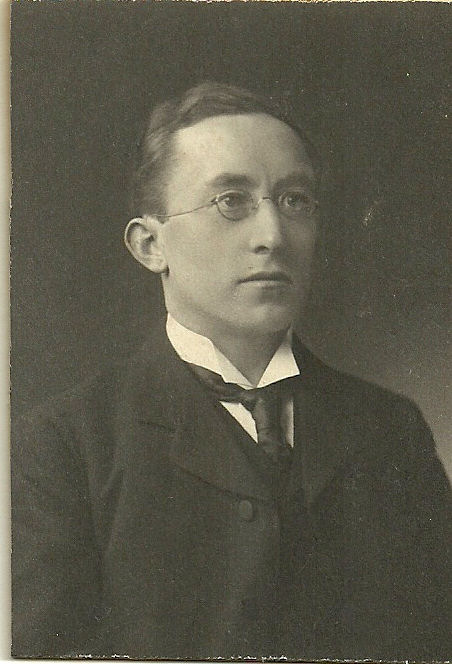
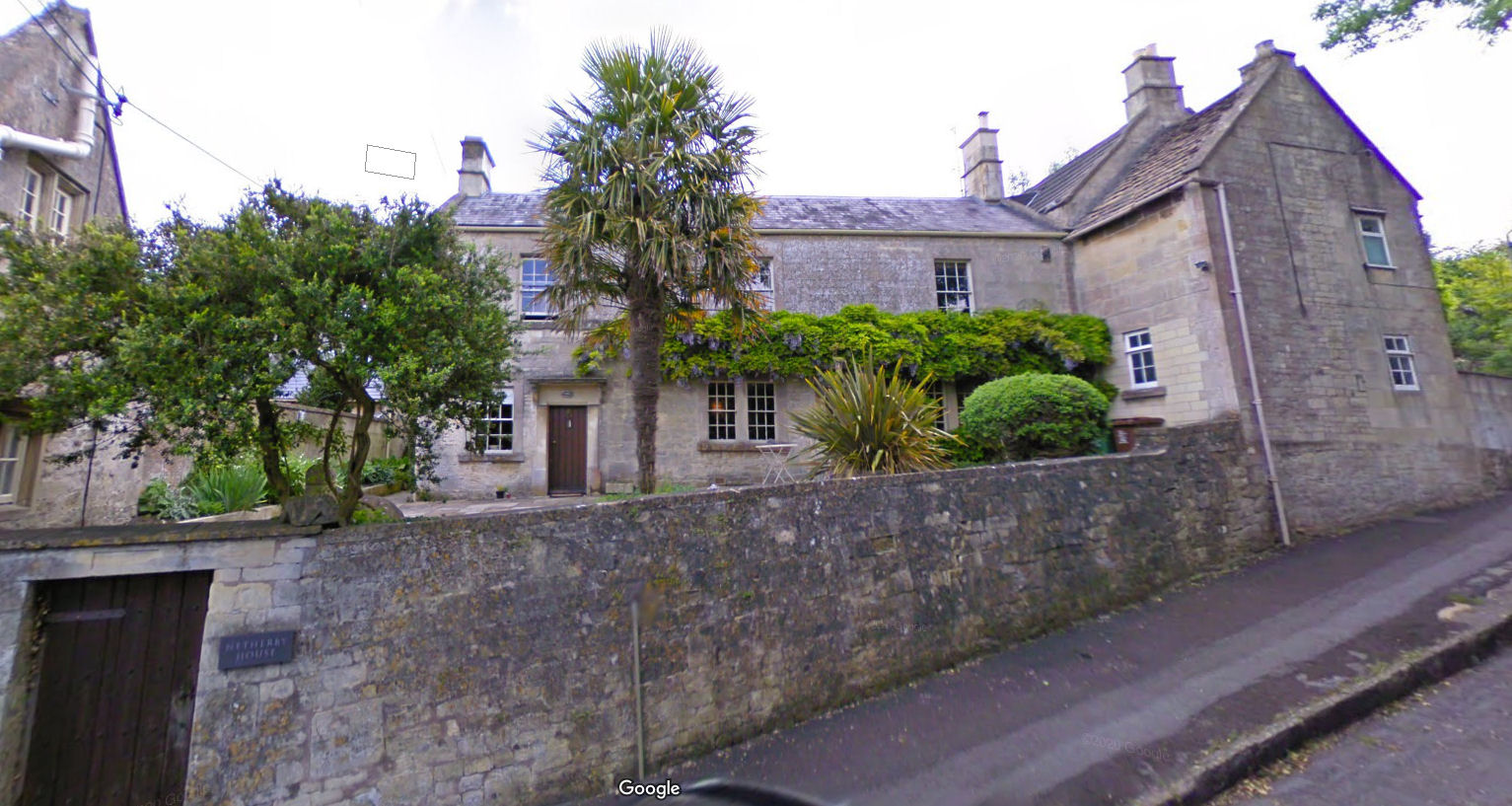
 Save as PDF