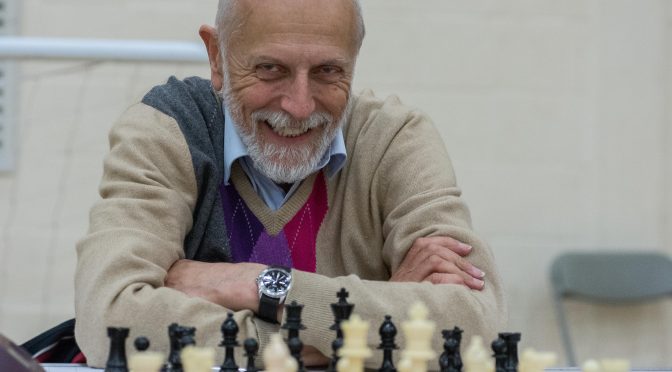
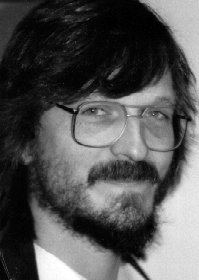
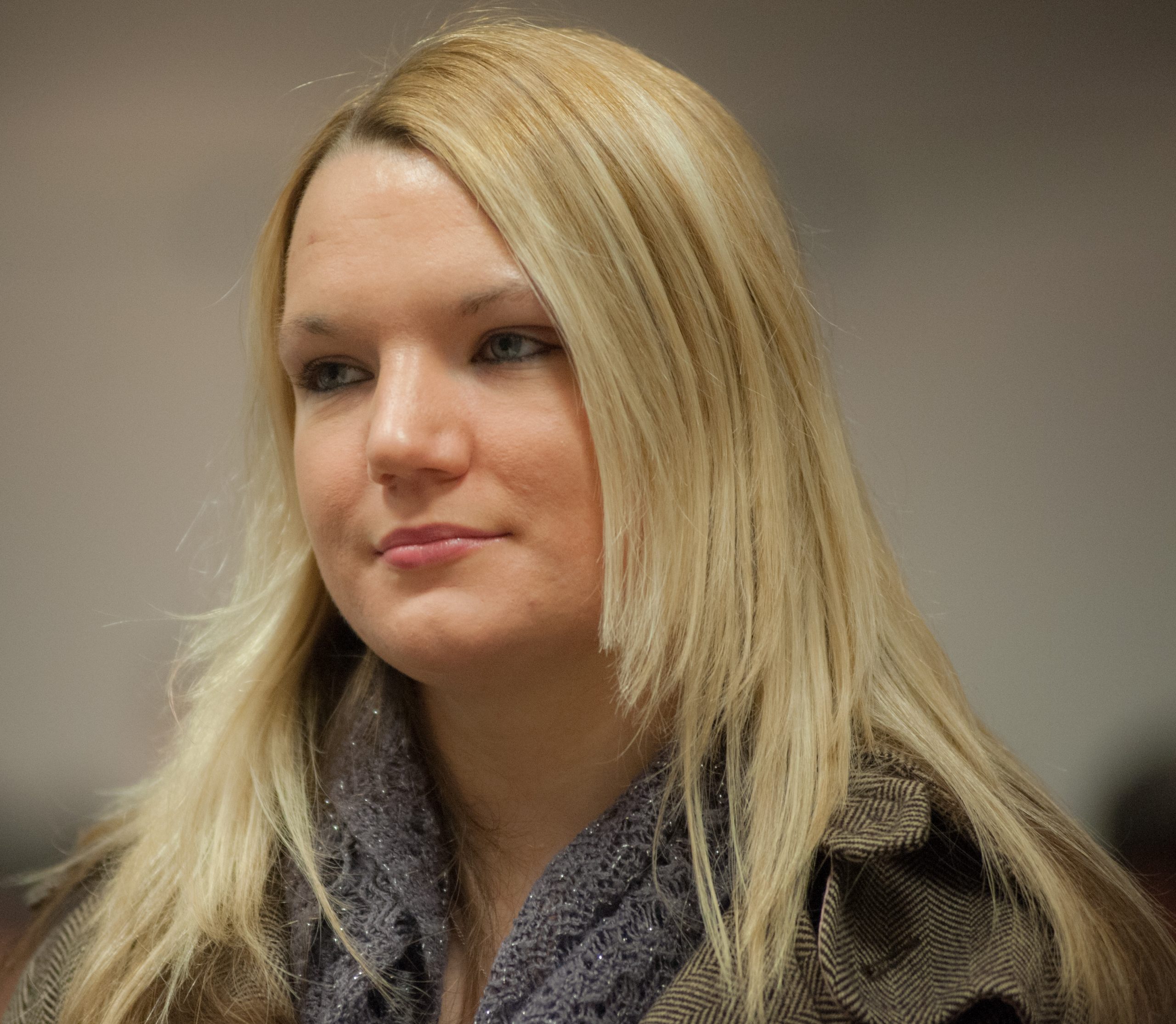
IM Lawrence Hugh Cooper, photograph from Cathy Rogers
BCN wishes Happy Birthday to IM Lawrence Cooper (16-vii-1970)
Lawrence was born in Stone, Staffordshire and attend Walton High School, Stafford.
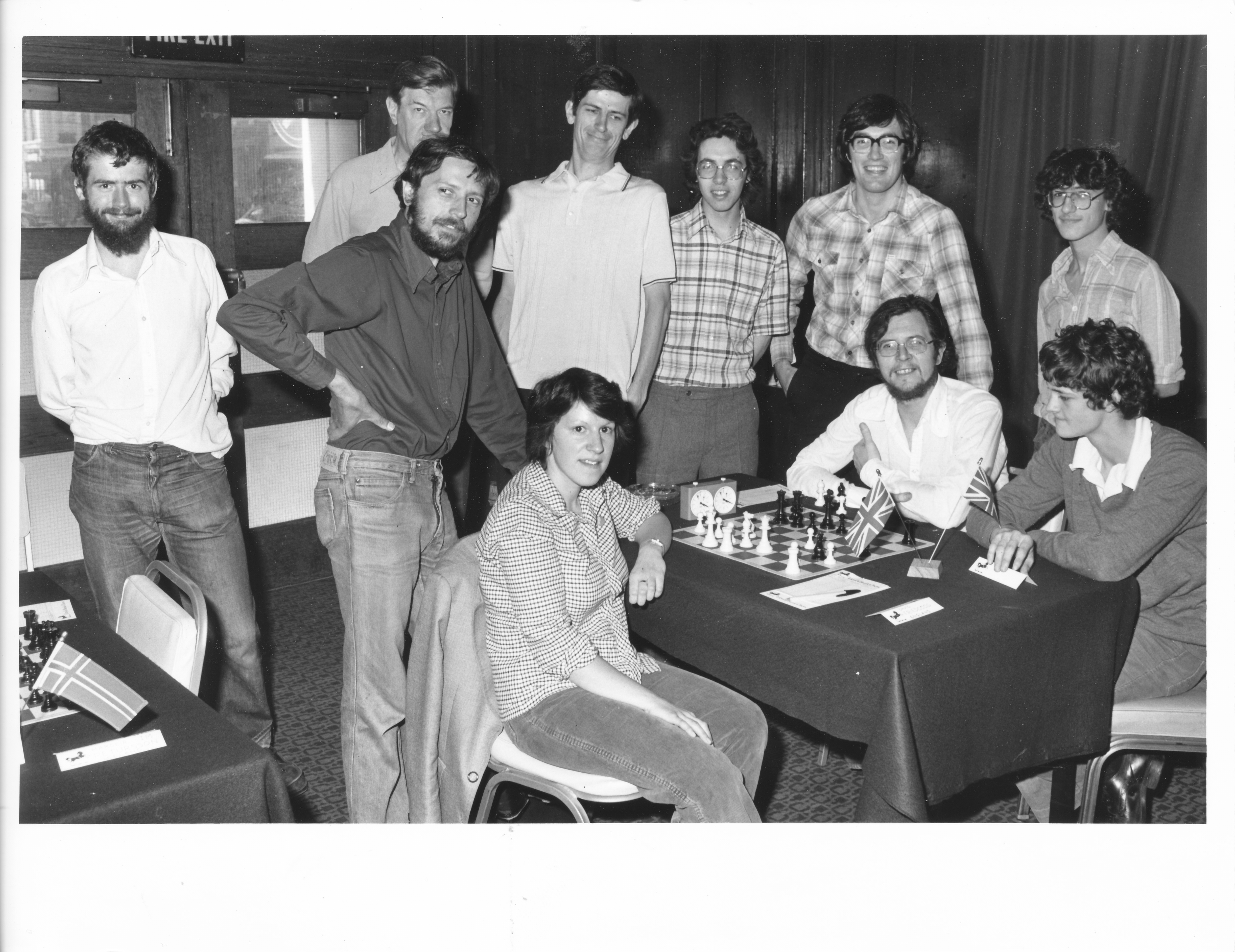
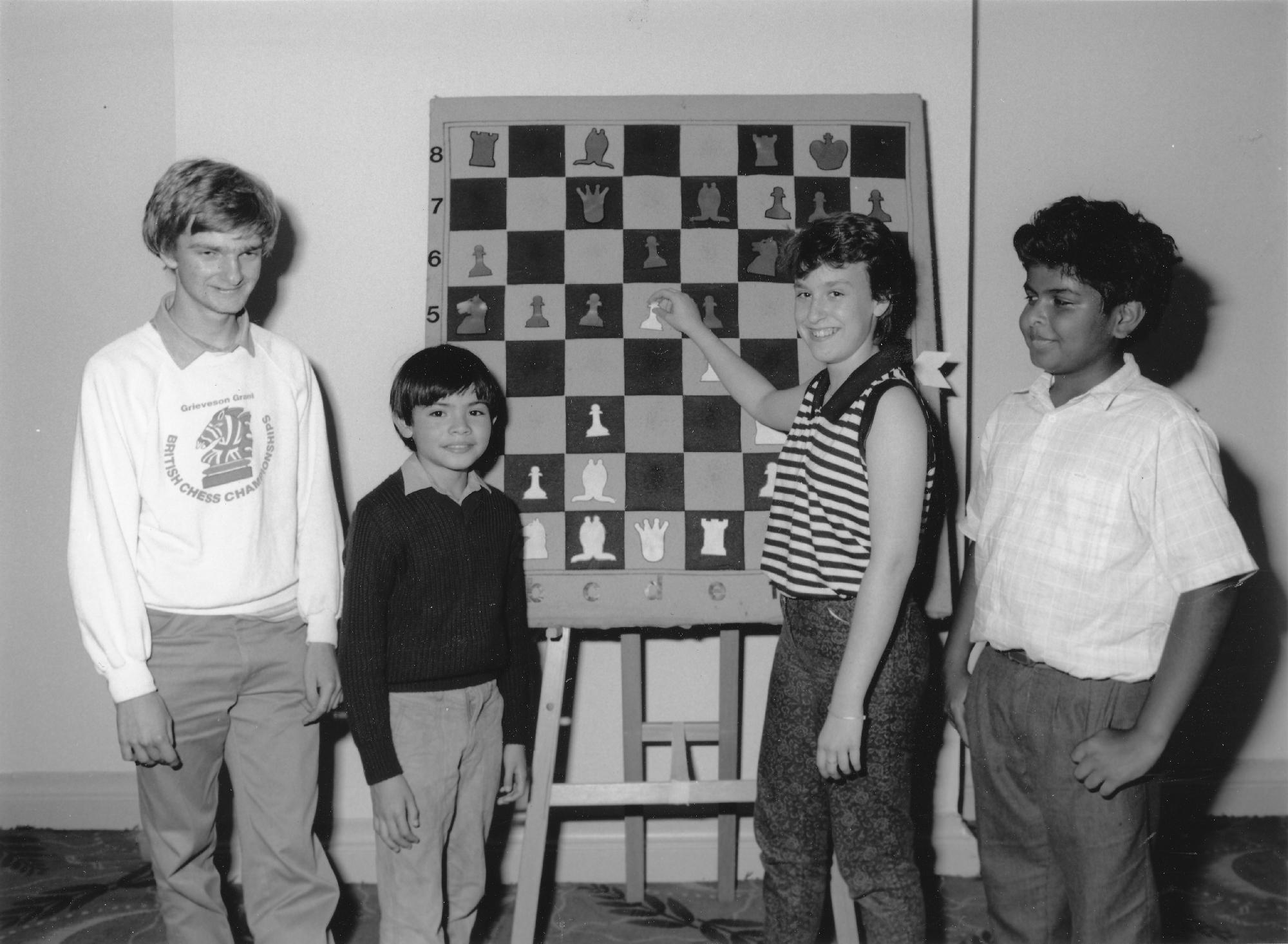
Lawrence Cooper, Demis Hassabis, Cathy Haslinger and Dharshan Kumaran in around 1986. Possibly at a Lloyds Bank event.
He became a FIDE Master in 1989 and then an International Master in 2001.
Lawrence was awarded the FIDE International Organiser title in 2011 and the FIDE Arbiter title in 2016.
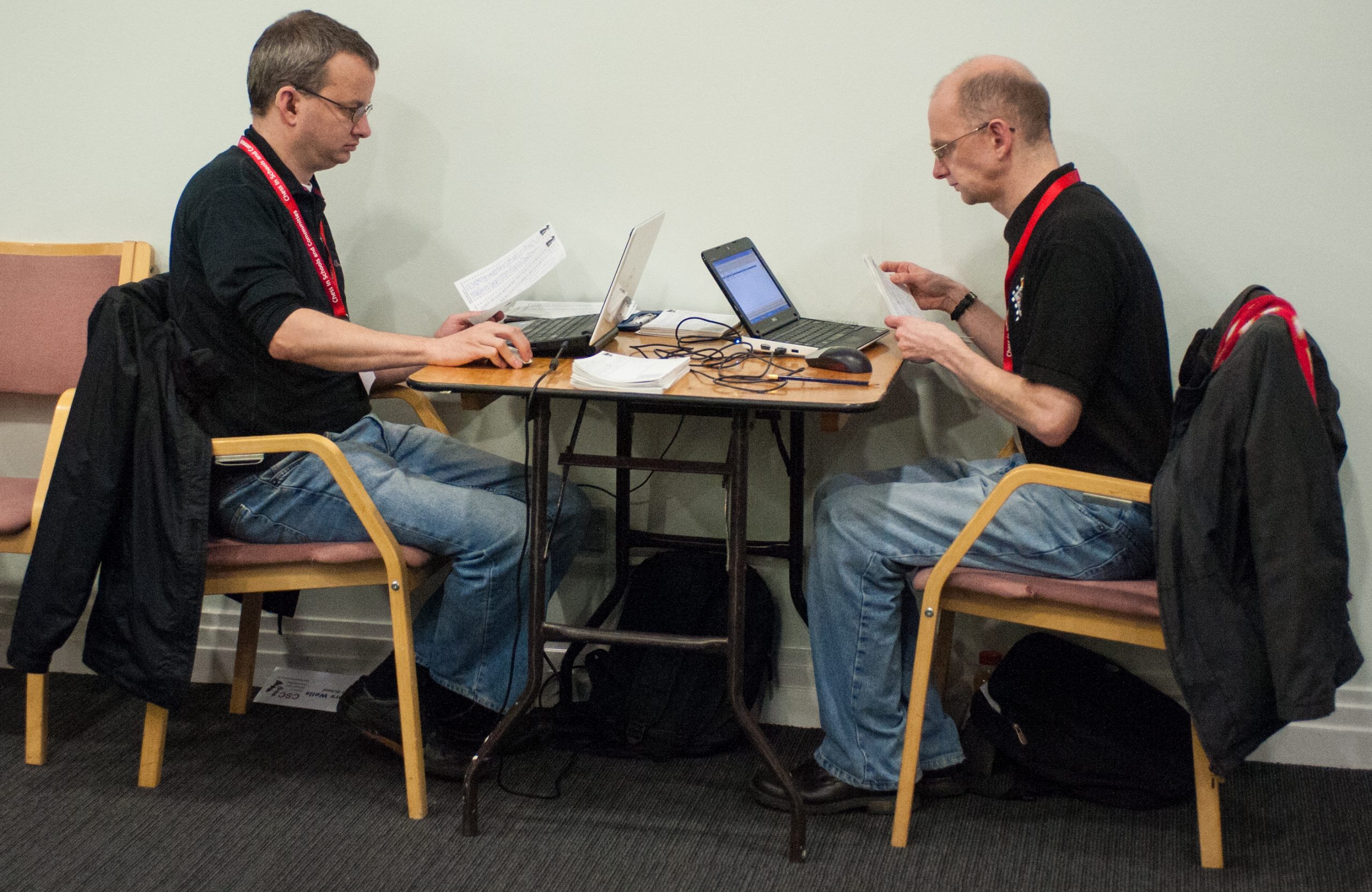
Tim Dickinson and Lawrence Cooper at the 2012 London Chess Classic, Olympia
His peak rating was 2430 in January 1988.
Lawrence plays for Wood Green in the Four Nations Chess League (4NCL) plus Newport (Shropshire), Stafford, Bushbury and Worcestershire CCA in other competitions.
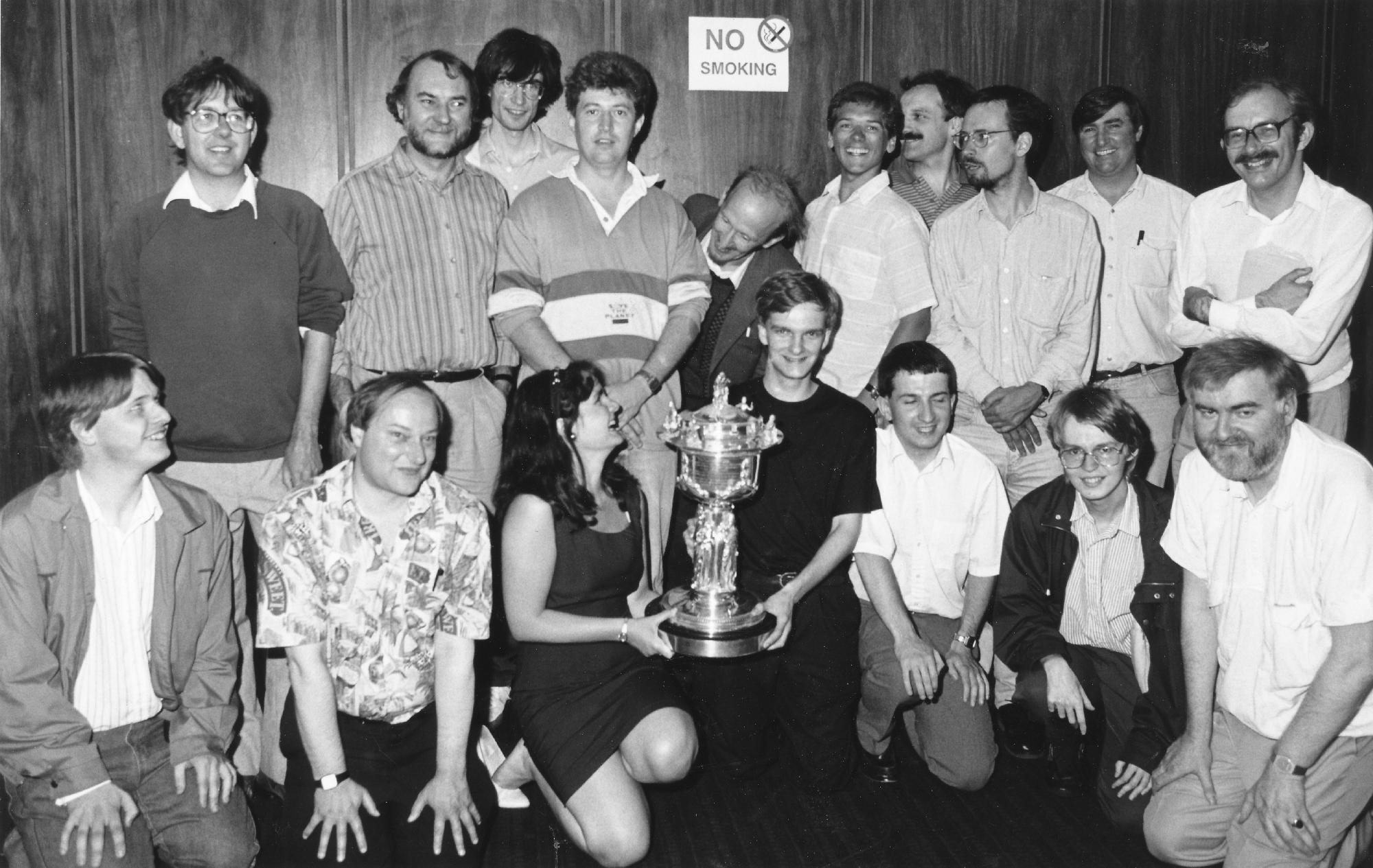
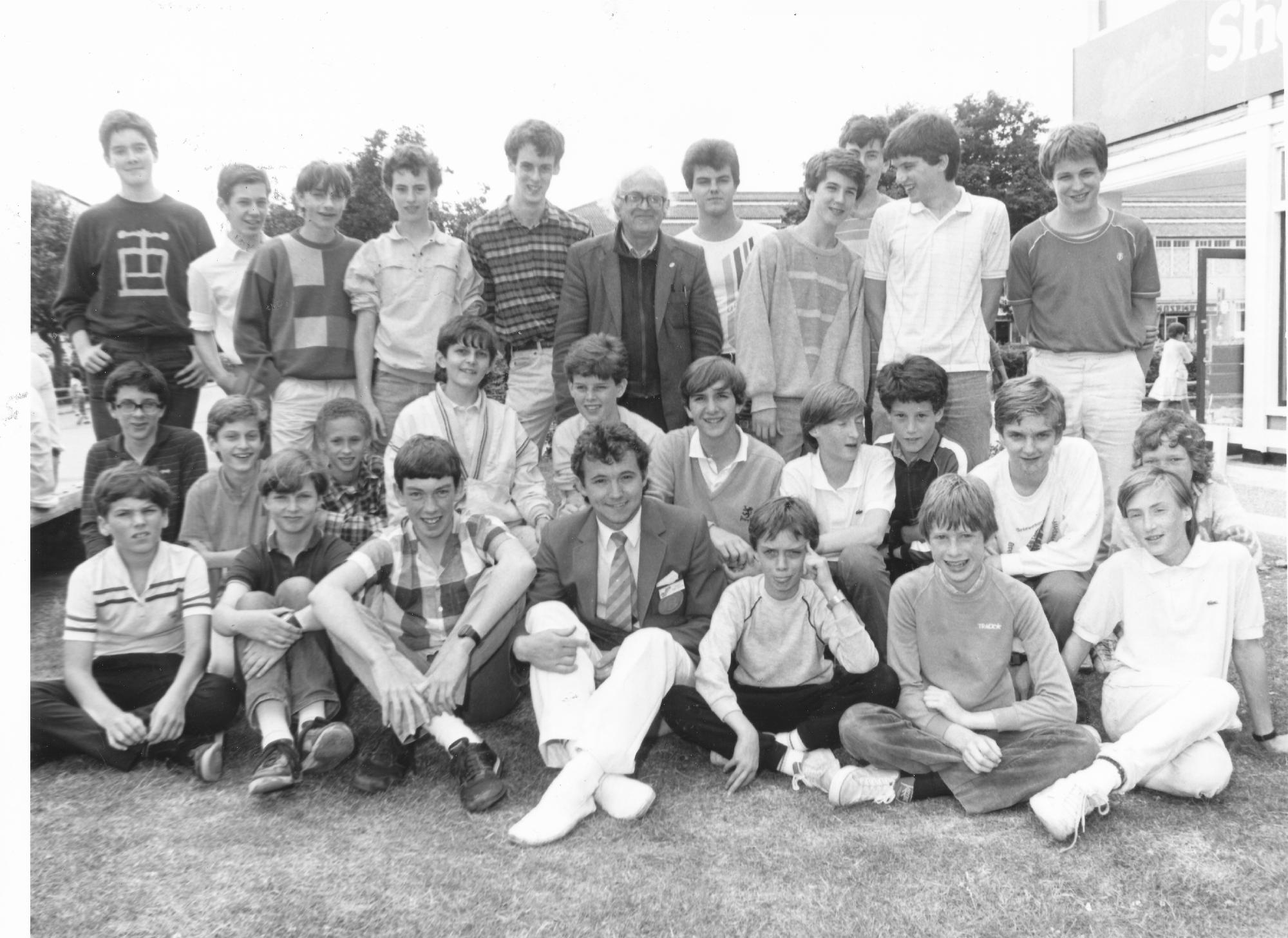
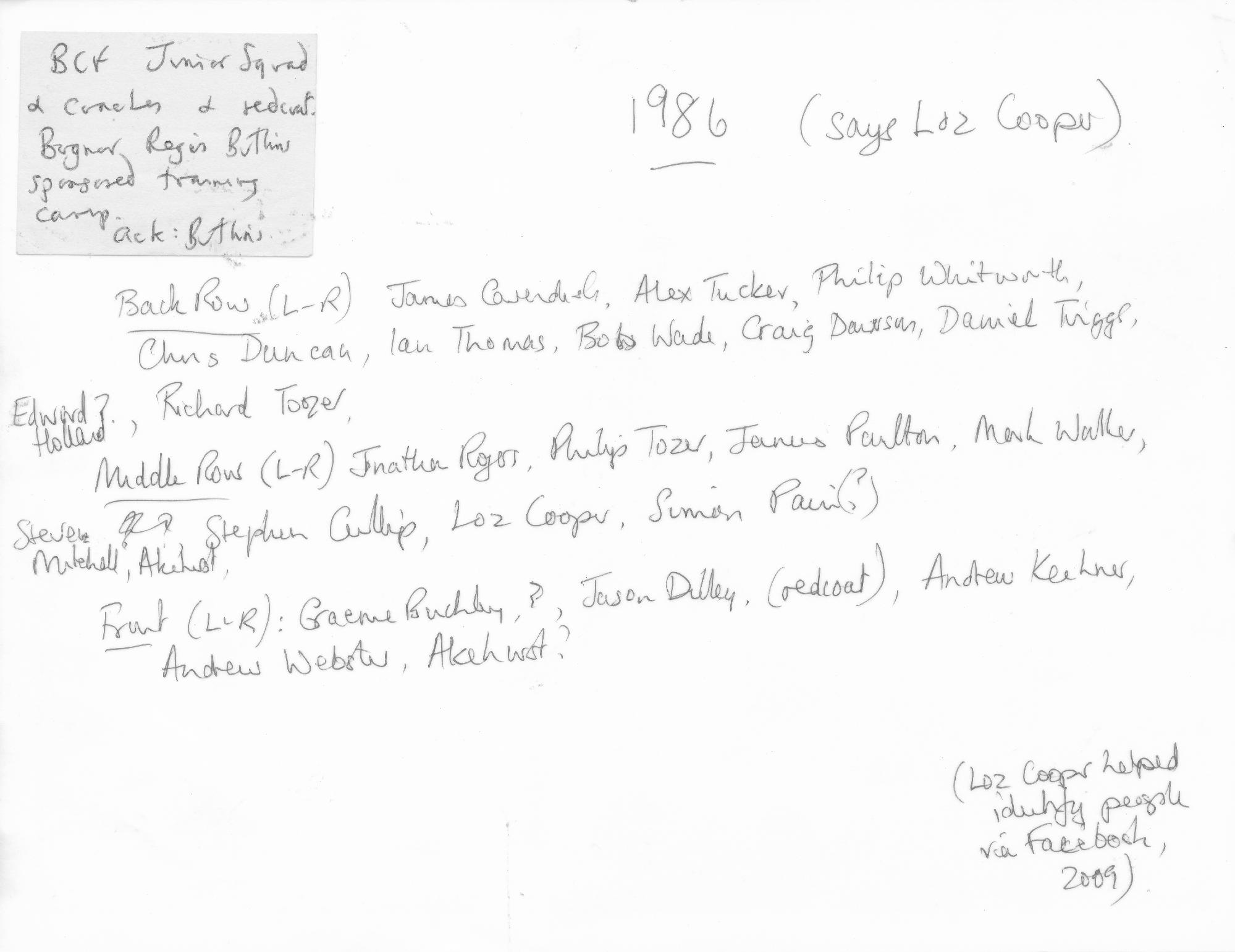
Lawrence Cooper (centre with trophy) being presented with 1992 BCF Counties Championship trophy by WIM Cathy Forbes. Others in the group include Michael Gough, Alan A Smith, Gerald Acey, Mike P Townsend, Malcolm Armstrong, Martin Costley, Alan Crombleholme, Graeme N Buckley, Paul Wallace, Mark A . Wheeler, Dave Carless, Darren P Wheeler, Keith Thompson, Ralph MA Allen and Graham SmithFull caption in image belowFull caption for above 1986 BCF Junior Squad group photograph
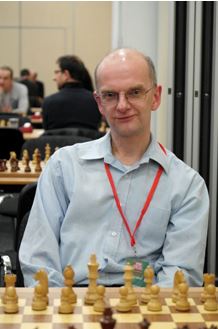
IM Lawrence Cooper, photography by Fiona Steil-Antoni
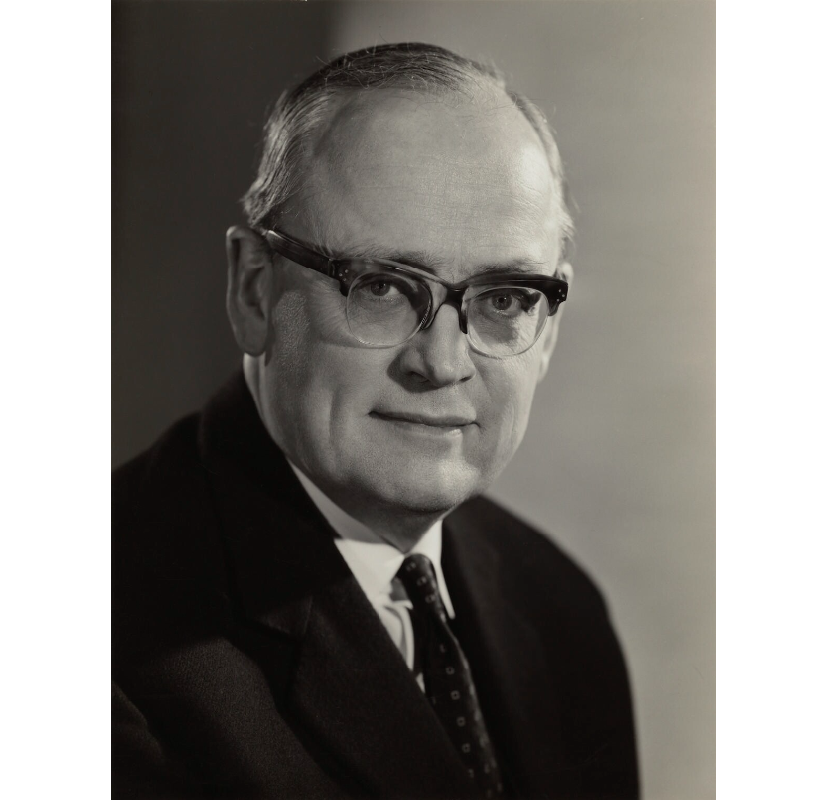
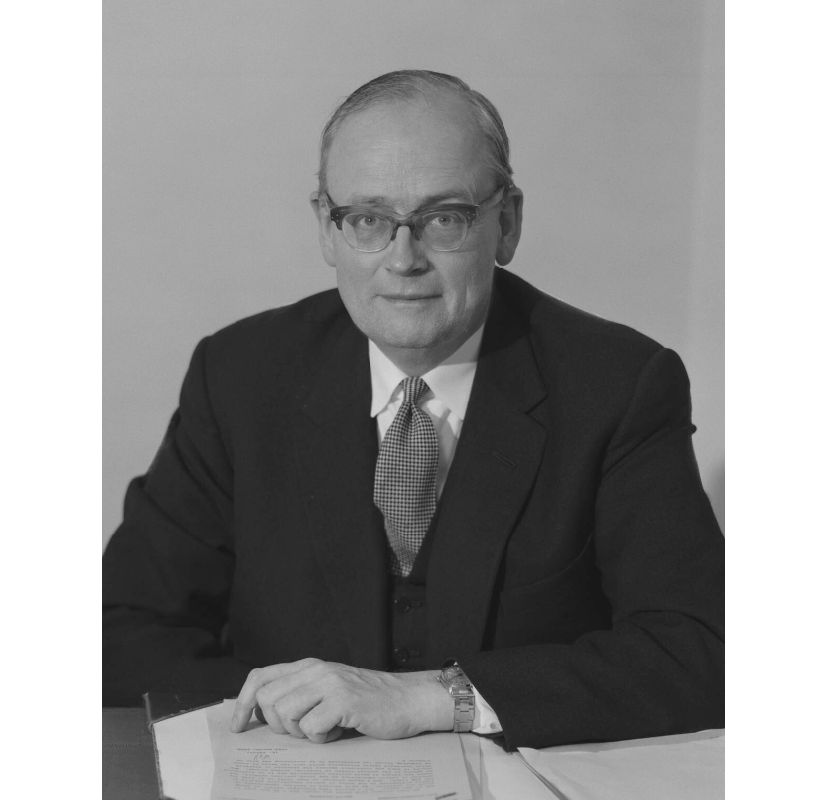
Sir Richard Clarke (13-viii-1910 21-vi-1975), National Portrait Gallery, Walter Bird
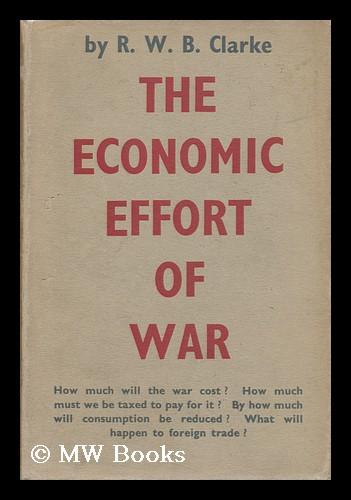
BCN Remembers Sir Richard Clarke KCB OBE who passed away on June 21st 1975.
According to chess-poster.com : “Clarke died in the University College Hospital, in London, on 21 June 1975 and was cremated at Golders Green three days later. He was survived by his wife Brenda Pile (married in 1950, née Skinner) and their three sons.”
One of those sons is Charles Rodway Clarke along with his brothers Mark G and Timothy Rodway.
Richard William Barnes Clarke was born on August 13th, 1910 in Basford, Derbyshire. The birth was registered in Ilkeston in the district of Erewash. His parents were a secondary and technical school schoolmaster of science, William Thomas Clarke and Helen Rodway Clarke (née Barnes). Richard was baptised on October 1st 1910 in St. Lawrence (Anglican) Church in Heanor, Derbyshire.
The 1911 census records the family living at “Iona” which was a modest property in Fletcher Street in Heanor which had six rooms. Richard was seven months old and he had a three year old sister, Stella Helen Clarke. The family retained a nineteen year old domestic servant, Ada Mary Brown who has been born in Codnor, Derbyshire.
Richard was educated at Christ’s Hospital, London followed by Clare College, Cambridge. At University he studied mathematics specialising in statistics. He was ranked at the sixth “wrangler“. Subsequently he was awarded the Frances Wood Prize by the Royal Statistical Society.
In 1944 Richard was awarded the OBE for his work as Planning Officer for the Ministry of Production followed by Companion of the Bath in 1951 for his work as Under Secretary at HM Treasury and in 1964 he was made Knight Commander of the Bath for his work as Second Secretary at HM Treasury.
According to chess-poster.com : “He was commonly known as Otto Clarke” and according to his son Mark the nickname “Otto” was possibly because of Clarke’s “forceful” personality was considered Germanic. According to Sir Sam Brittan, “it was because his round glasses and the bridge over the nose looked like OTTO.”
From The Oxford Companion to Chess by Hooper & Whyld :
Creator of the British system of grading. He gave up active chess after leaving Cambridge University where he played second board between C.H.O’D. Alexander and Jacob Bronowski.
At first a financial journalist (one of the two who created the Financial Times Index), he became, at the outbreak of the Second World War, a temporary civil servant, remaining to become one of the most distinguished of them, and to receive a knighthood.
According to Arpad E. Elo in “Ratings of Chessplayers Past and Present” : “In the chess world, rating systems have been used with varying degrees of success for over twenty-five years. Those which have survived a share a common principle in that they combine the percentage score achieved by a player with the rating of his competition. They use similar formulae for the evaluation of performance and differ mainly in the elaboration of the scales. The most notable are the Ingo (Hoesskinger 1948), the Harkness (Harkness 1956), and the British Chess Federation (Clarke 1957) systems. These received acceptance because they produced ranking lists which generally agreed with the personal estimates made by knowledgeable chessplayers.”
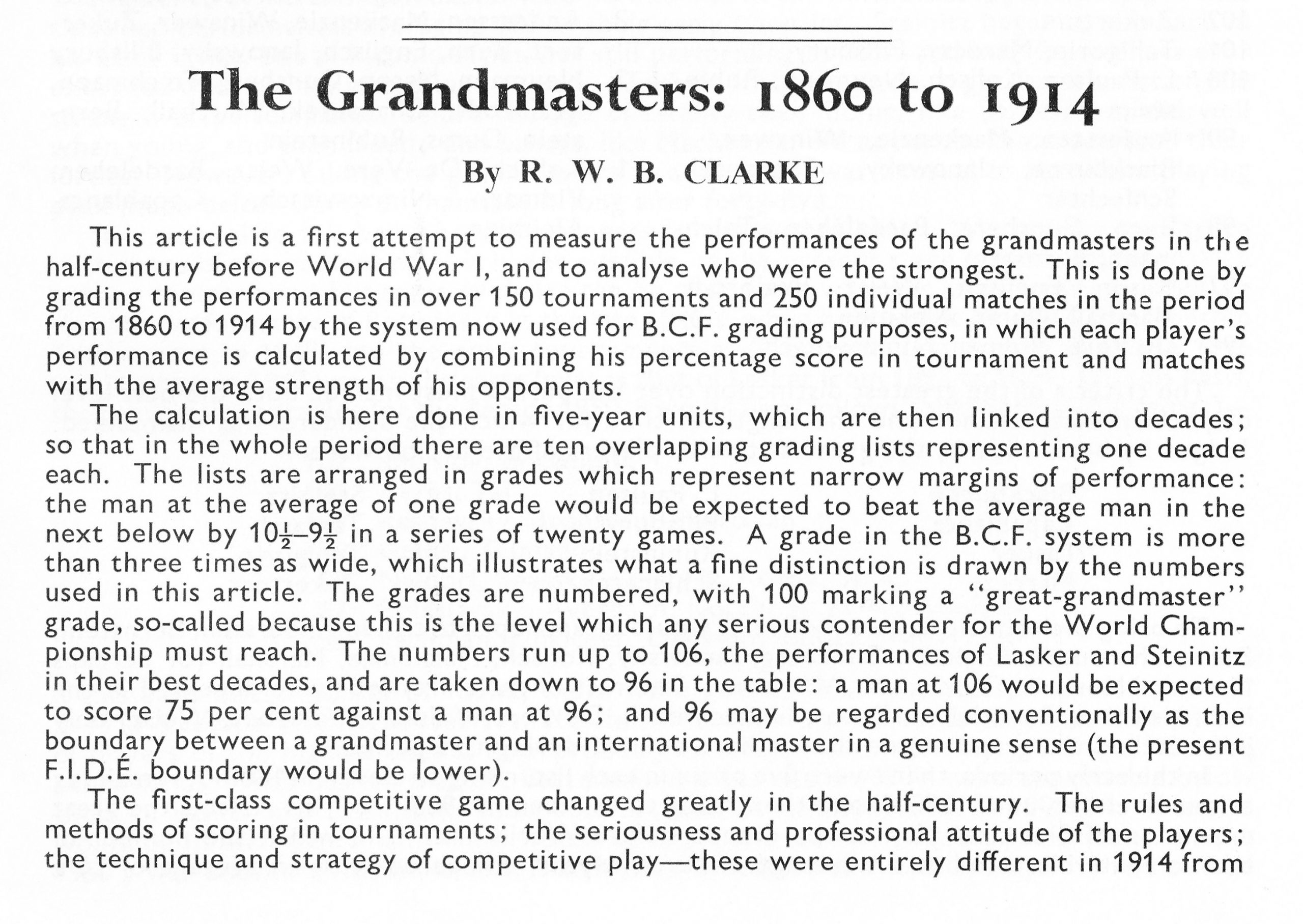
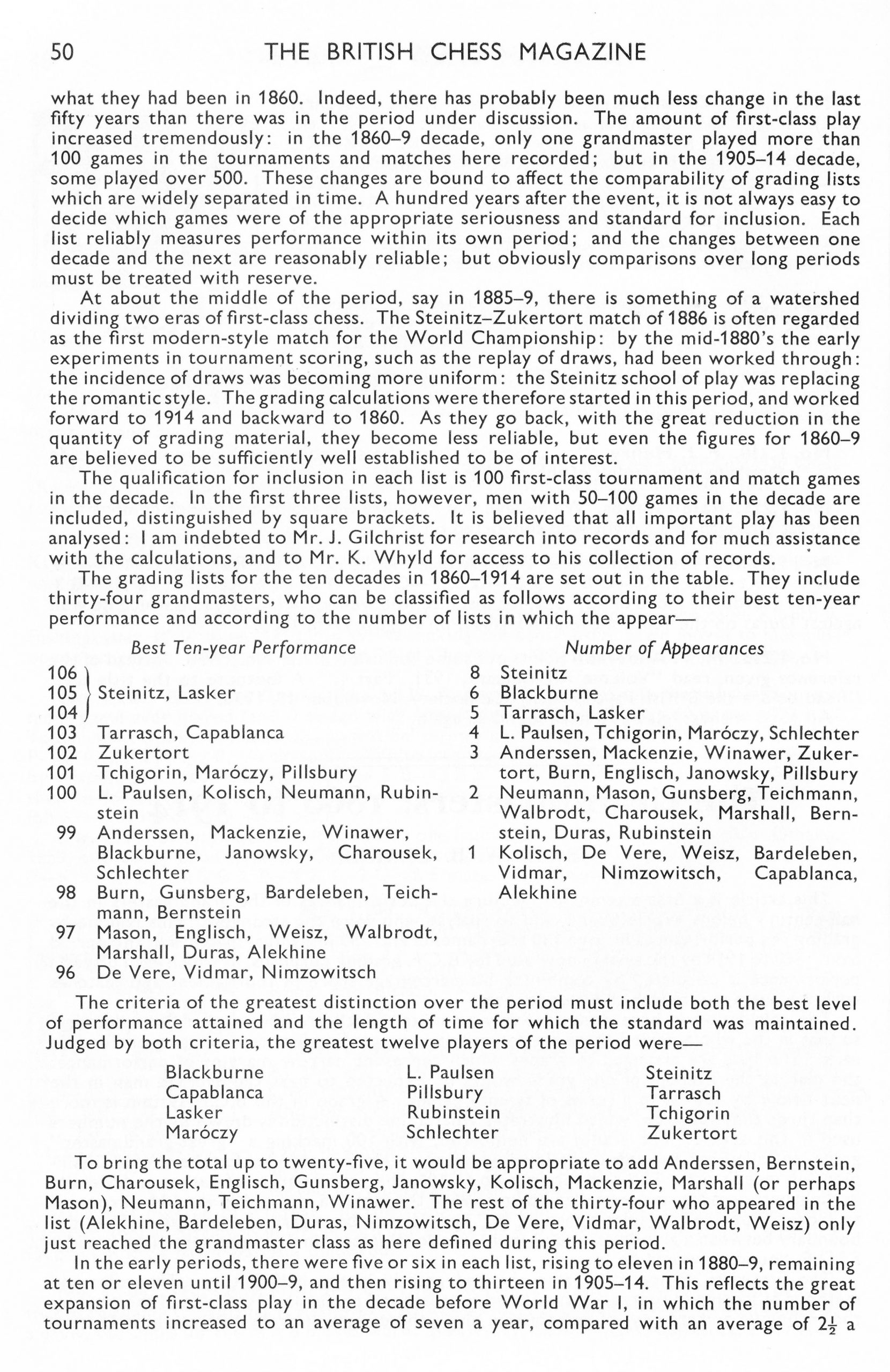
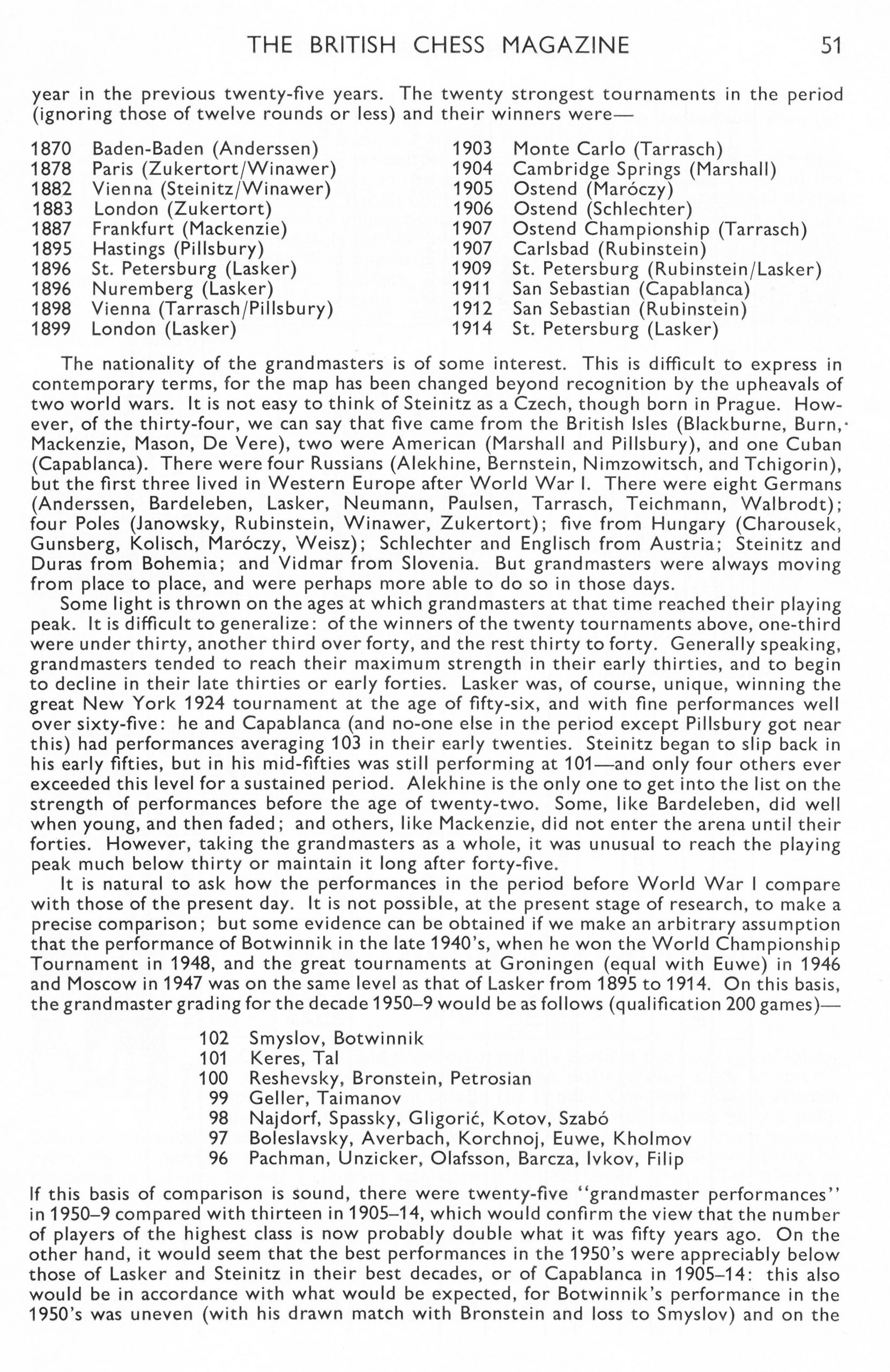
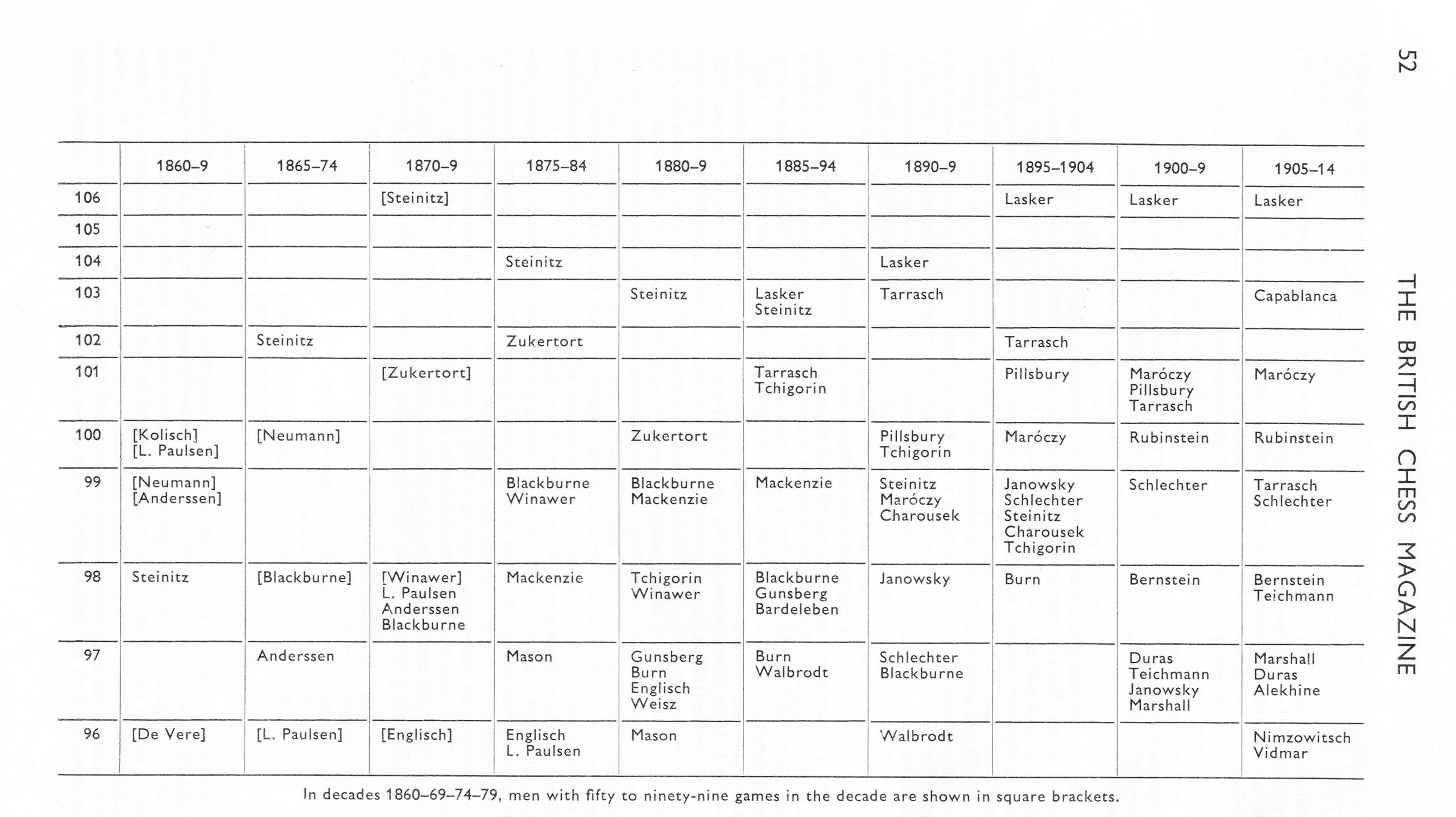
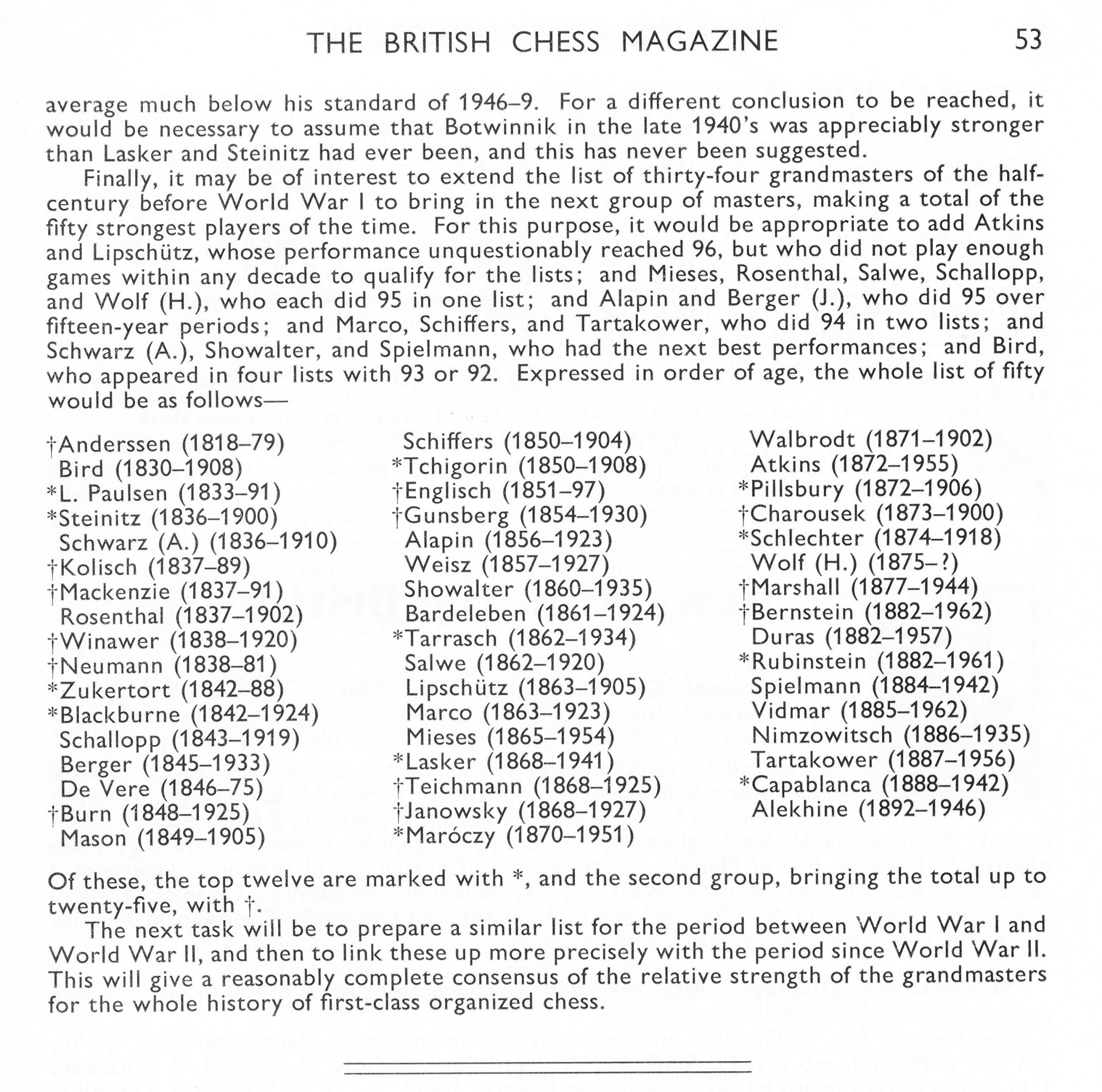
Here is an article in full reproduced from British Chess Magazine, Volume LXXXIII, Number 2, February, 1963, pages 49 -53 :
British Chess Magazine, Volume LXXXIII, Number 2, February, 1963, page 49British Chess Magazine, Volume LXXXIII, Number 2, February, 1963, page 50British Chess Magazine, Volume LXXXIII, Number 2, February, 1963, page 51British Chess Magazine, Volume LXXXIII, Number 2, February, 1963, page 52British Chess Magazine, Volume LXXXIII, Number 2, February, 1963, page 53
The June 1975 issue of British Chess Magazine announces his passing and promises that a tribute would follow : it never did.
Sir Richard Clarke (13-viii-1910 21-vi-1975), National Portrait Gallery, Rex Coleman
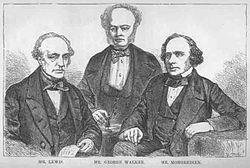
William Lewis, George Walker and Augustus Mongredien
BCN Remembers George Walker (13-iii-1803 23-iv-1879)
From The Encyclopedia of Chess by Anne Sunnucks :
“Leading organiser and chess columnist in the last century. Born on 13th March 1803. Founded the Westminster Chess Club in 1831. Published New Treatise on Chess in 1832 and Chess and Chess Players in 1850. Edited the chess column in Bell’s Life of London from 1835 to 1870. Died on 23rd April 1879.
From The Oxford Companion to Chess by Hooper & Whyld :
“English chess writer and propagandist. Born over his father’s bookshop in London he later became a music publisher in partnership with his father. At a time when he was receiving odds of a rook from Lewis he had the temerity to edit a chess column in the Lancet (1823-4); the first such column to appear in a periodical, it was, perhaps fortunately, short-lived. He tried his hand at composing problems, with unmemorable results; but his play improved. In the early 1830s he was receiving odds of pawn and move from McDonnell, after whose death (1835) Walker was, for a few years, London’s strongest active player.
Walker’s importance, however, lies in the many other contributions he made to the game. He founded chess clubs, notably the Westminster at Huttman’s in 1831 and the St George’s at Hanover
Square in 1843. From 1835 to 1873 he edited a column in Bell’s Life , a popular Sunday paper featuring sport and scandal. Many of his contributions were perfunctory, but on occasion he wrote at length of news, gossip, and personalities in a rollicking style suitable for such a paper. As with many of his writings he was more enthusiastic than accurate. He edited England’s first chess magazine The Philidorian (1837-8). Above all, Walker published many books at a low price: they sold widely and did much to popularize the game. The third edition of his New Treatise (1841) was as useful a manual as could he bought at the time and its section on the Evans gambit was praised by Jaenisch, Walker established the custom of recording games, and his Chess Studies (1844), containing 1,020 games played from 1780 to 1844, has become a classic. For the first time players could study the game as it was played and not as authors, each with his own bias, supposed it should be played. Throughout his life Walker helped chess-players in need. He raised funds for La Bqurdonnais, Capt. W. D. Evans, and other players, and often for their destitute widows.
After his father died (1847) Walker sold their business and became a stockbroker, reducing his chess activities but continuing ‘his many kindnesses. With an outgoing personality he enjoyed the company of those, such as La Bourdonnais, whom he called “jolly good fellows’, an epithet which might well be applied to himself. He was occasionally at odds with Lewis, who was jealous of his own reputation, and Staunton, imperious and touchy; but it seems unlikely that the easy-going Walker, who believed that chess should be enjoyed, intentionally initiated these disputes. He left a small but excellent library of more than 300 books and his own manuscript translations of the works of Cozio, Lolli, and other masters. He should not be confused with William Greenwood Walker who recorded the games of the Bourdon-nais-McDonnell matches 1834, and died soon afterwards “full of years’.
Walker is buried at Kensal Green Cemetery, also known as All Souls Cemetery, Harrow Road, Kensal Green, London Borough of Brent, Greater London, W10 4RA England.
The Walker Attack is a variation of the Allagier Gambit :
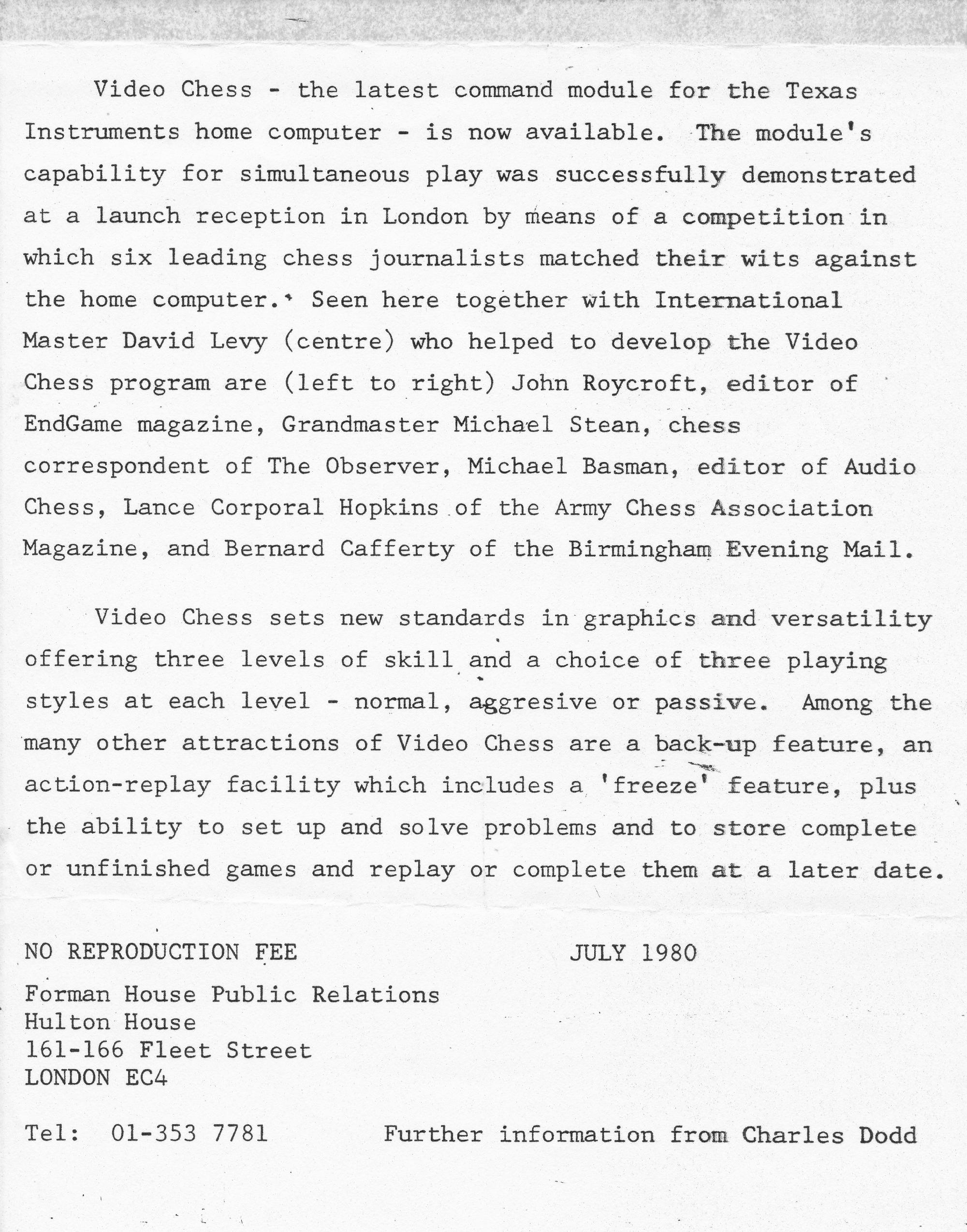
We remember IM Michael Basman who passed away on October 26th, 2022
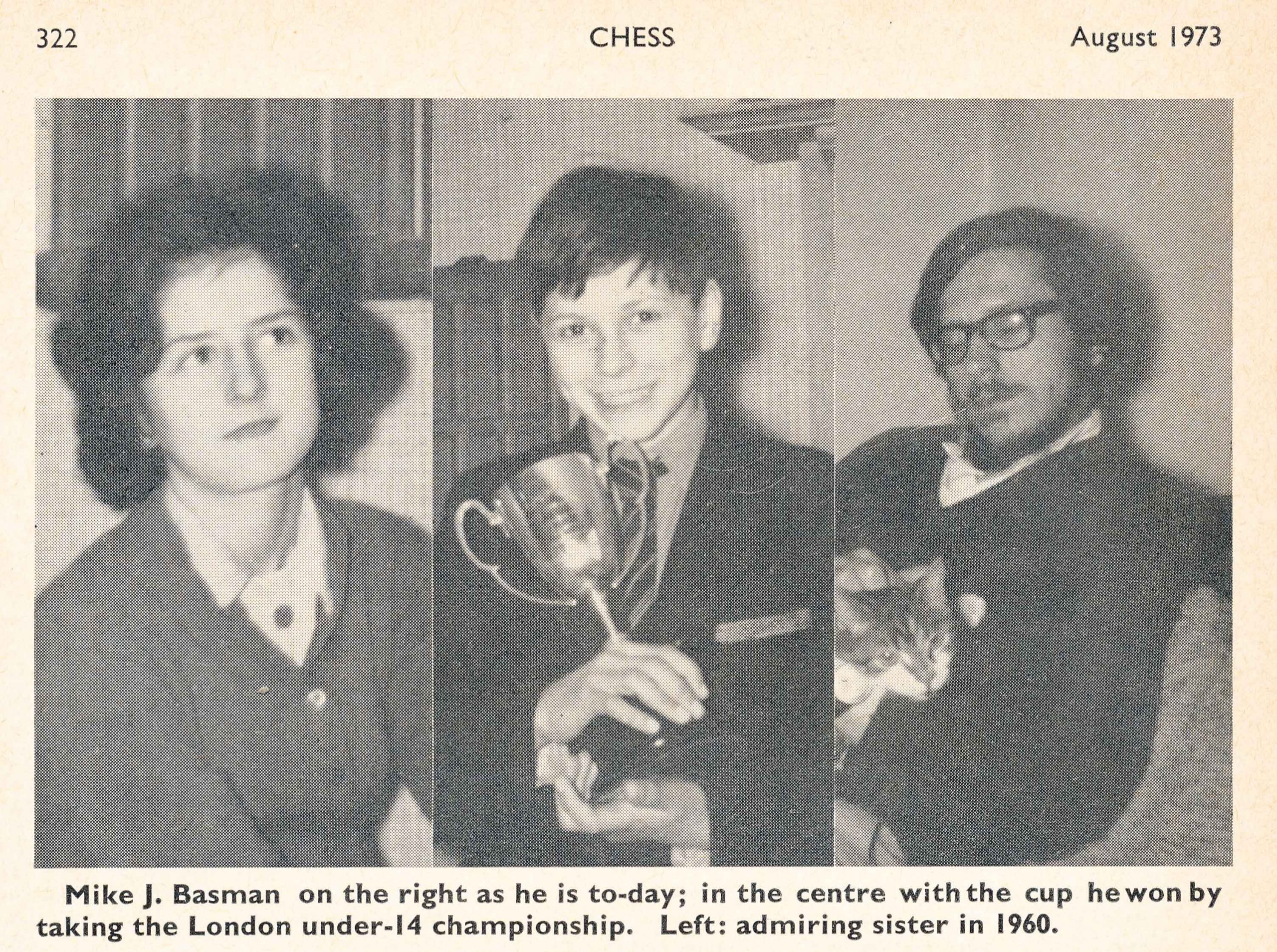
Mike J. Basman on the right as he is to-day; in the centre with the cup he won by taking the London under-14 championship. Left : admiring sister in 1960. From CHESS, August 1973, page 322.
Mike attended The University of Leeds as an undergraduate reading history.
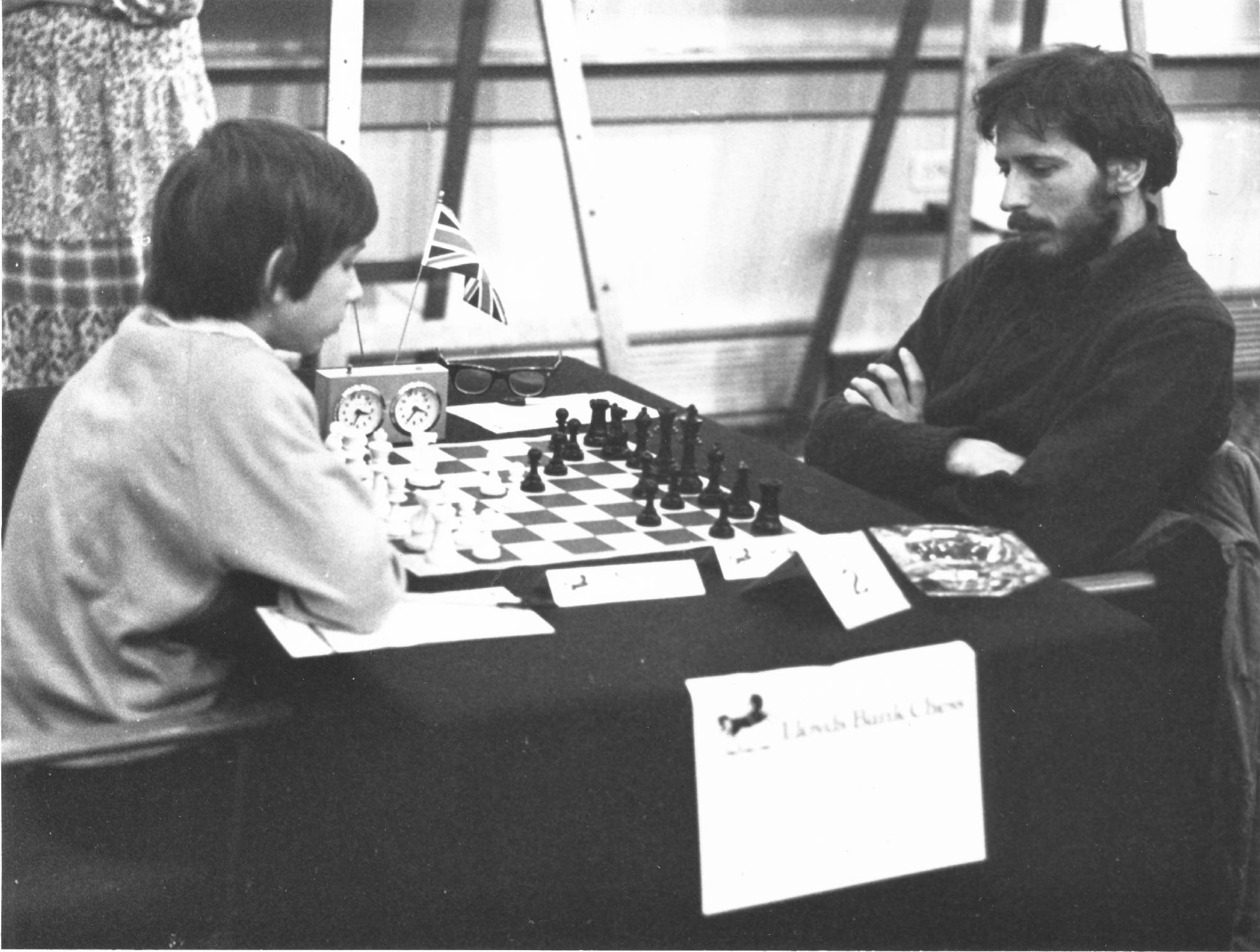
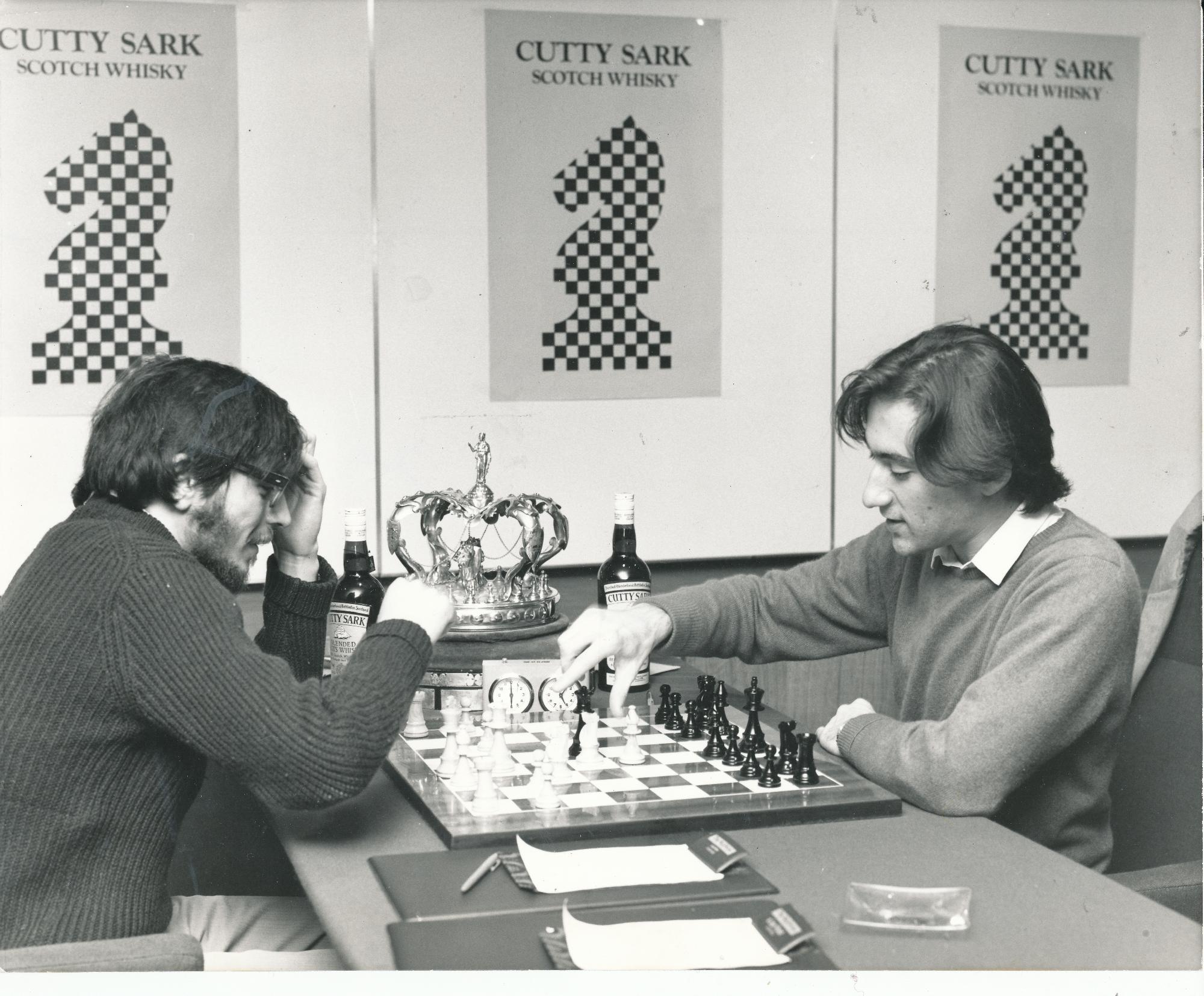
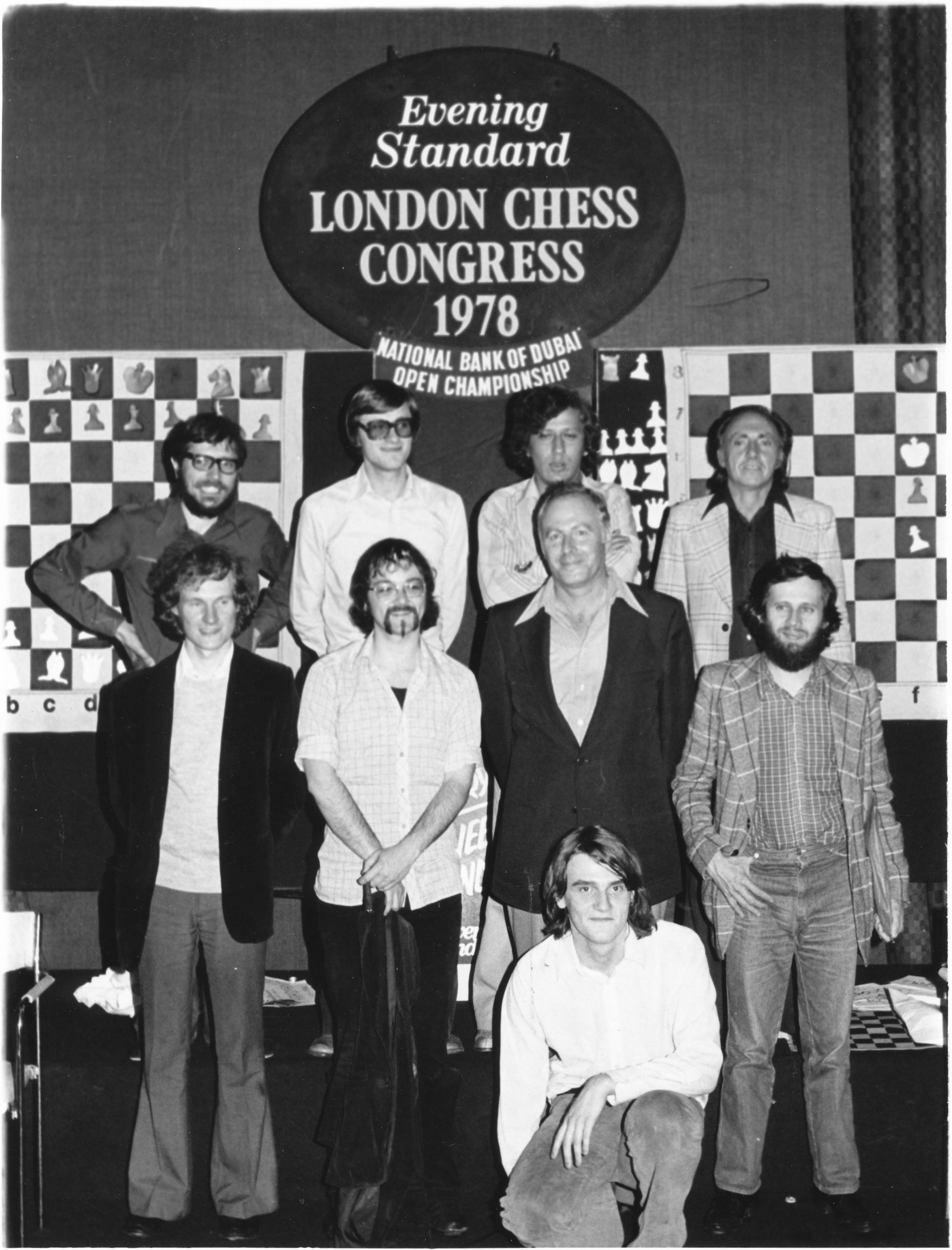
Joel Benjamin plays Mike Basman in round 2 of the 1978 Lloyds Bank Open
“Michael John Basman was born in St Pancras, London, England. He was awarded the IM title in 1980 and having dual nationality won the Erevan Championship whilst living there in the early 1970s. He was also a pioneer in the production of audio tapes for chess.
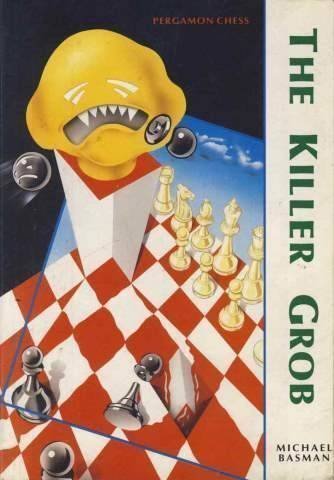
He is noted for his use of unorthodox flank openings, such as 1.g4, 1.h3, 1.e4 g5, etc. He expanded on the work of Henri Grob with his book on the topic of 1.g4, The Killer Grob.
He created the UK Chess Challenge, a tournament for juniors of all standards and ages progressing over four stages.(1)”
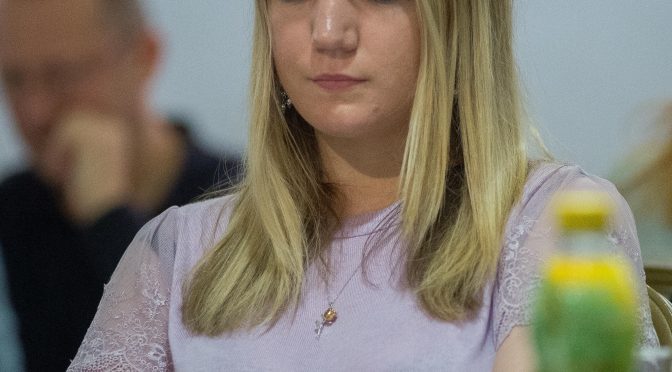
We send best wishes to WFM Sarah Natasha Longson (née Hegarty) on her birthday this day, (October 2nd) in 1988.
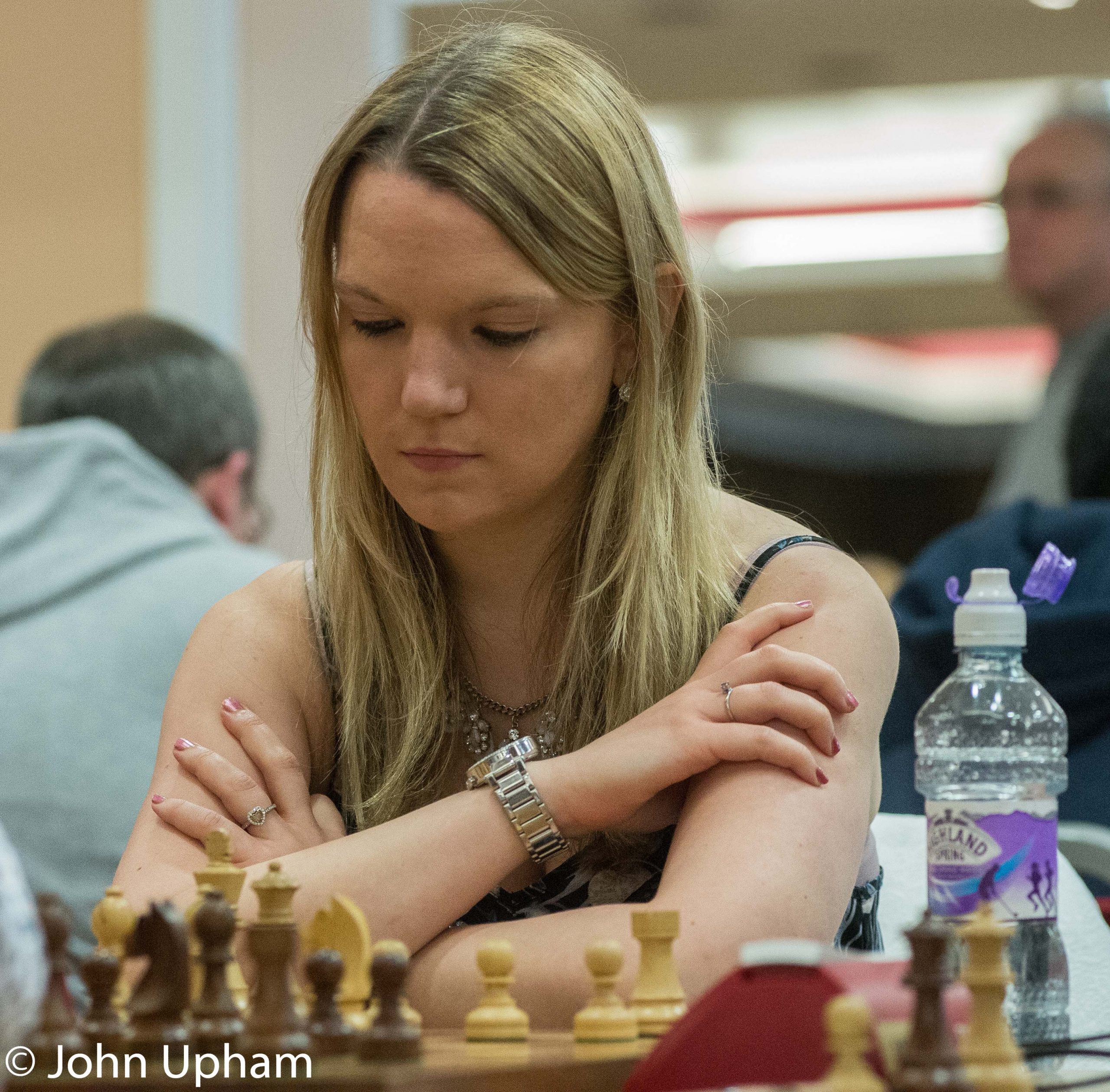
WFM Sarah Longson, courtesy of John Upham Photography
From Sarah’s web site:
“I have played competitive chess since the age of 7 when I became UK U7 Girls Chess Champion and appeared on Blue Peter where I met the then world champion Garry Kasparov. Since then I have represented England in many international competitions and in 2013 won the British Ladies Championship.”
In 2016 Sarah and partner FM Alex Longson made a successful bid for ownership of the UK Chess Challenge which was auctioned by the bankruptcy receiver of IM Mike Basman, the previous owner.
Sarah and Alex have modernised the UKCC considerably especially in the areas of communications an usage of IT.
WFM Sarah Longson
According to the ECF Sarah’s nominal club is Marple but she also plays for Stockport and 4NCL 3Cs.
WFM Sarah Longson, courtesy of John Upham Photography
Save as PDF
We focus on the British Chess Scene Past & Present!
This website uses cookies to improve your experience. We'll assume you're ok with this, but you can opt-out if you wish. Cookie settingsACCEPT
Privacy & Cookies Policy
Privacy Overview
This website uses cookies to improve your experience while you navigate through the website. Out of these cookies, the cookies that are categorized as necessary are stored on your browser as they are as essential for the working of basic functionalities of the website. We also use third-party cookies that help us analyze and understand how you use this website. These cookies will be stored in your browser only with your consent. You also have the option to opt-out of these cookies. But opting out of some of these cookies may have an effect on your browsing experience.
Necessary cookies are absolutely essential for the website to function properly. This category only includes cookies that ensures basic functionalities and security features of the website. These cookies do not store any personal information.

 Save as PDF