Category Archives: Player

Minor Pieces 41: Thomas Francis Lawrence Part 1

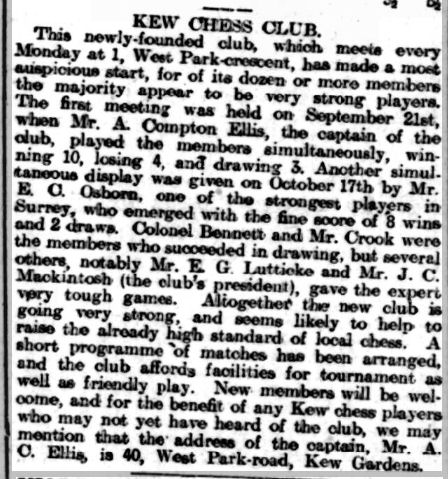
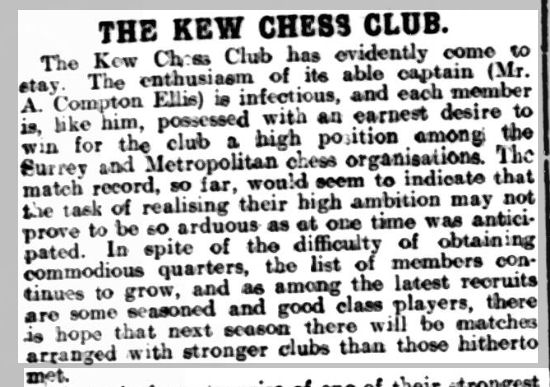
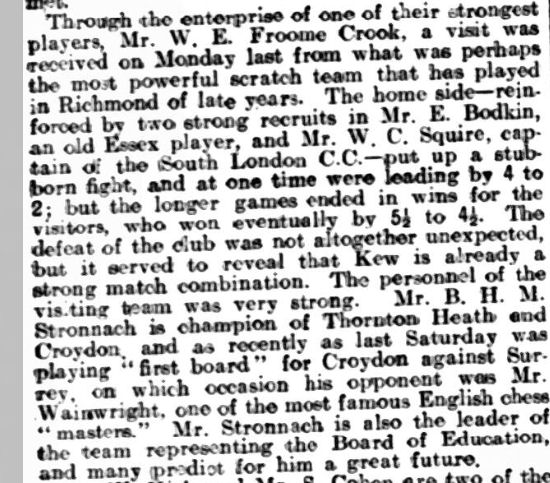
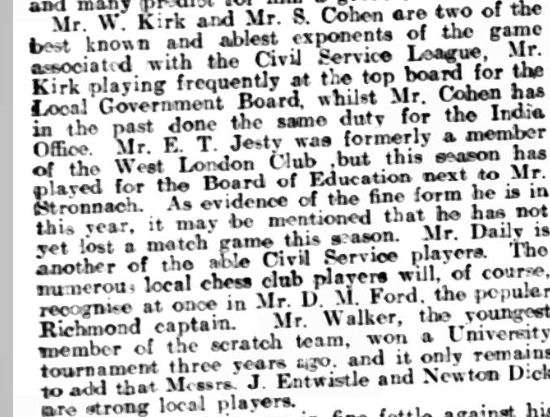
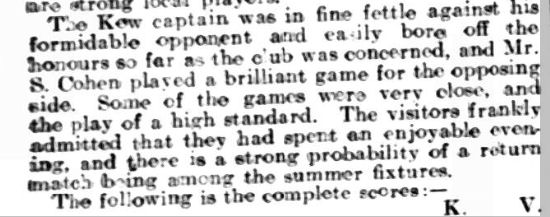
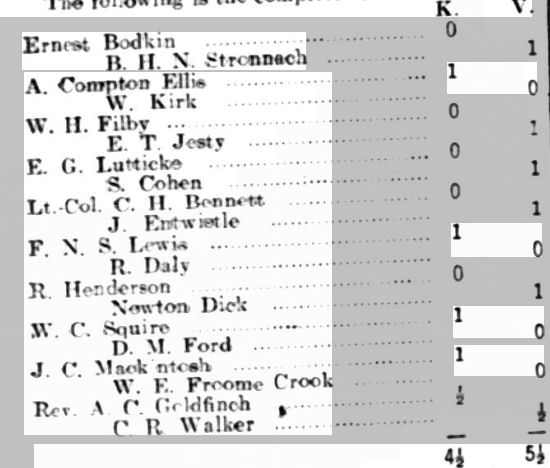
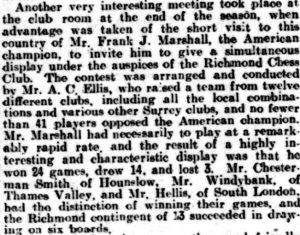
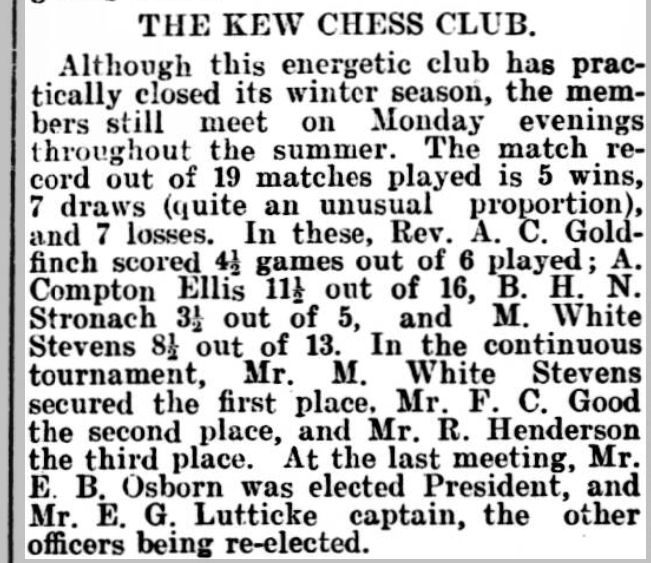
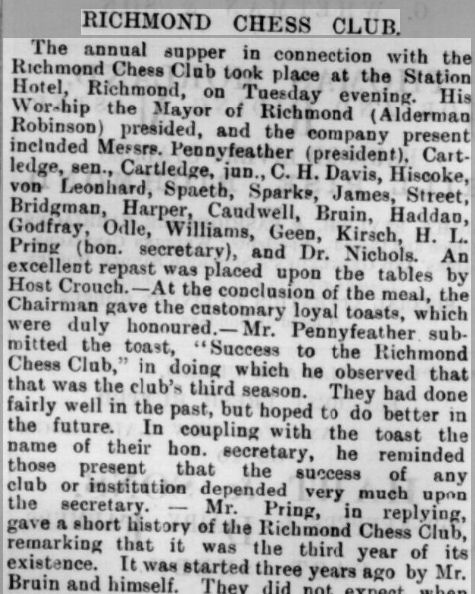
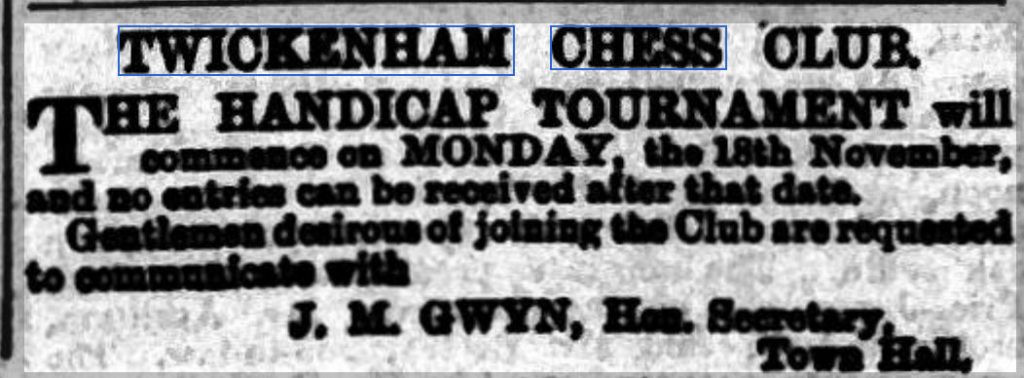
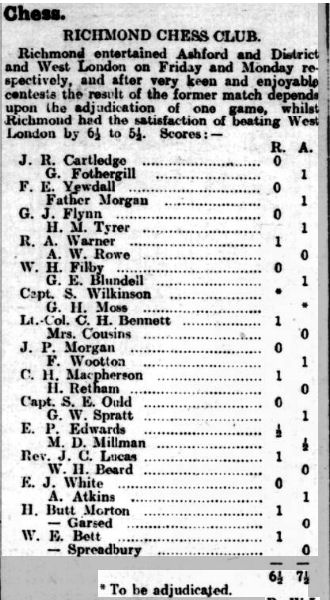
Surrey Comet 22 October 1904

TF Lawrence (not to be confused with TE Lawrence, and certainly not with DH Lawrence) was one of that group of strong amateurs (about 2400 on retrospective ratings, so FM/IM strength by today’s standards) who were active in English chess in the years leading up to the First World War, all of whom are virtually forgotten today, and several of whom had connections with the area around Richmond, Twickenham, Kingston and Surbiton.

I’ve already featured two of their number, George Edward Wainwright and William Ward, here. Now it’s time to investigate the life and games of Thomas Francis Lawrence.

Let’s start by crossing the North Sea to visit a place very familiar to all chess fans: Wijk aan Zee.  Before 1968 the tournament took place 5 km inland, in the city of Beverwijk. Immediately south of Beverwijk is the municipality of Velsen, divided by the North Sea Canal.

This canal was constructed between 1865 and 1876 to improve access from Amsterdam harbour to the North Sea. The chief engineer was John Hawkshaw and the contractors were Henry Lee & Sons of Westminster.

It was in Amsterdam, at some point between 1866 and 1870, that the marriage between Henry Lawrence and Esther Jane Izard was recorded. Our man Thomas Francis Lawrence was born in Velsen on 2 March 1871, and another son, Henry Arthur Edward Lawrence, followed on 8 August 1873.

Why were Henry and Esther in Velsen? Were they involved in the construction of the canal in some way? At the moment, I don’t know for certain. I can certainly identify Esther Jane Izard, who was born in Cheltenham in about 1834, although by 1841 her mother, Elizabeth, was a widow working as a laundress. I have no idea at all who Henry was, though: no one in his family seems to know and, as he had a fairly common name, there’s no way of finding out.

We can pick the family up in the 1881 census, living at 37 Henry Street, St Marylebone, which has been renamed Allitsen Road: you’ll find it in St John’s Wood, just north west of Regent’s Park. Esther, a widow, is working as a dressmaker, and her two sons, Thomas and ‘Edward’, are both scholars.

By 1891 they’ve moved to 32 Great George Street, which runs from St James’s Park to Big Ben and Westminster Bridge, with Downing Street just a stone’s throw away.  Esther is now a housekeeper (which could mean all sorts of things) and her younger son, now named ‘Henry E A’, is a Solicitor’s Clerk. Thomas isn’t at home: I haven’t yet been able to locate him. It’s quite possible he was abroad at the time.

Thomas Francis Lawrence didn’t come from a chess playing background, and it was only round about this time that he learnt the moves. This didn’t prevent him becoming recognised, within only a few years, as one of the strongest players in London. His name first appeared in the press in 1893, playing for the City of London Club, and for the South of England against the North. He entered the City of London Club championship in 1893-94, sharing first place in his section, but losing the play-off against the eventual winner of the championship, Herbert Levi Jacobs. The following year he made the final pool, and in 1895-96 he won the Gastineau Cup for the first time. It wouldn’t be the last.

In 1895 he made the news playing a six-board blindfold simul match against Arthur Curnock (also mentioned in the above clipping), winning two games (scores available online) and drawing four.

This game was published in the Chess Player’s Chronicle on 16 October 1895, with White’s name being given as I Passmore and no venue. It’s reasonable to assume that the initial was incorrect and this was Devon born music teacher Samuel Passmore, and that the game might well have been played in the City of London CC Championship.

The fascinating Max Lange Attack was very popular at the time, and here White’s 23rd and 24th moves each cost half a point, as he’d missed Lawrence’s rather unusual winning coup. Click on any move in any game in this article for a pop-up window.

[pgn]

[Event “City of London CC?”]
[Site “City of London CC, London ENG”]
[Date “1895.??.??”]
[White “Passmore, Samuel”]
[Black “Lawrence, Thomas Francis”]
[Result “0-1”]
[ECO “C56”]
[Annotator “Tactical Analysis 5.2 (1s)”]
[PlyCount “54”]

1. e4 e5 2. Nf3 Nc6 3. Bc4 Nf6 4. d4 exd4 5. O-O Bc5 6. e5 d5 7. exf6 dxc4 8.
Re1+ Be6 9. Ng5 Qd5 10. Nc3 Qf5 11. g4 Qg6 $1 {[#]} (11… Qxf6 12. Nd5 Qd8 13.
Rxe6+ Ne7 14. Qf3 $1 $18) 12. Nce4 $146 {C56: Two Knights: 4 d4 exd4 5 0-0
Nxe4.} ({Predecessor:} 12. Nxe6 fxe6 13. Rxe6+ Kf7 14. Nd5 Bd6 15. fxg7 Kxe6
16. gxh8=Q Rxh8 17. Nf4+ Bxf4 18. Bxf4 Kd7 19. Bg3 Kc8 {1-0 (35) Kolisch,
I-Steel,R Liverpool 1861}) 12… Bb6 13. f4 {aiming for f5.} O-O-O (13… gxf6
$2 14. f5 $1 Qg7 15. fxe6 (15. Nxe6 fxe6 16. Nxf6+ Kd8 $11) 15… d3+ 16. Kg2
$18) (13… d3+ $5 14. Be3 gxf6 $11) 14. f5 {White is slightly better.} Bxf5
15. gxf5 Qxf5 16. Rf1 (16. Nxf7 d3+ 17. Kg2 (17. Kh1 $2 Rhe8 $17) 17… dxc2
$17) 16… d3+ (16… Qg6 $5) 17. Kh1 dxc2 $2 {[#]} 18. Qxd8+ $1 $18 Rxd8 19.
Rxf5 Rd1+ 20. Kg2 Rg1+ 21. Kh3 gxf6 22. Rxf6 Be3 {[#]} 23. Rxf7 $2 Rxc1 $11 {
Really sharp!} 24. Ne6 $2 {[#]} Rd1 $1 $19 {Black is clearly winning.} (24…
Rxa1 {leads to mate.} 25. Rxc7+ Kb8 26. Nd6 a6 27. Rxb7+ Ka8 28. Nc7#) 25. Rc1
(25. Rxc7+ $142 Kb8 26. Rf7 (26. Rxh7 $2 b5 $19)) 25… Bxc1 26. Rxc7+ Kb8 27.
N4c5 {[#]} Bf4 $1 {Never resign too early! Weighted Error Value: White=1.18/
Black=0.68} 0-1

[/pgn]

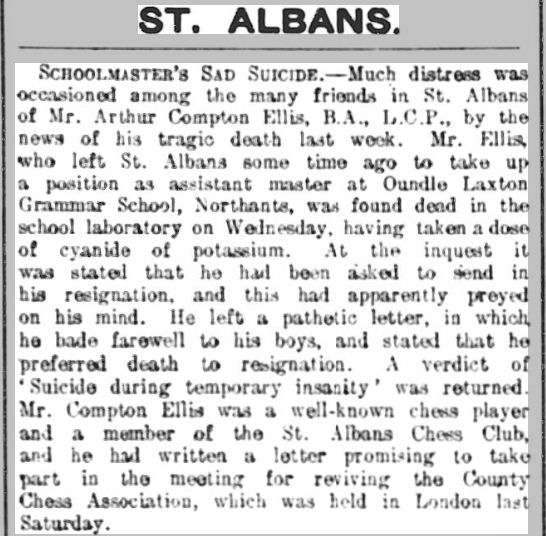
In 1896, playing on top board for the City of London Club against the Divan Chess Association, he found himself facing none other than the great Emanuel Lasker.
Morning Post 18 May 1896

Here’s the game: you’ll see that Mr Lawrence totally outplayed his illustrious opponent, and was still winning according to Stockfish in the final position, where he was about to reach a queen ending with an extra pawn.

[pgn]

[Event “Divan Chess Association v City of London CC”]
[Date “1896.15.05”]
[White “Lawrence, Thomas Francis”]
[Black “Lasker, Emanuel”]
[Result “1/2-1/2”]
[ECO “C66”]
[Annotator “Tactical Analysis 5.2 (1s)”]
[PlyCount “86”]
1. e4 e5 2. Nf3 Nc6 3. Bb5 Nf6 4. O-O Be7 5. Nc3 d6 6. d4 exd4 7. Nxd4 Bd7 8.
Bxc6 bxc6 9. b3 O-O 10. Bb2 Re8 11. Qd3 Bf8 {C66: Ruy Lopez: Steinitz Defence.}
12. Rad1 Rb8 $146 ({Predecessor:} 12… c5 13. Nde2 Bc6 14. Ng3 Qc8 15. Nd5 Nd7
16. c4 a5 17. Nf5 Bxd5 18. cxd5 Ne5 19. Qg3 {1-0 (30) Tarrasch,S-Steif,A
Nuremberg 1891}) 13. Rfe1 g6 14. Qa6 Rb6 15. Qd3 {& White is more active.} Bg7
16. Nf3 Ng4 {Against e5} 17. Na4 Bxb2 18. Nxb2 {Pair of Knights!} Rb8 19. Nc4 {
Threatens to win with e5.} f6 {Prevents e5.} 20. Qd4 Ne5 21. Nfxe5 ({Don’t play
} 21. Qxa7 $6 Nxc4 22. bxc4 c5 $15) 21… fxe5 22. Qd3 ({But not} 22. Qxa7 Ra8
23. Qe3 Rxa2 $11) 22… Qf6 23. Ne3 Rf8 24. f3 Kg7 25. c4 Rf7 $2 {[#]} (25…
c5 $16) 26. Qc3 (26. c5 $1 $18 {is the precise move to win.}) 26… Qe7 (26…
c5 $16) 27. c5 $18 Rf6 28. Nc4 Be8 29. f4 Rxf4 30. cxd6 cxd6 31. Rxd6 {
Strongly threatening g3.} Rb5 32. Qh3 Rf6 33. Rxf6 Qxf6 34. Rf1 Qe7 35. Qf3 Bf7
{[#]} 36. Nd6 Qxd6 37. Qxf7+ {Endgame KQR-KQR} Kh6 38. Qxa7 Rc5 39. Kh1 {
h3 is the strong threat.} Rc2 $2 (39… Rc3 $16) 40. Qe3+ Kg7 41. a4 Rd2 42. a5
c5 43. Ra1 $2 ({Less strong is} 43. Qf3 Kh6 44. h3 Ra2 45. Qe3+ Kg7 $18) ({
White should play} 43. h3 $18 {aiming for Qc3.} Qd3 44. Qxd3 Rxd3 45. Rb1)
43… Rd1+ $2 {Weighted Error Value: White=0.54/Black=0.55} (43… Rd3 $14 44.
Qe1 Rxb3) 1/2-1/2

[/pgn]

Perhaps Lasker had underestimated his opponent, but to go from learning the moves to outplaying the world champion in only a few years is a pretty impressive performance, I think you’ll agree.

Thomas won the City of London Championship again in 1896-97 and, for a third consecutive time, in 1897-98. At that time the winner received two trophies, the Gastineau Cup and the Mocatta Trophy, a full size Staunton ivory set and board, with silver mounts and inscriptions, valued at 16 guineas. The deal was that if you won the championship three times you got to keep the Mocatta Trophy in perpetuity, so the set and board was his.

In this game he demolished his opponent’s French Defence.

[pgn]

[Event “City of London CC Championship”]
[Site “London ENG”]
[Date “1896.??.??”]
[White “Lawrence, Thomas Francis”]
[Black “Jones, Edward Owen”]
[Result “1-0”]
[ECO “C06”]
[Annotator “Tactical Analysis 5.2 (1s)”]
[PlyCount “61”]

1. e4 {Tarrasch/Steinitz} e6 2. d4 d5 3. Nd2 Nf6 4. e5 Nfd7 5. Bd3 c5 6. c3 Nc6
7. Ne2 Qb6 8. Nf3 f6 {[#]} 9. Nf4 $146 {[#] And now 0-0 would win. C06: French
Tarrasch: 3…Nf6 4 e5 Nfd7 5 Bd3 main lines.} ({Predecessor:} 9. exf6 Nxf6 10.
O-O Bd6 11. dxc5 Qxc5 12. Ned4 O-O 13. Qe2 Re8 14. Be3 Qa5 15. Ng5 Bd7 16. Qc2
h6 17. Bh7+ Kf8 18. f4 Re7 19. b4 {1-0 (31) Tarrasch,S-Kuerschner,M Nuremberg
1890 EXT 2015 [Tarrasch/Steinitz]}) 9… fxe5 10. Nxe5 ({Worse is} 10. Nxe6
cxd4 11. Nxf8 Kxf8 $15) ({White must play} 10. dxe5 $18 Nd8 11. Ng5) 10…
Ndxe5 $11 11. dxe5 {Qh5+ is the strong threat. The position is equal.} g6 {
Prevents Qh5.} 12. h4 Nxe5 13. h5 Nxd3+ $4 (13… g5 $17 14. Nh3 g4) 14. Qxd3
$18 {White leaves nothing to chance now.} g5 15. Ng6 {& White is more active.}
hxg6 (15… c4 16. Qc2 hxg6 17. Qxg6+ Ke7) 16. Qxg6+ Kd7 {Threatens to win
with …e5.} 17. Qf6 {[#] Deflection} Rh7 {Hoping for …Qd8.} 18. Qxf8 {
aiming for Qg8.} Qd6 19. Qf6 e5 $2 (19… Kc6 20. Qxg5 (20. Bxg5 Bd7 $16) 20…
Qd7) 20. Qf5+ Kc6 21. Qxh7 Be6 22. Bxg5 e4 23. Qe7 Qe5 24. Qf6 Qd6 25. Bf4 Qd7
26. h6 d4 27. cxd4 cxd4 28. Rc1+ Kb5 29. Rh5+ Kb4 30. Bd2+ Ka4 31. Ra5# {
Weighted Error Value: White=0.80/Black=1.04} 1-0

[/pgn]

In this game from an inter-club match he took advantage of his opponent’s misplaced queen.

[pgn]

[Event “City of London v St George’s”]
[Site “City of London CC, London ENG”]
[Date “1896.04.11”]
[White “Lawrence, Thomas Francis”]
[Black “Jackson, Edward Mackenzie”]
[Result “1-0”]
[ECO “C64”]
[Annotator “Tactical Analysis 5.2 (1s)”]
[PlyCount “67”]

1. e4 e5 2. Nf3 Nc6 3. Bb5 Bc5 4. O-O Qf6 {[#]} 5. Nc3 $146 ({Predecessor:} 5.
c3 Nge7 6. Bxc6 Nxc6 7. d4 Bd6 8. Be3 b6 9. Nbd2 Ba6 10. Re1 h6 11. Nf1 O-O-O
12. d5 Ne7 13. Qa4 Kb7 {1-0 (38) Baird,D-Martinez,D New York 1889}) 5… Nge7
6. d3 {C64: Ruy Lopez: Classical Defence (3…Bc5) except 4 0-0 Nf6.} Nd4 7.
Nxd4 Bxd4 8. Ne2 {White is slightly better.} Bb6 9. Kh1 O-O (9… c6 $5 10. Ba4
d5 $11) 10. f4 c6 11. Ba4 d5 12. f5 dxe4 13. dxe4 Qh4 {aiming for …Rd8.} 14.
Ng3 $2 ({Only move:} 14. Nc3 $16) 14… Rd8 (14… Nxf5 $5 15. exf5 (15. Nxf5
Bxf5 16. exf5 Qxa4 $17) 15… Qxa4 $17) 15. Qf3 {Bb3 is the strong threat.} Bd7
16. Bb3 {And now f6 would win.} Be8 17. Nh5 Nc8 18. g3 Qh3 19. Bg5 Rd6 {[#]} (
19… Nd6 {keeps fighting.}) 20. Rad1 $2 {Really sharp!} (20. Rfd1 $1 $18)
20… Bc7 $2 (20… Bc5 $14) 21. Bc4 $18 b5 $2 (21… Nb6 22. Rxd6 Bxd6) 22.
Bd3 $2 (22. Be2 $18 f6 23. Nxf6+ Rxf6 24. Bxf6 gxf6 25. Qb3+ Kf8 26. c4 (26.
Qe6 Qh6 $15)) 22… f6 $11 23. Bh4 {With the idea Rfe1. & White is more active.
} Bxh5 $4 (23… Nb6 $11 {and Black is okay.}) 24. Qxh5 $18 Ne7 25. Rfe1 g6 {
[#]} 26. Qf3 gxf5 27. exf5 Rf8 28. Re4 Kh8 $2 (28… Rf7 29. Rg4+ Rg7 30. Rxg7+
Kxg7) 29. Rg4 {Hoping for Bf1.} Rd4 $2 (29… Rxd3 30. Rxd3 Nd5) 30. Rxd4 exd4
31. Re1 Rf7 {[#]} 32. Rxe7 $1 Rxe7 33. Bxf6+ Rg7 34. Qxc6 {Weighted Error
Value: White=0.68/Black=0.92} 1-0

[/pgn]

The City of London was not Lawrence’s only club. He was also representing Ibis, which tells us that, like Charles Redway, he was working for the Prudential Assurance Company.

Unsurprisingly, he soon came to the selectors’ attention, and in 1897 was chosen to play board 4 in the second Anglo-American Cable Match, where he lost to Boston lawyer John Finan Barry, miscalucating a tactical variation and losing a couple of pawns. He didn’t play the following year, but in 1899 again went down to the same player, being outplayed in a minor piece ending.

In 1898 Cassell’s Magazine ran a feature on amateur players at the City of London Chess Club, including this photograph of Thomas Francis Lawrence playing Henry Holwell Cole. (Thanks to Gerard Killoran for posting this on the English Chess Forum here.)

Here’s the accompanying pen-picture of Lawrence.

In 1899 he was invited to take part in a major international tournament that was due to take place in London. It was clear that he was considered a player of considerable potential who would benefit from crossing swords with the world’s finest. Even up to a couple of days before the first round it was hoped he would take part, but in the end he decided to reject the offer: I have yet to discover why. An even later withdrawal was Amos Burn, who stated that he was dissatisfied with the general arrangement of the tournament and with the supercilious treatment he received from some members of the management team.

In the 1898-99 edition of the City of London CC Championship Lawrence failed to retain his title: it was Herbert Levi Jacobs who had his name inscribed on the Gastineau Cup for the second time. One of the other players in the final pool was the novelist Louis Zangwill.

He was back on top in 1899-1900, though, with a score of 14½/17, a point ahead of William Ward, with the rest of the field well behind.

In April 1900 the City of London Chess Club ran an invitation tournament in which their leading members were pitted against leading foreign-born masters resident in London. Teichmann won with 9½/12, just ahead of Gunsberg and Mason, who shared second place, William Ward had an excellent result, just another half point behind. Lawrence finished on 50%, scoring 5/6 against the bottom half of the field, but only 1/6 against the top half. Not a bad result, and exactly as expected according to retrospective ratings, but neither did it suggest that he was ready to take on the world elite. In fact, looking at his games, you’ll have to admit he was lucky to score as many as he did: most of his wins came from opponents blundering in good positions. Here’s his best effort from this tournament, against Dutch organist Rudolf Loman.

[pgn]

[Event “London City Club Invitation”]
[Site “London”]
[Date “1900.04.26”]
[Round “9”]
[White “Lawrence, Thomas Francis”]
[Black “Loman, Rudolf Johannes”]
[Result “1-0”]
[ECO “C49”]
[Annotator “Tactical Analysis 5.2 (1s)”]
[PlyCount “73”]

1. e4 e5 2. Nf3 Nc6 3. Bb5 Nf6 4. Nc3 Bb4 5. O-O O-O 6. d3 d6 7. Bxc6 bxc6 8.
Ne2 Re8 9. Ng3 {C49: Four Knights: 4 Bb5 Bb4.} d5 10. Bg5 h6 11. Bd2 $146 {
The position is equal.} ({Predecessor:} 11. Bxf6 Qxf6 12. c3 Ba5 13. exd5 Bb6
14. dxc6 Qxc6 15. Re1 Bb7 16. Qc2 Rad8 17. b4 {1/2-1/2 (67) Mason,J-Zukertort,
J Vienna 1882}) 11… Bc5 12. Bc3 d4 13. Bd2 Rb8 14. b3 Bg4 15. h3 Bd7 16. Nh2
g5 {Prevents f4.} 17. h4 Nh7 18. Nh5 ({Not} 18. Ng4 Bf8 $16) 18… Kh8 19. Ng4
Re6 20. hxg5 hxg5 21. g3 $2 {[#]} (21. Qf3 $18 {is more deadly.}) 21… Qe7 $16
22. Kg2 Rg6 23. Rh1 Qe6 $2 (23… Kg8 $16) 24. f3 Kg8 25. Rh2 {[#] Strongly
threatening Qh1.} Kf8 $2 (25… Qd6 $16 {is a better defense.}) 26. Qe2 $2 (26.
Qh1 $18 {is the precise move to win.}) 26… Qe7 27. Rah1 {Ng7! is the strong
threat.} Bxg4 28. fxg4 {Threatens to win with Nf4!} Qe6 29. Ng7 Rxg7 30. Rxh7
Qg6 $2 (30… Rxh7 $16 31. Rxh7 Kg8) 31. Rh8+ {White is clearly winning.} Rg8
32. R1h6 Ke7 33. Rxg6 Rxh8 34. Bxg5+ Kd7 35. Rg7 Kc8 36. Rxf7 Kb7 37. Bf6 {
Weighted Error Value: White=0.55/Black=0.52} 1-0

[/pgn]

A third cable match defeat, against Philadelphia building contractor Hermann Voigt, reinforced the suggestion that he was a strong amateur at this point in his career rather than a player of genuine master standard.

Lawrence’s style usually tended towards the safe and solid, but he clearly kept up to date with opening theory and favoured the sacrificial Albin-Chatard Attack against the French Defence. Here’s an example from the 1900-01 City of London Championship, against Canadian born doctor Stephen Smith, with a bonus game in the annotations. Alas, Smith and Jones indeed!

[pgn]

[Event “City of London CC Championship”]
[Site “City of London CC, London ENG”]
[Date “1900.12.??”]
[Round “?”]
[White “Lawrence, Thomas Francis”]
[Black “Smith, Stephen Francis”]
[Result “1-0”]
[ECO “C14”]
[Annotator “Tactical Analysis 5.2 (1s)”]
[PlyCount “61”]
[EventDate “1903.??.??”]
[SourceVersionDate “2022.08.14”]

1. e4 e6 2. d4 d5 3. Nc3 Nf6 4. Bg5 Be7 5. e5 Nfd7 6. h4 {[#]} f6 $146 {[#]} ({
Black should try} 6… h6 $14 7. Be3 c5) ({Predecessor:} 6… a6 7. Qg4 f5 8.
Qh5+ g6 9. Qh6 Bxg5 10. hxg5 Qe7 11. Nge2 Nc6 12. Nf4 Nf8 13. O-O-O Nd8 14.
Nfxd5 exd5 15. Nxd5 Qf7 16. Bc4 Be6 17. Nf6+ Ke7 18. d5 Bxd5 19. Nxd5+ Ke8 20.
Nf6+ Ke7 21. Bxf7 Nxf7 22. Qg7 {1-0 (22) Lawrence,T-Jones,E London 1899}) 7.
Bd3 $1 {C14: French: Classical System: 4 Bg5 Be7 main line.} c5 (7… fxg5 8.
Qh5+ Kf8 9. Rh3 gxh4 10. Rf3+ Bf6 11. Rf4 (11. exf6 Nxf6 12. Qxh4 Nc6 $14)) (
7… Nc6 8. exf6) 8. Qh5+ Kf8 9. exf6 {& White is much more active. White is
better.} Nxf6 10. Bxf6 Bxf6 11. Nf3 (11. dxc5 $16 {aiming for 0-0-0.} Nd7 12.
Nf3) 11… cxd4 $15 12. Ne2 Nc6 13. Ng5 Ne5 {Inhibits Qf7+.} 14. Nf4 Ke7 15.
O-O-O g6 16. Qe2 Nxd3+ {Black cannot hold the game after this.} ({Better is}
16… Bxg5 $14 17. hxg5 Kd6) 17. Rxd3 $18 {The board is on fire.} Qd6 18. g3 {
Hoping for Re1.} Be5 $2 (18… Bd7 19. Ngxe6 Bxe6) 19. Rf3 {Black must now
prevent Nd3. White is clearly winning.} Rf8 20. Nd3 {Pair of Knights!} Rxf3 21.
Qxf3 {Strongly threatening Qf7+.} Bf6 22. Nxh7 e5 23. Nxf6 Be6 24. Nh7 {
Inhibits Rf8.} Bf5 25. Re1 e4 26. Qf4 Rc8 27. Ne5 {Threatens to win with Qg5+.}
Qc7 28. Re2 Ke6 {[#]} 29. Nxg6 $1 Qxf4+ 30. Nxf4+ Kd6 31. Nf6 {Weighted Error
Value: White=0.31/Black=0.75} 1-0

[/pgn]

Lawrence was successful again in this event, getting his name on the trophy for the fifth time in six years. This time he notched up an impressive 19½/21, with Jacobs two points behind and Ward another point adrift.

By then it was time for the census enumerator to call round again. He found the Lawrence family still at 32 Great George Street, with not much changed from the past decade. Esther was still there, and still a housekeeper. Thomas and his brother, this time recorded as ‘Edward H A’, were both at home, and both working as clerks.

The association with Richmond isn’t obvious at this point: you’ll recall that in 1904 he claimed to have been associated with the club for some years, but in 1901 he was still in Westminster, although the District Railway would have taken him there reasonably quickly. He would have had friends there, from the City of London Club, and also Charles Redway from the Ibis Club.

What happened to Thomas Francis Lawrence next? Did he make the great leap forward to become a world class player? Did he continue his relationship with Richmond Chess Club? You’ll find out in my next Minor Piece.


Sources and Acknowledgements:

ancestry.co.uk

findmypast.co.uk

Wikipedia

chessgames.com

MegaBase

The City of London Chess Club Championship (Roger Leslie Paige)

English Chess Forum

Chess Notes (Edward Winter)

BritBase

Gerard Killoran

Brian Denman


Minor Pieces 40: Peter Shenele

Back in 1975 I played in a weekend tournament celebrating the centenary of Kingston Chess Club. I’m still in touch with two of my opponents, Kevin Thurlow and Nick Faulks, today. They both post regularly on the English Chess Forum and I also see Nick at Thames Valley League matches between Richmond and Surbiton.

Kingston are in the early stages of preparing celebrations for their 150th anniversary in 2025, and asked me if I’d seen anything confirming 1875 as the year of their club’s foundation.

Well, there are all sorts of questions concerning, amongst other things, continuity, but I’ll leave that for another time. The Surrey Comet and Croydon Guardian and Surrey County Gazette (which carried a lot of chess news) for those years have been digitised, but searching for ‘chess Kingston’ doesn’t come up with anything. There are some earlier matches in which clubs in the area played competitions including chess along with other indoor games, but nothing obvious concerning 1875. Having said that, the OCR search facility is far from 100% accurate, so I’d have to look through all the papers for that year to check I hadn’t missed anything. The nearest I’ve found so far is this, from 1881.

Croydon Guardian and Surrey County Gazette 01 October 1881

We have three names here. Most important, for my Kingston friends, is that of Mr J Bartlett, President of Kingston-on-Thames chess club. I consulted the 1881 census which lists a number of J Bartletts in Kingston,  but none of them seem to be obviously presidential material.

I suspect the annotator was FC (not JC) Burroughs: Francis Cooper (Frank) Burroughs (1827-1890) was a Surrey county player, a solicitor by profession. He never married and had no relations with the initials JC.

As Mr Burroughs’ initials appear to be incorrect, it’s entirely possible that Mr Bartlett’s initial was also given incorrectly. I haven’t been able to find any other chess playing Bartletts in the area as yet, but I’ll keep looking.

Here’s the game in full. Click on any move for a pop-up board.

[pgn]

[Event “Correspondence”]
[Site “?”]
[Date “1881.??.??”]
[Round “?”]
[White “Bartlett, J”]
[Black “Shenele, Peter”]
[Result “0-1”]
[ECO “C33”]
[Annotator “Stockfish 15”]
[PlyCount “50”]

1. e4 e5 2. f4 exf4 3. Bc4 Qh4+ 4. Kf1 {[#]} Nf6 $146 ({Predecessor:} 4… d6
5. d4 g5 6. Nc3 Ne7 7. g3 Bh3+ 8. Kf2 Qh6 9. Qf3 Nbc6 10. gxf4 g4 11. Qg3 Bg7
12. d5 Bf6 13. f5 Qh5 14. Nxh3 {0-1 (33) Schmid,C-Bird,H Wiesbaden 1880}) 5.
Nf3 Qh5 {aiming for …b5.} 6. h4 {C33: King’s Gambit Accepted: 3 Nc3 and 3
Bc4.} d5 7. exd5 (7. Bxd5 $17 Nxd5 8. exd5) 7… Bd6 $19 {White must now
prevent …0-0.} 8. Nc3 {Black has a decisive advantage.} O-O {And now …Bg4
would win. Active counter play!} 9. b3 (9. Nb5 $142 Bg4 10. Nxd6 cxd6 11. d4)
9… Bg4 10. Qe2 Nbd7 {…Ne5 is the strong threat.} 11. Bb2 Rae8 12. Qf2 Ne5
13. Nh2 Nxc4 14. bxc4 Ne4 15. Nxe4 Rxe4 16. d3 $2 (16. Nxg4 Qxg4 17. Qf3 Qxf3+
18. gxf3 Rxc4 19. Rg1) 16… Re2 17. Qxa7 Rxc2 18. Bd4 {[#]} Bh3 $1 {A strong
pair of Bishops. Black mates.} 19. Bf2 Qe2+ 20. Kg1 {[#]} b6 $1 21. Ng4 {[#]} (
21. Rf1 Bc5) 21… Bc5 $1 22. Rf1 {[#]} (22. Rxh3 Bxf2+) 22… Bxg2 $1 23. Kxg2
(23. Nf6+ gxf6) 23… Qxg4+ 24. Kh2 Qxh4+ 25. Kg1 Qg3# {Black took control
after the opening. Weighted Error Value: White=1.34/Black=0.54} 0-1

[/pgn]

Two weeks later, another game was published, with Bartlett again losing with the white pieces against Shenele.

[pgn]

[Event “Correspondence”]
[Site “?”]
[Date “1881.??.??”]
[Round “?”]
[White “Bartlett, J”]
[Black “Shemele, Peter”]
[Result “0-1”]
[ECO “C23”]
[Annotator “Stockfish 15”]
[PlyCount “52”]

1. e4 e5 2. Bc4 Bc5 3. Qe2 d6 4. f4 Nf6 5. Nf3 Nc6 6. c3 {C23: Bishop’s
Opening: 2…Bc5.} Bg4 {[#]} 7. fxe5 $146 (7. h3 $5 Bxf3 8. Qxf3 $15) ({
Predecessor:} 7. d3 exf4 8. Bxf4 Ne5 9. Nbd2 Bxf3 10. gxf3 Nh5 11. Bg3 Nxg3 12.
hxg3 Nxc4 13. Nxc4 {1-0 (28) Anderssen,A-Riemann,F Breslau 1876}) 7… dxe5 (
7… Bxf3 $5 8. gxf3 dxe5 $11) 8. Bxf7+ $2 Kxf7 $19 9. Qc4+ Ke7 $2 (9… Kg6
10. Nh4+ Kh5 11. h3 $11) (9… Ke8 $1 $19 10. Qxc5 Bxf3 11. gxf3 Nxe4 $1) 10.
Qxc5+ $16 Qd6 11. Qe3 {And now 0-0 would win.} Rhe8 $2 (11… Rhd8 $15) 12. b3
{Ba3 is the strong threat.} Kf7 13. Ba3 Qd7 14. O-O Kg8 15. d3 Rad8 {[#]} 16.
Ne1 Nh5 17. g3 $2 {Inhibits Nf4.} (17. Nd2 $16) 17… Bh3 $17 {Black has
strong compensation.} 18. Rf2 Nf6 {Strongly threatening …Ng4.} 19. Rc2 $2 (
19. Rf3 $17) 19… Ng4 20. Qc1 {[#]} Nd4 $1 {Threatens to win with …Qf7!} 21.
Rb2 {[#]} (21. Rf2 Nxf2) 21… Qf7 $1 22. Ng2 Nf3+ {Discovered Attack, Double
Attack} 23. Kh1 Rxd3 {Hoping for …Red8.} 24. Ne1 {[#]} Nd2 $1 {Black mates.}
25. Nxd3 (25. Ng2 Bxg2+) 25… Qf3+ 26. Kg1 Qg2# {Weighted Error Value:
White=1.44/Black=0.52} 0-1

[/pgn]

We’re told that Inspector Shenele was playing by correspondence against Kingston, but there’s no indication of how many Kingston players were involved. He played two games against Barrett, but playing black in both cases. I wonder what the format was. Perhaps he played four games, two with each colour, against each of five opponents. Looking at the games, the Kingston President’s play, especially in the first game, doesn’t make a very good impression, considering he would have had plenty of time for each move.

As he was blessed with a highly unusual surname as well as a title, it wasn’t difficult to find out more about Inspector Shenele. If you’ll bear with me for straying away from Kingston, not to mention Richmond and Twickenham, his is an interesting, although sadly rather short, story.

He was born Peter Shenale on 22 March 1843 in the village of Mary Tavy, near Tavistock in Devon, the youngest child of James Shenale and Tamzin Parsons Pellew. Most of his family spelt their name in this way, but Peter preferred Shenele. He also referred to himself as PS Shenele, although I can find no record of a middle name in any official documents. The surname has its origins in Devon and Cornwall. By the 1851 census the family had moved to Gunnislake, the other side of Tavistock and just over the border in Cornwall, where James was working as a copper miner. His wife and three sons were at home: James junior was also a copper miner, while William and Peter were at school. According to Wikipedia: “The village has a history of mining although this industry is no longer active in the area. During the mining boom in Victorian times more than 7000 people were employed in the mines of the Tamar Valley. During this period Gunnislake was held in equal standing amongst the richest mining areas in Europe.” Tin and copper were the main metals mined there.

In 1861 Peter was still living there with his parents, along with a mysterious 14-year-old granddaughter, and now, like his father, mining copper. In 1867, still in the same job, he married Eliza Ann Kellow in nearby Plymouth.

At that point he (or perhaps Eliza) decided that the life of a miner wasn’t for him. If you’re a copper miner and don’t want to be a miner any more, I guess that makes you a copper, and that’s exactly what Peter did. He moved to London and joined the Metropolitan Police. By 1871 he was living in Knightsbridge with Eliza and their 5-year-old son Henry. Another son, Frederick, had died in infancy. A daughter, Ellen, would be born later that year, followed by Emma, who would also die in infancy, and William, by which time the family had moved to Chelsea.

But where did the chess come in? His background seems very different from most of the chess players we’ve encountered in this series. I’m not sure that chess was especially popular among the Devon and Cornwall mining community, but you never know. Perhaps he became interested after seeing a problem in a newspaper or magazine column.

In 1876 his name suddenly started appearing  (as PS Shenele) in the Illustrated London News as a solver of chess problems.

It wasn’t long before he tried his hand at composing as well. You’ll find the problem solutions at the end of this article.

[fen]bb1B2r1/8/R5q1/2PRpk2/B3p3/K4N2/4N3/1Q6 w – – 0 1[/fen]

#2 Illustrated Sporting and Dramatic News 11 November 1876

But at home all was not well. Peter may have been good at solving both crimes and chess problems, but his marriage had hit a problem with only one solution. On 18 April 1879 he filed for divorce, citing his wife’s adultery with a man named Charles J Reed. Perhaps Eliza had had enough of Peter spending so much time at the chess board and had sought satisfaction elsewhere. The courts found in Peter’s favour (in those days it was always considered the woman’s fault): he was awarded a decree nisi on 20 November 1879 and a final decree, along with custody of Ellen and William, on 1 June 1880.

A son, Charles Frederick Shenale, was born in Plymouth, the town where Eliza and Peter had married, on 20 August 1879 and died the following year at the age of 9 months. His parents were listed as Peter and Annie (as Eliza preferred to be called): might one assume that Charles Reed, whose first name he was given, was actually his father, and that his mother had returned to Devon to give birth?

Here’s another problem Peter composed at about this time.

[fen]4r2N/2r5/1p6/4k1P1/Qn1p1NP1/B1p2K2/8/8 w – – 0 1[/fen]

#2 Preston Guardian 1880

Not content with solving and composing problems, Peter took up correspondence chess as well.

In this postal game against Irish astronomer and philosopher William Henry Stanley Monck, he concluded his attack with an attractive queen sacrifice for a smothered mate. It was published in the Illustrated London News on New Years Day 1881.

[pgn]

[Event “Correspondence”]
[Site “?”]
[Date “1880.??.??”]
[Round “?”]
[White “Monck, William Henry Stanley”]
[Black “Shenele, Peter”]
[Result “0-1”]
[ECO “C33”]
[PlyCount “44”]
1. e4 e5 2. f4 exf4 3. Bc4 g5 4. d4 Bg7 {[#]} 5. Qh5 $146 ({Predecessor:} 5. h4
h6 6. hxg5 hxg5 7. Rxh8 Bxh8 8. Qh5 Qf6 9. Nc3 c6 10. e5 Qg7 11. Ne4 {1-0 (35)
Lange,M-Lasch Duesseldorf 1862}) 5… Qf6 $2 (5… Qe7 $17 {keeps the pressure
on.}) 6. e5 {C33: King’s Gambit Accepted: 3 Nc3 and 3 Bc4.} Qg6 7. Qe2 (7. Qxg6
$16 {is necessary to keep the advantage.} hxg6 8. Nf3) 7… Ne7 {aiming for …
d5.} 8. Nf3 {Black is better.} d5 9. exd6 cxd6 {White must now prevent …Nbc6.
} 10. c3 Nbc6 11. h4 h6 12. hxg5 hxg5 13. Rxh8+ Bxh8 14. Na3 a6 {Inhibits Nb5.}
15. Bd2 Bf5 {Inhibits Bd3.} 16. O-O-O b5 17. Bd5 {Bxc6+ is the strong threat.}
Bd3 $2 18. Qe1 $2 (18. Bxc6+ $14 {is the one way to stay ahead.} Kf8 {[#]} 19.
Qxd3 $3 Qxd3 20. Bxa8) 18… Kd7 19. Bb3 Rc8 {Active counter play!} 20. Qh1 Nb4
21. Ne1 ({But not} 21. Re1 Bf5 22. g4 Nd3+ 23. Kb1 Nxe1+ $19) 21… Bb1 22.
Nxb1 $4 {[#]} (22. Nec2 $17 Bxc2 23. Bxc2 (23. Nxc2 $2 Nd3+ 24. Kb1 Nf2 $19)
23… Nxc2 24. Nxc2) 22… Qc2+ $3 {White got outplayed after the opening.
Weighted Error Value: White=1.39/Black=1.05} 0-1

[/pgn]

He had also taken up another unlikely interest: poetry. Also on New Years Day 1881 he wrote to the Croydon Guardian.

Croydon Guardian and Surrey County Gazette 15 January 1881

He also submitted this poem which, in the fashion of the day, is an acrostic. The first letter of each line spells out a message.

By this time he’d been promoted to the rank of Inspector, and had moved out, as you can see above, to Ilford, where, when the 1881 census enumerator called, he was living with young William. Emma wasn’t at home: she might, I suppose, have been away at school. Henry was living in the Devonshire Club in Piccadilly, working as a page boy.

It was about this time, also that he played the correspondence match against Kingston-on-Thames Chess Club. I’ve yet to discover exactly how this came about: quite possibly via his connection with the Croydon Guardian, the main source for Surrey chess news at the time.

Chess and policing weren’t the only things on Peter’s mind in 1881. On 31 January 1882 he married a local girl, Sarah Jane Seabrook, who, it seems, was pregnant with their daughter Ethel Emily, whose birth was registered in the first quarter of that year. This didn’t stop his chess activities: he entered a correspondence tournament run by the Croydon Guardian.

This correspondence game was played in 1893 against Horace Fabian Cheshire. Both players demonstrated knowledge of contemporary Evans Gambit theory, but our hero went wrong shortly after leaving the book. Thanks to Brian Denman for providing this game, which was published in the Southern Weekly News (8 Sep 1883).

[pgn]

[Event “Mr Butler’s Correspondence Tournament”]
[Site “?”]
[Date “1883.??.??”]
[Round “?”]
[White “Shenele, Peter”]
[Black “Cheshire, Horace Fabian”]
[Result “0-1”]
[ECO “C51”]
[Annotator “Stockfish 15”]
[PlyCount “78”]

1. e4 e5 2. Nf3 Nc6 3. Bc4 Bc5 4. b4 Bxb4 5. c3 Bc5 6. O-O d6 7. d4 exd4 8.
cxd4 Bb6 9. Nc3 Bg4 10. Bb5 Kf8 {[#] …Nxd4! is the strong threat. C51: Evans
Gambit: Declined and Accepted without 5…Ba5.} 11. d5 $146 {[#]} ({
Predecessor:} 11. Be3 Nge7 12. Be2 h6 13. d5 Bxf3 14. gxf3 Ne5 15. f4 Nd7 16.
Kh1 Ng6 17. Rg1 Qf6 18. Qd2 Bxe3 19. fxe3 {1-0 (51) Mason,J-Blackburne,J
London (Simpson’s Divan) 1879}) 11… Nd4 12. Be2 Bxf3 {Black is slightly
better.} 13. gxf3 Qf6 14. Bb2 Ne7 {& Black is more active.} 15. Rb1 $2 {Now
White is beyond hope.} (15. Kh1 $17 Nxe2 16. Qxe2) 15… Ng6 $19 16. f4 $2 (16.
Kh1 {only move.} Nxe2 17. Qxe2) 16… Nxf4 {[#] White must now prevent …Qg5+.
Pair of Knights!} 17. Kh1 Nfxe2 18. f3 Nxc3 19. Bxc3 c5 {Against Rb4} 20. dxc6
bxc6 21. Rxb6 axb6 22. Bxd4 Qd8 23. Qa1 f6 24. Rd1 c5 25. Bf2 Rc8 26. Bg3 Rc6
27. Rd5 (27. a4 $142) 27… Kf7 28. Qd1 Ke6 {aiming for …Qc8.} 29. e5 fxe5
30. Bxe5 Qe7 ({Wrong is} 30… Kf7 $2 31. Bxd6 Re8 32. Rf5+ Kg6 33. Qd5 $17)
31. f4 h5 $2 ({Inferior is} 31… dxe5 32. Rxe5+ Kf7 33. Qh5+ Rg6 34. Rxe7+
Kxe7 35. Qe5+ Kd7 36. Qd5+ Kc7 37. Qe5+ Kd7 38. Qf5+ Kd8 39. Qd5+ Kc7 40. Qe5+
Kc8 41. Qf5+ Kc7 42. Qe5+ $17) (31… Kf7 32. Qg4 Rf8) 32. Qf3 $2 (32. Bxd6
Qxd6 33. Rxd6+ Rxd6 34. Qe2+ Kf7 35. a4) 32… Kd7 {Black is clearly winning.}
33. Bc3 Re8 34. Rg5 Qe4 35. Rxg7+ Kc8 36. Qxe4 Rxe4 37. f5 Rc7 {Hoping for …
Rxg7.} 38. Rg8+ Kb7 39. f6 d5 {Weighted Error Value: White=0.84/Black=0.36} 0-1

[/pgn]

But then, in the same year, tragedy struck. A son, named Albert, was born in September, but died 5 days later: the third child he’d lost in infancy. He then caught a cold, which developed into pleurisy. On 10 November 1883, at the age of only 40, Peter Shenele died after a short illness. A local paper back in Cornwall published this tribute.

You can see some parallels, can’t you, with James Money Kyrle Lupton, from a later generation. Both were problem solvers and composers who liked to see their name in print, and both were also police officers in London. But while James, from a privileged background, only became a constable, Peter, a man of relatively humble origins, became an inspector.

As always, I’m sure you want to know what happened next. Eliza Ann (Annie) remarried in 1893, not to Charles Reed, but to a widower named James Trump (no relation to Donald), a plasterer by trade.  Ellen sadly died in 1894. Sarah Jane moved in with her brother Frederick, like their father a publican, and the family later emigrated to New York. It’s not clear what happened to Ethel. There’s a burial record for Ethel Emily Seabrook in Newham, East London in 1898, which might have been her.

Peter’s younger surviving son, William, joined the Royal Navy, then became a clerical officer in the Civil Service, marrying but not apparently having any children, and living on until 1968.

Peter’s oldest son, Henry, emigrated to Australia in 1885. In 1891 he married Alice Huxley, and, in the same year, a son, George Leslie Shenele, was born. But then things started to go wrong. In 1895 a warrant was issued for his arrest.

He did indeed go to New Zealand, to Masterton, near Wellington, where, in April that year, a month before the above announcement, he was put on trial for rape. What exactly happened between Henry James and Belinda the slavey I don’t know. Offering to tune the family organ indeed!

Observer, Volume XI, Issue 853, 4 May 1895

It was later reported that the Grand Jury threw out the bill. As always in those days (and you might think things haven’t changed much) he got away with it. (Thanks to Gerard Killoran for this information)

After that the trail goes cold. What happened to the police inspector’s son, the seemingly mild-mannered, bespectacled piano tuner? I’d imagine he changed his name, but no one seems to know.

George Leslie settled in Campsie, a suburb of Sydney, married, had two children, Ilma and Cyril, but his wife died young. He worked on the railways, eventually becoming an inspector, the same rank, but not the same profession, as his grandfather. Guess what happened to Cyril. He followed (was he aware?) in his great grandfather’s footsteps, becoming a policeman, rising to the rank of (at least) Detective Sergeant.

And that is the story of Peter Shenele, copper miner, police inspector, chess problem solver, composer and correspondence player, who provided a random distraction from my investigations of chess players of Richmond, Twickenham and surrounding areas. I’ll try to find out more about the early history of chess clubs in Kingston: if I come across anything interesting I’ll let you know.

Sources:

ancestry.co.uk

findmypast.co.uk

Wikipedia

MESON chess problem database

Brian Denman/Hastings & St Leonards Chess Club website

Gerard Killoran/Papers Past (New Zealand)

Problem 1 solution:

1. Qg1! threatening Nfd4# or Nh4#.  1… Qg3/Qg2/Qxg1 2. Bd7# 1… exf3/e3 2. Bc2#

Problem 2 solution:

1. Qc6! threatening N mates on g6 as well as two queen mates. 1… Rxc6 2. Nf7# 1… Re6 2. Qxe6#

Minor Pieces 39: James Money Kyrle Lupton

There are many of us who enjoy an intellectual challenge over the breakfast table. These days we might solve a crossword or a sudoku.

In the days before crosswords and long before sudokus, there were those who would solve a chess problem over breakfast. Many daily and weekly publications would carry a regular chess problem, and also provide lists of successful solvers, who were no doubt keen to see their name in print.

A name frequently seen in that context for more than four decades, from the 1890s to the 1930s was that of JMK Lupton (Richmond). Who was he? I was keen to find out, and I’m sure you are too.

He was James Money Kyrle Lupton (middle names sometimes hyphenated), born in Richmond on 11 July 1864 and baptised at St Mary Magdalene’s Church in the town centre on 3 March 1865. He was the oldest of seven children. His father, James Irvine Lupton was a vet and the author of many books on the anatomy of horses. (Check out The Anatomy of the Muscular System of the Horse or Mayhew’s Illustrated Horse Doctor: Being An Account of the Various Diseases Incident to the Equine Race, With the Latest Mode of Treatment and Requisite Prescriptions for example.) His mother, Eliza Cheesman (sadly not Chessman), was the daughter of a vet.

I guess we need to consider his eccentric middle name(s). The Money-Kyrles are minor aristocrats, but I can find no immediate connection with either side of the Lupton family. Perhaps they were friends: who knows?

In 1871 the family, James, Eliza, James junior and four young daughters, are living at 20 Whitchurch Villas, Mount Ararat Road, Richmond, employing a housemaid, a cook and a nurse. Mount Ararat Road is one of the roads leading up from the town centre to St Matthias Church on Richmond Hill.

By 1881 the family have moved to Sheen Park (possibly No.4 but the census record isn’t exactly clear). James, like his now six siblings, is a Scholar, and the household is completed by a governess and three servants.

By this point he has already made his first appearance in a newspaper: the previous December the Surrey Comet reported that his cock had won second prize. Stop sniggering at the back there: it was a poultry show. The following June his rabbit was highly commended in a rabbit show.

It looked like he was going to follow in his father’s footsteps working with animals, but he soon took up another interest instead: athletics. He joined the London Athletic Club (his father was also a member) and for the rest of the decade the papers were full of his results, running distances up to 440 yards (the equivalent of 400 metres in today’s money – or should that be Money-Kyrle?). He also played tennis there, but with less success.

Combining his interest in running with his father’s interest in anatomy, the two of them wrote a book published by WH Allen & Co in 1890.

St James’s Gazette 26 March 1890

If you’re interested you can read it online here.

But at that point he seems to have retired from competitive athletics. What happened? Did he suffer an injury? Or did he just get bored and decide to move onto another interest?

The 1891 census finds the family in 3 Camborne Terrace, right by the river close to Richmond Bridge: a pretty desirable place to live. James Irvine’s veterinary practice and book sales must have provided the family with a more than comfortable income. Six of their seven children are still living at home: the oldest daughter, Maude, is in a boarding house in Littlehampton. James MK, now aged 26, seems, like his sisters, to be living a life of leisure, with no occupation listed. Roger is a clerk, and Horace is still at school. Now the children are almost grown, they only need to employ one domestic servant.

After the publication of his book his name disappears from the newspapers completely until 1893, at which point he’s taken up a new interest: chess problems.

His name starts appearing regularly as a solver in the Illustrated London News and the Morning Post, and it’s not long before he tries his hand at composition.

Problem 1

[fen]r3R3/p1PPrn2/B1K1kp2/2P1p3/8/1NqQ4/8/6R1 w – – 0 1[/fen]

#2 The Field 28 Oct 1893

He’s also playing correspondence chess, with an extremely unimpressive game published against Hull schoolmaster George Wright Farrow. Click on any move for a pop-up window.

[pgn]

[Event “Correspondence”]
[Site “?”]
[Date “1893.??.??”]
[Round “?”]
[White “Lupton, James Money Kyrle”]
[Black “Farrow, George Wright”]
[Result “1-0”]
[ECO “C55”]
[Annotator “Tactical Analysis 5.2 (1s)”]
[PlyCount “93”]
[EventDate “1908.??.??”]
[EventType “corr”]
[SourceVersionDate “2022.10.05”]

1. e4 e5 2. Nf3 Nf6 3. Nc3 Nc6 4. Bc4 Nxe4 5. Bxf7+ Kxf7 6. Nxe4 d5 7. Neg5+
Kg8 8. d4 h6 9. Nh3 Bxh3 {C55: Two Knights: 4 d3, 4 d4 exd4 5 e5 and Max Lange
Attack.} 10. gxh3 e4 11. Ne5 Nxe5 {Black is clearly better.} 12. dxe5 c6 13.
Qg4 Qe7 14. Qg3 Qf7 15. a3 Re8 16. Bf4 Kh7 17. h4 g6 18. O-O-O Qf5 $2 (18…
Bg7 $19 {…Rhf8 is the strong threat.} 19. Kb1 Rhf8) 19. Rhg1 $2 ({White
should play} 19. f3 $15) 19… Bg7 $19 20. Rg2 Rhg8 21. h3 Bxe5 22. Bxe5 Qxe5
23. f4 exf3 24. Qxf3 Qe3+ 25. Qxe3 Rxe3 {Endgame KRR-KRR} 26. Rd3 Re4 27. Rg4
Rge8 {aiming for …h5.} 28. Kd2 a5 {White must now prevent …h5.} 29. c4 Re2+
30. Kc3 dxc4 31. Rd7+ R8e7 32. Rxe7+ Rxe7 33. Kxc4 {KR-KR} b6 (33… Re3 $142
34. Rd4 Rxh3 35. Rd7+ Kg8 36. Rxb7 Rxh4+ 37. Kd3 h5) 34. Rd4 Re6 $2 ({Better is
} 34… h5 $19 35. b4 axb4 36. axb4 Re3) 35. b4 $2 {[#]} (35. Rd7+ $15 Kg8 36.
Kd3) 35… axb4 $1 36. axb4 Kg7 {And now …h5 would win.} 37. Rd7+ Kf6 38. Rb7
(38. h5 $142 gxh5 39. b5) 38… Re4+ 39. Kc3 {[#]} b5 $1 40. Rc7 Re6 $2 ({
Black should try} 40… Rc4+ $19 41. Kd2 Kf5) 41. Kd4 $11 Kf5 {Threatens to
win with …Re4+.} 42. Rf7+ Rf6 43. Rxf6+ Kxf6 44. Kc5 Ke7 $2 (44… g5 $11)
45. Kxc6 $18 {White is clearly winning.} Kd8 46. Kxb5 Kc7 47. Kc5 {Weighted
Error Value: White=1.12/Black=0.91 Source: Illustrated Sporting and Dramatic
News 24 February 1894} 1-0

[/pgn]

Lupton had a lost position from the opening. If he’d read Chess Openings for Heroes he’d have avoided that variation.

Then Farrow, having been winning all along, first throws away the win on move 40 by choosing a passive rook move, then miscalculates the pawn ending, missing a draw on move 44. If he’d read Chess Endings for Heroes he wouldn’t have made those mistakes.

Lupton is very active, both as a solver and a composer, for several years in the middle of the 1890s. Here’s one from later in the decade.

Problem 2

[fen]2n2b1R/1N2kp2/8/6N1/B3P1K1/8/1B6/8 w – – 0 1[/fen]

#2 The Field 19 May 1897

But after that his name appears less often, with only very occasional compositions.

By 1901 it’s time for the census enumerator to call round again. Something unexpected has happened. He’s left home and found a job. Not the job you’d expect, either. He’s a police constable, lodging in Streatham with a working-class couple in their 60s, Henry and Caroline Mynott. I suppose that, whether through choice or necessity, finding employment would give him less time for chess problems. For whatever reason, it must have been quite a change from life with his affluent parents by the river in Richmond.

His father had died the previous year, but Eliza and her other six children, all, like James unmarried, are living in Halford Road, Richmond, near the bus station. None of the four girls have jobs listed, but Roger is a company secretary and Horace an accountant. Also there is Clara Cheesman, a 45-year-old widow, presumably a relative by marriage, although the Cheesman family has so far proved very elusive.

Eliza would die two years later, in 1903, and Horace, sadly, later the same year, aged only 29. By 1905 James was starting to regain an interest in chess. In the same year his spaniel Rose O’Brady  took a second prize at the Kennel Club Dog Show (‘a nice coloured and sound spaniel, but her coat might be better’). By the following year he was both solving regularly and composing again, ambitiously moving up to 4-movers as well as 2- and 3-movers. Perhaps he was no longer a police constable so had more time for chess.

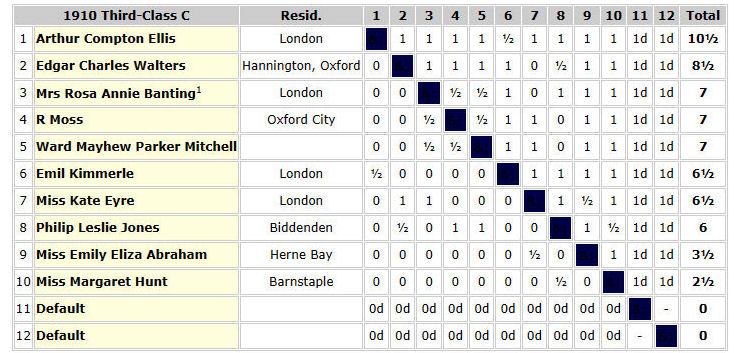
I have yet to see any evidence that he was a member of his local chess club in Richmond at this time, but club reports for this period are thin on the ground. However, in 1907, with the British Championships taking place in London, he decided to try his hand, and was duly entered into the Second Class A section, along with my favourite chess playing clergyman, Rev Evill. (I see Evill drew with Gooding, which must prove something, but I’m not sure what. Perhaps it was the chess equivalent of this cricket match.)

Lupton’s participation didn’t go well, as you’ll see from the cross-table.

Source: BritBase (https://www.saund.org.uk/britbase/pgn/190708bcf-viewer.html)

It’s not clear, though, whether he actually played all his games or lost some (or perhaps all) by default.

He continued solving and occasionally composing until 1909, after which his name disappeared again.

By 1911 we find him back in Richmond, and in a different job. He’s no longer a police constable but an advertising agent. He’s still boarding, with a milkman and his family, in Eton Street, right in the town centre.

Throughout the 1910s there’s no record of him at all. It’s ten years before we get to meet him again, in the 1921 census.

Now approaching his 57th birthday, he’s lodging at 31 Sheendale Road, Richmond, which runs south off what is now the A316 towards the railway line. His occupation is described as ‘Ex Officer of Police London County Council Constabulary’, his employer as ‘Pelabon Works East Twickenham’ and place of work as ‘shell factory’. Well, it had been some years since he’d been an officer of police, but the Pelabon Works were very interesting.

About 6000 Belgian refugees were living in East Twickenham during the First World War, many of them working at a munitions factory run by a French engineer named Charles Pelabon. Although most of the workers there were Belgian, some English workers were also employed there, and James Money Kyrle Lupton must have been one of them. It’s a fascinating story: you can read more about it here (a paper from the scholarly journal Immigrants & Minorities: Historical Studies in Ethnicity, Migration and Diaspora) and here, amongst other places. The factory was later converted into the world famous Richmond Ice Rink.

If you take the bus to Richmond Bridge and stroll along the river on the Middlesex bank towards the centre of Twickenham (a short walk I can highly recommend) you’ll soon come across a small garden with two information boards, one telling the story of the Belgian refugees, and one the story of the ice rink.

Here’s the Belgian refugee board: you’ll have to visit yourself to read all the text.

Photo: Richard James

And here’s a list of local residents who made financial contributions to support the memorial. You’ll see a very familiar name on the list, although he has now moved out of the area.

Photo: Richard James

At some point he also had a job working for the Parks Department of London County Council, which may have been in the early 1920s, or possibly earlier.

But living on his own, with no employment and nothing better to do with his time, in 1921 he decided to return to chess problems, with his name now regularly appearing in lists of solvers in the Illustrated London News, to whom he also submitted problems for publication.

On 24 September 1927 they were profuse in their gratitude: “You overwhelm us with your kindness. Your problems are quite unique, and they always possess a piquant interest peculiar to themselves.”

He also found a new outlet for his problems in the Catholic weekly The Tablet. While his ILN compositions were often complex waiters, where the key move created no threats but the many possible black replies all allowed different mates, The Tablet, whose readers were less likely to have a specialist knowledge of chess problems, was favoured with simpler problems, often featuring a theme popular at that level.

Here’s an example.

Problem 3

[fen]8/1Q6/3N1P1P/1P2k3/7K/8/3PN3/8 w – – 0 1[/fen]

#2 The Tablet 8 Aug 1925

The ILN chess column was discontinued in 1932 (only resuming under BH Wood’s authorship in 1949) and Lupton’s last problem in The Tablet was published in 1933.

James Money Kyrle Lupton had also found a new hobby to while away the time: writing letters to newspapers. Here, in 1924, he exclaims “Let us be Englishmen and debar no foreigners from anything”.

Westminster Gazette 27 May 1924

While he was in favour of foreign musicians such as Richard Strauss playing in England, he was strongly opposed to married women with children working.

There was a local cause célèbre in Twickenham in 1926 when the local Education Board, headed by Twickenham Chess Club President and British Fascist (he joined that year) Dr John Rudd Leeson, sacked the headmistress of Twickenham County School for Girls, Dr Isabel Turnadge, after she married and had a child.

George Bernard Shaw was not slow in voicing his opinion, and nor was Lupton.

West London Observer 03 December 1926

However, the following year he came out in favour of lowering the voting age for women from 30 to 21. “Women are equal to men in a great many callings, and in some far better. The present voting age of 30 for women is an insult to womanhood.” (Westminster Gazette 06 April 1927) Strangely, I haven’t been able to find him on any electoral roll (the only family member I’ve identified there is his brother Roger), possibly in part because he never owned his own property.

By the 1930s he’d become Mr Angry of Richmond. I suspect that today, like many sad and lonely middle-aged men, he’d be a Twitter Troll. He was a passionate supporter of capital punishment, for rapists and paedophiles as well as murderers, and was strongly opposed to releasing prisoners with life sentences after 20 years. He also held strong views about non-pedigree dogs: “Curs and mongrels are valueless, and are the Communists of the dog world, and emissaries of the devil” (West London Observer 10 November 1933). He complained about cars driving too fast in Richmond Park (still a hot topic today), children playing football in Kew Gardens, jaywalking pedestrians (women were the worst), about British Summer Time. There was always something to complain about. But most of all he complained about people talking: in libraries, in cinemas, on trains. In one of his last letters he wrote that brunettes were better than blondes, although I’m not sure how much experience he’d had of either.

He retained his membership of the London Athletic Club, often walking from Richmond to the city and back (24 miles) in a day, and often wrote letters about his favourite sport, as well as about horse riding. He thought women would make excellent jockeys, as indeed they do: witness the likes of Hollie Doyle and Rachael Blackmore.

In 1934 he wrote a letter about his favourite indoor game.

West London Observer 13 April 1934

Looking back at his results in the 1907 British Championships, I’m not sure what that says about James MK Lupton’s brain.

Although his chess composing career seems to have come to an end in 1933, he continued writing letters to newspapers until 1936. While some of his views seem relatively enlightened for the time, many of them were extremely reactionary. He died on 12 April 1937 at the age of 72. His address was given as 34 Halford Road Richmond, where I suspect he was back living with his sisters, but he died at a nearby address, 22 Cardigan Road, a very large house which might, at the time, have been a clinic or care home of some sort. He left £351 15s 7d and probate was granted to his sister Maude.

Reading between the lines, I get the impression that James Money Kyrle Lupton probably didn’t have a very happy life. He came from an affluent background, and had a talent for sports, writing and chess, but never seemed to settle in one job and never owned his own property, spending much of his time living in lodgings. Looking at his letters, he seems to have become rather grumpy and cantankerous in later years. Perhaps he should have joined Richmond Chess Club and made some friends.

Did something go wrong at some point? Who knows? The family hasn’t been well researched and there seemed no online tree available so I created one myself. They all, especially on the Cheesman side, seemed difficult to track down There’s something unusual, but not unique (you’ll meet a similar example in a future Minor Piece), about the Lupton family. All seven of the siblings reached adulthood but none of them married or, as far as I can tell, had children. Three of his sisters lived very long lives, two into their nineties and one to her mid eighties. While James was only too keen to see his name in print, the rest of them seemed a pretty reclusive bunch.

If you want to see more of his problems, you’ll find those from The Field and The Tablet in Brian Stephenson’s MESON chess problem database. I also used one of them as the Richmond & Twickenham Chess Club Puzzle of the Week. If you search online newspaper archives you’ll find quite a few more, from the Illustrated London News and other sources.

That, then, was James Money Kyrle Lupton, athlete and chess problemist. Join me soon for another Minor Piece.

Solutions:

Problem 1:

1. Bc8! (threat 2. d8N#). 1… e4 2. Qd5#, 1… f5 2. Rg6#, 1… Qxc5 2. Nxc5#, 1… Nd8+ 2. cxd8N#, 1… Rxe8 2. dxe8Q/R#, 1… Rxc8 2. dxc8Q/B#

Problem 2:
1. e5! (no threat). 1… f5/f6 2. exf6# 1… Bg7/Bh6 2. Re8# 1… Nb6/Na7 2. Ba3# 2… Nd6 2. exd6#

Problem 3:
1. Nf4! (no threat) 1… Kxf4 2. Qe4# 1… Kxf6 2. Qg7# 1… Kxd6 2. Qe7# 1… Kd4 2. Qd5#

The Star Flight theme. The black king has four diagonal flight squares, each of which is met by a different white mate.

Acknowledgements and sources:

ancestry.co.uk

findmypast.co.uk

MESON chess problem database

BritBase

Twickenham Museum

Other online sources quoted within the article


Minor Pieces 38: Cecil Frank Cornwall

Surrey Mirror 16 December 1902

You’ve seen this a couple of times before: a 1902 Surrey Trophy match between Richmond and Redhill.

It’s time to meet Richmond’s Board 8: Cecil Frank Cornwall. Cecil had been born in Chorlton, Manchester on 16 November 1883, so he was still in his teens at the time of this match. His father, Frank Edward Cornwall, was a newspaper proprietor who had been born in India. Shortly after his birth the family moved down to Twickenham, where Cecil’s sister Edith Annie was born in 1885. Their address at that point was given as 1 Carnarvon Villas, Strawberry Hill Road, Twickenham, which had been built by Abraham Slade (mentioned here) in 1866.

By the time of the 1901 census they’d moved round the corner to a house called Hainault in Popes Grove. No occupation was given for Cecil, but Edith was still at school.

It would have been around that time, then, that Cecil joined Richmond Chess Club. It was relatively unusual for teenagers to take part in competitive chess in those days, so I’d guess he’d perhaps learnt the game from his father. He’d also played successfully for Richmond against the same opponents the previous season. (The Sussex Agricultural Express really was essential reading for chess fans.)

Sussex Agricultural Express 18 March 1902

Here, then, we have a young player of some promise, already doing well against decent club standard opposition.

By 1903 Cecil was also a member of the famous Metropolitan Chess Club. He spent his life in banking, so it seems quite likely that he was now working in central London.  He was bold enough to submit this game for publication in the London Evening Standard.

London Evening Standard 03 April 1905

Here’s the game for you to play through (click on any move for a pop-up window).

[pgn]

[Event “Brixton v Metropolitan”]
[Site “?”]
[Date “1905.03.??”]
[Round “?”]
[White “Newark, James Henry”]
[Black “Cornwall, Cecil Frank”]
[Result “0-1”]
[ECO “C54”]
[Annotator “Tactical Analysis 5.2 (1s)”]
[PlyCount “80”]
[EventDate “1908.??.??”]
[SourceVersionDate “2020.10.20”]

1. e4 e5 2. Nf3 Nc6 3. d4 exd4 4. Bc4 Bc5 5. c3 Nf6 6. cxd4 Bb4+ 7. Nc3 Nxe4 8.
Qb3 O-O 9. O-O Bxc3 10. bxc3 Na5 11. Qb4 Nxc4 12. Qxc4 d5 {C54: Giuoco Piano:
4 c3 Nf6, main lines with 5 d4 and 5 d3.} (12… h6) 13. Qd3 c6 14. Bb2 Bf5 {
Black is clearly better.} 15. Qe3 Bg6 16. Ne5 Re8 17. f3 Nd6 18. Qf4 Qf6 19.
Qxf6 gxf6 20. Ng4 Kg7 {[#] White must now prevent …h5.} 21. Bc1 h5 22. Ne3 (
22. Bh6+ $17 Kh7 23. Bf4) 22… Re7 (22… Nb5 $19 23. Bd2 {[#]} Nxc3 $1 24.
Bxc3 Rxe3) 23. Re1 $17 Rae8 {& Black is more active.} 24. Bd2 Bd3 25. Kf2 f5 26.
g3 Nc4 27. Rad1 Nd6 $2 (27… f4 $19 28. Nxc4 Re2+ 29. Rxe2 Rxe2+ 30. Kg1 Bxc4
31. Bxf4 Rxa2) 28. Bc1 $11 Ba6 (28… f4 $5 29. Rxd3 fxe3+ 30. Rdxe3 Rxe3 31.
Rxe3 Rxe3 32. Kxe3 Kg6 $11) 29. h3 (29. c4 $5) 29… h4 30. gxh4 f4 $36 {
White is under strong pressure.} 31. Ng2 Re2+ 32. Rxe2 $2 (32. Kg1 $17) 32…
Rxe2+ $19 ({Weaker is} 32… Bxe2 33. Rg1 Bc4 34. Ne3+ (34. Nxf4+ Kh8 $14)
34… Kh7 35. Nxc4 Nxc4 36. Bxf4 $14) 33. Kg1 Rxa2 {Strongly threatening …
Be2.} 34. Nxf4 Be2 35. Nxe2 Rxe2 {KRB-KRN} 36. Bf4 Nc4 37. Rc1 $2 (37. h5 a5
38. h6+ Kg6 39. Kh1) 37… a5 {Black is clearly winning.} 38. h5 a4 39. h6+ Kh7
{Hoping for …a3.} 40. Kh1 a3 {Weighted Error Value: White=0.64/Black=0.51}
0-1

[/pgn]

One of the major London chess events at the time was the annual encounter between the City of London and Metropolitan Chess Clubs. In 1905 the City team scored an overwhelming victory, Cornwall drew his game against the American international Clarence Seaman Howell, very easily confused with Clarence ‘Frogman’ Henry. Lots of great names on both sides of the board in this match!

Daily News (London) 13 November 1905


By 1908 Cecil had joined West London, and here found himself playing against Metropolitan, facing another American, James Mortimer, who, half a century or so earlier, had played friendly games against Paul Morphy.

Both players followed contemporary opening theory until Cornwall went wrong, but Mortimer missed his chance, and sportingly submitted the game for publication.

Westminster Gazette 07 March 1908

[pgn]

[Event “Metropolitan v West London”]
[Site “?”]
[Date “1908.??.??”]
[Round “?”]
[White “Mortimer, James”]
[Black “Cornwall, Cecil Frank”]
[Result “0-1”]
[ECO “C56”]
[Annotator “Tactical Analysis 5.2 (1s)”]
[PlyCount “47”]
[EventDate “1908.??.??”]
[SourceVersionDate “2022.07.20”]

1. e4 e5 2. Nf3 Nc6 3. Bc4 Nf6 4. d4 exd4 5. O-O Bc5 6. e5 d5 7. exf6 dxc4 8.
Re1+ Be6 9. Ng5 Qd5 10. Nc3 Qf5 11. Nce4 Bb6 12. fxg7 Rg8 13. g4 {C56: Two
Knights: 4 d4 exd4 5 0-0 Nxe4.} Qg6 {[#] Hoping for …0-0-0.} 14. Nxe6 fxe6
15. Bg5 {White is slightly better.} ({Inferior is} 15. Ng5 e5 16. Kh1 d3 $17)
15… Rxg7 {White must now prevent …Rf7.} 16. Qf3 {[#] aiming for Nf6+.} Kd7
$146 ({Better is} 16… e5 $14) ({Predecessor:} 16… Ne7 17. Nf6+ Kd8 18. Qxb7
Rc8 19. h4 h6 20. Rxe6 hxg5 21. h5 Qf7 22. Rae1 Qxe6 23. Rxe6 Bc5 24. Qc6 {
1-0 (24) Mortimer,J-Brooks,E Shrewsbury/ Shropshire 1906}) 17. Nf6+ $18 Kc8 {
[#] …e5 is the strong threat.} 18. h4 $2 (18. Rxe6 $1 $18 Qxg5 19. Rxc6)
18… h6 $2 (18… e5 $11) 19. Rxe6 hxg5 (19… Nd8 $142) 20. h5 Qxc2 21. Rae1
(21. Qd5 $142 Qxf2+ 22. Kxf2 Re7 23. Rxe7 d3+ 24. Kg2 Nxe7 25. Qd7+ Kb8 26.
Qe8+ Nc8 27. Nd7#) 21… Nd8 22. Re8 {Intending Rxd8+! and mate.} c6 23. R8e2
$4 (23. Ne4 $18 {is the narrow road to win.}) 23… Qd3 $19 24. Qg2 {Weighted
Error Value: White=1.10/Black=1.75 and Black won 25 moves later} 0-1

[/pgn]

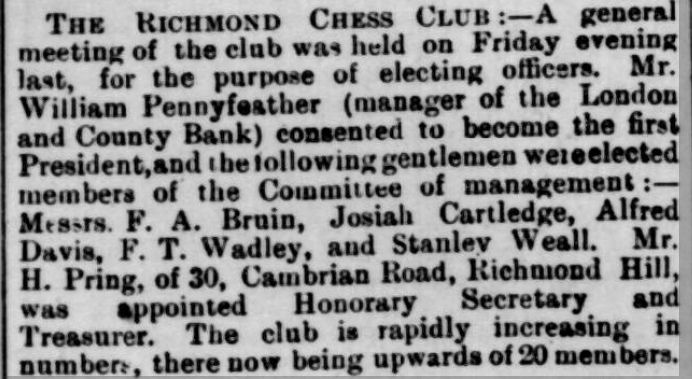
There were other things happening in Cecil Cornwall’s life as well as work and chess. On 30 April 1910 the wedding bells were ringing from Holy Trinity Church across Twickenham Green for the marriage of Cecil Frank Cornwall and Violet Mary Jones Price (these two names sometimes hyphenated), the Oxford born daughter of a Welsh commercial traveller. Nine months later, on 27 December, a daughter arrived. Cecil liked his name so much that she was named Cecil Gwendolyn Edith Cornwall.  By the time of her baptism, her third name had been changed from Edith to Clare, and her mother’s middle name was given as Marie rather than Mary.

In 1911 Cecil, Violet and their young daughter were living at 5 Wellesley Terrace, Hampton Road, Twickenham, again very near Twickenham Green, along with Violet’s 18 year old brother Godfrey Horace Reginald Price, a boarder who was, like Cecil, employed as a bank clerk.

One rather puzzling aspect of their 1911 census record is that it was Violet rather than Cecil who completed the form, and that she added quote marks round “Head” and “Wife”. One wonders why.

The family’s happiness was not to last long. In the fourth quarter of 1912 a son, Alan Maxwell Frank Cornwall, was born, and, sadly, his death was registered in the same quarter. Cecil continued to play chess, making occasional appearances in Surrey county matches and individual competitions. But war clouds were gathering over Europe and soon there would be little competitive chess for him.

Determined to serve his country, Cecil Frank Cornwall signed up for a short service commission in the army reserves. Here’s the front page of his attestation, giving his address as 46 King Edward’s Grove, Teddington. We’ll return there later. However, a 1915 electoral roll gives his address as 52 Langham Road, Teddington, not very far away.

In the first quarter of 1918 the birth of a daughter, Dolores, was registered, and again her death was also registered in the same quarter. A tragedy for Cecil and Violet to have lost two children at, or soon after, birth.

After the end of the First World War competitive chess gradually started up again and in 1920 Cecil played for Surrey against Lancashire in the final of the BCF County Championship.

Here’s his game.

[pgn]

[Event “Lancashire v Surrey”]
[Site “?”]
[Date “1920.??.??”]
[Round “?”]
[White “Keir, Samuel”]
[Black “Cornwall, Cecil Frank”]
[Result “0-1”]
[ECO “D12”]
[Annotator “Tactical Analysis 5.2 (1s)”]
[PlyCount “38”]
[EventDate “1908.??.??”]
[SourceVersionDate “2020.10.20”]

1. d4 d5 2. Nf3 Nf6 3. c4 c6 4. e3 Bf5 5. Nc3 e6 6. Be2 Nbd7 7. O-O Bd6 8. a3
Ne4 {[#] D12: Slav Defence: 3 Nf3 Nf6 4 e3 Bf5.} 9. c5 $146 ({Predecessor:} 9.
Re1 Ndf6 10. Nxe4 Nxe4 11. Bd2 Bg4 12. Rf1 Bxf3 13. Bxf3 Nxd2 14. Qxd2 O-O 15.
Rac1 Qe7 16. Rfe1 Rfd8 {1/2-1/2 (16) Zukertort,J-Rosenthal,S London 1880}) 9…
Bc7 10. Nd2 Qh4 {Black is better.} 11. f4 g5 {…Rg8 is the strong threat. Black has more active pieces. The white rooks are badly placed.} 12.
Nf3 {[#]} Qh6 {White must now prevent …g4.} 13. Nxe4 dxe4 14. Ne5 gxf4 15.
Nxd7 $2 (15. exf4 $17 Qg7 16. Qb3) 15… f3 $19 ({Stronger than} 15… Kxd7 16.
exf4 Rag8 17. Bh5 $15) 16. Nf6+ (16. Ne5 $142 fxe2 17. Qxe2) 16… Qxf6 17.
gxf3 {[#]} Bxh2+ $1 {Black mates.} 18. Kh1 Qh4 19. fxe4 Bc7+ {White got
outplayed after the opening. Weighted Error Value: White=1.31/Black=0.05
(flawless)} 0-1

[/pgn]

By now it was 1921 and time for another census. It’s clear that there was a problem of some sort within the family as Cecil and Violet were living separately. I guess the loss of two children might have put an unbearable strain on their marriage.

Violet was in King Edward’s Grove, not at number 46, but at number 1, where Felicia Crofts was letting apartments. Violet, aged 32, was a lodger, occupation described as ‘supported by husband permanent living’. Also there were  Henry Charles Crozier, a 56 year old insurance clerk, Edmund Joseph Woodland, a 65 year old dealer on the Stock Exchange, and his 61 year old wife Emma Kate.

Cecil was also in a boarding house, at 29 Sheen Road, Richmond, a 37 year old bank clerk working for London, County, Westminster and Parr’s Bank, which would become Westminster Bank in 1923 and is now NatWest.

Although at that point it seems they were still married, and I can’t find any divorce records, in the third quarter of that year Violet married Archibald Gibb (a widower from Portsmouth, born in 1876, who, in 1911, had been living at 31 King Edward’s Grove) in Kingston. But less than a year later, on 29 August 1922, she died of valvular heart disease, at the age of only 32.

The decade from 1912 to 1922 must have been a very difficult time for Cecil Frank Cornwall. Perhaps his love of chess played a part in keeping him going.  Would the rest of his life bring him happiness?

In 1924 Cecil remarried. His second wife, Helen Kennedy, had been born in Cork in 1895. In October 1925 he was still playing county chess for Surrey, but soon afterwards they crossed the Irish Sea to her home town.

In 1926, a son, Julian Cecil K Cornwall, was born in Cork, and a daughter, Adrianne Kathleen Mary, followed in 1928 in Dingle, right over the other side of Ireland. But they didn’t stay there long. Soon after their daughter’s birth they sailed back to England, perhaps at first settling back in the Richmond or Kingston area, as Cecil, wasting no time in resuming his chess career, scored his greatest success, becoming county champion in 1930. The winner the following year would be none other than Harry Golombek.
It was the tradition at the time that the club or county champion had the honour of playing on top board, and so it was that Cornwall encountered William Albert Fairhurst in the final of the BCF County Championship.

Yorkshire Post and Leeds Intelligencer 13 October 1930

They then decided to move again, settling on the south coast in Hove in 1932, with Cecil continuing his work as a bank clerk, and later becoming a bank manager. He joined the thriving Brighton Chess Club, and, in 1933, won their club championship for the first time. Here’s a fine attacking game, against the 1910 Scottish Champion, published in 1933 but probably played slightly earlier.

[pgn]

[Event “?”]
[Site “?”]
[Date “abt 1931”]
[Round “?”]
[White “Cornwall, Cecil Frank”]
[Black “Richmond, George William”]
[Result “1-0”]
[ECO “D05”]
[Annotator “Tactical Analysis 5.2 (1s)”]
[PlyCount “49”]
[SourceVersionDate “2020.10.20”]

1. d4 d5 2. Nf3 Nf6 3. e3 e6 4. Bd3 c5 5. O-O Nc6 6. b3 Bd6 7. Bb2 O-O 8. Nbd2
b6 9. Ne5 Bb7 {D05: Colle System with …e6.} 10. a3 {Against Nb4} Rc8 11. f4 {
[#]} Qc7 $146 {The position is equal.} ({Predecessor:} 11… Qe7 12. Qe2 Nb8
13. f5 exf5 14. Rxf5 Nbd7 15. Raf1 Rc7 16. c4 g6 17. R5f2 Bxe5 18. dxe5 {
1/2-1/2 (49) Salwe,G-Teichmann,R Ostend 1907}) 12. c4 Rfd8 13. Qe2 cxd4 14.
exd4 Bf8 {White must now prevent …Nxd4!} 15. Ndf3 h6 16. cxd5 $2 {& White is
more active.} (16. f5 $16 {stays on course.}) 16… exd5 (16… Nxe5 $6 17.
fxe5 Nxd5 18. Rac1 $11 (18. Qe4 g6 $15)) (16… Nxd5 $17 17. g3 (17. Qe4 f5 $17
) 17… Nxe5 18. fxe5 Ne7) 17. Rac1 {Threatens to win with Nxc6.} Qb8 $2 {[#]}
(17… Qe7 $14) 18. Nxf7 $1 $18 {Hoping for Qe6.} Kxf7 {[#]} (18… Re8 19.
N3e5 Rc7) 19. Ng5+ $1 hxg5 20. fxg5 {White wants to mate with g6+. Pin} Rd6 21.
Rce1 Qc7 22. Bf5 (22. gxf6 gxf6 23. Qh5+ (23. Qg4 Bg7 $14) 23… Kg8) 22… Re8
{[#]} 23. Qh5+ {Skewer, Deflection} Nxh5 (23… Kg8 24. gxf6) 24. Bh7+ Rf6 25.
g6# {Weighted Error Value: White=0.73/Black=1.38} 1-0

[/pgn]

This wouldn’t be the only time he won the Brighton Club Championship. Four years later, in 1937, he was again successful, and, after a break during the dark days of World War Two, he won the title five times in succession, from 1944 to 1948. Pretty good going, especially as he was in his mid sixties by the time of his last victory.

The only photograph I’ve been able to find of Cornwall is this, from a local paper in 1950, and reproduced on a couple of online family trees, where he’s playing a simul against some local teenagers.

Had Cecil found happiness with his second family and his new chess life in Brighton? I’m not so sure.

Cecil Frank Cornwall died at the Edenhall Marie Curie Centre, 11 Lyndhurst Gardens, Hampstead (a hospice which had opened the previous year) on 26 September 1955. The death notice in the Daily Telegraph two days later was perfunctory: “dearly loved brother of Edith”. No mention of Helen, Julian or Adrianne, or of his daughter Cecil from his first marriage, all of whom were still alive. You have to wonder why not. Very strange, and rather sad as well. Helen lived on until 1981, when her death was registered in Lewes, Sussex.

There you have it, then. Cecil Frank Cornwall, a member of Richmond Chess Club in the early 1900s, was a strong amateur player, champion of Surrey, and, on seven occasions, of Brighton Chess Club, and for those achievements he deserves to be remembered. His few surviving games show him to have been an aggressive player with a talent for tactics, who could, perhaps, have scaled the heights had he chosen to do so. His life was touched by sadness in several ways, particularly between 1912 and 1922: I hope chess brought him solace as well as friendship, excitement and mental stimulation.

He was one of my predecessors in more ways than one. Let me take you on a walk along King Edward’s Grove, a road in South Teddington running between Kingston Road and Broom Road. It was briefly called Cornelius Road in the 1890s, but when it started to acquire housing in the early 1900s it was renamed in honour of the reigning monarch.

Entering from Kingston Road, Number 1, where Violet Cornwall, as she then was, was lodging in 1921, is the first house on your left. Continuing along the road, and still in 1921, let’s knock on the door of 27 King Edward’s Grove. Whose family lives in a house like this? The answer is none other than Cecil Frank Cornwall’s Metropolitan teammate from 1905, Edward Guthlac Sergeant, who had a long and distinguished chess career which I hope to cover at some future date.  He’d only just moved in at that point, and would only stay there a couple of years. Just two doors further along is number 31, where Violet’s second husband, Archibald Gibb, was living in 1911. It’s now a care home for adults with learning difficulties and autism. On the other side of the road is number 46, where Cecil and Violet were living in 1916. Perhaps Archie across the road took a shine to Vi. Carry on right to the end of the road, to number 73 on the corner of Broom Road, turn the clock forward to 1934, and you’ll find a rather unusual household. The house is owned by the Misses Ada and Louisa Padbury, who until recently had run a ham and beef shop in nearby Bushy Park Road. Two other sisters are there: Ellen, a dressmaker, and the disreputable Florence, in the final stages of TB, along with her illegitimate children Arthur and Betty, who had been brought up by Ada and Louisa. Florence died in 1935, after which, like others in the same road, the property was converted into a boarding house. When Betty married in 1949, she and her husband remained there until they could afford their own place, and it was there that their older son would spend the first two years of his life.
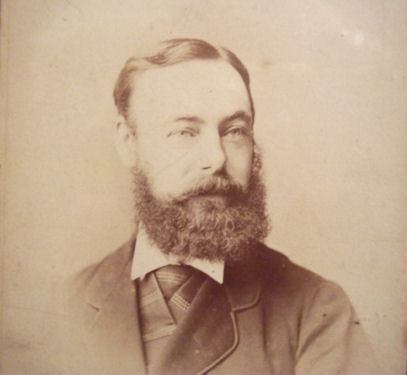
That son was me, and so I followed in the footsteps of Cecil Frank Cornwall by living in King Edward’s Grove (as did Edward Guthlac Sergeant) as well as by being a member of Richmond Chess Club.

Sources:

ancestry.co.uk

findmypast.co.uk

Wikipedia

Google Maps

Brighton Chess by Brian Denman, self-published in 1994 and highly recommended if you can get hold of a copy.


Minor Pieces 37: Richard Exton Gardner

There are those who are of interest because, like William Ward, they’re strong chess players who had distinguished careers. We can follow their results and study their games.

There are others who might have had shorter or less distinguished chess careers but who are of interest because of their lives outside chess, or perhaps because of their families.

Richard Exton Gardner was one of those. You might have seen this 1902 Surrey Trophy match card before. There, on board 7, was RE Gardner, which tells us he was a decent club standard player.

Richmond wasn’t Gardner’s only club. Here he is, in 1900, playing for West London against Athenaeum, who featured William Ward on top board.

West London Observer 14 December 1900

Here he is again, in 1904, playing for West London against an Oxford and Cambridge team. The match below, against City of London, saw both William Ward and George Edward Wainwright in action, with Harold Francis Davidson, later the Rector of Stiffkey (who was eaten by a lion) and star of The (Even More) Chess Addict among the opposition.

Field 26 March 1904

But who was Richard Exton Gardner?

If you’ve ever used Yardley soaps or perfumes you might be interested to find out.

The company we now know as Yardley was founded in London by William Cleaver in 1770. His son married a Yardley, and, for obscure financial reasons, the firm acquired the name it still uses today. At some point, probably round about the late 1860s, an ironmonger’s son from Bristol, Thomas Exton Gardner, found employment there, and, clearly ambitious and talented, found himself at the top of the tree.

After moving round various addresses first in Central, then in West London, the family settled at 2 Branstone Road, Kew (almost opposite the Lion Gate entrance to Kew Gardens). The 1881 census found Thomas and his wife Elizabeth at home, along with their four young children, Ida May, Thornton Ernest, Dora Annie and Richard Exton. They were wealthy enough to employ a domestic servant and a nursemaid.

Thomas died in 1890 at the age of only 51, after which Yardley fell into decline, but the family were still involved and young Thornton and Richard joined the management team: in 1900 Thornton was Managing Director and Richard, only 21 at the time, Company Secretary.

The 1901 census found Elizabeth and her four children still at the same address, along with their 20 year old cousin Dora Fordham, a housemaid and a cook, both teenage girls. Thornton was described as the manager of a soap factory and Richard a clerk.

So here we young man whose hobby was chess and was already playing for his two local clubs: Richmond and West London. In an age where children rarely played chess, he would have been considered a player of some potential.

It seems, though, that his chess career was short: understandably he decided to put his business interests first: under Thornton and Richard’s stewardship Yardley grew and thrived, and still does so today. If you use their soaps or scents you have them to thank.

Let’s continue Richard’s story, as there’s still much of peripheral interest to relate. In 1905 Yardley opened a new factory in Carpenters Road, Stratford, which runs through what is now the Queen Elizabeth Olympic Park.

In 1908 he married (Gertrude) Vere Uffindell, the daughter of a naval engineer. They both gave their address as 66 Elgin Crescent, Notting Hill, so the family had moved away from Kew. By 1911 Richard and Vere, now expecting their first child, were living on the premises in Carpenters Road along with a servant. A son, Charles Exton Gardner, was born later that year, and another son, named Richard Exton Gardner after his father but known to family and friends as Jimmy, would follow in 1914.

Did Charles and Jimmy follow their father’s interest in chess? Not to any great extent, it seems: they took up a different hobby, aviation, which would play an important part in both their lives.

In 1936 Charles won the King’s Cup flying a Percival Vega Gull owned by his younger brother, and the following year he repeated his success, this time in a Percival Mew Gull.

In the summer of 1938 the two brothers made the headlines across the country when Jimmy’s plane was stolen. Teenagers involved in a foolish and dangerous prank involving an aeroplane? Who’d have thought it? This report is from the Bucks Herald (12 August 1938).

So they were let off because they were nice middle-class boys?

You might want to consider the name of the prosecuting counsel. Vernon Gattie, or Vernon Rodney Montague Gattie QC CBE, as he later became, was the son of Walter Montague Gattie, one of the strongest English chess players of the 1880s, who played for Oxford in five varsity matches. It’s unlikely that Walter knew Richard senior, but they would probably have had some shared acquaintances. The acting chairman, Archibald William Cockburn KC, seems to have been a very distant cousin of Alexander Cockburn, the author of Idle Passion : Chess and the Dance of Death

I expect you want to know what happened next to the miscreants, don’t you?

Gerald, as far as I can tell, worked as an aircraft fitter, never married, and died at the age of 64. Peter, who may have been the instigator of the escapade, and spent a month in hospital recovering from injuries sustained in the crash, was up before the bench again the following year, charged with separate offences of stealing a camera and a raincoat.

He then joined the RAF Volunteer Reserve, rose to the rank of Sergeant in 602 Squadron, and lost his life on 11 December 1942. The 602 Squadron, which flew Spitfires, was based in Scotland but also took part in the Battle of Britain in 1940. Did Peter fly a Spitfire in the Battle of Britain? Seemingly not, as he’s not on any online list of pilots. What were the circumstances of his death? “Details not known” according to the website of the 602 Squadron Museum.

You’ll also want to know what happened to Charles and Jimmy Gardner.

By 1939 Charles was an operational officer in the Air Ministry and presumably served in that post during the Second World War.

Richard Exton Gardner junior (Jimmy) joined the Fleet Air Arm and became a fighter pilot under Douglas Bader, flying Hurricanes in the Battle of Britain. Unlike many of his brave colleagues he survived the war: you can read all about him here.

After the war, both brothers rejoined their family firm, where they remained until retirement.

Not very much chess in this article, I’m afraid, but still an interesting story. Join me again soon for some more Richmond Chess Club members from the 1900s.

Acknowledgements:

ancestry.co.uk

findmypast.co.uk

EdoChess

Wikipedia

Other websites linked in the article


Minor Pieces 35: William Ward Part 2

Last time we left William Ward at the time of the 1901 census, where he was staying overnight with one Isidore Wiener.

As we know he played for Richmond at the end of 1902, was he living in our part of London at that time?

But before that, in April 1902 William Ward played a match against rising American star Frank Marshall, who was visiting London at the time. The two players had met the previous year in the Anglo-American Cable Match, where Ward was successful. In this match, however, Marshall won four games to Ward’s two. The American was noted for his attacking skills but in this game he had no answer to his opponent’s kingside attack. (As usual, you can click on any move and a pop-up window will appear, enabling you to play through the game.)

[pgn]

[Event “Match Marshall-Ward +4-2=0”]
[Site “London”]
[Date “1902.??.??”]
[Round “4”]
[White “Marshall, Frank James”]
[Black “Ward, William”]
[Result “0-1”]
[ECO “D55”]
[Annotator “Tactical Analysis 5.2 (1s)”]
[PlyCount “82”]
[EventDate “1902.??.??”]
[EventType “match”]
[EventRounds “6”]
[EventCountry “ENG”]
[SourceTitle “EXT 2002”]
[Source “ChessBase”]
[SourceDate “2001.11.25”]
[SourceVersion “1”]
[SourceVersionDate “2001.11.25”]
[SourceQuality “1”]

1. d4 d5 2. c4 e6 3. Nc3 Nf6 4. Bg5 Be7 5. Nf3 Nbd7 6. e3 O-O 7. Rc1 b6 8. cxd5
exd5 9. Bd3 Bb7 10. O-O c5 11. Bb1 Ne4 12. Bf4 {D55: Queen’s Gambit Declined:
4 Bg5 Be7: Lines without …h6 and 6…h6 7 Bxf6.} Rc8 13. Qc2 $146 ({
Predecessor:} 13. Qe2 Bf6 14. Rfd1 Re8 15. Qd3 g6 16. Nb5 a6 17. Nd6 Nxd6 18.
Bxd6 c4 19. Qd2 b5 {1/2-1/2 (29) Tarrasch,S-Burn,A Vienna 1898}) 13… f5 14.
Rcd1 {White is slightly better.} Ndf6 (14… g5 $5 15. Be5 Nxc3 16. bxc3 g4 $15
) 15. dxc5 (15. Qa4 $5) 15… Bxc5 (15… bxc5 $5 16. Qb3 Qb6 $11) 16. Nd4 Bxd4
17. exd4 Nxc3 18. bxc3 Ne4 19. Bd2 {Loses the game.} Ba6 20. Rfe1 Qh4 21. g3 $2
(21. f3 {was the only chance.} Qf2+ 22. Kh1 Nxc3 23. Bxc3 Qxc2 24. Bxc2 Rxc3
25. Ba4) 21… Qh5 $19 {aiming for …f4!} 22. Qb2 $2 (22. c4 Bxc4 23. Rc1)
22… Be2 ({And not} 22… Qf3 23. Be3 $17) 23. Rc1 {[#]} Nxf2 $1 {( -> …Qf3)
} 24. h4 Qf3 25. Kh2 Qg4 (25… Ng4+ $142 26. Kh3 Nf2+ 27. Kh2 Nd3 28. Rg1 Nxb2
29. Bf4 Nd3 30. Bxd3 Bxd3 31. Rg2 Be4 32. Rcc2 Bxc2 33. Rxc2 Rfe8 34. Be5 Qd1
35. Rg2 Rxc3 36. Rg1 Rc2+ 37. Rg2 Rec8 38. Bf4 Rxg2+ 39. Kxg2 Rc2+ 40. Bd2
Rxd2+ 41. Kh3 Qh1#) 26. Bf4 {Black is clearly winning.} Qh3+ (26… Rce8 $142
27. Rxe2 Rxe2 28. Qxe2 Qxe2) 27. Kg1 {[#]} Bf3 $1 28. Kxf2 Qg2+ 29. Ke3 Qxb2
30. Kxf3 Rxc3+ 31. Rxc3 Qxc3+ 32. Re3 Qxd4 {Hoping for …Qd1+.} 33. Bc2 Rc8
34. Bxf5 Rc3 35. h5 Rxe3+ 36. Bxe3 Qd1+ 37. Kf4 Qxh5 {Strongly threatening …
Qh6+.} 38. Be6+ Kf8 {…Qh6+ is the strong threat.} 39. Bg4 Qf7+ 40. Ke5 Qc7+
41. Kf5 g6+ {Weighted Error Value: White=1.26/Black=0.64} 0-1

[/pgn]

This season also witnessed William Ward’s first success in the City of London Chess Club Championship. It appears that he and Thomas Francis Lawrence shared first place, but that Ward won the play-off.

In  the summer of 1904 Ward played a match in London against George Edward Wainwright, winning by a score of 5½-3½.

In this game Wainwright had the better of the opening, but, playing too fast, perhaps, miscalculated on moves 30 and 31, giving Ward the chance of a crisp finish.

[pgn]

[Event “Ward v Wainwright match”]
[Site “?”]
[Date “1904.08.??”]
[Round “?”]
[White “Wainwright, George Edward”]
[Black “Ward, William”]
[Result “0-1”]
[ECO “B73”]
[Annotator “Tactical Analysis 5.2 (1s)”]
[PlyCount “70”]
[SourceVersionDate “2022.06.29”]

1. e4 c5 2. Nf3 Nc6 3. Nc3 g6 4. d4 cxd4 5. Nxd4 Bg7 6. Be3 d6 7. Be2 Nf6 8.
O-O O-O 9. h3 Bd7 10. Qd2 Nxd4 11. Bxd4 Bc6 12. Bf3 {[#]} Ne8 $146 {B73:
Sicilian Dragon: Classical System without 9 Nb3.} ({Predecessor:} 12… Qc7 13.
Rfe1 Rfd8 14. Nd5 Bxd5 15. exd5 Ne8 16. Bxg7 Nxg7 17. c3 e5 18. dxe6 fxe6 19.
Re3 Rd7 20. Bg4 {1-0 (64) Tarrasch,S-Von Popiel,I Monte Carlo 1902}) 13. Rad1
e5 14. Be3 f5 {White is better.} 15. Bc5 Rf6 16. Ba3 Bf8 17. Nd5 Rf7 18. exf5
gxf5 19. b3 Qh4 20. Kh2 {Hoping for g3.} ({Don’t take} 20. c4 Nc7) 20… Bh6
21. Qe1 Bg7 22. g3 Qh6 23. Bc1 Qe6 24. c4 Nf6 25. Nxf6+ Rxf6 26. Bd5 Bxd5 27.
Rxd5 f4 28. gxf4 {Threatens to win with Qe4.} Raf8 (28… Rh6 $2 29. f5 Qxf5
30. Bxh6 Bxh6 31. Rg1+ (31. Rxd6 Kf7 $16) 31… Kf7 32. Qf1 (32. Rxd6 Bf4+ 33.
Rg3 Rf8 $16)) 29. Rg1 {Qe4 is the strong threat.} Kh8 30. Be3 {[#] Black must
now prevent fxe5.} Bh6 31. fxe5 $2 {Now White is beyond hope.} (31. f3 $11)
31… Rf3 $19 32. Rg3 Bxe3 33. fxe3 Rf1 34. Qc3 R8f2+ 35. Rg2 Qg6 {Weighted
Error Value: White=0.81/Black=0.16 (very precise)} 0-1

[/pgn]

The inaugural British Chess Championships took place in Hastings in 1904, giving masters an amateurs alike the chance for a two week summer chess holiday. William Ward didn’t play that year, but was selected for the Championship in Southport the following year.

Ward started slowly, losing his first three games, followed by a draw with Blackburne, before winning six in a row, finishing with a draw against Atkins, who ran out the clear winner on 8½/11. Ward’s score of 7 points was enough for a share of second place with another forgotten player, Charles Hugh Sherrard.

In this game he again demonstrates his affinity with the Queen’s Gambit.

[pgn]

[Event “British CF-02 Championship”]
[Site “Southport/ Merseyside”]
[Date “1905.08.21”]
[Round “7”]
[White “Ward, William”]
[Black “Wahltuch, Victor Leonard”]
[Result “1-0”]
[ECO “D55”]
[Annotator “Tactical Analysis 5.2 (1s)”]
[PlyCount “69”]
[EventDate “1905.08.14”]
[EventType “tourn”]
[EventRounds “11”]
[EventCountry “GBR”]
[SourceTitle “EXT 2017”]
[Source “ChessBase”]
[SourceDate “2016.10.25”]
[SourceVersion “1”]
[SourceVersionDate “2016.10.25”]
[SourceQuality “1”]

1. d4 d5 2. c4 e6 3. Nc3 Nf6 4. Bg5 Nbd7 5. e3 Be7 6. Nf3 O-O 7. Bd3 b6 8. cxd5
exd5 9. Ne5 {White  is more active.} Bb7 {Prevents Nc6. D55: Queen’s Gambit
Declined: 4 Bg5 Be7: Lines without …h6 and 6…h6 7 Bxf6.} 10. f4 Ne4 {
[#] …Nxe5 is the strong threat.} 11. Bxe7 Qxe7 {White has an edge.} 12. O-O
f5 $146 ({Predecessor:} 12… c5 13. Bxe4 dxe4 14. Nxd7 Qxd7 15. dxc5 Qc6 16.
cxb6 Rfd8 17. Qe2 Qxb6 18. Rfd1 Rd3 19. Rxd3 exd3 {1-0 (25) Pillsbury,H-Von
Gottschall,H Munich 1900}) 13. Rc1 Nxe5 14. dxe5 {Hoping for Bxe4.} Nxc3 15.
bxc3 ({Reject} 15. Rxc3 g6 $11) 15… c5 16. h3 Rac8 17. Kh2 Rc6 18. Be2 {
[#] Strongly threatening Bf3.} Rh6 19. Bf3 Rd8 20. Qc2 Bc8 21. g3 {aiming for
Rcd1.} c4 22. Rcd1 Qc5 23. Rd4 Rc6 24. Rfd1 {White is clearly winning.} Be6 25.
e4 fxe4 26. Bxe4 dxe4 (26… h6 $142 27. f5 Bf7) 27. Rxd8+ $18 Kf7 28. Qxe4
Qf2+ 29. Qg2 Qxg2+ 30. Kxg2 {KRR-KRB} Rc5 31. g4 g6 32. Kf3 Ra5 33. R1d2 Ra3
34. Ke4 Rxc3 35. f5 {Black got outplayed after the opening. Weighted Error
Value: White=0.24 (precise) /Black=0.56} 1-0

[/pgn]

The 1905-6 edition of the City of London Chess Club Championship was another big success for William Ward, his score of 10½/13 putting him two points clear of the field.

By now he had developed notable skill in building up a slow attack from a closed position. He missed the chance of a brilliancy in this game, but his opponent gave him another, simpler, opportunity a few moves later.

[pgn]

[Event “City of London CC Championship”]
[Site “?”]
[Date “1906.??.??”]
[Round “?”]
[White “Shoosmith, Hector William”]
[Black “Ward, William”]
[Result “0-1”]
[ECO “D60”]
[Annotator “Tactical Analysis 5.2 (1s)”]
[PlyCount “86”]
[SourceVersionDate “2022.06.10”]

1. d4 d5 2. c4 e6 3. Nc3 Nf6 4. Bg5 Nbd7 5. e3 Be7 6. Nf3 O-O 7. Bd3 (7. Rc1 a6
8. cxd5 exd5 9. Bd3 Re8 10. O-O c6 11. h3 Ne4 12. Bf4 Ndf6 13. Ne5 Bf5 14. Ne2
Nd6 15. Nxc6 bxc6 16. Bxd6 Bxd3 17. Bxe7 Bxe2 18. Bxd8 Bxd1 19. Bxf6 {0-1 (72)
Shoosmith,H-Ward,W Southport/ Merseyside 1905}) 7… a6 {[#]} 8. c5 $146 {
D60: Queen’s Gambit Declined: Classical: Unusual White 7th moves.} ({
Predecessor:} 8. Qc2 dxc4 9. Bxc4 c5 10. dxc5 Qa5 11. O-O Bxc5 12. Rfd1 b5 13.
Bd3 Bb7 14. Bxf6 Nxf6 15. Ne4 Bxe4 16. Bxe4 Rac8 17. Qb1 Qb6 {0-1 (55)
Nachtikal,F-Sika,T Prague 1905}) 8… Re8 9. O-O c6 10. h3 {White is better.}
Nf8 11. Ne5 N6d7 12. Bxe7 Qxe7 13. f4 f6 14. Ng4 e5 15. fxe5 fxe5 {White
should prevent …e4.} 16. b4 e4 ({Worse is} 16… h5 17. Nf2 $11) 17. Be2 Qg5
{Against Rf5. Strongly threatening …h5.} 18. Qd2 Ng6 19. Rf2 h5 20. Nh2 Nf6
21. Kh1 Nh4 22. Rg1 Nf5 23. Nf1 Rf8 24. g3 Bd7 25. a4 Rf7 26. a5 Raf8 {White
must now prevent …h4.} 27. Nd1 h4 (27… Qg6 $19 {is more deadly. Hoping for
…Nh6.} 28. Rgg2 Ne7) 28. g4 $17 Ng3+ 29. Nxg3 hxg3 30. Rfg2 (30. Rxg3 $11 Qh4
31. Rfg2) 30… Qh4 31. Rxg3 Nh5 32. Qe1 {[#]} (32. gxh5 $14 {was forced to
keep a grip.} Bxh3 33. Bxa6 $1 Bf5+ 34. Qh2 Qxh2+ 35. Kxh2 bxa6 36. Nf2) 32…
Nxg3+ $2 $40 {Black has strong attack.} (32… Bxg4 $1 $19 {and Black stays
clearly on top.} 33. Kh2 (33. Bxg4 $2 Rf1 $19) 33… Nxg3 34. Bxg4 Nf5 35. Qxh4
Nxh4) 33. Qxg3 Qh6 34. Kg2 {Prevents Rf3.} Rf3 35. Bxf3 Rxf3 36. Qh2 (36. Qb8+
$11 {and White stays safe.} Kh7 37. Rh1) 36… Qh4 $19 37. Rh1 $2 {[#]} (37.
Qb8+ $15 Kf7 38. Qh2) 37… Bxg4 $1 {Black is clearly winning.} 38. Qb8+ Rf8
39. hxg4 {[#]} Qxh1+ $1 40. Kxh1 Rxb8 41. Kg2 Rf8 42. Nc3 Rf3 43. Nd1 Kf7 {
Weighted Error Value: White=0.82/Black=0.56} 0-1

[/pgn]

At some point round about 1905 Ward seems to have moved to North London, joining the Hampstead Chess Club, for whom he played successfully in the London League in the 1905-6 season. You can see him here, second from the right in the row of gentlemen seated on chairs.

British Chess Magazine May 1906

The summer of 1906 was quiet: perhaps he was too busy with his legal work to take part in the British Championships in Shrewsbury. In the 1906-7 City of London Championship he failed to repeat the previous year’s success, sharing 3rd place behind the runaway winner George Edward Wainwright, with Hector William Shoosmith in second place.

William Ward didn’t have far to travel for the 1907 British Championships, which took place in Crystal Palace, but he failed to repeat his success of two years previously: this time he only managed 3½/11, sharing the tournament basement.

The 1907-8 championship of the City of London club provided a hat trick for players associated with Richmond Chess Club. Thomas Francis Lawrence won, with Ward and Wainwright taking the places.

In this game Ward experimented with what would much later become known as the Taimanov Variation of the Sicilian Defence, winning when his opponent failed to refute his unsound combination.

[pgn]

[Event “City of London CC Championship”]
[Site “?”]
[Date “1908.??.??”]
[Round “?”]
[White “Mongredien, Alfred Wornum”]
[Black “Ward, William”]
[Result “0-1”]
[ECO “B40”]
[Annotator “Tactical Analysis 5.2 (1s)”]
[PlyCount “60”]
[SourceVersionDate “2022.06.10”]

1. e4 c5 2. Nf3 e6 3. d4 cxd4 4. Nxd4 Nf6 5. Bd3 Nc6 6. Nxc6 {[#]} dxc6 $146 ({
Predecessor:} 6… bxc6 7. O-O d5 8. exd5 exd5 9. Bf4 Bd6 10. Bxd6 Qxd6 11. Nd2
O-O 12. h3 Re8 13. c3 Qf4 14. Re1 Rxe1+ 15. Qxe1 Bd7 16. Nf1 Re8 {1/2-1/2 (26)
Jacob,F-Blackburne,J Ostend 1907}) 7. O-O e5 8. Bg5 h6 {B40: Sicilian: 2…e6,
Unusual lines.} 9. Bh4 Bc5 (9… g5 $5 10. Bg3 Bd6 $14) 10. Nd2 Qe7 {The
position is equal.} 11. h3 g5 12. Bg3 g4 13. Bh4 Rg8 $36 {Black has the
initiative.} (13… gxh3 $2 14. Qf3 hxg2 15. Rfe1 $18) 14. Kh2 gxh3 15. gxh3
Bxh3 $2 {Black has more active pieces.} 16. Kxh3 $4 (16. Qf3 $18
) 16… Qe6+ $19 {Black is clearly winning.} 17. Kh2 {[#]} Ng4+ $1 18. Kh1 {[#]
} Nxf2+ $1 19. Rxf2 Bxf2 20. Qf3 {Inhibits Qh3+.} Bxh4 21. Bc4 Qd7 {Strongly
threatening …0-0-0.} 22. Rf1 O-O-O 23. Nb3 Rg3 24. Qf5 Qxf5 25. Rxf5 f6 26.
Kh2 Re3 27. Bd3 Rg8 28. Nd2 Bg3+ 29. Kh1 Bf4 30. Bf1 {Prevents Rh3+.} Reg3 {
Weighted Error Value: White=0.66/Black=0.38} 0-1

[/pgn]

The 1908 British Championship took place in Tunbridge Wells, and, despite his result the previous year, he was again selected for the championship itself.

In the first two rounds Ward scored 2/2 with the Sicilian Dragon. It’s clear from this, admittedly not entirely accurate, game that he was well aware of the latent power of the fianchettoed bishop.

[pgn]

[Event “British CF-05 Championship”]
[Site “Tunbridge Wells/ Kent”]
[Date “1908.08.10”]
[Round “1”]
[White “Michell, Reginald Pryce”]
[Black “Ward, William”]
[Result “0-1”]
[ECO “B75”]
[Annotator “Tactical Analysis 5.2 (1s)”]
[PlyCount “88”]
[EventDate “1908.08.10”]
[EventType “tourn”]
[EventRounds “11”]
[EventCountry “GBR”]
[SourceTitle “EXT 2017”]
[Source “ChessBase”]
[SourceDate “2016.10.25”]
[SourceVersion “1”]
[SourceVersionDate “2016.10.25”]
[SourceQuality “1”]

1. e4 c5 2. d4 cxd4 3. Nf3 Nc6 4. Nxd4 g6 5. Nc3 Bg7 6. Be3 d6 7. Qd2 Nf6 8. f3
Bd7 9. Nb3 $146 {B75: Sicilian Dragon: Yugoslav Attack, Miscellaneous.} ({
Predecessor:} 9. Nd5 O-O 10. Be2 Nxd5 11. exd5 Ne5 12. h3 Qc8 13. b3 Be8 14.
O-O Nd7 15. Rad1 Nf6 16. c4 Bd7 {1/2-1/2 (56) Krause,O-Moller,J Copenhagen 1907
}) 9… O-O 10. Nd5 Ne8 11. c4 {White is better.} e6 12. Nc3 f5 13. exf5 gxf5
14. O-O-O Ne5 15. f4 Ng4 16. h3 Nxe3 17. Qxe3 Qf6 18. Kb1 Bc6 19. Nd4 e5 20.
fxe5 dxe5 21. Nxc6 bxc6 22. c5 Rb8 {Threatens to win with …Kh8.} 23. Bc4+ Kh8
24. Bb3 a5 25. Rd7 e4 26. Rhd1 Rb4 (26… Bh6 $5 27. Qf2 Bg7 $14) 27. Ra7 f4
28. Qf2 Qf5 29. Rxa5 Nc7 {White must now prevent …f3.} 30. Qc2 Ne6 {Hoping
for …Nd4.} 31. Bxe6 (31. Ra4 $14 {stays ahead.} Rxa4 32. Bxa4) 31… Qxe6 $19
32. Ra7 Qc4 $2 (32… f3 $19 33. a3 Rb3 34. Rxg7 Kxg7 35. Nxe4 Rfb8 36. gxf3 (
36. Ng5 $2 Rxb2+ 37. Qxb2+ Rxb2+ 38. Kxb2 Qe2+ 39. Kc1 Qe3+ 40. Kc2 fxg2 $19)
36… Rxa3) 33. Na4 $2 {[#]} (33. a3 $11 {and White has nothing to worry.} Rb3
34. Rdd7 $1 Qxc3 35. Rxg7 Qxc2+ 36. Kxc2) 33… Rfb8 $2 (33… f3 $1 $19 34.
gxf3 exf3) 34. Qxc4 $11 Rxc4 35. Rdd7 Bf8 36. Rxh7+ Kg8 37. Rab7 $2 Rxb7 $19 {
Black is clearly winning.} 38. Rxb7 Rxa4 {Endgame KRB-KR} 39. Rc7 Ra6 40. Rc8
Kf7 41. h4 Bxc5 42. h5 Bd4 {And now …f3 would win.} 43. h6 Kg6 44. Re8 e3 {
Weighted Error Value: White=0.93/Black=0.90} 0-1

[/pgn]

British Championship, Tunbridge Wells, round 7, 17 August 1908: from left to right Isidor Gunsberg, vs Francis Lee (W), William Ward (W) vs Henry Atkins, and Joseph Blackburne vs Reginald Michell (W). Photo from BCM, Sept 1908, p372

This was the game which, in some ways, defined William Ward’s life. He exceeded the time limit on move 19 (the first time control was, strange as it might seem by today’s standards, on move 20) in a clearly better position. Atkins eventually won the title, finishing on 8/11, with Ward in second place on 6½/11. If he’d won the game, the title would have been his. Unlucky: perhaps he was distracted by the photographer!

The 1908-9 City of London Championship gave Ward his third title with an impressive score of 15/17 (no draws!), including wins over his nearest rivals, Blake, Wainwright and Edward Guthlac Sergeant, all players connected at some time in their lives with the Kingston area.

The 1909 British Championships took place in Scarborough: Atkins and Blake shared first place on 8½/11, with the Leicester born schoolmaster Atkins winning the tie-break. William Ward took third place a point behind, again, losing a game on time on move 19, this time against Blake. Admittedly on this occasion he stood rather worse. One wonders what was the reason for his problems with clock handling in these games.

Here’s a long and exciting game against the young Fred Yates, in which he opened 1. e4 with White and met 1. e4 with e5 rather than the Sicilian.
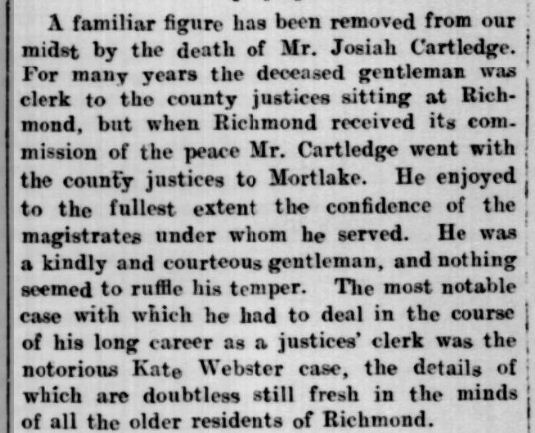
[pgn]

[Event “British CF-06 Championship”]
[Site “Scarborough/ North Yorkshire”]
[Date “1909.08.17”]
[Round “8”]
[White “Yates, Fred Dewhirst”]
[Black “Ward, William”]
[Result “1/2-1/2”]
[ECO “C87”]
[Annotator “Tactical Analysis 5.2 (1s)”]
[PlyCount “144”]
[EventDate “1909.08.09”]
[EventType “tourn”]
[EventRounds “11”]
[EventCountry “ENG”]
[SourceTitle “EXT 2006”]
[Source “ChessBase”]
[SourceDate “2005.11.24”]
[SourceVersion “1”]
[SourceVersionDate “2005.11.24”]
[SourceQuality “1”]

1. e4 e5 2. Nf3 Nc6 3. Bb5 a6 4. Ba4 Nf6 5. O-O Be7 6. Re1 d6 7. d4 Nd7 8. c3
O-O 9. Nbd2 {C87: Closed Ruy Lopez: Steinitz-type lines after 6 Re1 d6.} Bf6
10. Nf1 (10. d5 Ne7 $11) 10… Nb6 $146 ({Predecessor:} 10… Ne7 11. Ng3 Nb6
12. Bb3 Bd7 13. Nh5 Ng6 14. Nxf6+ gxf6 15. Bh6 Re8 16. h3 Qe7 {1-0 (75) Jacob,
F-Shoosmith,H Ostend 1907}) 11. Bc2 {White is better.} Bg4 12. d5 Ne7 13. Ne3
Bd7 14. b3 Kh8 15. h3 g6 16. Kh2 Ng8 17. Qe2 Bg7 18. Ng1 f5 19. c4 f4 20. Nd1
Nf6 21. b4 g5 22. g4 h5 23. f3 Rf7 24. a4 Bf8 25. Nf2 Rh7 {Hoping for …Nxc4!}
26. Bb2 (26. a5 $5 Nc8 27. Kg2 $15) 26… Qe8 27. Rec1 Bxa4 (27… Nxa4 28.
Bxa4 Bxa4 29. Kg2 $17) 28. Bd3 Bd7 29. c5 Nc8 30. Ra3 Qg6 31. c6 bxc6 32. dxc6
Be6 33. Bxa6 Nb6 34. Bd3 Rxa3 35. Bxa3 Qh6 36. Kg2 hxg4 37. Nxg4 Qg7 38. Bb2
Nh5 39. Bc3 Qf7 40. Be1 Ng7 (40… Ng3 $6 41. Bxg3 fxg3 42. Qe3 $11) 41. b5
Bxg4 42. fxg4 Ne6 43. Bf2 {Active counter play!} f3+ 44. Qxf3 Nf4+ 45. Kf1 Be7
$2 (45… Qa2 $16) 46. Be2 Bd8 47. Bxb6 cxb6 48. Ra1 {Prevents Qa2.} Bc7 49.
Ke1 Kg7 50. Bf1 Qe7 51. Qa3 Kg6 52. Rd1 Rh8 53. Rd2 Rf8 54. Bc4 Qf6 55. Kd1 Rd8
56. Rf2 Qh8 57. Ra2 {aiming for Qf3.} Qg7 $2 (57… d5 $16 58. Bxd5 Nxd5 59.
exd5 e4) 58. Bd5 Rf8 59. Bc4 Qf6 60. Rf2 Qh8 61. Qa7 Qg7 62. Rd2 {Against d5}
Rh8 63. Rh2 $2 (63. Qa3 $18) 63… Rd8 {[#] …d5 is the strong threat.} (63…
d5 $5 64. Bb3 (64. exd5 e4 $17) (64. Bxd5 Nxd5 65. exd5 Qf7 $11) 64… Qe7 $11)
64. Rd2 {Against d5. Threatens to win with Qa3.} Rh8 65. Rf2 $2 (65. Kc2 $18)
65… Rd8 (65… d5 $5 66. Bb3 (66. exd5 e4 $17) (66. Bxd5 Qe7 $11) 66… Qe7
$11) 66. Ne2 {Strongly threatening Bd5. The board is on fire.} d5 $1 {The
position is equal.} 67. Nxf4+ exf4 68. Bxd5 Qd4+ 69. Rd2 Qg1+ 70. Kc2 {[#] And
now Qa3 would win.} Qc5+ 71. Kb1 Qxb5+ 72. Kc1 Qc5+ {Decoy. A wild game.
Weighted Error Value: White=0.49/Black=0.54} 1/2-1/2

[/pgn]

As we move towards 1910 we can summarise William Ward’s chess career up to this point.

Now 42 years old, he was generally recognised as one of the strongest players in the country, having represented his country in five Anglo-American cable matches, having played four times in the British Championship, finishing in second place twice and in third place once, and having won the prestigious City of London Chess Club Championship on four occasions.

He played regularly for Middlesex, and occasionally for other counties, his home county of Hertfordshire, and also appearing on occasion for Kent and Sussex. As well as playing regularly for City of London he represented a number of other clubs: Richmond, Hampstead and West London, for example, as well as the National Liberal Club: was that an indication of his political views, I wonder?

He was increasingly being called upon to give talks and simultaneous displays, so seems to have been a well respected member of the chess community as well as a formidable player.

Rod Edwards’ retrospective 1909 rating list makes interesting reading: the leading English players, according to his calculations (and excluding the English-born Horatio Caro, who played most of his chess in Germany) were:

21. Atkins 2508
28. Burn 2485
56. Ward 2428
66. Richmond 2411
69. Blackburne 2405
79. Yates 2392
88. Blake 2384
92. Thomas 2379
101. Lawrence 2375
102 Gunsberg 2374
104 Shoosmith 2371
108 Wainwright 2362
120 Griffith 2354
123 Wahltuch 2353
131 Michell 2350

The veterans Burn, Blackburne and Gunsberg had been world class players in their day, but their peak had been back in the 1880s. Yates and Thomas, on the other hand, would only reach their peak in the 1920s.

The unfamiliar name here might be George William Richmond, at this point about to move to Scotland, who was strong but played in very few competitions.

Join me next time to find out what happened next to William Ward in the last of this series of articles.

Acknowledgements:

ancestry.co.uk

findmypast.co.uk

BritBase

EdoChess (Ward’s page here)

British Chess Magazine

The City of London Chess Club Championship (Roger Leslie Paige): thanks to Paul McKeown for the book.

Graham Stuart for information on Ward’s games against Hampshire.

Minor Pieces 34: William Ward Part 1

Here’s some hot news from Redhill Chess Club, just 120 years ago.

Surrey Mirror 16 December 1902

There are a few interesting things to note here. At this time, Surrey League matches, just like the London League today, took place at central London venues, rather than on a home and away basis.
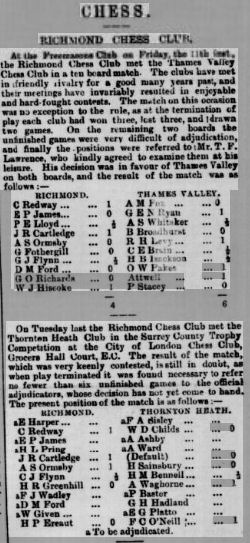
You’ll also spot that, as so often in their matches at this time, Richmond failed to field a full team. They frequently either had a couple of absentees at the bottom or a couple of nominated players who failed to turn up.

The impression I get is that the club was very ambitious, choosing to play in the Surrey Trophy against stronger opposition rather than the calmer waters of the Beaumont Cup. Their administrative skills, though, didn’t seem to match their ambitions. Chess clubs (and, no doubt most other clubs as well) are as good as their organisers, not as good as their players.
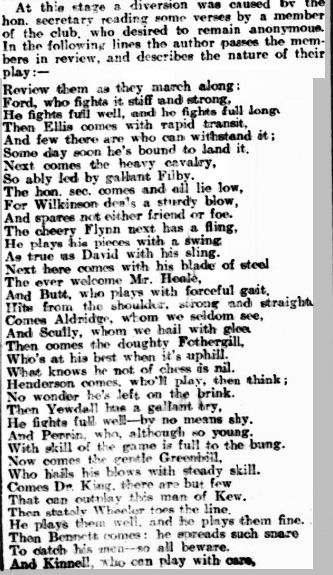
Regular readers will already have met Thomas Etheridge Harper and Charles Redway, and heard a brief mention of club founder Horace Lyddon Pring, but there are other members of this team who are of interest.

In particular, there’s a new name playing on top board, although he was probably losing his game against Leonard Percy Rees, one of the most important figures in early 20th century English chess and one well worth a future Minor Piece.

In the first decade of the 20th century there were a lot of strong British amateurs with retrospective ratings round about 2300-2400, so, by today’s standards, FM to IM strength. They rarely if ever played in major international tournaments so, except for those of us who spend much of our time in the dusty recesses of old books and magazines, or perhaps visiting BritBase, their names are largely forgotten today.

As it happens, many of these players had links with our area, West and South West London. You’ve already met George Edward Wainwright here, here, here and here.  Now I must introduce you to William Ward.

Researching him isn’t so easy. Cursed with one of the most popular male first names of his day, no middle names and a very common surname, any search for W Ward will turn up much of no relevance. In addition he came from a small family which has been little researched by genealogists: the few online trees I’ve been able to find don’t mention any chess connection and, if they give it at all, get his mother’s maiden name wrong.

Our William, 35 years old at the time of the above match, was born on 3 March 1867 in Abbots Langley, Hertfordshire, just north of Watford and now a large commuter village, and baptised there on 18 April the same year.

The 1871 census finds the Ward family there. William Ward senior is aged 27, a farmer of 184 acres employing 4 men and a boy, Ann (née Barford) is aged 26 and their two sons are William (4) and Mark (1). The family also have two servants. The parents were both born in Hatfield (the enumerator incorrectly recorded their sons as having been born there as well) and must have moved to Abbots Langley after their marriage. A third son, George Langton Ward, would be born early the following year. The family would later move to the Luton area, first to the small village of King’s Walden, and then to Lewsey, now a Luton suburb alongside the M1.

By 1881 young William is at boarding school in London: he’s recorded at 7 Highgate Road Kentish Town along with a Schoolmaster and a lot of other boys, including, exotically, three brothers from Quito (none of them, sadly, named Amos).

While his brothers followed in their father’s footsteps, pursuing a career in farming, William took a different route.  The 1891 census finds him, now aged 24, living in a boarding house at 50 Finsbury Park Road in North London, not all that far from Kentish Town, and working as a solicitor.

At some point in the mid 1880s, then, he must have studied Law, and perhaps, at the same time, taken up the game of chess. We first find him in 1890 playing in the 3rd class in a handicap tournament at Simpson’s Divan, which tells us he wasn’t a strong player. No child prodigy, then, but a young man who was attracted to the game, and, over the next few years, would discover a real talent.

Ward made rapid strides during the 1890s, soon playing matches for the famous City of London club (in their 1894-5 championship he reached the final stages) and taking part in representative matches for the South of England against the North.

His first external tournament was the Southern Counties Chess Union (SCCU) Championship in Southampton in 1897. Henry Ernest Atkins was a convincing winner on 8½/10, while William’s score of 4/10 was relatively modest, but no disgrace for a newcomer to chess at this level.

In the 1897-8 edition of the City of London Championship Ward finished in third place behind Thomas Francis Lawrence and Lucien Serraillier: by now he was clearly one of the capital’s strongest players.

In this game he demonstrates excellent opening knowledge, capping a fine performance with some sparkling tactics to force through a passed pawn. (If you click on any move in any game in this article a pop-up board will magically appear, enabling you to play through the game.)

[pgn]

[Event “City of London CC Championship”]
[Site “?”]
[Date “1897.??.??”]
[Round “?”]
[White “Jones, Edward Owen”]
[Black “Ward, William”]
[Result “0-1”]
[ECO “D55”]
[Annotator “Tactical Analysis 5.2 (1s)”]
[PlyCount “92”]
[SourceVersionDate “2022.06.10”]

1. d4 {ChessBase} d5 2. c4 e6 3. Nc3 Nf6 4. Bg5 Be7 5. e3 O-O 6. Nf3 b6 7. cxd5
exd5 8. Bd3 Bb7 9. O-O Nbd7 10. Rc1 c5 11. Re1 {[#]} Ne4 $146 {D55: Queen’s
Gambit Declined: 4 Bg5 Be7: Lines without …h6 and 6…h6 7 Bxf6.} ({
Predecessor:} 11… c4 12. Bb1 a6 13. Ne5 b5 14. f4 Re8 15. Qf3 Nf8 16. Ne2 Ne4
17. Bxe7 Rxe7 18. Bxe4 dxe4 19. Qg3 {1-0 (52) Pillsbury,H-Tarrasch,S Hastings
1895 MainBase [ChessBase]}) 12. Bf4 Nxc3 13. bxc3 c4 {White has an edge.} 14.
Bb1 Nf6 15. Ne5 Ba3 16. Rc2 (16. Bg5 {looks sharper.} Qd6 17. Bxf6 Qxf6 18. Nd7
) 16… b5 17. Rce2 $2 (17. Bg5 $16 {keeps the pressure on.}) 17… Ne4 $17 18.
Bxe4 dxe4 19. Qb1 Qd5 {Hoping for …f6.} 20. f3 f6 ({Much weaker is} 20…
exf3 $6 {[#]} 21. e4 $1 Qd6 22. gxf3 $11) 21. fxe4 Qxe4 22. Nf3 Bc6 {A strong
pair of Bishops.} 23. Nd2 Qd3 {& Black is much more active.} 24. Qxd3 cxd3 25.
Rf2 Bd5 26. e4 Bc4 ({Don’t take} 26… Bxa2 27. Ra1 $16) 27. Nxc4 bxc4 28. Rb1
$2 {Now White is beyond hope.} (28. h4 $17 {is a better defense.}) 28… Rae8
$19 29. Rb7 $2 (29. e5 Rf7 30. Kf1) 29… Rxe4 {Black is clearly winning.} 30.
Rxa7 {[#]} Rfe8 $1 31. Bd2 {[#]} (31. g3 Re1+) 31… Re1+ $1 32. Rf1 R1e2 33.
Rd1 Bb2 {And now …Rxd2! would win.} 34. Rc7 {[#]} Rxd2 $1 35. Rxd2 Bxc3 {
Endgame KRR-KRB} 36. Rd1 d2 {…Re1+ is the strong threat.} 37. Rxd2 Bxd2 38.
Rxc4 {KRB-KR} Be3+ 39. Kf1 Rd8 40. Ke2 Bxd4 41. a4 Rd7 42. Kd3 Bb6+ 43. Ke4 Kf7
44. Rc6 Rd4+ 45. Kf3 Ba5 46. Ra6 Rxa4 {Weighted Error Value: White=0.64/
Black=0.22 (precise)} 0-1

[/pgn]

The following year, the SCCU Championship in Salisbury was a very different story from the previous year. William shared 1st place with Joseph Henry Blake on 7½/10, with strong players such as Gunston, Bellingham, Loman and Sherrard trailing in their wake.

In this exciting drawn game, against the Dutch organist Rudolf Loman, both players displayed extensive awareness of contemporary theory in the very sharp Max Lange Attack. Ward had the better of the early exchanges but, in a very complex middlegame failed to make the most of his chances. The knight ending was still difficult for both players, and here Loman missed an opportunity.

[pgn]

[Event “SCCU Championship Salisbury”]
[Site “?”]
[Date “1898.??.??”]
[Round “?”]
[White “Loman, Rudolf Johannes”]
[Black “Ward, William”]
[Result “1/2-1/2”]
[ECO “C56”]
[Annotator “Tactical Analysis 5.2 (1s)”]
[PlyCount “102”]
[SourceVersionDate “2022.06.10”]

1. e4 e5 2. Nf3 Nc6 3. Bc4 Bc5
4. O-O Nf6 5. d4 exd4 6. e5 d5 7. exf6 dxc4 8. Re1+ Be6 9. Ng5 Qd5 10. Nc3 Qf5
11. Nce4 Bb6 (11… gxf6 12. g4 $1 Qg6 13. Nxe6 fxe6 14. Nxc5 $16) (11… O-O-O
$5) 12. Ng3 {Pair of Knights! C56: Two Knights: 4 d4 exd4 5 0-0 Nxe4.} Qg6 {
Strongly threatening …0-0-0.} (12… Qxf6 $2 13. Nh5 Qg6 14. Nxe6 $18) 13.
Nxe6 {& White is more active.} fxe6 14. Rxe6+ {White is clearly better.} Kd7 {
[#]} 15. fxg7 $146 ({Predecessor:} 15. Nh5 Rhe8 16. Nf4 Qf7 17. Qf3 Rad8 18.
Bd2 gxf6 19. Rae1 Rxe6 20. Nxe6 Re8 21. Ng5 Rxe1+ 22. Bxe1 {1-0 (31) Chigorin,
M-Charousek,R Budapest 1896 EXT 2018 [Tartakower/du Mont/Chigorin/Bogoljubow/
Maroczy]}) 15… Qxe6 16. gxh8=Q Rxh8 17. Bd2 Rf8 18. f4 Kc8 19. Kh1 c3 $36 {
Keeping White busy.} 20. bxc3 dxc3 21. Bxc3 Rxf4 22. Qh5 Qg6 23. Qd5 Qh6 $2 (
23… a5 $19 {and Black stays clearly on top.} 24. Qd1 (24. Rd1 Kb8 $17) 24…
Rf2) 24. Nf5 (24. Rd1 $2 {gets mated.} Qxh2+ $3 25. Kxh2 Rh4#) 24… Qf8 {
Prevents Qg8.} 25. Qe6+ Kb8 26. Ng3 a6 27. Re1 h5 $2 (27… Ka7 $19 {And now ..
.Rf2 would win.} 28. Bd2 Rf2) 28. Qg6 $2 (28. Qe8+ $11 Qxe8 29. Rxe8+ Ka7 30.
Re4 Rxe4 31. Nxe4) 28… Qc5 29. Bd2 Rf8 30. Be3 {Prevents Qf2.} (30. Bh6 Qa5
31. Rd1) 30… Qc3 (30… Qb4 $19 {has better winning chances.} 31. c3 Qxc3)
31. Rf1 $17 Rxf1+ ({But not} 31… Qxe3 32. Rxf8+ Ka7 33. Rf1 $14) 32. Nxf1
Bxe3 33. Qe8+ Ka7 34. Qxe3+ Qxe3 35. Nxe3 $11 {Endgame h4 is the strong threat.
KN-KN} Nd4 36. h4 {aiming for g4.} Kb6 37. g4 hxg4 38. h5 Ne6 $1 39. Nd5+ {
White has compensation.} Kc6 {[#]} 40. h6 $1 Ng5 (40… Kxd5 $2 41. h7 $18) (
40… Nf8 $5 41. Nf6 Kd6 $11) (40… Nf8 41. Nf6) 41. Nf6 a5 42. Kg2 {Hoping
for Kg3.} Nf7 {[#]} 43. Nxg4 {[#]} (43. h7 $1 $18) 43… Nxh6 $1 44. Nxh6 $18 {
KN-K3P} Kc5 45. Nf5 Kb4 46. Ne3 a4 47. Nd5+ Ka3 {Black is slightly better.} 48.
Nxc7 Kxa2 49. Kf3 Kb2 50. Nb5 Kxc2 51. Ke3 Kb2 {Never resign too early!
Weighted Error Value: White=0.50/Black=0.44} (51… Kb3 $5 52. Kd4 b6 $11)
1/2-1/2

[/pgn]

The 1898-9 City of London Championship proved a slight disappointment when he narrowly failed to make the final pool, but the 1899-1900 edition, held again as an all-play-all, was a different story. Lawrence was the winner on 14½/17, with Ward just half a point behind and the rest nowhere.

In 1900 William made his international debut, being selected to play in the 5th Anglo-American Cable Match, where he drew his game against Charles John Newman.

Rod Edwards’ retrospective ratings for 1900 put him on 2397, ranked 74th in the world.

A few days later he took part in an invitation tournament run by the City of London club, in which their members took on a bunch of international players based in London at the time. As you’ll see here, he scored an outstanding 8½/12, just behind Teichmann (9½), Mason and Gunsberg (9). While the winner hadn’t yet reached his peak and the runners-up were past their best, they were all genuine grandmasterly players. He was particularly devastating against the weaker competitors.

By now he was using the increasingly popular Queen’s Gambit with the white pieces, an opening which suited his style of controlled aggression perfectly.

Here he found himself with an IQP position out of the opening: understanding this pawn formation is still of vital importance to all serious competitive players today.

[pgn]

[Event “London City Club Invitation”]
[Site “London”]
[Date “1900.04.10”]
[Round “4”]
[White “Ward, William”]
[Black “Lawrence, Thomas Francis”]
[Result “1-0”]
[ECO “D40”]
[Annotator “Tactical Analysis 5.2 (1s)”]
[PlyCount “71”]
[EventDate “1900.04.05”]
[EventType “tourn”]
[EventRounds “13”]
[EventCountry “ENG”]
[SourceTitle “HCL”]
[Source “ChessBase”]
[SourceDate “1999.07.01”]
[SourceVersion “2”]
[SourceVersionDate “1999.07.01”]
[SourceQuality “1”]

1. d4 d5 2. c4 e6 3. Nc3 Nf6 4. Bg5 c5 5. e3 dxc4 6. Bxc4 cxd4 7. exd4 Nc6 8.
Nf3 Be7 9. O-O O-O 10. Rc1 h6 11. Be3 Nb4 12. Bf4 a6 13. a3 {D40: Queen’s
Gambit Declined: Semi-Tarrasch with 5 e3.} Nc6 (13… b5 $5) 14. Ba2 {& White
is more active.} Qa5 15. Bb1 {aiming for Ne5. White is clearly better.} Rd8 16.
Qd3 Qh5 17. Bc7 Rd7 18. Bg3 g6 19. Ne2 {[#] Threatens to win with Rxc6!} Bd6 {
Loses the game.} 20. Rfd1 Bxg3 21. Nxg3 Qg4 22. Qe3 {Inhibits Qf4. Black must
now prevent h3.} Nh5 23. h3 ({Not} 23. Qxh6 Nxg3 24. fxg3 (24. hxg3 Rd5 $16)
24… Rd5 $18) 23… Qf4 24. Nxh5 Qxe3 25. fxe3 gxh5 26. e4 {And now d5 would
win.} Rd8 27. Rc5 e5 $2 (27… Bd7 28. Rxh5 Kg7) 28. d5 $18 {White is clearly
winning.} f6 29. Ba2 Kg7 30. Rdc1 Ne7 31. Rc7 Kf8 32. Rf1 Ng6 {[#]} 33. Ng5 $1
{White threatens Nh7+ and mate.} f5 (33… Rd7 34. Rxf6+) 34. Nh7+ Ke8 35. Nf6+
Kf8 36. d6 {Weighted Error Value: White=0.49/Black=0.94} 1-0

[/pgn]

Against the artist and pianist Thomas Physick (from a family of sculptors) he chose a delayed exchange variation: another pawn formation which still plays a critical role in 21st century chess.

[pgn]

[Event “London City Club Invitation”]
[Site “London”]
[Date “1900.04.30”]
[Round “11”]
[White “Ward, William”]
[Black “Physick, Thomas”]
[Result “1-0”]
[ECO “D55”]
[Annotator “Tactical Analysis 5.2 (1s)”]
[PlyCount “91”]
[EventDate “1900.04.05”]
[EventType “tourn”]
[EventRounds “13”]
[EventCountry “ENG”]
[SourceTitle “HCL”]
[Source “ChessBase”]
[SourceDate “1999.07.01”]
[SourceVersion “2”]
[SourceVersionDate “1999.07.01”]
[SourceQuality “1”]

1. d4 d5 2. c4 e6 3. Nc3 Nf6 4. Bg5 Be7 5. Nf3 O-O 6. e3 h6 7. Bxf6 Bxf6 8.
cxd5 exd5 9. Qb3 c6 {D55: Queen’s Gambit Declined: 4 Bg5 Be7: Lines without …
h6 and 6…h6 7 Bxf6.} 10. Bd3 Qb6 11. Qc2 Na6 {aiming for …Nb4. The
position is equal.} 12. Qd2 Nb4 13. Bb1 a5 14. a3 Na6 15. O-O Bg4 16. Bd3 Rfe8
17. Rac1 Qd8 18. Bxa6 Rxa6 19. Na4 Ra8 20. Nc5 Qe7 21. Nd3 Bf5 22. Nf4 Qd6 23.
Nh5 Bd8 24. Ng3 Bh7 25. Ne5 f6 26. Nd3 Bc7 27. Nc5 Qe7 28. Rc3 f5 29. f4 a4 30.
Qd1 {& White is more active.} Ba5 31. Rd3 b5 32. Qf3 Bb6 33. Rc1 Qa7 34. Nf1 {
Pair of Knights!} Re7 35. Rdd1 {And now Nd3 would win.} Rae8 36. Kh1 Qa8 37.
Nd3 Rc8 38. Ne5 {Rxc6! is the strong threat.} Rec7 39. Rc3 c5 40. dxc5 $1 Bxc5
(40… Rxc5 41. Rxc5 Bxc5 42. Rxd5 $16) 41. Rxd5 {Black must now prevent Rcxc5!
} ({Not} 41. Qxd5+ Qxd5 42. Rxd5 Kh8 $16) 41… Qa7 {[#]} (41… Bb6 42. Rxc7 (
42. Rxb5 Rxc3 43. bxc3 Qxf3 $16) 42… Bxc7 43. Rxb5 Bxe5) 42. Rcd3 (42. Rdxc5
$142 $1 Rxc5 {[#]} 43. Qd5+ $3 Kh8 44. Nf7+ Kg8 45. Nxh6+ Kh8 46. Nf7+ Kg8 47.
Nd6+ Kf8 48. Nxc8 $1 Rxd5 49. Nxa7) 42… Bf8 $2 (42… Qa8 {was called for.}
43. Qh5 Bf8) 43. Rd8 $18 {White is clearly winning.} Rc5 {Against Qd5+} 44.
Rxc8 Rxc8 45. Qd5+ Kh8 46. Nf7+ {Weighted Error Value: White=0.41/Black=0.52}
1-0

[/pgn]

William Ward was again amongst the medals in the 1900-01 City of London Championship. Lawrence won again, with Herbert Levi Jacobs taking the silver and Ward the bronze. Edward Bagehot Schwann, coming to the end of his short life, was among the also-rans.

By now it was time for the census enumerator to call again. What we find is rather intriguing. William was in Kenley, Surrey, east of Coulsdon and south of Purley, visiting Isidore Wiener, a 41-year-old unmarried Hide Merchant’s Factor born in Holland but a British Subject. Also in the household were a housekeeper and a servant.

I’ve recently become interested in the significance of the word ‘visitor’ in census returns. Your census address is where you’re staying overnight. If you’re being paid to be there you’ll be described as a ‘servant’ or something similar. If you’re paying to be there you’ll be a ‘boarder’ or a ‘lodger’. A ‘visitor’ will often be a family member, but there might be other reasons. I can find no evidence that Isidore was a chess player, so perhaps he had some complicated legal business which required his solicitor to stay overnight. Perhaps they were just good friends. Who knows?

Anyway, in 1906 Isidore married 40-year-old Annie Sonnex (interesting surname) from Lancashire, continuing to live, now with his wife, in Kenley. A very late first marriage for both partners. They had their only child, a daughter named Albertine, a year later. In 1918, like many families with Germanic surnames at the time, they changed their name from Wiener to Winner. Albertine became a Winner in more ways than one, as you’ll see here.

And then we reach 1902, when we find William playing for Richmond Chess Club against Redhill. Had he moved to the Richmond area? Or did he have friends in the club who invited him to join and play in matches in central London? At present I don’t know.

It looks like he never owned his own property, living in lodgings and moving round various parts of London. I can find no further reference to Ward in association with Richmond Chess Club, but it’s quite possible that there may be more information online once the Richmond & Twickenham Times is digitised.

You’ll find out what happened to William Ward after 1902 in my next Minor Piece.

Sources:

ancestry.co.uk

findmypast.co.uk

MegaBase 2022 (analysis by Stockfish 15)

Britbase

EdoChess (William Ward’s page here.)

The City of London Chess Club Championship (Roger Leslie Paige 2005)

Other websites referenced in the text.

Minor Pieces 33: Charles Redway

If you’re travelling by train to visit the Chess Palace you’ll alight at Whitton station and turn left from where it’s a fine and fancy 20 minute walk – or you can take the crosstown bus if it’s raining or it’s cold.

If you turn right instead you’ll find yourself in Whitton High Street, with a turning into Bridge Way (named after the railway bridge, not the card game) on your right. If you walk along Bridge Way you’ll find two turnings on your left, Cypress Avenue and Short Way (not named after Nigel, but because it’s a short way), which leads into Redway Drive. Not many of its residents will be aware that it’s named after a chess player.

Much of what is now Whitton was built up in the interwar years on land which had previously been farms and market gardens. Twickenham’s international rugby stadium was known informally as Billy Williams’ Cabbage Patch because a man of that name had grown vegetables there. This explains the name of the Cabbage Patch pub opposite Twickenham Station, well known both as a rugby pub and a music venue.

The exception was the land adjacent to the Hounslow Gunpowder Mills, which is where you’ll find the Chess Palace, but that’s another story.

In this aerial photograph from 1931 you can see the railway line, the newly opened Whitton Station, the first shops in the High Street and, in the centre, Short Way, leading to Redway Drive, with trees behind it. It meets Nelson Road on the left and, at the junction with Short Way, curves to the right where it would, by 1933, meet the A316 Great Chertsey Road. The rugby ground can be seen in the distance.

Mr Redway gave his name not just to the road but to the whole estate, as you can see from this photograph from a few years later.

Here’s the road itself: typical 1930s suburban architecture, newly planted trees and a notable shortage of cars.

Here’s a cutting from, I guess, the mid 1930s: found on Facebook without attribution but probably from the Richmond & Twickenham Times. Typically, the local press got Mr Redway’s middle initial wrong: he was Charles Percy Redway (1885-1953).

Redway was a stockbroker by profession who had presumably bought up the land speculatively and sold it for housing. Perhaps the proceeds had enabled him and his family to move from St Margaret’s Road Twickenham to Grove House, Hampton in 1927. Very nice too. Lucky chap!

Back in his teens, Charles Percy was a chess player, but as with many young players, life got in the way. In 1904 he was a member of Richmond Chess Club, taking part in matches between the residents of East Sheen and the rest. Here’s an example in which he was successful.

Surrey Comet 05 March 1904

These, I’d imagine, were more social events than serious matches: the players on the higher boards were also seen in competitive matches against other clubs, but the lower boards, such as young Charles Percy Redway, gained experience from events such as this. His opponent here may have been Herbert Ereault, a bank clerk from Jersey, only three years his senior.

But Charles Percy Redway isn’t the real subject of this article: his father, plain Charles Redway, was a much stronger player, from a family involved in various chess related activities.

Charles Redway senior had been born in Paddington in the fourth quarter of 1861. His father, another Charles, had been born in Teignmouth, Devon and his mother, Mary Ann Richardson, near Corby in Northamptonshire. It looks like they had met while working in service in London. We can pick up our protagonist in the 1871 census: the family are living in Chelsea where his father is working as a butler. He is the second of five children at home: a sixth child would arrive later. By 1881 the oldest Charles is buttling for Scottish poet, biographer and translator Sir Theodore Martin in Onslow Square, Kensington, while Mary Ann is in the family home in Bywater Street, a 15 minute walk away, along with her father and six children: George, the eldest is a Publisher’s Assistant while Charles is a clerk and the only daughter, Mary Jane, a dressmaker.

The Redway family was clearly bookish as well as chess playing. Did this come from within the family or was their love of books inspired by Sir Theo? Where did the family’s love of chess come from?

Charles married Emily Jones in 1884 and by 1891 they were living in Elm Road, Mortlake, just round the corner from where you’ll now find the East Sheen branch of Waitrose, along with their four young sons (Charles Percy was the oldest), a 14-year-old domestic servant and Emily’s younger sister Ida. Charles’s occupation is given as an Assurance Clerk: he was employed by the Prudential Assurance Company.

At some point in this decade he joined the young and ambitious Richmond Chess Club. His first sighting in the chess world seems to be in an 1896 match over 100 boards between teams representing the North and South of the Thames. Charles was on board 38, winning his game against a reserve, T A Bedford.

Norwood News 07 May 1898

Here he is playing board 2 behind Thomas Etheridge Harper in a Surrey Trophy match against Battersea in 1898. Richmond were well beaten, not helped by a default, something that was only too common in their matches at this time. Their ambition in taking on top clubs like Battersea in the Surrey Trophy, when they could have opted for less demanding opposition in the Beaumont Cup, seems not to have been matched by their competence in making sure all their players turned up.

You’ll find an excellent article about the Battersea board 3 William Philip Plummer here on their club website, and more about their club history here.

The 1901 census is interesting. Charles is still in the same job, living with his wife, six sons and a daughter, along with a domestic servant. Charles Percy is working as a Jewellery Merchant’s Clerk. They’ve moved along the road towards Richmond, though: their address is given as 134 Sheen Road (here on Google Maps, assuming the house numbers haven’t changed).

There, at the top of the same page, are Philip and Harriet Harper, and the previous page reveals that they’re the children of Thomas Etheridge Harper, who was living just round the corner from Charles Redway.

Perhaps it was Thomas who introduced Charles to Richmond Chess Club. You’d imagine they’d have got together to play chess on a regular basis, maybe, as was the habit in those days, over a glass of brandy and a fine cigar.

Over the next few years, he continued to play for Richmond on a high board, sometimes even on board 1, as well as being recorded turning up to club AGMs.

Here’s a game from the 1903 Surrey County Challenge Cup (presumably the county individual championship) against the artist Sir Wyke Bayliss. The opening was interesting: a Fried Liver Attack with an extra move for White. Black was able to play an immediate c6 so it’s not entirely clear whether or not White benefitted from the extra tempo. Anyway, Redway misplayed the attack and lost fairly quickly. (If you click on any move, a pop-up window will appear enabling you to play through the game.)

[pgn]

[Event “Surrey County Challenge Cup”]
[Date “1903.??.??”]
[White “Redway, Charles”]
[Black “Bayliss, Wyke”]
[Result “0-1”]
[ECO “C41”]
[Annotator “Tactical Analysis 5.2 (1s)”]
[PlyCount “48”]
1. e4 e5 2. Bc4 Nf6 3.
Nf3 d6 4. Ng5 d5 5. exd5 Nxd5 $2 {[%mdl 8192]} (5… h6 $15 {keeps the upper
hand.} 6. Nf3 e4) 6. Nxf7 {C41: Philidor Defence.} Kxf7 7. Qf3+ Ke6 $1 {
Hoping for …c6.} 8. Nc3 {[%mdl 1024] White has strong compensation. White is
better.} c6 {[#] And now …Qf6 would win.} 9. O-O $146 {aiming for Re1.} ({
Predecessor:} 9. d4 Bb4 10. O-O Bxc3 11. bxc3 Qf6 12. Qe4 Qf5 13. f3 Re8 14.
Bd2 Kd6 15. Bxd5 cxd5 16. Qxf5 Bxf5 17. dxe5+ {0-1 (37) Weir-O’Donovan
Telegraph 1863}) 9… Bc5 10. Re1 $2 (10. Ne4 $16 {and life is bright.} Qf8 11.
Ng5+ (11. Nxc5+ Qxc5 12. b3 Qd4 $15) 11… Kd7 12. Bxd5 cxd5 13. Qxd5+ Ke8 14.
d4 (14. Qxe5+ Be7 $11) 14… Bxd4 15. c3) 10… Rf8 $17 {[%cal Bh8f8,Bf8f5,
Bf5e5][%mdl 32]} 11. Qg4+ {[%mdl 8192]} ({Avoid the trap} 11. Bxd5+ $2 cxd5 12.
Qh3+ Kd6 $19) (11. Rxe5+ $17 Kxe5 12. d4+ Ke6 13. Bf4) 11… Kf7 $19 {[%cal
Be6f7,Bf7g8,Bg8h8][%mdl 32]} 12. Qh5+ Kg8 13. Ne4 {[#]} Rf5 $1 14. Qe2 (14. Qd1
Bb6) 14… Bd6 (14… Be7 $142 15. d3 Nd7) 15. d3 $2 (15. d4 exd4 16. Bg5)
15… Kh8 16. d4 exd4 {Threatens to win with …Bf4.} 17. Bg5 Qf8 (17… Rxg5
$2 18. Nxg5 Qf8 19. Bxd5 cxd5 20. Qh5 $18) ({Not} 17… Bxh2+ 18. Kxh2 Qf8 19.
Kg1 $14) 18. Bd3 $2 (18. Nxd6 Qxd6 19. Bd3) 18… Re5 19. f4 Nxf4 20. Bxf4 Qxf4
21. Rf1 $2 {[#]} (21. Nxd6 Rxe2 22. Rxe2) 21… Rxe4 $1 22. Bxe4 (22. Qxe4
Qxh2+) 22… Qxh2+ {Black mates.} 23. Kf2 Bg3+ 24. Kf3 {[#]} Qh5+ $4 {[%mdl
40960] Black took control after the opening. Weighted Error Value: White=1.33/
Black=0.69. Loss on time!?} (24… Bg4+ $1 {mates} 25. Kxg4 Qh4+ 26. Kf5 Na6
27. Qc4 Qh5+ 28. Ke6 Qe8+ 29. Kf5 Qg6#) 0-1

[/pgn]

The British Championships took place for the first time in 1904, giving many amateurs the opportunity for a two week chess playing summer holiday. Charles took part in the First Class B tournament in Southport in 1905, scoring 4½/11, a pretty respectable result. He tried again at Tunbridge Wells in 1908, but his result in the First Class A tournament was a disappointing 2½/11. (Note that the A and B tournaments were parallel and of the same strength.) To be fair, this was a pretty strong tournament: the winner was Georg Schories, a German master resident in England who wasn’t eligible for the championship, and the young Fred Dewhirst Yates shared 4th place.

Earlier in 1908, Charles had taken part in a simultaneous display at Surbiton Chess Club against World Champion Emanuel Lasker, emerging with a highly creditable draw.

[pgn]

[Event “Simul: Surbiton”]
[Date “1908.05.??”]
[White “Lasker, Emanuel”]
[Black “Redway, Charles”]
[Result “1/2-1/2”]
[ECO “B20”]
[Annotator “Tactical Analysis 5.2 (1s)”]
[PlyCount “78”]
1. e4 c5 2. b4 e5 3. Nf3 ({Predecessor:} 3. f4 d6 4. Nf3 Bg4 5. Bc4 Nc6 6.
O-O Nd4 7. Nxd4 Bxd1 8. Bb5+ Ke7 9. Nf5+ Ke6 10. Nc3 cxb4 11. Nd5 Nf6 12. Nxg7+
Bxg7 13. f5# {1-0 (13) Bird,H-NN London 1895}) 3… Qc7 4. Nc3 Nf6 5. Nb5 Qc6
6. Nxe5 {B20: Sicilian: Unusual White 2nd moves.} Qxe4+ 7. Qe2 Na6 {Inhibits
Nc7+.} 8. bxc5 (8. Qxe4 $18 {and the rest is easy.} Nxe4 9. Bc4 Nxb4 10. Bd3 (
10. Bxf7+ Ke7 $14) 10… Nxd3+ 11. cxd3) 8… Bxc5 $16 9. d4 Be7 10. Nc4 {
& White is more active.} O-O {[%cal Oe4c6]} 11. Qxe4 Nxe4 12. Bd3 Bb4+ 13. Kf1
d5 {[%cal Oe4c5]} 14. Ne3 {[%cal Bc4e3,Be3d1,Bd1c3,Bc3e2][%mdl 32]} Be6 15. Rb1
f5 {[%cal Bf7f5,Bf5f4][%mdl 32]} 16. Nc7 Nxc7 17. Rxb4 f4 18. Nd1 b6 19. f3 Nd6
20. Nc3 {[#] Threatens to win with Ne2.} Rf7 21. Ne2 Raf8 22. Kf2 g5 {[%cal
Bg7g5,Bg5g4][%mdl 32]} 23. Rb1 g4 24. Ba3 Rd8 25. Rhe1 Nc4 26. Bxc4 dxc4 27.
Bc1 gxf3 28. gxf3 Nd5 {Against Rb4} 29. Rg1+ Kh8 30. Bd2 Bf5 {[%cal Oc4c3]} (
30… c3 $5 31. Nxc3 Nxc3 $15) 31. Rb5 ({Of course not} 31. Bxf4 Nxf4 32. Nxf4
Rdf8 $17) 31… a6 (31… Bxc2 32. Nc3 Nc7 33. Rh5) 32. Rb2 Bg6 33. Nc3 b5 34.
Rg5 Rf5 35. Rxf5 Bxf5 36. Nxd5 Rxd5 37. Bxf4 a5 38. Be5+ Kg8 {[#] Hoping for ..
.c3.} 39. c3 $2 ({Only move:} 39. a3 $1 $16) 39… b4 $1 {Weighted Error Value:
White=0.33/Black=0.42} 1/2-1/2

[/pgn]

EdoChess estimates his rating as round about 2000: a strong club player but not of master standard.

One of their sons, Montague, had died in his teens in 1906, and, the following year, the family moved to Dryburgh Road, Putney, very close to Marc Bolan’s Rock Shrine.  They’d remain for the rest of their lives. He continued to play up to the mid 1920s, for Ibis Chess Club in London, and in county matches for Surrey. The Ibis Chess Club was part of the Ibis Sports Club, for employees of the Prudential Assurance Company and particularly noted for its rowing. There are very few records concerning Richmond Chess Club available for this period (we should find out more once the Richmond & Twickenham Times is digitised), but perhaps he continued playing for Richmond as well.

He didn’t play in the 1912 British Championships in Richmond,  but he did take part in a simul against visiting American champion Frank Marshall, winning his game.

Very little competitive chess took place during the First World War, but he returned to the board in 1919, playing in a 40-board simul against Capablanca in Thornton Heath. His club affiliation was given as Richmond rather than Putney, confirming that, in spite of moving out of the immediate area, he was still a member of Richmond Chess Club.
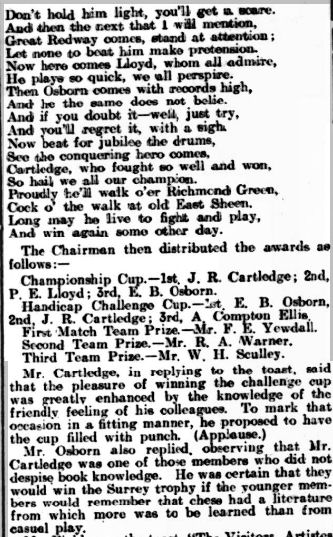
In 1934, with their family name now famous in Whitton, Charles and Emily celebrated their Golden Wedding. The report in the local press provides some interesting detail about Charles’s wide range of interests.

South Western Star 02 March 1934

It’s sad that Charles was unable to take part in the festivities. He died just over a year later, on 7 March 1935. Emily survived another 21 years, into her 90s, outliving four of her sons and remaining at home until the end.

Charles wasn’t the only one of his siblings interested in chess, although he appears to have been the only active player.

Readers of a certain age may recall a London chess book shop called Frank Hollings. One of Charles’s brothers, William Edward Redway (1865-1946), ran the business for about 40 years until his death, selling and occasionally publishing chess books. Edward Winter provides some information in this fascinating article.

Another brother, George William Redway (1859-1934), was also a bookseller and publisher, specialising in books on the occult. An announcement was made in 1895 that he was going to publish Lasker’s book Common Sense in Chess, but the arrangement, if indeed there was one, seems to have fallen through. The American edition was published by the New Amsterdam Book Company in 1895 and the European edition jointly by Bellairs & Co London, Mayer & Müller Berlin and the British Chess Company the following year.

You might wonder whether any current residents of Redway Drive are aware of the Redway family and their chess connections. Perhaps two of them are: when visiting the Chess Palace a few years ago, noted chess historian Jimmy Adams told me that his sister and her husband lived in Redway Drive (her husband is a rugby fan and wanted to be near Twickenham Stadium).

Here’s what the road looks like in 2022.

Photograph: Richard James

It’s a bit different, 90 years on from the photograph at the beginning of this article.

Photograph: Richard James

Here you have it – the road, and estate, named after Charles Percy Redway, whose father was one of our great predecessors in the early years of Richmond Chess Club. Join me again soon for some more Richmond Chess Club members from the first decade of the last century.

Acknowledgements and sources:

ancestry.co.uk

findmypast.co.uk

‘Whitton Memories’ Facebook group

Wikipedia

Twickenham Museum website

britainfromabove.org.uk

chessgames.com

BritBase

EdoChess

Chess Notes (Edward Winter)

Lyrics from At the Zoo (Paul Simon)


Minor Pieces 32: James D’Arcy

It’s time to continue the story of Richmond Chess Club through the 1890s.

The club, as we’ve seen, was young and ambitious, and decided to enter the Beaumont Cup, run by the Surrey County Chess Association.

The Surrey League (except that it never seems to be called that) started in the 1883-84 season. It seems like only a few matches were played, probably on a knock-out basis, and taking place at central London venues rather than club venues.
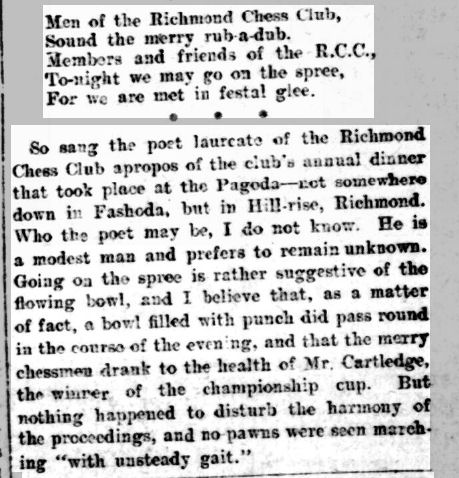
By the 1895-96 season there was a demand for a second competition for less strong clubs, and a trophy named the Beaumont Cup was presented by the county President, Captain Alex Beaumont. The second division of the Surrey League is still, a century and a quarter later, the Beaumont Cup.

Some more information:

Beaumont, Alexander ‘Alex’ Spink 1843-4 Sep 1913 England, Manchester Deansgate – Kent, Beckenham amateur musician, 1872 captain of the 23rd Royal Welsh Fusiliers, 21 Feb 1874 in Pembroke he was tried and acquitted for attempt to commit sodomy, 20 Sep 1910 made Freeman of the City of London in the presence of musicians, at time of death residing at Crossland, 28 Southend Road in Beckenham; son of Colonel Richard Henry John Beaumont; 24 Jan 1872 at Christ Church in London Paddington he married the widow Caroline Savage (Marlborough 1826-13 Apr 1907 Croydon), daughter of baronet Sir Erasmus Griffies-Williams. (Source: http://composers-classical-music.com/b/BeaumontAlexanderSpink.htm)

Here’s what happened in the second year of the Beaumont Cup’s existence.

London Evening Standard 07 June 1897

Well played, Richmond! Sadly I don’t at present have a record of the names of the players in this historic match.

The club also continued to play friendly matches. As we’ve already seen, they played regular home and away matches against Windsor and, in this period, narrow defeats against both Thames Valley (formerly Twickenham) and West London were recorded.

And then, in April 1900, Richmond Chess Club hit the headlines across the country for a tragic reason. Here are a couple of examples.

Globe 09 April 1900
Morning Post 09 April 1900

Who was the unfortunate (or perhaps fortunate to have died suddenly and painlessly doing something he enjoyed) James D’Arcy? It appears he was just a social player as I haven’t yet been able to find any information about him competing in matches or solving problems. Sub-postmaster sounds like a relatively humble occupation (unlike, for instance, club president George Oliver Richards, who was a dentist), but can we discover more about him?

His name is variously spelt D’Arcy, Darcy and Darcey in records, and most of the family trees he’s on give incorrect parentage, all copied from each other.

James’s birth was registered in the first quarter of 1840 in Boston, Lincolnshire: his parents, it seems, were John Darcey a farmer from the village of Wigtoft, between Boston and Spalding, and Elizabeth Brackenbury, although the 1841 census gives her name as Jane.

Sadly James senior died in 1847 and Elizabeth married Thomas Millhouse, a cottager (no, not THAT sort of cottager: just someone who owned a cottage and a small amount of land). By 1851 Thomas and Elizabeth had started their own family as well as bringing up James’s three younger siblings, while James himself was living in the nearby village of Swineshead with his grandparents James, an innkeeper, and Eleanor Brackenbury.

I haven’t yet been able to find him in the 1861 census but at some point he moved to London where, in 1866, he married Jemima Bond in Greenwich. The 1871 census located them in Hackney with their first child, a son named Robert. James had found employment as a solicitor’s clerk. He must have been doing pretty well for himself as the family residence was a fairly large 4 storey house. They were able to afford a servant, although having three boarders (all young men with clerical jobs) would have helped financially.

By 1881 they’d moved down the road to Islington, now with four children (Robert had been joined by Annie, Kate and Arthur), a servant, and a visitor, perhaps boarding there, David Reid, who was an East India Merchant born in New Brunswick. James’s job was now a Law Stationer.

Ten years on, and they’d moved to a different address in North London, not all that far from Hampstead Heath, and young Alfred had joined the family. James was still a Law Stationer, David Reid was still boarding there, and they still employed a servant. He might have come from a fairly modest family background in a small Lincolnshire village, but he’d prospered in London: something quite typical for the times, I think.

At some point in the 1890s, then, James and his family moved to 9 Mortlake Road, Kew and changed his job to that of a sub-postmaster. 9 Mortlake Road was, and still is, a large and impressive house near Kew Green: being a sub-postmaster must have paid well. The 1901 census records Jemima and all 5 of her surviving children (they had lost three children in infancy), along with Kate’s husband Maurice White and a servant. Maurice had been at Harrow with Winston Churchill, became a journalist and publisher, and later a picture dealer, being declared bankrupt on at least two occasions.

By 1911 Jemima had moved round the corner to Ennerdale Road, very convenient for Kew Gardens. The only one of her children at home was Annie, whose husband, Aubrey O’Brien was on leave from his job: he was a Major in the Indian Army in civil employ in the Punjab Commission as Deputy Commissioner. Their two young sons, Turlough and Edward, were there, along with three servants. Jemima died in Kew three years later, in 1914. All three sons became bank clerks or cashiers, but Alfred joined the Canadian Army, fought in World War 1, dying in hospital in Boulogne of wounds sustained in battle in 1916.

So our social player, then, was, like most of the other players we’ve met at Twickenham and Richmond Chess Clubs in the 1880s and 1890s, a fairly prosperous chap. Perhaps he wasn’t a strong player, but he must have enjoyed his chess and, as a result, died happy. I guess that’s the most important thing.

Sources:

ancestry.co.uk

findmypast.co.uk

Other online sources referenced above


Minor Pieces 31: Edward Bagehot Schwann

Here’s something you might have seen before: Twickenham Chess Club’s 1896 victory over Metropolitan.

Regular readers will have met several of these players already, but not Twickenham’s Board 6: E B Schwann.

Illustrated Sporting and Dramatic News 04 April 1896

Edward Bagehot Schwann was born in Hampstead in 1872, probably towards the end of September. Edward came from a privileged background. His father, Frederick Sigismund Schwann, himself the son of a German born merchant, had been born in Huddersfield, famed in Hampshire for a while before moving to London and working as a Commission Merchant. His mother, Mary Watson Halton Bagehot, was a first cousin of Walter Bagehot, best remembered as the author of The British Constitution.

Source: https://www.schachbund.de/news/genug-des-stumpfsinns-remis-richard-der-fuenfte-kam-aus-altenburg.html

The 1881 census found Frederick and Mary living in West Heath Lodge, Branch Hall Park, Hampstead, with five children, two cousins, a governess and six servants.

Young Edward was educated at Bromsgrove School where he excelled at cricket. A brother, Henry Sigismund, would go on to represent Oxford University at cricket. An uncle, Charles Ernest Schwann, was a prominent Liberal politician, noted for his radical views, and MP for Manchester North between 1886 and 1918.

Edward must have excelled at chess as well as cricket at school, as he first came to the attention of the chess world in 1886 as a problem solver.  Perhaps solving chess problems was popular with the cool kids back in the day.

It wasn’t long before Edward started composing problems himself: direct mates mostly in 2 or 3 moves. Here’s an early example.

Problem 1 #3 Morning Post 16 September 1889

A typical problem by a novice composer of the day, I’d say, but he would soon add more complexity to his compositions. (You’ll find the solutions to the problems at the end of the article.)

In 1890 Edward completed his education at Bromsgrove School, achieving a Higher Certificate in Latin, Elementary and Additional Mathematics, English and History, and, rather than proceeding to Oxford or Cambridge, returned home to his family in London.
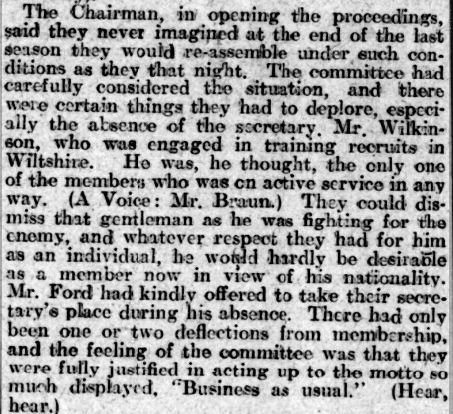
By this point they’d moved from Hampstead to Wimbledon, living in Park House, Inner Park Road. The house itself no longer exists, but it was just off the A219 across the road from Putney Heath. The 1891 census records Frederick and Mary along with six of their children, including Edward, described as a Scholar (perhaps he was at London University) and no less than eight servants. They were clearly living in some style.
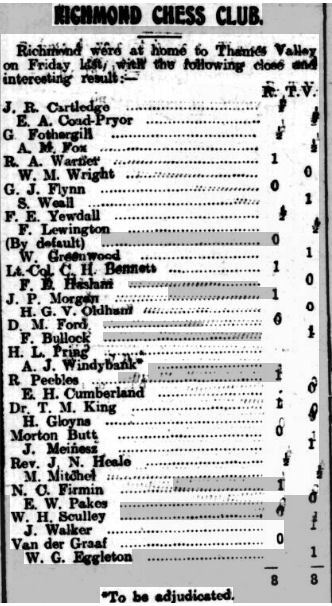
By the following year, Edward had joined the City of London Chess Club. The first mention of him I can find is from July 1892, where, described as ‘the rising young problem composer’, he won a game in a simul given by the strong amateur Percy Howell.
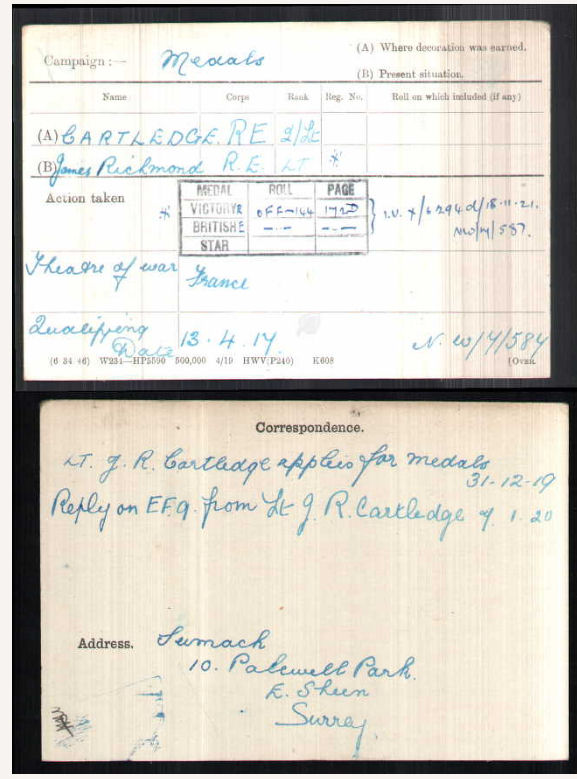
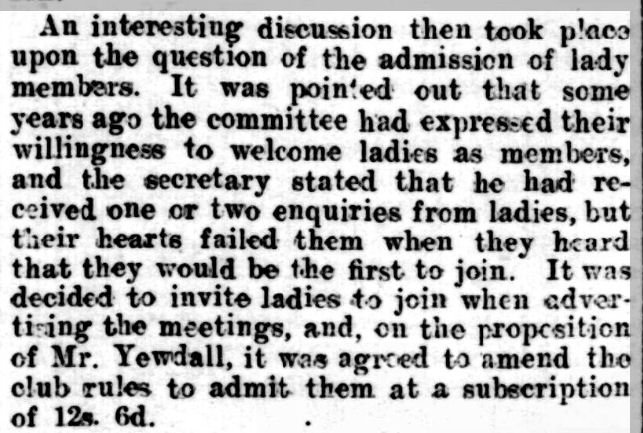
In January 1893 he had a game from the City of London Club Championship published in the Morning Post, although it must be admitted that White’s opening play was pretty feeble and that his queen sacrifice, while attractive, was not the only way to win. As a problemist, though, he might have had no choice. (You can click on any move in any game in this article and a pop-up window will appear enabling you to play it through.)

[pgn]

[Event “City of London Chess Club”]
[Site “?”]
[Date “1892.??.??”]
[Round “?”]
[White “Ray, H J.”]
[Black “Schwann, Edward Bagehot”]
[Result “0-1”]
[ECO “D02”]
[Annotator “Tactical Analysis 5.2 (1s)”]
[PlyCount “42”]
[EventDate “1897.??.??”]
[SourceVersionDate “2022.05.05”]

1. d4 c5 2. Nf3 d5 3. e3 Nc6 {[#]
} 4. Be2 $146 ({Predecessor:} 4. b3 Bg4 5. Be2 Nf6 6. Nbd2 e6 7. Bb2 h6 8. Ne5
Nxe5 9. dxe5 Bxe2 10. Qxe2 Nd7 11. f4 Qh4+ 12. g3 Qh3 13. O-O-O a6 14. Rdg1 Qf5
15. g4 {1-0 (35) Prusse,T-Morling,J corr 1890 Myers [Fraser]}) 4… Bf5 5. a3
e6 6. O-O {D02: 1 d4 d5 2 Nf3 sidelines, including 2…Nf6 3 g3 and 2…Nf6 3
Bf4.} Nf6 7. h3 g5 {[%cal Bg7g5,Bg5g4,Bg4h3][%mdl 32] Hoping for …Rg8.} 8.
dxc5 {The position is equal.} Bxc5 9. b4 Bb6 {& Black is more active.} 10. Bb2
Rg8 {[%cal Bh8g8,Bg8g3,Bg3g2,Bg2f2][%mdl 32] White must now prevent …g4.} 11.
Bb5 g4 12. Ne5 {White does not recover from this.} (12. hxg4 $17 {only move.}
Nxg4 13. Bd3) 12… gxh3 $19 13. g3 Qc7 {[%cal Ob6e3] …Bxe3! is the strong
threat.} 14. Nxc6 $2 {[#]} (14. Nd2) 14… Rxg3+ $1 {[%mdl 512]} 15. Kh1 Be4+
16. f3 bxc6 17. Bxf6 {[#]} Rg2 $1 {[%csl Gg2][%cal Rc7h2] Black mates.} 18.
Bxc6+ Kf8 {[%csl Gg2][%cal Rc7h2]} 19. f4 Rf2+ 20. Kg1 {[#]} Qxf4 $3 {[%mdl
512]} 21. exf4 (21. Bg7+ Kg8) 21… h2# {Weighted Error Value: White=1.14/
Black=0.15 (very precise)} 0-1

[/pgn]

By 1893 he was playing in matches for his club: here he is in a match against Oxford University. (I suspect A F Fox is a typo for A M Fox.)

Illustrated Sporting and Dramatic News 25 February 1893

In October that year Blackburne visited the City of London Club to play an 8-board blindfold simul: the only winner was ‘a rising talented player and problem composer’ – E B Schwann. (One of the three players who drew was recorded as Dr J K Leeson: this may have been a typo for Dr J R Leeson, who will feature in a future Minor Piece.) By now Edward was playing for the Metropolitan club as well as City of London.

In 1894 he represented the winning team, Surrey, in the final of the inter-county championship against Gloucestershire – but his affiliation is given as S.C.A. (Surrey Chess Association), suggesting he wasn’t, at that point, a member of any Surrey club.

In October 1894 a 50 board match took place between the Metropolitan and City of London clubs. Edward played as a reserve for City of London, finding himself faced with W H Gunston, a player of genuine master strength.

[pgn]

[Event “Metropolitan v City of London”]
[Site “?”]
[Date “1894.10.20”]
[Round “?”]
[White “Gunston, William Hewison”]
[Black “Schwann, Edward Bagehot”]
[Result “1-0”]
[ECO “C67”]
[Annotator “Tactical Analysis 5.2 (1s)”]
[PlyCount “51”]
[EventDate “1897.??.??”]
[SourceVersionDate “2022.05.05”]

1. e4 e5 2. Nf3 Nc6 3. Bb5
Nf6 4. O-O Nxe4 5. d4 Be7 6. Qe2 Nd6 7. Bxc6 bxc6 8. dxe5 Nb7 9. Nc3 Nc5 10.
Nd4 O-O 11. Rd1 Qe8 12. Be3 {[#] C67: Ruy Lopez: Berlin Defence: 4 0-0 Nxe4.}
f6 $146 (12… d6 $14) ({Predecessor:} 12… d5 13. Qf3 Bd7 14. Qg3 f6 15. Bf4
Qf7 16. exf6 Bxf6 17. Bxc7 Bxd4 18. Rxd4 Ne6 19. Rd2 Nxc7 20. Qxc7 {1/2-1/2
(30) Gunston,W-Trenchard,H England 1890}) 13. exf6 Rxf6 {[#]} (13… Bxf6 $16
14. Qc4+ Ne6) 14. Bg5 $1 $18 {White has a decisive advantage.} Ba6 {[#]} 15.
Qe5 (15. Qe3 $1 $18 {is the precise move to win.}) 15… d6 $16 16. Qe3 Rf7 17.
Re1 Qd7 {[%cal Oh7h6]} 18. b4 Bxg5 19. Qxg5 Nb7 20. Re3 {Rae1 is the strong
threat. 0x0.001a09becf6cdp-1022s more active pieces. The black rooks are badly
placed.} Bc4 21. Rae1 Raf8 $2 (21… h6 22. Qh4 a5) 22. Re7 $18 h6 23. Rxd7
hxg5 24. Rxf7 Kxf7 25. Nxc6 {And now Re7+ would win.} a6 (25… Rc8 $142 26.
Re4 Re8 27. Rxe8 (27. Nxa7 Rxe4 28. Nxe4 Bxa2 $18) 27… Kxe8 28. Nxa7 Kd7) 26.
Re7+ {Weighted Error Value: White=0.37/Black=0.69} 1-0

[/pgn]

The newspaper report rather unhelpfully reported the match in alphabetical order of the Metropolitan players rather than in board order.

London Evening Standard 22 October 1894

Meanwhile Edward’s problem career was continuing to grow: this problem was a first prize winner.

Problem 2 #3 1st Prize Weekblad Voor Nederland, 1895

He seemed to be present in almost every club or county match going, as well as composing prolifically. He was particularly successful over the board in the 1895-6 season: maybe one of his friends, Arthur Makinson Fox, perhaps, suggested that he might be prepared to make the journey from Wimbledon to Twickenham to join the local club, with the result that you saw at the top of this article.

In 1897 Frederick Richard Gittins published his book The Chess Bouquet. Here’s what he had to say about Edward Bagehot Schwann.

His improved form had come to the notice of the selectors and, in a match against Cambridge University, he found himself on board 2, where he lost to a most interesting opponent, E A Crowley.

Illustrated Sporting and Dramatic News 27 February 1897

Yes, this was Edward Alexander, better known as Aleister Crowley, star of The (Even More) Complete Chess Addict. You can read more about his chess career here.

Soon after this match, Edward disappeared from the London chess scene, spending a year in Munich learning more about the German School of chess composition from the experts there, and also visiting Prague, where he played this game.

[pgn]

[Event “Prague”]
[Site “?”]
[Date “1897.??.??”]
[Round “?”]
[White “Schwann, Edward Bagehot”]
[Black “Moucka, Frantisek”]
[Result “0-1”]
[ECO “C56”]
[Annotator “Tactical Analysis 5.2 (1s)”]
[PlyCount “70”]
[EventDate “1897.??.??”]

1. e4 e5 2. Nf3
Nc6 3. Bc4 Nf6 4. d4 exd4 5. O-O Bc5 6. e5 d5 7. exf6 dxc4 8. Re1+ Be6 9. Ng5
Qd5 10. Nc3 Qf5 11. Nce4 Bb6 (11… gxf6 12. g4 $1 Qg6 13. Nxe6 fxe6 14. Nxc5
$16) 12. g4 $2 {C56: Two Knights: 4 d4 exd4 5 0-0 Nxe4.} (12. fxg7 $16 Rg8 13.
Ng3) 12… Qg6 $1 $11 13. fxg7 Rg8 {[#]} (13… Qxg7 $19 14. Nxe6 fxe6) 14.
Nxe6 $146 {The position is equal.} ({Predecessor:} 14. Nxh7 O-O-O 15. Nhf6 Qxg7
16. Bg5 d3 17. Kg2 Nb4 18. c3 Nc2 19. Nxg8 Rxg8 20. f3 f5 {1-0 (35) Norlin,
A-Schallopp,E corr 1894}) 14… fxe6 {[%cal Bf7e6,Be6e5][%mdl 32]} 15. Bg5 (15.
Ng5 e5 16. Kh1 d3 $17) 15… Rxg7 16. Nf6+ $2 (16. Qf3 $11 e5 17. Nf6+ Ke7 18.
Bh4) 16… Ke7 $2 ({Black should play} 16… Kf7 $1 $19 17. h4 (17. Qf3 $2 Qxg5
18. Nh5+ Qf5 $19) 17… d3) 17. h4 Rf7 {[%mdl 8192]} (17… h6 $11 18. Nd5+ Kd7
) 18. Qe2 $4 {[%mdl 8192]} (18. f4 $18 Rxf6 19. f5) 18… e5 $19 19. Ne4+ Kd7
$2 (19… Kf8 $1 $19 {[%cal Od4d3] Strongly threatening …d3!} 20. Kh1 (20.
Qxc4 $2 h6 $19) 20… Qe6) 20. Qxc4 $11 Raf8 21. h5 Qe6 {Dancing on a razor
blade.} (21… Qg8 $5 {[%cal Rd7c8]}) 22. Qxe6+ Kxe6 23. Bh4 $2 {[%mdl 8192]} (
23. Kg2 $16 {and life is bright.}) 23… h6 $19 {And now …Rf4 would win.} (
23… Rf4 24. f3 $17) 24. Kg2 Rf4 25. Kh3 Kd5 $2 (25… Nb4 $19 26. Re2 Nxc2 $1
{[%mdl 512]} 27. Rxc2 Rxe4) 26. Nd2 $2 (26. Rad1 $15) 26… d3 $2 (26… Ba5
$19 27. Rad1 Rg8) 27. cxd3 $15 {Hoping for Bg3.} Bxf2 28. Re4 Bxh4 29. Kxh4 Rf2
30. Nc4 R8f3 $36 {[%cal Rf2h2][%mdl 2048] White is under strong pressure.} 31.
Ne3+ Ke6 {[%cal Rf2h2]} 32. g5 Nd4 {White must now prevent …Nf5+.} (32…
Rxb2 33. Rh1 $15 (33. gxh6 Rh2+ 34. Kg5 Rfh3 $15)) 33. gxh6 $2 {[#]} (33. Re1
Nf5+ 34. Nxf5 Rh2+ 35. Kg4 Rxf5 36. gxh6 Rfxh5 37. d4 Rxh6 38. Rxe5+ Kd6 39.
R5e2 (39. Kg5 R6h5+ 40. Kf4 R5h4+ 41. Kg3 R4h3+ 42. Kg4 Rh7 $17)) 33… Rxe3 $1
$19 {[%mdl 576] Remove Defender, Decoy. Black is clearly winning.} 34. Rxe3
Nf5+ 35. Kg4 (35. Kh3 $142 Nxe3 36. Rg1 Rf3+ 37. Kh4 Nf5+ 38. Kg4 Rxd3 39. h7)
35… Nxe3+ {Weighted Error Value: White=1.04/Black=0.91} 0-1

[/pgn]

Problem 3 #3 2nd Prize Brighton Society, 1898

Here’s another prizewinning mate in 3. Was it influenced by his time in Germany?

By the time he returned in early 1898 Twickenham Chess Club had transitioned into Thames Valley Chess Club, and, while rejoining his now Teddington based colleagues he also decided to join the new Richmond Chess Club, which was, as we’ll see in future articles, becoming more ambitious.

Windsor and Eton Express 02 December 1899

Here he is, in late 1899, in one of Richmond’s regular matches against Windsor, where he met another famous opponent who could hardly have been further removed from Crowley: Sir Walter Parratt.

In this game from a county match in January 1900, he preferred 9… g6 to the more popular 9… Qd5 in the famous Max Lange Attack. Today’s engines agree with him, preferring Black after this move.

[pgn]

[Event “Sussex v Surrey”]
[Site “?”]
[Date “1900.01.13”]
[Round “?”]
[White “Durant, Thomas”]
[Black “Schwann, Edward Bagehot”]
[Result “0-1”]
[ECO “C56”]
[Annotator “Tactical Analysis 5.2 (1s)”]
[PlyCount “48”]
[SourceVersionDate “2022.05.04”]

1. e4 {[%cal Be2e4,Be4e5,Be5f6][%mdl 32]}
e5 2. Nf3 Nc6 3. Bc4 Nf6 4. d4 exd4 5. O-O Bc5 6. e5 d5 7. exf6 dxc4 8. Re1+
Be6 9. Ng5 g6 {C56: Two Knights: 4 d4 exd4 5 0-0 Nxe4.} (9… Qxf6 $2 10. Nxe6
fxe6 11. Qh5+ Kd7 12. Qxc5 $18) 10. Qg4 $2 (10. Nxe6 fxe6 11. Rxe6+ Kf7 $15) (
10. Qf3 $16 O-O 11. Rxe6 (11. Nxe6 fxe6 12. Bg5 Qd5 $17) 11… fxe6 12. f7+ Kh8
13. Nxe6) 10… Qd5 $17 {[#] Hoping for …0-0.} 11. Nxe6 $146 ({Predecessor:}
11. Nd2 Kd7 12. Nxe6 fxe6 13. Ne4 Bd6 14. Nxd6 cxd6 15. Bh6 Ne5 16. Qg5 Rhe8
17. Rxe5 Qxe5 {0-1 (26) Dimer,J-Van Foreest,A Amsterdam 1899}) 11… fxe6 {
Black is better.} 12. Rxe6+ $2 {[%mdl 8192]} (12. Nd2 $17) 12… Kf7 $19 13.
Re4 Rae8 14. f3 (14. Nd2 Kxf6 15. Rxe8 (15. b4 $2 Bxb4 16. Re2 Kg7 $19) 15…
Rxe8 16. Nf3 (16. Qf4+ $2 Qf5 $19)) 14… Nb4 {[#] White must now prevent …
d3+.} 15. Na3 d3+ {[%cal Bd4d3,Bd3c2][%mdl 32]} 16. Kh1 dxc2 {( -> …Qd1+)}
17. h4 Qd1+ 18. Kh2 Bg1+ 19. Kh3 {Strongly threatening Rxe8.} h5 ({Wrong is}
19… Qd6 $2 20. Bf4 h5 21. Bxd6 $19 (21. Qg5 $2 Qd7+ 22. Kg3 Rxe4 $19)) 20.
Qf4 Nd5 21. Qg5 Rxe4 {Active counter play!} 22. fxe4 Qd3+ 23. Qg3 {[#]} Nf4+ $1
{[%mdl 512]} 24. Bxf4 Qd7+ {White did not feel at home in the position after
the opening. Weighted Error Value: White=2.15/Black=0.68} 0-1

[/pgn]

From the same period, here’s a loss against tinned milk pioneer Arthur James Maas from the Surrey Challenge Cup. The game seemed to feature a lot of rather inconsequential manoeuvring typical of those days of limited positional understanding before Black came out on top.

[pgn]

[Event “Surrey Challenge Cup”]
[Site “?”]
[Date “1900.??.??”]
[Round “?”]
[White “Schwann, Edward Bagehot”]
[Black “Maas, Arthur James”]
[Result “0-1”]
[ECO “C54”]
[Annotator “Tactical Analysis 5.2 (1s)”]
[PlyCount “82”]
[SourceVersionDate “2020.10.20”]

1. e4 e5 2. Nf3 Nc6 3. Bc4 Bc5
4. c3 Nf6 5. d3 d6 6. Nbd2 O-O 7. O-O {[#]} Ne7 $146 {C54: Giuoco Piano: 4 c3
Nf6, main lines with 5 d4 and 5 d3.} ({Predecessor:} 7… Bb6 8. Bb3 Bg4 9. Re1
Ne7 10. Nf1 Ng6 11. h3 Be6 12. Bc2 h6 13. Be3 Qd7 14. Ng3 Bxe3 15. Rxe3 Nf4 16.
Nd2 Bxh3 17. gxh3 Qxh3 {0-1 (39) Hanham,J-Showalter,J New York 1894}) 8. d4
exd4 9. cxd4 Bb6 {[%cal Of6e4] White is slightly better.} 10. Re1 Bg4 {[%cal
Ob6d4]} 11. Qb3 d5 12. exd5 Nexd5 13. Ne5 {And now Bxd5 would win.} Be6 14.
Ndf3 {Hoping for Ng5.} h6 {Prevents Ng5.} 15. Qd3 c6 16. Bd2 Rc8 17. Bb3 Ba5
18. Bc2 Bxd2 (18… Re8 {with more complications.} 19. a3 Bxd2 20. Qxd2 Rc7)
19. Qxd2 Qd6 20. Nd3 b6 21. Nh4 Rcd8 22. Rad1 Ne7 {[%cal Bd5e7,Be7f5,Bf5g7,
Bg7e6][%mdl 32]} 23. Nc1 Rd7 24. h3 {Prevents Bg4.} Rfd8 {[%cal Rd6d4]} 25. Qe2
g5 26. Nf3 Nf5 {Inhibits h4.} 27. g4 (27. Qf1 $5 {[%cal Rf3e5]}) 27… Ng7 28.
b3 Bd5 $36 {[%mdl 2048] Black has strong initiative.} 29. Ne5 Re7 {…c5 is
the strong threat.} 30. Qd2 Ne6 {Strongly threatening …Nf4.} 31. Ne2 $2 {
Against Nf4} (31. Bf5 $17) 31… c5 $19 32. Qc3 (32. Qe3 Rde8 33. Qg3 (33. dxc5
$2 Nxc5 34. Nc4 Qc6 $19) 33… Nxd4 34. Nxd4 cxd4) 32… cxd4 ({And not} 32…
Nxd4 33. Nxd4 cxd4 34. Qxd4 $17) 33. Nxd4 Rc7 $2 (33… Nxd4 $19 34. Qxd4 Rde8)
34. Qb2 {[%mdl 8192] [#]} (34. Nc4 $16 {is forced if you want to stay better.}
Nxd4 35. Qxd4) 34… Nxd4 35. Rxd4 Re7 36. Rd3 Rde8 37. Rde3 Bb7 38. Rd1 {
Against Qd5} (38. Bd3 b5 39. Bf1 (39. f3 $2 Nd5 $19)) 38… Qc7 {[%cal Re7e5]
Black is clearly winning.} 39. Rde1 (39. Rc1 $142 Qd6 40. Rce1 (40. Rd1 $2 Nd5
$19)) 39… Nd5 40. Re4 Nc3 41. Rc4 {[#]} Rxe5 $1 {[%mdl 512] Weighted Error
Value: White=0.75/Black=0.39} 0-1

[/pgn]

In September 1900 Edward decided the time had come to take part in a tournament against stronger oppostion. He entered the top section of the Southern Counties Chess Union championship in Bath, but found the event tough going, eventually finishing in 12th place on 3½/14. The great Henry Ernest Atkins was the winner on 12½/14, a point ahead of Herbert Levi Jacobs. Although a decent county standard player, he was no match for those of master strength. Undaunted, he entered the City of London Championship, but was again unsuccessful.

The 1901 census recorded Edward as still living with his parents, three sisters and eight servants in Wimbledon, and working as a Publisher’s Clerk. By now he was very much respected not just as a composer of problems, but as a leading authority called upon to act as a judge in composing competitions.

He was also continuing to play in club and county matches: clearly a true chess addict, and, given that he was still in his 20s, there was every chance that he would add to his reputation over the next few decades.

He had also, at round about this time, fallen in love, and would soon announce his engagement to Miss Rita Fox (apparently no relation to A M Fox) of the Ladies’ Chess Club (also here and here) a lady of rather mysterious origins. I hope to write a series of articles about some of the Ladies’ Chess Club members when time permits.

But then, on 7 September 1902, at the age of only 30, his life came to a very premature end when he died suddenly of heart failure.

Western Times 24 September 1902

He had made a will a couple of months earlier so perhaps he knew he was ill. The value of his estate was £20370, about £2.67 million today, and he ensured his fiancée was well provided for. He also left a bequest to the celebrated master Richard Teichmann, who was struggling with both financial and health matters, and was, as a result, able to afford an operation. I haven’t yet been able to identify Russell Scott junior: can anyone help?

Illustrated London News 18 October 1902

There are some more stories to be told. Due to the prevalence of anti-German sentiments during the 1910s, many possessors of German surnames chose to change them. Several members of the Schwann family simply dropped the ‘ch’, becoming Swann. Edward’s brother Ernest, however, preferred to use his mother’s maiden name: Bagehot. Ernest married Ethel Caroline Pollock, whose mother, Amy Menella Dodgson, was a first cousin of Charles Lutwidge Dodgson, better known today as Lewis Carroll. Carroll was himself a keen chess player and used the game in Through the Looking Glass. Ethel’s second cousin once removed, Algernon Pollock Aris, married Janet Alicia Elford, my third cousin once removed (here‘s their oldest son). So, if my tree is correct, Edward Bagehot Schwann, one of the first members of Richmond Chess Club, is the brother-in-law of the 2nd cousin 1x removed of the husband of my 3rd cousin 1x removed!

Another coincidence: some years ago I taught a boy named Adam Swann, whose parents were, and still are, family friends. His 7-year-old son is now an enthusiastic player. His name, of course, is Edward Swann.

Perhaps he’ll follow in the footsteps of his near namesake, a true chess enthusiast who, in his tragically short life, became a pretty useful player, and, more importantly, a leading authority on and composer of chess problems.

Come back soon for more stories of the early members of Richmond Chess Club.

Acknowledgements and sources:

ancestry.co.uk
findmypast.co.uk
edochess.ca
chessgames.com
chess.com
BritBase
Yet Another Chess Problem Database
Wikipedia
The Chess  Bouquet (thanks to Tim Harding)
Various other online resources linked in the text

Solutions:

Problem 1:
1. Qf6! Kd5 2. Nf5! Ke4 (2… e4 3. Ne3#) (2… Kc4 3. Qxf7#) 3. Qc6#

Problem 2:
1. Qb7!
1… Ke5 2. Bf6+ ♔e4 3. Nd2#
1… Kd4 2. Nd2 2… Ke5 3. Bf6# 2… e5 3. Be3# 2… e×d5 3. Qg7# 2… e×f5 3. Bf6#
1… Kf3 2. Ne3+ d5 3. Nd2#
1…e5 2. Nd2+ Kd4 3. Be3#
1… e×d5 2. Nd2+ 2… Kd4 3. Qg7# 2… Ke5 3. Qg7# 1… e×f5 2. Ne3+ 2… Kd4 3. Bf6# 2… Ke5 3. Qd5# 2… d5 3. Q×d5#

Problem 3:

1. Nc3! threat 2. Qd5+ 2… Kf4 3. Bh6# 2… Kf6 3. Ng4# 1… Be4 2. Q×e4+ Kf6 3. Qf5# 3. Qe7# 3. Qf4#
1… Ba2 2. Qe4+  Kf6 3. Qf5#/3. Qe7#/3. Qf4#
1… N×f2 2. Qg7+ Kf4 3. Qg3#
1… Kd4 2. Ne2+ 2… Ke3 3. Bh6# 2… Ke5 3. Ng4# 2… Kc4 3. Qg8#
1… Kf4 2. Ne2+ 2…  Ke3 3. Bh6# 2… Ke5 3. Ng4#