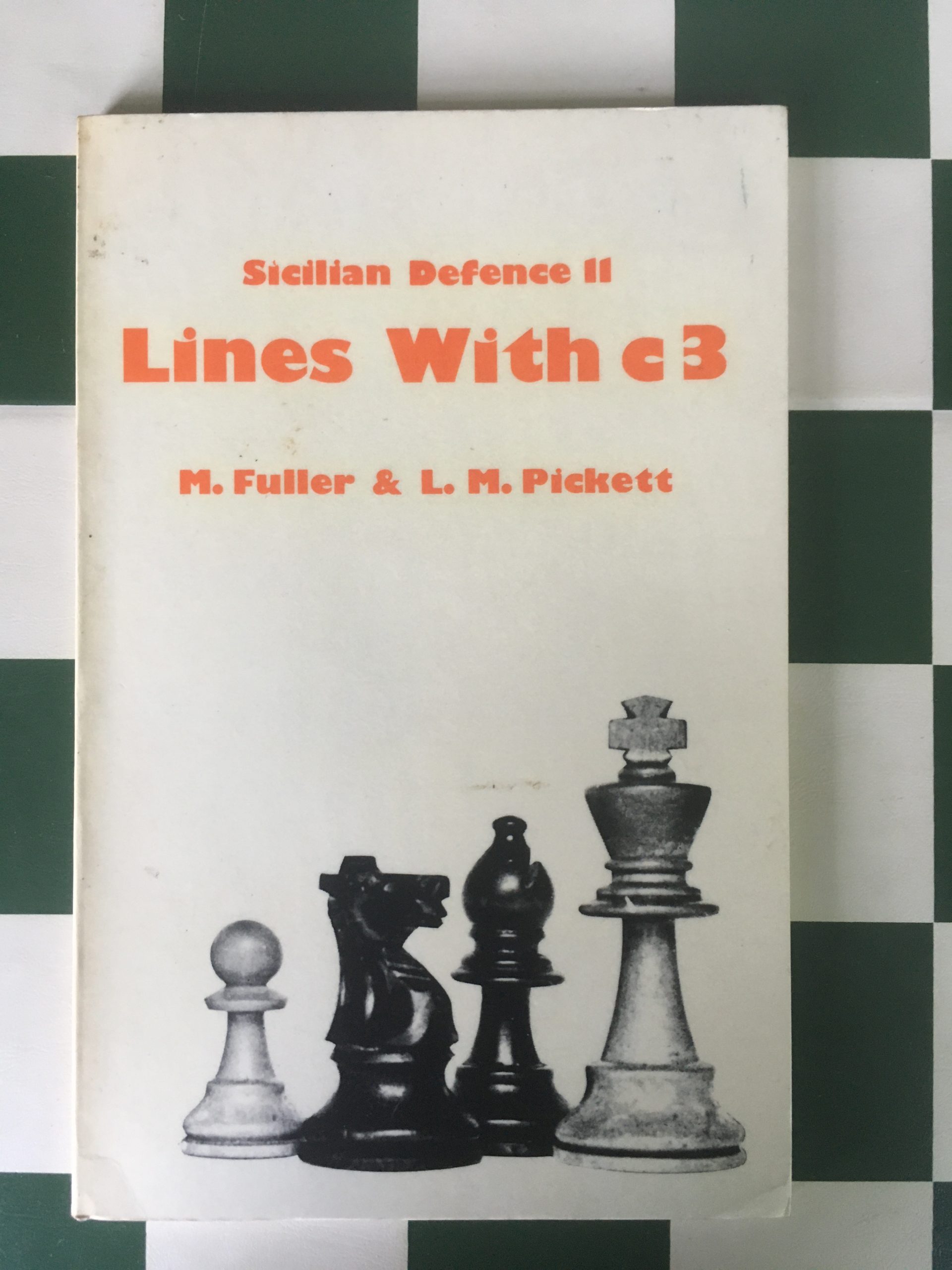
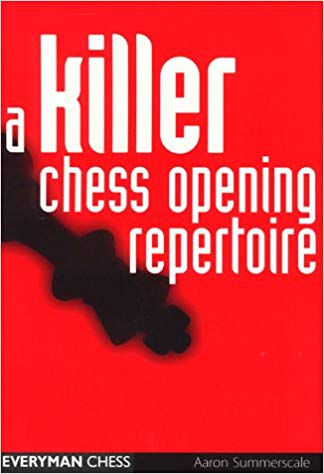
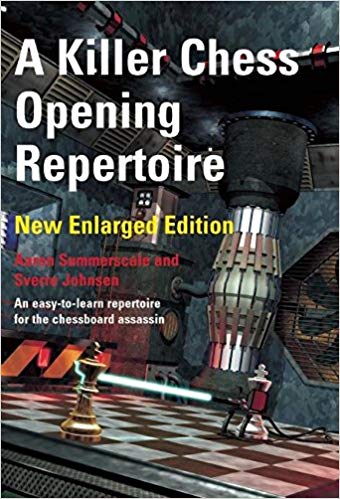
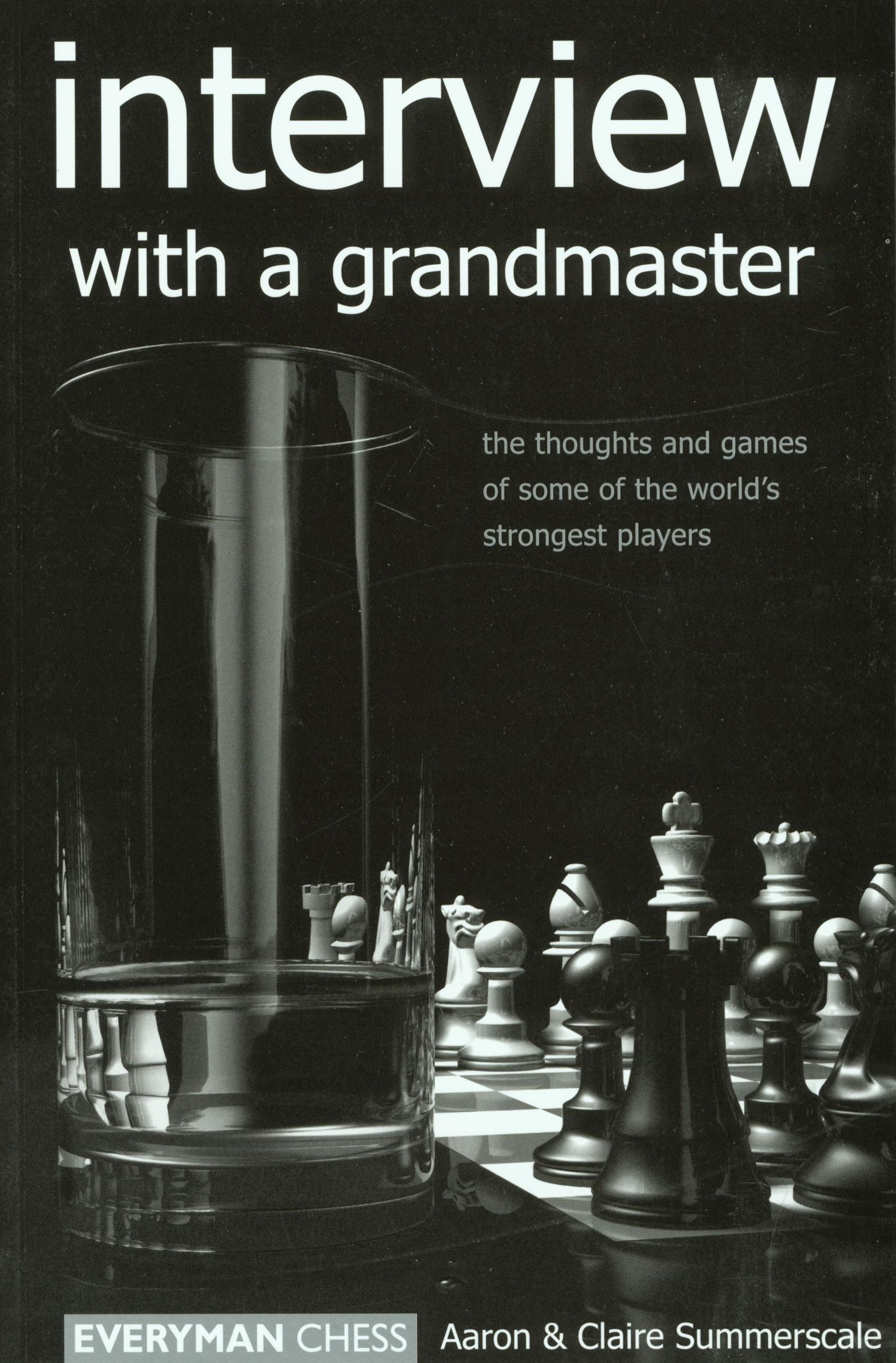
“Book of the year…this reviewer admits to consulting it more frequently than any other book on his shelf”
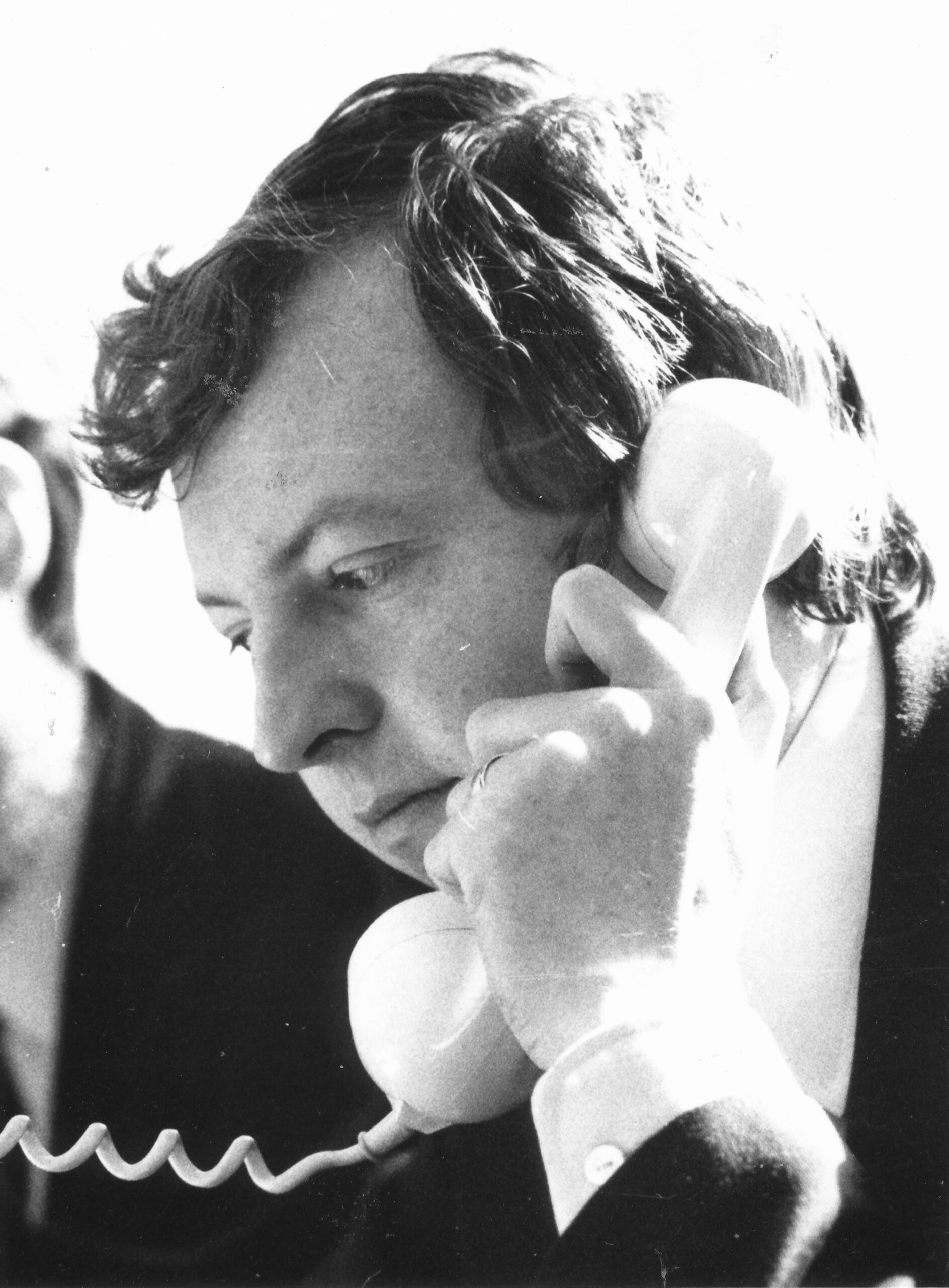
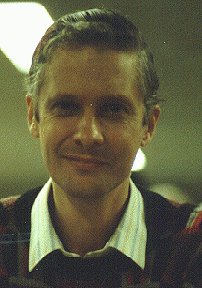
Kevin makes a telephone call
Kevin was coach (they lived in the same road in Suffolk) to GM Nick Pert and IM Richard Pert
Kevin became a FIDE Master in 2006 and his peak rating (according to Felice) was 2360 in July 1993 at the age of 44.
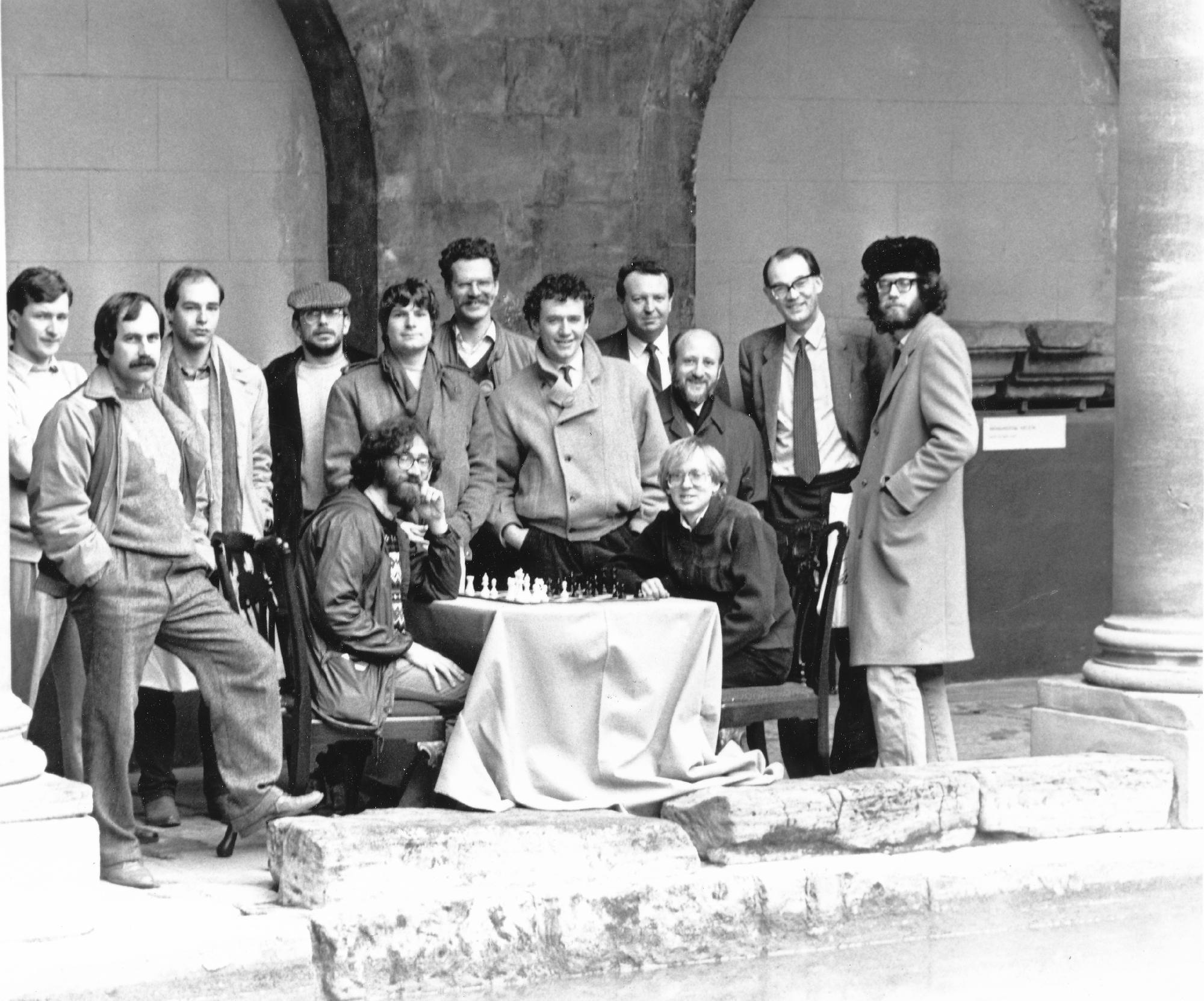
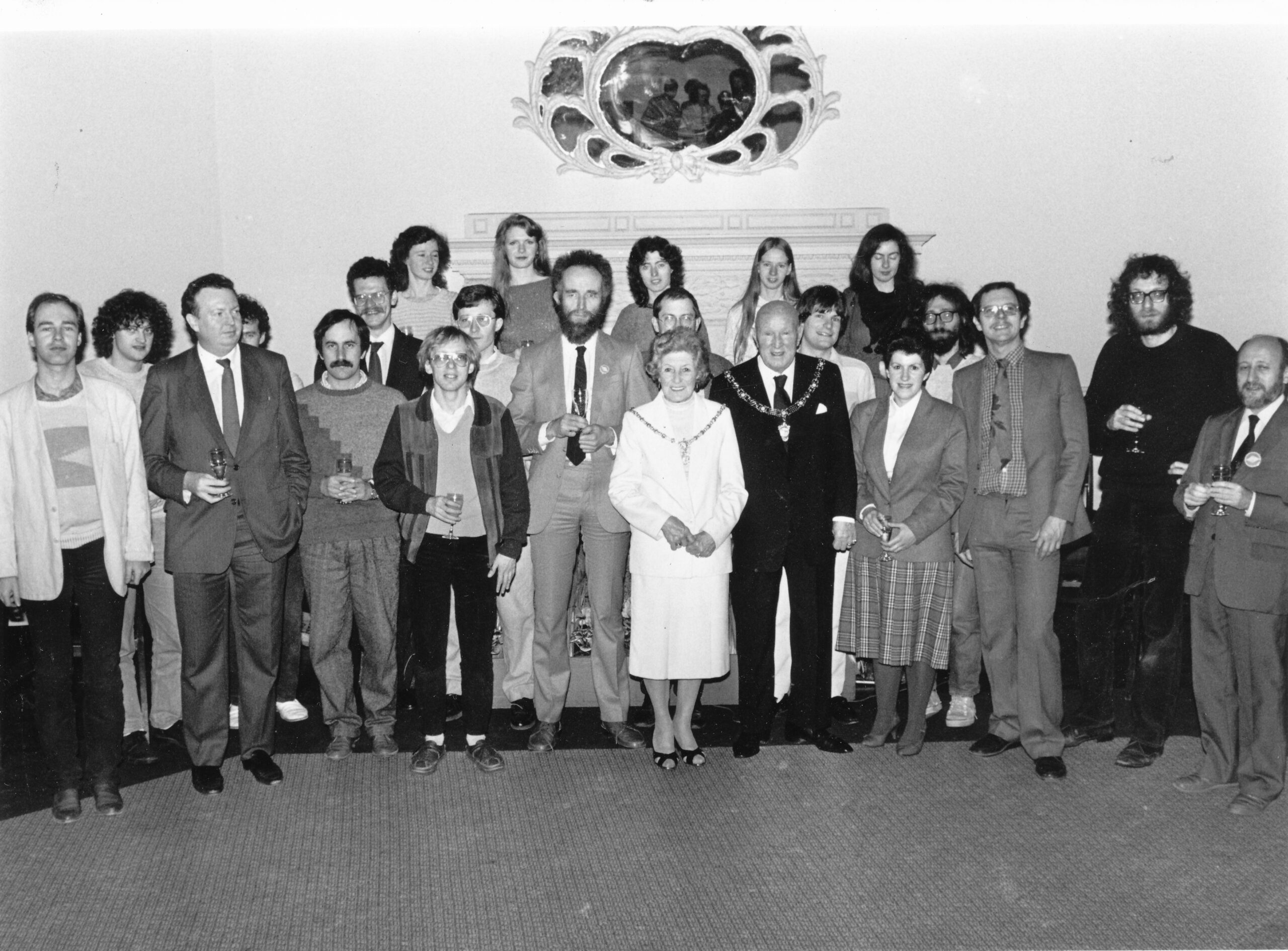
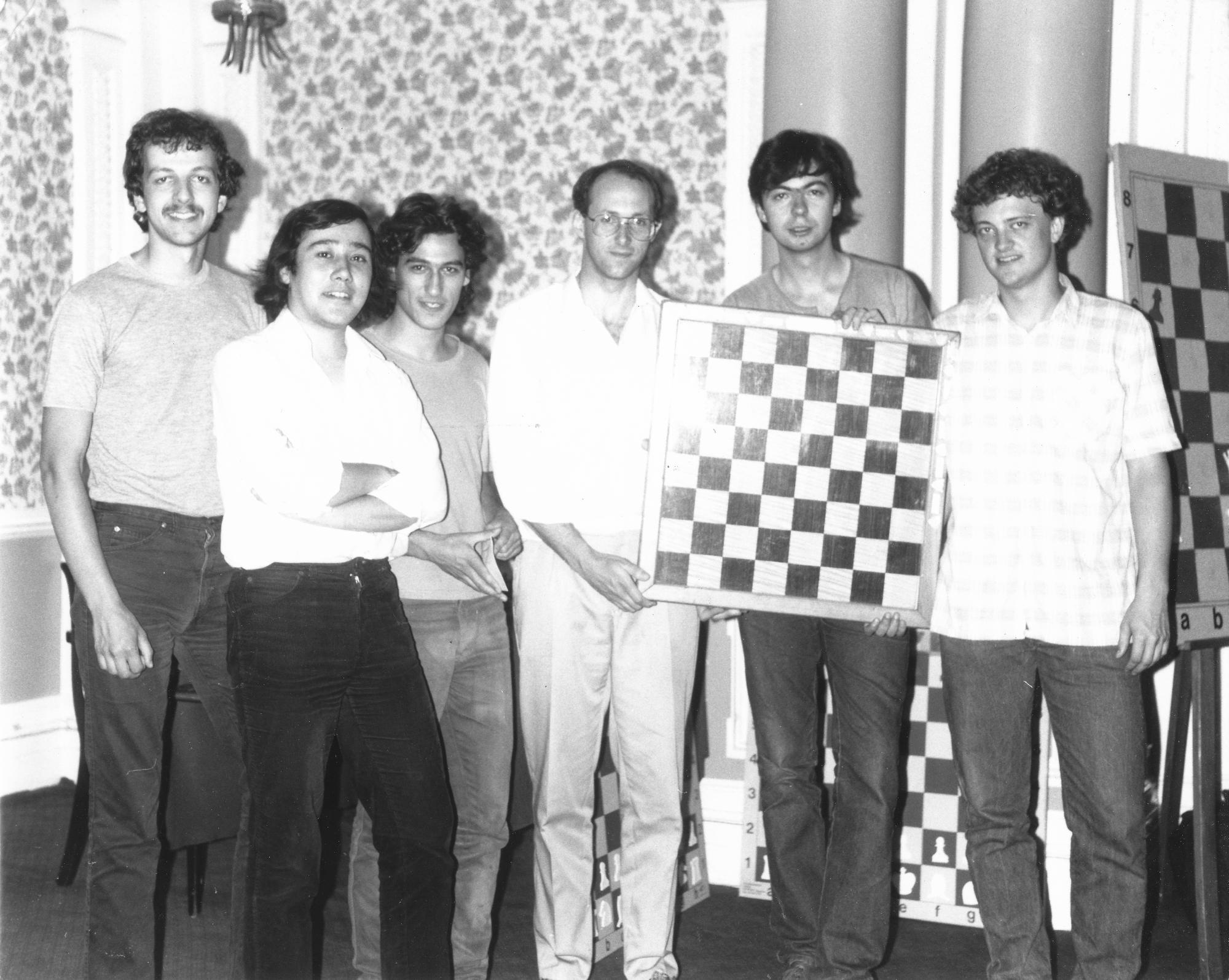
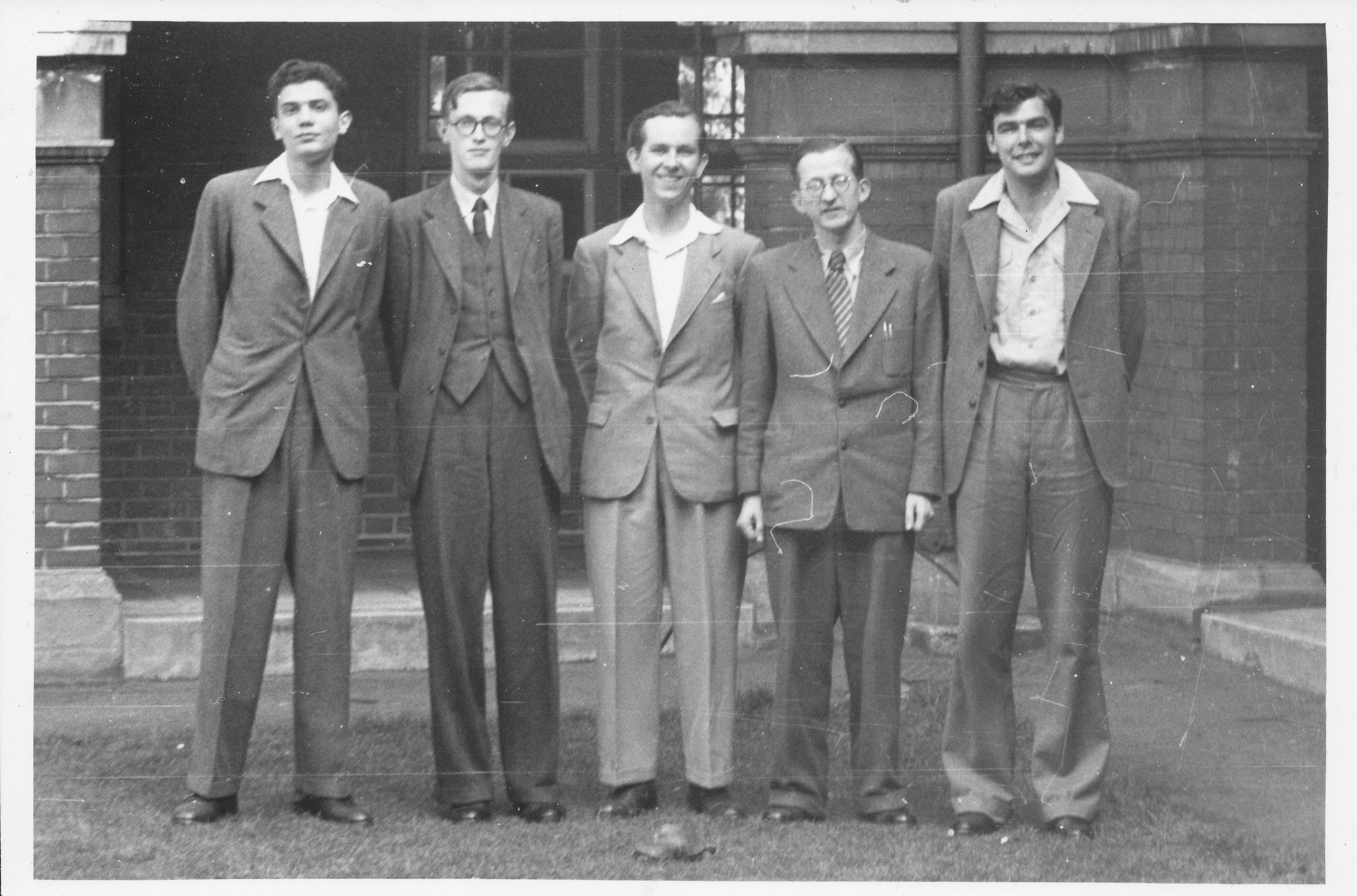
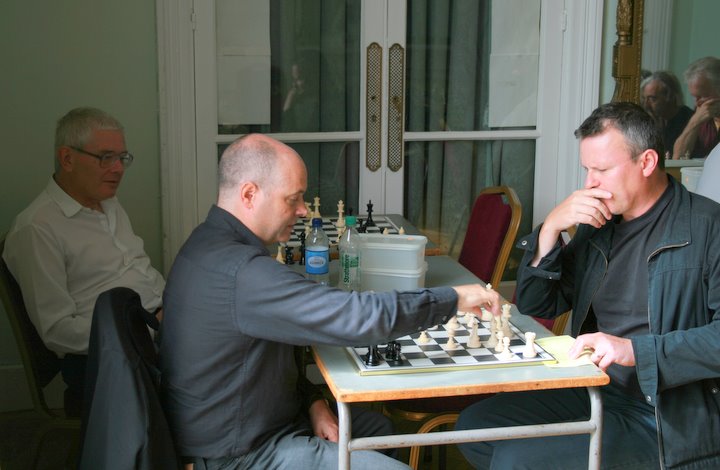
From the Praxis Bath Zonal Tournament of 1987. Kevin J O’Connell is third from left
Kevin became a FIDE International Arbiter (IA) in 1998. He is the FIDE Delegate for the Republic of Ireland and is Honorary Chairman and Secretary of the FIDE Chess in Education Commission (EDU). He is also a FIDE Senior Trainer.
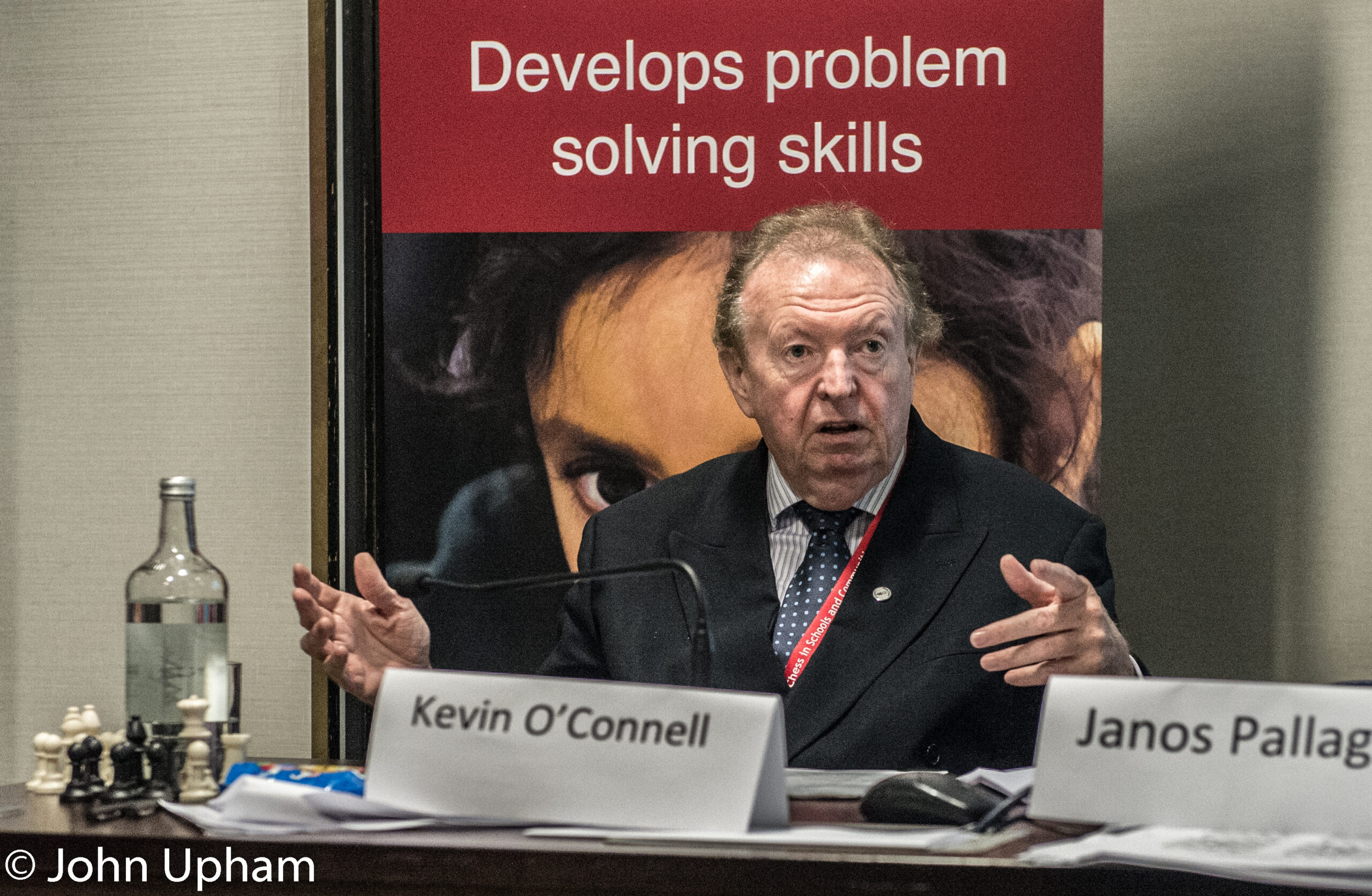
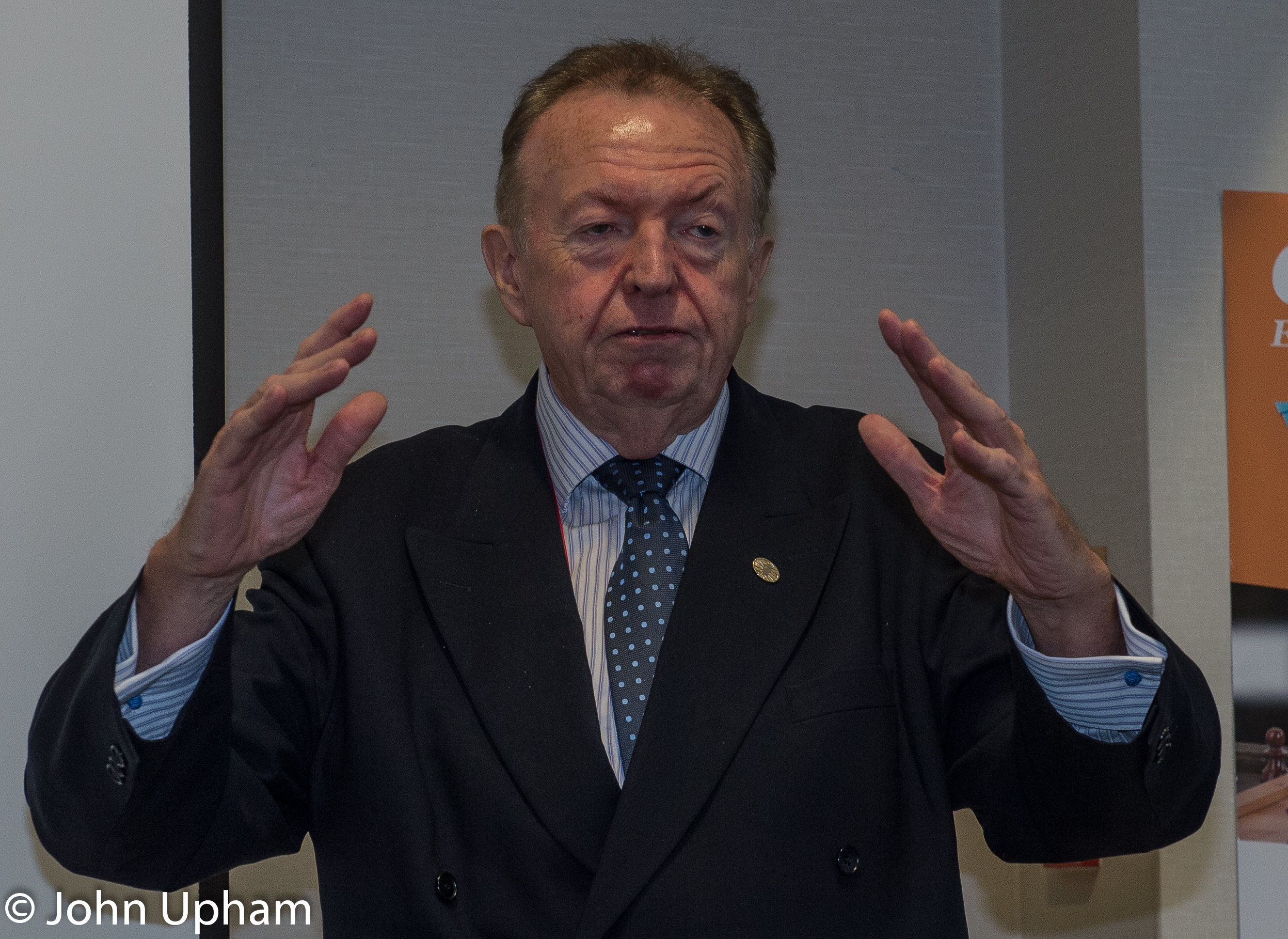
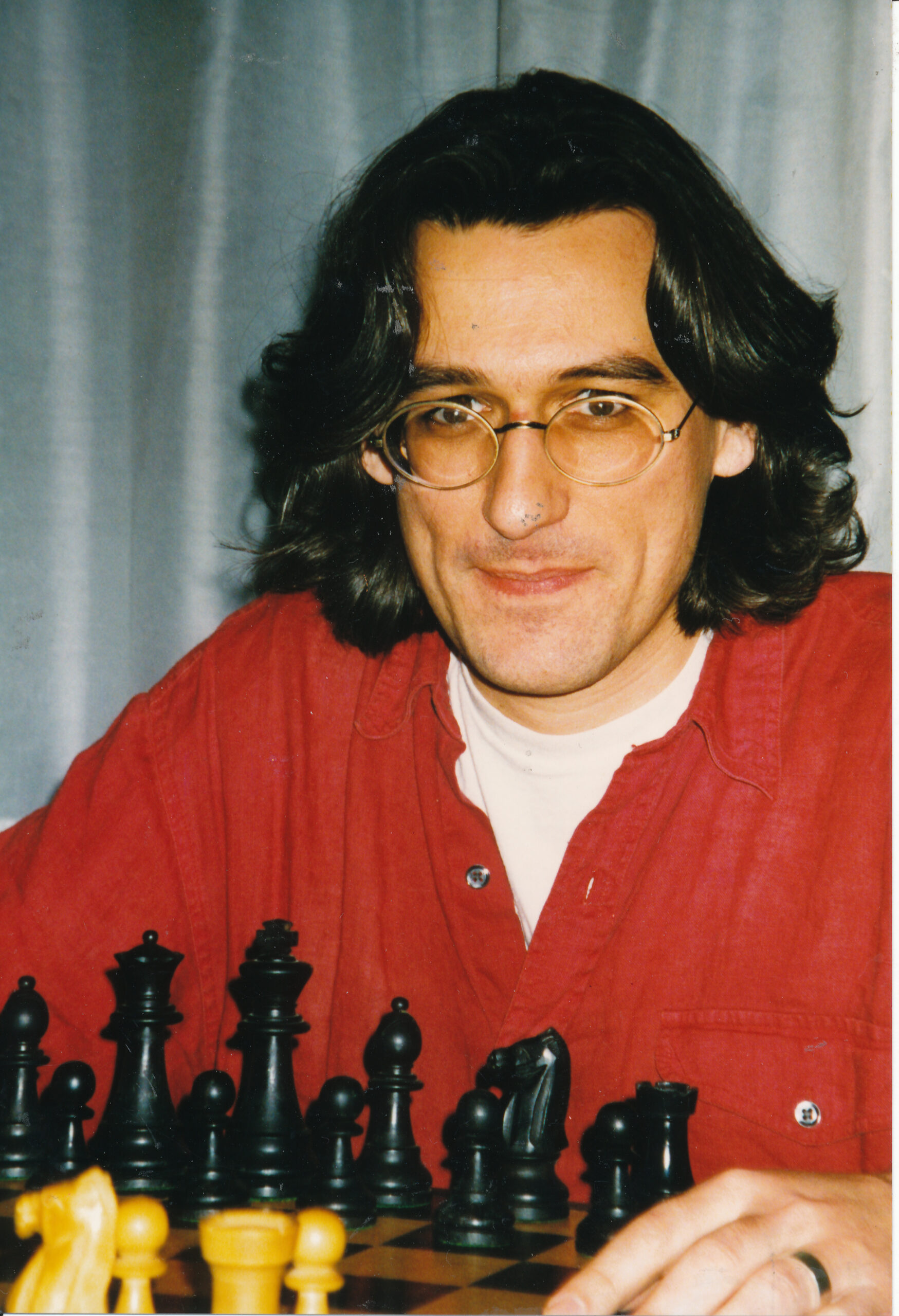
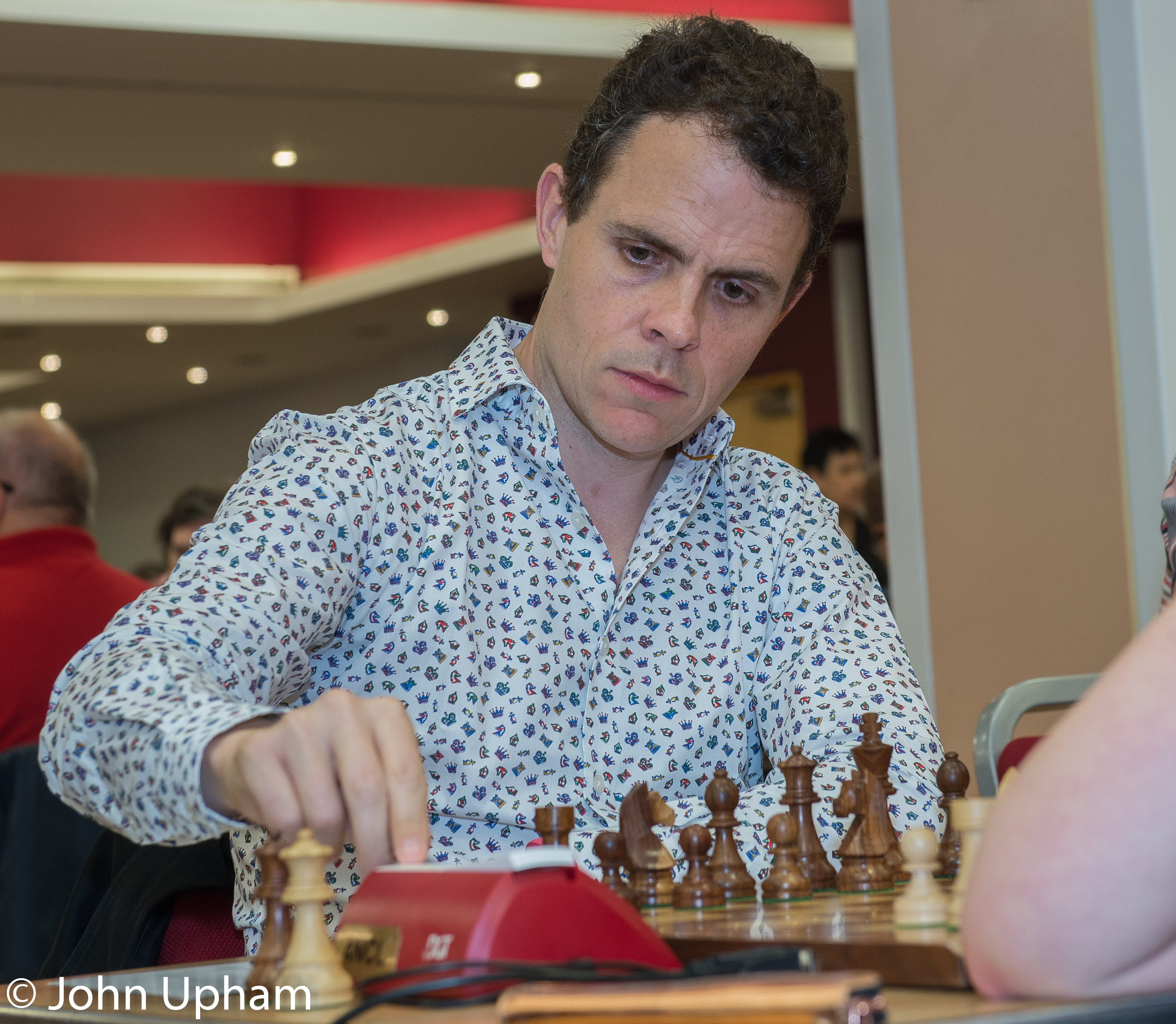
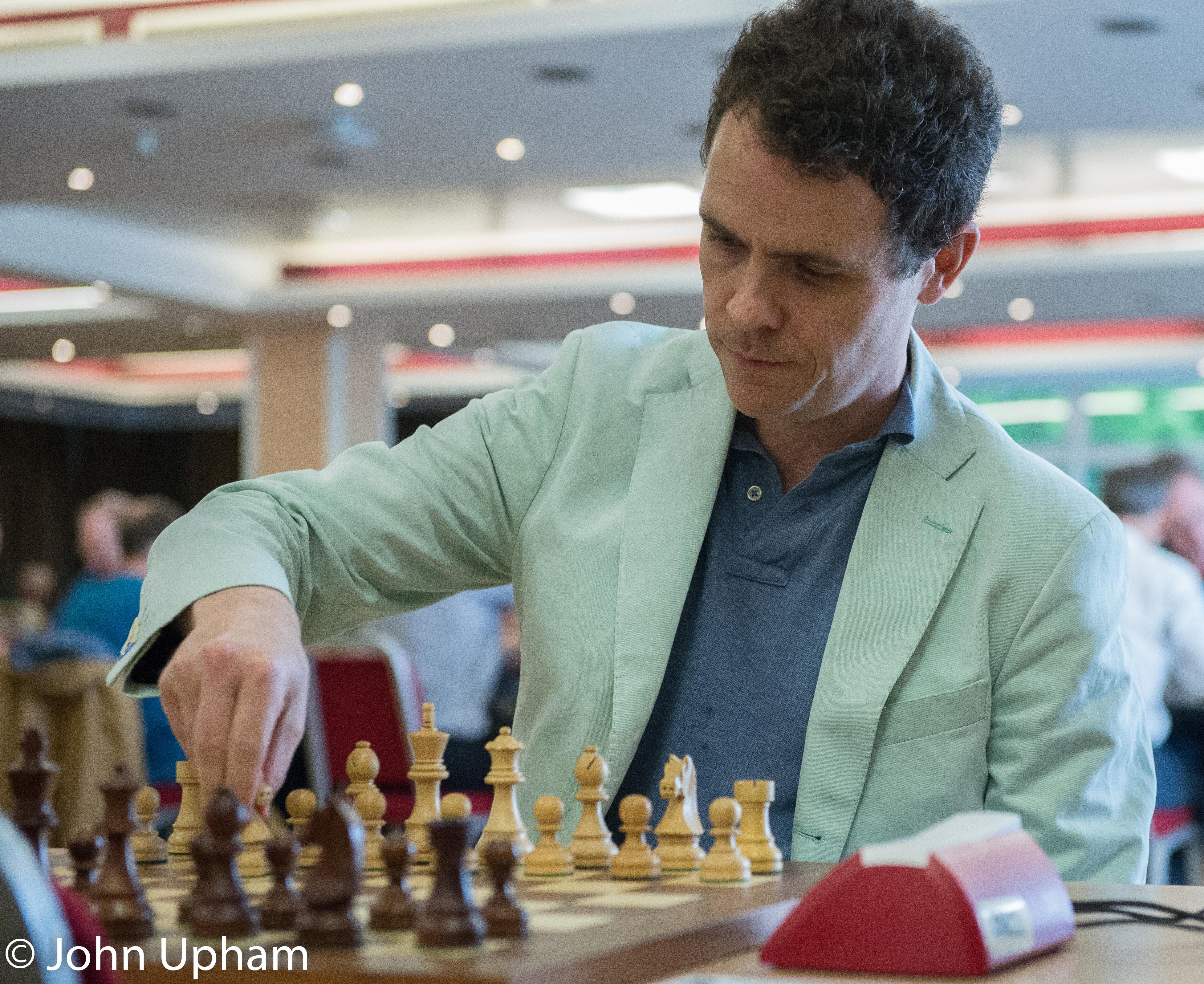
Kevin O’Connell at the London Chess Conference, 2016, courtesy of John Upham Photography
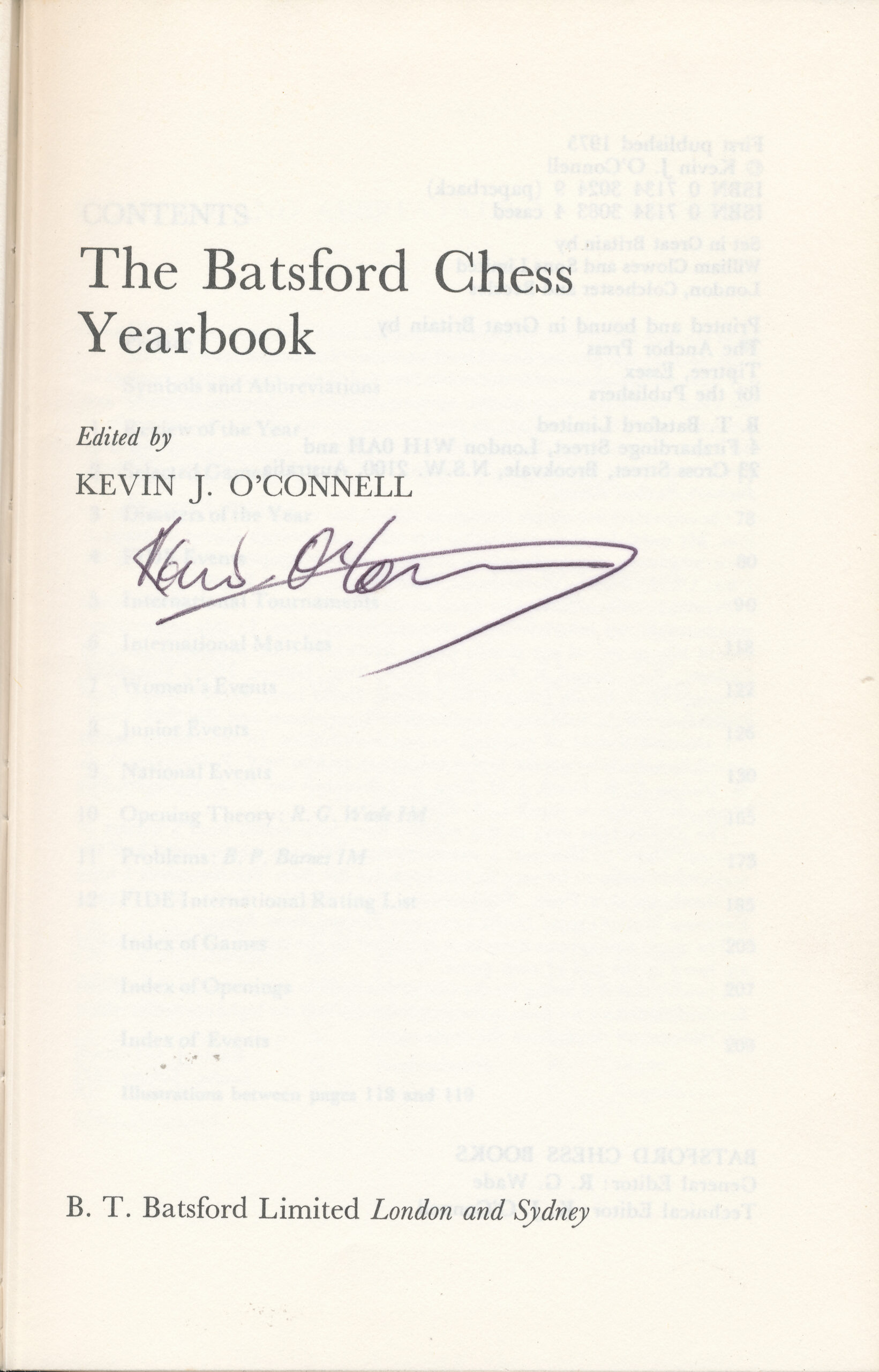
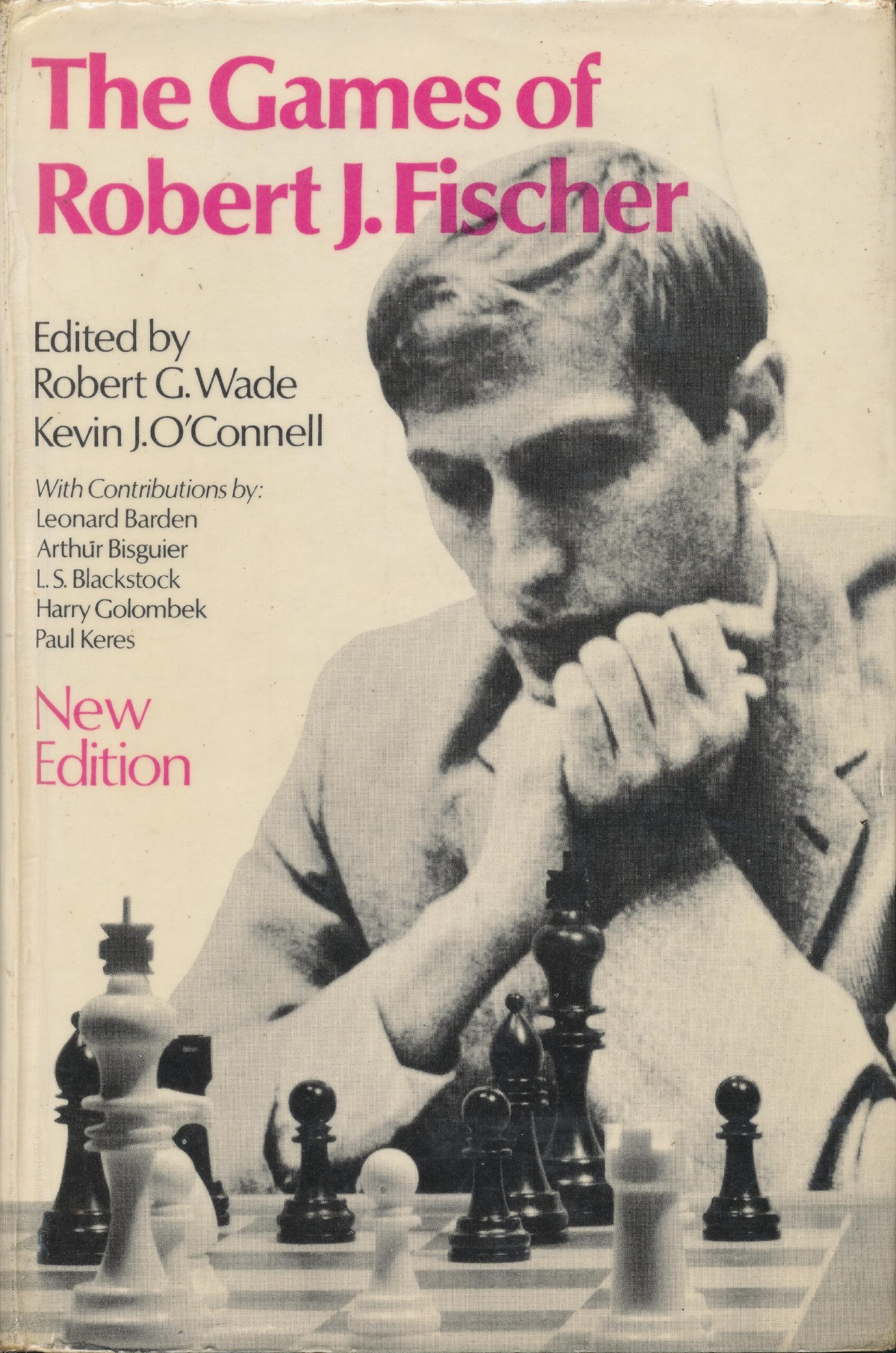
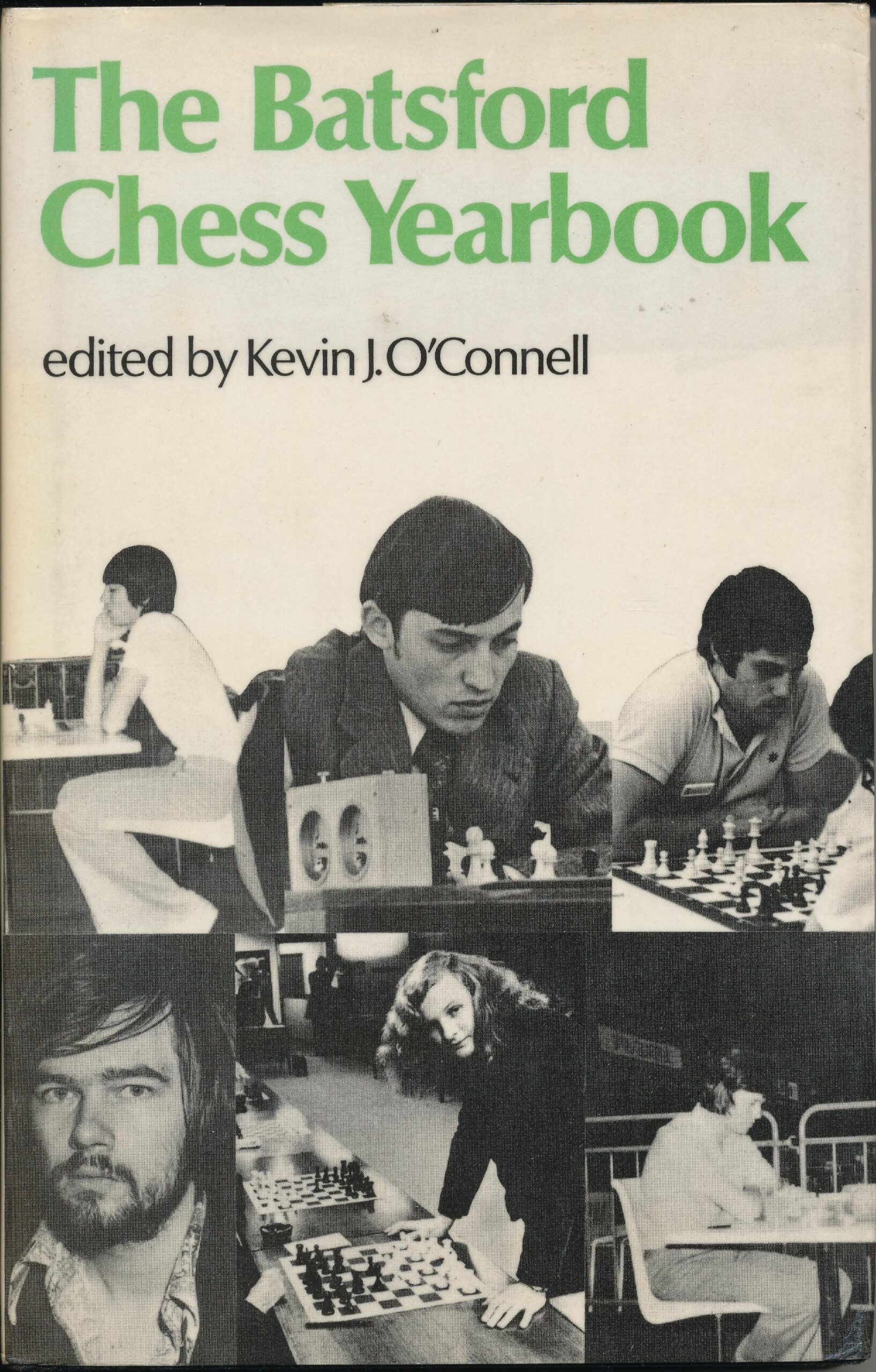
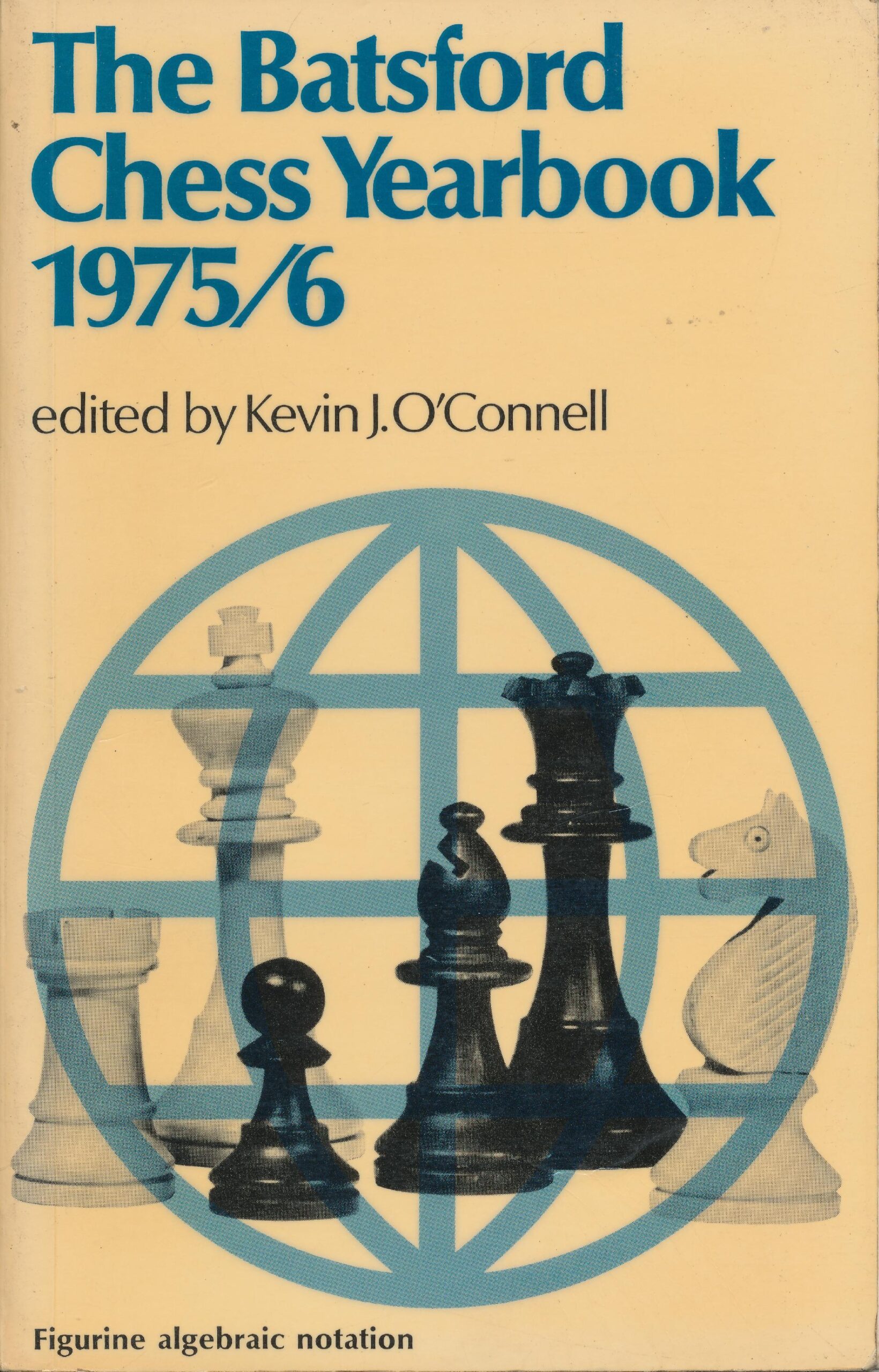
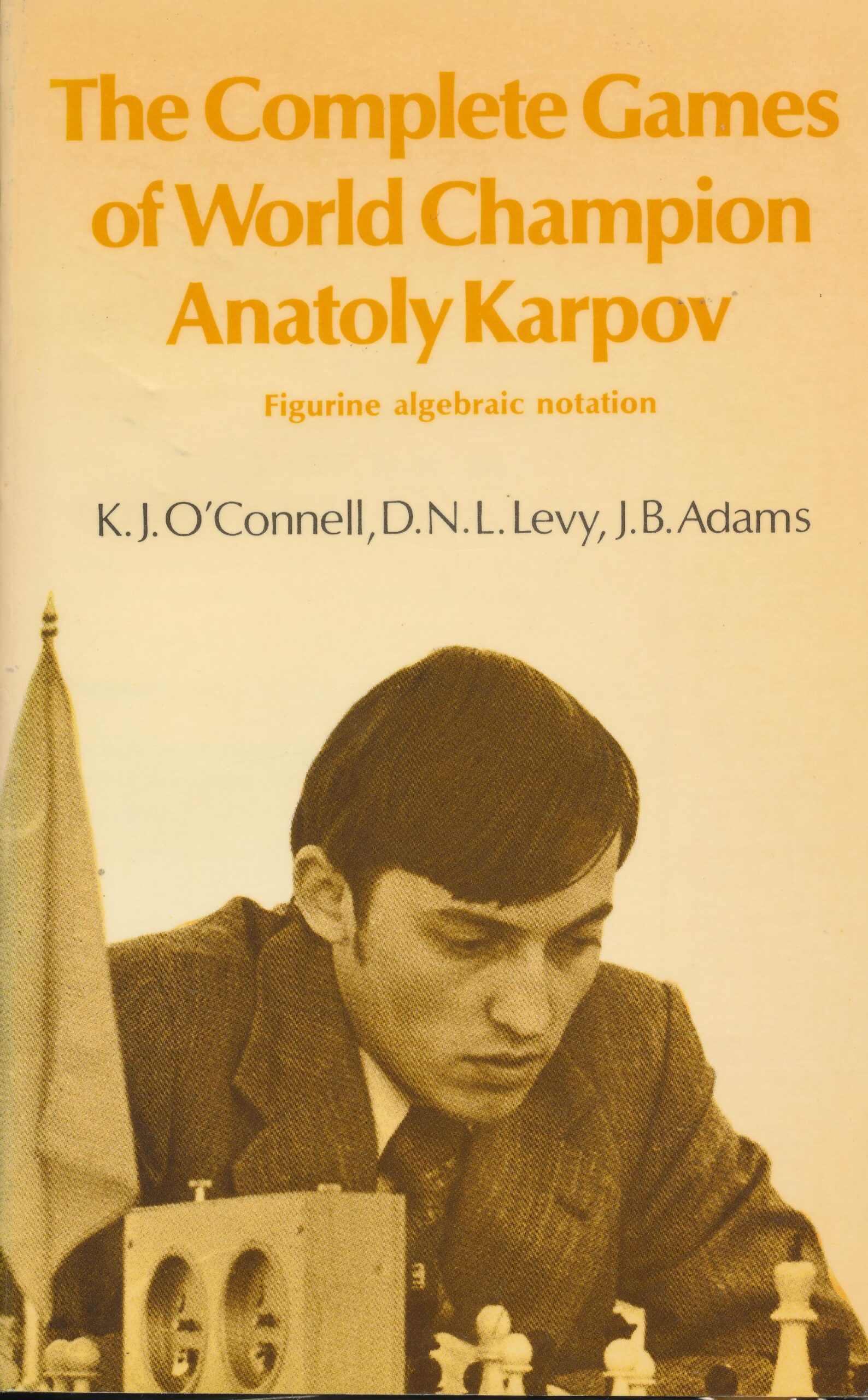
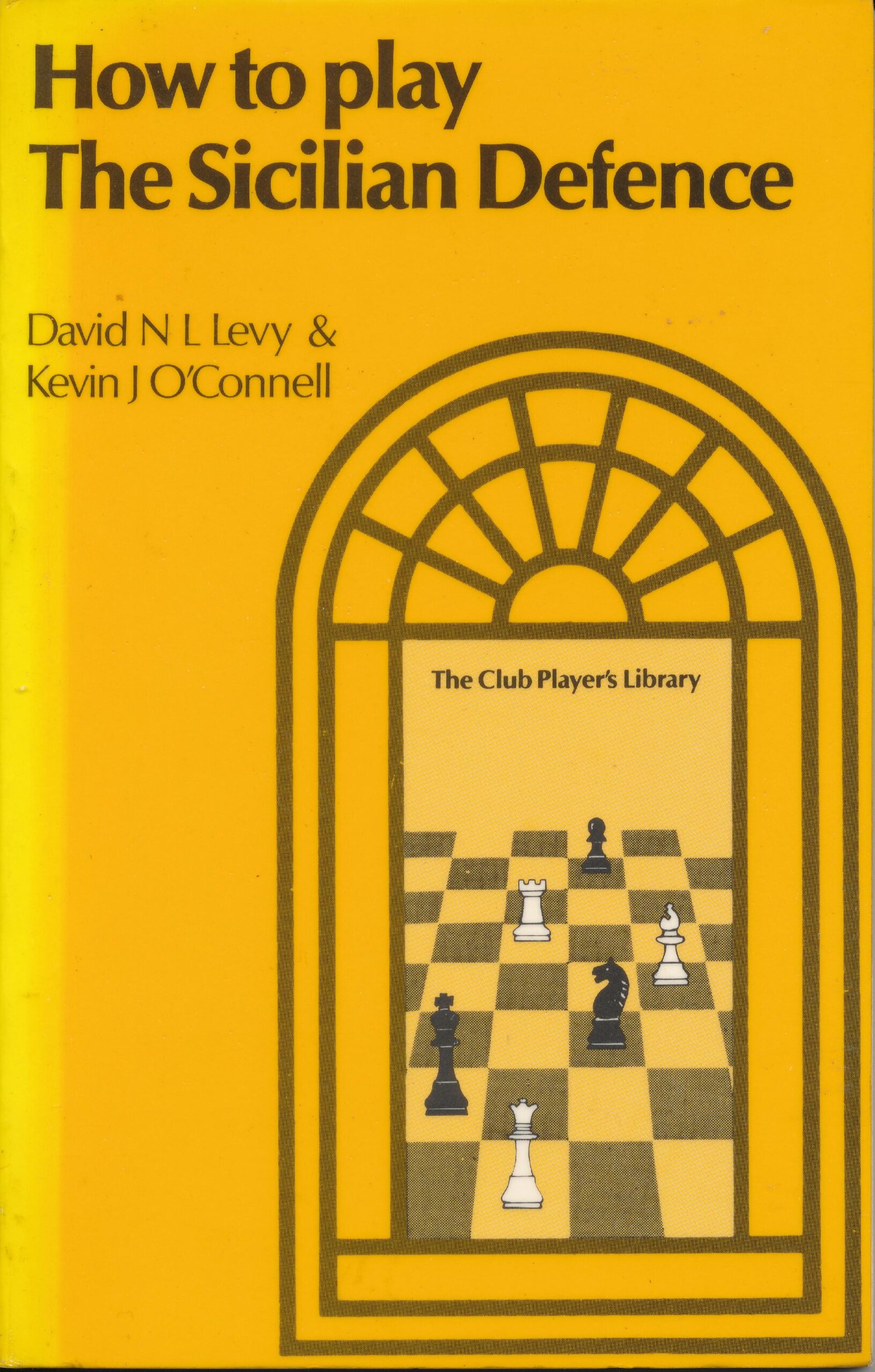
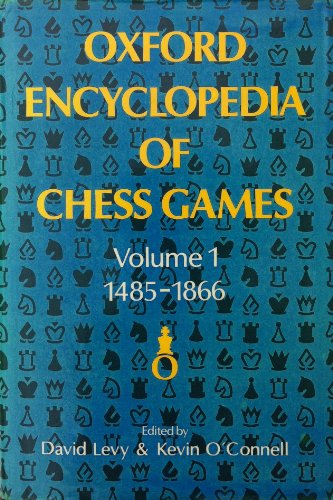
The Games of Robert J. Fischer, Robert Wade and O’Connell, Batsford 1972, 2nd ed. 1972, reprinted 1973, First limp edition 1981, Reprinted 1985, 1981, 1989, Second edition (The Complete Games of Bobby Fischer) 1992The Batsford Chess YearbookThe Batsford Chess Yearbook 1975/6The Complete Games of World Champion Anatoly KarpovThe Complete Games of World Champion Anatoly KarpovHow to Play the Sicilian Defence, Batsford, 1978Oxford Encyclopedia of Chess Games, Volume 1 1485-1866., OUP, 1981Oxford Encyclopedia of Chess Games, OUP, 2009
GM Daniel King, courtesy of John Upham Photography
We offer best wishes to GM Daniel King on his birthday
Daniel John King was born on Wednesday, August 28th 1963 (the same day as the Martin Luther King “I have a dream” speech) in Beckenham, Kent.
He attended Langley Park School whose motto is “Mores et Studia” meaning “good character and learning” or “morals and study”.
Daniel has a brother Andrew (AJ King) who is also a strong player.
Daniel became an International Master in 1982 and a Grandmaster in 1989.
Daniel King
His peak FIDE rating (Felice) was 2560 in July 1990 at the age of 27.
Daniel plays for Guildford in the Four Nations Chess League (4NCL) and has played for Guildford in local leagues.
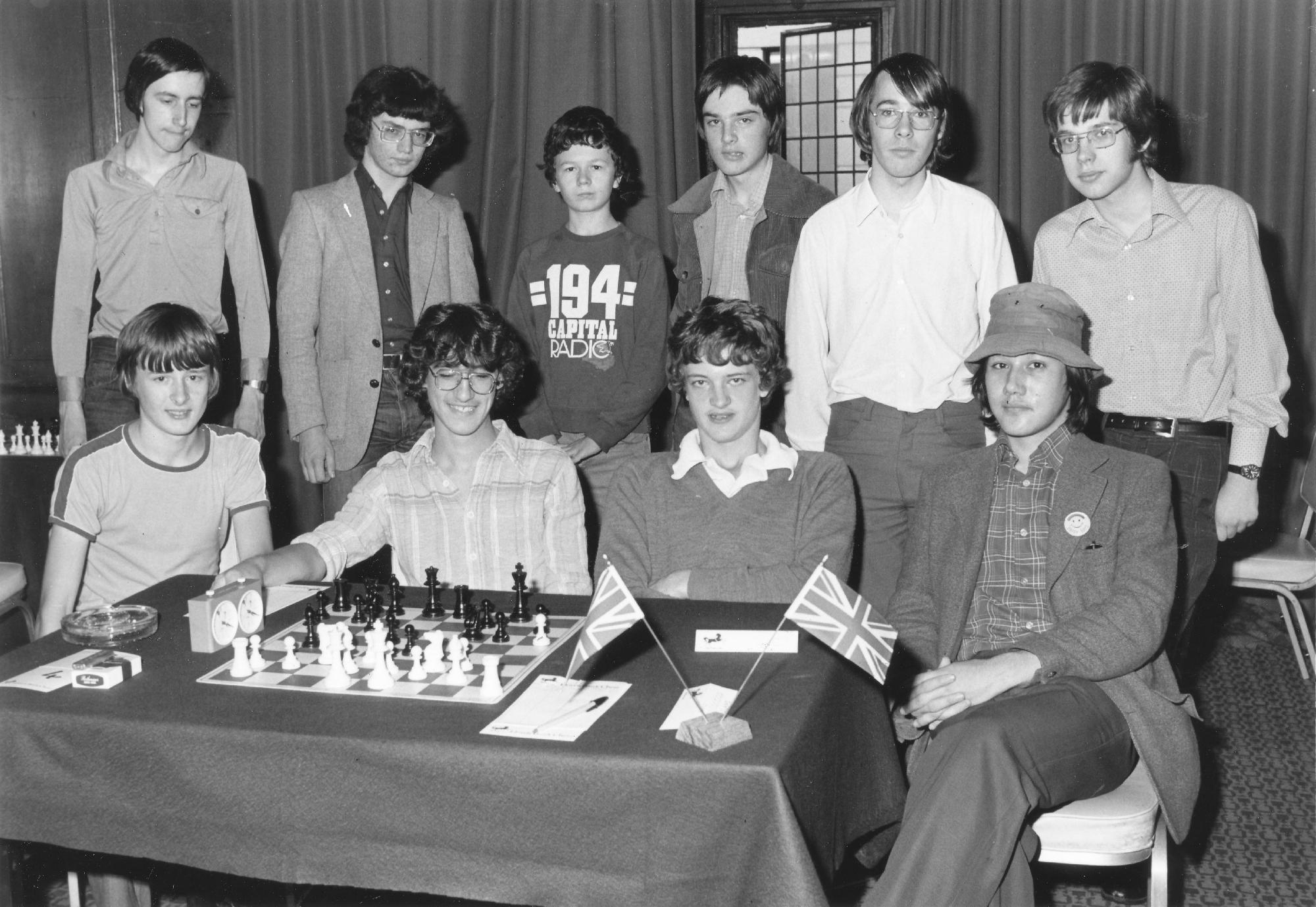
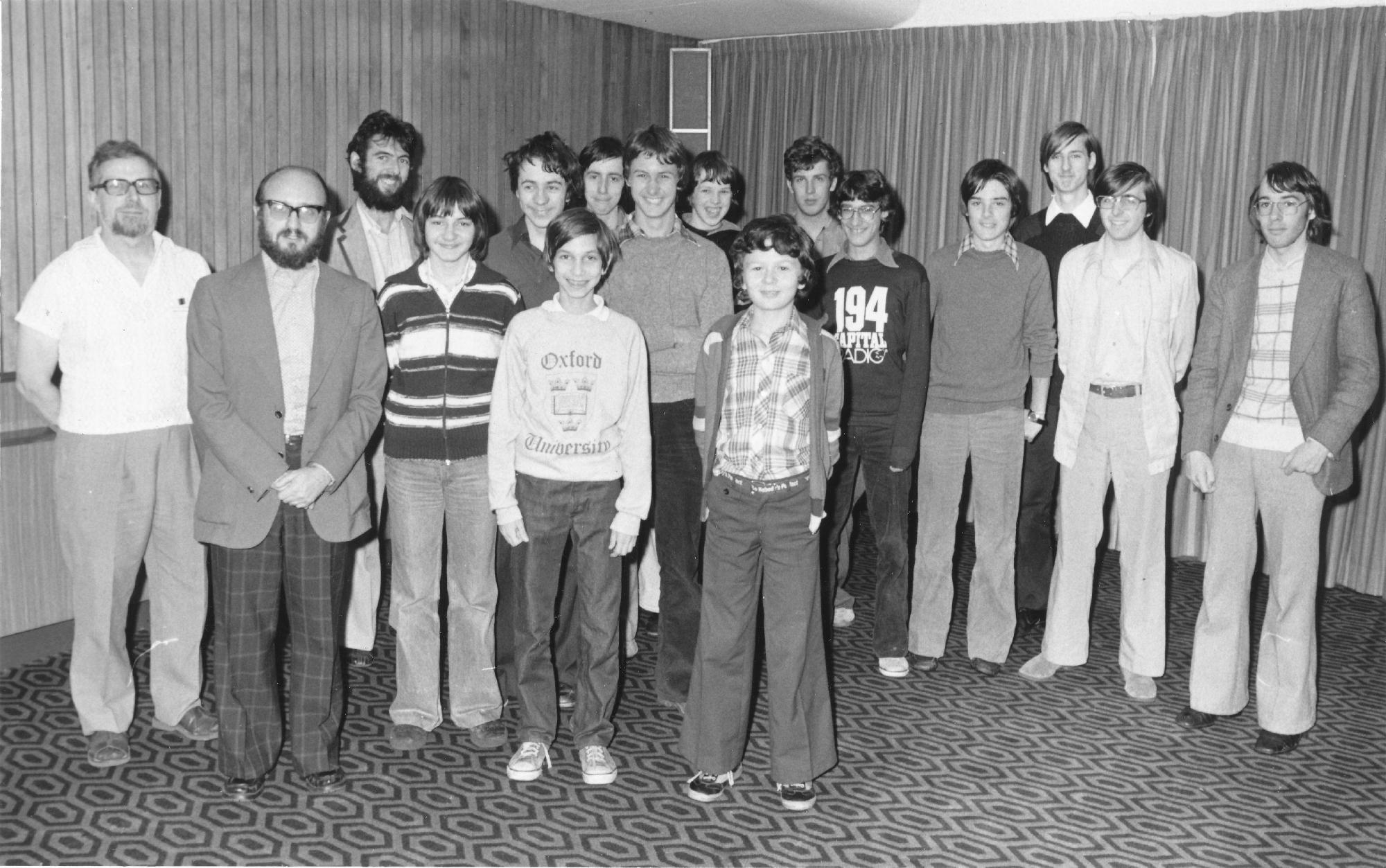
This was written (by Leonard Barden) about Daniel who was 15 just prior to the 1979 Spassky vs the BCF Junior Squad simultaneous display :
“Langley Park School, Shortlands and Bromley. Rating 201. British under-14 co-champion, 1977. 2nd Lloyds Bank junior international, 1979.”
Danny was Southern Counties (SCCU) champion for the 1983-84 and 1985-86 seasons.
According to Test Your Chess With Daniel King, Batsford, 2004 :
“Grandmaster Daniel King has been a professional chess player for 20 years. During that time he has represented his country on many occasions including an historic match victory over the Soviet Union in Reykyavik, 1990. Besides his chess career, Daniel has built up a reputation as a commentator on TV and radio,
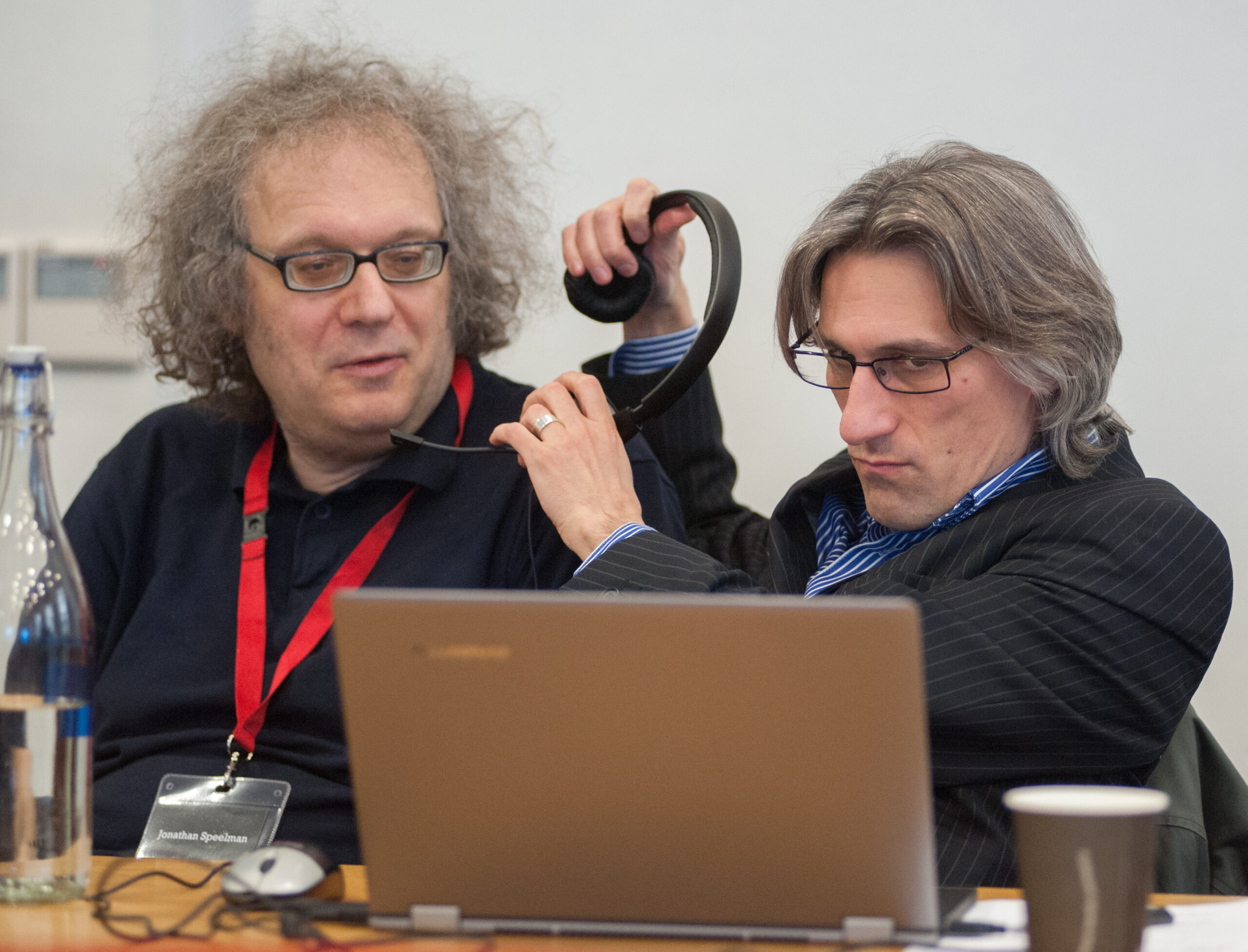
Jonathan Speelman and Daniel King share headphones at the 2013 FIDE Candidates event in London, courtesy of John Upham Photography
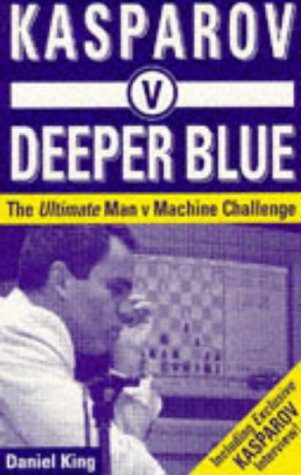
and has reported on four World Championship matches and several Man vs Machine events, including the controversial Kasparov vs Deep Blue encounter in New York, 1997. He is an award-winning author of 15 books, including Winning with the Najdorf, Mastering the Spanish, and Kasparov vs Deep Blue for Batsford. ”
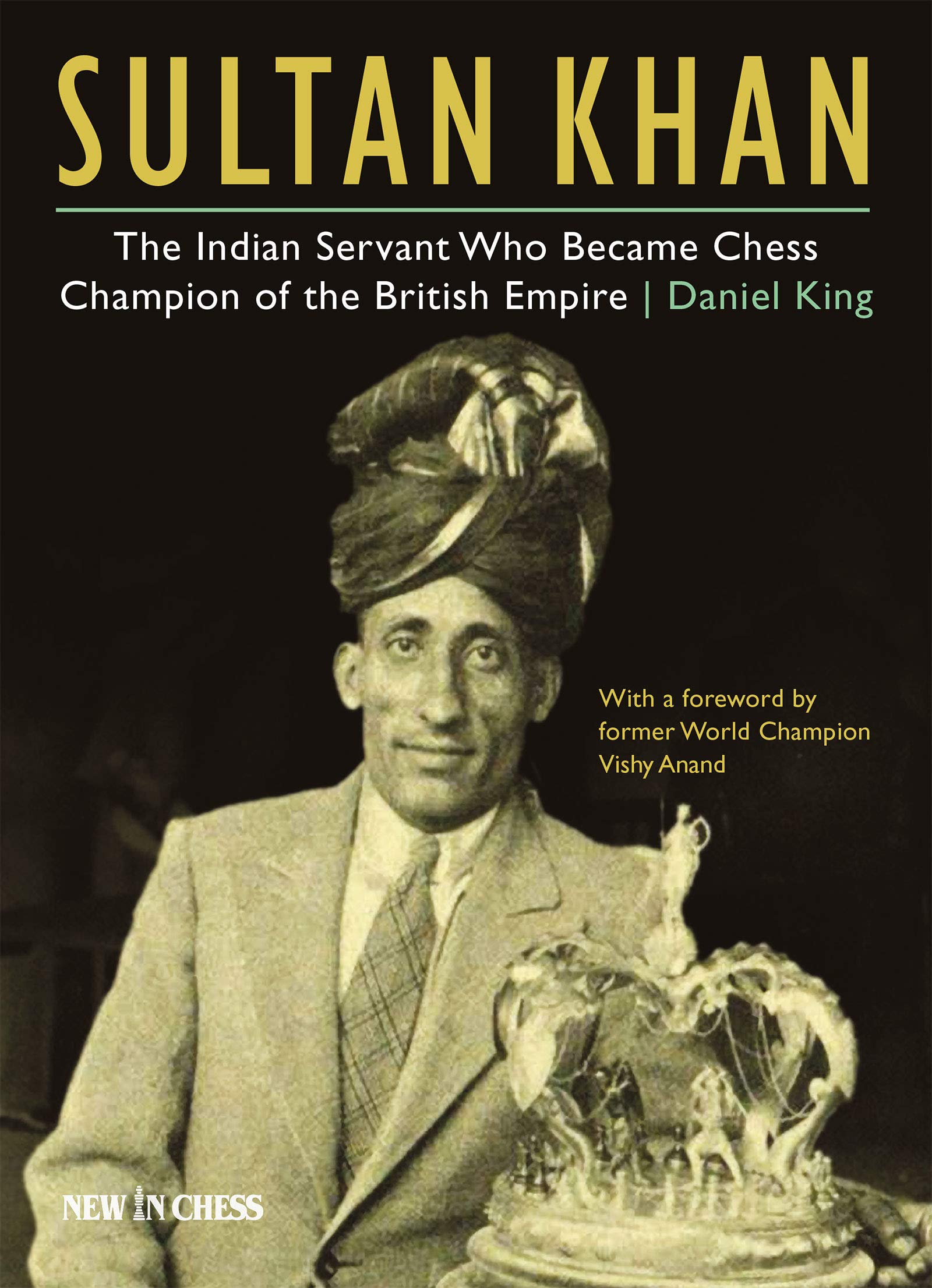
On April 8th, 2020 New in Chess released Sultan Khan: The Indian Servant Who Became Chess Champion of the British Empire which is Daniel’s most recent book.
According to British Chess (Pergamon, 1983) by Botterill, Levy, Rice and Richardson :
1977 British Under 14 Champion
1979 Lloyds Bank 6/9 (aged only 16)
1980 First Ilford Open
1981 Represented England in Glorney Cup scoring 4.5/5
1981 Fourteenth equal British Championship
1981 IM norm Manchester 5.5/9
1981 Second equal Ramsgate Regency Masters 6.5/9 IM norm with a round to spare
1982 First Equal Guernsey 6/7
1982 First Hamar IM norm and title
1982 Second equal Molde
1982 Second equal Hallsberg Junior
1982 Third equal Phillips and Drew Knights
1982/3 Tenth equal Ohra, Amsterdam 5/9
1982/3 Fifth European Junior
1983 Fourth equal Gausdal
1983 First Portsmouth Open
In the same article Daniel gave the following game as his favourite up to 1983:
Streatham & Brixton becoming BCF National Club Champions in 1989. The team was Tony Kosten, Mark Hedben, Daniel King, Nigel Povah (Captain), Joe Gallagher and Julian Hodgson : quite a strong teamDaniel King (seated, second from left)
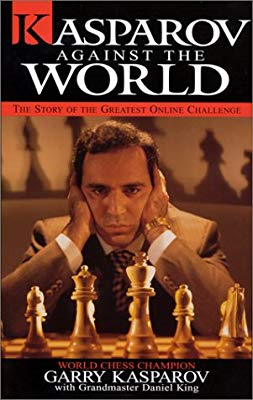
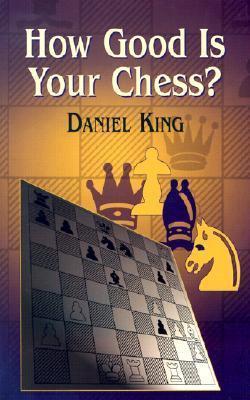
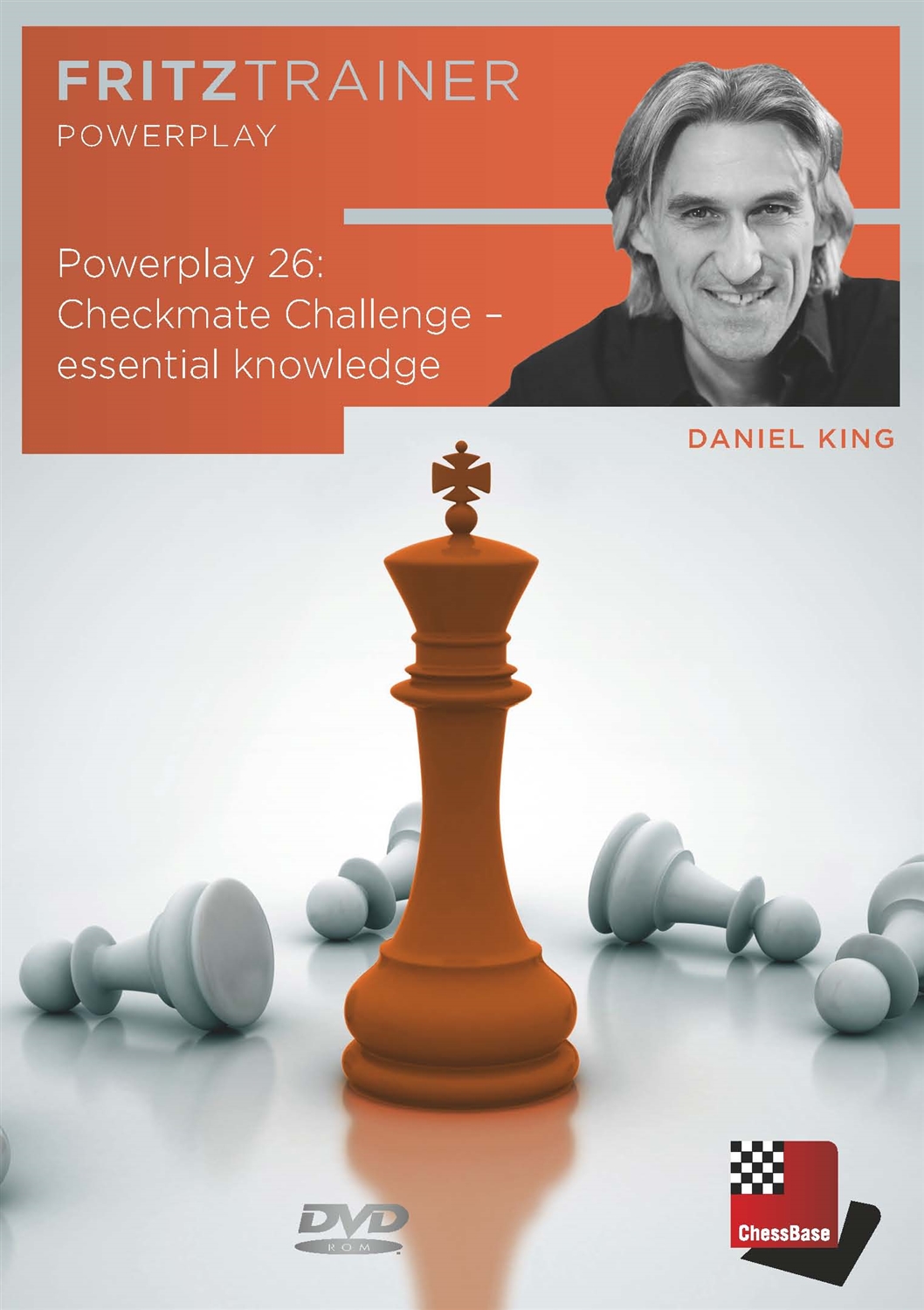
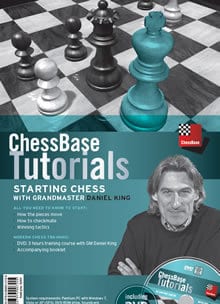
At the Lloyds Bank Masters : Front (l-r) : Joel Benjamin, Ian Wells, Rear : Peter Morrish, Stewart Reuben, Richard Beville, Gary Senior, Richard Webb, John Hawksworth, Andrew King, Nigel Short, Mark Ginsburg, Daniel King, David Cummings, Erik Teichmann, John Brandford and Micheal PagdenMastering the Spanish, Batsford, 1993Kasparov v. Deeper Blue: The Ultimate Man v. Machine Challenge. Batsford. ISBN 0-7134-8322-9., 1997How to Win at Chess: The Ten Golden Rules (Cadogan Chess Books), 2000Kasparov Against the World: The Story of the Greatest Online Challenge. KasparovChess Online. ISBN 0970481306., 2000Winning With the Najdorf. Sterling Pub Co Inc. ISBN 0713470372., 2002How Good Is Your Chess?. Dover. ISBN 048644676X., 2003Test Your Chess With Daniel King, Batsford, 2004How To Play Chess. Kingfisher. ISBN 0753419181., 2009Chessbase Fritz TrainerChessbase TutorialsSultan Khan: The Indian Servant Who Became Chess Champion of the British Empire
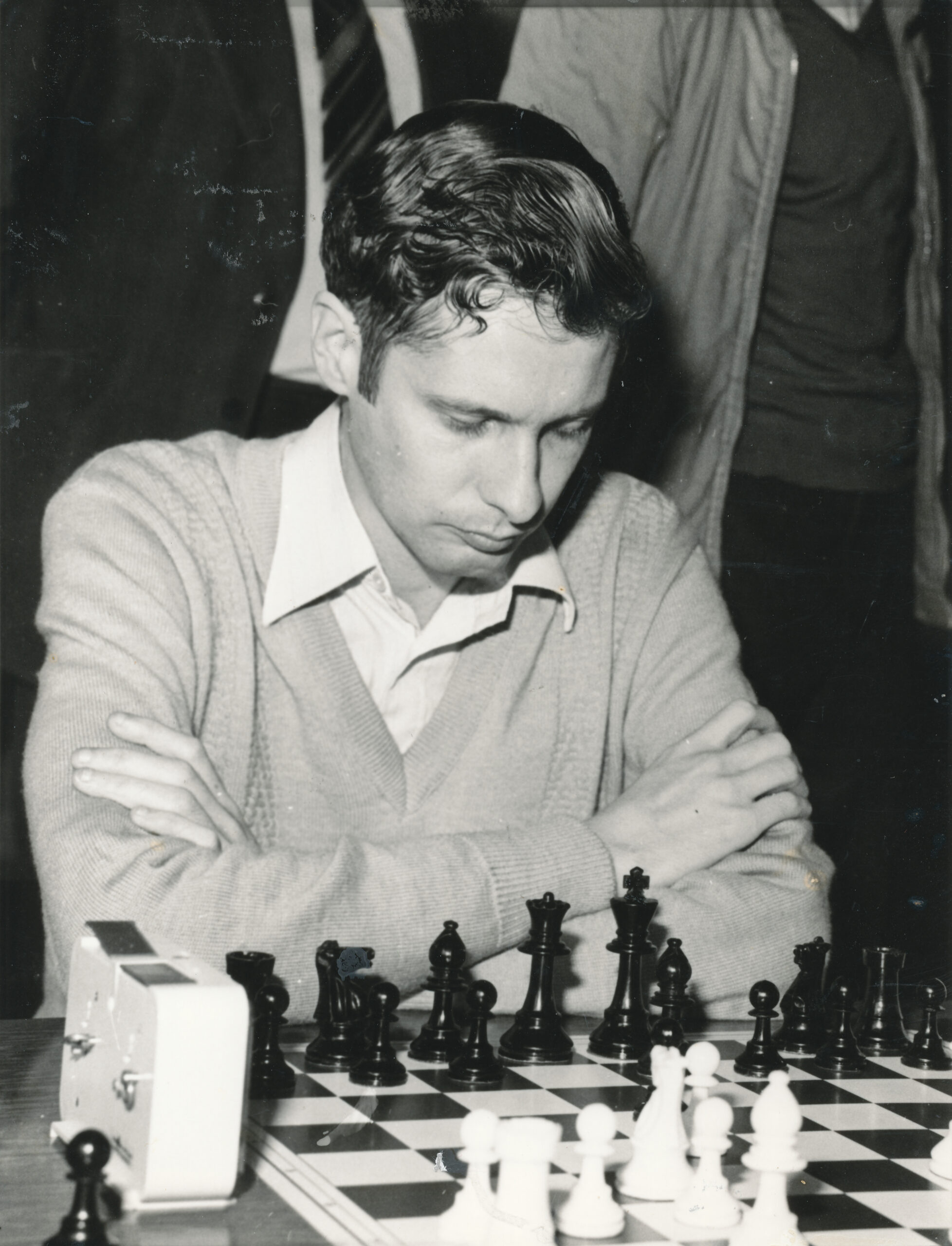
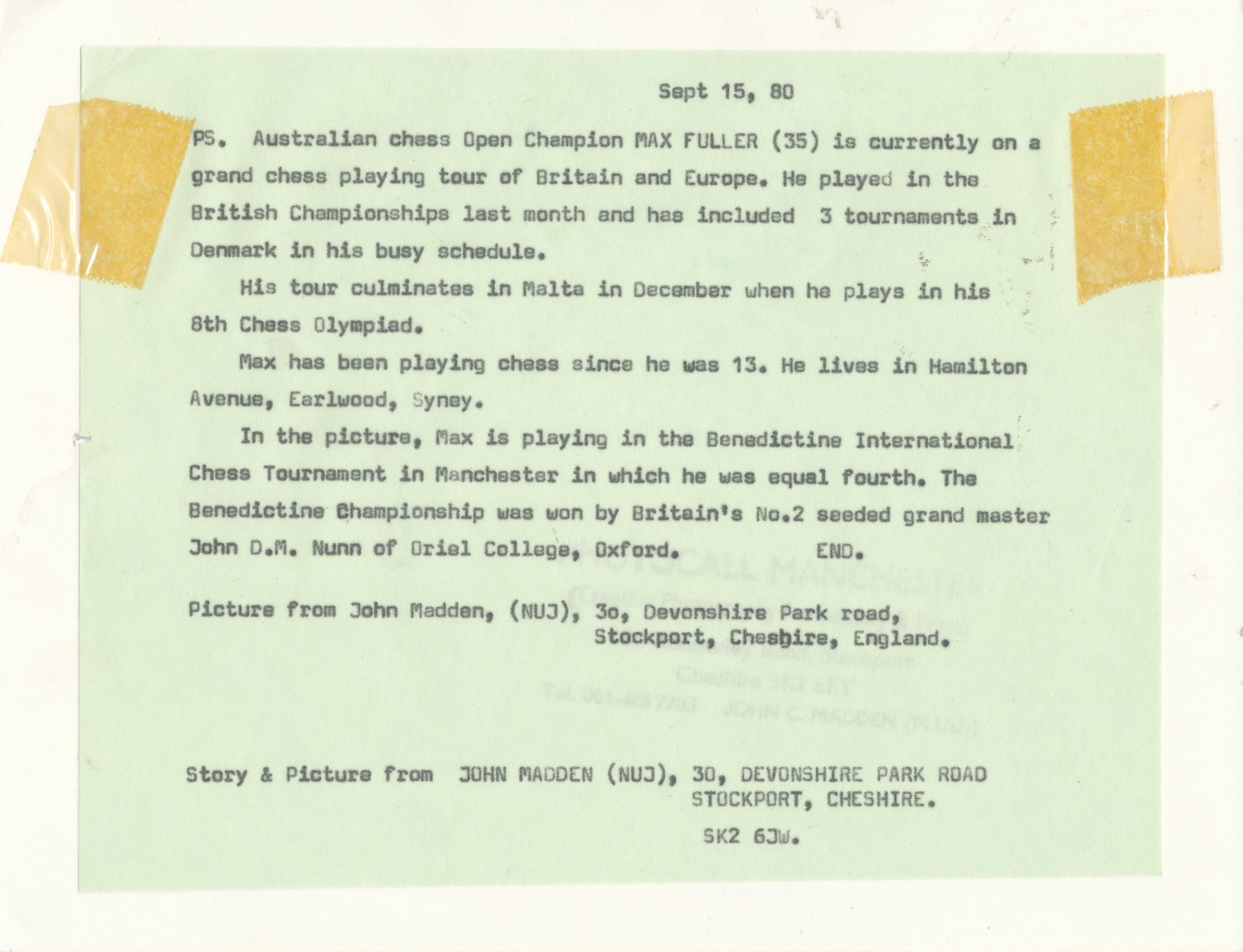
FM Max Fuller (28-i-1945 27-viii-2013). See full caption in photograph below.September 15th, 1980. Australian Open Chess Champion Max Fuller (35) is currently on a grand chess playing tour of Britain and Europe. He played in the British Championships last month and has included three tournaments in Denmark in his busy schedule. His tour culminates in Malta in December when he plays in his 8th chess Olympiad. Max has been playing chess since he was 13. He lives in Hamilton Avenue, Earlwood, Sydney. In the picture Max is playing in the Benedictine International Chess tournament in Manchester in which he was equal fourth. The Benedictine Championship was won by Britain’s number 2 seeded Grandmaster John DM Nunn of Oriel College Oxford. Picture from John Madden (NUJ)
BCN Remembers FM Max Fuller (28-i-1945 27-viii-2013)
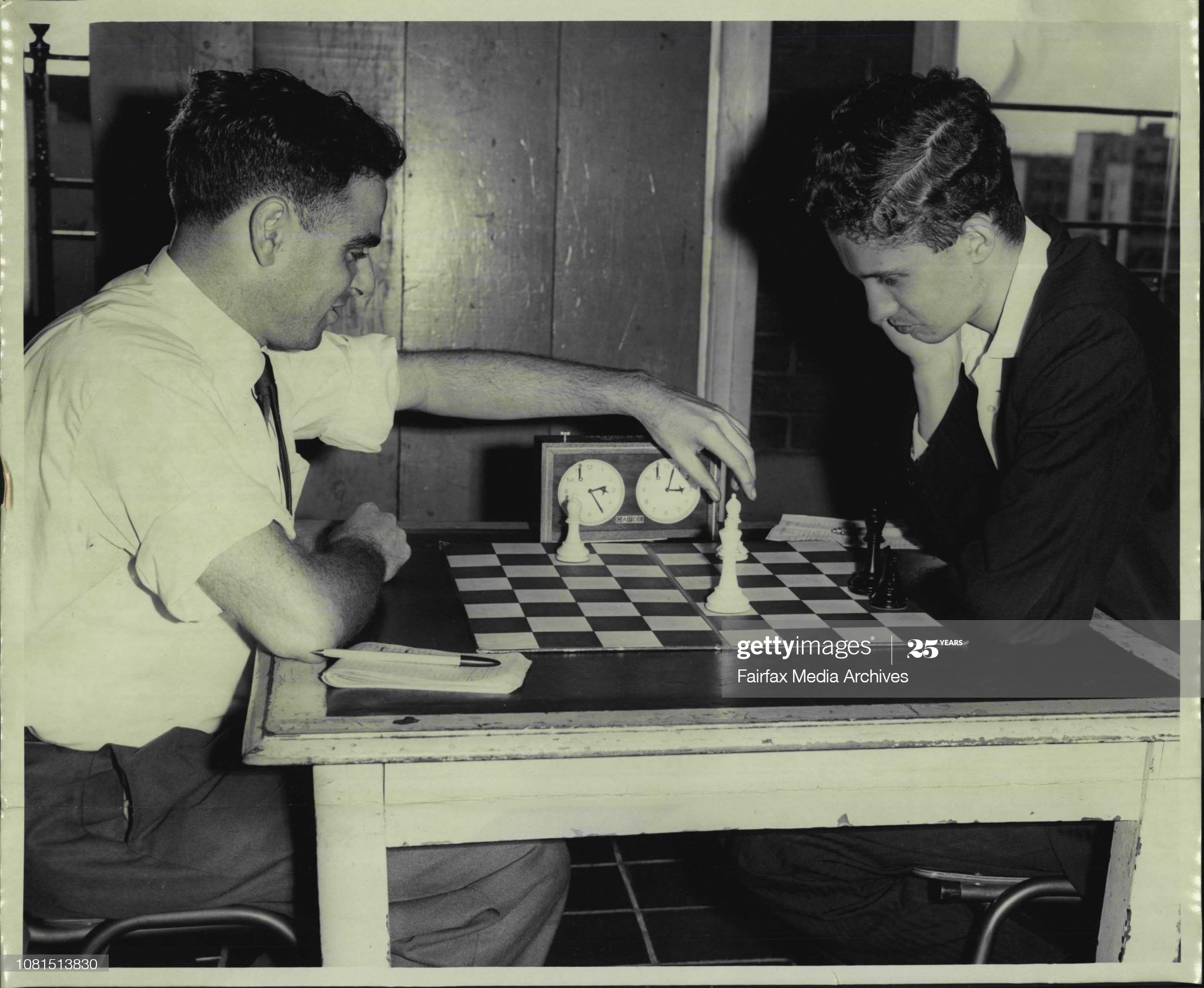
Tonight two Sydney ***** the N.S.W. Chess Championship at the Chess centre Liverpool St., City. They are Fred E Flatow, 28 of Belmore (left.) and Max Fuller, 21, of Kingsgrove (right). They have been playing for about 10 Hrs up till 6.15 p.m. and had move 121. The match will go on till move 144 at which stage a draw will be declared or until either man wins before then. February 23, 1966. (Photo by Richard John Pinfold/Fairfax Media via Getty Images).
Maxwell Leonard Fuller was born on Sunday, January 28th 1945 in Sydney, New South Wales. He was brought up by his mother and, according to Ian Rogers, his step-father with whom he did not get on.
Knight moves: Max Fuller in 1964. He went on to become Australia’s No.1 player and toured the world.CREDIT:STUART MACGLADRIE
He was Australian Junior Champion in 1962.
He won the New South Wales title in 1965 (and then in 1986 and 1988).
Max came to England in late 1968 to play at Hastings and then chose to settle here. He played for Lewisham chess club. He won the Whitby Open in 1969 (See BCM, Volume LXXXIX, Number 8, page 264).
In the 1970s be played board one for Australia whilst maintaining a FIDE rating of 2450, and, according to chessgames.com : “Fuller finished equal second in the British championship in 1970 and 1975, winner of the Doeberl Cup three times, winner of the Australian Open three times, Joint Australian Champion 1972 with Trevor Hay and competed in nine Olympiads for Australia from 1964-1990. In 1974, he won the 101st Athenaeum Chess Club Jubilee tournament, held in London.”
He became a FIDE Master in 1980
Fuller returned to chess in 2004 after an eight-year absence and finished equal second in the 2004 and 2005 NSW championships.
According to IM Gary Lane : “Max had a heart attack and died on the day he was attending the funeral of his pal Peter Parr”
With the white pieces Max essayed the Ruy Lopez with a penchant for the exchange variation but nonetheless he was flexible and varied.
As the second player against 1.e4 he was versatile with a broad range of defences and likewise facing 1.d4/1.Nf3 he was difficult to prepare for.
According to British Chess Magazine, Volume CXXXIII (2013), Number 9 (September), page 450 :
“From Australia the saddest of news, the passing Maxwell Leonard Fuller (28 i 1945 Sydney – 27 viii 2013 Sydney). FM Max Fuller played in seven BCF Championships, 1969 -80. He later claimed the scalps of Short, Miles and Chandler. He was the most determined player imaginable and had the broadest of opening repertoires. (James Pratt)”
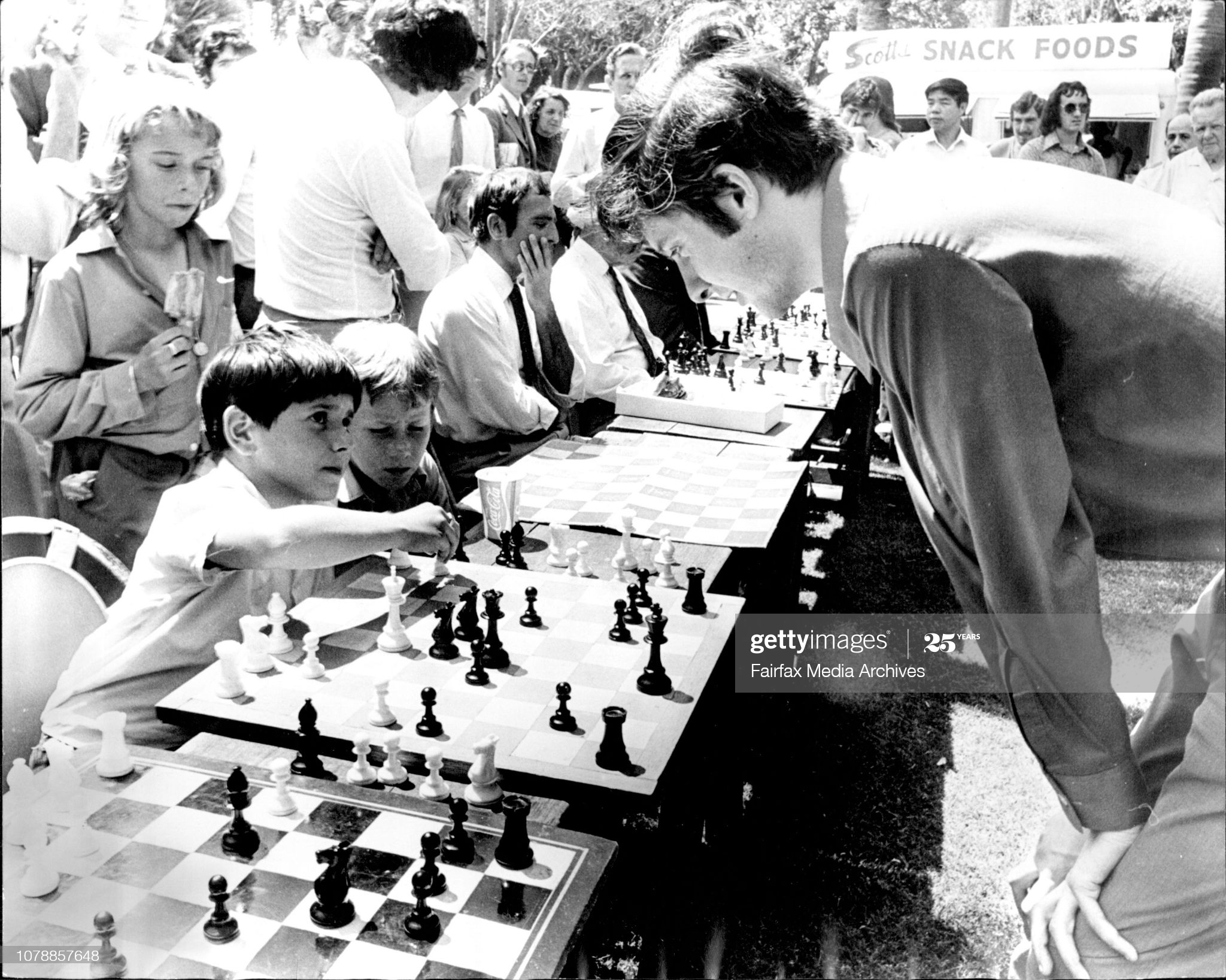
Aleandro Trimboli (10) of Leichhardt plays Mr Max Fuller of Newtown, Australian Open Chess Champion. As part of the Waratah Festival Celebrations the NSW Chess Association is conducting chess games with chess champions playing up to 30 players at once, in Hyde Park. October 17, 1973. (Photo by Golding/Fairfax Media via Getty Images).
In this obituary from Ray Keene, Ray very thoughtfully provides a game in which Max loses to Ray.
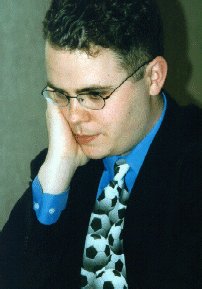
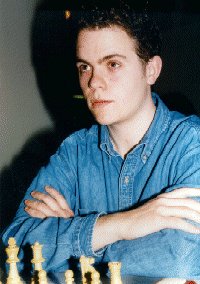
GM Aaron Summerscale courtesy of John Upham Photography
BCN offers best wishes to Aaron Summerscale on his 52nd birthday.
Aaron Piers Summerscale was born on Tuesday, August 26th 1969 in Westminster, Greater London. His mother’s maiden name is Mayall. Aaron lives in SW18 and teaches chess. He married Claire Lusher (Basingstoke) but they are now separated.
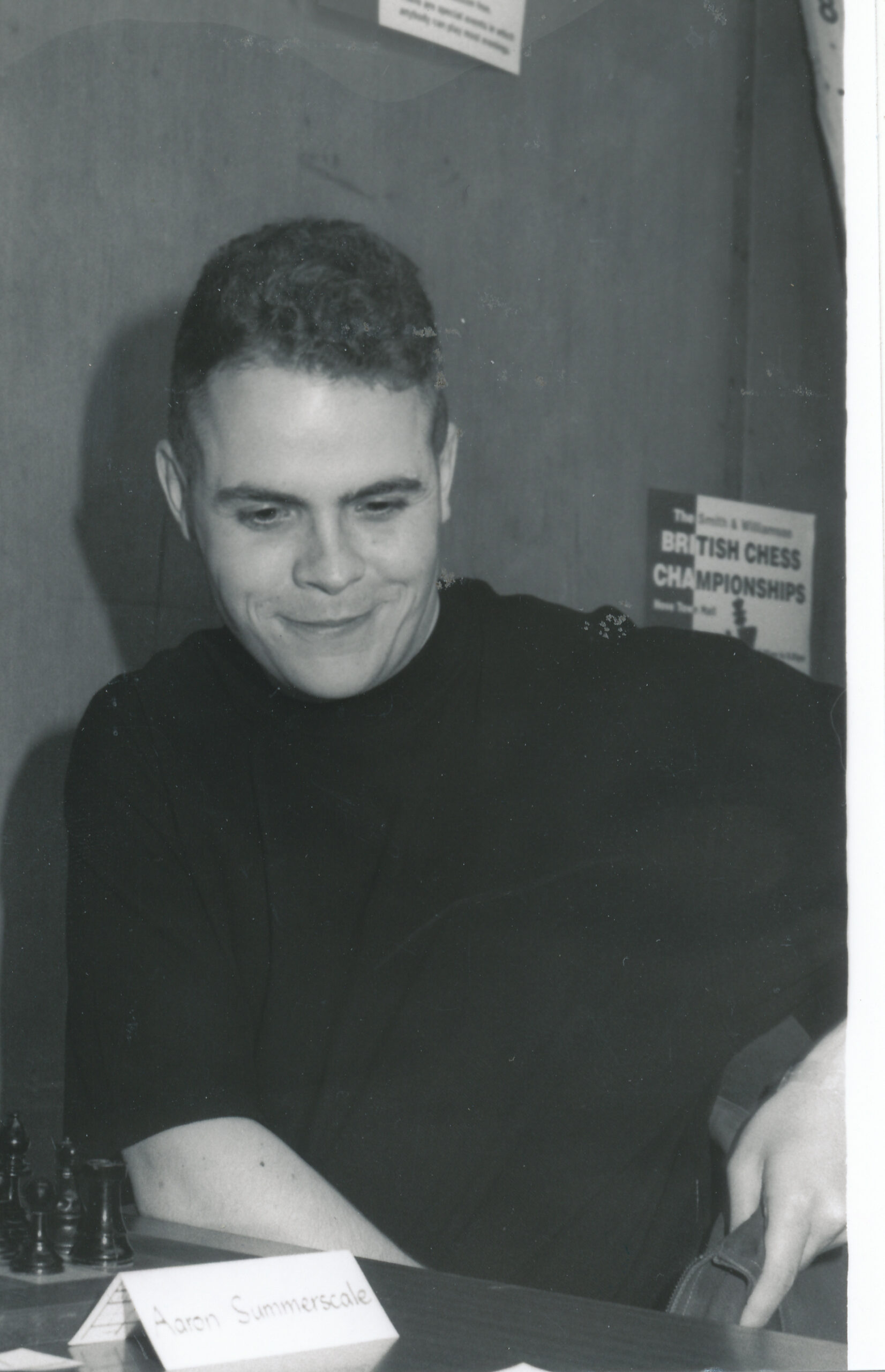
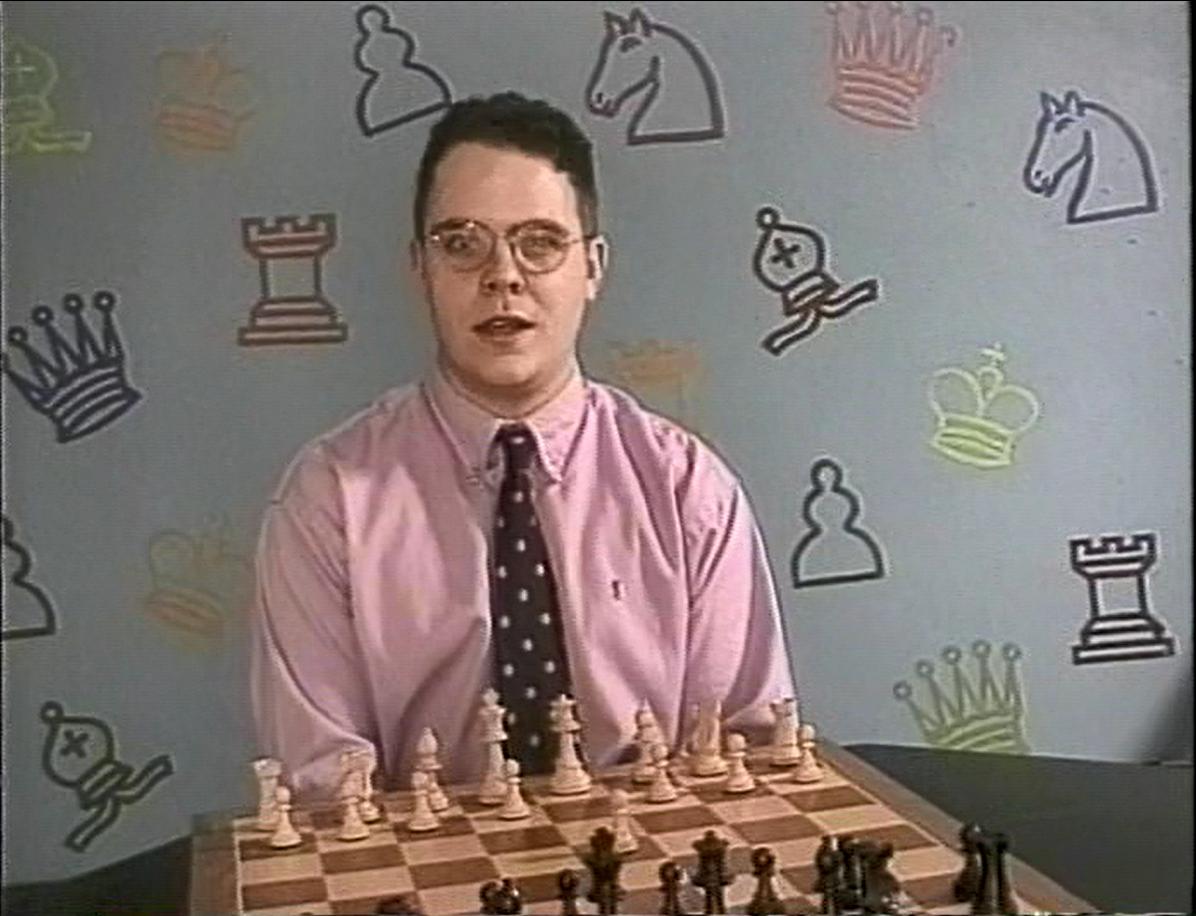
Aaron Summerscale
He became a FIDE Master in 1992, an International Master in 1994 and a Grandmaster in 1997.
Aaron was runner-up (to Matthew Sadler) with 8/11 in the 1995 British Championship in Swansea.
His highest FIDE rating was 2513 in October 2000 and was joint (with Ameet Ghasi) British Rapidplay Chess Champion in the same year.
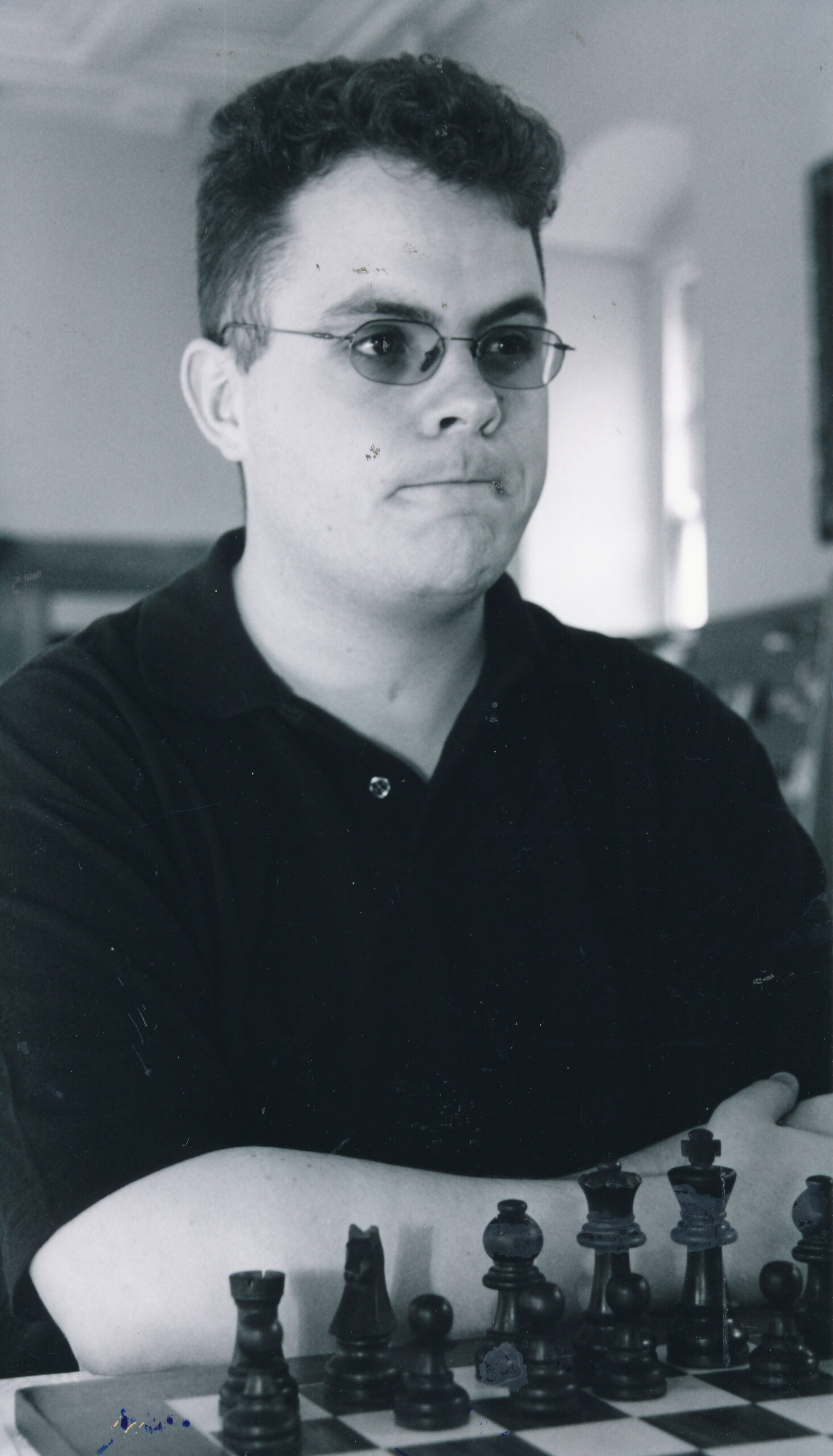
Aaron Summerscale courtesy of John Henderson
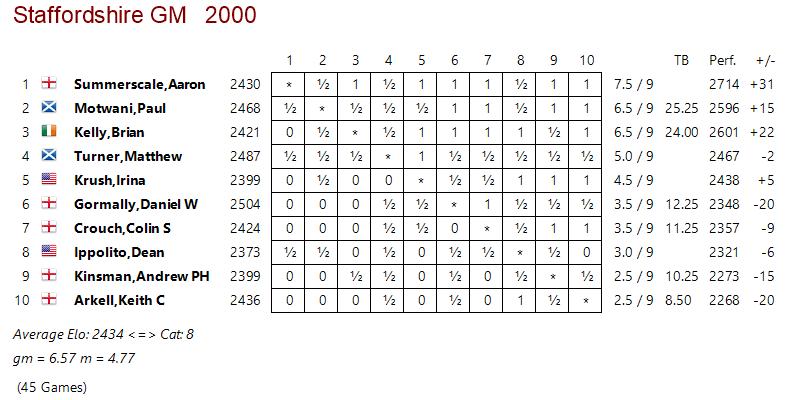
His highest ECF grading was 244A in 2001 and he won the Staffordshire GM tournament in the same year :
Staffordshire GM Tournament 2000 Crosstable
Aaron plays for Wood Green in the Four Nations Chess League (4NCL) and has played for Pride and Prejudice.
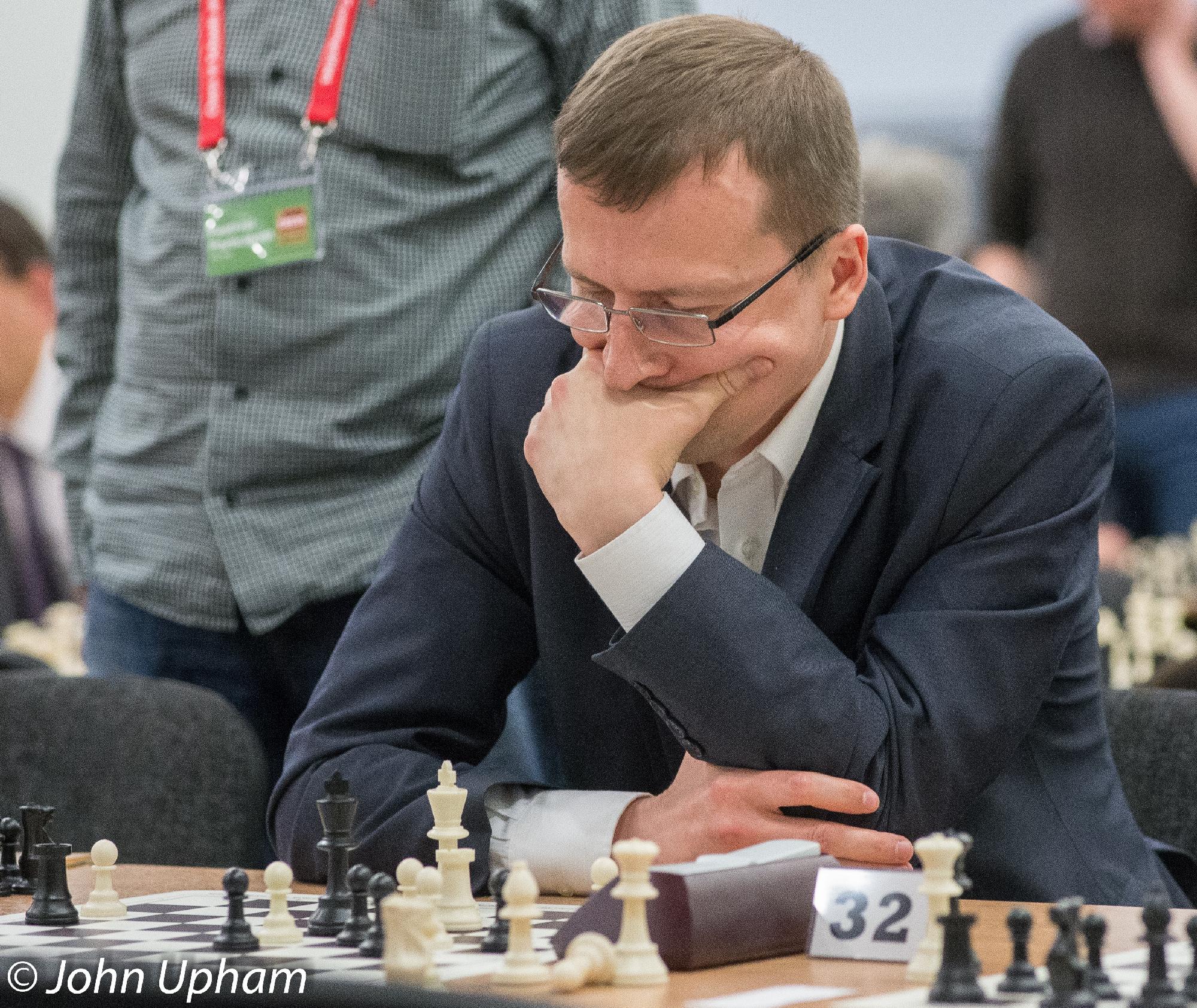
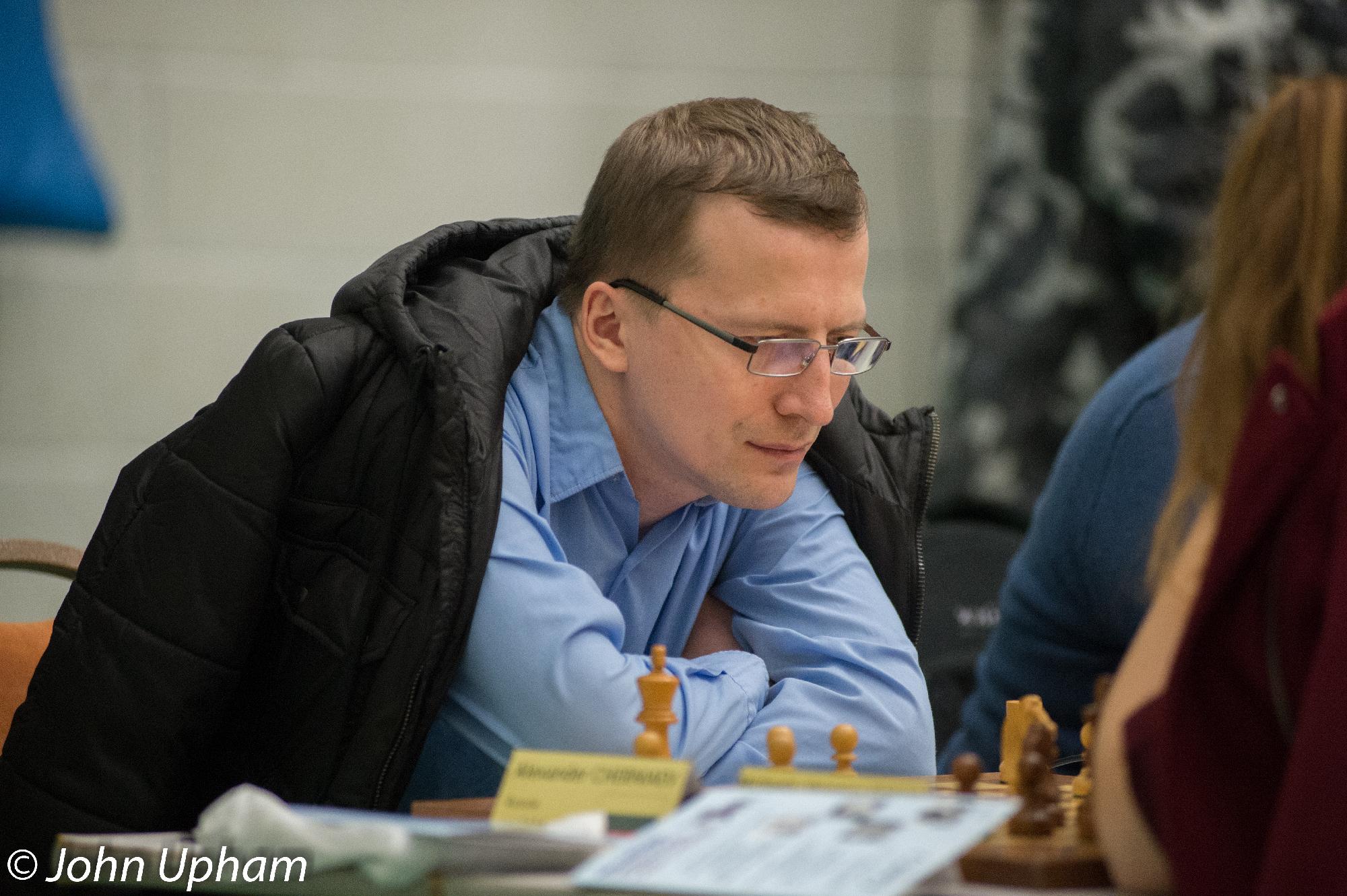
GM Alexander Cherniaev, London Chess Classic 2014, courtesy of John Upham Photography
BCN sends greetings to GM Alexander Cherniaev on his 52nd birthday.
Alexander Sergeevich Cherniaev was born on Tuesday, August 26th 1969 in Arkhangelsk, Western Russia.
He became an International Master in 1993 and a Grandmaster in 2004.
He became a FIDE Senior Trainer in 2016.
His peak FIDE rating (according to Megabase 2020 and Felice) was 2509 in July 2002, aged 33.
(Gaige is silent on Alexander).
Alex is registered with the Russian Federation and plays for Hackney, Wood Green, Russia (unsurprisingly!) and 4NCL Barnet Knights and makes regular appearences in Richmond, Golders Green and other rapidplay events, the London Chess Classic and 4NCL amongst others.
He made his first appearance in a UK event in 1991 at the Lloyds Bank Masters whilst a revolution was in progress in the USSR. His first appearance at Hastings was for the 1991/92 event in the Open section and then in Hastings 1993/1994.
Since 1999 he has been London based playing in many UK events.
He won the Coulsdon Easter Congress in 2007 with 7.5/9 and the Canadian Open in 2019 with 9/9
As the first player Alex mainly champions the Ruy Lopez and with the Black pieces he enjoys the Sveshnikov Sicilian and the Old Indian Defence.
Alex is a well-known player on the English chess scene and has enjoyed a lively relationship with organisers and arbiters alike.
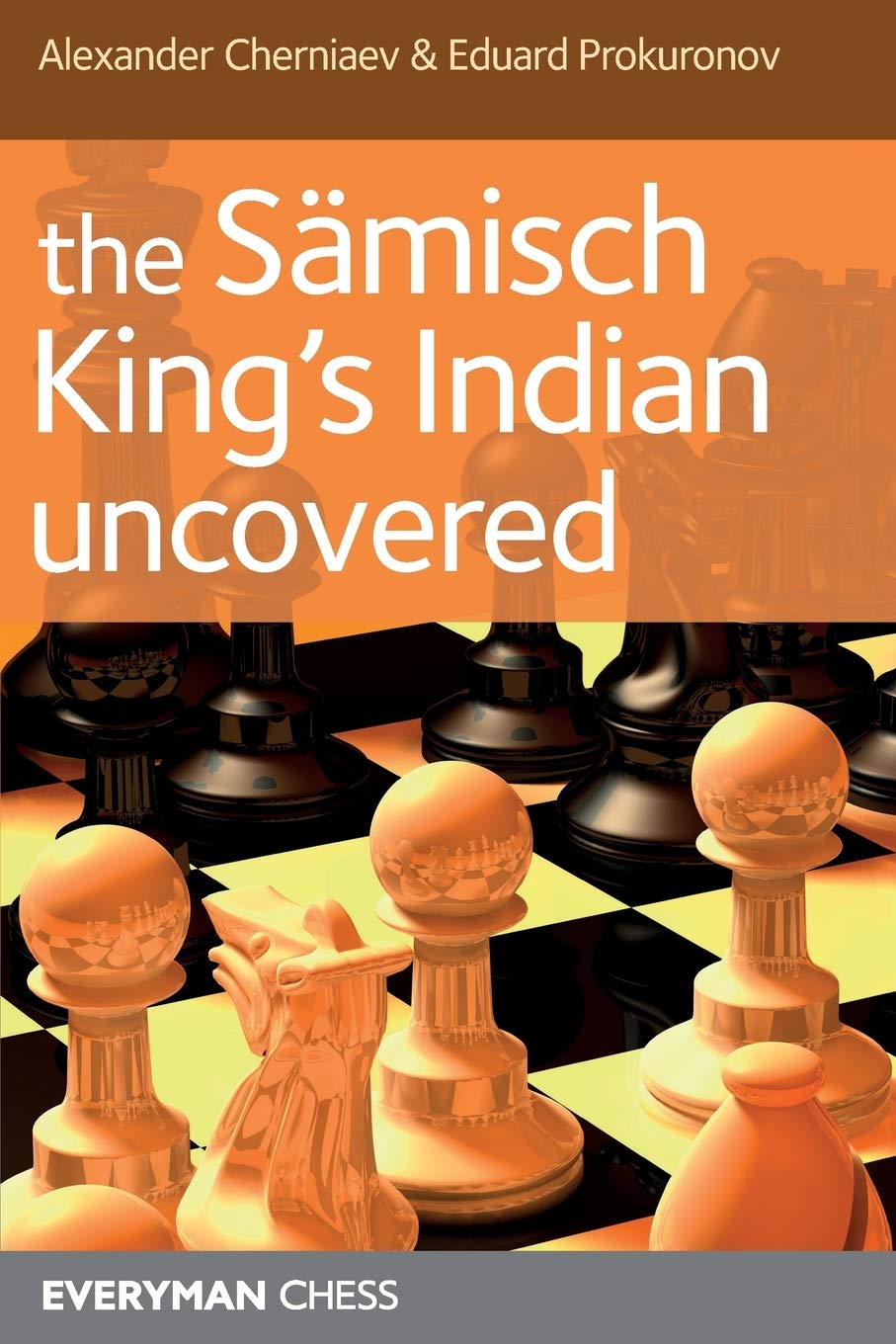
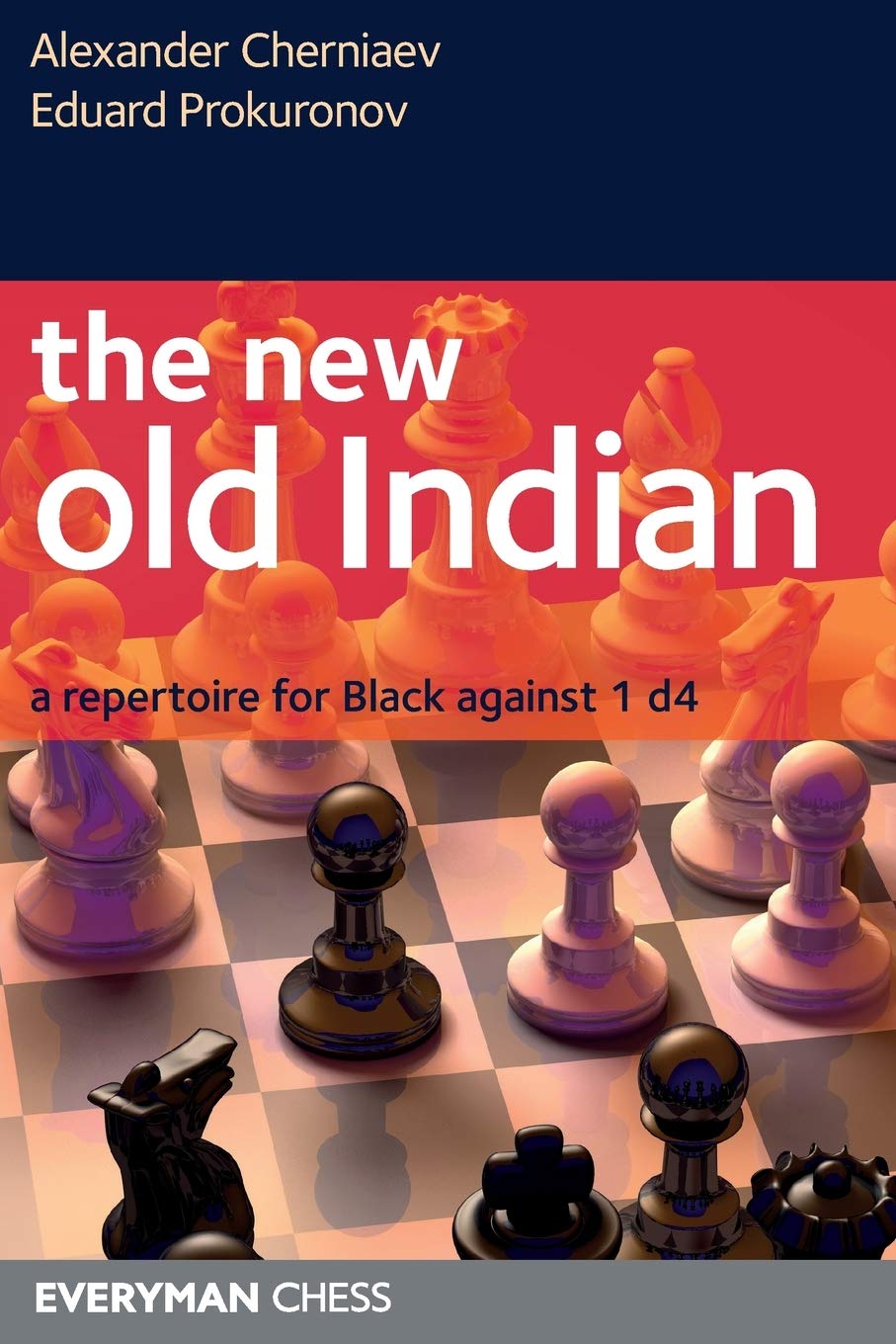
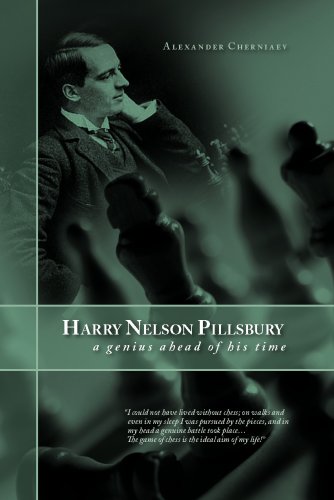
The Samisch King’s Indian UncoveredThe New Old IndianDavid Janowski: Artist of the Chess BoardHarry Nelson Pillsbury ( 5 December 1872 – 17 June 1906): A Genius Ahead of His TimeGM Alexander Cherniaev, Hastings 2013-2014, courtesy of John Upham Photography
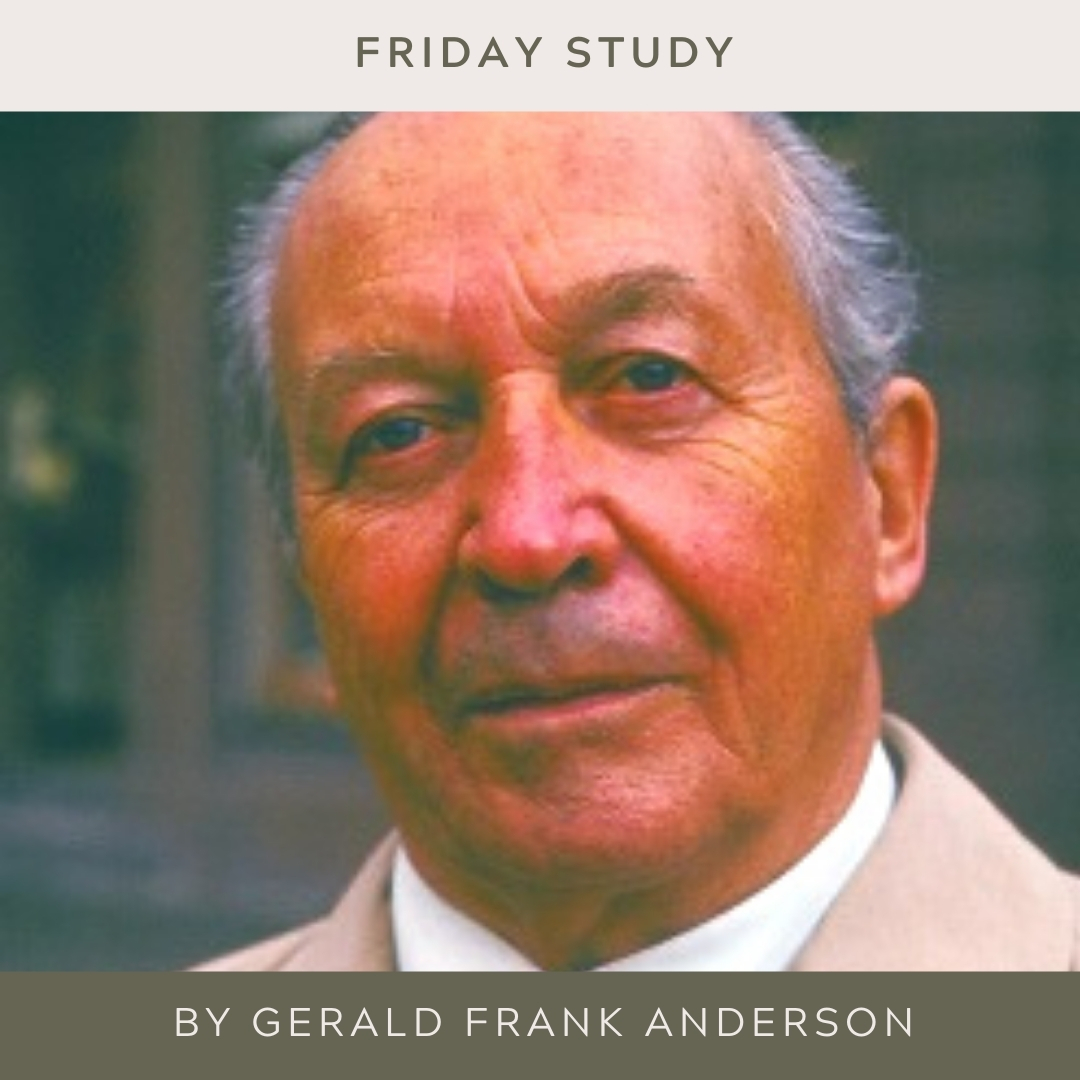
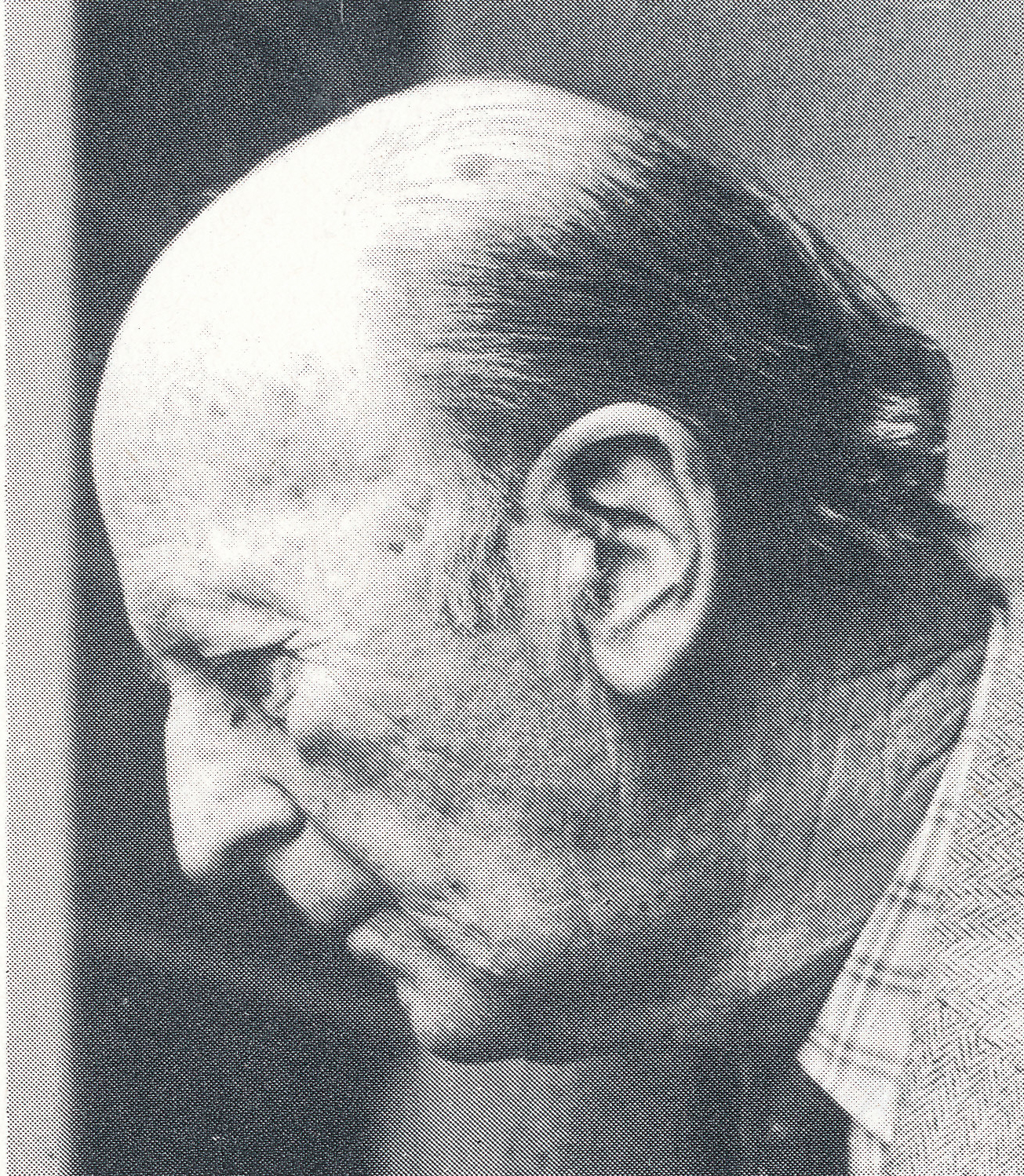
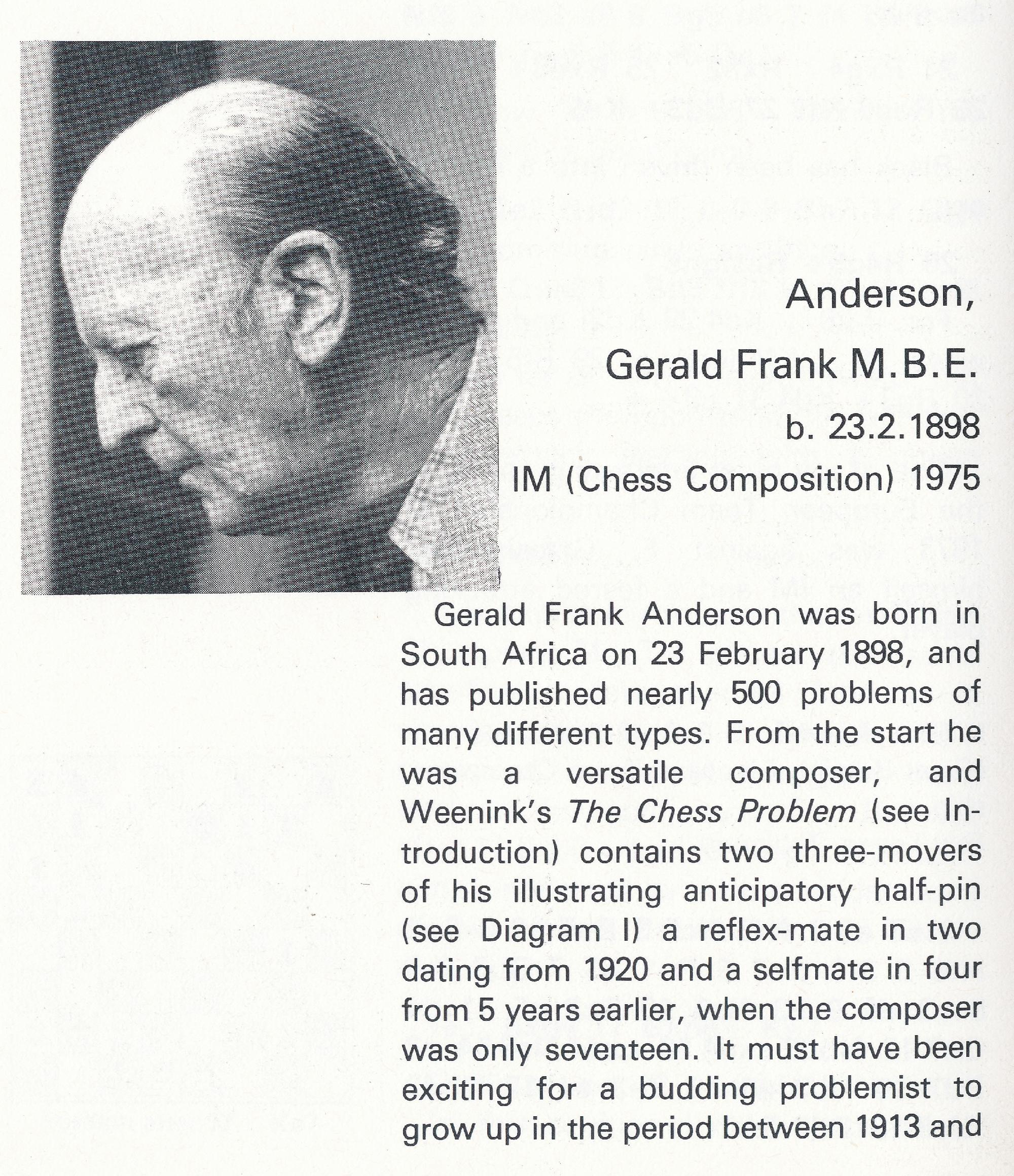
Gerald Frank Anderson MBE DFC (24-ii-1898 23-viii-1984)
BCN remembers Gerald Frank Anderson MBE, DFC (24-ii-1898 23-viii-1984)
From British Chess (Pergamon, 1983) by Botterill, Levy, Rice and Richardson we have an article written by John Rice :
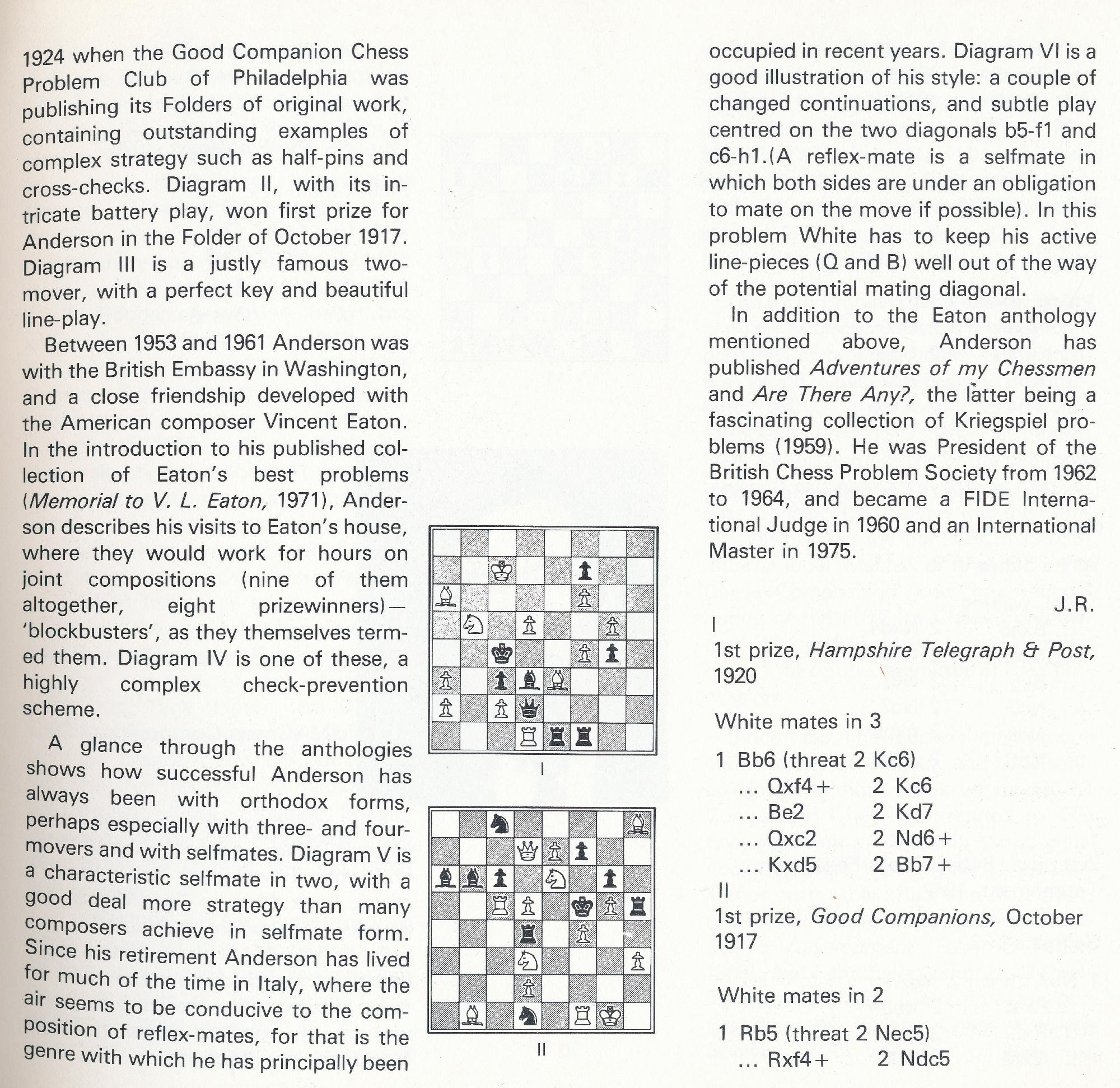
“Gerald Frank Anderson was born in South Africa on 23 February 1898, and has published nearly 500 problems of many different types. From the start he was a versatile composer, and Weenink’s The Chess Problem (see introduction) contains two three-movers of his illustrating anticipatory half-pin (see Diagram I) a reflex-mate in two dating from 1920 and a selfmate in four from 5 years earlier, when the composer was only seventeen.
Diagram I
1st prize , Hampshire Telegraph & Post, 1920
White mates in 3
(All Solutions contained in scan at foot of article.)
It must have been exciting for a budding problemist to grow up in the period between 1913 and 1924 when the Good Companion Chess Problem Club of Philadelphia was publishing its Folders of original work containing outstanding examples of complex strategy such as half-pins and cross-checks. Diagram II, with its intricate battery play, won first prize for Anderson in the Folder of October 1917.
Diagram II
1st prize, Good Companions, October 1917
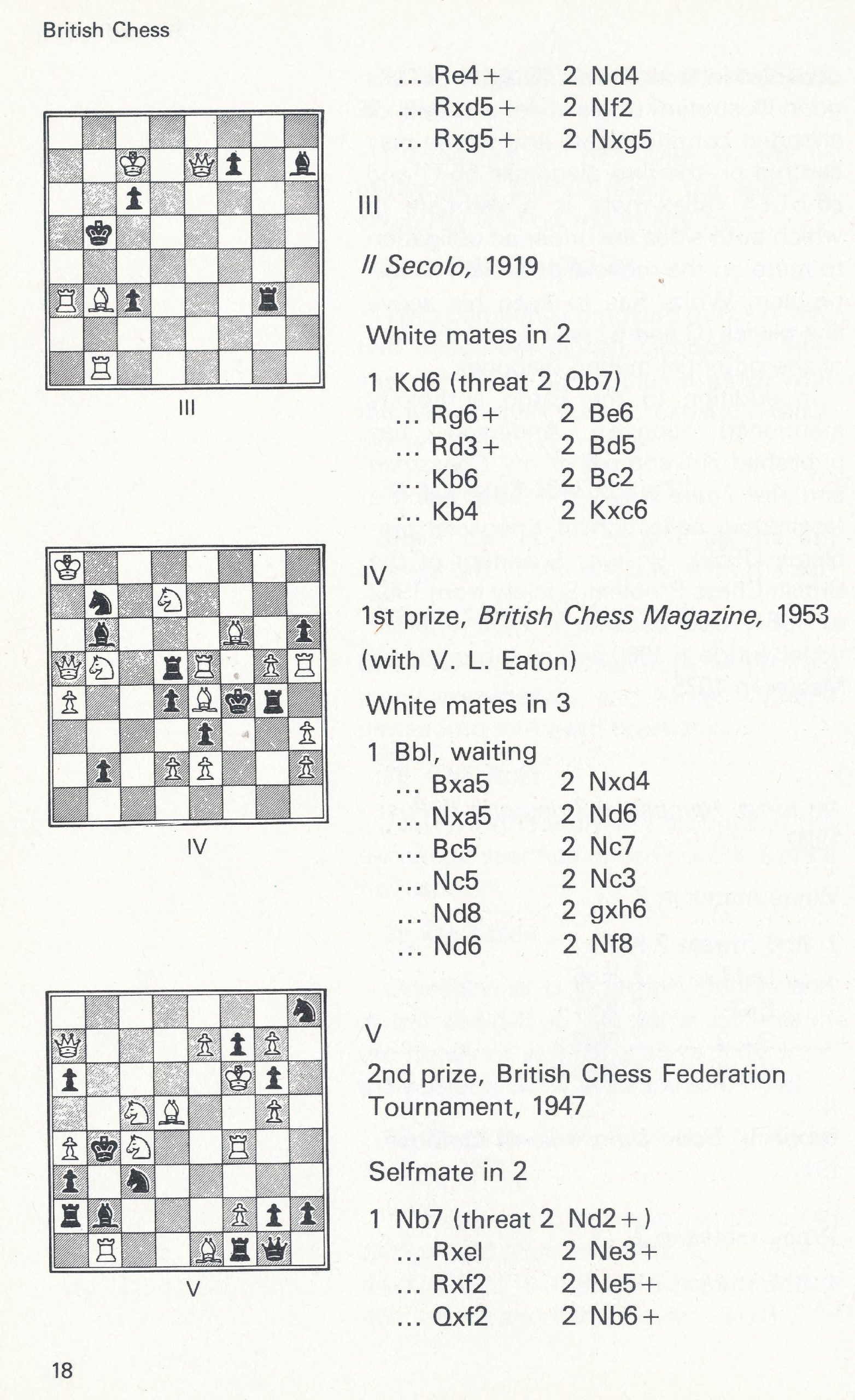
Diagram III is a justly famous two-mover, with a perfect key and beautiful line-play:
IL Secolo, 1919
White mates in 2
Between 1953 and 1961 Anderson was with the British Embassy in Washington and a close friendship developed with the American composer Vincent Eaton.
In the introduction to his published collection of Eaton’s best problems (Memorial to V. L. Eaton, 1971) Anderson describes his visits to Eaton’s house where they would work for hours on joint compositions (nine of them altogether, eight prize winners)- ‘blockbusters’, as they themselves termed them. Diagram IV is one of these, a highly complex check-prevention scheme.
Diagram IV
1st prize, British Chess Magazine, 1953
(with V.L. Eaton)
White mates in 3
A glance through the anthologies shows how successful Anderson has always been with orthodox forms, perhaps especially with three- and four- movers and with selfmates. Diagram V is a characteristic selfmate in two, with a good deal more strategy than many composers achieve in selfmate form:
Diagram V
2nd prize, British Chess Federation Tournament, 1947
Selfmate in 2
Since his retirement Anderson has lived for much of the time in Italy, where the air seems to be conducive to the composition of reflex-mates, for that is the genre with which he has principally been occupied in recent years. Diagram VI is a good illustration of his style; a couple of changed continuations, and subtle play centered on the two diagonals b5-f1 and c6-h1. (A reflex-mate is a selfmate in which both sides are under an obligation to mate on the move if possible). In this problem White has to keep his active line-pieces (Q and B) well out of the way of the potential mating diagonal.
Diagram VI
1st prize, The Problemist, 1975
Reflex-mate in 2
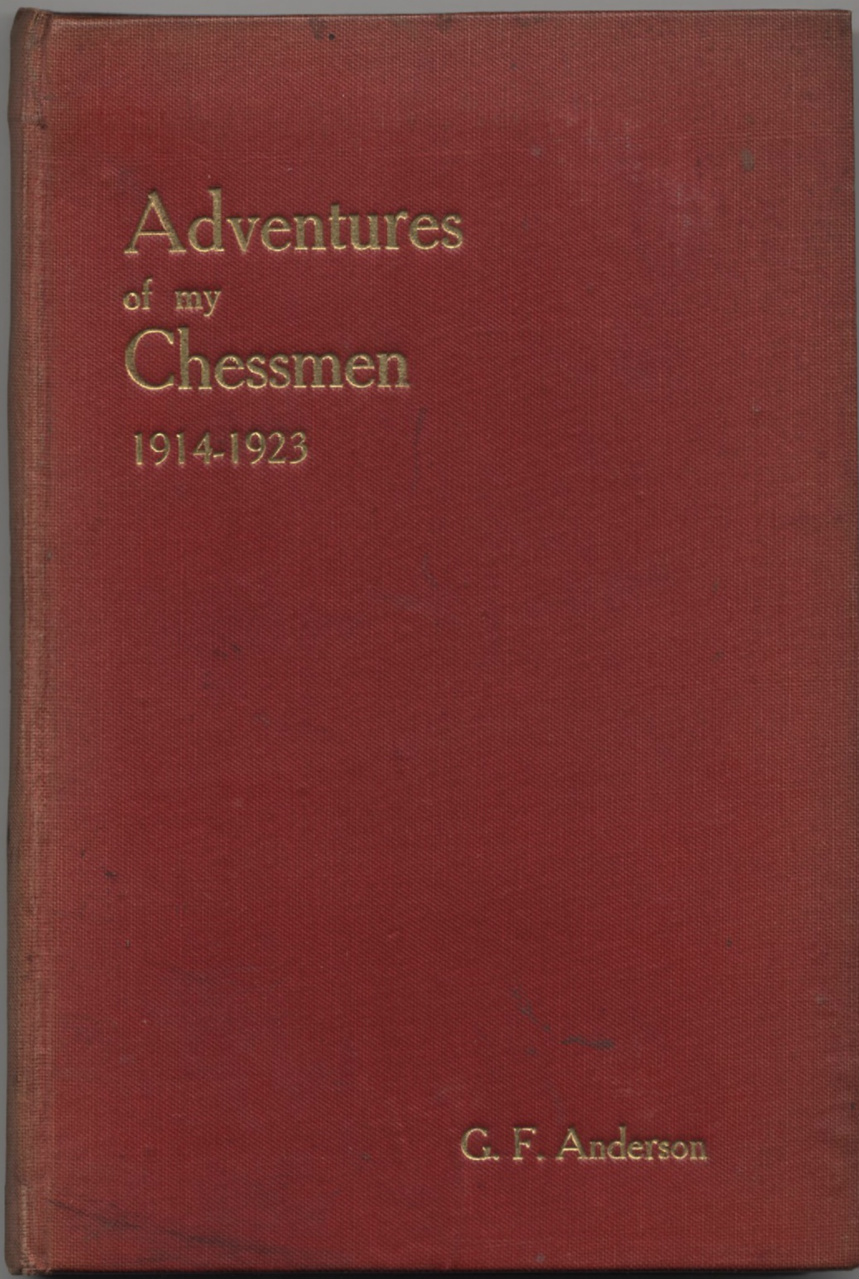
In addition to the Eaton anthology mentioned above, Anderson has published Adventures of my Chessmen
Adventures of my Chessmen 1914 – 1923 , GF Anderson, Chess Amateur, Stroud, 1924
and Are There Any?, the latter being a fascinating collection of Kriegspiel problems. He was President of the British Chess Problem Society from 1962 to 1964, and became a FIDE International Judge in 1960 and an International Master in 1975.”
Gerald Frank Anderson MBE DFC (24-ii-1898 23-viii-1984)
From The Encyclopedia of Chess (Robert Hale, 1970 and 1976) by Anne Sunnucks :
“International Judge of FIDE for Compositions (1960). Born on 23rd February 1898. Won the DFC in 1914-18 war. Foreign Office (Retd.) First problem published in 1912, since when he has composed nearly 500 problems, mostly 3 and 4 movers. but has latterly switched to Fairy chess problems. He is one of the the great reflex and self-mate composers. Edited a section Chess Amateur 1921, Nottinghamshire Weekly Guardian 1937-1938, Anglo-Portuguese News 1945-1946, and Self-Mate Section of The Problemist 1964-1966. Author of Are There Any? a book about Kriegspiel problems and A Memorial Volume of Chess Problems of VL Eaton.”
His MBE was awarded in the 1959 New Year Honours list. The citation reads : “Gerald Frank Anderson, DFC, Second Secretary, Her Majesty’s Embassy, Washington.”
From The Encyclopaedia of Chess (Batsford, 1977), Harry Golombek OBE we have this by John Rice:
“British problem composer, output about 550 problems., orthodox and fairy. Books : Adventures of My Chessmen; and Are there Any? (1959 – a fascinating collection of Kriegspiel problems); Vincent Eaton Memorial (1971 – an annotated anthology of Eaton’s work). President of British Chess Problem Society, 1962-4. International Judge (1960), international master (1975).”
From chessgames.com :
“G. F. Anderson, in 1946, was working in the British Embassy in Lisbon, and, as a highly skilled chess player (he was also known for composing chess problems as early as 1919), was nominated to deliver the challenge from Botvinnik to Alekhine. He played a game with the World Champion in the Embassy and it became the last recorded game by Alekhine.”
Here is the original article from British Chess (Pergamon, 1983) by Botterill, Levy, Rice and Richardson by John Rice :
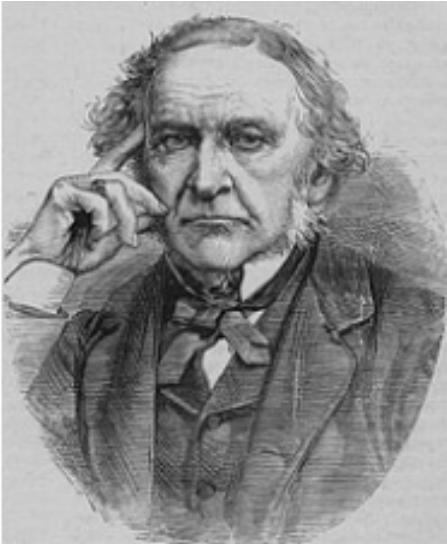
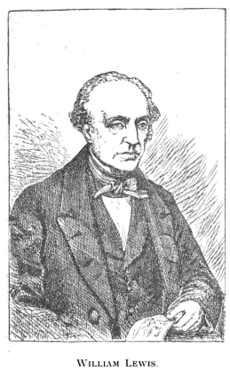
We note the passing today (August 22nd) in 1870 of William Lewis of the Lewis Counter Gambit.
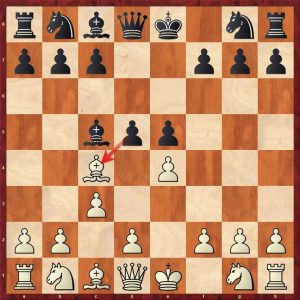
The Lewis Counter Gambit
From The Oxford Companion to Chess (OUP, 1984) by Hooper & Whyld :
“English player and author. He left his native Birmingham as a young man and worked for a time with a merchant in London. He learned much of his chess from Sarratt, a debt that was not repaid.
Around 1819 he was operator of the Turk, meeting all-comers successfully. With Cochrane he visited Paris in 1821, received odds of pawn and move from Deschapelles, and defeated him in a short match (+ 1=2), Lewis had already begun to write and of the more useful books he published around this time were translations of Greco and Carrera which appeared in 1819 and 1822 respectively.
Although he considered Sarratt’s A Treatise on the Game of Chess (1808) a poorly written book, Lewis published a second edition in 1822 in direct competition with Sarratt’s last book, published in 1821 by his impoverished widow, (In 1843 many Englishmen contributed to a fund for Mrs Sarratt in her old age, Lewis’s name is not on the subscription list,}
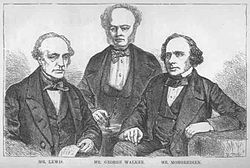
William Lewis, George Walker and Augustus Mongredien
In 1825 Bourdonnais visited England. Lewis recalled that they played about 70 games, and according to Walker seven of them constituted a match which Lewis lost (+2—5). With no significant playing achievements to his credit Lewis acquired such a high reputation that a correspondent writing to the weekly magazine Bell’s Life in 1838 was moved to call him grandmaster.
From 1825 he preserved this reputation by the simplest means: he declined to play on even terms. In the same year he opened a club where he gave lessons at half a guinea each. McDonnell and Walker were among his pupils. Speculating unwisely on a piano-making patent, Lewis went bankrupt in 1827, and the club closed. After three precarious years of teaching chess (rich patrons were becoming fewer) Lewis became actuary of the Family Endowment Society and enjoyed financial security
for the rest of his life.
William Lewis
Circumstances now made it possible for him to concentrate on his writing and he published his two most important works: Series of Progressive Lessons (1831) and Second Series of Lessons (1832), both republished with various revisions. Lewis continued to write but gradually withdrew from other chess activities; his last notable connection with chess was as stakeholder for the Morphy-Lowenthal match of 1858.
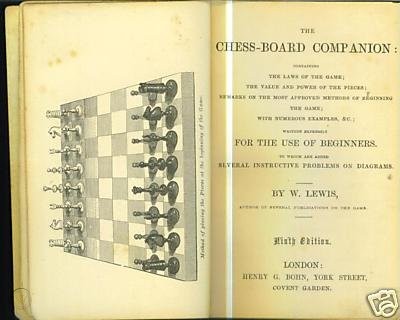
Chess Board Companion by William Lewis
Lewis’s Lessons contain extensive analyses of many opening variations, examined in the closeness of his study. Subsequent writers, notably Lasa, were influenced by these books, but more on account of the form than the content, which, adequate for the 1830s, were soon out of date.
Around 1840 writers no longer worked in isolation (a circumstance Lewis found unavoidable) and new positional ideas were being shaped. Because Lewis failed to assimilate these his judgements were faulty, and his voluminous Treatise on the Game of Chess (1844) was out of date when published.
Industrious rather than inventive, he made only one innovation, the Lewis Counter-Gambit; but it had no practical value in 1844, for simpler defences had already been discovered. Lewis’s work commands respect, but he is more aptly described as the last and one of the best of the ‘old’ writers than the first of the new, a more fitting description for Jaenisch and the authors of Bilguer’s Handbuch. ”
From The Encyclopedia of Chess (Robert Hale, 1970 & 1976) by Anne Sunnucks :
Chess theoretician, teacher, author and one of the leading players in England in the nineteenth century.
William Lewis was born in Birmingham on 9th October 1787. As a young man he went to London and took chess lessons from JH Sarratt. Within a short time he was making chess his principal means of livelihood.
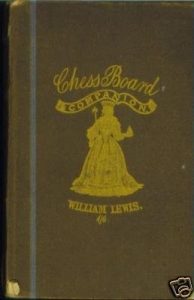
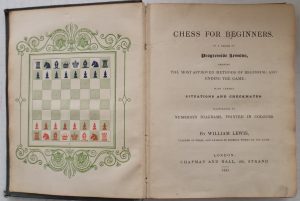
In 1819 he was engaged as the player concealed in the chess-playing automaton, ‘The Turk’, when it was exhibited in London. In 1825 he opened some chess rooms in St. Martin’s Lane in London, where he taught chess. Among his pupils was Alexander McDonnell. After going bankrupt in 1827, the chess rooms were closed, and Lewis decided to put his lessons into a book. He soon became a highly-successful writer, His Chessboard Companion published in 1838 ran into nine editions, and his Series of Progressive Lessons of the Game of Chess has been described as one of the landmarks in the history of the game. This book included some completely new analyses of various chess openings and later formed the basis of the Handbuch des Schachspiels. Lewis also translated the work of Greco and Stamma and was author of The Elements of Chess (1882), Fifty Games of Chess (1832) and Chess for Beginners (1835).
Chess Board Companion by William Lewis
Towards the end of his life, Lewis rarely played chess, and his last public appearance in chess circles was 12 before he died, when he acted at stake-holder in the match between Morphy and Lowenthal in 1858. He died on 22nd August 1870.
From The Encyclopedia of Chess (Batsford, 1977) by Harry Golombek :
“Author of The Chessboard Companion, London, 1838, and several other popular works on chess (including translations of Greco and Stamma). Lewis was also a leading chess teacher – his most famous pupil was Alexdander McDonnell – and for a time he ran chess rooms in St. Martin’s Lane. In 1819 he operated the chess-playing automaton ‘The Turk’ when it was exhibited in London. The Lewis Counter-Gambit is 1.P-K4, P-K4; 2.B-B4 B-B4; 3.P-QB3,P-Q5!?”
Chess for Beginners
From “Chess : A History” by Harry Golombek there are two references to WL on pages 98 and 123 alluded to above.
“William Lewis (1787–1870) was an English chess player and author, nowadays best known for the Lewis Countergambit and for being the first player ever to be described as a Grandmaster of the game.
Born in Birmingham, William Lewis moved as a young man to London where he worked for a merchant for a short period. He became a student of chess player Jacob Sarratt, but in later years he showed himself to be rather ungrateful towards his teacher.
Although he considered Sarratt’s Treatise on the Game of Chess (1808) a “poorly written book”, in 1822 Lewis published a second edition of it three years after Sarratt’s death in direct competition with Sarratt’s own superior revision published posthumously in 1821 by Sarratt’s poverty-stricken widow. In 1843, many players contributed to a fund to help the old widow, but Lewis’ name is not on the list of subscribers.
Around 1819 Lewis was the hidden player inside the Turk (a famous automaton), meeting all-comers successfully. He suggested to Johann Maelzel that Peter Unger Williams, a fellow ex-student of Sarratt, should be the next person to operate inside the machine. When P. U. Williams played a game against the Turk, Lewis recognised the old friend from his style of play (the operator could not see his opponents) and convinced Maelzel to reveal to Williams the secret of the Turk. Later, P. U. Williams himself took Lewis’ place inside the machine.
Lewis visited Paris along with Scottish player John Cochrane in 1821, where they played with Alexandre Deschapelles, receiving the advantage of pawn and move. He won the short match (+1 =2).”
“Lewis’ career as an author began at this time, and included translations of the works of Greco and Carrera, published in 1819[5] and 1822[6] respectively.
He was the leading English player in the correspondence match between London and Edinburgh in 1824, won by the Scots (+2 = 2 -1). Later, he published a book on the match with analysis of the games. In the period of 1834–36 he was also part of the Committee of the Westminster Chess Club, who played and lost (−2) the match by correspondence with the Paris Chess Club. The other players were his students McDonnell and Walker, while the French line up included Boncourt, Alexandre, St. Amant and Chamouillet. When De La Bourdonnais visited England in 1825, Lewis played about 70 games with the French master. Seven of these games probably represented a match that Lewis lost (+2 -5).
Lewis enjoyed a considerable reputation as a chess player in his time. A correspondent writing to the weekly magazine Bell’s Life in 1838 called him “our past grandmaster”, the first known use of the term in chess. Starting from 1825 he preserved his reputation by the same means that Deschapelles used in France, by refusing to play anyone on even terms. In the same year Lewis founded a Chess Club where he gave lessons to, amongst others, Walker and McDonnell. He was declared bankrupt in 1827 due to bad investments on a patent for the construction of pianos and his chess club was forced to close. The next three years were quite difficult until in 1830 he got a job that assured him of solid financial security for the rest of his life. Thanks to this job, he could focus on writing his two major works: Series of Progressive Lessons (1831) and Second Series of Progressive Lessons (1832). The first series of the Lessons were more elementary in character, and designed for the use of beginners; the second series, on the other hand, went deeply into all the known openings. Here, for the first time we find the Evans Gambit, which is named after its inventor, Capt. Evans.
The works of Lewis (together with his teacher Sarratt) were oriented towards the rethinking of the strictly Philidorian principles of play in favour of the Modenese school of Del Rio, Lolli and Ponziani. When he realised that he could not give an advantage to the new generation of British players, Lewis withdrew gradually from active play (in the same way that Deschapelles did after his defeat against De La Bourdonnais).
After his retirement he wrote other chess treatises, but his isolation prevented him from assimilating the positional ideas of the new generation of chess-players. For this reason, Hooper and Whyld in their Oxford Chess Companion describe the last voluminous work of Lewis, A Treatise on Chess (1844), as already “out of date when published”.”
According to Edward Winter in Chess Notes Lewis lived at 12 Chatham Place, Blackfriars, London, England (Chess Player’s Chronicle, 1841, pages 9 and 34*)
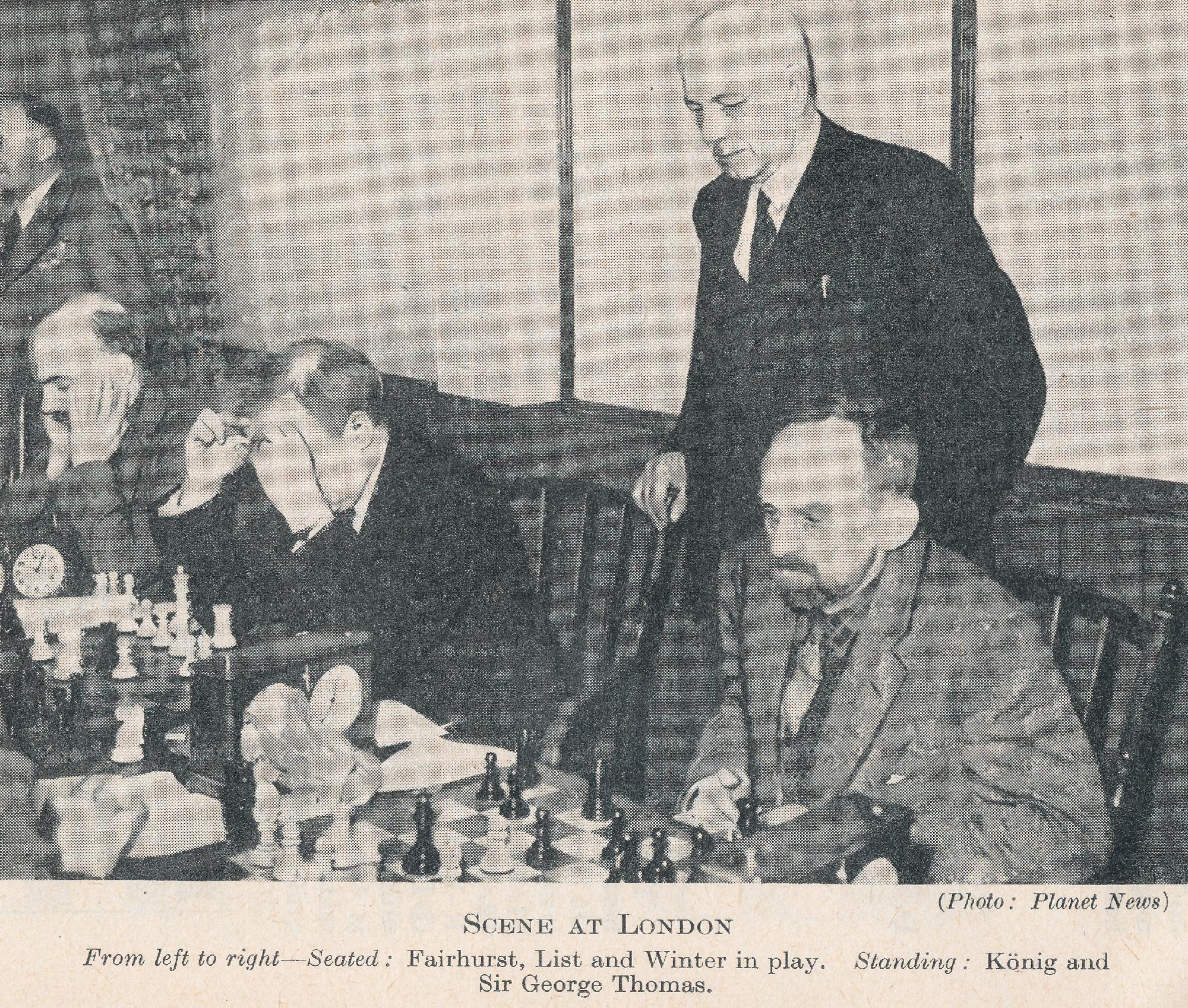
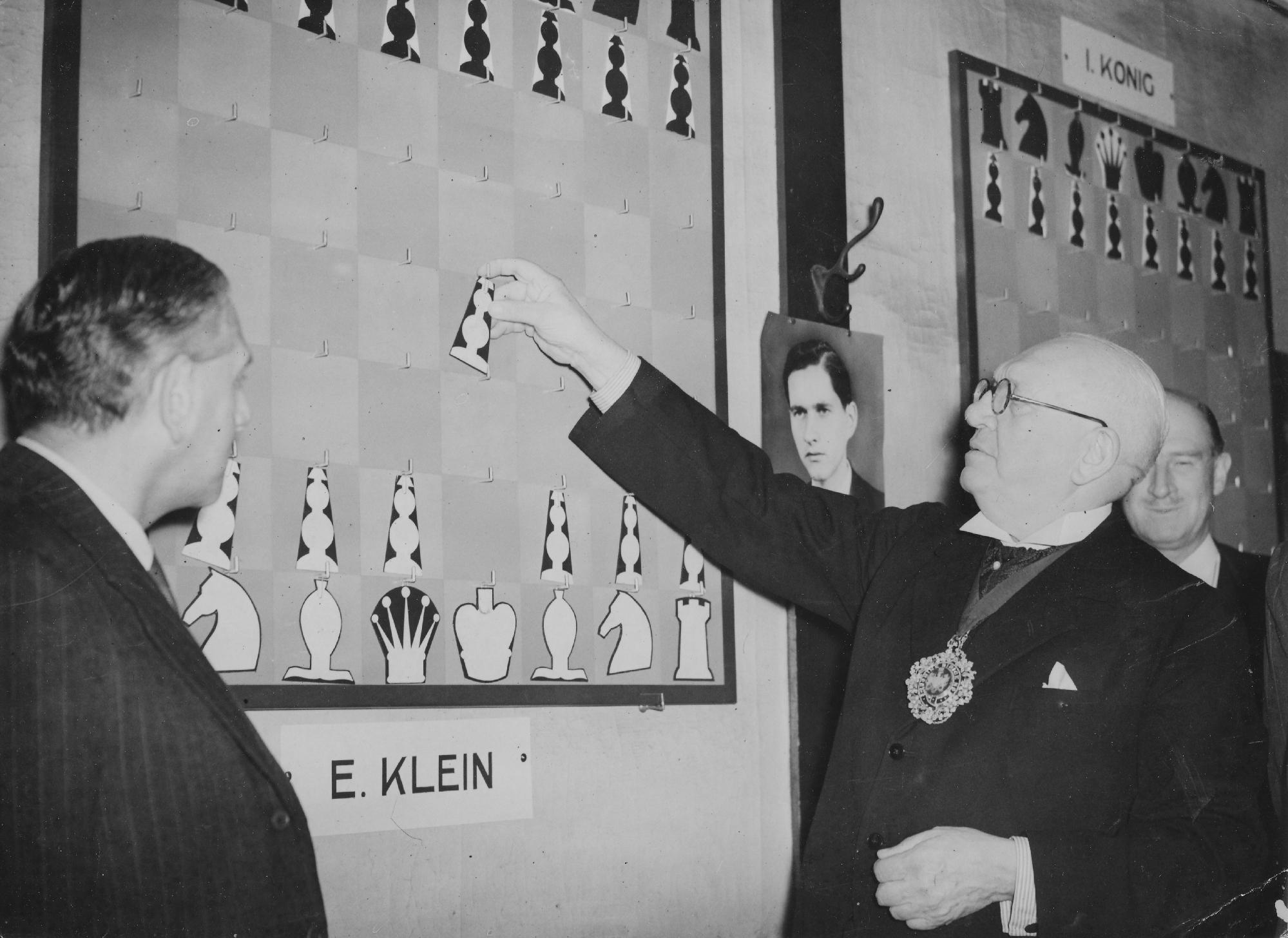
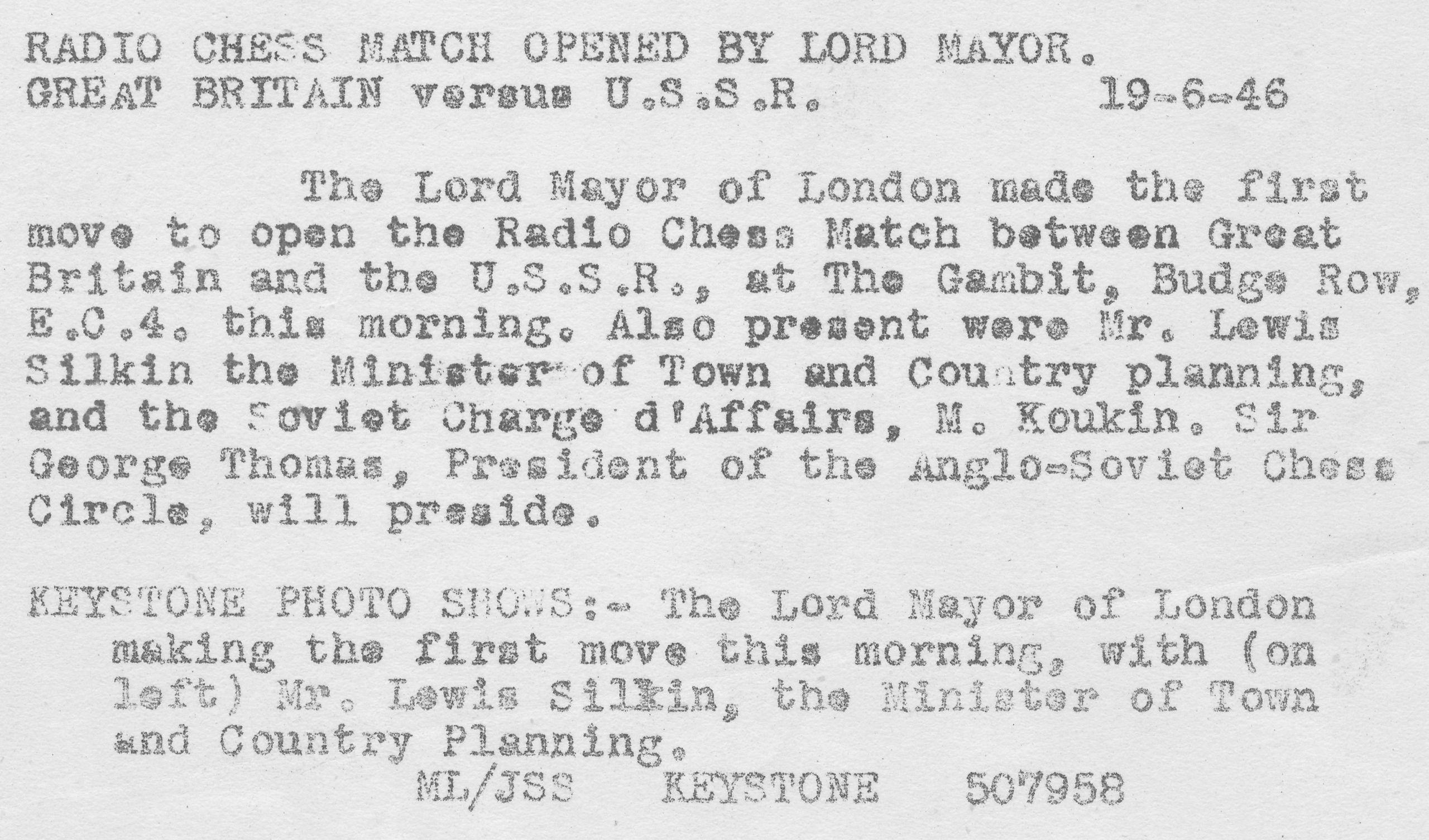
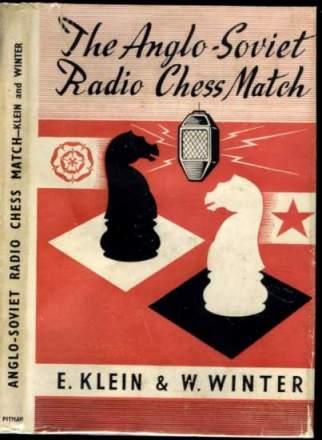
From CHESS, July 1946 (and also The Anglo-Soviet Radio Chess Match) :
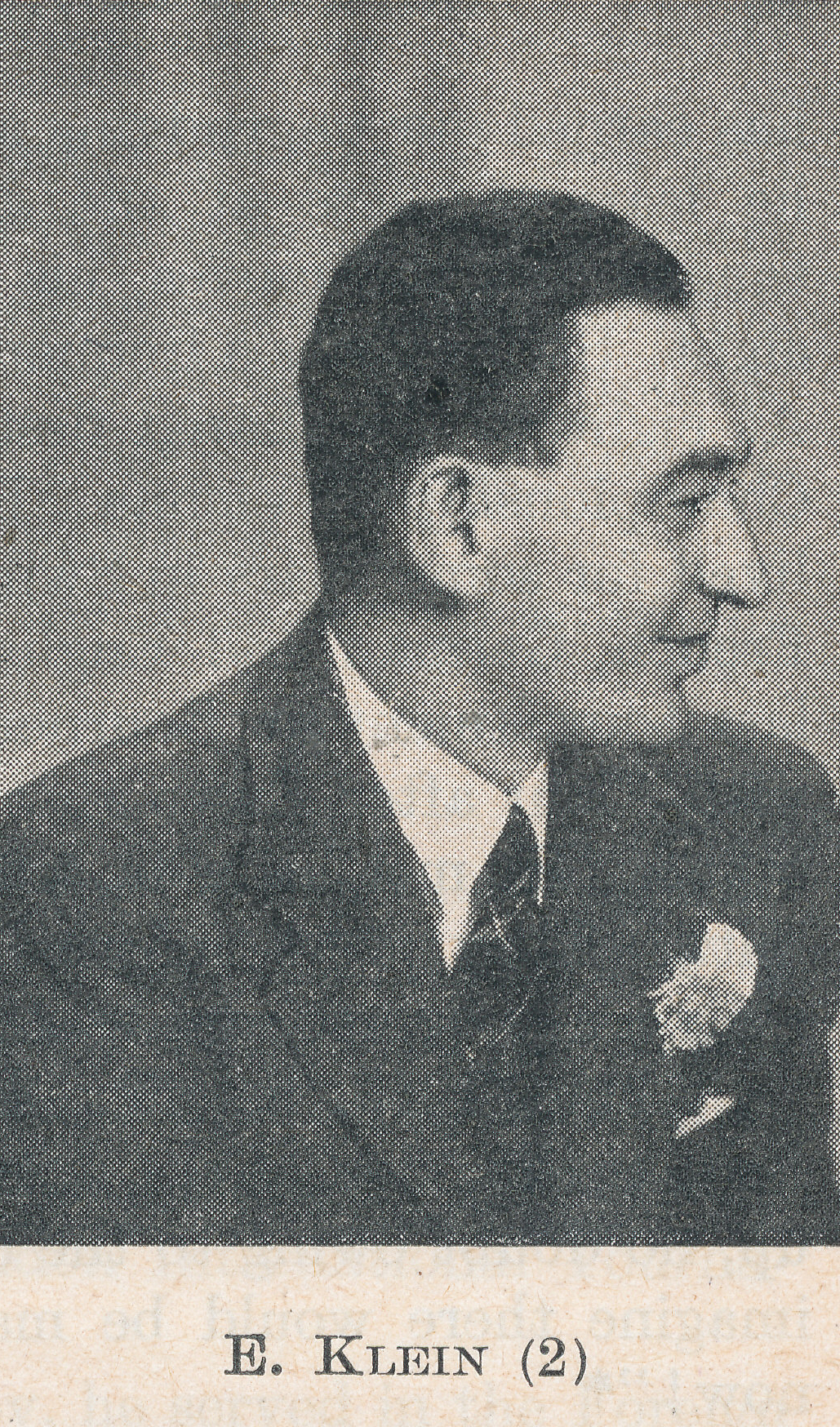
Since Ernst Klein came to England in 1935 his play has earned our ungrudging admiration. Born in Vienna, 1910, he learned chess at the age of eleven. His grandmother taught him the moves, his father having died when he was eight. Steinitz was a frequent guest in his grandparents house. At eighteen, he shared first, second and third prizes in the Championship of Vienna. Before coming to England, he had lived for some years in Switzerland, France and Italy and his French, German and English are equally impeccable. In his last tournament at Bournemouth, in 1939, he finished equal with Flohr after Euwe ahead of König, Landau, Aitken and others. He met his wife, who is an Englishwoman, during the blitz. They were married in 1944. He holds a London University degree and teaches mathematics in Southend.
Scene at London. From left to right – Seated : Fairhurst, List and Winter in play. Standing König and Sir George Thomas
About 1940, he offered to give any opponent in Great Britain the odds of the draw.; his challenge was never taken up, no doubt owing to the conditions of the moment, but we imagine there would be many “takers” if it were repeated now.”
Later, Klein clarified matters by writing What I said was: “I am ready to accept the challenge of any player in this country and am prepared to give the odds of a draw in a contest at least twelve games if he so wishes. That is, I offered to concede victory on a score of 6 : 6 draws counting, which is the necessary and sufficient condition to justify my offer. It is still open.
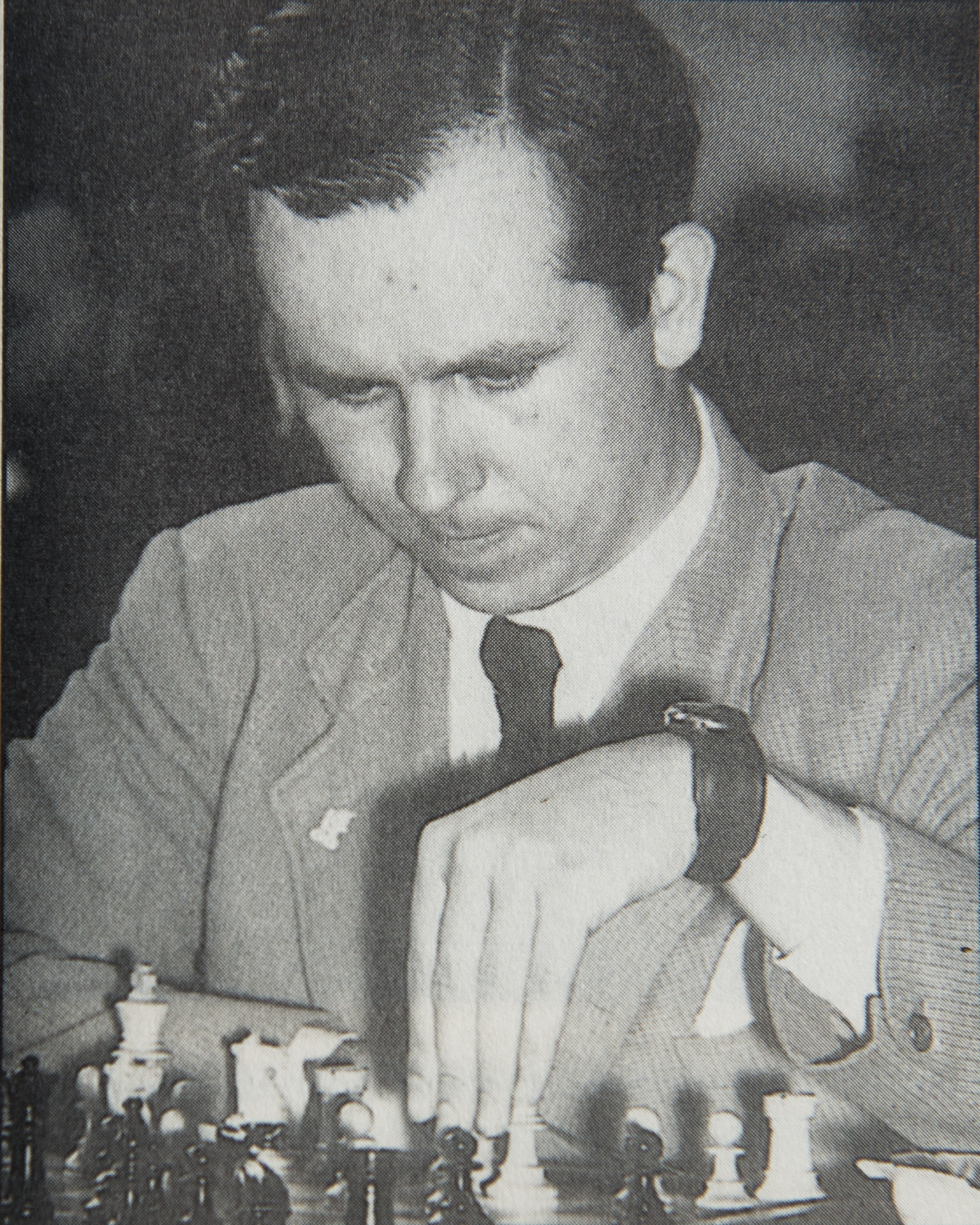
See below photograph for captionCaption for above photograph
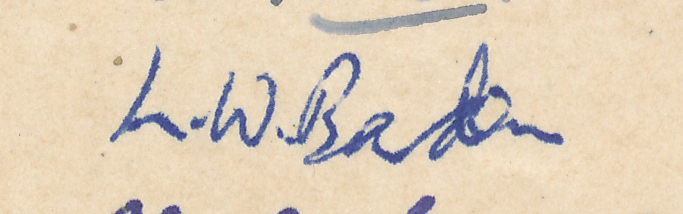
Ninety-two today is Leonard William Barden, born Tuesday, August 20th, 1929.
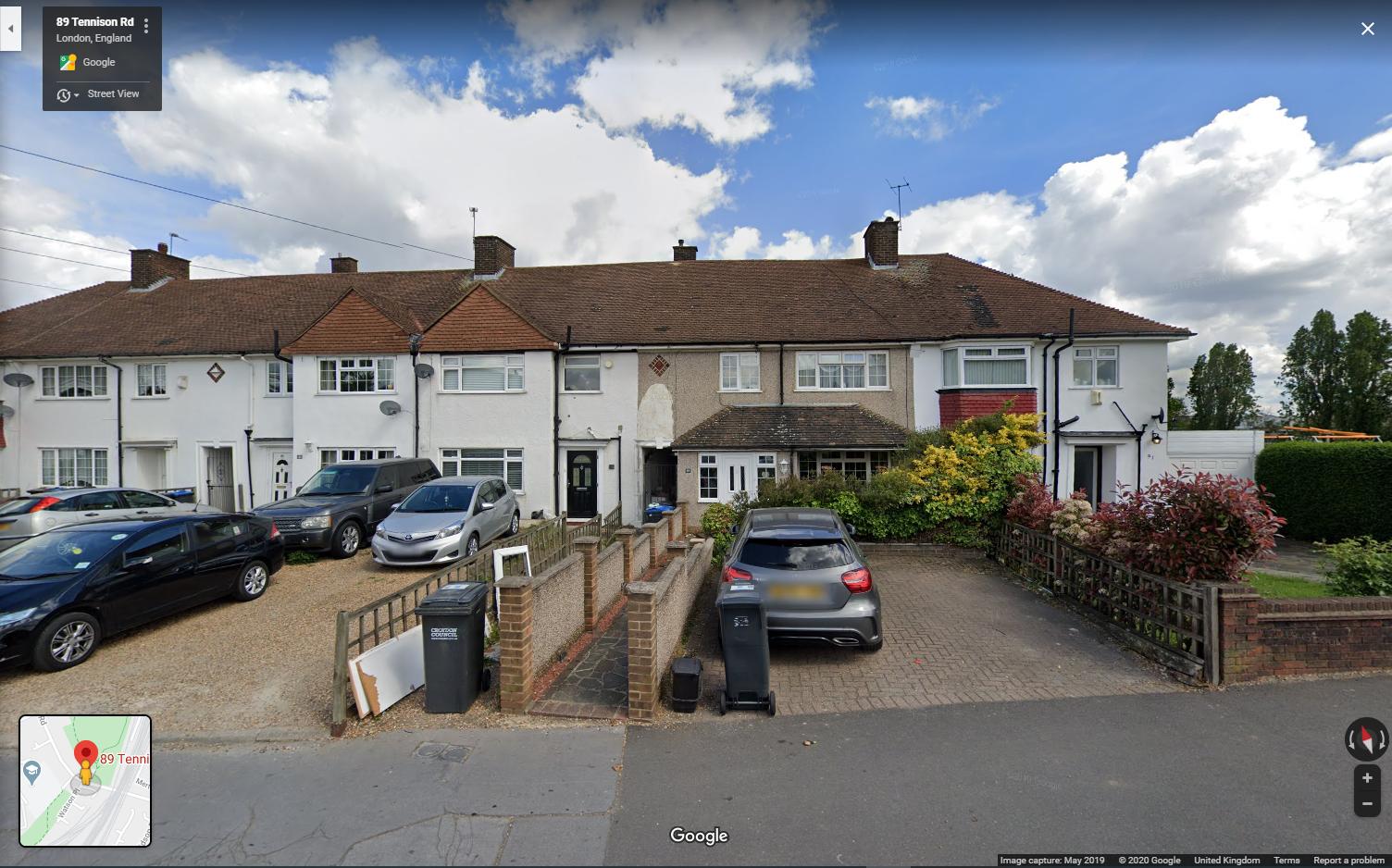
His mother’s maiden was Bartholomew and she became Elise EM Barden when she married Leonard’s father who was William C Barden (a dustman) and in 1939 they lived at 89, Tennison Road, Croydon.
89, Tennison Road, Croydon
From The Encyclopedia of Chess (Batsford, 1977) by Harry Golombek OBE:
“British Master and joint British Champion 1954. Barden was born in Croydon and learned to play at his school, Whitgift, which became a frequent producer of fine players.
In 1946 he tied for first place in the London Boys Championship and in the following year he tied with Jonathan Penrose for first place in the British Boys Championship, but lost the play-off.
In 1952 he came first at Paignton ahead of the Canadian Grandmaster Yanofsky and he reached his peak in 1954 when , after tieing for first place with the Belgian Grandmaster O’Kelly de Galway at Bognor, he tied for for first place in the British Championship at Nottingham with A. Phillips. The play-off was drawn and so the players became joint champions.
Alan Phillips and Leonard Barden are joint British Champions of 1954 in Nottingham, photographer unknown
He played for the BCF in four Olympiads from 1952 to 1962 and then abandoned competitive chess, applying all his energies to writing (he is chess correspondent of the Guardian, the Financial Times, the Evening Standard and the Field, and has written many books on the game.
He has also developed two special interests, in junior chess and in grading, working with utmost persistence and energy in both of these fields.
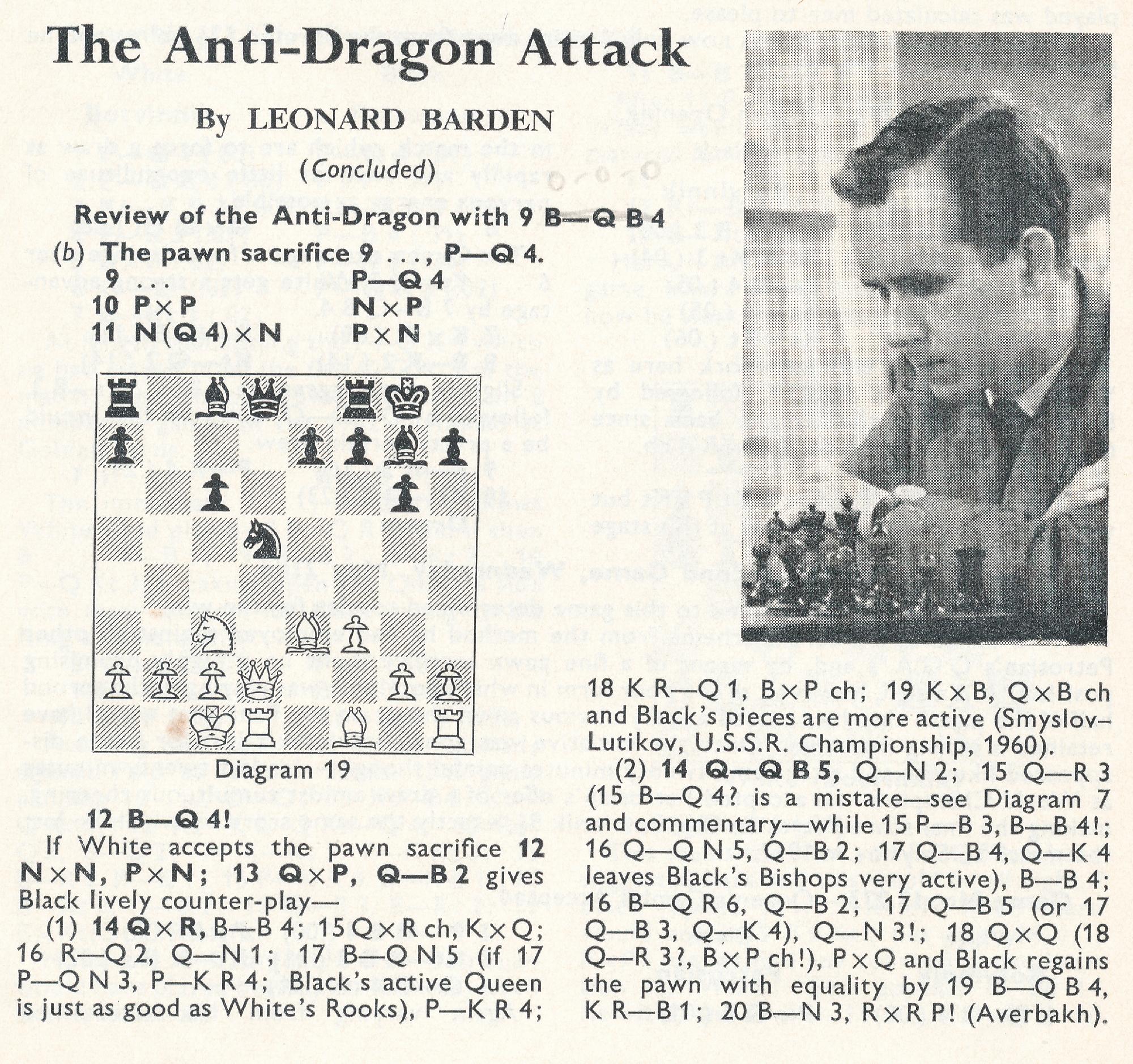
Leonard authored a series of articles on what was to become the Yugoslav Attack versus the Sicilian Dragon. Source : British Chess Magazine, Volume LXXXIII, Number 7 (July), page 208
Amongst his best works are : a A Guide to Chess Openings, London, 1957; The Ruy Lopez, Oxford, 1963; The King’s Indian Defence, London, 1968.”
Disappointingly Sunnucks Encyclopedia does not mention Barden at all and and surprisingly Hooper and Whyld’s usually excellent Oxford Companion only from a connection with Jim Slater.
“Leonard William Barden (born 20 August 1929, in Croydon, London) is an English chess master, writer, broadcaster, organizer and promoter. The son of a dustman, he was educated at Whitgift School, South Croydon, and Balliol College, Oxford, where he read Modern History.
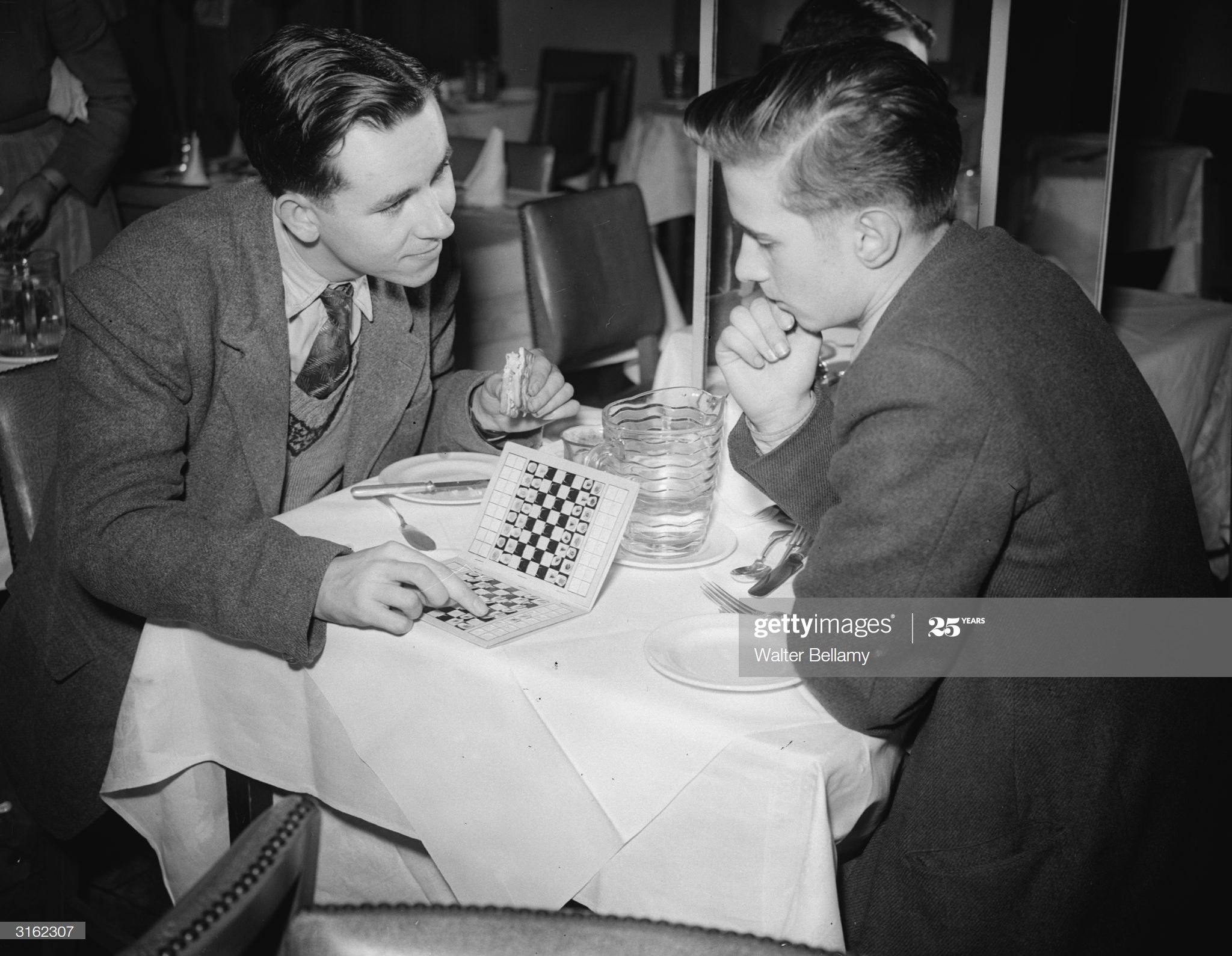
Travel Chess 2nd January 1951: British chess champions Jonathan Penrose and Leonard Barden prepare their openings over breakfast in the Yelton Hotel before the 9.30 am round start at Hastings 1950-51. (Photo by Walter Bellamy/Express/Getty Images)
He learned to play chess at age 13 while in a school shelter during a World War II German air raid. Within a few years he became one of the country’s leading juniors.[1] He represented England in four Chess Olympiads. Barden played a major role in the rise of English chess from the 1970s. As a chess columnist for various newspapers, his column in London’s Evening Standard is the world’s longest-standing chess column.
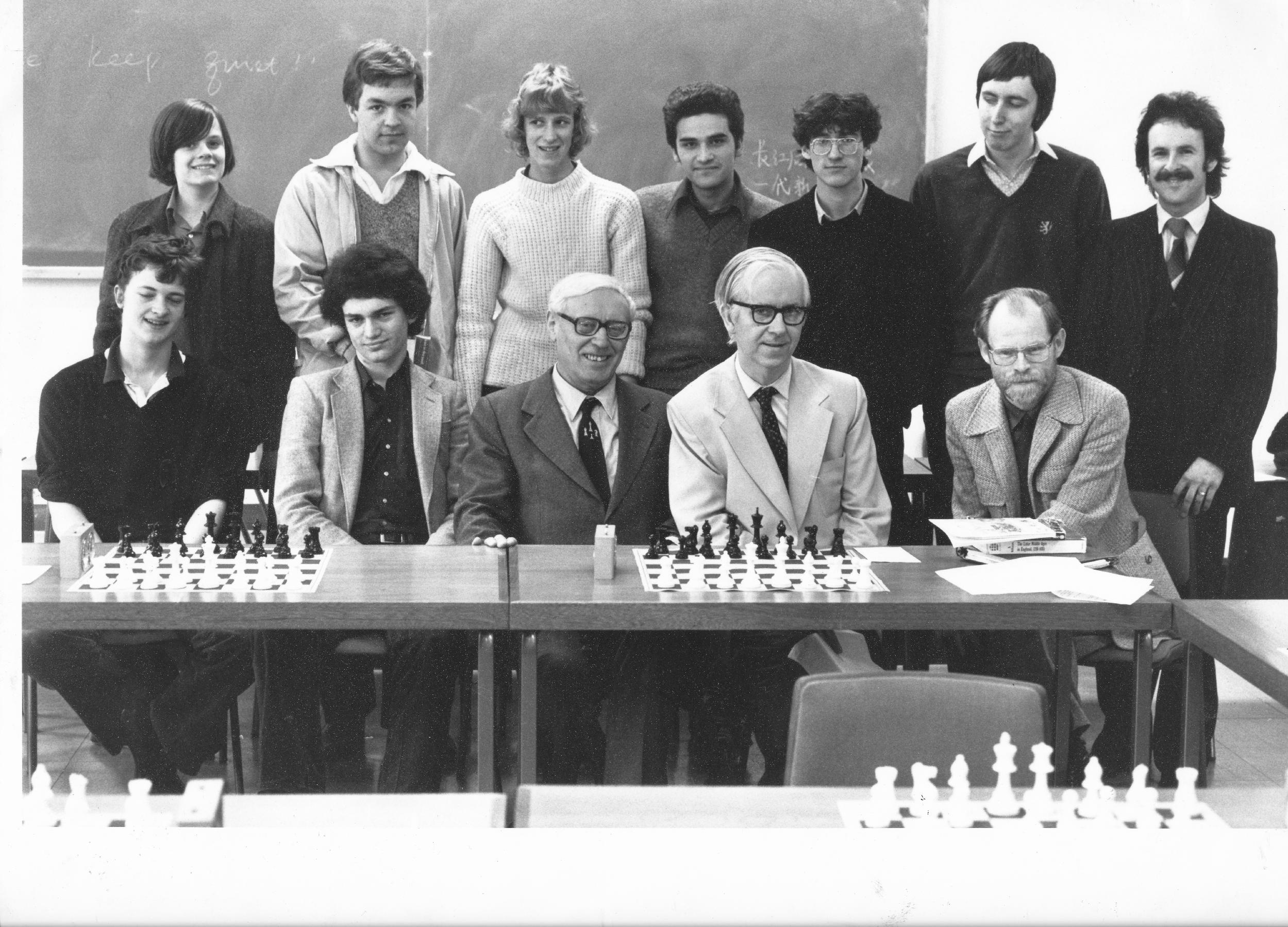
Leonard Barden (seated, second from right) Before Botvinnik’s 1981 Pergamon Press clock simul against England juniors, the final competitive event of the Patriarch’s career. Standing: Stuart Conquest, Neil Dickenson. Gary Lane, Alan Byron, Daniel King, John Hawksworth, Pergamon editor. Seated: Julian Hodgson, Byron Jacobs, Mikhail Botvinnik, Leonard Barden, Bernard Cafferty.
In 1946, Barden won the British Junior Correspondence Chess Championship, and tied for first place in the London Boys’ Championship. The following year he tied for first with Jonathan Penrose in the British Boys’ Championship, but lost the playoff.
Barden finished fourth at Hastings in 1951–52. In 1952, he won the Paignton tournament ahead of the Canadian future grandmaster Daniel Yanofsky. He captained the Oxfordshire team which won the English Counties championship in 1951 and 1952.
Barden making a move at Southend 1955.
In the latter year he captained the University of Oxford team which won the National Club Championship, and he represented the university in the annual team match against the University of Cambridge during his years there. In 1953, he won the individual British Lightning Championship (ten seconds a move).
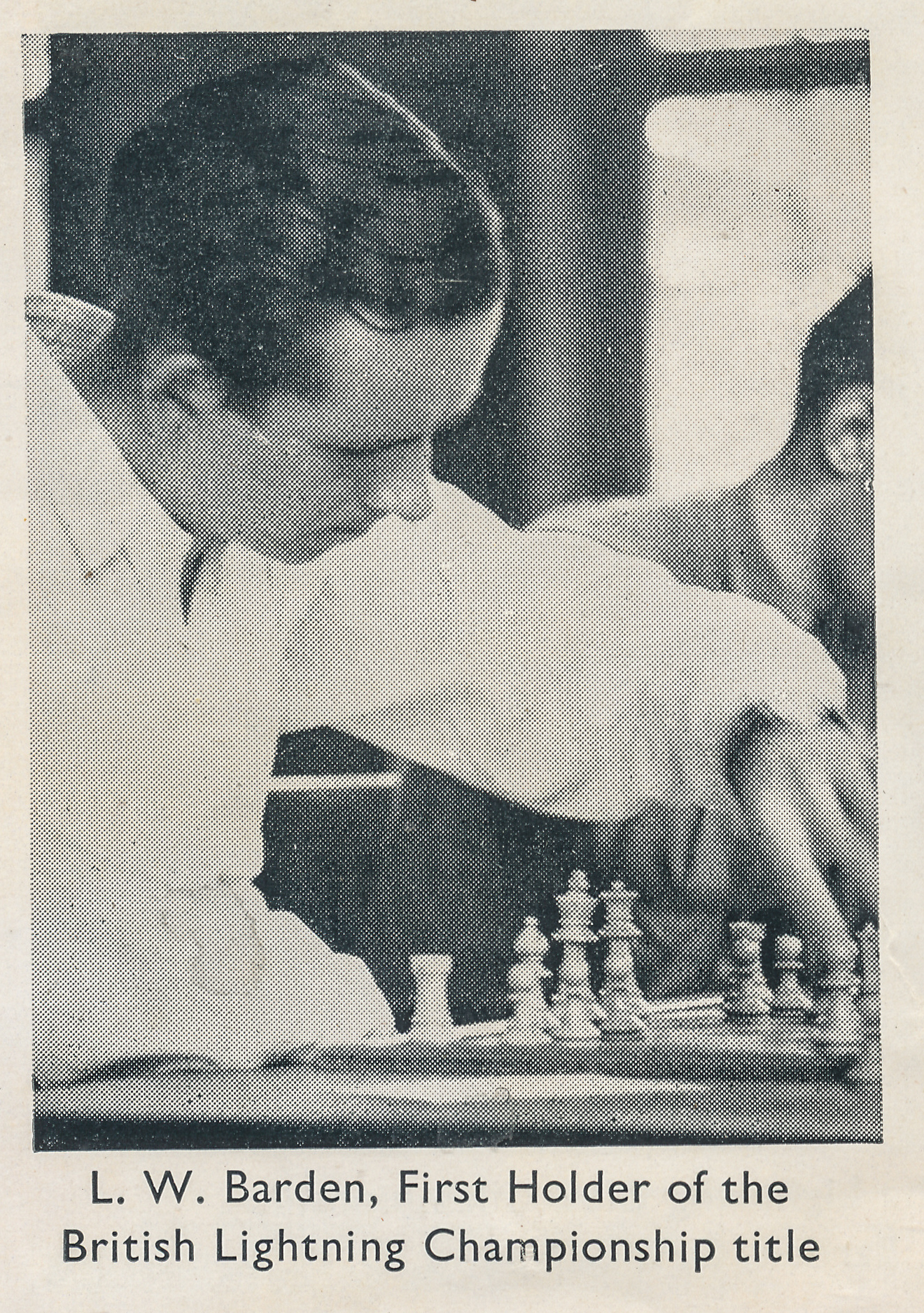
Leonard Barden, First Holder of the British Lightning Championship title played at the Ilford Congress between May 22nd and May 25th, 1953
(ed: the above event was “won” by Dr. PM List with 15.5/18 but he was not allowed the title. Leonard together with AY Green and KR Smith scored 13/18 and won the play-off).
The following year, he tied for first with the Belgian grandmaster Albéric O’Kelly de Galway at Bognor Regis, was joint British champion, with Alan Phillips, and won the Southern Counties Championship.
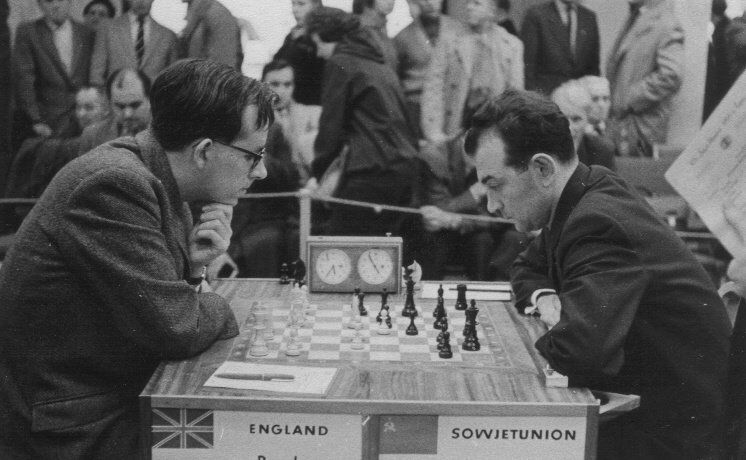
Leonard Barden vs Victor Korchnoi, Leipzig Olympiad, 1960
He finished fourth at Hastings 1957–58, ranked by chessmetrics as his best statistical performance. In the 1958 British Chess Championship, Barden again tied for first, but lost the playoff match to Penrose 1½–3½.
Leonard Barden (centre) with Raaphi Persitz, JB Sykes, OI Galvenius and DM Armstrong, Ilford, May, 1953
LWB observes analysis between David Rumens and Murray Chandler from Brighton 1980. Photograph courtesy of John Upham.
He represented England in the Chess Olympiads at Helsinki 1952 (playing fourth board, scoring 2 wins, 5 draws, and 4 losses), Amsterdam 1954 (playing first reserve, scoring 1 win, 2 draws, and 4 losses), Leipzig 1960 (first reserve; 4 wins, 4 draws, 2 losses) and Varna 1962 (first reserve; 7 wins, 2 draws, 3 losses). The latter was his best performance by far.
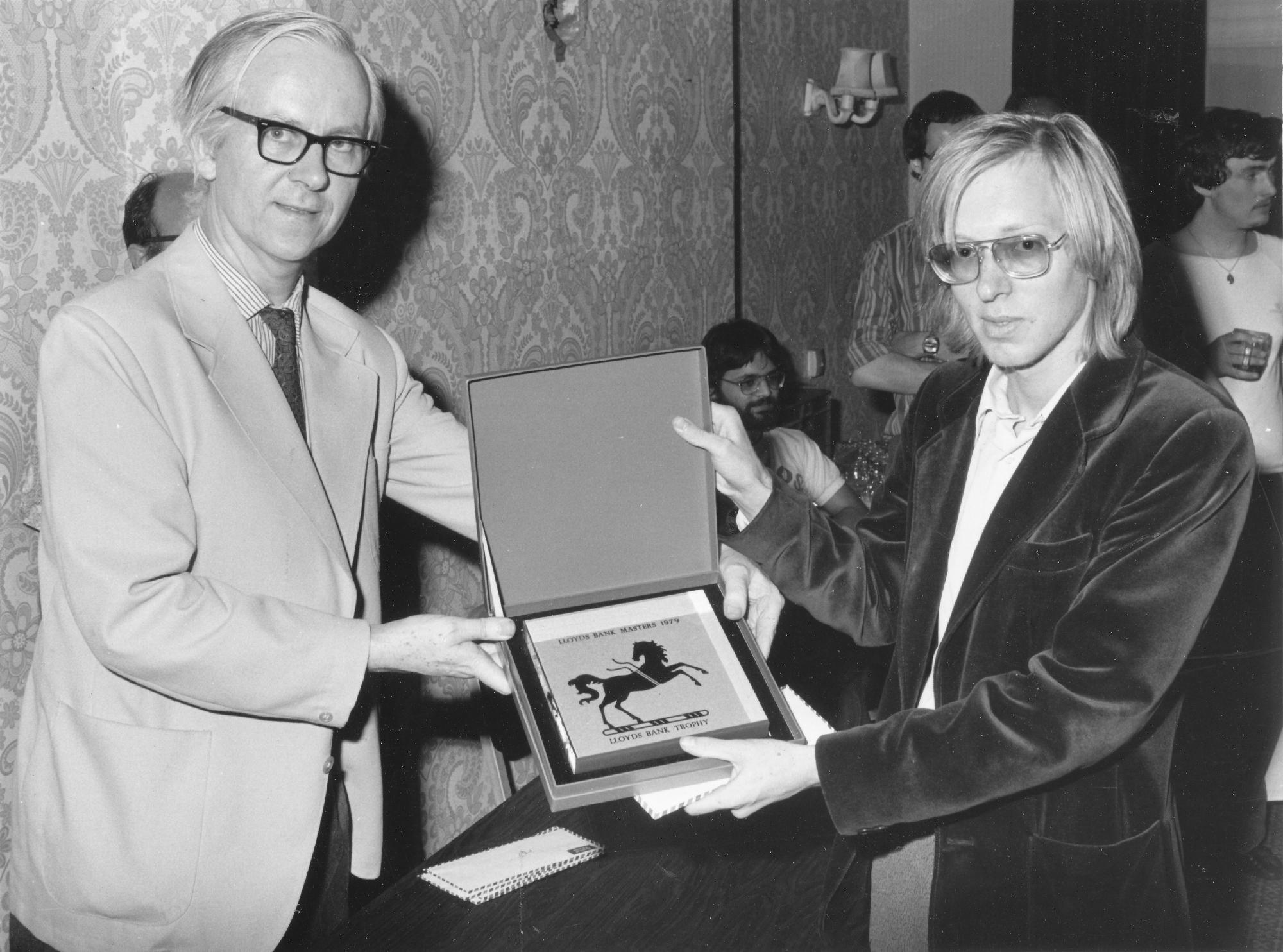
Leonard Barden (left) and Murray Chandler display the Lloyds Bank Trophy which the 19-year old New Zealander won ahead of 3 Grandmasters and 10 International Masters for his finest international success up to 1979. in the Lloyds Bank Masters
Barden has a Morphy number of 3, having drawn with Jacques Mieses in the Premier Reserves at Hastings 1948–49. Mieses drew with Henry Bird in the last round of Hastings 1895, and Bird played a number of games with Paul Morphy in 1858 and 1859.
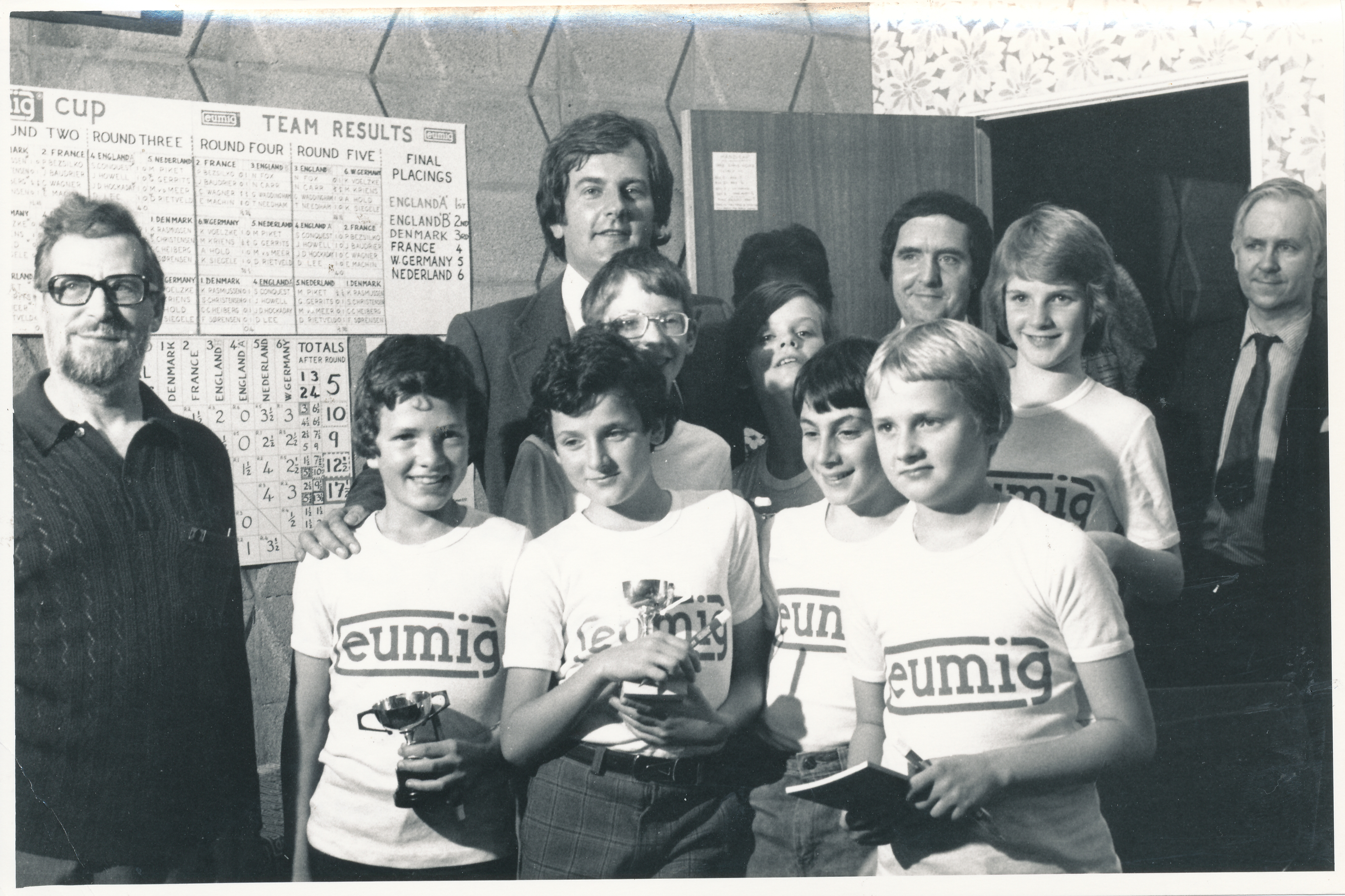
England’s under-12 junior teams finished first and second in the international Eumig Cup, 1981. Front row: Peter Morrish (organiser), Jimmy Hockaday, Darren Lee, Neil Fox, Neil Carr. Second row: James Howell, Stuart Conquest, Teresa Needham. Far right: LB.
In 1964, Barden gave up most competitive chess to devote his time to chess organisation, broadcasting, and writing about the game. He has made invaluable contributions to English chess as a populariser, writer, organiser, fundraiser, and broadcaster.
Leonard Barden at Bob Wade’s 80th birthday party, 2001.
He was controller of the British Chess Federation Grand Prix for many years, having found its first sponsor, Cutty Sark. He was a regular contributor to the BBC’s Network Three weekly radio chess programme from 1958 to 1963. His best-known contribution was a consultation game, recorded in 1960 and broadcast in 1961, where he partnered Bobby Fischer against the English masters Jonathan Penrose and Peter Clarke. This was the only recorded consultation game of Fischer’s career. The game, unfinished after eight hours of play, was adjudicated a draw by former world champion Max Euwe. Barden gave BBC television commentaries on all the games in the 1972 world championship. From 1973 to 1978 he was co-presenter of BBC2’s annual Master Game televised programme.
Julian and Nigel Short play Korchnoi in the Evening Standard 1976 simul. Leonard Barden observes.
As of 2021, his weekly columns have been published in The Guardian for 65 years and in The Financial Times for 46 years. A typical Barden column not only contains a readable tournament report, but is geared toward promoting the game. His London Evening Standard column, begun in summer 1956, is now the world’s longest running daily chess column by the same author, breaking the previous record set by George Koltanowski in the San Francisco Chronicle. Koltanowski’s column ran for 51 years, 9 months, and 18 days, including posthumous articles.”
Leonard Barden (Linda Nylind of the Guardian)
Leonard wrote this on the English Chess Forum in 2021 :
“I retired after Ilford 1964 when I finished a poor last in the England Olympiad team qualifier, returned at Hammersmith 1969 (equal 2nd behind Keene) and then played around 6-8 weekenders a year until 1972. My overall performance level between early 60s and early 70s dropped from around 225 to 215 BCF, so I wasn’t encouraged to pursue the comeback further.”
Leonard was Southern Counties (SCCU) champion in the 1953-54 season.
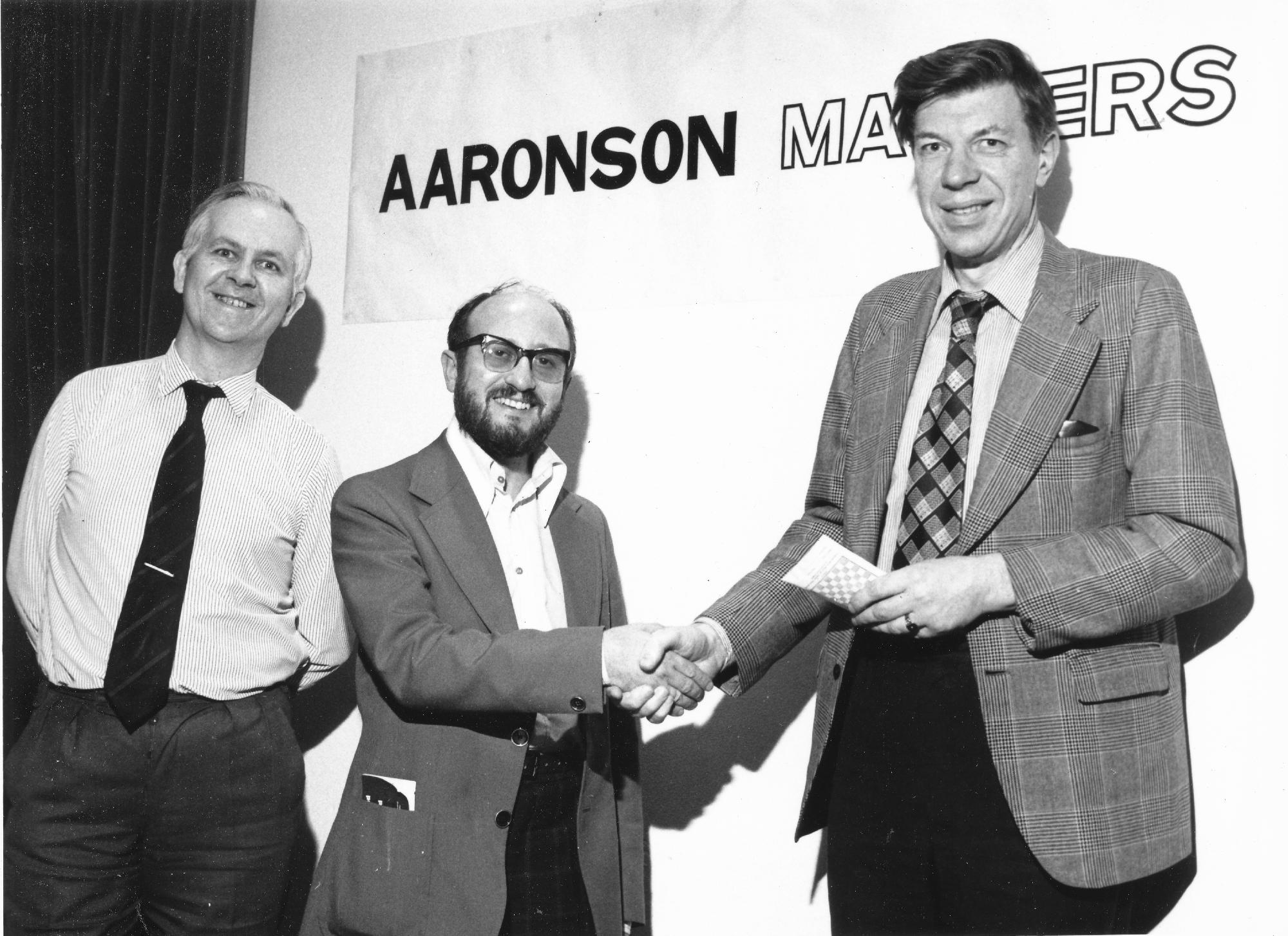
Leonard Barden, Stewart Reuben and Michael Franklin at the 1978 Aaronson Masters
Leonard reveals this as his best game :
Leonard has authored or co-authored a number of highly regarded books, most of which are highly instructional to this day:
A Guide to Chess Openings (1957),
A Guide to Chess Openings
How Good Is Your Chess? (1957),
How Good is Your Chess ?
Chess (1959),
Introduction to Chess Moves and Tactics Simply Explained (1959),
An Introduction to Chess Moves and Tactics Simply Explained
Modern Chess Miniatures (with Wolfgang Heidenfeld, 1960),
Erevan 1962 (1963),
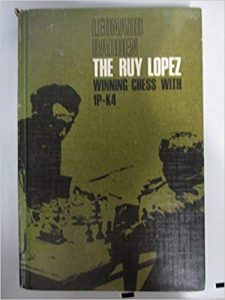
The Ruy Lopez (1963),
The Ruy Lopez
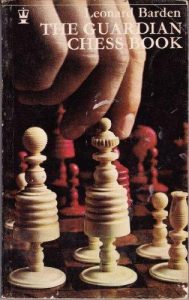
The Guardian Chess Book (1967),
The Guardian Chess Book
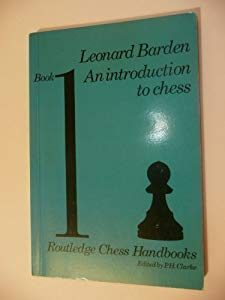
An Introduction to Chess (1967),
An Introduction to Chess
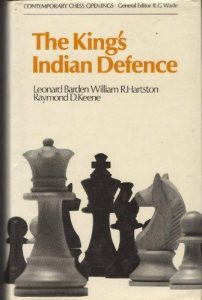
The King’s Indian Defence (1969),
The King’s Indian Defence
Chess: Master the Moves (1977),
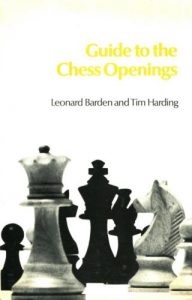
Guide to the Chess Openings (with Tim Harding, 1977),
Guide to the Chess Openings
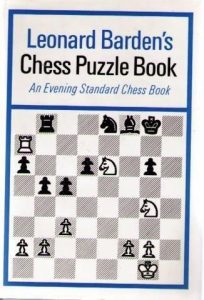
Leonard Barden’s Chess Puzzle Book (1977) (a collection of his Evening Standard columns),
Leonard Barden’s Chess Puzzle Book
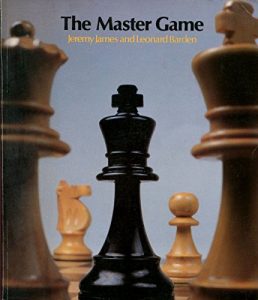
The Master Game (with Jeremy James, 1979),
The Master Game
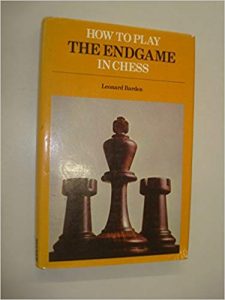
How to Play the Endgame in Chess (1979),
How to Play The Endgame in Chess
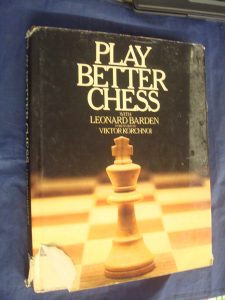
Play Better Chess (1980),
Play Better Chess
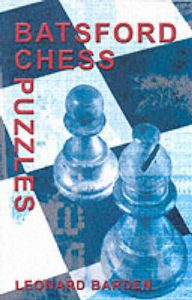
Batsford Chess Puzzles (2002),
Batsford Chess Puzzles
One Move and You’re Dead (with Erwin Brecher, 2007) : Can you supply an image?
BCN sends Happy birthday wishes to Peter Griffiths
Peter Charles Griffiths was born on Thursday, August 15th, in 1946 in Birmingham, Warwickshire. His mother’s maiden name was Ward.
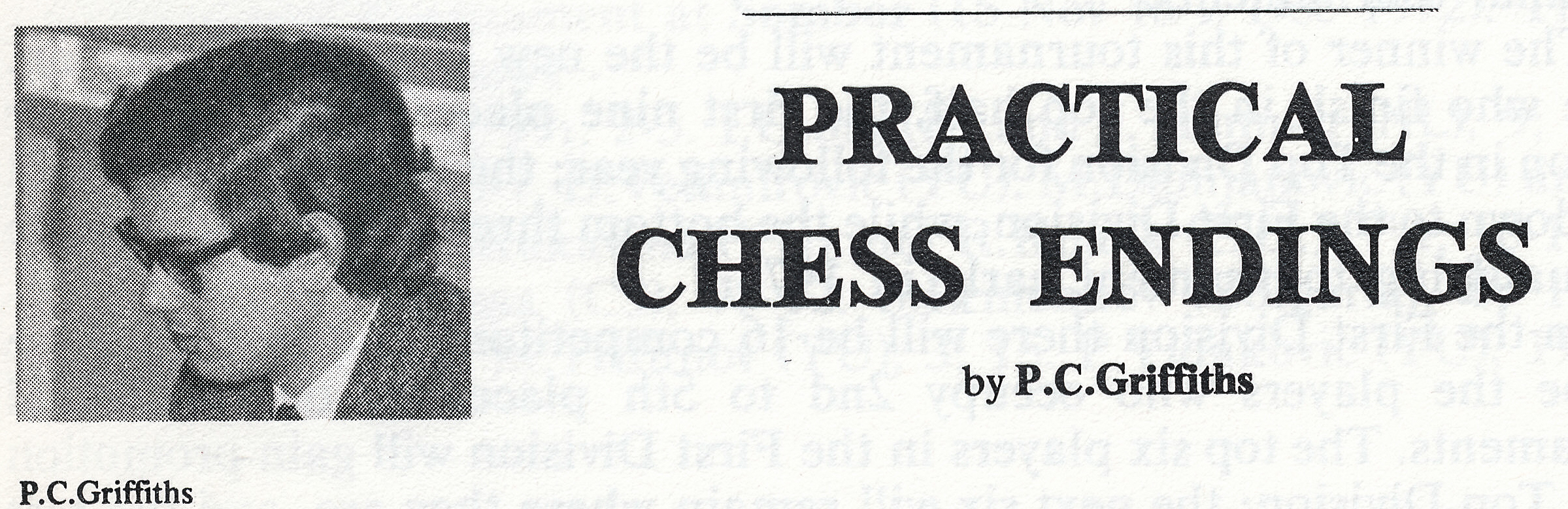
Peter was a strong player active from the 1960s until 1989. He played in the British Championships more than once and was a professional coach and writer. He wrote the column “Practical Chess Endings” which appeared in the British Chess Magazine. The column commenced in the December 1972 issue and columns became less frequent until around 1991.
Peter Griffiths (far left)
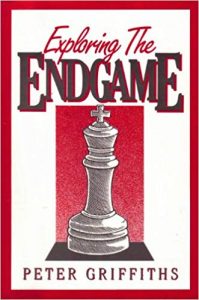
He wrote Exploring the Endgame
Exploring the Endgame
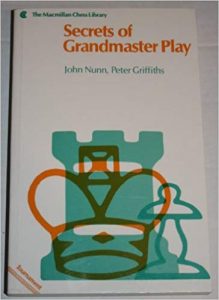
and co-authored Secrets of Grandmaster Play with John Nunn.
Secrets of Grandmaster Play
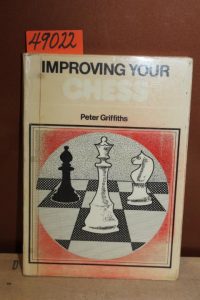
and wrote Improving Your Chess
Improving Your Chess
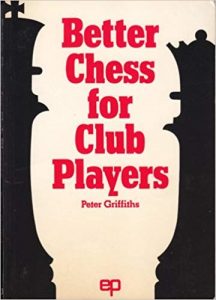
and Better Chess for Club Players
Better Chess for Club PlayersPeter Griffiths (far left)
We focus on the British Chess Scene Past & Present !
This website uses cookies to improve your experience. We'll assume you're ok with this, but you can opt-out if you wish. Cookie settingsACCEPT
Privacy & Cookies Policy
Privacy Overview
This website uses cookies to improve your experience while you navigate through the website. Out of these cookies, the cookies that are categorized as necessary are stored on your browser as they are as essential for the working of basic functionalities of the website. We also use third-party cookies that help us analyze and understand how you use this website. These cookies will be stored in your browser only with your consent. You also have the option to opt-out of these cookies. But opting out of some of these cookies may have an effect on your browsing experience.
Necessary cookies are absolutely essential for the website to function properly. This category only includes cookies that ensures basic functionalities and security features of the website. These cookies do not store any personal information.