Tag Archives: Birthdays

Birthday of FM Peter Markland (13-iv-1951)

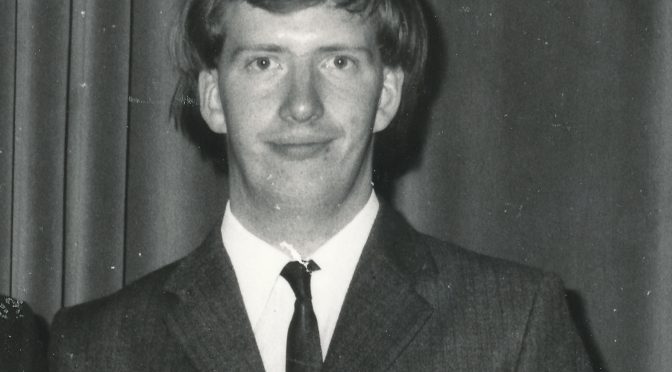
BCN wishes a happy birthday to Peter Markland born on Friday, April 13th, 1951

From the rear cover of “Sicilian:…e5 :

“P.R. Markland is a British Master, and a member of many English international teams, including those at the 1972 and 1974 Olympiads, and is also a British correspondence international”

Peter first qualified to the British Championship in 1967 (Oxford) and obtained an IM and GM norm at Hastings 1971.

In 1984 he became a Grandmaster for correspondence chess (GMC).

Peter became a banker and lives in Woodbridge, Suffolk, IP13.

From British Chess (Pergamon Press, 1983) we have this contribution from Peter himself:

“1951 seems to have been a vintage year for chessplayers and although I cannot claim to count myself in the company of Andersson, Karpov, Ribli and Sax we do all share the same year of birth.

Although I learned the moves at the age of 5, I only took any real interest in the game at 13 when I began to play schools chess. Compared with such as Nigel Short I was a very late starter!

I was educated at Bolton School and played for Bolton and Lancashire in my early years. This was fortunate in that all three of these teams enjoyed great success in the late 1960s. In all three teams I played along side Martyn Corden who was to precede my rise to international level himself by playing in the Siegen Olympiad team in 1970. In 1967, I qualified for the British Championship at my first attempt and I was pleased to score 5/11. The following year the school team won The Sunday Times tournament playing without Martyn Corden in the finals.

Up to this time I had concentrated chiefly on junior teams and had won the NCCU junior titles. Over Christmas and New Year of both 1966-7 and 1967-8 I travelled down to play at the Devon Junior Congress at Plymouth but in 1968 I decided to try my luck at Hastings. This proved to be one of the turning points of my career.

I was placed in the Challengers Reserves for 1968-9 and after the first round loss (to the eventual winner) my play gained momentum and I qualified for the Challengers the following year. The intervening year passed quietly with a trip to Ireland in the Glorney Cup. I went up to Balliol College, Oxford in October 1969.

The Scottish Junior International, Glasgow, 1969. l-r: David Watt, Rene Borngässer, David Levy, Heinz Wirthensohn, Peter Markland. Courtesy of Chess Scotland

The Hastings Challengers tournament 1969-70 began when I met the same opponent as in the previous year in the first round. This time I managed to come out on top. By the time the last round came, I had played most of the leaders and had 6/8 including two pleasing wins with my favourite defence at the time – the Sicilian Pelikan variation.
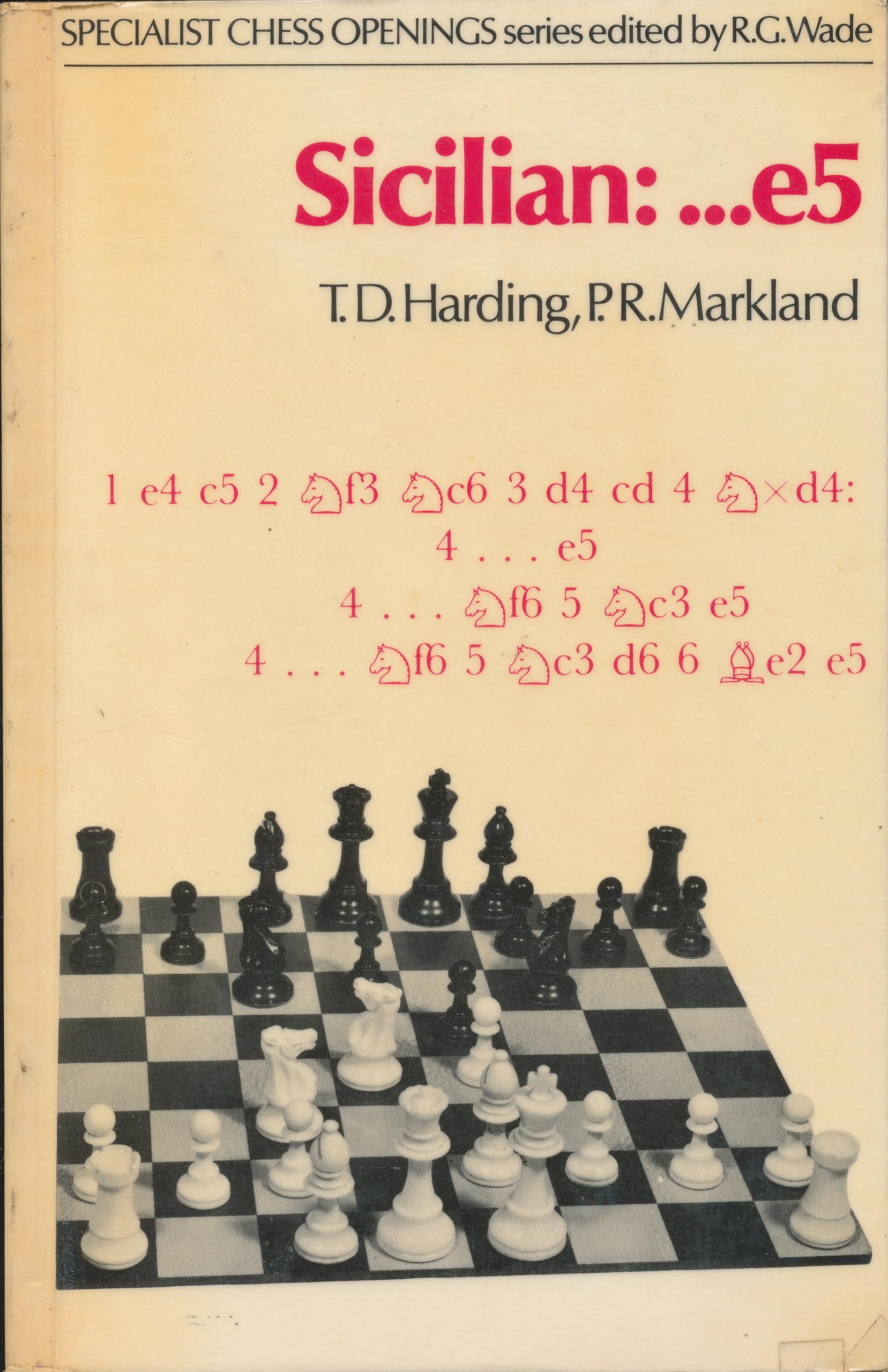
Sicilian:...e5 by TD Harding & PR Markland, Batsford, 1976, ISBN 0 7134 3209 8
Sicilian:…e5 by TD Harding & PR Markland, Batsford, 1976, ISBN 0 7134 3209 8

In the last round I was paired against de Veauce who had a reputation as a good strategist and whom I hoped to unsettle tactically. I had white and my plan failed. He outplayed me in the opening and middlegame and I sacrificed my isolated centre pawn to activate my pieces.

So I then had to wait had to wait to see the other results before I could confirm a somewhat lucky place in the Premier.

In 1970 I had the opportunity to travel with the student team to the Olympiad in Haifa. My score of 5.5/7 was reasonably pleasing but the standard of opposition was far from good.
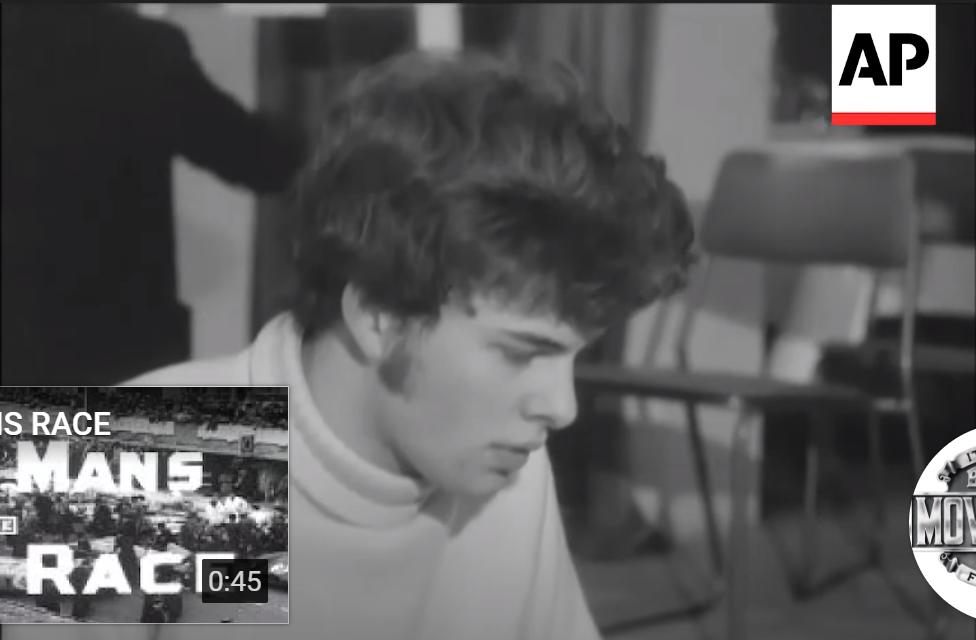
Peter Markland at Hastings 1970-71

At the end of the year came the Hastings Premier – a tournament which I can only describe as the highlight of my career. I began nervously and lost a nondescript game to Uhlmann in the first round. My confidence grew with two comfortable draws with Portisch (the eventual winner) and Keene. In round four I met the surprise leader, Mestrovic (who had 3/3) and perhaps partly due to the fact that this game was played on 1st January I won convincingly in 18 moves.
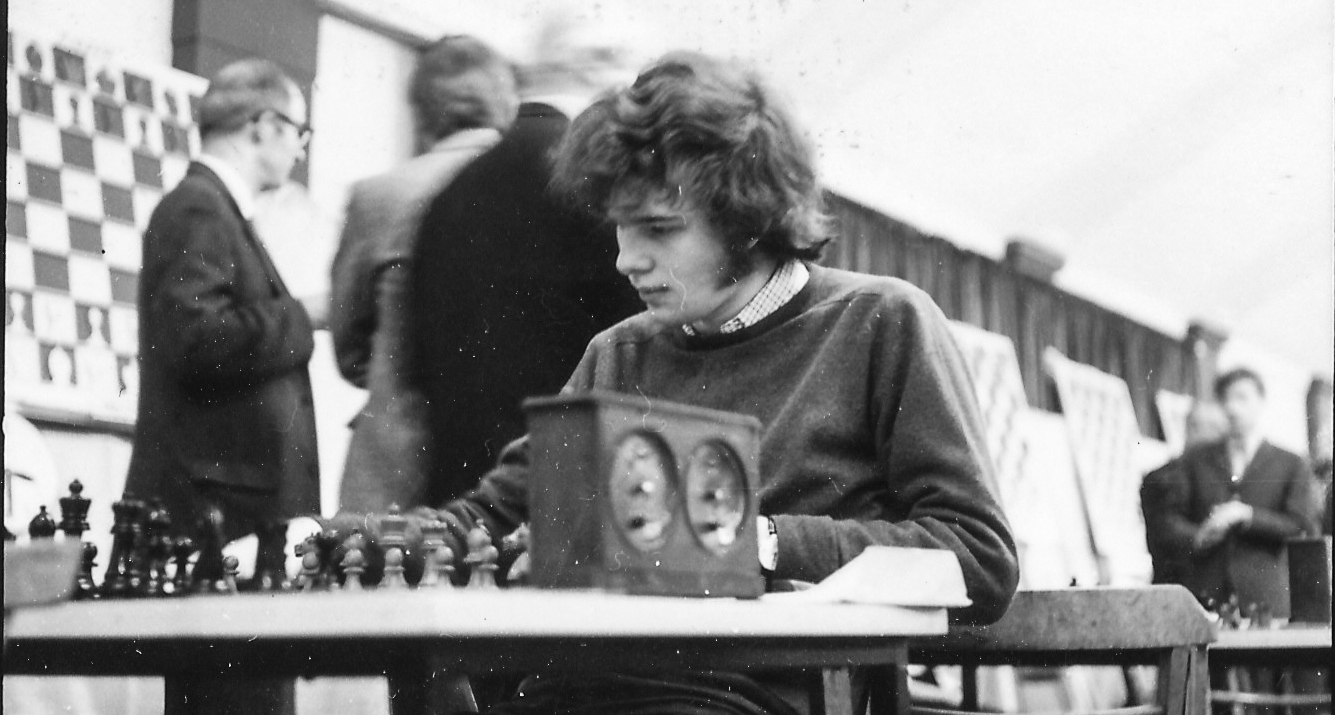
Peter Markland during his game with Portisch on December 30th 1970

The next four rounds brought an uneventful draw with Wade and three exciting encounters with Byrne, Krogius and Gligoric all of which after several reversals of fortune ended in draws.
Peter Markland at Hastings 1970-71

In the last round I was to play Hort who needed to to win to gain a share of first prize. He played a horribly passive opening and by move 14 I was already well on top. To try to compensate he snatched a queenside pawn and gave me the chance to play the type of move one can only dream about!

This victory meant an equal second on 5/9 with Gligoric, Hort, Krogius and Uhlmann and both a GM and IM norm.

As a result of this I became a regular member of the England side. During 1971 my results were erratic, possibly caused by too much play. I was pleased with my 3.5 score in my first Clare Benedict, although I lost my first game for England due to nervousness and I was first equal with George Botterill in the Slater Young Masters at Hastings (again). Here I declined a last round draw offer, blundered almost next move and lost to an up-and-coming junior by the name of Michael Stean! On the debit side my performances in the British Championship, The Oxford International Congress and the Robert Silk tournament left room for improvement.

Whilst playing with Bolton in the National Club Championship, we had never won the competition although we had reached the semi-finals many times. This year, 1971, playing for Oxford University, we won the tournament beating our old rivals Cambridge University in the final on board count.

The Hastings tournament of 1971-72 saw me firmly entrenched near the bottom. It is very difficult in this type of international tournament when one becomes marked as an out-of-form player. All the other players make extra efforts to beat you and this drains your strength further.

My main problem at Hastings was a lack of defence to 1.e4. I lost five games against this move. In the last round I had a very interesting struggle against Karpov who needed to win this game to tie first with Korchnoi who had beaten him in the previous round, but the strength of 1.e4 proved too much.

The summer of 1972 saw the advent of my University finals and thus I played very little for the first six months of the year – even I had to decline an invitation to the Teeside GM event. Later in the year I played in the student Olympiad in Graz and then in the Olympiad is Skopje.

In the preliminaries we had drawn Yugoslavia and Switzerland, who were the only other teams likely to qualify for the ‘A’ final. We missed qualification narrowly and I think that every team member had one poor result in the qualifying rounds – mine being a scraped draw against a Syrian team.

We won the ‘B’ final by beating the Israeli team in the last round and I felt pleased by my score of 11.5/16 with no losses. Indeed, in my last round game with Balshan I was quite rightly instructed to agree a draw in a winning position to secure the team’s first place.

I feel that this tournament from my point of view aptly demonstrates the difference in title norms in the early 1970s and today. I played five players who had no Elo ratings and only four titled players. Hence an IM norm would not have been available under any circumstances. The main reason for the lack of Elo ratings in 1972 was that the new system had only just been introduced and for many players this was their first Elo-rated tournament. In the last Elo list, all but one of the sixteen players are rated, there are now four GMs and five IMs amongst my opponents and the norm figures would be 10.5/16 and 12.5/16 for IM and GM respectively.

Here is my best game from the Olympiad. It is indicative of an early combination prevailing through into a winning ending.

In 1973 I was once more plagued by too many invitations and played indifferently throughput the year. The only bright spots were my score of 3/7 on boards 3 and 4 of the European Team Finals and second place in the Woolacombe International.

1974 was once again an Olympiad year. The England team won the Clare Benedict for the first time in Menorca and I was able to contribute 5/6 winning both a board prize and the best score prize. I was drafted into the Olympiad team as a late replacement and although we qualified easily enough for the ‘A’ finals this was in no way due to my efforts as I had a 50% score in the preliminaries.

We had qualified for the ‘A’ final with one round to spare and our last group match against the USE (from which the score was to be carried forward) began the final matches. It had been decided, as a tactical measure and in our view of our differing styles, that I should take black whenever we had this colour on the fourth board, so that Whiteley and Stean could utilize a greater proportion of whites. This worked to a limited extent and indeed, Stean obtained an IM Norm. Also, as it worked out I played in matches against seven of the top eight teams (being rested against Yugoslavia) and only three teams below us. In the end, I was pleased with my +3 =1 -4 with black in the finals to give overall a 50& score.

During 1973 and 1974 I was co-author of two books in the Batsford opening series, both with Tim Harding on Sicilian Defence variations.
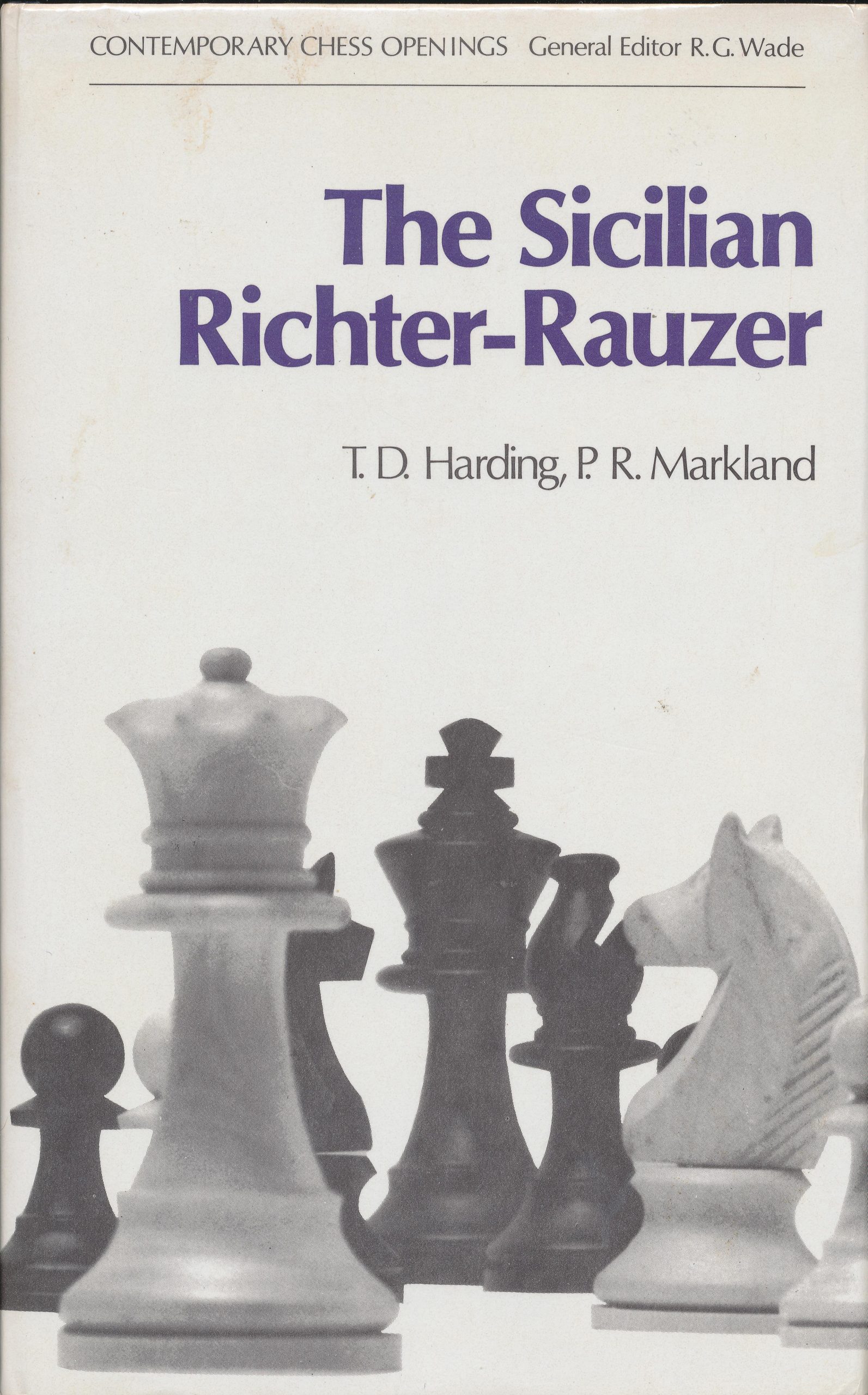
The Sicilian Richter-Rauzer, TD Hardign and PR Markland, Batsford, 975, ISBN 0 7134 2979 8

I also wrote a best game collection of Karpov which was by far the most interesting of the three books to write.
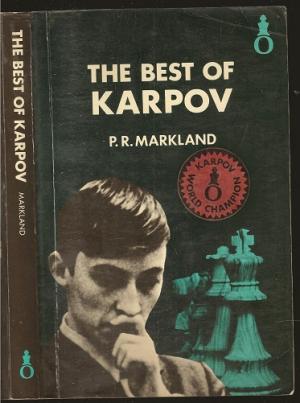
The Best of Karpov, PR Markland, Oxford University Press, 1975, ISBN 10: 0192175343

At about this time, I decided to embark upon a career in banking and to abandon that of a professional chessplayer. Since then I have concentrated on correspondence chess.

Having received  master certificate, I entered a European and World tournament in both of which I finished first. The second of these two results qualified me for the world Championship Semi-finals. But first attempt in the eleventh championship ended in failure to qualify.

As a result of an invitation received by the BPCF I played in the Eino Heilimo Memorial Grandmaster event. I have , however, qualified as a postal IM by scoring the required seven points and had an outside chance of trying for first place at one stage.

Here is my best game from this event.

Here is his brief Wikipedia entry.

The English Chess Forum has discussed Peter.

Peter’s games are here.
Birthday of FM Peter Markland (13-iv-1951)

BCN wishes a happy birthday to Peter Markland born on Friday, April 13th, 1951

From the rear cover of “Sicilian:…e5 :

“P.R. Markland is a British Master, and a member of many English international teams, including those at the 1972 and 1974 Olympiads, and is also a British correspondence international”

Peter first qualified to the British Championship in 1967 (Oxford) and obtained an IM and GM norm at Hastings 1971.

In 1984 he became a Grandmaster for correspondence chess (GMC).

Peter became a banker and lives in Woodbridge, Suffolk, IP13.

From British Chess (Pergamon Press, 1983) we have this contribution from Peter himself:

“1951 seems to have been a vintage year for chessplayers and although I cannot claim to count myself in the company of Andersson, Karpov, Ribli and Sax we do all share the same year of birth.

Although I learned the moves at the age of 5, I only took any real interest in the game at 13 when I began to play schools chess. Compared with such as Nigel Short I was a very late starter!

I was educated at Bolton School and played for Bolton and Lancashire in my early years. This was fortunate in that all three of these teams enjoyed great success in the late 1960s. In all three teams I played along side Martyn Corden who was to precede my rise to international level himself by playing in the Siegen Olympiad team in 1970. In 1967, I qualified for the British Championship at my first attempt and I was pleased to score 5/11. The following year the school team won The Sunday Times tournament playing without Martyn Corden in the finals.

Up to this time I had concentrated chiefly on junior teams and had won the NCCU junior titles. Over Christmas and New Year of both 1966-7 and 1967-8 I travelled down to play at the Devon Junior Congress at Plymouth but in 1968 I decided to try my luck at Hastings. This proved to be one of the turning points of my career.

I was placed in the Challengers Reserves for 1968-9 and after the first round loss (to the eventual winner) my play gained momentum and I qualified for the Challengers the following year. The intervening year passed quietly with a trip to Ireland in the Glorney Cup. I went up to Balliol College, Oxford in October 1969.

The Scottish Junior International, Glasgow, 1969. l-r: David Watt, Rene Borngässer, David Levy, Heinz Wirthensohn, Peter Markland. Courtesy of Chess Scotland

The Hastings Challengers tournament 1969-70 began when I met the same opponent as in the previous year in the first round. This time I managed to come out on top. By the time the last round came, I had played most of the leaders and had 6/8 including two pleasing wins with my favourite defence at the time – the Sicilian Pelikan variation.

Sicilian:...e5 by TD Harding & PR Markland, Batsford, 1976, ISBN 0 7134 3209 8
Sicilian:…e5 by TD Harding & PR Markland, Batsford, 1976, ISBN 0 7134 3209 8

In the last round I was paired against de Veauce who had a reputation as a good strategist and whom I hoped to unsettle tactically. I had white and my plan failed. He outplayed me in the opening and middlegame and I sacrificed my isolated centre pawn to activate my pieces.

So I then had to wait had to wait to see the other results before I could confirm a somewhat lucky place in the Premier.

In 1970 I had the opportunity to travel with the student team to the Olympiad in Haifa. My score of 5.5/7 was reasonably pleasing but the standard of opposition was far from good.

Peter Markland at Hastings 1970-71

At the end of the year came the Hastings Premier – a tournament which I can only describe as the highlight of my career. I began nervously and lost a nondescript game to Uhlmann in the first round. My confidence grew with two comfortable draws with Portisch (the eventual winner) and Keene. In round four I met the surprise leader, Mestrovic (who had 3/3) and perhaps partly due to the fact that this game was played on 1st January I won convincingly in 18 moves.

Peter Markland during his game with Portisch on December 30th 1970

The next four rounds brought an uneventful draw with Wade and three exciting encounters with Byrne, Krogius and Gligoric all of which after several reversals of fortune ended in draws.

Peter Markland at Hastings 1970-71

In the last round I was to play Hort who needed to to win to gain a share of first prize. He played a horribly passive opening and by move 14 I was already well on top. To try to compensate he snatched a queenside pawn and gave me the chance to play the type of move one can only dream about!

This victory meant an equal second on 5/9 with Gligoric, Hort, Krogius and Uhlmann and both a GM and IM norm.

As a result of this I became a regular member of the England side. During 1971 my results were erratic, possibly caused by too much play. I was pleased with my 3.5 score in my first Clare Benedict, although I lost my first game for England due to nervousness and I was first equal with George Botterill in the Slater Young Masters at Hastings (again). Here I declined a last round draw offer, blundered almost next move and lost to an up-and-coming junior by the name of Michael Stean! On the debit side my performances in the British Championship, The Oxford International Congress and the Robert Silk tournament left room for improvement.

Whilst playing with Bolton in the National Club Championship, we had never won the competition although we had reached the semi-finals many times. This year, 1971, playing for Oxford University, we won the tournament beating our old rivals Cambridge University in the final on board count.

The Hastings tournament of 1971-72 saw me firmly entrenched near the bottom. It is very difficult in this type of international tournament when one becomes marked as an out-of-form player. All the other players make extra efforts to beat you and this drains your strength further.

My main problem at Hastings was a lack of defence to 1.e4. I lost five games against this move. In the last round I had a very interesting struggle against Karpov who needed to win this game to tie first with Korchnoi who had beaten him in the previous round, but the strength of 1.e4 proved too much.

The summer of 1972 saw the advent of my University finals and thus I played very little for the first six months of the year – even I had to decline an invitation to the Teeside GM event. Later in the year I played in the student Olympiad in Graz and then in the Olympiad is Skopje.

In the preliminaries we had drawn Yugoslavia and Switzerland, who were the only other teams likely to qualify for the ‘A’ final. We missed qualification narrowly and I think that every team member had one poor result in the qualifying rounds – mine being a scraped draw against a Syrian team.

We won the ‘B’ final by beating the Israeli team in the last round and I felt pleased by my score of 11.5/16 with no losses. Indeed, in my last round game with Balshan I was quite rightly instructed to agree a draw in a winning position to secure the team’s first place.

I feel that this tournament from my point of view aptly demonstrates the difference in title norms in the early 1970s and today. I played five players who had no Elo ratings and only four titled players. Hence an IM norm would not have been available under any circumstances. The main reason for the lack of Elo ratings in 1972 was that the new system had only just been introduced and for many players this was their first Elo-rated tournament. In the last Elo list, all but one of the sixteen players are rated, there are now four GMs and five IMs amongst my opponents and the norm figures would be 10.5/16 and 12.5/16 for IM and GM respectively.

Here is my best game from the Olympiad. It is indicative of an early combination prevailing through into a winning ending.

In 1973 I was once more plagued by too many invitations and played indifferently throughput the year. The only bright spots were my score of 3/7 on boards 3 and 4 of the European Team Finals and second place in the Woolacombe International.

1974 was once again an Olympiad year. The England team won the Clare Benedict for the first time in Menorca and I was able to contribute 5/6 winning both a board prize and the best score prize. I was drafted into the Olympiad team as a late replacement and although we qualified easily enough for the ‘A’ finals this was in no way due to my efforts as I had a 50% score in the preliminaries.

We had qualified for the ‘A’ final with one round to spare and our last group match against the USE (from which the score was to be carried forward) began the final matches. It had been decided, as a tactical measure and in our view of our differing styles, that I should take black whenever we had this colour on the fourth board, so that Whiteley and Stean could utilize a greater proportion of whites. This worked to a limited extent and indeed, Stean obtained an IM Norm. Also, as it worked out I played in matches against seven of the top eight teams (being rested against Yugoslavia) and only three teams below us. In the end, I was pleased with my +3 =1 -4 with black in the finals to give overall a 50& score.

During 1973 and 1974 I was co-author of two books in the Batsford opening series, both with Tim Harding on Sicilian Defence variations.

The Sicilian Richter-Rauzer, TD Hardign and PR Markland, Batsford, 975, ISBN 0 7134 2979 8

I also wrote a best game collection of Karpov which was by far the most interesting of the three books to write.

The Best of Karpov, PR Markland, Oxford University Press, 1975, ISBN 10: 0192175343

At about this time, I decided to embark upon a career in banking and to abandon that of a professional chessplayer. Since then I have concentrated on correspondence chess.

Having received  master certificate, I entered a European and World tournament in both of which I finished first. The second of these two results qualified me for the world Championship Semi-finals. But first attempt in the eleventh championship ended in failure to qualify.

As a result of an invitation received by the BPCF I played in the Eino Heilimo Memorial Grandmaster event. I have , however, qualified as a postal IM by scoring the required seven points and had an outside chance of trying for first place at one stage.

Here is my best game from this event.

Here is his brief Wikipedia entry.

The English Chess Forum has discussed Peter.

Peter’s games are here.
Happy Birthday IM Craig Hanley (23-iii-1984)

IM Craig Hanley
IM Craig Hanley

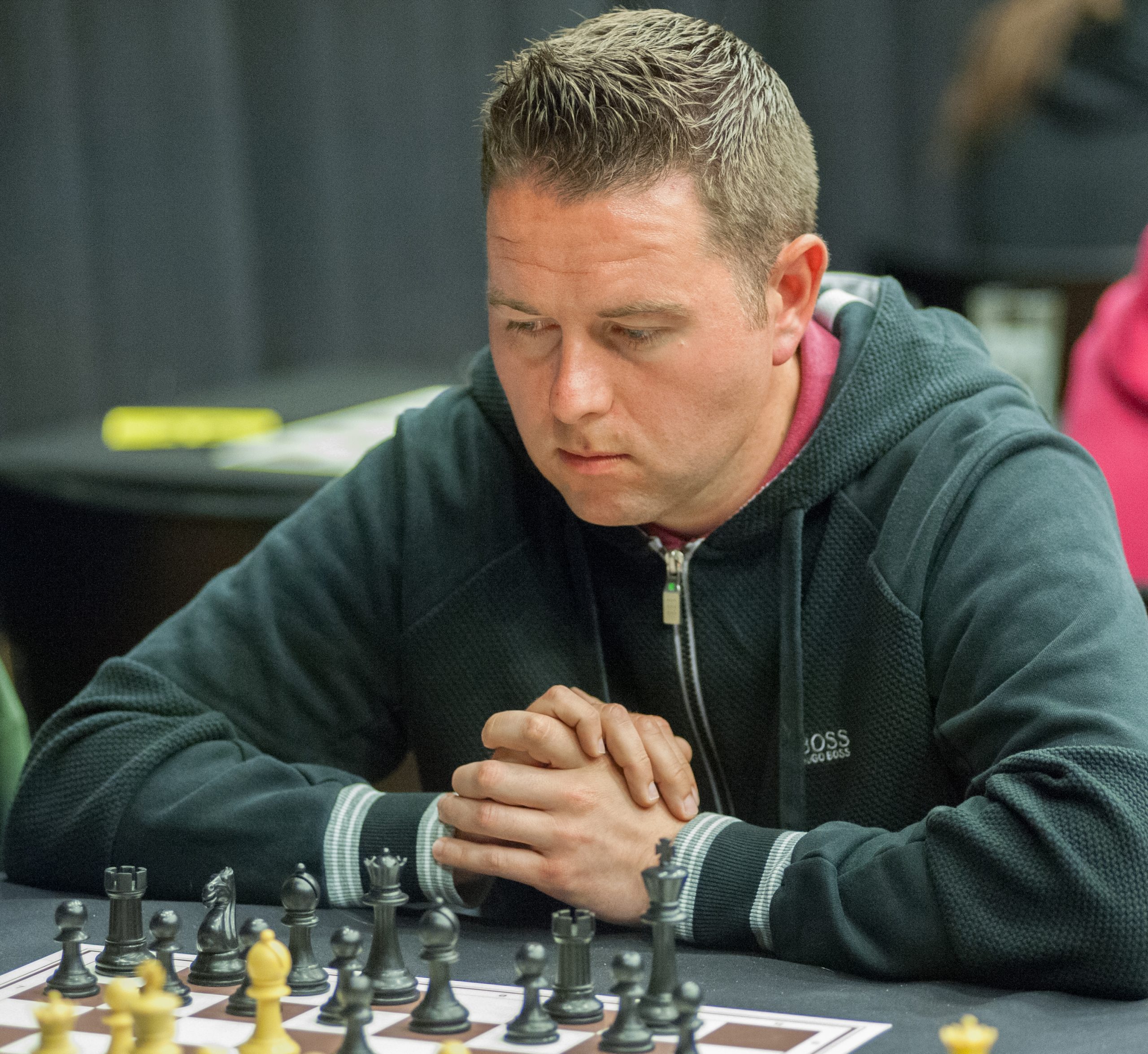
Happy Birthday IM Craig Alexander Hanley (23-iii-1984)

Craig was born in Pontefract in West Yorkshire.

He became a Candidate Master in 2001, a FIDE Master in 2002 and an IM in 2007. His peak rating was 2447 in April 2007.

Craig plays for Spirit of Atticus in 4NCL (Four Nations Chess League) and has a current ECF standard play grading of 242.

Here is his FIDE player card

IM Craig Hanley
IM Craig Hanley

Happy Birthday IM Peter Roberson (22-iii-1989)

Birthday of IM Peter Thomas Roberson (22-iii-1989)

IM Peter Roberson
IM Peter Roberson

Peter is IM Squirlolz on chess.com

IM Peter Roberson
IM Peter Roberson

Peter’s games from chessgames.com

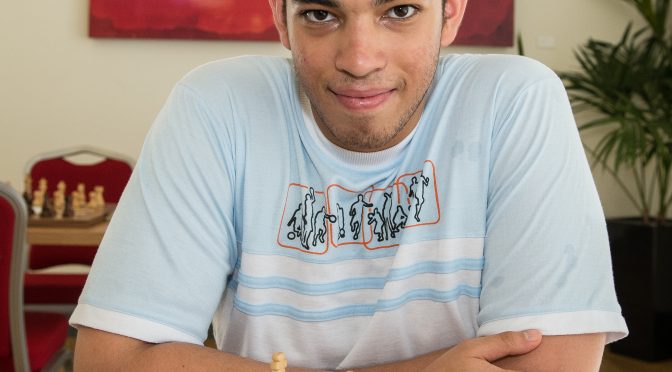
Birthday of GM Daniel Fernandez (05-iii-1995)

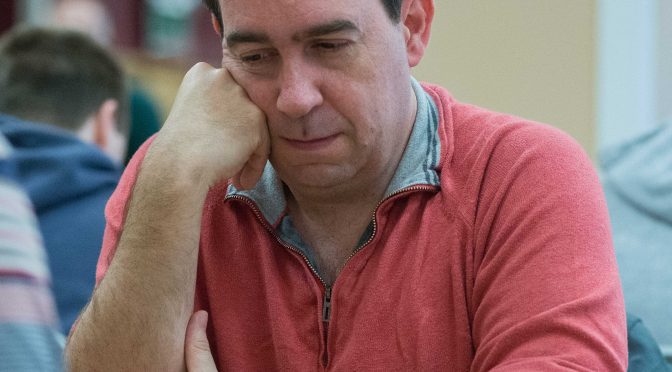
BCN wishes Happy Birthday to GM Daniel Fernandez who at 26 is currently England’s youngest Grandmaster. The previous GM title holder was Jonathan Hawkins in 2014 making two in seven years.

Daniel Howard Fernandez was born in Stockport, Manchester on Sunday, March 5th 1995.  “Think Twice” by Celine Dion was top of the UK hit parade.

Daniel started playing chess at the age of seven (after his father taught him the rules) and at this time attended King’s School, Harpenden.  His first chess club was Little Heath which became the ECF Small Club of the Year in 2015. They play in the Potter’s Bar area and include IM John Pigott in their membership.
At Little Heath Chess Club Daniel was coached by Mark Uniacke (who worked extensively on the early chess engine HIARCS).

Daniel went up to Queen’s College, Cambridge to read mathematics and left to become a Data Analyst at Mu Sigma Inc. He can speak several languages (including Serbian!) and works as a translator when opportunities arise.

He currently lives in Australia offering coaching and writing chess books (for Thinkers Publishing) and columns for Chessbase. In his spare time (!) Daniel is studying for The Master of Complex Systems degree at The University of Sydney.

Daniel’s first ECF graded game was rapidplay on July 5th 2003 in the SCCU Junior Under-14 Final.

His first standard play game was in August 2003 at the Edinburgh based British Under-8 Championship.

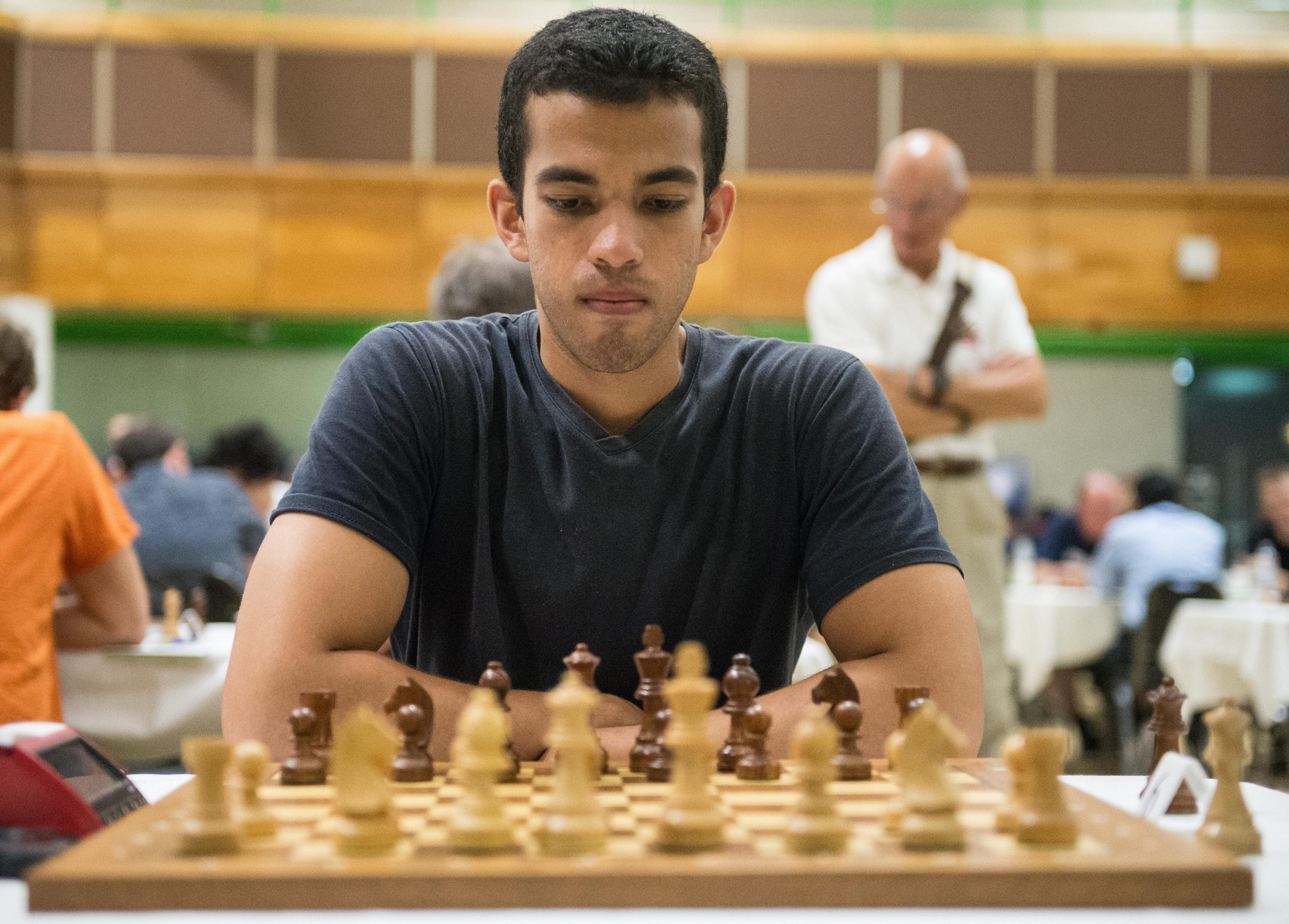
Daniel Fernandez
Daniel Fernandez

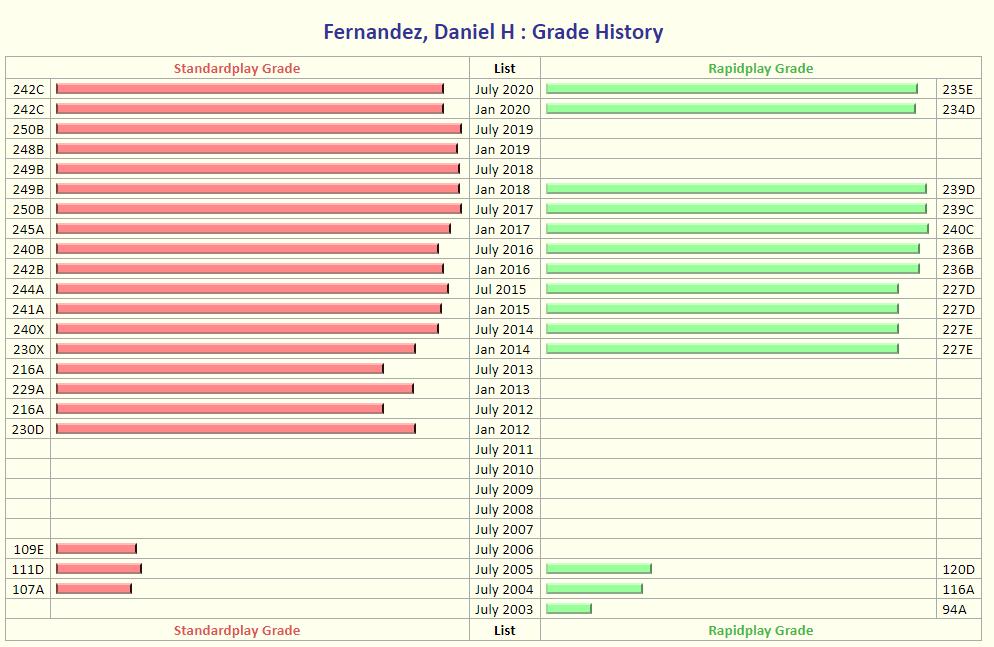
Daniels ECF grading profile demonstrated rapid improvement :

ECF grading profile for Daniel Fernandez

On August 13th 2004 in Scarborough Daniel became British Under-9 Champion sharing the title with Daniel Hunt & Saravanan Sathyanandha.

The Fernandez family relocated to Singapore in August, Daniel attending the Anglo-Chinese School in Singapore. He was swiftly recruited into the Singapore Chess Federation’s (SCF) National Junior Squad. Also in that squad were Danielle Ho and Howard Chiu (remember this for later!).

Barely three weeks after his Scarborough triumph on September 4th 2004 Daniel played his first FIDE rated game in the 5th Asian Under-10 Championship organised by the ASEAN Chess Confederation. His performance in this event was rewarded with a FIDE Master title in 2005. Because he was no longer active in English events the ECF had the unusual scenario of having a ten year old FIDE Master with a published grade of ~120!

In typically modest fashion Daniel confesses  that he did not “deserve” the FM title at this time and that it was the consequence of the strong position of the ASEAN and SCF organisations  within world chess. At the same event Wesley So gained his FM title in the Under-12 section.

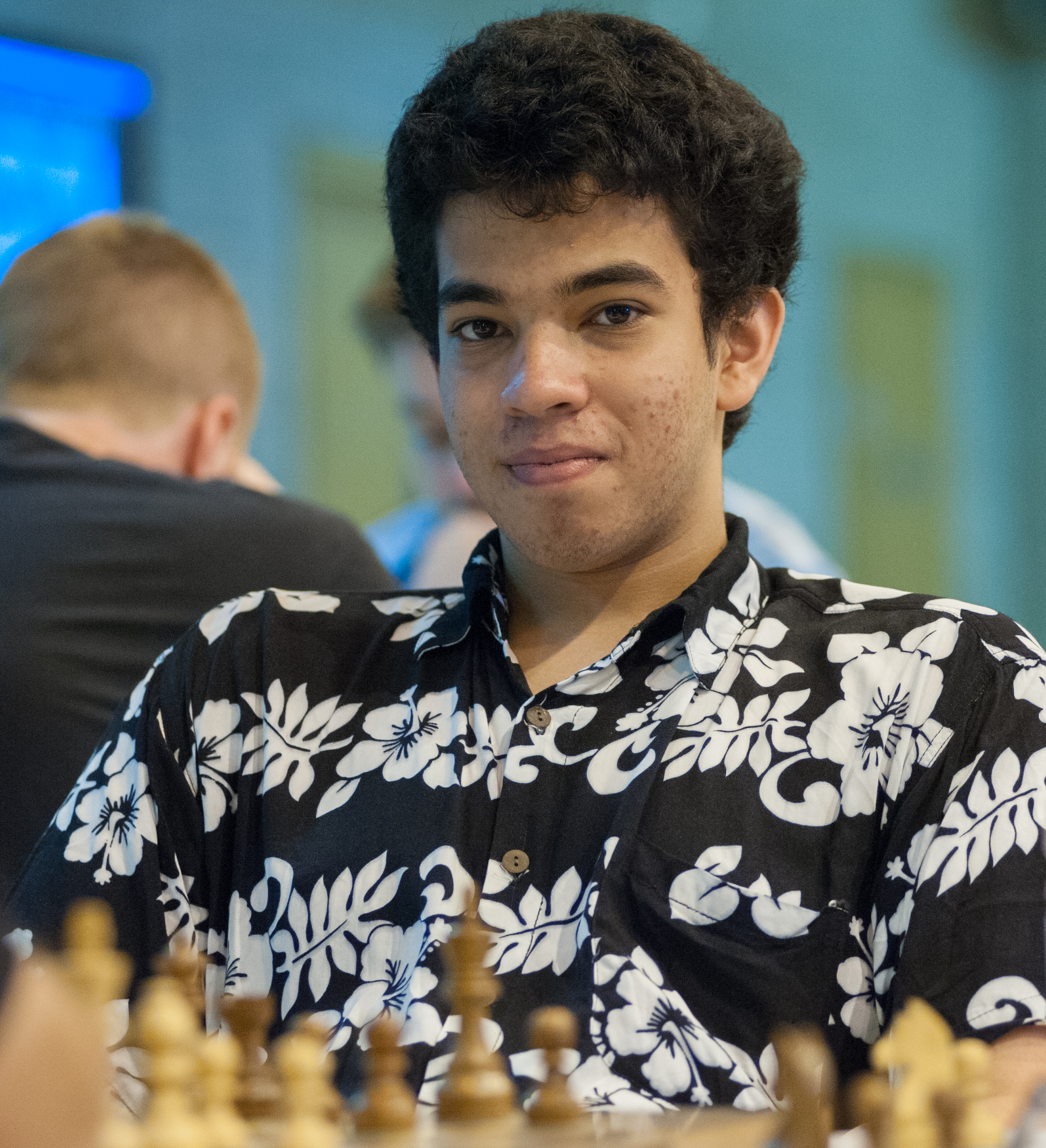
FM Daniel Fernandez
FM Daniel Fernandez

Another interesting consequence of the relocation was that when Daniel returned to England in 2012 his last published grading went from ~ 120 to ~230!

One of the motivations of  returning to England was to obtain the necessary entrance requirement to study mathematics at Cambridge. This he did by studying for A-levels at Manchester Grammar School.

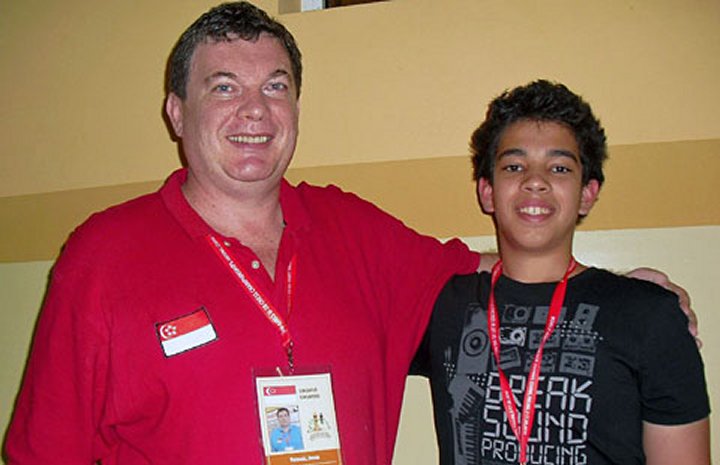
Daniel with IM Jovan Petronic during the 2010 world juniors in Chotowa, Poland | Photo: Diana Mihajlova

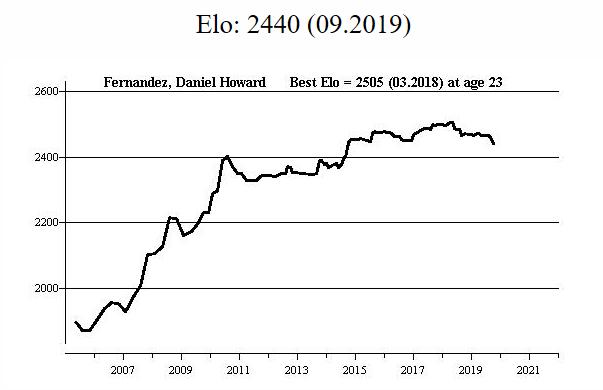
Consequently Daniel’s FIDE rating profile also showed a fast pace of development:

FIDE rating profile for Daniel Fernandez

Sydney 2009 and Sydney 2010 both provided IM norms with the third one coming from Kuala Lumpar 2010 and with these Daniel became an International Master in 2010 the title being confirmed at the 3rd quarter Presidential Board Meeting 2010, 24-25 July 2010, Tromso in Norway.

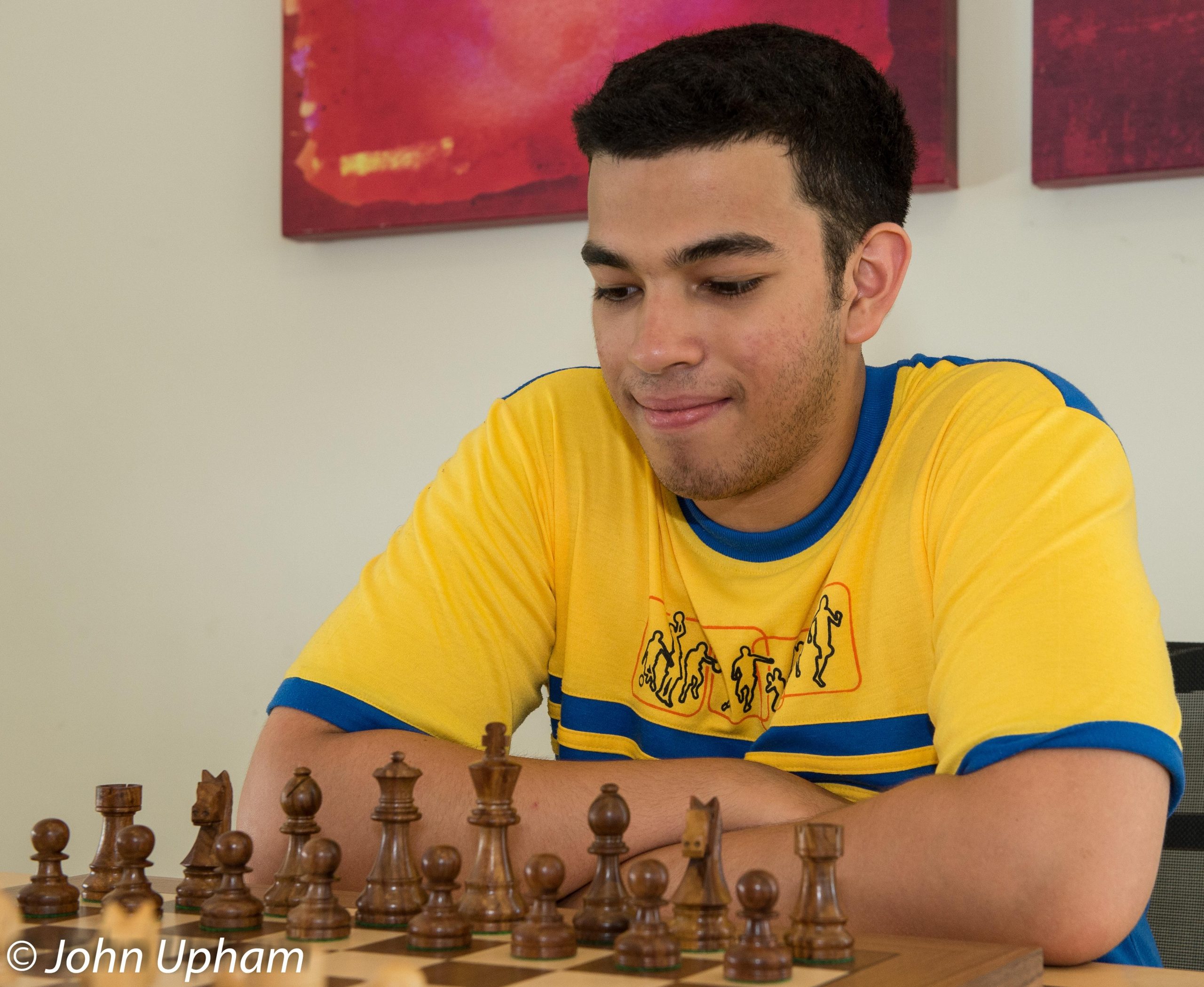
IM Daniel Fernandez, 100th British Championships, Round 5, Torquay. Courtesy of John Upham Photography

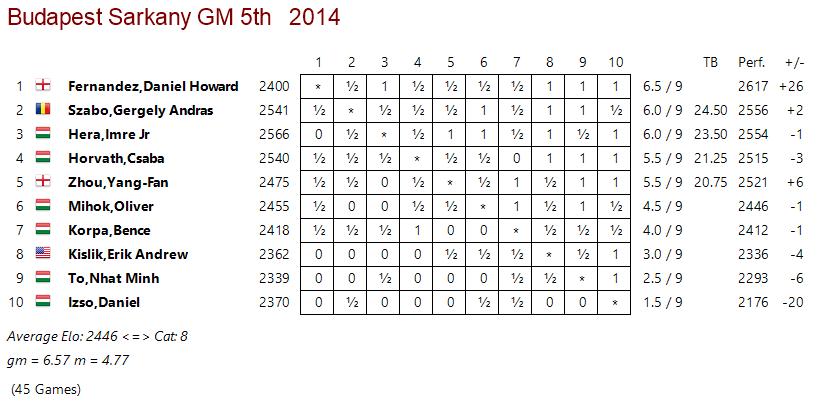
He won the Budapest Sarkany Tournament in 2014 as follows:

Full Crosstable from Budapest Sarkany Tournament, 2014.

earning his first GM norm in the process.

IM Daniel Fernandez, 101st British Championships, Aberystwyth. Courtesy of John Upham Photography

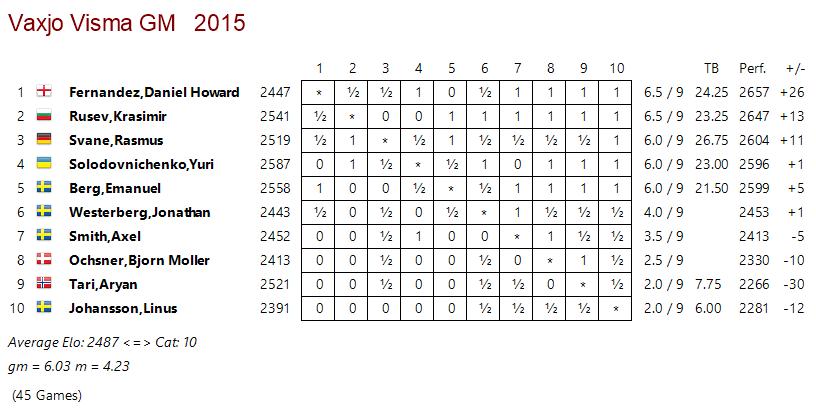
BCN asked Daniel for three of his favourite games. The first one is this Polish Defence game from 2015 played at the Visma Arena in Vaxjo, Sweden. First we have the crosstable showing that Daniel earnt his second GM norm from this event.

Full Crosstable for Vaxjo, Visma tournament in Sweden, 2015.

and here is the game:

and during the 2015/15 4NCL season Daniel obtained his final GM norm playing for Wood Green.

In March 2015 he made his first of three Varsity match appearences for Cambridge re-uniting with Danielle Ho and Howard Chiu (remember those names from earlier?).

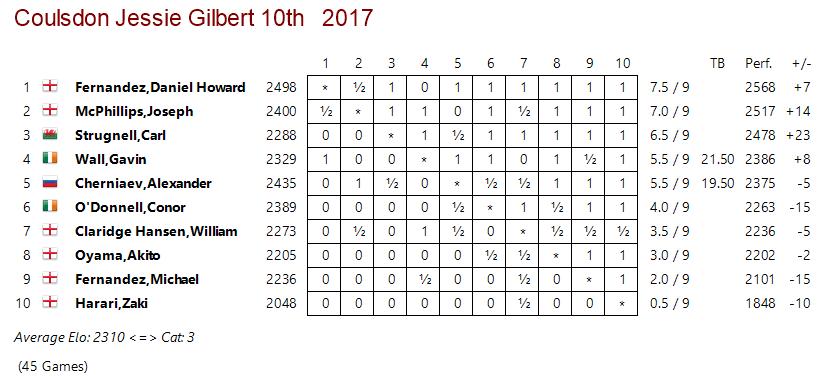
Daniel won the 10th Jessie Gilbert Memorial in 2017:

Full Crosstable from the 2017 10th Jessie Gilbert Memorial

and also in 2017 Daniel was awarded the Grandmaster title at the 88th FIDE Congress 2017, 7-15 October, Goynuk, Antalya, Turkey.

On March 11th Daniel represented Cambridge in the 135th Varsity Match at the RAC Club in Pall Mall.  According to chess24.com ‘IM Daniel Fernandez, playing board 2 for Cambridge, was awarded the Brilliancy Prize by GM Ray Keene in consultation with McShane and Speelman, for his “high-class swindle” after recovering from a bad blunder.’ See here for details.

GM Daniel Fernandez, 2019 British Championships, Torquay. Courtesy of John Upham Photography

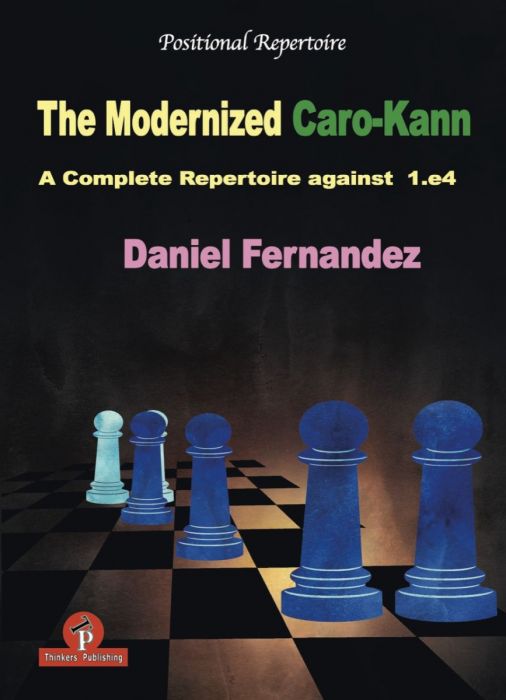
In 2018 Daniel ventured into the world of book writing when Thinker’s Publishing released The Modernized Caro-Kann on September 8th 2018.  This was a repertoire book for Black based around the Smyslov Variation :

and was reviewed in this place favourably and quickly established Daniel as a significant author.

The Modernized Caro-Kann, Daniel Fernandez, Thinkers Publishing, 2018

From the rear cover we have:

“GM Daniel Fernandez (born 1995) has been an active and accomplished player for several years. He represented his native Singapore twice at Olympiads (2010 and 2012) before transferring to the English chess federation. There, he won the national classical titles at U-18 and U-21 levels and worked to become a Grandmaster while simultaneously studying at Cambridge. The Caro-Kann was instrumental in his quest for that title. Currently, Daniel is known in the chess scene not only as a solid player, but also as a mentor figure to younger English players, as a producer of well-received commentary and analysis, and as a multilingual chess coach. This is his first book.”

From January 2019 we have this interesting encounter between Gawain Jones and Daniel from the annual 4NCL meeting of Guildford and Wood Green:

With the White pieces Daniel has played  a wide range of first moves but the majority move by far is 1.e4. His choice versus the Najdorf is some eclectic : sometime ago 6. Rg1 was the favourite and now 6.a4 is preferred.

Against 1…e5 Daniel offers a main line Ruy Lopez.

What does a Caro-Kann expert play against the Caro-Kann? Nowadays the Two Knights Variation is employed!

As the second player he plays the Sicilian Najdorf as well as the Caro-Kann plus an equal mixture of the Grünfeld and King’s Indian Defences.

In 2019 Daniel was interviewed by Edwin Lam on behalf of ChessBase : fascinating reading!

In the same year Daniel joined IM Adam Taylor’s venture Making Grandmasters.

Our final games is from July 2019 :

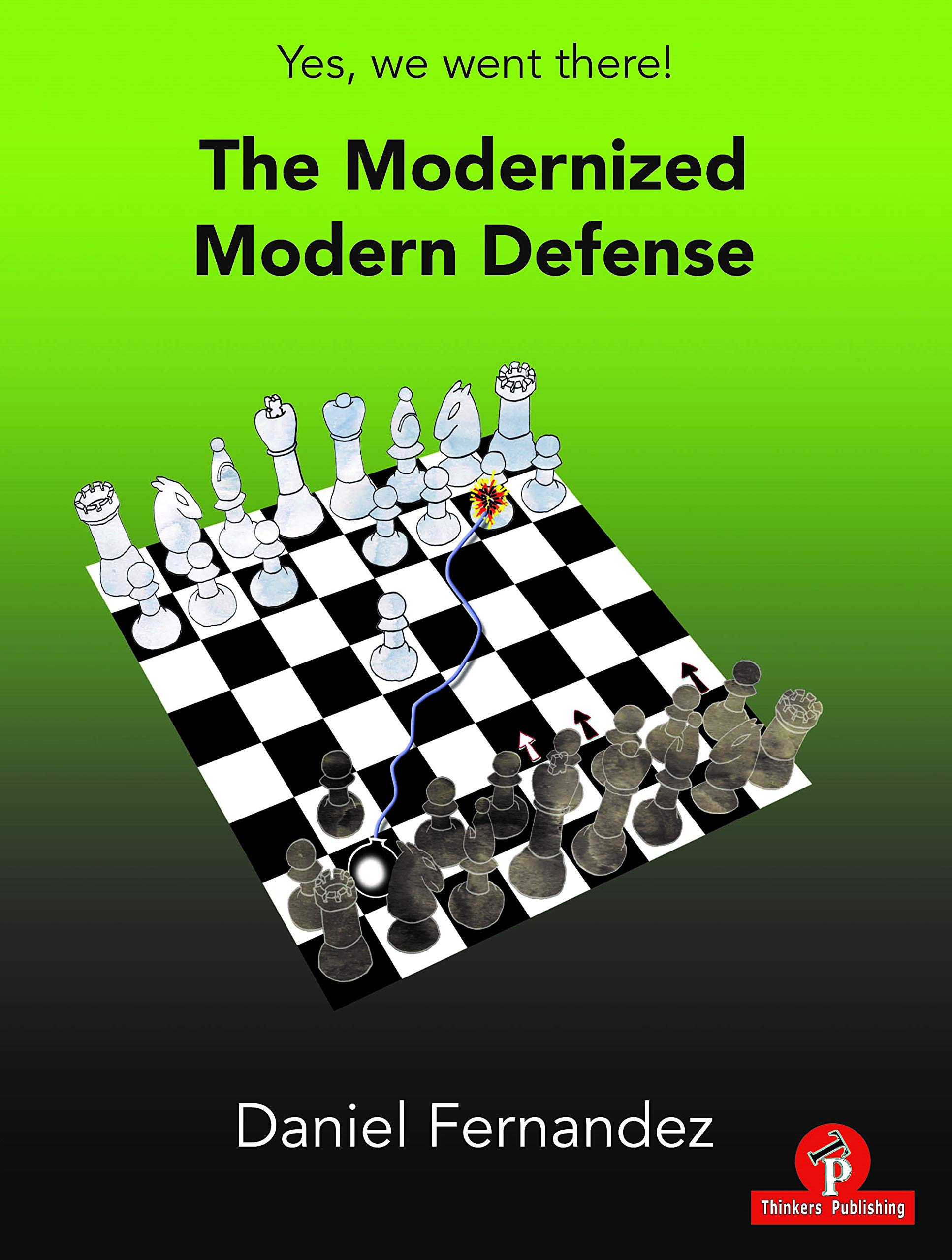
Daniel’s most recent publication is The Modernized Modern Defence from Thinker’s Publishing:

The Modernized Modern Defence, Daniel Fernandez, Thinker's Publishing, 2021
The Modernized Modern Defence, Daniel Fernandez, Thinker’s Publishing, 2021

and BCN has been told that Daniel has a book in the pipeline about the Tata Steel 2021 tournament at Wijk aan Zee.

Birthday of GM Daniel Fernandez (05-iii-1995)

BCN wishes Happy Birthday to GM Daniel Fernandez who at 26 is currently England’s youngest Grandmaster. The previous GM title holder was Jonathan Hawkins in 2014 making two in seven years.

Daniel Howard Fernandez was born in Stockport, Manchester on Sunday, March 5th 1995.  “Think Twice” by Celine Dion was top of the UK hit parade.

Daniel started playing chess at the age of seven (after his father taught him the rules) and at this time attended King’s School, Harpenden.  His first chess club was Little Heath which became the ECF Small Club of the Year in 2015. They play in the Potter’s Bar area and include IM John Pigott in their membership.

At Little Heath Chess Club Daniel was coached by Mark Uniacke (who worked extensively on the early chess engine HIARCS).

Daniel went up to Queen’s College, Cambridge to read mathematics and left to become a Data Analyst at Mu Sigma Inc. He can speak several languages (including Serbian!) and works as a translator when opportunities arise.

He currently lives in Australia offering coaching and writing chess books (for Thinkers Publishing) and columns for Chessbase. In his spare time (!) Daniel is studying for The Master of Complex Systems degree at The University of Sydney.

Daniel’s first ECF graded game was rapidplay on July 5th 2003 in the SCCU Junior Under-14 Final.

His first standard play game was in August 2003 at the Edinburgh based British Under-8 Championship.

Daniel Fernandez
Daniel Fernandez

Daniels ECF grading profile demonstrated rapid improvement :

ECF grading profile for Daniel Fernandez

On August 13th 2004 in Scarborough Daniel became British Under-9 Champion sharing the title with Daniel Hunt & Saravanan Sathyanandha.

The Fernandez family relocated to Singapore in August, Daniel attending the Anglo-Chinese School in Singapore. He was swiftly recruited into the Singapore Chess Federation’s (SCF) National Junior Squad. Also in that squad were Danielle Ho and Howard Chiu (remember this for later!).

Barely three weeks after his Scarborough triumph on September 4th 2004 Daniel played his first FIDE rated game in the 5th Asian Under-10 Championship organised by the ASEAN Chess Confederation. His performance in this event was rewarded with a FIDE Master title in 2005. Because he was no longer active in English events the ECF had the unusual scenario of having a ten year old FIDE Master with a published grade of ~120!

In typically modest fashion Daniel confesses  that he did not “deserve” the FM title at this time and that it was the consequence of the strong position of the ASEAN and SCF organisations  within world chess. At the same event Wesley So gained his FM title in the Under-12 section.

FM Daniel Fernandez
FM Daniel Fernandez

Another interesting consequence of the relocation was that when Daniel returned to England in 2012 his last published grading went from ~ 120 to ~230!

One of the motivations of  returning to England was to obtain the necessary entrance requirement to study mathematics at Cambridge. This he did by studying for A-levels at Manchester Grammar School.

Daniel with IM Jovan Petronic during the 2010 world juniors in Chotowa, Poland | Photo: Diana Mihajlova

Consequently Daniel’s FIDE rating profile also showed a fast pace of development:

FIDE rating profile for Daniel Fernandez

Sydney 2009 and Sydney 2010 both provided IM norms with the third one coming from Kuala Lumpar 2010 and with these Daniel became an International Master in 2010 the title being confirmed at the 3rd quarter Presidential Board Meeting 2010, 24-25 July 2010, Tromso in Norway.

IM Daniel Fernandez, 100th British Championships, Round 5, Torquay. Courtesy of John Upham Photography

He won the Budapest Sarkany Tournament in 2014 as follows:

Full Crosstable from Budapest Sarkany Tournament, 2014.

earning his first GM norm in the process.

IM Daniel Fernandez, 101st British Championships, Aberystwyth. Courtesy of John Upham Photography

BCN asked Daniel for three of his favourite games. The first one is this Polish Defence game from 2015 played at the Visma Arena in Vaxjo, Sweden. First we have the crosstable showing that Daniel earnt his second GM norm from this event.

Full Crosstable for Vaxjo, Visma tournament in Sweden, 2015.

and here is the game:

and during the 2015/15 4NCL season Daniel obtained his final GM norm playing for Wood Green.

In March 2015 he made his first of three Varsity match appearences for Cambridge re-uniting with Danielle Ho and Howard Chiu (remember those names from earlier?).

Daniel won the 10th Jessie Gilbert Memorial in 2017:

Full Crosstable from the 2017 10th Jessie Gilbert Memorial

and also in 2017 Daniel was awarded the Grandmaster title at the 88th FIDE Congress 2017, 7-15 October, Goynuk, Antalya, Turkey.

On March 11th Daniel represented Cambridge in the 135th Varsity Match at the RAC Club in Pall Mall.  According to chess24.com ‘IM Daniel Fernandez, playing board 2 for Cambridge, was awarded the Brilliancy Prize by GM Ray Keene in consultation with McShane and Speelman, for his “high-class swindle” after recovering from a bad blunder.’ See here for details.

GM Daniel Fernandez, 2019 British Championships, Torquay. Courtesy of John Upham Photography

In 2018 Daniel ventured into the world of book writing when Thinker’s Publishing released The Modernized Caro-Kann on September 8th 2018.  This was a repertoire book for Black based around the Smyslov Variation :

and was reviewed in this place favourably and quickly established Daniel as a significant author.

The Modernized Caro-Kann, Daniel Fernandez, Thinkers Publishing, 2018

From the rear cover we have:

“GM Daniel Fernandez (born 1995) has been an active and accomplished player for several years. He represented his native Singapore twice at Olympiads (2010 and 2012) before transferring to the English chess federation. There, he won the national classical titles at U-18 and U-21 levels and worked to become a Grandmaster while simultaneously studying at Cambridge. The Caro-Kann was instrumental in his quest for that title. Currently, Daniel is known in the chess scene not only as a solid player, but also as a mentor figure to younger English players, as a producer of well-received commentary and analysis, and as a multilingual chess coach. This is his first book.”

From January 2019 we have this interesting encounter between Gawain Jones and Daniel from the annual 4NCL meeting of Guildford and Wood Green:

With the White pieces Daniel has played  a wide range of first moves but the majority move by far is 1.e4. His choice versus the Najdorf is some eclectic : sometime ago 6. Rg1 was the favourite and now 6.a4 is preferred.

Against 1…e5 Daniel offers a main line Ruy Lopez.

What does a Caro-Kann expert play against the Caro-Kann? Nowadays the Two Knights Variation is employed!

As the second player he plays the Sicilian Najdorf as well as the Caro-Kann plus an equal mixture of the Grünfeld and King’s Indian Defences.

In 2019 Daniel was interviewed by Edwin Lam on behalf of ChessBase : fascinating reading!

In the same year Daniel joined IM Adam Taylor’s venture Making Grandmasters.

Our final games is from July 2019 :

Daniel’s most recent publication is The Modernized Modern Defence from Thinker’s Publishing:

The Modernized Modern Defence, Daniel Fernandez, Thinker's Publishing, 2021
The Modernized Modern Defence, Daniel Fernandez, Thinker’s Publishing, 2021

and BCN has been told that Daniel has a book in the pipeline about the Tata Steel 2021 tournament at Wijk aan Zee.

Birthday of GM Daniel Fernandez (05-iii-1995)

BCN wishes Happy Birthday to GM Daniel Fernandez who at 26 is currently England’s youngest Grandmaster. The previous GM title holder was Jonathan Hawkins in 2014 making two in seven years.

Daniel Howard Fernandez was born in Stockport, Manchester on Sunday, March 5th 1995.  “Think Twice” by Celine Dion was top of the UK hit parade.

Daniel started playing chess at the age of seven (after his father taught him the rules) and at this time attended King’s School, Harpenden.  His first chess club was Little Heath which became the ECF Small Club of the Year in 2015. They play in the Potter’s Bar area and include IM John Pigott in their membership.

At Little Heath Chess Club Daniel was coached by Mark Uniacke (who worked extensively on the early chess engine HIARCS).

Daniel went up to Queen’s College, Cambridge to read mathematics and left to become a Data Analyst at Mu Sigma Inc. He can speak several languages (including Serbian!) and works as a translator when opportunities arise.

He currently lives in Australia offering coaching and writing chess books (for Thinkers Publishing) and columns for Chessbase. In his spare time (!) Daniel is studying for The Master of Complex Systems degree at The University of Sydney.

Daniel’s first ECF graded game was rapidplay on July 5th 2003 in the SCCU Junior Under-14 Final.

His first standard play game was in August 2003 at the Edinburgh based British Under-8 Championship.

Daniel Fernandez
Daniel Fernandez

Daniels ECF grading profile demonstrated rapid improvement :

ECF grading profile for Daniel Fernandez

On August 13th 2004 in Scarborough Daniel became British Under-9 Champion sharing the title with Daniel Hunt & Saravanan Sathyanandha.

The Fernandez family relocated to Singapore in August, Daniel attending the Anglo-Chinese School in Singapore. He was swiftly recruited into the Singapore Chess Federation’s (SCF) National Junior Squad. Also in that squad were Danielle Ho and Howard Chiu (remember this for later!).

Barely three weeks after his Scarborough triumph on September 4th 2004 Daniel played his first FIDE rated game in the 5th Asian Under-10 Championship organised by the ASEAN Chess Confederation. His performance in this event was rewarded with a FIDE Master title in 2005. Because he was no longer active in English events the ECF had the unusual scenario of having a ten year old FIDE Master with a published grade of ~120!

In typically modest fashion Daniel confesses  that he did not “deserve” the FM title at this time and that it was the consequence of the strong position of the ASEAN and SCF organisations  within world chess. At the same event Wesley So gained his FM title in the Under-12 section.

FM Daniel Fernandez
FM Daniel Fernandez

Another interesting consequence of the relocation was that when Daniel returned to England in 2012 his last published grading went from ~ 120 to ~230!

One of the motivations of  returning to England was to obtain the necessary entrance requirement to study mathematics at Cambridge. This he did by studying for A-levels at Manchester Grammar School.

Daniel with IM Jovan Petronic during the 2010 world juniors in Chotowa, Poland | Photo: Diana Mihajlova

Consequently Daniel’s FIDE rating profile also showed a fast pace of development:

FIDE rating profile for Daniel Fernandez

Sydney 2009 and Sydney 2010 both provided IM norms with the third one coming from Kuala Lumpar 2010 and with these Daniel became an International Master in 2010 the title being confirmed at the 3rd quarter Presidential Board Meeting 2010, 24-25 July 2010, Tromso in Norway.

IM Daniel Fernandez, 100th British Championships, Round 5, Torquay. Courtesy of John Upham Photography

He won the Budapest Sarkany Tournament in 2014 as follows:

Full Crosstable from Budapest Sarkany Tournament, 2014.

earning his first GM norm in the process.

IM Daniel Fernandez, 101st British Championships, Aberystwyth. Courtesy of John Upham Photography

BCN asked Daniel for three of his favourite games. The first one is this Polish Defence game from 2015 played at the Visma Arena in Vaxjo, Sweden. First we have the crosstable showing that Daniel earnt his second GM norm from this event.

Full Crosstable for Vaxjo, Visma tournament in Sweden, 2015.

and here is the game:

and during the 2015/15 4NCL season Daniel obtained his final GM norm playing for Wood Green.

In March 2015 he made his first of three Varsity match appearences for Cambridge re-uniting with Danielle Ho and Howard Chiu (remember those names from earlier?).

Daniel won the 10th Jessie Gilbert Memorial in 2017:

Full Crosstable from the 2017 10th Jessie Gilbert Memorial

and also in 2017 Daniel was awarded the Grandmaster title at the 88th FIDE Congress 2017, 7-15 October, Goynuk, Antalya, Turkey.

On March 11th Daniel represented Cambridge in the 135th Varsity Match at the RAC Club in Pall Mall.  According to chess24.com ‘IM Daniel Fernandez, playing board 2 for Cambridge, was awarded the Brilliancy Prize by GM Ray Keene in consultation with McShane and Speelman, for his “high-class swindle” after recovering from a bad blunder.’ See here for details.

GM Daniel Fernandez, 2019 British Championships, Torquay. Courtesy of John Upham Photography

In 2018 Daniel ventured into the world of book writing when Thinker’s Publishing released The Modernized Caro-Kann on September 8th 2018.  This was a repertoire book for Black based around the Smyslov Variation :

and was reviewed in this place favourably and quickly established Daniel as a significant author.

The Modernized Caro-Kann, Daniel Fernandez, Thinkers Publishing, 2018

From the rear cover we have:

“GM Daniel Fernandez (born 1995) has been an active and accomplished player for several years. He represented his native Singapore twice at Olympiads (2010 and 2012) before transferring to the English chess federation. There, he won the national classical titles at U-18 and U-21 levels and worked to become a Grandmaster while simultaneously studying at Cambridge. The Caro-Kann was instrumental in his quest for that title. Currently, Daniel is known in the chess scene not only as a solid player, but also as a mentor figure to younger English players, as a producer of well-received commentary and analysis, and as a multilingual chess coach. This is his first book.”

From January 2019 we have this interesting encounter between Gawain Jones and Daniel from the annual 4NCL meeting of Guildford and Wood Green:

With the White pieces Daniel has played  a wide range of first moves but the majority move by far is 1.e4. His choice versus the Najdorf is some eclectic : sometime ago 6. Rg1 was the favourite and now 6.a4 is preferred.

Against 1…e5 Daniel offers a main line Ruy Lopez.

What does a Caro-Kann expert play against the Caro-Kann? Nowadays the Two Knights Variation is employed!

As the second player he plays the Sicilian Najdorf as well as the Caro-Kann plus an equal mixture of the Grünfeld and King’s Indian Defences.

In 2019 Daniel was interviewed by Edwin Lam on behalf of ChessBase : fascinating reading!

In the same year Daniel joined IM Adam Taylor’s venture Making Grandmasters.

Our final games is from July 2019 :

Daniel’s most recent publication is The Modernized Modern Defence from Thinker’s Publishing:

The Modernized Modern Defence, Daniel Fernandez, Thinker's Publishing, 2021
The Modernized Modern Defence, Daniel Fernandez, Thinker’s Publishing, 2021

and BCN has been told that Daniel has a book in the pipeline about the Tata Steel 2021 tournament at Wijk aan Zee.

Birthday of GM Daniel Fernandez (05-iii-1995)

BCN wishes Happy Birthday to GM Daniel Fernandez who at 26 is currently England’s youngest Grandmaster. The previous GM title holder was Jonathan Hawkins in 2014 making two in seven years.

Daniel Howard Fernandez was born in Stockport, Manchester on Sunday, March 5th 1995.  “Think Twice” by Celine Dion was top of the UK hit parade.

Daniel started playing chess at the age of seven (after his father taught him the rules) and at this time attended King’s School, Harpenden.  His first chess club was Little Heath which became the ECF Small Club of the Year in 2015. They play in the Potter’s Bar area and include IM John Pigott in their membership.

At Little Heath Chess Club Daniel was coached by Mark Uniacke (who worked extensively on the early chess engine HIARCS).

Daniel went up to Queen’s College, Cambridge to read mathematics and left to become a Data Analyst at Mu Sigma Inc. He can speak several languages (including Serbian!) and works as a translator when opportunities arise.

He currently lives in Australia offering coaching and writing chess books (for Thinkers Publishing) and columns for Chessbase. In his spare time (!) Daniel is studying for The Master of Complex Systems degree at The University of Sydney.

Daniel’s first ECF graded game was rapidplay on July 5th 2003 in the SCCU Junior Under-14 Final.

His first standard play game was in August 2003 at the Edinburgh based British Under-8 Championship.

Daniel Fernandez
Daniel Fernandez

Daniels ECF grading profile demonstrated rapid improvement :

ECF grading profile for Daniel Fernandez

On August 13th 2004 in Scarborough Daniel became British Under-9 Champion sharing the title with Daniel Hunt & Saravanan Sathyanandha.

The Fernandez family relocated to Singapore in August, Daniel attending the Anglo-Chinese School in Singapore. He was swiftly recruited into the Singapore Chess Federation’s (SCF) National Junior Squad. Also in that squad were Danielle Ho and Howard Chiu (remember this for later!).

Barely three weeks after his Scarborough triumph on September 4th 2004 Daniel played his first FIDE rated game in the 5th Asian Under-10 Championship organised by the ASEAN Chess Confederation. His performance in this event was rewarded with a FIDE Master title in 2005. Because he was no longer active in English events the ECF had the unusual scenario of having a ten year old FIDE Master with a published grade of ~120!

In typically modest fashion Daniel confesses  that he did not “deserve” the FM title at this time and that it was the consequence of the strong position of the ASEAN and SCF organisations  within world chess. At the same event Wesley So gained his FM title in the Under-12 section.

FM Daniel Fernandez
FM Daniel Fernandez

Another interesting consequence of the relocation was that when Daniel returned to England in 2012 his last published grading went from ~ 120 to ~230!

One of the motivations of  returning to England was to obtain the necessary entrance requirement to study mathematics at Cambridge. This he did by studying for A-levels at Manchester Grammar School.

Daniel with IM Jovan Petronic during the 2010 world juniors in Chotowa, Poland | Photo: Diana Mihajlova

Consequently Daniel’s FIDE rating profile also showed a fast pace of development:

FIDE rating profile for Daniel Fernandez

Sydney 2009 and Sydney 2010 both provided IM norms with the third one coming from Kuala Lumpar 2010 and with these Daniel became an International Master in 2010 the title being confirmed at the 3rd quarter Presidential Board Meeting 2010, 24-25 July 2010, Tromso in Norway.

IM Daniel Fernandez, 100th British Championships, Round 5, Torquay. Courtesy of John Upham Photography

He won the Budapest Sarkany Tournament in 2014 as follows:

Full Crosstable from Budapest Sarkany Tournament, 2014.

earning his first GM norm in the process.

IM Daniel Fernandez, 101st British Championships, Aberystwyth. Courtesy of John Upham Photography

BCN asked Daniel for three of his favourite games. The first one is this Polish Defence game from 2015 played at the Visma Arena in Vaxjo, Sweden. First we have the crosstable showing that Daniel earnt his second GM norm from this event.

Full Crosstable for Vaxjo, Visma tournament in Sweden, 2015.

and here is the game:

and during the 2015/15 4NCL season Daniel obtained his final GM norm playing for Wood Green.

In March 2015 he made his first of three Varsity match appearences for Cambridge re-uniting with Danielle Ho and Howard Chiu (remember those names from earlier?).

Daniel won the 10th Jessie Gilbert Memorial in 2017:

Full Crosstable from the 2017 10th Jessie Gilbert Memorial

and also in 2017 Daniel was awarded the Grandmaster title at the 88th FIDE Congress 2017, 7-15 October, Goynuk, Antalya, Turkey.

On March 11th Daniel represented Cambridge in the 135th Varsity Match at the RAC Club in Pall Mall.  According to chess24.com ‘IM Daniel Fernandez, playing board 2 for Cambridge, was awarded the Brilliancy Prize by GM Ray Keene in consultation with McShane and Speelman, for his “high-class swindle” after recovering from a bad blunder.’ See here for details.

GM Daniel Fernandez, 2019 British Championships, Torquay. Courtesy of John Upham Photography

In 2018 Daniel ventured into the world of book writing when Thinker’s Publishing released The Modernized Caro-Kann on September 8th 2018.  This was a repertoire book for Black based around the Smyslov Variation :

and was reviewed in this place favourably and quickly established Daniel as a significant author.

The Modernized Caro-Kann, Daniel Fernandez, Thinkers Publishing, 2018

From the rear cover we have:

“GM Daniel Fernandez (born 1995) has been an active and accomplished player for several years. He represented his native Singapore twice at Olympiads (2010 and 2012) before transferring to the English chess federation. There, he won the national classical titles at U-18 and U-21 levels and worked to become a Grandmaster while simultaneously studying at Cambridge. The Caro-Kann was instrumental in his quest for that title. Currently, Daniel is known in the chess scene not only as a solid player, but also as a mentor figure to younger English players, as a producer of well-received commentary and analysis, and as a multilingual chess coach. This is his first book.”

From January 2019 we have this interesting encounter between Gawain Jones and Daniel from the annual 4NCL meeting of Guildford and Wood Green:

With the White pieces Daniel has played  a wide range of first moves but the majority move by far is 1.e4. His choice versus the Najdorf is some eclectic : sometime ago 6. Rg1 was the favourite and now 6.a4 is preferred.

Against 1…e5 Daniel offers a main line Ruy Lopez.

What does a Caro-Kann expert play against the Caro-Kann? Nowadays the Two Knights Variation is employed!

As the second player he plays the Sicilian Najdorf as well as the Caro-Kann plus an equal mixture of the Grünfeld and King’s Indian Defences.

In 2019 Daniel was interviewed by Edwin Lam on behalf of ChessBase : fascinating reading!

In the same year Daniel joined IM Adam Taylor’s venture Making Grandmasters.

Our final games is from July 2019 :

Daniel’s most recent publication is The Modernized Modern Defence from Thinker’s Publishing:

The Modernized Modern Defence, Daniel Fernandez, Thinker's Publishing, 2021
The Modernized Modern Defence, Daniel Fernandez, Thinker’s Publishing, 2021

and BCN has been told that Daniel has a book in the pipeline about the Tata Steel 2021 tournament at Wijk aan Zee.

Birthday of GM Chris Ward (26-iii-1968)

Birthday of GM Christopher Geoffrey Ward (26-iii-1968)Here is his Wikipedia entry

GM Chris Ward
GM Chris Ward

From Chessgames.com :

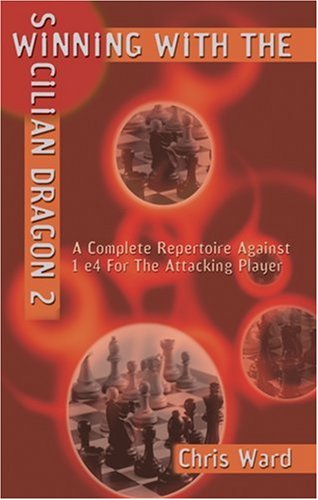
“Grandmaster and British Chess Champion in 1996. He is the author of several chess books, among them Winning With the Sicilian Dragon 2 (2001), Winning with the Dragon (2003) and The Controversial Samisch King’s Indian (2004).”

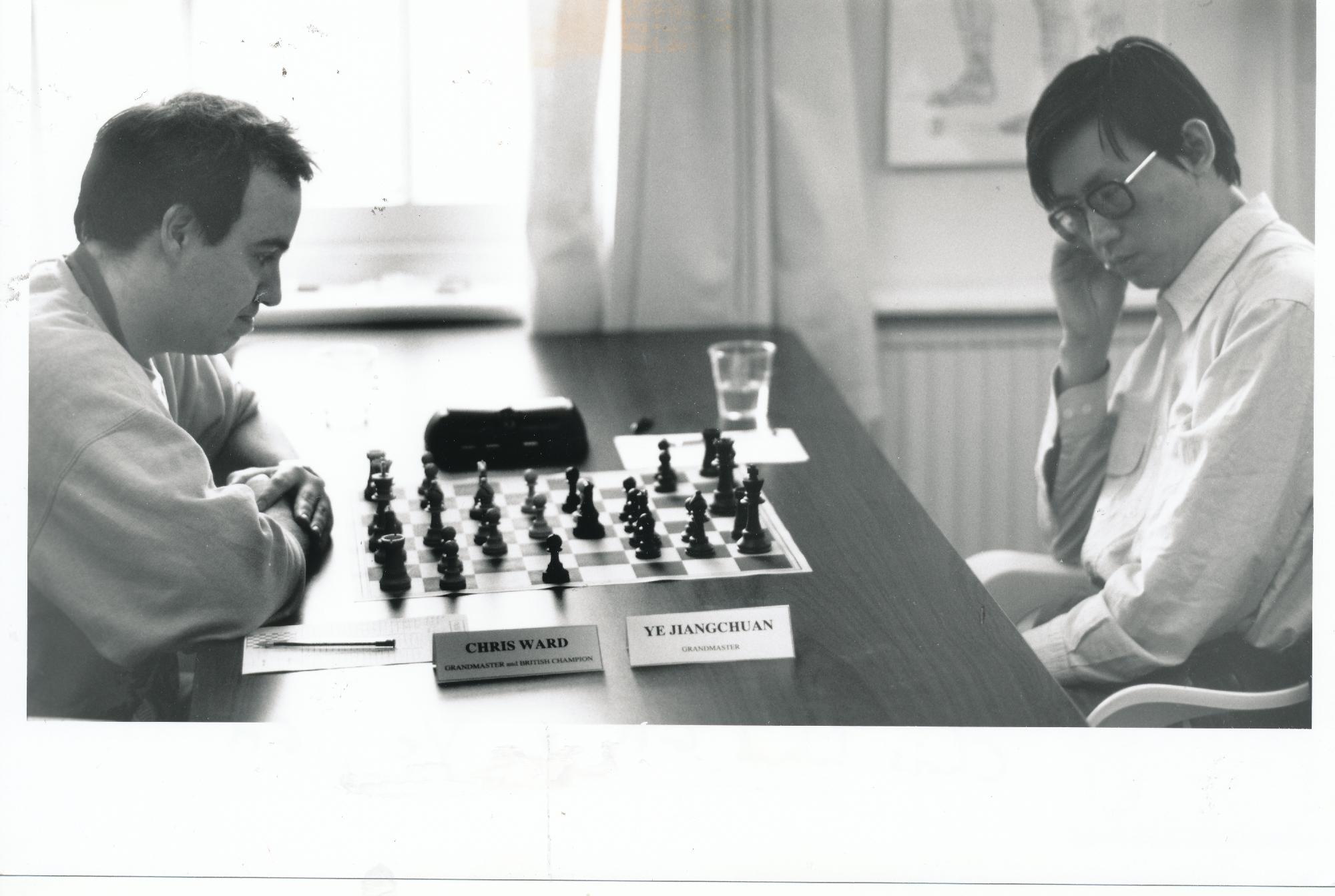
Chris plays Jiang Chuan Ye at the 1997 England - China match
Chris plays Jiang Chuan Ye at the 1997 England – China match

Here are his games

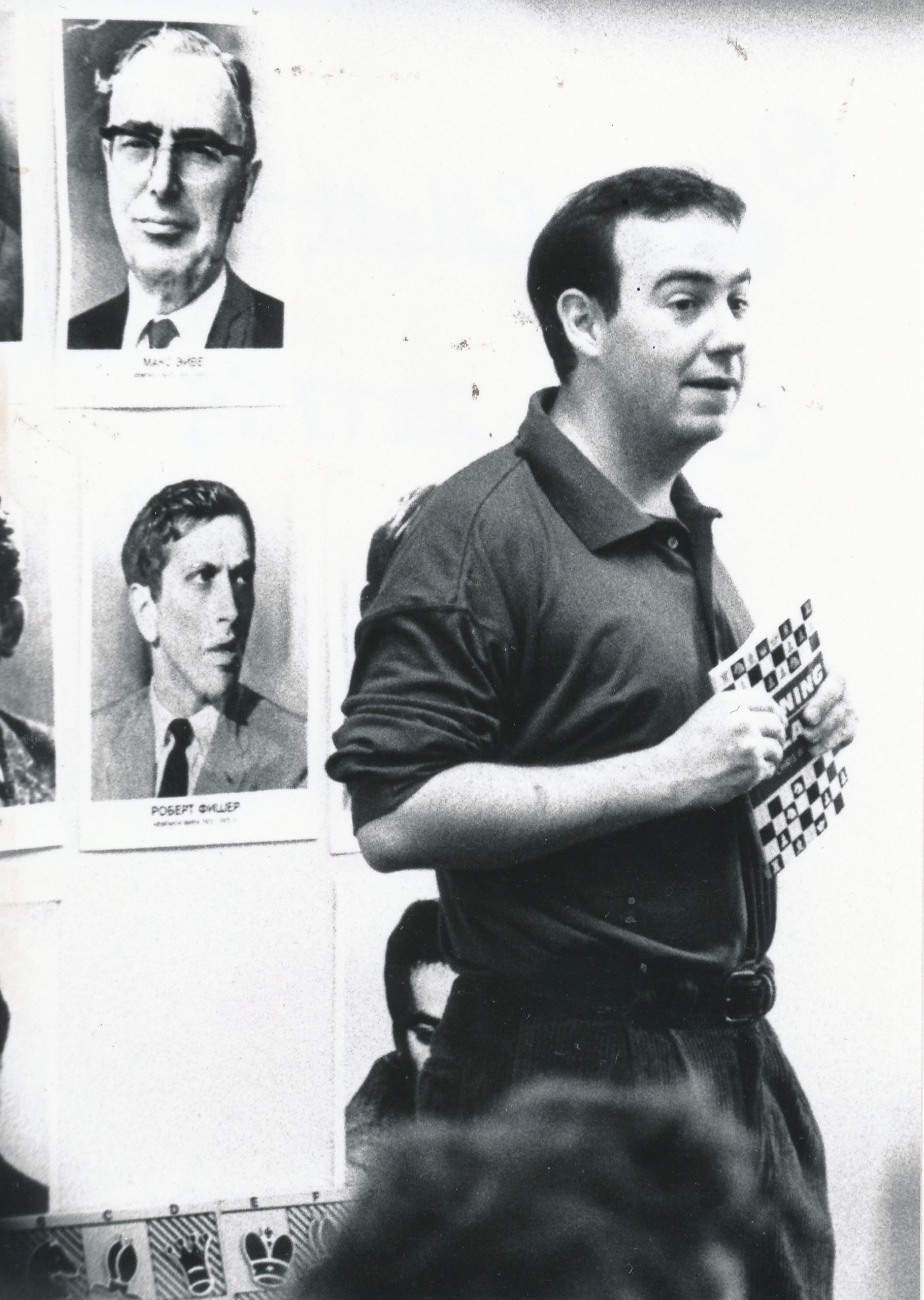
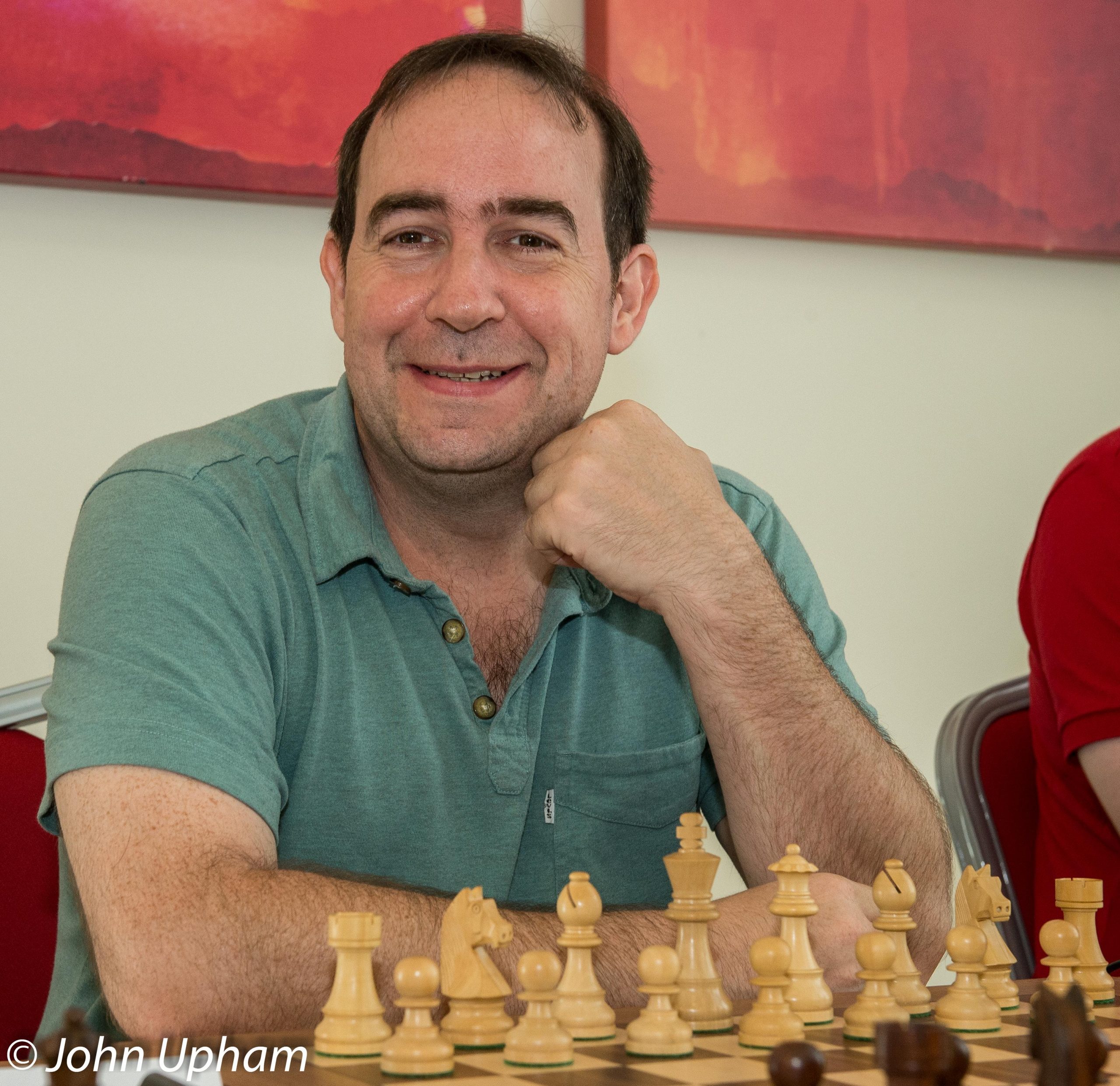
Chris Ward commentating during the Hastings Congress

Chris earned his IM title in 1990 and his GM title in 1996. According to Chessbase and Felice his peak rating was 2531 in July 2003 when he was 35.

Chris is President of the English Primary Schools Chess Association (EPSCA), Chris is the Chief Coach of the Kent Junior Chess Association (KJCA). Chris plays for KJCA Kings in the Four Nations Chess League (4NCL).

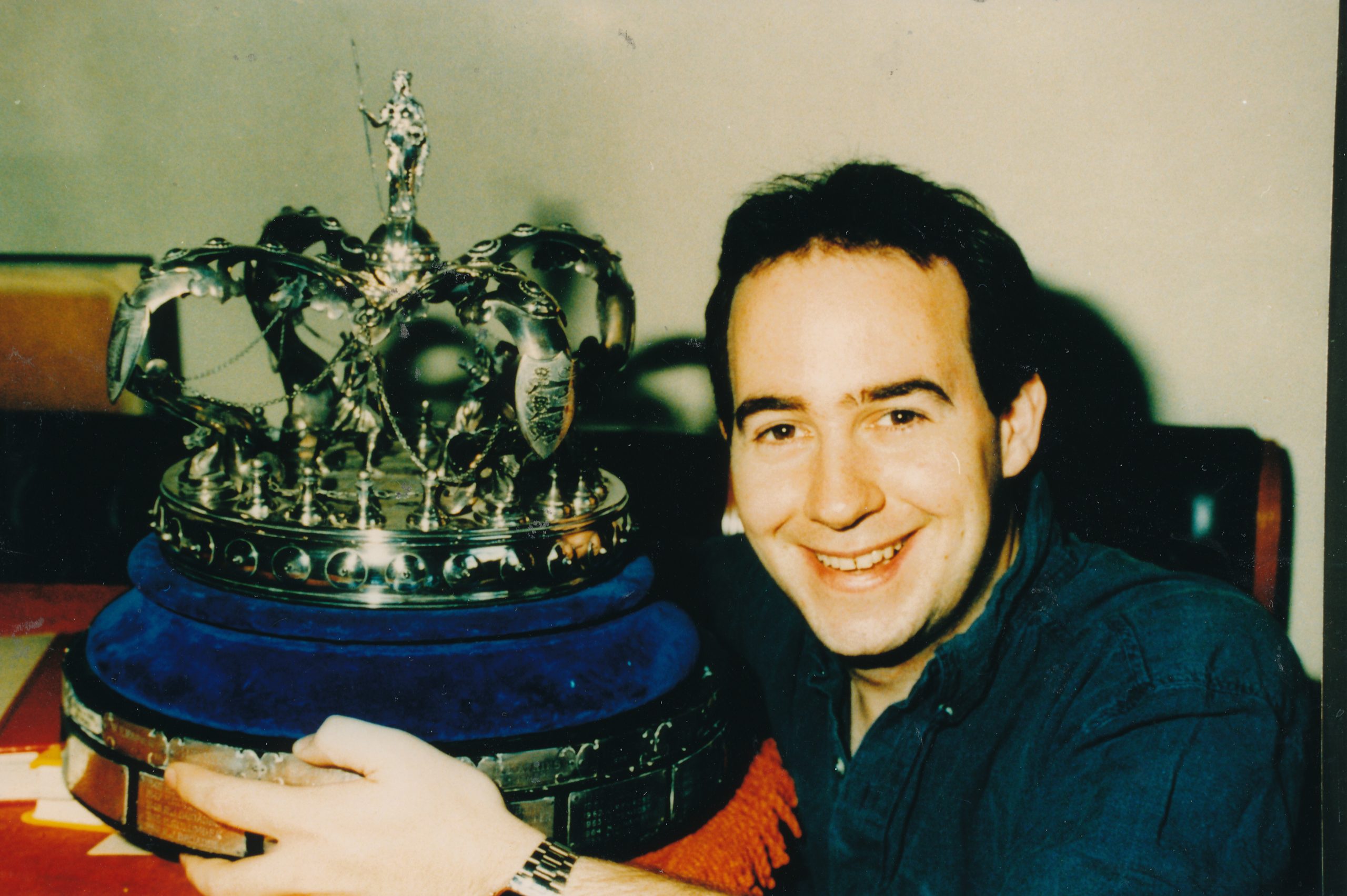
Chris with the British Championship Trophy from 1996 (Nottingham)

“Not sure about best, but 18.Qxf8+ against Summerscale en route to winning the 1996 British Championship will be forever ingrained in my mind. Sorry, Aaron!”
– GM Chris Ward (when asked for his best move)

Source: Chess Monthly 2017 December

GM Chris Ward
GM Chris Ward
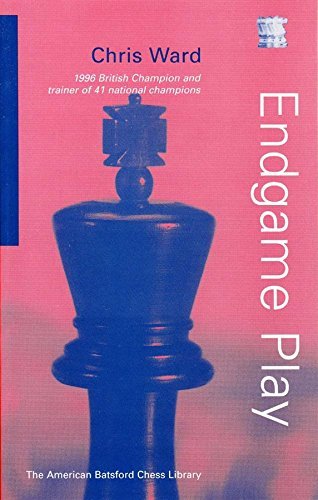
Endgame Play
Endgame Play
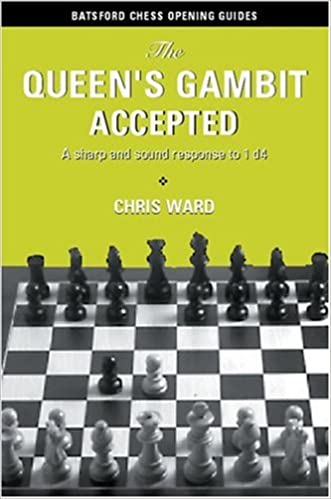
 The Queen's Gambit Accepted
The Queen’s Gambit Accepted
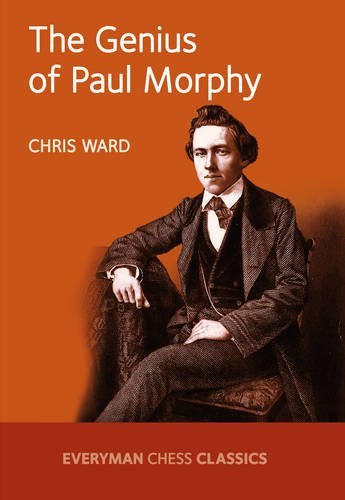
The Genius of Paul Morphy
Improve your Opening Play
Winning With the Sicilian Dragon 2
Starting Out: The Nimzo-Indian
It's Your Move: Improvers
It’s Your Move: Improvers
Unusual Queen's Gambit Declined
Unusual Queen’s Gambit Declined
Winning with the Dragon
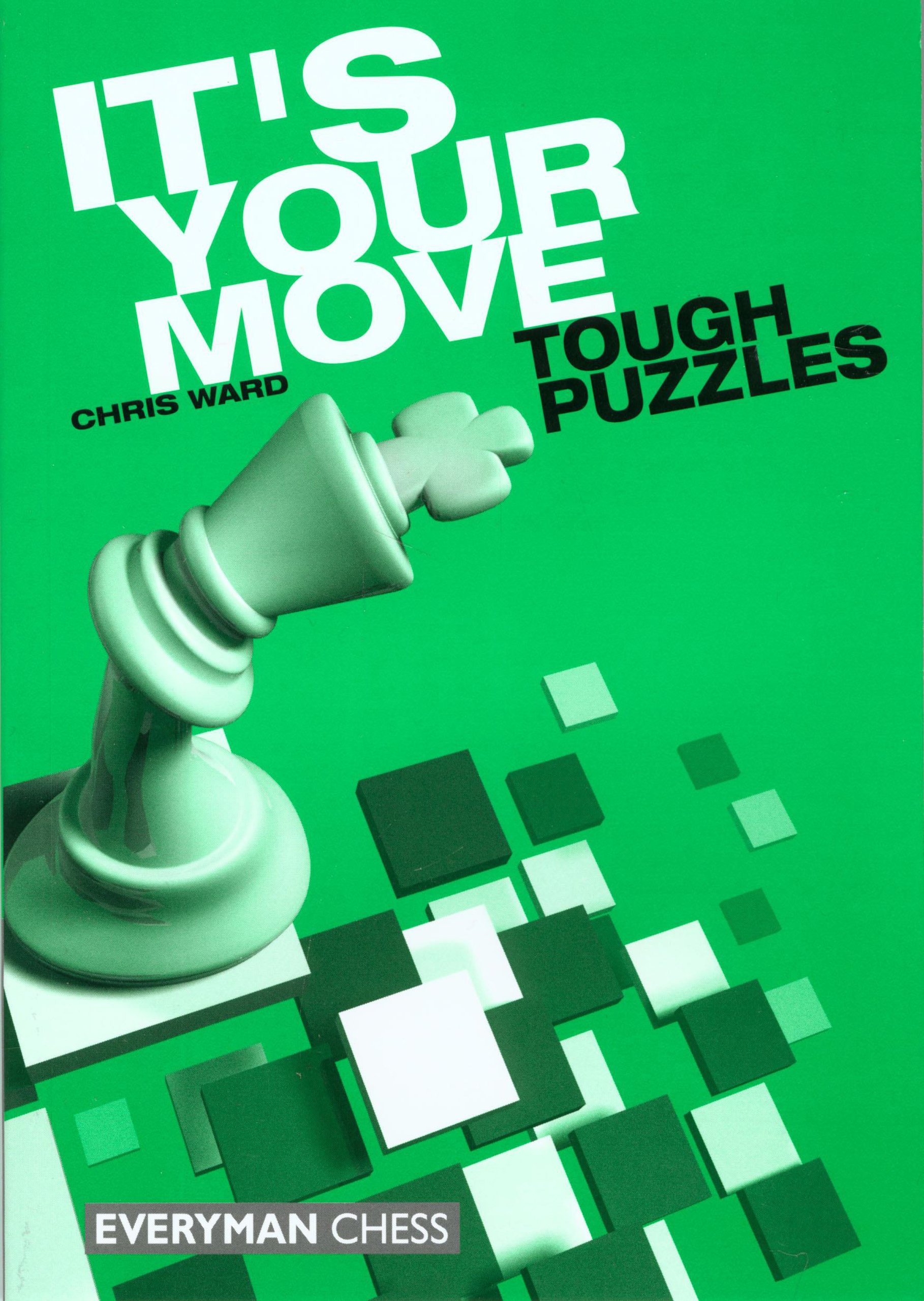
It's Your Move: Tough Puzzles
It’s Your Move: Tough Puzzles
Starting Out: Rook Endgames
The Controversial Samisch King's Indian
The Controversial Samisch King’s Indian
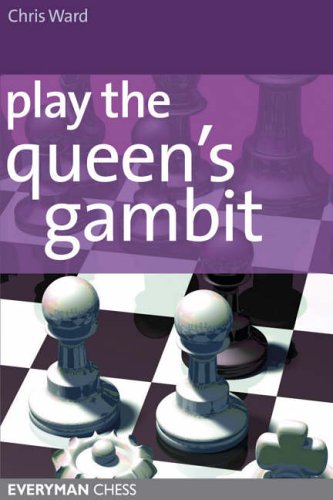
Play the Queen's Gambit
Play the Queen’s Gambit
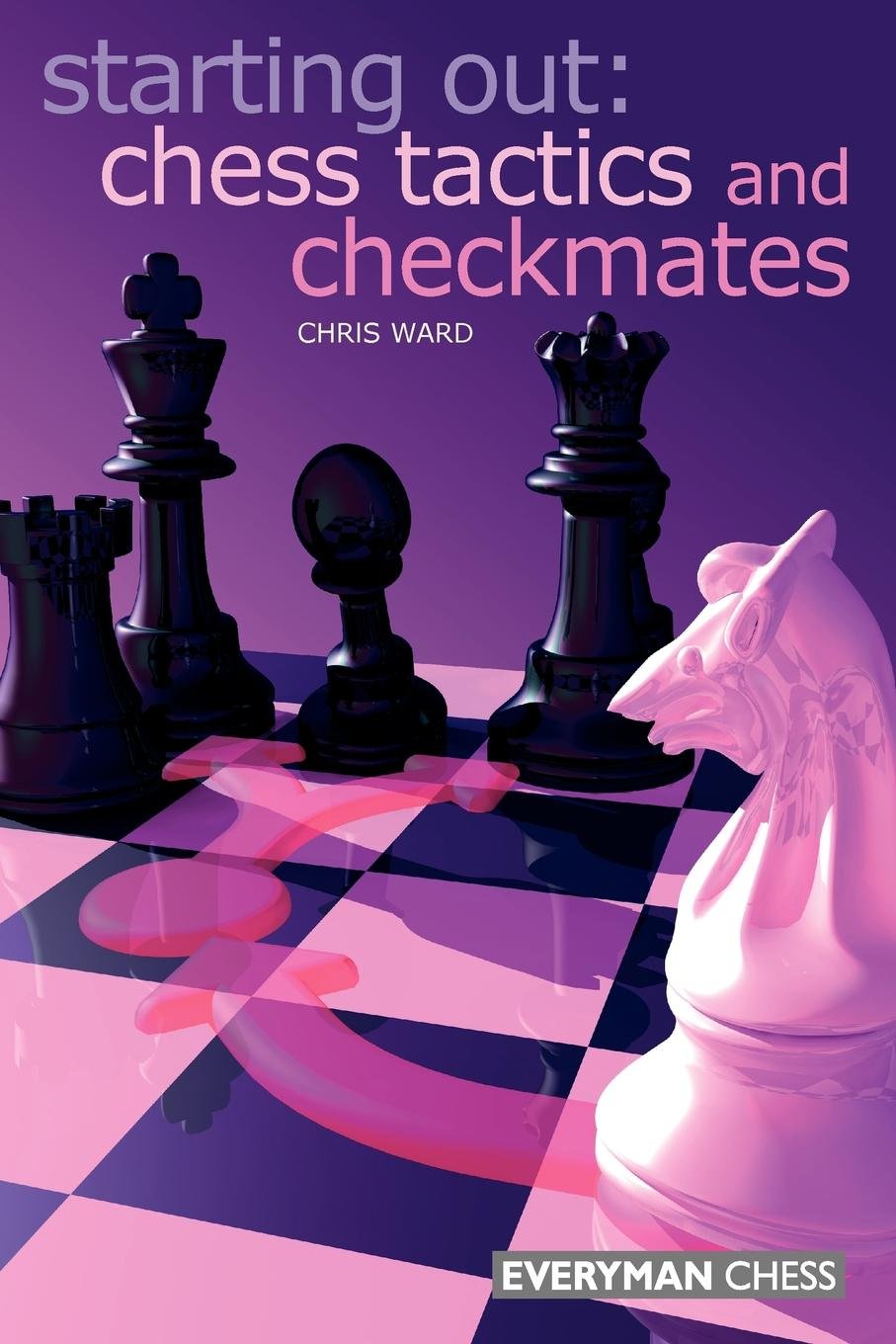
Starting Out: Chess Tactics and Checkmates