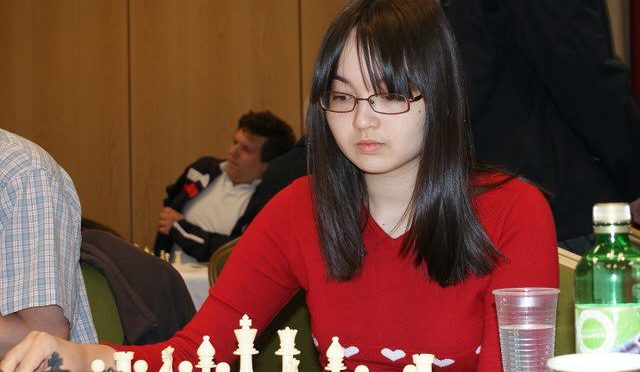
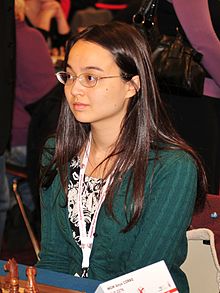
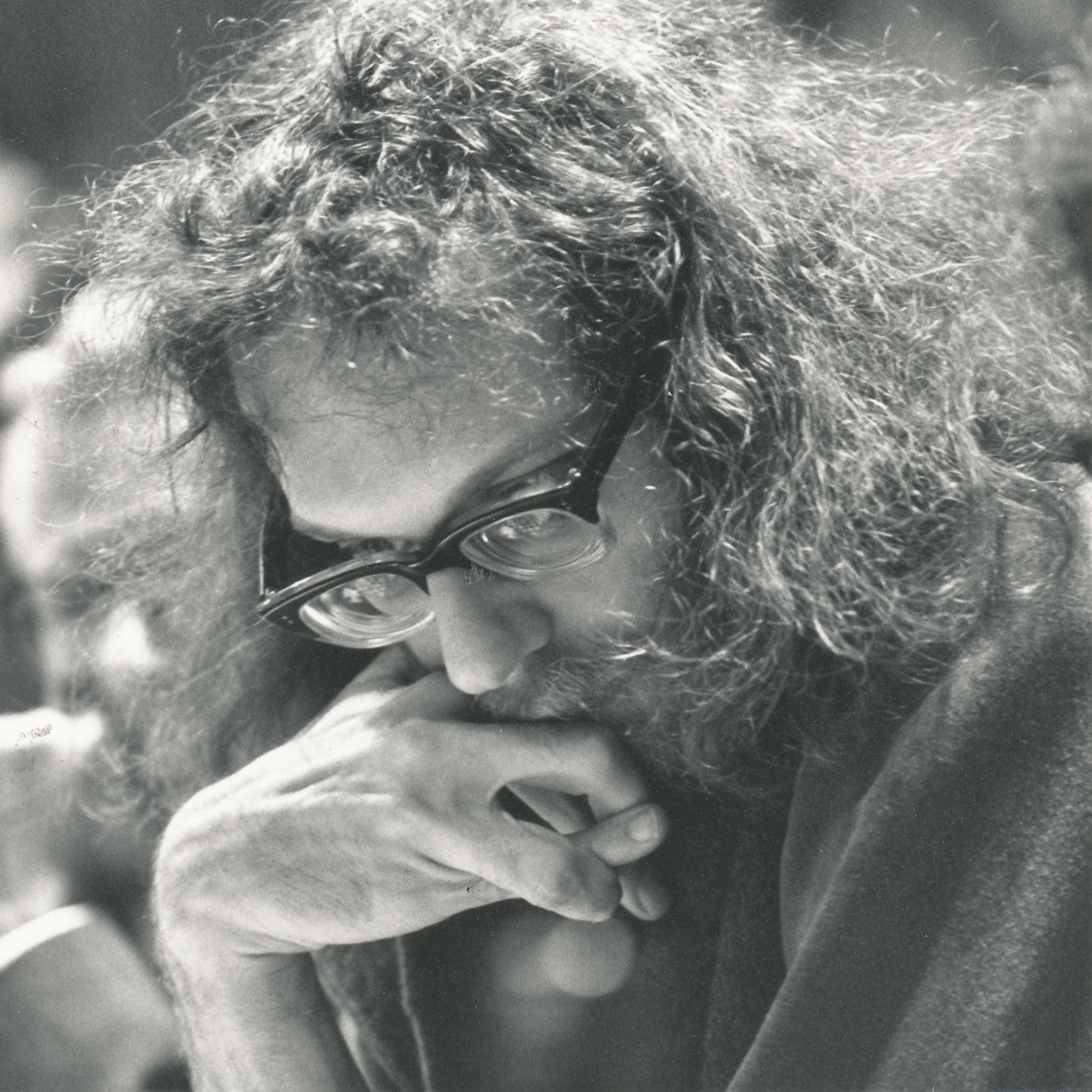
We wish happy birthday to WGM Anya Sun Corke on her birthday.
Anya Sun Corke was born in California, USA on Wednesday, September 12th 1990.
In 2013, Anya graduated from Wellesley College summa cum laude with a B.A. in Russian and Philosophy
She became a woman’s Grandmaster in 2004.
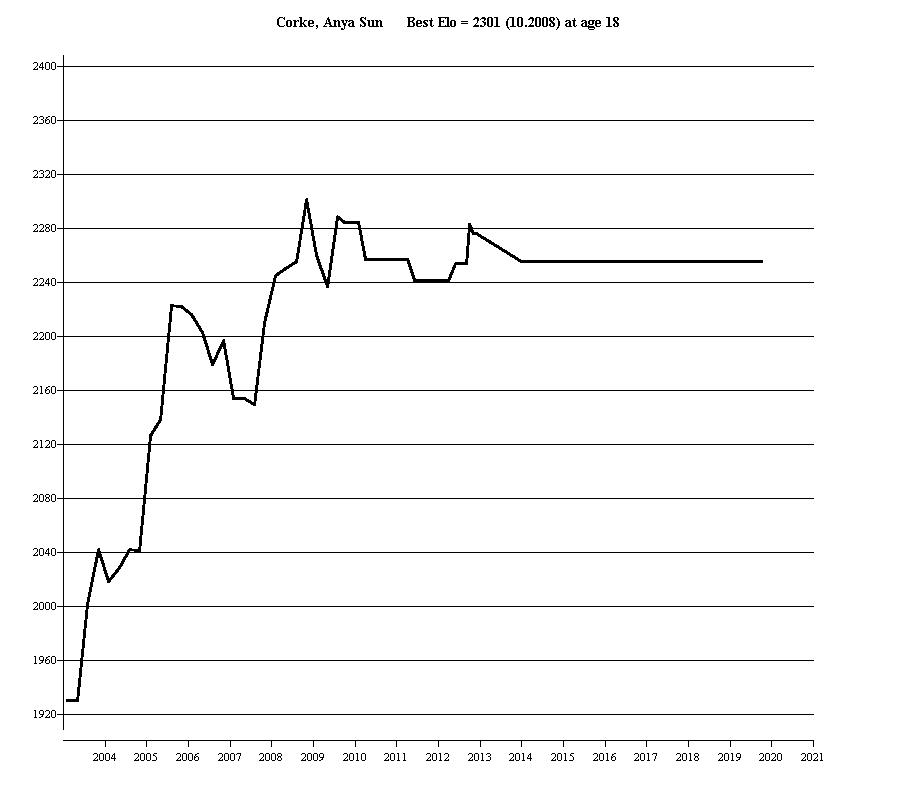
He peak FIDE rating (according to Felice) was 2301 in October 2008.
FIDE rating profile of WGM Anya Sun Corke
With the white pieces Anya played the Queen’s Gambit and Trompowski Attack
As the second player Anya played the Sicilian Kan, French Rozentalis (3…Nc6) and the Grünfeld Defence.
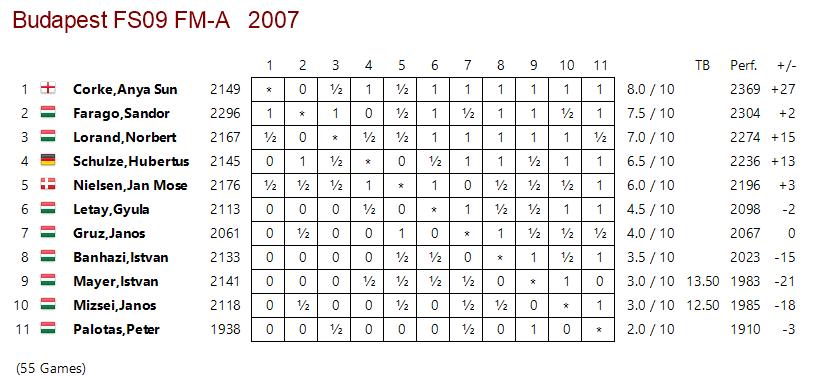
Anya won outright the 2007 Budapest First Saturday FM tournament :
Budapest First Saturday FM Tournament, 2007
She gave up competitive chess in 2014.
An almost miniature from the 2006 British Championship :
From Wikipedia :
“Anya Sun Corke (born 12 September 1990 in California, USA) is an English chess player holding the title of Woman Grandmaster (WGM). She played for Hong Kong, where she was the top ranked chess player, until 2009.[1]
Corke earned the WGM title with her performance in the 36th Chess Olympiad, playing for the Hong Kong men’s team.[2][3]
She was the 2004, 2005, 2006 and 2008 Hong Kong National Champion (for men and women), one of the youngest national champions ever at the age of 13 years and 9 months.
She was the British Junior Under-11 Champion in 2002[4] and the Under-12 Champion in 2003,[5] the first girl to win either of these age groups. In 2004, she became joint British U-14 Champion.[6]
In December 2004, she won the Asian Youth Girls U-14 Championship in Singapore.[7]
In August 2005, she jointly won with Alisa Melekhina and Abby Marshall the second annual Susan Polgar National Invitational for Girls under-19.[8]
Corke represented the England Women’s team at the 2012 Chess Olympiad in Istanbul, Turkey,[9][10] and the 2013 European Team Championship in Warsaw, Poland.[11]
In 2013, she graduated from Wellesley College summa cum laude with a B.A. in Russian and Philosophy.[12][13]
In 2014, she started a Ph.D. program in Slavic Languages and Literatures at Yale University.”
We wish happy birthday to WGM Anya Sun Corke on her birthday.
Anya Sun Corke was born in California, USA on Wednesday, September 12th 1990.
In 2013, Anya graduated from Wellesley College summa cum laude with a B.A. in Russian and Philosophy
She became a woman’s Grandmaster in 2004.
He peak FIDE rating (according to Felice) was 2301 in October 2008.
FIDE rating profile of WGM Anya Sun Corke
With the white pieces Anya played the Queen’s Gambit and Trompowski Attack
As the second player Anya played the Sicilian Kan, French Rozentalis (3…Nc6) and the Grünfeld Defence.
Anya won outright the 2007 Budapest First Saturday FM tournament :
Budapest First Saturday FM Tournament, 2007
She gave up competitive chess in 2014.
An almost miniature from the 2006 British Championship :
From Wikipedia :
“Anya Sun Corke (born 12 September 1990 in California, USA) is an English chess player holding the title of Woman Grandmaster (WGM). She played for Hong Kong, where she was the top ranked chess player, until 2009.[1]
Corke earned the WGM title with her performance in the 36th Chess Olympiad, playing for the Hong Kong men’s team.[2][3]
She was the 2004, 2005, 2006 and 2008 Hong Kong National Champion (for men and women), one of the youngest national champions ever at the age of 13 years and 9 months.
She was the British Junior Under-11 Champion in 2002[4] and the Under-12 Champion in 2003,[5] the first girl to win either of these age groups. In 2004, she became joint British U-14 Champion.[6]
In December 2004, she won the Asian Youth Girls U-14 Championship in Singapore.[7]
In August 2005, she jointly won with Alisa Melekhina and Abby Marshall the second annual Susan Polgar National Invitational for Girls under-19.[8]
Corke represented the England Women’s team at the 2012 Chess Olympiad in Istanbul, Turkey,[9][10] and the 2013 European Team Championship in Warsaw, Poland.[11]
In 2013, she graduated from Wellesley College summa cum laude with a B.A. in Russian and Philosophy.[12][13]
In 2014, she started a Ph.D. program in Slavic Languages and Literatures at Yale University.”
We wish happy birthday to WGM Anya Sun Corke on her birthday.
Anya Sun Corke was born in California, USA on Wednesday, September 12th 1990.
In 2013, Anya graduated from Wellesley College summa cum laude with a B.A. in Russian and Philosophy
She became a woman’s Grandmaster in 2004.
He peak FIDE rating (according to Felice) was 2301 in October 2008.
FIDE rating profile of WGM Anya Sun Corke
With the white pieces Anya played the Queen’s Gambit and Trompowski Attack
As the second player Anya played the Sicilian Kan, French Rozentalis (3…Nc6) and the Grünfeld Defence.
Anya won outright the 2007 Budapest First Saturday FM tournament :
Budapest First Saturday FM Tournament, 2007
She gave up competitive chess in 2014.
An almost miniature from the 2006 British Championship :
From Wikipedia :
“Anya Sun Corke (born 12 September 1990 in California, USA) is an English chess player holding the title of Woman Grandmaster (WGM). She played for Hong Kong, where she was the top ranked chess player, until 2009.[1]
Corke earned the WGM title with her performance in the 36th Chess Olympiad, playing for the Hong Kong men’s team.[2][3]
She was the 2004, 2005, 2006 and 2008 Hong Kong National Champion (for men and women), one of the youngest national champions ever at the age of 13 years and 9 months.
She was the British Junior Under-11 Champion in 2002[4] and the Under-12 Champion in 2003,[5] the first girl to win either of these age groups. In 2004, she became joint British U-14 Champion.[6]
In December 2004, she won the Asian Youth Girls U-14 Championship in Singapore.[7]
In August 2005, she jointly won with Alisa Melekhina and Abby Marshall the second annual Susan Polgar National Invitational for Girls under-19.[8]
Corke represented the England Women’s team at the 2012 Chess Olympiad in Istanbul, Turkey,[9][10] and the 2013 European Team Championship in Warsaw, Poland.[11]
In 2013, she graduated from Wellesley College summa cum laude with a B.A. in Russian and Philosophy.[12][13]
In 2014, she started a Ph.D. program in Slavic Languages and Literatures at Yale University.”
We wish happy birthday to WGM Anya Sun Corke on her birthday.
Anya Sun Corke was born in California, USA on Wednesday, September 12th 1990.
In 2013, Anya graduated from Wellesley College summa cum laude with a B.A. in Russian and Philosophy
She became a woman’s Grandmaster in 2004.
He peak FIDE rating (according to Felice) was 2301 in October 2008.
FIDE rating profile of WGM Anya Sun Corke
With the white pieces Anya played the Queen’s Gambit and Trompowski Attack
As the second player Anya played the Sicilian Kan, French Rozentalis (3…Nc6) and the Grünfeld Defence.
Anya won outright the 2007 Budapest First Saturday FM tournament :
Budapest First Saturday FM Tournament, 2007
She gave up competitive chess in 2014.
An almost miniature from the 2006 British Championship :
From Wikipedia :
“Anya Sun Corke (born 12 September 1990 in California, USA) is an English chess player holding the title of Woman Grandmaster (WGM). She played for Hong Kong, where she was the top ranked chess player, until 2009.[1]
Corke earned the WGM title with her performance in the 36th Chess Olympiad, playing for the Hong Kong men’s team.[2][3]
She was the 2004, 2005, 2006 and 2008 Hong Kong National Champion (for men and women), one of the youngest national champions ever at the age of 13 years and 9 months.
She was the British Junior Under-11 Champion in 2002[4] and the Under-12 Champion in 2003,[5] the first girl to win either of these age groups. In 2004, she became joint British U-14 Champion.[6]
In December 2004, she won the Asian Youth Girls U-14 Championship in Singapore.[7]
In August 2005, she jointly won with Alisa Melekhina and Abby Marshall the second annual Susan Polgar National Invitational for Girls under-19.[8]
Corke represented the England Women’s team at the 2012 Chess Olympiad in Istanbul, Turkey,[9][10] and the 2013 European Team Championship in Warsaw, Poland.[11]
In 2013, she graduated from Wellesley College summa cum laude with a B.A. in Russian and Philosophy.[12][13]
In 2014, she started a Ph.D. program in Slavic Languages and Literatures at Yale University.”
We send best wishes to Michael Franklin on his 90th birthday.
Growing Up
Michael John Franklin was born on Monday, February 2nd, 1931 in Battersea, London to Albert George (27 ix 1906, Dover – ? iii 1983, Wandsworth) and Helen Ann Franklin (née Colson, 1908-2003) who married in the third quarter of 1928 in Wandsworth. Albert was a clerk as was his father.
At the commencement of the Second World War, when eight years old, Michael was evacuated to Frome in Somerset. As a consequence Michael would delight in playing in the Frome Congress whenever possible. He played in the first event in 1990 organised by Leon York (whose name is the memorial trophy for the Major section). The story of Michael’s return to Frome made its’ way in to the local newspaper and was reported by Gary Lane as follows :
From British Chess Magazine, Volume CX (110, 1990), Number 7 (July), page 296 :
“A special presentation by the sponsor, Mrs. Jean Mackereth, Managing Director of Keyford Frames, was made to Londoner Michael Franklin, who was returning for the first time in 51 years to the town to which he was evacuated during the war. His final appearance at Frome was in the 2010 event.
The Early Years
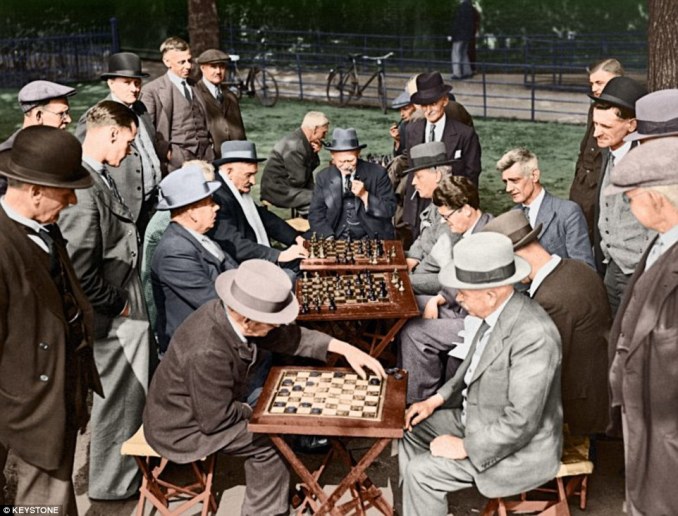
Michaels interest in chess started in 1944 aged 13 when he witnessed games being played on Clapham Common. He was fascinated by the pieces and taught himself to play, never receiving any formal coaching. He joined the Clapham Common Chess Club in 1944. (CCCC became incorporated into Battersea Chess Club some time later).
CHECK MATES: Elderly members of the Clapham Common Open Air Chess and Draughts Club, circa 1920. The club met regularly during the afternoons to play on Clapham Common in south London. Copyright : Keystone
Apart from summer events such as the above the club had a Winter Section that played matches in the London League. The club won the first division (now known as the Brian Smith Trophy) of the London League in the 1946-47 and 1947-48 seasons. Michael played his final game in the London Chess League for Richmond & Twickenham on April 14th 2010 drawing with John Hodgson, brother of Julian giving a sixty year span.
In his formative years he played at the Gambit Chess Café, Budge Row, Cannon Street, London, EC4N. Many strong players regularly visited the Gambit to play skittles, blitz and the frequently held lightning tournaments hosted by the proprietor Mr GH White.
Events such as these enabled Michael to develop his quick sight of the board and his flair for tactical play.
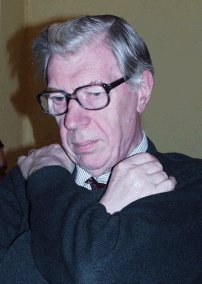
Leonard Barden added :
“Michael made his name as a young player first by his successes in the Saturday evening Gambit Guinea speed events at the Gambit Chess Café in Cannon Street which he often won ahead of master level rivals. He remained a strong speed player all his life.”
In the early 1950s Michael was persuaded by his friends Aird Thomson (who was Scottish Boys’ Champion in 1932, and 1933 ( equal-first). In 1951 he was Scottish Champion. In 1954 he moved to London. He married Susan Mary Hamilton in 1961 who went on to become Scottish Ladies’ Champion in 1965.) and oriental carpet expert Robert Pinner to join the Richmond and Twickenham Chess Club playing for the club in the London League, Surrey Trophy and National Club Championship until he retired from competitive play 2010.
Making Progress
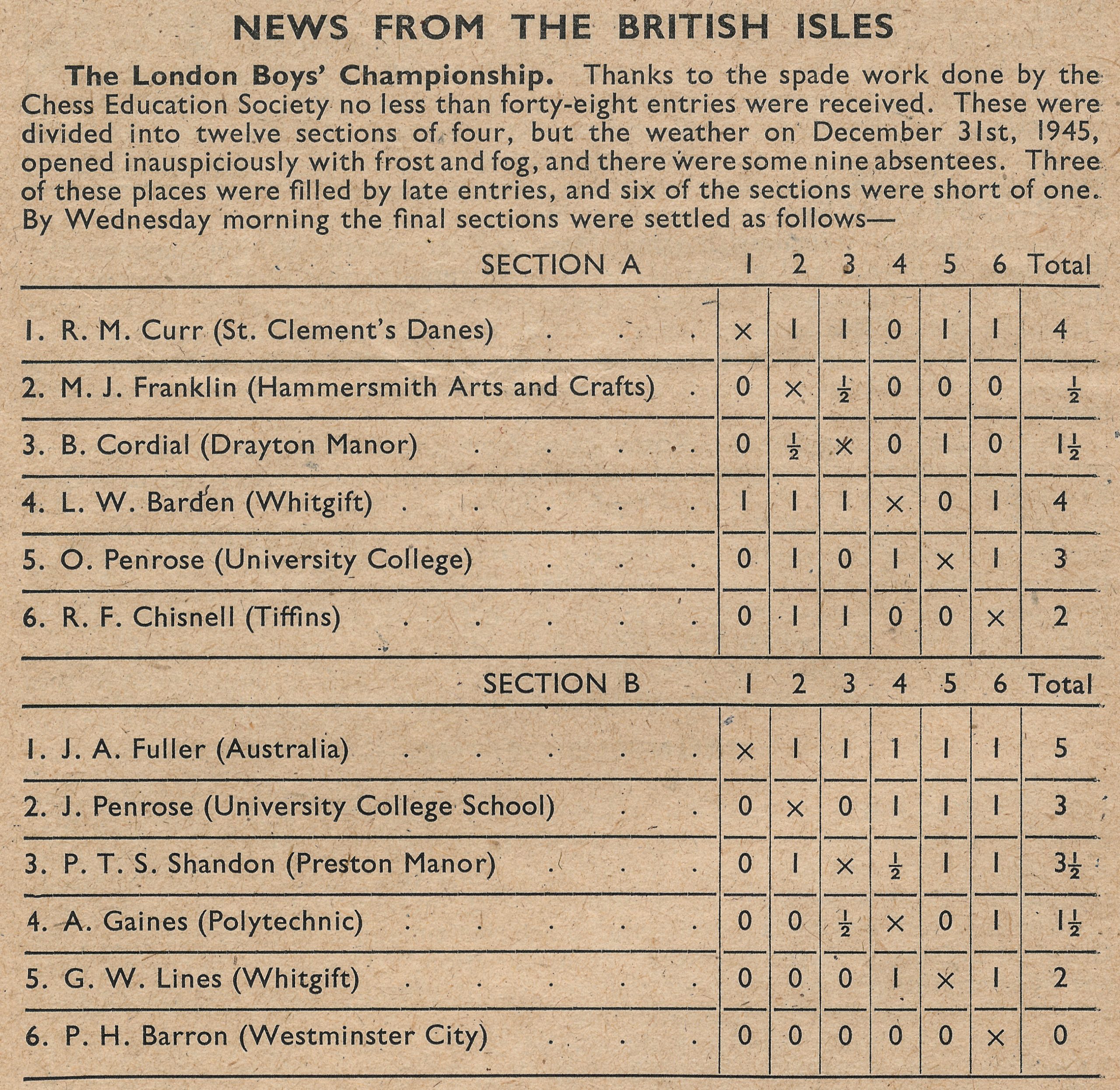
Michael’s first appearance in British Chess Magazine was in Volume LXVI (66, 1946), Number 2 (February). Page 52 contained this report of the 1945 London Boy’s Championship in which Michael reached the final A section :
British Chess Magazine, Volume LXVI (66, 1946), Number 2 (February), page 52
On leaving school Michael joined a firm of Patent Agents remaining in their employ as the accounts department for around forty years before retiring in the late 1980s. His retirement was prompted by the firm’s adoption of electronic computers. When he retired he was Chief Cashier.
On June 18th 1960 Michael’s happiest day was when he married Jean Fey. They celebrated their diamond anniversary in 2020.
To the present day Michael has maintained an aversion toward modern technology. He did, however, concede to the ownership of a mobile telephone. This was for the specific purpose of updating Jean on his days progress in any chess tournaments where he was away from home.
In 1946 (aged 15) Michael won the Felce Cup awarded by the Surrey County Chess Association. A result indicating rapid improvement since Michael had only started playing competitively in 1944.
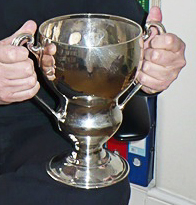
The Felce Cup held by the hands of Stephen Moss in 2014
In 1951 Michael finished third in the Surrey Championships behind the winner Frank Parr and runner-up David Hooper. In 1961, 1966, 1968, 1969 and 1970 Michael won the Surrey Championship outright and made many appearences in county matches for Surrey from 1950 onwards until 2010.
Unfortunately Michael’s rapid progress was threatened by two bouts of ill health. In 1948 aged 17 Michael was diagnosed with Tuberculosis which lasted for eighteen months including a twelve month stay in the Royal National Hospital for Diseases of the Chest in Ventnor on the Isle of Wight. Aged twenty the TB returned leading to yet another twelve months illness.
Michael has suffered from ill health all of his life interrupting his chess career at various times. Fortunately the TB has not returned.
Michael won the National Chess Centre Championship in 1953 and 1955 being runner-up in 1954. The venue was Hill’s Restaurant, 158 Bishopsgate, London, EC2 opposite Liverpool Street Station since the original John Lewis department store venue was bombed in 1940.
The British Chess Federation first published a National Grading list in 1953 (using the Richard Clarke system). In the 1954 list MF appeared with a grade of 2A (225-232) and from then on with a grade of either 2A or 2B. In 1964 a numeric system had him at 225 ranking Michael 4th in England behind Penrose 244, Kottnauer 238 and Clarke 231.
Michael played many times in the annual Battle of Britain Tournament organised by Squadron Leader David Pritchard and his committee. He won it four times : 1959, 1960, 1961 and 1962.
The Ilford Whitsun Congress
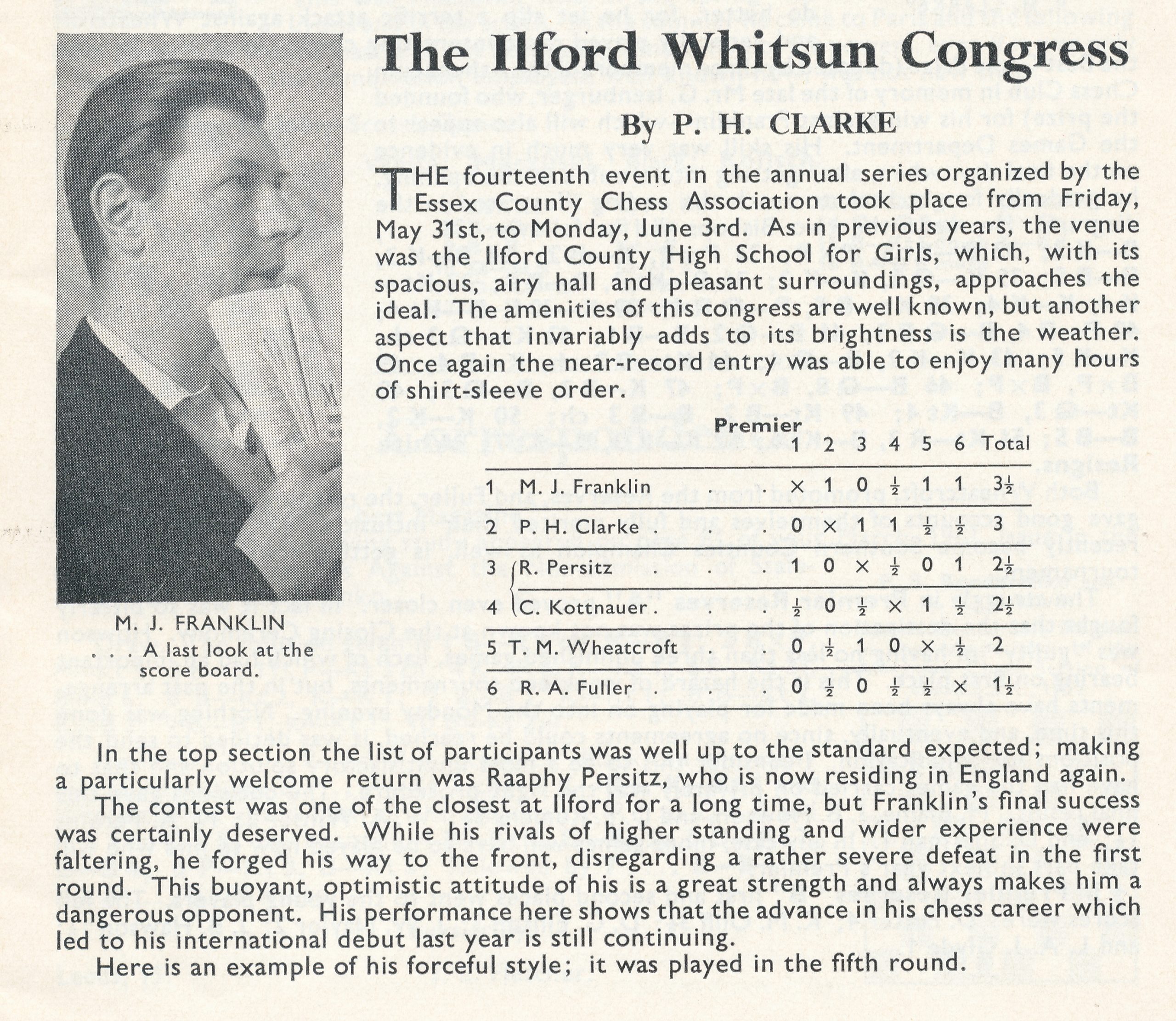
The Ilford Whitsun Congress was a regular part of Michael’s season throughout the sixties. He won the Premier Reserves in 1961 ahead of Hilton, Hindle, Howson, Sales and Blaine and was runner-up to Kottnauer in 1962. In 1963 he went one step better by winning the Premier :
A report of Mike Franklin’s success at the 1963 Ilford Whitsun Congress by Peter Clarke. Source : British Chess Magazine, Volume LXXXIII, Number 7 (July), page 193
and here is the fifth round game :
In his tournament report PH Clarke wrote :
This buoyant, optimistic attitude of his is a great strength and always makes him a dangerous opponent.
Away from Home : International Progress
1964 saw selection by the BCF to play in the Tel Aviv Olympiad :
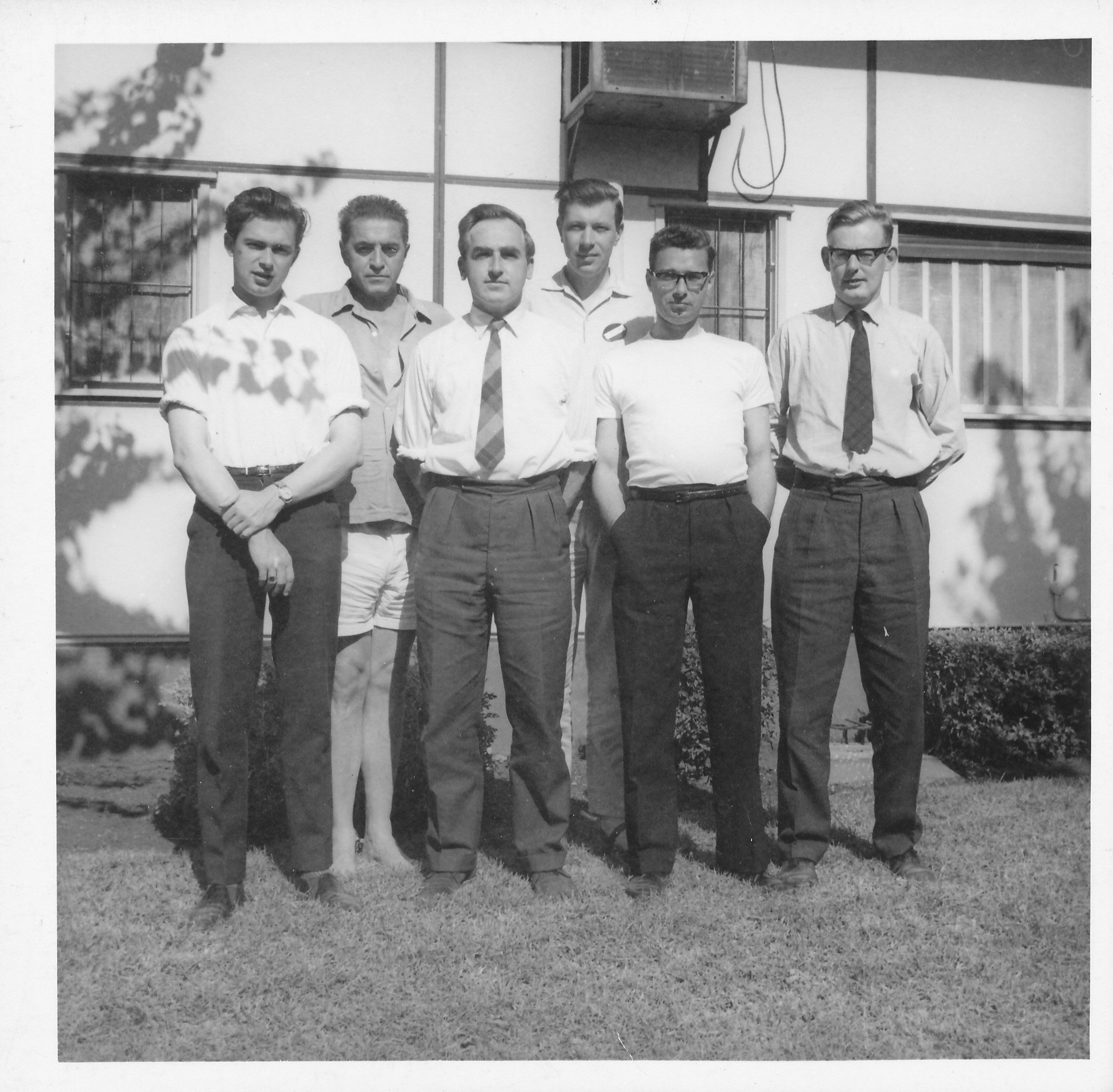
The 1964 England Olympiad (Tel Aviv) Team : Owen Hindle, Čeněk Kottnauer, Peter Clarke, Michael Franklin, Norman Littlewood & Michael Haygarth
and scored a creditable 4/6. This was followed in 1965 with 3/5 in Clare Benedict tournament held in Berlin.
He played in the annual Anglo-Dutch match on no less than six occasions in 1962, 1963, 1964, 1965, 1968 and finally in 1969. His aggregate score was an impressive 8/12.
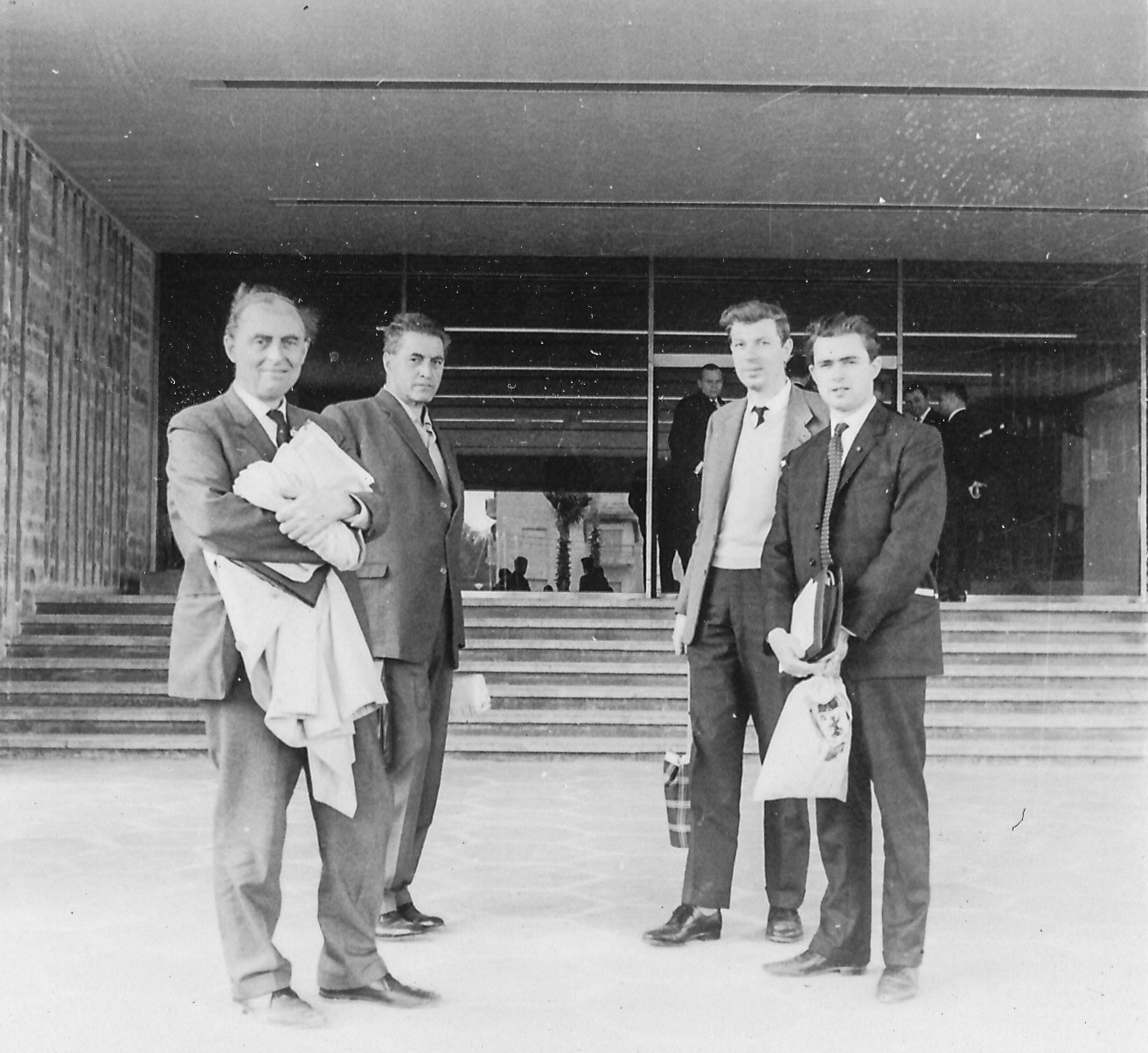
?, Čeněk Kottnauer, Michael Franklin and Owen Hindle
On the national scene Michael repeated his 1963 victory at the 1969 Ilford Premier with a clear first place : Franklin 4; RG Wade and D Wright 3; JB Howson 2.5; BH Wood 2; PH Clarke 0.5.
In 1970 Michael won the London Championship which was also known as the Budget Cup which had last been held in 1956 . He followed this in 1972 by rightly earning the (now defunct) title of British Master.
Michael’s final appearance for England was in 1971 in the Cheltenham based Anglo-German match with a somewhat disappointing 0.5/2 against Juergen Dueball.
Owen Hindle, Michael Franklin, Harry Golombek and Michael Haygarth
Michael played board two for London in a Telex match versus Belgrade playing Marjanovic. The game was drawn.
Michael Franklin playing board two in the London – Belgrade Telex Match on April 3rd, 1976 from the St. James Hotel, Buckingham Gate. Sourced from BCM, Volume XCVI (96), Number 5, page 192. Photographer probably Freddy Reilly.
The Ultimate Prize : The Aaronson Masters
The Aaronson Masters at Harrow 1978 brought his best individual success at the age of 47, sharing first place with IM Aldo Haik of France and to boot, earning an IM norm.
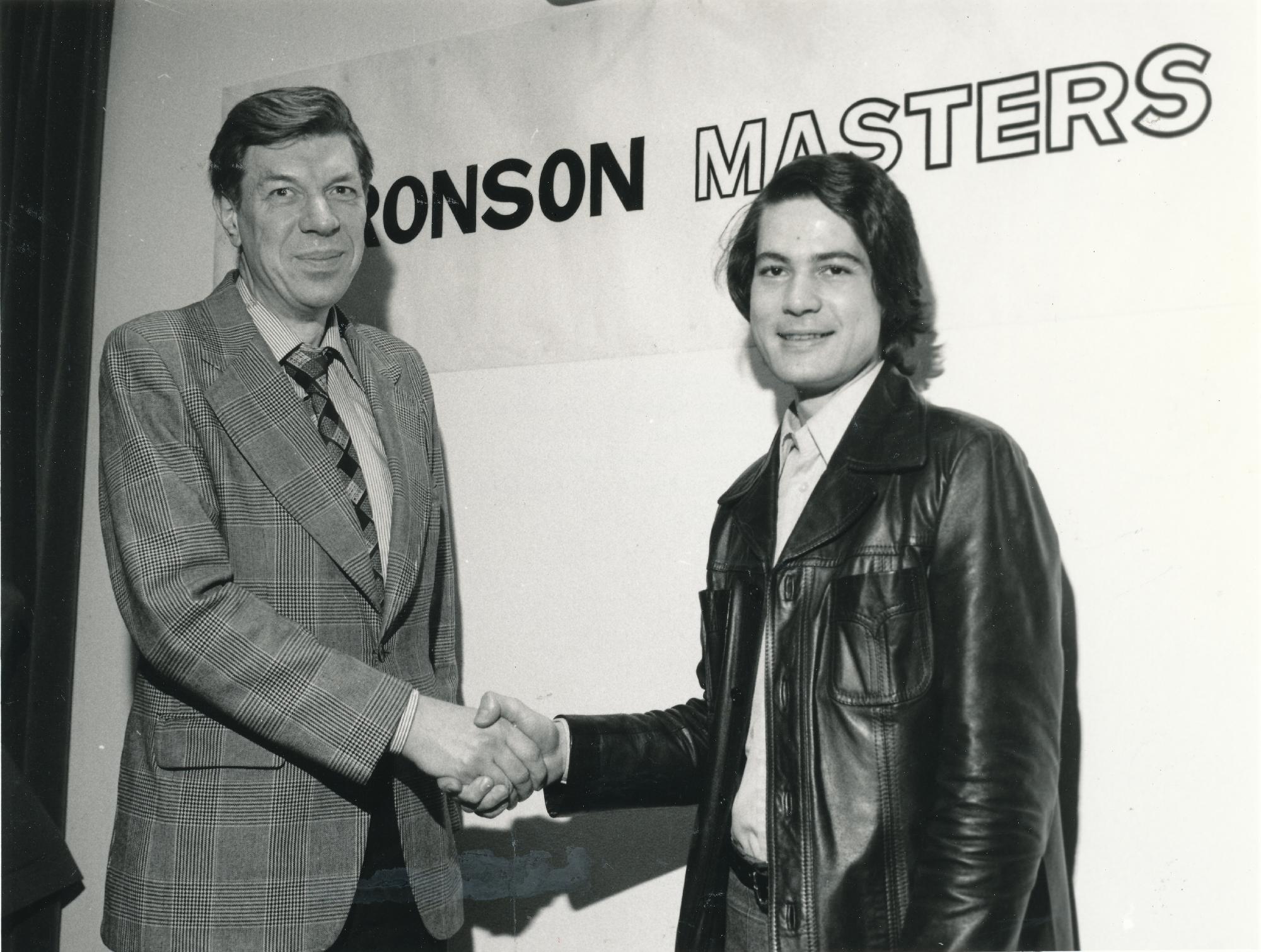
Joint winners of the 1978 Aaronson Masters : Michael Franklin and IM Aldo Haik
Michael scored an undefeated 7.5/10 and finished ahead of Short, Speelman, Nunn, Hartston, Mestel, Webb, Basman, Botterill and numerous other illustrious players. Michael remarked of his lifetime best result that it was
just one of those occasions when everything went right!
But he scored 3.5/5 against the IMs, was alert to every opportunity, and the games show he owed little to luck.
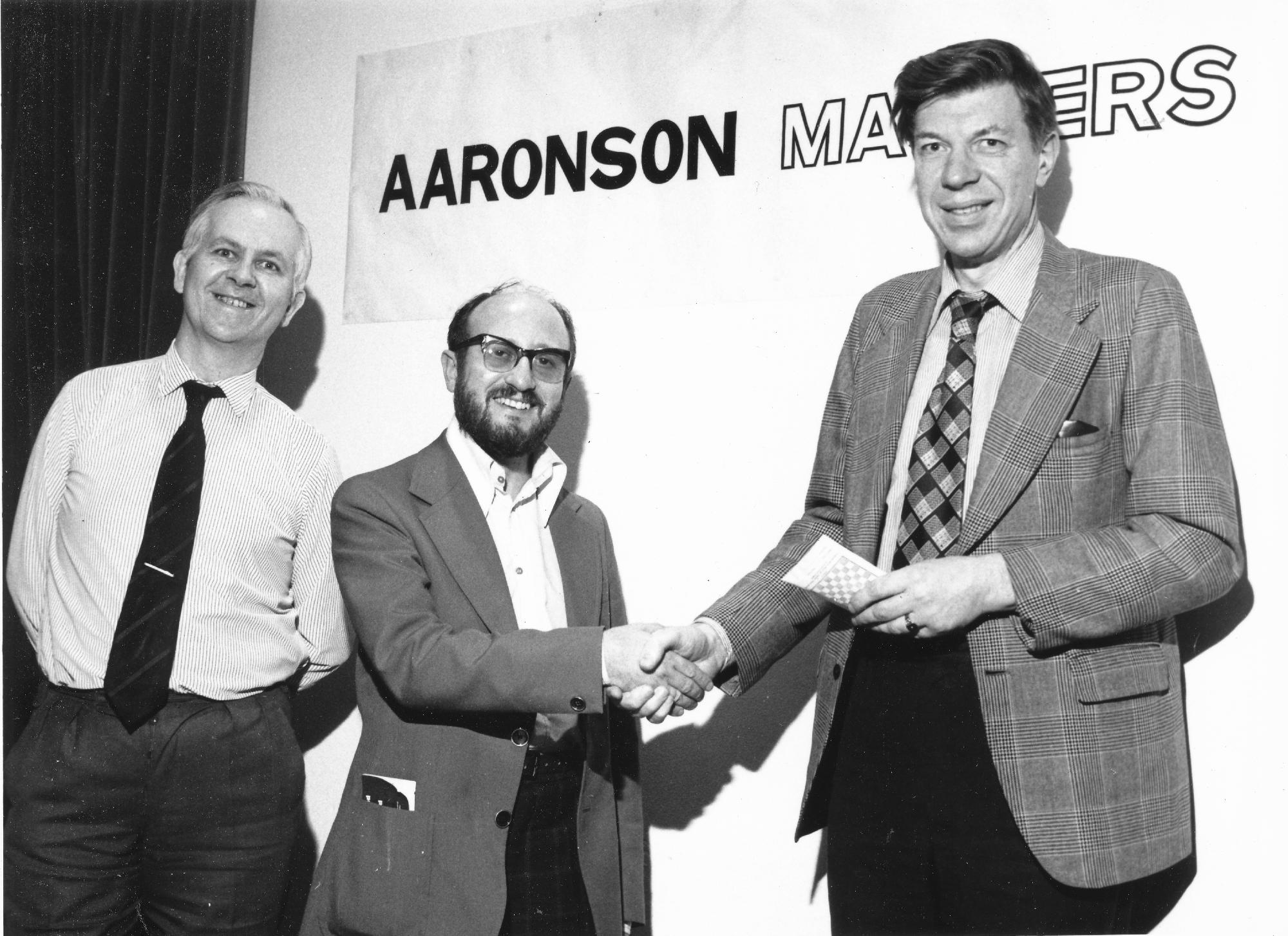
Leonard Barden, Stewart Reuben and Michael Franklin at the 1978 Aaronson Masters
Like many others Michael made appearences in Lloyds Bank events of 1977, 1978, 1984, 1989, 1991, 1993 and 1994.
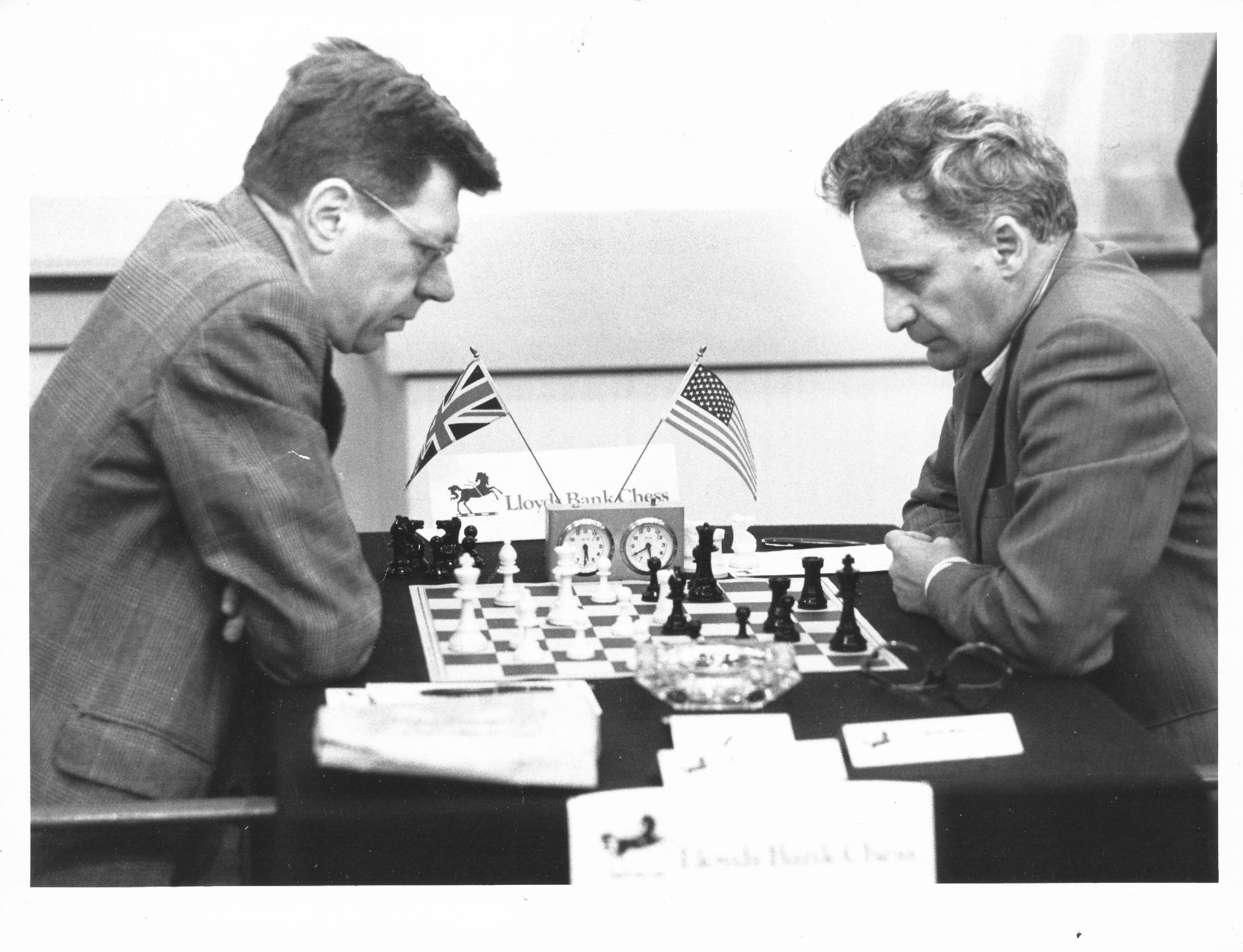
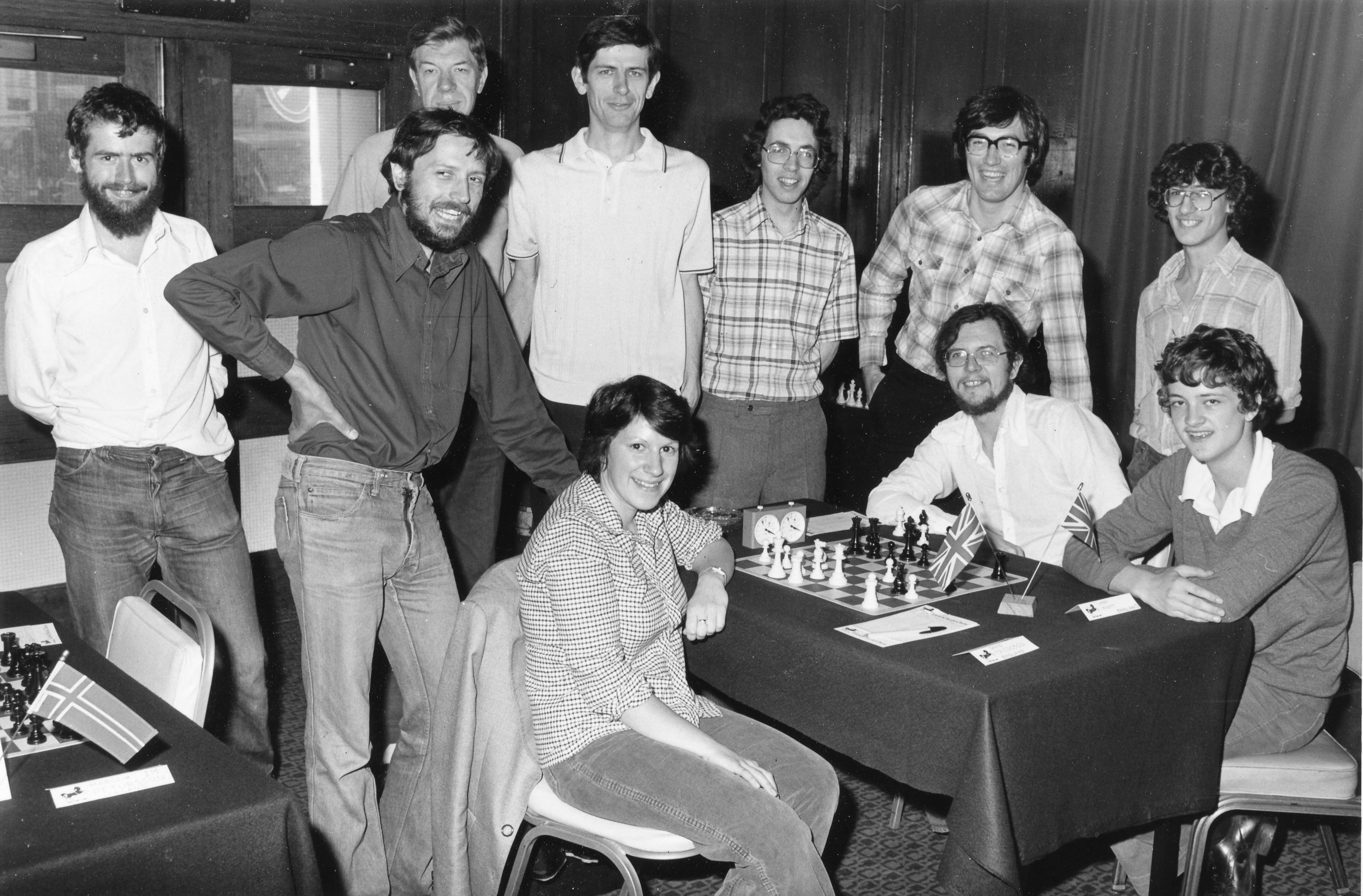
Michael Franklin (left) at the 1978 Lloyds Bank Masters playing IGM Leonid ShamkovichMichael and friends during the 1978 Lloyds Bank Masters
The Hastings Years
Michael first played at Hastings in 1964 when he was invited to play in the Premier Tournament. The tournament was won by Mikhail Tal and Michael finished in last place.
Undaunted he returned to Hastings in 1968 to play in the Challengers tournament. One of the attractions of playing in the Challengers was that the winner received a place the following years Premier. Frustratingly Michael finished second three years in a row! In 1968 the Challengers was won by Danny Wright, in 1969 by Martyn Corden and in 1970 by Peter Markland. Finally, in 1971 his patience was rewarded and he won the Challengers and qualified to the following years Premier.
The 47th Hastings Premier of 1971-72 had been changed from the traditional 10 player all-play-all to a 16 player tournament. Also, having obtained sponsorship from various organisations the committee were able to invite some of the top names of the day. The sponsors were:
So, the entry included Karpov, Korchnoi, Andersson, Najdorf, Mecking, Gligoric, Unzicker and Robert Byrne to name but a few. This was undoubtedly the strongest Hastings Premier since World War Two and possibly the strongest Hastings Tournament since 1895.
Michael started well with a draw against the Rumanian GM Ciocaltea followed by a draw in with the Brazilian prodigy Mecking. In round three he surprised everyone by beating Ray Keene. With 2/3 things were looking promising. However, after this bright start Michael only managed a draw against Unzicker and a draw with Hartston finishing in a disappointing last place with a score of 3/15.
In the tournament report Peter Clarke opined
Franklin suffered the usual fate of the gifted amateur in a professional field of simply not being accustomed to this kind of chess.
Despite this Michael continued to play in the Hastings Challengers. He played in nineteen out of the next twenty-five years! He came close to winning the tournament in 1982: he was leading the tournament with a score of 7/8 when he was informed that Jean’s Father had passed away. Having drawn his ninth round game and needing only a draw in the last round to ensure at least a tie for first place he withdrew from the tournament and immediately left for home.
The Weekend Scene
Like all players with a full time job Michael had to play most of his chess at the weekend so the explosion of weekends tournaments in the early 1970’s gave him ample opportunities. His habit of playing quickly was ideally suited to the fast time limits of the weekend tournament. During the 1970 and 1980’s he was very successful. He won numerous events and was more often than not in the prize list.
FM Michael Franklin, Photo by Cathy Rogers
In later years he restricted himself to London based tournaments and those in the West Country. His regular tournaments being Exeter, Torquay and old favourite, Frome. Michael at the age of 78 shared first place at Frome 2009. Frome 2010 was his farewell appearance.
FM Michael Franklin
Michael played for a number of clubs viz : Richmond & Twickenham, Coulsdon CF, Surrey CCA, 4NCL Richmond, 4NCL Bristol and Richards Butler to name but a few.
Finally, in 1980, Michael was awarded the FIDE Master title and achieved his highest rating (in the Elo era) of 2345 in January 1979. It is most likely that his highest ever rating would have been more like 2450.
FM Michael Franklin vs Paul Helbig
Appropriately enough Michael was the inaugural winner of the BCF/ECF Senior Prix in 2000 and won it again in 2002 and 2003. The event last ran in 2006.
When Surrey won the counties championship a few years back the team took the trophy around to Michael’s home in Norbury, such was their regard for his contributions.
The London System
Any currently active club player cannot have missed the explosive rise to prominence of the system for White he developed :
The London System and Accelerated London System has acquired a huge cohort of followers in recent times probably not realising the debt they (and many authors, book and DVD publishers!) owe to Michael. If only he could have earnt a royalty every time it was played!
Also Michael had notable success as Black with the O’Kelly Sicilian 1.e4 c5 2.Nf3 a6.
Life Outside of Chess
Michael had many interests apart from Chess. He was for many years a member of the Surrey County Cricket Club. After he retired he would arrange to meet fellow Surrey Member Frank Parr at the Oval and after lunch in the Pavilion they would spend the day enjoying the Cricket. Tennis was another sport that Michael followed. Michael was also interested in horseracing. Several players were surprised when visiting one of the racetracks around London to find Michael also attending the race meeting.
Michael was the typical “natural” player. He never studied the game and his only sources of opening information were the British Chess Magazine and the chess columns in The Times and the Guardian. He never kept the scores of his games. Once the game was finished it was time to move on. One of Michael’s greatest strengths was his optimistic attitude at the chessboard. No matter how bad the position he was confident of ultimate success.
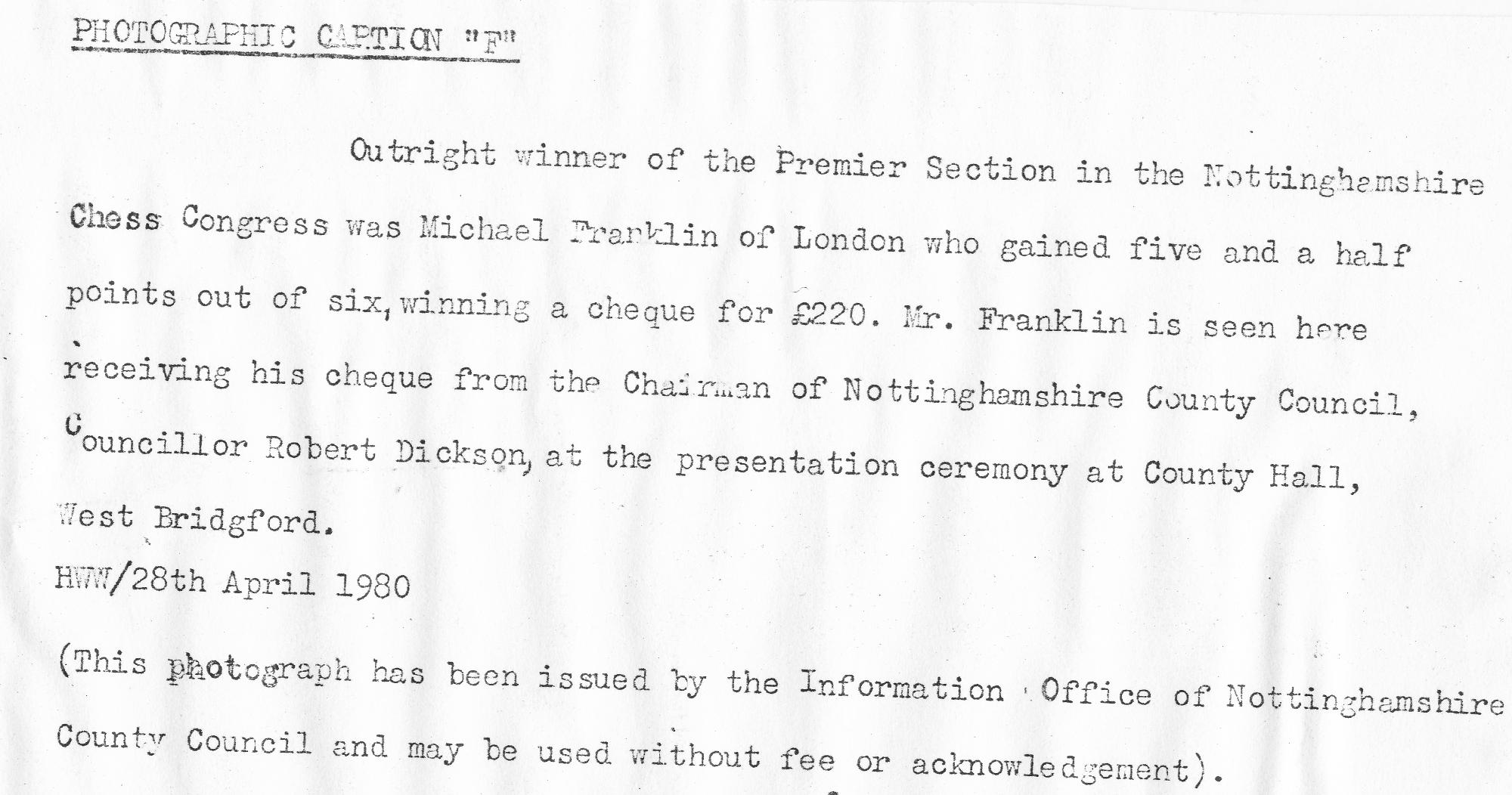
Michael Franklin receives £220 from Councillor Robert Dickson at the 1980 Nottinghamshire CongressCaption for above photograph
We send best wishes to Michael Franklin on his 90th birthday.
Growing Up
Michael John Franklin was born on Monday, February 2nd, 1931 in Battersea, London to Albert George (27 ix 1906, Dover – ? iii 1983, Wandsworth) and Helen Ann Franklin (née Colson, 1908-2003) who married in the third quarter of 1928 in Wandsworth. Albert was a clerk as was his father.
At the commencement of the Second World War, when eight years old, Michael was evacuated to Frome in Somerset. As a consequence Michael would delight in playing in the Frome Congress whenever possible. He played in the first event in 1990 organised by Leon York (whose name is the memorial trophy for the Major section). The story of Michael’s return to Frome made its’ way in to the local newspaper and was reported by Gary Lane as follows :
From British Chess Magazine, Volume CX (110, 1990), Number 7 (July), page 296 :
“A special presentation by the sponsor, Mrs. Jean Mackereth, Managing Director of Keyford Frames, was made to Londoner Michael Franklin, who was returning for the first time in 51 years to the town to which he was evacuated during the war. His final appearance at Frome was in the 2010 event.
The Early Years
Michaels interest in chess started in 1944 aged 13 when he witnessed games being played on Clapham Common. He was fascinated by the pieces and taught himself to play, never receiving any formal coaching. He joined the Clapham Common Chess Club in 1944. (CCCC became incorporated into Battersea Chess Club some time later).
CHECK MATES: Elderly members of the Clapham Common Open Air Chess and Draughts Club, circa 1920. The club met regularly during the afternoons to play on Clapham Common in south London. Copyright : Keystone
Apart from summer events such as the above the club had a Winter Section that played matches in the London League. The club won the first division (now known as the Brian Smith Trophy) of the London League in the 1946-47 and 1947-48 seasons. Michael played his final game in the London Chess League for Richmond & Twickenham on April 14th 2010 drawing with John Hodgson, brother of Julian giving a sixty year span.
In his formative years he played at the Gambit Chess Café, Budge Row, Cannon Street, London, EC4N. Many strong players regularly visited the Gambit to play skittles, blitz and the frequently held lightning tournaments hosted by the proprietor Mr GH White.
Events such as these enabled Michael to develop his quick sight of the board and his flair for tactical play.
Leonard Barden added :
“Michael made his name as a young player first by his successes in the Saturday evening Gambit Guinea speed events at the Gambit Chess Café in Cannon Street which he often won ahead of master level rivals. He remained a strong speed player all his life.”
In the early 1950s Michael was persuaded by his friends Aird Thomson (who was Scottish Boys’ Champion in 1932, and 1933 ( equal-first). In 1951 he was Scottish Champion. In 1954 he moved to London. He married Susan Mary Hamilton in 1961 who went on to become Scottish Ladies’ Champion in 1965.) and oriental carpet expert Robert Pinner to join the Richmond and Twickenham Chess Club playing for the club in the London League, Surrey Trophy and National Club Championship until he retired from competitive play 2010.
Making Progress
Michael’s first appearance in British Chess Magazine was in Volume LXVI (66, 1946), Number 2 (February). Page 52 contained this report of the 1945 London Boy’s Championship in which Michael reached the final A section :
British Chess Magazine, Volume LXVI (66, 1946), Number 2 (February), page 52
On leaving school Michael joined a firm of Patent Agents remaining in their employ as the accounts department for around forty years before retiring in the late 1980s. His retirement was prompted by the firm’s adoption of electronic computers. When he retired he was Chief Cashier.
On June 18th 1960 Michael’s happiest day was when he married Jean Fey. They celebrated their diamond anniversary in 2020.
To the present day Michael has maintained an aversion toward modern technology. He did, however, concede to the ownership of a mobile telephone. This was for the specific purpose of updating Jean on his days progress in any chess tournaments where he was away from home.
In 1946 (aged 15) Michael won the Felce Cup awarded by the Surrey County Chess Association. A result indicating rapid improvement since Michael had only started playing competitively in 1944.
The Felce Cup held by the hands of Stephen Moss in 2014
In 1951 Michael finished third in the Surrey Championships behind the winner Frank Parr and runner-up David Hooper. In 1961, 1966, 1968, 1969 and 1970 Michael won the Surrey Championship outright and made many appearences in county matches for Surrey from 1950 onwards until 2010.
Unfortunately Michael’s rapid progress was threatened by two bouts of ill health. In 1948 aged 17 Michael was diagnosed with Tuberculosis which lasted for eighteen months including a twelve month stay in the Royal National Hospital for Diseases of the Chest in Ventnor on the Isle of Wight. Aged twenty the TB returned leading to yet another twelve months illness.
Michael has suffered from ill health all of his life interrupting his chess career at various times. Fortunately the TB has not returned.
Michael won the National Chess Centre Championship in 1953 and 1955 being runner-up in 1954. The venue was Hill’s Restaurant, 158 Bishopsgate, London, EC2 opposite Liverpool Street Station since the original John Lewis department store venue was bombed in 1940.
The British Chess Federation first published a National Grading list in 1953 (using the Richard Clarke system). In the 1954 list MF appeared with a grade of 2A (225-232) and from then on with a grade of either 2A or 2B. In 1964 a numeric system had him at 225 ranking Michael 4th in England behind Penrose 244, Kottnauer 238 and Clarke 231.
Michael played many times in the annual Battle of Britain Tournament organised by Squadron Leader David Pritchard and his committee. He won it four times : 1959, 1960, 1961 and 1962.
The Ilford Whitsun Congress
The Ilford Whitsun Congress was a regular part of Michael’s season throughout the sixties. He won the Premier Reserves in 1961 ahead of Hilton, Hindle, Howson, Sales and Blaine and was runner-up to Kottnauer in 1962. In 1963 he went one step better by winning the Premier :
A report of Mike Franklin’s success at the 1963 Ilford Whitsun Congress by Peter Clarke. Source : British Chess Magazine, Volume LXXXIII, Number 7 (July), page 193
and here is the fifth round game :
In his tournament report PH Clarke wrote :
This buoyant, optimistic attitude of his is a great strength and always makes him a dangerous opponent.
Away from Home : International Progress
1964 saw selection by the BCF to play in the Tel Aviv Olympiad :
The 1964 England Olympiad (Tel Aviv) Team : Owen Hindle, Čeněk Kottnauer, Peter Clarke, Michael Franklin, Norman Littlewood & Michael Haygarth
and scored a creditable 4/6. This was followed in 1965 with 3/5 in Clare Benedict tournament held in Berlin.
He played in the annual Anglo-Dutch match on no less than six occasions in 1962, 1963, 1964, 1965, 1968 and finally in 1969. His aggregate score was an impressive 8/12.
?, Čeněk Kottnauer, Michael Franklin and Owen Hindle
On the national scene Michael repeated his 1963 victory at the 1969 Ilford Premier with a clear first place : Franklin 4; RG Wade and D Wright 3; JB Howson 2.5; BH Wood 2; PH Clarke 0.5.
In 1970 Michael won the London Championship which was also known as the Budget Cup which had last been held in 1956 . He followed this in 1972 by rightly earning the (now defunct) title of British Master.
Michael’s final appearance for England was in 1971 in the Cheltenham based Anglo-German match with a somewhat disappointing 0.5/2 against Juergen Dueball.
Owen Hindle, Michael Franklin, Harry Golombek and Michael Haygarth
Michael played board two for London in a Telex match versus Belgrade playing Marjanovic. The game was drawn.
Michael Franklin playing board two in the London – Belgrade Telex Match on April 3rd, 1976 from the St. James Hotel, Buckingham Gate. Sourced from BCM, Volume XCVI (96), Number 5, page 192. Photographer probably Freddy Reilly.
The Ultimate Prize : The Aaronson Masters
The Aaronson Masters at Harrow 1978 brought his best individual success at the age of 47, sharing first place with IM Aldo Haik of France and to boot, earning an IM norm.
Joint winners of the 1978 Aaronson Masters : Michael Franklin and IM Aldo Haik
Michael scored an undefeated 7.5/10 and finished ahead of Short, Speelman, Nunn, Hartston, Mestel, Webb, Basman, Botterill and numerous other illustrious players. Michael remarked of his lifetime best result that it was
just one of those occasions when everything went right!
But he scored 3.5/5 against the IMs, was alert to every opportunity, and the games show he owed little to luck.
Leonard Barden, Stewart Reuben and Michael Franklin at the 1978 Aaronson Masters
Like many others Michael made appearences in Lloyds Bank events of 1977, 1978, 1984, 1989, 1991, 1993 and 1994.
Michael Franklin (left) at the 1978 Lloyds Bank Masters playing IGM Leonid ShamkovichMichael and friends during the 1978 Lloyds Bank Masters
The Hastings Years
Michael first played at Hastings in 1964 when he was invited to play in the Premier Tournament. The tournament was won by Mikhail Tal and Michael finished in last place.
Undaunted he returned to Hastings in 1968 to play in the Challengers tournament. One of the attractions of playing in the Challengers was that the winner received a place the following years Premier. Frustratingly Michael finished second three years in a row! In 1968 the Challengers was won by Danny Wright, in 1969 by Martyn Corden and in 1970 by Peter Markland. Finally, in 1971 his patience was rewarded and he won the Challengers and qualified to the following years Premier.
The 47th Hastings Premier of 1971-72 had been changed from the traditional 10 player all-play-all to a 16 player tournament. Also, having obtained sponsorship from various organisations the committee were able to invite some of the top names of the day. The sponsors were:
So, the entry included Karpov, Korchnoi, Andersson, Najdorf, Mecking, Gligoric, Unzicker and Robert Byrne to name but a few. This was undoubtedly the strongest Hastings Premier since World War Two and possibly the strongest Hastings Tournament since 1895.
Michael started well with a draw against the Rumanian GM Ciocaltea followed by a draw in with the Brazilian prodigy Mecking. In round three he surprised everyone by beating Ray Keene. With 2/3 things were looking promising. However, after this bright start Michael only managed a draw against Unzicker and a draw with Hartston finishing in a disappointing last place with a score of 3/15.
In the tournament report Peter Clarke opined
Franklin suffered the usual fate of the gifted amateur in a professional field of simply not being accustomed to this kind of chess.
Despite this Michael continued to play in the Hastings Challengers. He played in nineteen out of the next twenty-five years! He came close to winning the tournament in 1982: he was leading the tournament with a score of 7/8 when he was informed that Jean’s Father had passed away. Having drawn his ninth round game and needing only a draw in the last round to ensure at least a tie for first place he withdrew from the tournament and immediately left for home.
The Weekend Scene
Like all players with a full time job Michael had to play most of his chess at the weekend so the explosion of weekends tournaments in the early 1970’s gave him ample opportunities. His habit of playing quickly was ideally suited to the fast time limits of the weekend tournament. During the 1970 and 1980’s he was very successful. He won numerous events and was more often than not in the prize list.
FM Michael Franklin, Photo by Cathy Rogers
In later years he restricted himself to London based tournaments and those in the West Country. His regular tournaments being Exeter, Torquay and old favourite, Frome. Michael at the age of 78 shared first place at Frome 2009. Frome 2010 was his farewell appearance.
FM Michael Franklin
Michael played for a number of clubs viz : Richmond & Twickenham, Coulsdon CF, Surrey CCA, 4NCL Richmond, 4NCL Bristol and Richards Butler to name but a few.
Finally, in 1980, Michael was awarded the FIDE Master title and achieved his highest rating (in the Elo era) of 2345 in January 1979. It is most likely that his highest ever rating would have been more like 2450.
FM Michael Franklin vs Paul Helbig
Appropriately enough Michael was the inaugural winner of the BCF/ECF Senior Prix in 2000 and won it again in 2002 and 2003. The event last ran in 2006.
When Surrey won the counties championship a few years back the team took the trophy around to Michael’s home in Norbury, such was their regard for his contributions.
The London System
Any currently active club player cannot have missed the explosive rise to prominence of the system for White he developed :
The London System and Accelerated London System has acquired a huge cohort of followers in recent times probably not realising the debt they (and many authors, book and DVD publishers!) owe to Michael. If only he could have earnt a royalty every time it was played!
Also Michael had notable success as Black with the O’Kelly Sicilian 1.e4 c5 2.Nf3 a6.
Life Outside of Chess
Michael had many interests apart from Chess. He was for many years a member of the Surrey County Cricket Club. After he retired he would arrange to meet fellow Surrey Member Frank Parr at the Oval and after lunch in the Pavilion they would spend the day enjoying the Cricket. Tennis was another sport that Michael followed. Michael was also interested in horseracing. Several players were surprised when visiting one of the racetracks around London to find Michael also attending the race meeting.
Michael was the typical “natural” player. He never studied the game and his only sources of opening information were the British Chess Magazine and the chess columns in The Times and the Guardian. He never kept the scores of his games. Once the game was finished it was time to move on. One of Michael’s greatest strengths was his optimistic attitude at the chessboard. No matter how bad the position he was confident of ultimate success.
Michael Franklin receives £220 from Councillor Robert Dickson at the 1980 Nottinghamshire CongressCaption for above photograph
We send best wishes to Michael Franklin on his 90th birthday.
Growing Up
Michael John Franklin was born on Monday, February 2nd, 1931 in Battersea, London to Albert George (27 ix 1906, Dover – ? iii 1983, Wandsworth) and Helen Ann Franklin (née Colson, 1908-2003) who married in the third quarter of 1928 in Wandsworth. Albert was a clerk as was his father.
At the commencement of the Second World War, when eight years old, Michael was evacuated to Frome in Somerset. As a consequence Michael would delight in playing in the Frome Congress whenever possible. He played in the first event in 1990 organised by Leon York (whose name is the memorial trophy for the Major section). The story of Michael’s return to Frome made its’ way in to the local newspaper and was reported by Gary Lane as follows :
From British Chess Magazine, Volume CX (110, 1990), Number 7 (July), page 296 :
“A special presentation by the sponsor, Mrs. Jean Mackereth, Managing Director of Keyford Frames, was made to Londoner Michael Franklin, who was returning for the first time in 51 years to the town to which he was evacuated during the war. His final appearance at Frome was in the 2010 event.
The Early Years
Michaels interest in chess started in 1944 aged 13 when he witnessed games being played on Clapham Common. He was fascinated by the pieces and taught himself to play, never receiving any formal coaching. He joined the Clapham Common Chess Club in 1944. (CCCC became incorporated into Battersea Chess Club some time later).
CHECK MATES: Elderly members of the Clapham Common Open Air Chess and Draughts Club, circa 1920. The club met regularly during the afternoons to play on Clapham Common in south London. Copyright : Keystone
Apart from summer events such as the above the club had a Winter Section that played matches in the London League. The club won the first division (now known as the Brian Smith Trophy) of the London League in the 1946-47 and 1947-48 seasons. Michael played his final game in the London Chess League for Richmond & Twickenham on April 14th 2010 drawing with John Hodgson, brother of Julian giving a sixty year span.
In his formative years he played at the Gambit Chess Café, Budge Row, Cannon Street, London, EC4N. Many strong players regularly visited the Gambit to play skittles, blitz and the frequently held lightning tournaments hosted by the proprietor Mr GH White.
Events such as these enabled Michael to develop his quick sight of the board and his flair for tactical play.
Leonard Barden added :
“Michael made his name as a young player first by his successes in the Saturday evening Gambit Guinea speed events at the Gambit Chess Café in Cannon Street which he often won ahead of master level rivals. He remained a strong speed player all his life.”
In the early 1950s Michael was persuaded by his friends Aird Thomson (who was Scottish Boys’ Champion in 1932, and 1933 ( equal-first). In 1951 he was Scottish Champion. In 1954 he moved to London. He married Susan Mary Hamilton in 1961 who went on to become Scottish Ladies’ Champion in 1965.) and oriental carpet expert Robert Pinner to join the Richmond and Twickenham Chess Club playing for the club in the London League, Surrey Trophy and National Club Championship until he retired from competitive play 2010.
Making Progress
Michael’s first appearance in British Chess Magazine was in Volume LXVI (66, 1946), Number 2 (February). Page 52 contained this report of the 1945 London Boy’s Championship in which Michael reached the final A section :
British Chess Magazine, Volume LXVI (66, 1946), Number 2 (February), page 52
On leaving school Michael joined a firm of Patent Agents remaining in their employ as the accounts department for around forty years before retiring in the late 1980s. His retirement was prompted by the firm’s adoption of electronic computers. When he retired he was Chief Cashier.
On June 18th 1960 Michael’s happiest day was when he married Jean Fey. They celebrated their diamond anniversary in 2020.
To the present day Michael has maintained an aversion toward modern technology. He did, however, concede to the ownership of a mobile telephone. This was for the specific purpose of updating Jean on his days progress in any chess tournaments where he was away from home.
In 1946 (aged 15) Michael won the Felce Cup awarded by the Surrey County Chess Association. A result indicating rapid improvement since Michael had only started playing competitively in 1944.
The Felce Cup held by the hands of Stephen Moss in 2014
In 1951 Michael finished third in the Surrey Championships behind the winner Frank Parr and runner-up David Hooper. In 1961, 1966, 1968, 1969 and 1970 Michael won the Surrey Championship outright and made many appearences in county matches for Surrey from 1950 onwards until 2010.
Unfortunately Michael’s rapid progress was threatened by two bouts of ill health. In 1948 aged 17 Michael was diagnosed with Tuberculosis which lasted for eighteen months including a twelve month stay in the Royal National Hospital for Diseases of the Chest in Ventnor on the Isle of Wight. Aged twenty the TB returned leading to yet another twelve months illness.
Michael has suffered from ill health all of his life interrupting his chess career at various times. Fortunately the TB has not returned.
Michael won the National Chess Centre Championship in 1953 and 1955 being runner-up in 1954. The venue was Hill’s Restaurant, 158 Bishopsgate, London, EC2 opposite Liverpool Street Station since the original John Lewis department store venue was bombed in 1940.
The British Chess Federation first published a National Grading list in 1953 (using the Richard Clarke system). In the 1954 list MF appeared with a grade of 2A (225-232) and from then on with a grade of either 2A or 2B. In 1964 a numeric system had him at 225 ranking Michael 4th in England behind Penrose 244, Kottnauer 238 and Clarke 231.
Michael played many times in the annual Battle of Britain Tournament organised by Squadron Leader David Pritchard and his committee. He won it four times : 1959, 1960, 1961 and 1962.
The Ilford Whitsun Congress
The Ilford Whitsun Congress was a regular part of Michael’s season throughout the sixties. He won the Premier Reserves in 1961 ahead of Hilton, Hindle, Howson, Sales and Blaine and was runner-up to Kottnauer in 1962. In 1963 he went one step better by winning the Premier :
A report of Mike Franklin’s success at the 1963 Ilford Whitsun Congress by Peter Clarke. Source : British Chess Magazine, Volume LXXXIII, Number 7 (July), page 193
and here is the fifth round game :
In his tournament report PH Clarke wrote :
This buoyant, optimistic attitude of his is a great strength and always makes him a dangerous opponent.
Away from Home : International Progress
1964 saw selection by the BCF to play in the Tel Aviv Olympiad :
The 1964 England Olympiad (Tel Aviv) Team : Owen Hindle, Čeněk Kottnauer, Peter Clarke, Michael Franklin, Norman Littlewood & Michael Haygarth
and scored a creditable 4/6. This was followed in 1965 with 3/5 in Clare Benedict tournament held in Berlin.
He played in the annual Anglo-Dutch match on no less than six occasions in 1962, 1963, 1964, 1965, 1968 and finally in 1969. His aggregate score was an impressive 8/12.
?, Čeněk Kottnauer, Michael Franklin and Owen Hindle
On the national scene Michael repeated his 1963 victory at the 1969 Ilford Premier with a clear first place : Franklin 4; RG Wade and D Wright 3; JB Howson 2.5; BH Wood 2; PH Clarke 0.5.
In 1970 Michael won the London Championship which was also known as the Budget Cup which had last been held in 1956 . He followed this in 1972 by rightly earning the (now defunct) title of British Master.
Michael’s final appearance for England was in 1971 in the Cheltenham based Anglo-German match with a somewhat disappointing 0.5/2 against Juergen Dueball.
Owen Hindle, Michael Franklin, Harry Golombek and Michael Haygarth
Michael played board two for London in a Telex match versus Belgrade playing Marjanovic. The game was drawn.
Michael Franklin playing board two in the London – Belgrade Telex Match on April 3rd, 1976 from the St. James Hotel, Buckingham Gate. Sourced from BCM, Volume XCVI (96), Number 5, page 192. Photographer probably Freddy Reilly.
The Ultimate Prize : The Aaronson Masters
The Aaronson Masters at Harrow 1978 brought his best individual success at the age of 47, sharing first place with IM Aldo Haik of France and to boot, earning an IM norm.
Joint winners of the 1978 Aaronson Masters : Michael Franklin and IM Aldo Haik
Michael scored an undefeated 7.5/10 and finished ahead of Short, Speelman, Nunn, Hartston, Mestel, Webb, Basman, Botterill and numerous other illustrious players. Michael remarked of his lifetime best result that it was
just one of those occasions when everything went right!
But he scored 3.5/5 against the IMs, was alert to every opportunity, and the games show he owed little to luck.
Leonard Barden, Stewart Reuben and Michael Franklin at the 1978 Aaronson Masters
Like many others Michael made appearences in Lloyds Bank events of 1977, 1978, 1984, 1989, 1991, 1993 and 1994.
Michael Franklin (left) at the 1978 Lloyds Bank Masters playing IGM Leonid ShamkovichMichael and friends during the 1978 Lloyds Bank Masters
The Hastings Years
Michael first played at Hastings in 1964 when he was invited to play in the Premier Tournament. The tournament was won by Mikhail Tal and Michael finished in last place.
Undaunted he returned to Hastings in 1968 to play in the Challengers tournament. One of the attractions of playing in the Challengers was that the winner received a place the following years Premier. Frustratingly Michael finished second three years in a row! In 1968 the Challengers was won by Danny Wright, in 1969 by Martyn Corden and in 1970 by Peter Markland. Finally, in 1971 his patience was rewarded and he won the Challengers and qualified to the following years Premier.
The 47th Hastings Premier of 1971-72 had been changed from the traditional 10 player all-play-all to a 16 player tournament. Also, having obtained sponsorship from various organisations the committee were able to invite some of the top names of the day. The sponsors were:
So, the entry included Karpov, Korchnoi, Andersson, Najdorf, Mecking, Gligoric, Unzicker and Robert Byrne to name but a few. This was undoubtedly the strongest Hastings Premier since World War Two and possibly the strongest Hastings Tournament since 1895.
Michael started well with a draw against the Rumanian GM Ciocaltea followed by a draw in with the Brazilian prodigy Mecking. In round three he surprised everyone by beating Ray Keene. With 2/3 things were looking promising. However, after this bright start Michael only managed a draw against Unzicker and a draw with Hartston finishing in a disappointing last place with a score of 3/15.
In the tournament report Peter Clarke opined
Franklin suffered the usual fate of the gifted amateur in a professional field of simply not being accustomed to this kind of chess.
Despite this Michael continued to play in the Hastings Challengers. He played in nineteen out of the next twenty-five years! He came close to winning the tournament in 1982: he was leading the tournament with a score of 7/8 when he was informed that Jean’s Father had passed away. Having drawn his ninth round game and needing only a draw in the last round to ensure at least a tie for first place he withdrew from the tournament and immediately left for home.
The Weekend Scene
Like all players with a full time job Michael had to play most of his chess at the weekend so the explosion of weekends tournaments in the early 1970’s gave him ample opportunities. His habit of playing quickly was ideally suited to the fast time limits of the weekend tournament. During the 1970 and 1980’s he was very successful. He won numerous events and was more often than not in the prize list.
FM Michael Franklin, Photo by Cathy Rogers
In later years he restricted himself to London based tournaments and those in the West Country. His regular tournaments being Exeter, Torquay and old favourite, Frome. Michael at the age of 78 shared first place at Frome 2009. Frome 2010 was his farewell appearance.
FM Michael Franklin
Michael played for a number of clubs viz : Richmond & Twickenham, Coulsdon CF, Surrey CCA, 4NCL Richmond, 4NCL Bristol and Richards Butler to name but a few.
Finally, in 1980, Michael was awarded the FIDE Master title and achieved his highest rating (in the Elo era) of 2345 in January 1979. It is most likely that his highest ever rating would have been more like 2450.
FM Michael Franklin vs Paul Helbig
Appropriately enough Michael was the inaugural winner of the BCF/ECF Senior Prix in 2000 and won it again in 2002 and 2003. The event last ran in 2006.
When Surrey won the counties championship a few years back the team took the trophy around to Michael’s home in Norbury, such was their regard for his contributions.
The London System
Any currently active club player cannot have missed the explosive rise to prominence of the system for White he developed :
The London System and Accelerated London System has acquired a huge cohort of followers in recent times probably not realising the debt they (and many authors, book and DVD publishers!) owe to Michael. If only he could have earnt a royalty every time it was played!
Also Michael had notable success as Black with the O’Kelly Sicilian 1.e4 c5 2.Nf3 a6.
Life Outside of Chess
Michael had many interests apart from Chess. He was for many years a member of the Surrey County Cricket Club. After he retired he would arrange to meet fellow Surrey Member Frank Parr at the Oval and after lunch in the Pavilion they would spend the day enjoying the Cricket. Tennis was another sport that Michael followed. Michael was also interested in horseracing. Several players were surprised when visiting one of the racetracks around London to find Michael also attending the race meeting.
Michael was the typical “natural” player. He never studied the game and his only sources of opening information were the British Chess Magazine and the chess columns in The Times and the Guardian. He never kept the scores of his games. Once the game was finished it was time to move on. One of Michael’s greatest strengths was his optimistic attitude at the chessboard. No matter how bad the position he was confident of ultimate success.
Michael Franklin receives £220 from Councillor Robert Dickson at the 1980 Nottinghamshire CongressCaption for above photograph
We send best wishes to Michael Franklin on his 90th birthday.
Growing Up
Michael John Franklin was born on Monday, February 2nd, 1931 in Battersea, London to Albert George (27 ix 1906, Dover – ? iii 1983, Wandsworth) and Helen Ann Franklin (née Colson, 1908-2003) who married in the third quarter of 1928 in Wandsworth. Albert was a clerk as was his father.
At the commencement of the Second World War, when eight years old, Michael was evacuated to Frome in Somerset. As a consequence Michael would delight in playing in the Frome Congress whenever possible. He played in the first event in 1990 organised by Leon York (whose name is the memorial trophy for the Major section). The story of Michael’s return to Frome made its’ way in to the local newspaper and was reported by Gary Lane as follows :
From British Chess Magazine, Volume CX (110, 1990), Number 7 (July), page 296 :
“A special presentation by the sponsor, Mrs. Jean Mackereth, Managing Director of Keyford Frames, was made to Londoner Michael Franklin, who was returning for the first time in 51 years to the town to which he was evacuated during the war. His final appearance at Frome was in the 2010 event.
The Early Years
Michaels interest in chess started in 1944 aged 13 when he witnessed games being played on Clapham Common. He was fascinated by the pieces and taught himself to play, never receiving any formal coaching. He joined the Clapham Common Chess Club in 1944. (CCCC became incorporated into Battersea Chess Club some time later).
CHECK MATES: Elderly members of the Clapham Common Open Air Chess and Draughts Club, circa 1920. The club met regularly during the afternoons to play on Clapham Common in south London. Copyright : Keystone
Apart from summer events such as the above the club had a Winter Section that played matches in the London League. The club won the first division (now known as the Brian Smith Trophy) of the London League in the 1946-47 and 1947-48 seasons. Michael played his final game in the London Chess League for Richmond & Twickenham on April 14th 2010 drawing with John Hodgson, brother of Julian giving a sixty year span.
In his formative years he played at the Gambit Chess Café, Budge Row, Cannon Street, London, EC4N. Many strong players regularly visited the Gambit to play skittles, blitz and the frequently held lightning tournaments hosted by the proprietor Mr GH White.
Events such as these enabled Michael to develop his quick sight of the board and his flair for tactical play.
Leonard Barden added :
“Michael made his name as a young player first by his successes in the Saturday evening Gambit Guinea speed events at the Gambit Chess Café in Cannon Street which he often won ahead of master level rivals. He remained a strong speed player all his life.”
In the early 1950s Michael was persuaded by his friends Aird Thomson (who was Scottish Boys’ Champion in 1932, and 1933 ( equal-first). In 1951 he was Scottish Champion. In 1954 he moved to London. He married Susan Mary Hamilton in 1961 who went on to become Scottish Ladies’ Champion in 1965.) and oriental carpet expert Robert Pinner to join the Richmond and Twickenham Chess Club playing for the club in the London League, Surrey Trophy and National Club Championship until he retired from competitive play 2010.
Making Progress
Michael’s first appearance in British Chess Magazine was in Volume LXVI (66, 1946), Number 2 (February). Page 52 contained this report of the 1945 London Boy’s Championship in which Michael reached the final A section :
British Chess Magazine, Volume LXVI (66, 1946), Number 2 (February), page 52
On leaving school Michael joined a firm of Patent Agents remaining in their employ as the accounts department for around forty years before retiring in the late 1980s. His retirement was prompted by the firm’s adoption of electronic computers. When he retired he was Chief Cashier.
On June 18th 1960 Michael’s happiest day was when he married Jean Fey. They celebrated their diamond anniversary in 2020.
To the present day Michael has maintained an aversion toward modern technology. He did, however, concede to the ownership of a mobile telephone. This was for the specific purpose of updating Jean on his days progress in any chess tournaments where he was away from home.
In 1946 (aged 15) Michael won the Felce Cup awarded by the Surrey County Chess Association. A result indicating rapid improvement since Michael had only started playing competitively in 1944.
The Felce Cup held by the hands of Stephen Moss in 2014
In 1951 Michael finished third in the Surrey Championships behind the winner Frank Parr and runner-up David Hooper. In 1961, 1966, 1968, 1969 and 1970 Michael won the Surrey Championship outright and made many appearences in county matches for Surrey from 1950 onwards until 2010.
Unfortunately Michael’s rapid progress was threatened by two bouts of ill health. In 1948 aged 17 Michael was diagnosed with Tuberculosis which lasted for eighteen months including a twelve month stay in the Royal National Hospital for Diseases of the Chest in Ventnor on the Isle of Wight. Aged twenty the TB returned leading to yet another twelve months illness.
Michael has suffered from ill health all of his life interrupting his chess career at various times. Fortunately the TB has not returned.
Michael won the National Chess Centre Championship in 1953 and 1955 being runner-up in 1954. The venue was Hill’s Restaurant, 158 Bishopsgate, London, EC2 opposite Liverpool Street Station since the original John Lewis department store venue was bombed in 1940.
The British Chess Federation first published a National Grading list in 1953 (using the Richard Clarke system). In the 1954 list MF appeared with a grade of 2A (225-232) and from then on with a grade of either 2A or 2B. In 1964 a numeric system had him at 225 ranking Michael 4th in England behind Penrose 244, Kottnauer 238 and Clarke 231.
Michael played many times in the annual Battle of Britain Tournament organised by Squadron Leader David Pritchard and his committee. He won it four times : 1959, 1960, 1961 and 1962.
The Ilford Whitsun Congress
The Ilford Whitsun Congress was a regular part of Michael’s season throughout the sixties. He won the Premier Reserves in 1961 ahead of Hilton, Hindle, Howson, Sales and Blaine and was runner-up to Kottnauer in 1962. In 1963 he went one step better by winning the Premier :
A report of Mike Franklin’s success at the 1963 Ilford Whitsun Congress by Peter Clarke. Source : British Chess Magazine, Volume LXXXIII, Number 7 (July), page 193
and here is the fifth round game :
In his tournament report PH Clarke wrote :
This buoyant, optimistic attitude of his is a great strength and always makes him a dangerous opponent.
Away from Home : International Progress
1964 saw selection by the BCF to play in the Tel Aviv Olympiad :
The 1964 England Olympiad (Tel Aviv) Team : Owen Hindle, Čeněk Kottnauer, Peter Clarke, Michael Franklin, Norman Littlewood & Michael Haygarth
and scored a creditable 4/6. This was followed in 1965 with 3/5 in Clare Benedict tournament held in Berlin.
He played in the annual Anglo-Dutch match on no less than six occasions in 1962, 1963, 1964, 1965, 1968 and finally in 1969. His aggregate score was an impressive 8/12.
?, Čeněk Kottnauer, Michael Franklin and Owen Hindle
On the national scene Michael repeated his 1963 victory at the 1969 Ilford Premier with a clear first place : Franklin 4; RG Wade and D Wright 3; JB Howson 2.5; BH Wood 2; PH Clarke 0.5.
In 1970 Michael won the London Championship which was also known as the Budget Cup which had last been held in 1956 . He followed this in 1972 by rightly earning the (now defunct) title of British Master.
Michael’s final appearance for England was in 1971 in the Cheltenham based Anglo-German match with a somewhat disappointing 0.5/2 against Juergen Dueball.
Owen Hindle, Michael Franklin, Harry Golombek and Michael Haygarth
Michael played board two for London in a Telex match versus Belgrade playing Marjanovic. The game was drawn.
Michael Franklin playing board two in the London – Belgrade Telex Match on April 3rd, 1976 from the St. James Hotel, Buckingham Gate. Sourced from BCM, Volume XCVI (96), Number 5, page 192. Photographer probably Freddy Reilly.
The Ultimate Prize : The Aaronson Masters
The Aaronson Masters at Harrow 1978 brought his best individual success at the age of 47, sharing first place with IM Aldo Haik of France and to boot, earning an IM norm.
Joint winners of the 1978 Aaronson Masters : Michael Franklin and IM Aldo Haik
Michael scored an undefeated 7.5/10 and finished ahead of Short, Speelman, Nunn, Hartston, Mestel, Webb, Basman, Botterill and numerous other illustrious players. Michael remarked of his lifetime best result that it was
just one of those occasions when everything went right!
But he scored 3.5/5 against the IMs, was alert to every opportunity, and the games show he owed little to luck.
Leonard Barden, Stewart Reuben and Michael Franklin at the 1978 Aaronson Masters
Like many others Michael made appearences in Lloyds Bank events of 1977, 1978, 1984, 1989, 1991, 1993 and 1994.
Michael Franklin (left) at the 1978 Lloyds Bank Masters playing IGM Leonid ShamkovichMichael and friends during the 1978 Lloyds Bank Masters
The Hastings Years
Michael first played at Hastings in 1964 when he was invited to play in the Premier Tournament. The tournament was won by Mikhail Tal and Michael finished in last place.
Undaunted he returned to Hastings in 1968 to play in the Challengers tournament. One of the attractions of playing in the Challengers was that the winner received a place the following years Premier. Frustratingly Michael finished second three years in a row! In 1968 the Challengers was won by Danny Wright, in 1969 by Martyn Corden and in 1970 by Peter Markland. Finally, in 1971 his patience was rewarded and he won the Challengers and qualified to the following years Premier.
The 47th Hastings Premier of 1971-72 had been changed from the traditional 10 player all-play-all to a 16 player tournament. Also, having obtained sponsorship from various organisations the committee were able to invite some of the top names of the day. The sponsors were:
So, the entry included Karpov, Korchnoi, Andersson, Najdorf, Mecking, Gligoric, Unzicker and Robert Byrne to name but a few. This was undoubtedly the strongest Hastings Premier since World War Two and possibly the strongest Hastings Tournament since 1895.
Michael started well with a draw against the Rumanian GM Ciocaltea followed by a draw in with the Brazilian prodigy Mecking. In round three he surprised everyone by beating Ray Keene. With 2/3 things were looking promising. However, after this bright start Michael only managed a draw against Unzicker and a draw with Hartston finishing in a disappointing last place with a score of 3/15.
In the tournament report Peter Clarke opined
Franklin suffered the usual fate of the gifted amateur in a professional field of simply not being accustomed to this kind of chess.
Despite this Michael continued to play in the Hastings Challengers. He played in nineteen out of the next twenty-five years! He came close to winning the tournament in 1982: he was leading the tournament with a score of 7/8 when he was informed that Jean’s Father had passed away. Having drawn his ninth round game and needing only a draw in the last round to ensure at least a tie for first place he withdrew from the tournament and immediately left for home.
The Weekend Scene
Like all players with a full time job Michael had to play most of his chess at the weekend so the explosion of weekends tournaments in the early 1970’s gave him ample opportunities. His habit of playing quickly was ideally suited to the fast time limits of the weekend tournament. During the 1970 and 1980’s he was very successful. He won numerous events and was more often than not in the prize list.
FM Michael Franklin, Photo by Cathy Rogers
In later years he restricted himself to London based tournaments and those in the West Country. His regular tournaments being Exeter, Torquay and old favourite, Frome. Michael at the age of 78 shared first place at Frome 2009. Frome 2010 was his farewell appearance.
FM Michael Franklin
Michael played for a number of clubs viz : Richmond & Twickenham, Coulsdon CF, Surrey CCA, 4NCL Richmond, 4NCL Bristol and Richards Butler to name but a few.
Finally, in 1980, Michael was awarded the FIDE Master title and achieved his highest rating (in the Elo era) of 2345 in January 1979. It is most likely that his highest ever rating would have been more like 2450.
FM Michael Franklin vs Paul Helbig
Appropriately enough Michael was the inaugural winner of the BCF/ECF Senior Prix in 2000 and won it again in 2002 and 2003. The event last ran in 2006.
When Surrey won the counties championship a few years back the team took the trophy around to Michael’s home in Norbury, such was their regard for his contributions.
The London System
Any currently active club player cannot have missed the explosive rise to prominence of the system for White he developed :
The London System and Accelerated London System has acquired a huge cohort of followers in recent times probably not realising the debt they (and many authors, book and DVD publishers!) owe to Michael. If only he could have earnt a royalty every time it was played!
Also Michael had notable success as Black with the O’Kelly Sicilian 1.e4 c5 2.Nf3 a6.
Life Outside of Chess
Michael had many interests apart from Chess. He was for many years a member of the Surrey County Cricket Club. After he retired he would arrange to meet fellow Surrey Member Frank Parr at the Oval and after lunch in the Pavilion they would spend the day enjoying the Cricket. Tennis was another sport that Michael followed. Michael was also interested in horseracing. Several players were surprised when visiting one of the racetracks around London to find Michael also attending the race meeting.
Michael was the typical “natural” player. He never studied the game and his only sources of opening information were the British Chess Magazine and the chess columns in The Times and the Guardian. He never kept the scores of his games. Once the game was finished it was time to move on. One of Michael’s greatest strengths was his optimistic attitude at the chessboard. No matter how bad the position he was confident of ultimate success.
Michael Franklin receives £220 from Councillor Robert Dickson at the 1980 Nottinghamshire CongressCaption for above photograph
We wish GM Jonathan Speelman all the best on his birthday.
Jonathan Simon Speelman was born on Tuesday, October 2nd, 1956 in Marylebone, London. His mother’s maiden name was Freeman. In March 2002 Jon and Lindsey Thomas were married in Camden, Greater London. They have a non-chess playing son, Lawrence who studied Ancient Languages at The University of Chicago.
Jonathan attended St. Paul’s School, London and then Worcester College, Oxford and read mathematics.
He became an International Master in 1978 (England’s tenth) and a Grandmaster in 1980 (England’s fifth) and achieved a peak FIDE rating of 2645 at the age of 32 in July 1988.
Jon is a Life Member of King’s Head Chess Club and has helped them organise a number of tournaments including the NatWest Young Masters where he has adjudicated the winner of the Best Game Prize.
Currently, Jon plays for Wood Green in Four Nations Chess League and in the London League and maintains an ECF grade of 245.
Jon is the chess correspondent for The Observer and The Independent.
With the white pieces Jon prefers 1.Nf3 and against 1…Nf6 to follow with c4 and d4. Interestingly, if black plays 1…d5 then Jon plays an early king-side fianchetto.
As the second player Jon prefers the Smyslov Caro-Kann, the Nimzo-Indian and Queen’s Indian defences.
His record against contemporary players is impressive :
Nigel Short : +5
Murray Chandler : +4
Jonathan Mestel : +4
John Nunn : +3
James Plaskett : +4
Mark Hebden : +7
Tony Miles : +1
Tony Kosten : +3
Daniel King : +2
Jon Speelman and Nigel Short at the start of their 1989 Candidates match. Jon won 3.5 – 1.5
From British Chess (Pergamon Press, 1983) by Botterill, Levy, Rice and Richardson :
“Having been asked to contribute an article on myself to this book I have decided to concentrate almost exclusively on my ‘relationship with chess’, but first quickly summarize my life.
JS
Born on 2nd October 1956 I went to a ‘Nursery School’ whose name I forget. Then to Arnold House School followed by St. Paul’s School. I had a ‘Year off’ from January to October, 1976, when I went up to Worcester College, Oxford, where I studied mathematics. In 1977 I left Oxford with a 2nd degree. Since then I have been a professional chess player.
I was taught chess at the age of 6 by my cousin on Boxing Day, 1962. Then as now, I was an inquisitive person and the idea of a ‘complicated and difficult game’ interested me. Sadly my first game of chess ended in checkmate in four moves; but I persevered and soon became more competent.
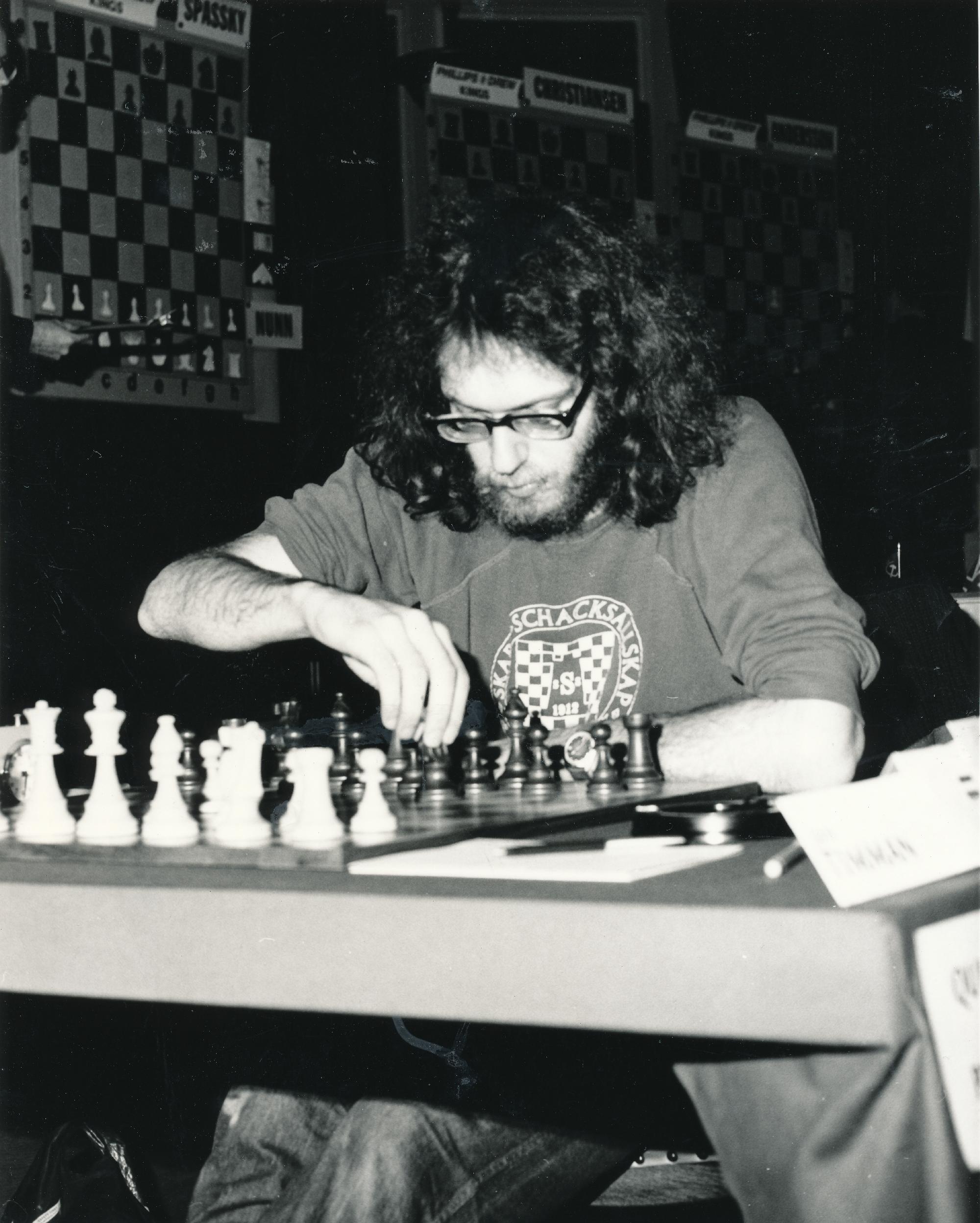
JS at the London based Philips & Drew Kings tournament
I have always seen life to some in terms of barriers. There are things which one can do easily and which one finds difficult or almost impossible. For any given task the transition from one state to the other is not as smooth. One builds up energy and finally is able to succeed for the first time. After that the task becomes successively easier: Partly because one is aware that one can succeed.
Jonathan Speelman without glasses
ln order to illustrate my chess career to date, I shall therefore pick out examples of barriers which I managed to break through.
Jonathan was an early follower of fashion
Until a few Years ago there were few titled players in Great Britain. But recently, thanks largely to a change of emphasis in organisation, several players have broken through to obtain international titles. This is not only because British players have become stronger – which they undoubtedly have – but also because they have received opportunities which were previously denied them.
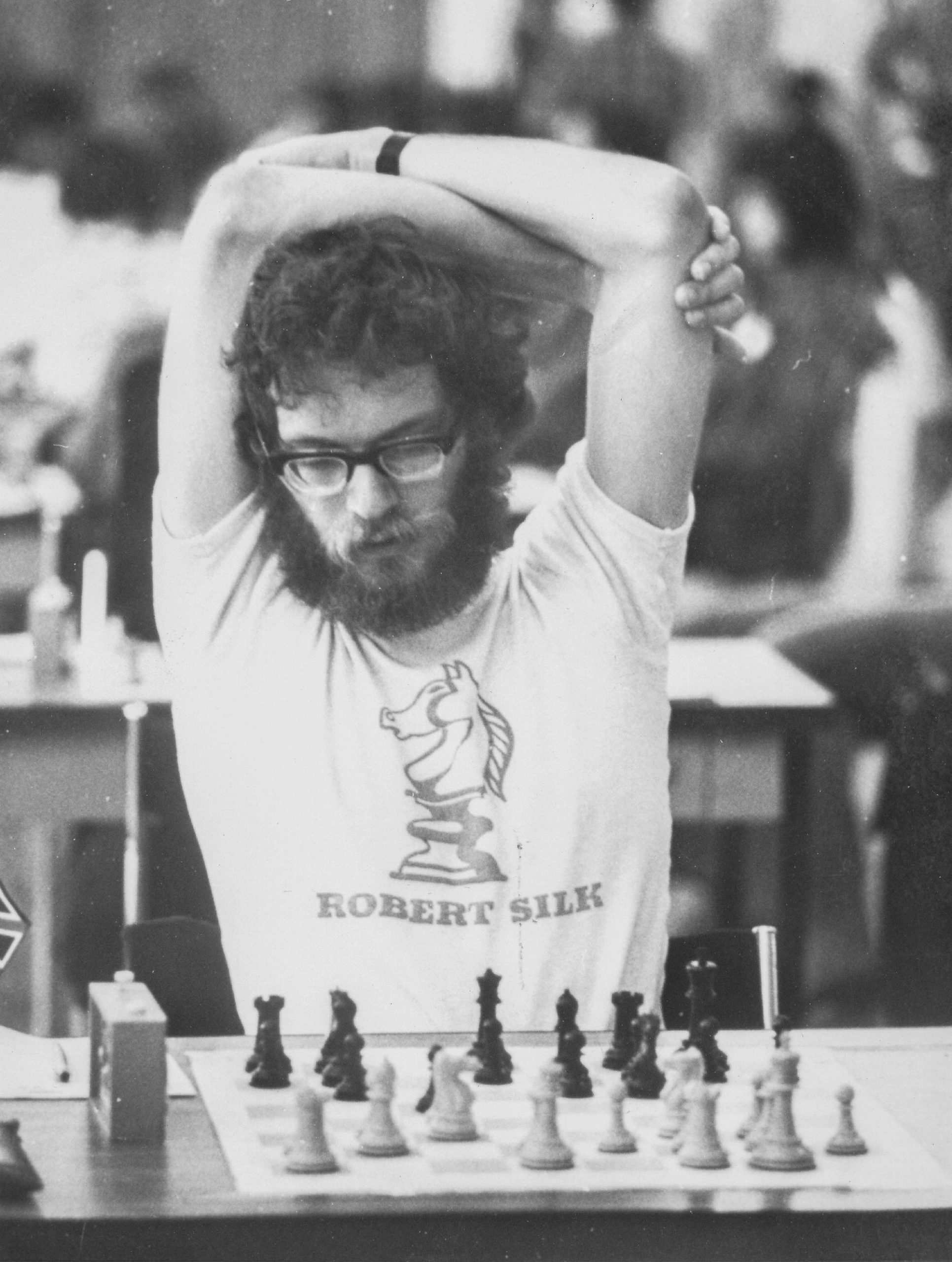
JS at the London Robert Silk Fellowship invitational tournament
I first started seriously to contemplate becoming an international master in 1977. Previously, I had of course aspired to this but without really investigating the mechanics of obtaining norms. In August, 1977 England sent a team to the World Student Team Championships in Mexico City. We came third: a year later we were to win the event (though on that occasion it was a World Under 26 Team Championship). On our return there was an invitation tournament in London: the ‘Lloyds Bank Silver Jubilee’. Although I was rather tired after Mexico I decided to play and to my surprise, I obtained an IM norm with a round to spare. It all seemed rather easy. I drew with six strong players including GM Torre and four IM’s and beat three weaker ones.
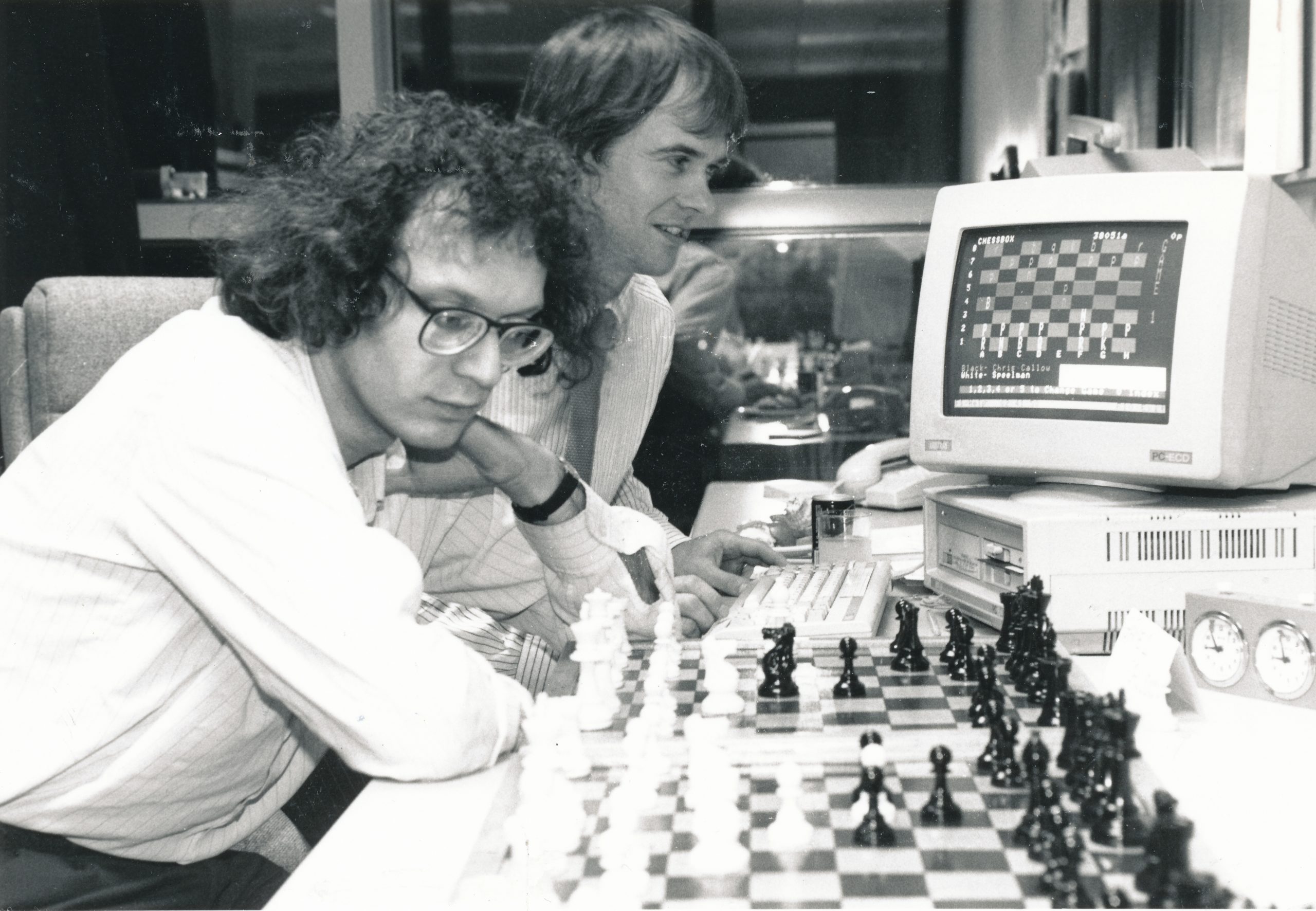
Grandmaster Uses PressTel Chessbox to Play Long Distance Chess. Jonathan Speelman the UK Grandmaster is pictured here deciding his next move in a computer chess game against five simultaneous opponents. Players exchanged moves online via the ChessBox club on PressTel, BTs videotex service.
In December, 1977 I played for the first time in the Annual Grandmaster Tournament at Hastings. I was very pleased to ‘shut up shop’, abandoning any pretensions to an exciting style to score one win, one loss and – wait for it – twelve draws; but 7/14 was sufficient for another international master norm.
These two events left me with twenty three games of norm, one less than the required minimum. Early in 1978 I played in a tournament in London but failed to get my final leg. It was in April that year that I had my next chance at the famous Lone Pine Tournament in California. I have already stressed the importance of barriers. It was in round one of the Lone Pine tournament that I broke through another important one – that of beating a grandmaster.
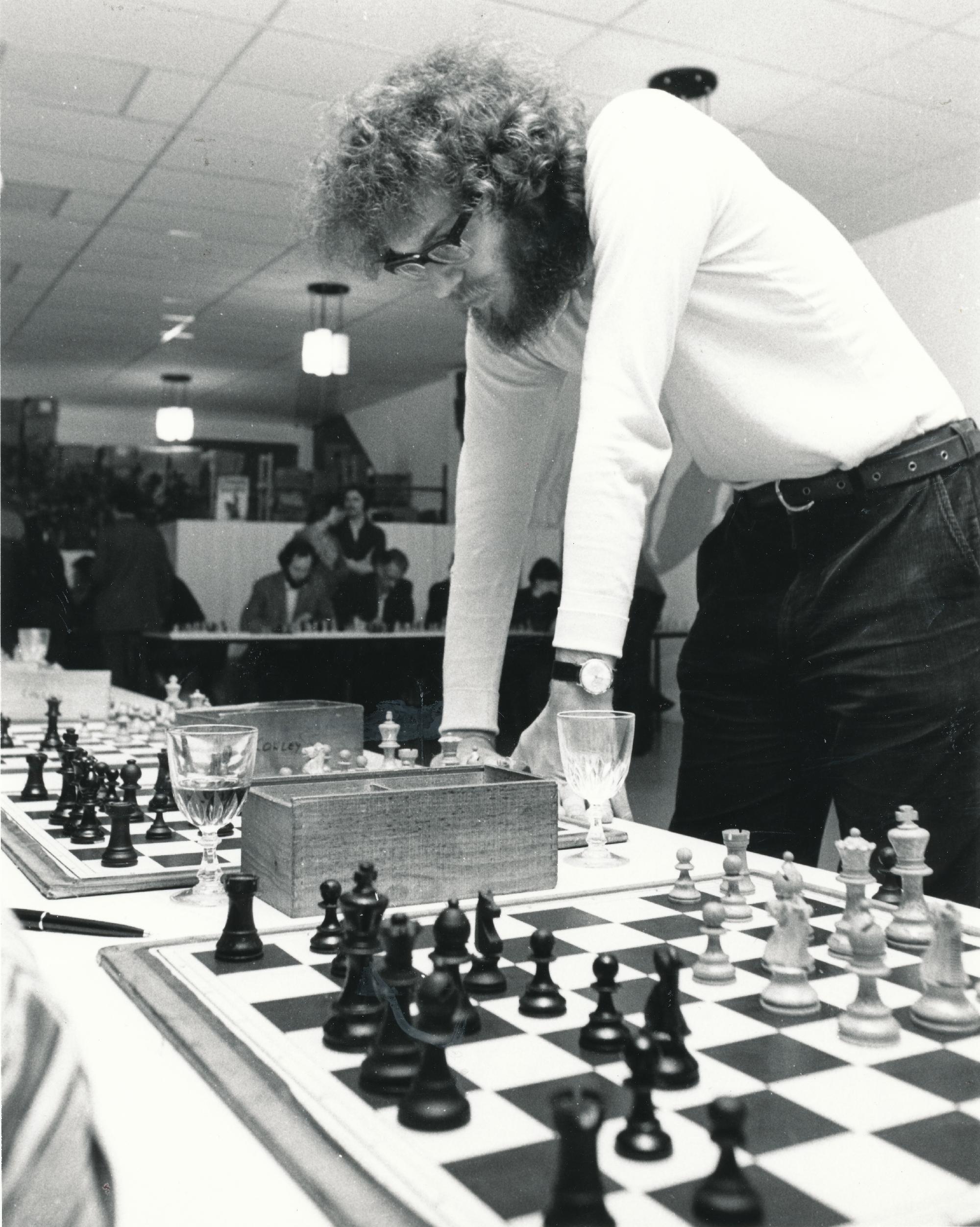
JS was a frequent giver of simultaneous displays
Nowadays (and here I hear myself sounding like an old man!) the strongest young players (under twenty-six) beat international masters quite regularly and indeed grandmasters from time to time. ‘In my day’ this was not so much the case. Titled foreign players could still come over to pillage weekend tournaments; and succeed much of the time! When one of them lost to homegrown talent it was news.
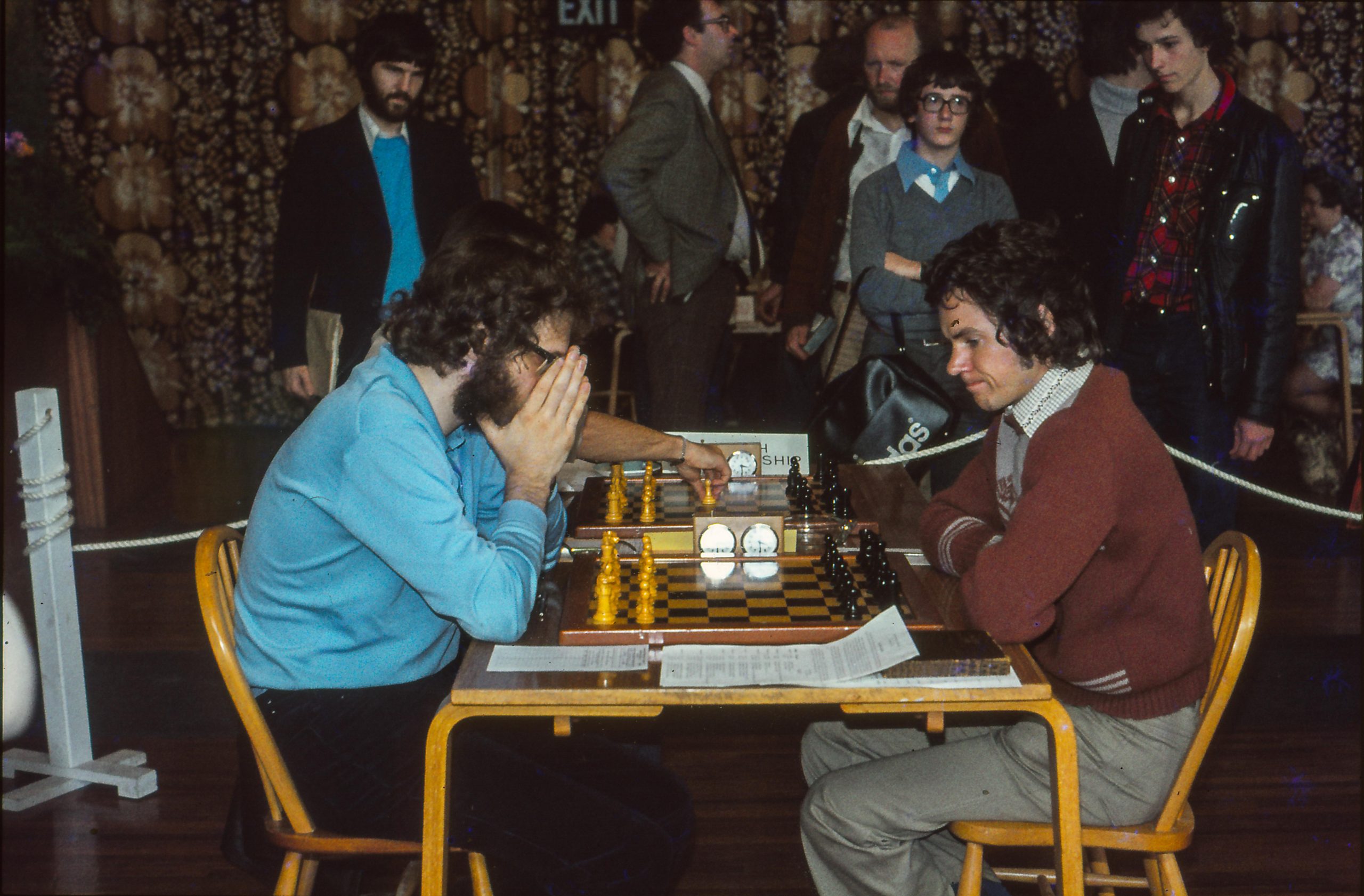
IM Jonathan Speelman vs IM Simon Webb at the 1978 British Championships in Ayr, Courtesy of John Upham
I first started to play regularly against grandmasters in my first Hastings tournament, which I mentioned previously. Of course, I had played grandmasters before, but at Hastings seven of the fourteen games were against them. I scored there six draws and a loss to the tournament winner, Dzindzihashvili.
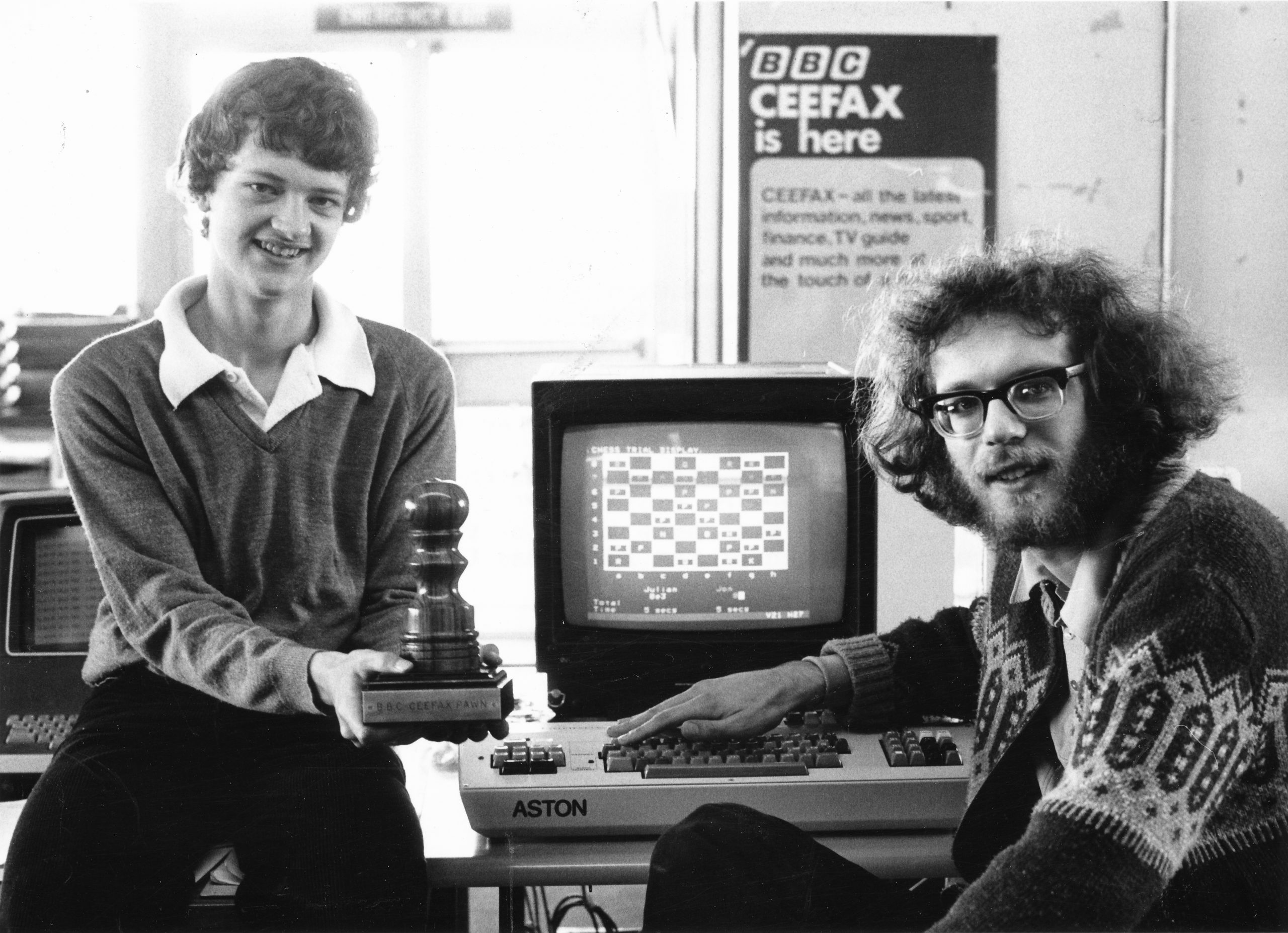
Julian Hodgson and Jonathan Speelman prepare to play each other at their own home via CEEEFAX. This was organised by Peter Andrews of BBC Chess Club and was the first match of its kind.
In round one of Lone pine I was White against Bent Larsen of Denmark. Given that one is going to beat a strong grandmaster (l hadn’t even beaten a weak one) then White against Larsen is quite a good chance. Although he is an extremely strong player, Larsen loses quite a lot of games to much weaker opponents and wins an enormous number against them as well, with not many draws. I was fortunate in obtaining a nice position from the opening and won a good game. That is one of the games I have chosen.
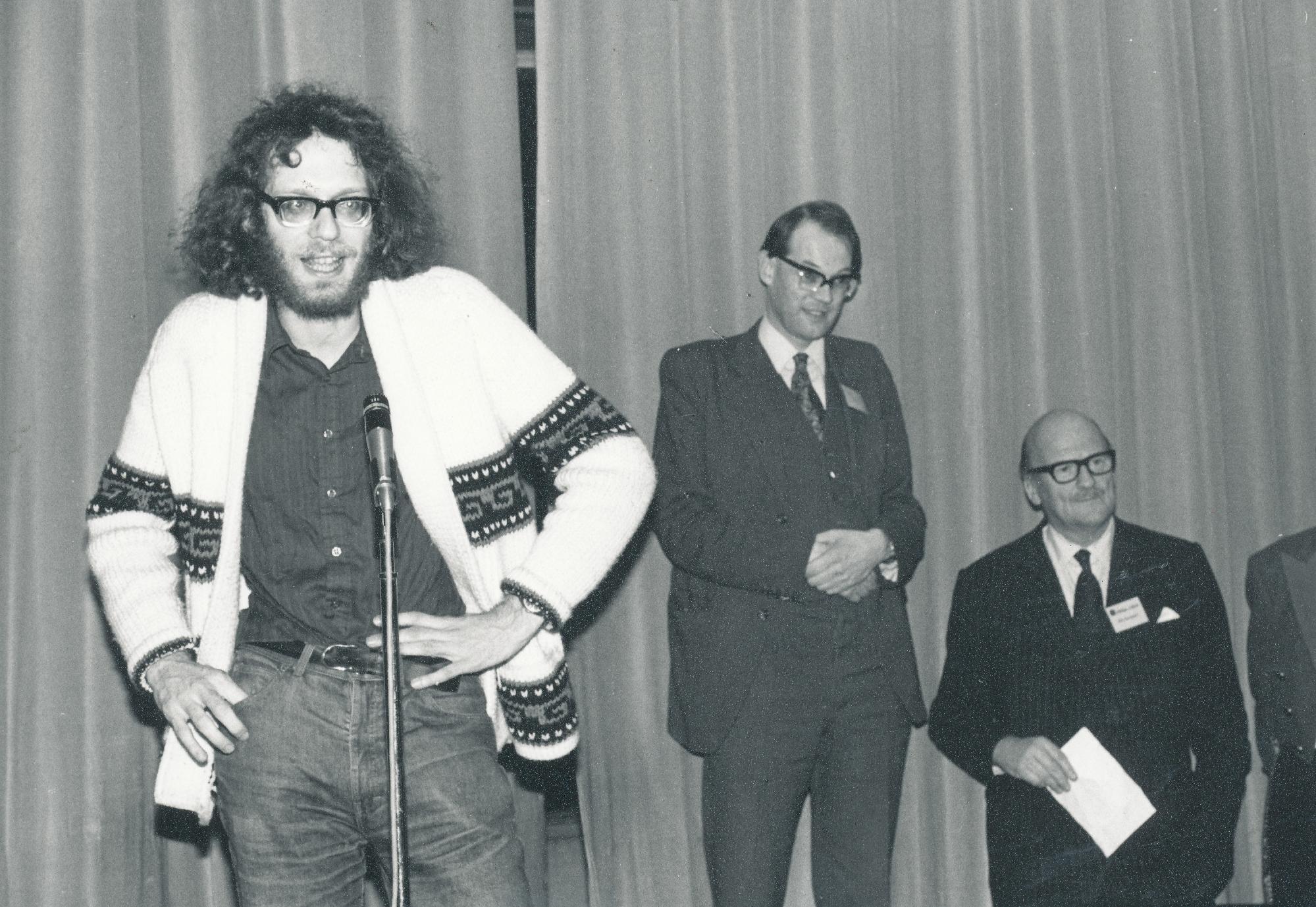
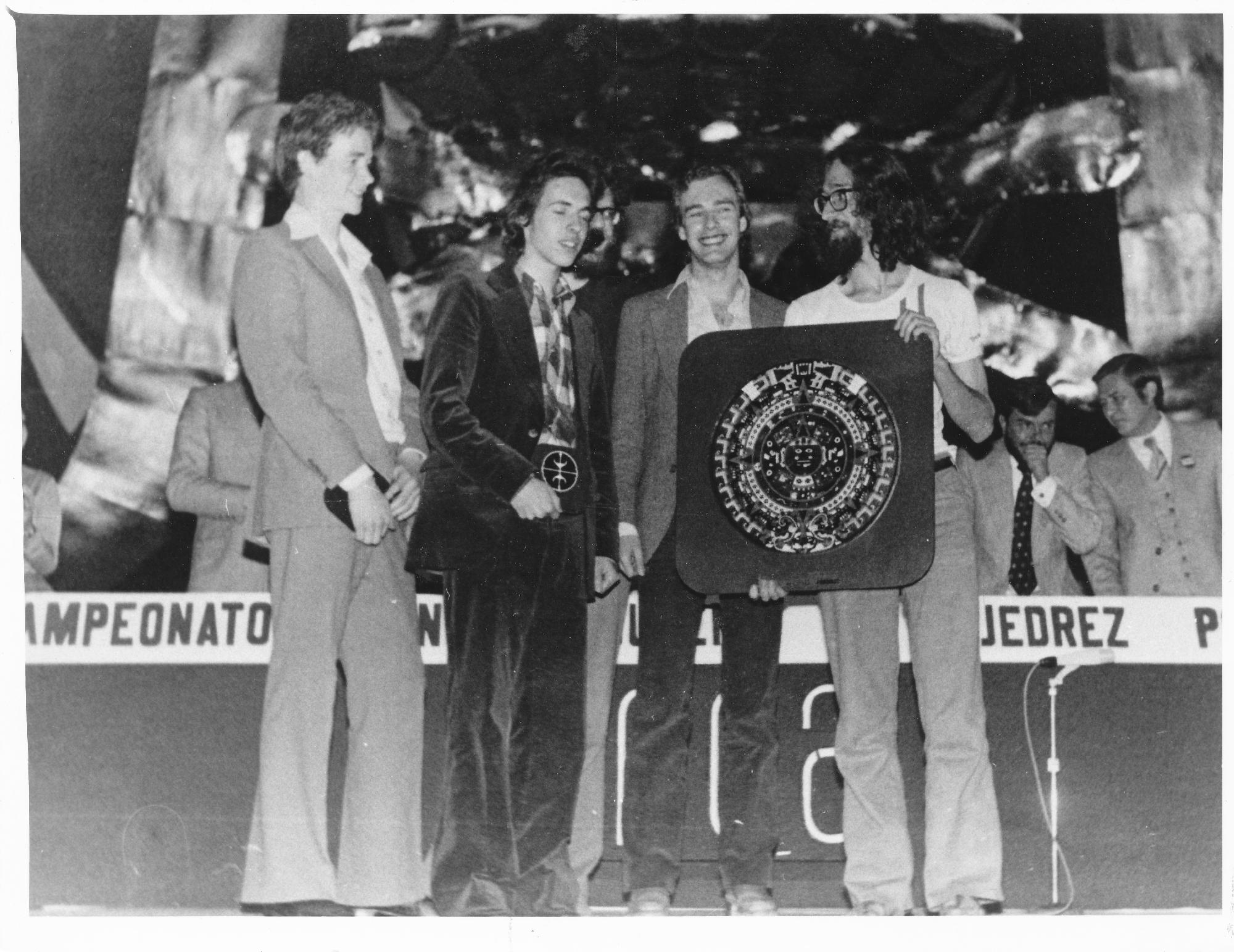
JS receives one of many awards
After beating Larsen the rest of the tournament was rather an anti-climax for me. I drew some games, then lost in successive rounds to Browne and Biyiasas. Needing a win to reach fifty per cent the chance of my final norm, I clawed my way to victory in a dreadful game against a young American P. Whitehead. Two short draws in the final two rounds brought me the title.
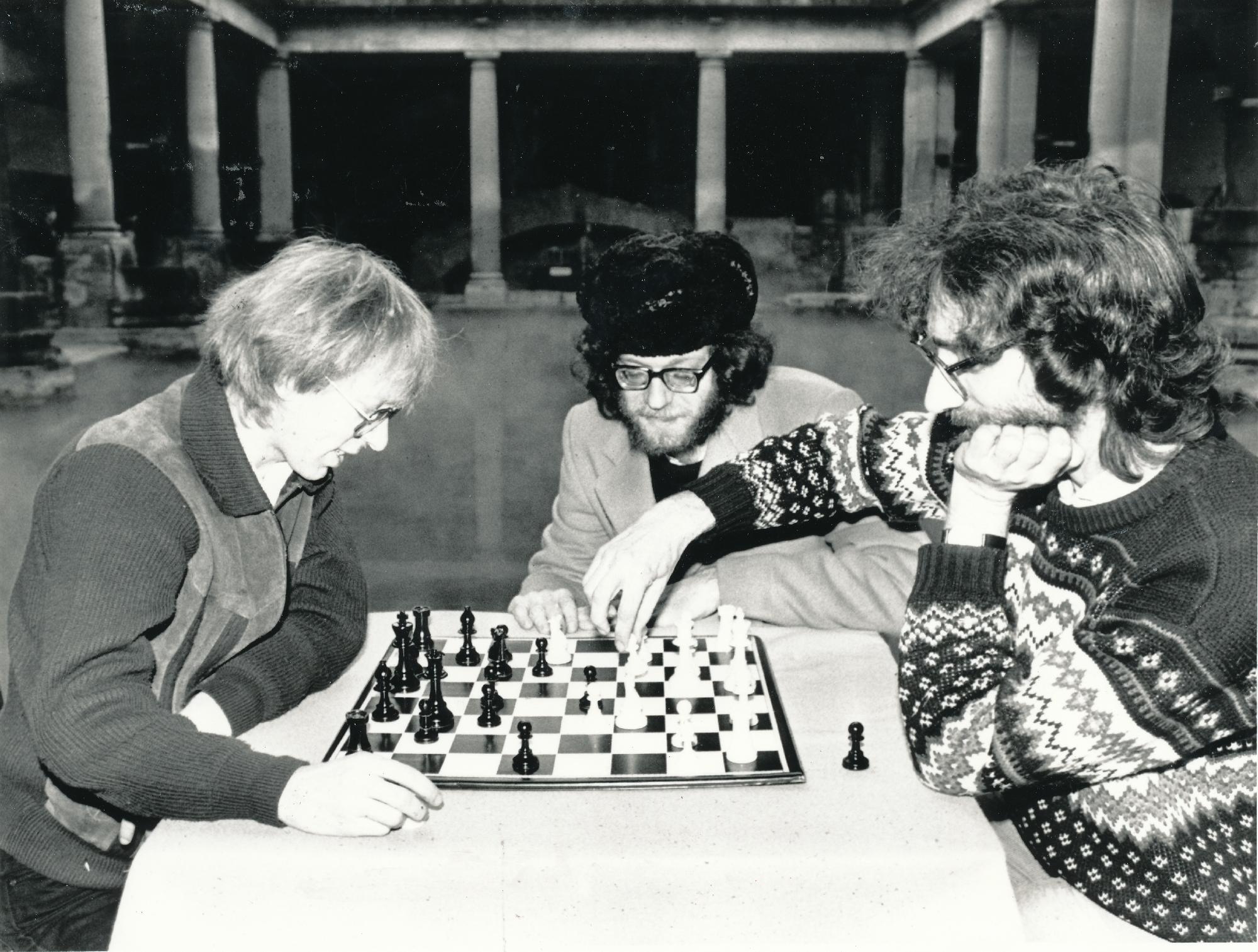
At the Praxis British Zonal in February 1987 here at the roman baths. Murray Chandler, Jonathan Speelman, and Jonathan Mestel
Some years ago the British Championship really was the Championship of Britain. But in the early seventies there was a decline as several of the strongest players did not enter. In the last two years the decline has been halted and then reversed by the sponsorship of stockbrokers Grievson Grant. In 1979 two of our four Grandmasters, Miles and Nunn, competed in the British Championship at Chester and there were no fewer than six International Masters; indeed Nigel Short succeeded in obtaining his first IM norm there.
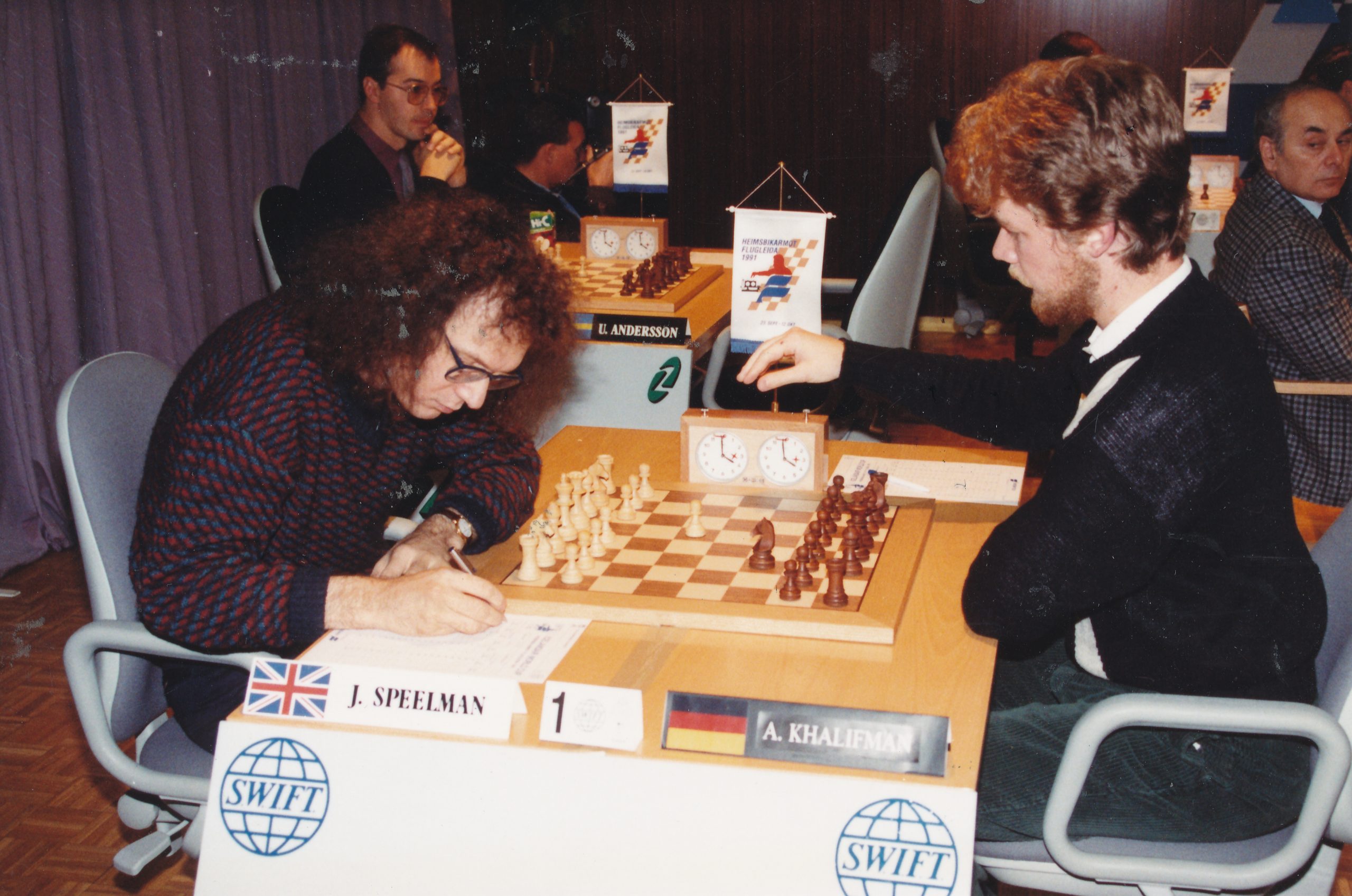
JS plays Alexander Khalifman during the SWIFT World Cup in Reykjavik, 1991. The game was drawn
I first competed in the British Championship at Brighton in 1972. After a good start, beating Michael Basman in the first round and drawing with Craig Pritchett in the second, I lost to Haygarth in round three. Thereafter, I found it incredibly difficult to win games. My old British Chess Magazine reminds me that I succeeded in winning in round nine, but that was the only one after round one. I finished with 4.5/11.
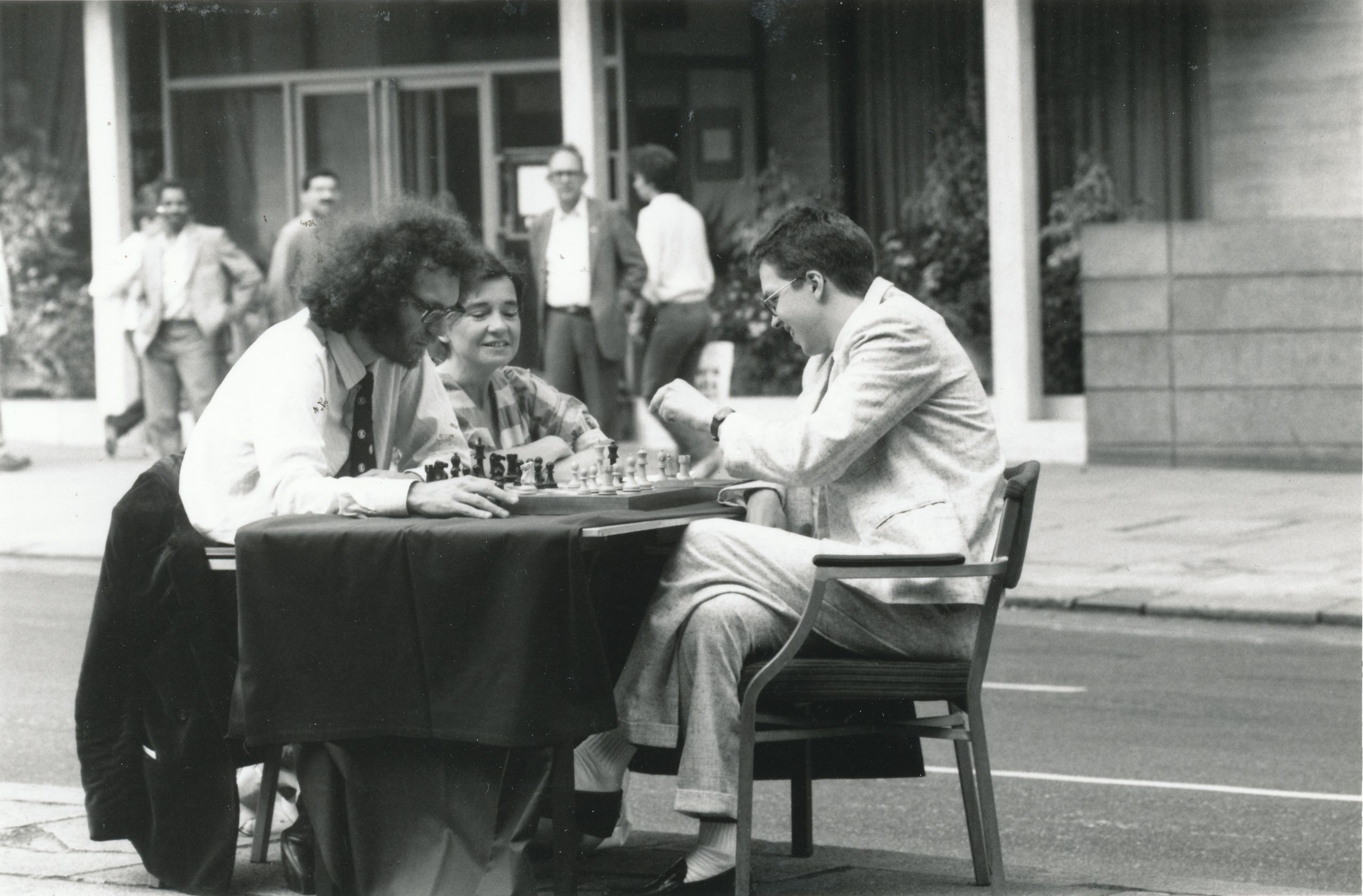
JS, Jana Bellin and Nigel Short in a publicity shoot outside Simpsons in the Strand
A year later at Eastbourne I was still finding it hard to win games. Again I finished with 4.5/11. By Clacton, 1974 I had improved. A loss in the last round to the eventual winner Botterill left me a point behind the seven (!) who had to play off for the title.
I competed at Morecambe, 1975 and Portsmouth, 1976, missing only Brighton, 1977 when the students team was in Mexico. By Ayr, 1978 I was probably one of the favourites along with Jonathan Mestel, who ran away with the tournament in Portsmouth,
1976, George Botterill, the defending champion, and some others.
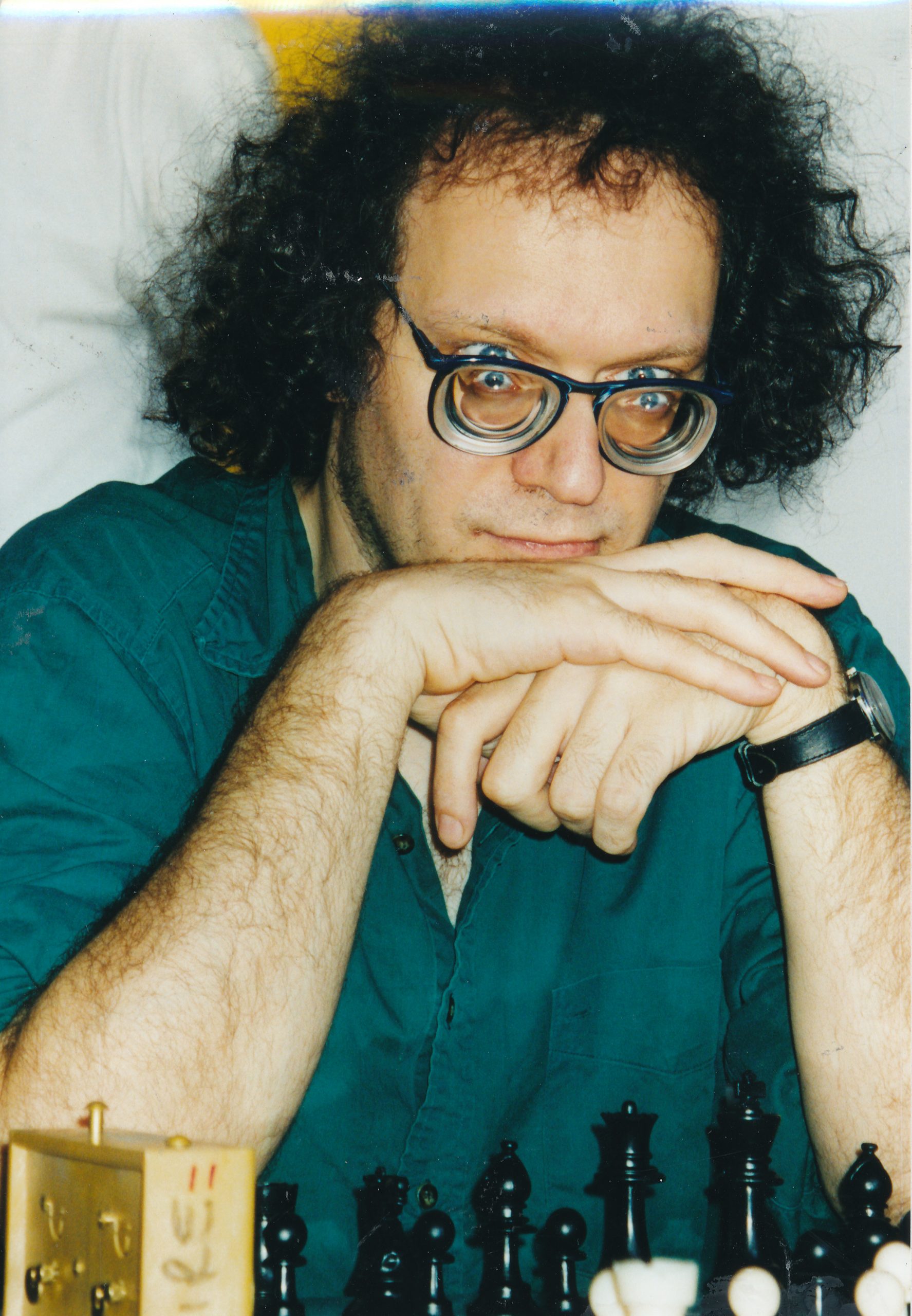
Jonathan shows off his all seeing four eyes
In fact I won at Ayr. I played quite well throughout. ln the last round half a point ahead of Mestel I played a quick draw with Webb but was lucky when Mestel could only draw with Clarke. Of course winning the British was a big breakthrough for me. But I feel that the most important psychological change came in 1974 when I started to discover that it is possible to win games in the British Championship.
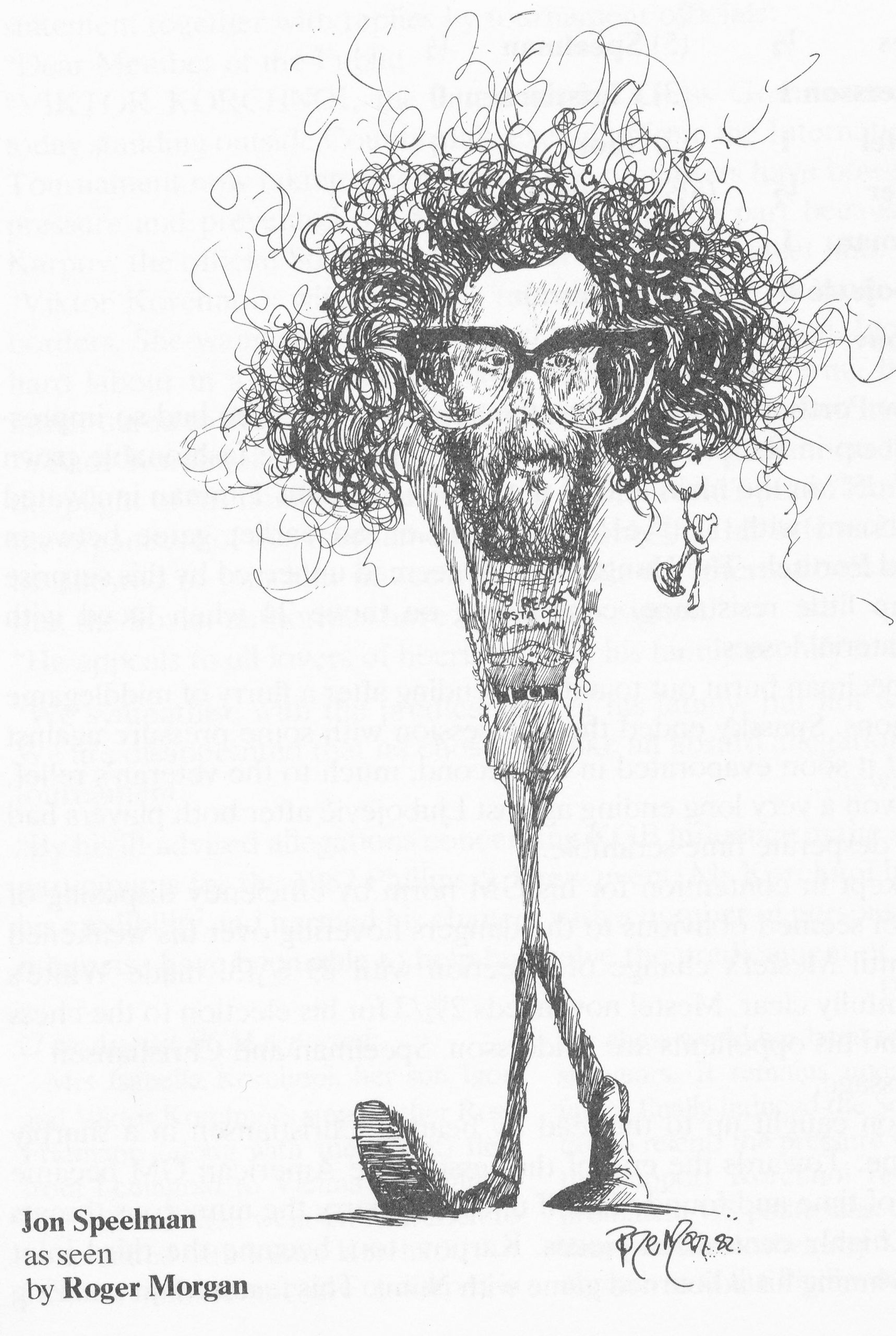
Jonathan Simon Speelman (02-x-1956) as imagined by Roger Morgan, 1982
Since late 1978 I have made no dramatic breakthrough but have, I believe, almost imperceptibly made the change from a ‘medium’ to a ‘strong’ international master.
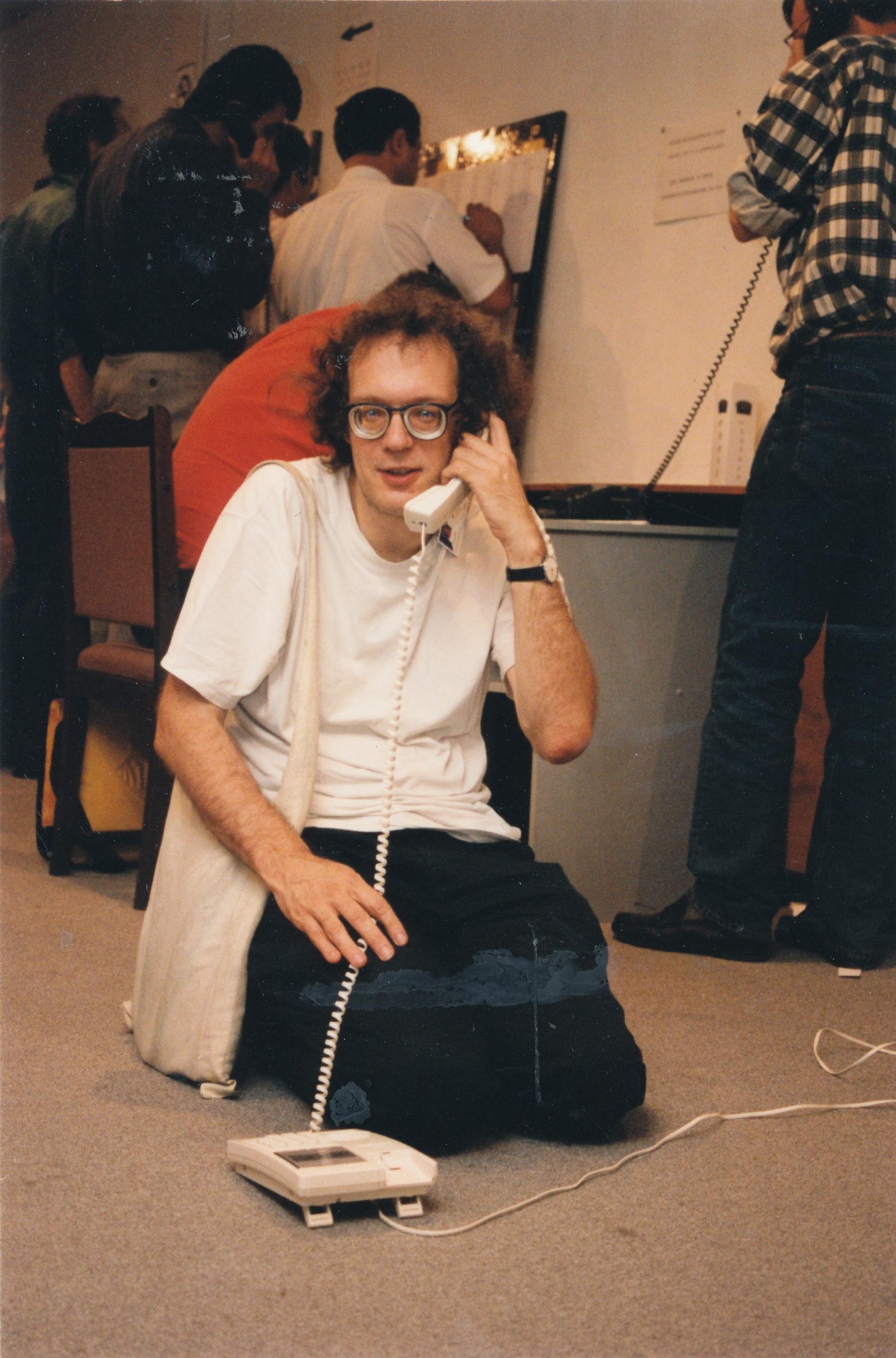
Jonathan Speelman telephones good news
I’ve selected three games to go with this article. The one with Larsen I’ve already mentioned. Mihaljcisin-Speelman I like as a game in which I played very actively as Black.
The game against Biyiasis is a good ‘rough and tumble’ not free from errors of course – but wouldn’t that be boring?
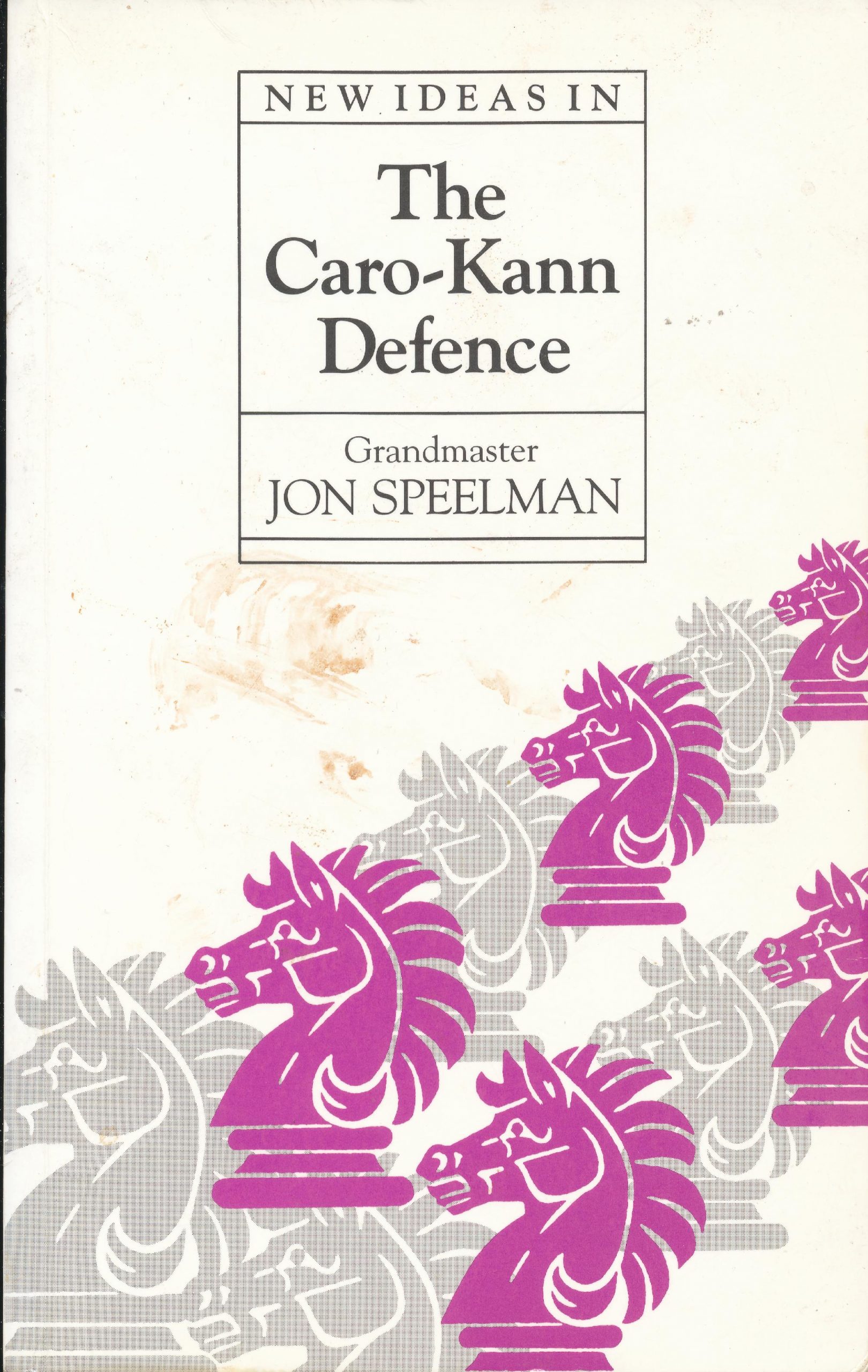
To find out more about JSs chess career we suggest you read his autobiography :
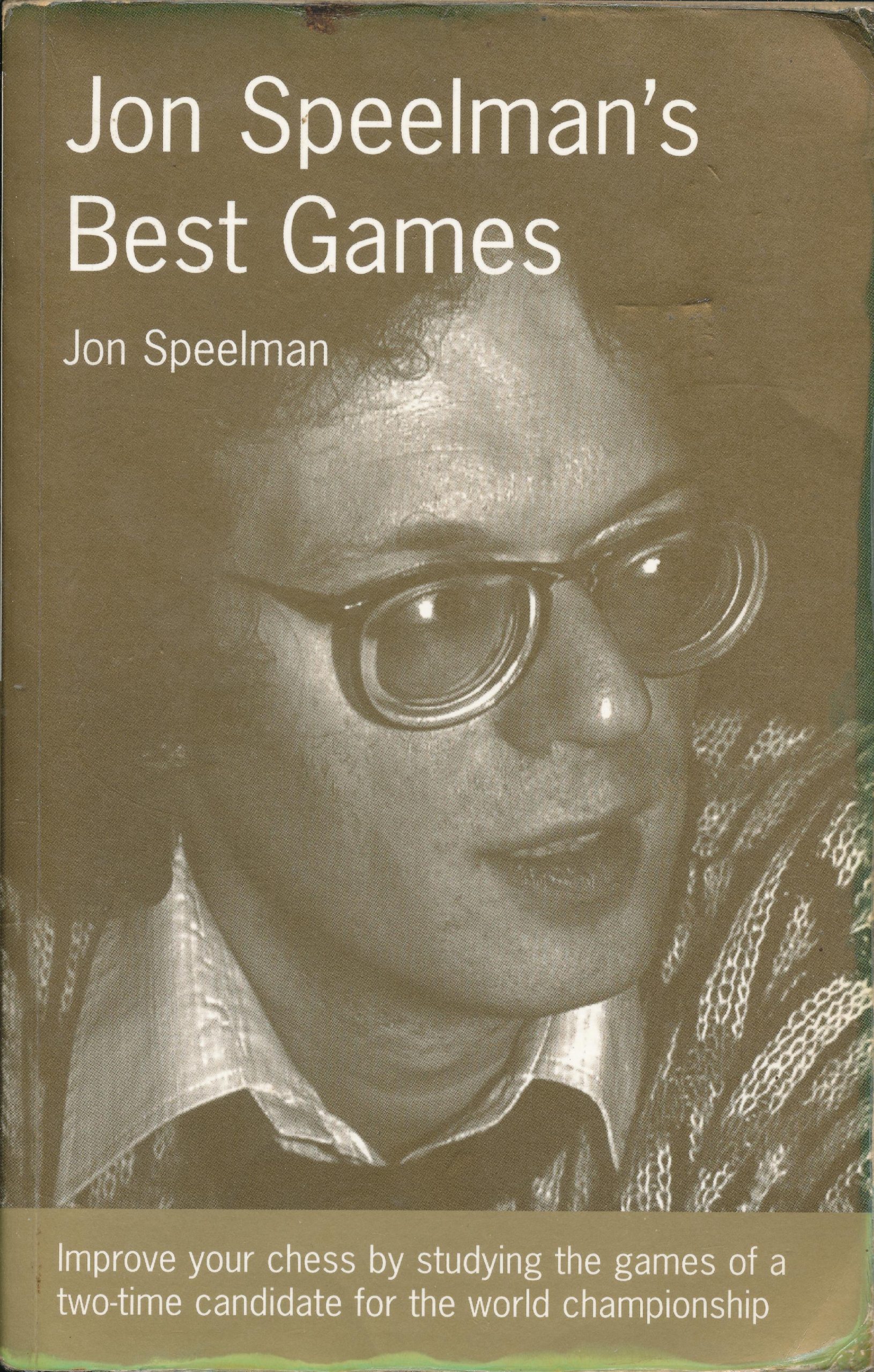
Speelman, Jon (1997). Jon Speelman’s Best Games. B.T. Batsford (London, England). 240 pages. ISBN 978-0-7134-6477-1.
which contains many heavily annotated games.
From The Oxford Companion to Chess (OUP, 1984) by Hooper & Whyld :
“British Champion in 1978, Speelman played at Mexico City later that year in the English team that won (ahead of the USSR) the world’s first youth teams (under-26) championship.
(from l-r) Jonathan Kinlay, Shaun Taulbut, Jonathan Speelman, David Goodman and Jonathan Mestel accepting 1st prize at the 1978 World U26 Student Olympiad in Mexico City
Two good performances in 1980, as score of +5=5-3 to share fourth place in the category 13 London tournament and a second place (+6=7) at Maribor, brought him the title of International Grandmaster (1980). His subsequent achievements include : Dortmund 1981, first (+5=6) equal with Ftacnik and Kuzmin; Hastings 1981-2, second equal with Smyslov after Kupreichik; and London 1982, category 14, +2=10-1 to share fourth place. An excellent analyst, Speelman has written several books, among them Best Chess Games 1970-1980 (1982).”
GM Jonathan Speelman
From Wikipedia :
A winner of the British Chess Championship in 1978, 1985 and 1986, Speelman has been a regular member of the English team for the Chess Olympiad, an international biennial chess tournament organised by FIDE, the World Chess Federation.
In 1989, he beat Kasparov in a televised speed tournament, and then went on to win the event.
In the April 2007 FIDE list, Speelman had an Elo rating of 2518, making him England’s twelfth-highest-rated active player.
He qualified for two Candidates Tournaments:
In the 1989–1990 cycle, Speelman qualified by placing third in the 1987 interzonal tournament held in Subotica, Yugoslavia. After beating Yasser Seirawan in his first round 4–1, and Nigel Short in the second round 3½–1½, he lost to Jan Timman at the semi-final stage 4½–3½.
In the following 1990–93 championship cycle, he lost 5½–4½ in the first round to Short, the eventual challenger for Garry Kasparov’s crown.
Speelman’s highest ranking in the FIDE Elo rating list was fourth in the world, in January 1989.
Jonathan Speelman in happy mood
Writing
He has written a number of books on chess, including several on the endgame, among them Analysing the Endgame (1981), Endgame Preparation (1981) and Batsford Chess Endings (co-author, 1993).
Among his other books are Best Games 1970–1980 (1982), an analysis of nearly fifty of the best games by top players from that decade, and Jon Speelman’s Best Games (1997). Today he is primarily a chess journalist and commentator, being the chess correspondent for The Observer and The Independent and sometimes providing commentary for games on the Internet Chess Club.
Jonathan Speelman and Daniel King share headphones at the 2013 FIDE Candidates event in LondonTilburg 1978, Tony Miles & Jonathan Speelman, Master Chess Publications, 1978Riga Interzonal 1979, AJ Miles & J Speelman, Batsford, 1979, ISBN 0 7134 3429 5
Speelman, Jonathan (1981). Analysing the Endgame. Batsford (London, England). 142 pages. ISBN 978-0-7134-1909-2.
Speelman, Jonathan (1981). Analysing the Endgame. Batsford (London, England). 142 pages. ISBN 978-0-7134-1909-2.
Speelman, Jonathan (1981). Endgame Preparation. B.T. Batsford (London, England). 177 pages. ISBN 978-0-7134-4000-3.
Speelman, Jonathan (1981). Endgame Preparation. B.T. Batsford (London, England). 177 pages. ISBN 978-0-7134-4000-3.
Speelman, Jon (1982). Best Chess Games, 1970-80. Allen & Unwin (London, England; Boston, Massachusetts). 328 pages. ISBN 978-0-04-794015-6.
Speelman, Jon (1982). Best Chess Games, 1970-80. Allen & Unwin (London, England; Boston, Massachusetts). 328 pages. ISBN 978-0-04-794015-6.
Speelman, Jon; Livshits, August (1988). Test Your Endgame Ability. BT Batsford (London, England). 201 pages. ISBN 0-7134-5567-5
Speelman, Jon; Livshits, August (1988). Test Your Endgame Ability. BT Batsford (London, England). 201 pages. ISBN 0-7134-5567-5
Speelman, Jon (1992). New Ideas in the Caro-Kann Defence. BT Batsford (London, England). 155 pages. ISBN 0-7134-6915-3.
Speelman, Jon (1992). New Ideas in the Caro-Kann Defence. BT Batsford (London, England). 155 pages. ISBN 0-7134-6915-3.
Speelman, Jonathan; Tisdall, Jon; Wade, Bob. (1993). Batsford Chess Endings. B.T. Batsford (London, England). 448 pages. ISBN 978-0-7134-4420-9.
Speelman, Jonathan; Tisdall, Jon; Wade, Bob. (1993). Batsford Chess Endings. B.T. Batsford (London, England). 448 pages. ISBN 978-0-7134-4420-9.
Speelman, Jon (1997). Jon Speelman’s Best Games. B.T. Batsford (London, England). 240 pages. ISBN 978-0-7134-6477-1.
Modern Defence. Everyman, 2000
Speelman, Jon (2008). Jon Speelman’s Chess Puzzle Book. Gambit Publications Ltd. 143 pages. ISBN 978-1-904600-96-1.
Speelman, Jon (2008). Jon Speelman’s Chess Puzzle Book. Gambit Publications Ltd. 143 pages. ISBN 978-1-904600-96-1.Jonathan Speelman
We wish GM Jonathan Speelman all the best on his birthday.
Jonathan Simon Speelman was born on Tuesday, October 2nd, 1956 in Marylebone, London. His mother’s maiden name was Freeman. In March 2002 Jon and Lindsey Thomas were married in Camden, Greater London. They have a non-chess playing son, Lawrence who studied Ancient Languages at The University of Chicago.
Jonathan attended St. Paul’s School, London and then Worcester College, Oxford and read mathematics.
He became an International Master in 1978 (England’s tenth) and a Grandmaster in 1980 (England’s fifth) and achieved a peak FIDE rating of 2645 at the age of 32 in July 1988.
Jon is a Life Member of King’s Head Chess Club and has helped them organise a number of tournaments including the NatWest Young Masters where he has adjudicated the winner of the Best Game Prize.
Currently, Jon plays for Wood Green in Four Nations Chess League and in the London League and maintains an ECF grade of 245.
Jon is the chess correspondent for The Observer and The Independent.
With the white pieces Jon prefers 1.Nf3 and against 1…Nf6 to follow with c4 and d4. Interestingly, if black plays 1…d5 then Jon plays an early king-side fianchetto.
As the second player Jon prefers the Smyslov Caro-Kann, the Nimzo-Indian and Queen’s Indian defences.
His record against contemporary players is impressive :
Nigel Short : +5
Murray Chandler : +4
Jonathan Mestel : +4
John Nunn : +3
James Plaskett : +4
Mark Hebden : +7
Tony Miles : +1
Tony Kosten : +3
Daniel King : +2
Jon Speelman and Nigel Short at the start of their 1989 Candidates match. Jon won 3.5 – 1.5
From British Chess (Pergamon Press, 1983) by Botterill, Levy, Rice and Richardson :
“Having been asked to contribute an article on myself to this book I have decided to concentrate almost exclusively on my ‘relationship with chess’, but first quickly summarize my life.
JS
Born on 2nd October 1956 I went to a ‘Nursery School’ whose name I forget. Then to Arnold House School followed by St. Paul’s School. I had a ‘Year off’ from January to October, 1976, when I went up to Worcester College, Oxford, where I studied mathematics. In 1977 I left Oxford with a 2nd degree. Since then I have been a professional chess player.
I was taught chess at the age of 6 by my cousin on Boxing Day, 1962. Then as now, I was an inquisitive person and the idea of a ‘complicated and difficult game’ interested me. Sadly my first game of chess ended in checkmate in four moves; but I persevered and soon became more competent.
JS at the London based Philips & Drew Kings tournament
I have always seen life to some in terms of barriers. There are things which one can do easily and which one finds difficult or almost impossible. For any given task the transition from one state to the other is not as smooth. One builds up energy and finally is able to succeed for the first time. After that the task becomes successively easier: Partly because one is aware that one can succeed.
Jonathan Speelman without glasses
ln order to illustrate my chess career to date, I shall therefore pick out examples of barriers which I managed to break through.
Jonathan was an early follower of fashion
Until a few Years ago there were few titled players in Great Britain. But recently, thanks largely to a change of emphasis in organisation, several players have broken through to obtain international titles. This is not only because British players have become stronger – which they undoubtedly have – but also because they have received opportunities which were previously denied them.
JS at the London Robert Silk Fellowship invitational tournament
I first started seriously to contemplate becoming an international master in 1977. Previously, I had of course aspired to this but without really investigating the mechanics of obtaining norms. In August, 1977 England sent a team to the World Student Team Championships in Mexico City. We came third: a year later we were to win the event (though on that occasion it was a World Under 26 Team Championship). On our return there was an invitation tournament in London: the ‘Lloyds Bank Silver Jubilee’. Although I was rather tired after Mexico I decided to play and to my surprise, I obtained an IM norm with a round to spare. It all seemed rather easy. I drew with six strong players including GM Torre and four IM’s and beat three weaker ones.
Grandmaster Uses PressTel Chessbox to Play Long Distance Chess. Jonathan Speelman the UK Grandmaster is pictured here deciding his next move in a computer chess game against five simultaneous opponents. Players exchanged moves online via the ChessBox club on PressTel, BTs videotex service.
In December, 1977 I played for the first time in the Annual Grandmaster Tournament at Hastings. I was very pleased to ‘shut up shop’, abandoning any pretensions to an exciting style to score one win, one loss and – wait for it – twelve draws; but 7/14 was sufficient for another international master norm.
These two events left me with twenty three games of norm, one less than the required minimum. Early in 1978 I played in a tournament in London but failed to get my final leg. It was in April that year that I had my next chance at the famous Lone Pine Tournament in California. I have already stressed the importance of barriers. It was in round one of the Lone Pine tournament that I broke through another important one – that of beating a grandmaster.
JS was a frequent giver of simultaneous displays
Nowadays (and here I hear myself sounding like an old man!) the strongest young players (under twenty-six) beat international masters quite regularly and indeed grandmasters from time to time. ‘In my day’ this was not so much the case. Titled foreign players could still come over to pillage weekend tournaments; and succeed much of the time! When one of them lost to homegrown talent it was news.
IM Jonathan Speelman vs IM Simon Webb at the 1978 British Championships in Ayr, Courtesy of John Upham
I first started to play regularly against grandmasters in my first Hastings tournament, which I mentioned previously. Of course, I had played grandmasters before, but at Hastings seven of the fourteen games were against them. I scored there six draws and a loss to the tournament winner, Dzindzihashvili.
Julian Hodgson and Jonathan Speelman prepare to play each other at their own home via CEEEFAX. This was organised by Peter Andrews of BBC Chess Club and was the first match of its kind.
In round one of Lone pine I was White against Bent Larsen of Denmark. Given that one is going to beat a strong grandmaster (l hadn’t even beaten a weak one) then White against Larsen is quite a good chance. Although he is an extremely strong player, Larsen loses quite a lot of games to much weaker opponents and wins an enormous number against them as well, with not many draws. I was fortunate in obtaining a nice position from the opening and won a good game. That is one of the games I have chosen.
JS receives one of many awards
After beating Larsen the rest of the tournament was rather an anti-climax for me. I drew some games, then lost in successive rounds to Browne and Biyiasas. Needing a win to reach fifty per cent the chance of my final norm, I clawed my way to victory in a dreadful game against a young American P. Whitehead. Two short draws in the final two rounds brought me the title.
At the Praxis British Zonal in February 1987 here at the roman baths. Murray Chandler, Jonathan Speelman, and Jonathan Mestel
Some years ago the British Championship really was the Championship of Britain. But in the early seventies there was a decline as several of the strongest players did not enter. In the last two years the decline has been halted and then reversed by the sponsorship of stockbrokers Grievson Grant. In 1979 two of our four Grandmasters, Miles and Nunn, competed in the British Championship at Chester and there were no fewer than six International Masters; indeed Nigel Short succeeded in obtaining his first IM norm there.
JS plays Alexander Khalifman during the SWIFT World Cup in Reykjavik, 1991. The game was drawn
I first competed in the British Championship at Brighton in 1972. After a good start, beating Michael Basman in the first round and drawing with Craig Pritchett in the second, I lost to Haygarth in round three. Thereafter, I found it incredibly difficult to win games. My old British Chess Magazine reminds me that I succeeded in winning in round nine, but that was the only one after round one. I finished with 4.5/11.
JS, Jana Bellin and Nigel Short in a publicity shoot outside Simpsons in the Strand
A year later at Eastbourne I was still finding it hard to win games. Again I finished with 4.5/11. By Clacton, 1974 I had improved. A loss in the last round to the eventual winner Botterill left me a point behind the seven (!) who had to play off for the title.
I competed at Morecambe, 1975 and Portsmouth, 1976, missing only Brighton, 1977 when the students team was in Mexico. By Ayr, 1978 I was probably one of the favourites along with Jonathan Mestel, who ran away with the tournament in Portsmouth,
1976, George Botterill, the defending champion, and some others.
Jonathan shows off his all seeing four eyes
In fact I won at Ayr. I played quite well throughout. ln the last round half a point ahead of Mestel I played a quick draw with Webb but was lucky when Mestel could only draw with Clarke. Of course winning the British was a big breakthrough for me. But I feel that the most important psychological change came in 1974 when I started to discover that it is possible to win games in the British Championship.
Jonathan Simon Speelman (02-x-1956) as imagined by Roger Morgan, 1982
Since late 1978 I have made no dramatic breakthrough but have, I believe, almost imperceptibly made the change from a ‘medium’ to a ‘strong’ international master.
Jonathan Speelman telephones good news
I’ve selected three games to go with this article. The one with Larsen I’ve already mentioned. Mihaljcisin-Speelman I like as a game in which I played very actively as Black.
The game against Biyiasis is a good ‘rough and tumble’ not free from errors of course – but wouldn’t that be boring?
To find out more about JSs chess career we suggest you read his autobiography :
Speelman, Jon (1997). Jon Speelman’s Best Games. B.T. Batsford (London, England). 240 pages. ISBN 978-0-7134-6477-1.
which contains many heavily annotated games.
From The Oxford Companion to Chess (OUP, 1984) by Hooper & Whyld :
“British Champion in 1978, Speelman played at Mexico City later that year in the English team that won (ahead of the USSR) the world’s first youth teams (under-26) championship.
(from l-r) Jonathan Kinlay, Shaun Taulbut, Jonathan Speelman, David Goodman and Jonathan Mestel accepting 1st prize at the 1978 World U26 Student Olympiad in Mexico City
Two good performances in 1980, as score of +5=5-3 to share fourth place in the category 13 London tournament and a second place (+6=7) at Maribor, brought him the title of International Grandmaster (1980). His subsequent achievements include : Dortmund 1981, first (+5=6) equal with Ftacnik and Kuzmin; Hastings 1981-2, second equal with Smyslov after Kupreichik; and London 1982, category 14, +2=10-1 to share fourth place. An excellent analyst, Speelman has written several books, among them Best Chess Games 1970-1980 (1982).”
GM Jonathan Speelman
From Wikipedia :
A winner of the British Chess Championship in 1978, 1985 and 1986, Speelman has been a regular member of the English team for the Chess Olympiad, an international biennial chess tournament organised by FIDE, the World Chess Federation.
In 1989, he beat Kasparov in a televised speed tournament, and then went on to win the event.
In the April 2007 FIDE list, Speelman had an Elo rating of 2518, making him England’s twelfth-highest-rated active player.
He qualified for two Candidates Tournaments:
In the 1989–1990 cycle, Speelman qualified by placing third in the 1987 interzonal tournament held in Subotica, Yugoslavia. After beating Yasser Seirawan in his first round 4–1, and Nigel Short in the second round 3½–1½, he lost to Jan Timman at the semi-final stage 4½–3½.
In the following 1990–93 championship cycle, he lost 5½–4½ in the first round to Short, the eventual challenger for Garry Kasparov’s crown.
Speelman’s highest ranking in the FIDE Elo rating list was fourth in the world, in January 1989.
Jonathan Speelman in happy mood
Writing
He has written a number of books on chess, including several on the endgame, among them Analysing the Endgame (1981), Endgame Preparation (1981) and Batsford Chess Endings (co-author, 1993).
Among his other books are Best Games 1970–1980 (1982), an analysis of nearly fifty of the best games by top players from that decade, and Jon Speelman’s Best Games (1997). Today he is primarily a chess journalist and commentator, being the chess correspondent for The Observer and The Independent and sometimes providing commentary for games on the Internet Chess Club.
Jonathan Speelman and Daniel King share headphones at the 2013 FIDE Candidates event in LondonTilburg 1978, Tony Miles & Jonathan Speelman, Master Chess Publications, 1978Riga Interzonal 1979, AJ Miles & J Speelman, Batsford, 1979, ISBN 0 7134 3429 5
Speelman, Jonathan (1981). Analysing the Endgame. Batsford (London, England). 142 pages. ISBN 978-0-7134-1909-2.
Speelman, Jonathan (1981). Analysing the Endgame. Batsford (London, England). 142 pages. ISBN 978-0-7134-1909-2.
Speelman, Jonathan (1981). Endgame Preparation. B.T. Batsford (London, England). 177 pages. ISBN 978-0-7134-4000-3.
Speelman, Jonathan (1981). Endgame Preparation. B.T. Batsford (London, England). 177 pages. ISBN 978-0-7134-4000-3.
Speelman, Jon (1982). Best Chess Games, 1970-80. Allen & Unwin (London, England; Boston, Massachusetts). 328 pages. ISBN 978-0-04-794015-6.
Speelman, Jon (1982). Best Chess Games, 1970-80. Allen & Unwin (London, England; Boston, Massachusetts). 328 pages. ISBN 978-0-04-794015-6.
Speelman, Jon; Livshits, August (1988). Test Your Endgame Ability. BT Batsford (London, England). 201 pages. ISBN 0-7134-5567-5
Speelman, Jon; Livshits, August (1988). Test Your Endgame Ability. BT Batsford (London, England). 201 pages. ISBN 0-7134-5567-5
Speelman, Jon (1992). New Ideas in the Caro-Kann Defence. BT Batsford (London, England). 155 pages. ISBN 0-7134-6915-3.
Speelman, Jon (1992). New Ideas in the Caro-Kann Defence. BT Batsford (London, England). 155 pages. ISBN 0-7134-6915-3.
Speelman, Jonathan; Tisdall, Jon; Wade, Bob. (1993). Batsford Chess Endings. B.T. Batsford (London, England). 448 pages. ISBN 978-0-7134-4420-9.
Speelman, Jonathan; Tisdall, Jon; Wade, Bob. (1993). Batsford Chess Endings. B.T. Batsford (London, England). 448 pages. ISBN 978-0-7134-4420-9.
Speelman, Jon (1997). Jon Speelman’s Best Games. B.T. Batsford (London, England). 240 pages. ISBN 978-0-7134-6477-1.
Modern Defence. Everyman, 2000
Speelman, Jon (2008). Jon Speelman’s Chess Puzzle Book. Gambit Publications Ltd. 143 pages. ISBN 978-1-904600-96-1.
Speelman, Jon (2008). Jon Speelman’s Chess Puzzle Book. Gambit Publications Ltd. 143 pages. ISBN 978-1-904600-96-1.Jonathan Speelman
We focus on the British Chess Scene Past & Present!
This website uses cookies to improve your experience. We'll assume you're ok with this, but you can opt-out if you wish. Cookie settingsACCEPT
Privacy & Cookies Policy
Privacy Overview
This website uses cookies to improve your experience while you navigate through the website. Out of these cookies, the cookies that are categorized as necessary are stored on your browser as they are as essential for the working of basic functionalities of the website. We also use third-party cookies that help us analyze and understand how you use this website. These cookies will be stored in your browser only with your consent. You also have the option to opt-out of these cookies. But opting out of some of these cookies may have an effect on your browsing experience.
Necessary cookies are absolutely essential for the website to function properly. This category only includes cookies that ensures basic functionalities and security features of the website. These cookies do not store any personal information.