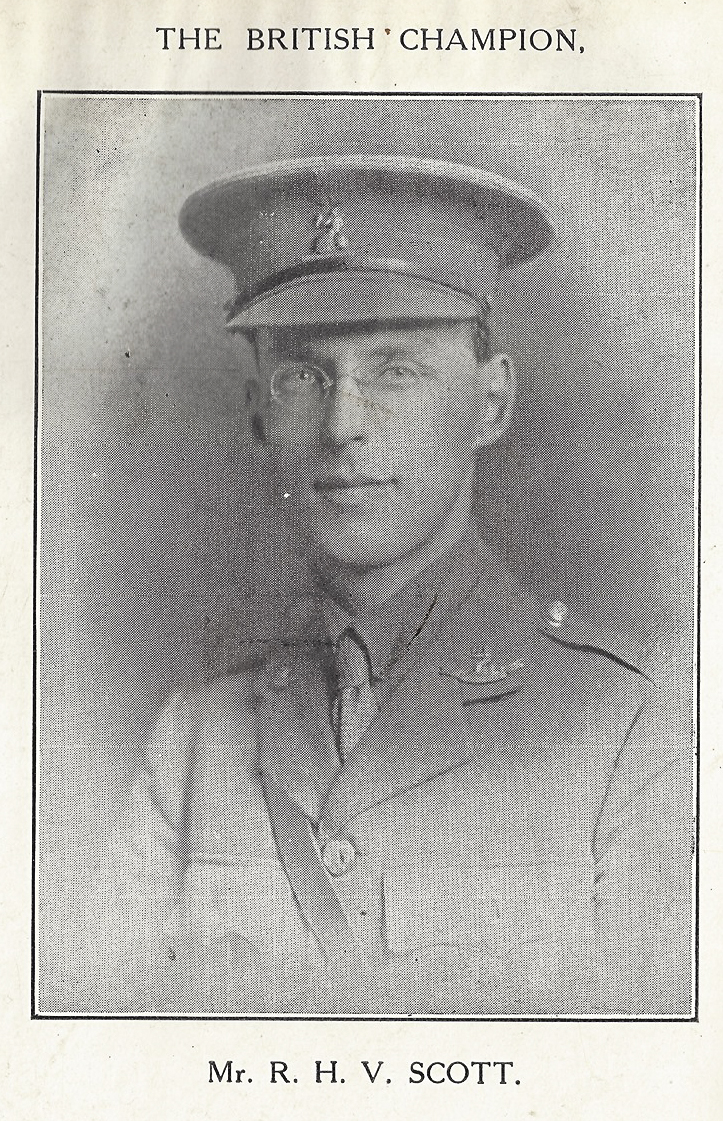
Roland Henry Vaughan Scott, 1920 British Champion, British Chess Magazine, Volume XLI (1920), Number 10 (October), page 304
BCN remembers Roland Scott who passed away in Monte Carlo on Saturday, January 10th, 1953.
Roland Henry Vaughan Scott was born in either Barnes (or Holloway depending which Census record is correct). His parents were Walter Frederick Scott, a GP who was born in April 1960 and died in 1891 when Roland was three years of age.
His mother was Lucy (Lucie and Lucia have also been recorded) Vaughan was born in 1855 and died in October 1933.
Roland had three sisters, Nina Vaughan Scott Lucie Audrey Scott (who died before her first birthday) and Sybil Anne Vaughan Scott and a brother Guy Francis D Scott who lived until 1977.
In 1891 Roland lived in Tottenham, in 1901 in Hampstead and in 1911 in St. Pancras where he was listed as a law clerk.
In 1917 The London Gazette lists him as a lieutenant in the Norfolk Regiment.
The 1920 electoral rolls for the Gospel Oak polling district lists Scott as voter #2006 living at 2, Estelle Road, North St. Pancras which is now in Belsize Park, NW3 2JX. At the same address was his sister Lucie and in 1921 they were joined by brother Guy.
In July 1922 in the district of Brighton Roland married Irma Clareboudt. No children from the marriage are recorded.
The 1939 register lists Scott as “War Disabled ? Officer Retired In War 1914” (invalided from army) and Irma as a saleswoman (born 25th July 1895) living at 42, Sherwell Lane, Paignton, Torquay, TQ2 6BD.
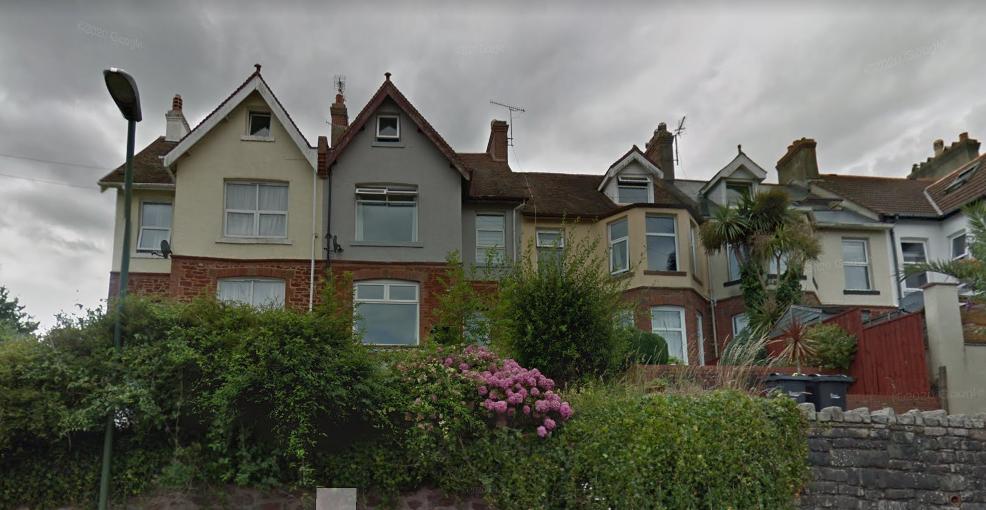
42, Sherwell Lane, Paignton, Devon, TQ2 6BD.
The April 1953 British Chess Magazine (Volume LXXIII, Number 4, page 101 onwards) contained this obituary from DJ Morgan:
It is with much regret that we record the death, on January 10th, at Monte Carlo, of R. H. V. Scott. He had long been out of active chess, but older readers will need no reminding of the 1920 British Champion, with his quiet manner but attacking chess; one who was composure itself at the table but aggressiveness personified on the board.
The son of a doctor, Scott was born in 1889. He was nineteen before taking to the game, but a ready aptitude combined with great enthusiasm led to rapid progress. He joined the Hampstead Club in 1908, and in his first tournament, the Third Class, came out first. ln the years that follow he pursued the game with much energy.
At the B.C.F. Congress, Glasgow, l9ll, he won the only section of the First Class. In 1913 and in 1914 he was Hampstead Club Champion. In 1913 he was tenth in the British Championship, at Cheltenham, and equal fifth to sixth at Chester in the following year, defeating Yates and drawing with Blackburne.
In 1915 he came second in the City of London Club Championship, but won that of the Metropolitan Club. During the same year he lost a short match with Sir G. A. Thomas 1-3. The war years, with a commission in the Norfolk Regiment, intervened, but chess filled his available moments.
In 1916 he defeated L. I. Estrin, a young Russian who was Hampstead Champion, 5-2 in a match. ln 1919 he lost a match with Winter at Hastings (2-4), and shared seventh to eighth positions with Dr. Olland (Holland) at the B.C.F. Hastings Victory Congress, with victories over Olland,
R. P. Michell, Marchand, and Conde. Then came the B.C.F. Edinburgh Congress of 1920, Scott became British Champion, losing only
to Sir G. A. Thomas.
In this year he also drew a match, 3-3, with Marchand, of Holland, also at Hastings. There followed three more appearances in the championship, Malvern, 1921 (equal fifth to sixth); Southsea,1923 (equal third to fourth); and Southport, 1924 (fourth). And with this Scott passed out of British chess. Ill health and failing eyesight, direct results of sufferings and injuries endured on active service during the war, began to take their toll. On medical advice he sought a warmer climate, and the Riviera henceforth became his home.
We find him sharing seventh to eighth positions at the Hyères Congress, in 1926, and coming equal fifth to sixth, with B. Reilly (our Editor’s first international tourney we believe), at Hyères, 1927.
The days of active play were over, but his great interest in the game remained. Scott was a natural attacking player, more likely, perhaps, to win the Brilliancy Prize than the First Prize.
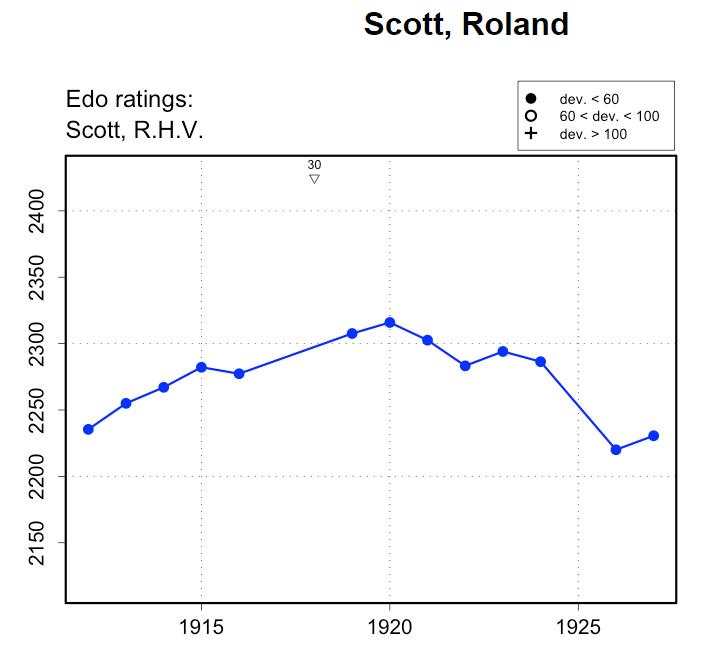
Edo rating profile for RHV Scott
We have given the bare outline of a career that was all too short, one cut down, in a sense before reaching full maturity. Contemporary records sometimes expressed the need for more stability in Scott’s chess, but they chronicle games of his that speak forcibly of the imaginative, refreshing, and invigorating qualities of his play. We offer an early game, the Brilliancy Prize winner, City of London C.C. Championship, 1913-14. White’s 20th move sets the game alight.
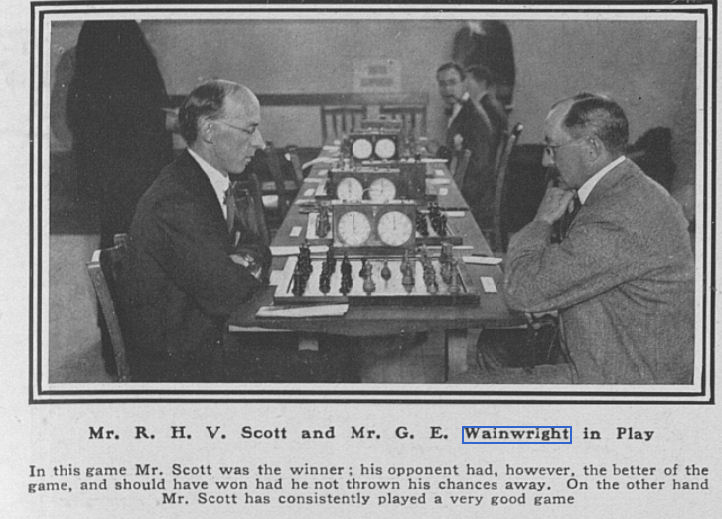
RHV Scott plays GE Wainwright in 1921, The Sphere, 1921
From British Chess Magazine, Volume XLI (1920), Number 10 (October), page 305 we have the following report of his exploits winning the 1920 British Championship in Edinburgh:
“We are glad to be able to present to our readers a photograph of the new champion, Mr. R.H.V Scott. He informs us that it is his most recent one, taken in 1917 when subaltern in the Norfolk Regiment. He saw service with the latter in France, and, as is probably know to most of our subscribers, was badly gassed, from the effects of which is now happily quite recovered.
His victory in the recent Congress in Edinburgh is welcome from at least two points of view; one, that he is one of our youngest first class players (ed: he was 32 at the time, a veteran by the standards of 2022!), having been born in 1889 (ed: this should have been 1888), and therefore may justifiably be expected to improve still further with experience and some curbing of his impatience in defence; and, two, that he claim to represent the more brilliant school of chess, that of Pillsbury, Marshall, Charousek, and Morphy, rather than the more solid school, of say, Steinitz and Rubinstein, who theory was the pilling up of small advantages.
Scott has an excellent “nose” for attack, and has some exceedingly “chessy” ideas. During the congress he put a much greater restraint on himself than is his wont, and we believe this to be the reason he so improved on his previous records.
He had what might be described as the worst of the draw, since he had Black against Sir George Thomas, EG Sergeant and RP Michell. Some writers have described him as lucky to win, but a study of his games and a comparison with those of others in the tourney go to prove that he played more far-sightedly than any of the others.
We are quite aware that the form of any player is variable, and we have seen Sir George Thomas play much better chess and much less strainedly than he did at Edinburgh. EG Sergeant was generally playing quite at his best, but once or twice his play deteriorated, perhaps as the result of a sleepless night, he then seemed bereft of ideas, and allowed the clock to beat him. This also was the case with Michell, who had many a rush to save his flag falling before the necessary moves were made. Now Scott almost invariably had time to spare.
Perhaps the worst reversal of form was that of JH Blake; but he had been working very hard and late for some time right up to the day the Congress commenced, and was not really in a fit state of health to take part.
Scott has twice before competed for the Championship; in 1913 where he finished eighth, and in 1914 when he was fifth, beating FD Yates, the then Champion and drawing with JH Blackburne.
He has won several brilliancy prizes in congress and club tourneys, and was the champion of the Hampstead Chess Club (where he may have been said to have learnt the game) in 1913 and 1914. He was first acquainted with the moves in 1908.
He is keen on all sports, and puts his whole energy into each line he may be taking. With yet more self-restraint we think his chess will still further improve, and we venture to prophesy this will not be the last British Chess Championship he will win.”
In his memoirs William Winter wrote this:
“I also had the opportunity of playing a number of semi-serious games with RHV Scott and D. Miller, two of the leading London amateurs. Scott was probably the most brilliant combinative played England has ever seen and had already won almost every honour except the British Championship, which fell to him in 1920.
Since those days I have played over hundreds of games, including the beautiful brilliancies of the modern Russian school, and Scott’s best combinations stand up quite well beside them. There were however weaknesses in his play which I shall discuss later. Miller was just the opposite type, a dour solid player exceptionally hard to beat. He is, I am glad to say, still with us, but Scott died a few years ago – he had been out of chess for a long time.”
and this:
“It is entirely legitimate, and can prove very useful until one comes up against an opponent like Capablanca who had no weaknesses of any kind. ln Scott’s case, one of his foibles was an aversion to exchanging queens, and I took full advantage of this in the first two games of the match both of which I won with comparative ease; but Scott was not finished yet.’ In the third game he tied me up in a variation of the Sicilian which I had not previously seen, and in the fourth I made the fatal mistake in going for an early win of material and allowing him a king’s side attack. Things now looked bad for me. I had the black pieces in the fifth game and I dared not play my favourite Sicilian defence because I could not discover a satisfactory answer to his new line.”
Strangely, none of the Encyclopaedia’s by Golombek, Sunnucks or Hooper & Whyld felt that RHVS merited an entry. However Gaige does not forget.
We remember William Ritson Morry who passed away on Saturday, January 8th, 1994.
(A point of detail : It is incorrect, but many do, to write WRM hyphenated. His first name was William, his middle name was Ritson and his surname was Morry. He chose to use his middle name and was known by his friends as Ritson. Maybe this was because he father was also William Morry?)
WRM was born in the Wirral on Monday, September 5th 1910 and his father was William Doughty Morry (born 16th July 1877). William was a sub-postmaster and seller of fancy goods. His mother was Norah Morry (née Holloway) who undertook “unpaid domestic duties”.
Ritson attended Friars School, Bangor (established in 1557) along with BH Wood. BHW was one year and three months older than WRM so it is entirely possible that they had met.
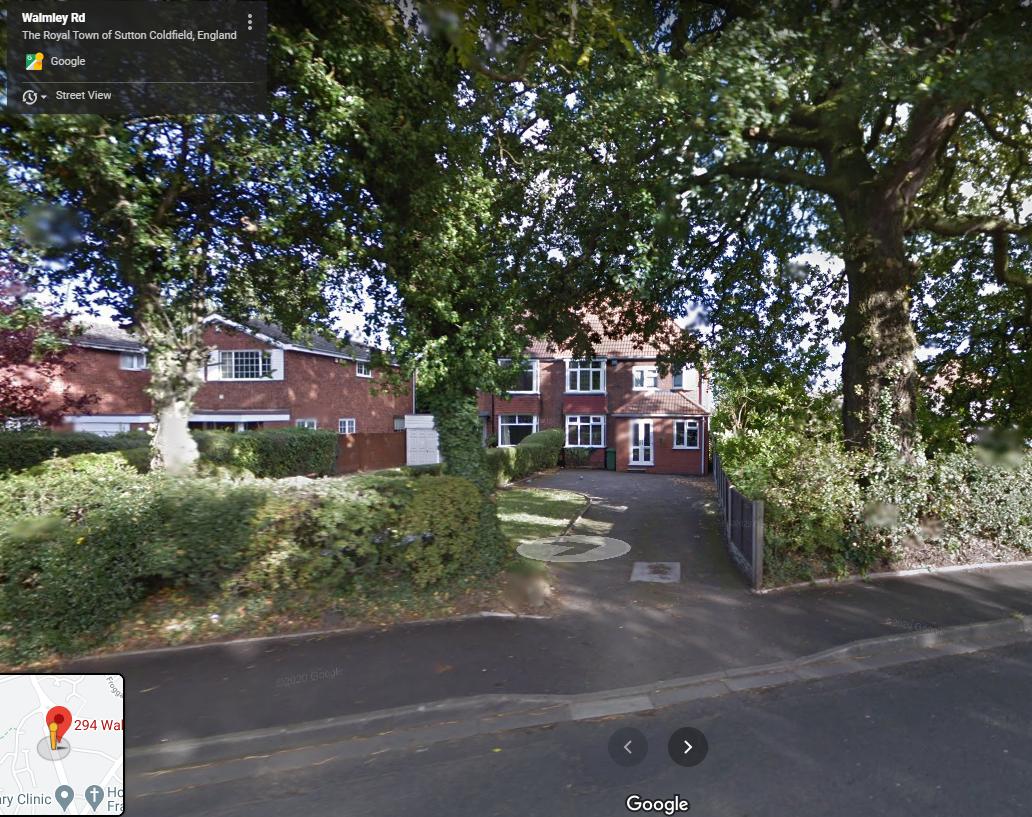
In the 1939 register he is recorded as being a solicitor with his own practice and was living at 294 Walmley Road, Royal Sutton Coldfield, Warwickshire with his parents : he was 29 years old.
294 Walmley Road, Royal Sutton Coldfield, Warwickshire, B76, 2PL
In 1940 WRM married Nellie Cooper in Sutton Coldfield.
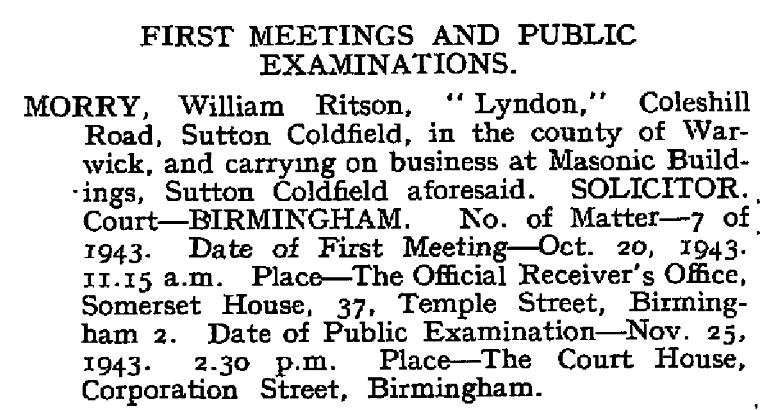
In 1943 WRM was mentioned in the London Gazette several times:
WRM appears in the London Gazette in 1943.
It would appear that this was the start of his first bankruptcy proceedings..
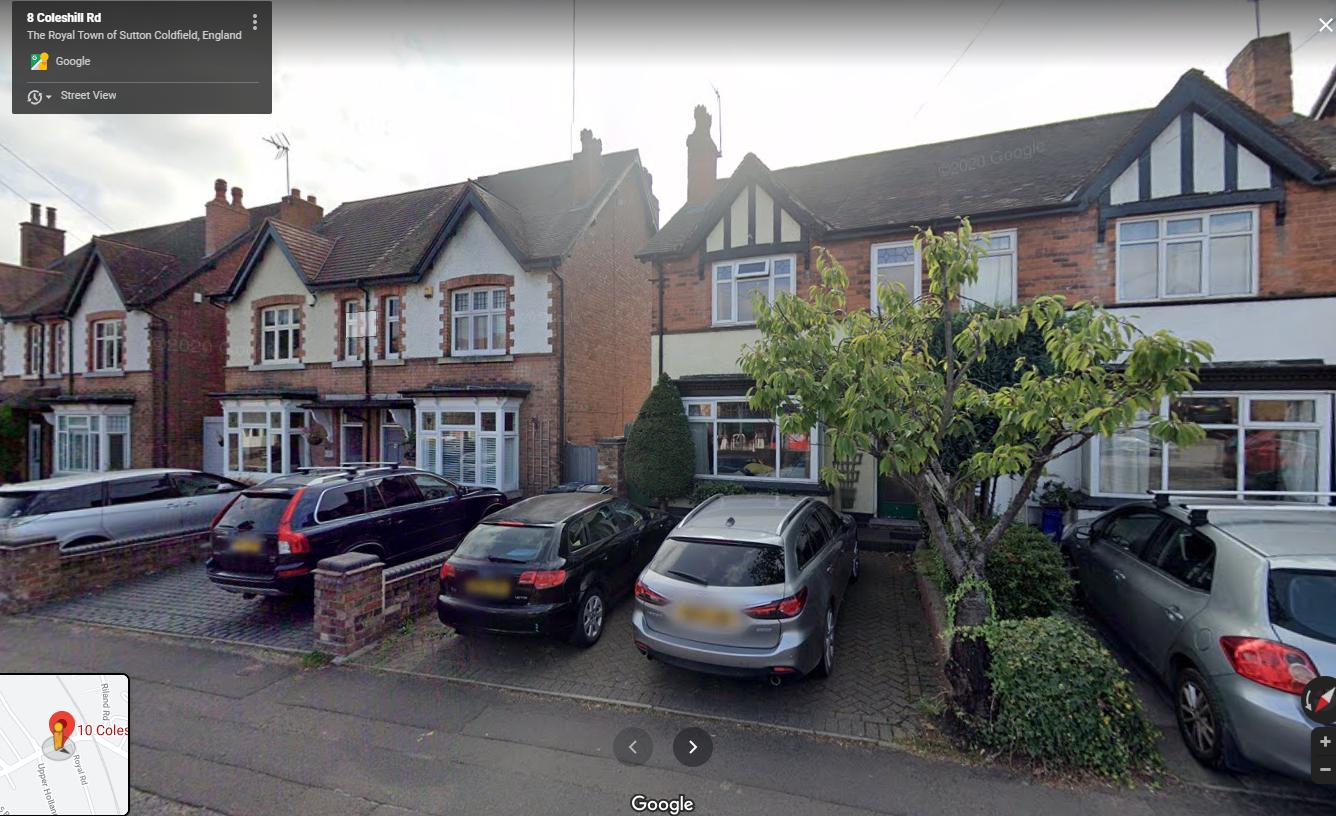
WRM was, by now, living at “Lyndon”, Coleshill Road, Sutton Coldfield, Warwickshire :
and in the same year on September 30th he was officially made bankrupt as recorded in the London Gazette, order number 195. This notice was repeated in the Edinburgh Gazette of the same year.
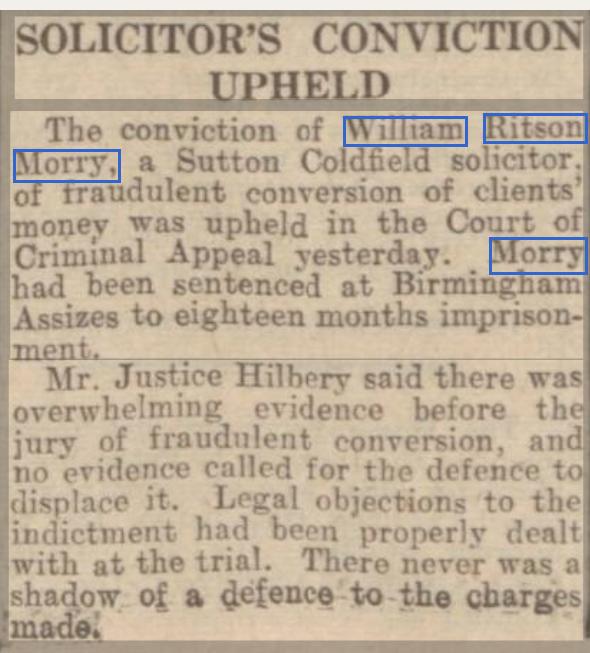
On the 8th of June 1944 he was recorded as being struck-off the list of solicitors under the Solicitors Acts of 1932 to 1941. It was determined that WRM had engaged in “fraudulent conversion of clients money”
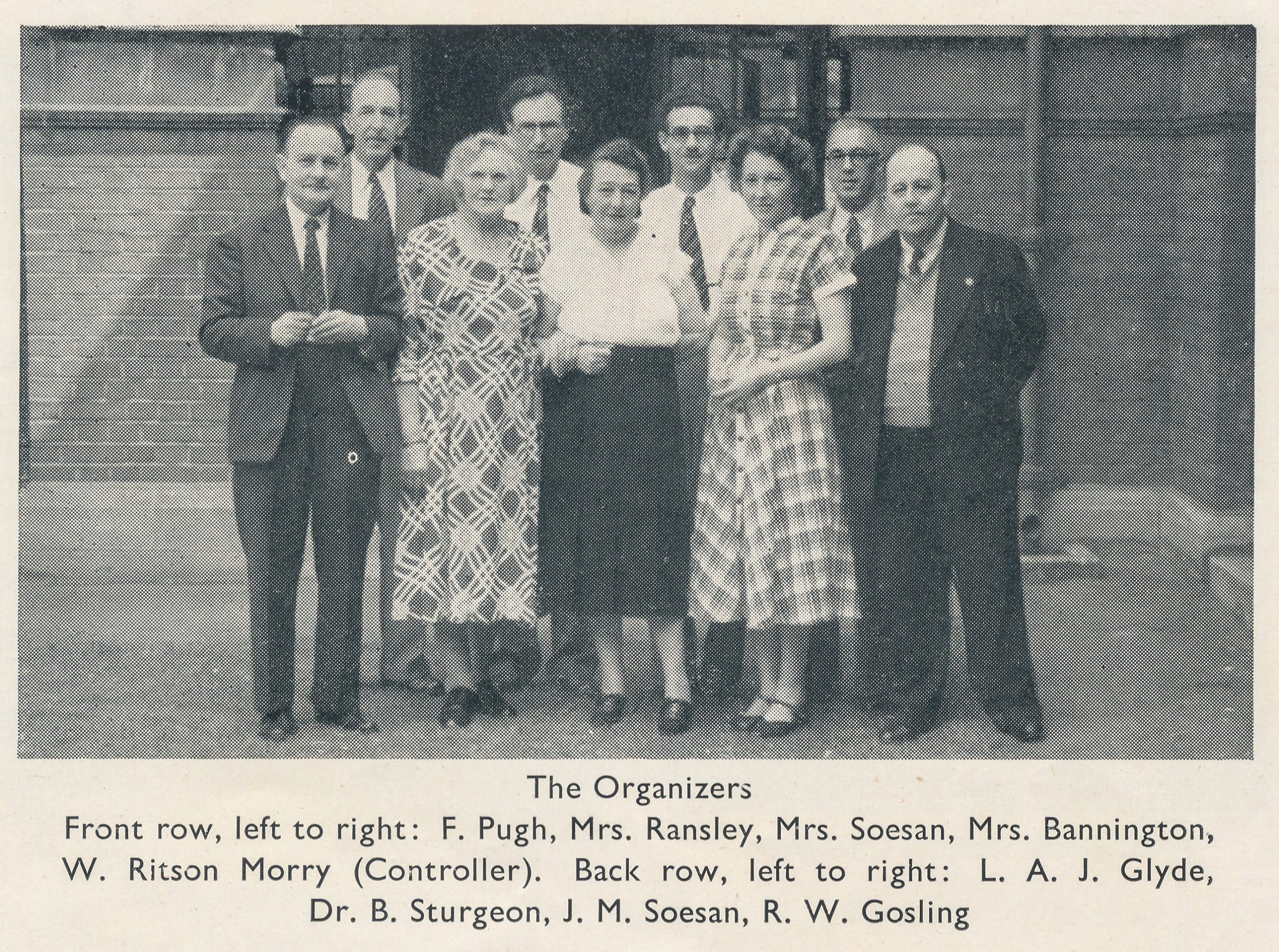
Here is an image of the organisers of the 1953 Whitsun Congress at Ilford including WRM:
The organisers, Front row, left to right: F. Pugh, Mrs. Ranslet, Mrs. Soesan, Mrs. Bannington, W Riston Morry (Controller). Back row, left to right: L. A. J. Glyde, Dr. B. Sturgeon, J. M. Soesan, R. W. Gosling
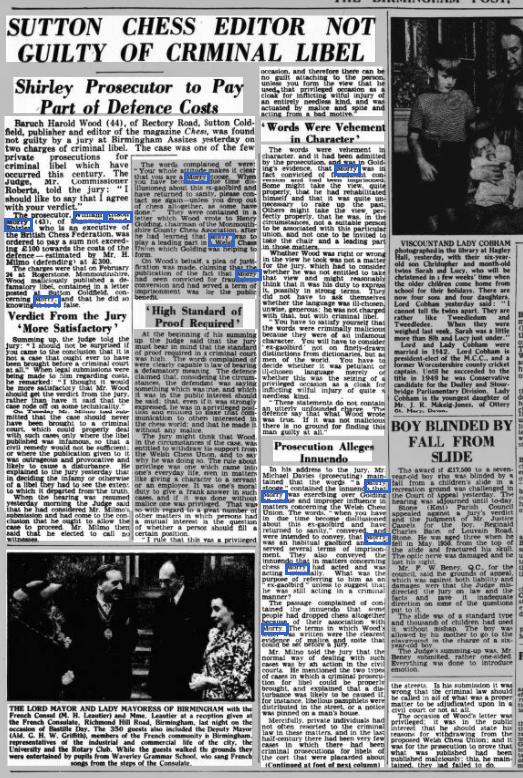
In 1954 WRM sued BH Wood for libel over a letter BHW sent to Henry Golding of the Monmouthshire County Chess Association warning him of WRMs financial history. Here is a summary of the action :
The Birmingham Post, July 15th, 1954
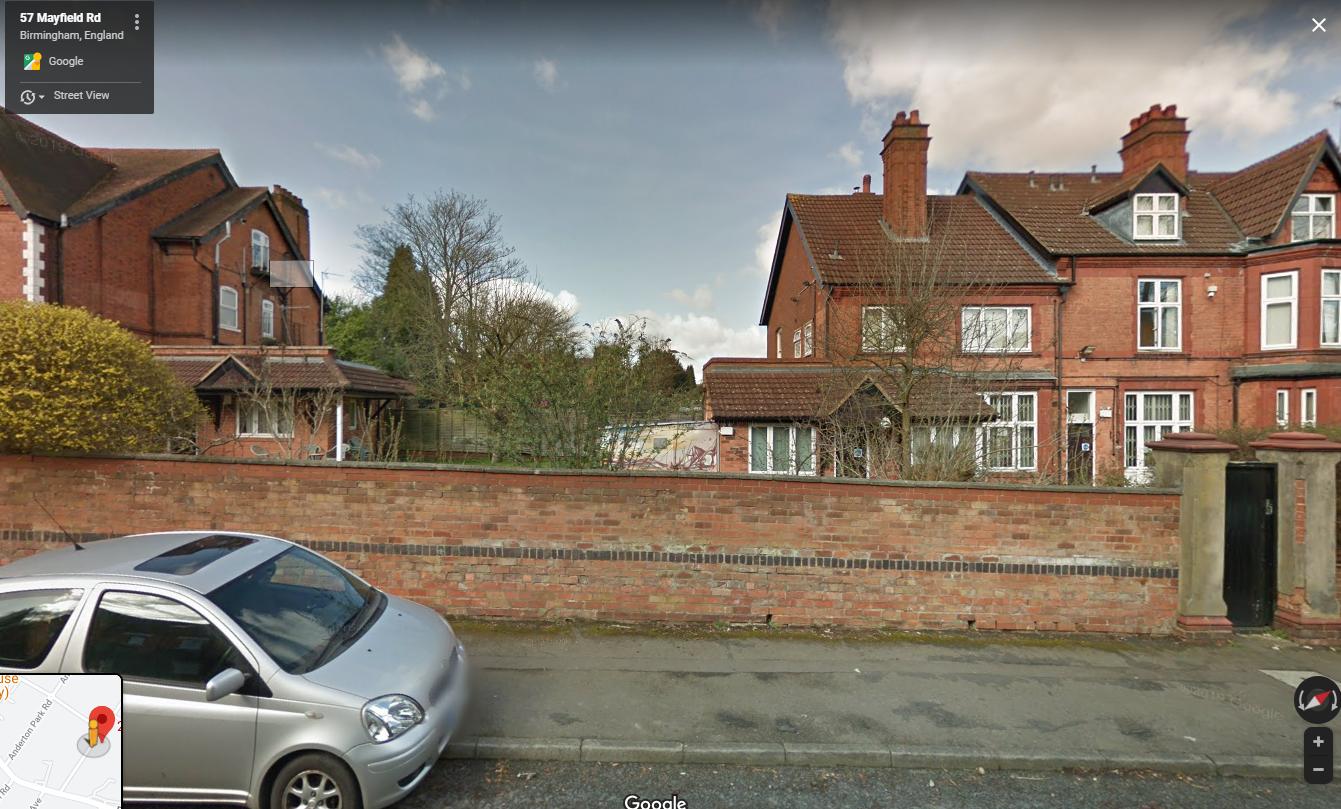
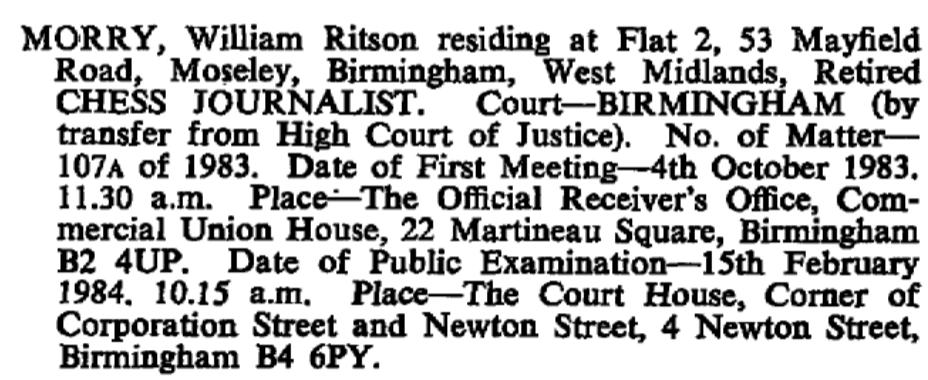
In 1983 WRM was living at Flat 2, 53, Mayfield Road, Moseley, Birmingham, West Midlands and recorded as a Retired Chess Journalist. Elsewhere he was recorded as a freelance chess and cricket journalist.
57, Mayfield Road, Moseley, Birmingham, B13 9HT
and, unfortunately, in this year he made another appearance in the London Gazette (2nd September 1983) having been made bankrupt.
London Gazette, 2nd September 1983
However, despite these unfortunate life events WRMs contribution to chess goes above and beyond them as he won the BCF President’s Award in 1984.
From British Chess Magazine, Volume CXIV (114, 1994), Number 2 (February), pp. 98 – 99 we have this obituary from Bernard Cafferty:
W Ritson Morry – a Tribute
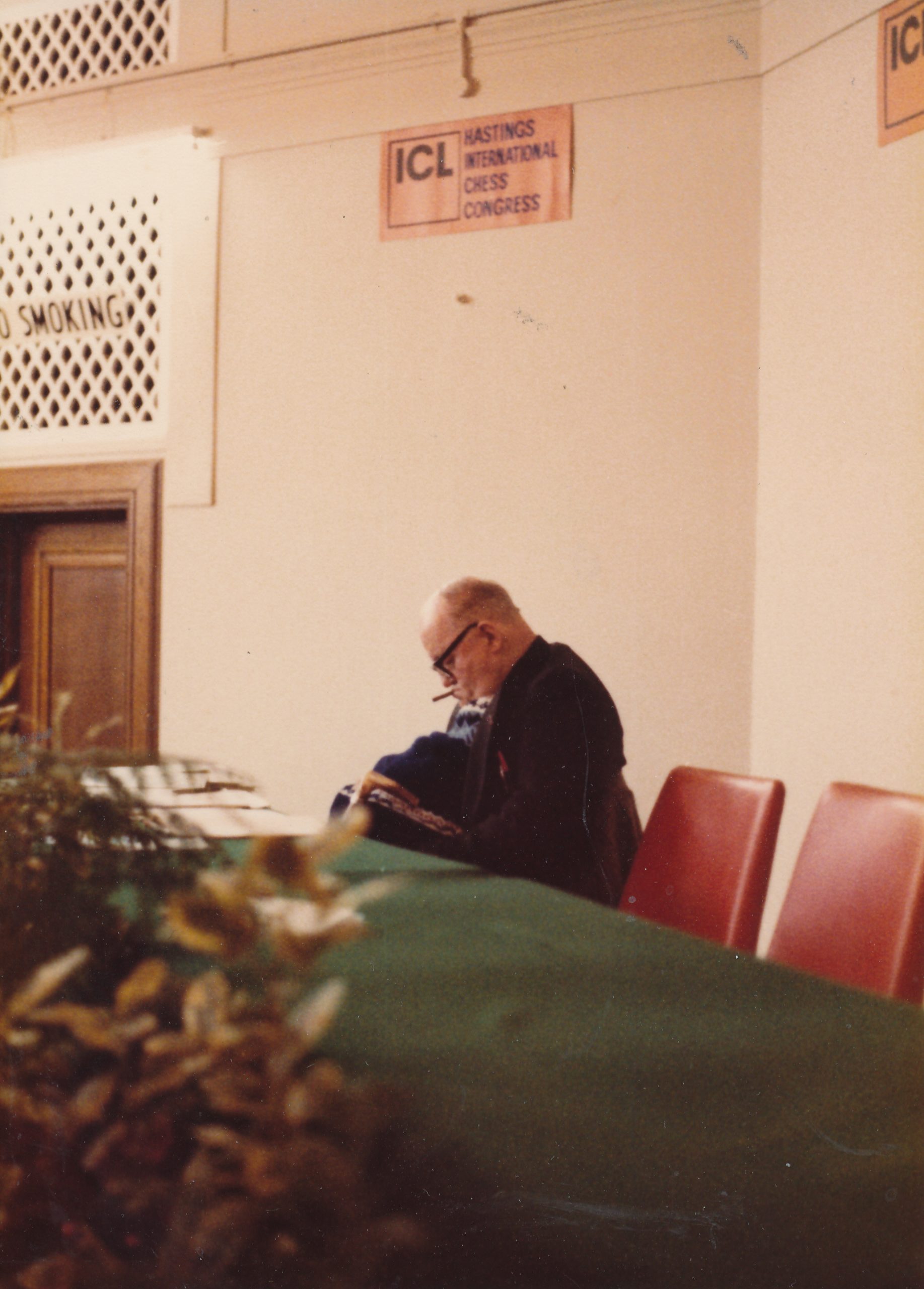
That great chess character, known to everybody simply as Ritson, has left us in the fullness of years, coincidentally during the first Hastings Congress he missed for decades.
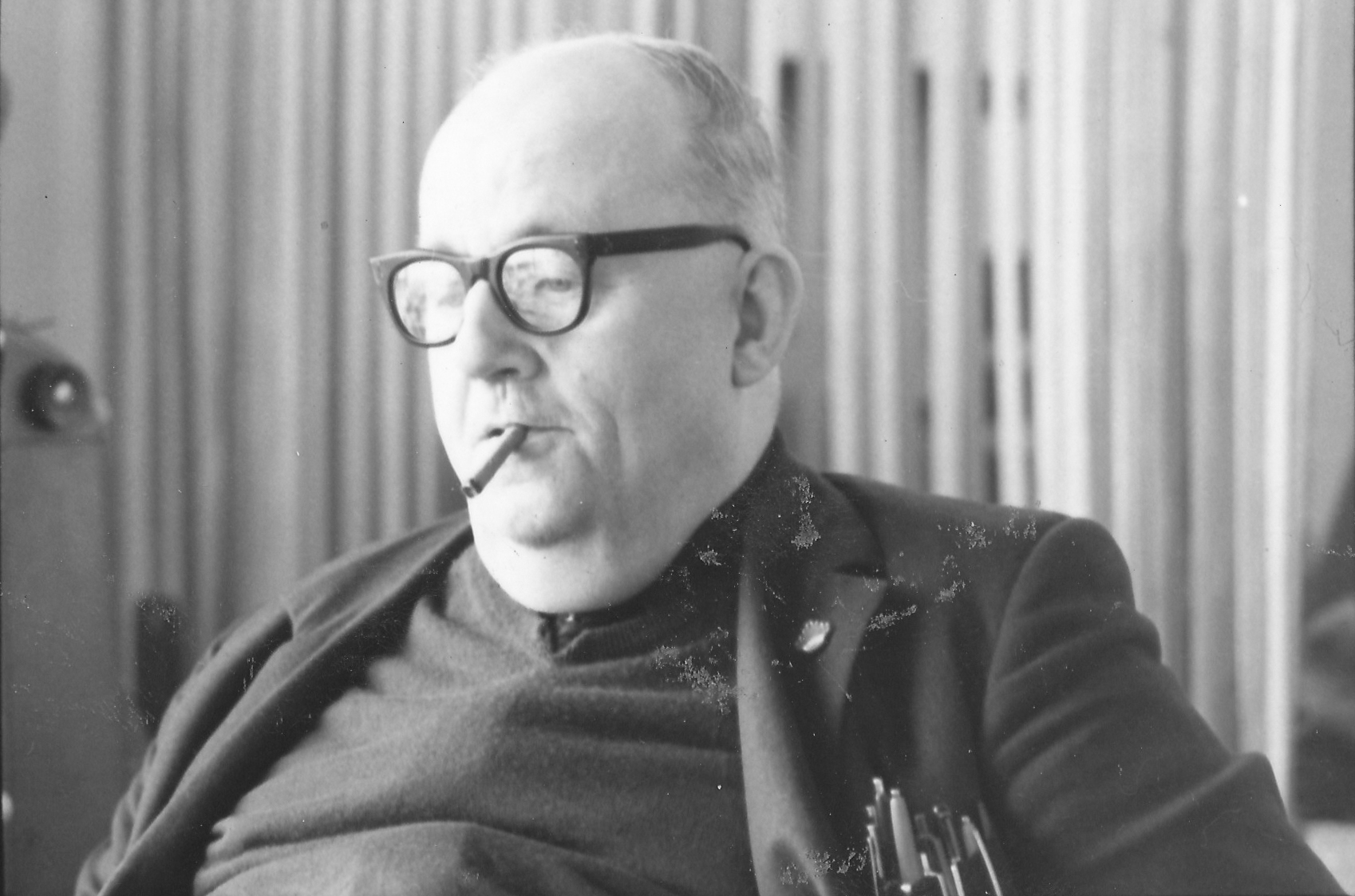
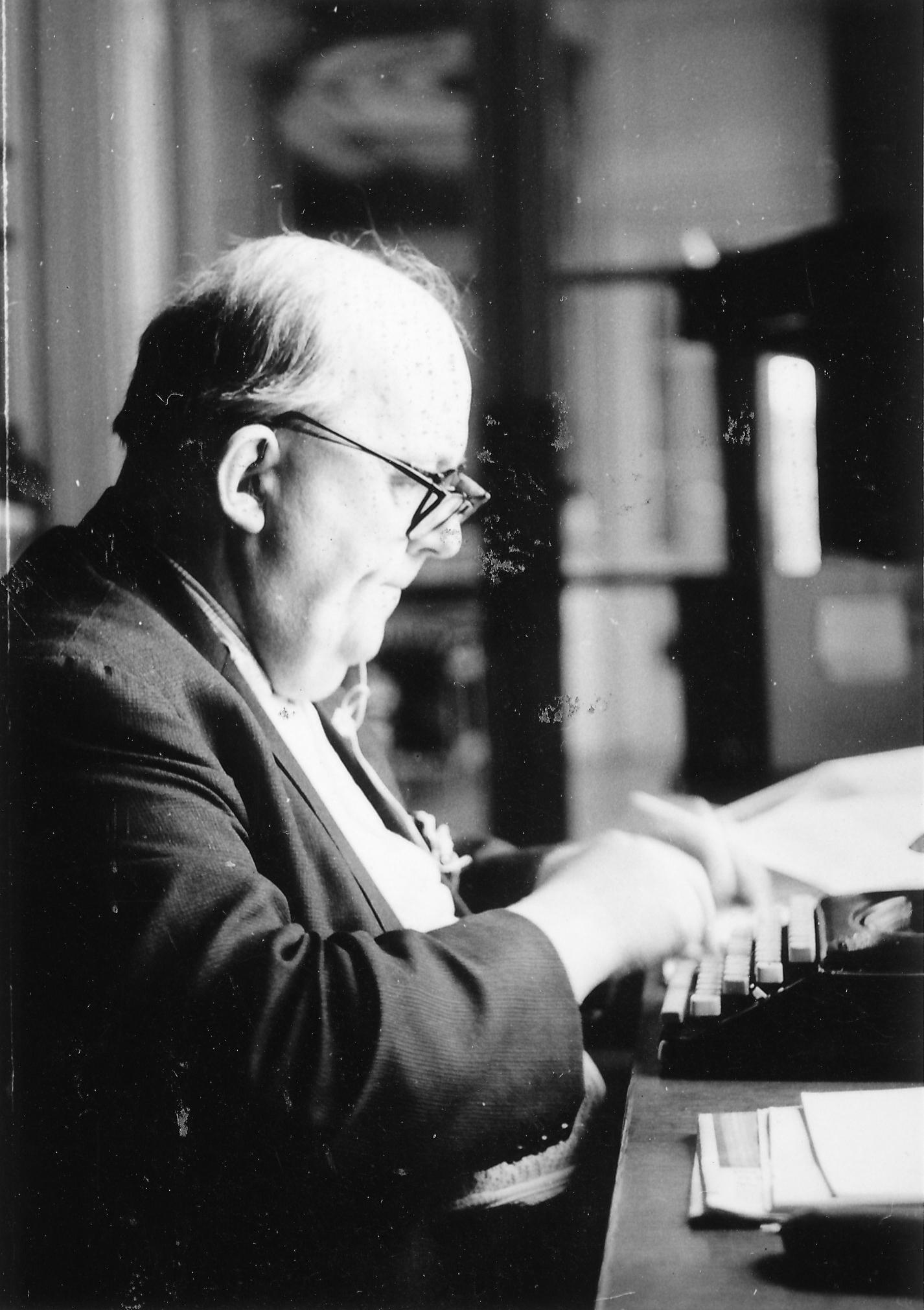
William Ritson Morry (5 ix 1910-8 i 1994) was a player, organiser, writer, arbiter and occasional sponsor of tournaments whose life touched so many aspects of chess that it is hard to know where to begin.
William Ritson Morry (05-ix-1910 08-i-1994)
Ritson was educated in North Wales at the same school as BH Wood. Both were at Birmingham University at the same time, after which Ritson trained as a solicitor. As early as 1930 he founded the Birmingham Junior League, and a little later wrote a chess column for a time for a local newspaper, though Ritson is hardly the first person you think of as someone who would hit deadlines consistently. He was equal second in a rather unrepresentative British Championship of 1936 and equal third in 1951. An unfortunate incident in the mid-1940s led to him being struck off, whereupon he became a chess professional, who eked out a precarious living for the last 48 years of his life. Yet, I never heard him complain, for he was able to immerse himself in chess full time, and what could be better than that?
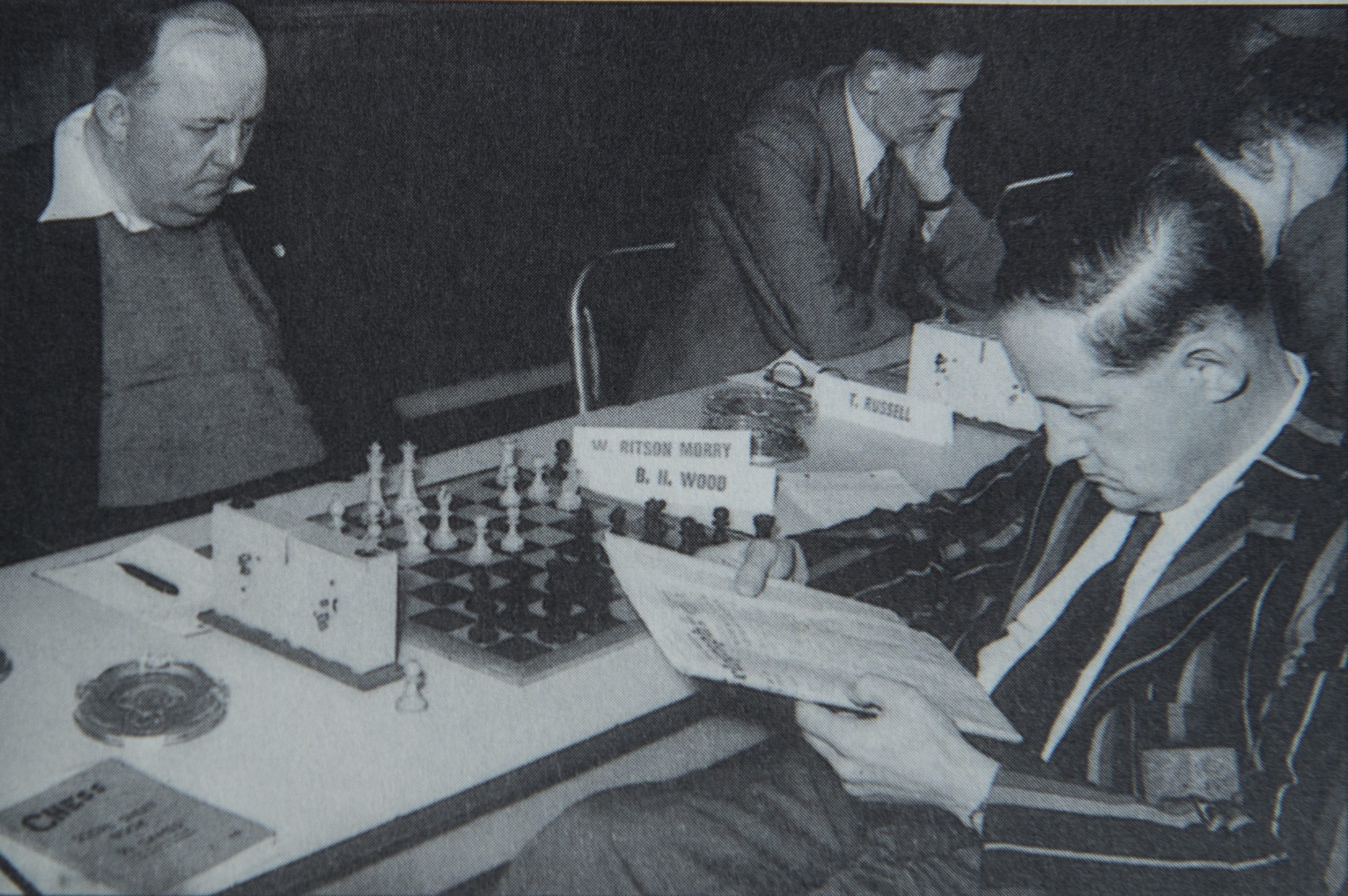
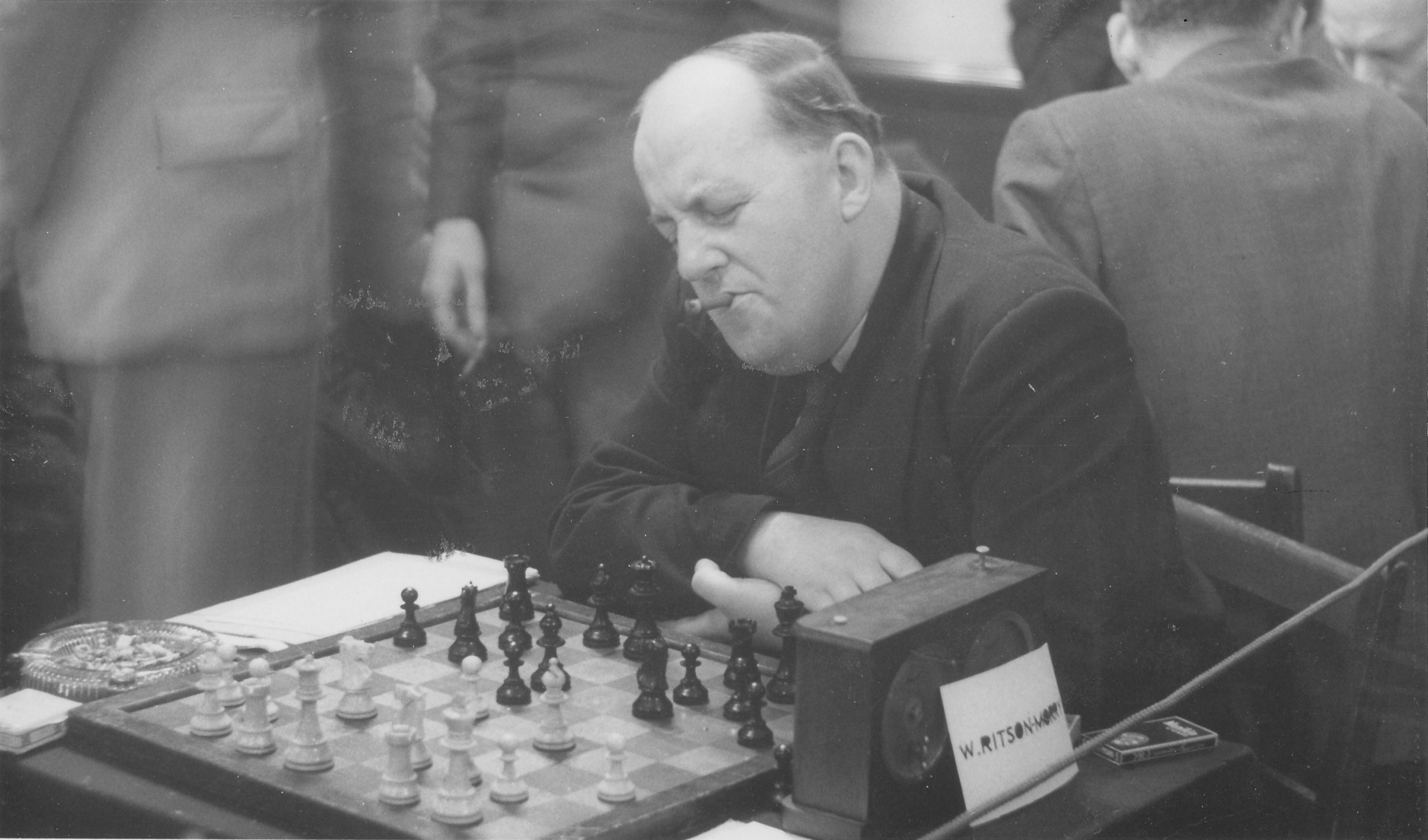
William Ritson Morry playing Baruch Harold Wood at the British Championships in Blackpool from 1956
He ran a series of newsletters, which hardly covered their expenses and produced and British Championship and Hastings bulletins for many years. 1951 was a significant year in his life, for he gained the FIDE Arbiter title (he was always an expert on the rules and many of the conventions we all play to were codified by him, or under his guidance). Later on Ritson, a great raconteur, was the life and soul of the show in Hastings which, along with the Warwickshire chess team and Erdington CC, was the great love of his life.
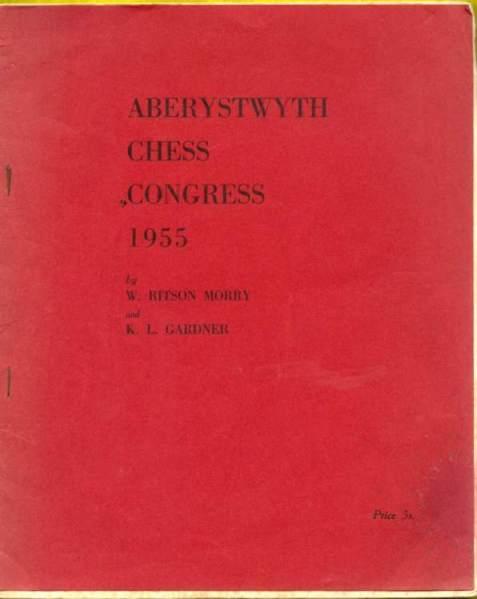
Aberystwyth Chess Congress 1955, W Ritson Morry and KL Gardiner, En Passant Chess Publications, 1955
At times he seemed to run Hastings almost single-handed in the Frank Rhoden era. In fact GM Vasyukov went back to Moscow in 1966 and wrote that Ritson Morry was the only controller to be seen in the morning, afternoon and evening sessions of play. I recall that Ritson was amused when I told him of this, but did not demur. To show that there was life in the old dog, he organised a series of Birmingham international tournaments in the 1970s at which Tony Miles got much of his early experience.
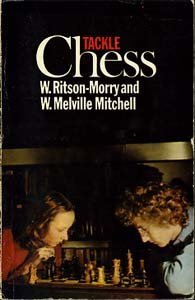
Tackle Chess by William Ritson-Morry & W Melville Mitchell
One such tournament was financed by him alone, on the basis of the sale of a piece of land in Sutton Coldfield where a change of planning status had led to a windfall profit.
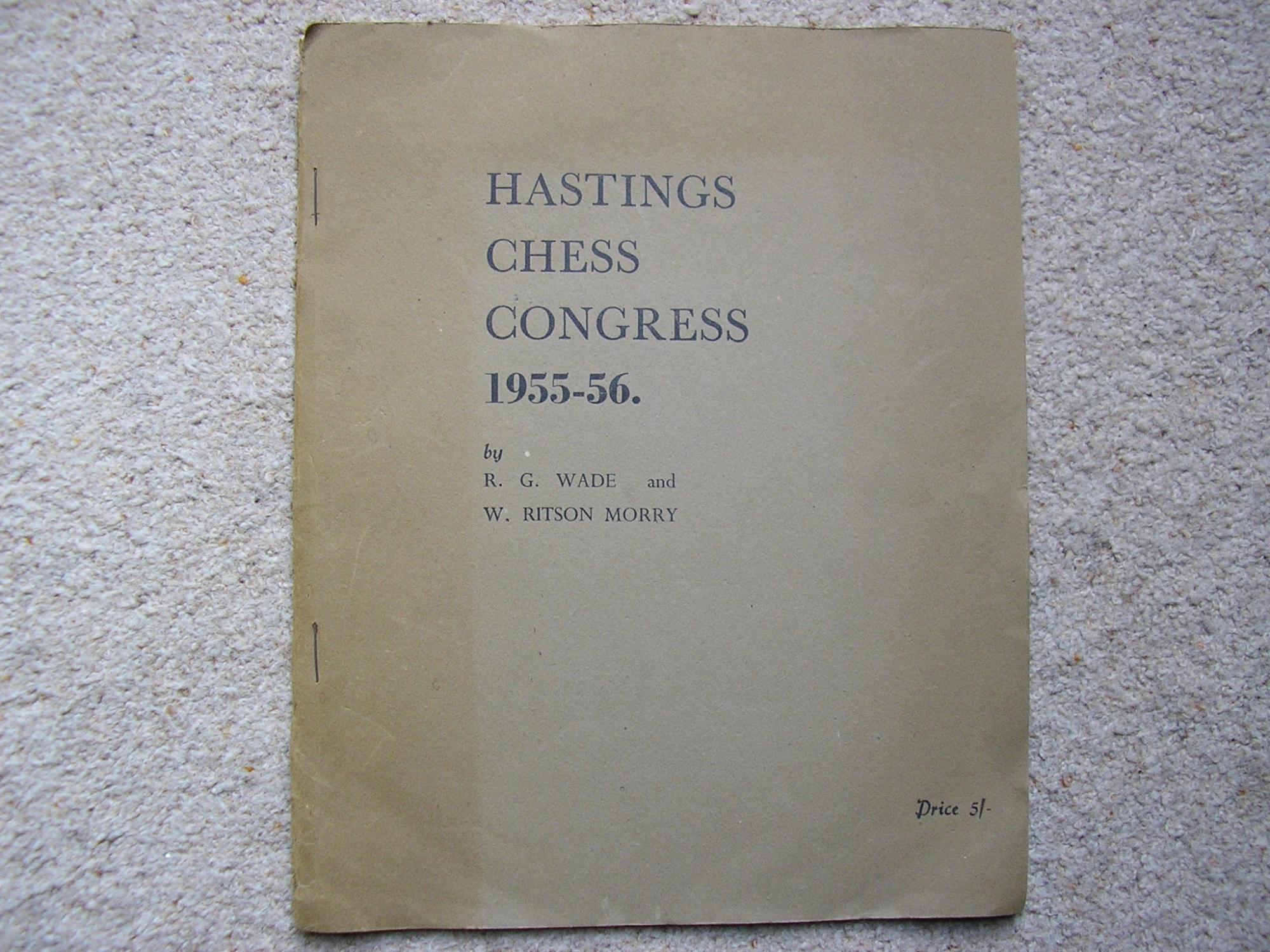
Hastings Chess Congress 1955-56, RG Wade & W. Ritson Morry, En Passant Chess Publications
He also saved Hastings in late 1974,by giving a partial guarantee when another sponsor reduced his contribution. A few years later the Inland Revenue made him bankrupt when they could not get their piece of the action out of the deal. Doubtless Ritson thought that the money had gone to a worthier cause. I must not fail to mention his love of gambling or his erudition. Many is the time when you could have an exposition from him of the law of England, the practice of the courts and the police, or the political news of the day.
William Ritson Morry (05-ix-1910 08-i-1994)
He was deeply immersed in local Labour Party politics in Birmingham and was a friend of football referee, ‘rainmaker’ Dennis Howell, one-time Minister for Sport. Ritson also played a great deal of postal chess, winning the British title in 1943. His book on the game written in conjunction with a Birmingham schoolmaster Mel Mitchell is a very instructive one, and he also wrote many reports and amusing articles for BCM, particularly one on of the failings of the Elo rating system regulations.
Here is a game Ritson won against the veteran German GM at the London Easter congress of 1940:
Bernard wrote about WRM a year later for the centenary edition of the programme for the Hastings International Congress :
“‘Ritson’ as we all knew him was an institution in British Chess, active as a player, writer, organiser, drafter of rules and well-known for his skill as a raconteur, Educated in North Wales, he spent the rest of his life, from university days onwards, in Birmingham, but the Hastings Congress was very close to his heart. He played in a number of pre-war events, and also a few post-war, but by the time of the Frank Rhoden revival of the mid-1950s he was firmly in the saddle organising the post-Christmas traditional event. In fact I recall how perturbed Frank Rhoden was when the news came that Ritson might emigrate to the West Indies. It was not clear then how he could be replaced, for he supervised the morning, afternoon and evening sessions at the Sun Lounge (his favourite venue) and later at the Falaise Hall when the congress was still of such a size that we could all, including the Premier, be fitted into one room.
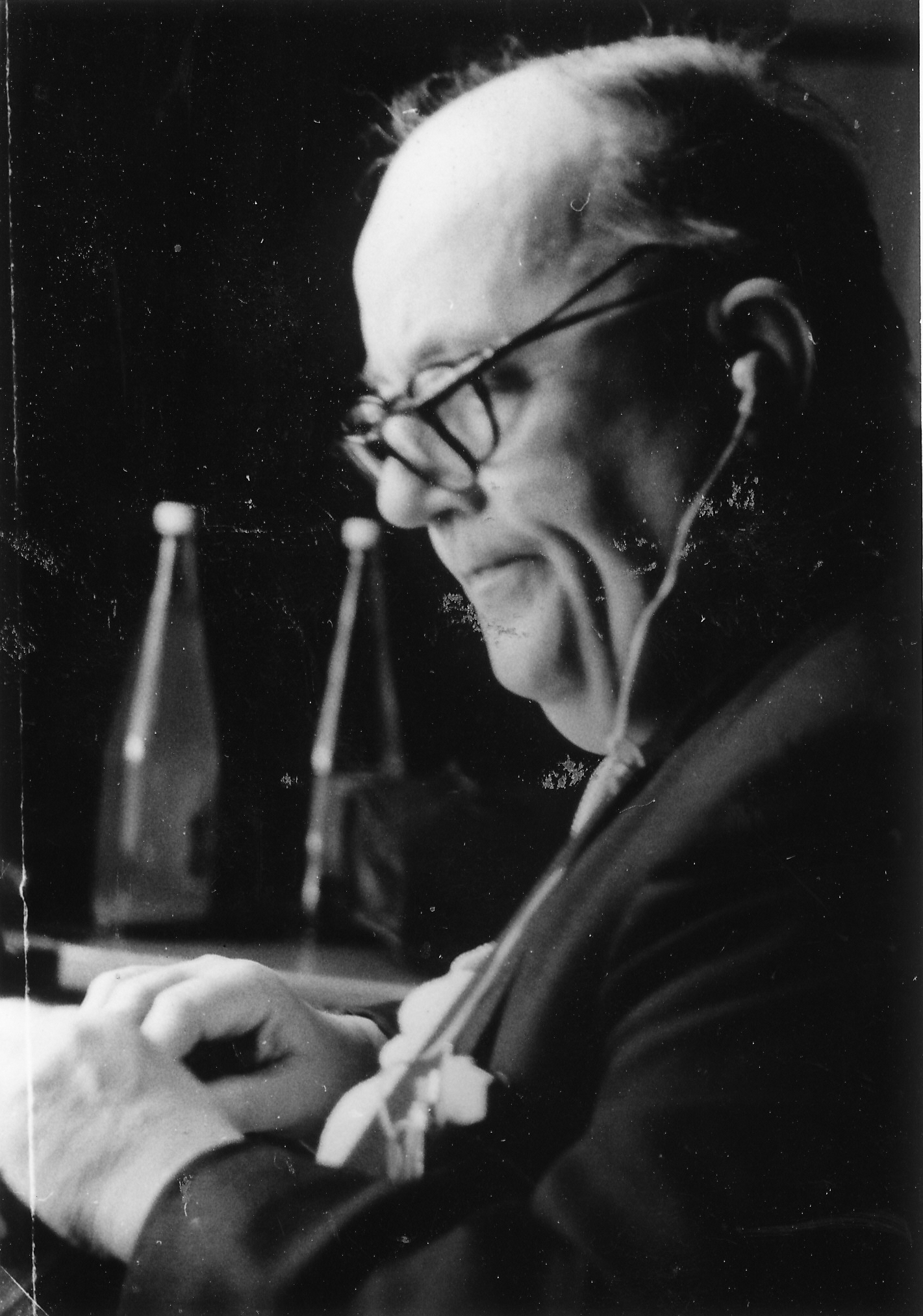
William Ritson Morry
Ritson also did game commentaries for some years and produced a bulletin for at least three decades. He was greatly encouraging of younger talent and the objective historian has to recall the indignation he felt when players like Tony Miles and Nigel Short were not happy with the restraints imposed by financial stringency.
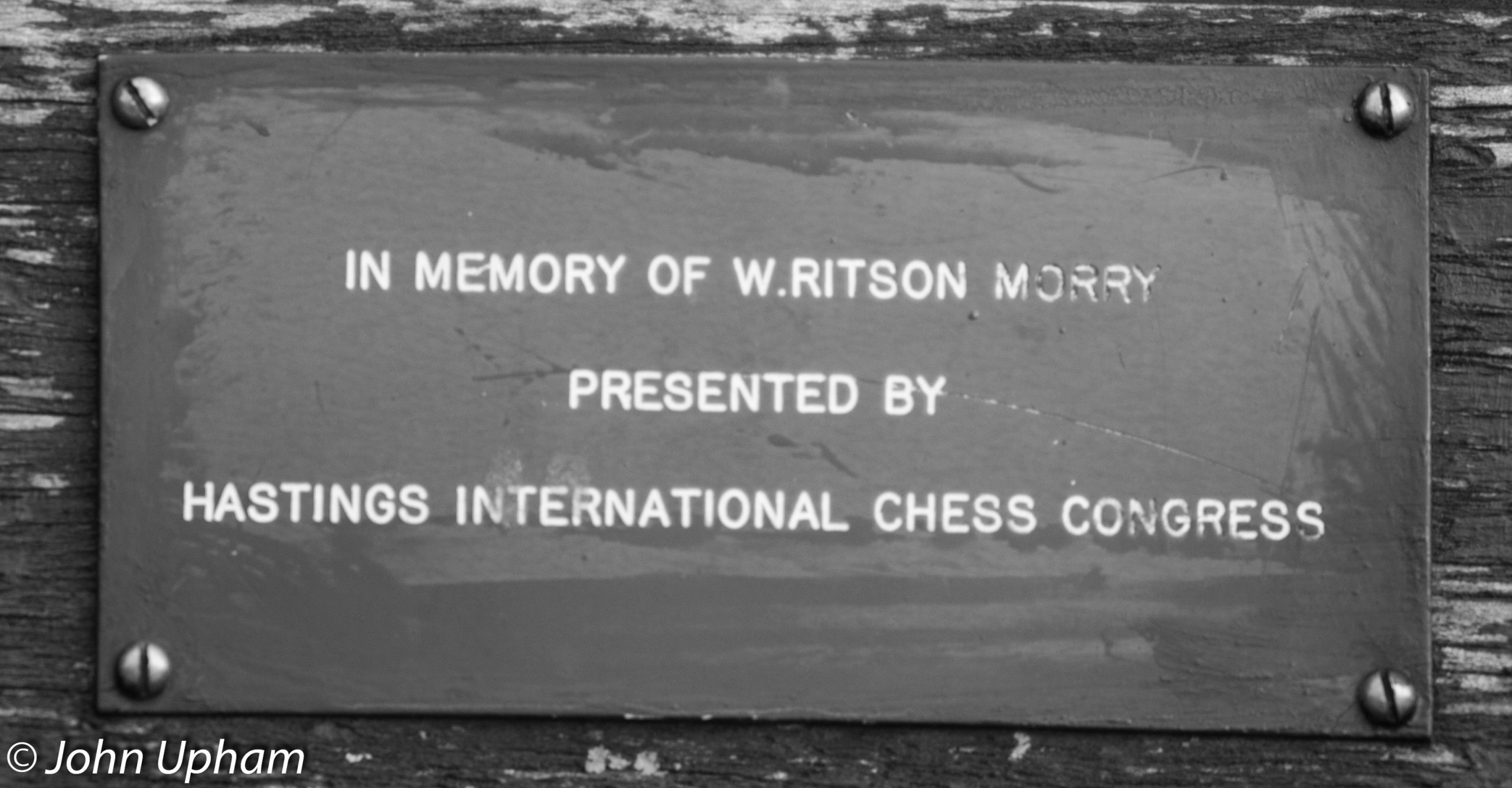
Hastings bench memorial bench for William Ritson Morry
In his declining years Ritson was still a regular until his illness of late 1993, and a fixture at the “gate” where the public paid their entrance money at the Cinque Ports Hotel. The choice of word is deliberate as a visit to the dogs and the bookmaker was one of his rare pleasures outside chess. Best of all, however, one recalls him telling his fund of stories and reminisces to anyone who cared to listen. His voice, alas, has been stilled, and we are left to recall his selfless devotion to chess and, in particular, to the Hastings Congress.
Here is an obituary from the Midland Counties Chess Union
Midlands organiser and player who was a chess professional and journalist. As a player his best performances were an =2nd in the British Championship 1936 and an = 3rd in 1951.
In the international field his best results have been an =3rd with List in the Major Open A section of the Nottingham congress of 1936 and =1st with Milner-Barry in the Premier Reserves A at the Hastings congress 1946/7. He has played for England in international matches against the Netherlands (thrice) and against Czechoslovakia and Yugoslavia.
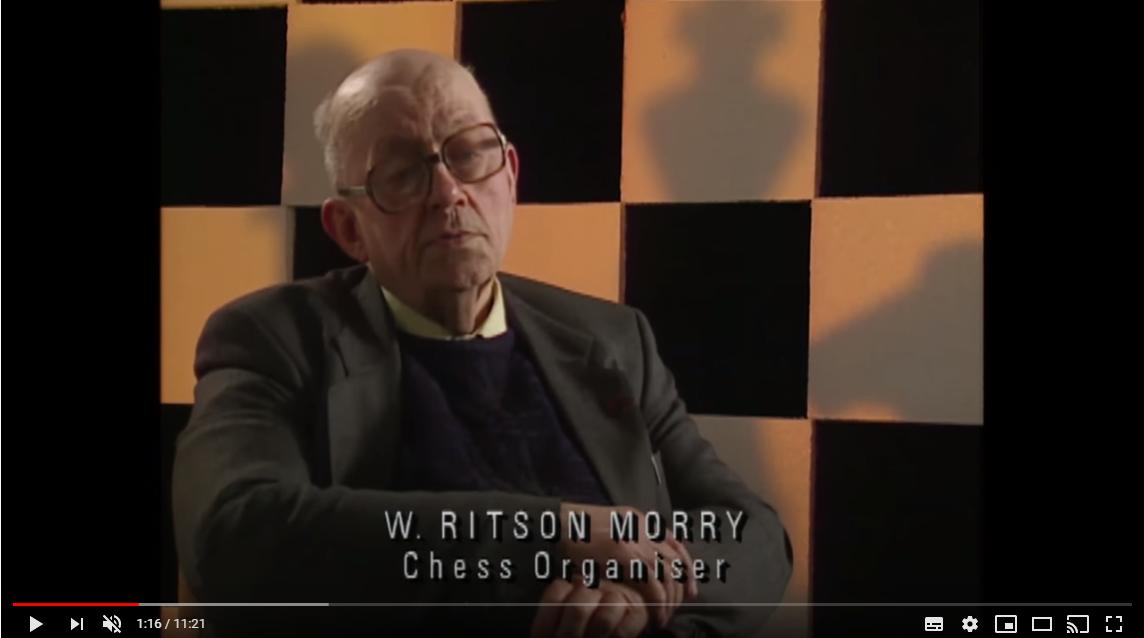
William Ritson Morry talking about Malik Mir Sultan Kahn
A keen and accomplished correspondence player, he had the title of British Postal Master on account of his winning the British Correspondence Championship in 1943.
But it is as tournament and congress organiser that he is best known. He founded the Birmingham Junior League in 1930 and has organised thirty-four Birmingham congresses. He conceived the idea of a junior world championship and in 1951 he held the first World Junior Championship tournament at Birmingham (won by Borislav Ivkov). In the same year he was awarded the title of FIDE judge. He has also had much to do with the organisation of the Hastings Christmas chess congresses in the 1970s.
William Ritson Morry (05-ix-1910 08-i-1994)
He has written much for British chess magazines and was the co-author along with the late W. R. Mitchell of Tackle Chess, London, 1967.
Keith finally secured the Grandmaster title in 1995 as a result of the final leg of the French League Championship. Keith gained the IM title in 1985 and then made his three norms at Ostend 1990, Parthenay in France in 1993, and in the French League finishing in March. He became England’s 26th holder of the GM title. On August 8th 2021 Keith became the 2nd British Online Champion
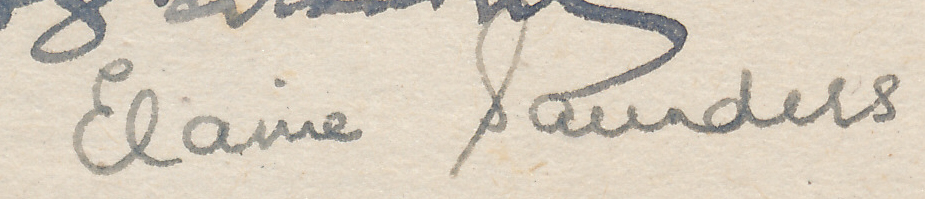
Dorée Elaine Zelia SaundersSignature of Elaine Saunders from a Brian Reilly “after dinner” postcard from Hastings Christmas Congress, 1945-1946
We remember Elaine Pritchard who passed away ten years this day on Saturday, January 7th, 2012.
Dorée Elaine Zelia Saunders was born on Thursday, January 7th, 1926. Her father was Henry de Beaufort Saunders (b. 7 Aug 1900, Folkestone, Kent d. Between Jul 1989 and Sep 1989) and her mother was Dorée Nellie Irene Dudley (b. 3 May 1900, d. 9 Jun 1970)
In the 1939 register Henry is listed as a Garage proprietor who had “retired through incapacitation”. He is recorded as a Air Raid Precautions Warden who was also a first aider. His wife is listed as undertaking “unpaid domestic duties”. The record for Elaine is blanked out with “This Record Officially Closed” meaning that they believe that she might still be alive. They are listed as residing at The George & Dragon Hotel in High Wycombe, Buckinghamshire.
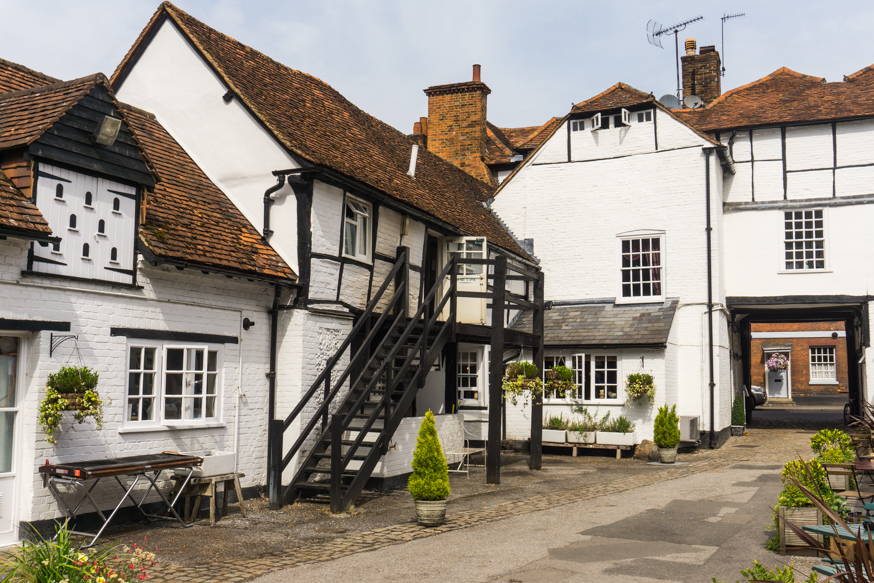
The George and Dragon Hotel, High Street, West Wycombe, Buckinghamshire , HP14 3AB
She was taught chess by her father and then her early trainer was Charles Dealtry Locock who lived with the family in the hotel above.
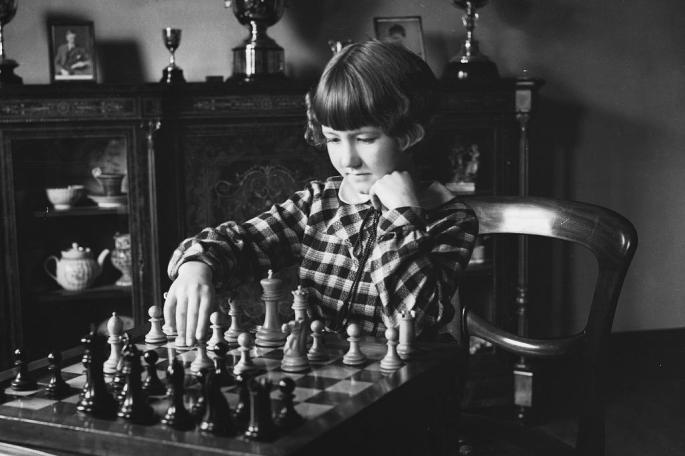
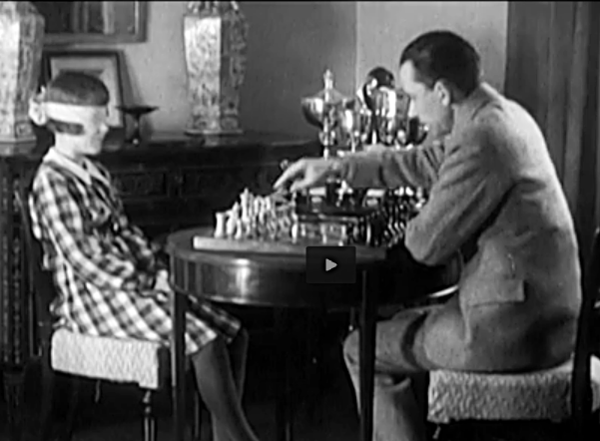
Elaine aged 10 playing her father Henry de Beaufort Saunders
She married David Pritchard on Friday March 7th 1952 in the Chelsea Registry Office. Elaine was living at Wylderne, Bridge Street, Great Kimble, Aylesbury HP17 9TW. At the time of their marriage David was a Flight Lieutenant.
Elaine and David had a daughter, Wanda H Zelia Pritchard on March 21st 1958. She became Wanda Dakin who was also a chess player. Wanda attended Guildford High School for Girls and then Royal Holloway College, Egham.
In their later years Elaine and David lived at Badgers Wood, Hascombe Road, Godalming, Surrey, GU8 4AA :
From British Chess (Pergamon Press, 1983), Botterill, Levy, Rice and Richardson :
“Chesswise I seem already to have lived an alarmingly long time, the era of Capablanca and Alekhine back across the war years was another world. The three games I have chosen belong to three distinctly different periods in these fifty years – the juvenile long-ago, the most elderly present and the middle when I was playing tolerably well and was awarded the WIM title.
My father, assisted by a 2d. (= almost 1p) book of rules from Smiths, taught me the moves at somewhere round the age of five. We were rescued by the problemist CD Locock who noticed me playing in a girls’ tournament two years later. It was he who brought me up on a diet of the Scotch, the Evans and any gambit that was going. We analysed them in some depth – for those days – and my severe task-master made me copy out long columns of dubious lines. He also made me his guinea-pig for his Imagination in Chess and it is small wonder that I still find it hard to resist a sacrifice, and much of my undoing comes from premature sorties such as f4 and Qh5.
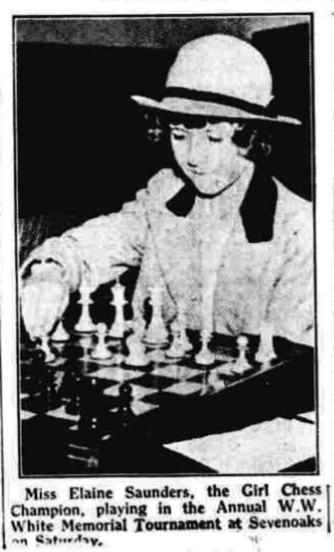
Miss Elaine Saunders, the girl chess champion playing in the annual WW White Memorial Tournament in Sevenoaks. on June 25th 1939. Source : https://www.chessmarginalia.com/miss-elaine-saunders/
In retrospect he must have been a brilliant teacher. Starting in 1936 a succession of girls’ titles came my way including the FIDE under-21, and in 1939 the British Ladies at the age of 13. It is hard to assess how strong or weak one was at the time because there has been such a marked improvement in the standard of play among women over recent years. At all events, those pre-war years were happy ones, especially away from chess which took second place to horses and more physical pastimes.
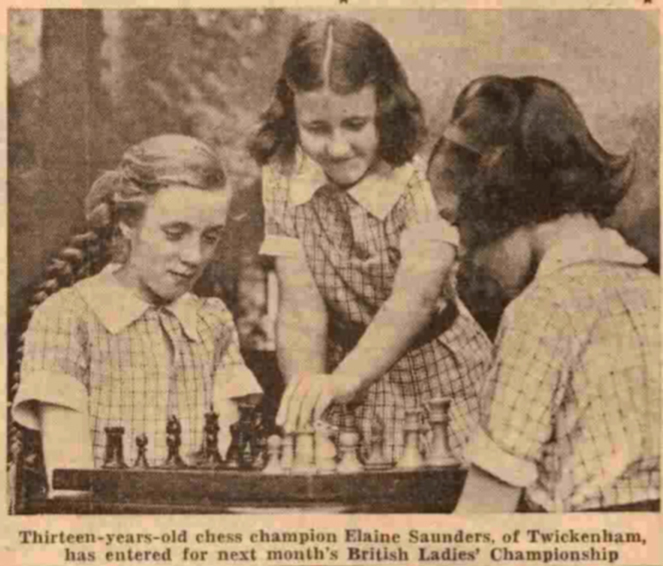
Thirteen Years Old Chess Champion Elaine Saunders, of Twickenham has entered for next months British Ladies’ Championship. Source : The People, July 23rd, 1939.
The incident which received the most publicity was the ‘affair Alekhine’. Most of the pre-war giants were kindly if a little condescending towards me but the new World Champion – he had just regained the title from Euwe – showed me no mercy. He took on 30 Kent players at the Charing Cross Hotel and after 5 hours demolished all except myself. The ending was equal. He stood over our board and glowered. ‘Give the child a draw’, said someone in Russian in the audience, which despite them mid-night hour were everywhere on chairs and even under tables. ‘I know what I am doing’ came the reply, and of course he did. I lost.
At 13 the world changed. I almost gave up chess. There were no celebrations after that Ladies Championship. The foreign masters packed their bags for home; we packed them for exile in Buckinghamshire and filling sandbags.
My saddest personal loss of the war was Vera Menchik, perhaps the strongest lady player of all time.
Leaving university with a poor, but lightning degree in French, I was employed by the Foreign Office and spent the next few years in London. While at college I had won the Notts County Championship and like to remember my last game on top board for county against the great HE Atkins, so many times British Champion, making his final appearance for Leicestershire.
I forsook women’s events and achieved probably my best results, finishing equal 3rd in the London Championship final, having beaten David Hooper with an Allgaier Gambit, and qualifying for the British Championship at Buxton in a section which included L. Barden, V. Berger and DB Pritchard.
Marrying David in 1952, we went to the Far East for three years and on our return I made a come-back to women’s chess and won the title at Blackpool in 1956. I was consequently despatched to the Western Zonal in Venice and finished equal 2nd with Lazaravic. This qualified me for the Interzonal, but my daughter Wanda arrived (March 21st 1958) before I could get to the starting post. Meanwhile with Eileen Tranmer we represented the BCF in the first women’s Olympiad in Emmen in 1957 where we finished 7th. The Finals went well for me and included a draw against Rubtsova, the then world champion. The results of the two tournaments were sufficient for me to be awarded the IWM title. My BCF grading at that time was 200 and has gone down ever since!
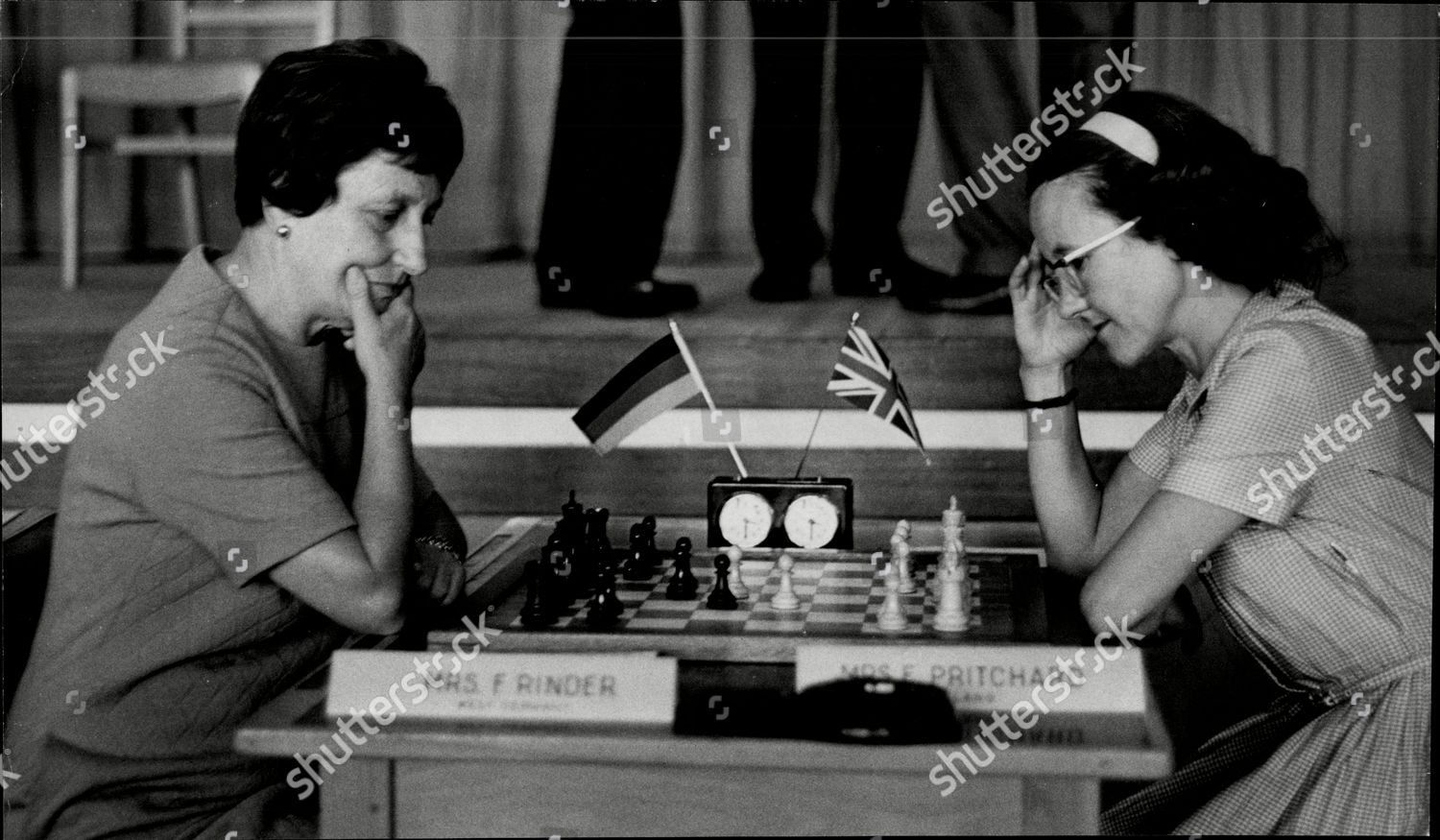
Friedl Rinder (Germany) plays Elaine Pritchard at the Havering Women’s Tournament in Romford on August 25th 1967. Tournament was won by Nona Gaprindashvilli Mandatory Credit: Photo by ANL/Shutterstock (1876414a)
And so some 20 years on and still a teacher, we reach the final period, that of comparative dotage. Notwithstanding, I have been fortunate enough to have played in the last four Olympiads at Skopje, Medellin, Haifa and Buenos Aires, twice as captain of the team. It was, of course, pleasurable to win a silver medal at Haifa, despite the fact that the East European bloc was missing. The last of the three games comes from Haifa at a crucial stage. Playing for a team has always seemed more fun.
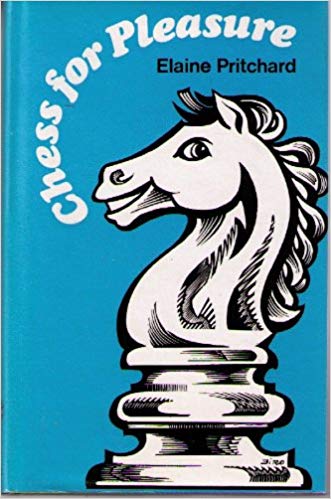
Also in my dotage belong two books, Chess for Pleasure
Chess for Pleasure by Elaine Pritchard
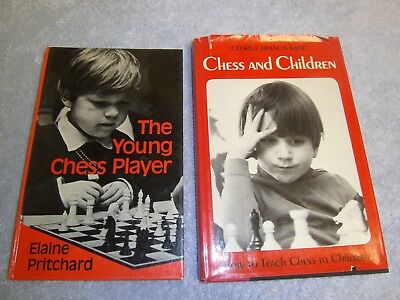
and The Young Chess Player (Faber) and organisation of girl’s chess, particularly the Faber Cup”
The Young Chess Player by Elaine Pritchard
From The Encyclopaedia of Chess (Robert Hale 1970 & 1976), edited by Anne Sunnucks :
“International Woman Master (1957) and British Woman Champion in 1939, 1946, 1956 and 1965.
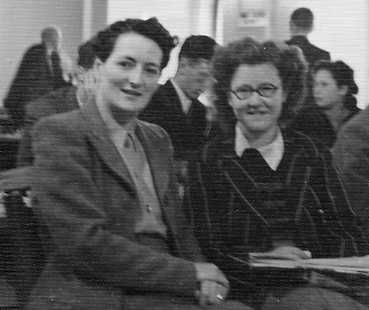
Rowena Bruce and Elaine Saunders at Nottingham 1946 where they tied for 1st place. Elaine won the play-off with 2.5/3. Courtesy of Keverel Chess.
Elaine Pritchard was, as a child, one of the few girl prodigies in the history of the game. She was taught the moves by her father when she was 5.5 and started to play in tournaments at the age of 7. When she was 10 years old, she won an under-21 girls’ tournament sponsored by FIDE and at the age of 13 won the British Ladies Championship for the first time.
She is married to David Pritchard, ex-Southern Counties Champion and Malayan Champion in 1955, when she was stationed with the RAF in Singapore, who tells of how when he first met her, when she was about 7, she was unable to reach the far side of the board.
Her successes in more recent years include 2nd in the Western European Women’s Zonal Tournament of 1957 and 6th in the same event at Arenys de Mar in 1966; 3rd at Havering 1967 and 3rd at Paignton 1967. She played for the British Chess Federation team in the First Women’s Chess Olympiad at Emmen in 1957.”
From The Encyclopaedia of Chess, Edited by Harry Golombek :
“International Woman master and British Woman champion 1939, 1946, 1956 and 1965, she was a girl prodigy with perhaps the most natural talent for the game of any British-born woman. She was playing competitive chess at the age of seven and was only ten when she won the FIDE Girls Open chess championship (under-21) in London in 1936, winning eleven out of twelve games played.
British Girl Champion (under-18) 1936-8 she won the British Women’s Championship in 1939 at the age of thirteen. Winning the title on three more occasions she hardly ever had a bad result in the event but, by profession a teacher, she did not always have the time to devote to the game.
Her best international results were 2nd in the Western European Zonal Women’s tournament in 1957 (the year she gained the Woman master title), and two 3rd places in Paignton and Havering 1967. She represented the B.C.F. in Women’s Olympiads at Emmen 1957, Skopje 1972, Medellin in 1974 and Haifa 1976. (H.G.)”
Elaine did not merit mention by Hooper & Whyld it would appear.
The following obituary by James Pratt appeared in the February 2012 issue of British Chess Magazine :
“Via Godalming Chess Club we learn of the death of International Woman Master, Elaine Pritchard (née Dorée Elaine Zelia Saunders ) (7 i 1926 Brentford – 7 i 2012 Gloucester). British Lady Champion in 1939, 1946, 1956 and 1965, she became an IWM in 1957. A child prodigy, she won the World Girls Under 21s at the age of ten and first captured the British Ladies title at the outbreak of WWII. Mrs Pritchard wrote two books, Chess for Pleasure and The Young Chess Player. She was an occasional BCM contributor. Her last published grade was in 2003. She was an Honorary Life Member of the ECF.”
and here courtesy of Edward Winter is an excellent article on chess prodigies including many scanned photographs of Elaine.
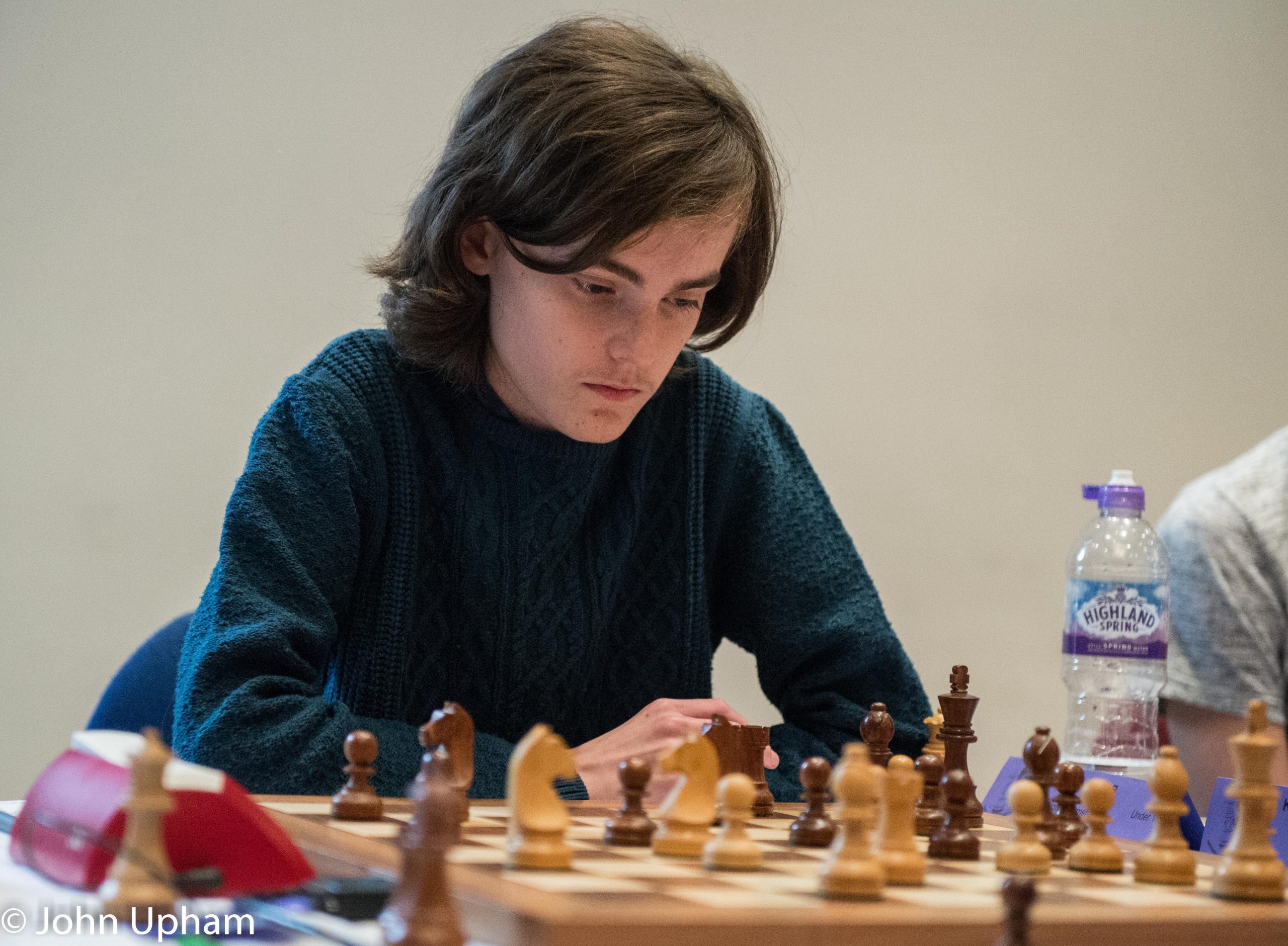
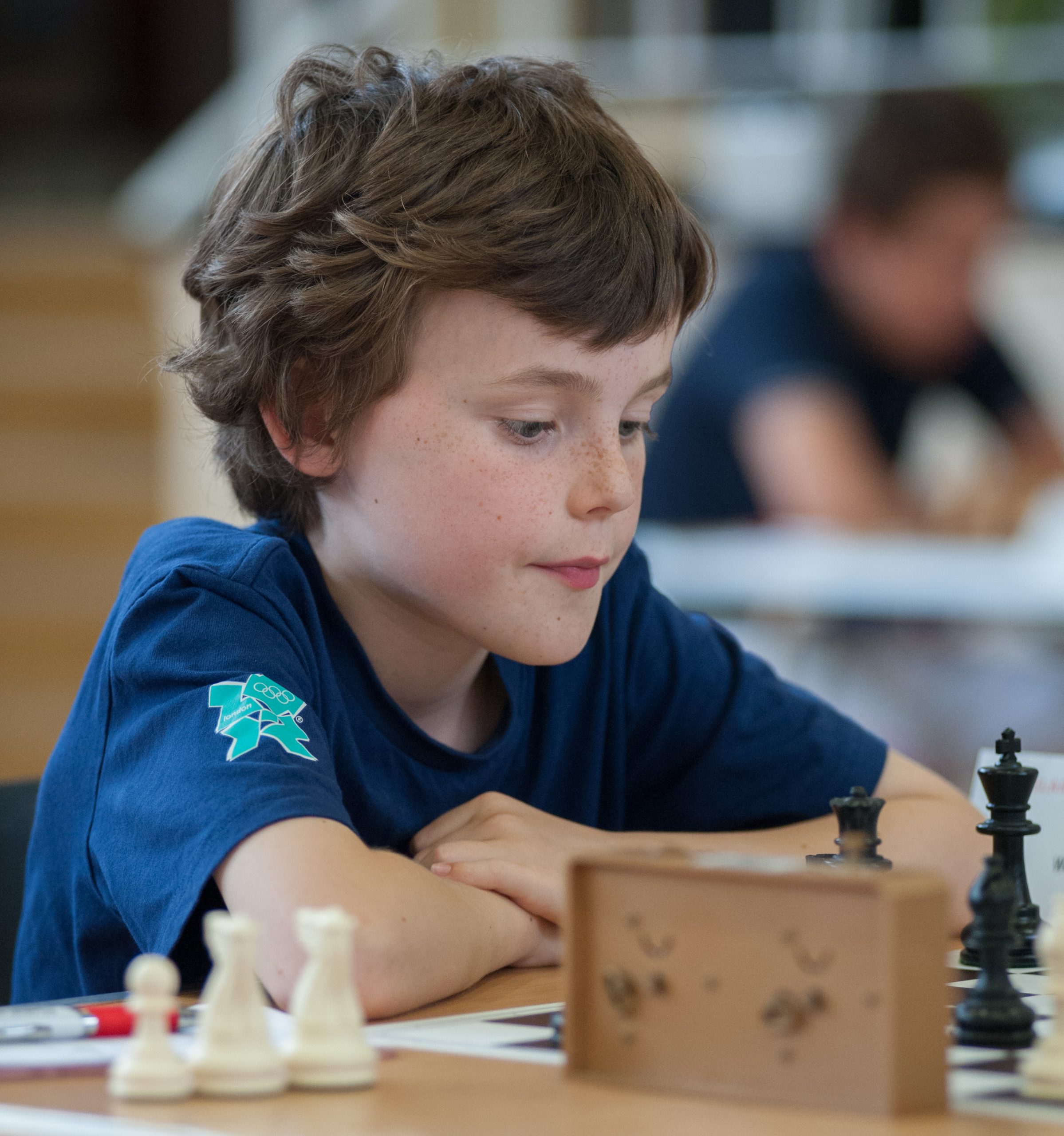
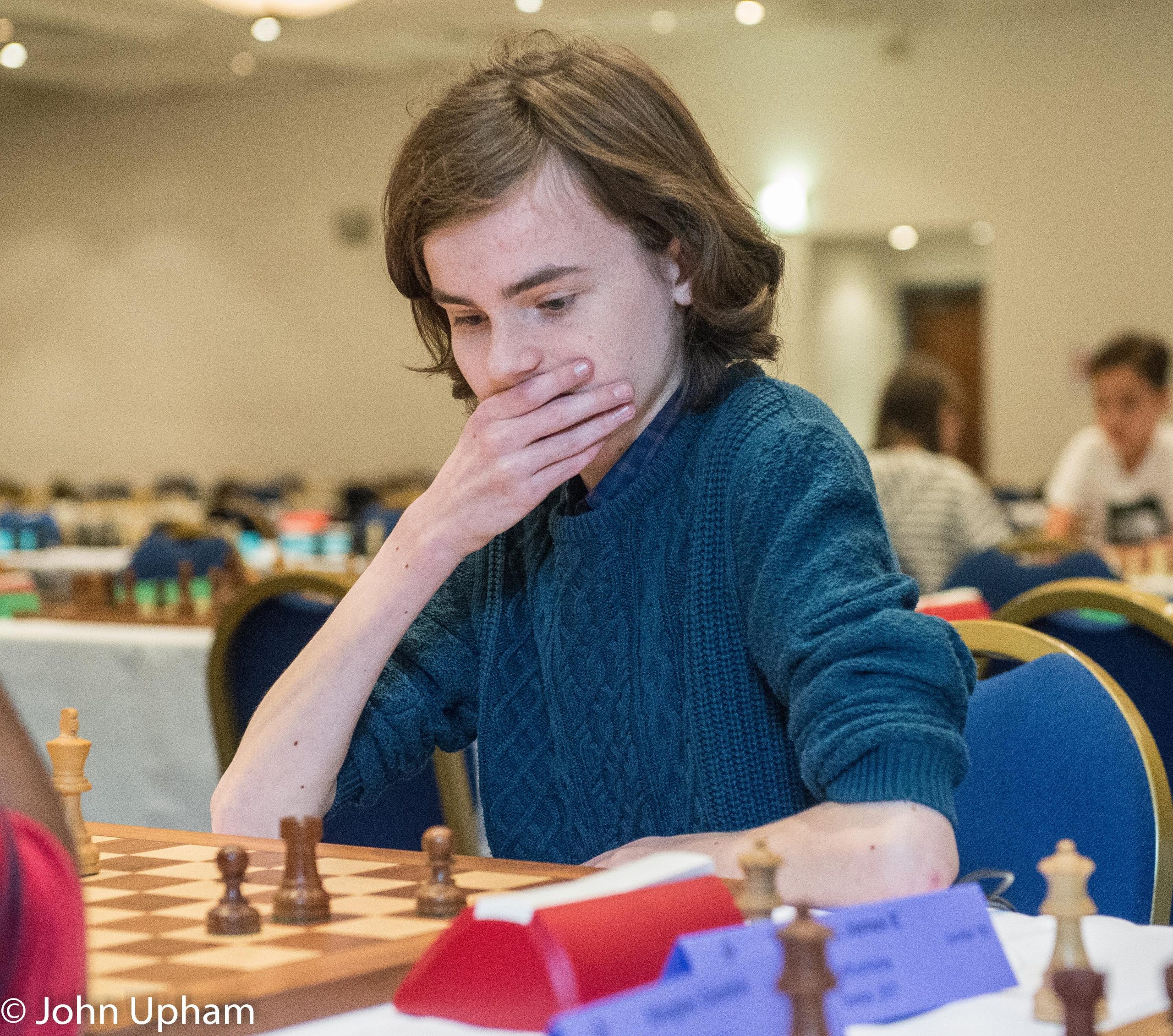
FM Jonah Willow, UKCC Terafinal 2018, Courtesy of John Upham Photography
Happy Birthday IM (elect) Jonah Willow
Jonah B Willow was born in Nottingham on Monday, December 30th 2002. Jacob was the most popular boy’s name in 2002. “Lose Yourself” by Eminem was number one.
Jonah has a chess playing sister, Hambel, who plays for Newcastle-under-Lyme, West Nottingham, Staffordshire CA and Nottinghamshire CA.
Jonah’s first recorded graded standard play tournament was the 2010 Delancey UK Chess Challenge Terafinal and his first recorded rapidplay event was the Nottingham Rapidplay in 2011.
Jonah Willow at the 2012 UKK Terafinal. Courtesy of John Upham Photography
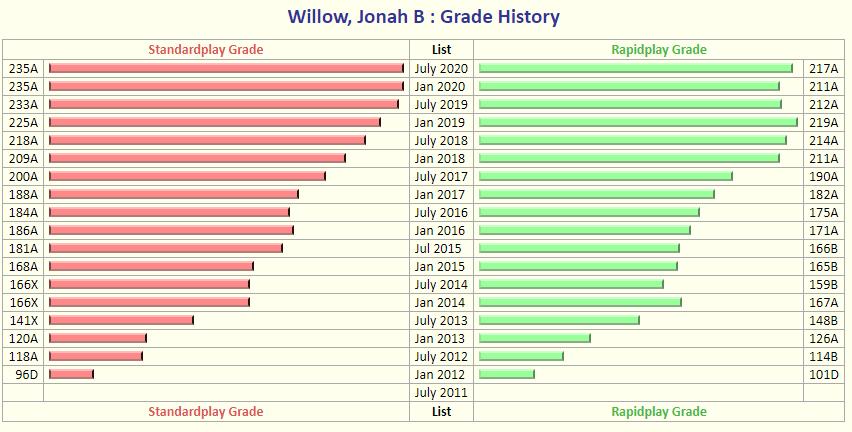
Jonah’s first published standard play grade was 96D in January of 2012 :
Jonah’s ECF grading progress
Jonah has represented West Nottingham, 4NCL Wood Green, Nottinghamshire CA and Syston (Leicester).
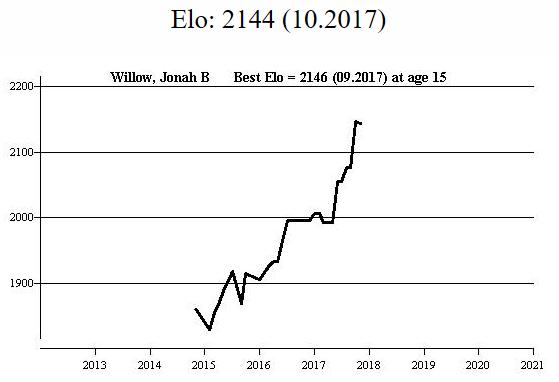
FIDE rating profile for FM Jonah B Willow from Megabase 2020
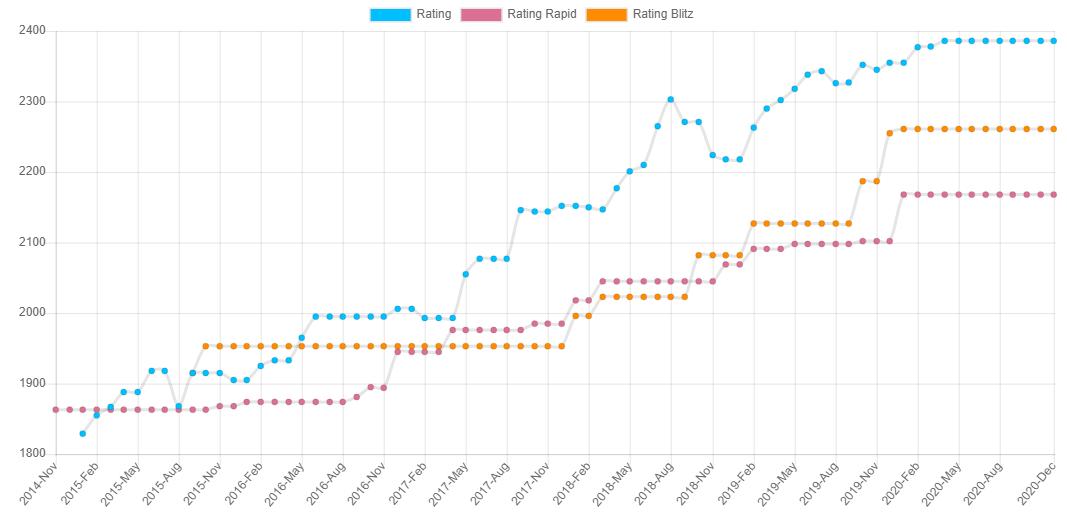
It is a little curious as to the reason for the rating profile to halt at the end of 2018 since Jonah has played plenty of FIDE rated games since. Compare the above with :
FIDE rating for FM Jonah Willow from fide.com
Jonah’s current (December 2021) FIDE standard play rating is 2381 and Jonah became a FIDE Master in 2018.
Jonah has plus scores against : Mike Surtees, Peter Svidler (!), Richard Pert, Peter Shaw, Ranesh Ratnesan, Shreyas Royal, Keith Arkell and Ameet Ghasi to name but a few.
With the white pieces Jonah is a committed 1.e4 player but he has scored 83% with 1.Nc3! first played by JH Blackburne against Noa in 1883 and named after Timothy A Dunst.
Jonah plays the unusual Chekhover Variation (4.Qxd4) in the 2…d6 Sicilian : this is an interesting alternative and has been discussed by GM Ben Finegold :
and
GM Varuzhan Akobian :
Jonah plays the Four Knights game with white.
As the second player he plays the Accelerated Dragon and the Modern Benoni.
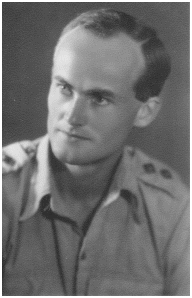
BCN remembers Mike Bent who passed away on Tuesday, December 28th 2004.
Charles Michael Bent was born on Thursday, 27th of November 1919 and in that year Charles was the fifth most popular boy’s name.
He was born in Portsmouth, Hampshire.
In 1939 he was living at 5, Ashburton Road, Gosport with his mother Eileen B. Bent (née Hill) and was a Sub Lieutenant in the Royal Navy.
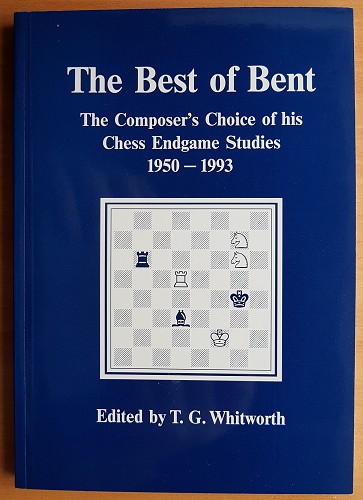
He wrote “Best of Bent: Composer’s Choice of His Chess Endgame Studies, 1950-93” This was edited by TG Whitworth.
The Best of Bent, CM Bent, edited TG Whitworth, July 1993
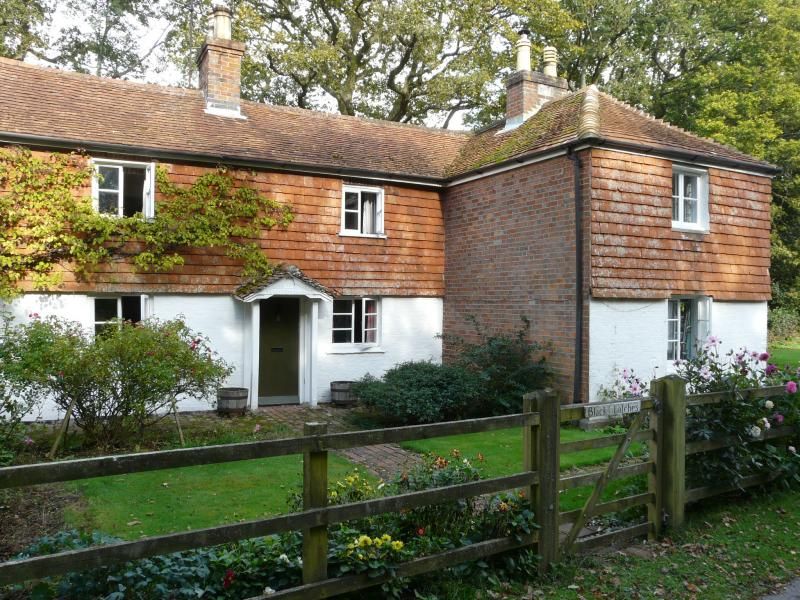
He died in Swindon on the 28th of December, 2004 having last resided in Hungerford, RG17. Whilst writing the Studies column for British Chess Magazine he resided at “Black Latches”, Inkpen, Newbury, Berkshire.
“Black Latches”, Inkpen, Newbury, Berkshire
The C. M. Bent Memorial Composing Tourney was held in 2006-07.
From British Chess Magazine, Volume XCV (95, 1975), Number 1 (January), page 22 we have a charming introduction to CMB from the retiring editor of the Studies column, AJ Roycroft :
“A studies article without a diagram? Yes, and without an apology either. Instead this introduced my successor, Charles Michael Bent, who is as remarkable without the chessboard as he is with it. Now since, as at May 1974, he has composed the total, rarely exceeded by anyone, of 670 studies (of which only 375 have been published), and about 600 problems (one tenth published), his other achievements and activities, insofar as he can be persuaded to talk about them, are worth recounting.
Michael Bent has a passion for all-the-year-round tennis, and loves the country life. Walking and climbing, all-forms of do-it-yourself, word-play nabla/del, puzzles, conjuring and listening to music make the mixture extraordinarily rich. Yet if there was a single word to characterise him it would be simplicity (his choice), with (my addition) a strong and individual sense of humour.
Physically he is a lean, balding 54-year-old as fit as most men half his age. He played at Junior Wimbledon before the War and only three of four years back won the singles tennis championship of his half of Berkshire. He is a modest and delightful companion, and to visit him and his wife Viola, to whom he credits responsibility for the serenity of his condition and surroundings, is a relaxing pleasure I always look forward to in my own hustled and tense London-centered existence.
In his own words he was never really a player of chess at all, but first sight of problems (during the war) and endings (just after it) acted like fireworks on a dark night and lit an imagination which still lacks basic technical knowledge. So, artistic rather than ‘scientific’, have never knowingly composed a didactic study. Am told my ‘style’ is easily recognised. Am aware, but perfectly content, that I compose much that the expert will easily solve, in the hope that the less initiated may be entertained and as attracted as I was in the beginning.
There is a feast, including many surprises, in store for you and me, at the hands of your new chess-chef, ‘CMB of the BCM’.”
From British Chess Magazine, Volume 125 (2005), Number 2 (February), page 98 we have a brief obituary from John Beasley :
“Charles Michael Bent died just over a month after his 85th birthday. Mike Bent had long been Britain’s leading composer of endgame studies, he was a witty and entertaining writer on the subject (and on many others), and the pleasure he gave was rightly acknowledged by the granting in 2001 of one of the BCF President’s Awards for services to chess.
BCM published his first study in 1950 and one of his last 50 years later, and he was our endgame study columnist from January 1975 to March 1985. There will be a steady flow of quotations in Endgame Studies during the coming months. John Beasley”
The Studies column was taken over in April 1985 by Paul Lamford.
From The Encyclopaedia of Chess (Robert Hale 1970 & 1976), Anne Sunnucks :
“Born on the 27th November 1919, Michael Bent has only one possible challenger, Harold Lommer, as the finest composer of endgame studies England has ever produced. Although up to October 1967, he had composed 546 problems and 320 studies, he now concentrates almost exclusively on studies. His 17 honoured studies include three 1st prizes. His partiality towards Knights is shown in the typical study selected here.
Michael Bent was educated at the Royal Naval College, Dartmouth, but had to leave the Navy because of chronic sea-sickness. He served in the Rifle Brigade in the Second World War and afterwards became a rubber plant in Johore, where he survived several terrorist attacks. How now lives with his wife in a Berkshire Village.
Apart from Chess, Michael Bent has other recreations, including wood carving, stamp collecting, composing crossword puzzles and butterfly collecting. His butterfly collection included 500 Malayan specimens. He is also a strong tennis player. Thirty-one years after playing at Wimbledon as a junior, he won the Newbury and District singles title in 1967.”
CM Bent 2nd Honorable Mention New Statesmen 1964 Tourney Award, 5th March 1965
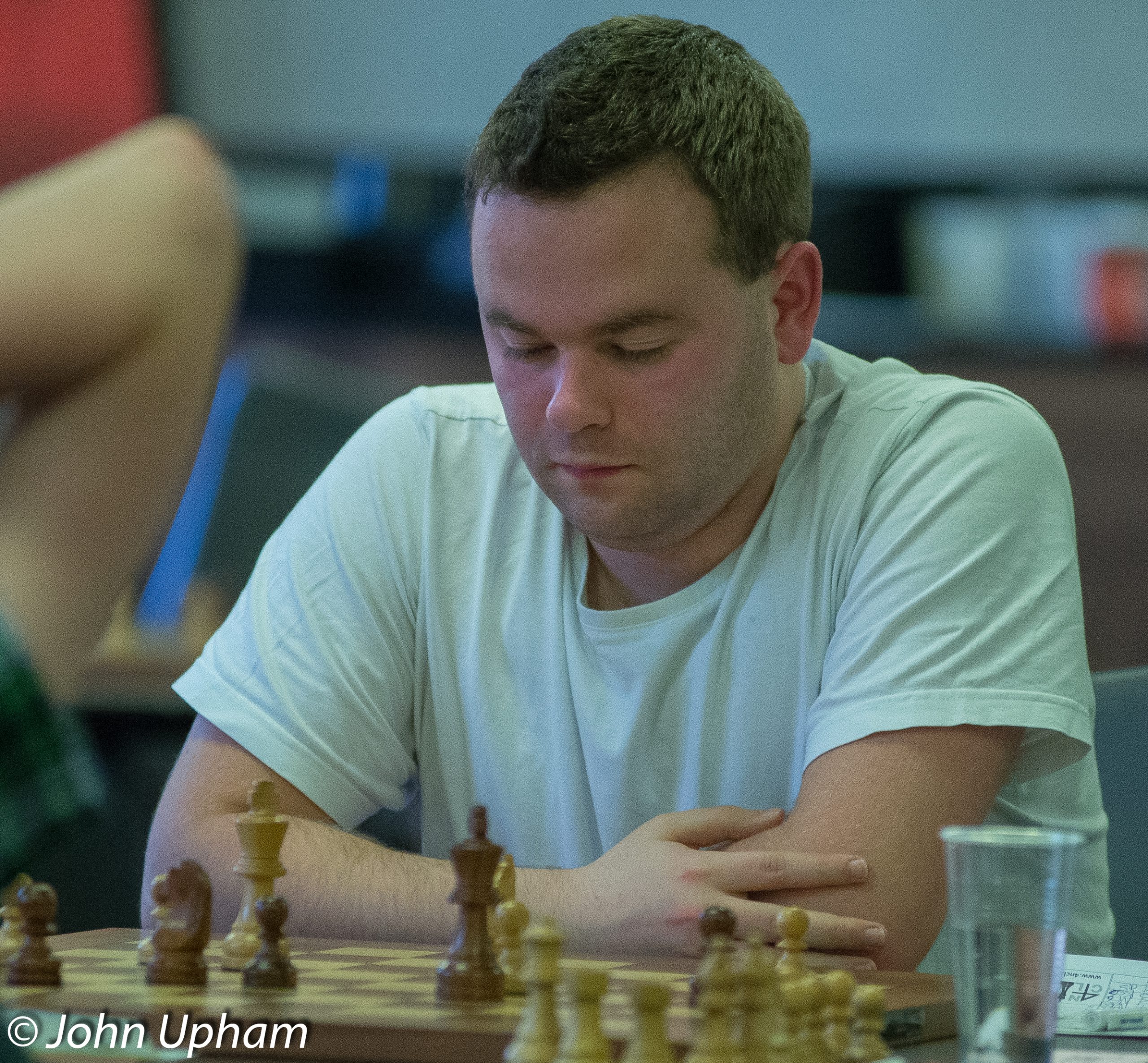
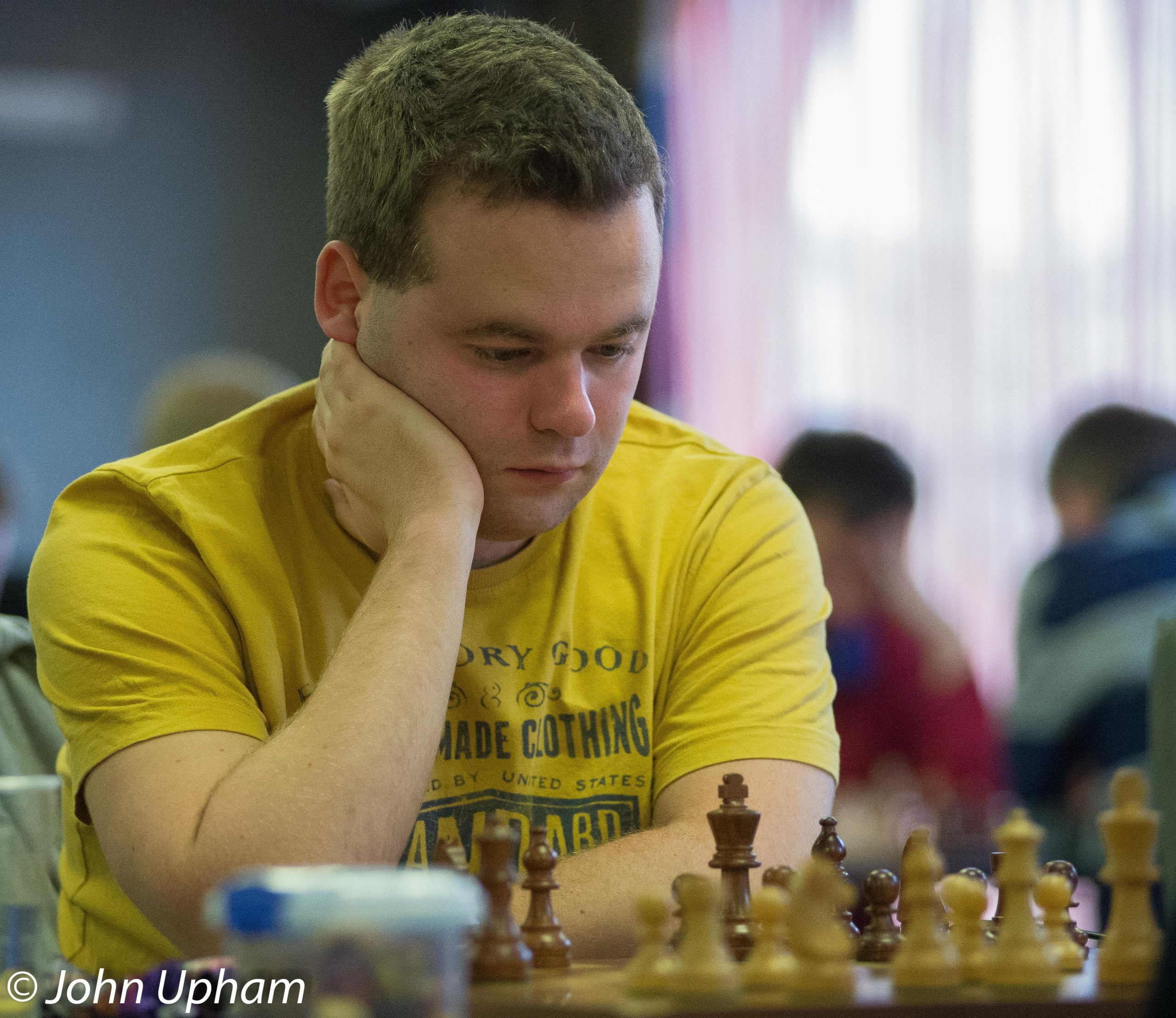
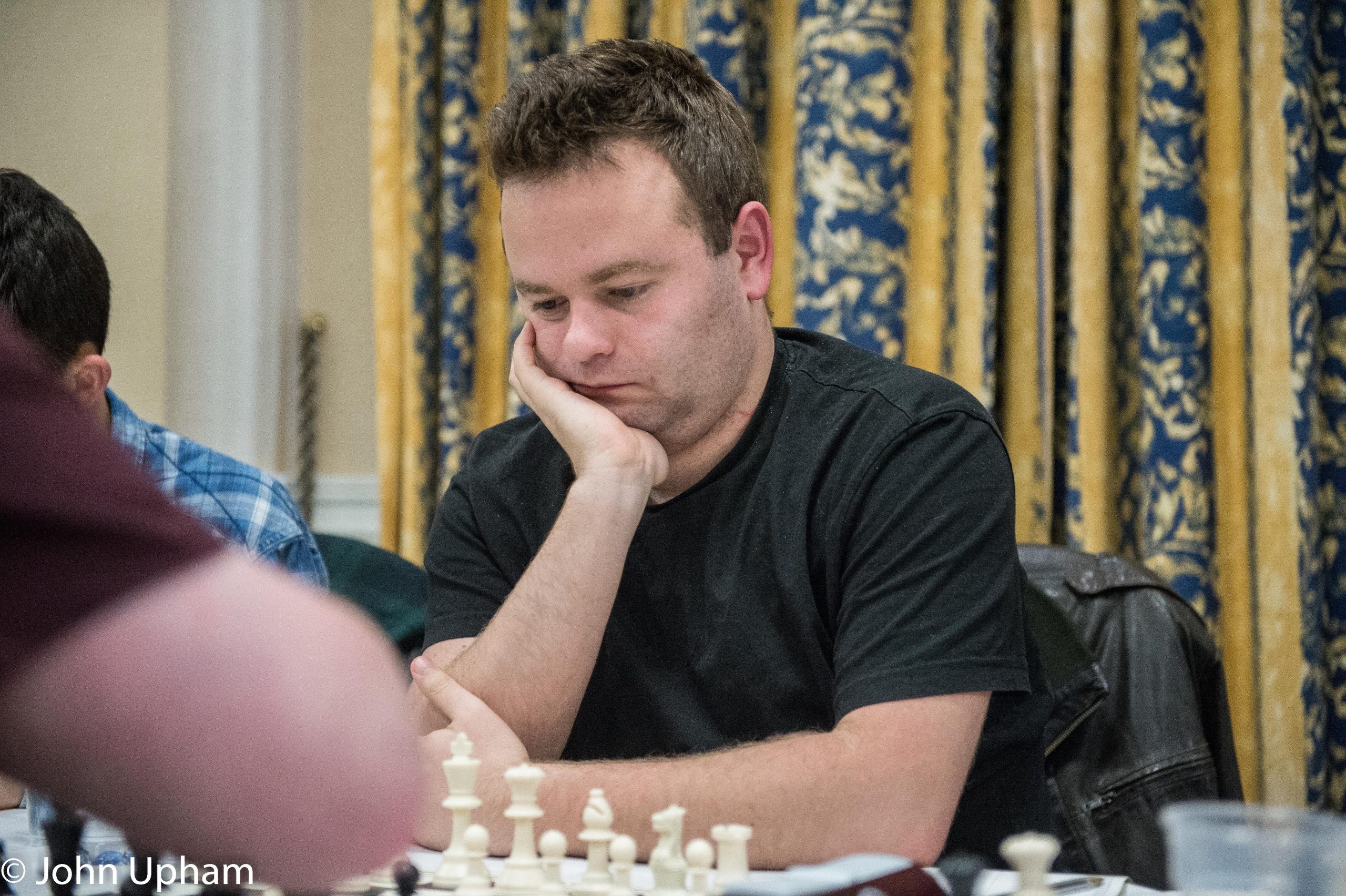
Best Wishes to IM David Eggleston on his birthday.
David James Eggleston was born on Tuesday, December 22nd 1987 in Sunderland, County Durham to Ian and Janet Eggleston (née Robson). David has a brother, Thomas A, also born in 1987 who plays chess to a high standard (2178 in 2020). Thomas also plays for Durham City and for 4NCL North East England.
There is one game in Megabase between the brothers from round 5 of the Durham Open in 2003 which resulted in a 13 move draw. They shared the 1st prize with 4/5.
David currently resides in Durham and plays for Durham City in the North East League and for Cheddleton in the Four Nations Chess League (4NCL).
David became a FIDE Master in 2007 and an International Master in 2013.
According to ChessBase David’s peak FIDE rating was 2434 aged 26 in December 2013. However, this could easily be surpassed.
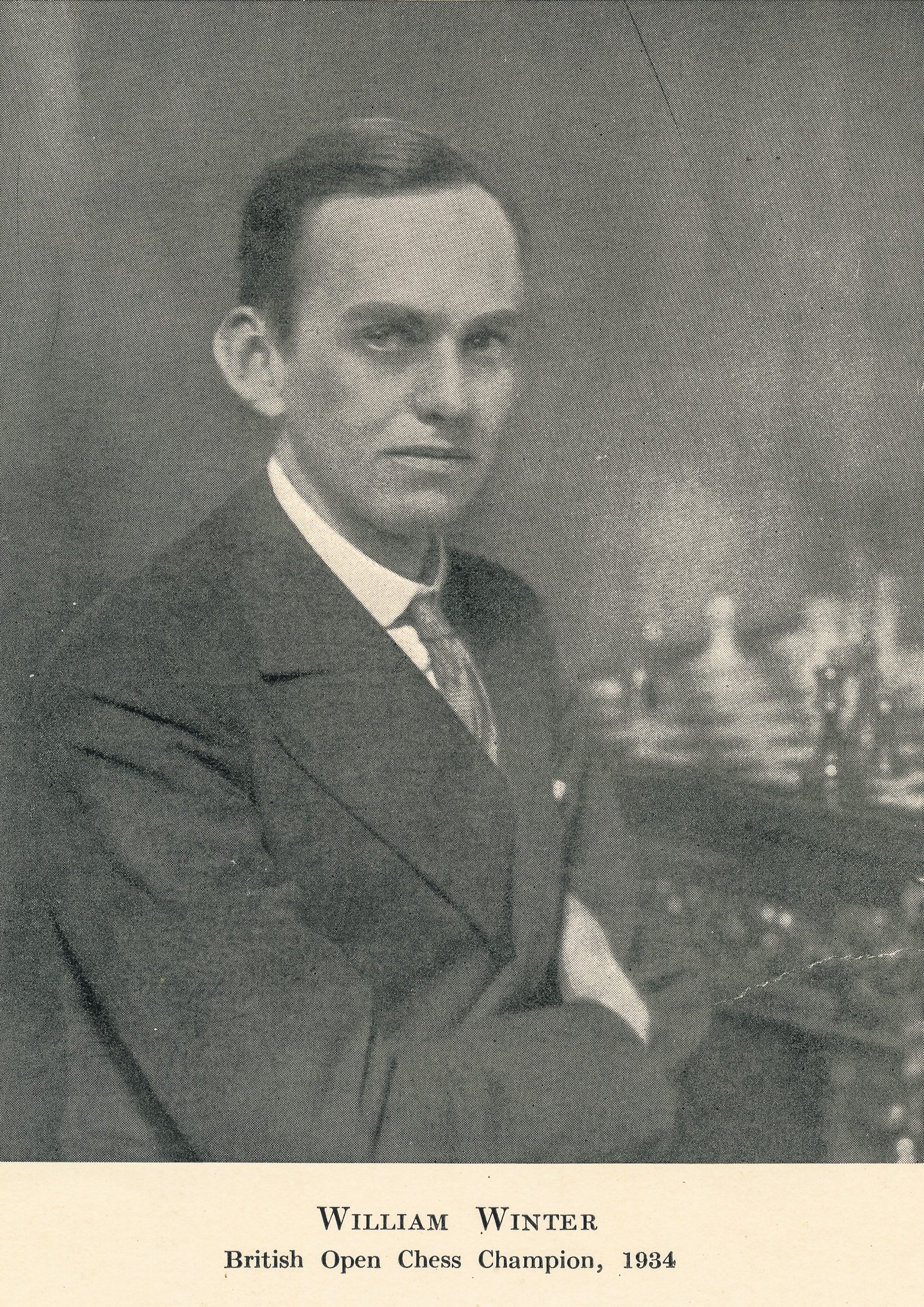
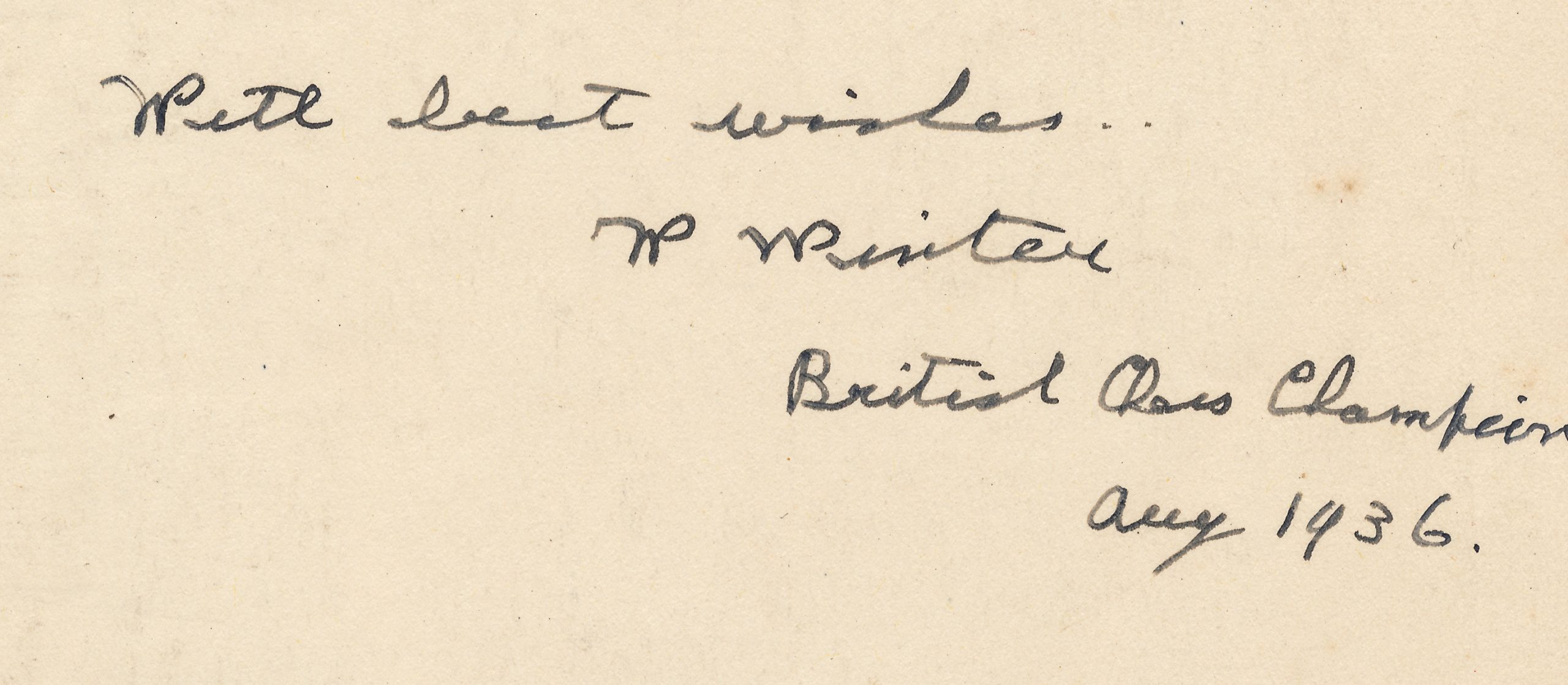
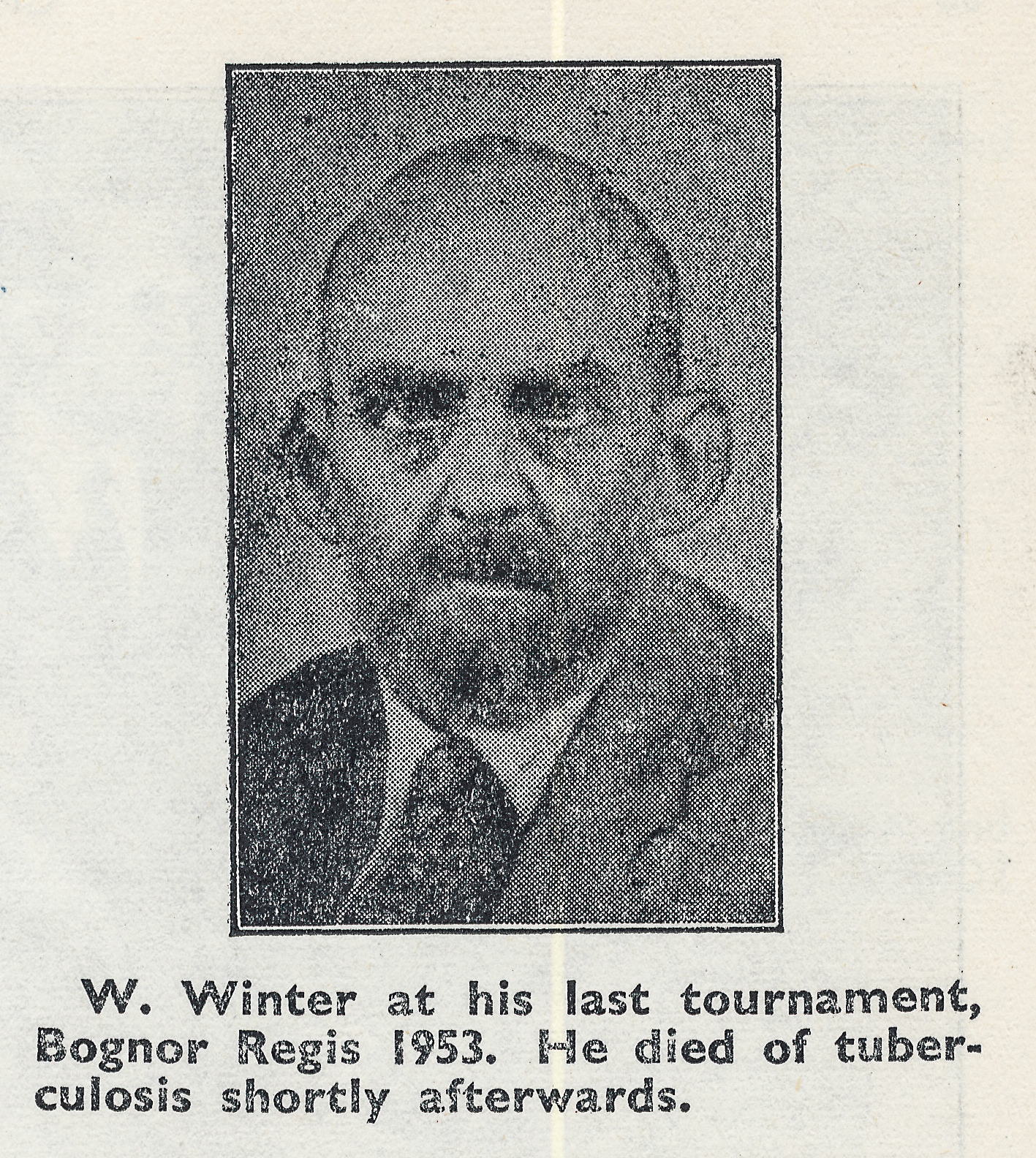
William Winter, British Open Chess Champion, 1934. The verso frontispiece of Chess for Match Players, William Winter, London, Lawrence & Wishart, 1st edition. 1936Author’s inscription from Chess for Match Players, William Winter, London, Lawrence & Wishart, 1st edition. 1936
In the “Mid-October” issue of CHESS for 1962, (Volume 27, Number 418) we had the following announcement:
WILLIAM WINTER’S AUTOBIOGRAPHY
Edited by David Hooper, will be serialised in CHESS commencing with our next number. Nephew of Sir James Barrie, twice British Chess Champion, a lifelong Communist and freethinker, imprisoned for his political views, “Willie Winter”, with his Bohemian way of life, was undoubtedly the most colourful figure in British Chess for many decades irrespective of whether you agree with his views (most readers may not!), you will find him a delightful writer whose gifted pen draws you engrossed from page to page.
In the November issue of CHESS for 1962, (Volume 28, Number 419, pp.1-2) we had Part I:
A first Instalment
Most people when I tell them that I am a professional chess player look on me as if I were some kind of fabulous monster. I don’t know why this should be so. Golf professionals, billiards professionals, and lawn tennis professionals are taken for granted, and surely chess players have far more need of professional assistance than the devotees of any of these pursuits. The work of the professional at every form of game or sport largely consists of teaching, and the complexities of chess are such that no player can hope to achieve even a modicum of success without the skilled guidance which only a. professional can give. I am glad to see that this is becoming widely recognised and far more aspirants are availing themselves of the services of the ‘pro’ than was the case when I first took on the job. There is of course much more to our work than teaching. I shall have plenty to say about the varied scope of our activities later on. Now I want to tell something about myself.
A Hampshire-reared Scot
I was born at the back-end of last century at Medstead, a small village in the heart of Hampshire. Both my parents were Scots, my father being quite a distinguished scholar. Entering the University of St. Andrews at the early age of 16 he took honours in classics, and then finding himself rather at a loose end he took to the study of mathematics, won a scholarship to Clare College Cambridge and became a Wrangler. Probably he could have gained a Fellowship, but he had a passion for country life and took advantage of a small legacy to buy the house at Medstead and eke out his income by taking private pupils. I may say that he made a great success of this. He was a superb teacher, especially of rather backward boys, and was responsible for squeezing more moronic creatures past the entrance exams at both Oxford and Cambridge than one could have believed possible.
I must also mention that he was a very good amateur chess player. At one time he took lessons from the English professional master H. E. Bird, and possessed a number of his books. However, when he settled at Medstead lack of opponents compelled him to give up the practice of the game.
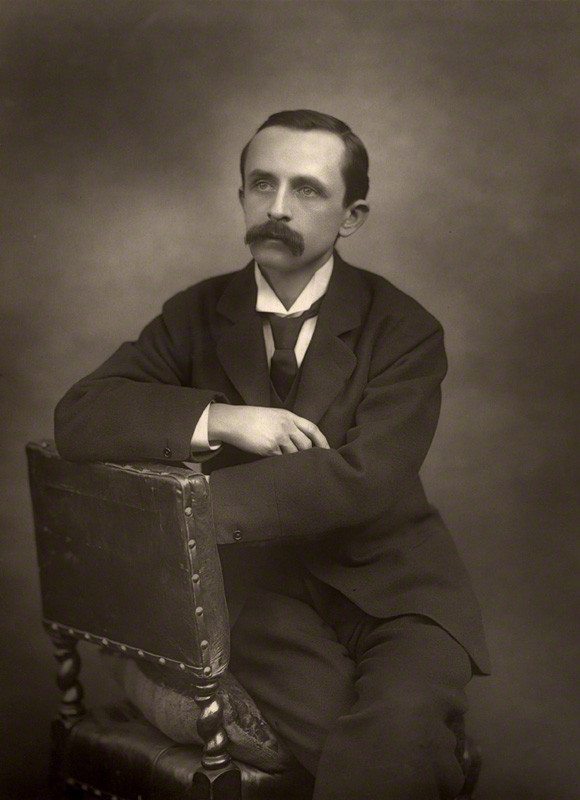
Sir James Barrie
My mother also had claims to distinction, though perhaps rather vicariously. She was the youngest and the favourite sister of the great J. M. Barrie who seemed to tower over my boyhood like some colossal ogre. A benevolent ogre it is true, who produced handsome presents and provided the wherewithal for holidays which would otherwise have been quite beyond our reach, but I never felt quite sure when he might not start: “fee, fi, fo, fum!”
JM Barrie by Herbert Rose Barraud, sepia carbon print on card mount, 1892, National Portrait Gallery
My mother’s desperate anxiety to please him in every thing was responsible for this attitude of mind: “What will Jamie think? What will Jamie say?” Actually he was quite harmless and, I imagine, did not think very much about us. We were far removed from the aristocratic circle which was already taking him to its bosom in Town.
Gifted parents
My mother was by no means without talents of her own. ‘She was a pianist of considerable skill and had a singing voice of such quality that my uncle toyed with the idea of having her trained for the concert stage. Her poor health (she was always delicate) held up the idea and it was finally abandoned on her marriage and retirement into the country. She had her baby grand piano and practised Scottish folk songs in the drawing room, but Medstead was not I fear, capable of providing an appreciative audience. Unfortunately she was the complete opposite of my father in that she took not the slightest interest in the country avocations which were his joy.
Our fowls he regarded as nasty creatures who scratched up her flower beds, and an encounter with a gobbling turkeycock was sufficient to send her into hysterics. Looking back, I think she was happy enough when I was young and she could give her time to looking after me. When I became older and no longer had need of her care then she became unutterably bored and frustrated, and at odds with life in general. Unfortunately she took refuge in a sort of religious mysticism which undoubtedly affected her otherwise excellent brain.
There were four persons in her Trinity: God the Father, God the Son, God the Holy Ghost, and God Sir James Barrie – who often became so inextricably mixed that it was difficult to know of which she was speaking. All this was of course a great grief to my father who was a Christian in the sense that it never occurred to him to be anything else but thought that religion was a thing to be trotted out only on Sundays.
He was however always kind, and it was only at the end of his life that he told me how much he had to put up with. A little I saw for myself, and at times it made me vaguely unhappy, but I soon forgot it in the abundant pleasures that were mine. “The Boynes,” as our house was called. was an ideal place in which to bring up a boy. It was a low white stone building standing in its own grounds and surrounded by a red brick wall.
The garden, apart from a drive to the front door and a croquet lawn had been allowed to run wild and it was ideal for such sports as Indians and Cowboys, Bushrangers or hide-and-seek. It possessed a marvellous collection of beeches, both the ordinary green and the cooper varieties, and in the spring and late autumn it was a sight to be hold. There was also a kitchen garden where we grew all our own vegetables but this was tucked discreetly away at the back of the house.
Inebriate family ghost
The house was all on the one floor, the only stairs being those leading to the cellar. It was built round a long passage lit in the day-time by a skylight, with three rooms opening off each side. This passage ran from the entrance hall to the door opening on the servants quarters, the aforesaid cellar, and some store rooms.
Around this rather curious architecture there hung a tale. The house was built in the Regency days by a gentleman by the name of Ivy, who after his evenings- potations was quite incapable of negotiating any stair. He lived alone apart from a man servant who, not unnaturally soon began to find existence somewhat wearisome.
Accordingly he developed the habit of slipping out to the village inn after he had ensconced his master with his nightly quota of bottles. Unfortunately one night Mr. Ivy felt more thirsty even than usual, and after finishing his last bottle rang for the servant to bring more. Receiving no reply to repeated jangling’s he decided to deal with the matter personally but he had overestimated his capacity, and when the butler returned he found his master dead with a broken neck at the foot of the cellar stairs. Filled with he hanged himself on a large hook in the back passage, and his ghost is still supposed to haunt the house.
The haunting takes the form of a butler carrying e tray, who at ten o’clock in the evening emerges from the service door, walks halfway down the main passage and then vanishes. I never saw this apparition myself, not to my knowledge did my parents, but the older. villagers always made an excuse to leave the house before the fateful hour of l0p.m, and one housemaid gave notice because. she said ‘Something frit her’. She could not, or would not, be more explicit.
In the December issue of CHESS for 1962, (Volume 28, Number 420-1, pp.28-33) we had Part II:
On the whole I had a very happy boyhood. Lessons I found fairly easy and I was able to pass such exams as were necessary without undue swotting. I did not share my father’s aptitude for mathematics and won little or no distinction in this field, but in my favourite subjects, history and classics, I was, I believe I can say without boasting, pretty good.
Chess and Mathematics
By the way it is a great mistake to assume that chess and mathematics have anything in common. Intuition and imagination are the qualities that mark the great chess player, and the fact that Capablanca and some other leading masters were also good mathematicians is purely coincidental. Alekhine was a complete dud at the science.
Like all small boys I think I was a bit of a horror, and I can remember being guilty of one or two unpleasant pranks. One of these, to my subsequent regret was played on my father. I have mentioned that he was a Sunday Christian and this was sufficient to give him the post of Vicar’s Warden, probably because he was the only man in the village capable of reading the lessons without mispronouncing the names of the Hebrew Kings and Prophets. After he had finished a lesson it was his custom to mark carefully the place in the big Bible at which to start on the following Sunday. Noticing this, I and another boy went into the church when all was quiet and altered the position of the marker, so that, instead of the description of the Mosaic law set for the day, my father found himself reading the sprightly adventures of Lot and his daughters. It was well for me that he never discovered the culprit.
Loved cricket
Up to my introduction to chess my principal interest in life was cricket, my enthusiasm for which was fully shared by my father. He taught me the rudiments of batsmanship and bowled to me on the lawn, to the annoyance of my mother who objected to the green being cut up. Unfortunately I never made much of a show as a batsman, though later in life I developed quite a useful leg-break. Once or twice a year he took me to see the County team play at Portsmouth or Southampton. There were giants-in the Hampshire side in those days: C. B. Fry, Philip Mead the prettiest of all left-handed batsmen – but oh! so slow, those great-hearted bowlers Newman and Kennedy, and the gigantic Brown, the most versatile of all-rounders.
Occasionally too I was taken to London, either to Lords or the Oval, if there was a specially attractive match at either place. Those-were of course red letter days in my life, though two of them, I remember, ended disappointingly. An attempt to see M. A. Noble‘s all conquering Australian team play the M.C.C. failed because our arrival at Lords coincided with that of a thunderstorm, and the only sight we had of an Australian was Warwick Armstrong smoking his pipe on the visitor’s balcony.
This was my first visit to Lords, and I gazed with awe at the sacred turf, waterlogged though it was, of which I had read so much. On another occasion we went to the Oval to see the famous hitter G. L. Jessop, who was playing for Gloucestershire against Surrey. This time the weather was kindly but my hero was not, for he was caught at silly mid-on off the second ball he received. By way of consolation I remember we watched a century by Dipper, an admirable batsman, but, alas! no Jessop.
The love of cricket’ was shared by my famous uncle and indeed, in my adolescent days, it was the only subject on which I could talk to him. At one time he ran his own team, the ‘Allahakbarries‘, and wrote many amusing accounts of their performances, mostly, I fear, apocryphal. I once played for one of his teams and, though I failed with the bat, I redeemed my character by two tumbling catches at short leg, one of which sent back a Cambridge Blue.
E. V. Lucas
Another cricket enthusiast whom I met when on a visit to my uncle was E. V. Lucas, for whose ethereal style of writing I had developed a boyhood passion. I was all agog to meet him, and great was my disappointment when, instead of the Shelley-like figure I had expected, there appeared a large fat man whose only subject of conversation appeared to be the dinners he had recently eaten. Then somebody mentioned cricket, and the whole atmosphere changed. Lucas became absolutely lyrical in his account of a Woolley innings he had just seen, and he and I were soon in deep discussion on the relative merits of the batsmen Jack Hobbs and Victor Trumper. and similar fascinating themes.
Besides cricket my principal hobby was exploring the countryside on foot or on my bicycle. Hampshire was a beautiful county in those days, quite unspoilt, and containing varied and attractive scenery. The trees of Selborne Hangar have to be seen to be believed and, in its own placid way the valley of the Itchen just outside Winchester is one of the loveliest things in England. There were few parts of the county within a radius of twenty miles or so that remained unexplored by me.
Introduction into chess
All these delights, however, had to take a back seat, after my first introduction to chess. This occurred when I was twelve years old, and its manner was curious. I have mentioned that my father was quite a considerable player in his younger days, but had to give up the game when he came to Medstead because of lack of opposition. It so happened that we acquired a new clergyman who challenged my father to a game of chess, and to his surprise and disgust beat him with, I remember, a variation of the Allgaier gambit.
This was just not good enough. My father had played at Simpson’s with some of the best in the land and considered himself in a far different class from any country parson! So out came the dusty board and men, down came the long disused books, and a turning point in my life had arrived. For about an hour I watched him, fascinated, then tentatively asked “What is that?” it’s chess” he replied. “Will you teach me?” At first he was reluctant as he thought I was too young, but I was so persistent that at last he agreed to show me the moves. The whole idea of the game fascinated me and from that moment I was determined that, whatever else I did, I would become a first class chess player.
My father at first restricted my lessons to an hour a day, after supper. But we had an intelligent housemaid whom I taught to play, and of course I browsed in his books when he was not using them. Most of them were the work of his old chess tutor H. E. Bird, whose influence, especially in the Sicilian Defence, can still be detected in my play.
When I was able to face my father over the board in an actual game he at first gave me the odds of the queen, but this badge of inferiority was soon reduced to rook, then to knight, until finally we played level. He disapproved of the odds of pawn and move, and pawn and two, on the grounds that they made regular openings impossible, an opinion which I heartily endorse. It was a great day for me when I first beat him on level terms, and a still greater when the parson, invited to ‘The Boynes’ for tea, not only succumbed to my father – that had now become quite a regular occurrence- but also fell an easy victim to my carefully prepared Sicilian Defence.
Ethics of postal chess
Once my father had come back to chess his enthusiasm never waned. He played until the day of his death, and the chessboard was on the table by his bedside when I saw him for the last time. As soon as he found he was really recovering his zest for the game he started to play by correspondence, and l, of course, helped him in his analysis. I could never quite understand my father’s attitude to these games. In my early days such assistance as I could give was of negligible value, but he continued to analyse with me when I was an acknowledged master, and on one occasion got Salo Flohr, accepted
challenger for the world championship, to work out a winning combination for him.
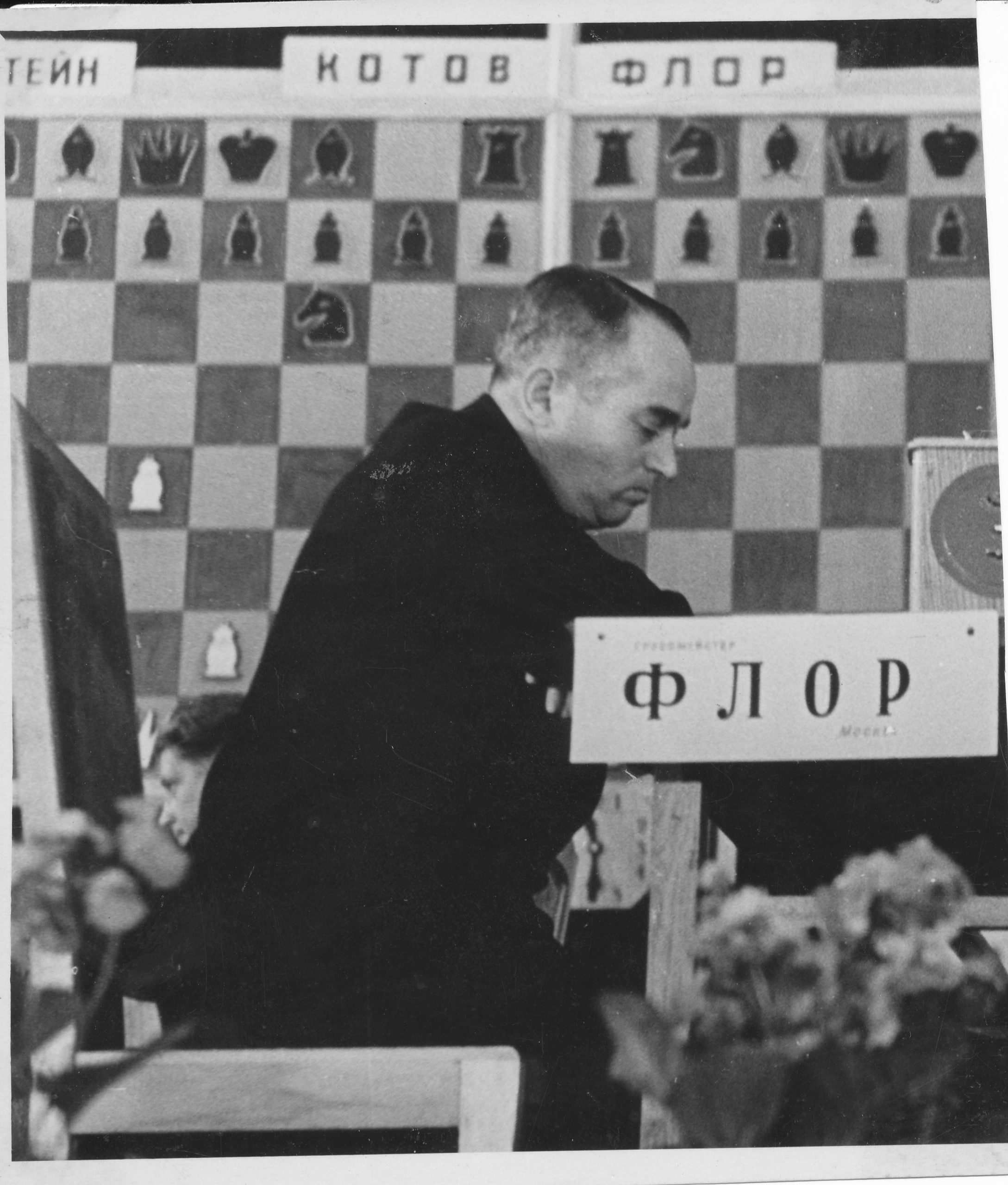
Salo Flohr
He had no hesitation in showing or even publishing games won with such assistance as his own. Yet in all other respects he was the most rigorously conscientious man I have met.
Cosmopolitan Chess
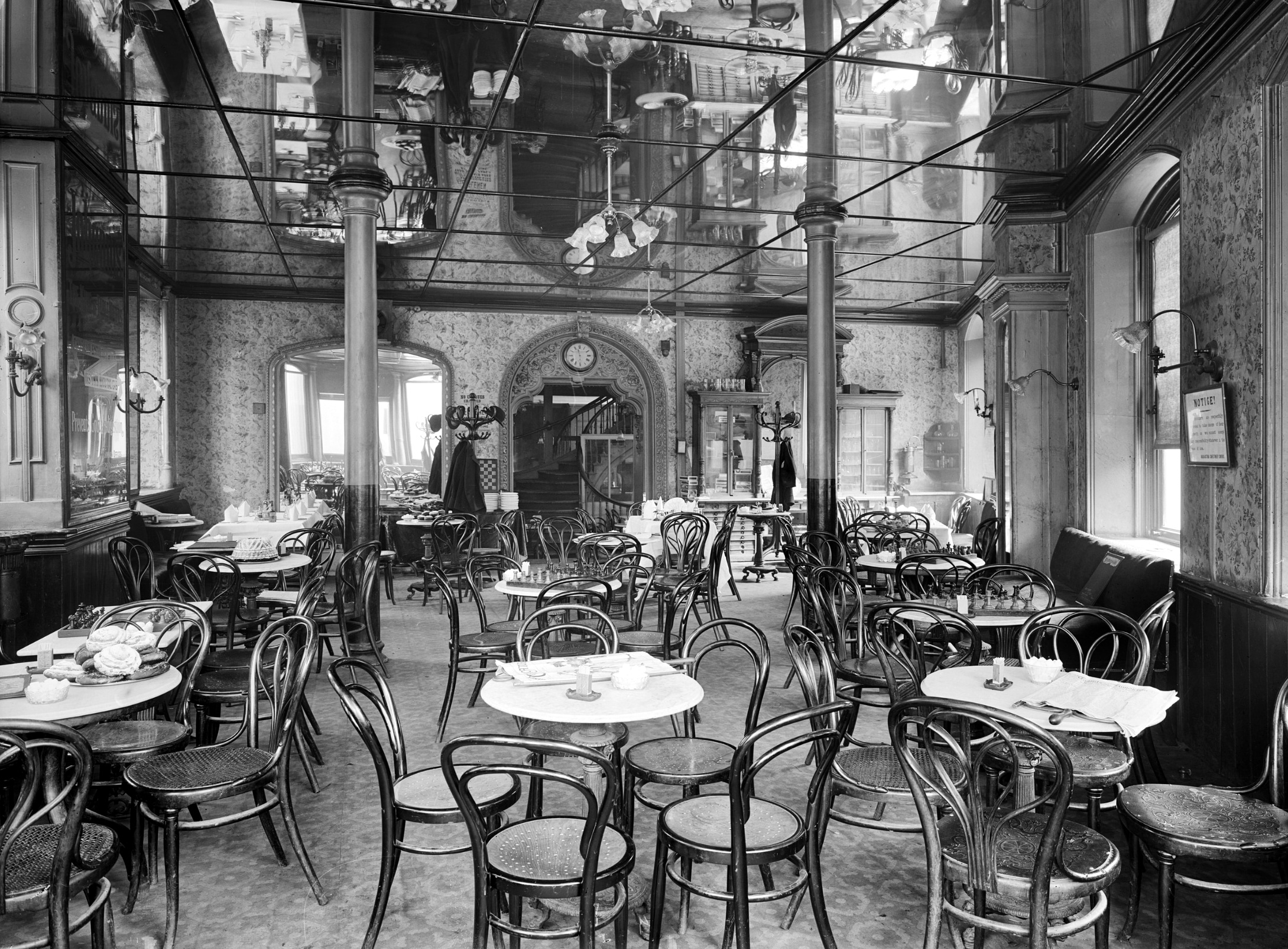
At fourteen I was taken several times to the Vienna Café in New Oxford Street, the most cosmopolitan chess resort I have ever seen. Representatives of every nation congregated there, and one could hear the word ‘check’ in a dozen different languages.
Vienna Café, 24–28 Oxford Street, London, Adolphe Augustus Boucher (1868–1937), Bedford Lemere and Company – https://historicengland.org.uk/images-books/photos/item/BL14069/003, Created: 29 April 1897
Germans and Austrians predominated as was only natural since, at the time of which I am speaking, these were the leading chess-playing countries of the world. Everyone was most kind to me, which may have been the reason why, later on, I was quite unable to accept the view that all the inhabitants of Germany and Austria ate babies for breakfast.
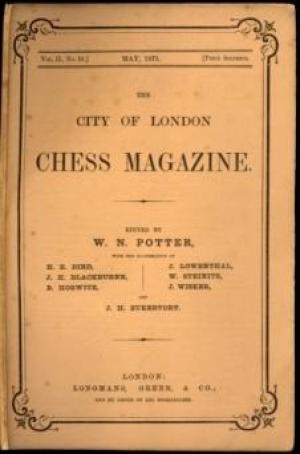
My real chess career began when I joined the City of London Chess Club at the age of fifteen. This was, and had been for many years, the leading club in the country, and everybody who had any kind of chess aspiration was a member. The club met in Grocers Hall Court, off Poultry, and was ruled with a rod of iron by its secretary J. Walter Russell. He was a real despot who would brook no kind of opposition, but there is no doubt that he did a tremendous amount of good work for the club. Later on his jingoistic attitude made him my bitter enemy, but in those early days he did everything to encourage me, and presented me with the bound volumes of the rare City of London Chess Magazine autographed by himself.
The City of London Chess Magazine
The players at the City were rigorously divided into five classes, each holding its own winter tournament. The winner of this, and the winner only, passed into the class above. After a test game against G. Wilkes, a strong class II player with whom I just managed to draw, I was placed in class III, Russell rightly thinking it would be discouraging for me to meet too strong opponents at my first attempt. I won every, game in this class in my first year, but failed in the second class or Mocatta Cup as it was called.
I enjoyed these trips to London. I stayed with my uncle but saw little of him as I was out in the morning before he was up and was usually in bed before he came in at night. He lived in Adelphi Terrace, in an enormous top floor flat supposed, and I believe rightly, to possess the best view in London. Certainly on a clear day it was possible to look right over the built-up area of South London to the Surrey Hills in the distance. I loved to sit, at my bedroom window and gaze out-over the Thames and the multitudinous lights beyond it, wondering what was to become my destiny when I too became a Londoner, as I had every intention of doing. One or two of my dreams, such as that I would become British Champion, materialised, but on the whole they bore little relation to the reality in store.
First class status attained
At the second attempt I won the Mocatta Cup quite easily, and became an acknowledged first class player, for the City of London set the standard for the rest of England. Then the war came, and with its advent I will close the last really happy chapter of this book.
To say that the war knocked the bottom of my life would of course be true, but that was an experience that I shared with the bulk of my fellow countrymen. I don’t suppose there was anyone in Great Britain whose life not changed by the war. In a few cases for the better – if one considers getting rich quick out of war profits a change for the better – but in the majority for the worse.
Where I differed from my associates was that I could not understand what was going on around me, Most of them took it in their stride, “It was a nuisance, but those damned Germans wanted taking down a peg or two, and it was up to us to do it. Anyway it wouldn’t last six months and then we would get back to normal. I just could not feel like that. It was not that I did not know what the war was about – on the contrary I felt that I knew it all too well’
I had studied history and elementary economic geography and knew that the mineral wealth of Alsace-Lorraine, filched from France in the Franco-Prussian war had made Germany the greatest industrial power in Europe. I also knew that the best markets were in the hands of others, principally of England and that German opportunities for capital expansion were thus circumscribed I knew that British industrialists were naturally anxious to keep these advantages in their own possession, and that their French colleagues were equally anxious to recover their lost provinces without which France was condemned to the status of a second-rate power. I knew, too, Russia’s craving for an outlet to the sea via the Dardanelles, now under the of Germany’s close friend Turkey. Here then was a situation in which big business in all the major European countries might hope to benefit from victory in a war but what possible concern could it be of ordinary folk like me and my father or those who worked in field, mine or factory?
War madness
I was soon to know. Foreign Minister Grey announced that England was entering the war to protect the neutrality of poor little Belgium, which the wicked Germans had violated.
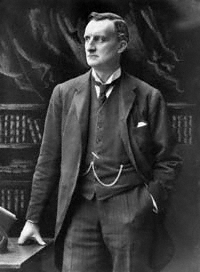
Sir Edward Grey
This struck me as absolute poppycock, unworthy of credence by a child of ten, but England lapped it up with a fervour that nothing short of madness. Young men left their peaceful country avocations to rush into Khaki to have a go at these Germans before they caved in.
Even my kind gentle father, who could not bear to kill a mouse, suddenly became imbued with a lust for slaughter of people he had never seen, and who could not possibly have done him any harm. As for me I was prepared to think as badly as they liked of the German Kaiser and his entourage, but I could not regard our own hypocritical rulers in much better light. Still less could I be of England’s association with that barbarous tyrant, the Czar of all the Russias, whose brutalities had been the subject of much comment in the English press until he became our noble ally.
As for the Germans themselves, the ordinary people I mean, I could not think they differed in any marked degree from the French, the Russians, or ourselves. I completely discounted the tales of atrocities, with which my father used to regale us at breakfast, out of the columns of the Daily Mail.
To Cambridge
As may be imagined my life at ‘The Boynes’ it that time was by no means a happy one. If I gave the slightest expression to my views everyone obviously thought that I was mad, and indeed there were times when I came to doubt my own sanity. I felt nothing but relief therefore when the time came for me to take up residence at Clare College, Cambridge, whence my father had graduated some twenty years before. Cambridge was a strange place in those war years.
The bulk of the undergraduates were already in the forces, but there was still a number in uniform training for commissions in the O.T.C. Pressure was put upon me to join these, but I firmly refused. For the most part they looked nasty pieces of work. There was of course the usual sprinkling of Indians and other Orientals, with some of whom I became very friendly. Today I can remember only two: an Egyptian named Talaat, an extreme nationalist who told me that I was the only Englishman in Cambridge whose throat he did not want to cut; and a charming Burmese, whose only fault was that his name was Moo Kow, which caused me some embarrassment when I had to introduce him in company.
Besides the budding officers and the Orientals there was another small group, serious-looking young men who included in their number most of the best scholars of the university. These were the anti-militarists, the ‘conchies’ waiting for the time when they would be dragged before a tribunal of local tradesmen who could grant them total exemption (very rare), offer them non-combatant service, or reject the appeal absolutely, which meant in effect, “Join the Army or go to gaol.”
Many who were given the choice of non-combatant service – preferred this last alternative. Towards -this group I naturally gravitated, and had the satisfaction of discovering that if I were mad, some very clever people including several Dons were mad also.
Another thing I found was that nearly all those anti-militarists were also Socialists, so I too became a Socialist. I am afraid that in those days I had a very hazy idea of what the term implied, but I knew that it stood for the workers and, surely, if anyone could stop this senseless slaughter it was the working classes. They, at any rate, had everything to lose and nothing to gain from continued bloodshed.
I knew that the International Conference of World Socialist Parties, meeting shortly before the outbreak of war had pledged themselves solemnly, that in the event of hostilities breaking out they would proclaim a general strike in all belligerent countries.
Faith declining
When the event actually happened, however, the party leaders, with a few exceptions, forgot all about the strike and scurried to join their national governments, where they denounced the enemy just as vociferously as their Conservative colleagues. In spite of this I still pinned my faith to the Socialist movement. Even in those days I realised that Socialism is greater than its leaders. Although on the whole I got on well with my new friends I soon found there was a number of differences between us. Most of them were absolute pacifists, that is to say they objected to violence or killing in any circumstance whatever, whereas my point of view was that I wanted to choose whom I would kill, and understand why I was to do it. Nor could I claim any religious objections to war.
Since August l9l4 my faith, such as it was, had been steadily declining, and Cambridge had finally destroyed it. We were compelled to go to chapel twice a week, as well as once on Sunday, and the continual prayers for victory for the British Army, which could only mean mass slaughter of Germans, struck me as disgusting hypocrisy in those who professed to follow the Prince of Peace, especially as their colleagues across the sea were imploring just the same thing – with colours reversed as it were. I had little use for a god who allowed himself to be harnessed like a mule to the national cannon.
No desire to be killed
I had a year of Cambridge before I became of military age, and during that time I had to face up to the first real dilemma of my life. Should I register myself as a conscientious objector on purely political grounds, or should I allow myself to be conscripted into the military machine as, of course, was the wish of my parents? At the time it was a terrible choice. All my own instincts were in favour of the first course, even though it might mean remaining in gaol as long as the war lasted. When I tentatively broached the subject to my mother it was received with a storm of emotion which quite broke my resolution. With tears streaming down her face she clasped my knees and- swore that she would rather see me dead than branded as a coward, and I really believed she would, too. I hastily told her that if she felt so strongly I would give in to her wishes, and all was peace again.
At the same time I made a private resolution that once I got into the Army I would apply every ounce-of ability I possessed, use every feint or subterfuge however unscrupulous, to avoid being put in a position where I had to kill or be killed. I had the strongest objection to taking the life of any potential Lasker or Tarrasch, and an equally strong one to their taking mine.
My friends at Cambridge for the most part considered my attitude to be a betrayal of principle, and so perhaps it was, but I had always dearly loved my parents, and I found the alternative course required more strength of character, or callousness, than I possessed. Once I had made up my mind things were not so bad. Cambridge, even in wartime, was a delightful place and I forgot most of my troubles in that best of anodynes, Chess.
The University club had naturally sunk to very small numbers, but those that-were left were very strong. We managed to organise a championship, which I won by half a point from Jonas Birnberg, a player who made quite a name for himself in London chess circles after the war. I also played in the championship of the town club, and defeated W. H. Gunston, a Don of St. John’s who was reckoned as one of the best players in England. He was much the strongest player I had yet met on even terms, and I was naturally very cock-a-hoop with myself, especially when I heard that he had not lost a game in the town championship for over twenty yeans. I could only tie for the title however, as I made draws with two of the lesser lights whilst Gunston won all his other games. Before the tie could be played off my time of liberty came to an end.
Army life
I am not going to say much about my army life. It was just plain Hell. My regiment was the Honourable Artillery Company, which I joined partly because its headquarters were in London and I hoped to be able to do at any rate some of my training there and partly because my people considered that my fellow soldiers would be of a rather superior type to those I was likely to meet in an ordinary infantry regiment’ I do not know whether this last supposition was true.
The only man whose name I can remember was subsequently tried for murder, but on the whole they were a decent enough lot of fellows. l cannot say the same of the officer and N.C.Os. Coarse and brutal, they seemed to take a sadistic delight in making my life as miserable as possible. I hated them with a hatred which I could not possibly feel for any German, and in all my experience with the H.A.C. I encountered only two men who not have been delighted to massacre. It is possible that the views that the view I held made me a difficult soldier, also that my sheltered life have rendered me unduly
sensitive to vulgar abuse, but looking back, and comparing these brutes with the very different types I served under in World War II, I cannot feel that my original judgment was far wrong. Enough of an unpleasant subject. Indeed I would leave the war years altogether if it were not that they played a certain part in my development as
a chess Player.
As I had hoped I did the first part of my servitude in London and, since I lived out of the Barracks at the Hampden Residential Club. I was able to get a good deal of chess in the evenings and on Saturday afternoons. I played chiefly at the Gambit Chess Rooms in Budge Row, kept by the Lady Champion, Miss E. Price.
Personalities of the 1910s
Here I had a number of games on a professional basis with O.C. Muller, one of the last survivors of the Old Simpson Pro’s. Muller was a delightful chap with a a fund of anecdotes about chess players and others, which ought to have been true , even if they were not. He could keep an audience enthralled with these tales , which were absolutely without malice. In addition, he was a first rate chess teacher, and I earnt a great deal from him. He taught me how to build up a solid basis for the position, and the necessity for establishing such a basis before attempting any tactical adventures. Masterly restraint is another name of this, and it is the hall-mark of every first class player. It was Muller who gave me my first real insight into the complexities of the endgame.
I also had the opportunity of playing a number of semi-serious games with RHV Scott and D. Miller, two of the leading London amateurs. Scott was probably the most brilliant combinative played England has ever seen and had already won almost every honour except the British Championship, which fell to him in 1920.
Since those days I have played over hundreds of games, including the beautiful brilliancies of the modern Russian school, and Scott’s best combinations stand up quite well beside them. There were however weaknesses in his play which I shall discuss later. Miller was just the opposite type, a dour solid player exceptionally hard to beat. He is, I am glad to say, still with us, but Scott died a few years ago – he had been out of chess for a long time.
In these war days I did not go much to the City of London Club. Russell had already developed the jingoism which eventually drove him completely out of his mind, and I was soon at loggerheads with him. The first serious breach occurred on the question of the naturalised Germans. There was a number of these in the club. many of them British citizens since boyhood, and as loyal as Russell himself. Nevertheless to the latter everything German was tainted, and a special general meeting of the club was called to purge the club of the abomination. Together with Scott and most of the younger and stronger players I vigorously opposed the expulsion, but Russell had sent out a three-line whip to fellow dotards and, by a large majority , the naturalised Germans had to go. Among them was the club’s president, a man in his eighties. His expulsion broke his heart. He lived just long enough to alter his will in which he had left the club a large sum of money.
My first posting after London was Leeds, where at the Leeds club itself I found no strong players, but I was not long in discovering that in the neighbouring city of Bradford the British Champion F.D. Yates, and the Mexican master A.G. Conde, were in the habit of spending Saturday afternoons in a café known, in imitation of the London resort, as ‘The Gambit’. I was not long in making my way there, and found both masters helpful and encouraging. I played a number of games which each of them, and did not do at all badly. A comical feature of these exhibitions to Bradford was that some bright lad in the army had declared the city out-of-bounds to troops from Leeds, so that before I could leave at night Yates had to go out into the streets to watch for military policemen, surely the strangest job ever put on to a British chess champion.
There was another chess incident too, which was not without its comical side, although at the time it caused me a lot of annoyance. We had an old Sergeant-Major, a superior type to most of that kidney, who fancied himself as a player and insisted on having one evening each week with me. He was not a bad player, about knight class I should think, but of course he stood no chance with me level, and I simply dare not offer him odds. One week it happened that by an accidental blunder I lost a game, and to my surprise I was later asked If I would like a week-end pas, while on the other occasions when I won all the games I invariably found myself on the Sunday guard, or ‘stables’, a euphemistic term which meant sweeping up horse muck. I therefore set myself to try to lose one game at each session, and a hard job it was. If I had simply made blunders and allowed him to mate me, or win my queen, he would have smelt a rat, so I had to lay traps for myself hoping against hope that he would see this opportunity. I think some of losing games were among the cleverest things I have ever done on the chessboard, and I wish I had preserved them.
The War Ends at Last
It was while I was at Leeds that a world-shaking event occurred. The Bolsheviks seized power in Russia. At the time I was aware that something had happened for far-reaching importance but, of course, I could only have the vaguest idea of its real significance. One thing I did know, the Bolsheviks led the Russian people out of the war and that alone was sufficient to make me inscribe the name of Lenin on my list of heroes. Why, of why, could somebody not do the same for us?
However, it was not to be so long. In 1917 it looked like another Thirty Year war. By November 1918 it was all over. At the time of the armistice I was at Catterick camp, a place which was surely one of the creator’s mistake, and I had been nearly driven to suicide by the persecutions of a lunatic Commanding Officer, who fortunately blew his brains out before I blew mine. As a student I had a right to priority discharge, and early in 1919 was back at ‘The Boynes’, a free man once more, full of hope for the future.
In the New Year issue of CHESS for 1963, (Volume 28, Number 422, pp.60-62) we had Part III:
After the 1914-1918 War
I was back at Cambridge in a few weeks’ time, occupying the same rooms as my father which I had been unable to secure when I first went up. The University was a very different place from that which I had left two years earlier. It was now packed to capacity, and many would-be students were turned away from sheer lack of living accommodation. It was of course by no means the normal Cambridge. Most of those in residence had been through experiences of which the undergraduate of ordinary times would never have dreamt, and they were naturally a very different type from the lads fresh from school who make up the usual complement. These were hard-bitten callous men, for the most part without ideals or aspirations, only anxious to get their degrees and start on the serious business of money-making. In the boom period which followed the war everyone thought they were going to make their fortunes. By no means all, however, were like this and, although almost all my old friends had disappeared, I had no difficulty in finding new ones interested in one, at least, of my three activities, work, chess and politics.
How Law resembles Chess
These I kept as far as I could in watertight compartments, so as to avoid such social solecisms as inviting a Tory chess player to tea with a Socialist activist. Inevitably there was some overlapping, but I avoided any serious contretemps. I do not think I have mentioned before that I was reading Law, which, paradoxical as it may appear in a revolutionary like myself, I have always loved. I am of course speaking of Law, in the abstract, not of the laws-a very different proposition. I think the explanation lies in the fact that there is a great deal of similarity between the ploys and stratagems of legal practice, and manoeuvring on the chessboard. ln both the primary object is to outwit one’s opponent within certain carefully defined rules, and in both mental agility is the necessary ingredient of success. I believe too that Law, like a correctly developed game, is built on an inherently sound basis, the Common Law of England,
which, I think, will still provide the foundation for the vastly different legal system of the future world.
Naturally the masses of statutes and orders at present branching out from this Common Law are for the most part designed for the protection of private property and the smooth working of the complex capitalist system, but even these can sometimes be used by a smart left-wing lawyer for purposes very different from their drafters’ intentions.
This was what I hoped to do when I came to practise. Also there exists a mass of Trade Union laws, Factory Acts, Rights of Injured Workmen, &c., which is of direct interest to the working class, and provides the opportunity for a great deal of subtlety. Altogether there was plenty of scope for Socialist lawyers in the years immediately following the war.
Re-starting Cambridge University chess
As far as chess was concerned I found that the University club had completely fallen into stagnation, and I had to start to build it up I from scratch, with the assistance of that stalwart of Cambridge chess, B. Goulding-Brown of Trinity, and one or two other Dons. An advertisement in the Cambridge Magazine had an amazing response, and over sixty turned up at the ‘Blue Pig‘- otherwise the Blue Boar Hotel – where the clubroom was situated. I was elected president and, I fear, became dictator as well, but I think I made a pretty good job of it. I divided the members into three classes, arranging tournaments for each of them, and organized matches with both local and London clubs.
I also got up simultaneous exhibitions. Most of the matches were lost, as our players were totally without experience, but we did well enough to show that there was plenty of latent talent and, for the first time, I tried my hand at giving chess lessons.
One of the simultaneous exhibitions was by J. H. Blackburne, probably the last this grand player ever gave. I had heard that he was inclined to be slow and, knowing his tastes, arranged – for two bottles of whisky complete with glass, one at each end of the room. The device worked to perfection. He fairly galloped up and down, and finished the twenty boards in less than three hours without a single loss. He must then have been in his late seventies, a majestic figure, with his long white beard reminding one of some biblical prophet, except that his eyes beamed with benevolence instead of blazing in denunciation.
. . .and the Oxford-Cambridge matches
My next step was to revive the annual matches against Oxford which had been in abeyance since 1914. Usually these were played in London during the Easter Vacation, but as there was some difficulty this year about finding accommodation, our opponents offered us hospitality in Oxford. I was a one man selection committee and found it a difficult job. After the first three places the rest of the candidates were of very much the same strength or weakness – however one likes to put it. As finally constituted the team contained some names since well known in other walks of life. The third board was L. S. Penrose, now a professor at London University, and the fifth was occupied by Kingsley Martin now (l955) the editor of the New Statesman. Disappointed candidates for places suggested that his selection was due rather to his political opinions than his ability as a chess player, but he gave the best answer by winning brilliantly. In fact we all won, and the score of 7-0 stands a record for either side in these events.
Beats T. H. Tylor
On the first board my opponent was T. H. Tylor of Balliol with whom I have had many a stern struggle since. I was very proud of this game which was published in The Field with highly complimentary notes by the famous master Amos Burn. I spent the night in Balliol as Tylor’s guest, and made the acquaintance of the famous college port. I believe we played some friendly games afterwards but I have little recollection of them.
I left the Cambridge club with a membership of seventy-five and, though the numbers have dropped, I am glad to say it has flourished consistently ever since. I have taken every opportunity of visiting it as a member of the Hampstead touring side, and always enjoy reviving old memories. I think it is a pity, it now meets in a teashop instead of ‘The Blue Pig.’
Politics
The political side of my Cambridge activity consisted mainly of study. Naturally I read everything I could find about the Russian Revolution, and mastered the subject sufficiently to give a lecture to the University Socialist Society on the Soviet Constitution. It went down very well. I thought I was able to deal with a number of questions, and as I strolled home in the evening I was feeling distinctly pleased with myself when a dark figure suddenly loomed up in front of me and a raucous voice said,
“The proctor would like to speak to you, sir.”
I had inadvertently lit a cigarette while wearing cap and gown. It was a sad anti-climax.
The University Socialist Society, which ultimately achieved great importance, was in my day a very small affair. Its principal function was to engage a speaker to address public meetings in the town, a task of some difficulty as the speakers knew that they stood in grave risk of being mobbed by gangs of hooligans mainly drawn from the ex-officer undergraduates. These types mobbed the very mild Norman Angell and forced him to take refuge in the fire-station, but allowed a real revolutionary in Arthur MacManus to conduct his meeting in perfect peace and quietude – they had never heard his name. One of the speakers invited was G.B.S. who replied on a postcard that he thought it very cruel to invite him to Cambridge when he might be lecturing in some comparatively, peaceful centre such as Memel or Riga. These cities at that time were the scene of particularly savage fighting!
It was always a great grief to me that I never met Shaw in the flesh. At one time he lived opposite my uncle, and I have often seen him through the window moving about his flat. Although he did visit my uncle occasionally I never happened to be there at the right moment. I was once staying with Barrie when he went to lunch with Shaw, and he returned in a furious temper equally disgusted with the fare and the conversati6n. Both of them loved the theatre, that was the only point in common.
Only undergraduates can play in the Oxford-Cambridge matches
In addition to my Russian studies I began to acquire some knowledge of the philosophy of Marxism, which has been my support right through my life. In these studies I was very fortunate to have the guidance of Clemens Dutt, brother of the R. Palme Dutt who was at Oxford. Clemens had already graduated when I returned to Cambridge, so I was unable to give him a place in the University chess team in which he would have been a great asset, as he was a very fine player indeed, quite up to the best amateur standard:. I proposed him for membership of the City of London club, but he was turned down incontinently. I was told that Russell, who was by now completely ga-ga and must have mixed up Clemens with his brother, nearly had a stroke when he saw the name.
“If this man is elected,” he roared, “we’ll all be blown up as we sit at our boards.”
At Cambridge, Dutt and I used to spend every Sunday afternoon together discussing chess, and Marxism, as well as the immediate problems of the day.
Very happy hours they were, marred only by the Salvation Army who seemed to think a vacant piece opposite Dutt’s rooms the proper place for their most cacophonous efforts at soul-saving.
A convinced Communist
In order to gain some experience of the practical side of political work I joined the local branch of the Independent Labour Party and took part in two by-elections for the Local Council, both of which, if I remember rightly, were won by the Labour candidate. Even in the early-days after the war people were realising that things were not altogether for the best in the best of all possible worlds.
Not so pleasant a memory is waiting two hours in the pouring rain as part of a demonstration to welcome J. H. Thomas, who had just negotiated the settlement of a railway strike on terms more or less satisfactory to the workers. He was very popular then, but he did not make a good impression on me. His exaggerated illiteracy seemed to me highly bogus. I remained in the Cambridge I.L.P. until the majority of its members went over to the newly formed Communist Party.
Naturally, I went with them, and I have stood with the Communists ever since. It is now some time since my health compelled me to abandon active political work, and rumours have got about to the effect that I have changed or modified my opinions. I wish to take this opportunity of denying categorically any such reports.
I believed in 1920 that in Communism remained the only hope of civilization. I believe it with much more reason today when half the world is governed according to Marxist principles. I am not one of the so-called intellectuals who joined the Communist Party when it was ‘fun’, or a popular thing to do, and scuttled like rats when things became dangerous. Some of these are numbered with the Party’s most savage enemies, and I hold them in utter contempt. I am mentioning no names. Those whom the cap fits, let them wear it.
In the New Year issue of CHESS for 1963, (Volume 28, Number 423, pp.75-82) we had Part IV:
Getting a coveted invitation
Great things were promised for the English chess world in 1919. A great tournament was being arranged at Hastings in which the unbeatable, the almost legendary, Capablanca had promised to take part.
A generous patron
To get into this was of course the height of my ambition, but how? It was clear that all I had yet done was to show myself a player of promise, and much more than that, was necessary to secure one of the coveted places in the Victory tournament. After much heartburning I decided my only chance lay in winning a match against one of the certain competitors, and therefore boldly challenged R. H. V. Scott. Scott, whose own place in the tournament was secure, was quite ready provided we could find someone
who would put up a stake and provide the necessary hospitality.
Here I had a stroke of luck. I found a patron. Mr. H. Rodney, a former president of the Metropolitan Club in London who then occupied a similar position at Hastings, had taken favourable notice of my play, and he agreed to pay all the expenses of the match as well as providing a prize of £20. “You won’t win” he told me, “but the practice will do you all the good in the world.” This was the general opinion of the chess cognoscenti. I was not so sure. As I have previously mentioned, I had played a great deal with Scott during the war and thought that, brilliant tactician though he was, there were certain weaknesses in his approach to the game of which I could take advantage. This kind of gamesmanship was an important weapon in the armoury of Dr. Lasker who, before any tournament, made a careful study of the weaknesses of each of his opponents, both as regards style of play and temperament.
It is entirely legitimate, and can prove very useful until one comes up against an opponent like Capablanca who had no weaknesses of any kind. ln Scott’s case, one of his foibles was an aversion to exchanging queens, and I took full advantage of this in the first two games of the match both of which I won with comparative ease; but Scott was not finished yet.’ In the third game he tied me up in a variation of the Sicilian which I had not previously seen, and in the fourth I made the fatal mistake in going for an early win of material and allowing him a king’s side attack. Things now looked bad for me. I had the black pieces in the fifth game and I dared not play my favourite Sicilian defence because I could not discover a satisfactory answer to his new line.
Fortunately I remembered that he had a predilection for a certain variation of the Ruy Lopez which I considered quite unsound and for the first, and nearly the last, time in my life, I met the open game face to face. The gamble worked. He played the dubious line, and I forced a win by a nice sacrificial attack.
The invitation comes
This defeat completely demoralized him and he played the last game very badly, leaving me the victor by four games to two. Almost immediately after, I received an invitation to compete in the Master’s section of the Victory Congress, putting me of course in the seventh heaven of delight. I am eternally grateful to Rodney for what he did for me in those early days. He was the last survivor of that generation of British chess patrons who made possible the careers of Blackburne, Bird, and the other great professional masters. An aristocrat of the old school, and a true-blue conservative, he did not in the least mind my political opinions, and indeed told me that he preferred the Socialists to the ‘fat men who had done well out of the war’ now dominating his own party. Apart from chess he took quite a fancy to me and I was his guest on several occasions at his beautiful home on the East Cliff at Hastings, once the property of Henry James. He loved good food and drink, of which I was properly appreciative, though I could never accustom myself to his habit of drinking sherry for breakfast. I am very fond of sherry, but I do love my morning cup of tea.
A great tournament
The Competitors in the Master’s section of the Victory Congress were: J. R. Capablanca (Cuba), B. Kostich (Yugoslavia), M. Marchand (Holland), Dr. Olland (Holland) and A.G. Conde who, though resident in England, played as the representative of Mexico, together with F. D. Yates, Sir G. A. Thomas, R. P. Michell, V. L. Wahltuch, R. H. V. Scott, H. G. Cole, and myself from England. The tournament suffered from the fact that no players from the ex-enemy countries or from Russia were permitted to compete, but the presence of Capablanca was quite sufficient to make it a memorable event. I do not suppose any chess player, certainly none since Morphy, has ever caught the public fancy so much as ‘Capa’. Even non-players – people who did not know knight from a Pawn – knew his name or something like it, and I have been continually asked by people of this category, “Did you ever play with Capablanca” Possibly his appearance, which caused him to be much photographed, had something to do with it.
He was a trained diplomat. He was later known as Cuba’s Ambassador Extraordinary to the world at large, and certainly looked more like an Embassy attaché than a chess master. I am bound to say that my first impressions of him were not favourable. I have never been partial to glossy immaculate young men, and in common with other English players I resented his behaviour at the board. He never sat down, but when it was his turn to move’ strolled up to the table, surveyed the position for a few seconds, made his move, and walked away as if he were giving a simultaneous exhibition.
Probably he was justified in. holding the opposition in contempt, but he need not have shown it quite so blatantly. Later on he got rid of all his mannerisms and I came to appreciate his sterling character, particularly the way in which he upheld the dignity of the chess profession and the rights of his fellow practitioners. The chess world suffered a grievous loss when he died during the 1939 war, while still in his fifties. Whether at the period of which I am writing, and for a few years later, till 1925 to be exact, he was the strongest player that the world had yet seen, is a moot point. Certainly he was the hardest to beat.
From San Sebastian l911 to the match with Alekhine in 1927 his losses could be counted on the fingers, and this period included his world title match with Lasker. Certainly also no one has ever played chess so effortlessly. So perfect was his technique that he succeeded in making it appear an easy game – this proved his eventual undoing. He began to despise his his medium, publicly declared that chess was played out and would have to be made more difficult by the introduction of fresh pieces, and then proceeded to lose six games to Alekhine. Afterwards he revised his ideas. He ceased to rely on technique alone, and save his natural genius more play. He became more like the Capa of Pre-war years and his tournament successes thoroughly demonstrated his right to a return match for the world title. This is not the place to discuss the abortive negotiations between the two great masters on this subject, but all chess lovers must regret the consequences.
Not only was there no match, but relations between the two reached such a pitch that they would not speak to one another or even sit it the board together. It was all most unpleasant for those who, like myself, were on the best of terms with both of them. Great chess artists are a bit like children and need control, hence the necessity of F.I.D.E.
After Capablanca, the strongest player in the Victory tournament, was Boris Kostich, a colourful professional who did sufficiently well in American tournament’s during the war to secure backing for a match with Capablanca, in which he was well and truly crushed.
Amazing memory
He was full of vitality and enthusiasm, a real go-getter who managed to arrange for himself a tour of the Native States of India from which he came back with sufficient money to buy himself a house in his native Serbia, and set up as a sort of country squire.
He also brought back a fund of stories about his adventures with elephants, tigers, harem beauties, and jealous murderous courtiers which I suspected to be more lurid than true. I got on very well with him and spent most of my spare time in his company. I have never put him in the very front rank of chess masters, but he had one extraordinary gift, a prodigious memory which enabled him to play over out of his head almost any game oi the present century and a good many of an earlier date. It was terribly hot at the time of the tournament, and almost impossible to sleep till the small hours of the morning, so Kostich and I used to sit on deck chairs al the edge of the sea while I would ask him for the score’ say, of Rubinstein v. Duras, Pistyan, 1912. A few moments concentration and out would come the moves accompanied by short expositions on the difficult points whilst I followed it on my pocket board. He was hardly ever at fault.
Naturally this colossal memory served him in good stead in his practice, but occasionally it proved a drawback, as when he spent, so long trying to recall what Blackburne played in a rook ending that he lost on the time limit. Not surprisingly he came second in the Victory tournament, followed by Yates and Thomas, the latter of whom played particularly well and would have won third prize outright but for resigning to Capablanca, through some hallucination, an ending in which he had at least a forced draw.
My own play was a great disappointment to me. Naturally I expected to lose to Capablanca, but I did not think it would happen in the childish way it did, and I collapsed almost as badly against Kostich. The one bright spot was a good victory over Yates, and I also beat Scott and Conde.
At the end of l9l9 I took my degree and left Cambridge. Although I never saw the University at its best I thoroughly enjoyed my sojourn there and always have an affection for the old place. No town that I have ever seen, with the solitary exception of Prague, has so thoroughly retained the atmosphere of the Middle Ages. It is always a pleasure to re-visit it. It was now necessary for me to make up my mind what I was going to do with my life. I had agreed with my parents that I should qualify as a solicitor but I managed to persuade them to allow me one year of chess before I settled down to the ‘serious business of life.’
At the back of my mind I had the sneaking hope that if I could gain some startling success in this year I might be able to make the game a profession.
Another match
Good old Mr. Rodney was nearly as disappointed over the result of the Victory tournament as I was myself. He knew and sympathised with my ambitions, and organised a match at Amsterdam between myself and Marchand, the champion of Holland.
The trip to Holland was a great thrill to me. I had never been abroad before except for one short holiday in France with my parents when I was quite a small boy, and everything was sheer delight. Amsterdam which later I came to know quite well, is of course a magnificent city in itself, and utterly and completely different from anything one sees in England. The canals with their streams of barges alongside the streets, the railway-train-like tramcars which are also pillar boxes, the cavalry charge of cyclists nine or ten abreast in what we term the rush hours, were a never failing source of pleasure, but I think that what impressed me more than anything was the sense of being in a neutral country, far removed from the hates engendered by the war.
Very typical was the sight which met my eyes when I went into a barber’s shop on the morning of my arrival. On one wall was a huge picture of Marshal Foch, and opposite to it another, equally large, of Marshal Hindenburg. I
detested these men and all that they stood for, but their pictures in the same shop really meant something.
Pipe dreams shattered
As for the match itself, there is little to say. I played much better than in the Victory Congress, and put up a hard fight, but once again the strategical technique of the professional master proved too much for me and I had to admit defeat by two games to one with three draws. The match, played at the Amsterdam chess club, attracted a great deal of attention, and daily reports appeared in the Amsterdam Telegraph, each containing the game with excellent annotations. Among the spectators was a future world champion, Max Euwe, then still a student. Unlike most young players, who incline to arrogance – I was not deficient in this vice myself – Euwe was shy and diffident, and it was only when I got him to the board and he started to analyse that I realised that here was a great master of the future.
My opponent, Marchand, clearly saw the writing on the wall and was already preparing to abandon chess for a commercial career. “There is only room for one chess master in Holland” he said. I sympathised with him, for I also saw the writing on the wall and it said ‘SOLICITOR’S OFFICE’. My little pipe dream was over.
(Ed. The next few paragraphs detail WWs legal career and his politics. Readers of nervous disposition may wish to skip and resume discussions of chess further down.)
Starting as a solicitor (attorney)
The first thing I had to do was to find a suitable firm to which to article myself. It was of course essential that the principals should be Socialists and the work should largely be concerned with the cause of the working class. Naturally I could not possibly take any interest in the work of a family solicitor or of any business looking after commercial companies. With the assistance of the Dutts I soon found what I was looking for. Scott Dickens and Thompson were a new partnership formed shortly after the conclusion of the war during which both principals had been in prison as conscientious objectors. Young though the firm was it had already handled the business of a number of Trade Unions; it also did a great deal of work on behalf of the tenants’ associations who had many rights under the Rent Restrictions Acts, if they would only find out what they were. Thompson, in particular, became a real expert on these complicated pieces of legal jargon, which drove even the judges quite frantic.
I started my new duties in January 1921, living at the Hampden Club, where I stayed at intervals during my military career. I think that I had better mention at this moment that I was quite without money of my own.
As an articled clerk I was not of course paid, and apart from occasional bits made out of chess and sundry writing, I was entirely dependent on a small allowance from my people. At first this was of no consequence as I was a creature of simple tastes, but later it was to have vital effects. For a time all went well, and it was an exciting world in which I found myself, in those early days of my life in London. The boom of the immediate victory had passed away, unemployment was developing on an unprecedented scale, and everywhere the workers were on the march to protect the improved conditions they had secured in the short-lived period of prosperity.
Nor were their activities solely concerned with working conditions and wages. By threats of direct action they had compelled the Government to abandon its war of intervention against the Soviet Union, and, under the leadership of a youthful communist named Harry Pollitt, had stopped the shipment of arms to Poland, in which country’ lay the last hopes of the interventionists led by Winston Churchill.
Plight of the unemployed
It was no wonder that I and many of my comrades thought that the revolution was just around the corner. Even chess had to take a back seat in my mind in those days. I concerned myself principally with the position of the unemployed. In 1921 there was no such thing as National Assistance, and when unemployment insurance became exhausted they were left to the tender mercies of the Guardians of the Poor.
These had an absolute discretion regarding what was necessary to keep an unemployed worker from starvation, and under Tory Boards, whose only concern was to keep down the rates, the plight of the unfortunate workless can be imagined.
Sporadic riots broke out all over the country and mass demonstrations were held, which at first took the form of collecting alms from shopkeepers and business men. This was quite the wrong tactic. It was the powers that be, the Government and the Local Authorities who had created the conditions which deprived these men of work, and it was their business to look after them.
The best elements of the unemployed soon realised this and formed the National Unemployed Workers’ Movement a contributory body, a sort of unemployed workers trade union in fact, with three main objectives: to compel the Boards of Guardians to pay adequate scales of relief, to force the State to take over responsibility for unemployed maintenance or work, and, as an ultimate objective, the overthrow of the capitalist system of which unemployment, poverty, and war, are the necessary concomitants. The leading figure in this movement was Walter Hannington, an engineer with whom I was to work in close contact for a considerable time.
I know, respect, and admire all the leading Communists in the country, but I will always have a specially warm spot in mv heart for Wally, because of his exuberant enthusiasm and good nature which neither frequent imprisonment nor privation could impair. He would make an ideal National Organiser for the Engineers, but, alas! his politics forbid.
Clashes with the Police
Naturally all this working class agitation led to frequent clashes with the police, sometimes resulting in cases in which we were engaged professionally, and one of these led to a meeting that was to effect my whole life.
A certain Dennis Garrett, a leader of the Islington unemployed, had been convicted of causing breach of the peace and bound over to find two sureties of £25 each for his good behaviour. In default he was sentenced to three months imprisonment.
The police hated Garrett who was one of the most active and capable of the unemployed and did all they could to keep him inside, turning down surety after surety on frivolous or irrelevant grounds. At last the matter came into our hands, and we had no difficulty in securing a court order for the man’s release. I went to the gaol to
fetch him out, and was asked as a favour to break the news to his wife who lived in a back street off Essex Road, Islington. I climbed what seemed miles of dark ricketty staircase, knocked on a door, and saw Molly Garrett for the first time.
Love
My readers may have noticed that I have had nothing to say about women. This is not due to reticence but simply to the fact that so far they had played no part in my life.
I am perfectly normal sexually, and as fond of women as most men, but the high incidence of venereal disease during the war, coupled with the nauseating talk on sex matters in the army, had disquieted me temporarily with the whole business.
I had a mild flirtation with one of the members of the Cambridge Socialist Society, and another, not quite so mild, with a red-head whom I met while exploring London’s Chinatown, but neither had any influence on my life. Somehow Molly was different. I am no hand at portraying sentimental emotions and do not intend to try here suffice it to say that after our first meeting we wanted to see one another again, and after several such we decided we wanted to be together always.
There was no objection on the part of Molly’s husband, who had a Kathleen of his own and seemed rather grateful to me for taking his wife off his hands, while the fact that we could not get married did not matter two hoots. In those days we considered marriage to be a bourgeois anachronism, and indeed have little use for it even now, except in so far as it provides a living for the Junior Bar – I shudder to think of the fate of freshly called barristers if the supply of undefended divorce cases dried up.
Ways and means for Molly and me presented a problem. The Hampden Club was for men only and I could not change my address without awkward questions from my people.
Catastrophe
The difficulty was solved by retaining my membership of the club and and continuing to use it as an address, while we lived in a furnished room. For about two months everything went according to plan, but then came catastrophe. An unfortunate accident brought my father unexpectedly to London, he went to the Hampden club to find that I had not been living there for weeks, and the fat was in the fire.
Sir James Barrie condemns
This was the time when the fact that I was entirely dependent on my allowance assumed devastating proportions. My family issued an ultimatum, “Give up this woman or your allowance stops”. On my previous clash with my parents over the war I had given in to their wishes, but then I was alone. Now I had someone else on my side and I stood firm. So did they. My father told me privately that he himself would have turned a Nelsonian eye on the whole affair, and let things go on as before, but my mother and my uncle were adamant.
I always suspected that Barrie was the in the woodpile and my suspicions were confirmed when his solicitor, Sir George Lewis, sent for me to his office. Lewis apparently thought he could bully me into submission and only found out his mistake when I threatened to horsewhip him on his own doorstep unless he spoke of Molly with proper respect. I think he returned a very bad report of me. I hope he did. He was a thoroughly nasty little man.
However, all this did not alter my situation. The fiat went forth. My allowance was cut, and Molly and I found ourselves at the mercy of a world in the throes of a slump with unemployment increasing every day.
After a long council of war, we decided to stick it out. Naturally I had to give up my Articles, but we had certain assets. I had become a fairly competent public speaker, and had also established some literary associations, while Molly could often obtain casual work machining handbags, at which I believe, she was fairly efficient. Also we thought in our innocence it could not last for long. The miners were locked out, the engineers were threatened, and the unemployed agitation was increasing in intensity, every day.
Whole-heartedly into political activity
Surely, we thought, with all this turbulence the hour of revolution cannot be far away. We decided to throw ourselves whole-heartedly into political activity and after much discussion settled on Bristol as the best place for our activities.
There were several reasons for this. For one thing my friend Clemens Dutt had taken a post at Bristol University – I am afraid that I was the cause of his losing it – and for another thing the unemployed committee whom I had met while on a visit to Dutt struck me as a fine body of men but without political or agitational experience. I felt sure we would be warmly welcomed and so it proved. A dwelling-place was found for us in a house in Philadelphia Street, a narrow alley in the centre of the town which has now, I believe, been pulled down. It was just what I wanted. It was cheap – 3/6d. a week was the figure we paid – and the street had the reputation of being so tough that the police were very chary of entering it, except in force. As I was pretty sure that my activities would sooner or later cause me to fall foul of the law, it was a great thing to feel that the natives, so to speak, were on my side.
Bitterness in Bristol
The only drawback to our new home was that courting cats were able to gain access to the space beneath the floor boards, but one cannot have everything. The unemployed committee turned out to be, as I had thought, an excellent set of men, the most able being Percy Glanville, a C.P. member who had gained some organizational experience in the A.E.U. and was also an excellent public speaker. He and I became great friends and on us devolved most of the propaganda work. The chairman was a man named Stewart, an anarchist of vast erudition who was quite a character in his way. He always wore a black skull cap which he would never take off under any circumstances. Once when he was ill I went to see him in bed and found him still wearing his old cap. I found out the reason when he was called to give evidence at the Police Court, and in spite of all protests denuded of his headgear. He was bald as an egg and the contrast between the vast shining ball that was the top of his head with his lined features and great hooked nose was extraordinarily comical. Poor Tommy Stewart, he developed tuberculosis and died soon after I left Bristol.
When I arrived I found the mass of the unemployed in bitter mood. Two days previously a demonstration to the Board of Guardians had been broken up by the police who had first driven a fire engine through the ranks of a perfectly peaceful procession and followed it up with a baton charge.
Bandages and sticking plaster were thus the order of the day, and several of the older men were still in hospital. British police are
usually spoken of with paeons of praise not only by visiting foreigners but by writers like Ted (Blue Lamp) Willis who really ought to know better. I am quite prepared to admit that they compare favourably with their opposite numbers in other countries. They are less corruptible than the American, and less brutal to the ordinary criminal suspect than their French counterparts but, when it is a question of a working class and particularly an unemployed demonstration they show themselves in their true light as the- strong-arm men of the propertied classes.
I am speaking of what l know, I have taken part in-at least six perfectly peaceful demonstrations where these thugs have gone into action, lips drawn back in a snarl, striking out indiscriminately at young and old, men and women. The mounted men, Ally Sloper‘s cavalry we called them, are even worse than the others. It is their mission to break up an orderly march by making their horses trample on the demonstrators toes and this creates a mob which falls an easy prey to the men on foot. It may be objected that the real blame for all this lies with the men at the top who give the orders, and no doubt they must bear the chief responsibility, but the rank and file cannot be exonerated. Every recruit to the Police Force knows what he may be called upon to do, and it is no life for a decent
young working man.
The general condition of the Bristol unemployed in l92l was indeed deplorable. Housing was in an appalling state, more than half of 5t. Judas’ ward, the big working class district in the centre of the City, had been condemned prior to the war and though nothing immediate could be done about this, the distress was aggravated tenfold by the hordes of children literally crying for bread. If I say that the amount of relief paid by the Bristol Board of Guardians was half the bare subsistence allowance I should be paying them a compliment.
It was evident that a stern fight lay ahead. The first thing to do was to secure a hall where we could talk to the men without being interfered with by the police, and this was secured through the assistance of Harry Day, Labour M.P. for Central Southwark, and the owner of a chain of cinemas throughout the country, one of which, known as the Vestry Hall, he placed at our disposal for meetings every morning. We even had over two thousand members, nearly all of whom attended the hall each day. Half the morning was devoted to consideration of individual grievances, some of which we managed to put right as soon as we discovered that the Relieving Officers were cutting down-even on their own miserable scales of relief, and the rest to general policy discussion.
Police on the war-path
The main problem, that of raising the scales, was tackled in two ways. The first part was what I may term mobilizing what I may term the decent part of the populace against the vile condition in which masses of their fellow citizens were compelled to live. There were numbers of people in Bristol who did not like the idea of starving the unemployed but they passed it off as “not so bad as its painted” etc. We were able to convince them that it was ten times worse.
Such important citizens as the Lord Bishop, and Brigadier-General Thompson who was killed in the R.101, addressed our meetings and, though somewhat shocked at having to stand while the “Red Flag” and the “International” were sung’ they did valuable work in bringing matters to the decent but apathetic section of whom I have spoken.
The Local Press too gave us excellent publicity, always reporting our meetings and sometimes abusing us in leading articles. The second part of our activities was, shall we say, not quite so legal. It consisted of intimidating the individual members of the Board of Guardians and the Relieving Officers. Large demonstrations were out of the
question. as they would have been broken up by the police but a surprising effect was produced by marching even a small body round a Guardian’s house in the dusk of the evening. It seemed to make him quite tender-hearted. We had other methods too – a particularly brutal Relieving Officer was hung in effigy in the Vestry Hall, his own son helping to pull the rope! Gradually all the agitation had its effect, one concession after another was grudgingly yielded, an extra penny had to be put on the rates, and a claim for-a general rent allowance, would, if granted, certainly have involved another.
Also there was the general problem of rents, and here the knowledge of the Acts which I had acquired with Scott Dickens and Thompson came in useful. We were able to stop a number of convictions by proving that so far from the tenant owing rent he had been so overcharged for such a long period that the landlord owed him considerable rent. This naturally did not make us popular with the slum property owners.
Side by side with the struggle for immediate palliatives we did not neglect the very important side of our organisation’s programme, the political education of the un employed. They learnt from practical experience that they could not get anything without fighting for it and we gave them lectures on Russia, on elementary economics, and a weekly review of the political happenings of the day, all designed to show that, although palliatives could be secured within the – framework of the capitalist system, they could never obtain security, or earn the true rewards of their labour until they had replaced the system by a Socialist one. Glanville and I were responsible for the propaganda and naturally we did not confine it to the unemployed, but addressed open air meetings all over the City and its environs. It was a really hot campaign and I was not at all surprised when one morning in October I was awakened by a frantic knocking on the door, and the message that six policemen had raided Glanville’s house in the middle of the night and marched him off to the lock-up. Glanville lived with his parents in a respectable part of the-town, and they could risk a night raid, but they did not fancy a visit to Philadelphia Street, where they might have been greeted with unpleasant substances from the top floor windows, so I was able to escape before their arrival. I was hurried into the back room of a cycle shop belonging to one of the faithful, the members of the committee were convened, and we held a council of war.
Would give himself up
To the suggestion that I should be smuggled out of town, covered with sacks, in the back of a builder’s lorry, I returned a firm negative. Even if I could make a get-away I had no wish to live the rest of my life hunted by the police. On the other hand I wanted to extract the utmost possible propaganda value from my arrest, and finally it was
settled that I should slip into the Vestry Hall, conceal myself in the operator’s both, and wait until called upon by the chairman to emerge and deliver a farewell oration.
After this I would give myself up. It chanced that the principal speaker that morning was Clemens Dutt who was billed to talk on the “Aims and Objects of Communism”, so we were assured of a large audience. Everything went according to plan, it was duly hidden in the box, and very stuffy and uncomfortable it was, quite the worst cell I have ever occupied.
Stewart, as chairman, made a brief opening speech in which he said only that after the lecture he had an important announcement to make, and then the called on Dutt. He also sent word to the local press that it would would be worth their while to attend the hall, and certainly they did us well. My own speech was reported practically verbatim, and so was a good deal of Dutt’s rather unfortunately for him as it caused the University Authorities to terminate his appointment. When the lecture was over and Dutt had answered a few questions, the chairman made the brief announcement that Glanville had been arrested and that there was a warrant out for me. “And now” he continued, “I call on Comrade Winter to address you.” I then emerged from the operating box and marched t6 the platform to the accompaniment of such roars of applause as I have never heard before or since. Naturally my speech was as rhetorical as I could make it and finished up with the well known but effective “Stone walls do not a prison make”, etc.
Committed for trial
When I sat down there were rumours that the police were outside and the tense emotions of the crowd found vent in action. “We won’t let them take you” shouted a lively docker, “Break up the chairs boys, and give the bastards hell.” I rose to quell the tumult. A riot was the last thing I wanted. I knew that extra police had been drafted in
from the countryside and that troops were also within call. “I don’t want anyone to get his head broken for me” I told them, “I propose to go from here to the pub across the road and have a few drinks with my pals. Then I will go to the Bridewell and give myself up.” This must have been conveyed to the police, for, when I emerged from the hall not one of them was to be seen. The landlord of the pub, a staunch supporter, announced first drinks on the house. More people than I can mention insisted on my having one with them, and I am afraid I was distinctly unsteady when finally I presented myself at the Central Police Station, where I was received with open arms. Knowing the temper of Bristol crowds I am sure they expected serious trouble and were equally surprised and relieved when everything ended peacefully. The next day Glanville and I were brought up at the Magistrate’s Court on a charge of sedition and were committed for trial, on bail, to the Assizes due to take place in about a month’s time.
In the February issue of CHESS for 1963, (Volume 28, Number 424-5, pp.103-111) we had Part V:
About a month elapsed between our committal for trial and the beginning of the Assizes, a period which Glanville and I devoted to the preparation of our defences, a task for which we had plenty of time as the conditions of our bail precluded us from making public speeches or taking any active part in political agitation.
In the early twenties Communists and working class agitators had to defend themselves, for the simple reason that it was impossible to find counsel who would conduct the cases as their clients wished. Counsel, defending us, would have babbled about the young men of excellent character carried away by their enthusiasm, “They did not mean any real harm” etc. In other words they would have apologised for our existence’ whereas we wished to use the proceedings as part of our indictment of the state of society prevailing around us.
Nowadays things are quite different and there is a number of sturdy fighting counsel from D. N. Pritt, Q.C. downwards who will defend working class propagandists to the bitter end.
Defends himself – with relish!
I must confess I rather looked forward to the proceedings. I had always fancied myself as an advocate and here I was in a double star role of Counsel for the Defence, and Prisoner. I was not so pleased when I heard that the judge would be Mr. Justice Avory. He was known as the Hanging Judge, and although he could not hang us, he also had a reputation for ferocious sentences in lesser cases.
The alleged sedition took place at one meeting only, a Sunday night open-air affair, and there were four or five counts against each of us, consisting in some cases of as many as three hundred words. I may say at once that the actual charges were ridiculous. Some of the alleged remarks had not been made at all, in others, words attributed to me had been spoken by Glanville, and vice versa, while other statements had been torn from their context in such a manner as to give them a totally different meaning from that intended. The most suspicious feature of the whole affair was the fact that the four police witnesses handed in practically identical reports, although they swore that they had taken no shorthand notes and had not consulted together.
Credo quio absurdum est might well have been the motto of every juryman who accepted such evidence. Of course Glanville and I knew from the start that the result was a foregone conclusion. An unemployed agitator in 192l had just as much chance of getting fair play from a jury of British ratepayers as a Kaffir has in a Johannesburg court to-day – exactly none. All that we could hope to do was to get as much propaganda value, and if possible a little fun, out of the proceedings.
Glanville was tried first. I was kept locked up below while this was going on, but I soon heard the result – nine months imprisonment. I also heard that he had made a fairly rousing speech in his defence, in which he certainly did not apologise for his existence. Then it was my turn. I had often seen Avory in the Law Courts in London, so his thin bloodless death-mask face did not make the same impression on me as on those to whom it was strange, but I admit that he looked much more intimidating seen from the doc than from the safety of the solicitors’ benches.
Could he confound the police?
The first two police witnesses I found easy meat. I started off by asking the first one, a red-nosed sergeant, about what I may term the matters extraneous to the case. Was the lamp under which the meeting took place lit or unlit? How far was the platform from the corner of the street ? Was it pitched on the left or right hand side ? The answers to these I carefully noted down. Then I took him to the main part of his evidence – the extracts from my speech he remembered by heart all the way from the meeting to the Police Station, a distance of half a mile or so. Then I asked permission to give him a memory test, a request to which, rather to my surprise, the Judge acceded.
Slowly I repeated a verse of poetry:
What is freedom ? Ye can tell
That which slavery is too well
For its very name has grown
To an echo of your own.
The sergeant replied “l refuse to repeat that seditious nonsense.” “l have no doubt your Lordship is aware” I said to Avory, “that that is a quotation from Shelley, generally regarded as England’s greatest poet since Shakespeare.” Avory made no comment, but told the witness that he must try and repeat the verse. I said it over to
him again, he got through the first two lines and then collapsed. I then tried him with another verse, this time from Morris, with which he was equally unsuccessful.
“And yet you say” was my last question “that you could remember two hundred words of my speech at least half an hour after they were spoken?”
“Yes, I do” he said doggedly. I shook my head and glanced at the jury, who gazed back at me stonily. The next witness was even easier prey. A young constable just promoted to the detective branch. He
not only failed to repeat a single line of verse, but also contradicted his colleague in almost every particular, regarding the light etc.
When he finally sat down and saw the look of cold disgust turned on him by the sergeant, he appeared almost ready to cry. I heard the following week he was seen pounding a beat. So far I had succeeded beyond my expectations, and even the Judge looked somewhat shaken, but the next two witnesses restored the balance. They were older men, experienced police detectives, and up to all the tricks of their trade. Not only did they go through my poetry test with flying colours but they also managed to repeat with a fair degree of accuracy, a paragraph from The Times leader which I read out to them. This of course was very much easier than remembering large chunks of a speech after considerable time had elapsed, but it did give a certain plausibility t6 the Prosecution’s case which, with a biased jury, was all that was necessary.
Possibly ah experienced counsel might have shaken the evidence, but I doubt it. A really hard-boiled policeman is a very difficult witness to break down. I talked for about half an hour in my final speech emphasising the points I have already outlined here, and then came the summing up.
Congratulated by the Judge
Avorv started off by congratulating me on the way I had conducted the defence, which he said had not suffered at all from the absence of learned counsel.
He told the jury that the evidence of the first two policemen was open to grave doubts, and to all intents and purposes advised them to disregard it, but emphasised the accuracy with which the others had coped with the memory tests. Then he gave the jury the conventional caution that they must not convict unless they were sure beyond reasonable doubt, and left it to them.
The jury, needless to say, did not take long. They did not even have the decency to leave the box before returning the inevitable verdict. The Judge then read me a quite unnecessary homily to the effect that he was sorry to see a member of his own university – nay even his own college – in such a position, a particularly foolish remark as I could have easily retorted that had I known that the Hanging Judge had been to Clare I would have chosen a different college. I wisely resisted the temptation.
The sentence was six months, three months less than Glanville as he had a previous conviction for assaulting the police i.e. trying to prevent a policeman batoning an elderly man in a workers’ demonstration.
Wrongfully convicted?
A question I have often been asked is “Were you wrongfully convicted ?” It is a difficult one to answer. Legally I think ‘yes’ because the prosecution had based its case on the alleged extracts from our speeches, which, as I have said, were too silly for any unprejudiced jury to believe that they had been uttered. Taking a wider view of the situation, however, I am not so sure. Certainly, if it be correct, as has been argued, that it is seditious to stir up hatred and contempt against a section of His Majesty’s subjects – to wit the Capitalist Class – then we were guilty, as we had done precisely that ever since the campaign started.
Kindly treated in Prison
Recently there has been quite a spate of books written by literate ex-convicts dealing with the miseries and frustrations of their life in prison. I have no such harrowing tale to tell. I must speak as I find, and I have to say that during the whole of my sojourn in Horfield Gaol I was treated with consideration and courtesy by all the staff from the Governor down to the latest-arrived ‘screw’. Of course I am not saying that all prisons were like this. I am sure that the hell-holes that have been described did and do exist. I just happened to strike lucky. I got an instance of this on the night of our arrival.
One of my fellow prisoners was a sailor who, like me, had got six months – I do not remember on what charge. He happened to be at the head of the line and, when he had answered his name, the warder in charge of reception said “Will you sit over there please” pointing at a row of benches in the’ corner. “Blimey !” said the sailor afterwards, “Those are the first civil words I have heard since I went into the bloody Navy.” He had evidently become a convert to the Johnsonian theory that no man would join the Navy who had the wits to get into prison. Remembering the treatment meted out in the Army to honest men who were supposed to be serving their King and Country, I had some trepidation as to what was likely to happen now that I was a criminal in a penal establishment, but this incident made my first night’s sleep a good deal easier, and my optimism was confirmed when we were taken before the Governor next morning. He struck me then, and I have never had cause to change my opinion
as a thoroughly humane man anxious, as far as was compatible within the rules, to make prison life as tolerable as possible for the unfortunate captives.
At first he regarded Glanville and me with some suspicion. He admitted that he had no experience of political prisoners and seemed afraid that we might try and organise a riot, but when he found that our only ambition was to earn our remission and get out as quickly as possible he became most friendly, and often paid us a visit in our cells to give us what he called the news of the day. There were of course one or two black spots. The doctor before whom we had to parade for a medical inspection told us that if he had his way we would have been hung drawn and quartered and our limbs distributed on the principal, gates of the city. We hastily decided nor to put ourselves under his care if we could possibly avoid it. The chaplain too, I found rather a nuisance. For some reason or another he seemed to think that I was a likely brand to be plucked from the burning, and came nearly every day to my cell to hold forth on the tenets of his faith.
In the ordinary way I would rather have enjoyed knocking over his half-baked arguments which seemed to be derived from some ill- digested reading of Paley’s Evidences of Christianity, but unfortunately there was only one stool, so while he harangued I had to stand up. I decided that something had to be done so I challenged him to a public debate on Christianity versus the Materialist conception of history – to be held as soon as possible after I got out. I suggested that the Kingsley Hall, the best in Bristol, should be hired for the occasion and an entrance fee should be charged, the profits (if any) to go half to the Communist Party, and half to any charity or religious organization he cared to name. News of this soon spread round the gaol – a prison grape-vine is a remarkable thing – and I heard that even the Governor chuckled. Anyway it was completely successful in abating the clerical nuisance.
On the whole I rather enjoyed my stay in Horfield. The work was light and after the terribly strenuous time I had been through the complete mental rest came as a great comfort – also I was able to do some serious reading. In the so-called educational section of the library I actually found a complete edition of Gibbon’s Decline and Fall and read it from cover to cover, a wonderful experience which I could not have enjoyed elsewhere.
I strongly recommend a short term of imprisonment to all those who wish to do some serious study.
I was also, by special concession, allowed paper and pencil, and did quite a lot of writing. Anything of a political nature was confiscated on my release, but I was allowed to take out two short stories dealing with East End life which I later sold to the Sovereign Magazine. There was quite a lot of quiet fun to be got in the prison if one did not take things too hardly.
The prisoners’ version of the Lord’s Prayer,
‘Lead us not into the police-station
and deliver us from Avory. . .’
was a never ending source of amusement to me. It went on day after day and the warders were never able to catch the culprits. The way in which prisoners learn to speak without moving their lips is truly marvellous. I acquired the art myself, but have completely forgotten it now. Also funny in a different way were incidents such as that of the old boy who rushed into the Governor’s office with a hunk of bread in his hand shouting at the top of his voice,
“Of all the thirty years I’ve been in prison I’ve never seen a loaf of bread like this.”
At the time I thought this very comical but like many other similar happenings it has its tragic side, the complete wastage of a human life. The great fear I had while in Horfield was that there might be an execution, a fear which I shared with the Governor who told me that he had been present at one and never wanted to see another. When I learned that an Italian had strangled his wife I became really terrified, but fortunately he killed himself before the police caught up with him. There was another killing shortly before my release. An unemployed man hit his father over the head with a hatchet, buried the body under the scullery floor, and went off to get his job, a striking answer to the Tory canard that the unemployed did not want work. I do not know what happened to him. I had left Bristol before he was brought to trial but I don’t think he was hanged.
Free again
I earned my full remission month and was released from prison on a beautiful spring day in April. Molly and two of my comrades met me at the gate and almost the first thing I asked for was a cigarette. I had not felt the urge to smoke for many months, but the sight of others puffing away brought it back in full force. Perhaps I ought to say that I left prison more determined than ever to carry on the political fight and the very first morning addressed a meeting at the Vestry Hall, where I found that, I was by no means forgotten. Billy Gee the national propagandist of the Communist Party was in Bristol to welcome me, and he and I did an open-air meeting in the evening. Gee had been a lifelong agitator and was by far the best speaker I had yet encountered.
The way he got his resounding periods across, during intermissions in the noise of the traffic, was nothing short of marvellous, and made me realise how little I really knew about the art of open-air speaking. He was particularly severe on hecklers and frivolous questioners. While always willing to answer a genuine enquiry he had no mercy on anyone he thought was trying to take a rise out of him, and many a smart Alec went away from Billy’s meetings feeling distinctly sorry for himself. Besides his oratorical abilities he was a connoisseur of beer and was very critical of the brews served in the working class pubs to which I escorted him. At last I took him to a place in the City called, if I remember rightly, ‘The Grotto’, the haunt of the members of the Chamber of Commerce and the gilded youth of the town. Gee took a pull of his tankard, smacked his lips, looked all around him, and then said in his best platform voice,
“You know, Winter, I can put up with even this bloody company for the sake of the
beer.”
Gee had the reputation of being irascible and difficult to get on with, but I always kept on excellent terms with him. I acted as his chairman in a week’s tour of Cardiff and its environs at the end of which he reported,
“Comrade Winter is an excellent chairman. He always gets the meeting closed before the pubs.”
This actually is very important for reasons quite apart from the desire of the speaker for a drink. Half a dozen cheerful drunks turned out of a pub at closing time can easily turn a peaceful meeting into a sort of riot which may give the police excuse for drastic action.
Usefulness in Bristol over
It soon became clear that my sphere of usefulness in Bristol was at an end. The unemployed organization was running smoothly enough and I had been warned on the best authority that any attempt on my part to restart the old agitation would lead to my immediate arrest. Although, as I have said, I was comfortable enough in Horfield prison I had no wish to make it my, permanent home and so Molly and I parcelled up our few belongings and made our way to Cardiff. Here I worked in the district of the C.P. under J. R. (Jock) Wilson, a Scotsman who had emigrated to Australia as a boy, and there signalised himself as a leader of the ‘no-conscription’ fight, one of the few successes gained by the English-speaking workers during the war years. He was an excellent organiser, clear-headed and efficient in everything he undertook yet tolerant of errors in others. As an orator I did not care for him. He was the fastest public speaker I have ever heard, words literally pouring from his mouth like bullets from a machine-gun, a habit he acquired during his Australian campaign when it was necessary to compress one hour’s speech into ten minutes in order to keep one jump ahead of the police.
Wilson sent me on speaking tours all over the mining valleys where, for the first time, I came face to face with the true meaning of a capitalist slump. I had been accustomed to places where perhaps half the population was out of work, but here it was everyone. ln towns like Blaina the shops opened only once a week, on the day when relief was handed out. These were veritable cities of the dead. I was in South Wales about six months and met many interesting characters, including Arthur Horner, for many years General Secretary of the National Union of Miners, who did me the honour of taking the chair for me, and T. A. (Tommy) Jackson, the enfant terrible of the Party who as he said himself
‘loitered on the Party line with the intention of causing a deviation.’
Like Gee, Tommy was an orator of the old school, the school of Burke and Fox, of Bright and Bradlaugh, of Lloyd George and Keir Hardie, the school whose last survivor is Winston Churchill. Oratory is a dead art now. The microphone has killed it. During and after the second world war Tommy and I shared lodgings for two years off and on. He was then devoting himself to literary work, his best known books being Dialectics; Ireland her Own – a history of that country from the Marxist point of view; and a life of Charles Dickens which is used as a text-book in the schools of the Soviet Union. He has also written an auto biography full of anecdotes of his agitational life, and racy pen pictures of his contemporaries. it was even better before it was censored. He is a keen chess player, but here his abilities fall a great deal short of those he displays in other directions. I always tell him that his fault is that he does not approach chess dialectically! Looking back over what I have written, I find that these reminiscences of my political life have already taken up more space than I intended, and it is high time that I passed on to my career as a professional chess player.
The trouble in writing a book of this kind is that one incident recalls another, and it is very hard to stop. However, I will be firm with myself and close the story of this phase of my life with an account of the incident which I always consider my political high spot, the march of the unemployed from London to Epping to oppose the Parliamentary candidature of Winston Churchill. It occurred during my, tenure of the office of the London Organiser of the Unemployed Workers. Of all capitalist statesmen we of the left held Churchill in particular loathing on account of his virulent hatred of the Soviet Union. We considered, and rightly, that he was primarily responsible for the wars of intervention and the British support of bandit generals which caused so much misery and suffering in the early days of the Republic, and we-made a point of opposing him with our full force whenever he put up for Parliament. Since the fall of the Coalition Government he had made various unsuccessful attempts to get back, first as a Liberal, then as an independent, but now he had gone the whole hog and joined the Tory party about which he had previously used the most ferocious invective I have ever read.
His constituency wits Epping and Woodford, a dormitory for stockbrokers and City men. It is within easy striking distance of London and both I and my colleagues on the London District Executive felt that something should be done about it. We decided to arrange a march of London unemployed into the constituency, with banners flying to expose our detestation of his previous policy with regard to Russia, and at the same time to put before him our own demands regarding Maintenance, Public Works, and Government responsibility for the unemployed. Now it happened that we had a spy on the executive. We knew perfectly well who he was but we did not much mind for there was absolutely nothing illegal about our activities and, anyway, if we had to have a spy it was better to have a spy, we knew than one we did not, who might have been very difficult to identify. lf our spy was paid by results he cannot have got very fat on it but he saw a glorious opportunity in the march to Epping – not, it is true, from the police, who were notified anyway, but from the sensational Press. Accordingly he went to The Graphic, which came out with bloodcurdling posters and headlines:
RED CONSPIRACY AGAINST CHURCHILL. WE SCOTCH BOLSHEVIK PLOT
and others of an equally lurid character. Nothing could have been better. I waited for the evening, then I rang up the paper, informed them that so far from being scotched the march would take place exactly as they had stated, and gave their representative a cordial invitation to attend. I also thanked them for the invaluable advance publicity they had given us.
I anxiously awaited the morning, and for once in a way the weather was kind, and about 300 marchers drawn mainly from the East End branches assembled at the rallying point, Whipp’s Cross. As well as their banners they carried placards with special slogans,
CHURCHILL THE WARMONGER. DOWN WITH THE ENEMY OF THE SOVIET PEOPLE. WHO WASTED A HUNDRED MILLION ?
and other remarks of an equally complimentary character. Besides these marchers there was nearly an equal number of policemen and of course, thanks to our spy, the Press was there in force. We really made an impressive gathering. I have never had so many photos of myself in the papers as appeared the following morning. Myfather, I believe, took a certain pride in these. At any rate, I found a number of them in his desk after his death, but I cannot believe my uncle was amused. Full of enthusiasm, accentuated by the un wanted publicity we had attained, we swung off along the rather dreary miles which separated us from our goal, singing revolutionary songs and generally creating no little sensation. When at first we reached the constituency it was like entering a beleaguered city. The shops and pubs had closed and the City gents’ houses had their shutters up, but the maidservants waved to us from attic windows. We held a meeting in the first open space we could find, during which a message arrived from Churchill headquarters announcing that he was willing to receive a deputation. Holt, the chairman of the Executive, myself as Organiser, and three other senior members formed the delegation which was escorted into the Presence by about fifty police.
And now unfortunately I have to tell a story against myself. We wasted no time on preliminaries, “We have come here” I said, “to express our abhorrence of your policy of wasting a hundred and twenty millions of this country’s money in sending troops to Russia to fight against . . .”
“Stop a minute” Churchill interrupted, “You have got your facts wrong. You accuse me of spending 120 millions in sending troops to Russia. I did nothing of the sort. I spent 60 millions in sending them there, and 60 millions in bringing them back.”
I heard a poorly suppressed guffaw behind me and I could scarcely forbear a smile. The old ruffian had once again succeeded in turning a desperately serious practical question into a joke, and further argument on this matter was impossible.
Holt who followed me gave a reasoned exposition of the unemployed demands regarding Maintenance, and Public Works, to which Churchill listened and graciously accepted a copy, of our 2l-point programme. This he promised to look into, and of course immediately put it in the waste-paper basket. At any rate subsequent events showed that it had no effect. We went back to report, I will not say with our tails between our legs, but not quite so cock-a-hoop as when we entered. If ever there was a slippery character it is that one. ln spite of all, however, I still consider that the march was a great achievement. That so large a number of men and quite a few women were willing to march over twenty miles on a purely political issue out of which they could not personally expect anything, showed clearly the spirit of the unemployed. It proved that they were not merely concerned with Scales of Relief, but as intelligent class conscious workers were ready to play their part in the wider political scene, whenever called upon.
Public speaker with no voice
Shortly after these events a terrible disaster overtook me. Following an attack of tonsillitis I lost my voice, and was told by my doctor that I must completely abandon outdoor speaking. It meant the end of everything. An Unemployed Organiser who could not speak was obviously an impossibility, and I had not the faintest conception of what to do next. Then a strange thing happened, which once again brought about a qualitative change in my way of life.
Back to chess again
Although it was some years since I had played a serious game of chess I still took an interest in the art and its Practitioners’ so finding myself one afternoon at a loose end in Poplar Library, it was only natural that I should turn to The Field magazine where Amos Burn ran his excellent column. It was the time of the great double-round tournament at New York and the column featured a game in which Capablanca was beaten by a young player named Reti, who, when I left the chess arena had only reached the promising stage. That Capablanca should lose was in itself astonishing, but what struck me most was the extraordinary character of the opening – something quite outside my experience. Vastly intrigued, I copied out the game, bought a shilling cardboard pocket set, -and played the game out – greatly to the amazement of Molly, who had never seen chessmen in action before.
The opening showed me that much water had flowed under the theoretical bridges since I gave up the game. but there was something unsatisfactory about the finish – at the adjournment Capablanca resigned without resuming play, but the note explaining why he did so appeared to me quite unconvincing.
Chess as a Profession?
I examined the position carefully and eventually found another line whereby Reti could force the win of a piece and leave his opponent with a hopeless Position. I sent this analysis to Burn and received back a charming letter from the dear old man one of the kindest as well as the strongest of chess masters. In it he said how much I had been missing in the chess world, and expressed his- personal wish that I would return. There was a great wave of enthusiasm for the game, he said, and many opportunities for professional work. This letter gave me furiously to think. Was this to be the solution to my problem? Was it possible. that by a devious route I was at about to realise my youthful ambition and take up the life of a professional chess player? At any rate there was no harm in exploring the possibilities.
The City of London Club, from which I had been expelled on my sentence to prison was. of course. a closed door to me; and my reception on a visit to the Gambit was distinctly cool; but a new resort, the St George’s Café in St. Martins Lane had recently been opened, and here I found a number of players, mostly young, who were enthusiastic enough to pay a small fee for a game with one who, at all events, had beaten R. H. V. Scott, and had played in the Victory tournament. A week’s attendance there convinced me that the thing was worth a trial, and accordingly we moved from the East End, which I had come to love, to Mornington Crescent, where we were fortunate Enough to find accommodation with a nice young landlady with whom Molly quickly struck up a friendship.
Father’s Pleasure
I put an advertisement in the British Chess Magazine offering my services for lessons, lectures, or simultaneous exhibitions, and attended the St. George’s every day to make personal contacts. The start was very hard, and I do not think we could have got through had not my father, overjoyed at my departure from the political arena, made me a temporary allowance. With this I managed to survive until I built up a reputation, and at the end of two years I found myself earning a sufficient, if modest, competence.
The professional’s Place in chess
However, before describing my own early career, I feel it is necessary to redeem the promise I made in the first chapter, and describe in some detail the work of a Professional chess player and the reasons why he is important to the chess community. The work may be defined as:
playing in
matches and tournaments, both National and
international;
tuition and games;
simultaneous exhibitions and lectures;
adjudications:
writing for the press
Out of these five the professional should be able to make a living, even in England, where he is less encouraged and his status less clear than in any other country. I consider that there is sufficient work even here to support six full-time professionals if, and this is a big if, amateurs would refrain from doing odds and ends of professional work in their spare time. These pin-money professionals are the curse of British chess and would not be tolerated in any game or sporting activity where the line of demarcation is more clearly drawn.
Of the five types of professional work I have out match and tournament play first because they form the highlights of the professional’s life, and it is obvious that he will not get the confidence of the chess playing public unless he has proved his skill in open competition. Nevertheless, unless the professional is in the very top flight – World Championship class in fact- the amount of direct remuneration he will draw from tournament and match play is very small. Prizes in most tournaments are hopelessly inadequate to the amount of labour and mental strain involved. Success, how ever, does have a high prestige value. I have calculated that winning the British Championship was worth £200 a year to me.
International contests provide the professional with one of the great compensations of his life, the opportunity to travel with all expenses paid.
Importance of chess tutors
Personally I think that the most important part of the professional’s work, and the field in which he can be of the greatest service to the chess community, is no. 2 on my list – chess tuition. Chess is such a vast subject, its literature so extensive, and its theory in such a constant state of flux, that it is obviously hopeless for the amateur with a limited time at his disposal, to try to unravel its mysteries unaided. He might as well attempt to explore the Amazonian jungle without a guide.
It is the professional’s work to show him which parts of chess theory are essential (this will naturally vary according to the pupil’s strength), which openings are best suited to his style, and what books, or sections of books, he should concentrate on studying. Left to himself, for instance, an amateur will buy a book like Modern Chess Openings, begin at the beginning, and endeavour to memorise strings of variations of all the openings. This sort of study is of no more value than learning by heart a table of logarithms.
The scope of the chess teacher
The teacher worth his salt will advise his pupils which openings they should study, explain their general principles, and their strong and weak points. Once these are grasped memorising of variations is reduced to a minimum, and the player is not upset by the fact that his opponent deviates from the ‘book’. ln nine cases out of ten general principles will indicate the course-to be adopted. In personal tuition my own policy has always been to concentrate first on the openings, for the simple reason that until a player- can -develop his pieces reasonably well, he will never see a middle-game, let alone an ending. Then I proceed to the elementary endgames, and finally teach the middlegame from his own practice. By this I mean that I ask my pupil to bring the scores of his own games, go through them carefully with him, and point out opportunities missed and errors committed. I have found this method most effective, particularly with the class who formed the bulk of my clientele, the match players who are anxious to improve their positions in their club and county teams.
Mysterious client
I have never cared for teaching beginners or very weak players but have sometimes had to take them on, particularly at the start of my career, when it was extremely difficult to make both ends meet. One of these weak pupils led me into an amusing affair which I always call, plagiarising the great Sherlock, THE ADVENTURE OF THE MYSTERIOUS CLIENT.
I got him in answer to an advertisement in the British Chess Magazine. He wrote from an address in a high class block of flats, saying that he was a weak player and would like one evening lesson a week at his home own. ‘If your terms are suitable’ he wrote, I would like to start the following Thursday at 8 o’clock.’ Judging from his address that he was well-to-do, I quoted him a fairly high price which he accepted without demur.
There was one curious point in his letter, ‘Do not – [the not was heavily underlined ] come before eight. It does not matter at all if you are a little late, but whatever you do don’t come early.’ On the appointed day I duly arrived at about five past eight and was met at the flat door by my client, an elderly man, with what I could not help thinking was a somewhat furtive expression. The flat itself bore every sign of opulence, and I was glad to see beside the chess board a decanter of whisky and two glasses. I soon found that he had spoken the truth when he said he was a weak player, but he had some slight inkling of the game, and I felt that at any rate I could make him a good deal better than he was.
At the end of the session he escorted me to the door and repeated his exhortation: “Come next Thursday at eight o’clock, but whatever you do, do not be early.” This went on for about two months and every week the pattern was the same – the warning at the door “… on no account be early.” The only thing that changed was my client’s play which showed distinct signs of improvement. He also, I thought, looked brighter and less hag-ridden than on my first visit. Naturally I was tremendously intrigued with the whole affair but try as I would I could think of no explanation. Molly suggested that he was probably the butler indulging in larks while his employers were absent, but this I could not believe. He had none of the characteristics of the gentleman’s gentleman.
He felt a new man !
I came no nearer to solving the problem, until one evening he announced that he would not require my services any longer. I suppose I must have shown some surprise and disappointment, for he hurriedly went on, “Don’t think I’m dissatisfied. You’ve done wonders for me, and I have achieved my chess ambition. You see I play only with my wife. In the old days she beat me regularly, but now, thanks to you, I win almost every game.” A light began to dawn on me, “…and on Thursday evenings…” “Exactly” he said, beaming all over his face, “of course I could not let her know I was taking lessons – she goes out to see her sister every Thursday at eight. You can’t imagine the difference being able to beat her has made to my life. I fell a new man. You will find a small mark of my appreciation in there.” He handed me the envelope in which he always paid my fee. When I got outside and opened it I found it contained a five pound note.
Bringing juniors along
There is, of course, a terrific amount of scope for chess educational work amongmschoolboys – and girls too, for that matter- I never did much of it – the very young always terrify me – but my colleagues R. G. Wade and W. R. Morry devote most of their time to this field, and their efforts, in conjunction with the Chess Educational Society and certain progressive schoolmasters, have resulted in bringing to the fore a number of young players of great promise. These youngsters, well grounded in theory and extremely keen, should play a big part in Britain’s chess future, though we can never hope to equal those countries where the art forms a regular part of the school curriculum.
Games with professionals for a stake
Rather a different kind of professional tuition, though an important Part of it, is the playing of games for a fee with aspiring amateurs. After a player has grasped the fundamental principles there is nothing that improves his play as much as practice with the best possible opponents. Playing with a master and endeavouring to understand his ideas sets the student into the habit of thinking along the same lines himself and, once he does this, his improvement will be very rapid. The strong British amateurs of the early 1890’s, the best of their kind in the world, acquired their skill almost entirely by steady practice with the old professionals at London coffee houses. When these disappeared the standard of chess rapidly deteriorated and has only begun to improve since the partial revival of the professional element. In my time I have played large quantities of these games, both fairly quick ones at a small fee, and set matches with strong players about to take part in a tournament. I have every reason to believe from the results obtained that my opponents derived benefit as well as pleasure from these encounters.
Did not care for “simuls.”
Third in importance in the professional’s work I put simultaneous exhibitions and lectures. For the former I have never cared greatly although I have won a lot of them, and at one time held the British record for the number of games played – sixty-seven. I have never been physically strong and I found the effort of walking round the room for several hours, continually stooping over the boards, a very great strain. They are, however, particularly in the provinces, agreeable social affairs, and I have made many pleasant acquaintances as a result of them.
Two moves a time
They can have their amusing side. I remember an aged clergyman who was continually making two moves at once, one when I left the board and one when I returned. He started at the very beginning of the game after we had each moved the king’s pawn. I brought out my king’s knight, and on getting back to the board I found that both his knights had emerged. “You have made two moves” I remonstrated. “Aye” he said, putting his hands to his ear, “I’m a little hard of hearing.” “You’ve moved both knights” I yelled. -“Yes, its been a lovely day” he replied. “No, no” I said, patting the offending horses. “Put one of these back.” He picked one up and scrutinised it carefully, “Yes” he said,-“Its head is a bit loose.” After this I gave it up and left the situation as it was. He did the same thing several other times in the course of the game’ but I soon realised that the more moves he made the worse his position became, so I took no further notice. Blindfold play I have never attempted seriously. I once played six, but spent so many sleepless nights trying to drive the positions out of my head that I gave it up. Some have a peculiar facility for it.
The Belgian master Koltanowski – now domiciled in the United States – has played forty simultaneously without appearing one whit the worse. This was a world record, but I still think that, as a blindfold expert, our own Blackburne takes a lot of beating. He never played any great number, but some of his combinations would be a credit to any player with the board and men in front of
him.
Lecturing I have always enjoyed, and it seems very popular, but from an instructional point of view its value is very dubious because of the inevitable disparity of strength between members of the audience. What is interesting to one half is incomprehensible to the other, and the elementary material the latter would enjoy is simply boring to the stronger players.
Adjudications a “necessary evil”
About adjudications there is very little to say. It is a great pity that they have to be done at all, but, when so many matches are confined to one evening of three hours or even less, they have to be regarded as a necessary evil, and they do form quite an appreciable part of the professional’s income. There is one hint that I can give that may be of value to any professional who should chance to read this book : once your decision has been reached make it a rigid rule never to discuss it with anyone – least of all the players concerned. Unless you adhere to this your life will be made a complete misery. You will never be able to enter a chess resort without being assailed by a furious figure brandishing a diagram, demanding to know why you adjudicated him a loss.
A year after !
There are players who can never believe they have been legitimately beaten. They will nurse supposed grievances for months, and I was once followed into a pub by an individual who wanted to know my reasons for a decision given over a year before !
Chess Columns in Newspapers
Last but by no means least in the category of the chess professional’s work is newspaper reporting and the editorship of chess columns. All over the continent this has always been regarded as the special preserve of the professional master, and one of his principle sources of revenue. All the leading European newspapers carry columns edited by the leading players, which are, in consequence, a real benefit to the student.
In England the case is vastly different. “Why is it” the Belgian master Koltanowski remarked to me, on the occasion of his first visit to this country, “Why is it that in England you give all ze chess columns to ze people who cannot play ze chess ?” and I could only echo sadly, Why ? When I joined the professional ranks in the middle of the twenties the situation with regard to chess reporting could only be described as disgraceful. It is hardly believable that a paper like The Times, which justly prides itself as being represented by the best available
talent in all forms of human activity, should hand over its chess, both in the main paper and the subsidiary supplements, to a man to whom any first class chess player could give a rook. Yet it is absolutely true. This man, Tinsley by name, was the son of a minor professional who represented the paper fairly satisfactorily in the beginning of the century. When he died of a sudden stroke his son went to The Times office with the news, and offered to carry on for a week or so until a successor could be appointed. He carried on for nearly thirty years! Uncouth and almost uneducated, he made The Times reports a laughing stock all over the chess playing world, but, by a mixture of bluff and bluster, maintained his position until his own death in 1936. ln the eyes of the powers-that-be at The Times anything seemed to be good enough for chess players. I shall have more to say about Mr. Tinsley and his goings-on in a later chapter.
There were other cases nearly as bad, weekly columns run by third and fourth rate amateurs who cut a problem out of a book, wrote a little belated news underneath it, and drew a pleasant monthly cheque, while England’s greatest player, F. D. Yates, had no column at all.
I am glad to say that things are a good deal better now. The Times is in the capable hands of my professional colleague, H. Golombek, and most of the real duffers have disappeared from the weeklies. The pin-money amateur however, is still far too prevalent in chess journalism, the worst offender being C. H. O’D. Alexander, a highly placed civil servant, with an income well over the four figure mark. He can reconcile it with his conscience to edit three chess columns, any one of which would enable a professional to gain that economic security which is essential if he is to give of his best to the chess community.
Strong Views !
I regret very much having to say this about Alexander, who is probably England’s best player, and has done a great deal for the game, but it is a matter on which I feel strongly, and I would be failing in my duty if I did not express my views. I am quite convinced that until the amateurs keep their rapacious claws away from the chess columns we shall never obtain that hard core of professional masters who are absolutely necessary if we are to take a worthy place among the chess playing nations of the world.
I should make it clear that these remarks refer only to chess features in the National Press. There can be no objection to an amateur running a column in his local newspaper where the pay is merely nominal, and for which he alone has the necessary local knowledge. Some of these columns, such as that conducted by F. A. Rhoden in The Hastings Observer are very good indeed, and perform a most useful service.
My own experiences in chess journalism were chiefly with The Manchester Guardian, first as assistant to Yates, and, after his death, as sole representative. I continued in this capacity until my temporary retirement from the profession in 1938. The Guardian did not run a regular weekly column but published daily descriptive reports of important events and annotated games – this last, a thing which few other papers ventured to attempt. Later when the Editor discovered that his readers were showing interest in chess, he invited feature stories on various matters of general chess interest. Articles on the development of chess in the Soviet Union – which in the late twenties was beginning to make its influence felt in a big way – proved specially popular, and were, of course, just up my street. Thanks to my contacts I was often able to get information unavailable to other journalists.
Hidden Beauties
I remember also another feature which, rather to my surprise, aroused a good deal of interest. We called it Hidden Beauties of Chess. It consisted in taking a dull-looking draw from a master tournament, and indicating the beautiful combinations which the players had in mind but were unable to carry out because of the acuteness of the opponent. The number of these that Yates and I discovered was quite amazing.
Apart from the Guardian I acted as chess correspondent on The Daily Worker for some years after the Hitler war, and have also edited several chess periodicals, the last of which, The Anglo-Soviet Chess Bulletin had, I believe, played quite a considerable part in cementing the friendly relations at present prevailing between British and Soviet players. I have also published a number of chess books, of which the best known is Chess for Match Players, now in its second edition, in which I have tried to put into print my theories and methods of chess tuition.
Such then, is the rough outline of the life of a professional chess player, a life which was to be mine from 1925 to 1938, and resumed again after the war until illness compelled me to relinquish it, I fear for ever. I have gone through many hard times, but on the whole it has been a happy life, and taking it all in all I would not willingly had any other.
I cannot, however, conscientiously advise and young player to take it up under the conditions prevailing in England unless he has either small private means, or the definite promise of a column in a National paper. Otherwise, he will find the first hurdles too difficult.
In the February 23rd issue of CHESS for 1963, (Volume 28, Number 426, pp.128-134) we had Part VI:
A revolution in opening theory
As I had suspected after my examination of the Reti v Capablanca game, something of a revolution had taken place in chess opening theory since my departure from the scene, and I soon realised it was a question of teaching myself before I could presume to teach others. This put me in a quandary for a time. Chess books are expensive, and I had no means of getting the continental magazines in which the new hyper-modern openings were exemplified. The difficulty was solved when I joined the Hampstead Chess Club. There I found two young players, Victor Buerger and M. E. Goldstein, who were determined to get to the top of the tree through the medium of scientific study.
Goldstein was engaged on the work of editing a new edition of Modern Chess Openings affectionately known as M.C.O., and had access to the latest publications in all languages. These two were only too glad to to make a third in their researches, and it was not long before I acquired sufficient knowledge of the hyper-modern theories to enable me to use them in practice, and to explain them to others. I certainly owe a debt of gratitude to these brilliant young players for enabling me to surmount what might have been a very nasty hurdle. Goldstein has now lived for many years in Australia and is still one of that country’s leading players. I played him in a Radio Match in 1947 and found that he had lost none of his skill. Buerger lives in England, but has had to give up chess for business reasons, a very great loss indeed.
Re-emergence into chess
I made my first public appearance in the Easter Congress at Bromley in 1925 This was quite a big affair played-in sections, and including several foreign-masters’ I finished just below the four leading foreigners, and as I did not lose a game was generally considered to have done very well. At any rate it was good enough to get me into the British Championship, where I finished fifth. I had hoped a better position here, but it was a respectable achievement, and I played some good games which gave me welcome publicity.
The tournament was won by H.E. Atkins, the last of his extraordinary series of nine championship victories. Although in a sense Atkins must be considered a contemporary of mine, his greatest successes were gained before I even started playing, and I really know very little about him. He did extremely well in his one appearance in a big continental tournament, Hanover 1902, finishing third to Janowski and Pillsbury, with such a famous name as Tchigorin behind him. It is a pity that the claims of the scholastic professi6n prevented him from playing regularly, as he clearly had enormous potentialities. He lived to a great age, and died only recently.
Taking on all comers
For the most part I spent the first year of my professional career at the St. George’s café playing all comers who would pay my modest fees, and giving lessons. After Bromley I got quite a number of pupils and began to have good hopes of making a success of my new life. Although. it was still difficult to make ends meet, I quite enjoyed myself. and, as Molly was also making friends, and seemed perfectly happy, things were not too bad. The St. George’s was frequented by a number of very pleasant types. and I look back with pleasure on the hour in the evening which we used to spend in one of the St. Martin’s Lane pubs, talking of matters chessic.
I have always been fond of a drink in good company. I think that moderate drinking is a pleasant habit, sociable, and leading to mutual sympathies and understanding. Unfortunately there exists in the chess world a class of envious mortals which is always trying to find opportunities to throw mud at those whom they could never hope to equal over the board, and my modest drinks have been made the subject of a good deal of malicious gossip. If Sir George Thomas or R.P. Michell made a blunder in an important tournament, everyone was sympathetic, but if a similar thing happened to F. D. Yates or myself. the rumour went around, “I expect he had a glass too much.” One character even went so far as to invent a story concerning an unfortunate stalemate with Sultan Khan, changing the place and the time in order to make a stupid joke about the licensing laws. I consider this kind thing quite inexcusable, particularly when the victim is a professional man who may be materially harmed. These slanders are impossible to refute and I can only state categorically that, to the best of my knowledge and belief, no match or tournament game of mine has ever been influenced by the factor of drink, and I am quite certain that the same applied to Yates, who was also prey to the mud-slingers.
The greatest event of 1925
I cannot leave my recollections of 1925 without some reference to its greatest chess event, the first International Tournament organised in Moscow by the Soviet Union. Nearly all the world’s greatest masters, including Capablanca and Lasker, took part, together with a number of practically unknown Russians. Although on this occasion the famous masters won the chief prizes, it was conclusively shown that a new and terrific national power had arisen in the chess firmament. Capablanca was twice beaten by complete unknowns, and there were tales of a simultaneous exhibition he gave against a team of schoolboys in which he scraped a bare majority after many hours play.
A great cable match
The year 1926 was quite an exciting one for me. One event of importance was a match by cable between London and Chicago for a trophy presented by Samuel Insull, an American millionaire. I felt highly delighted when I was chosen as one of the London team, but distinctly nervous, as I had never taken part in such an event before. However I won all right, though not without some trying moments, not the least of which was the sight of a curate sitting in my chair playing about with the pieces when we returned from the supper interval. Since then I have played in a number of radio and cable matches and have always found them a much greater strain than personal encounters over the board. A curious feature is that the players invariably get short of time. One would think the long space between the despatch of a move and the receipt of the reply would provide all the time in the world, but the reverse is the case. The interval only serves to destroy concentration, and when the move does arrive the player has to start thinking all over again.
London did very well in this match, winning by 3 1/2 to 1 1/2a result which caused Russell, who was among the spectators, to remark in his penetrating bellow, “Hm ! Won by three aliens and a gaol-bird.” The aliens were Buerger, Goldstein, and an ex-South African champion, Siegheim, who at that time was resident in London.
Tragedy of J. Walter Russell
This was the last time that I saw Russell who died shortly afterwards. His story bears the hallmark of a real tragedy. For forty years he worked whole-heartedly and successfully to build the City of London into the premier chess club in Great Britain, and perhaps in the world, only to destroy it through his crazy jingoism in the last span of his life. His successor, the veteran master J. H. Blake, did his utmost to revive it, and was partially successful, but it never recovered anything like its former glory. Eventually it moved its headquarters to the National Chess Centre at John Lewis’ Emporium in Oxford Street, and finally lost its independent existence when the building fell victim to a direct hit from a Nazi bomb.
Another high spot of the year was a visit to Paris. This was arranged by a new friend, Laurie Alexander, whom I first met at the St. George’s. Alexander had just returned from the French capital where he had been much impressed by the play of Max Romi, an Italian master who had made his home in France. He also had a good opinion of my play and thought that a match between us would be a good sporting struggle. Apparently the players in Paris had a low opinion of the standard of British. chess, and Romi had no difficulty in finding a backer. Accordingly a match was arranged, the first to win six games to be the winner.
In the first game I was put off my stroke by the strange type of pieces produced by the French, but when Staunton men were produced there was a different tale to tell. Although I won by six games to four, with a number of draws which did not count, I was by no means satisfied with my play. I held my own in the openings, and in middle-game strategy I seemed quite equal to my opponent, but in the endgame he was definitely my superior. At least two of the draws should have been wins for me, and I think one of the defeats could have been averted by proper endgame technique. The endgame has always been a weakness with English players, largely because the system of adjudication prevailing in most league and county games gives them little opportunity for practice, but I determined that as far as I personally was concerned I would try my best to remedy the failing by a course of concentrated study.
Stranded in Paris
Before the match was over the General Strike broke out in England and I was unable to return. Although it was terribly frustrating to read at second hand in L’Humonite of events in which I longed to play a part, I have since thought that my forced detention in Paris was a blessing in disguise. I could not have done any real good in England and would almost certainly have ended up in gaol which, in the state of public opinion prevailing after the strike, would have meant my permanent exclusion from further chess activities. I kept myself going in Paris with the aid of two other money matches, both of which I won, and met many interesting people, notably Alekhine, who occasionally visited the Café de la Regence, or the chess resort in the Palais Royal, to play quick games with his compatriot Dr. Bernstein.
I did not see much of Alekhine on this occasion but later on got to know him very well. He had many excellent qualities including a genuine love and respect for chess, therein differing from Capablanca who, at one time at least, was inclined to despise it. “You call me grand master,” Alekhine said to me once, “l am not. I am not even master. Chess itself will always be the master of me, of Capablanca. and all of us.” He was also generous in the appreciation of the skill of his fellow masters, particularly Yates, for whose combinative abilities he had the highest admiration.
He had however one fatal defect: he was completely egocentric. His whole world revolved round his own personality and he was quite unable to take interest in any activity in which he did not play the leading part.
David Janowski
While I was in Paris I also met David Janowski, once Lasker’s challenger for the world championship. Although he did not know it he was in the last throes of consumption and in fact died the same year. At one time he had the reputation of being arrogant and conceited to a ludicrous degree “There are only three chess players in the world” he is reputed to have said, “Lasker, Capablanca, and a third I am too modest to mention.” When I met him, however, he seemed much mellowed, and spoke in a kindly way of most of his contemporaries, although he did stigmatise my opponent Romi as a coffee-house-player. He took a great fancy to Molly with whom he shared a passion for English tea, a beverage impossible to obtain in France in a recognisable form. Janowski always brought the requisite, in the shape of a teapot and a small spirit lamp to the Café in the Palais Royal, and there he and Molly would sit happily sipping while he discoursed on his past victories and those which he still hoped would be his in the future.
Of Tartakover, whom I also met for the first time, I shall have many occasions to speak later. He was one of the chess revolutionaries, a highly original thinker and a brilliant player who would have done even better than he did, but for the prior claims of authorship and journalism. He was a splendid writer on the game entertaining,
as well as thought-provoking, and it may well be that his bools will win him a larger niche in the halls of chess fame than any mere player could hope to occupy.
London club tours France and Belgium
We had only been back in-England about a month before I was on the Continent again – this time with the Hampstead Chess Club on a tour of Belgium and France organised by the President, E. Busvine, a real chess enthusiast of the most practical type. Our first night was spent at Bruges, that unspoilt mediaeval town where one expects to
see a knight in armour caracolling along the cobbled streets. We then went on to Antwerp where we played a powerful local team, and were beaten by a narrow margin. I played at top board against
the blindfold expert Koltanoswski, and won a good same.
In connection with the match there was a comical incident. Included in our team there was a gentleman named Bonwick, a teetotaller of fanatical enthusiasm whose proud boast it was that no drop of the evil thing had ever passed his lips. Hearing that we were to receive a civic reception at which toasts would be drunk, Busvine, always meticulous in such matters, sent a message to the Antwerp club informing the secretary of this idiosyncrasy of one of our players, and requesting that he might be provided with a glass of ginger beer. This was duly done, but unfortunately at the critical moment one of the Belgians, probably thinking it was a larger glass of the wine, seized it, and Bonwick had no resource but to take the champagne. When the loyal toasts were proposed, I don’t know who looked the more-miserable, Bonwick forced for the first time in his life to sully his lips with the demon alcohol, or the Belgian faced with a large tumbler of unpalatable liquid. It served them both right.
From Antwerp we went to Brussels and then on to Paris, playing two matches in each place. I did not lose a game, and now began to feel that I was really getting better and better – a comforting thought for any class of player. My early ambitions began to re-assert themselves.
The year 1927 was a memorable one for British chess as well as for me personally. The first full scale International Team Tournament was played at the Central Hall, and together with the individual tournaments decided at the same time attracted a fine gathering of well known chess players from all over the world. I am devoting a special chapter to Team Tournaments so will say nothing about the event here, except that it gave me the opportunity of seeing in the flesh a number of the great, Maroczy, Tarrasch, Reti, etc. who had previously been only names to me.
Triumph in “London 1927”
I was not invited to play in the team, but was selected for the Premier Individual Tournament, one of those events called on the Continent “Hauptturniers,” the winner of which automatically obtains Master rank. The tournament was very strong and included several foreign players who had already obtained the Master title. I managed to tie for first prize, and my Mastership was now assured 6f general recognition. This was a great step forward, but even better things were to come. After the Team Tournament was over the energies of Buerger and Goldstein, ably supported and encouraged by Busvine, were devoted to the project of arranging an Individual Masters Tournament in London to give our players a chance of showing what they could do against the very best in the world. It was an ambitious idea, and most people thought that it would fail, particularly as the British Chess Federation, resting on its laurels after the Team Tournament, gave it only a tentative blessing, but actually it proved a stupendous success. With little difficulty the silver-tongued Buerger extracted the bulk of the necessary funds from wealthy patrons, the St. James’ Club offered hospitality, and the leading masters proved themselves reasonable in the matter of expenses.
Capablanca and Alekhine, who were on the point of starting their match for the World Championship, were not available, and health reasons prevented Rubinstein from accepting an invitation, but with these exceptions the cream of the chess world duly lined up on the appointed day. The list in alphabetical order was : Bogolyubov, Colle, Marshall, Niemtsovich, Reti, Tartakover, and Vidmar – the greatest galaxy of, chess strength to be brought together in England for many a long year. The British players were Sir George Thomas, Yates, Buerger, Fairhurst, and myself. There were six prizes and the final result was : lst and 2nd equal, Niemtsovich and Tartakover, 3rd Marshall, 4th Vidmar, 5th Bogolyubov, 6th and 7th equal, Reti and Winter. Considering the terrific strength of the opposition I always consider this tournament to be one of my best performances. I beat two of the grand masters, Niemtsovich and Vidmar and I drew with Marshall and Colle. I also beat Thomas and Buerger and, but for an unfortunate blunder in the first round against the bottom player, Fairhurst, I would have pushed Reti out of the prize list and tied with Bogolyubov. My game with Vidmar was unique in that I should think it is the only game in the annals of master chess which it would have been more profitable to draw, or even to lose, than to win. The point was that had I drawn I would have qualified for all the special awards offered to non-prizewinners, which, taken in all, were £7 l0s. in excess of my half share in the sixth prize! I was quite aware of this before the game started, but in the throes of combat a chess player forgets all about such things.
A tip from Amos Burn
For my win over Niemtsovich I am partly indebted to Amos Burn. Before the tournament I happened to mention to him that Niemtsovich was playing a system, beginning with 1.P-QN3, the idea of which was to control the square at his K5 from the flank, and eventually occupy it with a knight. The old master told me that in his younger days he had played many games with the Rev. John Owen who regularly adopted this opening, and that he could make little headway against it, until he hit on the idea of at once occupying the key square with a pawn and defending it with everything he could pile on. This plan I adopted with complete success. After my third move I saw Niemtsovich shake his head, and in fact he was never comfortable. His basic strategical plan was upset and he was reduced to playing for tactical chances, a method quite unsuited to his style. It was naturally a very great joy to me to encounter at close quarters a body of men whose games I had followed since boyhood, and personal acquaintance did not disappoint me.
Of them all I found Niemtsovich and Marshall the most impressive. The former was perhaps the most original chess thinker of all time and his book My System did more than any other to revolutionize the generally accepted theories of the game. As a tournament player he was second only to Alekhine, and well deserved the title which he proudly assumed ‘Crown Prince of Chess’. As an opponent he was quiet and courteous, neither crowing in victory, nor cavilling after defeat. Much has been made of his eccentricities and there are many tales about his hatred of tobacco smoke. He certainly did feel very strongly about this and, though he would not, of course, keep his opponents from their cigars and cigarettes, he induced the committee to make a rule that spectators must not smoke in the tournament room. He was deeply suspicious of Molly, and whenever she came in he would get up from his chair, seize a ‘NO SMOKING’ notice and hold it in front of her. I fear it had little effect. In spite of this and one or two other oddities he was a fine man, high principled and kind-hearted as the following incident shows.
After the tournament he stayed in London to play in a small double round event organized by the Imperial Chess Club, and one Saturday afternoon he turned up at the St. George’s Café.
Among the Saturday habitués there was a sweet manufacturer, Greenfield by name, who usually played an old semi-professional known as ‘Guss’. This poor fellow who eked out a precarious existence playing for small stakes with the weaker of the St. George’s amateurs’ had come to rely on Greenfield for his week-end sustenance, and it is easy to imagine his horror when his client asked Niemtsovich to honour him with a game. The latter did not particularly want to play, but Greenfield was persistent and eventually he agreed for a stake of l0/- a game. They played the whole afternoon and poor Guss, his face growing longer and longer, saw his hopes of a Sunday dinner gradually fading away. At last, after losing ten games, Greenfield had had enough, and he duly handed the conqueror five pound notes. Niemtsovich walked straight over to Guss, “I did not come here to take your clients” he said, and pushed the whole of the money into the astounded little man’s hands.
Genial Frank Marshall
I have always had the highest highest respect and affection from Frank J. Marshall. He was an accomplished man of the world, well informed on men and affairs in general, and excellent company. In chess too he was a true artist, always seeking the beautiful, and his best games will be a source of delight for many generations to come. I got into his good books by my victory over Vidmar which gave him third prize instead of fourth., and there began a friendship which endured until his death, though of course, our meetings were few and far between. Whey they did occur they were always suitably celebrated.
In 1928 I had a good success, winning a strong tournament at Scarborough, above Yates, Thomas, Buerger, and the Belgian champion Colle. This event was noteworthy in that it saw the first appearance of Vera Menchik, the woman champion of the world, in an open Master contest. Although she finished in last place she played well enough to prove that she was far away and above the usual woman player. My own game with her lasted over six hours.
The tournament brings to an end the first phase of my professional chess career. I was now firmly established as one of Britain’s leading players. I was a recognised Master and making a small but sufficient livelihood.
My life now became largely a matter of routine: lessons, exhibitions, and lectures., broken by periodical matches and tournaments. I have no intention of wearying my readers by detailed accounts of these. After all, one match is very much like another match, one tournament – unless you happen to be playing in it – is very like another tournament. Nevertheless, as I look back over the years, I think I can find one or two events worthy of record, as well as a few recollections of chess personalities, some of whom I fear, are in danger of being completely forgotten.
In the March issue of CHESS for 1963, (Volume 28, Number 427, pp.147-155) we had Part VII:
Some leading British players
So far in these pages I have had a good deal to say about the foreign masters I have met, but practically nothing concerning my British contemporaries – the players with whom I was always waging stern -but, I am glad to say, friendly combat. First and foremost in the list comes F. D. Yates, one of the most talented chess players as well as one of the finest men I have ever met.
The genius of F. D. Yates
I use the words ‘one of the most talented chess players’ advisedly. I have known personally all the world champions of my time, as well as most of the principal challengers, and I have no hesitation in saying that, at his best, he displayed a chess genius second to none. His victory over Vidmar at San Remo was described by Alekhine in 1931 as the finest game played since the war, and his win against Alekhine himself at Carlsbad is in the same category. The final combination here is eighteen moves deep. There are other games nearly as good and I am quite sure that had Yates been born a Soviet player, encouraged to develop his natural genius along proper lines, he would have been a close challenger for the world title ! Even I never knew the number of great games Yates had played until I came to write his Memorial Book. He was one of those modest souls who never kept the scores of his games and never submitted them to the press, so the only way I could get hold of many true masterpieces was to delve them out of continental magazines and tournament books.
One of the noticeable things about his play was that it took the best opposition to get the best out of him. While the tournament scores of most players are built up on points below them in the list, with Yates the reverse was often the case. I remember in particular one tournament at Budapest in 1926 when his score was made up almost entirely of wins against those above him. Rubinstein, Reti, and Tartakover were among his victims on that occasion and, at one time or another, he secured the scalp of every contemporary grand master. excepting Lasker and Capablanca. He. always played particularly well against Alekhine who once told me he was always relieved when his game with Yates was over. I was not surprised. Alekhine actually lost twice and in several others had hairbreadth escapes.
One of the principal reasons for Yates’ inconsistency was the fact that he was continually troubled by a hacking cough aggravated during the winter by the long cold journeys he had to take in the course of the exhibition tours which formed his means of livelihood. He was medically advised that a winter spent on the Riviera would probably effect a cure, but of course Yates was only an English chess genius and he could not afford it. “Couldn’t afford it.” Of how many hopes and human aspirations have these words sounded the death knell. There is scarcely one of us who, at some period of his or her life has. not found a cherished ambition frustrated by them. That is why I always laugh when I see the way of life in capitalist countries described as free. Until economic obstacles to human aspirations are removed, the words, couldn’t afford it’ deleted from the language, and man permitted to develop his natural attainments without let or hindrance, it is farcical to talk about freedom. Compared with this it is surely of little importance that we have the right to choose which press Lord we allow to poison our minds, or to put a cross opposite the name of Tweedledum or Tweedledee on a ballot paper.
Chill penury
Yates certainly is a striking example of one who was precluded from real greatness by economic sanctions. None the less he left a fine reputation behind him. He won the British Championship on six occasions and on the international field won a number of high. prizes. Lasker rightly described him as Blackburne’s legitimate successor. Of Yates the man I have already given my opinion and there is no need to say any more of his high principles or his hatred of cruelty or meanness in any form, but I cannot leave the subject without drawing attention to the extraordinary versatility of his mind. He seemed to have read something of every subject and assimilated what he had read so that he could talk entertainingly on them all.
Had crossword puzzles been fashionable in his days he would have been a first class solver. From 1926 to his death in 1932 he and I lived on the terms of the closest intimacy and I learned much from him, particularly in the line of chess literature and journalism. I have already spoken of our work for the Manchester Guardian. We also wrote three books together, the Alekhine-Capablanca and the Alekhine-Bogolyubov match books, and a more ambitious work, Modern Master Play, in which we presented profiles of the leading players of the day with annotated examples of their best games. What impressed me most about this work was the meticulous care with which he used the English language. As a writer I had always been satisfied as long as I could find words to express my ideas, but Yates wanted far more than that and I was sometimes slightly irritated by the time he took to formulate a single sentence. I never knew him spend a whole morning putting in a comma and an afternoon taking it out again, but I can quite imagine him doing it. Such literary style as I do possess owes a great deal to him.
Shock of his death
During the six years we were associated he was more like an older brother than a friend and it took me a very long time to recover from the shock when, in the Gambit Café, I heard the terrible news that he had been found dead in his bedroom from the effects of gas poisoning. I had seen him two nights before when we made plans for a new book on the lines of Modern Master Play, dealing with the younger masters of the day.
Modern Master Play, FD Yates and W. Winter, 1930
An exhaustive enquiry was held by one of the most experienced coroners in London and it was conclusively proved that death was due to a faulty gas fitting. Wynne-Williams, Yates’s pupil whom he had been teaching on the very night of his death, gave evidence of his cheerful demeanour, and the Coroner went out of his way to state categorically that this was a case of a tragic accidental death. In spite of all this some of the vile calumniators I have mentioned before, who are always seeking for slime to throw at their betters, sank so low as to suggest that Yates committed suicide. I have even heard the report quite recently. No fouler lie could possibly be invented to smirch the memory of a courageous and noble man.
Sir George Thomas
Another great figure of the period between the wars, Sir G. A. Thomas, is happily still with us, although he gave up competitive play some years ago. I think I must have played more games with him than with any other master and he was my principal rival in the battles for the British Championship which we each won twice.
Although he lacks Yates’ spark of genius he is a very fine player indeed and one of the few Englishmen who is a real master of the endgame. Both nationally and internationally he has an excellent record, probably the best of a number of performances being his tie with Euwe and Flohr for lst prize at Hastings 1934-5. Capablanca and Botvinnik were among the also-rans. Thomas beat both of them, a splendid performance when we consider the small number of games ever lost by either. He is the only native Englishman to have scored a win over Capablanca. He acted as captain of all the British teams of which I formed part and an excellent leader he made, firm when necessary, but always considerate to his men especially when they were doing badly.
Sir Thomas, as he was called, is much missed on the Continent where he was highly popular and did a great deal to increase the prestige of British chess.
A colourful figure from India
The most colourful figure of my time was unquestionably Mir Sultan Khan who appeared in the chess firmament in 1929, blazed like a comet for nearly five years, and then disappeared as suddenly as he had come.
His origins like his end were wrapped in mystery. As far as I could gather he came of generations of Indian peasants who played the native form of chess under a tree in some remote village in the Punjab. Taken under the protection of Sir Umar Hyat Khan he learned the European game, and scored an overwhelming victory in the first Indian championship in which he played. When his patron, Sir Umar, was appointed to an official position in England, he brought Sultan in his train with the object of pitting him against the leading players of the world.
Yates and I were engaged to put him through his paces. I remember vividly my first meeting with the dark skinned man who spoke very little English and answered remarks that he did not understand with a sweet and gentle smile. One of the Alekhine v Bogolyubov matches was in a progress and I showed him a short game, without telling
him the contestants. “l think” he said, “that they both very weak players.” This was not conceit on his part. The vigorous style of the world championship contenders leading to rapid contact and a quick decision in the middle-game, was quite foreign to his conception of the Indian game in which the pawn moves only one square at a time.
Yates and I soon discovered that although he knew nothing of the theory of the openings, his middle-game strategy showed great profundity and his endings were of real master class. In a small double-round tournament for him at the Gambit Café, in which the other players were Yates, Conde, and myself, he did badly, but his Indian record was sufficient to gain him entry to the British Championship held that year at Ramsgate. Few thought that he had a chance of reaching the top half of the table, particularly when he lost in the first round to the Rev. F. E. Hamond. Then however he had an astonishing run of successes and confounded his critics by coming in first. It must be confessed that he was extremely lucky. Drewitt, usually one of the steadiest players, put his queen en prise to a pawn; I allowed him to force a stalemate in an ending in which I was two pawns ahead, and other competitors made similar queer blunders.
A wit suggested that he exercised some oriental hypnotic powers over his rivals, only Hamond, as a parson, being superior to the malign influence. I certainly never remember a championship with so many blunders – probably due to the excessive heat. Sultan created a sensation at Ramsgate in other ways than his chess. He always appeared in flowing white robes and was accompanied by two attendants similarly clad, one to write down his score and the other to supply him with the lemonade which he drank continuously. The latter had to be withdrawn after spilling a glass of the noxious beverage over the trousers of one of the competitors.
Fascinated youngsters
The tournament was played in August when Ramsgate was filled with holiday-makers and it may be imagined that Sultan and his retinue were one of the centres of attraction, particularly to the juvenile element. Every day he was accompanied to the congress by a horde of yelling children who, unless the door-keepers were very vigilant, did not stop at the entrance. The noise occasioned by their expulsion from the playing room may have had something to do with the blunders.
On to still greater feats
Sultan soon showed that this was no flash in the pan for at the Hastings congress (1930-1931) he beat Capablanca, the first game the almost invincible Cuban lost in this country. At the Team Tournament at Hamburg (1930) he also did extremely well on the top board against the best continental opposition though his apparent lack of any intelligible language annoyed some rivals. “What language does your champion speak?” shouted the Austrian, Kmoch, after his third offer of a draw had been met only with
Sultan’s gentle smile. “Chess” I replied, and so it proved, for in a few moves the Austrian champion had to resign. (See a letter to CHESS from Han Kmoch at the end of this article).
From this time onward Sultan went from strength to strength. He won two more British championships and was also highly successful in international events, both in Team Tournaments and individual contests. His greatest achievement was probably his successful match against Tartakover. He soon put off his native dress in favour of more normal apparel but apart from that he remained to the end the inscrutable Oriental. What ideas, if any lay behind that dark impassive face? It was impossible to say, for all the time I knew him he never spoke of any subject but chess. He gradually acquired a knowledge of English and finally spoke quite well. In order to study the chess magazines he also learned to read, but writing was beyond him. I often wrote his letters for him including some to a girl friend whose acquaintance he had made in Hyde Park. The lady seemed to like them.
By 1933, when he won the championship for the last time, he must have been one of the first half dozen or so best players in the world. The highest honours seemed open to him and then ! – just as suddenly as he appeared, he vanished. His patron, Sir Umar, relinquished his post and returned to India taking Sultan with him, and nothing has been since heard of him. He may be dead, but in that case I think the news would have leaked out. I fancy myself that he can still be seen sitting under a tree in some remote village in the Punjab playing the game of his forefathers. If this is so I wonder if he ever dreams of his five years in the West.
Modest R. P. Michell
Of the other strong players whom I met on my return to active chess I must mention two, R. P. Michell and W. A. Fairhurst. The former was so modest and assuming that there is a grave danger that he may be entirely forgotten and, in the hope that it may contribute a mite towards the perpetuation of his memory, I would like to say that in my view he was the strongest player never to have won the British championship. He was second on a number of occasions but always found one too good for him, first Atkins, then Yates, and later Thomas, Sultan Khan, or myself. For a time he found it difficult to assimilate the new close openings which were quite foreign to his style, and this probably handicapped him in his post war days, but he was always a dangerous opponent. I was not the only one who breathed a sigh of relief when the Michell hurdle was safely surmounted.
An Englishman turned Scot
Fairhurst, British champion in 1937, and umpteen times champion of Scotland is happily still in practice. He is a fine player well equipped in all departments of the game and would undoubtedly have done much more than he did but for the claims of business. Born in Lancashire he is now domiciled in Scotland and has become more Scottish than the Scots themselves. He caused me great trepidation during the Buxton congress in 1950, when he picked me up in his motor-car and drove at high speed down a spiral road with a precipice on one side while he declaimed about the tenets of the extreme wing of Scottish Nationalism. I have myself a good deal of sympathy, with the aspirations of the movement but I am sure this was not the way to make a convert. He still plays for Lancashire in the British Counties’ championship and it was in this competition that I met him at Manchester in 1953. I little thought as I sat down at the board that this was to be the last match-game I would ever play. I am glad to say that it was a good one.
Thrives on strong opposition
The late 1920’s and the early thirties produced a crop of fine players most of whom are still in full Practice. The leading representatives of this group are C. H. O’D.Alexander, H. Golombek, R. J. Broadbent
and P. S. Milner-Barry, of whom Alexander is to my mind infinitely the greatest. It is true that he has only once been British champion while, at the time I write (July 1955), Golombek and Broadbent have each held the title on two occasions, but he has a remarkable record against the grand masters.
Like Yates, of whom his style is reminiscent he requires the best opposition to bring out the best in him. Among his victims are three Soviet grand masters, including the world champion Botvinnik, and he has secured a number of other notable scalps. Of all his games the one I like best is that against Gligoric in the Staunton Centenary Tournament in 1951. The great Yugoslav who won the tournament simply did not know what had hit him.
Anomalous naming of Openings
Alexander’s approach to the theory of openings is very interesting and highly practical. He does not try to acquire a wide comprehensive grasp of the openings as a whole, but concentrates on little practical variations of which he makes an exhaustive study, often discovering qualities which have hitherto escaped notice. A case in point is his rehabilitation of the Dutch Defence with an early . . .P-KN3, a line which, if there is any justice in chess nomenclature, should certainly be called the Alexander variation. I fear however that this is unlikely as the names given to the chess openings are ridiculous in the extreme. Take for example this very Dutch Defence. So far as I know (and my knowledge of these things is extensive) no Dutch-player has ever practised it, while it was played regularly for over twenty years by the English master H. E. Bird, who also published a considerable amount of analysis on it. This is the more surprising in that the kindred system P-KB4 f6r White, is called by the name of Bird’s Opening! There is another funny case of a variation of the Slav Defence invented by Gerald Abrahams. I played this in a short match against the Dutch master Noteboom. The latter was favourably impressed, and adopted it himself in a few games, with the result that it has ever since been called the Noteboom variation, although before I played it against him he had neither seen nor heard of it. It is high time that the whole question of nomenclature of the Chess Openings was taken in hand by the International Federation.
In the March issue of CHESS for 1963, (Volume 28, Number 427, pp.147-155) William Winter wrote this:
Golombek accurate but unforceful
H. Golombek, the Present Chess Correspondent of The Times is in every way a contrast to Alexander. His forte is accurate positional play which brings him many good victories against the ordinary rank and file but rarely yields better than a draw against the very best. The grand master needs more than accuracy to shake his equanimity.
Golombek has a wide theoretical knowledge and seems equally at home in every type of opening, though his preference is for the close variety. He is a fine analyst and has written a number of very interesting books of which I must make special mention of The World Chess Championship 1948. During a sojourn in hospital I worked my hardest to flnd flaws in the annotations to this work, but quite without success.
He is Games Editor of the British Chess Magazine and has considerably enhanced the reputation of that journal. Very popular abroad, he was asked to officiate as judge at the world championship match in Moscow between Botvinnik and Smyslov. Although as far as settling disputes is concerned the job was, I understand, a sinecure, the appointment was a high honour both to Golombek himself and to the country he represents.
R. J. Broadbent’s one weakness
R. J. Broadbent I consider to be typical of the best type of English amateur the Atkins type. A civil servant by profession he wins the Championship title, then retires to his country home in Surrey where he happily spends his time in gardening till the next championship comes along. Occasionally he is dragged out to play in a County match but he takes a lot of dragging. As a player he has great natural attainments and a temperament for the game, but he handicaps himself by the paucity of his opening knowledge. This compels him to start thinking almost from the word ‘go’ and the result is that he invariably gets on bad terms with his clock.
One of his great assets is his endgame in which he is perhaps superior to any practising British player. His skill in this department has rescued him from many a grim position. If he had studied the openings, and played in more tournaments, he might have gone far. As it is he is, and I fear will remain, just a first class British amateur. Probably he prefers it that way.
P. S. Milner-Barry is a close friend of Alexander’s and plays like him, though not quite so well. So far the Championship has always eluded him, though he seemed to have it within his grasp at Buxton where he played superb chess for nine rounds and cracked in the last two. I fancy that the physical strain of these long Swiss tournaments
is rather too much for him. Like Alexander he has a most attractive style and one or two of his combinative games will certainly live after him.
Colourful Gerald Abrahams
I cannot leave this group of players without reference to G. Abrahams, who, though less successful than the others, is much the most colourful of all both in play and personality. He is a player whom I would always like to have on my side against the very best opposition, e.g. the Russians’ His unbounded optimism preclude any possibility of that consciousness of inferiority which infects nearly all our players when they come up against the very great and at his best he is capable of beating anyone.
It is true that his worst games are very bad indeed, but that does not matter. A loss is equally a loss after seventeen moves or seventy. I had a good deal to do with his selection for the Anglo-Soviet Radio match of 1946, and he thoroughly justified my confidence with a win and a draw against Ragosin, being the only English player to score
a majority. In the match over the board he failed, and was promptly dropped, a great mistake in my opinion. Abrahams is always capable of beating a grand master, the majority of English players are not. A man of versatile talent, he is a successful barrister shining particularly on advocacy, an author of novels and essays as well as chess books, and he gave a striking example of his optimism standing as Liberal candidate for Parliament. I wish he had been elected. He would certainly have enlivened the house. Of his chess books I must say a good word for Teach Yourself Chess. The title of course suggests an impossibility one cannot teach oneself chess, but none the less it is an excellent work of instruction which players of all grades including its author, might study with advantage.
Loss of the war Years
The next generation of British players came up against a world war in their most formative years and so lost many chances of development. Of this group both D.M. Horne and D. V. Hooper have great talent and with more chances might have had many achievements to their names. Hooper, an ex-London champion, is editing this book and is responsible for the notes to my games. He is one of the most thorough and conscientious analysts I have met. When I first went into hospital with my present illness he and I combined to write the book of the 1953 world championship candidates tournament produced in a a duplicated form by K. Whyld of Nottingham. It contains all the games with short explanatory notes to the most important, and a full index of openings. My friend Dr. Seitz sent me bulletins direct from the tournament, and the book was on sale just over a month after the last game
was played.
To mv mind this is the proper way to produce tournament books as it gets the theoretical novelties into the hands of the students while they are still fresh. The practice of publishing elaborately annotated tournament books, often years after the event, seems to me to involve a great deal of wasted labour. The openings will be already out of date, and half the games are unworthy of the exhaustive treatment they receive. Those which are worth it can be published in magazines and preserved in the best game collections.
The youngest group
Of the very young players, product of the post-war years, I can say little. The only one of whom I have any close knowledge, Jonathan Penrose, the son of Professor Penrose of London University who was my third board in Cambridge’s victory over Oxford so many years ago’ is however something of a marvel. To win the Boys’ championship and the Open championship of London in the same year (1949) must surely be a record – and he put up a splendid show on second board in the Team tournament in Helsinki where he was the second most successful player. Here I think is a very likely future world beater. P. H. Clarke too has made a very promising start and there are others who ‘seem to be taking good advantage of official encouragement such as I, or the generation that succeeded me never thought of in our wildest dreams.
I think the outlook for the future is bright but there are still great difficulties to be overcome most of which revolve round the problem of how our embryo world champions are going to support themselves in the early stages of their career.
In the End-March issue of CHESS for 1963, (Volume 28, Number 428, pp.163-171) we had Part VIII:
In this, the last instalment but one of his memoirs, the late William Winter has some entertaining reminiscences of lnternational Team Tournaments: he was “in” from the first, Next CHESS he concludes with recollections of tussles in the British Championship, which he won twice.
International Team Tournaments
One of the achievements of which the British Chess Federation may feel justly proud is the inauguration of the International Team Tournaments, contested every two years for possession of the Hamilton-Russell cup.
Although the tournament is now under the control of the International Federation it was entirely British in its inception. The Hon. F. G. Hamilton-Russell, who presented the trophy, was President of the B.C.F. right through the nineteen-twenties. He was one of the-old type of chess patron, probably the last of them, and this was certainly one of his brightest ideas for the encouragement of chess ability. The tournament is made up of teams of four representing all the countries affiliated to the International Federation, and its main purpose is to give its young players a chance of measuring themselves against the established masters who were at one time inclined to make the individual tournaments something in the nature of a closed shop.
Originally the idea was to associate the tournament with the Olympic Games, and it is still known in many parts of the world as the Chess Olympiad, but this was soon found to be impossible. All chess players, even the dear old ladies who come up to receive the last prize in a third class contest at Hastings, are professionals according to the Olympic rules, and the connection with the Games had to be abandoned. The first real Team Tournament open to all, amateurs and professionals alike, took place in London in 1927. I have already mentioned this in dealing with the beginning of my professional career and, as I was fully occupied with my own tournaments, I have little knowledge of its details. The British team, consisting of Atkins, Yates, Thomas, and Michell, with V. L. Wahltuch as reserve, finished in third place, the highest we have ever occupied.
It must be admitted however that the opposition was weaker than that encountered on later occasions. The leading masters were still inclined to think of it as an amateur event and were chary of taking part. I can remember Reti, Maroczy who captained the winning Hungarian team, and the veteran Dr. Tarrasch of Germany, of the few grand masters present. This was the first and last time I set eyes on the famous Tarrasch who did me the honour of sitting on my hat for three hours while he analysed an adjourned game.
Maroczy
Maroczy I came to know well. In the early part of the century he was one of the greatest living masters and, with a little more ambition, could have undoubtedly secured a match for the world championship with Dr. Lasker. When I knew him he was past his best and usually content to draw his games but woe betide anyone who tried to stir him up. I remember one tournament in which he took exception to a remark by the American Kashdan about his drawing predilections. Kashdan was at that time recognised as the best player in the States, and spoken of as a possible challenger to Alekhine, but when they came to play the rejuvenated and enraged Maroczy made him look like the veriest duffer. He was a charming and courteous man, very popular wherever he went, especially in England where he lived for some years after the 19l4-18 war.
The first Hamburg Team Tournament
The next Team Tournament took place in Hamburg in 1930 and to my great joy I was offered a place in the British team. The other members were Sultan Khan, Yates, and Thomas, with my old opponent of university days, T. H. Tylor as reserve.
Public Enthusiasm
For anyone accustomed to the stony in difference with which chess events are regarded in England, the opening of the tournament was a strange and inspiring sight. As we assembled for the first day’s play, hundreds of people lined the streets leading to the Congress Hall eagerly and knowledgeably trying to pick out the famous names. From the cheers that greeted the German five they might almost have been film stars or at any rate professional boxers. The English side too got a good reception, and a complete stranger pushed his way through the crowd to shake Molly warmly by the hand, addressing her as Miss Menchik, and wishing her the best of luck in the Women’s World Championship which was contested at the same time as the team event. At first I was rather nervous and drew a couple of games I should have won, but a good win over the Hungarian E. Steiner restored my confidence, and for the rest of the tournament I was in my best form. I did not lose a game and finished with a score of ll.5 points out of 16.
The best percentage in the tournament was by A. K. Rubinstein who scored 88%. Naturally I do not compare my performance with his as he always played on the first board while I vacillated between second and fourth, but none the less I was very pleased. and my reputation was greatly, increased. I think this is the first time I have mentioned Rubinstein. In the years just before the war he was one of the greatest players in the world and would certainly have given Lasker a hard fight in a world championship match. Rubinstein however, like Maroczy, lacked personal ambition and allowed himself to be edged out by the more pushful Capablanca. When I knew him he had lost a little of his former genius as a result of some obscure mental complaint which brought on periodic illusions, but in the intervals between these attacks he was still a magnificent player, and Hamburg saw him at his best. He had a particularly fierce and clear style and I can give no better advice to the ambitious young player than an exhaustive study of Rubinstein Gewinnt – a collection of his best games edited by the Austrian master, H. Kmoch. It was of course a great pleasure to me to meet Rubinstein and other famous masters but what I found specially interesting was the number and skill of the young players, such brilliant masters as Flohr, to whom I afterwards became greatly attached, Kashdan, Eliskases, Stahlberg, Stoltz, the Steiners, and many others only slightly less well known who made their first big bow to the chess world at Hamburg. The trophy was won by Poland led by Rubinstein and Tartakover, and Great Britain finished sixth. This was three places lower than we had taken in 1927 but was really a much better performance as the players at Ham- burg were immensely stronger than those in the London event.
Our position qualified us all for an Olympic medal, a great piece of gilt which I wore proudly until it mysteriously disappeared. I think someone must have thought it was gold. One drawback to the Team Tournaments from a professional point of view is the absence of money prizes, but personally I did not find the trip unprofitable as, in addition to the Manchester Guardian articles written jointly with Yates, I did daily reports for the London Evening News which in those days had a whole column in its Lunch Edition.
“Hitler’s Crowd”
Both Molly and I thoroughly enjoyed Hamburg. The English were popular in the days of the Weimar Republic and we received a great deal of hospitality. Steamer trips on the Alster, dinners and drinks at riverside restaurants, and visits to Hamburg’s ‘free city’ of San Pauly and its gay cafes, occupied every moment, not devoted to chess. Only one small cloud appearance on the horizon. At the time I did not recognize it as a cloud, but even then it made an uncomfortable impression. While we were driving on a trip to the Hamburg Zoo we were held up by a procession of brown-shirted men mostly young, with set fanatical faces, marching in semi-military order. “Who are they?” I asked of an English-speaking German, “Oh, that’s only Hitler’s crowd playing at soldiers, nobody takes any notice of them.” That was the trouble : nobody did take an), notice of them until it was too late.
A great talker
My next Team Tournament took place in Prague. The first four British players were the same as at Hamburg but V. L. Wahltuch took; Tylor’s place as fifth man. Wahltuch was a very ingenious player and responsible for quite a number of fine combinations but he was too rash to be really successful in the best company. He was a terrific talker, resembling in this respect my old opponent Scott, who was also very fond of the sound of his own voice. Somebody once asked Sir George Thomas to give his views as to the probable result of a talking match between these two. Sir George hesitated. “In a short sharp contest” he said at, last, “Scott might win, but Wahltuch has much better staying power.”
When the time came for the Prague event I found myself for some reason or another more prosperous than usual, and Molly and I decided to make the journey in easy stages. We stayed first at Cologne, a city where everything is completely dwarfed by the great cathedral, and then mad: our way to Nuremberg. This was, alas that I have to speak in the past tense, a wonderful place, unique for the external mural paintings on the houses in the old town. I do not know how old these were but they must have stood up to hundreds of years of wear and weather only to fall victim in the end to the more deadly weapons of modern ‘civilization’.
We had a curious adventure here. We had heard a lot about the ‘Iron Maiden‘ of Nuremberg, that ghastly female figure into whose interior criminals were thrust, to be impaled on the spikes which sprang out from each side when the entrance was closed. We knew that it was situated in the old castle and when we came to a turreted and buttressed building which looked as though it had stood from time immemorial we decided to go inside. The great wooden gates stood obligingly open and we passed through to find ourselves in an open space where a number of men in drab clothes were walking round and round a ring apparently watched by others in blue uniforms. Something in the scene struck a chord in my mind – Bristol l92l! “Heavens” I cried, “We’re in the gaol.” We slipped through the great gates just before they closed.
Beautiful Prague
Prague itself is quite the most beautiful city I have ever seen. Fine modern buildings have been so happily blended with the old as to create an harmonious whole instead of the sort of patchwork quilt which is usual in such cases. Prague of the middle ages seems to have blended naturally into the twentieth century. It was a lovely experience to cross the river, climb the hills overlooking the city, and sit in one of the open-air cafes sipping cold Pilsner beer and watching the shadows of evening creep across the white buildings below.
The only difficulty was the language – absolutely incomprehensible. I was unable even to pronounce the name of the street in which I lived and, when we got lost – which was often – I had to show the address written down to a cab driver. My worst experience was in a barber’s shop. This was in my pre-bearded days and I went in for a shave, indicating my desire by rubbing my hand over my chin. The barber responded with a flood of rapid Czech in reply to which l, imagining he was passing a comment on the weather, wisely nodded my head. Before I knew where I was I was seized by two hefty Czecho-Slovaks, placed on an operating table and subjected to a face massage, removal of blackheads, and various other tortures which barbers keep in reserve for the weak-minded. Ever afterwards I met all remarks with a firm shake of the head.
In the tournament itself the British side finished seventh, a little lower than at Hamburg, but the top team were all clustered together, and we were only four points behind the winners, the United States. Personally I did not do quite so well as at Hamburg, losing two games, to H. Steiner of the U.S.A., and to Pirc of Yugoslavia – who found a refutation of one of my favourite opening variations. Still, I scored nearly 60%. Proceedings concluded with a magnificent banquet attended by several members of the Czech Government, which lasted until the small hours of the morning. I am afraid I have no very clear recollections of this. The last thing I remember was Marshall replying to the toast of the victorious American team, rising unsteadily to his feet, waving the Stars and Stripes and shouting “Hip, Hip, Hurrah !” and then collapsing in his chair. When describing this incident I have usually said that he was overcome by emotion but, in these candid memoirs, I must admit there were other causes.
Team Tournament at Folkestone
England were the hosts in the next Team Tournament which took place at Folkestone in 1933. Here for the first time our side had to be described as the B.C.F., and not as Great Britain, for Scotland had broken away and entered a team of her own. It also marked the decline in our fortunes for we finished well down to table. Yates had died the previous year and his loss was irrepar able. It seemed as if the backbone had gone from the side, the same effect, I can imagine, as the loss of Hutton had on the English cricket team of 1955. There was no real cause for our failure. The playing room in the Lees Cliff Pavilion looking straight over the sea was very attractive, and the school of tap-dancing overhead, although disturbing to concentration, was the same for all alike.
We just did not play well – that was all. The United States again proved victorious but were closely followed by Czecho-Slovakia for whom Flohr was outstanding. The finish was very exciting as the two leading teams met in the last round, the Czechs needing three points to tie. They won the first two games, then followed a draw ; but Marshall, who like all truly great players could pull out something extra in critical situations, settled matters with a fine victory. Proceedings closed as usual with a banquet, excellent as far as the food was concerned but not so good otherwise. The B.C.F. had omitted to ask for an extension of the licensing hours with the result that the bottles and glasses were whisked away just as Alekhine was proposing a toast. “l will now” he finished, “drink to the success of the British Chess Federation. At least” he added, “I would like to drink !”
On to Warsaw
My next and last Team Tournament took place at Warsaw in 1935. By this time I was British Champion and naturally played top board, the others being Sir George Thomas, H. E. Atkins, who had been absent from chess so long that he seemed to have risen from the grave, and Alexander and Golombek, the best of the young players. Molly and I travelled by the overland route, breaking the journey at Berlin. This was the first time I had been in Germany since the advent of Hitler and I did not enjoy the experience. Formerly on reaching the German frontier travellers were greeted with the cheerful cry, Bier, Heisse Wurstchen! (Ed. Beer, hot sausages)
Now we were boarded by a gang of men who looked as if they had stepped out of the pages of Treasure Island, fiercely demanding Geld. This was a check on the amount of currency you brought
into the country, and woe betide you if you took more out. These were followed by another gang who ransacked every article of our luggage. I do not know what they were looking for, but they were thorough, and the whole process held us up for nearly two hours – and no sign of beer or sausages.
Furtive Glances
Berlin was most unpleasant. ln the café which we visited after dinner hardly anyone seemed to be speaking, and the opening of the door was the occasion for furtive glances followed by sighs of relief when it was seen that the newcomers were merely ordinary customers. So offensive was the atmosphere that Molly and I were glad to get back to our hotel and lock ourselves in our room – very unlike our usual conduct on the first night in a foreign capital. In the evening we arrived safely in Warsaw to be greeted with the news of an appalling tragedy. Mrs Stevenson, the wife of the B.C.F. secretary, who was competing in the women’s championship, had decided to make the journey by air. When the plane stopped to refuel at Posen she wandered into the town, lost her way, and arrived back at the airport just as the machine was getting ready to start. Hurrying to get to her place she approached too near the revolving propellers, was drawn in by the air suction and killed instantaneously. This terrible affair cast a blight over the whole tournament.
Thomas also had a journey full of adventure but his was merely comic. He travelled overland by car and, I believe, had a very pleasant time until he got to the Polish roads. Here in the depths of the country the car stuck in the mud and was immediately surrounded by a flock of geese who advanced with ferocious hisses towards the strange monster which had invaded their domain. Afraid to get out, our Captain and his chauffeur remained beleaguered until a farmer appeared who chased away the besiegers and hitched a horse to the bogged-up Daimler.
Behind the façade
At first sight Warsaw seemed to be a very fine city indeed. The streets were wide and clean, there were many fine modern buildings, and the great viaduct over the Vistula, soon to be destroyed by the Nazis, was a triumph of engineering art. We had no time for exploration so did not see the dark slums that lay behind the city’s imposing façade. One thing that did strike us was the number of beggars. They lined all the principal streets at regular intervals, men and women, some offering matches, others merely whining for groschen, the Polish copper currency.
Stronger and stronger competition
The tournament itself was one of the hardest I have ever played in. Not only were there more teams than ever before, but they were very much stronger. Apart from the Russians, who were not at that time members of the International Federation, and Lasker and Capablanca, there was hardly a grand master in the world who was not representing his country. Alekhine played for France and I had to meet him in the evening, after struggling for six hours with Stahlberg. I don’t know how I managed to make a draw. I think it must have been my subconscious mind which guided the pieces.
Two games a day against such opposition is sheer cruelty, and much as I love playing chess against great masters I was heartily glad when the event was over. For the third time in succession the Americans won. Their young team stood the strain better than most, and their top board, Reuben Fine, was in splendid form. Marshall kept himself in reserve, relieving Fine on top board against some of the weaker countries. He went through undefeated while Fine lost only once – against B. Reilly of Ireland, now editor of the British Chess Magazine.
After Warsaw the Poles arranged an individual tournament at Lodz, to which I was one of the foreigners invited, the others being R. Fine, L. Steiner Hungary, K. Opocensky of Czecho-Slovakia, and V. Mikenas of Lithuania, now a leading Soviet master. The Polish contingent were led by Dr. Tartakover who, although ordinarily resident in Paris, was a Pole by birth, and was making an extended tour of his native country.
Compared with Warsaw the playing conditions at Lodz made it seem like a sort of holiday and, up to a point, I thoroughly enjoyed myself. I played well too. In the first round I beat Mikenas,
and in the fourth round inflicted on Tartakover the only defeat he suffered in three international tournaments in which he played in Poland.
Tartakover blamed this defeat on my friend Dr. Seitz, the international chess journalist who was covering the event.
“You gave him just the right amount of vodka”
he said, not too little and not too much.” Talking of vodka, I had a queer experience. On an off day (yes, we had one off day a week) I asked the Polish master Appel to show me round the ghetto district of which I had heard a lot. It was a hot afternoon and the narrow streets were unbearably stuffy so, finding a small bar, we turned in for a drink of beer. As we quaffed the welcome beverage I could not help noticing that four rough looking men sitting round a carafe of vodka at an adjacent table were glancing at us in an uncomfortably hostile fashion. ! asked Appel what was the matter.
‘Oh” he said, “they’re only calling us bloated capitalists because we can afford beer while they have to be content with vodka !”
What a topsy turvy world this is – the veriest, nip of the spirit they despised so much costs three shillings and sixpence in London.
W. Winter at his last tournament, Bognor Regis, 1953. He died of tuberculosis shortly afterwards. CHESS, Volume 28, 1963, End-March, Number 428, page 167.
War casts its shadow before
Tartakover was first, and Fine second. I did not finish the tournament as well as I had started, but I managed to get in the prize list, quite a good performance considering the opposition. Proceedings were, as usual, followed by a banquet, at which I made a short speech in Polish, received with great applause. It was prepared for me by the afore-mentioned Appel with whom I became very friendly. I fear he fell victim to the Nazi murderers as I have not heard a word of him since the war. He was a fine chessplayer and a very nice man.
It was in Lodz that I had my first experience of a black-out, a most realistic rehearsal, with all the lights in the city extinguished, and heavy curtains or blinds of black paper drawn over the windows while aeroplanes droned. I was told these occurred monthly. It was a grim forerunner of the future, and was probably responsible for my rather stupid loss to Opocensky, with whom I was playing an adjourned game.
AND HERE IS THE PICTURE AGAIN!
But for one thing I would have thoroughly enjoyed my stay in Lodz. Playing conditions were excellent and our accommodation in the Hotel Polonia was luxurious in the extreme. Molly and I had a huge room at the top of the building, one side made up entirely of windows through which nothing was visible save the birds whirling in the heavens. Our fellow guests were an odd company. They included a band of Greco-Roman wrestlers with whose leader, Max Kramer, we became very friendly. We went to see him give an exhibition, quite a graceful affair with none of the grunting and heaving which characterizes the all-in version of the sport. A photo of myself and Kramer in the park at Lodz appeared in all the local papers and was reproduced in the magazine CHESS with the caption “Which would you rather be?”
Which would you rather be? Max Kramer and William Winter in Lodz. CHESS, Volume 28, 1963, End-March, Number 428, page 168.
Another quaint guest at the Polonia was a melancholy looking man nearly seven feet high and as thin as a lath, who called himself the eating champion of Europe. I forget how many legs of mutton and fowls he had consumed at a sitting but it was quite colossal. He was anxious to get to America where he was told that really star eaters could make big money, and I wrote a letter for him to a gent who promoted e:chibitions of this sort. I do not know if anything came of it. I hope so for the poor chap looked as if he could do with a few square meals.
The Hotel Polonia was one of the few modern edifices in Lodz. Another was the post office, a red brick building which might have graced a London suburb but for the peasant women squatted on the steps and the chickens pecking about among the feet of the customers. The rest of the town was real old Poland, narrow streets lined with houses built mainly of wood, with some textile factories on the outskirts. I did not see these at close quarters but I was told that most of them were closed down or on short time.
Appalling poverty
This brings me to the blot on the pleasures I got from my stay in Lodz, the appalling poverty of the people. Sheer hunger, naked and unashamed, glared out of the gaunt faces on the sidewalk. Beggary was quite uncontrolled, tiny children haunting the cafes up to the small hours of the morning for groschen and, worst of all, child prostitution was rife. I am sure that many of the emaciated little creatures who accosted me on the pavements could not have been a day over fourteen. I have never visited the new Poland, but I believe that all this has now disappeared.
Robbed
On the whole our Polish expedition had been interesting and successful but the journey was a nightmare. Remembering the unpleasantness of Berlin I decided this time to travel straight through to Brussels, a journey of a day and a night. Before boarding the train I disposed of all my loose Polish money retaining only five pounds in English money which I reckoned, would see us safely home. We had a sleeping car and were dozing comfortably when we reached the German frontier and were boarded by the usual party of bandits demanding Geld. Sleepily I showed them my five pounds and replaced it in my wallet. Unfortunately I hung my coat on a hook instead of placing it, under my pillow as I usually do. During the night I was conscious that the conductor entered the compartment and seemed to be fumbling about with the window, but I was far too tired to take any notice of him. It was about half past seven that I woke to consciousness and the horrifying discovery that my coat was lying on the floor with my wallet beside it, and that the five English pounds had gone. What was to be done? Molly wanted to alight at Berlin and complain to the police, but I knew that such a course was liable to be construed as an insult to the Nazi regime, and to result in almost inevitable incarceration in a German gaol. Eventually we decided to grin and bear it, and we travelled on to Brussels without a penny piece, one apple, and two cigarettes.
At Brussels there was only one thing to do – make a splash. It would have been quite unsafe to go to the small hotel where I usually stayed in the Belgian capital – we might have been asked to pay in advance – so we boldly summoned the porter of the extremely expensive Railway Hotel, marched in and asked for a suite.
“We are very tired” I explained, “and did not wish to sit in the dining room’ so could we have a meal served upstairs?”
I was afraid to enter any of the public rooms in case, for some reason or other, we might be expected to pay for something. The bluff worked. A nice bedroom and sitting room was placed at our disposal, and dinner, plus two bottles of wine, and cigarettes, soon appeared. I have rarely enjoyed a meal so much. ln the morning (after coffee and rolls in bed) I set out for the British Consulate. Unfortunately it was raining and the hall porter naturally came running up with “Taxi, Monsieur?” “Non” I said firmly “Je prefere a promener.” He tapped his forehead and muttered to himself, but I escaped safely.
The Consulate was at the other end of the city and I must have looked like a very drowned rat when I arrived, but my reception left nothing to be desired. My tale caused no surprise. “You are not the first,” said the official who interviewed me,
“Anyone who can prove he has murdered two Jews gets a job on that train.”
He was most helpful, wired to London for money from my bank, and advanced me enough for immediate needs, including a taxi back, which, I hope, redeemed my character in the eyes of the hotel porter.
Winter v E. Steiner, Board 4, British Empire v Hungary, lnternational Team Tournament, Hamburg, July 1930. Niemtso-lndian Defence
In the April issue of CHESS for 1963, (Volume 28, Number 429, pp.183-184) we had Part IX (which was the final one):
Over-anxious
Somehow or other I have rarely played at my best in the British Championship and it was not until 1935, ten years after I joined the professional ranks, that I won the title for the first time.
I think the reason was probably over-anxiety. To win the championship is naturally the primary object of all British chess players and, in-addition, it means for the professional a considerable though indirect financial gain. Consequently I went into these contests too keyed up and was apt to make blunders at critical moments.
Wrecked by Chicken Pox
I would have won in 1928 at Tenby had I not missed a forced mate against one of the weaker competitors ultimately losing the game, and in 1931 I led the field by one and a half points at the end of the first week but played too cautiously in the second half. My greatest tragedy was in 1933 when the tournament was played at Hastings. For once I seemed to be in my best form, and
when I beat Sultan Khan and Thomas in successive rounds I was feeling very much on top of the world.
After the last of these games I turned in to my favourite pub for a drink, “Sorry, sir, but I can’t serve you” said the barman. “What do you mean?” I replied indignantly, “l haven’t had a drink all day.” “No sir, it’s not that, but look at yourself in the glass!” I turned and looked. My face resembled nothing so much as a decayed Christmas pudding. I had developed chicken pox.
I knew perfectly well how it had come about. A month previously a West African gentleman (WW used a different word) and his English wife had come to lodge in our house in Mornington Crescent with a little half-caste girl about six years old. Neither Molly nor I were particularly fond of children but our hatred of the colour bar compelled us to make friendly overtures to this family who were rather looked down on by the rest of the household. On one occasion I had taken the brat to the pictures and even kissed it good-bye. This was the result. Naturally I had to resign from the tournament and even worse things threatened. How was I to carry on my Manchester Guardian column? At first it seemed easy. I was able to remain in my hotel and Molly, who had developed into quite an efficient chess secretary, went along twice a day to collect the scores, pick up what gossip she could, and copy out one or two games. From this material I was able to write a passable column.
All would have been well had it not been for Tinsley. This egregious old ruffian, who had long been conscious that the difference between my column and his own drivelling’s in The Times could not escape notice for ever, thought he saw a chance to put an end to my column once and for all, and he managed to persuade the committee to exclude Molly from the tournament room on the grounds that she might be a carrier of germs. In vain I sent a letter from my doctor, to the effect that chicken pox could not be transmitted in this way. Tinsley’s bluster carried the day, and Molly was excluded from the tournament room. I was saved by Abrahams. With his characteristic generosity he volunteered to rite out a game, and the high spot of each round, and hand the copy to Molly outside the tournament room so that each day I managed to make some sort of report. It was of course very different from my usual work, but it was a report.
The cold war hots up
From then onwards the cold war between Tinsley and myself became a hot one. I denounced his appalling incompetence to anyone who would listen to me, and he retaliated by spreading abroad slanderous lies about my private life.
In the chicken pox year, as I always think of 1933, Molly’s husband died, and more to please my people than for anything else we decided to get married. ln some ways this made things a good deal easier for us. The doors of ‘The Boynes’, firmly closed to Molly while we had been living in sin, were now thrown open, and Sir James Barrie invited us several times to dinner at Adelphi Terrace. Molly got on quite well with him.
Fortune smiles at last
In the championship of 1934 I played badly, but in the following year the wheel of fortune at last turned my way. The tournament was played at Yarmouth, a place which just suited me, providing enough extraneous amusements to take my mind off the games when not actually playing or writing, and at the same time not uncomfortably crowded. In addition we were able to get rooms in a delightful little pub where everyone took the greatest interest in my progress and the landlord posted up a bulletin every night in the bar. ln spite of this encouragement I made a poor start, losing in the second round to Thomas, the holder of the title. Michell in the meantime started off with four clear wins, but in the fifth round I met and beat him. As Thomas had also lost a game I finished the first week on terms with the leaders. ln the second half I was careful not to repeat my Worcester mistake of keeping the draw in hand, but played boldly for the win in every game.
Somehow I felt this was to be my year. I entered the last round half a point ahead of Thomas who was opposed by Tylor, while I had to face Spencer – always a dangerous opponent – who had a knack of pulling out a little bit extra against the best opposition. As may be imagined I spent almost as much time watching Thomas as I did in studying my own game, and great was my joy when I saw he was getting the worst of it. The crisis came after about three hours play. I had reached a position where I had the choice of forcing a draw by perpetual check or entering on a sacrificial variation which looked like a win but was distinctly speculative. One last look at the other game convinced me that Thomas had a lost position, and I decided to take the chance and force a draw. Tylor made no mistakes in his game but Thomas, as always, put up a stiff resistance, and it was nearly an hour before he finally knocked over his king. It was probably the worst hour I ever spent in my life.
Here William Winter’s memoirs end -only jottings really, but in a smooth flowing style-inevitably reminding us of his playwright uncle. Was his a happy life ? Whether or no, the world would be a poorer place without such colourful characters.
A few more of his best games lightly annotated by David Hooper:
Played in the British Championship,
Worcester, l5 August 1931.
Queen’s Gambit Declined
In the May issue of CHESS for 1963, (Volume 28, Number 431, p.212) we had Reader’s Letters…
At the conclusion of the memoirs CHESS had a relatively active postbag of feedback from its readership as follows:
A MIXED VERDICT
May I take the opportunity of congratulating you for printing the memoirs of that fine chess player W. Winter. He was a great character. I for one, have derived great,
pleasure from reading this excellent work.
Blaina, 12 Feb. 1963
G. BALL
I would like to take this opportunity of saying how much I enjoy the William Winter memoirs. They make grand reading and should be better still in the next issue when he enters the international arena.
Sunderland, 2 February 1963
A. SAYERS
The most regrettable feature of William Winter’s candid memoirs and there are several to me is his venomous attack on Walter Russell, whom I remember as a courteous and harmless old gentleman who devoted his life to the City of London chess club. Perhaps it was enough for Winter that Russell came “of good family” or perhaps Russell remonstrated with Winter for his ostentatiously squalid attire and appearance. I joined the City Club in l90l so I saw something of Russell. Anyhow it would be interesting to read comments on Winter as trenchant as those he offers on his contemporaries.
Yates, who seems to me to have been at least as hard up as Winter, managed to present a decent appearance in public.
Guildford, March 10 1963.
J. Y. BELL
(Yes, Winter often presented a most filthy and disreputable appearance. We met Walter Russell personally and found him dominating and irascible-Editor).
In the “End-May” issue of CHESS for 1963, (Volume 28, Number 433, page 244 we had further Letters…
THE WINTER MEMOIRS
In 1952, when I was on the point of winning the Kent Championship and my star was in the ascendant, Canterbury, met Maidstone in a local league match and my game went for adjudication in this position:
I claimed a draw with 1.R-R7ch. My opponent thought he could win once he escaped the checks, on the purely psychological grounds that he was a piece up. I tried to show him that he should ignore psychology and bow to brute force:
1…K-B1;2.R-R8ch K-K2;3.R-R7ch K-Q3;4.R-R6ch K-B4;5.RxP NxR;6.P-N7 R-N8;7.K-B6 N-B6;8.K-B7 and White queens his pawn in time to draw.
My opponent insisted on sending the game for adjudication and the result came through : a win for him! I asked who the adjudicator was? “William Winter”. I had met Winter a couple of times; I penned him a polite letter of enquiry, could he kindly let me know why my analysis was unsound. No reply.
Hardly worth publishing perhaps but it does show a certain dishonesty of intellect.
Malvern, 28 March 1963
H.E.G. Courtney
Winter’s Memoirs were the finest thing you have ever published. Despite my repugnance at his appearance in later years, I was enthralled by his lucid expositions on chess. When I ventured to suggest that I enjoyed endings, he withered me with the retort “Mr. Rushbrook, if you don’t know the openings, you will never get an endgame…”
When he only drew a game in which he had held an advantage, an onlooker remarked “What a pityhe was unable to force home that passed pawn that got bogged downin his cigarette ash on the QB file”
London E.C.2. l0 May 1963
R E. RUSHBROOK
Winter, who was trying to earn a living at chess was refused membership of the City of London Chess Club because of his political beliefs – a matter of principle not raised by your correspondent, Mr. A.Y. Bell. Evidently for him it is not manners-Winter’s were impeccable-but clothes that maketh man.
Chertsey, 1 May 1963
David Hooper
May I add a few words to Mr Bells vindication of the late Mr. J. Walter Russell. Mr. Russell was Secretary to the City of London C.C. from 1895 to 1930 and this long tenure
of office was a dedication of his life and resources to the honour and glory of the Club. I was a member from 1920 to its end in 1938 an was honoured by Russell’s friendship. I remember the incident of a printer who joined for a short period and turned up with dirty hands and perhaps Russell’s and outspoken indignation against this man was a pointer towards the bad feeling between Russell and Winter. Russell’s great services to Chess included the organisation of the 1899 London Tournament, the Clubs invitation Tournament of 1900, the Cable Matches and the clubs 75th Anniversary Tournament in 1927.
He was generous in financial help to impoverished British Masters and I hold a document which shows that he gave £1 to a hard up German master – quite a lot of money 50 years ago. Russell lent me the book of the 1889 New York Tournament which was kept locked up because of its value and he added his set of architects drawing instruments to a tournament prize which I won. All in all he was a find old English gentleman and Winter’s uncharitable words were quite unworthy of him.
Ealing, W.5
R.E. Robinson
Re: “On to still greater feats, CHESS, Vol. 28, No. 427, page 149. left column.
Not that it matters, nor that I would cast any blame on the later William Winter whom I knew as a perfect gentleman. It is only for the sake of curiosity that I ask permission to comment on Winter’s story concerning my game against Sultan Khan.
I never asked Winter or anybody else what language Sultan Khan spoke. Nor did I shout (I never do). Sultan Khan and I had met before. What little conversation there was between us was done in English of which we both had a command sufficient for the purpose.
Winter, being not asked, had no opportunity to reply “Chess” or anything else.
I did not offer a draw three times, nor did Sultan Khan, who never smiled, meet my offers with a smile. Nor again did I resign a few moves later. And ! was not the Austrian Champion (contests have not been held at all in my active time).
Sultan Khan had White: we played a Giuoco Piano. After a small number of moves, probably 18 or so, a position was reached which I considered as fully satisfactory for Black.
I offered a draw so as to gain time for my work as a reporter. (I used to be very strict in never offering a draw to anybody unless my position, to the best of my understanding, was fully satisfactory).
Sultan Kahn accepted my offer outright. The game ending in a draw is a provable fact.
New York, 17th April 1963
Hans Kmoch
(we believe Mr. Kmoch! – Editor)
We focus on the British Chess Scene Past & Present!
This website uses cookies to improve your experience. We'll assume you're ok with this, but you can opt-out if you wish. Cookie settingsACCEPT
Privacy & Cookies Policy
Privacy Overview
This website uses cookies to improve your experience while you navigate through the website. Out of these cookies, the cookies that are categorized as necessary are stored on your browser as they are as essential for the working of basic functionalities of the website. We also use third-party cookies that help us analyze and understand how you use this website. These cookies will be stored in your browser only with your consent. You also have the option to opt-out of these cookies. But opting out of some of these cookies may have an effect on your browsing experience.
Necessary cookies are absolutely essential for the website to function properly. This category only includes cookies that ensures basic functionalities and security features of the website. These cookies do not store any personal information.