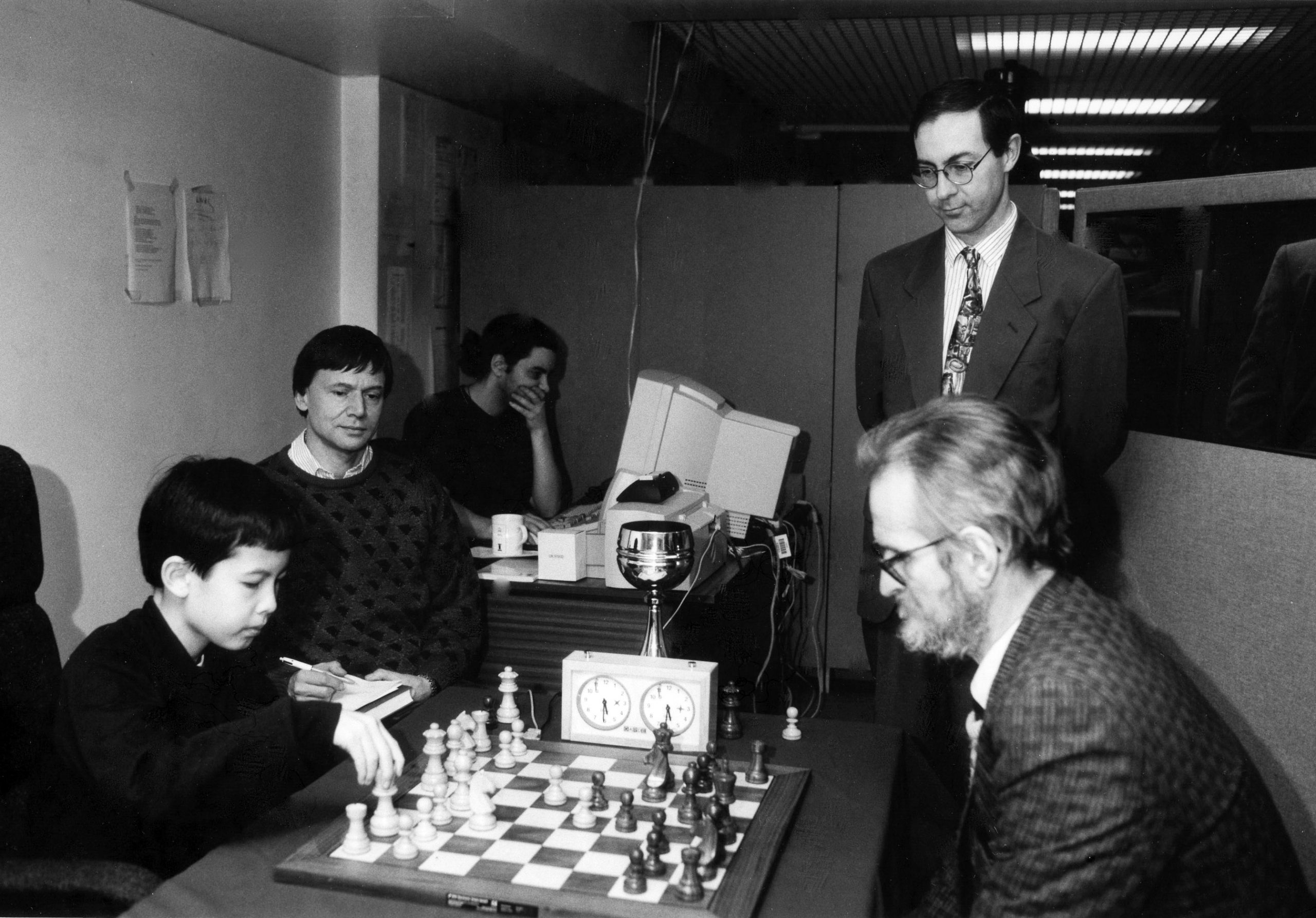
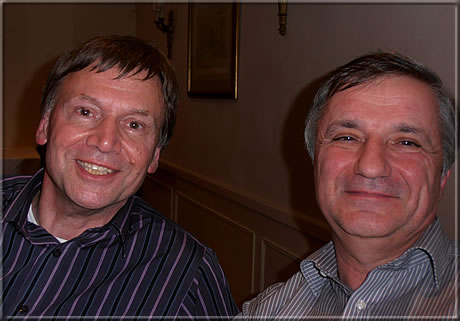
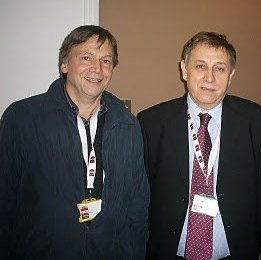
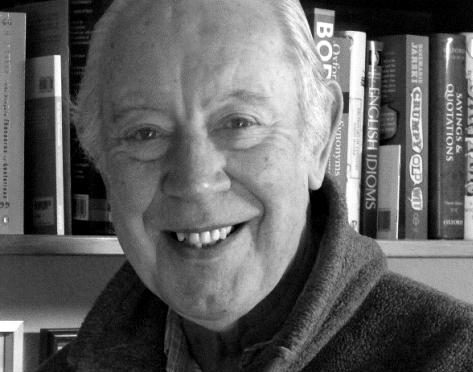
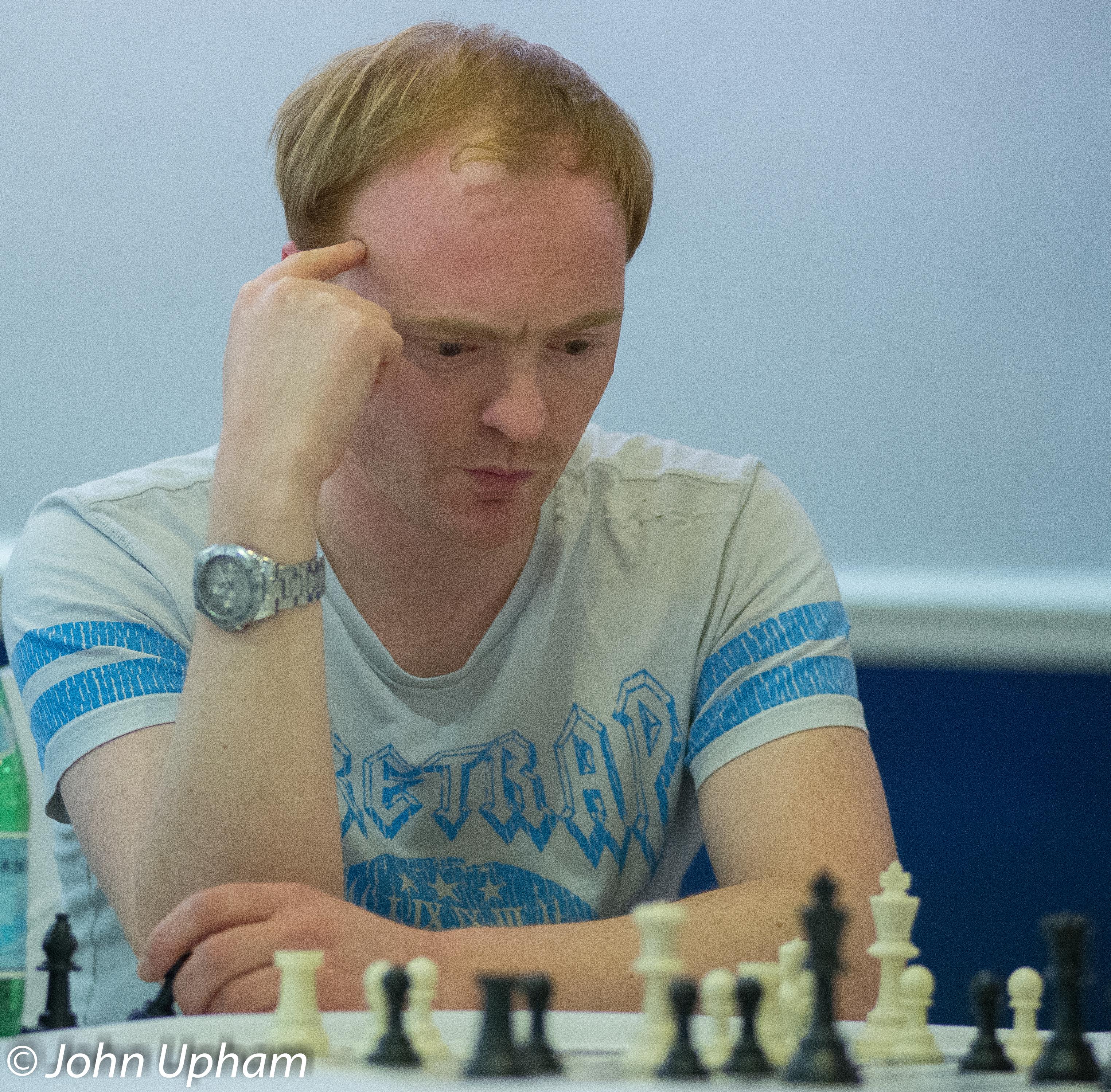
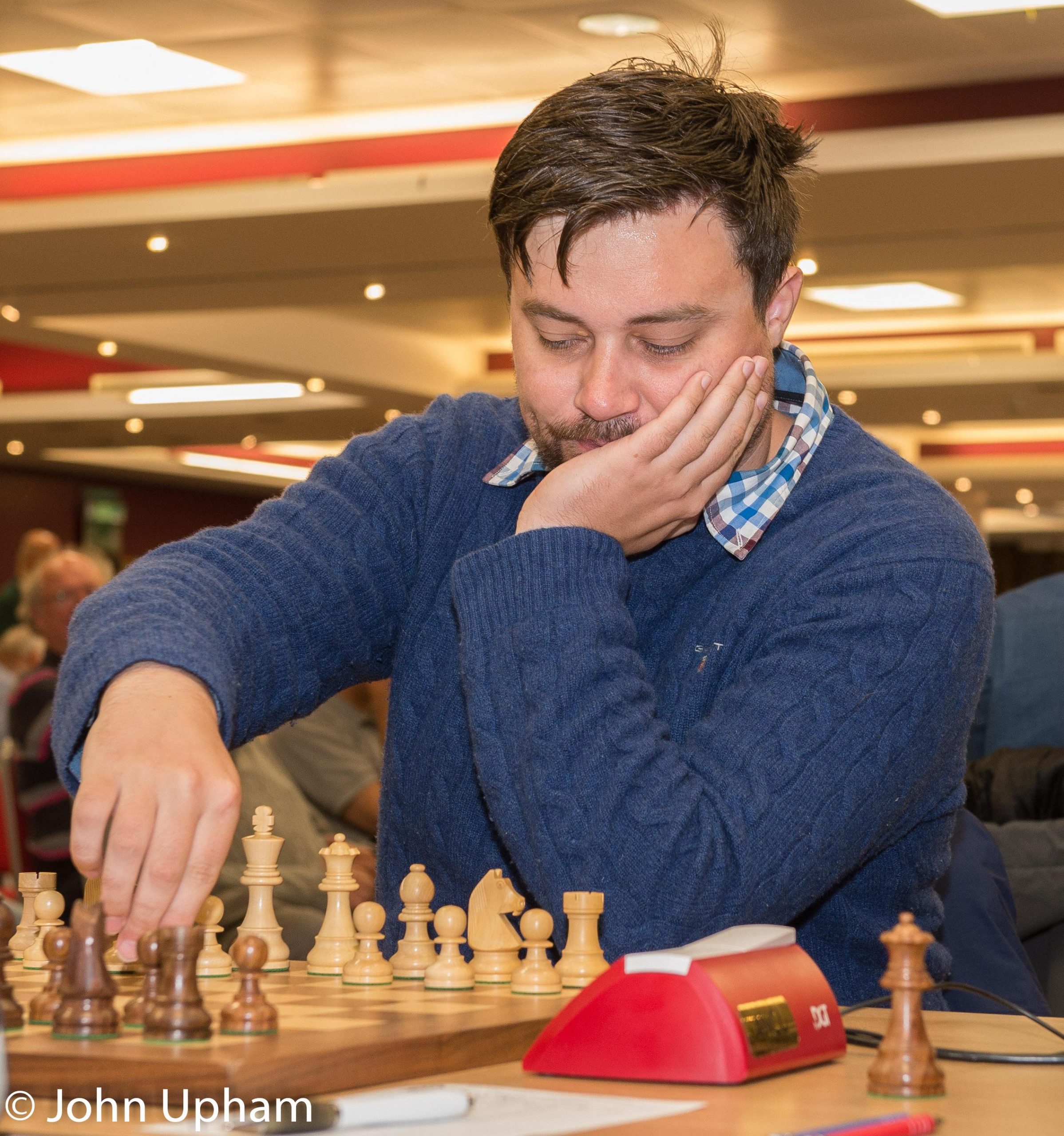
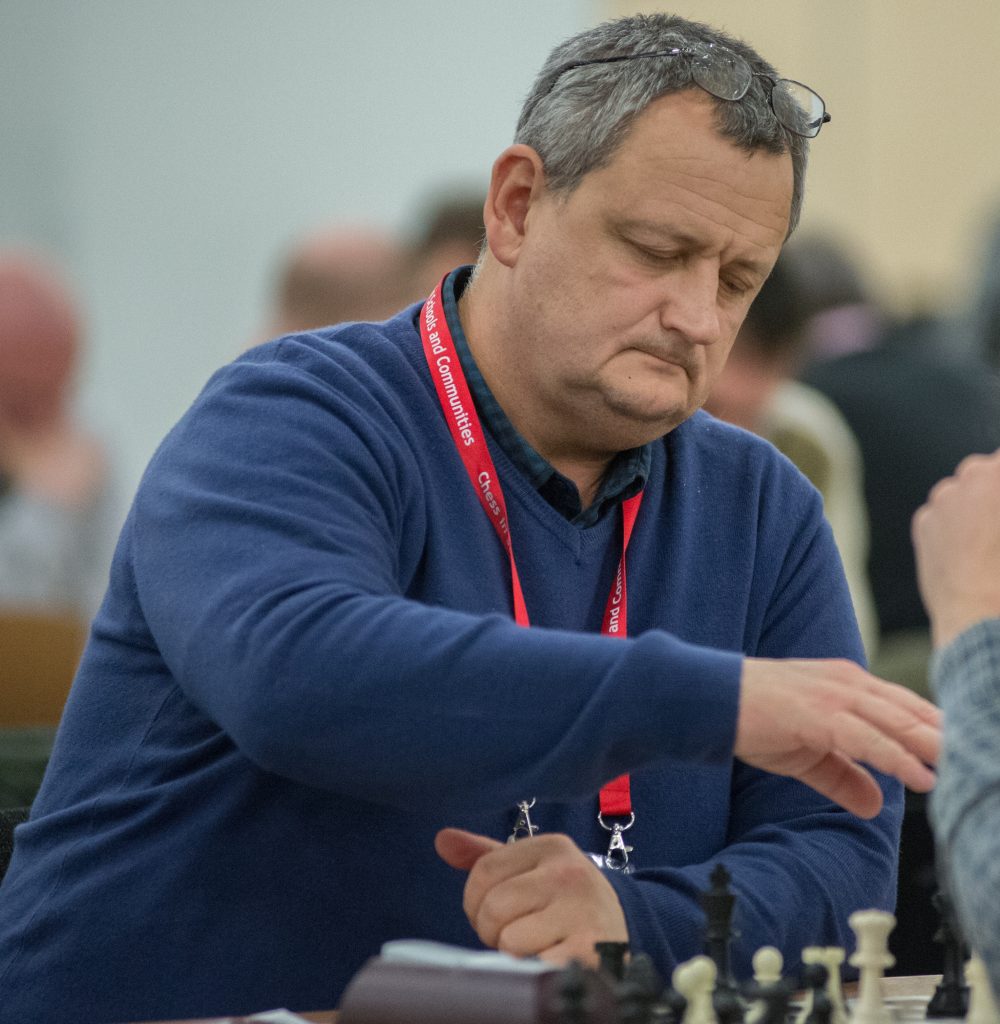
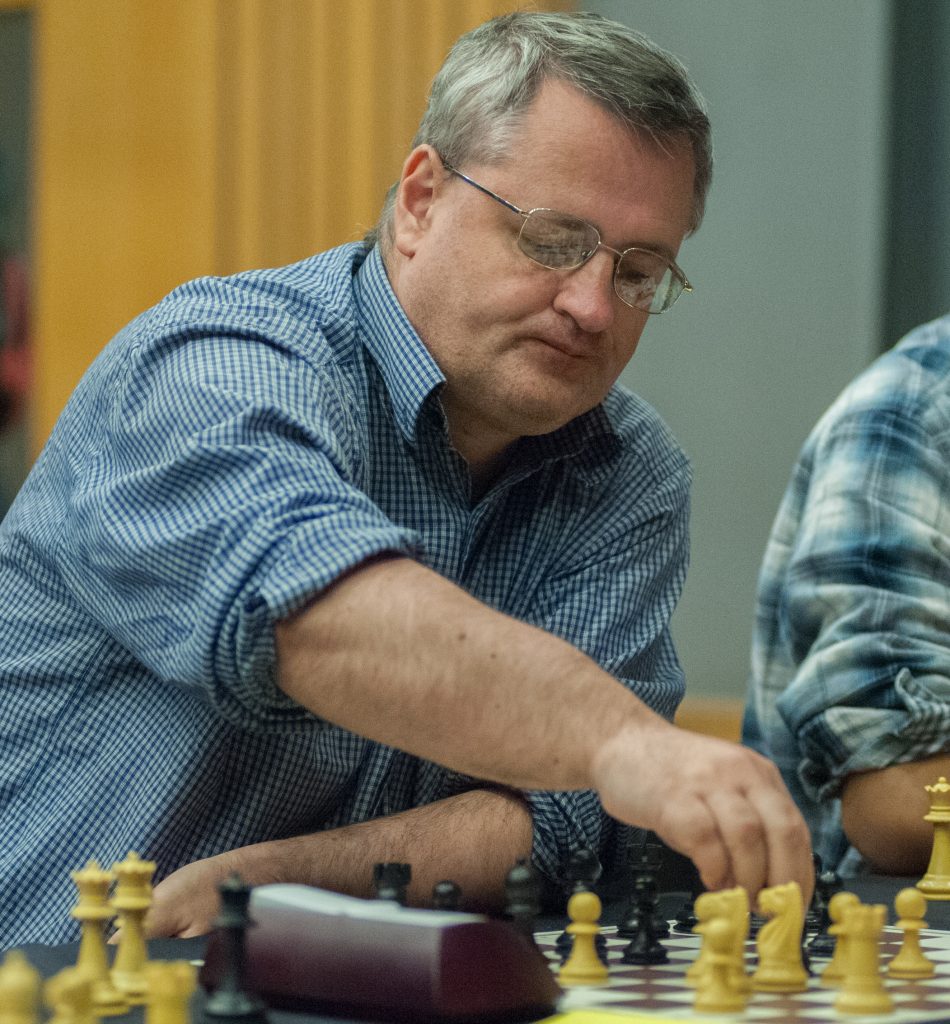
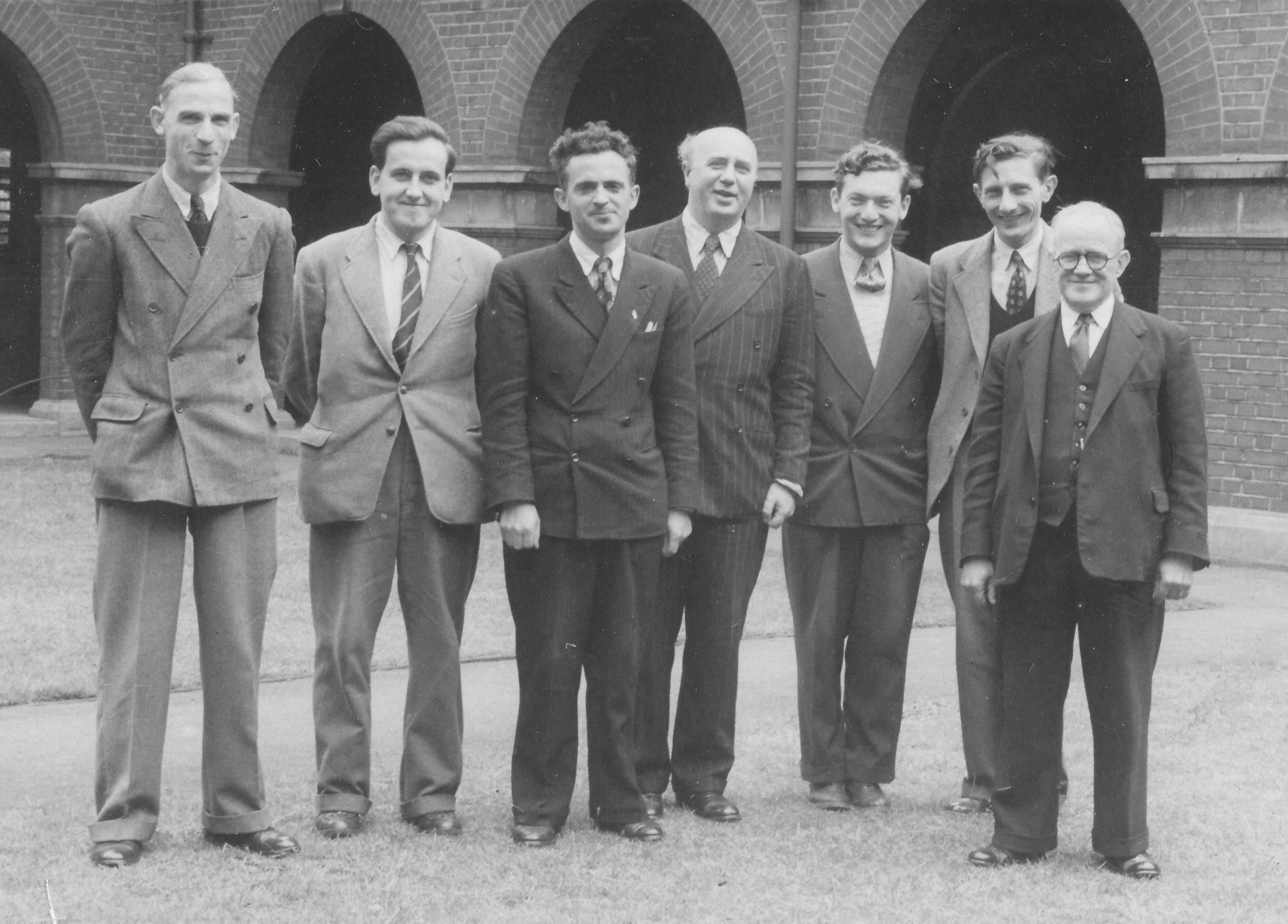
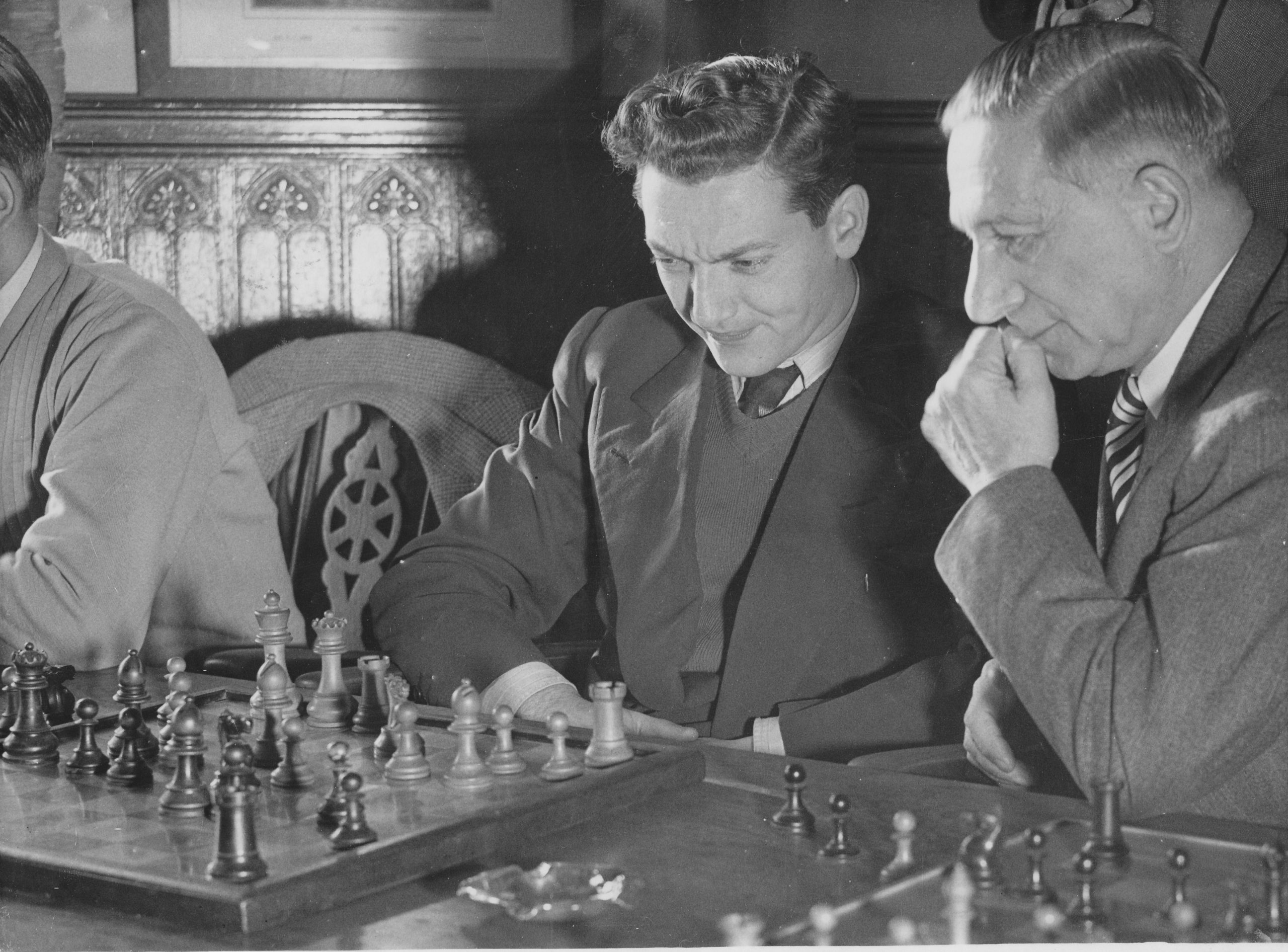
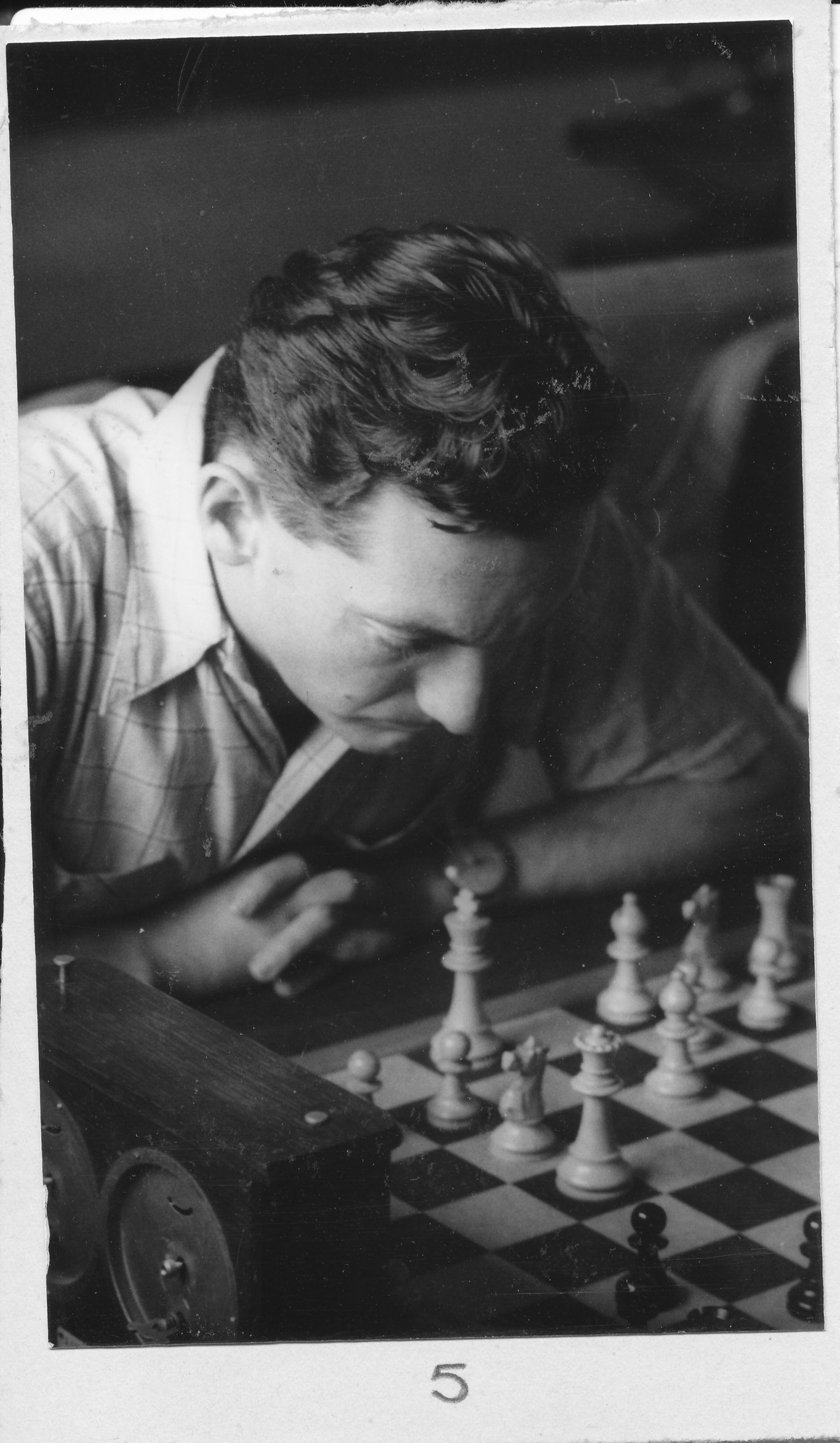
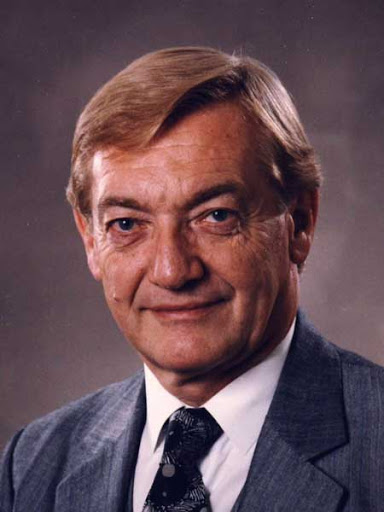
John Upham is the founder of British Chess News, staff photographer and the IT Manager.
John performed similar roles for British Chess Magazine from 2011 until 2015.
John is an English Chess Federation accredited coach and has taught in schools and privately since 2009. John started chess relatively late(!) at the age of twelve following the huge interest in the Spassky-Fischer World Championship match in 1972.
John is Membership Secretary of Camberley Chess Club and an ordinary member of Crowthorne and Guildford Chess Clubs.
John plays for Hampshire and for 4NCL Crowthorne.
John is Secretary of the Hampshire Junior Chess Association and the Berkshire Chess Association and manages the Chess for Schools partnership.
BCN sends warmest congratulations to GM Shreyas (known as “Shrey” by his friends) Royal on becoming 2026 British Champion with a score of 7.5/9.
Shreyas was born on Friday, January 9th, 2009. “Hallelujah” by Alexandra Burke was number one in the UK hit parade.
Shreyas attended The Pointer School in Blackheath, London, SE3 whose motto is “The Lord is my Shepherd”. Currently Shreyas is home schooled.
In October 2021 BCN secured an interview with Shreyas via his father Jitendra and below is mostly from that interview:
BCN: What caused his initial interest in chess and at what age?
His initial interest in chess was capturing or as he used to call it ‘eating’ pieces but as he grew more mature, he loved that there were so many possibilities in chess, so much still left to explore! At the Age of 6 he learnt and got an interest in chess.
BCN: Has Shreyas had any chess teachers or coaches?
Jyothi Lal N. with a peak of 2250 FIDE but is very knowledgeable and helped from just above beginner to 1800. He was Shreyas’s first coach.
Meszaros Gyula (Julian) who was an IM with a peak of 2465 FIDE and was an endgame master which helped him from 1800-2100.
His Current Coach is GM John Emms with a peak of around 2600 FIDE, he is an expert in many fields such as Positional Play, Openings, Strategic chess etc and has also made a big impact on how to prepare against opponents. He had helped him from 2100-2300 so far in just under a year!
BCN: Which chess clubs and/ or Teams does Shreyas represent?
He represents SV Erkenschwick from Germany and Wasa SK from Sweden for online events as he has joined them during the pandemic. He started his 4NCL career with KJCA Kings in January 2019 but now mainly represents Wood Green which he has played for in online events in and will also represent them in the upcoming 4NCL weekends.
His first appearance in Megabase 2022 comes from the 2015 British Under-8 Championship in Coventry, the eventual winner being Dhruv Radhakrishnan.
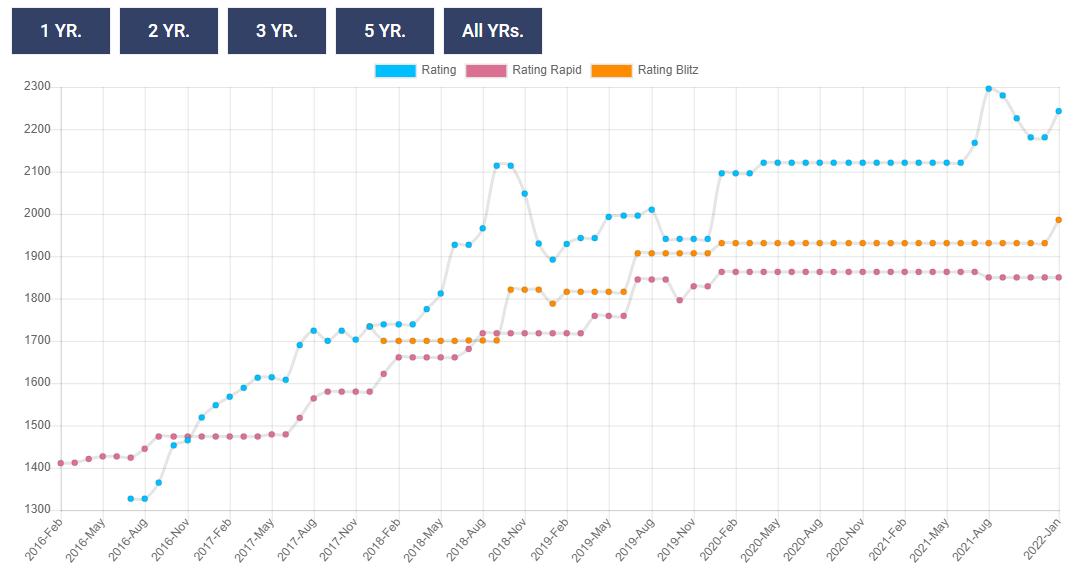
Progress from those early days has only been interrupted by school examination breaks and the Covid pandemic:
FIDE Rating progress chart for FM Shreyas Royal
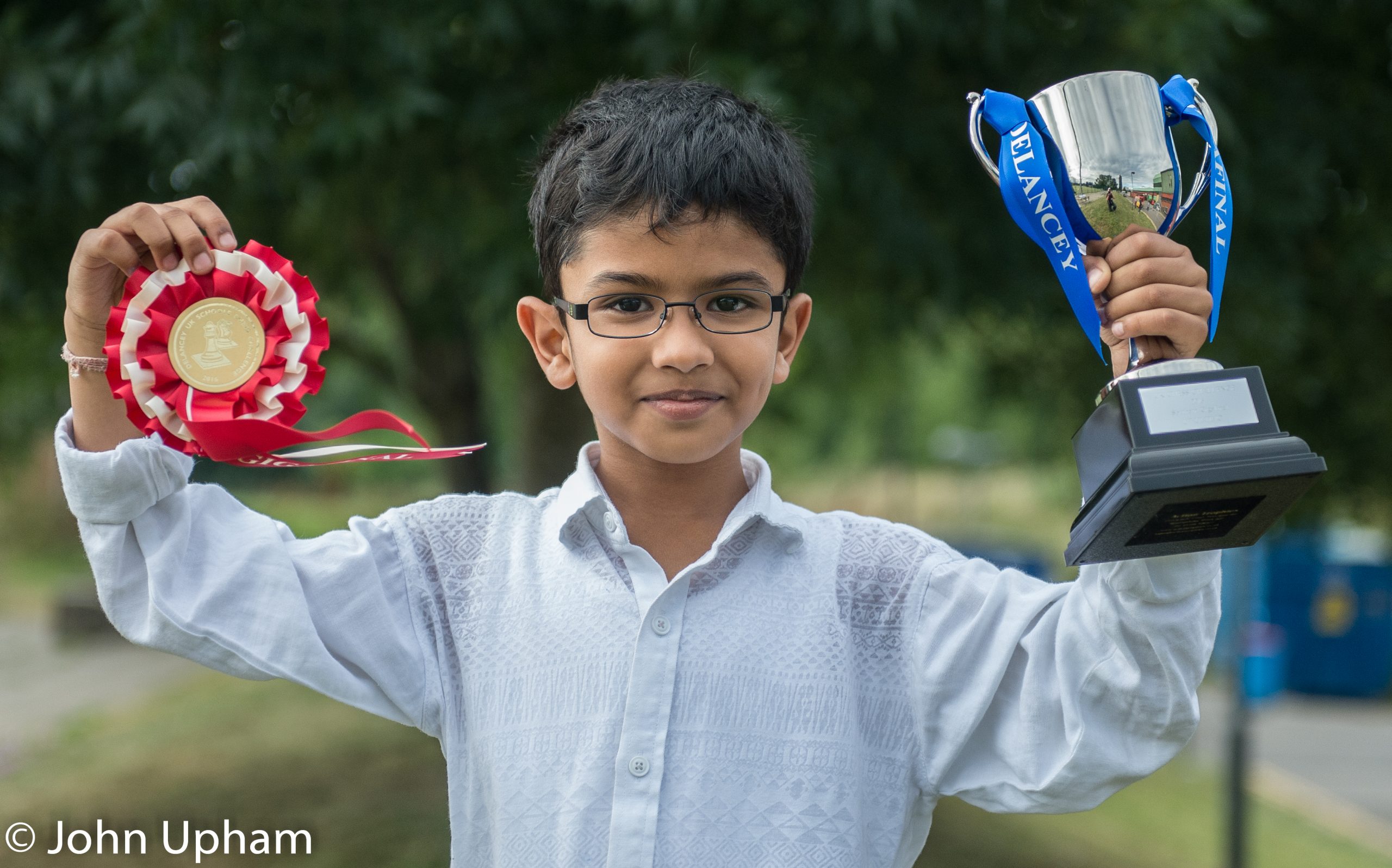
In August 2016 in Bournemouth Shreyas scored an impressive 6/6 to win the British Under-8 Championship.
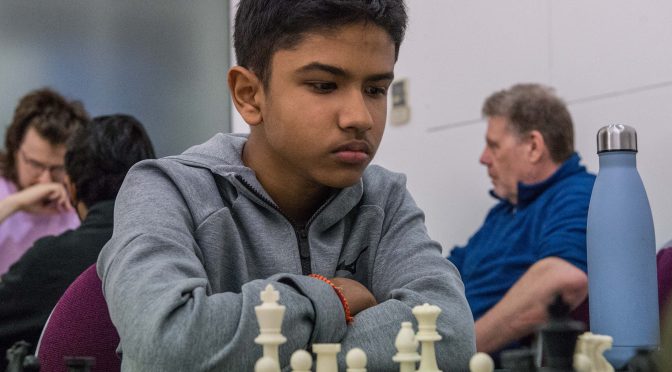
Shreyas Royal at the 2016 UKCC Delancey Terafinal in Loughborough courtesy of John Upham Photography
BCN: What was his first memorable tournament success?
This was the 2016 European Schools Under-7 championship where he was runner-up without any preparation or work on chess!
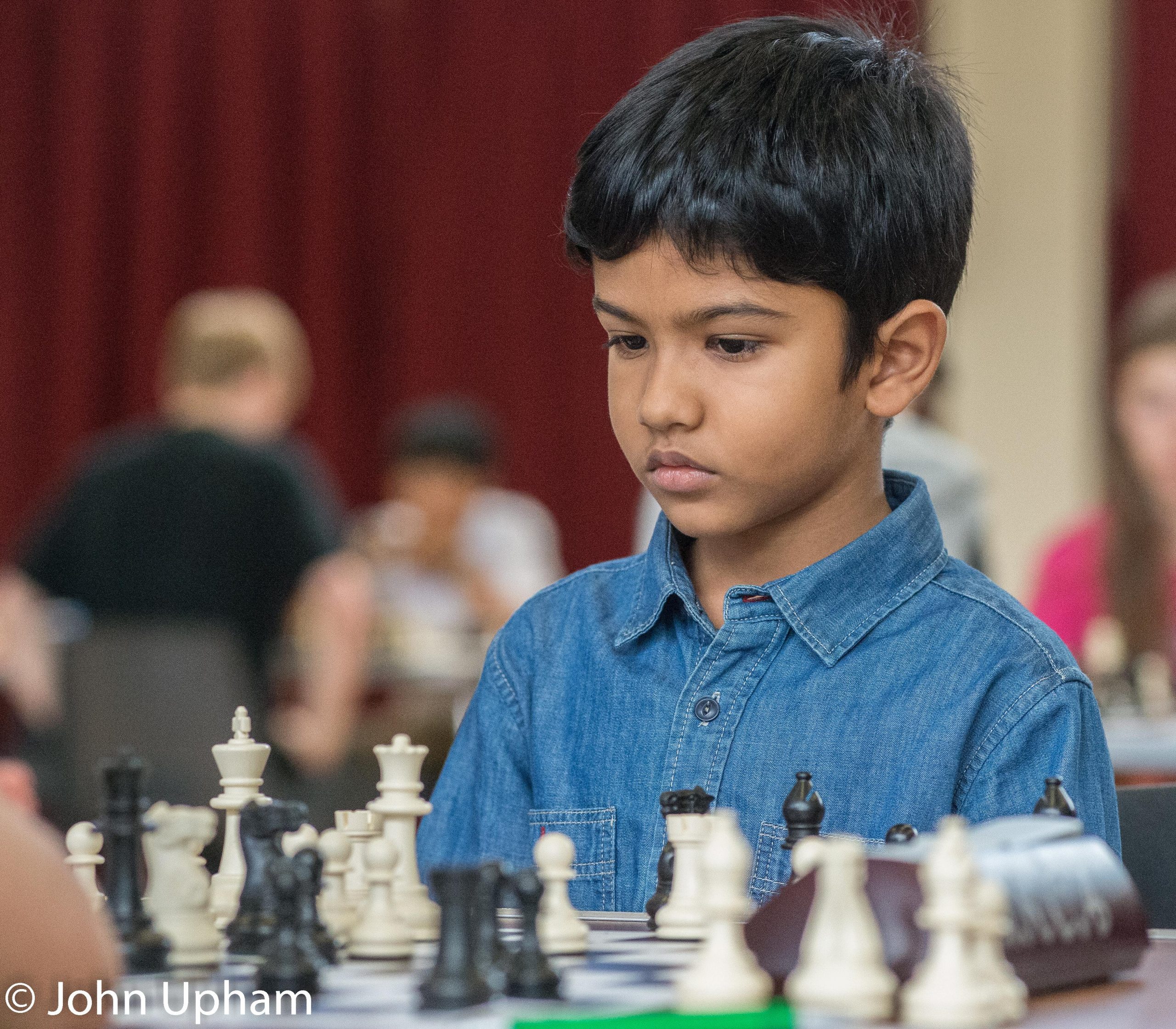
Shreyas Royal at the 2016 UKCC Delancey Southern Gigafinal in Reading courtesy of John Upham Photography
In September 2017 Shreyas travelled to Mamaia in Romania and after nine hard fought rounds tied for first place with 8/9 in the European Youth Chess Championship, Under-8 with Giang Tran Nam (HUN, 1561).
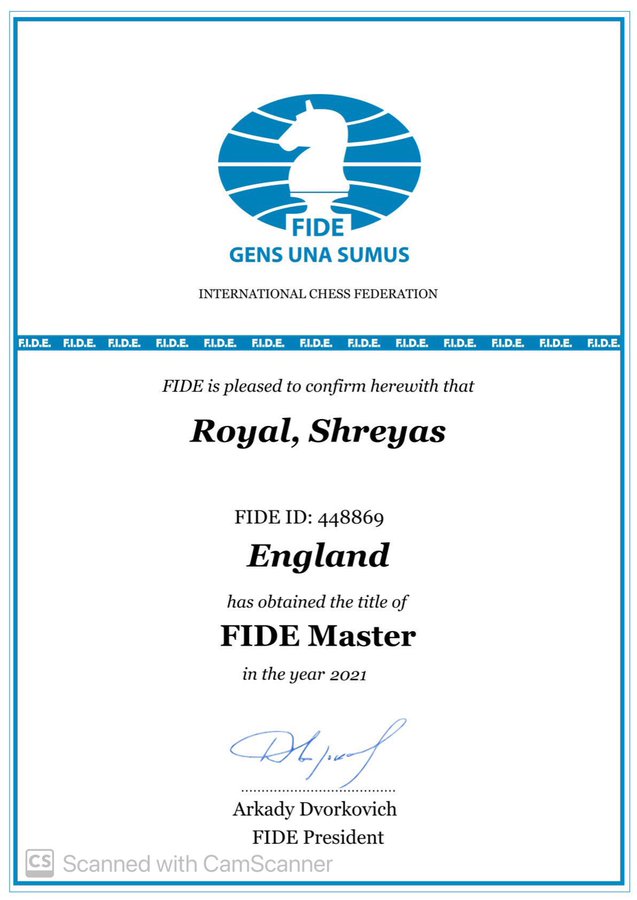
In 2021 Shreyas was awarded the FM title by FIDE:
FIDE FM Certificate for Shreyas Royal
BCN: Which chess players past & present are inspirational for him?
Magnus Carlsen, world champion and broke many FIDE records also is an inspiration for most of this generation. He likes his slow grinding and almost winning from any opening or ending. This is his favourite player of all time.
Garry Kasparov played brilliant attacking chess and calculated like a machine.
Bobby Fischer played a similar style to Kasparov but was more talented than both Magnus and Kasparov in his opinion as he worked all by himself at a time in the USA when chess was not so popular while for the Russians, they had brilliant coaches and had one good player after the other. He rates him a bit lower because Fischer quit competitive chess a bit too early and could not reach the heights he was worthy of.
Alireza Firouzja
Fabiano Caruana
BCN: What are his favourite openings with the White pieces?
He plays 1.d4 pretty much all the time.
MegaBase 2020 has 294 games with 1.d4 and one solitary 1.g3 from March 2021. The 1.d4 games feature main line Queen’s Gambit / Catalan type positions championing 5.Nge2 against the King’s Indian Defence and the exchange variation against the Grunfeld.
BCN: and what are his preferred defences as the second player?
Really depends on what they play, against every opening he has got one or two lines which he enjoys equally.
Megabase 2022 informs us that Shreyas defends the main line Closed Variation of the Ruy Lopez and main line Giuoco Piano. Previously he essayed the Sicilian Najdorf.
BCN: Does he have any favourite chess books?
Not really as he is not such a big fan of chess books, but he likes My 60 Memorable Games by Bobby Fischer. Fundamental Chess Endings and Encyclopedia of Chess Combinations.
BCN: Which tournaments are planned for 2022?
We have pencilled in a couple of norm and Open (France, Spain, Germany etc.) tournaments in European countries.
BCN: What are his favourite subjects outside of chess?
His favourite subjects outside chess are Science, History, Maths with Science as his favourite, History as his second favourite and Maths as his third favourite.
BCN: Does Shreyas play any physical sports?
He does Football, Cricket and a bit of Lawn Tennis.
BCN: What are his plans and aspirations for the future?
To become a world chess champion one day, but it’s very expensive to even get to the level of IM! Currently we are looking for sponsors who can help support Shreyas to get there.
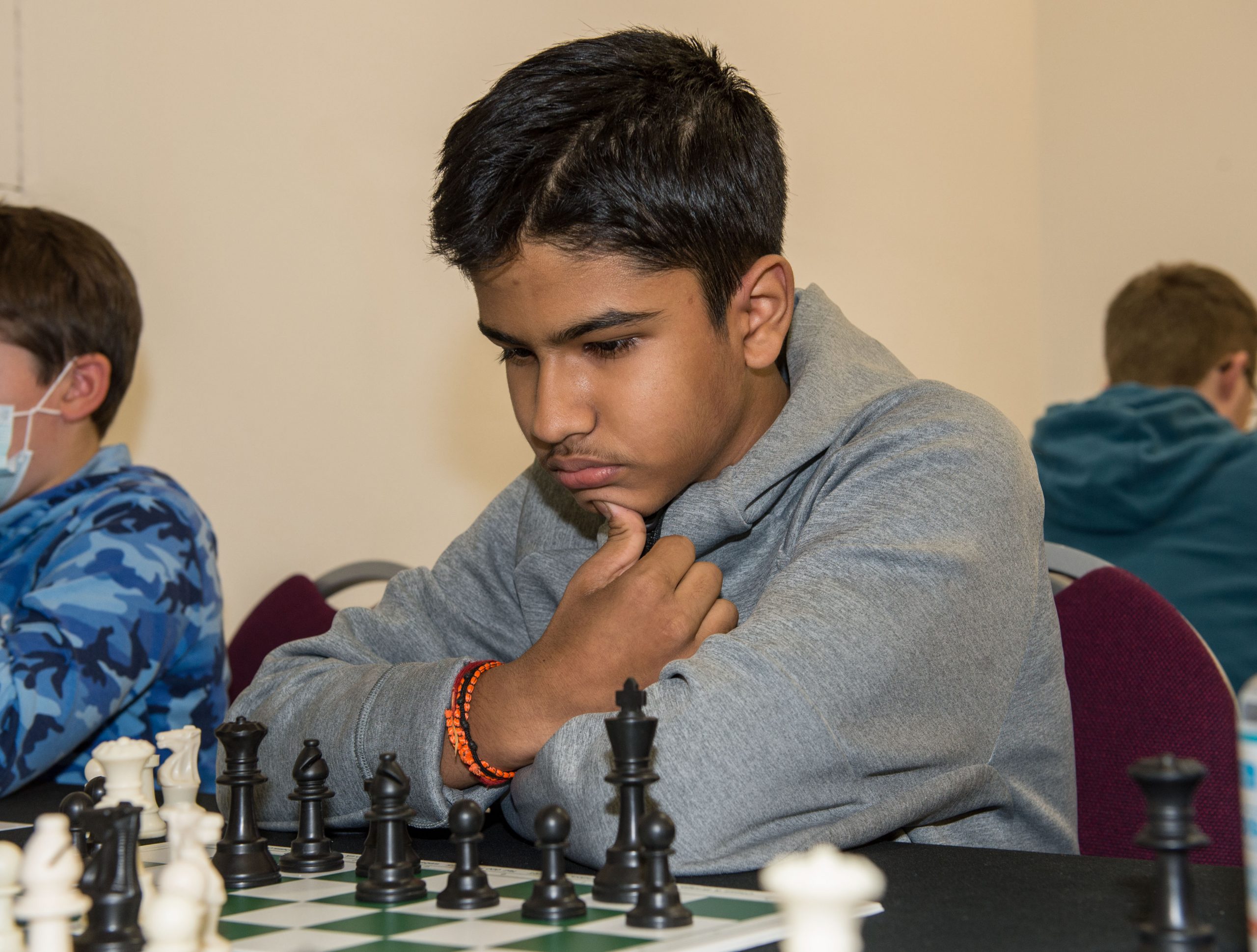
FM Shreyas Royal at the London Chess Classic, 2021 courtesy of John Upham Photography
From September 9-14, 2022, Shreyas achieved his first IM norm at the Mindsports GM Tournament in London and earned his second norm, along with a joint 3rd, at the Hit-A-Open Tournament in Slovenia between September 16-22, 2022
At the 4th FIDE Congress of 2022 Shreyas was awarded the IM title and his FIDE standard play rating stands at 2456.
We remember FM Jimmy Adams who passed away on Saturday, June 6th 2026 in London. His funeral was in Hoddesdon, Hertfordshire on 20th July. Here is the online tribute page that you are welcome to contribute to.
Jimmy was married to Sharon and they have a daughter, Charlotte.
In 1958 Jimmy at the age of 11 joined his local Islington Chess Club (at the time Islington & North London Chess Club) and soon afterwards became a London Junior Champion. Following this Jimmy played little chess and was working for John Lewis (echoes of CHO’D Alexander and Leonard Barden). Following John Lewis Jimmy worked as a Health and Safety Officer for Islington Council.
At this time Islington Chess Club was one of the strongest in England and included such members as Kenny Harman, Ron Harman, Danny Wright, Stewart Reuben and others. Its most famous member was probably IM Simon Webb
The Spassky-Fischer match of 1972 re-kindled his lapsed interest and he won with a 100% score the London Amateur Championship.
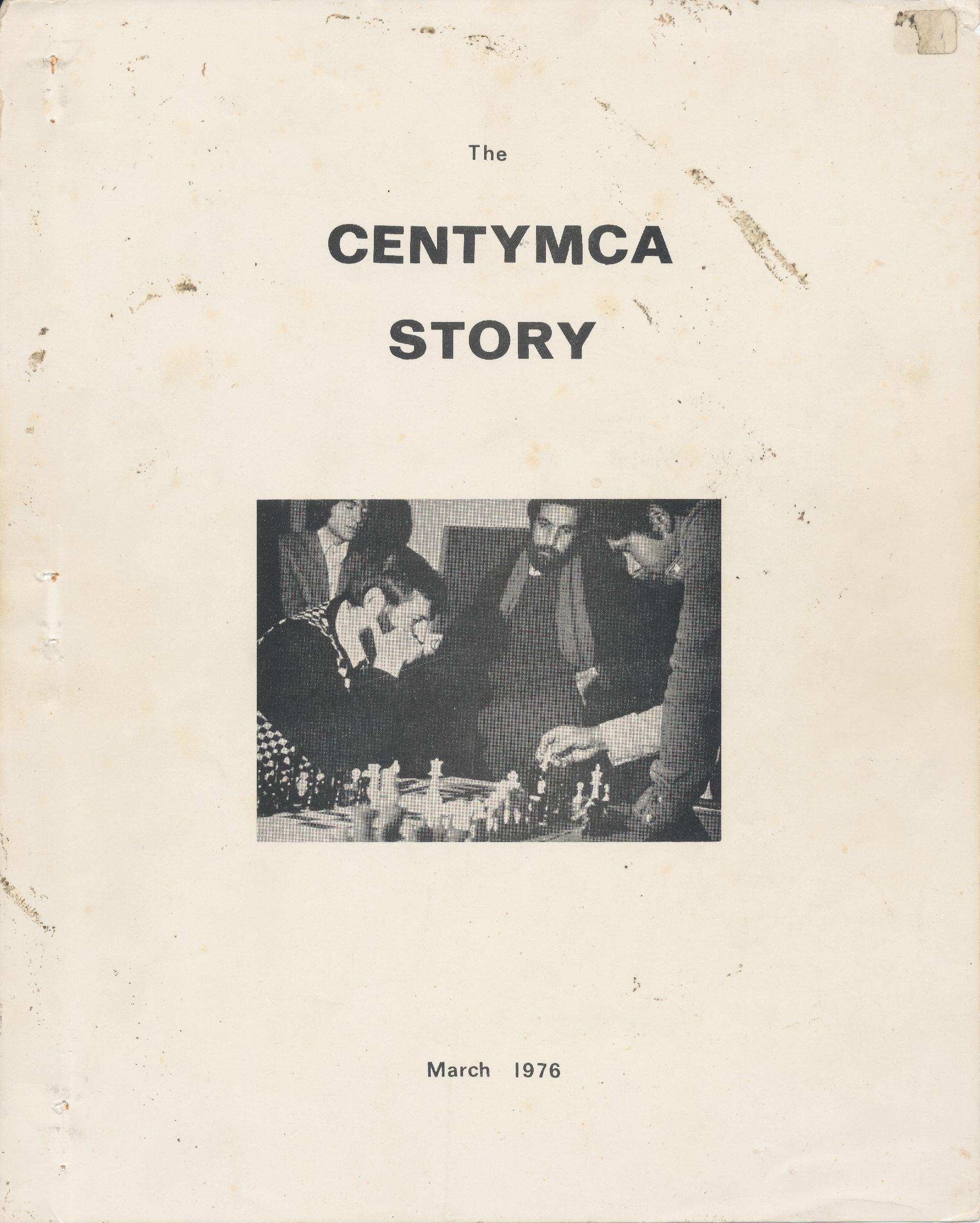
He joined and was a staunch member of London Central YMCA (CENTYMCA) chess club and he wrote a privately published history of the club entitled The CENTYMCA Story. This is now a much sought after publication. His membership continued during the 1970s until around 1979.
The CentYMCA Story by Jimmy Adams, 1976The CentYMCA Story by Jimmy Adams, 1976
During this period Jimmy was extremely active at the Endell Street premises.
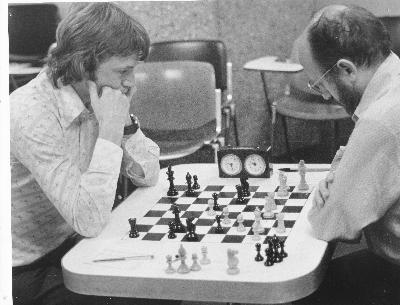
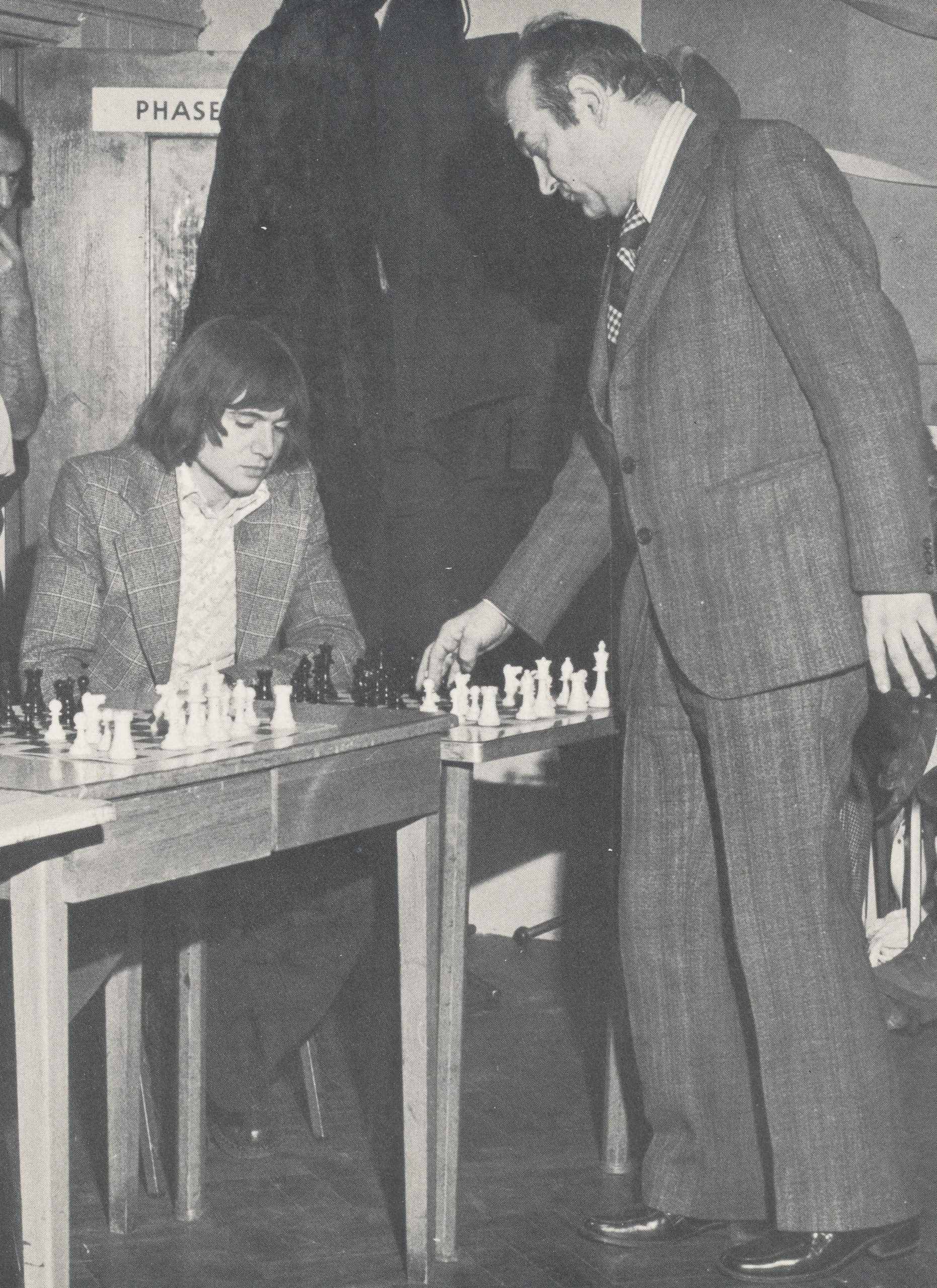
Here is Jimmy playing Viktor Korchnoi at Endell Street (in the Phase Two classrooms) :
Jimmy plays Viktor Korchnoi at the Endell Street premises of London Central YMCA on January 18th, 1976. Photographer potentially John Yeo
In 1974 Jimmy embarked on a highly successful career as a writer and journalist. He contributed articles to both CHESS and the British Chess Magazine and authored a number of acclaimed books for Batsford, The Chess Player, Caissa Books and latterly, New in Chess. He also self-published the first book on Bobby Fischer’s successor entitled K is for Karpov! His books on Chigorin, Zukertort and Breyer are universally regarded as some of the finest chess biographies published.
In 1979 Jimmy joined Metropolitan Chess Club to play in the London League A Division. He played top board and scored very highly with many significant scalps.
Jimmy gained his FM title in 2014 (at the age of 67!). 67 must be one of the most advanced ages to acquire an FM title. According to Felice his peak rating was 2300 in January 1981 aged 34.
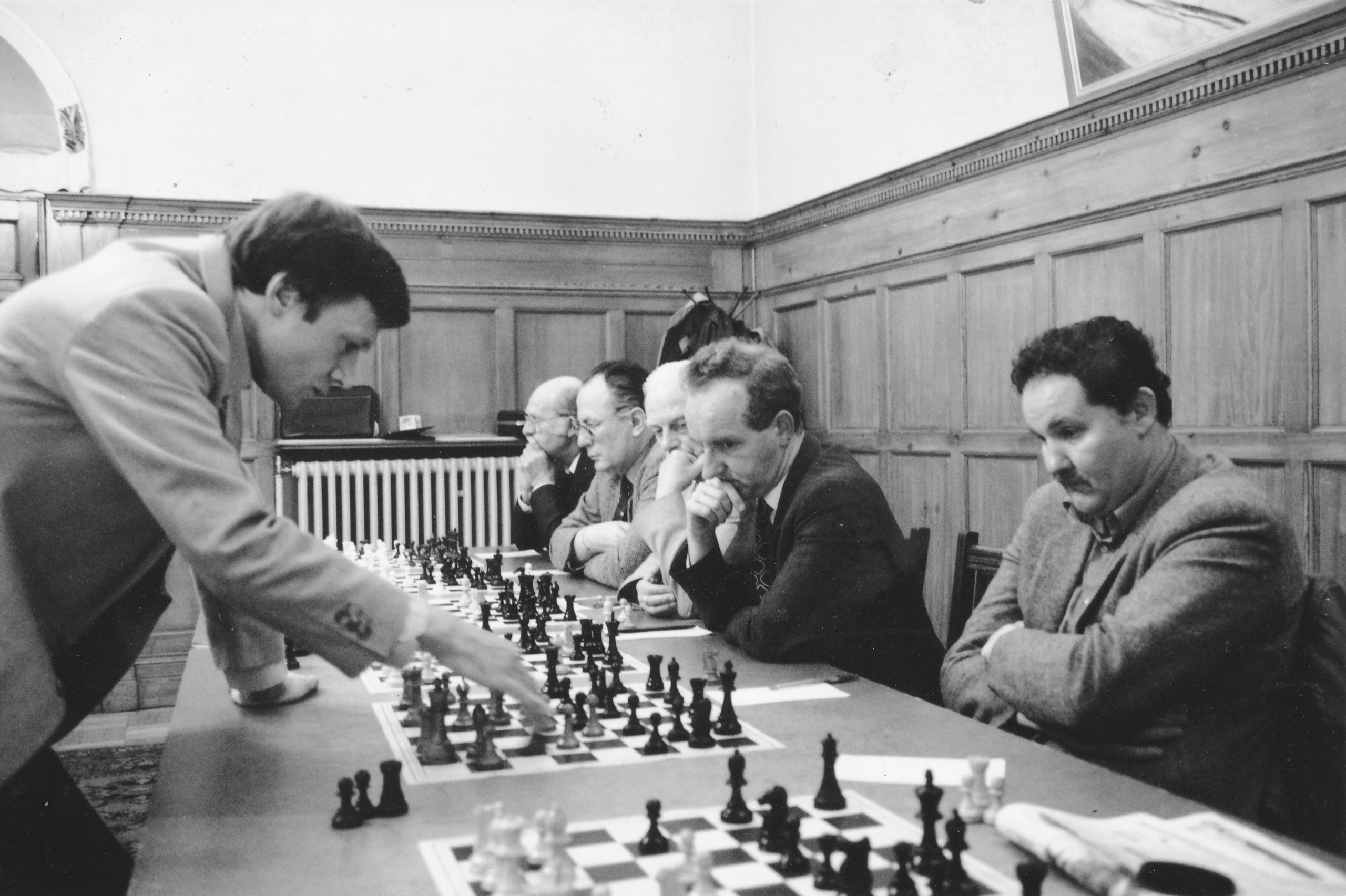
Jimmy giving a simultaneous display
He joined Metropolitan Chess Club. He joined Barbican, as did many other CENTYMCA players, following the hiatus over their Tottenham Court Road venue loss.
Jimmy records a game between David Howell and Andrew Whiteley in 2000.
In December 2009 Jimmy visited the London Chess Classic and was photographed with VIP guest Viktor Korchnoi :
Viktor Korchnoi in conversation with Jimmy Adams at the 2009 London Chess Classic. Photograph by Mark Huba
Jimmy was Editor of Middlesex Chessletter and Bayswater Chess in the early 1970s and produced major bulletins on the hugely successful Islington Congresses of the same period. He then worked for Pergamon Chess Books which led to his editorship of CHESS / CHESS Monthly magazine from until 2010 although his name remained on the masthead until February 2012.
In 2012 Jimmy and Ray Cannon attended a meeting of the Ken Whyld Association in Norwich :
Jimmy Adams and Michael Negele at the 2012 meeting of the Ken Whyld AssociationJimmy and Ray Cannon at a 2012 meeting in Norwich of the Ken Whyld Association
In January 2016 Jimmy (together with Josip Asik) became co-editors of British Chess Magazine taking over from James Pratt and John Upham.
Jimmy also jointly edited Chess Informants 109-132 up to 2017 before taking on the role of Deputy Editor of the newly created American Chess Magazine whilst continuing to work as editor for Batsford Chess which had changed ownership over the years and had now been taken under the umbrella of Pavillion Books.
In 2014 Jimmy and Ray attended an event organised by the father of Emma Bentley
Jimmy Adams and Ray Cannon at an event organised by Emma Bentley’s father.
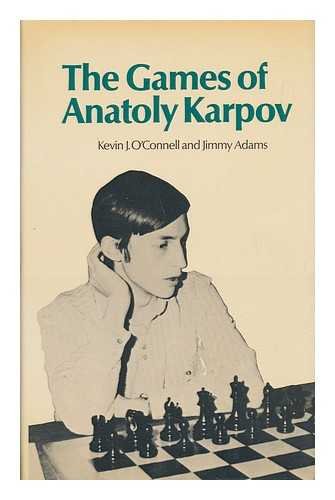
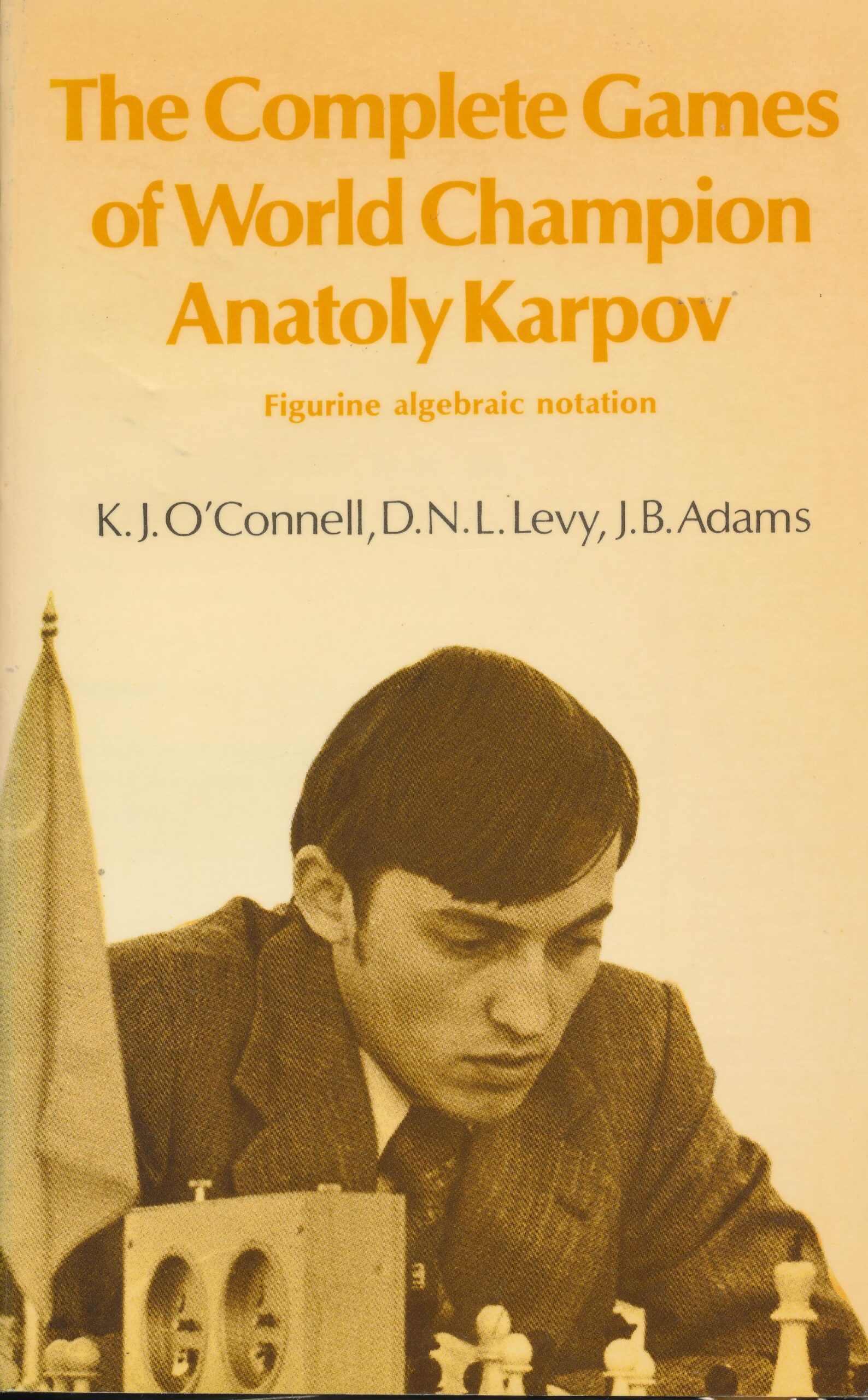
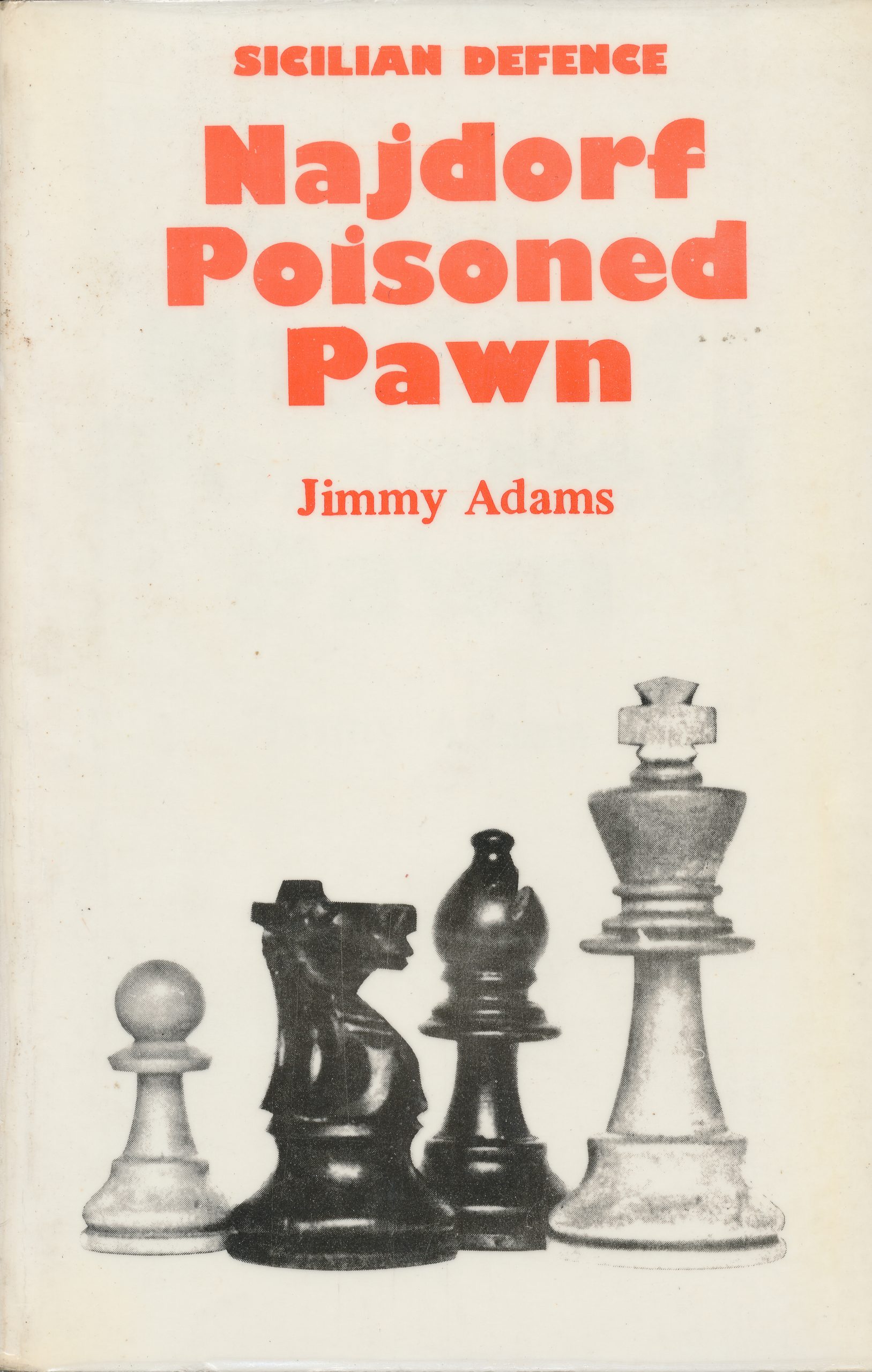
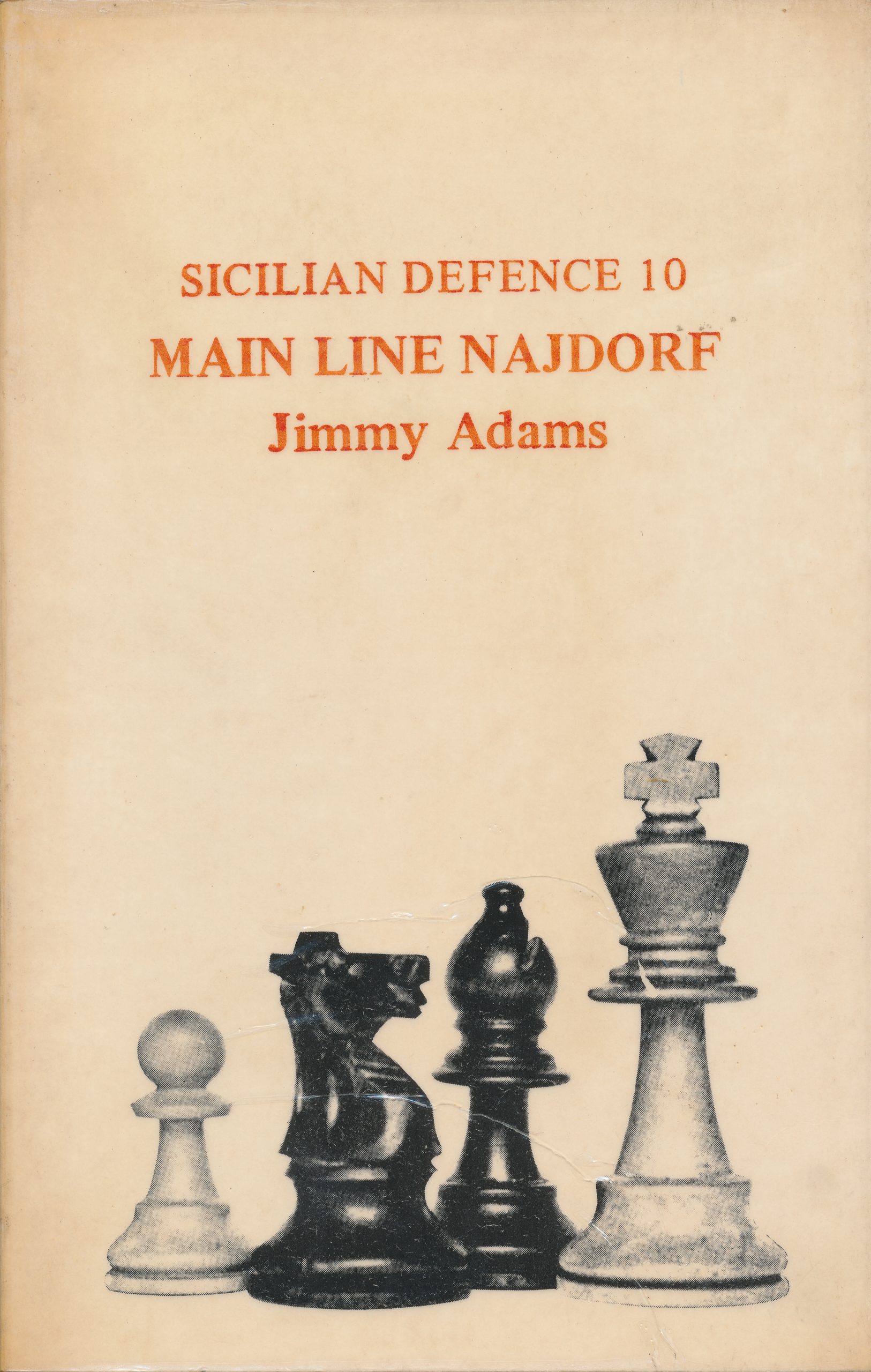
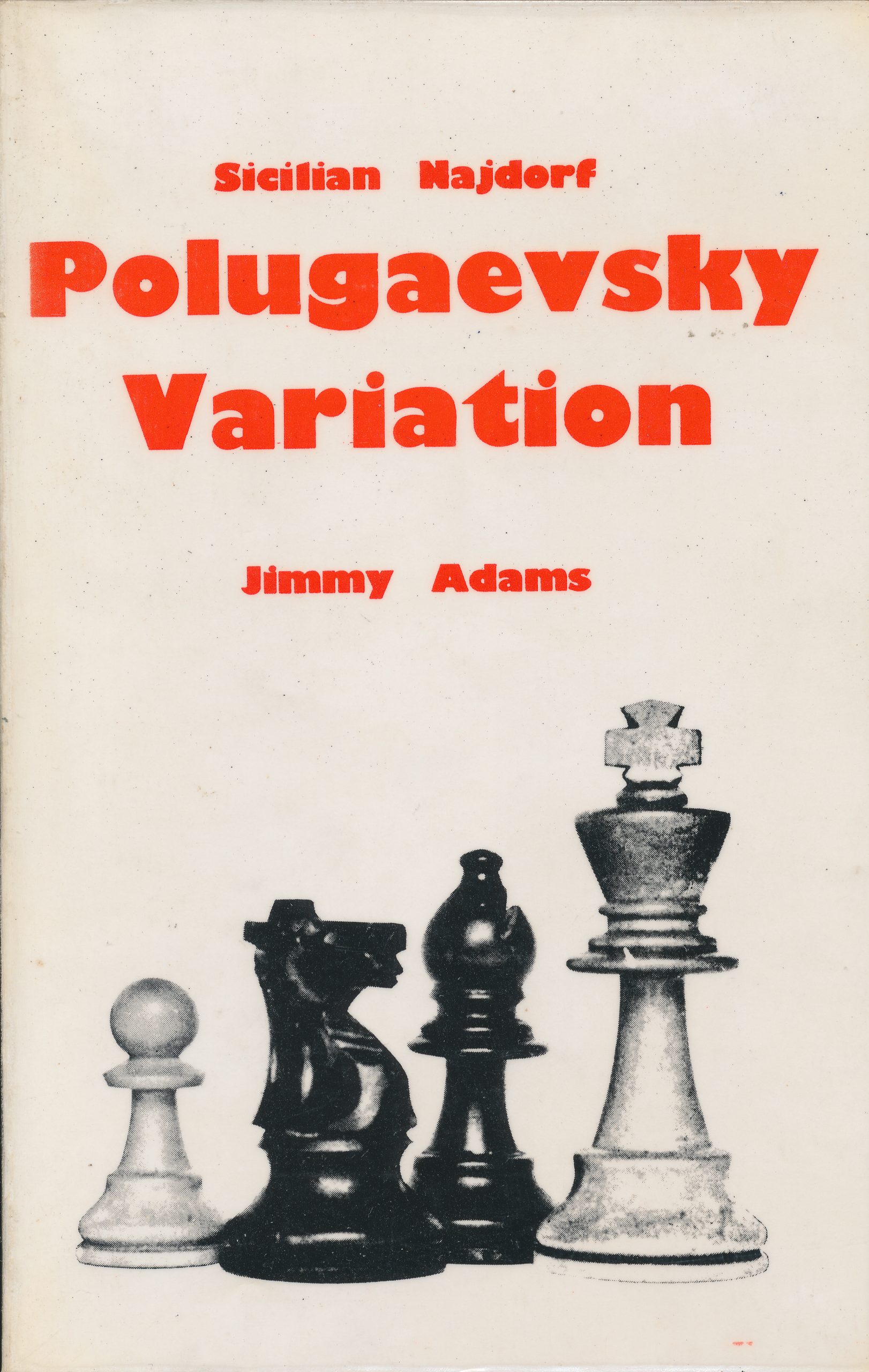
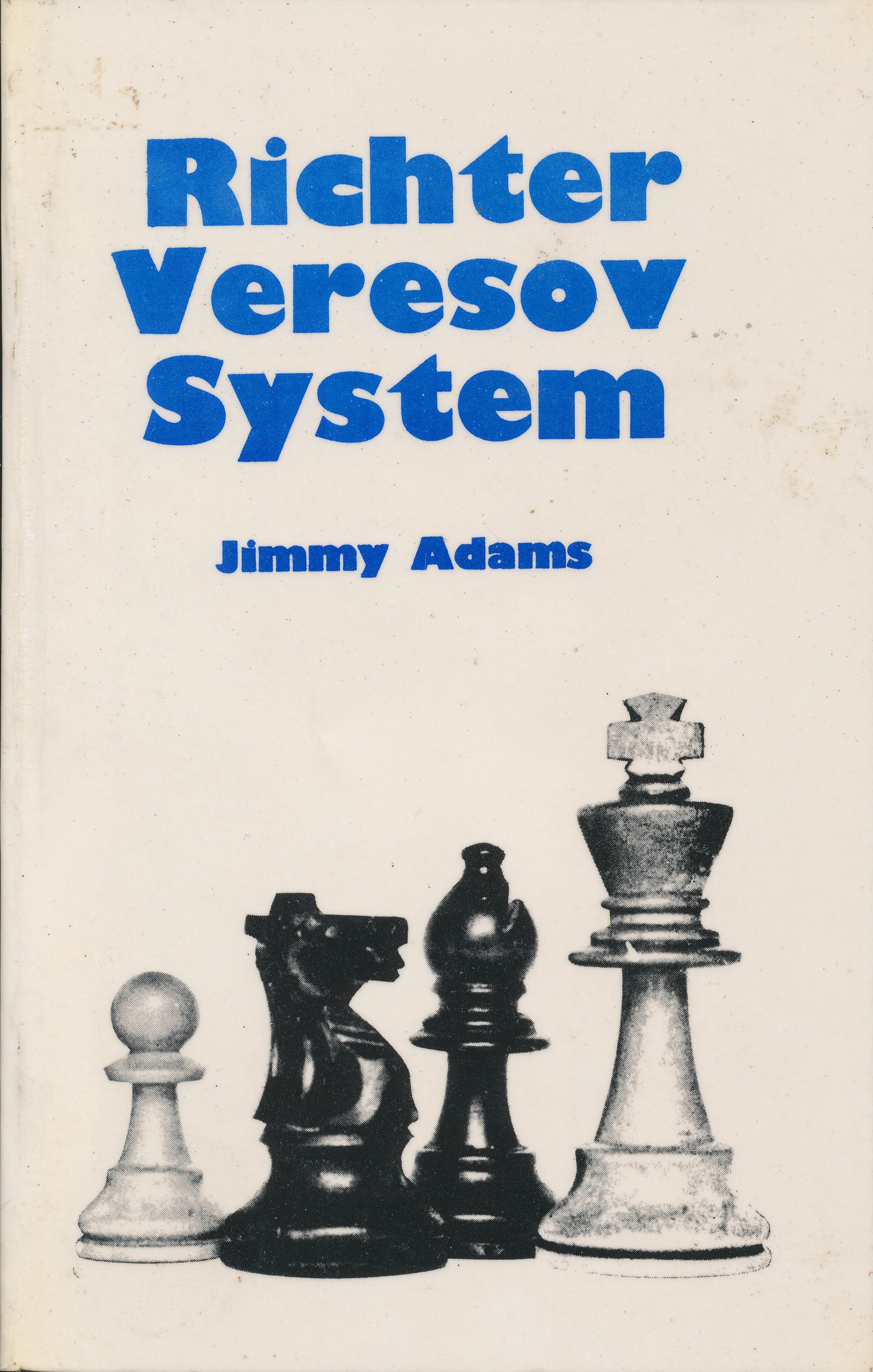
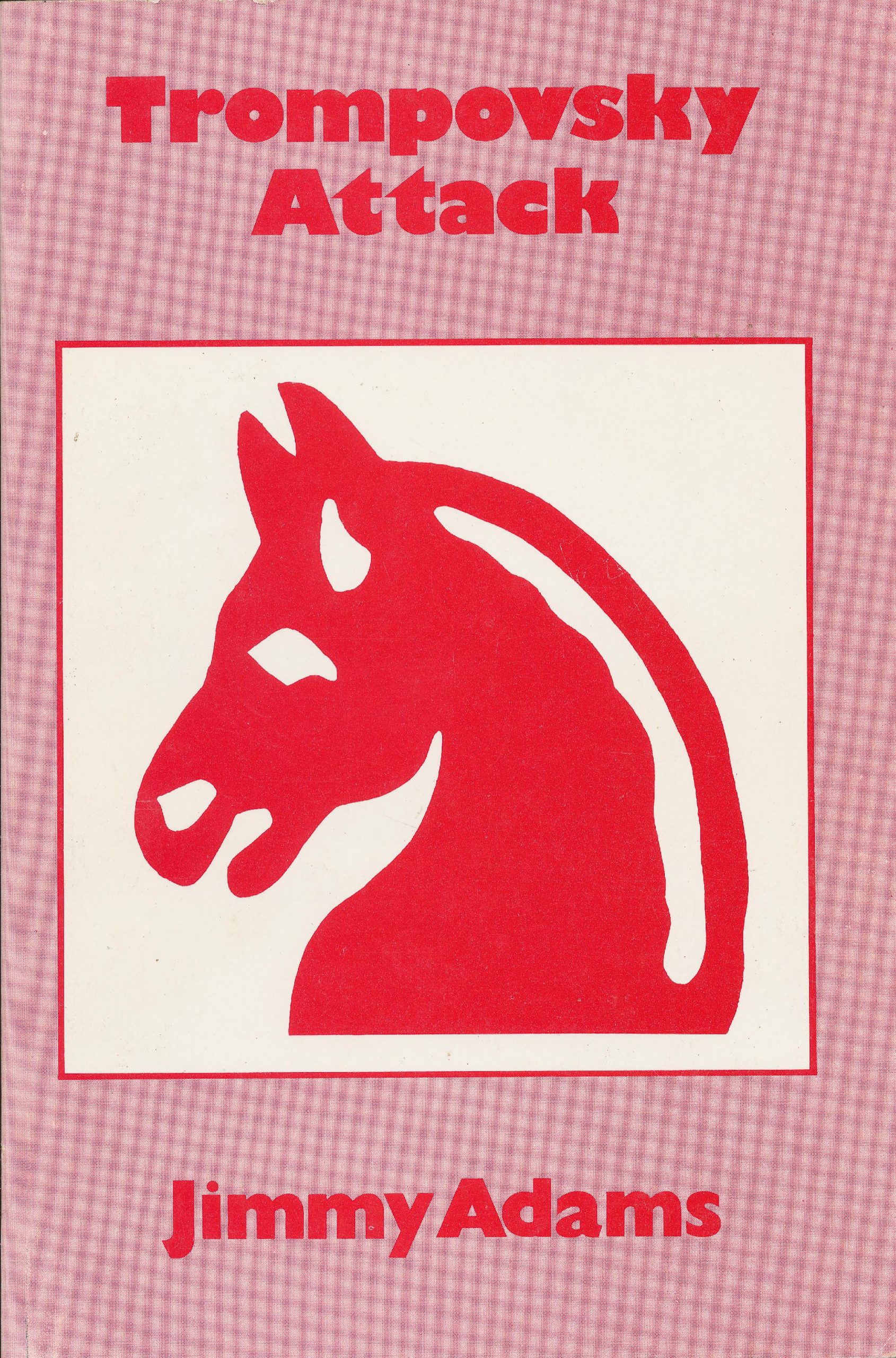
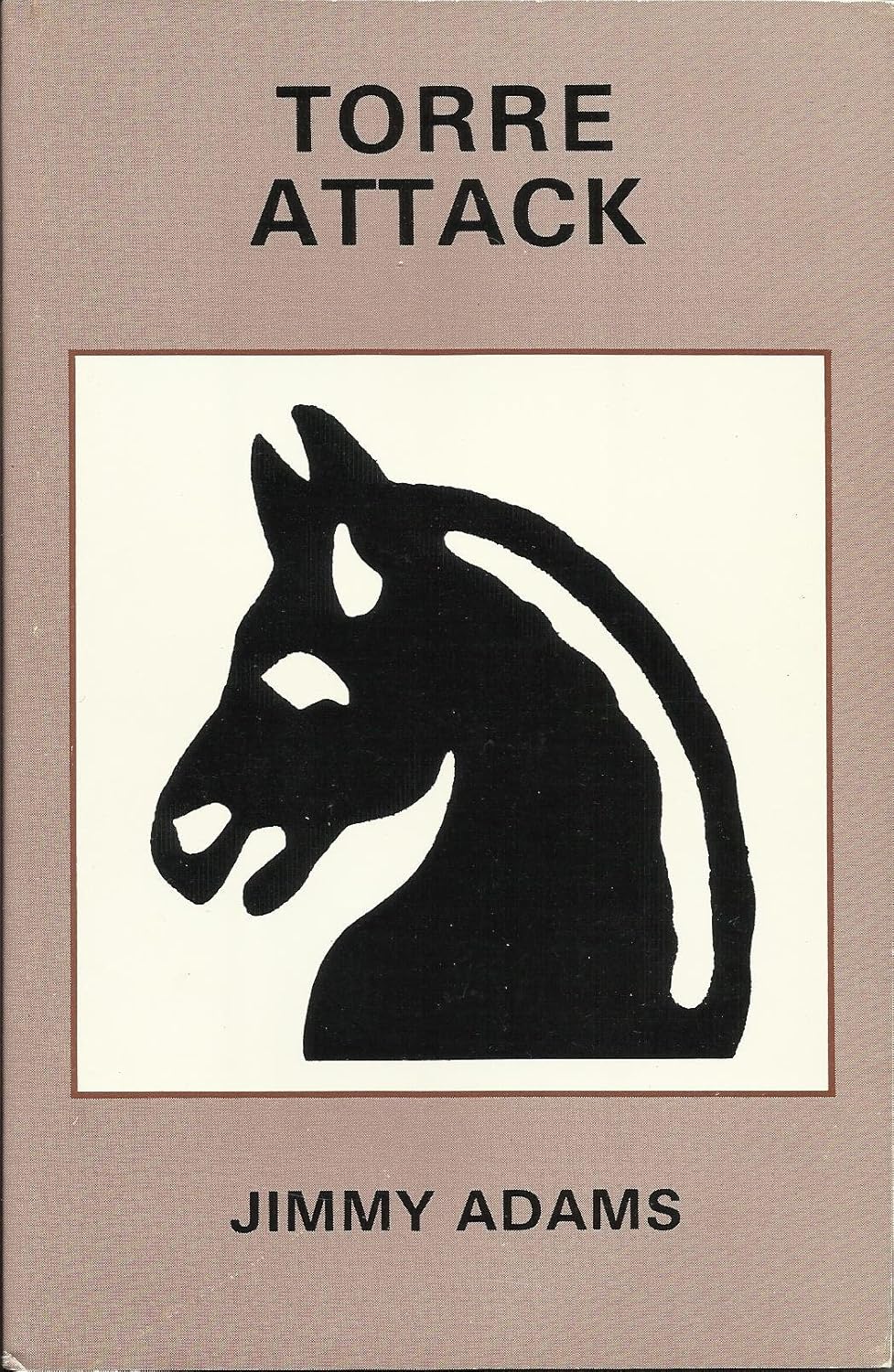
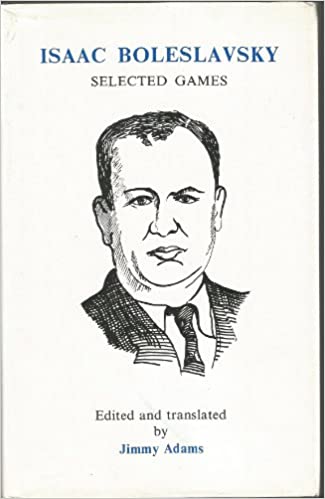
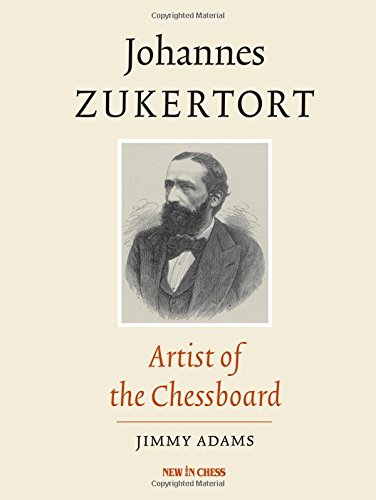
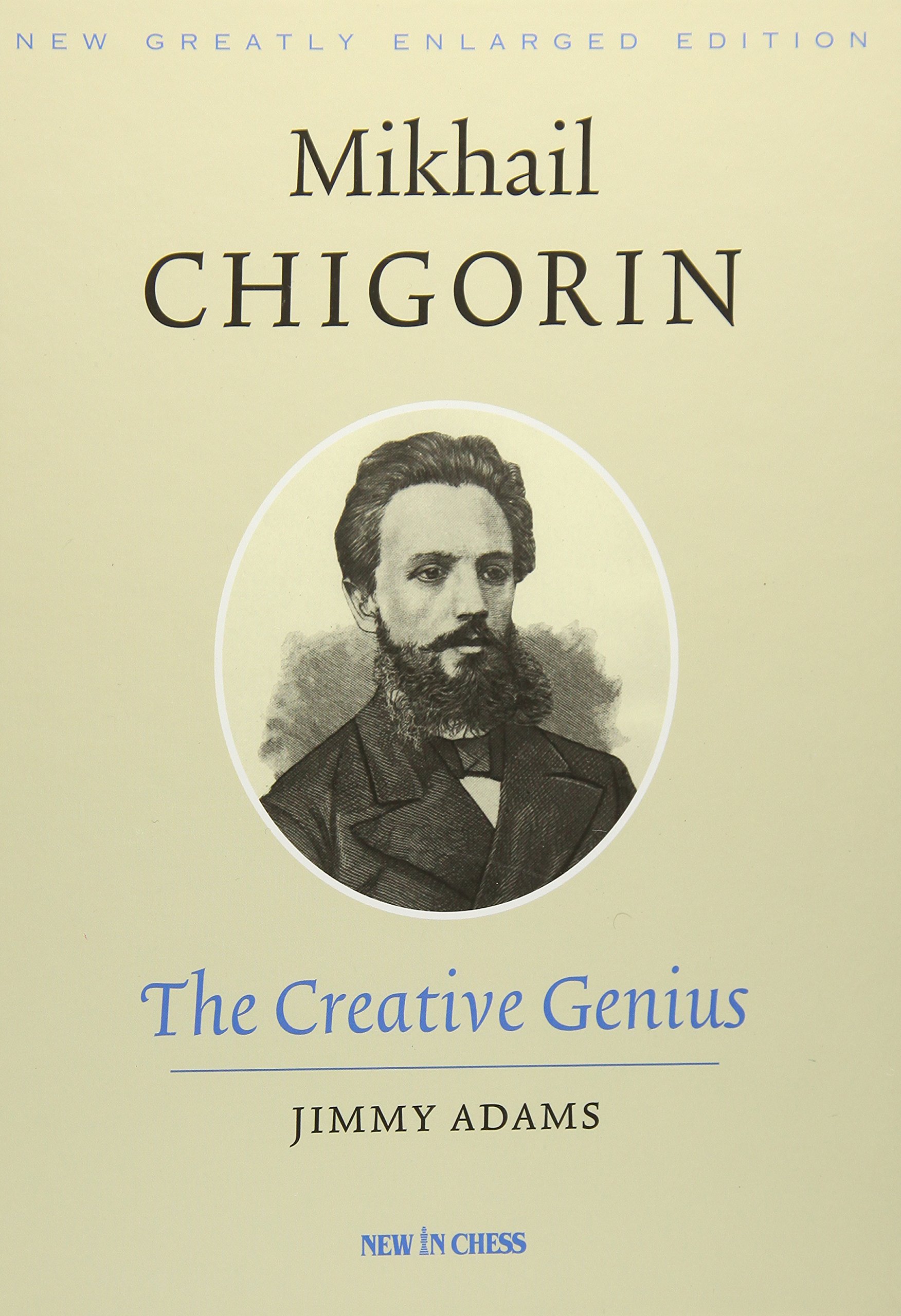
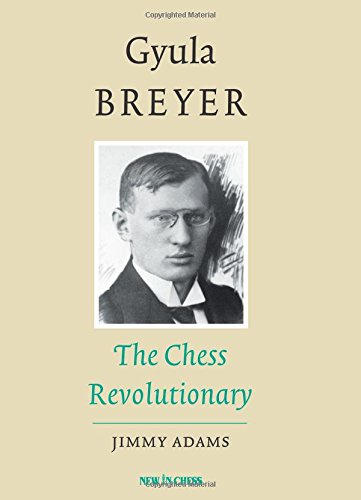
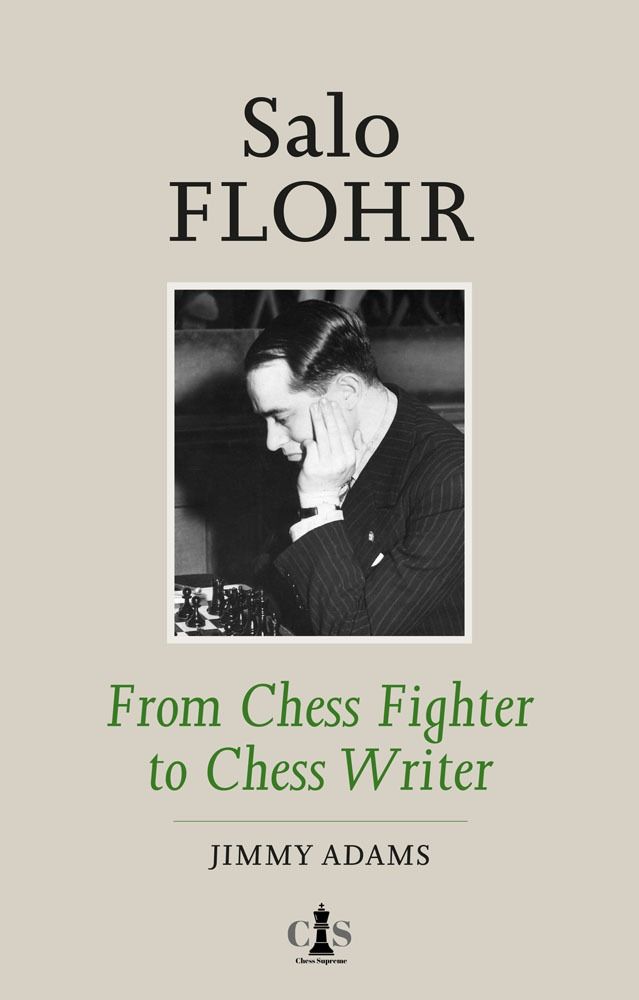
The Games of Anatoly Karpov, Batsford, Jimmy Adams, 1974The Complete Games of World Champion Anatoly Karpov, Jimmy Adams, 1976The Complete Games of World Champion Anatoly Karpov, Jimmy Adams, 1976Sicilian Defence Najdorf Poisoned Pawn, Jimmy Adams, The Chess Player, 1977Sicilian Defence 10 : Main Line Najdorf, Jimmy Adams, The Chess Player, 1977Sicilian Najdorf Polugaevsky Variation, Jimmy Adams, The Chess Player, 1978The Richter Veresov System, The Chess Player, Jimmy Adams, 1978Trompovsky Attack, The Chess Player, Jimmy Adams, 1979Torre Attack, Jimmy Adams, The Chess Player, July 1981Schliemann/Jaenisch Gambit, The Chess Player, Jimmy Adams, 1982Paris 1900, The Chess Player, Jimmy Adams, 1986ISAAC BOLESLAVSKY Selected Games, Caissa Books, Jimmy Adams, 1988Johannes Zukertort: Artist of the Chessboard, New in Chess, Jimmy Adams, 2014Mikhail Chigorin, the Creative Genius: New in Chess, Jimmy Adams, 2016Gyula Breyer : The Chess Revolutionary, Jimmy Adams, New in Chess, 2017Salo Flohr: From Chess Fighter to Chess Writer, Jimmy Adams, New in Chess, 2026
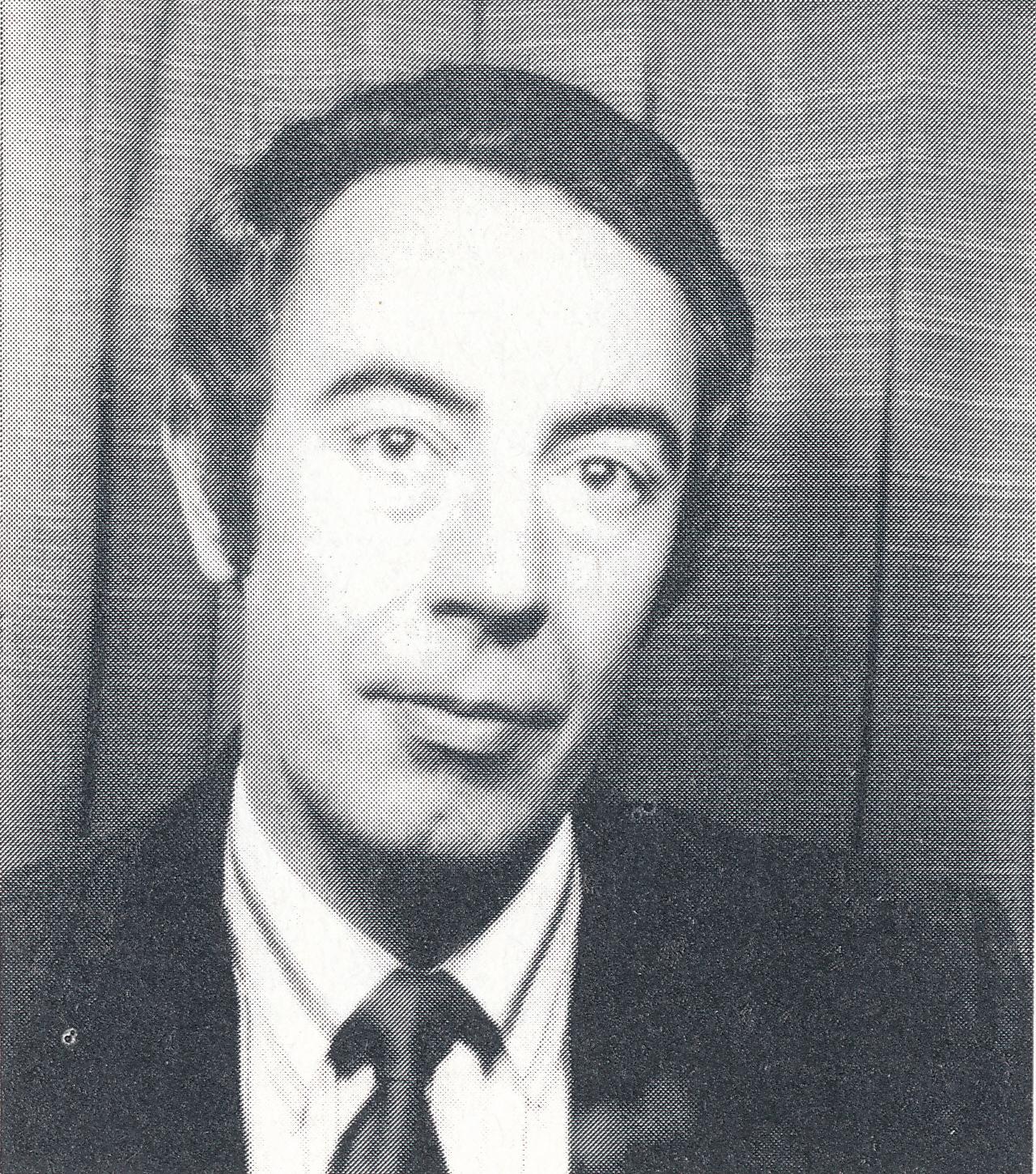
BCN remembers IMCC Barry Barnes who passed away on Tuesday, January 14th 2025 aged 87.Barry Peter Barnes was born in Brighton and his mother’s maiden name was Simpole. (Barry is a cousin of Julian Ivan Peter Simpole, who was a Brighton school teacher and who taught Edward Gerard Winter to play chess).
Barry most recently lived in Halling, Rochester, Kent with his wife Jean.
From The Encyclopedia of Chess (Robert Hale, 1970 & 1976) by Anne Sunnucks :
“International Master of FIDE for Chess Compositions (1967) and International Judge of FIDE for Chess Compositions (1967).
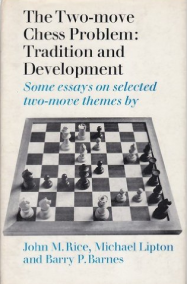
Born on 1st August 1937, Barnes works in transport advertising. He has composed about 250 two-move problems. With Lipton and Rice, he has contributed to the advance of the modern two-mover. Problem Editor of Two-Move and Twin sections of The Problemist. Co-author with M.Lipton and JM Rice of The Two-Move Chess Problem : Tradition and Development (Faber and Faber 1966).
“A promising career as a county chess player came to an end when I was given Brian Harley’s classic book Mate in Two Moves in the belief that it would help my chess, but it had quite the opposite effect. My interest in competitive chess waned, and I was on the road to an an International Master title for problems!
Early influences in my problem career were the weekly chess problem solving competition in The Observer (my first problem published there was in 1955), a teenage friendship with J. M. Rice and M. Lipton (both now lnternational Masters), Herbert Grasemann’s book Problem Schach / with its near revolutionary post-war German problem ideas, and the expert British problemist, A. R. Gooderson who had I but known it only a few years earlier was the officiating master when my Hove Grammar School played Steyning Grammar at chess.
In the late 1950s and early 1960s, the genuinely original problems I was making in cooperation and in competition with Rice and Lipton were being published mostly abroad in such specialist problem magazines as Die Schwatbe (with its inspired two-move editor, Hermann Albrecht) where I gained the epithet the English prize-snatcher’! It was also written that the work of the avant-garde composers, Rice, Lipton and Barnes, was like a fresh two-move wind blowing from our island. It was sad but true at that time that the specialist magazine of the British Chess problem Society (founded 1918), The problemist, was unreceptive to change and our often bizarre ideas.
A milestone of sorts was reached when I won lst prize for problem I in 1958, a prize for the best new problem by a member of the British Commonwealth aged under 21. In 1966, I was invited by problemist Grandmaster Comins Mansfield, who was President of the FIDE Problem Commission, to act as Secretary at the Barcelona meeting. With Mr. Mansfield’s retirement, I became the British Member to the Commission, and at the Wiesbaden meeting, 1974, I was elected 2nd Vice-President. (1st Vice-President from 1982)
The FIDE Problem Commission meets annually to discuss matters relating to all branches of problem chess, to organize the World Chess Composing Tournament (WCCT), the World Chess Solving Competition (WCSC), and to publish FIDE Album anthologies of the best problems. It was on the strength of my success in these FIDE Albums that the Commission granted me the titles in 1967 of ‘lnternational Master of the FIDE for Chess Composition’ and ‘lnternational Judge of the FIDE for Chess Composition’. Since 1974, I have been Chairman of the Titles Sub-Committee of the Commission.
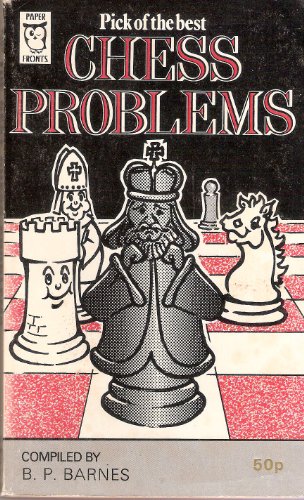
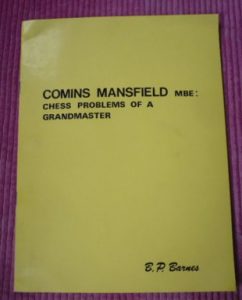
Since 1965, I have been the two-move editor of The Problemist and have served almost without break on the BCPS Committee. I have contributed to The Encyclopaedia of Chess by Anne Sunnucks (Robert Hale, 1970), I am co-author, with J. M. Rice and M. Lipton, of The Two-Move Chess Problem: Tradition & Development‘ (Faber A Faber, 1966), and I am the sole author of Comins Mansfield MBE: Chess Problems of a Grandmaster: (British Chess Problem Society, 1976) and Pick of the Best Chess Problems (Elliot Right Way Books, 1976)
To date I have made just over 300 two-movers and some helpmates.”
From The Encyclopaedia of Chess (Batsford, 1977), Harry Golombek OBE, John Rice writes:
“British problem composer, output about 400, nearly all modern style two-movers. Two-move sub-editor of The Problemist. Secretary of the FIDE Problem Commission during C. Mansfield’s Presidency. Co-author of The Two-Move Chess Problem: Tradition and Development (1966).”
The Two Move Chess Problem : Tradition and Development
Author of Pick of the Best Chess Problems (1976)
Pick of the best Chess Problems
Comins Mansfield MBE : Chess Problems of a Grandmaster (1976).
Comins Mansfield MBE: Chess Problems of a Grandmaster, BP Barnes, 1976
International Judge (1967); international master (1967).
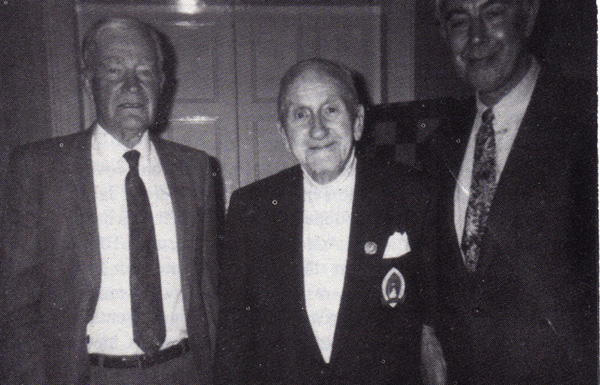
Source: The Problemist, May 1996. Photo taken March 1996 at the Mansfield Centenary Meeting at Paisley, when Barry Barnes delivered a lecture on Comins Mansfield. Left to right: Geoffrey Mansfield (son of Comins), Robert Gray and Barry Barnes, International Master of Chess Composition.
BCN is sorry to report the passing of FM Mike Franklin on Tuesday April 25th 2023: one of England’s most respected and well regarded players.
Growing Up
Michael John Franklin was born on Monday, February 2nd, 1931 in Battersea, London to Albert George (27 ix 1906, Dover – ? iii 1983, Wandsworth) and Helen Ann Franklin (née Colson, 1908-2003) who married in the third quarter of 1928 in Wandsworth. Albert was a clerk as was his father.
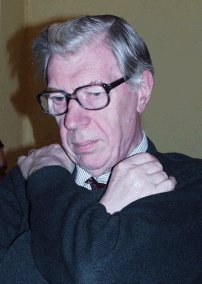
FM Michael Franklin, Photo by Cathy Rogers
At the commencement of the Second World War, when eight years old, Michael was evacuated to Frome in Somerset. As a consequence Michael would delight in playing in the Frome Congress whenever possible. He played in the first event in 1990 organised by Leon York (whose name is the memorial trophy for the Major section). The story of Michael’s return to Frome made its’ way in to the local newspaper and was reported by Gary Lane as follows :
From British Chess Magazine, Volume CX (110, 1990), Number 7 (July), page 296 :
“A special presentation by the sponsor, Mrs. Jean Mackereth, Managing Director of Keyford Frames, was made to Londoner Michael Franklin, who was returning for the first time in 51 years to the town to which he was evacuated during the war. His final appearance at Frome was in the 2010 event.
The Early Years
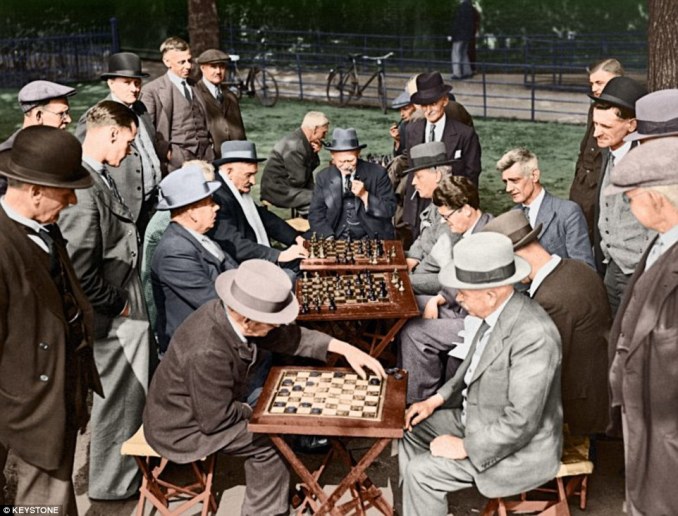
Michaels interest in chess started in 1944 aged 13 when he witnessed games being played on Clapham Common. He was fascinated by the pieces and taught himself to play, never receiving any formal coaching. He joined the Clapham Common Chess Club in 1944. (CCCC became incorporated into Battersea Chess Club some time later).
CHECK MATES: Elderly members of the Clapham Common Open Air Chess and Draughts Club, circa 1920. The club met regularly during the afternoons to play on Clapham Common in south London. Copyright : Keystone
Apart from summer events such as the above the club had a Winter Section that played matches in the London League. The club won the first division (now known as the Brian Smith Trophy) of the London League in the 1946-47 and 1947-48 seasons. Michael played his final game in the London Chess League for Richmond & Twickenham on April 14th 2010 drawing with John Hodgson, giving a sixty year span.
In his formative years he played at the Gambit Chess Café, Budge Row, Cannon Street, London, EC4N. Many strong players regularly visited the Gambit to play skittles, blitz and the frequently held lightning tournaments hosted by the proprietor Mr GH White.
Events such as these enabled Michael to develop his quick sight of the board and his flair for tactical play.
Leonard Barden added :
“Michael made his name as a young player first by his successes in the Saturday evening Gambit Guinea speed events at the Gambit Chess Café in Cannon Street which he often won ahead of master level rivals. He remained a strong speed player all his life.”
In the early 1950s Michael was persuaded by his friends Aird Thomson (who was Scottish Boys’ Champion in 1932, and 1933 ( equal-first). In 1951 he was Scottish Champion. In 1954 he moved to London. He married Susan Mary Hamilton in 1961 who went on to become Scottish Ladies’ Champion in 1965.) and oriental carpet expert Robert Pinner to join the Richmond and Twickenham Chess Club playing for the club in the London League, Surrey Trophy and National Club Championship until he retired from competitive play 2010.
Making Progress
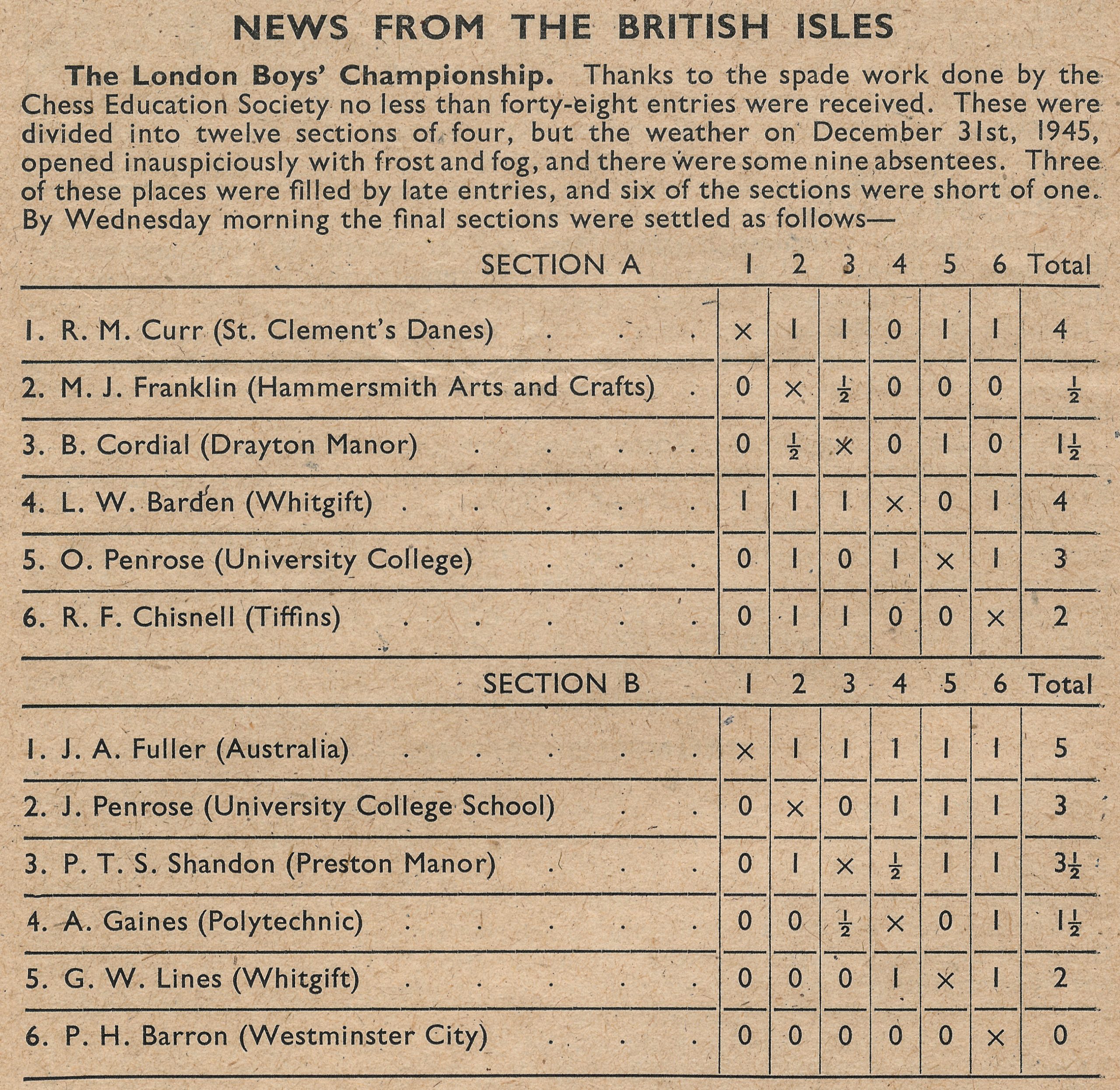
Michael’s first appearance in British Chess Magazine was in Volume LXVI (66, 1946), Number 2 (February). Page 52 contained this report of the 1945 London Boy’s Championship in which Michael reached the final A section :
British Chess Magazine, Volume LXVI (66, 1946), Number 2 (February), page 52
On leaving school Michael joined a firm of Patent Agents remaining in their employ in the accounts department for around forty years before retiring in the late 1980s. His retirement was prompted by the firm’s adoption of electronic computers. When he retired he was Chief Cashier.
On June 18th 1960 Michael’s happiest day was when he married Jean Fey. They celebrated their diamond anniversary in 2020.
To the present day Michael has maintained an aversion toward modern technology. He did, however, concede to the ownership of a mobile telephone. This was for the specific purpose of updating Jean on his days progress in any chess tournaments where he was away from home.
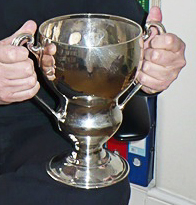
In 1946 (aged 15) Michael won the Felce Cup awarded by the Surrey County Chess Association. A result indicating rapid improvement since Michael had only started playing competitively in 1944.
The Felce Cup held by the hands of Stephen Moss in 2014
In 1951 Michael finished third in the Surrey Championships behind the winner Frank Parr and runner-up David Hooper. In 1961, 1966, 1968, 1969 and 1970 Michael won the Surrey Championship outright and made many appearences in county matches for Surrey from 1950 onwards until 2010.
Unfortunately Michael’s rapid progress was threatened by two bouts of ill health. In 1948 aged 17 Michael was diagnosed with Tuberculosis which lasted for eighteen months including a twelve month stay in the Royal National Hospital for Diseases of the Chest in Ventnor on the Isle of Wight. Aged twenty the TB returned leading to yet another twelve months illness.
Michael has suffered from ill health all of his life interrupting his chess career at various times. Fortunately the TB has not returned.
Michael won the National Chess Centre Championship in 1953 and 1955 being runner-up in 1954. The venue was Hill’s Restaurant, 158 Bishopsgate, London, EC2 opposite Liverpool Street Station since the original John Lewis department store venue was bombed in 1940.
The British Chess Federation first published a National Grading list in 1953 (using the Richard Clarke system). In the 1954 list MF appeared with a grade of 2A (225-232) and from then on with a grade of either 2A or 2B. In 1964 a numeric system had him at 225 ranking Michael 4th in England behind Penrose 244, Kottnauer 238 and Clarke 231.
Michael played many times in the annual Battle of Britain Tournament organised by Squadron Leader David Pritchard and his committee. He won it four times : 1959, 1960, 1961 and 1962.
The Ilford Whitsun Congress
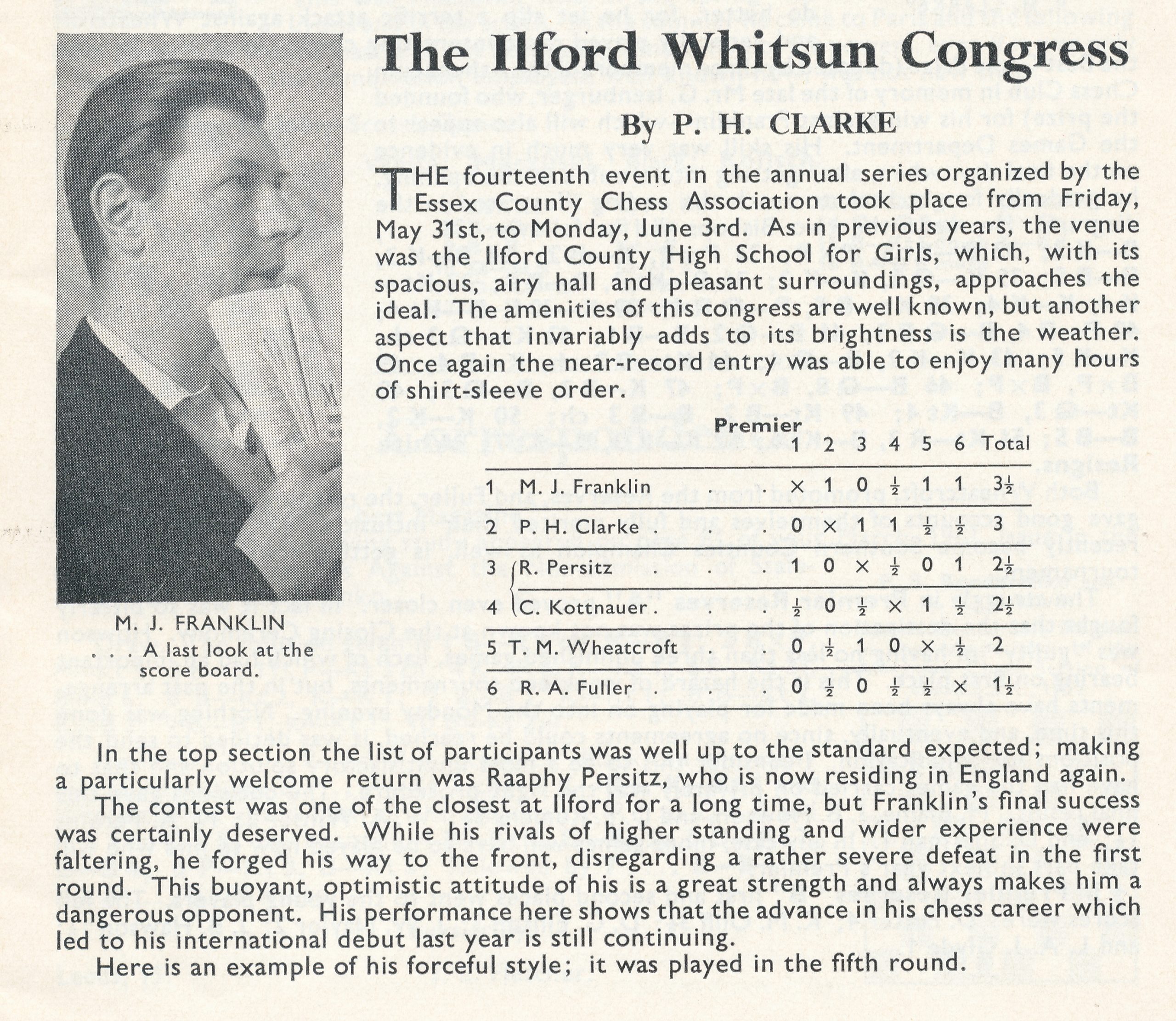
The Ilford Whitsun Congress was a regular part of Michael’s season throughout the sixties. He won the Premier Reserves in 1961 ahead of Hilton, Hindle, Howson, Sales and Blaine and was runner-up to Kottnauer in 1962. In 1963 he went one step better by winning the Premier :
A report of Mike Franklin’s success at the 1963 Ilford Whitsun Congress by Peter Clarke. Source : British Chess Magazine, Volume LXXXIII, Number 7 (July), page 193
and here is the fifth round game :
In his tournament report PH Clarke wrote :
This buoyant, optimistic attitude of his is a great strength and always makes him a dangerous opponent.
Away from Home : International Progress
1964 saw selection by the BCF to play in the Tel Aviv Olympiad :
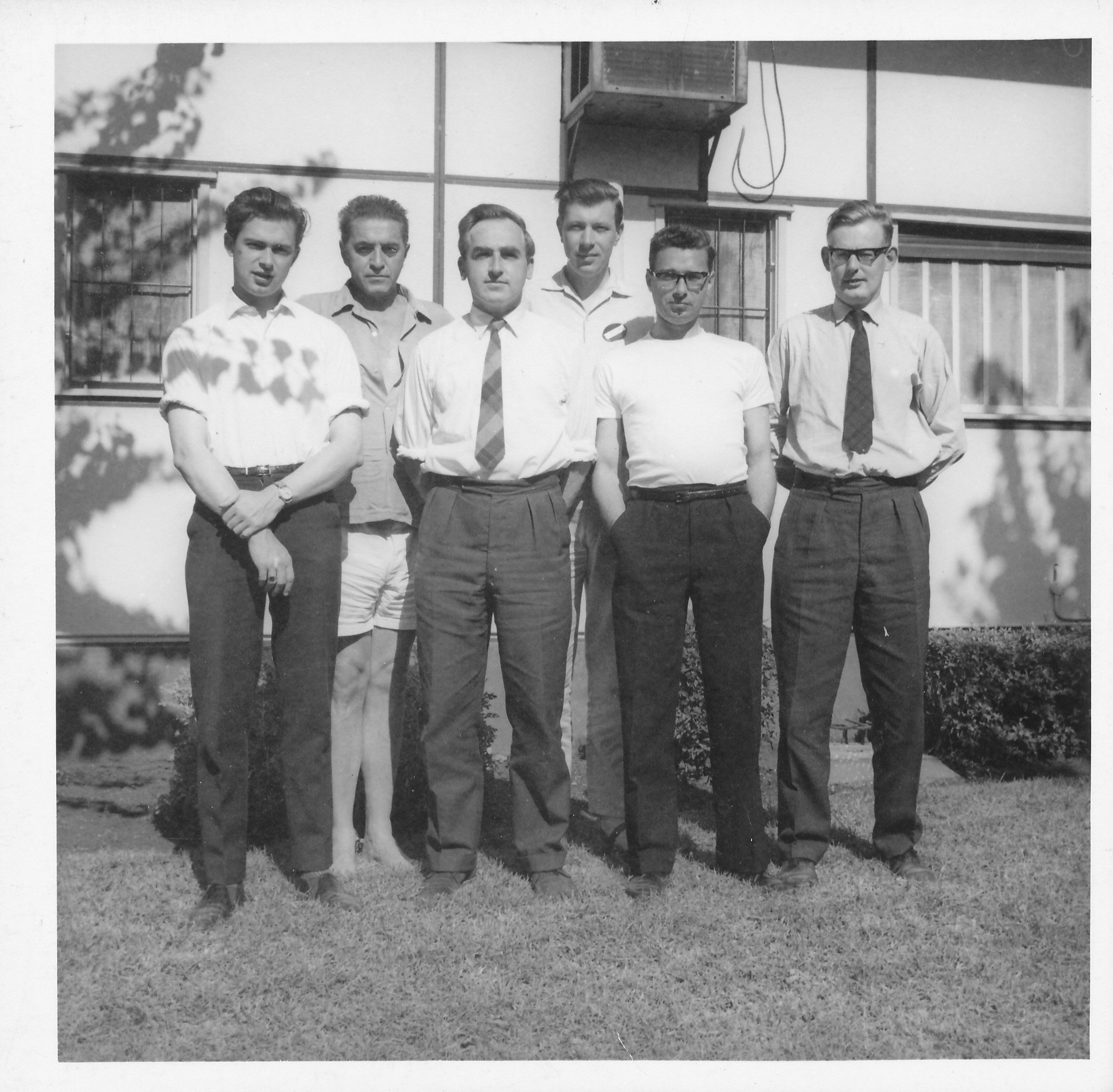
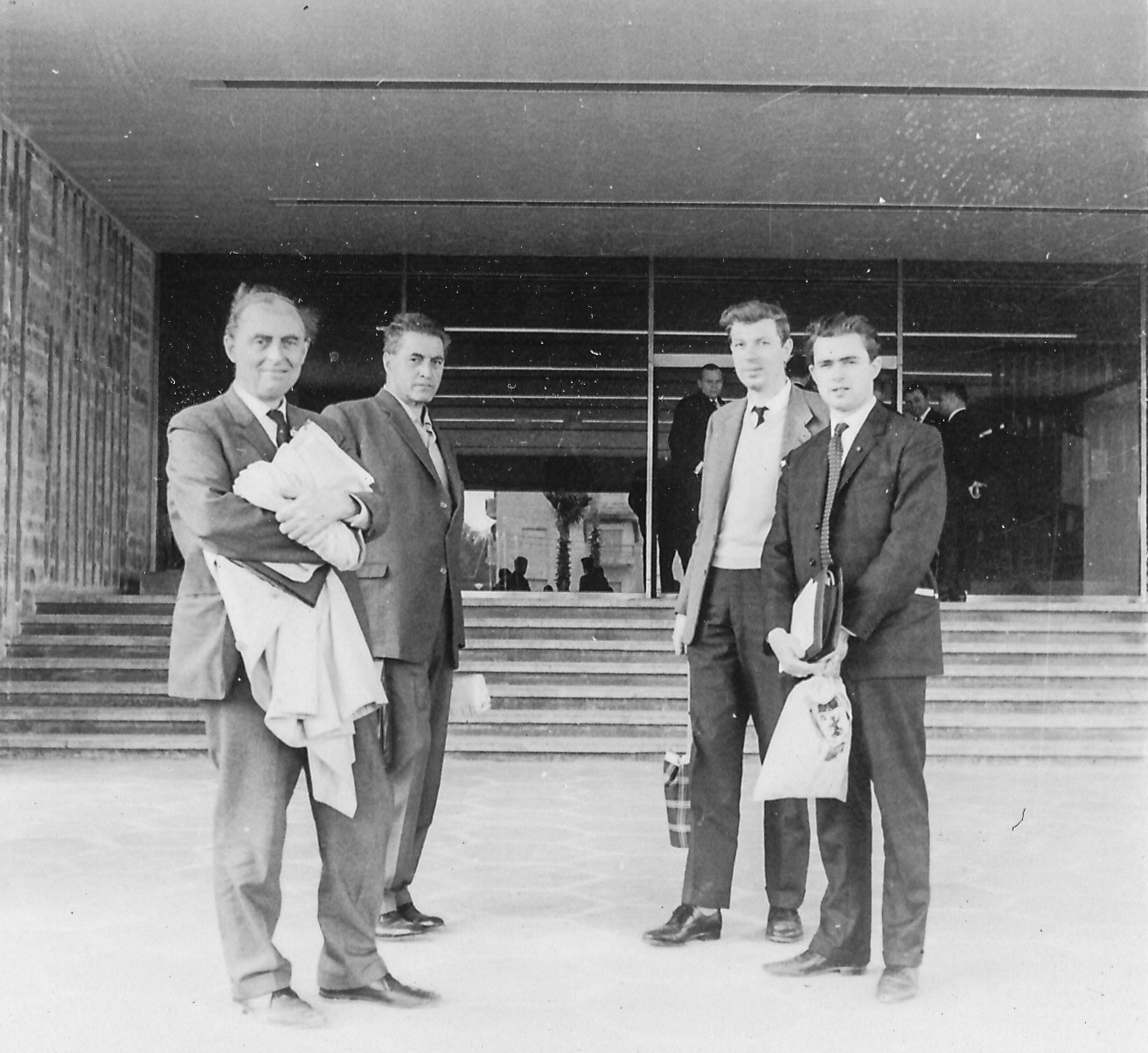
The 1964 England Olympiad (Tel Aviv) Team : Owen Hindle, Čeněk Kottnauer, Peter Clarke, Michael Franklin, Norman Littlewood & Michael Haygarth
and scored a creditable 4/6. This was followed in 1965 with 3/5 in Clare Benedict tournament held in Berlin.
He played in the annual Anglo-Dutch match on no less than six occasions in 1962, 1963, 1964, 1965, 1968 and finally in 1969. His aggregate score was an impressive 8/12.
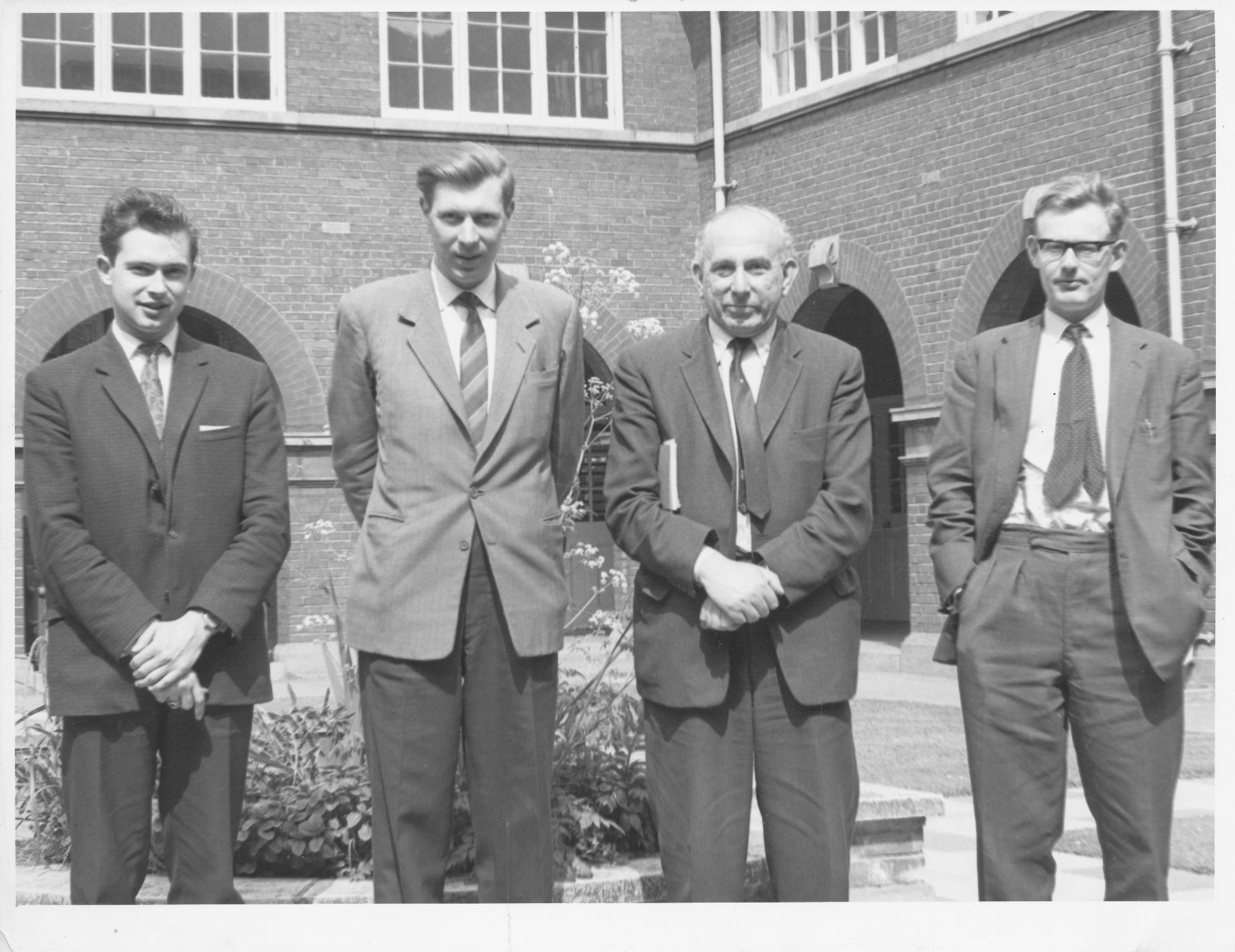
Hugh Alexander, Čeněk Kottnauer, Michael Franklin and Owen Hindle
On the national scene Michael repeated his 1963 victory at the 1969 Ilford Premier with a clear first place : Franklin 4; RG Wade and D Wright 3; JB Howson 2.5; BH Wood 2; PH Clarke 0.5.
In 1970 Michael won the London Championship which was also known as the Budget Cup which had last been held in 1956 . He followed this in 1972 by rightly earning the (now defunct) title of British Master.
Michael’s final appearance for England was in 1971 in the Cheltenham based Anglo-German match with a somewhat disappointing 0.5/2 against Juergen Dueball.
Owen Hindle, Michael Franklin, Harry Golombek and Michael Haygarth
Michael played board two for London in a Telex match versus Belgrade playing Marjanovic. The game was drawn.
Michael Franklin playing board two in the London – Belgrade Telex Match on April 3rd, 1976 from the St. James Hotel, Buckingham Gate. Sourced from BCM, Volume XCVI (96), Number 5, page 192. Photographer probably Freddy Reilly.
The Ultimate Prize : The Aaronson Masters
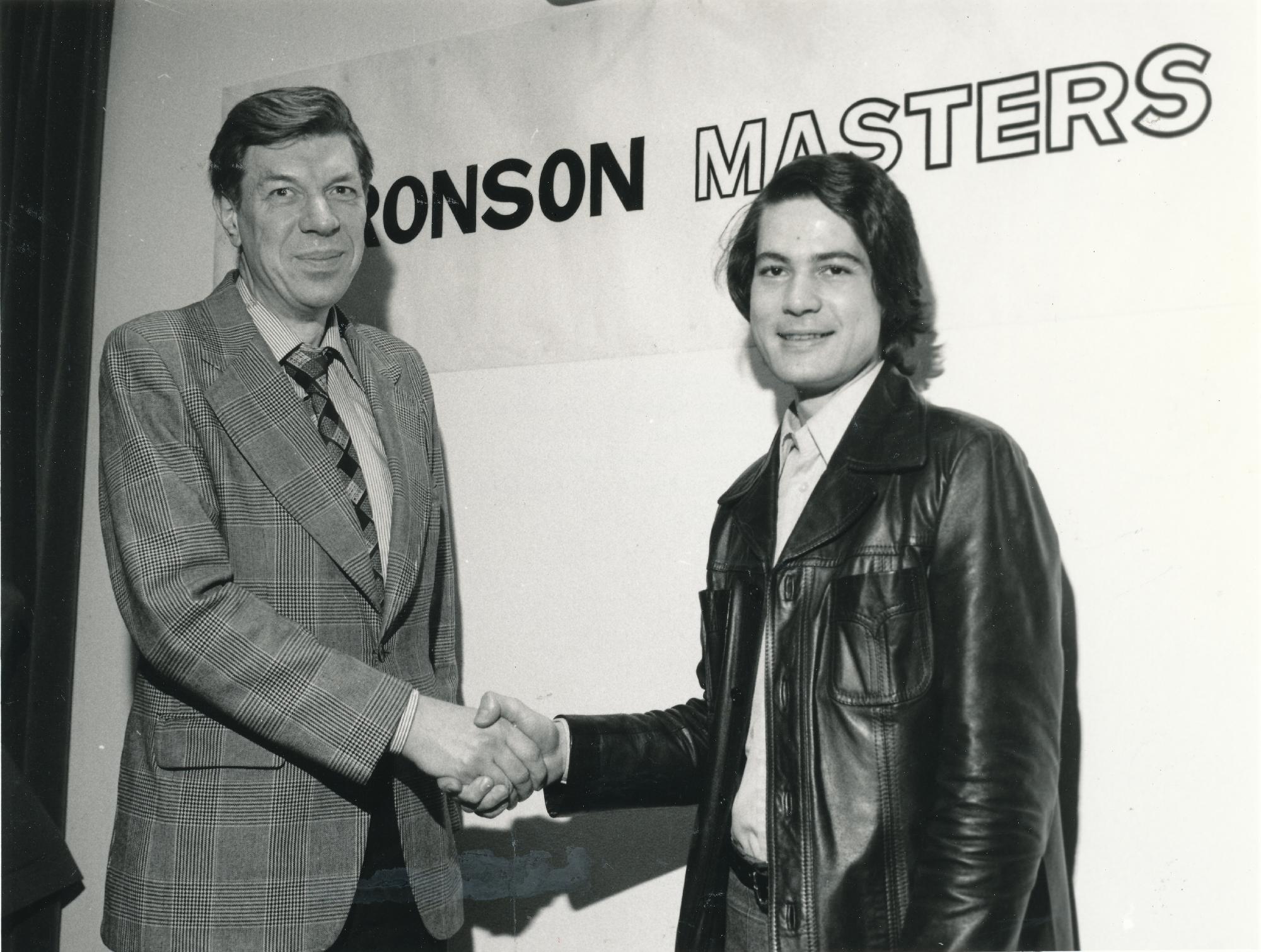
The Aaronson Masters at *Imperial Hotel, Russell Square, Bloomsbury, London, 1978 brought his best individual success at the age of 47, sharing first place with IM Aldo Haik of France and to boot, earning an IM norm.
(*Venue location thanks to Ken Norman)
Joint winners of the 1978 Aaronson Masters : Michael Franklin and IM Aldo Haik
Michael scored an undefeated 7.5/10 and finished ahead of Short, Speelman, Nunn, Hartston, Mestel, Webb, Basman, Botterill and numerous other illustrious players. Michael remarked of his lifetime best result that it was
just one of those occasions when everything went right!
But he scored 3.5/5 against the IMs, was alert to every opportunity, and the games show he owed little to luck.
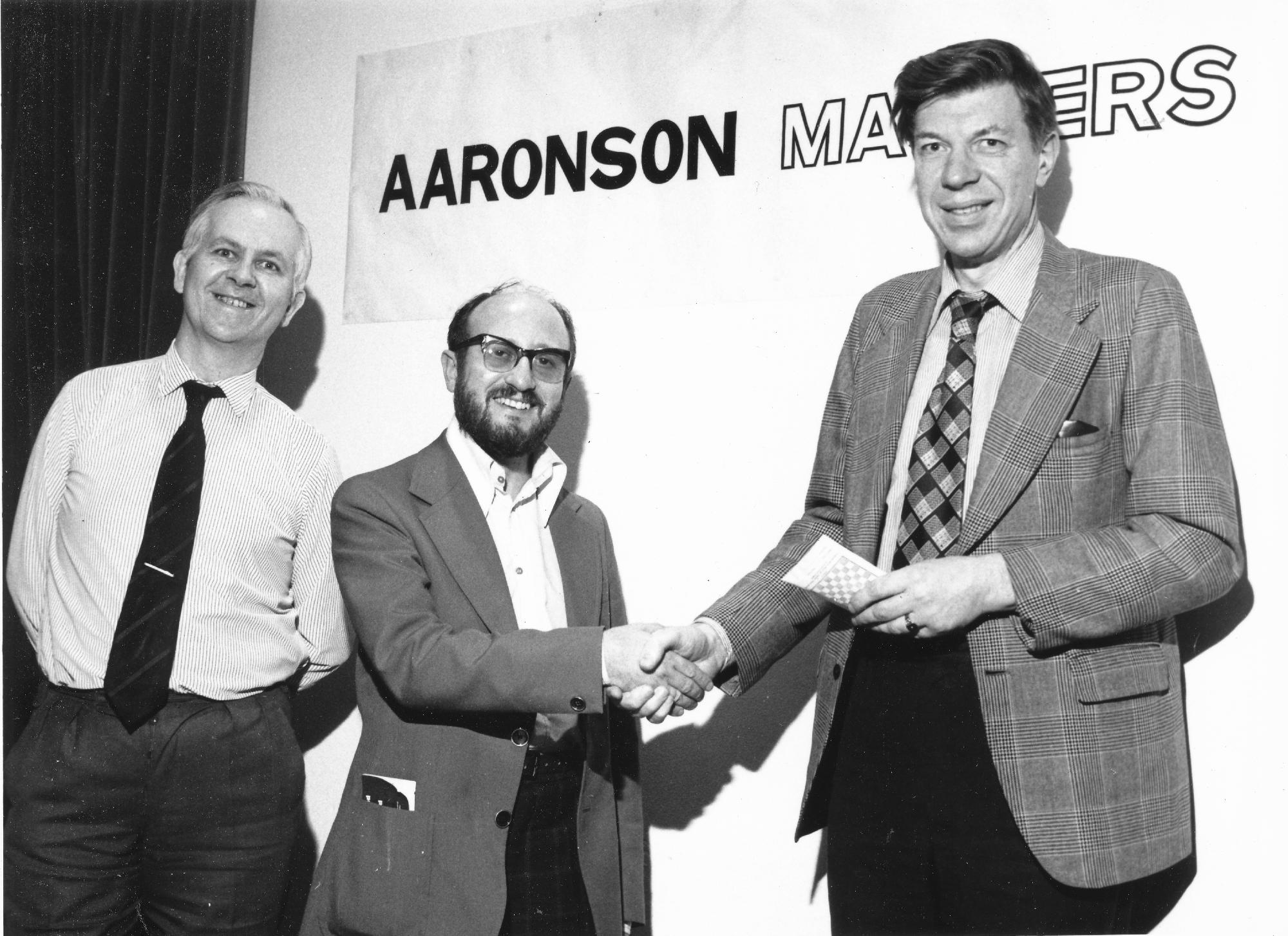
Leonard Barden, Stewart Reuben and Michael Franklin at the 1978 Aaronson Masters
Like many others Michael made appearences in Lloyds Bank events of 1977, 1978, 1984, 1989, 1991, 1993 and 1994.
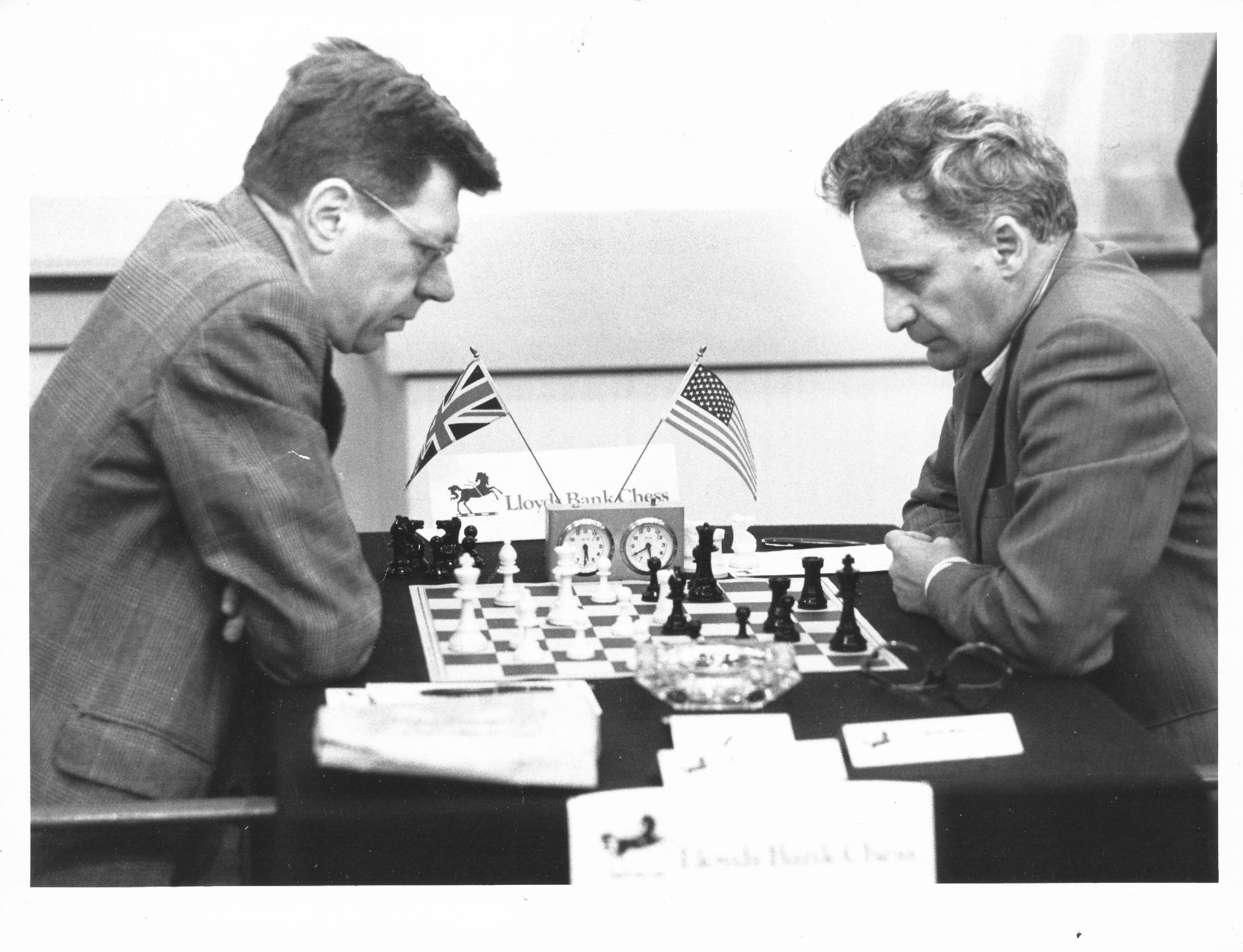
Michael Franklin (left) at the 1978 Lloyds Bank Masters playing IGM Leonid ShamkovichMichael and friends during the 1978 Lloyds Bank Masters
The Hastings Years
Michael first played at Hastings in 1964 when he was invited to play in the Premier Tournament. The tournament was won by Mikhail Tal and Michael finished in last place.
Undaunted he returned to Hastings in 1968 to play in the Challengers tournament. One of the attractions of playing in the Challengers was that the winner received a place the following years Premier. Frustratingly Michael finished second three years in a row! In 1968 the Challengers was won by Danny Wright, in 1969 by Martyn Corden and in 1970 by Peter Markland. Finally, in 1971 his patience was rewarded and he won the Challengers and qualified to the following years Premier.
The 47th Hastings Premier of 1971-72 had been changed from the traditional 10 player all-play-all to a 16 player tournament. Also, having obtained sponsorship from various organisations the committee were able to invite some of the top names of the day. The sponsors were:
So, the entry included Karpov, Korchnoi, Andersson, Najdorf, Mecking, Gligoric, Unzicker and Robert Byrne to name but a few. This was undoubtedly the strongest Hastings Premier since World War Two and possibly the strongest Hastings Tournament since 1895.
Michael started well with a draw against the Rumanian GM Ciocaltea followed by a draw in with the Brazilian prodigy Mecking. In round three he surprised everyone by beating Ray Keene. With 2/3 things were looking promising. However, after this bright start Michael only managed a draw against Unzicker and a draw with Hartston finishing in a disappointing last place with a score of 3/15.
In the tournament report Peter Clarke opined
Franklin suffered the usual fate of the gifted amateur in a professional field of simply not being accustomed to this kind of chess.
Despite this Michael continued to play in the Hastings Challengers. He played in nineteen out of the next twenty-five years! He came close to winning the tournament in 1982: he was leading the tournament with a score of 7/8 when he was informed that Jean’s Father had passed away. Having drawn his ninth round game and needing only a draw in the last round to ensure at least a tie for first place he withdrew from the tournament and immediately left for home.
The Weekend Scene
Like all players with a full time job Michael had to play most of his chess at the weekend so the explosion of weekends tournaments in the early 1970’s gave him ample opportunities. His habit of playing quickly was ideally suited to the fast time limits of the weekend tournament. During the 1970 and 1980’s he was very successful. He won numerous events and was more often than not in the prize list.
FM Michael Franklin, Photo by Cathy Rogers
In later years he restricted himself to London based tournaments and those in the West Country. His regular tournaments being Exeter, Torquay and old favourite, Frome. Michael at the age of 78 shared first place at Frome 2009. Frome 2010 was his farewell appearance.
FM Michael Franklin
Michael played for a number of clubs viz : Richmond & Twickenham, Coulsdon CF, Surrey CCA, 4NCL Richmond, 4NCL Bristol and Richards Butler to name but a few.
Finally, in 1980, Michael was awarded the FIDE Master title and achieved his highest rating (in the Elo era) of 2345 in January 1979. It is most likely that his highest ever rating would have been more like 2450.
FM Michael Franklin vs Paul Helbig
Appropriately enough Michael was the inaugural winner of the BCF/ECF Senior Prix in 2000 and won it again in 2002 and 2003. The event last ran in 2006.
When Surrey won the counties championship a few years back the team took the trophy around to Michael’s home in Norbury, such was their regard for his contributions.
The London System
Any currently active club player cannot have missed the explosive rise to prominence of the system for White he developed :
The London System and Accelerated London System has acquired a huge cohort of followers in recent times probably not realising the debt they (and many authors, book and DVD publishers!) owe to Michael. If only he could have earnt a royalty every time it was played!
Also Michael had notable success as Black with the O’Kelly Sicilian 1.e4 c5 2.Nf3 a6.
Life Outside of Chess
Michael had many interests apart from Chess. He was for many years a member of the Surrey County Cricket Club. After he retired he would arrange to meet fellow Surrey Member Frank Parr at the Oval and after lunch in the Pavilion they would spend the day enjoying the Cricket. Tennis was another sport that Michael followed. Michael was also interested in horseracing. Several players were surprised when visiting one of the racetracks around London to find Michael also attending the race meeting.
Michael was the typical “natural” player. He never studied the game and his only sources of opening information were the British Chess Magazine and the chess columns in The Times and the Guardian. He never kept the scores of his games. Once the game was finished it was time to move on. One of Michael’s greatest strengths was his optimistic attitude at the chessboard. No matter how bad the position he was confident of ultimate success.
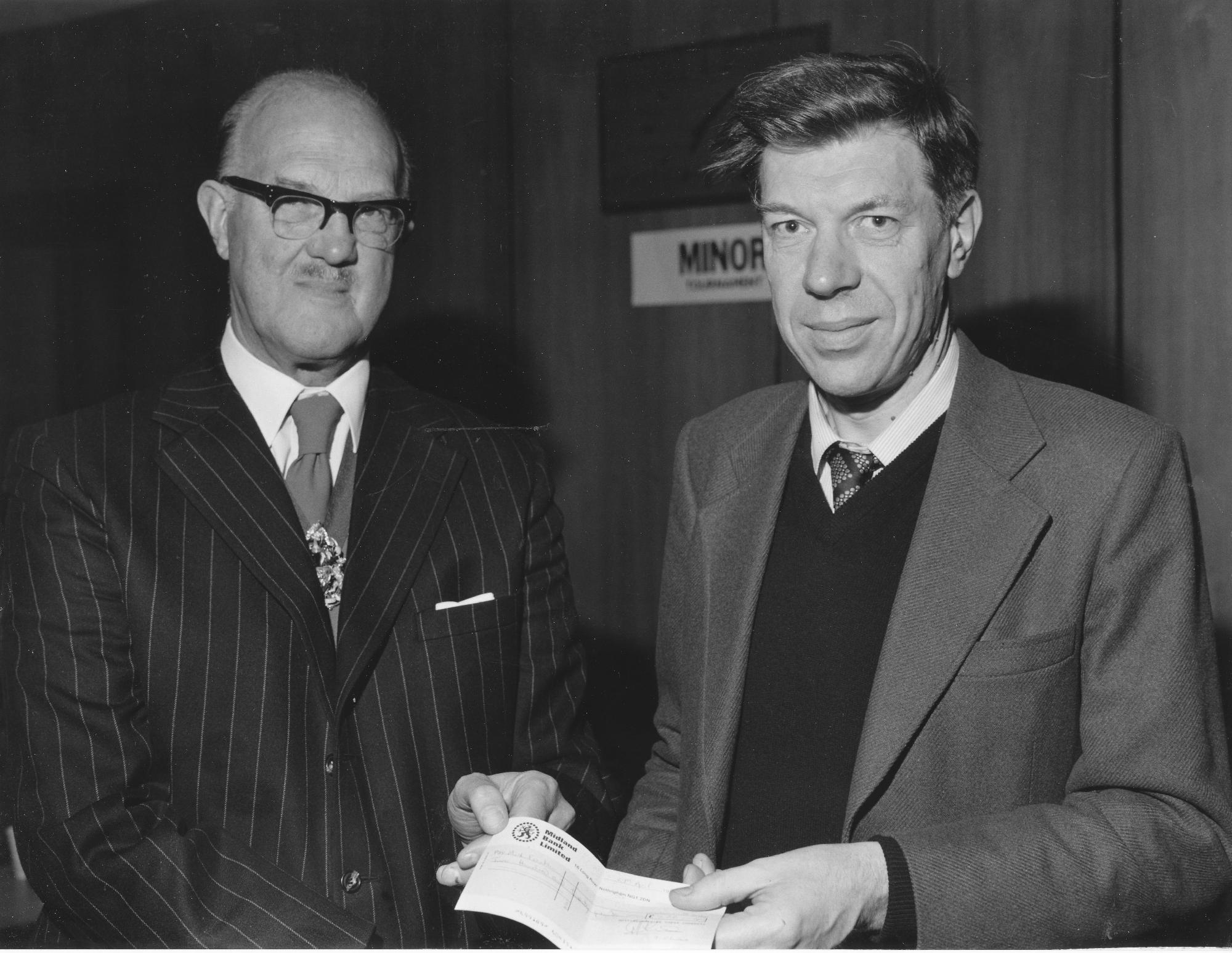
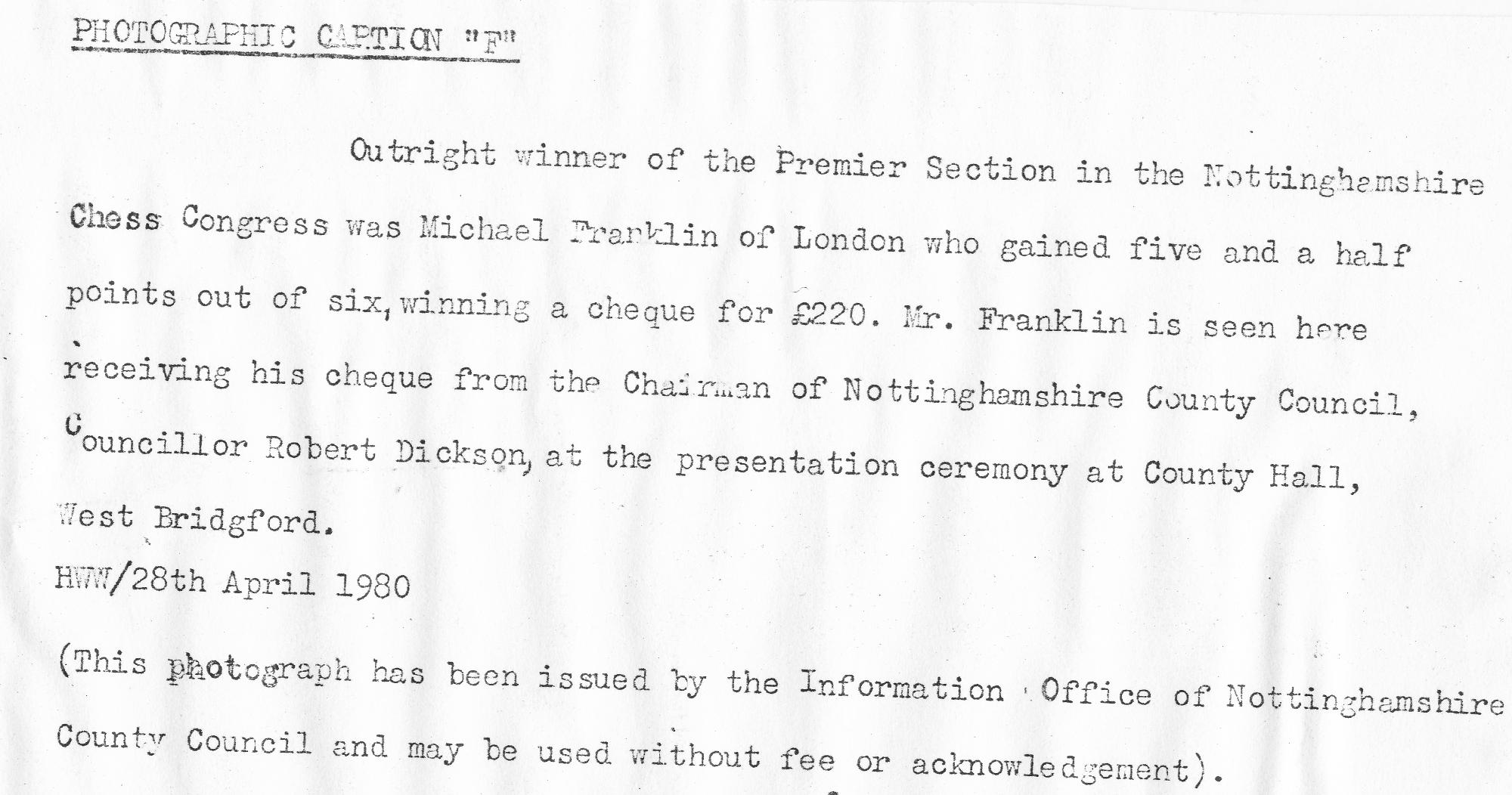
Michael Franklin receives £220 from Councillor Robert Dickson at the 1980 Nottinghamshire CongressCaption for above photograph
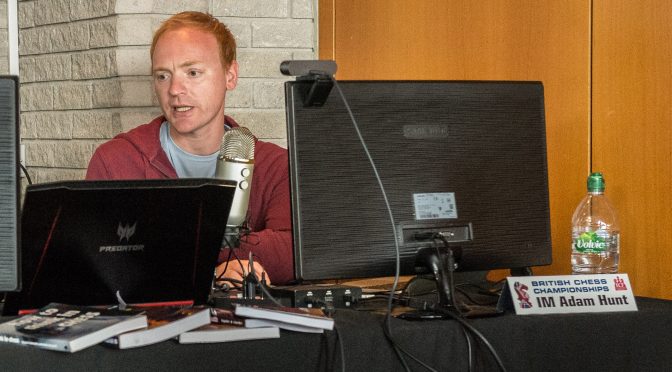
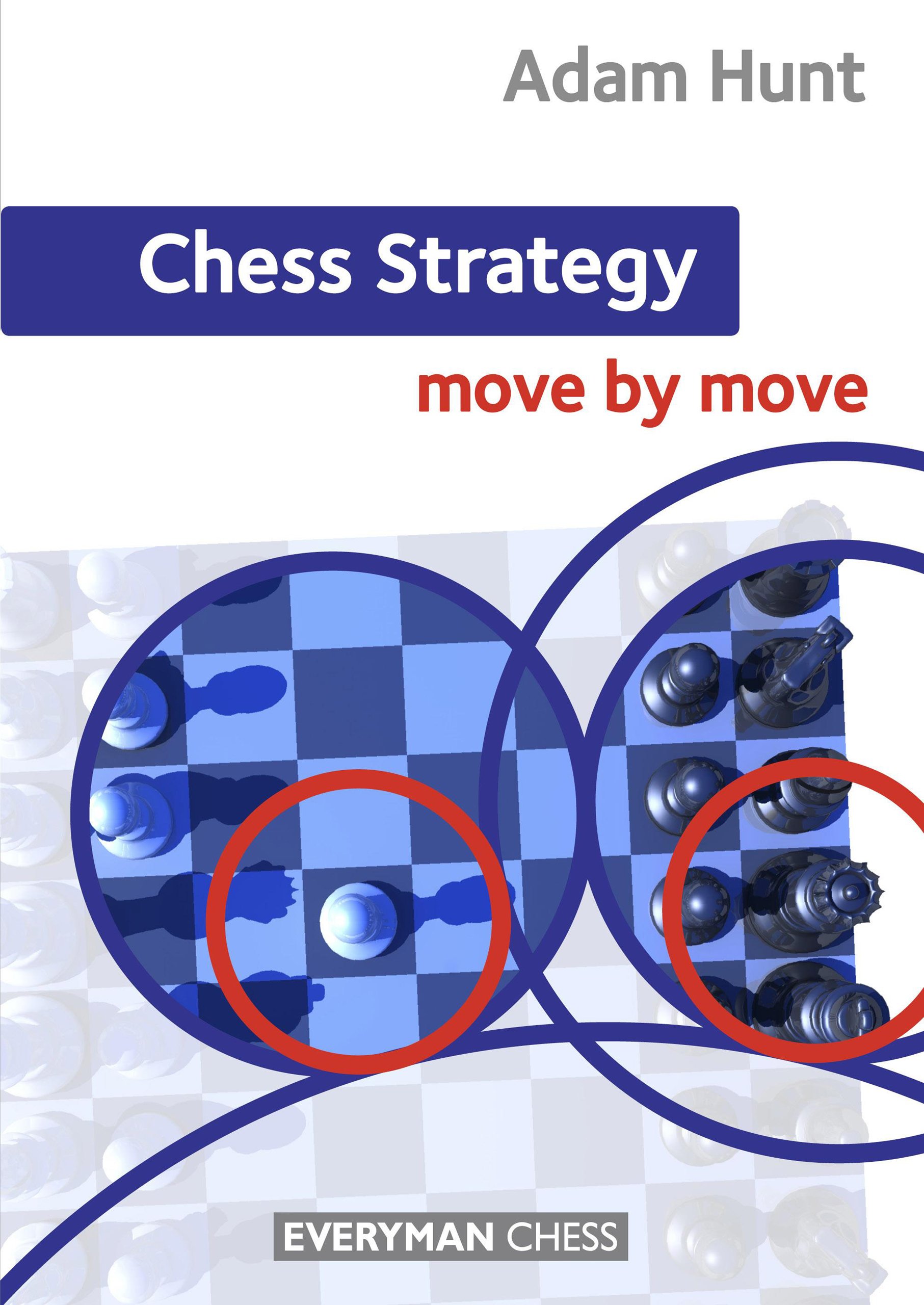
We remember IM Adam Hunt who passed away on Tuesday, December 3rd 2024 following a nine year battle with cancer.
Adam Ceiriog Hunt was born on Tuesday, October 21st, 1980 in Oxford and his mother’s maiden name was Williams. The UK Number one single was “Woman in Love” by Barbara Streisand. Adam shares his birthday with Kim Kardashian.
Adam attended The Cherwell School and The University of Sussex to study general biology.
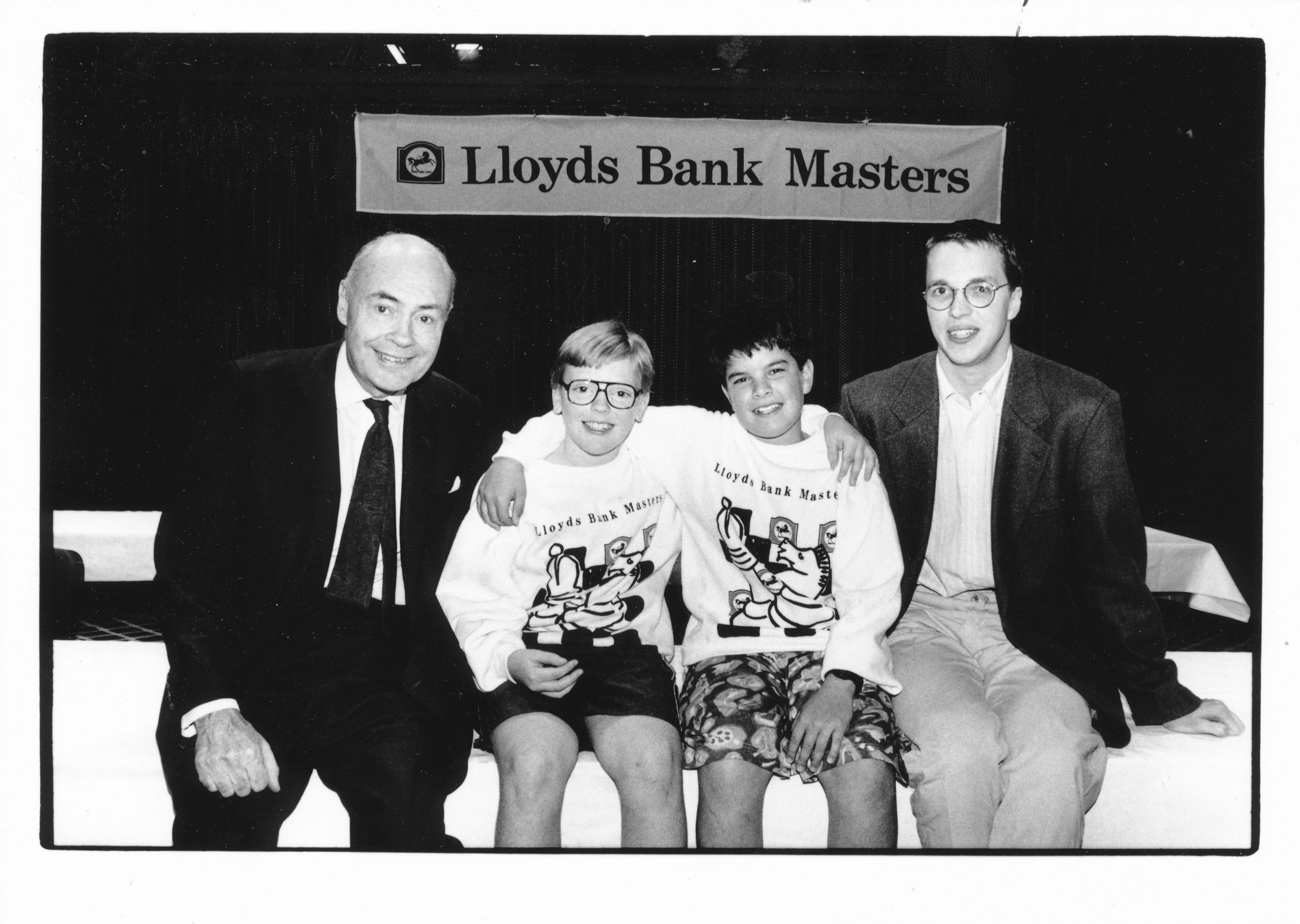
Jeremy Morse, Adam Hunt (12), Nick Pert (11) and Nigel Short at the Lloyds Bank Masters
Adam became an International Master in 2001 and then a FIDE Trainer in 2016. According to Felice and Megabase 2020 his attained his peak FIDE rating of 2466 in January 2008 at the age of 28.
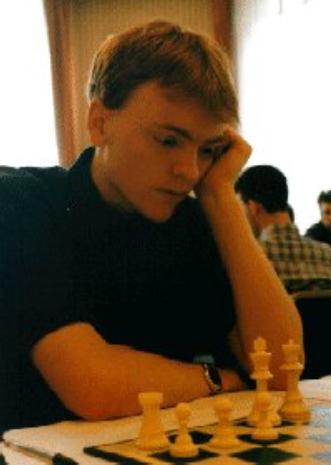
Adam Hunt in 1998 Cathy Rogers
In 2004 Adam was living in Headington, Oxfordshire and in 2007 he moved to Ipswich in Suffolk and was married in 2019. Recently, Adam and his partner became parents to Henry.
As a junior (and together with Harriet) Adam first played for Cowley Chess Club.
Most recently Adam has played for 4NCL Blackthorne Russia, prior to that Bettson.com, Midlands Monarchs and Perceptron Youth with Witney being his original team.
He is Director of Chess at Woodbridge School in Suffolk and is the brother of IM Harriet Hunt
With the white pieces is (almost exclusively) an e4 player playing the main line of Ruy Lopez (8.c3) and favouring the Fischer-Sozin against the Najdorf.
As the second player Adam plays the Sicilian Najdorf and a 50:50 mixture of the King’s Indian and Grünfeld Defences.
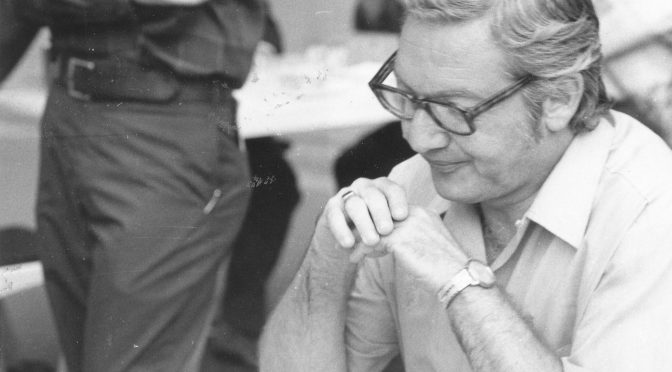
He was British Correspondence Champion in 1972 and awarded the IMC title in 1981.
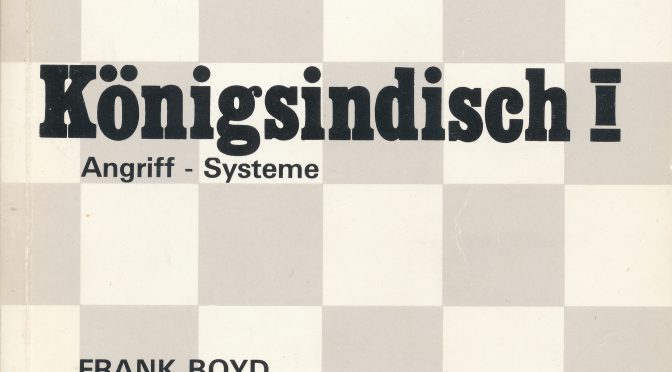
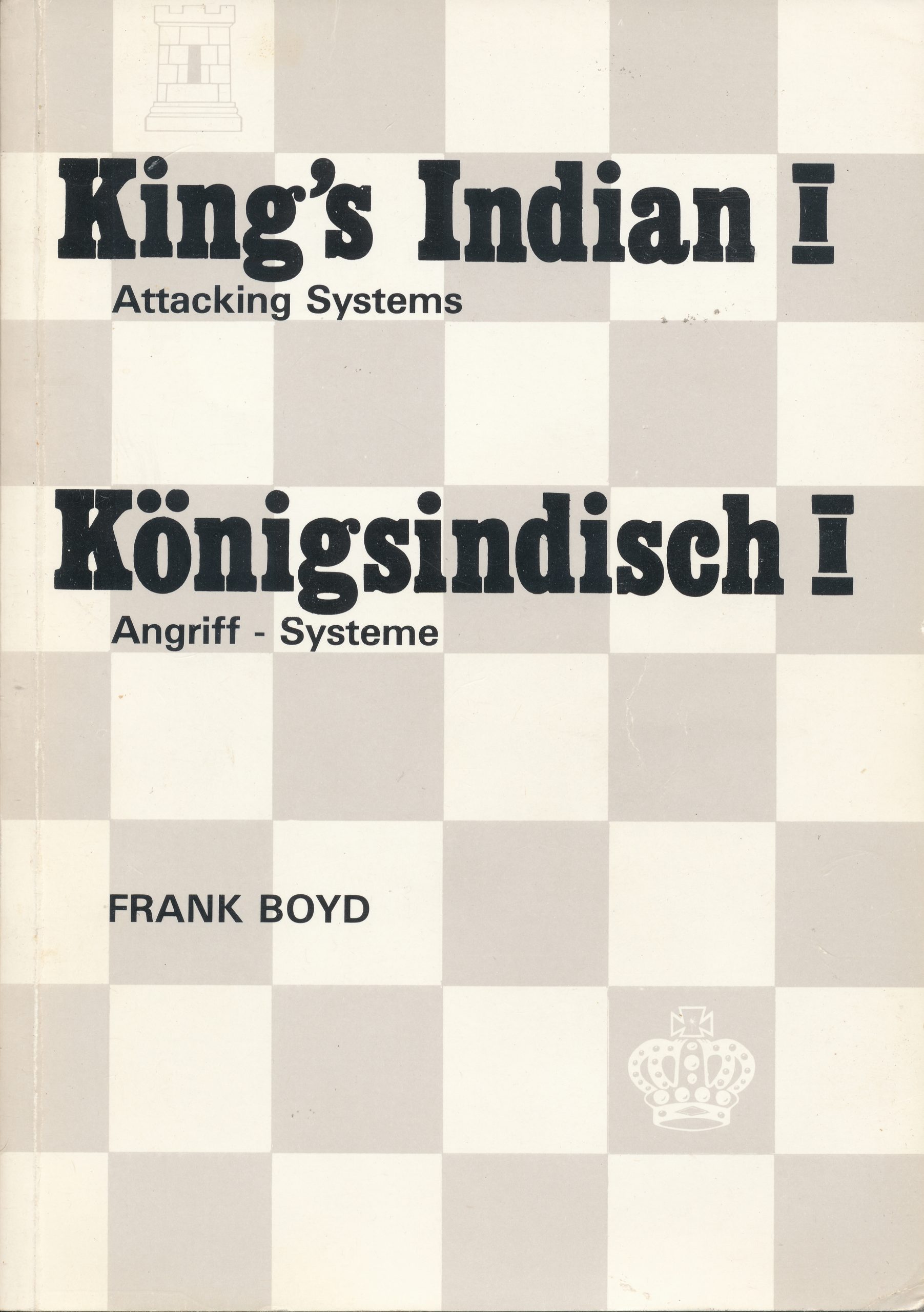
According to Kings Indian I Attacking Systems:
“British Correspondence Champions 1971/72. Placed second in an ICCF master tourney 1973/76. A member of the British team in the 9th Olympiad 1977/80. Gained the IMC title in the European Team Championship 1978/81.”
According to Chessbase Correspondence Database 2020 Frank achieved his highest (ICCF) rating in January 1991 of 2410.
Incomplete crosstable from the European Championship, 1973.
As White Frank would play the Queen’s Gambit via a 1.Nf3 move order. He did not play 1.e4
As the second player he would defend the closed Ruy Lopez and the Nimzo-Indian Defence.
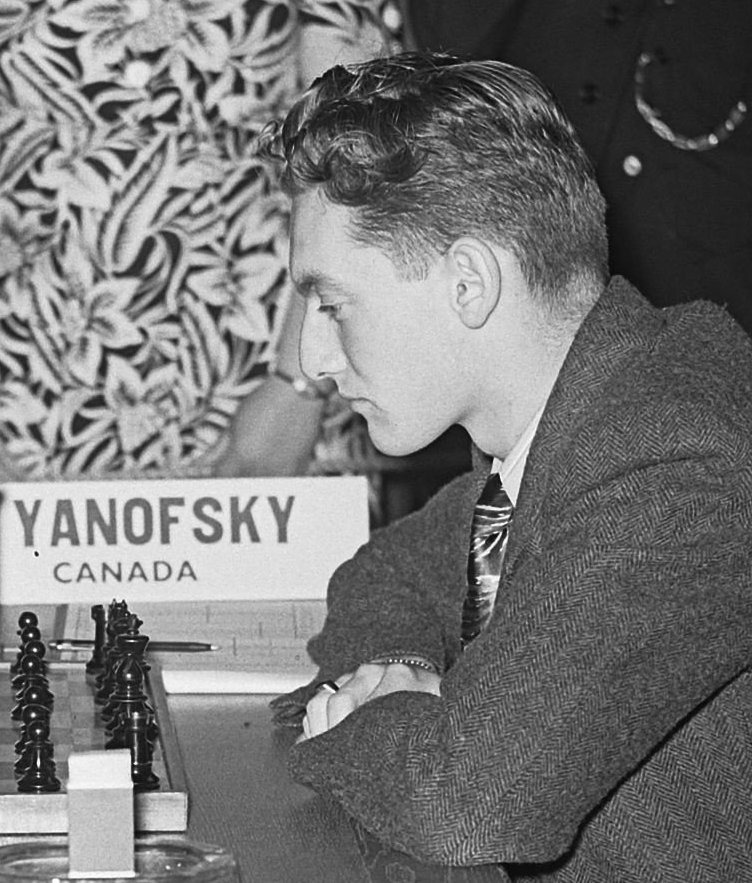
BCN remembers GM Daniel Yanofsky OC QC (25-iii-1925 05-iii-2000)
From The Encyclopedia of Chess (Robert Hale, 1970 & 1976)by Anne Sunnucks:
YANOFSKY, Daniel Abraham (1925- )
International Grandmaster (1964), Canadian Champion in 1941, 1943, 1945, 1947,1953, 1959, 1963 and 1965, British Champion in 1953. Abe Yanofsky, was born in Brody, Poland, on 26th March 1925. His parents were Russian and had left their native country a few months earlier on their way to Canada, to which they were emigrating. They eventually arrived at their destination when Yanofsky was 8 months old.
When he was 8 Yanofsky saw a chess set in a shop window and persuaded his father to teach him the game. He joined Winnipeg Jewish Chess Club and when he was 11 his obvious talent was noticed by Bernard Freedman, Treasurer of the Canadian Chess Federation, who was visiting Winnipeg. Freedman was responsible for Yanofsky playing in his first tournament a few months later in Toronto. Yanofsky arrived in Toronto determined to get as much chess as possible and put his name down for three tournaments: the Junior Boys’ Championship, which was to be played in the morning; the Senior Boys’ Championship, which was to be played in the afternoon; and the Major Championship, which was to be played in the evening. He withdrew from the Junior Boys’ Championship after 1 round at the request of the organisers, who realised that he was far too strong for that event, and went on to win both the other events.
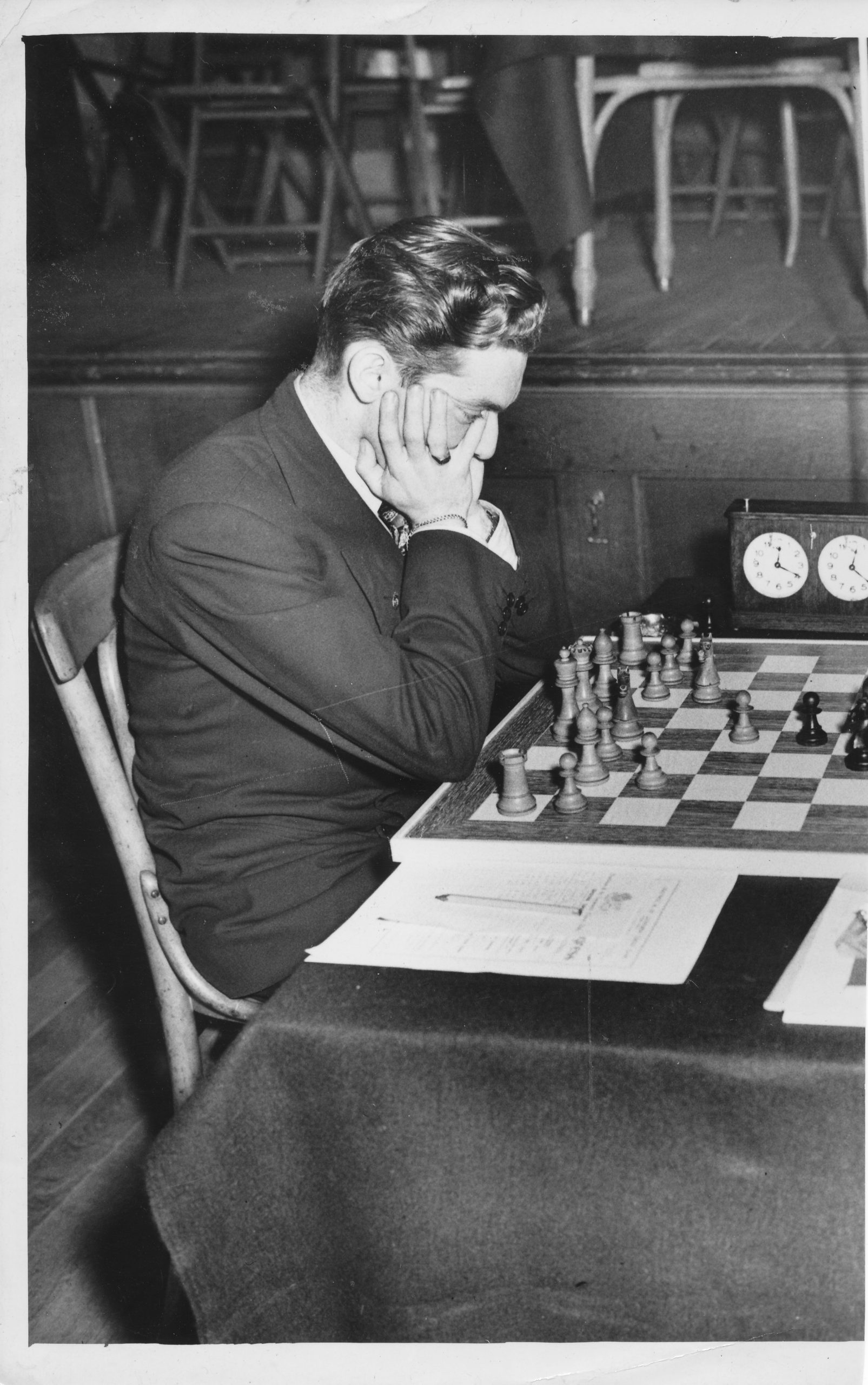
Daniel Yanofsky playing Max Euwe in 1946 at the Staunton Memorial, Groningen
This was the first of a number of successes which to his selection as a member of the Canadian team to play in the Chess Olympiad at Buenos Aires in 1939, where on 2nd board he scored 84.4 per cent and attracted the notice of the World Champion, Alekhine, who spent many hours going over Yanofsky’s games with him.
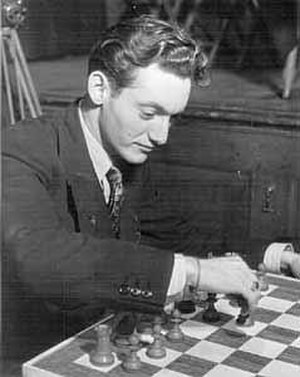
Daniel Yanofsky, 1946
On his return to Canada Yanofsky had to divide his time between earning a living, completing his education and playing chess. Before joining the Royal Canadian Naval Volunteer Reserve in 1945, Yanofsky graduated from the University of Manitoba with a Bachelor of Science degree, and, apart from his victories in the Canadian Championship, won lst prize at Ventnor City 1942 and the United States Open Championship the same year.
After his discharge from the Navy Yanofsky played at Groningen 1946 and came 14th out of 20. However his score included a win against Botvinnik and a 50 per cent score against the five top Russian players. After Groningen he ‘played in Switzerland, Spain, England, Denmark and Iceland before returning to Canada. His main successes were 2nd
at Barcelona 1946; lst at Reykjavik 1947 and 2nd at Copenhagen 1947.
Back in Canada, Yanofsky enrolled at Manitoba Law School and played little chess until he had graduated in 1951, having won the University Gold Medal in Law and five scholarships. He decided to do a post-graduate course in Law at Oxford University and left for England later that year. In 1952 he was awarded the Viscount Bennett Scholarship as the most outstanding law student in Canada by the Canadian Bar Association.
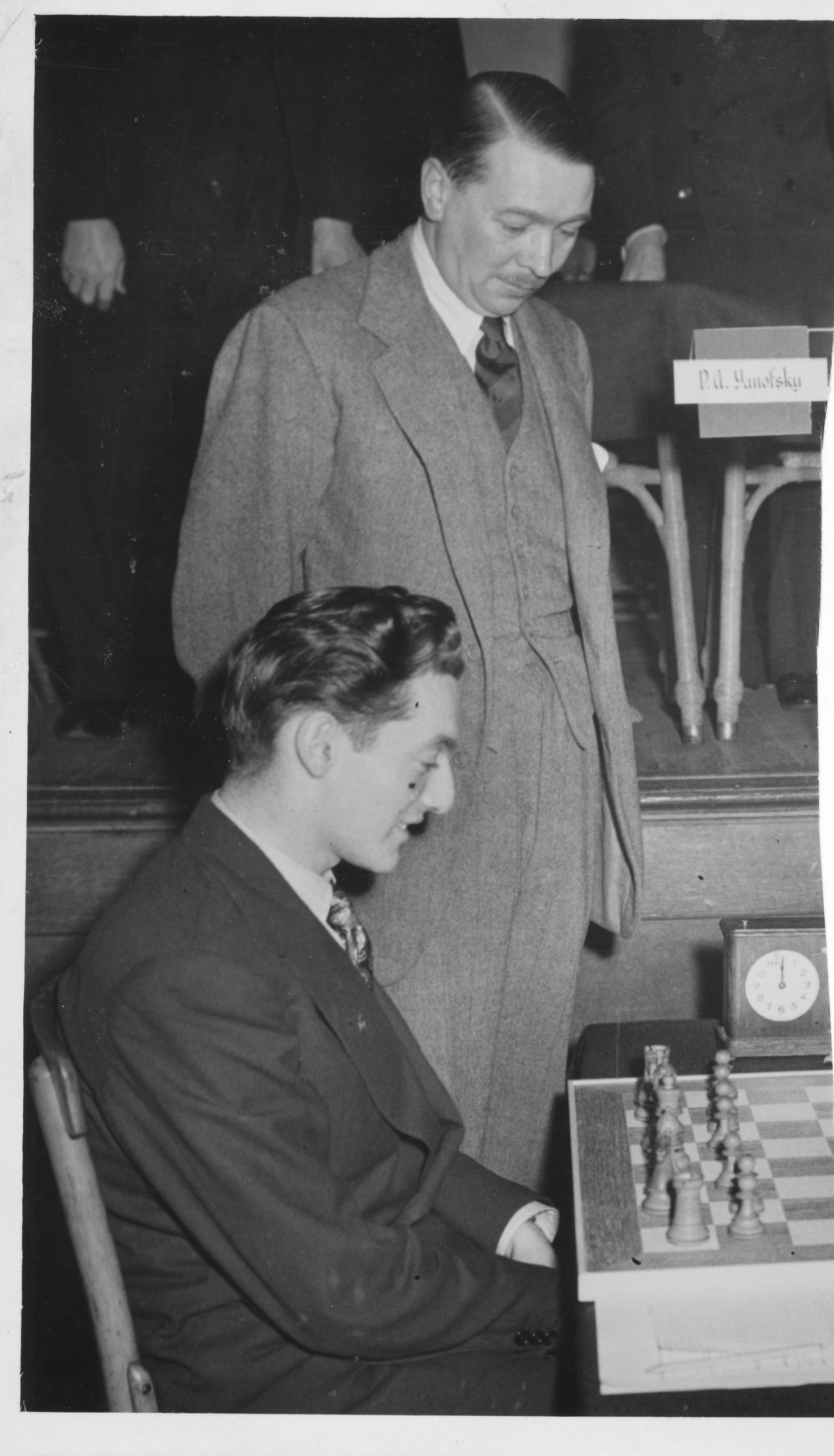
From the 1952 Ilford Congress (30 May – 2 June) and originally published in BCM, July 1952, page 187. (l-r) : Harold Israel, Alan Phillips, Bob Wade, Otto Friedman, Abe Yanofsky, Alfred William Bowen and Harold Meek. Thanks to John Saunders and Leonard Barden
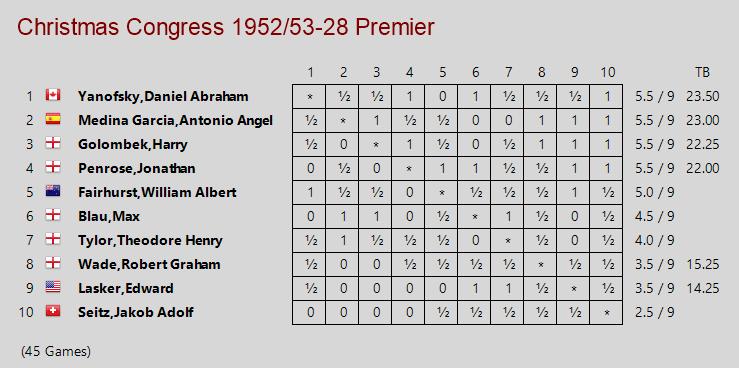
While in England Yanofsky added to his chess reputation by winning the British Championship in 1953 and tying for 1st prize at Hastings in the same year.
Yanofsky with Edward Lasker at the 1952/3 Hastings Congress, They are studying a (then) new line of the Marshall Ruy Lopez pioneered by Oxford don Sir Theodore Tylor.
Since then he has played regularly for Canada in Chess Olympiads since 1954.
Daniel Yanofsky
From The Oxford Companion to Chess (OUP, 1984) by Hooper and Whyld:
YANOFSKY, DANIEL ABRAHAM (1925- ), Canadian player. International Grandmaster (1964), international Arbiter (1977). He was born in Poland of Russian parents who took him to Canada when he was eight months old; his childhood was spent in Winnipeg where he learned the moves of the game when he was 8 and improved so rapidly that at the age of 14 he was selected to
represent Canada in the Buenos Aires Olympiad 1939; In this event he made the highest percentage score at second board (+12=3 — 1), In 1941 he came equal first with H. Steiner in the US Open Championship, won the title on tie break, and also won the Canadian Championship (for the first of eight times). After the Second World War Yanofsky played in several tournaments including the Saltsjöbaden interzonal 1948, in which he shared eleventh place.
Daniel Yanofsky
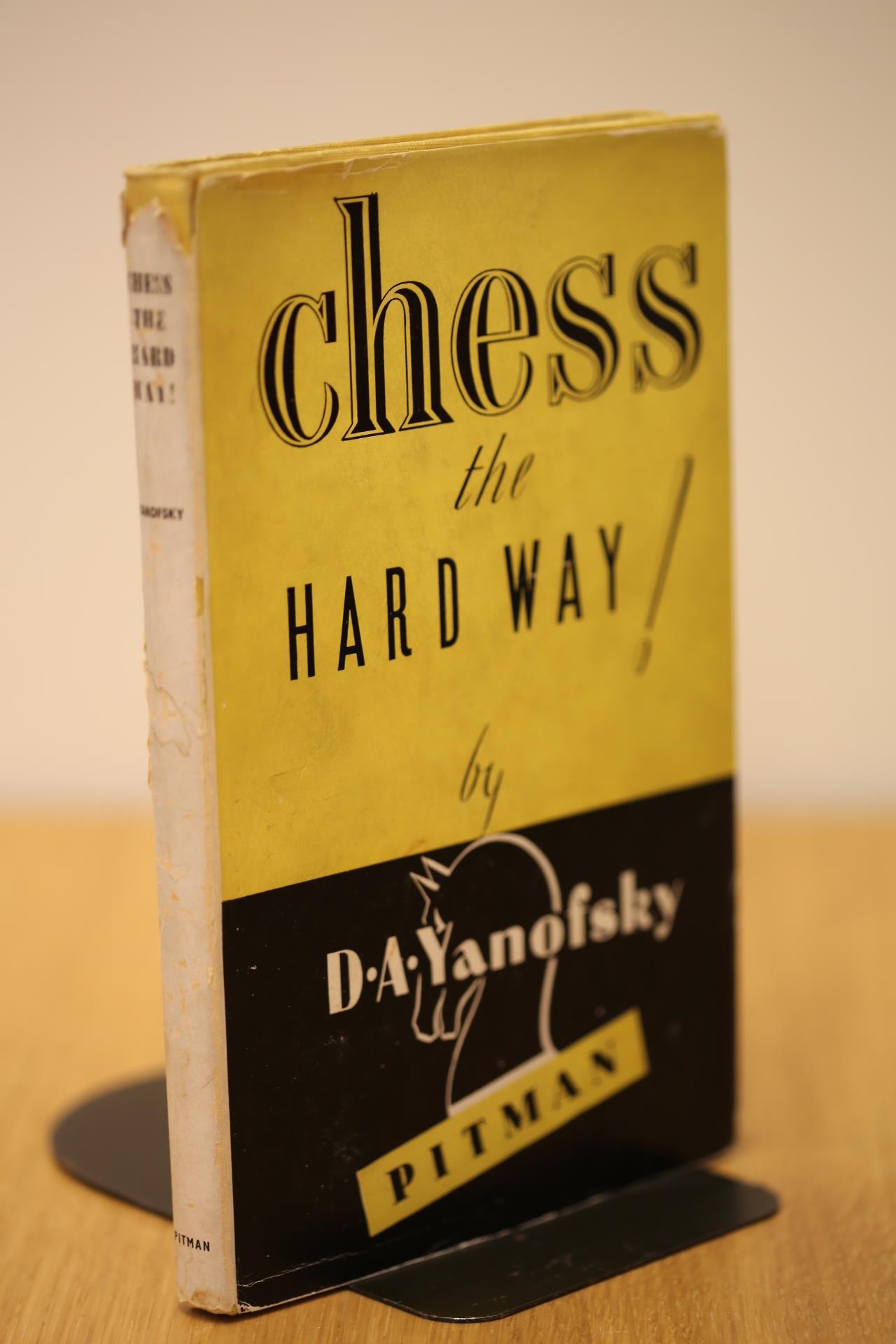
He then began law studies, completing them so brilliantly that he was offered five scholarships for postgraduate work. He chose Oxford, While in England he won, with case, the British Championship 1953, Returning to Winnipeg he became a successful lawyer active in civic politics. His chess career took second place although he found time to play in several tournaments and in many Olympiads from 1954. Yanofsky wrote of his early life in Chess the Hard Way! (1953); he excelled in the endgame and there are many examples in this book of his prowess in this phase.
Chess the Hard Way!, Daniel Yanofsky, Sir Isaac Pitman & Sons, 1953.
The second edition (1996) of Hooper & Whyld reduces DAFs entry to a mere five lines!
From The Encyclopedia of Chess (Batsford, 1977) by Harry Golombek (but written by Nathan Divinski):
A Canadian grandmaster, Yanofsky was born in Poland, came to Canada in 1926 and was raised in Winnipeg. He played 2nd board for Canada in the 1939 Olympiad and won his first (of eight) national titles in 1941, dethroning the eight-time champion Maurice Fox, Yanofsky had wins at Ventnor City 1942, The US Open 1942 and was =1st at Hastings 1953.
Tournament Crosstable for Hastings Christmas Congress, 1952/53 Premier
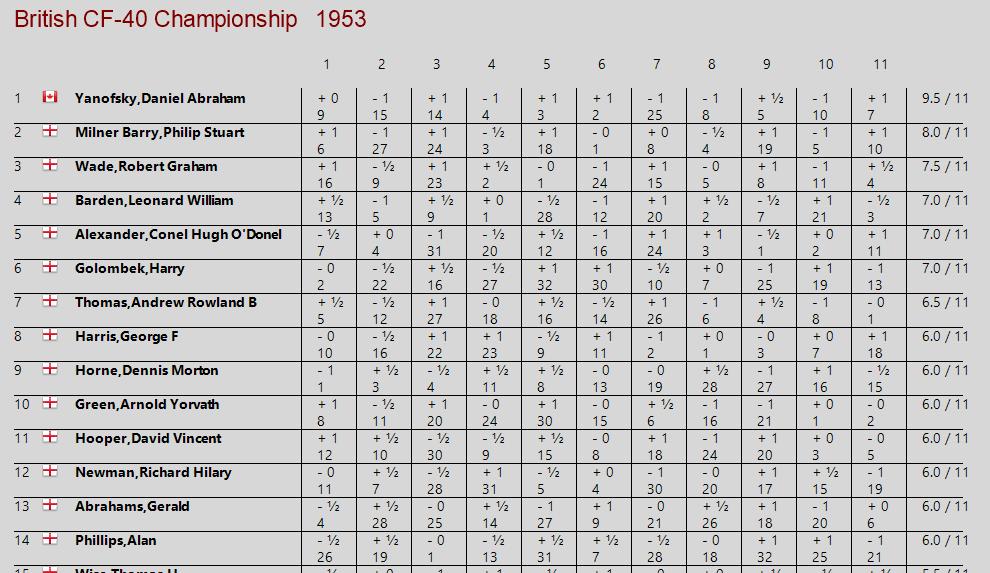
He won the British Championship in 1953, 1.5 points ahead of the field:
Tournament crosstable for British Championship, 1953 at Hastings
Yanofsky tied for 4th in the 1957 Dallas tournament and became a grandmaster in 1964.
At Groningen 1946 Yanofsky beat Botvinnik in their individual game. He has led many of the Canadian Olympiad teams.
Yanofsky is a lawyer with post-graduate studies at Oxford. He edited Canadian Chess Chat for several years and is active in civil politics.
Daniel Yanofsky
He is an expert on the Ruy Lopez and the French Defence, though his strongest point is his endgame play.
From Chess Facts and Fables, Edward Winter, McFarland Publishing, 2006, page 91:
Yanofsky’s Prize
From page 39 of Chess the Hard Way! by D.A.Yanofsky (London, 1953), comes this passage regarding the 1939 Olympiad in Buenos Aires:
“By winning the next two games I scored 9.5 points out of a possible 10 and was awarded a silver cigarette holder inscribed : “Mejor Jugador del Torneo” (best player of the tournament)”
Times have certainly changed, as it is hard to imagine that organisers today would offer a 14-year old boy anything smacking of smoking. (3003).
Daniel Yanofsky
From British Chess Magazine, Volume CXXIX (120, 2000), Number 4 (March), pp. 223 (presumably by) John Saunders we have this obituary:
DANIEL ABRAHAM YANOFSKY
Obituary of “Abe” Yanofsky (26 iii 1925 – 5 iii 2000)
ABE YANOFSKY has died in Winnipeg after a long illness. Born in Poland, he emigrated to Canada with his family when eight months old. Learning the moves at eight, Yanofsky lost his first three games to his father but next day scored his first chess victory. He was already an acknowledged chess prodigy at 11, giving simultaneous displays and winning the championship of Manitoba at the age of 12. His big break came at the age of 14 when he was selected to play for Canada at the 1939 Buenos Aires Olympiad, achieving an 85% score, including a famous win over Dulanto which moved world champion Alekhine to watch all his remaining games in the tournament.
In 1941 Yanofsky won the first of eight Canadian Championships.
Daniel Yanofsky
After war service in the navy, he played in a number of tournaments in Europe, defeating Botvinnik in a game at Groningen 1946.
Later that year he finished second to Najdorf in Barcelona, and then fourth at Hastings L94617. Other continental tournaments followed, including the Saltsjöbaden Interzonal of 1948. He returned to Canada where he was an outstanding law student, returning to Europe in 1951 to embark on a post-graduate law course at University College, Oxford, the funding being subsequently supplemented by his winning a $1,000 scholarship for being the most outstanding Canadian law student of 1952.
Yanofsky finished second at the I951/2 Hastings Premier, and took part many other UK competitions, crowning his UK-based period by winning the 1953 British Championship at Hastings: he scored a (then) record 9.5/11 despite a first round loss to DM Horne. In 1953 he also published an account of his chess adventures entitled Chess The Hard Way!
He returned to Canada to establish a successful career as a lawyer and politician in Winnipeg, though finding time to play in national championships and 11 Olympiads between 1939 and 1980. He edited Canadian Chess Chat for a number of years.
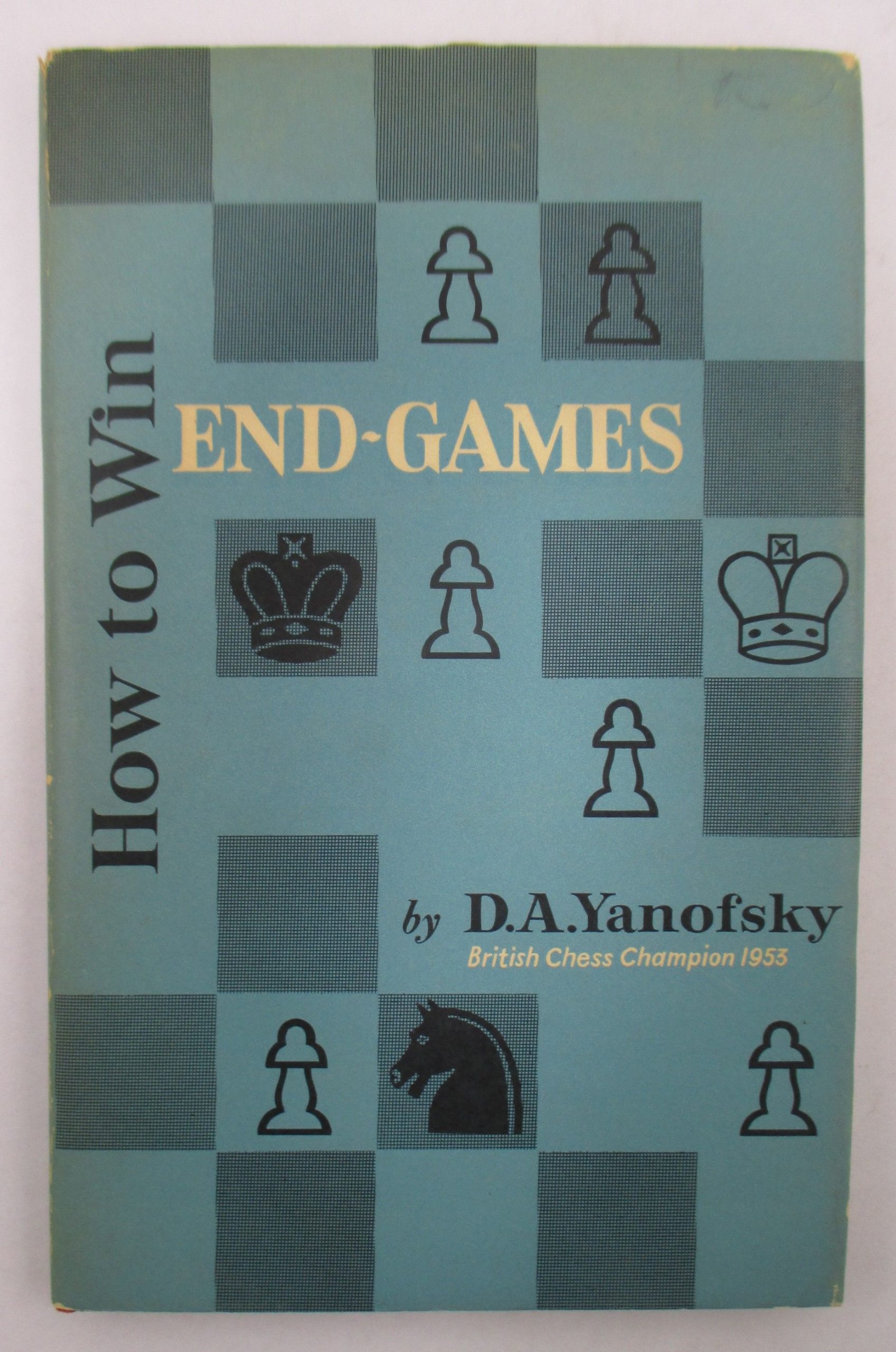
How to Win End Games, D.A. Yanofsky, Sir Isaac Pitman and Sons Ltd., 1957
He became the British Commonwealth’s first FIDE grandmaster in 1964 (ed: although some might claim that Jacques Mieses was the first)
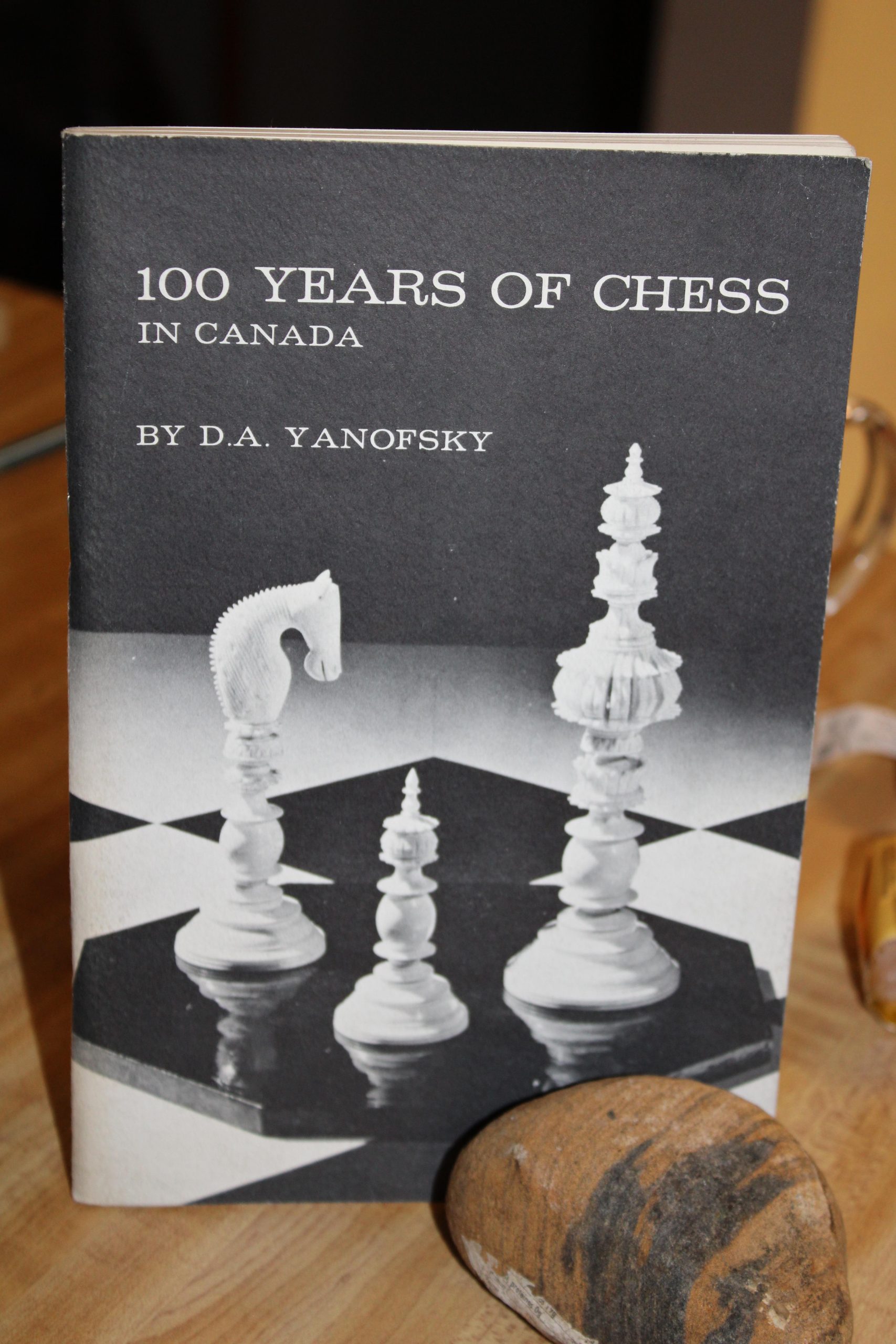
100 Years of Chess in Canada, D. A. Yanofsky, Chess Federation of Canada, Winnipeg., 1967
We lived in the same house in Oxford for a year, but never played or analysed together during all that time, as Dan’s focus was entirely on his academic work and his then pregnant wife, Hilda.
We focus on the British Chess Scene Past & Present!
This website uses cookies to improve your experience. We'll assume you're ok with this, but you can opt-out if you wish. Cookie settingsACCEPT
Privacy & Cookies Policy
Privacy Overview
This website uses cookies to improve your experience while you navigate through the website. Out of these cookies, the cookies that are categorized as necessary are stored on your browser as they are as essential for the working of basic functionalities of the website. We also use third-party cookies that help us analyze and understand how you use this website. These cookies will be stored in your browser only with your consent. You also have the option to opt-out of these cookies. But opting out of some of these cookies may have an effect on your browsing experience.
Necessary cookies are absolutely essential for the website to function properly. This category only includes cookies that ensures basic functionalities and security features of the website. These cookies do not store any personal information.