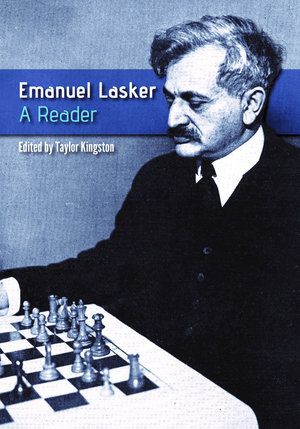
Emanuel Lasker: A Reader: A Zeal to Understand : Taylor Kingston
Taylor Kingston
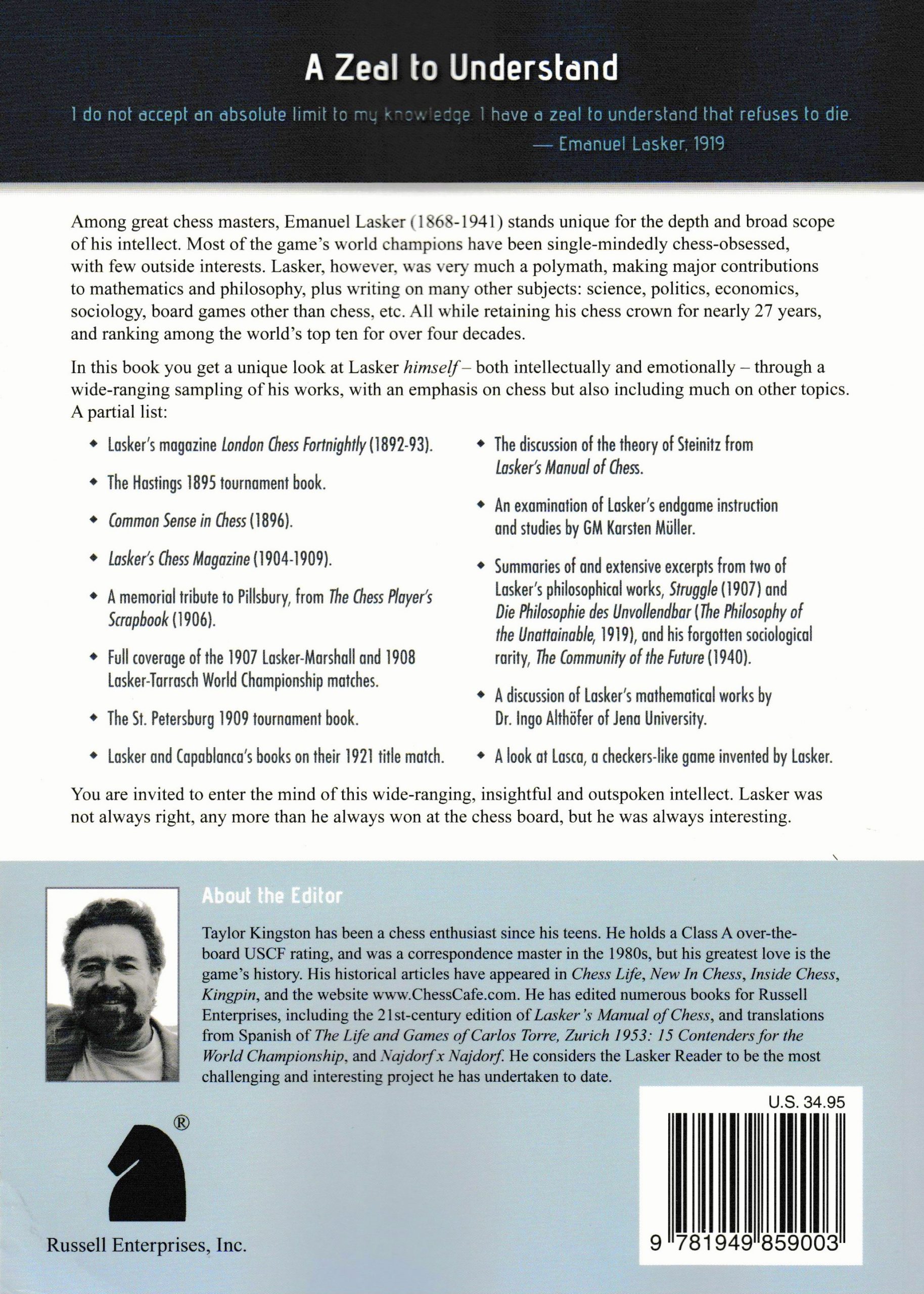
Taylor Kingston has been a chess enthusiast since his teens. He holds a Class A over-the-board USCF rating, and was a correspondence master in the 1980s, but his greatest love is the game’s history. His historical articles have appeared in Chess Life, New In Chess, Inside Chess, Kingpin, and the Chess Café website. He has edited numerous books, including the 21st-century edition of Lasker’s Manual of Chess, and translations from Spanish of The Life and Games of Carlos Torre, Zurich 1953: 15 Contenders for the World Championship, and Najdorf x Najdorf. He considers the Lasker Reader to be the most challenging and interesting project he has undertaken to date.

Taylor Kingston
When I’m asked who my favourite chess player is, I always answer ‘Emanuel Lasker’.
Why? Partly because he was a player who didn’t really have a style. Like Magnus Carlsen, with whom he has sometimes been compared, he just played chess. But more because he was such an interesting personality. Unlike most champions (Euwe and Botvinnik were exceptions) he had a life outside chess, on several occasions taking long breaks from the game. And what a life it was: mathematician, philosopher, writer, playwright, bridge player, and, lest we forget, chess player.
Chess historians are finally taking notice of this fascinating man. In 2009 a massive volume about him was published in German, edited by Richard Forster and others. Last year the first of three volumes of a greatly expanded edition of this work appeared in English. If you have any interest at all in chess history you should certainly possess this book, and, like me, you’ll be eagerly looking forward to volumes 2 and 3.
What we have here might best be seen as a companion to this work, and, if you’re a Lasker fan or have any interest in chess history you’ll want this as well.
Taylor Kingston has compiled and edited a collection of Lasker’s own writings, not just on chess but covering every aspect of his multi-faceted personality.
We start with the London Chess Fortnightly, which Lasker published for a year between 1892 and 1893, annotating his own games as he was trying to establish himself as a contender for Steinitz’s world title. Here and throughout the book, the editor adds the occasional contribution from Stockfish 8.
Lasker and Steinitz met in 1894, with our hero becoming the second official world champion as a result of winning the match. Both players annotated some of the games for newspaper columns. In 1906 Lasker published this in his chess magazine, which we’ll come to later, but in this book they appear in the correct chronological place.
The Hastings 1895 tournament book (if you don’t have a copy I’d like to know why) was unusual in that all the games were annotated by one of the other participants. The six games Lasker annotated feature here.
Lasker’s first book, Common Sense in Chess, was published the following year. We have here an extract from Chapter 9, the End Game.
We then jump forward to 1904. The longest and, for chess players, perhaps the most interesting section of the book covers Lasker’s Chess Magazine, which was published in New York between November 1904 and January 1909. The games themselves give the reader an overview of chess during those years, with amateurs as well as masters being represented. Lasker’s annotations and, in some cases, game introductions, were often colourful in nature and tell us a lot about the man himself.
Burn-Forgacs (Ostend 1906), for instance, ‘begins like a summer breeze and ends like a winter’s gale’.
‘Here the red lantern flashes out; queen and bishop prepare to take the diagonal from b3 to e6 and f7, which are woefully weak, and the black king will be in grave peril.’
Another major chapter concerns the 1908 Lasker-Tarrasch world championship match. After some details of the background to the match (there was little love lost between the two players: Edward Lasker quoted Tarrasch as saying ‘the only words I will address to him are check and mate!). Taylor Kingston presents the games with annotations from Lasker’s Chess Magazine, Tarrasch’s book of the match and other contemporary sources, along with the usual computer interjections.
We then have a chapter on Lasker’s unsuccessful 1921 match against Capablanca, and another on his non-appearance at New York 1927. Lasker’s Manual of Chess was first published in German in 1926: here we have an excerpt in which he discusses the theory of Steinitz.
Lasker’s chess writings are completed by an article on Lasker and the Endgame by guest contributor Karsten Müller, and a short section on Lasker’s problems and endgame studies.
The last 75 pages of the book consider other aspects of Lasker’s life: his philsophy, his contributions to mathematics, and Lasca, a board game he invented.
Perhaps the most interesting section offers extracts from The Philosophy of the Unattainable, his most important philosophical work, published in 1919. As far as Taylor Kingston is aware, it has never been published in English.
Lasker’s last work, The Community of the Future, was published in 1940, five months before his death. Here, Lasker considers the problems faced by the world and proposes a ‘non-competitive community’ as his solution, with ‘self-hope co-operatives’ to deal with unemployment. Again, fascinating reading, and, you might think, his utopian ideas are still of some relevance today.
The book is a well-produced paperback. There are a few notation errors caused by translation from descriptive to algebraic, but this shouldn’t cause you too much bother. I hope I’ve convinced you that this book deserves a place on your shelves.
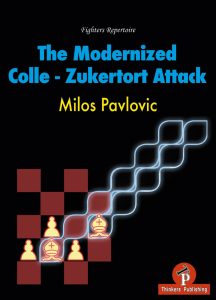
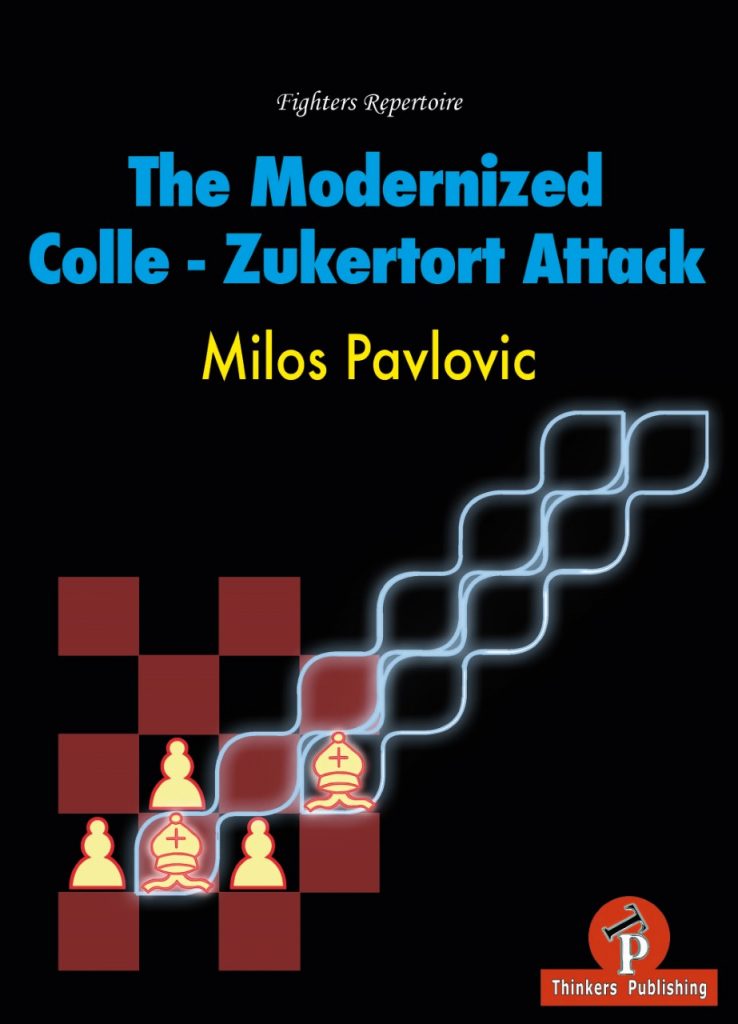
Grandmaster Milos Pavlovic was born in Belgrade in 1964 and was Yugoslav Champion in 2002. He is a well known theoretician specialising in opening theory and has written many chess books and magazine articles.
GM Milos Pavlovic
This is his third title in the “Modernized” series from Thinkers Publishing with a fourth on the Scotch Game being published on November 17th. We first reviewed a title in this series with The Modernized Caro-Kann from GM Daniel Fernandez.
As with every recent Thinkers Publishing publication high quality paper is used and the printing is clear. The book can easily be laid flat next to the board and does not require weights to prevent it from “self-closing” (a particular bugbear of ours !). Each diagram is clear and the instructional text is typeset in two column format, which, we find, enables the reader to maintain their place easily. Figurine algebraic notation is used throughout and the diagrams are placed adjacent to the relevant text and each diagram has a “to move” indicator.
The main content is divided into ten chapters of which the first six concern lines in which Black plays an early d5 (usually 1.d4 d5) and the remainder where Black does not (usually playing 1.d4 Nf6).
There is no index which, unfortunately, is a standard feature of Thinkers Publishing books. Also missing is a bibliography.
This is a repertoire book for the White player utilizing the undeservedly less popular Zukertort flavour of the Colle System. In the “CZ” System the c1 (Queen’s for the more mature reader !) bishop is developed to b2 rather than the c1 – h6 diagonal as in the Koltanowski flavour of the Colle System. Typically therefore White attempts to establish a structure of the sort :
[fen]rnbqkbnr/pppppppp/8/8/3P4/1P1BPN2/PBPN1PPP/R2Q1RK1 b KQkq – 0 1[/fen]
and play for ideas such as Ne5, f4 Rf3, Rg3 and checkmating attacks involving the bishop pair. These are often similar to the famous Lasker – Bauer game of 1889.
On the other hand we have the possibly more familiar Colle-Koltanowski structure of :
[fen]rnbqkbnr/pppppppp/8/8/3P4/2PBPN2/PP1N1PPP/R1BQ1RK1 b KQkq – 0 1[/fen]
and the main idea of the latter is to advance e4, e5 and the launch a fairly clockwork attack against Black’s kingside.
Both of these approaches have been served by books, videos and instructional DVDs of the “Winning with the X” sort with the most well known players of the Colle-Zukertort being Aaron Summerscale, Artur Yusupow, Susan Polgar and Vladimir Kramnik.
We have no intention of “spilling the beans” on all of the many and varied ideas presented by Pavlovic : you should buy the book and find out for yourself. However, as past players of the CZ ourselves we noticed interesting advice on the move order advised. The traditional move order in possibly the most challenging main line has (more or less) been :
1.d4 d5 2.Nf3 Nf6 3.e3 e6 4.Bd3 c5 5.b3 Nc6 6.0-0 Bd6 7.Bb2 0-0 8.Nbd2 leading to the following well-known, traditional position :
[fen csl=Ge5]r1bq1rk1/pp3ppp/2nbpn2/2pp4/3P4/1P1BPN2/PBPN1PPP/R2Q1RK1 w KQkq – 0 1[/fen]
and David Rudel in his various evangelistic style CZ books advocated 8.Ne5 instead. In The Modernized Colle-Zuckertort we have this new move order :
1.d4 d5 2.Nf3 Nf6 3.e3 e6 4.Bd3 c5 followed by the provocative 5.0-0 ! giving us this position
[fen csl=Gc4]rnbqkb1r/pp3ppp/4pn2/2pp4/3P4/3BPN2/PPP2PPP/RNBQ2KR w KQkq – 0 1[/fen]
which appears (well, it does!) to allow 5…c4!? This early castles move order is, in itself, modernizing and advocated by none other than the fourteenth World Champion, Vladimir Kramnik ! Other adherents of this move order include Artemiev, Vaganian and Romain Edouard, Editor of Thinkers Publishing.
One idea that caught our eye was a recommendation of how to meet the Classical Dutch when played via
1.d4 e6 2.Nf3 f5
[fen]rnbqkbnr/pppp2pp/4p3/5p2/3P4/5N2/PPP1PPPP/RNBQKB1R w KQkq – 0 1[/fen]
and you might expect a line to of the CZ to be recommended but you’d be quite wrong. We won’t spoil the surprise by telling you here ! Suffice to say this is not a formulaic “Play the CZ against everything and win” style of approach. You’d be disappointed if it was !
This book contain a veritable potpourri of new ideas and material plus strategical concepts for the White player in the CZ System. It offers much more than one of the cheesy “Play this Opening and you will win” style books that we are all familiar with. Having owned all (English Language) books and DVDs we would suggest that this is the most academic and the most appealing to players wanting to make the CZ a serious weapon of theirs. In the “club player opening book wars” this book redresses the balance with the recent splurge of London System books and videos.
Get this book and you will learn about middlegame, plans of attack and a wealth of other themes : highly recommended !
Charles Alexander Cobb, photo by Kelly/Wullenweber
Best wishes to IM Charles Alexander Cobb born on this day (November 15th) 1978
Charleshas plays / played for Bristol and Clifton Chess Club, maintains a rapidplay grading of 220, played for Bristol in the Four Nations Chess League His highest Elo rating was 2410 in October of 2006.
GM Damian Lemos (FIDE : 2479) was born in 1990 and hails from Argentina. He is a former Pan-American Junior Champion and he achieved the FIDE Master title at 14 years old, International Master at 15, and Grandmaster at 18 and is well known on many chess web sites for providing recorded and real time instructional videos on all aspects (but mainly opening theory) of chess. This is his second book for Everyman Chess.
GM Damian Lemos
The book is divided into seven main chapters as follows :
The Queen’s Gambit Declined (55 pages, 15 games)
The Tarrasch Defence (24 pages, 6 games)
The Slav Defence (45 pages, 9 games)
The Queen’s Gambit Accepted (56 pages, 13 games)
The Chigorin Defence (17 pages 3 games)
The Albin Counter Gambit (19 pages, 4 games)
Other Defences (17 pages, 4 games)
Damian Lemos presents a repertoire for White based around the best regarded flavour of the QGD, Exchange Variation or QGE : this is the version in which White delays Nf3 allowing the central push f3 followed by e4 and the typical resultant structure is :
[fen]6k1/pp3ppp/2p5/3p4/3P4/4PP2/PP4PP/6K1 w KQkq – 0 1[/fen]
The alternative version of the QGE in which White plays an early Nf3 and follows with a minority attack on the queenside is not treated in this book.
Strong grandmasters generally do not like being on the Black side of the QGE since counter-play is minimal so by selecting the QGE you should have a small edge that can be worked with.
White’s move order in most lines therefore is 1.d4 d5 2.c4 something and then 3.Nc3 so if you already play the Queen’s Gambit but with a 1.d4 d5 2.Nf3 something 3.c4 move order then this repertoire will be a substantial change for you.
Chapter 1 is presented via the now familiar and reliable method of a number (15) of high quality and recent instructive games analysed in depth.
Taking on the Tarrasch Defence Lemos goes down the road of the classical Rubinstein (fianchetto) approach showing how White can retain a nagging edge against the Black IQP.
The Slav Defence is approached using an active piece placement strategy based around the seemingly innocuous Exchange Variation : underestimate this line at your peril if you play the Slav !
The Queen’s Gambit Accepted is faced with the direct 3.e4 with in-depth coverage including all of Black ideas especially the most combative of 3…e5. The QGA receives the most comprehensive treatment in terms of pages (56) and with thirteen games analysed in detail.
The Chigorin Defence merits only three games reflecting its rarity at club and more exalted levels. Again, ignore the Chigorin at your peril !
Club players favourite, the Albin Counter-Gambit is examined via four games.
Rounding off in the “Other Defences” bargain basement section we find lines for White to deal with The (solid) Stonewall Variation of the Dutch, The somewhat discredited Marshall Defence, The (early) Tarrasch with 2…c5 and finally, The Baltic Defence which is common at club level.
A couple of small gripes with the production are : the diagrams do not have a “to move” indicator. secondly, some Everyman books (but not this one) have an extra folding part to the front and rear covers. These we find protect the book from damage and also can be used as an emergency book mark ! Also, chapters 3-5 all have the same page heading of the Chigorin Defence which confused us! We suspect that this error will be fixed.
Overall, this book provides a welcome repertoire based on exchanging on d5 that is fairly easy to learn and sound with decent winning chances for White. The QGE chapter is possibly the most interesting from the strategic perspective and gives White a clear plan to follow.
It is also fair to say that players of the Black pieces who employ the Chigorin, Tarrasch and particularly the QGA will also benefit from this book : they can see the authors suggested lines for the White and Black’s corresponding ideas.
John Upham, Cove, Hampshire, 12th November, 2019
John Upham
Book Details :
Paperback : 256 pages
Publisher: Everyman Chess (1 Aug. 2019)
Language: English
ISBN-10: 1781942609
ISBN-13: 978-1781942604
Product Dimensions: 16.9 x 1.5 x 23.9 cm
The book is available as a physical book and as a Kindle version.
John Nunn has written around thirty books on chess and many of these are some of the finest chess books published in any language : Secrets of Pawnless Endings (1994, Batsford) easily is a candidate for the all time list. John is a director of Gambit Publications Ltd. together with Murray Chandler and Graham Burgess.
GM John Nunn
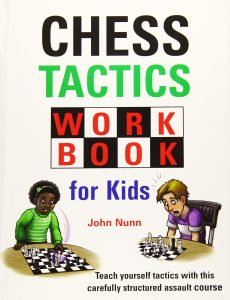
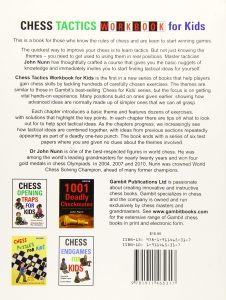
Chess Tactics Workbook for Kids is the sixth (a seventh and eighth are scheduled for January 2020 publication) in a highly successful series of “for Kids” books. Indeed, we recently reviewed Chess Opening Traps for Kids. The Workbook theme is likely to be extended other “for Kids” style books from Gambit Publications.
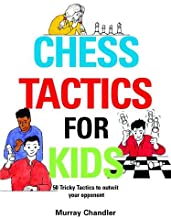
This workbook is a follow-up to the original (2003) and much liked Chess Tactics for Kids by Murray Chandler :
Chess Tactics for Kids
Chess Tactics Workbook for Kids is robustly (!) hardbound in a convenient size such that weights are not need to keep it propped open (unlike some A5 paperbacks) meaning studying with this book is more convenient than with many books. The layout and printing is clear (as you would expect with Gambit) with numerous diagrams at key moments in each, relatively short, game. In essence, players under 18 (for whom this book is intended) will find it easy to dip in out of and it can be used without a board (although BCN and most chess teachers and coaches would always recommend following each game on a “proper” board).
As you would expect with Gambit, the notation is English short form algebraic using figurines for pieces. A previous criticism (ibid) has been addressed in that each diagram has a symbolic “whose move it is” indicator. Each diagram does have coordinates which are very welcome for the younger junior reader.
The book is divided into 13 chapters as follows :
Fork
Pin
Skewer
Deflection and Decoy
Discovered Attack
Discovered and Double Check
Removing the Guard
In-Between Moves
Trapped Piece
Pawn Promotion
Opening and Closing Lines
Forcing a Draw
Test Papers
Chapters 1 – 12 each contain a description of the type of tactic that is subject of the chapter followed by 20 – 40 exercises for the reader followed by a set of more challenging “Tougher Positions” and then, interestingly, by a set of “Does the Tactic Work ?” exercises. We appreciated the latter especially since this appears to be a novel feature. These are excellent blunder prevention tests since they help to slow typical impetuous juniors down who often move first and then engage their brain.
It was clear when working through the easier set of exercises that the author had thought carefully about their sequence since the reader should (we did for sure !) notice the level of difficulty increasing slowly but surely. The solutions are remote from the puzzles nicely avoiding the “accidentally seeing the solution” issue one gets with lesser books. The solutions themselves are clear and concise and instructional in their own right.
Here is a particularly satisfying example (we thought so anyway !) from the Skewer chapter (Tougher Positions #23) *solution at bottom of this review
[fen]3q4/7Q/2p1p3/3p4/3k4/6B1/2K5/8 w KQkq – 0 1[/fen]
We particularly enjoyed the chapters on “Trapped Piece” and “Forcing a Draw” as these are less usual to find in books of this kind.
Here is a pleasing (well, we liked it here in the BCN editorial office) example (#30) from the “Does the Tactic Work?” section of the skewers chapter :
[fen]8/2P5/8/8/8/2K1k1p1/3N4/8 b KQkq – 0 1[/fen]
@and the solution is at the foot of this review
We enjoyed working through the chapters and emerged with a feeling of attending a mental gymnasium : exhausted but refreshed.
Chapter 13 (“Test Papers”) puts all of your newly learnt skills to a full and proper test since there are no themes, hints or clues of what to do : just like a real game !
One negative comment we would make concerns the cover. “Never judge a book by its cover” we are told and you might look at this book cover and think it was suitable for say primary aged children. We would say not but we would suggest it suitable from secondary aged children. We would say strong juniors from 12 upwards would read this book and enjoy it.
As we previously mentioned in our review of Chess Opening Traps for Kids, The title and cover might, perhaps, put off the adult club player market. However, the content is totally suitable for adult club players upto say 150 ECF or 1800 Elo.
In summary, we recommend this book to any junior or adult who wishes to improve their tactical vision and results. It makes an excellent stocking filler for young players and the young at heart !
*solution to Skewer exercise #23 : “Normally this material would lead to a draw, but White can win with a brilliant tactical idea : 1.Bd6!! (the only defence to the threat of 2.Qd3# is to take the bishop) 1…Qxd6 2. Qd3+ Kc5 (2…Ke5 3.Qg3+ is a mirror image) 3.Qa3+ and the queen falls.”
@solution to Skewer exercise #30 : “It seems impossible to save the game because after both side promote White has a skewer, but there is a miraculous defence : 1…g2 2.c8=Q g1=Q 3.Qc5+ Ke2! and further checks don’t help White, while after 4.Qxg1 Black is stalemated.”
We have learnt the sad news that popular longtime Arbiter and Organizer David Welch has passed away at the age of 74 after a long illness : he was being cared for in The Royal Liverpool Hospital.
David was born on Tuesday, October 30th 1945 in Brampton, Chesterfield, Derbyshire and he played for Wallasey Chess Club for many years having initially been a member of Liverpool Chess Club.
He attended Queens’ College, Cambridge reading Natural Sciences (Chemistry) and (according to John Swain) David served Cambridge University Chess Club as Junior Treasurer, Librarian and Bulletin Editor.
In 1968 David and Peter Purland started teaching at the same Liverpool school on the same day and continued their friendship from there.
David became a BCF arbiter in the early 1970s eventually becoming the BCFs Chief Arbiter and then the ECFs Chief Arbiter and was heavily involved in many British Championships around the country.
David was curator of ECF equipment for some time and personally funded much of the BCFs and ECFs early equipment stock.
He became a FIDE International Arbiter as early as 1977 and was awarded the FIDE International Organizer title in 2010.
David shared the exact same date of birth as long time friend and fellow arbiter, Peter Purland.
in 2016 David received recognition from FIDE for his long service as an International Arbiter. David was the third English arbiter to receive the honour, following Stewart Reuben and Gerry Walsh in 2014.
David Welch receives FIDE Arbiter Award
We send our condolences to all of his many family and friends.
Congratulations are in order for Witney based Southampton Unversity student FM Marcus Harvey who obtained his second International Master norm at the recent Hull 4NCL International Congress by scoring 4.5/9 with wins over IM Andrew Greet and IM Richard Palliser. Marcus plays for 4NCL Wood Green.
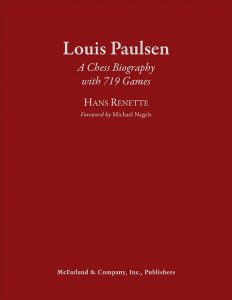
Here from the massively loved publisher from the US comes yet another historical chess book, this time about a player best known in thought and word but not, as things stood before publication, deed. Golombek (1981) gives him half-a-page, Whyld/Hooper (1996) just over a page and Sunnucks (1976) less than two pages, with no photo or game at all; Whyld/Hooper manage a game but without notes.
Hans Renette
This is the third McFarland work from the growing reputation of Belgian FIDE Master, Hans Renette starting with H.E. Bird: A Chess Biography with 1,198 Games and 2016 and following up with Neumann, Hirschfeld and Suhle which were both exquisite productions.
Louis Paulsen
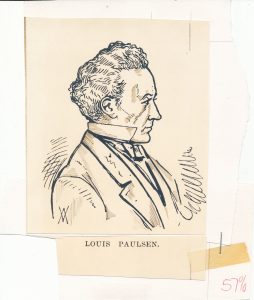
Louis Paulsen’s (1833-1891) tombstone is shown in this massive tome, a modest tribute to a most gifted and far seeing chess master, his innovations in the Leningrad Dutch and Sicilian still, one hopes, ringing down the ages. Did time stand still for a player unfettered by use of a chess clock? Certainly Paulsen attracted criticism for the slowness of his moves but, in retrospect, they were (of course!) worth waiting for.
This massive collection includes friendly games, contemporary comments, photographs, line drawings, blindfold clashes, simul encounters, any number of Evans’ and King’s Gambits. At random, I select 1862 when Paulsen drew a match 4-4 with Anderssen himself, a photo from the late Lothar Schmid’s massive archive supplies a little colour. Same year, Louis comes 2nd= with John Owen with both masters outdistancing even Steinitz, who was yet to find his (World Championship) form.
Cyrus Lakdawala is an IM and former US Open Champion who teaches chess and has written over 25 books on chess openings.
IM Cyrus Lakdawala
The Petroff (or Petrov or Russian) Defence has long been regarded as one of the most solid replies to 1.e4. The most prolific player of the Petroff is Artur Yusupov, a Russian Grandmaster who had played it in around 200 games according to MegaBase 2019.
Vladimir Kramnik , Anatoly Karpov and Boris Gelfand have also used the Petroff many times whilst recently Fabiano Caruana has made it one of his most important and reliable defences.
Alexander Dmitrievich Petrov
This is a repertoire book from the Black perspective and therefore does not include all possible black variations but it does provide clear recommendations for dealing with the White variations.
Following the Introduction we have six in-depth chapters as follows :
The Cochrane Gambit
The Scotch Petroff
The Main Line Petroff
The Main Line Sidelines (!?)
The New Main Line (2019)
The Three Knights Petroff
Each and every chapter starts with a summary of the variation to put the reader into the right frame of mind.
The author kicks-off in detail by examining the somewhat swashbuckling Cochrane Gambit where, after the moves 1.e4 e5 2.Nf3 Nf6 3.Nxe5 d6 White boldly sacrifices a knight with 4 Nxf7?!. The author concludes that the Cochrane Gambit is dubious and Black has excellent winning chances (which you would expect no doubt).
He backs this up by showing how Black should play after 4…Kxf7 when White has three sensible moves 5.d4 5.Bc4+ and latterly 5.Nc3 (which was played in a rapid game by Vasily Ivanchuk) : all 3 games were won by Black who wins a piece for 2 pawns. According to MegaBase 2019, the gambit scores an amazing 58.8% for white over 910 games so in practise (as opposed to theory) it does pretty well !
Next, we turn to the Scotch Petroff in which White plays 3.d4 when 3…Nxe4 is recommended.
Two main lines are given, the first being 4.d4xe5 d5 5.Nbd2 where, in the game Vitiugov v Caruana 2018, Black played 5…Qd7 and excellent annotations are given as to why this move equalises fully.
{[%evp 0,80,29,10,4,10,30,35,27,10,21,15,15,-1,8,7,38,46,50,48,33,2,41,11,10,
-1,9,6,9,11,56,30,-10,-45,-22,-46,-50,-59,-54,-50,-45,-38,-29,-81,-39,-55,10,5,
13,-53,12,-5,-9,-64,-56,-64,-50,-53,-50,-56,-80,-110,-84,-122,-115,-91,-88,
-133,-127,-119,-84,-122,-122,-183,-205,-199,-225,-264,-311,-337,-337,-374,-350]
} 1. e4 e5 2. Nf3 Nf6 3. d4 Nxe4 4. dxe5 d5 5. Nbd2 Qd7 $146 ({Just a few
weeks previously Fabiano faced this line in the extremely important game:} 5…
Nxd2 6. Bxd2 Be7 7. Bd3 c5 8. c3 Nc6 9. O-O Bg4 10. Re1 Qd7 11. h3 Bh5 12. Bf4
{Grischuk,A – Caruana,F Berlin GER 2018, White had a promising position, but
eventually got outplayed.}) ({In addition, the following moves have been
tested at this high level:} 5… Nc5) (5… Be7) (5… Nc6) ({and} 5… Bf5 {
Seemingly, none guarantees Black an easy equalisation.}) 6. Bd3 {The most
natural way of development.} ({In the event of} 6. Nxe4 dxe4 7. Nd4 Nc6 8. Bb5
Bc5 9. Nxc6 (9. Be3 Bxd4 10. Bxd4 Qd5 11. c4 Qe6 12. O-O a6 13. Bxc6+ Qxc6 $11)
9… bxc6 10. Qxd7+ Bxd7 11. Ba4 O-O-O $11 {The active piece play offers Black
a sufficient compensation for the structural drawbacks.}) ({The modest} 6. Be2
{can hardly pose Black any problems. For instance,} Be7 7. O-O Nc6 8. c4 Nc5 9.
Nb3 dxc4 10. Nxc5 Bxc5 11. Bxc4 Qxd1 12. Rxd1 Be6 $11) 6… Nc5 {The knight is
heading for e6 in order to consolidate Black’s setup on the q-side.} 7. Be2 g6
8. Nb3 (8. O-O $5 {also deserved attention:} Bg7 (8… Nc6 9. Nb3 Ne6 10. Nbd4
Ncxd4 11. Nxd4 Bg7 12. f4 {looks somewhat worse for Black, whose dark-squared
bishop is locked in.}) 9. Nb3 Ne6 10. Nfd4 Bxe5 11. Bh6 $44 {would offer White
definite compensation for a pawn due to the better development. However,
Nikita doesn’t like to check out the most principled lines against a
well-prepared opponent.}) 8… Ne6 9. Be3 {This move seems somewhat inaccurate.
} ({The correct way was:} 9. Nbd4 $1 {exchanging the misplaced knight} Nxd4 (
9… Bg7 10. Nxe6 Qxe6 11. O-O O-O 12. Bf4 Nd7 13. Re1 $14) 10. Qxd4 $1 Bg7 11.
O-O Nc6 12. Qc5 b6 13. Qa3 {White’s development advantage might tell, though
Black’s position still seems solid.}) 9… c5 $1 {That’s the point! Black
takes control over the centre now.} 10. Ng5 $1 {GM Vitiugov is reasonably
swapping the knights – now the vulnerable e5-pawn can be protected.} (10. c3 b6
11. O-O Nc6 $15) 10… b6 11. Nxe6 fxe6 12. a4 $1 {Nikita’s creative play
enables White to maintain the balance.} ({In th event of the natural} 12. O-O
Bb7 13. c3 Nc6 14. f4 Bh6 $15 {Black’s position would be easier to handle.})
12… Bb7 13. O-O Nc6 14. f4 ({A more precise move was} 14. c3 $1 Bg7 (14…
Nxe5 15. Re1 {offers White excellent compensation for a pawn.}) 15. f4 O-O 16.
Bb5 a6 17. Be2 $132 {[%csl Rb6,Rc5][%cal Ga4a5]}) 14… Bh6 $1 {The lack of
harmony in White’s camp causes Nikita some problems now.} 15. a5 {The advance
of the a-pawn doesn’t really bother Fabiano.} (15. Qe1 d4 16. Bd2 O-O 17. Qh4
Bg7 $15) 15… Ne7 {Making the c6-spot vacant for the bishop.} 16. Bg4 (16. c3
O-O 17. Qe1 Nf5 18. Bd2 d4 $15) 16… d4 17. Bc1 O-O {Black is better due to a
space advantage, but it’s hard to make any real progress.} 18. Qd3 (18. c4 Nf5
19. Bf3 Rab8 $15) 18… Bd5 19. Qh3 Bg7 20. Nd2 {Eventually admitting the
mistake – the Nb3 had no prospects.} Nf5 21. c4 dxc3 22. bxc3 Rad8 (22… b5 $5
23. Ba3 (23. Re1 Rab8 24. Ne4 Bxe4 25. Rxe4 h5 $36) 23… Rac8 24. Rf2 Rfd8 $15
) 23. axb6 axb6 24. Re1 b5 {A slight inaccuracy.} ({A more energetic try was}
24… Ra8 25. Rxa8 Rxa8 26. Bf3 h5 $15 {and White is doomed to passive defence.
}) 25. Ne4 $6 {This move is a serious positional mistake.} ({It was much
better to keep the knight on the board:} 25. Bf3 $1 b4 (25… Ra8 26. Rxa8 Rxa8
27. g4 Ne7 28. Ne4 $132) 26. Bxd5 Qxd5 27. Ne4 {and White manages to maintain
the balance.}) 25… Qe7 $2 {Returning the favour!} ({In the event of} 25…
Bxe4 $1 26. Rxe4 h5 27. Bxf5 {The lesser evil.} (27. Bf3 Qd3 $19) (27. Be2 Qc6
28. Bf3 Rd3 29. Re3 Qd7 $19) 27… Qd1+ 28. Kf2 Rxf5 29. Re1 Qb3 $17 {The
vulnerablity of his king puts White in big danger.}) 26. Ng5 $2 {Luckily for
Caruana, Nikita is focused on the counter-attacking measures and pushes too
hard…} ({At the same time, the cool-blooded} 26. Bf3 $1 b4 27. Ng5 h6 28.
Bxd5 Rxd5 29. Ne4 $11 {would have kept everything under control.}) 26… h6 27.
Nf3 (27. Ne4 {would hardly be much better:} b4 28. cxb4 cxb4 {, and the passer
is extremely strong.}) 27… Bc6 {There is nothing to do against the
penetration of Black’s rook.} 28. Bxf5 gxf5 29. Be3 ({Nothing is changed by}
29. Nh4 Ra8 30. Be3 Rxa1 31. Rxa1 Rd8 $19) 29… Rd3 30. Rac1 Ra8 $19 {Now
Black’s pieces are dominating over the board.} 31. Qh4 Qxh4 32. Nxh4 c4 33. Kf2
({Or} 33. Bc5 Ra2 34. Bd6 Bf8 $19) 33… Bf8 34. Nf3 Bd5 ({A simpler way is}
34… Bxf3 35. gxf3 Ra3 36. Bd4 b4 $19) 35. Nd4 Bc5 36. Nxf5 {Desperation.} ({
The most stubborn was} 36. Nc2 {though Black’s task still doesn’t seem tough:}
Ba3 37. Nxa3 Rxa3 38. Bc5 Rd2+ 39. Re2 Rxe2+ 40. Kxe2 Ra2+ 41. Ke3 Rxg2 $19)
36… Ba3 37. Nxh6+ Kg7 38. f5 Bxc1 39. Bxc1 Rxc3 40. f6+ Kg6 {This important
victory yielded Fabiano another clear 1st place!} 0-1
[/pgn]
The more popular 5 Nc5 is also examined in detail and,
more often than not, more than one playable line is given for the reader to choose from.
Following the examination of 3.d4 Nxe4 4.Bd3 d5 5.Nxe5 Nd7 Laznicka v Shirov 2006 is discussed in detail and this is an interesting game in which Black was able to win from a lost position.
In Chapter three the author pitches into, what most would consider as THE main line i.e. 3. Nxe5 which is played in 53% of games in MegaBase 2019.
Cyrus recommends 3…d6 4.Nf3 Nxe4 5 d4 d5 6 Bd3 Be7 7 00 Nc6 as most promising for Black.
The main line here is 8.c4 and ten games are annotated in detail. The most prominent players of the black pieces include Vishy Anand and Anatoly Karpov. The following game is annotated in detail :
Other popular moves (8. Re1 and 8.Nc3) are also considered in the same lengthy main chapter.
So called off-beat or side lines are covered in Chapter Four the most important of which is 3.Nxe5 d6 4.Nf3 Nxe4 5.Qe2 which the author labels “The Dull Variation” but, as Cyrus points out, it is a likely choice for the White player if he or she is greatly outgraded and happy to halve the point. However, as in the game Luke McShane v Ba Jobava, Black managed to out dull the dullness by winning!
The so-called “New Main Line” is considered in Chapter Five and this is 3.Nxe5 d6 4.Nf3 Nxe4 5.Nc3 which, somewhat famously, is the usual choice of Magnus Carlsen (and Alexei Shirov) when battling the Petroff. The usual consequence of adoption of a line by the World Champion is that the variation becomes popular at “club level”. (Editor : This also happened to the currently trendy new main line of the London System : 1.d4 d5 2.Bf4 Nf6 3.e3 c5 4.c3 Nc6 5.Nd2).
The chapter launches by detailing a recent (2018) Carlsen v Caruana game where again, black equalises and draws the game.
{[%evp 0,82,16,23,23,27,27,27,27,27,27,34,33,33,33,17,12,20,16,-5,15,4,18,12,
28,-5,46,28,15,-12,0,-15,-17,-28,-20,-31,-37,-22,6,-7,19,14,32,29,35,31,54,6,
41,43,57,128,126,129,123,103,104,109,108,88,87,77,104,80,80,59,53,64,62,63,87,
74,74,80,94,38,23,38,33,38,35,35,46,35,35]} 1. e4 e5 2. Nf3 Nf6 3. Nxe5 d6 4.
Nf3 Nxe4 5. Nc3 Nxc3 6. dxc3 Be7 7. Be3 Nc6 8. Bc4 $5 {This move is almost
unexplored on a high level.} O-O ({After} 8… Bf6 9. Qe2 O-O 10. O-O-O Re8 11.
h3 Be6 12. Bxe6 Rxe6 13. g4 {Dubov,D – Fridman,D Tbilisi 2017, White had a
definite initiative on the k-side and eventually won.}) (8… Be6 9. Bxe6 fxe6
{, as was checked in a few games doesn’t seem to fully solve Black’s problems
in view of} 10. h4 $1 Qd7 11. Ng5 e5 12. Qd5 Bxg5 13. hxg5 $14) 9. Qd2 ({
Another possibility was} 9. Qe2 Re8 10. O-O-O Bg4 {, though White’s queen is
placed rather awkwardly here. For instance,} 11. h3 Bxf3 12. gxf3 Bg5 13. f4
Bxf4 14. Bxf7+ Kxf7 15. Qc4+ Kf8 16. Qxf4+ Qf6 $11) 9… Bf5 ({A move
deserving serious attention is} 9… Ne5 $5 10. Nxe5 dxe5 11. O-O-O Qxd2+ 12.
Rxd2 Bf5 13. Re1 Rfe8 {, and then in 1 correspondence game Black managed to
slowly liquidate White’s pressure along central files. However, play of such a
character would most likely suit Magnus.}) 10. O-O-O Qd7 11. Kb1 $146 {This
typical prophylactic move is a novelty.} ({The previously played} 11. Rhe1 Rae8
12. Bd5 Be6 13. c4 Bf6 14. Bg5 Bxg5 15. Qxg5 h6 {led to equal position in
Takacs,B – Horvath,I Hungary 2008}) ({Another interesting try was} 11. h3 $5
Na5 12. Bd3 {, and the effect} Qa4 13. Kb1 Nc4 {doesn’t lead to full equality:}
14. Bxc4 Qxc4 15. b3 Qa6 16. Nd4 Bd7 17. c4 $14) 11… Rfe8 12. h4 {The most
aggressive. Magnus is intending to push his kingside pawns as soon as possible.
} (12. h3 Be4 13. Bd5 Bf6 14. g4 g6 {looks very solid for Black.}) 12… Bf8 {
This move looks somewhat passive, but Fabiano searches for counterplay along
the e-file.} (12… Bf6 13. Bg5 $1 Be5 14. Nd4 Bxd4 15. cxd4 d5 16. Bf1 {
would have yielded White a definite advantage due to the pair of bishops.}) 13.
h5 h6 14. Be2 $1 {After this move Black can hardly stop g2-g4} Bg4 (14… a6
15. Nh2 Be4 16. Rhg1 $36) 15. Nh2 Bxe2 16. Qxe2 Ne5 {This move is connected
with loss of time, since White is going to push the k-side pawns and attack
the knight.} ({A safer one was} 16… Re4 $5 17. Nf1 (17. g4 {is well met by}
Rae8 18. Qd3 d5 $1 19. Qxd5 Qxd5 20. Rxd5 Bd6 $132) 17… Rae8 18. Nd2 R4e5 19.
g4 Qe6 {White is still somewhat better, but Black’s counterplay shouldn’t be
underestimated.}) 17. Bc1 Qc6 18. f4 (18. g4 $5 Qc4 19. Qxc4 Nxc4 20. b3 Ne5
21. c4 $14 {also would have kept Black under long-lasting pressure.}) 18… Nc4
19. Qd3 Qe4 {Black manages to liquidate into the endgame, but it doesn’t fully
solve his problems.} 20. g4 Ne3 21. Rde1 Qxd3 22. cxd3 Nd5 23. Reg1 $1 {
White reasonably prefers to keep both rooks on the board.} (23. g5 $6 {would
be premature:} Rxe1 24. Rxe1 g6 $1 {and the initiative is almost gone.}) 23…
Re6 $6 ({Much better was} 23… Re2 $1 24. g5 Kh7 25. Ng4 Rae8 {, and the
activity of rooks offers Black definite counter-play. For instance,} 26. g6+ (
26. f5 hxg5 27. Bxg5 Be7 28. Bxe7 R8xe7 29. c4 Nf6 $11) 26… Kg8 27. f5 f6 28.
c4 Nb4 $132) 24. g5 Ne7 $6 {This is too passive.} ({After} 24… Kh7 25. Ng4
Re2 26. f5 hxg5 27. Bxg5 Be7 28. Bxe7 Rxe7 29. h6 g6 30. fxg6+ fxg6 31. Rf1 $16
{The h-passer also would have put Black in danger, but it was the lesser evil.}
) 25. gxh6 Rxh6 26. f5 Rh7 27. Ng4 (27. f6 $1 {was stronger:} Nd5 28. fxg7 Rxg7
29. Rf1 Re8 30. h6 Rg6 31. Nf3 $18 {and Black doesn’t seem to withstand the
pressure.}) 27… Kh8 28. f6 Ng8 29. fxg7+ {This inaccuracy enables Black to
activate the pieces.} ({More energetic was} 29. h6 $1 Nxf6 ({Black is almost
paralysed also after} 29… gxf6 30. Rf1 Re8 31. Be3 c5 32. c4) 30. Nxf6 gxf6
31. Re1 {White is dominating over the board, and he should be able to win.})
29… Rxg7 30. Be3 c5 $1 {It’s necessary to cover the d4-square.} 31. Bf4 $6 {
Another step in the wrong direction.} ({A much stronger move was} 31. Bd2 $1
Re8 (31… Kh7 32. Nf2 $16) 32. c4 Re6 33. Bc3 f6 34. Rg3 $16 {and Black is
still doomed to passive defence.}) 31… Re8 $1 32. Ne3 Rxg1+ 33. Rxg1 Re6 {
Black’s pieces are slowly getting out now.} 34. Nd5 Nf6 35. Nc7 Re2 36. Nb5 Re6
$1 {A cool-blooded reply, that makes it difficult for White to make real
progress.} 37. Rf1 $6 {Spoiling all the advantage.} ({The last chance was} 37.
Nxa7 Kh7 38. Rh1 Ng4 39. Nb5 Nf2 40. Rf1 Nxd3 41. Bxd6 $1 Bxd6 42. Rxf7+ Kh6
43. Rd7 Re1+ 44. Kc2 c4 45. Rxd6+ Kxh5 $14 {Black is very active, but the draw
isn’t guaranteed yet.}) 37… Kg8 38. Nc7 {Accepting a draw by repetition.} (
38. Nxa7 Nxh5 39. Bc1 Rf6 40. Rg1+ Rg6 {is fine for Black.}) 38… Re2 39. Nb5
Re6 40. Nc7 Re2 41. Nb5 Re6 1/2-1/2
[/pgn]
The final chapter covers the Three Knights Variation in which White essays 3.Nc3 and Black usually replies 3…Bb4 : of course, he or she could also try 3…Nc6 transposing to a Four Knights Game.
From the BCN Editor :
As with every recent Everyman Chess publication high quality paper is used and the printing is clear. Each diagram is clear as is the instructional text. Figurine algebraic notation is used throughout and the diagrams are placed adjacent to the relevant text.
A couple of small gripes with the production are : the diagrams do not have a “to move” indicator. secondly, some Everyman books (but not this one) have an extra folding part to the front and rear covers. These we find protect the book from damage and also can be used as an emergency book mark !
So, what do we think ?
This is an excellent book with 58 games often by world class players given lots of analysis and discussion of ideas.The author sets many exercises (tactical and strategic) for the reader to work through making the book more interactive than many.
Of course, it is mainly written from the Black perspective as most presented games are won by Black perhaps making the reader wonder why 2…Nf6 is not as popular as 2…Nc6 : maybe it soon will be !
Colin Lyne, Farnborough, Hampshire, October 22nd, 2019