Category Archives: Journalism

Minor Pieces 45: Jessie Helena (Hume) Cousins

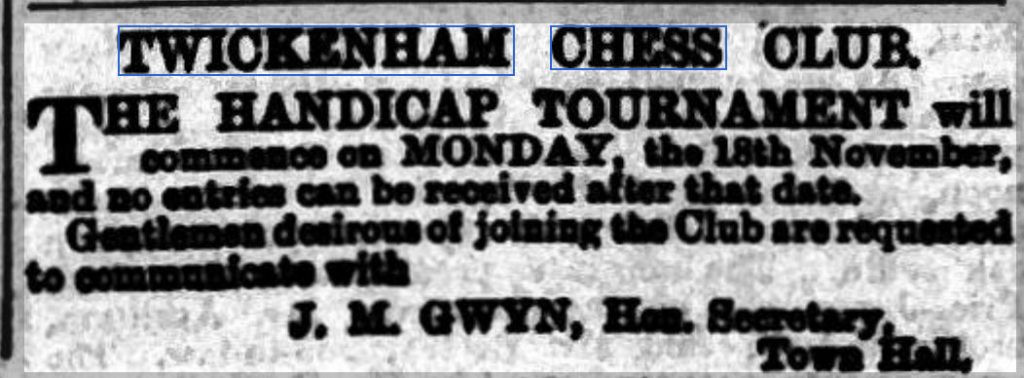
You might have noticed that all the Minor Pieces to date have featured gentlemen. The main reason, I suppose, is that most of them have been about members of early chess clubs in the Richmond and Twickenham area which specifically advertised as being for gentlemen. No ladies, and certainly no plebs.

Here’s Twickenham Chess Club, for example, although a slightly later report of a Richmond Chess Club AGM mentioned that they had a couple of lady members: seemingly social rather than match players.

But there was also a very popular and successful Ladies Chess Club founded in London in 1895. We’ll meet some of their members in future articles. In 1904 the first British Championships incorporated a Ladies Championship. It’s clear that round about 1900, although the majority of competitive players were, just as today, male, chess for ladies was also thriving. It will be interesting to find out who they were and how (and why) they played the game of queens as well as kings.

But first you might have spotted one of PGL Fothergill’s Staines and Ashford teammates in a recent article.

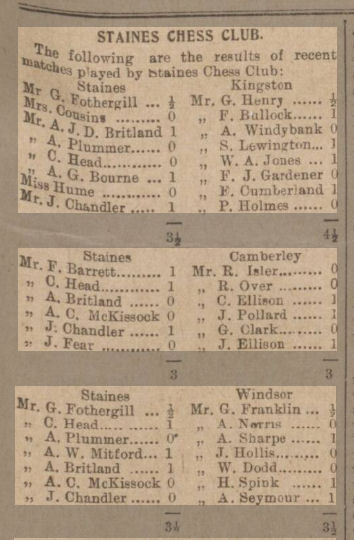
Middlesex Chronicle 14 February 1914

The Staines team playing Kingston featured not just Mrs Cousins but Miss Hume as well.

She was still playing after the First World War, when Staines had possibly been renamed Ashford and District.

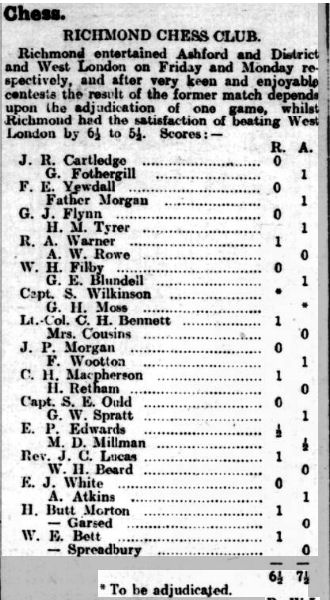
Richmond Herald 12 November 1921

Lieutenant-Colonel Charles Henry Bennett (1853-1925) had been born in Cork and spent his career in the Indian Army Medical Service, also serving in Afghanistan. His gallantry didn’t extend to letting his lady opponent win the game.


So, who was Mrs Cousins and what was she doing in a man’s – sorry, gentleman’s – world?

She was born Jessie Helena Hume in St Marylebone on 28 June 1866, so she was in her 40s and 50s when playing in these matches. Her father, Charles Dobinson Hume, was a clerk working for the local government board, whose work involved with the Poor Law would take him to Ashford, Middlesex. Her mother, presumably, was Catherine Austen Mary Bailey, whose second name suggests her parents may have been Janeites. Although Jessie’s birth was registered (as Jessie Helen) with the surname Hume and mother’s maiden name Bailey, her parents weren’t married at the time, and were living separately in 1871, Charles with his parents and Catherine working as a bookkeeper, described as a servant to an accountant. They only married – in Richmond – in 1872 (with Catherine’s name given as Kate), at which time they moved to Ashford. I haven’t yet been able to locate Jessie in the 1871 census as either Hume or Bailey – she may well have been living with relations. Once Charles and Kate had tied the knot, four more daughters arrived: Mabel in 1874, twins Edith and Sophia in 1876 and finally Isabel in 1877.

I can’t find any immediate connection with the Scottish born problemist George Hume.

I presume Jessie learnt chess from her father, although he doesn’t seem to have been a competitive player. Miss Hume in 1914 would have been one of her sisters: Sophia had married by this point, but Mabel, Edith and Isabel were all unmarried and living at home with their widowed mother, so it might have been any of them. It’s both strange and annoying that, in those days, ladies’ names were given only with a title, not an initial.

Jessie had married Thomas George Cousins in Staines in 1893: they went on to have five children between 1895 and 1909: Dorothy, Sydney, Lillian, Dennis and Margaret. Thomas would have known his father-in-law through work: he was the Relieving Officer for the Guardians of the Poor of Staines Union – the workhouse. His job would have involved assessing the needs of the poor in the area and providing for them to the best of his ability.

At some point she took up correspondence chess. Thanks to Gerard Killoran for sending me this game, taken from the Weekly Irish Times (21 August 1909). Her opponent appears to have been Arthur Patrick Morgan (1864-1918), a school inspector. Jessie played the first part of the game very well, but unfortunately missed the opportunity to win the exchange on move 35. The newspaper commented: A well played game by “one of the gentler sex”. All through most interesting, but Mr Morgan had the most experience. The ending is rather unexpected. Click on any move for a pop-up window.

[pgn]

[Event “Four-Leaved Shamrock vs. BCCA”]
[Site “?”]
[Date “1909.??.??”]
[Round “?”]
[White “Morgan, Arthur Patrick”]
[Black “Cousins, Jessie Helena”]
[Result “1-0”]
[ECO “C44”]
[Annotator “Tactical Analysis 5.2 (1s)”]
[PlyCount “91”]
[EventDate “1908.??.??”]
[EventType “corr”]
[SourceVersionDate “2022.09.24”]

1. e4 e5 2. Nf3 Nc6 3. c3 Nf6 4. d4 Nxe4 5. dxe5 d5 6. Bb5 {[#] C44: Ponziani
Opening and Scotch Gambit.} a6 $146 (6… Bc5 {with more complications.} 7. O-O
O-O 8. Nbd2 Bb6) ({Predecessor:} 6… Bc5 7. O-O O-O 8. Bxc6 bxc6 9. Nd4 Ba6
10. Re1 f5 11. f3 Ng5 12. Bxg5 Qxg5 13. Kh1 Rae8 14. Nxc6 Bb6 15. Qxd5+ Kh8 16.
Qd1 Re6 17. Nd4 {0-1 (26) Meijer,B-Van Foreest,D Utrecht 1886}) 7. Ba4 (7.
Bxc6+ $5 bxc6 8. Nbd2 $11) 7… b5 (7… Bc5 {feels hotter.} 8. O-O O-O 9. Nbd2
f5) 8. Bb3 {White is slightly better.} Be6 9. a4 b4 10. Be3 {[#] aiming for a5.
} Be7 11. O-O O-O 12. Bd4 Nxd4 13. cxd4 (13. Nxd4 $5 Qd7 14. Nd2 Nxd2 15. Qxd2
$15) 13… a5 14. Qd3 $2 (14. Nbd2 $15) 14… c5 $19 15. dxc5 Nxc5 16. Qc2 Nxb3
17. Qxb3 Bc5 ({Worse is} 17… d4 18. Qd3 $15) 18. Qd3 h6 19. Nbd2 Qd7 {
Hoping for …Bf5.} 20. Nb3 Bb6 21. Nbd4 {Inhibits Bf5.} Bg4 22. Nh4 (22. h3 $5
Bxf3 23. Nxf3 $15) 22… Qe7 23. Ndf3 Rfd8 24. Rfe1 $2 ({White should try} 24.
h3 $15 Bc8 25. Nf5) 24… Qa7 25. Rf1 Rac8 {…Qd7 is the strong threat.} 26.
h3 Be6 {And now …Qd7 would win. A strong pair of Bishops.} 27. Nf5 Bc5 28.
N3d4 Qd7 29. Nxe6 fxe6 30. Nh4 Rf8 31. Nf3 Qa7 32. Rad1 Rf5 {White should
prevent …Bb6.} 33. Rd2 Qd7 34. Re1 $2 (34. Rc2 $16 {keeps the pressure on.})
34… b3 35. Nd4 $2 (35. Ra1 $17) 35… Bb4 $4 (35… Rf4 $19 {and life is
good for Black.} 36. Nxb3 Bb4) 36. Nxf5 $18 Bxd2 37. Qxd2 Rc2 (37… exf5 $142
38. Qxa5 Qd8) 38. Qf4 Qf7 {[#]} (38… exf5 $2 39. e6 Qe7 40. Qb8+ (40. Qxf5
Qb4 $18) 40… Kh7 41. Qxb3) 39. Nxh6+ gxh6 {Endgame KQR-KQR} 40. Qg3+ Kh7 41.
Re3 Rxb2 42. Rxb3 Ra2 $2 (42… Rxb3 $16 43. Qxb3 Qf4) 43. Ra3 $2 $40 {White
goes for the king.} (43. Qd3+ Kh8 44. Qd4 (44. Rb8+ Kg7 $16)) 43… Rb2 $2 (
43… Rxa3 {was necessary.} 44. Qxa3 Qf5) 44. Rf3 Qe8 (44… Qg7 $142 45. Rf6
Qxg3 46. fxg3 Ra2) 45. Rf6 Rb7 46. Qf4 {Weighted Error Value: White=0.72/
Black=0.90} 1-0

[/pgn]

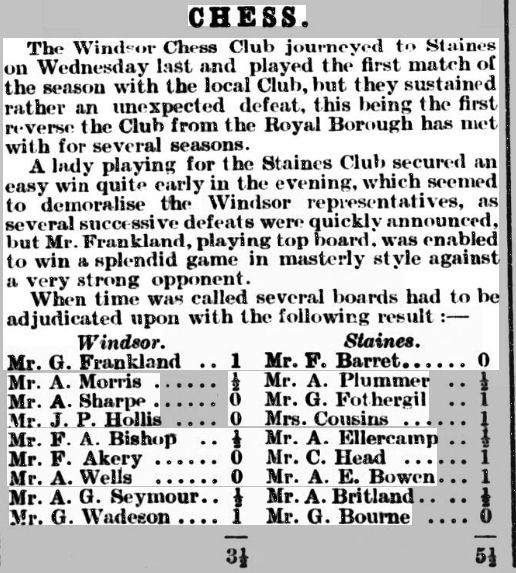
It’s not yet clear when Staines Chess Club was founded. I can’t find any earlier mentions than this 1913 match against Windsor, but it’s quite possible the relevant local newspapers aren’t yet available online.

Windsor and Eton Express 22 November 1913

Today, I’d imagine a female chess player would feel insulted and patronised to be discussed in that way, but I suspect that, in those very different times, Mrs Cousins was more likely to have been flattered and amused.

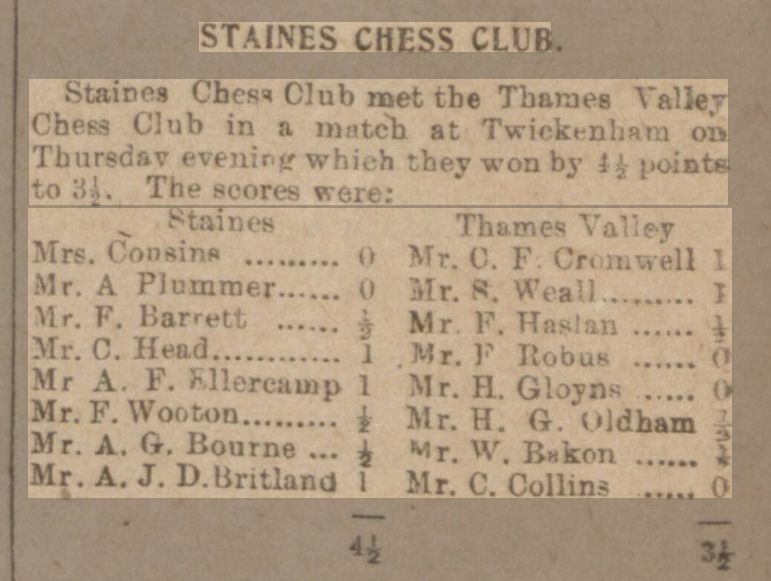
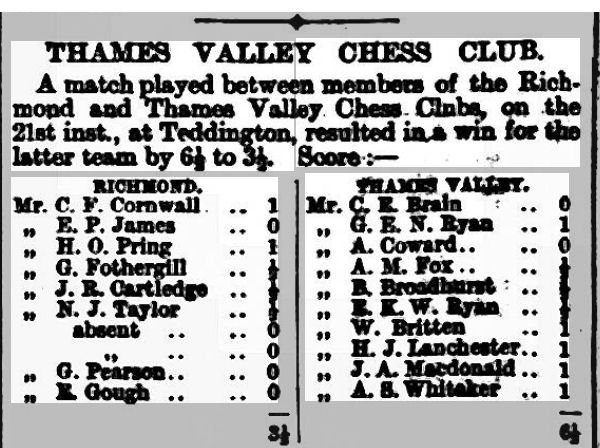
The selectors must have been impressed with her speedy victory, as, a few months later, she was promoted to top board in this match against Thames Valley.

Middlesex Chronicle 24 January 1914

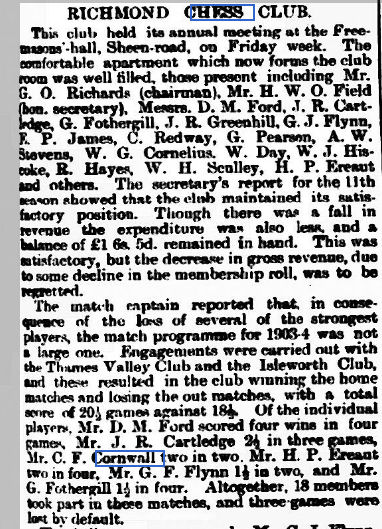
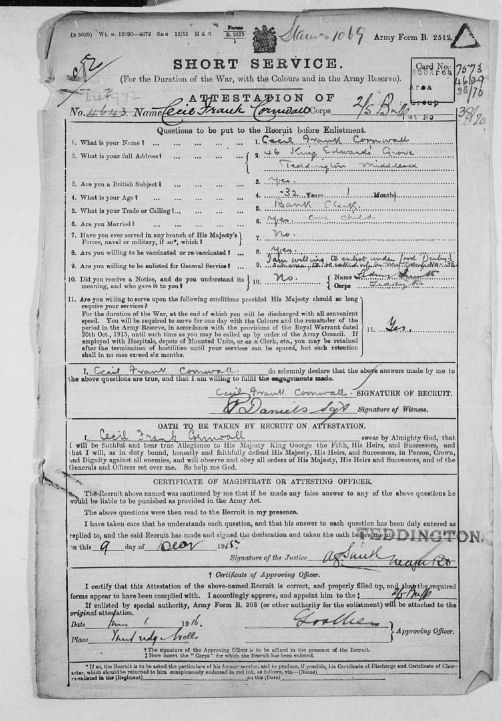
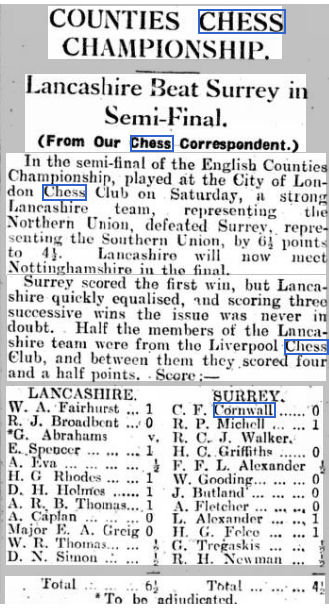
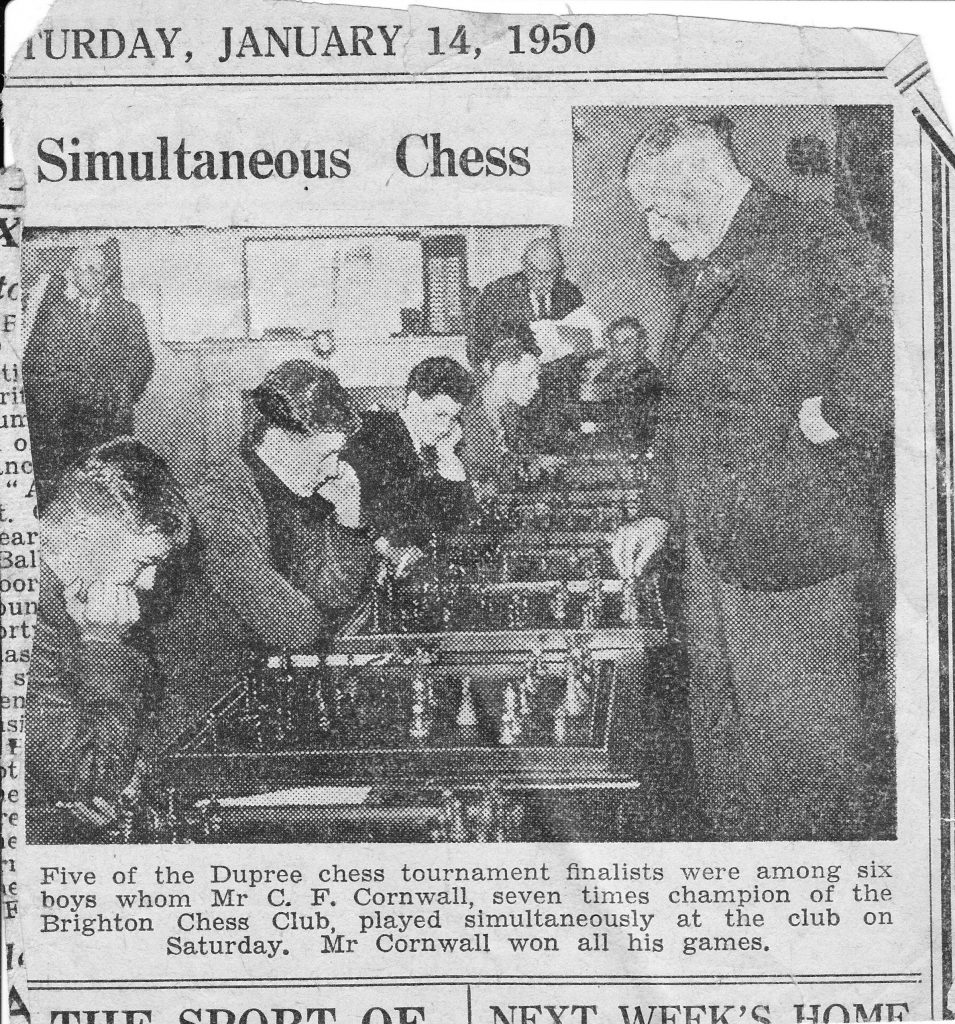
CF Cromwell must have been a misprint for Cecil Frank Cornwall: he was a pretty strong player so it was no disgrace to lose to him.

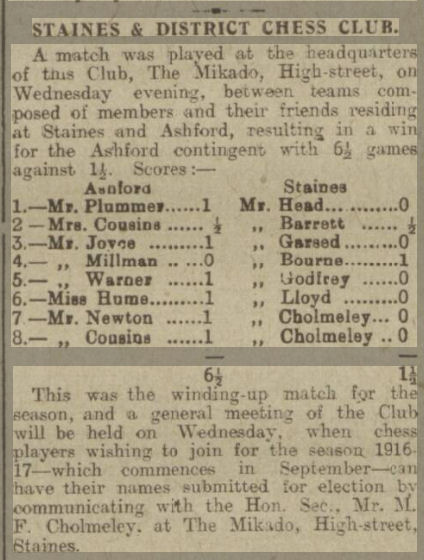
Just as Richmond Chess Club staged matches between the residents of Richmond and Sheen, so Staines (now Staines and District) Chess Club staged matches between the residents of Staines and Ashford. In this wartime match, Jessie’s sister (the same one as above?) and husband were both successful. Did she, I wonder, teach her husband how to play?


Middlesex Chronicle 06 May 1916

Their Club Secretary, Montague Francis Cholmeley, from the family of the Cholmeley Baronets, don’t you know, was born in what was then Madras in 1856 and died in Staines in 1944. Not many people outside the area know that Staines was the home of linoleum for more than a century from its invention in 1860, and the Staines Linoleum Company employed Monty, a solicitor, to deal with their legal affairs. I’m not sure who the other Mr Cholmeley was. His only brother was in India. It might, I suppose, have been his son Humphrey Jasper, home on leave from the trenches, where, on 15 July the same year, he tragically lost his life in the Battle of the Somme. I assume the Mikado was a restaurant: it would have been a very short walk from where, a few years later, the Misses Ada and Louisa Padbury would be juggling running their own restaurant with bringing up their young niece. Yes, you’ve heard the story before, and you’ll hear it again as well.

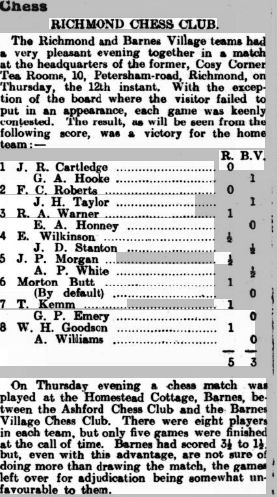
I’d imagine, then, that at some point fairly soon after this match the club moved down the road to Ashford, the home town of its stronger members, changing its name in the process, taking us to 1921, when we saw Jessie Cousins playing in a match against Richmond.

Also in 1921 she played on board 183 for the North of the Thames in a 400 board megamatch against the South of the Thames: you can see the full score here. You’ll note that the two players immedately above here were Staines/Ashford colleagues. There are some great names on both sides in this match, including the subject of the next Minor Piece. I should perhaps look in more detail another time: meanwhile there’s some background information here.

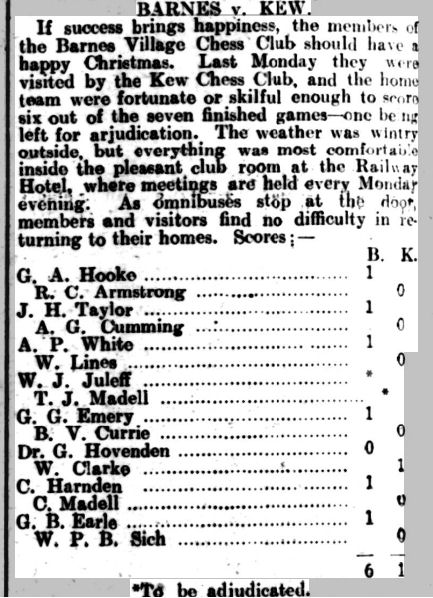
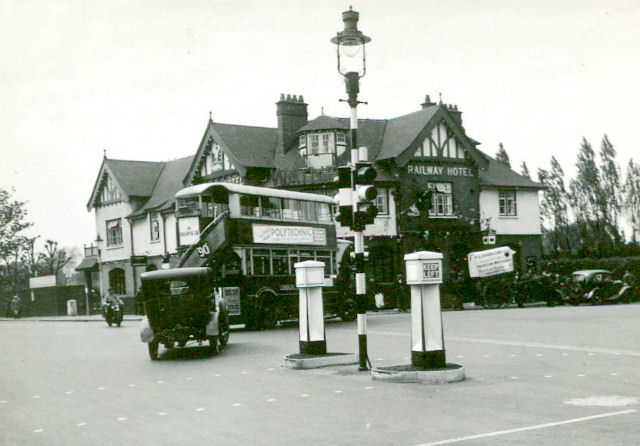
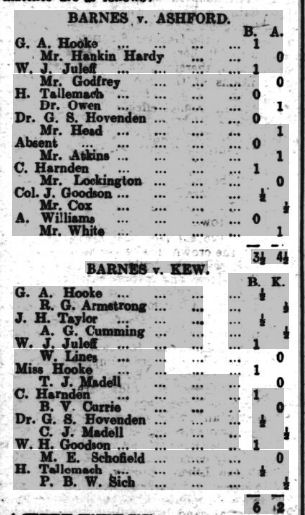
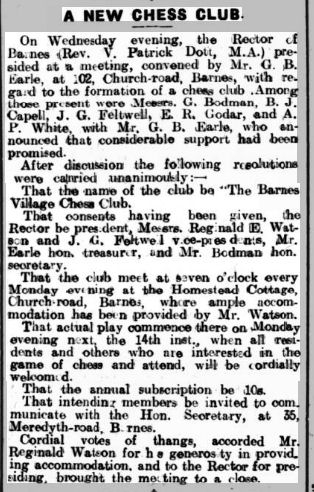
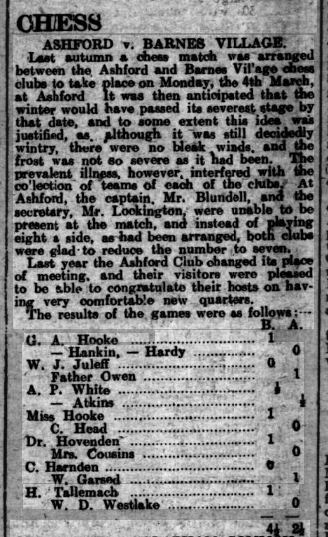
Richmond, as we’ll see, faced competition in the area from new clubs in Twickenham (you’ll recall the previous Twickenham club had moved to Teddington and changed its name to Thames Valley), Barnes and Kew. I’ll tell you more about the Barnes Village chess club next time, but in the inter-war years they played regular matches against Ashford.

This, from 1929, is the last mention of Mrs Cousins I’ve been able to find.

Richmond Herald 09 March 1929

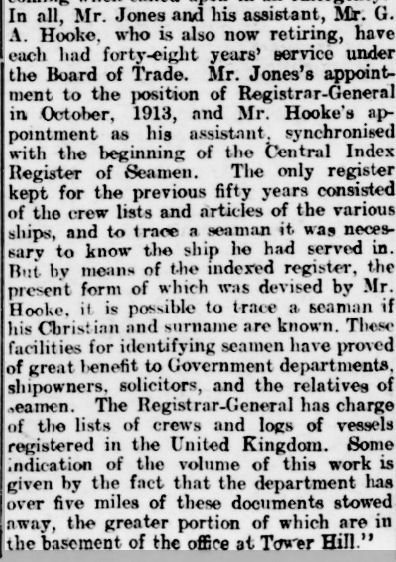
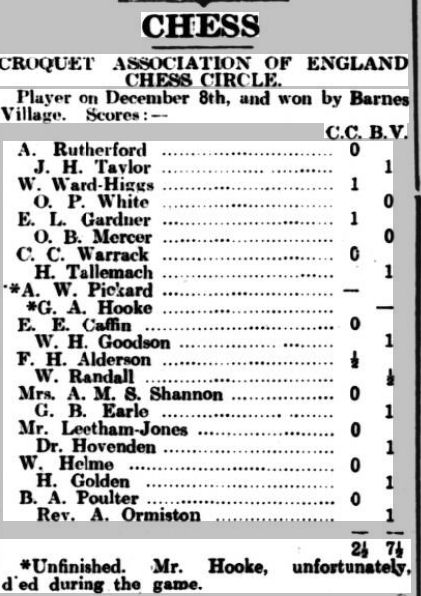
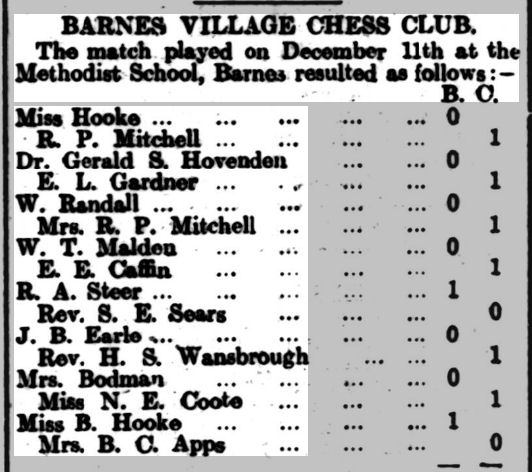
You’ll see that both teams fielded a lady, and they just missed each other by one board: Miss Hooke (in 1929 ladies were still not allowed initials) was playing for Barnes Village along with GA Hooke. You’ll find out more about the Hooke family very soon.

The 1939 Register records Thomas, Jessie and their unmarried daughter Dorothy living at 18 Fordbridge Road, Ashford, Middlesex, which is where Jessie died on 23 August 1948 at the age of 82. I haven’t found any records of any of her children playing competitive chess.

Jessie Helena (Hume) Cousins was a lady who, for almost two decades, was successful in the, then as now, male dominated world of suburban competitive chess. She was clearly a more than competent player as well, probably around 1800 strength by today’s standards. Her story should be an inspiration for any girls and women wanting to take up competitive chess today.

Minor Pieces 44: Henry Jones Lanchester

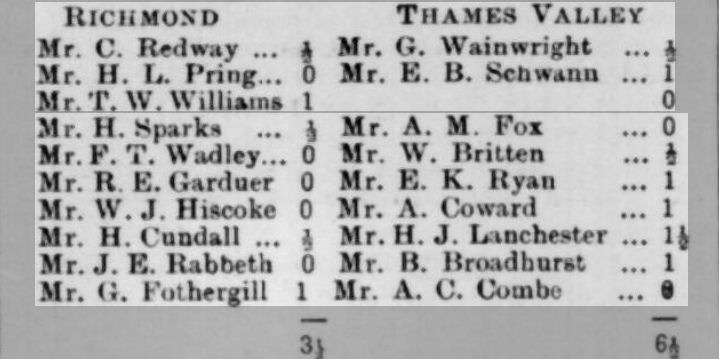
Richmond Herald 22 April 1899

You might have seen this in the previous Minor Piece. Consider for a moment the Thames Valley team. There on board 6 or thereabouts is Arthur Coward, father of Noël. A board (or possibly two) below him is Mr HJ Lanchester, another man with an interesting family. (I note, en passant, that Augustus Campbell Combe on board 10, a Stock Exchange Clerk, was Wallce Britten‘s brother-in-law.)

Henry Jones Lanchester was an architect and surveyor, born in Islington on 5 January 1834, so he was 65 at the time of this match.

He lived at various addresses in London before moving to Brighton in about 1870, where he worked on the Stanford Estate and Palmeira Mansions. But he was badly affected by the property slump of the late 1880s and moved back to London with his family, settling in Battersea, not far from Clapham Common.

The good news for Henry was that he now had more time to play chess and immediately joined Balham Chess Club, where he won 2nd prize in their 1888-89 tournament and played on a high board for them in matches against neighbouring clubs as well as being selected to represent Surrey in county matches.

By 1895 he’d moved to a house called Salvadore on Kingston Hill, and the 1901 census found him at Ripley House, Acacia Road, New Malden, on the same estate as Richmond top board IM Gavin Wall, not to mention David Heaton. Living close to the station, it would have been easy for him to catch the train to Teddington to play for Thames Valley Chess Club, unless he preferred a ride in one of those new-fangled motor cars.

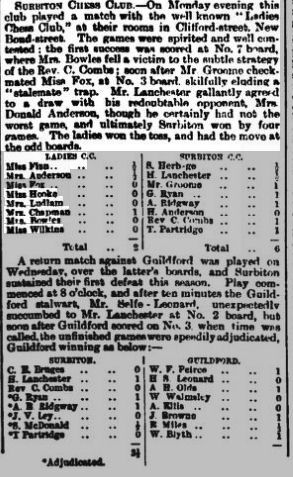
But Thames Valley wasn’t his only chess club: he was also playing for Surbiton. Here he is, in 1901, taking second board in two matches and gallantly agreeing a draw against Mrs Donald Anderson of the Ladies Chess Club in a favourable position. Mrs Anderson (née Gertrude Alison Field) won the British Ladies Championship in 1909 and 1912, so this was a good result.

Surrey Comet 16 February 1901

In 1903 he had a wasted journey to Richmond as, all too typically for the home club at the time, two of their players failed to turn up. Didn’t they have any social players there to fill in? Fortunately, our excellent match captains are far better organised today.

Surrey Comet 24 January 1903

By the middle of the decade he had returned to Sussex, settling in Lindfield, near Haywards Heath, whose chess club he promptly joined

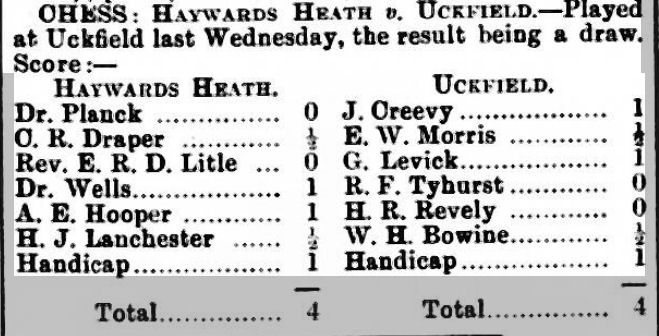
Here’s a 1906 match card.

Mid Sussex Times 20 November 1906

I’m not sure why both teams scored a Handicap point on board 7, but there you go.

Haywards Heath’s top board, Dr Charles Planck (no relation, as far as I know, to Max), was a doctor and psychiatrist running the local lunatic asylum, a type of institution with which Lanchester, as you’ll find out later, had had previous experience. He was also one of England’s leading problemists, having co-authored, back in 1887, a book called The Chess Problem with fellow problemists Henry John Clinton Andrews, Edward Nathan Frankenstein and Benjamin Glover Laws. Another spoiler alert: read on for a very different Frankenstein.

Henry Jones Lanchester also played correspondence chess, playing for Sussex in matches against other counties. He died at his home in 1914, on his 80th birthday.

Here’s a game from one of those correspondence matches. His opponent was born Emily Beetles Nicholls in Guildford in 1872. Her father, Edward, was high up in the Inland Revenue and seemed to move around the country a lot. Click on any move for a pop-up board.

[pgn]

[Event “Norfolk v Sussex Correspondence”]
[Site “?”]
[Date “1908.??.??”]
[Round “?”]
[White “Bush, Emily Beetles”]
[Black “Lanchester, Henry Jones”]
[Result “1-0”]
[ECO “C29”]
[Annotator “Stockfish 15”]
[PlyCount “51”]
[EventDate “1908.??.??”]
[SourceVersionDate “2022.09.17”]

1. e4 e5 2. Nc3 Nf6 3. f4 Nc6 4. fxe5 Nxe5 5. d4 {[#]} Nc6 $146 ({Predecessor:
} 5… Ng6 6. Nf3 Bb4 7. Bd3 d6 8. O-O Bg4 9. Bg5 Bxc3 10. bxc3 h6 11. Bxf6
gxf6 {1-0 (25) Mayer,L-Malthan,F Hannover 1902}) 6. d5 $2 {C29: Vienna Game: 2.
..Nf6 3 f4.} (6. e5 $18) 6… Ne5 $14 7. Nf3 d6 8. Bf4 {White is slightly
better.} Qe7 (8… Ng6 $5 9. Bd2 Bd7 $14) 9. Bb5+ Bd7 10. Bxd7+ Nfxd7 11. O-O
Nxf3+ 12. Qxf3 {[#] Black must now prevent Nb5.} ({Don’t do} 12. gxf3 $6 a6 $14
) ({Don’t play} 12. Rxf3 $6 Ne5 $14) 12… f6 $2 {A mistake that costs the
game.} (12… g5 $16 {was called for.}) 13. Nb5 $18 Nc5 14. Rae1 a6 15. Nd4
O-O-O (15… a5 {is a better defense.} 16. a3 a4) 16. b4 Nd7 17. b5 axb5 18.
Nxb5 Nc5 19. Nd4 (19. Qa3 $142 Kd7 {[#]} 20. Nxc7 $1) 19… Qd7 20. a4 Qxa4 (
20… Re8 21. Nb3 Kb8) 21. Qh3+ Qd7 {Hoping for …Qxh3.} 22. Ne6 Re8 23. Ra1
Na6 24. Rfb1 Rxe6 25. dxe6 ({Weaker is} 25. Qxe6 Qxe6 26. dxe6 Be7 $16) 25…
Qe7 26. Qb3 {Weighted Error Value: White=0.77/Black=1.13} 1-0

[/pgn]

Probably not a game which showed him at his best. The Vienna Game is devastating against an unprepared opponent and his natural third move just leads to a lost position, 6. d5 would have been much better than Mrs Bush’s e5, which allowed Henry back into the game. (Thanks to Brian Denman for sending me this, which was published in the Lowestoft Journal (23 Jan 1909).)

Here, then, was a man who must have played chess all his life, but, it seems, only took up competitive chess on his retirement (or perhaps semi-retirement) from his career as an architect and surveyor.

For further information on Henry Jones Lanchester:
Wikipedia
Grace’s Guide (also links to his sons)

He must also have taught his children chess. Some of them had very interesting lives.

Henry had married Octavia Ward, a mathematics and Latin tutor, in 1863. Their children were Henry Vaughan (1863), Mary (1864), Eleanor Caroline (1866), Frederick William, known as Fred (1868), Francis, known as Frank (1870: his twin brother Charles didn’t survive), Edith, known as Biddy (1871), Edward Norman (1873) and George Herbert (1874). Henry junior became, like his father, an distinguished architect. Mary and Eleanor both became artists. Edward emigrated to New Zealand, later moving to Australia and earning a living as a signwriter.

The other three brothers, Fred, Frank and George, were a lot more interesting.

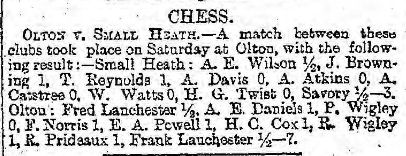
Fred Lanchester was one of the most remarkable engineers and inventors of his time. In 1888 he took a job with a gas engine company in Birmingham, and, in his spare time, started working on designing motor cars. In 1895 he completed a four-wheeled vehicle powered by a petrol engine. In between his work and his vehicle, he also found time to play chess. Here he is, playing on top board for his local club, Olton (near Solihull), with his brother Frank, clearly an inferior player, on bottom board.,

Birmingham Daily Post 19 February 1895

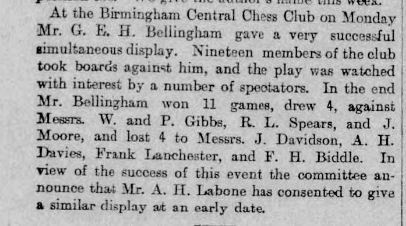
In 1898, he won a game in a simul against the leading West Midlands player of his day, George Edward Horton Bellingham. You’ll notice an incorrectly initialled mention of our old friend Oliver Harcourt Labone.

Birmingham Daily Gazette 02 November 1898

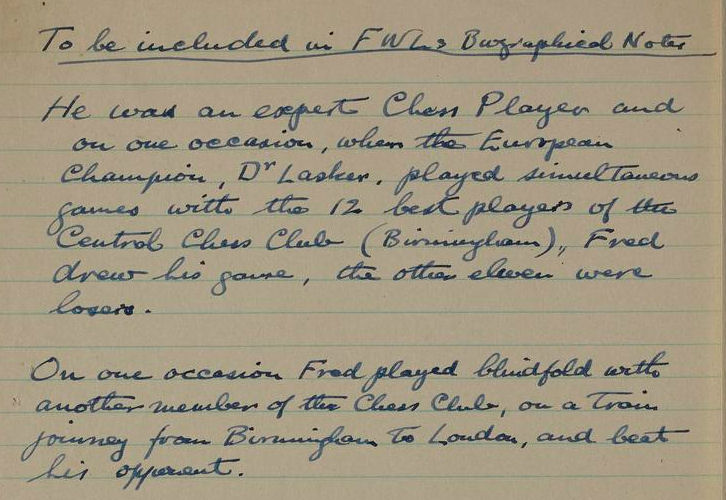
According to his brother George he also beat none other than Emanuel Lasker in a simul.

Fred Chess notes LAN-1-1-48

Source: https://www.lanchesterinteractive.org/grandmaster-fred-checkmates-champions-international-chess-day-2022/

However, George’s account doesn’t tally with any of the Lasker simuls given by Richard Forster in his definitive list here.

1 Mar 1897 Birmingham 31 26 3 2
2 Mar 1897 Birmingham (consultation) 6 6 0 0
1 Dec 1898 Birmingham, Central C.C. 25 13 9 1 Various games were adjudicated, two left undecided.
23 Nov 1900 Birmingham, Temperance Institute c10 c10 0 0 Vlastimil Fiala in the Quarter for Chess History, no. 6/2000, pp. 382f. claimed a score of 25 wins, but it was not possible to verify this score indepedently. The Cheltenham Examiner, 28 November 1900, indicated “less than a dozen” and the Birmingham Weekly Post, 1 December 1900, spoke of “a meagre attendance”.
17 Mar 1908 Birmingham C.C. 28 23 3 2

In December 1899 Fred, Frank and George created the Lanchester Engine Company to build and sell motor cars to the general public. George was also a brilliant engineer, while Frank was the sales manager. For several decades Lanchester was one of the most famous makes of motor car in the country.

Frederick William Lanchester (Wikipedia)

The name Lanchester was commemorated in 1970 with the creation of Lanchester Polytechnic, now Coventry University.

Perhaps the family’s achievements, especially those of Fred, are unfairly forgotten today. They certainly deserve to be remembered as pioneers of the early motor car industry. It’s good to know that Fred was also a pretty good chess player.

For more information on the Lanchester brothers:
Wikipedia (Fred)
Wikipedia (George)
Wikipedia (Lanchester Motor Company)
Lanchester Interactive Archive

Their sister Edith (Biddy) was another matter entirely.

Biddy became a socialist and suffragette, living ‘in sin’ (as they used to say) with a working-class Irishman named James ‘Shamus’ Sullivan: the couple both disapproved of the institution of marriage.

Horrified by this, in 1895 her father and brothers kidnapped her and sent her to the lunatic asylum (it’s now, famously, The Priory) on the grounds that only an insane person could possibly become a socialist. The asylum could find nothing wrong with her and released her a couple of days later. In 1897 she became Eleanor Marx’s secretary. The job didn’t last long as Eleanor committed suicide the following year. Perhaps Biddy and Eleanor also played chess: I’d imagine Biddy learnt the moves from her father and brothers, and Eleanor usually beat her father (Karl, of course) at chess.

Biddy and Shamus’s first child, a son called Waldo, was born in 1897. He became a famous puppeteer, founding the Lanchester marionettes, a puppet theatre which ran from 1935 to 1962.

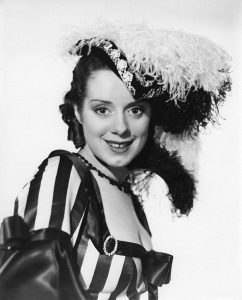
Their second child, a daughter whom they named Elsa, was born in 1902. Elsa took up dancing as a child, then worked in theatre and cabaret, also obtaining small roles in films.

In 1927 she married the actor Charles Laughton and, after playing Anne of Cleves to his Henry in The Private Life of Henry VIII, the couple moved to Hollywood where Elsa found fame in 1935 for her starring role in The Bride of Frankenstein. (Be careful not to confuse her with Miriam Samuel, the bride of the aforementioned Edward Nathan Frankenstein.) Elsa continued to perform on the silver screen, mostly in cameo roles, up to 1980, including playing Katie Nanna in Mary Poppins.

Elsa Lanchester (Wikipedia)

Of course, there’s something you all want to know. Did Elsa, like her grandfather and uncles, play chess. Why yes, she certainly did. VIctoria Worsley’s recent (2021) biography, Always the Bride, tells of her playing chess with a friend on a car journey in 1936. Chess wasn’t her only game, either. Here she is playing draughts against Charles Laughton.

As Elsa’s grandfather played chess on the adjacent board to Noël Coward’s father, you might also want to know whether they ever appeared in the same film. Sadly not, although Coward provided some dialogue for the 1957 Agatha Christie adaptation Witness for the Prosecution, starring Tyrone Power and Marlene Dietrich along with Laughton and Lanchester. (Elsa won a Golden Globe award for the Best Supporting Actress in a Motion Picture.)

More about Biddy and Elsa:
Wikipedia (Biddy)
Wikipedia (Elsa)
IMDb (Elsa)

This was the life and chess career of Henry Jones Lanchester, a man who shared a mutual friend with Frankenstein, and whose granddaugher was the Bride of Frankenstein. Henry was also the head of a remarkable chess-playing family, pioneers in both motoring and movies.

Sources and Acknowledgements:

ancestry.co.uk
findmypast.co.uk
Wikipedia
Grace’s Guide
IMDb
Lanchester Interactive Archive
Other sources mentioned in the text

Richard Forster: Lasker’s Simultaneous Exhibitions. www.emanuellasker.online (2022).

Minor Pieces 43: Percival Guy Laugharne Fothergill

I received some exciting news last week. The Richmond Herald up to 1950, with extensive local chess coverage, is now available online. This means that I’ll be able to trace the history of chess in Richmond, Barnes, Kew and Sheen up to that date, which is not all that long before I came in.

But first, and with some help from the above source, a man who was strangely coy about his rather splendid full name.

Any chess problem aficionados at any point from the late 1880s to the late 1940s, which, you might think was the golden age of chess problems, would have been familiar with the initials PGLF above compositions, with a location of, perhaps, Twickenham, Staines or Isleworth.

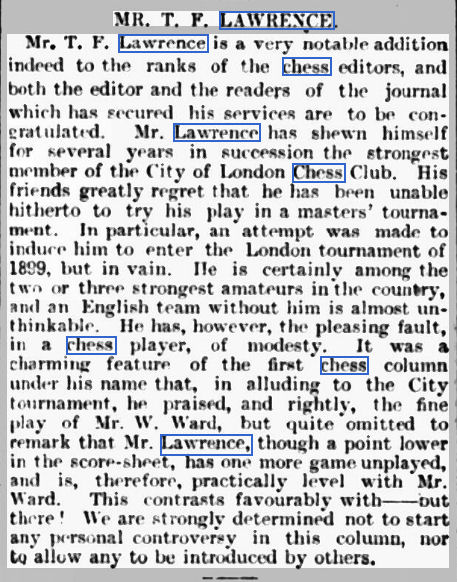
The name G Fothergill was often seen in connection with Richmond Chess Club, and with other clubs in the area. If you’ve been paying attention recently, you might remember him losing in a simul given by TF Lawrence.

Surrey Comet 22 October 1904

In fact he was plain Guy Fothergill on electoral rolls for many years.

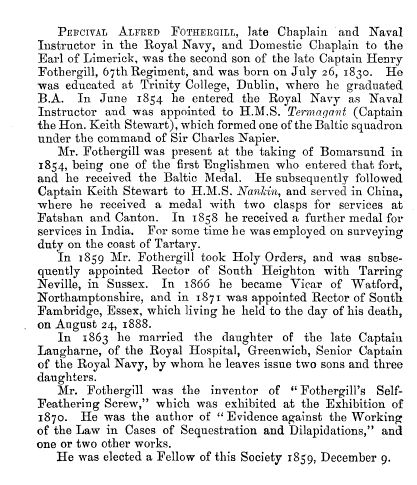
A good place to start is with his father, Percival Alfred Fothergill. Percy senior was an interesting and versatile chap. Naval officer, instructor, surveyor, engineer, inventor, astronomer, author, clergyman. You name it, he did it.

Here’s his obituary, from the Journal of the Royal Astronomical Society 049:4 (1889).

You might, understandably, be concerned about the self-feathering screw. Don’t worry: it was a propeller for sailing vessels. If you’re really interested in that sort of thing there’s a blog post here.

Percival and his wife Julia’s children, all equally impressively named, were Henryetta Mary Bertha (1865), Ernestine Gertrude Frances (1867), Percival Guy Laugharne (12 July 1868), Cornelia Julia Evelyn (1869), Frederick Henry Gaston (1871) and Arthur Yorke Marsh (1872), who died at the age of only six months. Frederick’s baptism record reorders his names: Gaston Frederick Henry.

The only births which were registered appear to be Henryetta and Frederick: at the time the family were moving round the country a lot and perhaps never got round to it.

At the time of the 1871 census Percival Alfred was the Vicar of Watford, Northamptonshire, north east of Daventry. You’ll know it from the Watford Gap service station on the M1. Their five young children, baby Fred yet to be named, were there along with a nurse and two domestic servants.

Ten years later, and the family seem to have split up. Percival was now the Rector of South Fambridge, Essex, on the River Crouch north of Southend, living in ‘part of the rectory’ along with Henryetta and Percival Junior. Julia and the other three surviving children were 20 miles away in Orsett, near Grays, on the Thames Estuary. One wonders what had happened.

There’s no immediate evidence of any other serious interest in chess in the family, but it was from his father that young Percival (perhaps we should call him by his preferred name, Guy, or by his initials) first discovered the Royal Game. By 1886 the teenage Fothergill was already having his problems published.

Here’s a (rather crude) early example of a mate in 2. You’ll find the solutions to all the problems at the end of the article.

[fen]3QB3/3N4/8/2pk1p2/2R2P2/K7/1P6/8 b – – 0 1[/fen]

Problem 1

#2 (The Field 11 Sep 1886)

His problems were soon becoming more sophisticated and even winning prizes, like this mate in 3.

[fen]8/1K2B3/7p/p2k3P/p1NpN1P1/6p1/1Q6/8 w – – 0 1[/fen]

Problem 2

#3 (2nd Prize Sheffield Independent 1888)

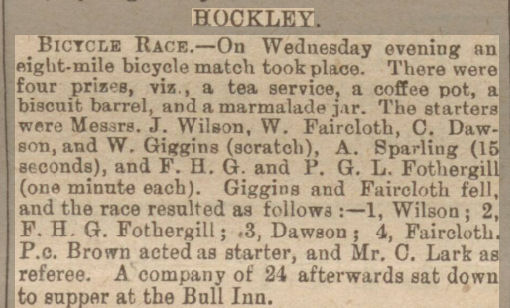
Problem composing wasn’t the only competition he took part in. Here, he and his brother took part in a bicycle race, with Fred winning a coffee pot for finishing second.

Essex Newsman 08 September 1888

Sadly, his father died the same year in Little Burstead, south of Billaricy, the village where he was born. By the time of the 1891 census he’d left home, was boarding in (not yet Royal) Wootton Bassett and working as a Brewer’s Pupil. Julia had retired to Milford, on the Hampshire coast, where she was living with Henryetta, Cordelia and Gaston, as Frederick now preferred to me known. Ernestine was in Acton, working as a Governess.

PGLF won 1st prize with this 1894 mate in 2.

[fen]Q1R5/3p4/1PR1P3/P2k4/3P2NK/3Br1p1/4P1p1/6B1 w – – 0 1[/fen]

Problem 3

#2 (1st Prize Hackney Mercury 1894)

Round about 1895 the family moved to St Margarets Road, on the border of Twickenham and Isleworth. I’m not sure exactly where, but the 1901 census implies it was somewhere close to the Ailsa Tavern.

As expected, PGLF featured in FR Gittins’ The Chess Bouquet in 1897.

His list of successes is not large, nor are they phenomenal, but his work has merited and received a fair reward…

We also learn that

MR FOTHERGILL is a great lover of all manly games – cricket, football, lawn tennis, etc., a sound mind in a sound body being one of his favourite maxims.

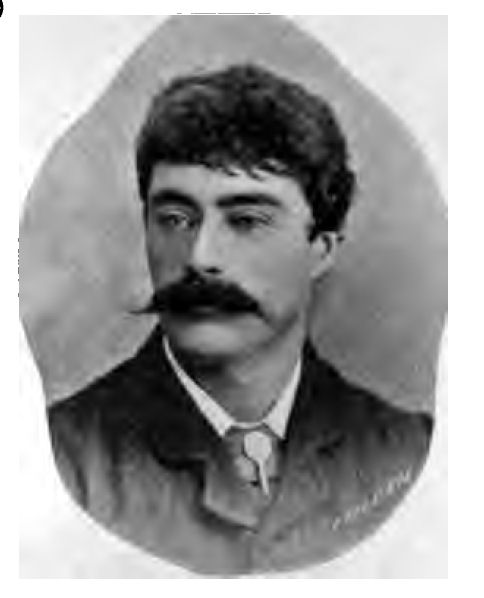
And here he is, with a splendid moustache to match his splendid name.

It’s at this time that Guy decided to expand his interest in chess, and, while still composing (as PGLF), his name (G Fothergill) started to appear in chess matches.

Here’s a 1899 match between Richmond and Thames Valley, with Mr G Fothergill playing on bottom board for the home team.

It’s clear there’s a problem with this. Fox, Britten, Ryan and Coward must have been on 3-6, not 4-7, with Lanchester and another player on 7 and 8. Regular Minor Piece readers will recognise several old friends in this match, and there are one or two others you’ll meet in later articles.

The 1901 census found Julia, Henryetta, Cordelia and Gaston, who was now known as Henry, in residence in St Margarets, none of them appearing to have jobs. Ernestine, however, was occupied as a Lady’s Companion in Hersham.  I haven’t managed to locate Guy in 1901: perhaps he was abroad on holiday. At any rate, he was still telling everyone he lived in Twickenham.

From the same year, here’s another prize-winning problem.

[fen]2B5/6p1/2p2bK1/5NPn/R2R2N1/3P1k1r/2Q5/5bBn w – – 0 1[/fen]

Problem 4

#2 (3rd Prize Brighton Society 1901)

This miniature 3-mover demonstrates a popular theme. Even if you’ve never solved a mate in 3 before, give it a try!

[fen]8/5Q2/p7/N1k5/8/5K2/4N3/8 w – – 0 1[/fen]

Problem 5

#3 (Schachminiaturen 1903)

At about this time Guy Fothergill suffered two bereavements: his mother Julia died in 1905, and his sister Cornelia followed her a year later. Probate records tell us they were both living at Shortwood House, Staines: Shortwood Common is right by the Crooked Billet roundabout heading towards Ashford. Julia’s probate was granted to Henryetta and Guy, and Cornelia’s probate just to Guy. Although she was living in Staines, she died at 89 St Margarets Road, Twickenham. The numbering may be different now, and it’s a long road, but 89, currently a private healthcare clinic, is currently just round the corner from Turner’s House and a short walk from the ETNA Community Centre, where Richmond Junior Club met for many years.  So it may well be that the family owned two properties at the time. It’s not at all clear to me at the moment whether or not this is the same address they were at in 1901.

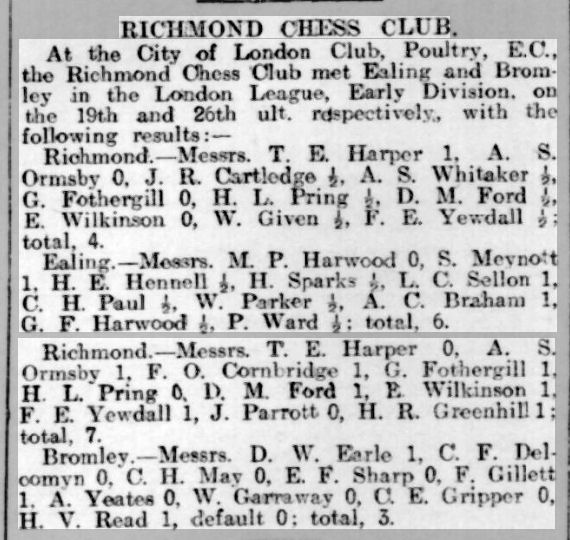
As the Edwardian era wore on, there were subtle changes in the balance of power between the Richmond and Thames Valley Clubs. At the start of the decade Thames Valley had been stronger than their younger neighbours, but a few years later Richmond were displaying more ambition (and, it appears, better organisation than a few years earlier), entering the Early Division of the London League and attracting stronger players. (I presume the Early Division played matches earlier in the evening than, well, perhaps the Late Division?)

Richmond Herald 03 March 1906

You’ll also notice that by now Guy had been promoted from bottom board, and AGM reports for the period show that he was also doing well in internal competitions,

Now approaching his 40th birthday, life for PGLF proceeded uneventfully as he continued to play chess and compose problems.

The 1911 census, though, finds the Fothergill siblings split up, living neither in Staines nor in Twickenham. Guy, ‘of private means’, was boarding at a Temperance Hotel in Maidenhead (what happened to his brewing career, then), while Henryetta and Ernestine were both staying with a restaurant owner in Reading, who may well also have had rooms for boarders. There’s no sign of their younger brother.

By 1914, PGFL’s problems are now being submitted from Staines. Was he living in Shortwood House? Possibly: at present that information isn’t available. He also had the opportunity to join a new chess club.

Middlesex Chronicle 14 February 1914

You’ll notice that there were two ladies in the team facing Kingston: Mrs Cousins and Miss Hume. We’ll return to them in a future Minor Piece.

He maintained his membership of Richmond Chess Club as well, taking part in internal competitions and serving on the committee.

In 1918 PGLF was enrolled as a founding member of the British Chess Problem Society.

The country was now returning to normal after the First World War, and the 1919 electoral roll tells us that Henryetta was still at Shortwood House, London Road, Staines. By 1921 she’d been joined by ‘Fred’ (neither Gaston nor Henry) and Percival (not Guy).

Neither brother was anywhere to be found in the 1921 census (at least I haven’t been able to find them yet). Their two sisters, both still unmarried in their mid 50s, were lodging in Goldhawk Road, Hammersmith, near the junction with King Street – even though the electoral roll had Henryetta in Staines. The census enumerator found the house unoccupied.

A short walk from Goldhawk Road along King Street towards Hammersmith Broadway would have taken them past Latymer Upper School, and then round the corner to what is now the London Mind Sports Centre.

If they’d only stayed in Staines another year or two they could have strolled past the Crooked Billet towards the town centre and dined at 8 London Road, the Warwick Castle, where the Misses Ada and Louisa Padbury were combining running a restaurant with bringing up their irresponsible sister Florence’s illegitimate daughter Betty. But that’s another story for another time, which also involves Edward Guthlac Sergeant and Fothergill’s Richmond teammate Cecil Frank Cornwall.

At some point, perhaps just after, WW1, the Ashford and District Chess Club was founded. Guy, along with Mrs Cousins, joined up, he soon found himself playing successfully on top board against Richmond. It may well have been on his initiative that matches between the two clubs came about. Today there’s a Staines Chess Club, but not an Ashford Chess Club.

Richmond Herald 12 November 1921

In 1922 Henryetta must have sold Shortwood House and brought a property in Isleworth, 43 Thornbury Road.

I’m not sure that the house still exists. 41 is a large corner property, but the adjacent plot seems empty according to Google Maps.

She’s the only occupant on the electoral roll for several years, but by 1929, Guy (not Percival this time) is also there, although Henryetta is declared to be the owner. I presume he’d been living there all along, though, as he was giving Isleworth as his residence when submitting problems for publication.

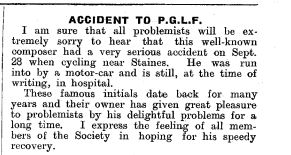
He still visited his old haunts in Staines, but in 1936 was seriously injured in a cycling accident. Fortunately, he made a full recovery.

The Problemist November 1936

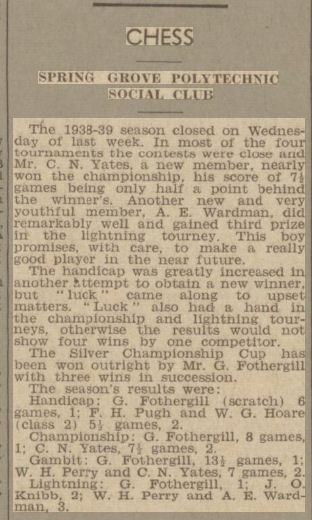
By the late 1930s, if not earlier, he’d found a very local chess club to join, just round the corner from his residence.

Middlesex Chronicle 08 April 1939

He was now in his seventies, but still made a clean sweep of all the trophies. The opposition may not have been the most demanding, but you can do no more than beat what they put in front of you.

Here they all are in the 1939 Register, all living in Thornbury Avenue (perhaps they’d all been there all along), all single, and aged between 65 and 71. Percival is a Brewery Traveller (retired), but I’m not sure he did much Brewery Travelling, while Frederick is an Architect (retired), but again I’m not sure he designed very many buildings. I can’t find any record of him in that sphere.

PGLF was still composing, though not quite as prolifically as before. This 3-mover from the latter part of his career demonstrates the theme of symmetry.

[fen]8/R7/3pkp2/8/4K3/2p3p1/8/4Q3[/fen]

Problem 6

#3 (The Problemist March 1944)

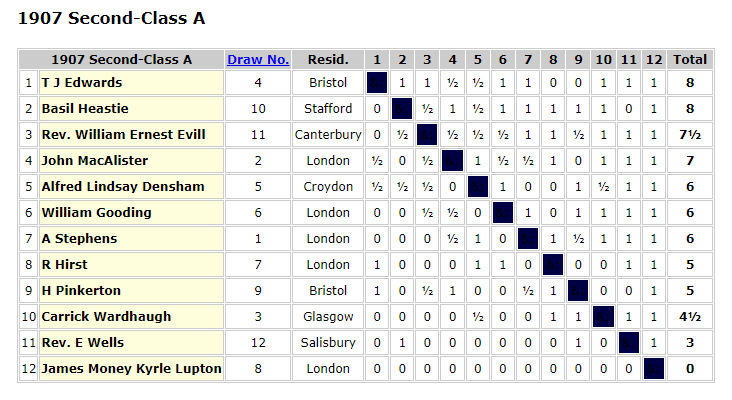
This, then, was a fairly wealthy family, with enough money not to need much in the way of employment, and seemingly with no interest in matrimony. This gave them time to pursue their hobbies, and, in PGLF’s case, that hobby was chess. It’s spookily like James Money Kyrle Lupton‘s family, isn’t it?

Ernestine was the first to go, dying in 1945 and leaving £6711 (round about £200000 to £250000 today), probate being granted to Frederick.

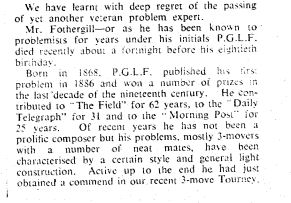
Percival/Guy/PGLF died on 29 June 1948, leaving £4486 10s 4d, again probate being granted to Frederick. He was composing to the end: almost two years after his death, his problems were still being published.

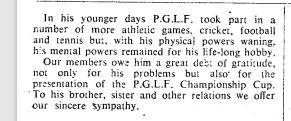
Here’s his obituary from The Problemist, rather belatedly in January 1949. Unfortunately the accompanying photograph didn’t reproduce well.
Unfortunately, also, the recent commendation turned out to be cooked, so I won’t demonstrate it here.

Henryetta, address given as 32 Stamford Brook Road, just round the corner from where she was in 1921, died in 1954, leaving £5528 8s 10d, yet again probate granted to Frederick.

Frederick, or Gaston, or Henry, or whatever, lived on until 31 December 1962, living at 45 Woodlands Grove Isleworth, not far from Thornbury Road, and leaving £15307 17s.

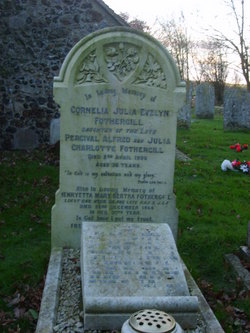
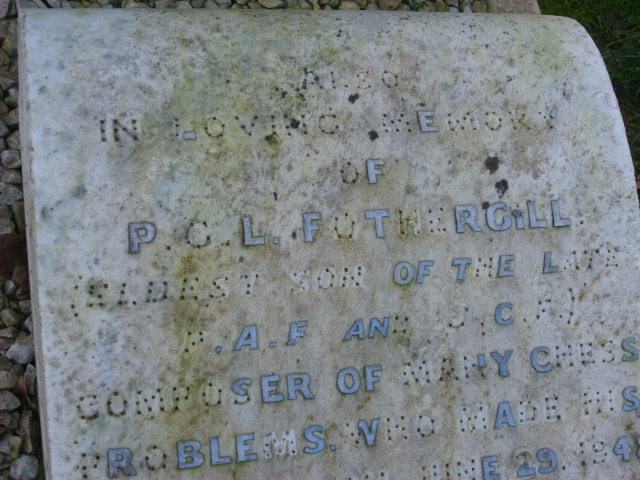
Four of the siblings (not, for some reason, Ernestine) share a gravestone in the family’s home village of Little Burstead, Essex. Percival’s inscription reads:

Also in loving memory of P.G.L. FOTHERGILL [eldest son of the late P.A.F. and J.C.F.], composer of many chess problems who made his last move on June 29 1948 on the eve of his 80th year.

“Thou wilt keep him in perfect peace whose mind is stayed on Thee because he trusted in Thee.” Isaiah XXVI. 3

https://www.findagrave.com/memorial/17668008/percival-c_l-fothergill

Yes, indeed, a composer of many chess problems. Mostly direct mates, latterly mostly mates in 3, but with a few selfmates (where White compels an unwilling Black to deliver checkmate). Mostly lightweights rather than heavy award-winners, but none the worse for that. He was, similarly, a good chess player – higher club standard – but not a great one. I have yet to find the scores of any of his games. Percival Guy Laugharne Fothergill was a man who, through his problems, must have brought a lot of pleasure to a lot of people. Perhaps you’ll derive some pleasure from attempting to solve the problems in this article. A minor contributor to a minor art form, I suppose, but still a life well lived and well worth remembering.

If you’d like to see more of his (or anyone else’s) problems I recommend:
https://www.yacpdb.org/
http://www.bstephen.me.uk/meson/meson.pl?opt=top
https://www.theproblemist.org/mags.pl?type=tp

Acknowledgements and sources:

ancestry.co.uk
findmypast.co.uk
findagrave.com
Wikipedia
Google Maps
The Problemist
MESON chess problem database
YACPDB (Yet Another Chess Problem DataBase)
Other sources referenced within the article

Problem solutions.

Problem 1:
1. Qd8! and all four Black moves allow knight mates. There are duals in three of the four variations, which wouldn’t be acceptable today.

Problem 2:
1. Ba3! when the star line is 1… Kxc4 2. Qb5+! Kxb5 3. Nd6#. Also 1… Kxe4 2. Qe2+, 1… Ke6 2. Qb6+, 1… d3 2. Qd5+ and 1… g2 2. Qb5+

Problem 3:
1. Re8! A waiter, very popular at the time. The move creates no threat, but every Black move creates a weakness allowing White to mate next move. You can work them all out for yourself!

Problem 4:
1. Bh2! Another waiter: again there’s no threat but every possible Black reply allows immediate checkmate. There are quite a lot for you to find!

Problem 5:
1. Nc3! Kb4 2. Qc4+!, or 1… Kb6 2. Qe7!, or 1… Kd6 2. Ne4+!, or 1… Kd4 2. Ne4! This demonstrates the Star Flight theme: Black’s four possible king moves, SW, NW, NE and SE, make the shape of a star.

Problem 6:
There’s some set play: if it was Black’s move 1… c2 would be met by 2. Qa5. There are also two tries: 1. Rg7? d5+! and 1. Rc7 f5+!
So the solution is 1. Qe3! when it’s not difficult for you to work out the variations after Black’s four possible replies.

Minor Pieces 42: Thomas Francis Lawrence Part 2

We left Thomas Francis Lawrence in 1901, living in Westminster with his mother and brother, and now established as one of England’s leading players, having won the prestigious City of London Chess Club Championship on five occasions and represented his country in the Anglo-American cable matches.

In 1901-02 William Ward won the City of London Club Championship for the first time, with Lawrence in second place. He won the title back the following year, his sixth victory.

In 1902 Lawrence was appointed chess columnist for The People: his columns are exemplary for the time, including, as was standard, the latest chess news, a recent tournament game and a problem along with lists of those who had submitted correct solutions to the previous week’s problem. Along with his work for the Prudential and his regular chess playing commitments, he must have been pretty busy.

Star of Gwent 24 January 1902

He didn’t play in the 1901 cable match, but in both the two following years he was on top board against the great Harry Nelson Pillsbury, drawing both games. Here’s the 1903 game: click on any move for a pop-up board.

[pgn]

[Event “Match/Nation ENG-USA”]
[Site “Cable”]
[Date “1903.??.??”]
[Round “?”]
[White “Lawrence, Thomas Francis”]
[Black “Pillsbury, Harry Nelson”]
[Result “1/2-1/2”]
[ECO “B40”]
[Annotator “Tactical Analysis 5.2 (1s)”]
[PlyCount “76”]
[EventDate “1903.??.??”]
[EventType “team”]
[EventRounds “1”]
[EventCountry “ENG”]
[SourceTitle “EXT 2002”]
[Source “ChessBase”]
[SourceDate “2001.11.25”]
[SourceVersion “1”]
[SourceVersionDate “2001.11.25”]
[SourceQuality “1”]

1. e4 c5 2. Nf3 Nc6 3. Nc3 Nf6 4. g3 e6 5. Bg2 d5 6. d3 $146 {B40: Sicilian: 2.
..e6, Unusual lines.} ({Predecessor:} 6. exd5 exd5 7. d4 Bg4 8. Be3 Be7 9. h3
Bh5 10. g4 Bg6 11. Ne5 cxd4 12. Bxd4 Nxe5 13. Bxe5 O-O 14. O-O Rc8 {0-1 (71)
Von Gottschall,H-Mieses,J Hannover 1902}) 6… d4 7. Ne2 e5 8. O-O {Black is
slightly better.} h6 9. c3 Be7 10. Ne1 (10. b4 {seems wilder.} dxc3 11. b5 Nb4
12. Nxe5 Ng4 13. Nf3) 10… g5 11. cxd4 cxd4 (11… exd4 12. f4 $11) (11…
Nxd4 12. Nxd4 cxd4 13. f4 $11) 12. f4 gxf4 13. gxf4 Bg4 14. h3 Bh5 ({Don’t take
} 14… Bxe2 15. Qxe2 Qd6 16. fxe5 Qxe5 17. Rf5 $16 (17. Bf4 Qe6 $14)) 15. Nf3
Bxf3 16. Bxf3 Qd7 17. f5 O-O-O 18. Bd2 Rdg8+ 19. Kh1 h5 20. Rc1 Kb8 21. Bg2 Ne8
22. Qe1 Bg5 23. Bxg5 Rxg5 24. Qd2 Rhg8 25. Rg1 {Active counter play!} Qe7 26.
Bf3 Qf6 (26… R5g7 $5 27. Qh6 (27. Rxg7 Rxg7 28. Qh6 Qh4 $15) 27… Rxg1+ 28.
Rxg1 Rxg1+ 29. Nxg1 Nb4 $11) 27. Rxg5 Rxg5 28. Rg1 $36 {Black is under strong
pressure.} Rxg1+ 29. Nxg1 Ng7 30. a3 a5 31. Bd1 Ka7 32. Nf3 {[#] Hoping for
Qg5.} Ne8 33. Ba4 {Bxc6 is the strong threat.} Ka6 34. Bxc6 bxc6 35. Qh2 c5 36.
Nxe5 $2 {[#]} (36. Qxe5 $18 {and White stays clearly on top.} Qxe5 37. Nxe5)
36… Qg5 $16 37. Qc2 ({Don’t do} 37. Nxf7 Qe3 $16) 37… Qg3 38. Qxc5 Qe1+ $1
{Weighted Error Value: White=0.44/Black=0.42} 1/2-1/2

[/pgn]

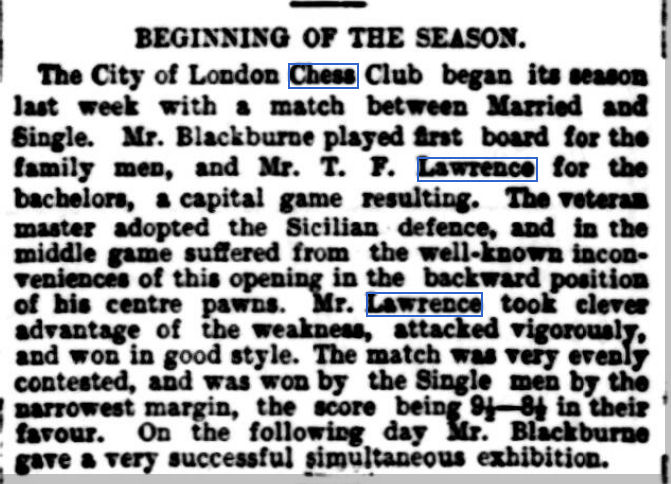
It was common at the time for clubs to open their season with a novelty match. Richmond Chess Club, as we’ve seen, staged matches between the residents of Richmond and Sheen. Some clubs played matches between smokers and non-smokers, or, in this case, married men against bachelors, and in 1903 Thomas Francis Lawrence was on top board for the singletons against the illustrious veteran Joseph Henry Blackburne.

Greenwich and Deptford Observer 16 October 1903

Here’s the ‘capital game’. Blackburne’s loss, according to Stockfish, was caused by trading bishops on move 22, allowing the white knight into play.

[pgn]

[Event “Singles – Married match”]
[Site “City of London CC, London ENG”]
[Date “1903.10.09”]
[Round “?”]
[White “Lawrence, Thomas Francis”]
[Black “Blackburne, Joseph Henry”]
[Result “1-0”]
[ECO “B73”]
[Annotator “Tactical Analysis 5.2 (1s)”]
[PlyCount “65”]
[EventDate “1903.??.??”]

1. e4 {ChessBase II} c5 2. Nc3 Nc6 3. Nf3 g6 4. d4 cxd4 5. Nxd4 Bg7 6. Be3 Nf6
7. Be2 d6 8. O-O h5 {B73: Sicilian Dragon: Classical System without 9 Nb3.} 9.
h3 {Against Ng4} Bd7 10. Qd2 a6 {[#] White is better.} 11. f4 $146 {& White is
more active.} ({Predecessor:} 11. Rad1 b5 12. Bd3 h4 13. Nce2 Qc8 14. Nxc6 Bxc6
15. f3 Nd7 16. c3 Qb7 17. Nd4 {1-0 (45) Minckwitz,J-Schallopp,E Hamburg 1885
HCL [ChessBase II]}) 11… b5 12. Bf3 Rc8 13. Rad1 {[#] And now e5! would win.}
Qc7 14. Nb3 ({Much worse is} 14. e5 $6 dxe5 15. Nxc6 Bxc6 $14) 14… O-O 15.
Nd5 {Prevents b4.} Nxd5 16. exd5 Nd8 17. c3 Nb7 18. g4 hxg4 19. hxg4 {Qh2 is
the strong threat.} e5 20. fxe5 Bxe5 21. Kg2 f5 22. Bd4 Bxd4 $4 (22… fxg4 $14
23. Be4 Bf5 24. Bxf5 gxf5) 23. Nxd4 $18 {Threatens to win with Qh6.} (23. Qxd4
Qc4 24. Qe3 Rf7 $18) 23… Qd8 24. Qh6 Qf6 25. g5 $40 {Black is in trouble.} (
25. Rh1 $142 Rf7 26. g5) 25… Qg7 {Prevents Qh7+.} 26. Qxg7+ Kxg7 27. Ne6+
Bxe6 28. dxe6 Nc5 29. Rxd6 Rfe8 $2 {[#] Loses the game.} (29… Rfd8 $16 30.
Rfd1 Rxd6 31. Rxd6 Kf8) 30. Rd7+ $1 Kg8 31. Bd5 Rb8 32. Rh1 {Rdh7 would kill
now.} Ne4 33. Rhh7 {Weighted Error Value: White=0.39/Black=0.87} 1-0

[/pgn]

Sadly, shortly after this game his mother, Esther Jane (Izard) Lawrence, died at the age of 70, necessitating Thomas’s withdrawal from the City of London Club Championship, in which William Ward took the title for the second time. The burial record confirms that at some point after the 1901 census the family had moved from Westminster to 132 Palewell Park, Mortlake (it would now be considered East Sheen), one of the area’s most desirable roads, close to Richmond Park.  Esther was buried at St Mary the Virgin Church Mortlake, also the burial place of Queen Elizabeth I’s astrologer John Dee.

It’s worth a look at Rod Edwards’ retrospective ratings for 1903 at this point. Lawrence is ranked 54th in the world, with a rating of 2423. You’ll see Atkins (2542) and Burn (2540) ranked 13th and 14th, and then a gap to Blackburne (2451), Michell (2428) and Lawrence. Two distinguished veterans, then, and three up-and-coming young players.

In 1904 a major chess tournament took place in Cambridge Springs, a small town in Pennsylvania noted at the time for its mineral springs. The world’s leading players were invited to take part, and it was perhaps surprising for several reasons that Thomas Francis Lawrence was one of the participants. Apart from having a busy life, his seeming modesty and lack of ambition made him an unlikely choice: indeed, he was the only one of the eight European participants with no previous experience at this level.

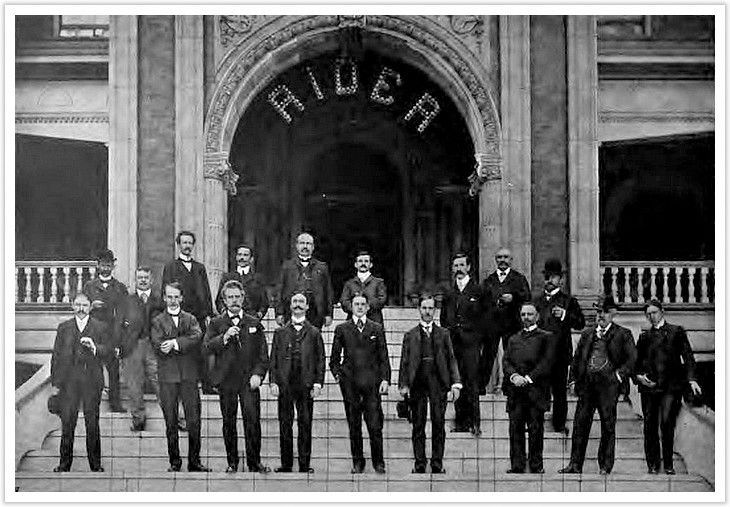
Here’s a group photograph with Lawrence third from the right at the back.

Cambridge Springs 1904. In front: Barry, Napier, Showalter, Mieses, Fox, Píllsbury, Chigorin, Delmar and Marshall. Behind: Schlechter, Hodges, Helms (organiser), Janowski, Marco, Lasker, Lawrence, Cassel (organiser) and Teichmann.

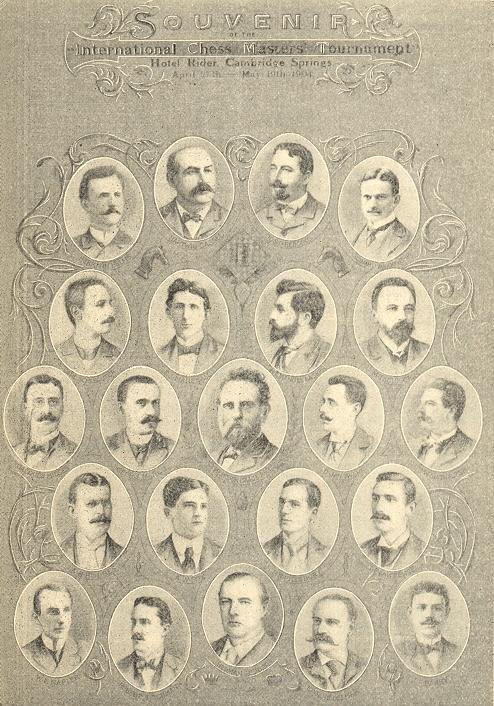
And here he is again (on the right on the fourth row down) in this rather wonderful tournament souvenir.

The players and organisers of Cambridge Springs 1904, created for Isaac Rice by the noted New York artist, Franz Frenzel (From top to bottom:) H Helms, H Cassel, J Redding, W Van Antwerp, C Schlechter, FJ Marshall, Em. Lasker, M Chigorin, J Mieses, G Marco, I Rice, D Janowsky, JW Showalter, AB Hodges, AW Fox, HN Pillsbury, TF Lawrence, WE Napier, R Teichmann, H Ridder, E Delmar, J Barry

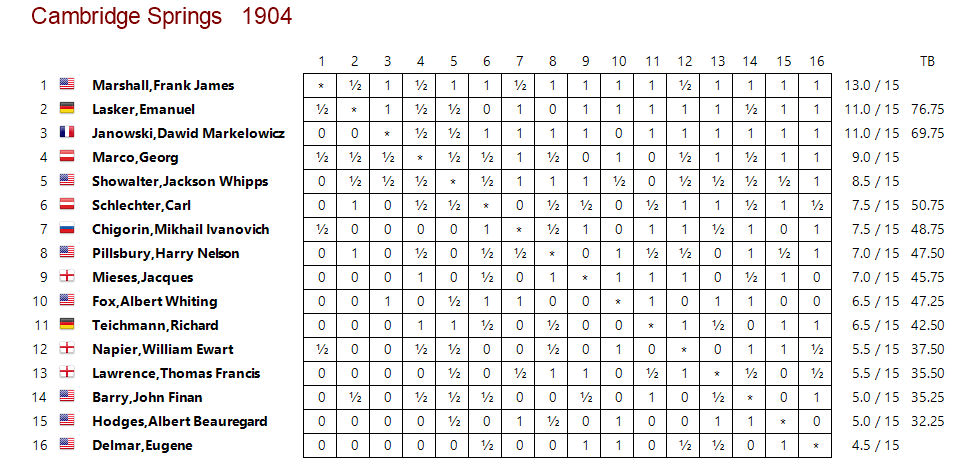
Lawrence scored 5½/15, about par for his (hypothetical) rating, but it could easily have been much better.

In Round 2 he could have obtained good winning chances against Delmar by trading queens on the right square instead of weakening his pawn formation. In Round 5 he lost on time in a winning position against Fox. In Round 8 he had a big advantage from the opening against Barry.  In Round 10 he made an elementary one-move blunder in a drawn rook ending against Lasker. In Round 11 he missed a win against Chigorin, and then, it appears, agreed a draw after his opponent made a losing blunder. In Round 15 he took a draw by repetition in a winning endgame against Showalter.

A score of 9 rather than 5½ would have been a great success, so what, I wonder, went wrong? The pressure of the big occasion? Lack of experience at this level? Nerves? Poor clock handling? There were other lessons to be learnt: while he did well with black, his play with the white pieces was often uninspiring: he was comprehensively outplayed by Janowski, Marco, Schlechter and Hodges.

His game against Napier demonstrated that, given the chance, he was a strong attacking player.

[pgn]

[Event “Cambridge Springs”]
[Site “Cambridge Springs”]
[Date “1904.??.??”]
[Round “4”]
[White “Napier, William Ewart”]
[Black “Lawrence, Thomas Francis”]
[Result “0-1”]
[ECO “C82”]
[Annotator “Tactical Analysis 5.2 (1s)”]
[PlyCount “68”]
[EventDate “1904.04.25”]
[EventType “tourn”]
[EventRounds “15”]
[EventCountry “USA”]
[SourceTitle “HCL”]
[Source “ChessBase”]
[SourceDate “1999.07.01”]
[SourceVersion “2”]
[SourceVersionDate “1999.07.01”]
[SourceQuality “1”]

1. e4 e5 2. Nf3 Nc6 3. Bb5 a6 4. Ba4 Nf6 5. O-O Nxe4 6. d4 b5 7. Bb3 d5 8. a4
Rb8 9. axb5 axb5 10. dxe5 Be6 11. c3 Bc5 12. Nbd2 O-O 13. Bc2 f5 14. Nb3 Bb6
15. Nfd4 {C82: Open Ruy Lopez: 9 c3 without 9…Be7.} Nxd4 16. cxd4 {Black
must now prevent f3.} f4 17. f3 {White is slightly better.} Ng3 18. Re1 (18.
hxg3 fxg3 19. Qd3 (19. Nc5 $2 Qh4 $19) 19… Bf5 20. Qxf5 (20. Qxb5 $2 Qh4 $19)
20… Rxf5 21. Bxf5 Qh4 $11) 18… Qh4 19. Nc5 (19. hxg3 fxg3 20. Be3 Qh2+ 21.
Kf1 Bh3 $19) 19… Bxc5 20. dxc5 {Ra6 is the strong threat.} ({But not} 20.
hxg3 $2 fxg3 21. dxc5 Qh2+ 22. Kf1 Qh1+ 23. Ke2 Qxg2+ 24. Kd3 Rxf3+ 25. Be3 d4
$19) 20… c6 $146 ({Predecessor:} 20… g5 21. Ra7 Rf7 22. Ra6 Re8 23. Rxe6
Rxe6 24. hxg3 fxg3 25. Qxd5 Qh2+ 26. Kf1 Qg1+ {1-0 (53) Pillsbury,H-Marco,G
Vienna 1898}) 21. Ra6 (21. hxg3 fxg3 22. f4 Qh2+ 23. Kf1 Qh1+ 24. Ke2 Qxg2+ 25.
Kd3 Bf5+ 26. Kc3 d4+ 27. Kb4 Bxc2 $19) 21… Rbc8 22. b4 (22. hxg3 fxg3 23. f4
Qh2+ 24. Kf1 Qh1+ 25. Ke2 Qxg2+ 26. Kd3 Bf5+ 27. Kd4 Bxc2 $19) 22… Nf5 23.
Bxf5 (23. Bd3 $5) 23… Rxf5 24. Re2 Rh5 25. h3 Bxh3 26. Qd2 $2 {[#] This
costs White the game.} (26. Qe1 $11 {and White has nothing to worry.} Be6 27.
Qxh4 Rxh4 28. Rea2) 26… Be6 27. Qxf4 Qh1+ 28. Kf2 Rh2 29. Kg3 (29. Qg3 Bh3
30. Re1 Rxg2+ 31. Ke3 d4+ 32. Kxd4 Rxg3 33. Rxh1) 29… Rf8 30. Qe3 h5 {
[#] ( -> …h4+)} 31. f4 h4+ 32. Kf3 Rh3+ (32… h3 $142 33. Kg3 hxg2 34. Re1
Rh3+ 35. Kf2 Rxe3 36. Rxh1 gxh1=Q 37. Bxe3 Bg4 38. Ra3 d4 39. f5 Qh2+ 40. Kf1
dxe3 41. Rxe3 Rd8 42. f6 Bh3+ 43. Ke1 Qd2#) 33. Kf2 $19 Rxe3 34. Bxe3 d4 {
Weighted Error Value: White=1.08/Black=0.51} 0-1

[/pgn]

Although Pillsbury was mortally ill with syphilis, it was still no mean feat to bring off a tactical finish against his old cable match opponent.

[pgn]

[Event “Cambridge Springs”]
[Site “Cambridge Springs”]
[Date “1904.??.??”]
[Round “7”]
[White “Lawrence, Thomas Francis”]
[Black “Pillsbury, Harry Nelson”]
[Result “1-0”]
[ECO “B24”]
[Annotator “Tactical Analysis 5.2 (1s)”]
[PlyCount “61”]
[EventDate “1904.04.25”]
[EventType “tourn”]
[EventRounds “15”]
[EventCountry “USA”]
[SourceTitle “HCL”]
[Source “ChessBase”]
[SourceDate “1999.07.01”]
[SourceVersion “2”]
[SourceVersionDate “1999.07.01”]
[SourceQuality “1”]

1. e4 c5 2. Nc3 Nc6 3. g3 e6 4. Bg2 h5 $146 ({Predecessor:} 4… Nf6 5. Nge2 d5
6. exd5 exd5 7. d4 Be6 8. O-O cxd4 9. Nxd4 Qb6 10. Nxe6 fxe6 11. Re1 O-O-O 12.
Rxe6 Bc5 13. Bf4 Bxf2+ 14. Kh1 d4 15. Rxf6 gxf6 16. Bh3+ Rd7 17. Bxd7+ Kxd7 18.
Qg4+ Ke8 19. Nd5 Qd8 20. Qe6+ {1-0 (20) Znosko Borovsky,E-Bernstein,O Kiev 1903
}) 5. Nf3 Be7 6. d4 {B24: Closed Sicilian: 3 g3 sidelines.} d5 7. exd5 exd5 8.
dxc5 {White is better.} d4 9. Ne4 Bf5 10. Qe2 Bxe4 11. Qxe4 Nf6 12. Qe2 Qa5+
13. Bd2 Qxc5 14. O-O O-O 15. c3 dxc3 16. Bxc3 Rfe8 17. Rac1 {[#] Hoping for
Bxf6.} Bf8 18. Qc2 Ne4 19. Qb3 {Strongly threatening Bxg7!} Na5 {Pair of
Knights!} 20. Qa4 Nxc3 21. Rxc3 Qb4 22. Qc2 {And now Ng5 would win.} g6 23. Ng5
{Black must now prevent Bd5.} Rad8 {Against Bd5} 24. Be4 {Threatens to win
with Bxg6!} Qd6 25. b4 $40 {White is up to no good. & White is more active.}
Qf6 $2 {[#] This costs Black the game.} 26. Nxf7 $1 $18 {White is clearly
winning.} Rd4 (26… Kxf7 27. Rf3) 27. Bxg6 ({And not} 27. bxa5 Rexe4 28. Re3
Re7 29. Rxe7 Bxe7 $17) 27… Bxb4 28. Nh6+ Kf8 29. Bxe8 Bxc3 30. Qxc3 Kxe8 31.
Qxa5 {Weighted Error Value: White=0.20 (precise) /Black=0.21 (precise)} 1-0

[/pgn]

If you’re interested in finding out more about Cambridge Springs there’s a new book coming out later this year which sounds well worth reading. This website is also informative.

It was at this point that we first met him in our previous instalment, giving a simul at Richmond Chess Club in October 1904.

Did he, inspired by his participation at Cambridge Springs, take part in more tournaments?

The answer is ‘No’. He didn’t take part in the next three City of London Club Championships. The Anglo-American Cable Match didn’t take place, for various reasons, for three years between 1904 and 1906, so, it seems that, at this point, he was playing very little chess. Perhaps he had other things on his mind.

Perhaps he had a young lady on his mind. Take a look at this.

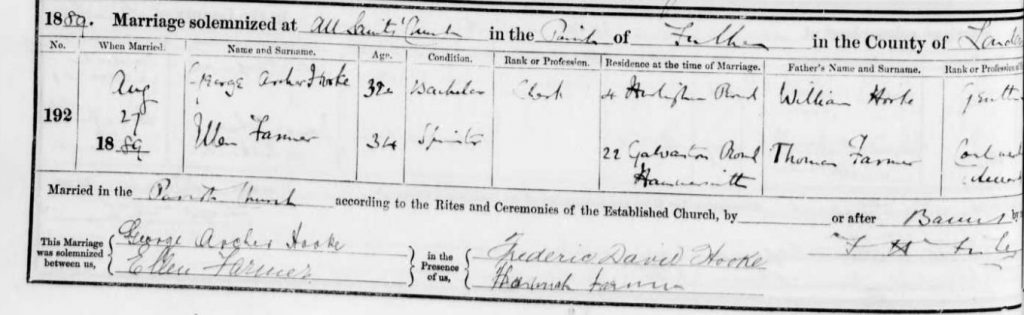
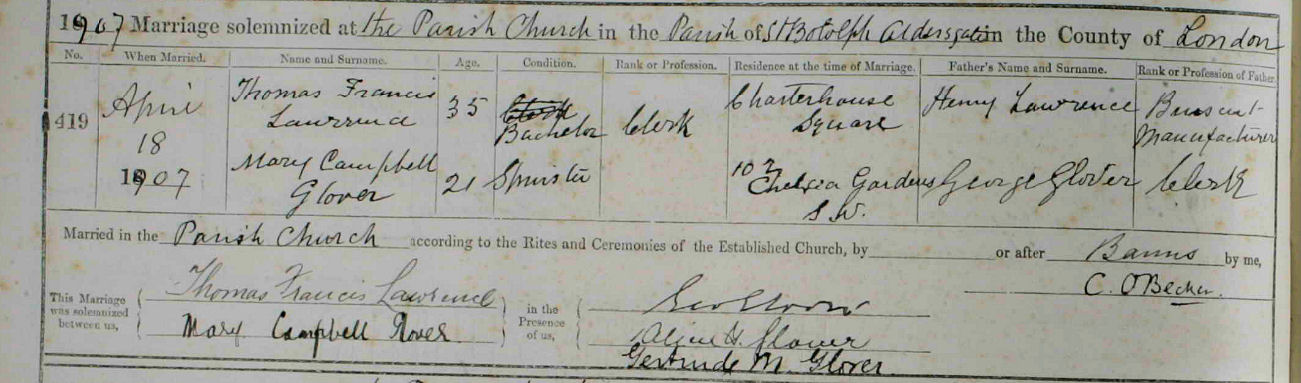
Here he is, aged 35, tying the knot with 21-year-old Mary Campbell Glover, on 18 April 1907, in St Botolph’s Church, Aldersgate, right by the Barbican and very near St Paul’s Cathedral. There are a few mysteries. We know his family owned a property in East Sheen at the time (as you’ll see shortly) but his address was given as Charterhouse Square, close to St Botolph’s. Perhaps he had a London pad, conveniently situated a few minutes’ walk from the new Prudential headquarters in Holborn.

Mary’s father, George Glover, was an insurance clerk and chess enthusiast: he and Thomas knew each other from the Insurance Chess Club.

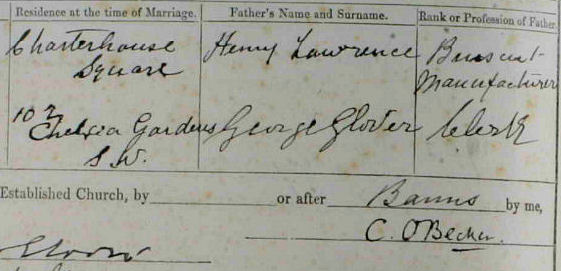
There are a couple of interesting things to point out. Look at it more closely.

Look closely at Henry’s Rank or Profession. Biscuit Manufacturer? I’m not sure. When Thomas was born he was living in Velsen, where the North Sea Canal was being built. Was he manufacturing something to do with canals? Or did the construction workers need a supply of freshly baked biscuits? Any idea?

There’s something else strange. It was customary (and probably still is) to add ‘deceased’ under the father’s name in marriage registers, and, if you look at the complete page, you’ll see several examples. Thomas’s late mother Esther had claimed to be a widow on the census records between 1881 and 1901, but here’s her son implying that Henry was still alive. It was very common at the time for women who had split from their husbands to describe themselves as widows so perhaps that’s what had happened. Or perhaps Thomas had no idea whether or not Henry was still alive. Perhaps the omission of the word ‘deceased’ was just an oversight.

He had in fact returned to chess a few weeks before this happy event, taking part in the 1907 cable match, where he drew with the splendidly middle-named Albert Beauregard Hodges.

Later in the same year he returned to tournament play in the City of London Championship, taking the title for a seventh time just ahead of William Ward and George Edward Wainwright a 1-2-3 for Richmond and Twickenham chess.

He didn’t take very long to dispose of Rudolf Loman, a game which followed his game against Barry from Cambridge Springs for the first 14 moves.

[pgn]

[Event “City of London CC Championship”]
[Site “City of London CC, London ENG”]
[Date “1907.??.??”]
[Round “?”]
[White “Loman, Rudolf Johannes”]
[Black “Lawrence, Thomas Francis”]
[Result “0-1”]
[ECO “C84”]
[Annotator “Tactical Analysis 5.2 (1s)”]
[PlyCount “40”]

1. e4 e5 2. Nf3 Nc6 3. Bb5 a6 4. Ba4 Nf6 5. O-O Be7 6. d4 exd4 7. e5 Ne4 8.
Nxd4 O-O 9. c3 (9. Nf5 $5 d5 10. exd6 Bxf5 11. dxe7 Nxe7 12. Nc3 $11) 9… Nxe5
{C84: Closed Ruy Lopez: Unusual White 6th moves.} 10. Re1 d5 {Hoping for …
Bh4.} 11. f3 {[#]} c5 $1 {Threatens to win with …Bh4! Black is clearly
better.} 12. fxe4 {Strongly threatening Nf3.} cxd4 13. cxd4 {[#]} Bg4 $1 14.
Qd2 {[#]} Nc6 $146 {& Black is more active.} ({Reject} 14… Nc4 $6 15. Qf4 f5
16. e5 $11) ({Predecessor:} 14… Ng6 15. Bc2 Qb6 16. Nc3 Rad8 17. Nxd5 Rxd5
18. exd5 Bb4 19. Qf2 Bxe1 20. Qxe1 Qxd4+ {1/2-1/2 (37) Barry,J-Lawrence,T
Cambridge Springs 1904}) 15. Nc3 dxe4 {…b5 is the strong threat.} 16. Nxe4 f5
(16… Qxd4+ 17. Qxd4 Nxd4 18. Be3 $17) 17. Nc5 f4 $36 {And now …f3 would
win. Keeping White busy.} 18. Bb3+ $2 (18. Nxb7 Qb6 19. Re4 (19. Bxc6 Bb4 $17)
19… Qxb7) (18. Bxc6 $17 {is a better chance.} bxc6 19. Re4) 18… Kh8 $19 {
Black is clearly winning.} 19. Ne4 (19. Ne6 $142 Bxe6 20. Rxe6) 19… Qb6 20.
Nf2 {[#]} Bb4 $1 {Weighted Error Value: White=1.44/Black=0.59} 0-1

[/pgn]

This was to be Lawrence’s last appearance in the City of London Club Championship, but he continued to play club chess, both for Ibis and for the central London club Lud-Eagle, and county chess for Surrey. He was also a popular visitor to many London clubs, giving simultaneous displays and playing consultation games.

He also continued to play in the Anglo-American Cable Matches, drawing with Hermann Helms, who repeated moves in what, according to Stockfish, was a winning position, in 1908. Helms would go on to have a long and distinguished career as a chess promoter and journalist, being involved in organising the great New York tournaments in 1924 and 1927, and helping the young Bobby Fischer in 1951. Lawrence drew with his old rival John Finan Barry in 1909 and with Hodges again in 1910. In the final match, in 1911, he played a controversial game against Albert Whiting Fox, which I’ve annotated for the Richmond & Twickenham Chess Club website here. It’s well worth your attention.

This left his final record in the cable matches: played 10, no wins, six draws and four losses: perhaps slightly disappointing given his strength. Maybe the format didn’t bring out the best in him.

Meanwhile, Thomas and Mary had wasted no time at all in starting a family. A daughter, Margery (known as Peggy) was born in Mortlake just nine months after their wedding, on 28 January 1908, and baptised at St Botolph, Aldersgate on 28 March 1908. A year later, Joyce was born in Mortlake on 3 February 1909 and baptised at St Botolph on 1 May 1909. In the same year, on 23 December 1909, Ruth followed, but she was baptised on 10 April 1910 at Christ Church East Sheen, close to their family home. This is just a few yards from Sheen Mount Primary School, whose former headteacher, Jane Lawrence (no relation as far as I know) promoted chess very strongly: her pupils there included future IMs Richard Bates and Tom Hinks-Edwards.

It was at 132 Palewell Park that the census enumerator found the family in 1911: as you’d expect, Thomas, Mary and their three daughters were at home, along with Ellen Lloyd, a domestic servant, and Helen Wapshott, a nurse employed to care for the young girls.

The following year the family would be completed with the arrival of a son, named Roger Clive Lawrence, born on 12 November 1912, and baptised at Christ Church on 12 February 1913.

Earlier in 1912 the British Championships had taken place in Richmond, and the local club, of which Lawrence was now President, was involved in the organisation, but he wasn’t to be persuaded to play.

The opportunity to compete again on the international stage came knocking again the following year, when he was selected to travel to The Hague to play two matches against a Dutch team. His opponent here was Arnold van Foreest, great great grandfather of Jorden, Lucas and Machteld.

Their first game resulted in an exciting ending in which both players had advanced connected passed pawns. Lawrence eventually came out on top, as you can see here.

[pgn]

[Event “Match/Nation NED-ENG 4,0-12,0”]
[Site “The Hague”]
[Date “1914.04.11”]
[Round “1.3”]
[White “Lawrence, Thomas Francis”]
[Black “Van Foreest, Arnold E”]
[Result “1-0”]
[ECO “C48”]
[Annotator “Tactical Analysis 5.2 (1s)”]
[PlyCount “129”]
[EventDate “1914.04.11”]
[EventType “team-match”]
[EventRounds “2”]
[EventCountry “NED”]
[SourceTitle “EXT 2014”]
[Source “ChessBase”]
[SourceDate “2013.11.20”]
[SourceVersion “1”]
[SourceVersionDate “2013.11.20”]
[SourceQuality “1”]
[WhiteTeam “England”]
[BlackTeam “Netherlands”]
[WhiteTeamCountry “ENG”]
[BlackTeamCountry “NED”]

1. e4 {ChessBase} e5 2. Nf3 Nc6 3. Nc3 Nf6 4. Bb5 Nd4 5. Ba4 c6 6. O-O d6 {
C48: Four Knights: 4 Bb5, replies other than 4…Bb4.} 7. Nxd4 exd4 8. Nd5 $146
(8. Ne2 $16) ({Predecessor:} 8. Ne2 Nxe4 9. Nxd4 Nc5 10. Re1+ Be6 11. Nxe6 Nxe6
12. Bb3 d5 13. c4 d4 14. c5 {1/2-1/2 (28) Schlechter,C-Marshall,F Nuremberg
1906 HCL [ChessBase]}) 8… Nd7 {Black is slightly better.} (8… Nxe4 $2 9.
Re1 $18) (8… Ng4 {looks sharper.} 9. Nf4 Qh4 10. h3 g5) 9. Nf4 Be7 (9… a5
$5 10. c3 g5 $11) 10. d3 (10. c3 $5) 10… Qa5 11. Bb3 g6 {Prevents Nh5.} 12.
Ne2 Bf6 13. f4 Qh5 14. Qe1 O-O 15. Ng3 Qh4 16. Qf2 Nc5 17. f5 Nxb3 18. axb3 Be5
19. Bf4 f6 20. Qd2 c5 21. Rf3 g5 22. Bxe5 dxe5 23. b4 cxb4 24. Qxb4 Qh6 25. c3
Rd8 26. Ne2 dxc3 27. bxc3 (27. Nxc3 Qf8 28. Qb3+ Kh8 $16) 27… Qf8 28. Qxf8+
Kxf8 29. d4 exd4 30. cxd4 (30. Nxd4 Re8 $11) 30… b5 31. e5 {& White is more
active.} a5 {Strongly threatening …b4.} 32. e6 {Black must now prevent Rc1.}
(32. exf6 b4 33. h3 a4 $19) 32… Bb7 $2 (32… b4 $11 {and Black stays safe.})
33. Rc3 $18 {Threatens to win with Rc7.} Rdc8 {Prevents Rc7.} 34. Rxc8+ Bxc8 {
Endgame KRB-KRN} 35. d5 b4 36. Nd4 $2 (36. d6 a4 37. Nd4 (37. d7 Bxd7 38. exd7
Ke7 $16)) 36… a4 $2 {[#]} (36… Ra6 {was called for.}) 37. d6 $1 {aiming
for Nb5.} a3 38. Re1 $2 (38. Nc2 $18 Ra4 39. Rc1 (39. d7 Bxd7 40. exd7 Ke7 $11)
) 38… a2 $2 (38… Bb7 $1 $11) 39. d7 Bxd7 40. exd7 {And now Ra1 would win.}
a1=Q 41. d8=Q+ {Decoy} Rxd8 42. Ne6+ ({Inferior is} 42. Rxa1 Rxd4 43. Ra2 Ke7
$17) 42… Ke7 43. Rxa1 {KRN-KR} Rb8 44. Rb1 Kd6 45. Kf2 Ke5 46. g4 h5 47. h3 (
{White should play} 47. Re1+ $18 Kd5 48. gxh5) 47… hxg4 $11 48. hxg4 b3 49.
Kf3 {Hoping for Nc5.} b2 50. Nc5 Kd4 51. Na4 Rb3+ {[#] Loses the game.} (51…
Rb4 $1 $14) 52. Kg2 $1 $18 Ra3 $2 (52… Rb4 53. Nxb2 Kd5 54. Rd1+ Kc6) 53.
Nxb2 {Nd1 is the strong threat. White is clearly winning.} Kc3 (53… Rb3 $142
54. Rd1+ Ke4) 54. Nd1+ Kc2 55. Rb6 Kxd1 56. Rxf6 {KR-KR} Ra2+ 57. Kf3 Ra3+ 58.
Ke4 Ra4+ 59. Ke5 Rxg4 60. Rg6 Rg1 61. f6 g4 62. Kf4 Ke2 63. Rxg4 Rf1+ 64. Kg5
Ke3 65. Kg6 {Weighted Error Value: White=0.49/Black=0.66} 1-0

[/pgn]

He scored a quicker win in the return encounter when his opponent miscalculated the tactics on the open e-file.

[pgn]

[Event “Match/Nation NED-ENG 4,0-12,0”]
[Site “The Hague”]
[Date “1914.04.13”]
[Round “2.3”]
[White “Van Foreest, Arnold E”]
[Black “Lawrence, Thomas Francis”]
[Result “0-1”]
[ECO “C47”]
[Annotator “Tactical Analysis 5.2 (1s)”]
[PlyCount “54”]
[EventDate “1914.04.11”]
[EventType “team-match”]
[EventRounds “2”]
[EventCountry “NED”]
[SourceTitle “EXT 2014”]
[Source “ChessBase”]
[SourceDate “2013.11.20”]
[SourceVersion “1”]
[SourceVersionDate “2013.11.20”]
[SourceQuality “1”]
[WhiteTeam “Netherlands”]
[BlackTeam “England”]
[WhiteTeamCountry “NED”]
[BlackTeamCountry “ENG”]

1. e4 e5 2. Nf3 Nc6 3. Nc3 Nf6 4. Be2 Bb4 5. Nd5 Be7 6. Nxe7 $146 {C47: Scotch
Four Knights and Four Knights with 4 g3.} ({Predecessor:} 6. d3 d6 7. Nxe7 Qxe7
8. O-O O-O 9. Bg5 h6 10. Bh4 g5 11. Nxg5 hxg5 12. Bxg5 Qe6 {0-1 (30)
Blackburne,J-Tarrasch,S Ostend 1905}) 6… Qxe7 7. d3 d5 8. O-O {The position
is equal.} Bg4 $2 (8… dxe4 $17 9. dxe4 Nxe4) 9. exd5 $16 Nxd5 10. Nxe5 $2
Bxe2 $17 {& Black is more active.} 11. Qxe2 {[#] Black must now prevent Re1.} O-O
({Weaker is} 11… Qxe5 12. Qxe5+ Nxe5 13. Re1 $15) (11… Nxe5 12. Re1 $11)
12. f4 {White does not recover from this.} f6 13. d4 fxe5 14. Qc4 Rad8 {
Black is clearly winning.} 15. fxe5 (15. dxe5 $142 g5 16. g3) 15… Rxf1+ $19
16. Kxf1 Qf7+ 17. Kg1 Rf8 {( -> …Qf2+)} 18. Bg5 Qf2+ 19. Kh1 Qxd4 20. Qxd4
Nxd4 21. c4 Nf4 22. Rd1 {[#]} Nd3 $1 {…Nf2+ is the strong threat.} 23. Be3
Nf2+ 24. Bxf2 Rxf2 25. Kg1 Rf4 26. g3 Re4 27. Kf2 c5 {Weighted Error Value:
White=0.72/Black=0.27 (precise)} 0-1

[/pgn]

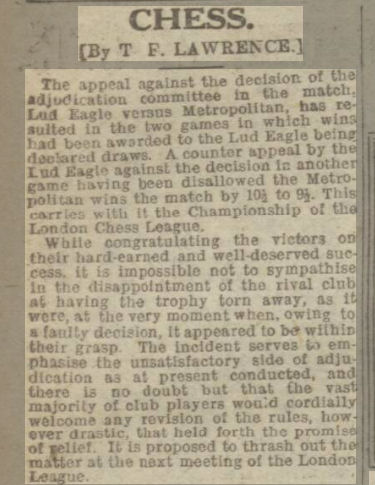
Club chess was curtailed during the war, and, with a growing family, Thomas Francis Lawrence had other demands on his time. He did, however, continue writing in The People up to January 1916. Here, he proposed the abolition of adjudications.

More than a century on, we haven’t progressed very far. Even today, the January 2022 Rules of Play on the London League website still allows for adjudications. Lawrence must be turning in his grave.

He still seems to have been playing occasional club chess: in December 1919 Ibis welcomed a visiting team from Hastings, with Lawrence drawing with MCO co-author Richard Clewin Griffith on top board.

By 1921 the family had moved just round the corner, to 92 East Sheen Avenue, backing onto the house across the road from their previous address. Thomas was by now a Principal Clerk with the Prudential Assurance Company Limited, Mary and their four children were also at home, as was Helen Wapshott, a nurse a decade ago but now a general domestic servant.

Lawrence retained his interest in the game for the rest of his life. He still played occasionally for Ibis, in 1925 losing rather horribly on top board against George Marshall Norman in one of the regular Hastings v Ibis matches.

At some point in the 1930s Thomas retired from his job with the Prudential and retired to Comp Corner Cottage, Wrotham, Kent (between Sevenoaks and Maidstone), now a Grade 2 Listed Building, where, in 1939 he was living with Mary, Ruth and two of Mary’s unmarried sisters, Louisa and Charlotte, the latter of whom was employed as a schoolmistress teaching domestic subjects.

His great-niece Jill recalled visiting him at Comp Corner. There were always huge jigsaw puzzles on a huge table in the house in Comp Corner, Wrotham, Kent. Tom was very clever, wealthy, occupation unknown, believed to have been South-East chess champion. Well, he was seven times champion of the City of London Chess Club, which was very much the same thing, as most of the strongest players in the South East took part.

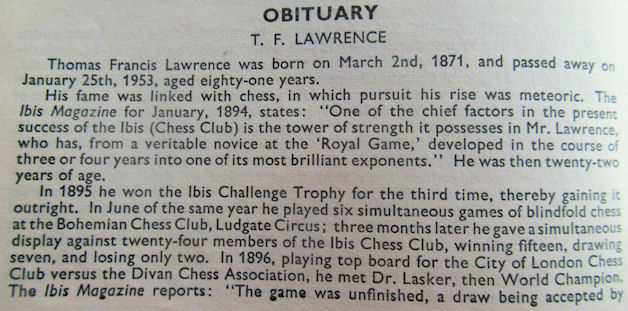
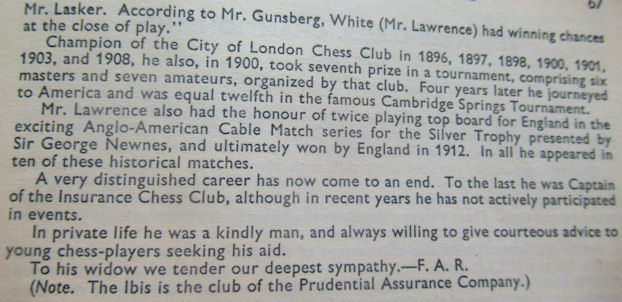
The family finally moved to Storrington, Sussex in about 1950, where he died on 25 January 1953 at the age of 81. Here’s his obituary from the BCM: I presume FAR was Frank Rhoden.

Several mysteries remain. After a recent post on the English Chess Forum, Sussex chess historian Brian Denman contacted me with this message, repeated here with his permission.

The following story will probably have not surfaced for over fifty years. The Worthing Gazette of 27.7.1966, which had as its chess columnist Leslie A Head, reported that thirteen years previously the Worthing CC had in its possession one of the most famous trophies in the history of British chess. The Ibis Challenge Trophy was once the championship trophy of the City of London CC and was won outright by T F Lawrence in 1898. About sixteen or seventeen years ago Lawrence had come to live in Storrington. He invited David Armstrong and the columnist to play him an occasional game. On one of these visits he showed the trophy, which consisted of a set of large ivory chessmen and board. The next time that the columnist heard about the trophy was in January 1966, when a reader, who insisted on remaining anonymous, informed him that the trophy had been presented to the club by his widow. The club minutes in fact recorded that in March 1953 the trophy had been presented to the club by the widow on condition that, if the club parted with it, it should be to a person interested in chess. At that time the committee could not decide how to use the gift and the matter was left in abeyance. Head commented that the club might have held a Lawrence Memorial Tournament or displayed the trophy at Annual General Meetings. In a follow-up article in the Worthing Gazette of 10.8.1966 Head mentions that Eric Chettle, secretary of Worthing CC from 1955-59, remembers the trophy being in the club’s cupboard. The club wrote to Jacques and were told that the set would be worth £60, though the firm no longer made them. Mr Chettle said that he had sold it to a Chichester player for £18 or £20. The columnist commented that it was very sad that this priceless and historic trophy had been hidden away in a cupboard unrecognised and unappreciated until it was sold for a few paltry pounds. He asks why there was such secrecy over the sale. The Worthing Herald of 3.10.1958 mentions that a fall in the club’s membership had caused anxiety and the set had been sold for £20 to ease the club’s balance. One wonders if the set still exists.

There seems to be some confusion with regard to this trophy. I suspect that the BCF obituary was incorrect: my guess is that the Ibis Trophy was originally the Mocatta Trophy, which Lawrence won in 1898 for his third successive victory in the City of London Club Championship. He then donated it to the Ibis Chess Club, whereupon its name was changed. When they no longer had use for it, it returned to Lawrence’s possession, and was then passed onto Worthing Chess Club by his widow after his death in 1953. Anyway, if anyone has any idea what happened to it after it was sold to the ‘Chichester player’, do please get in touch.

There are two other mysteries as well: I still have no idea who exactly his father Henry Lawrence was. I’m also interested in what happened to his brother. He had three Christian names: Henry Arthur Edward, although he seemed to vary their order, so it should be relatively easy to track him down. We can pick up his birth in Velsen in 1873, and see him living with his mother in London in 1881, 1891 and 1901, up to her death in 1903, but after that the trail goes dead. I can find no marriage or death records with those three names in any order, nor any information on online family trees. Again, if you can help with either Henry, father or son, I’d love to hear from you.

What should we make of Thomas Francis Lawrence as a chess player? He was clearly very talented but his games don’t make a particularly strong impression today. With more ambition and perhaps a wider opening repertoire (I don’t think his predilection with the Spanish Four Knights helped very much) he might have reached grandmaster level, but he didn’t play a lot at the top level and seemed to have had other priorities – work and family – in his life. Nevertheless, wins against Pillsbury and Blackburne and draws with Lasker and Chigorin are not to be sniffed at.

More than that, he comes across as a genuinely nice and modest person. Returning to the BCM obituary: ‘a kindly man, and always willing to give courteous advice to young chess-players seeking his aid’. A fine and fitting epitaph, I think. I’m very proud that Thomas Francis Lawrence was one of my predecessors as President of Richmond (& Twickenham) Chess Club.

Sources and Acknowledgements:

ancestry.co.uk

findmypast.co.uk

Wikipedia

Google Maps

chessgames.com

MegaBase

The City of London Chess Club Championship (Roger Leslie Paige)

British Chess Literature to 1914 (Tim Harding)

British Chess Magazine 1953

English Chess Forum

Chess Notes (Edward Winter)

BritBase

Gerard Killoran

Brian Denman

Hastings Chess Club website

Cambridge Springs 1904 website


Minor Pieces 40: Peter Shenele

Back in 1975 I played in a weekend tournament celebrating the centenary of Kingston Chess Club. I’m still in touch with two of my opponents, Kevin Thurlow and Nick Faulks, today. They both post regularly on the English Chess Forum and I also see Nick at Thames Valley League matches between Richmond and Surbiton.

Kingston are in the early stages of preparing celebrations for their 150th anniversary in 2025, and asked me if I’d seen anything confirming 1875 as the year of their club’s foundation.

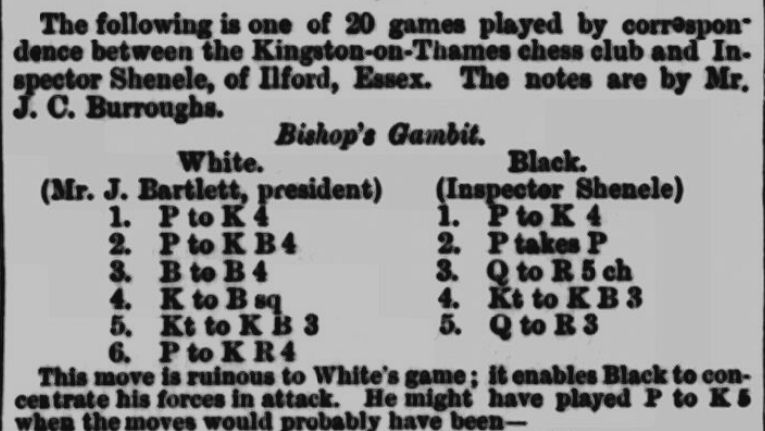
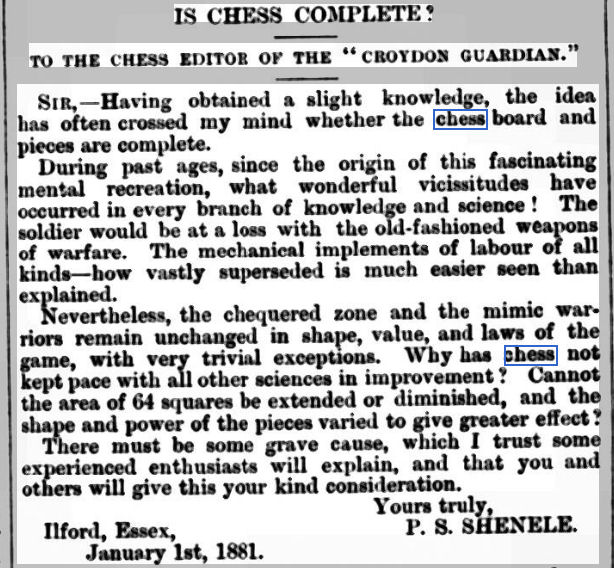
Well, there are all sorts of questions concerning, amongst other things, continuity, but I’ll leave that for another time. The Surrey Comet and Croydon Guardian and Surrey County Gazette (which carried a lot of chess news) for those years have been digitised, but searching for ‘chess Kingston’ doesn’t come up with anything. There are some earlier matches in which clubs in the area played competitions including chess along with other indoor games, but nothing obvious concerning 1875. Having said that, the OCR search facility is far from 100% accurate, so I’d have to look through all the papers for that year to check I hadn’t missed anything. The nearest I’ve found so far is this, from 1881.

Croydon Guardian and Surrey County Gazette 01 October 1881

We have three names here. Most important, for my Kingston friends, is that of Mr J Bartlett, President of Kingston-on-Thames chess club. I consulted the 1881 census which lists a number of J Bartletts in Kingston,  but none of them seem to be obviously presidential material.

I suspect the annotator was FC (not JC) Burroughs: Francis Cooper (Frank) Burroughs (1827-1890) was a Surrey county player, a solicitor by profession. He never married and had no relations with the initials JC.

As Mr Burroughs’ initials appear to be incorrect, it’s entirely possible that Mr Bartlett’s initial was also given incorrectly. I haven’t been able to find any other chess playing Bartletts in the area as yet, but I’ll keep looking.

Here’s the game in full. Click on any move for a pop-up board.

[pgn]

[Event “Correspondence”]
[Site “?”]
[Date “1881.??.??”]
[Round “?”]
[White “Bartlett, J”]
[Black “Shenele, Peter”]
[Result “0-1”]
[ECO “C33”]
[Annotator “Stockfish 15”]
[PlyCount “50”]

1. e4 e5 2. f4 exf4 3. Bc4 Qh4+ 4. Kf1 {[#]} Nf6 $146 ({Predecessor:} 4… d6
5. d4 g5 6. Nc3 Ne7 7. g3 Bh3+ 8. Kf2 Qh6 9. Qf3 Nbc6 10. gxf4 g4 11. Qg3 Bg7
12. d5 Bf6 13. f5 Qh5 14. Nxh3 {0-1 (33) Schmid,C-Bird,H Wiesbaden 1880}) 5.
Nf3 Qh5 {aiming for …b5.} 6. h4 {C33: King’s Gambit Accepted: 3 Nc3 and 3
Bc4.} d5 7. exd5 (7. Bxd5 $17 Nxd5 8. exd5) 7… Bd6 $19 {White must now
prevent …0-0.} 8. Nc3 {Black has a decisive advantage.} O-O {And now …Bg4
would win. Active counter play!} 9. b3 (9. Nb5 $142 Bg4 10. Nxd6 cxd6 11. d4)
9… Bg4 10. Qe2 Nbd7 {…Ne5 is the strong threat.} 11. Bb2 Rae8 12. Qf2 Ne5
13. Nh2 Nxc4 14. bxc4 Ne4 15. Nxe4 Rxe4 16. d3 $2 (16. Nxg4 Qxg4 17. Qf3 Qxf3+
18. gxf3 Rxc4 19. Rg1) 16… Re2 17. Qxa7 Rxc2 18. Bd4 {[#]} Bh3 $1 {A strong
pair of Bishops. Black mates.} 19. Bf2 Qe2+ 20. Kg1 {[#]} b6 $1 21. Ng4 {[#]} (
21. Rf1 Bc5) 21… Bc5 $1 22. Rf1 {[#]} (22. Rxh3 Bxf2+) 22… Bxg2 $1 23. Kxg2
(23. Nf6+ gxf6) 23… Qxg4+ 24. Kh2 Qxh4+ 25. Kg1 Qg3# {Black took control
after the opening. Weighted Error Value: White=1.34/Black=0.54} 0-1

[/pgn]

Two weeks later, another game was published, with Bartlett again losing with the white pieces against Shenele.

[pgn]

[Event “Correspondence”]
[Site “?”]
[Date “1881.??.??”]
[Round “?”]
[White “Bartlett, J”]
[Black “Shemele, Peter”]
[Result “0-1”]
[ECO “C23”]
[Annotator “Stockfish 15”]
[PlyCount “52”]

1. e4 e5 2. Bc4 Bc5 3. Qe2 d6 4. f4 Nf6 5. Nf3 Nc6 6. c3 {C23: Bishop’s
Opening: 2…Bc5.} Bg4 {[#]} 7. fxe5 $146 (7. h3 $5 Bxf3 8. Qxf3 $15) ({
Predecessor:} 7. d3 exf4 8. Bxf4 Ne5 9. Nbd2 Bxf3 10. gxf3 Nh5 11. Bg3 Nxg3 12.
hxg3 Nxc4 13. Nxc4 {1-0 (28) Anderssen,A-Riemann,F Breslau 1876}) 7… dxe5 (
7… Bxf3 $5 8. gxf3 dxe5 $11) 8. Bxf7+ $2 Kxf7 $19 9. Qc4+ Ke7 $2 (9… Kg6
10. Nh4+ Kh5 11. h3 $11) (9… Ke8 $1 $19 10. Qxc5 Bxf3 11. gxf3 Nxe4 $1) 10.
Qxc5+ $16 Qd6 11. Qe3 {And now 0-0 would win.} Rhe8 $2 (11… Rhd8 $15) 12. b3
{Ba3 is the strong threat.} Kf7 13. Ba3 Qd7 14. O-O Kg8 15. d3 Rad8 {[#]} 16.
Ne1 Nh5 17. g3 $2 {Inhibits Nf4.} (17. Nd2 $16) 17… Bh3 $17 {Black has
strong compensation.} 18. Rf2 Nf6 {Strongly threatening …Ng4.} 19. Rc2 $2 (
19. Rf3 $17) 19… Ng4 20. Qc1 {[#]} Nd4 $1 {Threatens to win with …Qf7!} 21.
Rb2 {[#]} (21. Rf2 Nxf2) 21… Qf7 $1 22. Ng2 Nf3+ {Discovered Attack, Double
Attack} 23. Kh1 Rxd3 {Hoping for …Red8.} 24. Ne1 {[#]} Nd2 $1 {Black mates.}
25. Nxd3 (25. Ng2 Bxg2+) 25… Qf3+ 26. Kg1 Qg2# {Weighted Error Value:
White=1.44/Black=0.52} 0-1

[/pgn]

We’re told that Inspector Shenele was playing by correspondence against Kingston, but there’s no indication of how many Kingston players were involved. He played two games against Barrett, but playing black in both cases. I wonder what the format was. Perhaps he played four games, two with each colour, against each of five opponents. Looking at the games, the Kingston President’s play, especially in the first game, doesn’t make a very good impression, considering he would have had plenty of time for each move.

As he was blessed with a highly unusual surname as well as a title, it wasn’t difficult to find out more about Inspector Shenele. If you’ll bear with me for straying away from Kingston, not to mention Richmond and Twickenham, his is an interesting, although sadly rather short, story.

He was born Peter Shenale on 22 March 1843 in the village of Mary Tavy, near Tavistock in Devon, the youngest child of James Shenale and Tamzin Parsons Pellew. Most of his family spelt their name in this way, but Peter preferred Shenele. He also referred to himself as PS Shenele, although I can find no record of a middle name in any official documents. The surname has its origins in Devon and Cornwall. By the 1851 census the family had moved to Gunnislake, the other side of Tavistock and just over the border in Cornwall, where James was working as a copper miner. His wife and three sons were at home: James junior was also a copper miner, while William and Peter were at school. According to Wikipedia: “The village has a history of mining although this industry is no longer active in the area. During the mining boom in Victorian times more than 7000 people were employed in the mines of the Tamar Valley. During this period Gunnislake was held in equal standing amongst the richest mining areas in Europe.” Tin and copper were the main metals mined there.

In 1861 Peter was still living there with his parents, along with a mysterious 14-year-old granddaughter, and now, like his father, mining copper. In 1867, still in the same job, he married Eliza Ann Kellow in nearby Plymouth.

At that point he (or perhaps Eliza) decided that the life of a miner wasn’t for him. If you’re a copper miner and don’t want to be a miner any more, I guess that makes you a copper, and that’s exactly what Peter did. He moved to London and joined the Metropolitan Police. By 1871 he was living in Knightsbridge with Eliza and their 5-year-old son Henry. Another son, Frederick, had died in infancy. A daughter, Ellen, would be born later that year, followed by Emma, who would also die in infancy, and William, by which time the family had moved to Chelsea.

But where did the chess come in? His background seems very different from most of the chess players we’ve encountered in this series. I’m not sure that chess was especially popular among the Devon and Cornwall mining community, but you never know. Perhaps he became interested after seeing a problem in a newspaper or magazine column.

In 1876 his name suddenly started appearing  (as PS Shenele) in the Illustrated London News as a solver of chess problems.

It wasn’t long before he tried his hand at composing as well. You’ll find the problem solutions at the end of this article.
[fen]bb1B2r1/8/R5q1/2PRpk2/B3p3/K4N2/4N3/1Q6 w – – 0 1[/fen]

#2 Illustrated Sporting and Dramatic News 11 November 1876

But at home all was not well. Peter may have been good at solving both crimes and chess problems, but his marriage had hit a problem with only one solution. On 18 April 1879 he filed for divorce, citing his wife’s adultery with a man named Charles J Reed. Perhaps Eliza had had enough of Peter spending so much time at the chess board and had sought satisfaction elsewhere. The courts found in Peter’s favour (in those days it was always considered the woman’s fault): he was awarded a decree nisi on 20 November 1879 and a final decree, along with custody of Ellen and William, on 1 June 1880.
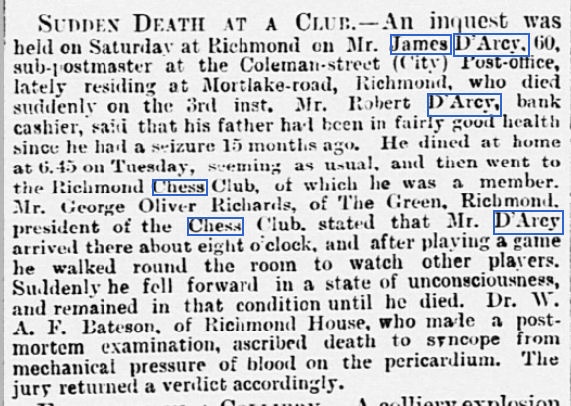
A son, Charles Frederick Shenale, was born in Plymouth, the town where Eliza and Peter had married, on 20 August 1879 and died the following year at the age of 9 months. His parents were listed as Peter and Annie (as Eliza preferred to be called): might one assume that Charles Reed, whose first name he was given, was actually his father, and that his mother had returned to Devon to give birth?

Here’s another problem Peter composed at about this time.

[fen]4r2N/2r5/1p6/4k1P1/Qn1p1NP1/B1p2K2/8/8 w – – 0 1[/fen]

#2 Preston Guardian 1880

Not content with solving and composing problems, Peter took up correspondence chess as well.

In this postal game against Irish astronomer and philosopher William Henry Stanley Monck, he concluded his attack with an attractive queen sacrifice for a smothered mate. It was published in the Illustrated London News on New Years Day 1881.

[pgn]

[Event “Correspondence”]
[Site “?”]
[Date “1880.??.??”]
[Round “?”]
[White “Monck, William Henry Stanley”]
[Black “Shenele, Peter”]
[Result “0-1”]
[ECO “C33”]
[PlyCount “44”]
1. e4 e5 2. f4 exf4 3. Bc4 g5 4. d4 Bg7 {[#]} 5. Qh5 $146 ({Predecessor:} 5. h4
h6 6. hxg5 hxg5 7. Rxh8 Bxh8 8. Qh5 Qf6 9. Nc3 c6 10. e5 Qg7 11. Ne4 {1-0 (35)
Lange,M-Lasch Duesseldorf 1862}) 5… Qf6 $2 (5… Qe7 $17 {keeps the pressure
on.}) 6. e5 {C33: King’s Gambit Accepted: 3 Nc3 and 3 Bc4.} Qg6 7. Qe2 (7. Qxg6
$16 {is necessary to keep the advantage.} hxg6 8. Nf3) 7… Ne7 {aiming for …
d5.} 8. Nf3 {Black is better.} d5 9. exd6 cxd6 {White must now prevent …Nbc6.
} 10. c3 Nbc6 11. h4 h6 12. hxg5 hxg5 13. Rxh8+ Bxh8 14. Na3 a6 {Inhibits Nb5.}
15. Bd2 Bf5 {Inhibits Bd3.} 16. O-O-O b5 17. Bd5 {Bxc6+ is the strong threat.}
Bd3 $2 18. Qe1 $2 (18. Bxc6+ $14 {is the one way to stay ahead.} Kf8 {[#]} 19.
Qxd3 $3 Qxd3 20. Bxa8) 18… Kd7 19. Bb3 Rc8 {Active counter play!} 20. Qh1 Nb4
21. Ne1 ({But not} 21. Re1 Bf5 22. g4 Nd3+ 23. Kb1 Nxe1+ $19) 21… Bb1 22.
Nxb1 $4 {[#]} (22. Nec2 $17 Bxc2 23. Bxc2 (23. Nxc2 $2 Nd3+ 24. Kb1 Nf2 $19)
23… Nxc2 24. Nxc2) 22… Qc2+ $3 {White got outplayed after the opening.
Weighted Error Value: White=1.39/Black=1.05} 0-1

[/pgn]

He had also taken up another unlikely interest: poetry. Also on New Years Day 1881 he wrote to the Croydon Guardian.

Croydon Guardian and Surrey County Gazette 15 January 1881

He also submitted this poem which, in the fashion of the day, is an acrostic. The first letter of each line spells out a message.

By this time he’d been promoted to the rank of Inspector, and had moved out, as you can see above, to Ilford, where, when the 1881 census enumerator called, he was living with young William. Emma wasn’t at home: she might, I suppose, have been away at school. Henry was living in the Devonshire Club in Piccadilly, working as a page boy.

It was about this time, also that he played the correspondence match against Kingston-on-Thames Chess Club. I’ve yet to discover exactly how this came about: quite possibly via his connection with the Croydon Guardian, the main source for Surrey chess news at the time.

Chess and policing weren’t the only things on Peter’s mind in 1881. On 31 January 1882 he married a local girl, Sarah Jane Seabrook, who, it seems, was pregnant with their daughter Ethel Emily, whose birth was registered in the first quarter of that year. This didn’t stop his chess activities: he entered a correspondence tournament run by the Croydon Guardian.

This correspondence game was played in 1893 against Horace Fabian Cheshire. Both players demonstrated knowledge of contemporary Evans Gambit theory, but our hero went wrong shortly after leaving the book. Thanks to Brian Denman for providing this game, which was published in the Southern Weekly News (8 Sep 1883).

[pgn]

[Event “Mr Butler’s Correspondence Tournament”]
[Site “?”]
[Date “1883.??.??”]
[Round “?”]
[White “Shenele, Peter”]
[Black “Cheshire, Horace Fabian”]
[Result “0-1”]
[ECO “C51”]
[Annotator “Stockfish 15”]
[PlyCount “78”]

1. e4 e5 2. Nf3 Nc6 3. Bc4 Bc5 4. b4 Bxb4 5. c3 Bc5 6. O-O d6 7. d4 exd4 8.
cxd4 Bb6 9. Nc3 Bg4 10. Bb5 Kf8 {[#] …Nxd4! is the strong threat. C51: Evans
Gambit: Declined and Accepted without 5…Ba5.} 11. d5 $146 {[#]} ({
Predecessor:} 11. Be3 Nge7 12. Be2 h6 13. d5 Bxf3 14. gxf3 Ne5 15. f4 Nd7 16.
Kh1 Ng6 17. Rg1 Qf6 18. Qd2 Bxe3 19. fxe3 {1-0 (51) Mason,J-Blackburne,J
London (Simpson’s Divan) 1879}) 11… Nd4 12. Be2 Bxf3 {Black is slightly
better.} 13. gxf3 Qf6 14. Bb2 Ne7 {& Black is more active.} 15. Rb1 $2 {Now
White is beyond hope.} (15. Kh1 $17 Nxe2 16. Qxe2) 15… Ng6 $19 16. f4 $2 (16.
Kh1 {only move.} Nxe2 17. Qxe2) 16… Nxf4 {[#] White must now prevent …Qg5+.
Pair of Knights!} 17. Kh1 Nfxe2 18. f3 Nxc3 19. Bxc3 c5 {Against Rb4} 20. dxc6
bxc6 21. Rxb6 axb6 22. Bxd4 Qd8 23. Qa1 f6 24. Rd1 c5 25. Bf2 Rc8 26. Bg3 Rc6
27. Rd5 (27. a4 $142) 27… Kf7 28. Qd1 Ke6 {aiming for …Qc8.} 29. e5 fxe5
30. Bxe5 Qe7 ({Wrong is} 30… Kf7 $2 31. Bxd6 Re8 32. Rf5+ Kg6 33. Qd5 $17)
31. f4 h5 $2 ({Inferior is} 31… dxe5 32. Rxe5+ Kf7 33. Qh5+ Rg6 34. Rxe7+
Kxe7 35. Qe5+ Kd7 36. Qd5+ Kc7 37. Qe5+ Kd7 38. Qf5+ Kd8 39. Qd5+ Kc7 40. Qe5+
Kc8 41. Qf5+ Kc7 42. Qe5+ $17) (31… Kf7 32. Qg4 Rf8) 32. Qf3 $2 (32. Bxd6
Qxd6 33. Rxd6+ Rxd6 34. Qe2+ Kf7 35. a4) 32… Kd7 {Black is clearly winning.}
33. Bc3 Re8 34. Rg5 Qe4 35. Rxg7+ Kc8 36. Qxe4 Rxe4 37. f5 Rc7 {Hoping for …
Rxg7.} 38. Rg8+ Kb7 39. f6 d5 {Weighted Error Value: White=0.84/Black=0.36} 0-1

[/pgn]

But then, in the same year, tragedy struck. A son, named Albert, was born in September, but died 5 days later: the third child he’d lost in infancy. He then caught a cold, which developed into pleurisy. On 10 November 1883, at the age of only 40, Peter Shenele died after a short illness. A local paper back in Cornwall published this tribute.

You can see some parallels, can’t you, with James Money Kyrle Lupton, from a later generation. Both were problem solvers and composers who liked to see their name in print, and both were also police officers in London. But while James, from a privileged background, only became a constable, Peter, a man of relatively humble origins, became an inspector.

As always, I’m sure you want to know what happened next. Eliza Ann (Annie) remarried in 1893, not to Charles Reed, but to a widower named James Trump (no relation to Donald), a plasterer by trade.  Ellen sadly died in 1894. Sarah Jane moved in with her brother Frederick, like their father a publican, and the family later emigrated to New York. It’s not clear what happened to Ethel. There’s a burial record for Ethel Emily Seabrook in Newham, East London in 1898, which might have been her.

Peter’s younger surviving son, William, joined the Royal Navy, then became a clerical officer in the Civil Service, marrying but not apparently having any children, and living on until 1968.

Peter’s oldest son, Henry, emigrated to Australia in 1885. In 1891 he married Alice Huxley, and, in the same year, a son, George Leslie Shenele, was born. But then things started to go wrong. In 1895 a warrant was issued for his arrest.

He did indeed go to New Zealand, to Masterton, near Wellington, where, in April that year, a month before the above announcement, he was put on trial for rape. What exactly happened between Henry James and Belinda the slavey I don’t know. Offering to tune the family organ indeed!

Observer, Volume XI, Issue 853, 4 May 1895

It was later reported that the Grand Jury threw out the bill. As always in those days (and you might think things haven’t changed much) he got away with it. (Thanks to Gerard Killoran for this information)

After that the trail goes cold. What happened to the police inspector’s son, the seemingly mild-mannered, bespectacled piano tuner? I’d imagine he changed his name, but no one seems to know.

George Leslie settled in Campsie, a suburb of Sydney, married, had two children, Ilma and Cyril, but his wife died young. He worked on the railways, eventually becoming an inspector, the same rank, but not the same profession, as his grandfather. Guess what happened to Cyril. He followed (was he aware?) in his great grandfather’s footsteps, becoming a policeman, rising to the rank of (at least) Detective Sergeant.

And that is the story of Peter Shenele, copper miner, police inspector, chess problem solver, composer and correspondence player, who provided a random distraction from my investigations of chess players of Richmond, Twickenham and surrounding areas. I’ll try to find out more about the early history of chess clubs in Kingston: if I come across anything interesting I’ll let you know.

Sources:

ancestry.co.uk

findmypast.co.uk

Wikipedia

MESON chess problem database

Brian Denman/Hastings & St Leonards Chess Club website

Gerard Killoran/Papers Past (New Zealand)

Problem 1 solution:

1. Qg1! threatening Nfd4# or Nh4#.  1… Qg3/Qg2/Qxg1 2. Bd7# 1… exf3/e3 2. Bc2#

Problem 2 solution:

1. Qc6! threatening N mates on g6 as well as two queen mates. 1… Rxc6 2. Nf7# 1… Re6 2. Qxe6#

Minor Pieces 39: James Money Kyrle Lupton

There are many of us who enjoy an intellectual challenge over the breakfast table. These days we might solve a crossword or a sudoku.

In the days before crosswords and long before sudokus, there were those who would solve a chess problem over breakfast. Many daily and weekly publications would carry a regular chess problem, and also provide lists of successful solvers, who were no doubt keen to see their name in print.

A name frequently seen in that context for more than four decades, from the 1890s to the 1930s was that of JMK Lupton (Richmond). Who was he? I was keen to find out, and I’m sure you are too.

He was James Money Kyrle Lupton (middle names sometimes hyphenated), born in Richmond on 11 July 1864 and baptised at St Mary Magdalene’s Church in the town centre on 3 March 1865. He was the oldest of seven children. His father, James Irvine Lupton was a vet and the author of many books on the anatomy of horses. (Check out The Anatomy of the Muscular System of the Horse or Mayhew’s Illustrated Horse Doctor: Being An Account of the Various Diseases Incident to the Equine Race, With the Latest Mode of Treatment and Requisite Prescriptions for example.) His mother, Eliza Cheesman (sadly not Chessman), was the daughter of a vet.

I guess we need to consider his eccentric middle name(s). The Money-Kyrles are minor aristocrats, but I can find no immediate connection with either side of the Lupton family. Perhaps they were friends: who knows?

In 1871 the family, James, Eliza, James junior and four young daughters, are living at 20 Whitchurch Villas, Mount Ararat Road, Richmond, employing a housemaid, a cook and a nurse. Mount Ararat Road is one of the roads leading up from the town centre to St Matthias Church on Richmond Hill.

By 1881 the family have moved to Sheen Park (possibly No.4 but the census record isn’t exactly clear). James, like his now six siblings, is a Scholar, and the household is completed by a governess and three servants.

By this point he has already made his first appearance in a newspaper: the previous December the Surrey Comet reported that his cock had won second prize. Stop sniggering at the back there: it was a poultry show. The following June his rabbit was highly commended in a rabbit show.

It looked like he was going to follow in his father’s footsteps working with animals, but he soon took up another interest instead: athletics. He joined the London Athletic Club (his father was also a member) and for the rest of the decade the papers were full of his results, running distances up to 440 yards (the equivalent of 400 metres in today’s money – or should that be Money-Kyrle?). He also played tennis there, but with less success.

Combining his interest in running with his father’s interest in anatomy, the two of them wrote a book published by WH Allen & Co in 1890.

St James’s Gazette 26 March 1890

If you’re interested you can read it online here.

But at that point he seems to have retired from competitive athletics. What happened? Did he suffer an injury? Or did he just get bored and decide to move onto another interest?

The 1891 census finds the family in 3 Camborne Terrace, right by the river close to Richmond Bridge: a pretty desirable place to live. James Irvine’s veterinary practice and book sales must have provided the family with a more than comfortable income. Six of their seven children are still living at home: the oldest daughter, Maude, is in a boarding house in Littlehampton. James MK, now aged 26, seems, like his sisters, to be living a life of leisure, with no occupation listed. Roger is a clerk, and Horace is still at school. Now the children are almost grown, they only need to employ one domestic servant.

After the publication of his book his name disappears from the newspapers completely until 1893, at which point he’s taken up a new interest: chess problems.

His name starts appearing regularly as a solver in the Illustrated London News and the Morning Post, and it’s not long before he tries his hand at composition.

Problem 1

[fen]r3R3/p1PPrn2/B1K1kp2/2P1p3/8/1NqQ4/8/6R1 w – – 0 1[/fen]

#2 The Field 28 Oct 1893

He’s also playing correspondence chess, with an extremely unimpressive game published against Hull schoolmaster George Wright Farrow. Click on any move for a pop-up window.

[pgn]

[Event “Correspondence”]
[Site “?”]
[Date “1893.??.??”]
[Round “?”]
[White “Lupton, James Money Kyrle”]
[Black “Farrow, George Wright”]
[Result “1-0”]
[ECO “C55”]
[Annotator “Tactical Analysis 5.2 (1s)”]
[PlyCount “93”]
[EventDate “1908.??.??”]
[EventType “corr”]
[SourceVersionDate “2022.10.05”]

1. e4 e5 2. Nf3 Nf6 3. Nc3 Nc6 4. Bc4 Nxe4 5. Bxf7+ Kxf7 6. Nxe4 d5 7. Neg5+
Kg8 8. d4 h6 9. Nh3 Bxh3 {C55: Two Knights: 4 d3, 4 d4 exd4 5 e5 and Max Lange
Attack.} 10. gxh3 e4 11. Ne5 Nxe5 {Black is clearly better.} 12. dxe5 c6 13.
Qg4 Qe7 14. Qg3 Qf7 15. a3 Re8 16. Bf4 Kh7 17. h4 g6 18. O-O-O Qf5 $2 (18…
Bg7 $19 {…Rhf8 is the strong threat.} 19. Kb1 Rhf8) 19. Rhg1 $2 ({White
should play} 19. f3 $15) 19… Bg7 $19 20. Rg2 Rhg8 21. h3 Bxe5 22. Bxe5 Qxe5
23. f4 exf3 24. Qxf3 Qe3+ 25. Qxe3 Rxe3 {Endgame KRR-KRR} 26. Rd3 Re4 27. Rg4
Rge8 {aiming for …h5.} 28. Kd2 a5 {White must now prevent …h5.} 29. c4 Re2+
30. Kc3 dxc4 31. Rd7+ R8e7 32. Rxe7+ Rxe7 33. Kxc4 {KR-KR} b6 (33… Re3 $142
34. Rd4 Rxh3 35. Rd7+ Kg8 36. Rxb7 Rxh4+ 37. Kd3 h5) 34. Rd4 Re6 $2 ({Better is
} 34… h5 $19 35. b4 axb4 36. axb4 Re3) 35. b4 $2 {[#]} (35. Rd7+ $15 Kg8 36.
Kd3) 35… axb4 $1 36. axb4 Kg7 {And now …h5 would win.} 37. Rd7+ Kf6 38. Rb7
(38. h5 $142 gxh5 39. b5) 38… Re4+ 39. Kc3 {[#]} b5 $1 40. Rc7 Re6 $2 ({
Black should try} 40… Rc4+ $19 41. Kd2 Kf5) 41. Kd4 $11 Kf5 {Threatens to
win with …Re4+.} 42. Rf7+ Rf6 43. Rxf6+ Kxf6 44. Kc5 Ke7 $2 (44… g5 $11)
45. Kxc6 $18 {White is clearly winning.} Kd8 46. Kxb5 Kc7 47. Kc5 {Weighted
Error Value: White=1.12/Black=0.91 Source: Illustrated Sporting and Dramatic
News 24 February 1894} 1-0

[/pgn]

Lupton had a lost position from the opening. If he’d read Chess Openings for Heroes he’d have avoided that variation.

Then Farrow, having been winning all along, first throws away the win on move 40 by choosing a passive rook move, then miscalculates the pawn ending, missing a draw on move 44. If he’d read Chess Endings for Heroes he wouldn’t have made those mistakes.

Lupton is very active, both as a solver and a composer, for several years in the middle of the 1890s. Here’s one from later in the decade.

Problem 2

[fen]2n2b1R/1N2kp2/8/6N1/B3P1K1/8/1B6/8 w – – 0 1[/fen]

#2 The Field 19 May 1897

But after that his name appears less often, with only very occasional compositions.

By 1901 it’s time for the census enumerator to call round again. Something unexpected has happened. He’s left home and found a job. Not the job you’d expect, either. He’s a police constable, lodging in Streatham with a working-class couple in their 60s, Henry and Caroline Mynott. I suppose that, whether through choice or necessity, finding employment would give him less time for chess problems. For whatever reason, it must have been quite a change from life with his affluent parents by the river in Richmond.

His father had died the previous year, but Eliza and her other six children, all, like James unmarried, are living in Halford Road, Richmond, near the bus station. None of the four girls have jobs listed, but Roger is a company secretary and Horace an accountant. Also there is Clara Cheesman, a 45-year-old widow, presumably a relative by marriage, although the Cheesman family has so far proved very elusive.

Eliza would die two years later, in 1903, and Horace, sadly, later the same year, aged only 29. By 1905 James was starting to regain an interest in chess. In the same year his spaniel Rose O’Brady  took a second prize at the Kennel Club Dog Show (‘a nice coloured and sound spaniel, but her coat might be better’). By the following year he was both solving regularly and composing again, ambitiously moving up to 4-movers as well as 2- and 3-movers. Perhaps he was no longer a police constable so had more time for chess.

I have yet to see any evidence that he was a member of his local chess club in Richmond at this time, but club reports for this period are thin on the ground. However, in 1907, with the British Championships taking place in London, he decided to try his hand, and was duly entered into the Second Class A section, along with my favourite chess playing clergyman, Rev Evill. (I see Evill drew with Gooding, which must prove something, but I’m not sure what. Perhaps it was the chess equivalent of this cricket match.)

Lupton’s participation didn’t go well, as you’ll see from the cross-table.

Source: BritBase (https://www.saund.org.uk/britbase/pgn/190708bcf-viewer.html)

It’s not clear, though, whether he actually played all his games or lost some (or perhaps all) by default.

He continued solving and occasionally composing until 1909, after which his name disappeared again.

By 1911 we find him back in Richmond, and in a different job. He’s no longer a police constable but an advertising agent. He’s still boarding, with a milkman and his family, in Eton Street, right in the town centre.

Throughout the 1910s there’s no record of him at all. It’s ten years before we get to meet him again, in the 1921 census.

Now approaching his 57th birthday, he’s lodging at 31 Sheendale Road, Richmond, which runs south off what is now the A316 towards the railway line. His occupation is described as ‘Ex Officer of Police London County Council Constabulary’, his employer as ‘Pelabon Works East Twickenham’ and place of work as ‘shell factory’. Well, it had been some years since he’d been an officer of police, but the Pelabon Works were very interesting.

About 6000 Belgian refugees were living in East Twickenham during the First World War, many of them working at a munitions factory run by a French engineer named Charles Pelabon. Although most of the workers there were Belgian, some English workers were also employed there, and James Money Kyrle Lupton must have been one of them. It’s a fascinating story: you can read more about it here (a paper from the scholarly journal Immigrants & Minorities: Historical Studies in Ethnicity, Migration and Diaspora) and here, amongst other places. The factory was later converted into the world famous Richmond Ice Rink.

If you take the bus to Richmond Bridge and stroll along the river on the Middlesex bank towards the centre of Twickenham (a short walk I can highly recommend) you’ll soon come across a small garden with two information boards, one telling the story of the Belgian refugees, and one the story of the ice rink.

Here’s the Belgian refugee board: you’ll have to visit yourself to read all the text.

Photo: Richard James

And here’s a list of local residents who made financial contributions to support the memorial. You’ll see a very familiar name on the list, although he has now moved out of the area.

Photo: Richard James

At some point he also had a job working for the Parks Department of London County Council, which may have been in the early 1920s, or possibly earlier.

But living on his own, with no employment and nothing better to do with his time, in 1921 he decided to return to chess problems, with his name now regularly appearing in lists of solvers in the Illustrated London News, to whom he also submitted problems for publication.

On 24 September 1927 they were profuse in their gratitude: “You overwhelm us with your kindness. Your problems are quite unique, and they always possess a piquant interest peculiar to themselves.”

He also found a new outlet for his problems in the Catholic weekly The Tablet. While his ILN compositions were often complex waiters, where the key move created no threats but the many possible black replies all allowed different mates, The Tablet, whose readers were less likely to have a specialist knowledge of chess problems, was favoured with simpler problems, often featuring a theme popular at that level.

Here’s an example.

Problem 3

[fen]8/1Q6/3N1P1P/1P2k3/7K/8/3PN3/8 w – – 0 1[/fen]

#2 The Tablet 8 Aug 1925

The ILN chess column was discontinued in 1932 (only resuming under BH Wood’s authorship in 1949) and Lupton’s last problem in The Tablet was published in 1933.

James Money Kyrle Lupton had also found a new hobby to while away the time: writing letters to newspapers. Here, in 1924, he exclaims “Let us be Englishmen and debar no foreigners from anything”.

Westminster Gazette 27 May 1924

While he was in favour of foreign musicians such as Richard Strauss playing in England, he was strongly opposed to married women with children working.

There was a local cause célèbre in Twickenham in 1926 when the local Education Board, headed by Twickenham Chess Club President and British Fascist (he joined that year) Dr John Rudd Leeson, sacked the headmistress of Twickenham County School for Girls, Dr Isabel Turnadge, after she married and had a child.

George Bernard Shaw was not slow in voicing his opinion, and nor was Lupton.

West London Observer 03 December 1926

However, the following year he came out in favour of lowering the voting age for women from 30 to 21. “Women are equal to men in a great many callings, and in some far better. The present voting age of 30 for women is an insult to womanhood.” (Westminster Gazette 06 April 1927) Strangely, I haven’t been able to find him on any electoral roll (the only family member I’ve identified there is his brother Roger), possibly in part because he never owned his own property.

By the 1930s he’d become Mr Angry of Richmond. I suspect that today, like many sad and lonely middle-aged men, he’d be a Twitter Troll. He was a passionate supporter of capital punishment, for rapists and paedophiles as well as murderers, and was strongly opposed to releasing prisoners with life sentences after 20 years. He also held strong views about non-pedigree dogs: “Curs and mongrels are valueless, and are the Communists of the dog world, and emissaries of the devil” (West London Observer 10 November 1933). He complained about cars driving too fast in Richmond Park (still a hot topic today), children playing football in Kew Gardens, jaywalking pedestrians (women were the worst), about British Summer Time. There was always something to complain about. But most of all he complained about people talking: in libraries, in cinemas, on trains. In one of his last letters he wrote that brunettes were better than blondes, although I’m not sure how much experience he’d had of either.

He retained his membership of the London Athletic Club, often walking from Richmond to the city and back (24 miles) in a day, and often wrote letters about his favourite sport, as well as about horse riding. He thought women would make excellent jockeys, as indeed they do: witness the likes of Hollie Doyle and Rachael Blackmore.

In 1934 he wrote a letter about his favourite indoor game.

West London Observer 13 April 1934

Looking back at his results in the 1907 British Championships, I’m not sure what that says about James MK Lupton’s brain.

Although his chess composing career seems to have come to an end in 1933, he continued writing letters to newspapers until 1936. While some of his views seem relatively enlightened for the time, many of them were extremely reactionary. He died on 12 April 1937 at the age of 72. His address was given as 34 Halford Road Richmond, where I suspect he was back living with his sisters, but he died at a nearby address, 22 Cardigan Road, a very large house which might, at the time, have been a clinic or care home of some sort. He left £351 15s 7d and probate was granted to his sister Maude.

Reading between the lines, I get the impression that James Money Kyrle Lupton probably didn’t have a very happy life. He came from an affluent background, and had a talent for sports, writing and chess, but never seemed to settle in one job and never owned his own property, spending much of his time living in lodgings. Looking at his letters, he seems to have become rather grumpy and cantankerous in later years. Perhaps he should have joined Richmond Chess Club and made some friends.

Did something go wrong at some point? Who knows? The family hasn’t been well researched and there seemed no online tree available so I created one myself. They all, especially on the Cheesman side, seemed difficult to track down There’s something unusual, but not unique (you’ll meet a similar example in a future Minor Piece), about the Lupton family. All seven of the siblings reached adulthood but none of them married or, as far as I can tell, had children. Three of his sisters lived very long lives, two into their nineties and one to her mid eighties. While James was only too keen to see his name in print, the rest of them seemed a pretty reclusive bunch.

If you want to see more of his problems, you’ll find those from The Field and The Tablet in Brian Stephenson’s MESON chess problem database. I also used one of them as the Richmond & Twickenham Chess Club Puzzle of the Week. If you search online newspaper archives you’ll find quite a few more, from the Illustrated London News and other sources.

That, then, was James Money Kyrle Lupton, athlete and chess problemist. Join me soon for another Minor Piece.

Solutions:

Problem 1:

1. Bc8! (threat 2. d8N#). 1… e4 2. Qd5#, 1… f5 2. Rg6#, 1… Qxc5 2. Nxc5#, 1… Nd8+ 2. cxd8N#, 1… Rxe8 2. dxe8Q/R#, 1… Rxc8 2. dxc8Q/B#

Problem 2:
1. e5! (no threat). 1… f5/f6 2. exf6# 1… Bg7/Bh6 2. Re8# 1… Nb6/Na7 2. Ba3# 2… Nd6 2. exd6#

Problem 3:
1. Nf4! (no threat) 1… Kxf4 2. Qe4# 1… Kxf6 2. Qg7# 1… Kxd6 2. Qe7# 1… Kd4 2. Qd5#

The Star Flight theme. The black king has four diagonal flight squares, each of which is met by a different white mate.

Acknowledgements and sources:

ancestry.co.uk

findmypast.co.uk

MESON chess problem database

BritBase

Twickenham Museum

Other online sources quoted within the article


Minor Pieces 38: Cecil Frank Cornwall

Surrey Mirror 16 December 1902

You’ve seen this a couple of times before: a 1902 Surrey Trophy match between Richmond and Redhill.

It’s time to meet Richmond’s Board 8: Cecil Frank Cornwall. Cecil had been born in Chorlton, Manchester on 16 November 1883, so he was still in his teens at the time of this match. His father, Frank Edward Cornwall, was a newspaper proprietor who had been born in India. Shortly after his birth the family moved down to Twickenham, where Cecil’s sister Edith Annie was born in 1885. Their address at that point was given as 1 Carnarvon Villas, Strawberry Hill Road, Twickenham, which had been built by Abraham Slade (mentioned here) in 1866.

By the time of the 1901 census they’d moved round the corner to a house called Hainault in Popes Grove. No occupation was given for Cecil, but Edith was still at school.

It would have been around that time, then, that Cecil joined Richmond Chess Club. It was relatively unusual for teenagers to take part in competitive chess in those days, so I’d guess he’d perhaps learnt the game from his father. He’d also played successfully for Richmond against the same opponents the previous season. (The Sussex Agricultural Express really was essential reading for chess fans.)

Sussex Agricultural Express 18 March 1902

Here, then, we have a young player of some promise, already doing well against decent club standard opposition.

By 1903 Cecil was also a member of the famous Metropolitan Chess Club. He spent his life in banking, so it seems quite likely that he was now working in central London.  He was bold enough to submit this game for publication in the London Evening Standard.

London Evening Standard 03 April 1905

Here’s the game for you to play through (click on any move for a pop-up window).

[pgn]

[Event “Brixton v Metropolitan”]
[Site “?”]
[Date “1905.03.??”]
[Round “?”]
[White “Newark, James Henry”]
[Black “Cornwall, Cecil Frank”]
[Result “0-1”]
[ECO “C54”]
[Annotator “Tactical Analysis 5.2 (1s)”]
[PlyCount “80”]
[EventDate “1908.??.??”]
[SourceVersionDate “2020.10.20”]

1. e4 e5 2. Nf3 Nc6 3. d4 exd4 4. Bc4 Bc5 5. c3 Nf6 6. cxd4 Bb4+ 7. Nc3 Nxe4 8.
Qb3 O-O 9. O-O Bxc3 10. bxc3 Na5 11. Qb4 Nxc4 12. Qxc4 d5 {C54: Giuoco Piano:
4 c3 Nf6, main lines with 5 d4 and 5 d3.} (12… h6) 13. Qd3 c6 14. Bb2 Bf5 {
Black is clearly better.} 15. Qe3 Bg6 16. Ne5 Re8 17. f3 Nd6 18. Qf4 Qf6 19.
Qxf6 gxf6 20. Ng4 Kg7 {[#] White must now prevent …h5.} 21. Bc1 h5 22. Ne3 (
22. Bh6+ $17 Kh7 23. Bf4) 22… Re7 (22… Nb5 $19 23. Bd2 {[#]} Nxc3 $1 24.
Bxc3 Rxe3) 23. Re1 $17 Rae8 {& Black is more active.} 24. Bd2 Bd3 25. Kf2 f5 26.
g3 Nc4 27. Rad1 Nd6 $2 (27… f4 $19 28. Nxc4 Re2+ 29. Rxe2 Rxe2+ 30. Kg1 Bxc4
31. Bxf4 Rxa2) 28. Bc1 $11 Ba6 (28… f4 $5 29. Rxd3 fxe3+ 30. Rdxe3 Rxe3 31.
Rxe3 Rxe3 32. Kxe3 Kg6 $11) 29. h3 (29. c4 $5) 29… h4 30. gxh4 f4 $36 {
White is under strong pressure.} 31. Ng2 Re2+ 32. Rxe2 $2 (32. Kg1 $17) 32…
Rxe2+ $19 ({Weaker is} 32… Bxe2 33. Rg1 Bc4 34. Ne3+ (34. Nxf4+ Kh8 $14)
34… Kh7 35. Nxc4 Nxc4 36. Bxf4 $14) 33. Kg1 Rxa2 {Strongly threatening …
Be2.} 34. Nxf4 Be2 35. Nxe2 Rxe2 {KRB-KRN} 36. Bf4 Nc4 37. Rc1 $2 (37. h5 a5
38. h6+ Kg6 39. Kh1) 37… a5 {Black is clearly winning.} 38. h5 a4 39. h6+ Kh7
{Hoping for …a3.} 40. Kh1 a3 {Weighted Error Value: White=0.64/Black=0.51}
0-1

[/pgn]

One of the major London chess events at the time was the annual encounter between the City of London and Metropolitan Chess Clubs. In 1905 the City team scored an overwhelming victory, Cornwall drew his game against the American international Clarence Seaman Howell, very easily confused with Clarence ‘Frogman’ Henry. Lots of great names on both sides of the board in this match!

Daily News (London) 13 November 1905


By 1908 Cecil had joined West London, and here found himself playing against Metropolitan, facing another American, James Mortimer, who, half a century or so earlier, had played friendly games against Paul Morphy.

Both players followed contemporary opening theory until Cornwall went wrong, but Mortimer missed his chance, and sportingly submitted the game for publication.

Westminster Gazette 07 March 1908

[pgn]

[Event “Metropolitan v West London”]
[Site “?”]
[Date “1908.??.??”]
[Round “?”]
[White “Mortimer, James”]
[Black “Cornwall, Cecil Frank”]
[Result “0-1”]
[ECO “C56”]
[Annotator “Tactical Analysis 5.2 (1s)”]
[PlyCount “47”]
[EventDate “1908.??.??”]
[SourceVersionDate “2022.07.20”]

1. e4 e5 2. Nf3 Nc6 3. Bc4 Nf6 4. d4 exd4 5. O-O Bc5 6. e5 d5 7. exf6 dxc4 8.
Re1+ Be6 9. Ng5 Qd5 10. Nc3 Qf5 11. Nce4 Bb6 12. fxg7 Rg8 13. g4 {C56: Two
Knights: 4 d4 exd4 5 0-0 Nxe4.} Qg6 {[#] Hoping for …0-0-0.} 14. Nxe6 fxe6
15. Bg5 {White is slightly better.} ({Inferior is} 15. Ng5 e5 16. Kh1 d3 $17)
15… Rxg7 {White must now prevent …Rf7.} 16. Qf3 {[#] aiming for Nf6+.} Kd7
$146 ({Better is} 16… e5 $14) ({Predecessor:} 16… Ne7 17. Nf6+ Kd8 18. Qxb7
Rc8 19. h4 h6 20. Rxe6 hxg5 21. h5 Qf7 22. Rae1 Qxe6 23. Rxe6 Bc5 24. Qc6 {
1-0 (24) Mortimer,J-Brooks,E Shrewsbury/ Shropshire 1906}) 17. Nf6+ $18 Kc8 {
[#] …e5 is the strong threat.} 18. h4 $2 (18. Rxe6 $1 $18 Qxg5 19. Rxc6)
18… h6 $2 (18… e5 $11) 19. Rxe6 hxg5 (19… Nd8 $142) 20. h5 Qxc2 21. Rae1
(21. Qd5 $142 Qxf2+ 22. Kxf2 Re7 23. Rxe7 d3+ 24. Kg2 Nxe7 25. Qd7+ Kb8 26.
Qe8+ Nc8 27. Nd7#) 21… Nd8 22. Re8 {Intending Rxd8+! and mate.} c6 23. R8e2
$4 (23. Ne4 $18 {is the narrow road to win.}) 23… Qd3 $19 24. Qg2 {Weighted
Error Value: White=1.10/Black=1.75 and Black won 25 moves later} 0-1

[/pgn]

There were other things happening in Cecil Cornwall’s life as well as work and chess. On 30 April 1910 the wedding bells were ringing from Holy Trinity Church across Twickenham Green for the marriage of Cecil Frank Cornwall and Violet Mary Jones Price (these two names sometimes hyphenated), the Oxford born daughter of a Welsh commercial traveller. Nine months later, on 27 December, a daughter arrived. Cecil liked his name so much that she was named Cecil Gwendolyn Edith Cornwall.  By the time of her baptism, her third name had been changed from Edith to Clare, and her mother’s middle name was given as Marie rather than Mary.

In 1911 Cecil, Violet and their young daughter were living at 5 Wellesley Terrace, Hampton Road, Twickenham, again very near Twickenham Green, along with Violet’s 18 year old brother Godfrey Horace Reginald Price, a boarder who was, like Cecil, employed as a bank clerk.

One rather puzzling aspect of their 1911 census record is that it was Violet rather than Cecil who completed the form, and that she added quote marks round “Head” and “Wife”. One wonders why.

The family’s happiness was not to last long. In the fourth quarter of 1912 a son, Alan Maxwell Frank Cornwall, was born, and, sadly, his death was registered in the same quarter. Cecil continued to play chess, making occasional appearances in Surrey county matches and individual competitions. But war clouds were gathering over Europe and soon there would be little competitive chess for him.

Determined to serve his country, Cecil Frank Cornwall signed up for a short service commission in the army reserves. Here’s the front page of his attestation, giving his address as 46 King Edward’s Grove, Teddington. We’ll return there later. However, a 1915 electoral roll gives his address as 52 Langham Road, Teddington, not very far away.

In the first quarter of 1918 the birth of a daughter, Dolores, was registered, and again her death was also registered in the same quarter. A tragedy for Cecil and Violet to have lost two children at, or soon after, birth.

After the end of the First World War competitive chess gradually started up again and in 1920 Cecil played for Surrey against Lancashire in the final of the BCF County Championship.

Here’s his game.

[pgn]

[Event “Lancashire v Surrey”]
[Site “?”]
[Date “1920.??.??”]
[Round “?”]
[White “Keir, Samuel”]
[Black “Cornwall, Cecil Frank”]
[Result “0-1”]
[ECO “D12”]
[Annotator “Tactical Analysis 5.2 (1s)”]
[PlyCount “38”]
[EventDate “1908.??.??”]
[SourceVersionDate “2020.10.20”]

1. d4 d5 2. Nf3 Nf6 3. c4 c6 4. e3 Bf5 5. Nc3 e6 6. Be2 Nbd7 7. O-O Bd6 8. a3
Ne4 {[#] D12: Slav Defence: 3 Nf3 Nf6 4 e3 Bf5.} 9. c5 $146 ({Predecessor:} 9.
Re1 Ndf6 10. Nxe4 Nxe4 11. Bd2 Bg4 12. Rf1 Bxf3 13. Bxf3 Nxd2 14. Qxd2 O-O 15.
Rac1 Qe7 16. Rfe1 Rfd8 {1/2-1/2 (16) Zukertort,J-Rosenthal,S London 1880}) 9…
Bc7 10. Nd2 Qh4 {Black is better.} 11. f4 g5 {…Rg8 is the strong threat. Black has more active pieces. The white rooks are badly placed.} 12.
Nf3 {[#]} Qh6 {White must now prevent …g4.} 13. Nxe4 dxe4 14. Ne5 gxf4 15.
Nxd7 $2 (15. exf4 $17 Qg7 16. Qb3) 15… f3 $19 ({Stronger than} 15… Kxd7 16.
exf4 Rag8 17. Bh5 $15) 16. Nf6+ (16. Ne5 $142 fxe2 17. Qxe2) 16… Qxf6 17.
gxf3 {[#]} Bxh2+ $1 {Black mates.} 18. Kh1 Qh4 19. fxe4 Bc7+ {White got
outplayed after the opening. Weighted Error Value: White=1.31/Black=0.05
(flawless)} 0-1

[/pgn]

By now it was 1921 and time for another census. It’s clear that there was a problem of some sort within the family as Cecil and Violet were living separately. I guess the loss of two children might have put an unbearable strain on their marriage.

Violet was in King Edward’s Grove, not at number 46, but at number 1, where Felicia Crofts was letting apartments. Violet, aged 32, was a lodger, occupation described as ‘supported by husband permanent living’. Also there were  Henry Charles Crozier, a 56 year old insurance clerk, Edmund Joseph Woodland, a 65 year old dealer on the Stock Exchange, and his 61 year old wife Emma Kate.

Cecil was also in a boarding house, at 29 Sheen Road, Richmond, a 37 year old bank clerk working for London, County, Westminster and Parr’s Bank, which would become Westminster Bank in 1923 and is now NatWest.

Although at that point it seems they were still married, and I can’t find any divorce records, in the third quarter of that year Violet married Archibald Gibb (a widower from Portsmouth, born in 1876, who, in 1911, had been living at 31 King Edward’s Grove) in Kingston. But less than a year later, on 29 August 1922, she died of valvular heart disease, at the age of only 32.

The decade from 1912 to 1922 must have been a very difficult time for Cecil Frank Cornwall. Perhaps his love of chess played a part in keeping him going.  Would the rest of his life bring him happiness?

In 1924 Cecil remarried. His second wife, Helen Kennedy, had been born in Cork in 1895. In October 1925 he was still playing county chess for Surrey, but soon afterwards they crossed the Irish Sea to her home town.

In 1926, a son, Julian Cecil K Cornwall, was born in Cork, and a daughter, Adrianne Kathleen Mary, followed in 1928 in Dingle, right over the other side of Ireland. But they didn’t stay there long. Soon after their daughter’s birth they sailed back to England, perhaps at first settling back in the Richmond or Kingston area, as Cecil, wasting no time in resuming his chess career, scored his greatest success, becoming county champion in 1930. The winner the following year would be none other than Harry Golombek.

It was the tradition at the time that the club or county champion had the honour of playing on top board, and so it was that Cornwall encountered William Albert Fairhurst in the final of the BCF County Championship.

Yorkshire Post and Leeds Intelligencer 13 October 1930

They then decided to move again, settling on the south coast in Hove in 1932, with Cecil continuing his work as a bank clerk, and later becoming a bank manager. He joined the thriving Brighton Chess Club, and, in 1933, won their club championship for the first time. Here’s a fine attacking game, against the 1910 Scottish Champion, published in 1933 but probably played slightly earlier.

[pgn]

[Event “?”]
[Site “?”]
[Date “abt 1931”]
[Round “?”]
[White “Cornwall, Cecil Frank”]
[Black “Richmond, George William”]
[Result “1-0”]
[ECO “D05”]
[Annotator “Tactical Analysis 5.2 (1s)”]
[PlyCount “49”]
[SourceVersionDate “2020.10.20”]

1. d4 d5 2. Nf3 Nf6 3. e3 e6 4. Bd3 c5 5. O-O Nc6 6. b3 Bd6 7. Bb2 O-O 8. Nbd2
b6 9. Ne5 Bb7 {D05: Colle System with …e6.} 10. a3 {Against Nb4} Rc8 11. f4 {
[#]} Qc7 $146 {The position is equal.} ({Predecessor:} 11… Qe7 12. Qe2 Nb8
13. f5 exf5 14. Rxf5 Nbd7 15. Raf1 Rc7 16. c4 g6 17. R5f2 Bxe5 18. dxe5 {
1/2-1/2 (49) Salwe,G-Teichmann,R Ostend 1907}) 12. c4 Rfd8 13. Qe2 cxd4 14.
exd4 Bf8 {White must now prevent …Nxd4!} 15. Ndf3 h6 16. cxd5 $2 {& White is
more active.} (16. f5 $16 {stays on course.}) 16… exd5 (16… Nxe5 $6 17.
fxe5 Nxd5 18. Rac1 $11 (18. Qe4 g6 $15)) (16… Nxd5 $17 17. g3 (17. Qe4 f5 $17
) 17… Nxe5 18. fxe5 Ne7) 17. Rac1 {Threatens to win with Nxc6.} Qb8 $2 {[#]}
(17… Qe7 $14) 18. Nxf7 $1 $18 {Hoping for Qe6.} Kxf7 {[#]} (18… Re8 19.
N3e5 Rc7) 19. Ng5+ $1 hxg5 20. fxg5 {White wants to mate with g6+. Pin} Rd6 21.
Rce1 Qc7 22. Bf5 (22. gxf6 gxf6 23. Qh5+ (23. Qg4 Bg7 $14) 23… Kg8) 22… Re8
{[#]} 23. Qh5+ {Skewer, Deflection} Nxh5 (23… Kg8 24. gxf6) 24. Bh7+ Rf6 25.
g6# {Weighted Error Value: White=0.73/Black=1.38} 1-0

[/pgn]

This wouldn’t be the only time he won the Brighton Club Championship. Four years later, in 1937, he was again successful, and, after a break during the dark days of World War Two, he won the title five times in succession, from 1944 to 1948. Pretty good going, especially as he was in his mid sixties by the time of his last victory.

The only photograph I’ve been able to find of Cornwall is this, from a local paper in 1950, and reproduced on a couple of online family trees, where he’s playing a simul against some local teenagers.

Had Cecil found happiness with his second family and his new chess life in Brighton? I’m not so sure.

Cecil Frank Cornwall died at the Edenhall Marie Curie Centre, 11 Lyndhurst Gardens, Hampstead (a hospice which had opened the previous year) on 26 September 1955. The death notice in the Daily Telegraph two days later was perfunctory: “dearly loved brother of Edith”. No mention of Helen, Julian or Adrianne, or of his daughter Cecil from his first marriage, all of whom were still alive. You have to wonder why not. Very strange, and rather sad as well. Helen lived on until 1981, when her death was registered in Lewes, Sussex.

There you have it, then. Cecil Frank Cornwall, a member of Richmond Chess Club in the early 1900s, was a strong amateur player, champion of Surrey, and, on seven occasions, of Brighton Chess Club, and for those achievements he deserves to be remembered. His few surviving games show him to have been an aggressive player with a talent for tactics, who could, perhaps, have scaled the heights had he chosen to do so. His life was touched by sadness in several ways, particularly between 1912 and 1922: I hope chess brought him solace as well as friendship, excitement and mental stimulation.

He was one of my predecessors in more ways than one. Let me take you on a walk along King Edward’s Grove, a road in South Teddington running between Kingston Road and Broom Road. It was briefly called Cornelius Road in the 1890s, but when it started to acquire housing in the early 1900s it was renamed in honour of the reigning monarch.

Entering from Kingston Road, Number 1, where Violet Cornwall, as she then was, was lodging in 1921, is the first house on your left. Continuing along the road, and still in 1921, let’s knock on the door of 27 King Edward’s Grove. Whose family lives in a house like this? The answer is none other than Cecil Frank Cornwall’s Metropolitan teammate from 1905, Edward Guthlac Sergeant, who had a long and distinguished chess career which I hope to cover at some future date.  He’d only just moved in at that point, and would only stay there a couple of years. Just two doors further along is number 31, where Violet’s second husband, Archibald Gibb, was living in 1911. It’s now a care home for adults with learning difficulties and autism. On the other side of the road is number 46, where Cecil and Violet were living in 1916. Perhaps Archie across the road took a shine to Vi. Carry on right to the end of the road, to number 73 on the corner of Broom Road, turn the clock forward to 1934, and you’ll find a rather unusual household. The house is owned by the Misses Ada and Louisa Padbury, who until recently had run a ham and beef shop in nearby Bushy Park Road. Two other sisters are there: Ellen, a dressmaker, and the disreputable Florence, in the final stages of TB, along with her illegitimate children Arthur and Betty, who had been brought up by Ada and Louisa. Florence died in 1935, after which, like others in the same road, the property was converted into a boarding house. When Betty married in 1949, she and her husband remained there until they could afford their own place, and it was there that their older son would spend the first two years of his life.

That son was me, and so I followed in the footsteps of Cecil Frank Cornwall by living in King Edward’s Grove (as did Edward Guthlac Sergeant) as well as by being a member of Richmond Chess Club.

Sources:

ancestry.co.uk

findmypast.co.uk

Wikipedia

Google Maps

Brighton Chess by Brian Denman, self-published in 1994 and highly recommended if you can get hold of a copy.


Minor Pieces 32: James D’Arcy

It’s time to continue the story of Richmond Chess Club through the 1890s.

The club, as we’ve seen, was young and ambitious, and decided to enter the Beaumont Cup, run by the Surrey County Chess Association.

The Surrey League (except that it never seems to be called that) started in the 1883-84 season. It seems like only a few matches were played, probably on a knock-out basis, and taking place at central London venues rather than club venues.

By the 1895-96 season there was a demand for a second competition for less strong clubs, and a trophy named the Beaumont Cup was presented by the county President, Captain Alex Beaumont. The second division of the Surrey League is still, a century and a quarter later, the Beaumont Cup.

Some more information:

Beaumont, Alexander ‘Alex’ Spink 1843-4 Sep 1913 England, Manchester Deansgate – Kent, Beckenham amateur musician, 1872 captain of the 23rd Royal Welsh Fusiliers, 21 Feb 1874 in Pembroke he was tried and acquitted for attempt to commit sodomy, 20 Sep 1910 made Freeman of the City of London in the presence of musicians, at time of death residing at Crossland, 28 Southend Road in Beckenham; son of Colonel Richard Henry John Beaumont; 24 Jan 1872 at Christ Church in London Paddington he married the widow Caroline Savage (Marlborough 1826-13 Apr 1907 Croydon), daughter of baronet Sir Erasmus Griffies-Williams. (Source: http://composers-classical-music.com/b/BeaumontAlexanderSpink.htm)

Here’s what happened in the second year of the Beaumont Cup’s existence.

London Evening Standard 07 June 1897

Well played, Richmond! Sadly I don’t at present have a record of the names of the players in this historic match.

The club also continued to play friendly matches. As we’ve already seen, they played regular home and away matches against Windsor and, in this period, narrow defeats against both Thames Valley (formerly Twickenham) and West London were recorded.

And then, in April 1900, Richmond Chess Club hit the headlines across the country for a tragic reason. Here are a couple of examples.

Globe 09 April 1900
Morning Post 09 April 1900

Who was the unfortunate (or perhaps fortunate to have died suddenly and painlessly doing something he enjoyed) James D’Arcy? It appears he was just a social player as I haven’t yet been able to find any information about him competing in matches or solving problems. Sub-postmaster sounds like a relatively humble occupation (unlike, for instance, club president George Oliver Richards, who was a dentist), but can we discover more about him?

His name is variously spelt D’Arcy, Darcy and Darcey in records, and most of the family trees he’s on give incorrect parentage, all copied from each other.

James’s birth was registered in the first quarter of 1840 in Boston, Lincolnshire: his parents, it seems, were John Darcey a farmer from the village of Wigtoft, between Boston and Spalding, and Elizabeth Brackenbury, although the 1841 census gives her name as Jane.

Sadly James senior died in 1847 and Elizabeth married Thomas Millhouse, a cottager (no, not THAT sort of cottager: just someone who owned a cottage and a small amount of land). By 1851 Thomas and Elizabeth had started their own family as well as bringing up James’s three younger siblings, while James himself was living in the nearby village of Swineshead with his grandparents James, an innkeeper, and Eleanor Brackenbury.

I haven’t yet been able to find him in the 1861 census but at some point he moved to London where, in 1866, he married Jemima Bond in Greenwich. The 1871 census located them in Hackney with their first child, a son named Robert. James had found employment as a solicitor’s clerk. He must have been doing pretty well for himself as the family residence was a fairly large 4 storey house. They were able to afford a servant, although having three boarders (all young men with clerical jobs) would have helped financially.

By 1881 they’d moved down the road to Islington, now with four children (Robert had been joined by Annie, Kate and Arthur), a servant, and a visitor, perhaps boarding there, David Reid, who was an East India Merchant born in New Brunswick. James’s job was now a Law Stationer.

Ten years on, and they’d moved to a different address in North London, not all that far from Hampstead Heath, and young Alfred had joined the family. James was still a Law Stationer, David Reid was still boarding there, and they still employed a servant. He might have come from a fairly modest family background in a small Lincolnshire village, but he’d prospered in London: something quite typical for the times, I think.

At some point in the 1890s, then, James and his family moved to 9 Mortlake Road, Kew and changed his job to that of a sub-postmaster. 9 Mortlake Road was, and still is, a large and impressive house near Kew Green: being a sub-postmaster must have paid well. The 1901 census records Jemima and all 5 of her surviving children (they had lost three children in infancy), along with Kate’s husband Maurice White and a servant. Maurice had been at Harrow with Winston Churchill, became a journalist and publisher, and later a picture dealer, being declared bankrupt on at least two occasions.

By 1911 Jemima had moved round the corner to Ennerdale Road, very convenient for Kew Gardens. The only one of her children at home was Annie, whose husband, Aubrey O’Brien was on leave from his job: he was a Major in the Indian Army in civil employ in the Punjab Commission as Deputy Commissioner. Their two young sons, Turlough and Edward, were there, along with three servants. Jemima died in Kew three years later, in 1914. All three sons became bank clerks or cashiers, but Alfred joined the Canadian Army, fought in World War 1, dying in hospital in Boulogne of wounds sustained in battle in 1916.

So our social player, then, was, like most of the other players we’ve met at Twickenham and Richmond Chess Clubs in the 1880s and 1890s, a fairly prosperous chap. Perhaps he wasn’t a strong player, but he must have enjoyed his chess and, as a result, died happy. I guess that’s the most important thing.

Sources:

ancestry.co.uk

findmypast.co.uk

Other online sources referenced above


Minor Pieces 30: Thomas Etheridge Harper

If you’ve been following these articles you’ll have met quite a lot of Twickenham Chess Club members from the 1880s and 1890s. You might have noticed they all had several things in common.

They were all male, and, although they followed a wide variety of occupations, they were all from well-off upper middle class backgrounds. There was a bit of social mobility, it’s true: Wallace Britten came from relatively humble origins, while on the other hand, Arthur Sabin Coward’s family had some problems caused perhaps by his fondness for the demon drink.

For several years the club advertised in the Surrey Comet at the start of the season. This is from 1889 when timber merchant’s clerk John May Gwyn (1860-1930)  had just taken over as club secretary from Wallace Britten.

Surrey Comet 02 November 1889

Note that it welcomes ‘gentlemen’ – not ladies and certainly not working class plebs. (The annual Gentlemen v Players cricket matches, the first of which were played in 1806, were very important at the time, and would continue until 1962.) Following our investigation into the life and career of George Edward Wainwright we have one more gentleman to meet.

In March 1896 Twickenham scored a notable success against the powerful Metropolitan Chess Club (still going strong today). You’ll see some familiar names there: members of the Humphreys and Ryan families, for example, but with a new name on top board: T E Harper won his game against James Mortimer, a regular competitor in international tournaments.

Illustrated Sporting and Dramatic News 04 April 1896

He also won the 1895-6 Handicap Tournament of Twickenham Chess Club with a perfect score, so he was clearly a strong player.

Morning Post 15 June 1896

Was he a promising youngster? No – he was a much older player who had just moved into the area.

Thomas Etheridge Harper, a solicitor by profession, had been born in Suffolk village of Hitcham: his birth was registered in the second quarter of 1839. He married Mary Jane Cousins in Dorking, Surrey in 1866, and, in between having 11 children, moved around quite a bit, spending time in North London, Hertfordshire and Essex before moving to Richmond, presumably round about 1894.

The 1901 census found Thomas and Mary Jane at 100 Sheen Park, Richmond, just off Sheen Road very near the Red Cow, where Richmond & Twickenham Chess Club met in the 1960s, along with their two youngest children.

It seems like he may have had previous form: there are records of a T Harper playing in handicap tournaments in London in 1869 and 1871, giving odds to the likes of Augustus Mongredien Junior and the artist Wyke Bayliss, both pretty strong amateurs, playing the wonderfully named problemist Edward Nathan Frankenstein, and only taking odds from Cecil de Vere.  It seems quite likely this is the same player.

(Just as an aside, there’s more about Wyke Bayliss in this highly recommended book.)

Rod Edwards also asks: A ‘Harper’ played against Janssens in 1859 (see Chess Player’s Chronicle, 1860, p.60) and in a consultation game with Zytogorski against Harrwitz and Healey in 1863 (see Chess Note 4783). Is this the same ‘Harper’?  I guess it’s possible. Especially when you come across this problem, composed by T E Harper of London.

[fen]3r1r2/K2B4/3P4/1R6/k7/P7/1Rb5/B7 w – – 0 1[/fen]

White to play and mate in 4 moves (Norfolk News 5 January 1861)

Why not have a go at solving it yourself? The solution is at the end of the article.

This was presumably the same T E Harper, who was the secretary of the Sussex Hall Chess Club, which seems to have met in Sussex Hall, Leadenhall Street, London, the livery hall of the Bricklayers’ Company. Was it our man? The chances are it was,  but I don’t know for certain.

So it seems he was briefly active around 1860, again around 1870, but then, as it does, life got in the way, and he was only able to return to the game once his children had grown up and his work commitments, perhaps, lessened. Moving into an area not far from a strong chess club would also have helped.

A few months after Thomas Etheridge Harper’s success the club had an important announcement to make.

Illustrated Sporting and Dramatic News 24 October 1896

There you have it: Twickenham Chess Club changed its name when it moved down the road to Teddington, to the Clarence Hotel, now the Park, right by the station a couple of minutes from the Adelaide.

(Further articles will reveal how the Thames Valley Chess Club eventually merged with Kingston Chess Club. So the players you’ve been reading about over the past few months have, in effect, not been my great predecessors at Richmond & Twickenham Chess Club, but the great predecessors of my friends at Kingston Chess Club.)

I guess it made sense: most of the club administrators, then as now, lived in the Twickenham and Teddington area. The move would have not been such good news for those who, like Thomas Etheridge Harper, lived the other side of the river.

But no matter: there was a new kid on the block, a new club which really was the predecessor of the current Richmond & Twickenham Chess Club, and Harper was already a member.

Here’s the Morning Post in 1894.

Morning Post 22 October 1894

The Castle, right by the river and opposite the Town Hall, where Richmond & Twickenham Chess Club would meet for a few years in the early 1970s, would, in 1912, be the venue for the British Championship, and whose proprietor back in 1851, Benjamin Bull, was the grandfather of future Twickenham and Durban Chess Club champion Cecil Alfred Lucas Bull.

When the Richmond & Twickenham Times is finally digitised I’ll be able to find out more, but perhaps Mr H L Pring was the new club’s prime mover. Horace Lyddon Pring (1870-1938) seems to have been an ambitious young man. (His name appears in various sources as ‘Mr Bruin’ and ‘Mr Priory’: perhaps his handwriting wasn’t especially legible.)

Surrey Comet 06 October 1894

Sadly, the local library refused to display an advertisement for the new club, but Horace can only be praised for making the effort. Some 70 years later, when my mother asked in the local library about chess clubs, they were only too happy to point her in the direction of what had only fairly recently become Richmond & Twickenham Chess Club.

He was soon arranging matches, but at this point they were only strong enough to take on Twickenham’s 2nd team.

Surrey Comet 09 February 1895

By now, chess leagues providing competitions between clubs were in full sway, and Richmond started to take part in leagues run by the Surrey County Chess Association. The Surrey Trophy was first played for in the 1883-4 season, and in 1895-96 a second division, the Beaumont Cup was added. Both these competitions – with a number of lower divisions as well – are still popular and successful today.

Richmond entered the Beaumont Cup and, in 1896-97 were successful in winning the trophy.

Westminster Gazette 12 June 1897

Twickenham/Thames Valley, being north of the Thames, were presumably not eligible for Surrey competitions, although an unsuccessful attempt had been made to play in the London League, founded in 1888, in 1893. Twickenham entered the second division but had to withdraw as they were unable to field enough players.

For now, let’s return to our protagonist, Thomas Etheridge Harper. He soon found himself playing on top board for the young and upwardly mobile Richmond Chess Club with considerable success.

At that point there were close connections between Richmond and Windsor Chess Clubs, and two friendly matches, one at each club’s venue were arranged every year. The Windsor and Eton Express, with great excitement, published colourfully breathless reports of these encounters.

This, perhaps, was the first.

Windsor and Eton Express 25 April 1896

You’ll notice a few points of interest. The Richmond Chess Club had moved from the Castle Hotel to the Station Hotel, and, only 2½ years after its foundation, with no assistance from social media, or even notices in libraries, already had 40 active members. Pretty good going, I think, from the enterprising young Mr Pring and his colleagues. You’ll also see that Windsor had a celebrity top board in Sir Walter Parratt, Master of the Queen’s Musick, who was paired against our protagonist Thomas Etheridge Harper.

After winning the Beaumont Cup, Richmond ambitiously decided to enter the Surrey Trophy, the competition to discover the strongest club in the county. In this 1899 match, against a powerful South Norwood team (they’re still active in Surrey today) they found the going rather too tough.

Norwood News 04 February 1899

Here,  the only specimen of Harper’s play I’ve been able to find (if you come across any more do let me know) is his loss on top board against Arthur James Maas (1857-1933). Maas is certainly worth a future Minor Piece: he showed considerable promise in chess as a teenager, but preferred to focus on his work with the Anglo-Swiss Milk Company (now part of Nestlé) where he claimed to have been the first to suggest selling milk in tins.

It’s clear from the way the Norwood News introduced the game that Harper had a big reputation as a solid player.

Norwood News 04 February 1899

[pgn]

[Event “South Norwood v Richmond Surrey Trophy”]
[Site “?”]
[Date “1899.01.26”]
[Round “?”]
[White “Harper, Thomas Etheridge”]
[Black “Maas, Arthur James”]
[Result “0-1”]
[ECO “C77”]
[Annotator “Tactical Analysis 5.1 (1s)”]
[PlyCount “80”]
[EventDate “1899.??.??”]
[SourceVersionDate “2022.04.04”]

1. e4 e5 2. Nf3 Nc6 3. Bb5 a6 4. Ba4 Nf6 5. d3 d6 6. c3 Be7 7.
Nbd2 O-O 8. Nf1 b5 9. Bc2 d5 {[#] C77: Ruy Lopez: 3…a6 4 Ba4 Nf6, unusual
lines.} 10. Ng3 $146 ({Predecessor:} 10. Qe2 Be6 11. h3 dxe4 12. dxe4 Bc4 13.
Qe3 Nd7 14. N3d2 Bc5 15. Qf3 Be6 16. g4 Ne7 17. Nb3 Ng6 18. Nxc5 Nxc5 19. Qg3
Qd7 20. h4 Rad8 21. Bd2 Nf4 22. Bxf4 exf4 23. Qxf4 Qd3 24. Qd2 Qf3 {0-1 (24)
Mason,J-Teichmann,R Leipzig 1894}) 10… dxe4 11. dxe4 Qxd1+ {Black is
slightly better.} 12. Bxd1 Bc5 13. O-O Be6 14. Be2 h6 (14… Bd6 $15) 15. b4
$11 Bd6 16. a4 (16. Be3 $11) 16… Rab8 ({Black should try} 16… bxa4 $1 $15
17. Rxa4 a5) 17. axb5 $14 axb5 18. Be3 Ne7 19. Ra5 Bd7 20. Rd1 Bc6 21. Bd3 (21.
Nd2 $16) 21… Kh7 22. Ba7 Rb7 23. Nd4 g6 {[#]} (23… Rxa7 $2 24. Rxa7 exd4
25. e5+ (25. cxd4 Bxg3 26. hxg3 Bxe4 $15) 25… Ng6 26. exd6 cxd6 27. cxd4 $18)
(23… Ra8 $11 24. Rda1 (24. Nxc6 $2 Nxc6 25. Bb6 Nxa5 $19) 24… Be8) 24. Nxb5
({White has to play} 24. Nb3 $1 $16) 24… Bxb5 $11 25. Bxb5 {aiming for Be3.}
Ra8 26. Rda1 Raxa7 27. Rxa7 Rxb5 28. Kf1 Rb8 (28… h5 $5 {[%cal Rh5h4]}) 29.
Rd1 {[#]} (29. Ra8 $11 {keeps the balance.} Rb7 30. Ke2) 29… Re8 (29… Nc8
$1 $17 {[%cal Rc8a7]} 30. Ra6 Kg7) 30. Ke2 Kg7 31. Rb7 (31. f3 $11 {remains
equal.}) 31… Nc6 $17 32. b5 $2 {[%mdl 8192] This move loses the game for
White.} (32. Ra1 $15) 32… Na5 $19 33. Ra7 Nc4 {…Rb8 is the strong threat.}
34. Ra6 Rb8 {Black is clearly winning.} 35. Rb1 Na3 36. Rb3 Nxb5 {Pair of
Knights!} 37. Kd3 {Inhibits Nd4.} Nd7 {And now …Nc5+ would win.} 38. Rc6 Nc5+
39. Rxc5 Bxc5 40. h4 Rd8+ {Weighted Error Value: White=0.62/Black=0.26
(precise)} 0-1

[/pgn]

Thomas Etheridge Harper’s last match for Richmond I’ve been able to find so far was in 1902. At some point he moved from Richmond to Surbiton: the 1911 census recorded Thomas, still working as a solicitor, his wife and a domestic servant at 323 Ewell Road. He died there on 6 January 1915 at the age of 76 (according to official records, but by my calculations, unless his birth was registered very late he was 75), leaving £632 9s 2d to his wife. His probate record also gives an address in the City of London, presumably the address of his legal practice.

It appears he was a strong player who, due to demands of work and family, played very little chess over the years. He should be remembered for his part played in developing Richmond Chess Club in the early years of its existence.

Join me again very soon as I introduce you to some more members of Richmond Chess Club in the 1890s.

Problem solution: 1. Ra5+! Kxa5 2. Rb5+ Ka4 3. Ra5+! Kxa5 4. Bc3#

Sources/credits:

ancestry.co.uk

findmypast.co.uk

EdoChess.ca

Wikipedia

Annotations using Stockfish 14/ChessBase

Various other sources: links above.


Minor Pieces 29: George Edward Wainwright Part 4

Last time we left George Edward Wainwright at the time of the 1921 census, when, approaching the age of 60, he’d recently retired from his senior post with the now defunct Local Government Board and moved to his wife’s home village of Box, not far from Bath.

Chess in London for him was now over: no more City of London Championships. But, as always, he’d wasted no time in joining his nearest chess club, in the City of Bath.

The first record we have for him there was the previous December where he defeated the celebrated problemist Comins Mansfield on top board in a match against Bristol & Clifton. (Bristol’s Board 10, intriguingly, was  Agnes Augusta Talboys (née Snell), an artist famous for her paintings of Persian cats, sometimes playing chess.)

The 1921 British Championship Congress was held in Malvern, and it was here that George Edward Wainwright scored one of his best results, sharing third place with Reginald Pryce Michell, behind Fred Dewhirst Yates and Sir George Alan Thomas.

Here he is in play against Roland Henry Vaughan Scott.

The Sphere 20 August 1921

Stockfish 14 doesn’t agree that Wainwright should have won this game. Opening up the kingside left his own king the more exposed, and Scott found a rather unusual winning move.

Here’s the game. (Click on any move in any game in this article for a pop-up window.)

[pgn]

[Event “British CF-14 Championship”]
[Site “Malvern College/ Worcestershire”]
[Date “1921.08.15”]
[Round “7”]
[White “Wainwright, George Edward”]
[Black “Scott, Roland Henry Vaughan”]
[Result “0-1”]
[ECO “B13”]
[PlyCount “58”]
[EventDate “1921.08.08”]
[EventType “tourn”]
[EventRounds “11”]
[EventCountry “ENG”]
[SourceTitle “EXT 2017”]
[Source “ChessBase”]
[SourceDate “2016.10.25”]
[SourceVersion “1”]
[SourceVersionDate “2016.10.25”]
[SourceQuality “1”]

1. e4 c6 2. d4 d5 3. exd5 cxd5
4. Nf3 Nc6 5. c3 Nf6 6. Be2 $146 (6. Ne5 {keeps more tension.} Bf5 7. Bb5 Qc8
8. Qa4 a6 9. Bxc6+ bxc6 10. Nd2) ({Predecessor:} 6. Na3 e6 7. Nc2 Bd6 8. Bg5
Qc7 9. Bxf6 gxf6 10. Ne3 Bd7 11. Bd3 Be7 12. Qe2 Qf4 13. g3 Qd6 {1-0 (27)
Mahood,J-Hamond,F Cheltenham/ Gloucestershire 1913}) 6… Bf5 {B13: Caro-Kann:
Exchange Variation and Panov-Botvinnik Attack.} 7. Bf4 h6 8. Nbd2 g5 {White
has an edge.} 9. Bg3 Bg7 10. Qb3 Qc8 11. O-O O-O 12. Ne5 e6 13. f4 g4 14. Rae1
h5 15. Qd1 Qc7 (15… Ne4 {is interesting.} 16. Bf2 f6 17. Nxe4 Bxe4 18. Nd3 f5
) 16. h3 {[%cal Rh3g4]} gxh3 17. Bxh5 Nxh5 18. Qxh5 hxg2 19. Kxg2 {[#] Black
must now prevent Ndf3.} (19. Rf2 $5 {[%cal Rf2g2]}) 19… f6 {Dancing on a
razor blade.} 20. Nef3 Qf7 21. Qxf7+ Kxf7 ({Much worse is} 21… Rxf7 $6 22.
Nh4 $11) 22. Re3 Rh8 $36 {[%mdl 2048] Black is on the roll.} 23. Nh4 Bg4 24.
Ndf3 Ne7 25. Rfe1 Rh7 {Threatens to win with …Rg8.} 26. Nh2 Bf5 27. Nxf5 Nxf5
28. Rxe6 Rg8 {[#] …Bh6 is the strong threat.} 29. Ng4 {[%mdl 8192]} (29. Nf1
$17) 29… Bh8 {Source: BCM, Sept 1921, p327. Weighted Error Value: White=0.
66/Black=0.39} 0-1

[/pgn]

He had some luck in a couple of other games. Sir George Thomas, better known as a steady positional player, gave up material but misplayed the attack, erring on move 20.

[pgn]

[Event “British CF-14 Championship”]
[Site “Malvern College/ Worcestershi”]
[Date “1921.08.11”]
[Round “4”]
[White “Thomas,  Sir George Alan”]
[Black “Wainwright, George Edward”]
[Result “0-1”]
[ECO “C84”]
[PlyCount “86”]
[EventDate “1921.08.08”]
[EventType “tourn”]
[EventRounds “11”]
[EventCountry “ENG”]
[SourceTitle “EXT 2017”]
[Source “ChessBase”]
[SourceDate “2016.10.25”]
[SourceVersion “1”]
[SourceVersionDate “2016.10.25”]
[SourceQuality “1”]

1. e4 e5 2. Nf3 Nc6 3. Bb5
a6 4. Ba4 Nf6 5. O-O Be7 6. Nc3 d6 7. d3 (7. Bxc6+ $5 bxc6 8. d4 $11) 7… O-O
{C84: Closed Ruy Lopez: Unusual White 6th moves.} (7… b5 $5 {[%cal Rb5a4]} 8.
Bb3 Na5 $11) (7… b5 8. Bb3 Bg4 9. Ne2 Bxf3 10. gxf3 Qd7 11. Kg2 Nh5 12. Bd5
Rd8 13. f4 exf4 14. Nxf4 Nxf4+ 15. Bxf4 Nd4 16. c3 Ne6 17. Bg3 c6 18. Bb3 O-O {
1/2-1/2 (44) Thomas,G-Wainwright,G Edinburgh 1920}) 8. h3 (8. Bxc6 $5 bxc6 9.
b3 $11) 8… Nd7 (8… b5 $5 {[%cal Rb5a4]} 9. Bb3 Na5 $11) 9. Be3 f5 {The
position is equal.} (9… b5 $5 {[%cal Rb5a4]} 10. Bb3 Na5 $11) 10. exf5 Rxf5
11. Bb3+ Kh8 12. Ne4 Qe8 $146 ({Predecessor:} 12… Nc5 13. Bxc5 dxc5 14. Ng3
Rf8 15. Re1 Bd6 16. Re4 Bd7 17. c3 Qf6 18. Nh5 Qh6 {1-0 (52) Fox,A-Barry,J
Cambridge Springs 1904}) 13. Nfg5 (13. Be6 $6 Rf8 $11) 13… Nd8 14. f4 (14.
Qd2 {keeps more tension.} a5 15. a4 Qg6 16. g4 Rf8 17. f4) 14… exf4 15. Bxf4
{Threatens to win with Qd2.} Bxg5 $2 (15… h6 $11 {and Black is okay.} 16. Ne6
Nxe6 17. Bxe6 Rf8) 16. Nxg5 $2 (16. Bxg5 $18 Ne5 17. d4) 16… Rxf4 {[%mdl
8192]} 17. Rxf4 $18 Qe3+ 18. Rf2 $1 {[%cal Od1e1,Bf4f2,Bf2e2,Be2e4][%mdl 32]
And now Qe1! would win.} Qxg5 19. Qe2 {White threatens Qe8+ and mate.} Qe5 {
Inhibits Qe8+.} 20. Qf3 $4 {[%mdl 8192]} (20. Re1 $18 {and all is fine.}) 20…
Nf6 $19 {Hoping for …Be6.} 21. Re2 Qd4+ 22. Kh1 {[%cal Oe2e8]} Bd7 {Prevents
Re8+.} 23. c3 Qh4 24. Re4 Qh6 {Strongly threatening …Bc6.} 25. Rae1 {[%cal
Oe4e8] White wants to mate with Re8+!} Nc6 (25… Bc6 $2 26. Re8+ $3 {[%mdl
512]} Bxe8 27. Rxe8+ $1 {[%mdl 512]} Nxe8 28. Qf8#) 26. R4e2 Rf8 (26… Bg4 {
gets mated.} 27. Re8+ $3 {[%mdl 512]}) 27. d4 Na5 ({But not} 27… Bg4 {[#]}
28. Re8 $3 {[%mdl 512]} g5 29. Rxf8+ Qxf8 30. Re8 $3 {[%mdl 512]} Bxf3 31.
Rxf8+ Kg7 32. Rf7+ Kg6 33. gxf3 $18) 28. Be6 Bxe6 29. Rxe6 {[%cal Oe6e8]} Nc6
30. b4 $2 (30. Re8 $17 g5 31. Rxf8+ Qxf8 32. Qf2) 30… Kg8 31. a4 Qh4 {
[%cal Oc6e5] aiming for …Ne5!} 32. b5 $2 (32. Rf1 {is more resistant.}) 32…
axb5 33. axb5 {[#]} Ne5 {[%cal Bc6e5,Be5g6,Bg6f4][%mdl 544]} 34. Qe2 (34. R1xe5
dxe5) 34… Ng6 35. Qc4 {Black must now prevent Rxf6+.} d5 ({Not} 35… Rf7 $2
36. Qb3 $19) 36. Qxc7 Ne4 37. Re3 Qf2 {( -> …Qf1+)} 38. R3xe4 (38. R6xe4 $142
dxe4 39. Qc4+ Qf7 40. Qxf7+ Kxf7 41. Rxe4) 38… dxe4 39. Rxe4 Nf4 40. Rxf4
Qxf4 41. Qxb7 Qg3 {[%cal Rf8f1]} 42. Qd5+ Kh8 {[%cal Rf8f1]} 43. Qc4 {Against
Rf1+} Re8 {Sources: Times Literary Supplement, 1 Sept 1921; Birmingham Post,
12 Aug 1921. What a bad dream for White. Weighted Error Value: White=1.10/
Black=0.73} 0-1

[/pgn]

Michell played a Maroczy Bind against Wainwright’s Sicilian Dragon, gained an overwhelming positional advantage but lost the thread, and, with the draw in hand, allowed transposition into a lost pawn ending.

[pgn]

[Event “British CF-14 Championship”]
[Site “Malvern College/ Worcestershi”]
[Date “1921.08.16”]
[Round “8”]
[White “Michell, Reginald Pryce”]
[Black “Wainwright, George Edward”]
[Result “0-1”]
[ECO “B38”]
[PlyCount “86”]
[EventDate “1921.08.08”]
[EventType “tourn”]
[EventRounds “11”]
[EventCountry “ENG”]
[SourceTitle “EXT 2017”]
[Source “ChessBase”]
[SourceDate “2016.10.25”]
[SourceVersion “1”]
[SourceVersionDate “2016.10.25”]
[SourceQuality “1”]

1. e4 c5 2. Nf3 Nc6 3. d4 cxd4 4. Nxd4 g6 5. c4
Bg7 6. Be3 Nf6 7. Nc3 d6 8. Be2 Bd7 9. O-O O-O 10. f3 a6 11. Qd2 Nxd4 12. Bxd4
Bc6 $146 ({Predecessor:} 12… Ne8 13. Be3 Nc7 14. Rad1 Bc6 15. Nd5 Nxd5 16.
exd5 Bd7 17. b4 a5 18. a3 axb4 19. axb4 b6 20. Bd3 {1-0 (44) Balla,Z-Saburov,P
Ostend 1906}) 13. b4 {B38: Sicilian: Maroczy Bind with 5…Bg7 and 7…0-0.}
Ne8 14. a4 {[%cal Ba2a4,Ba4a5][%mdl 32]} Nc7 $2 (14… Bxd4+ $16 {keeps
fighting.} 15. Qxd4 Ng7) 15. Bxg7 $18 {White has a decisive advantage.} Kxg7
16. a5 Bd7 17. Rfd1 Be6 18. e5 dxe5 19. Qe3 {[%csl LRd8,LRe5]} Qc8 (19… Qb8
20. Qxe5+ Kg8) 20. Qxe5+ f6 21. Qc5 {Strongly threatening Na4.} Kf7 22. Na4 {
[%cal Bc3a4,Ba4b6,Bb6d5][%mdl 32]} Ne8 23. Rab1 Rb8 24. Nb6 Qxc5+ 25. bxc5 Nc7
26. Nd5 Rfc8 27. Nb6 Rd8 28. Rxd8 Rxd8 29. Rb2 {Against Rd2} Ke8 (29… Bc8 $5)
30. Kf2 Bc8 31. Nxc8 Rxc8 32. Rxb7 $11 {[%mdl 4096] Endgame aiming for Rb6.
KRB-KRN} Ne6 33. Rb6 {[%csl LRa6,LRe6]} Nxc5 34. f4 {With the idea Ke3.} Kd7
35. Ke3 Rc6 {And now …Rxb6 would win.} 36. Bf3 $2 {[#]} (36. Rb8 $11 {
and White is okay.}) 36… Rd6 $2 (36… Rxb6 $1 $19 37. axb6 Kd6) 37. Be4 $2 {
[%mdl 8192]} (37. Rxd6+ $11 Kxd6 38. g3) 37… Rxb6 $19 {Black is clearly
winning.} 38. axb6 Nxe4 39. Kxe4 {KP-KP} Kc6 40. c5 a5 {[%cal Ba6a5,Ba5a4]
[%mdl 32]} 41. g4 a4 {Hoping for …a3.} 42. Kd3 {[#]} e5 $1 {[%cal Be7e5,
Be5e4][%mdl 32]} ({Not} 42… a3 43. Kc3 e6 44. Kb3 $11) 43. g5 e4+ $1 {
Source: Yorkshire Post, 18 Aug 1921. Contributed by Gerard Killoran. Weighted
Error Value: White=0.85/Black=0.28 (precise)} 0-1

[/pgn]

There was no competition for the British Championship in 1922: the congress itself, in London, featured an international tournament (1st Capablanca, 2nd Alekhine) as its top section. Wainwright didn’t take part but may well have visited as a spectator.

He was back again at Southsea in 1923, where he scored a creditable 6/11 (no draws: remarkably there were only eight drawn games out of 66), finishing in 5th place. Sir George Thomas took the title for the first time, with Yates just behind in second place. Sir George also won the Men’s Singles in the All England Open Badminton Championship in the same year, a feat which will surely never be repeated.

Wainwright was snapped again by The Sphere, this time in a game he won against tournament tail-ender William Gooding. Unfortunately, the moves of this game are unavailable.

The Sphere 25 August 1923

Against the Scottish solicitor William Gibson, he built up a slow kingside attack, concluding with a queen sacrifice.

[pgn]

[Event “British CF-16 Championship”]
[Site “Portsmouth (Southsea)”]
[Date “1923.08.14”]
[Round “2”]
[White “Wainwright, George Edward Sr”]
[Black “Gibson, William”]
[Result “1-0”]
[ECO “C83”]
[PlyCount “95”]
[EventDate “1923.08.13”]
[EventType “tourn”]
[EventRounds “11”]
[EventCountry “ENG”]
[SourceTitle “EXT 2017”]
[Source “ChessBase”]
[SourceDate “2016.10.25”]
[SourceVersion “1”]
[SourceVersionDate “2016.10.25”]
[SourceQuality “1”]

1. e4 {Algemeen Handelsblad} e5 2. Nf3 Nc6 3. Bb5 a6 4. Ba4 Nf6 5. O-O
Nxe4 6. d4 b5 7. Bb3 d5 8. dxe5 Be6 9. c3 Be7 10. Re1 O-O 11. Be3 {C83: Open
Ruy Lopez: 9 c3 Be7.} Qd7 $146 ({Predecessor:} 11… Na5 12. Bc2 c5 13. Nbd2
Nxd2 14. Qxd2 Nc4 15. Qc1 Qc7 16. Bf4 Rfd8 17. b3 Nb6 18. Qe3 d4 19. cxd4 {
0-1 (50) Krueger,P-Van Trotsenburg,B Nijmegen 1914 EXT 2016 [Algemeen
Handelsblad]}) 12. Nbd2 Nc5 {[#] And now …Nd3 would win.} 13. Bc2 {Prevents
Nd3. White is better.} Rad8 14. Bxc5 Bxc5 15. Nb3 Be7 16. a4 $40 {[%mdl 128]
White has some attack.} ({Don’t take} 16. Qd3 $6 g6 $14) 16… b4 17. Qd3 {
[%csl Gc2,LRa6,LRh7][%cal Rd3h7]} g6 18. Qxa6 Ra8 19. Qd3 {White is more
active.} Rfb8 20. Nfd4 {Pair of Knights!} Nd8 21. Nxe6 Nxe6 22. c4 d4 23. Rad1
{aiming for a5.} c5 24. Nc1 $2 (24. a5 $18 {and the rest is easy.}) 24… Bf8
$2 (24… b3 $16 25. Bxb3 Bg5) 25. b3 $18 Bg7 (25… Bh6 {was called for.} 26.
Qe4 Bxc1) 26. Qg3 Re8 27. Be4 Ra6 28. Nd3 Qe7 29. f4 Nf8 30. Bd5 Kh8 31. Rd2 {
[%cal Bd1d2,Bd2e2,Be2h2][%mdl 32]} Nd7 32. Rde2 Nf8 {[%cal Bd7f8,Bf8e6,Be6g7,
Bg7f5,Bf5e3][%mdl 32]} 33. h4 Bh6 34. Qg4 Ne6 35. g3 {[%cal Bg2g3,Bg3g4,Bg4g5]
[%mdl 32]} Rg8 36. Rh2 Ng7 37. Kf2 Nf5 38. Qf3 Ne3 39. g4 Bf8 40. g5 Qd7 41.
Rg1 {Inhibits Ng4+.} Rg7 42. h5 Qc7 43. Bb7 Rb6 44. Be4 Qd7 45. Qh3 Qd8 46.
Rgh1 gxh5 47. Qxh5 h6 {[#]} 48. Qxh6+ $1 {[%mdl 512] Sources: Manchester
Guardian, 16 Aug 1923; BCM, Oct 1923, p385. Weighted Error Value: White=0.36/
Black=0.80} 1-0

[/pgn]

Wainwright also sacrificed his queen against the Australian Civil Servant Charles Gilbert Steele. (Steele would meet a premature death the following year, falling off a railway station platform in front of an oncoming train.) Despite Stockfish’s double exclamation mark for artistic merit it only turned a winning position (34… Kf8!) into a level position, but he was later able to force resignation by sacrificing one of his rooks.

[pgn]

[Event “British CF-16 Championship”]
[Site “Portsmouth (Southsea)”]
[Date “1923.08.13”]
[Round “1”]
[White “Steele, Charles Gilbert”]
[Black “Wainwright, George Edward”]
[Result “0-1”]
[ECO “A00”]
[PlyCount “112”]
[EventDate “1923.08.13”]
[EventType “tourn”]
[EventRounds “11”]
[EventCountry “ENG”]
[SourceTitle “EXT 2017”]
[Source “ChessBase”]
[SourceDate “2016.10.25”]
[SourceVersion “1”]
[SourceVersionDate “2016.10.25”]
[SourceQuality “1”]

1. Nc3 e5 2. d4 exd4 3. Qxd4 Nc6 $146 ({Predecessor:} 3…
Nf6 4. e4 Nc6 5. Qa4 Bc5 6. Nf3 O-O 7. Bg5 d6 8. O-O-O Bd7 9. Qc4 Re8 10. Nd5
Ne5 11. Nxe5 Rxe5 12. f4 Be6 13. fxe5 Bxd5 14. exd5 h6 15. Bxf6 gxf6 16. e6
fxe6 17. dxe6 {1-0 (17) Dodds,G-Moore,S Auckland 1914}) 4. Qa4 Nf6 5. Bg5 Be7
6. e4 {A00: Irregular Openings.} h6 7. Bh4 d6 8. O-O-O {[%cal Oe4e5] Black has
an edge.} Bd7 9. Be2 O-O 10. f4 a6 11. Bxf6 Bxf6 12. Nd5 Re8 13. Bd3 b5 $36 {
[%mdl 2048] White is under strong pressure.} 14. Qa3 Be6 15. Nxf6+ Qxf6 (15…
gxf6 16. Qc3 Bd7 17. Nf3 $14) 16. g3 Bg4 17. Re1 Nd4 {Threatens to win with …
a5. Black is much more active.} 18. h3 Bd7 {[%cal Bg4d7,Bd7c6,Bc6d5][%mdl 32] .
..c5 is the strong threat.} 19. c3 $2 {[#]} (19. Ne2) 19… Ne6 $2 (19… Nf5
$1 {[%mdl 512]} 20. Ne2 (20. Nf3 Nxg3) 20… Nxg3 $1 {[%mdl 512]} 21. Nxg3
Qxf4+ 22. Kb1 Qxg3) 20. Nf3 $19 Nc5 21. Bc2 Bc6 22. e5 {[#]} dxe5 23. fxe5 (23.
Qxc5 Bxf3) 23… Qe7 ({Stronger than} 23… Qxf3 24. Qxc5 Rad8 25. Rhf1 $11)
24. Rhf1 a5 $2 (24… Bd5 $19 {and Black stays clearly on top. And now …a5
would win.} 25. Kb1 Nd7) 25. Kb1 $2 (25. e6 $17 Nxe6 26. Qxe7 Rxe7 27. Nd4)
25… Bd5 {[%cal Ob5b4] aiming for …b4!} 26. b3 a4 27. b4 Nb3 28. Be4 $2 ({
Avoid the trap} 28. axb3 $2 axb3 29. Qc1 bxc2+ 30. Qxc2 Ra2 $19) (28. Rd1 Bxf3
29. Rxf3) 28… Bxe4+ 29. Rxe4 {[#]} Na5 (29… Qd8 $142 $1 {Hoping for …
Qd3+.} 30. Kc2 {[#]} (30. Ree1 Qd3+) 30… Qd5 $1) 30. Rg4 $2 {[#]} (30. e6 Nc4
31. Qc1) 30… Qd7 $1 31. Nd4 Nc4 32. Qc1 Nxe5 33. Rxg7+ Kxg7 34. Nf5+ {[#]}
Qxf5+ $3 {[%mdl 512]} 35. Rxf5 $11 {Black must now prevent Qf4.} Nd3 {Against
Qf4} 36. Qd2 Rad8 {Strongly threatening …Re1+.} 37. Rf1 {[%cal Oc3c4]
Inhibits Re1+.} ({But not} 37. Rxb5 Re1+ 38. Kc2 Rh1 $17) 37… Rd6 (37… Ne1
$5 {[%cal Rd8d2]} 38. Qc1 Ng2 $11) 38. c4 bxc4 39. Qc3+ Ne5 40. Re1 f6 (40…
Rd3 $5 {[%cal Rd3c3]} 41. Qc2 a3 $11) 41. Qc2 (41. Qa3 $5 {[%cal Ra3a4]}) 41…
a3 42. Qa4 {[%csl LRa3,LRe8]} Rb8 43. Qxa3 Rdb6 (43… Nc6 $5 {[%cal Rc6b4]})
44. Kc2 Rxb4 45. Kc3 {[%cal Oe1e5]} c5 46. Qa7+ Kg6 47. Rxe5 fxe5 48. Qxc5 $14
{[%mdl 4096] Endgame KQ-KRR} Kf5 49. Qf2+ {[%mdl 1024] White has compensation.}
Ke6 50. g4 R8b6 51. Qf5+ Kd5 52. h4 Rb1 (52… Rb7 $2 53. Qf3+ Kd6 54. Qf6+ Kd5
55. Qf3+ Kd6 56. Qf8+ Kd5 57. Qf3+ $16) 53. Qf3+ Ke6 {The board is on fire.}
54. Qf5+ Kd5 55. Qf3+ Ke6 56. g5 $2 {[%mdl 8192] [#]} (56. Qa8 $11) 56… R6b3+
$3 {[%mdl 512] Source: BCM, Jan 1924, p25. Weighted Error Value: White=0.74/
Black=0.54} 0-1

[/pgn]

This time round he beat Roland Scott in a fluctuating game, essaying the English Opening, which was just starting to become popular.

[pgn]

[Event “British CF-16 Championship”]
[Site “Portsmouth (Southsea)”]
[Date “1923.08.18”]
[Round “6”]
[White “Wainwright, George Edward Sr”]
[Black “Scott, Roland Henry”]
[Result “1-0”]
[ECO “A20”]
[PlyCount “75”]
[EventDate “1923.08.13”]
[EventType “tourn”]
[EventRounds “11”]
[EventCountry “ENG”]
[SourceTitle “EXT 2017”]
[Source “ChessBase”]
[SourceDate “2016.10.25”]
[SourceVersion “1”]
[SourceVersionDate “2016.10.25”]
[SourceQuality “1”]

1. c4 f5 2.
g3 e5 3. Bg2 Nf6 4. d3 $146 ({Predecessor:} 4. Nc3 Be7 5. d4 exd4 6. Qxd4 c6 7.
Nh3 Na6 8. a3 Nc5 9. Qd1 O-O 10. O-O Nce4 11. Qc2 d5 12. Rd1 Be6 {0-1 (44)
City Hyderabad-City Madras corr 1828}) 4… Bc5 5. Nc3 c6 6. Nf3 {A20: English
Opening: 1…e5.} d6 7. a3 Ng4 8. e3 {[%cal Be2e3,Be3d4][%mdl 32] White is
clearly better.} O-O 9. h3 Nf6 10. d4 exd4 11. exd4 (11. Nxd4 $6 Qe7 $14) 11…
Qe8+ 12. Be3 Bb6 13. O-O Nh5 14. Qd3 $2 (14. Re1 $18 {is more deadly.}) 14…
f4 $16 15. Bxf4 (15. Ng5 Bf5 16. Be4 Qg6 17. Bxf5 (17. gxf4 $2 h6 $19) 17…
Rxf5 $17) 15… Nxf4 16. gxf4 {And now Rae1 would win.} Rxf4 17. Rae1 (17. c5
dxc5 18. Rae1 Qf8 $14) 17… Qh5 18. Qe3 Rf8 19. Ne2 Qf7 (19… Bxh3 $2 20. Nf4
Rxf4 21. Qxf4 $18) 20. Nd2 d5 $2 (20… Na6 $11 {and Black has nothing to
worry.}) 21. cxd5 $18 cxd5 {[#]} 22. Ng3 $2 ({Don’t do} 22. Nc3 $6 Kh8 $16) (
22. Nf4 $1 $18 {[%mdl 512]} Kh8 23. Nxd5 (23. Bxd5 Qf6 $14)) 22… Nc6 $15 23.
Qg5 Rd8 24. Nf3 {[%cal Bd2f3,Bf3e5,Be5c6][%mdl 32]} h6 25. Qh4 Bf5 26. Re3 {
Prevents Bd3.} Rd6 {aiming for …g5.} 27. Qf4 Rf6 28. Ne5 {[#]} Bc7 $2 {
[%mdl 8192] This bishop pair is nice.} (28… Bg6 $1 $17 {[%mdl 512] stays on
course.} 29. Nxf7 Rxf4) 29. Bxd5 $2 {[%mdl 8192] White is more active.} Qxd5
$19 30. Nxf5 {[#] Black must now prevent Qg4.} Raf8 $2 (30… Qe6 $1 $19 31.
Nxc6 (31. Nxg7 $2 Kxg7 32. Qe4 Kh8 $19) 31… Bxf4 32. Rxe6 Rxe6 33. Nce7+ Kf7)
31. Nxc6 $15 Rg6+ $2 {[%mdl 8192]} ({Don’t play} 31… Bxf4 32. Nce7+ Kh7 33.
Nxd5 $14) (31… Qxc6 $15 {keeps the upper hand.} 32. Ne7+ Kh8) 32. Rg3 $1 $18
Rxg3+ (32… Bxf4 $142 33. Nce7+ Kh7 34. Nxd5 Bxg3 35. fxg3 Rd8) 33. fxg3 Qd7 {
[#]} 34. Nxh6+ $1 {White mates.} Kh7 35. Qe4+ Kxh6 36. Rxf8 bxc6 37. Rh8+ Kg5
38. h4+ {Sources: Glasgow Herald, 20 Oct 1923; BCM, Nov 1923. p420. Never
resign too early! Weighted Error Value: White=0.69/Black=0.97} 1-0

[/pgn]

In 1924 a chess festival was held in Weston-Super-Mare, with the participation of future world champion Max Euwe (1st) from the Netherlands, the Paris-based Russian master Eugene Znosko-Borovsky (3rd) and eight English amateurs led by Sir George Thomas (2nd). George Edward Wainwright was invited to take part, but only managed a disappointing 1½/9. He lost his first six games, drawing with Cyril Duffield of Bristol in round 7 and finally managing a win against local player Captain Percivale David Bolland in the final round. (Capt Bolland was a retired and disabled army officer who had served in the Welch Regiment and would later find employment as a Laundry Manager.)

Here’s his final tournament game in which he faced the dashing Max Lange Attack, winning when his opponent blundered on move 34.

[pgn]

[Event “Weston Super Mare”]
[Site “Weston”]
[Date “1924.04.25”]
[Round “9”]
[White “Bolland, Percivale David”]
[Black “Wainwright, George Edward”]
[Result “0-1”]
[ECO “C56”]
[PlyCount “70”]
[EventDate “1924.04.19”]
[EventType “tourn”]
[EventRounds “9”]
[EventCountry “ENG”]
[SourceTitle “EXT 1999”]
[Source “ChessBase”]
[SourceDate “1998.11.16”]
[SourceVersion “1”]
[SourceVersionDate “1998.11.16”]
[SourceQuality “1”]

1. e4 e5 2. Bc4 Nf6 3. d4 exd4 4. Nf3 Nc6
5. O-O Bc5 6. e5 d5 7. exf6 dxc4 8. Re1+ Be6 9. Ng5 Qd5 10. Nc3 Qf5 11. Nce4
O-O-O 12. Nxc5 Qxc5 13. Rxe6 $146 {C56: Two Knights: 4 d4 exd4 5 0-0 Nxe4.} (
13. Nxe6 fxe6 14. fxg7 Rhg8 $15) (13. fxg7 Rhg8 $11) ({Predecessor:} 13. Nxe6
fxe6 14. Rxe6 gxf6 15. Rxf6 Rhg8 16. Qf3 Nb4 17. Qe4 Qd5 18. Qxd5 Rxd5 19. Bd2
Nxc2 20. Rc1 d3 21. Re6 Nd4 {0-1 (21) Langborg,H-Spielmann,R Stockholm 1909})
13… fxe6 14. Nxe6 Qe5 15. Nxd8 {Black is better.} Kxd8 16. fxg7 (16. f7 Rf8
$15) 16… Qxg7 17. Qh5 {Black must now prevent Qd5+.} Qe5 {[%cal Re5e1]
Against Qd5+} 18. Bg5+ Kc8 19. Qg4+ (19. h4 $5 {[%cal Rh5f7]}) 19… Kb8 {
And now …Rg8 would win.} 20. Bf4 Qd5 {[#]} (20… Qf6 $11) 21. Bxc7+ $1 $16 {
[%mdl 512]} Ka8 {aiming for …Rg8.} 22. Bg3 Rg8 23. Qf4 a6 24. Rd1 Re8 25. f3
Re2 26. Bf2 $2 (26. Rd2 $18 Re8 27. h3) 26… Rxc2 $11 ({Don’t take} 26… Qg8
27. Rd2 Qe6 28. h3 $16) 27. Bxd4 {Qf8+ is the strong threat.} (27. Rxd4 $5 Nxd4
28. Bxd4 $15) 27… Nxd4 $40 {[%mdl 128] Black mounts an attack.} 28. Rxd4 {
[%mdl 4096] Endgame KQR-KQR} Qc5 29. Kf1 $2 {[%mdl 8192]} (29. h4 $11) 29…
Ka7 $2 (29… Rxb2 $19 30. Qe3 Ka7) 30. Rd2 $14 Rc1+ 31. Ke2 {Strongly
threatening Qd4.} Rg1 32. Qg4 Qe5+ 33. Qe4 Rxg2+ 34. Ke1 $2 {[%mdl 8192] [#]} (
34. Ke3 $17 Qc5+ 35. Qd4 Qxd4+ 36. Rxd4) 34… Rg1+ 35. Kf2 Qxh2+ {Never
resign too early! Weighted Error Value: White=0.77/Black=0.73} 0-1

[/pgn]

Perhaps discouraged by this result, Wainwright decided to retire from tournament chess, although he continued playing club chess until Spring 1926. One of his last games, which I may look at elsewhere, was again against Comins Mansfield, where he lost a winning rook ending two pawns up.

In January 1933 his friend Charles Dealtry Locock (another important but forgotten figure in British chess who deserves a Minor Piece or two) wrote about him in a memoir in the British Chess Magazine.

In 1881 I went to the University College, Oxford, and finding that the hon. secretary of the ‘Varsity Chess Club was at that college I at once left a card on him. A few hours later came a knock on my door, and entered a man, one year my senior, with a round bespectacled face, who announced himself as G. E. Wainwright. We did not guess then what hundreds of games we should play together, nor how often the rosy-fingered Dawn would surprise us still playing. On this occasion we had a trial game and Wainwright defeated me with a King’s Gambit.

George Edward Wainwright died on 31 August that year at the age of 71, his death being registered in Keynsham, near Bristol, a place a whole generation grew up knowing how to spell.

Another friend – and opponent in City of London Championships, Philip Walsingham Sergeant (Edward Guthlac’s second cousin and notable chronicler of British chess) wrote an obituary for the October 1933 issue of British Chess Magazine.

Though he had dropped out of chess for some years – practically since he retired from Government service and went to live at Box, Wiltshire – the death of G. E. Wainwright came as a painful shock to his very numerous friends of the past, to whom his bright and mercurial temperament was still a pleasant memory. His achievements at chess are also still vivid in the mind though not, of all, since many of them go back well into the past.

Born in Yorkshire on November 2, 1861, G. E. Wainwright went up to University College, Oxford, in 1880, and in the Michaelmas Term of the following year he was hon. secretary of the O.U.Ch.C. (see an article by his friend C. D. Locock in our January number of the present year), while in 1882 he became president. He played five times for Oxford, a record which he shared with Locock, W. M. Gattie, the Rev. E. H. Kinder, and R. W. (later Sir Richard) Barnett; for in those days there was no such limitation as there is to-day with regard to playing for one’s University. He was 6th board in 1881 and 2nd board in 1882-5, scoring in all 4 wins, 2 draws, and one loss. After leaving Oxford he quickly made his mark in metropolitan chess, indeed in English chess generally. In 1889 he won the Newnes Challenge Cup, which was equivalent to the Amateur Championship. In later days he competed in the B.C.F. tournaments for the British Championship in 1905 (when he was 6th), 1906 (equal 3rd), 1907 (eq. 2nd), 1909 (eq. 6th), 1910 (eq. 4th), 1920 (8th), 1921 (eq. 3rd), and 1923 (5th).

At the City of London Chess Club he was always to the fore, and won the championship twice, in 1907 and, after a triple tie, in 1918.

He played in the Anglo-American cable matches five times, in 1899, 1907, 1908, 1909, and 1910, his highest board being 4th in 1909.

Wainwright will be vividly remembered by all his opponents of old for his remarkably rapid play. Yet the present writer remembers one occasion on which Wainwright took three-quarters of an hour over a single move against him – duly apologising afterwards, though the position was exceedingly difficult. Three-quarters of an hour over a whole game was more like his usual style! He was a great springer of ‘wild-cats’ on his adversaries; and his attacks, even when unsound, were very difficult to meet, inspired as they were by a strong personality, very rapid sight of the board, and a healthy confidence. In addition, he had studied the game deeply, beginning in his University days, if not sooner.

George Edward Wainwright was an important, but mostly forgotten figure in English chess, of master standard at his best, with a highly attractive style of play. Apart from this obituary, there’s little about what he was like as a person, but his vivacious attacks and speed of play were often mentioned. It’s clear he was a lifelong chess addict, and if Sergeant’s obituary is anything to go by, a splendid chap as well. We can certainly see traits of loyalty – to his career-long job in the Local Government Service, and to his family, from caring for his elderly mother to retiring to his wife’s home village.

It remains to look at what happened to his children.

From a family tree on ancestry.co.uk

George Edward junior was, as we’ve already seen, also a chess player, but at a lower level, and, like his father worked in local government – in Ilkley, where his father grew up.

In 1916 he married Jane Savile, who had previously been married briefly to a Polish waiter, an ‘illegal alien’ who had moved to London and committed various criminal offences. They moved to Liverpool and later, it seems down to Surrey, where he died in 1950.


From a family tree on ancestry.co.uk

Philip Francis Wainwright worked in the photography business, but served as a paymaster in the Royal Navy in the First World War. For some reason he changed his surname to Pictor-Wayne – Pictor being his mother’s surname. In the 1920s his business hit financial problems and he was declared bankrupt. He lived in London, married and had a son, but later returned to the Bath area where he died in 1969.


From a family tree on ancestry.co.uk

Constance Margaret Wainwright married a first cousin, Alan Newman Pictor, and had two daughters, the first born in Surbiton and the second, exotically, in Fiji. They moved to Bath, and, after the death of her husband, she retired to Wimbledon, where she died in 1982.


From a family tree on ancestry.co.uk

David had an eventful life. He served as an officer in the Royal Navy during World War One. In 1916 it was reported that he had been killed at the Battle of Jutland, but in fact he was a Prisoner of War. He later returned to duty and in 1919 was awarded the Albert Medal for gallantry in saving life at sea. On leaving the Royal Navy he joined the Palestine Police, where he married and had a son. Returning to England he took a job as a salesman, but then, in 1938, became an Observer in Czechoslovakia,  in which role he was commended by Lord Halifax.

In March 1939 he was to meet a sudden and tragic end. Returning to England, in the Naval Reserve and with global conflict again on the horizon, he went on a refresher course at Portland, Dorset, walked out of his hotel, and later his body was found in the sea off Chesil Beach. For further information on David Wainwright see here.

Come back soon for some more Minor Pieces featuring chess players from Twickenham, Richmond and who knows where else.

Sources:

ancestry.co.uk

findmypast.co.uk

chessgames.com

BritBase

MegaBase 2022

EdoChess

British Chess Magazine 1933

Various other websites linked above.