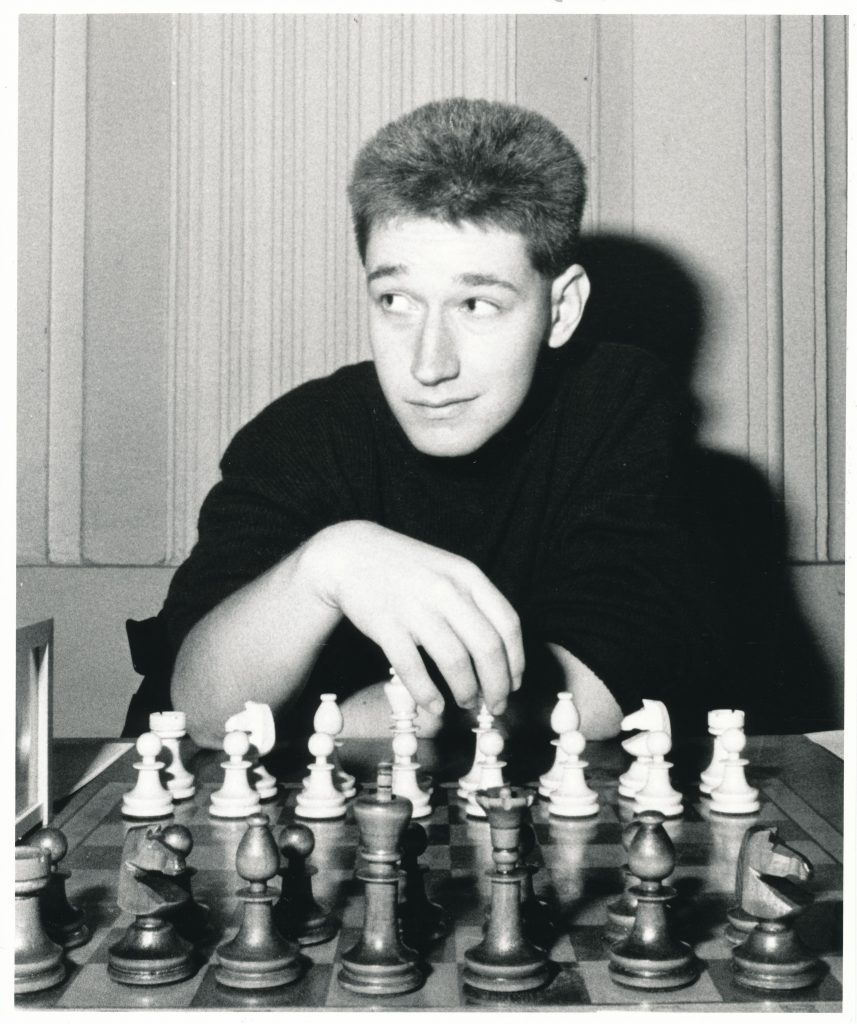
Charles Alexander Cobb, photo by Kelly/Wullenweber
Best wishes to IM Charles Alexander Cobb born on this day (November 15th) 1978
Charleshas plays / played for Bristol and Clifton Chess Club, maintains a rapidplay grading of 220, played for Bristol in the Four Nations Chess League His highest Elo rating was 2410 in October of 2006.
GM Damian Lemos (FIDE : 2479) was born in 1990 and hails from Argentina. He is a former Pan-American Junior Champion and he achieved the FIDE Master title at 14 years old, International Master at 15, and Grandmaster at 18 and is well known on many chess web sites for providing recorded and real time instructional videos on all aspects (but mainly opening theory) of chess. This is his second book for Everyman Chess.
GM Damian Lemos
The book is divided into seven main chapters as follows :
The Queen’s Gambit Declined (55 pages, 15 games)
The Tarrasch Defence (24 pages, 6 games)
The Slav Defence (45 pages, 9 games)
The Queen’s Gambit Accepted (56 pages, 13 games)
The Chigorin Defence (17 pages 3 games)
The Albin Counter Gambit (19 pages, 4 games)
Other Defences (17 pages, 4 games)
Damian Lemos presents a repertoire for White based around the best regarded flavour of the QGD, Exchange Variation or QGE : this is the version in which White delays Nf3 allowing the central push f3 followed by e4 and the typical resultant structure is :
The alternative version of the QGE in which White plays an early Nf3 and follows with a minority attack on the queenside is not treated in this book.
Strong grandmasters generally do not like being on the Black side of the QGE since counter-play is minimal so by selecting the QGE you should have a small edge that can be worked with.
White’s move order in most lines therefore is 1.d4 d5 2.c4 something and then 3.Nc3 so if you already play the Queen’s Gambit but with a 1.d4 d5 2.Nf3 something 3.c4 move order then this repertoire will be a substantial change for you.
Chapter 1 is presented via the now familiar and reliable method of a number (15) of high quality and recent instructive games analysed in depth.
Taking on the Tarrasch Defence Lemos goes down the road of the classical Rubinstein (fianchetto) approach showing how White can retain a nagging edge against the Black IQP.
The Slav Defence is approached using an active piece placement strategy based around the seemingly innocuous Exchange Variation : underestimate this line at your peril if you play the Slav !
The Queen’s Gambit Accepted is faced with the direct 3.e4 with in-depth coverage including all of Black ideas especially the most combative of 3…e5. The QGA receives the most comprehensive treatment in terms of pages (56) and with thirteen games analysed in detail.
The Chigorin Defence merits only three games reflecting its rarity at club and more exalted levels. Again, ignore the Chigorin at your peril !
Club players favourite, the Albin Counter-Gambit is examined via four games.
Rounding off in the “Other Defences” bargain basement section we find lines for White to deal with The (solid) Stonewall Variation of the Dutch, The somewhat discredited Marshall Defence, The (early) Tarrasch with 2…c5 and finally, The Baltic Defence which is common at club level.
A couple of small gripes with the production are : the diagrams do not have a “to move” indicator. secondly, some Everyman books (but not this one) have an extra folding part to the front and rear covers. These we find protect the book from damage and also can be used as an emergency book mark ! Also, chapters 3-5 all have the same page heading of the Chigorin Defence which confused us! We suspect that this error will be fixed.
Overall, this book provides a welcome repertoire based on exchanging on d5 that is fairly easy to learn and sound with decent winning chances for White. The QGE chapter is possibly the most interesting from the strategic perspective and gives White a clear plan to follow.
It is also fair to say that players of the Black pieces who employ the Chigorin, Tarrasch and particularly the QGA will also benefit from this book : they can see the authors suggested lines for the White and Black’s corresponding ideas.
John Upham, Cove, Hampshire, 12th November, 2019
John Upham
Book Details :
Paperback : 256 pages
Publisher: Everyman Chess (1 Aug. 2019)
Language: English
ISBN-10: 1781942609
ISBN-13: 978-1781942604
Product Dimensions: 16.9 x 1.5 x 23.9 cm
The book is available as a physical book and as a Kindle version.
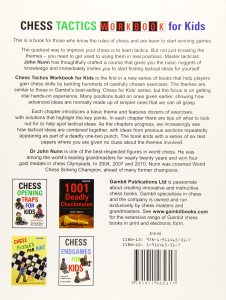
John Nunn has written around thirty books on chess and many of these are some of the finest chess books published in any language : Secrets of Pawnless Endings (1994, Batsford) easily is a candidate for the all time list. John is a director of Gambit Publications Ltd. together with Murray Chandler and Graham Burgess.
GM John Nunn
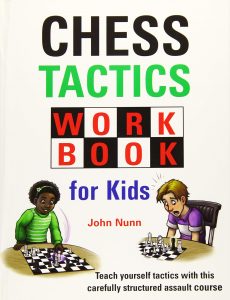
Chess Tactics Workbook for Kids is the sixth (a seventh and eighth are scheduled for January 2020 publication) in a highly successful series of “for Kids” books. Indeed, we recently reviewed Chess Opening Traps for Kids. The Workbook theme is likely to be extended other “for Kids” style books from Gambit Publications.
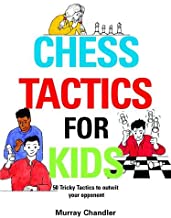
This workbook is a follow-up to the original (2003) and much liked Chess Tactics for Kids by Murray Chandler :
Chess Tactics for Kids
Chess Tactics Workbook for Kids is robustly (!) hardbound in a convenient size such that weights are not need to keep it propped open (unlike some A5 paperbacks) meaning studying with this book is more convenient than with many books. The layout and printing is clear (as you would expect with Gambit) with numerous diagrams at key moments in each, relatively short, game. In essence, players under 18 (for whom this book is intended) will find it easy to dip in out of and it can be used without a board (although BCN and most chess teachers and coaches would always recommend following each game on a “proper” board).
As you would expect with Gambit, the notation is English short form algebraic using figurines for pieces. A previous criticism (ibid) has been addressed in that each diagram has a symbolic “whose move it is” indicator. Each diagram does have coordinates which are very welcome for the younger junior reader.
The book is divided into 13 chapters as follows :
Fork
Pin
Skewer
Deflection and Decoy
Discovered Attack
Discovered and Double Check
Removing the Guard
In-Between Moves
Trapped Piece
Pawn Promotion
Opening and Closing Lines
Forcing a Draw
Test Papers
Chapters 1 – 12 each contain a description of the type of tactic that is subject of the chapter followed by 20 – 40 exercises for the reader followed by a set of more challenging “Tougher Positions” and then, interestingly, by a set of “Does the Tactic Work ?” exercises. We appreciated the latter especially since this appears to be a novel feature. These are excellent blunder prevention tests since they help to slow typical impetuous juniors down who often move first and then engage their brain.
It was clear when working through the easier set of exercises that the author had thought carefully about their sequence since the reader should (we did for sure !) notice the level of difficulty increasing slowly but surely. The solutions are remote from the puzzles nicely avoiding the “accidentally seeing the solution” issue one gets with lesser books. The solutions themselves are clear and concise and instructional in their own right.
Here is a particularly satisfying example (we thought so anyway !) from the Skewer chapter (Tougher Positions #23) *solution at bottom of this review
We particularly enjoyed the chapters on “Trapped Piece” and “Forcing a Draw” as these are less usual to find in books of this kind.
Here is a pleasing (well, we liked it here in the BCN editorial office) example (#30) from the “Does the Tactic Work?” section of the skewers chapter :
@and the solution is at the foot of this review
We enjoyed working through the chapters and emerged with a feeling of attending a mental gymnasium : exhausted but refreshed.
Chapter 13 (“Test Papers”) puts all of your newly learnt skills to a full and proper test since there are no themes, hints or clues of what to do : just like a real game !
One negative comment we would make concerns the cover. “Never judge a book by its cover” we are told and you might look at this book cover and think it was suitable for say primary aged children. We would say not but we would suggest it suitable from secondary aged children. We would say strong juniors from 12 upwards would read this book and enjoy it.
As we previously mentioned in our review of Chess Opening Traps for Kids, The title and cover might, perhaps, put off the adult club player market. However, the content is totally suitable for adult club players upto say 150 ECF or 1800 Elo.
In summary, we recommend this book to any junior or adult who wishes to improve their tactical vision and results. It makes an excellent stocking filler for young players and the young at heart !
*solution to Skewer exercise #23 : “Normally this material would lead to a draw, but White can win with a brilliant tactical idea : 1.Bd6!! (the only defence to the threat of 2.Qd3# is to take the bishop) 1…Qxd6 2. Qd3+ Kc5 (2…Ke5 3.Qg3+ is a mirror image) 3.Qa3+ and the queen falls.”
@solution to Skewer exercise #30 : “It seems impossible to save the game because after both side promote White has a skewer, but there is a miraculous defence : 1…g2 2.c8=Q g1=Q 3.Qc5+ Ke2! and further checks don’t help White, while after 4.Qxg1 Black is stalemated.”
We focus on the British Chess Scene Past & Present!
This website uses cookies to improve your experience. We'll assume you're ok with this, but you can opt-out if you wish. Cookie settingsACCEPT
Privacy & Cookies Policy
Privacy Overview
This website uses cookies to improve your experience while you navigate through the website. Out of these cookies, the cookies that are categorized as necessary are stored on your browser as they are as essential for the working of basic functionalities of the website. We also use third-party cookies that help us analyze and understand how you use this website. These cookies will be stored in your browser only with your consent. You also have the option to opt-out of these cookies. But opting out of some of these cookies may have an effect on your browsing experience.
Necessary cookies are absolutely essential for the website to function properly. This category only includes cookies that ensures basic functionalities and security features of the website. These cookies do not store any personal information.