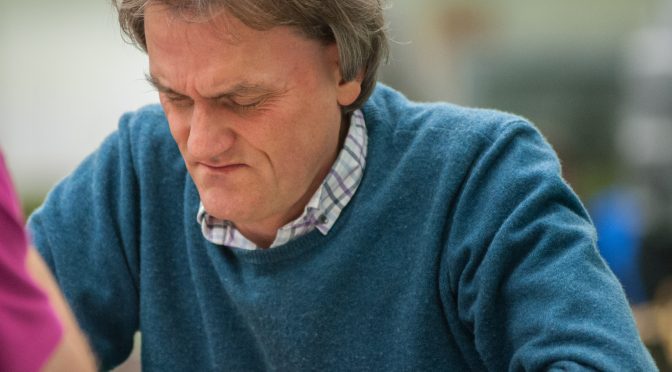
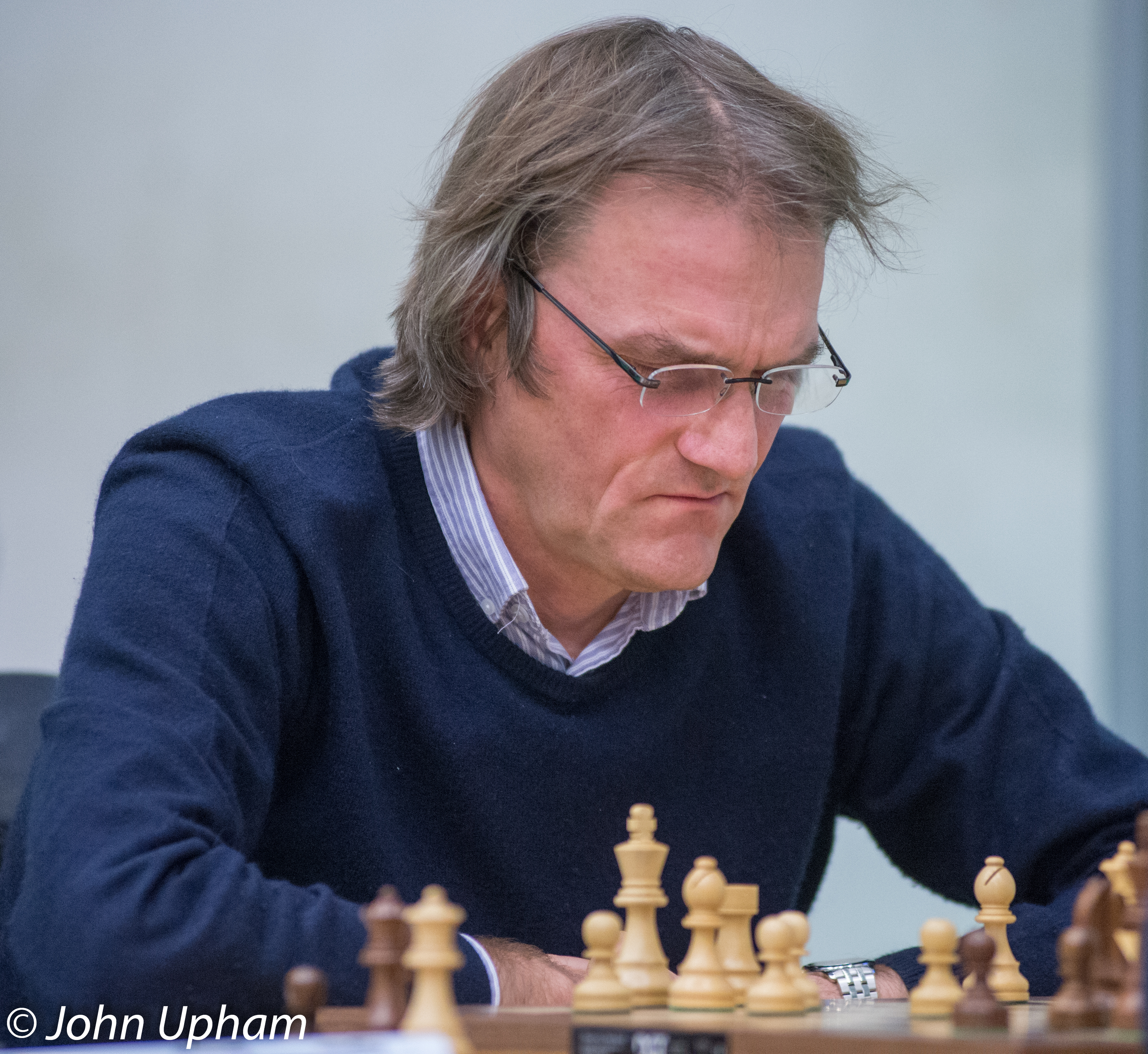
We offer best wishes to IM Simon John Bradley Knott on his birthday
Simon was born on Sunday, October 19th 1958 in Lambeth, London to Simon Harold John Arthur Knott and Josephine Whowell.
Simon attended Trinity College, Cambridge.
He became a FIDE Master in 1990 and an International Master in 2001. According to Felice and Megabase 2020 his peak FIDE rating was 2401 in October 2002 at the age of 43.
Simon was Southern Counties (SCCU) champion in the 1995-96 and 2001-02 seasons.
Simon plays for Hertford and Barbican in the Four Nations Chess League.
As white Simon plays the Queen’s Gambit via a 1.Nf3 or 1.c4 move order. There are zero 1.e4 games!
As the second player he plays the French Winawer and the Grünfeld Defence.
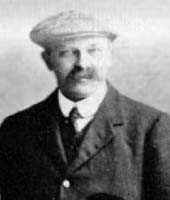
Charles Masson Fox was born on Friday, November 9th 1866 in Falmouth, Cornwall. his father, Howard, was 29 and his mother, Olivia Blanche Orme, was 22. He had one brother and two sisters.
His sister Olivia Lloyd was born on 5 February 1868 in Falmouth, Cornwall, when Charles Masson was 1 year old. His sister Stella was born on 11 December 1876 in Falmouth, Cornwall, when Charles Masson was 10 years old. In 1881 he was living in Sherborne, Dorset. In 1901 he was once more living in Falmouth and his profession was that of a timber merchant. His brother Howard Orme died on 7 June 1921 in Falmouth, Cornwall. His father Howard passed away on 15 November 1922 in Cornwall. His mother Olivia Blanche passed away on 12 March 1930 in Falmouth, Cornwall, at the age of 85.
Sadly, neither Hooper & Whyld, Sunnucks or Golombek mention Fox in their works.
“Charles Masson Fox (9 November 1866 – 11 October 1935) was a Cornish businessman who achieved international prominence in the world of chess problems and a place in the gay history of Edwardian England.
Masson Fox was born into a Quaker family (although he was not related to the Quakers’ founder George Fox) and was a cousin of the fraudulent sinologist Sir Edmund Backhouse, 2nd Baronet. Living throughout his life in the Cornish seaside town of Falmouth, Fox in the early decades of his life was a senior partner of his family’s timber firm, Fox Stanton & Company, and was also on the Board of Messrs G C Fox & Company, a long-established firm of shipping agents.
C.M.Fox’s gravestone at Budock Quaker Burial Ground
Fox is described by chess historian Thomas Rayner Dawson (1889–1951) as “a friendly man, kind, mellow, lovable, bringing peace and comfort and serene joy with him”. He was also a discreet but active homosexual. In 1909 he visited Venice with his friend James Cockerton, meeting the writer Frederick Rolfe and becoming the reluctant recipient of Rolfe’s famous Venice Letters, in which the gay subculture of Venice is vividly described.
In 1912–13 Fox was blackmailed by a woman who accused him of seducing her 16-year-old son. Eventually Fox reported the matter to the police and the woman was sent to prison for five years and her son for one year, with hard labour.[1] However, Fox was profoundly affected by the publicity surrounding the case, which was reported in detail in the local press. The predictable result of his courageous action was the destruction of his reputation, and the compromise of his business and social life in Falmouth.
Although he continued to live in Cornwall, the focus of his social life shifted to London, and in the last two decades of his life, Fox became prominent in the world of chess. He was elected President of the Cornwall Chess Association, played a prominent part in the development of the British Chess Problem Society, and is still renowned as one of the greatest ever exponents of fairy chess (chess problems with variations in the rules).”
From The Problemist Fairy Chess Supplement, 1933 :
What is the shortest game
ending in this position?
Michael Thomas Hennigan was born on October 8th, 1970 in Hammersmith, London. His mother’s name was Donnelly.
Michael attended the City of London School.
Michael became World Under-18 Youth Champion in 1988 in Aguadilla (Puerto Rico).
He became a FIDE Master in 1990 and an International Master title in 1991 and in the same year was British Under-21 Champion at Eastbourne and was British Champion in 1993 in Dundee beating Dharshan Kumaran in the play-off.
In 1995 he was 1st= in the Arnold Cup in Gausdal with Igor Rausis
His peak FIDE rating (according to Felice and Megabase 2020) was 2465 in July 1994 at the age of 24.
He played for North West Eagles in the Four Nations Chess League.
Michael married WIM Rita Zimmersmann and settled in London. Rita subsequently became Rita Atkins.
Michael stopped playing in 2010 but has recently in 2020 started playing online chess on the chess.com platform.
With the white pieces Michael used to be an e4 player but in 2020 has switched to 1.g3 to get back into the swing of things.
As the second player he plays the Sicilian Four Knights and the King’s Indian Defence.
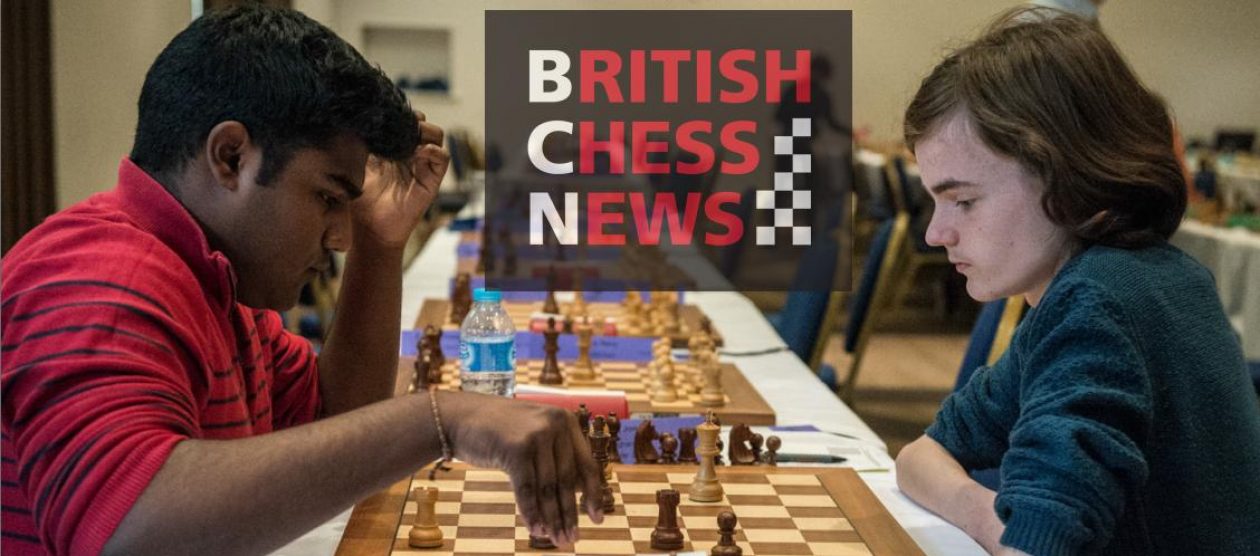
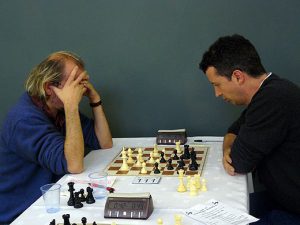
Stuart Conquest vs Michael Hennigan at 4NCL,, photo by Meri Grigoryan
We focus on the British Chess Scene Past & Present!
This website uses cookies to improve your experience. We'll assume you're ok with this, but you can opt-out if you wish. Cookie settingsACCEPT
Privacy & Cookies Policy
Privacy Overview
This website uses cookies to improve your experience while you navigate through the website. Out of these cookies, the cookies that are categorized as necessary are stored on your browser as they are as essential for the working of basic functionalities of the website. We also use third-party cookies that help us analyze and understand how you use this website. These cookies will be stored in your browser only with your consent. You also have the option to opt-out of these cookies. But opting out of some of these cookies may have an effect on your browsing experience.
Necessary cookies are absolutely essential for the website to function properly. This category only includes cookies that ensures basic functionalities and security features of the website. These cookies do not store any personal information.