BCN remembers Philip Walsingham Sergeant who passed away on Monday, October 20th 1952.
PWS was born in Kensington on Saturday, January 27th, 1872 to Lewis Sergeant and Emma Louisa Sergeant (née Robertson) and was baptised at All Saints Church, Notting Hill. According to PWS’s baptism record Lewis was an author.
According to PWS in A Century of British Chess :
“When I was seven years of age – about the period, by the way, in which my father began to teach me Greek – he began also to initiate me into chess. Not that he designed it as a consolatory set-off to my application to Greek; for he loved the Classics well, though, going up to Cambridge with small classical exhibition, he had turned to Mathematics, and therein took his degree. ”
According to the 1881 census PWS (aged 9) lived with his parents and numerous siblings : Dorothy (aged 7), Winifred (6), Hilda (5), Bernard (2), John (his grandfather aged 76) and Mary (his grandmother aged 75). They had staff, Elizabeth Fraser and Sarah Martin. They lived at 10, Addison Road, North, Kensington.
According to “Joseph Foster. Oxford Men and Their Colleges, 1880-1892. 2 vols. Oxford, England: James Parker and Co, 1893″ :
PWS attended St. Paul’s School and then Trinity College, Oxford to read Classics where he attained Honour Moderations.
and here is the record from the above publication :
Entry for Philip Walsingham Sergeant in Joseph Foster. Oxford Men and Their Colleges, 1880-1892. 2 vols. Oxford, England: James Parker and Co, 1893
We do not know if PWS played in the Varsity matches of 1892 – 1895 : Britbase does not (yet) include player details for these matches.
PWS married Minnie Boundford (born 27th February 1889) in 1909 in Hampstead and they lived at 5, Dukes Avenue, Chiswick where PWS was listed as an author and Minnie as someone who carried out “unpaid domestic duties”. Minnie was 17 years younger than PWS. Minnie’s father was a joiner and a carpenter.
They had two daughters Margaret (born 1910) and Kathleen (born 1911).
In October 1946 Minnie and PWS remarried. Presumably this was rather unusual in that day and age.
According to The Oxford Companion to Chess (OUP, 2nd edition, 1996) by Hooper and Whyld :
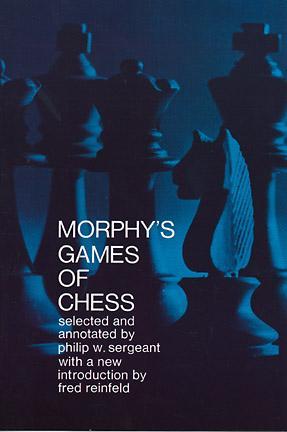
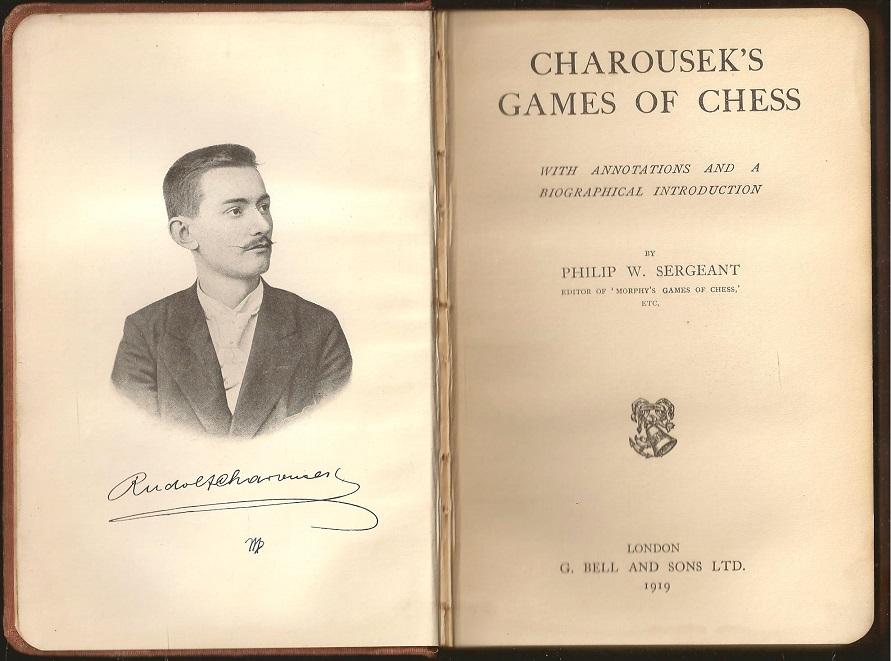
PWS was an English author of biographical games collections for Charousek, Morphy and Pillsbury as well as other works of importance such as A Century of British Chess (1943) and Championship Chess (1938).
From The Encyclopedia of Chess (BT Batsford, 1977) by Harry Golombek :
“A professional writer on chess and popular historical subjects. Without any pretentions to mastership, he represented Oxford University in the years 1892 – 5 and assisted RC Griffith in preparing three editions of Modern Chess Openings.
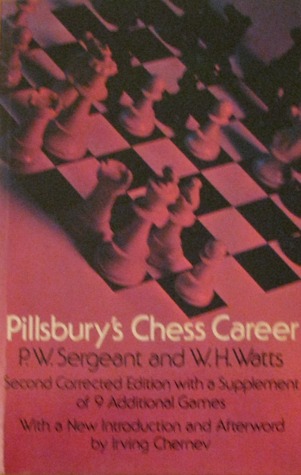
In chess he dealt with a number of important subjects : Morphy’s Games of Chess, London, 1916; Charousek’s Games of Chess, London, 1919; Pillsbury’s Chess Career (in collaboration with WH Watts), London, 1923; Championship Chess, London, 1938.
All these are lucidly and carefully written but suffer from the defect that, being neither a master player nor a professional annotator, he was not competent to deal with the annotational part of the work. Probably his best book on chess was A Century of British Chess, London, 1934.
From British Chess Magazine, Volume LXX11 (72), Number 11 (November), page 324 we have this rather brief obituary (presumably written by Brian Reilly):
“We regret to have to report the death, at the age of eighty-one of Philip W. Sergeant, the author of A Century of British Chess, which we imagine is in most chess libraries. He was the author of several well-known historical books – but we are only concerned here with his chess activities, which included representing Oxford University 1892-5; helping RC Griffith with two editions of Modern Chess Openings; playing for Middlesex, winning the chess championship of the authors’ club for several year, and latterly as an honoured member; and occasionally obtaining the championship of the Guildford Chess Club. Our sympathy with his widow and two daughters is sincere.”
”
“Philip Walsingham Sergeant (27 January 1872, Notting Hill, London[1] – 20 October 1952)[2] was a British professional writer on chess and popular historical subjects.[3][4] He collaborated on the fifth (1933), sixth (1939), and seventh (1946) editions of Modern Chess Openings, an important reference work on the chess openings. He also wrote biographical game collections of Paul Morphy (Morphy’s Games of Chess (1916) and Morphy Gleanings), Rudolf Charousek (Charousek’s Games of Chess (1919)), and Harry Nelson Pillsbury (Pillsbury’s Chess Career, with W. H. Watts, 1922), and other important books such as A Century of British Chess (1934) and Championship Chess (1938).”
Harry Golombek writes that, “Without any pretensions to mastership, he represented Oxford University in the years 1892-5”.[3] Golombek considers A Century of British Chess probably Sergeant’s best chess book, but opines that although Sergeant’s chess books are lucidly written, they suffer from the defect that, as a non-master, he was not competent to deal with the annotational aspect of his work.
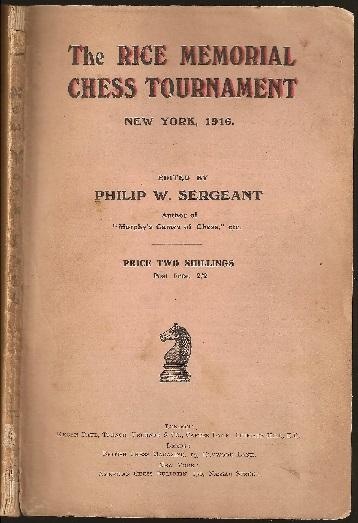
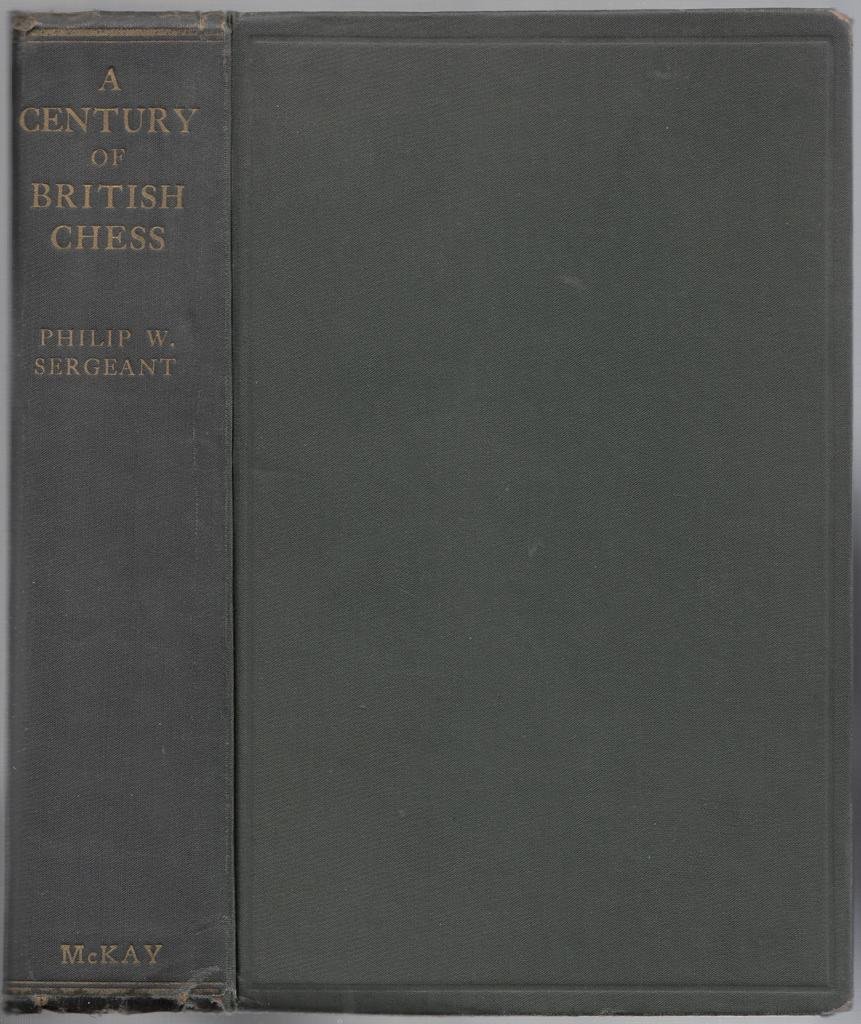
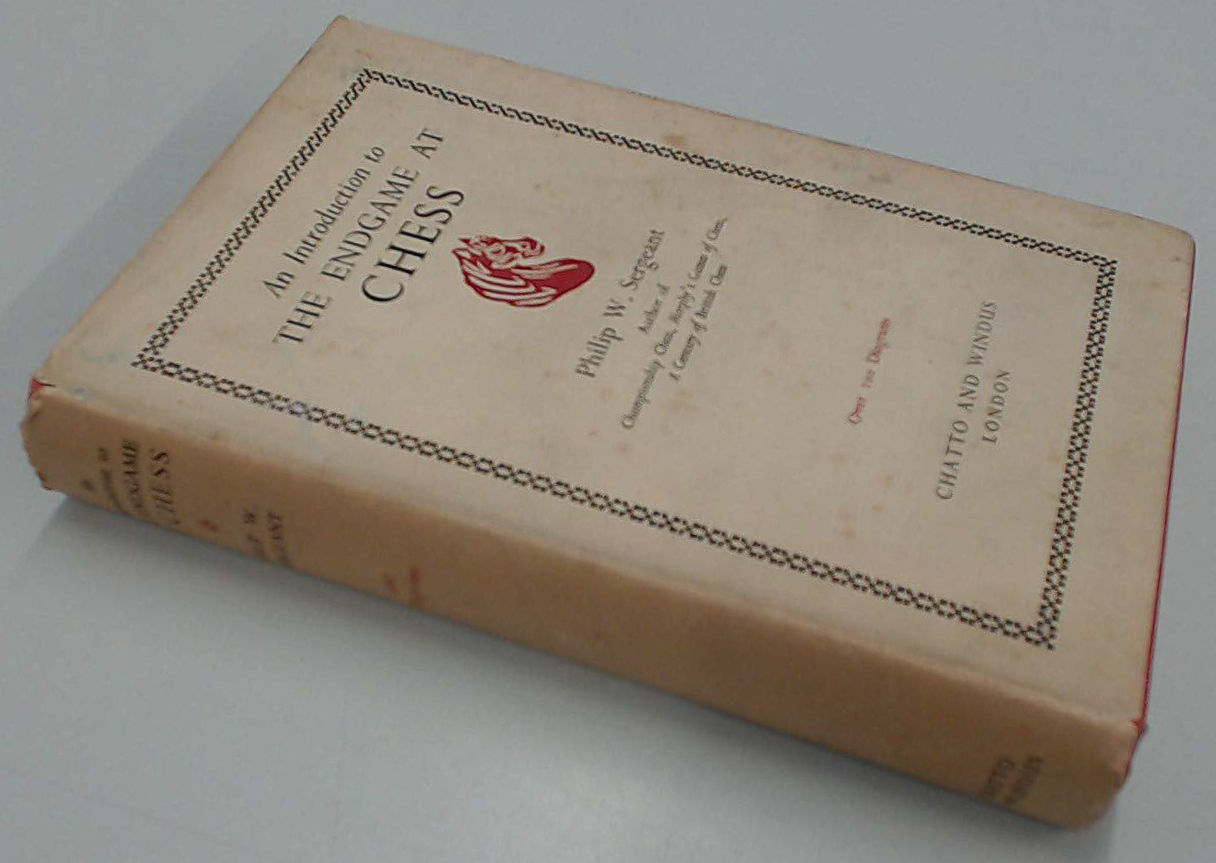
Philip Walsingham SergeantCharousek’s Games of ChessThe Rice Memorial Chess Tournament, 1916Pillsbury’s Chess Career, London, 1923A Century of British Chess, London, 1934An Introduction to the Endgame at Chess
BCN remembers Philip Walsingham Sergeant who passed away on Monday, October 20th 1952.
PWS was born in Kensington on Saturday, January 27th, 1872 to Lewis Sergeant and Emma Louisa Sergeant (née Robertson) and was baptised at All Saints Church, Notting Hill. According to PWS’s baptism record Lewis was an author.
According to PWS in A Century of British Chess :
“When I was seven years of age – about the period, by the way, in which my father began to teach me Greek – he began also to initiate me into chess. Not that he designed it as a consolatory set-off to my application to Greek; for he loved the Classics well, though, going up to Cambridge with small classical exhibition, he had turned to Mathematics, and therein took his degree. ”
According to the 1881 census PWS (aged 9) lived with his parents and numerous siblings : Dorothy (aged 7), Winifred (6), Hilda (5), Bernard (2), John (his grandfather aged 76) and Mary (his grandmother aged 75). They had staff, Elizabeth Fraser and Sarah Martin. They lived at 10, Addison Road, North, Kensington.
According to “Joseph Foster. Oxford Men and Their Colleges, 1880-1892. 2 vols. Oxford, England: James Parker and Co, 1893″ :
PWS attended St. Paul’s School and then Trinity College, Oxford to read Classics where he attained Honour Moderations.
and here is the record from the above publication :
Entry for Philip Walsingham Sergeant in Joseph Foster. Oxford Men and Their Colleges, 1880-1892. 2 vols. Oxford, England: James Parker and Co, 1893
We do not know if PWS played in the Varsity matches of 1892 – 1895 : Britbase does not (yet) include player details for these matches.
PWS married Minnie Boundford (born 27th February 1889) in 1909 in Hampstead and they lived at 5, Dukes Avenue, Chiswick where PWS was listed as an author and Minnie as someone who carried out “unpaid domestic duties”. Minnie was 17 years younger than PWS. Minnie’s father was a joiner and a carpenter.
They had two daughters Margaret (born 1910) and Kathleen (born 1911).
In October 1946 Minnie and PWS remarried. Presumably this was rather unusual in that day and age.
According to The Oxford Companion to Chess (OUP, 2nd edition, 1996) by Hooper and Whyld :
PWS was an English author of biographical games collections for Charousek, Morphy and Pillsbury as well as other works of importance such as A Century of British Chess (1943) and Championship Chess (1938).
From The Encyclopedia of Chess (BT Batsford, 1977) by Harry Golombek :
“A professional writer on chess and popular historical subjects. Without any pretentions to mastership, he represented Oxford University in the years 1892 – 5 and assisted RC Griffith in preparing three editions of Modern Chess Openings.
In chess he dealt with a number of important subjects : Morphy’s Games of Chess, London, 1916; Charousek’s Games of Chess, London, 1919; Pillsbury’s Chess Career (in collaboration with WH Watts), London, 1923; Championship Chess, London, 1938.
All these are lucidly and carefully written but suffer from the defect that, being neither a master player nor a professional annotator, he was not competent to deal with the annotational part of the work. Probably his best book on chess was A Century of British Chess, London, 1934.
From British Chess Magazine, Volume LXX11 (72), Number 11 (November), page 324 we have this rather brief obituary (presumably written by Brian Reilly):
“We regret to have to report the death, at the age of eighty-one of Philip W. Sergeant, the author of A Century of British Chess, which we imagine is in most chess libraries. He was the author of several well-known historical books – but we are only concerned here with his chess activities, which included representing Oxford University 1892-5; helping RC Griffith with two editions of Modern Chess Openings; playing for Middlesex, winning the chess championship of the authors’ club for several year, and latterly as an honoured member; and occasionally obtaining the championship of the Guildford Chess Club. Our sympathy with his widow and two daughters is sincere.”
”
“Philip Walsingham Sergeant (27 January 1872, Notting Hill, London[1] – 20 October 1952)[2] was a British professional writer on chess and popular historical subjects.[3][4] He collaborated on the fifth (1933), sixth (1939), and seventh (1946) editions of Modern Chess Openings, an important reference work on the chess openings. He also wrote biographical game collections of Paul Morphy (Morphy’s Games of Chess (1916) and Morphy Gleanings), Rudolf Charousek (Charousek’s Games of Chess (1919)), and Harry Nelson Pillsbury (Pillsbury’s Chess Career, with W. H. Watts, 1922), and other important books such as A Century of British Chess (1934) and Championship Chess (1938).”
Harry Golombek writes that, “Without any pretensions to mastership, he represented Oxford University in the years 1892-5”.[3] Golombek considers A Century of British Chess probably Sergeant’s best chess book, but opines that although Sergeant’s chess books are lucidly written, they suffer from the defect that, as a non-master, he was not competent to deal with the annotational aspect of his work.
Philip Walsingham SergeantCharousek’s Games of ChessThe Rice Memorial Chess Tournament, 1916Pillsbury’s Chess Career, London, 1923A Century of British Chess, London, 1934An Introduction to the Endgame at Chess
We remember Edward Sergeant OBE (3-xii-1881 16-xi-1961)
Edward Guthlac Sergeant was born on Saturday, December 3rd 1881 : in the same year British Chess Magazine was founded by John Watkinson.
He was born in Crowland, South Holland, Lincolnshire. The registration district was Peterborough and the inferred county was Northamptonshire. His father was William R Sergeant (aged 27) and his mother was Frances E Sergeant (aged 25). He had a sister, Hilda who was one year older. William was a registered general medical practitioner.
He was named Guthlac after a monk who “came to what was then an island in the Fens to live the life of a hermit.”
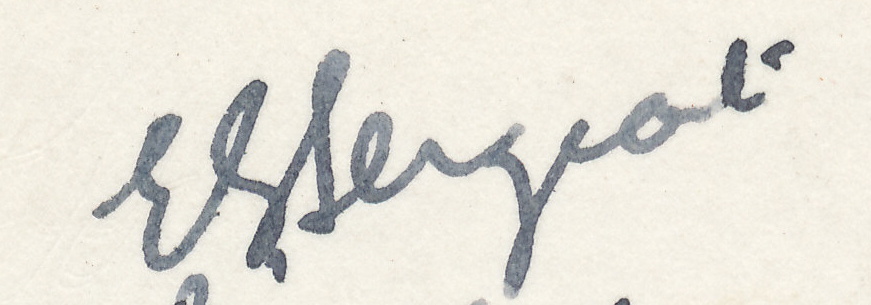
Signature of EG Sergeant from a Brian Reilly “after dinner” postcard from Margate 1936.
According to the 1891 census EGS was aged 9 and living with his father, mother, sister and their domestic servant Margaret A George who was their general domestic servant who hailed from Scotland. They lived at 2, Gladstone Terrace, Gateshead, NE8 4DY. This was in the Ecclesiastical parish of Christchurch.
2, Gladstone Terrace, Gateshead, NE8 4DY
In the 1911 census aged 29 as nephew to the head of the household (5 St Peters Terrace, Cambridge) EGS is listed as a solicitor who is single. The size of the household in 1911 was relatively modest at 12. He was living with George Edward Wherry (59, surgeon university professor) and his wife Albinia Lucy Wherry (53). Albinia Lucy Wherry was a nurse and also writer. During WWI she was stationed in Paris at the Gare du Nord where she supported British forces from 1915-18. the sub-registration district was St Andrew the Great.
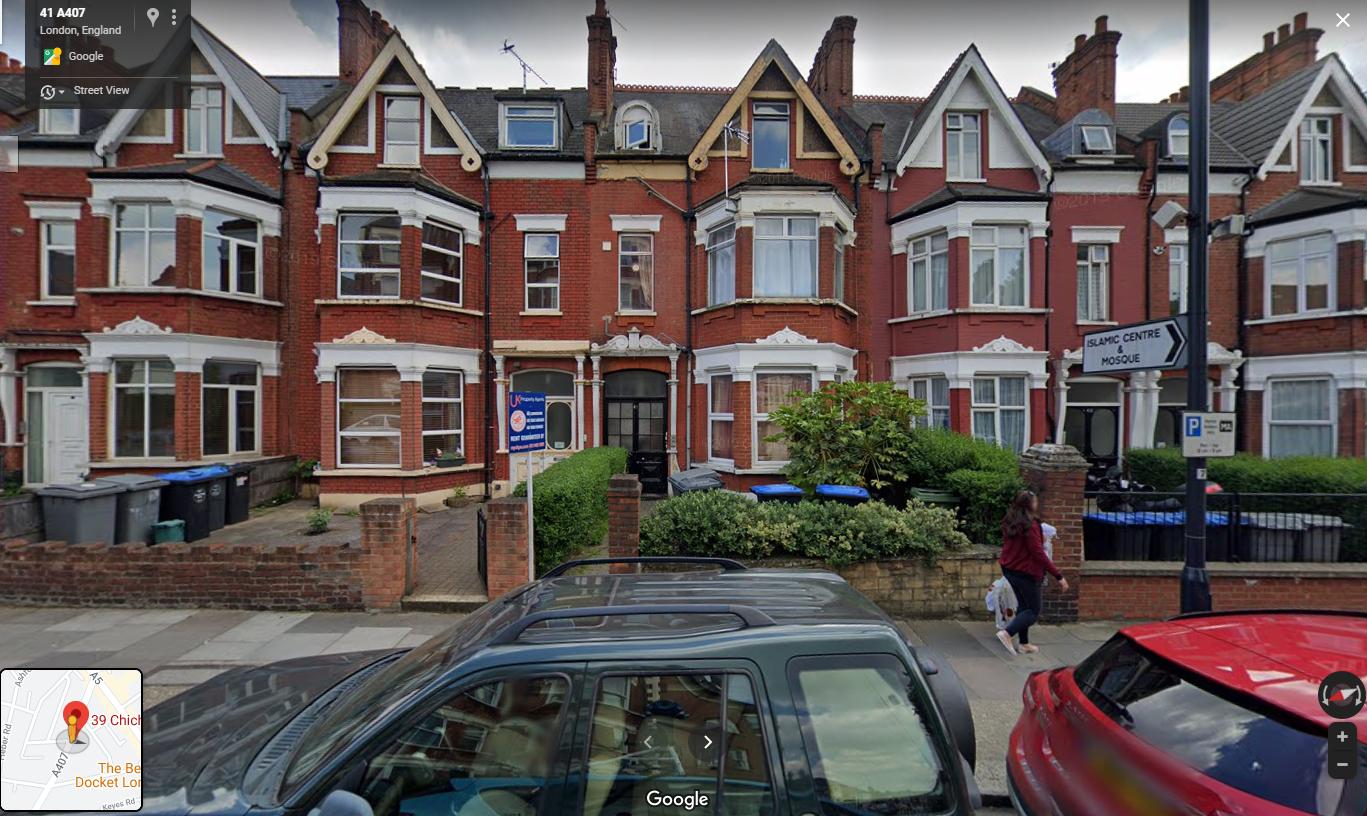
According to Edward Winter in Where did they live? in April 1916 EGS was living at 39 Chichele Road, Cricklewood, London NW2 3AN, England. EGWs source for this is : Chess Amateur, April 1916, page 202.
39 Chichele Road, Cricklewood, London NW2 3AN
1918 was an important year for Edward when he married Dorothy Frances Carter (born 1887) in Gravesend. In the same year Dorothy and Edward had a son Richard who passed away in 2014
Two years later Dorothy and Edward had a son Lewis Carter Sergeant born on January 30th 1920. The birth was registered in Paddington. Lewis lived at 3 Woodhill Court, 175 Woodhill, London, SE18 5HSL and passed away in 2004 the death being registered in Greenwich.
On the 1920 Electoral Roll, EGS was now living with Dorothy Frances Sergeant at St. Stephen’s Mansions, 5, Monmouth Road, Edmonton.
In 1923 they upped sticks and moved to 27. King Edward’s Grove, Teddington.
Sadly Dorothy passed away in 1926 at the modest age of 39.
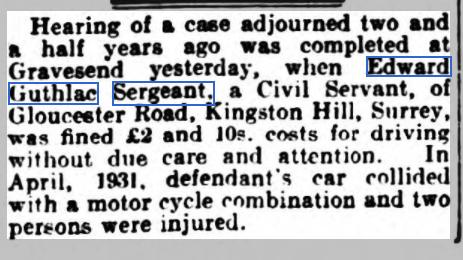
Coventry Evening Telegraph 10 October 1933
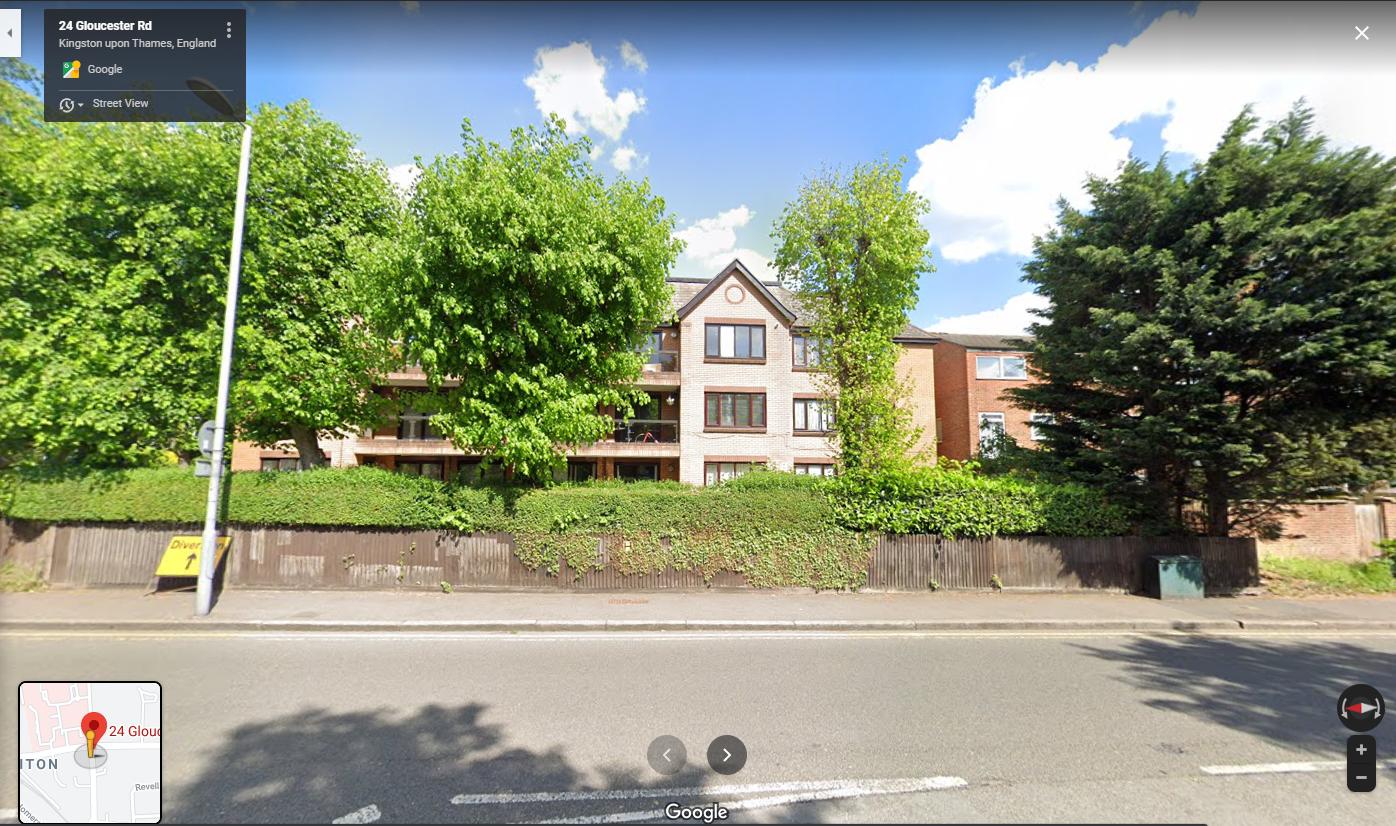
According to the 1939 census EGS was listed as a widowed, civil servant living at 24, Gloucester Road, Kingston Upon Thames, KT2 7DX. This would be the address that Edward saw out the rest of his life.
24, Gloucester Road, Kingston Upon Thames, KT2 7DX
He shared this address with Edith Carter (born 4th May 1878) who is described as being of “Private Means” and Ada M Wenman (6th August 1881) who is described as being a “domestic”.
In 1949 he was awarded the OBE in the Birthday Honours in recognition of his 39 years’ service in the office of the Solicitor to the Board of Inland Revenue.
According to John Saunders : EGS died in the New Victoria Hospital, New Malden, Surrey, on 16 November 1961. His residence at death had been 24 Gloucester Road, Kingston Hill. Probate (26 Jan 1962) granted to Lewis Carter Sergeant, a Lieutenant-Colonel in HM Army. Effects £6,586.
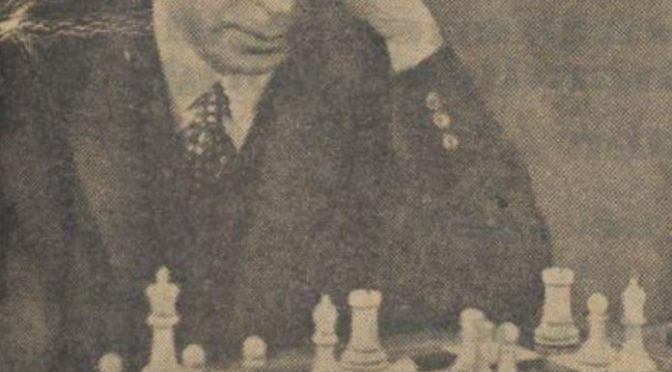
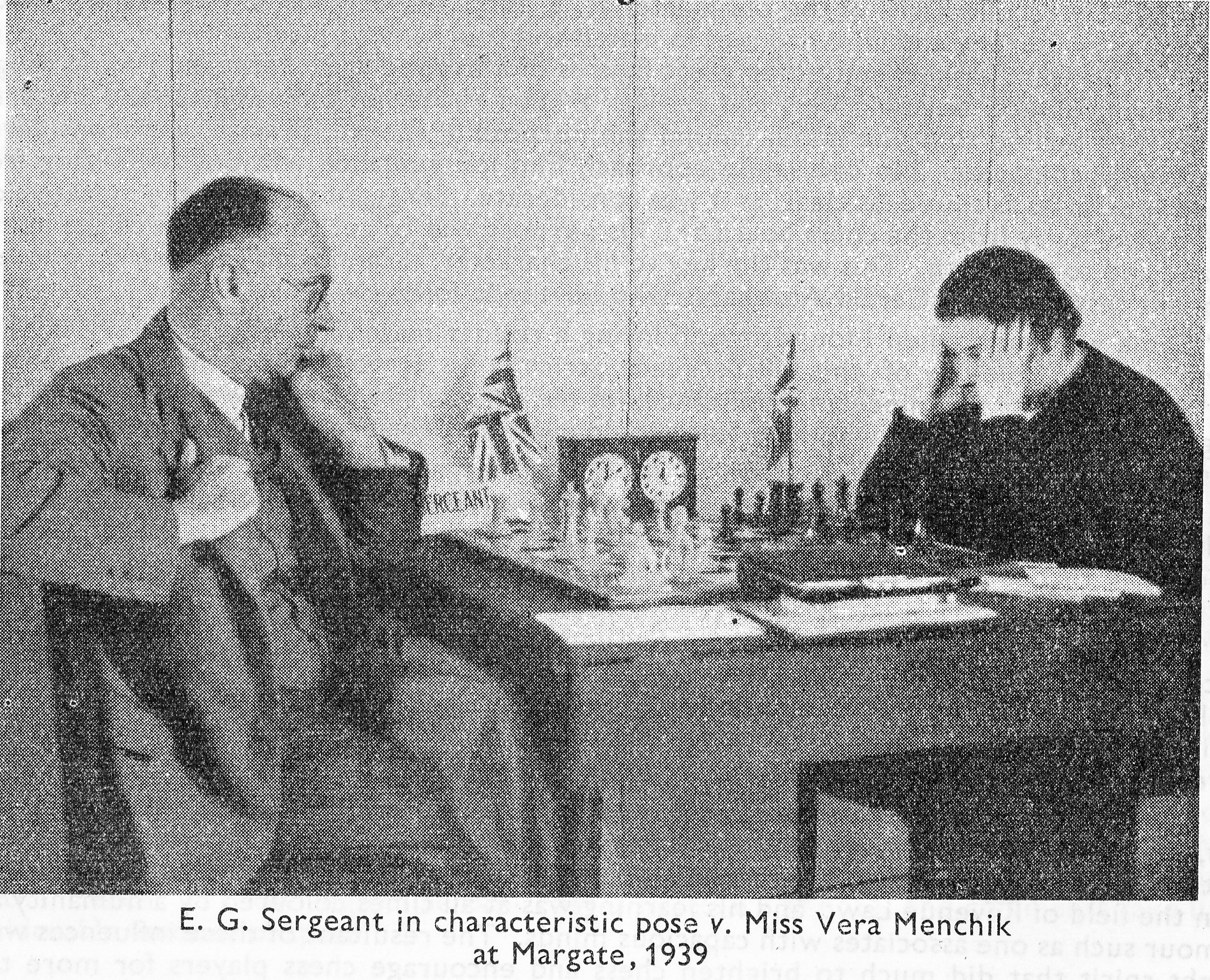
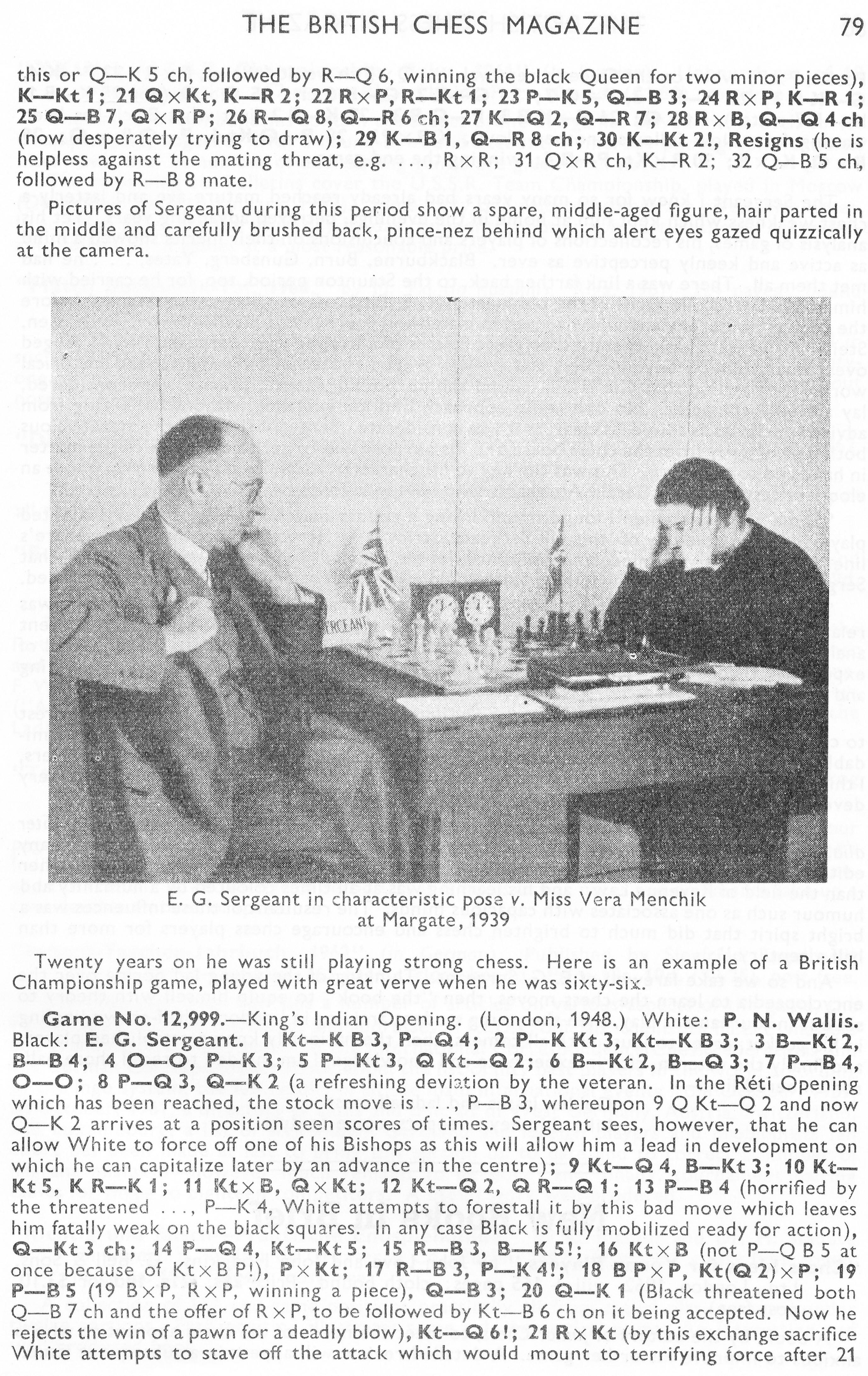
E.G. Sergeant in characteristic pose v. Miss Vera Menchik at Margate, 1939
From The Encyclopedia of Chess (Batsford, 1977), Harry Golombek OBE :
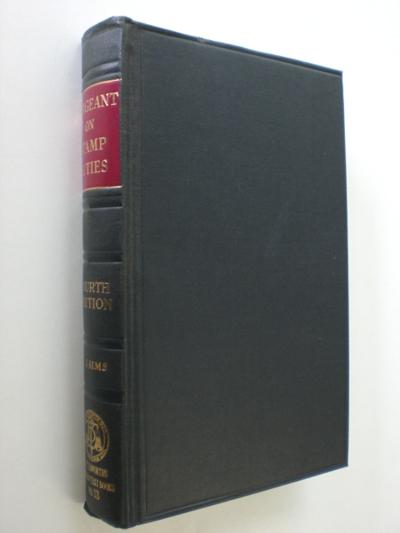
A British master who had a long and solidly distinguished career in British chess but never quite succeeded in breaking through the barrier to international success. A civil servant by profession, he was awarded the OBE for his services in the Inland Revenue and Sergeant on Stamp Duties was regarded as an authoritative work.
Sergeant’s earliest performance in the British Championship, at the Crystal Palace in London 190, was one of his best. He came =2nd with JH Blackburne. RP Mitchell and GE Wainwright with 6.5 points, a point below the winner of the title, HE Atkins.
He was 3rd at Edinburgh in 1920 and his best result in the competition came in Brighton 193, where he came equal second with H. Golombek, a 1/2 point below the winner, CHO’D Alexander.
A stalwart supporter of the City of London Chess Club, he won its championship in two successive years, 1916 and 1917. He played for Britain against the USA in the 1908 and 1909 cable matches and also played on a high board for London against various American cities in the Insull Trophy matches in the years 1926-31.
As a player he was strongly influenced by the scientific principles of Siegbert Tarrasch and did well during the period when the Tarrasch school enjoyed its heyday. But he was at a loss when confronted with more modern methods.”
Both Sunnucks and Hooper & Whyld are silent on EGS : surprising!
We asked Leonard Barden of his memories of EGS and he was kind enough to reply :
“People have different ways of expressing satisfaction with their position. Botvinnik adjusted his tie, Kasparov put his watch back on, Sergeant rubbed his hands together….He liked to counter the Queen’s Gambit Declined in the classical way with a kind of Lasker Defence.”
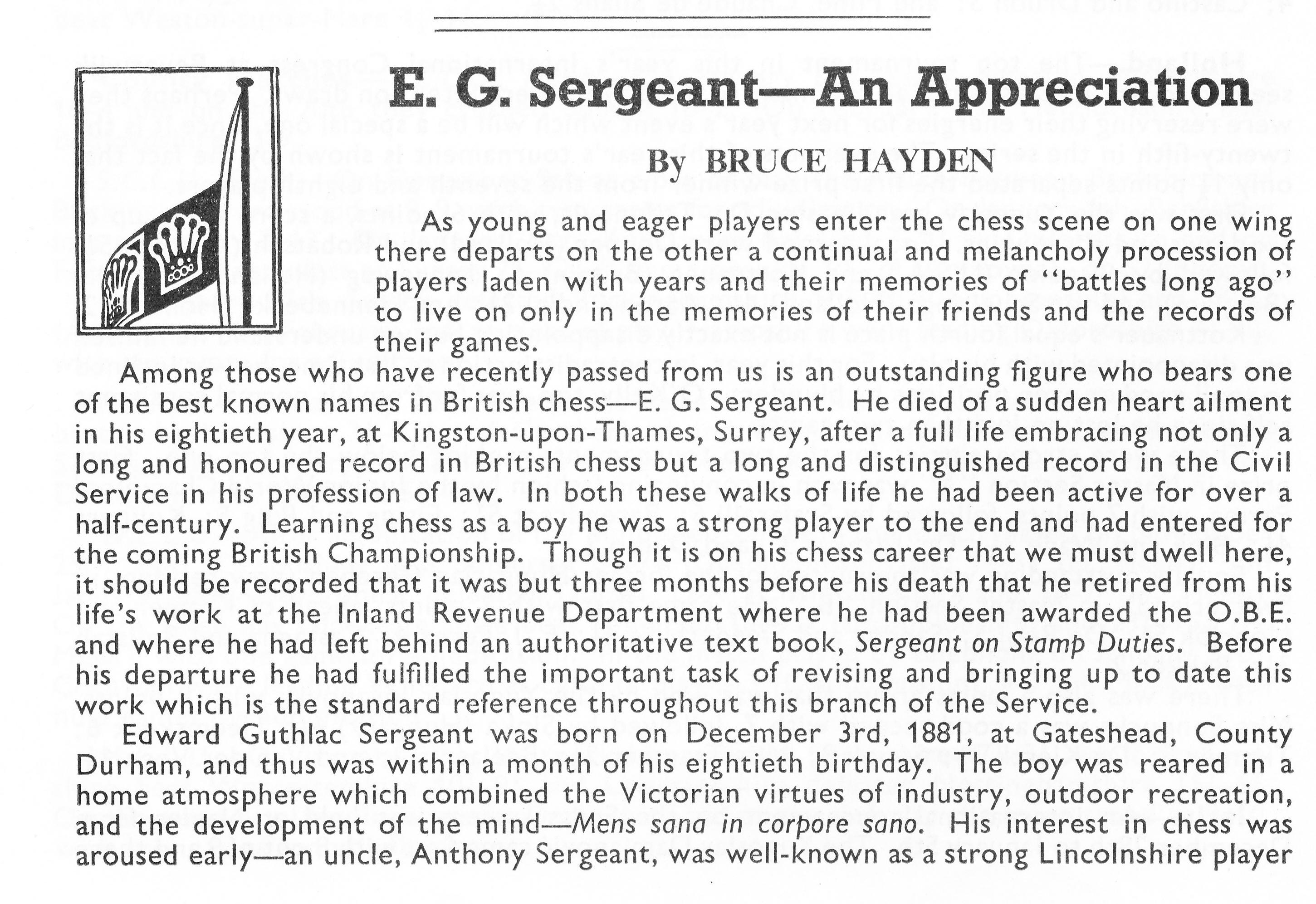
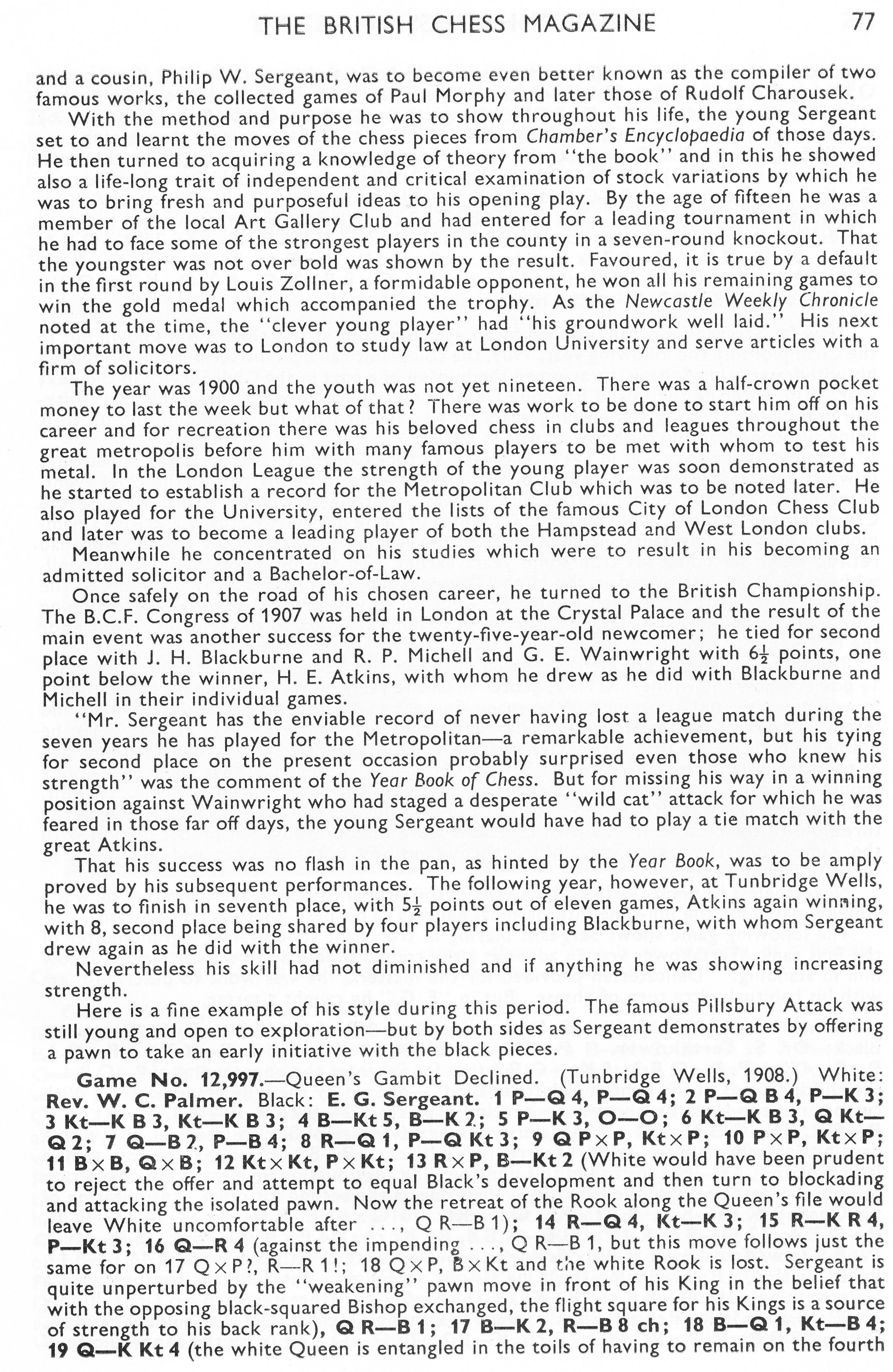
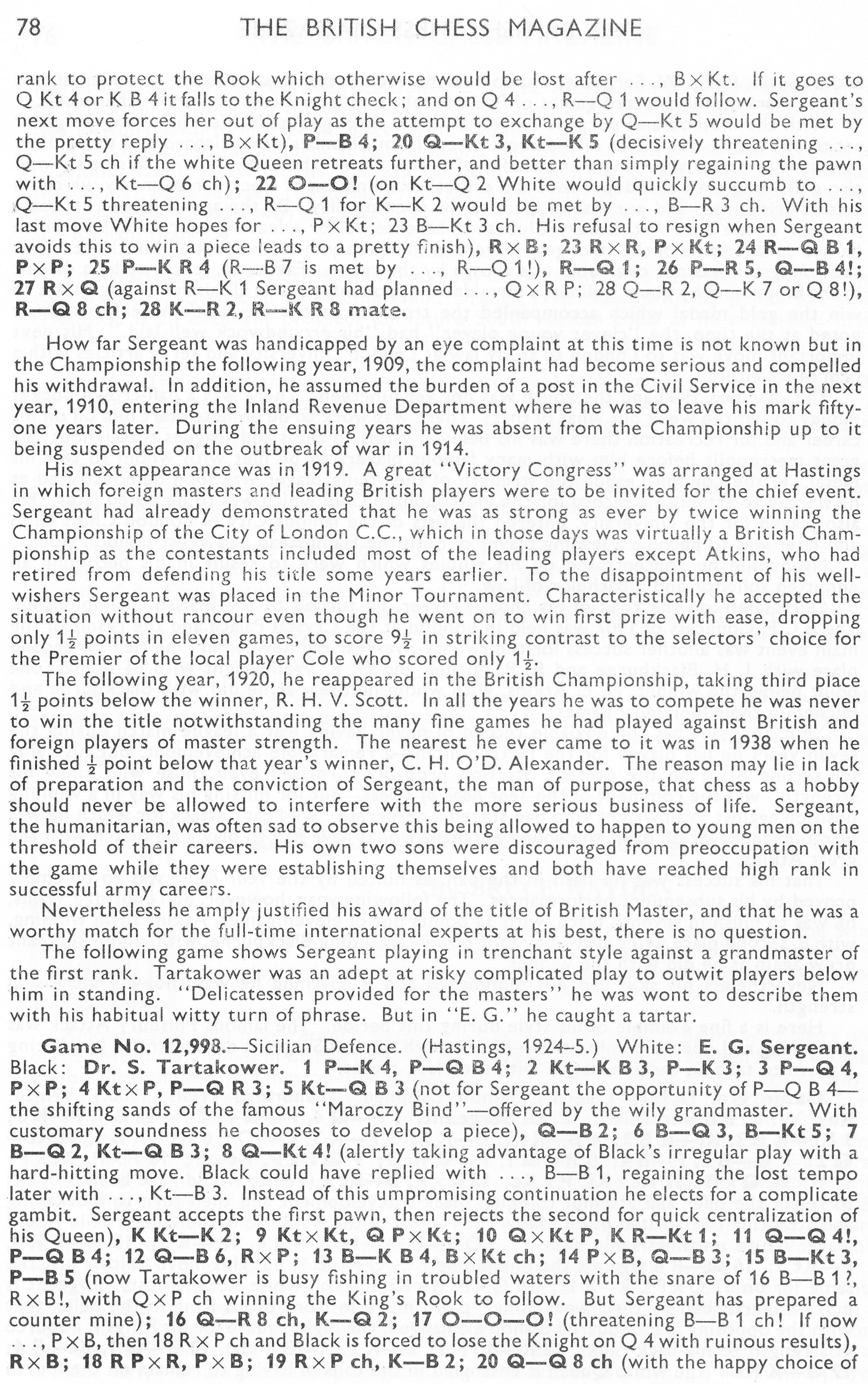
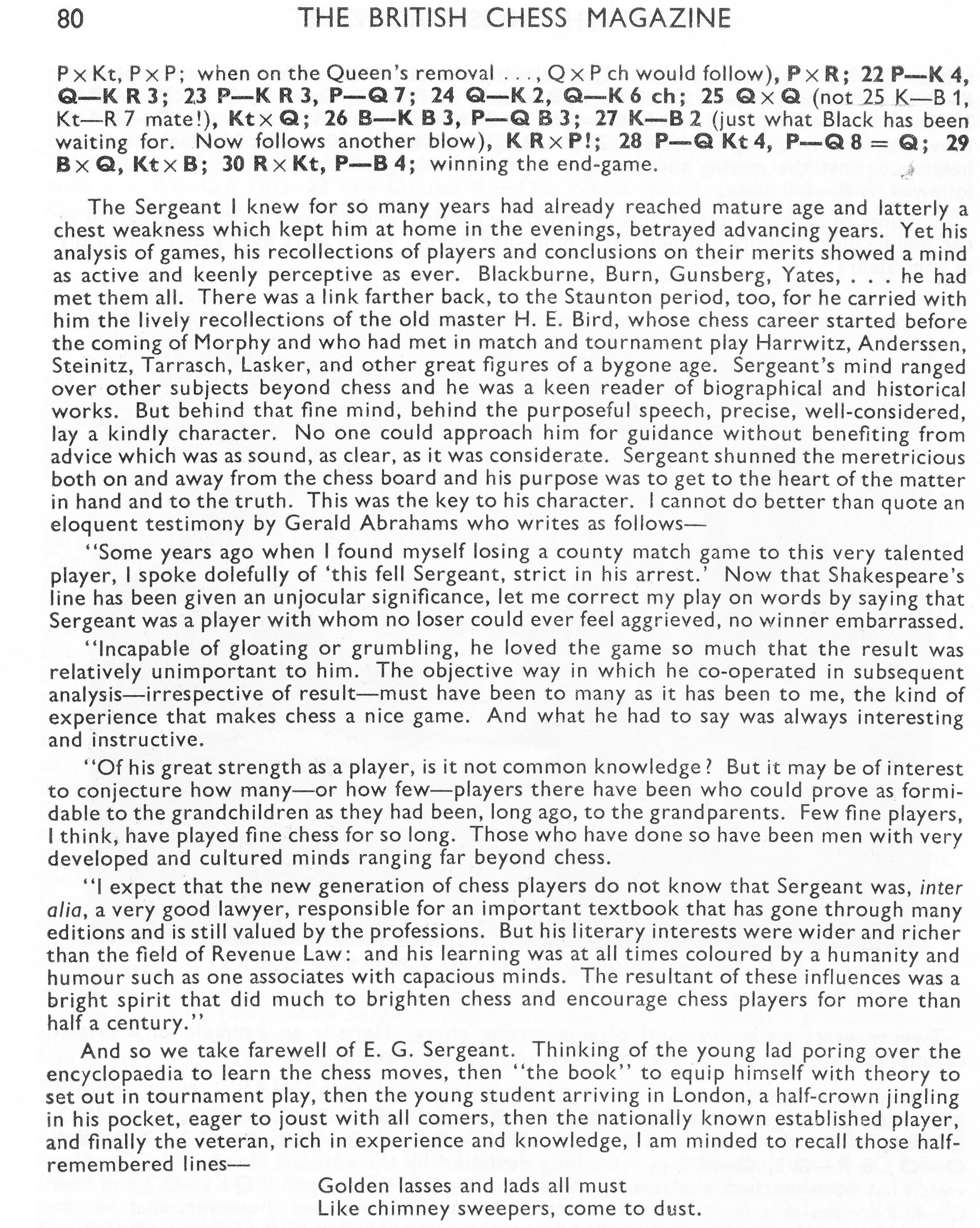
From British Chess Magazine, Volume LXXXII, March, 1962, Number 3, pages 76 -80 we reproduce an obituary from Bruce Hayden entitled “E.G. Sergeant – An Appreciation” as follows :
(note the incorrect birth location presumably based on the 1891 census information)
Edward Guthlac Sergeant, part oneEdward Guthlac Sergeant, part twoEdward Guthlac Sergeant, part threeEdward Guthlac Sergeant, part fourEdward Guthlac Sergeant, part fiveSergeant on Stamp Duties
We remember Edward Sergeant OBE (3-xii-1881 16-xi-1961)
Edward Guthlac Sergeant was born on Saturday, December 3rd 1881 : in the same year British Chess Magazine was founded by John Watkinson.
He was born in Crowland, South Holland, Lincolnshire. The registration district was Peterborough and the inferred county was Northamptonshire. His father was William R Sergeant (aged 27) and his mother was Frances E Sergeant (aged 25). He had a sister, Hilda who was one year older. William was a registered general medical practitioner.
He was named Guthlac after a monk who “came to what was then an island in the Fens to live the life of a hermit.”
Signature of EG Sergeant from a Brian Reilly “after dinner” postcard from Margate 1936.
According to the 1891 census EGS was aged 9 and living with his father, mother, sister and their domestic servant Margaret A George who was their general domestic servant who hailed from Scotland. They lived at 2, Gladstone Terrace, Gateshead, NE8 4DY. This was in the Ecclesiastical parish of Christchurch.
2, Gladstone Terrace, Gateshead, NE8 4DY
In the 1911 census aged 29 as nephew to the head of the household (5 St Peters Terrace, Cambridge) EGS is listed as a solicitor who is single. The size of the household in 1911 was relatively modest at 12. He was living with George Edward Wherry (59, surgeon university professor) and his wife Albinia Lucy Wherry (53). Albinia Lucy Wherry was a nurse and also writer. During WWI she was stationed in Paris at the Gare du Nord where she supported British forces from 1915-18. the sub-registration district was St Andrew the Great.
According to Edward Winter in Where did they live? in April 1916 EGS was living at 39 Chichele Road, Cricklewood, London NW2 3AN, England. EGWs source for this is : Chess Amateur, April 1916, page 202.
39 Chichele Road, Cricklewood, London NW2 3AN
1918 was an important year for Edward when he married Dorothy Frances Carter (born 1887) in Gravesend. In the same year Dorothy and Edward had a son Richard who passed away in 2014
Two years later Dorothy and Edward had a son Lewis Carter Sergeant born on January 30th 1920. The birth was registered in Paddington. Lewis lived at 3 Woodhill Court, 175 Woodhill, London, SE18 5HSL and passed away in 2004 the death being registered in Greenwich.
On the 1920 Electoral Roll, EGS was now living with Dorothy Frances Sergeant at St. Stephen’s Mansions, 5, Monmouth Road, Edmonton.
In 1923 they upped sticks and moved to 27. King Edward’s Grove, Teddington.
Sadly Dorothy passed away in 1926 at the modest age of 39.
Coventry Evening Telegraph 10 October 1933
According to the 1939 census EGS was listed as a widowed, civil servant living at 24, Gloucester Road, Kingston Upon Thames, KT2 7DX. This would be the address that Edward saw out the rest of his life.
24, Gloucester Road, Kingston Upon Thames, KT2 7DX
He shared this address with Edith Carter (born 4th May 1878) who is described as being of “Private Means” and Ada M Wenman (6th August 1881) who is described as being a “domestic”.
In 1949 he was awarded the OBE in the Birthday Honours in recognition of his 39 years’ service in the office of the Solicitor to the Board of Inland Revenue.
According to John Saunders : EGS died in the New Victoria Hospital, New Malden, Surrey, on 16 November 1961. His residence at death had been 24 Gloucester Road, Kingston Hill. Probate (26 Jan 1962) granted to Lewis Carter Sergeant, a Lieutenant-Colonel in HM Army. Effects £6,586.
E.G. Sergeant in characteristic pose v. Miss Vera Menchik at Margate, 1939
From The Encyclopedia of Chess (Batsford, 1977), Harry Golombek OBE :
A British master who had a long and solidly distinguished career in British chess but never quite succeeded in breaking through the barrier to international success. A civil servant by profession, he was awarded the OBE for his services in the Inland Revenue and Sergeant on Stamp Duties was regarded as an authoritative work.
Sergeant’s earliest performance in the British Championship, at the Crystal Palace in London 190, was one of his best. He came =2nd with JH Blackburne. RP Mitchell and GE Wainwright with 6.5 points, a point below the winner of the title, HE Atkins.
He was 3rd at Edinburgh in 1920 and his best result in the competition came in Brighton 193, where he came equal second with H. Golombek, a 1/2 point below the winner, CHO’D Alexander.
A stalwart supporter of the City of London Chess Club, he won its championship in two successive years, 1916 and 1917. He played for Britain against the USA in the 1908 and 1909 cable matches and also played on a high board for London against various American cities in the Insull Trophy matches in the years 1926-31.
As a player he was strongly influenced by the scientific principles of Siegbert Tarrasch and did well during the period when the Tarrasch school enjoyed its heyday. But he was at a loss when confronted with more modern methods.”
Both Sunnucks and Hooper & Whyld are silent on EGS : surprising!
We asked Leonard Barden of his memories of EGS and he was kind enough to reply :
“People have different ways of expressing satisfaction with their position. Botvinnik adjusted his tie, Kasparov put his watch back on, Sergeant rubbed his hands together….He liked to counter the Queen’s Gambit Declined in the classical way with a kind of Lasker Defence.”
From British Chess Magazine, Volume LXXXII, March, 1962, Number 3, pages 76 -80 we reproduce an obituary from Bruce Hayden entitled “E.G. Sergeant – An Appreciation” as follows :
(note the incorrect birth location presumably based on the 1891 census information)
Edward Guthlac Sergeant, part oneEdward Guthlac Sergeant, part twoEdward Guthlac Sergeant, part threeEdward Guthlac Sergeant, part fourEdward Guthlac Sergeant, part fiveSergeant on Stamp Duties
We remember Edward Sergeant OBE (3-xii-1881 16-xi-1961)
Edward Guthlac Sergeant was born on Saturday, December 3rd 1881 : in the same year British Chess Magazine was founded by John Watkinson.
He was born in Crowland, South Holland, Lincolnshire. The registration district was Peterborough and the inferred county was Northamptonshire. His father was William R Sergeant (aged 27) and his mother was Frances E Sergeant (aged 25). He had a sister, Hilda who was one year older. William was a registered general medical practitioner.
He was named Guthlac after a monk who “came to what was then an island in the Fens to live the life of a hermit.”
Signature of EG Sergeant from a Brian Reilly “after dinner” postcard from Margate 1936.
According to the 1891 census EGS was aged 9 and living with his father, mother, sister and their domestic servant Margaret A George who was their general domestic servant who hailed from Scotland. They lived at 2, Gladstone Terrace, Gateshead, NE8 4DY. This was in the Ecclesiastical parish of Christchurch.
2, Gladstone Terrace, Gateshead, NE8 4DY
In the 1911 census aged 29 as nephew to the head of the household (5 St Peters Terrace, Cambridge) EGS is listed as a solicitor who is single. The size of the household in 1911 was relatively modest at 12. He was living with George Edward Wherry (59, surgeon university professor) and his wife Albinia Lucy Wherry (53). Albinia Lucy Wherry was a nurse and also writer. During WWI she was stationed in Paris at the Gare du Nord where she supported British forces from 1915-18. the sub-registration district was St Andrew the Great.
According to Edward Winter in Where did they live? in April 1916 EGS was living at 39 Chichele Road, Cricklewood, London NW2 3AN, England. EGWs source for this is : Chess Amateur, April 1916, page 202.
39 Chichele Road, Cricklewood, London NW2 3AN
1918 was an important year for Edward when he married Dorothy Frances Carter (born 1887) in Gravesend. In the same year Dorothy and Edward had a son Richard who passed away in 2014
Two years later Dorothy and Edward had a son Lewis Carter Sergeant born on January 30th 1920. The birth was registered in Paddington. Lewis lived at 3 Woodhill Court, 175 Woodhill, London, SE18 5HSL and passed away in 2004 the death being registered in Greenwich.
On the 1920 Electoral Roll, EGS was now living with Dorothy Frances Sergeant at St. Stephen’s Mansions, 5, Monmouth Road, Edmonton.
In 1923 they upped sticks and moved to 27. King Edward’s Grove, Teddington.
Sadly Dorothy passed away in 1926 at the modest age of 39.
Coventry Evening Telegraph 10 October 1933
According to the 1939 census EGS was listed as a widowed, civil servant living at 24, Gloucester Road, Kingston Upon Thames, KT2 7DX. This would be the address that Edward saw out the rest of his life.
24, Gloucester Road, Kingston Upon Thames, KT2 7DX
He shared this address with Edith Carter (born 4th May 1878) who is described as being of “Private Means” and Ada M Wenman (6th August 1881) who is described as being a “domestic”.
In 1949 he was awarded the OBE in the Birthday Honours in recognition of his 39 years’ service in the office of the Solicitor to the Board of Inland Revenue.
According to John Saunders : EGS died in the New Victoria Hospital, New Malden, Surrey, on 16 November 1961. His residence at death had been 24 Gloucester Road, Kingston Hill. Probate (26 Jan 1962) granted to Lewis Carter Sergeant, a Lieutenant-Colonel in HM Army. Effects £6,586.
E.G. Sergeant in characteristic pose v. Miss Vera Menchik at Margate, 1939
From The Encyclopedia of Chess (Batsford, 1977), Harry Golombek OBE :
A British master who had a long and solidly distinguished career in British chess but never quite succeeded in breaking through the barrier to international success. A civil servant by profession, he was awarded the OBE for his services in the Inland Revenue and Sergeant on Stamp Duties was regarded as an authoritative work.
Sergeant’s earliest performance in the British Championship, at the Crystal Palace in London 190, was one of his best. He came =2nd with JH Blackburne. RP Mitchell and GE Wainwright with 6.5 points, a point below the winner of the title, HE Atkins.
He was 3rd at Edinburgh in 1920 and his best result in the competition came in Brighton 193, where he came equal second with H. Golombek, a 1/2 point below the winner, CHO’D Alexander.
A stalwart supporter of the City of London Chess Club, he won its championship in two successive years, 1916 and 1917. He played for Britain against the USA in the 1908 and 1909 cable matches and also played on a high board for London against various American cities in the Insull Trophy matches in the years 1926-31.
As a player he was strongly influenced by the scientific principles of Siegbert Tarrasch and did well during the period when the Tarrasch school enjoyed its heyday. But he was at a loss when confronted with more modern methods.”
Both Sunnucks and Hooper & Whyld are silent on EGS : surprising!
We asked Leonard Barden of his memories of EGS and he was kind enough to reply :
“People have different ways of expressing satisfaction with their position. Botvinnik adjusted his tie, Kasparov put his watch back on, Sergeant rubbed his hands together….He liked to counter the Queen’s Gambit Declined in the classical way with a kind of Lasker Defence.”
From British Chess Magazine, Volume LXXXII, March, 1962, Number 3, pages 76 -80 we reproduce an obituary from Bruce Hayden entitled “E.G. Sergeant – An Appreciation” as follows :
(note the incorrect birth location presumably based on the 1891 census information)
Edward Guthlac Sergeant, part oneEdward Guthlac Sergeant, part twoEdward Guthlac Sergeant, part threeEdward Guthlac Sergeant, part fourEdward Guthlac Sergeant, part fiveSergeant on Stamp Duties
We remember Edward Sergeant OBE (3-xii-1881 16-xi-1961)
Edward Guthlac Sergeant was born on Saturday, December 3rd 1881 : in the same year British Chess Magazine was founded by John Watkinson.
He was born in Crowland, South Holland, Lincolnshire. The registration district was Peterborough and the inferred county was Northamptonshire. His father was William R Sergeant (aged 27) and his mother was Frances E Sergeant (aged 25). He had a sister, Hilda who was one year older. William was a registered general medical practitioner.
He was named Guthlac after a monk who “came to what was then an island in the Fens to live the life of a hermit.”
Signature of EG Sergeant from a Brian Reilly “after dinner” postcard from Margate 1936.
According to the 1891 census EGS was aged 9 and living with his father, mother, sister and their domestic servant Margaret A George who was their general domestic servant who hailed from Scotland. They lived at 2, Gladstone Terrace, Gateshead, NE8 4DY. This was in the Ecclesiastical parish of Christchurch.
2, Gladstone Terrace, Gateshead, NE8 4DY
In the 1911 census aged 29 as nephew to the head of the household (5 St Peters Terrace, Cambridge) EGS is listed as a solicitor who is single. The size of the household in 1911 was relatively modest at 12. He was living with George Edward Wherry (59, surgeon university professor) and his wife Albinia Lucy Wherry (53). Albinia Lucy Wherry was a nurse and also writer. During WWI she was stationed in Paris at the Gare du Nord where she supported British forces from 1915-18. the sub-registration district was St Andrew the Great.
According to Edward Winter in Where did they live? in April 1916 EGS was living at 39 Chichele Road, Cricklewood, London NW2 3AN, England. EGWs source for this is : Chess Amateur, April 1916, page 202.
39 Chichele Road, Cricklewood, London NW2 3AN
1918 was an important year for Edward when he married Dorothy Frances Carter (born 1887) in Gravesend. In the same year Dorothy and Edward had a son Richard who passed away in 2014
Two years later Dorothy and Edward had a son Lewis Carter Sergeant born on January 30th 1920. The birth was registered in Paddington. Lewis lived at 3 Woodhill Court, 175 Woodhill, London, SE18 5HSL and passed away in 2004 the death being registered in Greenwich.
On the 1920 Electoral Roll, EGS was now living with Dorothy Frances Sergeant at St. Stephen’s Mansions, 5, Monmouth Road, Edmonton.
In 1923 they upped sticks and moved to 27. King Edward’s Grove, Teddington.
Sadly Dorothy passed away in 1926 at the modest age of 39.
Coventry Evening Telegraph 10 October 1933
According to the 1939 census EGS was listed as a widowed, civil servant living at 24, Gloucester Road, Kingston Upon Thames, KT2 7DX. This would be the address that Edward saw out the rest of his life.
24, Gloucester Road, Kingston Upon Thames, KT2 7DX
He shared this address with Edith Carter (born 4th May 1878) who is described as being of “Private Means” and Ada M Wenman (6th August 1881) who is described as being a “domestic”.
In 1949 he was awarded the OBE in the Birthday Honours in recognition of his 39 years’ service in the office of the Solicitor to the Board of Inland Revenue.
According to John Saunders : EGS died in the New Victoria Hospital, New Malden, Surrey, on 16 November 1961. His residence at death had been 24 Gloucester Road, Kingston Hill. Probate (26 Jan 1962) granted to Lewis Carter Sergeant, a Lieutenant-Colonel in HM Army. Effects £6,586.
E.G. Sergeant in characteristic pose v. Miss Vera Menchik at Margate, 1939
From The Encyclopedia of Chess (Batsford, 1977), Harry Golombek OBE :
A British master who had a long and solidly distinguished career in British chess but never quite succeeded in breaking through the barrier to international success. A civil servant by profession, he was awarded the OBE for his services in the Inland Revenue and Sergeant on Stamp Duties was regarded as an authoritative work.
Sergeant’s earliest performance in the British Championship, at the Crystal Palace in London 190, was one of his best. He came =2nd with JH Blackburne. RP Mitchell and GE Wainwright with 6.5 points, a point below the winner of the title, HE Atkins.
He was 3rd at Edinburgh in 1920 and his best result in the competition came in Brighton 193, where he came equal second with H. Golombek, a 1/2 point below the winner, CHO’D Alexander.
A stalwart supporter of the City of London Chess Club, he won its championship in two successive years, 1916 and 1917. He played for Britain against the USA in the 1908 and 1909 cable matches and also played on a high board for London against various American cities in the Insull Trophy matches in the years 1926-31.
As a player he was strongly influenced by the scientific principles of Siegbert Tarrasch and did well during the period when the Tarrasch school enjoyed its heyday. But he was at a loss when confronted with more modern methods.”
Both Sunnucks and Hooper & Whyld are silent on EGS : surprising!
We asked Leonard Barden of his memories of EGS and he was kind enough to reply :
“People have different ways of expressing satisfaction with their position. Botvinnik adjusted his tie, Kasparov put his watch back on, Sergeant rubbed his hands together….He liked to counter the Queen’s Gambit Declined in the classical way with a kind of Lasker Defence.”
From British Chess Magazine, Volume LXXXII, March, 1962, Number 3, pages 76 -80 we reproduce an obituary from Bruce Hayden entitled “E.G. Sergeant – An Appreciation” as follows :
(note the incorrect birth location presumably based on the 1891 census information)
Edward Guthlac Sergeant, part oneEdward Guthlac Sergeant, part twoEdward Guthlac Sergeant, part threeEdward Guthlac Sergeant, part fourEdward Guthlac Sergeant, part fiveSergeant on Stamp Duties
We remember Jacob Henry Sarratt who died 201 years ago today (November 6th) in 1819.
Chess historians will, of course, be familiar with JHS but the name is (probably) not well known outside these exalted circles.
Possibly his most obvious contribution to chess in England was in 1807 when he influenced the result of games that ended in stalemate. You may not know that in England prior to 1807 a game that ended in stalemate was recorded as a win for the party who was stalemated. JHS was able to encourage various major chess clubs so that the result be recorded as a draw. Much endgame theory would be different if it wasn’t for JHS !
“Jacob Henry Sarratt, born in 1772, worked primarily as schoolmaster but was much better known for his advocations which, of course, included chess.
After Philidor’s death, Verdoni (along with Leger, Carlier and Bernard – all four who co-authored Traité Théorique et Pratique du jeu des Echecs par une Societé d’ Amateurs) was considered one of the strongest players in the world, especially in England. Verdoni had taken Philidor’s place as house professional at Parsloe’s. He mentored Jacob Sarratt until he died in 1804. That year Sarratt became the house professional at the Salopian at Charing Cross in London and most of his contemporaries considered him London’s strongest player.
There he claimed the title of Professor of Chess while teaching chess at the price of a guinea per game.
By any measure Surratt was not a particularly strong player, but he was able to maintain the illusion that he was by avoiding the stronger players as he lorded over his students who didn’t know better.
Sarratt’s most important contribution to chess was that he mentored William Lewis who in turn mentored Alexander McDonnell.
Surratt had a strange notion that chess culminated in the 16th century and that everything since then had been a step backwards. This odd notion had a positive side. Philidor was the darling of the English chess scene. Almost all books at that time were versions of, or at least based on, Philidor’s book. Surratt at least kept open the possibility that there were ideas beyond those of Philidor.
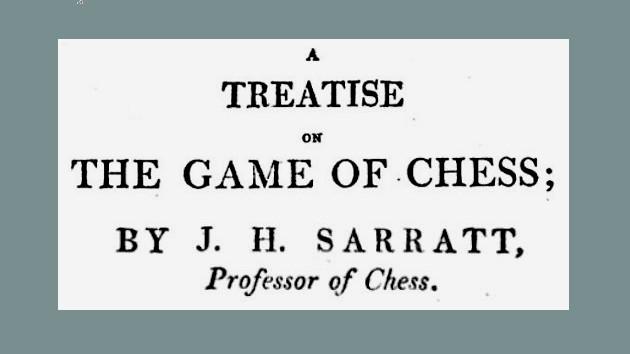
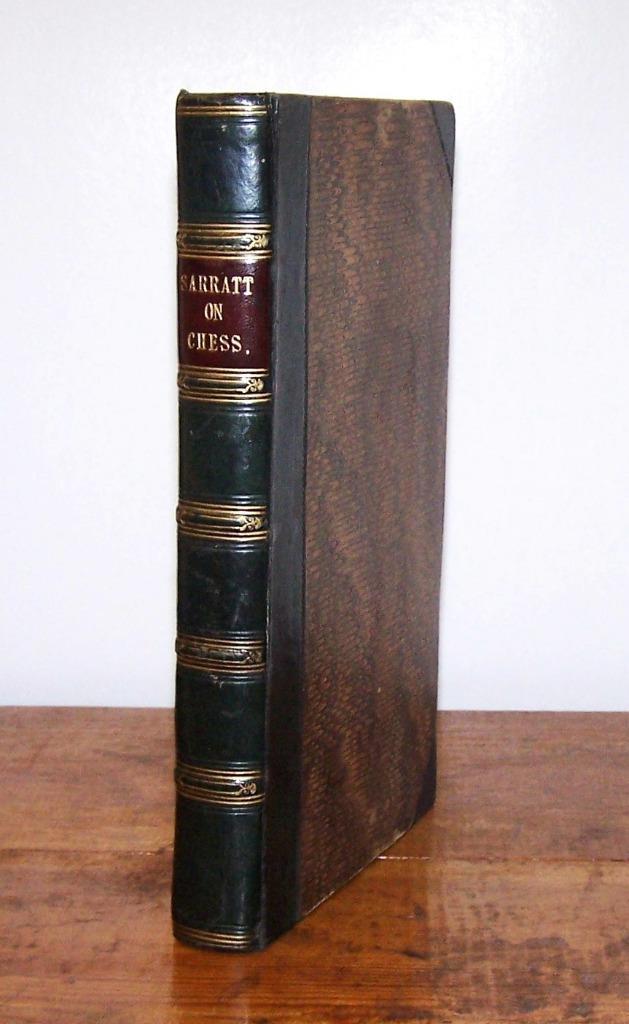
In 1808, true to his role as a teacher, Surratt published his Treatise on the Game of Chess, a book that mainly concentrated on direct attacks on the king which he lifted from the Modense writers.
He translated several older writers whom he admired (though his translations are not considered particularly good): The Works of Damiano, Ruy Lopez and Salvio in 1813. The Works of Gianutio and Gustavus Selenus in 1817.
In 1921 a posthumous edition of his Treatise, A New Treatise on the Game of Chess, was published. This copy covered the game of chess as a whole and was designed for the novice player. It also contained a 98 page analysis of the Muzio Gambit
In addition to his chess books, Surratt also published
[i]History of Man in 1802,
A New Picture of London[/i] in 1803
He translated Three Monks!!! from French in 1803 and Koenigsmark the Robber from German in 1803.
His second wife, Elizabeth Camillia Dufour, was also a writer. In 1803 (before they were married, which was 1804), she published a novel called Aurora or the Mysterious Beauty.
They were married the following year. His first wife had died in 1802 at the age of 18. Both his wives were from Jersey.
Contrary to what one might expect, Sarratt has been described tall, lean and muscular and had even been a prize-fighter at one point. He had also bred dogs for fighting. He was regarded as a very affable fellow and very well-read but with limited taste (Ed : surely this applies to everyone ?)
William Hazlitt, in his essay On Coffee-House Politicians wrote:
[Dr. Whittle] was once sitting where Sarratt was playing a game at chess without seeing the board… Sarratt, who was a man of various accomplishments, afterwards bared his arm to convince us of his muscular strength…
Sarratt, the chess-player, was an extraordinary man. He had the same tenacious, epileptic faculty in other things that he had at chess, and could no more get any other ideas out of his mind than he could those of the figures on the board. He was a great reader, but had not the least taste. Indeed the violence of his memory tyrannised over and destroyed all power of selection. He could repeat [all] Ossian by heart, without knowing the best passage from the worst; and did not perceive he was tiring you to death by giving an account of the breed, education, and manners of fighting-dogs for hours together. The sense of reality quite superseded the distinction between the pleasurable and the painful. He was altogether a mechanical philosopher.”
Somewhere along the way there must have come about a complete reversal of his fortunes because Surratt died impoverished in 1819, leaving his wife destitute. But the resilient Elizabeth Sarratt was able to support herself by giving chess lessons to the aristocracy of Paris.
She must have been very well liked. In 1843 when she herself became old and unable to provide for herself, players from both England and France took up a fund to help her out. She lived until 1846.
From The Oxford Companion to Chess (OUP, 1984 & 1992) by Hooper & Whyld :
Reputedly the best player in England from around 1805 until his death. As a young man he met Philidor. Subsequently he developed his game by practice with a strong French player Hippolyte du Rourblanc (d. 1813), with whom he had a long friendship dating from 1798, and with Verdoni, Sarratt’s first important contribution to the game was in connection with the laws of chess: he persuaded the London club, founded in 1807, to accept that a game ending in stalemate should be regarded as a draw and not as a win for the player who is stalemated. He became a professional at the Salopian coffee house at Charing Cross, London,
Nos. 39-41, Charing Cross and the Timber Yard
and in 1808 wrote his Treatise on the Game of Chess.
Treatise on the Game of Chess by JH Sarratt, 1808
This, largely a compilation from the work of the Modenese masters, advocated that players should seek direct attack upon the enemy king, a style that dominated the game until the 1870s. An Oxford surgeon, W. Tuckwell, wrote that he learned chess ‘from the famous Sarratt, the great chess teacher, whose fee was as a guinea a lesson’. Lewis, who played many games with Sarratt from 1816, wrote in 1822 (after he had met both Deschapelles and Bourdonnais) that Sarratt was the most finished player he had ever met, Sarratt translated the works of several early writers on the game, making them known for the first time to English readers: The Works of Damiano, Ruy Lopez and Selenus (1813) and The Works of Gianutio and Gustavus Selenus (1817).
He died impoverished on 6 Nov. 1819 after a long illness during which he was unable lo earn a livelihood by teaching. Instead he wrote his New Treatise on the Game of Chess published posthumously in 1821, This is the first book to include a comprehensive beginner’s section: in more than 200 pages Sarratt teaches by means of question and answer. Another feature is a 98-page analysis of the Muzio gambit :
Had it been Sarratt’s ambition to become a chess professional there would have been scant opportunity during the lifetime of Philidor and Verdoni. A tall, lean, yet muscular man, sociable and talkative, he seems in his younger days to have had interests of a different kind, among them prize fighting and the breeding of fighting dogs. Hazlitt, who met Sarratt around 1812 wrote ‘He was a great reader, but had not the least taste. Indeed the violence of his memory tyrannised over and destroyed all power of selection. He could repeat Ossian by heart, without knowing the best passage from the worst.’
Sarratt’s early publications were History of Man (1802): translations of two Gothic novels, The Three Monks!!! (1803), from the French of Elisabeth Guénard (Baronne de Méré) , and Koenigsmark the Robber (1803), from the German of R. E. Raspe; A New Future of London (1803), an excellent guide that ran to several editions, the last in 1814, When war broke out with France in 1803 Sarratt became, for a short period, a lieutenant in the Royal York Mary-le-Bone Volunteers and published Life of Bonaparte * a propaganda booklet detailing Napoleon’s alleged war crimes, and warning of the desolation that would follow if he were to invade.
Not long after the birth of his second child in 1802 Sarratt’s wife died and in 1804 he married a Drury Lane singer, Elisabeth Camilla Du four. Tt would be difficult to find a more accomplished, a more amiable, or a happier couple than Mr and Mrs Sarratt’ – Mary Julia Young, Memoirs of Mrs Crouch (1806), Mrs Sarratt too was a writer contributing tales to various journals and publishing Aurora or the Mysterious Beauty (1803), a translation of a French novel. She survived her husband until 1846, ending her days giving chess lessons to the aristocracy in Paris. In 1843 Louis-Philippe and many players from England and France subscribed to a fund on her behalf. ”
From The Encyclopedia of Chess (Robert Hale, 1970 & 1976), Anne Sunnucks :
“Self-styled ‘Professor of Chess’, Sarratt was the first professional player to teach the game in England. He was the author of a A Treatise on the Game of Chess, The (1808), The Works of Damiano, Ruy Lopez and Salvio (1813), The Works of Gianutio and Gustavas Selenus (1817) and a New Treatise on the Game of Chess (1821).
There is no record of Sarratt’s date or place of birth, He began his career as a schoolmaster and later taught chess at Tom’s Coffee House, Cornhill, London, and at the London Chess Club, and was in his day considered to be the strongest player in London.”
From The Encyclopedia of Chess (Batsford, 1983), Harry Golombek OBE :
“Leading English player of the late eighteenth and early nineteenth century. Famed in his day as a teacher and author. Sarratt adopted the title of ‘Professor of Chess’, His writings include A Treatise on the Game of Chess, London 1808, The Works of Damiano, Ruy Lopez and Salvio (1813).
Sarratt is usually credited with introducing into England the Continental practise of counting a game ending in stalemate as a draw. (RDK)”
We remember Jacob Henry Sarratt who died 201 years ago today (November 6th) in 1819.
Chess historians will, of course, be familiar with JHS but the name is (probably) not well known outside these exalted circles.
Possibly his most obvious contribution to chess in England was in 1807 when he influenced the result of games that ended in stalemate. You may not know that in England prior to 1807 a game that ended in stalemate was recorded as a win for the party who was stalemated. JHS was able to encourage various major chess clubs so that the result be recorded as a draw. Much endgame theory would be different if it wasn’t for JHS !
“Jacob Henry Sarratt, born in 1772, worked primarily as schoolmaster but was much better known for his advocations which, of course, included chess.
After Philidor’s death, Verdoni (along with Leger, Carlier and Bernard – all four who co-authored Traité Théorique et Pratique du jeu des Echecs par une Societé d’ Amateurs) was considered one of the strongest players in the world, especially in England. Verdoni had taken Philidor’s place as house professional at Parsloe’s. He mentored Jacob Sarratt until he died in 1804. That year Sarratt became the house professional at the Salopian at Charing Cross in London and most of his contemporaries considered him London’s strongest player.
There he claimed the title of Professor of Chess while teaching chess at the price of a guinea per game.
By any measure Surratt was not a particularly strong player, but he was able to maintain the illusion that he was by avoiding the stronger players as he lorded over his students who didn’t know better.
Sarratt’s most important contribution to chess was that he mentored William Lewis who in turn mentored Alexander McDonnell.
Surratt had a strange notion that chess culminated in the 16th century and that everything since then had been a step backwards. This odd notion had a positive side. Philidor was the darling of the English chess scene. Almost all books at that time were versions of, or at least based on, Philidor’s book. Surratt at least kept open the possibility that there were ideas beyond those of Philidor.
In 1808, true to his role as a teacher, Surratt published his Treatise on the Game of Chess, a book that mainly concentrated on direct attacks on the king which he lifted from the Modense writers.
He translated several older writers whom he admired (though his translations are not considered particularly good): The Works of Damiano, Ruy Lopez and Salvio in 1813. The Works of Gianutio and Gustavus Selenus in 1817.
In 1921 a posthumous edition of his Treatise, A New Treatise on the Game of Chess, was published. This copy covered the game of chess as a whole and was designed for the novice player. It also contained a 98 page analysis of the Muzio Gambit
In addition to his chess books, Surratt also published
[i]History of Man in 1802,
A New Picture of London[/i] in 1803
He translated Three Monks!!! from French in 1803 and Koenigsmark the Robber from German in 1803.
His second wife, Elizabeth Camillia Dufour, was also a writer. In 1803 (before they were married, which was 1804), she published a novel called Aurora or the Mysterious Beauty.
They were married the following year. His first wife had died in 1802 at the age of 18. Both his wives were from Jersey.
Contrary to what one might expect, Sarratt has been described tall, lean and muscular and had even been a prize-fighter at one point. He had also bred dogs for fighting. He was regarded as a very affable fellow and very well-read but with limited taste (Ed : surely this applies to everyone ?)
William Hazlitt, in his essay On Coffee-House Politicians wrote:
[Dr. Whittle] was once sitting where Sarratt was playing a game at chess without seeing the board… Sarratt, who was a man of various accomplishments, afterwards bared his arm to convince us of his muscular strength…
Sarratt, the chess-player, was an extraordinary man. He had the same tenacious, epileptic faculty in other things that he had at chess, and could no more get any other ideas out of his mind than he could those of the figures on the board. He was a great reader, but had not the least taste. Indeed the violence of his memory tyrannised over and destroyed all power of selection. He could repeat [all] Ossian by heart, without knowing the best passage from the worst; and did not perceive he was tiring you to death by giving an account of the breed, education, and manners of fighting-dogs for hours together. The sense of reality quite superseded the distinction between the pleasurable and the painful. He was altogether a mechanical philosopher.”
Somewhere along the way there must have come about a complete reversal of his fortunes because Surratt died impoverished in 1819, leaving his wife destitute. But the resilient Elizabeth Sarratt was able to support herself by giving chess lessons to the aristocracy of Paris.
She must have been very well liked. In 1843 when she herself became old and unable to provide for herself, players from both England and France took up a fund to help her out. She lived until 1846.
From The Oxford Companion to Chess (OUP, 1984 & 1992) by Hooper & Whyld :
Reputedly the best player in England from around 1805 until his death. As a young man he met Philidor. Subsequently he developed his game by practice with a strong French player Hippolyte du Rourblanc (d. 1813), with whom he had a long friendship dating from 1798, and with Verdoni, Sarratt’s first important contribution to the game was in connection with the laws of chess: he persuaded the London club, founded in 1807, to accept that a game ending in stalemate should be regarded as a draw and not as a win for the player who is stalemated. He became a professional at the Salopian coffee house at Charing Cross, London,
Nos. 39-41, Charing Cross and the Timber Yard
and in 1808 wrote his Treatise on the Game of Chess.
Treatise on the Game of Chess by JH Sarratt, 1808
This, largely a compilation from the work of the Modenese masters, advocated that players should seek direct attack upon the enemy king, a style that dominated the game until the 1870s. An Oxford surgeon, W. Tuckwell, wrote that he learned chess ‘from the famous Sarratt, the great chess teacher, whose fee was as a guinea a lesson’. Lewis, who played many games with Sarratt from 1816, wrote in 1822 (after he had met both Deschapelles and Bourdonnais) that Sarratt was the most finished player he had ever met, Sarratt translated the works of several early writers on the game, making them known for the first time to English readers: The Works of Damiano, Ruy Lopez and Selenus (1813) and The Works of Gianutio and Gustavus Selenus (1817).
He died impoverished on 6 Nov. 1819 after a long illness during which he was unable lo earn a livelihood by teaching. Instead he wrote his New Treatise on the Game of Chess published posthumously in 1821, This is the first book to include a comprehensive beginner’s section: in more than 200 pages Sarratt teaches by means of question and answer. Another feature is a 98-page analysis of the Muzio gambit :
Had it been Sarratt’s ambition to become a chess professional there would have been scant opportunity during the lifetime of Philidor and Verdoni. A tall, lean, yet muscular man, sociable and talkative, he seems in his younger days to have had interests of a different kind, among them prize fighting and the breeding of fighting dogs. Hazlitt, who met Sarratt around 1812 wrote ‘He was a great reader, but had not the least taste. Indeed the violence of his memory tyrannised over and destroyed all power of selection. He could repeat Ossian by heart, without knowing the best passage from the worst.’
Sarratt’s early publications were History of Man (1802): translations of two Gothic novels, The Three Monks!!! (1803), from the French of Elisabeth Guénard (Baronne de Méré) , and Koenigsmark the Robber (1803), from the German of R. E. Raspe; A New Future of London (1803), an excellent guide that ran to several editions, the last in 1814, When war broke out with France in 1803 Sarratt became, for a short period, a lieutenant in the Royal York Mary-le-Bone Volunteers and published Life of Bonaparte * a propaganda booklet detailing Napoleon’s alleged war crimes, and warning of the desolation that would follow if he were to invade.
Not long after the birth of his second child in 1802 Sarratt’s wife died and in 1804 he married a Drury Lane singer, Elisabeth Camilla Du four. Tt would be difficult to find a more accomplished, a more amiable, or a happier couple than Mr and Mrs Sarratt’ – Mary Julia Young, Memoirs of Mrs Crouch (1806), Mrs Sarratt too was a writer contributing tales to various journals and publishing Aurora or the Mysterious Beauty (1803), a translation of a French novel. She survived her husband until 1846, ending her days giving chess lessons to the aristocracy in Paris. In 1843 Louis-Philippe and many players from England and France subscribed to a fund on her behalf. ”
From The Encyclopedia of Chess (Robert Hale, 1970 & 1976), Anne Sunnucks :
“Self-styled ‘Professor of Chess’, Sarratt was the first professional player to teach the game in England. He was the author of a A Treatise on the Game of Chess, The (1808), The Works of Damiano, Ruy Lopez and Salvio (1813), The Works of Gianutio and Gustavas Selenus (1817) and a New Treatise on the Game of Chess (1821).
There is no record of Sarratt’s date or place of birth, He began his career as a schoolmaster and later taught chess at Tom’s Coffee House, Cornhill, London, and at the London Chess Club, and was in his day considered to be the strongest player in London.”
From The Encyclopedia of Chess (Batsford, 1983), Harry Golombek OBE :
“Leading English player of the late eighteenth and early nineteenth century. Famed in his day as a teacher and author. Sarratt adopted the title of ‘Professor of Chess’, His writings include A Treatise on the Game of Chess, London 1808, The Works of Damiano, Ruy Lopez and Salvio (1813).
Sarratt is usually credited with introducing into England the Continental practise of counting a game ending in stalemate as a draw. (RDK)”
We remember Jacob Henry Sarratt who died 201 years ago today (November 6th) in 1819.
Chess historians will, of course, be familiar with JHS but the name is (probably) not well known outside these exalted circles.
Possibly his most obvious contribution to chess in England was in 1807 when he influenced the result of games that ended in stalemate. You may not know that in England prior to 1807 a game that ended in stalemate was recorded as a win for the party who was stalemated. JHS was able to encourage various major chess clubs so that the result be recorded as a draw. Much endgame theory would be different if it wasn’t for JHS !
“Jacob Henry Sarratt, born in 1772, worked primarily as schoolmaster but was much better known for his advocations which, of course, included chess.
After Philidor’s death, Verdoni (along with Leger, Carlier and Bernard – all four who co-authored Traité Théorique et Pratique du jeu des Echecs par une Societé d’ Amateurs) was considered one of the strongest players in the world, especially in England. Verdoni had taken Philidor’s place as house professional at Parsloe’s. He mentored Jacob Sarratt until he died in 1804. That year Sarratt became the house professional at the Salopian at Charing Cross in London and most of his contemporaries considered him London’s strongest player.
There he claimed the title of Professor of Chess while teaching chess at the price of a guinea per game.
By any measure Surratt was not a particularly strong player, but he was able to maintain the illusion that he was by avoiding the stronger players as he lorded over his students who didn’t know better.
Sarratt’s most important contribution to chess was that he mentored William Lewis who in turn mentored Alexander McDonnell.
Surratt had a strange notion that chess culminated in the 16th century and that everything since then had been a step backwards. This odd notion had a positive side. Philidor was the darling of the English chess scene. Almost all books at that time were versions of, or at least based on, Philidor’s book. Surratt at least kept open the possibility that there were ideas beyond those of Philidor.
In 1808, true to his role as a teacher, Surratt published his Treatise on the Game of Chess, a book that mainly concentrated on direct attacks on the king which he lifted from the Modense writers.
He translated several older writers whom he admired (though his translations are not considered particularly good): The Works of Damiano, Ruy Lopez and Salvio in 1813. The Works of Gianutio and Gustavus Selenus in 1817.
In 1921 a posthumous edition of his Treatise, A New Treatise on the Game of Chess, was published. This copy covered the game of chess as a whole and was designed for the novice player. It also contained a 98 page analysis of the Muzio Gambit
In addition to his chess books, Surratt also published
[i]History of Man in 1802,
A New Picture of London[/i] in 1803
He translated Three Monks!!! from French in 1803 and Koenigsmark the Robber from German in 1803.
His second wife, Elizabeth Camillia Dufour, was also a writer. In 1803 (before they were married, which was 1804), she published a novel called Aurora or the Mysterious Beauty.
They were married the following year. His first wife had died in 1802 at the age of 18. Both his wives were from Jersey.
Contrary to what one might expect, Sarratt has been described tall, lean and muscular and had even been a prize-fighter at one point. He had also bred dogs for fighting. He was regarded as a very affable fellow and very well-read but with limited taste (Ed : surely this applies to everyone ?)
William Hazlitt, in his essay On Coffee-House Politicians wrote:
[Dr. Whittle] was once sitting where Sarratt was playing a game at chess without seeing the board… Sarratt, who was a man of various accomplishments, afterwards bared his arm to convince us of his muscular strength…
Sarratt, the chess-player, was an extraordinary man. He had the same tenacious, epileptic faculty in other things that he had at chess, and could no more get any other ideas out of his mind than he could those of the figures on the board. He was a great reader, but had not the least taste. Indeed the violence of his memory tyrannised over and destroyed all power of selection. He could repeat [all] Ossian by heart, without knowing the best passage from the worst; and did not perceive he was tiring you to death by giving an account of the breed, education, and manners of fighting-dogs for hours together. The sense of reality quite superseded the distinction between the pleasurable and the painful. He was altogether a mechanical philosopher.”
Somewhere along the way there must have come about a complete reversal of his fortunes because Surratt died impoverished in 1819, leaving his wife destitute. But the resilient Elizabeth Sarratt was able to support herself by giving chess lessons to the aristocracy of Paris.
She must have been very well liked. In 1843 when she herself became old and unable to provide for herself, players from both England and France took up a fund to help her out. She lived until 1846.
From The Oxford Companion to Chess (OUP, 1984 & 1992) by Hooper & Whyld :
Reputedly the best player in England from around 1805 until his death. As a young man he met Philidor. Subsequently he developed his game by practice with a strong French player Hippolyte du Rourblanc (d. 1813), with whom he had a long friendship dating from 1798, and with Verdoni, Sarratt’s first important contribution to the game was in connection with the laws of chess: he persuaded the London club, founded in 1807, to accept that a game ending in stalemate should be regarded as a draw and not as a win for the player who is stalemated. He became a professional at the Salopian coffee house at Charing Cross, London,
Nos. 39-41, Charing Cross and the Timber Yard
and in 1808 wrote his Treatise on the Game of Chess.
Treatise on the Game of Chess by JH Sarratt, 1808
This, largely a compilation from the work of the Modenese masters, advocated that players should seek direct attack upon the enemy king, a style that dominated the game until the 1870s. An Oxford surgeon, W. Tuckwell, wrote that he learned chess ‘from the famous Sarratt, the great chess teacher, whose fee was as a guinea a lesson’. Lewis, who played many games with Sarratt from 1816, wrote in 1822 (after he had met both Deschapelles and Bourdonnais) that Sarratt was the most finished player he had ever met, Sarratt translated the works of several early writers on the game, making them known for the first time to English readers: The Works of Damiano, Ruy Lopez and Selenus (1813) and The Works of Gianutio and Gustavus Selenus (1817).
He died impoverished on 6 Nov. 1819 after a long illness during which he was unable lo earn a livelihood by teaching. Instead he wrote his New Treatise on the Game of Chess published posthumously in 1821, This is the first book to include a comprehensive beginner’s section: in more than 200 pages Sarratt teaches by means of question and answer. Another feature is a 98-page analysis of the Muzio gambit :
Had it been Sarratt’s ambition to become a chess professional there would have been scant opportunity during the lifetime of Philidor and Verdoni. A tall, lean, yet muscular man, sociable and talkative, he seems in his younger days to have had interests of a different kind, among them prize fighting and the breeding of fighting dogs. Hazlitt, who met Sarratt around 1812 wrote ‘He was a great reader, but had not the least taste. Indeed the violence of his memory tyrannised over and destroyed all power of selection. He could repeat Ossian by heart, without knowing the best passage from the worst.’
Sarratt’s early publications were History of Man (1802): translations of two Gothic novels, The Three Monks!!! (1803), from the French of Elisabeth Guénard (Baronne de Méré) , and Koenigsmark the Robber (1803), from the German of R. E. Raspe; A New Future of London (1803), an excellent guide that ran to several editions, the last in 1814, When war broke out with France in 1803 Sarratt became, for a short period, a lieutenant in the Royal York Mary-le-Bone Volunteers and published Life of Bonaparte * a propaganda booklet detailing Napoleon’s alleged war crimes, and warning of the desolation that would follow if he were to invade.
Not long after the birth of his second child in 1802 Sarratt’s wife died and in 1804 he married a Drury Lane singer, Elisabeth Camilla Du four. Tt would be difficult to find a more accomplished, a more amiable, or a happier couple than Mr and Mrs Sarratt’ – Mary Julia Young, Memoirs of Mrs Crouch (1806), Mrs Sarratt too was a writer contributing tales to various journals and publishing Aurora or the Mysterious Beauty (1803), a translation of a French novel. She survived her husband until 1846, ending her days giving chess lessons to the aristocracy in Paris. In 1843 Louis-Philippe and many players from England and France subscribed to a fund on her behalf. ”
From The Encyclopedia of Chess (Robert Hale, 1970 & 1976), Anne Sunnucks :
“Self-styled ‘Professor of Chess’, Sarratt was the first professional player to teach the game in England. He was the author of a A Treatise on the Game of Chess, The (1808), The Works of Damiano, Ruy Lopez and Salvio (1813), The Works of Gianutio and Gustavas Selenus (1817) and a New Treatise on the Game of Chess (1821).
There is no record of Sarratt’s date or place of birth, He began his career as a schoolmaster and later taught chess at Tom’s Coffee House, Cornhill, London, and at the London Chess Club, and was in his day considered to be the strongest player in London.”
From The Encyclopedia of Chess (Batsford, 1983), Harry Golombek OBE :
“Leading English player of the late eighteenth and early nineteenth century. Famed in his day as a teacher and author. Sarratt adopted the title of ‘Professor of Chess’, His writings include A Treatise on the Game of Chess, London 1808, The Works of Damiano, Ruy Lopez and Salvio (1813).
Sarratt is usually credited with introducing into England the Continental practise of counting a game ending in stalemate as a draw. (RDK)”
We remember Jacob Henry Sarratt who died 201 years ago today (November 6th) in 1819.
Chess historians will, of course, be familiar with JHS but the name is (probably) not well known outside these exalted circles.
Possibly his most obvious contribution to chess in England was in 1807 when he influenced the result of games that ended in stalemate. You may not know that in England prior to 1807 a game that ended in stalemate was recorded as a win for the party who was stalemated. JHS was able to encourage various major chess clubs so that the result be recorded as a draw. Much endgame theory would be different if it wasn’t for JHS !
“Jacob Henry Sarratt, born in 1772, worked primarily as schoolmaster but was much better known for his advocations which, of course, included chess.
After Philidor’s death, Verdoni (along with Leger, Carlier and Bernard – all four who co-authored Traité Théorique et Pratique du jeu des Echecs par une Societé d’ Amateurs) was considered one of the strongest players in the world, especially in England. Verdoni had taken Philidor’s place as house professional at Parsloe’s. He mentored Jacob Sarratt until he died in 1804. That year Sarratt became the house professional at the Salopian at Charing Cross in London and most of his contemporaries considered him London’s strongest player.
There he claimed the title of Professor of Chess while teaching chess at the price of a guinea per game.
By any measure Surratt was not a particularly strong player, but he was able to maintain the illusion that he was by avoiding the stronger players as he lorded over his students who didn’t know better.
Sarratt’s most important contribution to chess was that he mentored William Lewis who in turn mentored Alexander McDonnell.
Surratt had a strange notion that chess culminated in the 16th century and that everything since then had been a step backwards. This odd notion had a positive side. Philidor was the darling of the English chess scene. Almost all books at that time were versions of, or at least based on, Philidor’s book. Surratt at least kept open the possibility that there were ideas beyond those of Philidor.
In 1808, true to his role as a teacher, Surratt published his Treatise on the Game of Chess, a book that mainly concentrated on direct attacks on the king which he lifted from the Modense writers.
He translated several older writers whom he admired (though his translations are not considered particularly good): The Works of Damiano, Ruy Lopez and Salvio in 1813. The Works of Gianutio and Gustavus Selenus in 1817.
In 1921 a posthumous edition of his Treatise, A New Treatise on the Game of Chess, was published. This copy covered the game of chess as a whole and was designed for the novice player. It also contained a 98 page analysis of the Muzio Gambit
In addition to his chess books, Surratt also published
[i]History of Man in 1802,
A New Picture of London[/i] in 1803
He translated Three Monks!!! from French in 1803 and Koenigsmark the Robber from German in 1803.
His second wife, Elizabeth Camillia Dufour, was also a writer. In 1803 (before they were married, which was 1804), she published a novel called Aurora or the Mysterious Beauty.
They were married the following year. His first wife had died in 1802 at the age of 18. Both his wives were from Jersey.
Contrary to what one might expect, Sarratt has been described tall, lean and muscular and had even been a prize-fighter at one point. He had also bred dogs for fighting. He was regarded as a very affable fellow and very well-read but with limited taste (Ed : surely this applies to everyone ?)
William Hazlitt, in his essay On Coffee-House Politicians wrote:
[Dr. Whittle] was once sitting where Sarratt was playing a game at chess without seeing the board… Sarratt, who was a man of various accomplishments, afterwards bared his arm to convince us of his muscular strength…
Sarratt, the chess-player, was an extraordinary man. He had the same tenacious, epileptic faculty in other things that he had at chess, and could no more get any other ideas out of his mind than he could those of the figures on the board. He was a great reader, but had not the least taste. Indeed the violence of his memory tyrannised over and destroyed all power of selection. He could repeat [all] Ossian by heart, without knowing the best passage from the worst; and did not perceive he was tiring you to death by giving an account of the breed, education, and manners of fighting-dogs for hours together. The sense of reality quite superseded the distinction between the pleasurable and the painful. He was altogether a mechanical philosopher.”
Somewhere along the way there must have come about a complete reversal of his fortunes because Surratt died impoverished in 1819, leaving his wife destitute. But the resilient Elizabeth Sarratt was able to support herself by giving chess lessons to the aristocracy of Paris.
She must have been very well liked. In 1843 when she herself became old and unable to provide for herself, players from both England and France took up a fund to help her out. She lived until 1846.
From The Oxford Companion to Chess (OUP, 1984 & 1992) by Hooper & Whyld :
Reputedly the best player in England from around 1805 until his death. As a young man he met Philidor. Subsequently he developed his game by practice with a strong French player Hippolyte du Rourblanc (d. 1813), with whom he had a long friendship dating from 1798, and with Verdoni, Sarratt’s first important contribution to the game was in connection with the laws of chess: he persuaded the London club, founded in 1807, to accept that a game ending in stalemate should be regarded as a draw and not as a win for the player who is stalemated. He became a professional at the Salopian coffee house at Charing Cross, London,
Nos. 39-41, Charing Cross and the Timber Yard
and in 1808 wrote his Treatise on the Game of Chess.
Treatise on the Game of Chess by JH Sarratt, 1808
This, largely a compilation from the work of the Modenese masters, advocated that players should seek direct attack upon the enemy king, a style that dominated the game until the 1870s. An Oxford surgeon, W. Tuckwell, wrote that he learned chess ‘from the famous Sarratt, the great chess teacher, whose fee was as a guinea a lesson’. Lewis, who played many games with Sarratt from 1816, wrote in 1822 (after he had met both Deschapelles and Bourdonnais) that Sarratt was the most finished player he had ever met, Sarratt translated the works of several early writers on the game, making them known for the first time to English readers: The Works of Damiano, Ruy Lopez and Selenus (1813) and The Works of Gianutio and Gustavus Selenus (1817).
He died impoverished on 6 Nov. 1819 after a long illness during which he was unable lo earn a livelihood by teaching. Instead he wrote his New Treatise on the Game of Chess published posthumously in 1821, This is the first book to include a comprehensive beginner’s section: in more than 200 pages Sarratt teaches by means of question and answer. Another feature is a 98-page analysis of the Muzio gambit :
Had it been Sarratt’s ambition to become a chess professional there would have been scant opportunity during the lifetime of Philidor and Verdoni. A tall, lean, yet muscular man, sociable and talkative, he seems in his younger days to have had interests of a different kind, among them prize fighting and the breeding of fighting dogs. Hazlitt, who met Sarratt around 1812 wrote ‘He was a great reader, but had not the least taste. Indeed the violence of his memory tyrannised over and destroyed all power of selection. He could repeat Ossian by heart, without knowing the best passage from the worst.’
Sarratt’s early publications were History of Man (1802): translations of two Gothic novels, The Three Monks!!! (1803), from the French of Elisabeth Guénard (Baronne de Méré) , and Koenigsmark the Robber (1803), from the German of R. E. Raspe; A New Future of London (1803), an excellent guide that ran to several editions, the last in 1814, When war broke out with France in 1803 Sarratt became, for a short period, a lieutenant in the Royal York Mary-le-Bone Volunteers and published Life of Bonaparte * a propaganda booklet detailing Napoleon’s alleged war crimes, and warning of the desolation that would follow if he were to invade.
Not long after the birth of his second child in 1802 Sarratt’s wife died and in 1804 he married a Drury Lane singer, Elisabeth Camilla Du four. Tt would be difficult to find a more accomplished, a more amiable, or a happier couple than Mr and Mrs Sarratt’ – Mary Julia Young, Memoirs of Mrs Crouch (1806), Mrs Sarratt too was a writer contributing tales to various journals and publishing Aurora or the Mysterious Beauty (1803), a translation of a French novel. She survived her husband until 1846, ending her days giving chess lessons to the aristocracy in Paris. In 1843 Louis-Philippe and many players from England and France subscribed to a fund on her behalf. ”
From The Encyclopedia of Chess (Robert Hale, 1970 & 1976), Anne Sunnucks :
“Self-styled ‘Professor of Chess’, Sarratt was the first professional player to teach the game in England. He was the author of a A Treatise on the Game of Chess, The (1808), The Works of Damiano, Ruy Lopez and Salvio (1813), The Works of Gianutio and Gustavas Selenus (1817) and a New Treatise on the Game of Chess (1821).
There is no record of Sarratt’s date or place of birth, He began his career as a schoolmaster and later taught chess at Tom’s Coffee House, Cornhill, London, and at the London Chess Club, and was in his day considered to be the strongest player in London.”
From The Encyclopedia of Chess (Batsford, 1983), Harry Golombek OBE :
“Leading English player of the late eighteenth and early nineteenth century. Famed in his day as a teacher and author. Sarratt adopted the title of ‘Professor of Chess’, His writings include A Treatise on the Game of Chess, London 1808, The Works of Damiano, Ruy Lopez and Salvio (1813).
Sarratt is usually credited with introducing into England the Continental practise of counting a game ending in stalemate as a draw. (RDK)”
Some games by Jacob Henry Sarratt:
Save as PDF
We focus on the British Chess Scene Past & Present!
This website uses cookies to improve your experience. We'll assume you're ok with this, but you can opt-out if you wish. Cookie settingsACCEPT
Privacy & Cookies Policy
Privacy Overview
This website uses cookies to improve your experience while you navigate through the website. Out of these cookies, the cookies that are categorized as necessary are stored on your browser as they are as essential for the working of basic functionalities of the website. We also use third-party cookies that help us analyze and understand how you use this website. These cookies will be stored in your browser only with your consent. You also have the option to opt-out of these cookies. But opting out of some of these cookies may have an effect on your browsing experience.
Necessary cookies are absolutely essential for the website to function properly. This category only includes cookies that ensures basic functionalities and security features of the website. These cookies do not store any personal information.

 Save as PDF