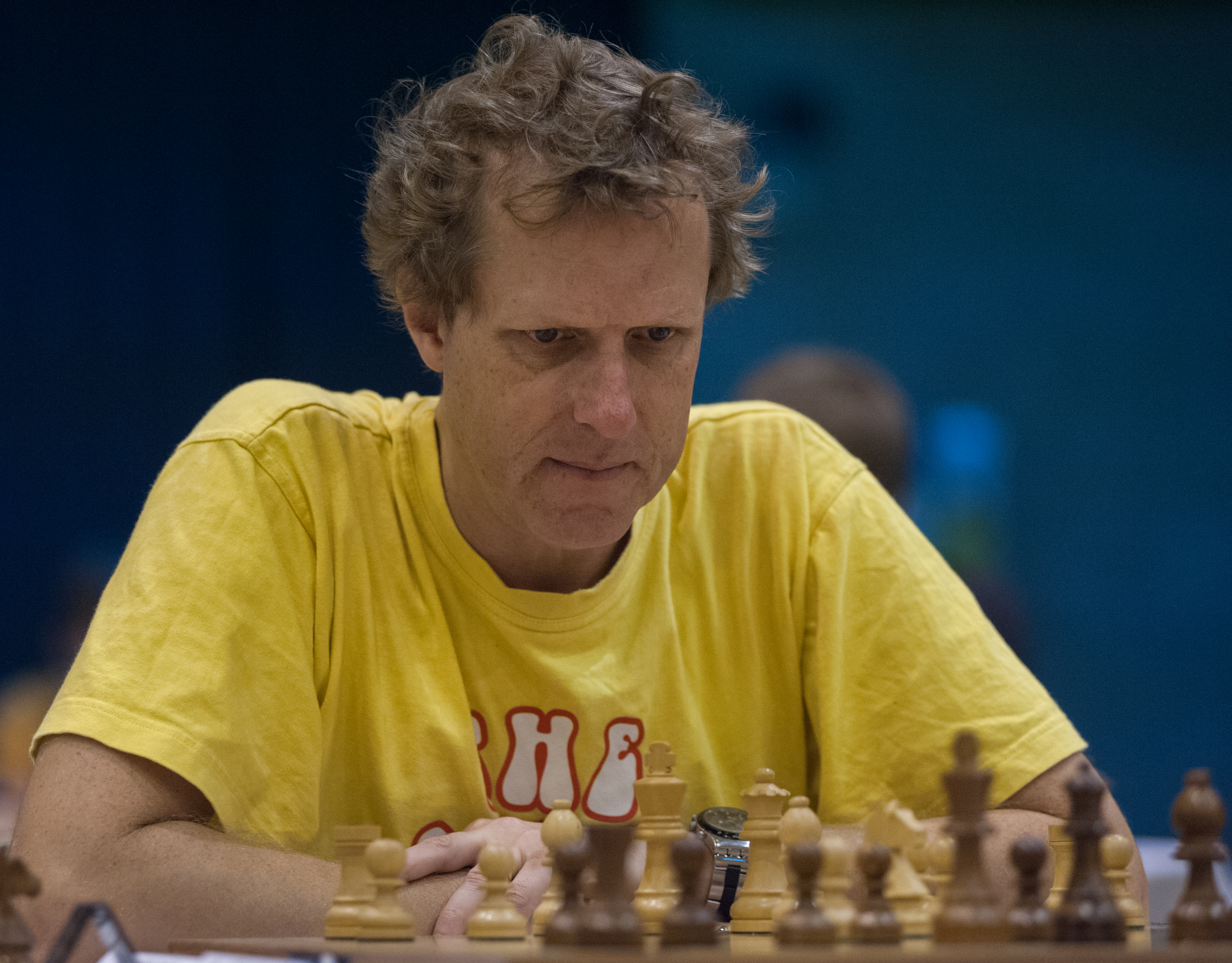
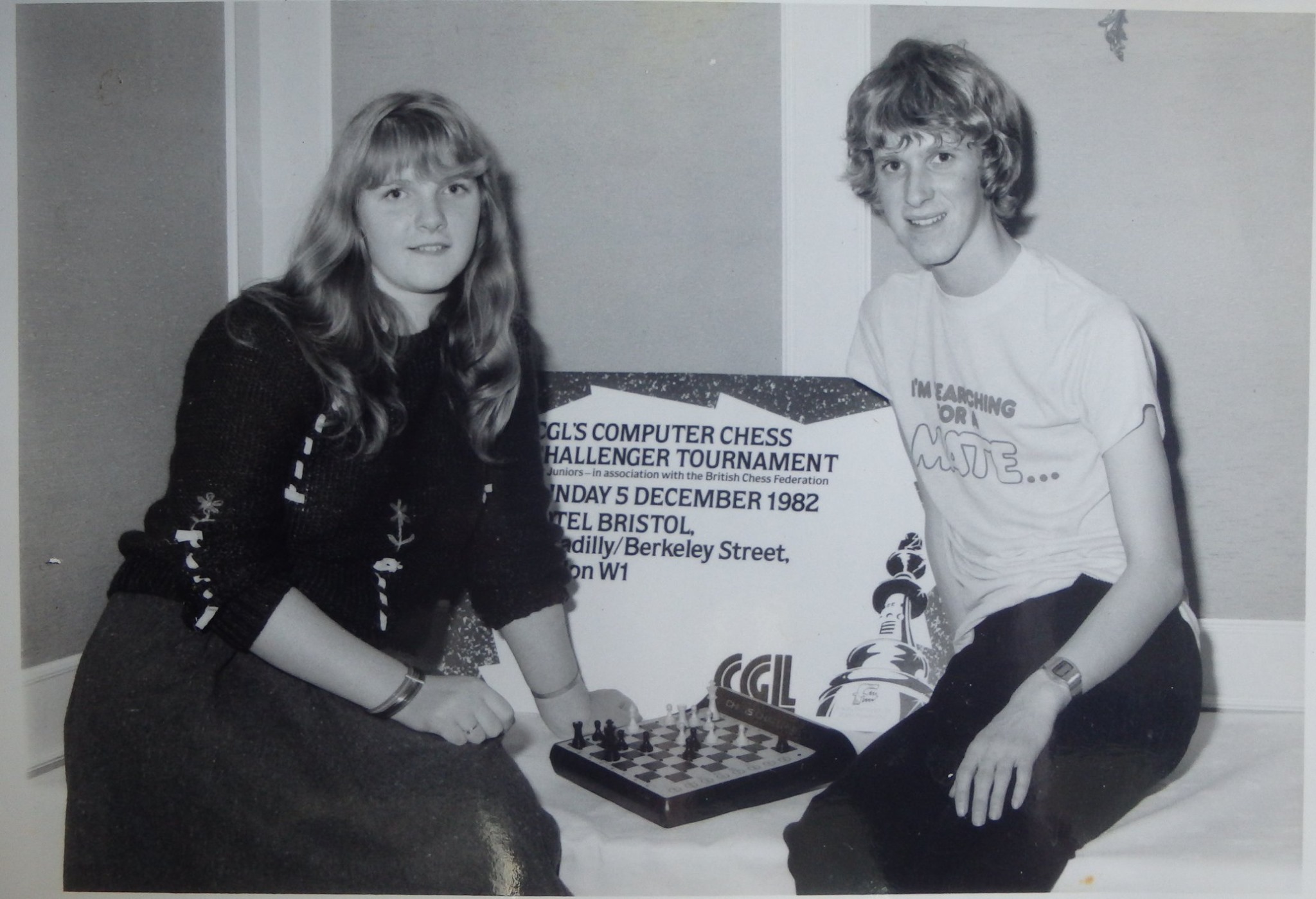
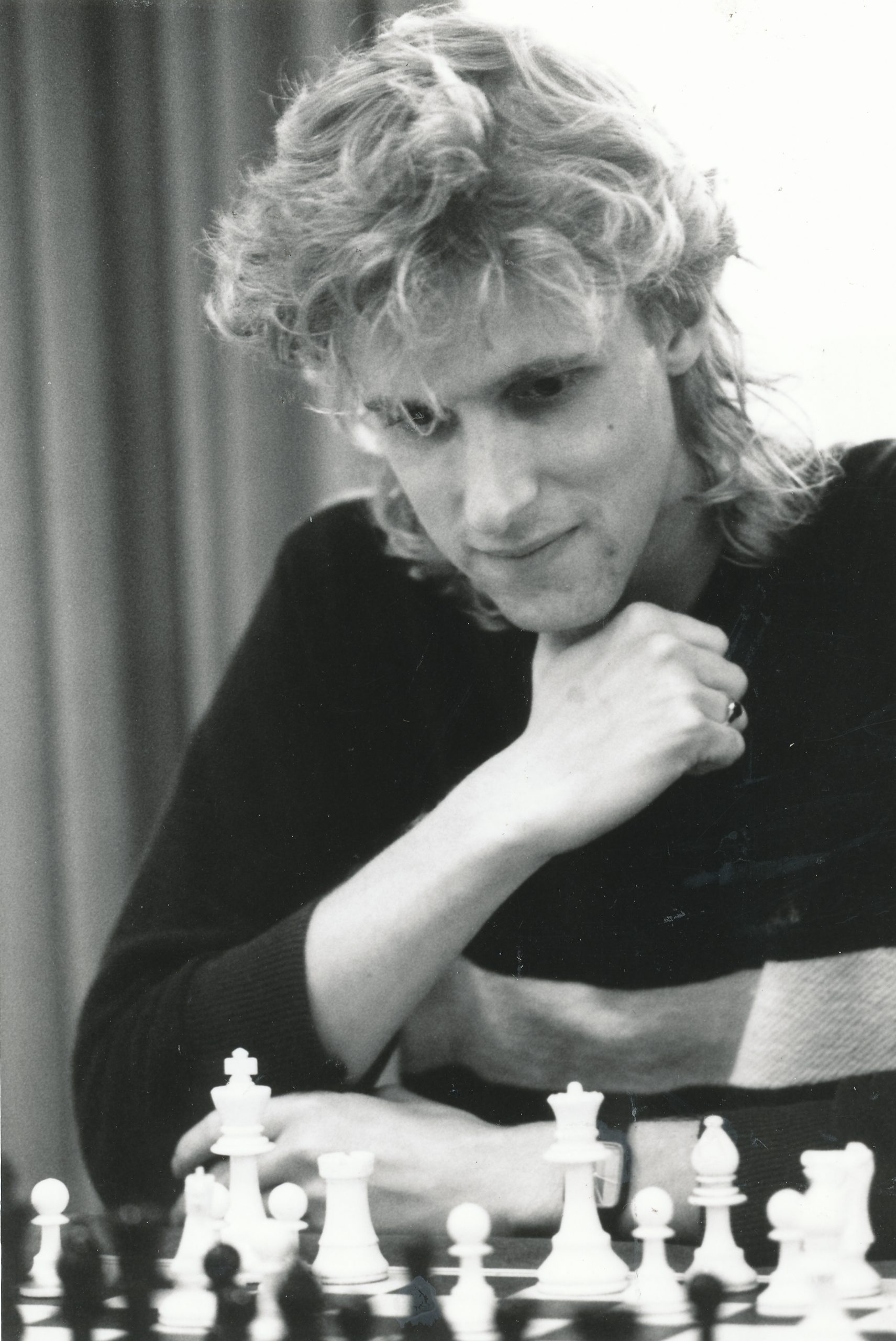
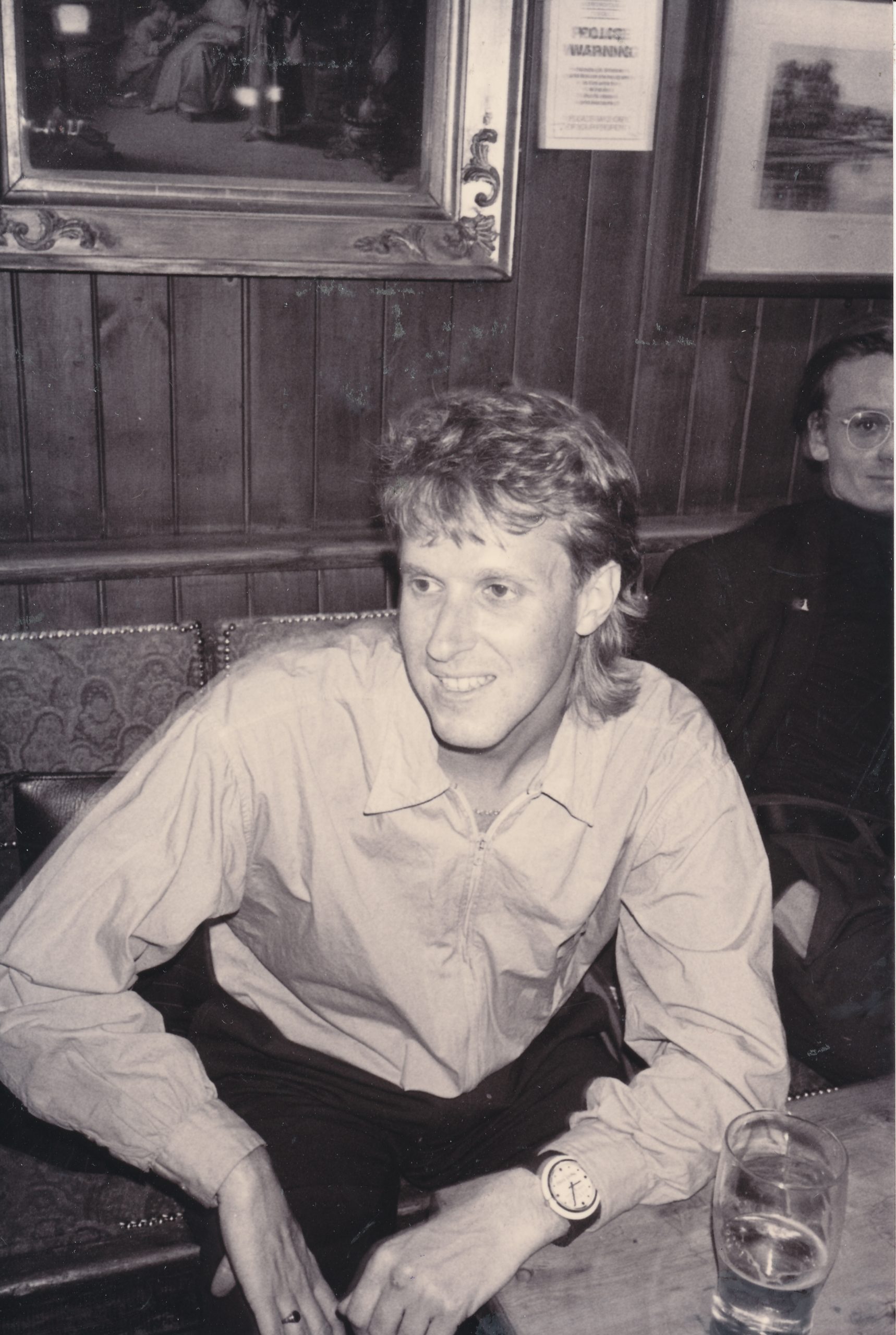
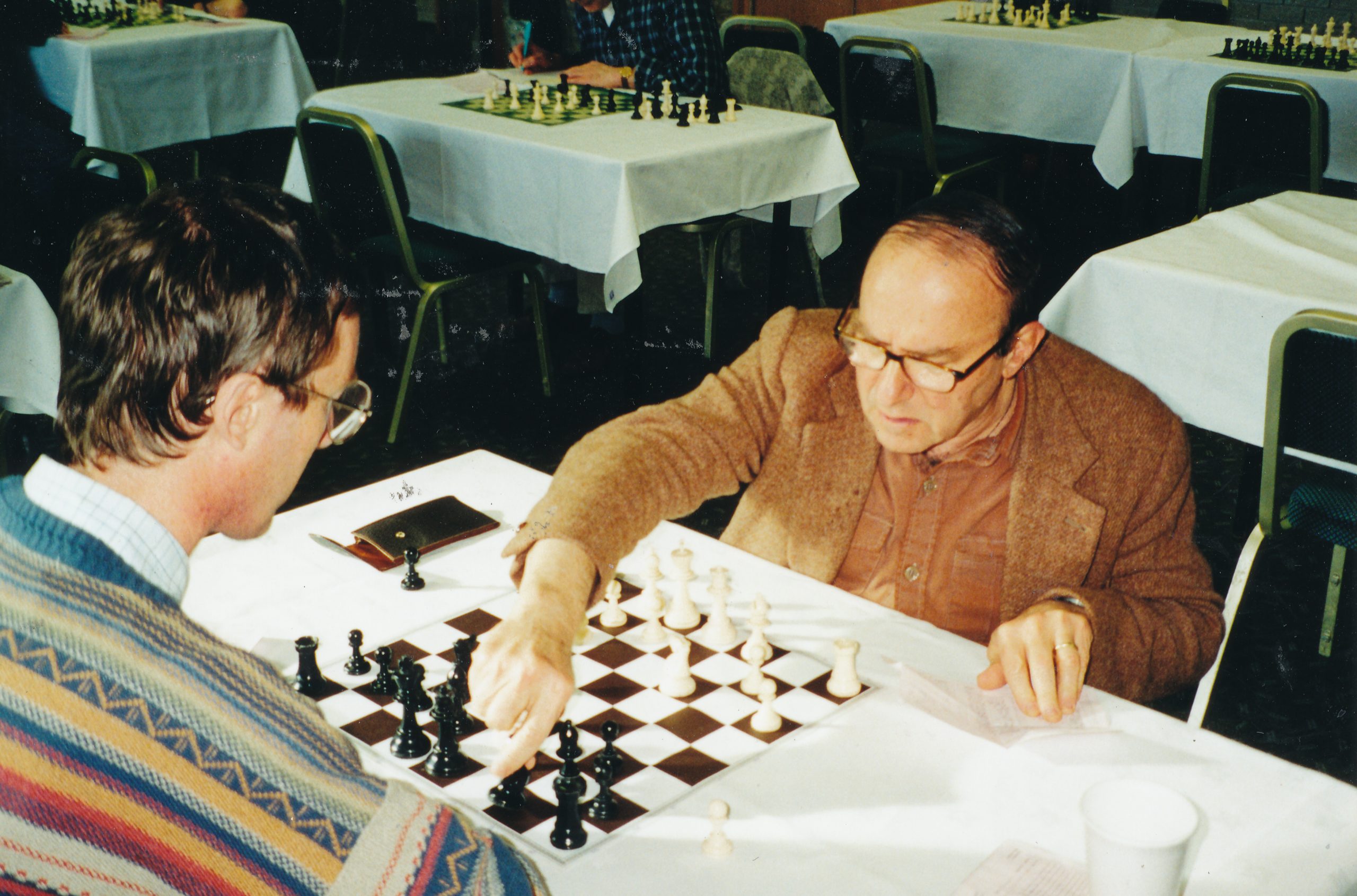
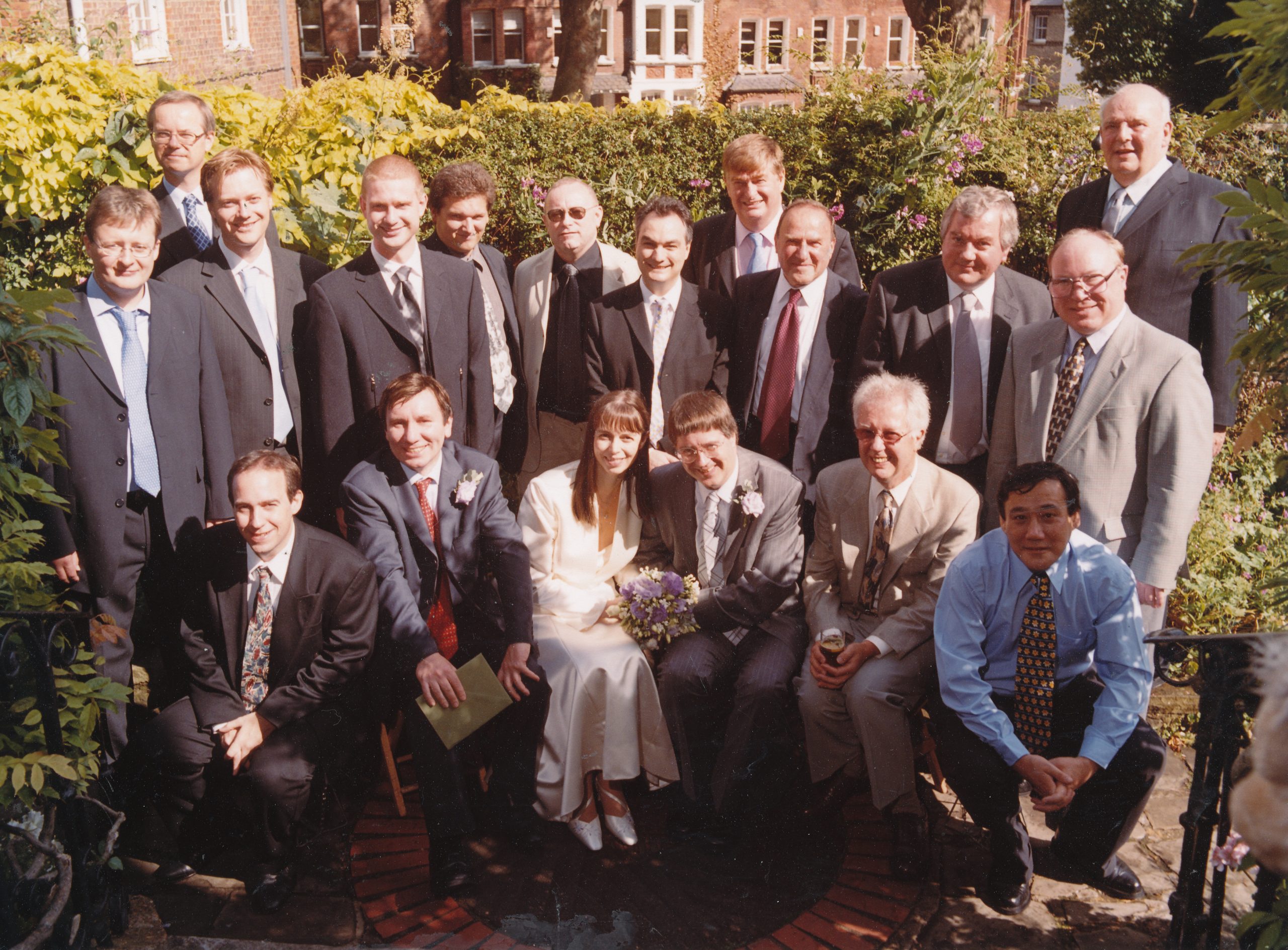
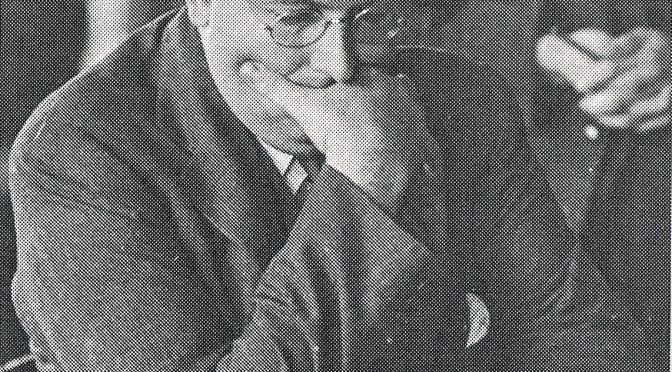
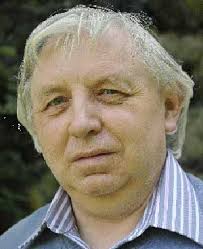
We wish IM Philip J Morris all the best on his birthday, this day (November 5th) in 1967.
Phil plays regularly for Beckenham & Charlton Chess Club in the London Chess League and has played for Invicta Knights Maidstone in the Four Nations League.
We wish IM Philip J Morris all the best on his birthday, this day (November 5th) in 1967.
Phil plays regularly for Beckenham & Charlton Chess Club in the London Chess League and has played for Invicta Knights Maidstone in the Four Nations League.
We wish IM Philip J Morris all the best on his birthday, this day (November 5th) in 1967.
Phil plays regularly for Beckenham & Charlton Chess Club in the London Chess League and has played for Invicta Knights Maidstone in the Four Nations League.
Gary became a FIDE Master in 1984 and an International Master in 1987 and won the Commonwealth Chess Championship in 1988. According to Felice and Megabase2020 his peak FIDE rating was 2464 in July 2001 aged 37.
IM Gary Lane
This was written about Gary aged 14 prior to the 1979 Spassky vs the BCF Junior Squad simultaneous display :
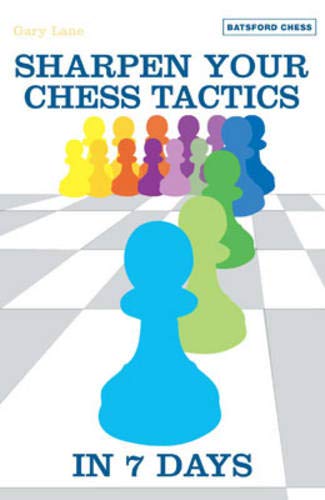
In 2004 won the Australian Championship and was voted Player of the Year. According to Sharpen Your Chess Tactics Gary is a well-known trainer, and has been involved in coaching some of England and Australia’s top junior players.
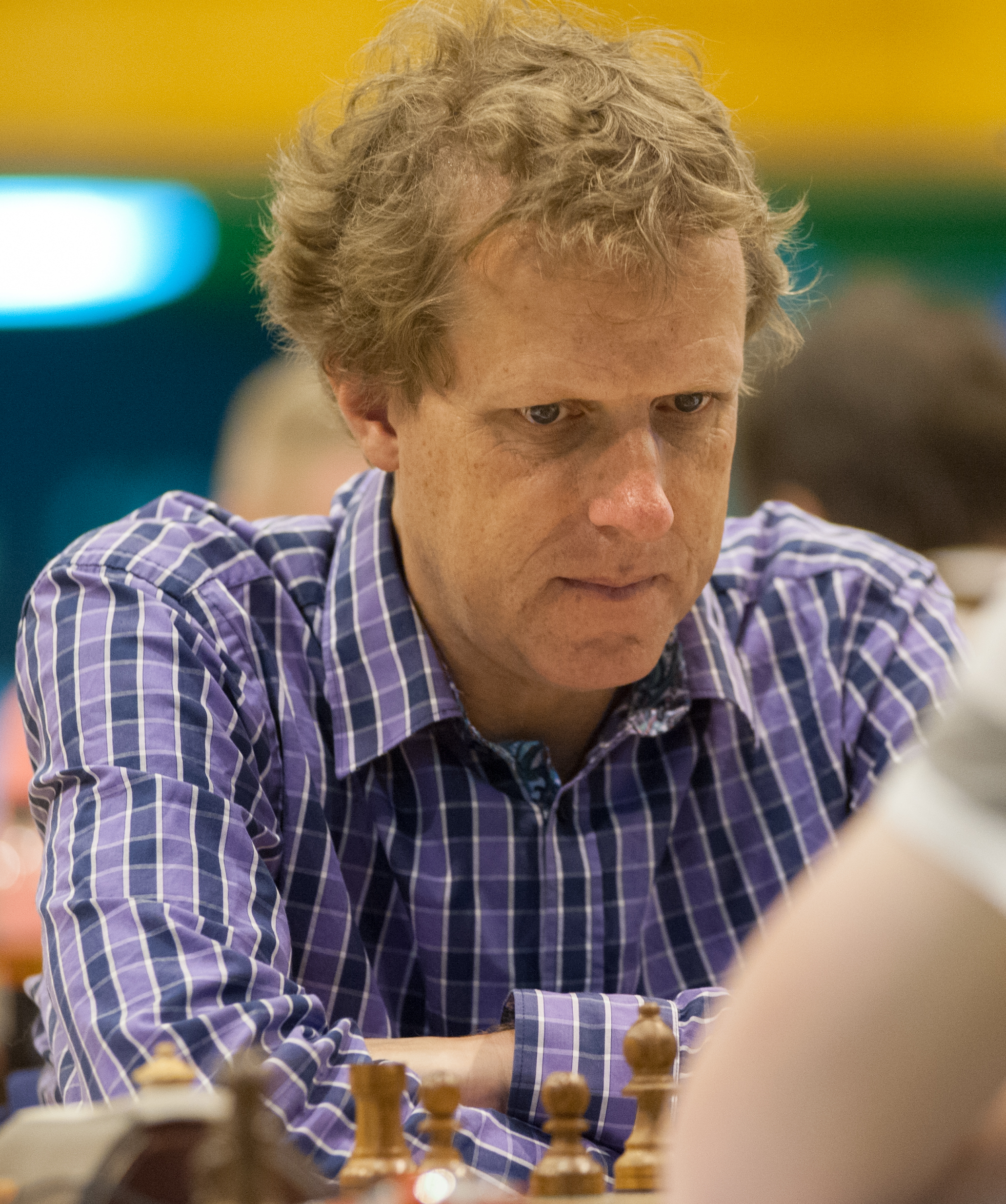
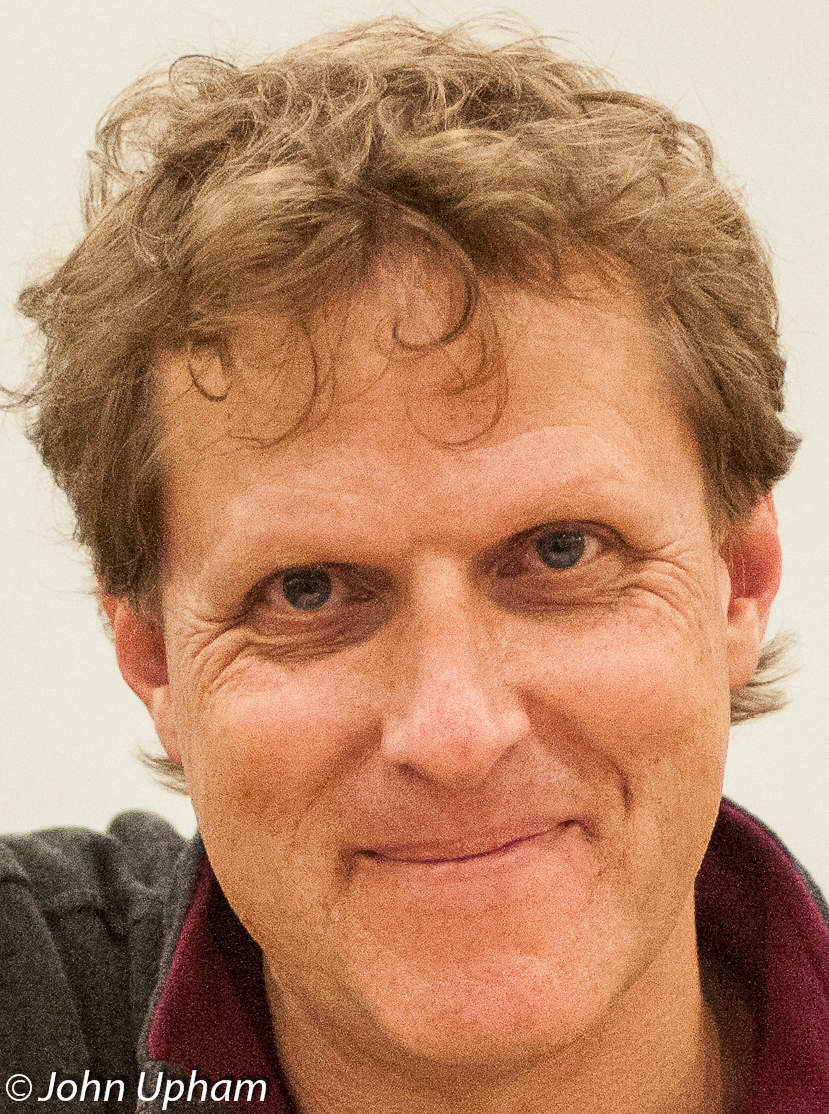
IM Gary Lane at British Chess Championships 2013, courtesy of John Upham Photography
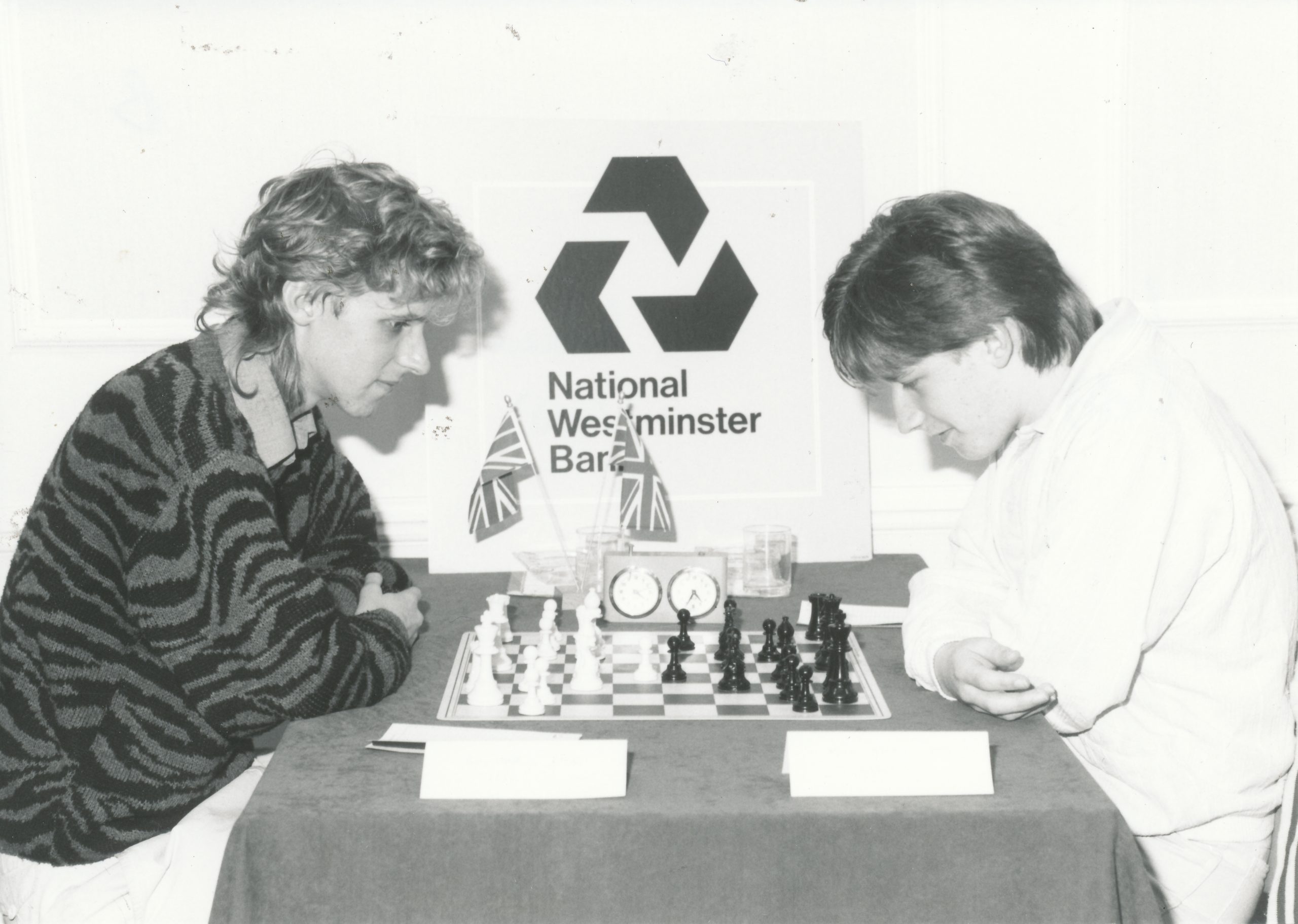
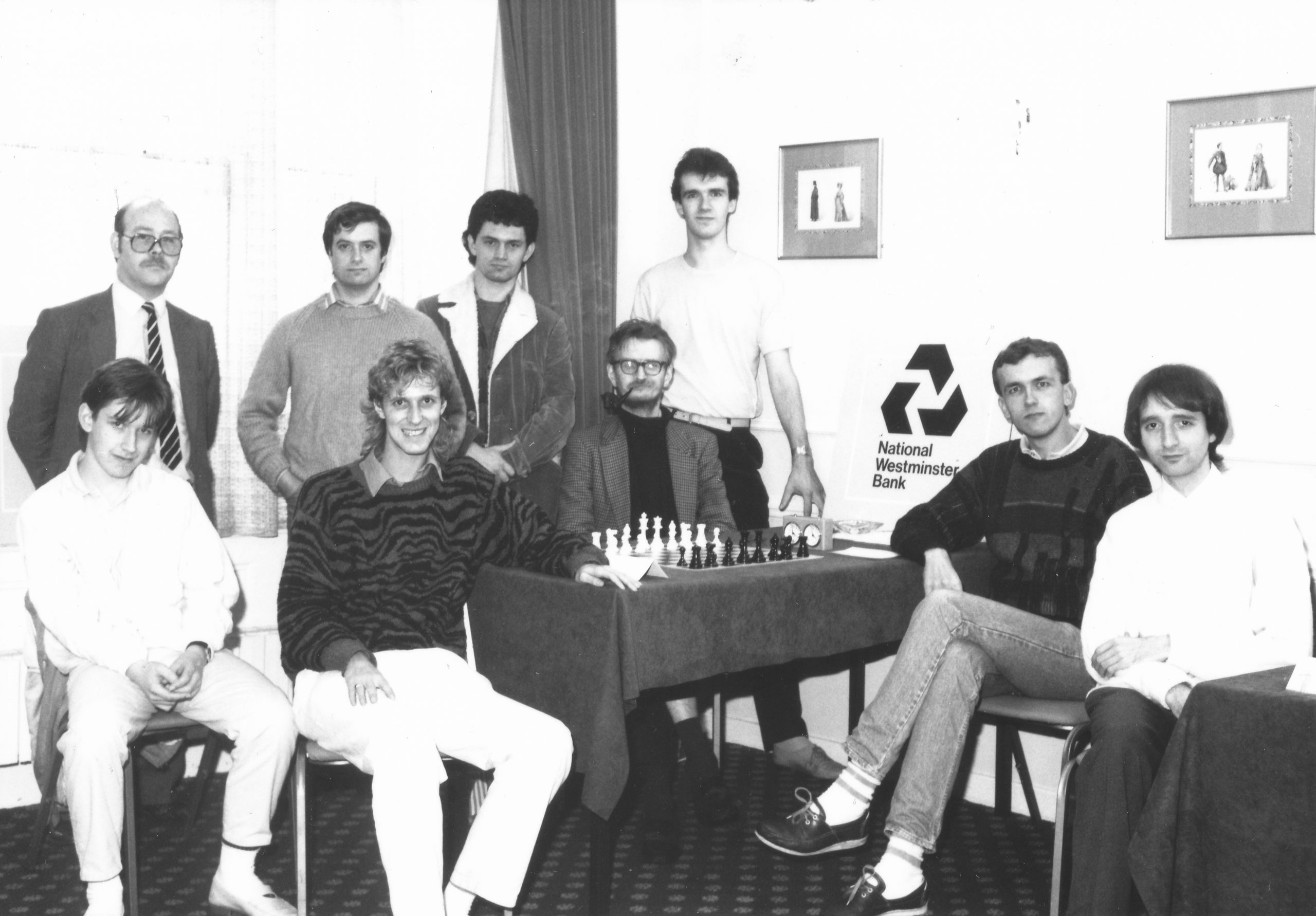
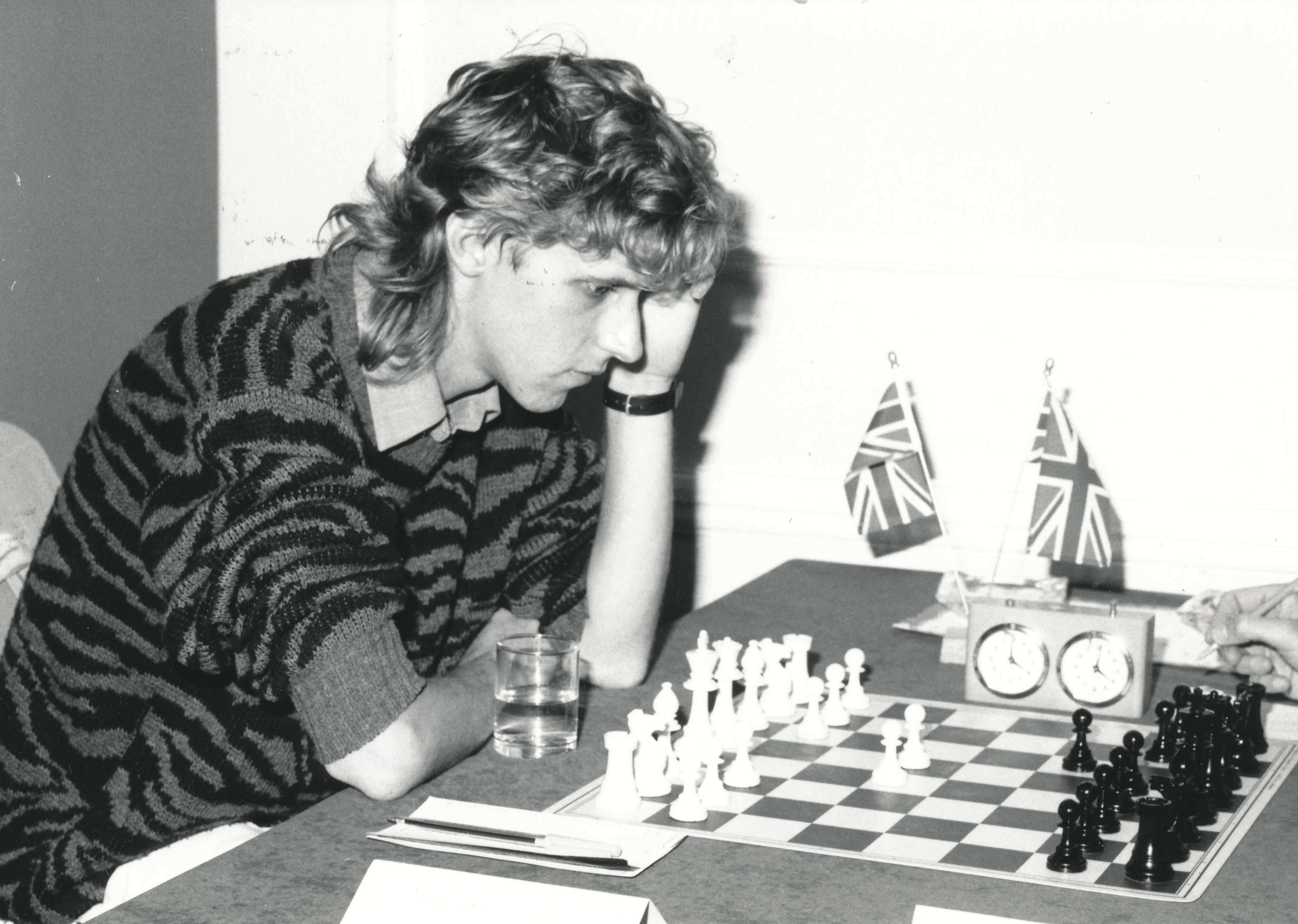
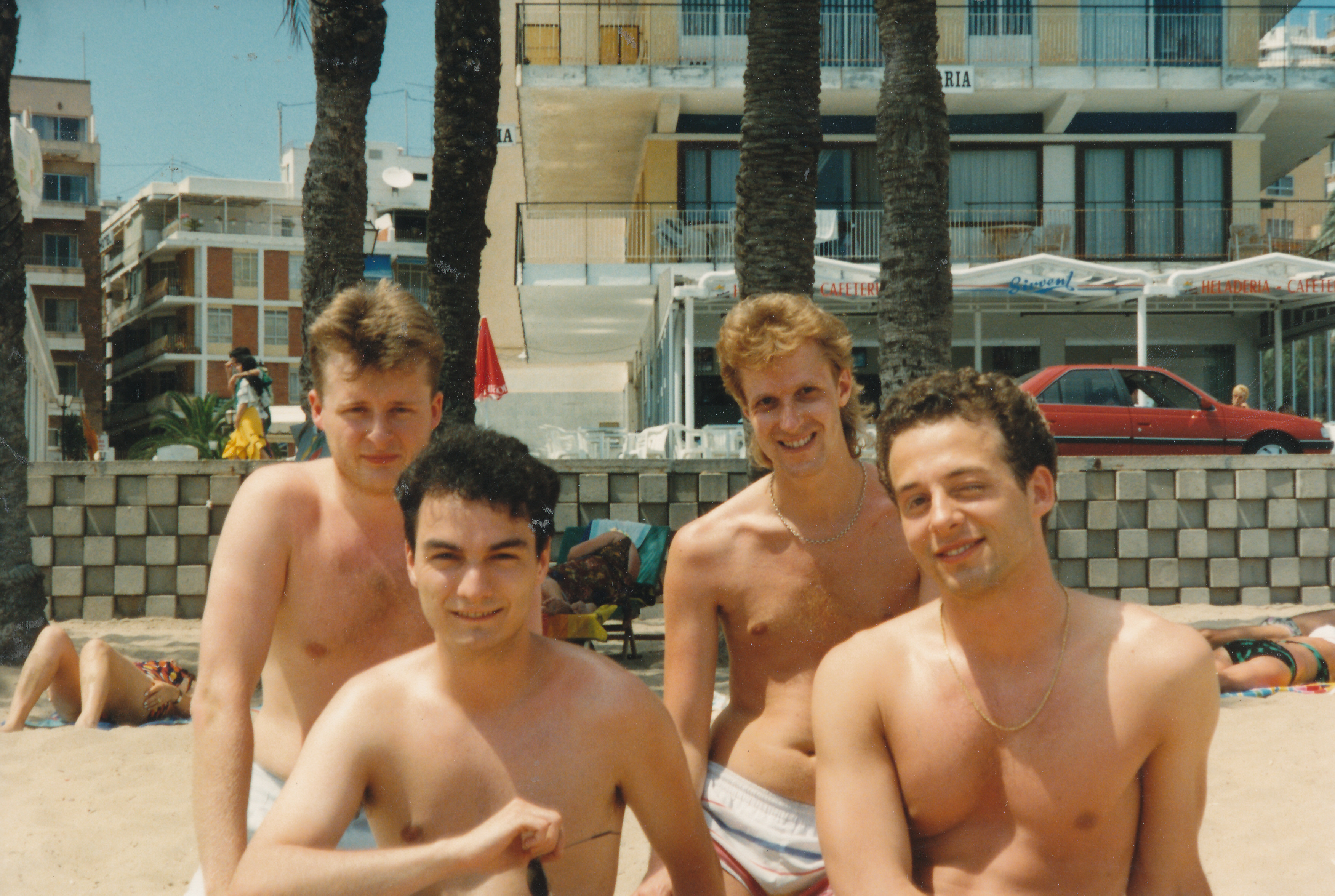
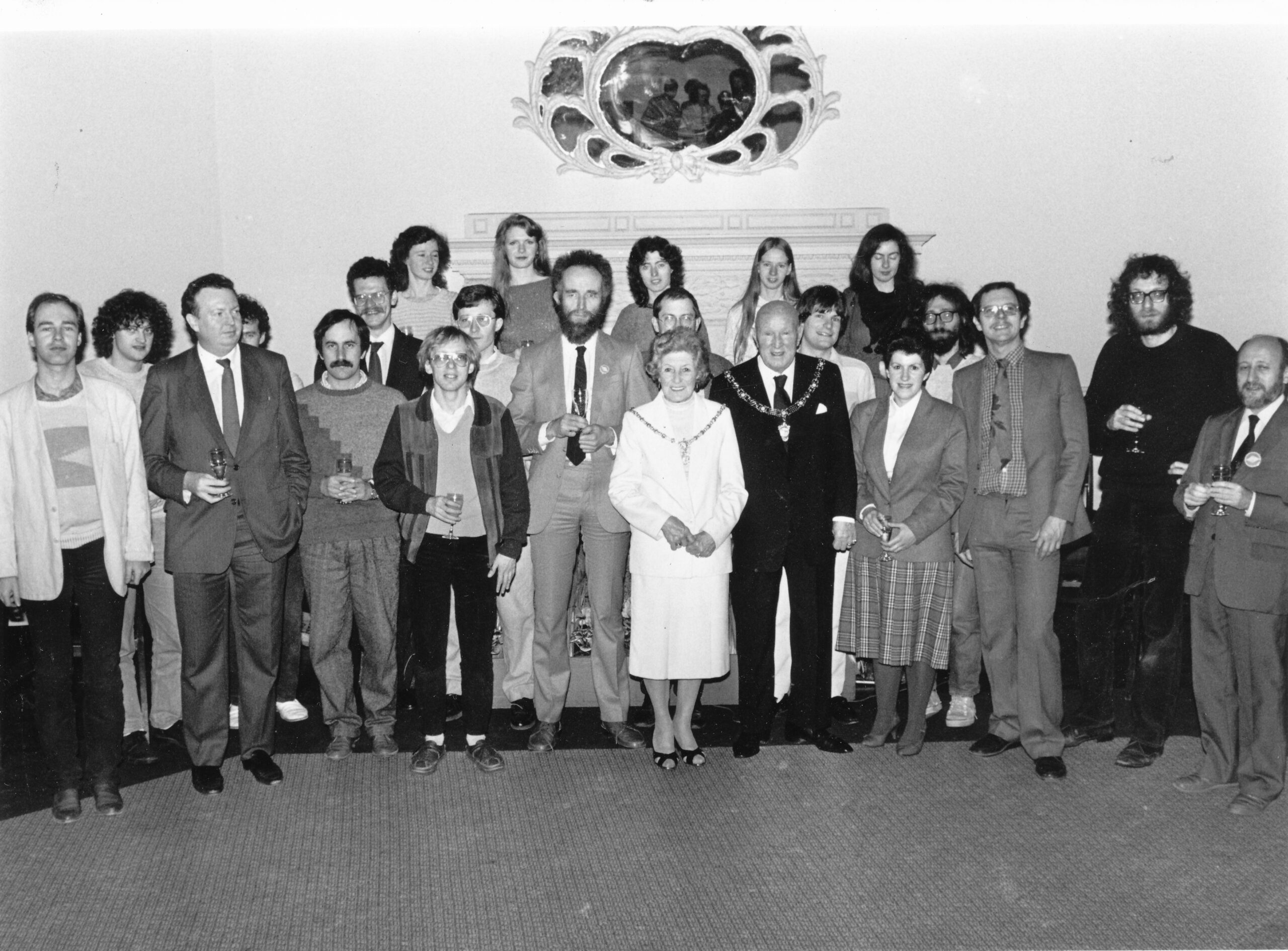
Gary and friends at the NatWest Bank Young Masters
From Wikipedia :
“Gary William Lane (born 4 November 1964) is a professional chess player and author. He became an International Master in 1987 and won the Commonwealth Chess Championship in 1988. He has written over thirty books on chess, including Find the Winning Move, Improve Your Chess in 7 Days and Prepare to Attack. There have been translations in French, Italian, Portuguese and Spanish. In the 1980s the ITV documentary “To Kill a King” was screened nationwide in Great Britain. It featured a young Michael Adams and Lane. This feature is shown regularly at chess film festivals.”
IM Gary Lane
“After his marriage to Woman International Master Nancy Jones, he moved to Australia, winning the Australian Chess Championship in 2004. He won the 2005 Oceania Chess Championship and represented Oceania at the Chess World Cup 2005.
He has also represented Australia in the 2002, 2004, and 2006 Chess Olympiads. In the 2004 Olympiad he helped Australia score a 2–2 draw with his former country England, scoring a decisive win over Nigel Short.[ He has been a chess coach for England or Australia at the World Junior and also European Junior championship for over a decade.”
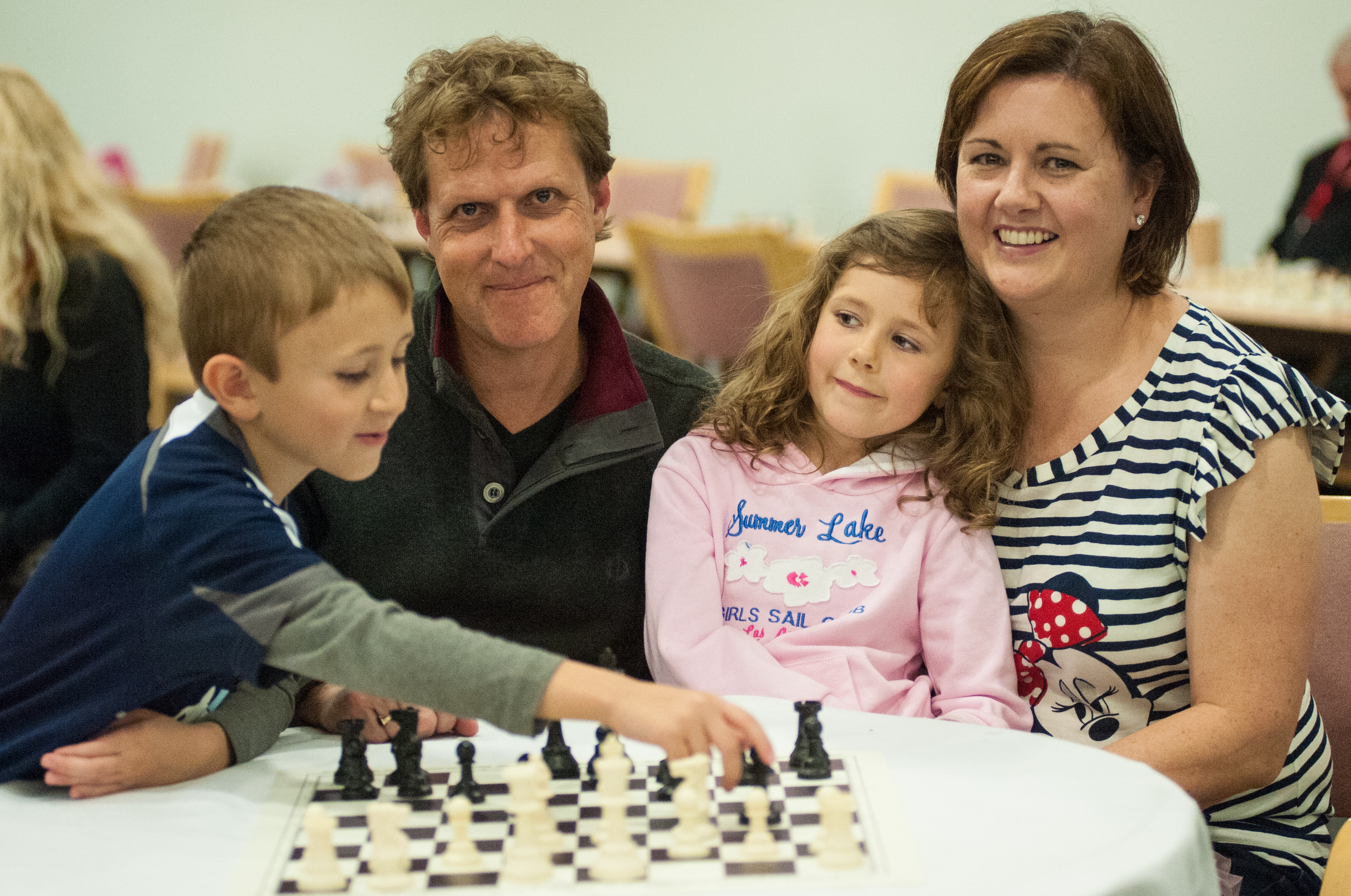
Gary Lane & family at the London Chess Classic, courtesy of John Upham Photography
“In 2012 he won the George Trundle Masters in Auckland, New Zealand with a score of 7/9,[4] and the NZ South Island Championships in Dunedin, with a score of 8/9.[5] He was unbeaten in both events.
In 2015 at the Australian tournament the Doeberl Cup he beat Loek van Wely the reigning Dutch Champion and one of the world’s leading players. He played the Closed Sicilian which he has also written about in two books. In 2016 he came =1st at George Trundle Masters in Auckland, New Zealand with a score of 7/9, and followed this up with =1st place scoring 8/9 at the NZ South Island Championships in Canterbury. He did not lose any games in the two events. At the 2nd Fiji International Open Chess Tournament Lane dominated the event winning with the perfect score of 7/7. A score of 9/9 and clear first place was the result at the 1st Fiji International Rapid Open.
Lane is a supporter of Torquay United F.C. ”
Peter Wells, Gary Lane, John Emms and David Norwood
Gary has written almost 30 chess books :
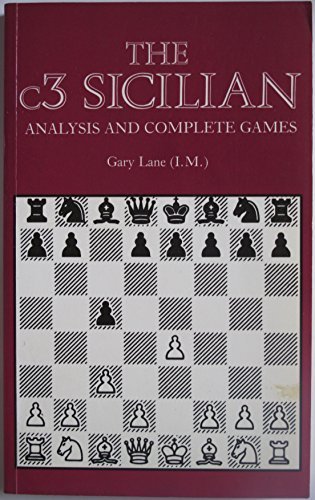
(1990) The C3 Sicilian: Analysis and Complete Games. The Crowood Press. ISBN 978-1-852233-18-1.
(1990) The C3 Sicilian: Analysis and Complete Games. The Crowood Press. ISBN 978-1-852233-18-1., Gary Lane
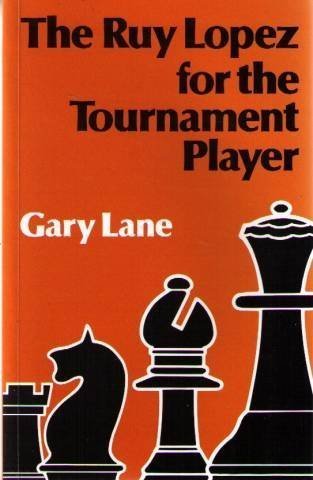
Lane, Gary (1991). The Ruy Lopez for the Tournament Player. Batsford. ISBN 978-0-713468-12-0.
Lane, Gary (1991). The Ruy Lopez for the Tournament Player. Batsford. ISBN 978-0-713468-12-0.
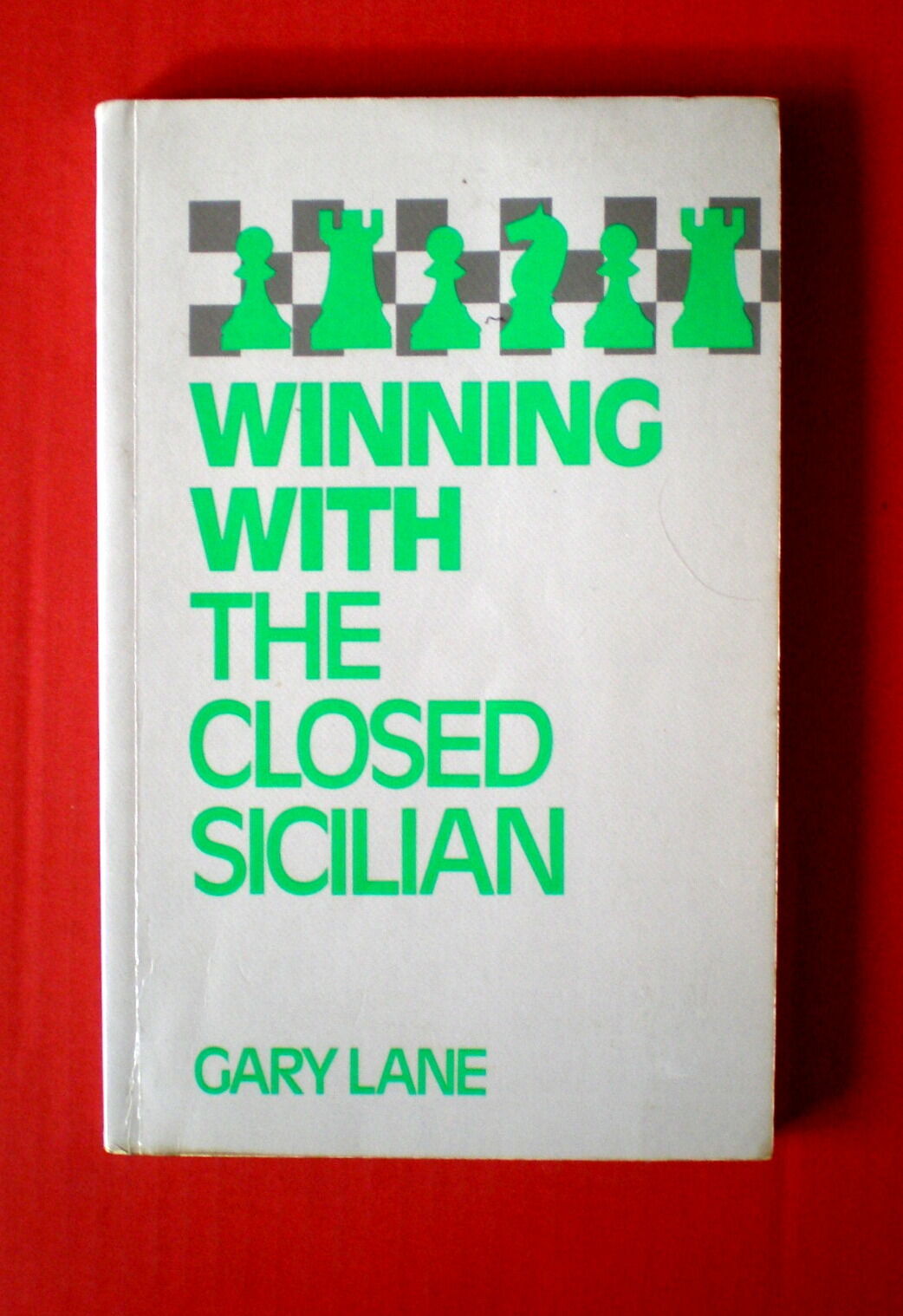
Lane, Gary (1992). Winning with the Closed Sicilian. Batsford. ISBN 978-0-713469-72-1.
Lane, Gary (1992). Winning with the Closed Sicilian. Batsford. ISBN 978-0-713469-72-1.
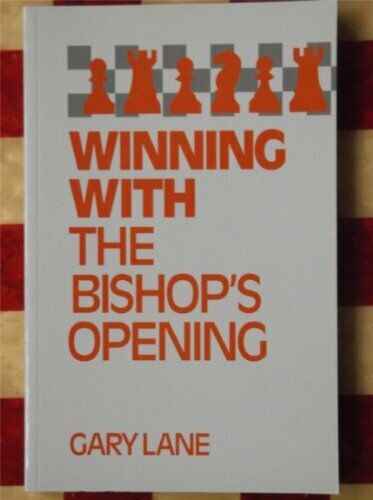
Lane, Gary (1993). Winning with the Bishop’s Opening. Batsford. ISBN 978-0-713471-13-7.
Lane, Gary (1993). Winning with the Bishop’s Opening. Batsford. ISBN 978-0-713471-13-7.
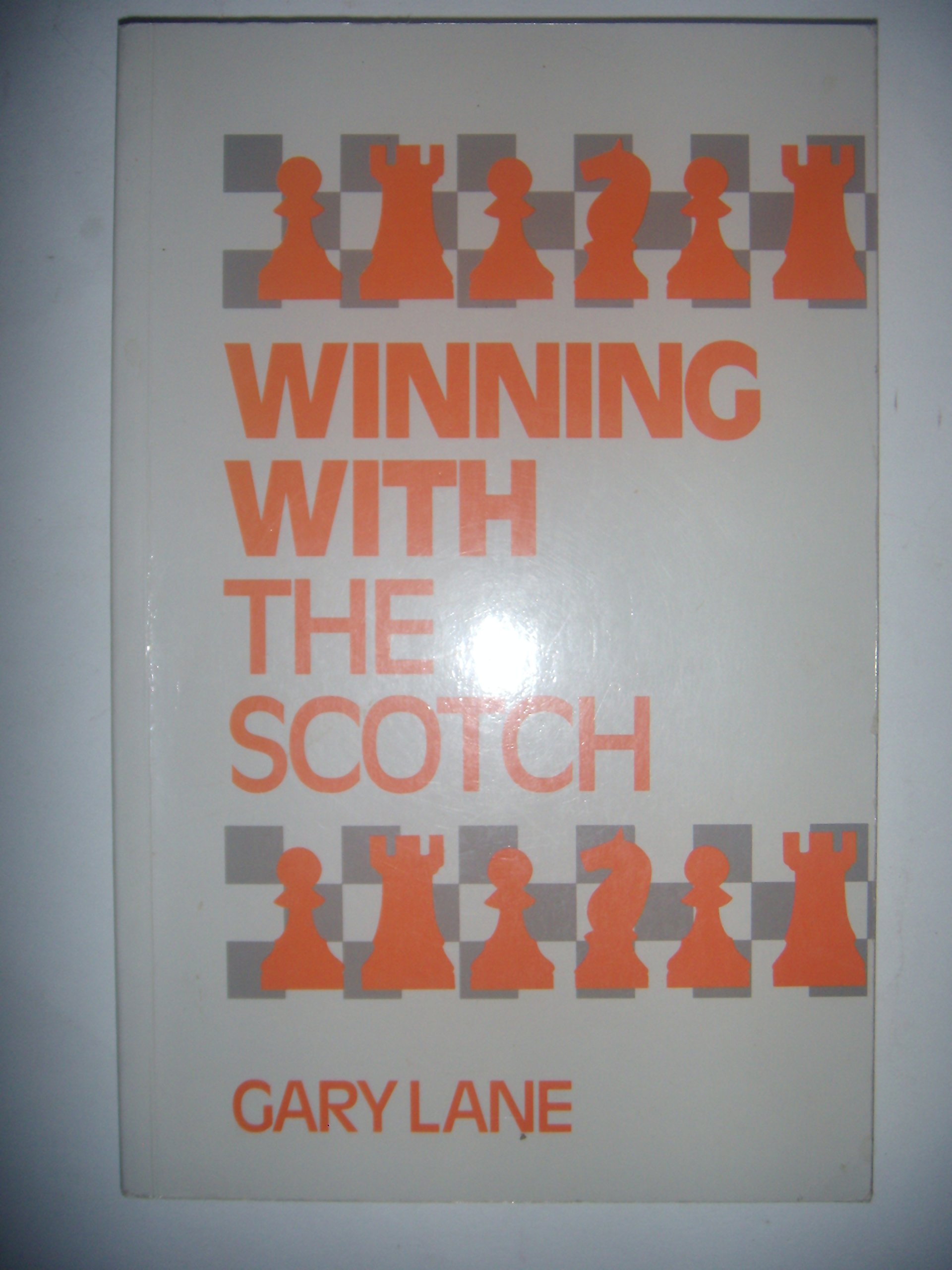
Lane, Gary (1993). Winning with the Scotch. Henry Holt. ISBN 0-8050-2940-0.
Lane, Gary (1993). Winning with the Scotch. Henry Holt. ISBN 0-8050-2940-0.
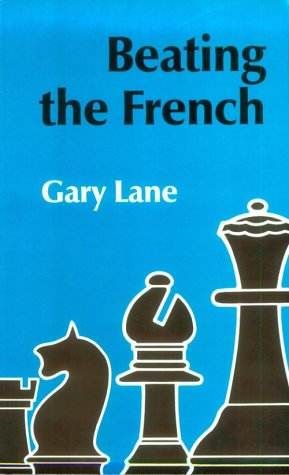
Lane, Gary (1994). Beating the French. Batsford. ISBN 978-0-713473-90-2.
Lane, Gary (1994). Beating the French. Batsford. ISBN 978-0-713473-90-2.
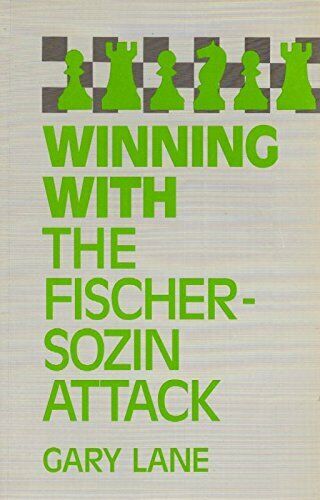
Lane, Gary (1994). Winning with the Fischer-Sozin Attack. Batsford. ISBN 978-0-713475-80-7.
Lane, Gary (1994). Winning with the Fischer-Sozin Attack. Batsford. ISBN 978-0-713475-80-7.
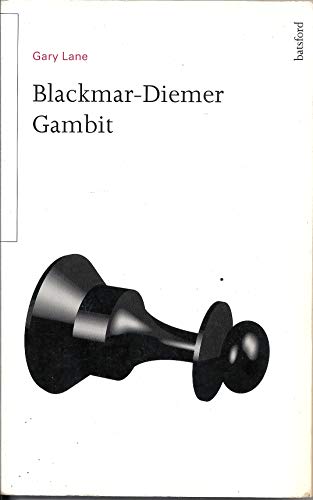
Lane, Gary (1995). Blackmar–Diemer Gambit. Batsford Chess Library / An Owl Book / Henry Holt and Company. ISBN 0-8050-4230-X.
Lane, Gary (1995). Blackmar–Diemer Gambit. Batsford Chess Library / An Owl Book / Henry Holt and Company. ISBN 0-8050-4230-X.
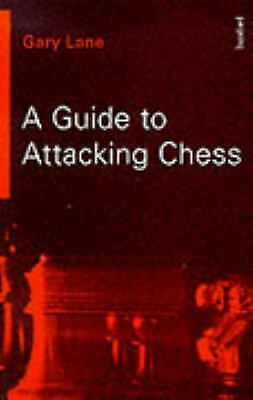
Lane, Gary (1996). A Guide to Attacking Chess. B.T.Batsford Ltd. ISBN 0-7134-8010-6.
Lane, Gary (1996). A Guide to Attacking Chess. B.T.Batsford Ltd. ISBN 0-7134-8010-6.
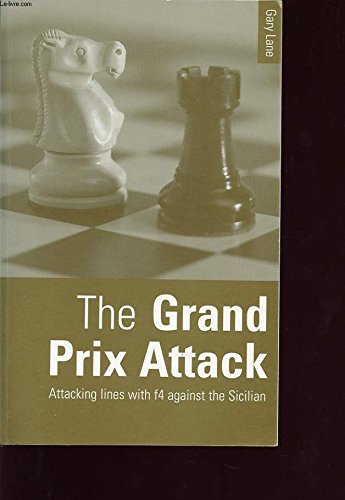
Lane, Gary (1997). The Grand Prix Attack: attacking lines with f4 against the Sicilian. Batsford. ISBN 0-8050-2940-0.
Lane, Gary (1997). The Grand Prix Attack: attacking lines with f4 against the Sicilian. Batsford. ISBN 0-8050-2940-0.
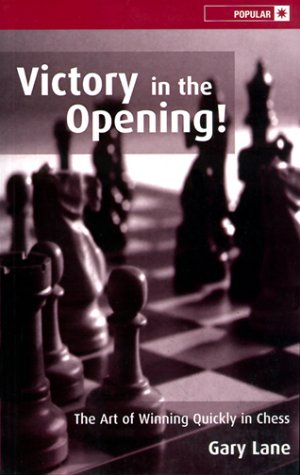
Lane, Gary (1999). Victory in the Opening. Sterling Pub Co Inc. ISBN 9780713484274.
Lane, Gary (1999). Victory in the Opening. Sterling Pub Co Inc. ISBN 9780713484274.
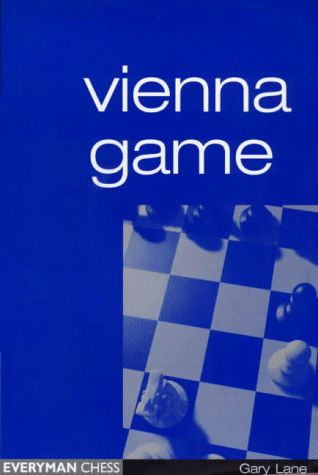
Lane, Gary (2000). The Vienna Game. Everyman Chess. ISBN 0-8050-2940-0.
Lane, Gary (2000). The Vienna Game. Everyman Chess. ISBN 0-8050-2940-0.
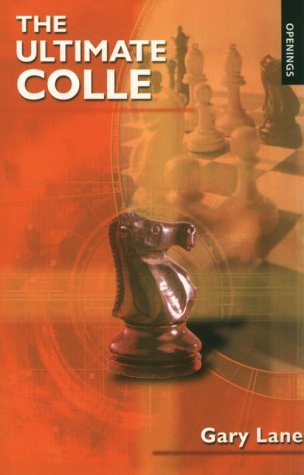
Lane, Gary (2001). The Ultimate Colle. Sterling Pub Co Inc. ISBN 9780713486865.
Lane, Gary (2001). The Ultimate Colle. Sterling Pub Co Inc. ISBN 9780713486865.
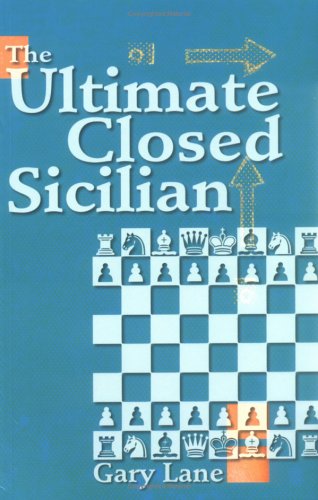
Lane, Gary (2001). The Ultimate Closed Sicilian. Batsford. ISBN 978-0-713486-87-2.
Lane, Gary (2001). The Ultimate Closed Sicilian. Batsford. ISBN 978-0-713486-87-2.
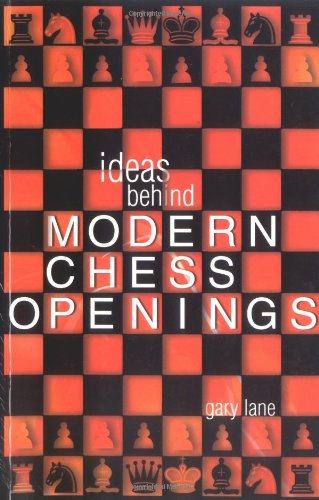
Lane, Gary (2003). Ideas Behind the Modern Chess Openings: Attacking With White. Batsford. ISBN 9780713487121.
Lane, Gary (2003). Ideas Behind the Modern Chess Openings: Attacking With White. Batsford. ISBN 9780713487121.
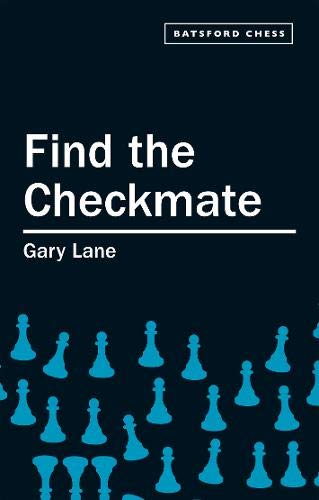
Lane, Gary (2003). Find the Checkmate. Batsford. ISBN 0-8050-2940-0.
Lane, Gary (2003). Find the Checkmate. Batsford. ISBN 0-8050-2940-0.
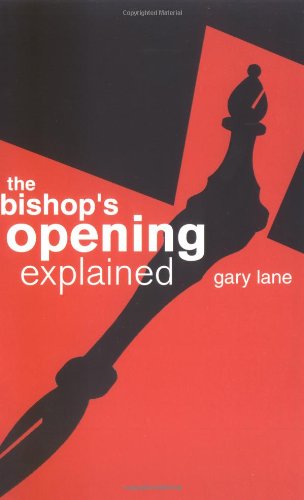
Lane, Gary (2004). The Bishop’s Opening Explained. Batsford. ISBN 0-7134-8917-0.
Lane, Gary (2004). The Bishop’s Opening Explained. Batsford. ISBN 0-7134-8917-0.
Lane, Gary (2004). ‘Find the Checkmate. Batsford. ISBN 978-0-713488-61-6.
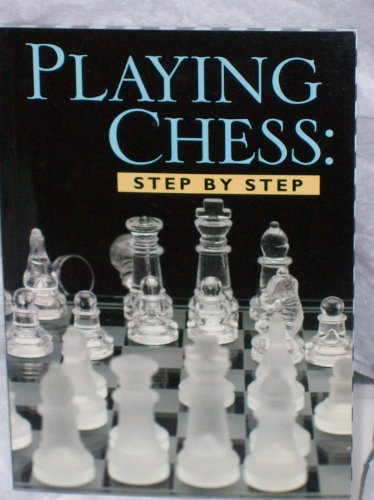
Lane, Gary (2004). Playing Chess: Step by Step. Mud Puddle Books. ISBN 978-1-594120-55-8.
Lane, Gary (2004). Playing Chess: Step by Step. Mud Puddle Books. ISBN 978-1-594120-55-8.
Lane, Gary (2005). Ideas Behind Modern Chess Openings: Black. Batsford. ISBN 9780713489507.
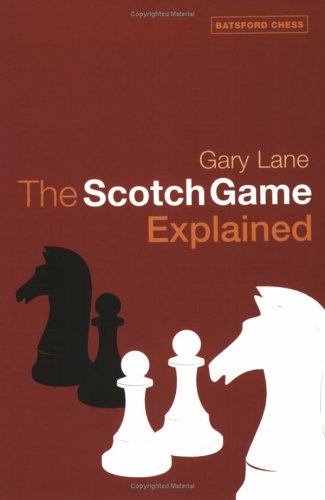
Lane, Gary (2005). The Scotch Game Explained. Batsford. ISBN 0-7134-8940-5.
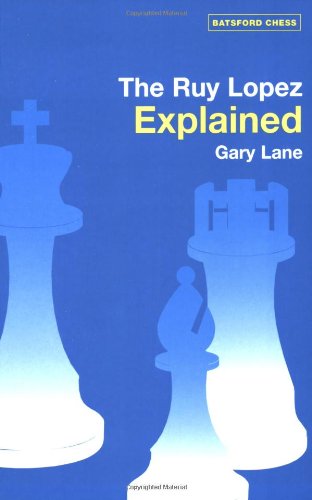
Lane, Gary (2005). The Scotch Game Explained. Batsford. ISBN 0-7134-8940-5.Lane, Gary (2006). The Ruy Lopez Explained. Batsford. ISBN 0-7134-8978-2.
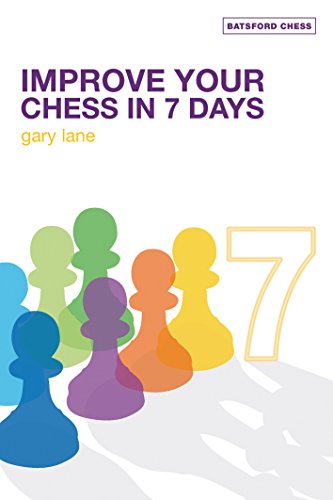
Lane, Gary (2007). Improve Your chess In 7 Days. Batsford. ISBN 978-0-7134-9050-3.
Lane, Gary (2007). Improve Your chess In 7 Days. Batsford. ISBN 978-0-7134-9050-3.
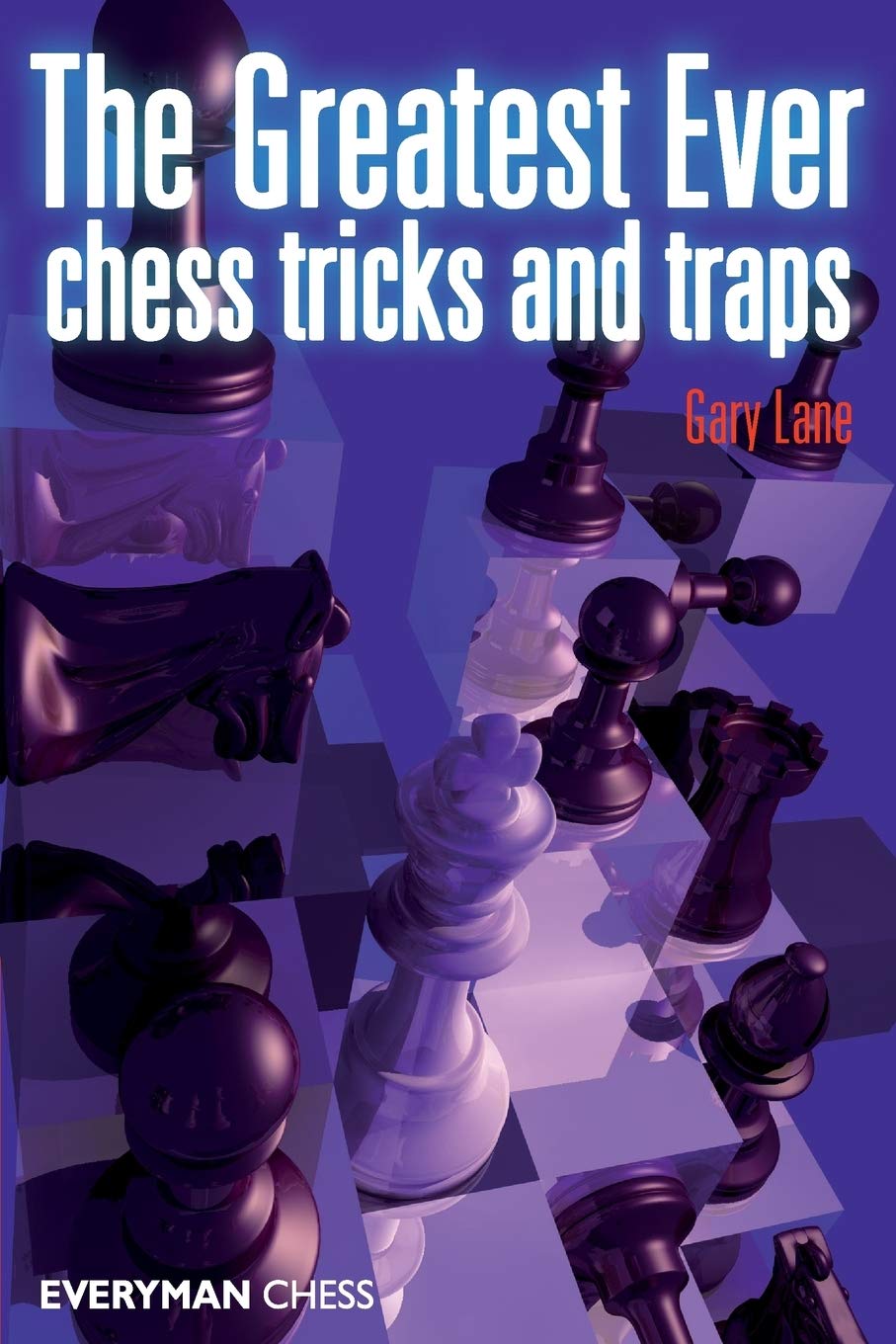
Lane, Gary (2008). The Greatest Ever Chess Tricks and Traps. Everyman Chess. ISBN 9781857445770.
Lane, Gary (2008). The Greatest Ever Chess Tricks and Traps. Everyman Chess. ISBN 9781857445770.
Lane, Gary (2009). Sharpen Your Chess Tactics in 7 Days. Batsford. ISBN 9781906388287.
Lane, Gary (2009). Sharpen Your Chess Tactics in 7 Days. Batsford. ISBN 9781906388287.
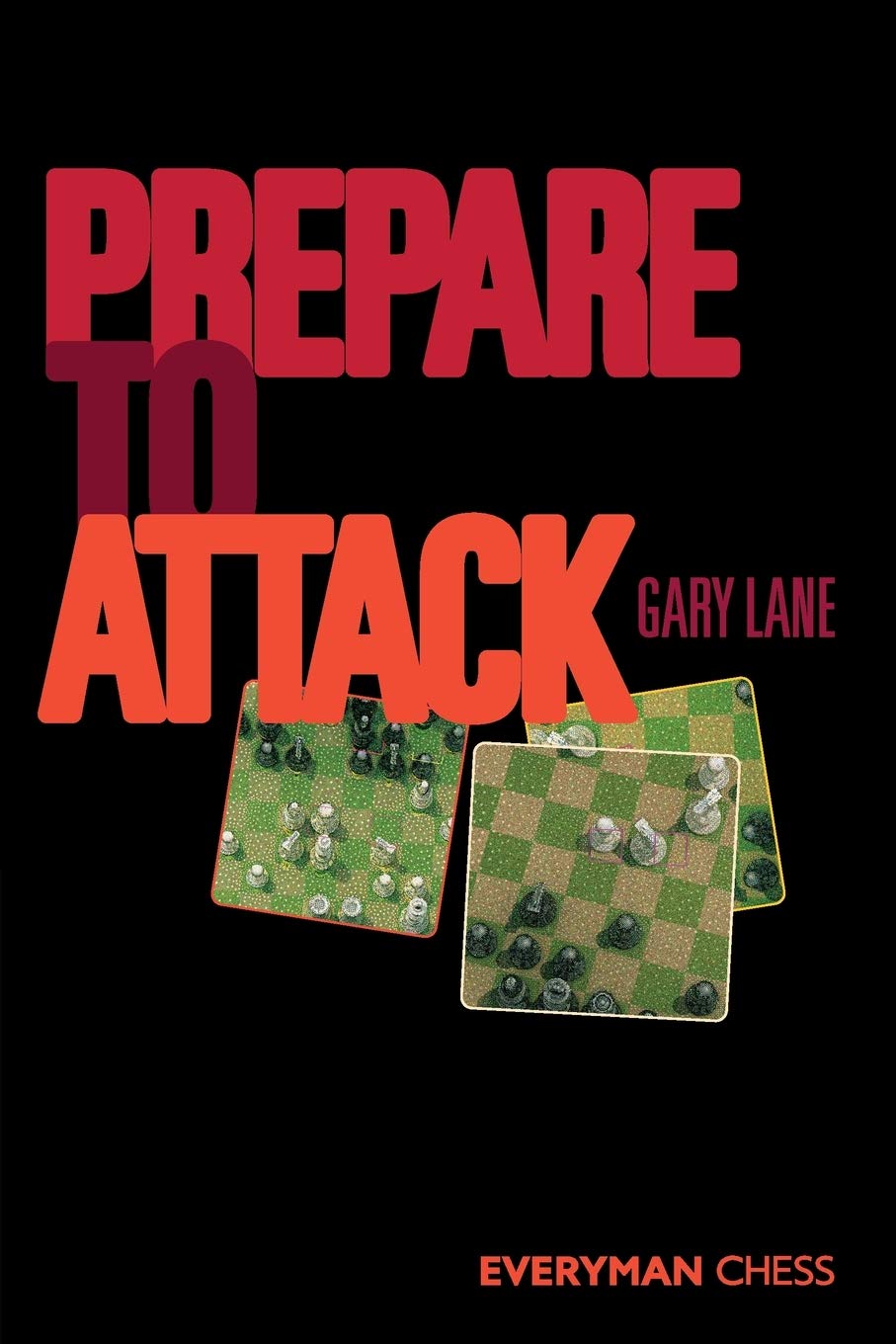
Lane, Gary (2011). Prepare to Attack. Everyman Chess. ISBN 978-1857446500.
Lane, Gary (2011). Prepare to Attack. Everyman Chess. ISBN 978-1857446500.
Lane, Gary (2013). Gary Lane’s Chess Puzzle Book. e+books. ISBN 978-1-927179-14-7.
Lane, Gary (2013). Gary Lane’s Chess Puzzle Book. e+books. ISBN 978-1-927179-14-7.IM Gary Lane, courtesy of John Upham Photography
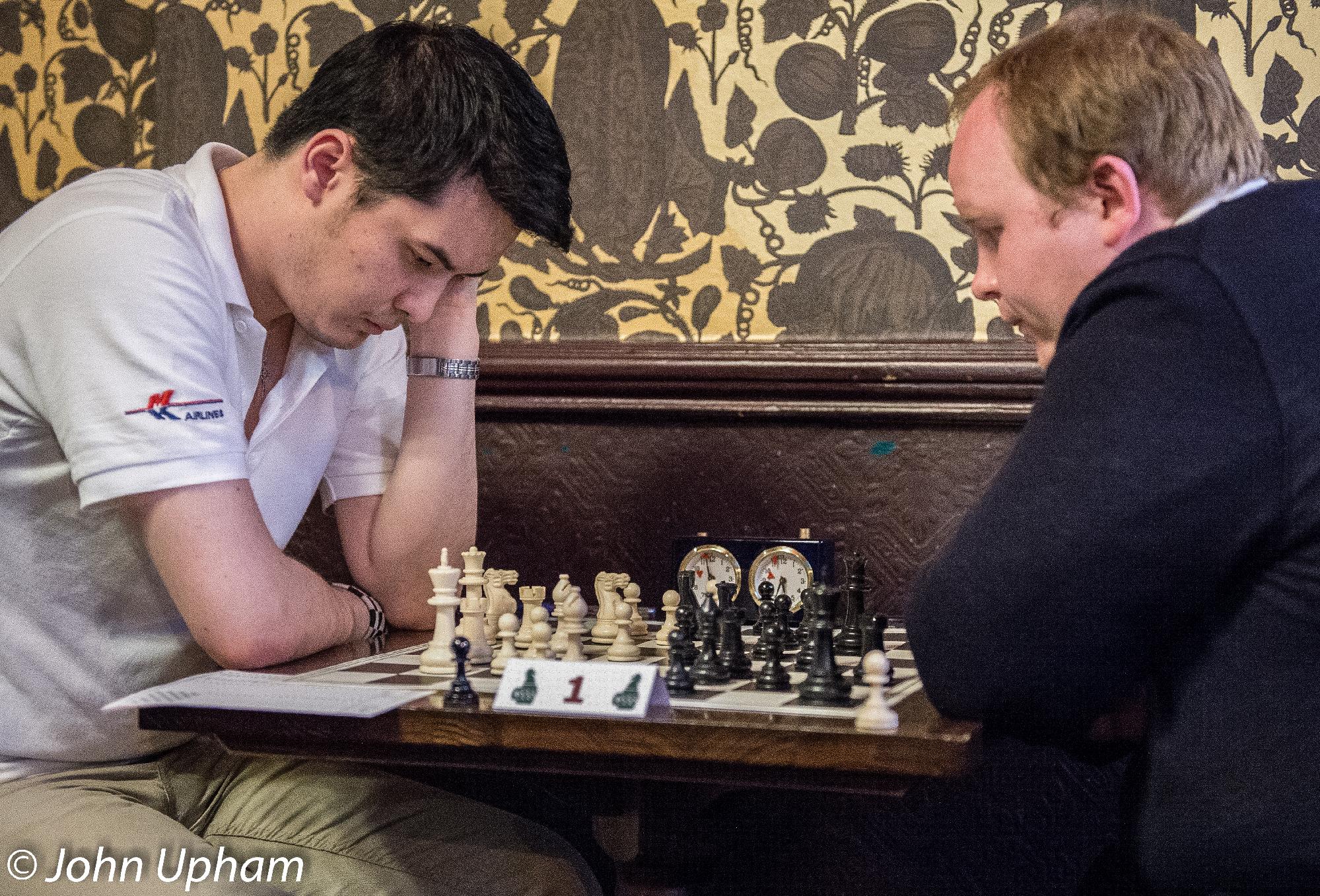
GM David Howell vs IM Eddie Dearing, Drunken Knights vs Wood Green, June 2014, Courtesy of John Upham Photography
BCN send best wishes to IM Eddie Dearing on his birthday.
Edward J Dearing was born on Sunday, October 30th, 1980 in Scotland.
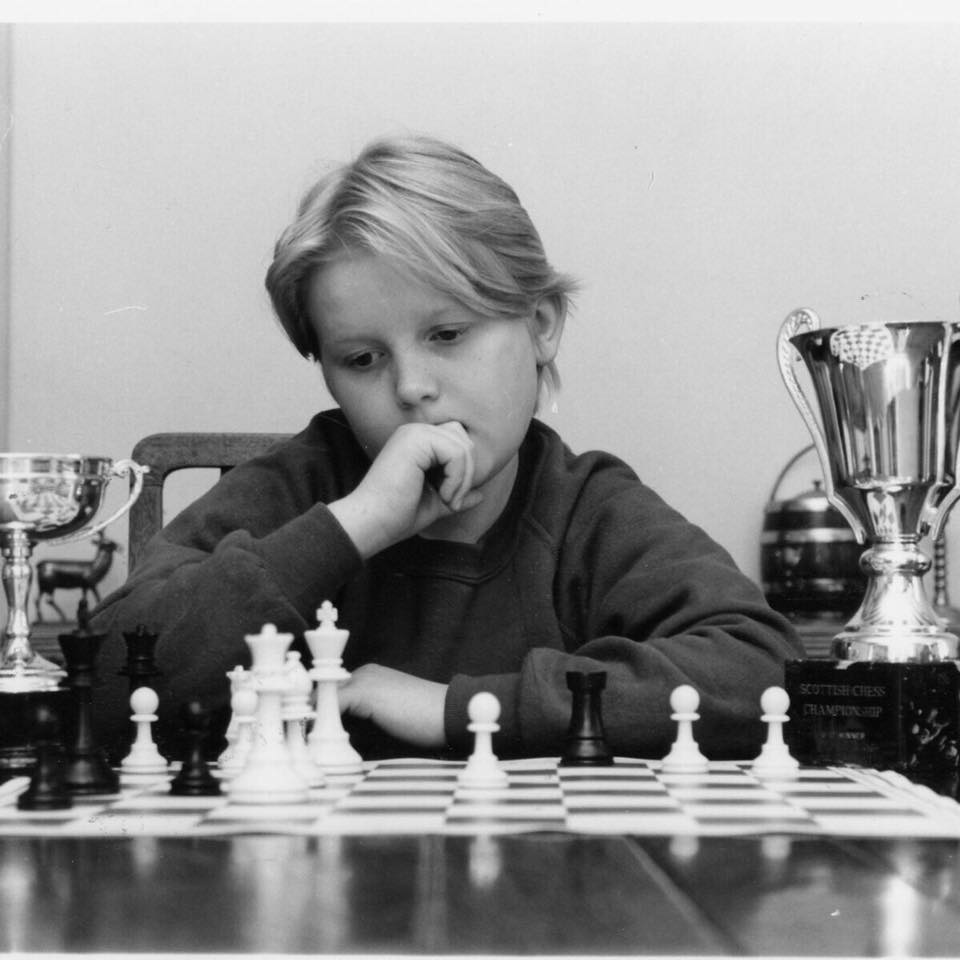
Eddie Dearing publicity photograph, from EDs Facebook page.
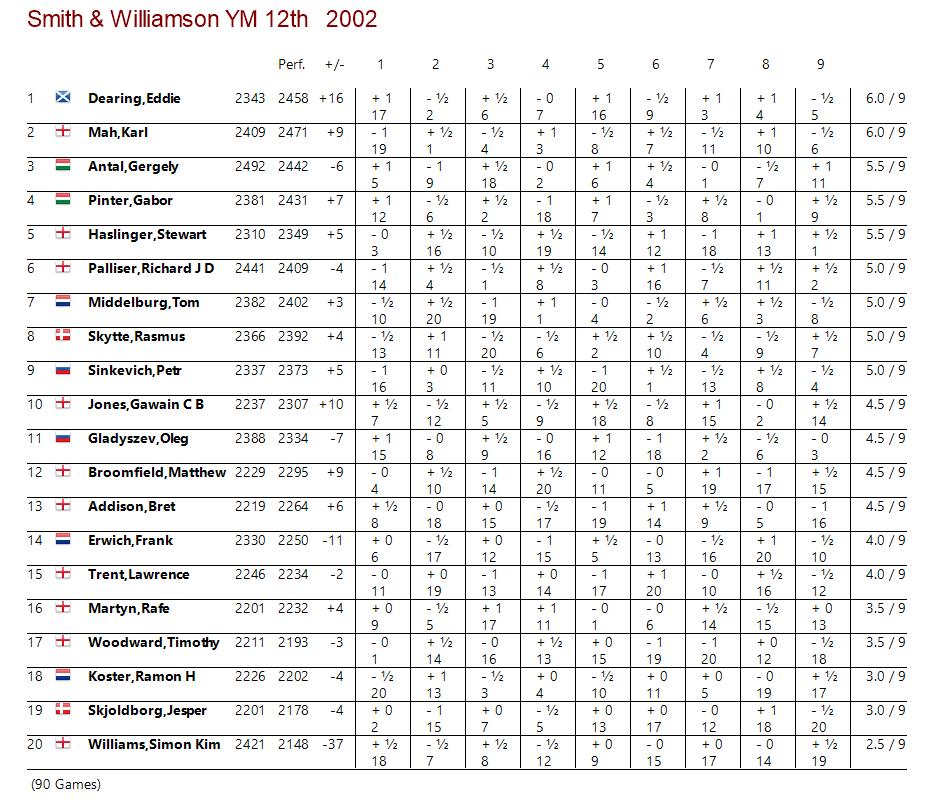
In 2002 Eddie shared first place (with Karl Mah) in the Smith and Williamson Young Masters with 6/9 with a TPR of 2458 :
Cross table for the 2012 Smith and Williamson Young Masters
He became an International Master in 2002 and, according to Felice and Megabase 2020 achieved a peak rating of 2420 in July 2005 aged 25. He is currently ranked 8th in Scotland.
Eddie Dearing by Cathy Rogers, ChessBase profile image
Eddie studied law at the University of Cambridge and did an MBA at the London Business School. Currently Eddie is a fund manager at MFS Investment Management.
In 2004 Eddie made his debut for Scotland in the Mallorca Olympiad.
Eddie is currently registered for Battersea in the London League and previously has played for Drunken Knights but has not been active since 2014.
With the white pieces Eddie prefers the Queen’s Gambit, Exchange Variation.
As the second player Eddie plays the Sicilian Dragon and the Semi-Slav Defence.
Eddie has plus scores against : James Cobb, Richard Palliser, Simon Williams, Karl Mah, Jacob Aagard, Colin McNab to name but a few.
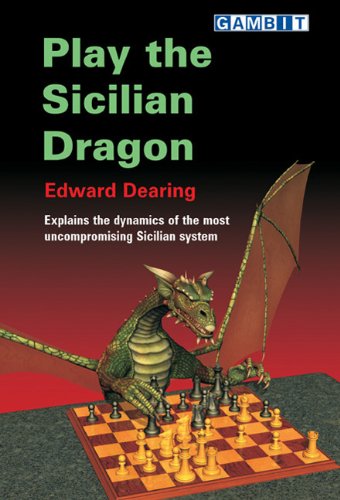
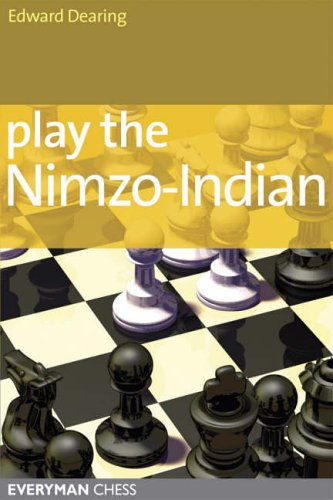
Eddie has written two books, Playing the Sicilian Dragon for Gambit and Playing the Nimzo-Indian for Everyman. In June 2011 Eddie became a columnist for British Chess Magazine and wrote the “Dearing’s Discoveries” feature each month.
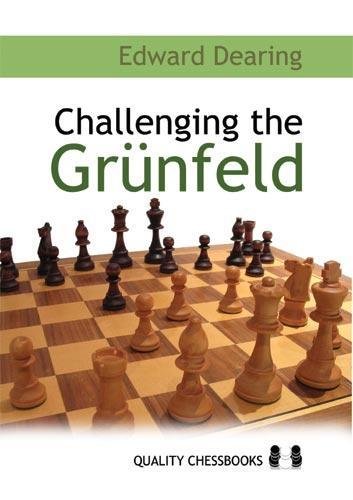
Play the Sicilian Dragon by Eddie DearingPlay the Nimzo-Indian by Eddie DearingChallenging the Grunfeld, Eddie Dearing, Quality Press, 2005
We remember Reginald Broadbent who passed away on October 29th 1988.
Reginald Joseph Broadbent was born on Friday, August 3rd 1906 (the year of the San Francisco earthquake) in Durban, South Africa. His father was Joseph Edward Broadbent (born 1879) who married Alice Cook on January 4th, 1903 in Durban.
According to the 1911 Isle of Man Census (FindMyPast, Richard James; thanks!) the Broadbent family (sans father) stayed at a guest house in Onchan on the night of February 2nd 1911. Reg (aged 4) was a boarder together with mother Alice (33), brother Roland (1) and sister Laura (4). Since Reg and Laura are both recorded as 4 years old it is reasonable to suppose that they were born as twins. We think that Reg had an additional sibling who had passed away and that the name is not recorded. Reassuringly Steve Mann agrees with this conclusion.
He married Catherine H Broadbent (née Crawford, born 19th September 1895) and were recorded as living (in 1939) in “Cheadle and Gately”, Cheshire. His profession was as a “Telephone Traffic Superintendent, Class II, Post Office Telephones” which was a a civil service occupation. Catherine carried out “unpaid domestic duties”.
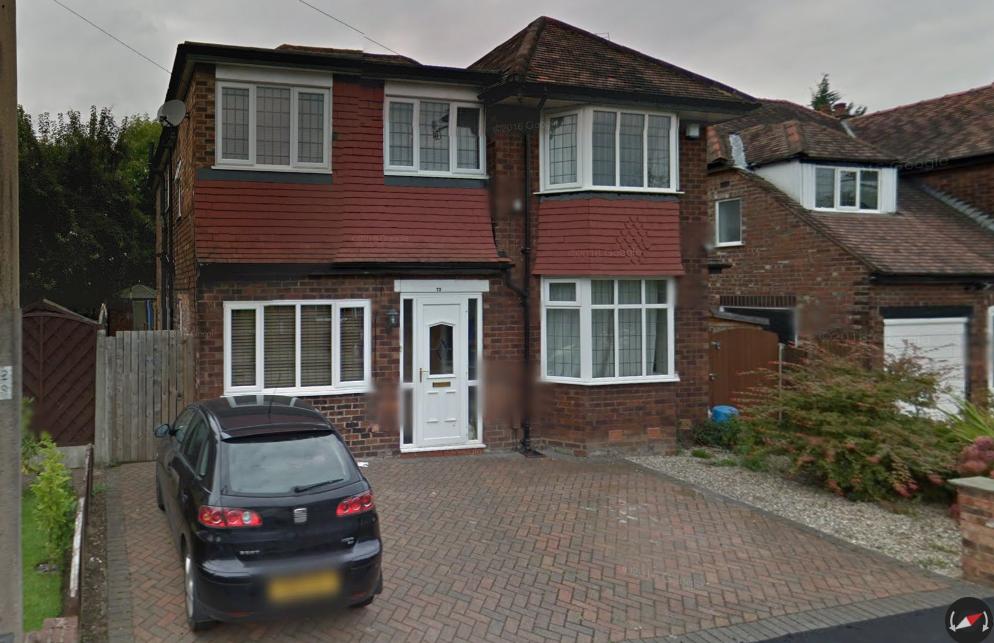
They resided at 72, South Park Road, Gatley, Cheshire :
“At some time in 1946 or 1947, Broadbent moved down south to live in the general vicinity of East Grinstead, at Far End, Limes Estate, Felbridge, 2 miles NW of East Grinstead, and later at Southway, Priory Road, Forest Row, 3 miles SE of East Grinstead”
Reg was eight times Northern Counties Chess Union (NCCU) Champion in 1933, 1934, 1935, 1936. 1937, 1938, 1945 and 1946.
The British Chess Magazine, Volume CVIII (108, 1988), #12 (December), p. 553 records this brief death announcement :
“Reginald J. Broadbent, British Champion 1948 and 1950 died on October 29 at the age of 82. He was a member of Manchester and Bradford Chess Clubs in his day, and was famous for his remarkable record in Anglo-Dutch matches.
After he moved to London around 1950 he was less free to play due to his senior post with the Post Office. A fuller notice will appear next month.”
As advertised in the British Chess Magazine, Volume CIX (109, 1989), #1 (January), p. 27 we have :
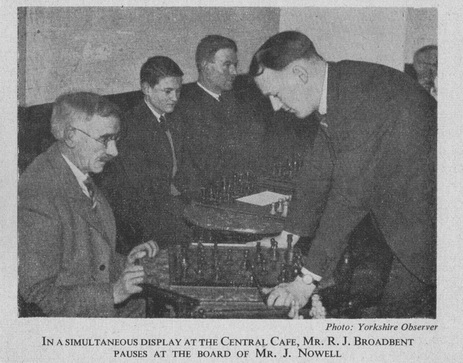
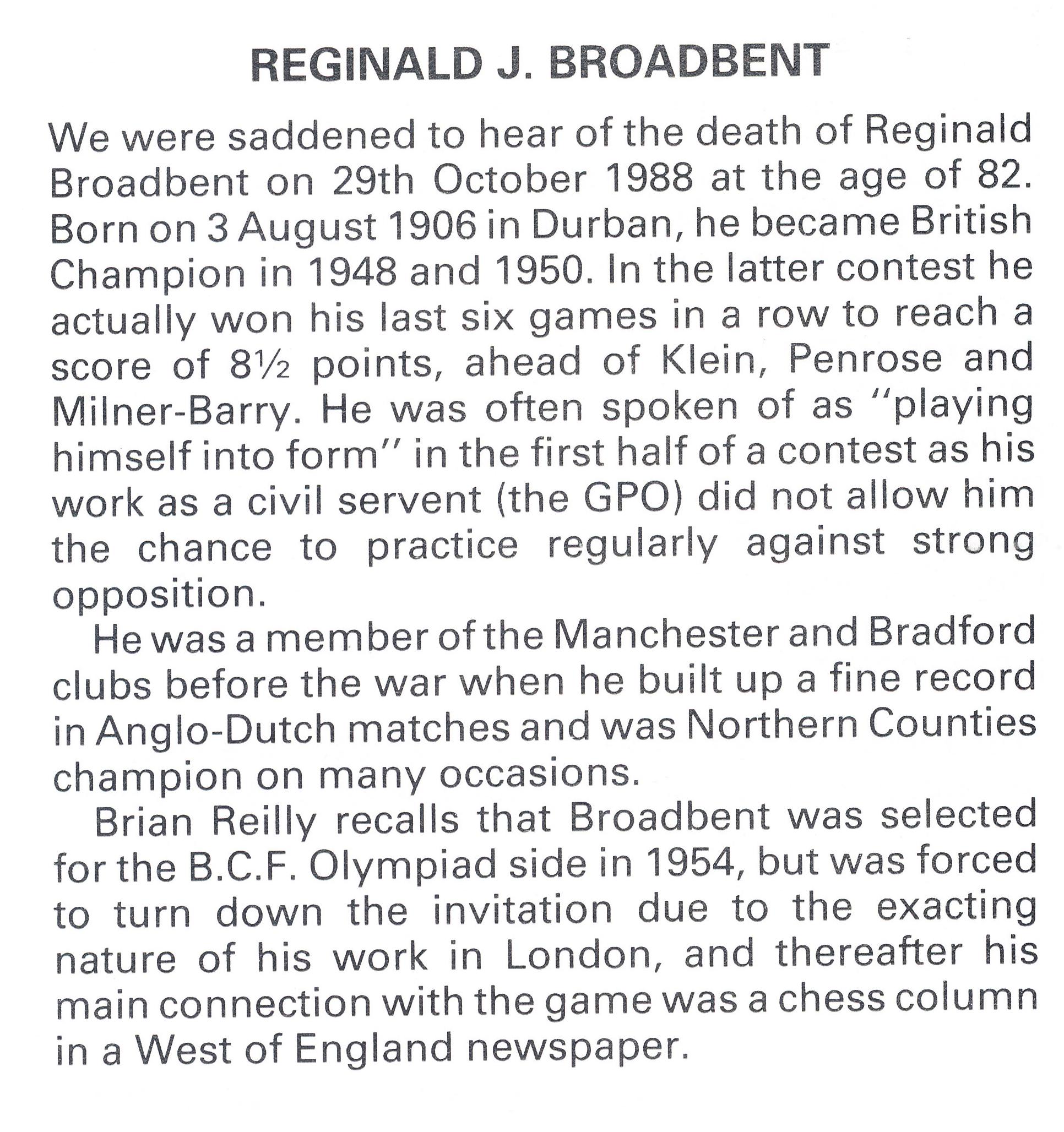
“Reginald Broadbent (3 viii 1906-29x 1988) was born at Durban and was British Champion in 1948 and 1950. In the latter content he actually won his last six games in a row to reach a score of 8.5 points, ahead of Klein, Penrose and Milner-Barry. He was often spoken of as “playing himself into form” in the first half of a contest as his work as a civil servant (the GPO) did not allow him the chance to practise regularly against strong opposition.
He was a member of the Manchester and Bradford clubs before the war when he built up a fine record in Anglo-Dutch matches and Northern Counties champion on many occasions.
Brian Reilly recalls that Broadbent was selected for the BCF Olympiad side in 1954, but was forced to turn down the invitation due to the exacting nature of his work in London, and thereafter his main connection with the game was a chess column in a West of England newspaper (The Western Morning News*) . He was a subscriber to BCM right up to his death.”
With the white pieces Broadbent was a die-hard 1.e4 player who allowed the Marshall Attack against the Ruy Lopez.
As the second player RJB defended the Nimzo-Indian Defence and played Open games.
In the March issue of CHESS for 1963, (Volume 28, Number 427, pp.147-155) William Winter wrote this:
R. J. Broadbent’s one weakness
R. J. Broadbent I consider to be typical of the best type of English amateur the Atkins type. A civil servant by profession he wins the Championship title, then retires to his country home in Surrey where he happily spends his time in gardening till the next championship comes along. Occasionally he is dragged out to play in a County match but he takes a lot of dragging. As a player he has great natural attainments and a temperament for the game, but he handicaps himself by the paucity of his opening knowledge. This compels him to start thinking almost from the word ‘go’ and the result is that he invariably gets on bad terms with his clock.
One of his great assets is his endgame in which he is perhaps superior to any practising British player. His skill in this department has rescued him from many a grim position. If he had studied the openings, and played in more tournaments, he might have gone far. As it is he is, and I fear will remain, just a first class British amateur. Probably he prefers it that way.
Here is one of his best games :
For an element of déjà vu here is RJBs obituary from the 1989 – 1990 BCF Yearbook, page 14 :
(The Yearbook editor was Brian Concannon and it would appear standard practise, at the time, not to credit or attribute sources for obituaries.)
With Bogdan she had a son, Peter D, who is a strong player in his own right.
There are ten players in MegaBase 2020 whose surname is Lalic.
She became a Woman’s FIDE Master in 1986, Woman’s International Master in 1987, Woman’s Grandmaster in 1988 and an International Master in 1996.
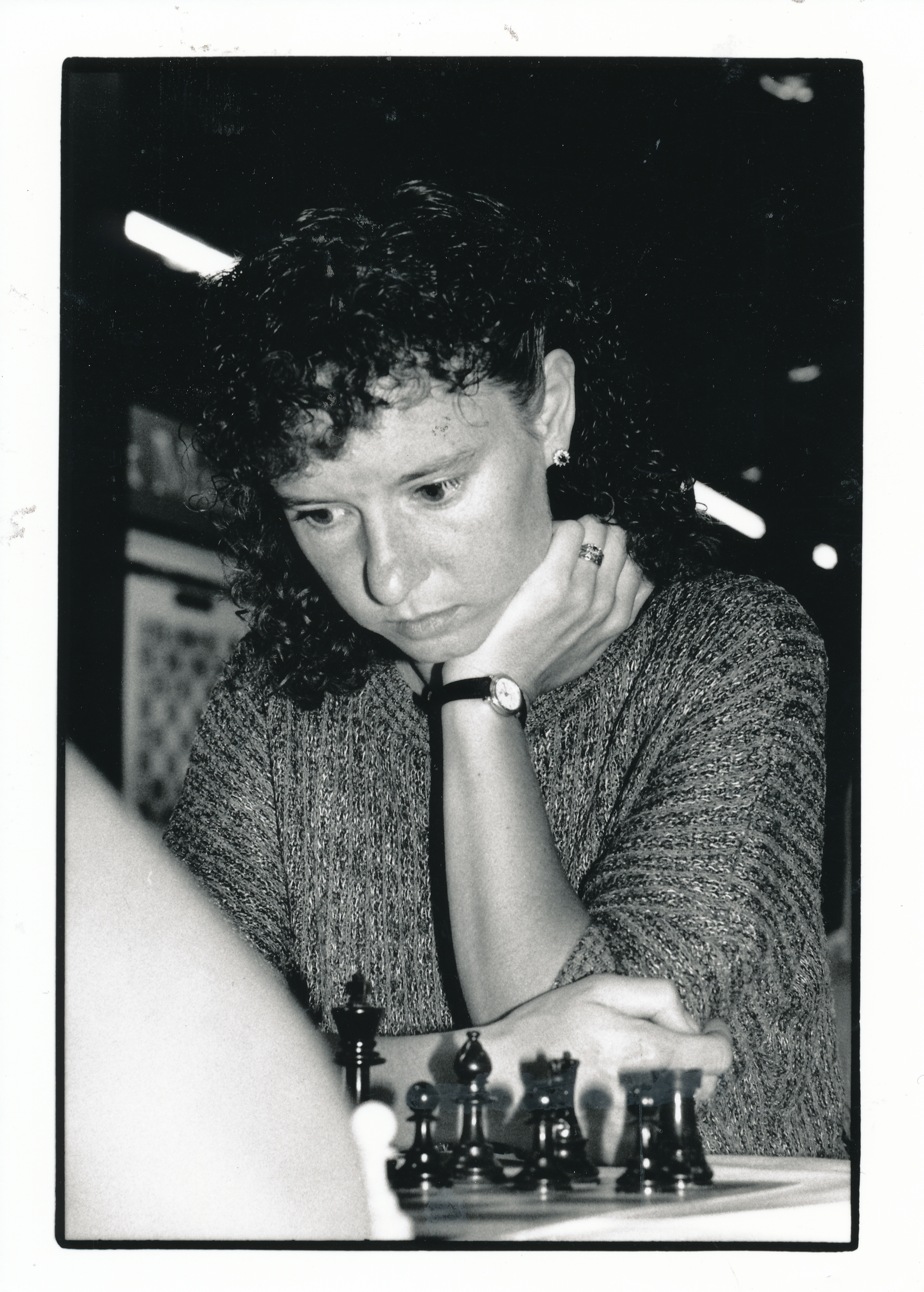
Susan Walker
According to Felice and Megabase 2020 Susan achieved a peak rating of 2405 in January 1997 at the age of 29.
From the Praxis Bath Zonal Tournament of 1987. Susan Walker is at the rear on the left.
Susan has played in the Four Nations Chess League for Slough, Wood Green and Guildford and her most recent games in MegaBase 2020 are from 2012.
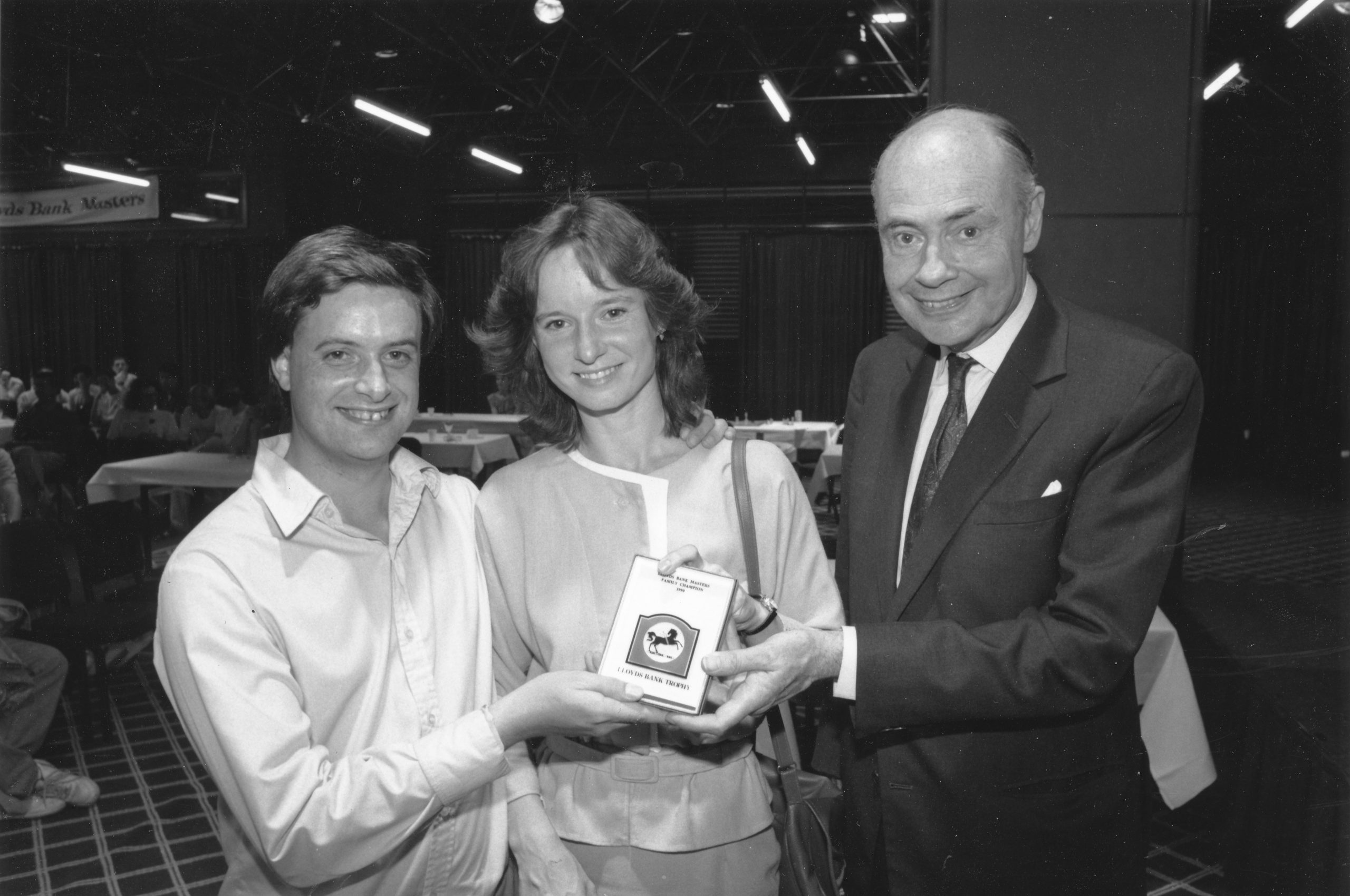
Keith Arkell, Susan Walker and Jeremy Morse at the Lloyds Bank Masters
She is five-time British Women’s Champion: 1986, 1990–1992, and 1998 and has represented England in nine Olympiads.
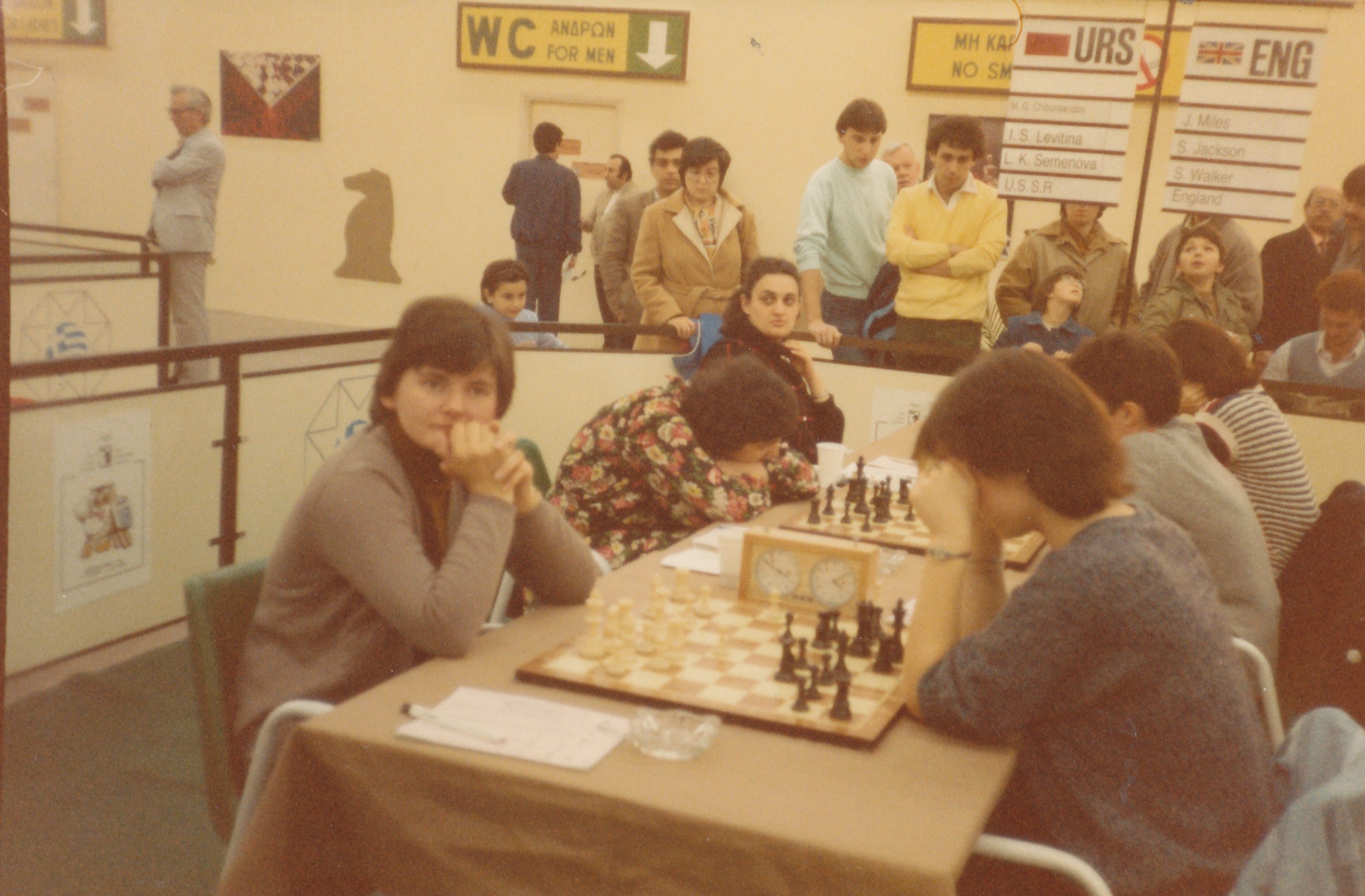
LK Semenova vs Susan Walker at the 1984 Women’s Olympiad
Susan is very active is Surrey junior chess and teaches in many schools.
IM Susan Lalic at a Surrey Megafinal
With the White pieces Susan is almost exclusively an e4 player (preferring the Scotch Game) but curiously (and why not you might ask) she has employed The Polish Opening more than once with success. She is well-known for employing the Sicilian Alapin as her main weapon against the Sicilian Defence.
As the second player she defends the Caro-Kann, Larsen-Spassky, Smyslov and the Classical Variations and the Nimzo-Indian Defence.
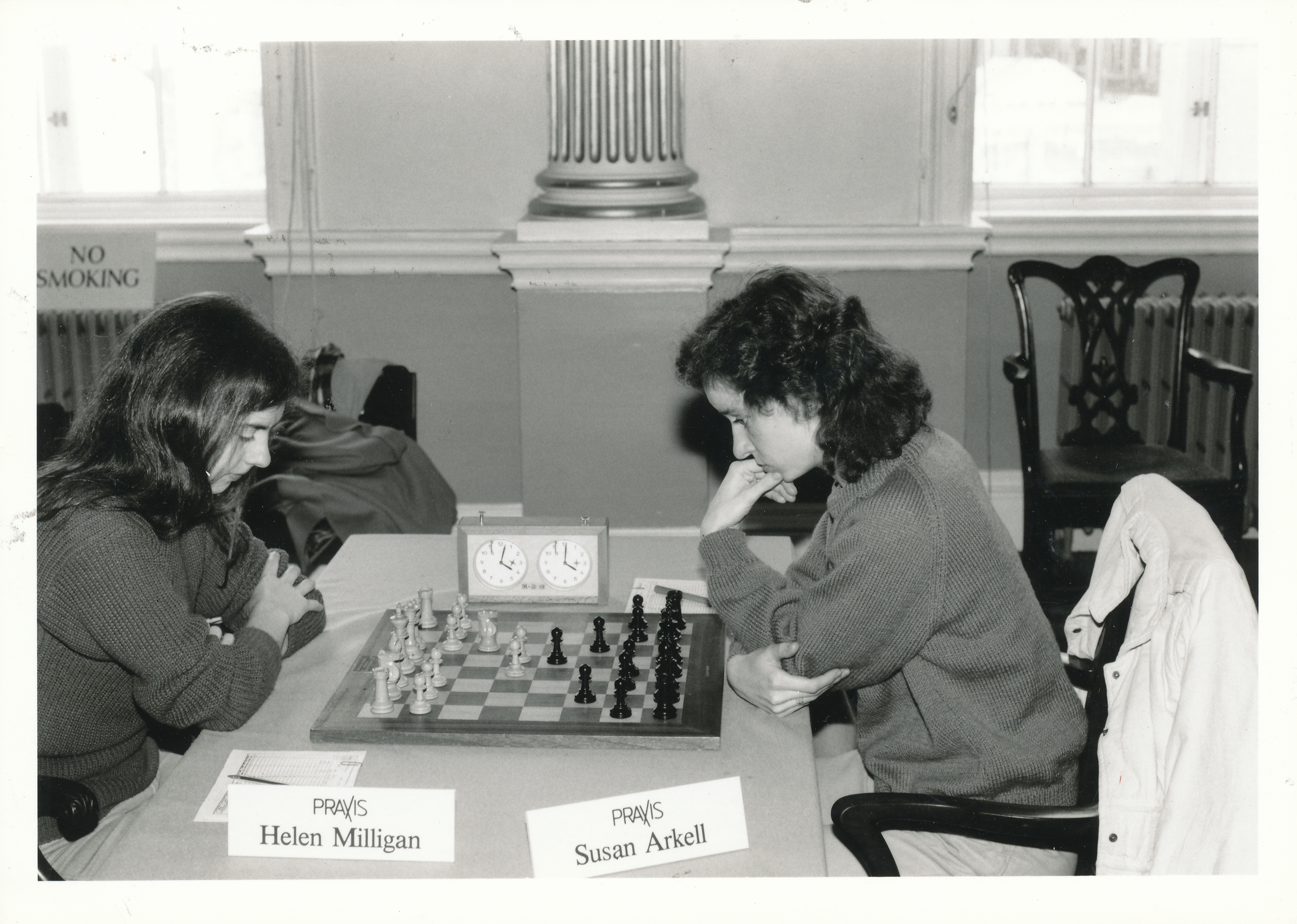
WFM Helen Milligan vs Susan Arkell
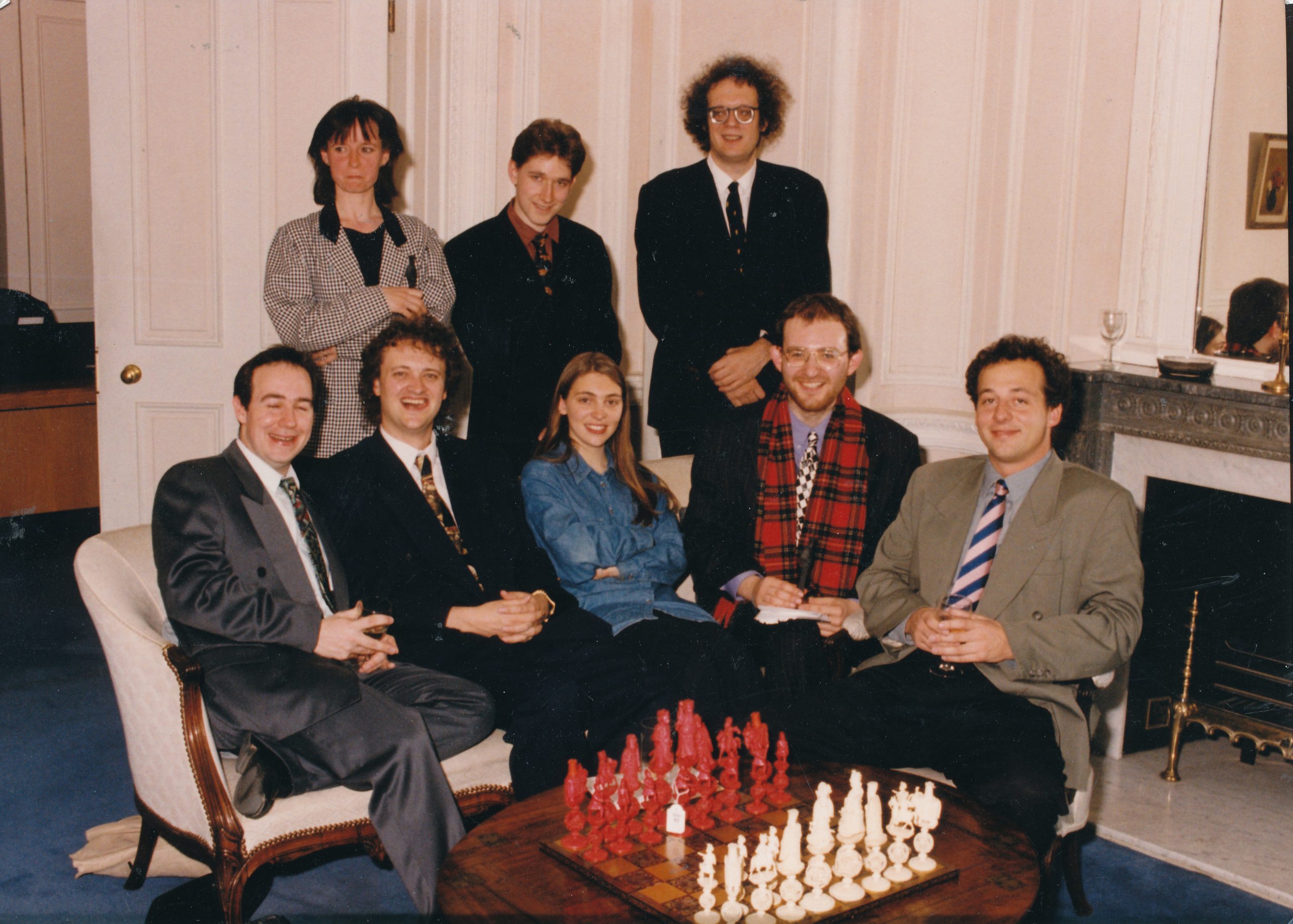
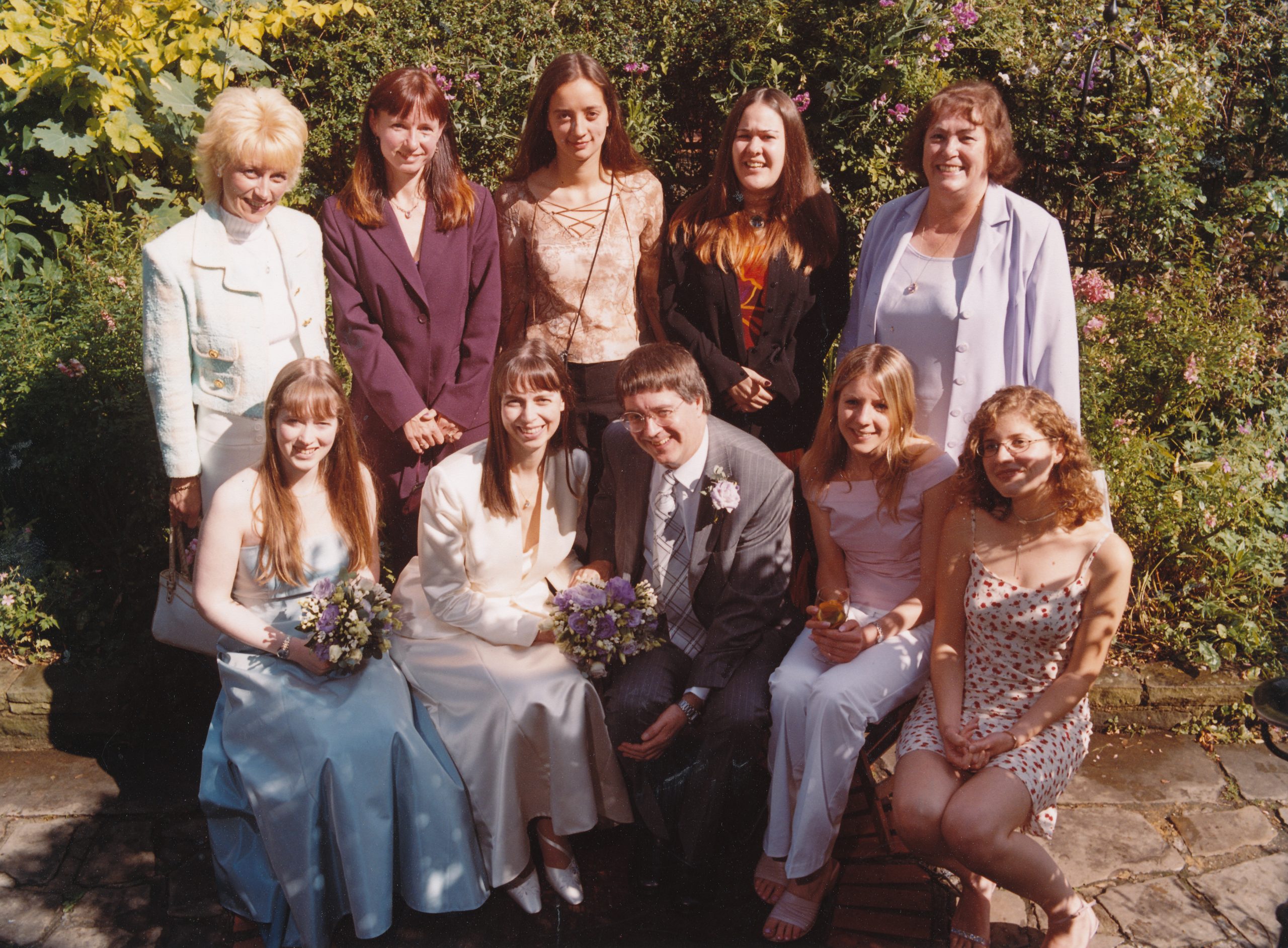
Susan Lalic and friends
From Wikipedia :
“Susan Kathryn Lalic (née Walker; born 28 October 1965) is an English chess player, holding both International Master (IM) and Woman Grandmaster (WGM) titles. She is five-time British Women’s Chess Champion: 1986, 1990–1992, and 1998.[2]
Lalic has played for England nine times in Chess Olympiads, from 1984 to 2000, inclusive. From 1986 to 1998, she played on the top board.[3]
Lalic was educated at Nonsuch High School for Girls from 1977 to 1984, and has been married in the past to Keith Arkell and then to Bogdan Lalić. Currently she is married to International Master Graeme Buckley.[4][5]
Highest rating from 1987-2012 is 2356(within 133 games)[6]”
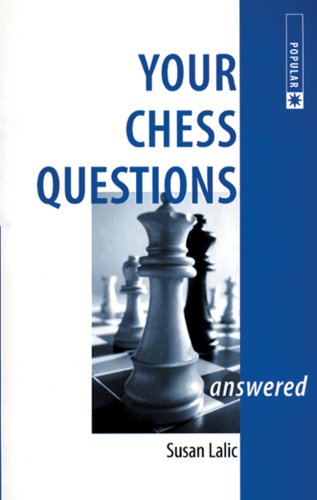
Susan Lalic and friends, rear, second from leftYour Chess Questions Answered by Susan Lalic,, 1999
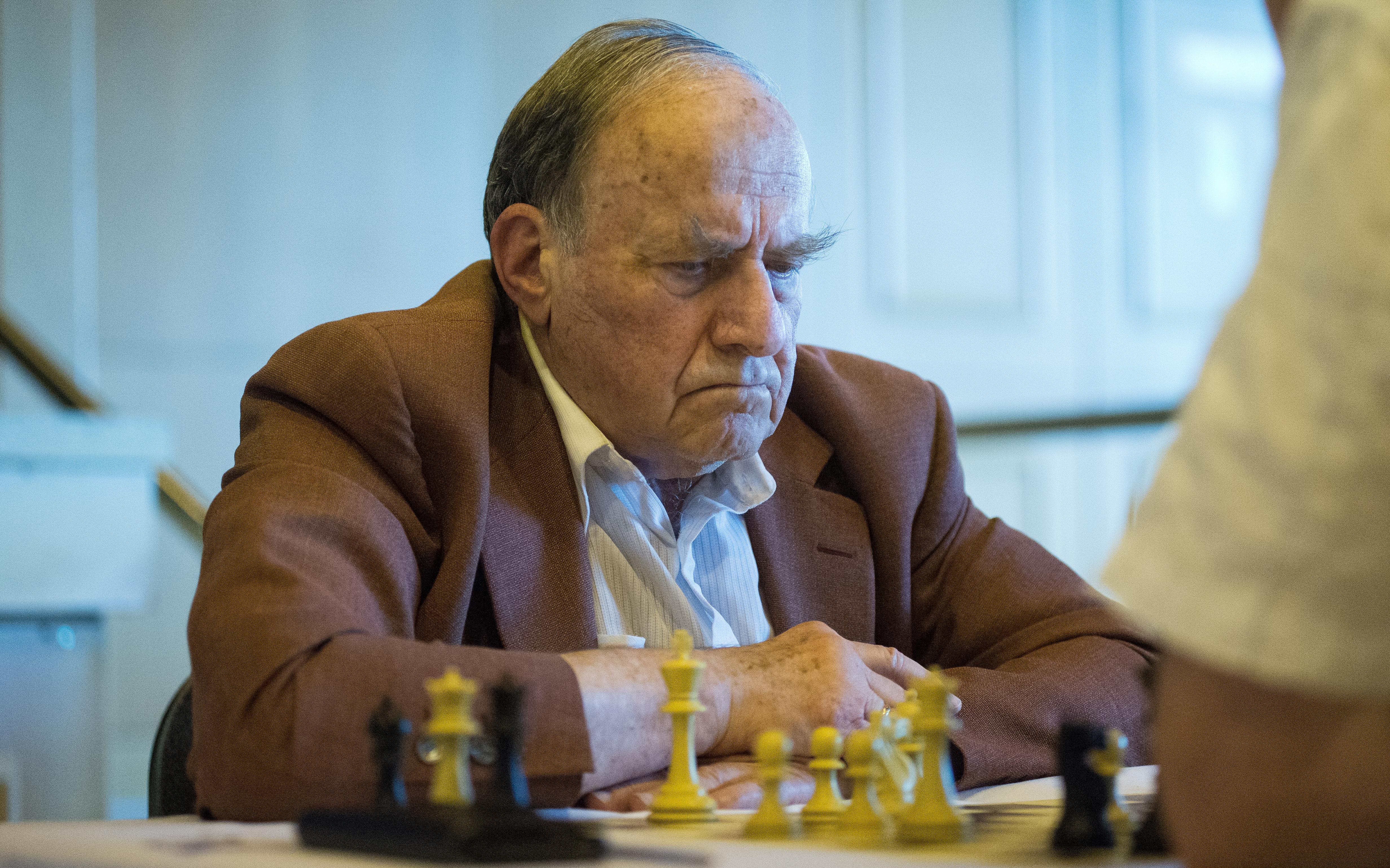
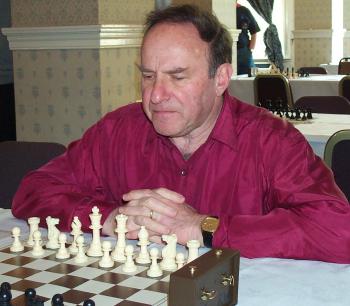
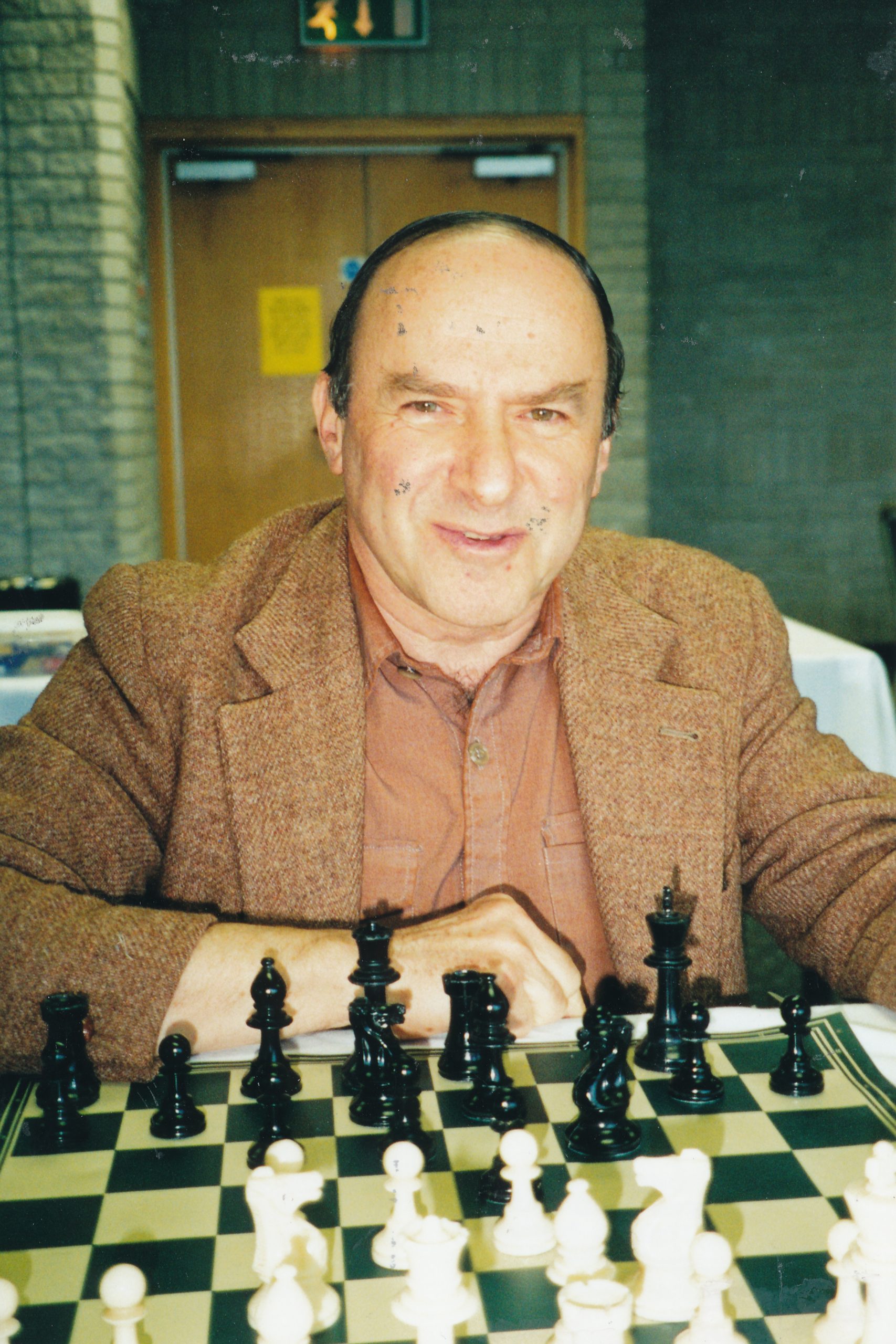
IM James Terry Sherwin, image by John Upham Photography
We send best wishes to IM James Sherwin, a welcome long term visitor from “over the pond”
James Terry Sherwin was born on Wednesday, October 25th 1933 in New York. and attended The University of Columbia.
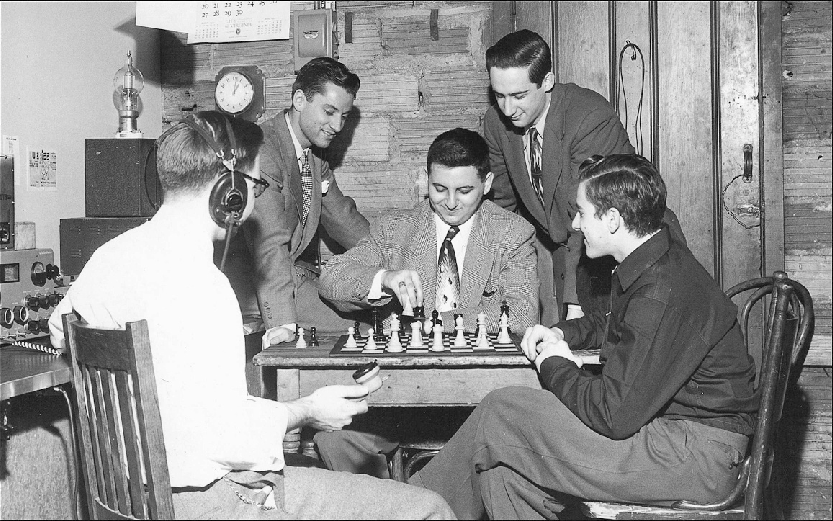
The Columbia College chess team of 1949–1952 after a radio match with Yale. Right to left: James Sherwin, Eliot Hearst, Carl Burger, Francis Mechner (Courtesy of the Columbia University Archives).
He became an International Master in 1958 at the age of 25 and, according to Felice, his peak FIDE rating was 2400 in 1969.
Much to his chagrin (we recommend you do not ask him about this!) James is famous for the “Sherwin slid the rook here with his pinky, as if to emphasize the cunning of this mysterious move” annotation in Game 1, “Too Little, Too Late” of My Sixty Memorable Games by Robert James Fischer (and game introductions by Larry Evans).
Since 1999 James has been a frequent entrant to English Rapidplay tournaments at Richmond and Golders Green and, in August 2019 in Torquay, aged 86, tied for first place in the Rapidplay event at the British Championships.
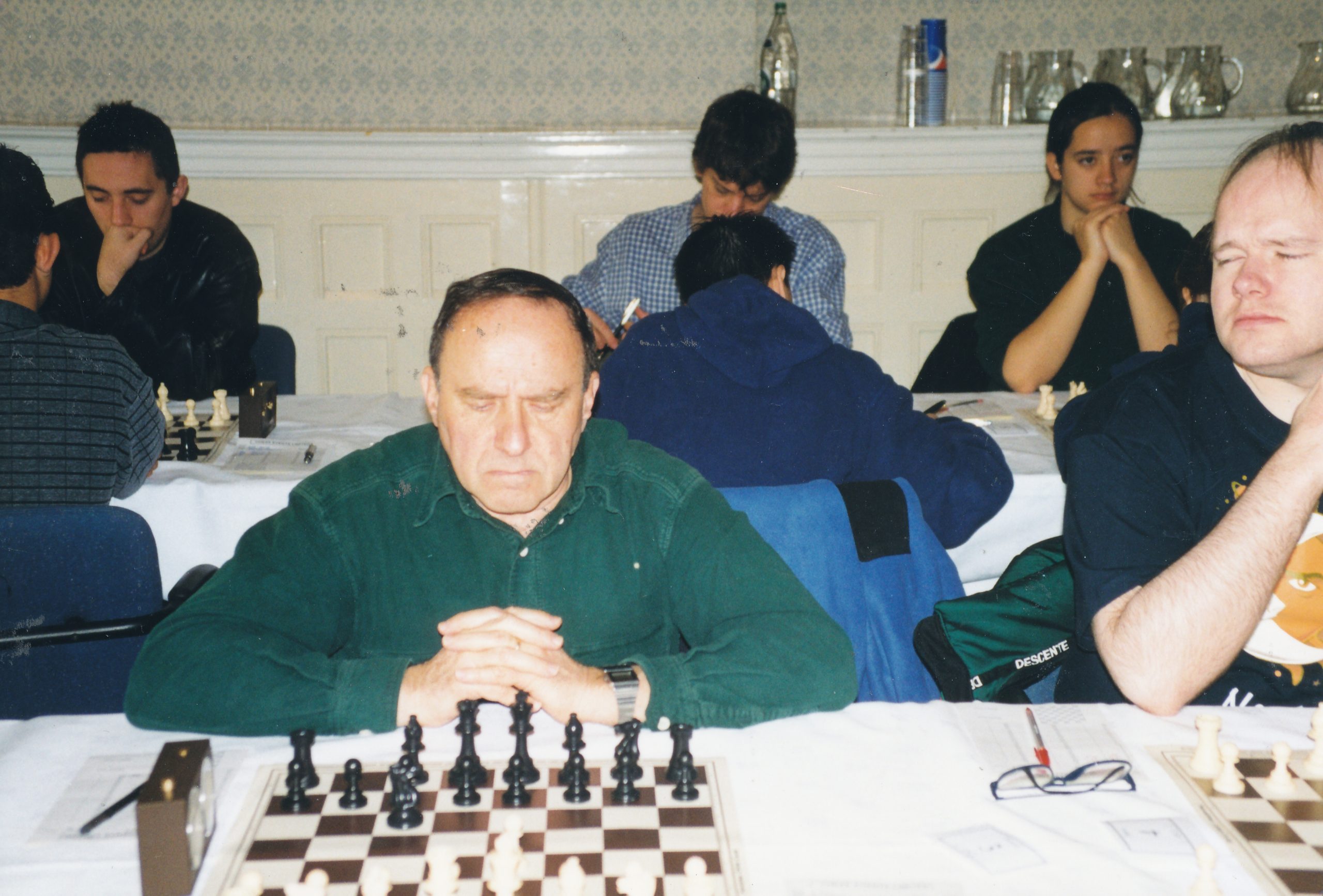
IM James Sherwin
James is registered with the Wiltshire County Chess Association and since 2015 has played only rapidplay games rated by the ECF. He currently has a rating of 204D.
With the white pieces James plays 1.d4, 1.Nf3 and 1.e4 in that order of preference.
As the second player he essays the Sicilian Najdorf and the Grünfeld Defence.
He has plus scores against Donald Byrne, Robert Byrne, Herbert Seidman, Sidney Bernstein, George Kramer and Raymond Weinstein (amongst others). His score with Fischer was 1.5/8 (but don’t mention it!).
“James Terry Sherwin, born in New York, became an International Master in 1958. In 1961, he was Chairman of the USCF Rules Committee. He was the Executive Vice President of GAF Corporation who was the American Chess Foundation (ACF) President from 1979 to 1990. He took 5th place in the 1953 World Junior Championship. He tied for 1st place with Alexander Kevitz in the 1954-55 Manhattan Chess club championship. He took 17th place in the Portoroz Interzonal (1958). Sherwin finished in 3rd place twice in US chess championships (1957-58 and 1958-59). He won the first Eastern Open Chess Championship, held in Washington DC, in 1960.”
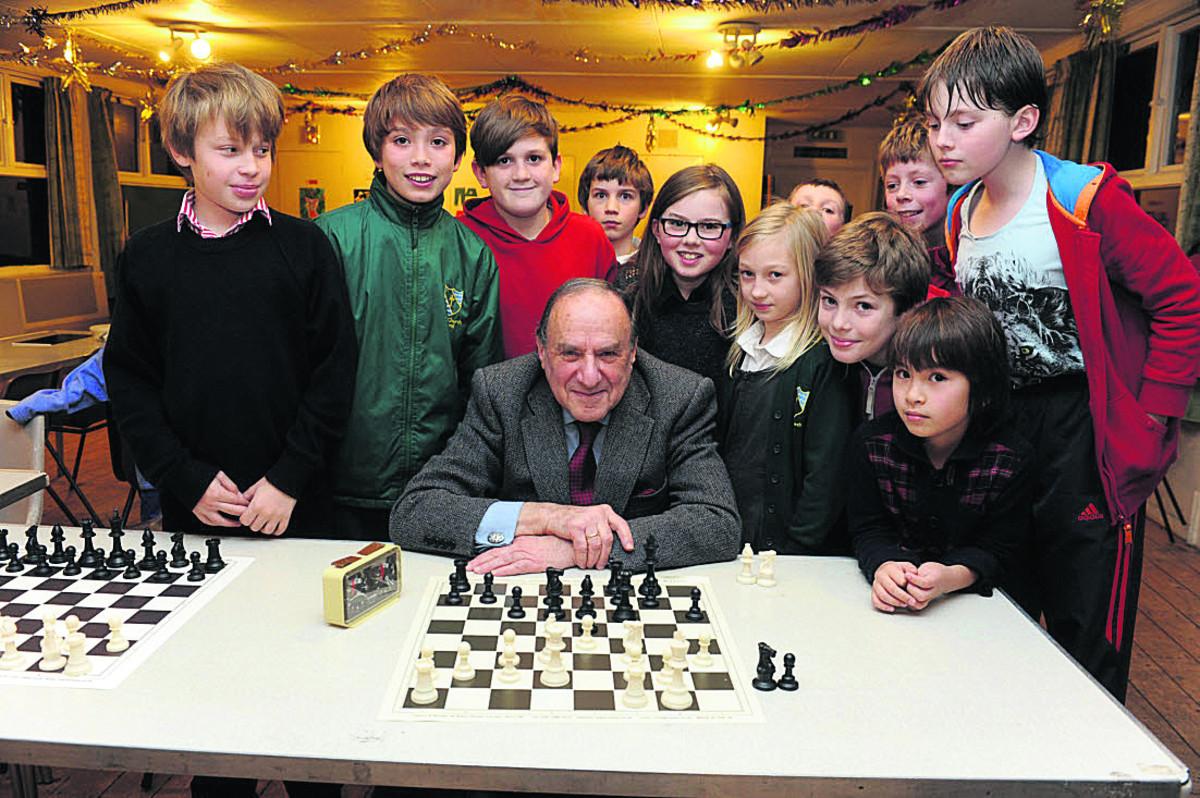
Mr Sherwin, 80, met and played against the new members of Bradford & Avon Valley Youth Chess Club on their opening night at St Nicholas Hall on Tuesday. Photo courtesy of The Wiltshire Times
From Wikipedia :
“James Terry Sherwin (born October 25, 1933)[1] is an American corporate executive and International Master in chess.
Born in New York City[1] in 1933, Sherwin attended Stuyvesant High School, Columbia College (Phi Beta Kappa) and Columbia Law School. He graduated from the U.S. Coast Guard Academy Officer Candidate School in 1956 and later became a Lieutenant Commander. He is an attorney admitted to the New York and Supreme Court Bars. He joined GAF Corporation in 1960 serving in various legal and operational roles and eventually becoming its Chief Financial Officer. He was CFO at Triangle Industries from 1983 to 1984, rejoining GAF Corporation as Vice Chairman from 1985 to 1990.
IM James T Sherwin
While at GAF, in 1988, he was indicted by the US Attorney for the Southern District of New York, Rudolph Giuliani, for stock manipulation in connection with the 1986 sale of stock owned by GAF.[2] He was convicted after three trials, but the conviction was reversed on appeal[3] and dismissed with prejudice.[4] In 1991 he was appointed Executive Vice President and Chief Financial Officer of Hunter Douglas N.V., a Dutch multinational company, in which capacity he served until 1999. Since then he has been a Director and an adviser to Hunter Douglas.
IM James T Sherwin
He is an Overseer of the International Rescue Committee and member of the Association of the Bar of the City of New York. He received an Honorary Doctor of Laws Degree from the University of Bath in December, 2007.”
“In chess, Sherwin finished third and tied for third in the US Chess Championship four times and tied for fourth three times.[5] He was Intercollegiate Champion and New York State Champion in 1951 and US Speed Champion in 1956–57 and 1959–60. He earned the International Master title in 1958.[1] He played in the Portorož Interzonal in 1958, which was part of the 1960 World Championship cycle. While he finished only 17th out of 21 players, he scored (+2–2=2) against the six players who qualified from the tournament to the Candidates tournament at Bled 1959. He is a previous President of the American Chess Foundation.
Sherwin resides with his wife, Hiroko, near Bath, United Kingdom.”
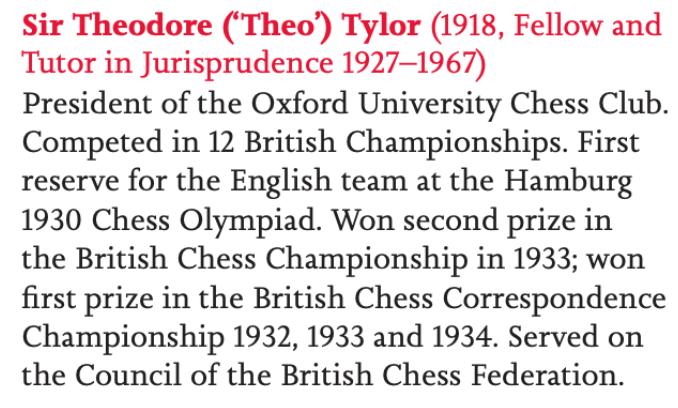
BCN remembers Sir Theodore Tylor who passed away on Wednesday, October 23rd, 1968.
Theodore Henry Tylor was born on Sunday, May 13th, 1900 in Bournville, (at the time) in northern Worcestershire. Now Bournville is in the metropolitan borough of Birmingham.
His father was Henry Bedford Tylor and his mother Minnie Belle Cater were both 29 when Theo was born. He had one sister Rachel Hope who was born on 1 November 1909 in Kings Norton, Worcestershire, when Theodore Henry was 9 years old.
In the 1911 census Theo is shown as living in Worcester as a student. His father passed away on 26 February 1915 in Birmingham, Warwickshire, at the age of 44.
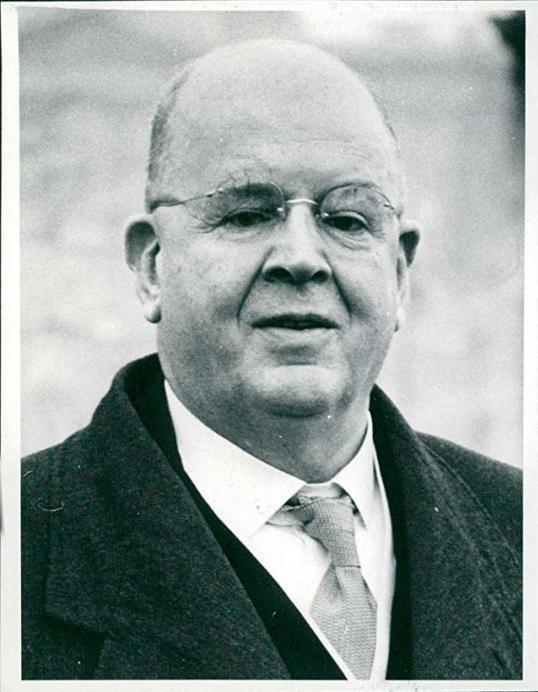
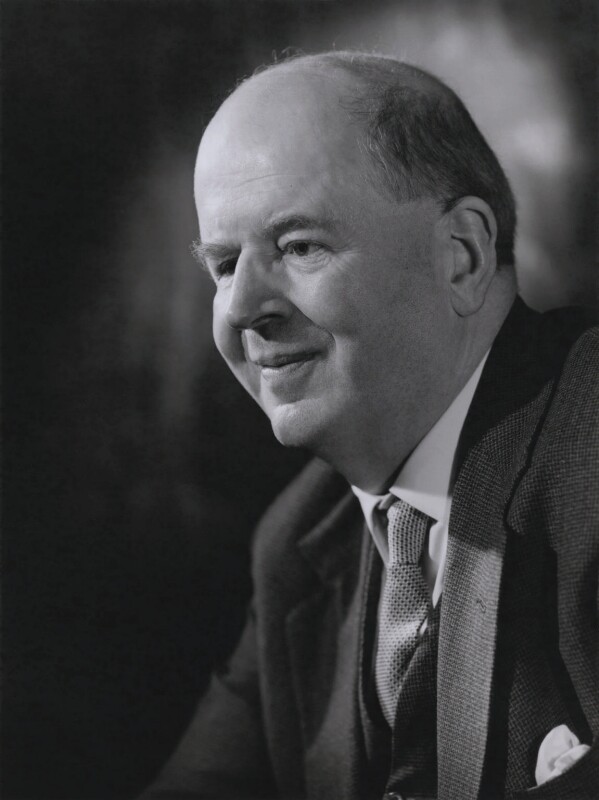
Theodore Henry Tylor, Courtesy of John Saunders and Britbase
In 1939 Theo was living at 2, Rawlinson Road, Oxford where he continued to live until his death.
We are grateful to John Foley writing in Floreat Domus (the Balliol College magazine) who wrote this about Tylor :
Article about TH Tylor by John Foley
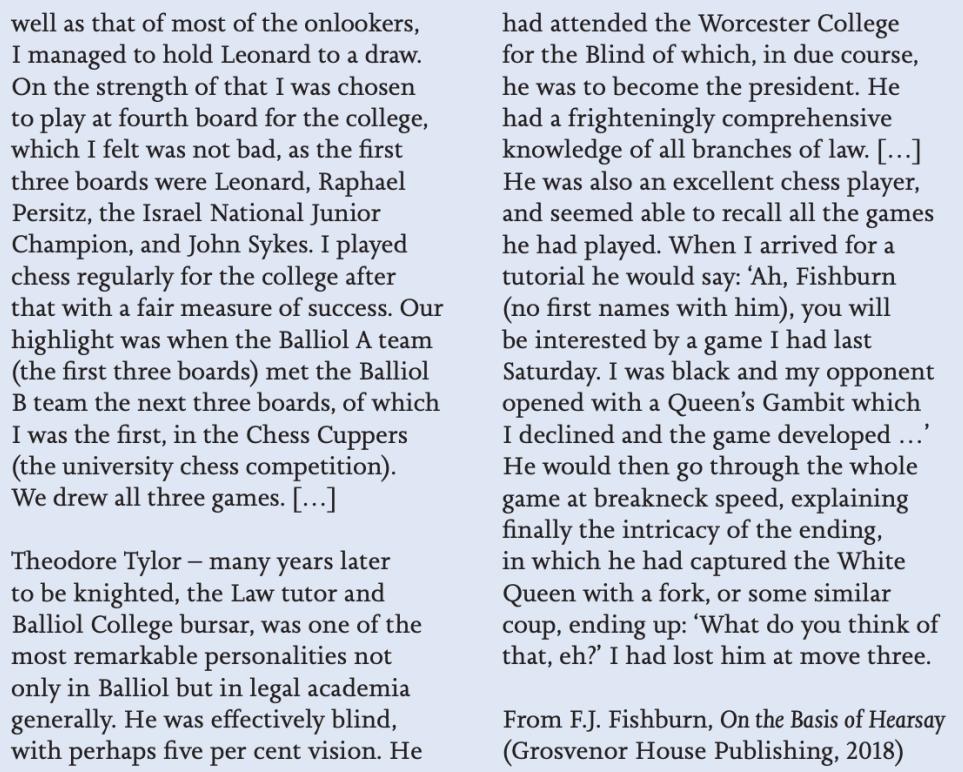
and, following this, John reproduced an item from On the Basis of of Hearsay, Grosvenor House Publishing, 2018 :
Chess in the 1950s : Fred Fishburn Remembers
From British Chess Magazine, Volume LXXXIX (1969), Number 1 (January), pp 6-7 we have the following article :
“The death of Sir Theodore H. Tylor at the age of sixty-eight was reported in The Times of October 24th. The announcement will be received with deep regret by the many chess enthusiasts who will remember him as a cheerful and extremely resourceful opponent who triumphed over the handicap of near-blindness and lived such a full and distinguished life that it earned him the admiration and respect of the world.
The Times has already done full justice to his work as Fellow and Tutor in Jurisprudence at Balliol for nearly forty years and to his service to organizations for the blind for which he was most justly knighted in 1965, but it barely mentioned that side of his life with which we chess-players were more intimately acquainted.
His education at Worcester College for the Blind naturally brought him into contact with chess and he became a very strong player. ln 1925, at the age of twenty-five, he was among the twelve players selected for the British Championship at Stratford-on-Avon and fully justified the selectors’confidence by taking fourth prize, behind Atkins, Yates, and Edmund Spencer, and ahead of Winter.
It was another four years before he became really active, but in 1929 he again played in the Championship and shared fourth prize with J. H. Morrison and W. Winter behind, Sultan Khan, H. E. Price, and R. P. Michell. He followed this with his first visit to Hastings and in the 1929-30 congress put up the best performance of his career, sharing first prize with Koltanowski, in front of Flohr, Reijifir, Rellstab, Alexander, Jackson, Noteboom, Vidmar Jnr., and Winser. This, by the way, was only a Premier Reserves!
This performance evidently impressed the selectors, for the following summer brought an invitation to play for the B.C.F. team in the Hamburg Olympiad, where he won one, drew four, and lost two games. ln the 1930-31 Hastings Congress he made the first of nine appearances in the Premier Tourney, but he never managed to maintain sufficient consistency to win honours in this exalted company and was never able to finish higher than equal sixth (in
1936-7). ln the nine tournaments he won ten tames (of which only two were against non-British opposition-Feigin and Medina) and drew thirty-three (including World Champions Alekhine and Euwe and grandmasters Fine, Flohr (three times), Keres, Sultan Khan, Tartakower, and Vidmar). ln 1934-5 he again tied with Koltanowski for first place in the Premier Reserves.
Sir Theodore Henry Tylor
ln twelve British Championships his best performance was at Hastings in 1933 where he finished second, 1/2 point behind Sultan Khan and lost only to C. H. O’D. Alexander. In nine of the twelve he was in the first six, and was four times a prize-winner. He was chosen to play for England against Holland in 1938, 1948, and 1952, and against Yugoslavia in 1951. ln these games he won four and lost four. He was selected to play against
the U.S.S.R. in 1946, but had to withdraw at the last minute.
In 1936 he was chosen as one of the four British players in the Nottingham lnternational Tournament. This caused some dissatisfaction among other disappointed aspirants, but he came ahead of Alexander, Thomas, and Winter and captured the scalps of Flohr and Tartakower. ln the same year he was fifth at Margate, where he drew with Capablanca, Lundin, and Stahlberg.
Finally, a word should be said about his work away from the board. For six years he was President of the Chess Education Society, in whose work he took a lively interest from its foundation in 1943. He was President of the Midland Counties Union from 1946-9. He played top board for Oxfordshire for many years and captained the team for a period. We mourn a great friend of chess and a fine player who was a true amateur and obviously enjoyed every minute he spent among us.”
“In spite of the handicap of partial blindness, Tylor enjoyed a successful academic career and was for nearly forty years a Fellow and tutor in jurisprudence at Balliol College, Oxford. He took up chess seriously while a schoolboy at Worcester College for the Blind and later as an undergraduate captained the Oxford University chess team.
At Hastings 1929/30, Tylor shared first prize with Koltanowski in the Premier Reserves ahead of Flohr, Reijfir, Rellstab, Alexander, Jackson, Noteboom, Vidmar Jr. and Winser. He played in the Hastings Premier event on nine occasions, but never finished in the top half. He competed in the British Championship twelve times, his best result being 2nd to Sultan Khan in 1933. He was selected for the BCF team in the Hamburg 1930 Olympiad and was British Correspondence Champion in 1933, 1934 and 1935.”
Worcester, circa 1931: Mir Sultan Khan (left) plays Theodore Tylor, while Sir George Thomas (far left) and Arthur Mackenzie (far right) spectate. Photo courtesy of Britbase.
“Sir Theodore Henry Tylor (13 May 1900 – 23 October 1968)[1] was a lawyer and international level chess player, despite being nearly blind. In 1965, he was knighted for his service to organisations for the blind. He was Fellow and Tutor in Jurisprudence at Balliol College, Oxford for almost forty years.[2]
Born in Bournville, Tylor learned to play chess at age seven. His chess skill increased while he attended Worcester College for the Blind from 1909 to 1918. He studied at Oxford University beginning in 1918, and captained the Oxford University Chess Club. Tylor received First-class Honours in Jurisprudence in 1922 and was made an honorary scholar of Balliol College. The next year, he became a Bachelor of Civil Law and a lecturer at Balliol College. Called to the Bar by the Inner Temple with a certificate of honour, he was made a Fellow at Balliol College in 1928.”
“Tylor competed in twelve British Championships, finishing fourth in his first appearance in 1925. His best result was in 1933, finishing second to Mir Sultan Khan.[2][3] He tied for first at the 1929/30 Hastings Premier Reserves alongside George Koltanowski ahead of Salo Flohr, Josef Rejfiř, Ludwig Rellstab, C.H.O’D. Alexander, Daniël Noteboom, and Milan Vidmar.[2] Tylor played in the top section, the Hastings Premier, nine times beginning in 1930/1. His best finish was 6th= in 1936/7.[3] He was first reserve for the English team at the Hamburg 1930 Chess Olympiad.
Tylor won the British Correspondence Chess Championship in 1932, 1933, and 1934.[1][2] He shared 5–6th at Margate 1936 with P. S. Milner-Barry, but he won their individual game and drew with 2nd- to 4th-place finishers José Raúl Capablanca, Gideon Ståhlberg, and Erik Lundin (Salo Flohr won). Although he finished 12th at Nottingham 1936, he had the best score of the British participants, ahead of C. H. O’D. Alexander, G. A. Thomas, and William Winter.[5] Mikhail Botvinnik noted that Tylor was using a tactile chess board that he incessantly fingered, as well as a device for counting the number of moves made.”
“Tylor was President of the Midland Counties’ Chess Union from 1947 to 1950, but his work for the university and for the welfare of the blind limited the time he had to devote to chess. Tylor also enjoyed bridge.[3] He died in Oxford on 23 October 1968.”
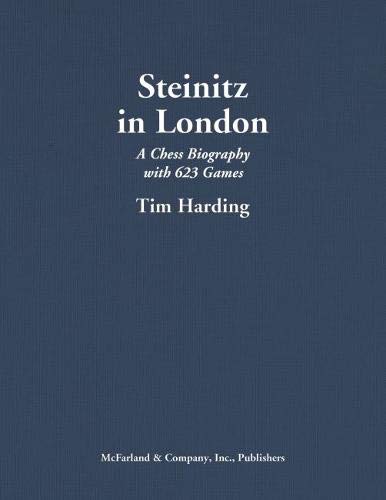
Steinitz in London: A Chess Biography with 623 Games
Steinitz in London : A Chess Biography with 623 Games : Tim Harding
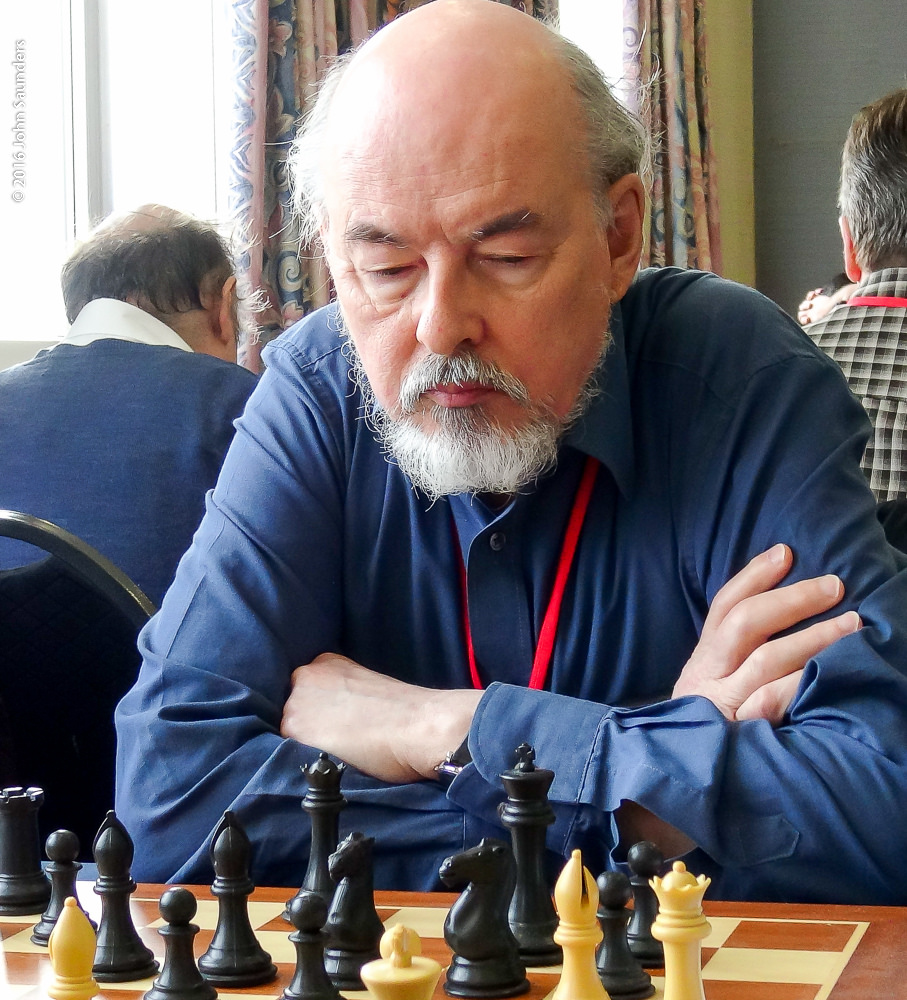
Timothy D. Harding
“Tim Harding played for Ireland at the 1984 FIDE chess Olympiad in Thessaloniki. He is a FIDE Candidate Master and a Senior International Master of correspondence chess. A well-known writer on many aspects of chess, Tim is a former editor of Chess Mail magazine and for almost 20 years he contributed monthly articles in “The Kibitzer” series. He lives in Dublin, Ireland.”
From the publisher’s blurb :
“Drawing on new research, this first biography of William Steinitz (1836-1900), the first World Chess Champion, covers his early life and career, with a fully-sourced collection of his known games until he left London in 1882. A portrait of mid-Victorian British chess is provided, including a history of the famous Simpson’s Divan. Born to a poor Jewish family in Prague, Steinitz studied in Vienna, where his career really began, before moving to London in 1862, bent on conquering the chess world. During the next 20 years, he became its strongest and most innovative player, as well as an influential writer on the game. A foreigner with a quarrelsome nature, he suffered mockery and discrimination from British amateur players and journalists, which eventual drove him to immigrate to America. The final chapters cover his subsequent visits to England and the last three tournaments he played there.”
Collectors of McFarland’s chess biographies will know exactly what to expect.
A handsome, beautifully produced hardback book based on extensive and exhaustive research, in this case concerning William Steinitz (Harding prefers to use the anglicized spelling of his name), the first official world champion.
He was born under the name Wolf Steinitz into a Jewish family in Prague in 1836, making him a year older than Morphy. He moved to Vienna to study mathematics in 1858, and it was there that he started playing chess seriously. In 1862 he travelled to London to play in an international tournament, and remained there, living the life of a chess professional, for 20 years.
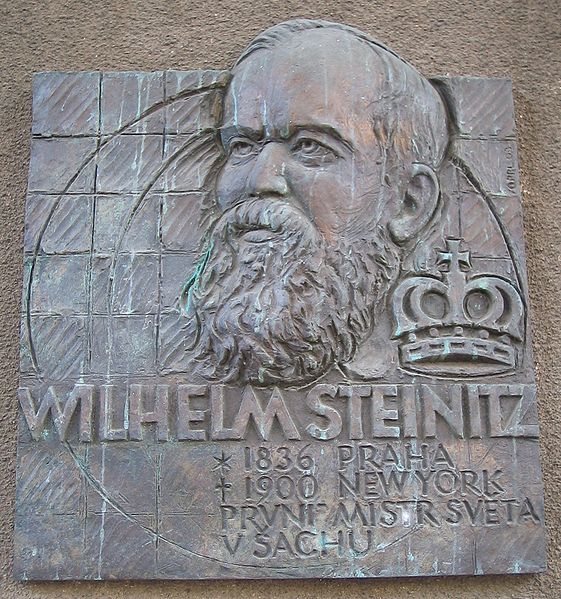
Wilhelm Steinitz
Here’s Harding, in the Preface:
“This is not just a game collection but also an important biographical work. Subsequent to his triumphant comeback at the Vienna international tournament and his resignation as chess editor of The Field, Steinitz left England for a long tour of America. In the spring of 1883 he returned to play in the London 1883 tournament, after which he spent some more time in London; Chapter 12 deals with this. Steinitz then left England permanently and did not set foot in the country for another 12 years. The final chapter deals with his last visits to Britain which included two major tournaments, Hastings 1895 and London 1899. There is much less biography than chess in those two chapters but some information about his European tours is included. The tasks of writing a new biography of the final phase of Steinitz’s life after he left England, and of providing an authoritative game collection of his post-London period, are left for future scholars.
“The primary motivation for embarking on the research for this book was to present a chronological account of Steinitz’s two decades as an English resident, covering both the development of his chess career and significant life events. The chapter about Steinitz in this author’s earlier work, Eminent Victorian Chess Players, may be seen as a first essay in that direction but the present book goes much deeper, including appendices that document various controversies in which Steinitz became embroiled. The book also includes background sections about chess life in London going back to the earlier nineteenth century, dealing with London’s early chess clubs and public places where the game was played, before and during Steinitz’s time.”
Harding chose to include all available games from Steinitz’s time in London, some of which have only recently been rediscovered in old newspaper and magazine columns, so you have in total 623 games, mostly with some annotations from contemporary sources, occasionally, where appropriate, with interjections from Stockfish 10. In those days, of course, there were few tournaments, so he made a living, apart from journalism and teaching (one of his pupils was Lord Randolph Churchill, Winston’s dad), by giving simultaneous displays and playing against amateurs, who would pay for the privilege. If the games were particularly interesting or brilliant, they would find their way into print. In the early part of his career, Steinitz was renowned for his tactical acumen, so the book is crammed full of romantic King’s Gambits and Evans Gambits. Lovers of this style of chess won’t be disappointed.
In his preface, Harding draws the reader’s attention to two games in particular:
All the games have been checked using every primary source with discrepancies noted. So if you want a full and accurate record of every currently available Steinitz game from his time in London, along with some earlier games from his time in Vienna and those from his later English tournaments, look no further.
But what you also get is a lot of background information about chess in London during that period. The clubs, the events, the personalities, the disputes: everything is there. One of my personal interests is the changing position of chess within society over the past 200 years, and the changing demographics of the people who were attracted to the game over the years. In Steinitz’s time, as you would expect, chess clubs were entirely male and largely upper middle class. Most readers will be aware that chess was a particularly popular pastime amongst Church of England clergymen well into the 20th century. Helpfully, at least to me, Harding will often provide the full name and a one sentence biography of Steinitz’s amateur opponents. Although he is very thorough when researching Steinitz and his games, he tends only to consult one source for his opponents.
I decided to follow up a few random names through a quick search of genealogical websites: I found one or two mistakes and was also to provide probable identification in several cases where only the initial and surname were given. I also came across some fascinating stories which I’ll relate another time.
But this is just me: none of this will matter to most readers, who will be more interested in Steinitz than his opponents. It’s unrealistic to expect Harding to research these minor figures with the same diligence afforded to his protagonist.
Make no mistake about it: this is a major addition to the literature of our game, marked by scholarly research and historical accuracy, and, as such, deserves a place in the library of anyone with an interest in chess history. McFarland and their authors are doing an enormous service to the chess community by publishing books of this nature: this volume will sit alongside several other Harding works, notably his biography of Blackburne, Renette’s biography of Bird and Forster’s biography of Burn on your shelf devoted to 19th century British chess history.
But it’s not just a dry as dust history book. It’s a gripping read as well. Harding tells his story with panache, leaving the reader eager to turn the page and find out what happened next, helped, in part, by his subject’s disputatious nature. Whatever you do, don’t miss out on the appendices, in particular where Steinitz describes how he was allegedly assaulted by Blackburne on two occasions: “… he pounced upon me and hammered at my face and eyes with fullest force about a dozen blows, until the bedcloth and my nightshirt were covered with blood.”.
It is to be hoped that a future volume will appear, perhaps written by an American chess historian, covering the latter stages of Steinitz’s career. A Best Games collection, looking at his play through both 19th and 21st century eyes, would also be a valuable edition to chess literature.
A large book with high production values and a niche market is never going to come cheap, but, even if you’ve never read anything of this nature before, you might want to give it a try. With chess clubs closed and pubs offering restricted services, what better way could there be to spend your winter evenings?
Very highly recommended: 2020 has been an excellent year for chess books and this is certainly one of the best.
Steinitz in London: A Chess Biography with 623 Games
Save as PDF
We focus on the British Chess Scene Past & Present!
This website uses cookies to improve your experience. We'll assume you're ok with this, but you can opt-out if you wish. Cookie settingsACCEPT
Privacy & Cookies Policy
Privacy Overview
This website uses cookies to improve your experience while you navigate through the website. Out of these cookies, the cookies that are categorized as necessary are stored on your browser as they are as essential for the working of basic functionalities of the website. We also use third-party cookies that help us analyze and understand how you use this website. These cookies will be stored in your browser only with your consent. You also have the option to opt-out of these cookies. But opting out of some of these cookies may have an effect on your browsing experience.
Necessary cookies are absolutely essential for the website to function properly. This category only includes cookies that ensures basic functionalities and security features of the website. These cookies do not store any personal information.
 Save as PDF