Tag Archives: 2021

Death Anniversary of Cyril Kipping (10-x-1891 17-ii-1964)

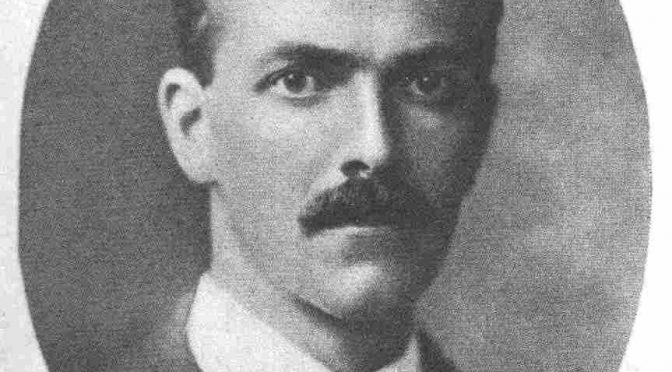
BCN remembers Cyril Kipping who passed away in Walsall on February 17th 1964 at the age of 72.

Cyril Henry Stanley Kipping was born on Saturday, October 10th, 1891 in 7 Milborne Grove, South Kensington, London, SW10 9SN.
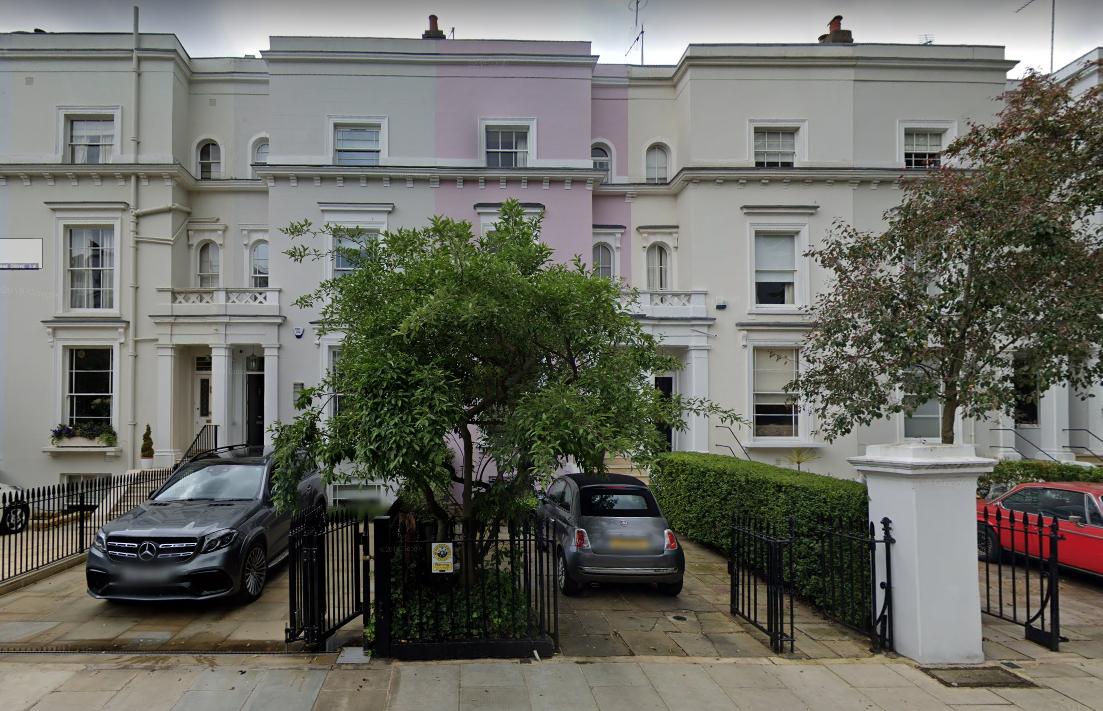
7 Milborne Grove, South Kensington, London, SW10 9SN.

His parents were Frederick Stanley Kipping (28) and Lillian Kipping (24, née Holland) : they married in 1888. Cyril was baptised on May 8th, 1892 in West Brompton, London. Frederick died on 30 April 1949 in Pwllheli, Caernarvonshire, at the age of 85 and Lilian passed away on 4 September 1949 in Pwllheli, Caernarvonshire, at the age of 82.

Frederick was Professor of Chemistry at The University of Nottingham. He undertook much of the pioneering work on silicon polymers and coined the term silicone. He was elected a Fellow of the Royal Society in 1897.
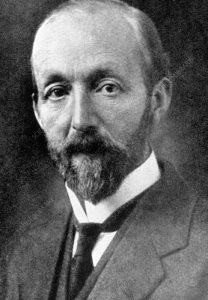
Frederick Stanley Kipping, FRS

In the 1901 census the family lived at Clumber Road West, Nottingham and brother Frederick Barry Kipping was born on April 14th 1901 and his sister Kathleen Esme was born on 3 May 1904 was also born in Nottingham. Kathleen died on 30 August 1951 in Pwllheli, Caernarvonshire.

In 1902 Cyril started at Nottingham High School excelling in mathematics and science and in 1906 he obtained the Oxford and Cambridge Board’s Lower Certificate.

On March 2nd 1908 the Sheffield Daily Telegraph published a matriculation list for London University and CHSK was listed as being in the second division from Nottingham High School. Following that in 1909 Cyril obtained a Oxford and Cambridge Higher Certificate.
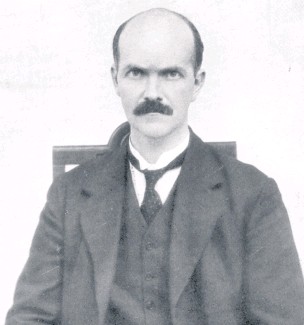
CHS Kipping
CHS Kipping

As of the 1911 census the household now included Cyril’s maternal Grandmother, Florence Holland (59) plus a parlourmaid, a housemaid, a cook and a nurse. Cyril was recorded as being a 19 year old science student and they lived at 40, Magadala Road, Nottingham which appears to have been replaced by residential flats. Curiously the address on the Census record was obscured by green insulation tape but insufficiently for it to readable.

According to Stephen C. Askey

“He left school in July 1910 and went to Trinity Hall in Cambridge where he read for the National Sciences Tripos. He played tennis for his college and launched into the composition of chess problems (1).

He obtained a First in Part I of the Tripos in 1912, a First in Part II in 1913, and was awarded the degree of Bachelor of Arts on 7 June 1913. He began researching in organic chemistry at Cambridge, but in September 1914 decided instead to take a teaching appointment at Weymouth College.”

In 1914 The London Gazette announced that Cyril was promoted within the Chaplain Department of the British Army to Second Lieutenant with a service number of 10940.

On December 23rd 1914 The London Gazette announced the following :
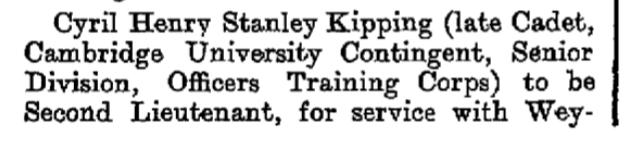
The London Gazette, December 22nd 1914, part one

and

The London Gazette, December 22nd 1914, part two

On the 9th October 1918 The London Gazette announced :

The London Gazette, 8th October 1918

Again, According to Stephen C. Askey :

“In January 1919 he took his Master of Arts degree at Cambridge, and joined the teaching staff of Bradfield College in Berkshire. But by the summer of that year he became an assistant master at Pocklington School in Yorkshire, where he spent five happy years.

There he used his talent for juggling in 1920 to train a troupe of jugglers who gave a display at a school concert. This popular performance was repeated annually at Pocklington. Meanwhile be continued to compose chess problems and in 1923 published a book for beginners called The Chess Problem Hobby.”

In the 1939 register Cyril was recorded as residing at 67 Wood Green Road, Wednesbury, Staffordshire, England with Martha Partridge (born 29th June 1886) who was his Housekeeper.
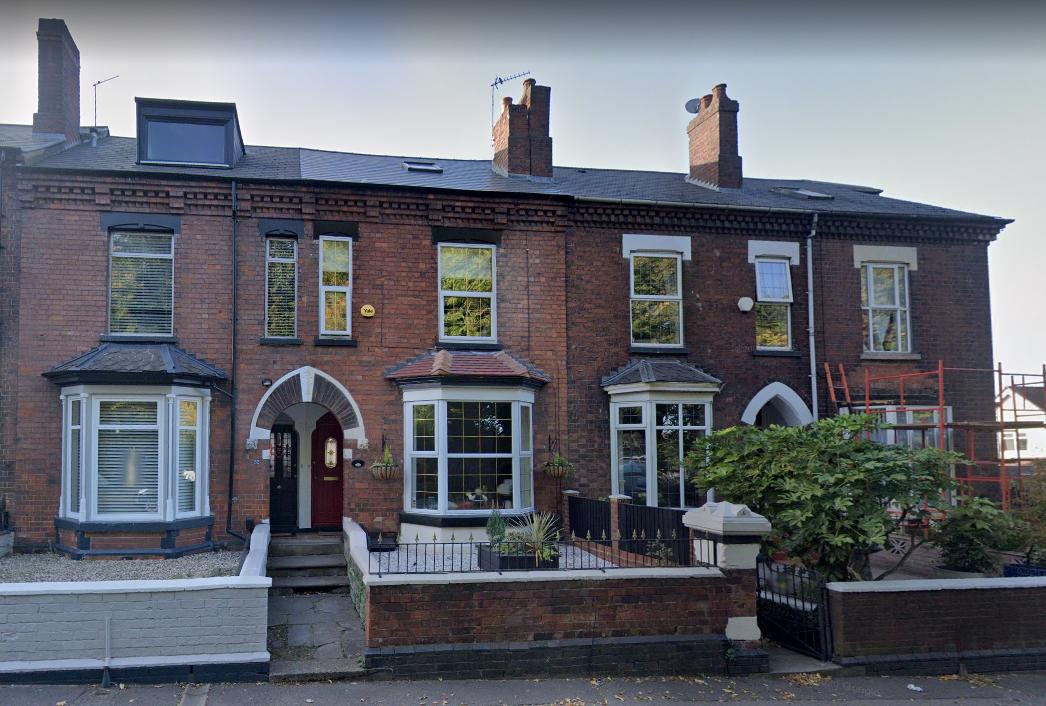
Wood Green Road, Wednesbury, Staffordshire

His probate record appears in the England & Wales Government Probate Death Index 1858-2019 as :

1964 Probate record for Cyril Henry Stanley Kipping

From The Encyclopaedia of Chess (Robert Hale 1970 & 1976), Anne Sunnucks :

“International Master of the FIDE for Chess Compositions (1959) and International Judge of the FIDE for Chess Compositions (1957). Born on 10th October 1891. Died on 17th February 1964. Kipping was famous as a composer and an editor which he combined with is duties as Headmaster of Wednesbury High School from 1925 to 1956.
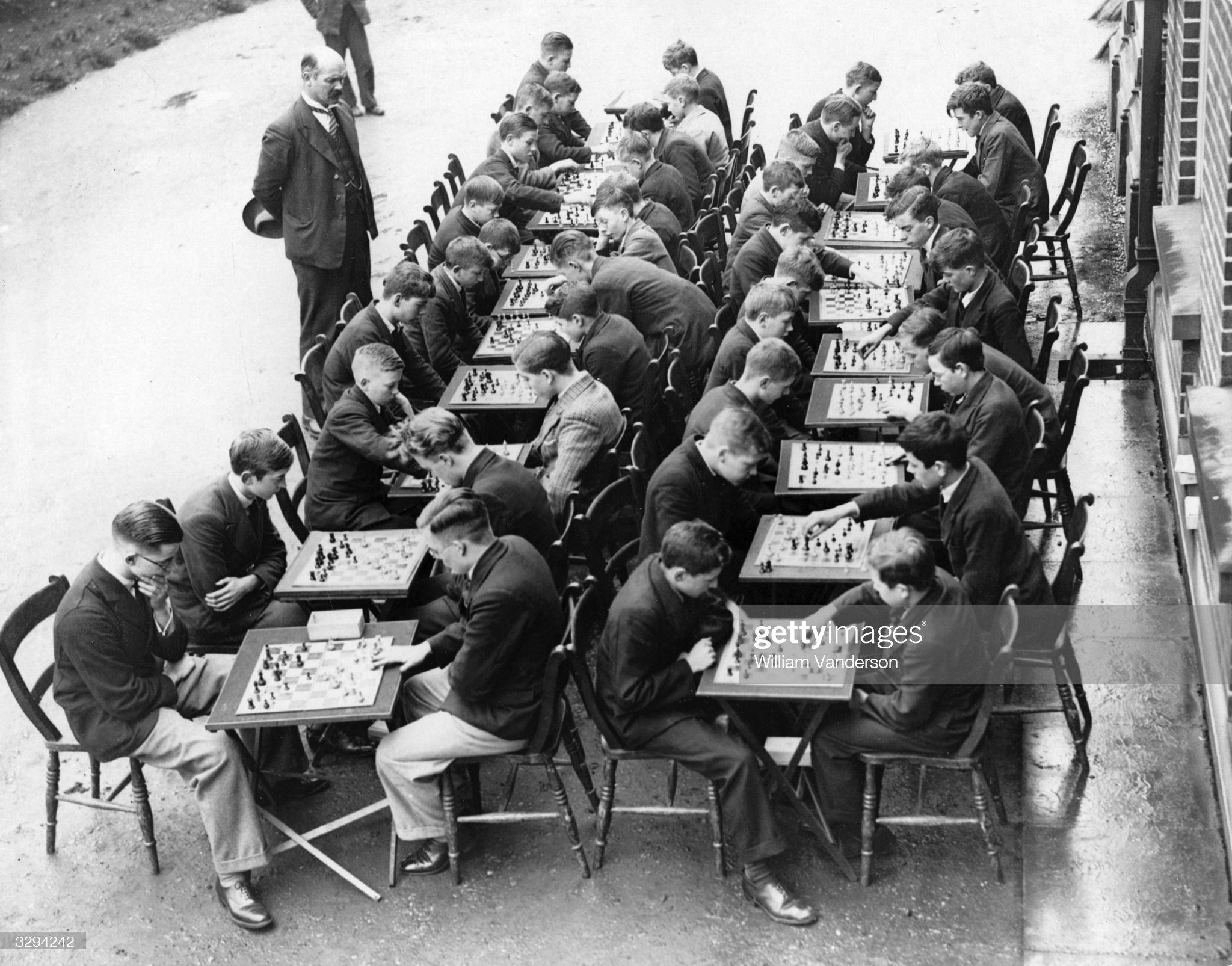
Chess Tournament 19th November 1934: An inter-form chess match for the pupils is in progress at Wednesbury High School for Boys, supervised by Mr C S Kipping, their headmaster. (Photo by William Vanderson/Fox Photos/Getty Images)
19th November 1934: An inter-form chess match for the pupils is in progress at Wednesbury High School for Boys, supervised by Mr C S Kipping, their headmaster. (Photo by William Vanderson/Fox Photos/Getty Images)

His editorial duties extended over more than forty years, and included the problem sections of Chess, Chess Amateur, and, for 32 years, the specialist magazine The Problemist from 1931. He was noted for his encouragement of beginners. His pamphlet ‘The Chess Problem Hobby‘ is an excellent beginner’s introduction. His other books included Chess Problem Science, The Chessmen Speak and 300 Chess Problems.
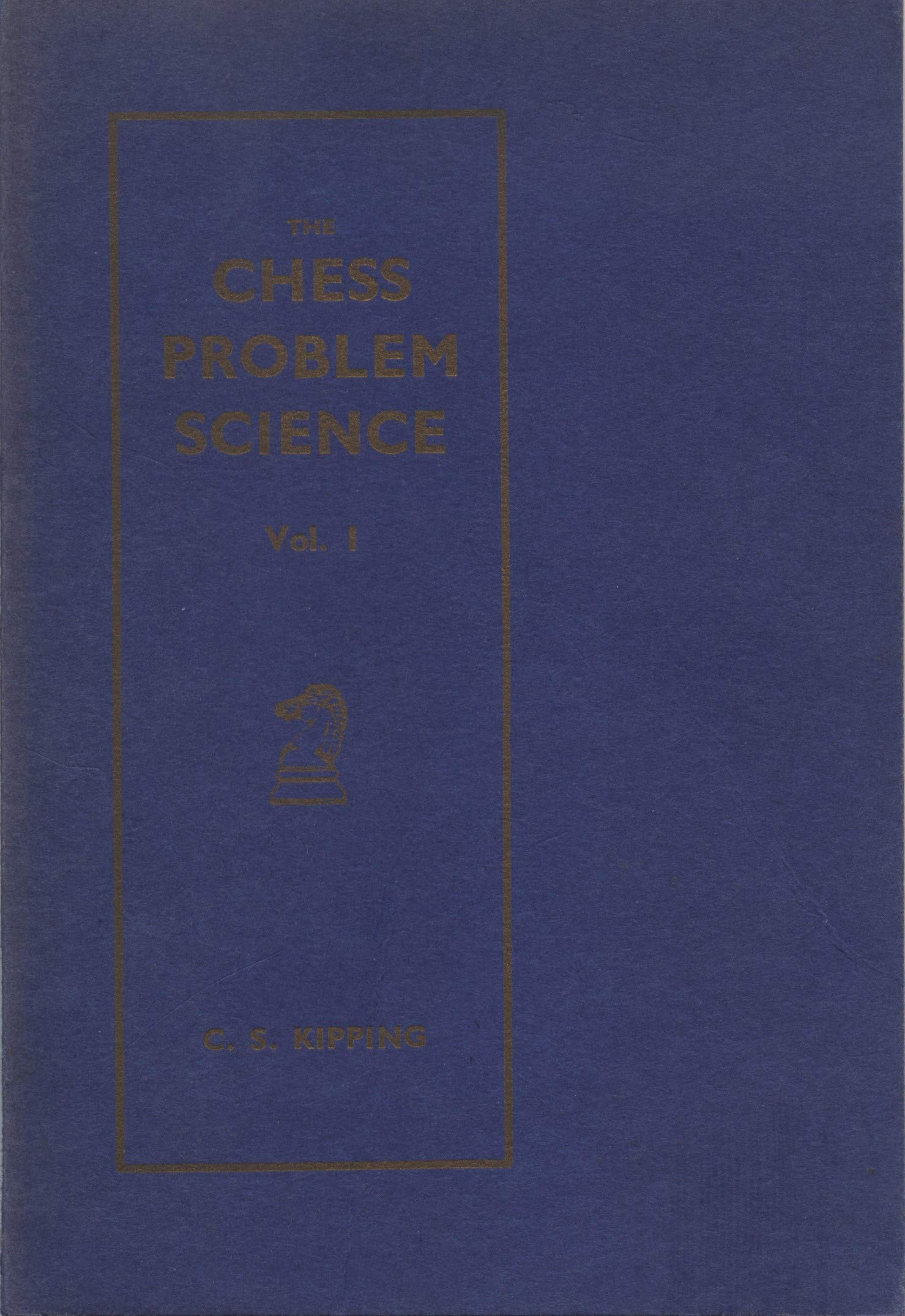
Chess Problem Science, CS Kipping, Whitehead & Miller, 1938

Kipping was one of the most prolific composers of all time, with over 7,000 problems to his credit. Many of his strategic three-movers have become classic. He was leading authority on halfpin two-movers. In his latter years, Kipping affectionately known as CSK – was Chairman of the International Problem Board which is now the FIDE Problem Commission.”
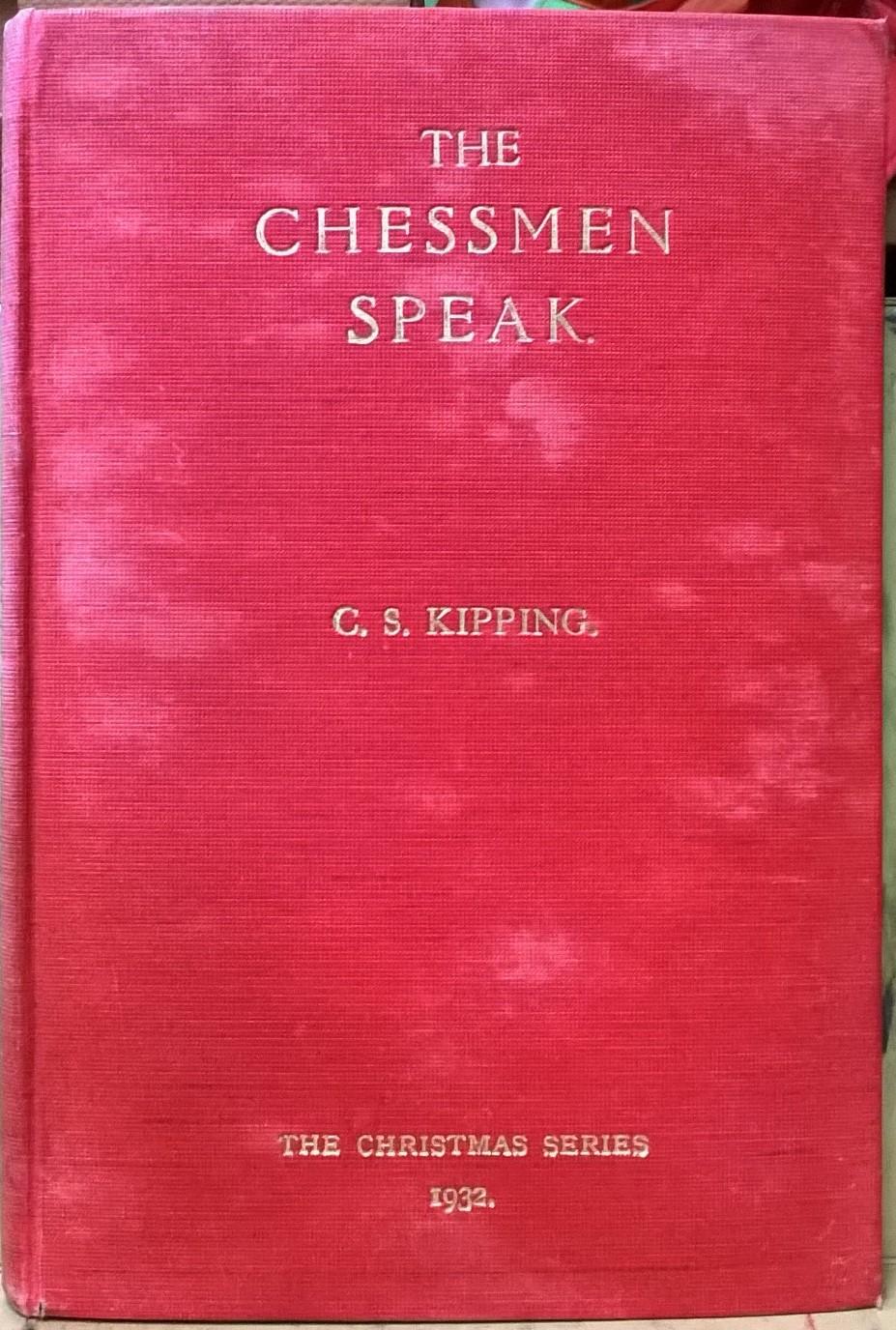
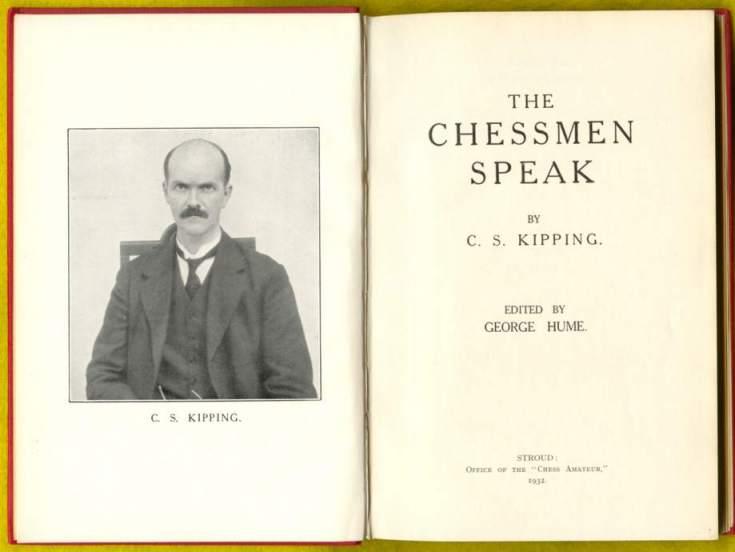
The Chessmen Speak, CS Kipping, The Chess Amateur, Stroud, 1932

From British Chess Magazine, Volume LXXXIV (84, 1964), Number 4 (April), pp. 122-123 by John Rice:

“CS Kipping, one of the most famous of all British problemists, died during February at the age of seventy-two. As a composer, editor, writer and critic Kipping was without equal. It is impossible to do justice in only a few lines to his vast and unique contribution to chess problems: a few factual notes. most of them kindly supplied by RCO Matthews, must suffice.

Kipping was born in London on October 10th, 1891, After completing his studies, he took up teaching as a career, and in 1924 he was appointed the first headmaster of the newly-opened Wednesbury High School, which post he held until his retirement in 1956. He was a bachelor, and, especially during the later years of his life, his interests were centered mainly on the school and on chess problems.
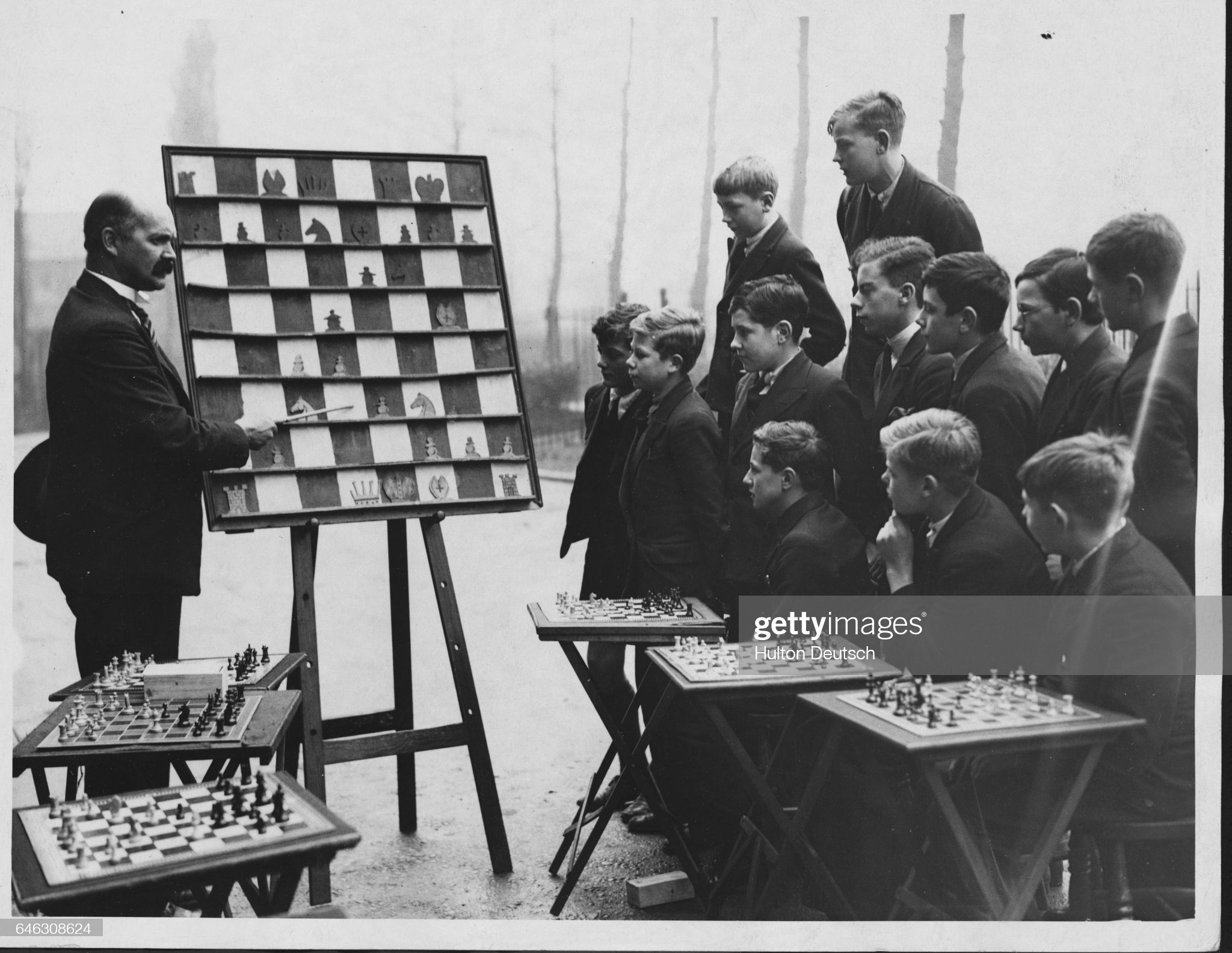
Headmaster C.S. Kipping instructs a classroom of boys on the rules of chess using his demonstration board at Wednesbury High School. (Photo by © Hulton-Deutsch Collection/CORBIS/Corbis via Getty Images)

Most readers will know of Kipping as the editor of The Problemist, the bi-monthly journal of the British Chess Problem Society. Before he took over The Problemist in 1931, he had been in charge of the problem section of the Chess Amateur, which he edited with great energy and enthusiasm. As well as The Problemist, he edited the problem pages of Chess from its first appearance. in 1936 until the section was suddenly discontinued without warning or explanation a few years ago. He also edited other columns at various times. He always took great care to help and encourage beginners, and it is probably true that every composer in this country below the age of about fifty came under his influence at one time or another.
CHS Kipping
CHS Kipping

As a young man, Kipping was a fierce avant-garde controversialist, championing the the cause of strategy in the three-mover in opposition to the then dominant model-mate school in this country. His attitude to the two-mover, as readers of The Problemist will know, was always a good deal more conservative; he would not tolerate at any price what he called ‘camouflage force,’ even in the modern problem. Yes, he appreciated the aims of the modern two-move composer much more than his writings on the subject suggest, being always ready to applaud excellence in any type of problem.
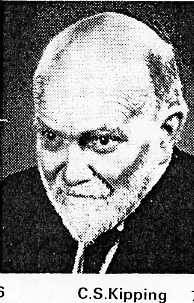
CHS Kipping
CHS Kipping

Kipping’s output numbered over 7,000 problems, probably a record. Many of his two-moves especially his ‘aspect’ tasks, were published under pseudonyms, of which the best was known was C.Stanley. He concerned himself little with artistic finish : once he had found a workable setting of a them he was engaged on, he would take little trouble over economy and presentation. Themes in which he interested himself include half-pin (in the two-mover), white King themes, interferences, and the grab theme (in the three-mover), and maximum tasks of all kinds, the subject of one of his books, Chess Problem Science. His other books include 300 Chess Problems (1916), and The Chessmen Speak (1932), in the AC White Christmas series.
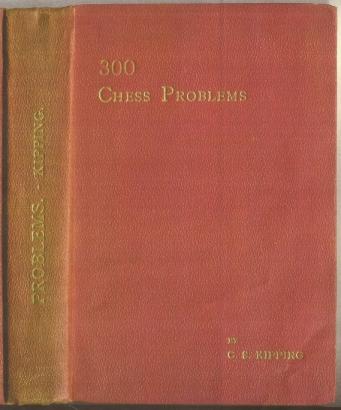
300 Chess Problems, CS Kipping, The Chess Amateur, Stroud, 1916

In addition to all his other problem activities, Kipping was chairman of the International Problem Board, and curator of the half-pin section of the White-Hume Collection, which he took over on Hume’s death in 1936.

The majority of Kipping’s best problems were three-movers, three of the most famous of which are quoted here.”

Manchester City News, 1911


Mate in three
1 Ka5

First Prize
Dutch East Indies Chess Association Tourney, 1928


Mate in three
1 Ra3

First Prize
BCM, 1939 (II)


Mate in three
1 Be6

The first problem above was given in The Complete Chess Addict by Mike Fox and Richard James in the Desert Island Chess chapter. It is also given in a discussion of the Steinitz Gambit by ASM Dickins and H Ebert in 100 Classics of the Chessboard. Colin Russ on page 138 of Miniature Chess Problems from Many Countries gives the first problem as does John Rice on page 44 of Chess Wizardry : The New ABC of Chess Problems.

On a web site now only accessible vie the WayBack Machine there is a treasure trove of reminisces and memories of CHSK from himself, friends and pupils.

Anecdotes from former pupils.

A history from the Wolverhampton and District Chess League

Here is his Italian (only) Wikipedia entry.

Here is his entry on chesscomposers.blogspot.com
Birthday of Barry Barnes (01-viii-1937)

BCN wishes happy birthday to Barry Barnes (01-viii-1937)

Barry Peter Barnes was born in Brighton and his mother’s maiden name was Simpole. (Barry is a cousin of Julian Ivan Peter Simpole, who was a Brighton school teacher and who taught Edward Gerard Winter to play chess).

Barry now lives in Halling, Rochester, Kent with his wife Jean.

From The Encyclopedia of Chess (Robert Hale, 1970 & 1976) by Anne Sunnucks :

“International Master of FIDE for Chess Compositions (1967) and International Judge of FIDE for Chess Compositions (1967).

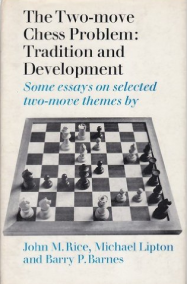
Born on 1st August 1937, Barnes works in transport advertising. He has composed about 250 two-move problems. With Lipton and Rice, he has contributed to the advance of the modern two-mover. Problem Editor of Two-Move and Twin sections of The Problemist. Co-author with M.Lipton and JM Rice of The Two-Move Chess Problem : Tradition and Development (Faber and Faber 1966).

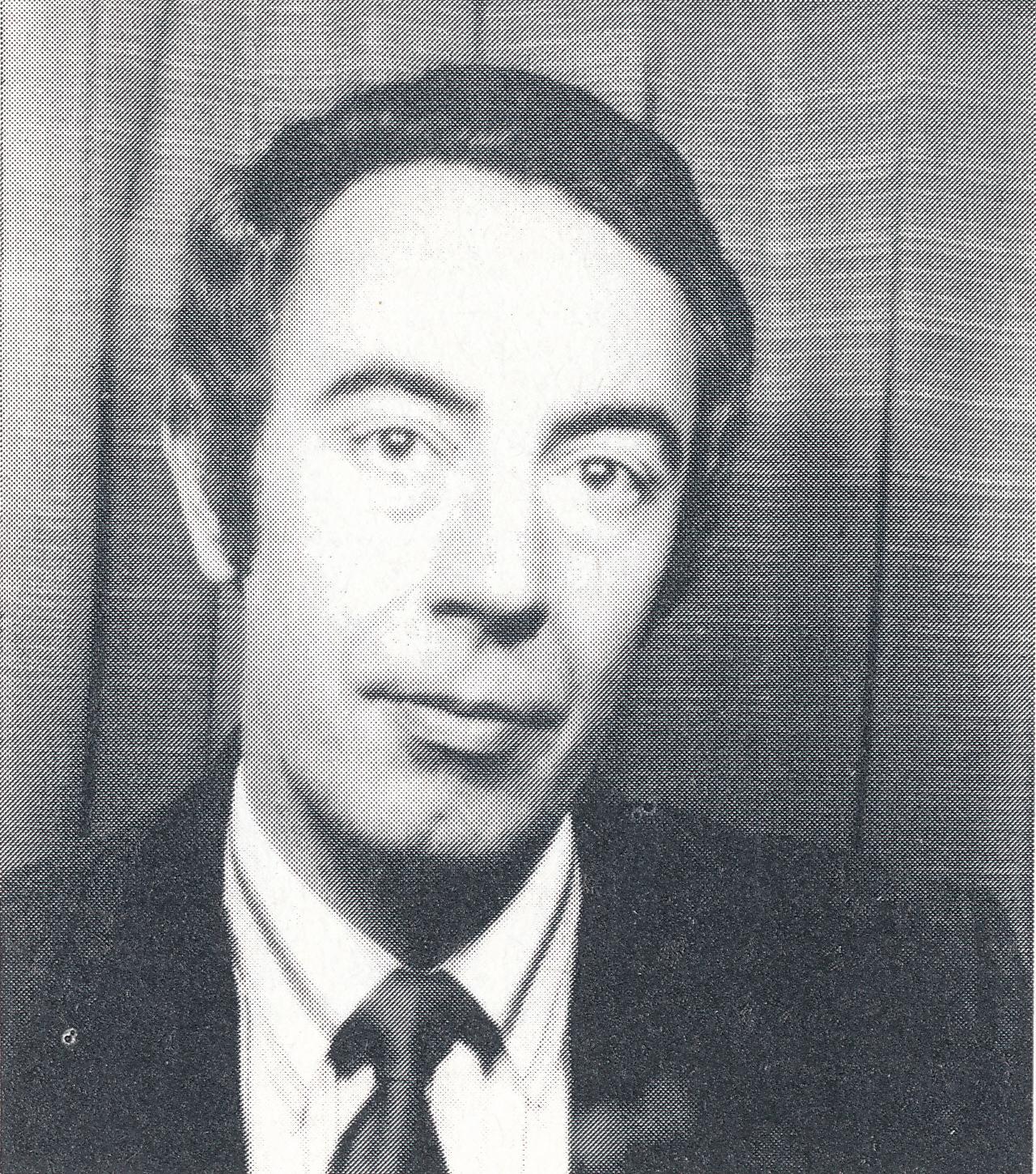
Barry Peter Barnes
Barry Peter Barnes


BP Barnes
2nd Prize Problem T.T. 1964

White to play and mate in two moves

(a) Diagram
(b) With black pawn at KN2 (g7)

(a) Solution
1. B-R3!

(b) Solution 1. K-K2!

From British Chess (Pergamon Press, 1983) by GS Botterill, DNL Levy, JM Rice and MJ Richardson :

Barry wrote about himself as follows :

“A promising career as a county chess player came to an end when I was given Brian Harley’s classic book Mate in Two Moves in the belief that it would help my chess, but it had quite the opposite effect. My interest in competitive chess waned, and I was on the road to an an International Master title for problems!

Early influences in my problem career were the weekly chess problem solving competition in The Observer (my first problem published there was in 1955), a teenage friendship with J. M. Rice and M. Lipton (both now lnternational Masters), Herbert Grasemann’s book Problem Schach / with its near revolutionary post-war German problem ideas, and the expert British problemist, A. R. Gooderson who had I but known it only a few years earlier was the officiating master when my Hove Grammar School played Steyning Grammar at chess.

In the late 1950s and early 1960s, the genuinely original problems I was making in cooperation and in competition with Rice and Lipton were being published mostly abroad in such specialist problem magazines as Die Schwatbe (with its inspired two-move editor, Hermann Albrecht) where I gained the epithet,the English prize-snatcher’! It was also written that the work of the avant_garde composers, Rice, Lipton and Barnes, was like a fresh two-move wind blowing from our island. It was sad but true at that time that the specialist magazine of the British Chess problem Society (founded 1918), The problemist, was unreceptive to change and our often bizarre ideas.

A milestone of sorts was reached when I won lst prize for problem I in 1958, a prize for the best new problem by a member of the British Commonwealth aged under 21. In 1966, I was invited by problemist Grandmaster Comins Mansfield, who was President of the FIDE Problem Commission, to act as Secretary at the Barcelona meeting. With Mr. Mansfield’s retirement, I became the British Member to the Commission, and at the Wiesbaden meeting, 1974, I was elected 2nd Vice-President. (1st Vice-President from 1982)

The FIDE Problem Commission meets annually to discuss matters relating to all branches of problem chess, to organize the World Chess Composing Tournament (WCCT), the World Chess Solving Competition (WCSC), and to publish FIDE Album anthologies of the best problems. It was on the strength of my success in these FIDE Albums that the Commission granted me the titles in 1967 of ‘lnternational Master of the FIDE for Chess Composition’ and ‘lnternational Judge of the FIDE for Chess Composition’. Since 1974, I have been Chairman of the Titles Sub-Committee of the Commission.

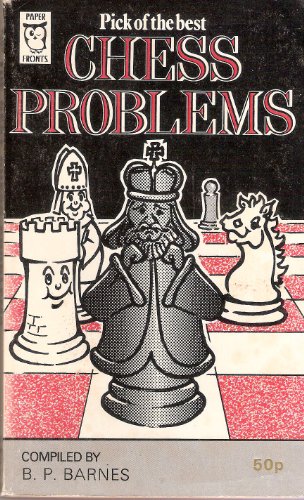
Since 1965, I have been the two-move editor of The Problemist and have served almost without break on the BCPS Committee. I have contributed to The Encyclopaedia of Chess by Anne Sunnucks (Robert Hale, 1970), I am co-author, with J. M. Rice and M. Lipton, of The Two-Move Chess Problem: Tradition & Development‘ (Faber A Faber, 1966), and I am the sole author of Comins Mansfield MBE: Chess Problems of a Grandmaster: (British Chess Problem Society, 1976) and Pick of the Best Chess Problems (Elliot Right Way Books, 1976)

To date I have made just over 300 two-movers and some helpmates.”

The Two Move Chess Problem : Tradition and Development
Pick of the best Chess Problems
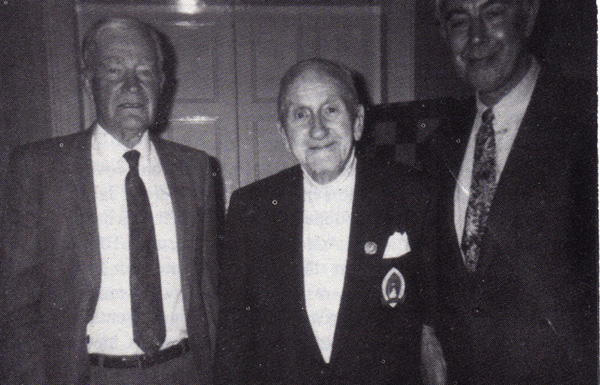
Source: The Problemist, May 1996. Photo taken March 1996 at the Mansfield Centenary Meeting at Paisley, when Barry Barnes delivered a lecture on Comins Mansfield. Left to right: Geoffrey Mansfield (son of Comins), Robert Gray and Barry Barnes, International Master of Chess Composition.

Birthday of Barry Barnes (01-viii-1937)

BCN wishes happy birthday to Barry Barnes (01-viii-1937)

Barry Peter Barnes was born in Brighton and his mother’s maiden name was Simpole. (Barry is a cousin of Julian Ivan Peter Simpole, who was a Brighton school teacher and who taught Edward Gerard Winter to play chess).

Barry now lives in Halling, Rochester, Kent with his wife Jean.

From The Encyclopedia of Chess (Robert Hale, 1970 & 1976) by Anne Sunnucks :

“International Master of FIDE for Chess Compositions (1967) and International Judge of FIDE for Chess Compositions (1967).

Born on 1st August 1937, Barnes works in transport advertising. He has composed about 250 two-move problems. With Lipton and Rice, he has contributed to the advance of the modern two-mover. Problem Editor of Two-Move and Twin sections of The Problemist. Co-author with M.Lipton and JM Rice of The Two-Move Chess Problem : Tradition and Development (Faber and Faber 1966).

Barry Peter Barnes
Barry Peter Barnes


BP Barnes
2nd Prize Problem T.T. 1964

White to play and mate in two moves

(a) Diagram
(b) With black pawn at KN2 (g7)

(a) Solution
1. B-R3!

(b) Solution 1. K-K2!

From British Chess (Pergamon Press, 1983) by GS Botterill, DNL Levy, JM Rice and MJ Richardson :

Barry wrote about himself as follows :

“A promising career as a county chess player came to an end when I was given Brian Harley’s classic book Mate in Two Moves in the belief that it would help my chess, but it had quite the opposite effect. My interest in competitive chess waned, and I was on the road to an an International Master title for problems!

Early influences in my problem career were the weekly chess problem solving competition in The Observer (my first problem published there was in 1955), a teenage friendship with J. M. Rice and M. Lipton (both now lnternational Masters), Herbert Grasemann’s book Problem Schach / with its near revolutionary post-war German problem ideas, and the expert British problemist, A. R. Gooderson who had I but known it only a few years earlier was the officiating master when my Hove Grammar School played Steyning Grammar at chess.

In the late 1950s and early 1960s, the genuinely original problems I was making in cooperation and in competition with Rice and Lipton were being published mostly abroad in such specialist problem magazines as Die Schwatbe (with its inspired two-move editor, Hermann Albrecht) where I gained the epithet,the English prize-snatcher’! It was also written that the work of the avant_garde composers, Rice, Lipton and Barnes, was like a fresh two-move wind blowing from our island. It was sad but true at that time that the specialist magazine of the British Chess problem Society (founded 1918), The problemist, was unreceptive to change and our often bizarre ideas.

A milestone of sorts was reached when I won lst prize for problem I in 1958, a prize for the best new problem by a member of the British Commonwealth aged under 21. In 1966, I was invited by problemist Grandmaster Comins Mansfield, who was President of the FIDE Problem Commission, to act as Secretary at the Barcelona meeting. With Mr. Mansfield’s retirement, I became the British Member to the Commission, and at the Wiesbaden meeting, 1974, I was elected 2nd Vice-President. (1st Vice-President from 1982)

The FIDE Problem Commission meets annually to discuss matters relating to all branches of problem chess, to organize the World Chess Composing Tournament (WCCT), the World Chess Solving Competition (WCSC), and to publish FIDE Album anthologies of the best problems. It was on the strength of my success in these FIDE Albums that the Commission granted me the titles in 1967 of ‘lnternational Master of the FIDE for Chess Composition’ and ‘lnternational Judge of the FIDE for Chess Composition’. Since 1974, I have been Chairman of the Titles Sub-Committee of the Commission.

Since 1965, I have been the two-move editor of The Problemist and have served almost without break on the BCPS Committee. I have contributed to The Encyclopaedia of Chess by Anne Sunnucks (Robert Hale, 1970), I am co-author, with J. M. Rice and M. Lipton, of The Two-Move Chess Problem: Tradition & Development‘ (Faber A Faber, 1966), and I am the sole author of Comins Mansfield MBE: Chess Problems of a Grandmaster: (British Chess Problem Society, 1976) and Pick of the Best Chess Problems (Elliot Right Way Books, 1976)

To date I have made just over 300 two-movers and some helpmates.”

The Two Move Chess Problem : Tradition and Development
Pick of the best Chess Problems
Source: The Problemist, May 1996. Photo taken March 1996 at the Mansfield Centenary Meeting at Paisley, when Barry Barnes delivered a lecture on Comins Mansfield. Left to right: Geoffrey Mansfield (son of Comins), Robert Gray and Barry Barnes, International Master of Chess Composition.

Birthday of Barry Barnes (01-viii-1937)

BCN wishes happy birthday to Barry Barnes (01-viii-1937)

Barry Peter Barnes was born in Brighton and his mother’s maiden name was Simpole. (Barry is a cousin of Julian Ivan Peter Simpole, who was a Brighton school teacher and who taught Edward Gerard Winter to play chess).

Barry now lives in Halling, Rochester, Kent with his wife Jean.

From The Encyclopedia of Chess (Robert Hale, 1970 & 1976) by Anne Sunnucks :

“International Master of FIDE for Chess Compositions (1967) and International Judge of FIDE for Chess Compositions (1967).

Born on 1st August 1937, Barnes works in transport advertising. He has composed about 250 two-move problems. With Lipton and Rice, he has contributed to the advance of the modern two-mover. Problem Editor of Two-Move and Twin sections of The Problemist. Co-author with M.Lipton and JM Rice of The Two-Move Chess Problem : Tradition and Development (Faber and Faber 1966).

Barry Peter Barnes
Barry Peter Barnes


BP Barnes
2nd Prize Problem T.T. 1964

White to play and mate in two moves

(a) Diagram
(b) With black pawn at KN2 (g7)

(a) Solution
1. B-R3!

(b) Solution 1. K-K2!

From British Chess (Pergamon Press, 1983) by GS Botterill, DNL Levy, JM Rice and MJ Richardson :

Barry wrote about himself as follows :

“A promising career as a county chess player came to an end when I was given Brian Harley’s classic book Mate in Two Moves in the belief that it would help my chess, but it had quite the opposite effect. My interest in competitive chess waned, and I was on the road to an an International Master title for problems!

Early influences in my problem career were the weekly chess problem solving competition in The Observer (my first problem published there was in 1955), a teenage friendship with J. M. Rice and M. Lipton (both now lnternational Masters), Herbert Grasemann’s book Problem Schach / with its near revolutionary post-war German problem ideas, and the expert British problemist, A. R. Gooderson who had I but known it only a few years earlier was the officiating master when my Hove Grammar School played Steyning Grammar at chess.

In the late 1950s and early 1960s, the genuinely original problems I was making in cooperation and in competition with Rice and Lipton were being published mostly abroad in such specialist problem magazines as Die Schwatbe (with its inspired two-move editor, Hermann Albrecht) where I gained the epithet,the English prize-snatcher’! It was also written that the work of the avant_garde composers, Rice, Lipton and Barnes, was like a fresh two-move wind blowing from our island. It was sad but true at that time that the specialist magazine of the British Chess problem Society (founded 1918), The problemist, was unreceptive to change and our often bizarre ideas.

A milestone of sorts was reached when I won lst prize for problem I in 1958, a prize for the best new problem by a member of the British Commonwealth aged under 21. In 1966, I was invited by problemist Grandmaster Comins Mansfield, who was President of the FIDE Problem Commission, to act as Secretary at the Barcelona meeting. With Mr. Mansfield’s retirement, I became the British Member to the Commission, and at the Wiesbaden meeting, 1974, I was elected 2nd Vice-President. (1st Vice-President from 1982)

The FIDE Problem Commission meets annually to discuss matters relating to all branches of problem chess, to organize the World Chess Composing Tournament (WCCT), the World Chess Solving Competition (WCSC), and to publish FIDE Album anthologies of the best problems. It was on the strength of my success in these FIDE Albums that the Commission granted me the titles in 1967 of ‘lnternational Master of the FIDE for Chess Composition’ and ‘lnternational Judge of the FIDE for Chess Composition’. Since 1974, I have been Chairman of the Titles Sub-Committee of the Commission.

Since 1965, I have been the two-move editor of The Problemist and have served almost without break on the BCPS Committee. I have contributed to The Encyclopaedia of Chess by Anne Sunnucks (Robert Hale, 1970), I am co-author, with J. M. Rice and M. Lipton, of The Two-Move Chess Problem: Tradition & Development‘ (Faber A Faber, 1966), and I am the sole author of Comins Mansfield MBE: Chess Problems of a Grandmaster: (British Chess Problem Society, 1976) and Pick of the Best Chess Problems (Elliot Right Way Books, 1976)

To date I have made just over 300 two-movers and some helpmates.”

The Two Move Chess Problem : Tradition and Development
Pick of the best Chess Problems
Source: The Problemist, May 1996. Photo taken March 1996 at the Mansfield Centenary Meeting at Paisley, when Barry Barnes delivered a lecture on Comins Mansfield. Left to right: Geoffrey Mansfield (son of Comins), Robert Gray and Barry Barnes, International Master of Chess Composition.

Birthday of Barry Barnes (01-viii-1937)

BCN wishes happy birthday to Barry Barnes (01-viii-1937)

Barry Peter Barnes was born in Brighton and his mother’s maiden name was Simpole. (Barry is a cousin of Julian Ivan Peter Simpole, who was a Brighton school teacher and who taught Edward Gerard Winter to play chess).

Barry now lives in Halling, Rochester, Kent with his wife Jean.

From The Encyclopedia of Chess (Robert Hale, 1970 & 1976) by Anne Sunnucks :

“International Master of FIDE for Chess Compositions (1967) and International Judge of FIDE for Chess Compositions (1967).

Born on 1st August 1937, Barnes works in transport advertising. He has composed about 250 two-move problems. With Lipton and Rice, he has contributed to the advance of the modern two-mover. Problem Editor of Two-Move and Twin sections of The Problemist. Co-author with M.Lipton and JM Rice of The Two-Move Chess Problem : Tradition and Development (Faber and Faber 1966).

Barry Peter Barnes
Barry Peter Barnes


BP Barnes
2nd Prize Problem T.T. 1964

White to play and mate in two moves

(a) Diagram
(b) With black pawn at KN2 (g7)

(a) Solution
1. B-R3!

(b) Solution 1. K-K2!

From British Chess (Pergamon Press, 1983) by GS Botterill, DNL Levy, JM Rice and MJ Richardson :

Barry wrote about himself as follows :

“A promising career as a county chess player came to an end when I was given Brian Harley’s classic book Mate in Two Moves in the belief that it would help my chess, but it had quite the opposite effect. My interest in competitive chess waned, and I was on the road to an an International Master title for problems!

Early influences in my problem career were the weekly chess problem solving competition in The Observer (my first problem published there was in 1955), a teenage friendship with J. M. Rice and M. Lipton (both now lnternational Masters), Herbert Grasemann’s book Problem Schach / with its near revolutionary post-war German problem ideas, and the expert British problemist, A. R. Gooderson who had I but known it only a few years earlier was the officiating master when my Hove Grammar School played Steyning Grammar at chess.

In the late 1950s and early 1960s, the genuinely original problems I was making in cooperation and in competition with Rice and Lipton were being published mostly abroad in such specialist problem magazines as Die Schwatbe (with its inspired two-move editor, Hermann Albrecht) where I gained the epithet,the English prize-snatcher’! It was also written that the work of the avant_garde composers, Rice, Lipton and Barnes, was like a fresh two-move wind blowing from our island. It was sad but true at that time that the specialist magazine of the British Chess problem Society (founded 1918), The problemist, was unreceptive to change and our often bizarre ideas.

A milestone of sorts was reached when I won lst prize for problem I in 1958, a prize for the best new problem by a member of the British Commonwealth aged under 21. In 1966, I was invited by problemist Grandmaster Comins Mansfield, who was President of the FIDE Problem Commission, to act as Secretary at the Barcelona meeting. With Mr. Mansfield’s retirement, I became the British Member to the Commission, and at the Wiesbaden meeting, 1974, I was elected 2nd Vice-President. (1st Vice-President from 1982)

The FIDE Problem Commission meets annually to discuss matters relating to all branches of problem chess, to organize the World Chess Composing Tournament (WCCT), the World Chess Solving Competition (WCSC), and to publish FIDE Album anthologies of the best problems. It was on the strength of my success in these FIDE Albums that the Commission granted me the titles in 1967 of ‘lnternational Master of the FIDE for Chess Composition’ and ‘lnternational Judge of the FIDE for Chess Composition’. Since 1974, I have been Chairman of the Titles Sub-Committee of the Commission.

Since 1965, I have been the two-move editor of The Problemist and have served almost without break on the BCPS Committee. I have contributed to The Encyclopaedia of Chess by Anne Sunnucks (Robert Hale, 1970), I am co-author, with J. M. Rice and M. Lipton, of The Two-Move Chess Problem: Tradition & Development‘ (Faber A Faber, 1966), and I am the sole author of Comins Mansfield MBE: Chess Problems of a Grandmaster: (British Chess Problem Society, 1976) and Pick of the Best Chess Problems (Elliot Right Way Books, 1976)

To date I have made just over 300 two-movers and some helpmates.”

The Two Move Chess Problem : Tradition and Development
Pick of the best Chess Problems
Source: The Problemist, May 1996. Photo taken March 1996 at the Mansfield Centenary Meeting at Paisley, when Barry Barnes delivered a lecture on Comins Mansfield. Left to right: Geoffrey Mansfield (son of Comins), Robert Gray and Barry Barnes, International Master of Chess Composition.

Birthday of Barry Barnes (01-viii-1937)

BCN wishes happy birthday to Barry Barnes (01-viii-1937)

Barry Peter Barnes was born in Brighton and his mother’s maiden name was Simpole. (Barry is a cousin of Julian Ivan Peter Simpole, who was a Brighton school teacher and who taught Edward Gerard Winter to play chess).

Barry now lives in Halling, Rochester, Kent with his wife Jean.

From The Encyclopedia of Chess (Robert Hale, 1970 & 1976) by Anne Sunnucks :

“International Master of FIDE for Chess Compositions (1967) and International Judge of FIDE for Chess Compositions (1967).

Born on 1st August 1937, Barnes works in transport advertising. He has composed about 250 two-move problems. With Lipton and Rice, he has contributed to the advance of the modern two-mover. Problem Editor of Two-Move and Twin sections of The Problemist. Co-author with M.Lipton and JM Rice of The Two-Move Chess Problem : Tradition and Development (Faber and Faber 1966).

Barry Peter Barnes
Barry Peter Barnes


BP Barnes
2nd Prize Problem T.T. 1964

White to play and mate in two moves

(a) Diagram
(b) With black pawn at KN2 (g7)

(a) Solution
1. B-R3!

(b) Solution 1. K-K2!

From British Chess (Pergamon Press, 1983) by GS Botterill, DNL Levy, JM Rice and MJ Richardson :

Barry wrote about himself as follows :

“A promising career as a county chess player came to an end when I was given Brian Harley’s classic book Mate in Two Moves in the belief that it would help my chess, but it had quite the opposite effect. My interest in competitive chess waned, and I was on the road to an an International Master title for problems!

Early influences in my problem career were the weekly chess problem solving competition in The Observer (my first problem published there was in 1955), a teenage friendship with J. M. Rice and M. Lipton (both now lnternational Masters), Herbert Grasemann’s book Problem Schach / with its near revolutionary post-war German problem ideas, and the expert British problemist, A. R. Gooderson who had I but known it only a few years earlier was the officiating master when my Hove Grammar School played Steyning Grammar at chess.

In the late 1950s and early 1960s, the genuinely original problems I was making in cooperation and in competition with Rice and Lipton were being published mostly abroad in such specialist problem magazines as Die Schwatbe (with its inspired two-move editor, Hermann Albrecht) where I gained the epithet,the English prize-snatcher’! It was also written that the work of the avant_garde composers, Rice, Lipton and Barnes, was like a fresh two-move wind blowing from our island. It was sad but true at that time that the specialist magazine of the British Chess problem Society (founded 1918), The problemist, was unreceptive to change and our often bizarre ideas.

A milestone of sorts was reached when I won lst prize for problem I in 1958, a prize for the best new problem by a member of the British Commonwealth aged under 21. In 1966, I was invited by problemist Grandmaster Comins Mansfield, who was President of the FIDE Problem Commission, to act as Secretary at the Barcelona meeting. With Mr. Mansfield’s retirement, I became the British Member to the Commission, and at the Wiesbaden meeting, 1974, I was elected 2nd Vice-President. (1st Vice-President from 1982)

The FIDE Problem Commission meets annually to discuss matters relating to all branches of problem chess, to organize the World Chess Composing Tournament (WCCT), the World Chess Solving Competition (WCSC), and to publish FIDE Album anthologies of the best problems. It was on the strength of my success in these FIDE Albums that the Commission granted me the titles in 1967 of ‘lnternational Master of the FIDE for Chess Composition’ and ‘lnternational Judge of the FIDE for Chess Composition’. Since 1974, I have been Chairman of the Titles Sub-Committee of the Commission.

Since 1965, I have been the two-move editor of The Problemist and have served almost without break on the BCPS Committee. I have contributed to The Encyclopaedia of Chess by Anne Sunnucks (Robert Hale, 1970), I am co-author, with J. M. Rice and M. Lipton, of The Two-Move Chess Problem: Tradition & Development‘ (Faber A Faber, 1966), and I am the sole author of Comins Mansfield MBE: Chess Problems of a Grandmaster: (British Chess Problem Society, 1976) and Pick of the Best Chess Problems (Elliot Right Way Books, 1976)

To date I have made just over 300 two-movers and some helpmates.”

The Two Move Chess Problem : Tradition and Development
Pick of the best Chess Problems
Source: The Problemist, May 1996. Photo taken March 1996 at the Mansfield Centenary Meeting at Paisley, when Barry Barnes delivered a lecture on Comins Mansfield. Left to right: Geoffrey Mansfield (son of Comins), Robert Gray and Barry Barnes, International Master of Chess Composition.

Death Anniversary of Gerald Anderson MBE DFC (24-ii-1898 23-viii-1984)

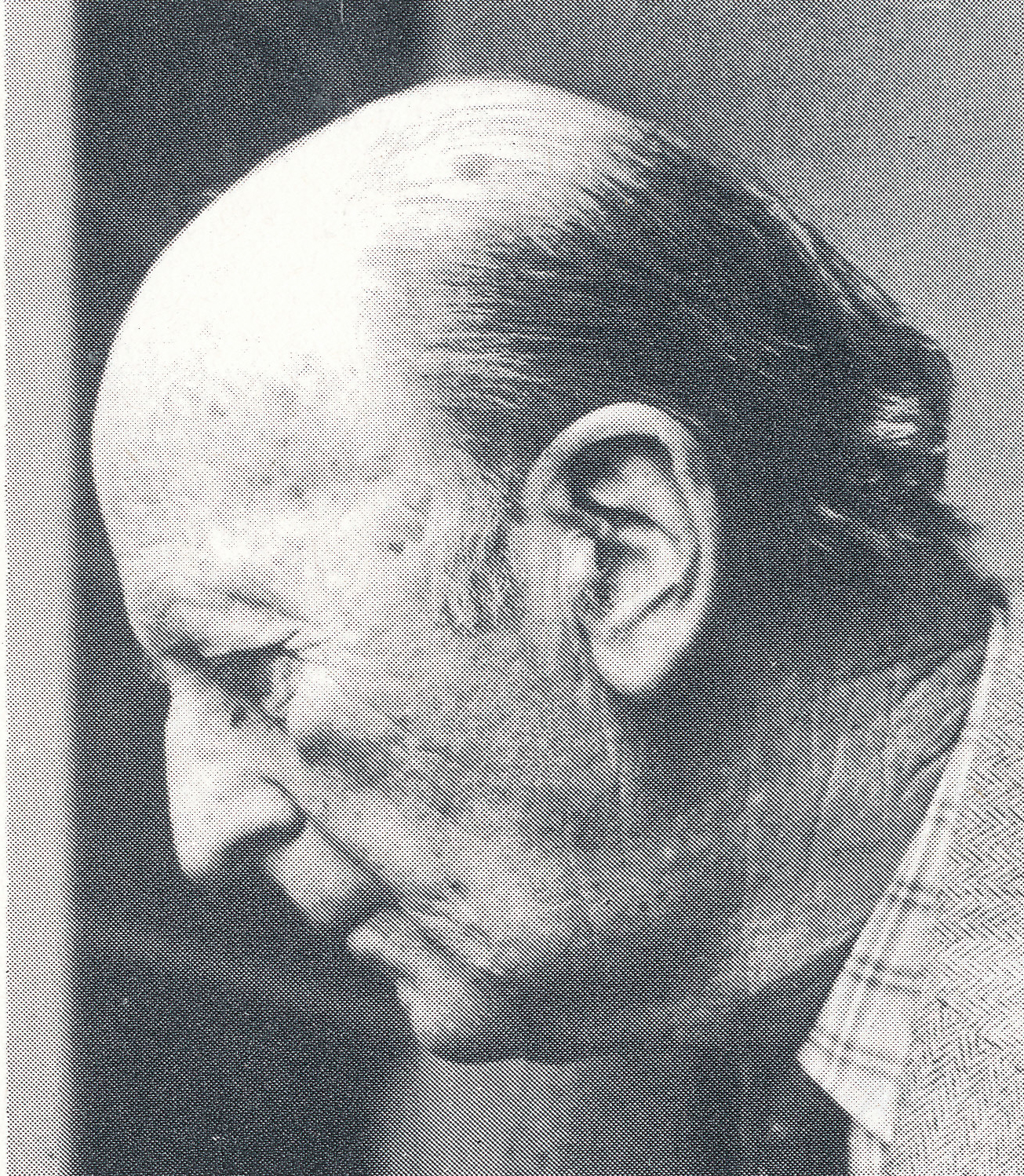
BCN remembers Gerald Frank Anderson MBE, DFC (24-ii-1898 23-viii-1984)

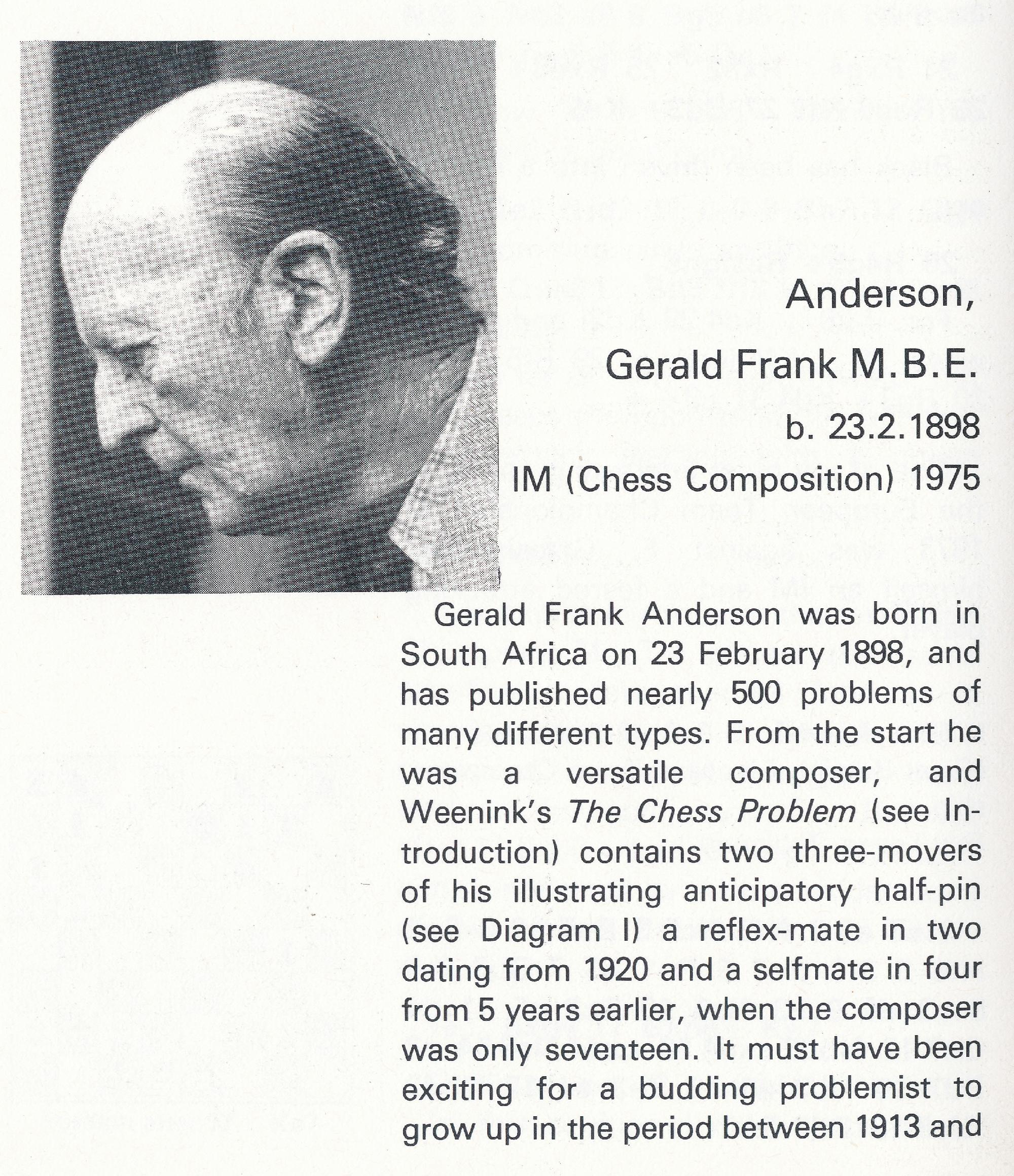
From British Chess (Pergamon, 1983) by Botterill, Levy, Rice and Richardson we have an article written by John Rice :

“Gerald Frank Anderson was born in South Africa on 23 February 1898, and has published nearly 500 problems of many different types. From the start he was a versatile composer, and Weenink’s The Chess Problem (see introduction) contains two three-movers of his illustrating anticipatory half-pin (see Diagram I) a reflex-mate in two dating from 1920 and a selfmate in four from 5 years earlier, when the composer was only seventeen.

Diagram I

1st prize , Hampshire Telegraph & Post, 1920

White mates in 3

(All Solutions contained in scan at foot of article.)

It must have been exciting for a budding problemist to grow up in the period between 1913 and 1924 when the Good Companion Chess Problem Club of Philadelphia was publishing its Folders of original work containing outstanding examples of complex strategy such as half-pins and cross-checks. Diagram II, with its intricate battery play, won first prize for Anderson in the Folder of October 1917.

Diagram II
1st prize, Good Companions, October 1917

Diagram III is a justly famous two-mover, with a perfect key and beautiful line-play:

IL Secolo, 1919

White mates in 2

Between 1953 and 1961 Anderson was with the British Embassy in Washington and a close friendship developed with the American composer Vincent Eaton.

In the introduction to his published collection of Eaton’s best problems (Memorial to V. L. Eaton, 1971) Anderson describes his visits to Eaton’s house where they would work for hours on joint compositions (nine of them altogether, eight prize winners)- ‘blockbusters’, as they themselves termed them. Diagram IV is one of these, a highly complex check-prevention scheme.

Diagram IV

1st prize, British Chess Magazine, 1953

(with V.L. Eaton)

White mates in 3

A glance through the anthologies shows how successful Anderson has always been with orthodox forms, perhaps especially with three- and four- movers and with selfmates. Diagram V is a characteristic selfmate in two, with a good deal more strategy than many composers achieve in selfmate form:

Diagram V

2nd prize, British Chess Federation Tournament, 1947

Selfmate in 2

Since his retirement Anderson has lived for much of the time in Italy, where the air seems to be conducive to the composition of reflex-mates, for that is the genre with which he has principally been occupied in recent years. Diagram VI is a good illustration of his style; a couple of changed continuations, and subtle play centered on the two diagonals b5-f1 and c6-h1. (A reflex-mate is a selfmate in which both sides are under an obligation to mate on the move if possible). In this problem White has to keep his active line-pieces (Q and B) well out of the way of the potential mating diagonal.

Diagram VI

1st prize, The Problemist, 1975

Reflex-mate in 2

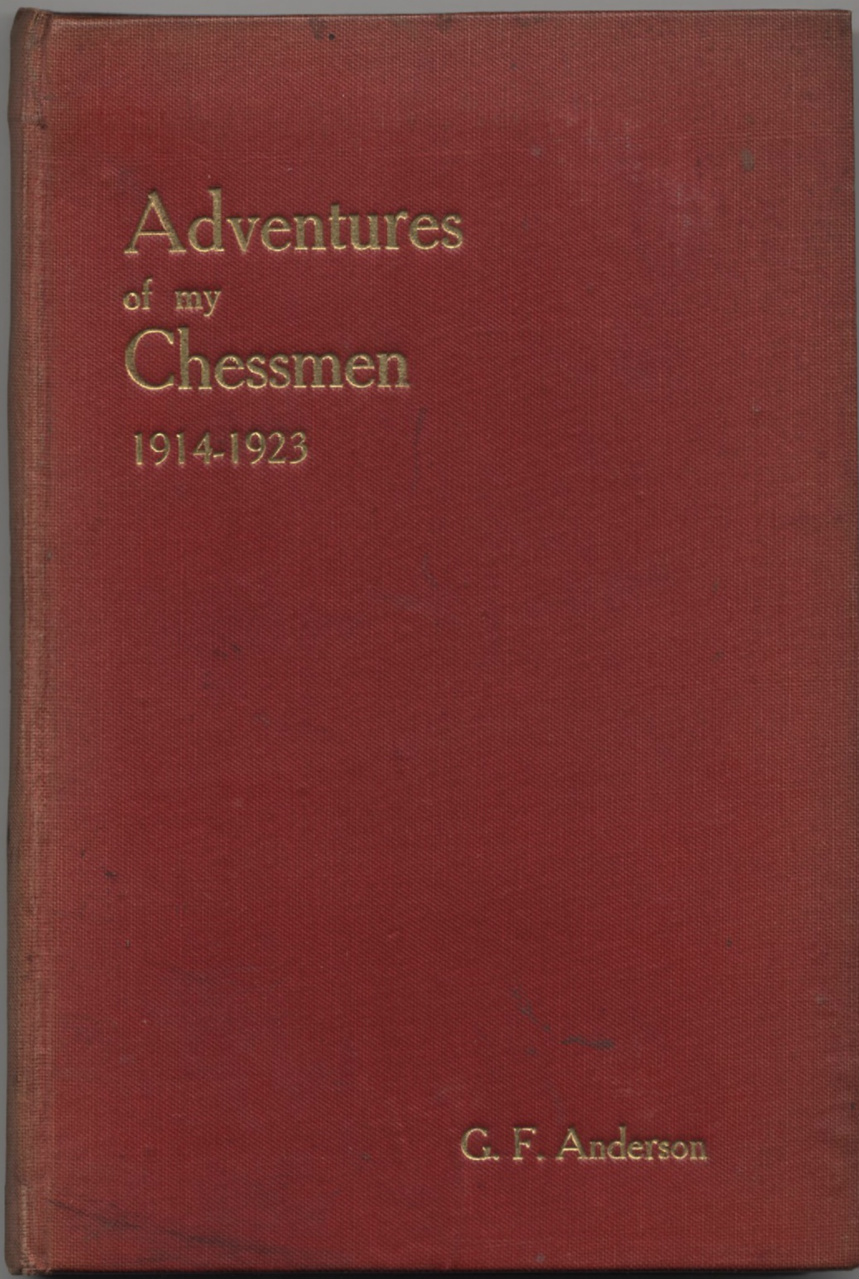
In addition to the Eaton anthology mentioned above, Anderson has published Adventures of my Chessmen

Adventures of my Chessmen 1914 - 1923 , GF Anderson, Chess Amateur, Stroud, 1924
Adventures of my Chessmen 1914 – 1923 , GF Anderson, Chess Amateur, Stroud, 1924

and Are There Any?, the latter being a fascinating collection of Kriegspiel problems. He was President of the British Chess Problem Society from 1962 to 1964, and became a FIDE International Judge in 1960 and an International Master in 1975.”

Gerald Frank Anderson MBE DFC (24-ii-1898 23-viii-1984)

From The Encyclopedia of Chess (Robert Hale, 1970 and 1976) by Anne Sunnucks :

“International Judge of FIDE for Compositions (1960). Born on 23rd February 1898. Won the DFC in 1914-18 war. Foreign Office (Retd.) First problem published in 1912, since when he has composed nearly 500 problems, mostly 3 and 4 movers. but has latterly switched to Fairy chess problems. He is one of the the great reflex and self-mate composers. Edited a section Chess Amateur 1921, Nottinghamshire Weekly Guardian 1937-1938, Anglo-Portuguese News 1945-1946, and Self-Mate Section of The Problemist 1964-1966. Author of Are There Any? a book about Kriegspiel problems and A Memorial Volume of Chess Problems of VL Eaton.”

His MBE was awarded in the 1959 New Year Honours list. The citation reads : “Gerald Frank Anderson, DFC, Second Secretary, Her Majesty’s Embassy, Washington.”

From The Encyclopaedia of Chess (Batsford, 1977), Harry Golombek OBE we have this by John Rice:

“British problem composer, output about 550 problems., orthodox and fairy. Books : Adventures of My Chessmen; and Are there Any? (1959 – a fascinating collection of Kriegspiel problems); Vincent Eaton Memorial (1971 – an annotated anthology of Eaton’s work). President of British Chess Problem Society, 1962-4. International Judge (1960), international master (1975).”

From chessgames.com :

“G. F. Anderson, in 1946, was working in the British Embassy in Lisbon, and, as a highly skilled chess player (he was also known for composing chess problems as early as 1919), was nominated to deliver the challenge from Botvinnik to Alekhine. He played a game with the World Champion in the Embassy and it became the last recorded game by Alekhine.”

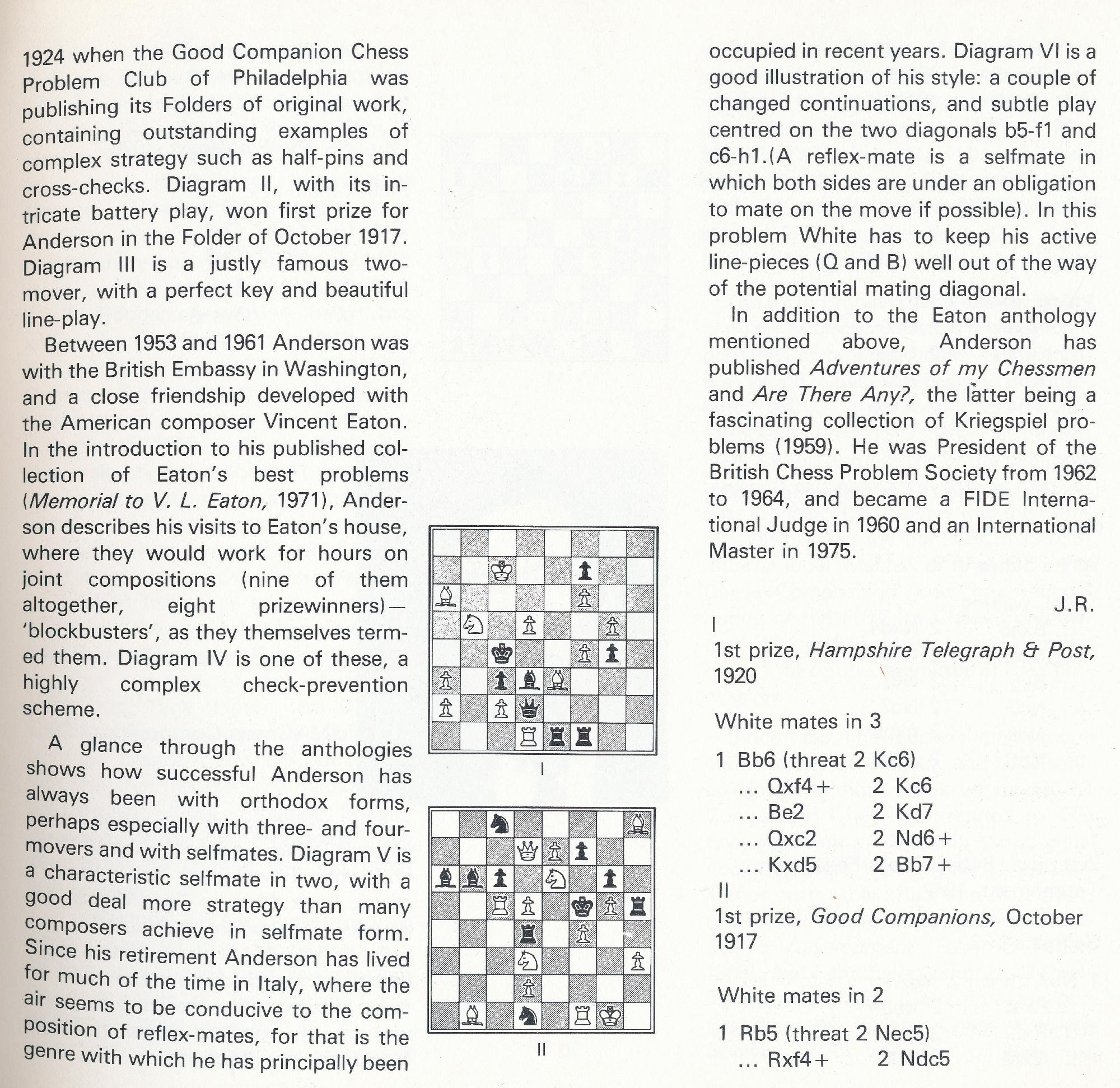
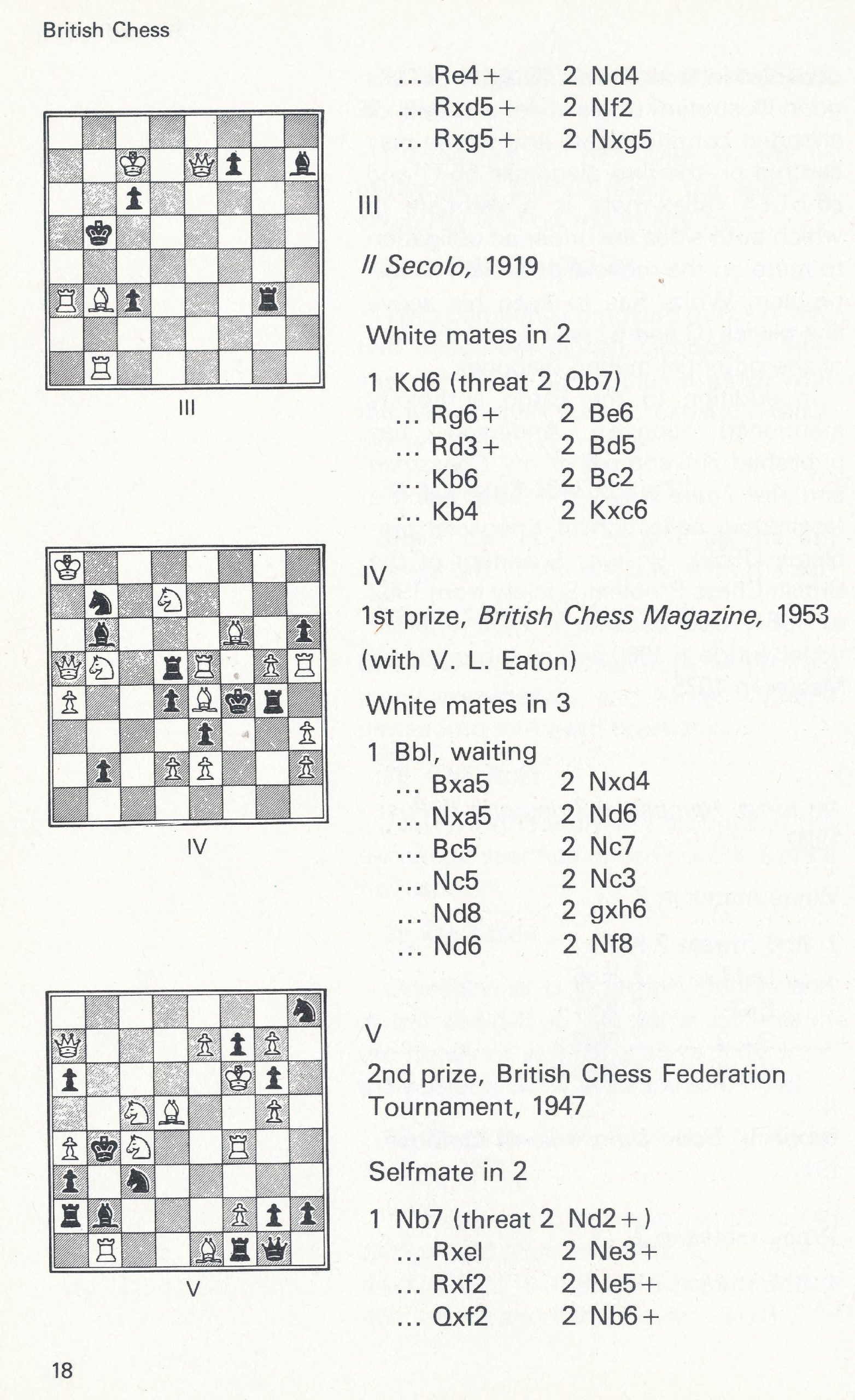
Here is the original article from British Chess (Pergamon, 1983) by Botterill, Levy, Rice and Richardson by John Rice :

British Chess, Pergamon Press, 1983. page 16
British Chess, Pergamon Press, 1983. page 17
British Chess, Pergamon Press, 1983. page 18

Here is his Wikipedia entry

Death Anniversary of Gerald Anderson MBE DFC (24-ii-1898 23-viii-1984)

BCN remembers Gerald Frank Anderson MBE, DFC (24-ii-1898 23-viii-1984)

From British Chess (Pergamon, 1983) by Botterill, Levy, Rice and Richardson we have an article written by John Rice :

“Gerald Frank Anderson was born in South Africa on 23 February 1898, and has published nearly 500 problems of many different types. From the start he was a versatile composer, and Weenink’s The Chess Problem (see introduction) contains two three-movers of his illustrating anticipatory half-pin (see Diagram I) a reflex-mate in two dating from 1920 and a selfmate in four from 5 years earlier, when the composer was only seventeen.

Diagram I

1st prize , Hampshire Telegraph & Post, 1920

White mates in 3

(All Solutions contained in scan at foot of article.)

It must have been exciting for a budding problemist to grow up in the period between 1913 and 1924 when the Good Companion Chess Problem Club of Philadelphia was publishing its Folders of original work containing outstanding examples of complex strategy such as half-pins and cross-checks. Diagram II, with its intricate battery play, won first prize for Anderson in the Folder of October 1917.

Diagram II
1st prize, Good Companions, October 1917

Diagram III is a justly famous two-mover, with a perfect key and beautiful line-play:

IL Secolo, 1919

White mates in 2

Between 1953 and 1961 Anderson was with the British Embassy in Washington and a close friendship developed with the American composer Vincent Eaton.

In the introduction to his published collection of Eaton’s best problems (Memorial to V. L. Eaton, 1971) Anderson describes his visits to Eaton’s house where they would work for hours on joint compositions (nine of them altogether, eight prize winners)- ‘blockbusters’, as they themselves termed them. Diagram IV is one of these, a highly complex check-prevention scheme.

Diagram IV

1st prize, British Chess Magazine, 1953

(with V.L. Eaton)

White mates in 3

A glance through the anthologies shows how successful Anderson has always been with orthodox forms, perhaps especially with three- and four- movers and with selfmates. Diagram V is a characteristic selfmate in two, with a good deal more strategy than many composers achieve in selfmate form:

Diagram V

2nd prize, British Chess Federation Tournament, 1947

Selfmate in 2

Since his retirement Anderson has lived for much of the time in Italy, where the air seems to be conducive to the composition of reflex-mates, for that is the genre with which he has principally been occupied in recent years. Diagram VI is a good illustration of his style; a couple of changed continuations, and subtle play centered on the two diagonals b5-f1 and c6-h1. (A reflex-mate is a selfmate in which both sides are under an obligation to mate on the move if possible). In this problem White has to keep his active line-pieces (Q and B) well out of the way of the potential mating diagonal.

Diagram VI

1st prize, The Problemist, 1975

Reflex-mate in 2

In addition to the Eaton anthology mentioned above, Anderson has published Adventures of my Chessmen

Adventures of my Chessmen 1914 - 1923 , GF Anderson, Chess Amateur, Stroud, 1924
Adventures of my Chessmen 1914 – 1923 , GF Anderson, Chess Amateur, Stroud, 1924

and Are There Any?, the latter being a fascinating collection of Kriegspiel problems. He was President of the British Chess Problem Society from 1962 to 1964, and became a FIDE International Judge in 1960 and an International Master in 1975.”

Gerald Frank Anderson MBE DFC (24-ii-1898 23-viii-1984)

From The Encyclopedia of Chess (Robert Hale, 1970 and 1976) by Anne Sunnucks :

“International Judge of FIDE for Compositions (1960). Born on 23rd February 1898. Won the DFC in 1914-18 war. Foreign Office (Retd.) First problem published in 1912, since when he has composed nearly 500 problems, mostly 3 and 4 movers. but has latterly switched to Fairy chess problems. He is one of the the great reflex and self-mate composers. Edited a section Chess Amateur 1921, Nottinghamshire Weekly Guardian 1937-1938, Anglo-Portuguese News 1945-1946, and Self-Mate Section of The Problemist 1964-1966. Author of Are There Any? a book about Kriegspiel problems and A Memorial Volume of Chess Problems of VL Eaton.”

His MBE was awarded in the 1959 New Year Honours list. The citation reads : “Gerald Frank Anderson, DFC, Second Secretary, Her Majesty’s Embassy, Washington.”

From The Encyclopaedia of Chess (Batsford, 1977), Harry Golombek OBE we have this by John Rice:

“British problem composer, output about 550 problems., orthodox and fairy. Books : Adventures of My Chessmen; and Are there Any? (1959 – a fascinating collection of Kriegspiel problems); Vincent Eaton Memorial (1971 – an annotated anthology of Eaton’s work). President of British Chess Problem Society, 1962-4. International Judge (1960), international master (1975).”

From chessgames.com :

“G. F. Anderson, in 1946, was working in the British Embassy in Lisbon, and, as a highly skilled chess player (he was also known for composing chess problems as early as 1919), was nominated to deliver the challenge from Botvinnik to Alekhine. He played a game with the World Champion in the Embassy and it became the last recorded game by Alekhine.”

Here is the original article from British Chess (Pergamon, 1983) by Botterill, Levy, Rice and Richardson by John Rice :

British Chess, Pergamon Press, 1983. page 16
British Chess, Pergamon Press, 1983. page 17
British Chess, Pergamon Press, 1983. page 18

Here is his Wikipedia entry

Death Anniversary of Gerald Anderson MBE DFC (24-ii-1898 23-viii-1984)

BCN remembers Gerald Frank Anderson MBE, DFC (24-ii-1898 23-viii-1984)

From British Chess (Pergamon, 1983) by Botterill, Levy, Rice and Richardson we have an article written by John Rice :

“Gerald Frank Anderson was born in South Africa on 23 February 1898, and has published nearly 500 problems of many different types. From the start he was a versatile composer, and Weenink’s The Chess Problem (see introduction) contains two three-movers of his illustrating anticipatory half-pin (see Diagram I) a reflex-mate in two dating from 1920 and a selfmate in four from 5 years earlier, when the composer was only seventeen.

Diagram I

1st prize , Hampshire Telegraph & Post, 1920

White mates in 3

(All Solutions contained in scan at foot of article.)

It must have been exciting for a budding problemist to grow up in the period between 1913 and 1924 when the Good Companion Chess Problem Club of Philadelphia was publishing its Folders of original work containing outstanding examples of complex strategy such as half-pins and cross-checks. Diagram II, with its intricate battery play, won first prize for Anderson in the Folder of October 1917.

Diagram II
1st prize, Good Companions, October 1917

Diagram III is a justly famous two-mover, with a perfect key and beautiful line-play:

IL Secolo, 1919

White mates in 2

Between 1953 and 1961 Anderson was with the British Embassy in Washington and a close friendship developed with the American composer Vincent Eaton.

In the introduction to his published collection of Eaton’s best problems (Memorial to V. L. Eaton, 1971) Anderson describes his visits to Eaton’s house where they would work for hours on joint compositions (nine of them altogether, eight prize winners)- ‘blockbusters’, as they themselves termed them. Diagram IV is one of these, a highly complex check-prevention scheme.

Diagram IV

1st prize, British Chess Magazine, 1953

(with V.L. Eaton)

White mates in 3

A glance through the anthologies shows how successful Anderson has always been with orthodox forms, perhaps especially with three- and four- movers and with selfmates. Diagram V is a characteristic selfmate in two, with a good deal more strategy than many composers achieve in selfmate form:

Diagram V

2nd prize, British Chess Federation Tournament, 1947

Selfmate in 2

Since his retirement Anderson has lived for much of the time in Italy, where the air seems to be conducive to the composition of reflex-mates, for that is the genre with which he has principally been occupied in recent years. Diagram VI is a good illustration of his style; a couple of changed continuations, and subtle play centered on the two diagonals b5-f1 and c6-h1. (A reflex-mate is a selfmate in which both sides are under an obligation to mate on the move if possible). In this problem White has to keep his active line-pieces (Q and B) well out of the way of the potential mating diagonal.

Diagram VI

1st prize, The Problemist, 1975

Reflex-mate in 2

In addition to the Eaton anthology mentioned above, Anderson has published Adventures of my Chessmen

Adventures of my Chessmen 1914 - 1923 , GF Anderson, Chess Amateur, Stroud, 1924
Adventures of my Chessmen 1914 – 1923 , GF Anderson, Chess Amateur, Stroud, 1924

and Are There Any?, the latter being a fascinating collection of Kriegspiel problems. He was President of the British Chess Problem Society from 1962 to 1964, and became a FIDE International Judge in 1960 and an International Master in 1975.”

Gerald Frank Anderson MBE DFC (24-ii-1898 23-viii-1984)

From The Encyclopedia of Chess (Robert Hale, 1970 and 1976) by Anne Sunnucks :

“International Judge of FIDE for Compositions (1960). Born on 23rd February 1898. Won the DFC in 1914-18 war. Foreign Office (Retd.) First problem published in 1912, since when he has composed nearly 500 problems, mostly 3 and 4 movers. but has latterly switched to Fairy chess problems. He is one of the the great reflex and self-mate composers. Edited a section Chess Amateur 1921, Nottinghamshire Weekly Guardian 1937-1938, Anglo-Portuguese News 1945-1946, and Self-Mate Section of The Problemist 1964-1966. Author of Are There Any? a book about Kriegspiel problems and A Memorial Volume of Chess Problems of VL Eaton.”

His MBE was awarded in the 1959 New Year Honours list. The citation reads : “Gerald Frank Anderson, DFC, Second Secretary, Her Majesty’s Embassy, Washington.”

From The Encyclopaedia of Chess (Batsford, 1977), Harry Golombek OBE we have this by John Rice:

“British problem composer, output about 550 problems., orthodox and fairy. Books : Adventures of My Chessmen; and Are there Any? (1959 – a fascinating collection of Kriegspiel problems); Vincent Eaton Memorial (1971 – an annotated anthology of Eaton’s work). President of British Chess Problem Society, 1962-4. International Judge (1960), international master (1975).”

From chessgames.com :

“G. F. Anderson, in 1946, was working in the British Embassy in Lisbon, and, as a highly skilled chess player (he was also known for composing chess problems as early as 1919), was nominated to deliver the challenge from Botvinnik to Alekhine. He played a game with the World Champion in the Embassy and it became the last recorded game by Alekhine.”

Here is the original article from British Chess (Pergamon, 1983) by Botterill, Levy, Rice and Richardson by John Rice :

British Chess, Pergamon Press, 1983. page 16
British Chess, Pergamon Press, 1983. page 17
British Chess, Pergamon Press, 1983. page 18

Here is his Wikipedia entry

Death Anniversary of Gerald Anderson MBE DFC (24-ii-1898 23-viii-1984)

BCN remembers Gerald Frank Anderson MBE, DFC (24-ii-1898 23-viii-1984)

From British Chess (Pergamon, 1983) by Botterill, Levy, Rice and Richardson we have an article written by John Rice :

“Gerald Frank Anderson was born in South Africa on 23 February 1898, and has published nearly 500 problems of many different types. From the start he was a versatile composer, and Weenink’s The Chess Problem (see introduction) contains two three-movers of his illustrating anticipatory half-pin (see Diagram I) a reflex-mate in two dating from 1920 and a selfmate in four from 5 years earlier, when the composer was only seventeen.

Diagram I

1st prize , Hampshire Telegraph & Post, 1920

White mates in 3

(All Solutions contained in scan at foot of article.)

It must have been exciting for a budding problemist to grow up in the period between 1913 and 1924 when the Good Companion Chess Problem Club of Philadelphia was publishing its Folders of original work containing outstanding examples of complex strategy such as half-pins and cross-checks. Diagram II, with its intricate battery play, won first prize for Anderson in the Folder of October 1917.

Diagram II
1st prize, Good Companions, October 1917

Diagram III is a justly famous two-mover, with a perfect key and beautiful line-play:

IL Secolo, 1919

White mates in 2

Between 1953 and 1961 Anderson was with the British Embassy in Washington and a close friendship developed with the American composer Vincent Eaton.

In the introduction to his published collection of Eaton’s best problems (Memorial to V. L. Eaton, 1971) Anderson describes his visits to Eaton’s house where they would work for hours on joint compositions (nine of them altogether, eight prize winners)- ‘blockbusters’, as they themselves termed them. Diagram IV is one of these, a highly complex check-prevention scheme.

Diagram IV

1st prize, British Chess Magazine, 1953

(with V.L. Eaton)

White mates in 3

A glance through the anthologies shows how successful Anderson has always been with orthodox forms, perhaps especially with three- and four- movers and with selfmates. Diagram V is a characteristic selfmate in two, with a good deal more strategy than many composers achieve in selfmate form:

Diagram V

2nd prize, British Chess Federation Tournament, 1947

Selfmate in 2

Since his retirement Anderson has lived for much of the time in Italy, where the air seems to be conducive to the composition of reflex-mates, for that is the genre with which he has principally been occupied in recent years. Diagram VI is a good illustration of his style; a couple of changed continuations, and subtle play centered on the two diagonals b5-f1 and c6-h1. (A reflex-mate is a selfmate in which both sides are under an obligation to mate on the move if possible). In this problem White has to keep his active line-pieces (Q and B) well out of the way of the potential mating diagonal.

Diagram VI

1st prize, The Problemist, 1975

Reflex-mate in 2

In addition to the Eaton anthology mentioned above, Anderson has published Adventures of my Chessmen

Adventures of my Chessmen 1914 - 1923 , GF Anderson, Chess Amateur, Stroud, 1924
Adventures of my Chessmen 1914 – 1923 , GF Anderson, Chess Amateur, Stroud, 1924

and Are There Any?, the latter being a fascinating collection of Kriegspiel problems. He was President of the British Chess Problem Society from 1962 to 1964, and became a FIDE International Judge in 1960 and an International Master in 1975.”

Gerald Frank Anderson MBE DFC (24-ii-1898 23-viii-1984)

From The Encyclopedia of Chess (Robert Hale, 1970 and 1976) by Anne Sunnucks :

“International Judge of FIDE for Compositions (1960). Born on 23rd February 1898. Won the DFC in 1914-18 war. Foreign Office (Retd.) First problem published in 1912, since when he has composed nearly 500 problems, mostly 3 and 4 movers. but has latterly switched to Fairy chess problems. He is one of the the great reflex and self-mate composers. Edited a section Chess Amateur 1921, Nottinghamshire Weekly Guardian 1937-1938, Anglo-Portuguese News 1945-1946, and Self-Mate Section of The Problemist 1964-1966. Author of Are There Any? a book about Kriegspiel problems and A Memorial Volume of Chess Problems of VL Eaton.”

His MBE was awarded in the 1959 New Year Honours list. The citation reads : “Gerald Frank Anderson, DFC, Second Secretary, Her Majesty’s Embassy, Washington.”

From The Encyclopaedia of Chess (Batsford, 1977), Harry Golombek OBE we have this by John Rice:

“British problem composer, output about 550 problems., orthodox and fairy. Books : Adventures of My Chessmen; and Are there Any? (1959 – a fascinating collection of Kriegspiel problems); Vincent Eaton Memorial (1971 – an annotated anthology of Eaton’s work). President of British Chess Problem Society, 1962-4. International Judge (1960), international master (1975).”

From chessgames.com :

“G. F. Anderson, in 1946, was working in the British Embassy in Lisbon, and, as a highly skilled chess player (he was also known for composing chess problems as early as 1919), was nominated to deliver the challenge from Botvinnik to Alekhine. He played a game with the World Champion in the Embassy and it became the last recorded game by Alekhine.”

Here is the original article from British Chess (Pergamon, 1983) by Botterill, Levy, Rice and Richardson by John Rice :

British Chess, Pergamon Press, 1983. page 16
British Chess, Pergamon Press, 1983. page 17
British Chess, Pergamon Press, 1983. page 18

Here is his Wikipedia entry