Tag Archives: 2021

Death Anniversary of William Winter (11-ix-1898 18-xii-1955)

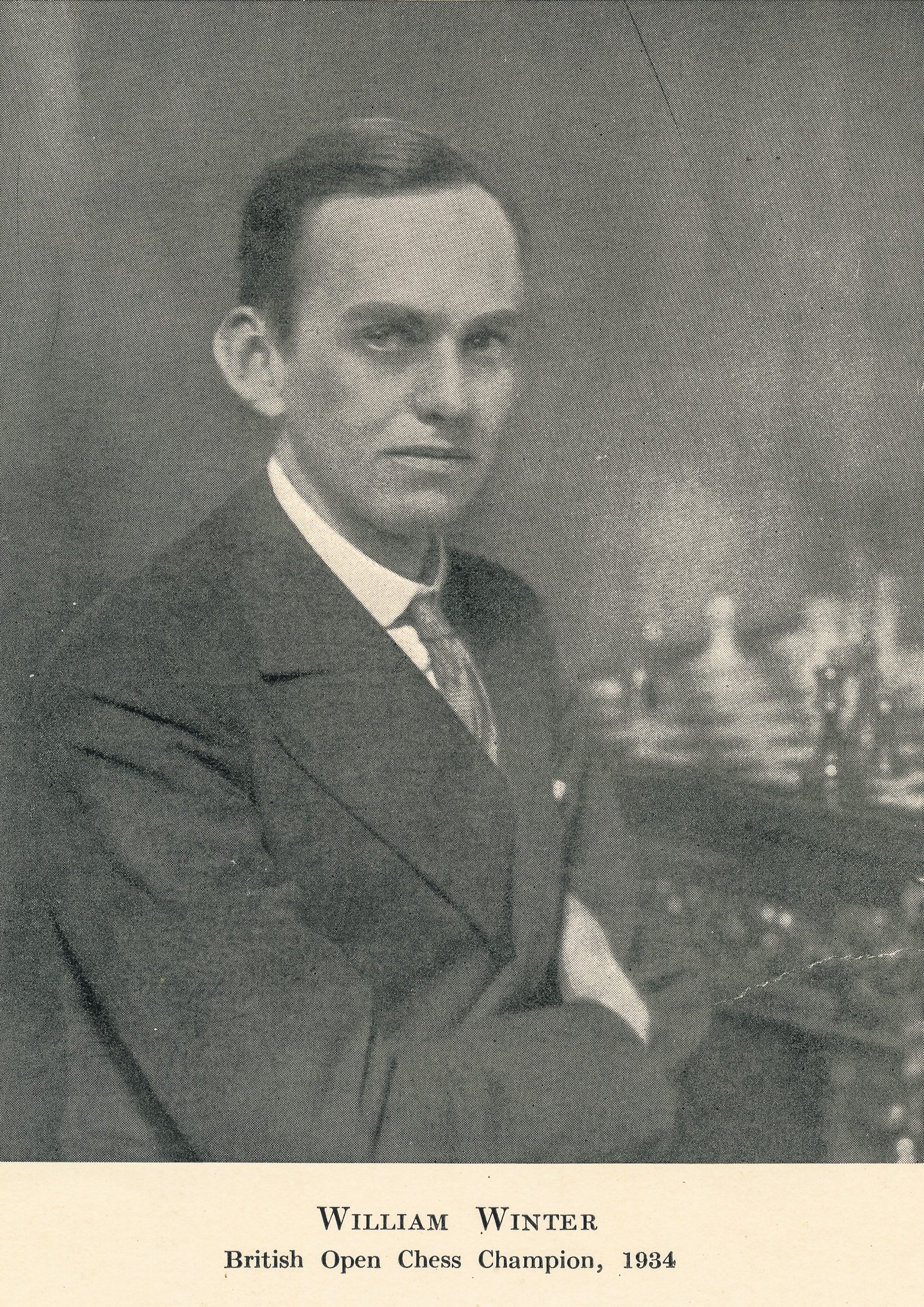
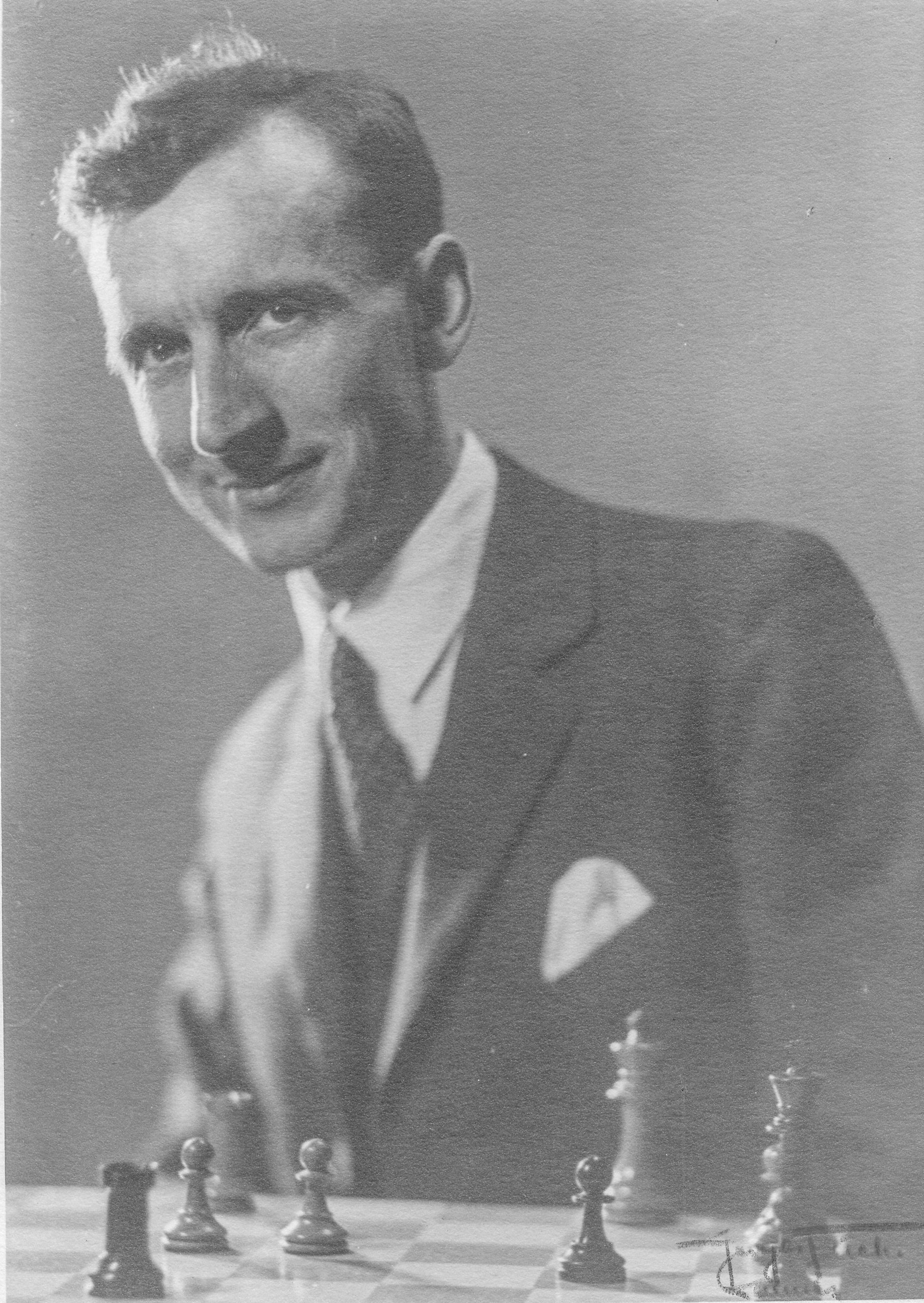
William Winter, British Open Chess Champion, 1934. The verso frontispiece of Chess for Match Players, William Winter, London, Lawrence & Wishart, 1st edition. 1936
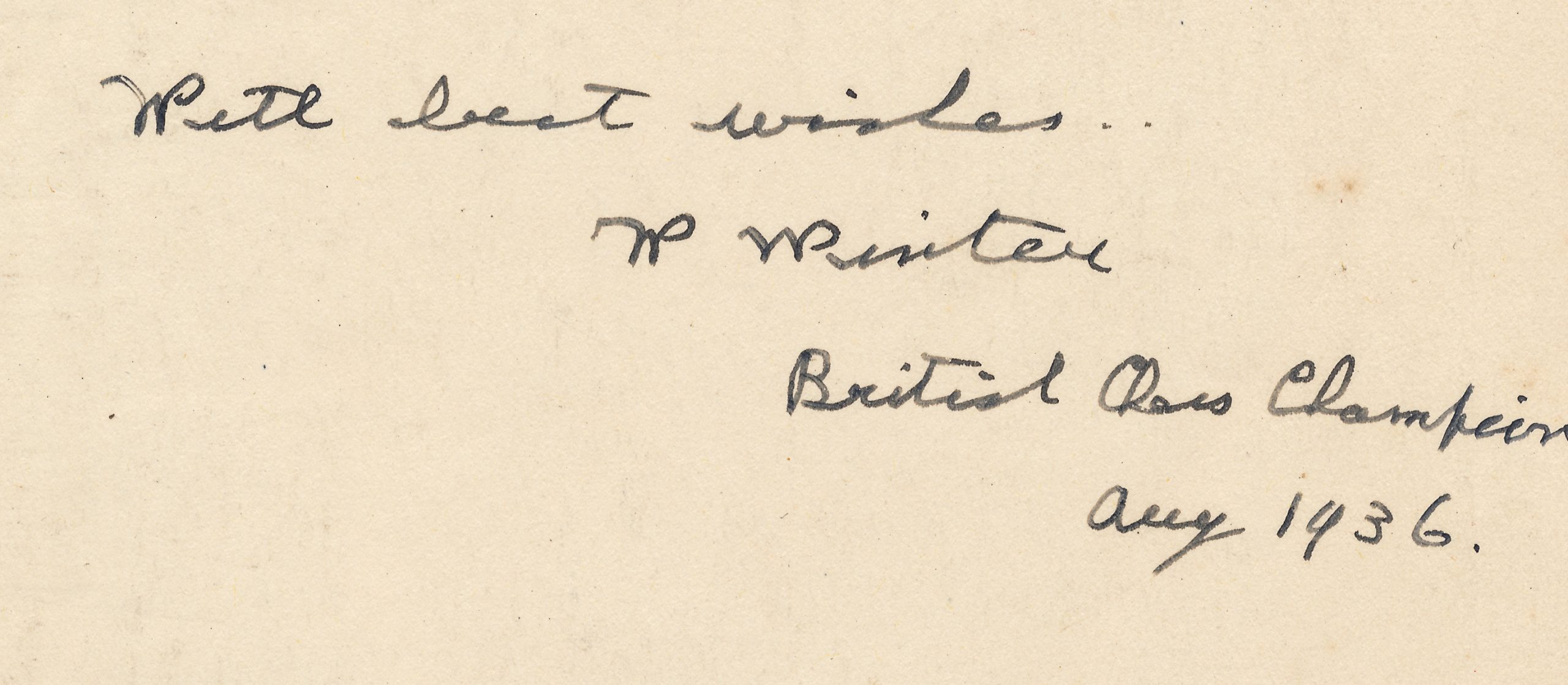
Author's inscription from Chess for Match Players, William Winter, London, Lawrence & Wishart, 1st edition. 1936
Author’s inscription from Chess for Match Players, William Winter, London, Lawrence & Wishart, 1st edition. 1936

BCN remembers William (Willy) Winter who passed away on Sunday, December 18th, 1955 from tuberculosis (at the time known as “the white plague”). He refused to enter a sanatorium.

There is some variation from sources who quote his Date of Birth. All have 11th of September as the date but vary by the year giving either 1898 or 1899. However careful research by John Townsend (Wokingham) gives 1897 and this work is cited by Edward Winter.

Late in 2021 historian Gerard Killoran (Ilkley) discovered this clipping from the Hampshire Advertiser – Wednesday 22 September 1897 p.2:
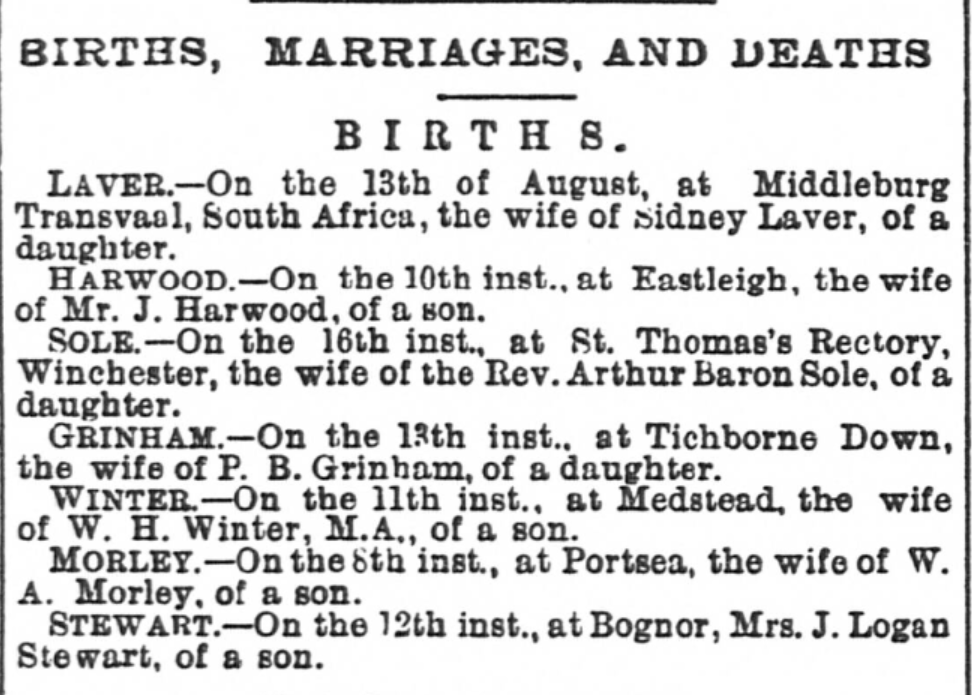
Hampshire Advertiser - Wednesday 22 September 1897 p.2
Hampshire Advertiser – Wednesday 22 September 1897 p.2

which confirms JTs evidence from the 1939 register.

His father was William Henderson Winter and his mother Margaret Winter. He was born in Medstead, Hampshire. In the 1911 census their address was recorded as “The Boynes”,  Four Marks, Alton, Hampshire and the family had two servants : a cook and a housemaid. In 1936 Winter lived at The Old Cottage, North Road, Three Bridges, Sussex.

In the second quarter of 1933 William married Amelia Jennett (née Potter) in the district of Pancras. William knew Amelia as Molly and wrote about her extensively in his memoirs. Amelia was married to Dennis Jennett but Dennis had an affair with another woman and a convenient to all parties “arrangement” was entered into. However, Willy’s father was less than impressed.

From The Encyclopedia of Chess (Robert Hale 1970&1976), Anne Sunnucks :

“International Master, chess. professional and British Champion in 1935 and 1936, William Winter is one of the most colourful  figures that British chess has produced. A born bohemian, Winter could on many occasions have been mistaken for a tramp, yet he was equally capable of turning up at a dinner or some other official occasion, well-groomed and looking the split image of his famous uncle, Sir James Barrie, and making a speech of such wit and culture that every other speech would seem flat.

Born in Medstead in Hampshire on 11th September 1898, of Scottish parentage. Winter’s mother was the youngest sister of Sir James Barrie, and his father a brilliant scholar who had entered St. Andrew’s University at the age of 16, taken honours in classics and then won a scholarship to Cambridge to read mathematics.

Winter was taught to play chess by his father, who was a strong player, when he was 12. From the time he was introduced to the game his main aim in life was to become a first-class player, and his previous interest, cricket, had to take a back seat.

When he was 15, he joined the city of London Chess club, one of the leading clubs in the country, and his game-rapidly improved. He went up to Cambridge to read law for a year during-the l9l4-l9l8 war, before he became of age for military service and joined the Honourable Artillery Company. While he was stationed at Leeds he learned that the British champion, F. D. Yates, and the Mexican master, A. G. Conde, were in the habit of playing chess on a Saturday afternoon in a café in Bradford.

Winter started going to this café and made the acquaintance of the two masters, who would occasionally give him a game.

On returning to Cambridge when the war was over, Winter became President of the University Chess Club and also started to take an active interest in politics. He joined the University Socialist Society and the local branch of the Independent Labour Party, and when the Communist Party was formed he became a Communist.

In 1919 Winter became Cambridge University Champion and won a match against R. H. V. Scott, a leading British player, by a score of 4-2, thereby securing for himself an invitation to play in the Victory Congress at Hastings. His lack of experience of master play proved too great a handicap, and he came 11th out of 12.
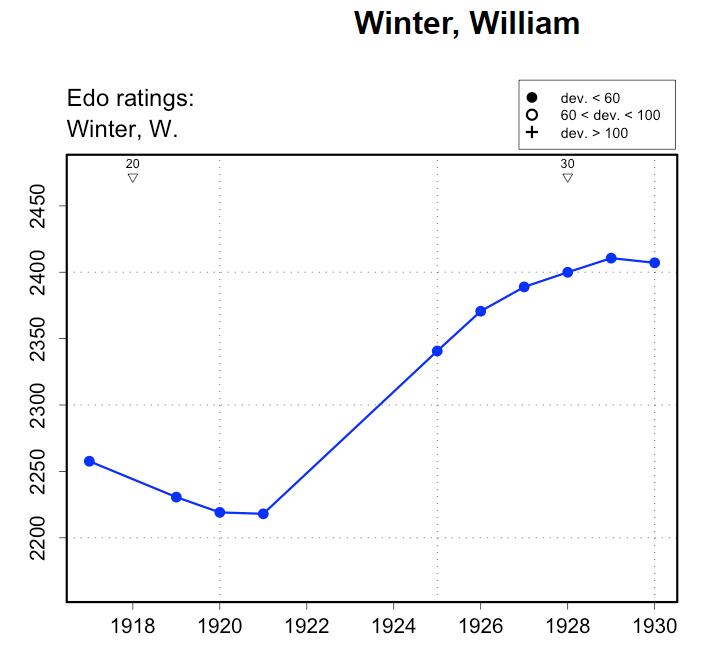
Edo rating profile for William Winter from http://www.edochess.ca/players/p7187.html

On leaving Cambridge after taking his degree in 1919, Winter persuaded his parents to allow him a year in which to play chess before settling down to a career. He hoped that during that year he might be able to prove that he had sufficient talent to become a professional player. This did not prove the case, and Winter had to resign himself to becoming a solicitor.

In 1921 he became articled to a London firm, but after a dispute with his father, which resulted in his allowance being stopped, Winter had to give up his articles and decided to concentrate his energies on politics. He went to live in Bristol and addressed open-air meetings all over the city on behalf of the Communist party, until he was arrested for sedition and sentenced to six months imprisonment. After his release Winter continued his political activities until he was forced to abandon them on medical advice.

Having given up politics, Winter decided to try his luck as a chess professional. This proved to be a success, and within two years he was making a reasonable living teaching the game, playing games for fees at St. George’s Cafe in St. Martin’s Lane in London and writing for The Manchester Guardian and The Daily Worker.

Winter remained a chess professional for the rest of his life, apart from the war years. He wrote two chess best sellers: Chess for Match Players, published in 1936
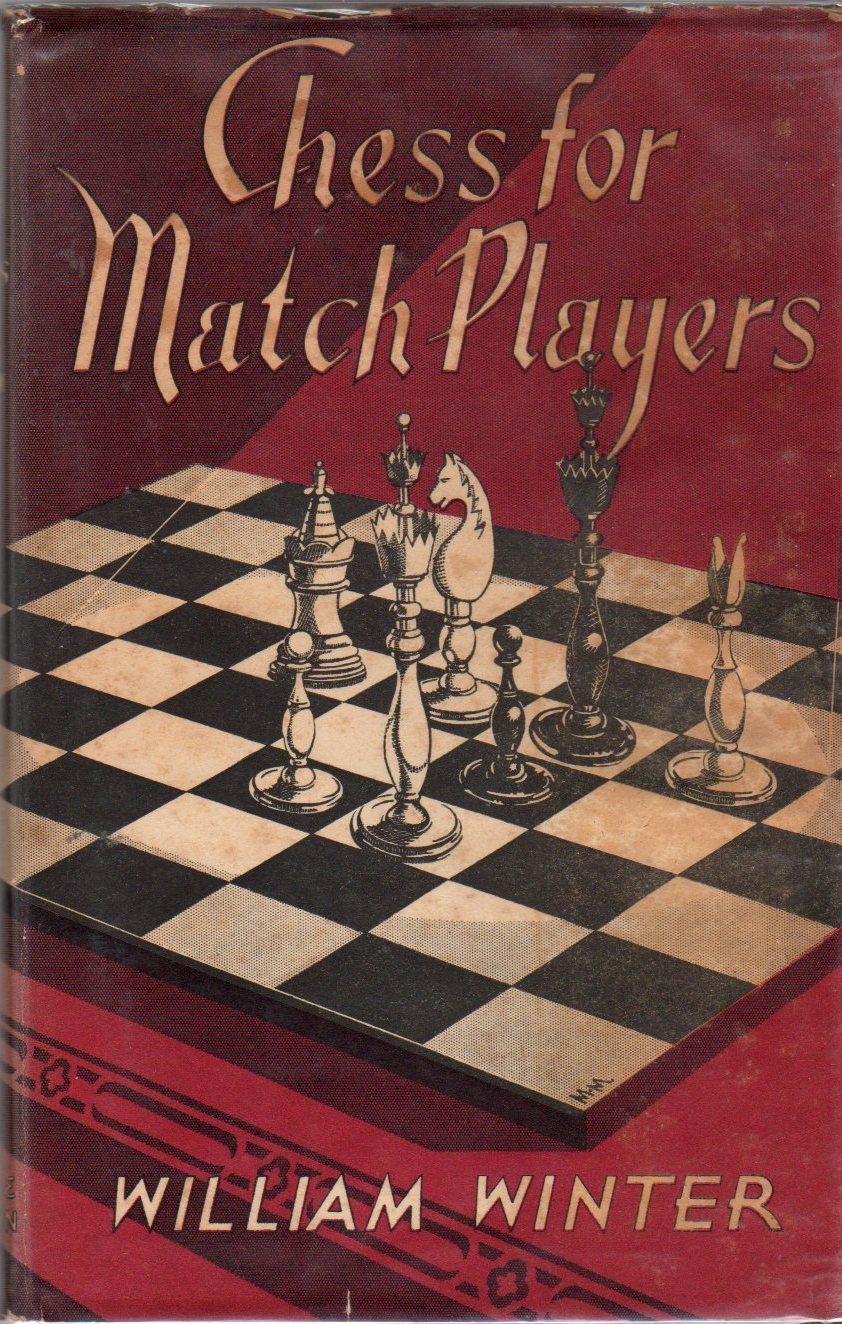
Chess for Match Players, William Winter, Carroll & Nicholson, 1936

and reprinted in 1951, and Kings of Chess;
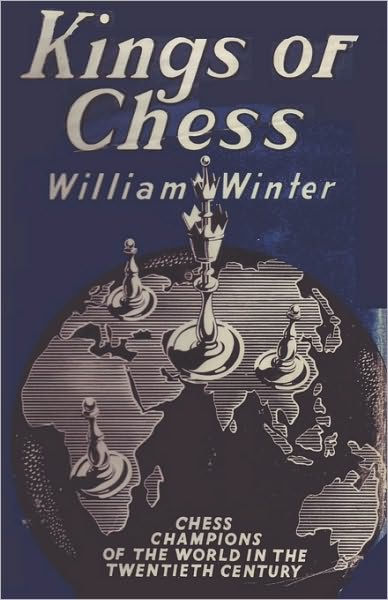
Kings of Chess, William Winter, Carroll and Nicholson Ltd, 1954

and was co-author with F. D. Yates of Modern Master Play,
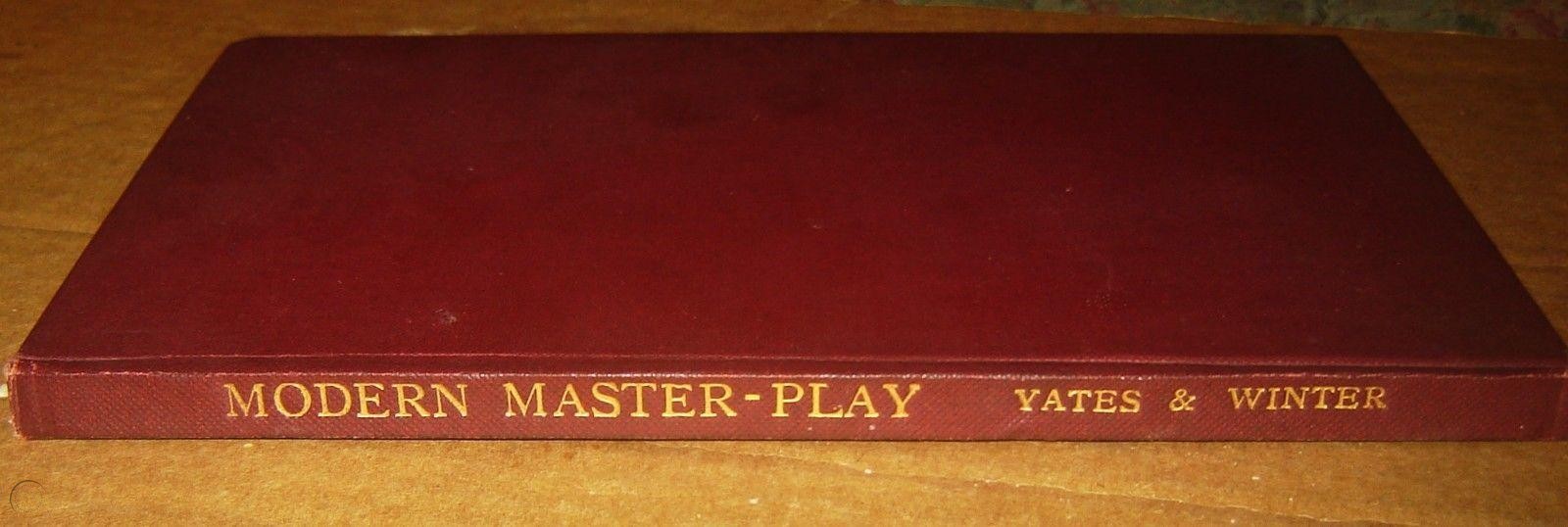
Modern Master Play, FD Yates and W. Winter, 1930

and with FD Yates of World Championship Candidates Tournament, 1953.

Winter never reached the very highest ranks as a player, although he won the British Championship twice and represented his country in four Chess Olympiads: Hamburg in 1930, Prague in 1931, Folkestone in 1933 and Warsaw in 1935. In the Great Britain v. U.S.S.R. radio match in 1946 he defeated Bronstein in the first round and then characteristically went out and celebrated his victory in such a way that his defeat in the return round was inevitable.
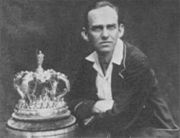
William Winter (11-IX-1897, 18-XII-1955)

Although he achieved no great successes in international tournaments, in individual games he beat many of the world’s leading players, including Nimzowitsch and Vidmar, and had draws against Capablanca and Botvinnik among others.
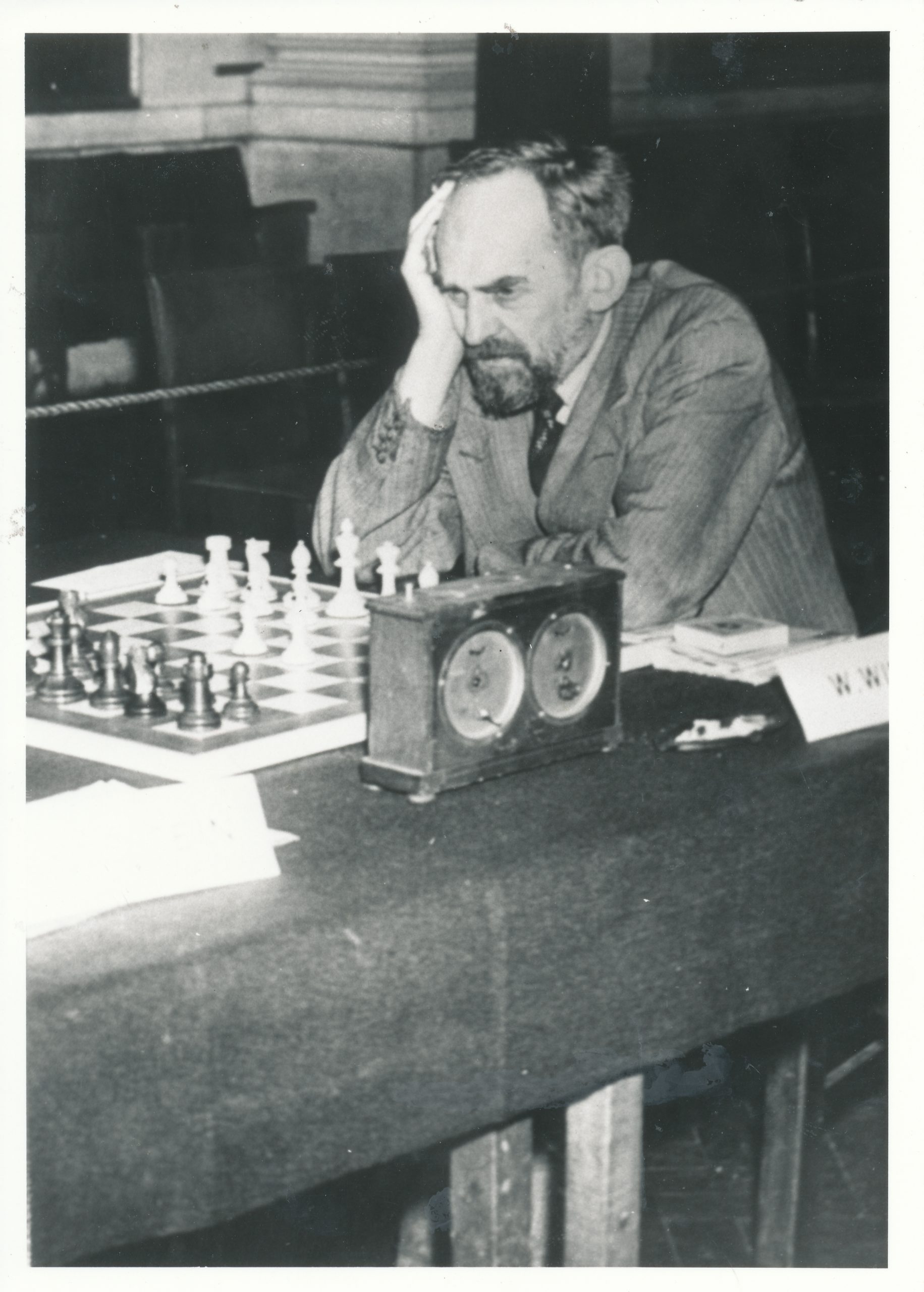
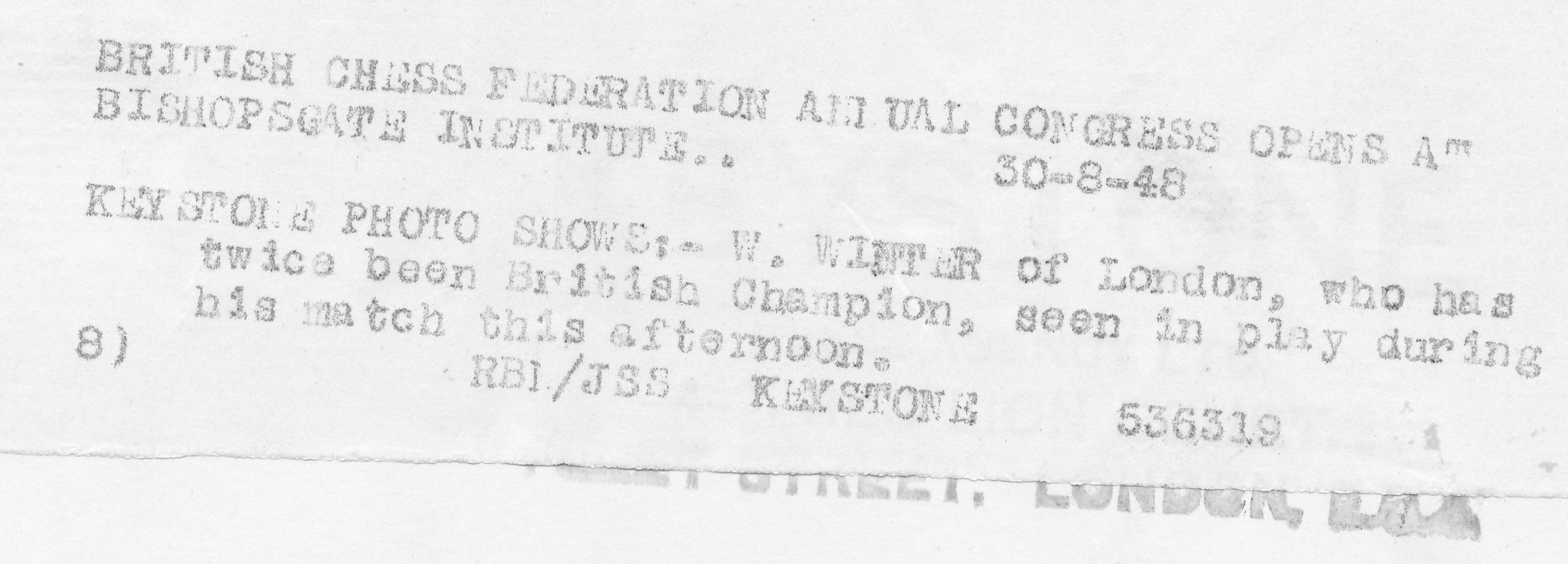
William Winter (11-IX-1898, 18-XII-1955)
William Winter (11-IX-1897, 18-XII-1955)

He died of tuberculosis in London in December 1955, after refusing to go into a sanatorium.”

In Kings, Commoners and Knaves, (Russell Enterprises, 1999), page 393 Winter quotes Winter (!) from Chess Masterpieces (Marshall) as follows:

I consider [Winter v Vidmar, London, 1927] to be my best game partly on account of the eminence of my opponent and partly because of the importance of the occasion on which it was played, and also because on three occasions in which the situation was extremely complicated. I was fortunate enough to discover the only continuation which not only was necessary to secure victory, but to actually save the game

Here is that game:

From The Anglo-Soviet Radio Chess Match by Klein and Winter :
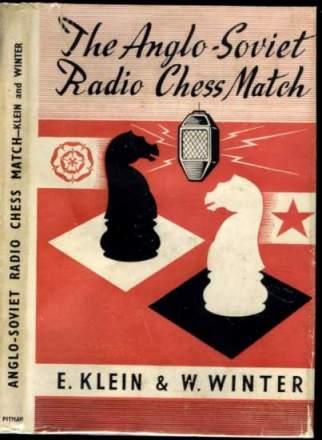
The Anglo-Soviet Radio Chess Match, E. Klein and W. Winter (1947, Pitman)

“W. Winter was born in 1899 in Hampshire. A Cambridge graduate in Law, he devoted himself eventually entirely to chess and is the only Englishman who, despite all vicissitudes, has faithfully remained a professional. After winning the Cambridge University Championship in 1921 he competed in a number of international tournaments. His outstanding performance was in the tournament in Scarborough 1928, which he won. He won the British Championship in 1935 and 1936, and has represented his country on four occasions in international team tournaments. In Hamburg, 1930, he was undefeated.
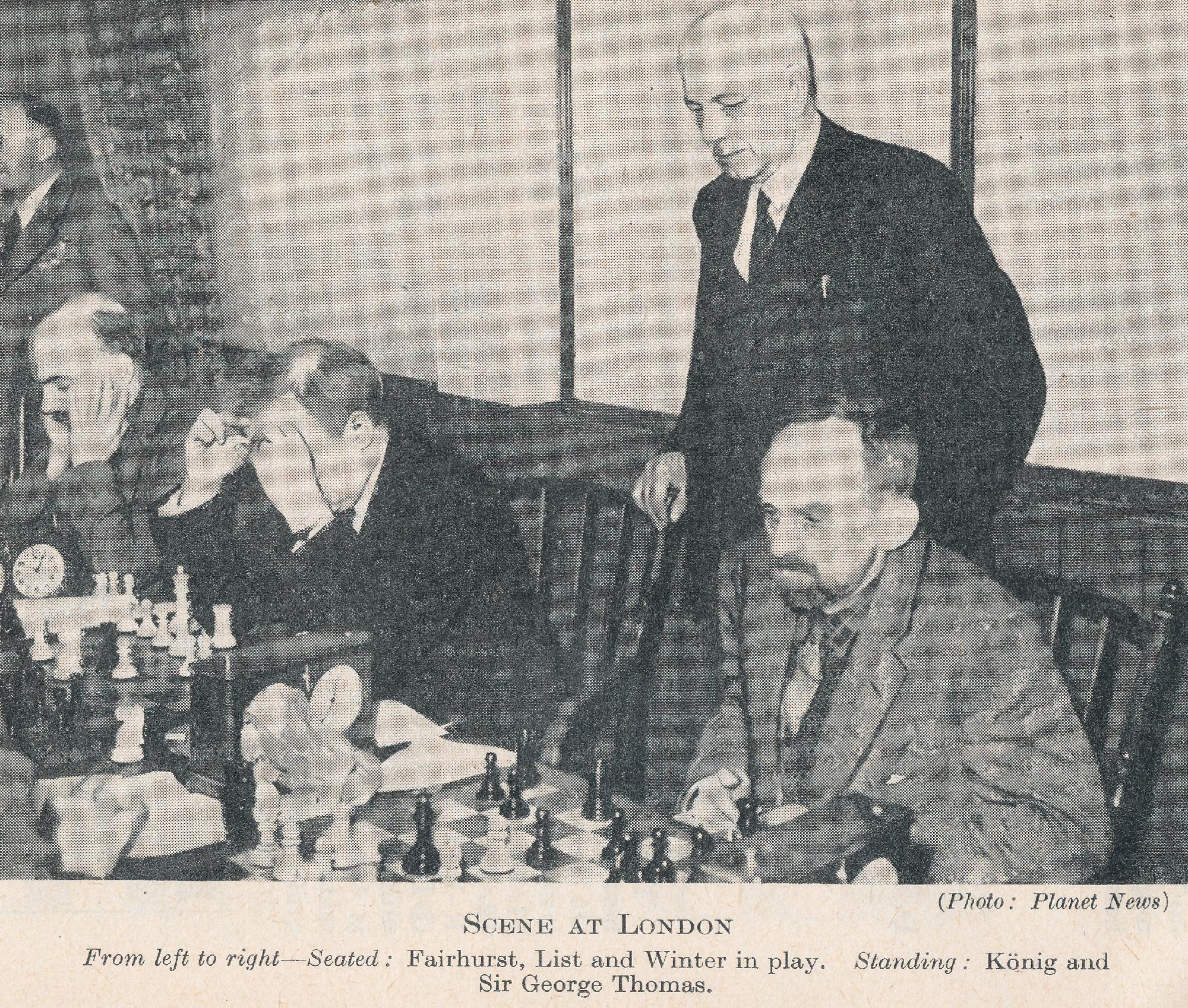
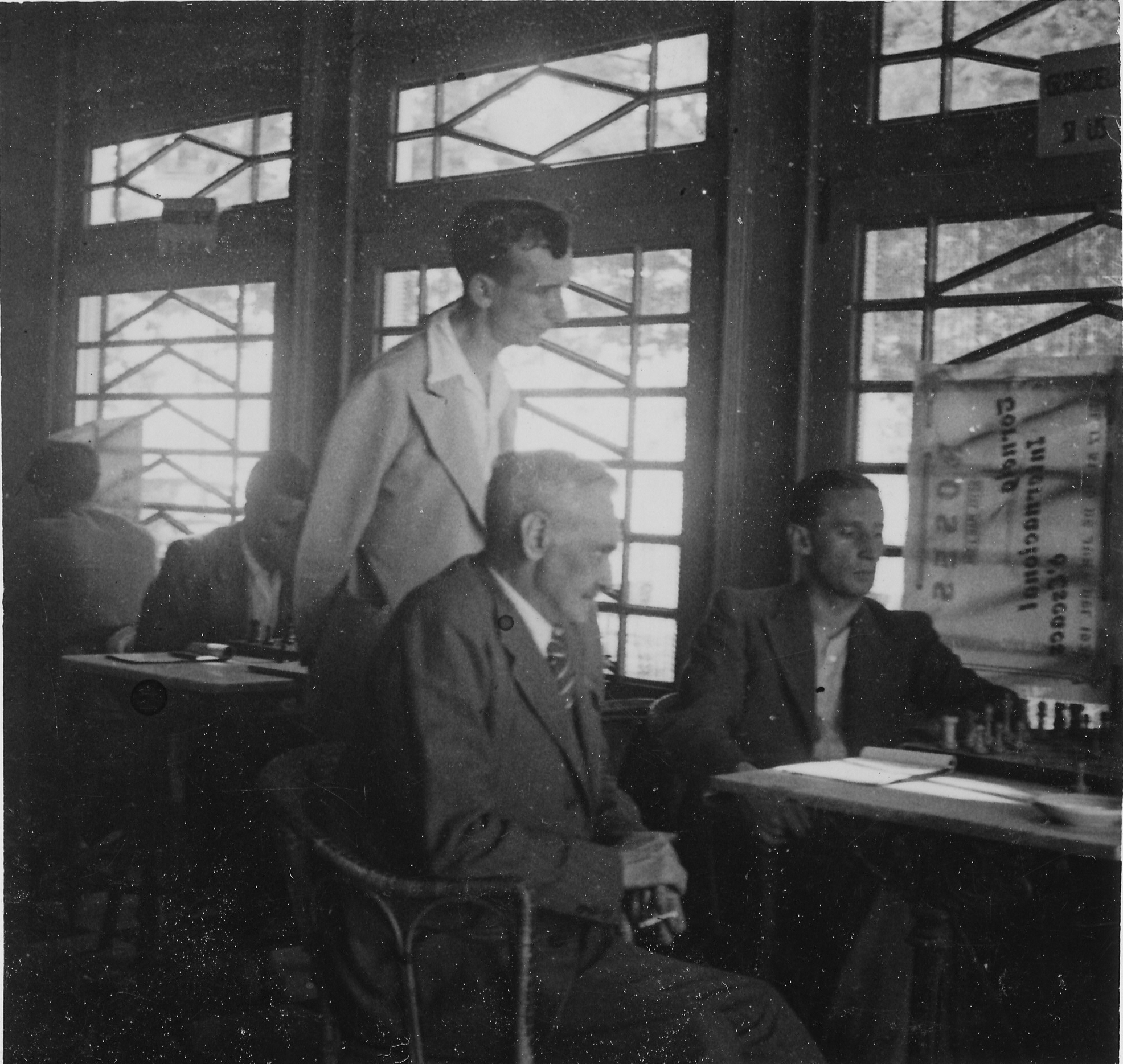
Scene at London. From left to right - Seated : Fairhurst, List and Winter in play. Standing König and Sir George Thomas
Scene at London. From left to right – Seated : Fairhurst, List and Winter in play. Standing König and Sir George Thomas

His literary activities include Chess for Match Players and The Alekhine-Capablanca World Title Match, 1927. He edits the chess column in the Soviet Weekly.
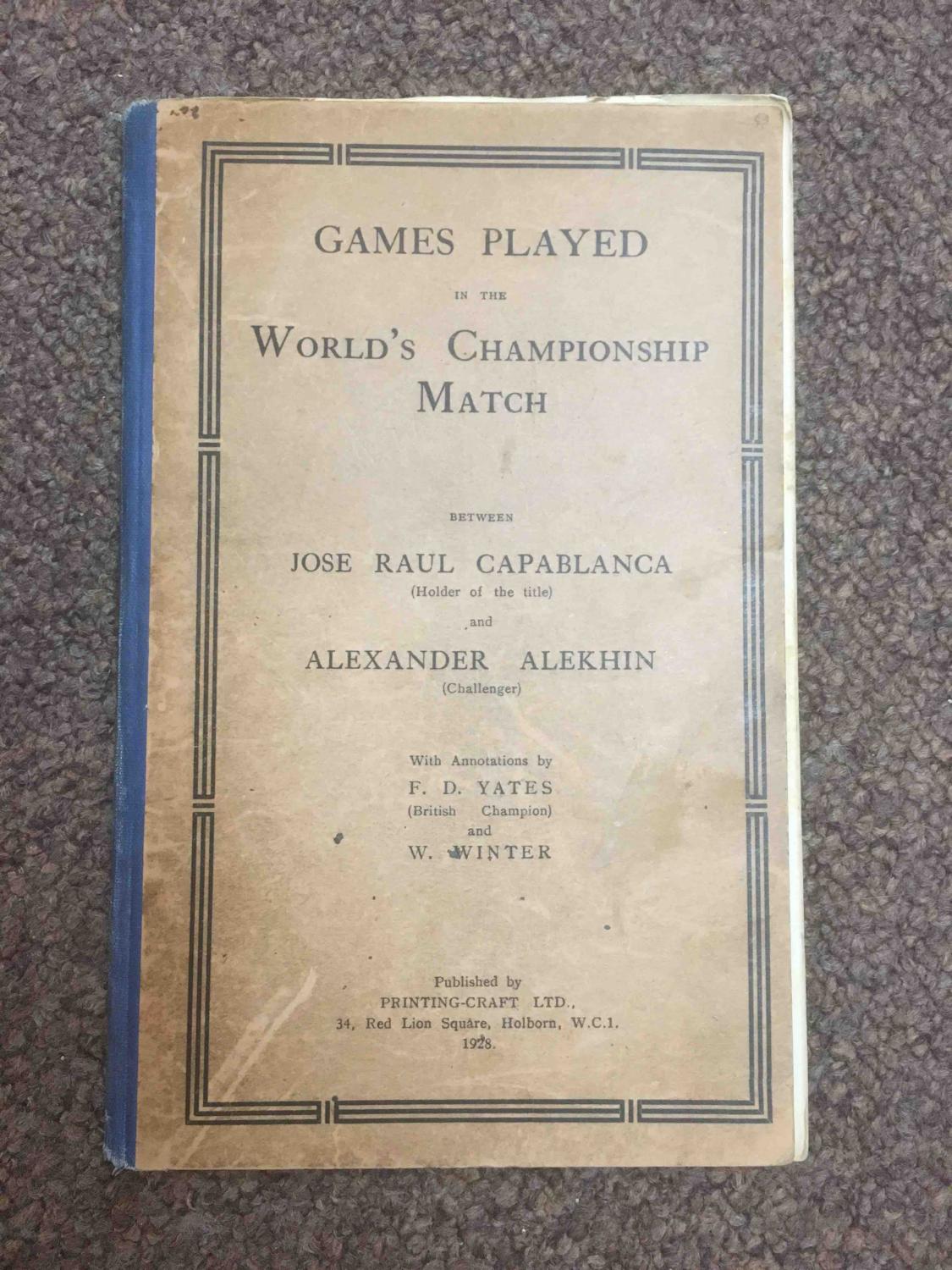
Games Played In the World's Championship Match between Jose Paul Capablanca and Alexander Alekhine, FD Yates and W, Winter, 1928, Printing Craft Limited
Games Played In the World’s Championship Match between Jose Paul Capablanca and Alexander Alekhine, FD Yates and W, Winter, 1928, Printing Craft Limited

His chess record is erratic and does not reflect his true ability. He is capable of some of the finest chess, but often plays too impulsively. His greatest strength lies in King’s side attacks. which he handles with skill and accomplishment.”
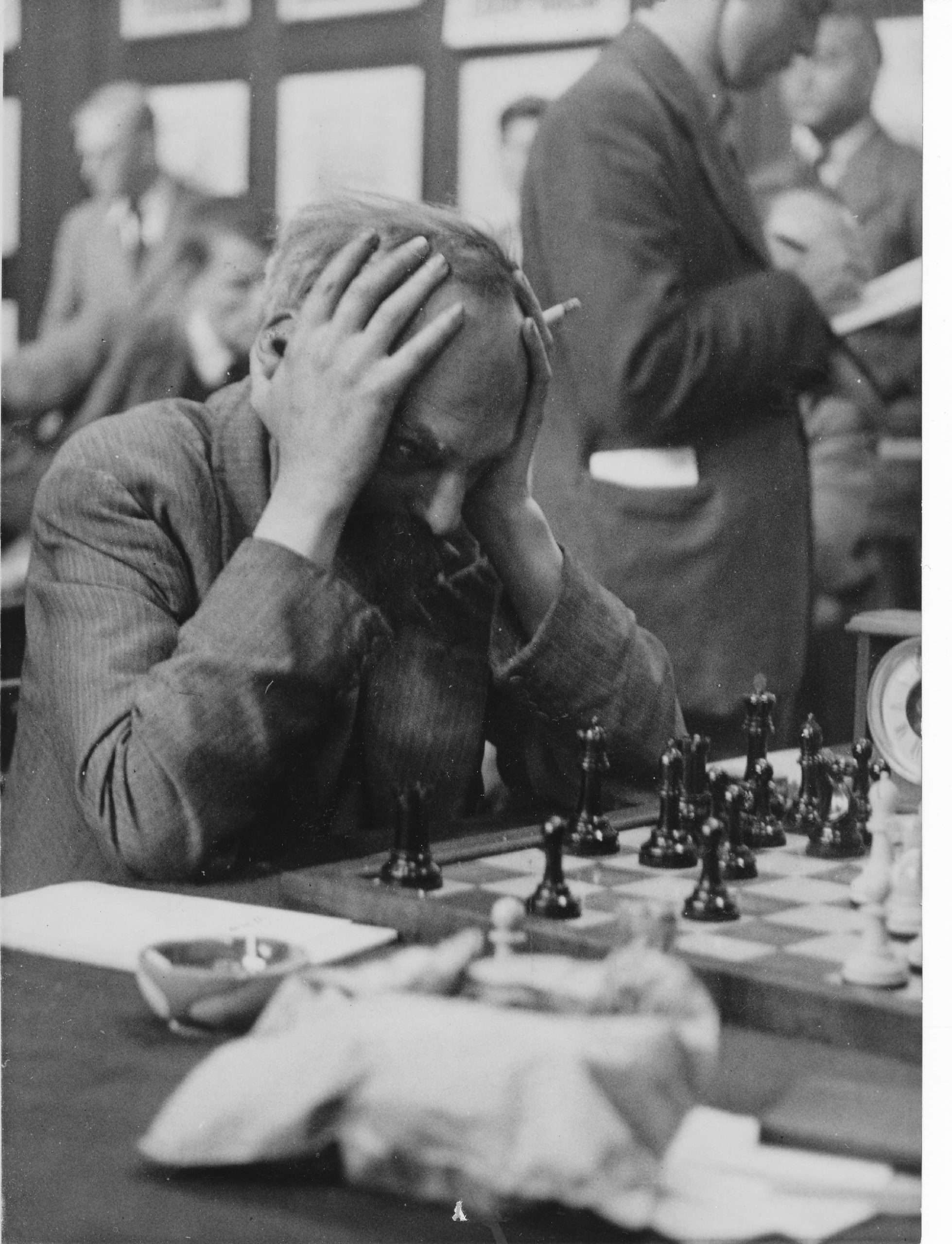
William Winter (11-IX-1897, 18-XII-1955)

From the Preface of The World Chess Championship : 1951 by Lionel Sharples Penrose we have :

“Mr. Winter’s chess career has been a long one and he occupies an extremely high position among British players. He has been British Champion twice, in 1935 and 1936. Among other notable successes was his first place in the Scarborough International Tournament in 1928. He defeated Nimzovich in the London Tournament in 1927. Against the present world championship contenders he has a very fine score, a draw against Botvinnik at Nottingham in 1936 and a win and a loss against Bronstein in the Radio Match, Great Britain v U.S.S.R. in 1946. Mr. Winter is a specialist in writing about the art of chess, and players throughout the country owe a great deal to his deep and logical expositions.”
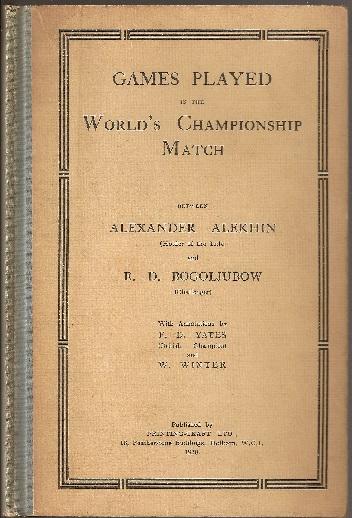
Games Played in the World's Championship Match between Alexander Alekhin (Holder of the Title) and E D Bogoljubow (Challenger), Printing Craft Limited, 1930, FD Yates and W. Winter
Games Played in the World’s Championship Match between Alexander Alekhin (Holder of the Title) and E D Bogoljubow (Challenger), Printing Craft Limited, 1930, FD Yates and W. Winter

From The Encyclopedia of Chess (BT Batsford, 1977) Edited by Harry Golombek :

International Master and twice British Champion (1935 and 1936), Winter was an excellent illustration of Réti’s thesis that players tend to be opposite over the board to their character in real life. Over the board he was classical, scientific and sober; away from the board he was revolutionary, moved by his emotions (he contrived to be both a fervent Communist and a staunch patriot), and more often than not, drunk.

His university career, where he read law, coincided with the First World War and, after a brief interruption for military service he returned to Cambridge where in 1919 he became university champion and defeated R. H. V. Scott (a strong player who won the British Championship in 1920) in a match by 4-2. On the strength of this he was invited to play in the Hastings Victory tournament of 1919 where, however, he did badly, coming 11th out of 12.
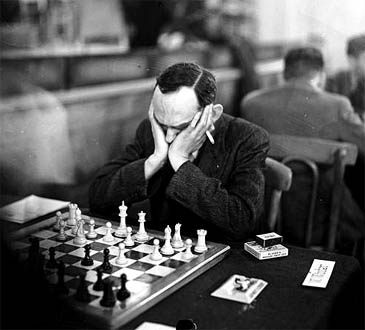
William Winter (11-ix-1897, 18-xii-1955)

After an interval during which he fervently pursued a political career to such an extent as to incur a six-months prison sentence for sedition (Winter always denied the sedition and said that the charge was trumped-up one), he took up the career of chess professional. The life suited him since it enabled him to lead the kind of Bohemian existence that pleased his artistic temperament. It should be mentioned that he was a nephew of Sir James Barrie and would have fitted in well on one of his uncle’s plays.

As a player he was eminently sound and, being an apostle of Tarrasch, a fine clear strategist. But he was lacking in tactical ability and his poor health and his way of life interfered with his consistency and impaired his stamina. But he had a number of fine victories over great players (Bronstein, Nimzowitsch and Vidmar for example).
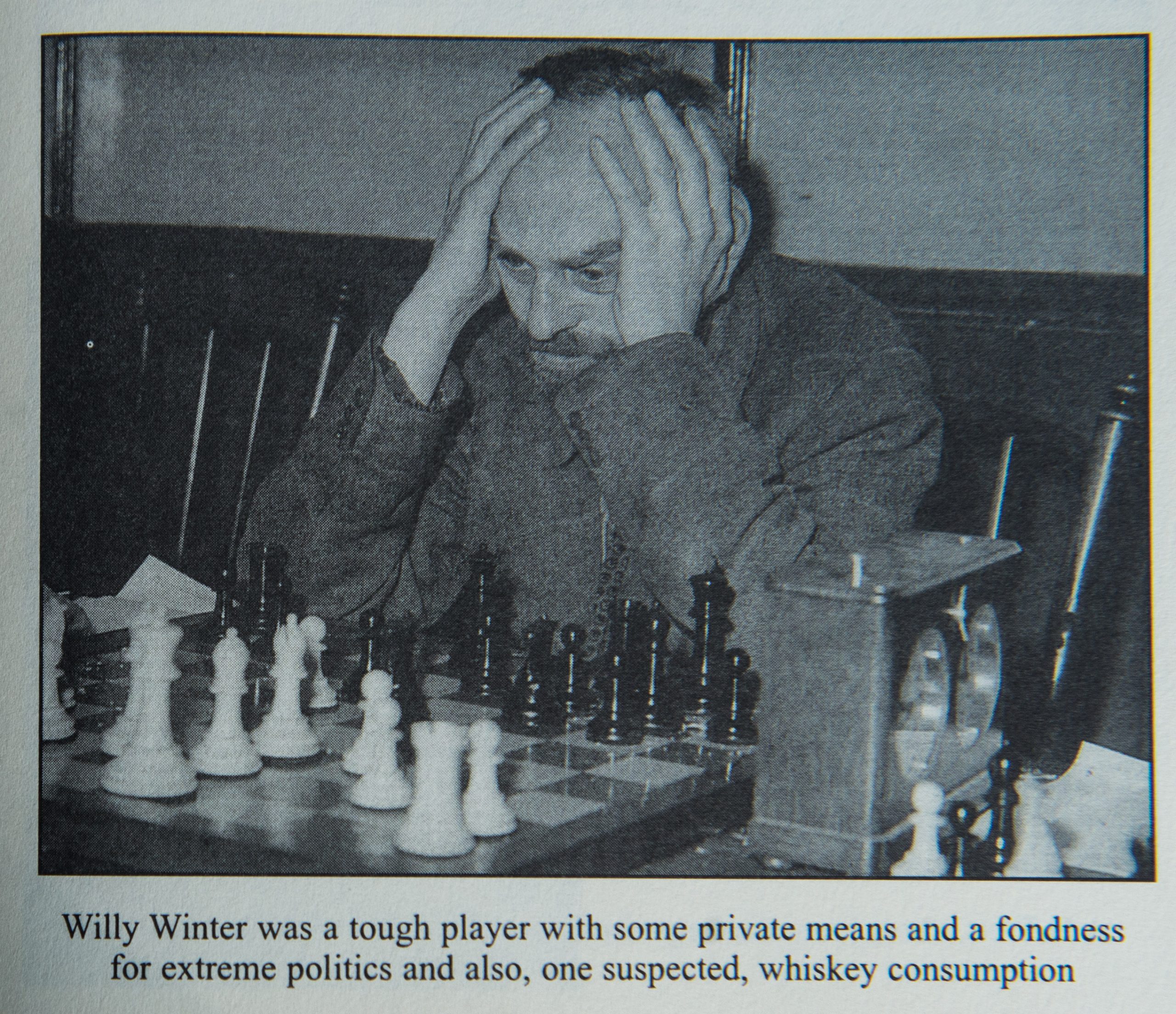
IM William Winter (11-ix-1897, 18-xii-1955)

He played in four Olympiads: Hamburg 1930 (scoring 76.7% on 4th board), Prague 1931 (58.8% on 4th board), Folkestone 1933 (59.1% on 3rd board) and Warsaw 1935 (41.7% on 1st board). He was selected to play at Stockholm in 1937 but, having “lost” his passport three times. he was refused a fresh one by the authorities.

His best international individual results were =6th at London 1927, and =5th at Lodz 1935.

His career as a chess journalist (he wrote for the Manchester Guardian following FD Yates and the Daily Worker) was somewhat impeded and spoilt by his Bohemian ways, be he wrote some excellent works on chess : Chess for Match Players, London, 1936″

Winter was a popular subject for his Swiss namesake, Edward Winter and there are several mentions in his excellent books.

In Chess Facts and Fables (McFarland, 2006) we have Chess Note 2819, page 71 which shows a photograph (from CHESS, November 1935) taken in Poland of Winter and Max Krauser, Heavyweight wrestling Champion of Europe. Quite what the occasion we are not told.

Here is an excellent article (as you’d expect) from Edward Winter

Apart from all of the contributions above possibly the most comprehensive comes from FM Steve Giddins writing in three parts in British Chess Magazine, during 2006 and 2007 :

Postscript: Since our article was published we were contacted by Steve Giddins who informed us that he owned the copyright to the articles (rather than the publisher BCM) and that he did not wish us to make them available via this article.

In the “Mid-October” issue of CHESS for 1962, (Volume 27, Number 418)  we had the following announcement:

WILLIAM WINTER’S AUTOBIOGRAPHY

Edited by David Hooper, will be serialised in CHESS commencing with our next number. Nephew of Sir James Barrie, twice British Chess Champion, a lifelong Communist and freethinker, imprisoned for his political views, “Willie Winter”, with his Bohemian way of life, was undoubtedly the most colourful figure in British Chess for many decades irrespective of whether you agree with his views (most readers may not!), you will find him a delightful writer whose gifted pen draws you engrossed from page to Page.

And so, for your delectation, here are William Winter’s Memoirs.
Death Anniversary of William Winter (11-ix-1898 18-xii-1955)

William Winter, British Open Chess Champion, 1934. The verso frontispiece of Chess for Match Players, William Winter, London, Lawrence & Wishart, 1st edition. 1936
Author's inscription from Chess for Match Players, William Winter, London, Lawrence & Wishart, 1st edition. 1936
Author’s inscription from Chess for Match Players, William Winter, London, Lawrence & Wishart, 1st edition. 1936

BCN remembers William (Willy) Winter who passed away on Sunday, December 18th, 1955 from tuberculosis (at the time known as “the white plague”). He refused to enter a sanatorium.

There is some variation from sources who quote his Date of Birth. All have 11th of September as the date but vary by the year giving either 1898 or 1899. However careful research by John Townsend (Wokingham) gives 1897 and this work is cited by Edward Winter.

Late in 2021 historian Gerard Killoran (Ilkley) discovered this clipping from the Hampshire Advertiser – Wednesday 22 September 1897 p.2:

Hampshire Advertiser - Wednesday 22 September 1897 p.2
Hampshire Advertiser – Wednesday 22 September 1897 p.2

which confirms JTs evidence from the 1939 register.

His father was William Henderson Winter and his mother Margaret Winter. He was born in Medstead, Hampshire. In the 1911 census their address was recorded as “The Boynes”,  Four Marks, Alton, Hampshire and the family had two servants : a cook and a housemaid. In 1936 Winter lived at The Old Cottage, North Road, Three Bridges, Sussex.

In the second quarter of 1933 William married Amelia Jennett (née Potter) in the district of Pancras. William knew Amelia as Molly and wrote about her extensively in his memoirs. Amelia was married to Dennis Jennett but Dennis had an affair with another woman and a convenient to all parties “arrangement” was entered into. However, Willy’s father was less than impressed.

From The Encyclopedia of Chess (Robert Hale 1970&1976), Anne Sunnucks :

“International Master, chess. professional and British Champion in 1935 and 1936, William Winter is one of the most colourful  figures that British chess has produced. A born bohemian, Winter could on many occasions have been mistaken for a tramp, yet he was equally capable of turning up at a dinner or some other official occasion, well-groomed and looking the split image of his famous uncle, Sir James Barrie, and making a speech of such wit and culture that every other speech would seem flat.

Born in Medstead in Hampshire on 11th September 1898, of Scottish parentage. Winter’s mother was the youngest sister of Sir James Barrie, and his father a brilliant scholar who had entered St. Andrew’s University at the age of 16, taken honours in classics and then won a scholarship to Cambridge to read mathematics.

Winter was taught to play chess by his father, who was a strong player, when he was 12. From the time he was introduced to the game his main aim in life was to become a first-class player, and his previous interest, cricket, had to take a back seat.

When he was 15, he joined the city of London Chess club, one of the leading clubs in the country, and his game-rapidly improved. He went up to Cambridge to read law for a year during-the l9l4-l9l8 war, before he became of age for military service and joined the Honourable Artillery Company. While he was stationed at Leeds he learned that the British champion, F. D. Yates, and the Mexican master, A. G. Conde, were in the habit of playing chess on a Saturday afternoon in a café in Bradford.

Winter started going to this café and made the acquaintance of the two masters, who would occasionally give him a game.

On returning to Cambridge when the war was over, Winter became President of the University Chess Club and also started to take an active interest in politics. He joined the University Socialist Society and the local branch of the Independent Labour Party, and when the Communist Party was formed he became a Communist.

In 1919 Winter became Cambridge University Champion and won a match against R. H. V. Scott, a leading British player, by a score of 4-2, thereby securing for himself an invitation to play in the Victory Congress at Hastings. His lack of experience of master play proved too great a handicap, and he came 11th out of 12.

Edo rating profile for William Winter from http://www.edochess.ca/players/p7187.html

On leaving Cambridge after taking his degree in 1919, Winter persuaded his parents to allow him a year in which to play chess before settling down to a career. He hoped that during that year he might be able to prove that he had sufficient talent to become a professional player. This did not prove the case, and Winter had to resign himself to becoming a solicitor.

In 1921 he became articled to a London firm, but after a dispute with his father, which resulted in his allowance being stopped, Winter had to give up his articles and decided to concentrate his energies on politics. He went to live in Bristol and addressed open-air meetings all over the city on behalf of the Communist party, until he was arrested for sedition and sentenced to six months imprisonment. After his release Winter continued his political activities until he was forced to abandon them on medical advice.

Having given up politics, Winter decided to try his luck as a chess professional. This proved to be a success, and within two years he was making a reasonable living teaching the game, playing games for fees at St. George’s Cafe in St. Martin’s Lane in London and writing for The Manchester Guardian and The Daily Worker.

Winter remained a chess professional for the rest of his life, apart from the war years. He wrote two chess best sellers: Chess for Match Players, published in 1936

Chess for Match Players, William Winter, Carroll & Nicholson, 1936

and reprinted in 1951, and Kings of Chess;

Kings of Chess, William Winter, Carroll and Nicholson Ltd, 1954

and was co-author with F. D. Yates of Modern Master Play,

Modern Master Play, FD Yates and W. Winter, 1930

and with FD Yates of World Championship Candidates Tournament, 1953.

Winter never reached the very highest ranks as a player, although he won the British Championship twice and represented his country in four Chess Olympiads: Hamburg in 1930, Prague in 1931, Folkestone in 1933 and Warsaw in 1935. In the Great Britain v. U.S.S.R. radio match in 1946 he defeated Bronstein in the first round and then characteristically went out and celebrated his victory in such a way that his defeat in the return round was inevitable.

William Winter (11-IX-1897, 18-XII-1955)

Although he achieved no great successes in international tournaments, in individual games he beat many of the world’s leading players, including Nimzowitsch and Vidmar, and had draws against Capablanca and Botvinnik among others.

William Winter (11-IX-1898, 18-XII-1955)
William Winter (11-IX-1897, 18-XII-1955)

He died of tuberculosis in London in December 1955, after refusing to go into a sanatorium.”

In Kings, Commoners and Knaves, (Russell Enterprises, 1999), page 393 Winter quotes Winter (!) from Chess Masterpieces (Marshall) as follows:

I consider [Winter v Vidmar, London, 1927] to be my best game partly on account of the eminence of my opponent and partly because of the importance of the occasion on which it was played, and also because on three occasions in which the situation was extremely complicated. I was fortunate enough to discover the only continuation which not only was necessary to secure victory, but to actually save the game

Here is that game:

From The Anglo-Soviet Radio Chess Match by Klein and Winter :

The Anglo-Soviet Radio Chess Match, E. Klein and W. Winter (1947, Pitman)

“W. Winter was born in 1899 in Hampshire. A Cambridge graduate in Law, he devoted himself eventually entirely to chess and is the only Englishman who, despite all vicissitudes, has faithfully remained a professional. After winning the Cambridge University Championship in 1921 he competed in a number of international tournaments. His outstanding performance was in the tournament in Scarborough 1928, which he won. He won the British Championship in 1935 and 1936, and has represented his country on four occasions in international team tournaments. In Hamburg, 1930, he was undefeated.

Scene at London. From left to right - Seated : Fairhurst, List and Winter in play. Standing König and Sir George Thomas
Scene at London. From left to right – Seated : Fairhurst, List and Winter in play. Standing König and Sir George Thomas

His literary activities include Chess for Match Players and The Alekhine-Capablanca World Title Match, 1927. He edits the chess column in the Soviet Weekly.

Games Played In the World's Championship Match between Jose Paul Capablanca and Alexander Alekhine, FD Yates and W, Winter, 1928, Printing Craft Limited
Games Played In the World’s Championship Match between Jose Paul Capablanca and Alexander Alekhine, FD Yates and W, Winter, 1928, Printing Craft Limited

His chess record is erratic and does not reflect his true ability. He is capable of some of the finest chess, but often plays too impulsively. His greatest strength lies in King’s side attacks. which he handles with skill and accomplishment.”

William Winter (11-IX-1897, 18-XII-1955)

From the Preface of The World Chess Championship : 1951 by Lionel Sharples Penrose we have :

“Mr. Winter’s chess career has been a long one and he occupies an extremely high position among British players. He has been British Champion twice, in 1935 and 1936. Among other notable successes was his first place in the Scarborough International Tournament in 1928. He defeated Nimzovich in the London Tournament in 1927. Against the present world championship contenders he has a very fine score, a draw against Botvinnik at Nottingham in 1936 and a win and a loss against Bronstein in the Radio Match, Great Britain v U.S.S.R. in 1946. Mr. Winter is a specialist in writing about the art of chess, and players throughout the country owe a great deal to his deep and logical expositions.”

Games Played in the World's Championship Match between Alexander Alekhin (Holder of the Title) and E D Bogoljubow (Challenger), Printing Craft Limited, 1930, FD Yates and W. Winter
Games Played in the World’s Championship Match between Alexander Alekhin (Holder of the Title) and E D Bogoljubow (Challenger), Printing Craft Limited, 1930, FD Yates and W. Winter

From The Encyclopedia of Chess (BT Batsford, 1977) Edited by Harry Golombek :

International Master and twice British Champion (1935 and 1936), Winter was an excellent illustration of Réti’s thesis that players tend to be opposite over the board to their character in real life. Over the board he was classical, scientific and sober; away from the board he was revolutionary, moved by his emotions (he contrived to be both a fervent Communist and a staunch patriot), and more often than not, drunk.

His university career, where he read law, coincided with the First World War and, after a brief interruption for military service he returned to Cambridge where in 1919 he became university champion and defeated R. H. V. Scott (a strong player who won the British Championship in 1920) in a match by 4-2. On the strength of this he was invited to play in the Hastings Victory tournament of 1919 where, however, he did badly, coming 11th out of 12.

William Winter (11-ix-1897, 18-xii-1955)

After an interval during which he fervently pursued a political career to such an extent as to incur a six-months prison sentence for sedition (Winter always denied the sedition and said that the charge was trumped-up one), he took up the career of chess professional. The life suited him since it enabled him to lead the kind of Bohemian existence that pleased his artistic temperament. It should be mentioned that he was a nephew of Sir James Barrie and would have fitted in well on one of his uncle’s plays.

As a player he was eminently sound and, being an apostle of Tarrasch, a fine clear strategist. But he was lacking in tactical ability and his poor health and his way of life interfered with his consistency and impaired his stamina. But he had a number of fine victories over great players (Bronstein, Nimzowitsch and Vidmar for example).

IM William Winter (11-ix-1897, 18-xii-1955)

He played in four Olympiads: Hamburg 1930 (scoring 76.7% on 4th board), Prague 1931 (58.8% on 4th board), Folkestone 1933 (59.1% on 3rd board) and Warsaw 1935 (41.7% on 1st board). He was selected to play at Stockholm in 1937 but, having “lost” his passport three times. he was refused a fresh one by the authorities.

His best international individual results were =6th at London 1927, and =5th at Lodz 1935.

His career as a chess journalist (he wrote for the Manchester Guardian following FD Yates and the Daily Worker) was somewhat impeded and spoilt by his Bohemian ways, be he wrote some excellent works on chess : Chess for Match Players, London, 1936″

Winter was a popular subject for his Swiss namesake, Edward Winter and there are several mentions in his excellent books.

In Chess Facts and Fables (McFarland, 2006) we have Chess Note 2819, page 71 which shows a photograph (from CHESS, November 1935) taken in Poland of Winter and Max Krauser, Heavyweight wrestling Champion of Europe. Quite what the occasion we are not told.

Here is an excellent article (as you’d expect) from Edward Winter

Apart from all of the contributions above possibly the most comprehensive comes from FM Steve Giddins writing in three parts in British Chess Magazine, during 2006 and 2007 :

Postscript: Since our article was published we were contacted by Steve Giddins who informed us that he owned the copyright to the articles (rather than the publisher BCM) and that he did not wish us to make them available via this article.

In the “Mid-October” issue of CHESS for 1962, (Volume 27, Number 418)  we had the following announcement:

WILLIAM WINTER’S AUTOBIOGRAPHY

Edited by David Hooper, will be serialised in CHESS commencing with our next number. Nephew of Sir James Barrie, twice British Chess Champion, a lifelong Communist and freethinker, imprisoned for his political views, “Willie Winter”, with his Bohemian way of life, was undoubtedly the most colourful figure in British Chess for many decades irrespective of whether you agree with his views (most readers may not!), you will find him a delightful writer whose gifted pen draws you engrossed from page to Page.

And so, for your delectation, here are William Winter’s Memoirs.
Death Anniversary of William Winter (11-ix-1898 18-xii-1955)

William Winter, British Open Chess Champion, 1934. The verso frontispiece of Chess for Match Players, William Winter, London, Lawrence & Wishart, 1st edition. 1936
Author's inscription from Chess for Match Players, William Winter, London, Lawrence & Wishart, 1st edition. 1936
Author’s inscription from Chess for Match Players, William Winter, London, Lawrence & Wishart, 1st edition. 1936

BCN remembers William (Willy) Winter who passed away on Sunday, December 18th, 1955 from tuberculosis (at the time known as “the white plague”). He refused to enter a sanatorium.

There is some variation from sources who quote his Date of Birth. All have 11th of September as the date but vary by the year giving either 1898 or 1899. However careful research by John Townsend (Wokingham) gives 1897 and this work is cited by Edward Winter.

Late in 2021 historian Gerard Killoran (Ilkley) discovered this clipping from the Hampshire Advertiser – Wednesday 22 September 1897 p.2:

Hampshire Advertiser - Wednesday 22 September 1897 p.2
Hampshire Advertiser – Wednesday 22 September 1897 p.2

which confirms JTs evidence from the 1939 register.

His father was William Henderson Winter and his mother Margaret Winter. He was born in Medstead, Hampshire. In the 1911 census their address was recorded as “The Boynes”,  Four Marks, Alton, Hampshire and the family had two servants : a cook and a housemaid. In 1936 Winter lived at The Old Cottage, North Road, Three Bridges, Sussex.

In the second quarter of 1933 William married Amelia Jennett (née Potter) in the district of Pancras. William knew Amelia as Molly and wrote about her extensively in his memoirs. Amelia was married to Dennis Jennett but Dennis had an affair with another woman and a convenient to all parties “arrangement” was entered into. However, Willy’s father was less than impressed.

From The Encyclopedia of Chess (Robert Hale 1970&1976), Anne Sunnucks :

“International Master, chess. professional and British Champion in 1935 and 1936, William Winter is one of the most colourful  figures that British chess has produced. A born bohemian, Winter could on many occasions have been mistaken for a tramp, yet he was equally capable of turning up at a dinner or some other official occasion, well-groomed and looking the split image of his famous uncle, Sir James Barrie, and making a speech of such wit and culture that every other speech would seem flat.

Born in Medstead in Hampshire on 11th September 1898, of Scottish parentage. Winter’s mother was the youngest sister of Sir James Barrie, and his father a brilliant scholar who had entered St. Andrew’s University at the age of 16, taken honours in classics and then won a scholarship to Cambridge to read mathematics.

Winter was taught to play chess by his father, who was a strong player, when he was 12. From the time he was introduced to the game his main aim in life was to become a first-class player, and his previous interest, cricket, had to take a back seat.

When he was 15, he joined the city of London Chess club, one of the leading clubs in the country, and his game-rapidly improved. He went up to Cambridge to read law for a year during-the l9l4-l9l8 war, before he became of age for military service and joined the Honourable Artillery Company. While he was stationed at Leeds he learned that the British champion, F. D. Yates, and the Mexican master, A. G. Conde, were in the habit of playing chess on a Saturday afternoon in a café in Bradford.

Winter started going to this café and made the acquaintance of the two masters, who would occasionally give him a game.

On returning to Cambridge when the war was over, Winter became President of the University Chess Club and also started to take an active interest in politics. He joined the University Socialist Society and the local branch of the Independent Labour Party, and when the Communist Party was formed he became a Communist.

In 1919 Winter became Cambridge University Champion and won a match against R. H. V. Scott, a leading British player, by a score of 4-2, thereby securing for himself an invitation to play in the Victory Congress at Hastings. His lack of experience of master play proved too great a handicap, and he came 11th out of 12.

Edo rating profile for William Winter from http://www.edochess.ca/players/p7187.html

On leaving Cambridge after taking his degree in 1919, Winter persuaded his parents to allow him a year in which to play chess before settling down to a career. He hoped that during that year he might be able to prove that he had sufficient talent to become a professional player. This did not prove the case, and Winter had to resign himself to becoming a solicitor.

In 1921 he became articled to a London firm, but after a dispute with his father, which resulted in his allowance being stopped, Winter had to give up his articles and decided to concentrate his energies on politics. He went to live in Bristol and addressed open-air meetings all over the city on behalf of the Communist party, until he was arrested for sedition and sentenced to six months imprisonment. After his release Winter continued his political activities until he was forced to abandon them on medical advice.

Having given up politics, Winter decided to try his luck as a chess professional. This proved to be a success, and within two years he was making a reasonable living teaching the game, playing games for fees at St. George’s Cafe in St. Martin’s Lane in London and writing for The Manchester Guardian and The Daily Worker.

Winter remained a chess professional for the rest of his life, apart from the war years. He wrote two chess best sellers: Chess for Match Players, published in 1936

Chess for Match Players, William Winter, Carroll & Nicholson, 1936

and reprinted in 1951, and Kings of Chess;

Kings of Chess, William Winter, Carroll and Nicholson Ltd, 1954

and was co-author with F. D. Yates of Modern Master Play,

Modern Master Play, FD Yates and W. Winter, 1930

and with FD Yates of World Championship Candidates Tournament, 1953.

Winter never reached the very highest ranks as a player, although he won the British Championship twice and represented his country in four Chess Olympiads: Hamburg in 1930, Prague in 1931, Folkestone in 1933 and Warsaw in 1935. In the Great Britain v. U.S.S.R. radio match in 1946 he defeated Bronstein in the first round and then characteristically went out and celebrated his victory in such a way that his defeat in the return round was inevitable.

William Winter (11-IX-1897, 18-XII-1955)

Although he achieved no great successes in international tournaments, in individual games he beat many of the world’s leading players, including Nimzowitsch and Vidmar, and had draws against Capablanca and Botvinnik among others.

William Winter (11-IX-1898, 18-XII-1955)
William Winter (11-IX-1897, 18-XII-1955)

He died of tuberculosis in London in December 1955, after refusing to go into a sanatorium.”

In Kings, Commoners and Knaves, (Russell Enterprises, 1999), page 393 Winter quotes Winter (!) from Chess Masterpieces (Marshall) as follows:

I consider [Winter v Vidmar, London, 1927] to be my best game partly on account of the eminence of my opponent and partly because of the importance of the occasion on which it was played, and also because on three occasions in which the situation was extremely complicated. I was fortunate enough to discover the only continuation which not only was necessary to secure victory, but to actually save the game

Here is that game:

From The Anglo-Soviet Radio Chess Match by Klein and Winter :

The Anglo-Soviet Radio Chess Match, E. Klein and W. Winter (1947, Pitman)

“W. Winter was born in 1899 in Hampshire. A Cambridge graduate in Law, he devoted himself eventually entirely to chess and is the only Englishman who, despite all vicissitudes, has faithfully remained a professional. After winning the Cambridge University Championship in 1921 he competed in a number of international tournaments. His outstanding performance was in the tournament in Scarborough 1928, which he won. He won the British Championship in 1935 and 1936, and has represented his country on four occasions in international team tournaments. In Hamburg, 1930, he was undefeated.

Scene at London. From left to right - Seated : Fairhurst, List and Winter in play. Standing König and Sir George Thomas
Scene at London. From left to right – Seated : Fairhurst, List and Winter in play. Standing König and Sir George Thomas

His literary activities include Chess for Match Players and The Alekhine-Capablanca World Title Match, 1927. He edits the chess column in the Soviet Weekly.

Games Played In the World's Championship Match between Jose Paul Capablanca and Alexander Alekhine, FD Yates and W, Winter, 1928, Printing Craft Limited
Games Played In the World’s Championship Match between Jose Paul Capablanca and Alexander Alekhine, FD Yates and W, Winter, 1928, Printing Craft Limited

His chess record is erratic and does not reflect his true ability. He is capable of some of the finest chess, but often plays too impulsively. His greatest strength lies in King’s side attacks. which he handles with skill and accomplishment.”

William Winter (11-IX-1897, 18-XII-1955)

From the Preface of The World Chess Championship : 1951 by Lionel Sharples Penrose we have :

“Mr. Winter’s chess career has been a long one and he occupies an extremely high position among British players. He has been British Champion twice, in 1935 and 1936. Among other notable successes was his first place in the Scarborough International Tournament in 1928. He defeated Nimzovich in the London Tournament in 1927. Against the present world championship contenders he has a very fine score, a draw against Botvinnik at Nottingham in 1936 and a win and a loss against Bronstein in the Radio Match, Great Britain v U.S.S.R. in 1946. Mr. Winter is a specialist in writing about the art of chess, and players throughout the country owe a great deal to his deep and logical expositions.”

Games Played in the World's Championship Match between Alexander Alekhin (Holder of the Title) and E D Bogoljubow (Challenger), Printing Craft Limited, 1930, FD Yates and W. Winter
Games Played in the World’s Championship Match between Alexander Alekhin (Holder of the Title) and E D Bogoljubow (Challenger), Printing Craft Limited, 1930, FD Yates and W. Winter

From The Encyclopedia of Chess (BT Batsford, 1977) Edited by Harry Golombek :

International Master and twice British Champion (1935 and 1936), Winter was an excellent illustration of Réti’s thesis that players tend to be opposite over the board to their character in real life. Over the board he was classical, scientific and sober; away from the board he was revolutionary, moved by his emotions (he contrived to be both a fervent Communist and a staunch patriot), and more often than not, drunk.

His university career, where he read law, coincided with the First World War and, after a brief interruption for military service he returned to Cambridge where in 1919 he became university champion and defeated R. H. V. Scott (a strong player who won the British Championship in 1920) in a match by 4-2. On the strength of this he was invited to play in the Hastings Victory tournament of 1919 where, however, he did badly, coming 11th out of 12.

William Winter (11-ix-1897, 18-xii-1955)

After an interval during which he fervently pursued a political career to such an extent as to incur a six-months prison sentence for sedition (Winter always denied the sedition and said that the charge was trumped-up one), he took up the career of chess professional. The life suited him since it enabled him to lead the kind of Bohemian existence that pleased his artistic temperament. It should be mentioned that he was a nephew of Sir James Barrie and would have fitted in well on one of his uncle’s plays.

As a player he was eminently sound and, being an apostle of Tarrasch, a fine clear strategist. But he was lacking in tactical ability and his poor health and his way of life interfered with his consistency and impaired his stamina. But he had a number of fine victories over great players (Bronstein, Nimzowitsch and Vidmar for example).

IM William Winter (11-ix-1897, 18-xii-1955)

He played in four Olympiads: Hamburg 1930 (scoring 76.7% on 4th board), Prague 1931 (58.8% on 4th board), Folkestone 1933 (59.1% on 3rd board) and Warsaw 1935 (41.7% on 1st board). He was selected to play at Stockholm in 1937 but, having “lost” his passport three times. he was refused a fresh one by the authorities.

His best international individual results were =6th at London 1927, and =5th at Lodz 1935.

His career as a chess journalist (he wrote for the Manchester Guardian following FD Yates and the Daily Worker) was somewhat impeded and spoilt by his Bohemian ways, be he wrote some excellent works on chess : Chess for Match Players, London, 1936″

Winter was a popular subject for his Swiss namesake, Edward Winter and there are several mentions in his excellent books.

In Chess Facts and Fables (McFarland, 2006) we have Chess Note 2819, page 71 which shows a photograph (from CHESS, November 1935) taken in Poland of Winter and Max Krauser, Heavyweight wrestling Champion of Europe. Quite what the occasion we are not told.

Here is an excellent article (as you’d expect) from Edward Winter

Apart from all of the contributions above possibly the most comprehensive comes from FM Steve Giddins writing in three parts in British Chess Magazine, during 2006 and 2007 :

Postscript: Since our article was published we were contacted by Steve Giddins who informed us that he owned the copyright to the articles (rather than the publisher BCM) and that he did not wish us to make them available via this article.

In the “Mid-October” issue of CHESS for 1962, (Volume 27, Number 418)  we had the following announcement:

WILLIAM WINTER’S AUTOBIOGRAPHY

Edited by David Hooper, will be serialised in CHESS commencing with our next number. Nephew of Sir James Barrie, twice British Chess Champion, a lifelong Communist and freethinker, imprisoned for his political views, “Willie Winter”, with his Bohemian way of life, was undoubtedly the most colourful figure in British Chess for many decades irrespective of whether you agree with his views (most readers may not!), you will find him a delightful writer whose gifted pen draws you engrossed from page to Page.

And so, for your delectation, here are William Winter’s Memoirs.
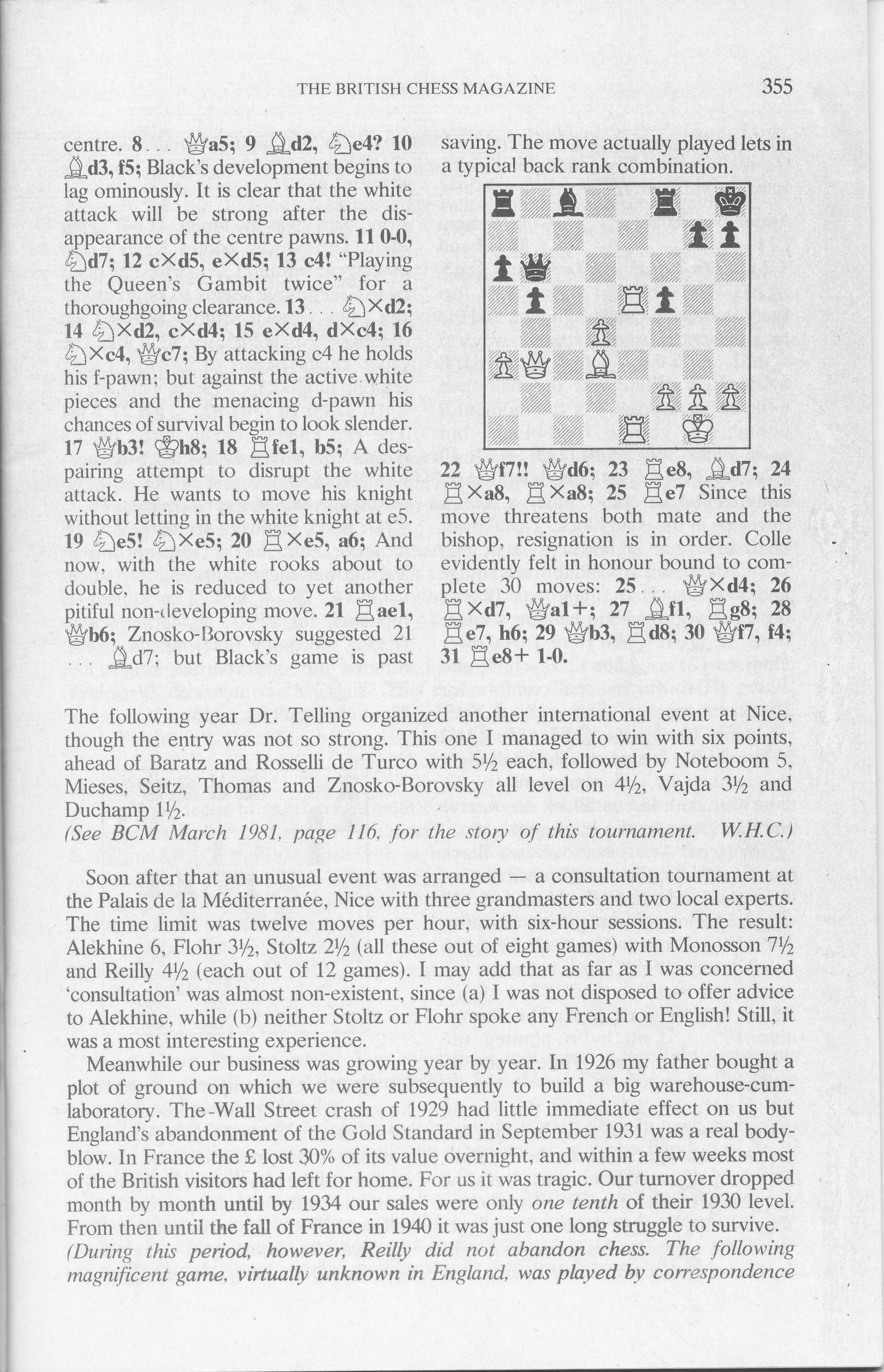
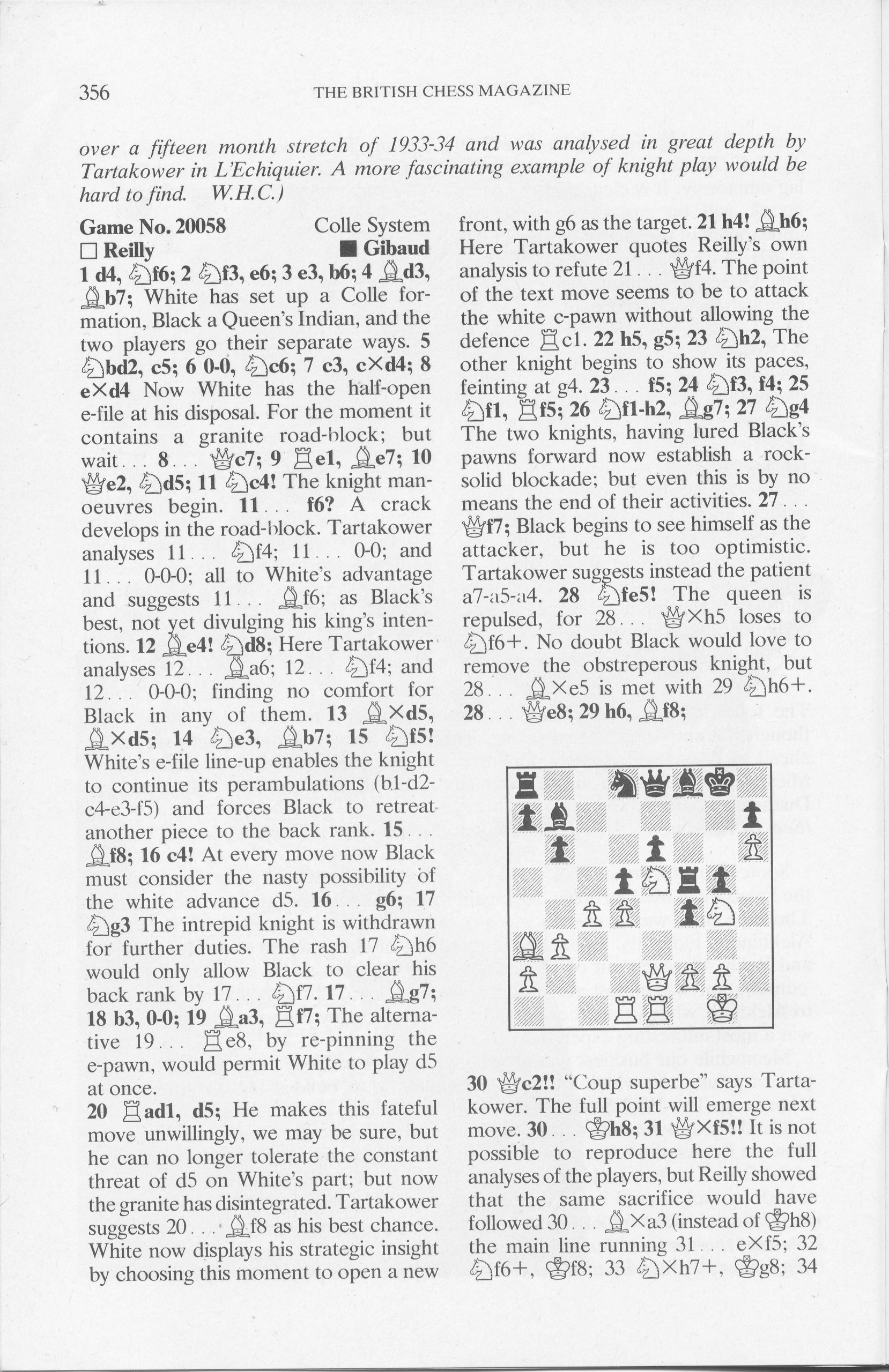
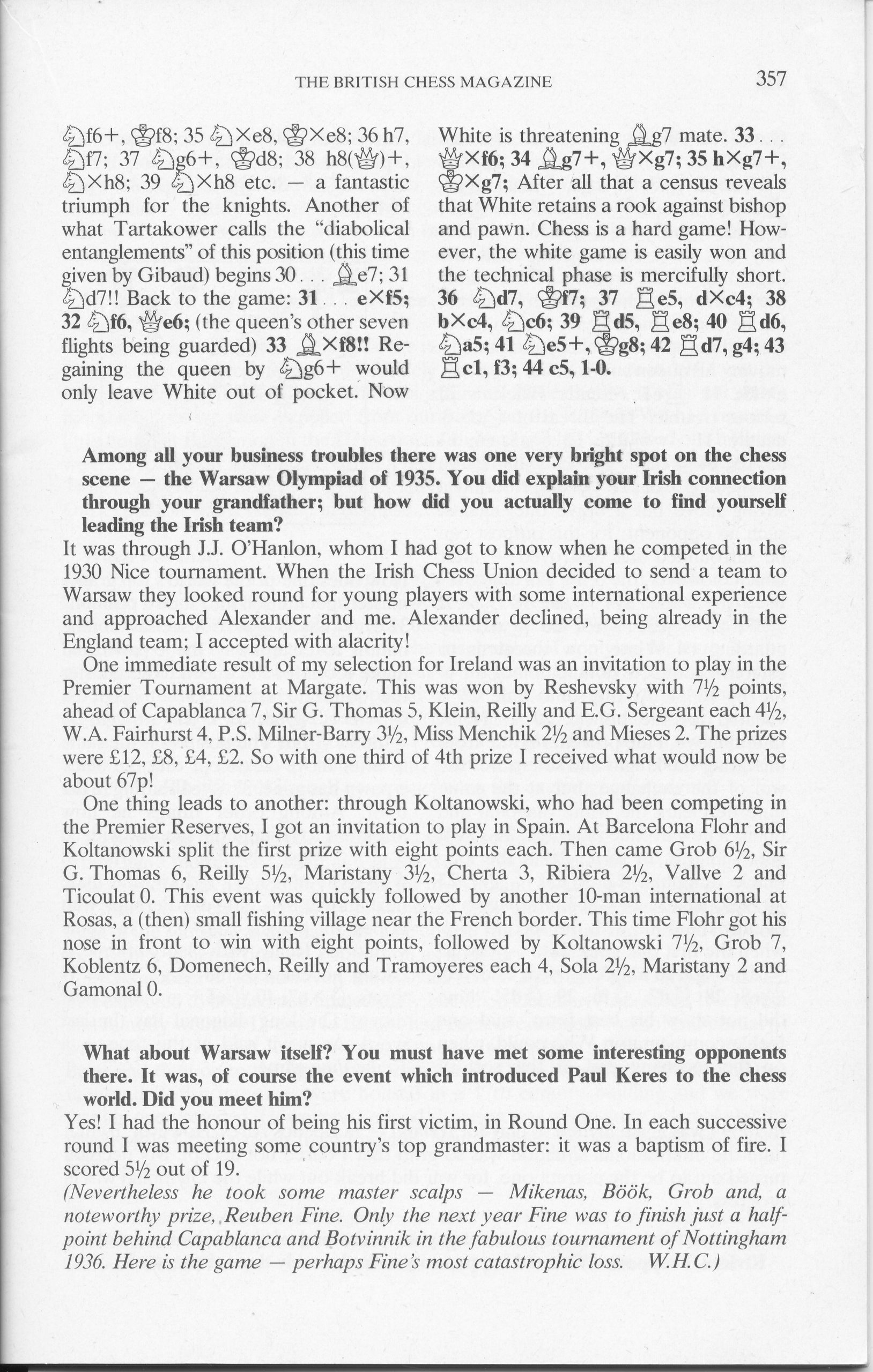
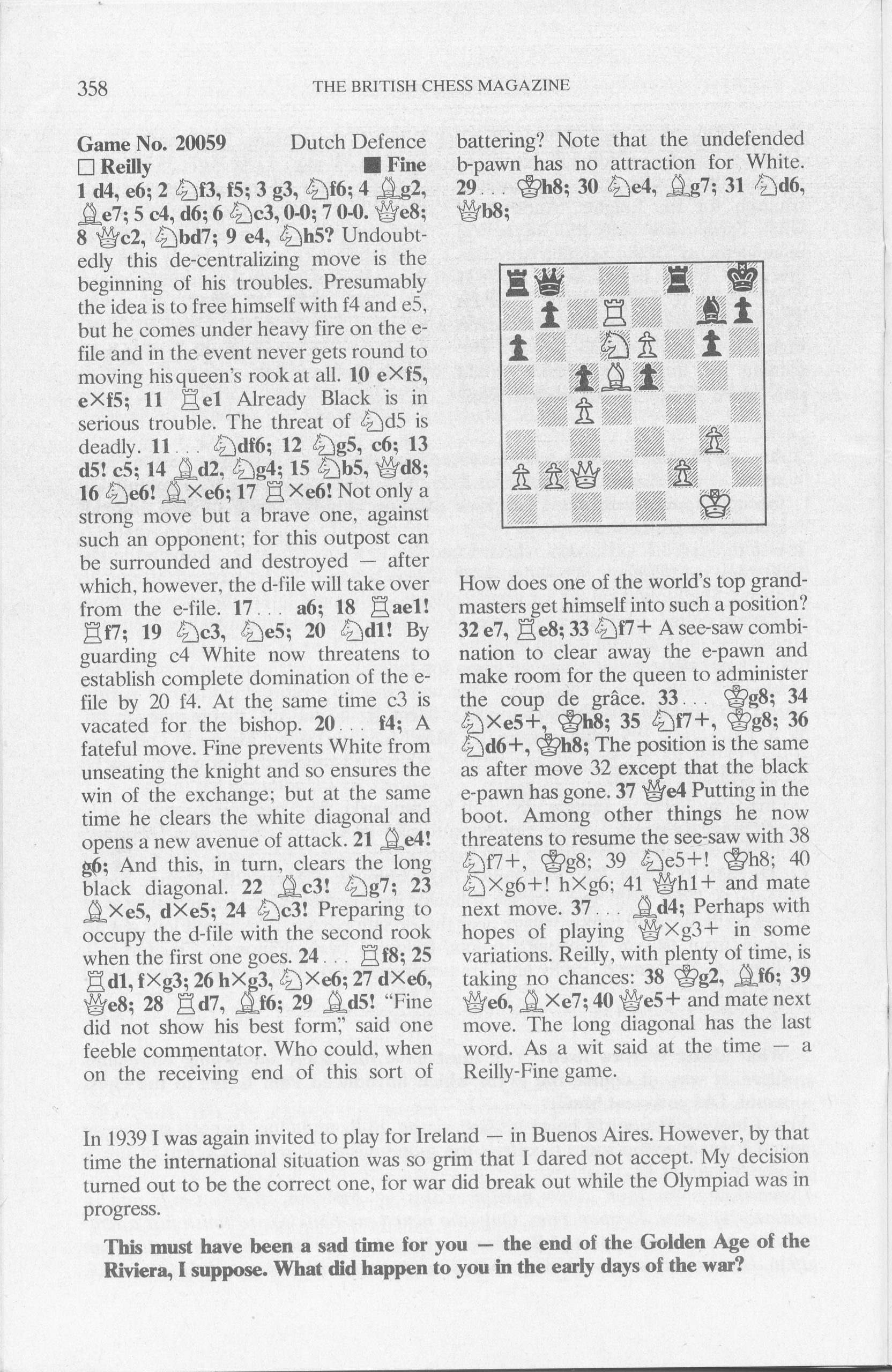
Death Anniversary of Brian Reilly (12-xii-1901 29-xii-1991)

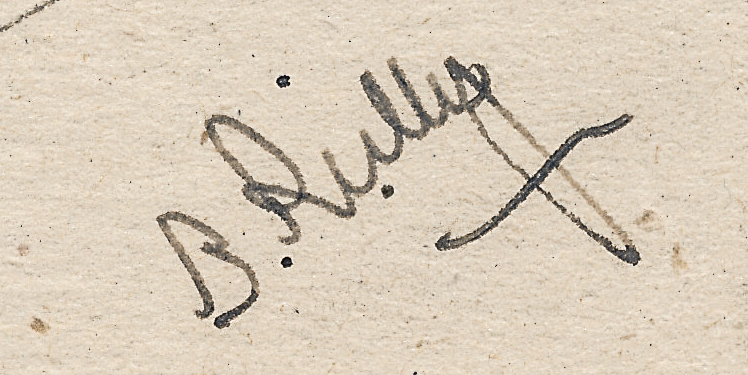
Signature of Brian Reilly from an after dinner post card from Hastings 1945-46

We remember Brian Patrick Reilly who passed away on December 29th, 1991.

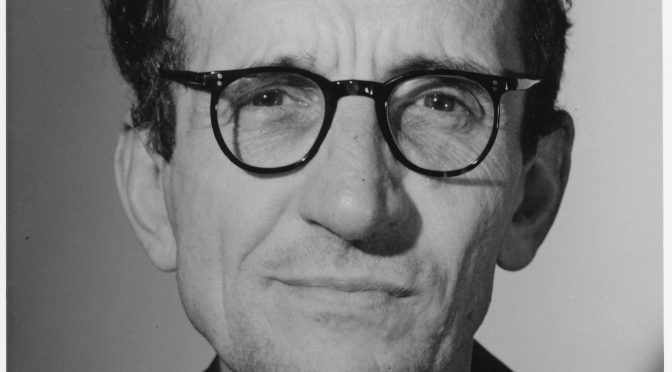
Brian Reilly probably sometime in the 1920s.

From The Encyclopaedia of Chess (Batsford, 1977), Harry Golombek OBE (written by Wolfgang Heidenfeld) :”Irish master born at Menton, of Irish descent, who has represented Ireland in nine Olympic team tournaments between 1935 and 1968; three times on top board.

Brian observes a game during one of the early 1930s tournaments in Nice

He was also Irish representative at seven FIDE congresses. Reilly played in a number of small international tournaments, wining first prize at Nice 1931 and sharing fourth prize with Klein and EG Sergeant behind Reshevsky, Capablanca and Sir G. Thomas at Margate 1935.

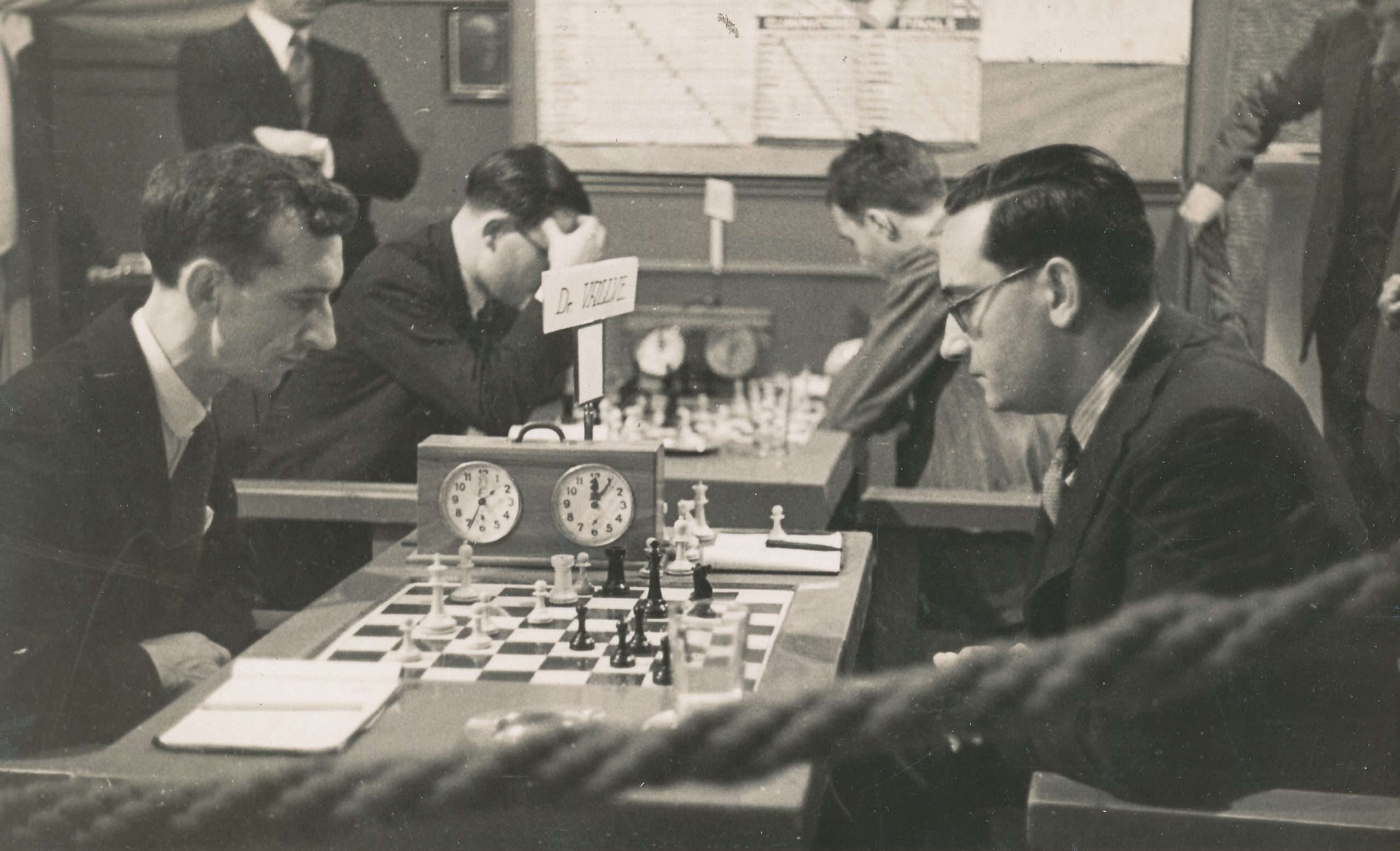
Brian Reilly playing Dr. Josep Vallve probably at Barcelona Chess Club in June 1935. Brian won in 61 moves.

Winner of Irish championship in 1959 and 1960. General Editor of British Chess Magazine since 1949.”

Brian Reilly and friends

His obituary in British Chess Magazine was written by Bernard Cafferty and appeared in Volume CXII (112, 1992), Number 2 (February), page 70:

Brian with journalist colleagues.

“With great regret we have to report that Brian Patrick Reilly has, to use the older term, ‘joined the great majority’.

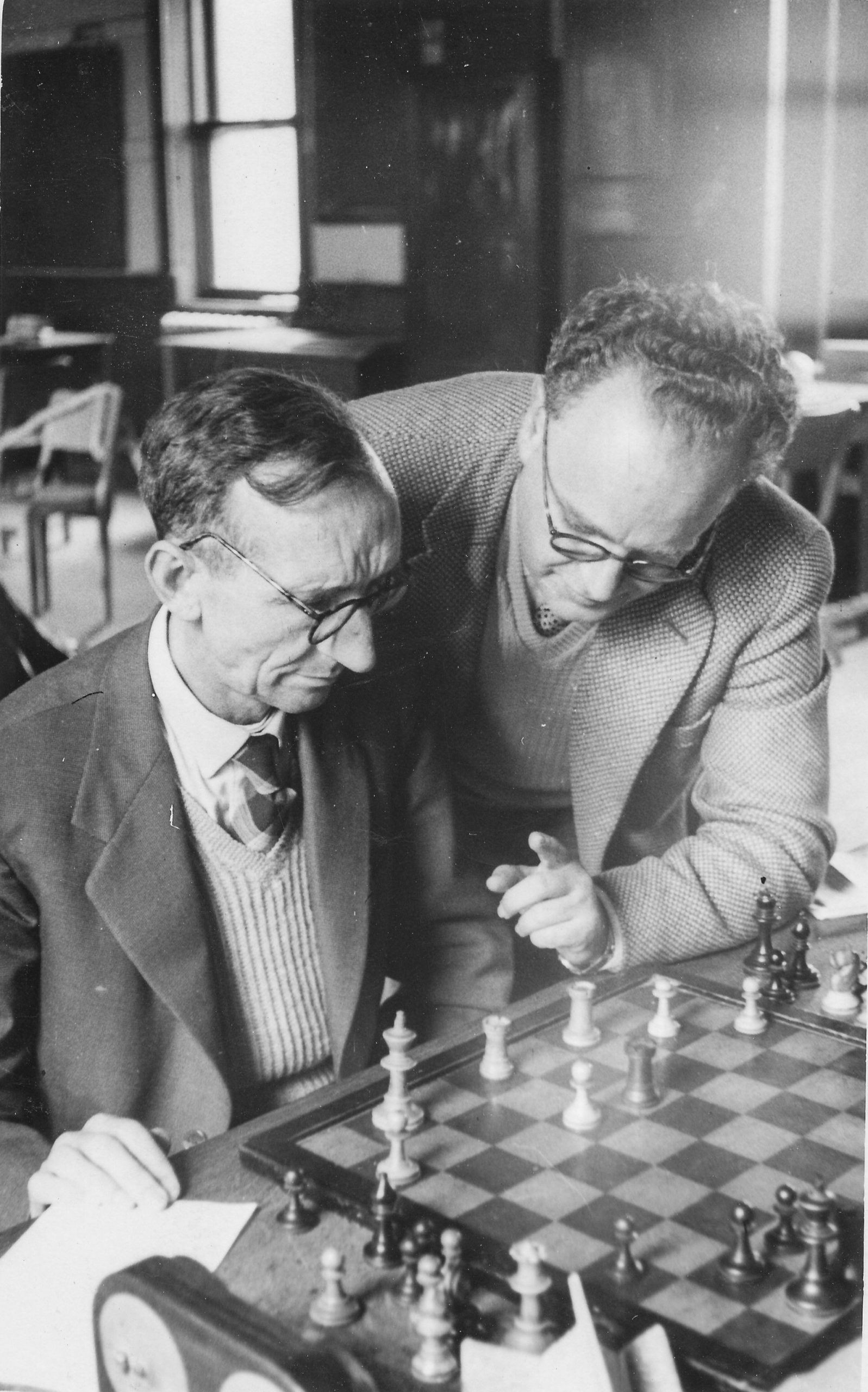
Brian analysing with Irish team mate, Wolfgang Heidenfeld

B. P. Reilly (Menton, 12 xii 1901-Hastings, 29 xii l99l) was born into an expatriate family on the French Riviera, and so was bilingual. He learned his chess in France where he had many friends and acquaintances. He knew Alekhine in the 1920s and 1930s and was a witness at Alekhine’s wedding.

Many years later he was to do extensive research on Alekhine’s life, and was the first to establish (though he did not publish the fact) that the Russian did not complete his doctorate studies at the Sorbonne, so that “Dr” Alekhine must be considered a purely honorary title.

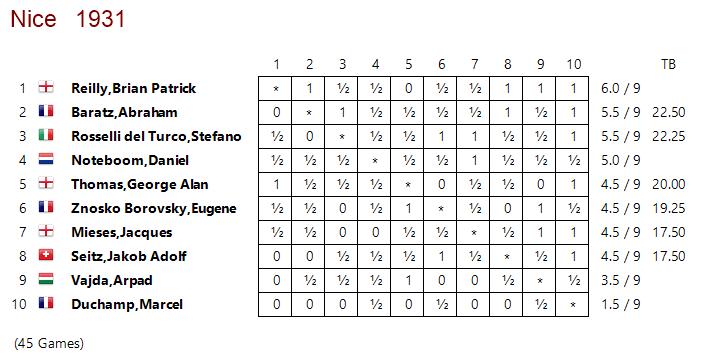
Brian won the Nice tournament of 1931, ahead of Noteboom, Mieses, . . . Sir George Thomas . . . Znosko-Borovsky. . . and played for Ireland at the 1935 Olympiad beating Fine.

Crosstable for Nice 1931 from Megabase 2020

These results, taken with his fourth place at Margate 1935, behind Reshevsky, Capablanca and Sir George Thomas, made it clear that he was of IM strength.

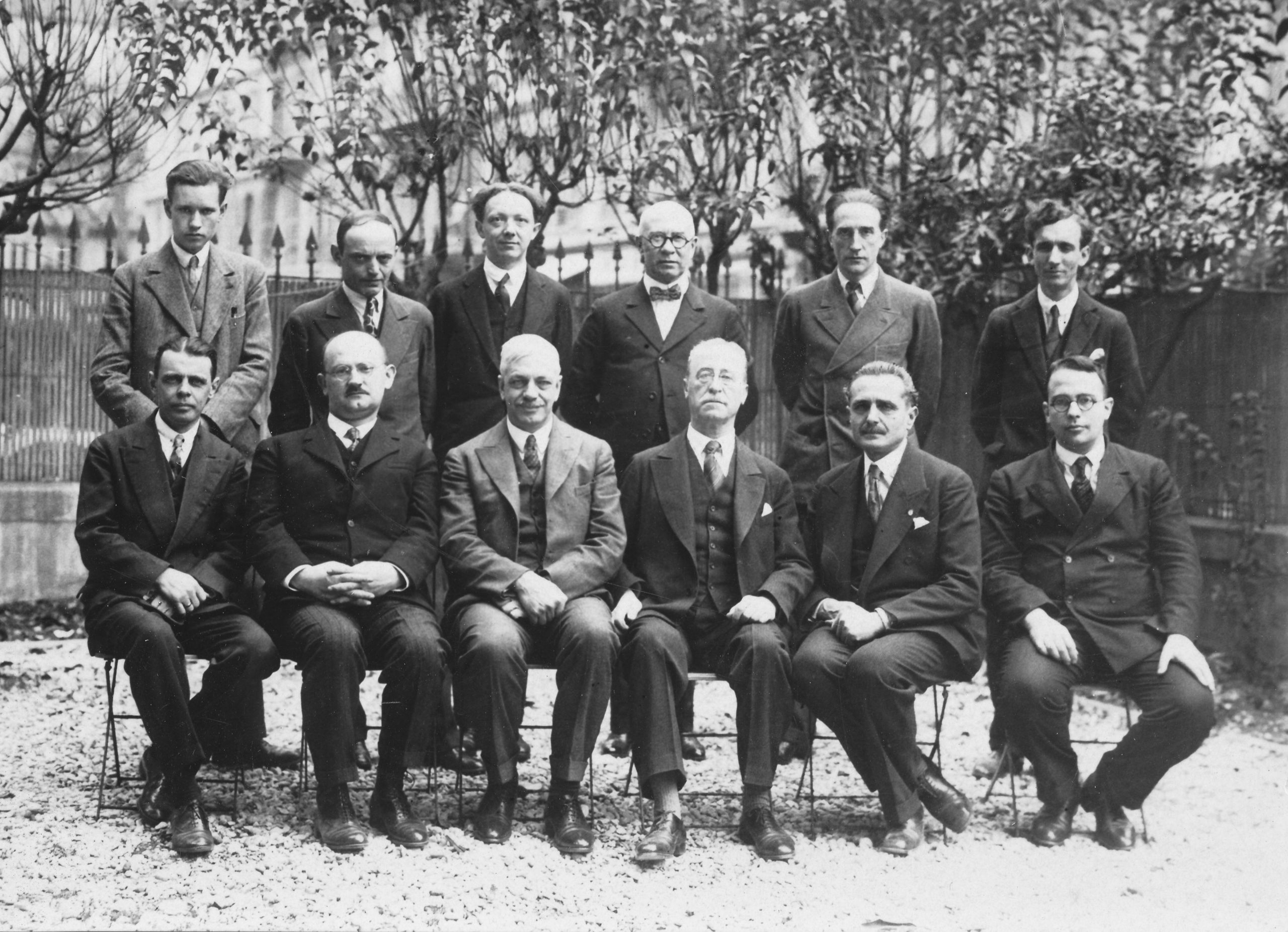
Nice Masters, 1931. Standing : Daniel Noteboom, Abraham Baratz, George Renaud (Organiser), John J O'Hanlon, Marcel Duchamp, Brian Reilly (winner), Seated : Eugene Znokso-Borovsky,, Arpad Vajda, Sir George Thomas, Jacques Mieses, Stefano Roselli del Turco, Jacob Adolf Seitz. British Chess Magazine, 1931, page 201
Nice Masters, 1931. Standing : Daniel Noteboom, Abraham Baratz, George Renaud (Organiser), John J O’Hanlon, Marcel Duchamp, Brian Reilly (winner), Seated : Eugene Znokso-Borovsky,, Arpad Vajda, Sir George Thomas, Jacques Mieses, Stefano Roselli del Turco, Jacob Adolf Seitz. British Chess Magazine, 1931, page 201

During the war Brian was interned in France as a British citizen, coming close to starvation for a time. He described all this in the very detailed account of his life in the September 1980 BCM, on which we have drawn, along with the many reminiscences Brian passed on to the present writer.

Brian analysing with the Irish team at an Olympiad

After working for the Sutton Coldfield magazine just after the war (he did not get on well with B. H. Wood, thinking him not very business-like – do we put this too diplomatically?) Brian was a freelance translator in the pharmaceutical industry before taking over BCM in 1949. At the time the magazine was technically bankrupt.

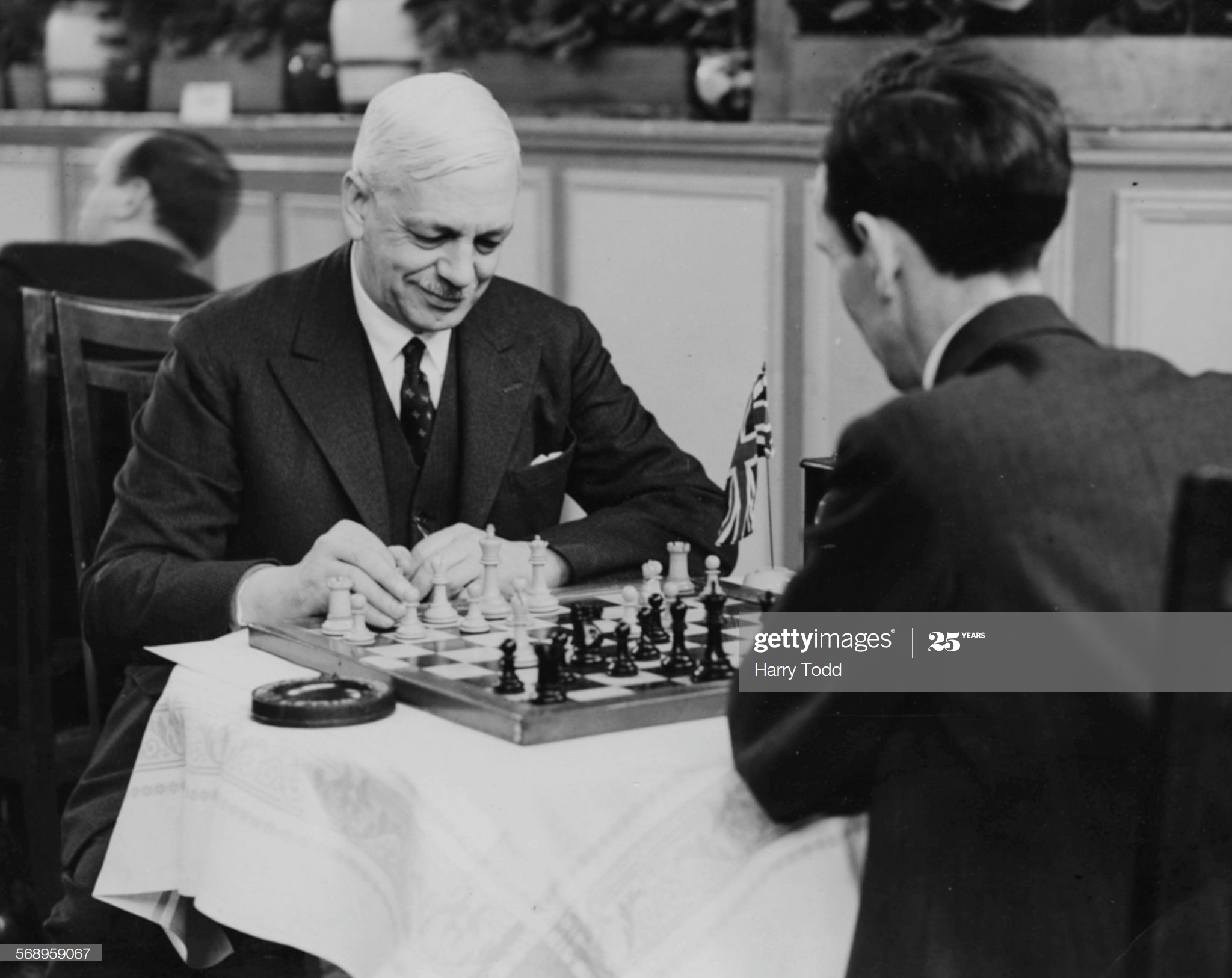
Sir George Thomas And Brian Reilly Sir George Thomas (left), leader of the British chess team, playing Irishman Brian Reilly at the Easter Chess Congress, Margate, April 24th 1935. (Photo by Harry Todd/Fox Photos/Getty Images)
Sir George Thomas And Brian Reilly
Sir George Thomas (left), leader of the British chess team, playing Irishman Brian Reilly at the Easter Chess Congress, Margate, April 24th 1935. (Photo by Harry Todd/Fox Photos/Getty Images)

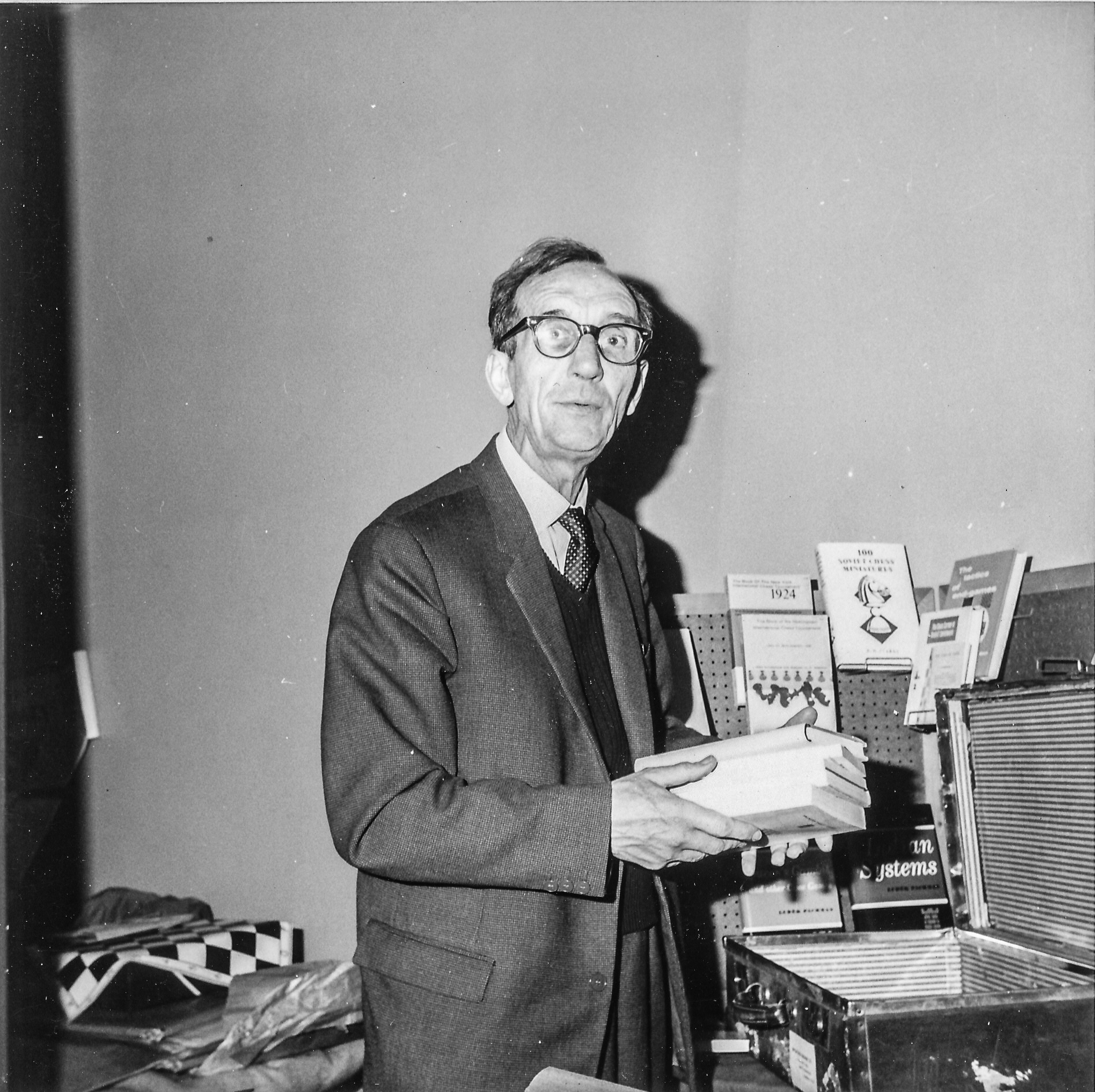
In 1964 he moved the office from London to St Leonards, showing his business acumen yet again. He ran the bookstall for many years at the Hastings Congress at the Sun Lounge and the Falaise Hall.

Brian Reilly setting up the BCM bookstall at Hastings

After the union troubles of 1970-71 and the Fischer boom he arranged for the magazine to be typeset by his son Freddy at the family home in West Norwood. This led to an expansion in the pagination after some teething troubles.

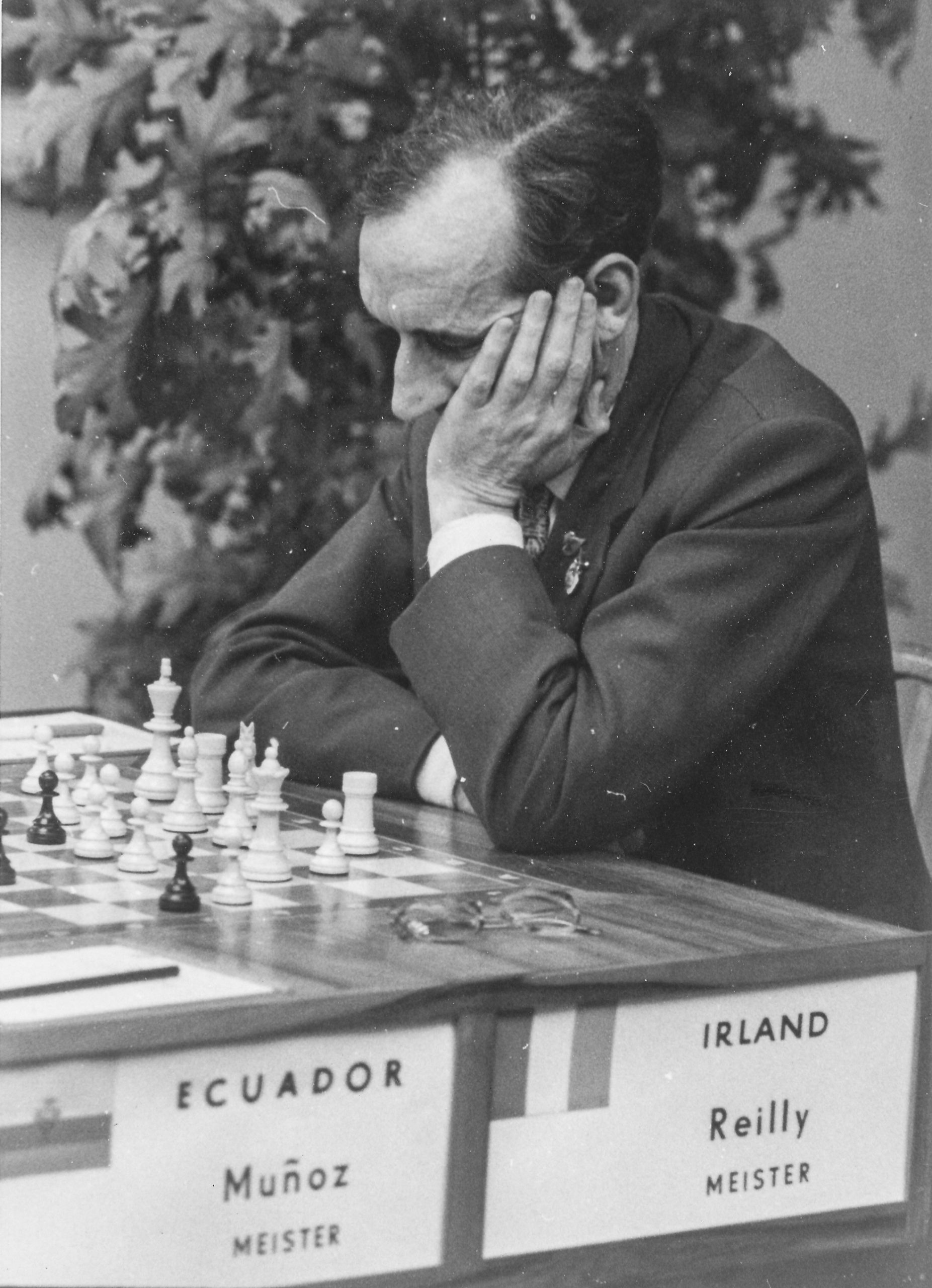
Brian Reilly playing Cesar Munoz (Ecuador) in round 8 of the Leipzig Olympiad played on 23rd October 1960. The game was drawn in 48 moves.

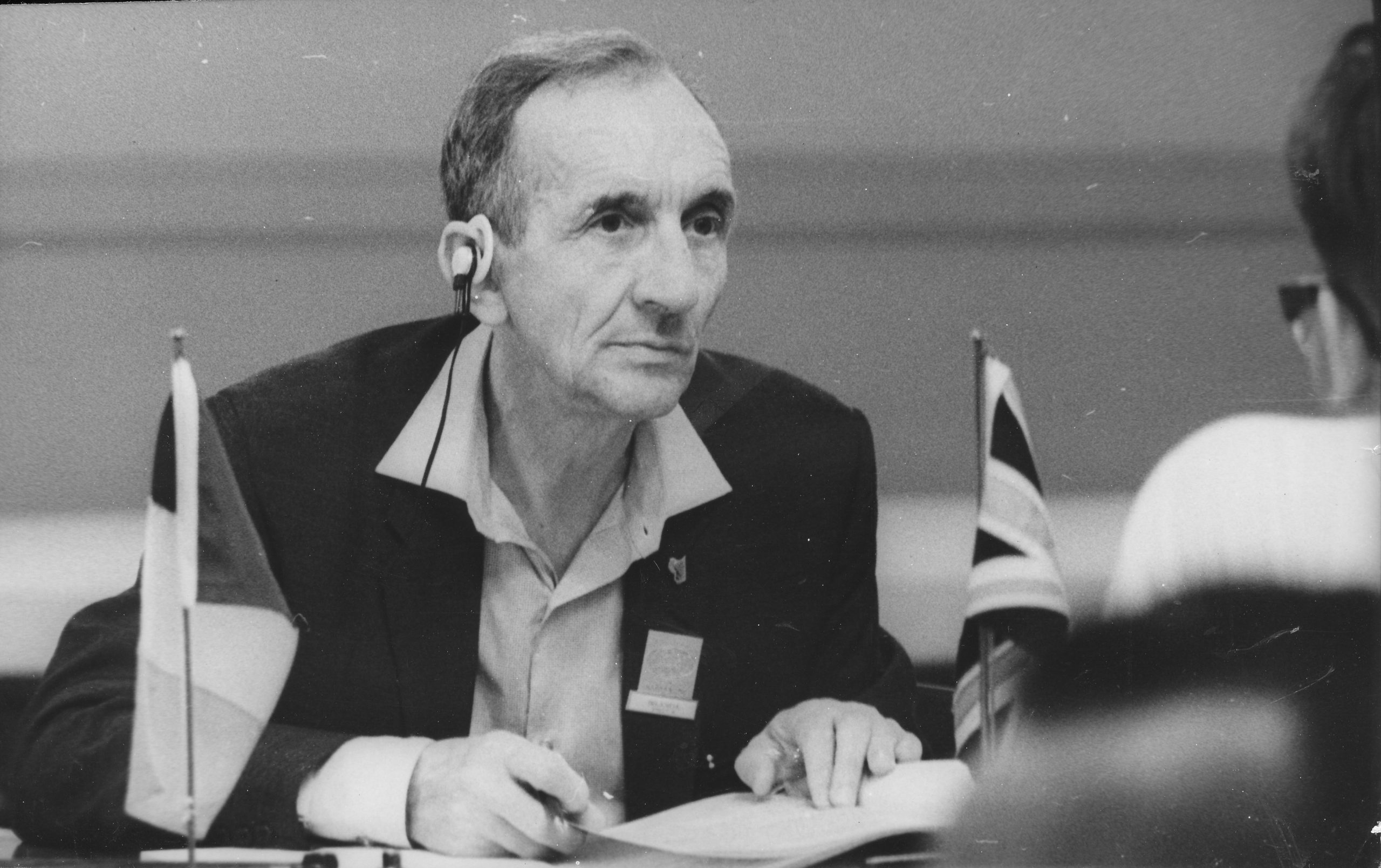
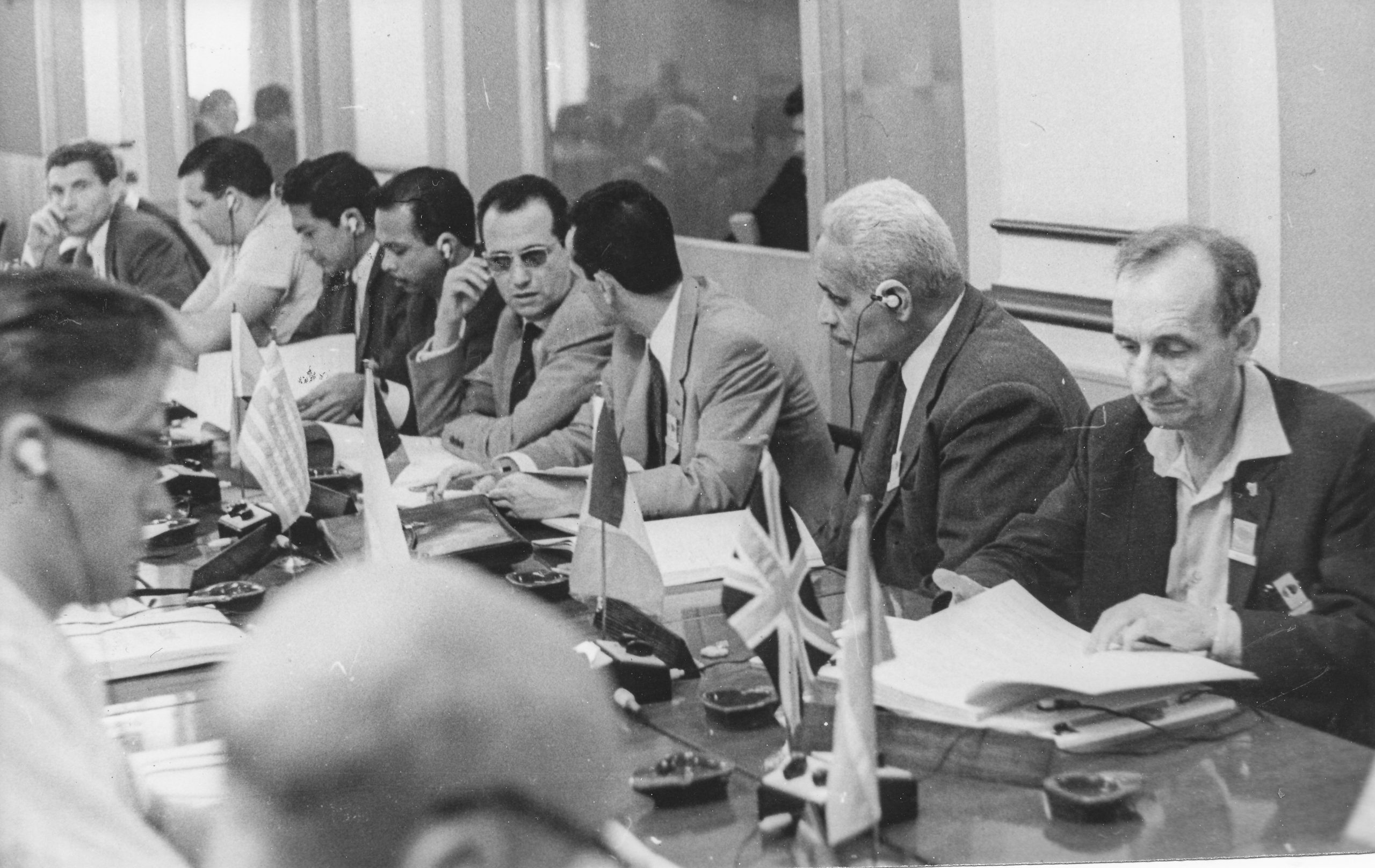
All this while, Brian was playing for Ireland in Olympiads, and attending to FIDE affairs as a FIDE delegate.

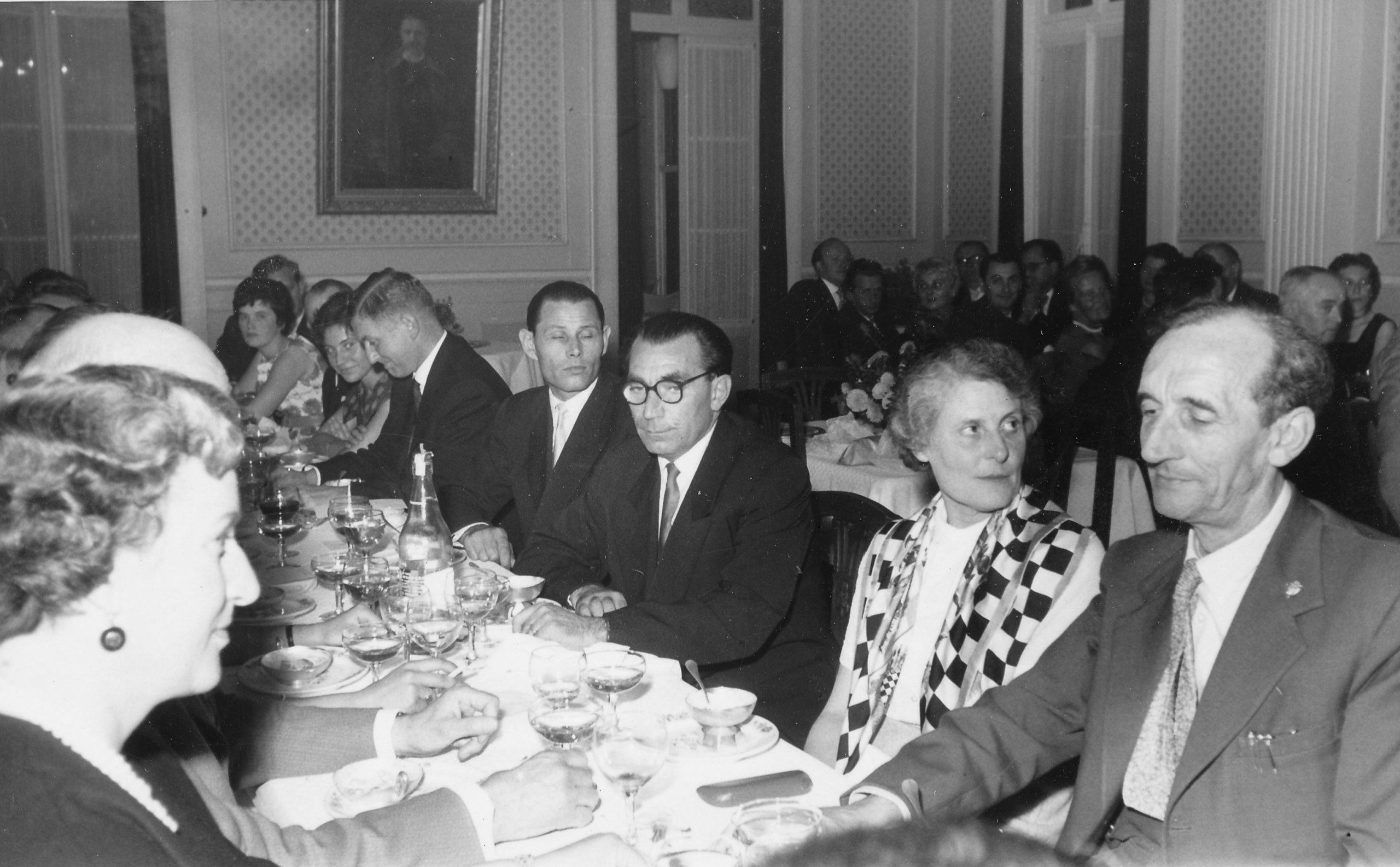
Brian relaxing during a FIDE Congress dinner.
Brian relaxing during a FIDE Congress dinner

After the death of his son Freddy in 1980, the magazine was sold to the BCF and Brian retired as editor in September 1981, remaining as a consultant for nearly a decade.

Brian Reilly, Ray Keene, George Botterill, Anatoly Karpov, Harry Golombek and Viktor Korchnoi

His last years were spent in Hastings, where it was his wont to carry on with the long sea-front walks that he had practised since a breakdown in health due to overwork. He had strong views on correct diet and exercise which he could expound to anyone willing to listen. The fact that he could walk up to six miles a day in his late eighties and that his faculties, including his memory, only seemed to be weakening in his last two years, is proof enough of the validity of his theories.

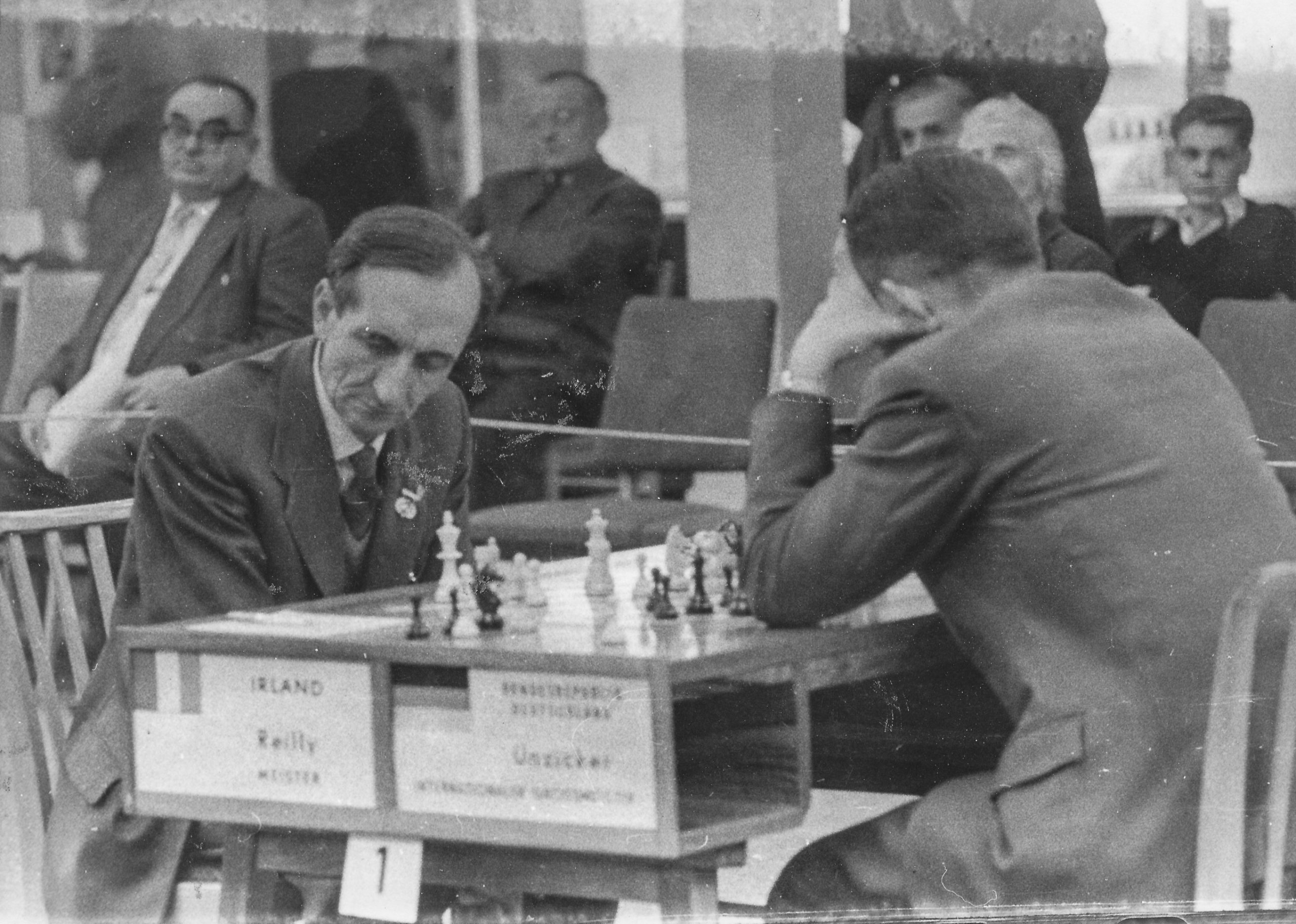
Brian Reilly playing Wolfgang Unzicker on board 1 during the preliminaries of the 1960 Leipzig Olympiad.

On his 90th birthday he attended the office and drank a glass of champagne to celebrate the occasion. We have the testimony of Mrs Arnold, who worked with him so long, that he was still talking of visiting the Hastings Congress. This was on Boxing Day, the day after he had been admitted to St Helen’s Hospital with a chest infection. He assured her he would be up and about again, but old friends such as Harry Golombek and Ritson Morry waited for him in vain as Hastings got under way. . .

Brian Reilly at a FIDE Congress (possibly Nice 1974?)

BCM readers, too, must be counted amongst his old friends who will miss him. They should be aware that, but for Brian, and his decades of hard work. there would now be no BCM.”

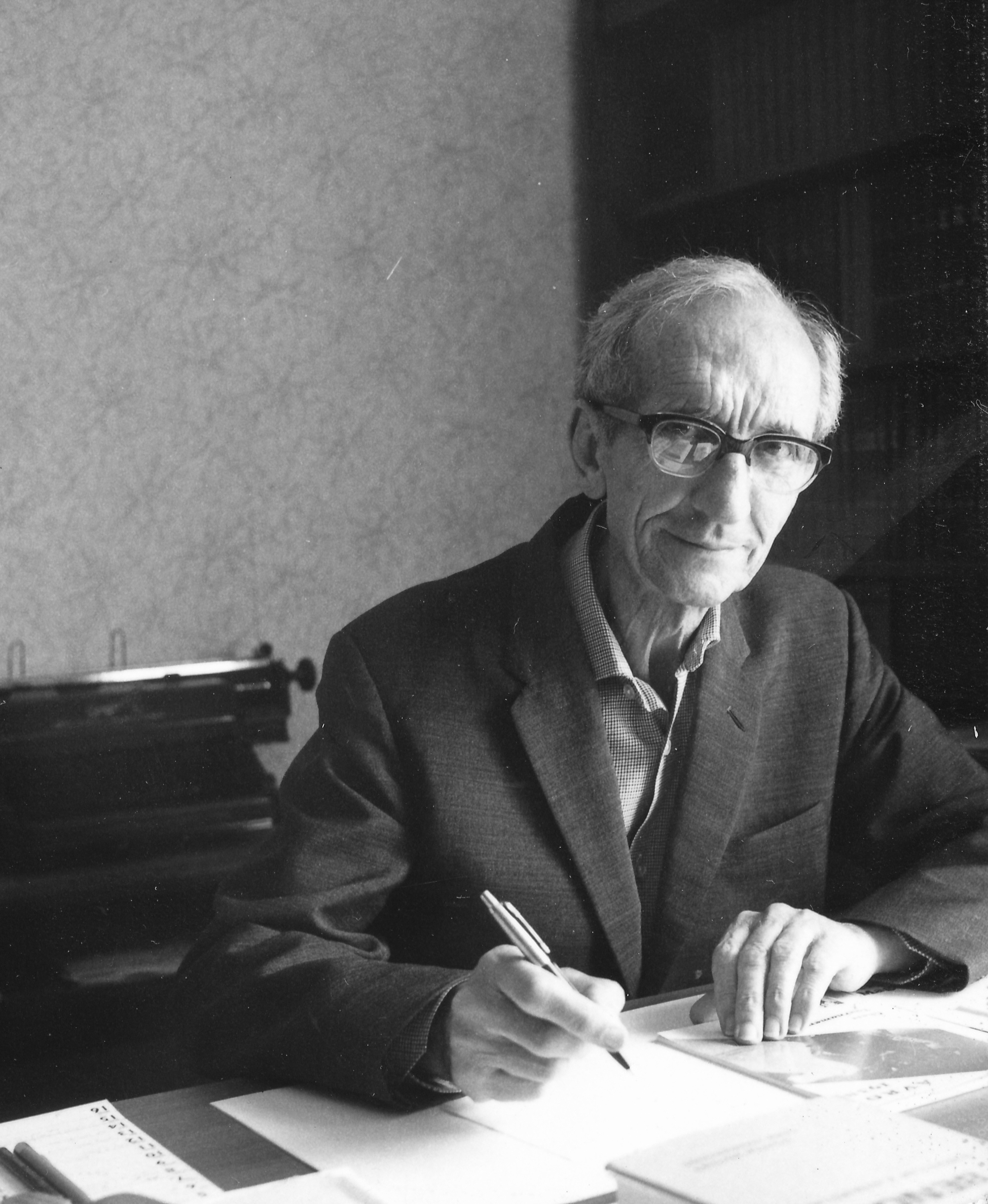
Brian Reilly in the BCM office. Photographed most likely by Freddy Reilly.

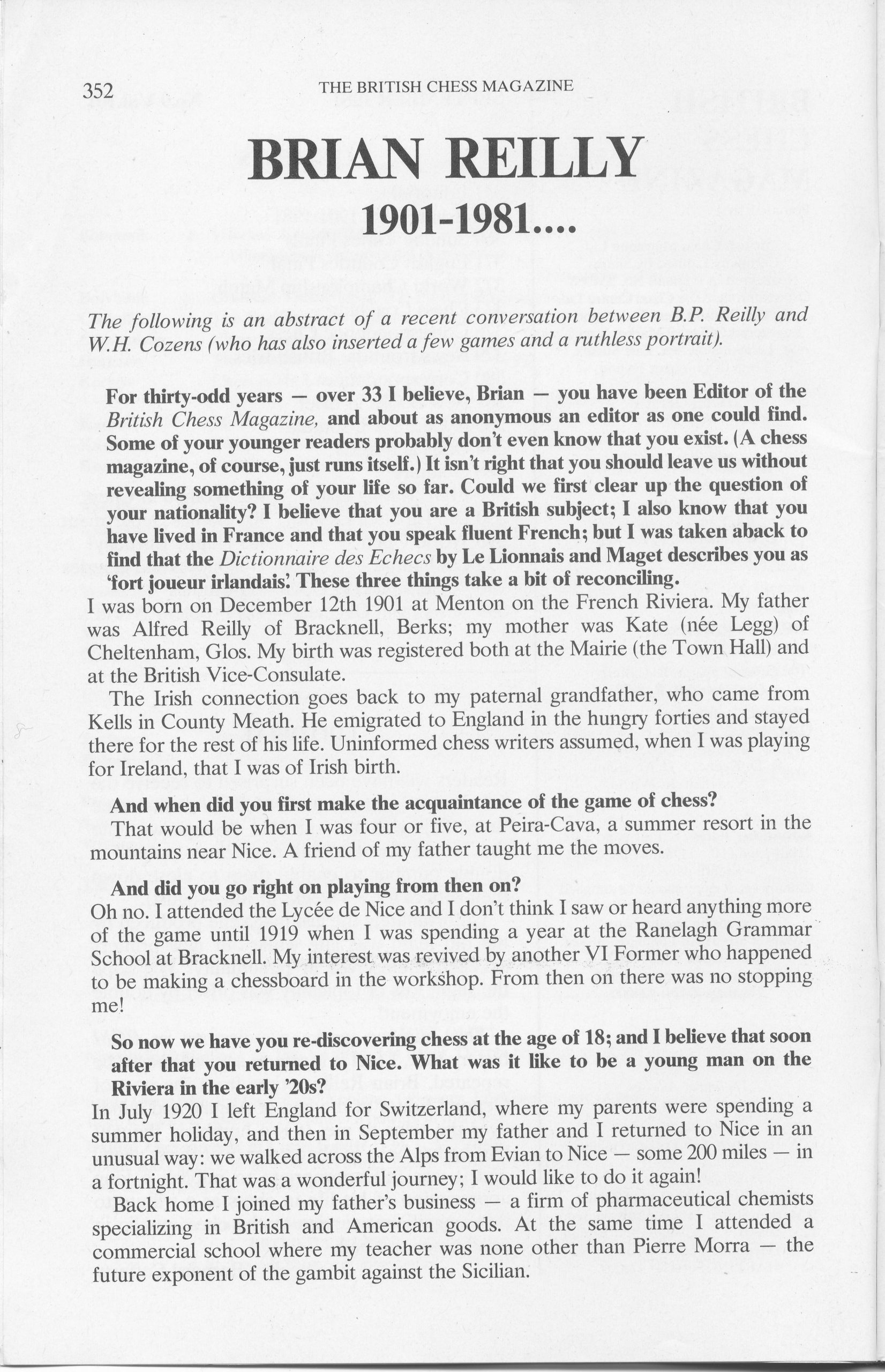
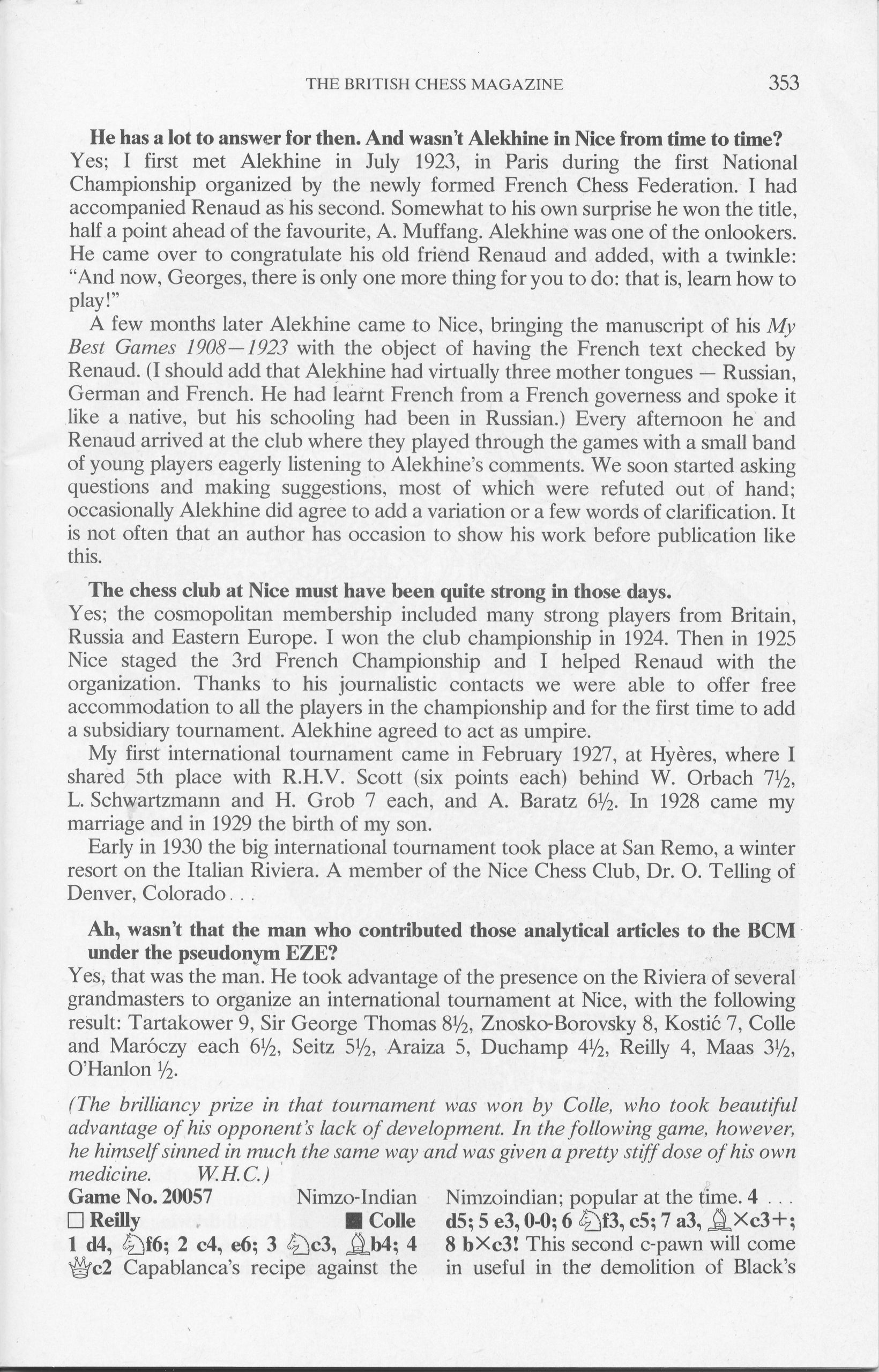
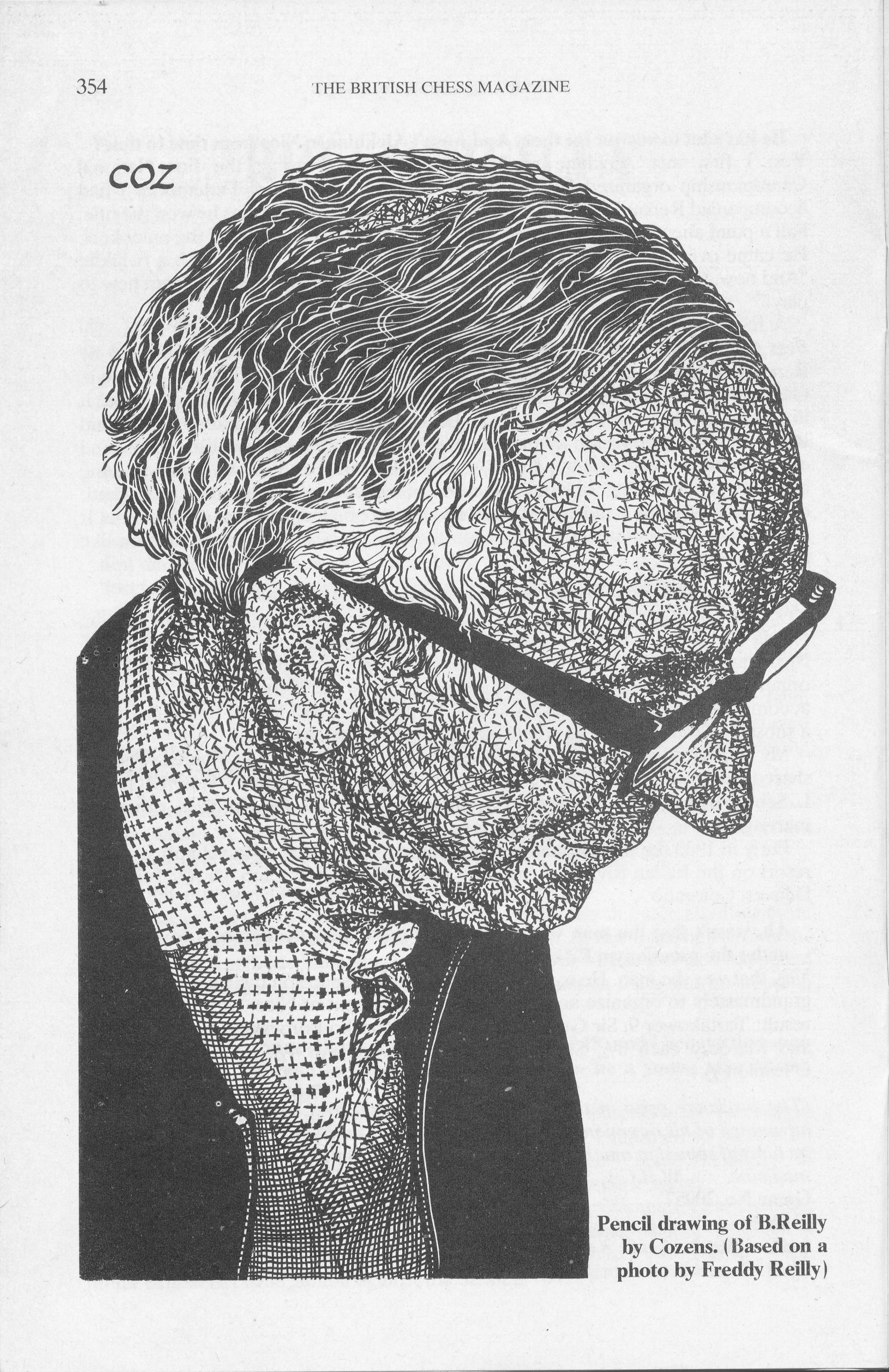
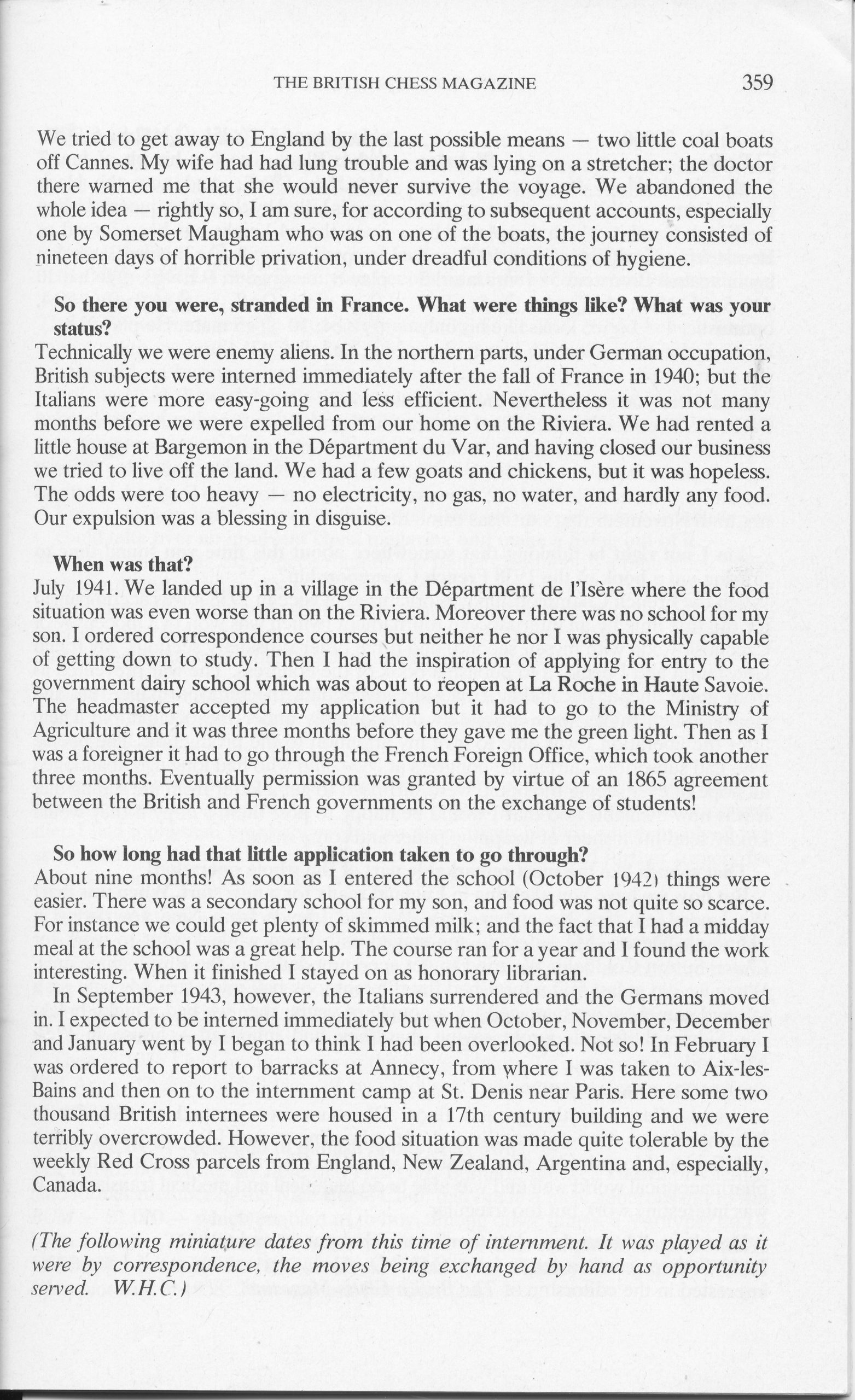
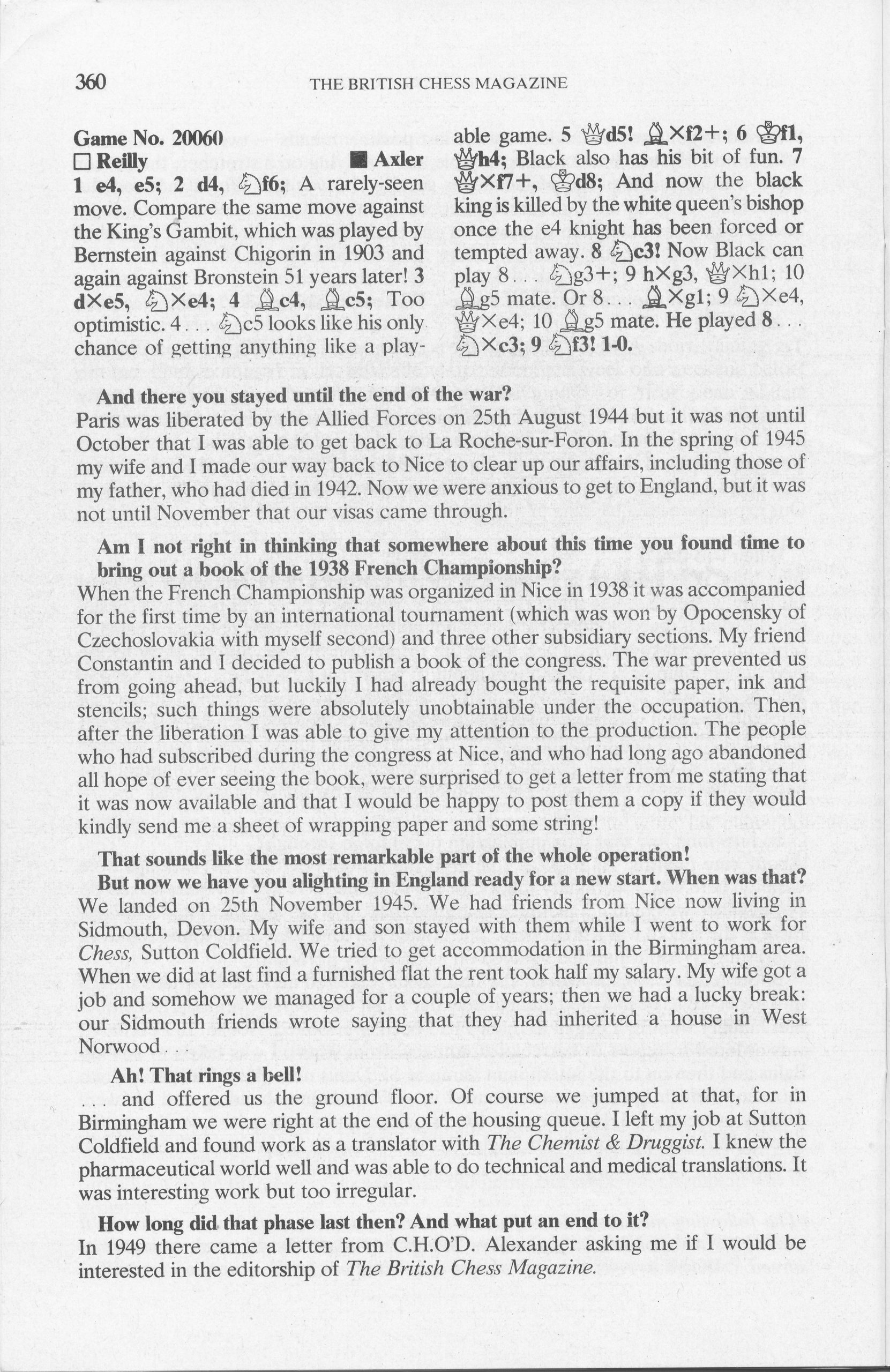
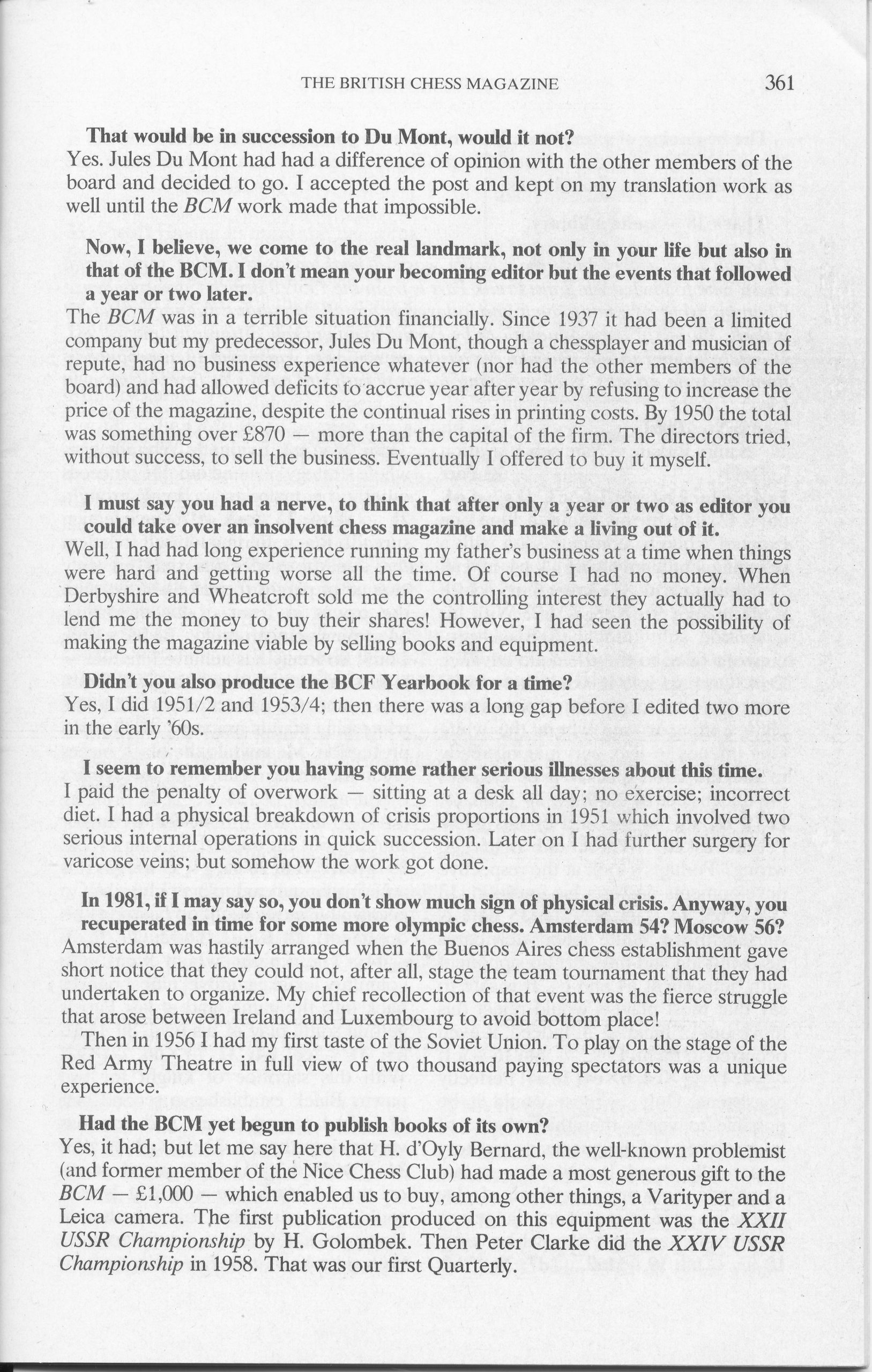
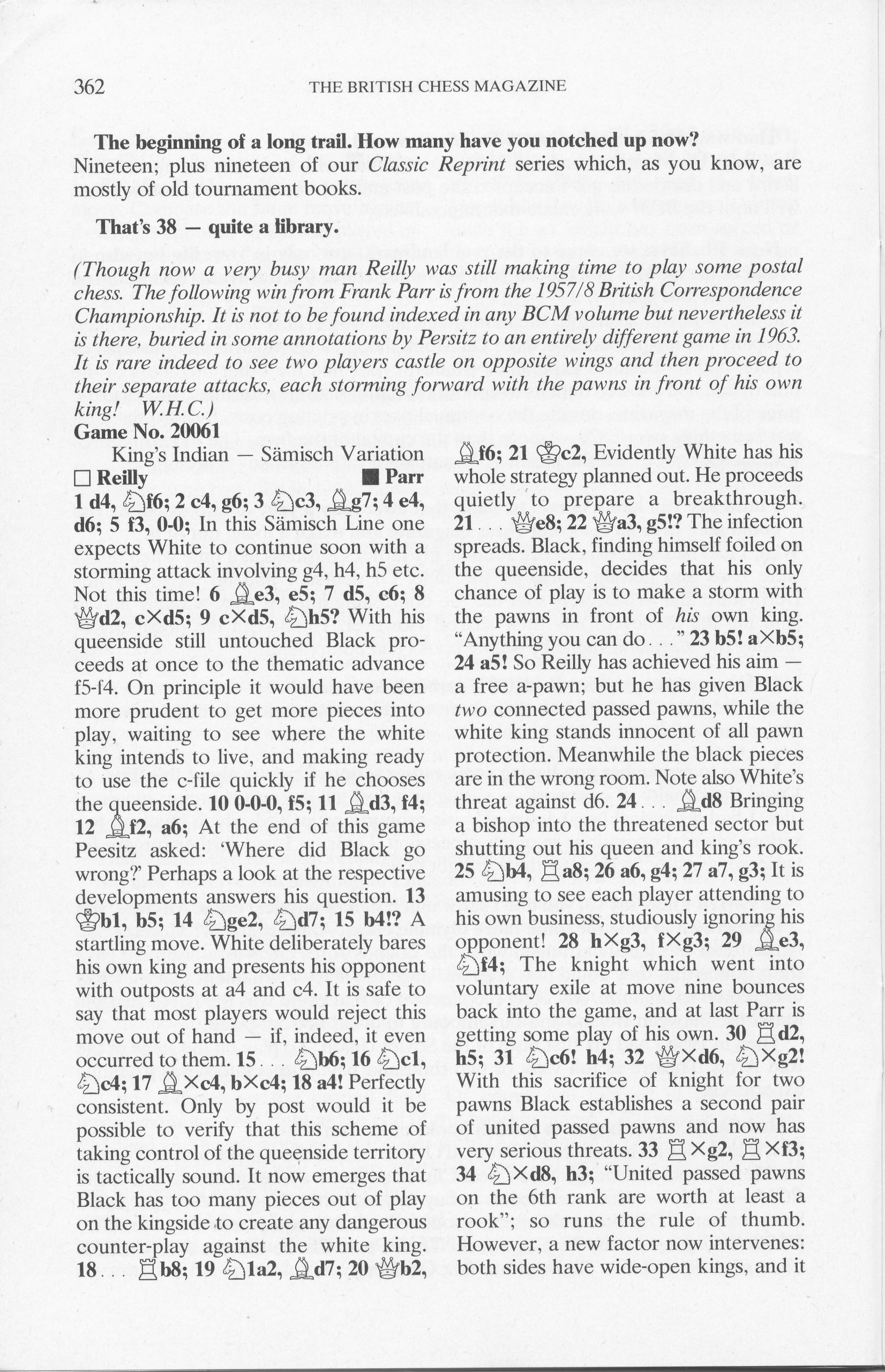
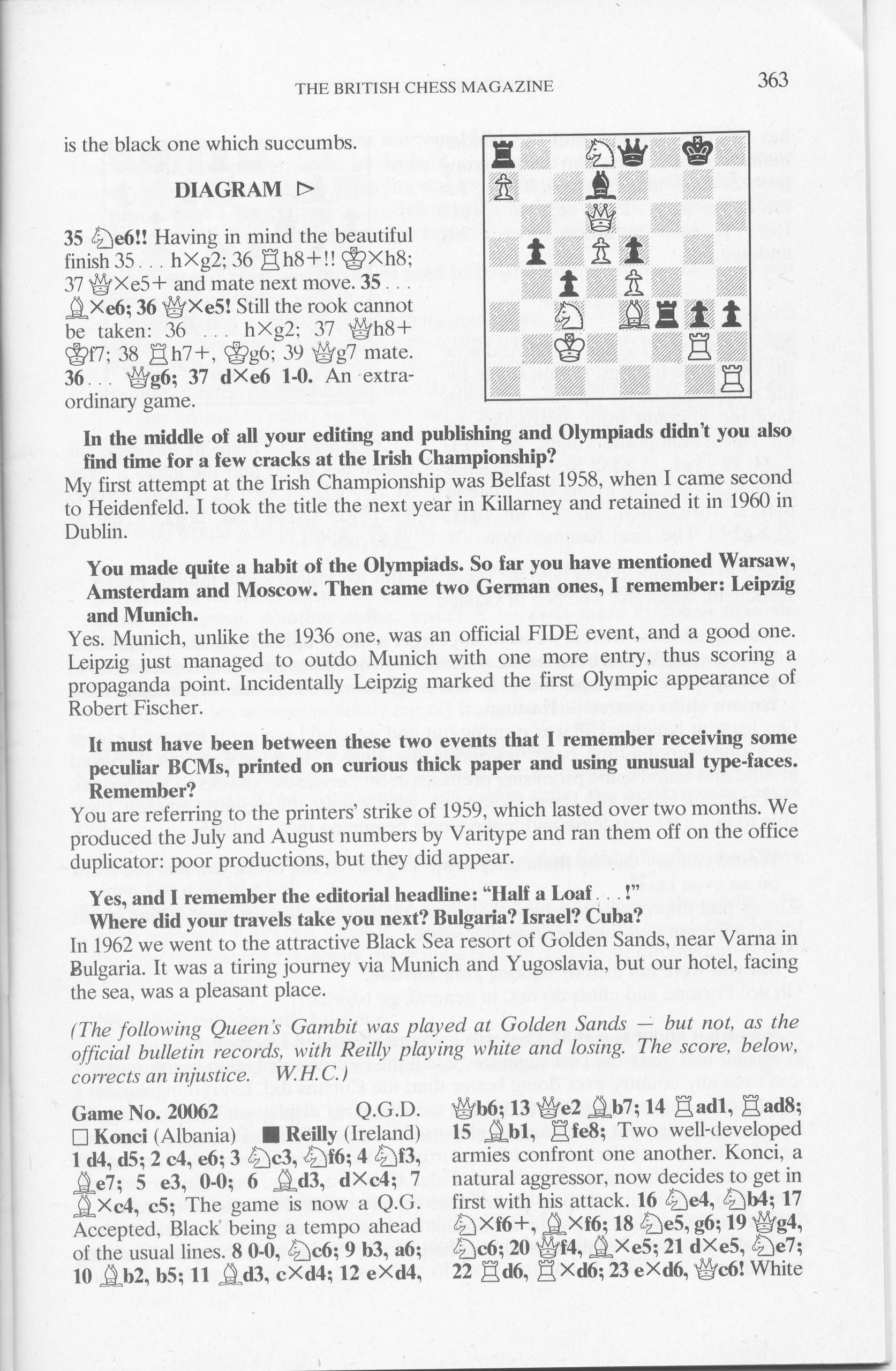
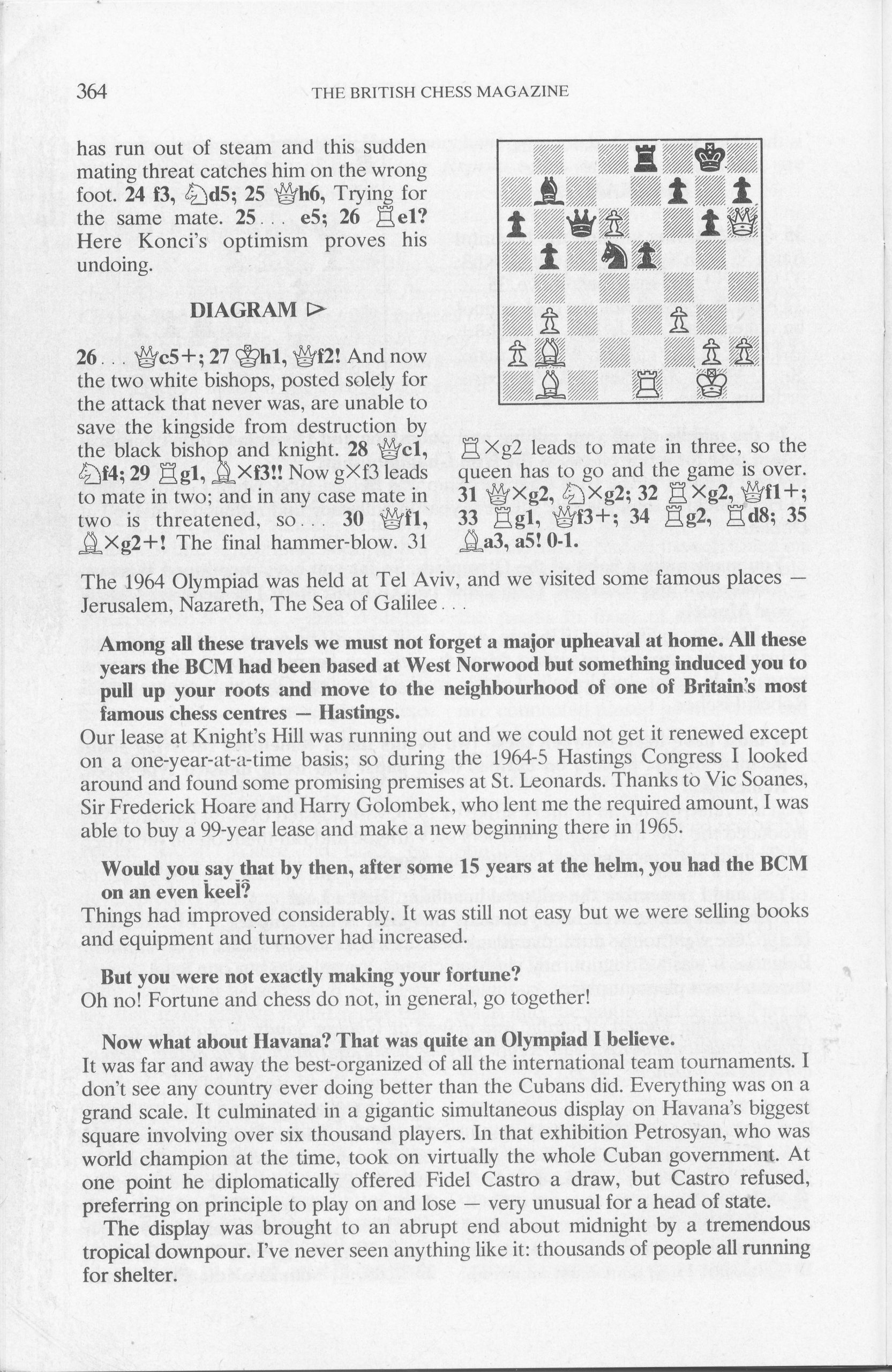
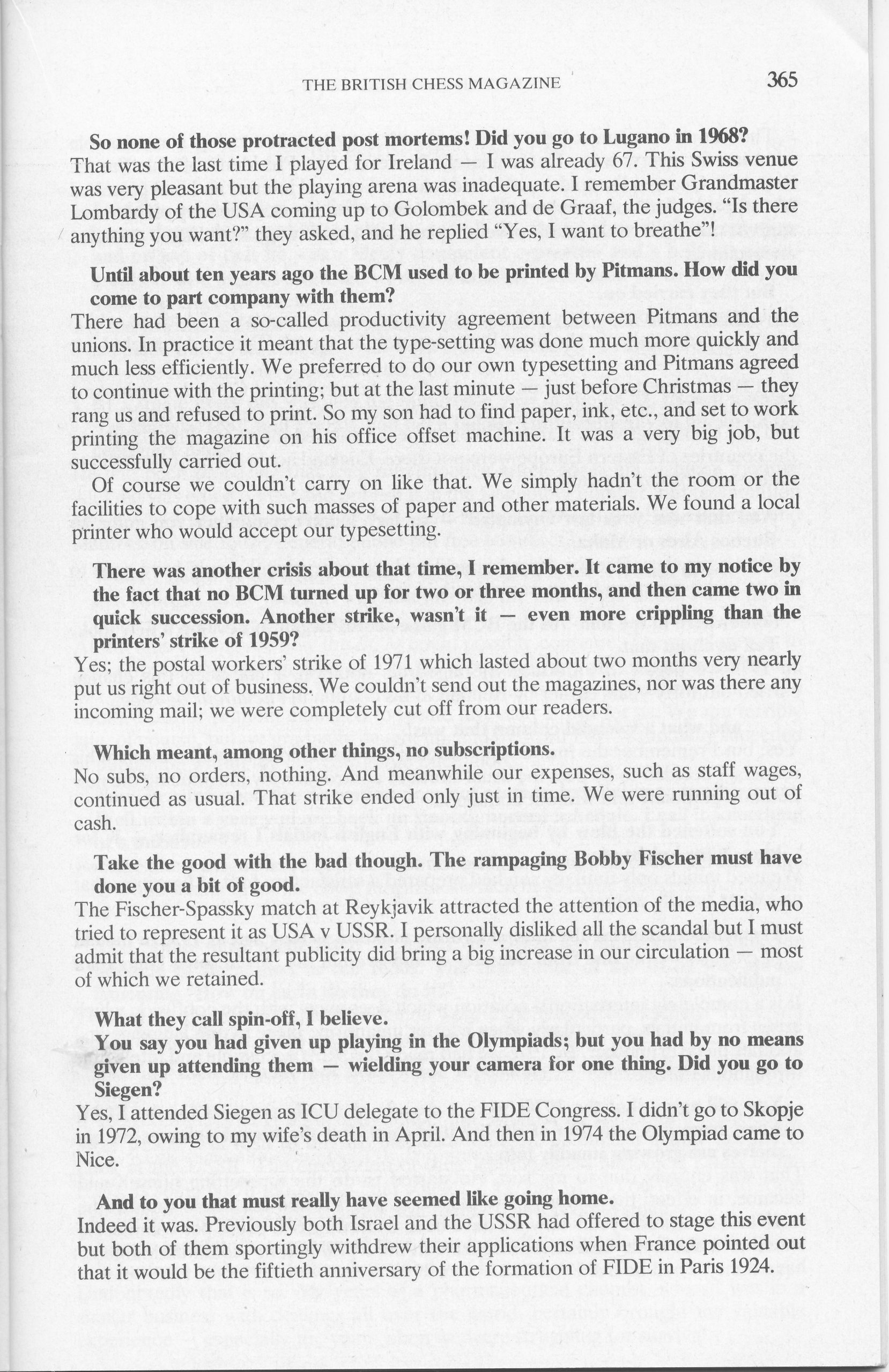
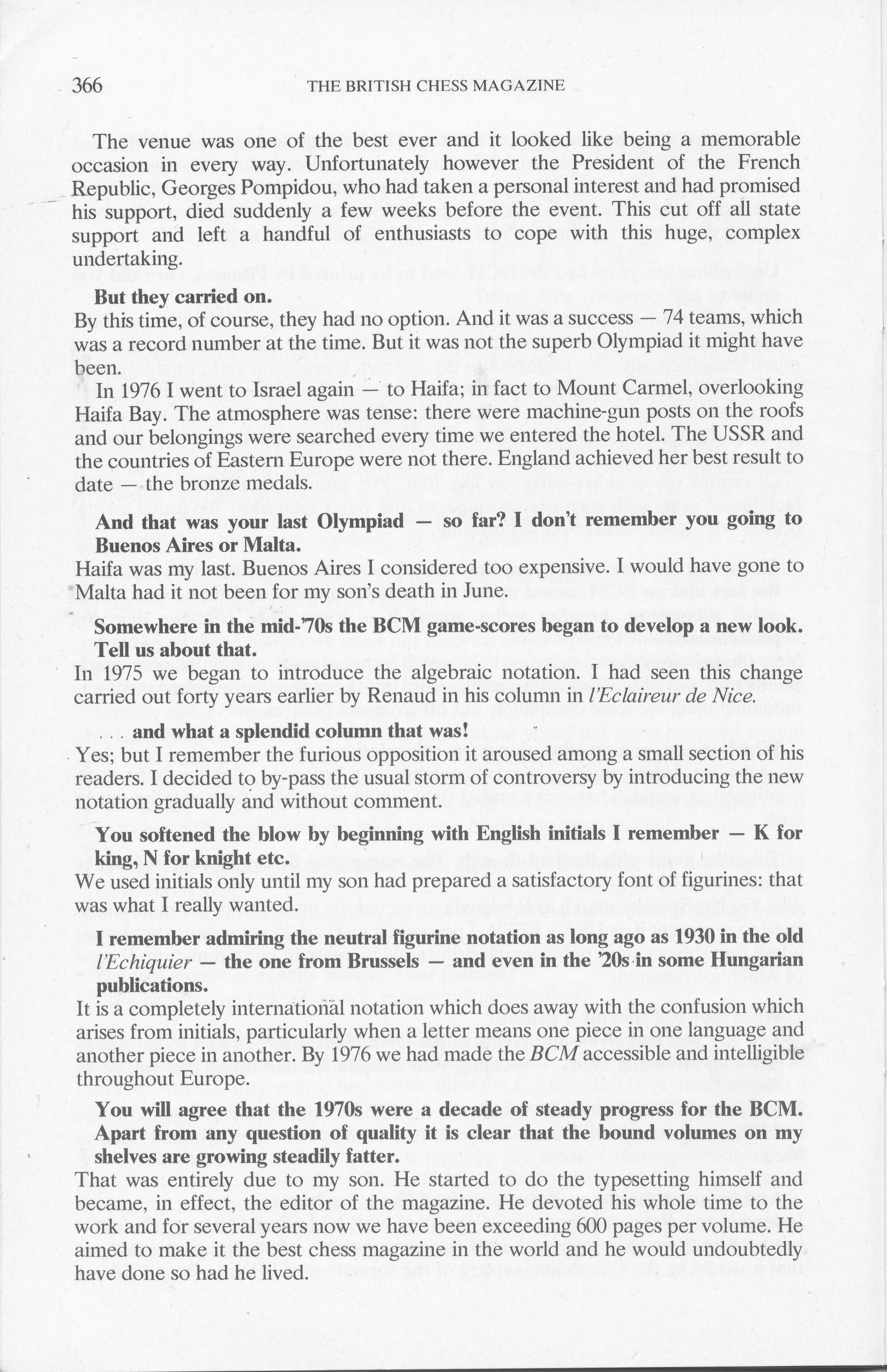
From British Chess Magazine, Volume CI (101), Number 8 (August), pp 352 – 369 a conversation between B.P. Reilly and W.H. Cozens :

Brian Reilly conversation with William Harold Cozens, part 1
Brian Reilly conversation with William Harold Cozens, part 2
Brian Reilly conversation with William Harold Cozens, part 3
Brian Reilly conversation with William Harold Cozens, part 4
Brian Reilly conversation with William Harold Cozens, part 5
Brian Reilly conversation with William Harold Cozens, part 6
Brian Reilly conversation with William Harold Cozens, part 7

He won the BCF President’s Award in 1983 along with BH Wood

Here is his Wikipedia entry

Brian Reilly conversation with William Harold Cozens, part 8
Brian Reilly conversation with William Harold Cozens, part 9
Brian Reilly conversation with William Harold Cozens, part 10
Brian Reilly conversation with William Harold Cozens, part 11
Brian Reilly conversation with William Harold Cozens, part 12
Brian Reilly conversation with William Harold Cozens, part 13
Brian Reilly conversation with William Harold Cozens, part 14
Brian Reilly conversation with William Harold Cozens, part 15
Brian Reilly conversation with William Harold Cozens, part 16
Brian Reilly conversation with William Harold Cozens, part 17
Brian Reilly conversation with William Harold Cozens, part 16
Brian Reilly conversation with William Harold Cozens, part 18
Brian Reilly conversation with William Harold Cozens, part 1

Death Anniversary of Brian Reilly (12-xii-1901 29-xii-1991)

Signature of Brian Reilly from an after dinner post card from Hastings 1945-46

We remember Brian Patrick Reilly who passed away on December 29th, 1991.

Brian Reilly probably sometime in the 1920s.

From The Encyclopaedia of Chess (Batsford, 1977), Harry Golombek OBE (written by Wolfgang Heidenfeld) :”Irish master born at Menton, of Irish descent, who has represented Ireland in nine Olympic team tournaments between 1935 and 1968; three times on top board.

Brian observes a game during one of the early 1930s tournaments in Nice

He was also Irish representative at seven FIDE congresses. Reilly played in a number of small international tournaments, wining first prize at Nice 1931 and sharing fourth prize with Klein and EG Sergeant behind Reshevsky, Capablanca and Sir G. Thomas at Margate 1935.

Brian Reilly playing Dr. Josep Vallve probably at Barcelona Chess Club in June 1935. Brian won in 61 moves.

Winner of Irish championship in 1959 and 1960. General Editor of British Chess Magazine since 1949.”

Brian Reilly and friends

His obituary in British Chess Magazine was written by Bernard Cafferty and appeared in Volume CXII (112, 1992), Number 2 (February), page 70:

Brian with journalist colleagues.

“With great regret we have to report that Brian Patrick Reilly has, to use the older term, ‘joined the great majority’.

Brian analysing with Irish team mate, Wolfgang Heidenfeld

B. P. Reilly (Menton, 12 xii 1901-Hastings, 29 xii l99l) was born into an expatriate family on the French Riviera, and so was bilingual. He learned his chess in France where he had many friends and acquaintances. He knew Alekhine in the 1920s and 1930s and was a witness at Alekhine’s wedding.

Many years later he was to do extensive research on Alekhine’s life, and was the first to establish (though he did not publish the fact) that the Russian did not complete his doctorate studies at the Sorbonne, so that “Dr” Alekhine must be considered a purely honorary title.

Brian won the Nice tournament of 1931, ahead of Noteboom, Mieses, . . . Sir George Thomas . . . Znosko-Borovsky. . . and played for Ireland at the 1935 Olympiad beating Fine.

Crosstable for Nice 1931 from Megabase 2020

These results, taken with his fourth place at Margate 1935, behind Reshevsky, Capablanca and Sir George Thomas, made it clear that he was of IM strength.

Nice Masters, 1931. Standing : Daniel Noteboom, Abraham Baratz, George Renaud (Organiser), John J O'Hanlon, Marcel Duchamp, Brian Reilly (winner), Seated : Eugene Znokso-Borovsky,, Arpad Vajda, Sir George Thomas, Jacques Mieses, Stefano Roselli del Turco, Jacob Adolf Seitz. British Chess Magazine, 1931, page 201
Nice Masters, 1931. Standing : Daniel Noteboom, Abraham Baratz, George Renaud (Organiser), John J O’Hanlon, Marcel Duchamp, Brian Reilly (winner), Seated : Eugene Znokso-Borovsky,, Arpad Vajda, Sir George Thomas, Jacques Mieses, Stefano Roselli del Turco, Jacob Adolf Seitz. British Chess Magazine, 1931, page 201

During the war Brian was interned in France as a British citizen, coming close to starvation for a time. He described all this in the very detailed account of his life in the September 1980 BCM, on which we have drawn, along with the many reminiscences Brian passed on to the present writer.

Brian analysing with the Irish team at an Olympiad

After working for the Sutton Coldfield magazine just after the war (he did not get on well with B. H. Wood, thinking him not very business-like – do we put this too diplomatically?) Brian was a freelance translator in the pharmaceutical industry before taking over BCM in 1949. At the time the magazine was technically bankrupt.

Sir George Thomas And Brian Reilly Sir George Thomas (left), leader of the British chess team, playing Irishman Brian Reilly at the Easter Chess Congress, Margate, April 24th 1935. (Photo by Harry Todd/Fox Photos/Getty Images)
Sir George Thomas And Brian Reilly
Sir George Thomas (left), leader of the British chess team, playing Irishman Brian Reilly at the Easter Chess Congress, Margate, April 24th 1935. (Photo by Harry Todd/Fox Photos/Getty Images)

In 1964 he moved the office from London to St Leonards, showing his business acumen yet again. He ran the bookstall for many years at the Hastings Congress at the Sun Lounge and the Falaise Hall.

Brian Reilly setting up the BCM bookstall at Hastings

After the union troubles of 1970-71 and the Fischer boom he arranged for the magazine to be typeset by his son Freddy at the family home in West Norwood. This led to an expansion in the pagination after some teething troubles.

Brian Reilly playing Cesar Munoz (Ecuador) in round 8 of the Leipzig Olympiad played on 23rd October 1960. The game was drawn in 48 moves.

All this while, Brian was playing for Ireland in Olympiads, and attending to FIDE affairs as a FIDE delegate.

Brian relaxing during a FIDE Congress dinner.
Brian relaxing during a FIDE Congress dinner

After the death of his son Freddy in 1980, the magazine was sold to the BCF and Brian retired as editor in September 1981, remaining as a consultant for nearly a decade.

Brian Reilly, Ray Keene, George Botterill, Anatoly Karpov, Harry Golombek and Viktor Korchnoi

His last years were spent in Hastings, where it was his wont to carry on with the long sea-front walks that he had practised since a breakdown in health due to overwork. He had strong views on correct diet and exercise which he could expound to anyone willing to listen. The fact that he could walk up to six miles a day in his late eighties and that his faculties, including his memory, only seemed to be weakening in his last two years, is proof enough of the validity of his theories.

Brian Reilly playing Wolfgang Unzicker on board 1 during the preliminaries of the 1960 Leipzig Olympiad.

On his 90th birthday he attended the office and drank a glass of champagne to celebrate the occasion. We have the testimony of Mrs Arnold, who worked with him so long, that he was still talking of visiting the Hastings Congress. This was on Boxing Day, the day after he had been admitted to St Helen’s Hospital with a chest infection. He assured her he would be up and about again, but old friends such as Harry Golombek and Ritson Morry waited for him in vain as Hastings got under way. . .

Brian Reilly at a FIDE Congress (possibly Nice 1974?)

BCM readers, too, must be counted amongst his old friends who will miss him. They should be aware that, but for Brian, and his decades of hard work. there would now be no BCM.”

Brian Reilly in the BCM office. Photographed most likely by Freddy Reilly.

From British Chess Magazine, Volume CI (101), Number 8 (August), pp 352 – 369 a conversation between B.P. Reilly and W.H. Cozens :

Brian Reilly conversation with William Harold Cozens, part 1
Brian Reilly conversation with William Harold Cozens, part 2
Brian Reilly conversation with William Harold Cozens, part 3
Brian Reilly conversation with William Harold Cozens, part 4
Brian Reilly conversation with William Harold Cozens, part 5
Brian Reilly conversation with William Harold Cozens, part 6
Brian Reilly conversation with William Harold Cozens, part 7

He won the BCF President’s Award in 1983 along with BH Wood

Here is his Wikipedia entry

Brian Reilly conversation with William Harold Cozens, part 8
Brian Reilly conversation with William Harold Cozens, part 9
Brian Reilly conversation with William Harold Cozens, part 10
Brian Reilly conversation with William Harold Cozens, part 11
Brian Reilly conversation with William Harold Cozens, part 12
Brian Reilly conversation with William Harold Cozens, part 13
Brian Reilly conversation with William Harold Cozens, part 14
Brian Reilly conversation with William Harold Cozens, part 15
Brian Reilly conversation with William Harold Cozens, part 16
Brian Reilly conversation with William Harold Cozens, part 17
Brian Reilly conversation with William Harold Cozens, part 16
Brian Reilly conversation with William Harold Cozens, part 18
Brian Reilly conversation with William Harold Cozens, part 1

Death Anniversary of Brian Reilly (12-xii-1901 29-xii-1991)

Signature of Brian Reilly from an after dinner post card from Hastings 1945-46

We remember Brian Patrick Reilly who passed away on December 29th, 1991.

Brian Reilly probably sometime in the 1920s.

From The Encyclopaedia of Chess (Batsford, 1977), Harry Golombek OBE (written by Wolfgang Heidenfeld) :”Irish master born at Menton, of Irish descent, who has represented Ireland in nine Olympic team tournaments between 1935 and 1968; three times on top board.

Brian observes a game during one of the early 1930s tournaments in Nice

He was also Irish representative at seven FIDE congresses. Reilly played in a number of small international tournaments, wining first prize at Nice 1931 and sharing fourth prize with Klein and EG Sergeant behind Reshevsky, Capablanca and Sir G. Thomas at Margate 1935.

Brian Reilly playing Dr. Josep Vallve probably at Barcelona Chess Club in June 1935. Brian won in 61 moves.

Winner of Irish championship in 1959 and 1960. General Editor of British Chess Magazine since 1949.”

Brian Reilly and friends

His obituary in British Chess Magazine was written by Bernard Cafferty and appeared in Volume CXII (112, 1992), Number 2 (February), page 70:

Brian with journalist colleagues.

“With great regret we have to report that Brian Patrick Reilly has, to use the older term, ‘joined the great majority’.

Brian analysing with Irish team mate, Wolfgang Heidenfeld

B. P. Reilly (Menton, 12 xii 1901-Hastings, 29 xii l99l) was born into an expatriate family on the French Riviera, and so was bilingual. He learned his chess in France where he had many friends and acquaintances. He knew Alekhine in the 1920s and 1930s and was a witness at Alekhine’s wedding.

Many years later he was to do extensive research on Alekhine’s life, and was the first to establish (though he did not publish the fact) that the Russian did not complete his doctorate studies at the Sorbonne, so that “Dr” Alekhine must be considered a purely honorary title.

Brian won the Nice tournament of 1931, ahead of Noteboom, Mieses, . . . Sir George Thomas . . . Znosko-Borovsky. . . and played for Ireland at the 1935 Olympiad beating Fine.

Crosstable for Nice 1931 from Megabase 2020

These results, taken with his fourth place at Margate 1935, behind Reshevsky, Capablanca and Sir George Thomas, made it clear that he was of IM strength.

Nice Masters, 1931. Standing : Daniel Noteboom, Abraham Baratz, George Renaud (Organiser), John J O'Hanlon, Marcel Duchamp, Brian Reilly (winner), Seated : Eugene Znokso-Borovsky,, Arpad Vajda, Sir George Thomas, Jacques Mieses, Stefano Roselli del Turco, Jacob Adolf Seitz. British Chess Magazine, 1931, page 201
Nice Masters, 1931. Standing : Daniel Noteboom, Abraham Baratz, George Renaud (Organiser), John J O’Hanlon, Marcel Duchamp, Brian Reilly (winner), Seated : Eugene Znokso-Borovsky,, Arpad Vajda, Sir George Thomas, Jacques Mieses, Stefano Roselli del Turco, Jacob Adolf Seitz. British Chess Magazine, 1931, page 201

During the war Brian was interned in France as a British citizen, coming close to starvation for a time. He described all this in the very detailed account of his life in the September 1980 BCM, on which we have drawn, along with the many reminiscences Brian passed on to the present writer.

Brian analysing with the Irish team at an Olympiad

After working for the Sutton Coldfield magazine just after the war (he did not get on well with B. H. Wood, thinking him not very business-like – do we put this too diplomatically?) Brian was a freelance translator in the pharmaceutical industry before taking over BCM in 1949. At the time the magazine was technically bankrupt.

Sir George Thomas And Brian Reilly Sir George Thomas (left), leader of the British chess team, playing Irishman Brian Reilly at the Easter Chess Congress, Margate, April 24th 1935. (Photo by Harry Todd/Fox Photos/Getty Images)
Sir George Thomas And Brian Reilly
Sir George Thomas (left), leader of the British chess team, playing Irishman Brian Reilly at the Easter Chess Congress, Margate, April 24th 1935. (Photo by Harry Todd/Fox Photos/Getty Images)

In 1964 he moved the office from London to St Leonards, showing his business acumen yet again. He ran the bookstall for many years at the Hastings Congress at the Sun Lounge and the Falaise Hall.

Brian Reilly setting up the BCM bookstall at Hastings

After the union troubles of 1970-71 and the Fischer boom he arranged for the magazine to be typeset by his son Freddy at the family home in West Norwood. This led to an expansion in the pagination after some teething troubles.

Brian Reilly playing Cesar Munoz (Ecuador) in round 8 of the Leipzig Olympiad played on 23rd October 1960. The game was drawn in 48 moves.

All this while, Brian was playing for Ireland in Olympiads, and attending to FIDE affairs as a FIDE delegate.

Brian relaxing during a FIDE Congress dinner.
Brian relaxing during a FIDE Congress dinner

After the death of his son Freddy in 1980, the magazine was sold to the BCF and Brian retired as editor in September 1981, remaining as a consultant for nearly a decade.

Brian Reilly, Ray Keene, George Botterill, Anatoly Karpov, Harry Golombek and Viktor Korchnoi

His last years were spent in Hastings, where it was his wont to carry on with the long sea-front walks that he had practised since a breakdown in health due to overwork. He had strong views on correct diet and exercise which he could expound to anyone willing to listen. The fact that he could walk up to six miles a day in his late eighties and that his faculties, including his memory, only seemed to be weakening in his last two years, is proof enough of the validity of his theories.

Brian Reilly playing Wolfgang Unzicker on board 1 during the preliminaries of the 1960 Leipzig Olympiad.

On his 90th birthday he attended the office and drank a glass of champagne to celebrate the occasion. We have the testimony of Mrs Arnold, who worked with him so long, that he was still talking of visiting the Hastings Congress. This was on Boxing Day, the day after he had been admitted to St Helen’s Hospital with a chest infection. He assured her he would be up and about again, but old friends such as Harry Golombek and Ritson Morry waited for him in vain as Hastings got under way. . .

Brian Reilly at a FIDE Congress (possibly Nice 1974?)

BCM readers, too, must be counted amongst his old friends who will miss him. They should be aware that, but for Brian, and his decades of hard work. there would now be no BCM.”

Brian Reilly in the BCM office. Photographed most likely by Freddy Reilly.

From British Chess Magazine, Volume CI (101), Number 8 (August), pp 352 – 369 a conversation between B.P. Reilly and W.H. Cozens :

Brian Reilly conversation with William Harold Cozens, part 1
Brian Reilly conversation with William Harold Cozens, part 2
Brian Reilly conversation with William Harold Cozens, part 3
Brian Reilly conversation with William Harold Cozens, part 4
Brian Reilly conversation with William Harold Cozens, part 5
Brian Reilly conversation with William Harold Cozens, part 6
Brian Reilly conversation with William Harold Cozens, part 7

He won the BCF President’s Award in 1983 along with BH Wood

Here is his Wikipedia entry

Brian Reilly conversation with William Harold Cozens, part 8
Brian Reilly conversation with William Harold Cozens, part 9
Brian Reilly conversation with William Harold Cozens, part 10
Brian Reilly conversation with William Harold Cozens, part 11
Brian Reilly conversation with William Harold Cozens, part 12
Brian Reilly conversation with William Harold Cozens, part 13
Brian Reilly conversation with William Harold Cozens, part 14
Brian Reilly conversation with William Harold Cozens, part 15
Brian Reilly conversation with William Harold Cozens, part 16
Brian Reilly conversation with William Harold Cozens, part 17
Brian Reilly conversation with William Harold Cozens, part 16
Brian Reilly conversation with William Harold Cozens, part 18
Brian Reilly conversation with William Harold Cozens, part 1

Death Anniversary of Brian Reilly (12-xii-1901 29-xii-1991)

Signature of Brian Reilly from an after dinner post card from Hastings 1945-46

We remember Brian Patrick Reilly who passed away on December 29th, 1991.

Brian Reilly probably sometime in the 1920s.

From The Encyclopaedia of Chess (Batsford, 1977), Harry Golombek OBE (written by Wolfgang Heidenfeld) :”Irish master born at Menton, of Irish descent, who has represented Ireland in nine Olympic team tournaments between 1935 and 1968; three times on top board.

Brian observes a game during one of the early 1930s tournaments in Nice

He was also Irish representative at seven FIDE congresses. Reilly played in a number of small international tournaments, wining first prize at Nice 1931 and sharing fourth prize with Klein and EG Sergeant behind Reshevsky, Capablanca and Sir G. Thomas at Margate 1935.

Brian Reilly playing Dr. Josep Vallve probably at Barcelona Chess Club in June 1935. Brian won in 61 moves.

Winner of Irish championship in 1959 and 1960. General Editor of British Chess Magazine since 1949.”

Brian Reilly and friends

His obituary in British Chess Magazine was written by Bernard Cafferty and appeared in Volume CXII (112, 1992), Number 2 (February), page 70:

Brian with journalist colleagues.

“With great regret we have to report that Brian Patrick Reilly has, to use the older term, ‘joined the great majority’.

Brian analysing with Irish team mate, Wolfgang Heidenfeld

B. P. Reilly (Menton, 12 xii 1901-Hastings, 29 xii l99l) was born into an expatriate family on the French Riviera, and so was bilingual. He learned his chess in France where he had many friends and acquaintances. He knew Alekhine in the 1920s and 1930s and was a witness at Alekhine’s wedding.

Many years later he was to do extensive research on Alekhine’s life, and was the first to establish (though he did not publish the fact) that the Russian did not complete his doctorate studies at the Sorbonne, so that “Dr” Alekhine must be considered a purely honorary title.

Brian won the Nice tournament of 1931, ahead of Noteboom, Mieses, . . . Sir George Thomas . . . Znosko-Borovsky. . . and played for Ireland at the 1935 Olympiad beating Fine.

Crosstable for Nice 1931 from Megabase 2020

These results, taken with his fourth place at Margate 1935, behind Reshevsky, Capablanca and Sir George Thomas, made it clear that he was of IM strength.

Nice Masters, 1931. Standing : Daniel Noteboom, Abraham Baratz, George Renaud (Organiser), John J O'Hanlon, Marcel Duchamp, Brian Reilly (winner), Seated : Eugene Znokso-Borovsky,, Arpad Vajda, Sir George Thomas, Jacques Mieses, Stefano Roselli del Turco, Jacob Adolf Seitz. British Chess Magazine, 1931, page 201
Nice Masters, 1931. Standing : Daniel Noteboom, Abraham Baratz, George Renaud (Organiser), John J O’Hanlon, Marcel Duchamp, Brian Reilly (winner), Seated : Eugene Znokso-Borovsky,, Arpad Vajda, Sir George Thomas, Jacques Mieses, Stefano Roselli del Turco, Jacob Adolf Seitz. British Chess Magazine, 1931, page 201

During the war Brian was interned in France as a British citizen, coming close to starvation for a time. He described all this in the very detailed account of his life in the September 1980 BCM, on which we have drawn, along with the many reminiscences Brian passed on to the present writer.

Brian analysing with the Irish team at an Olympiad

After working for the Sutton Coldfield magazine just after the war (he did not get on well with B. H. Wood, thinking him not very business-like – do we put this too diplomatically?) Brian was a freelance translator in the pharmaceutical industry before taking over BCM in 1949. At the time the magazine was technically bankrupt.

Sir George Thomas And Brian Reilly Sir George Thomas (left), leader of the British chess team, playing Irishman Brian Reilly at the Easter Chess Congress, Margate, April 24th 1935. (Photo by Harry Todd/Fox Photos/Getty Images)
Sir George Thomas And Brian Reilly
Sir George Thomas (left), leader of the British chess team, playing Irishman Brian Reilly at the Easter Chess Congress, Margate, April 24th 1935. (Photo by Harry Todd/Fox Photos/Getty Images)

In 1964 he moved the office from London to St Leonards, showing his business acumen yet again. He ran the bookstall for many years at the Hastings Congress at the Sun Lounge and the Falaise Hall.

Brian Reilly setting up the BCM bookstall at Hastings

After the union troubles of 1970-71 and the Fischer boom he arranged for the magazine to be typeset by his son Freddy at the family home in West Norwood. This led to an expansion in the pagination after some teething troubles.

Brian Reilly playing Cesar Munoz (Ecuador) in round 8 of the Leipzig Olympiad played on 23rd October 1960. The game was drawn in 48 moves.

All this while, Brian was playing for Ireland in Olympiads, and attending to FIDE affairs as a FIDE delegate.

Brian relaxing during a FIDE Congress dinner.
Brian relaxing during a FIDE Congress dinner

After the death of his son Freddy in 1980, the magazine was sold to the BCF and Brian retired as editor in September 1981, remaining as a consultant for nearly a decade.

Brian Reilly, Ray Keene, George Botterill, Anatoly Karpov, Harry Golombek and Viktor Korchnoi

His last years were spent in Hastings, where it was his wont to carry on with the long sea-front walks that he had practised since a breakdown in health due to overwork. He had strong views on correct diet and exercise which he could expound to anyone willing to listen. The fact that he could walk up to six miles a day in his late eighties and that his faculties, including his memory, only seemed to be weakening in his last two years, is proof enough of the validity of his theories.

Brian Reilly playing Wolfgang Unzicker on board 1 during the preliminaries of the 1960 Leipzig Olympiad.

On his 90th birthday he attended the office and drank a glass of champagne to celebrate the occasion. We have the testimony of Mrs Arnold, who worked with him so long, that he was still talking of visiting the Hastings Congress. This was on Boxing Day, the day after he had been admitted to St Helen’s Hospital with a chest infection. He assured her he would be up and about again, but old friends such as Harry Golombek and Ritson Morry waited for him in vain as Hastings got under way. . .

Brian Reilly at a FIDE Congress (possibly Nice 1974?)

BCM readers, too, must be counted amongst his old friends who will miss him. They should be aware that, but for Brian, and his decades of hard work. there would now be no BCM.”

Brian Reilly in the BCM office. Photographed most likely by Freddy Reilly.

From British Chess Magazine, Volume CI (101), Number 8 (August), pp 352 – 369 a conversation between B.P. Reilly and W.H. Cozens :

Brian Reilly conversation with William Harold Cozens, part 1
Brian Reilly conversation with William Harold Cozens, part 2
Brian Reilly conversation with William Harold Cozens, part 3
Brian Reilly conversation with William Harold Cozens, part 4
Brian Reilly conversation with William Harold Cozens, part 5
Brian Reilly conversation with William Harold Cozens, part 6
Brian Reilly conversation with William Harold Cozens, part 7

He won the BCF President’s Award in 1983 along with BH Wood

Here is his Wikipedia entry

Brian Reilly conversation with William Harold Cozens, part 8
Brian Reilly conversation with William Harold Cozens, part 9
Brian Reilly conversation with William Harold Cozens, part 10
Brian Reilly conversation with William Harold Cozens, part 11
Brian Reilly conversation with William Harold Cozens, part 12
Brian Reilly conversation with William Harold Cozens, part 13
Brian Reilly conversation with William Harold Cozens, part 14
Brian Reilly conversation with William Harold Cozens, part 15
Brian Reilly conversation with William Harold Cozens, part 16
Brian Reilly conversation with William Harold Cozens, part 17
Brian Reilly conversation with William Harold Cozens, part 16
Brian Reilly conversation with William Harold Cozens, part 18
Brian Reilly conversation with William Harold Cozens, part 1

Death Anniversary of Cyril Kipping (10-x-1891 17-ii-1964)

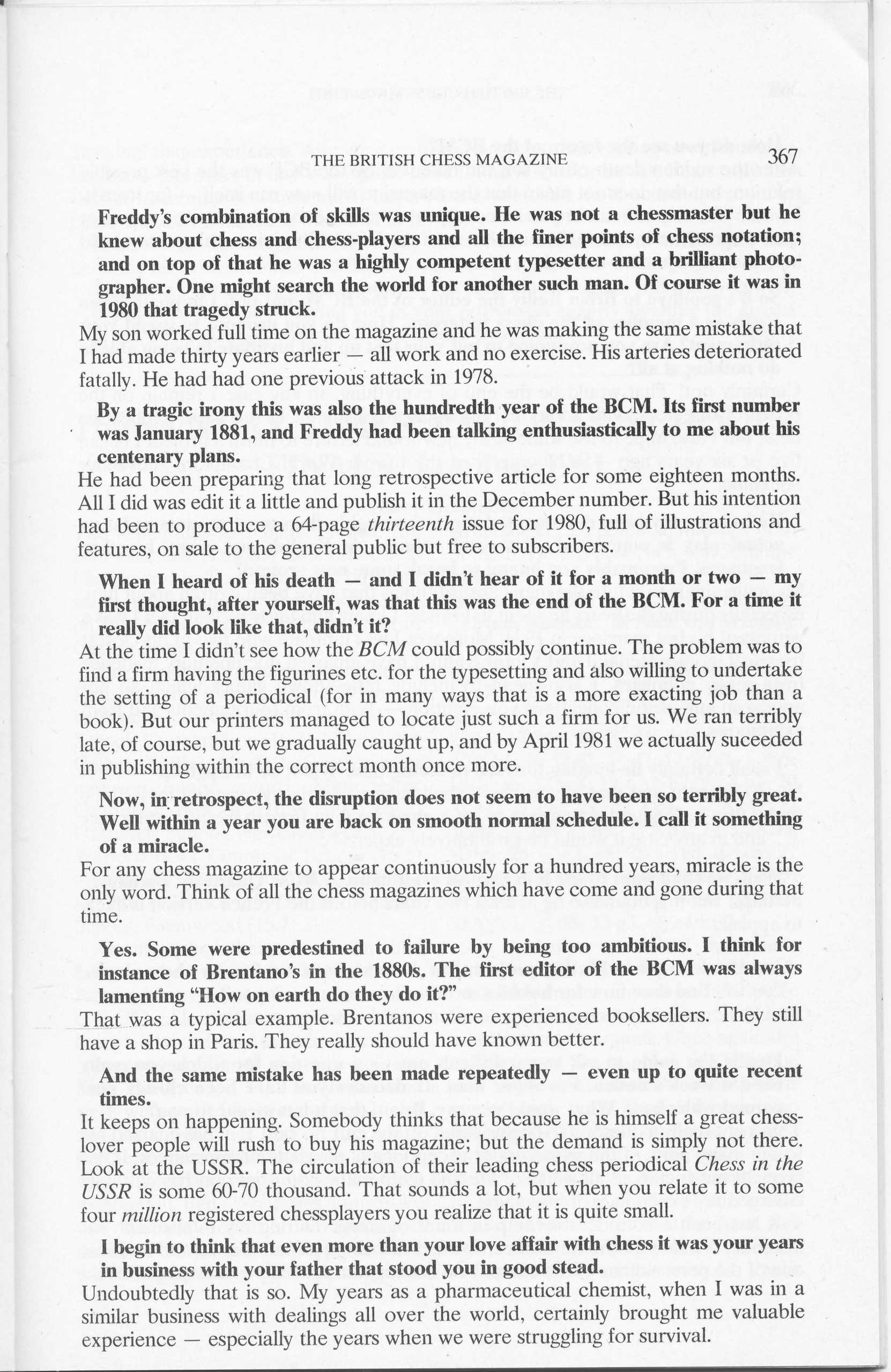
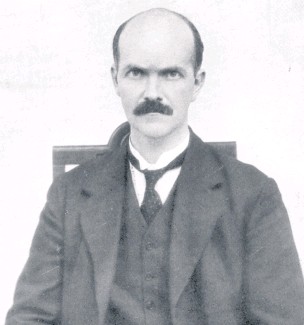
BCN remembers Cyril Kipping who passed away in Walsall on February 17th 1964 at the age of 72.

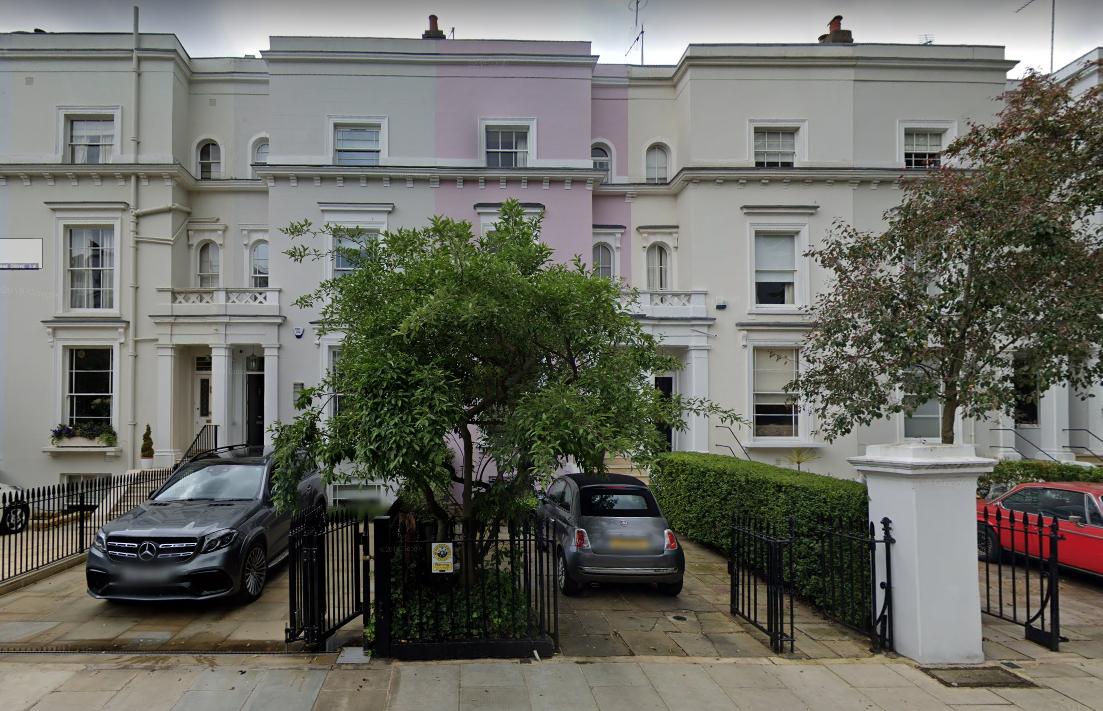
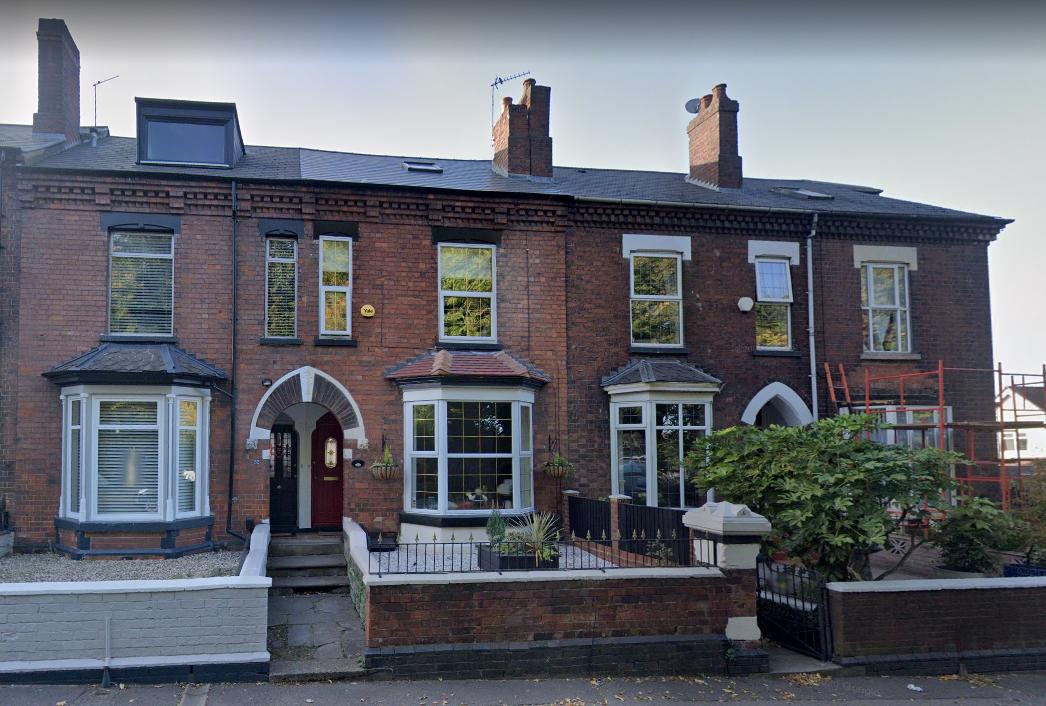
Cyril Henry Stanley Kipping was born on Saturday, October 10th, 1891 in 7 Milborne Grove, South Kensington, London, SW10 9SN.

7 Milborne Grove, South Kensington, London, SW10 9SN.

His parents were Frederick Stanley Kipping (28) and Lillian Kipping (24, née Holland) : they married in 1888. Cyril was baptised on May 8th, 1892 in West Brompton, London. Frederick died on 30 April 1949 in Pwllheli, Caernarvonshire, at the age of 85 and Lilian passed away on 4 September 1949 in Pwllheli, Caernarvonshire, at the age of 82.

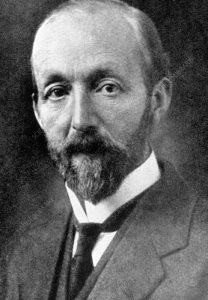
Frederick was Professor of Chemistry at The University of Nottingham. He undertook much of the pioneering work on silicon polymers and coined the term silicone. He was elected a Fellow of the Royal Society in 1897.

Frederick Stanley Kipping, FRS

In the 1901 census the family lived at Clumber Road West, Nottingham and brother Frederick Barry Kipping was born on April 14th 1901 and his sister Kathleen Esme was born on 3 May 1904 was also born in Nottingham. Kathleen died on 30 August 1951 in Pwllheli, Caernarvonshire.

In 1902 Cyril started at Nottingham High School excelling in mathematics and science and in 1906 he obtained the Oxford and Cambridge Board’s Lower Certificate.

On March 2nd 1908 the Sheffield Daily Telegraph published a matriculation list for London University and CHSK was listed as being in the second division from Nottingham High School. Following that in 1909 Cyril obtained a Oxford and Cambridge Higher Certificate.

CHS Kipping
CHS Kipping

As of the 1911 census the household now included Cyril’s maternal Grandmother, Florence Holland (59) plus a parlourmaid, a housemaid, a cook and a nurse. Cyril was recorded as being a 19 year old science student and they lived at 40, Magadala Road, Nottingham which appears to have been replaced by residential flats. Curiously the address on the Census record was obscured by green insulation tape but insufficiently for it to readable.

According to Stephen C. Askey

“He left school in July 1910 and went to Trinity Hall in Cambridge where he read for the National Sciences Tripos. He played tennis for his college and launched into the composition of chess problems (1).

He obtained a First in Part I of the Tripos in 1912, a First in Part II in 1913, and was awarded the degree of Bachelor of Arts on 7 June 1913. He began researching in organic chemistry at Cambridge, but in September 1914 decided instead to take a teaching appointment at Weymouth College.”

In 1914 The London Gazette announced that Cyril was promoted within the Chaplain Department of the British Army to Second Lieutenant with a service number of 10940.

On December 23rd 1914 The London Gazette announced the following :

The London Gazette, December 22nd 1914, part one

and

The London Gazette, December 22nd 1914, part two

On the 9th October 1918 The London Gazette announced :

The London Gazette, 8th October 1918

Again, According to Stephen C. Askey :

“In January 1919 he took his Master of Arts degree at Cambridge, and joined the teaching staff of Bradfield College in Berkshire. But by the summer of that year he became an assistant master at Pocklington School in Yorkshire, where he spent five happy years.
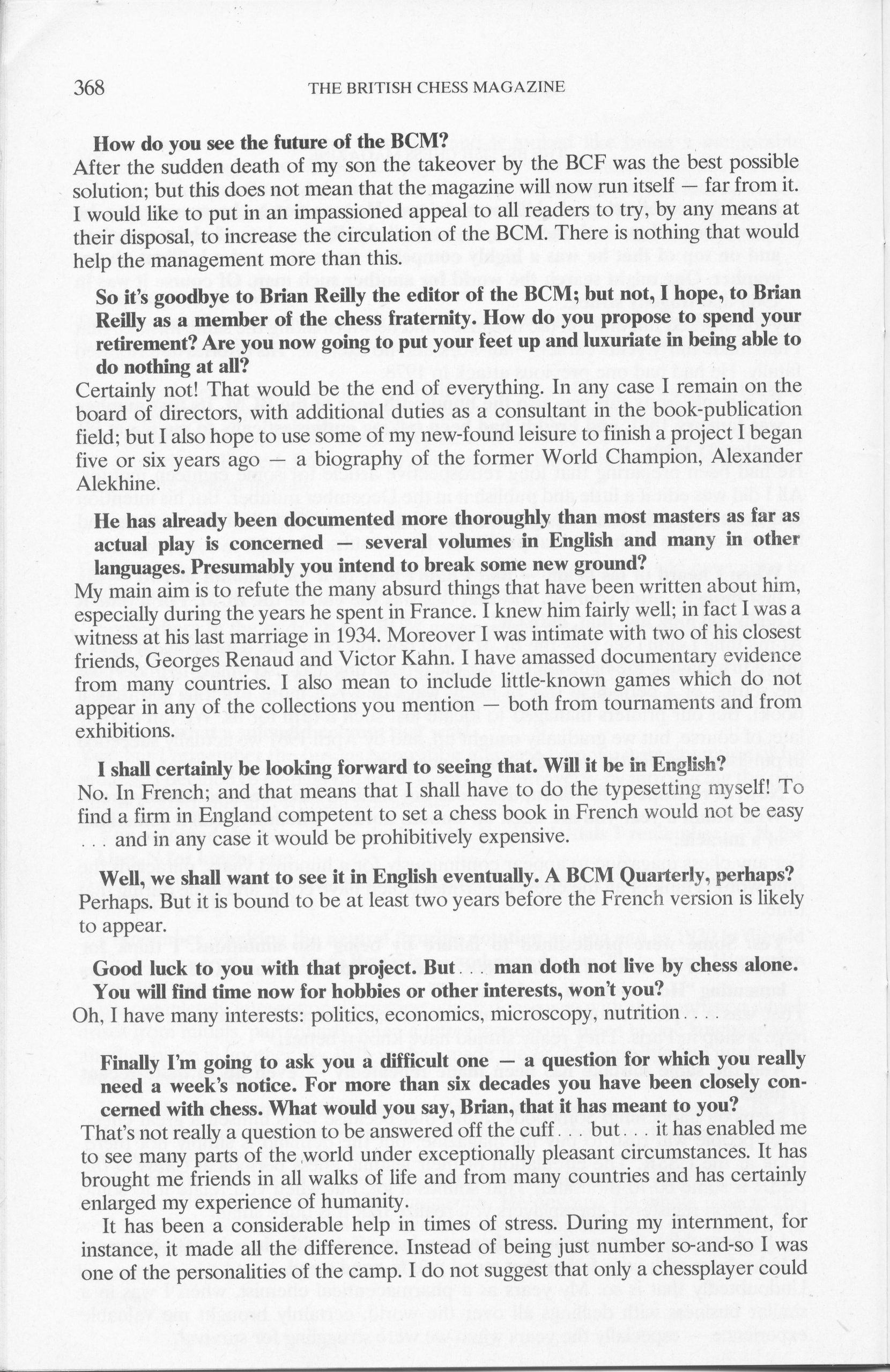
There he used his talent for juggling in 1920 to train a troupe of jugglers who gave a display at a school concert. This popular performance was repeated annually at Pocklington. Meanwhile be continued to compose chess problems and in 1923 published a book for beginners called The Chess Problem Hobby.”

In the 1939 register Cyril was recorded as residing at 67 Wood Green Road, Wednesbury, Staffordshire, England with Martha Partridge (born 29th June 1886) who was his Housekeeper.

Wood Green Road, Wednesbury, Staffordshire

His probate record appears in the England & Wales Government Probate Death Index 1858-2019 as :

1964 Probate record for Cyril Henry Stanley Kipping

From The Encyclopaedia of Chess (Robert Hale 1970 & 1976), Anne Sunnucks :

“International Master of the FIDE for Chess Compositions (1959) and International Judge of the FIDE for Chess Compositions (1957). Born on 10th October 1891. Died on 17th February 1964. Kipping was famous as a composer and an editor which he combined with is duties as Headmaster of Wednesbury High School from 1925 to 1956.

Chess Tournament 19th November 1934: An inter-form chess match for the pupils is in progress at Wednesbury High School for Boys, supervised by Mr C S Kipping, their headmaster. (Photo by William Vanderson/Fox Photos/Getty Images)
19th November 1934: An inter-form chess match for the pupils is in progress at Wednesbury High School for Boys, supervised by Mr C S Kipping, their headmaster. (Photo by William Vanderson/Fox Photos/Getty Images)

His editorial duties extended over more than forty years, and included the problem sections of Chess, Chess Amateur, and, for 32 years, the specialist magazine The Problemist from 1931. He was noted for his encouragement of beginners. His pamphlet ‘The Chess Problem Hobby‘ is an excellent beginner’s introduction. His other books included Chess Problem Science, The Chessmen Speak and 300 Chess Problems.
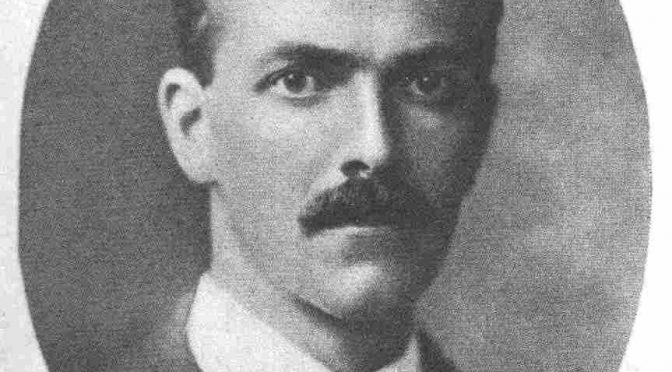
Chess Problem Science, CS Kipping, Whitehead & Miller, 1938

Kipping was one of the most prolific composers of all time, with over 7,000 problems to his credit. Many of his strategic three-movers have become classic. He was leading authority on halfpin two-movers. In his latter years, Kipping affectionately known as CSK – was Chairman of the International Problem Board which is now the FIDE Problem Commission.”

The Chessmen Speak, CS Kipping, The Chess Amateur, Stroud, 1932

From British Chess Magazine, Volume LXXXIV (84, 1964), Number 4 (April), pp. 122-123 by John Rice:

“CS Kipping, one of the most famous of all British problemists, died during February at the age of seventy-two. As a composer, editor, writer and critic Kipping was without equal. It is impossible to do justice in only a few lines to his vast and unique contribution to chess problems: a few factual notes. most of them kindly supplied by RCO Matthews, must suffice.

Kipping was born in London on October 10th, 1891, After completing his studies, he took up teaching as a career, and in 1924 he was appointed the first headmaster of the newly-opened Wednesbury High School, which post he held until his retirement in 1956. He was a bachelor, and, especially during the later years of his life, his interests were centered mainly on the school and on chess problems.

Headmaster C.S. Kipping instructs a classroom of boys on the rules of chess using his demonstration board at Wednesbury High School. (Photo by © Hulton-Deutsch Collection/CORBIS/Corbis via Getty Images)

Most readers will know of Kipping as the editor of The Problemist, the bi-monthly journal of the British Chess Problem Society. Before he took over The Problemist in 1931, he had been in charge of the problem section of the Chess Amateur, which he edited with great energy and enthusiasm. As well as The Problemist, he edited the problem pages of Chess from its first appearance. in 1936 until the section was suddenly discontinued without warning or explanation a few years ago. He also edited other columns at various times. He always took great care to help and encourage beginners, and it is probably true that every composer in this country below the age of about fifty came under his influence at one time or another.

CHS Kipping
CHS Kipping

As a young man, Kipping was a fierce avant-garde controversialist, championing the the cause of strategy in the three-mover in opposition to the then dominant model-mate school in this country. His attitude to the two-mover, as readers of The Problemist will know, was always a good deal more conservative; he would not tolerate at any price what he called ‘camouflage force,’ even in the modern problem. Yes, he appreciated the aims of the modern two-move composer much more than his writings on the subject suggest, being always ready to applaud excellence in any type of problem.

CHS Kipping
CHS Kipping

Kipping’s output numbered over 7,000 problems, probably a record. Many of his two-moves especially his ‘aspect’ tasks, were published under pseudonyms, of which the best was known was C.Stanley. He concerned himself little with artistic finish : once he had found a workable setting of a them he was engaged on, he would take little trouble over economy and presentation. Themes in which he interested himself include half-pin (in the two-mover), white King themes, interferences, and the grab theme (in the three-mover), and maximum tasks of all kinds, the subject of one of his books, Chess Problem Science. His other books include 300 Chess Problems (1916), and The Chessmen Speak (1932), in the AC White Christmas series.

300 Chess Problems, CS Kipping, The Chess Amateur, Stroud, 1916

In addition to all his other problem activities, Kipping was chairman of the International Problem Board, and curator of the half-pin section of the White-Hume Collection, which he took over on Hume’s death in 1936.

The majority of Kipping’s best problems were three-movers, three of the most famous of which are quoted here.”

Manchester City News, 1911


Mate in three
1 Ka5

First Prize
Dutch East Indies Chess Association Tourney, 1928


Mate in three
1 Ra3

First Prize
BCM, 1939 (II)


Mate in three
1 Be6

The first problem above was given in The Complete Chess Addict by Mike Fox and Richard James in the Desert Island Chess chapter. It is also given in a discussion of the Steinitz Gambit by ASM Dickins and H Ebert in 100 Classics of the Chessboard. Colin Russ on page 138 of Miniature Chess Problems from Many Countries gives the first problem as does John Rice on page 44 of Chess Wizardry : The New ABC of Chess Problems.

On a web site now only accessible vie the WayBack Machine there is a treasure trove of reminisces and memories of CHSK from himself, friends and pupils.

Anecdotes from former pupils.

A history from the Wolverhampton and District Chess League

Here is his Italian (only) Wikipedia entry.

Here is his entry on chesscomposers.blogspot.com

Death Anniversary of Cyril Kipping (10-x-1891 17-ii-1964)

BCN remembers Cyril Kipping who passed away in Walsall on February 17th 1964 at the age of 72.

Cyril Henry Stanley Kipping was born on Saturday, October 10th, 1891 in 7 Milborne Grove, South Kensington, London, SW10 9SN.

7 Milborne Grove, South Kensington, London, SW10 9SN.

His parents were Frederick Stanley Kipping (28) and Lillian Kipping (24, née Holland) : they married in 1888. Cyril was baptised on May 8th, 1892 in West Brompton, London. Frederick died on 30 April 1949 in Pwllheli, Caernarvonshire, at the age of 85 and Lilian passed away on 4 September 1949 in Pwllheli, Caernarvonshire, at the age of 82.

Frederick was Professor of Chemistry at The University of Nottingham. He undertook much of the pioneering work on silicon polymers and coined the term silicone. He was elected a Fellow of the Royal Society in 1897.

Frederick Stanley Kipping, FRS

In the 1901 census the family lived at Clumber Road West, Nottingham and brother Frederick Barry Kipping was born on April 14th 1901 and his sister Kathleen Esme was born on 3 May 1904 was also born in Nottingham. Kathleen died on 30 August 1951 in Pwllheli, Caernarvonshire.

In 1902 Cyril started at Nottingham High School excelling in mathematics and science and in 1906 he obtained the Oxford and Cambridge Board’s Lower Certificate.

On March 2nd 1908 the Sheffield Daily Telegraph published a matriculation list for London University and CHSK was listed as being in the second division from Nottingham High School. Following that in 1909 Cyril obtained a Oxford and Cambridge Higher Certificate.

CHS Kipping
CHS Kipping

As of the 1911 census the household now included Cyril’s maternal Grandmother, Florence Holland (59) plus a parlourmaid, a housemaid, a cook and a nurse. Cyril was recorded as being a 19 year old science student and they lived at 40, Magadala Road, Nottingham which appears to have been replaced by residential flats. Curiously the address on the Census record was obscured by green insulation tape but insufficiently for it to readable.

According to Stephen C. Askey

“He left school in July 1910 and went to Trinity Hall in Cambridge where he read for the National Sciences Tripos. He played tennis for his college and launched into the composition of chess problems (1).

He obtained a First in Part I of the Tripos in 1912, a First in Part II in 1913, and was awarded the degree of Bachelor of Arts on 7 June 1913. He began researching in organic chemistry at Cambridge, but in September 1914 decided instead to take a teaching appointment at Weymouth College.”

In 1914 The London Gazette announced that Cyril was promoted within the Chaplain Department of the British Army to Second Lieutenant with a service number of 10940.

On December 23rd 1914 The London Gazette announced the following :

The London Gazette, December 22nd 1914, part one

and

The London Gazette, December 22nd 1914, part two

On the 9th October 1918 The London Gazette announced :

The London Gazette, 8th October 1918

Again, According to Stephen C. Askey :

“In January 1919 he took his Master of Arts degree at Cambridge, and joined the teaching staff of Bradfield College in Berkshire. But by the summer of that year he became an assistant master at Pocklington School in Yorkshire, where he spent five happy years.

There he used his talent for juggling in 1920 to train a troupe of jugglers who gave a display at a school concert. This popular performance was repeated annually at Pocklington. Meanwhile be continued to compose chess problems and in 1923 published a book for beginners called The Chess Problem Hobby.”

In the 1939 register Cyril was recorded as residing at 67 Wood Green Road, Wednesbury, Staffordshire, England with Martha Partridge (born 29th June 1886) who was his Housekeeper.

Wood Green Road, Wednesbury, Staffordshire

His probate record appears in the England & Wales Government Probate Death Index 1858-2019 as :

1964 Probate record for Cyril Henry Stanley Kipping

From The Encyclopaedia of Chess (Robert Hale 1970 & 1976), Anne Sunnucks :

“International Master of the FIDE for Chess Compositions (1959) and International Judge of the FIDE for Chess Compositions (1957). Born on 10th October 1891. Died on 17th February 1964. Kipping was famous as a composer and an editor which he combined with is duties as Headmaster of Wednesbury High School from 1925 to 1956.

Chess Tournament 19th November 1934: An inter-form chess match for the pupils is in progress at Wednesbury High School for Boys, supervised by Mr C S Kipping, their headmaster. (Photo by William Vanderson/Fox Photos/Getty Images)
19th November 1934: An inter-form chess match for the pupils is in progress at Wednesbury High School for Boys, supervised by Mr C S Kipping, their headmaster. (Photo by William Vanderson/Fox Photos/Getty Images)

His editorial duties extended over more than forty years, and included the problem sections of Chess, Chess Amateur, and, for 32 years, the specialist magazine The Problemist from 1931. He was noted for his encouragement of beginners. His pamphlet ‘The Chess Problem Hobby‘ is an excellent beginner’s introduction. His other books included Chess Problem Science, The Chessmen Speak and 300 Chess Problems.

Chess Problem Science, CS Kipping, Whitehead & Miller, 1938

Kipping was one of the most prolific composers of all time, with over 7,000 problems to his credit. Many of his strategic three-movers have become classic. He was leading authority on halfpin two-movers. In his latter years, Kipping affectionately known as CSK – was Chairman of the International Problem Board which is now the FIDE Problem Commission.”

The Chessmen Speak, CS Kipping, The Chess Amateur, Stroud, 1932

From British Chess Magazine, Volume LXXXIV (84, 1964), Number 4 (April), pp. 122-123 by John Rice:

“CS Kipping, one of the most famous of all British problemists, died during February at the age of seventy-two. As a composer, editor, writer and critic Kipping was without equal. It is impossible to do justice in only a few lines to his vast and unique contribution to chess problems: a few factual notes. most of them kindly supplied by RCO Matthews, must suffice.

Kipping was born in London on October 10th, 1891, After completing his studies, he took up teaching as a career, and in 1924 he was appointed the first headmaster of the newly-opened Wednesbury High School, which post he held until his retirement in 1956. He was a bachelor, and, especially during the later years of his life, his interests were centered mainly on the school and on chess problems.

Headmaster C.S. Kipping instructs a classroom of boys on the rules of chess using his demonstration board at Wednesbury High School. (Photo by © Hulton-Deutsch Collection/CORBIS/Corbis via Getty Images)

Most readers will know of Kipping as the editor of The Problemist, the bi-monthly journal of the British Chess Problem Society. Before he took over The Problemist in 1931, he had been in charge of the problem section of the Chess Amateur, which he edited with great energy and enthusiasm. As well as The Problemist, he edited the problem pages of Chess from its first appearance. in 1936 until the section was suddenly discontinued without warning or explanation a few years ago. He also edited other columns at various times. He always took great care to help and encourage beginners, and it is probably true that every composer in this country below the age of about fifty came under his influence at one time or another.

CHS Kipping
CHS Kipping

As a young man, Kipping was a fierce avant-garde controversialist, championing the the cause of strategy in the three-mover in opposition to the then dominant model-mate school in this country. His attitude to the two-mover, as readers of The Problemist will know, was always a good deal more conservative; he would not tolerate at any price what he called ‘camouflage force,’ even in the modern problem. Yes, he appreciated the aims of the modern two-move composer much more than his writings on the subject suggest, being always ready to applaud excellence in any type of problem.

CHS Kipping
CHS Kipping

Kipping’s output numbered over 7,000 problems, probably a record. Many of his two-moves especially his ‘aspect’ tasks, were published under pseudonyms, of which the best was known was C.Stanley. He concerned himself little with artistic finish : once he had found a workable setting of a them he was engaged on, he would take little trouble over economy and presentation. Themes in which he interested himself include half-pin (in the two-mover), white King themes, interferences, and the grab theme (in the three-mover), and maximum tasks of all kinds, the subject of one of his books, Chess Problem Science. His other books include 300 Chess Problems (1916), and The Chessmen Speak (1932), in the AC White Christmas series.

300 Chess Problems, CS Kipping, The Chess Amateur, Stroud, 1916

In addition to all his other problem activities, Kipping was chairman of the International Problem Board, and curator of the half-pin section of the White-Hume Collection, which he took over on Hume’s death in 1936.

The majority of Kipping’s best problems were three-movers, three of the most famous of which are quoted here.”

Manchester City News, 1911


Mate in three
1 Ka5

First Prize
Dutch East Indies Chess Association Tourney, 1928


Mate in three
1 Ra3

First Prize
BCM, 1939 (II)


Mate in three
1 Be6

The first problem above was given in The Complete Chess Addict by Mike Fox and Richard James in the Desert Island Chess chapter. It is also given in a discussion of the Steinitz Gambit by ASM Dickins and H Ebert in 100 Classics of the Chessboard. Colin Russ on page 138 of Miniature Chess Problems from Many Countries gives the first problem as does John Rice on page 44 of Chess Wizardry : The New ABC of Chess Problems.

On a web site now only accessible vie the WayBack Machine there is a treasure trove of reminisces and memories of CHSK from himself, friends and pupils.

Anecdotes from former pupils.

A history from the Wolverhampton and District Chess League

Here is his Italian (only) Wikipedia entry.

Here is his entry on chesscomposers.blogspot.com

Death Anniversary of Cyril Kipping (10-x-1891 17-ii-1964)

BCN remembers Cyril Kipping who passed away in Walsall on February 17th 1964 at the age of 72.

Cyril Henry Stanley Kipping was born on Saturday, October 10th, 1891 in 7 Milborne Grove, South Kensington, London, SW10 9SN.

7 Milborne Grove, South Kensington, London, SW10 9SN.

His parents were Frederick Stanley Kipping (28) and Lillian Kipping (24, née Holland) : they married in 1888. Cyril was baptised on May 8th, 1892 in West Brompton, London. Frederick died on 30 April 1949 in Pwllheli, Caernarvonshire, at the age of 85 and Lilian passed away on 4 September 1949 in Pwllheli, Caernarvonshire, at the age of 82.

Frederick was Professor of Chemistry at The University of Nottingham. He undertook much of the pioneering work on silicon polymers and coined the term silicone. He was elected a Fellow of the Royal Society in 1897.

Frederick Stanley Kipping, FRS

In the 1901 census the family lived at Clumber Road West, Nottingham and brother Frederick Barry Kipping was born on April 14th 1901 and his sister Kathleen Esme was born on 3 May 1904 was also born in Nottingham. Kathleen died on 30 August 1951 in Pwllheli, Caernarvonshire.

In 1902 Cyril started at Nottingham High School excelling in mathematics and science and in 1906 he obtained the Oxford and Cambridge Board’s Lower Certificate.

On March 2nd 1908 the Sheffield Daily Telegraph published a matriculation list for London University and CHSK was listed as being in the second division from Nottingham High School. Following that in 1909 Cyril obtained a Oxford and Cambridge Higher Certificate.

CHS Kipping
CHS Kipping

As of the 1911 census the household now included Cyril’s maternal Grandmother, Florence Holland (59) plus a parlourmaid, a housemaid, a cook and a nurse. Cyril was recorded as being a 19 year old science student and they lived at 40, Magadala Road, Nottingham which appears to have been replaced by residential flats. Curiously the address on the Census record was obscured by green insulation tape but insufficiently for it to readable.

According to Stephen C. Askey

“He left school in July 1910 and went to Trinity Hall in Cambridge where he read for the National Sciences Tripos. He played tennis for his college and launched into the composition of chess problems (1).

He obtained a First in Part I of the Tripos in 1912, a First in Part II in 1913, and was awarded the degree of Bachelor of Arts on 7 June 1913. He began researching in organic chemistry at Cambridge, but in September 1914 decided instead to take a teaching appointment at Weymouth College.”

In 1914 The London Gazette announced that Cyril was promoted within the Chaplain Department of the British Army to Second Lieutenant with a service number of 10940.

On December 23rd 1914 The London Gazette announced the following :

The London Gazette, December 22nd 1914, part one

and

The London Gazette, December 22nd 1914, part two

On the 9th October 1918 The London Gazette announced :

The London Gazette, 8th October 1918

Again, According to Stephen C. Askey :

“In January 1919 he took his Master of Arts degree at Cambridge, and joined the teaching staff of Bradfield College in Berkshire. But by the summer of that year he became an assistant master at Pocklington School in Yorkshire, where he spent five happy years.

There he used his talent for juggling in 1920 to train a troupe of jugglers who gave a display at a school concert. This popular performance was repeated annually at Pocklington. Meanwhile be continued to compose chess problems and in 1923 published a book for beginners called The Chess Problem Hobby.”

In the 1939 register Cyril was recorded as residing at 67 Wood Green Road, Wednesbury, Staffordshire, England with Martha Partridge (born 29th June 1886) who was his Housekeeper.

Wood Green Road, Wednesbury, Staffordshire

His probate record appears in the England & Wales Government Probate Death Index 1858-2019 as :

1964 Probate record for Cyril Henry Stanley Kipping

From The Encyclopaedia of Chess (Robert Hale 1970 & 1976), Anne Sunnucks :

“International Master of the FIDE for Chess Compositions (1959) and International Judge of the FIDE for Chess Compositions (1957). Born on 10th October 1891. Died on 17th February 1964. Kipping was famous as a composer and an editor which he combined with is duties as Headmaster of Wednesbury High School from 1925 to 1956.

Chess Tournament 19th November 1934: An inter-form chess match for the pupils is in progress at Wednesbury High School for Boys, supervised by Mr C S Kipping, their headmaster. (Photo by William Vanderson/Fox Photos/Getty Images)
19th November 1934: An inter-form chess match for the pupils is in progress at Wednesbury High School for Boys, supervised by Mr C S Kipping, their headmaster. (Photo by William Vanderson/Fox Photos/Getty Images)

His editorial duties extended over more than forty years, and included the problem sections of Chess, Chess Amateur, and, for 32 years, the specialist magazine The Problemist from 1931. He was noted for his encouragement of beginners. His pamphlet ‘The Chess Problem Hobby‘ is an excellent beginner’s introduction. His other books included Chess Problem Science, The Chessmen Speak and 300 Chess Problems.

Chess Problem Science, CS Kipping, Whitehead & Miller, 1938

Kipping was one of the most prolific composers of all time, with over 7,000 problems to his credit. Many of his strategic three-movers have become classic. He was leading authority on halfpin two-movers. In his latter years, Kipping affectionately known as CSK – was Chairman of the International Problem Board which is now the FIDE Problem Commission.”

The Chessmen Speak, CS Kipping, The Chess Amateur, Stroud, 1932

From British Chess Magazine, Volume LXXXIV (84, 1964), Number 4 (April), pp. 122-123 by John Rice:

“CS Kipping, one of the most famous of all British problemists, died during February at the age of seventy-two. As a composer, editor, writer and critic Kipping was without equal. It is impossible to do justice in only a few lines to his vast and unique contribution to chess problems: a few factual notes. most of them kindly supplied by RCO Matthews, must suffice.

Kipping was born in London on October 10th, 1891, After completing his studies, he took up teaching as a career, and in 1924 he was appointed the first headmaster of the newly-opened Wednesbury High School, which post he held until his retirement in 1956. He was a bachelor, and, especially during the later years of his life, his interests were centered mainly on the school and on chess problems.

Headmaster C.S. Kipping instructs a classroom of boys on the rules of chess using his demonstration board at Wednesbury High School. (Photo by © Hulton-Deutsch Collection/CORBIS/Corbis via Getty Images)

Most readers will know of Kipping as the editor of The Problemist, the bi-monthly journal of the British Chess Problem Society. Before he took over The Problemist in 1931, he had been in charge of the problem section of the Chess Amateur, which he edited with great energy and enthusiasm. As well as The Problemist, he edited the problem pages of Chess from its first appearance. in 1936 until the section was suddenly discontinued without warning or explanation a few years ago. He also edited other columns at various times. He always took great care to help and encourage beginners, and it is probably true that every composer in this country below the age of about fifty came under his influence at one time or another.

CHS Kipping
CHS Kipping

As a young man, Kipping was a fierce avant-garde controversialist, championing the the cause of strategy in the three-mover in opposition to the then dominant model-mate school in this country. His attitude to the two-mover, as readers of The Problemist will know, was always a good deal more conservative; he would not tolerate at any price what he called ‘camouflage force,’ even in the modern problem. Yes, he appreciated the aims of the modern two-move composer much more than his writings on the subject suggest, being always ready to applaud excellence in any type of problem.

CHS Kipping
CHS Kipping

Kipping’s output numbered over 7,000 problems, probably a record. Many of his two-moves especially his ‘aspect’ tasks, were published under pseudonyms, of which the best was known was C.Stanley. He concerned himself little with artistic finish : once he had found a workable setting of a them he was engaged on, he would take little trouble over economy and presentation. Themes in which he interested himself include half-pin (in the two-mover), white King themes, interferences, and the grab theme (in the three-mover), and maximum tasks of all kinds, the subject of one of his books, Chess Problem Science. His other books include 300 Chess Problems (1916), and The Chessmen Speak (1932), in the AC White Christmas series.

300 Chess Problems, CS Kipping, The Chess Amateur, Stroud, 1916

In addition to all his other problem activities, Kipping was chairman of the International Problem Board, and curator of the half-pin section of the White-Hume Collection, which he took over on Hume’s death in 1936.

The majority of Kipping’s best problems were three-movers, three of the most famous of which are quoted here.”

Manchester City News, 1911


Mate in three
1 Ka5

First Prize
Dutch East Indies Chess Association Tourney, 1928


Mate in three
1 Ra3

First Prize
BCM, 1939 (II)


Mate in three
1 Be6

The first problem above was given in The Complete Chess Addict by Mike Fox and Richard James in the Desert Island Chess chapter. It is also given in a discussion of the Steinitz Gambit by ASM Dickins and H Ebert in 100 Classics of the Chessboard. Colin Russ on page 138 of Miniature Chess Problems from Many Countries gives the first problem as does John Rice on page 44 of Chess Wizardry : The New ABC of Chess Problems.

On a web site now only accessible vie the WayBack Machine there is a treasure trove of reminisces and memories of CHSK from himself, friends and pupils.

Anecdotes from former pupils.

A history from the Wolverhampton and District Chess League

Here is his Italian (only) Wikipedia entry.

Here is his entry on chesscomposers.blogspot.com