Tag Archives: Biographies

It’s Only Me! : Remembering Tony Miles (23-iv-1955 12-xi-2001)

GM Anthony John Miles

We remember one of the most innovative and best loved English players of all time, Tony Miles.

Tony's signature from a presentation copy of European Team Championship 1973. The event was the Anglo-Dutch match of October 1977 at Elvetham Hall
Tony’s signature from a presentation copy of European Team Championship 1973. The event was the Anglo-Dutch match of October 1977 at Elvetham Hall

From British Chess (Pergamon Press, 1983) by Bernard Cafferty :

“If one had to forecast at the start of the 1970s the British chess would have a player in the next decade who would win the World Junior Championship, make plus score against Soviet players in his first years of play against them, and beat such household names as Geller, Bronstein, Larsen, Gligoric, Smyslov, Spassky and Karpov…one would have been called a romantic dreamer.

English chess grandmaster Tony Miles (1955 - 2001), UK, 6th May 1973. (Photo by Hoare/Daily Express/Hulton Archive/Getty Images)
English chess grandmaster Tony Miles (1955 – 2001), UK, 6th May 1973. (Photo by Hoare/Daily Express/Hulton Archive/Getty Images)

If one had gone further and said that the same grandmaster X would become only the second British player this century to beat a reigning world champion, and that as Black in an irregular opening (1 e4 a6 2 d4 b5) then incredulity would indeed have been a fitting reaction.

Yet all this has come to pass; all the above is fact not fiction, reality not a day dream. Who is grandmaster X? Where did he develop?

Anthony John Miles was born on the 23rd April, 1955, in Birmingham (his birthplace is incorrectly marked (Ed: as London) on the map in Elo’s book on ratings.) He learned the moves at the age of five, became seriously interested in the game at the age of nine or ten, and almost straight away won the Birmingham Primary Schools Championship.

English chess grandmaster Tony Miles (1955 - 2001), UK, 15th May 1973. (Photo by Adam/Daily Express/Hulton Archive/Getty Images)
English chess grandmaster Tony Miles (1955 – 2001), UK, 15th May 1973. (Photo by Adam/Daily Express/Hulton Archive/Getty Images)

In 1965 he joined the Birmingham Chess club and the following year became a pupil at King Edward School (KES) (the alma mater of other strong British players, such as Hugh Alexander and Malcolm Barker, runner-up to Ivkov in the inaugural World Junior Championship held at Birmingham in 1951.)

Tony Miles
Tony Miles

At the Birmingham Club he met strong opposition (another grandmaster-to-be, the postal player Keith Richardson was a member there for a time) since the club’s four teams were all in the higher divisions of the local league. Yet Tony’s school work meant that he could not be called a frequent attender at the club – he turned up for league matches and the club championship, but rarely for skittles except in the summer.

Tony Miles and possibly (?) Peter Clarke at Birmingham 1973

Soon he was playing in the Second Division, by 1968 he was in the First Division, and in the 1969-70 season he was on top board for one of the Club’s three teams in the top Division.

Tony made his debut in the BCF Congress at Oxford, 1967, where he was equal 11th in the under-14 Boys Championship won by another rising star, John Nunn. Strangely enough when Tony won this title the following year at Bristol Nunn was 3rd equal!

The Edgbaston player was also a regular competitor in the annual Easter Congress held in the same suburb of Birmingham where he lived.

Tony Miles
Tony Miles

The breakthrough to national status came when he was a sixth-former at KES. At the BCF Congress, Blackpool,
1971, he won the under-2l Championship (with Nunn and Jon Speelman equal 2nd and the same year made his international debut in a junior tournament at Nice which he won ahead of various prominent players including the Swiss Hug who was to win the World Junior championship some 4 months later!

Tony Miles and unknown opponent

In the 1971-72 Birmingham and District League season he set up a scoring record, mainly on top board, that may never be equalled (9.5 out of 10).

Tony Miles
Tony Miles

During these school years Tony was a rather taciturn teenager (perhaps to be expected in an only child) but he never fitted in with the conventional image of chessplayer as weedy bookworm.

Tony being presented with the trophy in the photograph below

He always had a fine physique, played rugger at school and later became keen on squash and skiing as a means of keeping fit, though he is the first to admit that he can be rather lethargic (especially in the mornings!)

Tony Miles
Tony Miles

At the time I knew one of his teachers professionally, and heard the occasional report that he was not always up to the best academic standards of KES. My reaction must have seemed heresy at the time, but subsequent events in the post-Fischer era have confirmed that the ability to play chess to international standard may lead to a more worthwhile career than being a run-of-the-mill university graduate.

Tony Miles at Hastings

A sign of Tony’s growing understanding of the finer points of the game came when he strolled into the Birmingham Club the day after the first game of the Spassky-Fischer match and pointed out (correctly as was shown later) the reason why Fischer had made his famous Bxh2 sacrifice/oversight.

Tony Miles & Bill Hartston admire a Rolls-Royce

International recognition came in 1973 when he finished 2nd to Romanishin in the European Junior Championship at Groningen, and Second to Belyavsky in the World Junior at Teeside, as well as sharing 4-6th place in the British Championship at Eastbourne at only the second attempt. His first game to be published round the world was his victory over Bisguier in the Birmingham Easter tournament which he won ahead of Adorjan and Bisguier in the same year.

England plays Italy at Haifa 1976. Miles played Tatai, Keene played Toth, Hartston played Grinza and Mestel played Micheli

The main event of 1974, a break-through for British chess, was the World Junior Championship played in August in sub-tropical Manila. Here he played one of his finest games, against Kochiev, to take the title with a round to spare, thereby becoming lnternational Master.

The 1974 World Junior Chess Champion is Anthony John Miles (England), a 19-year old student at Sheffield University. Tony won the title in Manila with a round to spare. A full report, with games by Bernard Cafferty - who was Miles' second  - will appear in our October issue.
The 1974 World Junior Chess Champion is Anthony John Miles (England), a 19-year old student at Sheffield University. Tony won the title in Manila with a round to spare. A full report, with games by Bernard Cafferty – who was Miles’ second – will appear in our October issue.

Tony’s physical strength showed up to good effect here, not just lasting out the 4 weeks in the baking humidity but coping with the huge load of luggage (on the outward journey huge cases full of Chess Player, Informator and the like; on the return journey this load reinforced with prizes and souvenirs!).

Tony Miles at Wijk aan Zee 1976. Korchnoi was first. Photo taken by Brian or Freddy Reilly

Gaining the title brought regular invitations to tournaments which could not be fitted in well with the demands of his maths course at Sheffield University. In the summer of 1975 he gave up the course after two years, while the University authorities showed their recognition of his distinction at chess by the award of an honorary MA degree.

Tony Miles in relaxed mood

Once free to concentrate wholeheartedly on his true calling he took the grandmaster title in a rush. The first norm came with first prize, August, 1975, at the London Chess Fortnight ahead of Adorjan, Sax and Timman.

Tony Miles
Tony Miles

Hastings 1975-76 was not too good a result, but only a few weeks later he was on his way to a great triumph despite
forced late acceptance of the invitation to the USSR due to lack of finance. He got his visa just in time and went to snowy Dubna, a scientific centre near Moscow, to achieve that most difficult feat – a GM norm in a Soviet tournament ahead of eight GM’s and others
just as strong.

Tony Miles plays Tony Miles : see full caption below
Caption for above photograph

Thus Tony Miles became the first official British grandmaster (the title dates officially only from 1949, so excluding the likes of Staunton, Blackburne and Burn) and took the £5000 Slater prize for the first British GM to add to the £1000 prize for victory in the 1975 Cutty Sark series of weekend and other tournaments. The availability of sponsorship, it goes without saying, has done much to encourage Tony on his chosen path as a chess professional, a far from easy vocation that demands will-power and strong nerves to be successful.

Tony Miles : See full caption below
Full caption for above photograph
Accompanying letter for above photograph

1977 confirmed that here was a genuine grandmaster with first prizes at the Amsterdam IBM and Biel tournaments, and second prize behind Karpov
at the first of the new series of Super grandmaster tournaments (Tilburg, Holland.)

Tony Miles in pensive mood

After his Promotion to the ranks of grandmaster Tony, with his usual directness, said that the only thing left to achieve was to have a crack at Karpov. (His fans might react by saying that there were other mountains to climb such as first place at Hastings and in the British Championship, but then Karpov has not achieved the first either, and only became Soviet Champion after he had taken the world title!)

Tony Miles and Michael Stean at the FIDE Zonal in Amsterdam, 1978. (Source: http://gahetna.nl)

The first chance for this ‘crack’ came with their meeting in the super tournaments at Tilburg and Bugojno, as well as in the 1977 BBC2 TV Master Game’ The
results went much in favour of the (slightly) older man. Tony had to wait till January, 1980 before he could celebrate a victory over Fischer’s successor.

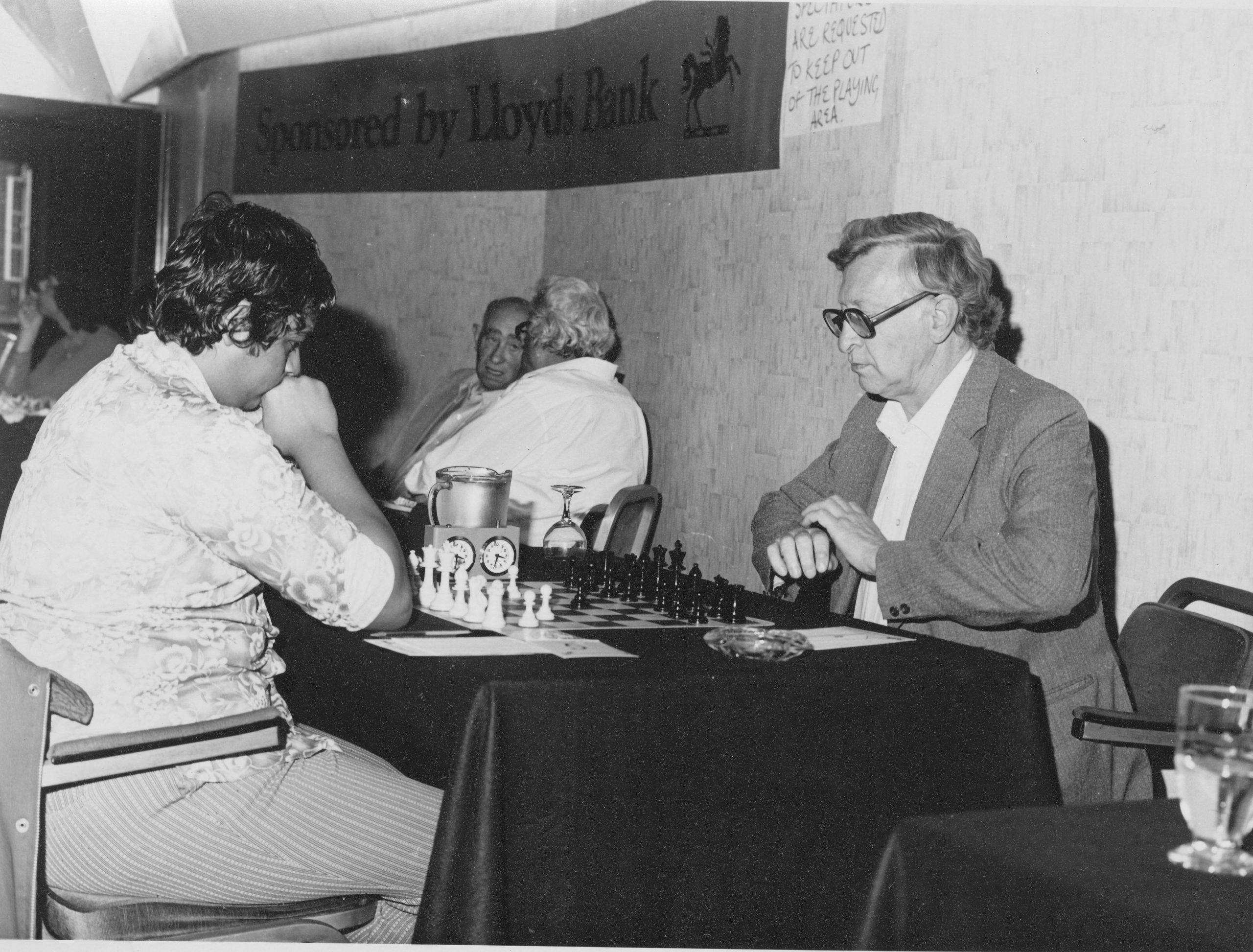
Peter Sowray watching Tony Miles at the Lloyds Bank Masters. Sir Jeremy Morse watches.

By this time Tony had failed in his first bid to get to a title match with the Russian when he fell away after a good start in the 1979 Riga Interzonal (the
second stage of the three-part qualifying cycle). It is a pity that our leading professional in Britain still has to accept so many invitations merely to make a
decent living. As Botvinnik has commented, some properly directed study and training at home may be preferable to too frequent public appearances at the board.

Tony Miles and ? at a Benedictine International in Manchester
Tony Miles and Sergey Kudrin at a Benedictine International in Manchester

What sort of person and player is Tony Miles? He has become a more outgoing person in recent years, and has even overcome his legitimate aversion to
media representatives who attempt to interview him without any background in the game.

Tony Miles
Tony Miles

His style has also gone through various changes. At first he was purely a 1 e4 player with a penchant for tricky Nc6 variations of the Four Knights. This repertoire brought him a string of wins, but once he began meeting masters regularly he had to change his repertoire to include the flank openings and 1 d4 as well as the Sicilian Defence. Some notable contributions to opening theory include Bf4 against the Oueen’s Indian, the defence 1…b6, perhaps now 1…a6.

Tony Miles, now playing under the US flag

Yet his real strength is not in the openings, and he rarely scores quick knockouts. His strength lies in the ability to play a wide variety of positions, to have the patience to play on when there is nothing special in the position and then to recognize the crisis (sometimes more psychological than positional). At this point his fitness and energy tell. It is significant that one of his best wins in the Dubna tournament came in a queen and pawn ending that demanded great patience and technical ability.

10th April 1980: Tony Miles (left) plays 14-year-old Nigel Short in the opening match of the Phillips and Drew Chess Tournament at County Hall, London. (Photo by Wesley/Keystone/Getty Images)

As readers of his weekly column will know he loves to analyse ever more deeply, and seems happier here than in taking intuitive decisions. In the play of the first British grandmaster we see a confirmation of the fact that modern competitive chess is more of a sport (Denksport as the Germans have it) than
an art, more a bitter struggle of strong personalities than an orthodox game.
Bernard Cafferty

In British Chess Magazine, Volume CXXII (122, 2002), Number 1 (January) pp. 6-13 appeared this wonderful obituary from John Saunders with contributions from Bernard Cafferty, Colin Crouch, Jon Levitt and Malcolm Hunt :

British Chess Magazine, Volume CXXII (122, 2002), Number 1 (January) pp. 6-13
Tony Miles at Tilburg 1985
By Bogaerts, Rob / Anefo - Interpolisschaaktoernooi Tilburg; Miles (met rugklachten) ligt op massagetafel te wachten op zijn tegenstanderDutch National Archives, The Hague, Fotocollectie Algemeen Nederlands Persbureau (ANeFo), 1945-1989,Auteursrechthebbende Nationaal Archief, Nummer toegang 2.24.01.05 Bestanddeelnummer 933-4181, CC0, https://commons.wikimedia.org/w/index.php?curid=23134281
By Bogaerts, Rob / Anefo – Interpolisschaaktoernooi Tilburg; Miles (met rugklachten) ligt op massagetafel te wachten op zijn tegenstanderDutch National Archives, The Hague, Fotocollectie Algemeen Nederlands Persbureau (ANeFo), 1945-1989,Auteursrechthebbende Nationaal Archief, Nummer toegang 2.24.01.05 Bestanddeelnummer 933-4181, CC0, https://commons.wikimedia.org/w/index.php?curid=23134281
British Chess Magazine, Volume CXXII (122, 2002), Number 1 (January) pp. 6-13
Tony receives the Leigh Grand Prix award from Malcolm Wood (Chief Executive)
Tony receives the 1984 Leigh Grand Prix award from Dr. A Kent, Malcolm Wood (Chief Executive) and David Anderton OBE
British Chess Magazine, Volume CXXII (122, 2002), Number 1 (January) pp. 6-13
Tony playing under the Union flag
British Chess Magazine, Volume CXXII (122, 2002), Number 1 (January) pp. 6-13
Tony Miles reflecting on an adjourned position. Courtesy of Stephanie Bureau.
British Chess Magazine, Volume CXXII (122, 2002), Number 1 (January) pp. 6-13
Tony : always popular with the ladies at a Lloyds Bank event
British Chess Magazine, Volume CXXII (122, 2002), Number 1 (January) pp. 6-13
Tony at a Lloyds Bank event with Ray Keene, Yasser Seirawan and Vassily Smyslov

From The Oxford Companion to Chess, (OUP, 1984 & 1994), Hooper & Whyld :

“English-born player, International Grandmaster (1976). While an undergraduate he entered and won by a margin of one and a half points the World Junior Championship, Manila 1974. The following year his university, Sheffield, awarded him an honorary MA degree for his chess achievements, and he left without completing his studies, to become a chess professional. The successes came quickly; London 1975, first (+6=3-1); Amsterdam 1976, first equal with Korchnoi; Amsterdam 1977, first (+7=7-1); Biel 1977, first (+ 8=6-l); Tilburg 1977, second (+5:4-2), after Karpov, ahead of Hort and Hübner; Tilburg 1978, third (+4=4-3) equal with Dzindzichashvili and Hübner, after Portisch and Timman; London 1980, first (+6=5-2) equal with Andersson and Korchnoi; Las Palmas 1980, first (+6=5) equal with Geller and Petrosian; Baden-Baden 1981, first (+6=7) equal with Ribli, ahead of Korchnoi; Porz Koln l98l-2, second (+8=l-2), behind Tal, ahead of Hort; Biel 1983, first (+5=6), shared with Nunn; Tilburg 1984, first (+5=6), ahead of Belyavsky, Ribli, and Hübner; Portoroz-Ljubljana 1985, first (+4=6-l) equal with Portisch and Ribli; and Tilburg 1985, first (+6=5-3) equal with Hübner and Korchnoi.

Tony making a getaway !

Around this time Miles began to feel the strain of ten years at the top. He was the first British player of modern times who could be seen as a possible challenger for the world title, and in the late 1970s he was well clear of his British rivals. However, largely inspired by Miles’s success, a new generation, led by Short, was in pursuit, and by the mid 1980s Miles was no longer top board in the Olympiad side. Successes became fewer, his marriage ended, and his confidence was weakened.

Tony enjoyed flamboyant shirts

Determined to make a new start, he transferred his allegiance to the USA in 1987, and immediately shared first place with Gulko, who won the play-off, in the US Open Championship.

Tony Miles
Tony Miles

The move was not a lasting success. Miles had indifferent results and was not selected for the US Olympiad team in 1988. He had maintained a home in Germany and commuted to play in the Bundesliga and by 1990 he was spending an increasing proportion of his time in Europe. His confidence began to return, and with it more victories. He was first in two Swiss system events, Rome 1990, ahead of Barayev, Chernin, Smyslov etc, and Bad Worishofen 1990 (shared), and at Biel 1990 was equal
third (+3=9-2) alter Karpov and Andersson.”

Tony Miles
Tony Miles

Lajos Portisch and Tony Miles

From Wikipedia :
“Personal life

Miles was an only child, born 23 April 1955 in Edgbaston, a suburb of Birmingham, and attended King Edward’s School, Birmingham.[1][2] He was married and divorced twice, and had no children.[1] Miles’ first wife was Jana Hartston, who had previously been married to William Hartston.[2]

Tony with friends at a Lloyds Bank event

Early achievements in chess
He learned the game of chess early in life and made good progress nationally, taking the titles of British under-14 Champion and under-21 Champion in 1968[1] and 1971,[3][4] respectively.

Tony with short hair

In 1973, Miles won the silver medal at the World Junior Chess Championship at Teesside, his first important event against international competition. Both he and compatriot Michael Stean defeated the tournament winner Alexander Beliavsky, but were unable to match the Soviet player’s ruthlessness in dispatching lesser opponents. Miles went on to win this prestigious title the following year in Manila, while a mathematics undergraduate of the University of Sheffield.[1][2]

Tony faces Jonathan Mestel at the Philips & Drew Masters

Taking the decision to pursue the game professionally, Miles did not complete his studies, but, in 1975, was awarded an MA by the University in respect of his chess achievements.[2]

Tony in slightly less formal attire

Further career highlights
In 1976, Miles became the first UK-born, over-the-board chess grandmaster, narrowly beating Raymond Keene to the accolade.[2] The naturalised, German-born Jacques Mieses was awarded the GM title in 1950, while Keith Bevan Richardson had been awarded the GM title for correspondence chess earlier in 1975. For his achievement, Miles won a £5,000 prize, put up by wealthy businessman and chess backer Jim Slater.[1][2]

Tony and friends at a Lloyds Bank event

Miles had a string of good results in the late 1970s and 1980s. He matured into a world class player and won games against high calibre opponents, such as former World Chess Champions Vasily Smyslov, Mikhail Tal and Boris Spassky.

Post mortem analysis with Tony and Garry Kasparov

In 1980 at the European Team Championship in Skara, he beat reigning World Champion Anatoly Karpov with Black, using the extremely unorthodox opening 1. e4 a6!?, the St. George Defence. It is often said that Miles learned the line from offbeat openings enthusiast Michael Basman, but in his book Play the St. George, Basman asserts there is no truth to this. Miles beat Karpov again three years later in Bath in a game that was part of the BBC’s Master Game series, but it was shown only by the (co-producing) German television network, due to a BBC technicians’ strike at the time of broadcast.

Tony in Olympiad play with Jan Timman

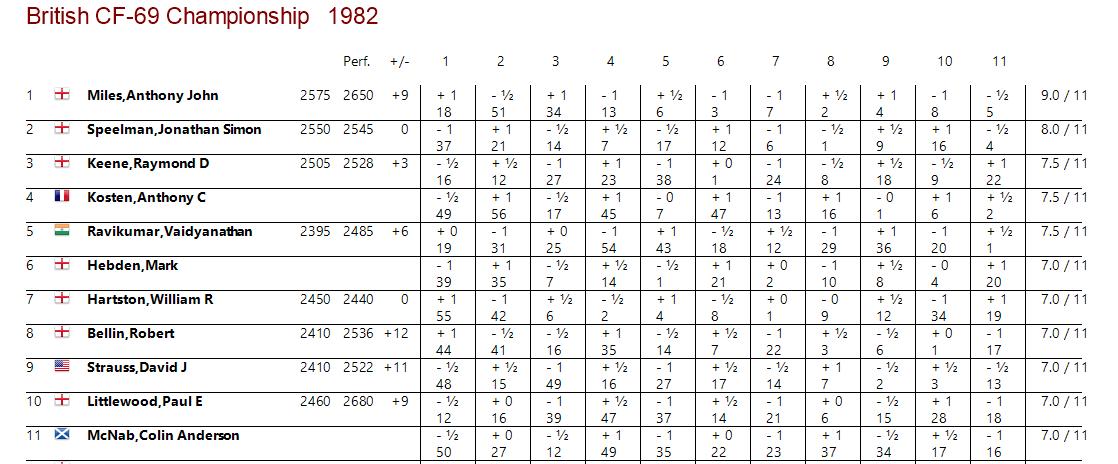
Miles won the British Championship just once, in 1982 when the event was held in Torquay. His prime time as a chess player was the mid-1980s. On 20 May 1984 in Roetgen (Germany), Miles set a European record in blind simultaneous chess with 22 games (+10−2=10);[5] this record was not broken until 2009. On the January 1984 Elo rating list, he ranked No. 18 in the world with a rating of 2599. One of his best results occurred at the Tilburg tournament in 1984, where, from a strong field, he emerged sole winner by a clear margin of one and one-half points. The following year, he tied for first at the same event with Robert Hübner and Viktor Korchnoi, playing several of his games while lying face down on a table, having injured his back.[6]

Tony and ? at a Lloyds Bank Masters. Stewart Reuben applauds.

The result was controversial, as many of Miles’ opponents felt they were distracted by the unusual circumstances. A string of good performances culminated in a good showing on the January 1986 Elo rating list, where he climbed to a best-ever position of World No. 9 with a rating of 2610. During this period, there was considerable rivalry with Nunn over who was the United Kingdom’s best player, the two protagonists regularly leapfrogging each other in the world rankings. Nigel Short and Speelman soon added to the competition, as the English national squad entered its strongest period.

Tony about to play Vladimir Kramnik

Never able to qualify out of the Interzonal stages into the Candidates’ series, Miles eventually lost the race to become the first British Candidate when Short did so in 1985. However, he retained top board for England at the Thessaloniki and Dubai Olympiads of 1984 and 1986, helping the team to silver medals at each.

Tony plays Glenn Lambert during the 1976 BCF Congress in Portsmouth. Photo courtesy of Tony Williams

Against Garry Kasparov, Miles had little success, not winning a game against him, and losing a 1986 match in Basel by the score of 5½–½. Following this encounter, Miles commented “I thought I was playing the world champion, not a monster with a thousand eyes who sees everything” (some sources alternatively quote Miles as having the opinion that Kasparov had 22 or 27 eyes).

Miles on a stretcher with back pain, playing in Tilburg (1985)
After he was hospitalised because of a mental breakdown in late 1987, Miles moved to the United States. He finished last in the 1988 U.S. Championship, but continued to play there and had some good results. In 1991, he played in the Championship of Australia, but eventually moved back to England and began to represent his native country again. He was equal first at the very strong Cappelle-la-Grande Open in 1994, 1995, and 1997, and caused a shock at the PCA Intel Rapid Chess Grand Prix in London in 1995, when he knocked out Vladimir Kramnik in the first round and Loek van Wely in the second. His bid to win the event was finally halted in the semifinal by English teammate Michael Adams.

There were four notable victories at the Capablanca Memorial in Cuba (1994, 1995, 1996, and 1999). Miles also tied for first in the 1999 Continental Open in Los Angeles with Alexander Beliavsky, Ľubomír Ftáčnik and Suat Atalık. His last tournament victory was the 2001 Canadian Open Chess Championship in Sackville, New Brunswick.

Miles entered and played at the 2001 British Championship in Scarborough, but withdrew before the final round, apparently because of ill health. His final two games before his death were short draws in the Four Nations Chess League. Miles played in an extraordinary number of chess events during his career, including many arduous weekend tournaments.

The Miles Variation (1.d4 Nf6 2.c4 e6 3.Nf3 b6 4.Bf4) in the Queen’s Indian Defence is named after him.”

Tony started his chess writing career in around 1978 with a series of high quality annotated tournament bulletins of the top events of the period most of which he competed in himself.  For example:

Tilburg 1978, Tony Miles & Jonathan Speelman, Master Chess Publications, 1978
Riga Interzonal 1979, AJ Miles & J Speelman, Batsford, 1979, ISBN 0 7134 3429 5
Rio de Janeiro Interzonal 1979, AJ Miles & M.Chandler, Batsford, 1979, ISBN 0 7134 3427 9
Buenos Aires 1979. AJ Miles, The Chess Player, ISBN 0 906042 31 3
47th USSR Championships 1979, AJ Miles, The Chess Player, 1979, ISBN 0 906042 32 1
Chess from Square One, AJ Miles, Harper Collins, November 1979, ISBN 0713511168
European Team Championship Skara 1980, AJ Miles, The Chess Player, ISBN 0 906042 33X

Of course there are numerous articles about Tony for example :

Vlastimil Hort Remembers Tony Miles

Hort stories: Wrong place wrong time

Chess Corner – Original Maverick: Remembering Tony Miles

Britain’s first chess grandmaster, he paved the way for today’s international competitors

Tony Miles 1955-2001

Kingpin

Tony Miles (1955-2001) by Edward Winter

How Anthony Miles beat a World Champion (Karpov-Miles, Skara 1980)

Lawrence Trent plays Tony Miles in 2001 at the British Championships in Scarborough
It's Only Me, edited by Geoff Lawton
It’s Only Me, edited by Geoff Lawton
Tony Miles : England's Chess Gladiator, Ray Keene, 2006
Tony Miles : England’s Chess Gladiator, Ray Keene, 2006
Tony Miles : England's Chess Gladiator, Ray Keene, 2006
Tony Miles : England’s Chess Gladiator, Ray Keene, 2006
A Tony Miles memorial
Tony's signature from a presentation copy of Pachman's Decisive Games from Anglo-German match of February 1979 at Elvetham Hall
Tony’s signature from a presentation copy of Pachman’s Decisive Games from Anglo-German match of February 1979 at Elvetham Hall

Best wishes WGM Sheila Jackson (11-xi-1957)

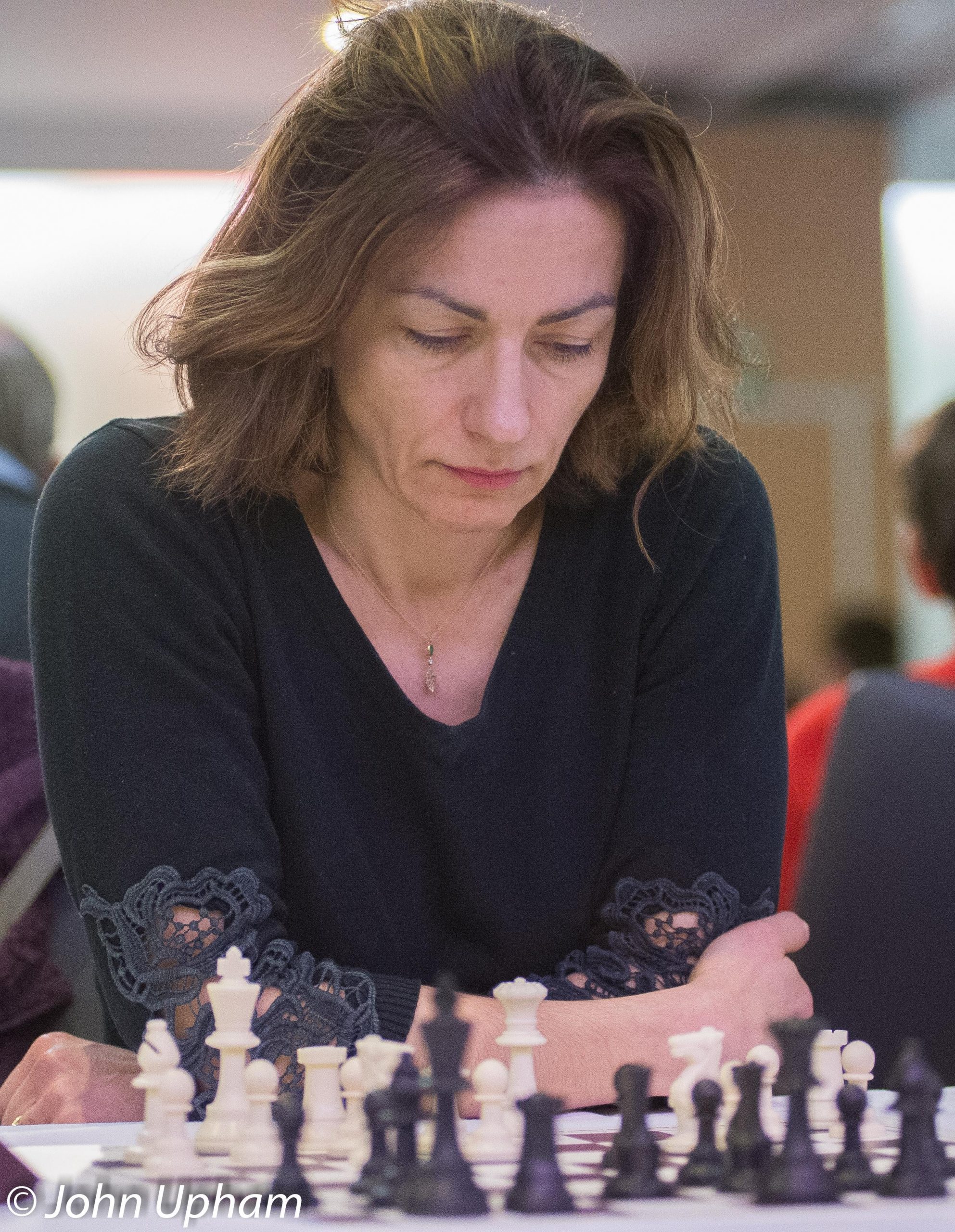
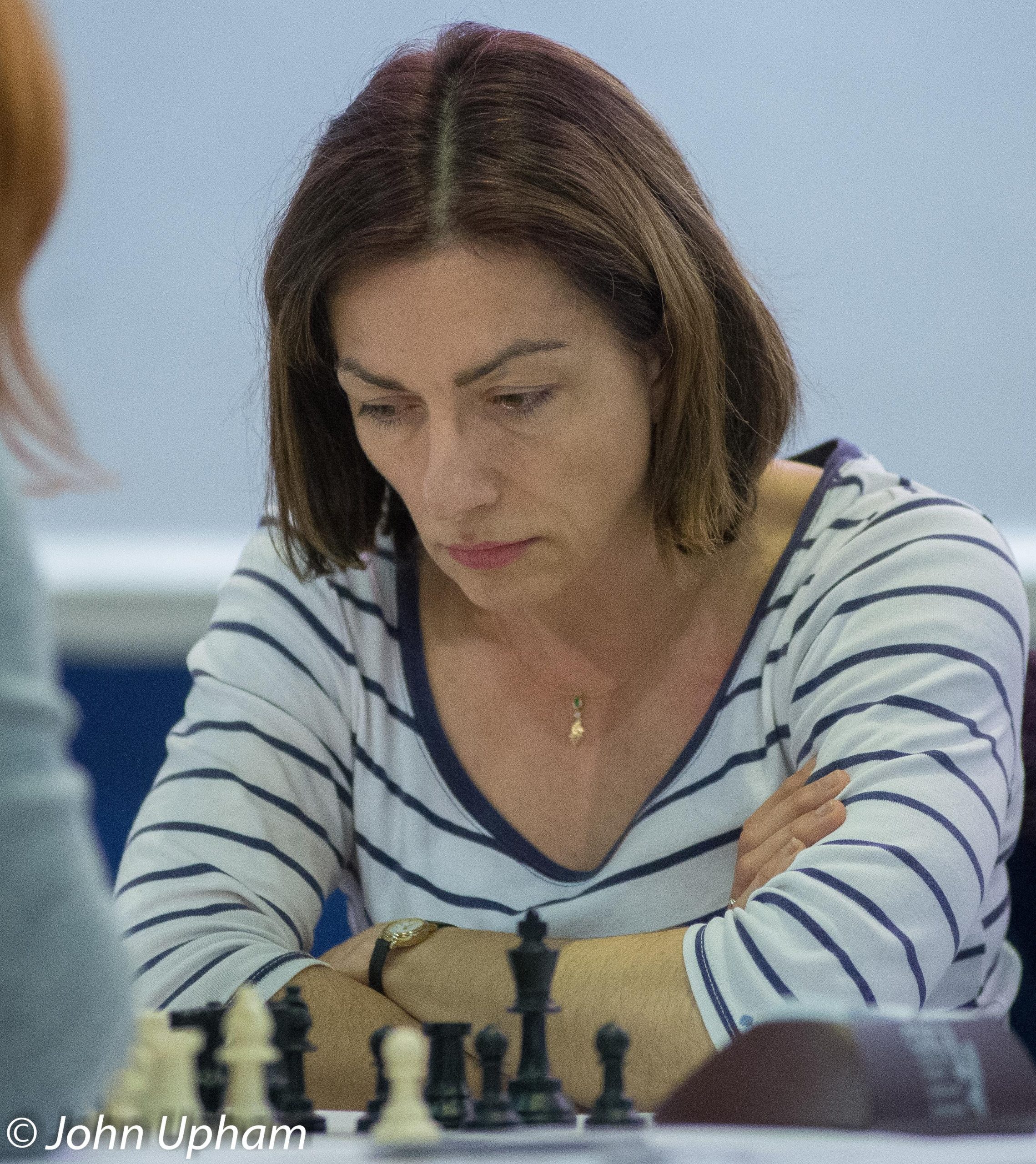
WGM Sheila Jackson, courtesy of John Upham Photography

Best wishes to WGM Sheila Jackson on her birthday.

Sheila Jackson was born on Monday, November 11th in 1957 in Liverpool, Merseyside.

(The following article is a composite from various sources including Sheila via email {many thanks!}, Richard O’Brien in British Chess, Wikipedia and others)

Sheila attended Broad Square CP School, Liverpool and started playing chess in year five when ten years old. In her final year she played on board one for the school team helping to win the first (organised by the BCF) National Primary Schools’ Team Knockout Championship. The final was played in St. Ermin’s Hotel, London in 1969.

Following this Sheila was Board 1 for Liverpool Under 11 winners of National Team Championship held in Liverpool 1969. Part of their success was due to teacher Mike Price, later to become a member of the local club Atticus, who coached Sheila.

Following this she attended Liverpool Institute High School.

At Coventry in 1970 Sheila won the British Girls Under-14 Championship (she was the first ever winner) aged 12 and she was the Under-18 Girls championship at Blackpool 1971 aged just 13.

Spurred on by keen but friendly rivalry from Susan Caldwell, eleven months her junior who had also won both the British U14 and U8 titles by the age of thirteen, Sheila went from strength to strength. At the age of 13 she represented England Girls (U18) in the Faber Cup and other events.

1973 saw her becoming Lancashire Under 15 Open Champion and two years later (aged 17) in 1975 the Lancashire Under 18 Open Championship. These events were for both boys and girls. During the event Sheila beat Manny Rayner who was later to represent Wales in the World Junior Championships.

During this year she has reached British Ladies Championship standard. John Littlewood was now her coach. John at the time was also coaching his son Paul, who was later to become British Champion.

John Nunn, Sheila Jackson and ? at the Lloyds Bank Masters

Just a few days past here sixteenth birthday she took part in a six-player Women’s International event sponsored by Guardian Royal Exchange in London. She shared first place ahead of two IMs, both of whom had taken part in the Interzonals.

Since 1974 she has been a regular member of the full England team and has played in the last five Olympiads.

Aged 16 Sheila made her debut in the 6th Women’s Olympiad in Medellin, Colombia.

Sheila Jackson
Sheila Jackson

In 1975 at Morecambe she won the first of four British Ladies Championship titles. The others were in Ayr 1978, Brighton 1980 and back to Morecambe in 1981.

Sheila Jackson gets her British Ladies' Championship cup from Carrefour's Manager at Cardiff. Source : CHESS, Volume 41, Numbers 739-4, page 137.
Sheila Jackson gets her British Ladies’ Championship cup from Carrefour’s Manager at Cardiff. Source : CHESS, Volume 41, Numbers 739-4, page 137.

The following year (1975, aged 17) she made her debut in the Women’s Zonal held in Karlovy Vary, Czechoslovakia.

Sheila with Jana Hartston to the left

In 1976 Sheila was part of the England Team that won silver at the Haifa Olympiad. The England team was Jana Hartston, Sheila, Elaine Pritchard and Susan Caldwell. Sheila scored 6/9.

Sheila Jackson playing for England

In total Sheila played in ten consecutive Olympiads and in 1982 she won the individual silver for her board two performance in Lucerne. She scored 8.5/12, a score that won only bettered by Nana Alexandria of the Soviet Union who was shortly to be rated joint number one in the world. This result naturally improved here Elo rating and by January 1983 she was rated in the top 30.

In 1977 she was member of the Atticus squad that surprisingly won the BCF National Club Championship against all the odds. Although not playing in the final she attended as first reserve displaying her tee shirt ‘Atticus for the Cup’. After that poor John Nunn and rest of the Oxford University team had no chance.

Sheila Jackson
Sheila Jackson

Five times, from 1977 to 1981 inclusive she won the Grande Prixette, the women’s equivalent of the Leigh Grand Prix.

Her employers, Lambeth Council in London where she works as an accounts clerk and to a lesser extent her previous employers in Liverpool, have allowed here extra leave to play in the more important events. Her most successful results abroad have been second places at both Pernik 1979 and Wijk aan Zee the following year. In 1980 she finished fourth at Bydgoszcz ahead of two WGMs.


Sheila Jackson and players at the Lloyds Bank Masters

Sheila, being a great believer that women players are more likely to improve if they played in mixed tournaments, has certainly proved her point. In 1978/9 she scored 6/10 in the Challengers at Hastings – a 210 (BCF) performance. This included the better of a draw against IM Bert Enklaar of The Netherlands.

Sheila Jackson
Sheila Jackson

1979 saw her debut in the British Championship and she was top woman this year and subsequent three more years (1982, 1983 and 1984) whilst there was still a separate Ladies’ Championship running concurrently. On the first occasion she scored a respectable 4.5/11 and on the second an excellent 5.5. This latter performance equivalent to a WGM norm was one of the best every by a woman player in this country. Of her eleven opponents one is now a GM, four are IMs and four are FMs. This included a marathon against Ray Keene which went on for four days. she has twice proved wrong those who thought that women players will always bring up the rear in this event.

British Speed Chess Championship Grandmaster Nigel Short Playing Chess In The Park With L-r Susan Arkell Sheila Jackson And Dr Jana Miles. Courtesy of Shutterstock

In the 1984 event at Brighton she scored a 2400+ rating performance and a WGM result.

1981 saw Sheila being awarded the Women’s International Master title and in 2001 she became a Woman’s Grandmaster.

Sheila made her in 1991 debut at the Women’s Interzonal Subotica, Yugoslavia.

Sheila Jackson by Cathy Rogers

For some considerable time she has been a leading light in women’s chess not just on the board but off it as well. One of only two female BCF coaches in the county she has helped out in various coaching seminars in London and the Midlands.

In August 1982 she became President of the British Women’s Chess Association at a rather stormy meeting in Torquay. For a time she has also acted as treasurer of the association.

In 1993 she Played in one European Team Championship in Hungary as reserve player (there were only two boards).

1994 contained a disappointment and some measure of retribution : Sheila secured annual leave to play in the Moscow Olympiad but wasn’t selected despite her high rating and grandmaster norms. Following that she scored an excellent 5/7 in the 1994 Guernsey Open (just before the Olympiad) finishing a full point ahead of the Women’s number 1.

Sheila Jackson at the 2014 British Championships in Aberystwyth

In 4NCL Sheila became Female Player of the Year when playing for Wood Green.

Sheila and friends during a Lloyds Bank Masters

In 2018 She made here Senior 50+ Open World Team Championships debut, winning both individual Bronze plus Team Bronze playing on board 1 for England Women.
Following that Rhodes 2018 in the European 50+ Open Team Championship she played in a mixed England 2 team and Croatia 2019 on Board 1 for a mixed England 2 Team.
She played board 1 for England Women in the Prague World Team Open in March 2020 which was cut short by the 2020 pandemic.

Sheila Jackson at the final 4NCL weekend of 2012

A believer (Ed : comments were current in 1983) in reform she has been campaigning (together with other younger members of the BWCA – Susan Caldwell, Maria Eagle and Angela Eagle in particular) for both women and girls to compete with the opposite sex at the British Championships. Slowly but surely support has grown from both inside and outside the BWCA. In junior events, which are now mixed, the girls titles are awarded to the highest placed girl competing. However the relevant organisations object to the title of Ladies Champion being awarded to the highest placed woman player in the championship itself. This means that Sheila and other women players are are strong enough to play in the main championship and thus gain opportunities to achieve WIM and WGM norms and improve their basic standard of play will be denied the realistic right to play for the British Ladies title. Hopefully notice will eventually be taken of the BWCA’s wishes and Sheila will one day compete for the title again.

According to Felice Sheila’s peak FIDE rating was 2295 in January 1987.

With the white pieces Sheila is a die hard 1.e4 player being a big fan (along with Susan Lalic) of the Sicilian Alapin and she allows the Marshall Attack.

As the second player she plays the open games and the Nimzo-Indian Defence.

From Wikipedia :

“Sheila Jackson played for England in the Women’s Chess Olympiads:

  • In 1974, at first reserve board in the 6th Chess Olympiad (women) in Medellín (+2, =2, -5),
  • In 1976, at second board in the 7th Chess Olympiad (women) in Haifa (+5, =2, -2) and won the team silver medal,
  • In 1978, at second board in the 8th Chess Olympiad (women) in Buenos Aires (+5, =3, -4),
  • In 1980, at second board in the 9th Chess Olympiad (women) in Valletta (+5, =4, -3),
  • In 1982, at second board in the 10th Chess Olympiad (women) in Lucerne (+7, =3, -2) and won the individual silver medal,
  • In 1984, at second board in the 26th Chess Olympiad (women) in Thessaloniki (+5, =7, -2),
  • In 1986, at second board in the 27th Chess Olympiad (women) in Dubai (+6, =2, -4),
  • In 1988, at third board in the 28th Chess Olympiad (women) in Thessaloniki (+6, =2, -3),
  • In 1990, at third board in the 29th Chess Olympiad (women) in Novi Sad (+5, =4, -3),
  • In 1992, at third board in the 30th Chess Olympiad (women) in Manila (+3, =6, -2).
  • Sheila Jackson played for England in the European Team Chess Championships:

In 1992, at second board in the 1st European Team Chess Championship (women) in Debrecen (+0, =3, -1).
In 1981, she was awarded the FIDE International Women Master (WIM) title and received the FIDE International Women Grandmaster (WGM) title seven year later.

In 1991, in Subotica Sheila Jackson participated in the Women’s World Chess Championship Interzonal Tournament where she stayed at 31st place.

Since 2000, participate in chess tournaments rarely.”

WGM Sheila Jackson
WGM Sheila Jackson

Remembering David Welch (30-x-1945 09-xi-2019)

David Welch, photograph by John Upham

Just over two years ago today we learnt the sad news that popular longtime Arbiter and Organizer David Welch had passed away at the age of 74 after a long illness : he was being cared for in The Royal Liverpool Hospital. The funeral took place at Landican Crematorium, Arrowe Park CH49 5LW at 12 noon on Friday 6th December. Following the funeral, the wake took place at the Grove House Hotel, Grove Road, Wallasey CH44 4BT.

David was born on Tuesday, October 30th 1945 in Brampton, Chesterfield, Derbyshire and attended Chesterfield Grammar School (see below).

He played for Wallasey Chess Club for many years having initially been a member of Liverpool Chess Club.

David attended Queens’ College, Cambridge reading Natural Sciences (Chemistry) and (according to John Swain) David served Cambridge University Chess Club as Junior Treasurer, Librarian and Bulletin Editor.

In 1968 David and Peter Purland started teaching at the same Liverpool school (Liverpool College) on the same day and continued their friendship from there. David also ran the college scout troop.

In the same year David joined Liverpool Chess Club and became a leading light fairly early on.

David Welch (30-x-1945 09-xi-2019), photograph by John Upham at 2012 4NCL

David became a BCF arbiter in the early 1970s eventually becoming the BCFs Chief Arbiter and then the ECFs Chief Arbiter and was heavily involved in many British Championships around the country.

David was curator of ECF equipment for some time and personally funded much of the BCFs and ECFs early equipment stock.

He became a FIDE International Arbiter as early as 1977 and was awarded the FIDE International Organizer title in 2010.

In 2007 David received the ECF Presidents Award from Gerry Walsh. Here is the citation in full (from the 2008 ECF Yearbook) :

“David Welch started chess organisation early being captain of the Chesterfield Grammar School team that played both in the school’s league and in the local adult league. He joined the Liverpool Chess Club after leaving University in 1968 and has held various posts with them , he is now their President. He set-up the Liverpool Chess Congress in about 1978.

Additionally, he was the director of the Liverpool Chess Congress. Although now defunct this was in its day the largest junior event in the UK (perhaps even the world) having 2000 entrants at the time of Spassky-Fisher (sic). He has also been involved in the Liverpool city of culture initiative.

He had also had a considerable involvement with the ECF. He is the the Merseyside representative to the ECF. He has been helping run the British Championships since 1981; starting at one of the arbiting team he has been Director/Manager of the congress since 2005. He has been Chief Arbiter of the Federation since about 1992. He also does the arbiting at a number of congresses and is, in particular, the Chief Arbiter of the 4NCL.”

David Welch receives FIDE Arbiter Award

David shared the exact same date of birth as long time friend and fellow arbiter, Peter Purland.

Here is an excellent tribute from John Saunders
Here is a tribute from Liverpool College

in 2016 David received recognition from FIDE for his long service as an International Arbiter. David was the third English arbiter to receive the honour, following Stewart Reuben and Gerry Walsh in 2014.

We send our condolences to all of his many family and friends.

David Welch, photograph by John Upham

Remembering Jacob Sarratt (?-?-1772 06-xi-1819)

Jacob Henry Sarratt
Jacob Henry Sarratt

We remember Jacob Henry Sarratt who died 202 years ago today (November 6th) in 1819.

Chess historians will, of course, be familiar with JHS but the name is (probably) not well known outside these exalted circles.

Possibly his most obvious contribution to chess in England was in 1807 when he influenced the result of games that ended in stalemate. You may not know that in England prior to 1807 a game that ended in stalemate was recorded as a win for the party who was stalemated. JHS was able to encourage various major chess clubs so that the result be recorded as a draw. Much endgame theory would be different if it wasn’t for JHS !

Outside of chess, JHS was an interesting chap:

The initial content below has been taken from (and we have corrected a number of typos along the way) from http://www.edochess.ca/batgirl/Sarratt.html

Also, http://billwall.phpwebhosting.com/articles/Sarratt.htm is worthy of consultation.

“Jacob Henry Sarratt, born in 1772, worked primarily as schoolmaster but was much better known for his advocations which, of course, included chess.

After Philidor’s death, Verdoni (along with Leger, Carlier and Bernard – all four who co-authored Traité Théorique et Pratique du jeu des Echecs par une Societé d’ Amateurs) was considered one of the strongest players in the world, especially in England. Verdoni had taken Philidor’s place as house professional at Parsloe’s. He mentored Jacob Sarratt until he died in 1804. That year Sarratt became the house professional at the Salopian at Charing Cross in London and most of his contemporaries considered him London’s strongest player.

There he claimed the title of Professor of Chess while teaching chess at the price of a guinea per game.

By any measure Surratt was not a particularly strong player, but he was able to maintain the illusion that he was by avoiding the stronger players as he lorded over his students who didn’t know better.

Sarratt’s most important contribution to chess was that he mentored William Lewis who in turn mentored Alexander McDonnell.

Surratt had a strange notion that chess culminated in the 16th century and that everything since then had been a step backwards. This odd notion had a positive side. Philidor was the darling of the English chess scene. Almost all books at that time were versions of, or at least based on, Philidor’s book. Surratt at least kept open the possibility that there were ideas beyond those of Philidor.

In 1808, true to his role as a teacher, Surratt published his Treatise on the Game of Chess, a book that mainly concentrated on direct attacks on the king which he lifted from the Modense writers.

He translated several older writers whom he admired (though his translations are not considered particularly good):
The Works of Damiano, Ruy Lopez and Salvio in 1813.
The Works of Gianutio and Gustavus Selenus in 1817.

In 1921 a posthumous edition of his Treatise, A New Treatise on the Game of Chess, was published. This copy covered the game of chess as a whole and was designed for the novice player. It also contained a 98 page analysis of the Muzio Gambit

In addition to his chess books, Surratt also published
History of Man in 1802,
A New Picture of London in 1803
He translated Three Monks!!! from French in 1803 and Koenigsmark the Robber from German in 1803.

His second wife, Elizabeth Camillia Dufour, was also a writer. In 1803 (before they were married, which was 1804), she published a novel called Aurora or the Mysterious Beauty.

They were married the following year. His first wife had died in 1802 at the age of 18. Both his wives were from Jersey.

Contrary to what one might expect, Sarratt has been described tall, lean and muscular and had even been a prize-fighter at one point. He had also bred dogs for fighting. He was regarded as a very affable fellow and very well-read but with limited taste (Ed : surely this applies to everyone ?)

William Hazlitt, in his essay On Coffee-House Politicians wrote:

[Dr. Whittle] was once sitting where Sarratt was playing a game at chess without seeing the board… Sarratt, who was a man of various accomplishments, afterwards bared his arm to convince us of his muscular strength…
Sarratt, the chess-player, was an extraordinary man. He had the same tenacious, epileptic faculty in other things that he had at chess, and could no more get any other ideas out of his mind than he could those of the figures on the board. He was a great reader, but had not the least taste. Indeed the violence of his memory tyrannised over and destroyed all power of selection. He could repeat [all] Ossian by heart, without knowing the best passage from the worst; and did not perceive he was tiring you to death by giving an account of the breed, education, and manners of fighting-dogs for hours together. The sense of reality quite superseded the distinction between the pleasurable and the painful. He was altogether a mechanical philosopher.”

Somewhere along the way there must have come about a complete reversal of his fortunes because Surratt died impoverished in 1819, leaving his wife destitute. But the resilient Elizabeth Sarratt was able to support herself by giving chess lessons to the aristocracy of Paris.

She must have been very well liked. In 1843 when she herself became old and unable to provide for herself, players from both England and France took up a fund to help her out. She lived until 1846.

From The Oxford Companion to Chess (OUP, 1984 & 1992) by Hooper & Whyld :

Reputedly the best player in England from around 1805 until his death. As a young man he met Philidor. Subsequently he developed his game by practice with a strong French player Hippolyte du Rourblanc (d. 1813), with whom he had a long friendship dating from 1798, and with Verdoni, Sarratt’s first important contribution to the game was in connection with the laws of chess: he persuaded the London club, founded in 1807, to accept that a game ending in stalemate should be regarded as a draw and not as a win for the player who is stalemated. He became a professional at the Salopian coffee house at Charing Cross, London,

Nos. 39-41, Charing Cross and the Timber Yard

and in 1808 wrote his Treatise on the Game of Chess.

Treatise on the Game of Chess by JH Sarratt, 1808

This, largely a compilation from the work of the Modenese masters, advocated that players should seek direct attack upon the enemy king, a style that dominated the game until the 1870s. An Oxford surgeon, W. Tuckwell, wrote that he learned chess ‘from the famous Sarratt, the great chess teacher, whose fee was as a guinea a lesson’. Lewis, who played many games with Sarratt from 1816, wrote in 1822 (after he had met both Deschapelles and Bourdonnais) that Sarratt was the most finished player he had ever met, Sarratt translated the works of several early writers on the game, making them known for the first time to English readers: The Works of Damiano, Ruy Lopez and Selenus (1813) and The Works of Gianutio and Gustavus Selenus (1817).

He died impoverished on 6 Nov. 1819 after a long illness during which he was unable lo earn a livelihood by teaching. Instead he wrote his New Treatise on the Game of Chess published posthumously in 1821, This is the first book to include a comprehensive beginner’s section: in more than 200 pages Sarratt teaches by means of question and answer. Another feature is a 98-page analysis of the Muzio gambit :

Had it been Sarratt’s ambition to become a chess professional there would have been scant opportunity during the lifetime of Philidor and Verdoni. A tall, lean, yet muscular man, sociable and talkative, he seems in his younger days to have had interests of a different kind, among them prize fighting and the breeding of fighting dogs. Hazlitt, who met Sarratt around 1812 wrote ‘He was a great reader, but had not the least taste. Indeed the violence of his memory tyrannised over and destroyed all power of selection. He could repeat Ossian by heart, without knowing the best passage from the worst.’

Sarratt’s early publications were History of Man (1802): translations of two Gothic novels, The Three Monks!!! (1803), from the French of Elisabeth Guénard (Baronne de Méré) , and Koenigsmark the Robber (1803), from the German of R. E. Raspe; A New Future of London (1803), an excellent guide that ran to several editions, the last in 1814, When war broke out with France in 1803 Sarratt became, for a short period, a lieutenant in the Royal York Mary-le-Bone Volunteers and published Life of Bonaparte * a propaganda booklet detailing Napoleon’s alleged war crimes, and warning of the desolation that would follow if he were to invade.

Not long after the birth of his second child in 1802 Sarratt’s wife died and in 1804 he married a Drury Lane singer, Elisabeth Camilla Du four. Tt would be difficult to find a more accomplished, a more amiable, or a happier couple than Mr and Mrs Sarratt’ – Mary Julia Young, Memoirs of Mrs Crouch (1806), Mrs Sarratt too was a writer contributing tales to various journals and publishing Aurora or the Mysterious Beauty (1803), a translation of a French novel. She survived her husband until 1846, ending her days giving chess lessons to the aristocracy in Paris. In 1843 Louis-Philippe and many players from England and France subscribed to a fund on her behalf. ”

From The Encyclopedia of Chess (Robert Hale, 1970 & 1976), Anne Sunnucks :

“Self-styled ‘Professor of Chess’, Sarratt was the first professional player to teach the game in England. He was the author of a A Treatise on the Game of Chess, The (1808), The Works of Damiano, Ruy Lopez and Salvio (1813), The Works of Gianutio and Gustavas Selenus (1817) and a New Treatise on the Game of Chess (1821).

There is no record of Sarratt’s date or place of birth, He began his career as a schoolmaster and later taught chess at Tom’s Coffee House, Cornhill, London, and at the London Chess Club, and was in his day considered to be the strongest player in London.”

From The Encyclopedia of Chess (Batsford, 1983), Harry Golombek OBE :

“Leading English player of the late eighteenth and early nineteenth century. Famed in his day as a teacher and author. Sarratt adopted the title of ‘Professor of Chess’, His writings include A Treatise on the Game of Chess, London 1808, The Works of Damiano, Ruy Lopez and Salvio (1813).

Sarratt is usually credited with introducing into England the Continental practise of counting a game ending in stalemate as a draw. (RDK)”

Some games by Jacob Henry Sarratt:

Happy Birthday IM Eddie Dearing (30-x-1980)

GM David Howell vs IM Eddie Dearing, Drunken Knights vs Wood Green, June 2014, Courtesy of John Upham Photography

BCN send best wishes to IM Eddie Dearing on his birthday.

Edward J Dearing was born on Sunday, October 30th, 1980 in Scotland.

Eddie Dearing publicity photograph, from EDs Facebook page.

In 2002 Eddie shared first place (with Karl Mah) in the Smith and Williamson Young Masters with 6/9 with a TPR of 2458 :

Cross table for the 2012 Smith and Williamson Young Masters

He became an International Master in 2002 and, according to Felice and Megabase 2020 achieved a peak rating of 2420 in July 2005 aged 25. He is currently ranked 8th in Scotland.

Eddie Dearing by Cathy  Rogers, ChessBase profile image
Eddie Dearing by Cathy Rogers, ChessBase profile image

Eddie studied law at the University of Cambridge and did an MBA at the London Business School. Currently Eddie is a fund manager at MFS Investment Management.

In 2004 Eddie made his debut for Scotland in the Mallorca Olympiad.

Eddie is currently registered for Battersea in the London League and previously has played for Drunken Knights but has not been active since 2014.

With the white pieces Eddie prefers the Queen’s Gambit, Exchange Variation.

As the second player Eddie plays the Sicilian Dragon and the Semi-Slav Defence.

Eddie has plus scores against : James Cobb, Richard Palliser, Simon Williams, Karl Mah, Jacob Aagard, Colin McNab to name but a few.

Eddie has written two books, Playing the Sicilian Dragon for Gambit and Playing the Nimzo-Indian for Everyman. In June 2011 Eddie became a columnist for British Chess Magazine and wrote the “Dearing’s Discoveries” feature each month.

Play the Sicilian Dragon by Eddie Dearing
Play the Nimzo-Indian by Eddie Dearing
Challenging the Grunfeld, Eddie Dearing, Quality Press, 2005

Happy Birthday IM James Sherwin (25-x-1933)

IM James Terry Sherwin, image by John Upham Photography

We send best wishes to IM James Sherwin, a welcome long term visitor from “over the pond”

James Terry Sherwin was born on Wednesday, October 25th 1933 in New York. and attended The University of Columbia.

The Columbia College chess team of 1949–1952 after a radio match with Yale. Right to left: James Sherwin, Eliot Hearst, Carl Burger, Francis Mechner (Courtesy of the Columbia University Archives).

He became an International Master in 1958 at the age of 25 and, according to Felice, his peak FIDE rating was 2400 in 1969.

IM James Sherwin, Photograph copyright © 2001 Helen Milligan of New Zealand Chess

Much to his chagrin (we recommend you do not ask him about this!) James is famous for the “Sherwin slid the rook here with his pinky, as if to emphasize the cunning of this mysterious move” annotation in Game 1, “Too Little, Too Late” of My Sixty Memorable Games by Robert James Fischer (and game introductions by Larry Evans).

Since 1999 James has been a frequent entrant to English Rapidplay tournaments at Richmond and Golders Green and, in August 2019 in Torquay, aged 86, tied for first place in the Rapidplay event at the British Championships.

IM James Sherwin
IM James Sherwin

James is registered with the Wiltshire County Chess Association and since 2015 has played only rapidplay games rated by the ECF. He currently has a rating of 204D.

With the white pieces James plays 1.d4, 1.Nf3 and 1.e4 in that order of preference.

As the second player he essays the Sicilian Najdorf and the Grünfeld Defence.

He has plus scores against Donald Byrne, Robert Byrne, Herbert Seidman, Sidney Bernstein, George Kramer and Raymond Weinstein (amongst others). His score with Fischer was 1.5/8 (but don’t mention it!).

Here is his win over Bobby from 1957:


Here is an article by Hamish Olson

From Chessgames.com :

“James Terry Sherwin, born in New York, became an International Master in 1958. In 1961, he was Chairman of the USCF Rules Committee. He was the Executive Vice President of GAF Corporation who was the American Chess Foundation (ACF) President from 1979 to 1990. He took 5th place in the 1953 World Junior Championship. He tied for 1st place with Alexander Kevitz in the 1954-55 Manhattan Chess club championship. He took 17th place in the Portoroz Interzonal (1958). Sherwin finished in 3rd place twice in US chess championships (1957-58 and 1958-59). He won the first Eastern Open Chess Championship, held in Washington DC, in 1960.”

Here is an article featuring JTS from The Wiltshire Times

Mr Sherwin, 80, met and played against the new members of Bradford & Avon Valley Youth Chess Club on their opening night at St Nicholas Hall on Tuesday. Photo courtesy of The Wiltshire Times

From Wikipedia :

“James Terry Sherwin (born October 25, 1933)[1] is an American corporate executive and International Master in chess.

Born in New York City[1] in 1933, Sherwin attended Stuyvesant High School, Columbia College (Phi Beta Kappa) and Columbia Law School. He graduated from the U.S. Coast Guard Academy Officer Candidate School in 1956 and later became a Lieutenant Commander. He is an attorney admitted to the New York and Supreme Court Bars. He joined GAF Corporation in 1960 serving in various legal and operational roles and eventually becoming its Chief Financial Officer. He was CFO at Triangle Industries from 1983 to 1984, rejoining GAF Corporation as Vice Chairman from 1985 to 1990.

IM James T Sherwin
IM James T Sherwin

While at GAF, in 1988, he was indicted by the US Attorney for the Southern District of New York, Rudolph Giuliani, for stock manipulation in connection with the 1986 sale of stock owned by GAF.[2] He was convicted after three trials, but the conviction was reversed on appeal[3] and dismissed with prejudice.[4] In 1991 he was appointed Executive Vice President and Chief Financial Officer of Hunter Douglas N.V., a Dutch multinational company, in which capacity he served until 1999. Since then he has been a Director and an adviser to Hunter Douglas.

IM James T Sherwin
IM James T Sherwin

He is an Overseer of the International Rescue Committee and member of the Association of the Bar of the City of New York. He received an Honorary Doctor of Laws Degree from the University of Bath in December, 2007.”

“In chess, Sherwin finished third and tied for third in the US Chess Championship four times and tied for fourth three times.[5] He was Intercollegiate Champion and New York State Champion in 1951 and US Speed Champion in 1956–57 and 1959–60. He earned the International Master title in 1958.[1] He played in the Portorož Interzonal in 1958, which was part of the 1960 World Championship cycle. While he finished only 17th out of 21 players, he scored (+2–2=2) against the six players who qualified from the tournament to the Candidates tournament at Bled 1959. He is a previous President of the American Chess Foundation.

Sherwin resides with his wife, Hiroko, near Bath, United Kingdom.”

James Sherwin, middle row, third from right

Remembering Sir Theodore (“Theo”) Tylor (13-v-1900 23-x-1968)

BCN remembers Sir Theodore Tylor who passed away on Wednesday, October 23rd, 1968.

Theodore Henry Tylor was born on Sunday, May 13th, 1900 in Bournville, (at the time) in northern Worcestershire. Now Bournville is in the metropolitan borough of Birmingham.

His father was Henry Bedford Tylor and his mother Minnie Belle Cater were both 29 when Theo was born. He had one sister Rachel Hope who was born on 1 November 1909 in Kings Norton, Worcestershire, when Theodore Henry was 9 years old.

In the 1911 census Theo is shown as living in Worcester as a student. His father passed away on 26 February 1915 in Birmingham, Warwickshire, at the age of 44.

Theodore Henry Tylor, Courtesy of John Saunders and Britbase
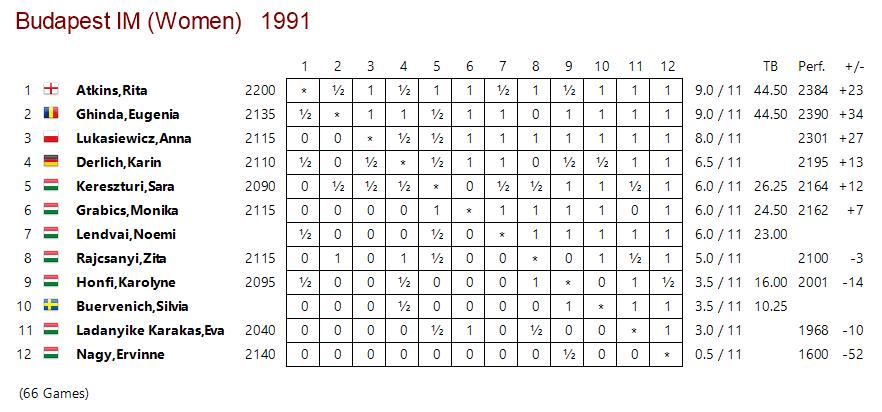
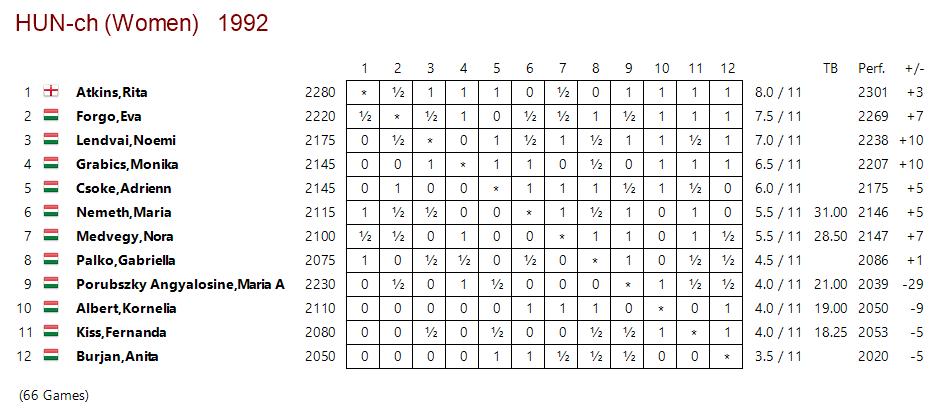
In 1939 Theo was living at 2, Rawlinson Road, Oxford where he continued to live until his death.

We are grateful to John Foley writing in Floreat Domus (the Balliol College magazine) who wrote this about Tylor :

Article about TH Tylor by John Foley

and, following this, John reproduced an item from On the Basis of of Hearsay, Grosvenor House Publishing, 2018 :

Chess in the 1950s : Fred Fishburn Remembers

From British Chess Magazine, Volume LXXXIX (1969), Number 1 (January), pp 6-7 we have the following article :

Sir Theodore Tylor-An Appreciation

By W. RITSON MORRY

“The death of Sir Theodore H. Tylor at the age of sixty-eight was reported in The Times of October 24th. The announcement will be received with deep regret by the many chess enthusiasts who will remember him as a cheerful and extremely resourceful opponent who triumphed over the handicap of near-blindness and lived such a full and distinguished life that it earned him the admiration and respect of the world.

The Times has already done full justice to his work as Fellow and Tutor in Jurisprudence at Balliol for nearly forty years and to his service to organizations for the blind for which he was most justly knighted in 1965, but it barely mentioned that side of his life with which we chess-players were more intimately acquainted.

His education at Worcester College for the Blind naturally brought him into contact with chess and he became a very strong player. ln 1925, at the age of twenty-five, he was among the twelve players selected for the British Championship at Stratford-on-Avon and fully justified the selectors’confidence by taking fourth prize, behind Atkins, Yates, and Edmund Spencer, and ahead of Winter.

It was another four years before he became really active, but in 1929 he again played in the Championship and shared fourth prize with J. H. Morrison and W. Winter behind, Sultan Khan, H. E. Price, and R. P. Michell. He followed this with his first visit to Hastings and in the 1929-30 congress put up the best performance of his career, sharing first prize with Koltanowski, in front of Flohr, Reijifir, Rellstab, Alexander, Jackson, Noteboom, Vidmar Jnr., and Winser. This, by the way, was only a Premier Reserves!

This performance evidently impressed the selectors, for the following summer brought an invitation to play for the B.C.F. team in the Hamburg Olympiad, where he won one, drew four, and lost two games. ln the 1930-31 Hastings Congress he made the first of nine appearances in the Premier Tourney, but he never managed to maintain sufficient consistency to win honours in this exalted company and was never able to finish higher than equal sixth (in
1936-7). ln the nine tournaments he won ten tames (of which only two were against non-British opposition-Feigin and Medina) and drew thirty-three (including World Champions Alekhine and Euwe and grandmasters Fine, Flohr (three times), Keres, Sultan Khan, Tartakower, and Vidmar). ln 1934-5 he again tied with Koltanowski for first place in the Premier Reserves.

Sir Theodore Henry Tylor

ln twelve British Championships his best performance was at Hastings in 1933 where he finished second, 1/2 point behind Sultan Khan and lost only to C. H. O’D. Alexander. In nine of the twelve he was in the first six, and was four times a prize-winner. He was chosen to play for England against Holland in 1938, 1948, and 1952, and against Yugoslavia in 1951. ln these games he won four and lost four. He was selected to play against
the U.S.S.R. in 1946, but had to withdraw at the last minute.

In 1936 he was chosen as one of the four British players in the Nottingham lnternational Tournament. This caused some dissatisfaction among other disappointed aspirants, but he came ahead of Alexander, Thomas, and Winter and captured the scalps of Flohr and Tartakower. ln the same year he was fifth at Margate, where he drew with Capablanca, Lundin, and Stahlberg.

Finally, a word should be said about his work away from the board. For six years he was President of the Chess Education Society, in whose work he took a lively interest from its foundation in 1943. He was President of the Midland Counties Union from 1946-9. He played top board for Oxfordshire for many years and captained the team for a period. We mourn a great friend of chess and a fine player who was a true amateur and obviously enjoyed every minute he spent among us.”

From The Encyclopedia of Chess (Batsford, 1977) by Harry Golombek (article by Ray Keene) :

“In spite of the handicap of partial blindness, Tylor enjoyed a successful academic career and was for nearly forty years a Fellow and tutor in jurisprudence at Balliol College, Oxford. He took up chess seriously while a schoolboy at Worcester College for the Blind and later as an undergraduate captained the Oxford University chess team.

At Hastings 1929/30, Tylor shared first prize with Koltanowski in the Premier Reserves ahead of Flohr, Reijfir, Rellstab, Alexander, Jackson, Noteboom, Vidmar Jr. and Winser. He played in the Hastings Premier event on nine occasions, but never finished in the top half. He competed in the British Championship twelve times, his best result being 2nd to Sultan Khan in 1933. He was selected for the BCF team in the Hamburg 1930 Olympiad and was British Correspondence Champion in 1933, 1934 and 1935.”

Worcester, circa 1931: Mir Sultan Khan (left) plays Theodore Tylor, while Sir George Thomas (far left) and Arthur Mackenzie (far right) spectate. Photo courtesy of Britbase.
Worcester, circa 1931: Mir Sultan Khan (left) plays
Theodore Tylor, while Sir George Thomas (far left) and
Arthur Mackenzie (far right) spectate.
Photo courtesy of Britbase.

We are grateful to Tim Harding who sent us this link to his research on Tylor

From Wikipedia:

“Sir Theodore Henry Tylor (13 May 1900 – 23 October 1968)[1] was a lawyer and international level chess player, despite being nearly blind. In 1965, he was knighted for his service to organisations for the blind. He was Fellow and Tutor in Jurisprudence at Balliol College, Oxford for almost forty years.[2]

Born in Bournville, Tylor learned to play chess at age seven. His chess skill increased while he attended Worcester College for the Blind from 1909 to 1918. He studied at Oxford University beginning in 1918, and captained the Oxford University Chess Club. Tylor received First-class Honours in Jurisprudence in 1922 and was made an honorary scholar of Balliol College. The next year, he became a Bachelor of Civil Law and a lecturer at Balliol College. Called to the Bar by the Inner Temple with a certificate of honour, he was made a Fellow at Balliol College in 1928.”

“Tylor competed in twelve British Championships, finishing fourth in his first appearance in 1925. His best result was in 1933, finishing second to Mir Sultan Khan.[2][3] He tied for first at the 1929/30 Hastings Premier Reserves alongside George Koltanowski ahead of Salo Flohr, Josef Rejfiř, Ludwig Rellstab, C.H.O’D. Alexander, Daniël Noteboom, and Milan Vidmar.[2] Tylor played in the top section, the Hastings Premier, nine times beginning in 1930/1. His best finish was 6th= in 1936/7.[3] He was first reserve for the English team at the Hamburg 1930 Chess Olympiad.

Tylor won the British Correspondence Chess Championship in 1932, 1933, and 1934.[1][2] He shared 5–6th at Margate 1936 with P. S. Milner-Barry, but he won their individual game and drew with 2nd- to 4th-place finishers José Raúl Capablanca, Gideon Ståhlberg, and Erik Lundin (Salo Flohr won). Although he finished 12th at Nottingham 1936, he had the best score of the British participants, ahead of C. H. O’D. Alexander, G. A. Thomas, and William Winter.[5] Mikhail Botvinnik noted that Tylor was using a tactile chess board that he incessantly fingered, as well as a device for counting the number of moves made.”

“Tylor was President of the Midland Counties’ Chess Union from 1947 to 1950, but his work for the university and for the welfare of the blind limited the time he had to devote to chess. Tylor also enjoyed bridge.[3] He died in Oxford on 23 October 1968.”

Sir Theodore Henry Tylor

Steinitz in London : A Chess Biography with 623 Games

Steinitz in London: A Chess Biography with 623 Games

Steinitz in London : A Chess Biography with 623 Games : Tim Harding

Timothy D. Harding
Timothy D. Harding

Tim Harding played for Ireland at the 1984 FIDE chess Olympiad in Thessaloniki. He is a FIDE Candidate Master and a Senior International Master of correspondence chess. A well-known writer on many aspects of chess, Tim is a former editor of Chess Mail magazine and for almost 20 years he contributed monthly articles in “The Kibitzer” series. He lives in Dublin, Ireland.”

From the publisher’s blurb :

“Drawing on new research, this first biography of William Steinitz (1836-1900), the first World Chess Champion, covers his early life and career, with a fully-sourced collection of his known games until he left London in 1882. A portrait of mid-Victorian British chess is provided, including a history of the famous Simpson’s Divan. Born to a poor Jewish family in Prague, Steinitz studied in Vienna, where his career really began, before moving to London in 1862, bent on conquering the chess world. During the next 20 years, he became its strongest and most innovative player, as well as an influential writer on the game. A foreigner with a quarrelsome nature, he suffered mockery and discrimination from British amateur players and journalists, which eventual drove him to immigrate to America. The final chapters cover his subsequent visits to England and the last three tournaments he played there.”


Collectors of McFarland’s chess biographies will know exactly what to expect.

A handsome, beautifully produced hardback book based on extensive and exhaustive research, in this case concerning William Steinitz (Harding prefers to use the anglicized spelling of his name), the first official world champion.

He was born under the name Wolf Steinitz into a Jewish family in Prague in 1836, making him a year older than Morphy. He moved to Vienna to study mathematics in 1858, and it was there that he started playing chess seriously.  In 1862 he travelled to London to play in an international tournament, and remained there, living the life of a chess professional, for 20 years.

Wilhelm Steinitz
Wilhelm Steinitz

Here’s Harding, in the Preface:

“This is not just a game collection but also an important biographical work. Subsequent to his triumphant comeback at the Vienna international tournament and his resignation as chess editor of The Field, Steinitz left England for a long tour of America.  In the spring of 1883 he returned to play in the London 1883 tournament, after which he spent some more time in London; Chapter 12 deals with this. Steinitz then left England permanently and did not set foot in the country for another 12 years. The final chapter deals with his last visits to Britain which included two major tournaments, Hastings 1895 and London 1899. There is much less biography than chess in those two chapters but some information about his European tours is included. The tasks of writing a new biography of the final phase of Steinitz’s life after he left England, and of providing an authoritative game collection of his post-London period, are left for future scholars.

“The primary motivation for embarking on the research for this book was to present a chronological account of Steinitz’s two decades as an English resident, covering both the development of his chess career and significant life events. The chapter about Steinitz in this author’s earlier work, Eminent Victorian Chess Players, may be seen as a first essay in that direction but the present book goes much deeper, including appendices that document various controversies in which Steinitz became embroiled. The book also includes background sections about chess life in London going back to the earlier nineteenth century, dealing with London’s early chess clubs and public places where the game was played, before and during Steinitz’s time.”

Harding chose to include all available games from Steinitz’s time in London, some of which have only recently been rediscovered in old newspaper and magazine columns, so you have in total 623 games, mostly with some annotations from contemporary sources, occasionally, where appropriate, with interjections from Stockfish 10. In those days, of course, there were few tournaments, so he made a living, apart from journalism and teaching (one of his pupils was Lord Randolph Churchill, Winston’s dad), by giving simultaneous displays and playing against amateurs, who would pay for the privilege. If the games were particularly interesting or brilliant, they would find their way into print. In the early part of his career, Steinitz was renowned for his tactical acumen, so the book is crammed full of romantic King’s Gambits and Evans Gambits. Lovers of this style of chess won’t be disappointed.

In his preface, Harding draws the reader’s attention to two games in particular:


All the games have been checked using every primary source with discrepancies noted. So if you want a full and accurate record of every currently available Steinitz game from his time in London, along with some earlier games from his time in Vienna and those from his later English tournaments, look no further.

But what you also get is a lot of background information about chess in London during that period. The clubs, the events, the personalities, the disputes: everything is there. One of my personal interests is the changing position of chess within society over the past 200 years, and the changing demographics of the people who were attracted to the game over the years. In Steinitz’s time, as you would expect, chess clubs were entirely male and largely upper middle class. Most readers will be aware that chess was a particularly popular pastime amongst Church of England clergymen well into the 20th century. Helpfully, at least to me, Harding will often provide the full name and a one sentence biography of Steinitz’s amateur opponents. Although he is very thorough when researching Steinitz and his games, he tends only to consult one source for his opponents.
I decided to follow up a few random names through a quick search of genealogical websites: I found one or two mistakes and was also to provide probable identification in several cases where only the initial and surname were given. I also came across some fascinating stories which I’ll relate another time.

But this is just me: none of this will matter to most readers, who will be more interested in Steinitz than his opponents. It’s unrealistic to expect Harding to research these minor figures with the same diligence afforded to his protagonist.

Make no mistake about it: this is a major addition to the literature of our game, marked by scholarly research and historical accuracy, and, as such, deserves a place in the library of anyone with an interest in chess history. McFarland and their authors are doing an enormous service to the chess community by publishing books of this nature: this volume will sit alongside several other Harding works, notably his biography of Blackburne, Renette’s biography of Bird and Forster’s biography of Burn on your shelf devoted to 19th century British chess history.

But it’s not just a dry as dust history book. It’s a gripping read as well. Harding tells his story with panache, leaving the reader eager to turn the page and find out what happened next, helped, in part, by his subject’s disputatious nature. Whatever you do, don’t miss out on the appendices, in particular where Steinitz describes how he was allegedly assaulted by Blackburne on two occasions: “… he pounced upon me and hammered at my face and eyes with fullest force about a dozen blows, until the bedcloth and my nightshirt were covered with blood.”.

It is to be hoped that a future volume will appear, perhaps written by an American chess historian, covering the latter stages of Steinitz’s career. A Best Games collection, looking at his play through both 19th and 21st century eyes, would also be a valuable edition to chess literature.

A large book with high production values and a niche market is never going to come cheap, but, even if you’ve never read anything of this nature before, you might want to give it a try. With chess clubs closed and pubs offering restricted services, what better way could there be to spend your winter evenings?

Very highly recommended: 2020 has been an excellent year for chess books and this is certainly one of the best.

Richard James, Twickenham 21st October 2020

Richard James
Richard James

Book Details :

Format: library binding (8.5 x 11)
Pages: 421
Bibliographic Info: 84 photos, 623 games, appendices, notes, bibliography, indexes
Copyright Date: 2020
pISBN: 978-1-4766-6953-3
eISBN: 978-1-4766-4061-7

Official web site of McFarland

Steinitz in London: A Chess Biography with 623 Games

Remembering Philip Walsingham Sergeant (27-i-1872 20-x-1952)

Philip Walsingham Sergeant from A Century of British Chess from a photograph by F.A. Swaine Ltd. (1934)

BCN remembers Philip Walsingham Sergeant who passed away on Monday, October 20th 1952.

PWS was born in Kensington on Saturday, January 27th, 1872 to Lewis Sergeant and Emma Louisa Sergeant (née Robertson) and was baptised at All Saints Church, Notting Hill. According to PWS’s baptism record Lewis was an author.

According to PWS in A Century of British Chess :

“When I was seven years of age – about the period, by the way, in which my father began to teach me Greek – he began also to initiate me into chess. Not that he designed it  as a consolatory set-off to my application to Greek; for he loved the Classics well, though, going up to Cambridge with  small classical exhibition, he had turned to Mathematics, and therein took his degree. ”

According to the 1881 census PWS (aged 9) lived with his parents and numerous siblings : Dorothy (aged 7), Winifred (6), Hilda (5), Bernard (2), John (his grandfather aged 76) and Mary (his grandmother aged 75). They had staff, Elizabeth Fraser and Sarah Martin. They lived at 10, Addison Road, North, Kensington.

According to “Joseph Foster. Oxford Men and Their Colleges, 1880-1892. 2 vols. Oxford, England: James Parker and Co, 1893″ :

PWS attended St. Paul’s School and then Trinity College, Oxford to read Classics where he attained Honour Moderations.

and here is the record from the above publication :

Entry for Philip Walsingham Sergeant in Joseph Foster. <em>Oxford Men and Their Colleges</em>, 1880-1892. 2 vols. Oxford, England: James Parker and Co, 1893
Entry for Philip Walsingham Sergeant in Joseph Foster. Oxford Men and Their Colleges, 1880-1892. 2 vols. Oxford, England: James Parker and Co, 1893

We do not know if PWS played in the Varsity matches of 1892 – 1895 : Britbase does not (yet) include player details for these matches.

PWS married Minnie Boundford (born 27th February 1889) in 1909 in Hampstead and they lived at 5, Dukes Avenue, Chiswick where PWS was listed as an author and Minnie as someone who carried out “unpaid domestic duties”. Minnie was 17 years younger than PWS. Minnie’s father was a joiner and a carpenter.

They had two daughters Margaret (born 1910) and Kathleen (born 1911).

In October 1946 Minnie and PWS remarried. Presumably this was rather unusual in that day and age.

According to The Oxford Companion to Chess (OUP, 2nd edition, 1996) by Hooper and Whyld :

PWS was an English author of biographical games collections for Charousek, Morphy and Pillsbury as well as other works of importance such as A Century of British Chess (1943) and Championship Chess (1938).

From The Encyclopedia of Chess (BT Batsford, 1977) by Harry Golombek :

“A professional writer on chess and popular historical subjects. Without any pretentions to mastership, he represented Oxford University in the years 1892 – 5 and assisted RC Griffith in preparing three editions of Modern Chess Openings.

In chess he dealt with a number of important subjects : Morphy’s Games of Chess, London, 1916; Charousek’s Games of Chess, London, 1919; Pillsbury’s Chess Career (in collaboration with WH Watts), London, 1923; Championship Chess, London, 1938.

All these are lucidly and carefully written but suffer from the defect that, being neither a master player nor a professional annotator, he was not competent to deal with the annotational part of the work. Probably his best book on chess was A Century of British Chess, London, 1934.

From British Chess Magazine, Volume LXX11 (72), Number 11 (November), page 324 we have this rather brief obituary (presumably written by Brian Reilly):

“We regret to have to report the death, at the age of eighty-one of Philip W. Sergeant, the author of A Century of British Chess, which we imagine is in most chess libraries. He was the author of several well-known historical books – but we are only concerned here with his chess activities, which included representing Oxford University 1892-5; helping RC Griffith with two editions of Modern Chess Openings; playing for Middlesex, winning the chess championship of the authors’ club for several year, and latterly as an honoured member; and occasionally obtaining the championship of the Guildford Chess Club. Our sympathy with his widow and two daughters is sincere.”

He was a cousin of EG Sergeant.

From Wikipedia :

“Philip Walsingham Sergeant (27 January 1872, Notting Hill, London[1] – 20 October 1952)[2] was a British professional writer on chess and popular historical subjects.[3][4] He collaborated on the fifth (1933), sixth (1939), and seventh (1946) editions of Modern Chess Openings, an important reference work on the chess openings. He also wrote biographical game collections of Paul Morphy (Morphy’s Games of Chess (1916) and Morphy Gleanings), Rudolf Charousek (Charousek’s Games of Chess (1919)), and Harry Nelson Pillsbury (Pillsbury’s Chess Career, with W. H. Watts, 1922), and other important books such as A Century of British Chess (1934) and Championship Chess (1938).”

Harry Golombek writes that, “Without any pretensions to mastership, he represented Oxford University in the years 1892-5”.[3] Golombek considers A Century of British Chess probably Sergeant’s best chess book, but opines that although Sergeant’s chess books are lucidly written, they suffer from the defect that, as a non-master, he was not competent to deal with the annotational aspect of his work.

He was a second cousin of Edward Guthlac Sergeant.

Philip Walsingham Sergeant
Charousek's Games of Chess
Charousek’s Games of Chess
The Rice Memorial Chess Tournament, 1916
Pillsbury's Chess Career, London, 1923
Pillsbury’s Chess Career, London, 1923
A Century of British Chess, London, 1934
An Introduction to the Endgame at Chess

Timman’s Triumphs : My 100 Best Games

Timman’s Triumphs : My 100 Best Games : Jan Timman

Timman's Triumphs : My 100 Best Games
Timman’s Triumphs : My 100 Best Games
GM Jan Timman
GM Jan Timman

From the publisher :

“Jan Timman is the author of highly acclaimed books such as Curacao 1962 and The Art of the Endgame. His best-selling Timman’s Titans won the 2017 English Chess Federation Book of the Year Award. His previous book, The Longest Game, is a riveting account of the epic rivalry between Garry Kasparov and Anatoly Karpov.”

From the book’s rear cover :

“Jan Timman is one of the greatest chess players never to win the world title. For many years ‘the Best of the West’ belonged to the chess elite, collecting some splendid super tournament victories. Three times Timman was a Candidate for the World Championship and his peak in the world rankings was second place, in 1982. For this definitive collection, Timman has revisited his career and subjected his finest efforts to fresh analysis supported by modern technology. The result is startling and fascinating. From the games that he chose for his Timman’s Selected Games (1994, also published as Chess the Adventurous Way), only 10(!) made the cut. Some games that he had been proud of turned out to be flawed, others that he remembered as messy were actually well played. Timman’s Triumphs includes wins against greats such as Karpov, Kasparov, Kortchnoi, Smyslov, Tal, Spassky, Bronstein, Larsen and Topalov. The annotations are in the author’s trademark lucid style, that happy mix of colourful background information and sharp, crystal-clear explanations. Once again Jan Timman shows that he is not only one of the best players the game has seen, but also as one of the best analysts and writers.”

GM Jan Timman
GM Jan Timman

Jan Timman (b 1951) has had an active chess career lasting over half a century. For much of the 1980s he was considered the strongest player in the West, with only Karpov and Kasparov clearly his superior. He also has an enviable reputation as an excellent writer and annotator, as well as an expert on endgame studies.

Here, we have a collection of Timman’s 100 best games. In fact, that’s not quite true. The introduction includes two games which just missed the cut, plus another three extracts where he played a study-like move.

As this is a best games collection, you won’t find any losses. There are two draws, from either end of his career, and 98 wins. As you’ll see from the back cover, there’s very little overlap with Timman’s earlier best games collection, and those games now have totally different annotations.

The analysis has all been double checked using strong engines, so you can be pretty sure of its accuracy. At the same time, Timman’s annotations are resolutely old school, and, for this reviewer at least, none the worse for that. You don’t get reams of computer generated tactics, just lucid explanations, with variations only when necessary.

Take, for example, one of his quicker wins, a victory with the black pieces over Nigel Short from Linares 1992. Here’s how Timman annotates the conclusion.

But, as an endgame connoisseur, he occasionally goes into more detail when a fascinating ending appears on the board.

This position is from a game, again with Black, against Artur Yusupov (the book uses the German spelling Jussupow) played in Belgrade in 1989. This position arose just after the adjournment at the second time control. Here’s how Timman explains this position.

“The analysis during the break had taught me that a transfer to a rook ending was the most convincing path to the win. Jussupow had mainly looked at 63… b2. During the post-mortem, he told me that he had found drawing chances in that line. However, the computer is unrelenting. Black wins also here with two accurate king moves: 64. Rb1 Rd2 65. f5 Kd6! 66. Nf7+ Ke7!, and White cannot take on g6, since Black has the d3-square for his bishop.

“During the analysis, I also looked at the spectacular 63… Rd3+ 64. Kg4 Rd1. If this had worked, it would have been a study-like conclusion to the game. Alas, it doesn’t work. The main line continues as follows: 65. Rxd1 Be2+ 66. Kxh4 Bxd1 67. f5 Be2 68. f6 Kd6

and now White has the incredible finesse 69. Nc6!!. Luckily, I found this study-like save in my hotel room in Belgrade. After 69… Bc4 70. Na5! Bf7 71. Nxb3, a theoretically drawn endgame ensues.”

(The game concluded 63… Bd3 64. Nxd3+ Rxd3+ 65. Kg4 Rd4! 66. Rb1 Kb4 67. Rf1 b2 68. Kxh4 Rc4 69. Rb1 Kb3 70. Kg3 Rc3+ 71. Kg2 Kc2 and White resigned.)

These two examples will give you some idea of Timman’s annotation style.

Timman has always been a universal player who uses a wide range of openings so there’s a lot of variety in the play: no chance of getting bored by seeing the same type of position over and over again. Each game is put into its context regarding the tournament or match in which it took place. The text is also enlivened by many entertaining anecdotes, often concerning Timman’s rather hedonistic (especially in his early years) lifestyle. We read, for instance, about listening to Frank Zappa with Ray Keene, and taking the young Nigel Short to a nightclub on the eve of an important game.

There are many readers and who particularly enjoy best games collections: they will certainly revel in this excellent book. For those of you of Timman’s (and my) generation the book will also bring back many memories. For younger readers, though, much of it will be ancient history: perhaps they’ll get the same pleasure out of it that I got from studying the games of Alekhine and Capablanca many years ago.

GM Jan Timman
GM Jan Timman

You might prefer a more spacious layout for the games. You might have liked a summary of his tournament and match results. You might have liked some tournament cross tables. But of course publishers have to make hard commercial decisions. At least we get an index of players (all players mentioned in the book for any reason, rather than an index of opponents) and an index of openings.

But, most importantly, you get 100 great games from one of the best players of the past 50 years, with lucid and instructive annotations. I’m pleased to give this book a warm recommendation.

One last thought. Timman tells us that someday he might write a book of his most exciting games, which would include more draws and several losses. Yes, please!

Richard James, Twickenham 17th October 2020

Richard James
. Richard James

Book Details :

  • Paperback : 352 pages
  • Publisher: New in Chess (15 Oct. 2020)
  • Language: English
  • ISBN-10:9056919172
  • ISBN-13: 978-9056919177
  • Product Dimensions : 17.15 x 2.18 x 23.77 cm

Official web site of New in Chess

Timman's Triumphs : My 100 Best Games
Timman’s Triumphs : My 100 Best Games