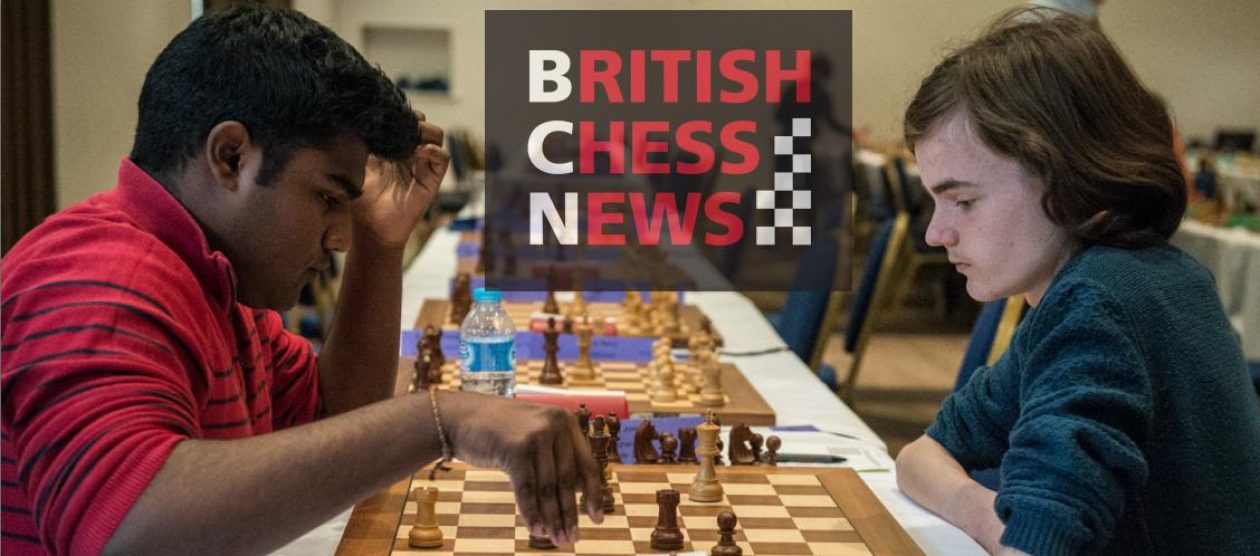
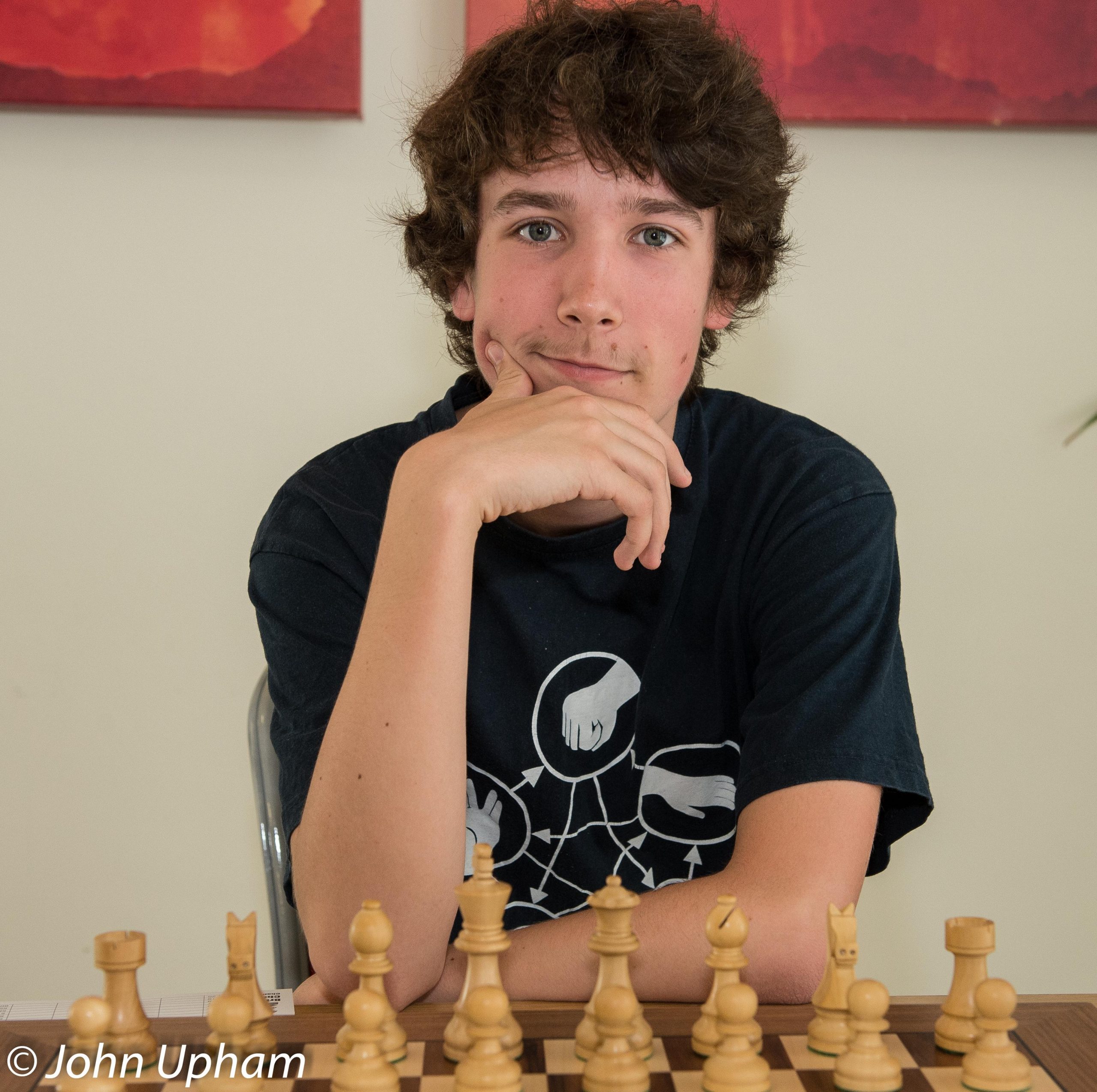
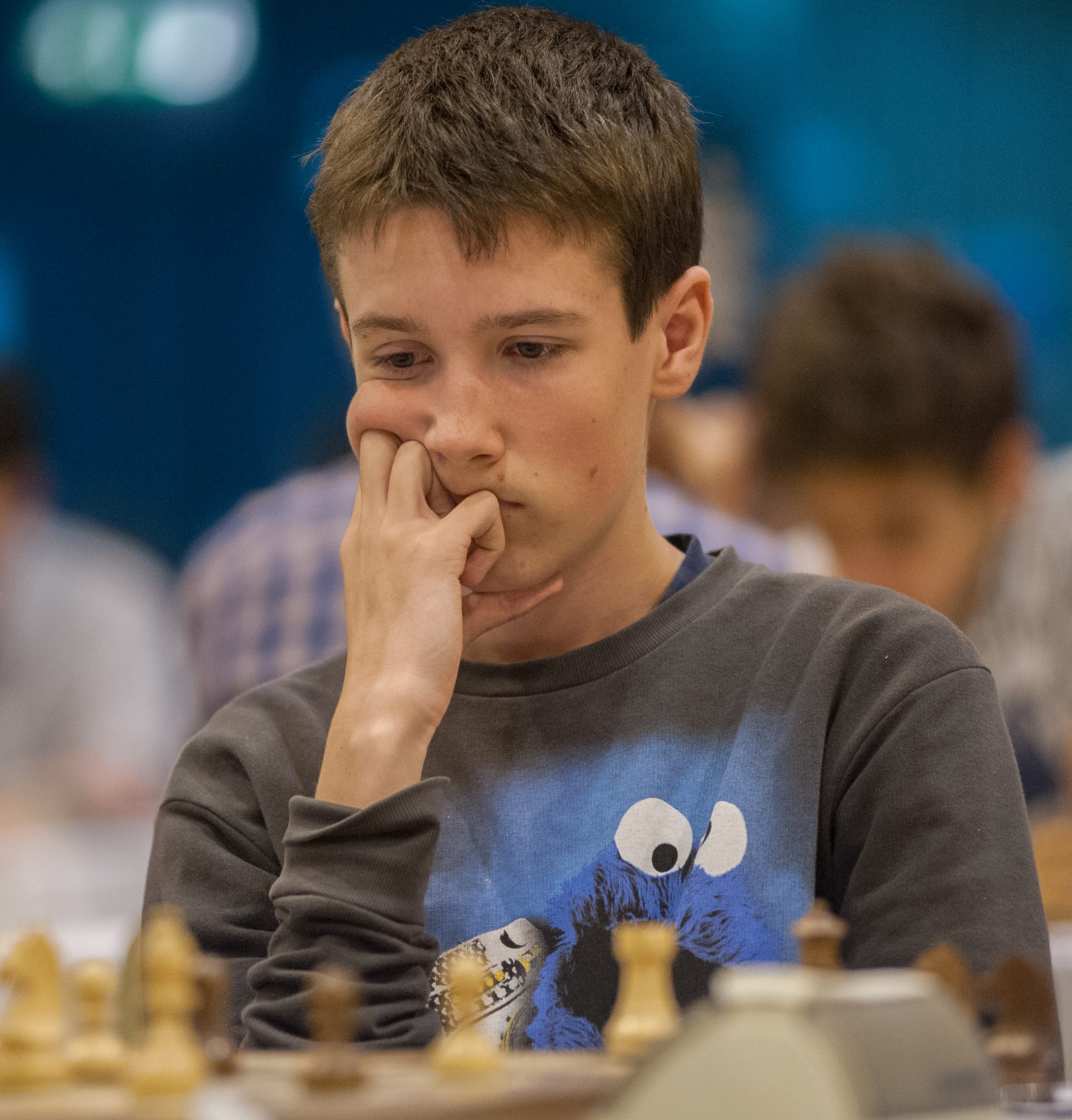
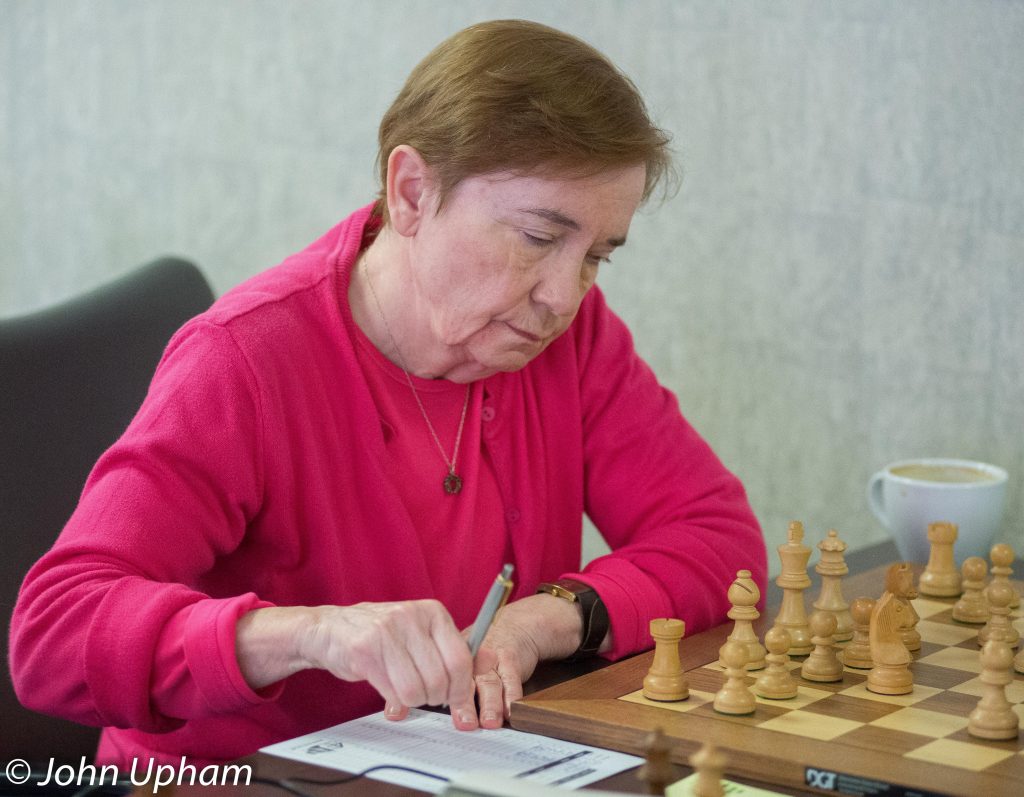
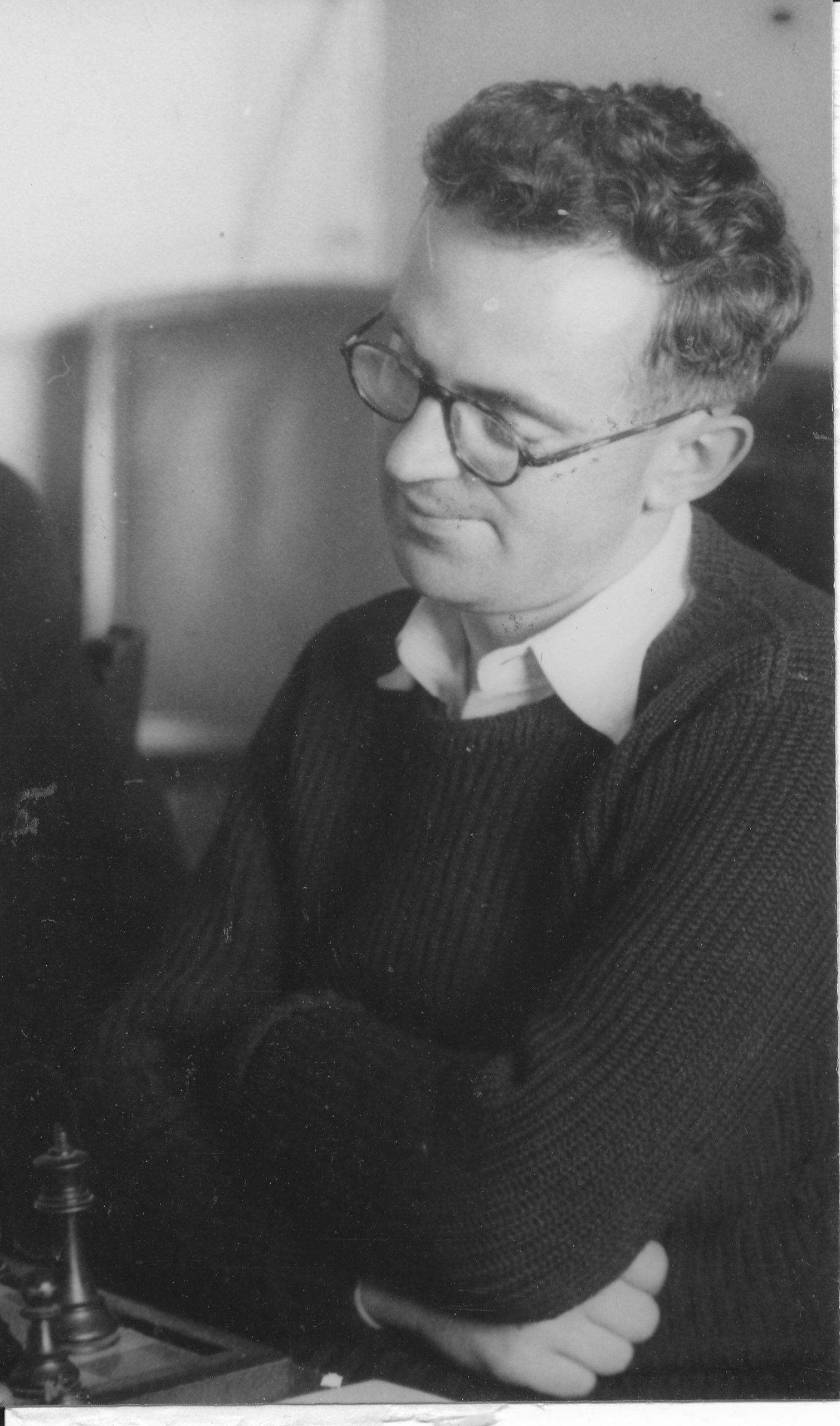
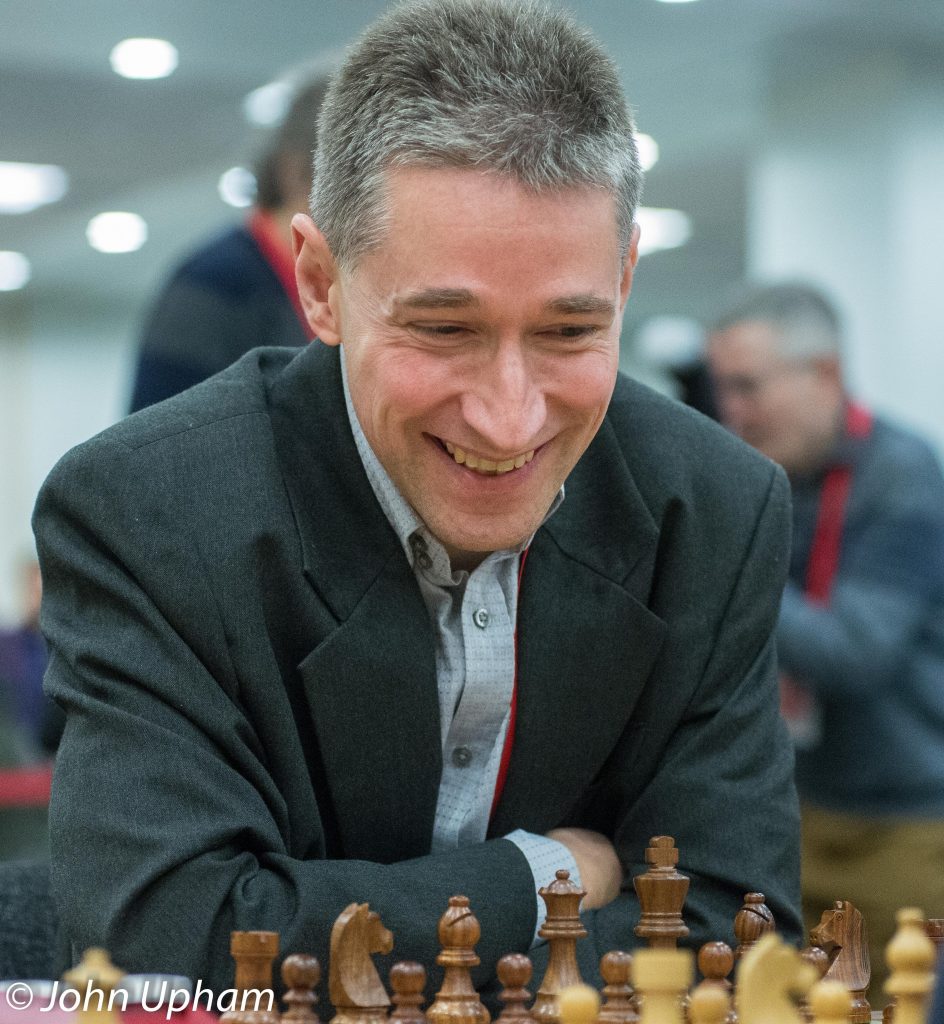
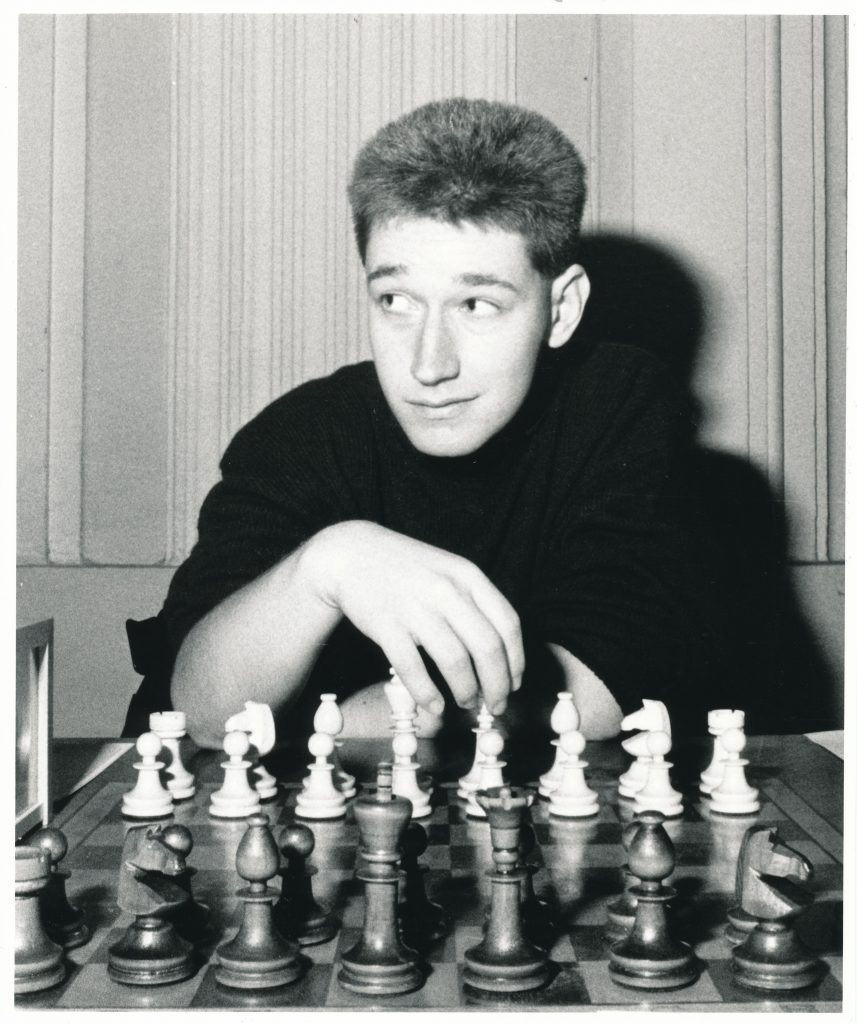
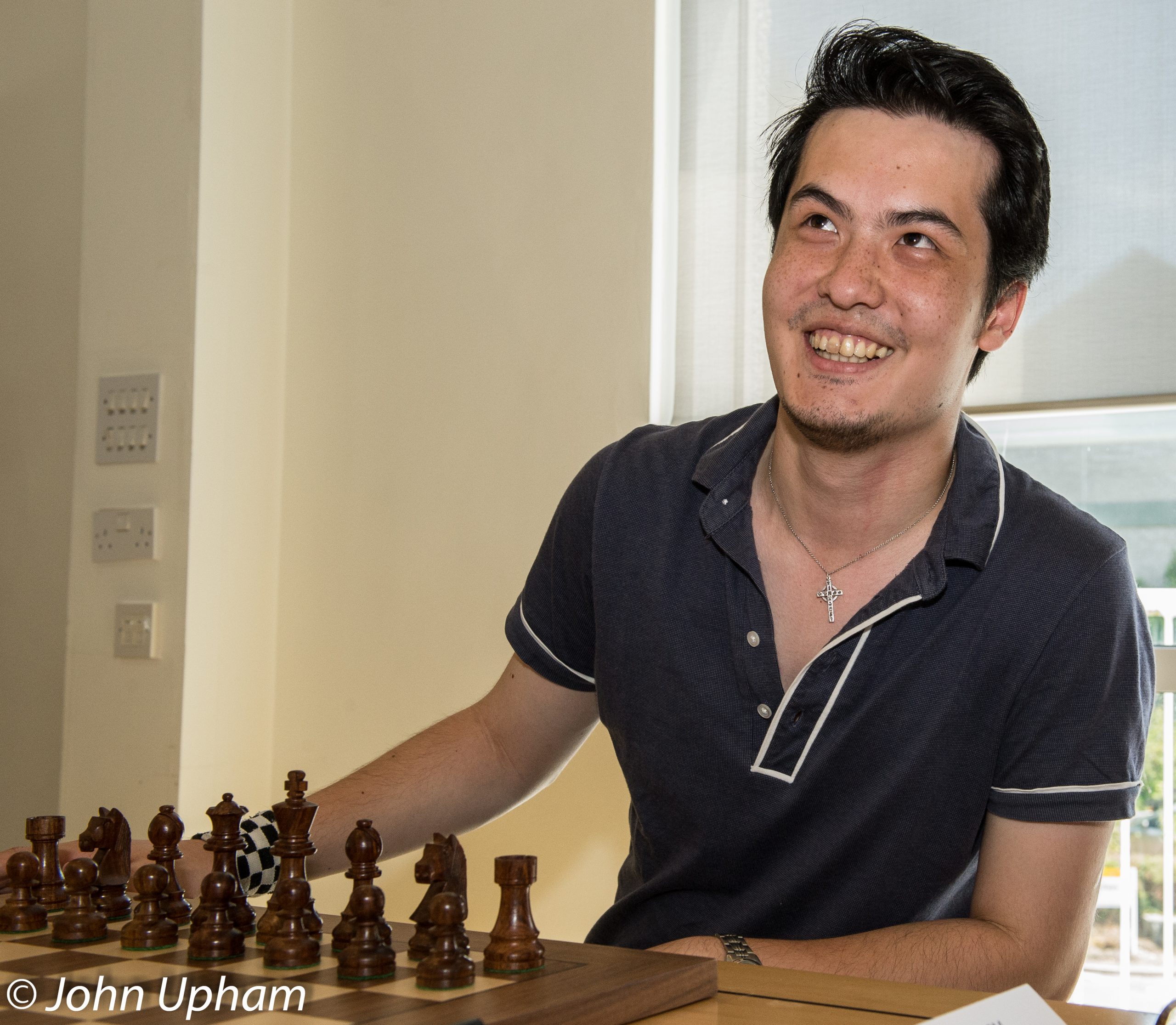
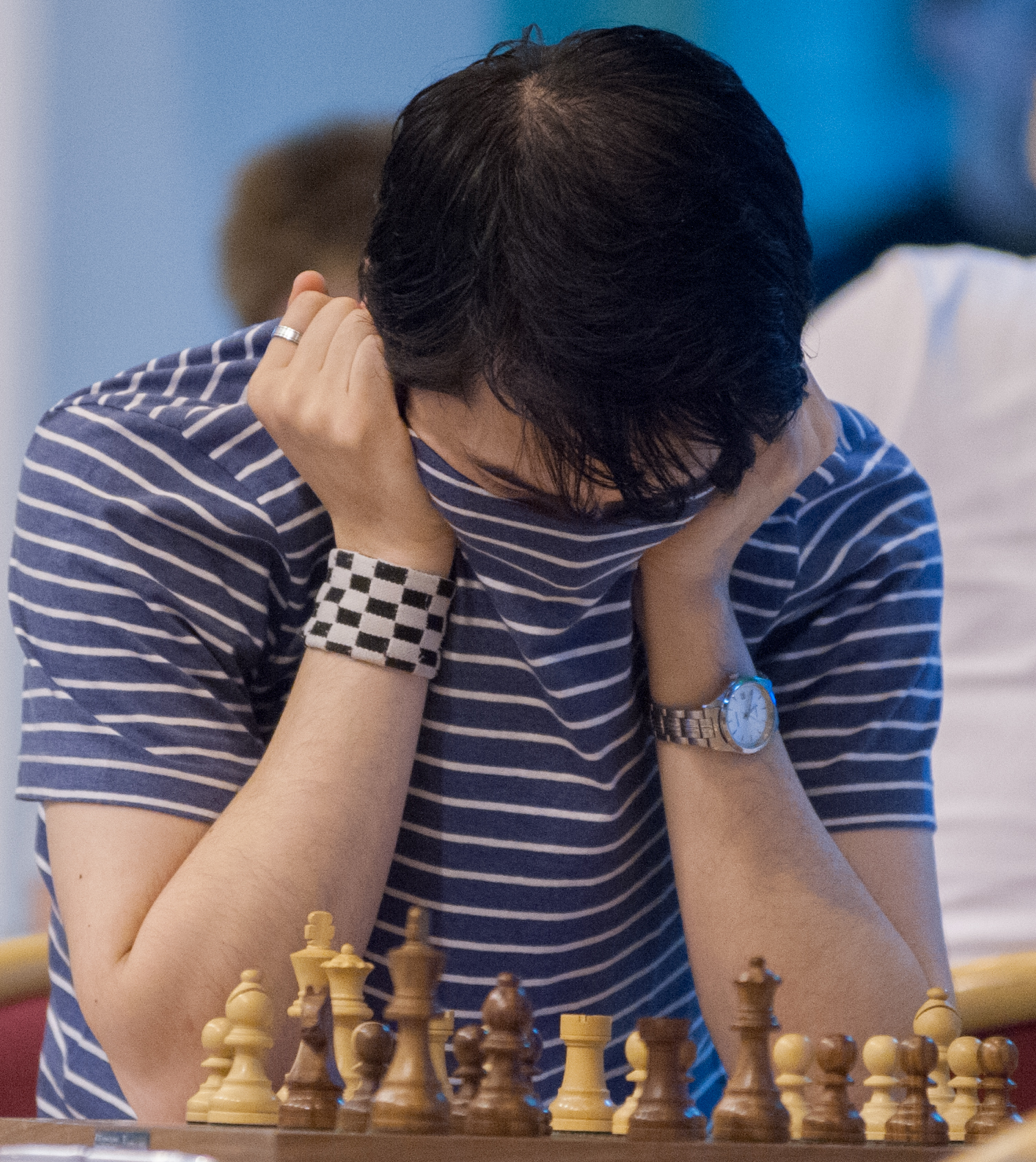
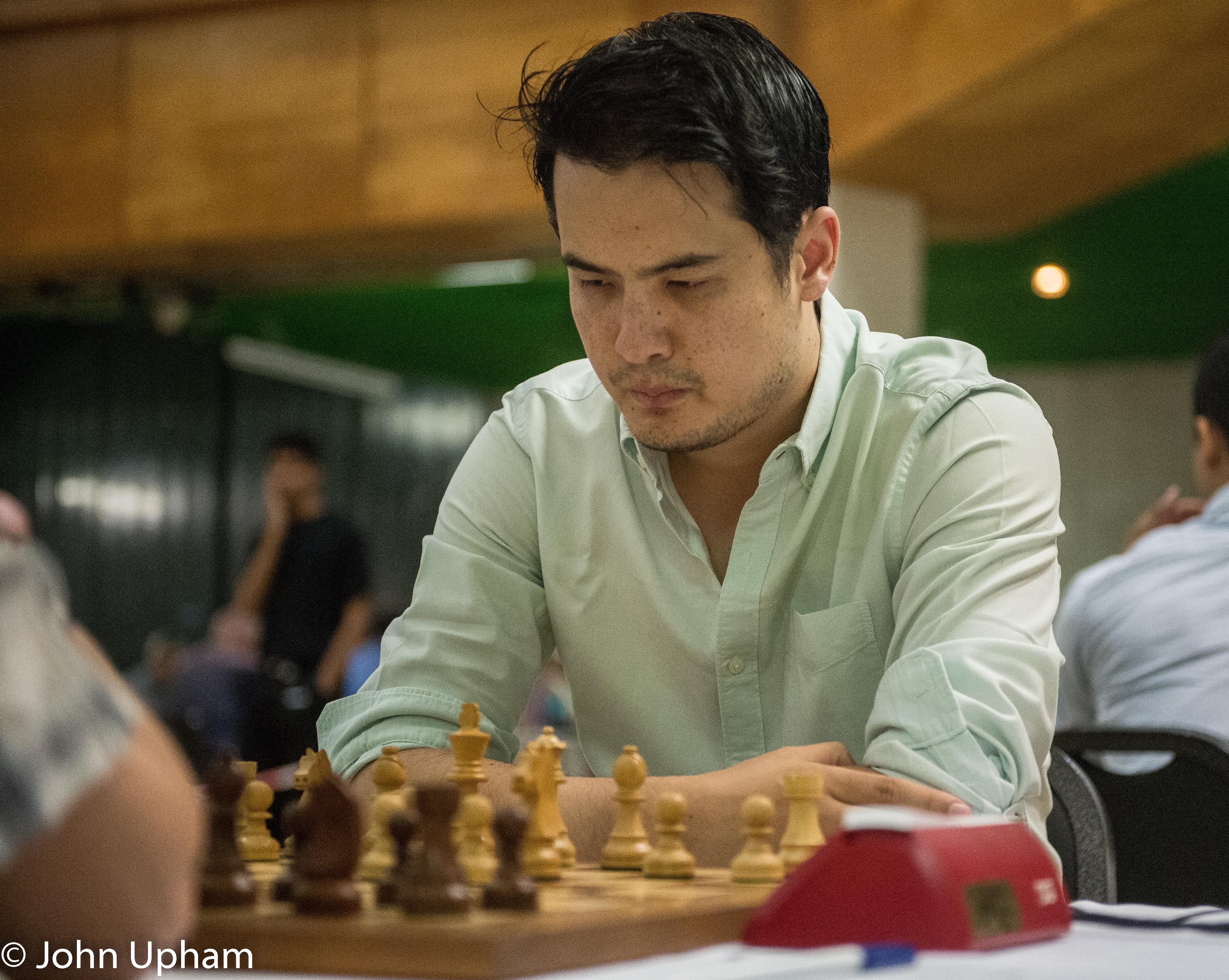
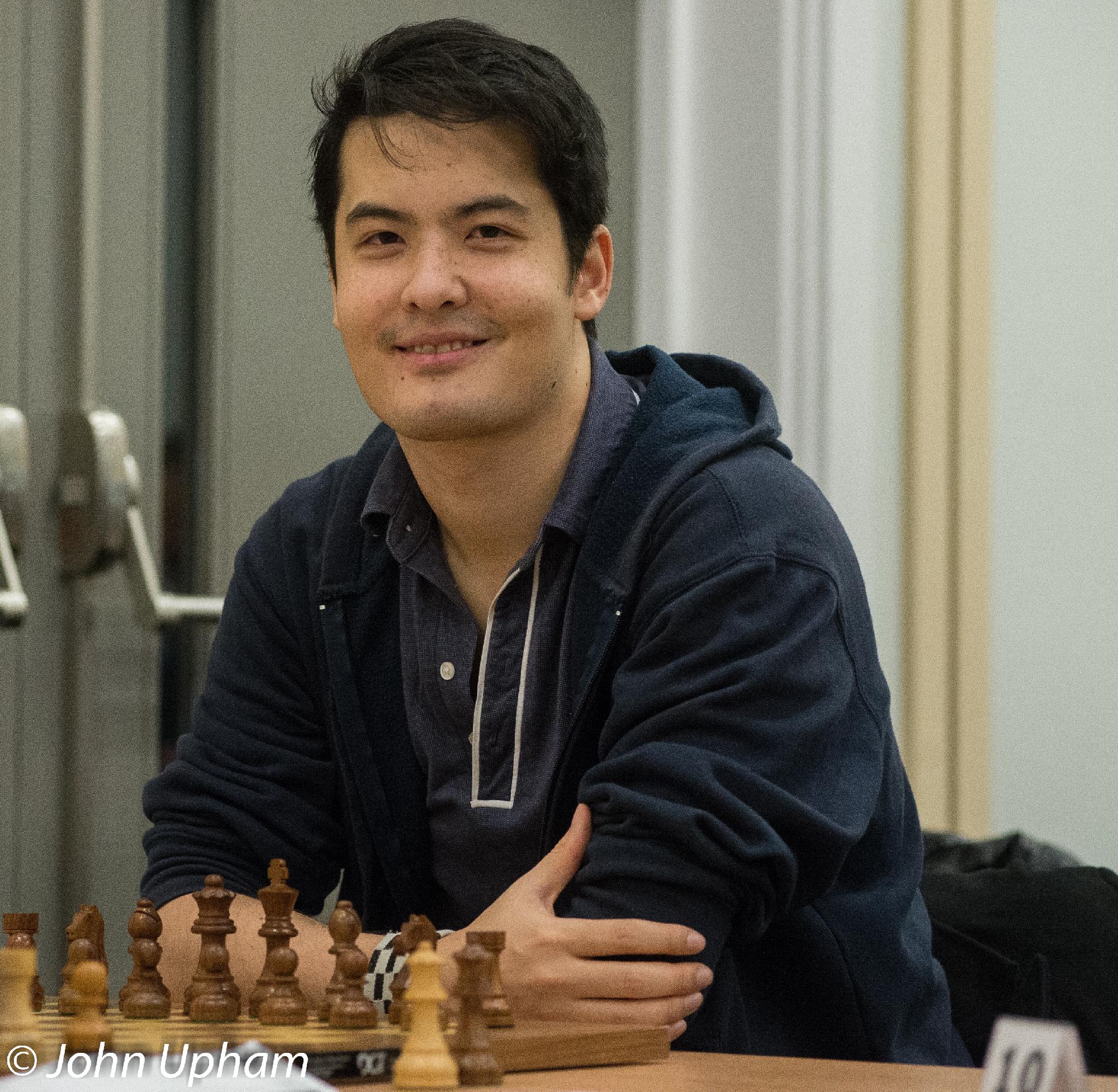
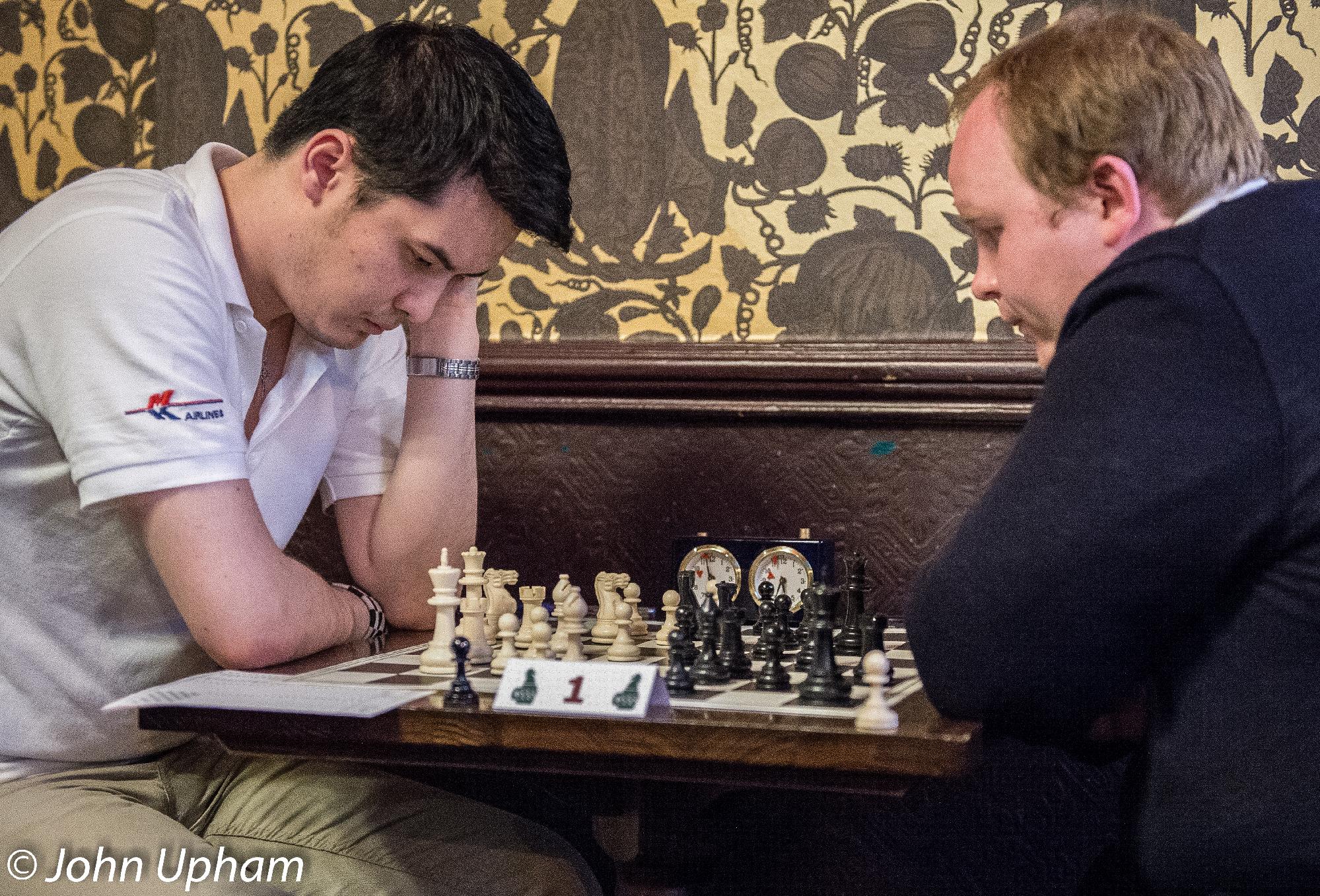
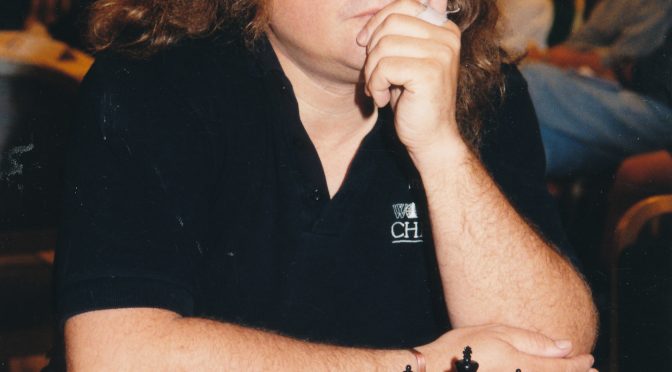
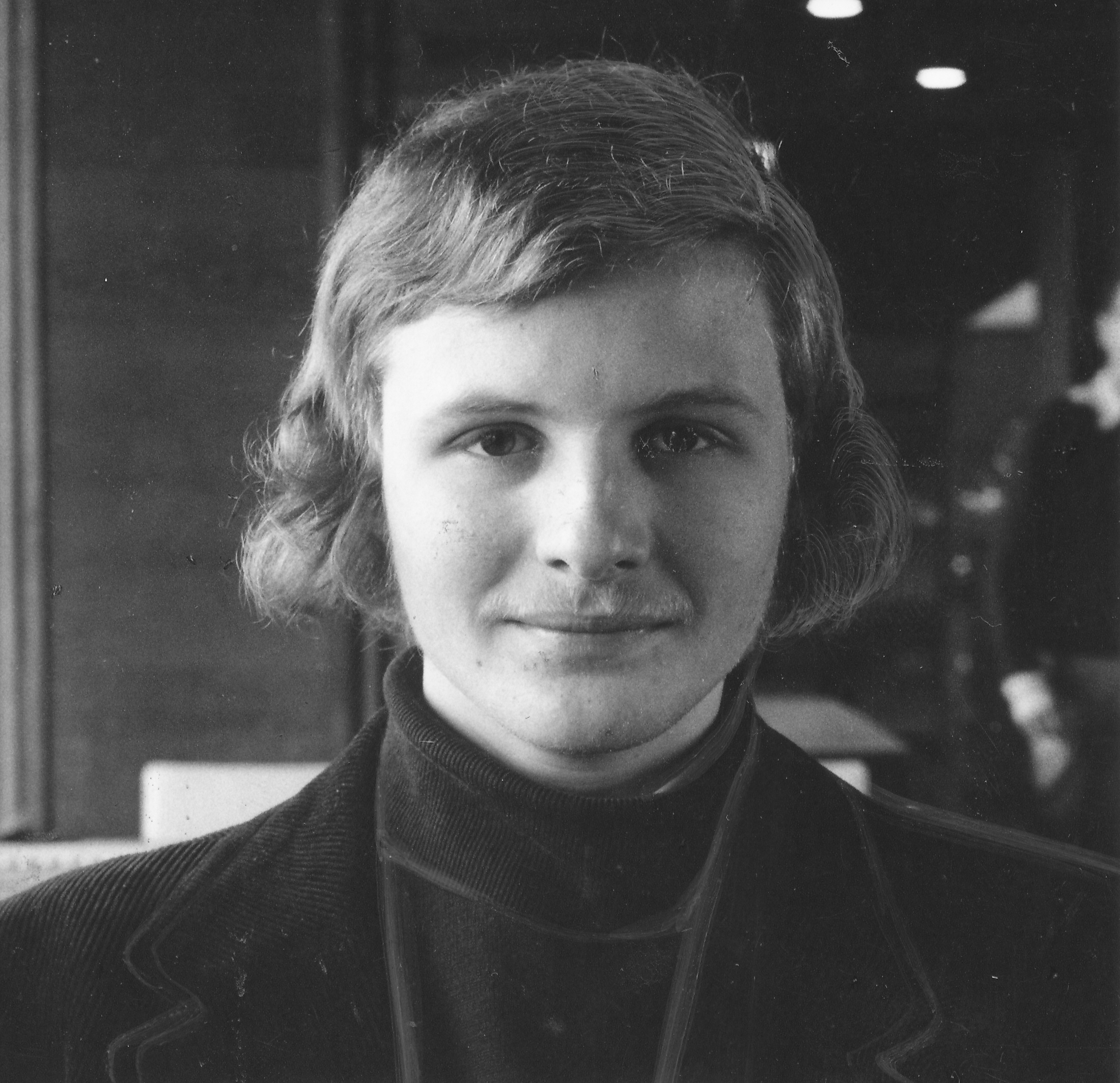
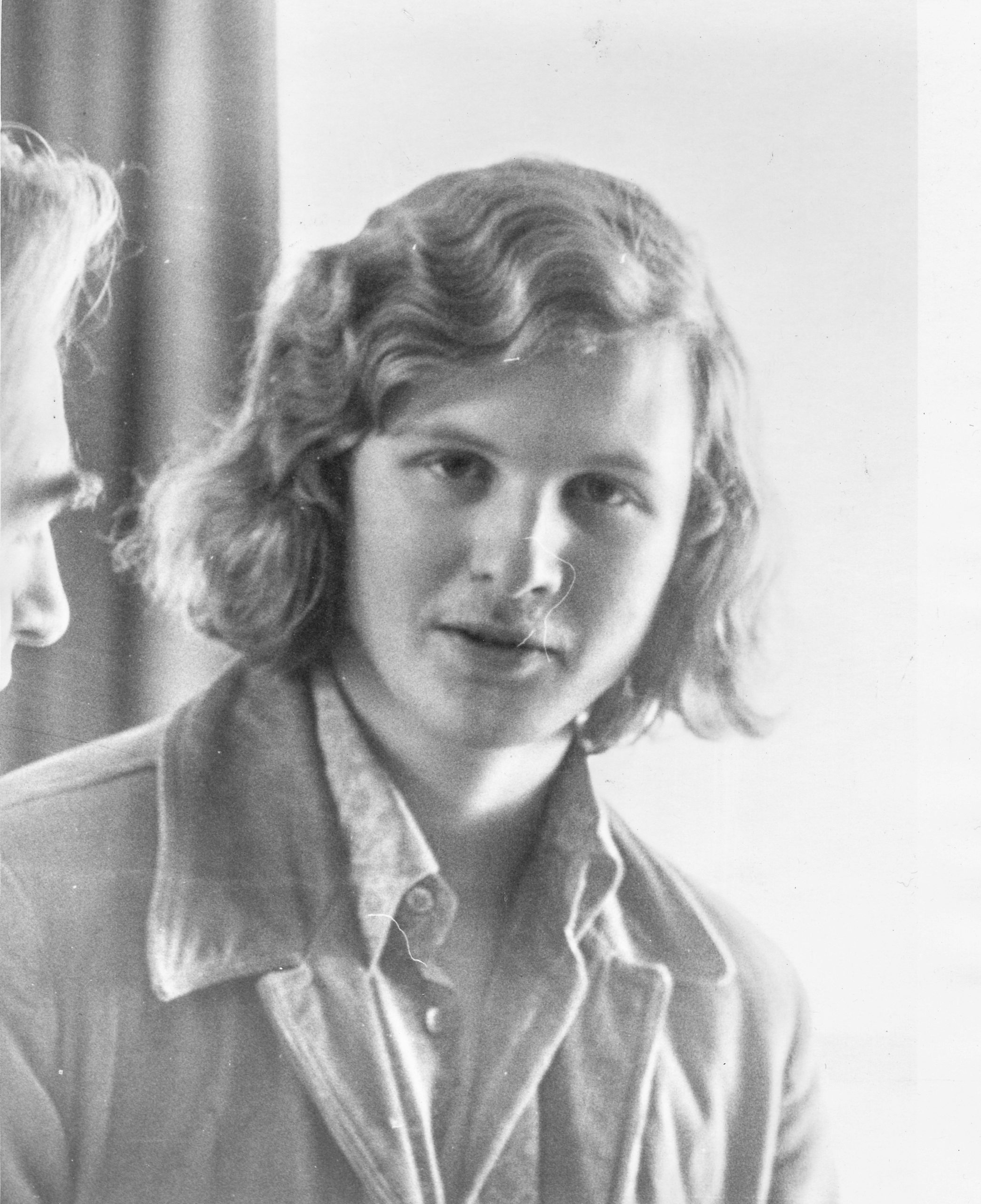
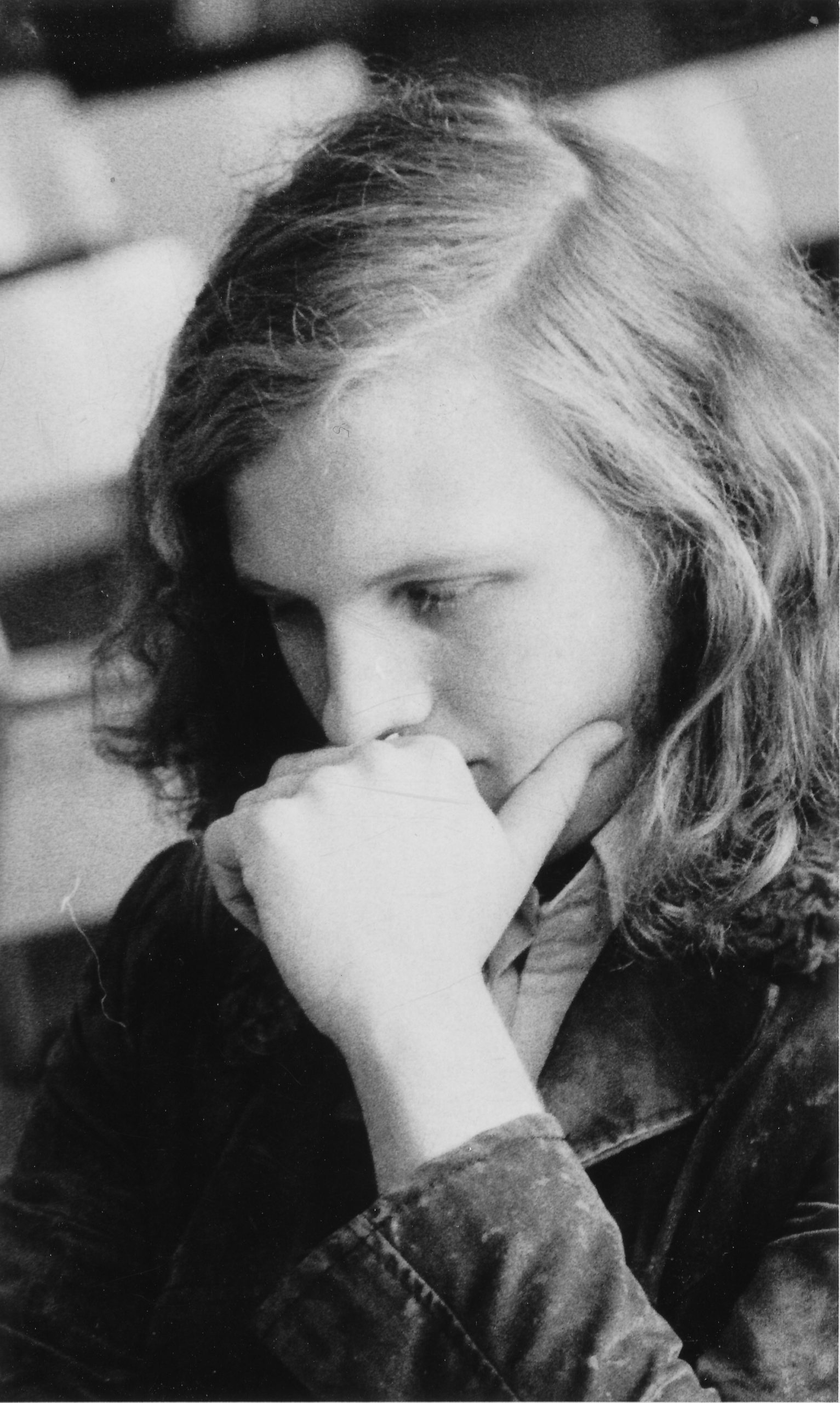
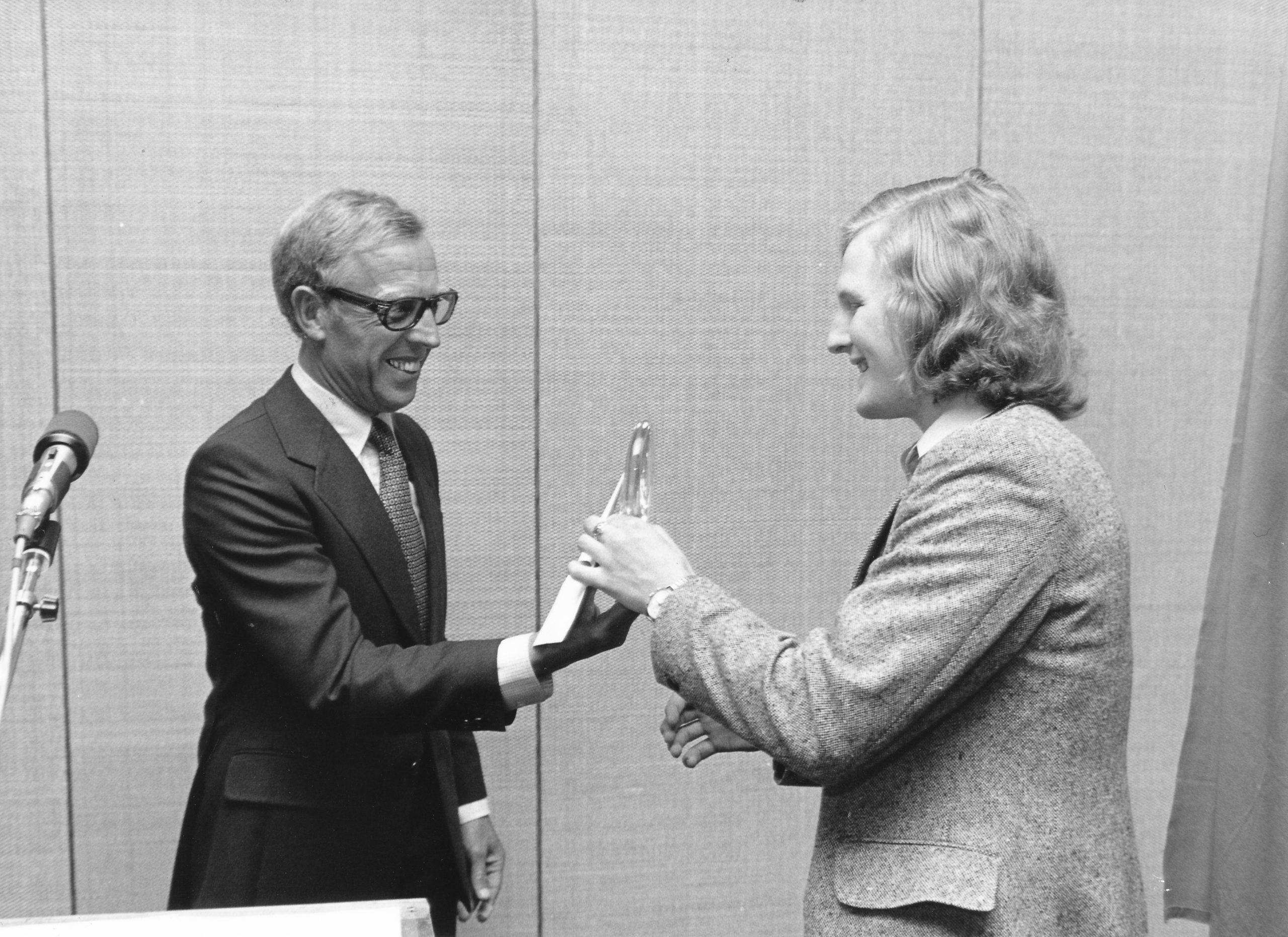
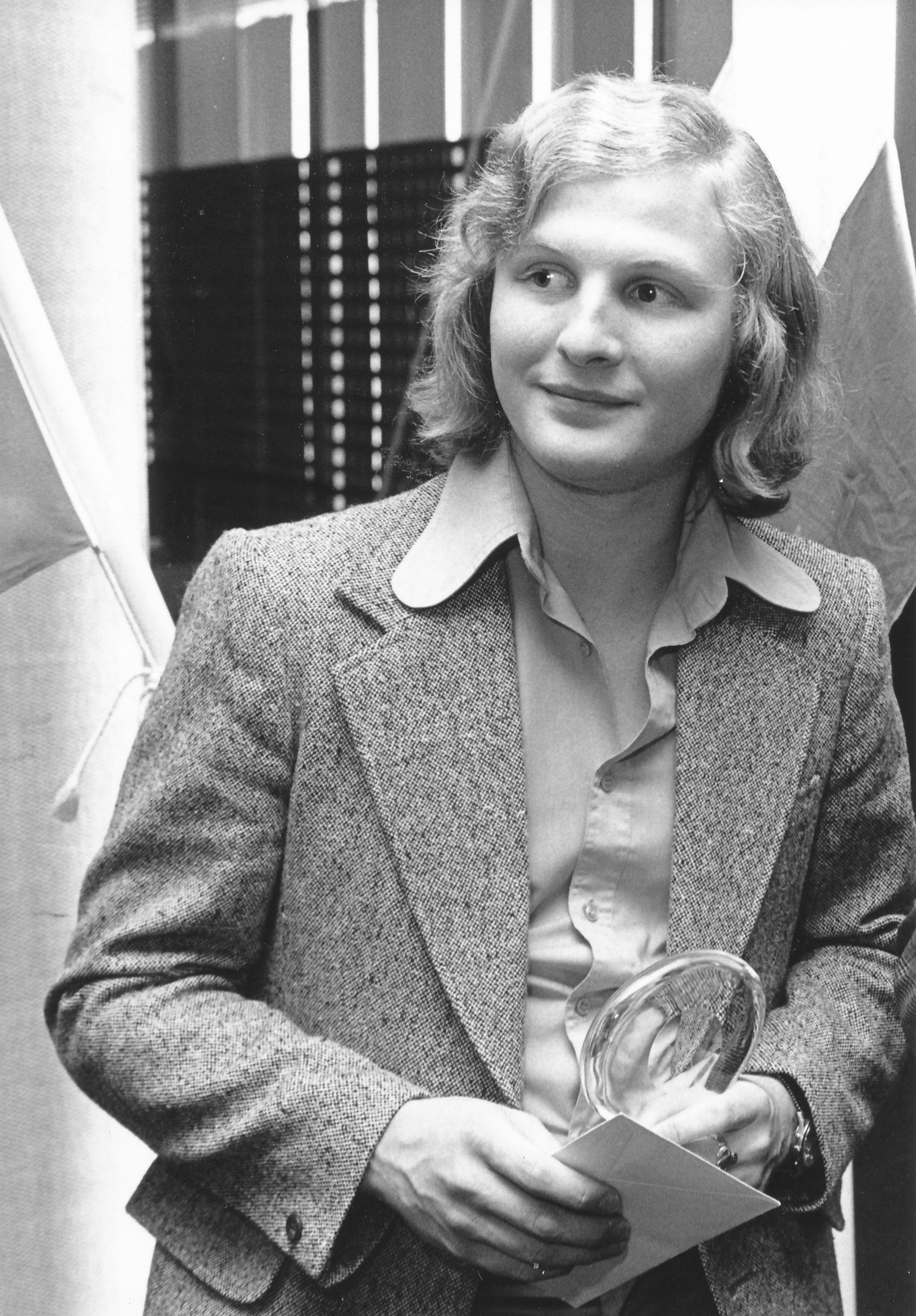
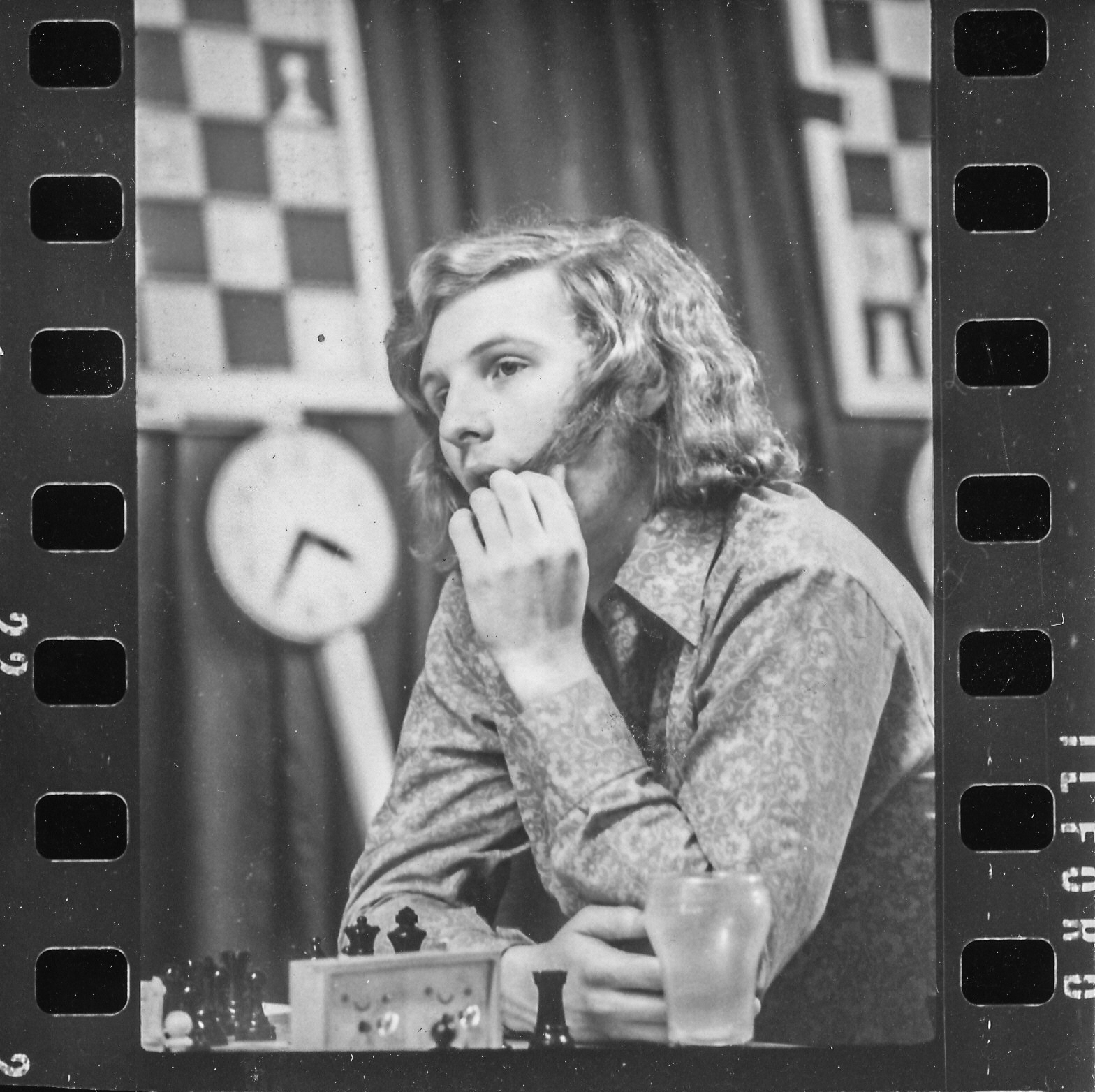
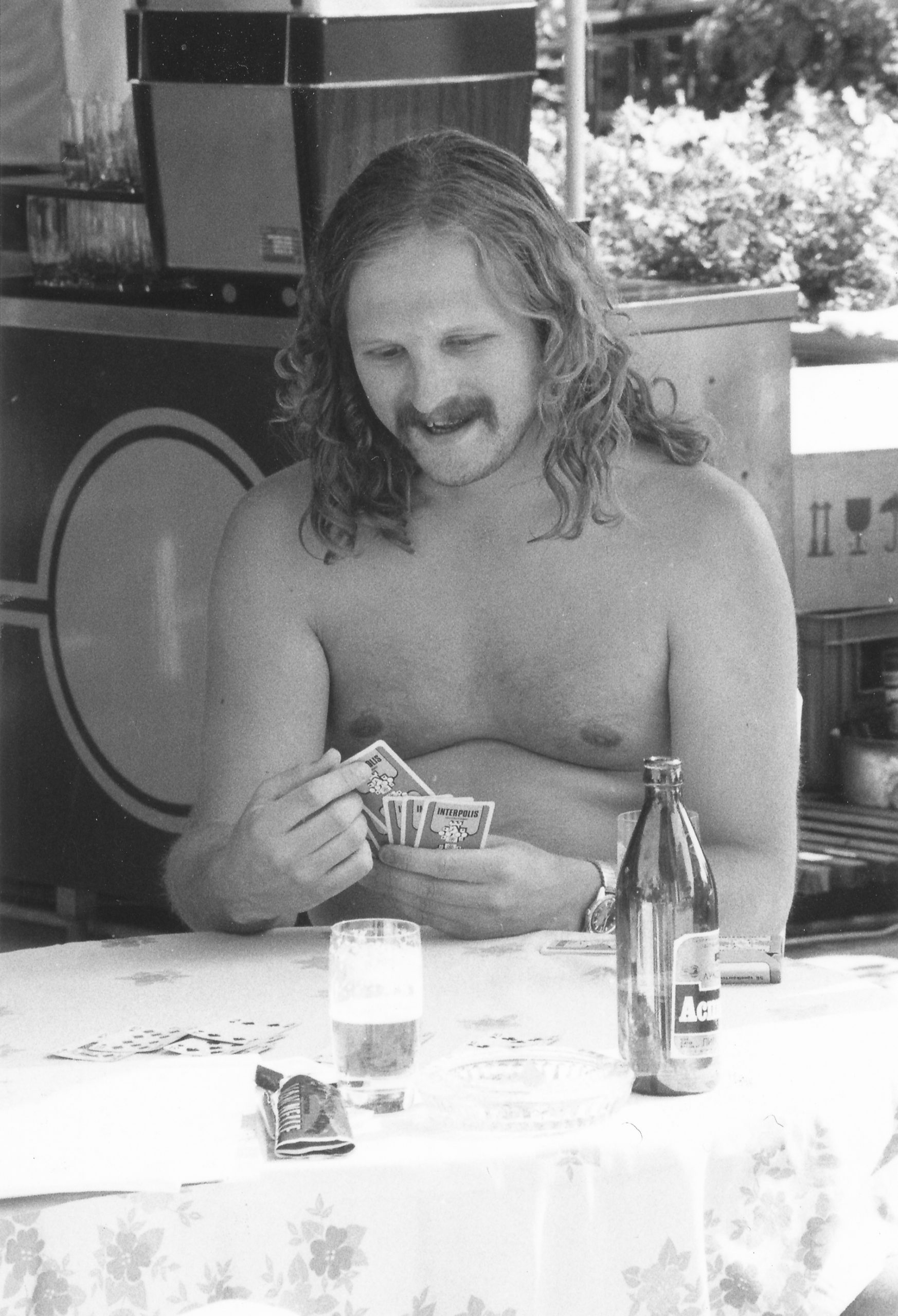
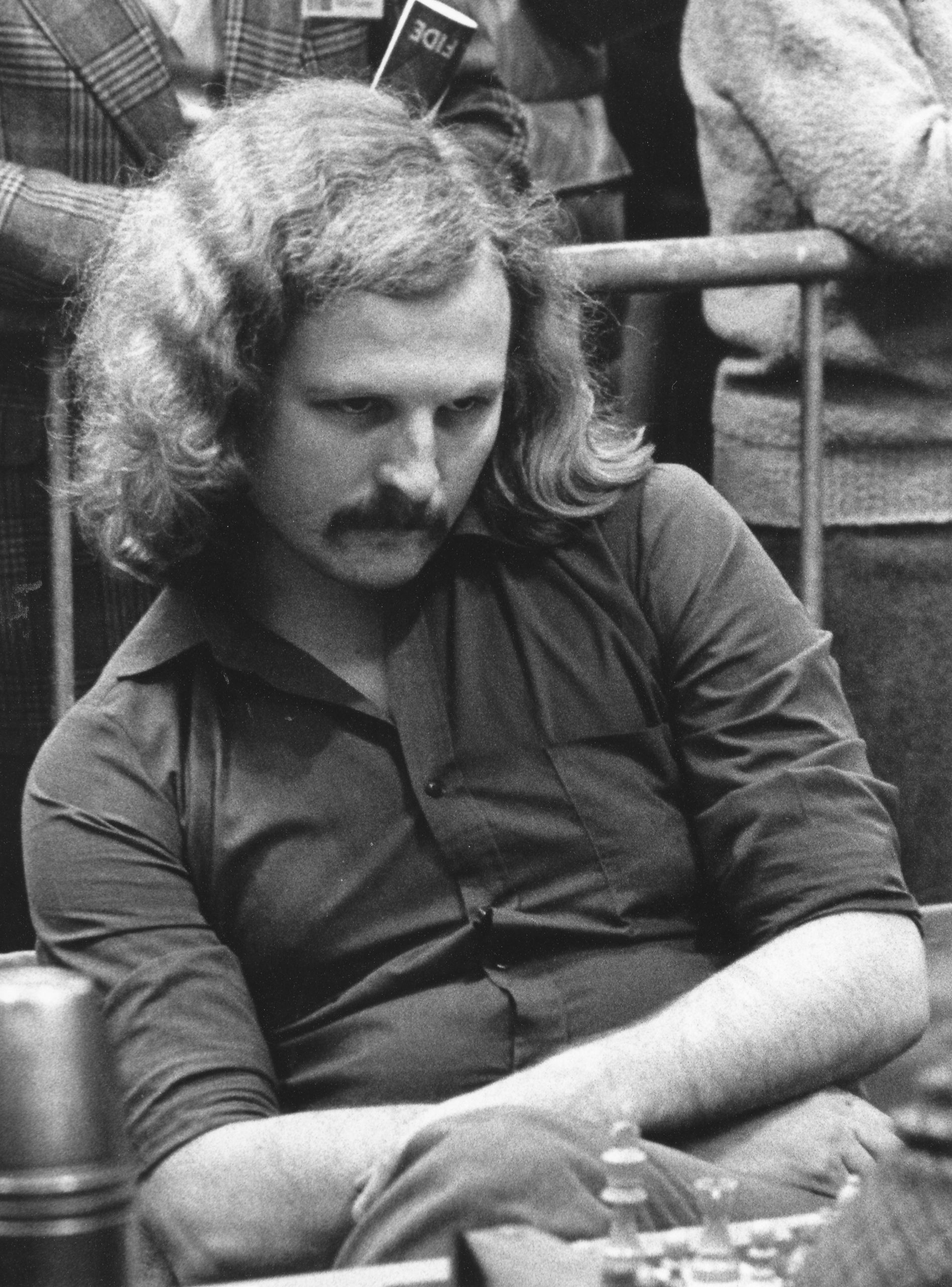
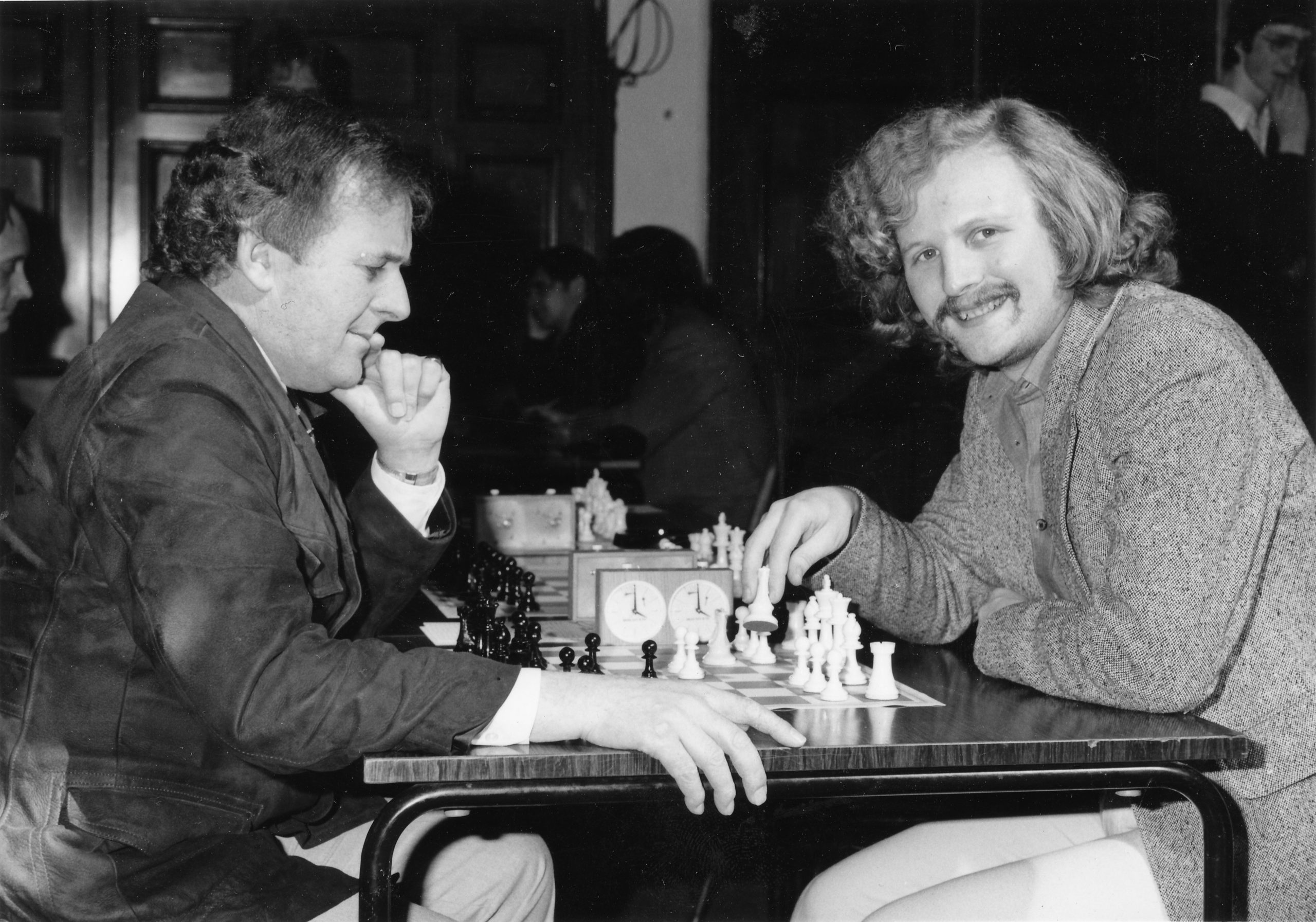
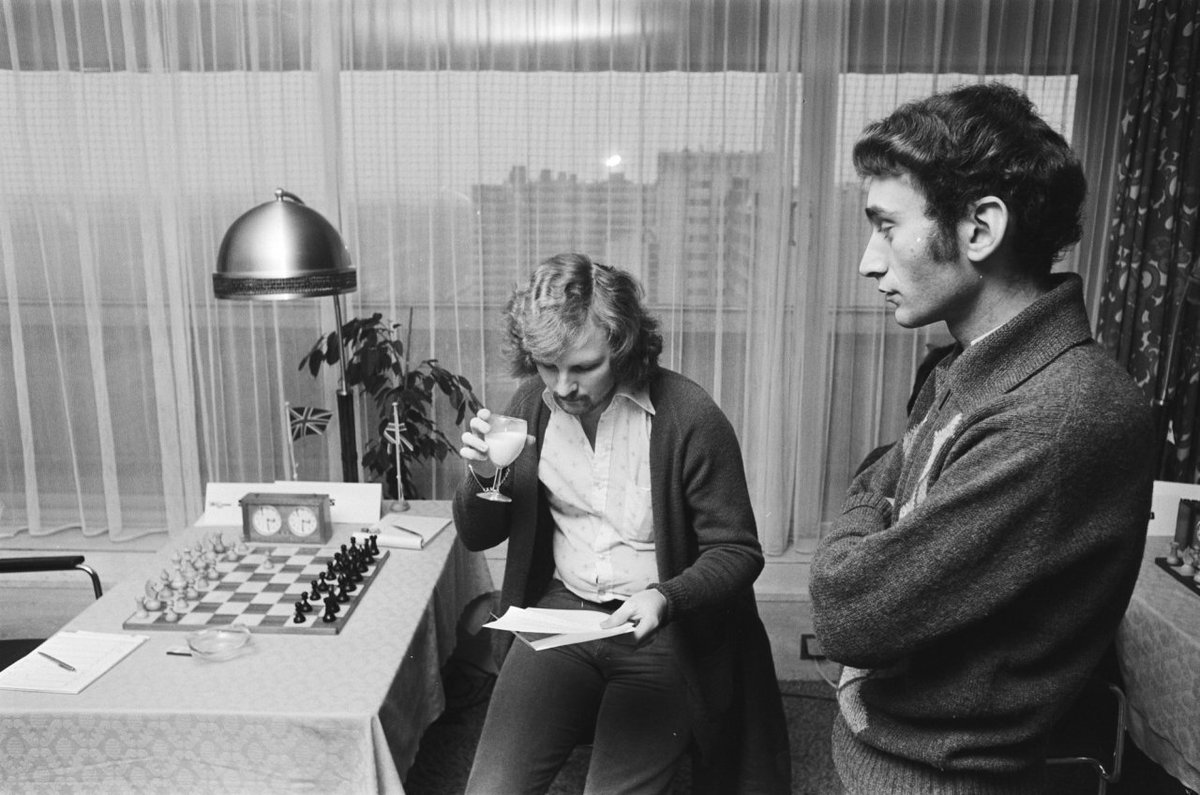
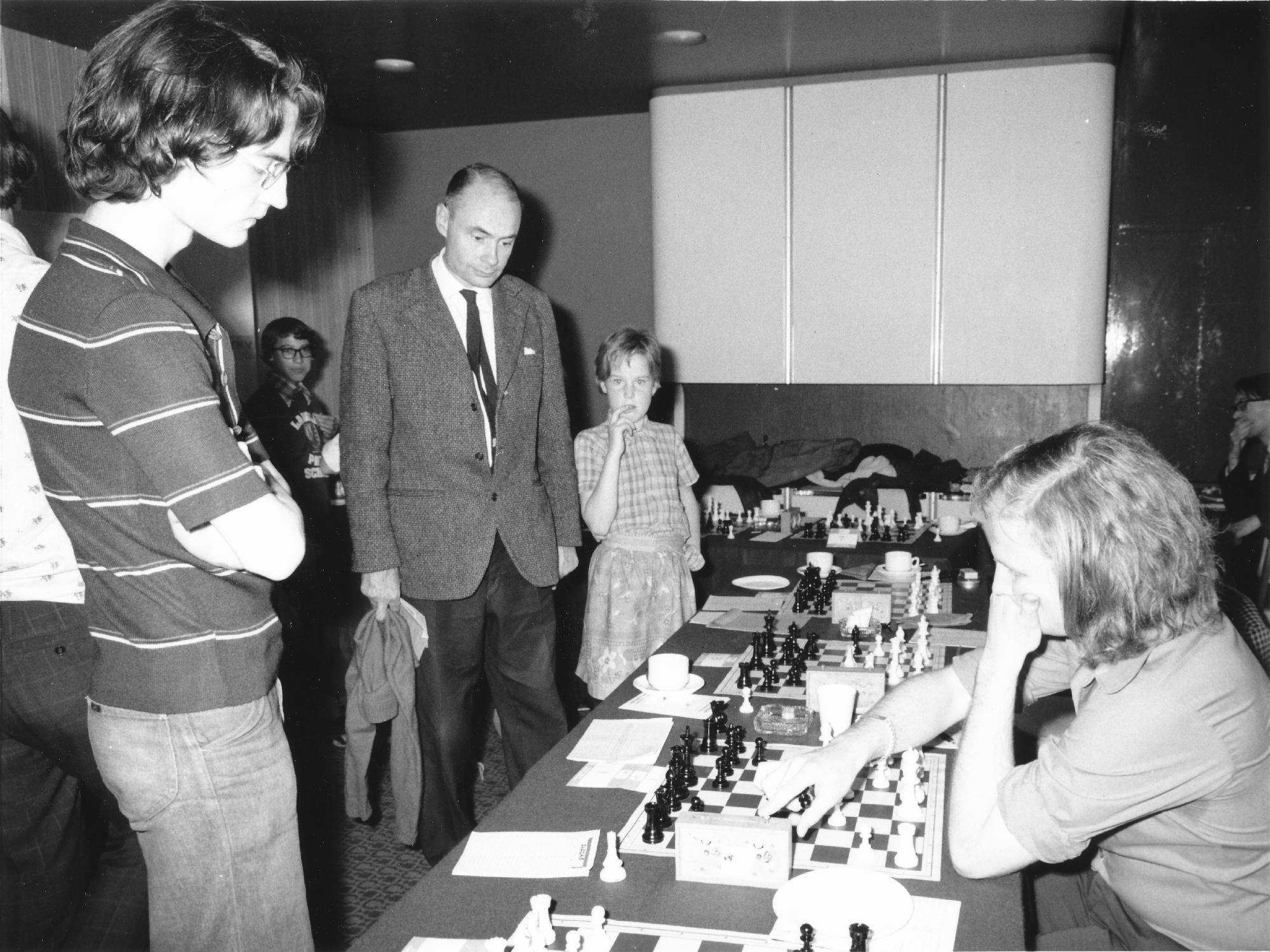
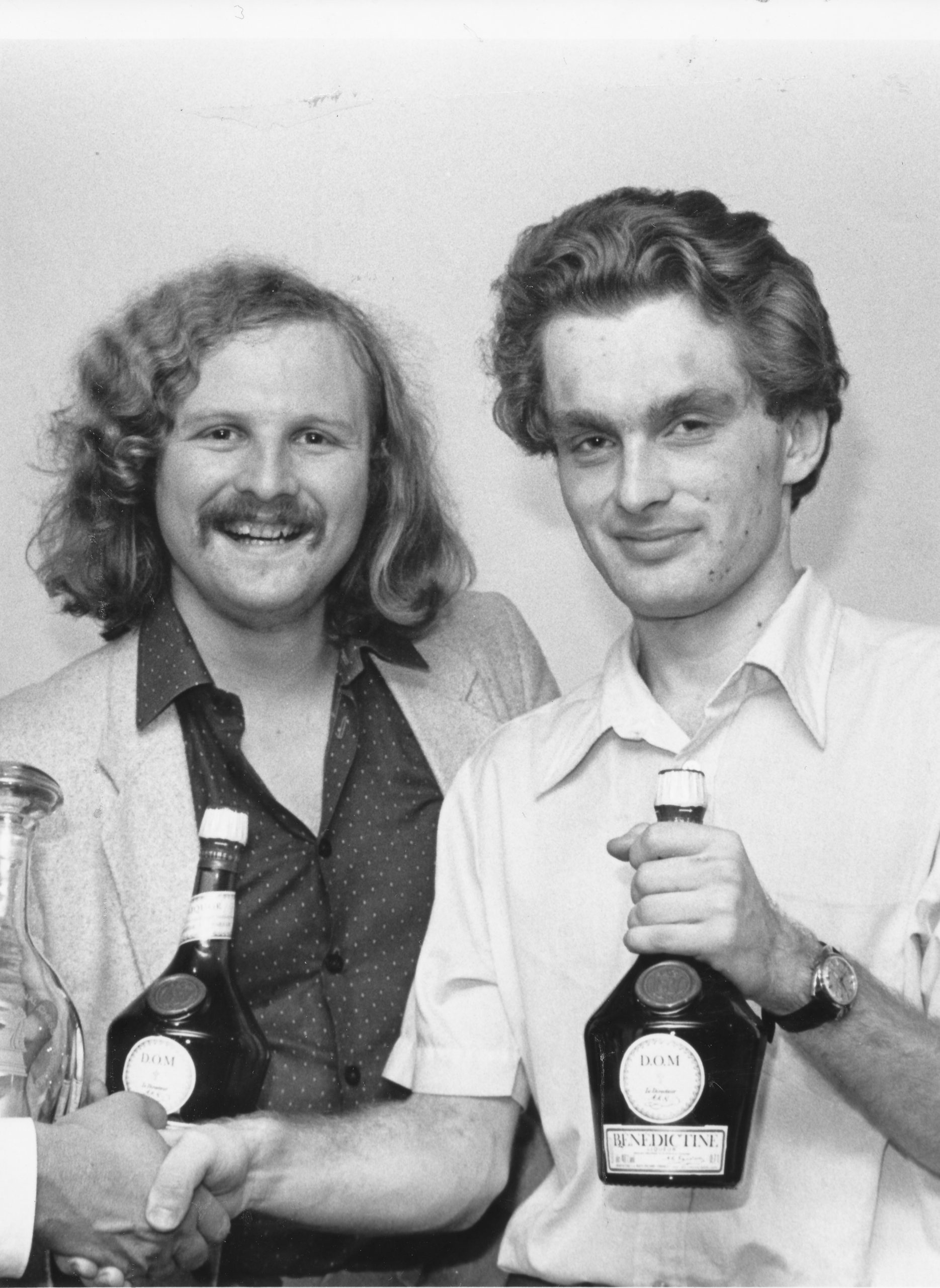
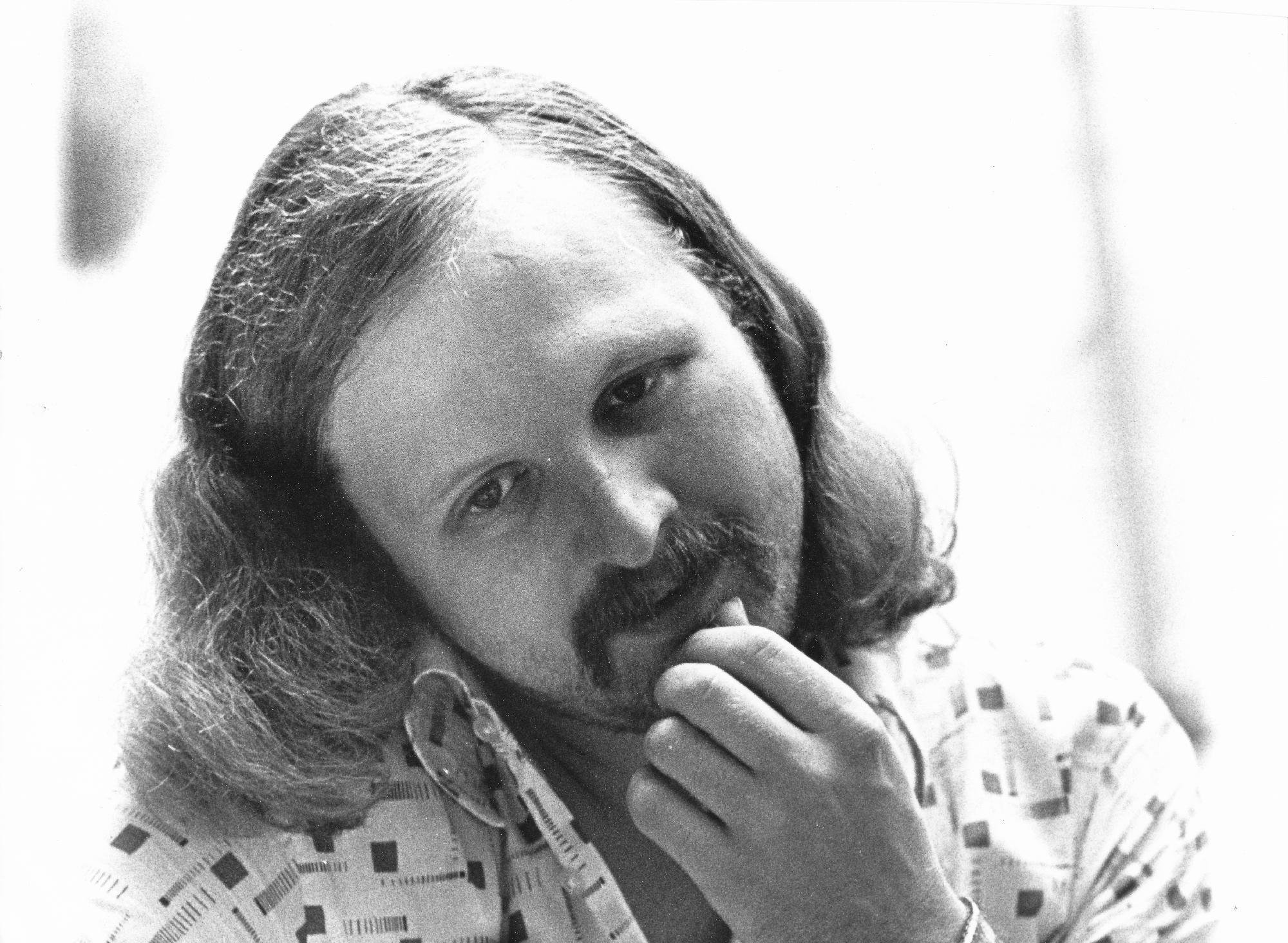
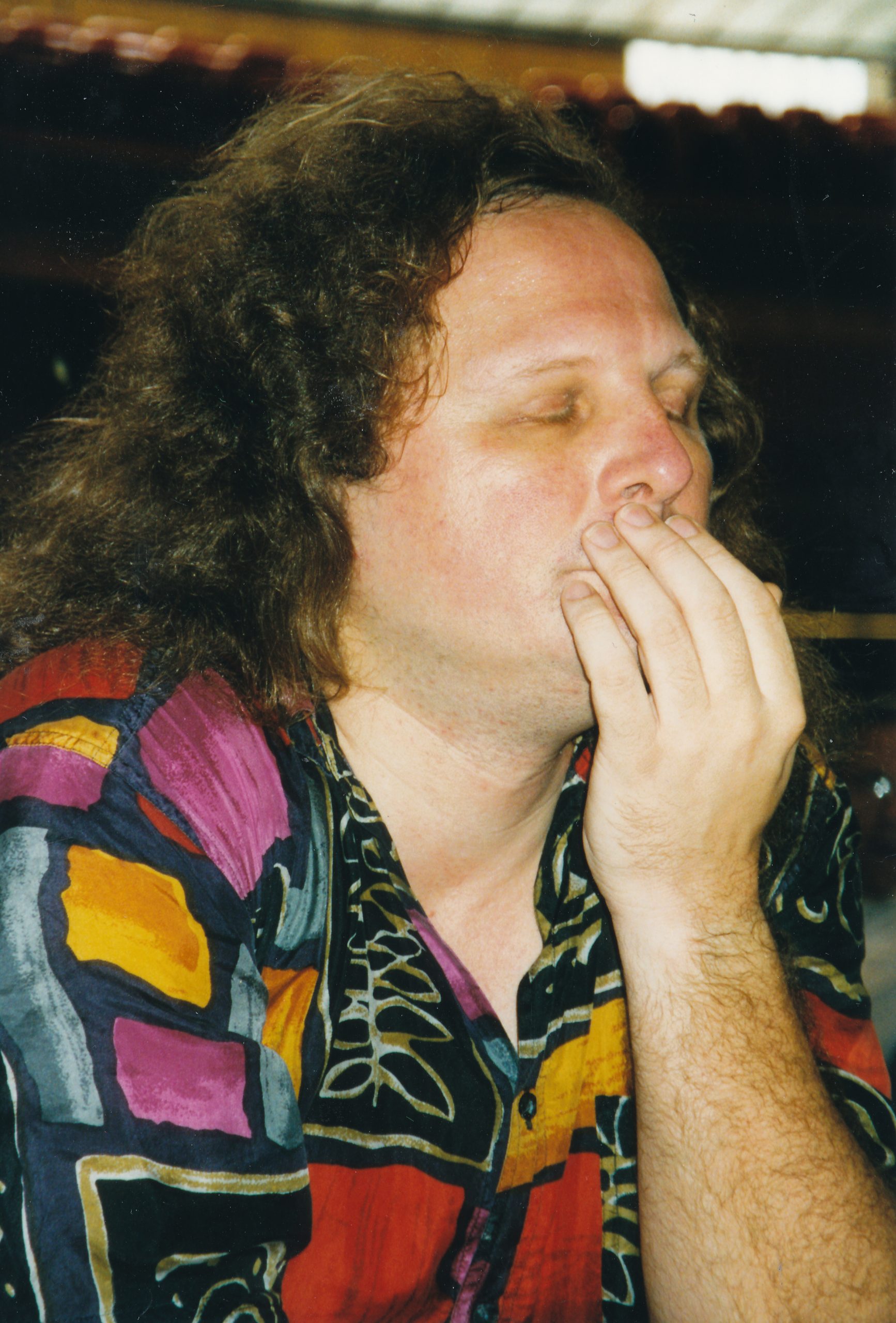
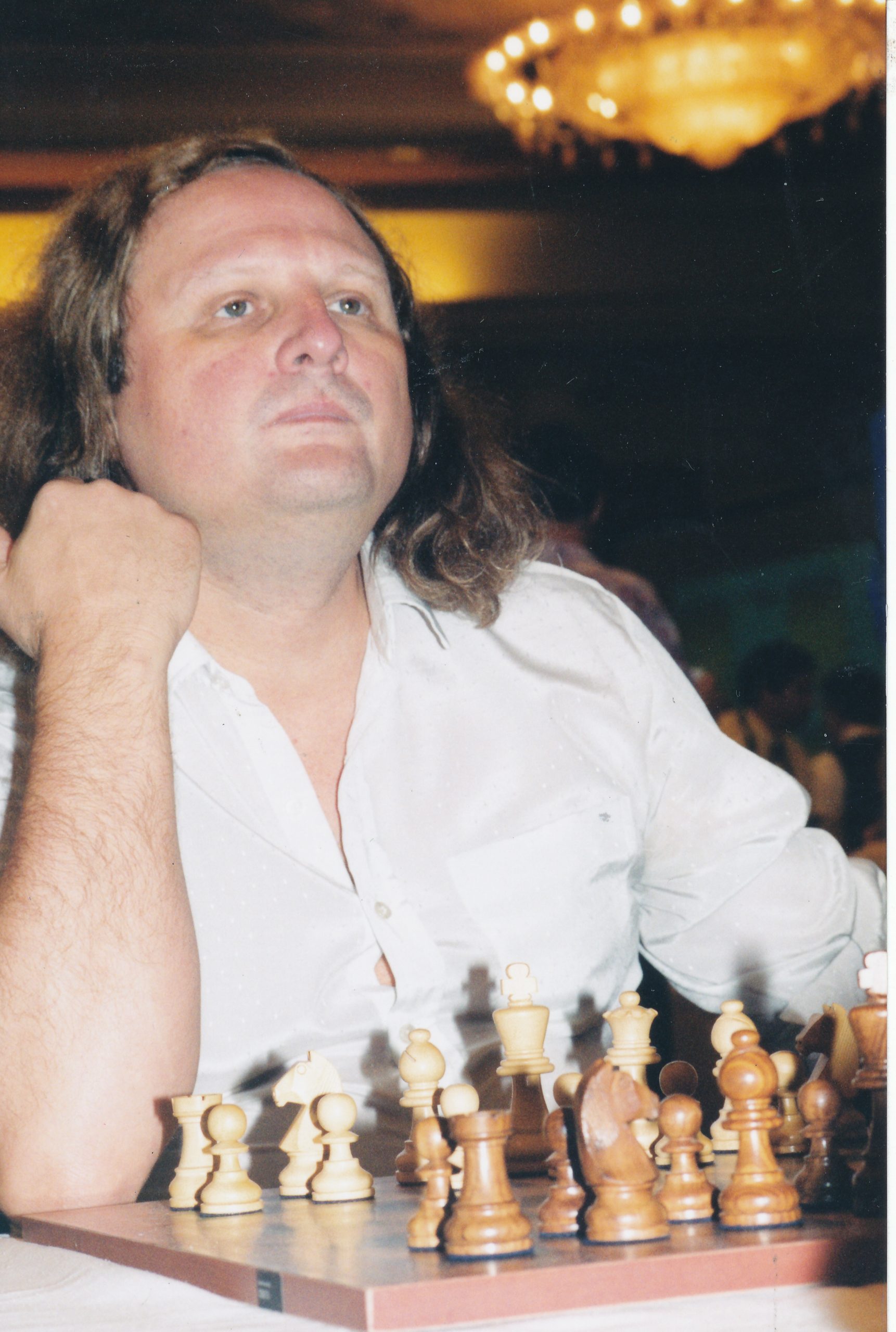
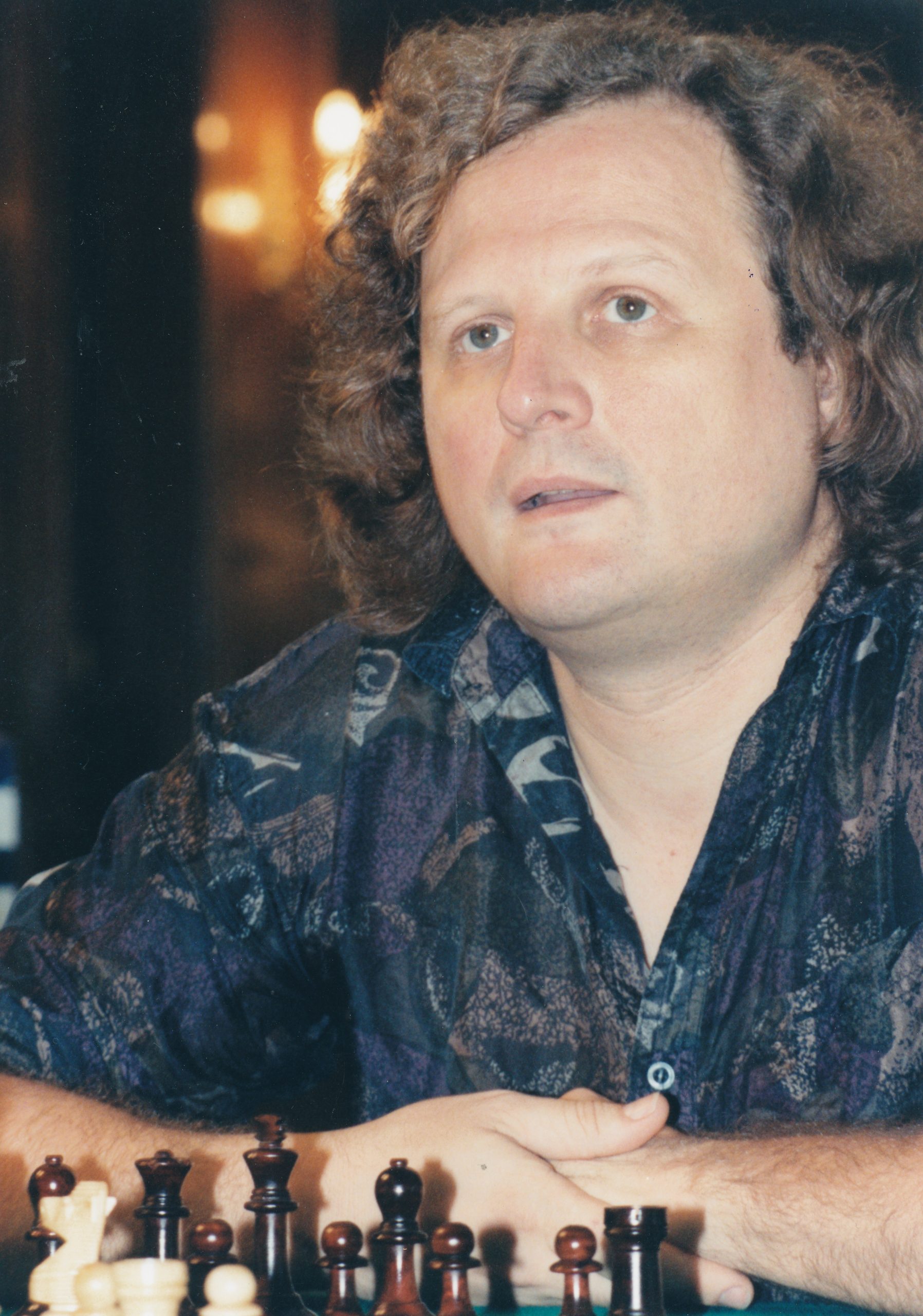
FM Peter Batchelor at the 2014 British Championships, Courtesy of John Upham Photography
Best wishes to FM Peter Batchelor on his birthday.
Peter J Batchelor was born on Tuesday, December 10th, 1996. “Breath” by The Prodigy was the UK Number One Single. His father is the player Guy Batchelor.
Peter’s first recorded rapidplay event was on the 17th of July 2005 in the Barnet Knights Under-9 tournament where he scored 4/6 and his first (!) standard play event was on August 20th 2005 being the British Land UK Terafinal which was not such a happy result.
His first published ECF grading was 56E in July 2006 at the age of ten with a rapidplay grading of 57A.
Peter played league chess in the Middlesex and London Leagues playing initially for Willesden & Brent and then with Wanstead & Woodford both with his father Guy.
Peter attended the Capital City Academy which is a “specialist sports and arts Academy in Willesden, North West London, in the borough of Brent.” He has returned there post-graduation to teach chess and run the school chess club.
Peter studied mathematics at the University of Warwick and now lives in London.
According to Ben Purton : “I captain Peter in the 4NCL chess league, he is one of the most professional and talented players on my squad. He is extremely smart and nice to be around. Peter would be an asset to any organisation in the future and any graduate scheme would be foolish not to take such a person on.
I have seen him grow in to one of the best U21 chess players in the UK and hope to see him gain his IM title soon.”
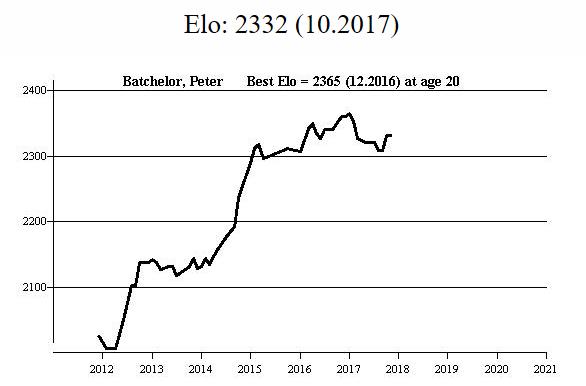
Peter became a FIDE Master in 2015 and, according to Felice and Megabase 2020 his peak FIDE rating was 2365 in December 2016.
FIDE rating profile for Peter Batchelor according to Megabase 2020
Peter plays for Grantham Sharks in the Four Nations Chess League (4NCL).
With the white pieces Peter plays the Queen’s Gambit and the Trompowsky Attack.
As the second player Peter plays the Classical variation of the Caro-Kann and the Alartortsev Variation.
On chess.com Peter plays under the nom de plume of Pbatch.
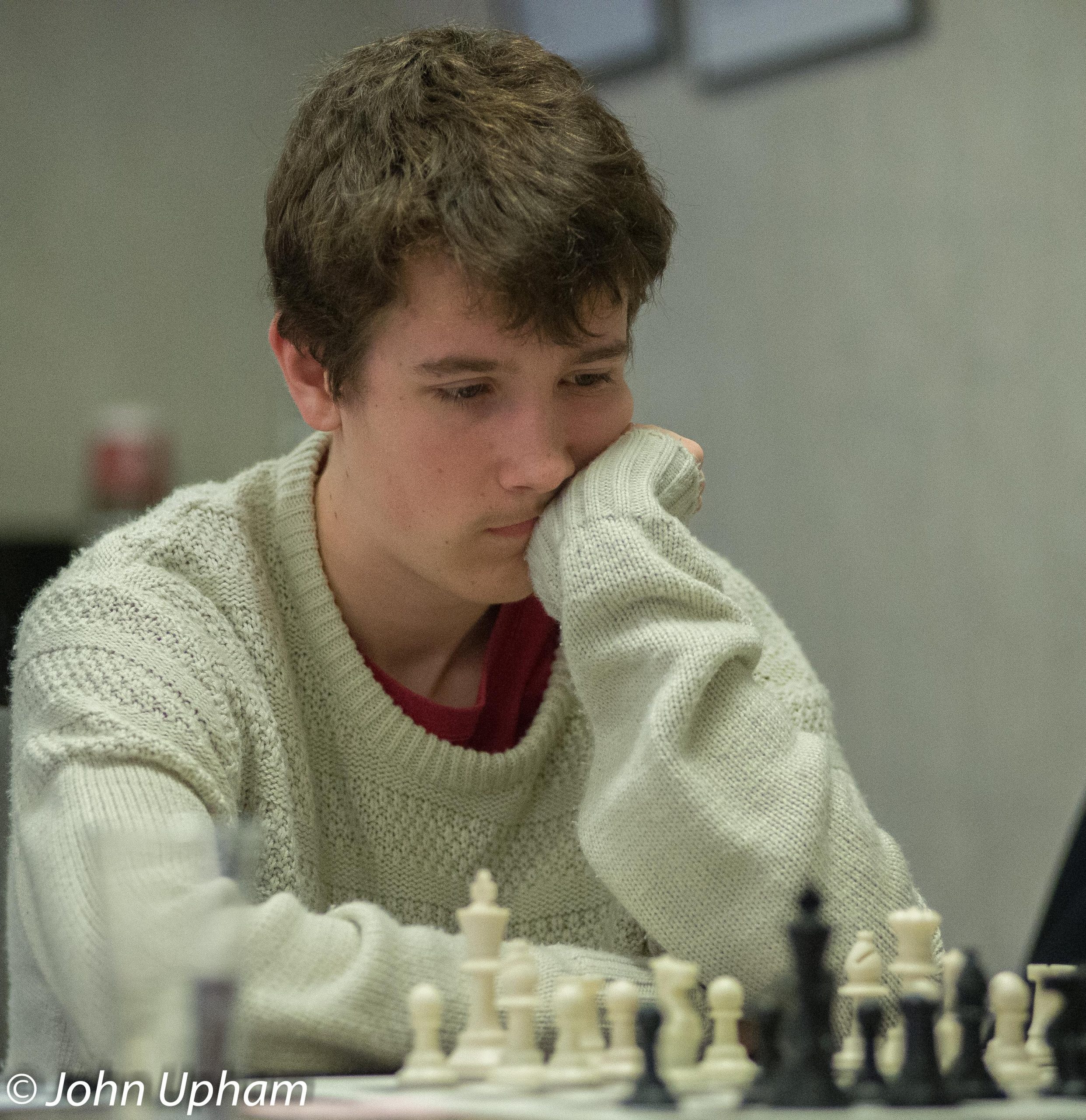
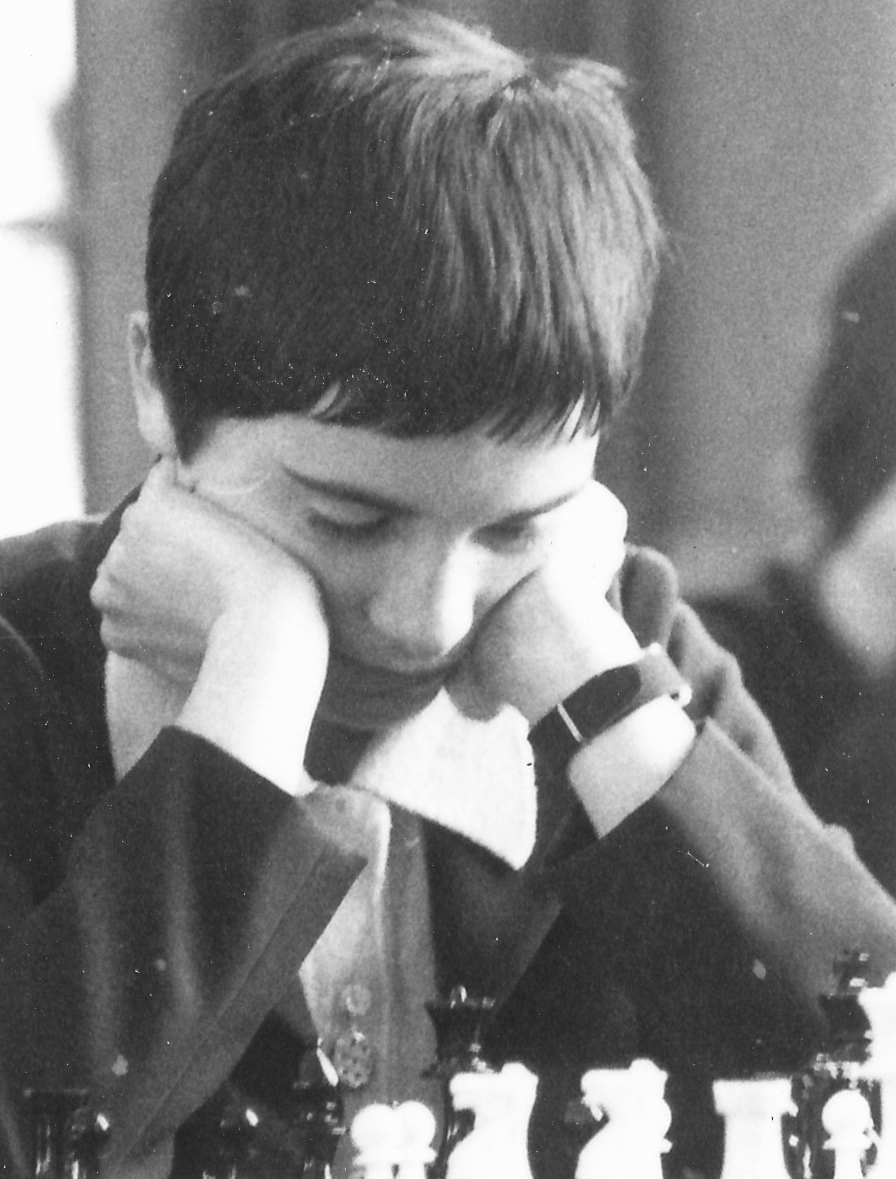
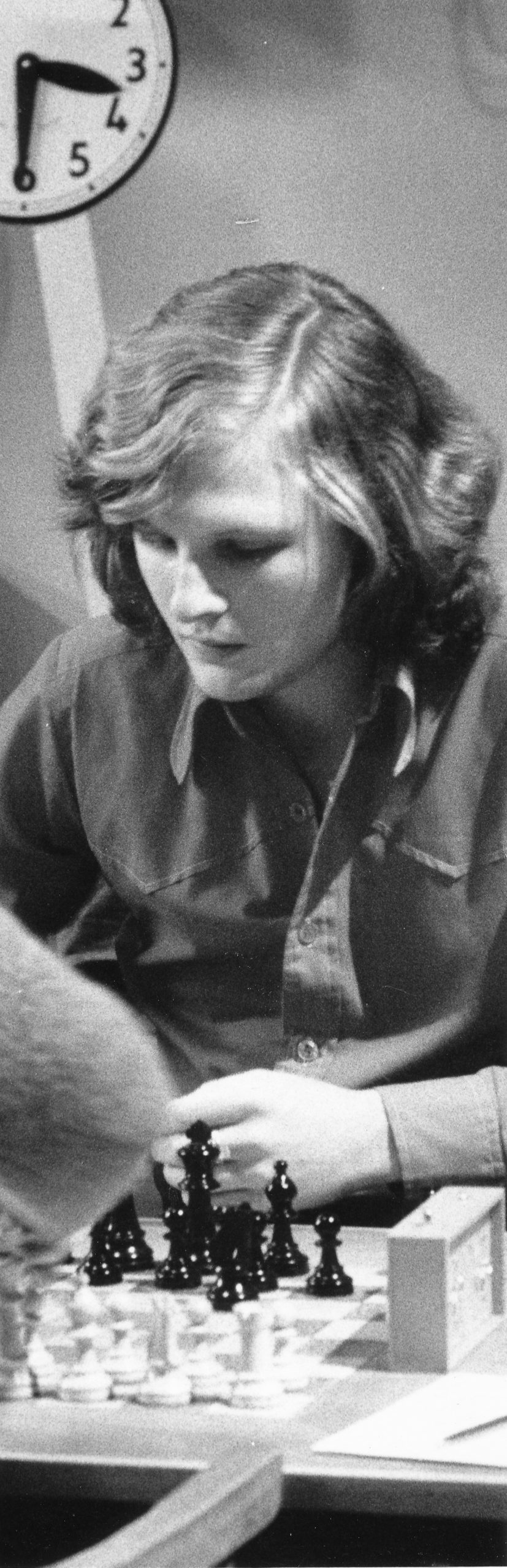
Peter Batchelor, 4NCL Final weekend, 2014, Courtesy of John Upham Photography
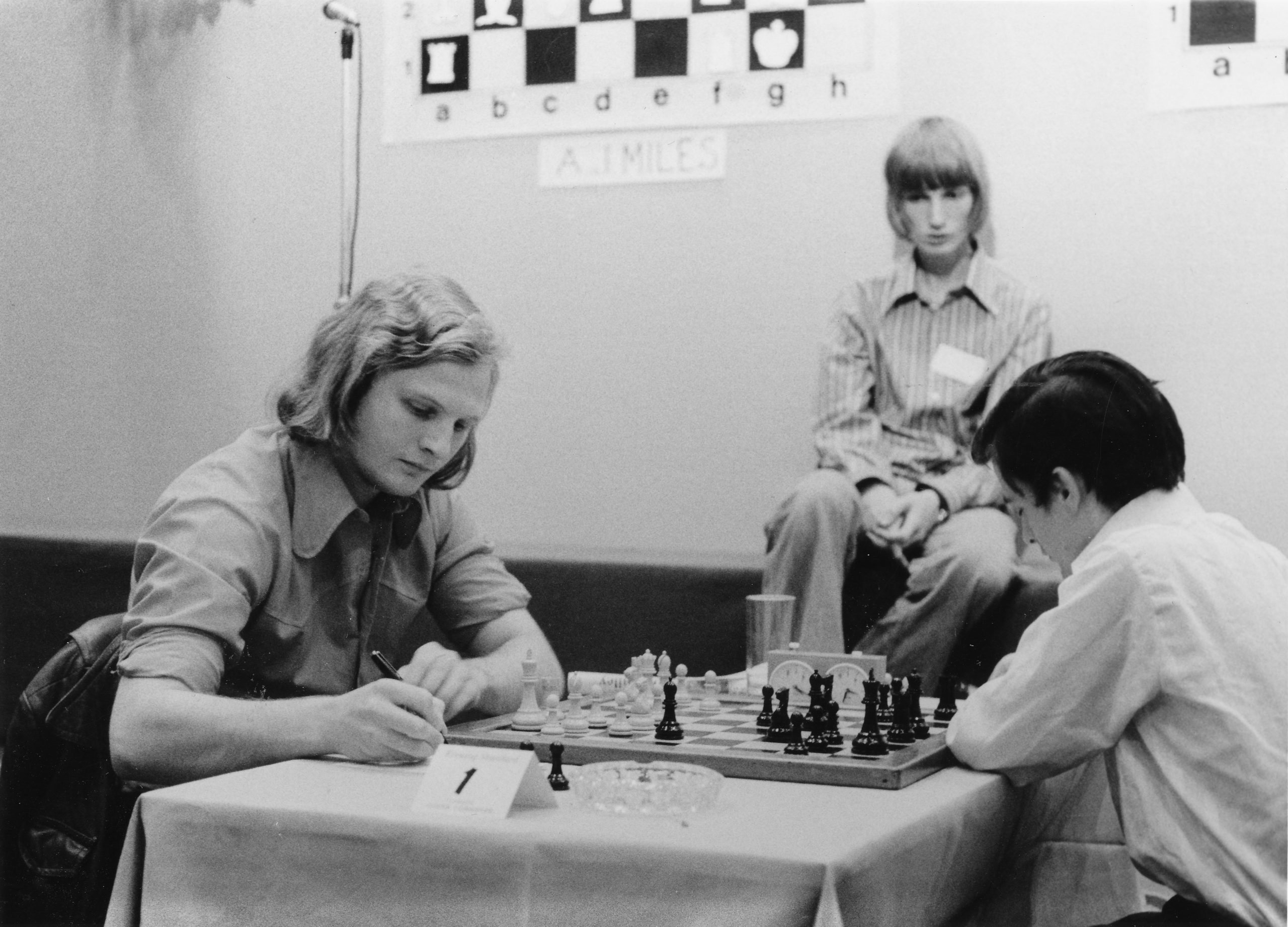
FM Peter Batchelor at the 2013 British Championships, Courtesy of John Upham Photography
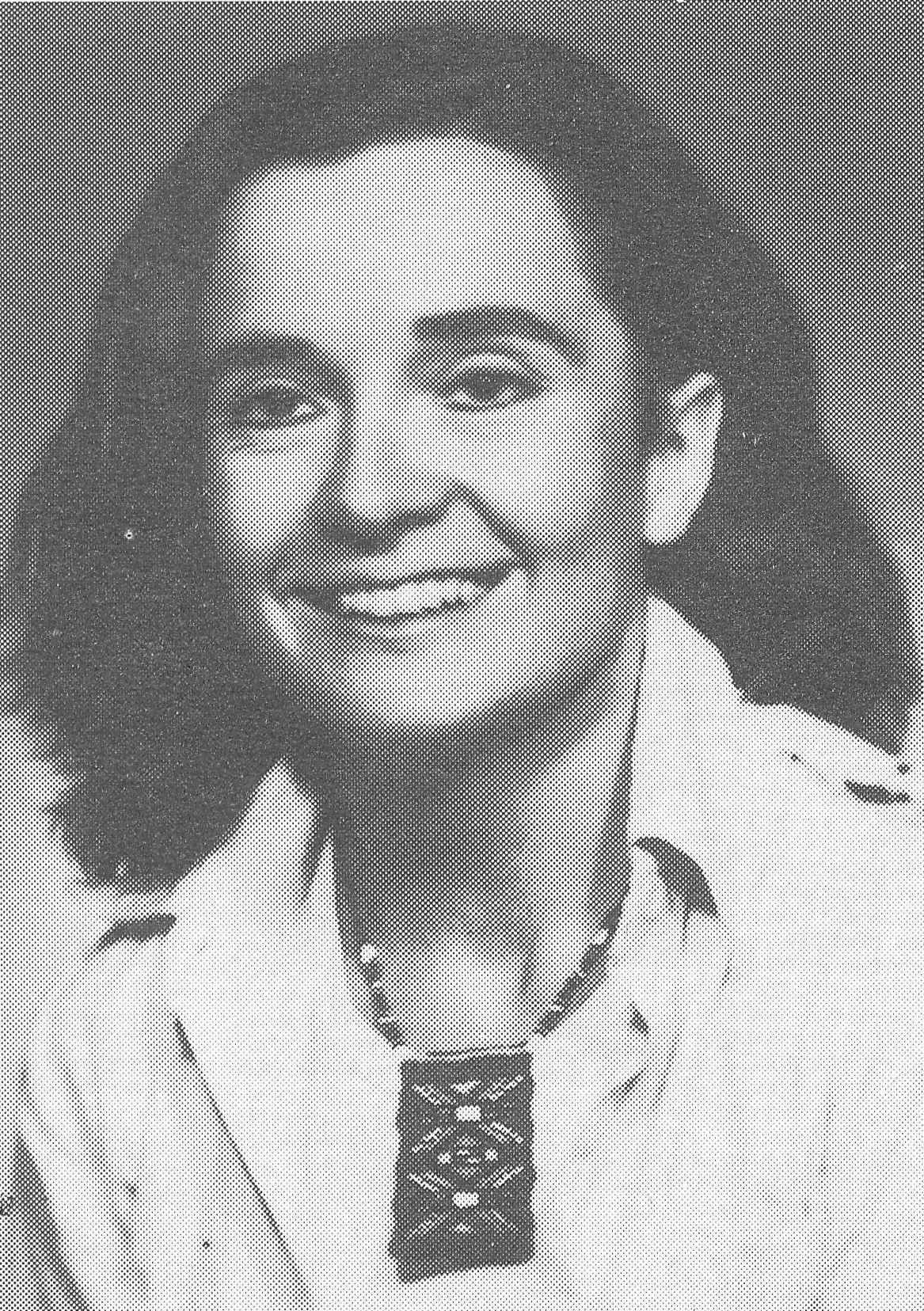
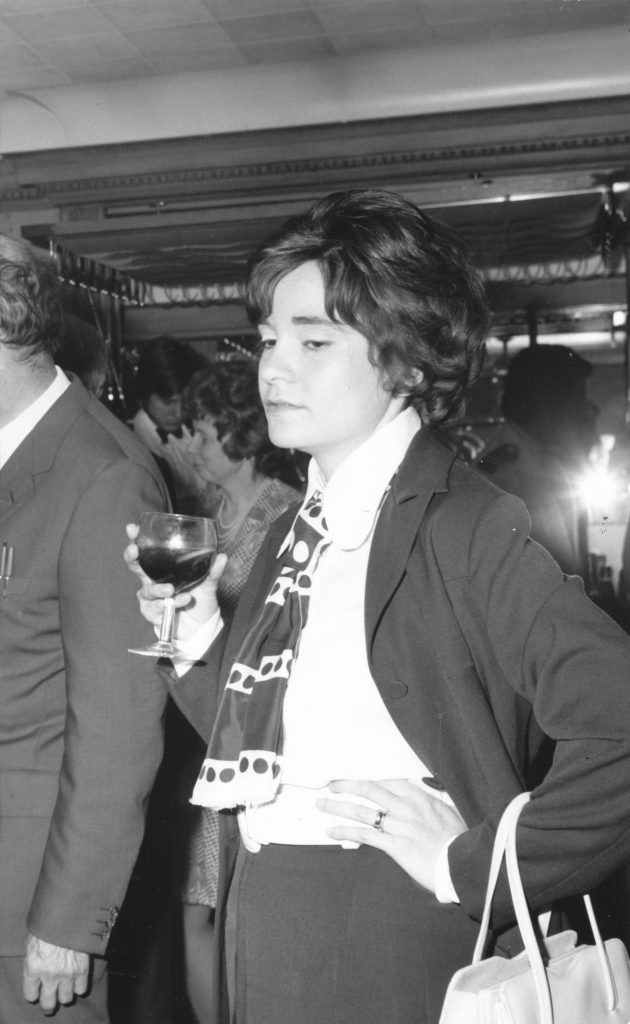
WGM Dr. Jana Bellin, Courtesy of John Upham Photography
Happy birthday WGM Dr. Jana Bellin on this day (December 9th) in 1947.
Jana Malypetrova
From The Encyclopedia of Chess (Robert Hale, 1970 & 1976), Anne Sunnucks :
“International Woman Master (1969), Czech Woman Champion in 1965 and 1967 and British Woman Champion since 1970.
Jana Malypetrova
Jana was born in Prague on the 9th December 1947 and learned to play chess at the age of eleven. She made her first appearance in the international field when she played 2nd board for Czechoslovakia in Women’s Chess Olympiad in Oberhausen in 1966.
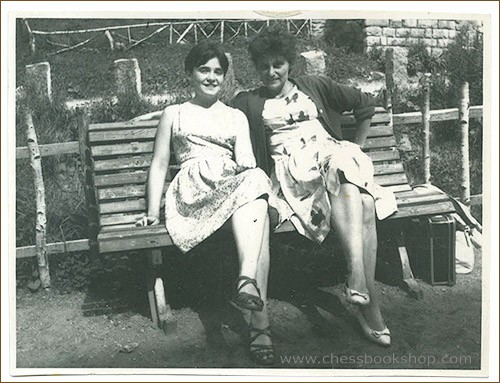
Jana Malypetrova and Inna Vesela, Harrachov 1963
In the same year she represented Czechoslovakia in the Zonal tournament at Varna and came 11th.
Jana Malypetrova
She is now married to the British International Master, William Hartston, and played 1st board for England in the Women’s Chess Olympiad in Skopje in 1972 and represented England in the Zonal tournament in Wijk aan Zee in 1973 in which she tied for 1st place. In the same year she came =6th in the Interzonal Tournament. She is a doctor.”
Jana & Bill Hartston celebrate a family double at the British Championships in 1973 at Eastbourne
From The Encyclopedia of Chess (Batsford, 1977), Harry Golombek OBE :
“Born in Prague, Czechoslovakia, but moved to England in 1970 after her marriage to WR Hartston. Czechoslovak Woman champion in 1965 and 1967 (under her maiden name of Malypetrova) and British Ladies champion in the five years 1970 to 1974. International Woman master since 1969.”
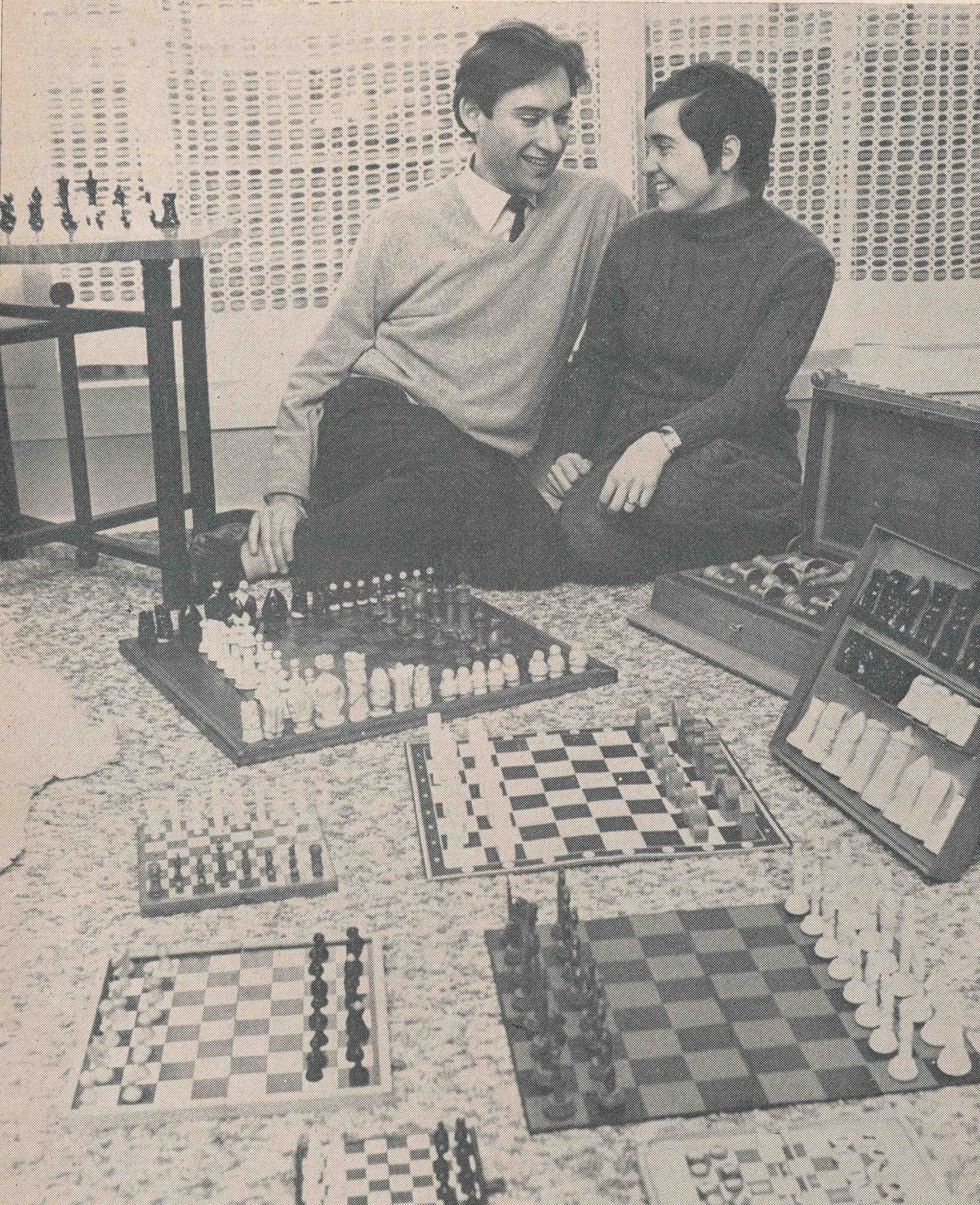
Bill and Jana Hartston are shown with some of their many chess sets. CHESS, August 1973, page 323
From British Chess (Pergamon Press, 1983) Botterill, Levy, Rice and Richardson :
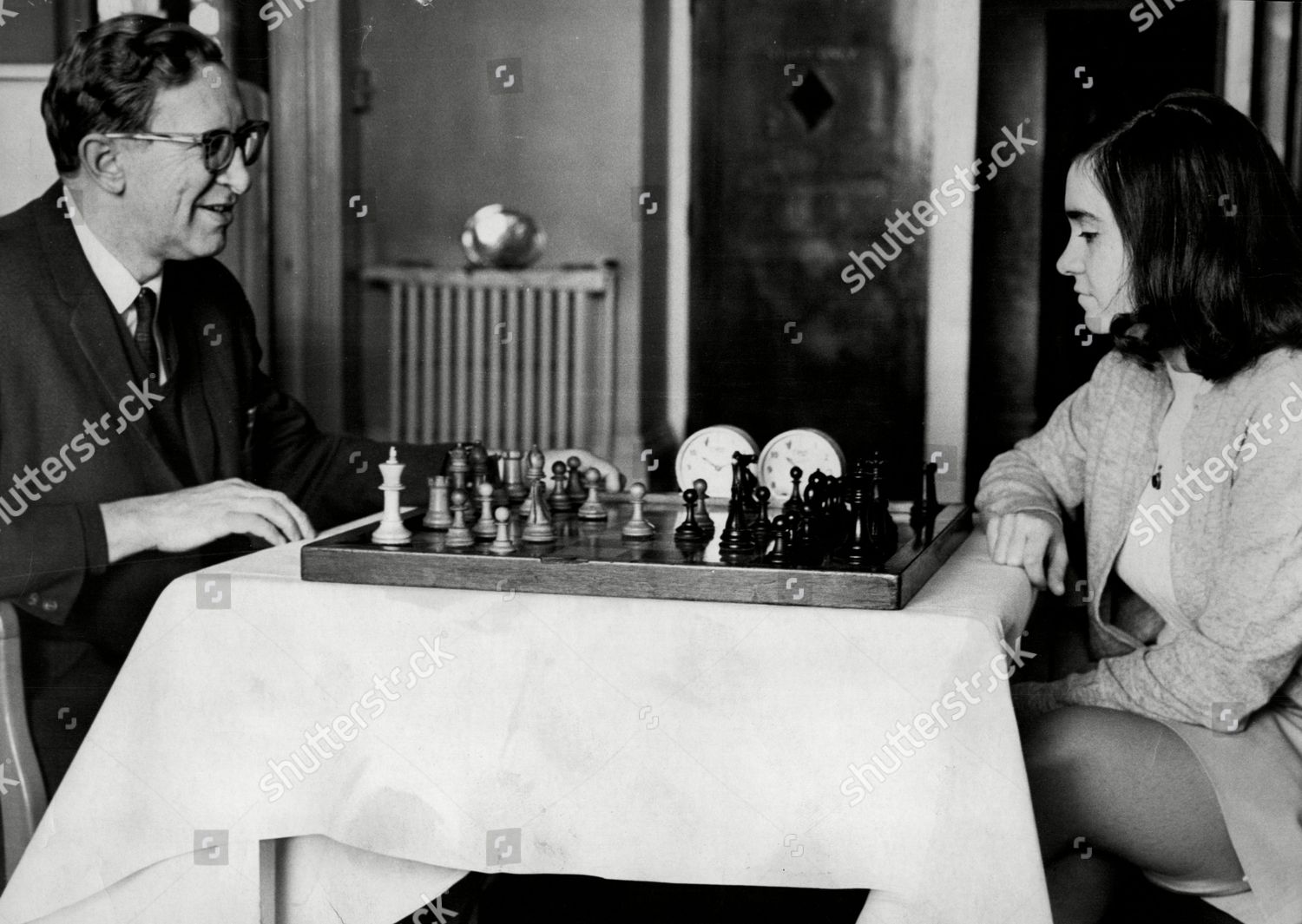
Hastings International Chess Congress 21 year old Jana Malypetrova From Czechoslovakia And Vassily Smyslov From Russia. Mandatory Credit: Photo by Michael Fresco/ANL/Shutterstock (1876232a)
“Jana Miles was born 9 December 1947 in Prague, Czechoslovakia. She moved to England when she married Bill Hartston. Divorced from Hartston in 1978, she subsequently married Tony Miles.
Hastings International Chess Congress 21 year old Jana Malypetrova From Czechoslovakia And Vassily Smyslov From Russia. Mandatory Credit: Photo by Michael Fresco/ANL/Shutterstock (1876232a)
She was Czech woman champion in 1965 and 1967 and has regularly been the British Ladies Champion since moving to this country. She is a doctor of medicine.”
Bill and Dr, Jana Hartston (née Malypetrova)
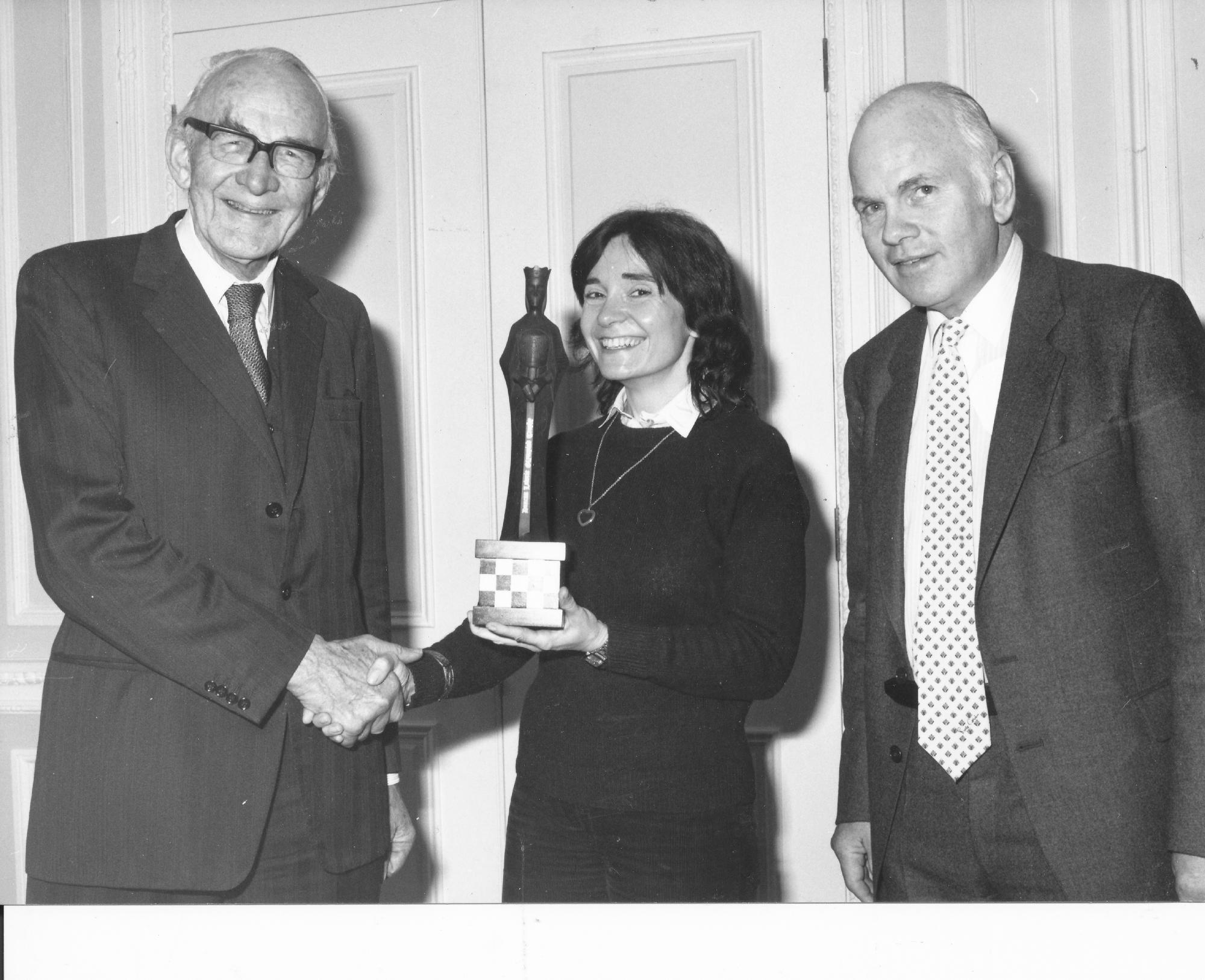
Sir Philip Stuart Milner-Barry OBE presents Dr. Jana Hartston with the ? prize
“Jana Bellin (née Malypetrová; born 9 December 1947) is a British, formerly Czechoslovak chess player. She was awarded the Woman International Master chess title in 1969 and the Woman Grandmaster title in 1982.
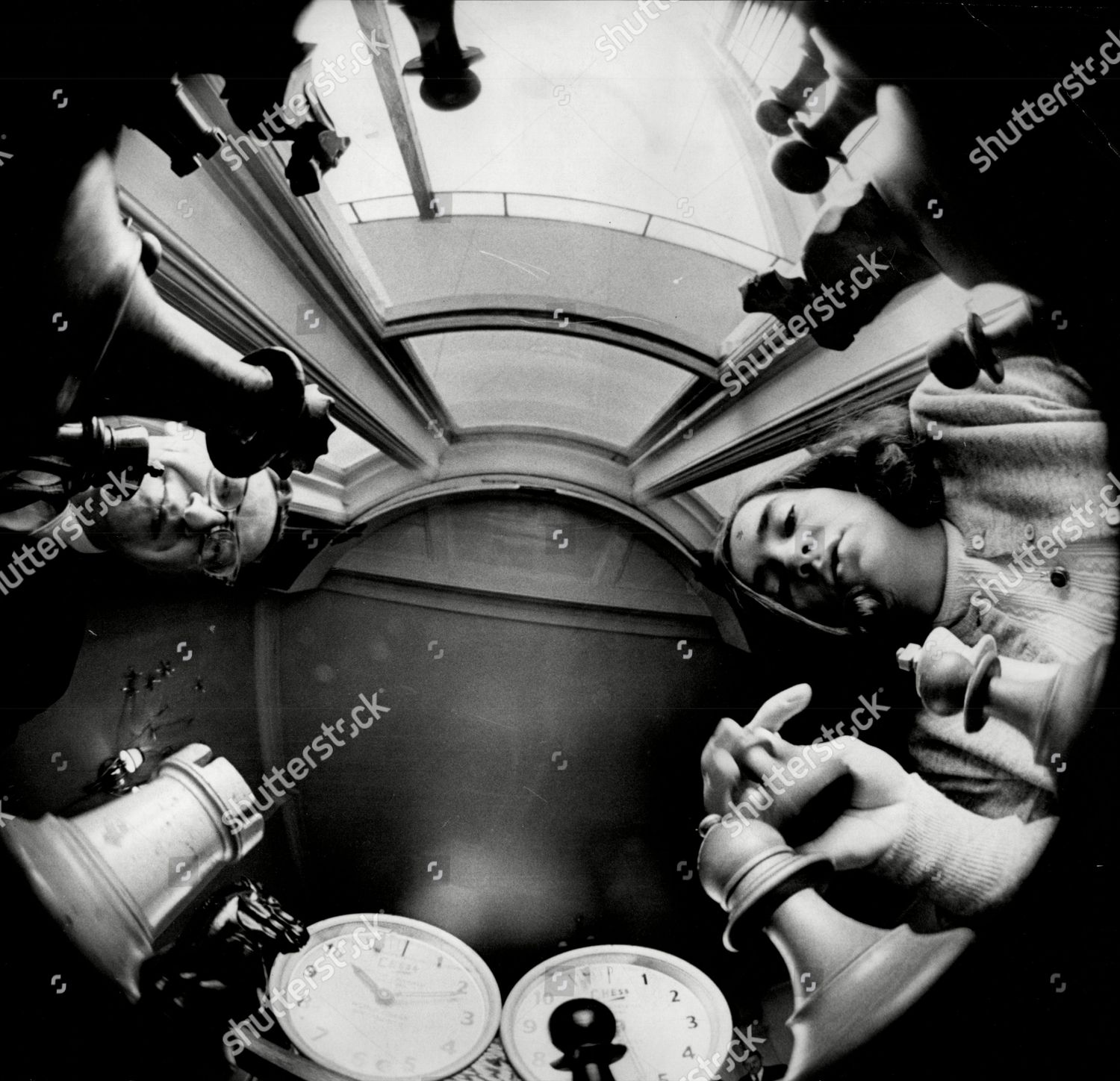
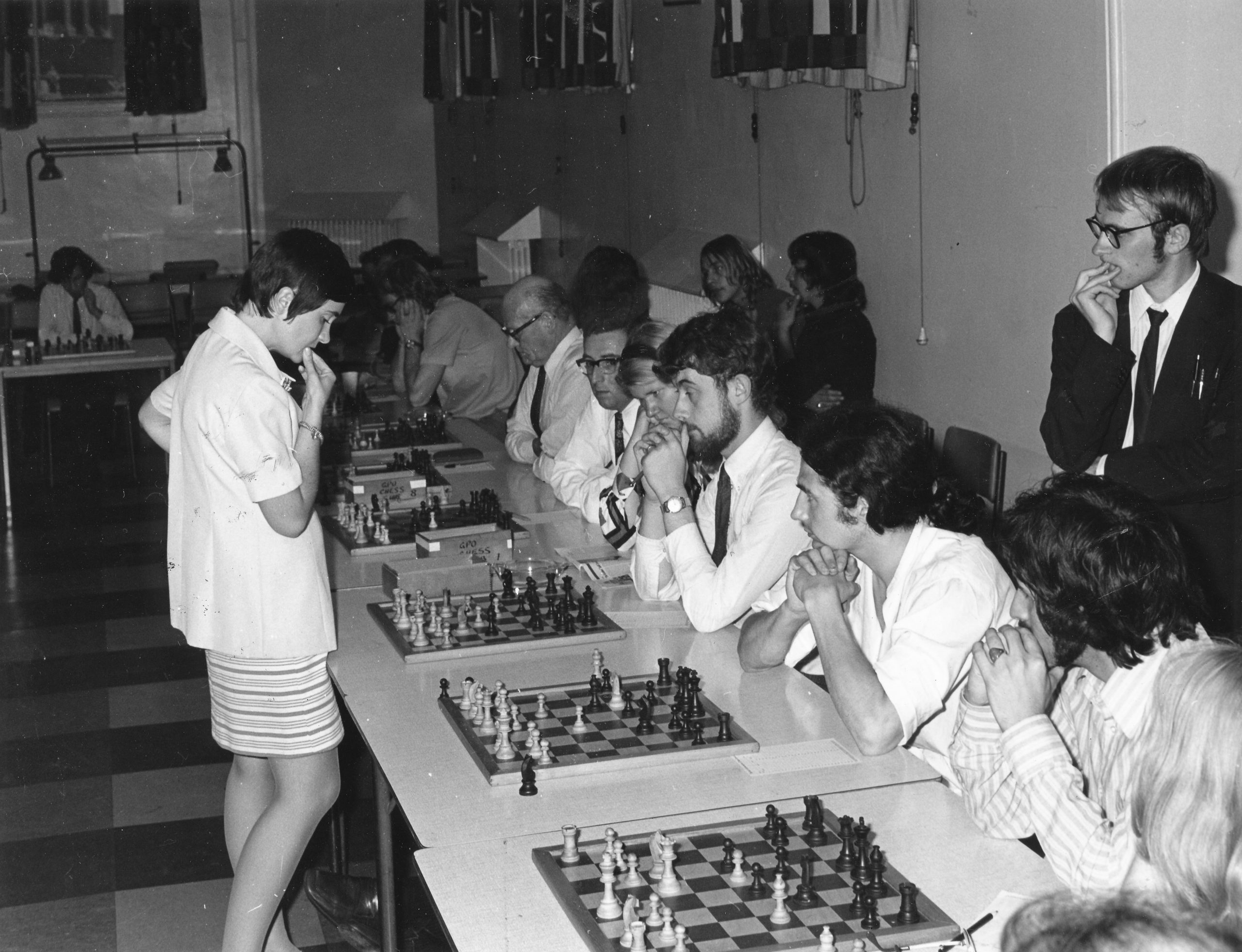
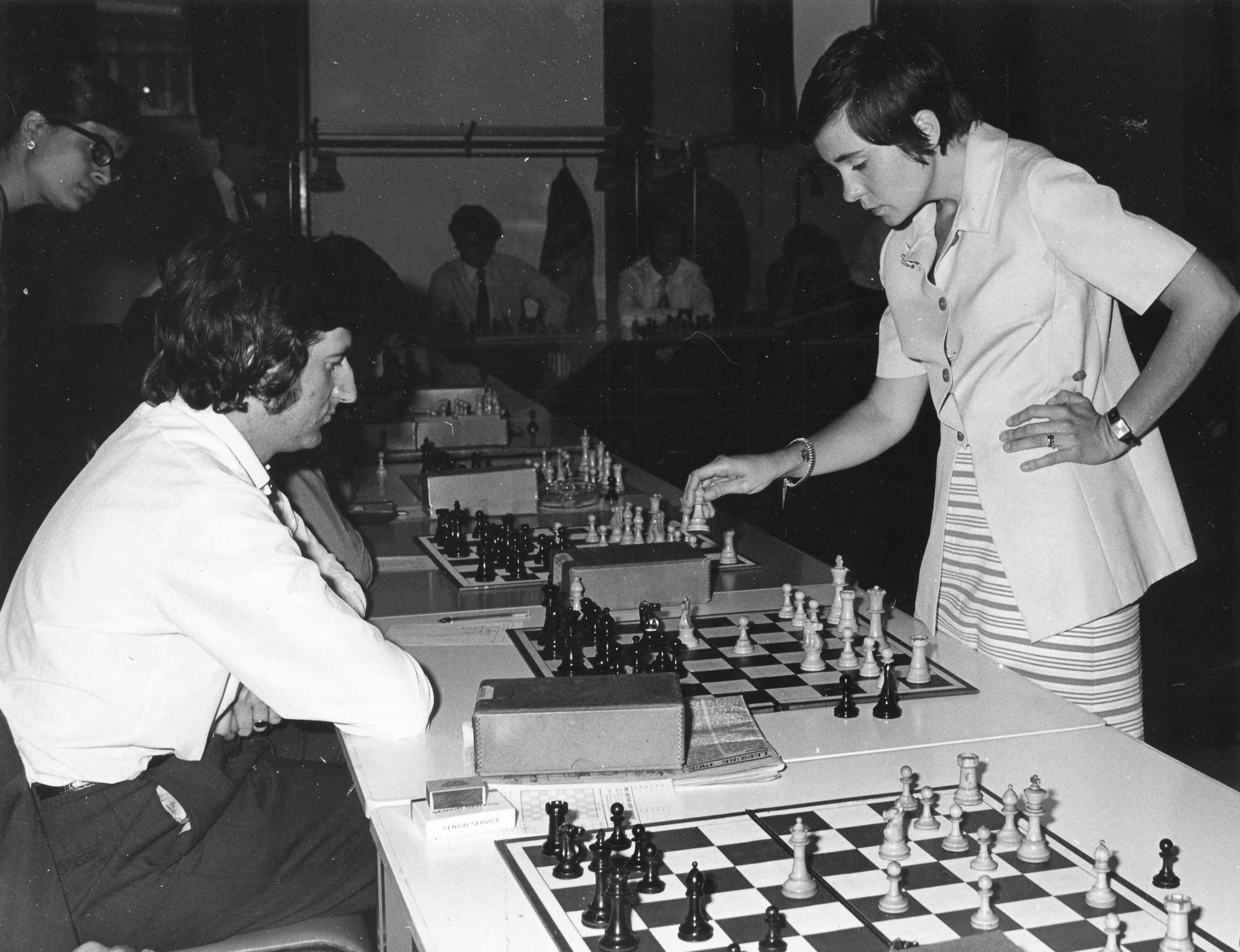
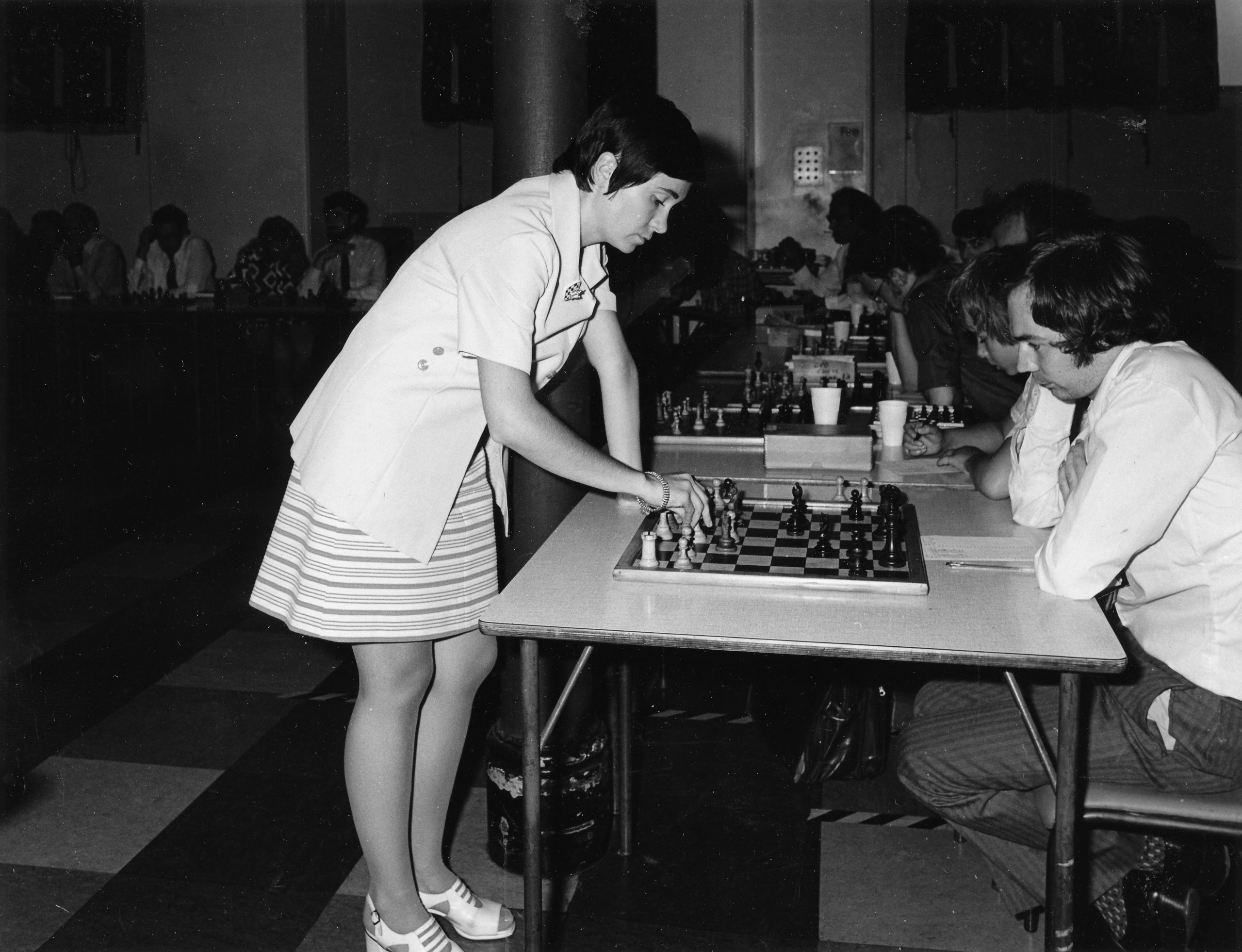
Moment of concentration for reigning women’s champion of Great Britain Jana Hartston and some of the 30 Post Officer players – all men who challenged her at postal headquarters London on September 6. Jana beat seven, drew with sixteen and lost to seven.
Bellin was born in Prague, Czechoslovakia. She was the Czech Women’s Champion in 1965 and 1967 under her maiden name of Malypetrová. After her marriage to William Hartston she moved to England in 1970 and won the British Women’s Championship in 1970, 1971, 1972, 1973, 1974, 1976, 1977 (after a play-off), and 1979.
Moment of concentration for reigning women’s champion of Great Britain Jana Hartston and some of the 30 Post Officer players – all men who challenged her at postal headquarters London on September 6. Jana beat seven, drew with sixteen and lost to seven.
She has fifteen appearances in the Women’s Chess Olympiads, representing Czechoslovakia in 1966 and 1969 and England thirteen times from 1972 through 2006, seven times on first board.
Moment of concentration for reigning women’s champion of Great Britain Jana Hartston and some of the 30 Post Officer players – all men who challenged her at postal headquarters London on September 6. Jana beat seven, drew with sixteen and lost to seven.
At the Olympiad she earned individual silver medals in 1966 and 1976, a team bronze medal in 1968 with the Czechoslovakian team, and a team silver in 1976 with England.
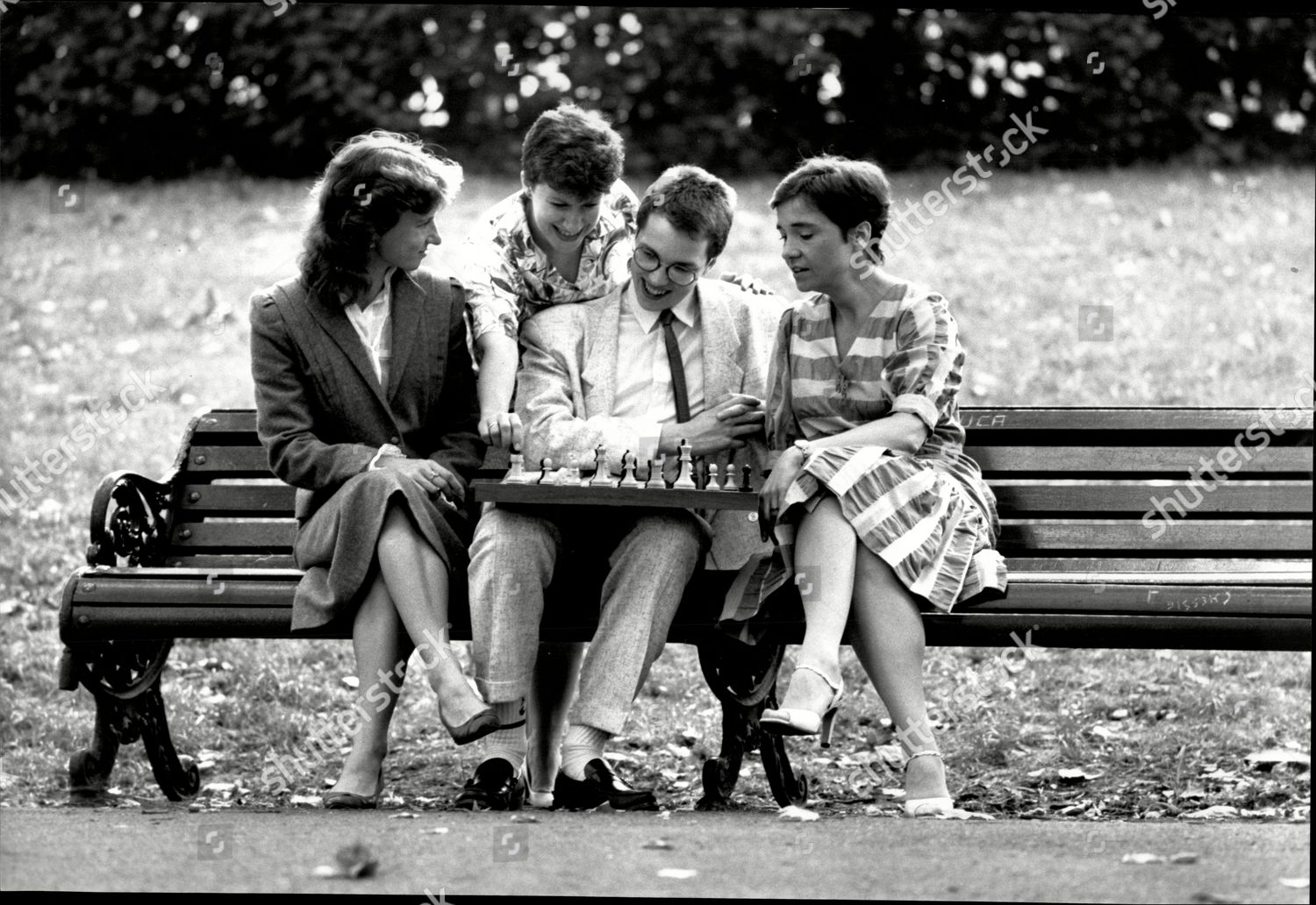
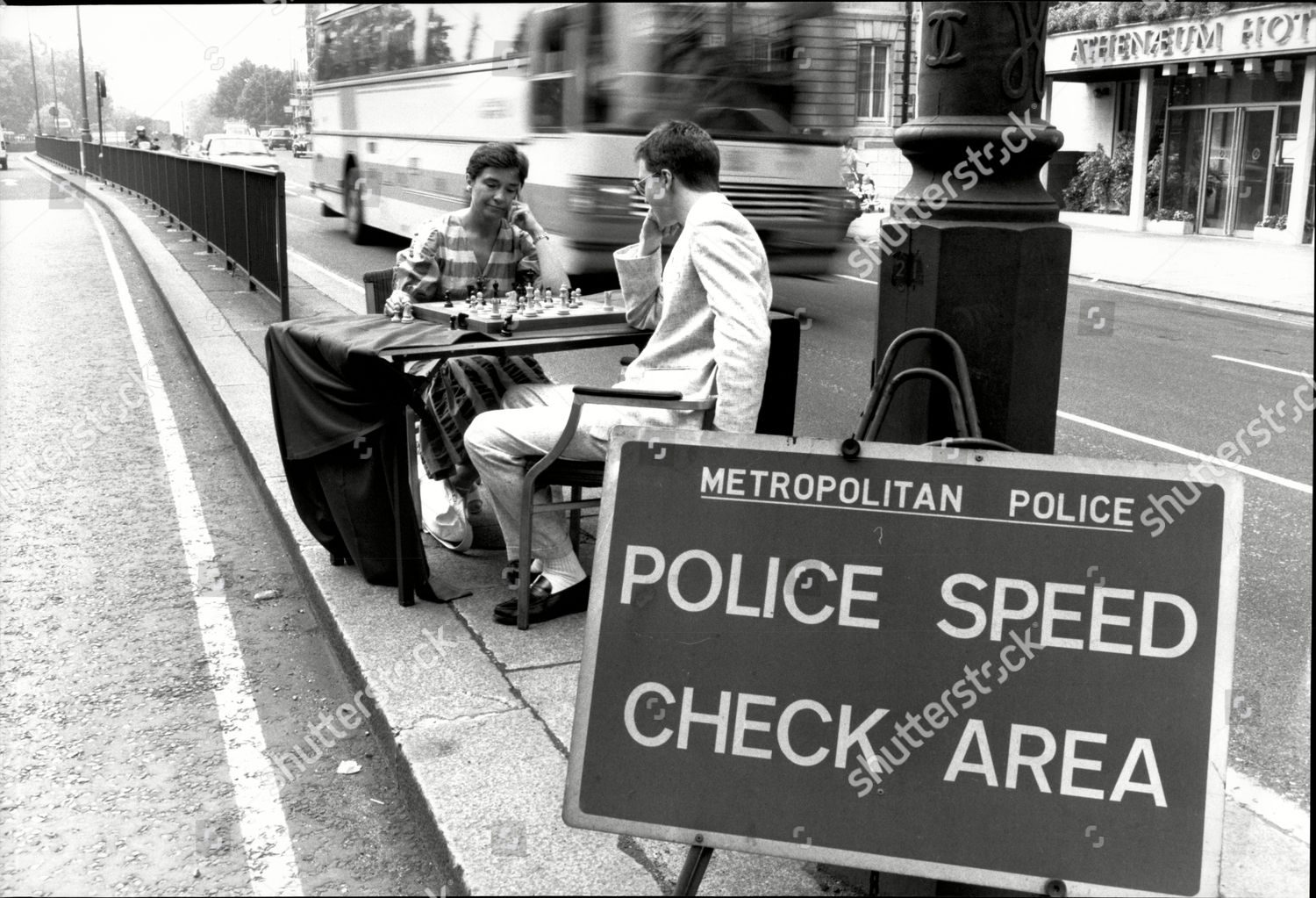
British Speed Chess Championship Grandmaster Nigel Short Playing Chess In The Park With L-r Susan Arkell Sheila Jackson And Dr Jana Miles. Courtesy of Shutterstock
“Bellin is a medical doctor specialising in anaesthetics, and works in intensive care at Sandwell General Hospital, West Bromwich, England.
Jana with Sheila Jackson to her left
She is also Chairman of the FIDE Medical Commission, which supervises drug testing of chess players.
British Speed Chess Championship Grandmaster Nigel Short Playing Chess In The Street With Woman Grandmaster Dr Jana Miles : Credit : Shutterstock
Bellin was married first to International Master William Hartston, then to Grandmaster Tony Miles, and after that to International Master Robert Bellin. She and Bellin have two sons: Robert (born 1988) and Christopher (born 1991).”
Dr. Jana Bellin
She is the granddaughter of thrice Prime Minister of Czechoslovakia, Jan Malypetr. and cousin of author and human rights campaigner Jiří Stránský.
WGM Dr. Jana Bellin, Courtesy of John Upham Photography
We wish happy birthday to IM John Hawksworth born on Friday, December 6th, 1963.
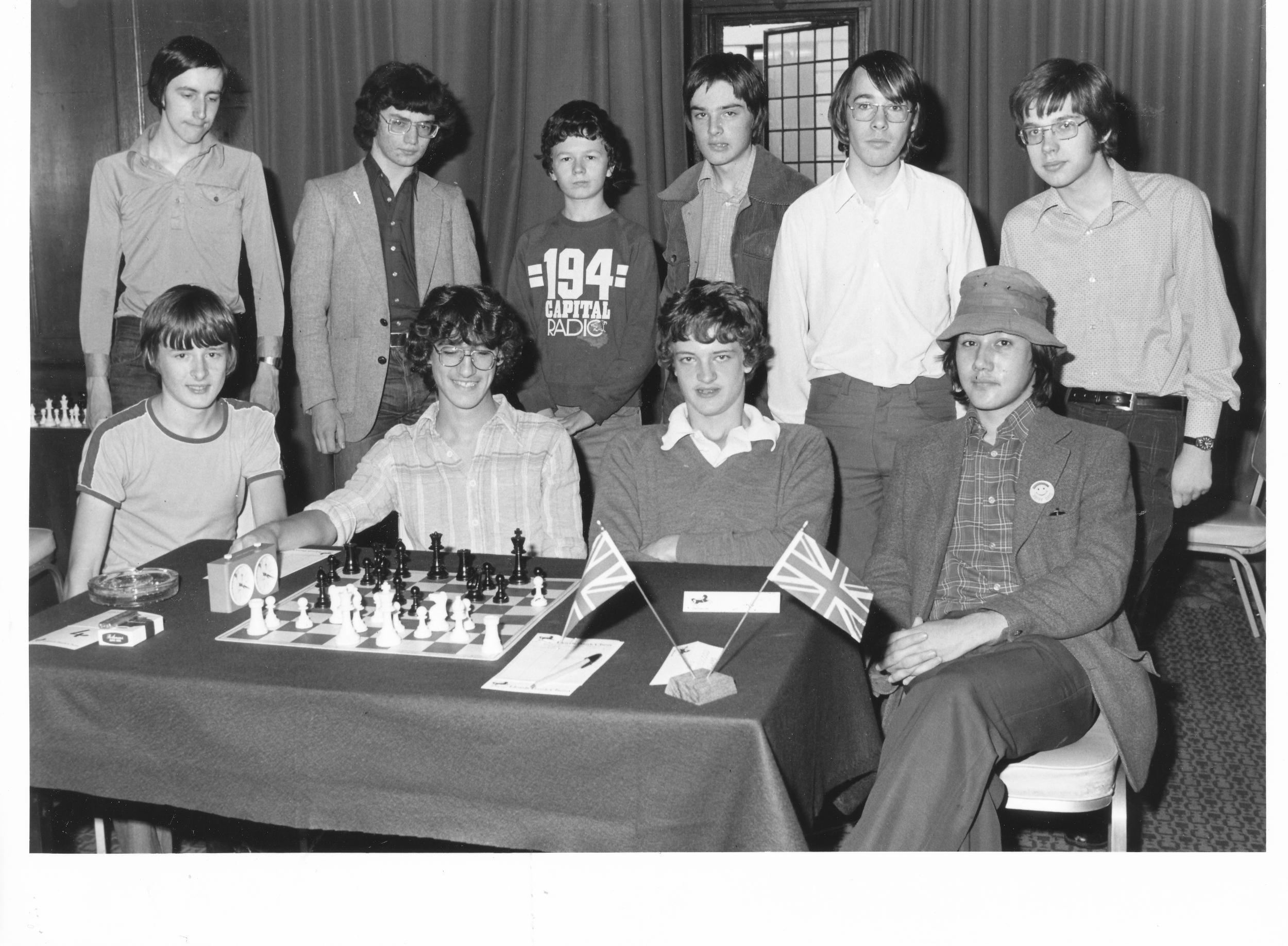
John Crofton Hawksworth was born in Brighton, England, in December 1963 to Robert Marshall Hawksworth and Norah Connor Hawksworth née Crofton. He was baptised at St Saviour’s Church of England church in Pimlico, London, in 1964.
The following was written (presumably by LWB) about John who was 15 just prior to the Spassky vs the BCF Junior Squad simultaneous display in 1979 :
“Bradford Grammar and Bradford. Rating 194. Yorkshire under-18 champion.”
He was awarded the IM title in 1986.
According to ChessBase his highest FIDE rating was 2370 in January, 1990 aged 27 which was the last year of serious competition at the 77th British Championships in Eastbourne.
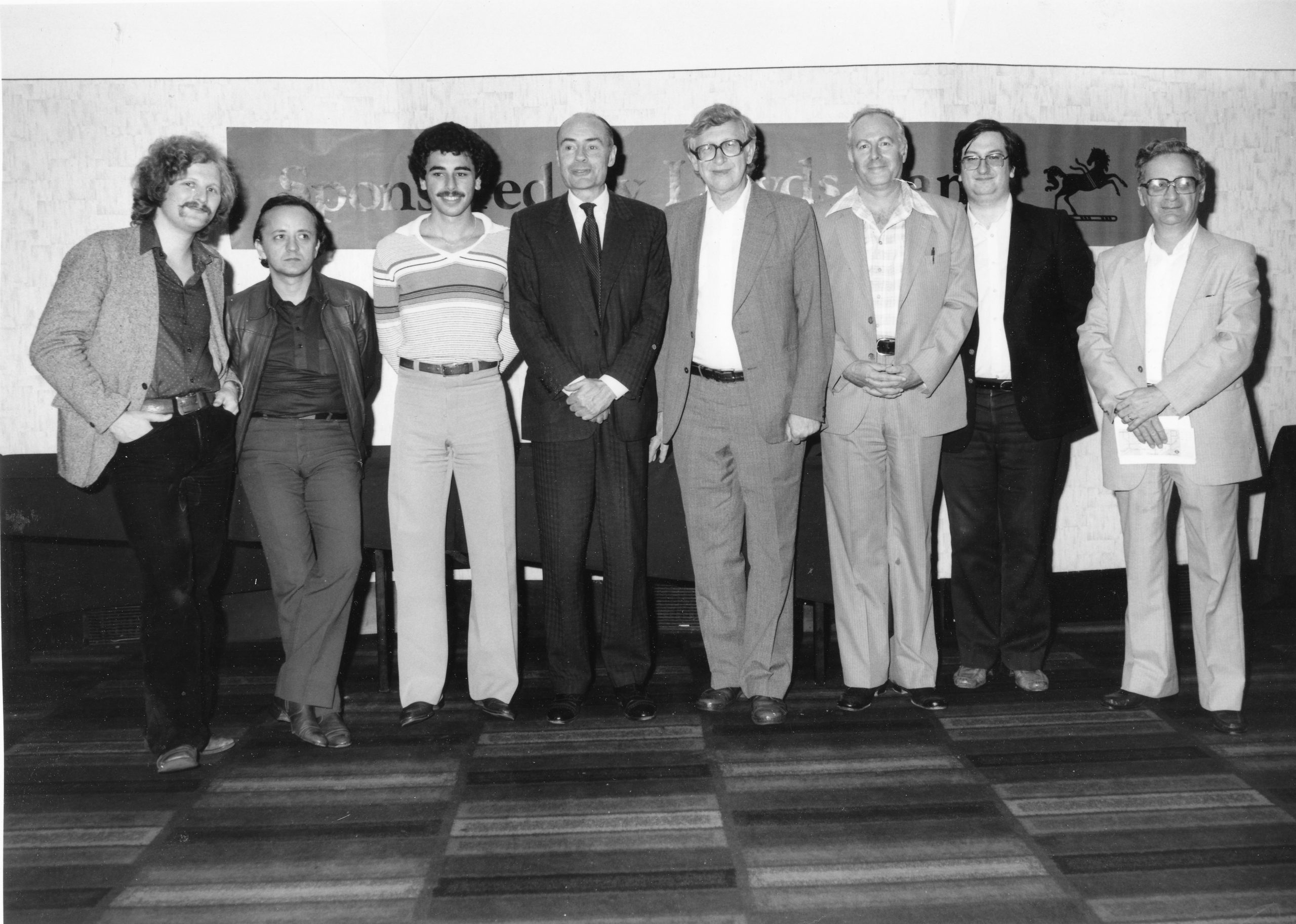
IM John Crofton Hawksworth (standing, second from right)At the Lloyds Bank Masters : Front (l-r) : Joel Benjamin, Ian Wells, Rear : Peter Morrish, Stewart Reuben, Richard Beville, Gary Senior, Richard Webb, John Hawksworth, Andrew King, Nigel Short, Mark Ginsburg, Daniel King, David Cummings, Erik Teichmann, John Brandford and Micheal Pagden
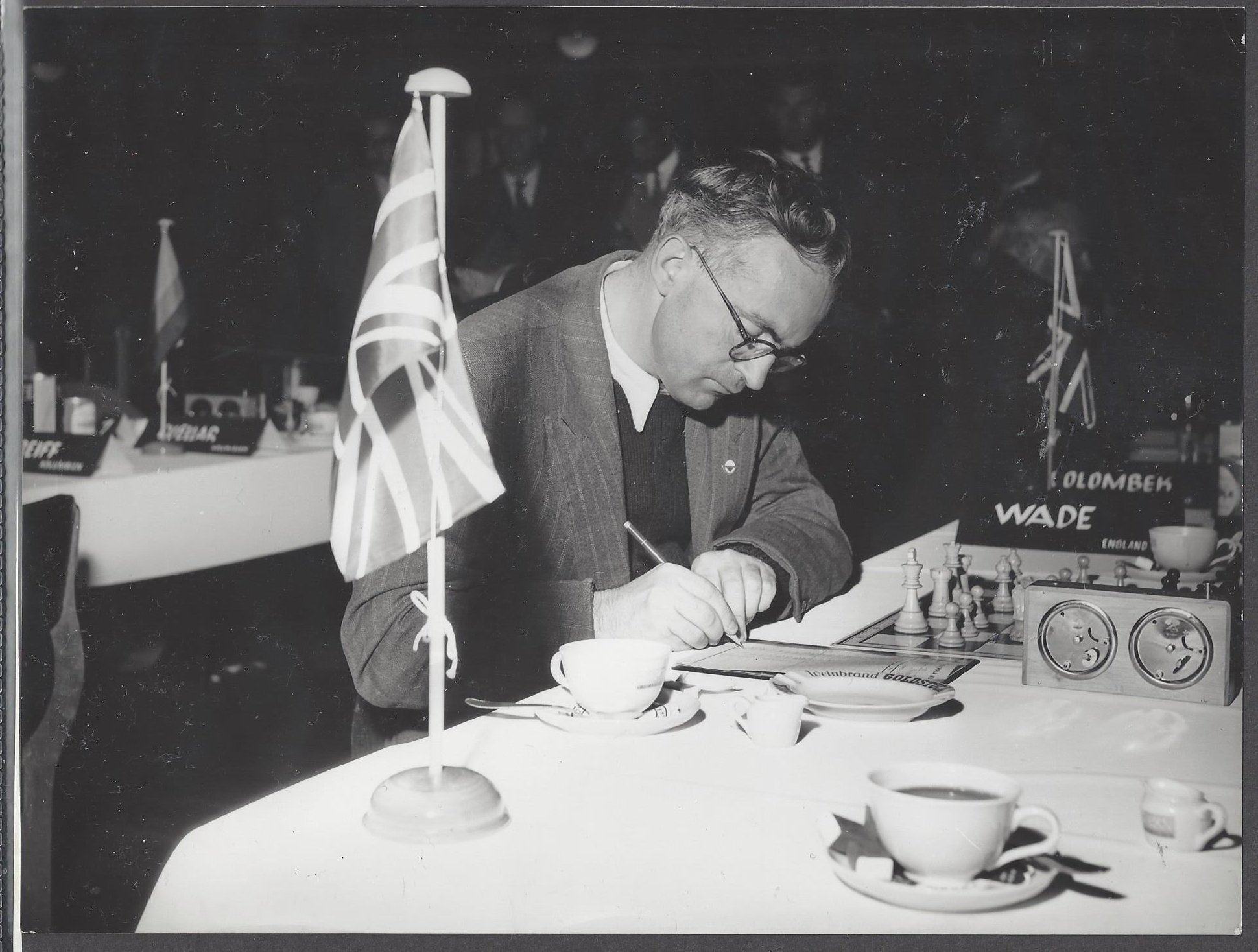
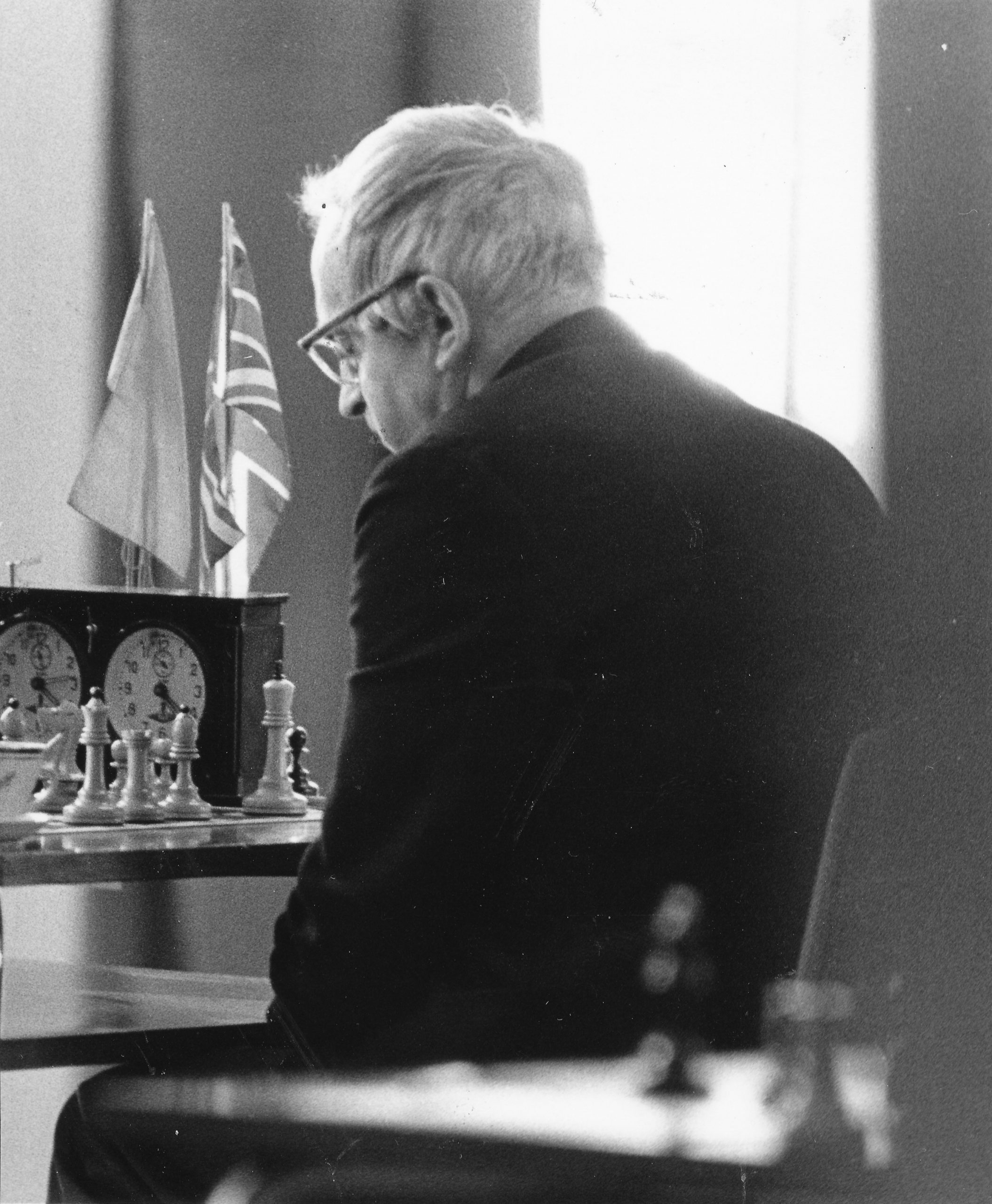
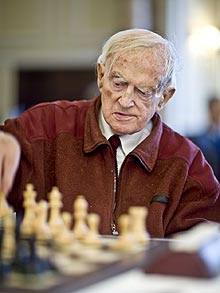
We remember IM Bob Wade OBE who was born 102 years ago today on Sunday, April 10th 1921
In 1979 Queen’s Birthday Honours List, Civil Division Bob Wade was awarded the OBE. The citation read simply : “For services to Chess”
He won the BCF Presidents’ Award in 1986.
In the Foreword to the 2009 ECF Yearbook, President Gerry Walsh wrote :
“As I started this report I had just heard the sad news that IM Bob Wade had died aged 87. I first met Bob at one of the Whitby Congresses and in 1972 he played in the Teeside GM Tournament where I recall he beat the three Hungarian players Portisch, Bilek and Sax (ed : aged 51).”
“I received the sad news that Bob Wade passed away at the age of eighty seven. He played his last tournament in London in August. When I was young I read about his exploits as a chess player, and he was the arbiter in many important chess events. I met him in 1993 when I was the organizer of the first part of the match Karpov – Timman, played in The Netherlands in three different cities: Zwolle, Arnhem, and Amsterdam. He was the only member of the Appeals Committee and Bob was always present watching the games in the playing hall. He gave me invaluable advice about all elements of the match venues. It was very clear that he was an experienced chess player and arbiter, and I learned many things from him. May he rest in peace.”
From the 1952 Ilford Congress (30 May – 2 June) and originally published in BCM, July 1952, page 187. (l-r) : Harold Israel, Alan Phillips, Bob Wade, Otto Friedman, Abe Yanofsky, Alfred William Bowen and Harold Meek. Thanks to John Saunders and Leonard Barden
Wade was Southern Counties (SCCU) champion for the 1956-57, 1957-58 and 1964-65 seasons.
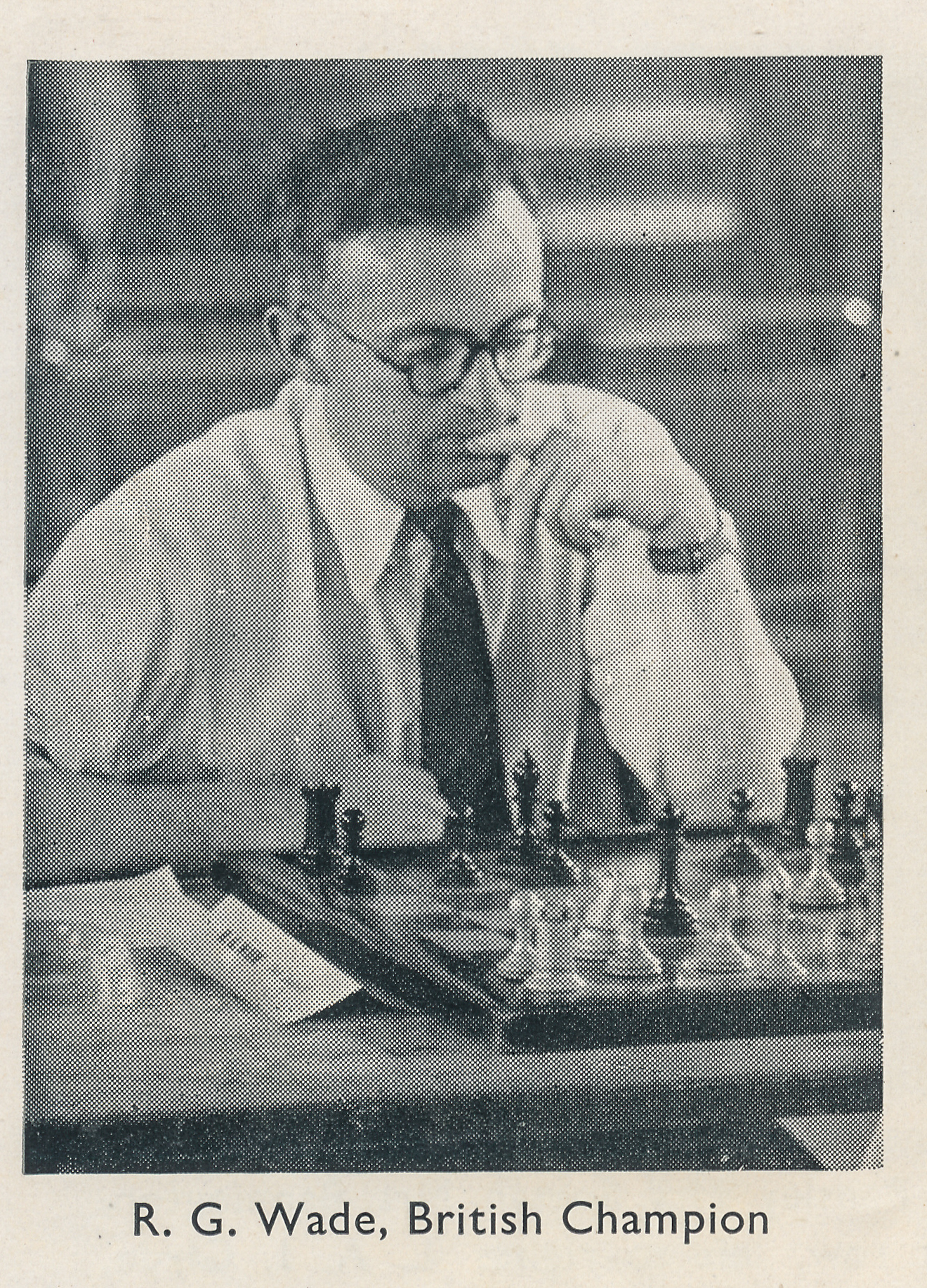
R. G. Wade, British Champion
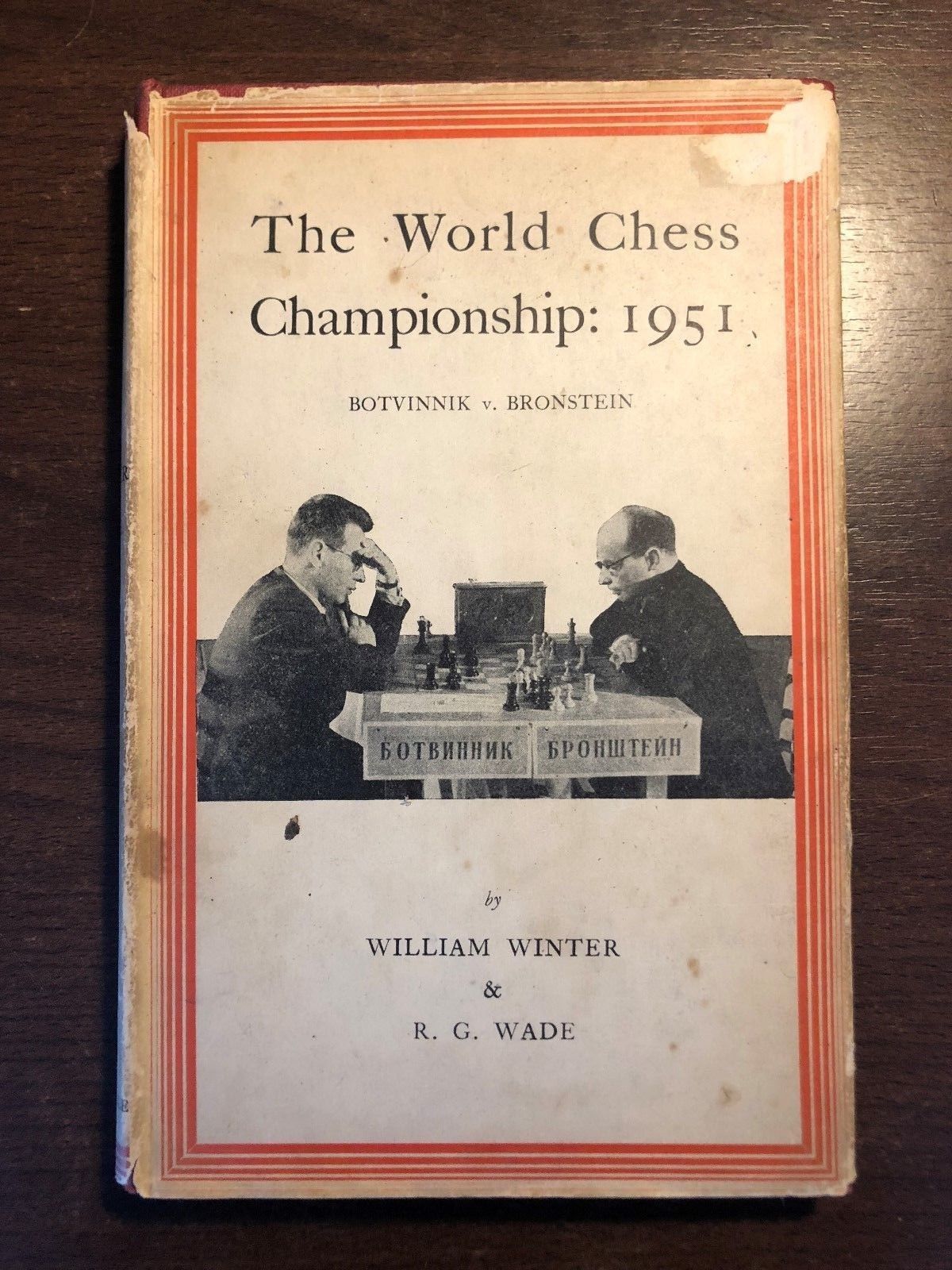
From the Preface of The World Chess Championship : 1951 by Lionel Sharples Penrose we have :
“Mr. Wade is also passionately devoted to the game. Before coming to Europe, he was three times champion of New Zealand. He had played in tournaments in England but his chief successes have been on the Continent. At Venice in 1950, he obtained a high place in a very severe contest in which some of the strongest Russia, Czech, Dutch, French, Italian, North and South American players took part. Much of his time is occupied in chess organising and teaching. He is an acting vice-president of the F.I.D.É and in this official capacity he attended the match in Moscow, which is the subject of this book.”
“On May 20th, 1919, Thomas Graham Wade, aged 27, Sergeant in the NZ Expeditionary Force, repatriated with honour from war-time service in Egypt, Gallipoli and France, married Amy Lilian Neave, aged 21, in South Dunedin. A New Zealander of Scots and English descent, his family was Graham from Montrose. The family name, Wade, came from Marshall George Wade, the soldier and engineer who led the Hanoverian forces against the Scots at the time of the 1745 Jacobite Rebellion and was immortalised in the original third verse of the British national anthem:
Lord, grant that Marshal Wade, May by thy mighty aid, Victory bring.
May he sedition hush and like a torrent rush, Rebellious Scots to crush, God save the King.
IM Bob Wade
Robert Graham Wade, known in the Scots manner to his family as Robin, and later to his many friends as Bob, was their first child, born April 10th, 1921, at Dunedin. Over the next few years he was joined by sisters, Lilian, Agnes, Betty, June, his brother Ted and finally by his youngest sister Amy. The family lived for a number of years at Portobello.
At that time, Portobello was a scattered community of about 150 people with three shops and a pub on the Otago Peninsula. Bob attended Portobello Primary School, a small country school, finished “dux” or top of class, and then attended the King Edward Technical High School at Stuart Street in Dunedin.”
IM Bob Wade
In The Oxford Companion to Chess (OUP, 1984 & 1996), Hooper & Whyld:
“Wade Variation, 147, also known as the Modern Variation, in the Queen’s Gambit Declined, Meran Variation, from Bogoljubow-Wade, Oldenburg, 1949;
1239 in the French Defence, introduced by Wade in a match against Schmid in 1950.
Hooper & Whyld go on to write :
“New Zealand-born Robert Graham Wade (1921- ) won the championship of his homeland three times before moving to England as a young man, He won the British Championship twice and trained many English players.”
Aside from the two variations mentioned by Hooper & Whyld there are other Wade Variations :
which Jim Plaskett dubbed the “Sidestep Variation”
and
which is the Pytel-Wade Variation of the Scandinavian Defence.
Anne Sunnucks wrote in The Encyclopaedia of Chess (Robert Hale, 1970 & 1976) :
“International Master (1950), International Judge (1958), New Zealand Champion three times and British Champion in 1952 and 1970.
Bob Wade was born in New Zealand on 10th April 1921 and is a professional chess player. He has lived in England for many years and has played regularly for the British Chess Federation team in Chess Olympiads. He has played a prominent part in coaching schemes for juniors and is largely responsible for recent successes of English juniors in international events.
Bob Wade v. Aldecoa of the Philippines from the 1958 Munich Olympiad played on October 9th 1958. The game was won by Bob in 60 moves. From the collection of David Jarrett with many thanks.
He is chess correspondent of Associated Newspapers and Independent Television News and editor of a series of books on Contemporary Chess Openings published by Batsford.
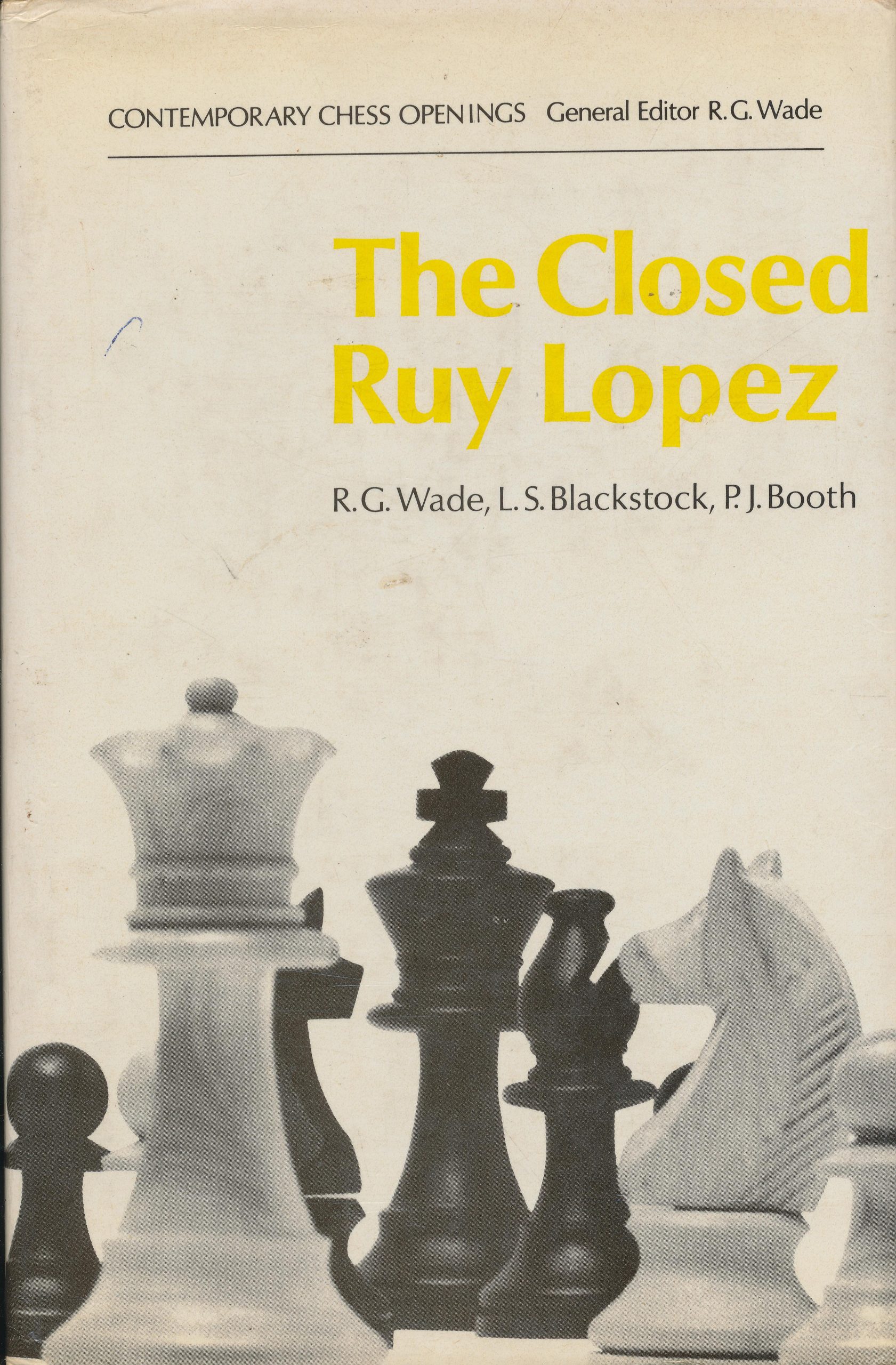
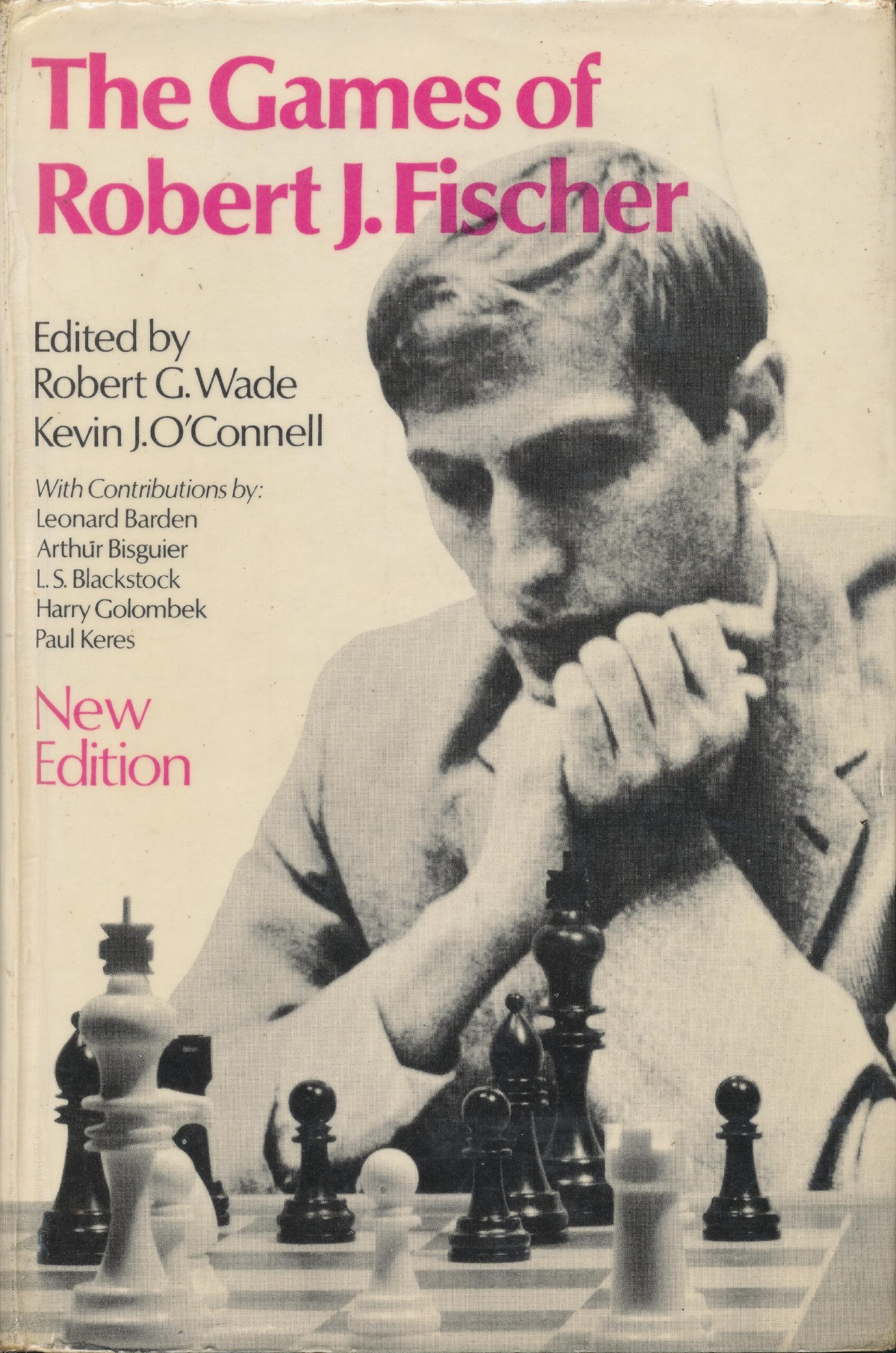
Author of a number of books on the game, his publications include books on the World Championship of 1951, 1957 (ed : this book was, in fact, by Golombek) and 1963, the first in collaboration with W. Winter; The Closed Ruy Lopez (Batsford, 1970) in collaboration with LS Blackstock and PJ Booth: World Chess Championship (Batsford, 1972) in collaboration with Svetozar Gligoric; Games of RJ Fischer (Batsford, 1972) in collaboration with KJ O’Connell and Soviet Chess (Neville Spearman, 1968).
Wade was a member of the FIDE Laws Commission from 1950 to 1952.”
From The Encyclopedia of Chess (Batsford, 1977), Harry Golombek OBE :
“International Master who was born at Dunedin, New Zealand, but came to live In England in 1946 and has represented both countries on different occasions. He has nearly always done well in British Championships and won the title in Chester in 1952 and again at Coventry in 1970. He had played for the British Chess Federation at the Olympiads of 1954, 1956, 1958, 1960 and 1962, winning the shortest game of the Varna Olympiad in that year in nine moves against Anton Kinzel of Austria
He played for the New Zealand team at the 1970 Olympiad at Siegen but returned to the BCF team at Skopje in 1972.
His best individual international results were a fifth place at Venice 1950 and again fifth at the Masters section of the Capablanca Memorial at Cienfuegos in Cuba in 1975. Possessor of a sharp clear-cut style of play, he once drew a match with the West German grandmaster Lothar Schmid with neither side drawing a game, though this was before Schmid received the grandmaster title.
He has done much valuable work in England teaching the young, and was responsible for the text of a highly successful television series in 1975.
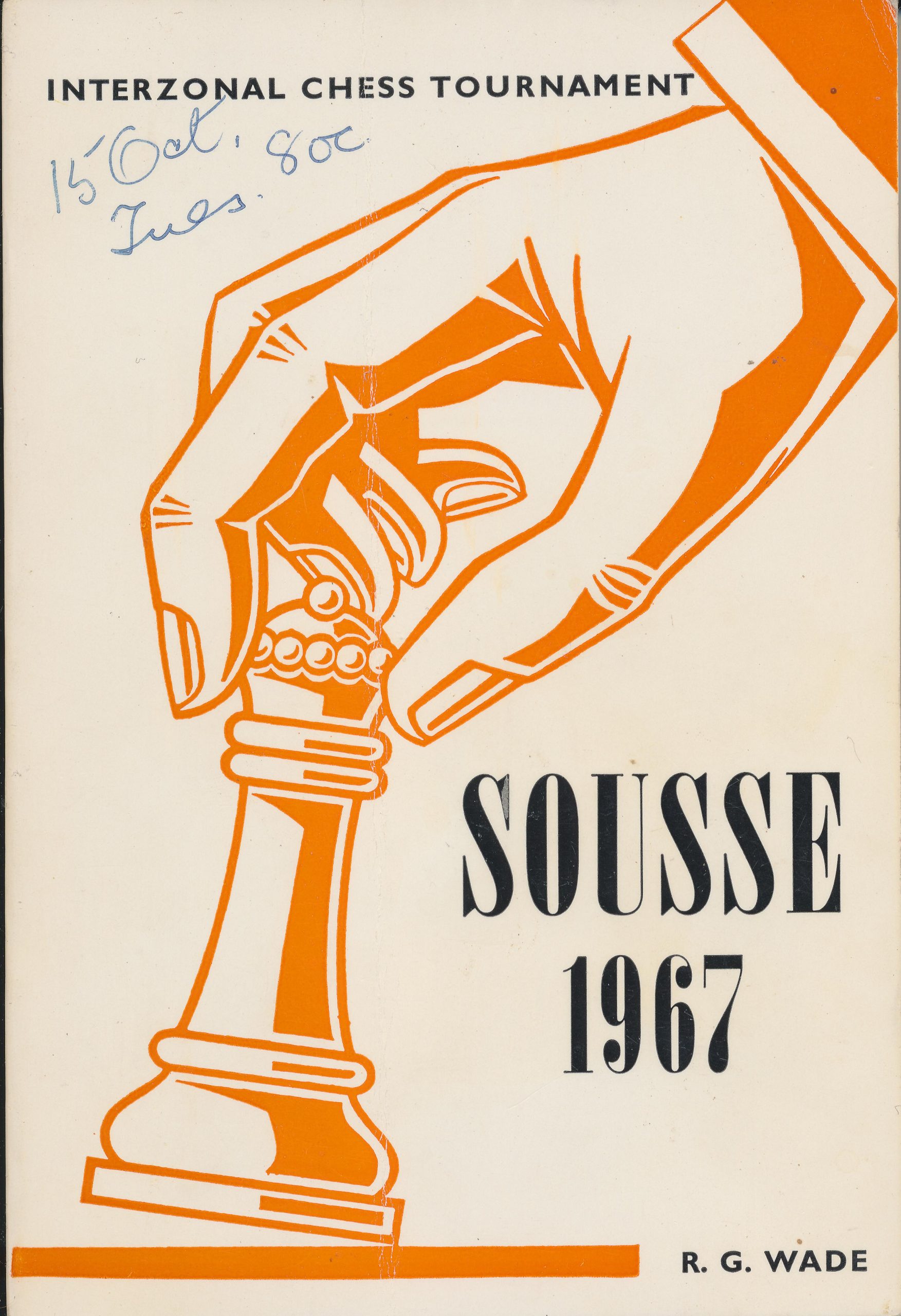
His main books are : Soviet Chess, London, 1967; Botvinnik-Bronstein Match 1951 (in co-operation with W. Winter), London, Toronto 1951; Match Petrosian-Botvinnik, London, 1963; Sousse 1967, The Chess Player, Nottingham, 1968.”
From British Chess (Pergamon Press, 1983) we have this article from George Botterill :
“In the Birthday Honours list of 1979 Bob Wade was awarded the OBE for his services to chess. Few rewards can have been more thoroughly earned. For some reason, Bob has always been held in greater esteem abroad than in the country for which he has done so much. But the many players who have turned to him for advice or who have simply enjoyed his hospitality, which is always ungrudgingly available to fellow chess players, know the measure of his dedication to the game.
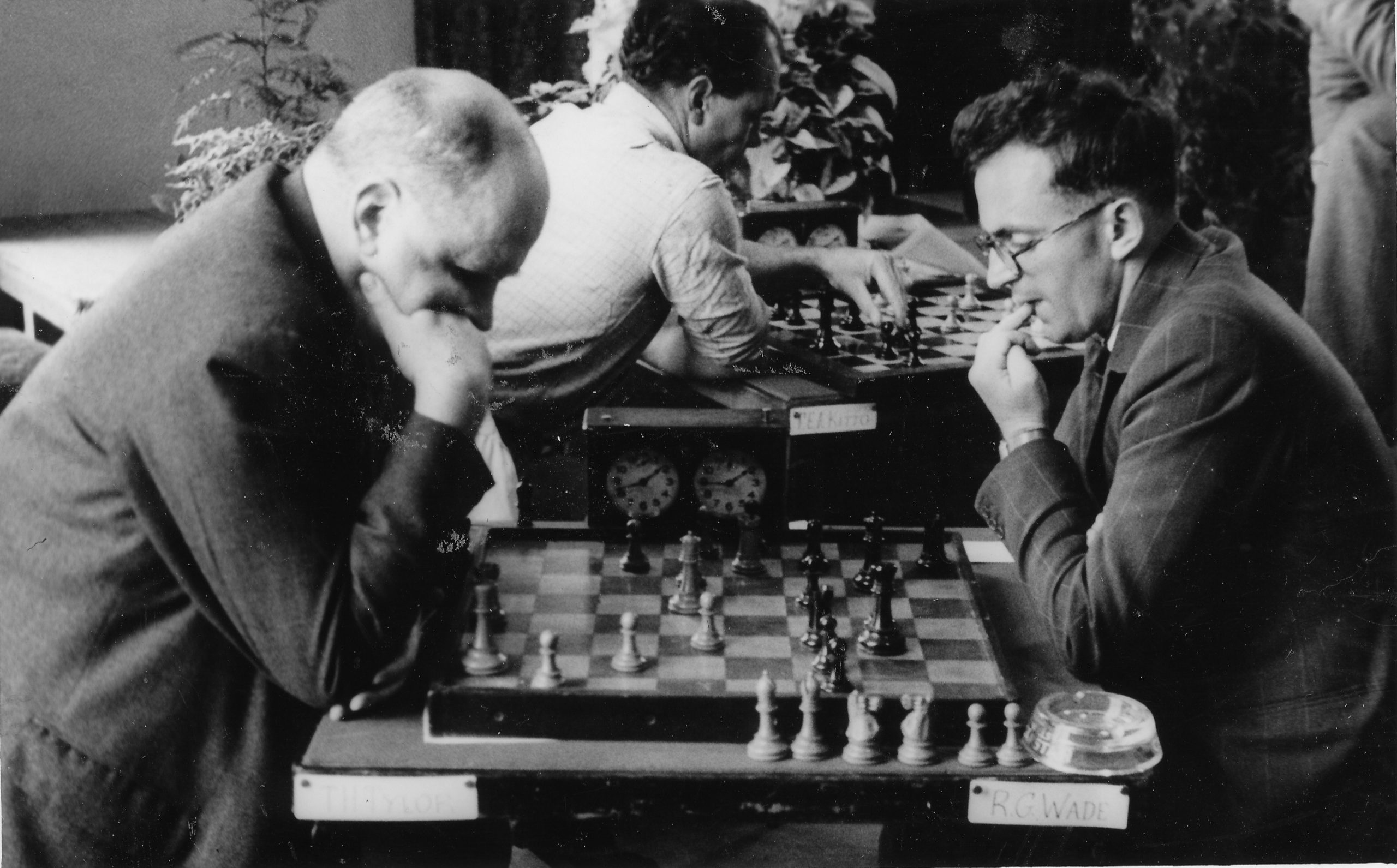
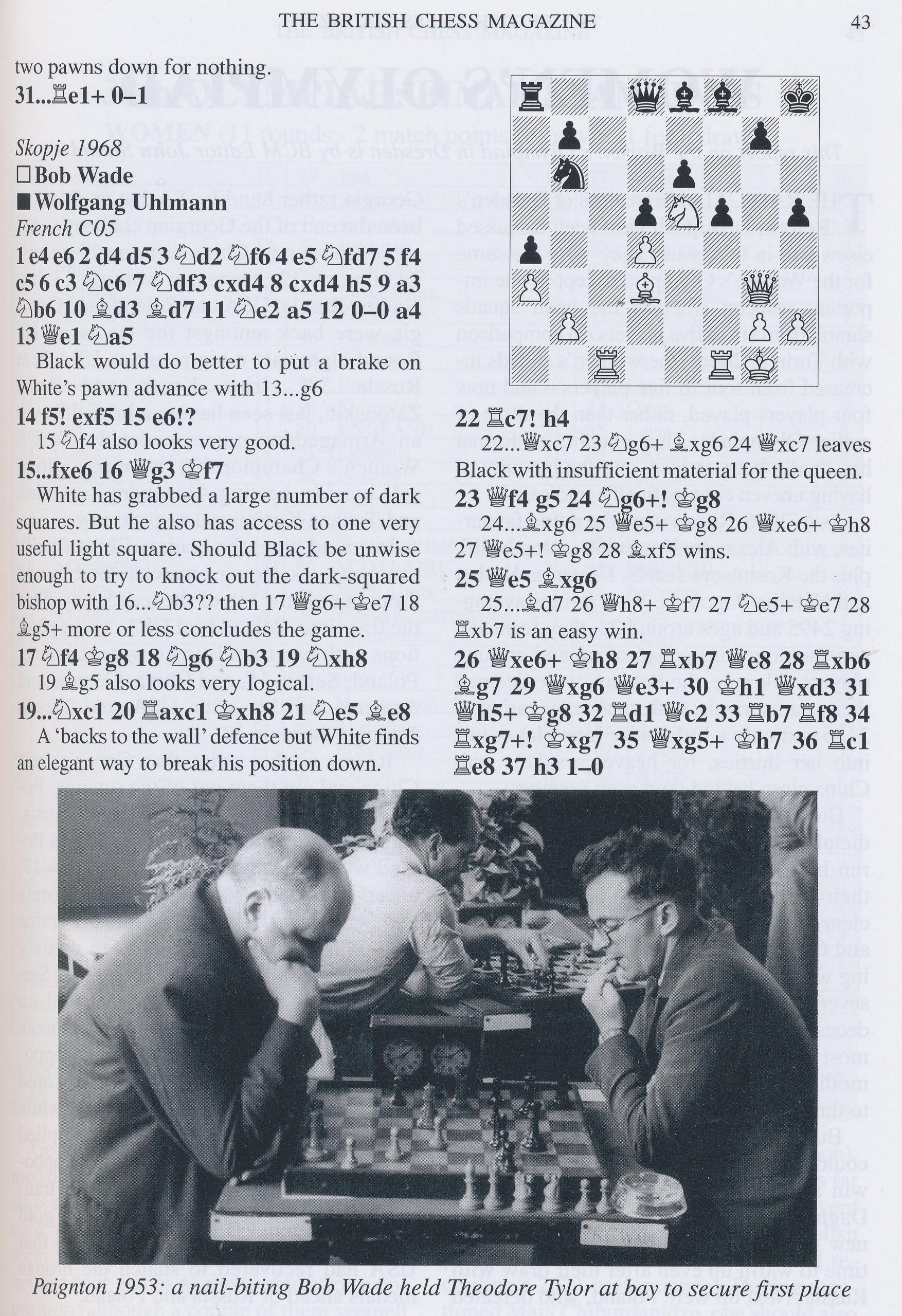
Theodore Tylor vs Bob Wade at Paignton 1953. Bob held TT to a draw to secure first place
Wade was born in Dunedin, a third generation New Zealander of Scots and English ancestry. He started a a career as a civil servant in the Department of Scientific and Industrial Research. Having won the New Zealand Championship in 1944 and 1945 he was sent over to participate in the British Championship of 1946. The result was not exactly a success – a mere 3.5 points out of 11. But Bob was not to be disheartened so easily. Feeling he was capable of better things, he took leave of absence in 1947 and did the circuit, such as it then was, of chess tournament in Europe and North America.
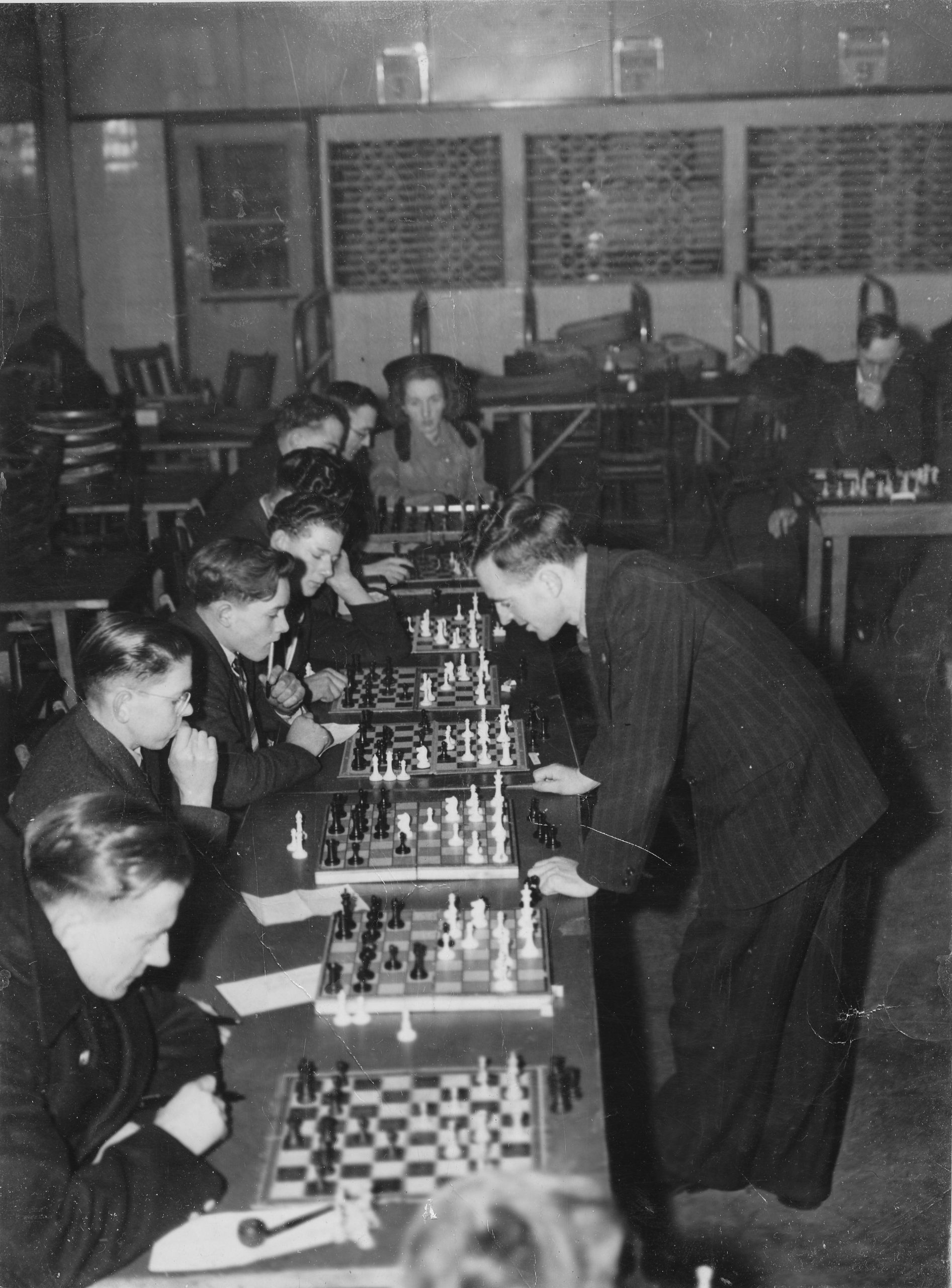
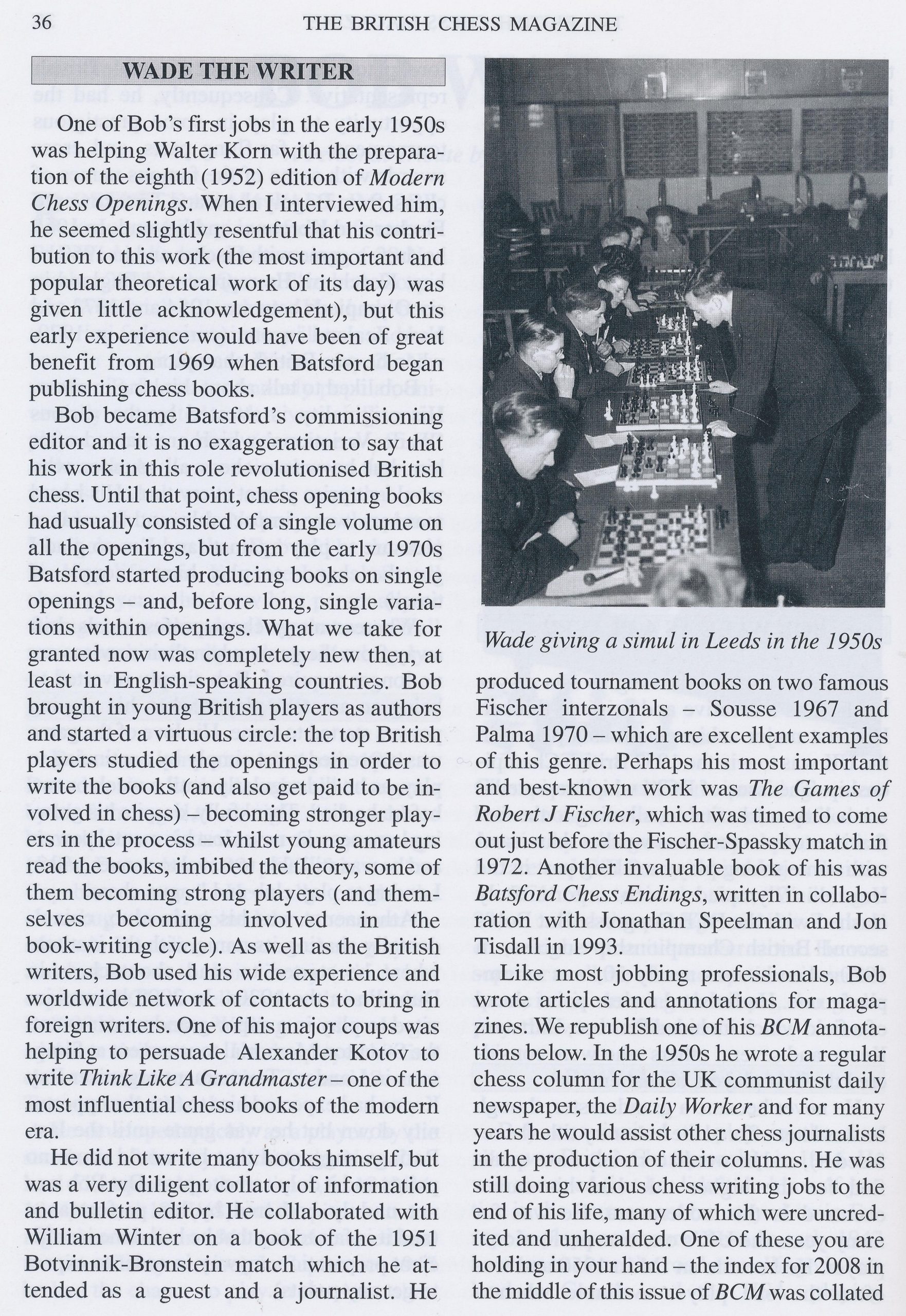
Bob giving a simul in Leeds in the 1950s
When he returned to New Zealand he found that he had been transferred to another department in a civil service reorganisation. The new job was not so congenial. He stuck it out for 6 months – during which time he won the New Zealand Championship for a third time – and then handed in his resignation to take up the precarious life of a chess professional.
IM Bob Wade
Settling in Britain he soon gained the IM title (ed : 1950). But even in those days when still a young man Wade did not concentrate exclusively on his own playing career. In 1949 he went to the FIDE congress and was one of the five people – the others were BH Wood, Ragozin, Zubarev and Rogarde – who collaborated on the writing of the official rules for the game.
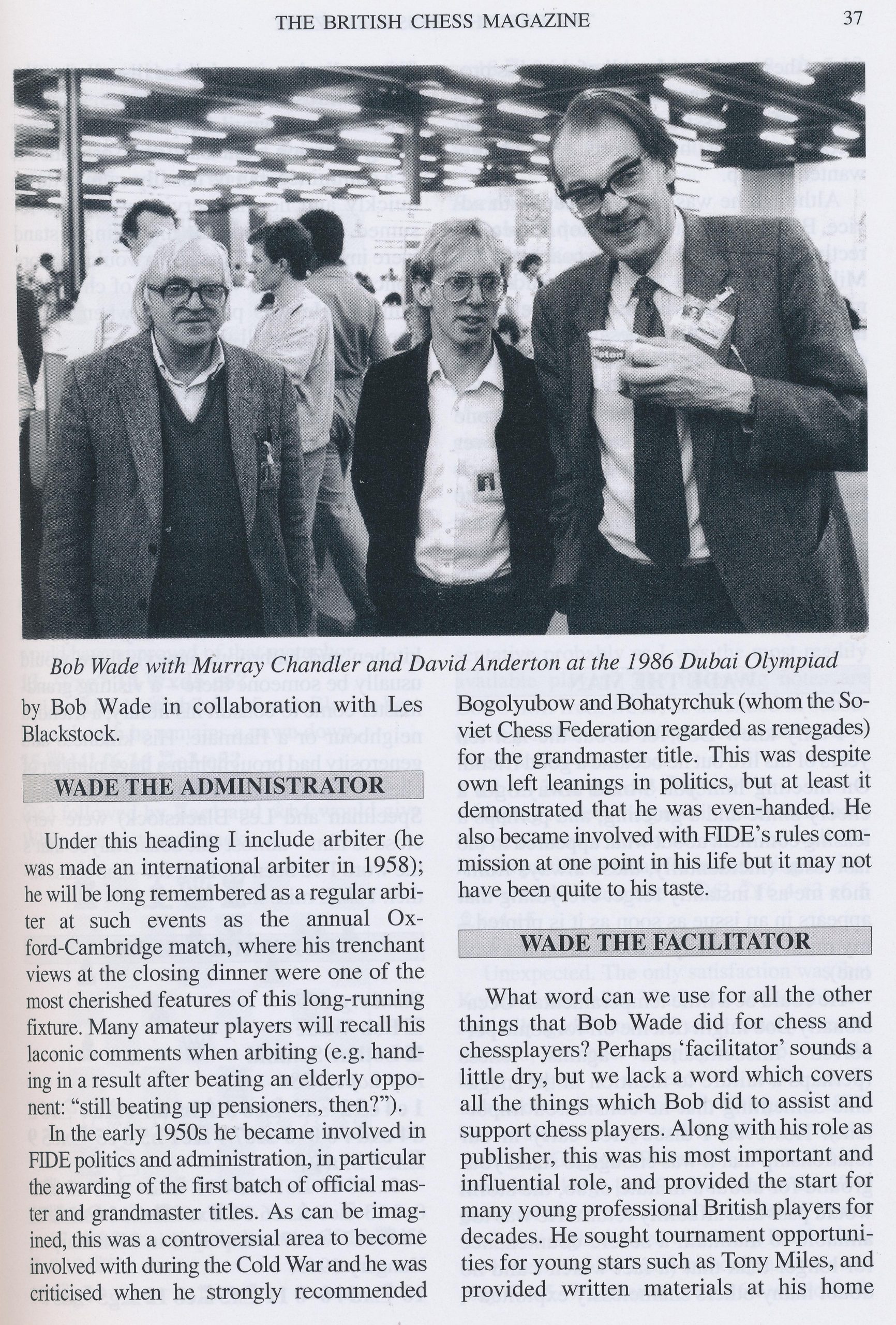
Bob Wade OBE, Murray Chandler MNZM and David Anderton OBE at the 1986 Dubai Olympiad. Photograph by Frits Agterdenbos
He also served as a member of the commission that determined who the original holders of international titles would be. When you consider that Wade was also on the 1950 commission that decided the composition of the World Championship Interzonals, it becomes apparent that this man played a significant part in the shaping the structure of modern international chess.
Bob at a CentYMCA event with Neil Carr, Mike Wills, Aaron Rose and Jon Ady
Although rarely at the top in international tournaments, Wade was always a very dangerous player, capable on his day of beating anybody in the world. He won the British Championship twice at Chester in 1952 and at Coventry in 1970.
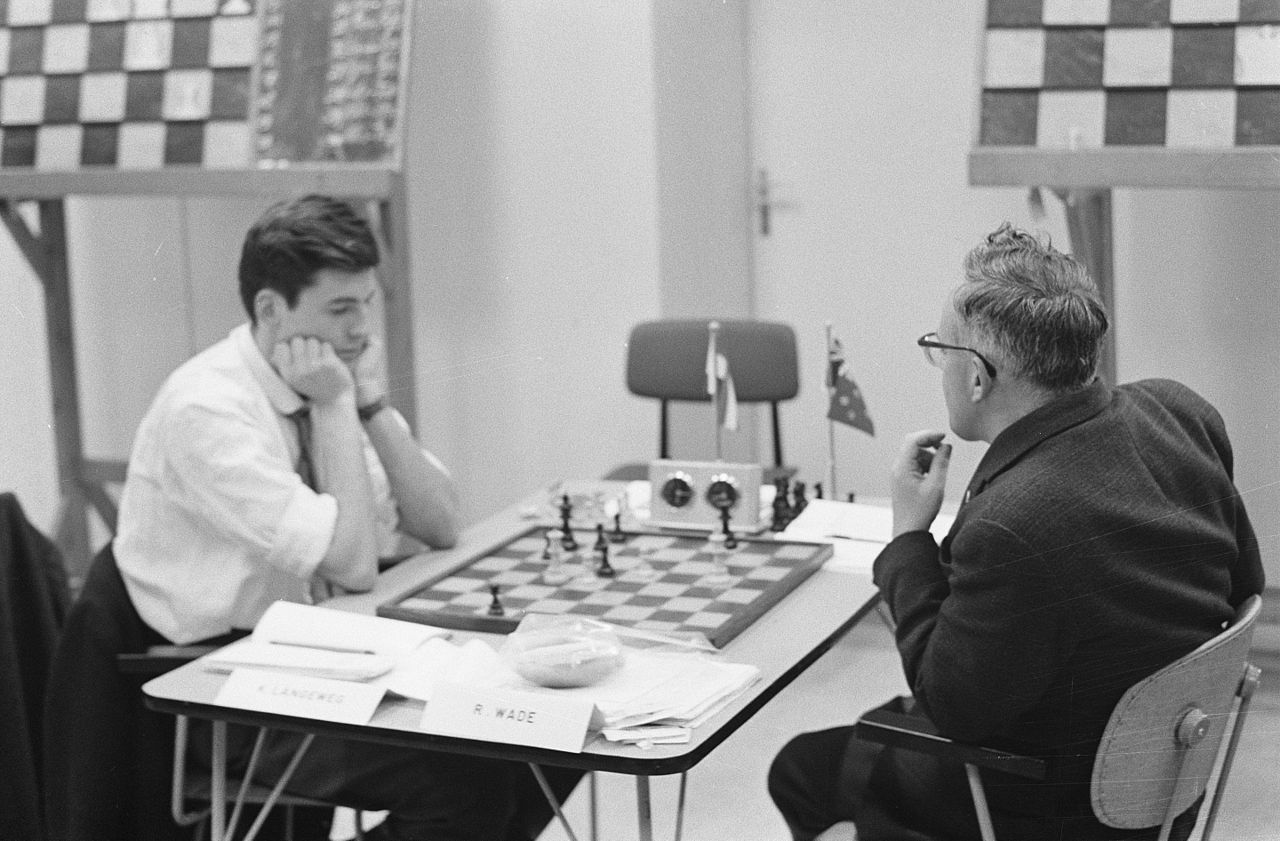
Bob playing Kick Langeweg at IBM 1961.
In recent years Wade has put his main energies into junior training and organisation and also into his work as the editor of Batsford’s highly productive and extremely successful series of chess books.
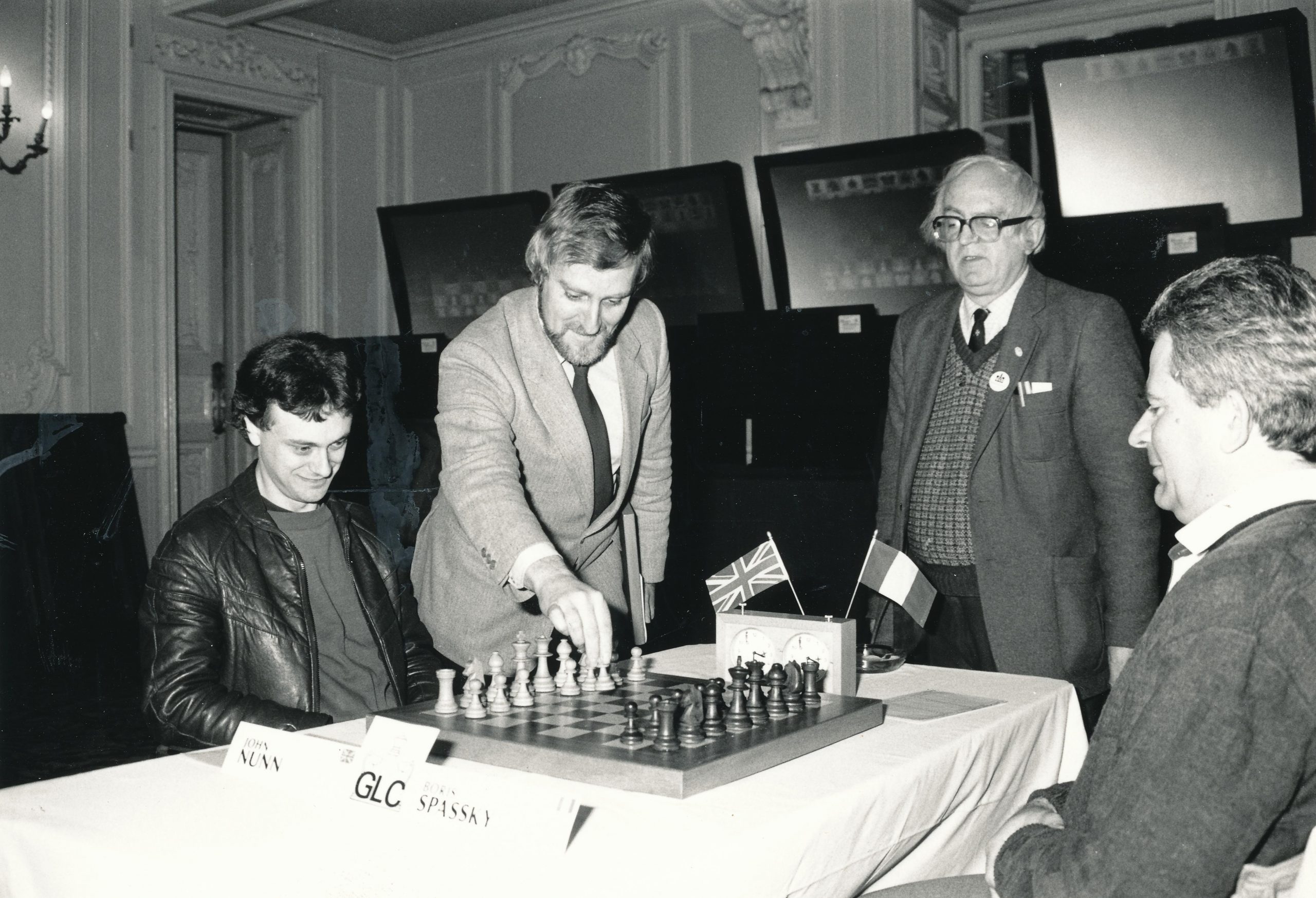
Bob with John Nunn and Boris Spassky at the GLC Masters
It is hard to say in what department one should place Wade’s greatest contributions to British Chess. Living through what is retrospect look to have been the Dark Ages of British chess – the 1950s and 1960s – he has demonstrated that even in a social and cultural environment that made playing chess economically ‘impossible’ profession to follow it was still possible to dedicate a life to chess, if one had the determination.
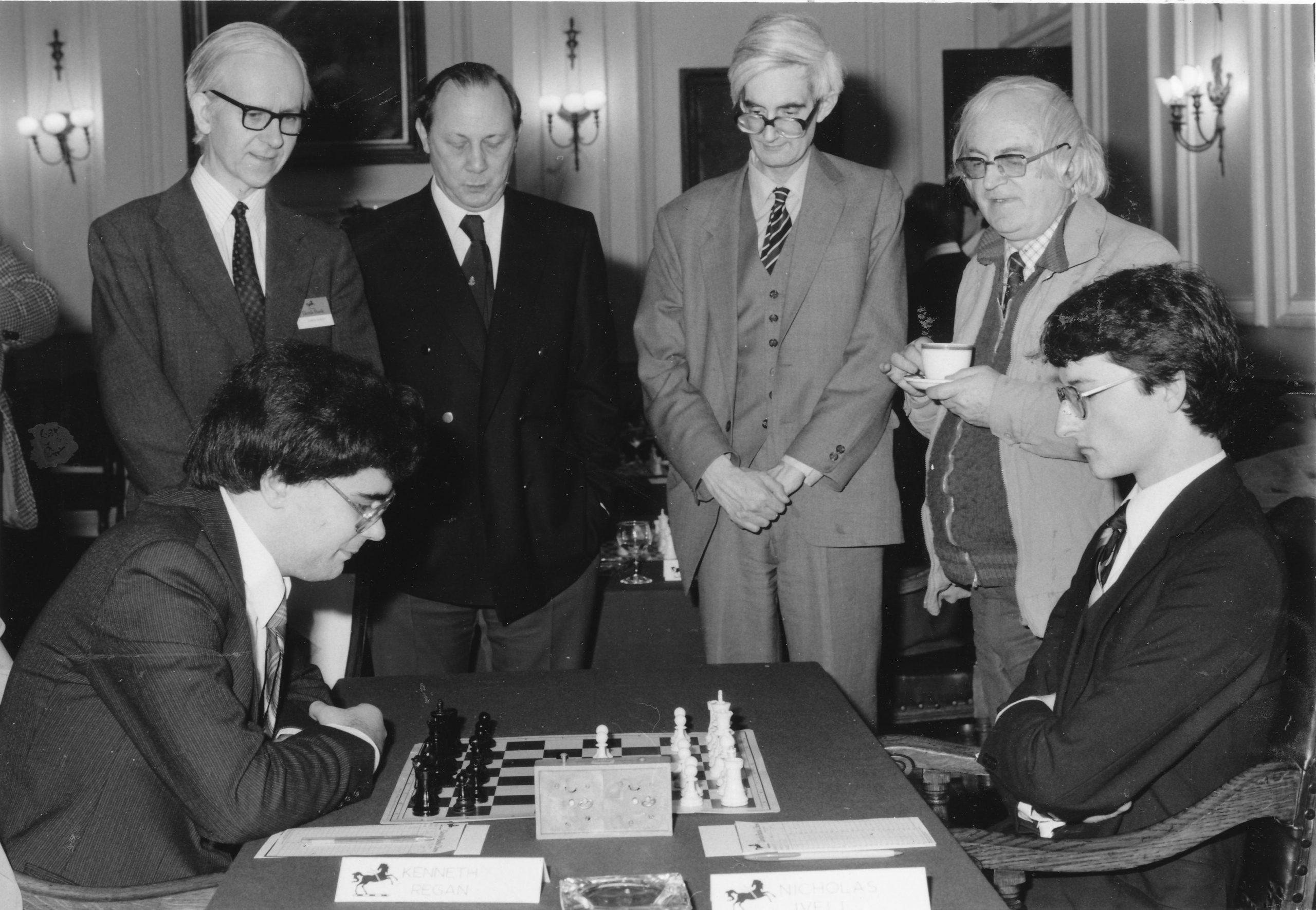
Leonard Barden, Henry Mutkin, Adrian Hollis and Bob Wade observe Nick Ivell vs Ken Regan at the 1983 Varsity match
During those years he was really the only British Player who regularly active in international tournaments. Since then he has been constantly active as an author, editor and adviser, always working to transform Britain into a country more congenial to good chess.
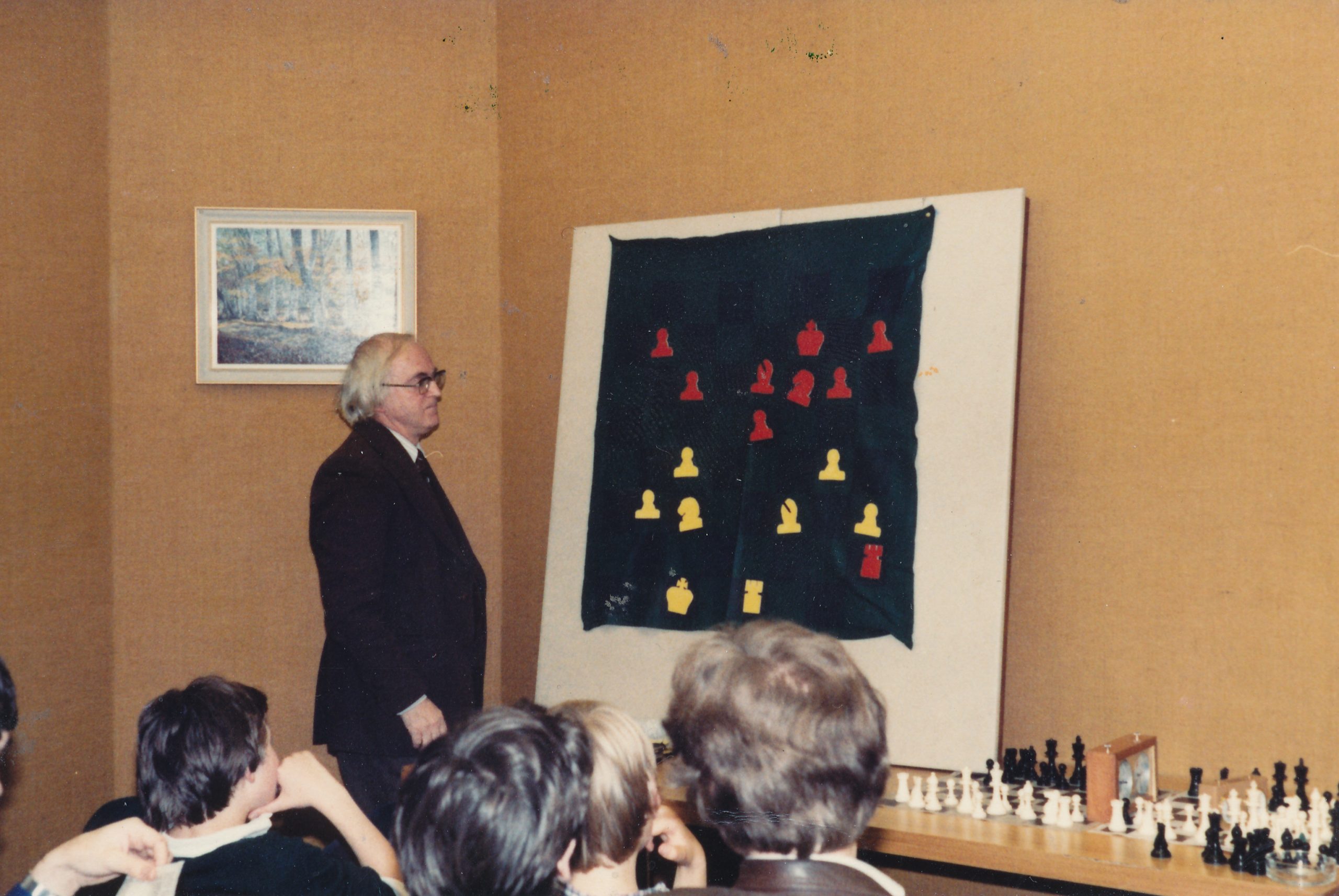
Bob at the demo board at London Central YMCA chess club.
But we suspect that he might regard this role as trainer and coach as the most important thing of all. He is, quite appropriately the British Chess Federation’s Chief National Coach.
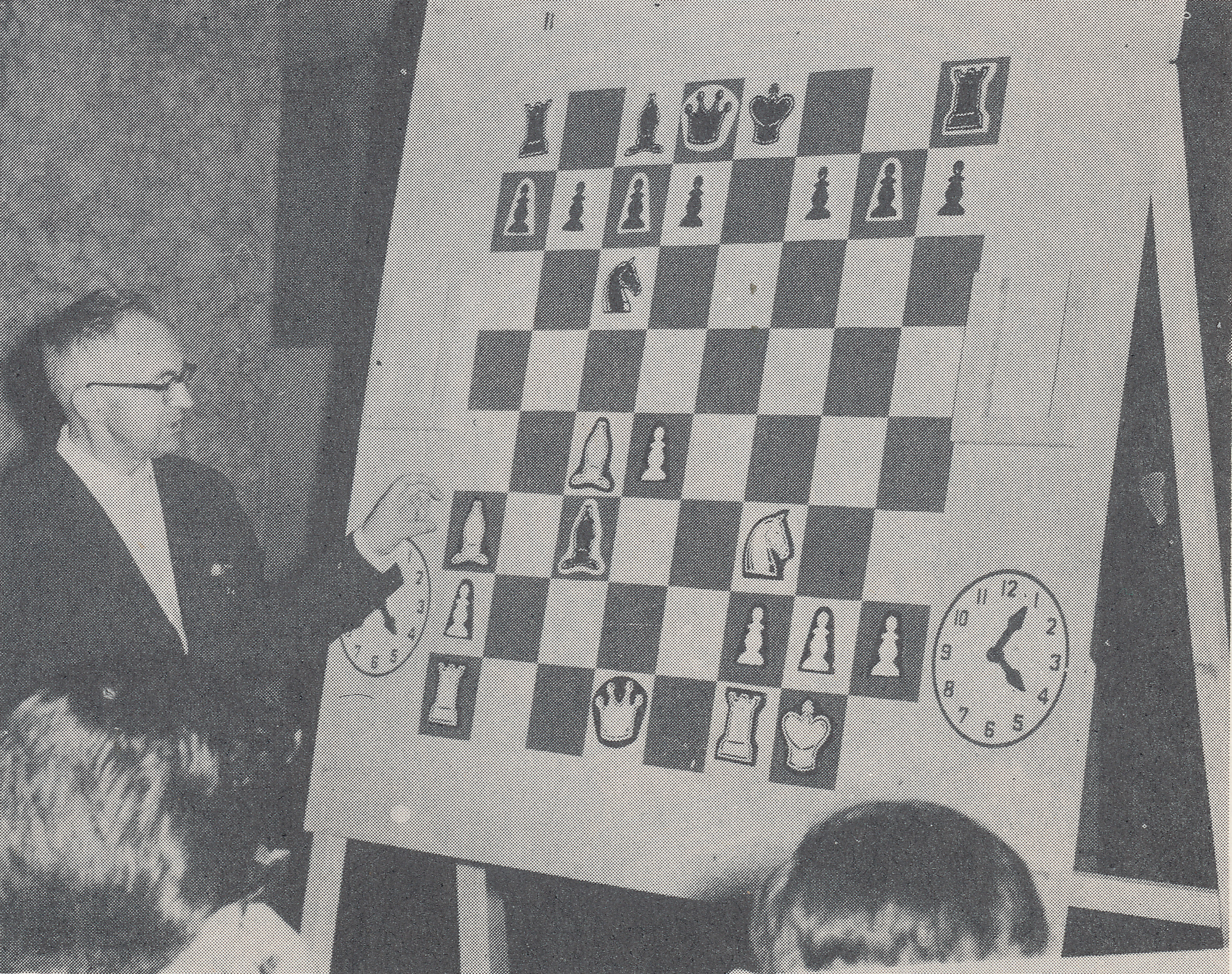
Bob doing one of the things he loved best : teaching. He was discussing a position at Havana 1965. Dr JR Capablanca, son of the former world champion, on the right, interpreted.
If one had to choose a single best game from Wade’s whole tournament career, it would probably be this one.
George Botterill
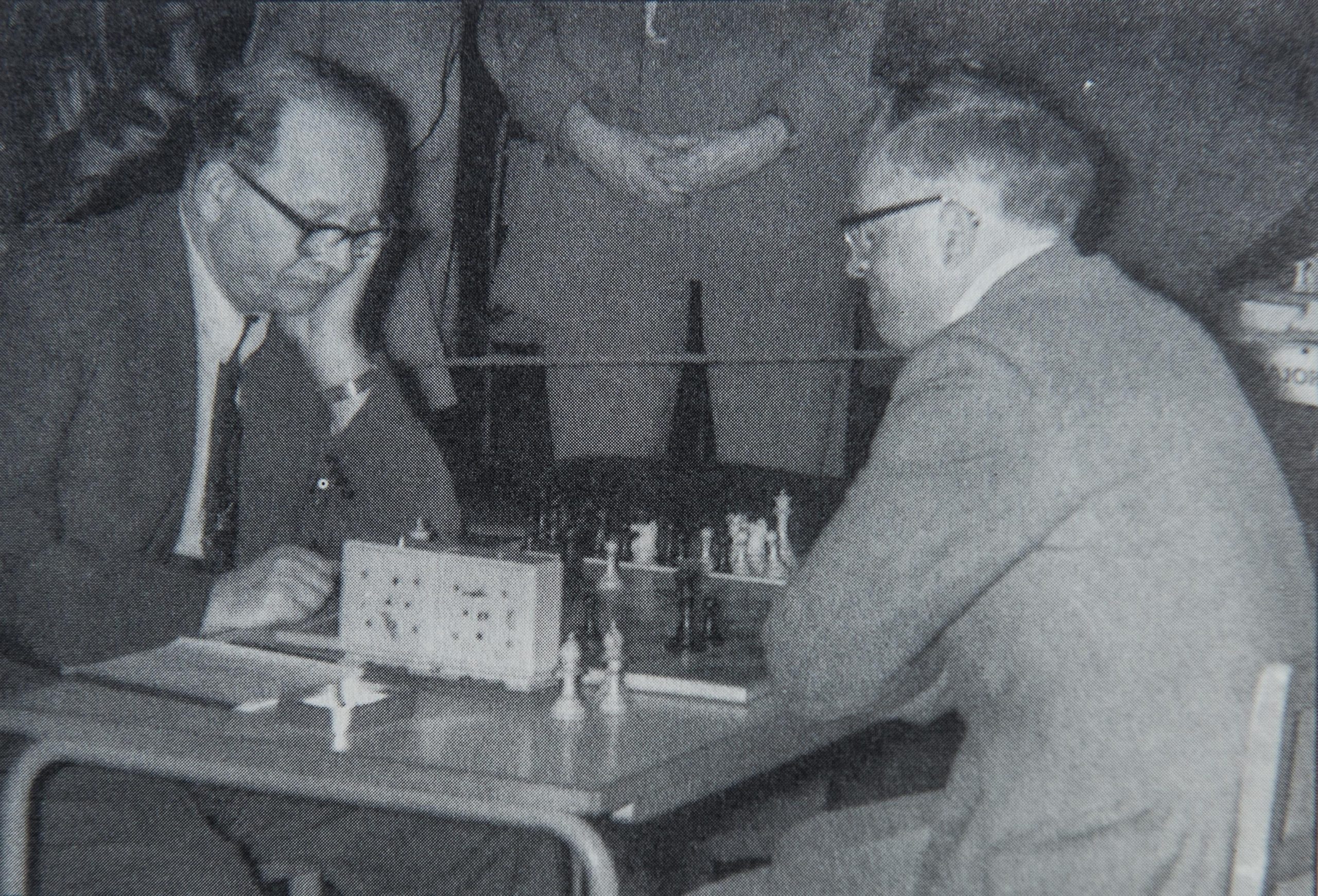
Dr. Fazekas (left) playing Bob Wade at an Ilford Congress, photographer unknown
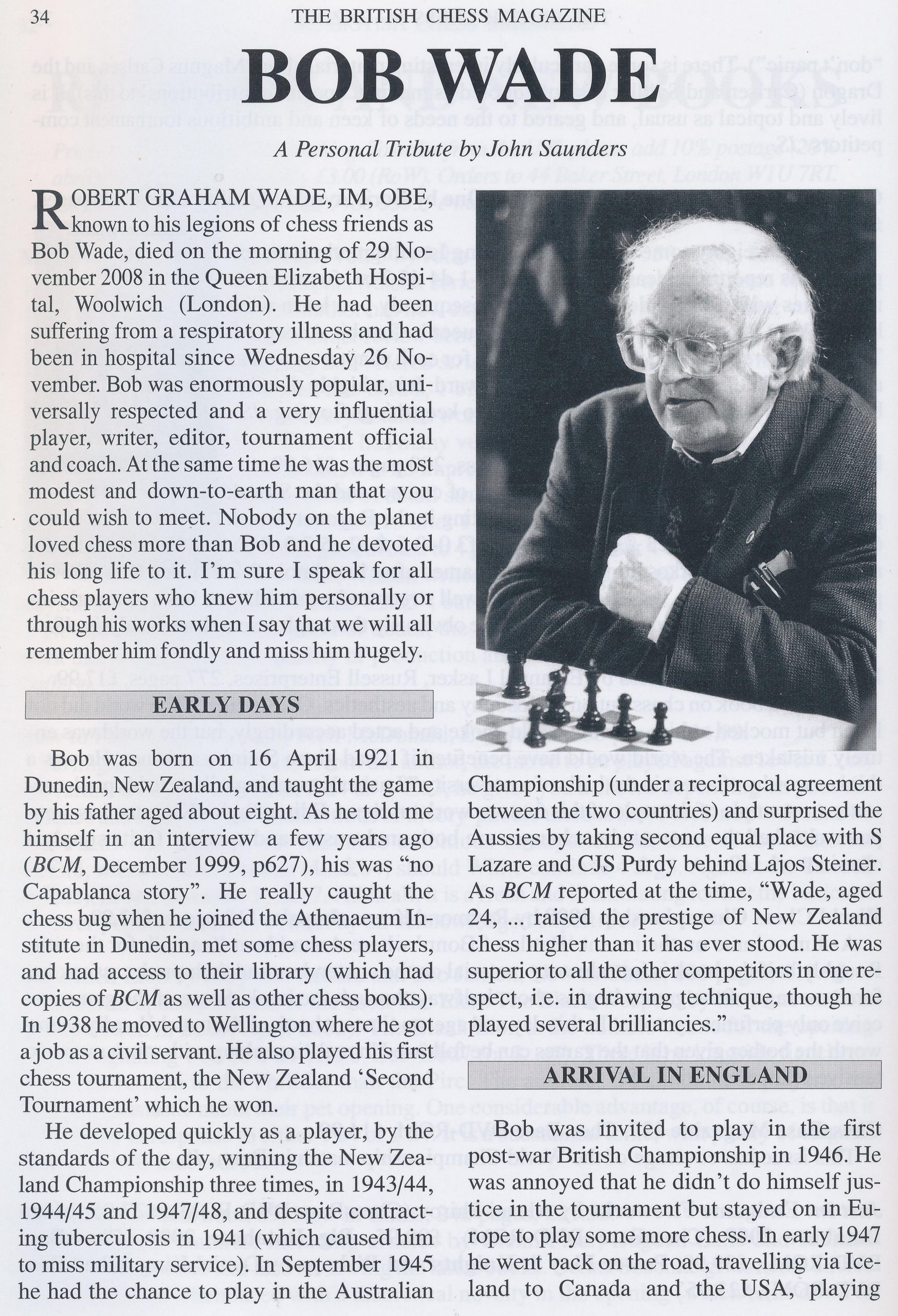
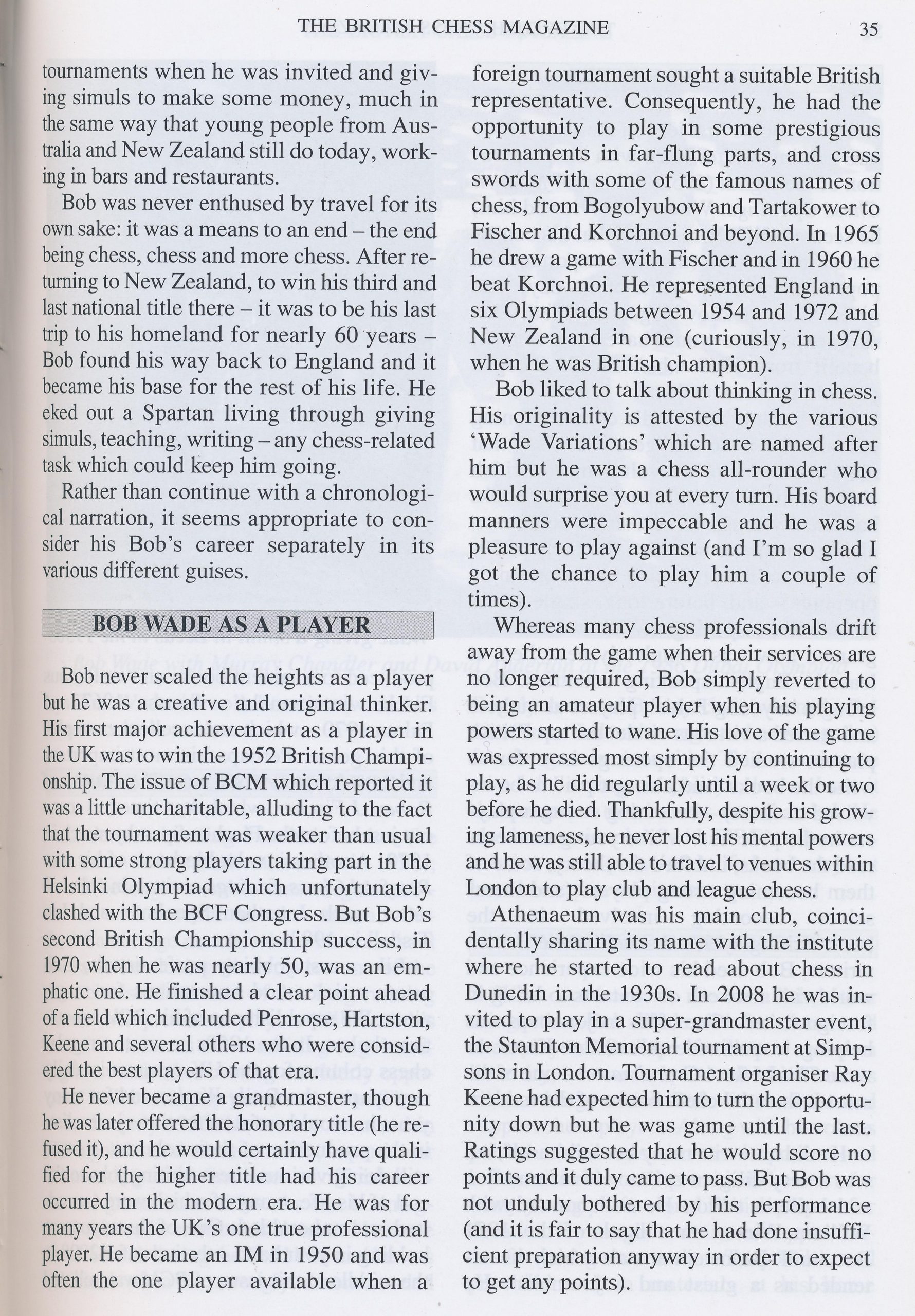
In the January 2009 issue of British Chess MagazineJohn Saunders wrote a ten page obituary as follows :
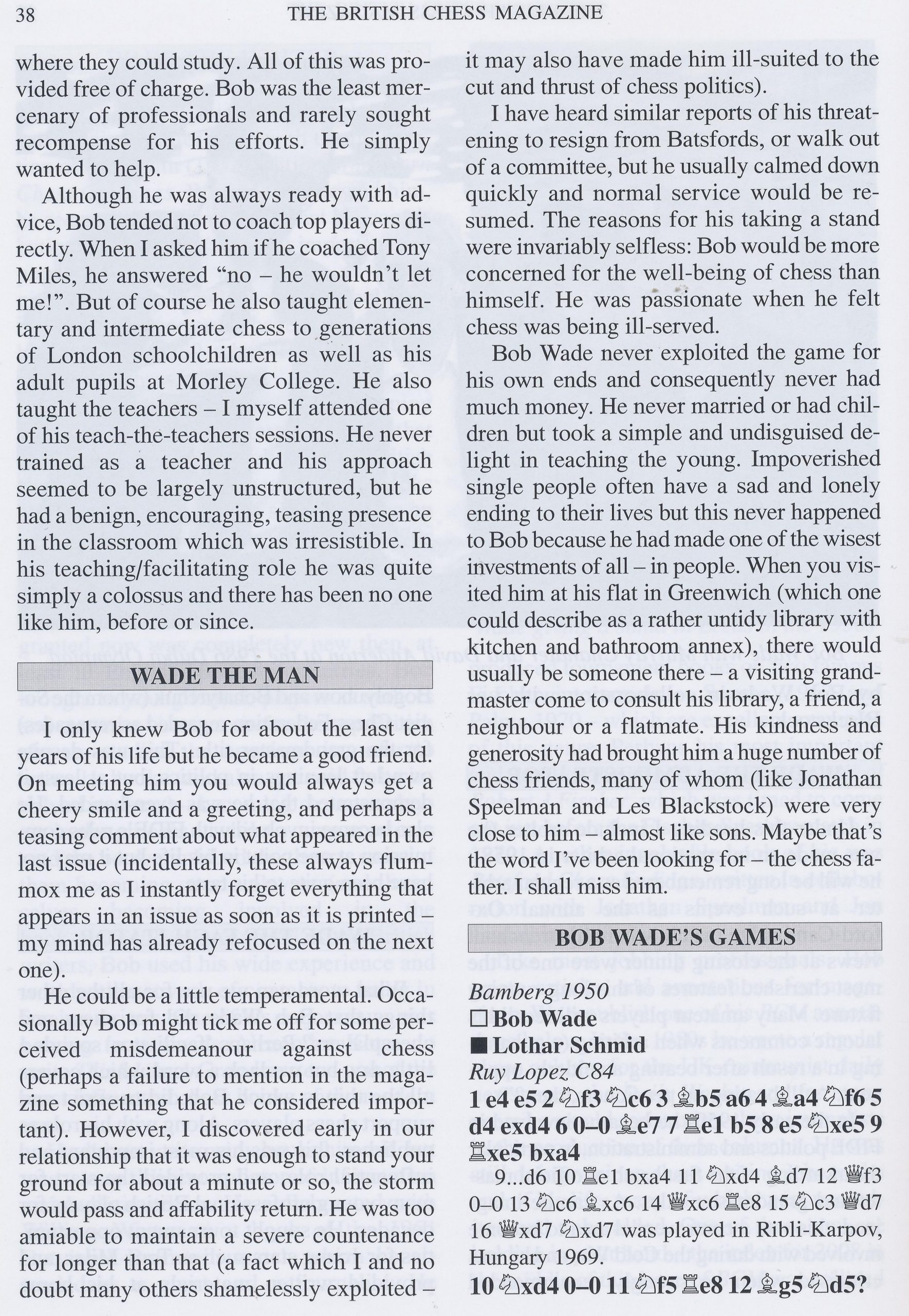
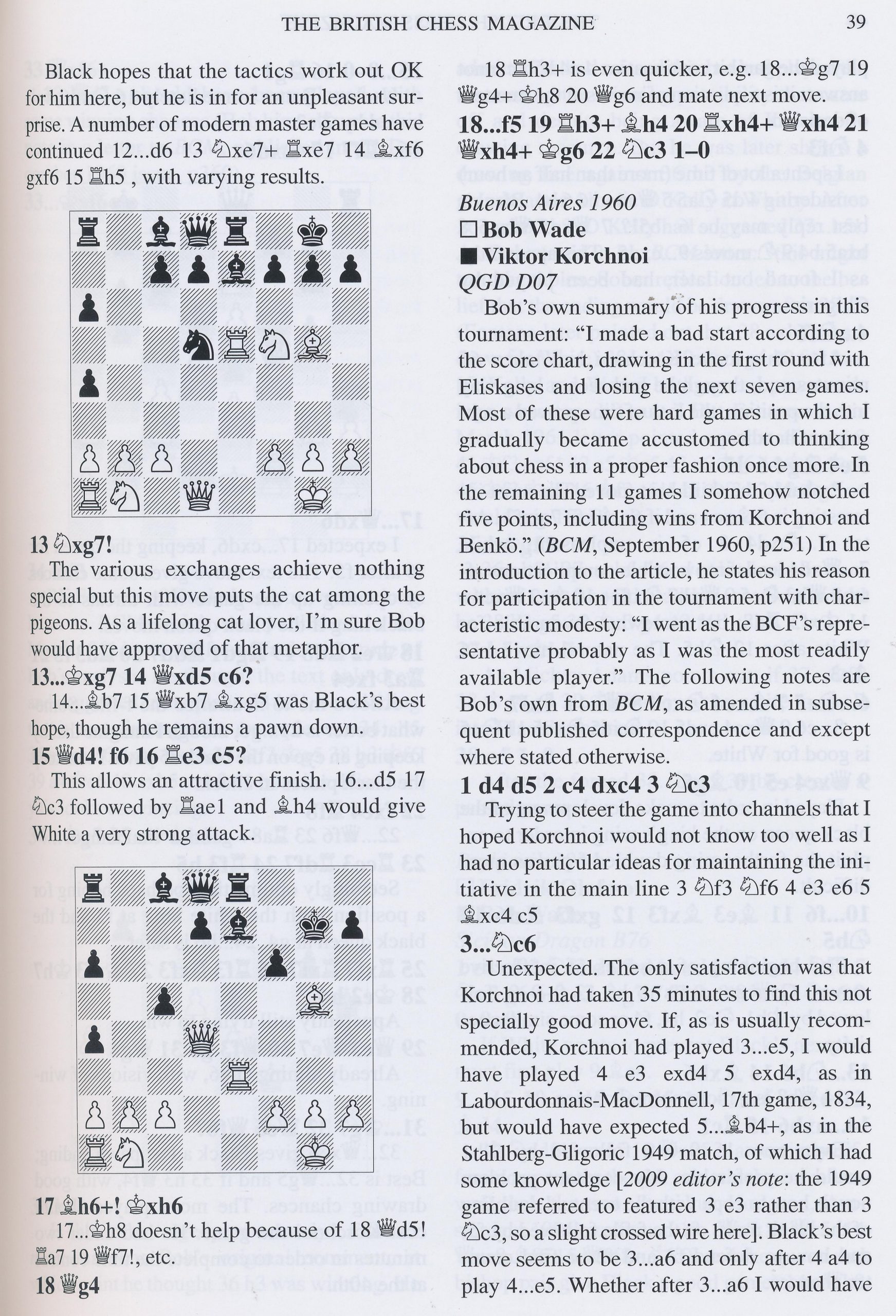
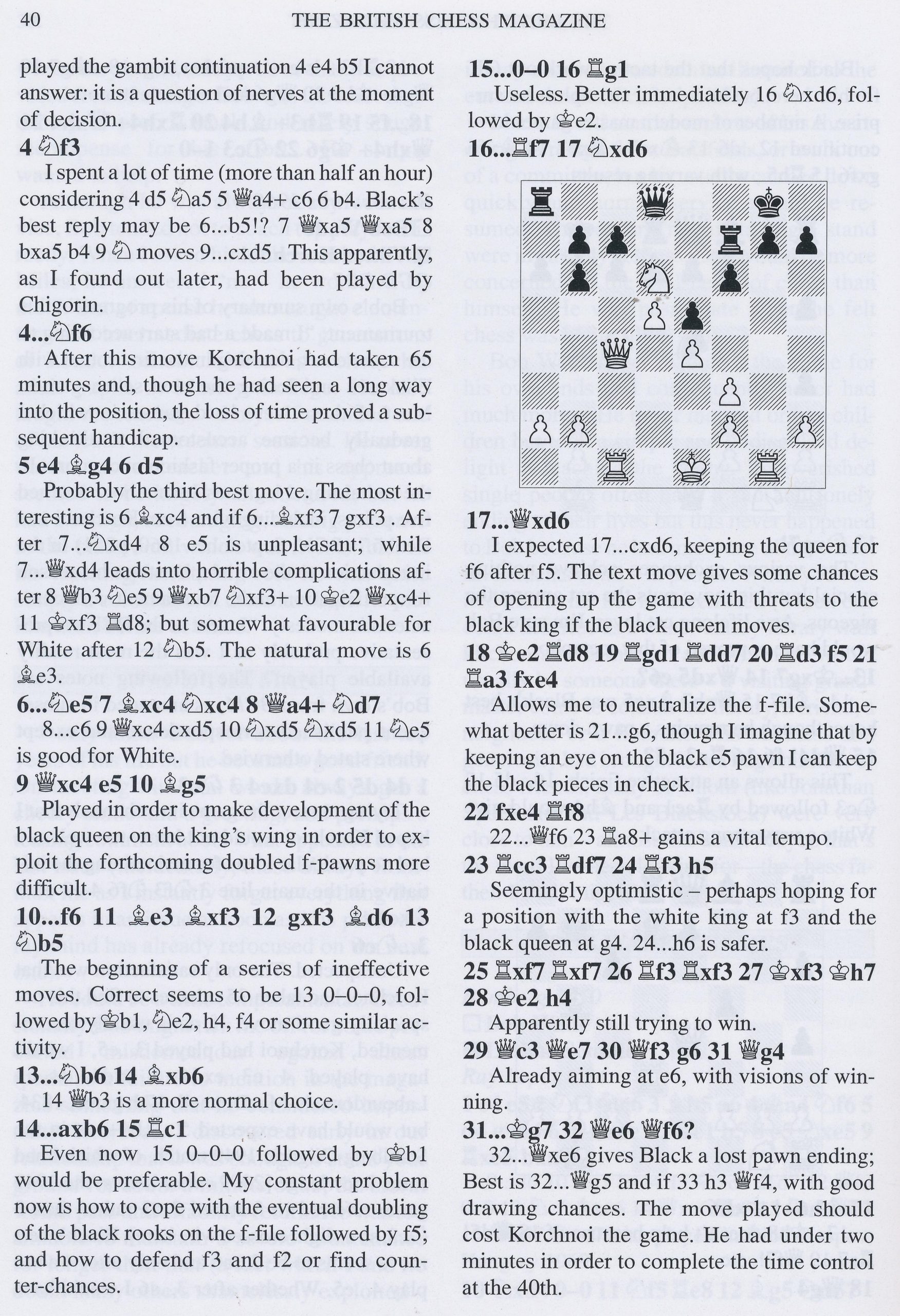
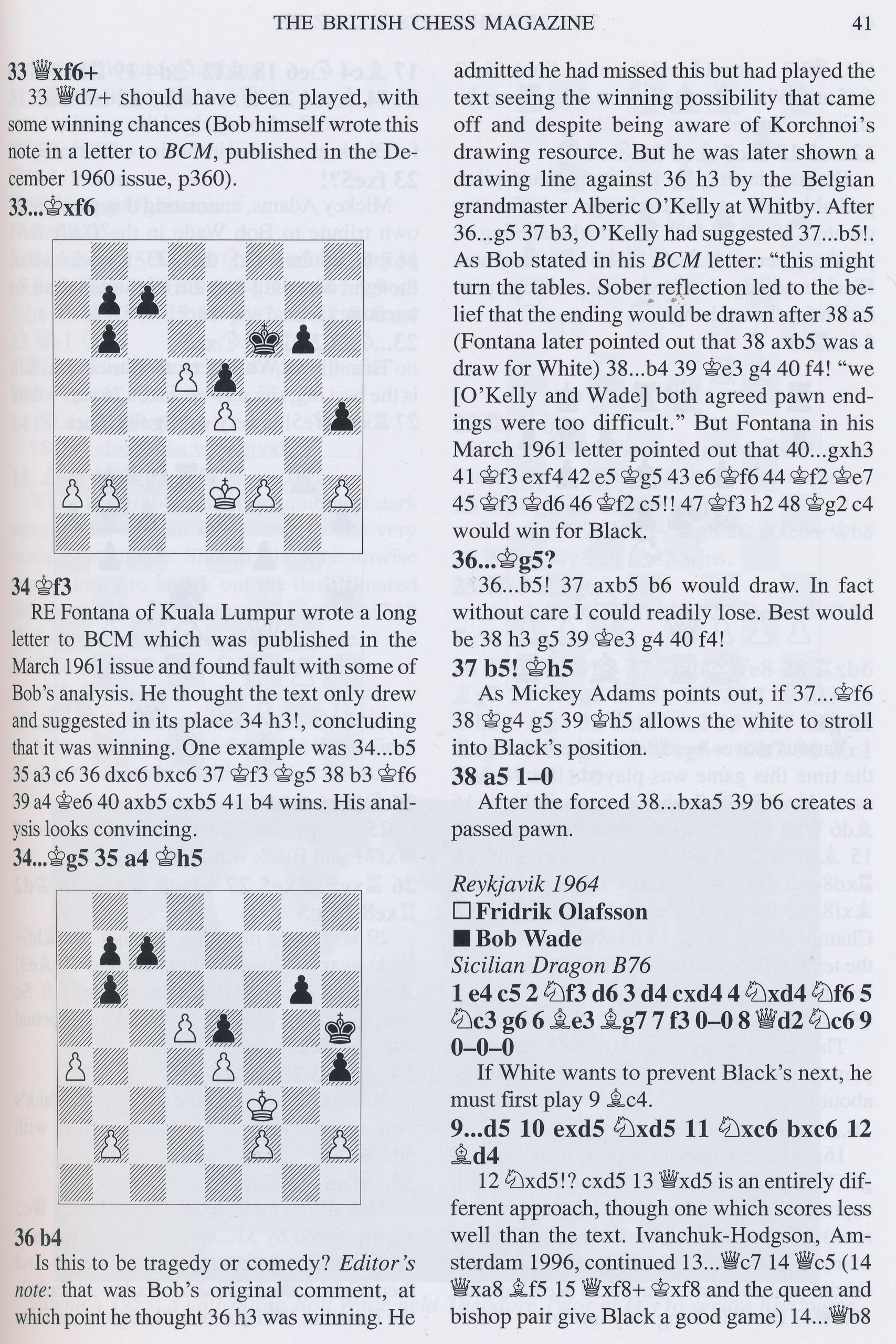
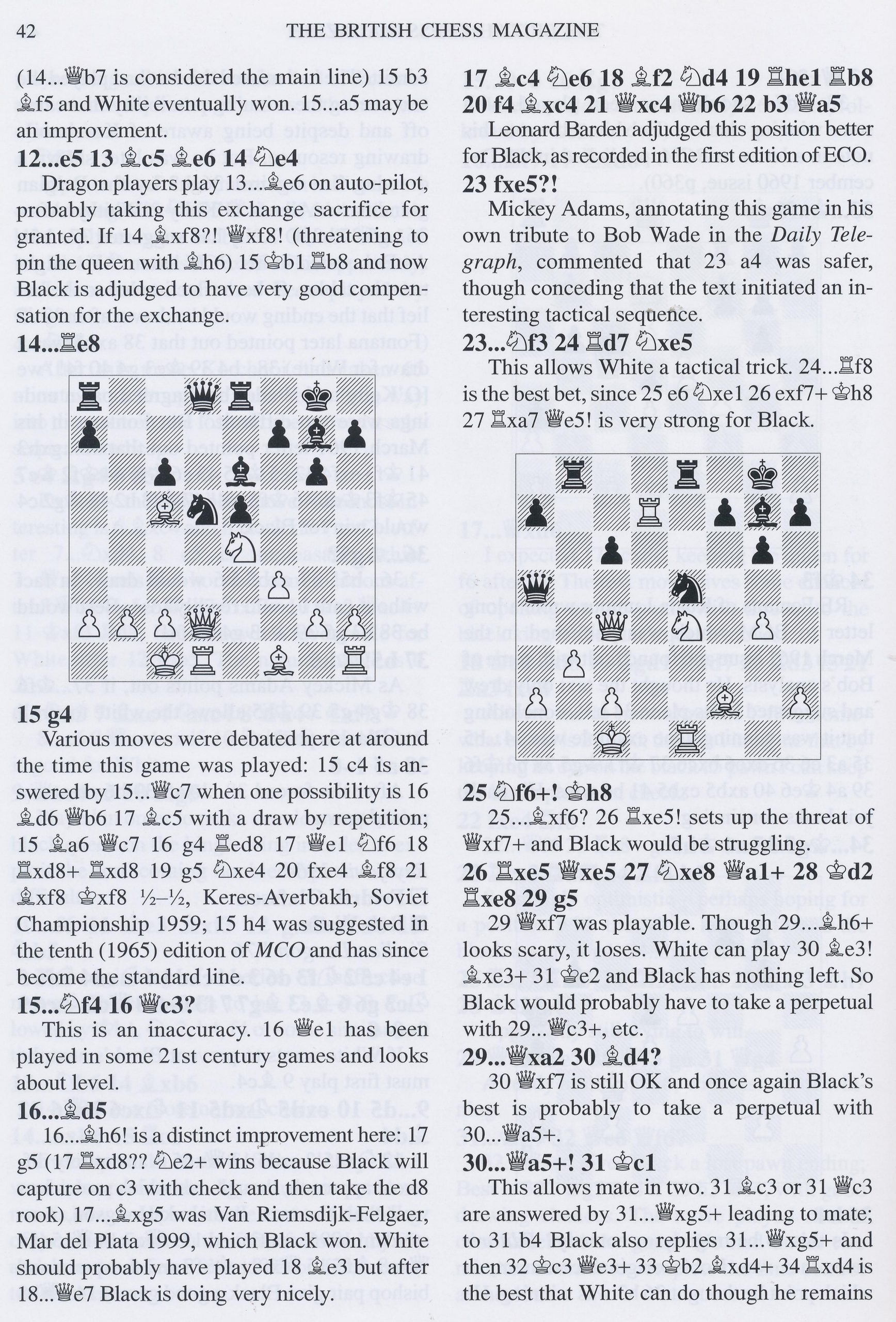
British Chess Magazine, Volume CXXIX (129, 2009), #1 (January), pp. 34-43British Chess Magazine, Volume CXXIX (129, 2009), #1 (January), pp. 34-43British Chess Magazine, Volume CXXIX (129, 2009), #1 (January), pp. 34-43British Chess Magazine, Volume CXXIX (129, 2009), #1 (January), pp. 34-43British Chess Magazine, Volume CXXIX (129, 2009), #1 (January), pp. 34-43British Chess Magazine, Volume CXXIX (129, 2009), #1 (January), pp. 34-43British Chess Magazine, Volume CXXIX (129, 2009), #1 (January), pp. 34-43British Chess Magazine, Volume CXXIX (129, 2009), #1 (January), pp. 34-43British Chess Magazine, Volume CXXIX (129, 2009), #1 (January), pp. 34-43British Chess Magazine, Volume CXXIX (129, 2009), #1 (January), pp. 34-43
John Saunders interviewed Bob at his Blackheath home and wrote this extensive article for the 1999 British Chess Magazine.
His detailed results in Olympiads, from olimpbase.org, follow.
Amsterdam 1954, England board 4, 6/12 (+4−4=4);
Moscow 1956, England board 3, 6½/14 (+2−3=9);
Munich 1958, England 1st reserve, 7/14 (+5−5=4);
Leipzig 1960, England 2nd reserve, 6/11 (+4−3=4);
Varna 1962, England 2nd reserve, 6/12 (+4−4=4);
Siegen 1970, New Zealand board 2, 9/15 (+7−4=4);
Skopje 1972, England board 3, 7½/14 (+4−3=7).
Wade won several middle-strength Master events in the British Isles: Ilford 1957 and 1968, Paignton 1959, Dublin 1962, and Southend-on-Sea 1965.
Wade was generally no more than a middle-ranking player in strong international tournaments. His other highlights against high-standard international-level competition include:
tied 4–5th at Haifa/Tel Aviv 1958 on 7½/13 (winner Samuel Reshevsky);
3rd at Bognor Regis 1959 on 7/10 (winner Erno Gereben);
5th at Reykjavík 1964 on 7½/13 (winner Mikhail Tal);
tied 4–5th at Málaga 1966 on 7/11; (winners Alberic O’Kelly de Galway and Eleazar Jiménez);
6th at Briseck 1971 on 7/13 (winner Gideon Barcza);
5th at Cienfuegos ‘B’ 1975 on 10/17; (winners Julio Boudy and Amador Rodriguez);
tied 7–12th in the World Senior Championship, Bad Woerishofen 1992, on 7½/11 (winner Efim Geller).
Wade was the only British player to have faced Bobby Fischer in tournament play (outside of Olympiads). They met three times, with Wade drawing one game and losing the other two.
Towards the end of his life Bob lived at 3, Hardy Road, Greenwich, London, SE3 7NS
Bob was an active author and wrote (or co-wrote) around 22 books as follows :
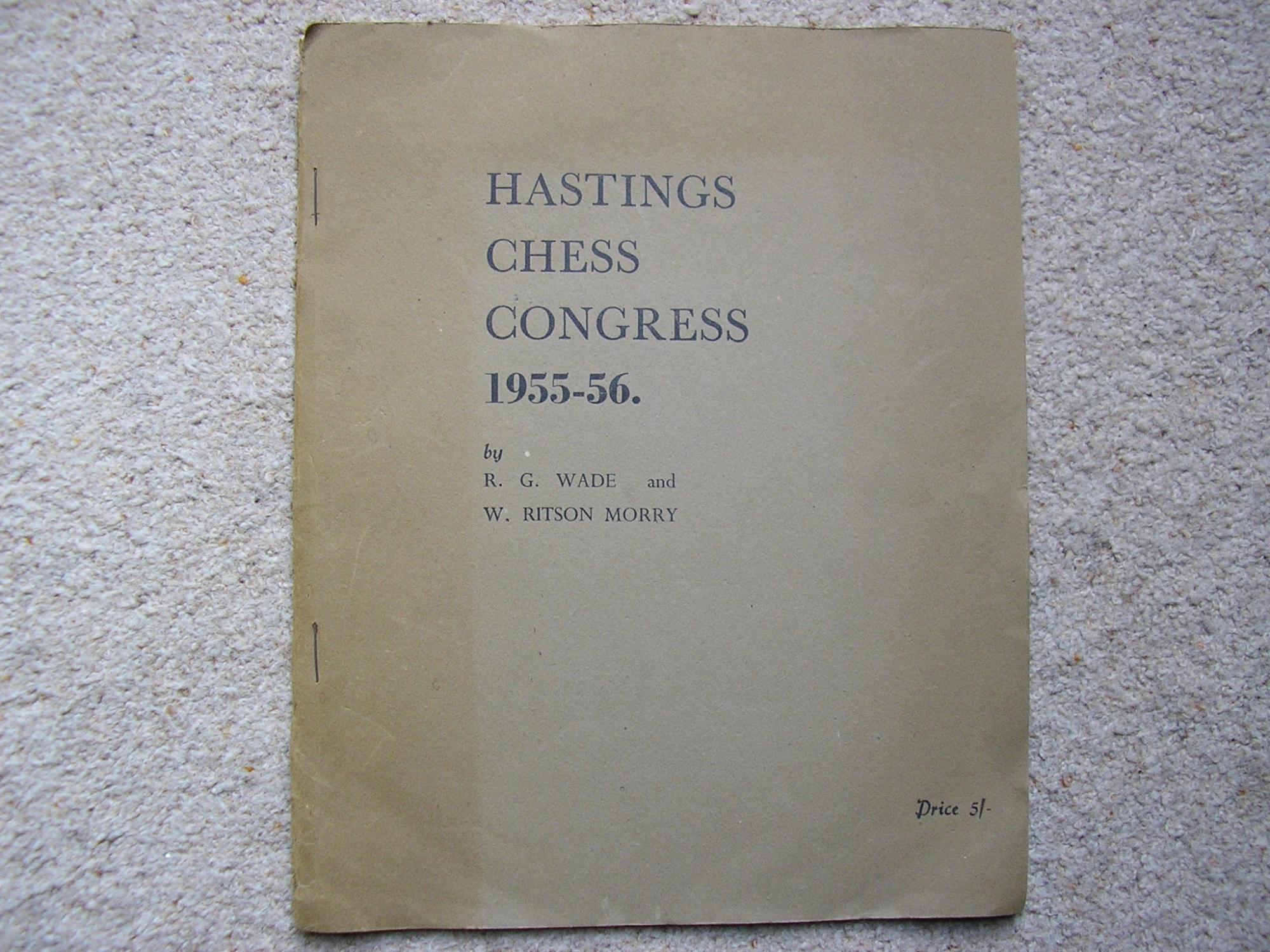
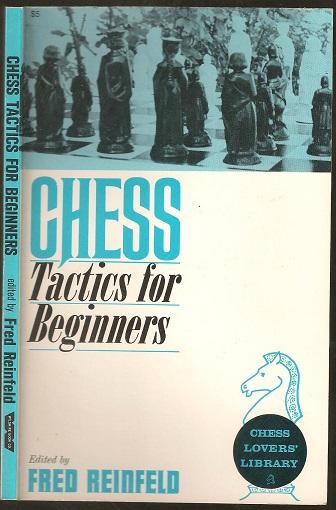
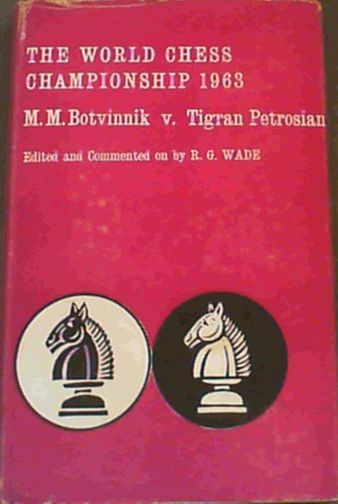
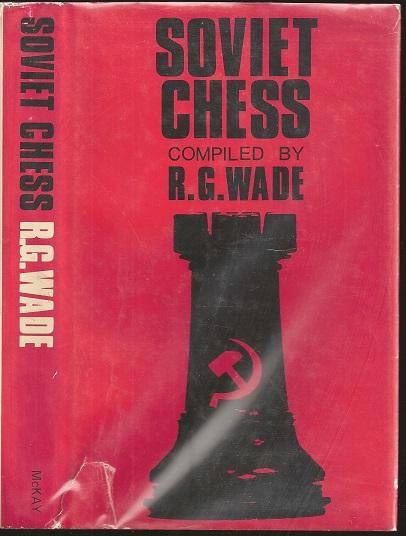
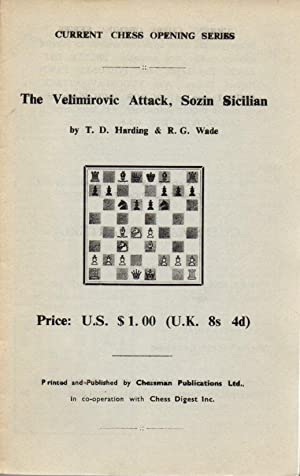
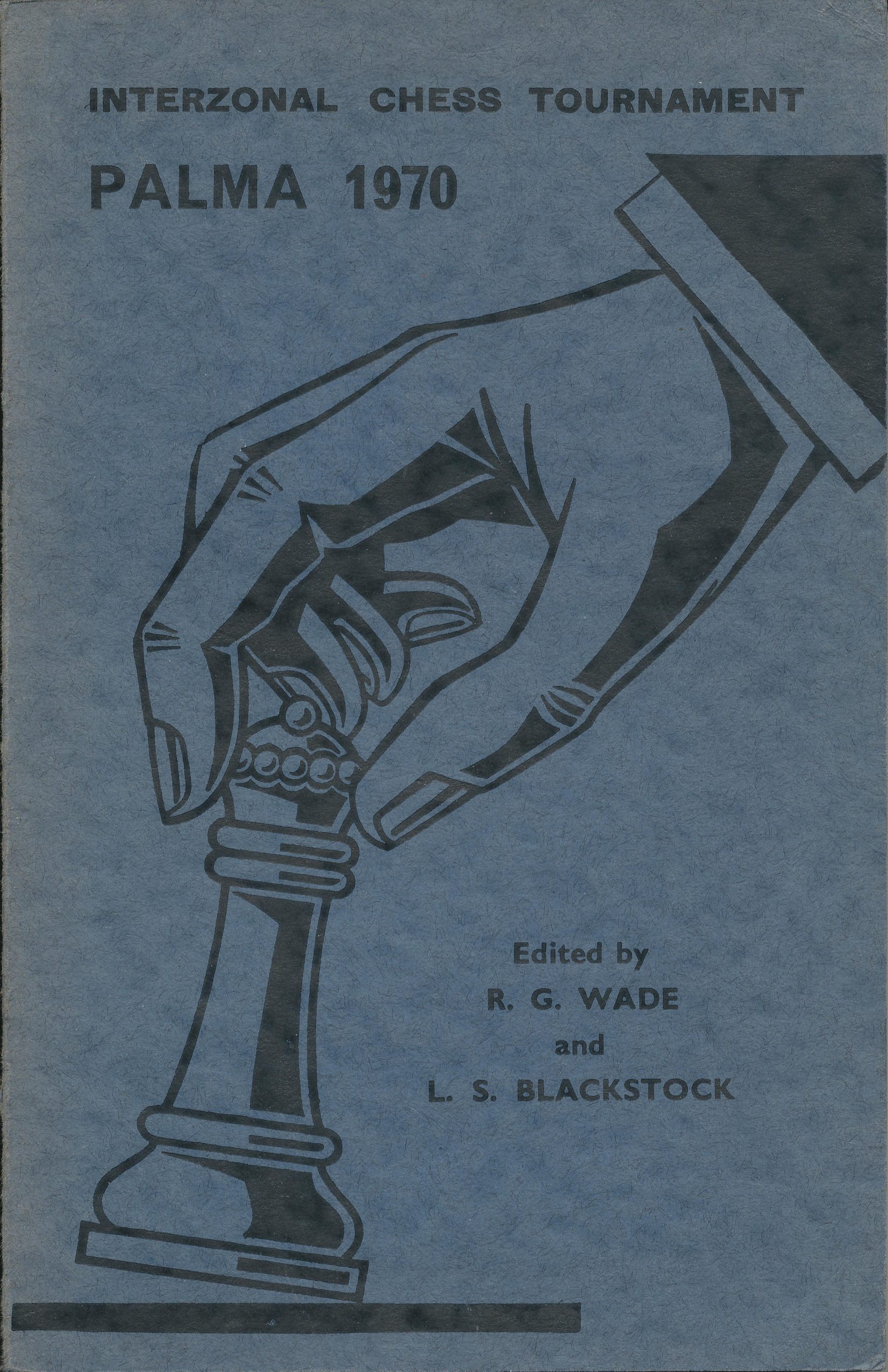
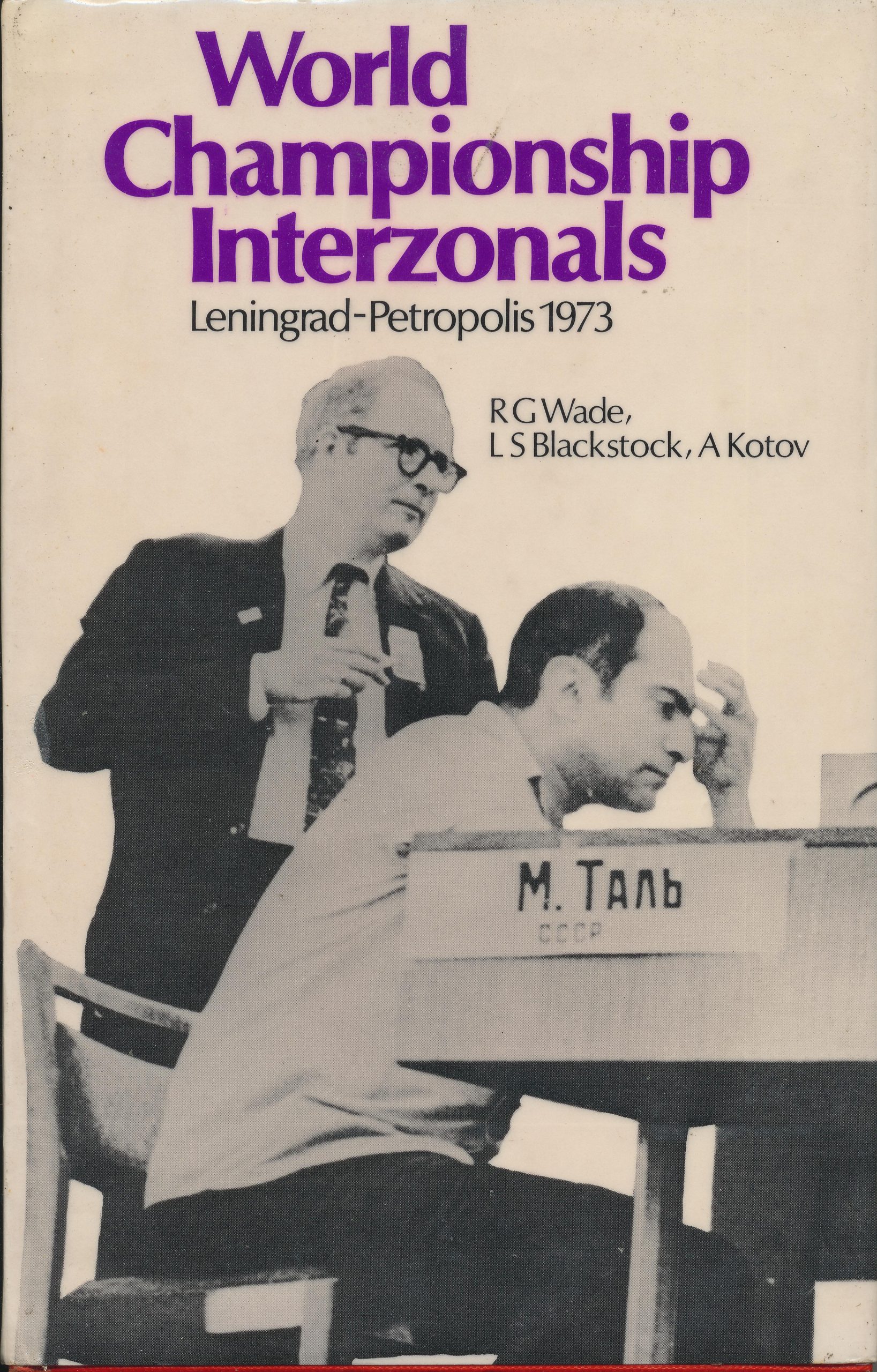
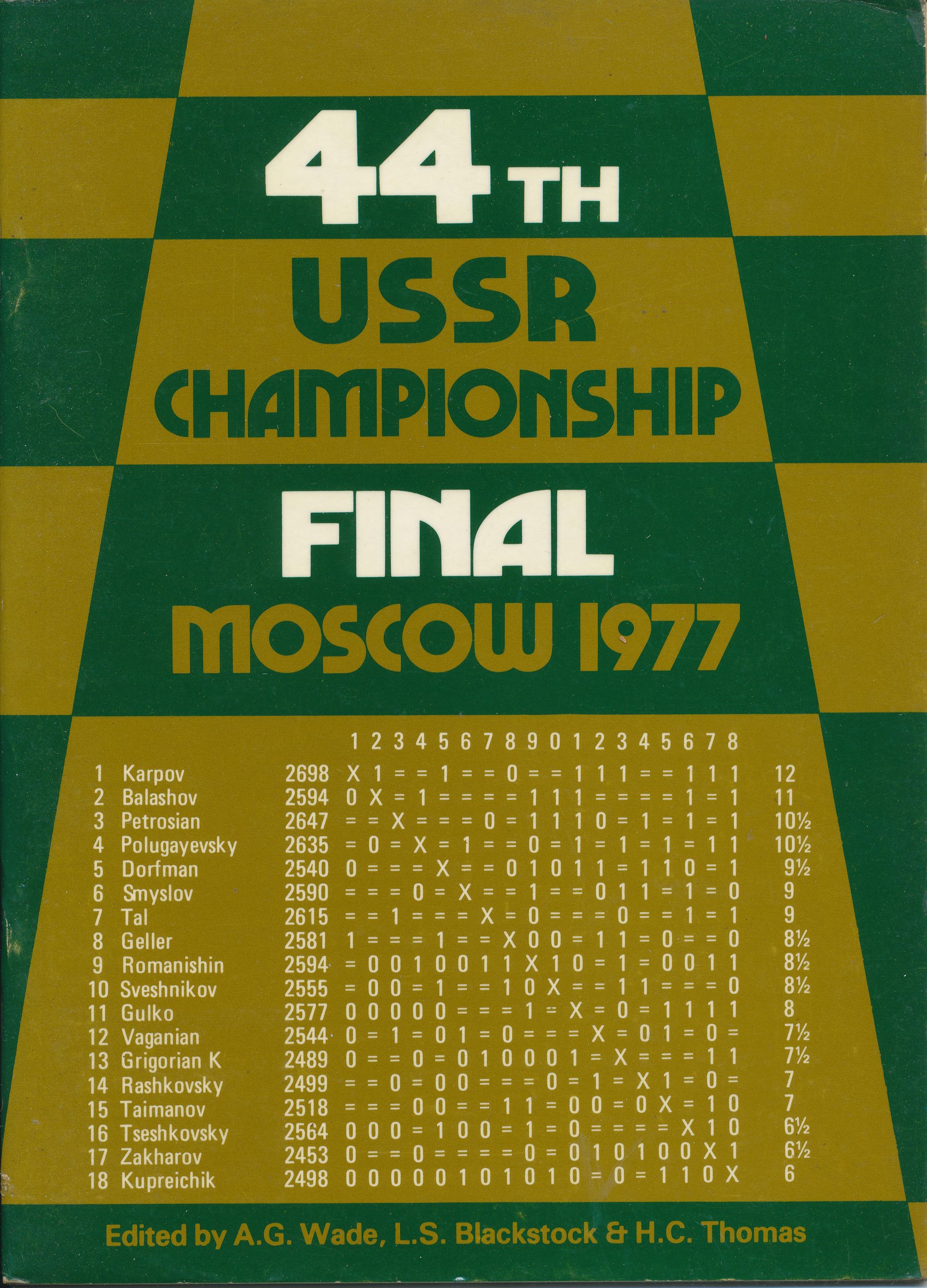
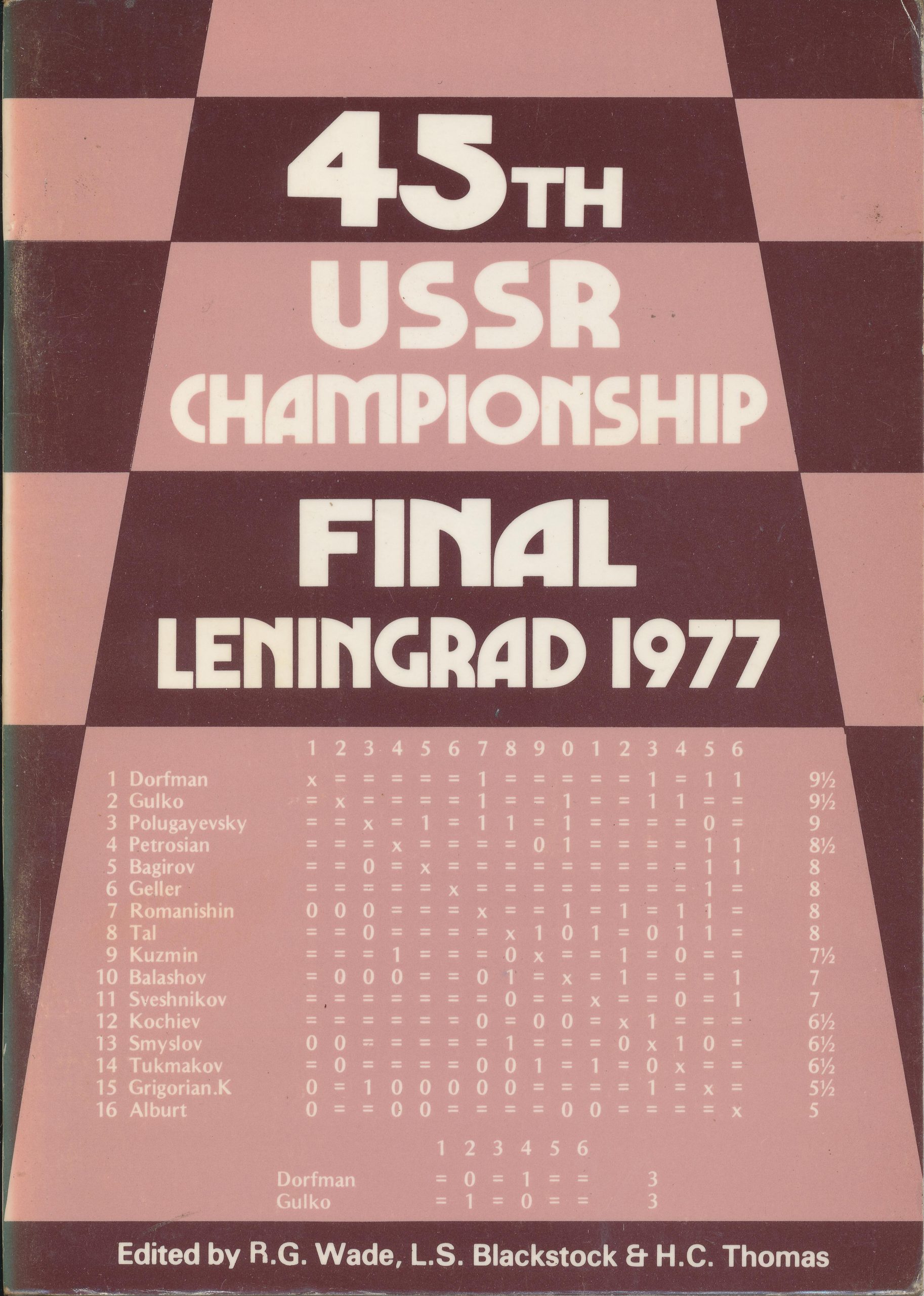
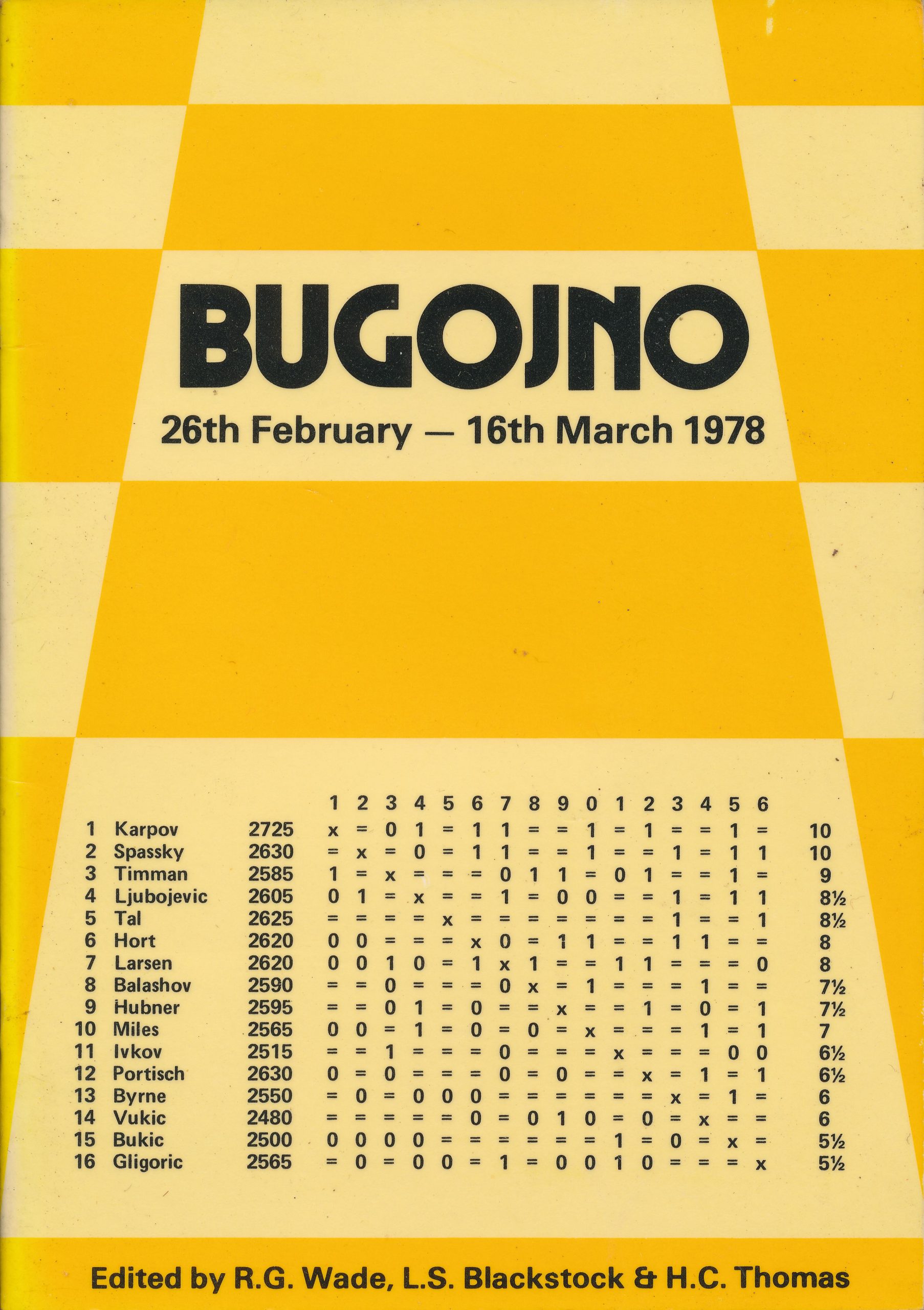
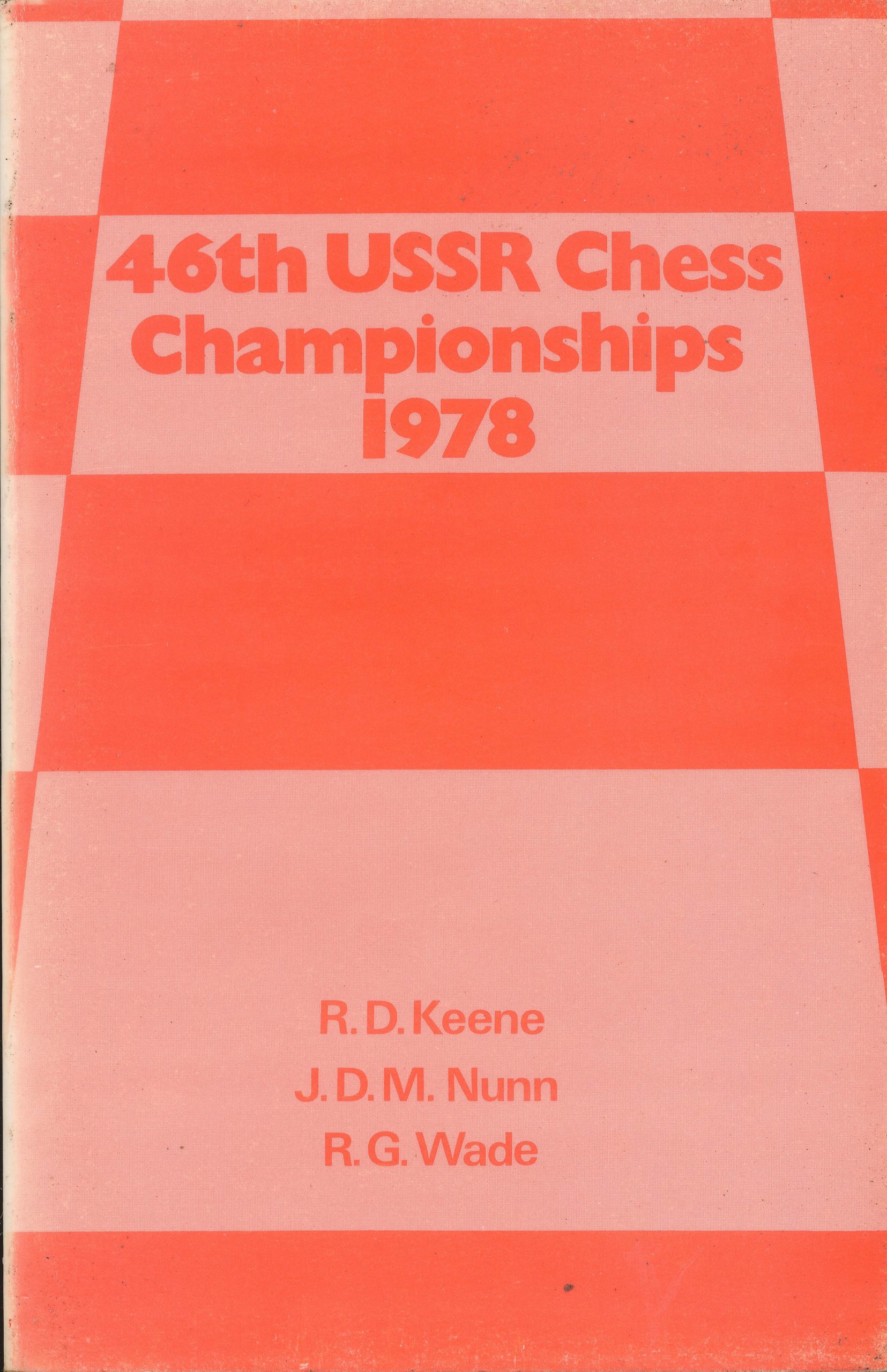
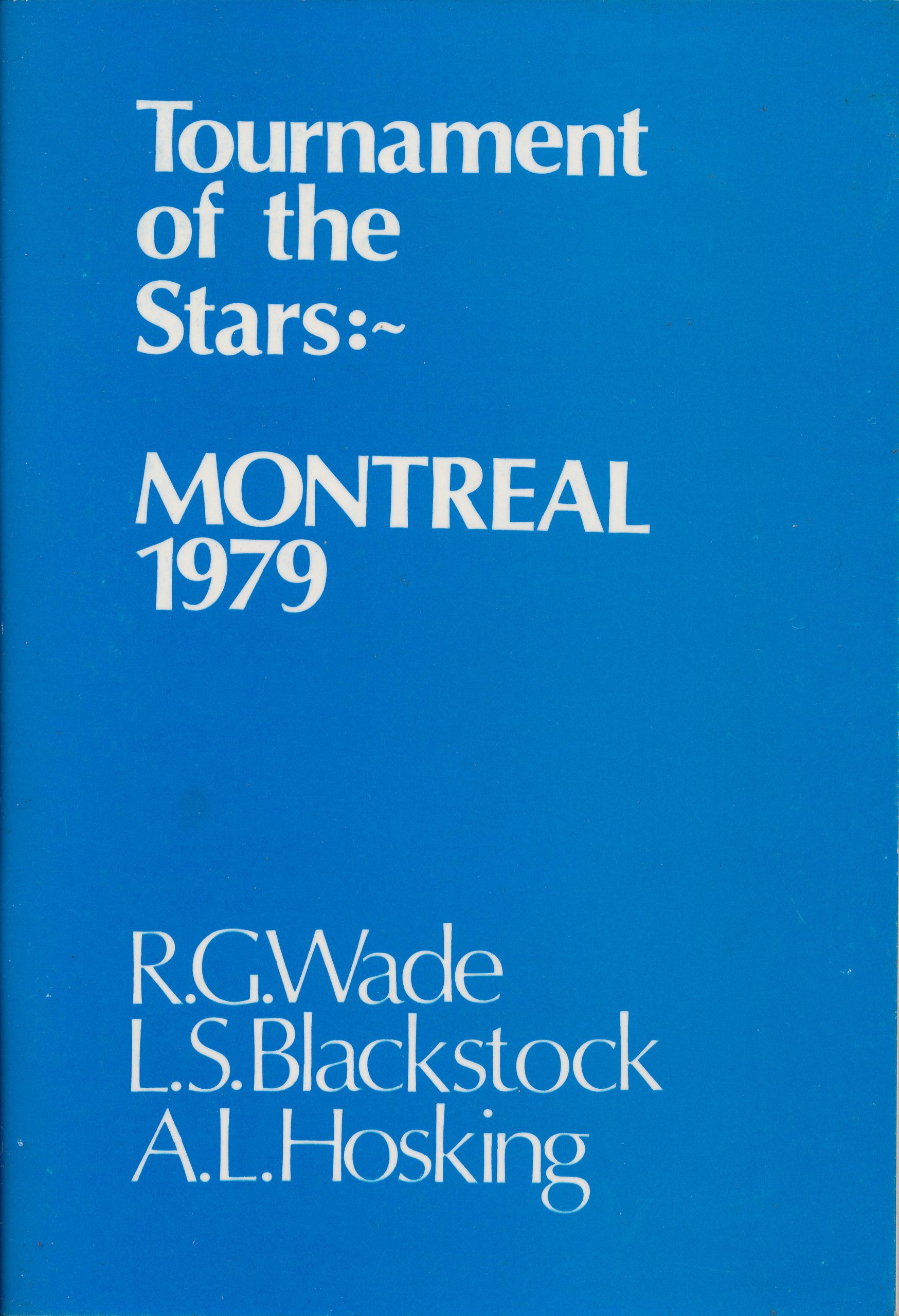
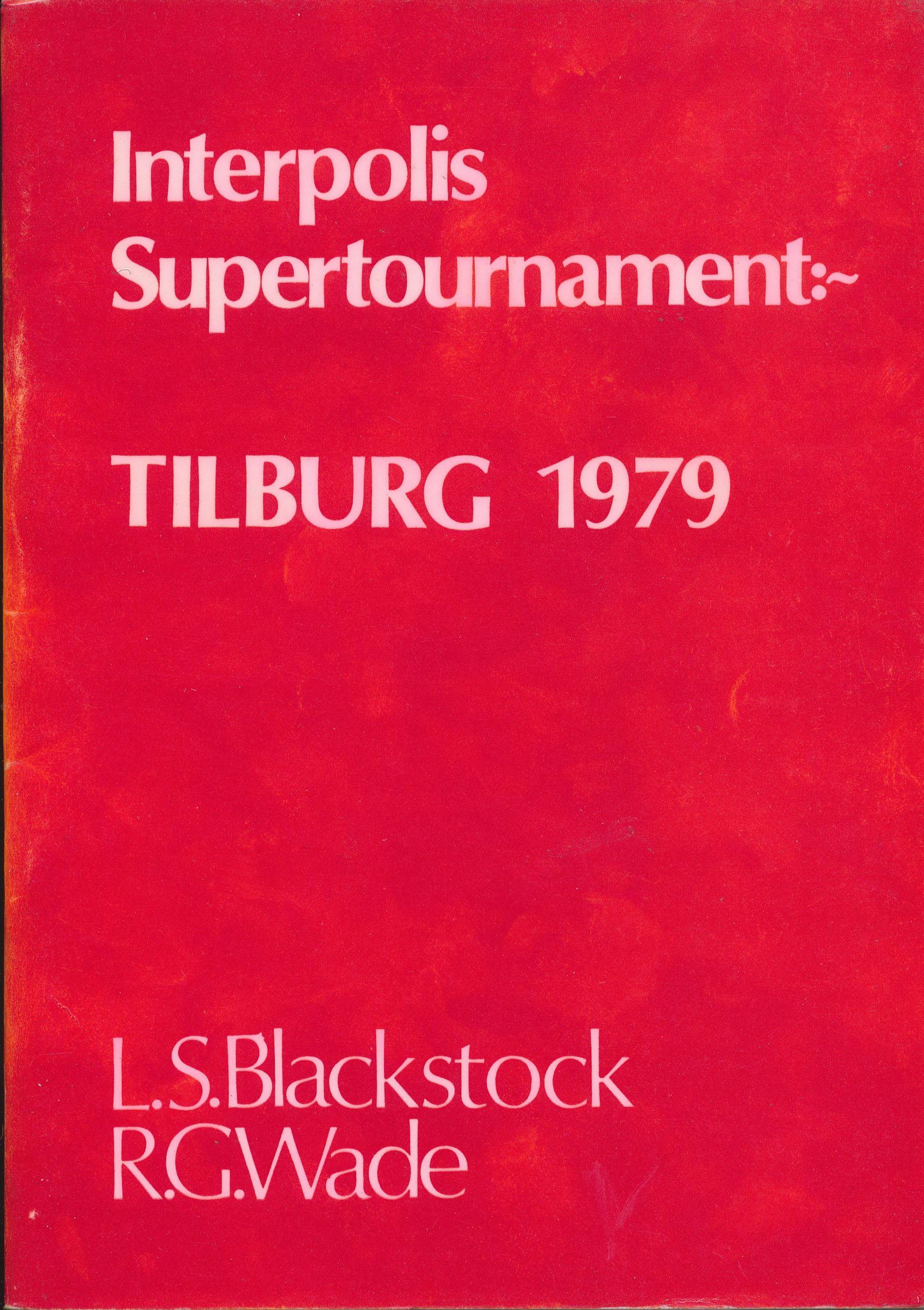
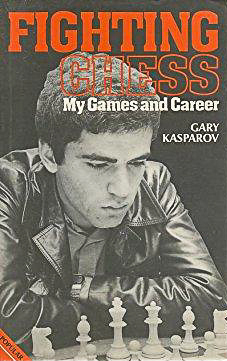
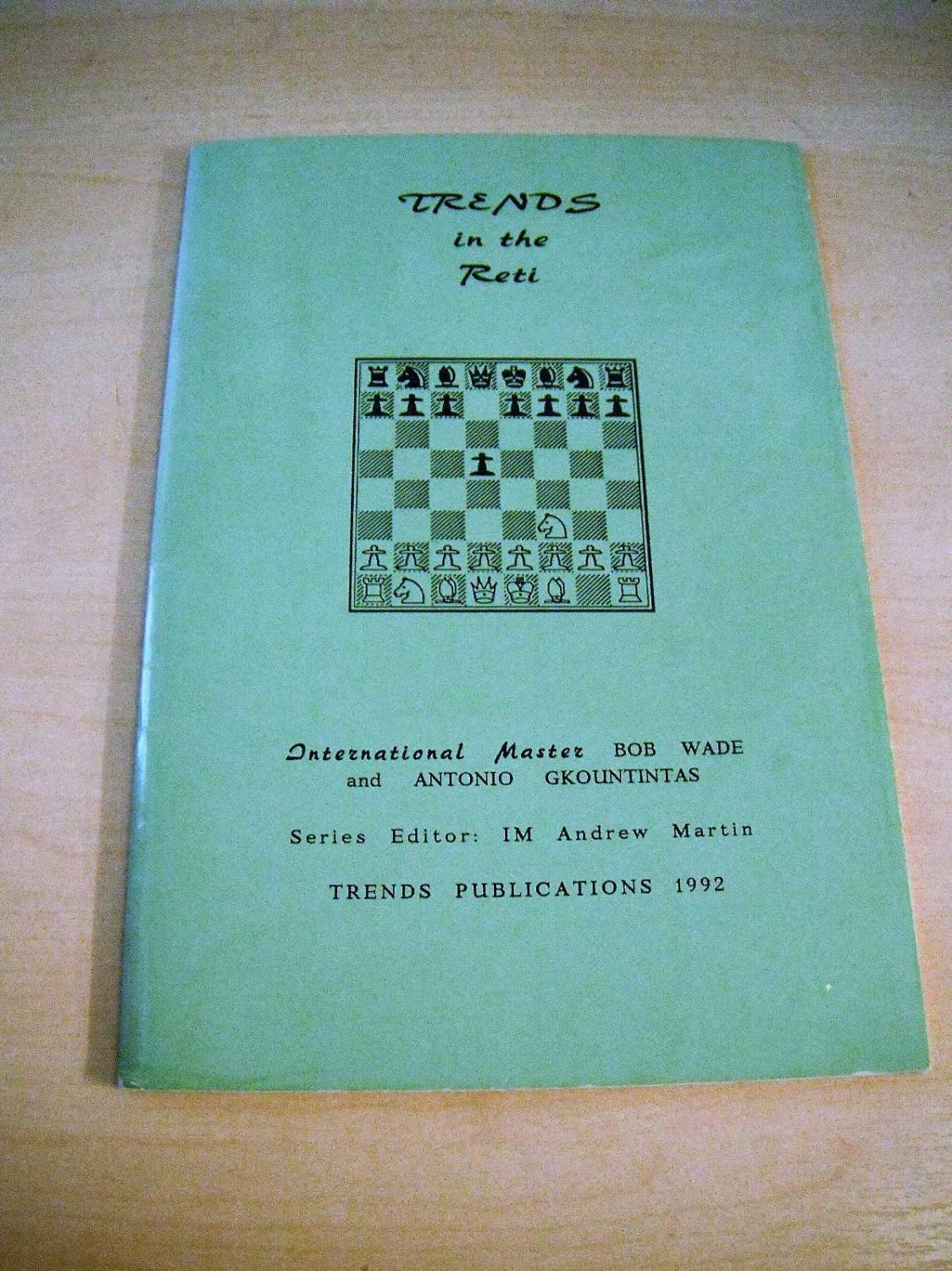
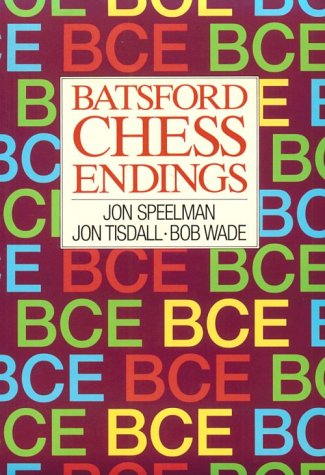
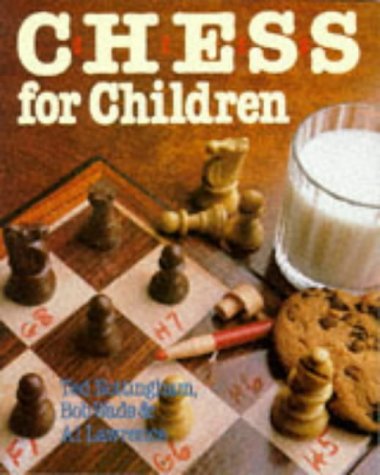
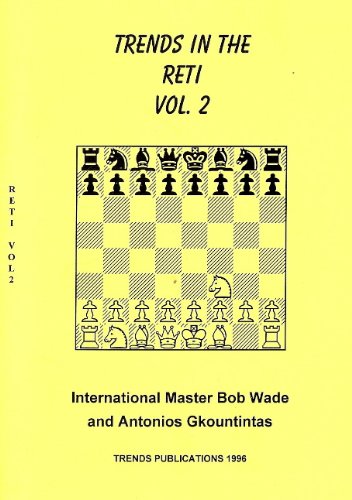
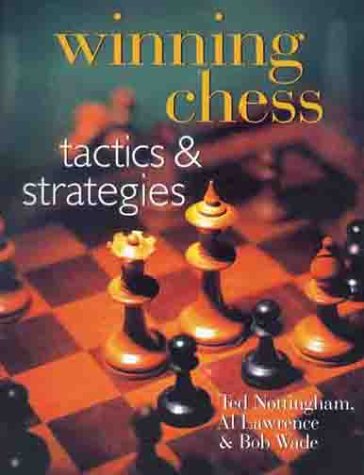
The World Chess Championship, W.Winter & RG Wade, Turnstille Press, 1951Hastings Chess Congress 1955-56, RG Wade & W. Ritson Morry, En Passant Chess PublicationsChess Tactics for Beginners, RG Wade, Bott and Morrison, 1960The World Chess Championship: 1963 Botvinnik vs Petrosian, WadeSoviet Chess, RG Wade, Neville Spearman (UK) & David McKay Company, Inc, New York, 1968Sousse 1967 : International Chess Tournament, RG Wade, The Chess Player, 1968The Velimirovic Attack, Sozin Sicilian, TD Harding and RG Wade, Chessman Publications Ltd., 1969.The Closed Ruy Lopez, Wade, Blackstock and Booth, Batsford, 1970Palma 1970 : Interzonal Chess Tournament, RG Wade and LS Blackstock, The Chess Player, 1970The Games of Robert J. Fischer, Robert Wade and O’Connell, Batsford 1972, 2nd ed. 1972, reprinted 1973, First limp edition 1981, Reprinted 1985, 1981, 1989, Second edition (The Complete Games of Bobby Fischer) 1992World Championship Interzonals, Wade, Blackstock and Kotov, Batsford, 1974The World Chess Championship, Gligoric and Wade, Batsford, 1974The Marshall Attack, Wade & Harding, Batsford, 1974Playing Chess, RG Wade, Batsford/TVTimes, 1974Sicilian Lasker-Pelikan, 1978, Batsford, Wade, Speelman, Povah and Blackstock44th USSR Championship Final Moscow 1977, RG Wade, LS Blackstock and HC Thomas, Master Chess Publications, 197745th USSR Championship Final Leningrad 1977, RG Wade, LS Blackstock and HC Thomas, Master Chess Publications, 1977Bugojno, 1978, RG Wade, LS Blackstock and HC Thomas, Master Chess Publications, 197846th USSR Chess Championships 1978, RD Keene, JDM Nunn, RG Wade, Master Chess Publications, 1978, ISBN 0 906634 00 8Tournament of the Stars:~ Montreal 1979, RG Wade, LS Blackstock, AL Hosking, Master Chess Publications, 1979Interpolis Supertournament:~ Tilburg 1979, LS Blackstock & RG Wade, Master Chess Publications, Chess, Sutton Coldfield, 1979Fighting Chess, Kasparov and Wade, Harper Collins, 1983Trends in the Reti, Volume 1, RG Wade, 1992Batsford Chess Endings, Speelman, Tisdall and Wade, 1993Chess for Children, Ted Nottingham and Bob Wade, Sterling Juvenile, 1996Trends in the Reti, Volume 2, RG Wade, 1996Winning Chess : Tactics and Strategies, Sterling Juvenile, 2001
In 2007 Ray Cannon published the following tribute :
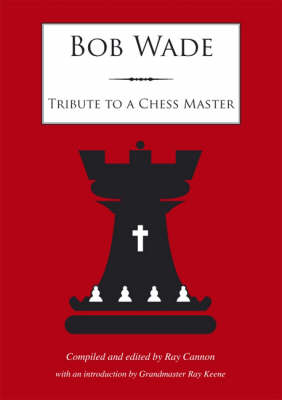
Bob Wade : Tribute to a Chess Master, Ray Cannon, Impala, 2007
However, Paul McKeown remains Bob’s official biographer.
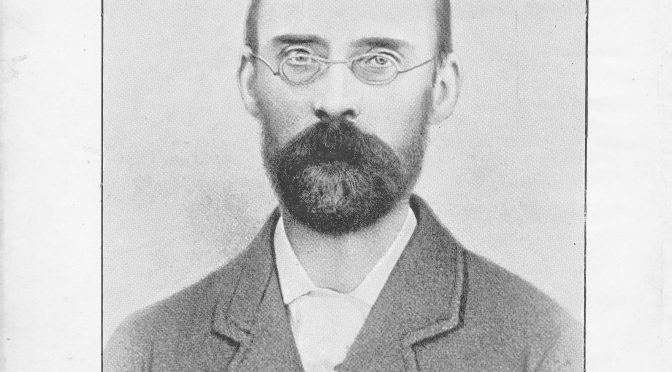
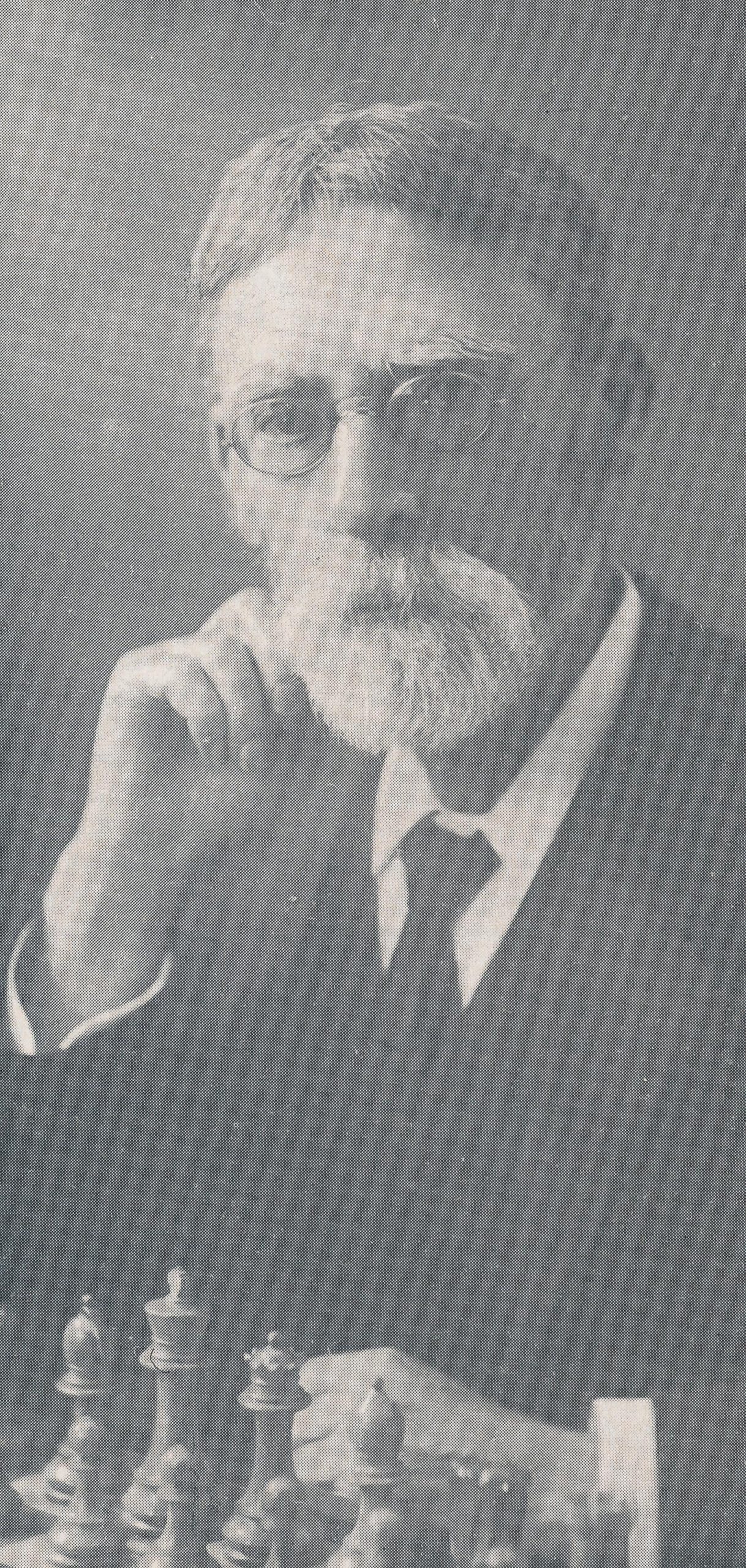
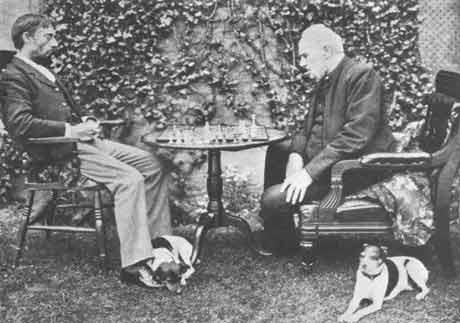
We remember Amos Burn who passed away on November 25th, 1925.
Amos Burn was born in Kingston-Upon-Hull on Sunday, December 31st 1848 to Amos and Mary Burn (née Webster). His father is recorded as a merchant. Amos and Mary were residents of Bourne Street at the time of the birth.
On February 15th 1849 Amos was baptized in All Saints Anglican Church, Sculcoates, Kingston-Upon-Hull
Amos married Martha Ann Jäger in Birkenhead on Dec 27th 1879. They had two daughters Elsie Martha, born 24th Oct 1880 and Hilda Marian, born 26th Oct 1881.
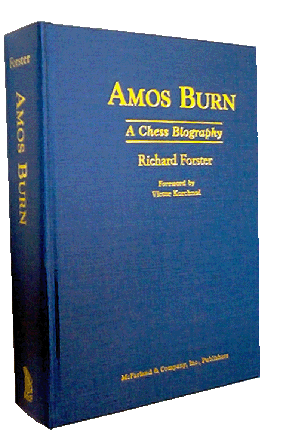
For further detail of ABs family please consult the excellent Amos Burn : A Chess Biography by Richard Forster
From British Chess Magazine, Volume XLV (45, 1925), page 491 we have this brief obituary notice (presumably written by RC Griffiths:
“Chessplayers all over the world will regret to hear that the well-known chess editor of The Field died in his flat at Luexembourg Gardens, Hammersmith, on November 25th, after a stroke the previous day, at the age of seventy-seven.
From British Chess Magazine, Volume XLV (45, 1925), page 491 we have this brief obituary notice (presumably written by RC Griffith:
We regret that as our December magazine is already paged we must leave an obituary notice and an appreciation of all he has done for Chess till next month.”
From British Chess Magazine, Volume XLVI (46, 1926), page 9 we have this detailed obituary (written by JH Blake:
“We had only just time last month to announce the decease of this famous player and chess editor. On the afternoon of 24th November he was at the City of London Chess Club in to all appearances normal health; he took a fellow-member home with him, and after completing the annotation of a game for his paper, was chatting with his guest when the fatal seizure overtook him; he never fully recovered consciousness, and died the following afternoon. He was buried at Hammersmith Cemetery on the 27th November.
Amos Burn was born at Hull on the 31st December, 184B. By way of coincidence, no less than three of the band of English chess masters were sons of the Yorkshire port, the other two being Boden (over twenty-two years senior) and Wisker (very little older than Burn).
In his early teens he was apprenticed to a firm of Liverpool cotton brokers. Most of the year l870 was spent in London. At least once, and probably three times in his life, he made prolonged business visits to America; the occasion as to which there is most certainty was about 1893-5, when he was a year or two at Chicago; Liverpool information puts another visit about 1902-3 (which would account for his non-participation in the Monte Carlo tournaments); and hints dropped by himself point to such a visit in 1882-3 ; this would account for his not competing in either event at the London congress of 1833, and for the non-inclusion of his portrait in the large group picture painted by A. Rosenbaum about 1882, and now hanging in the City of London Chess Clubroom. Upon returning to England he always settled down again in business at Liverpool, where he
was occupied, for some time at any rate, in sea insurance. From which it will be seen that at no time of his life was he dependent upon chess-playing as a means of livelihood; although it is difficult to resist the impression that at some periods, particularly 1886, 1B89 and 189B, the claims of business sat very lightly upon him.
His initiation into chess was made at about sixteen years of age, and is to be credited to John Saul, of the Liverpool Chess Club, who took great pains with his pupil, and is believed to have had much influence in the early formation of a sound style. So apt was the pupil, so thorough the teacher, that when in 1867 he joined the Liverpool Chess Club, he was placed at once in the Pawn and move class, and one of his earliest club exploits was to win the club handicap tournament; a rise not much less phenomenal than that of Blackburne at Manchester a few years earlier.
During his stay in London in 1870 he joined the City of London Chess Club, playing for it in a match with the Westminster Chess Club, and joining in the winter handicap, where however, he was knocked out in an early round. He seized every opportunity of obtaining practice with the best players of the day, and no doubt it was during this period that he came under the influence of Steinitz, whose tuition he later in life gratefully acknowledged to have been invaluable to him, and whom he unhesitatingly ranked as the world’s greatest player. During this year (and not 1887 as most notices of his career have stated) the first British Chess Association (Lowenthal’s) held a challenge cup tournament; Burn was a competitor, and tied for first prize with his townsman, Wisker, but was defeated in the tie-game. His next public appearances were at the annual tournaments of the Counties Chess Association, a provincial body formed for the express purpose of holding annual tournaments for about three classes of players, at some provincial town, and lasting one week; its principal tournament was, in the middle of the seventies, for a cup, to be held a year by the winner.
In 1873 Burn tied with Skipworth for first place (no tie-game was played), in 1874 he was first, in 1875 second (8. W. Fisher, late of the Battersea Club first), and first in 1876, this last victory making the cup his own. He did not appear in public play again until 1BB3, when (perhaps out of practice after a business stay in America) he was much less successful, only taking fourth prize at the Counties Association meeting at Birmingham.
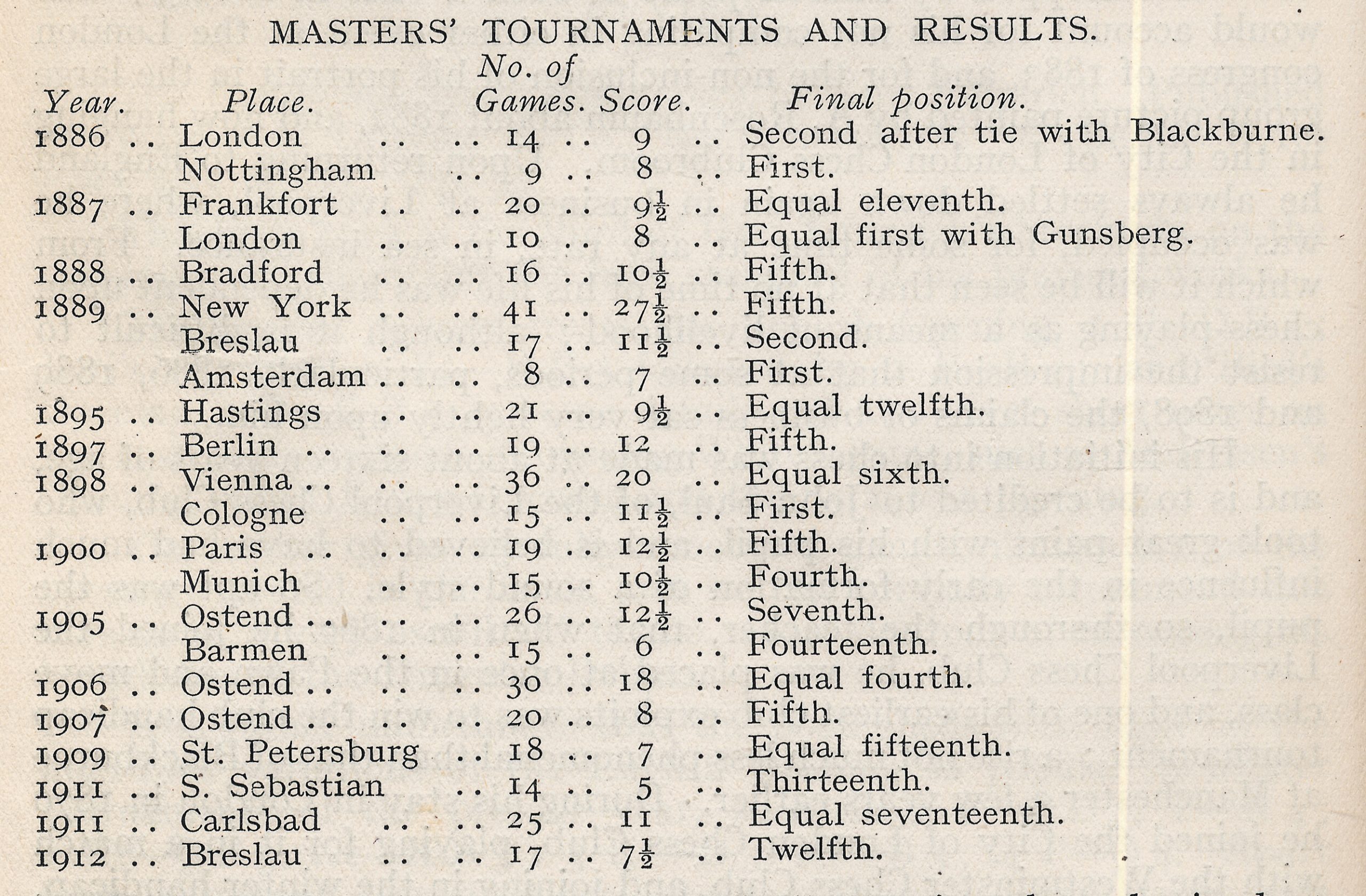
The year 1886 marked his (rather late) entry upon the international tournament arena. The resuscitated British Chess Association held a masters’ tournament in London, in which Burn tied with Blackburne for first place, but lost the tie-game. From 1886 to 1912 inclusive he competed in twenty-two international tournaments;
we append a tabular statement giving all necessary particulars.
The tournament record of Amos Burn according to British Chess Magazine, Volume XLVI (46, 1926)
The greatest success was beyond all question that obtained at Cologne in 1898, where he was first to such renowned rivals as Charousek (second), Tchigorin (fourth), Steinitz (fifth) and Schlechter (equal sixth). But no mean place in the order of merit must be assigned to the second prize at Breslau in 18B9, where Dr. Tarrasch achieved the first of his great Series of successes, and such players as Bardeleben, Blackburne, Gunsberg, Mason and Schallopp were amongst the less successful competitors. The book of that tournament, in recognition of so striking a success, following upon the New York tournament with the Amsterdam victory treading closely upon its heels described Burn as the “tournament hero of the year”
In 1898 the Cologne tournament followed hard upon the long struggle at Vienna; these events of these two years go to prove his remarkable power of endurance : he fared best in the most prolonged. efforts.
During this period of international activity Burn did not altogether eschew competitors of a national or sectional character. Early in 1889 he won first prize in an Irish Chess Association tournament at Dublin, Pollock and Mason taking the next two places. In 1897-8-9 and 1901 he competed at Llandudno for the Craigside challenge cup, which he won three times in the four tournaments. He also won a Midland counties tournament at Birmingham in 1899, with Atkins second.
Of individual match play there is not much to record. A match with Bird in 1886 (two more opposed styles of play could hardly be imagined) was begun as one of five up, with the score at four all was extended to ten up, and was finally drawn by agreement with the score at at nine all. In the same year a match of five up with Captain Mackenzie was drawn with as score of four all; the curiosity of this
match is that Mackenzie won the first four games and Burn the last four. A match is known to have been played in 1875 with the Rev. John Owen, the leading player of the Liverpool club until Burn’s rise ; this Burn won by 11 to 6. Mr. Owen, however, told the present writer (about 1895) that he had contested several matches with Burn, who had not always been the winner; no record remains of these encounters; but as neither player had any love for the practice of recording the moves of a game during its progress its absence is not surprising. Similarly, a short match was begun with the Rev. A. B. Skipworth at his Lincolnshire rectory, somewhere in the late eighties, but whether finished is doubtful; probably the record of this is buried in the files of a Horncastle or Louth newspaper in which Mr. Skipworth conducted a chess column at the time.
Burn took part in the matches by cable with America on four occasions. In 1896 and 1898 he lost to Showalter; in 1907 he drew with Marshall; and in 1911 he defeated Marshall (who was then in London) over the board.
His connection with the Liverpool Chess Club lasted from 1867 until his death. He served the offices of librarian in 1877, vice-president in 1880, president in 1881, 1888, 1890, 1891, 1892, 1908, 1909, 1910 and 1911. In 1887 he was elected an honorary member retaining that qualification until then end. In 1888 he was presented by the club with a handsome chessboard and set of chessmen, the box bearing an inscribed silver plate, in recognition of the tournament successes he had already achieved, and as a token of the high esteem in which he was held by his fellow members.
As a chess journalist Burn commenced in 1871 when he edited
a column in the Liverpool Weekly Albion, how long this continued we do not know. In 1911 he became chess editor of the Liverpool Courier. His annotation of games for this column attracted wjde-spread notice and was much quoted both at home and abroad. When therefore, on the death in 1913 of Leopold Hoffer, Burn was appointed to The Field, it was to the general satisfaction of British chessplayers everywhere. His treatment of the games published in that paper was of the most sound and reliable character, and no pains were ever spared to arrive at the inner secret of the most intricate position. The high standard set by Steinitz when editing the same column thirty to forty years before, was worthily maintained by his quondam pupil on becoming his successor.
Burn’s style of play was solid and prudent rather than aggressive; he has more than once mentioned with pardonable pride that amongst his peers of master rank he was chiefly famed for “stubborn defence.” A favourite aphorism was, “The player who combinates is lost !” Nevertheless it is to be at least suspected that this was
the result of his early chess education and a strong power of self-control rather than of his predilections. An oft-repeated saying, perhaps the one which will be in London longest remembered, was “toujours attaque” ; his preference for being first player was stronger than that of most players, strong as that often is; and when shown
a game or position he had very little hesitation in taking sides, almost always with the attack; only with the defence when his initial judgment told him that unsoundness was afoot. But “counterattack is the soul of defence,” and in that he could be terrible. A collection of, say, twenty of his best games would probably yield a large pre-
ponderance of Black as his side. Once interested in a game (or position) his concentration upon it was of the most intense kind, and could only with difficulty be diverted. Even in skittle play, a cup of coffee, ordered at the start, would stand at his elbow unnoticed; was the opponent at some point long in moving he would suddenly become aware of its presence, and lift the cup; but let the opponent at the same instant raise his hand to move, back went the cup to the table untasted, and the beverage would be eventually consumed quite cold. His pipe fared little better; badly loaded, it took innumerable matches to light, was laid down after a few puffs, went out, and was
re-lit with the same difficulty. Did a friendly onlooker hint that a difference in the loading of the pipe would save much trouble, he would, if he succeeded in gaining attention, be quietly and painlessly extinguished with “How long have you been a smoker ?” The same intensity of concentration was carried into his work for the Field, and it is known that he often sat through the small hours of the morning to complete an analysis rather than interrupt the current of his ideas. Had he but spared himself in this respect —!
Of short figure, slight frame, and abstemious in habit, he was remarkably ” wiry ” ; at 77 his head of hair was quite untouched by the hand of time, and but for the grizzling of the beard he would have passed for no more than sixty. Perhaps a little difficult of approach by strangers, when his attention and interest were once gained he was the soul of courtesy, and would take unstinted trouble to oblige his interlocutor, or to help a colleague.
At the chessboard his courtesy to his opponent was perfect; he “played the game” in the best sense of the words; and his tribute to Blackburne’s chivalry as an opponent was worth the more because it accorded with his practise. With him passes the last of the line of English great masters!
In 2006 an article by WD Rubinstein was published in the Oxford Dictionary of National Biography
From The Oxford Companion to Chess (OUP, 1984), Hooper & Whyld :
“One of the world’s top ten players at the end of the 19th century. Born in Hull : he learned chess when 16, came to London at the age of 21, and rapidly established himself as a leading English player, A pupil of Steinitz, he developed a similar style; both he and his master were among the world’s best six defensive players, according to Nimzowitsch. Not wishing to become yet another impecunious professional. Burn decided to put his work (first a cotton broker then a sugar broker) before his chess, and he remained an amateur. He made several long visits to America, and was often out of practice when he played serious chess.
Until his thirty-eighth year he played infrequently and only in national events, always taking first or second prize. From 1886 to 1889 he played more often. In 1886 he drew matches with Bird (+9-9) and Mackenzie (+4=2-4); at London 1887 he achieved his best tournament result up to this time, first prize (+8—1) equal with Gunsberg (a play-off was drawn +1=3—1); and at Breslau 1889 he took second place after Tarrasch ahead of Gunsberg, After an isolated appearance at Hastings 1895 he entered another spell of chess activity, 1897-1901, The best achievement of his career was at Cologne 1898, first prize ( + 9=5-1) ahead of Charousek, Chigorin, Steinitz, Schlechter, and Janowski. At Munich 1900 he came fourth (+9=3—3). His Last seven international tournaments began with Ostend 1905 and ended with Breslau 1912. A comparative success, in view of his age. was his fourth prize shared with Bernstein and Teichmann after Schlechter, Maroczy, and Rubinstein at Ostend 1906; 36 players competed in this five-stage event, 30 games in all for those who completed the course.
Retired from both business and play he made his home in London and edited the chess column of The Field from 1913 until his death. A shy and retiring man, a loyal companion to those who came to know him, he freely gave advice to young and aspiring players.”
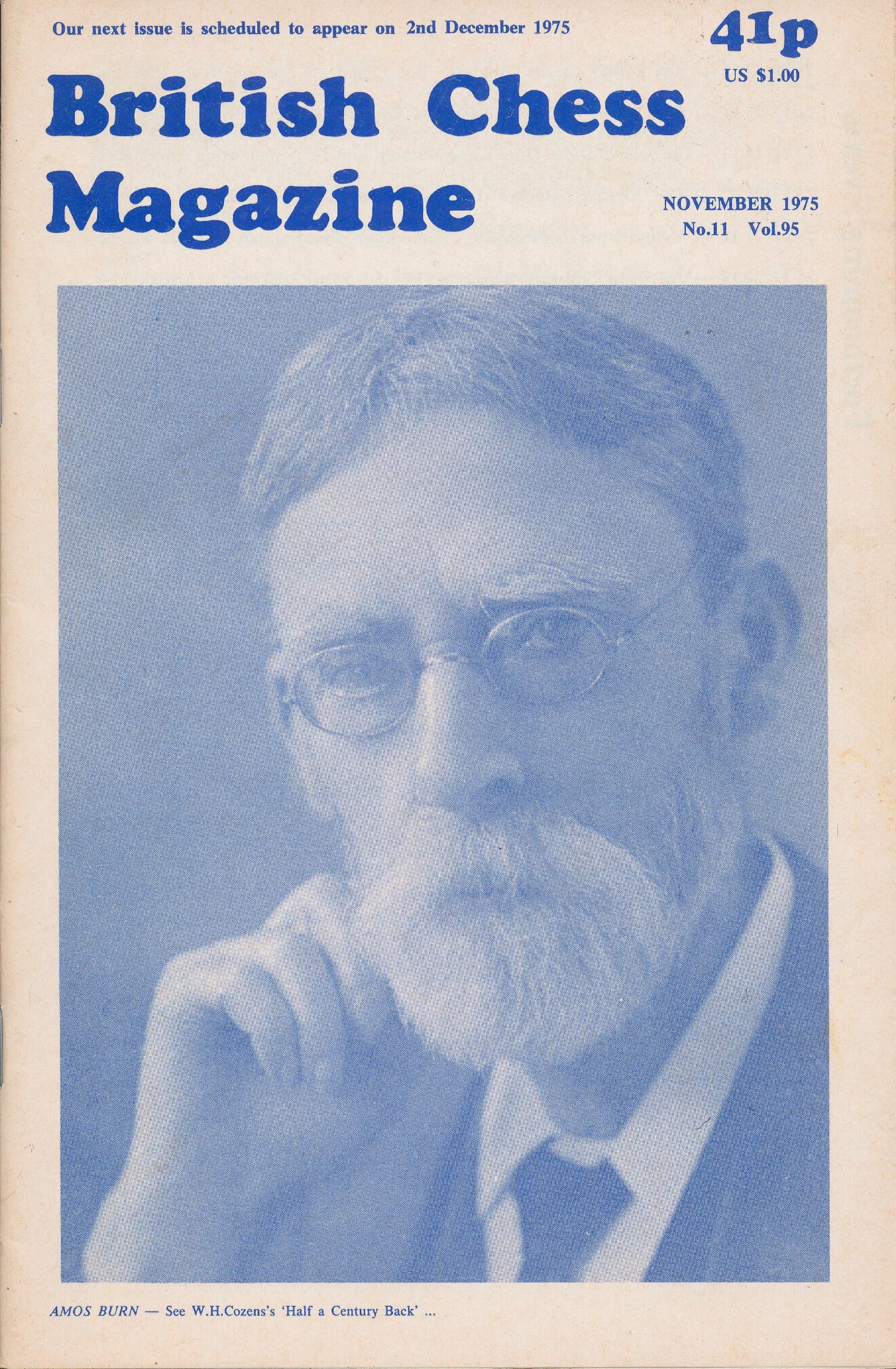
The front cover of the November 1975 issue of the British Chess Magazine featured Amos Burn :
Amos Burn – See W.H.Cozen’s ‘Half a Century Back’…from the front cover of the November 1975 issue of British Chess Magazine
From British Chess Magazine, 1975, November, pp. 481-483 :
Half a Century Back
Chess in 1925
by W.H. Cozens
Amos Burn was a very different figure and his career is poorly documented. He is overdue, not for a reappraisal but simply an appraisal, He was born (in Hull) in 1848 – an incredible 127 years ago. All the years that could have been his prime as a chessplayer he devoted to business. (Marine insurance was his speciality.) He was based in Liverpool but travelled considerably, including several crossings of the Atlantic – quite an undertaking in those days. He played some casual chess, soon overshadowing the Rev. John Owen to become Liverpool’s answer to Manchester’s Blackburne. He also played for the City of London Chess Club; but it was not until he was nearly 40, presumably with his financial position secured, that he entered the international chess arena. Between the ages of 38 and 64 he played in 22 international tournaments. At Breslau (1889) he was second to Tarrasch, above Louis Paulsen, Blackburne, Schallop … In Amsterdam the same year he was first, ahead of Emanuel Lasker. His finest achievement was first place at Cologne 1898, in front of Charousek, Chigorin, Steinitz, Schlechter et al., (16 in all) with a win against Steinitz. The lack of a book on Cologne 1898 is – since the publication of Mannheim 1914′: the biggest gap in tournament literature.
At Karlsbad 1911 he defeated not only the winner, as mentioned above, but also Alekhine, whom he steered into a knight versus bad bishop ending. His style was unashamedly modelled on that of Steinitz, and marked by extreme tenacity. To him is attributed the epigram ‘He who combinates is lost’. He could play a combination when in the mood but he much preferred to let the opponent break his own back by attacking too impetuously. Nimzowitsch wrote: ‘The number of really great defensive players is very small’, adding that he knew of only six: Steinitz, Emanuel Lasker, Burn, Bernstein, Duras and Louis Paulsen.
In the 1911 Cable Match between G.B. and the U.S.A. Marshall came from San Sebastian straight to London and asked permission for his top board game to be played over the board. When he found that his opponent was to be the 64-year-old Amos Burn he must have smiled, for he had twice defeated him resoundingly – at Paris 1900 (also having some fun at Burn’s expense in his annotations to the game) and again at Ostend 1905. This time he was in for a shock. Within twenty moves the old man had won his queen for two pieces. Marshall played on, probably with a red face, until move 37, rather than have his loss cabled home too early. Against Burn he might have spared himself the trouble.
Burn was a superb annotator. His work, notably in ‘The Field‘ from 1913 on, sets a standard to which one looks back nostalgically in these days of hieroglyphics. The day before he died, at the age of 77,he had been at work on analysis and annotation. Tournaments were now plentiful enough for it to be possible to pick out the band of regular professionals, and to assess their prowess. Tartakower was placed 2, 5, l, 5; Reti 5, 5’ 5,-11; Grunfeld 4,8,8,9; Nimzowitsch was erratic with 1,2,9; so was Rubinstein with 1, 2, 3, 12. Marshall was consistent with 3, 4, 5. Lasker, Capablanca and Alekhine appeared once each – with distinction, of course.”
The Burn Variation is a line in the french defence dating from the 1870s, played regularly by Burn at the tournaments of Hastings
1895, Cologne 1898, and Vienna 1898. More recently it has been favoured by Petrosyan.
From The Encyclopedia of Chess (Robert Hale, 1970 & 1976), Anne Sunnucks :
“A leading British player of his day, Amos Burn was born in Hull on 31st December 1848. He learned the game when he was 16 and an apprentice with a firm of Liverpool cotton-brokers, but it was not until 1886 that he achieved his first major tournament success by coming 2nd in the London tournament and 1st at Nottingham. These results gained him an invitation to Frankfurt 1887, which marked the beginning of his career as an international player.
Burn’s greatest successes were 1st at Amsterdam 1889, ahead of Lasker, 2nd at Breslau 1889, behind Tarrasch but ahead of Mieses, Von Bardeleben, Bauer, Gunsberg and Paulsen; and 1st at Cologne 1898, ahead of Charousek, Steiniitz, Tchigorin and Schlecter.
After the St. Petersburg 1909 tournament, Burn’s results began to deteriorate and he finally retired from tournament chess after the Breslau 1912 tournament.
From 1913 until his death, Burn was chess editor of The Field. He died on 25th November 1925.”
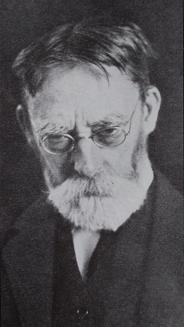
Amos Burn (31-xii-1848, 25-xii-1925) circa 1920
From The Encyclopedia of Chess (Batsford, 1977), Harry Golombek OBE :
“British Grandmaster and second only to Blackburne in late nineteenth-century British chess. He was born in Hull and learned to play chess at sixteen, but devoted little time to the game at first, preferring to establish himself in a commercial career.
He returned to chess in his middle thirties, his first major national success being first prize at Nottingham 1886 and second prize at London 1886. Within three years he had gained an international reputation by winning at Amsterdam 1889, ahead of Lasker, and finishing 2nd to Tarrasch at Breslau 1889. Burn continued to appear in international tournaments until the age of sixty-four, his most notable triumph being first prize at Cologne 1898 in front of Charousek, Steinitz, Chigorin and Schlechter. He was chess editor of The Field from 1913 until his death in 1925.”
and from that game we have the move that made that game memorable :
Black to move : did you find it? (if not see the foot of this article)
William Winter wrote the following in the February issue of CHESS for 1963, (Volume 28, Number 426, pp.128-134):
“For my win over Niemtsovich I am partly indebted to Amos Burn. Before the tournament I happened to mention to him that Niemtsovich was playing a system, beginning with 1.P-QN3, the idea of which was to control the square at his K5 from the flank, and eventually occupy it with a knight. The old master told me that in his younger days he had played many games with the Rev. John Owen who regularly adopted this opening, and that he could make little headway against it, until he hit on the idea of at once occupying the key square with a pawn and defending it with everything he could pile on. This plan I adopted with complete success. After my third move I saw Niemtsovich shake his head, and in fact he was never comfortable.”
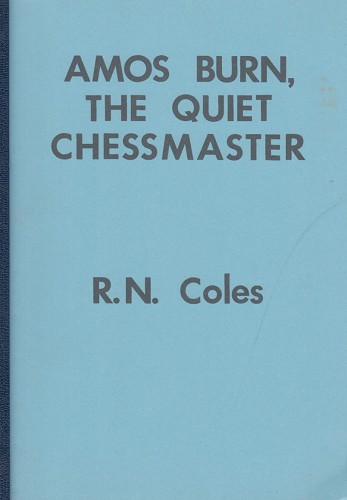
According to Edward Winter in Chess Notes Burn lived at 19 Luxemburg Gardens, London W6, England (Amos Burn, The Quiet Chessmaster by R.N. Coles, page 7).
Amos Burn (31-xii-1848, 25-xii-1925) courtesy of “The Field”
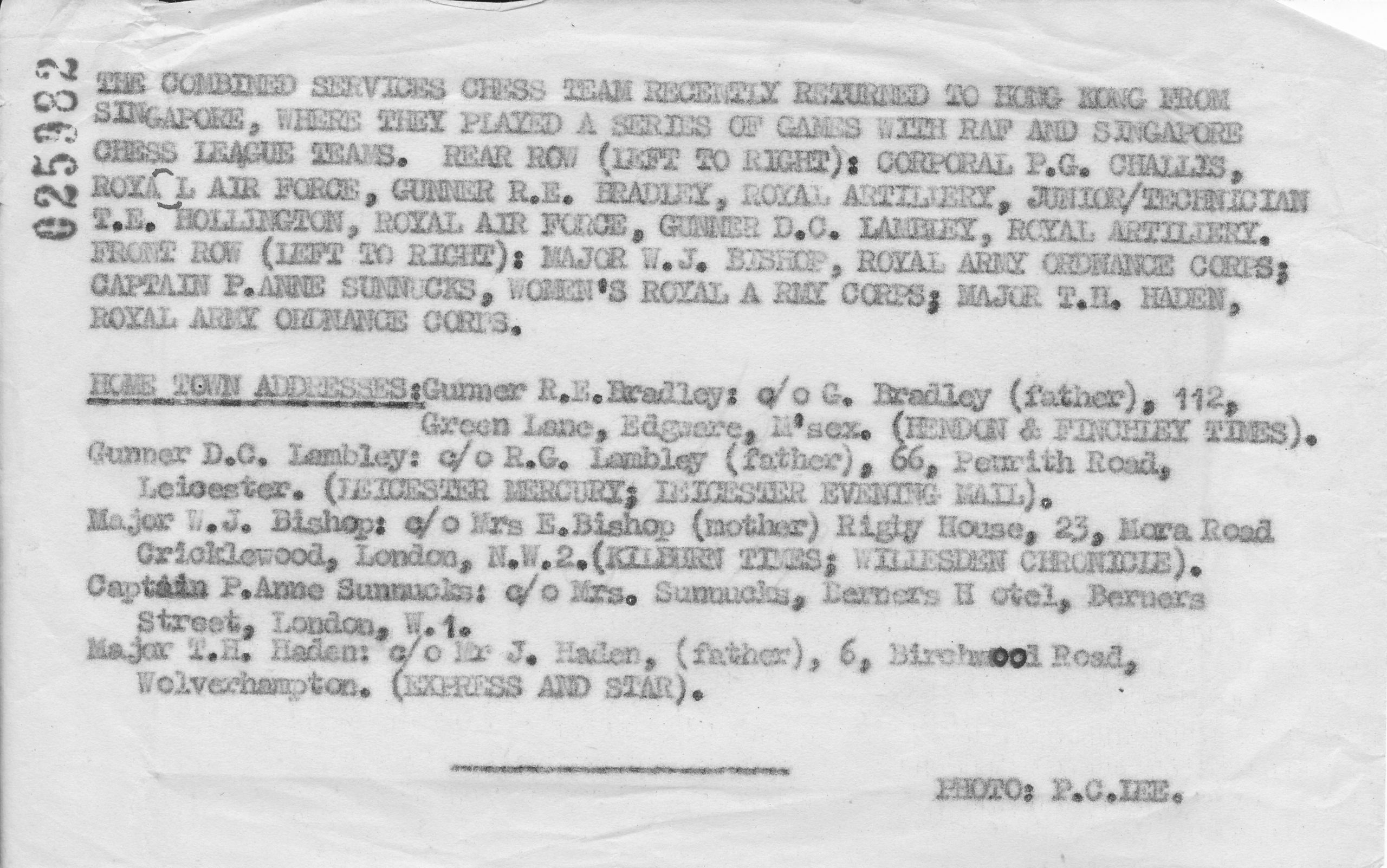
We remember WIM Anne Sunnucks who passed away this day, November 22nd, 2014, aged 87 years at a retirement village in Meadow Park, Braintree, Essex.
Patricia Anne Sunnucks was born on Monday, 21st February 1927 in the district of Kensington, London. Her father was Stanley Lloyd Sunnucks and her mother was Edith Vera Constance Sendell.
Anne had one brother, James Horace George, who died in March 2005 in Colchester, Essex.
Stanley died on 29th January 1953 in Brentwood, Essex. Edith passed away in March 1975 in Bracknell, Berkshire.
In September 1984 in Bracknell, Berkshire Anne married Richard C Mothersill.
“International Woman master and British Women’s Champion 1957, 1958 and 1964. Her best international result was a 2nd in the 1954 Western European Zonal. This qualified her for the 1955 Women’s Candidates tournament, but as this held in the USSR and she was at the time serving as a Major in the British Army, the authorities would not give her leave to participate.
Miss Sunnucks has represented England a number of times in Olympiads and team matches. She has compiled The Encyclopedia of Chess, London, 1970.”
From The Encyclopedia of Chess (Robert Hale, 1970 & 1976), Anne Sunnucks :
“International Woman Master (1954) and winner of the British Ladies’ Championship in 1957, 1958 and 1964.
Born on 21st February 1927 Anne learned the moves at the age of 8 but did not take up chess seriously until she was 21, when she joined the same club as International Master, Imre König” whose pupil she became.
Danlon ladies chess tournament, left Anne Sunnucks , right Katarina Blagojević-Jovanovic Date: October 23, 1962
In the 1954 Western European Zonal tournament, she came 2nd and qualified for the 1955 Women’s Candidates tournament but was unable to compete.
She played for Great Britain v. the USSR in 1954 and for the British Chess Federation team in the Women’s Chess Olympiads of 1966 and 1972. She also represented the BCF in the Western European Zonal tournaments of 1963 and 1966.”
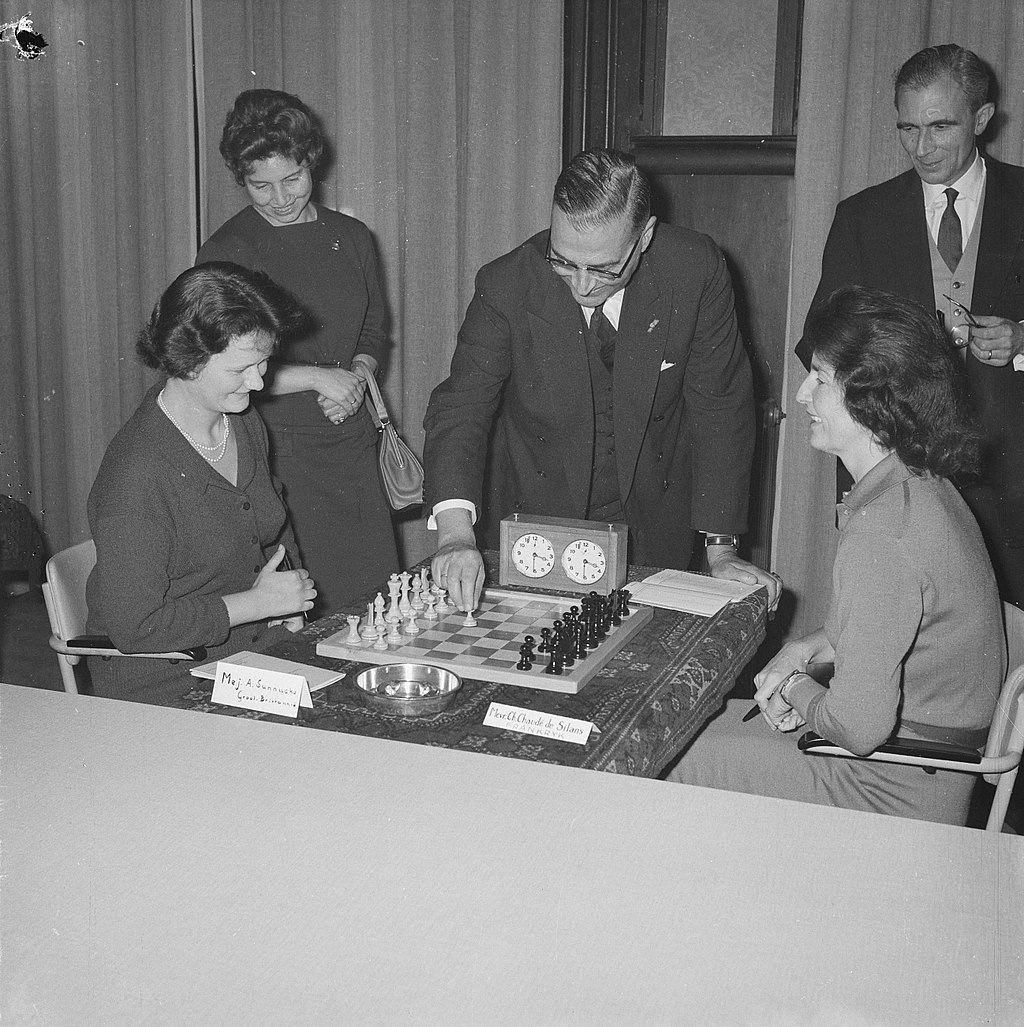
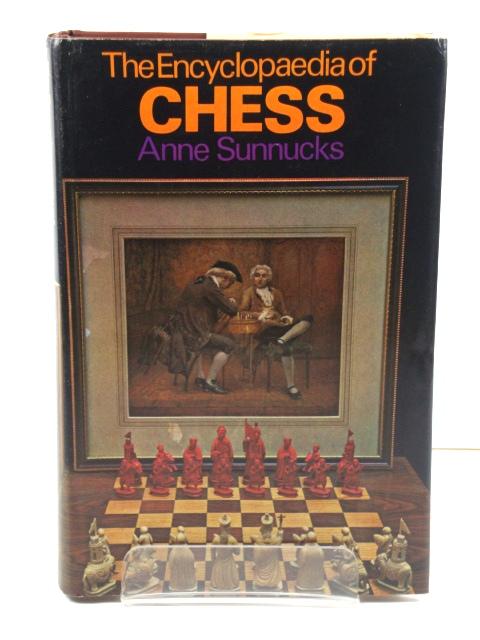
Anne Sunnucks vs Chaudé de Silans (Amsterdam, 1962)The Encyclopedia of Chess by Anne Sunnucks
Anne created Camberley Chess Club in 1972. She offered to open her spacious home at 28, Brackendale Close, Camberley for weekly club nights and matches.
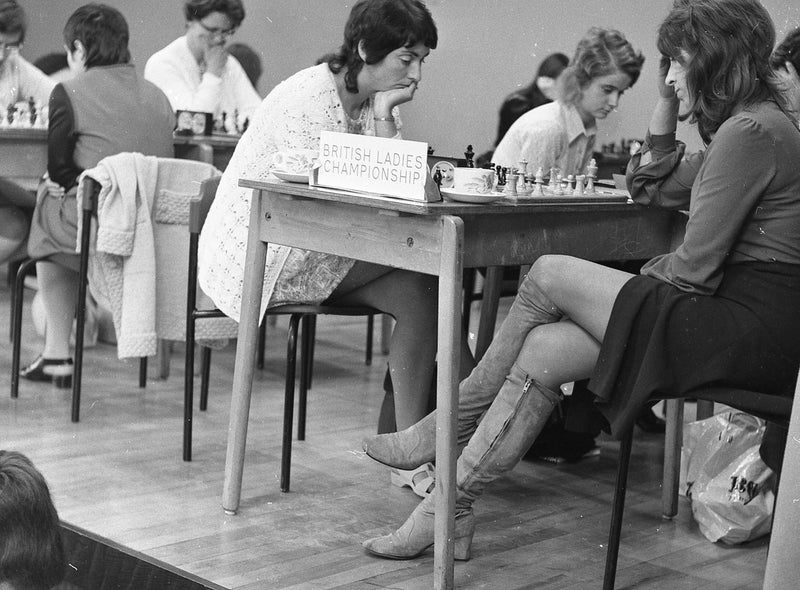
Anne Sunnucks (third from left) playing in the 1971 British Ladies Championship in Palatine School, Blackpool. Courtesy of Lancashire Evening Post.
Anne was a director of BMS (?, Mothersill, Sunnucks) Chess Supplies Ltd. which retailed chess books and equipment which the grateful membership purchased!
From Brian Towers : It is also worth noting that she was an occasional contributor to the weekly chess ‘Magazine’ programme which was broadcast on the Third Network (the precursor to Radio 3) between Autumn 1958 and Summer 1964.
According to Megabase2020, her highest Elo rating was 2045 but we suspect it was in reality, quite a bit higher.
In 1972 Anne was awarded with a FIDE Medal of Merit. Anne was made an Honorary Life Member of the BCF and then ECF.
From Wikipedia :
Patricia Anne Sunnucks (21 February 1927 – 22 November 2014[1]) was an author and three-times British Women’s Chess Champion (1957, 1958, 1964). During her chess career she was always known as Anne Sunnucks.
She was educated at Wycombe Abbey School[2], Buckinghamshire. Although she learned how to play chess at the age of 8, she did not play seriously until the age of 21, when she joined the same chess club as Imre König, who became her tutor. By finishing tied for second place in the 1953 British Women’s Championship she became one of three British representatives in the 1954 Western European Zonal.
Sunnucks earned the Woman International Master title by placing second in the 1954 Western European Zonal. Although this result qualified her to play in the next event in the Women’s World Championship sequence, she was a major in the Women’s Royal Army Corps and the authorities would not allow her to travel to the USSR where the 1955 Women’s Candidates tournament was being held. Sunnucks represented England several times in Olympiads and team matches, including Great Britain vs. USSR 1954, the Anglo-Dutch match in 1965, and top board for the British Chess Federation (BCF) team at the 1966 Women’s Chess Olympiad at Oberhausen. She participated in the Women’s World Championship cycle two more times, representing the BCF in the Western European Zonal tournaments of 1963 and 1966. Sunnucks won both the Army and the Combined Services Championships in 1968, and was the only woman to compete in either. Sunnucks compiled The Encyclopaedia of Chess (1970, second edition: 1976).
We remember Edward Sergeant OBE (3-xii-1881 16-xi-1961)
Edward Guthlac Sergeant was born on Saturday, December 3rd 1881 : in the same year British Chess Magazine was founded by John Watkinson.
He was born in Crowland, South Holland, Lincolnshire. The registration district was Peterborough and the inferred county was Northamptonshire. His father was William R Sergeant (aged 27) and his mother was Frances E Sergeant (aged 25). He had a sister, Hilda who was one year older. William was a registered general medical practitioner.
He was named Guthlac after a monk who “came to what was then an island in the Fens to live the life of a hermit.”
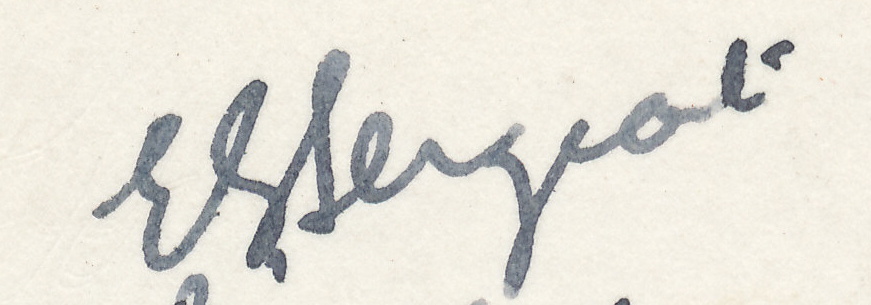
Signature of EG Sergeant from a Brian Reilly “after dinner” postcard from Margate 1936.
According to the 1891 census EGS was aged 9 and living with his father, mother, sister and their domestic servant Margaret A George who was their general domestic servant who hailed from Scotland. They lived at 2, Gladstone Terrace, Gateshead, NE8 4DY. This was in the Ecclesiastical parish of Christchurch.
2, Gladstone Terrace, Gateshead, NE8 4DY
In the 1911 census aged 29 as nephew to the head of the household (5 St Peters Terrace, Cambridge) EGS is listed as a solicitor who is single. The size of the household in 1911 was relatively modest at 12. He was living with George Edward Wherry (59, surgeon university professor) and his wife Albinia Lucy Wherry (53). Albinia Lucy Wherry was a nurse and also writer. During WWI she was stationed in Paris at the Gare du Nord where she supported British forces from 1915-18. the sub-registration district was St Andrew the Great.
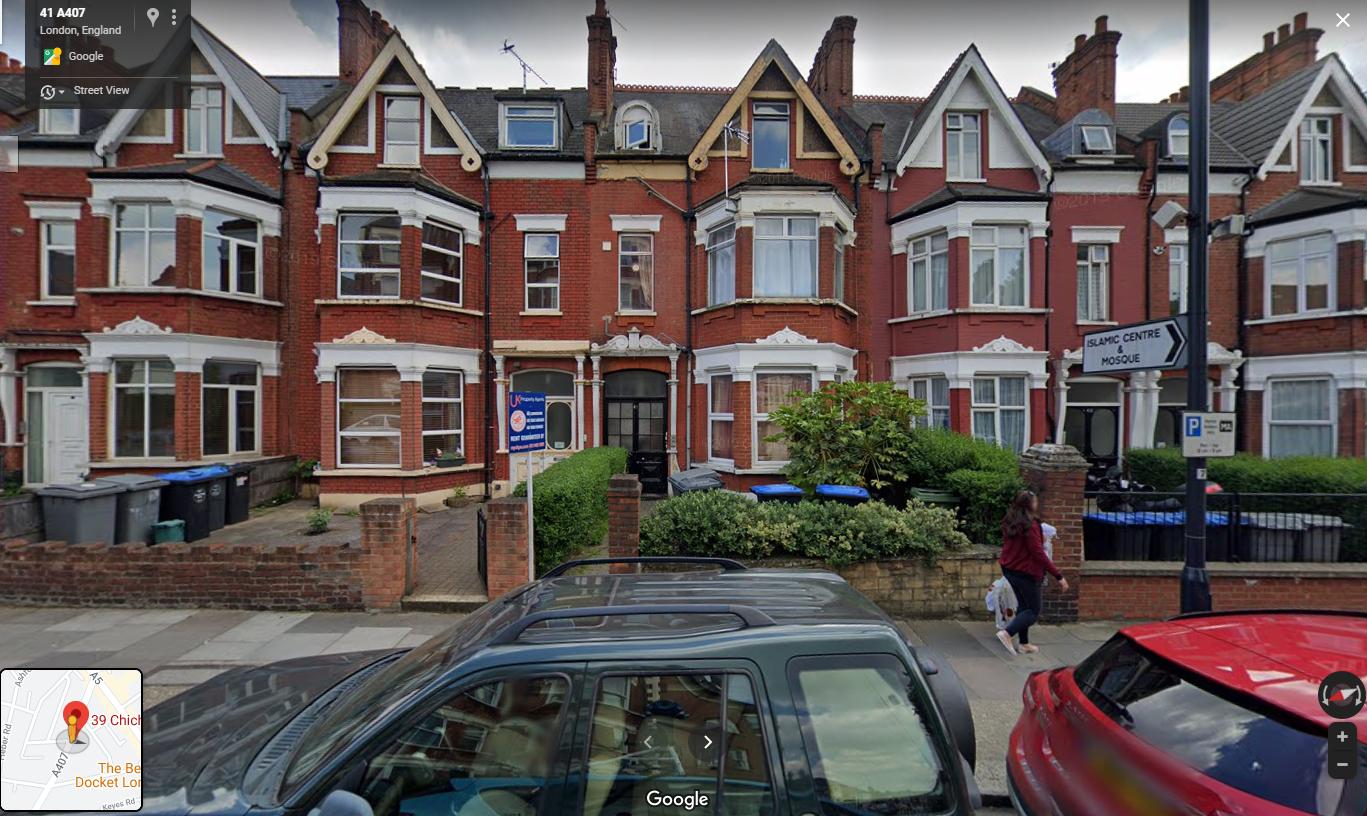
According to Edward Winter in Where did they live? in April 1916 EGS was living at 39 Chichele Road, Cricklewood, London NW2 3AN, England. EGWs source for this is : Chess Amateur, April 1916, page 202.
39 Chichele Road, Cricklewood, London NW2 3AN
1918 was an important year for Edward when he married Dorothy Frances Carter (born 1887) in Gravesend. In the same year Dorothy and Edward had a son Richard who passed away in 2014
Two years later Dorothy and Edward had a son Lewis Carter Sergeant born on January 30th 1920. The birth was registered in Paddington. Lewis lived at 3 Woodhill Court, 175 Woodhill, London, SE18 5HSL and passed away in 2004 the death being registered in Greenwich.
On the 1920 Electoral Roll, EGS was now living with Dorothy Frances Sergeant at St. Stephen’s Mansions, 5, Monmouth Road, Edmonton.
In 1923 they upped sticks and moved to 27. King Edward’s Grove, Teddington.
Sadly Dorothy passed away in 1926 at the modest age of 39.
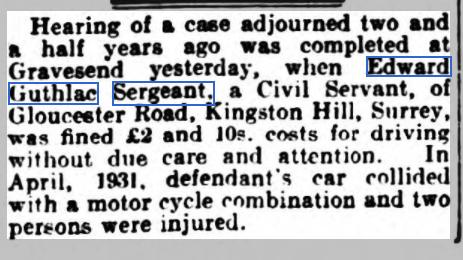
Coventry Evening Telegraph 10 October 1933
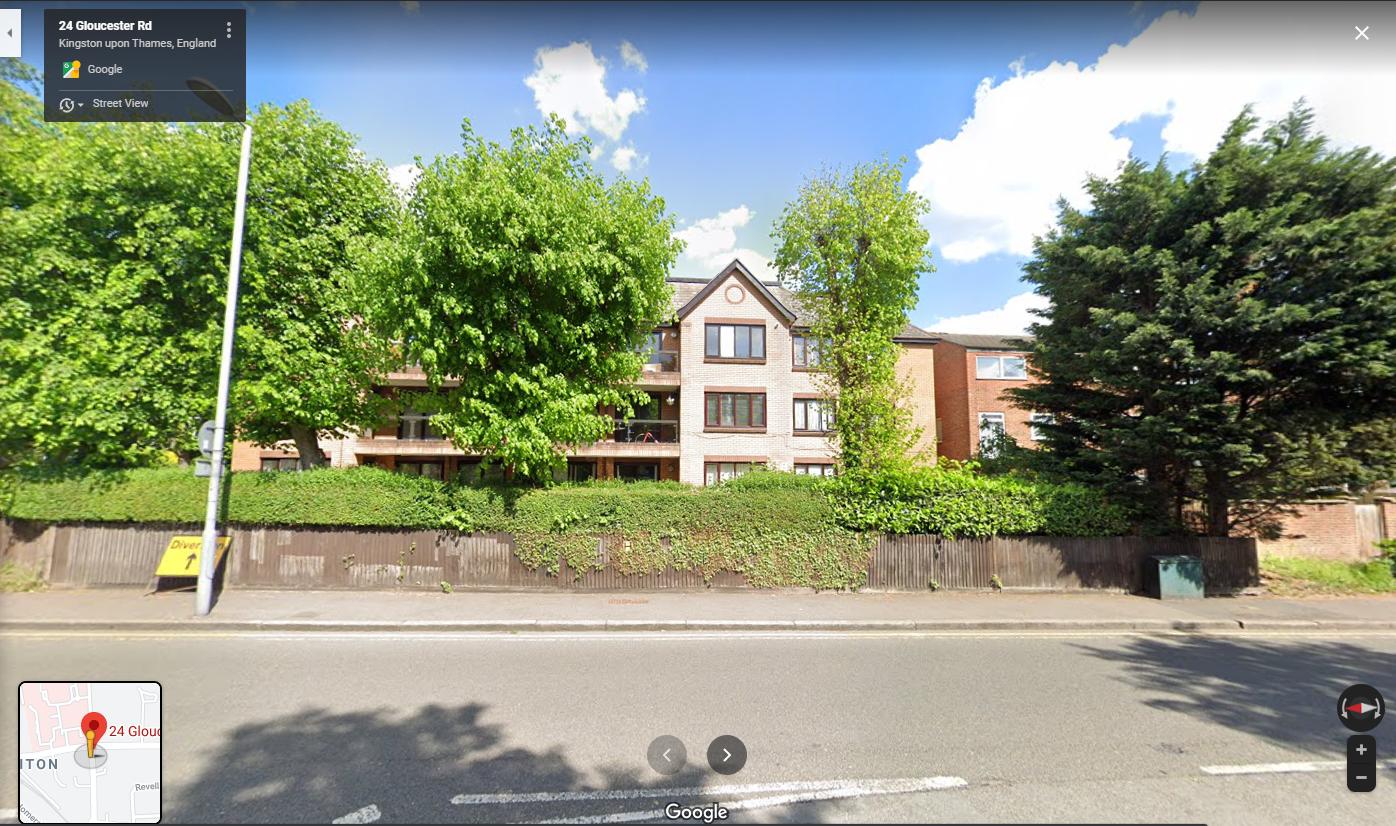
According to the 1939 census EGS was listed as a widowed, civil servant living at 24, Gloucester Road, Kingston Upon Thames, KT2 7DX. This would be the address that Edward saw out the rest of his life.
24, Gloucester Road, Kingston Upon Thames, KT2 7DX
He shared this address with Edith Carter (born 4th May 1878) who is described as being of “Private Means” and Ada M Wenman (6th August 1881) who is described as being a “domestic”.
In 1949 he was awarded the OBE in the Birthday Honours in recognition of his 39 years’ service in the office of the Solicitor to the Board of Inland Revenue.
According to John Saunders : EGS died in the New Victoria Hospital, New Malden, Surrey, on 16 November 1961. His residence at death had been 24 Gloucester Road, Kingston Hill. Probate (26 Jan 1962) granted to Lewis Carter Sergeant, a Lieutenant-Colonel in HM Army. Effects £6,586.
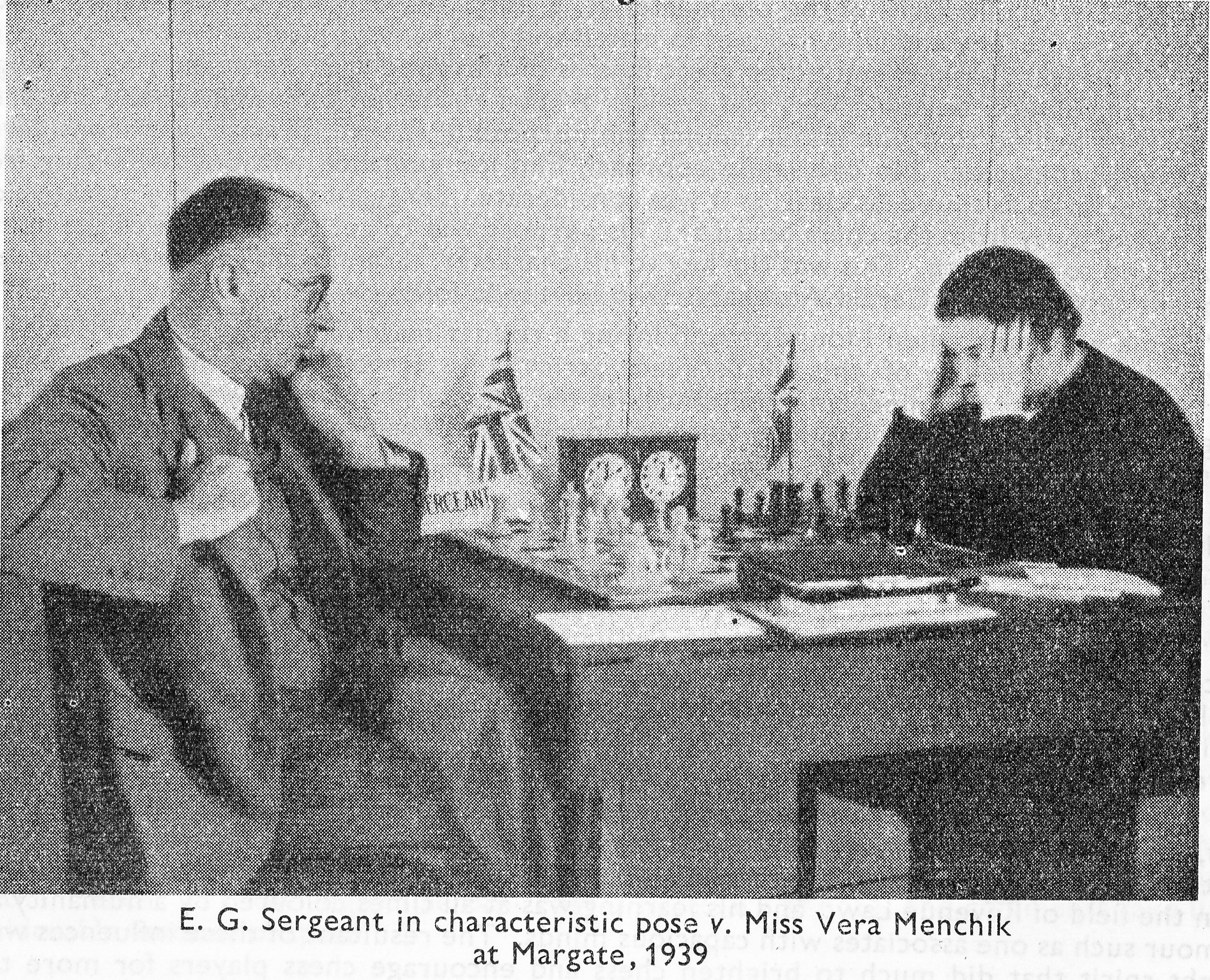
E.G. Sergeant in characteristic pose v. Miss Vera Menchik at Margate, 1939
From The Encyclopedia of Chess (Batsford, 1977), Harry Golombek OBE :
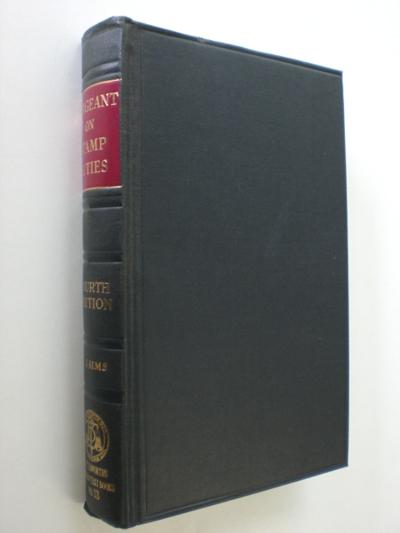
A British master who had a long and solidly distinguished career in British chess but never quite succeeded in breaking through the barrier to international success. A civil servant by profession, he was awarded the OBE for his services in the Inland Revenue and Sergeant on Stamp Duties was regarded as an authoritative work.
Sergeant’s earliest performance in the British Championship, at the Crystal Palace in London 1907, was one of his best. He came =2nd with JH Blackburne. RP Michell and GE Wainwright with 6.5 points, a point below the winner of the title, HE Atkins.
He was 3rd at Edinburgh in 1920 and his best result in the competition came in Brighton 1938, where he came equal second with H. Golombek, a 1/2 point below the winner, CHO’D Alexander.
A stalwart supporter of the City of London Chess Club, he won its championship in two successive years, 1916 and 1917. He played for Britain against the USA in the 1908 and 1909 cable matches and also played on a high board for London against various American cities in the Insull Trophy matches in the years 1926-31.
As a player he was strongly influenced by the scientific principles of Siegbert Tarrasch and did well during the period when the Tarrasch school enjoyed its heyday. But he was at a loss when confronted with more modern methods.”
Both Sunnucks and Hooper & Whyld are silent on EGS : surprising!
We asked Leonard Barden of his memories of EGS and he was kind enough to reply :
“People have different ways of expressing satisfaction with their position. Botvinnik adjusted his tie, Kasparov put his watch back on, Sergeant rubbed his hands together….He liked to counter the Queen’s Gambit Declined in the classical way with a kind of Lasker Defence.”
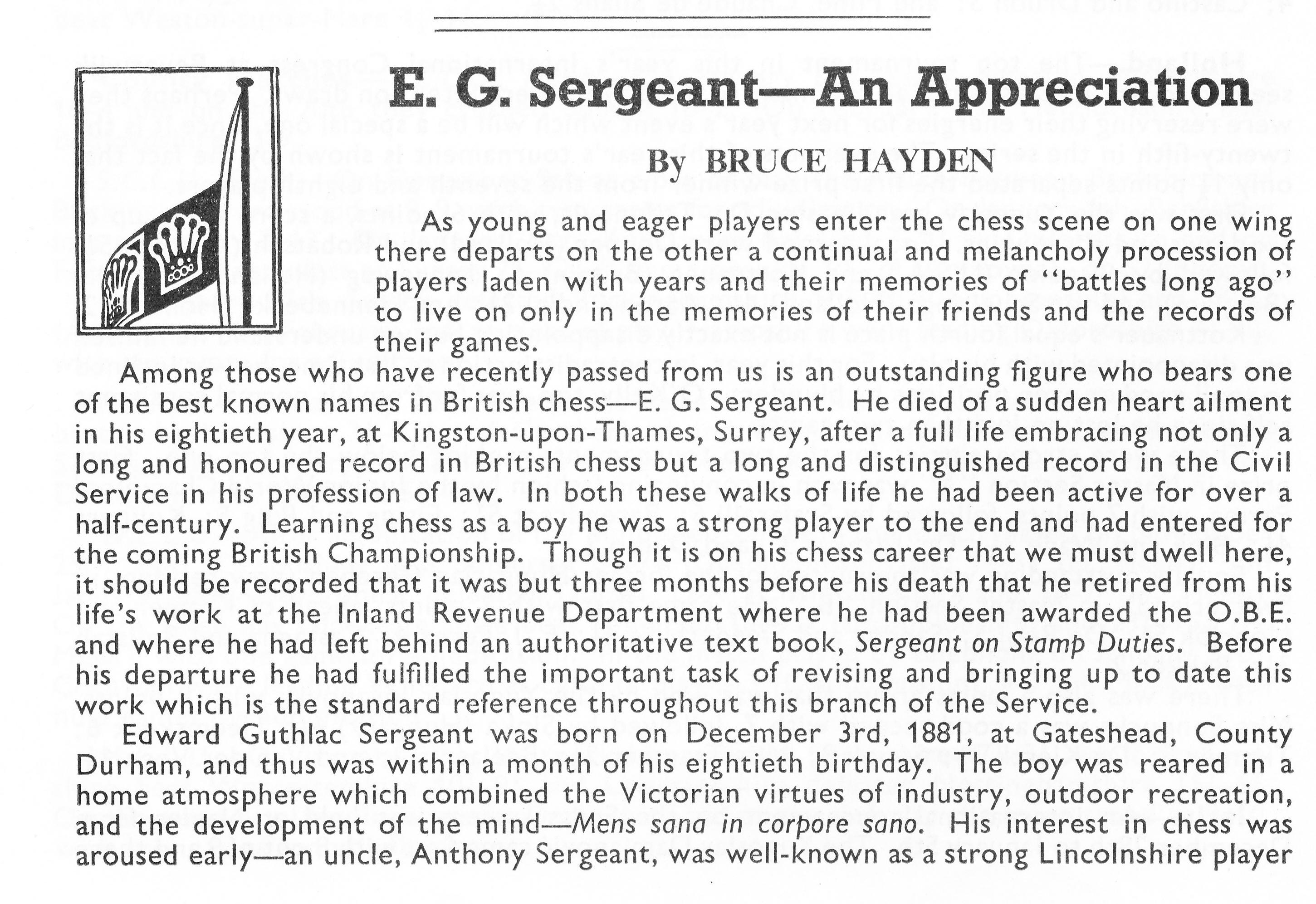
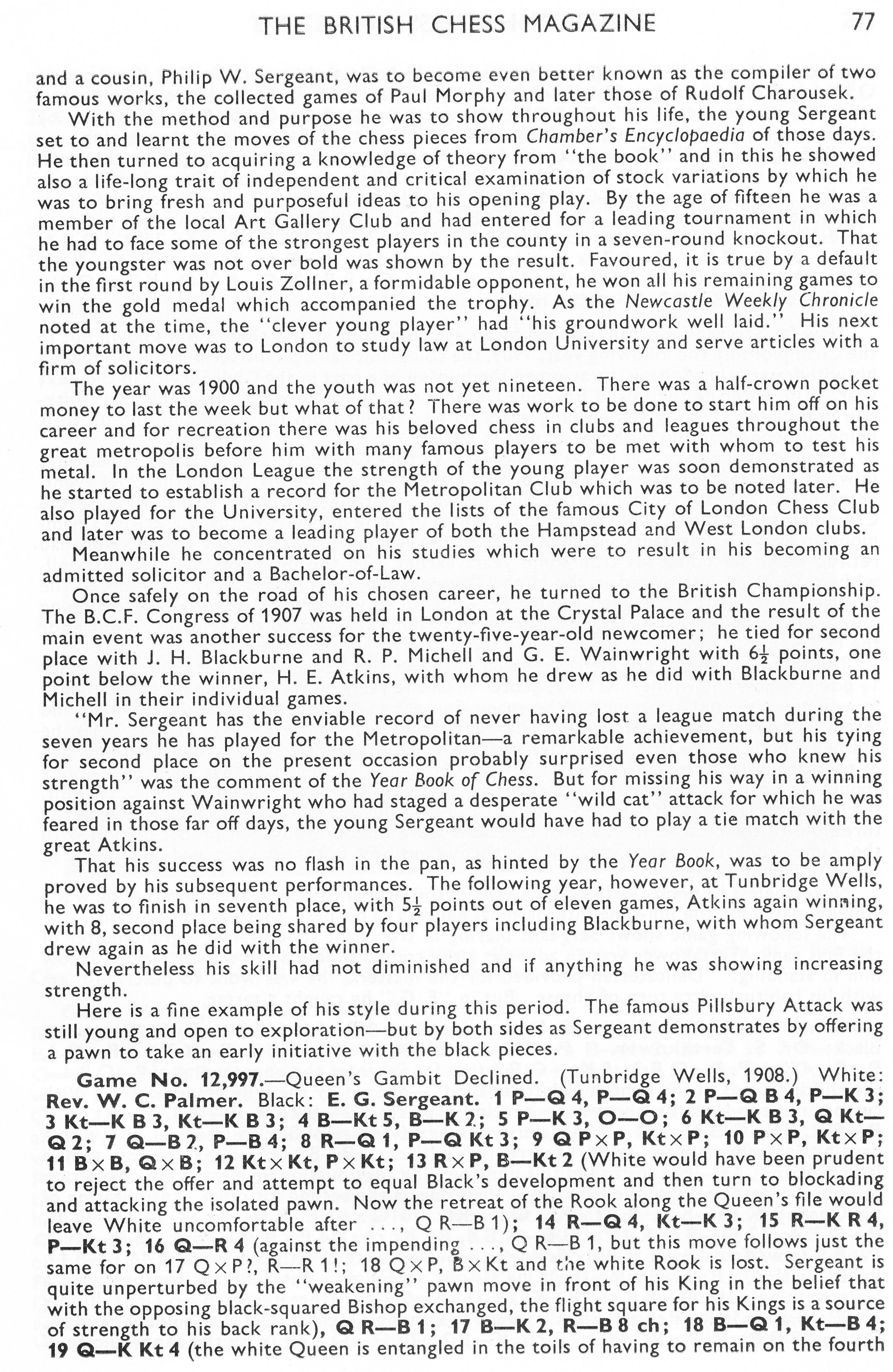
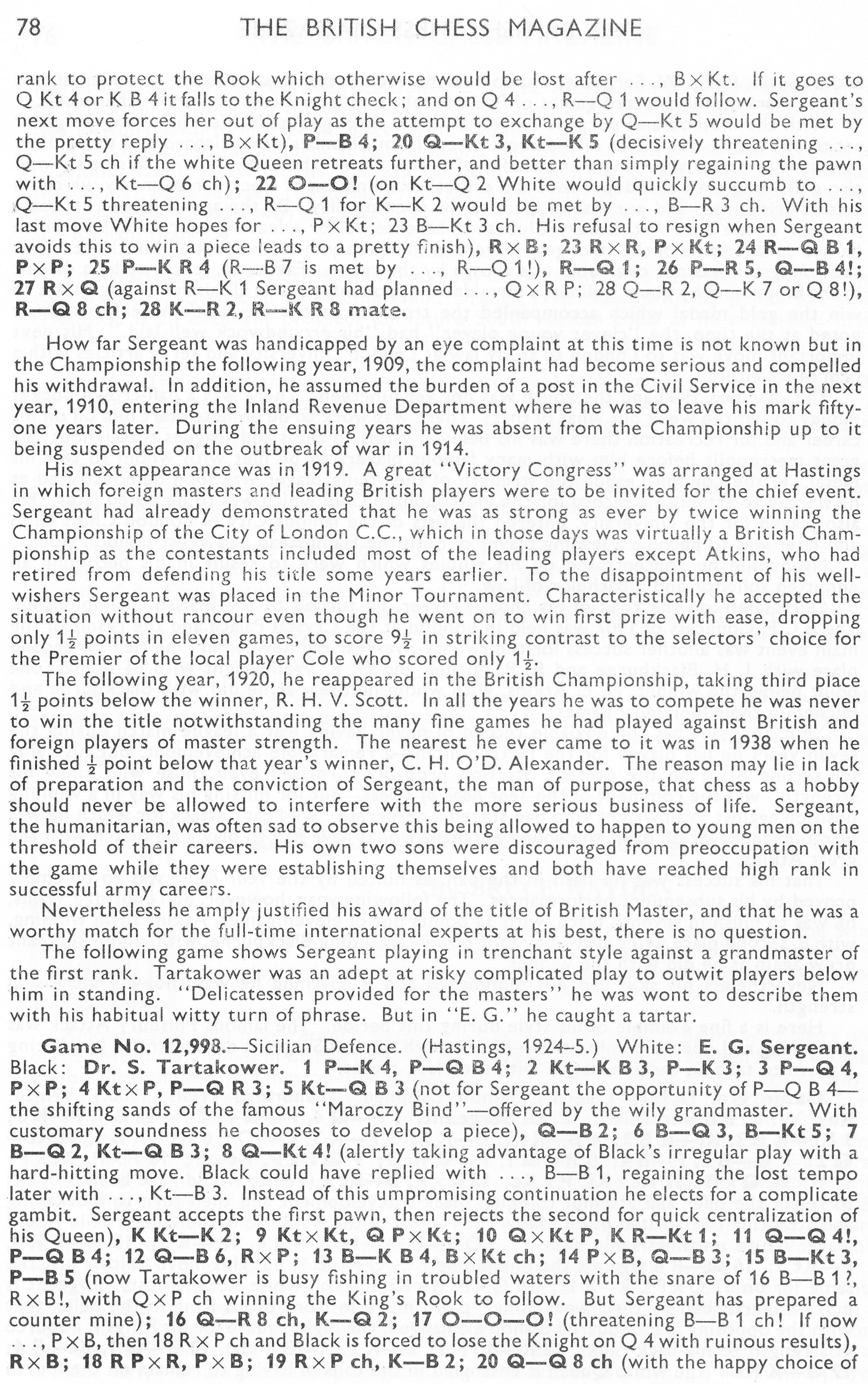
From British Chess Magazine, Volume LXXXII, March, 1962, Number 3, pages 76 -80 we reproduce an obituary from Bruce Hayden entitled “E.G. Sergeant – An Appreciation” as follows :
(note the incorrect birth location presumably based on the 1891 census information)
Edward Guthlac Sergeant, part oneEdward Guthlac Sergeant, part two
Leonard Barden has asked us to point out :
“The 1948 game against Wallis was not in the British championship but in the Premier, a one-off 12-player selected group used to address the problem of too many good players for an all-play-all championship. In 1949 the two all-play-alls were replaced by a 32-player Swiss.
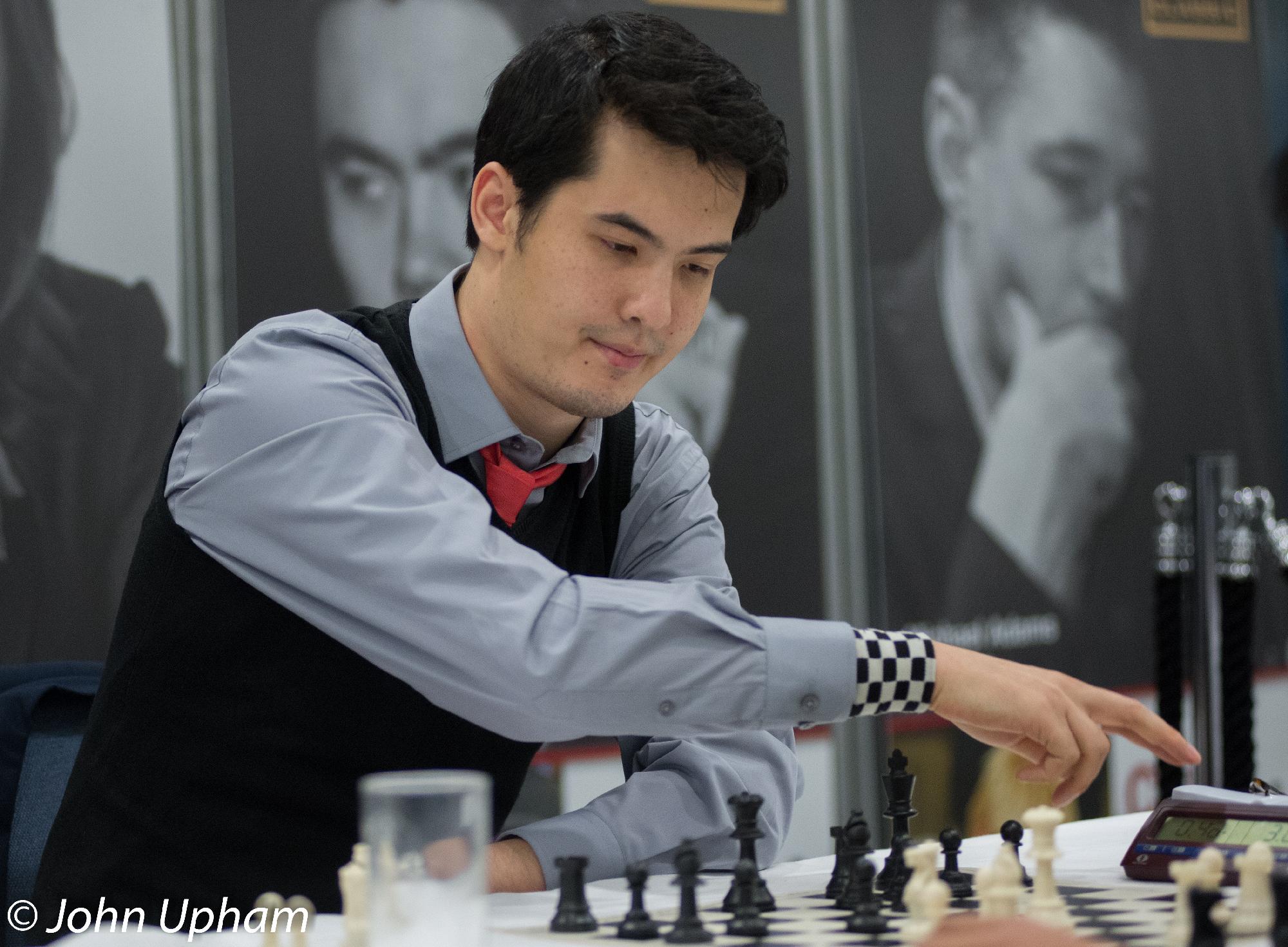
GM David Howell at the 2014 British Championships in Aberystwyth, courtesy of John Upham Photography
BCN sends Birthday greetings to David Howell on this day.
David Wei Lang Howell was born in Eastbourne, East Sussex on Wednesday 14th of November 1990. His parents are Martin and Angeline Howell (née Choo).
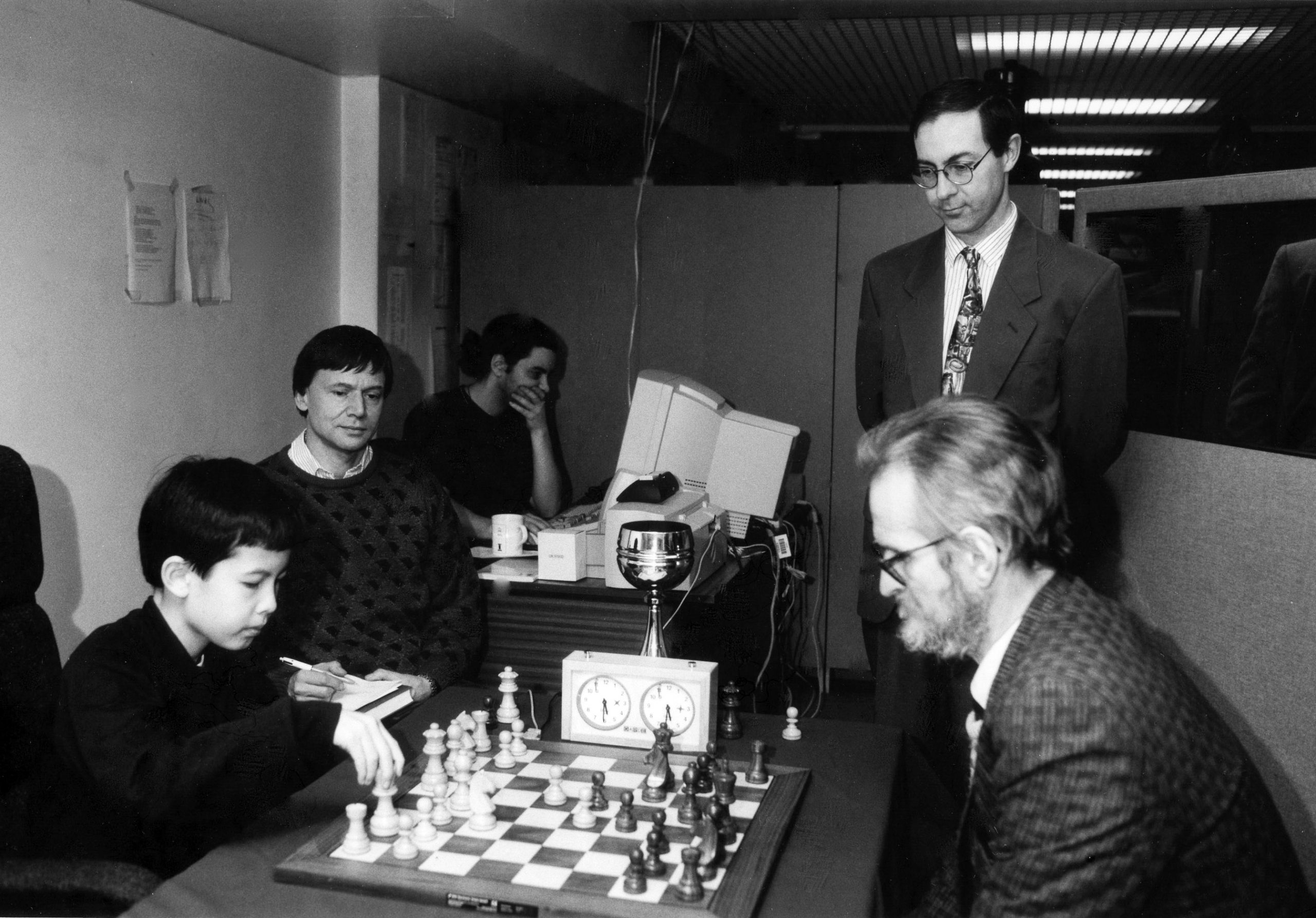
David Howell faces Andrew Whiteley whilst Jimmy Adams records the moves, photograph courtesy of Mark Huba
An unknown jumble sale (Eastbourne?) provided the Howell family with a chess set.
David learnt the moves from Martin, his father and rapidly improved and he joined Sussex Junior Chess Association and he began representing his county in EPSCA matches and other competitions.
In Torquay in 1998 whilst Nigel Short and Susan Lalic were busy winning the main championships David made his mark by winning the British Under-8 Championship, an event that had started only ten years beforehand.
A trip to Scarborough in 1999 yielded both the Under-9 and Under-10 championships.
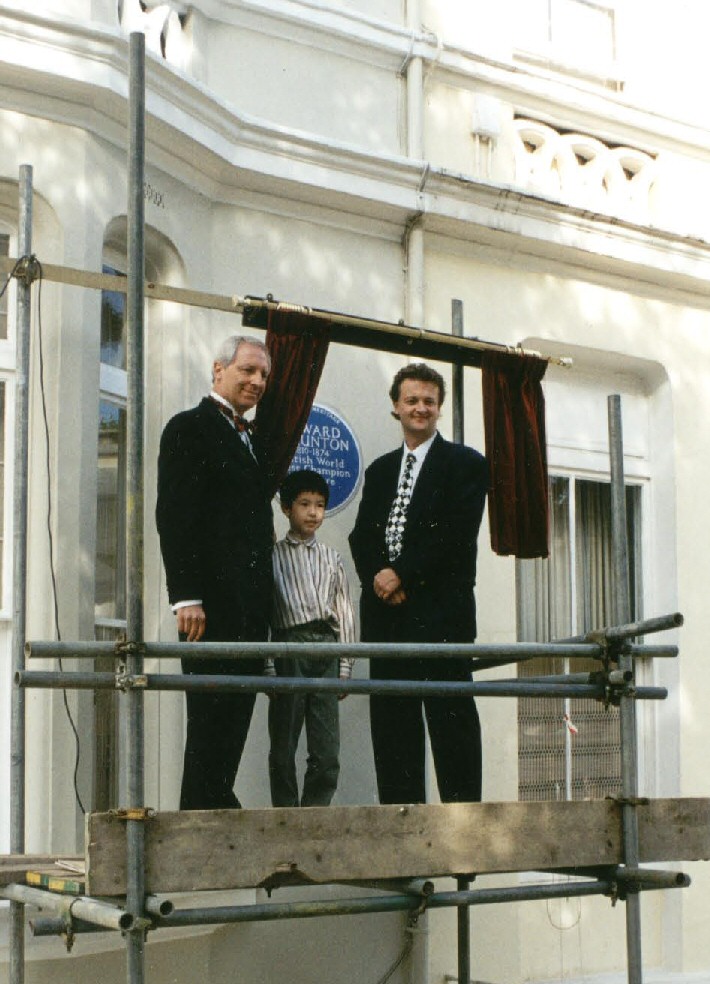
Barry Martin, David Howell and Julian Hodgson unveil a blue plaque in honour of Howard Staunton
Sponsorship from now dissolved software company JEB (Hove) enabled David to be coached by Glenn Flear.
David Howell, London Chess Classic, 2013, courtesy of John Upham Photography
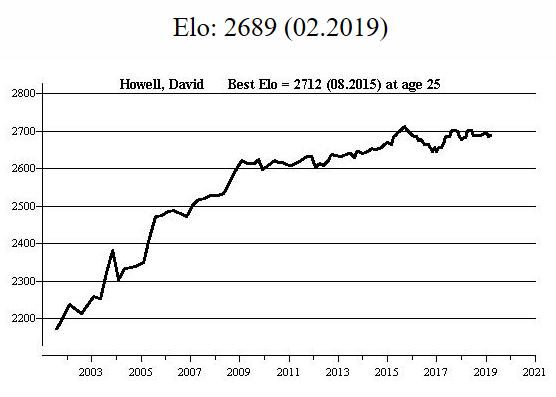
David became a FIDE Master at the age of ten years, nine months and 26 days. He became an International Master aged 13 years, 2 months and 22 days.
Finally the Grandmaster title came at 16 years, 1 month and 22 days.
The FIDE rating profile for David Howell according to MegaBase 2020
David’s rise has been well documented both here and here and therefore we will not attempt to improve on these sources.
David Howell, British Championships, 2013, Round 11, courtesy of John Upham Photography
With the white pieces David is a firm believer in 1.e4 but he has played (and continues to do so) 1.Nf3, 1.c4 and 1.d4 and he has scored 89% over nineteen games with. 1.g3
Like Sheila Jackson and Susan Lalic David was a big fan of the Sicilian Alapin but nowadays the Moscow and Rossolimo variations.
As the second player David prefers open games and has played the closed Ruy Lopez and the Marshall Attack. David also employs the Berlin Defence.
Defending against the Queen’s pawn David is less varied and plumps for the Grünfeld defence most of the time. On critical occasions David will use the Caro-Kann as a winning weapon.
So, a wide repertoire with both the white and black pieces and therefore not easy to prepare for: a very modern player!
David started his 4NCL career with Invicta Knights with a FIDE rating of 1432 in May 1999. By 2001 he was playing for Nigel Johnson and his Slough team. In 2004 the inevitable occurred and David transferred (as is common) to either cash rich Wood Green or Guildford. In fact it was Guildford on this occasion. In 2009 David moved to Pride & Prejudice. 2012 saw David playing for Wood Green Hillsmark. In 2015 he switched to Cheddleton and remained with them until 2019 finally returning to Guildford in 2020.
David Howell at the 2014 London Chess Classic, Courtesy of John Upham Photography
In November 2021 David took part in the 108-player FIDE Grand Prix event in Riga and after nine round he lying equal third on 6.5 with with Alireza Firouja and Fabiano Caruana. He eventually finished on 7/11 with a TPR of 2764.
Here is a tough struggle from that event:
David regularly hosts chess24 commentary of major tournaments, such as the 2020/21 Candidates.
GM David Howell vs IM Eddie Dearing, Drunken Knights vs Wood Green, June 2014, Courtesy of John Upham Photography
“If one had to forecast at the start of the 1970s the British chess would have a player in the next decade who would win the World Junior Championship, make plus score against Soviet players in his first years of play against them, and beat such household names as Geller, Bronstein, Larsen, Gligoric, Smyslov, Spassky and Karpov…one would have been called a romantic dreamer.
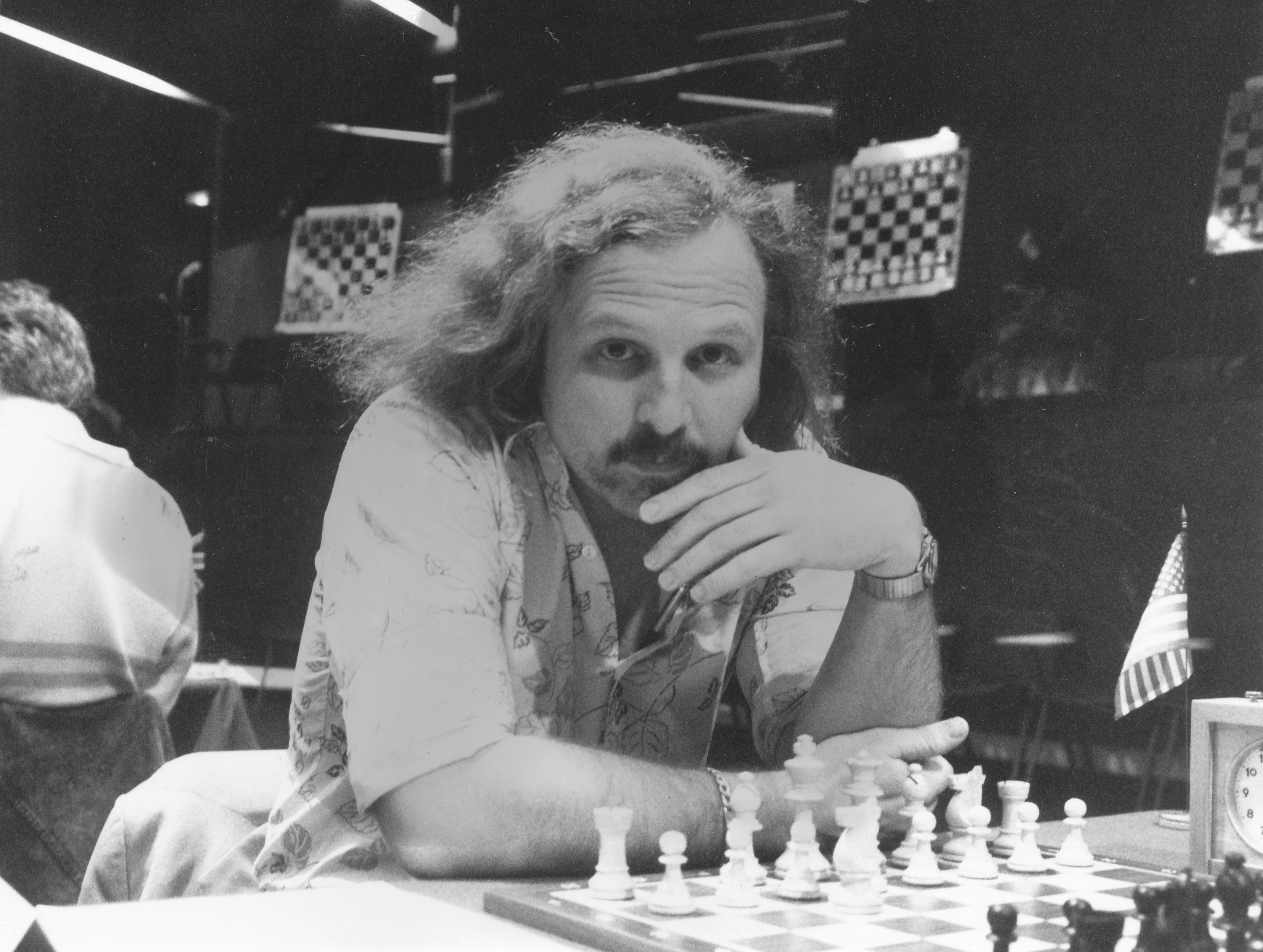
English chess grandmaster Tony Miles (1955 – 2001), UK, 6th May 1973. (Photo by Hoare/Daily Express/Hulton Archive/Getty Images)
If one had gone further and said that the same grandmaster X would become only the second British player this century to beat a reigning world champion, and that as Black in an irregular opening (1 e4 a6 2 d4 b5) then incredulity would indeed have been a fitting reaction.
Yet all this has come to pass; all the above is fact not fiction, reality not a day dream. Who is grandmaster X? Where did he develop?
Anthony John Miles was born on the 23rd April, 1955, in Birmingham (his birthplace is incorrectly marked (Ed: as London) on the map in Elo’s book on ratings.) He learned the moves at the age of five, became seriously interested in the game at the age of nine or ten, and almost straight away won the Birmingham Primary Schools Championship.
English chess grandmaster Tony Miles (1955 – 2001), UK, 15th May 1973. (Photo by Adam/Daily Express/Hulton Archive/Getty Images)
In 1965 he joined the Birmingham Chess club and the following year became a pupil at King Edward School (KES) (the alma mater of other strong British players, such as Hugh Alexander and Malcolm Barker, runner-up to Ivkov in the inaugural World Junior Championship held at Birmingham in 1951.)
Tony Miles
At the Birmingham Club he met strong opposition (another grandmaster-to-be, the postal player Keith Richardson was a member there for a time) since the club’s four teams were all in the higher divisions of the local league. Yet Tony’s school work meant that he could not be called a frequent attender at the club – he turned up for league matches and the club championship, but rarely for skittles except in the summer.
Tony Miles and possibly (?) Peter Clarke at Birmingham 1973
Soon he was playing in the Second Division, by 1968 he was in the First Division, and in the 1969-70 season he was on top board for one of the Club’s three teams in the top Division.
Tony made his debut in the BCF Congress at Oxford, 1967, where he was equal 11th in the under-14 Boys Championship won by another rising star, John Nunn. Strangely enough when Tony won this title the following year at Bristol Nunn was 3rd equal!
The Edgbaston player was also a regular competitor in the annual Easter Congress held in the same suburb of Birmingham where he lived.
Tony Miles
The breakthrough to national status came when he was a sixth-former at KES. At the BCF Congress, Blackpool,
1971, he won the under-2l Championship (with Nunn and Jon Speelman equal 2nd and the same year made his international debut in a junior tournament at Nice which he won ahead of various prominent players including the Swiss Hug who was to win the World Junior championship some 4 months later!
Tony Miles and unknown opponent
In the 1971-72 Birmingham and District League season he set up a scoring record, mainly on top board, that may never be equalled (9.5 out of 10).
Tony Miles
During these school years Tony was a rather taciturn teenager (perhaps to be expected in an only child) but he never fitted in with the conventional image of chessplayer as weedy bookworm.
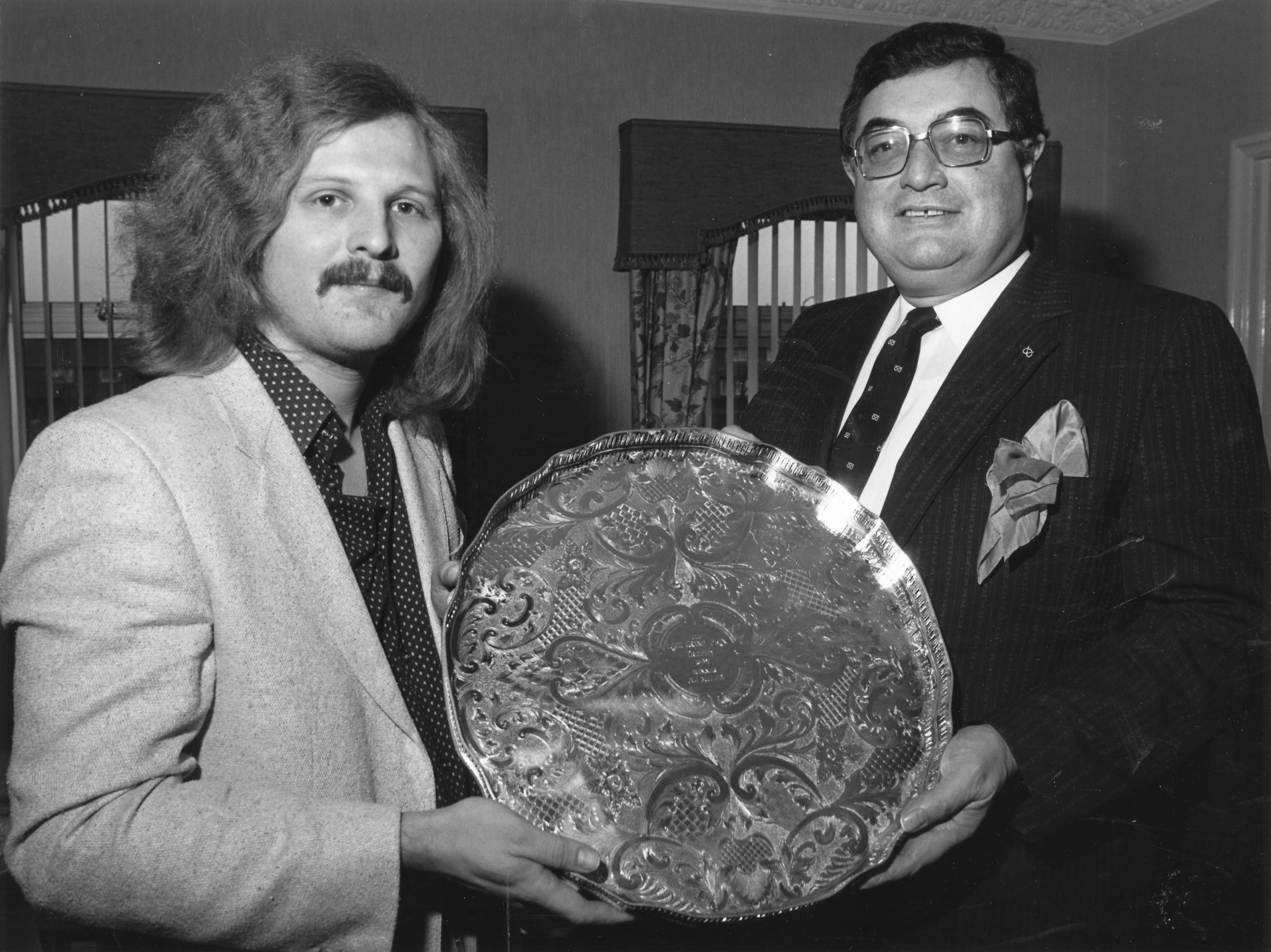
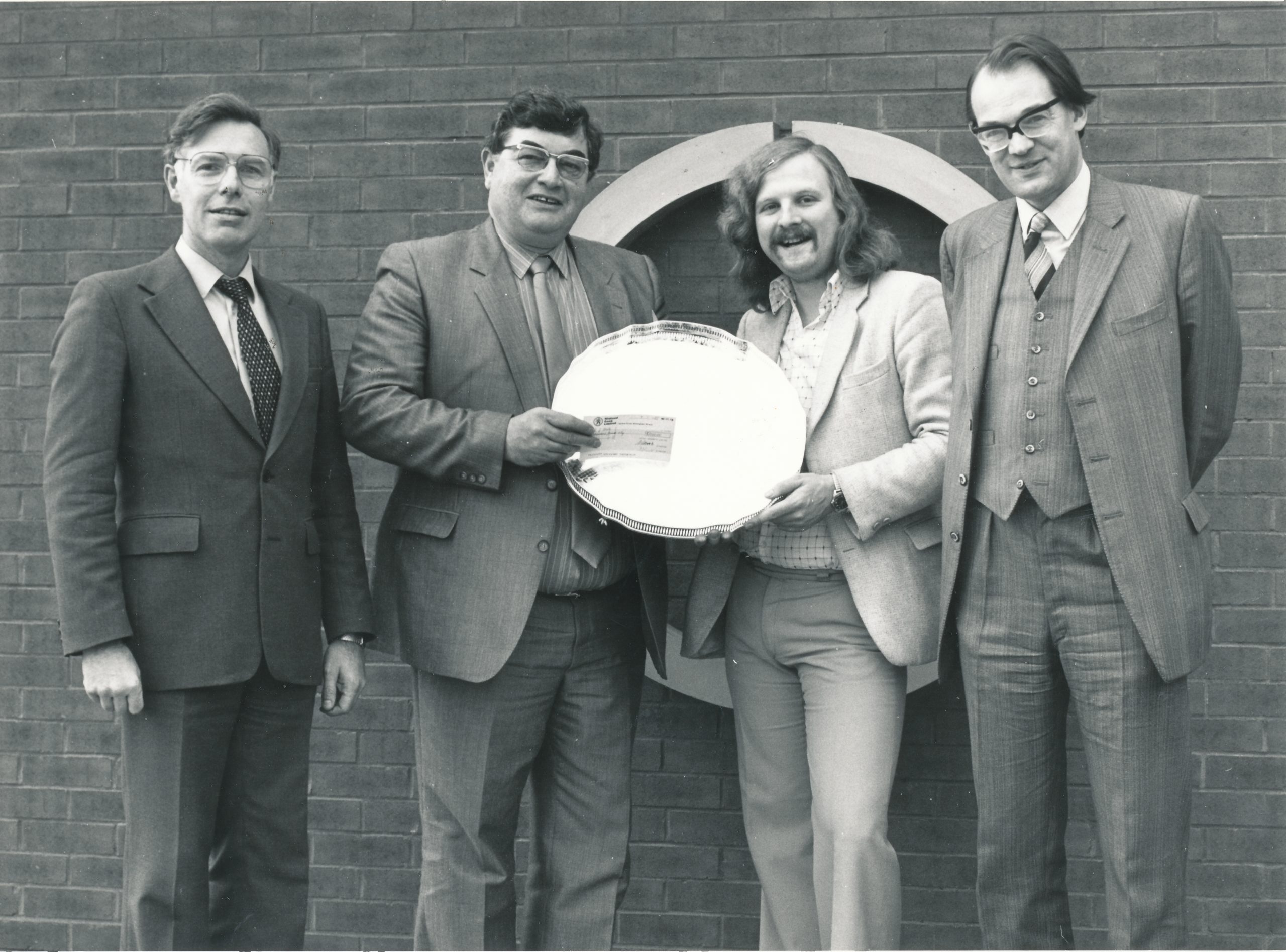
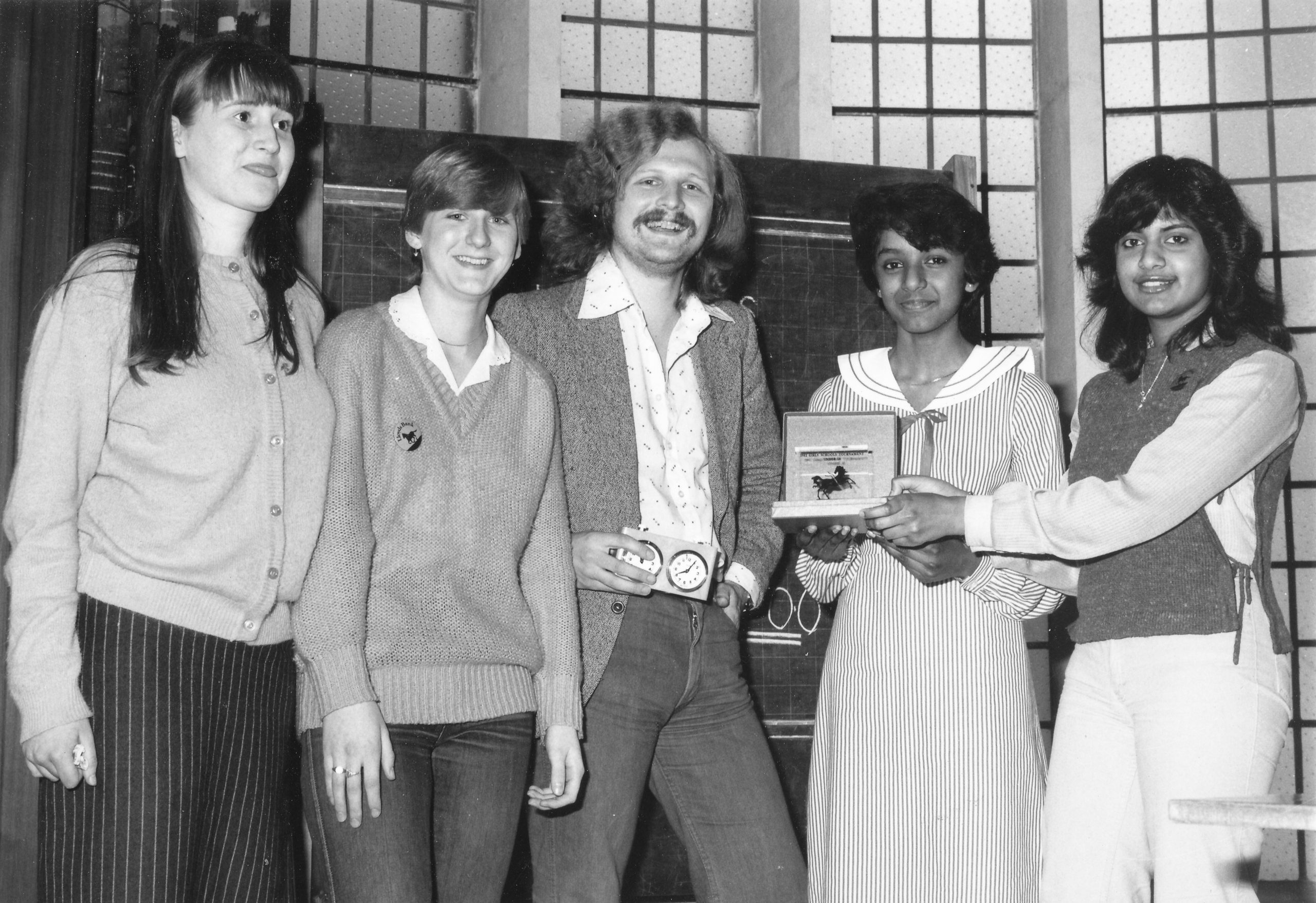
Tony being presented with the trophy in the photograph below
He always had a fine physique, played rugger at school and later became keen on squash and skiing as a means of keeping fit, though he is the first to admit that he can be rather lethargic (especially in the mornings!)
Tony Miles
At the time I knew one of his teachers professionally, and heard the occasional report that he was not always up to the best academic standards of KES. My reaction must have seemed heresy at the time, but subsequent events in the post-Fischer era have confirmed that the ability to play chess to international standard may lead to a more worthwhile career than being a run-of-the-mill university graduate.
Tony Miles at Hastings
A sign of Tony’s growing understanding of the finer points of the game came when he strolled into the Birmingham Club the day after the first game of the Spassky-Fischer match and pointed out (correctly as was shown later) the reason why Fischer had made his famous Bxh2 sacrifice/oversight.
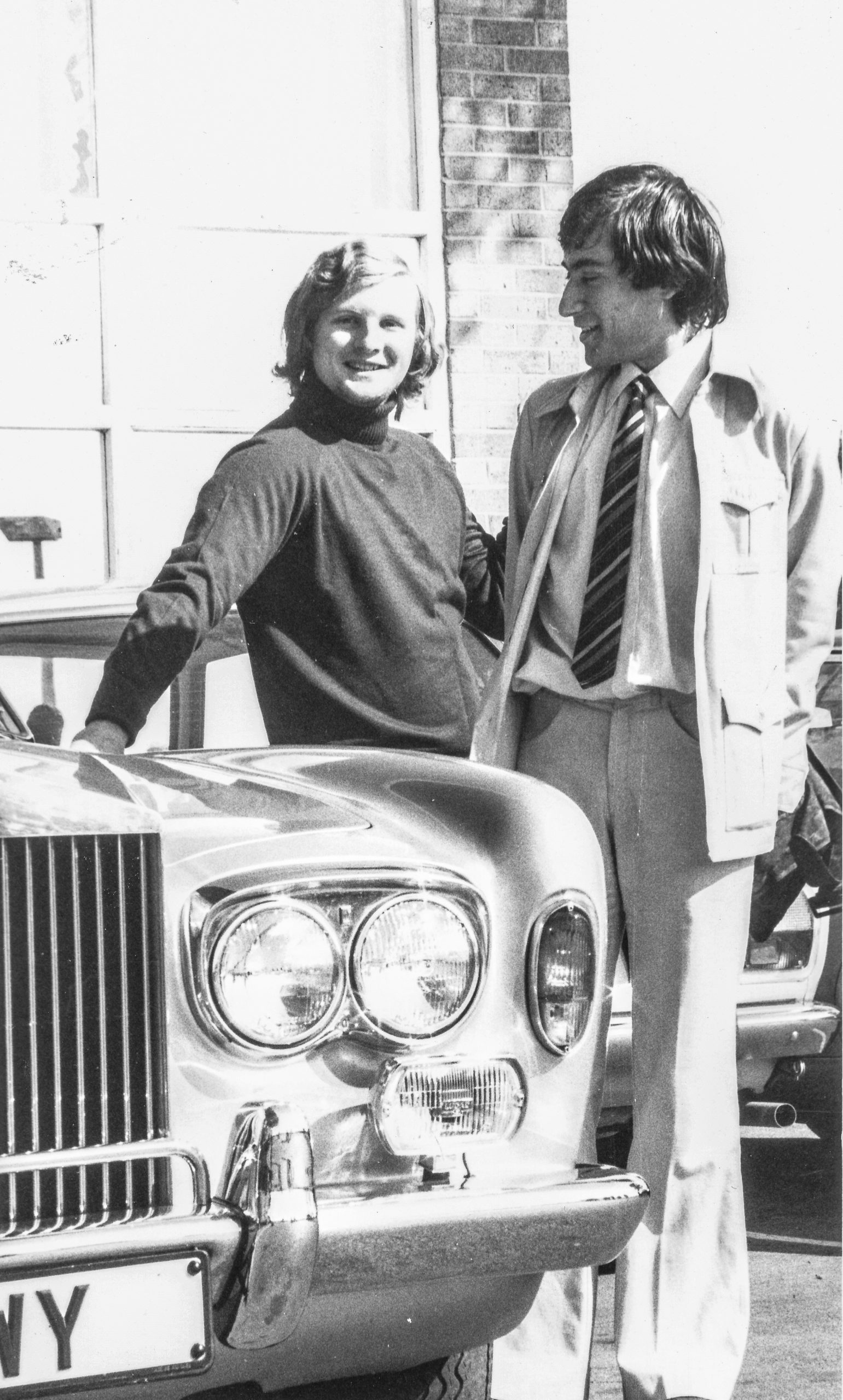
Tony Miles & Bill Hartston admire a Rolls-Royce
International recognition came in 1973 when he finished 2nd to Romanishin in the European Junior Championship at Groningen, and Second to Belyavsky in the World Junior at Teeside, as well as sharing 4-6th place in the British Championship at Eastbourne at only the second attempt. His first game to be published round the world was his victory over Bisguier in the Birmingham Easter tournament which he won ahead of Adorjan and Bisguier in the same year.
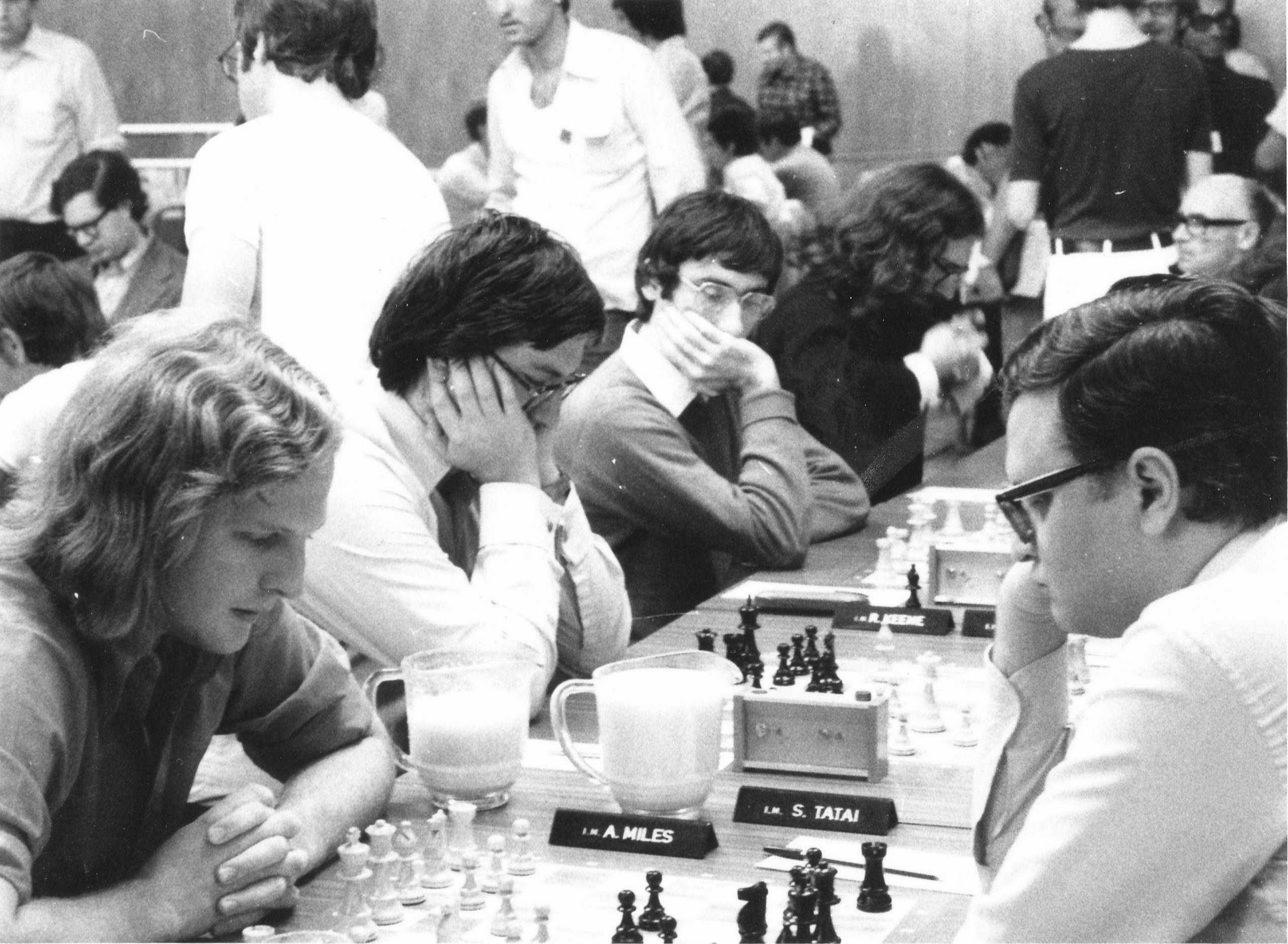
England plays Italy at Haifa 1976. Miles played Tatai, Keene played Toth, Hartston played Grinza and Mestel played Micheli
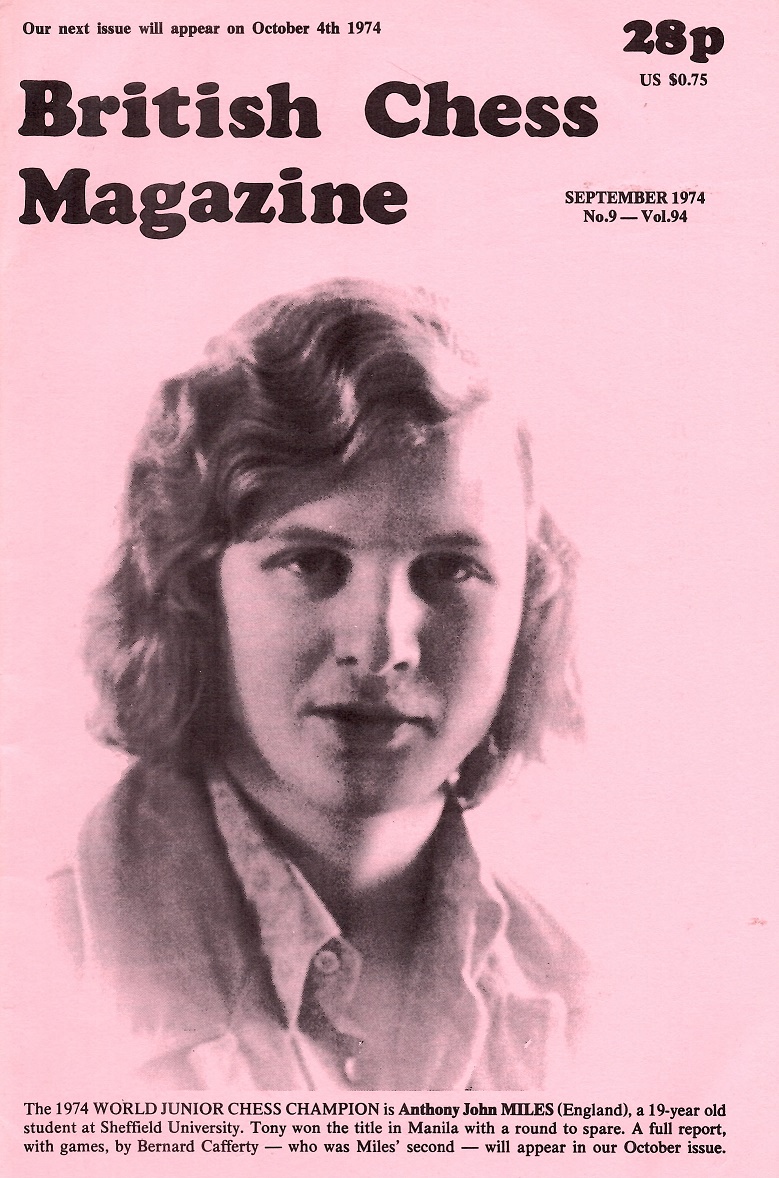
The main event of 1974, a break-through for British chess, was the World Junior Championship played in August in sub-tropical Manila. Here he played one of his finest games, against Kochiev, to take the title with a round to spare, thereby becoming lnternational Master.
The 1974 World Junior Chess Champion is Anthony John Miles (England), a 19-year old student at Sheffield University. Tony won the title in Manila with a round to spare. A full report, with games by Bernard Cafferty – who was Miles’ second – will appear in our October issue.
Tony’s physical strength showed up to good effect here, not just lasting out the 4 weeks in the baking humidity but coping with the huge load of luggage (on the outward journey huge cases full of Chess Player, Informator and the like; on the return journey this load reinforced with prizes and souvenirs!).
Tony Miles at Wijk aan Zee 1976. Korchnoi was first. Photo taken by Brian or Freddy Reilly
Gaining the title brought regular invitations to tournaments which could not be fitted in well with the demands of his maths course at Sheffield University. In the summer of 1975 he gave up the course after two years, while the University authorities showed their recognition of his distinction at chess by the award of an honorary MA degree.
Tony Miles in relaxed mood
Once free to concentrate wholeheartedly on his true calling he took the grandmaster title in a rush. The first norm came with first prize, August, 1975, at the London Chess Fortnight ahead of Adorjan, Sax and Timman.
Tony Miles
Hastings 1975-76 was not too good a result, but only a few weeks later he was on his way to a great triumph despite
forced late acceptance of the invitation to the USSR due to lack of finance. He got his visa just in time and went to snowy Dubna, a scientific centre near Moscow, to achieve that most difficult feat – a GM norm in a Soviet tournament ahead of eight GM’s and others
just as strong.
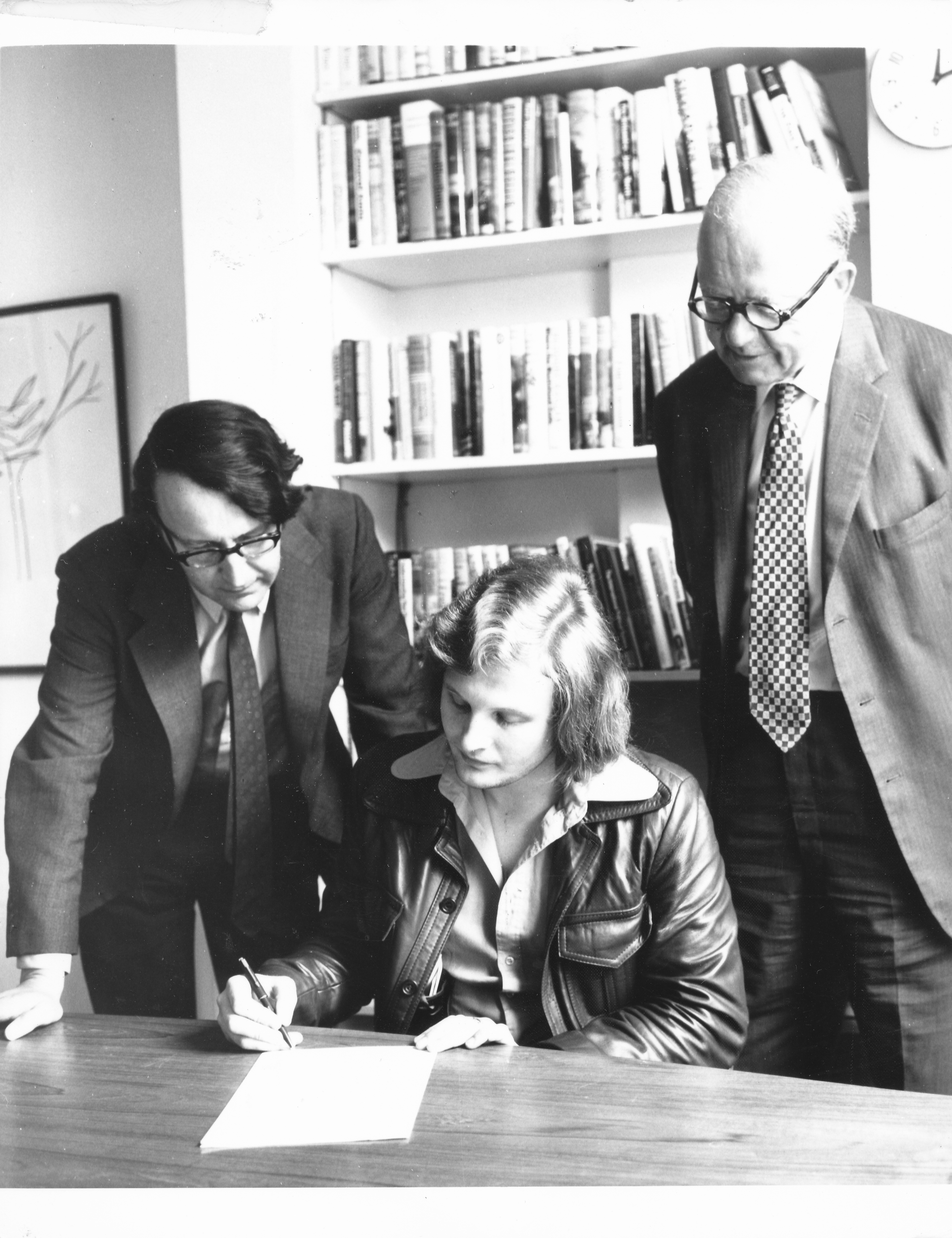
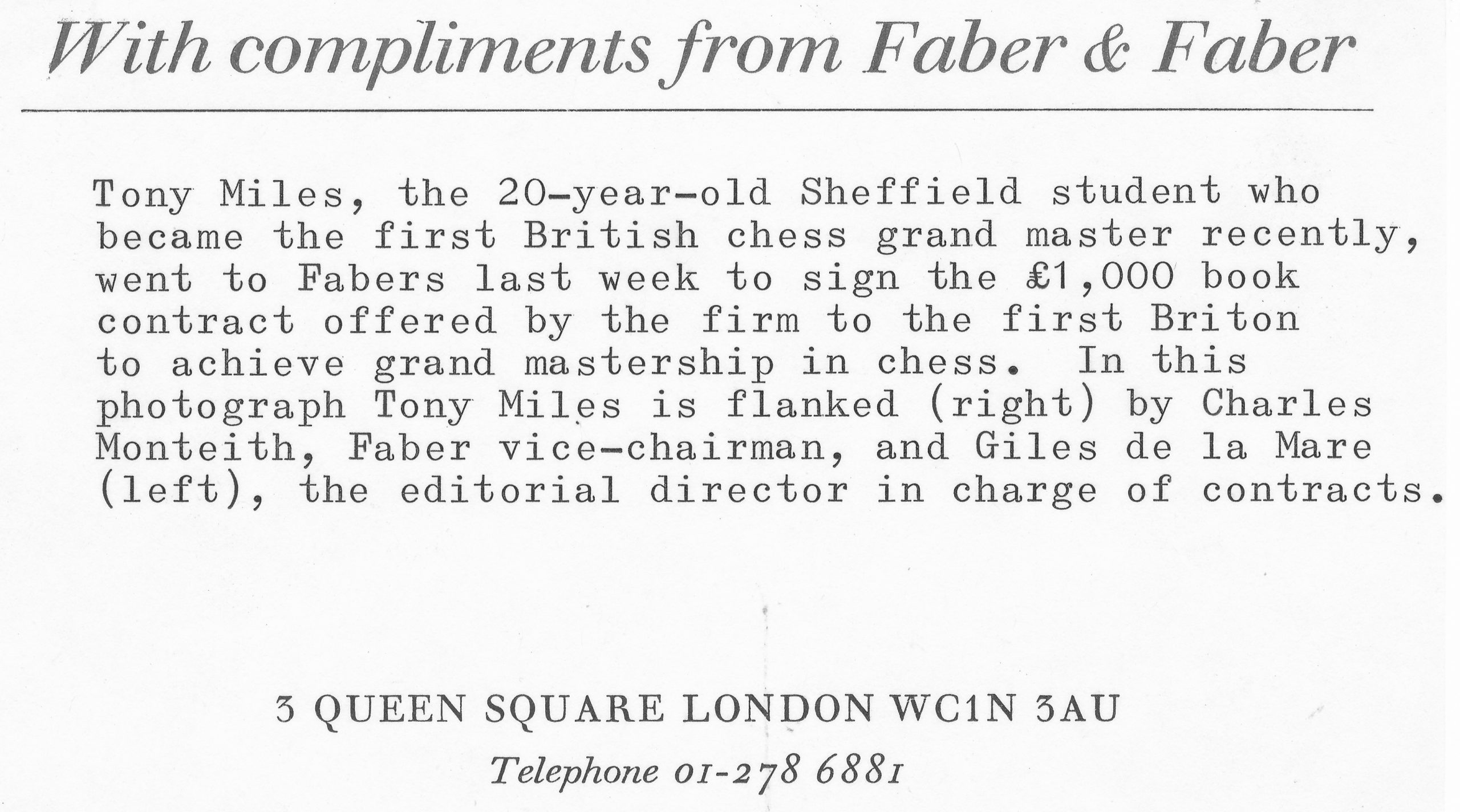
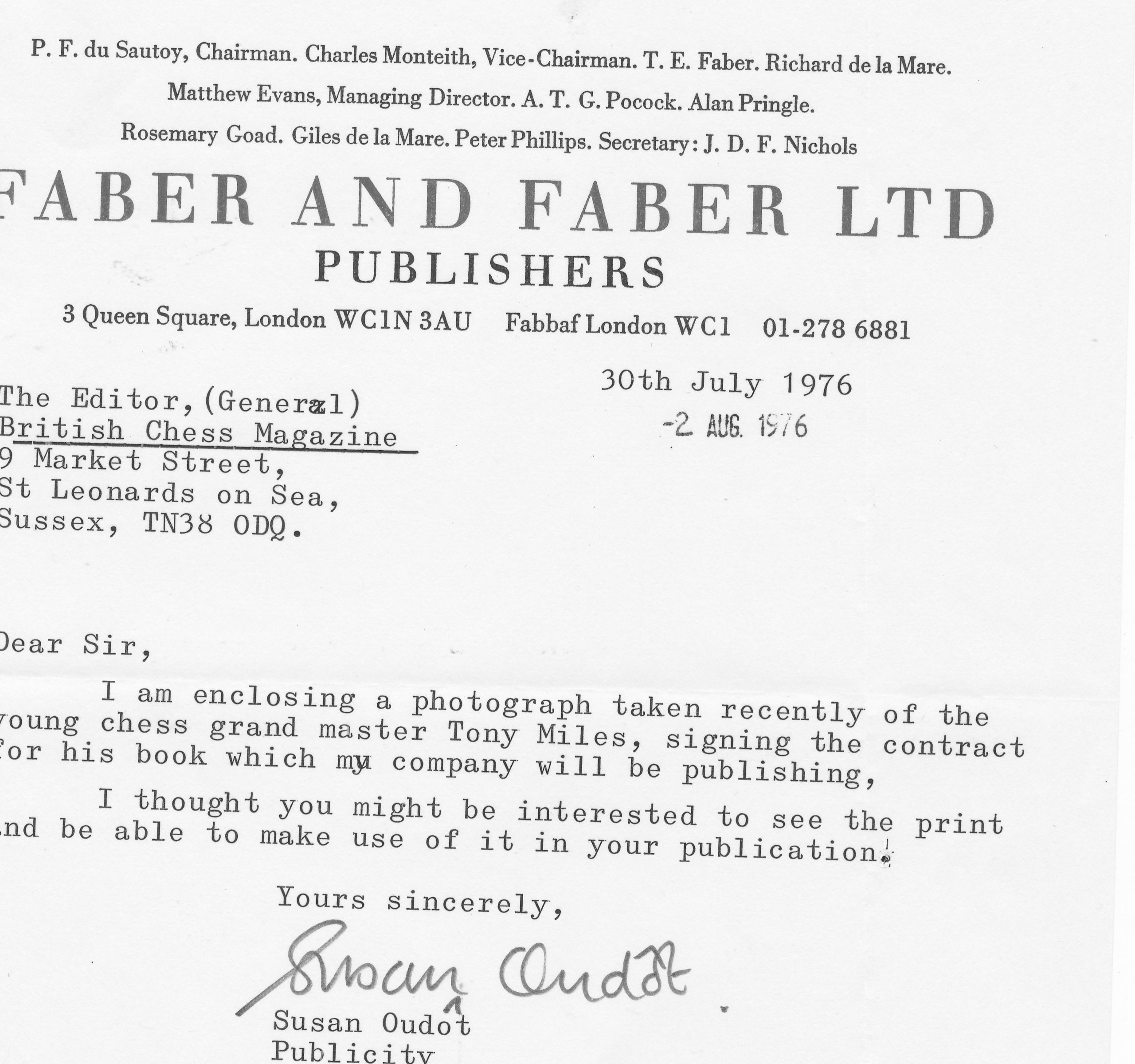
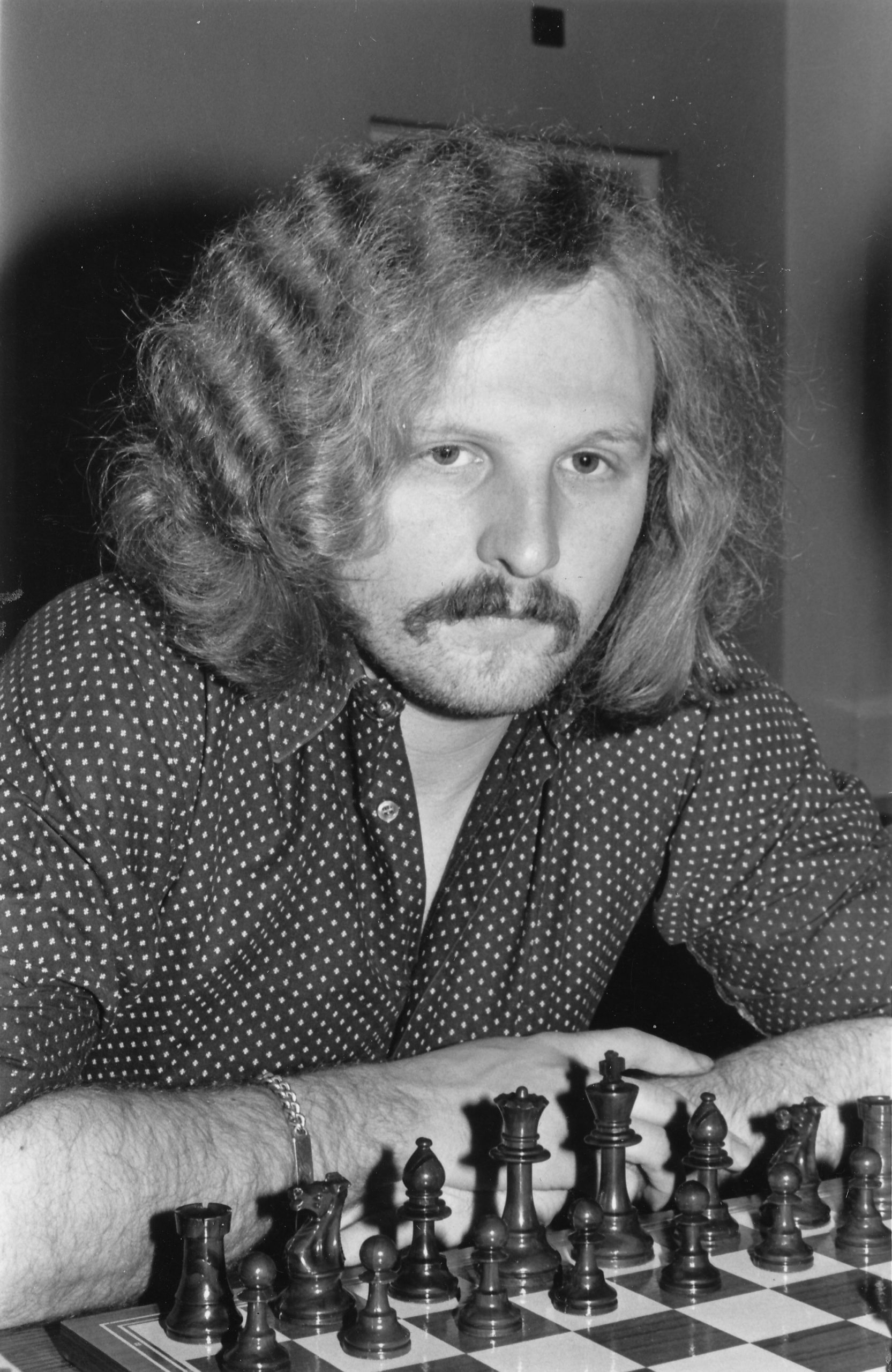
Tony Miles plays Tony Miles : see full caption belowCaption for above photograph
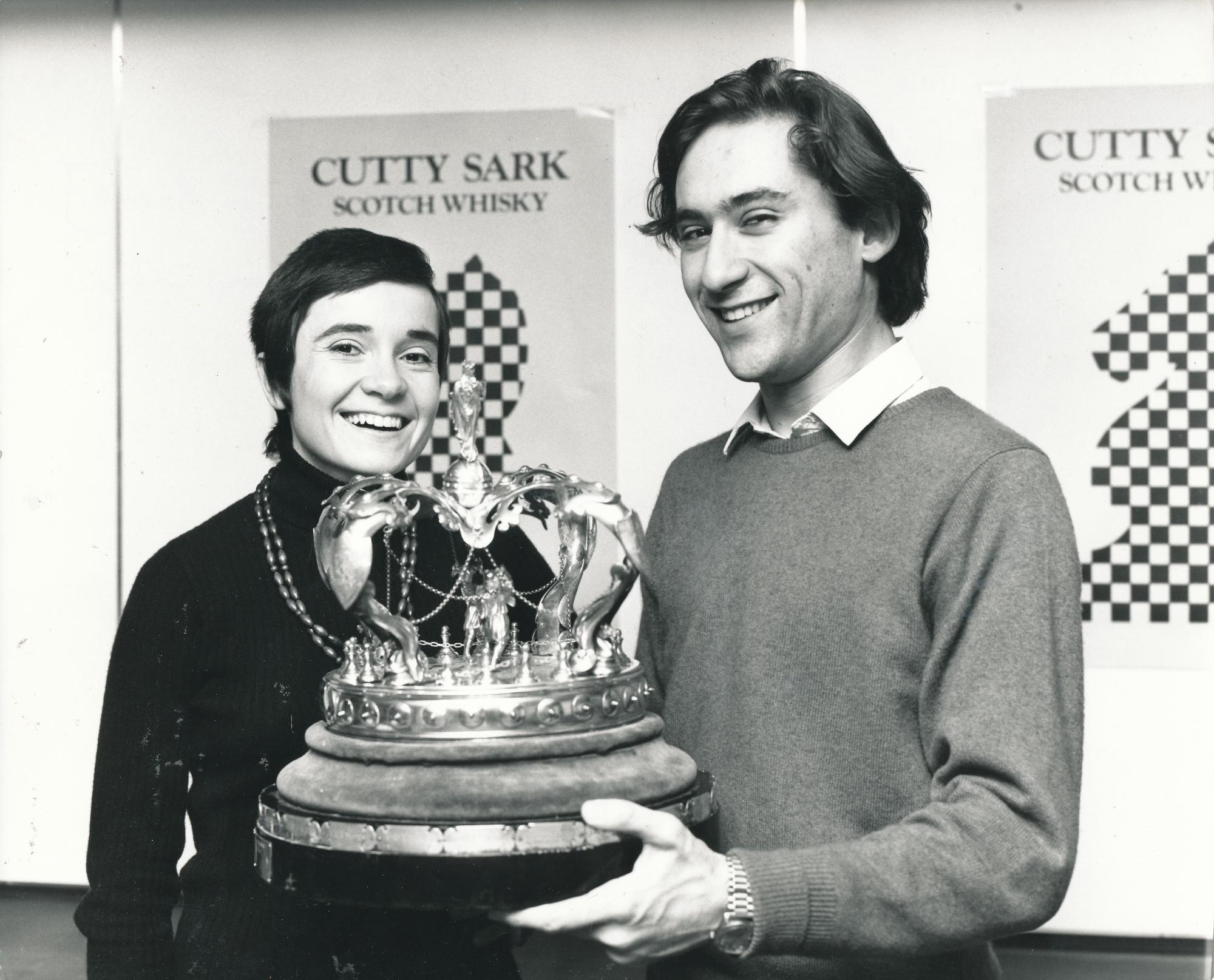
Thus Tony Miles became the first official British grandmaster (the title dates officially only from 1949, so excluding the likes of Staunton, Blackburne and Burn) and took the £5000 Slater prize for the first British GM to add to the £1000 prize for victory in the 1975 Cutty Sark series of weekend and other tournaments. The availability of sponsorship, it goes without saying, has done much to encourage Tony on his chosen path as a chess professional, a far from easy vocation that demands will-power and strong nerves to be successful.
Tony Miles : See full caption belowFull caption for above photographAccompanying letter for above photograph
1977 confirmed that here was a genuine grandmaster with first prizes at the Amsterdam IBM and Biel tournaments, and second prize behind Karpov
at the first of the new series of Super grandmaster tournaments (Tilburg, Holland.)
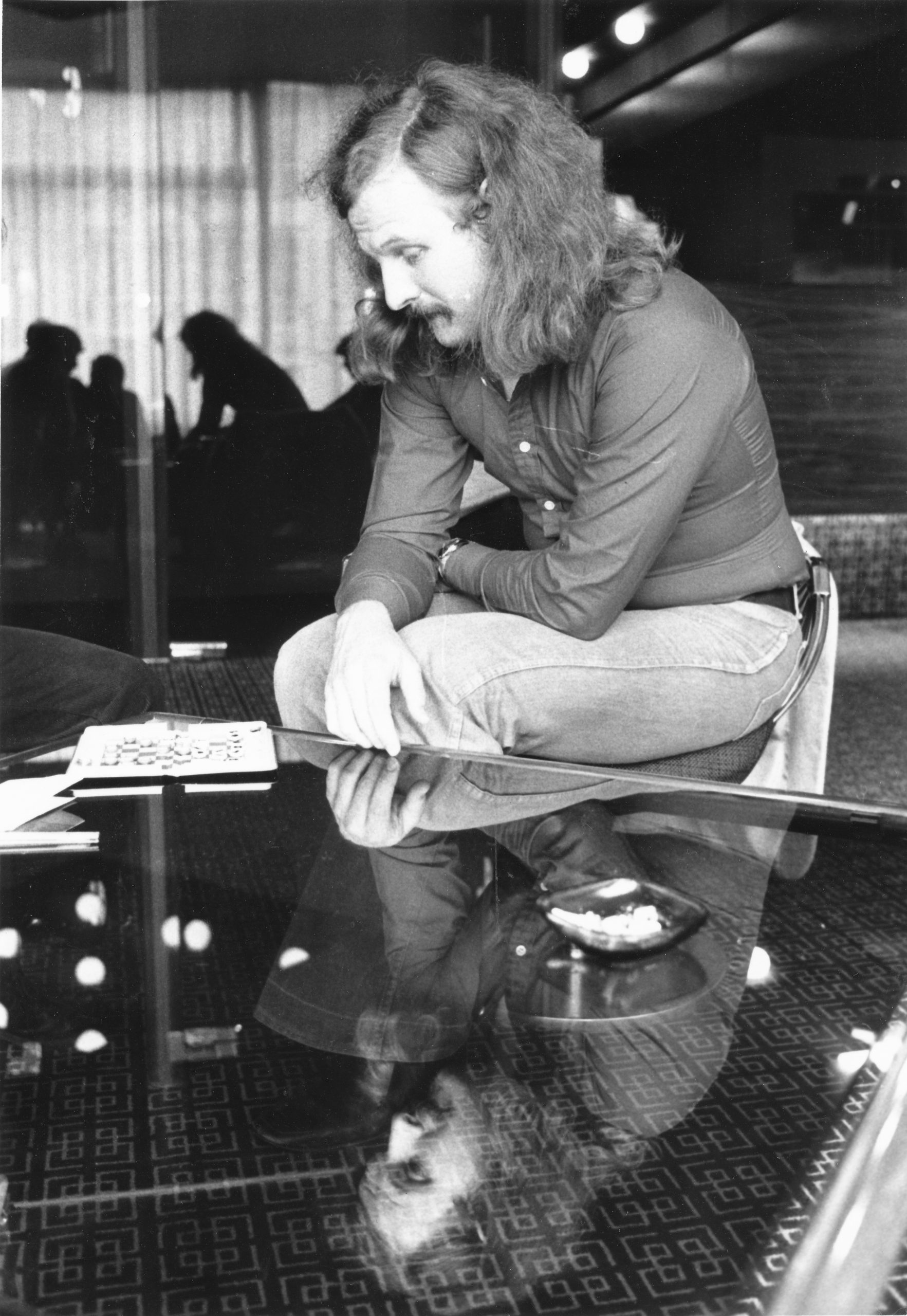
Tony Miles in pensive mood
After his Promotion to the ranks of grandmaster Tony, with his usual directness, said that the only thing left to achieve was to have a crack at Karpov. (His fans might react by saying that there were other mountains to climb such as first place at Hastings and in the British Championship, but then Karpov has not achieved the first either, and only became Soviet Champion after he had taken the world title!)
Tony Miles and Michael Stean at the FIDE Zonal in Amsterdam, 1978. (Source: http://gahetna.nl)
The first chance for this ‘crack’ came with their meeting in the super tournaments at Tilburg and Bugojno, as well as in the 1977 BBC2 TV Master Game’ The
results went much in favour of the (slightly) older man. Tony had to wait till January, 1980 before he could celebrate a victory over Fischer’s successor.
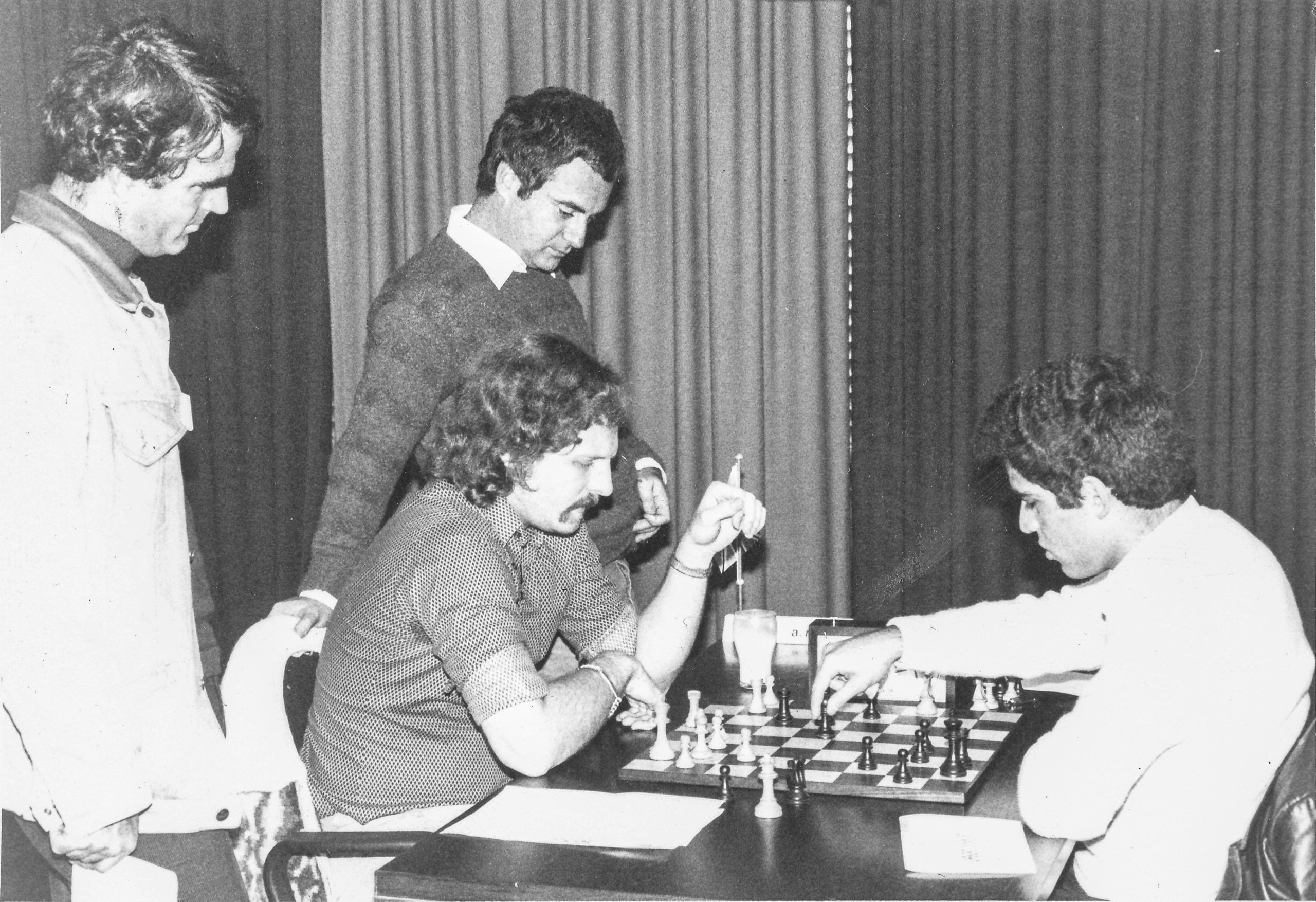
Peter Sowray watching Tony Miles at the Lloyds Bank Masters. Sir Jeremy Morse watches.
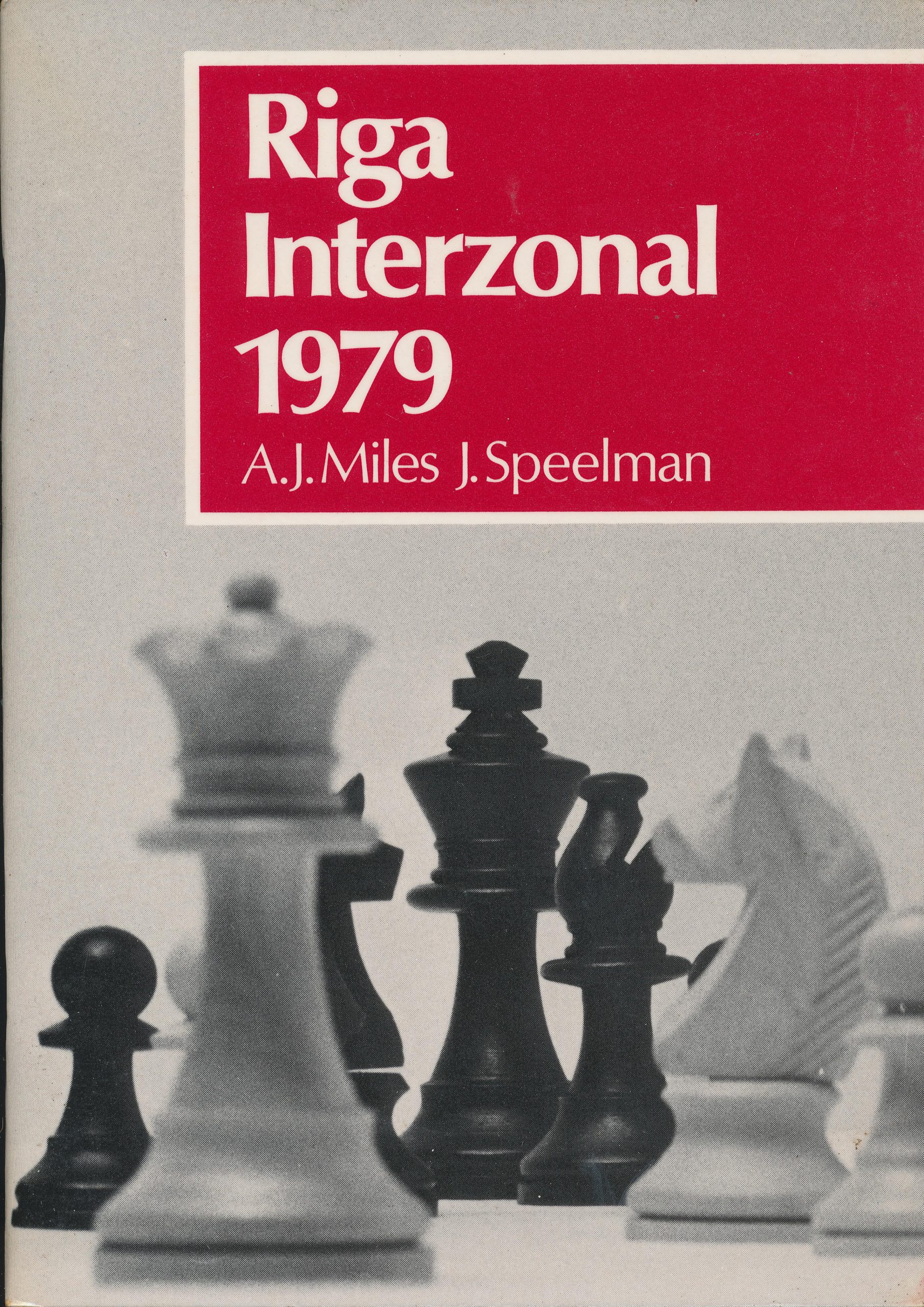
By this time Tony had failed in his first bid to get to a title match with the Russian when he fell away after a good start in the 1979 Riga Interzonal (the
second stage of the three-part qualifying cycle). It is a pity that our leading professional in Britain still has to accept so many invitations merely to make a
decent living. As Botvinnik has commented, some properly directed study and training at home may be preferable to too frequent public appearances at the board.
Tony Miles and Sergey Kudrin at a Benedictine International in Manchester
What sort of person and player is Tony Miles? He has become a more outgoing person in recent years, and has even overcome his legitimate aversion to
media representatives who attempt to interview him without any background in the game.
Tony Miles
His style has also gone through various changes. At first he was purely a 1 e4 player with a penchant for tricky Nc6 variations of the Four Knights. This repertoire brought him a string of wins, but once he began meeting masters regularly he had to change his repertoire to include the flank openings and 1 d4 as well as the Sicilian Defence. Some notable contributions to opening theory include Bf4 against the Oueen’s Indian, the defence 1…b6, perhaps now 1…a6.
Tony Miles, now playing under the US flag
Yet his real strength is not in the openings, and he rarely scores quick knockouts. His strength lies in the ability to play a wide variety of positions, to have the patience to play on when there is nothing special in the position and then to recognize the crisis (sometimes more psychological than positional). At this point his fitness and energy tell. It is significant that one of his best wins in the Dubna tournament came in a queen and pawn ending that demanded great patience and technical ability.
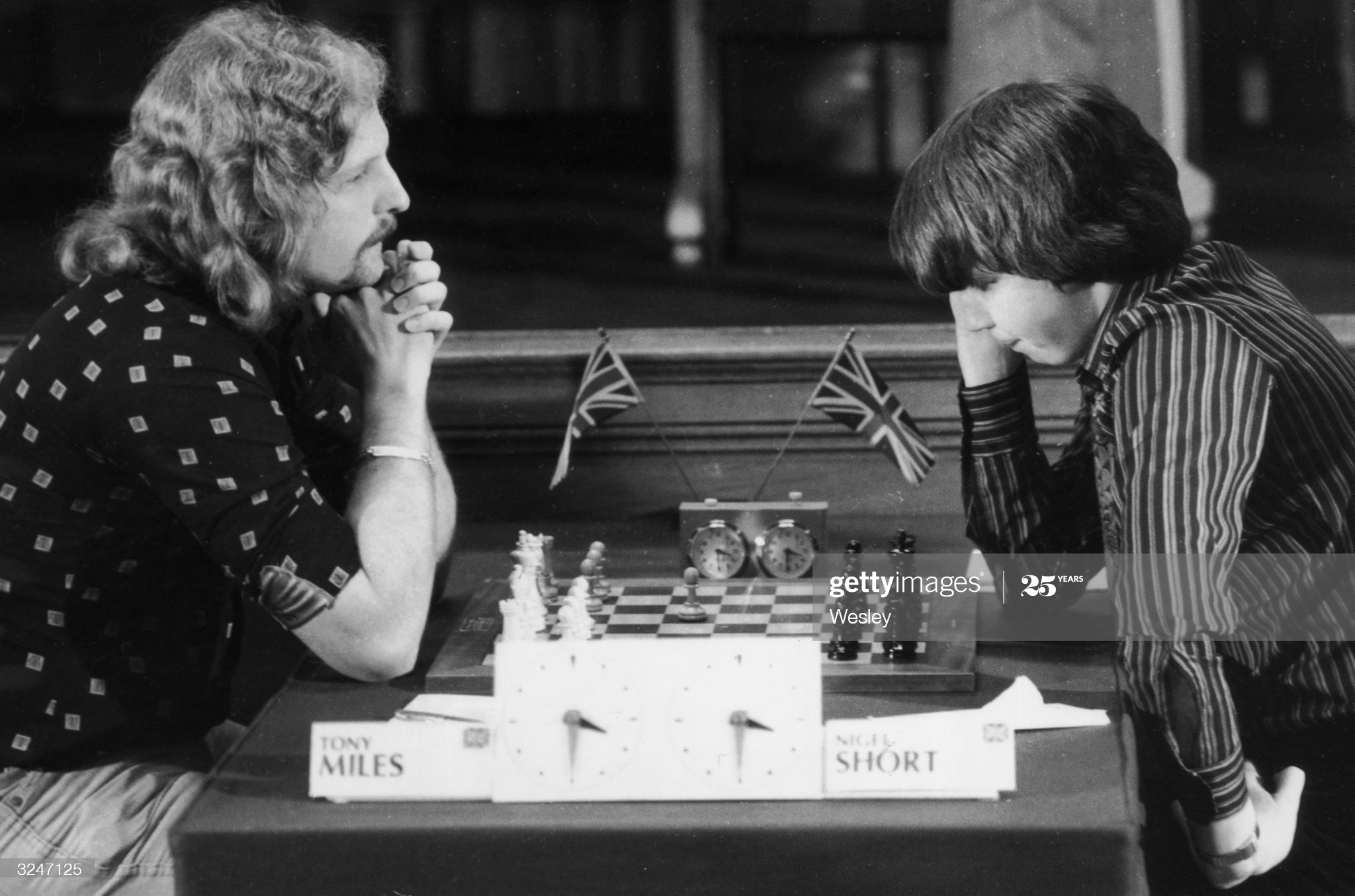
10th April 1980: Tony Miles (left) plays 14-year-old Nigel Short in the opening match of the Phillips and Drew Chess Tournament at County Hall, London. (Photo by Wesley/Keystone/Getty Images)
As readers of his weekly column will know he loves to analyse ever more deeply, and seems happier here than in taking intuitive decisions. In the play of the first British grandmaster we see a confirmation of the fact that modern competitive chess is more of a sport (Denksport as the Germans have it) than
an art, more a bitter struggle of strong personalities than an orthodox game. Bernard Cafferty
”
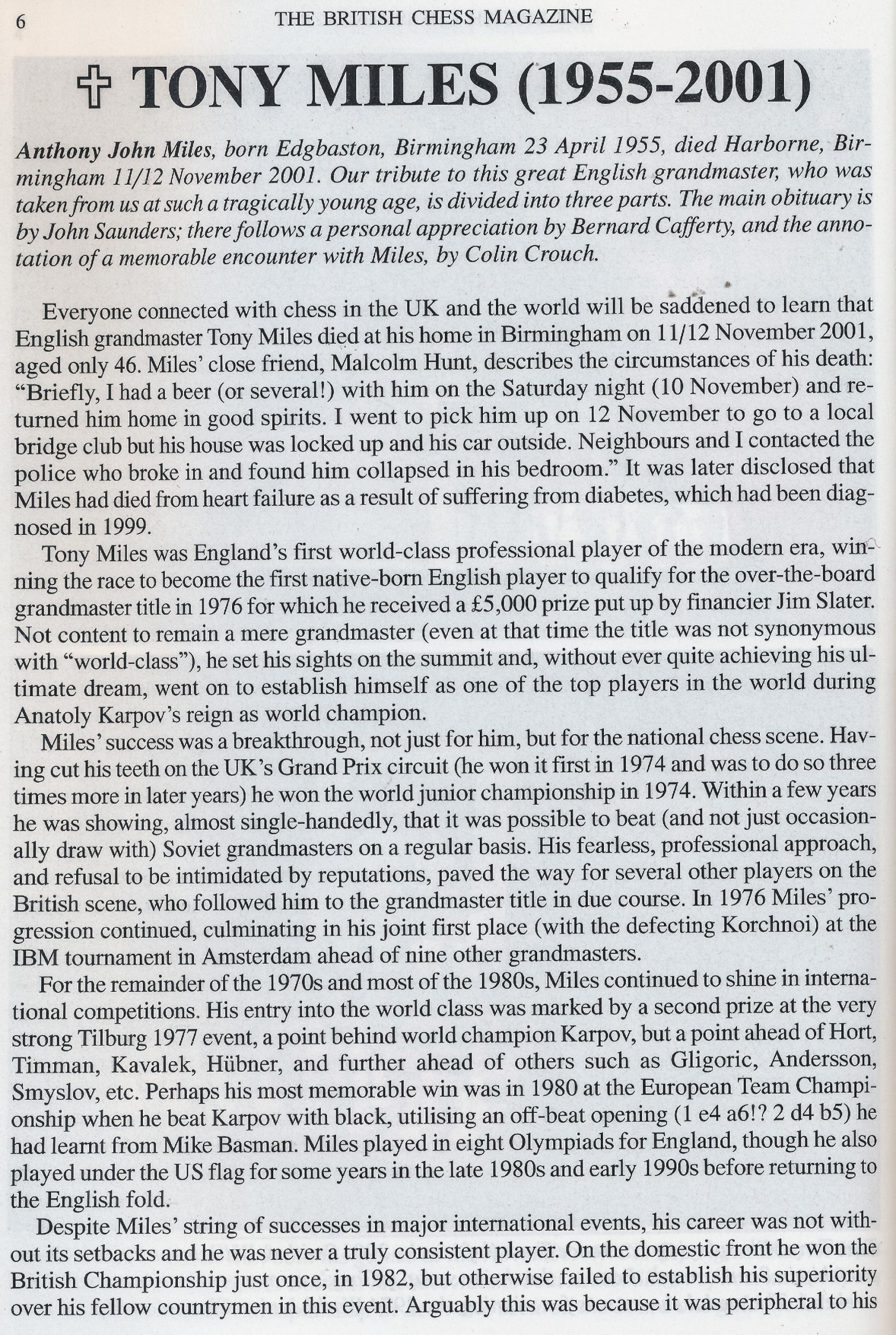
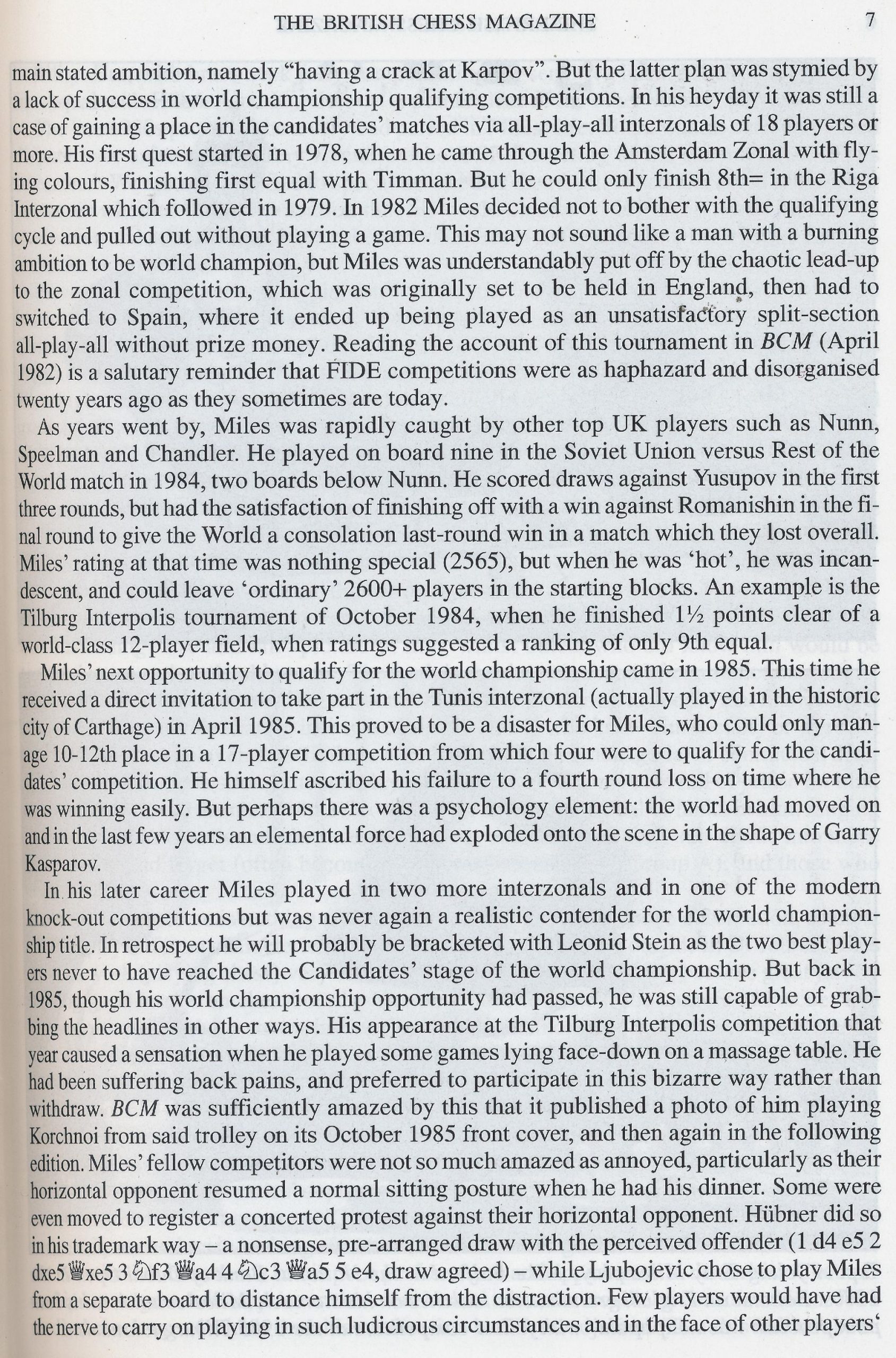
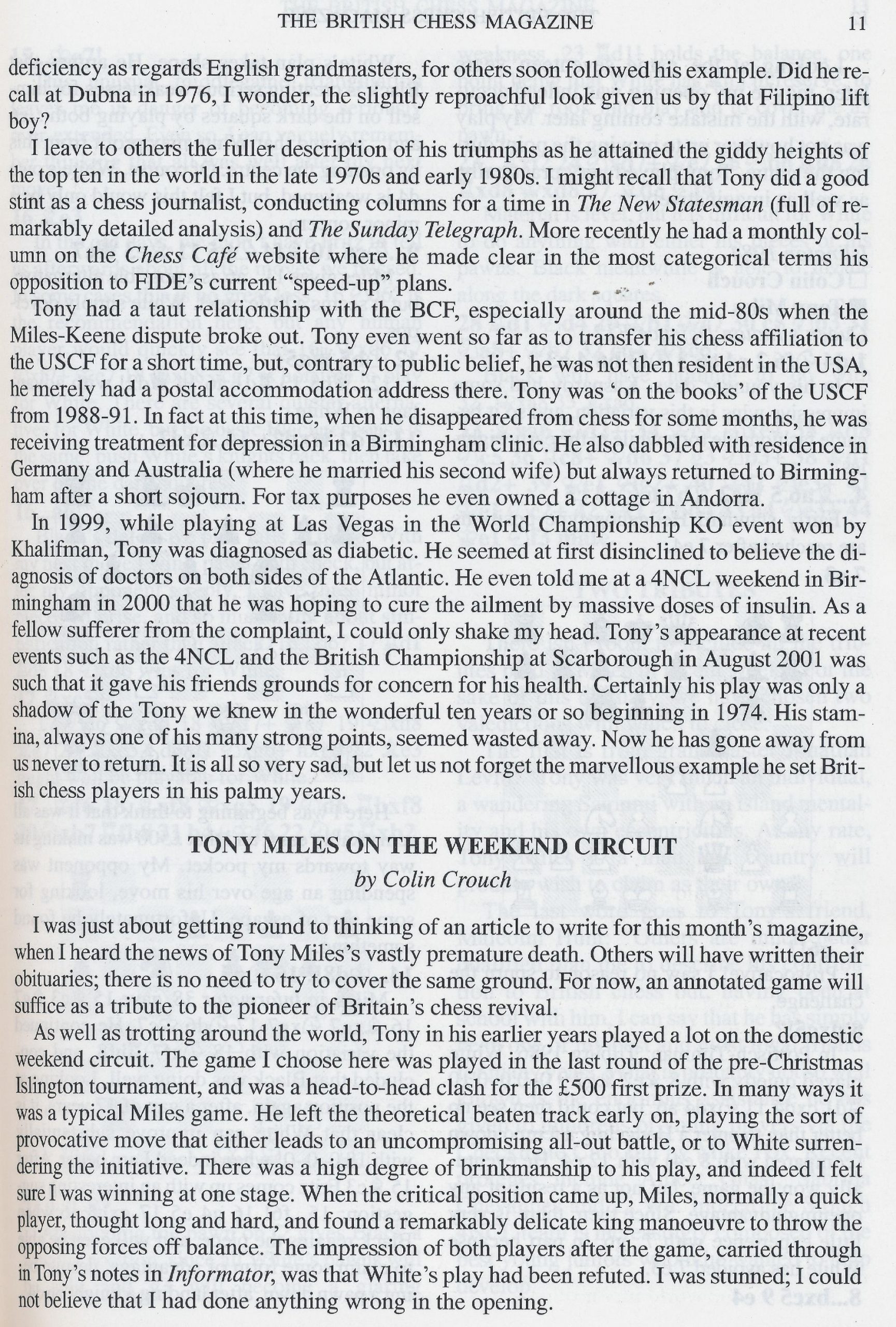
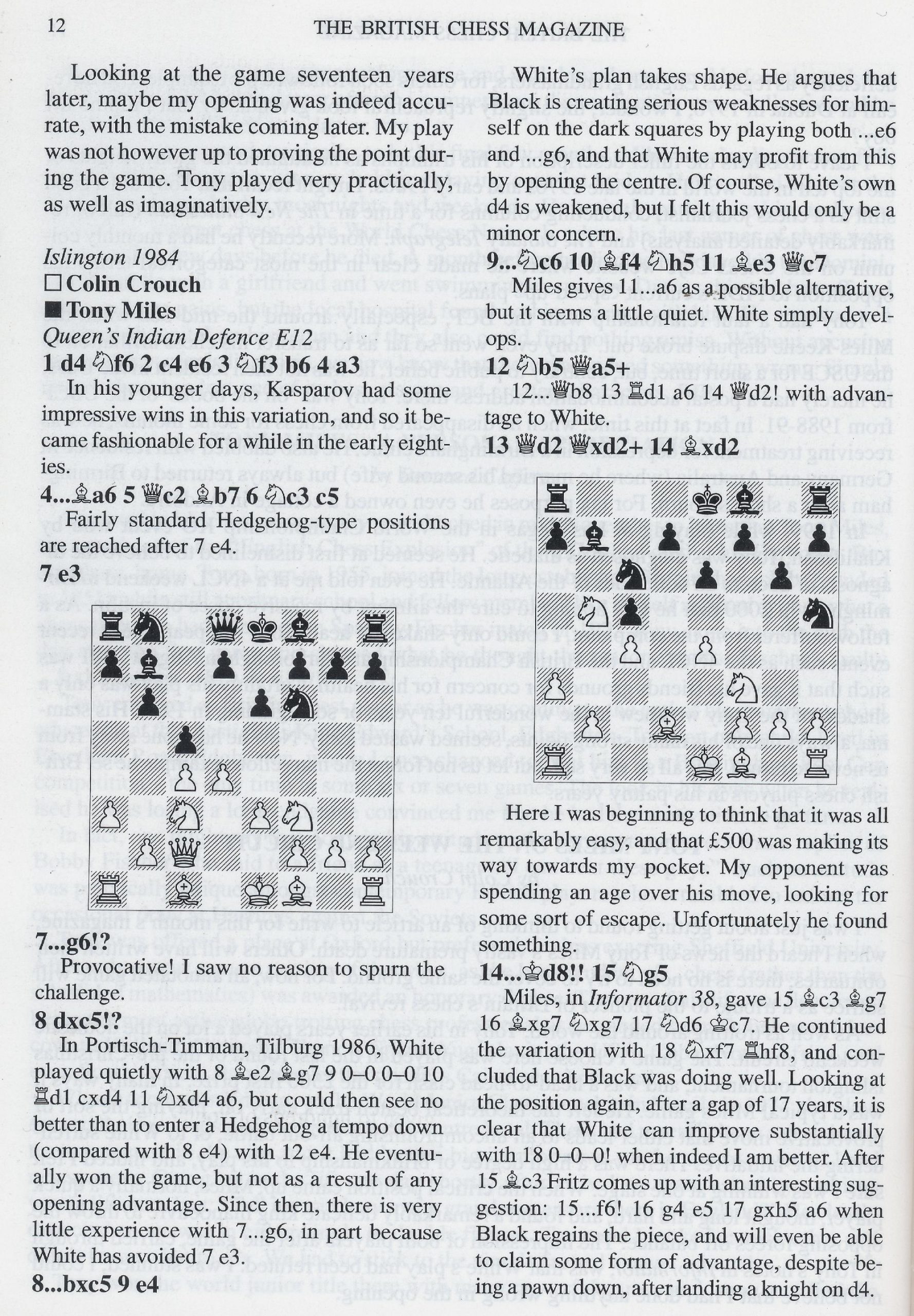
In British Chess Magazine, Volume CXXII (122, 2002), Number 1 (January) pp. 6-13 appeared this wonderful obituary from John Saunders with contributions from Bernard Cafferty, Colin Crouch, Jon Levitt and Malcolm Hunt :
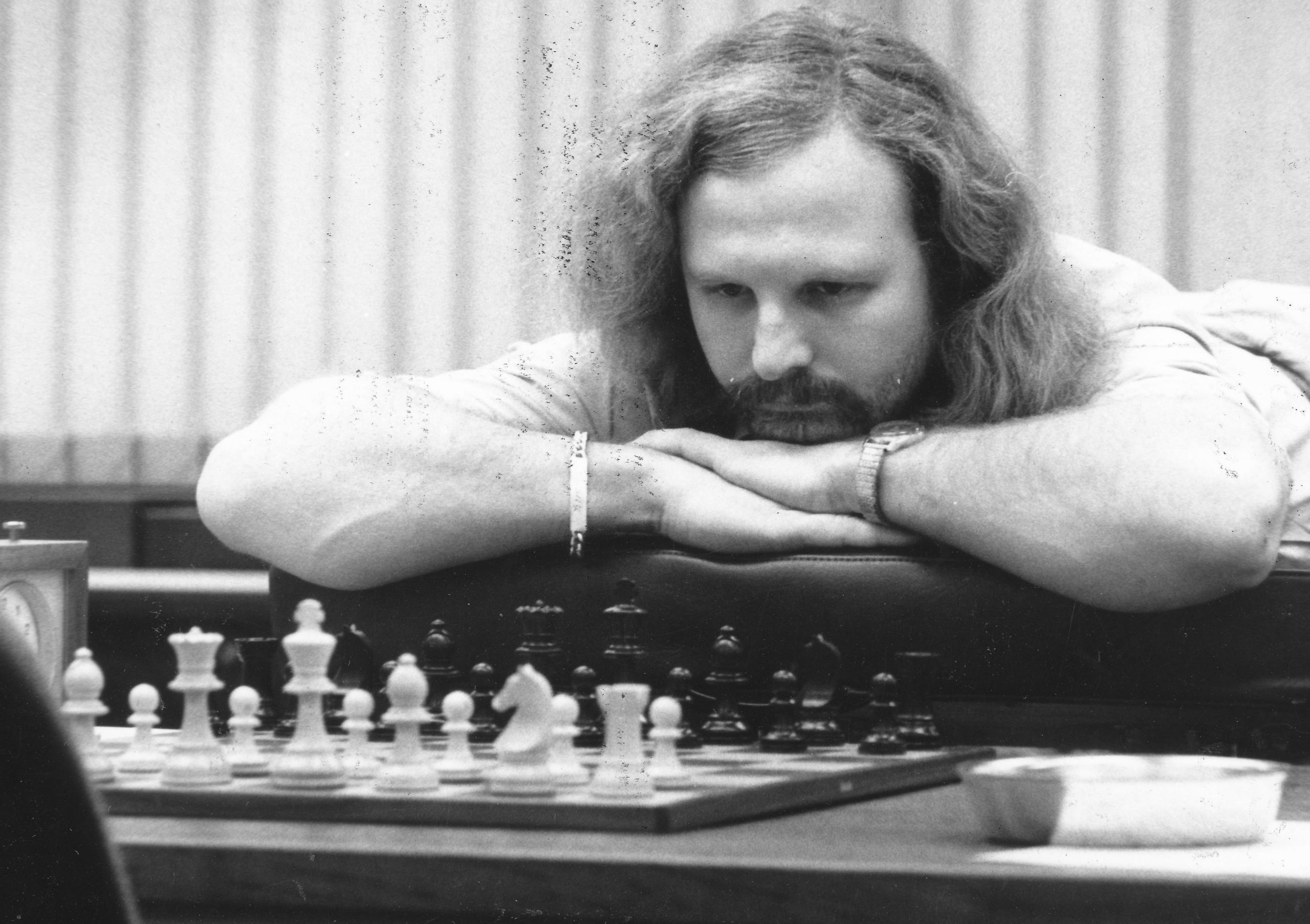
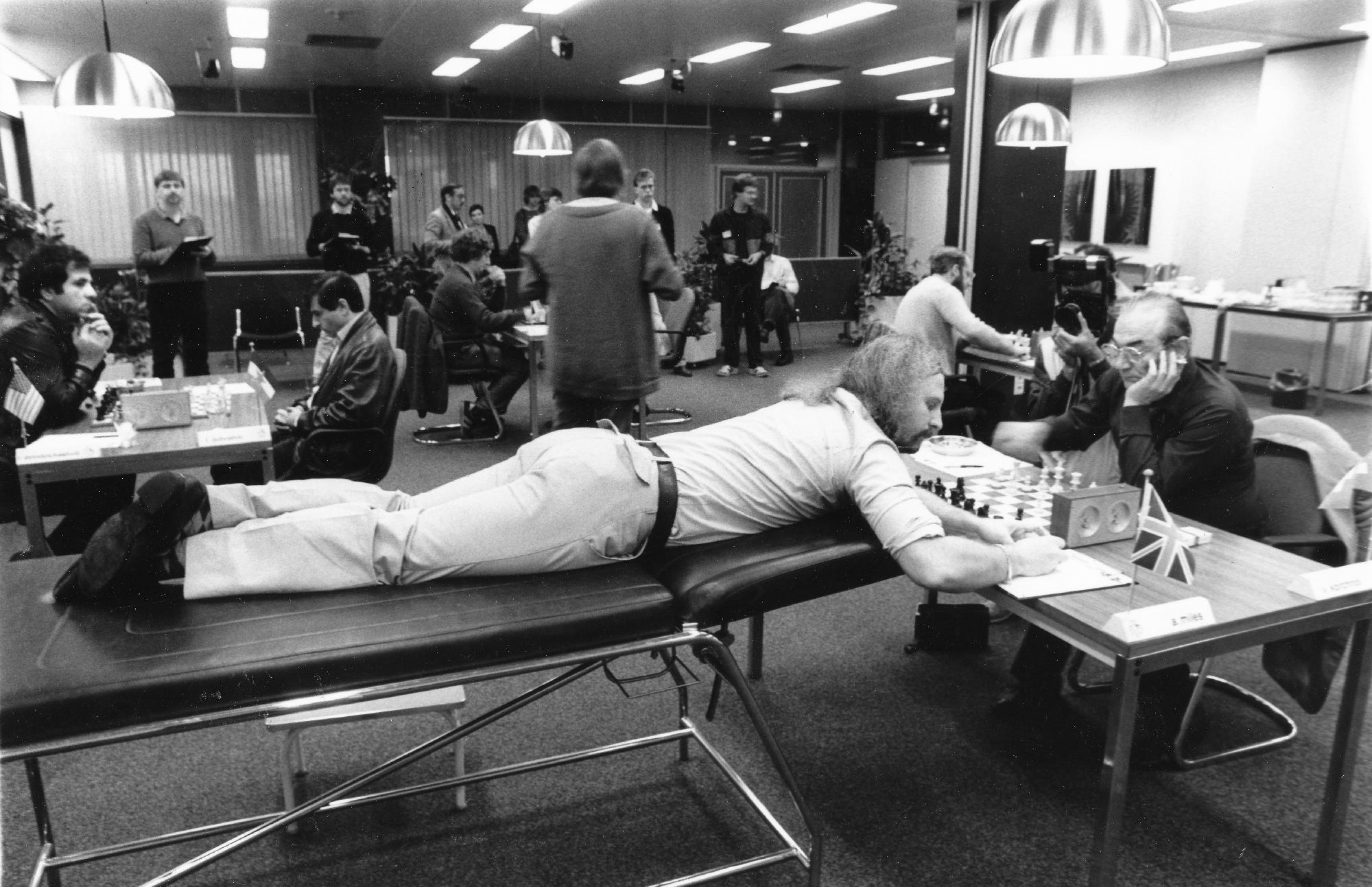
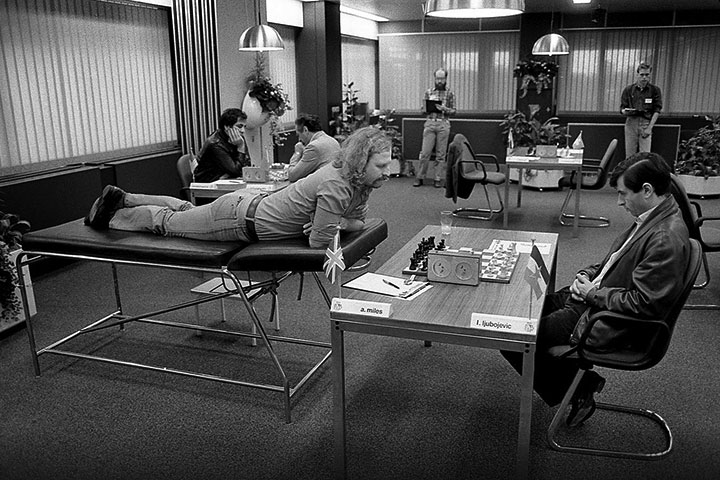
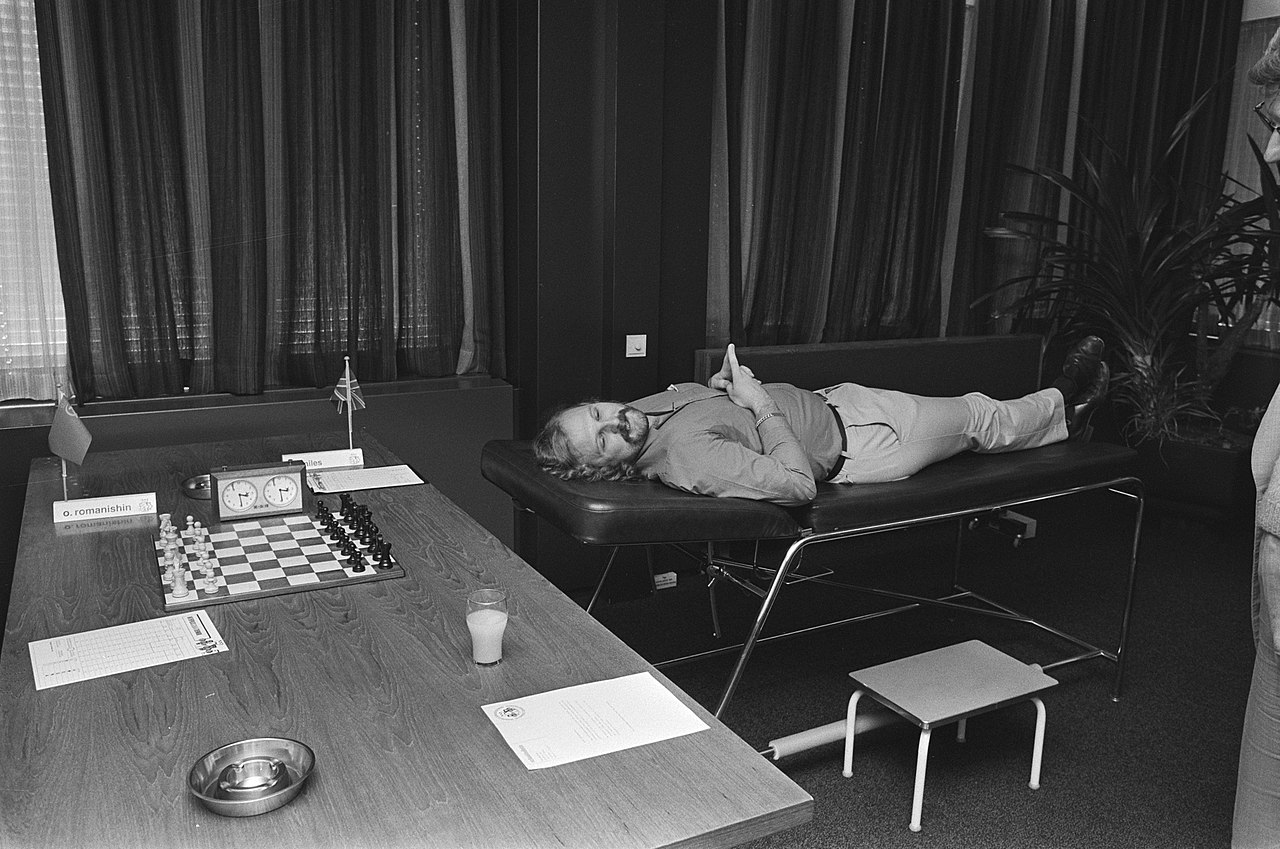
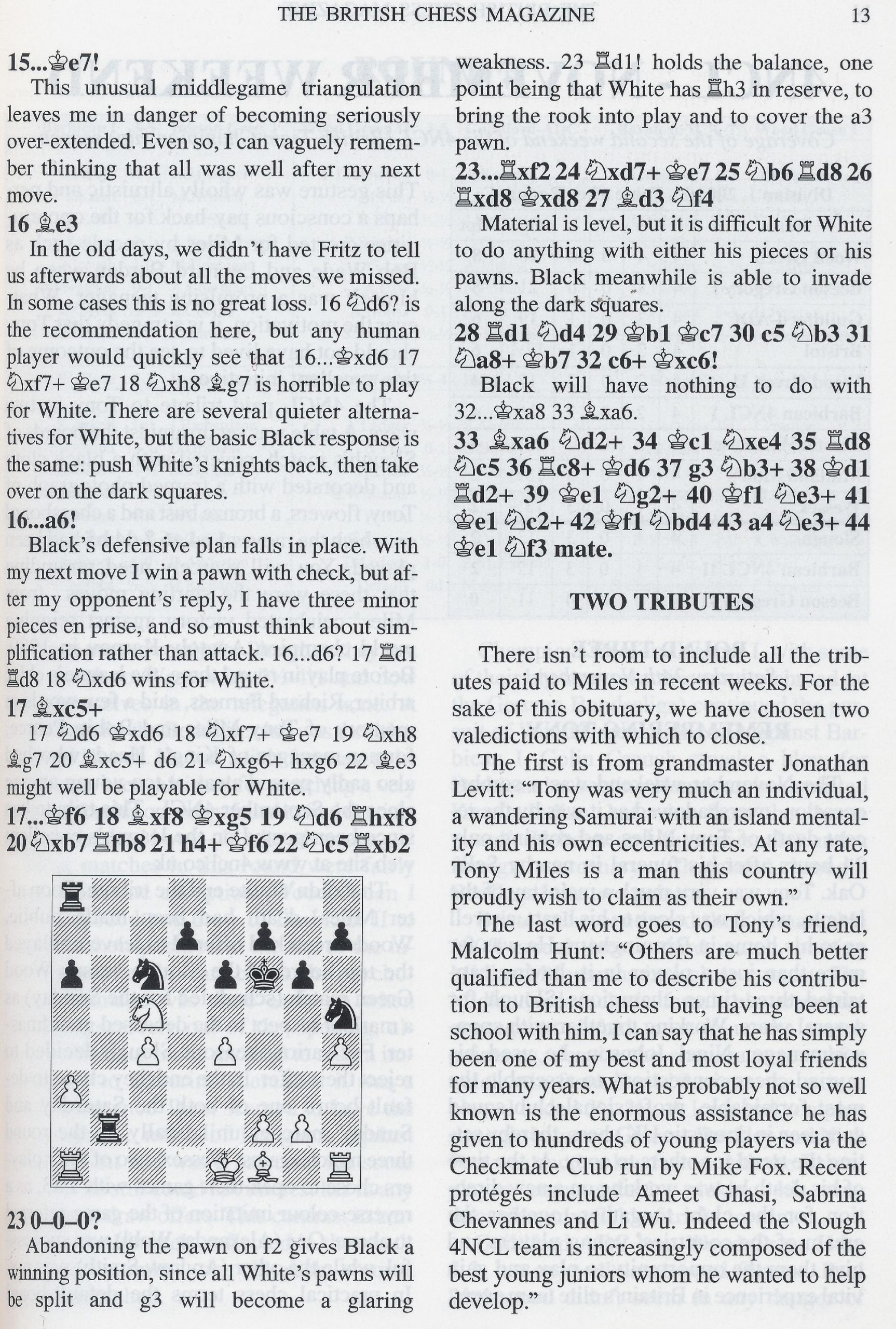
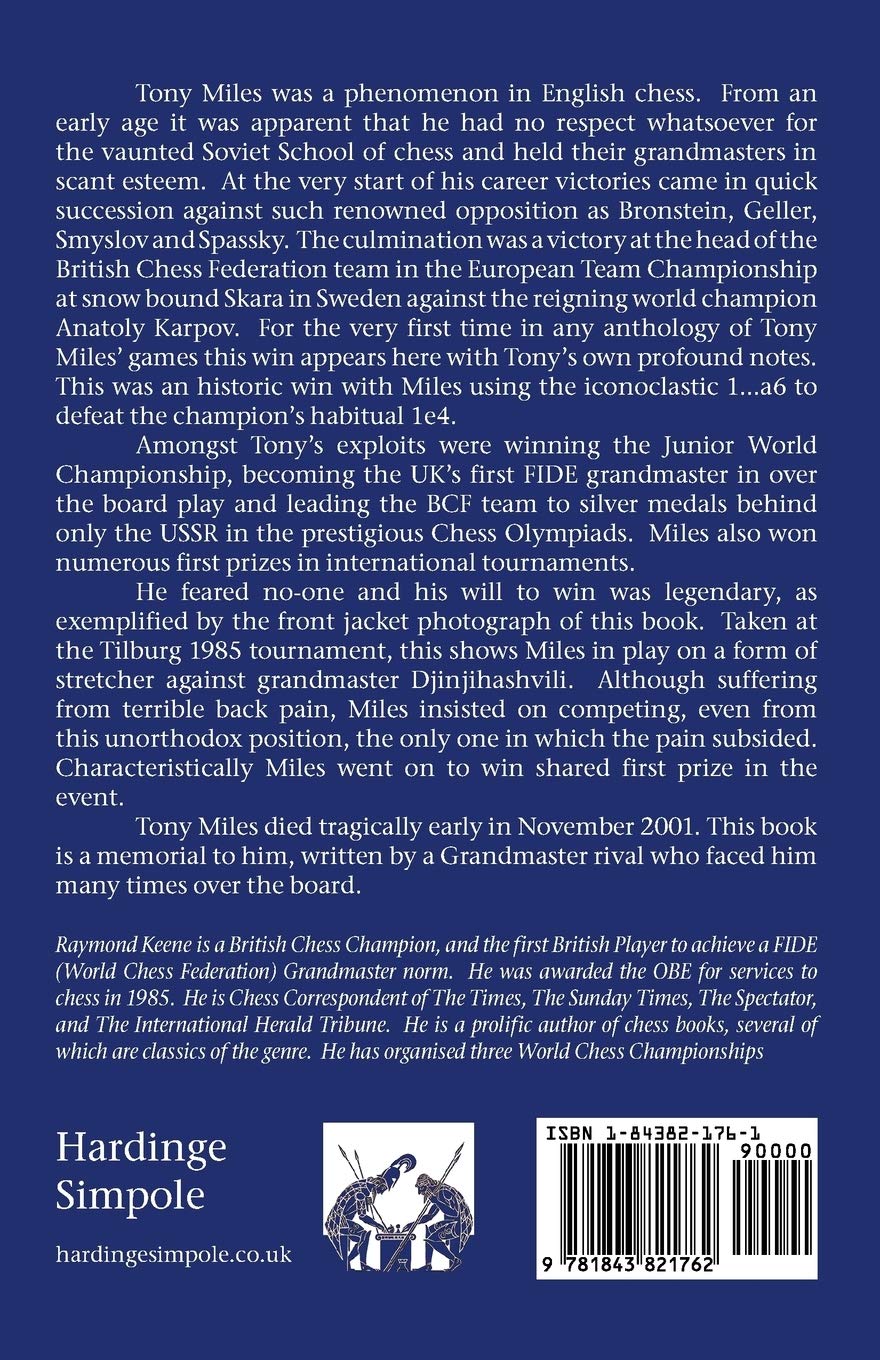
British Chess Magazine, Volume CXXII (122, 2002), Number 1 (January) pp. 6-13British Chess Magazine, Volume CXXII (122, 2002), Number 1 (January) pp. 6-13Tony Miles at Tilburg 1985Tony Miles at Tilburg 1985Tony Miles at Tilburg 1985By Bogaerts, Rob / Anefo – Interpolisschaaktoernooi Tilburg; Miles (met rugklachten) ligt op massagetafel te wachten op zijn tegenstanderDutch National Archives, The Hague, Fotocollectie Algemeen Nederlands Persbureau (ANeFo), 1945-1989,Auteursrechthebbende Nationaal Archief, Nummer toegang 2.24.01.05 Bestanddeelnummer 933-4181, CC0, https://commons.wikimedia.org/w/index.php?curid=23134281British Chess Magazine, Volume CXXII (122, 2002), Number 1 (January) pp. 6-13Tony receives the Leigh Grand Prix award from Malcolm Wood (Chief Executive)Tony receives the 1984 Leigh Grand Prix award from Dr. A Kent, Malcolm Wood (Chief Executive) and David Anderton OBEBritish Chess Magazine, Volume CXXII (122, 2002), Number 1 (January) pp. 6-13Tony playing under the Union flagBritish Chess Magazine, Volume CXXII (122, 2002), Number 1 (January) pp. 6-13Tony Miles reflecting on an adjourned position. Courtesy of Stephanie Bureau.British Chess Magazine, Volume CXXII (122, 2002), Number 1 (January) pp. 6-13Tony : always popular with the ladies at a Lloyds Bank eventBritish Chess Magazine, Volume CXXII (122, 2002), Number 1 (January) pp. 6-13Tony at a Lloyds Bank event with Ray Keene, Yasser Seirawan and Vassily Smyslov
From The Oxford Companion to Chess, (OUP, 1984 & 1994), Hooper & Whyld :
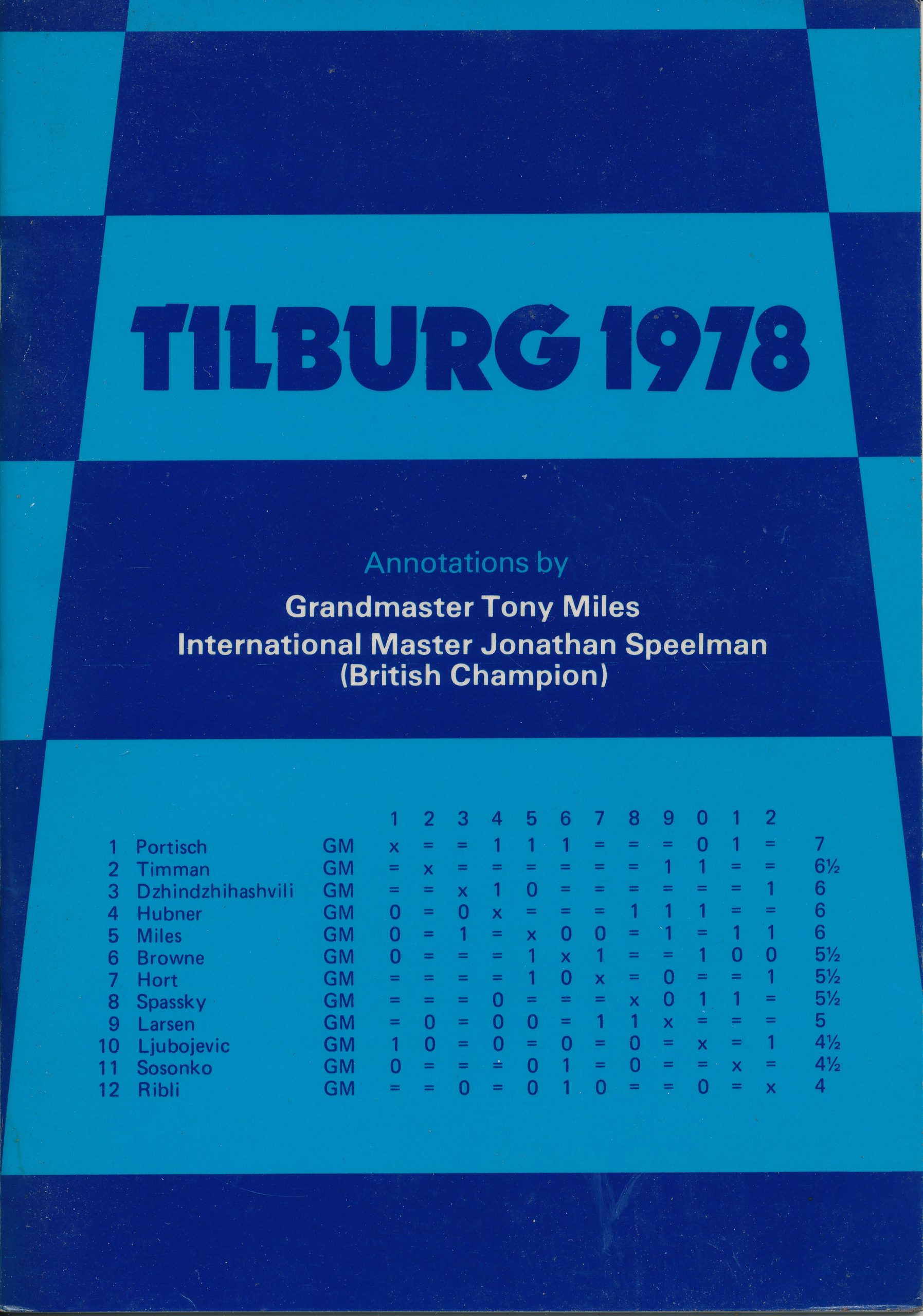
“English-born player, International Grandmaster (1976). While an undergraduate he entered and won by a margin of one and a half points the World Junior Championship, Manila 1974. The following year his university, Sheffield, awarded him an honorary MA degree for his chess achievements, and he left without completing his studies, to become a chess professional. The successes came quickly; London 1975, first (+6=3-1); Amsterdam 1976, first equal with Korchnoi; Amsterdam 1977, first (+7=7-1); Biel 1977, first (+ 8=6-l); Tilburg 1977, second (+5:4-2), after Karpov, ahead of Hort and Hübner; Tilburg 1978, third (+4=4-3) equal with Dzindzichashvili and Hübner, after Portisch and Timman; London 1980, first (+6=5-2) equal with Andersson and Korchnoi; Las Palmas 1980, first (+6=5) equal with Geller and Petrosian; Baden-Baden 1981, first (+6=7) equal with Ribli, ahead of Korchnoi; Porz Koln l98l-2, second (+8=l-2), behind Tal, ahead of Hort; Biel 1983, first (+5=6), shared with Nunn; Tilburg 1984, first (+5=6), ahead of Belyavsky, Ribli, and Hübner; Portoroz-Ljubljana 1985, first (+4=6-l) equal with Portisch and Ribli; and Tilburg 1985, first (+6=5-3) equal with Hübner and Korchnoi.
Tony making a getaway !
Around this time Miles began to feel the strain of ten years at the top. He was the first British player of modern times who could be seen as a possible challenger for the world title, and in the late 1970s he was well clear of his British rivals. However, largely inspired by Miles’s success, a new generation, led by Short, was in pursuit, and by the mid 1980s Miles was no longer top board in the Olympiad side. Successes became fewer, his marriage ended, and his confidence was weakened.
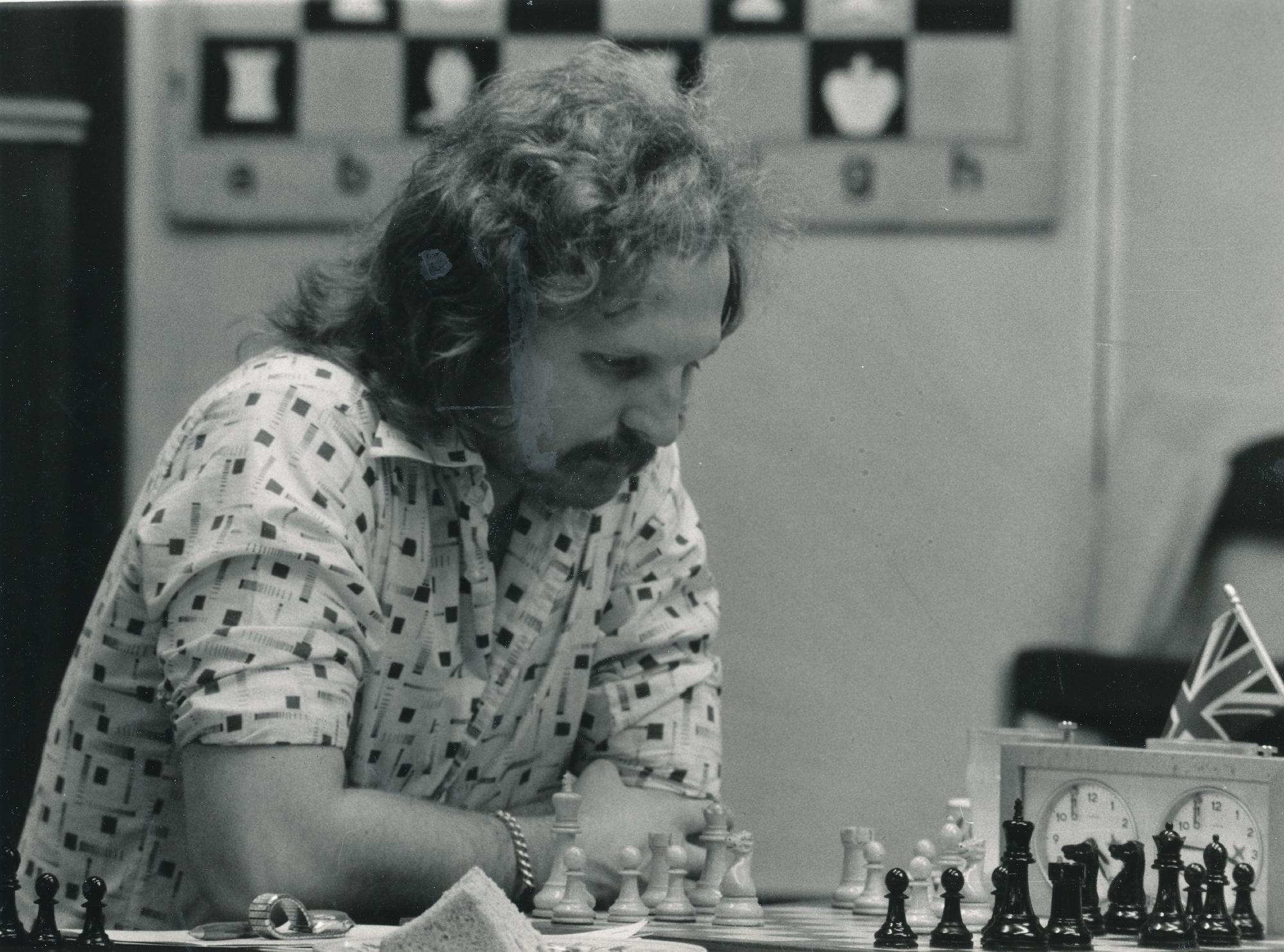
Tony enjoyed flamboyant shirts
Determined to make a new start, he transferred his allegiance to the USA in 1987, and immediately shared first place with Gulko, who won the play-off, in the US Open Championship.
Tony Miles
The move was not a lasting success. Miles had indifferent results and was not selected for the US Olympiad team in 1988. He had maintained a home in Germany and commuted to play in the Bundesliga and by 1990 he was spending an increasing proportion of his time in Europe. His confidence began to return, and with it more victories. He was first in two Swiss system events, Rome 1990, ahead of Barayev, Chernin, Smyslov etc, and Bad Worishofen 1990 (shared), and at Biel 1990 was equal
third (+3=9-2) alter Karpov and Andersson.”
Tony Miles
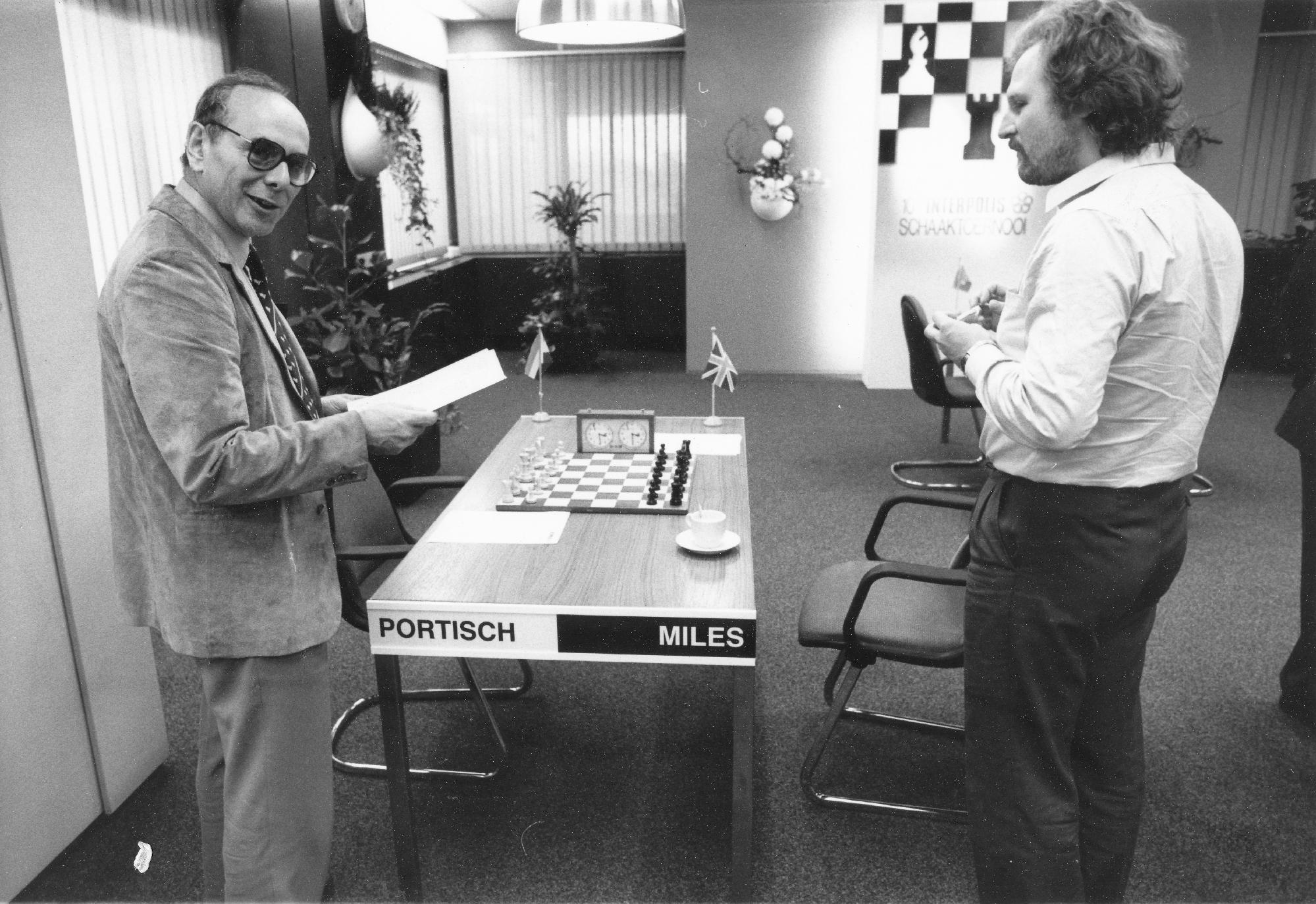
Lajos Portisch and Tony Miles
From Wikipedia :
“Personal life
Miles was an only child, born 23 April 1955 in Edgbaston, a suburb of Birmingham, and attended King Edward’s School, Birmingham.[1][2] He was married and divorced twice, and had no children.[1] Miles’ first wife was Jana Hartston, who had previously been married to William Hartston.[2]
Tony with friends at a Lloyds Bank event
Early achievements in chess
He learned the game of chess early in life and made good progress nationally, taking the titles of British under-14 Champion and under-21 Champion in 1968[1] and 1971,[3][4] respectively.
Tony with short hair
In 1973, Miles won the silver medal at the World Junior Chess Championship at Teesside, his first important event against international competition. Both he and compatriot Michael Stean defeated the tournament winner Alexander Beliavsky, but were unable to match the Soviet player’s ruthlessness in dispatching lesser opponents. Miles went on to win this prestigious title the following year in Manila, while a mathematics undergraduate of the University of Sheffield.[1][2]
Tony faces Jonathan Mestel at the Philips & Drew Masters
Taking the decision to pursue the game professionally, Miles did not complete his studies, but, in 1975, was awarded an MA by the University in respect of his chess achievements.[2]
Tony in slightly less formal attire
Further career highlights
In 1976, Miles became the first UK-born, over-the-board chess grandmaster, narrowly beating Raymond Keene to the accolade.[2] The naturalised, German-born Jacques Mieses was awarded the GM title in 1950, while Keith Bevan Richardson had been awarded the GM title for correspondence chess earlier in 1975. For his achievement, Miles won a £5,000 prize, put up by wealthy businessman and chess backer Jim Slater.[1][2]
Tony and friends at a Lloyds Bank event
Miles had a string of good results in the late 1970s and 1980s. He matured into a world class player and won games against high calibre opponents, such as former World Chess Champions Vasily Smyslov, Mikhail Tal and Boris Spassky.
Post mortem analysis with Tony and Garry Kasparov
In 1980 at the European Team Championship in Skara, he beat reigning World Champion Anatoly Karpov with Black, using the extremely unorthodox opening 1. e4 a6!?, the St. George Defence. It is often said that Miles learned the line from offbeat openings enthusiast Michael Basman, but in his book Play the St. George, Basman asserts there is no truth to this. Miles beat Karpov again three years later in Bath in a game that was part of the BBC’s Master Game series, but it was shown only by the (co-producing) German television network, due to a BBC technicians’ strike at the time of broadcast.
Tony in Olympiad play with Jan Timman
Miles won the British Championship just once, in 1982 when the event was held in Torquay. His prime time as a chess player was the mid-1980s. On 20 May 1984 in Roetgen (Germany), Miles set a European record in blind simultaneous chess with 22 games (+10−2=10);[5] this record was not broken until 2009. On the January 1984 Elo rating list, he ranked No. 18 in the world with a rating of 2599. One of his best results occurred at the Tilburg tournament in 1984, where, from a strong field, he emerged sole winner by a clear margin of one and one-half points. The following year, he tied for first at the same event with Robert Hübner and Viktor Korchnoi, playing several of his games while lying face down on a table, having injured his back.[6]
Tony and ? at a Lloyds Bank Masters. Stewart Reuben applauds.
The result was controversial, as many of Miles’ opponents felt they were distracted by the unusual circumstances. A string of good performances culminated in a good showing on the January 1986 Elo rating list, where he climbed to a best-ever position of World No. 9 with a rating of 2610. During this period, there was considerable rivalry with Nunn over who was the United Kingdom’s best player, the two protagonists regularly leapfrogging each other in the world rankings. Nigel Short and Speelman soon added to the competition, as the English national squad entered its strongest period.
Tony about to play Vladimir Kramnik
Never able to qualify out of the Interzonal stages into the Candidates’ series, Miles eventually lost the race to become the first British Candidate when Short did so in 1985. However, he retained top board for England at the Thessaloniki and Dubai Olympiads of 1984 and 1986, helping the team to silver medals at each.
Tony plays Glenn Lambert during the 1976 BCF Congress in Portsmouth. Photo courtesy of Tony Williams
Against Garry Kasparov, Miles had little success, not winning a game against him, and losing a 1986 match in Basel by the score of 5½–½. Following this encounter, Miles commented “I thought I was playing the world champion, not a monster with a thousand eyes who sees everything” (some sources alternatively quote Miles as having the opinion that Kasparov had 22 or 27 eyes).
Miles on a stretcher with back pain, playing in Tilburg (1985)
After he was hospitalised because of a mental breakdown in late 1987, Miles moved to the United States. He finished last in the 1988 U.S. Championship, but continued to play there and had some good results. In 1991, he played in the Championship of Australia, but eventually moved back to England and began to represent his native country again. He was equal first at the very strong Cappelle-la-Grande Open in 1994, 1995, and 1997, and caused a shock at the PCA Intel Rapid Chess Grand Prix in London in 1995, when he knocked out Vladimir Kramnik in the first round and Loek van Wely in the second. His bid to win the event was finally halted in the semifinal by English teammate Michael Adams.
There were four notable victories at the Capablanca Memorial in Cuba (1994, 1995, 1996, and 1999). Miles also tied for first in the 1999 Continental Open in Los Angeles with Alexander Beliavsky, Ľubomír Ftáčnik and Suat Atalık. His last tournament victory was the 2001 Canadian Open Chess Championship in Sackville, New Brunswick.
Miles entered and played at the 2001 British Championship in Scarborough, but withdrew before the final round, apparently because of ill health. His final two games before his death were short draws in the Four Nations Chess League. Miles played in an extraordinary number of chess events during his career, including many arduous weekend tournaments.
The Miles Variation (1.d4 Nf6 2.c4 e6 3.Nf3 b6 4.Bf4) in the Queen’s Indian Defence is named after him.”
Tony started his chess writing career in around 1978 with a series of high quality annotated tournament bulletins of the top events of the period most of which he competed in himself. For example:
Tilburg 1978, Tony Miles & Jonathan Speelman, Master Chess Publications, 1978Riga Interzonal 1979, AJ Miles & J Speelman, Batsford, 1979, ISBN 0 7134 3429 5Rio de Janeiro Interzonal 1979, AJ Miles & M.Chandler, Batsford, 1979, ISBN 0 7134 3427 9Buenos Aires 1979. AJ Miles, The Chess Player, ISBN 0 906042 31 347th USSR Championships 1979, AJ Miles, The Chess Player, 1979, ISBN 0 906042 32 1Chess from Square One, AJ Miles, Harper Collins, November 1979, ISBN 0713511168European Team Championship Skara 1980, AJ Miles, The Chess Player, ISBN 0 906042 33X
Of course there are numerous articles about Tony for example :
Lawrence Trent plays Tony Miles in 2001 at the British Championships in ScarboroughIt’s Only Me, edited by Geoff LawtonTony Miles : England’s Chess Gladiator, Ray Keene, 2006Tony Miles : England’s Chess Gladiator, Ray Keene, 2006A Tony Miles memorialTony’s signature from a presentation copy of Pachman’s Decisive Games from Anglo-German match of February 1979 at Elvetham Hall
We focus on the British Chess Scene Past & Present!
This website uses cookies to improve your experience. We'll assume you're ok with this, but you can opt-out if you wish. Cookie settingsACCEPT
Privacy & Cookies Policy
Privacy Overview
This website uses cookies to improve your experience while you navigate through the website. Out of these cookies, the cookies that are categorized as necessary are stored on your browser as they are as essential for the working of basic functionalities of the website. We also use third-party cookies that help us analyze and understand how you use this website. These cookies will be stored in your browser only with your consent. You also have the option to opt-out of these cookies. But opting out of some of these cookies may have an effect on your browsing experience.
Necessary cookies are absolutely essential for the website to function properly. This category only includes cookies that ensures basic functionalities and security features of the website. These cookies do not store any personal information.