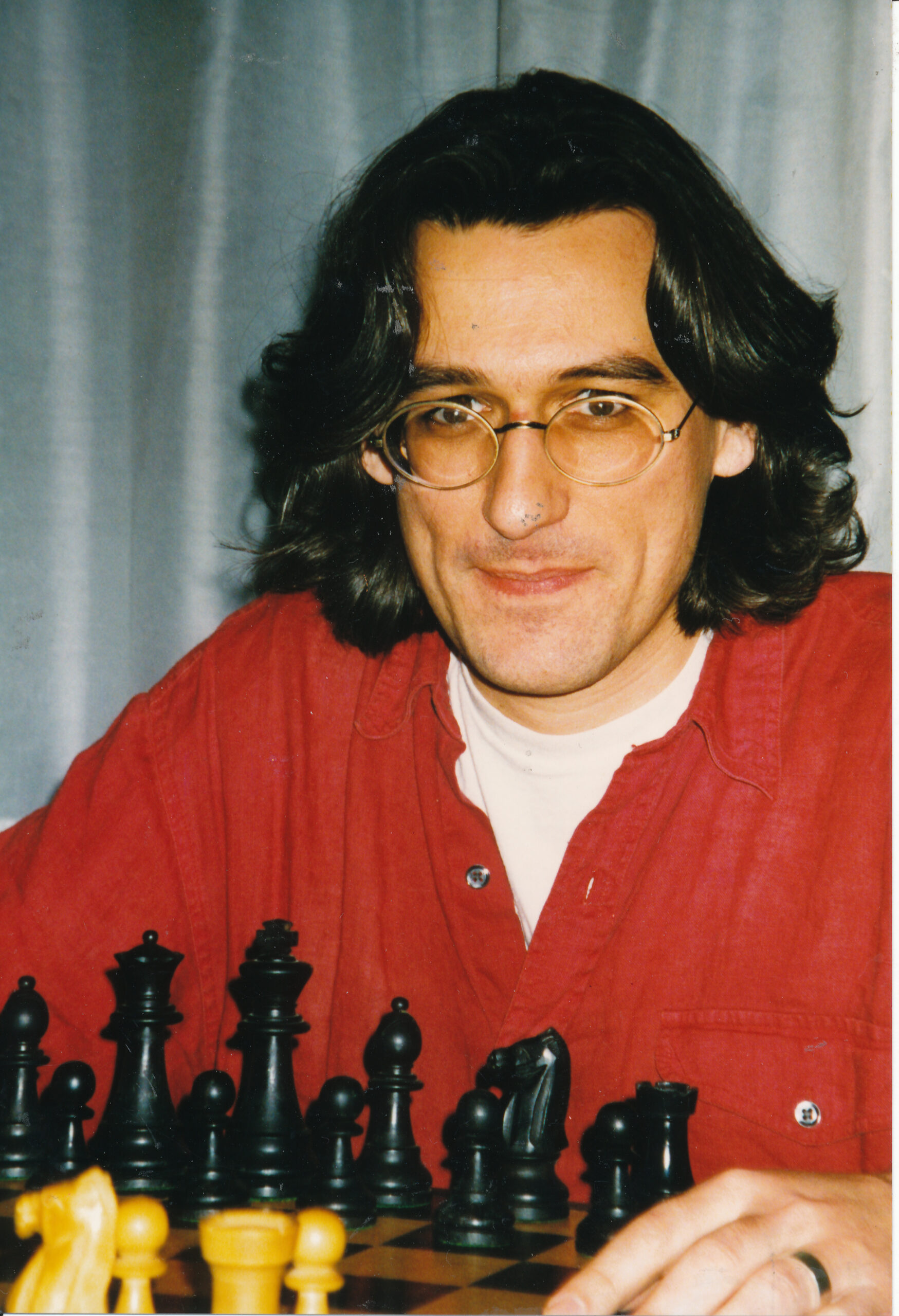
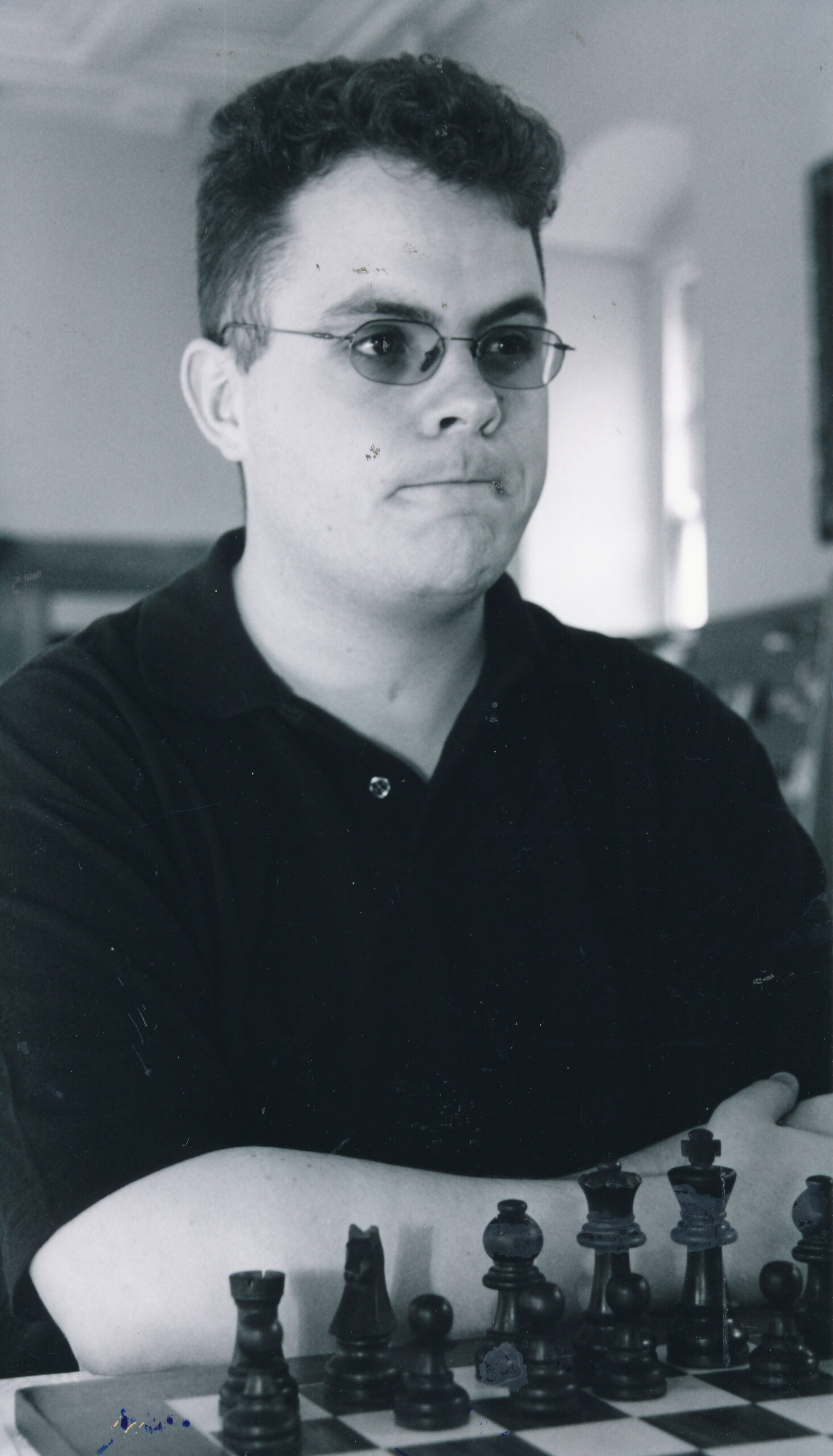
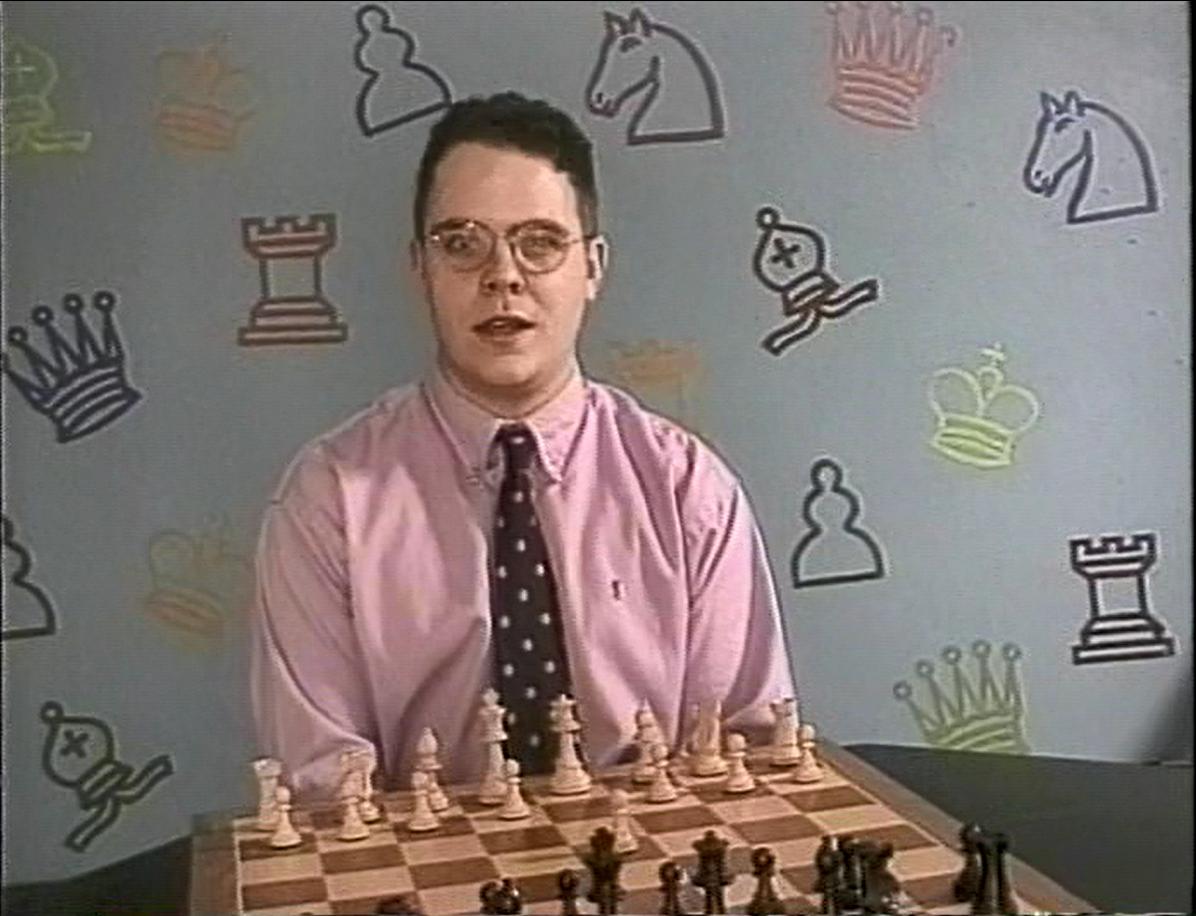
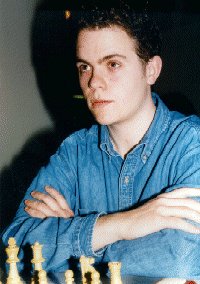
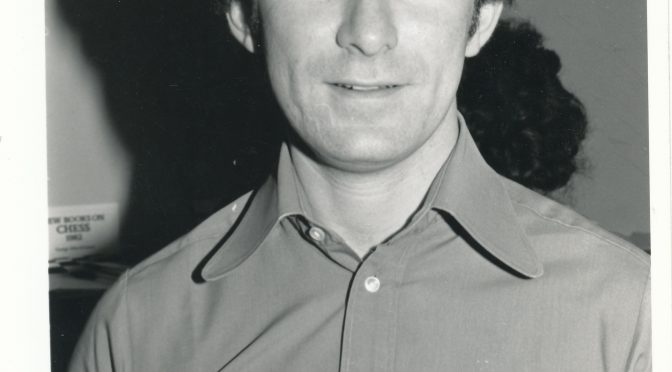
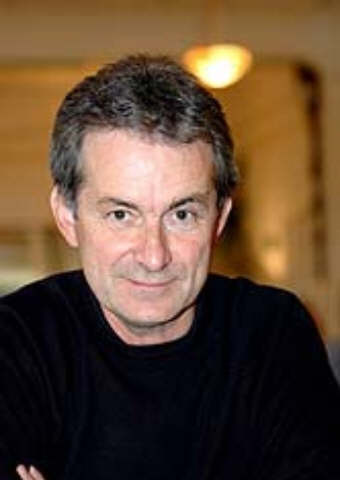
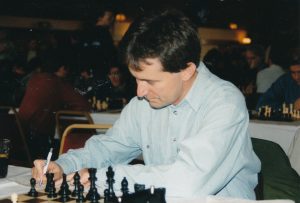
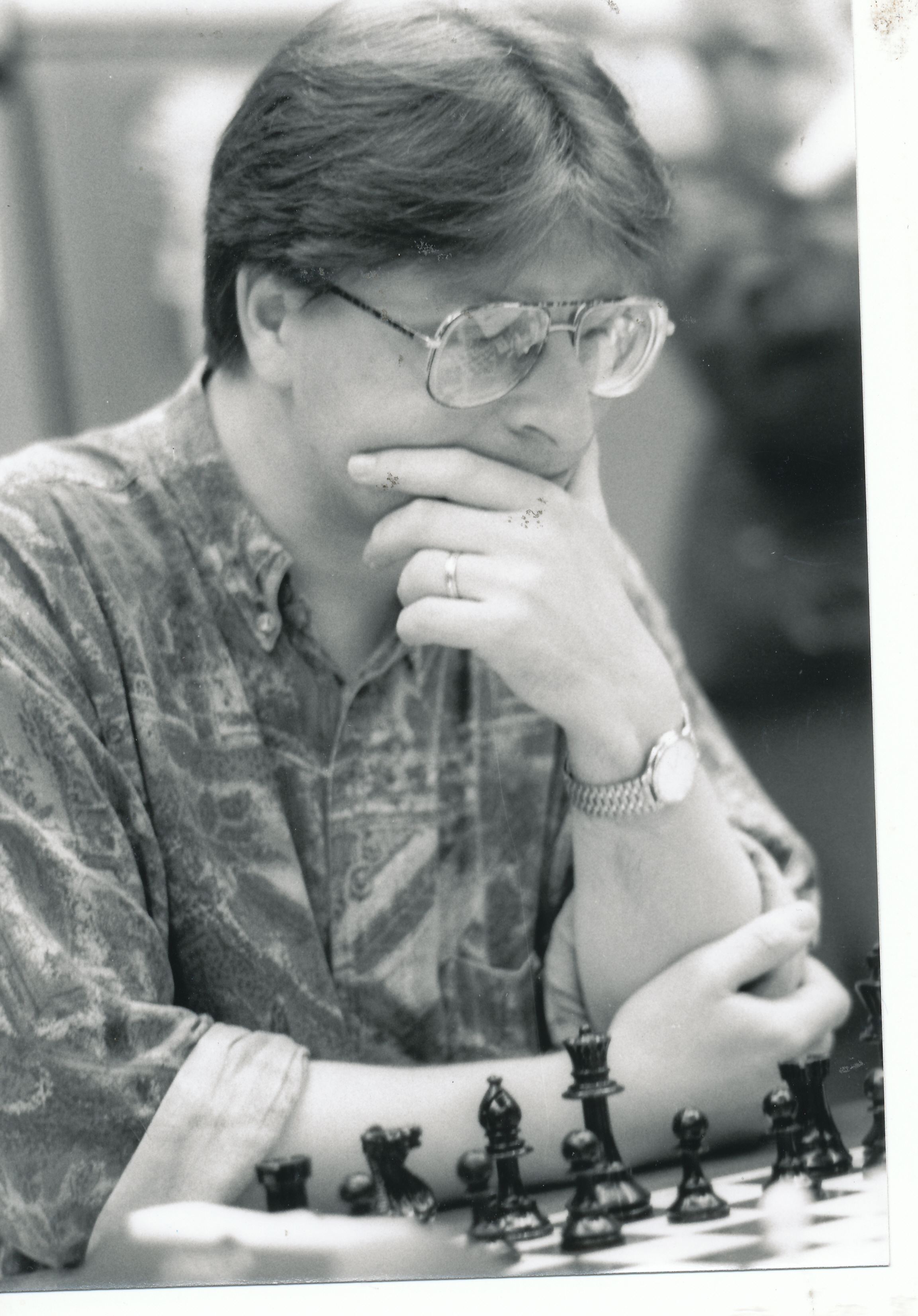
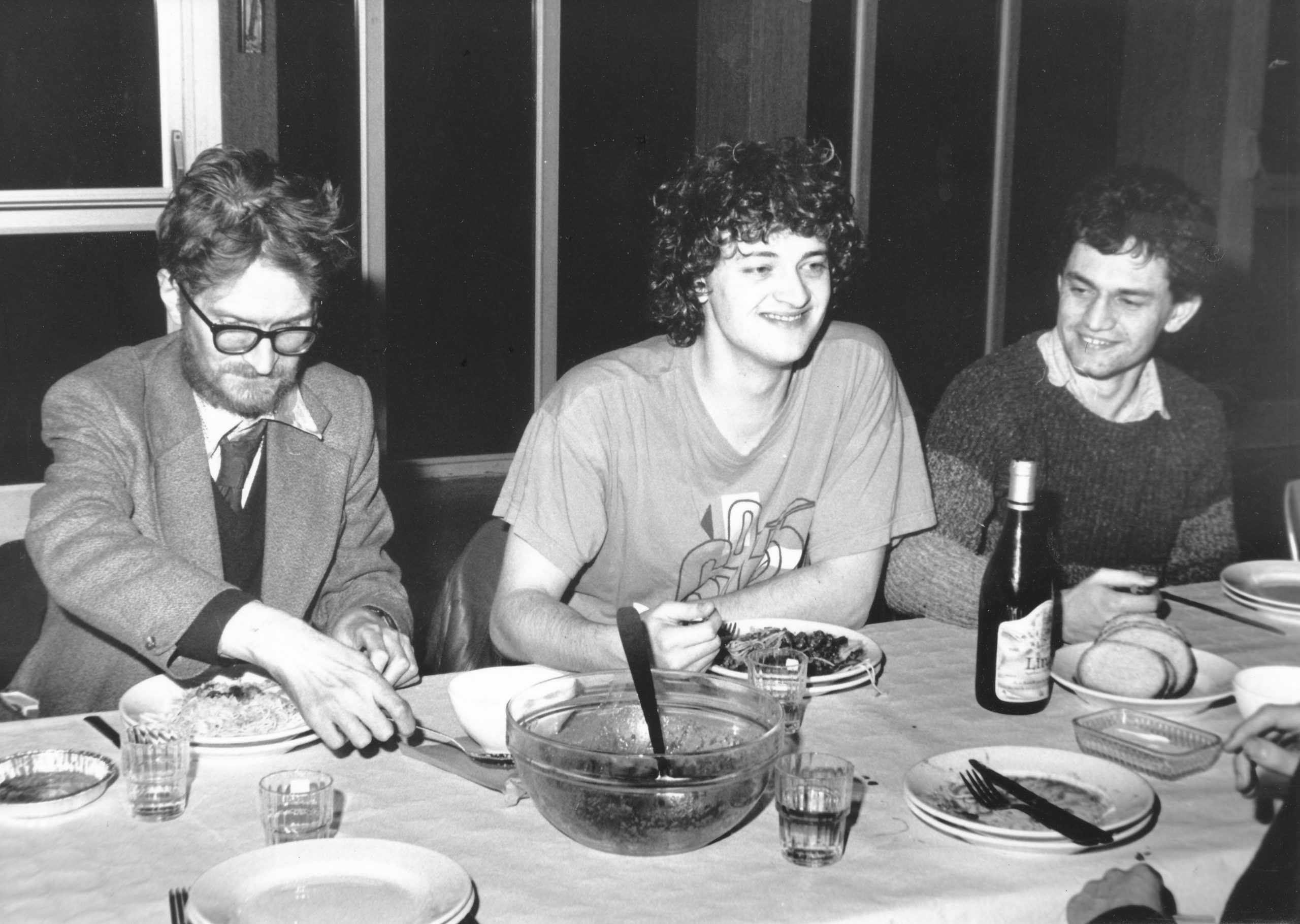
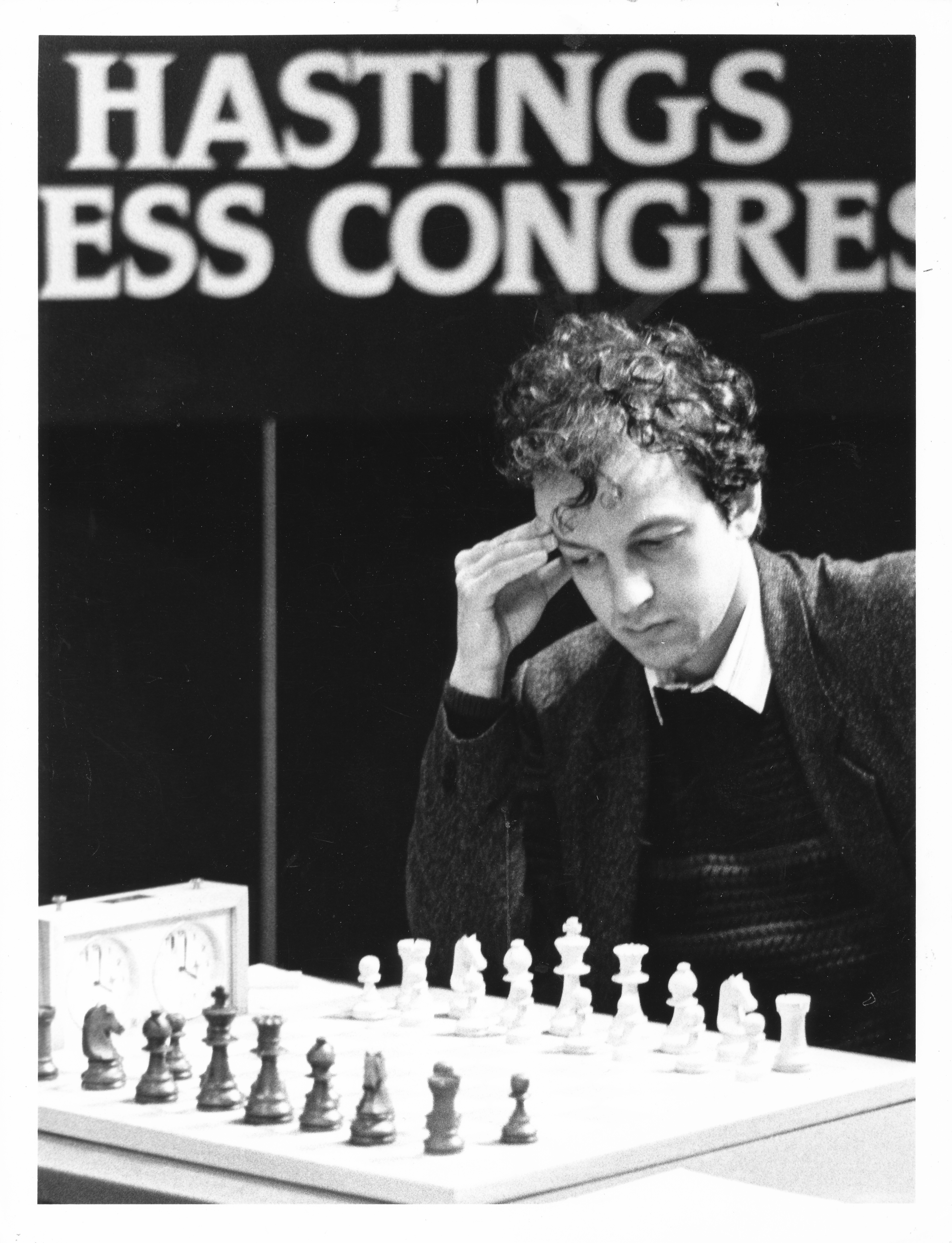
We offer best wishes to GM Daniel King on his birthday
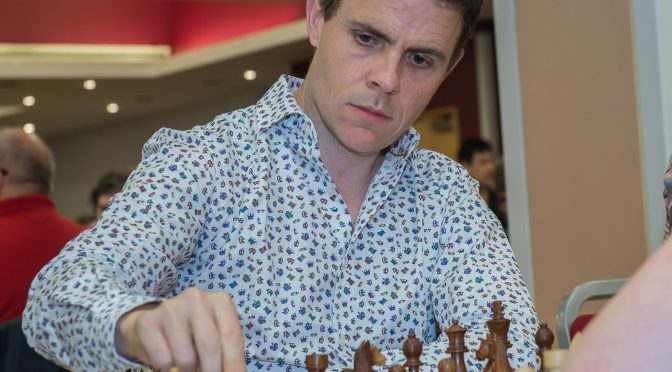
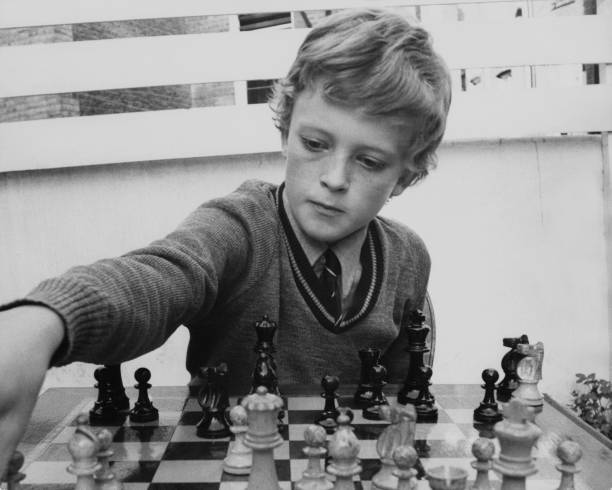
Daniel John King was born on Wednesday, August 28th 1963 (the same day as the Martin Luther King “I have a dream” speech) in Beckenham, Kent.
He attended Langley Park School whose motto is “Mores et Studia” meaning “good character and learning” or “morals and study”.
Daniel has a brother Andrew (AJ King) who is also a strong player.
Daniel became an International Master in 1982 and a Grandmaster in 1989.
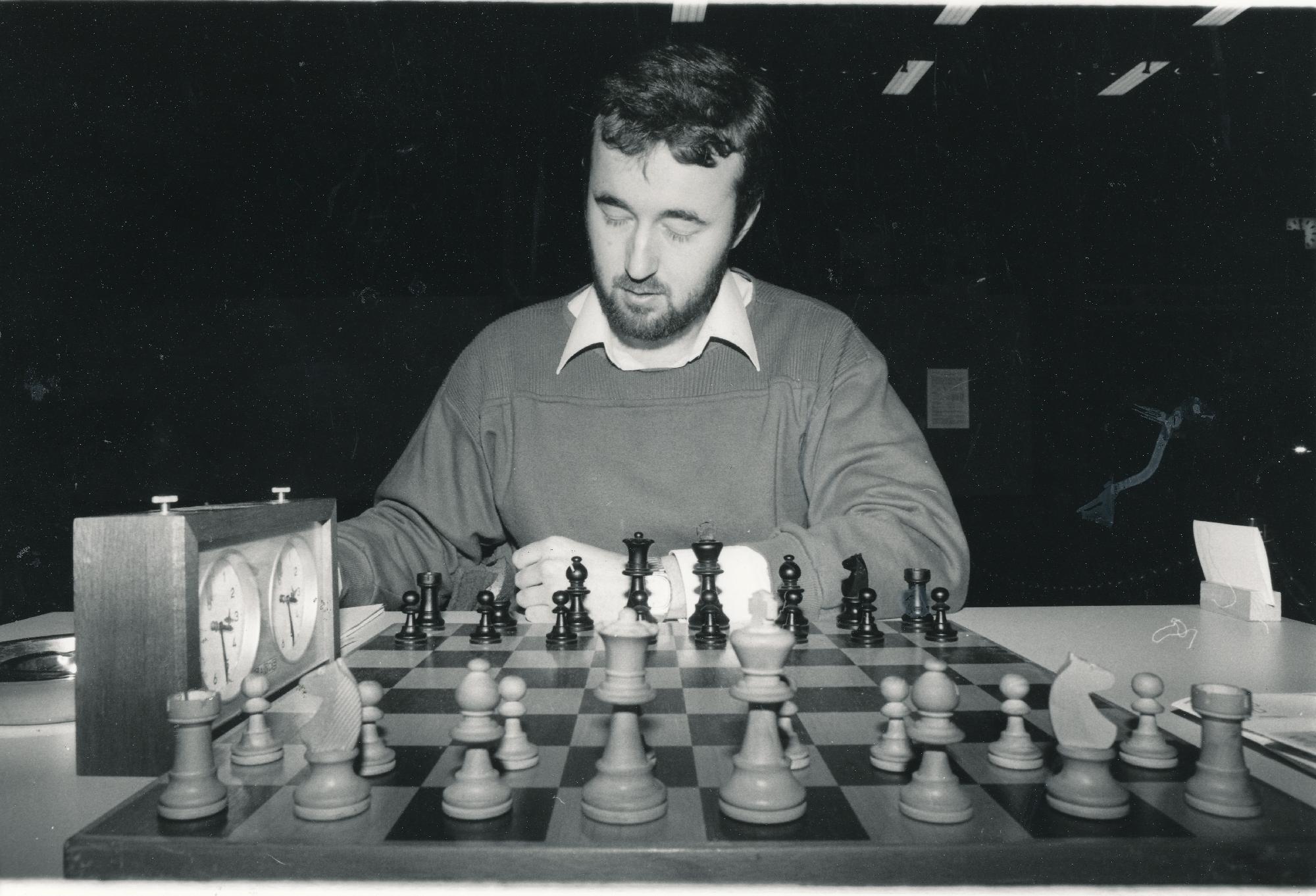
Daniel King
His peak FIDE rating (Felice) was 2560 in July 1990 at the age of 27.
Daniel plays for Guildford in the Four Nations Chess League (4NCL) and has played for Guildford in local leagues.
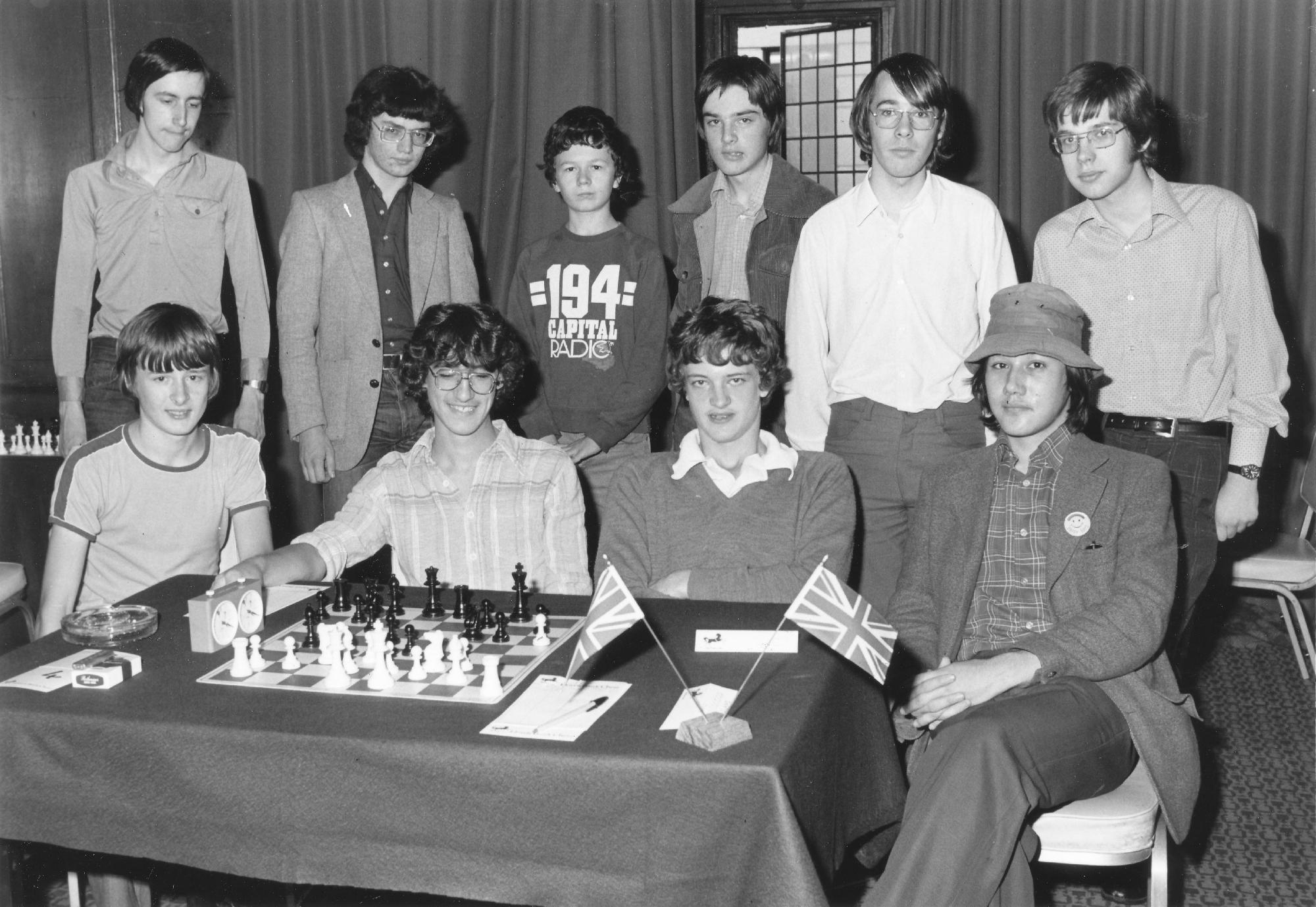
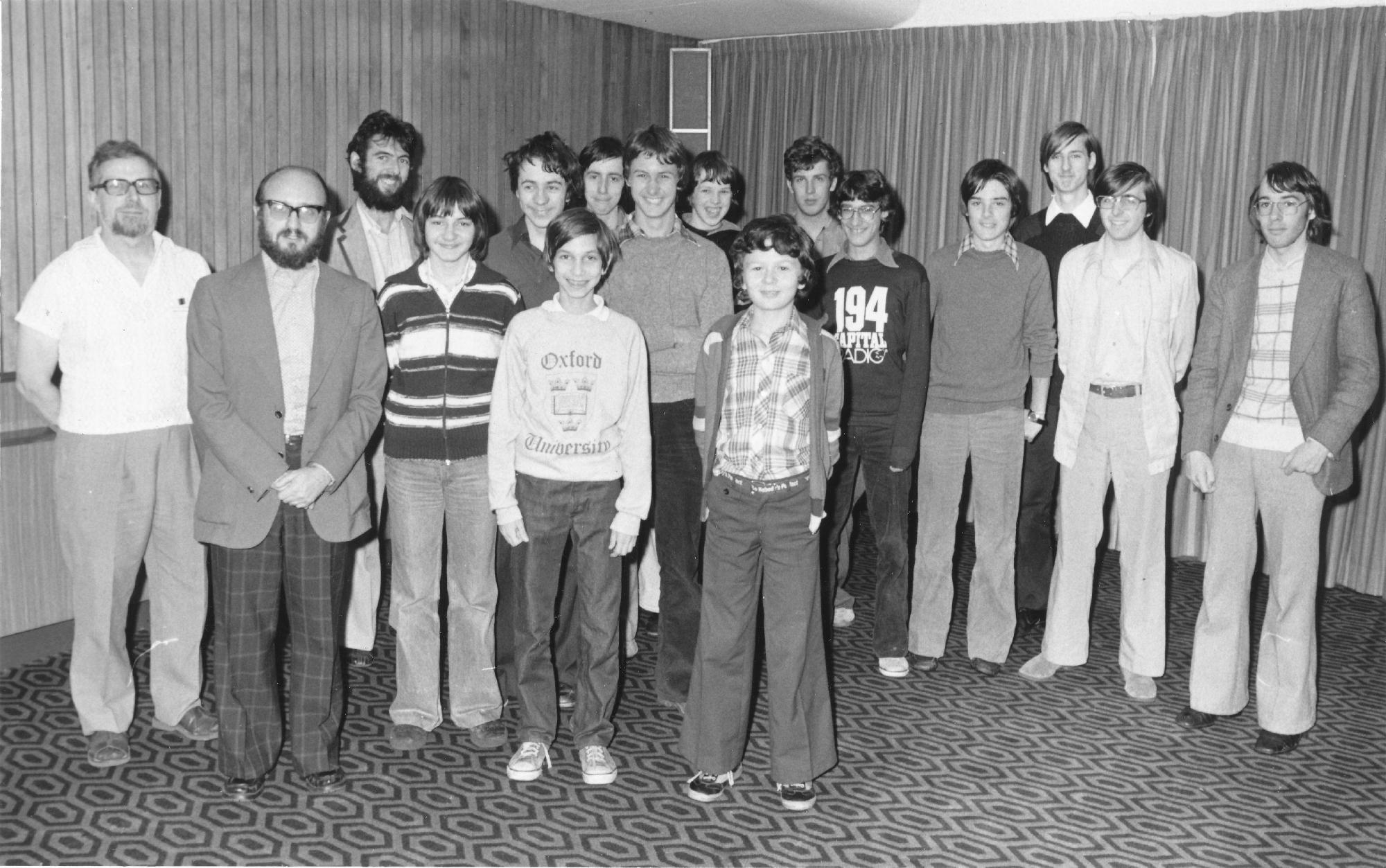
This was written (by Leonard Barden) about Daniel who was 15 just prior to the 1979 Spassky vs the BCF Junior Squad simultaneous display :
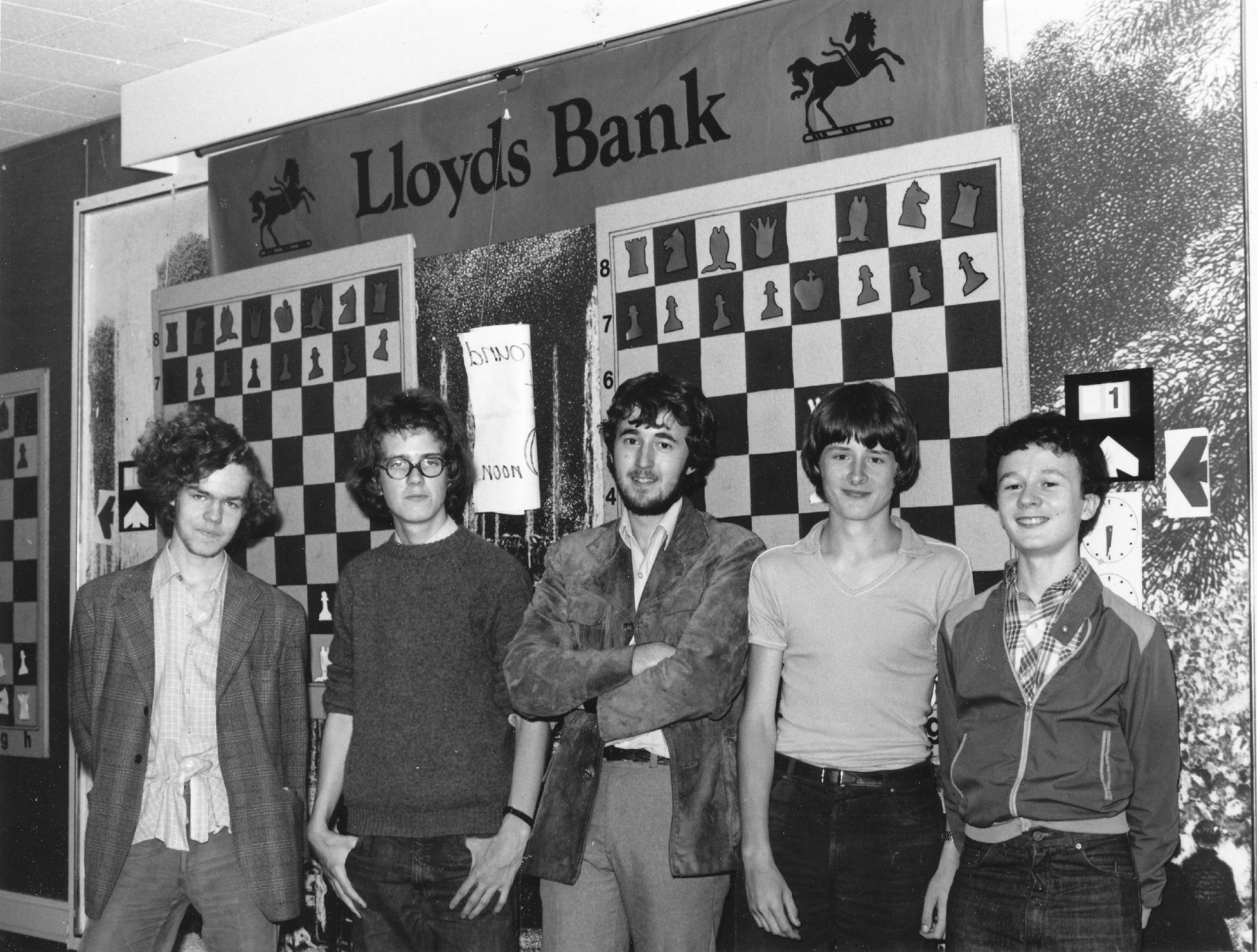
“Langley Park School, Shortlands and Bromley. Rating 201. British under-14 co-champion, 1977. 2nd Lloyds Bank junior international, 1979.”
Danny was Southern Counties (SCCU) champion for the 1983-84 and 1985-86 seasons.
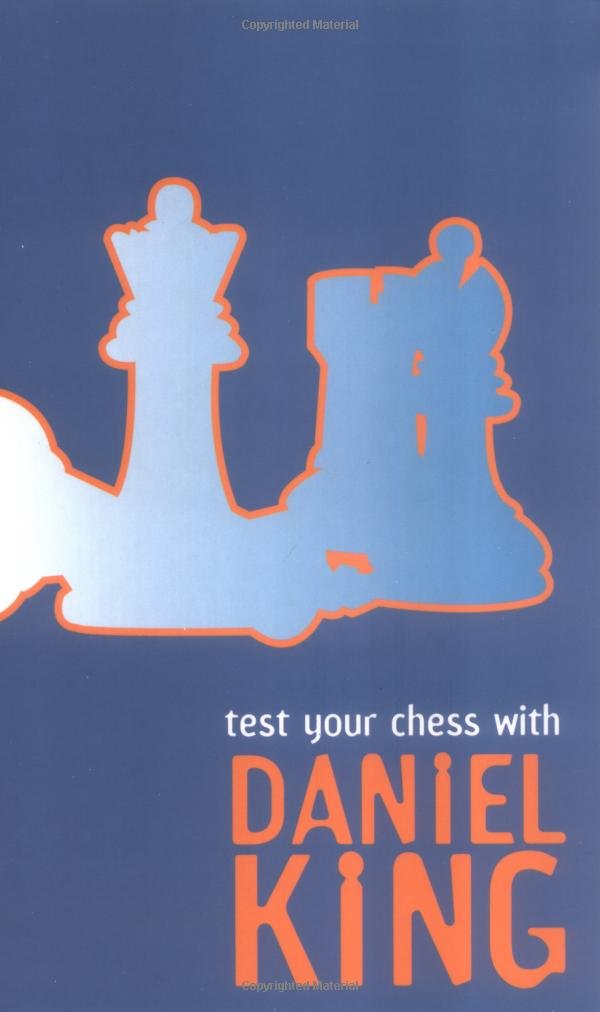
According to Test Your Chess With Daniel King, Batsford, 2004 :
“Grandmaster Daniel King has been a professional chess player for 20 years. During that time he has represented his country on many occasions including an historic match victory over the Soviet Union in Reykyavik, 1990. Besides his chess career, Daniel has built up a reputation as a commentator on TV and radio,
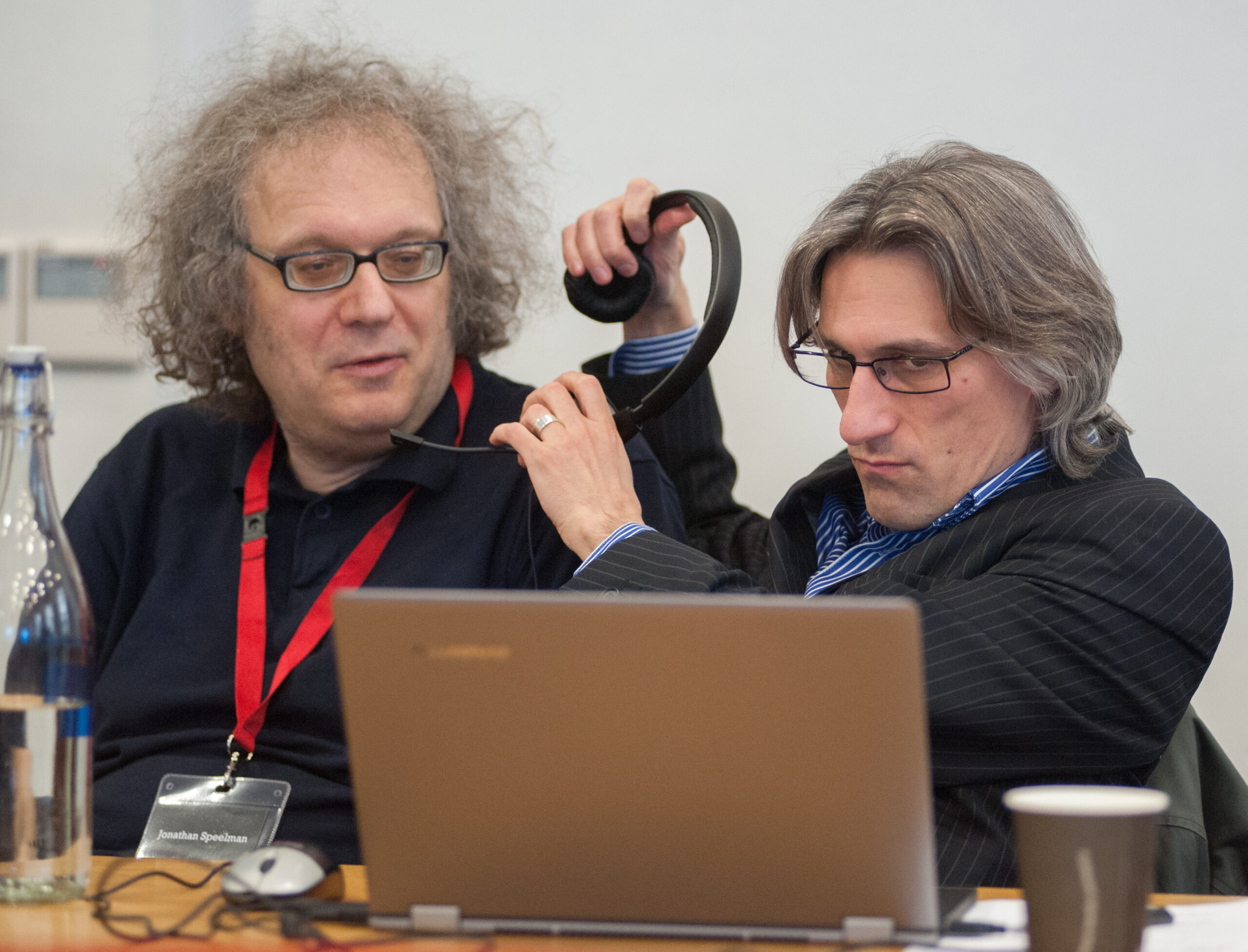
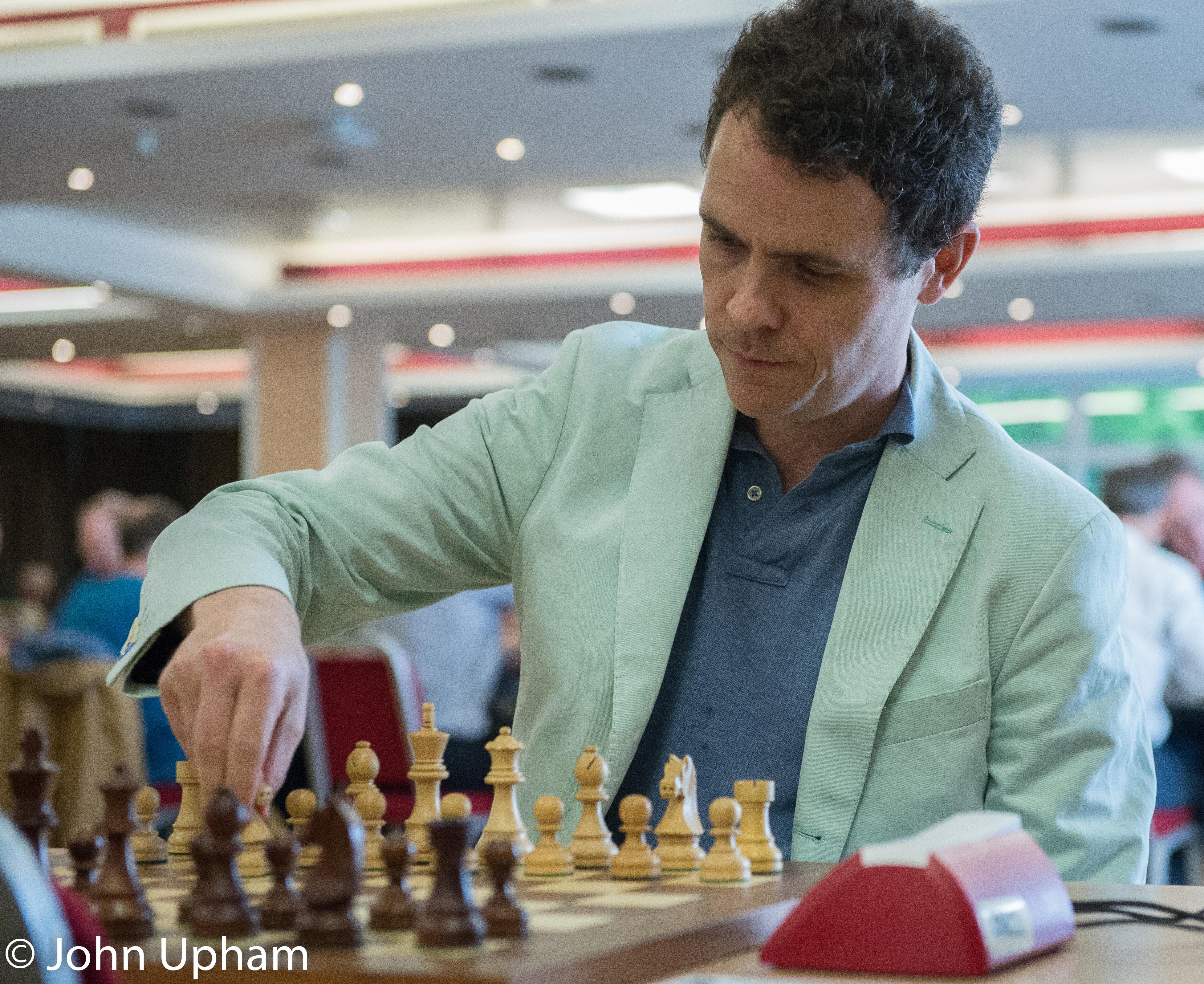
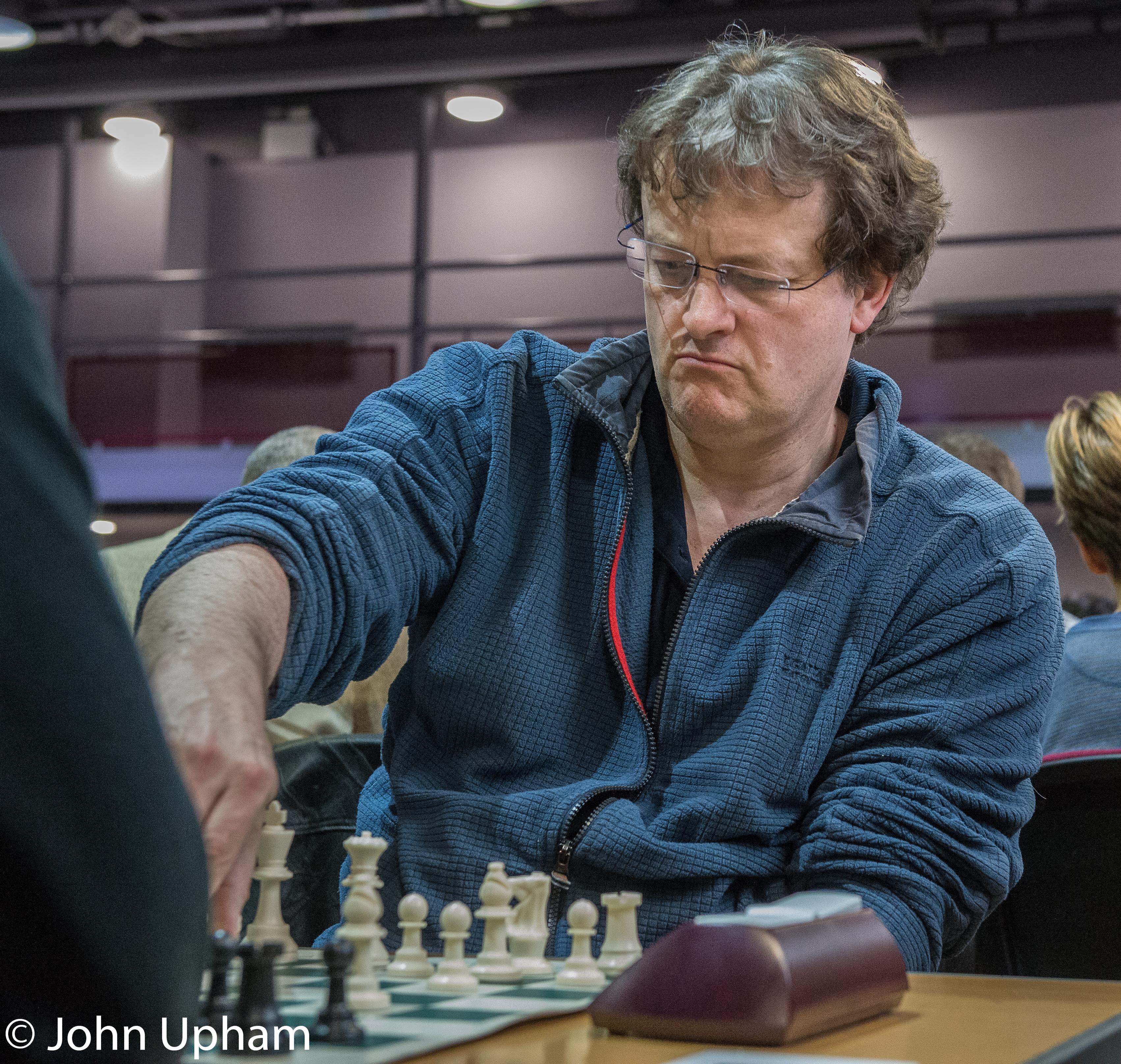
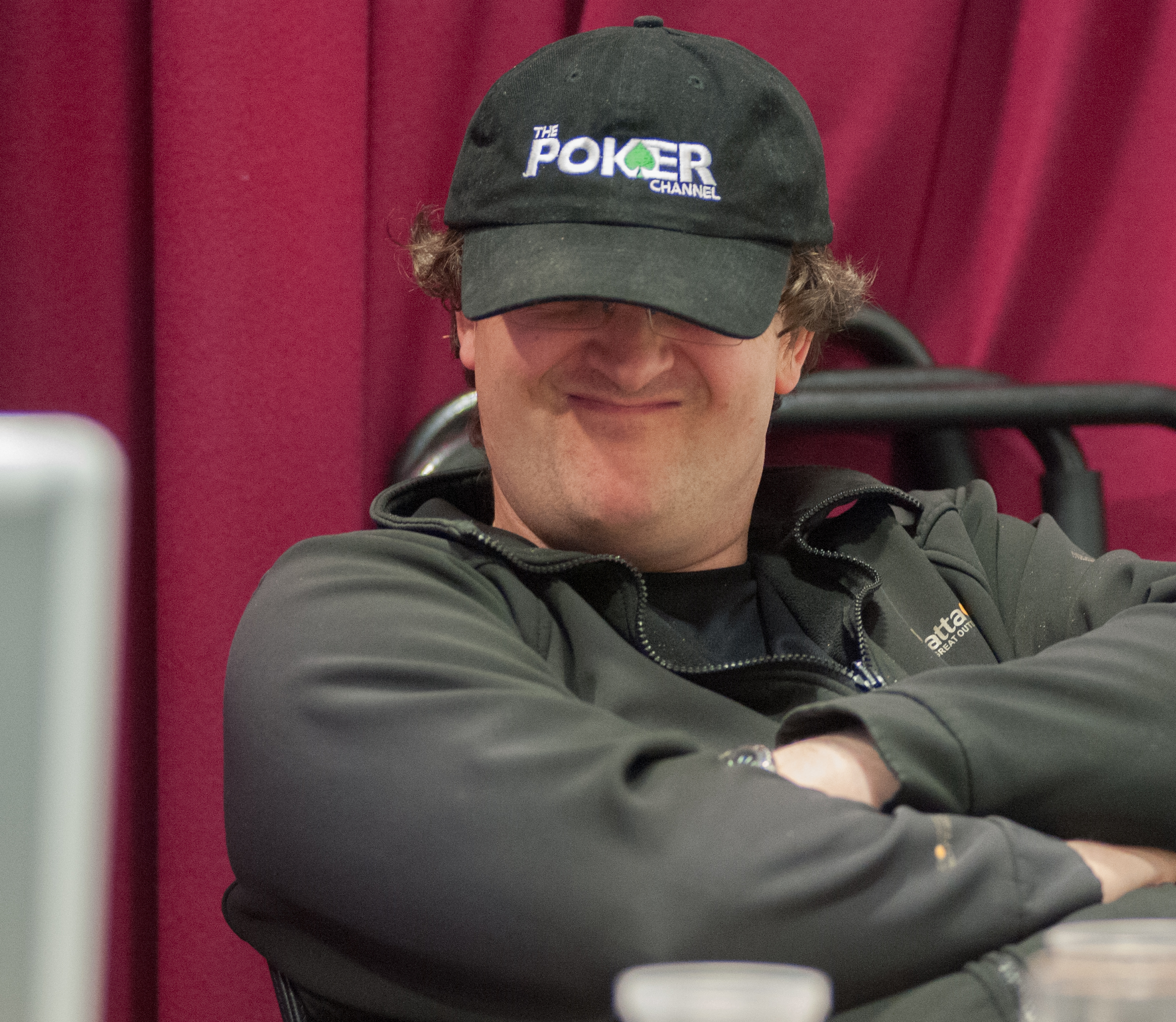
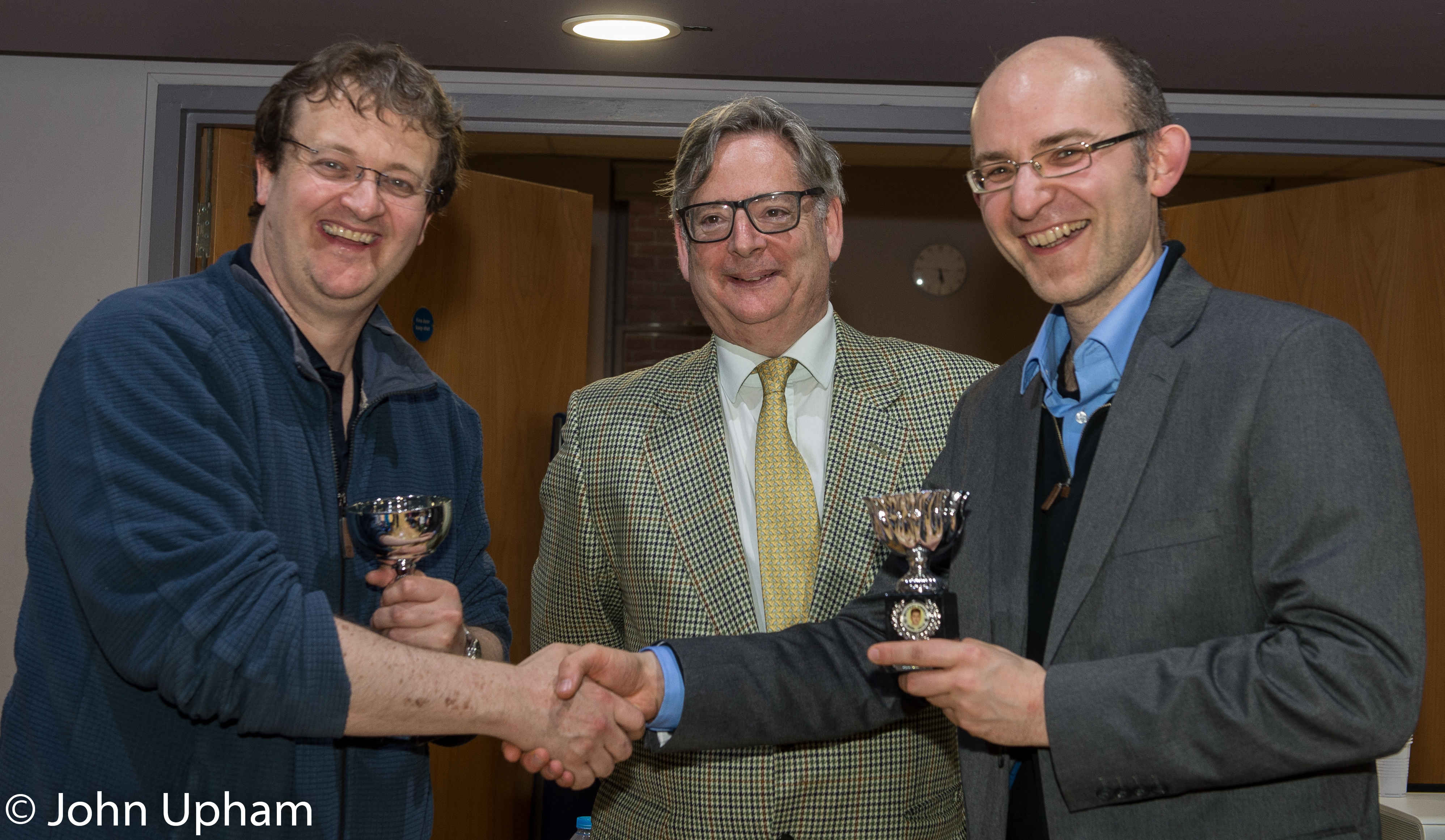
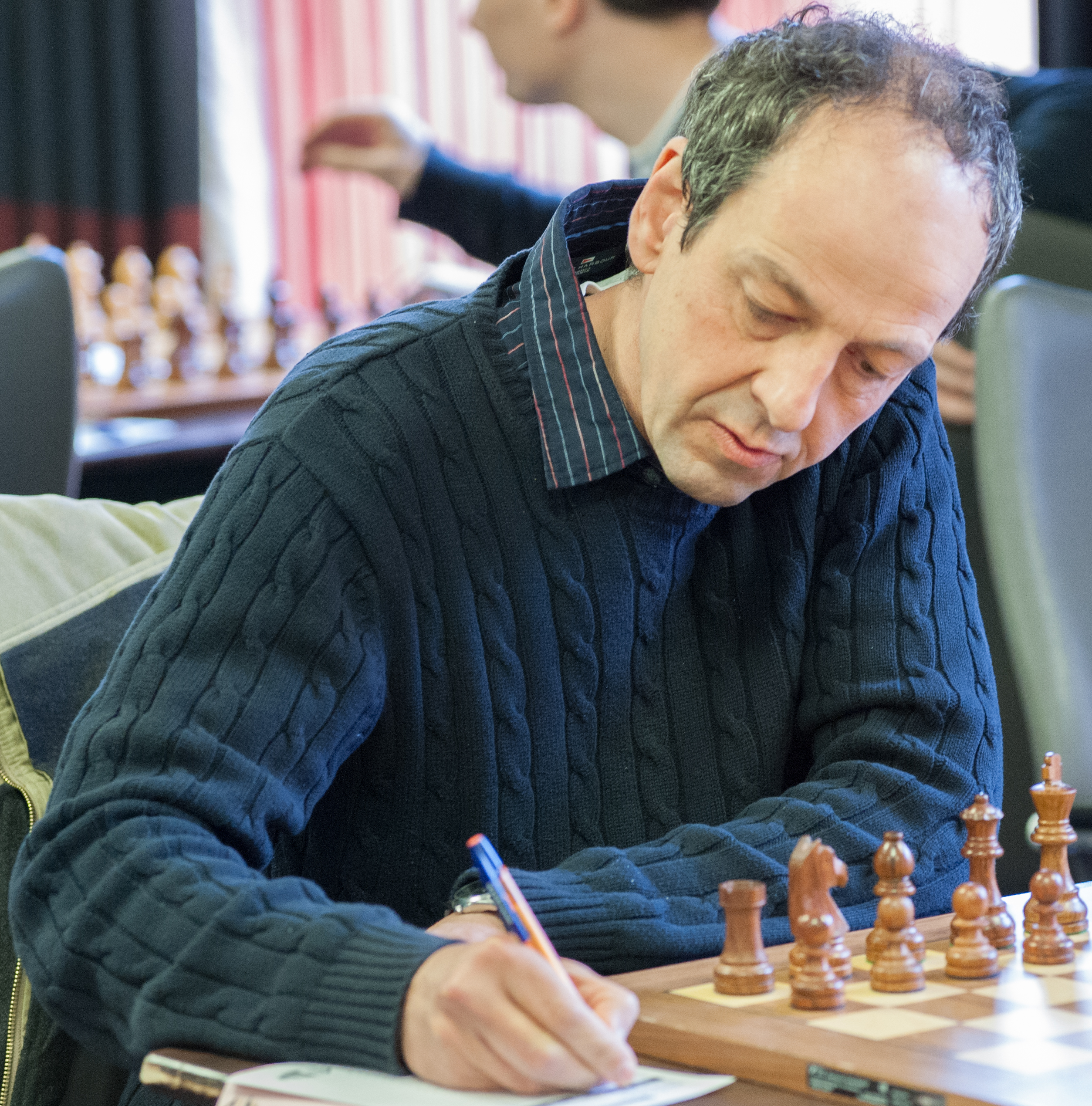
Jonathan Speelman and Daniel King share headphones at the 2013 FIDE Candidates event in London, courtesy of John Upham Photography
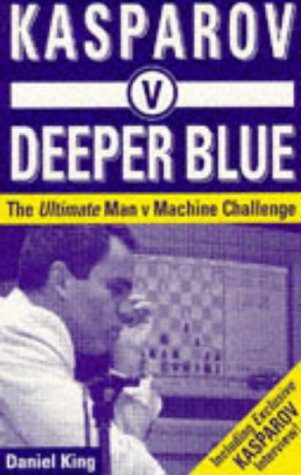
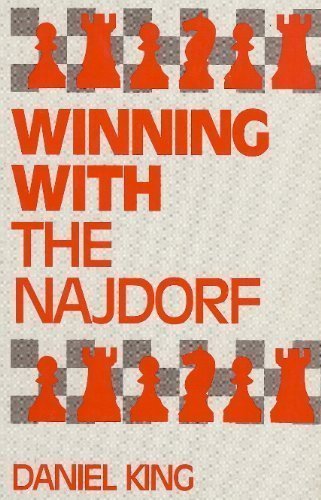
and has reported on four World Championship matches and several Man vs Machine events, including the controversial Kasparov vs Deep Blue encounter in New York, 1997. He is an award-winning author of 15 books, including Winning with the Najdorf, Mastering the Spanish, and Kasparov vs Deep Blue for Batsford. ”
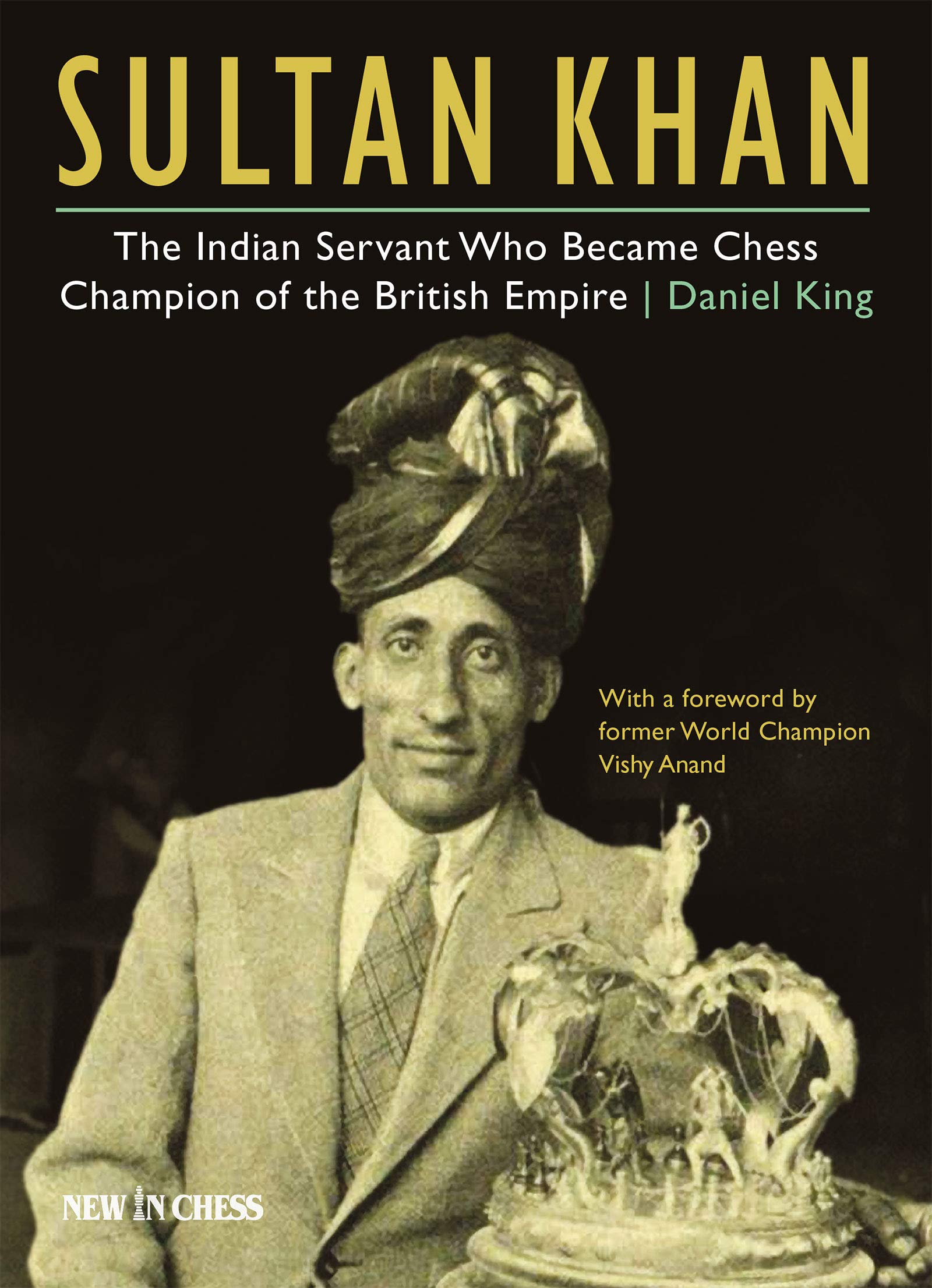
On April 8th, 2020 New in Chess released Sultan Khan: The Indian Servant Who Became Chess Champion of the British Empire which is Daniel’s most recent book.
According to British Chess (Pergamon, 1983) by Botterill, Levy, Rice and Richardson :
1977 British Under 14 Champion
1979 Lloyds Bank 6/9 (aged only 16)
1980 First Ilford Open
1981 Represented England in Glorney Cup scoring 4.5/5
1981 Fourteenth equal British Championship
1981 IM norm Manchester 5.5/9
1981 Second equal Ramsgate Regency Masters 6.5/9 IM norm with a round to spare
1982 First Equal Guernsey 6/7
1982 First Hamar IM norm and title
1982 Second equal Molde
1982 Second equal Hallsberg Junior
1982 Third equal Phillips and Drew Knights
1982/3 Tenth equal Ohra, Amsterdam 5/9
1982/3 Fifth European Junior
1983 Fourth equal Gausdal
1983 First Portsmouth Open
In the same article Daniel gave the following game as his favourite up to 1983:
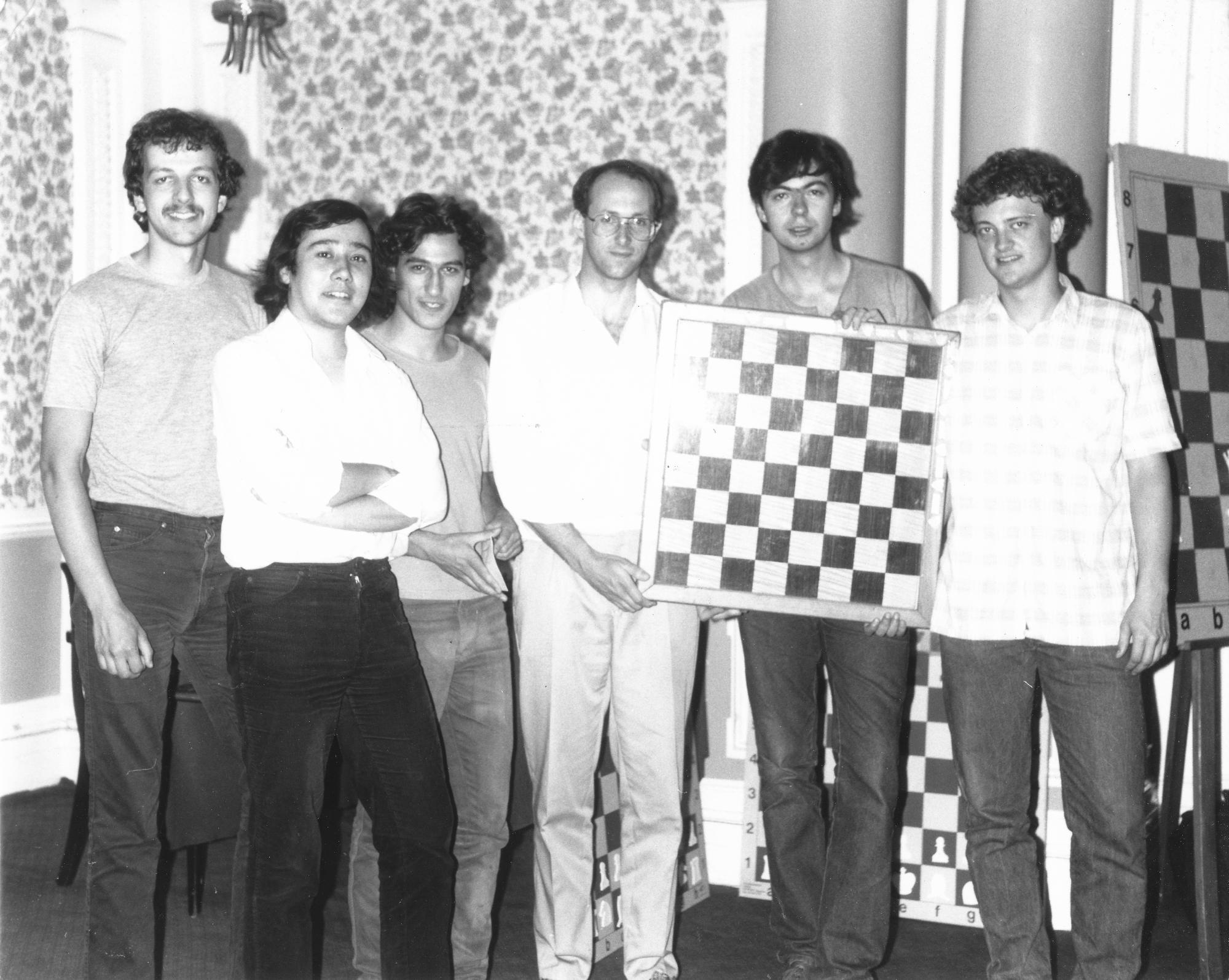
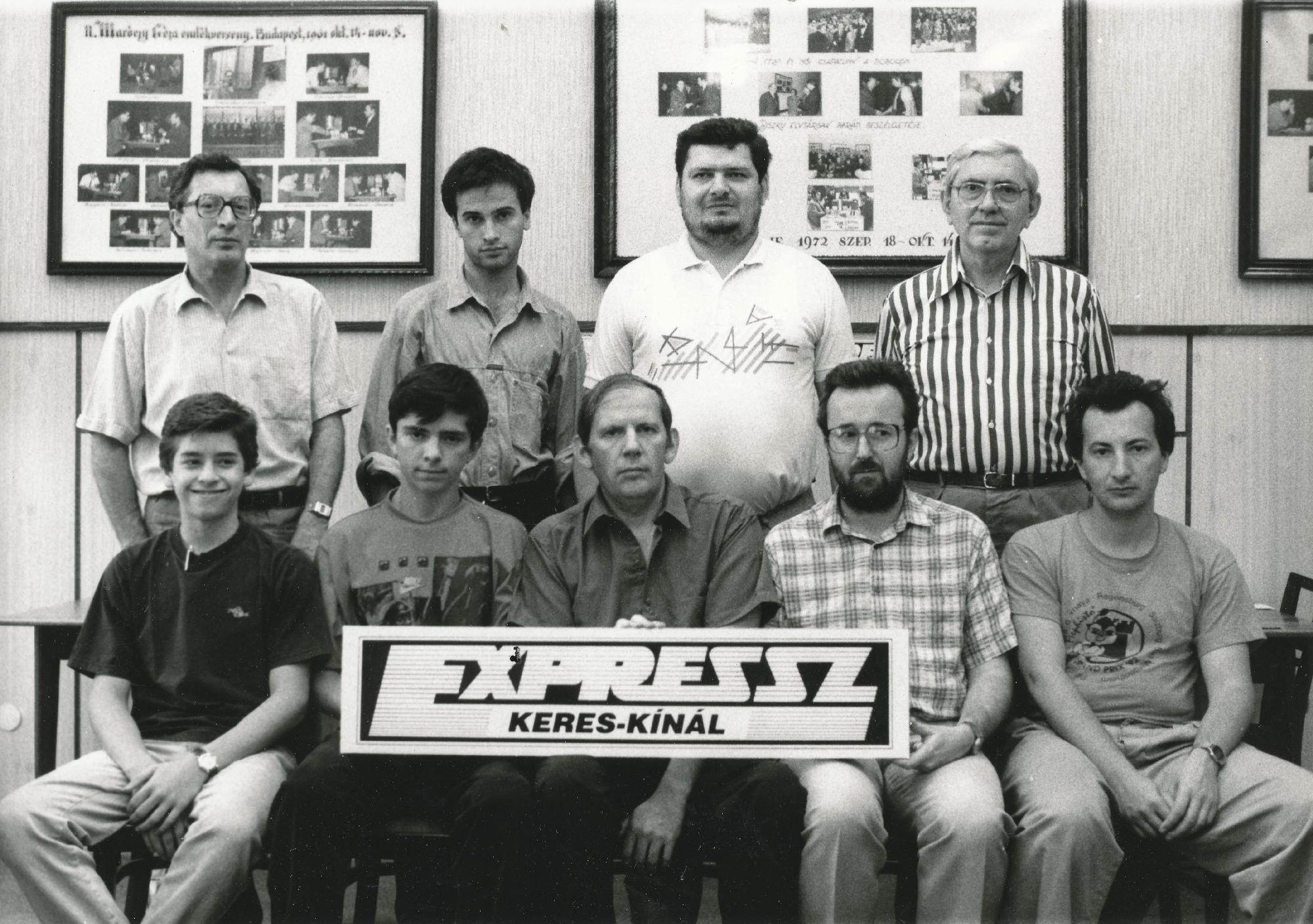
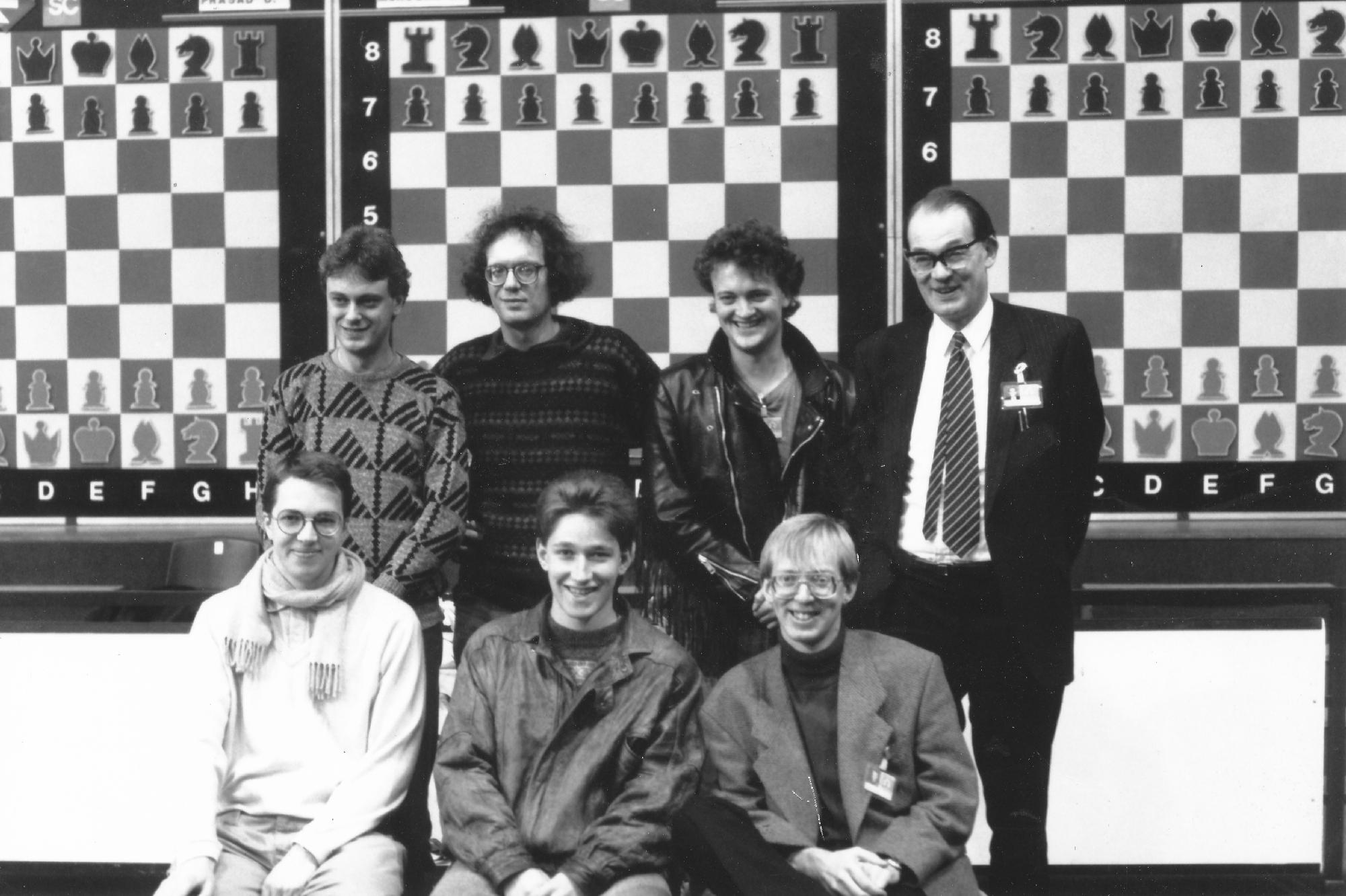
Streatham & Brixton becoming BCF National Club Champions in 1989. The team was Tony Kosten, Mark Hedben, Daniel King, Nigel Povah (Captain), Joe Gallagher and Julian Hodgson : quite a strong teamDaniel King (seated, second from left)
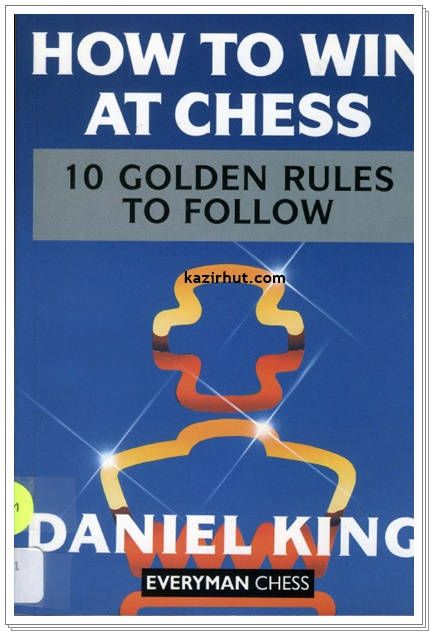
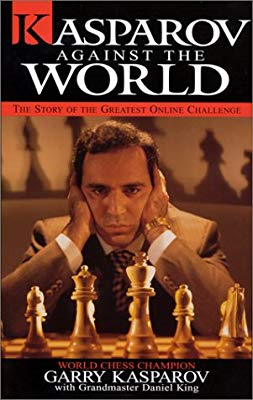
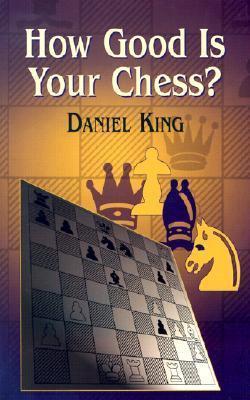
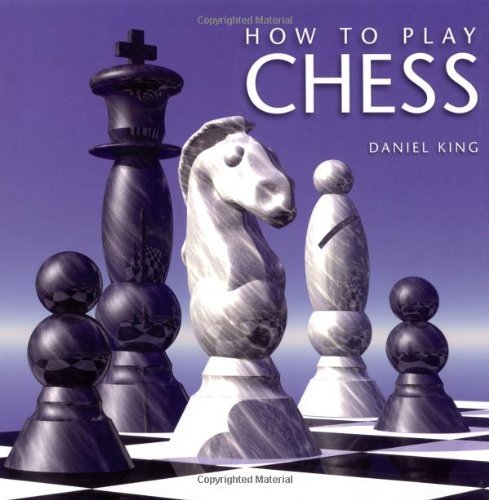
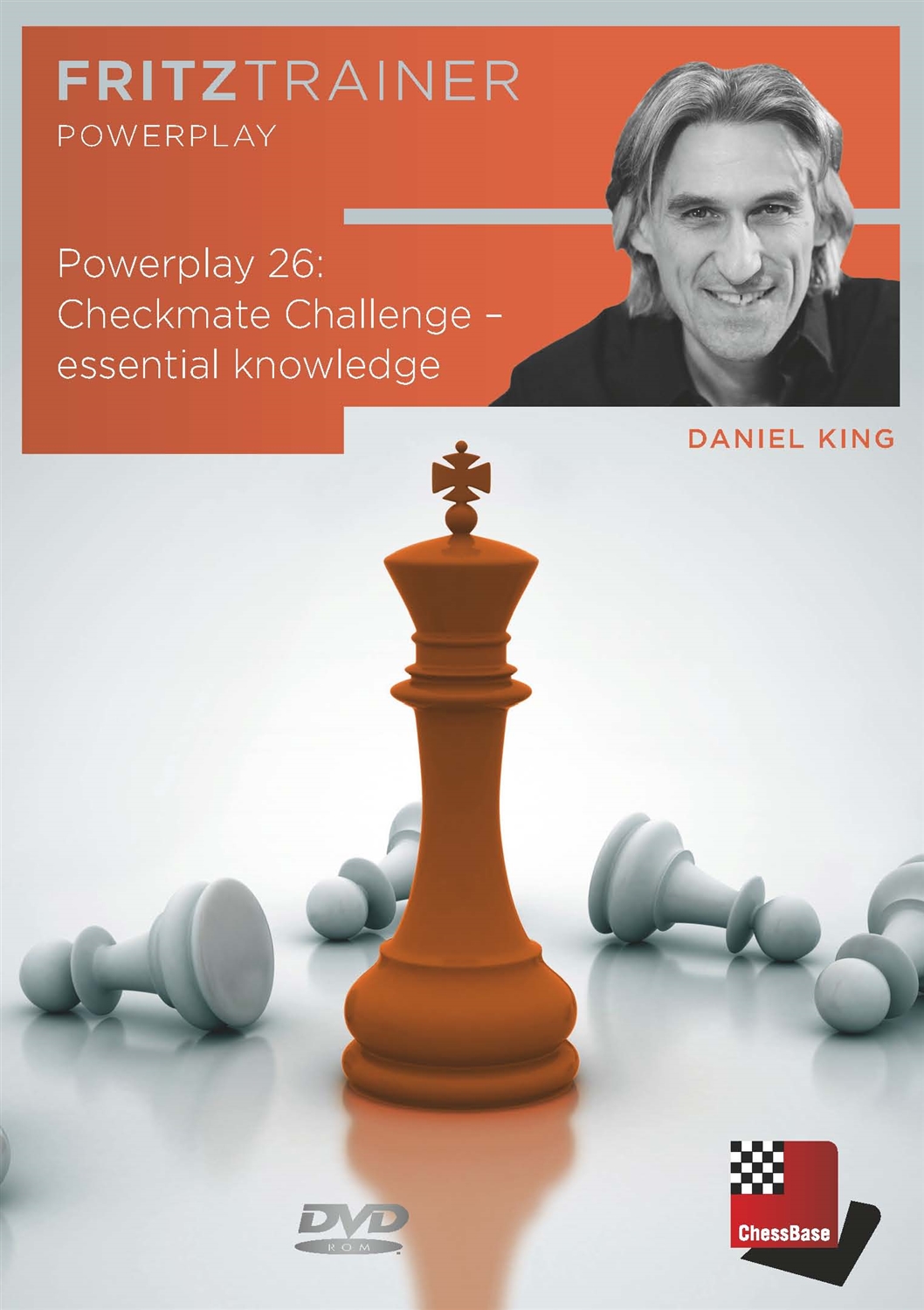
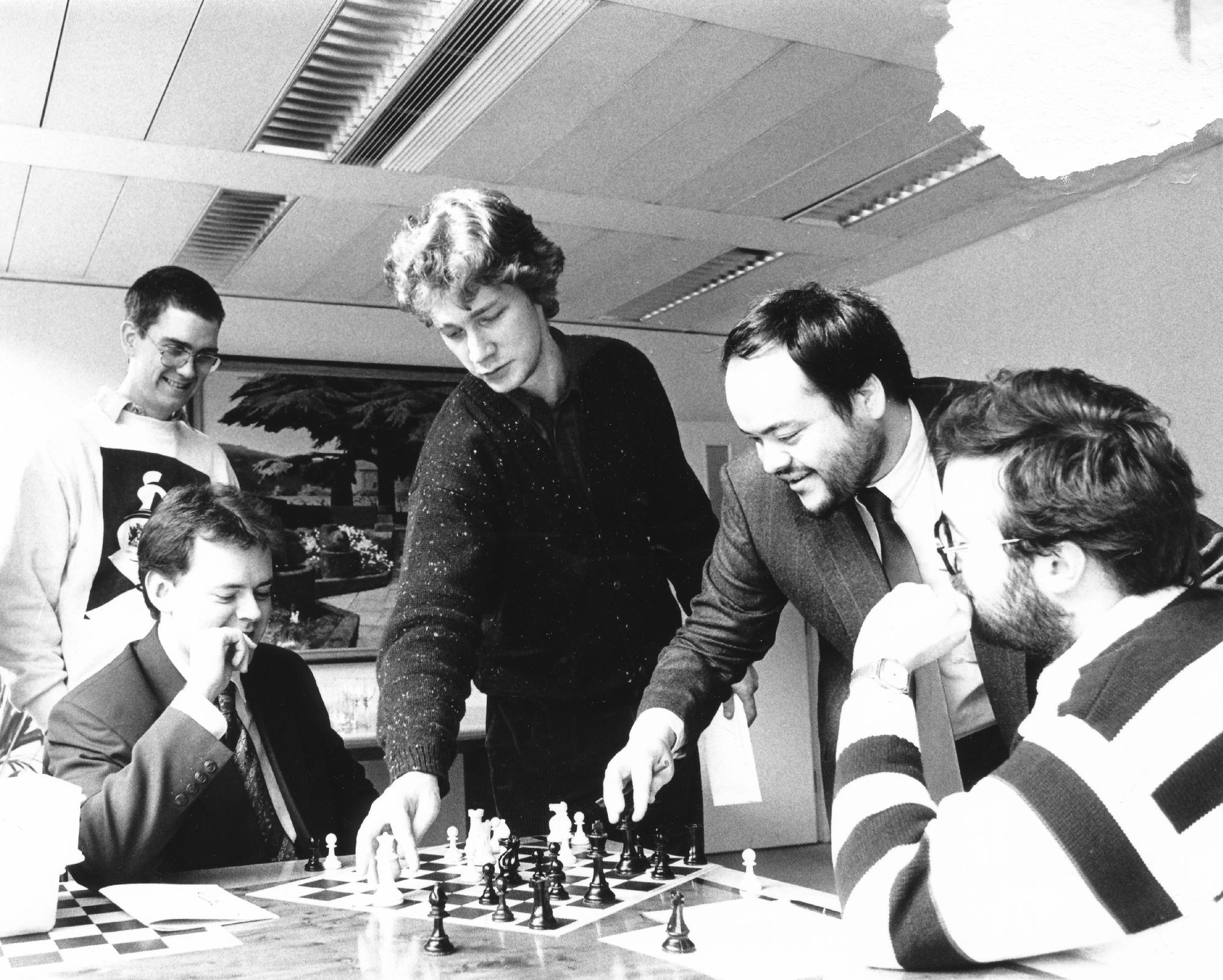
At the Lloyds Bank Masters : Front (l-r) : Joel Benjamin, Ian Wells, Rear : Peter Morrish, Stewart Reuben, Richard Beville, Gary Senior, Richard Webb, John Hawksworth, Andrew King, Nigel Short, Mark Ginsburg, Daniel King, David Cummings, Erik Teichmann, John Brandford and Micheal PagdenMastering the Spanish, Batsford, 1993Kasparov v. Deeper Blue: The Ultimate Man v. Machine Challenge. Batsford. ISBN 0-7134-8322-9., 1997How to Win at Chess: The Ten Golden Rules (Cadogan Chess Books), 2000Kasparov Against the World: The Story of the Greatest Online Challenge. KasparovChess Online. ISBN 0970481306., 2000Winning With the Najdorf. Sterling Pub Co Inc. ISBN 0713470372., 2002How Good Is Your Chess?. Dover. ISBN 048644676X., 2003Test Your Chess With Daniel King, Batsford, 2004How To Play Chess. Kingfisher. ISBN 0753419181., 2009Chessbase Fritz TrainerChessbase TutorialsSultan Khan: The Indian Servant Who Became Chess Champion of the British Empire
BCN offers best wishes to Aaron Summerscale on his 52nd birthday.
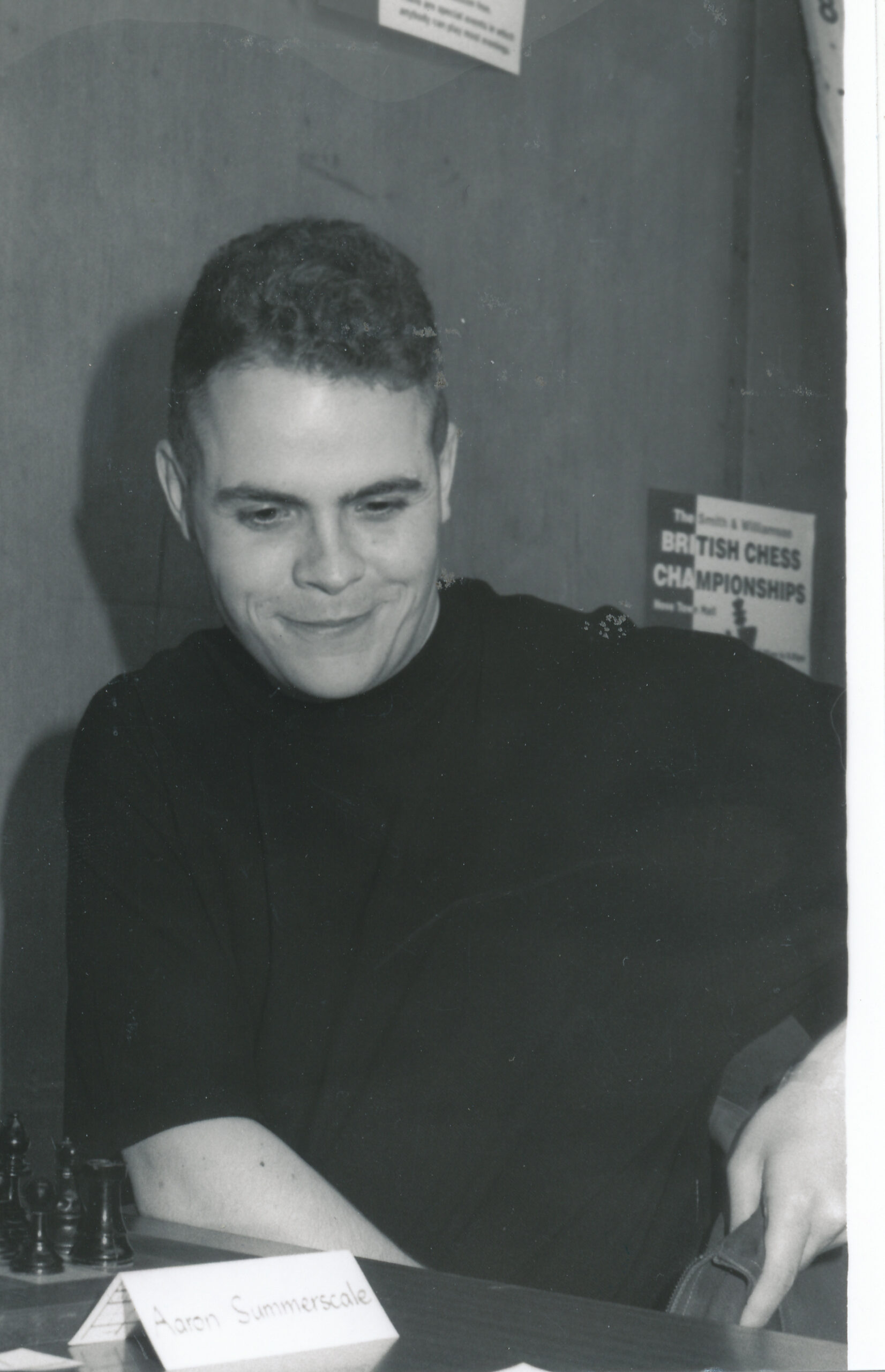
Aaron Piers Summerscale was born on Tuesday, August 26th 1969 in Westminster, Greater London. His mother’s maiden name is Mayall. Aaron lives in SW18 and teaches chess. He married Claire Lusher (Basingstoke) but they are now separated.
Aaron Summerscale
He became a FIDE Master in 1992, an International Master in 1994 and a Grandmaster in 1997.
Aaron was runner-up (to Matthew Sadler) with 8/11 in the 1995 British Championship in Swansea.
His highest FIDE rating was 2513 in October 2000 and was joint (with Ameet Ghasi) British Rapidplay Chess Champion in the same year.
Aaron Summerscale courtesy of John Henderson
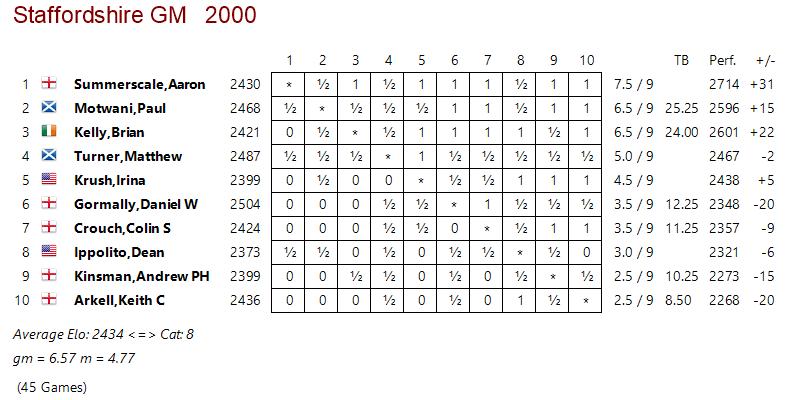
His highest ECF grading was 244A in 2001 and he won the Staffordshire GM tournament in the same year :
Staffordshire GM Tournament 2000 Crosstable
Aaron plays for Wood Green in the Four Nations Chess League (4NCL) and has played for Pride and Prejudice.
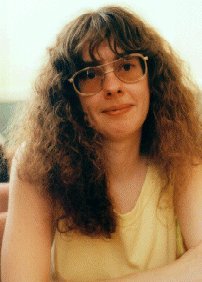
BCN wishes IM Jeff Horner, all the best on his birthday.
Jeffrey Horner was born in Bolton, Lancashire on Thursday, August 25th, 1949.
Jeff played for Poulton-le-Fylde Teacher Training College and is registered for Lancashire CA.
Jeff became a FIDE Master in 1989 (aged 40) and an International Master in 2008 (at the age of 58) and a gap of some 19 years!
(Compare this with John Pigott : John became a FIDE Master in 1984 and an International Master in 2017, a gap of some 33 years!)
He achieved a peak rating of 2450 in January 1975 at the age of 26.
His most recent ECF grading was 233E in January 2017. His last recorded game was played on June 30th 2018 and was a win with black versus Andrew Ledger graded 227.
Jeff played 1.e4 playing 1.g3 once against Graham Lee and winning and the Trompowski once against Murray Chandler and losing. In recent years he favoured the Wormald (Alapin) Attack in the Ruy Lopez.
With the black pieces Jeff defended the main line Ruy Lopez and the King’s Indian Defence.
Here is a comment from PQB4 from chessgames.com :
“A pity we don’t have more games here by this gifted attacking player, arguably the most respected amateur in the North of England. 220 BCF/2300+ for about 30 years, he’s beaten a string of grandmasters, but his best stuff probably occurs in weekend congresses, hence we don’t have enough recorded. I hope there are many such players in the world whose respect for the game and other players shows more of the quality of a true chess black belt than that of some of the more famous. Off the board he’s a schoolteacher, and presumably a pretty inspiring one, to judge by his infectious love of chess and the encouraging words he invariably has for opponents. I’ve had the pleasure of playing Jeff a few times and… let’s just say that The Day of My Revenge will surely come.”
“There have been so many headlines about Britain’s 12-year-old chess prodigy, David Howell, that it nice to turn our attention to someone at the other end of the spectrum. Perhaps few readers will have heard of 53-year-old Jeff Horner- unless, that is, you have played on the north of England chess circuit, where Jeff has been dominating events since before I was born. My first meeting with Jeff was at Bolton Chess Club at the age of six, but it was another ten years before I fancied my chances against him. And it wasn’t just me who feared him. Few indeed were the top players who travelled “Up North” and got the better of Horner.”
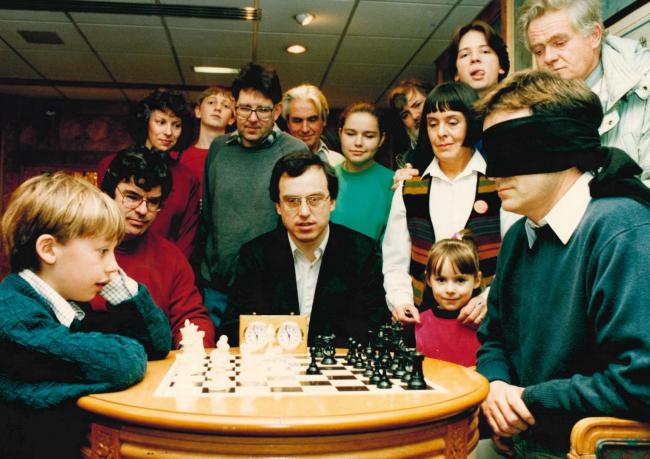
1993 : Jeff Horner takes on world under-10 chess champion Luke McShane blindfolded
“IT’S hard enough challenging a world champion to a game of chess, but to then say you’ll do it blindfold is bordering on the ridiculous.
But that’s exactly what Jeff Hormer from Radcliffe did back in 1993.
Teacher Jeff’s showdown with Luke McShane, the world under-10 chess champion from London was the main attraction at a two-day chess festival held at Bolton’s Moat House.
Jeff, 43, faced off against nine-year-old, Luke, with a thick black cloth placed over his eyes.
The youngster had full view of the board, but Mr Horner was forced to play with the aid of an assistant who placed his pieces and let him know the moves Luke was making
Jeff’s amazing memory and powers of concentration coupled with his greater experience proved too much for the young chess champion.
And despite the handicap of the blindfold, he beat the world champion relatively easily..
It ended up being one of the few matches that Luke McShane lost as he gained international recognition as a chess prodigy.
Jeff Horner, Isle of Man 2008, Photograph : John Saunders
Aged just 16 he became the youngest British chess player to be awarded the title of Grandmaster by the International Chess Federation in 2000 and now, although he works as a trader in the City of London, Luke is regarded as the best amateur chess player in the world.
Jeff Hormer was a long-standing member of Bolton chess club and was renowned for his ability on the board, often taking on – and beating – internationally-renowned players.
He famously beat British Grand Master Tony Miles, who himself had only recently defeated the reigning world champion Anatoly Karpov.
Jeff was awarded the title of International Master by the International Chess Federation.”
“I still remember Tony Miles, fresh from his historic victory against World Champion Anatoly Karpov, stopping off at the Blackpool Open. Miles had become a legend overnight but nobody bothered to tell Jeff, who calmly trounced him just as he would us. Two weeks ago David Howell had to play Jeff Horner in Blackpool. Both players needed two wins from their last two games to earn an international master (IM) result. Would it be Britain’s youngest new IM or our oldest new IM?”
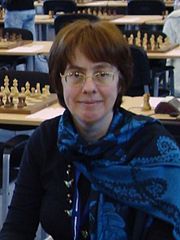
We wish WFM Helen Milligan all the best on her birthday, this day (August 25th) in 1962.
Helen became a Woman’s FIDE Master in 2000 and a Candidate Master in 2013.
Her highest FIDE rating was 2138 in July 1999.
Helen Milligan (born Helen Scott; 25 August 1962) is a Scottish-New Zealand chess player holding the FIDE titles of Candidate Master (CM) and Woman FIDE Master (WFM), and five-times Asian senior women’s (50+) champion. The CM title was earnt at a FIDE open zonal.
WFM Helen Milligan
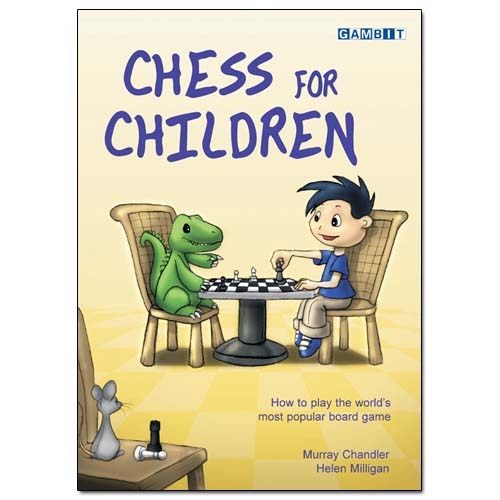
In 2004 Milligan co-authored the book “Chess for Children” with Grandmaster Murray Chandler. She has been an officer of the New Zealand Chess Federation, and has worked as a coach at Murray Chandler’s National Chess Centre in Auckland. She currently works as a self-employed chess coach. The National Chess Centre has since been sold by Murray Chandler.
Milligan has won or jointly won the Scottish women’s championship three times: in 1982, 1986 and 1988. In 1983 she was joint British Ladies’ champion with Rani Hamid.
WFM Helen Milligan in 2010
Milligan represented Scotland in eleven Women’s Chess Olympiads between 1982 and 2006. Since 2008 she has played for New Zealand in this competition, having transferred national federations in 2007.
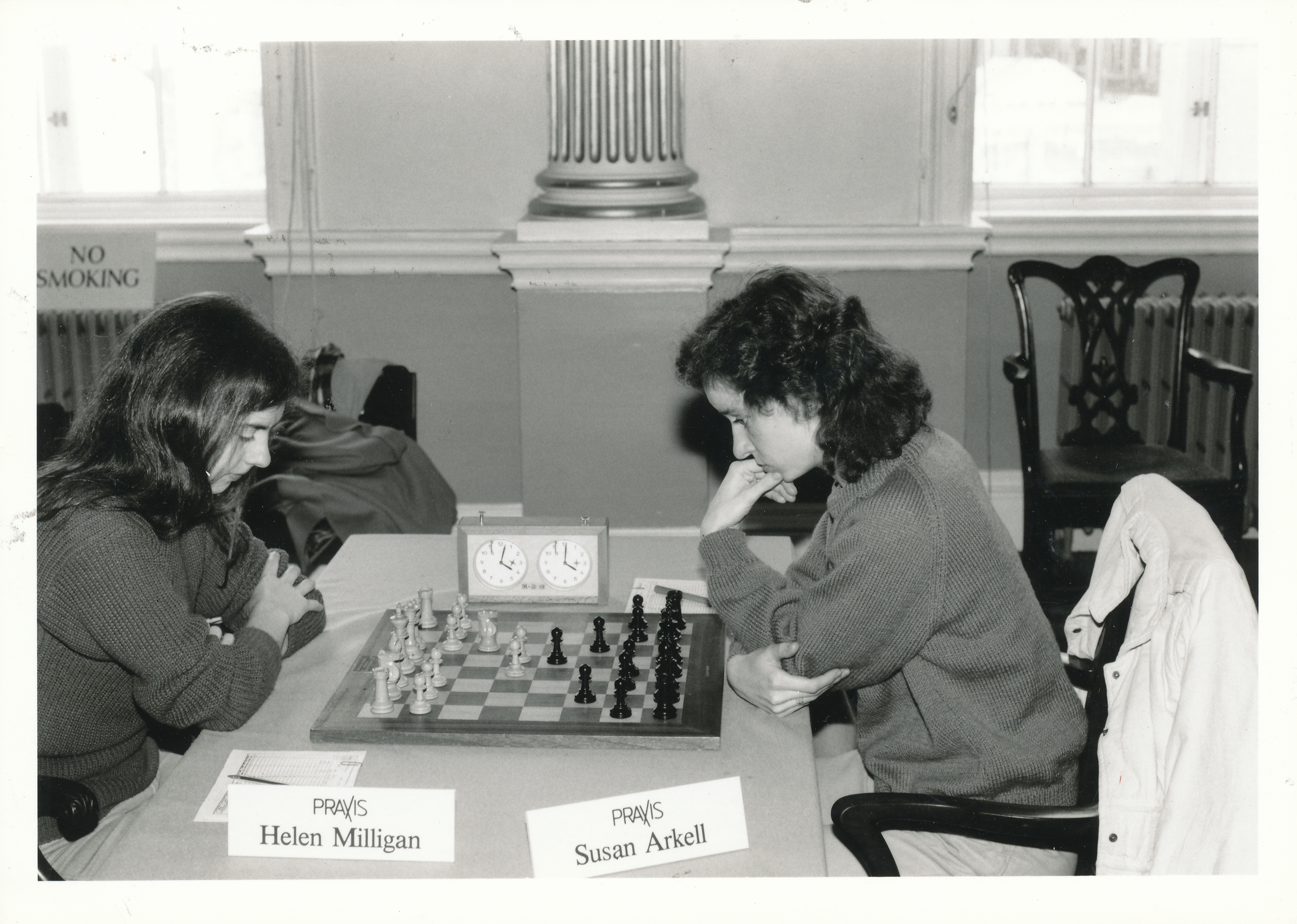
WFM Helen Milligan vs Susan Arkell
Milligan became Oceania women’s champion at the Queenstown Chess Classic tournament in January 2012. She also competed in Women’s Zonal Chess Championships in Bath 1987, Blackpool 1990, Delden 1993, Saint Vincent 1999, and the open zonal at Gold Coast in 2009.
She won the Asian senior women’s (50+) champion title in 2014 in Kalutara, Sri Lanka; 2015 in Larestan, Iran; 2016 in Mandalay, Myanmar; 2017 in Auckland, New Zealand; and 2018 in Tagaytay, Philippines.
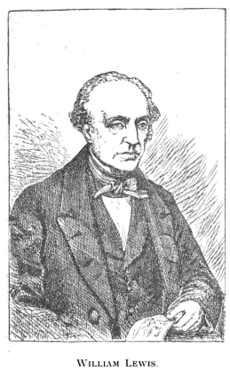
We note the passing today (August 22nd) in 1870 of William Lewis of the Lewis Counter Gambit.
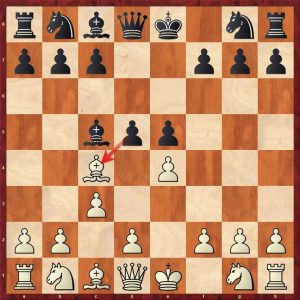
The Lewis Counter Gambit
From The Oxford Companion to Chess (OUP, 1984) by Hooper & Whyld :
“English player and author. He left his native Birmingham as a young man and worked for a time with a merchant in London. He learned much of his chess from Sarratt, a debt that was not repaid.
Around 1819 he was operator of the Turk, meeting all-comers successfully. With Cochrane he visited Paris in 1821, received odds of pawn and move from Deschapelles, and defeated him in a short match (+ 1=2), Lewis had already begun to write and of the more useful books he published around this time were translations of Greco and Carrera which appeared in 1819 and 1822 respectively.
Although he considered Sarratt’s A Treatise on the Game of Chess (1808) a poorly written book, Lewis published a second edition in 1822 in direct competition with Sarratt’s last book, published in 1821 by his impoverished widow, (In 1843 many Englishmen contributed to a fund for Mrs Sarratt in her old age, Lewis’s name is not on the subscription list,}
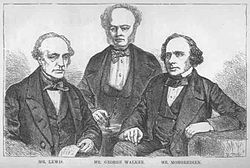
William Lewis, George Walker and Augustus Mongredien
In 1825 Bourdonnais visited England. Lewis recalled that they played about 70 games, and according to Walker seven of them constituted a match which Lewis lost (+2—5). With no significant playing achievements to his credit Lewis acquired such a high reputation that a correspondent writing to the weekly magazine Bell’s Life in 1838 was moved to call him grandmaster.
From 1825 he preserved this reputation by the simplest means: he declined to play on even terms. In the same year he opened a club where he gave lessons at half a guinea each. McDonnell and Walker were among his pupils. Speculating unwisely on a piano-making patent, Lewis went bankrupt in 1827, and the club closed. After three precarious years of teaching chess (rich patrons were becoming fewer) Lewis became actuary of the Family Endowment Society and enjoyed financial security
for the rest of his life.
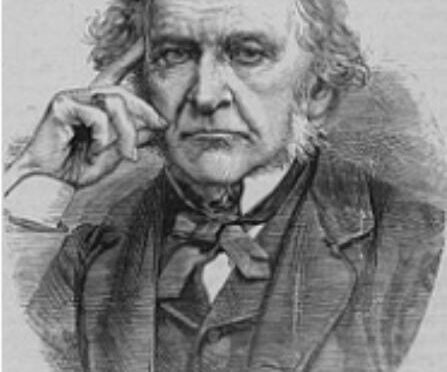
William Lewis
Circumstances now made it possible for him to concentrate on his writing and he published his two most important works: Series of Progressive Lessons (1831) and Second Series of Lessons (1832), both republished with various revisions. Lewis continued to write but gradually withdrew from other chess activities; his last notable connection with chess was as stakeholder for the Morphy-Lowenthal match of 1858.
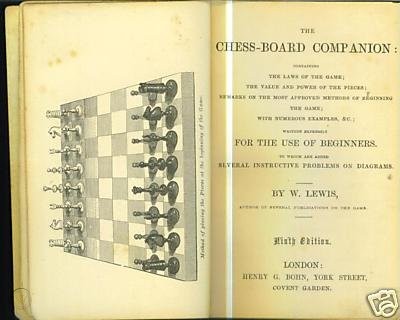
Chess Board Companion by William Lewis
Lewis’s Lessons contain extensive analyses of many opening variations, examined in the closeness of his study. Subsequent writers, notably Lasa, were influenced by these books, but more on account of the form than the content, which, adequate for the 1830s, were soon out of date.
Around 1840 writers no longer worked in isolation (a circumstance Lewis found unavoidable) and new positional ideas were being shaped. Because Lewis failed to assimilate these his judgements were faulty, and his voluminous Treatise on the Game of Chess (1844) was out of date when published.
Industrious rather than inventive, he made only one innovation, the Lewis Counter-Gambit; but it had no practical value in 1844, for simpler defences had already been discovered. Lewis’s work commands respect, but he is more aptly described as the last and one of the best of the ‘old’ writers than the first of the new, a more fitting description for Jaenisch and the authors of Bilguer’s Handbuch. ”
From The Encyclopedia of Chess (Robert Hale, 1970 & 1976) by Anne Sunnucks :
Chess theoretician, teacher, author and one of the leading players in England in the nineteenth century.
William Lewis was born in Birmingham on 9th October 1787. As a young man he went to London and took chess lessons from JH Sarratt. Within a short time he was making chess his principal means of livelihood.
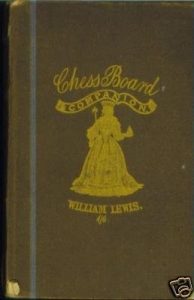
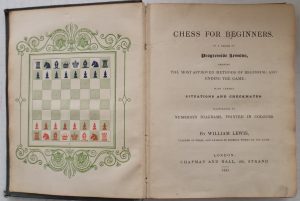
In 1819 he was engaged as the player concealed in the chess-playing automaton, ‘The Turk’, when it was exhibited in London. In 1825 he opened some chess rooms in St. Martin’s Lane in London, where he taught chess. Among his pupils was Alexander McDonnell. After going bankrupt in 1827, the chess rooms were closed, and Lewis decided to put his lessons into a book. He soon became a highly-successful writer, His Chessboard Companion published in 1838 ran into nine editions, and his Series of Progressive Lessons of the Game of Chess has been described as one of the landmarks in the history of the game. This book included some completely new analyses of various chess openings and later formed the basis of the Handbuch des Schachspiels. Lewis also translated the work of Greco and Stamma and was author of The Elements of Chess (1882), Fifty Games of Chess (1832) and Chess for Beginners (1835).
Chess Board Companion by William Lewis
Towards the end of his life, Lewis rarely played chess, and his last public appearance in chess circles was 12 before he died, when he acted at stake-holder in the match between Morphy and Lowenthal in 1858. He died on 22nd August 1870.
From The Encyclopedia of Chess (Batsford, 1977) by Harry Golombek :
“Author of The Chessboard Companion, London, 1838, and several other popular works on chess (including translations of Greco and Stamma). Lewis was also a leading chess teacher – his most famous pupil was Alexdander McDonnell – and for a time he ran chess rooms in St. Martin’s Lane. In 1819 he operated the chess-playing automaton ‘The Turk’ when it was exhibited in London. The Lewis Counter-Gambit is 1.P-K4, P-K4; 2.B-B4 B-B4; 3.P-QB3,P-Q5!?”
Chess for Beginners
From “Chess : A History” by Harry Golombek there are two references to WL on pages 98 and 123 alluded to above.
“William Lewis (1787–1870) was an English chess player and author, nowadays best known for the Lewis Countergambit and for being the first player ever to be described as a Grandmaster of the game.
Born in Birmingham, William Lewis moved as a young man to London where he worked for a merchant for a short period. He became a student of chess player Jacob Sarratt, but in later years he showed himself to be rather ungrateful towards his teacher.
Although he considered Sarratt’s Treatise on the Game of Chess (1808) a “poorly written book”, in 1822 Lewis published a second edition of it three years after Sarratt’s death in direct competition with Sarratt’s own superior revision published posthumously in 1821 by Sarratt’s poverty-stricken widow. In 1843, many players contributed to a fund to help the old widow, but Lewis’ name is not on the list of subscribers.
Around 1819 Lewis was the hidden player inside the Turk (a famous automaton), meeting all-comers successfully. He suggested to Johann Maelzel that Peter Unger Williams, a fellow ex-student of Sarratt, should be the next person to operate inside the machine. When P. U. Williams played a game against the Turk, Lewis recognised the old friend from his style of play (the operator could not see his opponents) and convinced Maelzel to reveal to Williams the secret of the Turk. Later, P. U. Williams himself took Lewis’ place inside the machine.
Lewis visited Paris along with Scottish player John Cochrane in 1821, where they played with Alexandre Deschapelles, receiving the advantage of pawn and move. He won the short match (+1 =2).”
“Lewis’ career as an author began at this time, and included translations of the works of Greco and Carrera, published in 1819[5] and 1822[6] respectively.
He was the leading English player in the correspondence match between London and Edinburgh in 1824, won by the Scots (+2 = 2 -1). Later, he published a book on the match with analysis of the games. In the period of 1834–36 he was also part of the Committee of the Westminster Chess Club, who played and lost (−2) the match by correspondence with the Paris Chess Club. The other players were his students McDonnell and Walker, while the French line up included Boncourt, Alexandre, St. Amant and Chamouillet. When De La Bourdonnais visited England in 1825, Lewis played about 70 games with the French master. Seven of these games probably represented a match that Lewis lost (+2 -5).
Lewis enjoyed a considerable reputation as a chess player in his time. A correspondent writing to the weekly magazine Bell’s Life in 1838 called him “our past grandmaster”, the first known use of the term in chess. Starting from 1825 he preserved his reputation by the same means that Deschapelles used in France, by refusing to play anyone on even terms. In the same year Lewis founded a Chess Club where he gave lessons to, amongst others, Walker and McDonnell. He was declared bankrupt in 1827 due to bad investments on a patent for the construction of pianos and his chess club was forced to close. The next three years were quite difficult until in 1830 he got a job that assured him of solid financial security for the rest of his life. Thanks to this job, he could focus on writing his two major works: Series of Progressive Lessons (1831) and Second Series of Progressive Lessons (1832). The first series of the Lessons were more elementary in character, and designed for the use of beginners; the second series, on the other hand, went deeply into all the known openings. Here, for the first time we find the Evans Gambit, which is named after its inventor, Capt. Evans.
The works of Lewis (together with his teacher Sarratt) were oriented towards the rethinking of the strictly Philidorian principles of play in favour of the Modenese school of Del Rio, Lolli and Ponziani. When he realised that he could not give an advantage to the new generation of British players, Lewis withdrew gradually from active play (in the same way that Deschapelles did after his defeat against De La Bourdonnais).
After his retirement he wrote other chess treatises, but his isolation prevented him from assimilating the positional ideas of the new generation of chess-players. For this reason, Hooper and Whyld in their Oxford Chess Companion describe the last voluminous work of Lewis, A Treatise on Chess (1844), as already “out of date when published”.”
According to Edward Winter in Chess Notes Lewis lived at 12 Chatham Place, Blackfriars, London, England (Chess Player’s Chronicle, 1841, pages 9 and 34*)
BCN wishes Happy Returns to IM Angus Dunnington (09-viii-1967)
Angus James Dunnington was born in Wakefield, West Yorkshire, his mother’s maiden name was Townend.
He has lived in Castleford, West Yorkshire and most recently in Lockerbie, Dumfriesshire.
Angus became a FIDE Master in 1990 and an International Master in 1991.
Angus has been a recipient of a Chess Journalists of America award and was chess correspondent for The Yorkshire Post. He has been an Olympiad trainer.
Angus has played for 4NCL White Rose and his peak FIDE rating was 2450 in January 1996, aged 29.
He won Toulouse 1993 with 6.5/9, we was first equal (3) in the London Agency tournament on 1997 with 6/9, we was equal first in the 1999 Hampstead IM tournament with 6.5/9.
As White Angus prefers a Reti style double fianchetto, the King’s Indian Attack and also the Queen’s Gambit and is an expert on the Catalan and KIA.
As Black Angus essays the Modern Defence most of the time.
His most recent ECF grading was 212E in 2005 and was 232A in 1996.
In 2018 after a lengthy absence Angus made a welcome return to the Scottish Championship Open with a strong =3rd place.
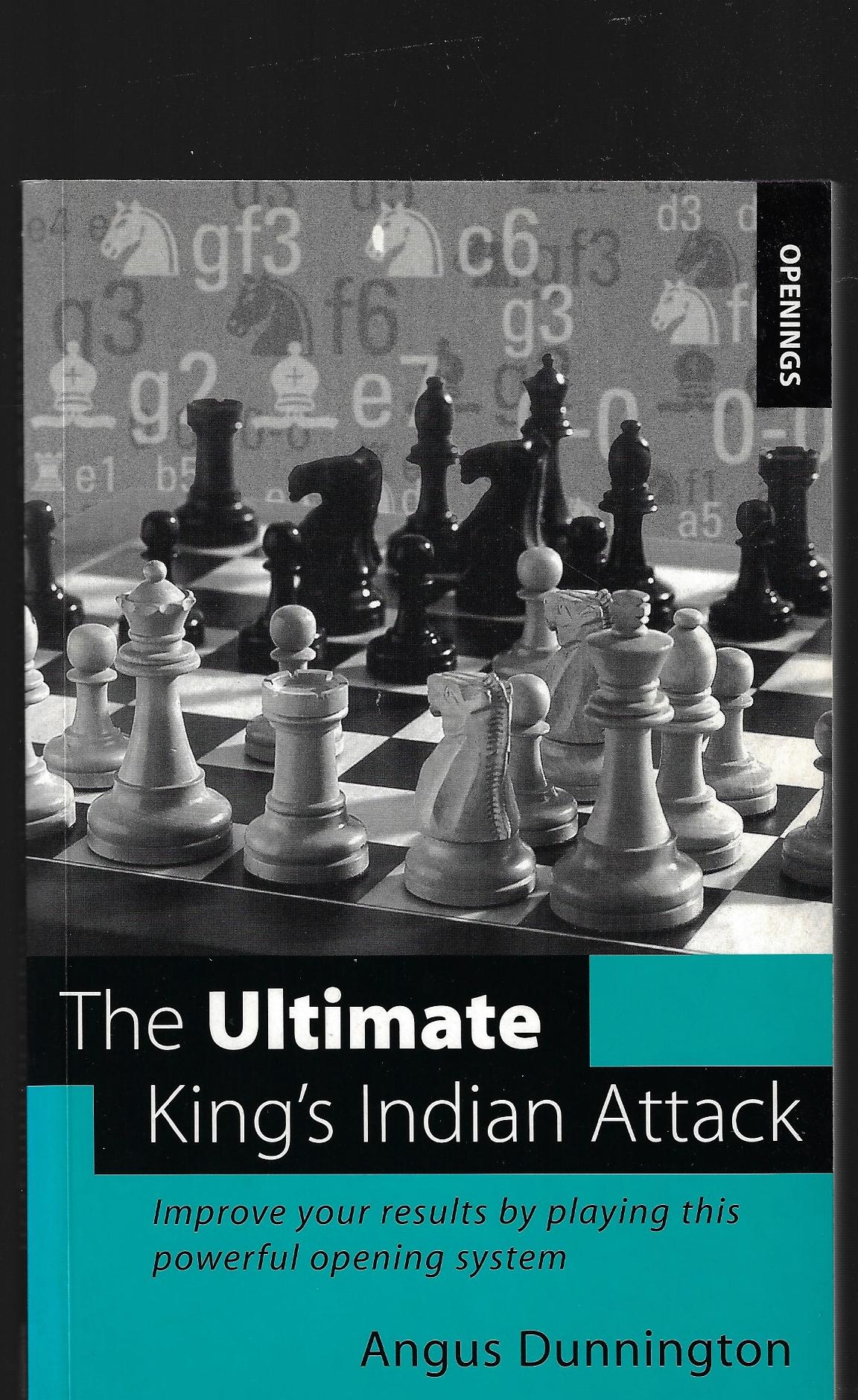
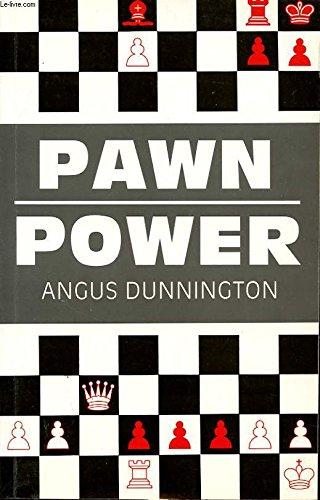
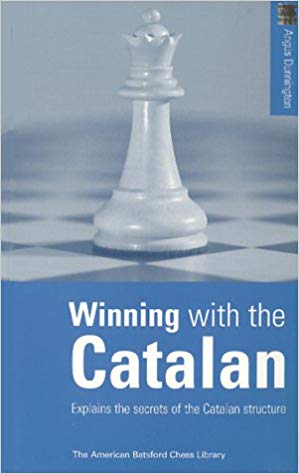
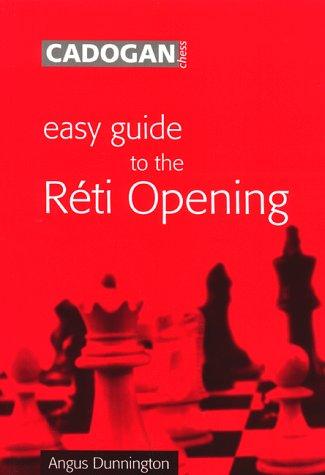
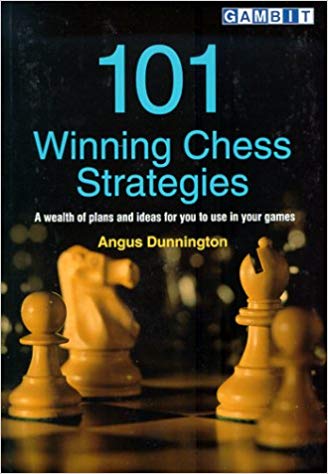
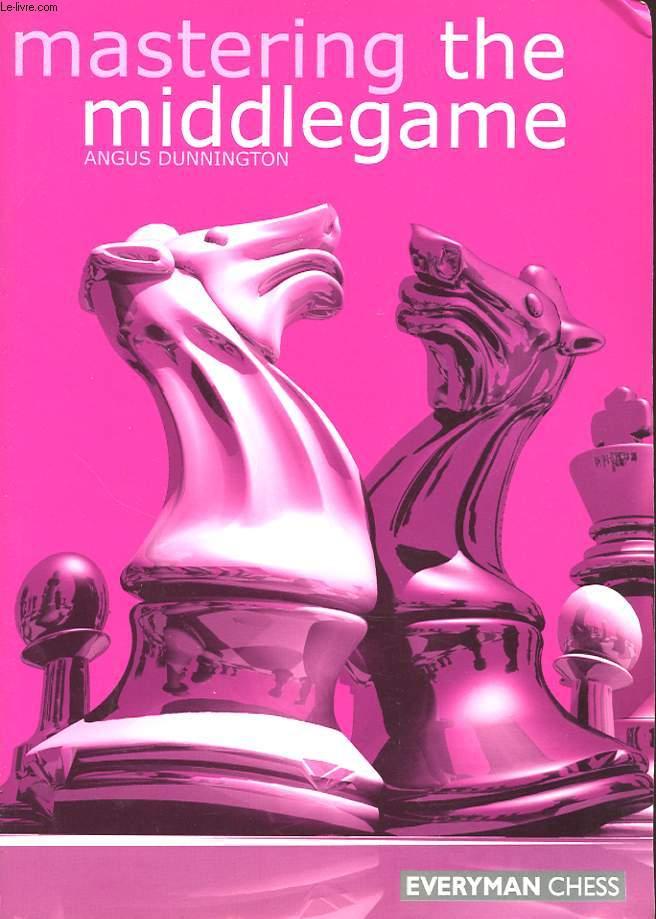
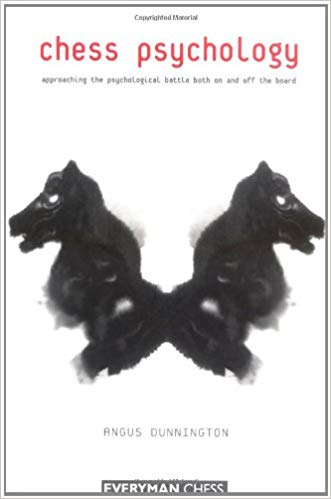
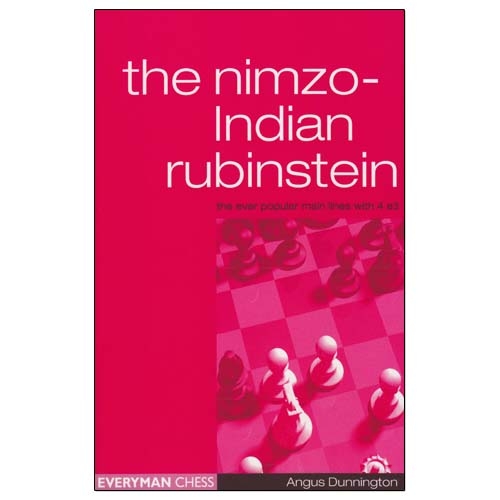
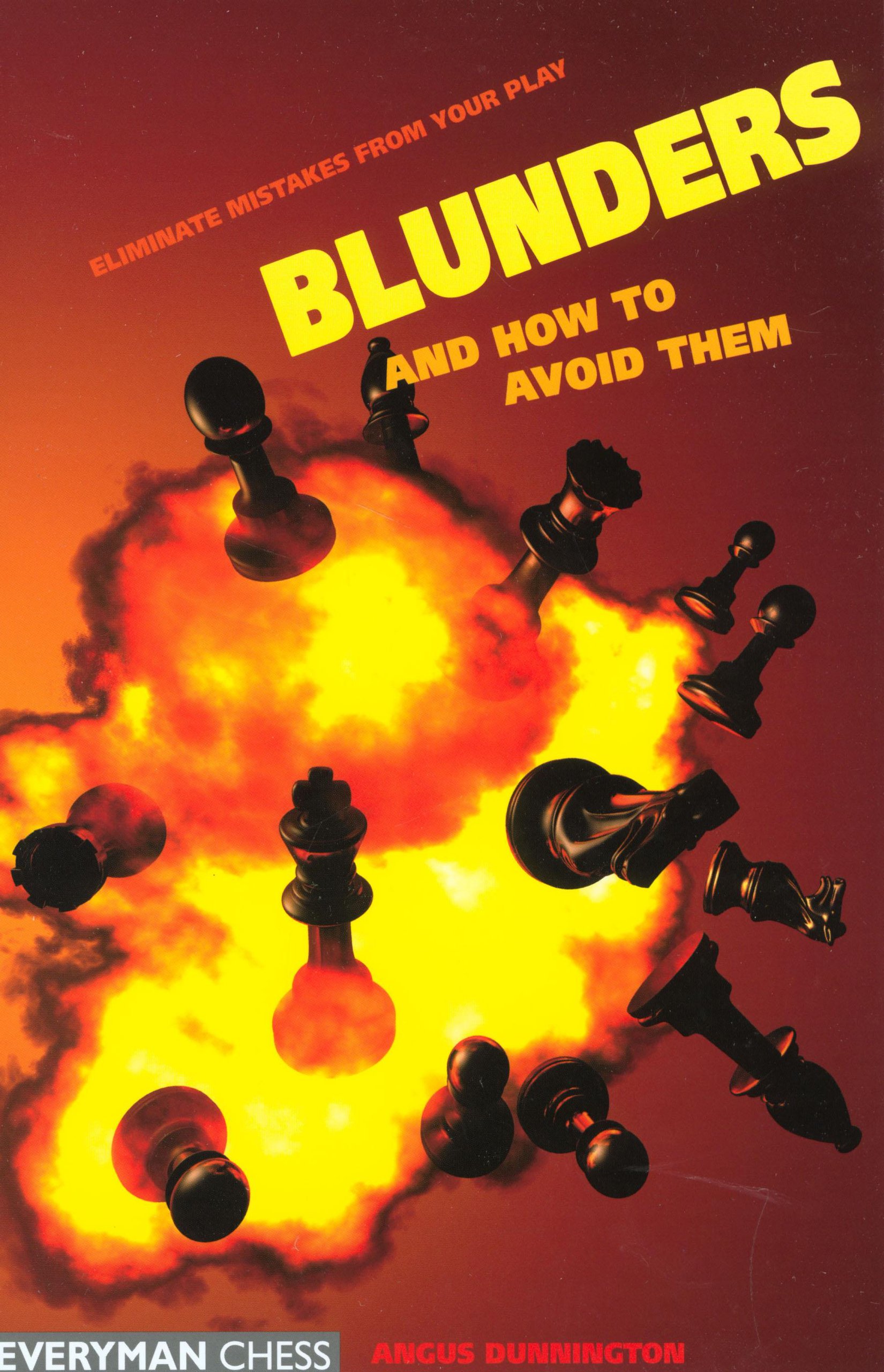
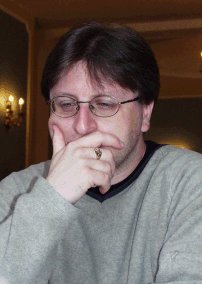
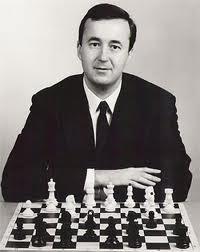
The Ultimate King’s Indian Attack, 1993Pawn Power !, 1994Winning with the Catalan, 1997Easy Guide to the Reti Opening101 Winning Chess Strategies, 1999Winning Unorthodox Openings, 2000Mastering the Middlegame, 2001Chess Psychology, 2003Nimzo-Indian Rubinstein: Complex Lines with 4e3, 2004Blunders and How to Avoid Them, 2004IM Angus Dunnington, photograph by Cathy Rogers
We send best wishes to GM Nigel Davies on his birthday, this day (July 31st) in 1960.
Nigel Rodney Davies was born in Southport, Merseyside.
He lived in the Wirral, Merseyside, moved to Sidcup and then to St. Helen’s, Merseyside where he resides with his chess playing son, Sam who is ECF 1928A currently.
In July 2020 Nigel graduated with a BSc (Hons) in Computing from Edge Hill University.
Nigel Davies (centre) at a Lloyds Bank event
He became an FIDE Master in 1980, an International Master in 1982 and a Grandmaster in 1993.
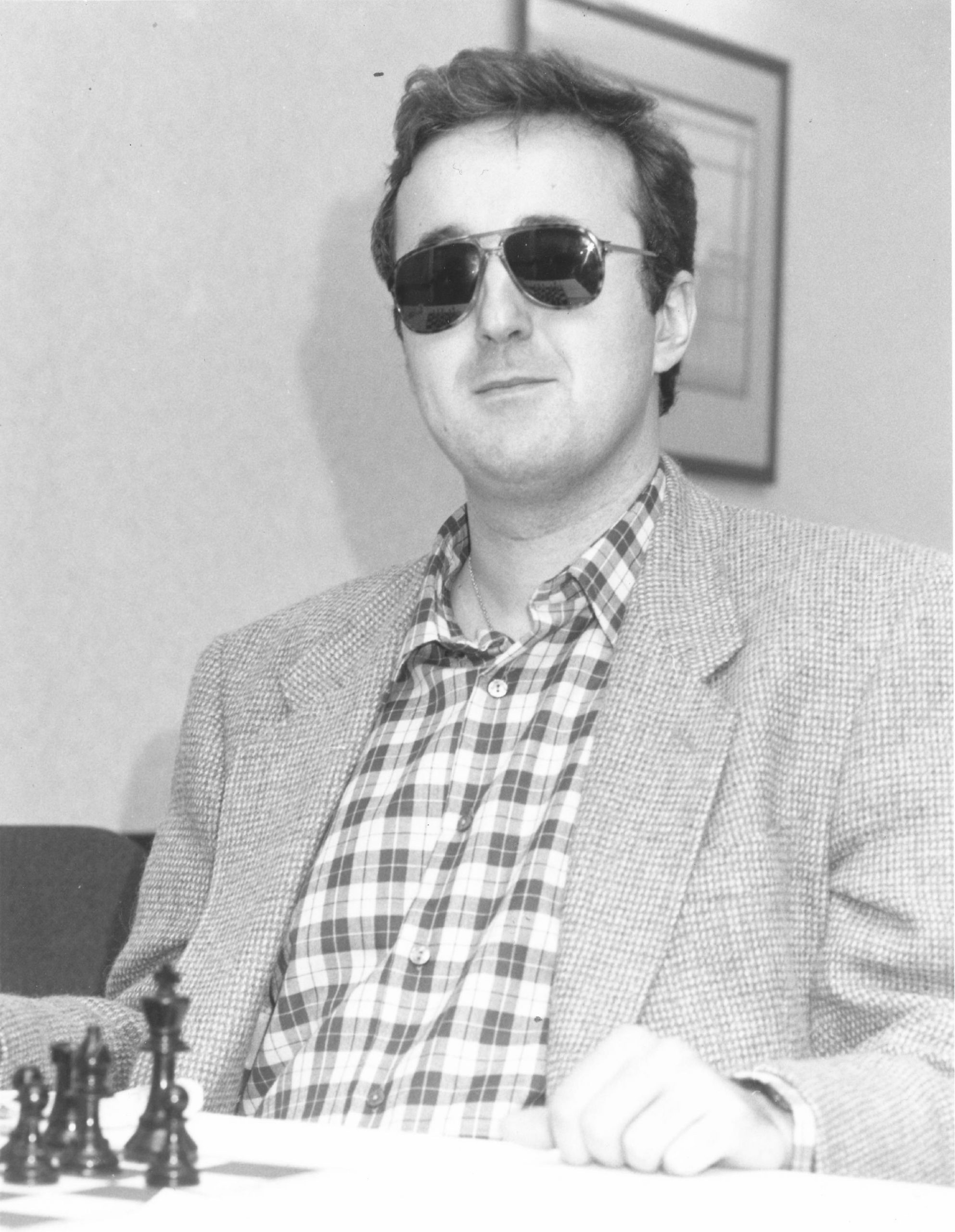
Nigel Davies
He won the British Under-21 Championship in 1979 (Chester) and the British Rapidplay Championship in 1987.
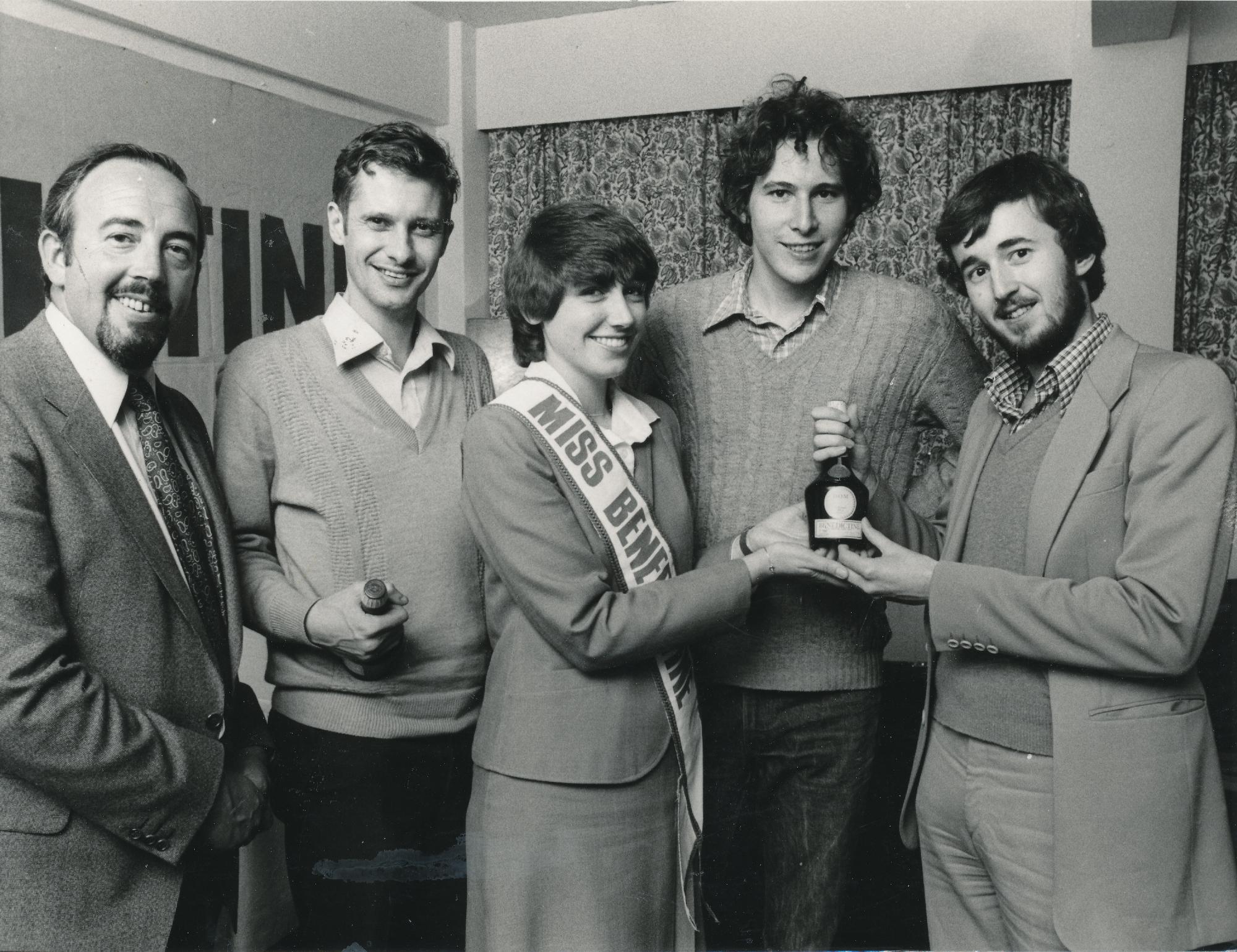
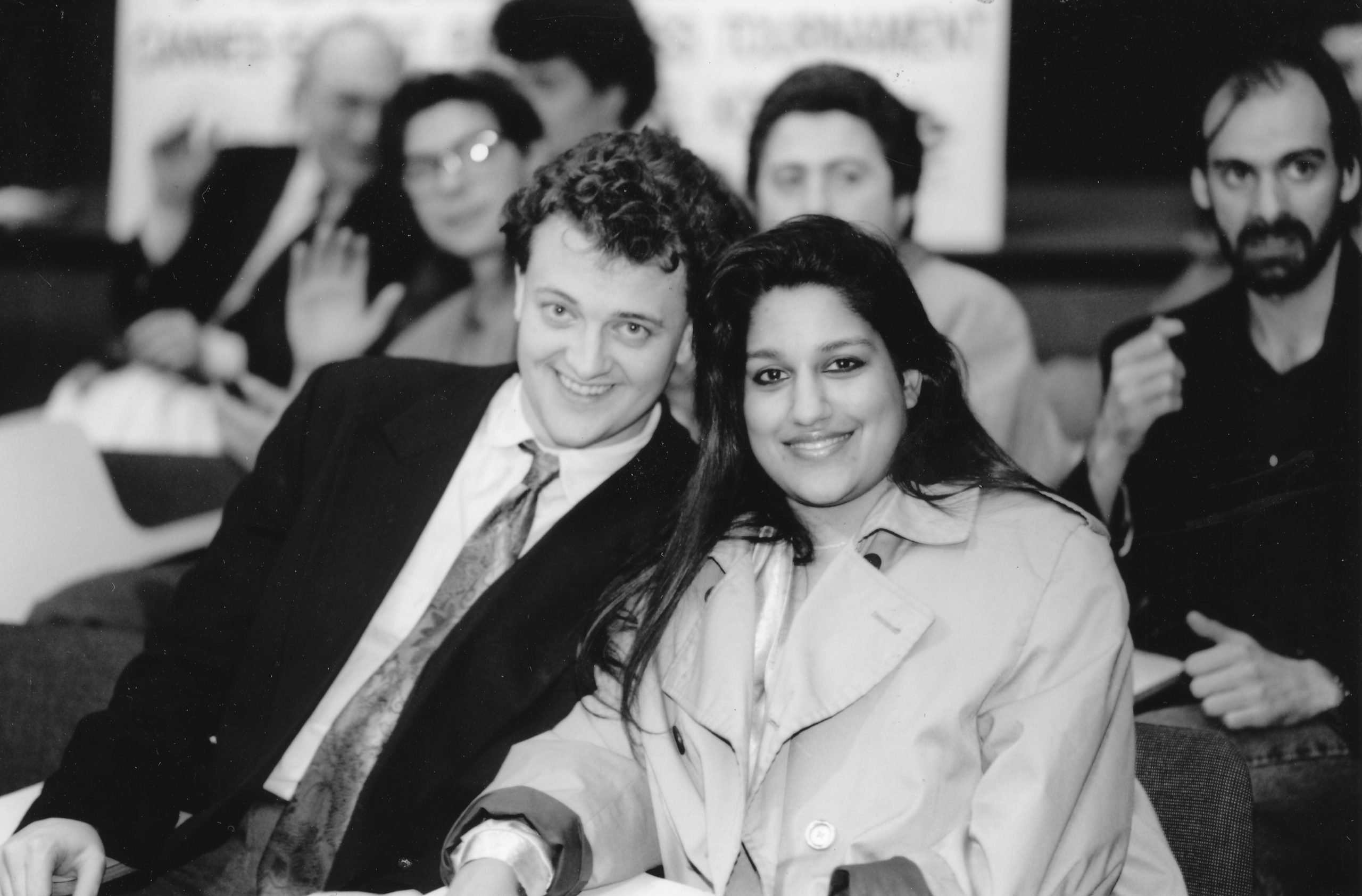
Nigel receives a much welcome prize (in Manchester) from Miss Benedictine in 198?
He won The Regency Ramsgate Masters 1980, Wrexham 1994, Katrineholm 1995 and the Blackpool Hilton Premier in 2003.
In 2015 Nigel transferred his international allegiance from England (the English Chess Federation) to Wales (Welsh Chess Union). He maintains an ECF standard play rating of 2448E.
William Watson, Jonny Hector, Alexander Khalifman, Jonathan Tisdall and Nigel Davies at the 1991 Watson, Farley, Williams tournament in London.
His peak FIDE rating was 2530 in January 1995 at the age of 35.
Nigel’s repertoire with White is wide including Queen’s Gambit, King’s Indian Attack, English/Reti and the Ruy Lopez.
As black Nigel’s repertoire is also varied and difficult to pin down. The Modern Defence is a favourite and is the Nimzo-Indian Defence.
Nigel is an active user of Twitter and may be found @GMNigelDavies
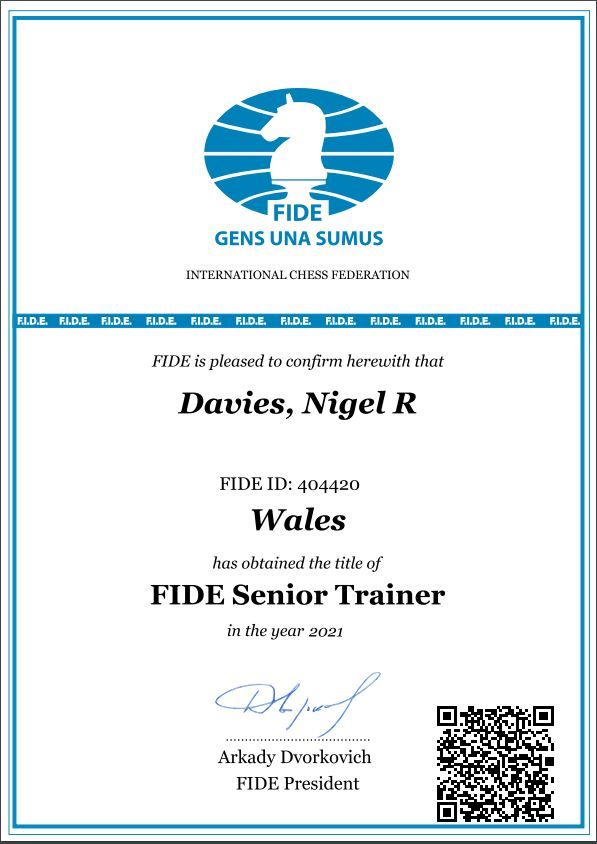
In 2020 the Welsh Chess Union successfully endorsed Nigel’s application to FIDE to become a FIDE Senior Trainer which he became in 2021:
Nigel Davies, FIDE Senior Trainer
Nigel has had many books and DVDs published :
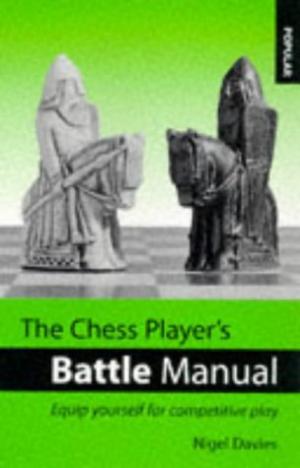
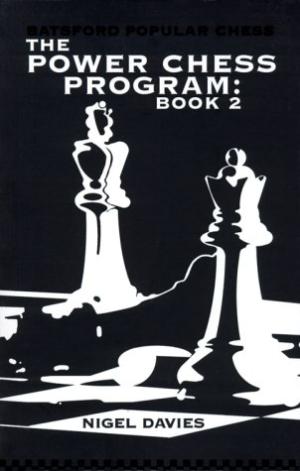
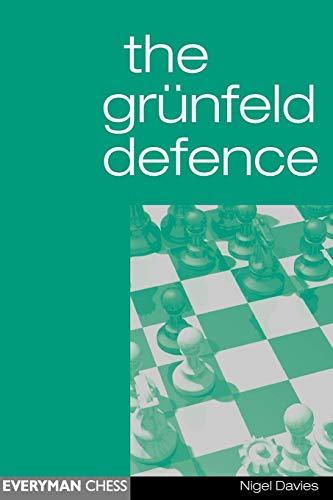
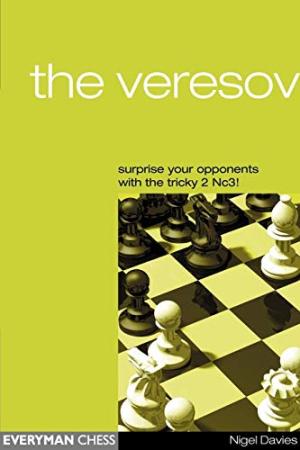
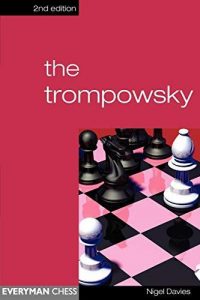
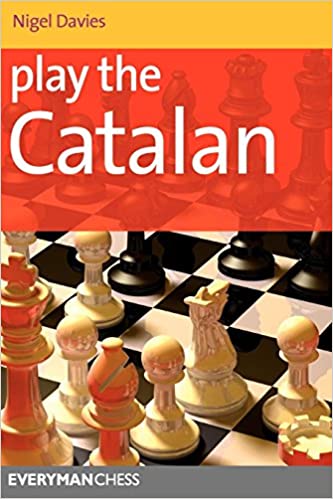
The Chess Player’s Battle Manual. Batsford. ISBN 0-7134-7043-7The Power Chess Program. Batsford. ISBN 0-7134-8415-2.The Grünfeld Defence. Everyman Chess. ISBN 1-85744-239-3.The Veresov. Everyman Chess. ISBN 9781857443356.The Dynamic Reti. Everyman Chess. ISBN 9781857443523.The Trompowsky. Everyman Chess. ISBN 1857443764.King’s Indian Attack. Hamburg: ChessBase. ISBN 978-3-86681-071-6.Starting Out: The Modern. Everyman Chess. ISBN 9781857445664.Play the Catalan. Gloucester Publishers plc (formerly Everyman Publishers plc). ISBN 9781857445916.
We send best wishes to GM Julian Hodgson on his birthday, this day July 25th) in 1963.
Julian Michael Hodgson was born at St. Mary Abbott’s Hospital, Marloes Road, Kensington, West London son of (Ronald) George Hodgson and Johanna Hodgson (née Birch) and the birth was registered in the district of Hammersmith.
Julian’s father has asserted to be a descendent of George Jeffreys, 1st Baron Jeffreys and we are looking to establish this claim following further research.
Julian attended St. Paul’s School (See below) and then attended The University of Leicester for one year.
Julian married Lizette and David Norwood was his Best Man.
Julian and Lizette Hodgson
(Curiously both Felice and Gaige state Julian was born in Saint Asaph in Wales. This is incorrect.)
Julian Hodgson
Harry Golombek wrote this about Julian in a 1980 Dataday chess diary :
“I think that the first time I saw Julian Hodgson in play was some four years ago in a London tournament. Upon my arrival Leonard Barden told him that he must now be careful how he played as Golombek was watching.
Julian and Nigel Short play Korchnoi in a simul. Leonard Barden observes.
“Who”, enquired the twelve-year old Julian, “is Golombek?”
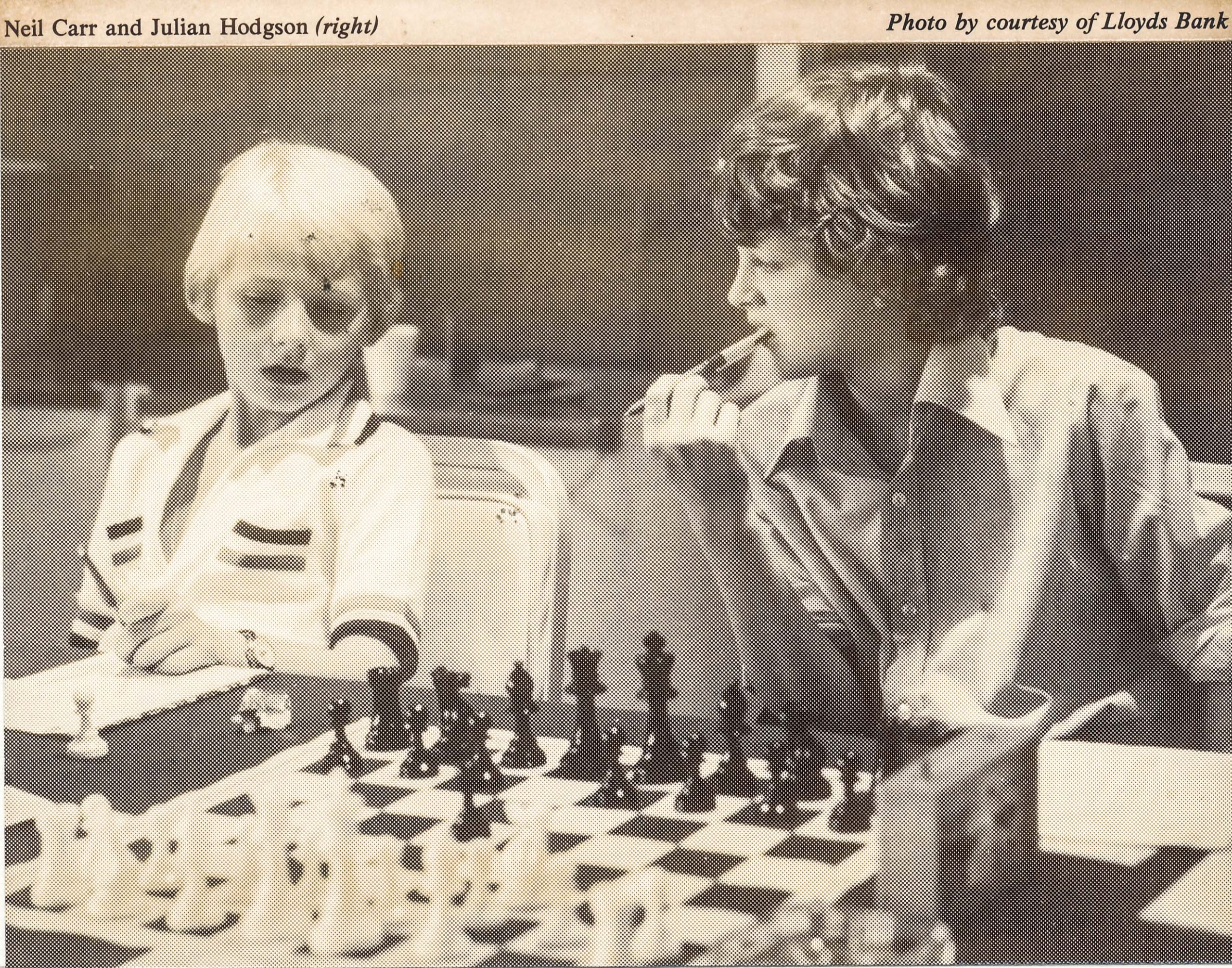
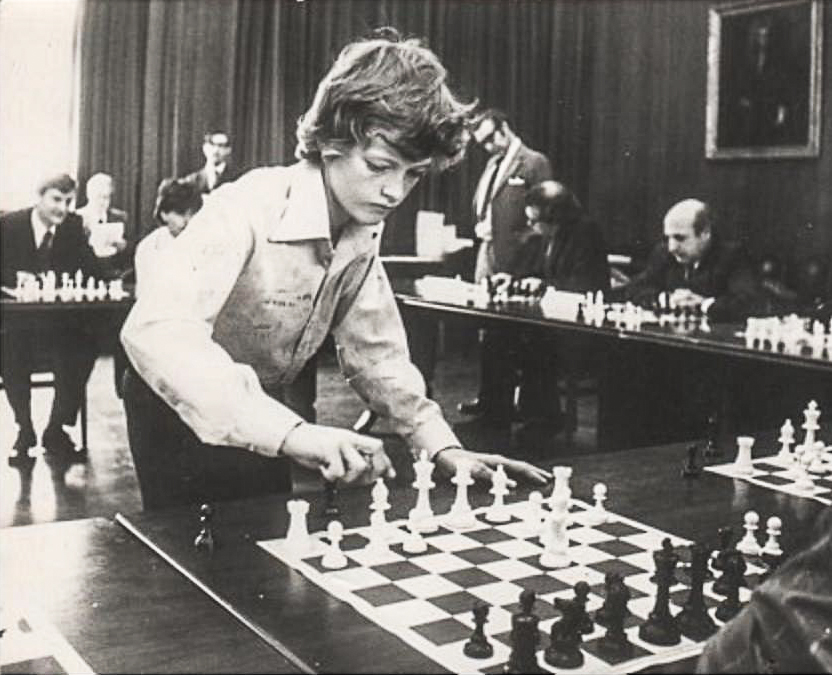
Neil Carr and Julian Hodgson at the 1976 Lloyds Bank Match by Telex, London – New York. From BCM, volume XCVI (96) Number 11 (August), Page 494. The venue was the Bloomsbury Hotel, London. Photo courtesy of Lloyds Bank.Julian Hodgson aged 13 in 1976 giving a simultaneous display at the Guildhall in London scoring +14=2-4. Photograph courtesy of the Keystone agency.
I felt grateful at the time that he did not say who or what is Golombek but I tell this story chiefly to show the cheerful insouciance with which Master Hodgson treated all comers whether chess masters or chess rabbits.
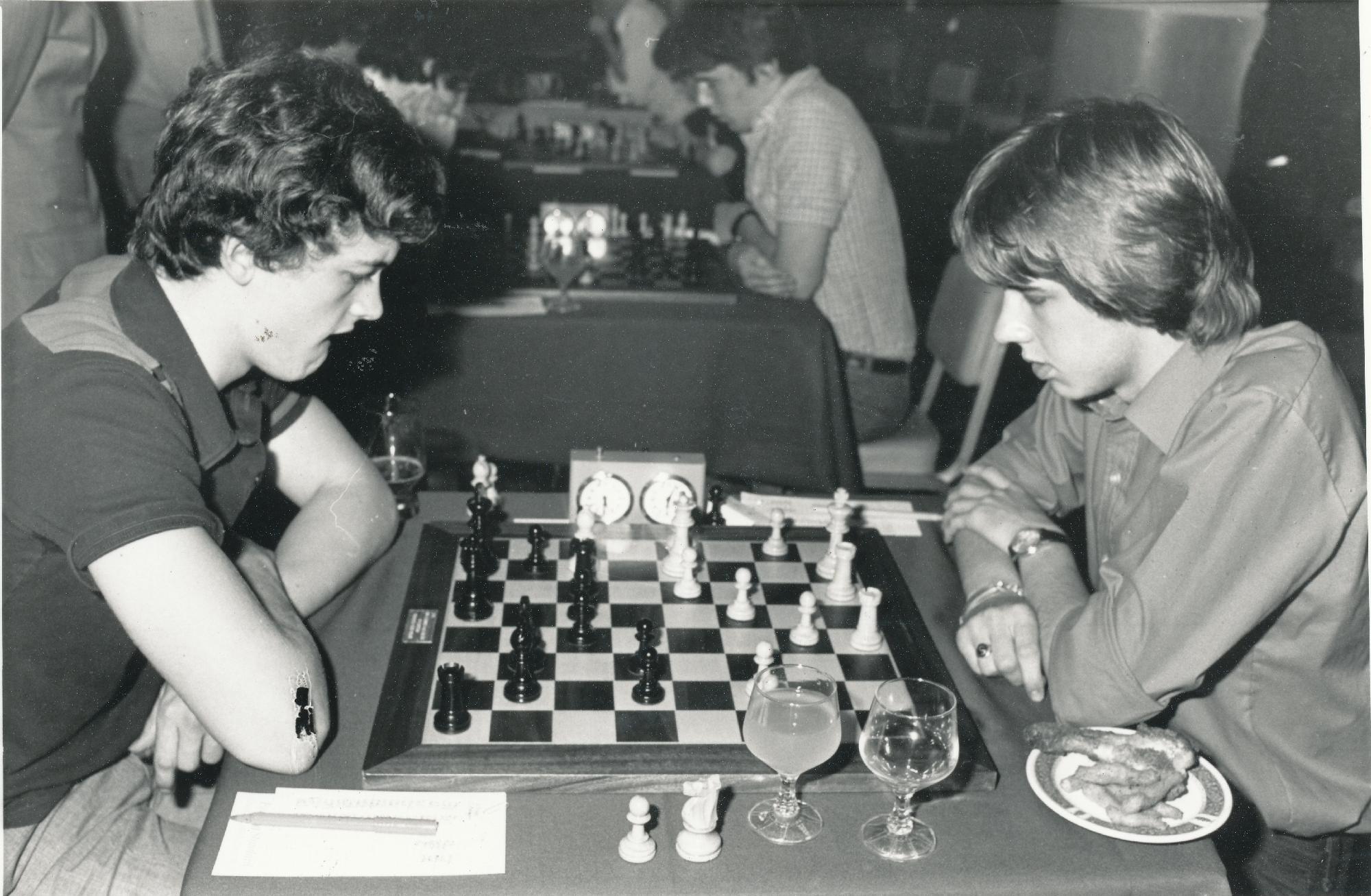
Julian playing Simon L Triggs. Event and photographer unknown
Julian astonishing maturity as a player has been impressive ever since at the age of ten, he won the Southern Counties Under 14 Championships in 1973. Since then he has acquired a host of such championships culminating in the British Under-21 Championship in 1977.
Streatham & Brixton becoming BCF National Club Champions in 1989. The team was Tony Kosten, Mark Hedben, Daniel King, Nigel Povah (Captain), Joe Gallagher and Julian Hodgson : quite a strong team
Perhaps his most remarkable performance so far has been his equal 3rd in a strong challengers section at Hastings where he scored 7.5 out of 10. 1977 was a good year for him and here, from the Lloyds Bank Silver Jubilee Tournament of that year is his fine win over a strong opponent :
Here is his entry (written by Richard W O’Brien) in British Chess (Pergamon Press, 1983, Botterill, Levy, Rice and Richardson) :
“Following a series of excellent results Julian, at the tender age of 11, became the second youngest ever to play in an international tournament when he took part in the London Chess Club International Invitation tournament in September 1974. Only Reshevsky had been younger. Julian’s first opponent was Michael Woodhams, an Australian international who had just scored 15.5/18 in the recent Olympiad (Nice)
The following year he became the youngest player ever to win the London Amateur Championship. A year later he reached a grading of 200 (BCF), only Reshevsky, Pomar, Karpov and Kasparov had done so at an earlier age.
By now he was at St. Paul’s School, which was in the process of becoming one of the strongest chess playing schools in the country. In 1977 he shared first place with WN Watson (also St. Paul’s) in the British U21 Championship. Progress was however not as fast as had at one time been anticipated
It was at Ramsgate, late in 1980 before his first IM norm. A month later he finished second in the Hastings Challenger. Other good results followed in 1981. First he was selected for the Glorney Cup and shortly afterwards did well to come fourteenth in the British Championship (Morecambe). He represented England in the World Youth Team championships scoring 4/6. His second IM norm followed when he shared fifth place at Manchester in the same year. Good results in weekend congresses meant that he finished fourth in the Leigh Grand Prix. The year had finished with Julian needing a draw in the last round at Ramsgate to get his title. He lost and was to wait another 12 months to achieve his final norm.
The England Team from the 1990 Novi Sad Olympiad : John Nunn, Jon Speelman, Julian Hodgson, David Anderton OBE (Captain), Nigel Short, Michael Adams and Murray Chandler
When the final norm came it arrived out of the blue. With a score of 2.5/5 at Lewisham in November 1982 the chances seemed remote, 3.5/4 was required against a strong field and it even seemed doubtful whether he could actually play those he needed to play. He scored 2.5/3 and now had to play Jon Tisdall, who still had a chance of winning the tournament.
Julian finished second equal in the tournament behind Jim Plaskett who had beaten him earlier.
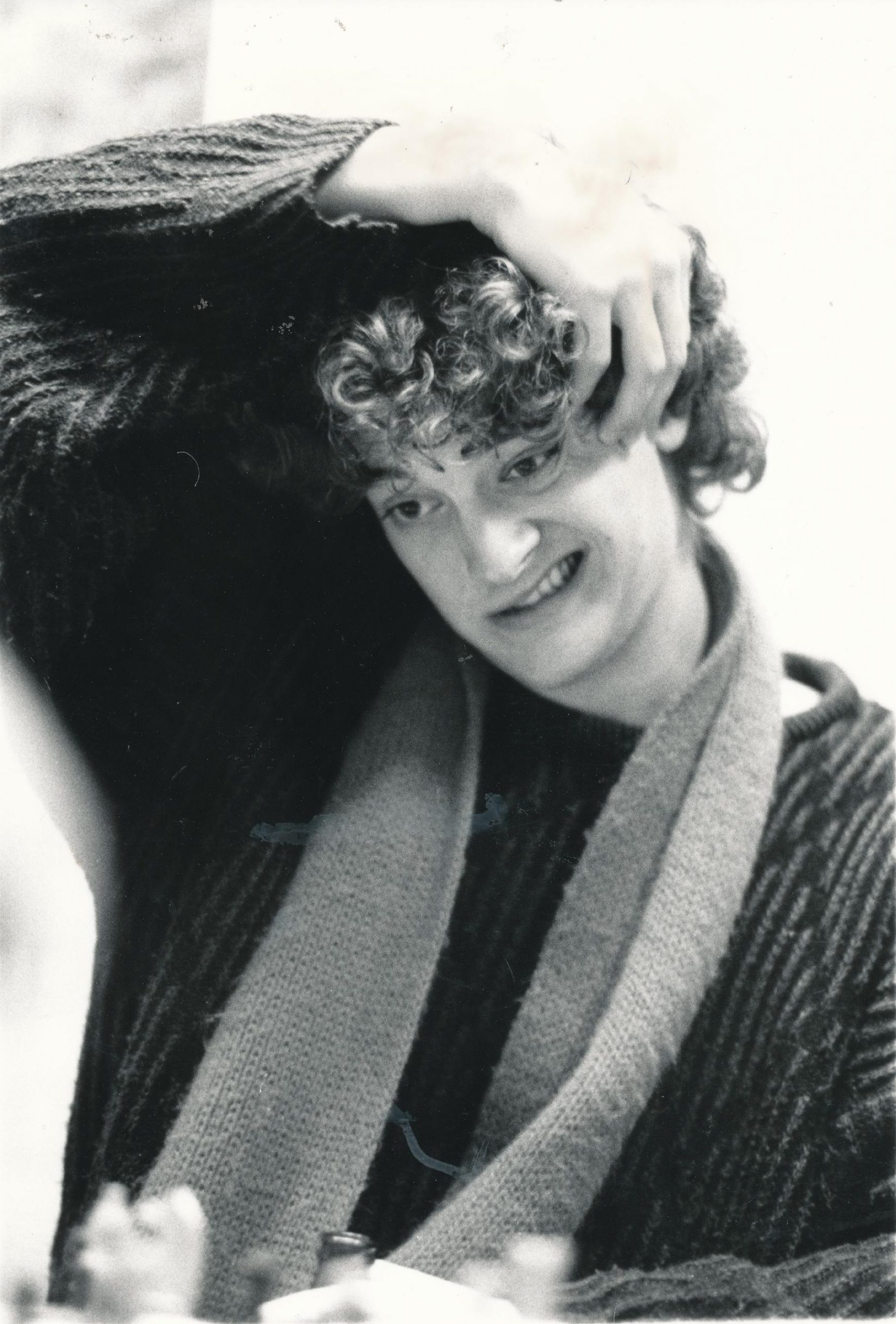
Julian Hodgson
The next six weeks saw Julian come equal first in the Pergamon sponsored British Lightning championship, a highly creditable sixth in the Nightflight International at Brighton (equivalent to an IM rating) and second place yet again in the Hastings Challengers.
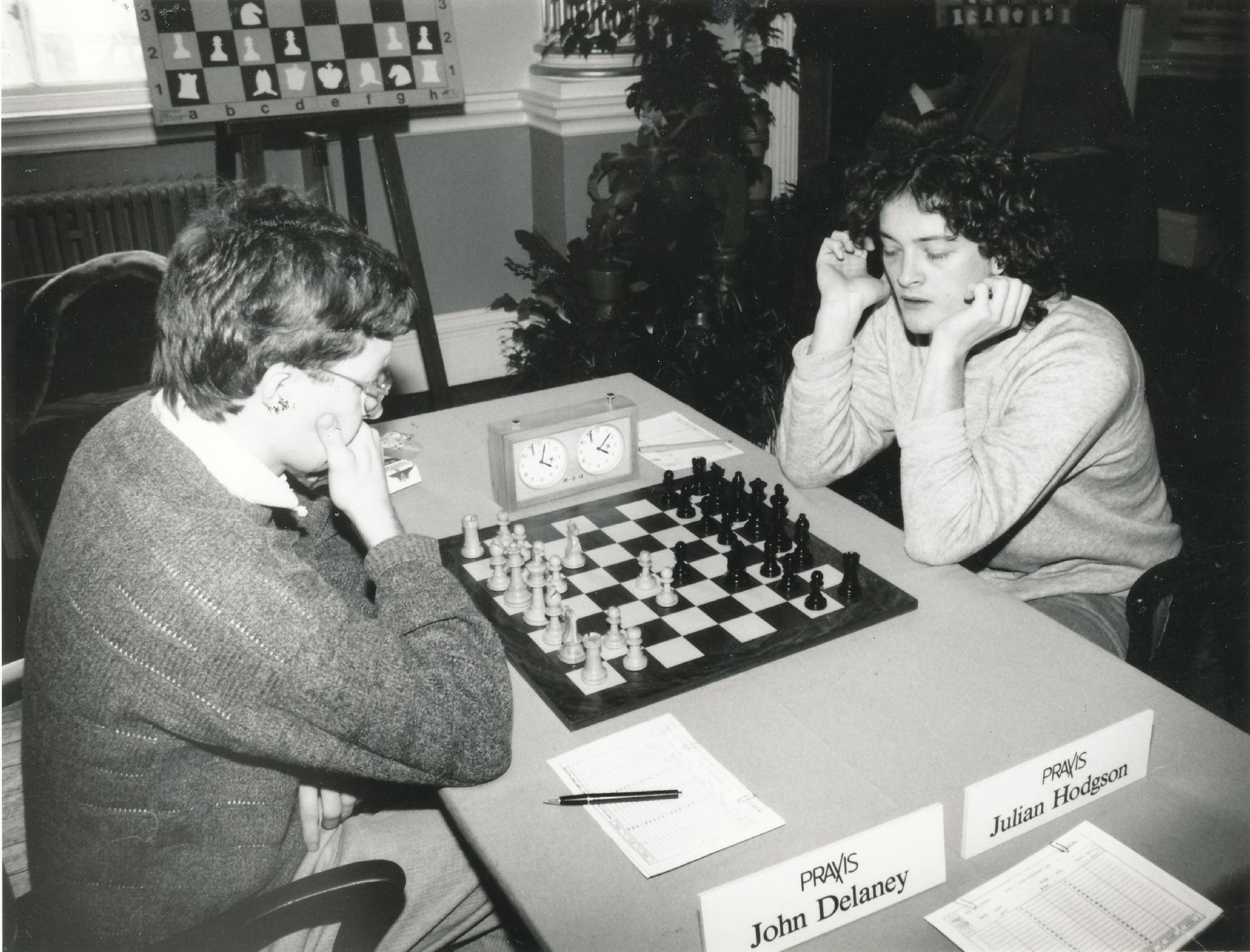
John Delaney plays Julian Hodgson at the Bath Zonal Tournament in 1987
Earlier in 1983 he scored 6.5/9 at Lugano, probably Europe’s strongest ever Swiss (Swiss !) tournament, losing narrowly to Jan Timman.
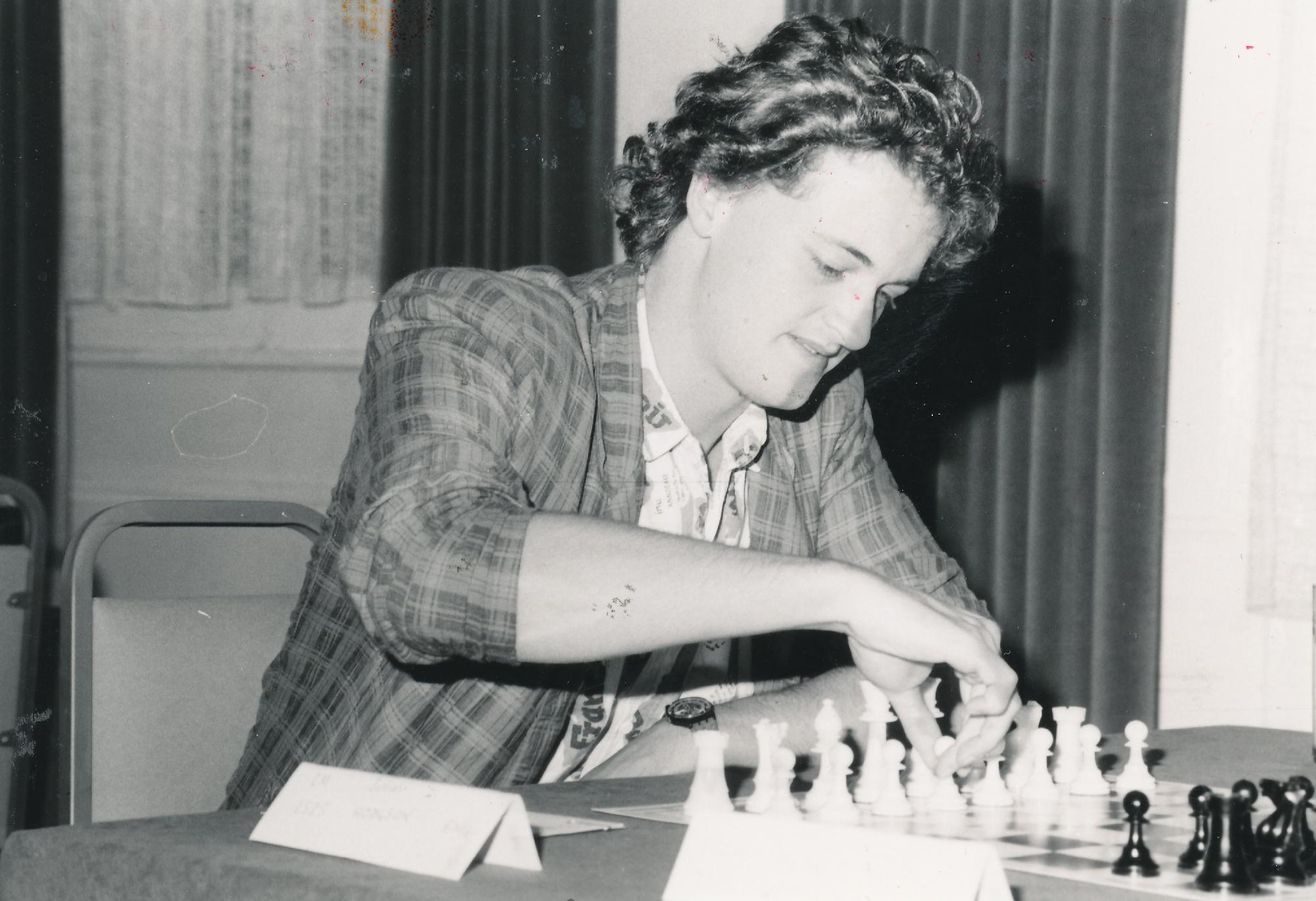
Julian Hodgson. Event and photographer unknown.
He left Leicester University after just one year preferring to concentrate on chess.
FM Andrew Whiteley, IM Julian Hodgson and FM Byron Jacobs at Cappelle Le Grand, 1988. Photograph by Caroline Winkler
He plays fairly regularly for Streatham & Brixton Chess Club which encouraged juniors for several years. Daniel King is another junior who also played frequently for Streatham. ”
This is what was written about Julian prior to the 1979 Spassky vs the BCF Junior Squad simultaneous display : “St Paul’s and Shepherds Bush. Rating 210. Standard London Amateur Champion at age 12, 1975.
Standard London under-18 champion, 1976. British under-21 co-champion, 1977. Youngest ever to beat two grandmasters in successive games, 1978.”
Aside from more formal achievements, he developed a sharp, relentless, attacking style of play and against lesser opponents this frequently resulted in devastating quick wins, earning him the epithet “Grandmaster of Disaster”.
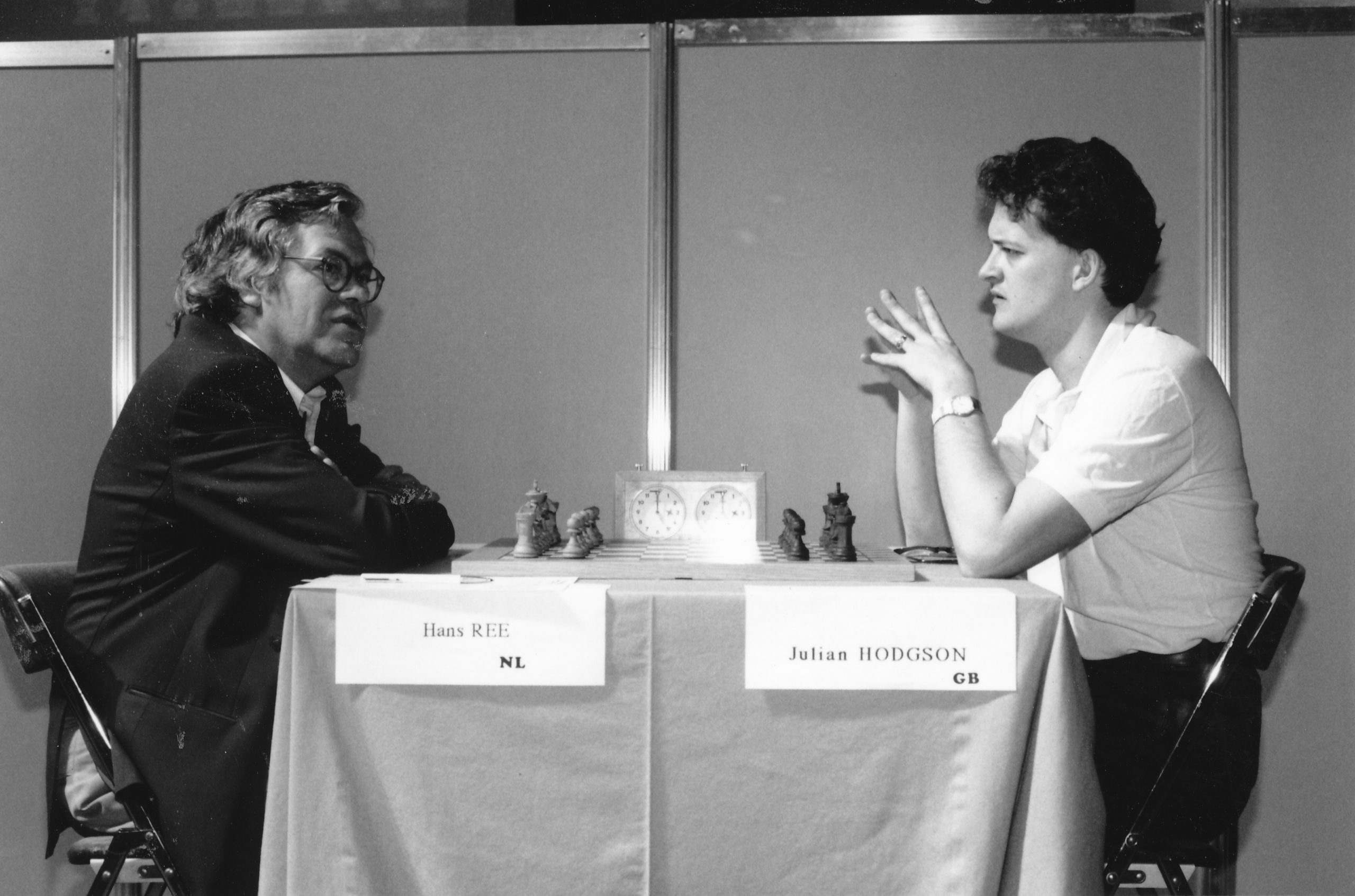
Hans Ree plays Julian Hodgson at the Cannes Team Tournament, 1992
Hodgson’s greatest legacy as a chess player may however lie in his resurrection of an almost forgotten opening system. The Trompowsky Attack (1.d4 Nf6 2.Bg5) had floundered in the doldrums for many years, prior to his adoption and development of the opening. In interviews, he reveals that this was born out of laziness and a reluctance to learn established chess opening theory. It soon became his weapon of choice with the white pieces, leading to a surprising popularisation of the system, the spawning of a whole generation of devotees and ironically, a number of theoretical guides, containing a high quota of Hodgson’s own games and analysis. Indeed, his expert treatment of the system once prompted fellow grandmaster Joe Gallagher to write that it should be renamed the Hodgson–Trompowsky Attack, a view shared by many other masters. A chess journalist once wrote that Hodgson put the ‘romp’ into Trompowsky.
A related, but more obscure version of the system (1.d4 d5 2.Bg5), has been dubbed by some the Hodgson Attack and by others the Pseudo-Trompowsky or Queen’s Bishop Attack.
and
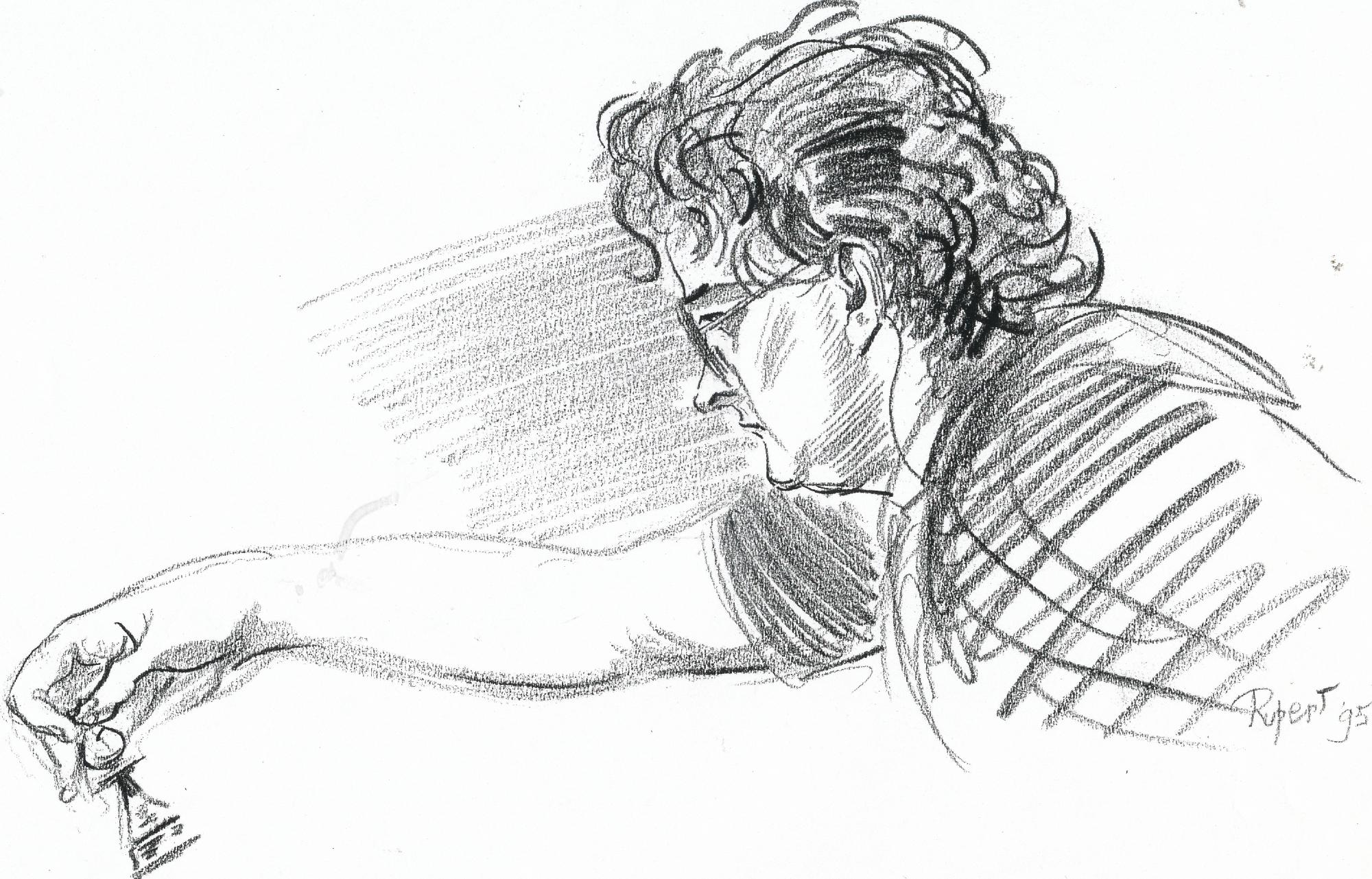
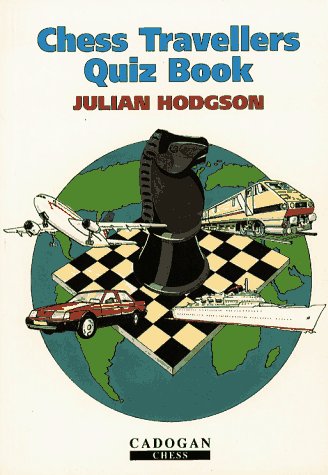
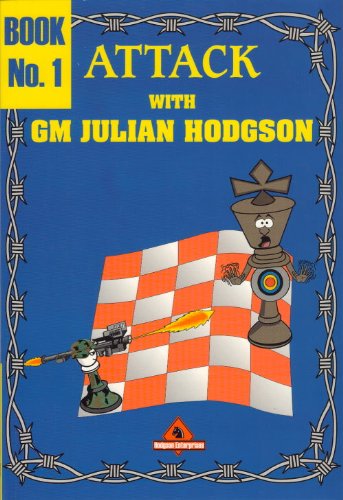
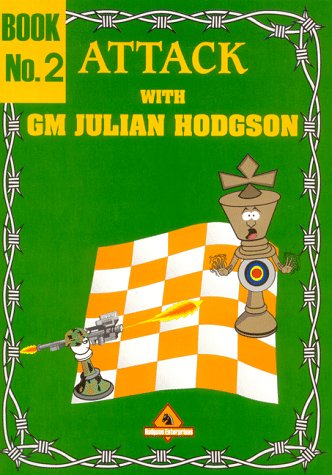
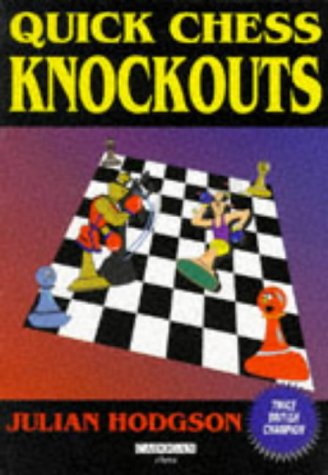
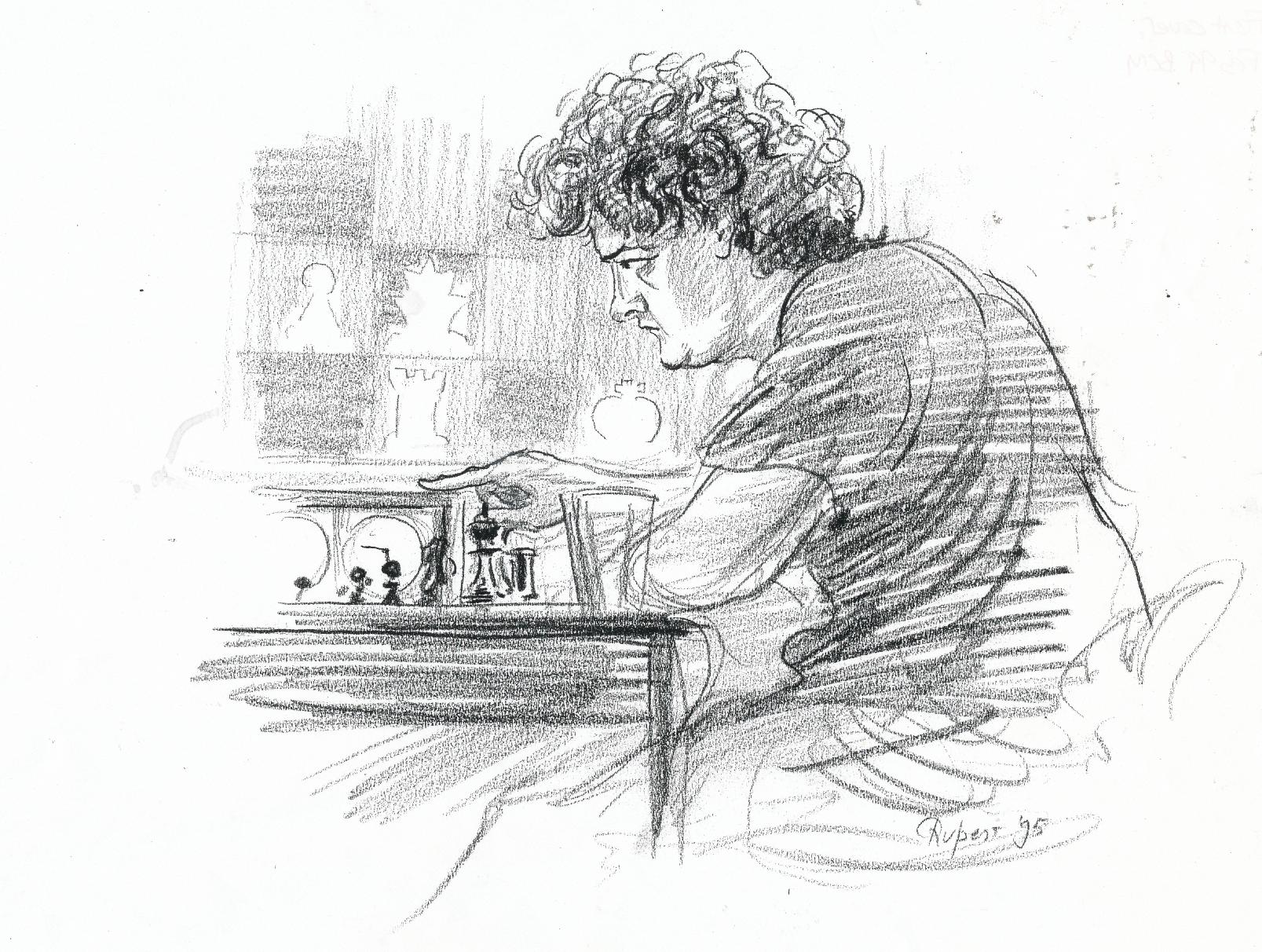
Julian, Dominic Lawson and Matthew SadlerChess Traveller’s Quiz Book, Julian Hodgson, Cadogan Press, 1996, ISBN-13 : 978-1857440300Attack with Julian Hodgson, Book No.1Attack with Julian Hodgson, Book No.2Quick Chess KnockoutsJulian Hodgson drawn by Rupert van der Linden
We wish Tony Kosten best wishes on his birthday, this day (July 24th) in 1958.
Tony was born in North Eastern Surrey, and eventually relocated to France where he now resides.
Tony is married to Gyongyver Kosten-Forintos, the daughter of Hungarian Grandmaster Győző Forintos.
Streatham & Brixton becoming BCF National Club Champions in 1989. The team was Tony Kosten, Mark Hedben, Daniel King, Nigel Povah (Captain), Joe Gallagher and Julian Hodgson : quite a strong team
Tony played for Lower Earley Chess Club in the Berkshire League and for Streatham & Brixton in the National Club competition.
He was =3rd in the 1982 British Championship in Torquay (won by Tony Miles)
He was =2nd in the 1984 Robert Silk Young Masters.
He won the Berkshire Chess Association Quickplay title in 1985.
Tony was runner-up to Yuri Balashov at Minsk 1986.
He won Naujac 2000 with 7.5/9
Tony won many other events : See his Wikipedia entry for details.
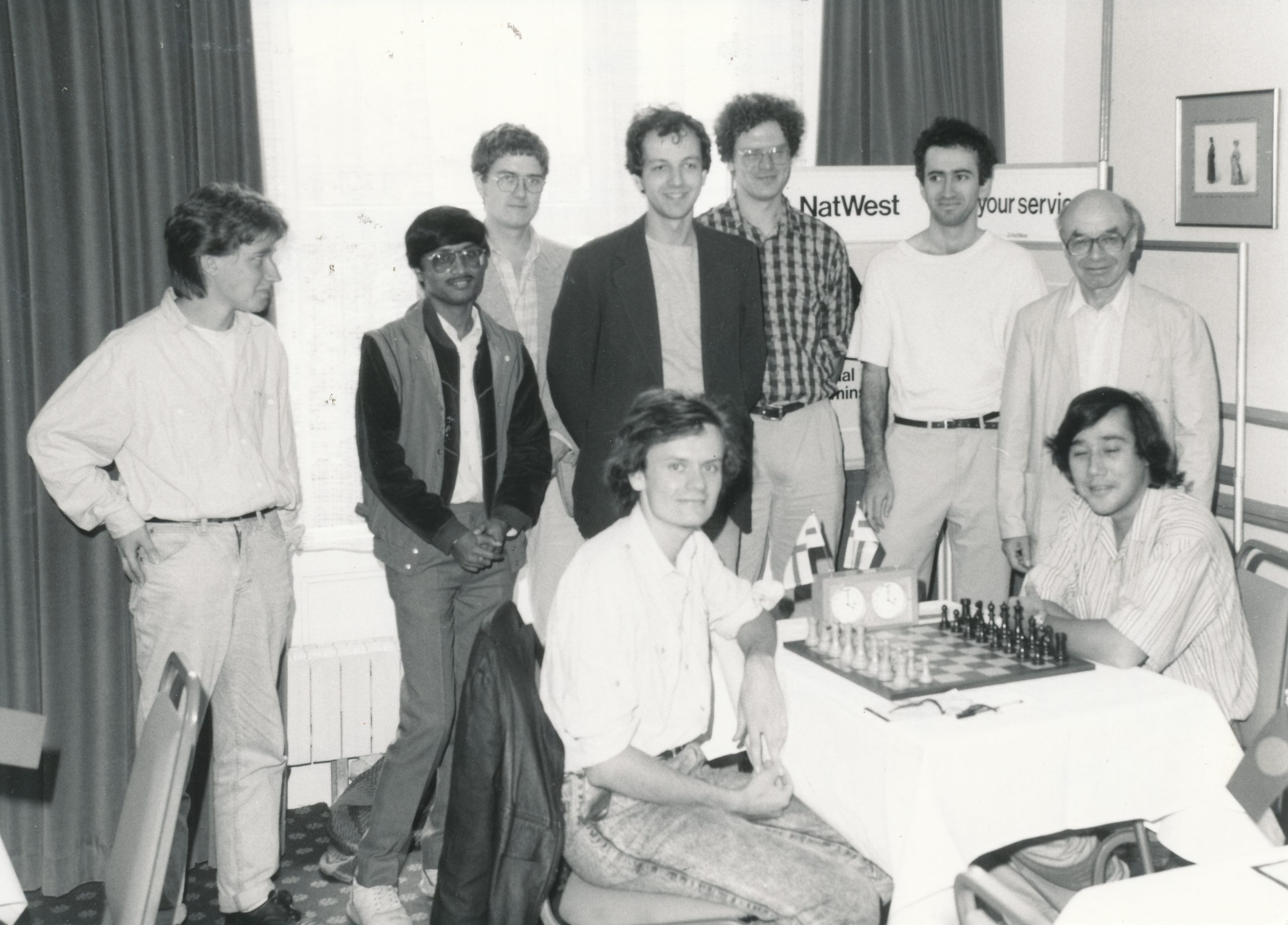
Tony Kosten (fourth from left) at a NatWest Bank sponsored event
Tony is the founder of chesspublishing.com, a subscription based web site specialising in cutting edge opening theory with many contributors.
He plays for Guildford in the Four Nations Chess League (4NCL) is registered as a member of the French federation. He also plays for Schott Mainz in the German Team Championship.
According to Megabase 2020 his highest FIDE rating was 2551 in July 2002 at the age of 44.
With the white pieces Tony prefers the Ruy Lopez and Giuoco Piano with the English coming a close second.
With black Tony defends the Lopez and the Nimzo-Indian defence.
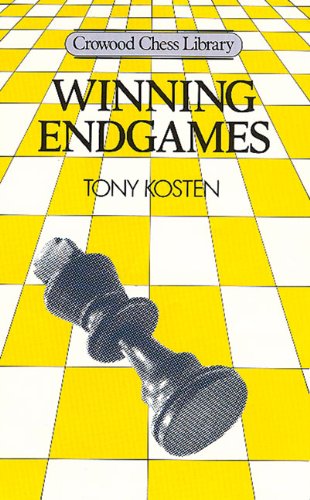
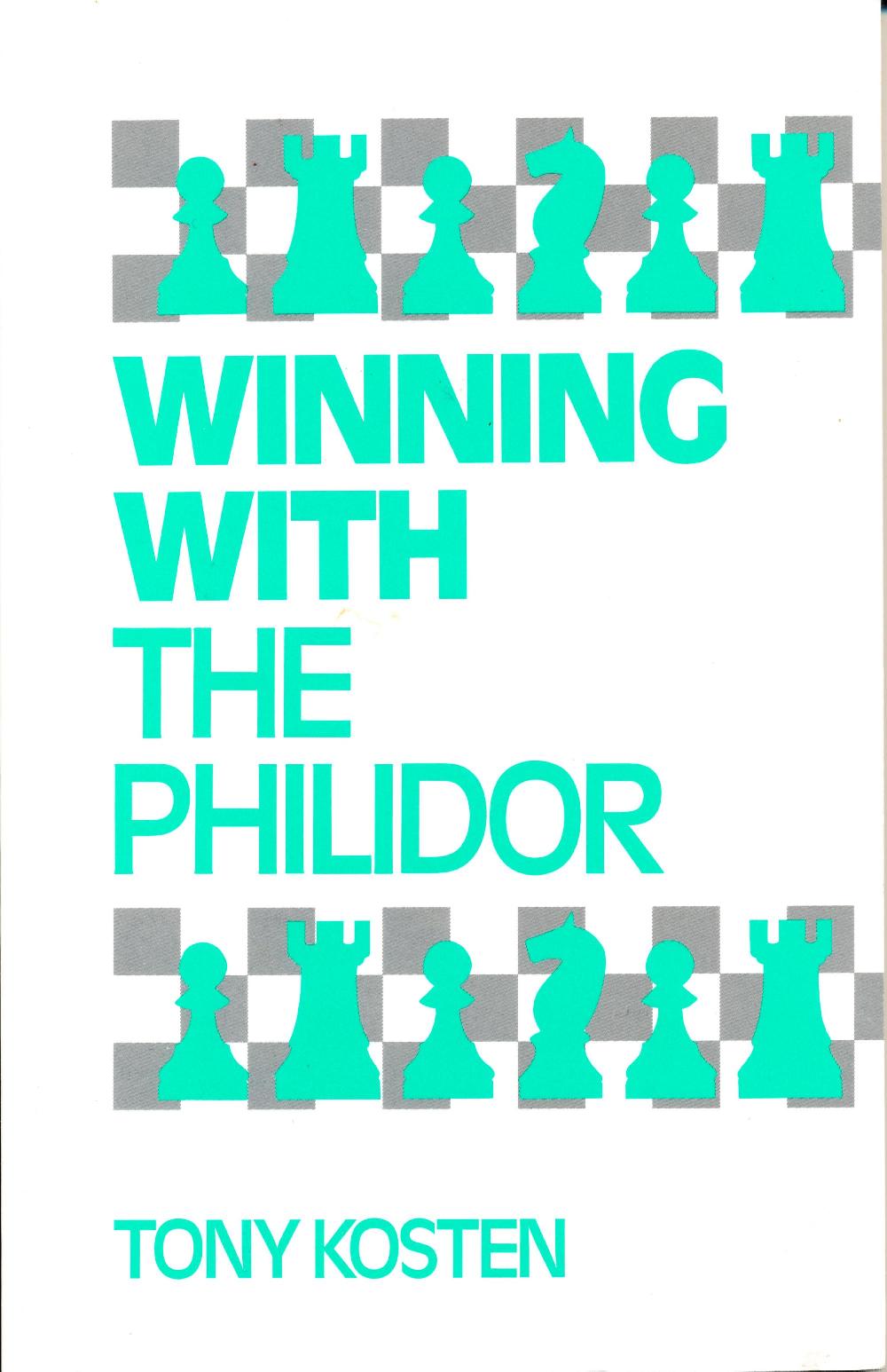
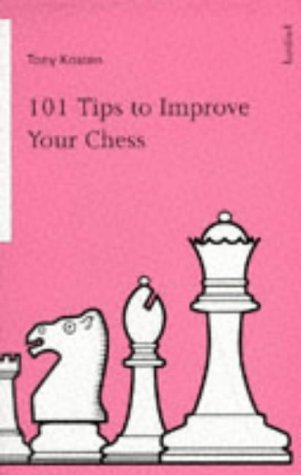
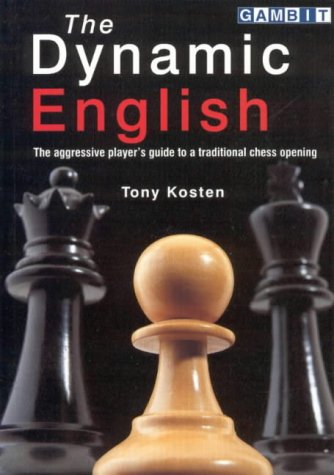
Tony KostenWinning Endgames, Crowood, 1987Winning with the Philidor, Batsford, 1992101 Tips to Improve your Chess, Batsford, 1996The Dynamic English, Gambit, 1999
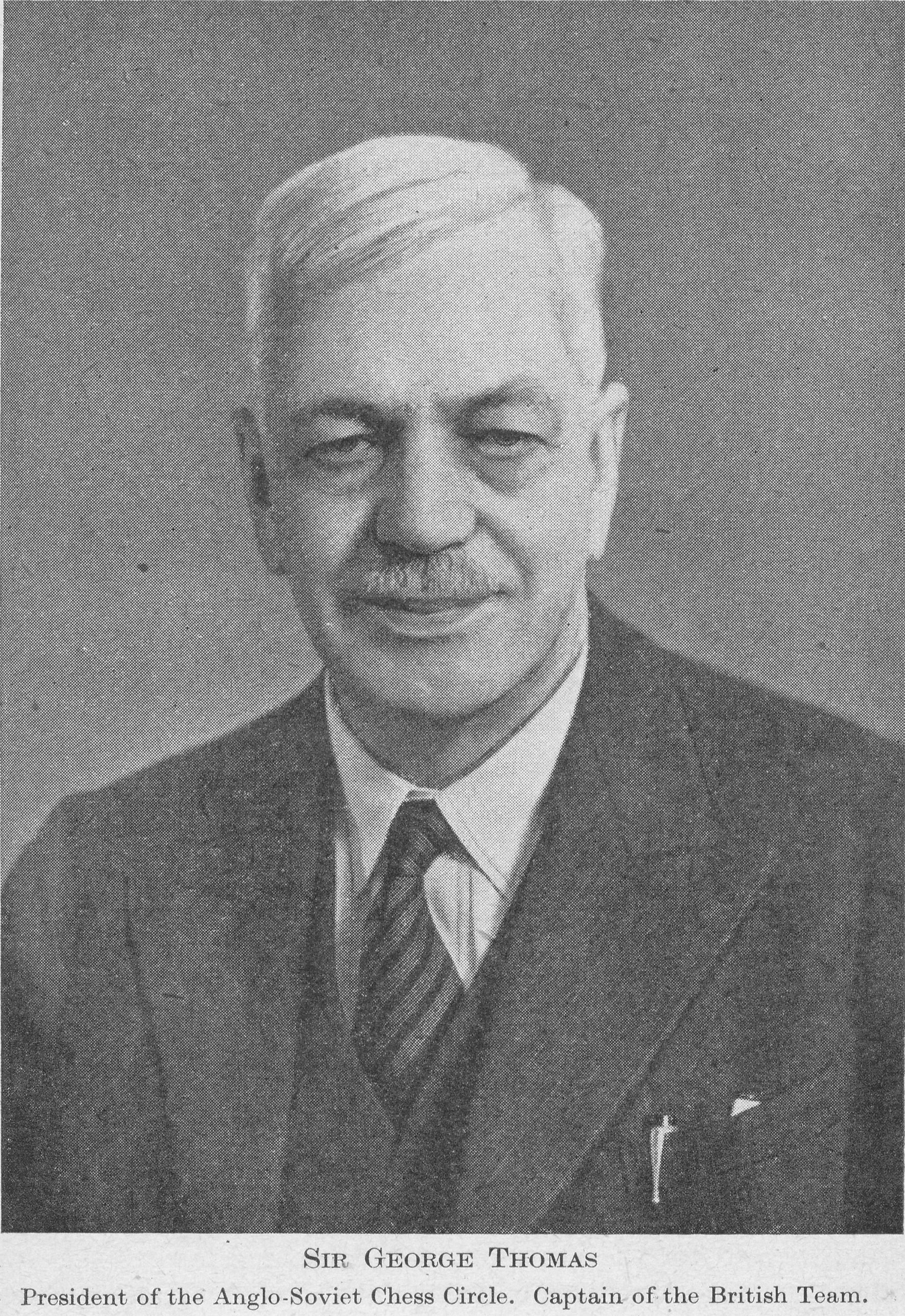
Sir George Thomas, President of the Anglo-Soviet Chess Circle. Captain of the British Team
We remember Sir George Alan Thomas who died on July 23rd, 1972
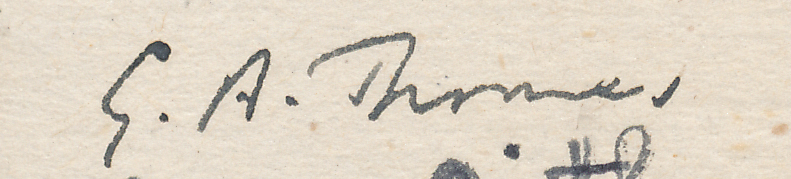
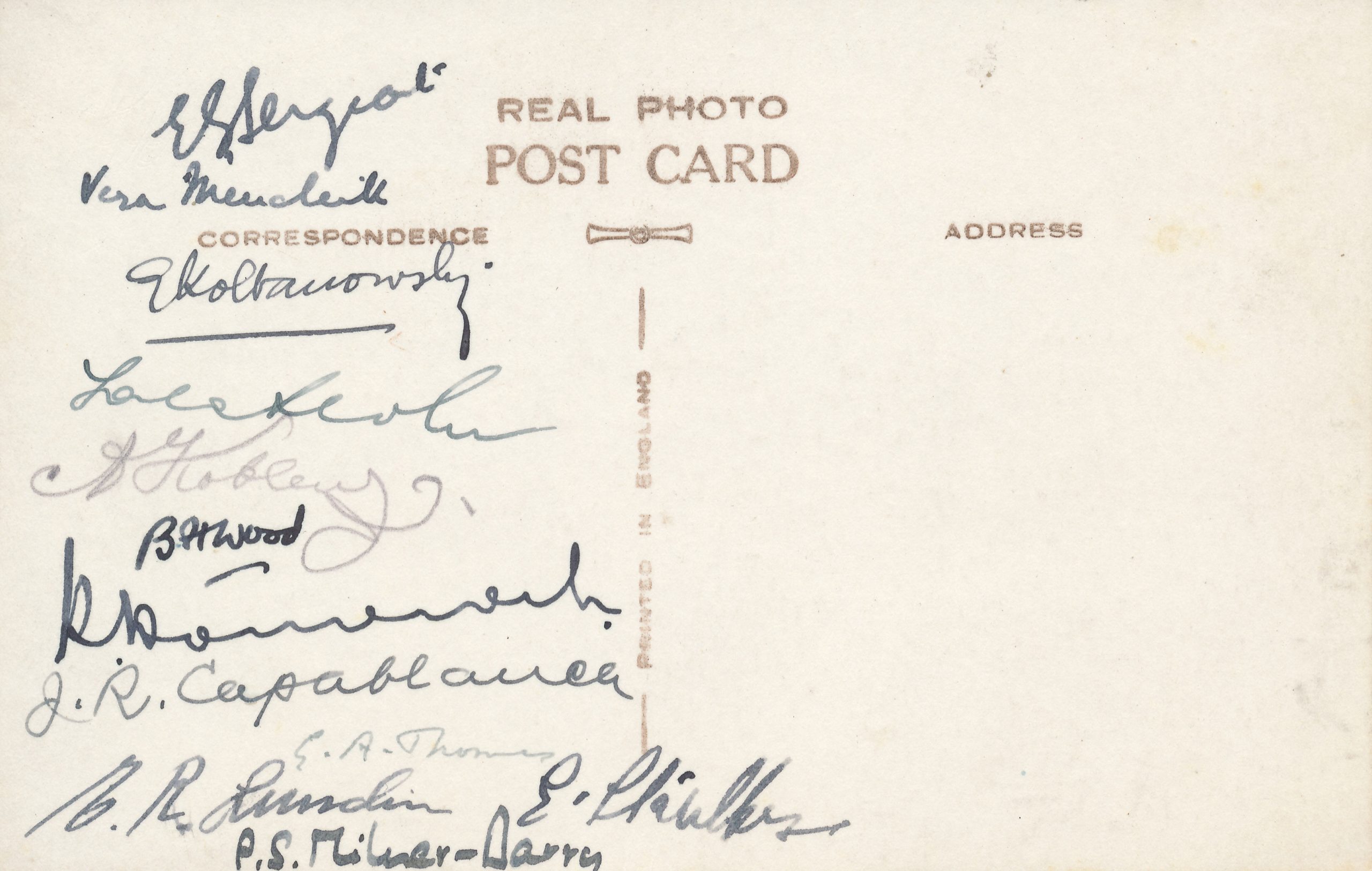
Signature of GA Thomas from a Brian Reilly “after dinner” postcard from Hastings Christmas Congress, 1945-1946
From The Encyclopedia of Chess (BT Batsford, 1977) by Harry Golombek :
“British international master, born in Constantinople (previously Byzantium and currently Istanbul : Ed.) His mother (Lady Edith Margaret Thomas : Ed) was one of the strongest English women players, winner of the first Ladies tournament at Hastings 1895.
(Ed : his father was Sir George Sydney Meade Thomas)
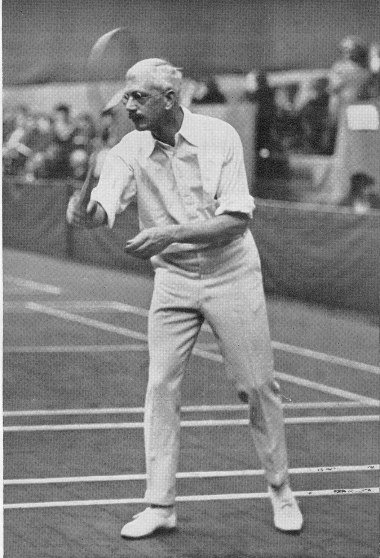
Thomas was an all-round athlete who excelled at tennis, hockey and badminton as well as chess. He captained the English badminton team and was All England Badminton Singles champion from 1920 to 1923.”
Sir George Alan Thomas : “During his playing career, he won 78 national titles in the United Kingdom and a further 12 French titles; he also competed in 29 out of 30 English internationals, winning 50 matches in the process.”
Here is an excellent article (albeit stating GT was a Grandmaster and was president of the British Chest Federation!) from the National Badminton Museum.
“Thomas won the British chess championship twice, in 1923 and 1934 and represented England in the Olympiads of 1927 where he tied with Norman Hansen for the best score – 80% on board 3, 1930, 1931, 1935, 1937 and 1939.
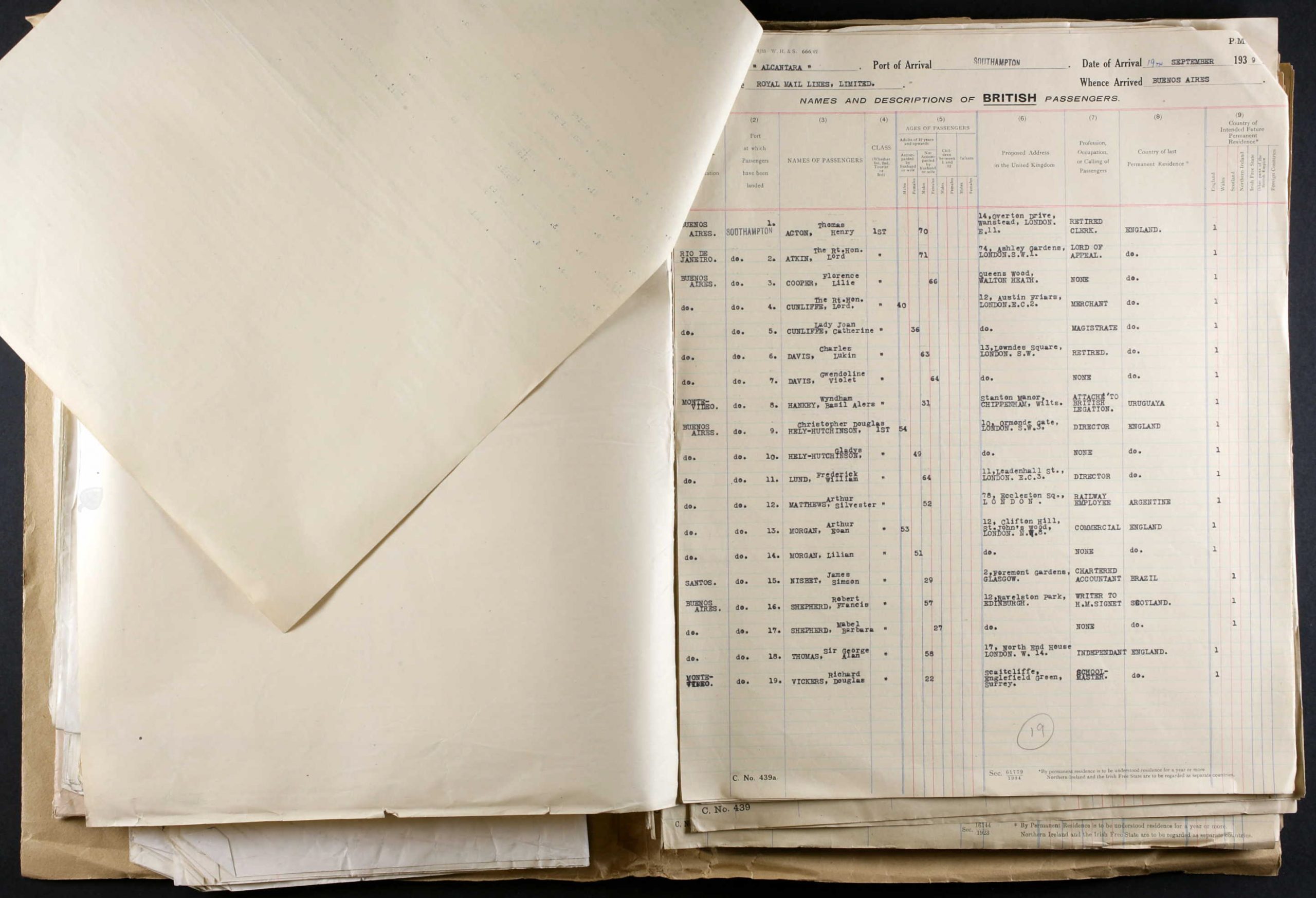
Passenger list from RMS Alacantra showing Sir George Thomas arriving at Buenos Aires on September 19th, 1939Entry for Sir George Thomas from above image.
In international tournaments his greatest successes were 1st at Spa (ahead of Tartakower) and =1st at Hastings 1934/5 (tied with Euwe and Flohr, ahead of Capablanca and Botvinnik).
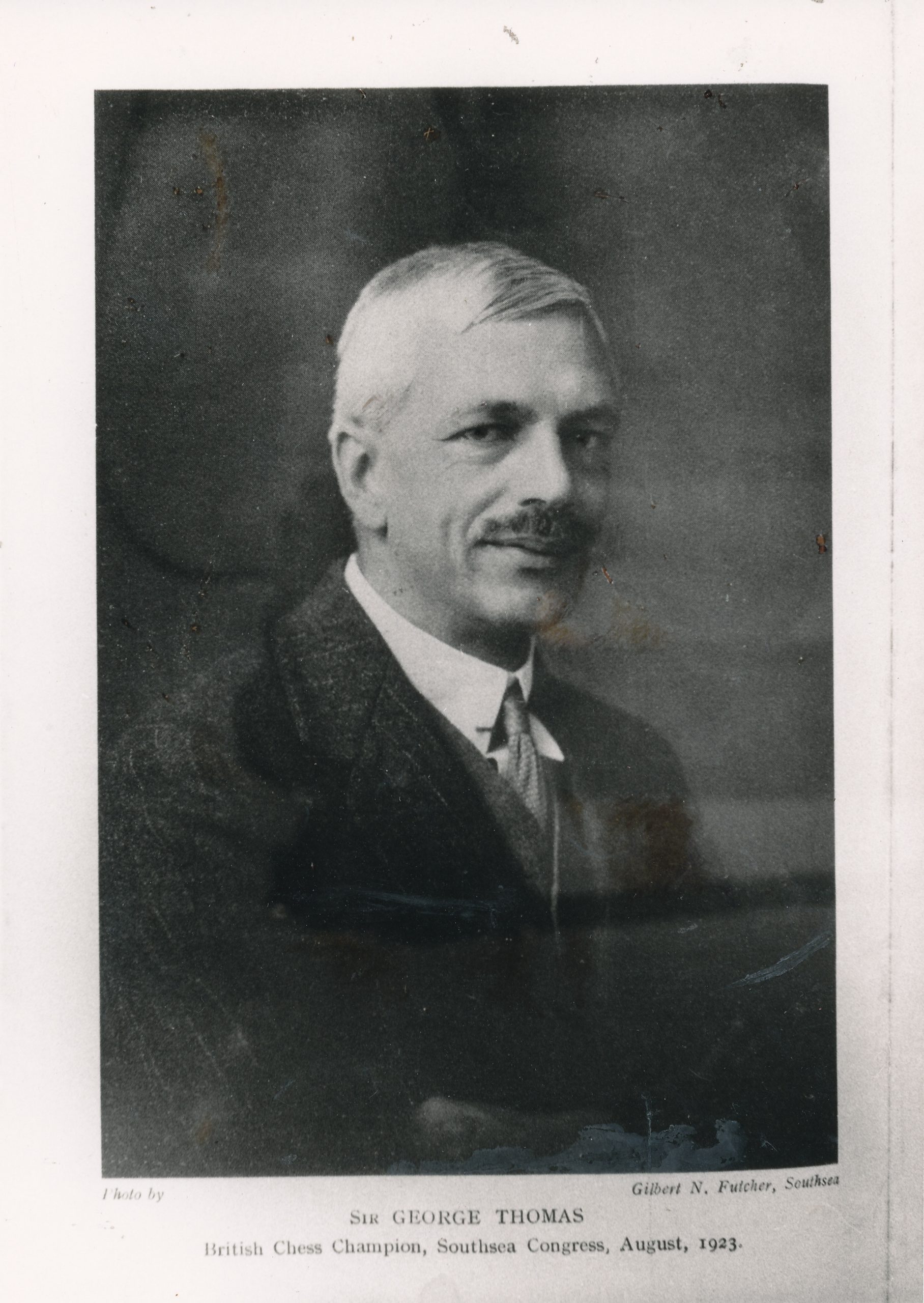
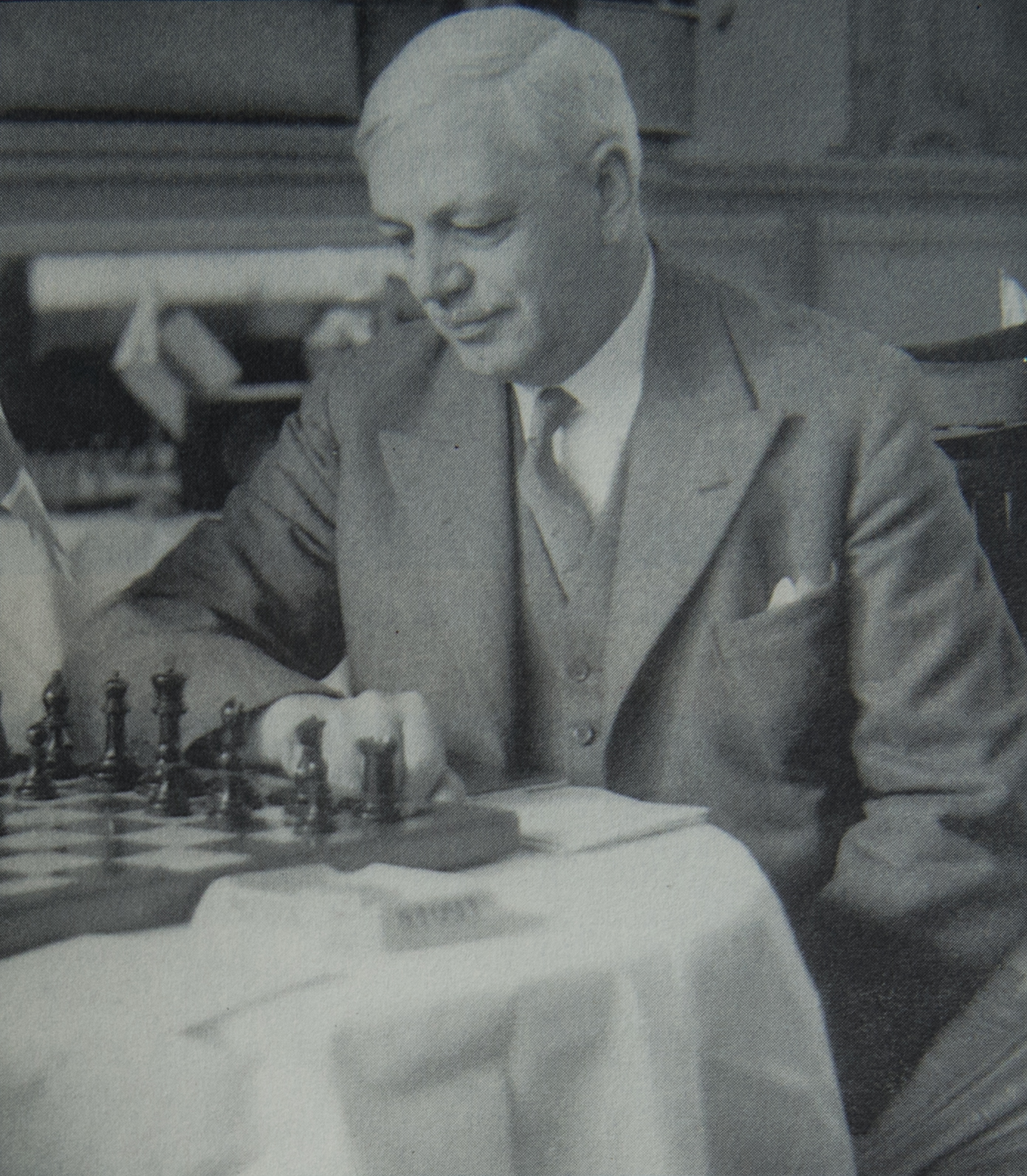
Sir George Thomas, British Chess Champion, Southsea Congress, 1923 Photograph by Gilbert N Fulcher, Southsea
He was known for his keen sense of sportsmanship and for his ability to encourage and inspire younger players. He served for many years on the BCF Junior selection committee and was for a time Games Editor of the British Chess Magazine. FIDE awarded him the titles of international master (1950) and International Judge (1952). (article by Ray Keene)”
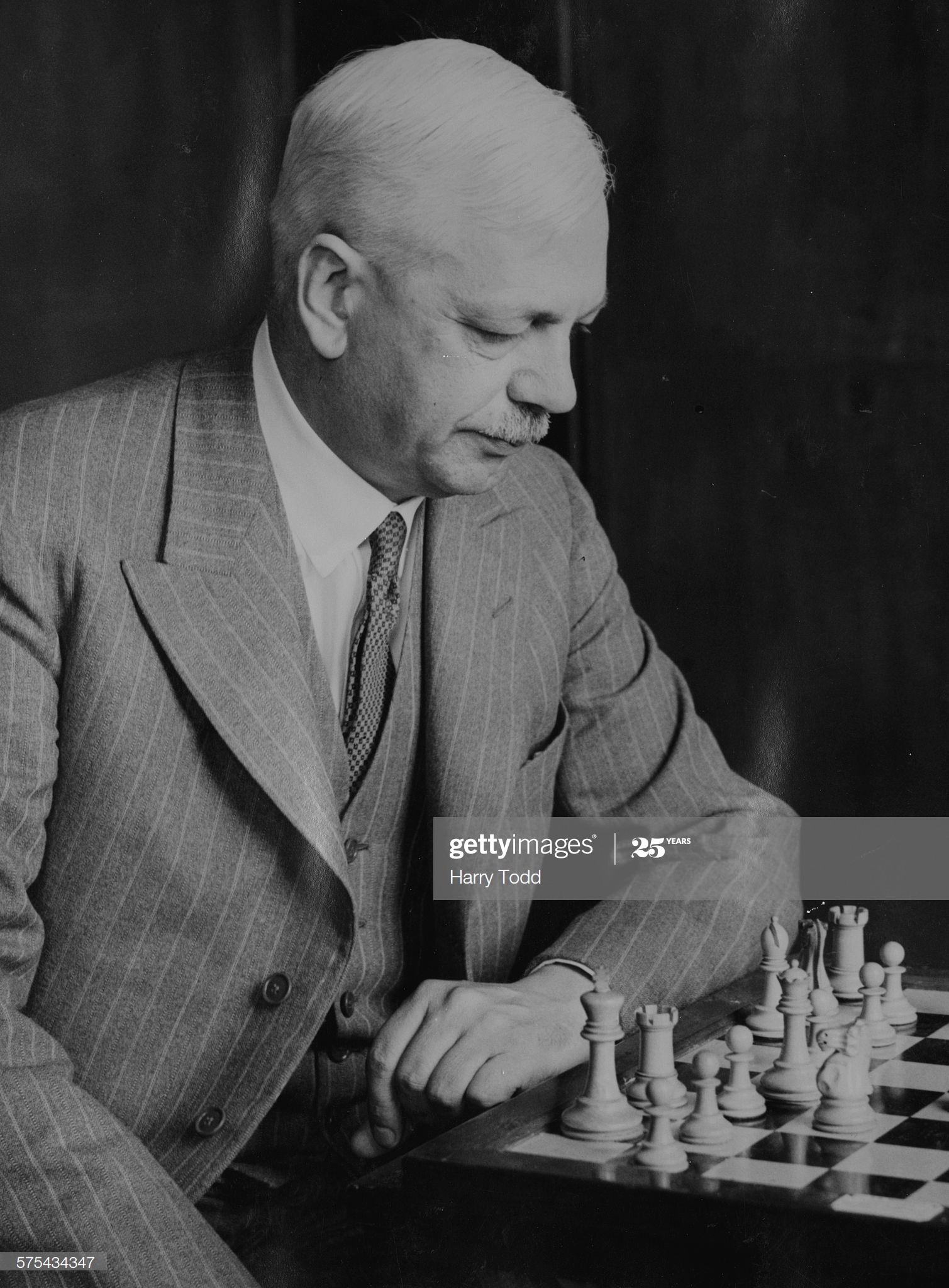
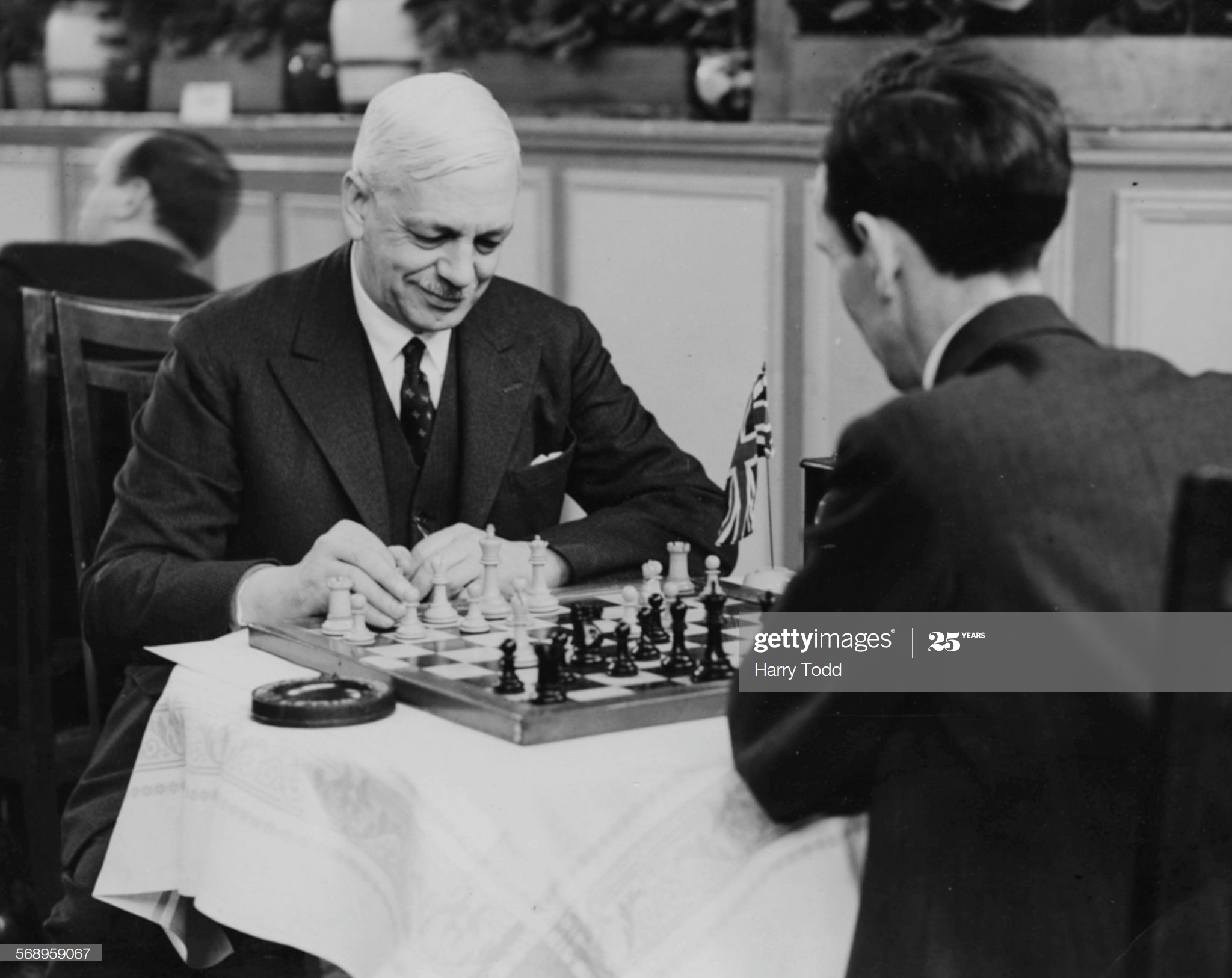
British chess champion Sir George Thomas playing at the Annual British Chess Federation Championship in Yarmouth, England, July 11th 1935. (Photo by Harry Todd/Fox Photos/Getty Images)
Thomas with the White pieces was predominantly a Ruy Lopez devotee.
With the Black pieces against 1.e4 he defended the Lopez and the Queen’s Gambit Declined was his favourite versus 1.d4
From The Encyclopedia of Chess (Robert Hale 1972 and 1976) by Anne Sunnucks :
“International Master (1950), International Judge (1952) and British Champion in 1923 and 1934. All England Badminton Singles Champion, All England Badminton Doubles Champion, Wimbledon tennis player and county hockey player.
Sir George Thomas was born in Constantinople on 14th June 1881. His mother, Lady Thomas, won the first ever ladies’ tournament, which was held in conjunction with the Hastings International Chess Tournament of 1895.
He learned the moves at the age of 4, and as a boy met many of the world’s leading players, including Steinitz, Lasker, Tchigorin and Pillsbury, in his mother’s drawing-room.
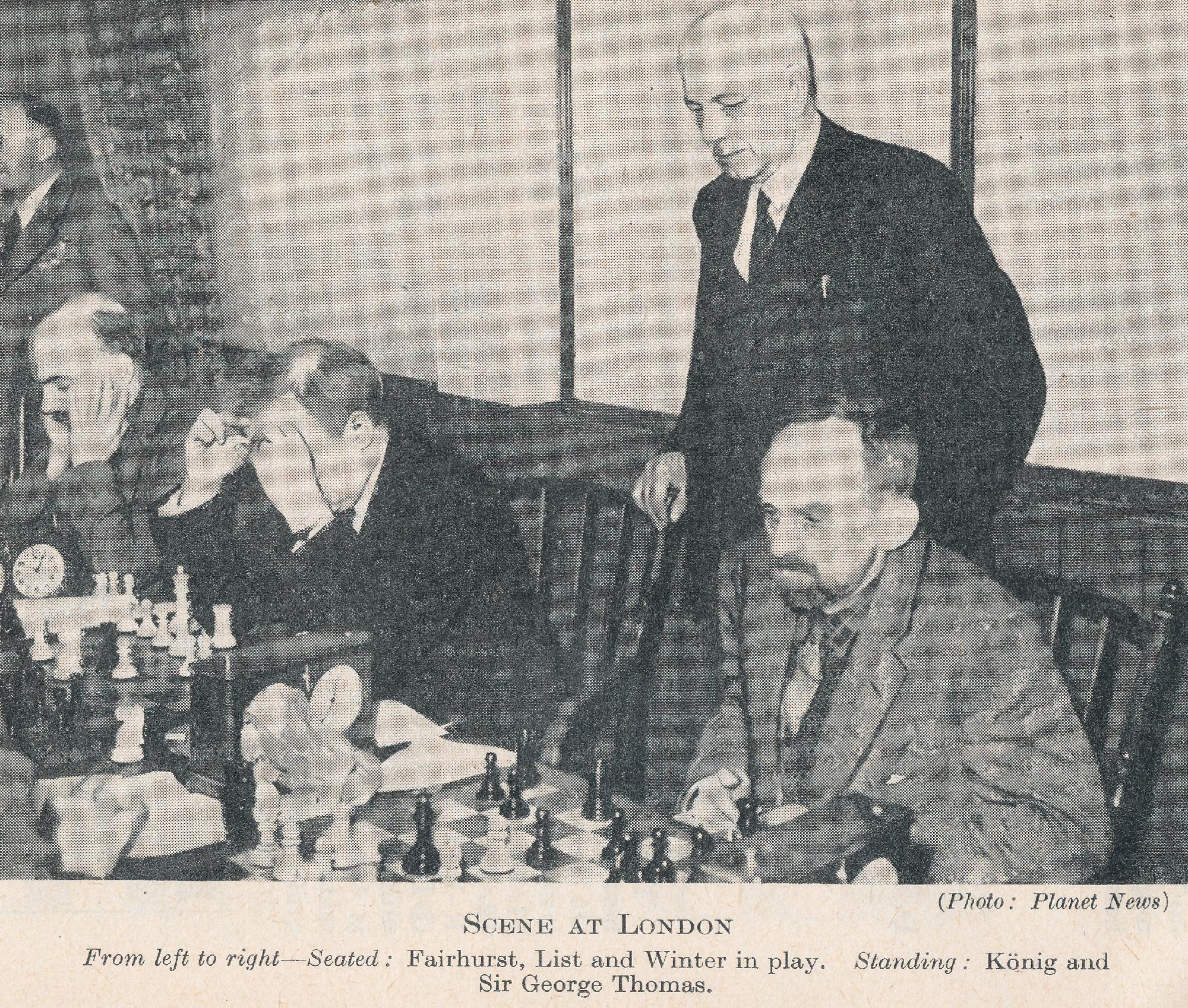
Scene at London. From left to right – Seated : Fairhurst, List and Winter in play. Standing König and Sir George Thomas
Apart from serving as a subaltern in the Army during the 1914-1918 war, Sir George has devoted his life to sport. He played tennis at Wimbledon, played hockey for Hampshire, captained the English Badminton team and was All England Badminton Singles Champion from 1920-1923 and doubles champion nine times.
Sir George Thomas And Brian Reilly Sir George Thomas (left), leader of the British chess team, playing Irishman Brian Reilly at the Easter Chess Congress, Margate, April 24th 1935. (Photo by Harry Todd/Fox Photos/Getty Images)
Sir George played chess for England regularly from 1910 to 1939. He played for the British Chess Federation in the Chess Olympiads of 1927,1930, 1931, 1933, 1935, 1937 and 1939, and captained the team which withdrew from the Buenos Aires Olympiad in 1939 on the out-break of war.
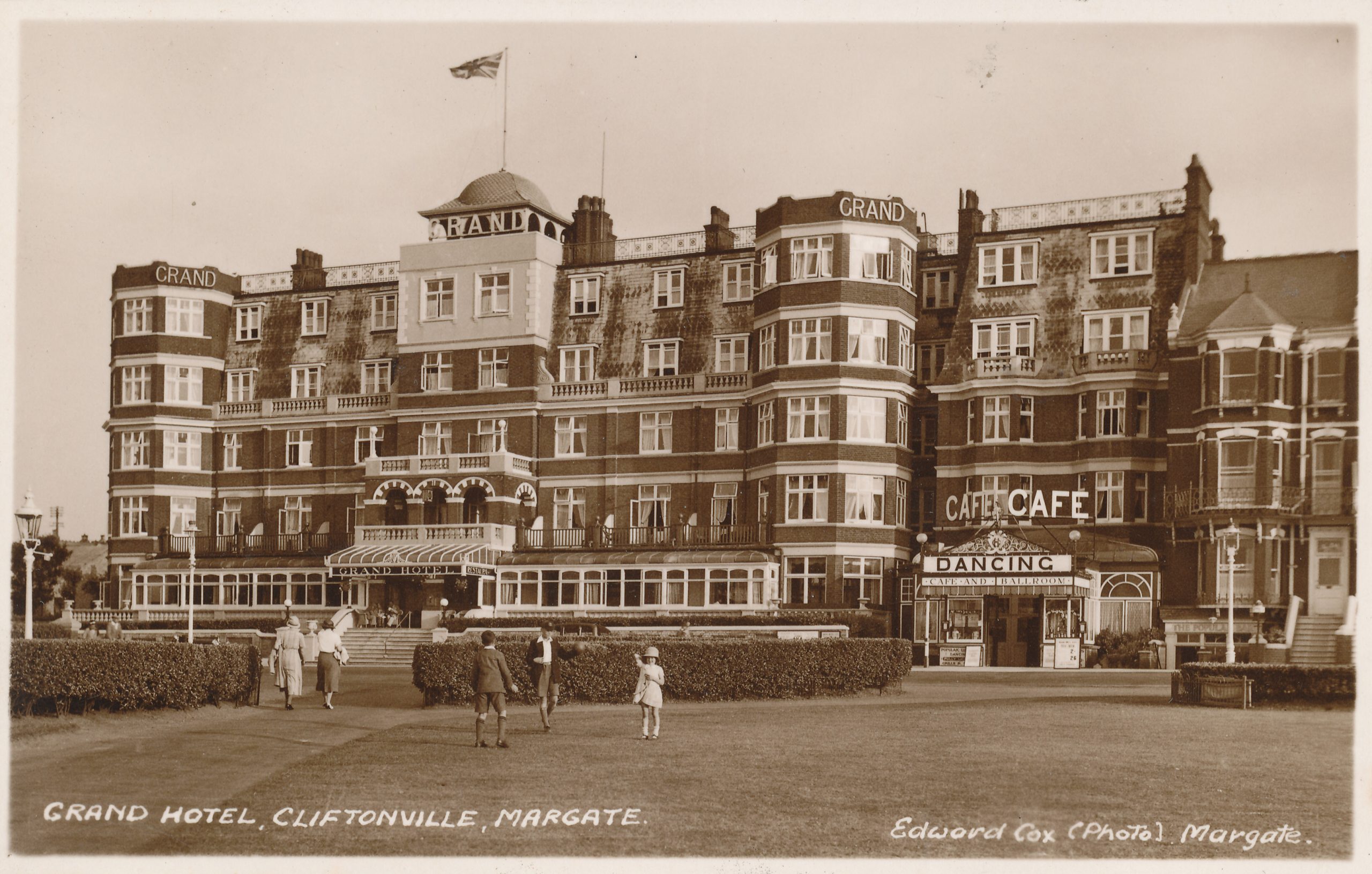
A Brian Reilly “after dinner” postcard from Margate 1936.The Grand Hotel, Cliftonville, Margate. Venue for the Margate tournaments.
His first appearance in the British Championship was in he came 2nd. He also came 2nd in 192l and in 1923 won the first time, thus becoming British Chess Champion and Badminton Champion in the same year.
Sir George’s best performance was at Hastings 1934-1935, when he came =1st. In the last round he needed only a draw against R. P. Michell to come lst, ahead of Euwe, Capablanca, Flohr and Lilienthal, but he lost and had to be content with sharing lst prize with Euwe and Flohr.
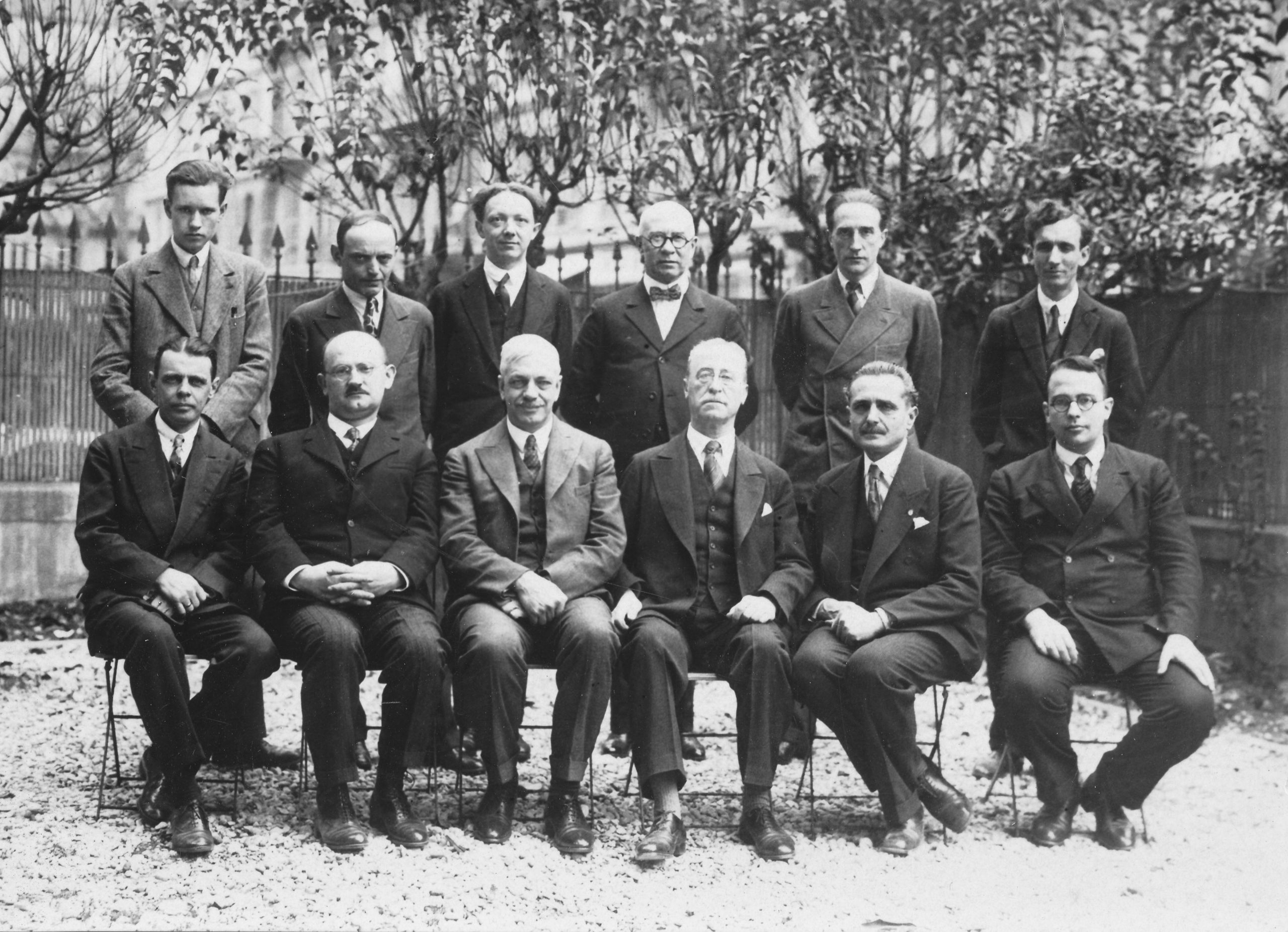
Nice Masters, 1931. Standing : Daniel Noteboom, Abraham Baratz, George Renaud (Organiser), John J O’Hanlon, Marcel Duchamp, Brian Reilly (winner), Seated : Eugene Znokso-Borovsky,, Arpad Vajda, Sir George Thomas, Jacques Mieses, Stefano Roselli del Turco, Jacob Adolf Seitz. British Chess Magazine, 1931, page 201
During his career he has beaten Capablanca, Botvinnik (in consecutive rounds at Hastings 1934-35), Flohr and and drawn with Nimzowitsch, Rubinstein and Capablanca. He been noted for his sportsmanship and for his interest in and encouragement of young players.
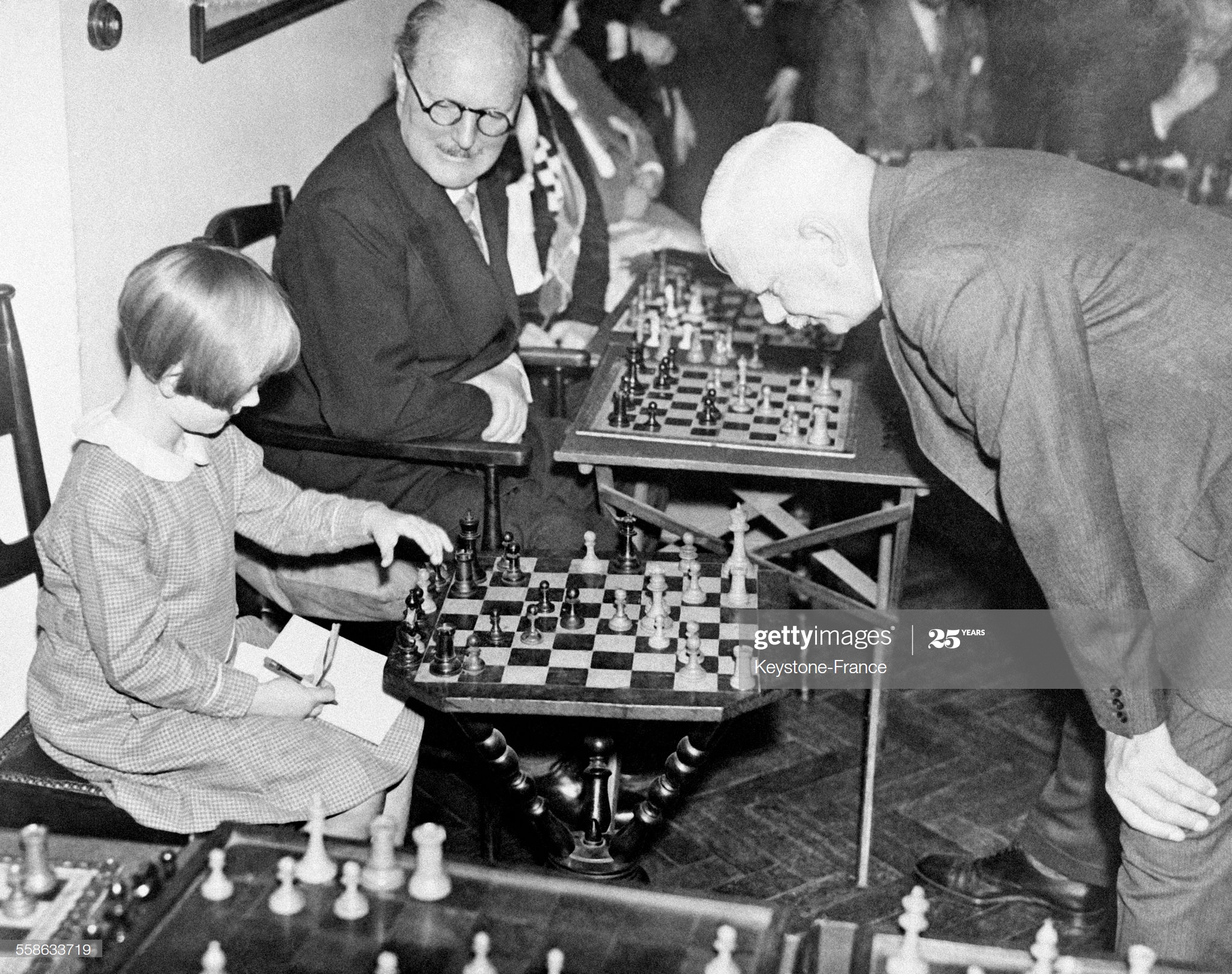
Partie d’échecs Sir Georges Thomas, le célèbre joueur d’échecs britannique, jouant contre sa plus jeune adversaire âgée de 8 ans, à Londres, Royaume-Uni le 24 octobre 1934. (Photo by Keystone-France\Gamma-Rapho via Getty Images)
Since his retirement until the last few years, Sir George continued to attend tournaments as a spectator.
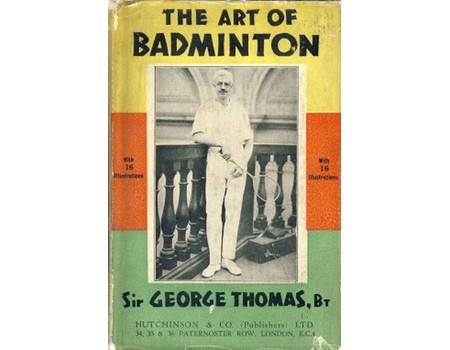
He is the author of The Art of Badminton, published in 1923.
The Art of Badminton
He died on 23rd July 1972 in a London nursing home.”
In the March issue of CHESS for 1963, (Volume 28, Number 427, pp.147-155) William Winter wrote this:
Sir George Thomas
Another great figure of the period between the wars, Sir G. A. Thomas, is happily still with us, although he gave up competitive play some years ago. I think I must have played more games with him than with any other master and he was my principal rival in the battles for the British Championship which we each won twice.
Although he lacks Yates’ spark of genius he is a very fine player indeed and one of the few Englishmen who is a real master of the endgame. Both nationally and internationally he has an excellent record, probably the best of a number of performances being his tie with Euwe and Flohr for lst prize at Hastings 1934-5. Capablanca and Botvinnik were among the also-rans. Thomas beat both of them, a splendid performance when we consider the small number of games ever lost by either. He is the only native Englishman to have scored a win over Capablanca. He acted as captain of all the British teams of which I formed part and an excellent leader he made, firm when necessary, but always considerate to his men especially when they were doing badly.
Sir Thomas, as he was called, is much missed on the Continent where he was highly popular and did a great deal to increase the prestige of British chess.
Here is Part II of GM Matthew Sadler’s appreciation of Sir George.
From The Oxford Companion to Chess (OUP, 1984) by Hooper & Whyld :
“English player. International Master (1950), International Arbiter (1952), British champion 1923 and 1934. His mother, who taught him chess, was winner of one of the first women’s tournaments, Hastings 1895, He played in more than 80 tournaments and achieved his best result at Hastings 1934-5 (about category 9), when he scored +6-1—2 to share first prize with Euwe and Flohr ahead of Botvinnik and Capablanca. Thomas played in seven Olympiads from 1927 to 1939, and in the first the highest percentage score was made by him ( + 9=6) and the Dane Holgar Norman-Hansen (1899- ) (+11=2—2). A leading English player for more than 25 years, Thomas fought many battles at the famous City of London club, winning 16 of the annual championships from 1913-14 to 1938-9. In his sixty-ninth year he gave up competitive chess when, after a hard game, ‘the board and men began to swim before my eyes,’ He continued his active interest in junior events and his visits, now as a spectator, to chess events.
A man of few words, imperturbable, of fine manners. Sir George Thomas was respected throughout the chess world for his sportsmanship and impartiality, and his opinion was often sought when disputes arose between players. The inheritor of both a baronetcy and private means, he
devoted his life to games and sports. Besides his chess he was a keen hockey player, a competitor in international lawn tennis (reaching the last eight at Wimbledon on one occasion), and winner of about 90 badminton titles, notably the All-England men’s singles championship which he won four times, from 1920 to 1923.”
Bill Hartston wrote this in “On the Knight Shift”, Chapter 20 of the The Chess Player’s Bedside Book (Batsford, 1975) :
“In the days when chess was perhaps a more noble pastime, one of England’s leading players was the Baronet, Sir George Thomas. A true gentleman and sportsman, he considered it rather unprincipled to analyse adjourned games before their resumption and could only be persuaded to look at his own positions after being assured that his opponents were certainly taking full advantage of the adjournment in this manner.”
We focus on the British Chess Scene Past & Present!
This website uses cookies to improve your experience. We'll assume you're ok with this, but you can opt-out if you wish. Cookie settingsACCEPT
Privacy & Cookies Policy
Privacy Overview
This website uses cookies to improve your experience while you navigate through the website. Out of these cookies, the cookies that are categorized as necessary are stored on your browser as they are as essential for the working of basic functionalities of the website. We also use third-party cookies that help us analyze and understand how you use this website. These cookies will be stored in your browser only with your consent. You also have the option to opt-out of these cookies. But opting out of some of these cookies may have an effect on your browsing experience.
Necessary cookies are absolutely essential for the website to function properly. This category only includes cookies that ensures basic functionalities and security features of the website. These cookies do not store any personal information.