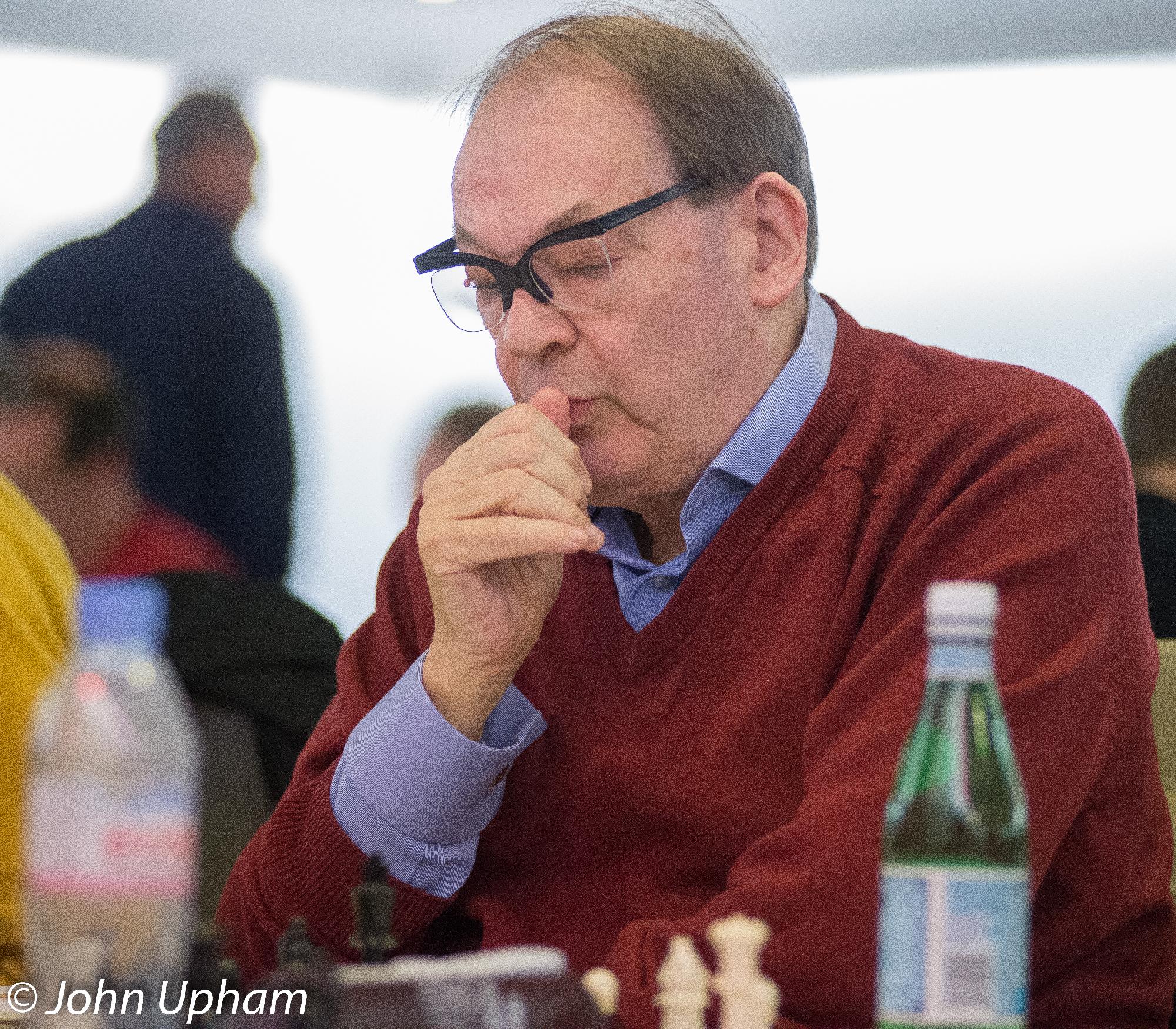
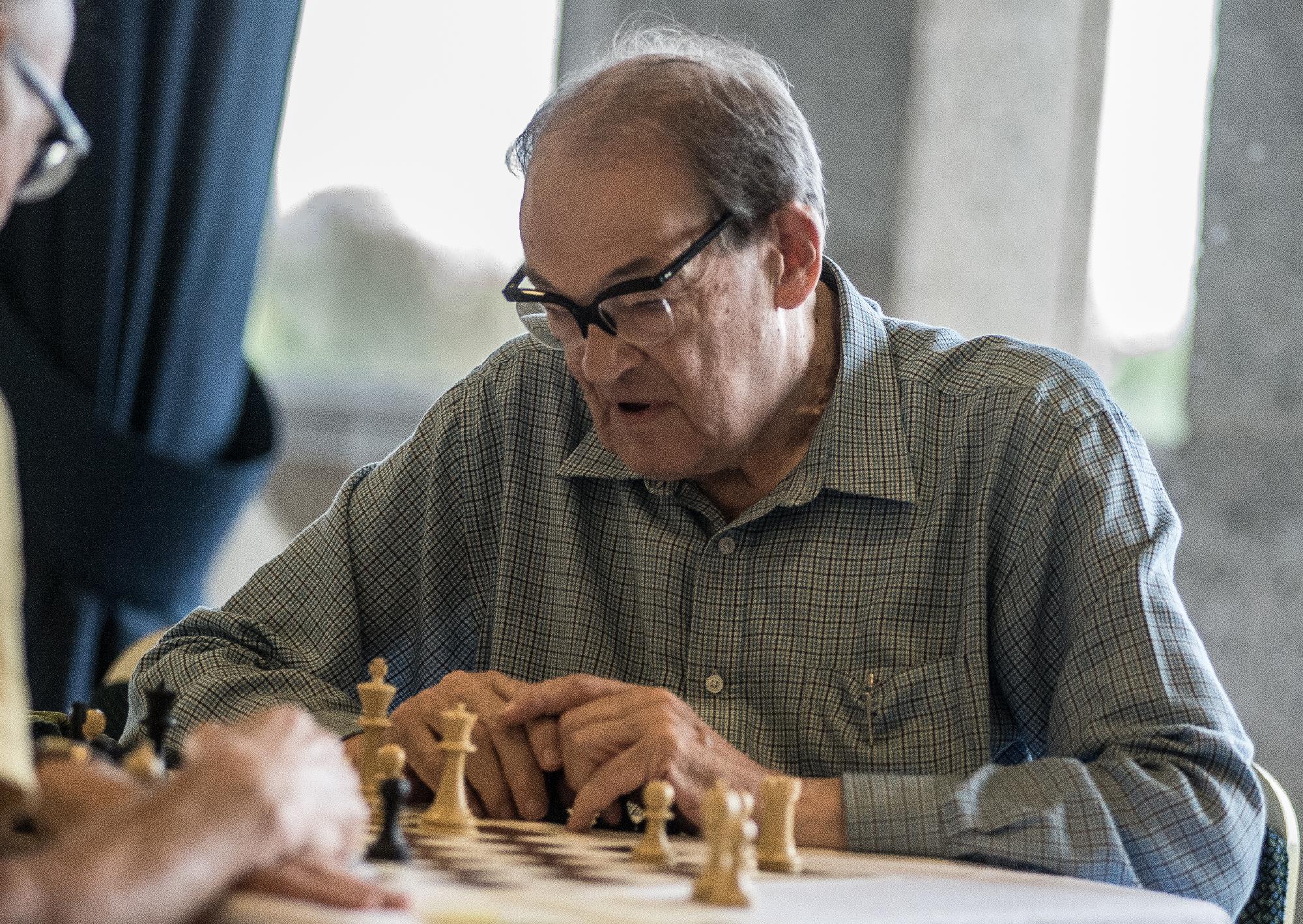
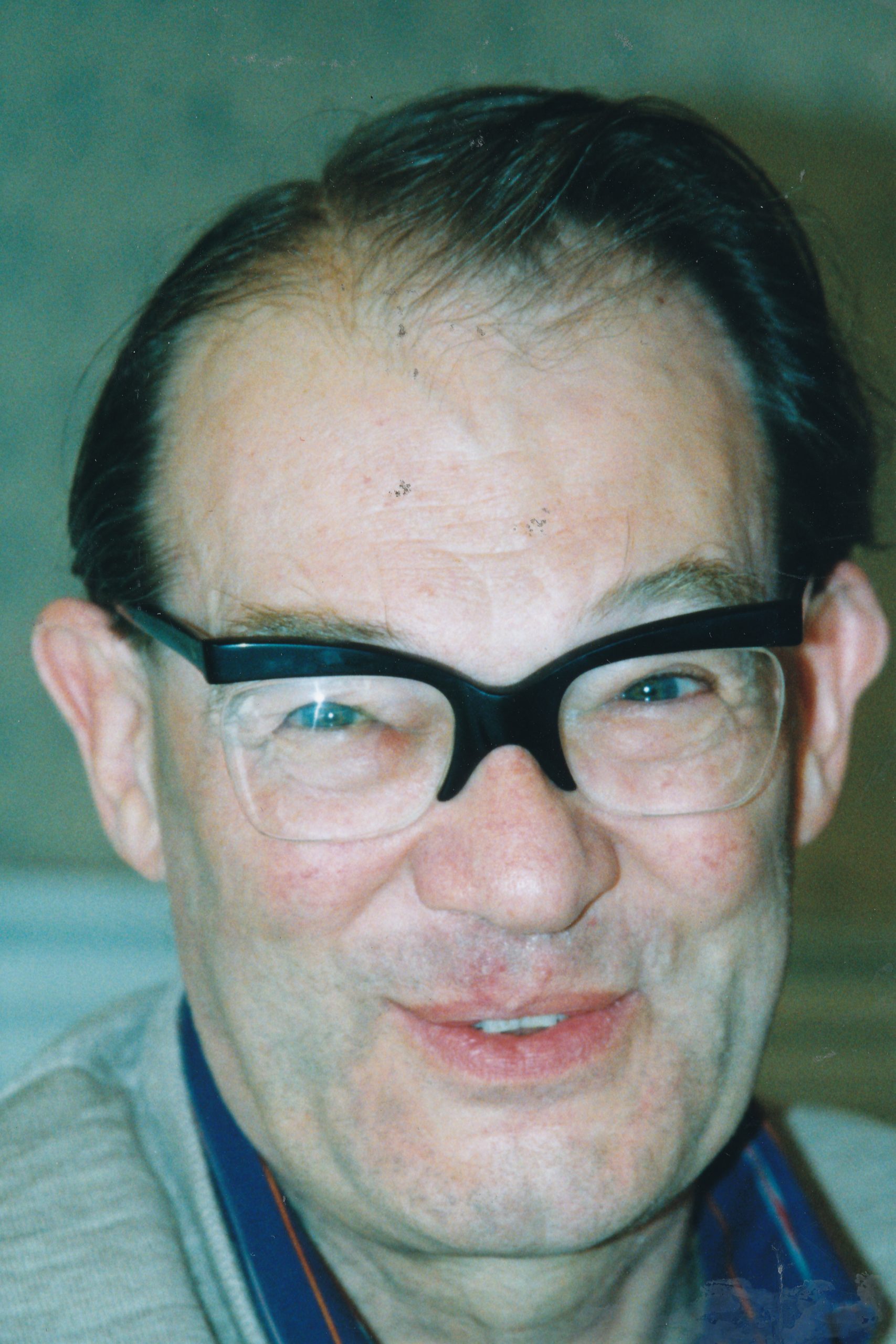
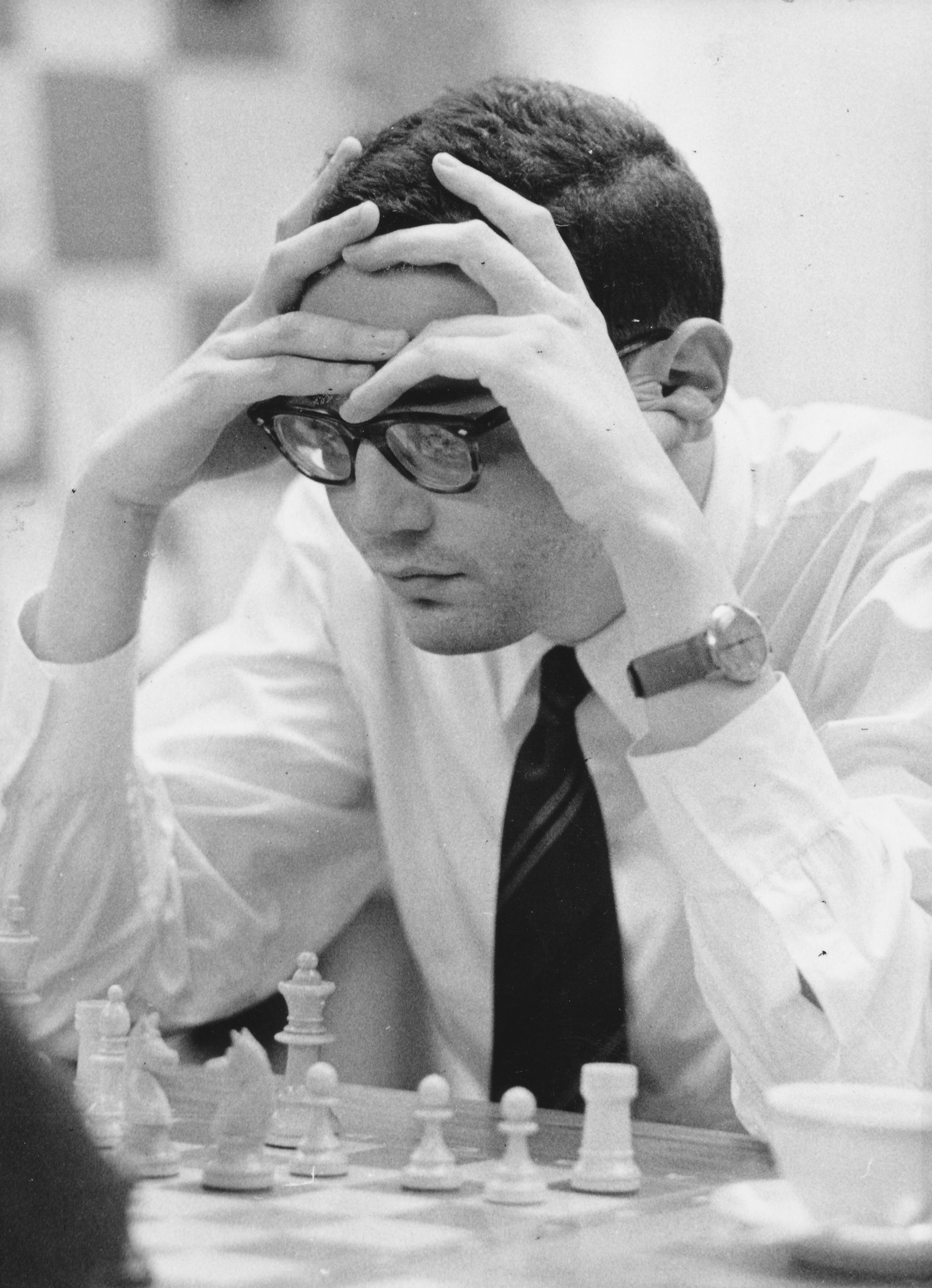
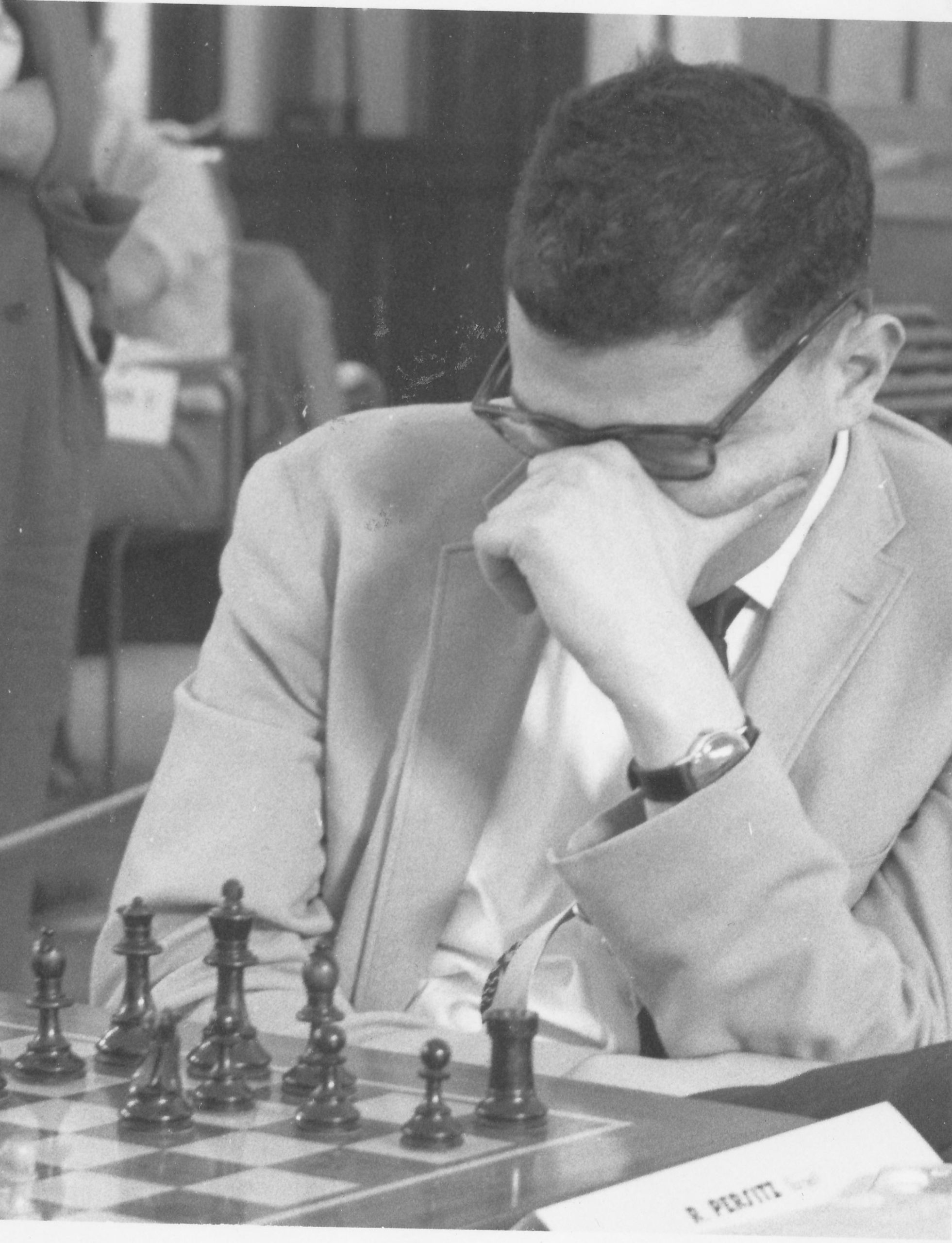
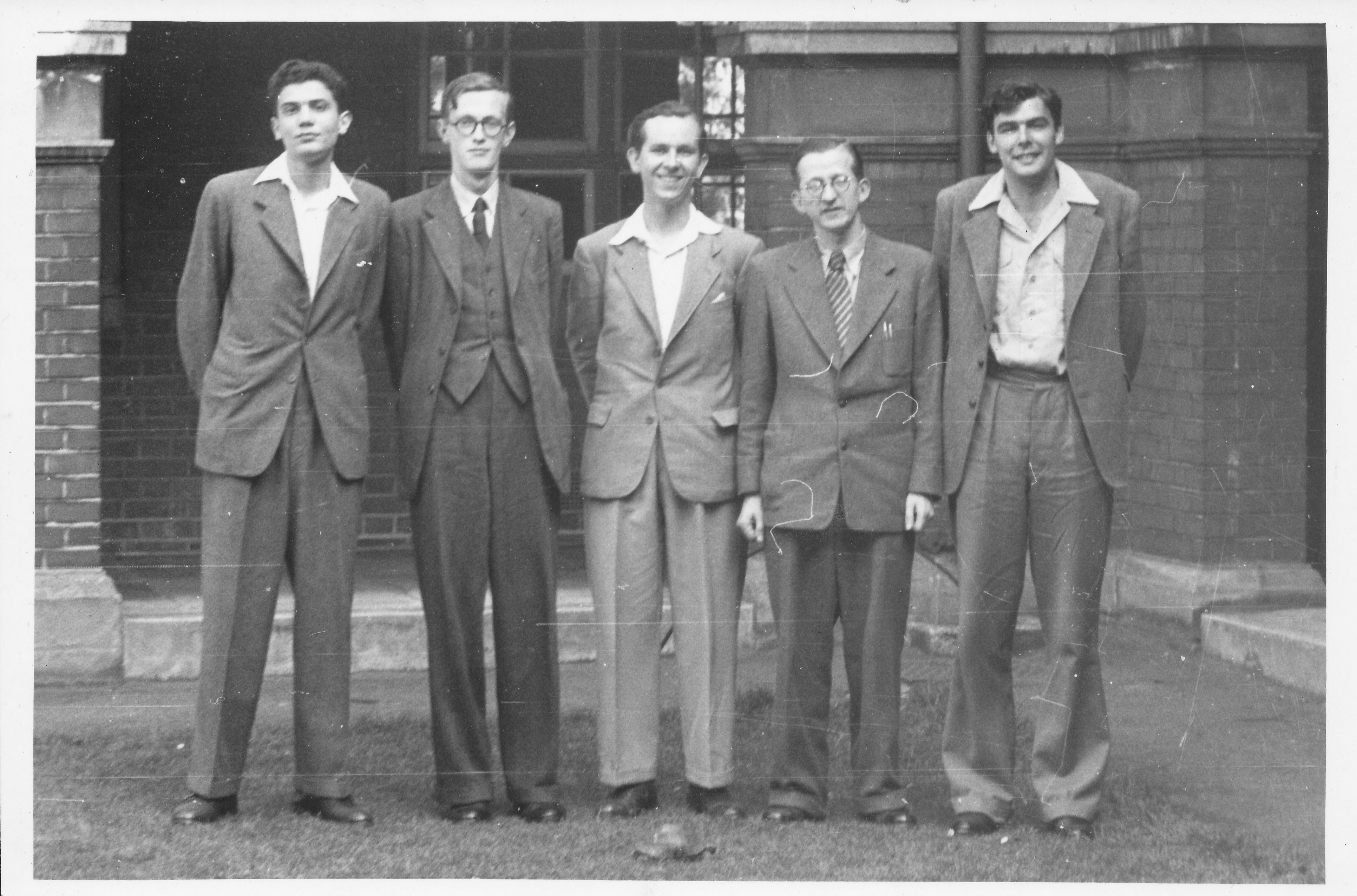
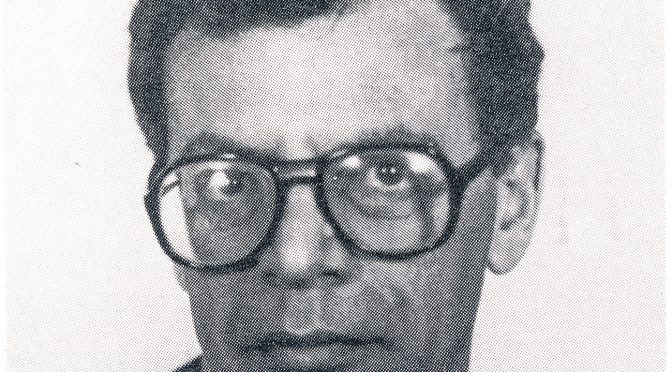
David Anderton OBE from the final 4NCL weekend of 2014, courtesy of John Upham Photography
BCN remembers CM David Anderton OBE who passed away on Friday, April 1st 2022.
In the 1977 New Years Honours List, Civil Division, David was awarded the OBE. The citation read simply : “For services to Chess”
David William Anderton was born in the district of Walsall, Staffordshire, West Midlands. His mother’s maiden name was Coltart and David resided in Walsall.
David was married to Doreen in 2005.
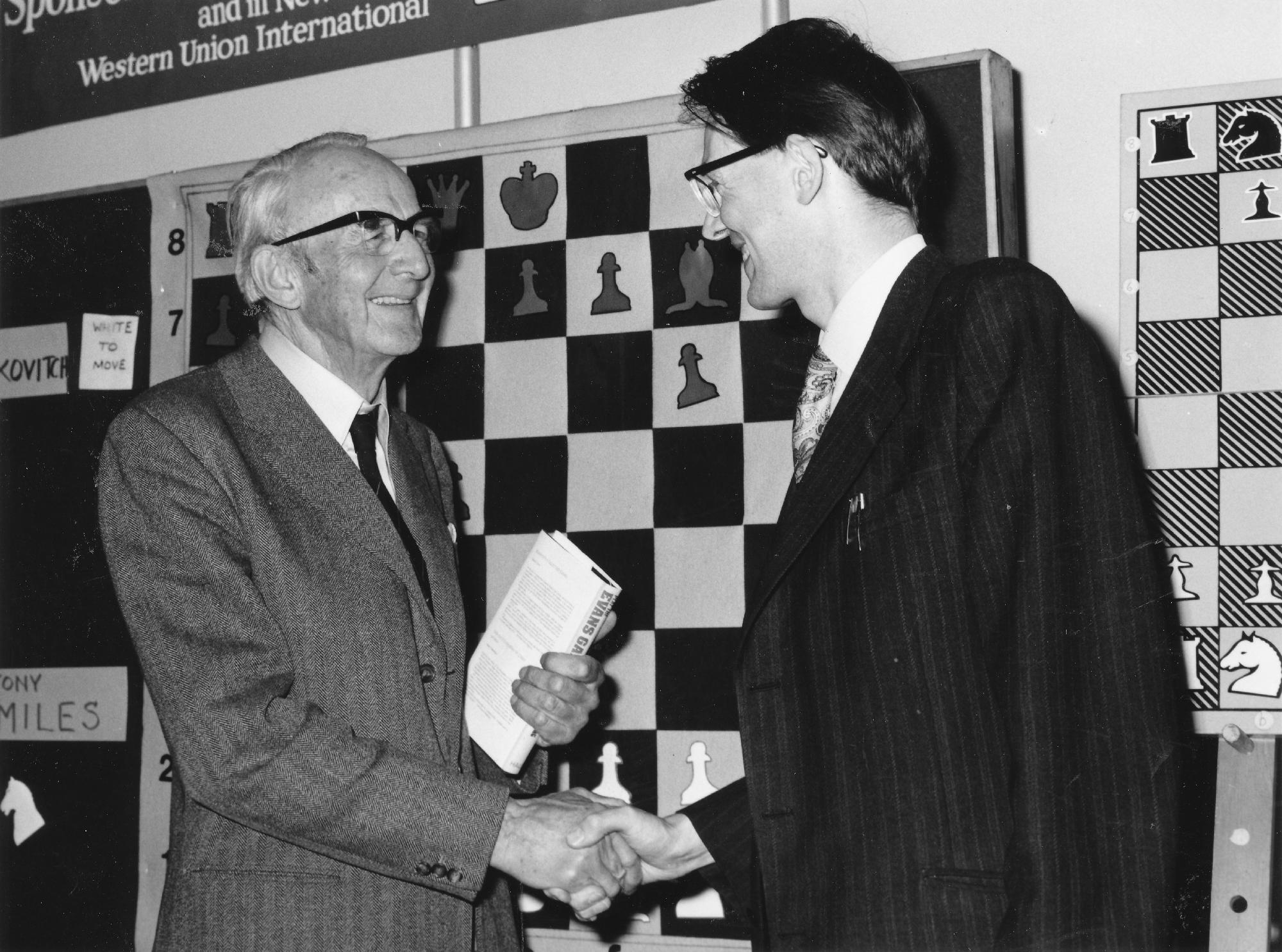
David Anderton (rhs) congratulates Sir Philip Stuart Milner-Barry for winning the “Board of Honour ” game versus Edward Lasker at the 1976 Lloyds Bank Match by Telex, London – New York. From BCM, volume XCVI (96) Number 11 (August), Page 494. The venue was the Bloomsbury Hotel, London. Photo courtesy of Lloyds Bank
David was an Honorary Life Vice-President of the English (formerly British) Chess Federation.
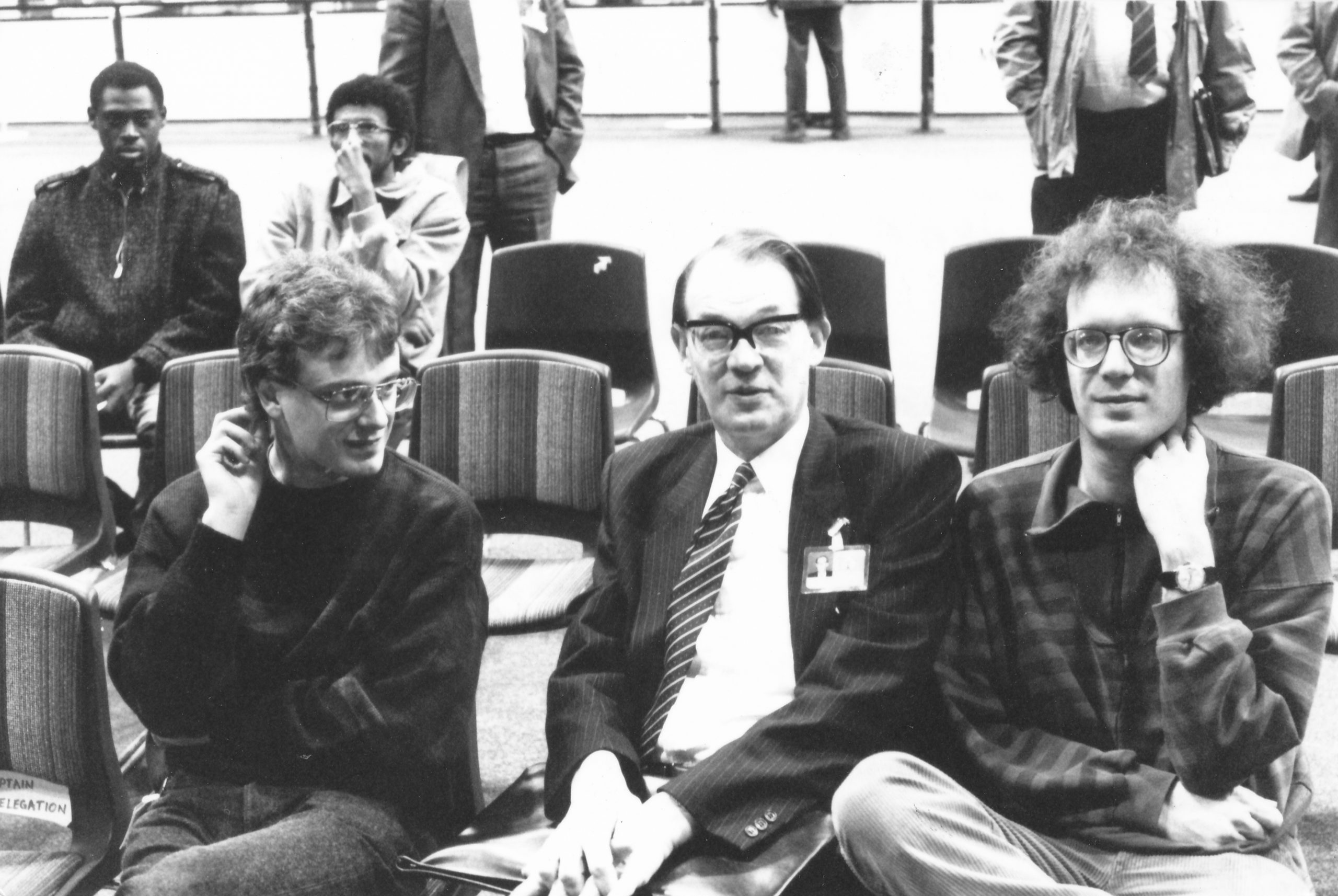
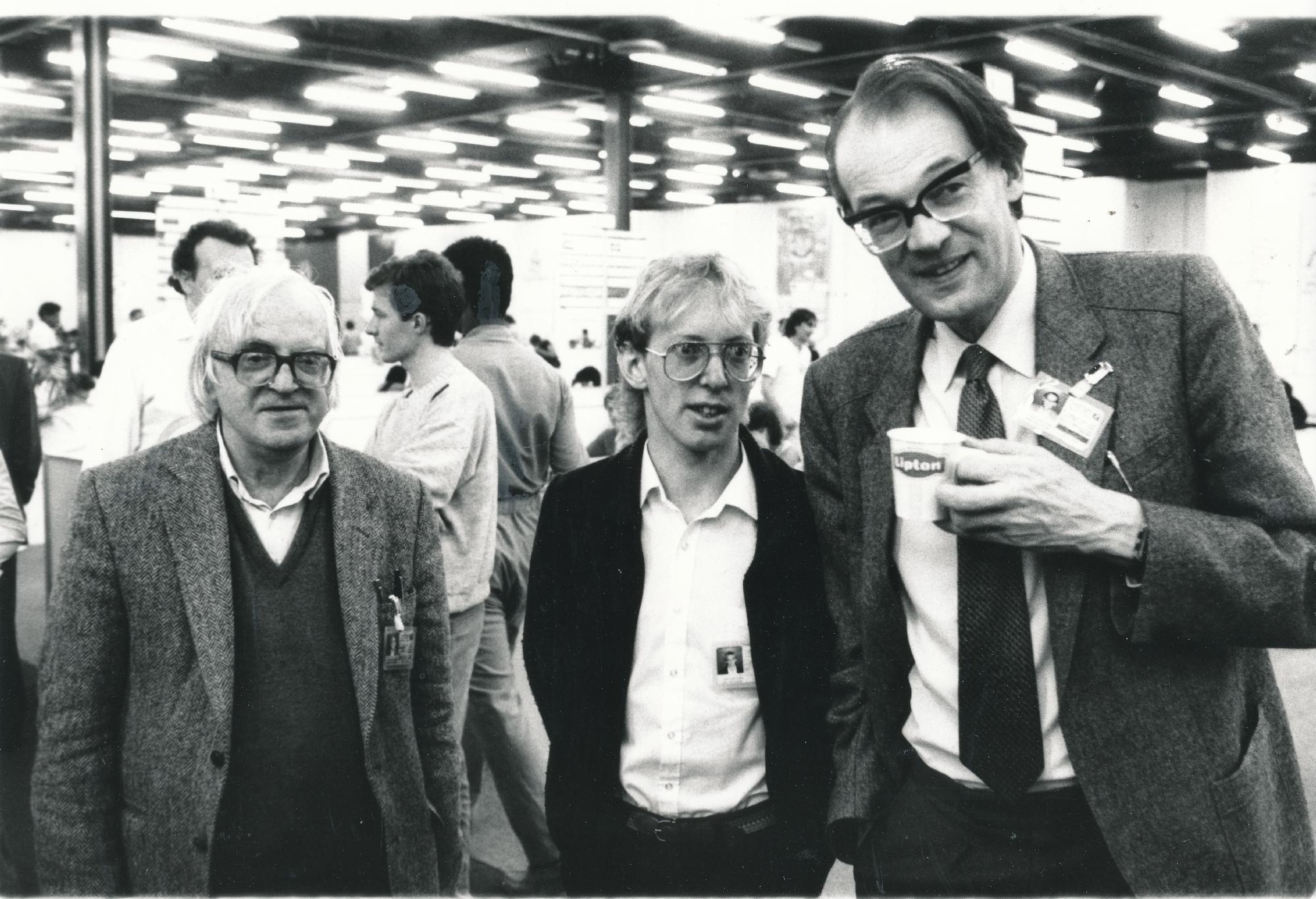
John Nunn, David Anderton and Jonathan Speelman
“David won the ECF President’s Award in 2009 following his stepping down as ECF legal expert. This is the citation from the 2010 ECF Yearbook :
“As this is Gerry Walsh’s last year as President it was considered appropriate that he be allowed to choose someone receive the award. Gerry has worked with David for all his time with BCF and ECF and has selected him due to his tireless and selfless devotion to both the BCF and ECF over many years.
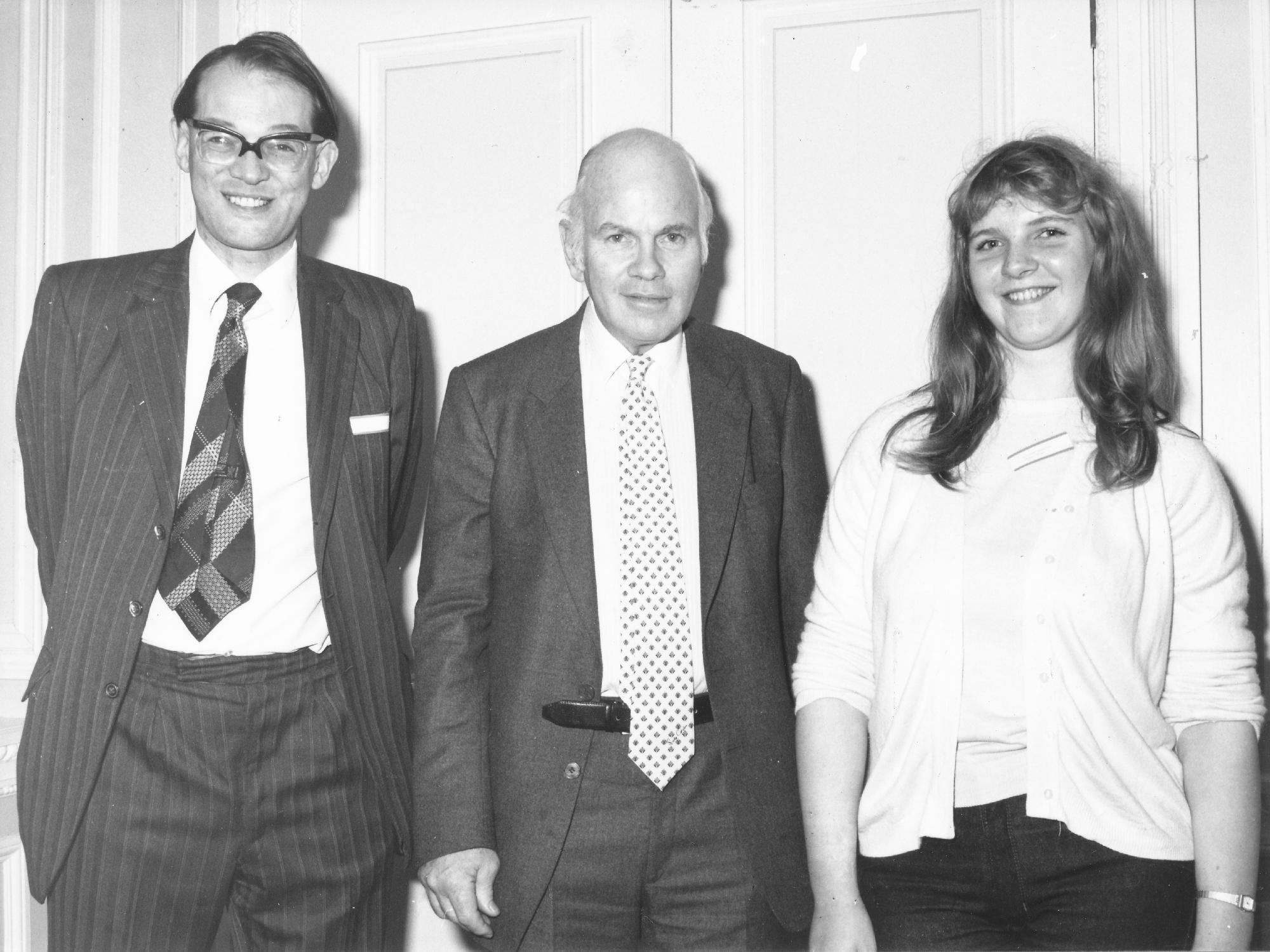
David Anderton OBE, ? and Teresa Needham
Most of you will know David and will agree that this is a well deserved award. It is fair to state that David’s assistance over the years has been invaluable and that without it many areas of the Federation would have found it difficult, if not impossible to operate.
Jim Plaskett with David Anderton OBE at the 1983 Benedictine International (Manchester)
Since my election David has been a constant friend and confidante. He has invariable given sound advice throughout my term of office. It was John Wickham who rang me and suggested that due to my length of tenure, a special award might be in order.
Jim accepts the 1981 Grand Prix shield from David Anderton OBE
After years of selfless and generous devotion serving as ECF President, International Director, Captain of the England Team and legal adviser, this seems to be a fitting tribute.
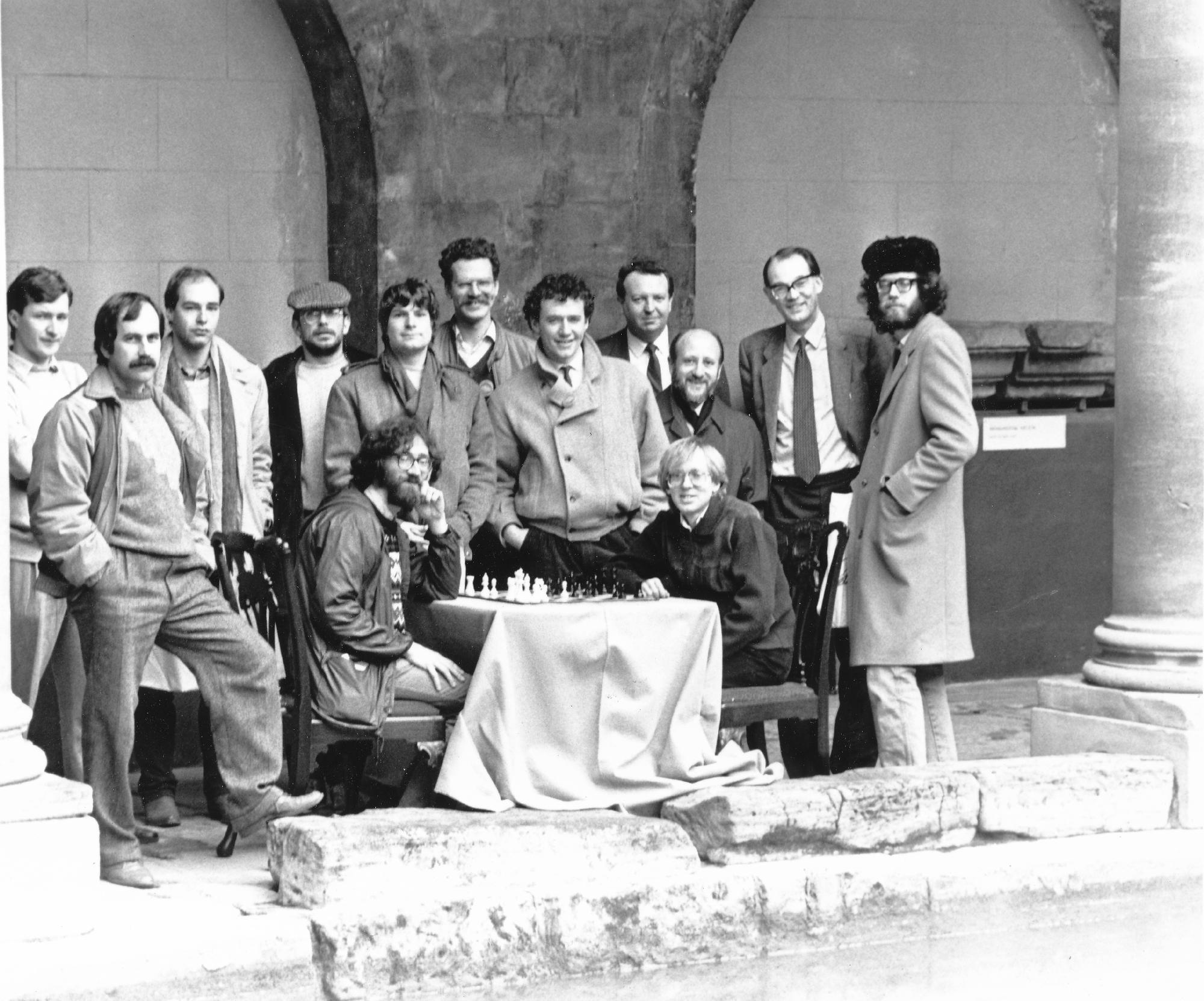
From the Praxis Bath Zonal Tournament of 1987. David Anderton OBE is second from right
David’s advice both legal and general, has been invaluable in such matters as the John Robinson legacy and the change of name from BCF to ECF Limited, and I certainly hope that this advice will continue.
Gerry Walsh”
Bob Wade OBE, Murray Chandler MNZM and David Anderton OBE
David is a FIDE Candidate Master.
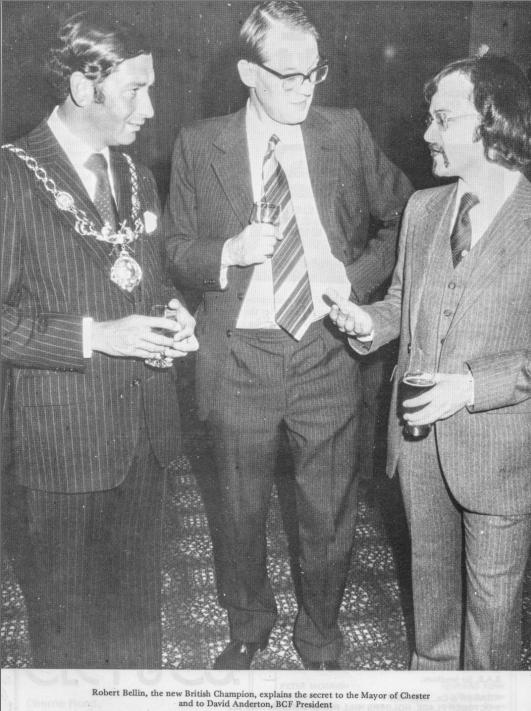
From the BCF 1979-80 Year Book of Chess : Robert Bellin, the new British Champion, explains the secret to the Mayor of Chester (?) and to David Anderton, BCF President
With the White pieces David exclusively plays 1.d4 aiming for a Queen’s Gambit and main lines.
With Black David plays the Winawer and the Classical French plus the Lenningrad Dutch.
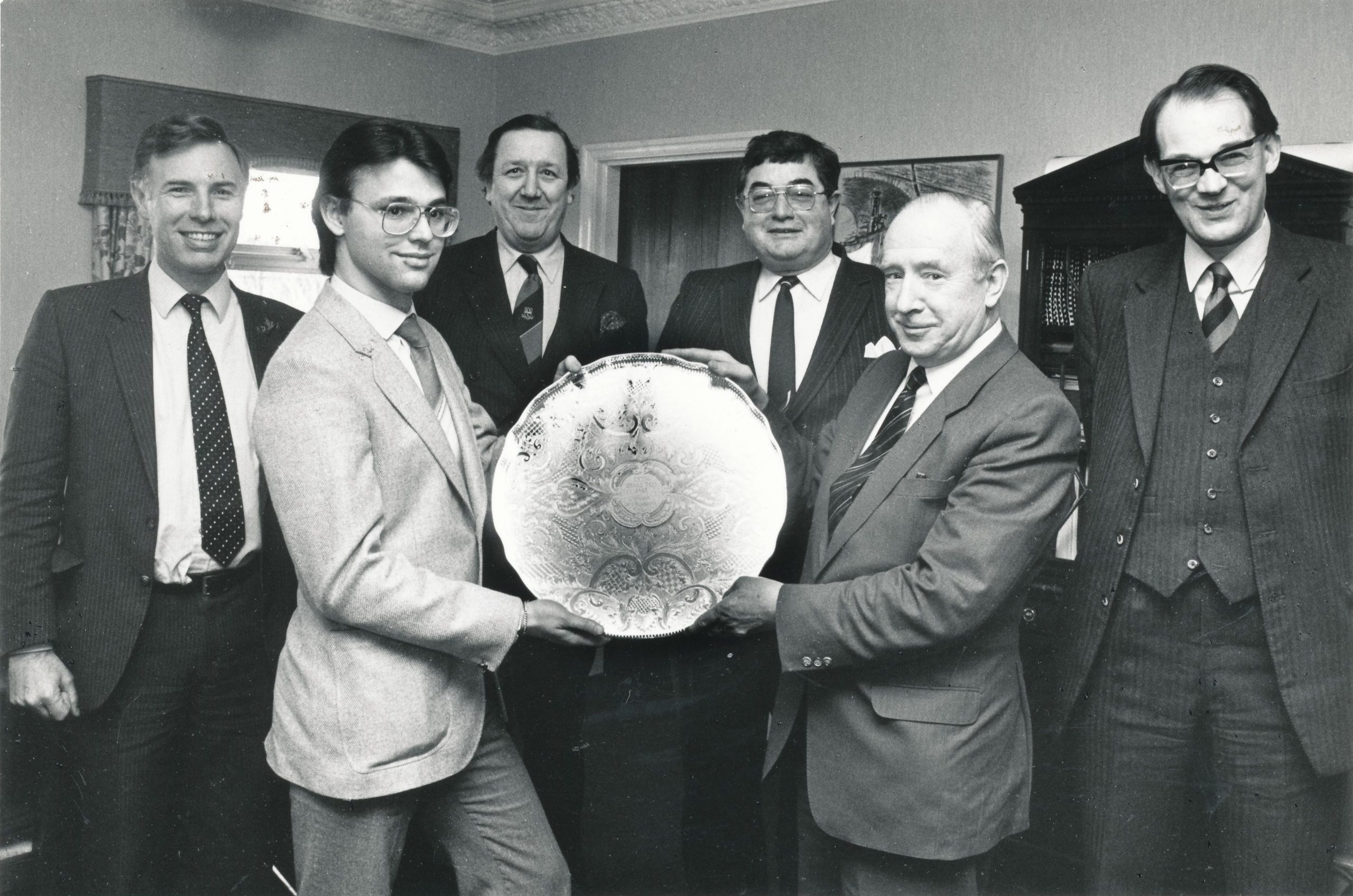
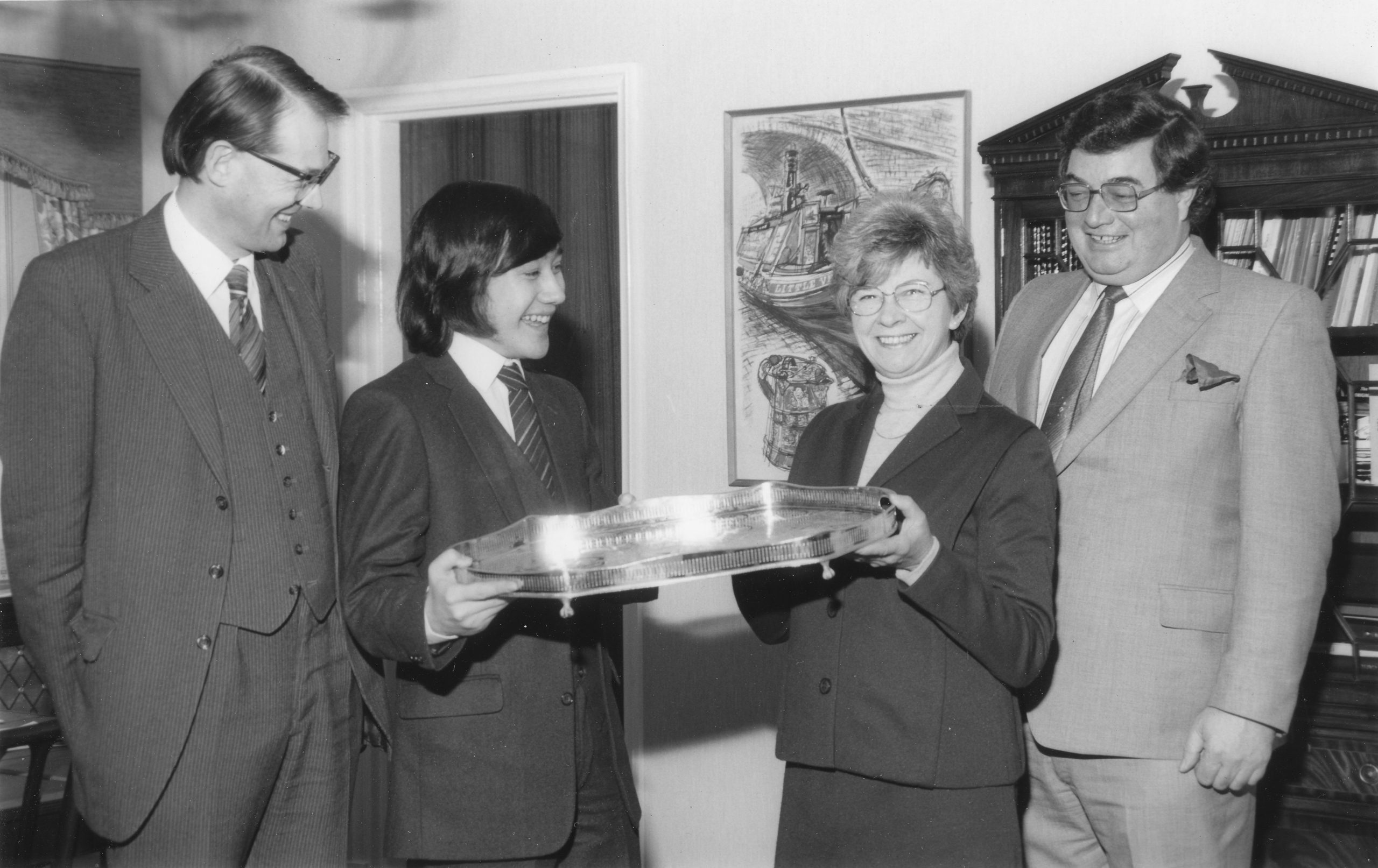
Mrs. Joan Agar; Chairman of Leigh Interests, presents the Leigh trophy (for 1981) to Mark Hebden. Left, David Anderton, BCF President; on the right Malcolm Wood, Leigh’s Chief Executive. BCM, 1981, page 104
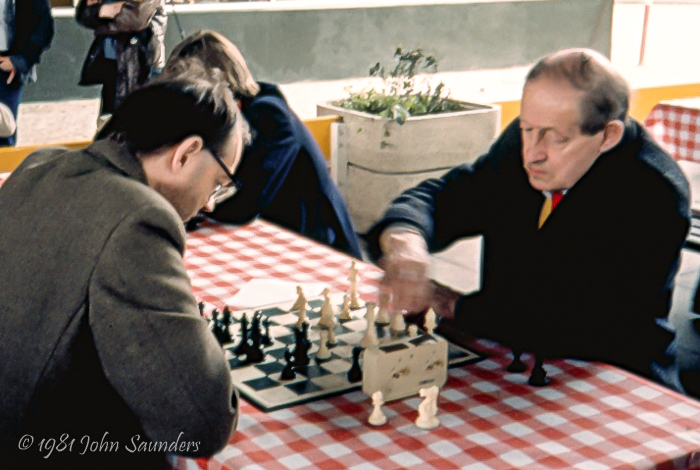
DW Anderton OBE plays BH Wood MBE in 1981 in a Blitz tournament outside of the National Film Theatre. Photograph courtesy of John Saunders
During 1989-93 David was an Executive Board Member of FIDE.
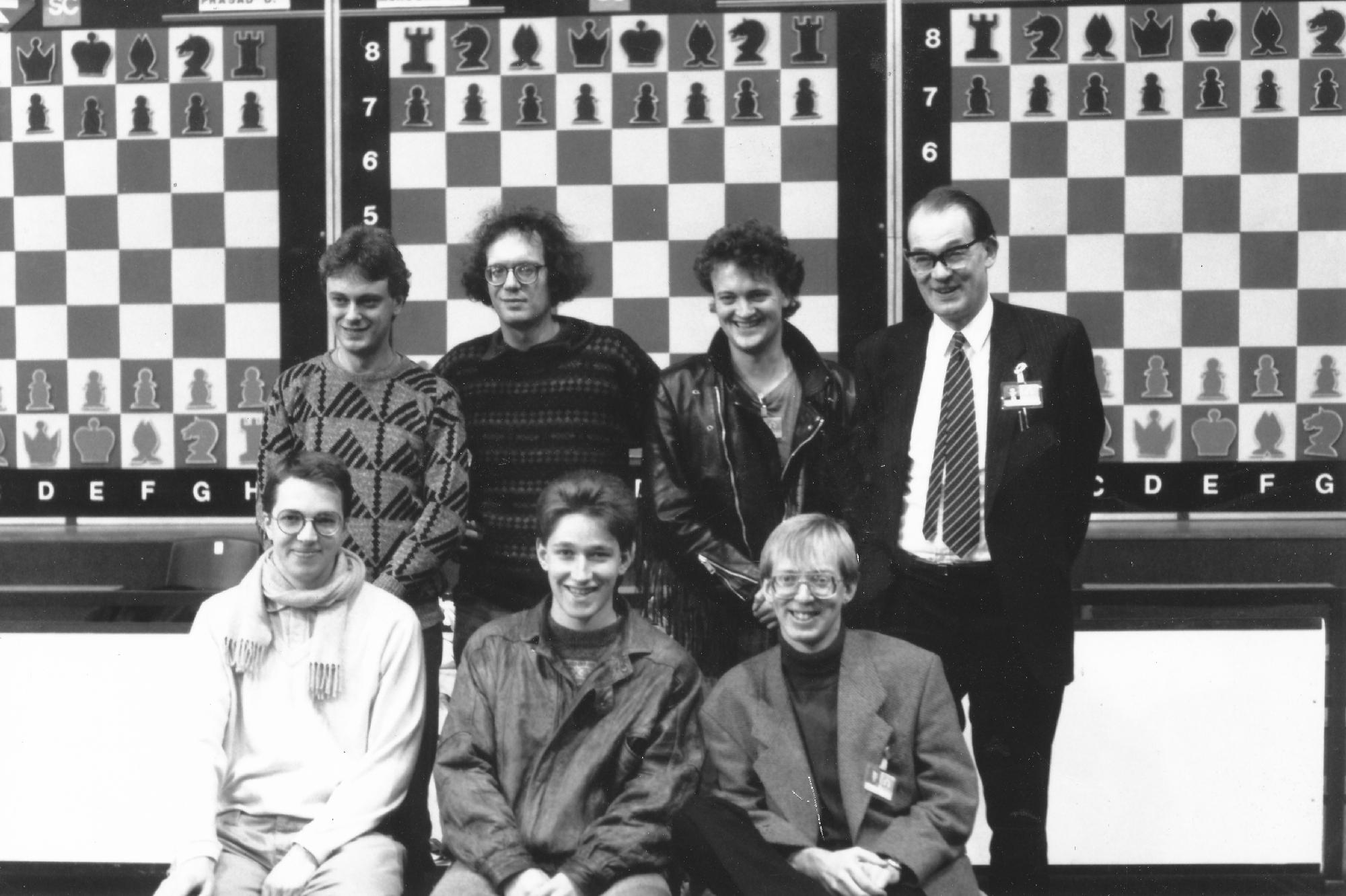
The England Team from the 1990 Novi Sad Olympiad : John Nunn, Jon Speelman, Julian Hodgson, David Anderton OBE (Captain), Nigel Short, Michael Adams and Murray Chandler
In 2015 David stood down from all of his roles within the ECF.
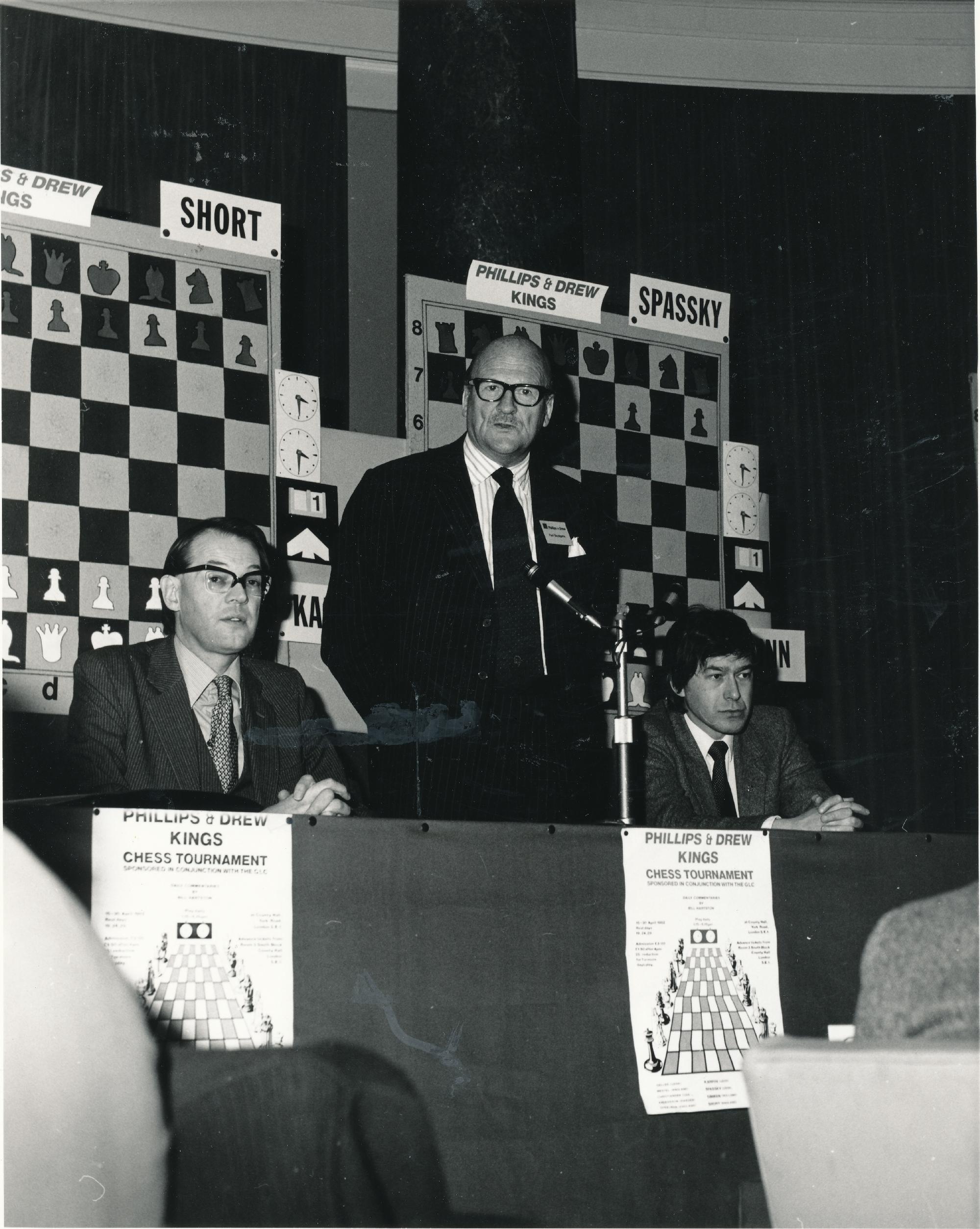
David Anderton OBE, Paul Bazalgette (Senior Partner at Philips & Drew) and Tony Banks (GLC Arts & Recreation Department) at the 1982 Philips and Drew Kings Tournament Opening Ceremony. Photograph by Clive Field
David has won the British Seniors Championship in 2003 (shared), 2005, 2007 (shared), 2009 (shared) and 2011.
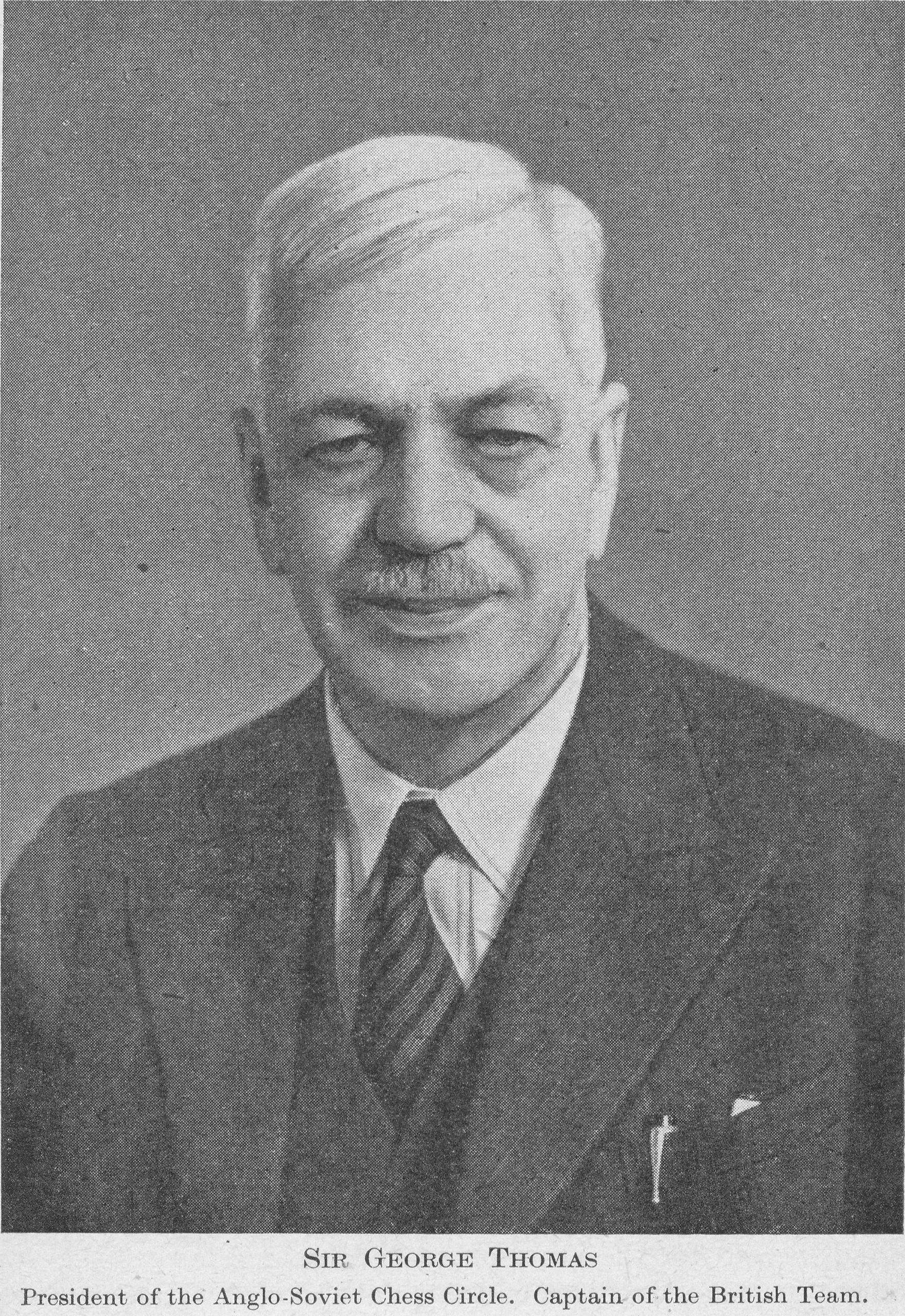
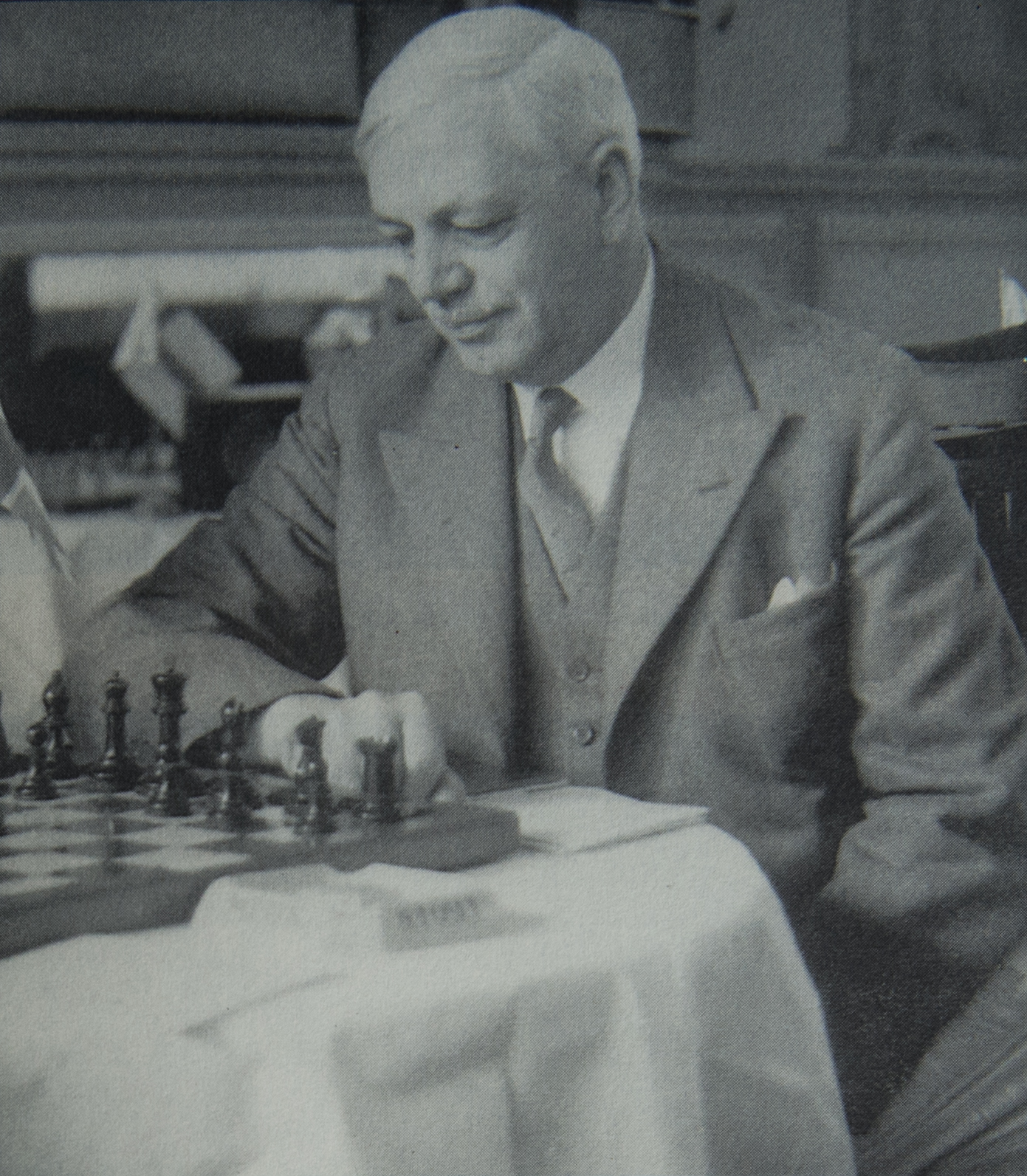
Sir George Thomas, President of the Anglo-Soviet Chess Circle. Captain of the British Team
We remember Sir George Alan Thomas who died on July 23rd, 1972
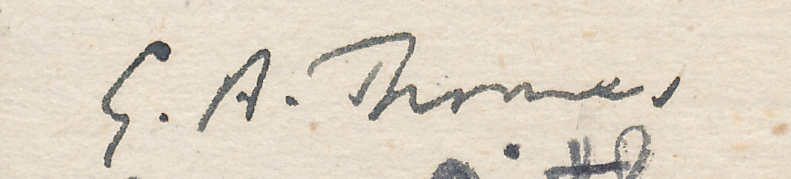
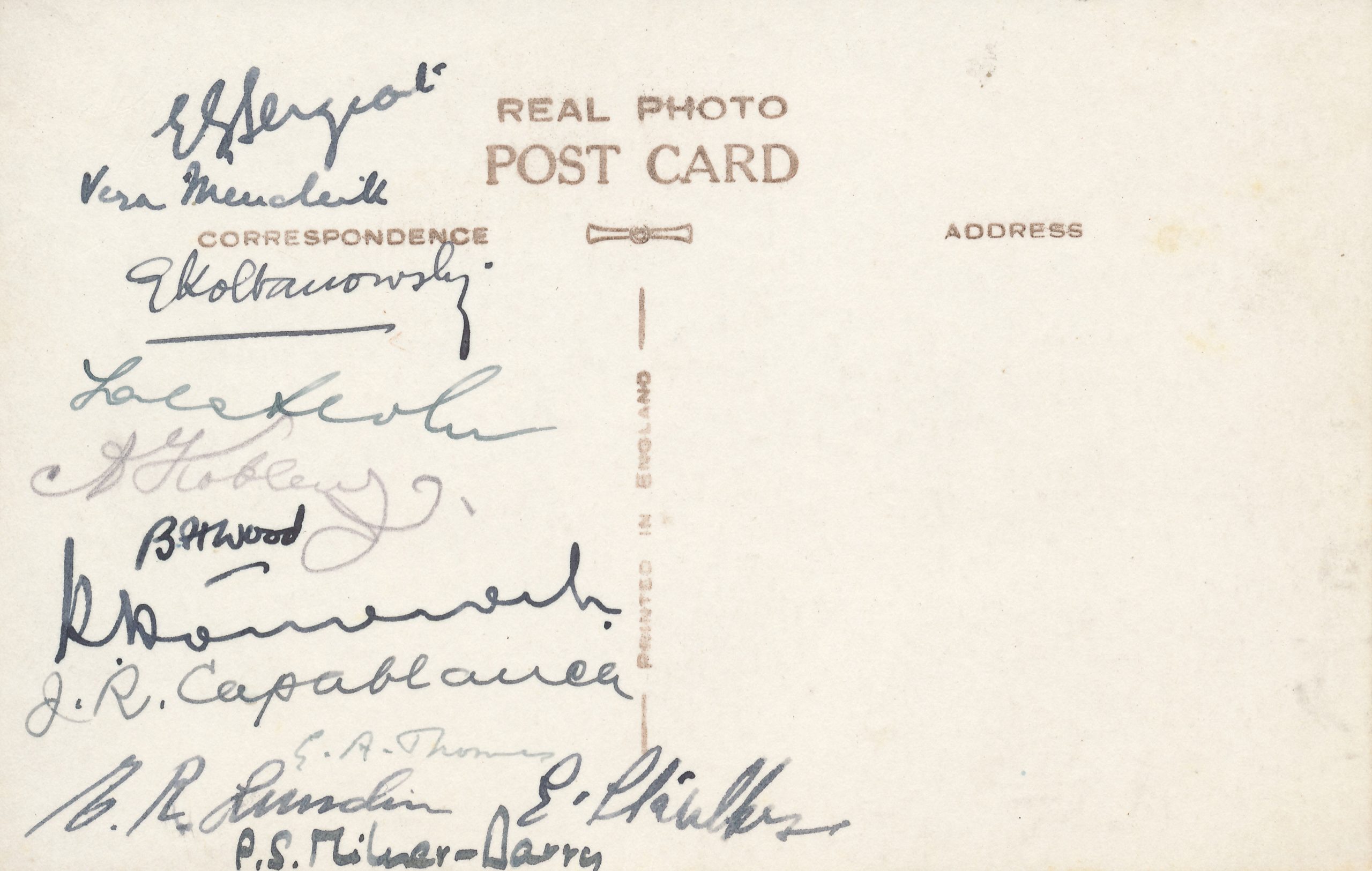
Signature of GA Thomas from a Brian Reilly “after dinner” postcard from Hastings Christmas Congress, 1945-1946
From The Encyclopedia of Chess (BT Batsford, 1977) by Harry Golombek :
“British international master, born in Constantinople (previously Byzantium and currently Istanbul : Ed.) His mother (Lady Edith Margaret Thomas : Ed) was one of the strongest English women players, winner of the first Ladies tournament at Hastings 1895.
(Ed : his father was Sir George Sydney Meade Thomas)
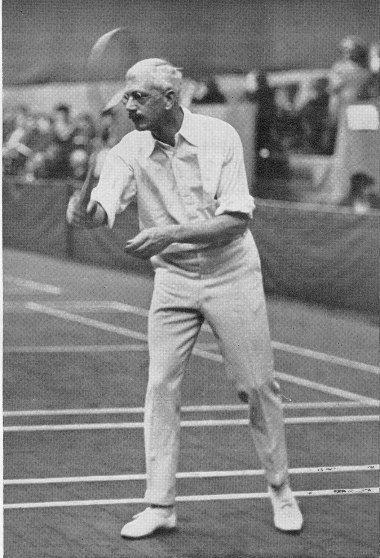
Thomas was an all-round athlete who excelled at tennis, hockey and badminton as well as chess. He captained the English badminton team and was All England Badminton Singles champion from 1920 to 1923.”
Sir George Alan Thomas : “During his playing career, he won 78 national titles in the United Kingdom and a further 12 French titles; he also competed in 29 out of 30 English internationals, winning 50 matches in the process.”
Here is an excellent article (albeit stating GT was a Grandmaster and was president of the British Chest Federation!) from the National Badminton Museum.
“Thomas won the British chess championship twice, in 1923 and 1934 and represented England in the Olympiads of 1927 where he tied with Norman Hansen for the best score – 80% on board 3, 1930, 1931, 1935, 1937 and 1939.
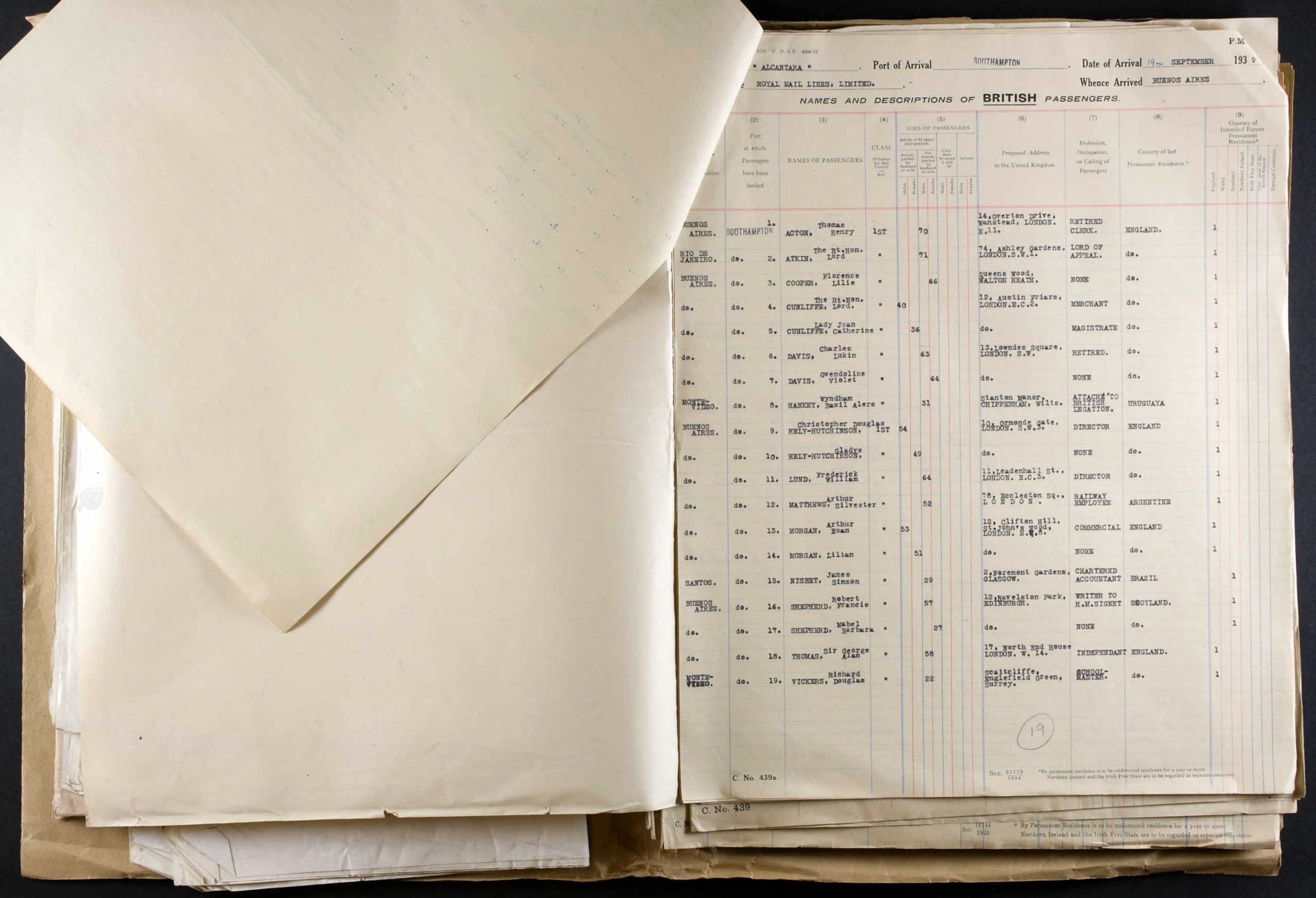
Passenger list from RMS Alacantra showing Sir George Thomas arriving at Buenos Aires on September 19th, 1939Entry for Sir George Thomas from above image.
In international tournaments his greatest successes were 1st at Spa (ahead of Tartakower) and =1st at Hastings 1934/5 (tied with Euwe and Flohr, ahead of Capablanca and Botvinnik).
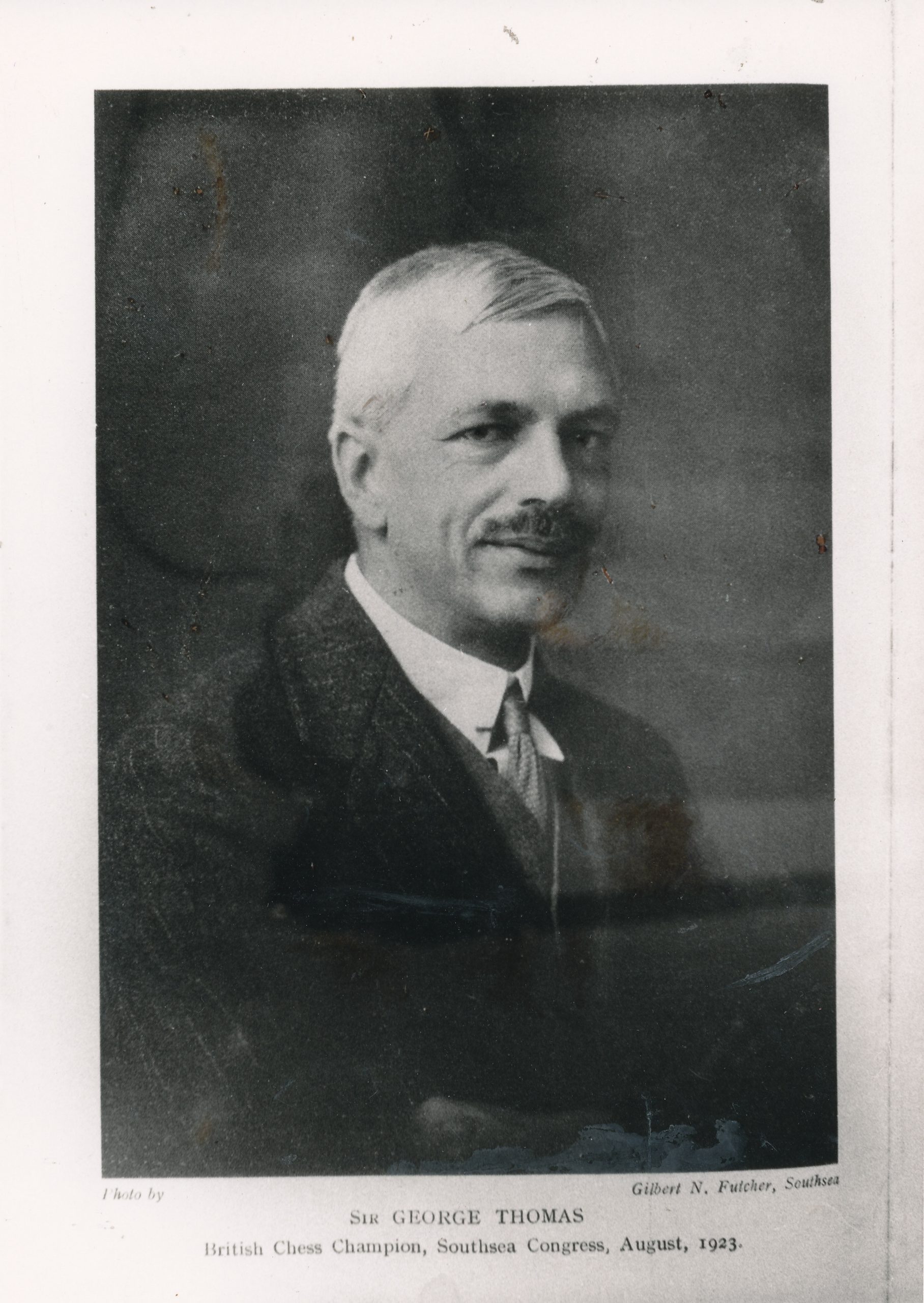
Sir George Thomas, British Chess Champion, Southsea Congress, 1923 Photograph by Gilbert N Fulcher, Southsea
He was known for his keen sense of sportsmanship and for his ability to encourage and inspire younger players. He served for many years on the BCF Junior selection committee and was for a time Games Editor of the British Chess Magazine. FIDE awarded him the titles of international master (1950) and International Judge (1952). (article by Ray Keene)”
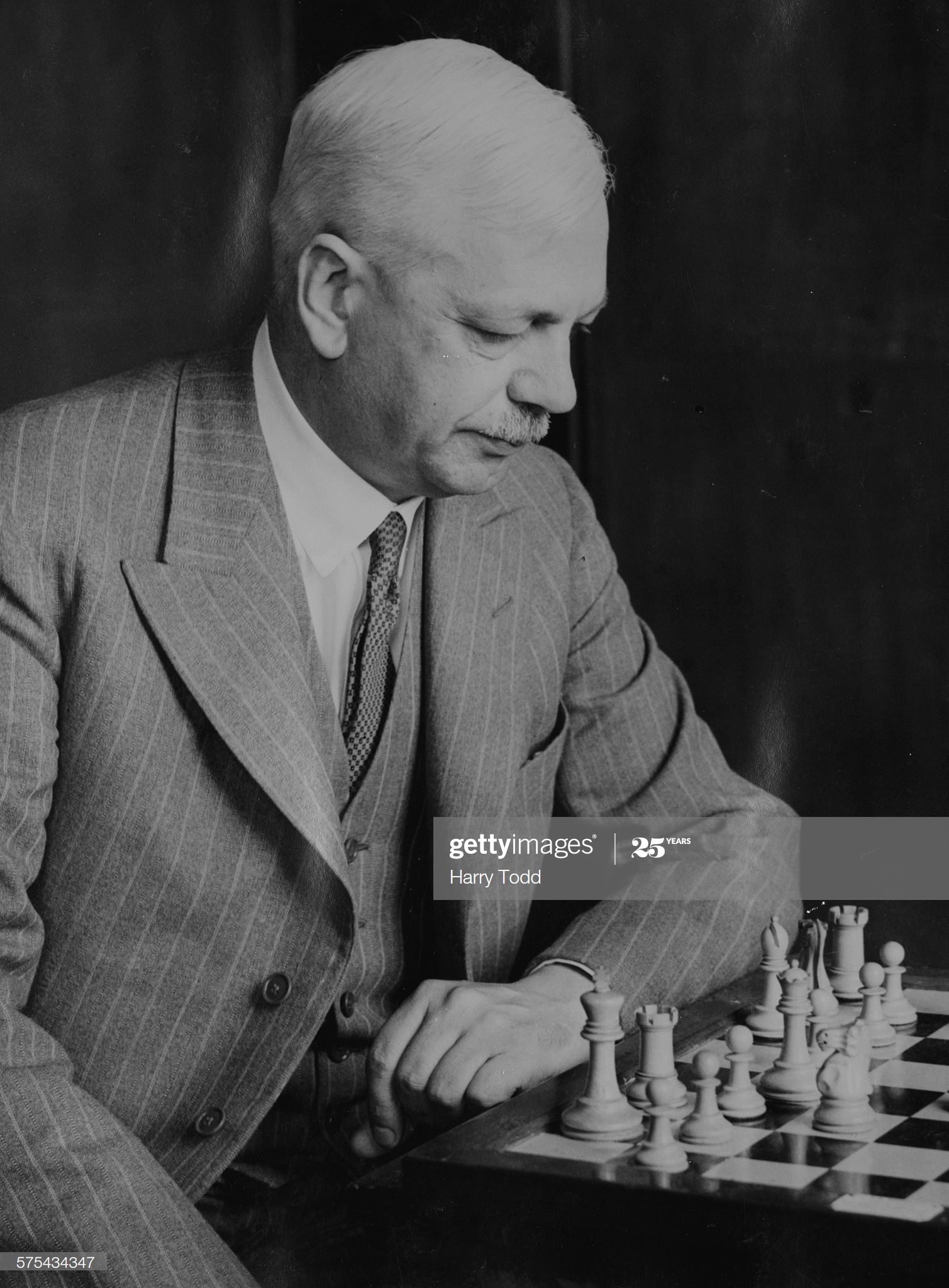
British chess champion Sir George Thomas playing at the Annual British Chess Federation Championship in Yarmouth, England, July 11th 1935. (Photo by Harry Todd/Fox Photos/Getty Images)
Thomas with the White pieces was predominantly a Ruy Lopez devotee.
With the Black pieces against 1.e4 he defended the Lopez and the Queen’s Gambit Declined was his favourite versus 1.d4
From The Encyclopedia of Chess (Robert Hale 1972 and 1976) by Anne Sunnucks :
“International Master (1950), International Judge (1952) and British Champion in 1923 and 1934. All England Badminton Singles Champion, All England Badminton Doubles Champion, Wimbledon tennis player and county hockey player.
Sir George Thomas was born in Constantinople on 14th June 1881. His mother, Lady Thomas, won the first ever ladies’ tournament, which was held in conjunction with the Hastings International Chess Tournament of 1895.
He learned the moves at the age of 4, and as a boy met many of the world’s leading players, including Steinitz, Lasker, Tchigorin and Pillsbury, in his mother’s drawing-room.
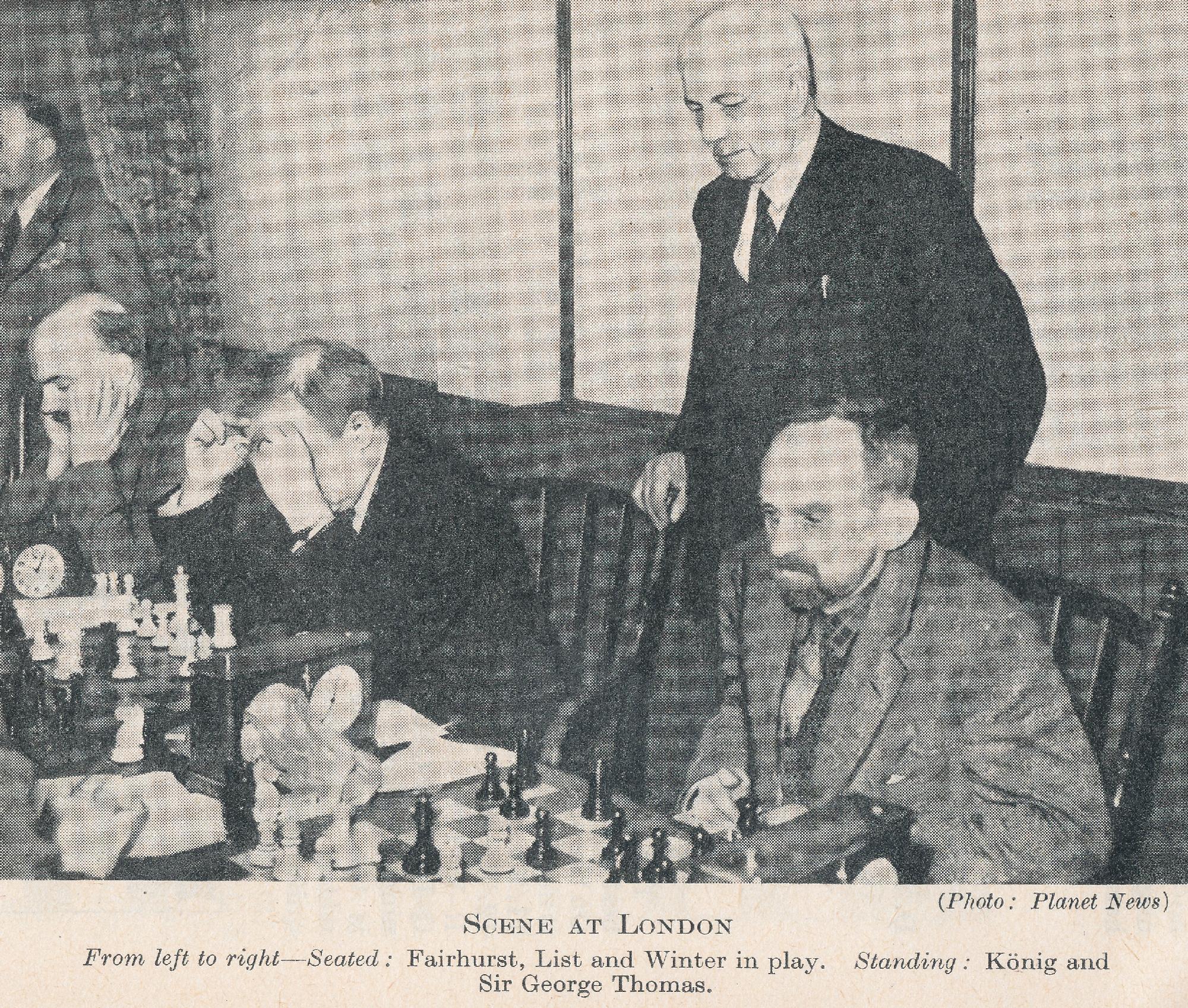
Scene at London. From left to right – Seated : Fairhurst, List and Winter in play. Standing König and Sir George Thomas
Apart from serving as a subaltern in the Army during the 1914-1918 war, Sir George has devoted his life to sport. He played tennis at Wimbledon, played hockey for Hampshire, captained the English Badminton team and was All England Badminton Singles Champion from 1920-1923 and doubles champion nine times.
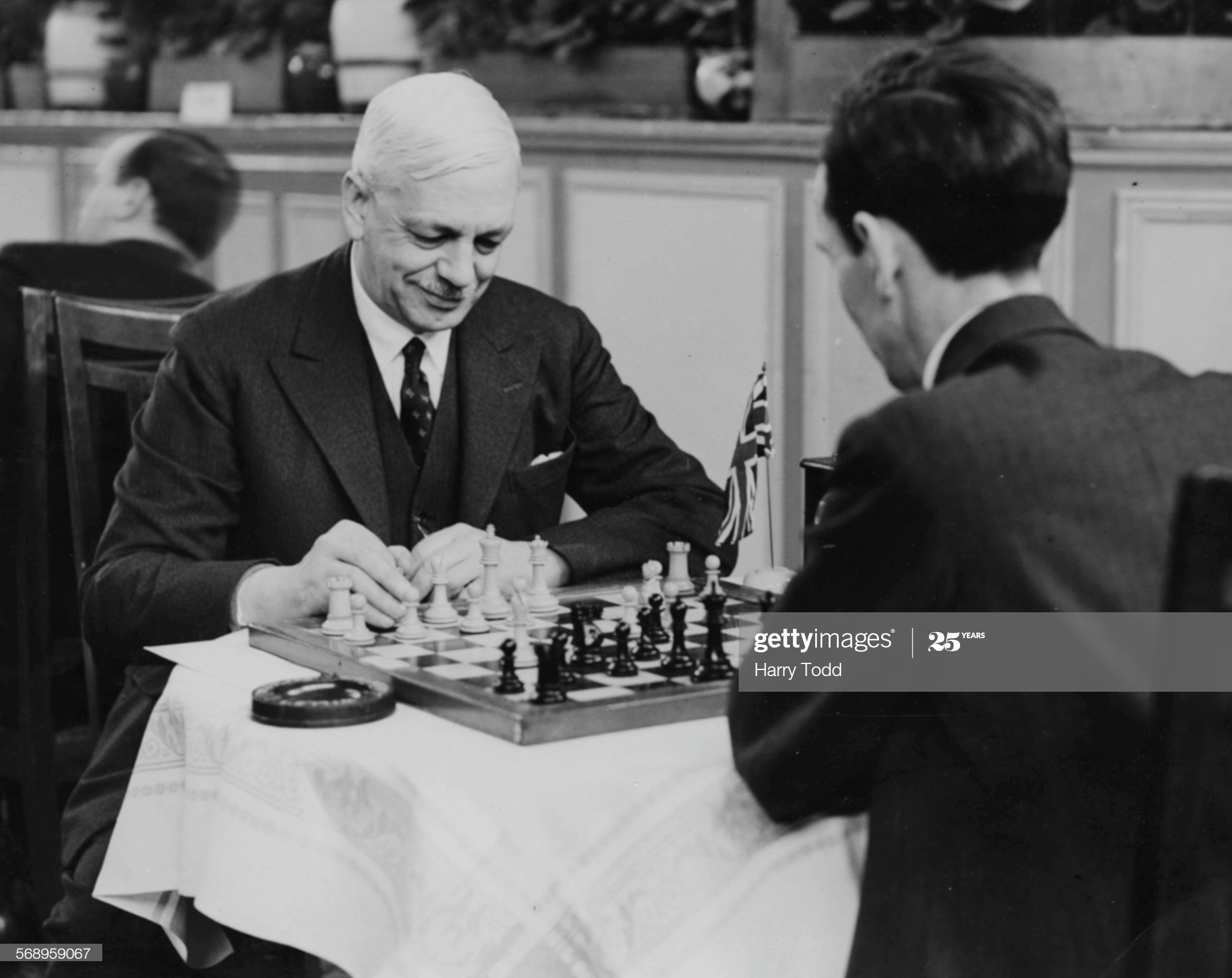
Sir George Thomas And Brian Reilly Sir George Thomas (left), leader of the British chess team, playing Irishman Brian Reilly at the Easter Chess Congress, Margate, April 24th 1935. (Photo by Harry Todd/Fox Photos/Getty Images)
Sir George played chess for England regularly from 1910 to 1939. He played for the British Chess Federation in the Chess Olympiads of 1927,1930, 1931, 1933, 1935, 1937 and 1939, and captained the team which withdrew from the Buenos Aires Olympiad in 1939 on the out-break of war.
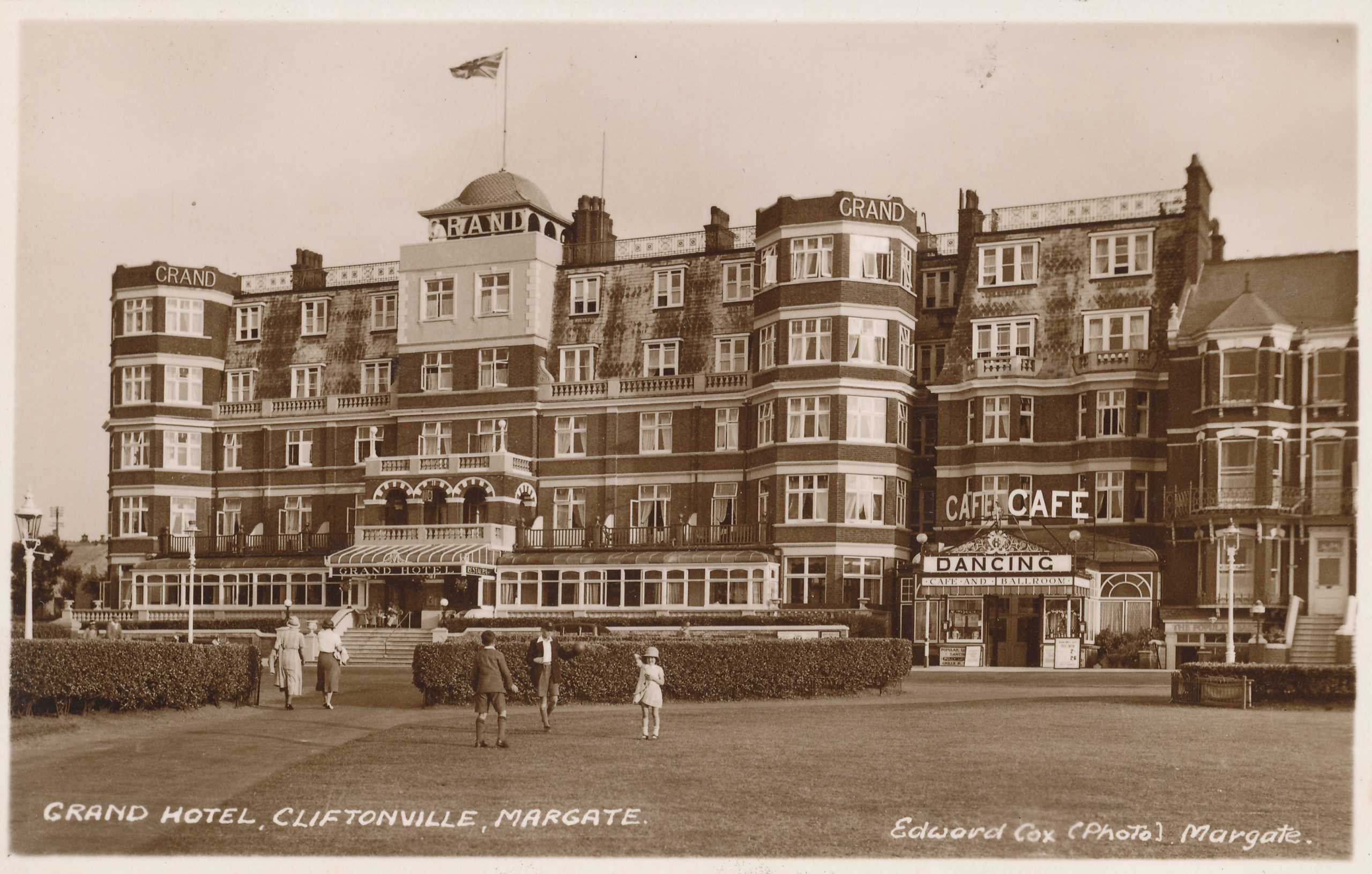
A Brian Reilly “after dinner” postcard from Margate 1936.The Grand Hotel, Cliftonville, Margate. Venue for the Margate tournaments.
His first appearance in the British Championship was in he came 2nd. He also came 2nd in 192l and in 1923 won the first time, thus becoming British Chess Champion and Badminton Champion in the same year.
Sir George’s best performance was at Hastings 1934-1935, when he came =1st. In the last round he needed only a draw against R. P. Michell to come lst, ahead of Euwe, Capablanca, Flohr and Lilienthal, but he lost and had to be content with sharing lst prize with Euwe and Flohr.
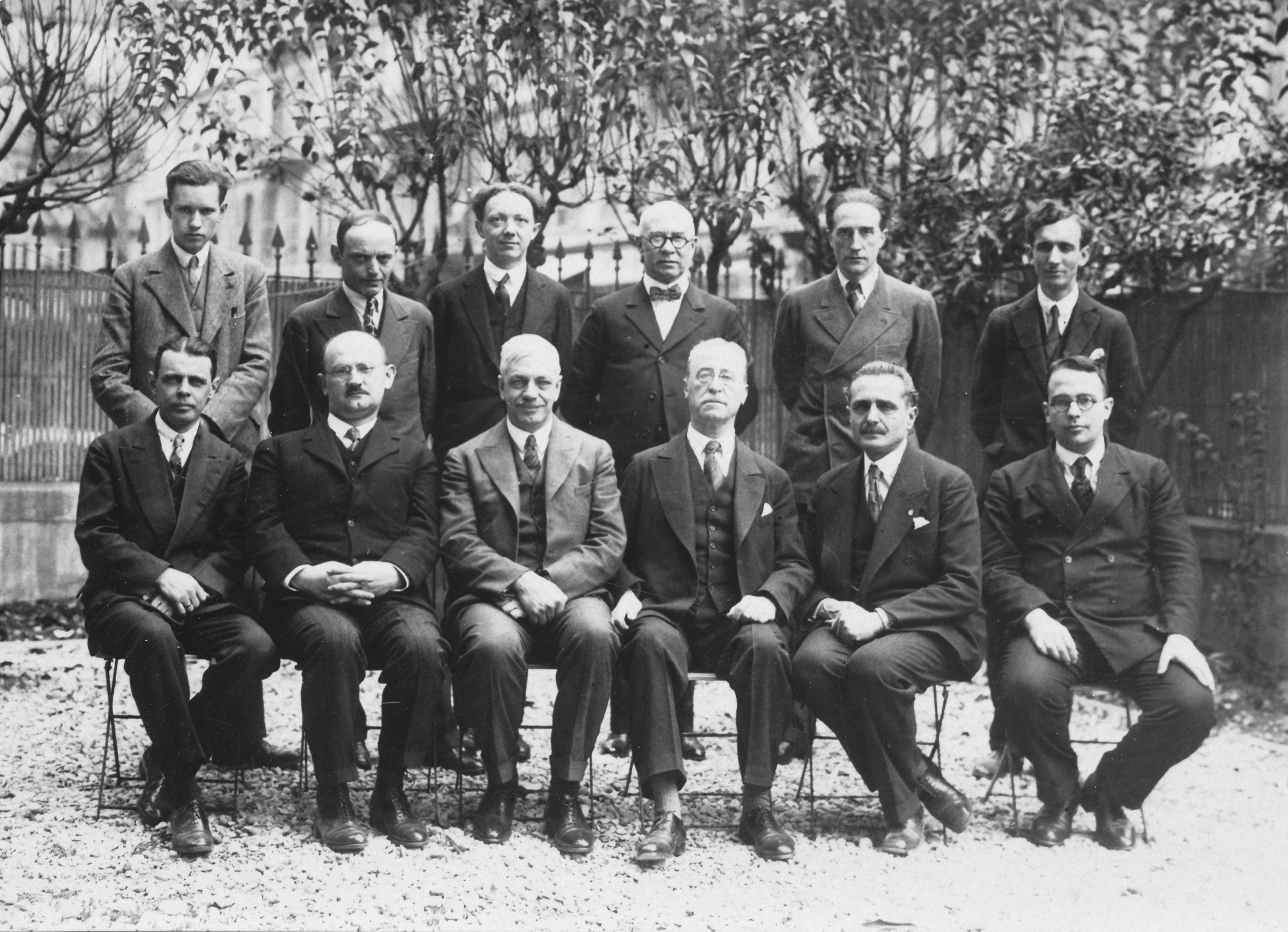
Nice Masters, 1931. Standing : Daniel Noteboom, Abraham Baratz, George Renaud (Organiser), John J O’Hanlon, Marcel Duchamp, Brian Reilly (winner), Seated : Eugene Znokso-Borovsky,, Arpad Vajda, Sir George Thomas, Jacques Mieses, Stefano Roselli del Turco, Jacob Adolf Seitz. British Chess Magazine, 1931, page 201
During his career he has beaten Capablanca, Botvinnik (in consecutive rounds at Hastings 1934-35), Flohr and and drawn with Nimzowitsch, Rubinstein and Capablanca. He been noted for his sportsmanship and for his interest in and encouragement of young players.
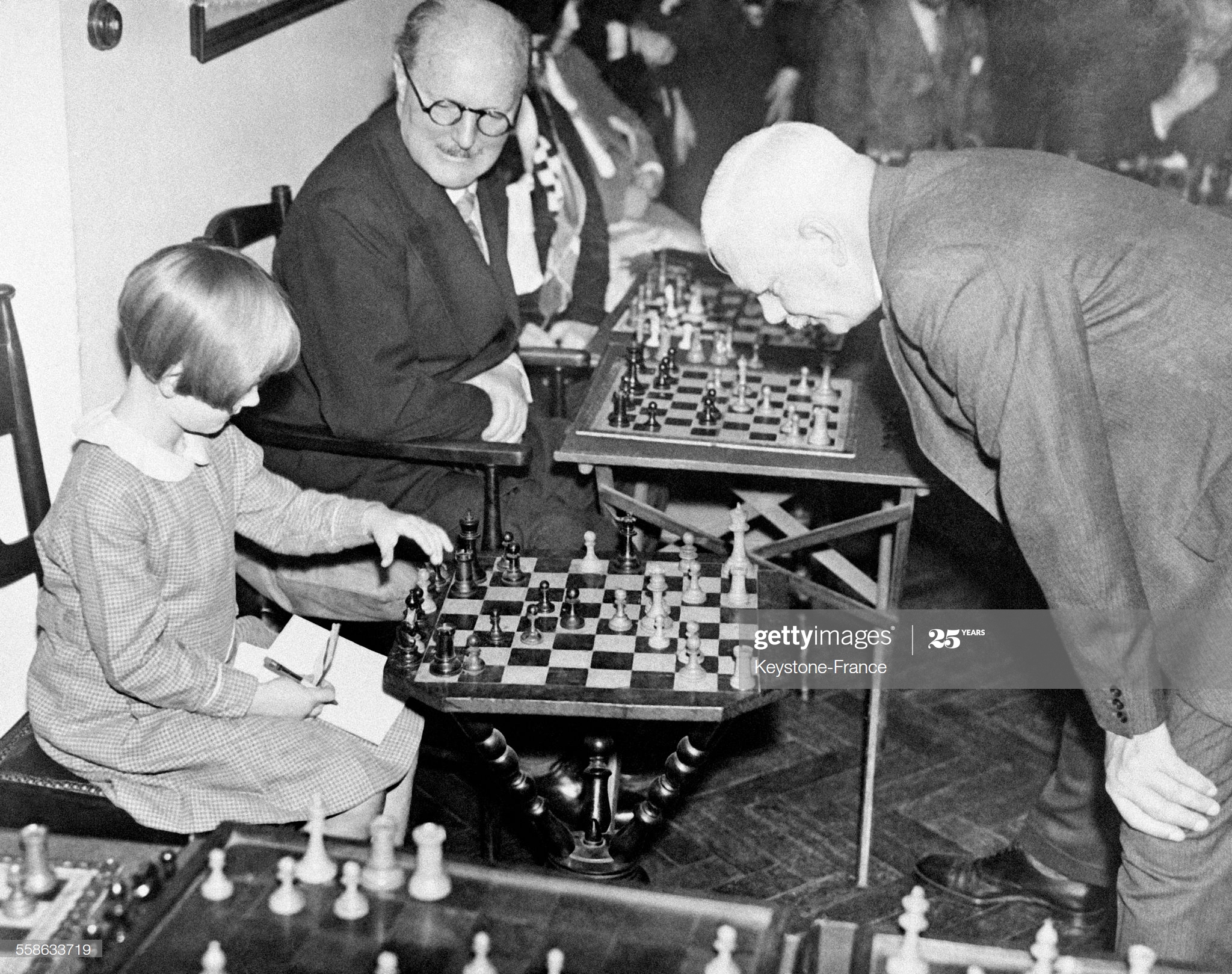
Partie d’échecs Sir Georges Thomas, le célèbre joueur d’échecs britannique, jouant contre sa plus jeune adversaire âgée de 8 ans, à Londres, Royaume-Uni le 24 octobre 1934. (Photo by Keystone-France\Gamma-Rapho via Getty Images)
Since his retirement until the last few years, Sir George continued to attend tournaments as a spectator.
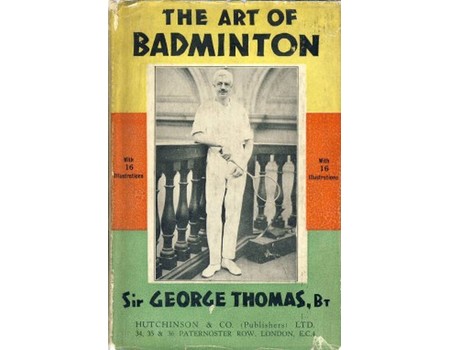
He is the author of The Art of Badminton, published in 1923.
The Art of Badminton
He died on 23rd July 1972 in a London nursing home.”
In the March issue of CHESS for 1963, (Volume 28, Number 427, pp.147-155) William Winter wrote this:
Sir George Thomas
Another great figure of the period between the wars, Sir G. A. Thomas, is happily still with us, although he gave up competitive play some years ago. I think I must have played more games with him than with any other master and he was my principal rival in the battles for the British Championship which we each won twice.
Although he lacks Yates’ spark of genius he is a very fine player indeed and one of the few Englishmen who is a real master of the endgame. Both nationally and internationally he has an excellent record, probably the best of a number of performances being his tie with Euwe and Flohr for lst prize at Hastings 1934-5. Capablanca and Botvinnik were among the also-rans. Thomas beat both of them, a splendid performance when we consider the small number of games ever lost by either. He is the only native Englishman to have scored a win over Capablanca. He acted as captain of all the British teams of which I formed part and an excellent leader he made, firm when necessary, but always considerate to his men especially when they were doing badly.
Sir Thomas, as he was called, is much missed on the Continent where he was highly popular and did a great deal to increase the prestige of British chess.
Here is Part II of GM Matthew Sadler’s appreciation of Sir George.
From The Oxford Companion to Chess (OUP, 1984) by Hooper & Whyld :
“English player. International Master (1950), International Arbiter (1952), British champion 1923 and 1934. His mother, who taught him chess, was winner of one of the first women’s tournaments, Hastings 1895, He played in more than 80 tournaments and achieved his best result at Hastings 1934-5 (about category 9), when he scored +6-1—2 to share first prize with Euwe and Flohr ahead of Botvinnik and Capablanca. Thomas played in seven Olympiads from 1927 to 1939, and in the first the highest percentage score was made by him ( + 9=6) and the Dane Holgar Norman-Hansen (1899- ) (+11=2—2). A leading English player for more than 25 years, Thomas fought many battles at the famous City of London club, winning 16 of the annual championships from 1913-14 to 1938-9. In his sixty-ninth year he gave up competitive chess when, after a hard game, ‘the board and men began to swim before my eyes,’ He continued his active interest in junior events and his visits, now as a spectator, to chess events.
A man of few words, imperturbable, of fine manners. Sir George Thomas was respected throughout the chess world for his sportsmanship and impartiality, and his opinion was often sought when disputes arose between players. The inheritor of both a baronetcy and private means, he
devoted his life to games and sports. Besides his chess he was a keen hockey player, a competitor in international lawn tennis (reaching the last eight at Wimbledon on one occasion), and winner of about 90 badminton titles, notably the All-England men’s singles championship which he won four times, from 1920 to 1923.”
Bill Hartston wrote this in “On the Knight Shift”, Chapter 20 of the The Chess Player’s Bedside Book (Batsford, 1975) :
“In the days when chess was perhaps a more noble pastime, one of England’s leading players was the Baronet, Sir George Thomas. A true gentleman and sportsman, he considered it rather unprincipled to analyse adjourned games before their resumption and could only be persuaded to look at his own positions after being assured that his opponents were certainly taking full advantage of the adjournment in this manner.”
We remember Raaphy(i) Persitz who passed away on Wednesday, February 4th, 2009.
From British Chess Magazine, Volume CXXIX (129, 2009), Number 3 (March), pp. 130-134 by John Saunders we have this detailed obituary:
Raaphy Persitz
A tribute to a great friend of British chess, by John Saunders
Raphael Joseph Arie (Raaphy) Persitz (26 vii 1934, Tel Aviv – 4 ii 2009, Tel Aviv)
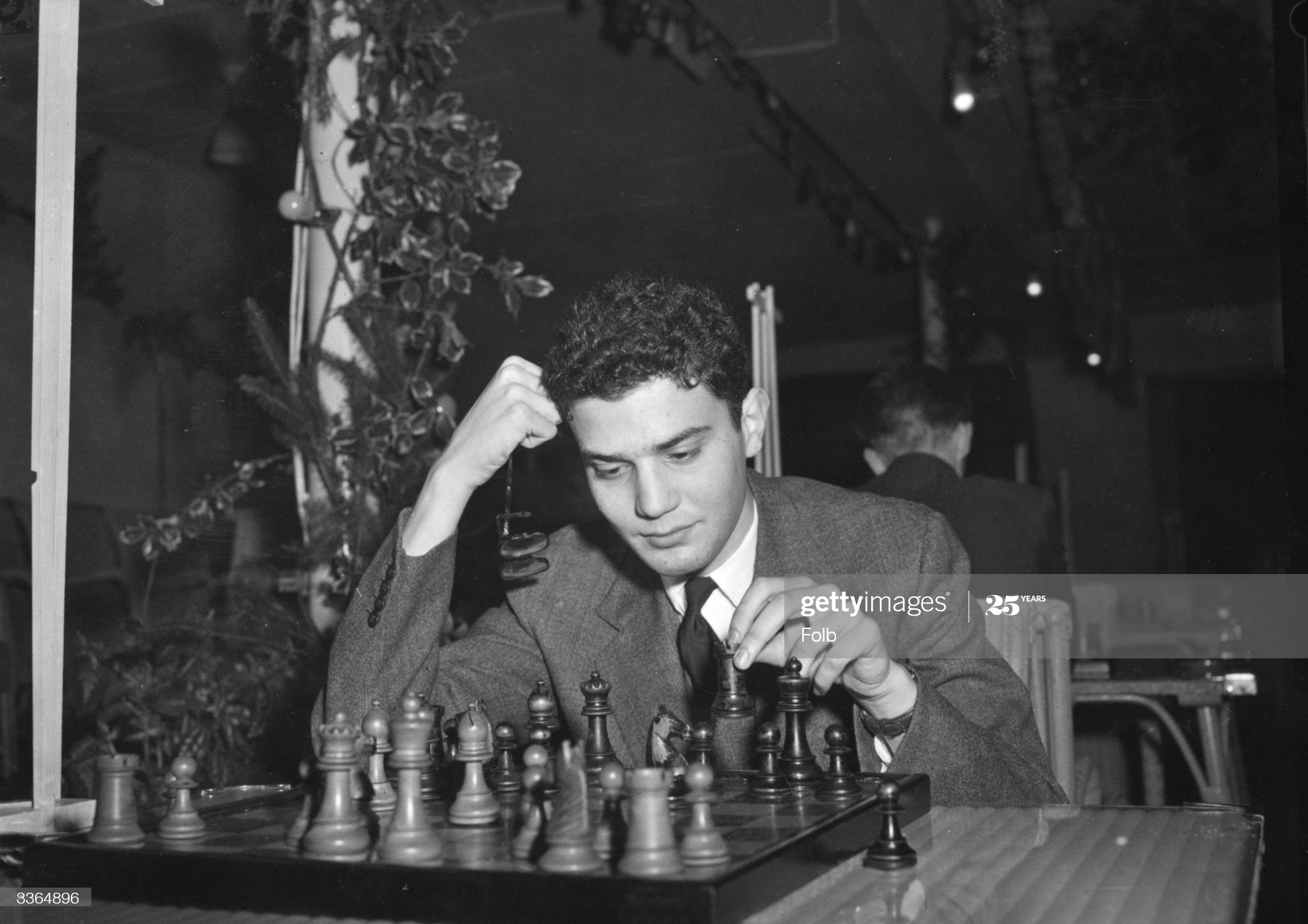
28th December 1955: Israeli chess player Raaphy Persitz in play at the International Chess Congress at Hastings. (Photo by Folb/Topical Press Agency/Getty Images)
Raaphy Persitz, one of the strongest players resident in Britain in the 1950s and 1960s and also one of BCM‘s most popular contributors, has died aged 74. Raaphy was born in Tel Aviv, the grandson of Shoshana Persitz (1893-1969), a publisher who became an early member of the Knesset, the Israeli parliament. Raaphy became Israel’s first junior champion in 1951 and shortly afterwards came to study PPE (Philosophy, Politics and Economics) at Oxford University where he was a member of their very strong chess team and a close friend of Leonard Barden and others.
Raaphy Persitz (26-vii-1934 04-ii-2009). 26 year-old Raaphy Persitz at the 1960 Leipzig Olympiad playing on board four for Israel. He scored +6, =2, -4.
One of his most publicised feats was to win his Varsity match game and also a county match against Hugh Alexander on the same day (see the May 1954 or March 2004 issues of the magazine for further details). Raaphy played three times in the Varsity match and also represented England in three Students Olympiads in the mid-1950s. He represented Israel in the 1960 Leipzig Olympiad on board four, and also played twice in the Hastings Premier, in 1955-56 and 1968-69, the latter being his swansong in competitive chess as he turned his attention to a career in banking which took him first to Switzerland and eventually to his home town of Tel Aviv. As a player his best result was probably finishing third behind Reshevsky and Szabo at the first major international tournament held in Israel, Haifa/Tel Aviv 1958.
Despite giving up competitive play, Raaphy never lost his love of the game and remained an avid reader of magazines and follower of the game until the end of his life. And, of course, he remained a perceptive and humorous writer on the game though his output was much lower than in the 1950s. The news of his death came as a particular shock to me as, only a couple of weeks previously, he had sent me a fax saying how moved he had been by the tribute I had writ- ten to Bob Wade in the January 2009 issue of BCM. That was typical of his kindness to wards me which dated back to when I took my first tottering steps as BCM editor in 1999. We never actually met in person but spoke occasionally on the telephone and exchanged faxes (Raaphy didn’t seem to communicate by email).
Raaphy Persitz (26-vii-1934 04-ii-2009)
As a long-time reader of the magazine I had enjoyed his Student’s Corner column contributions. The column had been initiated by Abe Yanofsky in the early 1950s and Raaphy had inherited it in 1958. I was particularly delighted when, in 2004, after I had written about his 1954 feat in winning his Varsity match game and a county match against English number one CHO’D(Hugh) Alexander on the same day, Raaphy consented to write another column (which appeared in the May 2004 issue of BCM). I never succeeded in getting him to write another one but it was such a pleasure to have him write for the magazine during my spell as editor.
Raaphi Persitz agreed to play for Oxford v Cambridge in London and also on the same day for Oxon v Gloucester in a county match in Swindon.
This is the second game, he won both games.
Be aware that Bruce Hayden in ‘Cabbage Heads and Kings’, which is where I got this game from, mentions this but also added that these games took place on the same day as the 1954 Grand National (won by Royal Tan). This is wrong as the Grand National that year was run on the 10 April.
I think that maybe Bruce saw the score of the games with the two games a day story in a Sunday newspaper covering Saturdays Grand National and perhaps got the dates mixed up.
)
The fax he sent me on 7 January 2009 seems particularly poignant now but it is a good example of Raaphy’s kindness and self-deprecating humour. Here is the full text:
“Dear John, I was moved by your wide-ranging obituary of Bob Wade in the BCM[January 2009, p34l. I dare say you did justice to his contributions and devotion to chess, spanning well over half a century. I have several pleasant recollections of conversations and over-the-board encounters with Bob. One such tussle, a hard-fought draw, was reproduced by Bob, with comments (in the Student’s Corner) in a book containing his eventful games.
Another, somewhat less felicitous, recollection harks back to a game we contested at Ilford, where, in extreme time trouble, I blithely played Rxh7+, expecting …Qxh7, but overlooking the simple …Kxh7, leaving me a whole rook down with no compensation, whereupon I duly resigned. What impressed me at the time was the lightning speed with which Bob reacted to my ill-fated blunder – as if it were nothing but inevitable…
With warmest wishes for a healthy,
happy, fruitful 2009. Raaphy.”
I had hoped to publish the above as a Letter to the Editor but, sadly, it must now appear as part of Raaphy’s obituary. The draw with Bob Wade referred to in the fax was played in Dublin in 1962 and featured in Student’s Corner in BCM in the December 1966 issue on page 356. It seems appropriate to reproduce the game here in tribute to these two recently departed and much-loved chessplayers.
Notes by Persitz
Unlike the majority of games that have, over the years, appeared in the Student’s Corner, the following dour struggle between Bob Wade (White) and myself (Black), from Dublin, 1962, is in no way outstanding: it does not contain any brilliant combinations; it is not a positional masterpiece; it is certainly not devoid of mistakes. Nor is it amusing, or original, or of theoretical interest or particularly instructive. Yet (with the aid of the interspersed comments) it ought to give the student a pretty shrewd and realistic idea of the stuff competitive chess is made of: the endless number of laborious variations that have to be examined; the annoying little threats that must be attended to; the treacherous pitfalls to be sidestepped; the technical hurdles to be surmounted; the frustrating little details, indifference to which may be fatal; in brief, the drudgery that has become part and parcel of contemporary tournament practice, without which success is unimaginable.
Raaphy Persitz Tributes
Leonard Barden: Raaphy was probably my best friend at Oxford – certainly so among chessplayers. We played hundreds of blitz games in the junior common room at Balliol and later for some months in 1957 we shared a London flat, analysing Russian championship games over breakfast. He was a wonderful man to know, bright, witty, gentle, sympathetic and knowledgeable.
Leonard Barden (centre) with Raaphi Persitz, JB Sykes, OI Galvenius and DM Armstrong, Ilford, May, 1953
A tribute by Amatzia Avni: Ordinary people have a mixture of good qualities and bad ones. After 20 years of friendship with the late Raaphy Persitz I can attest that he was a distinct type: one sided, positive-only; pure gold.
I first met him in 1989. I had just written my first chess book (in Hebrew) and was searching for someone to write me an introduction. The word was that Persitz was back in town, after long years abroad. Having seen glimpses of his amazing linguistic skills, I contacted him and he agreed immediately. He didn’t know me, hadn’t read a single sentence of the book, yet he didn’t hesitate: “yes, sure, I’ll be glad to”.
That was typical Persitz: always ready to help, unconditionally. The introduction, needless to say, was a sheer delight, a class or two above the rest of the book. In later years he gave me a hand several times polishing my texts and making them more reader-friendly to English-speaking readers. Somehow he seemed to know what I wished to express better than I did. His suggestions enabled me to convey my meaning in a clear and precise manner.
Raaphy was modest and reserved. Once I called him and realized he was upset. “My mother had passed away some weeks ago,” he said. I was puzzled why he didn’t tell me the sad news at the time. “I didn’t want to bother you” was his reply.
A couple of years ago I stumbled upon Bruce Hayden’s old book Cabbage Heads and Chess Kings. One of the book’s chapters was headed “Raaphy Persitz star or comet?”. I learned that, in the 1950s, Persitz gained bright victories in England, against Penrose, Alexander, Milner-Barry and others. Searching a Chessbase database I found out that he also done battle with some out- standing international players. Yet, in all our meetings and hundreds of hours of conversation, he never said a thing about that!
Persitz was a master of understatement. I learned that if I wrote “very fine” or “extremely strong”, the ‘very’ and ‘extremely’ would fly out of the window. If I made a firm stand on a certain issue, he would add “probably”, “apparently’ or “it may be argued that”, because it was indeed only an opinion, not a fact. Over time, following his line of thought made me improve the way I expressed myself and thought about chess.
Persitz’s distinctions in chess, in linguistics and in journalism are evident to anyone who ever read his chess books and articles. He also excelled at economics, but I am unqualified to comment on this.
God bless you, Raaphy. I feel privileged to have known you. Amatzia Avni.
BCN remembers Ken Messere who passed away on Thursday, March 31st 2005 aged 76 in Paris-16E-Arrondissement, Paris, France.
Kenneth Charles Messere was born on Monday, April 16th, 1928 in Richmond-on-Thames, Surrey. His father was Charles (George) Messere (1901-1974) or Eisenberg and aged 26. His mother was Gertrude Marie Newman (1899-1978) and aged 29.
Ken had three siblings: Barbara Marie Messere (1930–2005), Hugh Martin Messere (1932–1985) and Derek R Messere (1934–2012)
Ken attended St. Peter’s College, Oxford from 1946 – 1951 to read philosophy and is reported in the 1951 St. Edmund Hall Magazine, as a member of the Trillick (debating) Society as follows:
‘ That this House would rather be a live Communist than
a dead Democrat.’ The proposer established to his own satisfaction that democracy was founded on ‘selfishness, capitalism and bourgeois hypocrisy.’ He did not satisfy J. F. R. Bonguard of St. Peter’s Hall who opposed, using arguments taken from Hindu philosophy. K. C. Messere of St. Peter’s Hall, spoke third and added some able arguments.
In June 1954 Ken married Mary Elizabeth Humphrey (1929-2003) in Ealing. They had a son Miles Jonathan Messere born in 1964 who passed away in 1965.
Prior the time of his passing his wife Mary was living at 142B, Herbert Road, Woolwich, London, SE18 3PU.
In 1991 he was awarded the OBE (Civil Division) in the Queen’s Birthday honours list. The citation reads: Kenneth Charles Messere, lately Head of Fiscal Affairs Division, OECD, Paris.
Ken appears each year from 1953 to 1967 in the noted publication Britain, Royal And Imperial Calendars the function of which is to list entries for those engaged in UK public service. He worked for HM Customs and Excise. Prompted by this we consulted the venerable A History of Chess in the English Civil Service by Kevin Thurlow (Conrad Press, 2021) on page 447 and found
“He played for Customs. In 1964, he went to work for the Organisation for Economic Cooperation and Development and was head of fiscal affairs from 1971 – 1991. In 1954 he began playing postal chess and became a leading player. He won a semi-final of the 5th World Correspondence Championship (1961 – 64) and became the first English player to compete in a World Championship Final.”
There are 31 games listed at his personal entry at chessgames.com starting with games from 1965.
Chessbase’s Correspondence Database 2020 records 69 games the earliest being from 1958 listing Ken’s federation as being France.
From British Chess (Pergamon Press, 1983) we have this lengthy contribution from Ken himself:
“Between the ages of 6, when I learnt to play and 23 (ed: 1951), when I ceased to be a student, chess had a relatively low priority among various time-competing interests and activities, so I never got around to studying theory. Things changed when I became a civil servant and needed a replacement for philosophy as an intellectually absorbing subject which could be argued about with friends over beers, and for the next 12 years chess became my main interest.
Since 1964 I have been working for the OECD in Paris, where my friends are not chess enthusiasts and, although chess remains a major pleasure, my commitment to it has lessened. Nowadays, out-side correspondence chess, I play only occasional blitz games.
Coming late to serious chess has probably had at least some influence on my deficiencies and stylistic preferences. The deficiencies include an inability to visualize ahead with sufficient clarity to support accurate analysis, slow sight of the board which leads to silly errors through time trouble or failing stamina and less familiarity with theory than my better opponents. As to chess style, I have had to play romantically and subjectively to get good results.
If a game takes the form of a clear-cut position, where strategical objectives are clear and superior technique prevails, then mine generally does not. Consequently I have tended to play either sharp gambits or counter-gambits or to try to render the position sufficiently obscure for imagination and intuition to assume maximum importance. In keeping, my chess heroes have been Alekhine, Bronstein and Tal who revel in fantasy, however much Alekhine may claim that it is logically based.
When I took up competitive chess seriously in 1952, I made some progress and won a few minor tournaments, but in view of the defects already mentioned, it soon became clear that my potential for improvement was limited and that nearly all my games were aesthetically flawed. Fortunately, these defects represent no great handicap at correspondence chess, where I found myself pleased with a reasonable proportion of the game I played, and in addition, capable on the day (or more accurately over the years) of winning against almost anyone. Thus, against world champions I have two wins and one loss, (see below). I also have 80 per cent from five games against Russian grandmasters, even if a meagre 28 per cent from my eighteen games against all correspondence grandmasters. In 1954 when I began playing postal chess competitively, I did sufficiently well in a few British Postal tournaments to be accepted at a reasonably high level in the official international tournaments.
Not without luck (see Diagram l), I secured the 75 per cent necessary in two seven-player tournaments to qualify for the fourteen player preliminaries, the winner of which was to qualify for the following world championship. In the 1961-64 preliminaries, I played the best chess of my life, including valid opening innovations, imaginative pawn and piece sacrifices and even a technically efficient win in a queen and pawn end-game. I won the tournament with eleven wins, one draw and one loss, 1.5 points ahead of Maly of Czechoslovakia and two points ahead of Masseev, the Russian favourite, thereby obtaining my first norm towards the International Master title. My first annotated game is the win against Maly (ed: to be inserted once we have tracked down the game score!) which was typical stylistically and also crucial, since if he had won it, he would have qualified for the World Championship instead of me: the second against Bartha of the United States is the most compulsive and difficult tactical game I have ever played, the last five moves alone requiring over 100 hours of analysis.
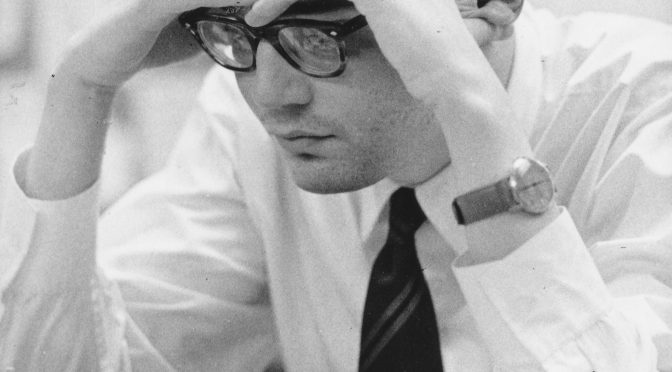
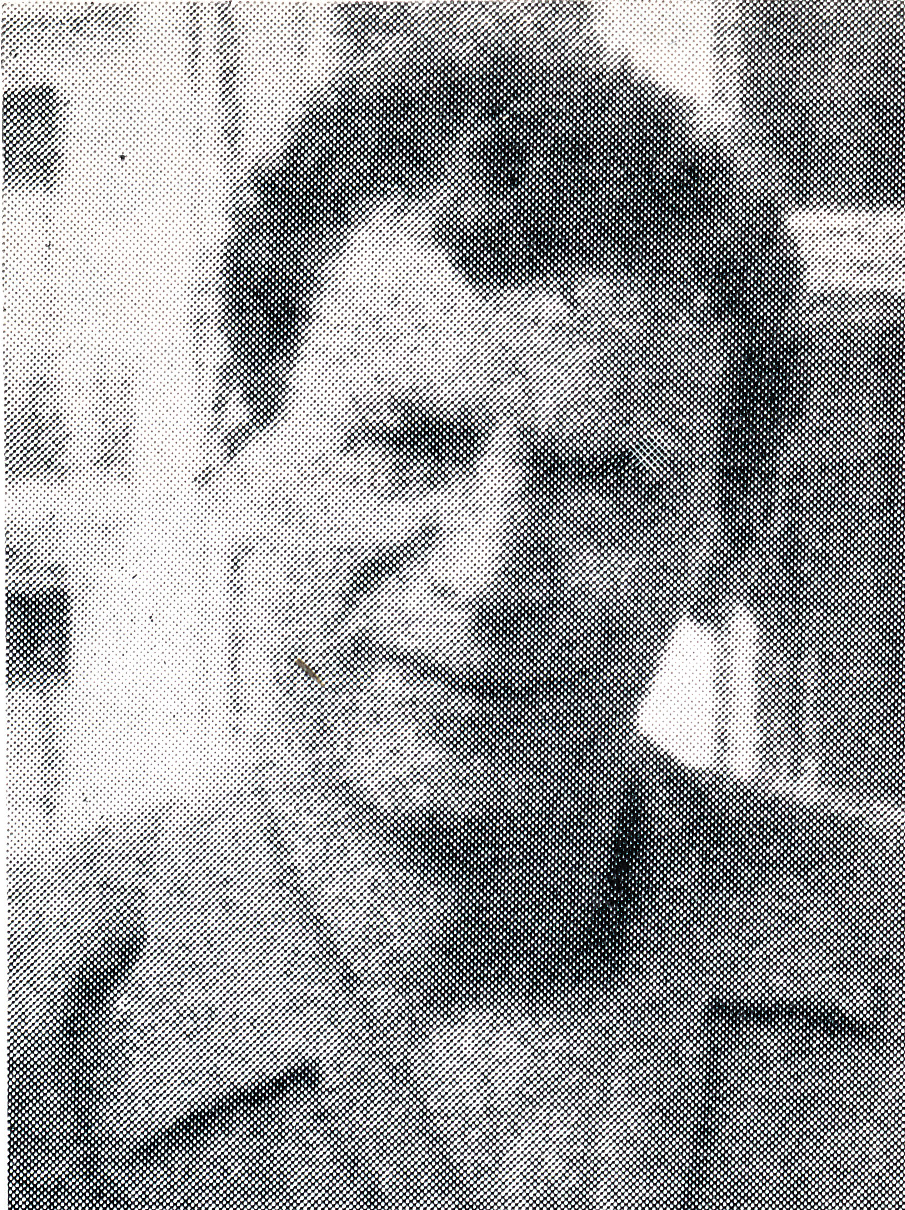
IMC Ken Messere OBE (16-iv-1928 31-iii-2005)
The quality of my chess in the 1965-68 World Championship was much inferior. The tournament began disastrously. I went in for three losing variations as Black and made a suicidal clerical error in the opening so that after 3 months I had four losses from four games. Later, there were compensations. I won against V. Zagarovsky, the reigning world champion (the third annotated game) and obtained just (but only just) the necessary 33.3% per cent to obtain the correspondence chess international master title. For this I needed a win and draw from my last two games which
after 3.5 years, had to be adjudicated.
Fortunately, the win and draw were relatively clear, though this would not have been so a few moves earlier. An an illustration of how the threat of adjudication breeds irrationality, Diagram II gives the closing stages of my win against J.Estrin of the USSR – a more recent correspondence chess world champion. My only other game against a world champion was against the winner of this tournament, Hans Berliner of the United States, with whom I collaborated on a book of the tournament. The collaboration was stimulating but not without friction, since I had to write 75 per cent of the book to see it ever finished. It took a year to complete, 3 years to appear (published by BCM) but in the end was well-reviewed, sold over 2000 copies and royalties are still (gently) drifting in.
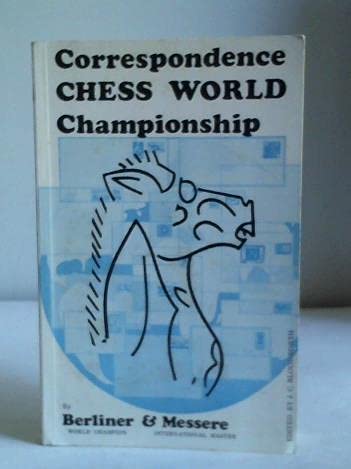
The Fifth Correspondence Chess World Championship, Hans Berliner & Ken Messere, British Chess Magazine, BCM Quarterly Nunber 14, 5th December 1971, ISBN 978-0-900846-05-2.
In the early seventies, in order to reduce numbers of games, I retreated altogether from individual tournaments, just playing twice for England in the Olympiads. Whether team play did not suit my style, or whether my technique had improved but imagination withered, I drew nine of my seventeen games from the two tournaments, winning four and losing four. As England looked likely to aspire to medals for the first time ever, my 50 per cent would not help matters and I gladly retreated to first reserve, which to my dismay required taking over five unfinished games of Hugh Alexander, who died during the tournament, and who, for me, has always been England’s most attractive player and writer. My most uncomfortable decision in correspondence chess was a rejection of Hugh’s intended continuation in one of these games, {Diagram III). Of these five games, I lost one and drew four and England won a bronze medal.
In 1974 was invited to compete in the Potter Memorial Tournament of four postal grandmasters and nine international masters. After so many years of responsible’ team chess for England, I went beserk and sacrificed a pawn in ten of the twelve games, trying later to salvage inferior end-games. Result 33 % per cent. B. H. Wood invited me to write a book of the tournament, to which a number of the players contributed and this was published in 1979.
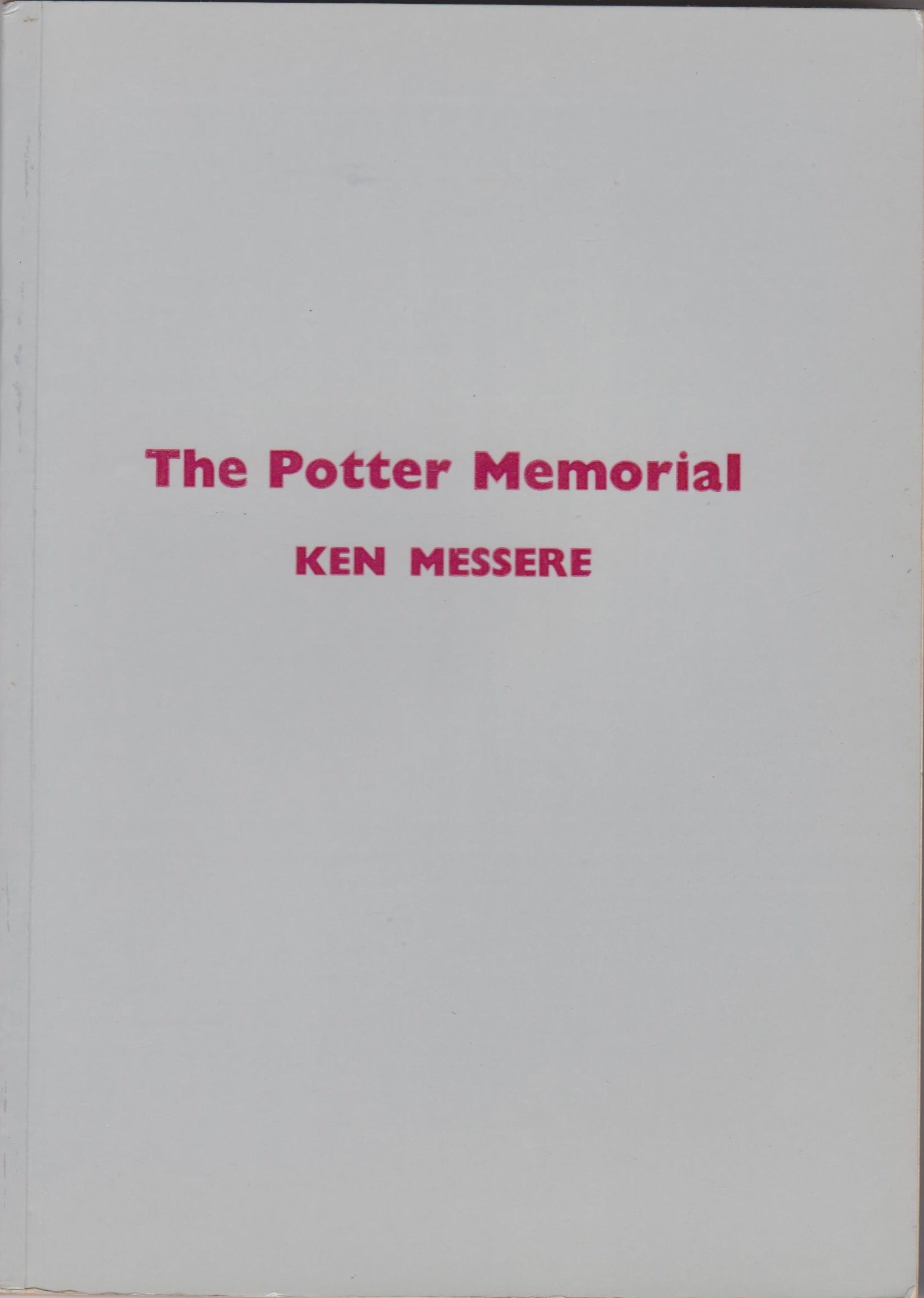
The Potter Memorial, Ken Messere, CHESS (Sutton Coldfield), 1975
Also in 1979 I began to play in another invitation tournament of thirteen players organised by the Australian Correspondence Chess League, which became a memorial to CJS Purdy, its president and the first world postal champion, who died soon after the tournament began. At the time of writing, this tournament, comprising four grandmasters (including one former world champion and two runners-up) and eight international masters, is still in its early stages.”
From British Chess Magazine, Volume CXXV (125, 2005), Number 5 (May), page 226 we have this obituary:
“Kenneth Charles Messere (16 iv 1928, Richmond – 31 iii 2005, Paris) was one of Britain’s strongest correspondence players (he held the correspondence IM title) and well-known author of books on the subject. After graduating from Oxford University, Ken Messere went to HM Customs and Excise, and thence to the Organisation for Economic Development (OECD) where he became head of the fiscal affairs division and a world expert on fiscal law. He reached the final of 1965-8 world correspondence championship, beating world champions Zagorovsky and Estrin, and wrote the book of the tournament with Hans Berliner (published by BCM)”
From The Potter Memorial by Ken Messere, CHESS (Sutton Coldfield), “Chess for Modern Times” Series, 1975 we have this potted biography:
“Compiler of this book, took 3rd place in 1957 and 2nd in 1968 in the championship of the Postal Chess Club. Scores of 4.5 out of 6 in the ICCF Masters 1957-8 and 4/6 in the 1959-61 Championship took him to victory with 11/5 out of 13 in the 1961-3 semi-finals, securing him his first international master norm and qualifying him for the 5th World Championship 1964-7 in which he scored 5.5, just enough for the IM title, with wins over Zagorovsky, then world champion and Estrin, world champion now. Ken Messere collaborated with Berliner, who won it, in a book on the tournament.
He then switched to play exclusively as a member of the British Olympiad team, taking over 2nd board when Alexander died.
The switch back from rather cautious team play to enterprising individual games in 1974-7 provides some of the subject matter of this book.”
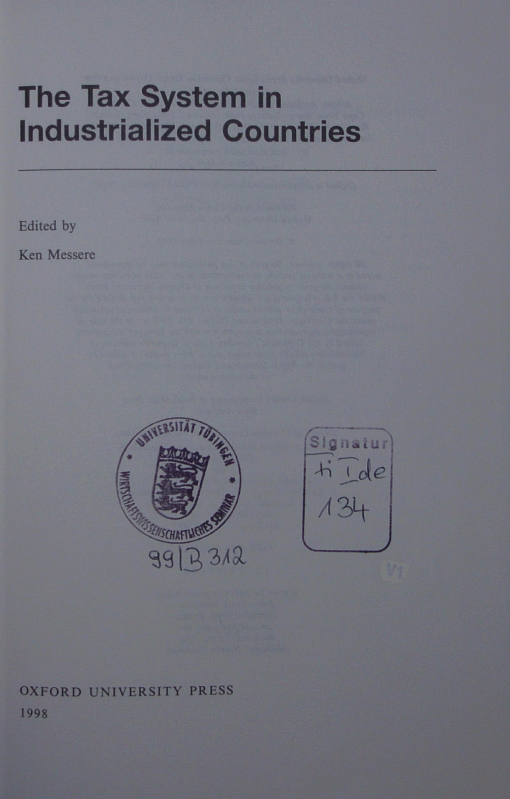
The Tax System in Industrialized Countries, Ken Messere, Oxford University Press, 1998, ISBN 10: 1982933135 / ISBN 13: 9781982933135
We focus on the British Chess Scene Past & Present!
This website uses cookies to improve your experience. We'll assume you're ok with this, but you can opt-out if you wish. Cookie settingsACCEPT
Privacy & Cookies Policy
Privacy Overview
This website uses cookies to improve your experience while you navigate through the website. Out of these cookies, the cookies that are categorized as necessary are stored on your browser as they are as essential for the working of basic functionalities of the website. We also use third-party cookies that help us analyze and understand how you use this website. These cookies will be stored in your browser only with your consent. You also have the option to opt-out of these cookies. But opting out of some of these cookies may have an effect on your browsing experience.
Necessary cookies are absolutely essential for the website to function properly. This category only includes cookies that ensures basic functionalities and security features of the website. These cookies do not store any personal information.