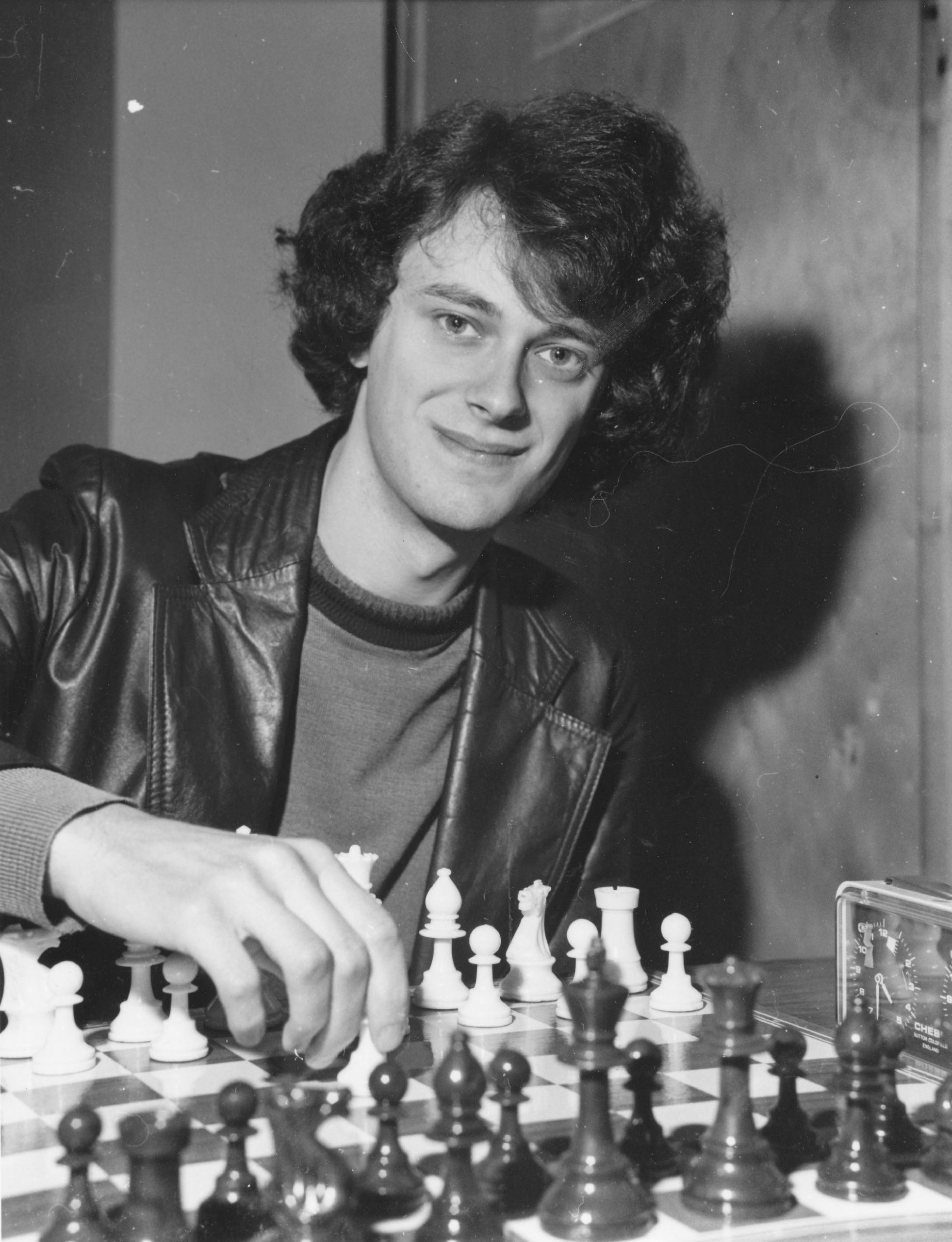
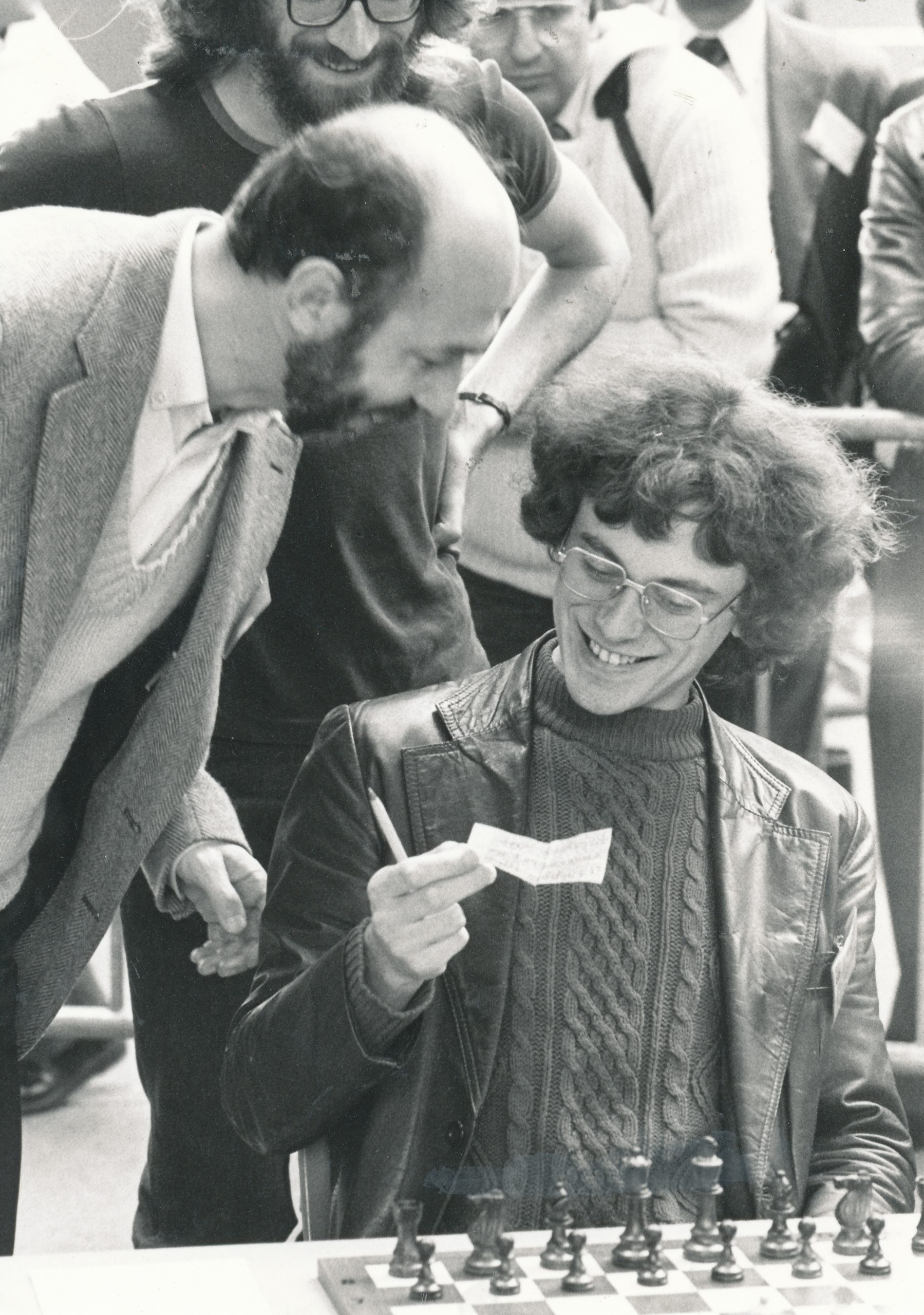
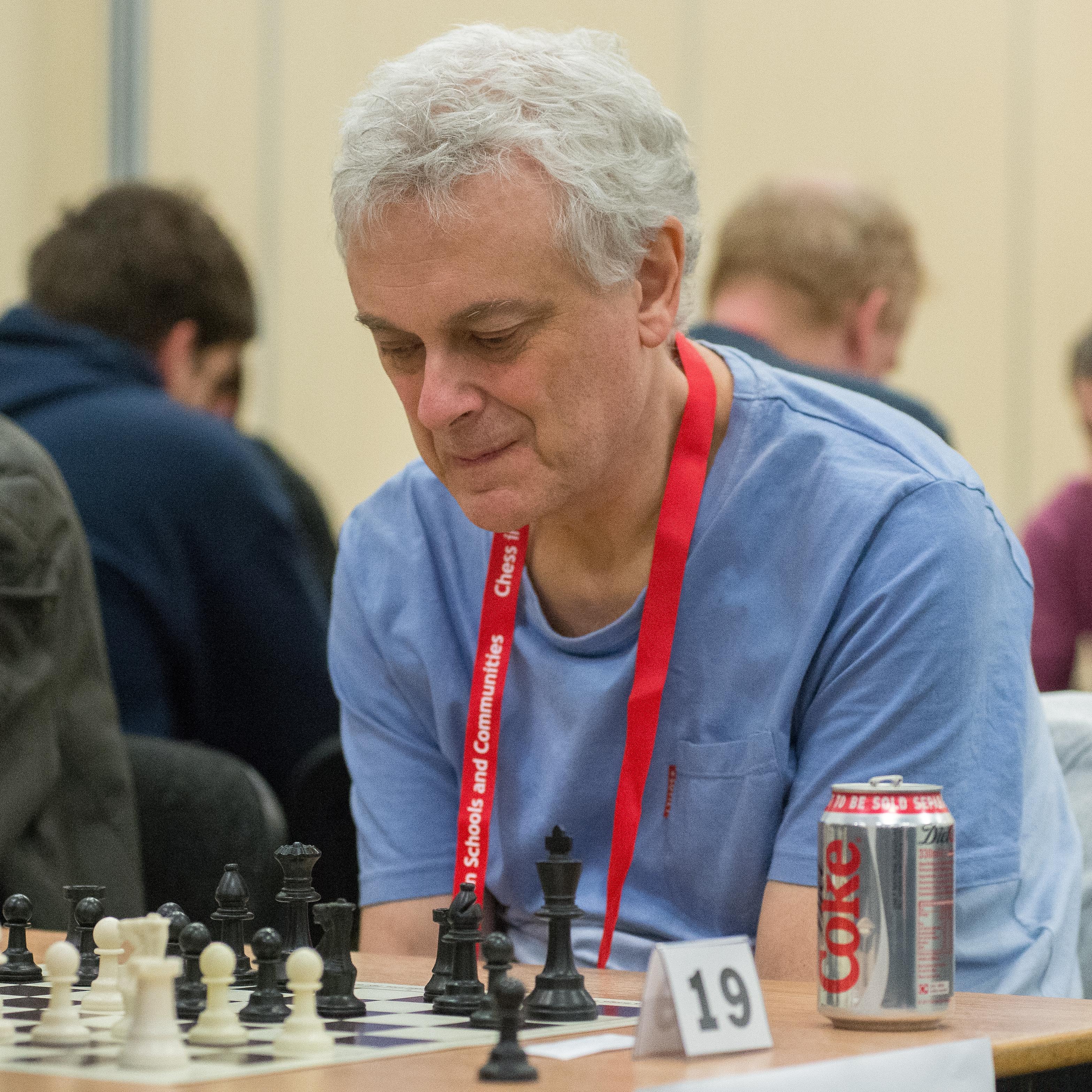
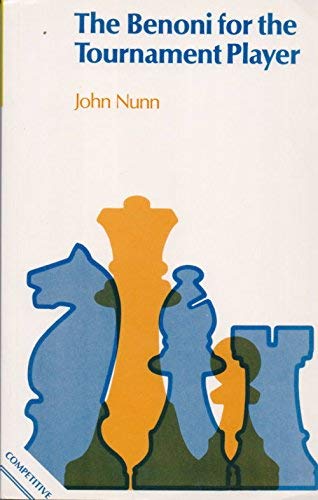
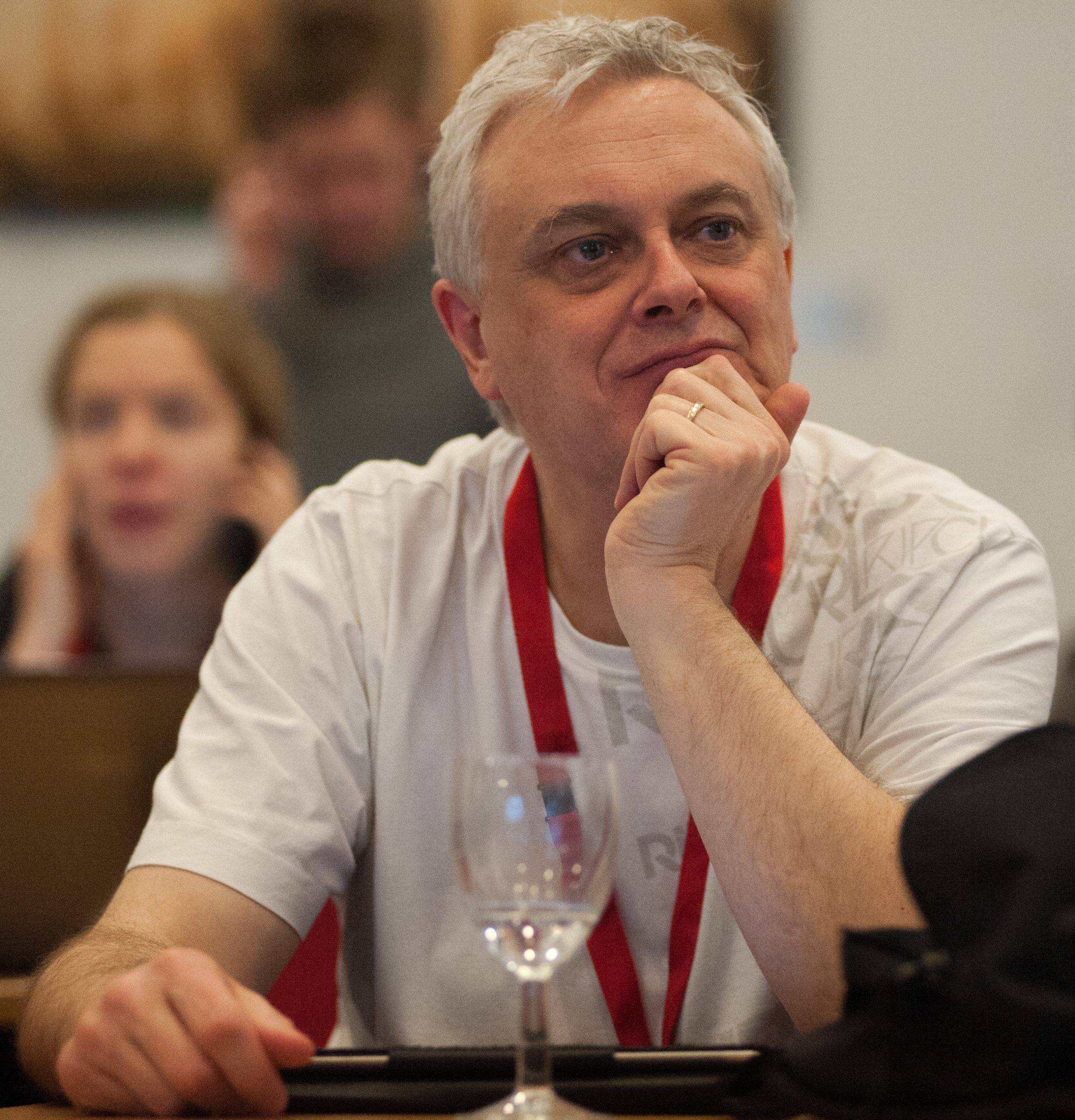
BCN wishes GM John Nunn Happy Birthday (25-iv-1955). John resides in Bude, Cornwall with his wife Petra (née Fink) having previously resided in Chobham, Surrey. John became a director of Gambit Publications Ltd. on January 30th, 1997 along with Murray Chandler and Graham Burgess. WFM Petra Nunn is the German editor.
Harry Golombek OBE wrote the following (presumably in 1978) in the 1979 Dataday chess diary:
“Fortunate is the country which has a number six player as good and as effective as John Nunn. As I wrote last time, ‘The former European Junior champion is such a fine player and pursues the game with such energy when he does play that one is apt to forget he is an amateur with only a limited amount of time to spare for study of the game.’
He like Mestel, obtained a grandmaster norm at the Lord John tournament where he score 5.5 points coming just below Mestel but beating both Quinteros and Torre in the process.
At the Moscow Team tournament, already mentioned, he had a magnificent result scoring 3.5 out of 7 on board 4. Perhaps it was this performance that increased his Elo rating by 30 points and when I say board 4 it should be realised that opposition consisted of such players as the former world champion Tal and many other genuine grandmasters. I give the entertaining and fighting draw he had with Tal as Moscow.”
From British Chess (Pergamon Press, 1983), pp.201- 210:
“It is a difficult task to pick out three games from many hundreds played over the years. What criteria should be used in the selection? Brilliance, strength of opponent, importance of result – all these are reasons for a game to stand out in one’s memory. As this selection is autobiographical I have given prominence to the last criterion and so I will give one game from each of the tournaments in which I gained an International title, and one game from a team tournament.
The first of these tournaments was the European Junior Championships held over the new year 1974-5 in the Dutch town of Groningen. It was only by chance that I played in this event at all. Originally Jonathan Mestel was the English representative, but he was invited to play in concurrent Hastings Premier and so I travelled to Groningen instead.
The organisation of the Championship has changed over the years, but at that time a seven-round Swiss formed a preliminary event, with the top ten of the twenty-eight participants going on to an all-play-all final section. The score thought to be sufficient for qualification was 4.5/7 and the accepted method of reaching this target was to win one’s first two games and then draw all the others., facilitated by the fact that one’s opponents would also require draws to reach the magic figure 4.5. However tie-breaking in the final was decided firstly by the score in the preliminaries and secondly by the result of the individual game in the final, so it was clearly an advantage to outstrip one’s rivals in the Swiss. I started with the requisite two wins and then drew my next three games, but in round six with the white pieces I decided to play for the win against Manny Rayner of Wales. I felt slightly self-conscious playing amidst a row of boards on which peace has been concluded at an early stage, but I did gain the full point. The game stirred up a certain amount of comment and I even heard one player’s second declare
You can’t trust Nunn!
In such a short race there will inevitably be upsets and the unlucky man on this occasion was Alexander Ivanov, the Russian representative.
The final round started less smoothly for me and after five rounds the leading scores were Borokowski 4, Szekely 3.5 and van der Sterren and myself on 3. I had already beaten van der Sterren, who had tied with me in the preliminaries, so in view of the tie-break rules, I had effectively half-a-point advantage over the rest of the field. In round six I played Borkowski and a win for would leave the tournament wide open.
I scored well in the three rounds after this game and appeared to have a good chance of winning. However in the penultimate round I lost to Lars-Ake Schneider in only 18 moves so as the last round started the leading scores were Szekely 5.5 out of 8 with Schneider, Borkowski and myself on 5. Skekely was White against Borkowski while I had White against the Israeli Grunfeld. Schneider blundered quickly and lost, while to my surprise Skekely drew in only 14 moves. The way was now open to the title if only I could defeat my opponent. However after 4.5 hours play I had only a slight advantage. But then a curious thing happened. I made my 40th move with a minute or two left on my clock and Grunfeld, who had half an hour left, replied almost immediately. The game was played to a finish without adjournment and now, with an hour on my clock, I was able to see that his 40th move was a mistake allowing a decisive combination. This small event decided the result of the tournament and so I became European Junior Champion and an International Master.
The second game was played in the Finals of the European Team Championship held at Moscow 1977. This event which takes place every three years, is second in importance only to the biennial Olympiads. The twenty teams entering were divided into five preliminary groups to produce seven qualifiers for the final. The USSR, as previous winners, were admitted directly to the final to make up the total of eight countries represented at Moscow. England qualified ahead of Holland, the other teams in this preliminary group being Wales and France. Since the matches in the final take place over eight boards this event is much more test of strength in the depth than the four board Olympiads and so England was not expected to do well, especially in view of the absence of Tony Miles. Nevertheless the final result of bottom place was a disappointment. My individual performance of 50% against strong opposition was quite satisfactory, but it was the following game which made the tournament particularly enjoyable for me.
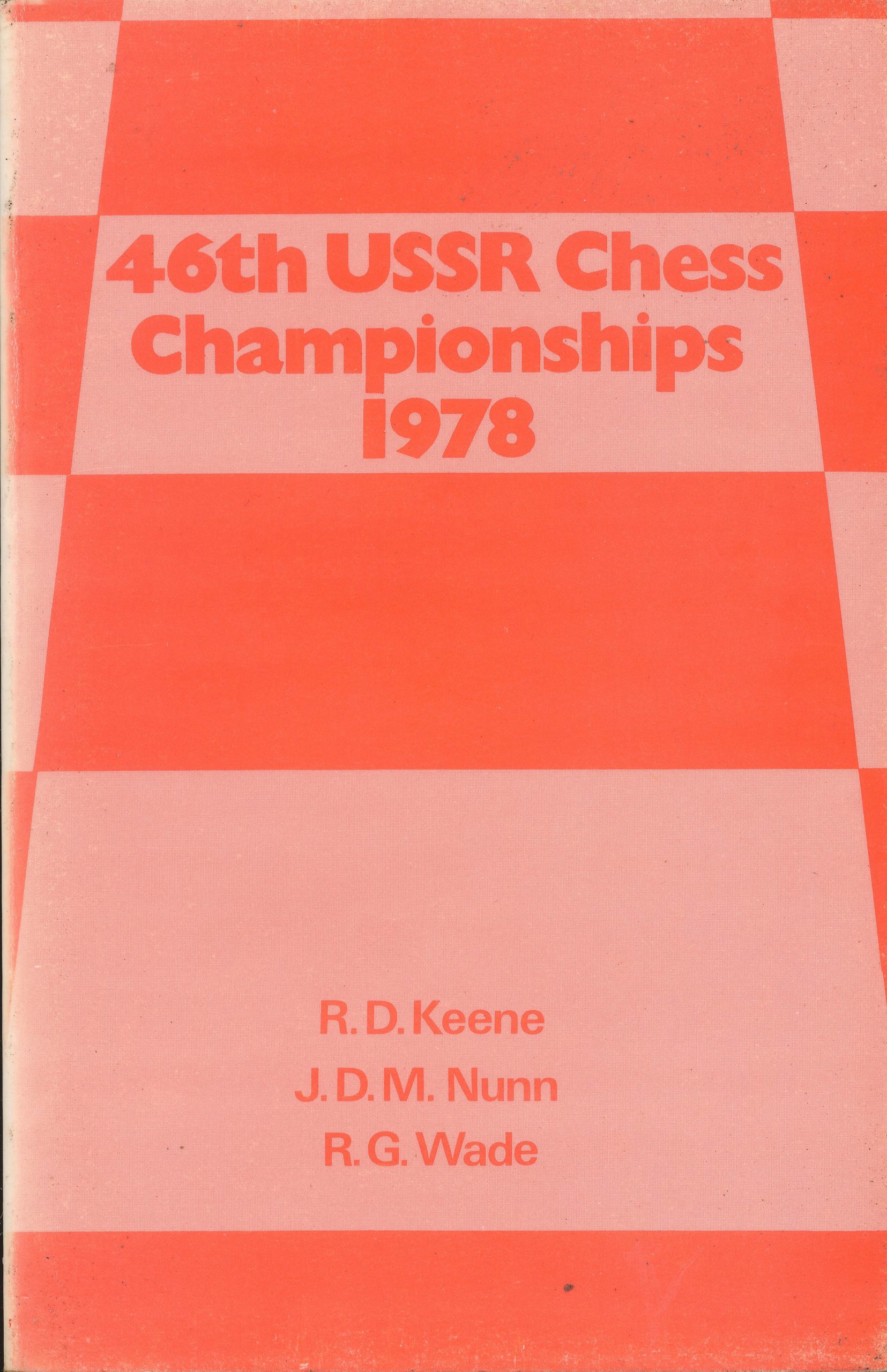
We now move ahead to the summer of 1978. At this time I had a 9-game grandmaster norm from the Lord John Cup held in London during September 1977 and so I needed a 15-game norm to actually gain the title. In July I played in an event at Lublin in Poland at which, however, there was no GM norm. My play showed evidence of lack of practice and my final position was rather low.
Then I went on to the annual Tungsram tournament held in Budapest during August. This was a much stronger event (category 10) and the GM norm was a formidable 10 out of 15. However my play was much better than in Poland and, after a first round loss, I began to score well. After 12 rounds the leading scores were Kuzmin 8, Nunn 7.5 and Csom, Jansa, Adorjan and Mednis 7. I could have had half a point more if I had not overlooked a combination two (!) moves deep winning Kuzmin’s queen, but, apart from this incident Kuzmin had played very well and seemed to be heading for first prize.
My sights were firmly set on scoring 2.5 from the last three games to reach the GM norm and my interest in winning the tournament was secondary. However, Kuzmin was destined to lose his next two games and so these two objectives became one and the same.
In these final games I was to be White against F. Portisch (Lajos’ brother), Black against GM Jansa and in the last round White against Hardicsay, the weakest player in the tournament. The plan was clear – I had to win both games with White and hold Jansa to a draw with the Black pieces. The execution, however, was more difficult.
While preparing for F. Portisch I noticed that he played either the French or the Sicilian Pelikan. Since I was playing only for the win I naturally hoped he would opt for the complications of the Pelikan. Two days before this game I had been given a copy of the latest issue of the Hungarian chess magazine, Magyar Sakkelet, containing a game Honfi – Piasetki in which Honfi had played 11.Bxb5!? and won with the aid of a novelty. This piece sacrifice seemed to be ideal for stirring up as much trouble as possible and so I decided to try it in the game, at the same time hoping that F. Portsich had not read his magazine!
The first obstacle had been surmounted, but two more remained. The opening went badly against Jansa, but I managed to restrict myself to a small disadvantage in the early middle game. To my good fortune the Czech Grandmaster was going through a bad patch, having started with 7/10 anf then scored only half a point from his next three games. With only two rounds to go his interest in the tournament had dissipated and rather try to exploit his edge he offered a draw. Of course I was only too pleased to accept.
Before the last round I was extremely nervous but bolstered my confidence with that thought that Hardicsay had only managed to score 3.5/14 , and indeed had accumulated only half a point from his last six games. In most cases this was due to his chronic addiction to time trouble. At first things went well. I accepted a pawn sacrifice and gradually seemed to be repelling my opponent’s threats. But at a crucial moment I chose a faulty bishop move and suddenly my difficulties were growing from move to move. Before long I was pawn down with an inferior position. My only hope lay in the fact that Hardicsay had only seconds to make the last eight moves of the time control. Exploiting this, I regained the pawn and even adjourned with a slight plus.
After a one hour break play was resumed and once again Hardicsay played well, almost completely neutralizing my advantage. I cunningly made some pass moves with my King until he was once again in time trouble and then tried my last winning attempt!
In the event my opponent made a mistake and a further session was not necessary. The two spectators who had stuck it out to the end dashed up to congratulate me and Hardicsay gave me a distinctly sour look (justifiably!)- I had become a Grandmaster!
From The Encyclopaedia of Chess (Batsford, 1977) by Harry Golombek OBE :
British International master and European Junior Champion, 1975. Born in London, Nunn learned chess at the age of four and soon revealed a great aptitude for the game.
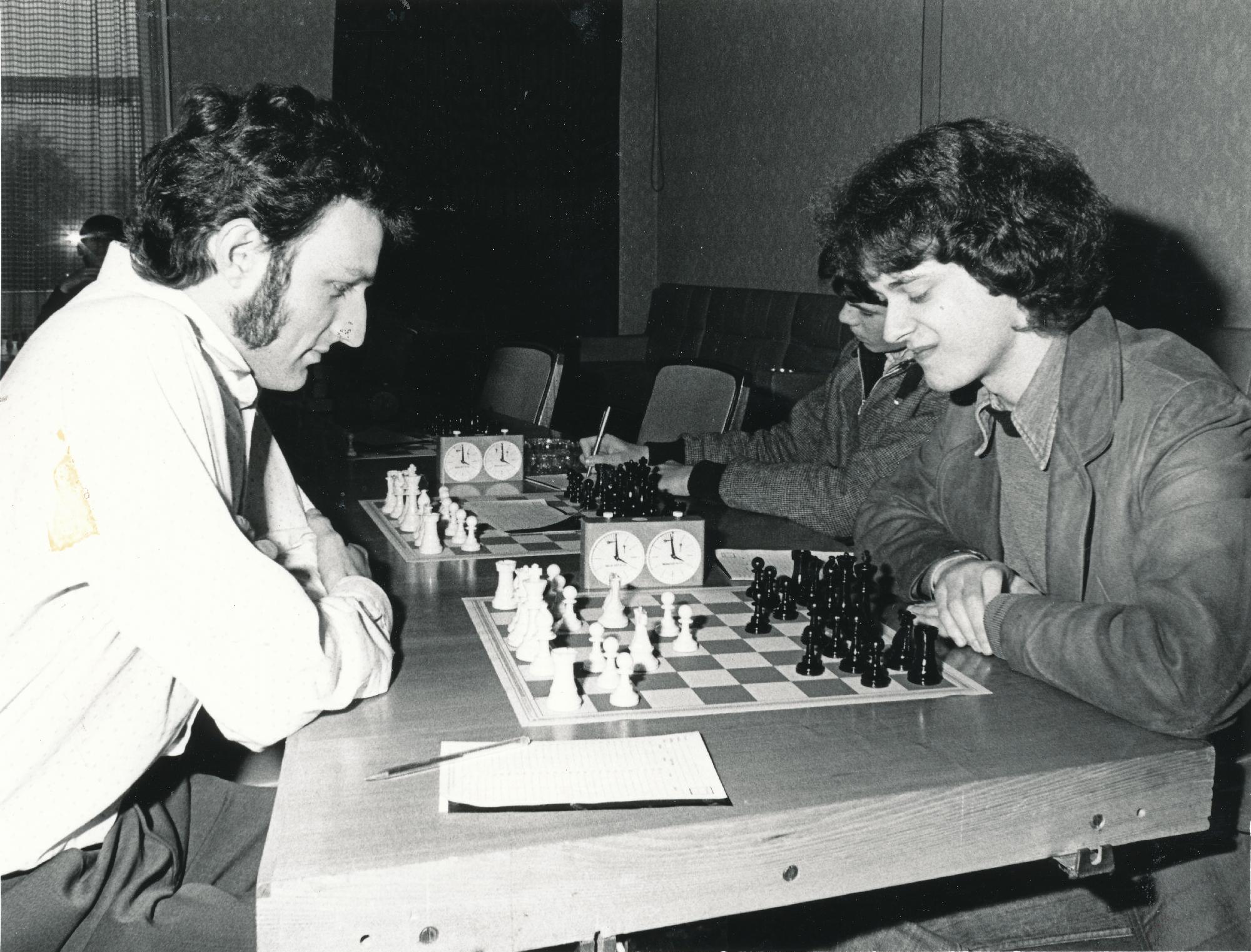
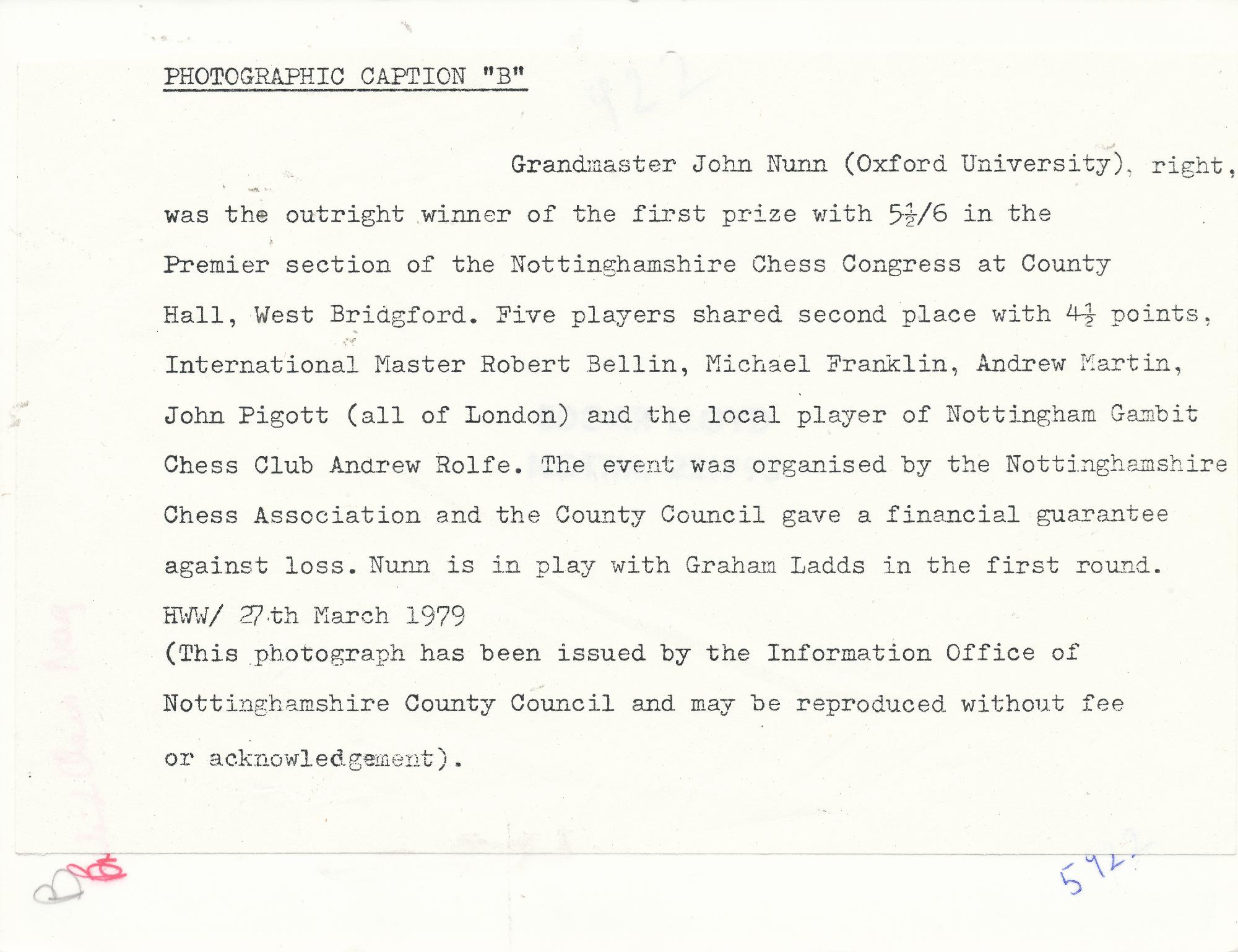
He came 6th in the Norwich Junior international tournament in 1970 and went up to Oxford University to take a mathematics degree at a very early age. He played on top board for the University from 1972-6 and is now preparing for a doctorate there.
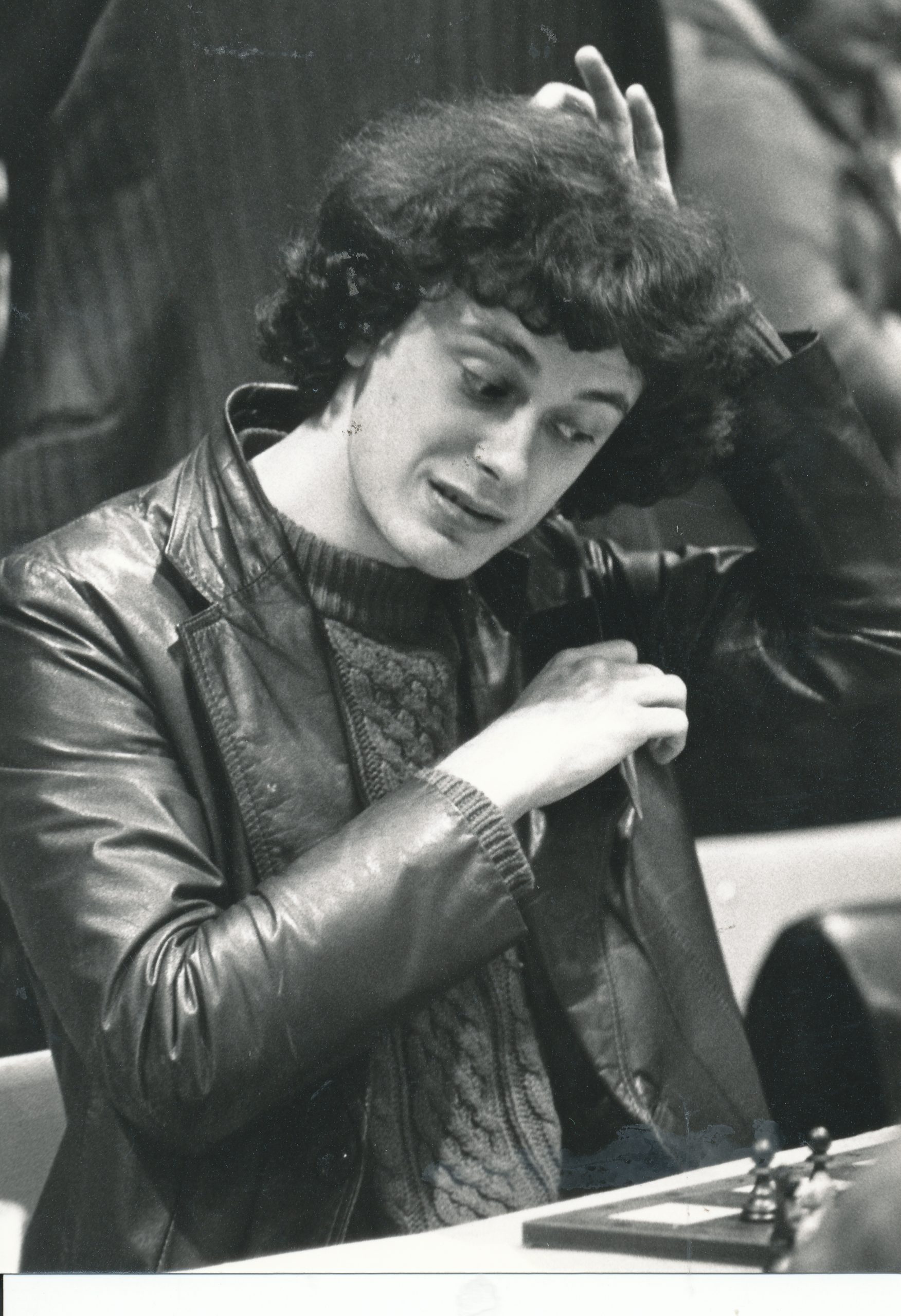
He won the European Junior Championship and with it the international master title in Groningen in 1975. In that year too he was equal first in the IBM Master tournament, and at London in 1975 he reached an international master norm coming 5th in the international tournament there. He played on bottom board at the Haifa Olympiad 1976 and scored 64.2%
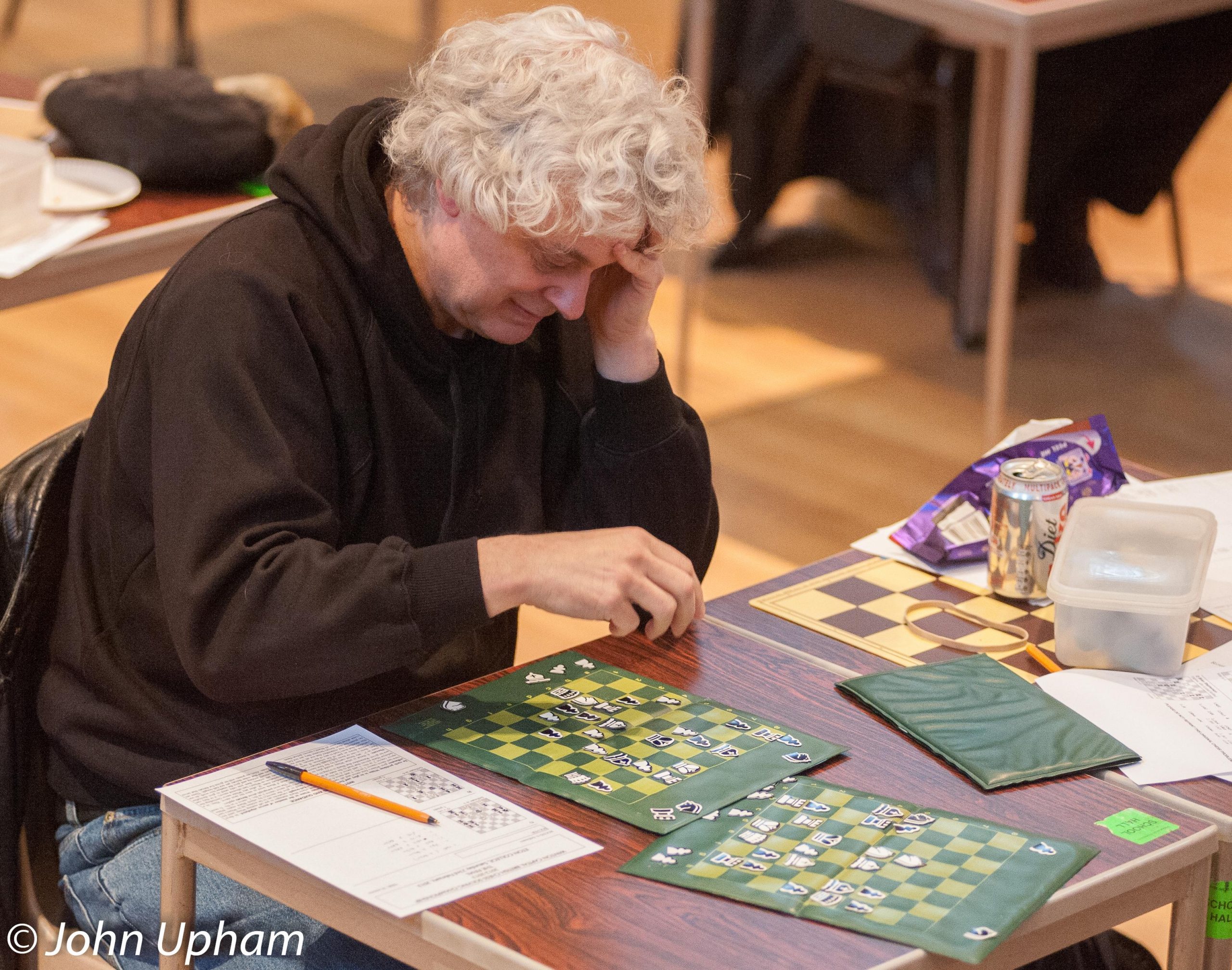
From The Oxford Companion to Chess by Hooper & Whyld :
English player. International Grandmaster (1978), British champion 1980. He went to Oxford at the unusually young age of 15, graduated in 1973. Gained his B.Sc. the following year and his
doctorate in 1978.
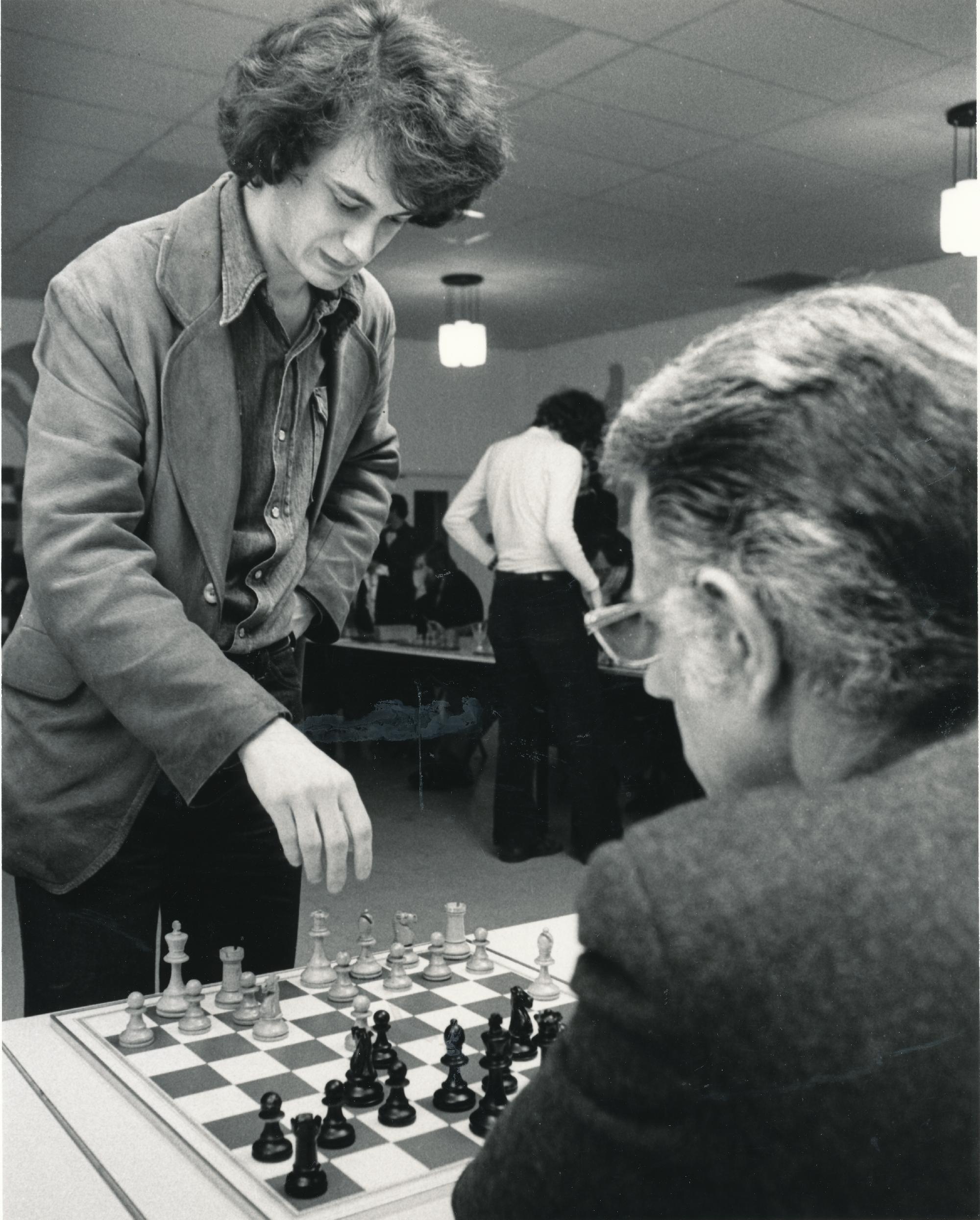
A Junior Research Fellow, he lectured in mathematics until 1981 when he became a professional player. By then he had already achieved several good results in international tournaments: Budapest 1978, first; Hastings 1979-80, first (4-5 = 10) equal with Andersson; Baden-bei-Wien 1980, category 12, third (+5=10) after Spassky and Belyavsky: Helsinki 1981, first (+5 = 6) equal with Matulovich; and Wiesbaden 1981, first (+6=3). In the category 12 Wijk aan Zee tournament 1982, Nunn came first ( + 5=7 — 1) equal with Balashov ahead of Tal, Hubner, and Timman and at Helsinki 1983 he came second (+5 = 6) after Karlsson.
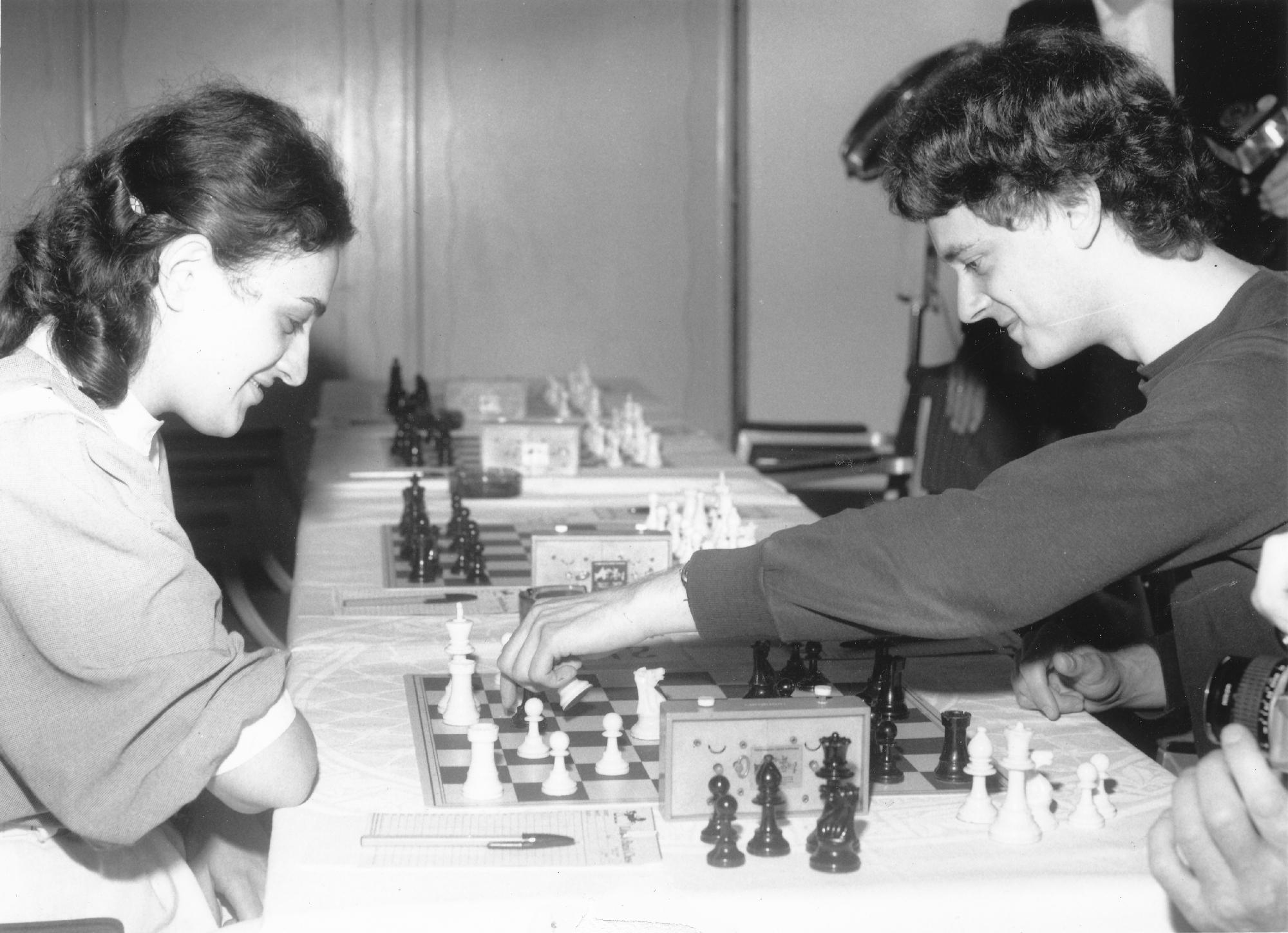
Possessing a remarkably quick sight of the board, Nunn is an expert solver: he made the second highest individual score in the world team solving championship, 1978, and won the solving championship of Great Britain in 1981.
Here is an excellent article from ChessBase
Polugayevsky-Nunn European team championship :
Here is his Wikipedia entry
 Save as PDF
10 thoughts on “Happy Birthday GM John Nunn (25-iv-1955)”