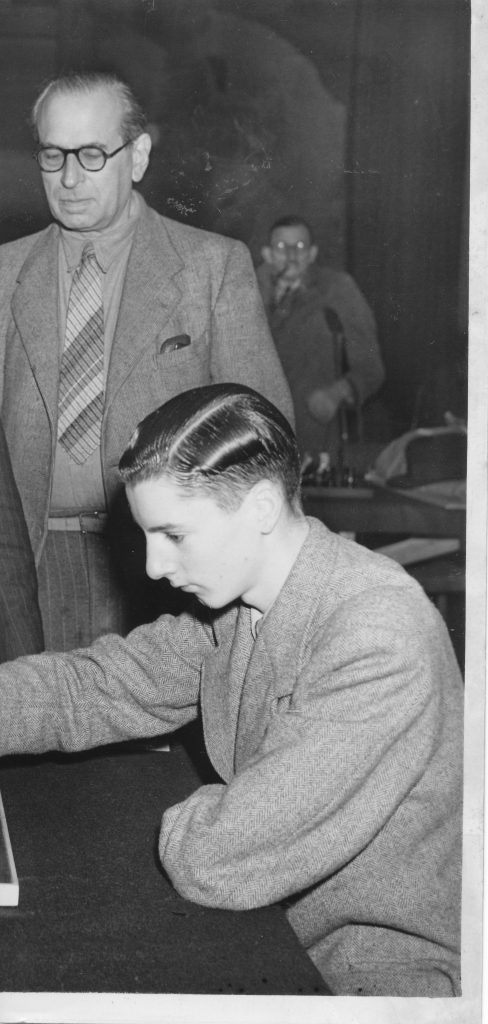
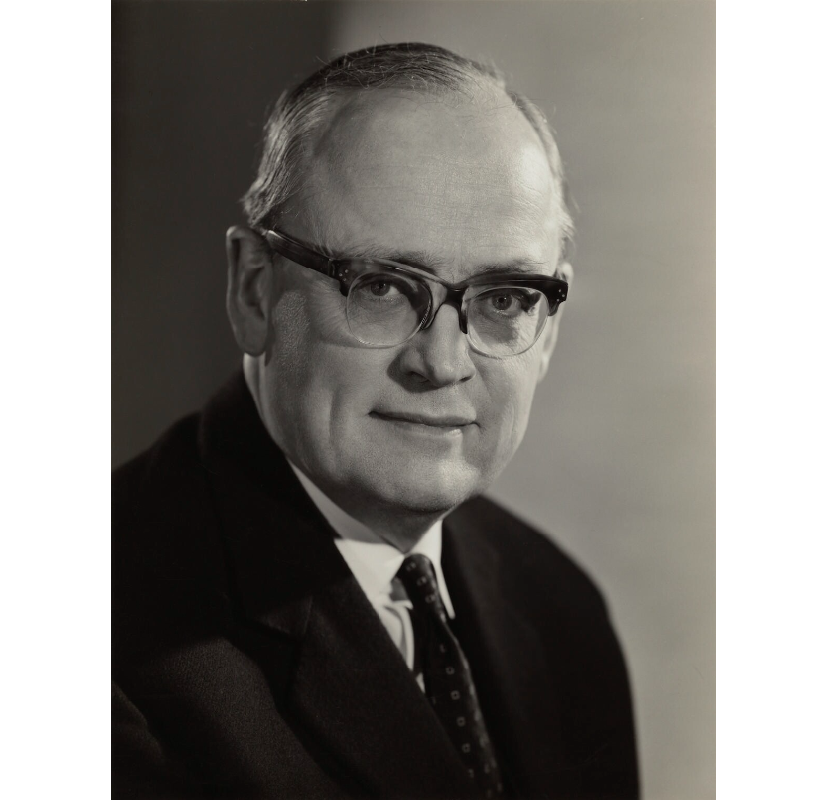
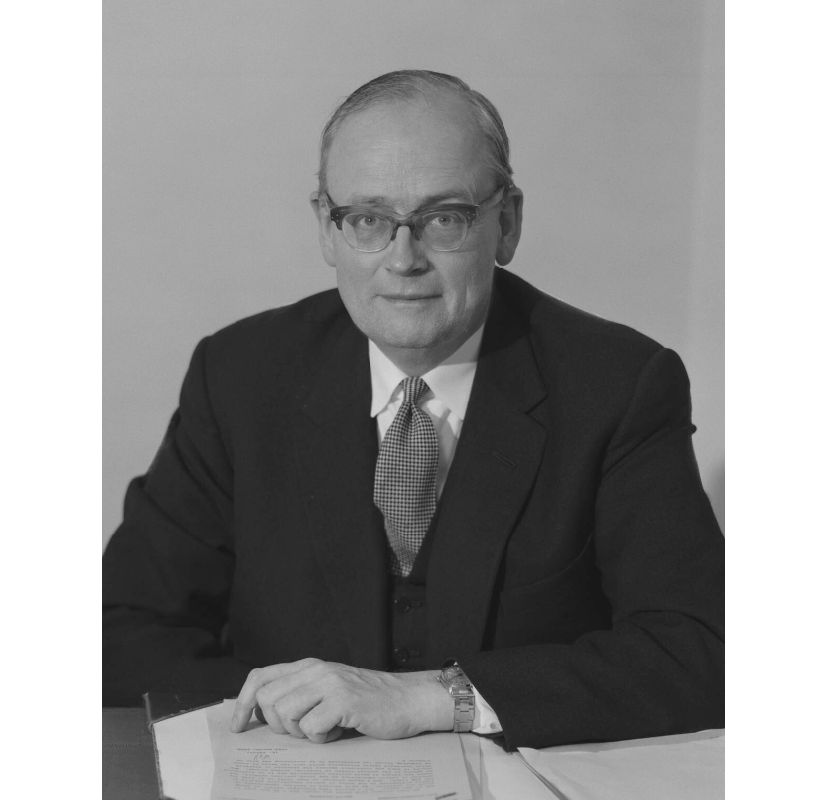
Sir Richard Clarke (13-viii-1910 21-vi-1975), National Portrait Gallery, Walter Bird
BCN Remembers Sir Richard Clarke KCB OBE who passed away on June 21st 1975.
According to chess-poster.com : “Clarke died in the University College Hospital, in London, on 21 June 1975 and was cremated at Golders Green three days later. He was survived by his wife Brenda Pile (married in 1950, née Skinner) and their three sons.”
One of those sons is Charles Rodway Clarke along with his brothers Mark G and Timothy Rodway.
Richard William Barnes Clarke was born on August 13th, 1910 in Basford, Derbyshire. The birth was registered in Ilkeston in the district of Erewash. His parents were a secondary and technical school schoolmaster of science, William Thomas Clarke and Helen Rodway Clarke (née Barnes). Richard was baptised on October 1st 1910 in St. Lawrence (Anglican) Church in Heanor, Derbyshire.
The 1911 census records the family living at “Iona” which was a modest property in Fletcher Street in Heanor which had six rooms. Richard was seven months old and he had a three year old sister, Stella Helen Clarke. The family retained a nineteen year old domestic servant, Ada Mary Brown who has been born in Codnor, Derbyshire.
Richard was educated at Christ’s Hospital, London followed by Clare College, Cambridge. At University he studied mathematics specialising in statistics. He was ranked at the sixth “wrangler“. Subsequently he was awarded the Frances Wood Prize by the Royal Statistical Society.
In 1944 Richard was awarded the OBE for his work as Planning Officer for the Ministry of Production followed by Companion of the Bath in 1951 for his work as Under Secretary at HM Treasury and in 1964 he was made Knight Commander of the Bath for his work as Second Secretary at HM Treasury.
According to chess-poster.com : “He was commonly known as Otto Clarke” and according to his son Mark the nickname “Otto” was possibly because of Clarke’s “forceful” personality was considered Germanic. According to Sir Sam Brittan, “it was because his round glasses and the bridge over the nose looked like OTTO.”
From The Oxford Companion to Chess by Hooper & Whyld :
Creator of the British system of grading. He gave up active chess after leaving Cambridge University where he played second board between C.H.O’D. Alexander and Jacob Bronowski.
At first a financial journalist (one of the two who created the Financial Times Index), he became, at the outbreak of the Second World War, a temporary civil servant, remaining to become one of the most distinguished of them, and to receive a knighthood.
According to Arpad E. Elo in “Ratings of Chessplayers Past and Present” : “In the chess world, rating systems have been used with varying degrees of success for over twenty-five years. Those which have survived a share a common principle in that they combine the percentage score achieved by a player with the rating of his competition. They use similar formulae for the evaluation of performance and differ mainly in the elaboration of the scales. The most notable are the Ingo (Hoesskinger 1948), the Harkness (Harkness 1956), and the British Chess Federation (Clarke 1957) systems. These received acceptance because they produced ranking lists which generally agreed with the personal estimates made by knowledgeable chessplayers.”
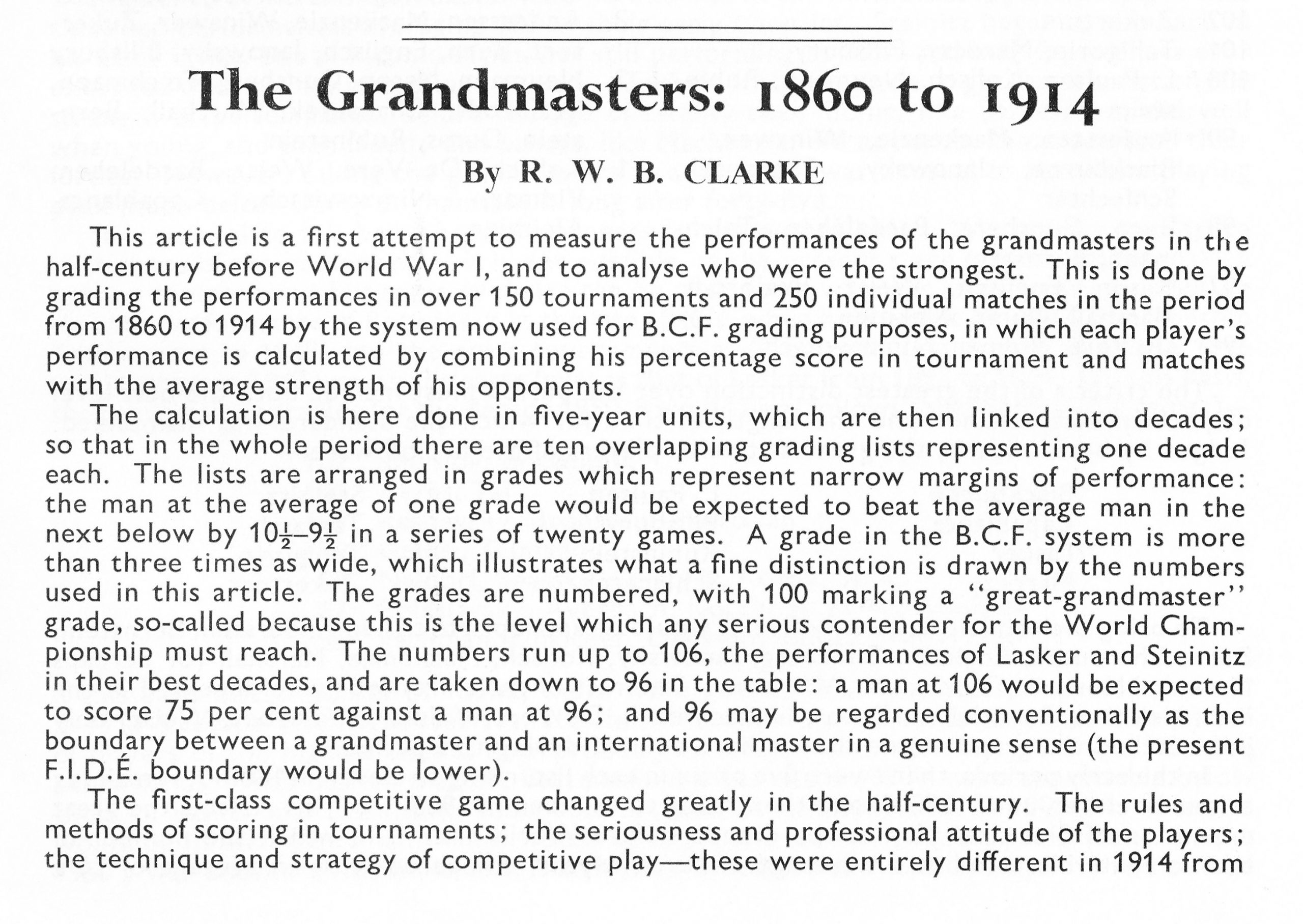
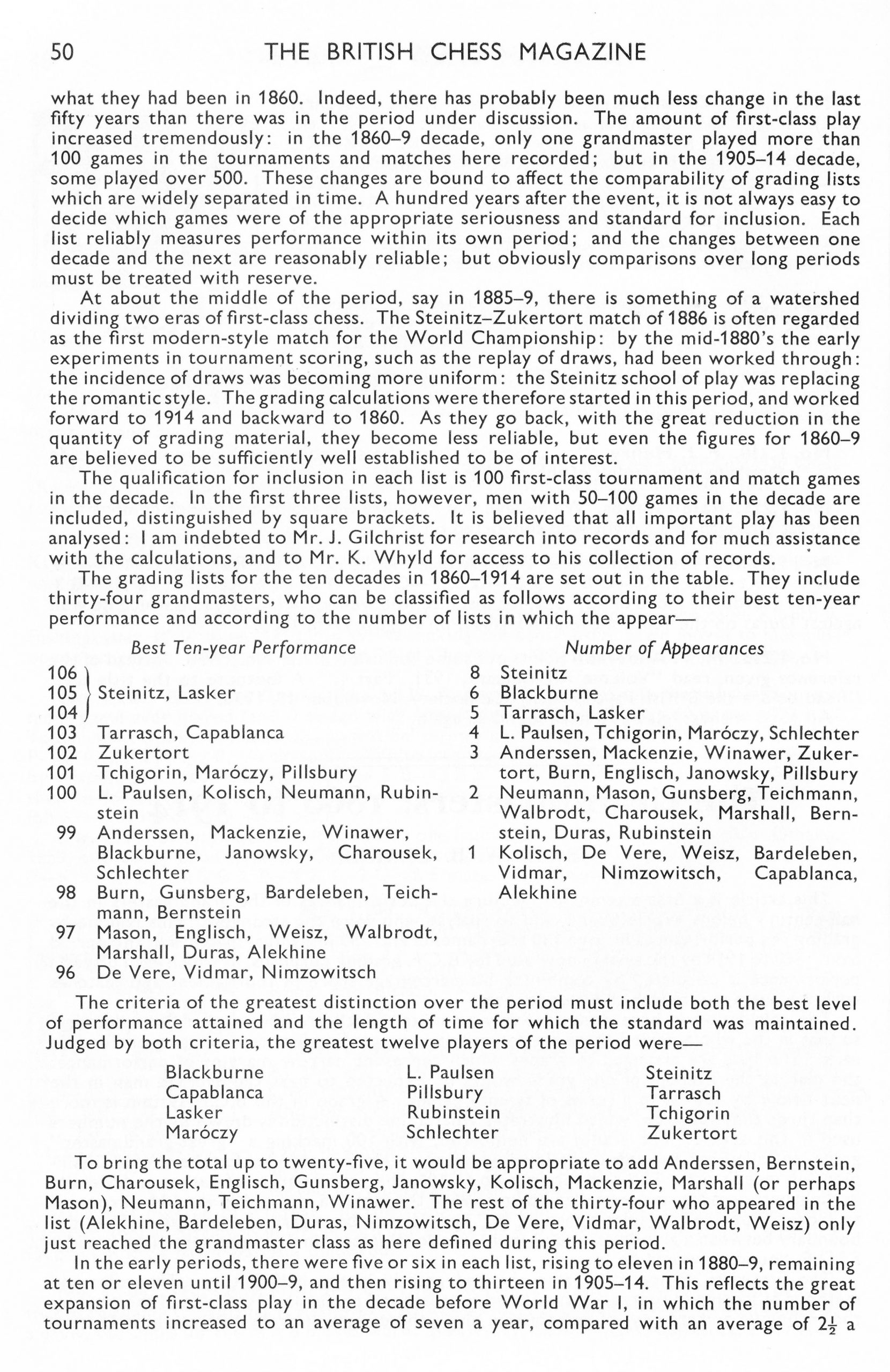
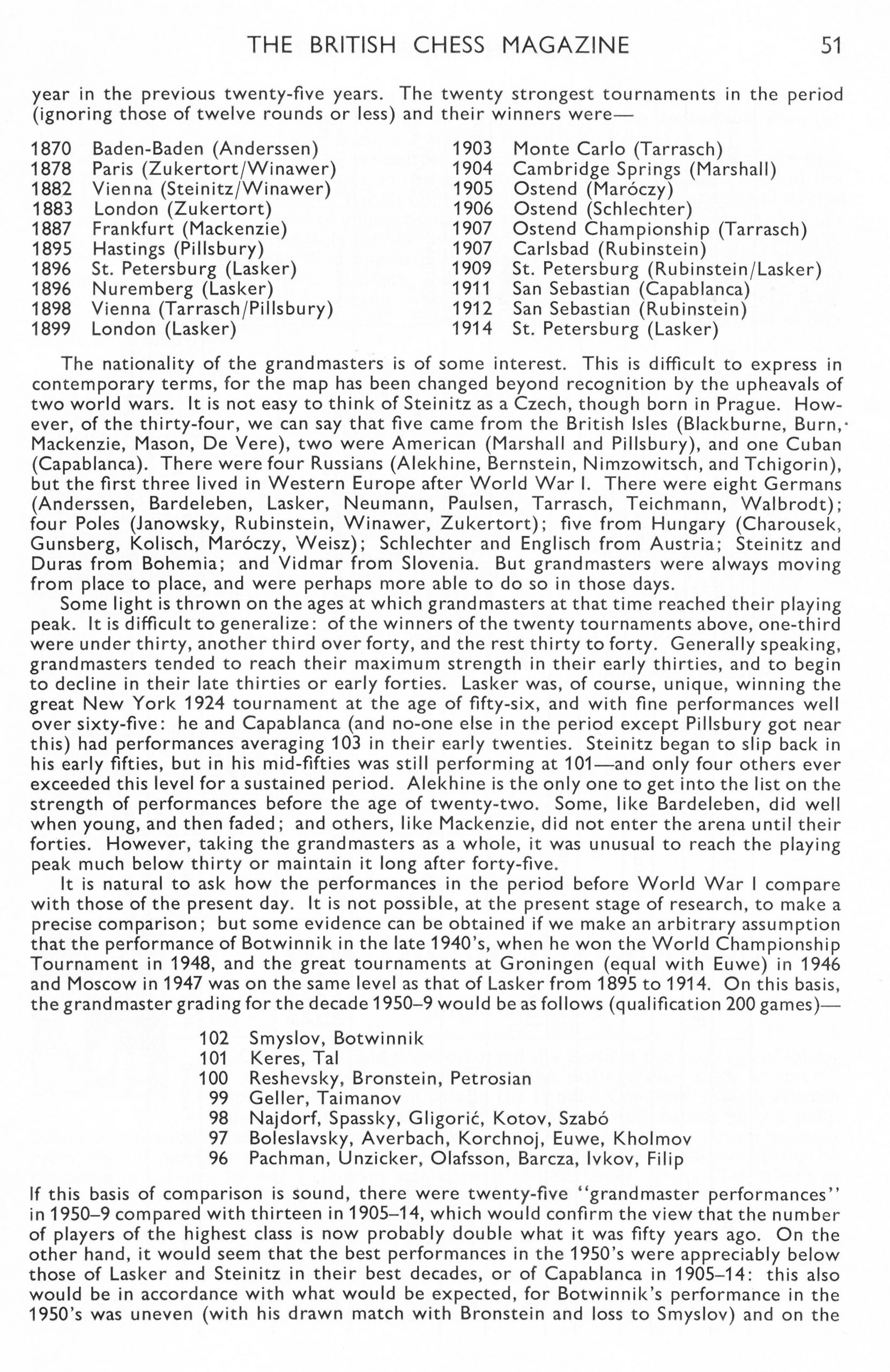
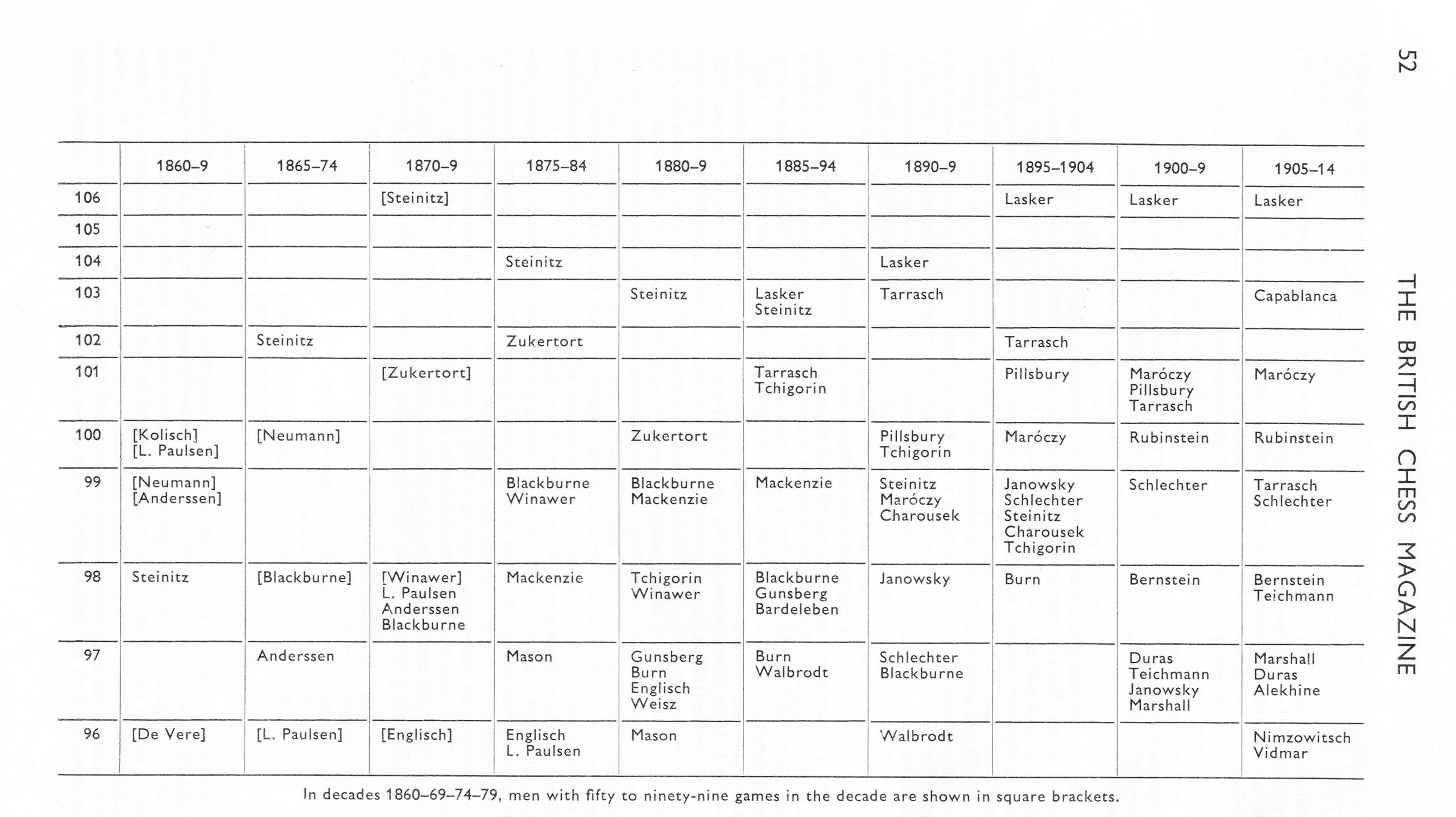
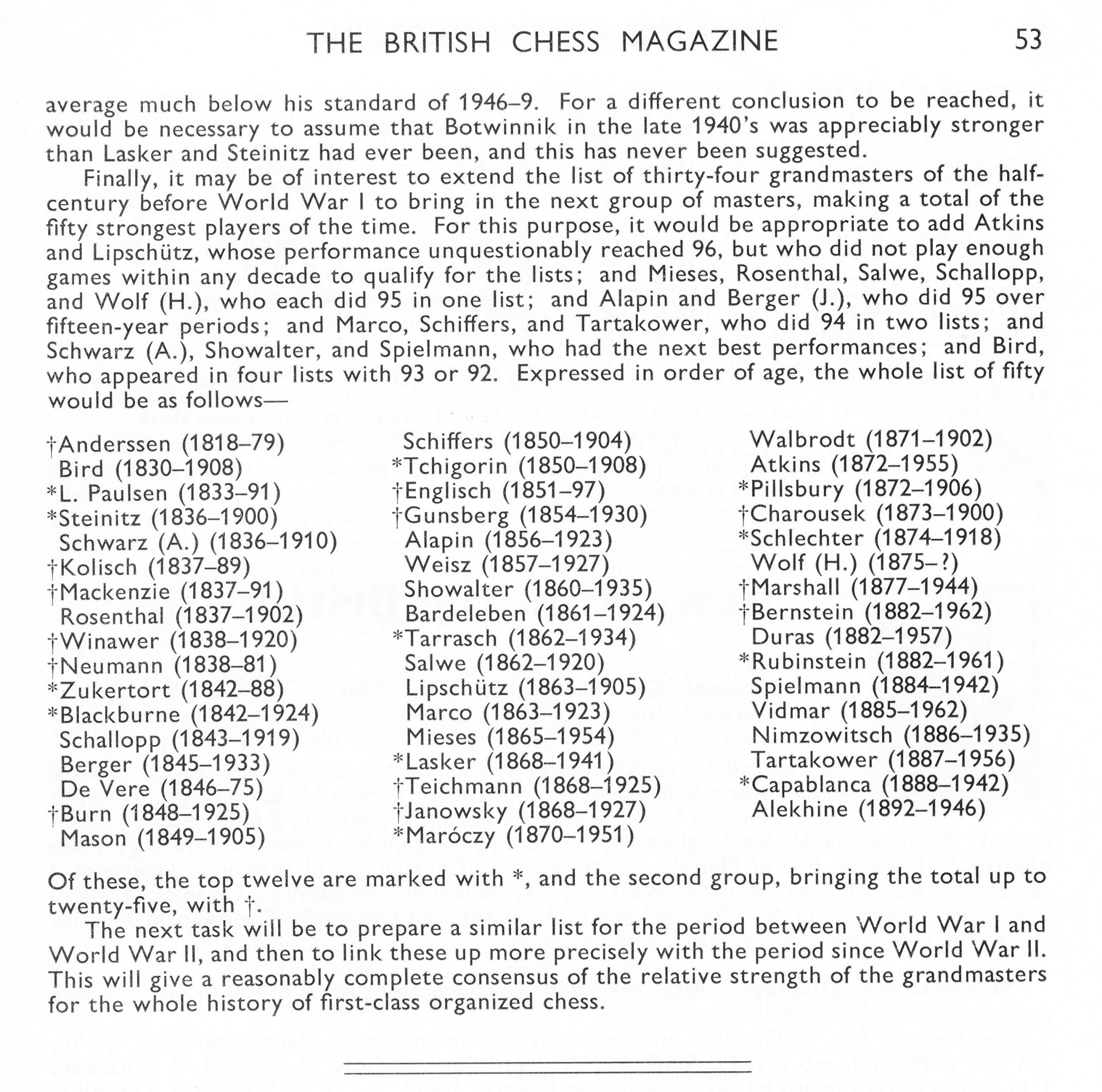
Here is an article in full reproduced from British Chess Magazine, Volume LXXXIII, Number 2, February, 1963, pages 49 -53 :
British Chess Magazine, Volume LXXXIII, Number 2, February, 1963, page 49British Chess Magazine, Volume LXXXIII, Number 2, February, 1963, page 50British Chess Magazine, Volume LXXXIII, Number 2, February, 1963, page 51British Chess Magazine, Volume LXXXIII, Number 2, February, 1963, page 52British Chess Magazine, Volume LXXXIII, Number 2, February, 1963, page 53
The June 1975 issue of British Chess Magazine announces his passing and promises that a tribute would follow : it never did.
Sir Richard Clarke (13-viii-1910 21-vi-1975), National Portrait Gallery, Rex Coleman
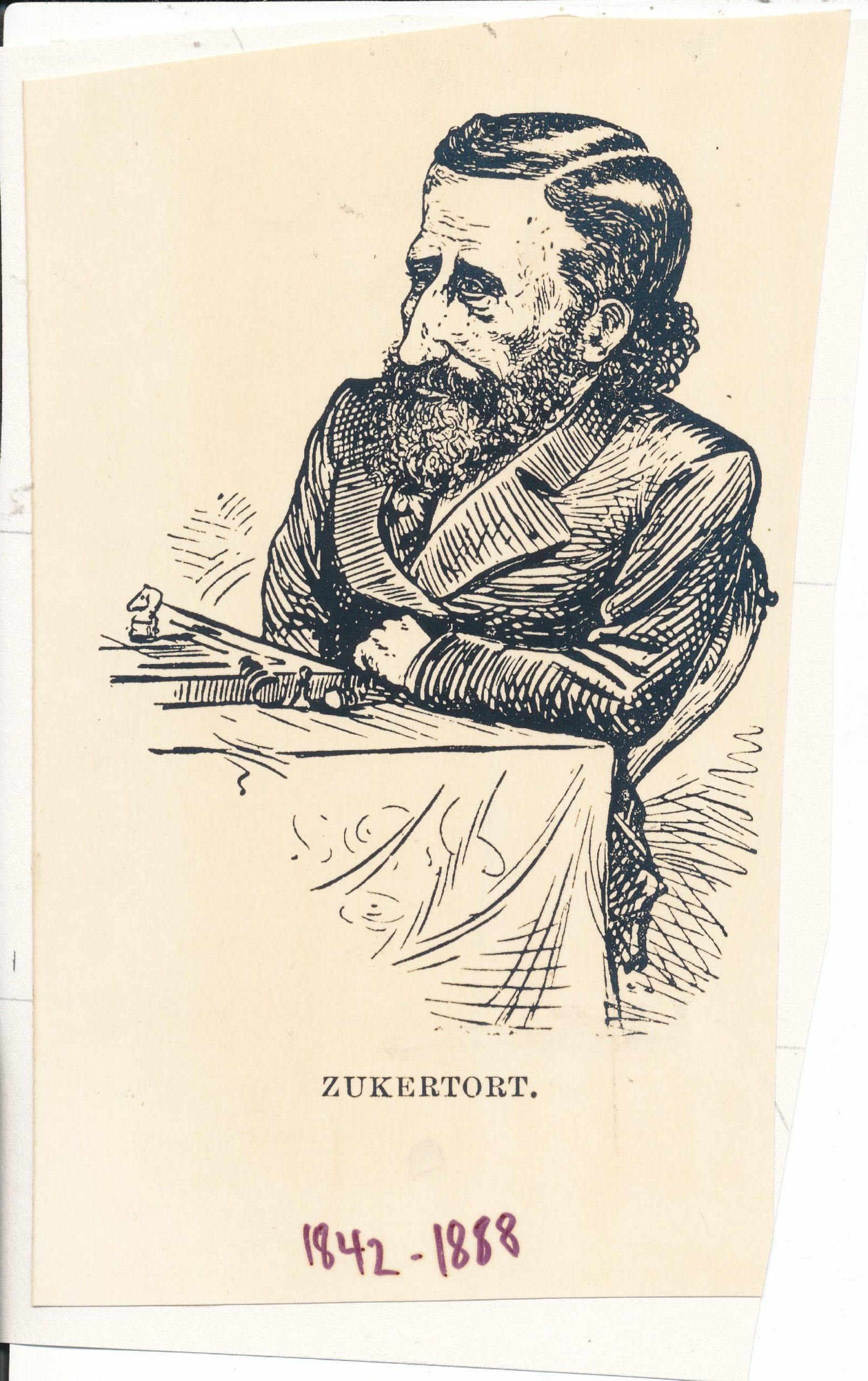
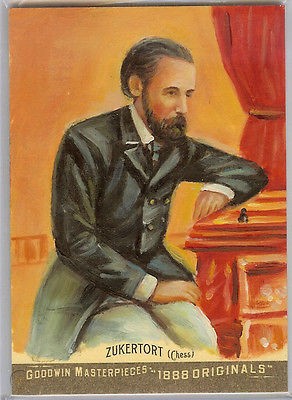
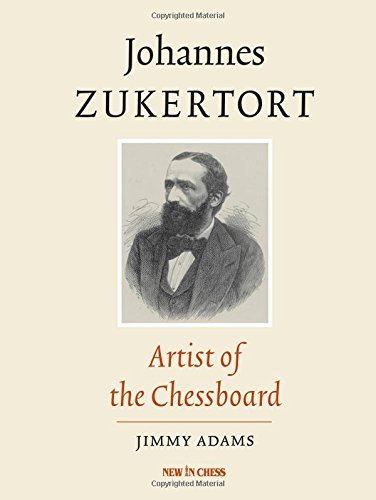
Johannes Hermann Zukertort (07-ix-1842 20-vi-1888)
BCN Remembers Johannes Hermann Zukertort (07-ix-1842 20-vi-1888)
From the July 2012 editorial in British Chess Magazine we had this report :
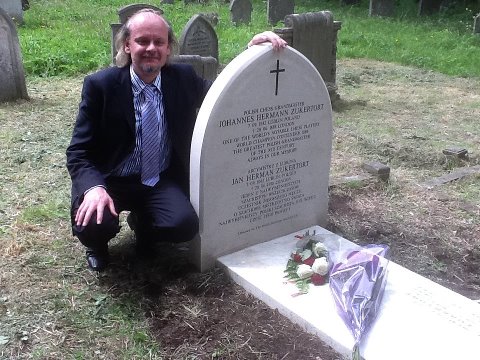
“Johann Hermann Zukertort’s (1842-1888) grave was rededicated last month in London’s crowded Brompton Cemetery, largely thanks to an initiative led by Stuart Conquest. The resting place of one of the leading players of the nineteenth century was recorded but the grave had fallen into terrible disrepair. See BCM 1888, pp.307-8 and p.338-340 for the obituary of the great man. We read that his death ‘was terribly sudden’, that he was buried on 26th June, 1888 and that ‘several pretty wreaths were laid on the coffin …’”
GM Stuart Conquest at the re-dedication of Zukertort’s grave at Brompton Cemetery in June 2012, photograph by Ray Morris-Hill
From The Oxford Companion to Chess by Hooper & Whyld :
Polish-born Jew, from about 1871 to 1886 second player in the world after Steinitz. From about 1862 to 1866 Zukertort, then living in Breslau, played many friendly games with Anderssen, at first receiving odds of a knight but soon meeting on even terms. They played two matches in Berlin, Zukertort losing the first in 1868 (+3 = 1—8) and winning the second in 1871 (+5 — 2).
In 1872 a group of London players, anxious to find someone who could defeat Steinitz, paid Zukertort 20 guineas to come to England. He came, he stayed, but he failed to beat Steinitz.
Johannes Hermann Zukertort (07-ix-1842 20-vi-1888)
Zukertort took third place after Steinitz and Blackburne at London 1872, the strongest tournament in which He had yet played, and later in the year was decisively beaten by Steinitz in match play ( + 1=4—7). Zukertort settled in London as a professional player.
He won matches against Potter in 1872 ( + 4=8—2), Rosentalis in 1880 ( + 7=11-1), and Blackburne in 1881 ( + 7=5-2), He also had a fair record in tournament play: Leipzig 1877, second equal with Anderssen after L. Paulsen ahead of Winawer:-* Paris 1878, first ( + 14=5—3) equal with Winawer ahead of Blackburne (Zukertort won the play-off, +2=2); Berlin 1881, second alter Blackburne ahead of Winawer; and Vienna 1882, fourth equal with Mackenzie after Steinitz, Winawer, and Mason.
Johannes Herman Zukertort (07-ix-1842 20-vi-1888)
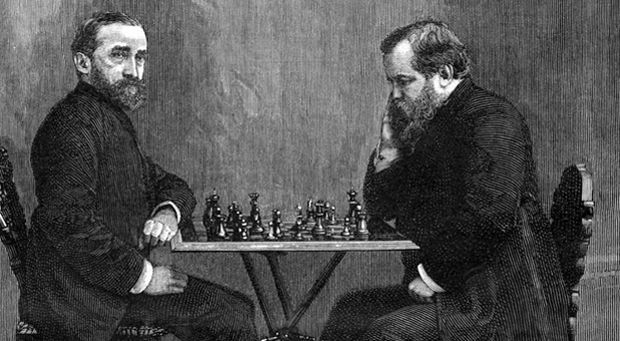
The world’s nine best players were among the competitors in the double-round London tournament of 1883 when Zukertort achieved his greatest victory: first prize (+22—4) three points ahead of Steinitz, the second prize winner, in seven weeks and a day he played 33 games (seven draws were replayed) and towards the end he relieved the strain by taking opiates, the cause of his losing his last three games. This victory led to the first match for the world championship, a struggle between him and Steinitz, USA, 1886. After nearly ten weeks of relentless pressure by his opponent Zukertort lost (- 1 – 5=5 —10) i winning only one of the last 15 games. His spirit crushed, his health failing, he was advised to give up competitive chess, but there was nothing else he could do. I am prepared, he said, l to be taken away at any moment.’ Seized by a stroke while playing at London’s famous coffee-house, Simpson’s Divan, he died the next day.
Johannes Zukertort playing Wilhelm Steinitz
Like Anderssen, his teacher, Zukertort had a direct and straightforward style, and in combinative situations he could calculate far ahead. Having a prodigious memory he could recollect at will countless games and opening variations, a talent which may have limited his vision. (For his match with Steinitz in 1872 his extensive opening preparations brought him only one win. Steinitz was the better player in unfamiliar situations.) As an annotator and analyst Zukertort was outstanding in his time, and much of his work in these fields appeared in the Chess Monthly which he and Hoffer edited from 1879 to 1888.
Zukertort read widely and what he read became, as he said ‘iron-printed in my head’. Hoffer recalls Zukertort holding a visitor from India spellbound with a convincing and detailed account of a tiger-hunt, although it must have been outside his experience. Zukertort’s own account of his early life was reported in the Norfolk News, 16 Nov. 1872, He claimed aristocratic (Prussian and Polish) descent, and fluency in nine languages. “He learnt one language to read Dante, another to read Cervantes, and a third, Sanskrit, to trace the origin of chess,’ Besides the study of theology, philology, and social science he is also an original thinker on some of the problems that perplex humanity , ” He is ‘an accomplished swordsman, the best domino player in Berlin, one of the best whist players living, and so good a pistol shot that at fifteen paces he is morally certain to hit the ace of hearts . , , has found time to play 6,000 games of chess with Anderssen alone … a pupil of Moscheles, and in 1862-6 musical critic of the first journal in Silesia … is also a military veteran … he served in the Danish, in the Austrian, and in the French campaign , , , he was present at the following engagements, viz, in Denmark, Missunde, Duppcl, and Alsen; in Austria, Trauienau, Koniginhof, Kdniggratz (Sadowa), and Blumcnau; in France, Spicheeren, Pange (Vionville), Gravelotte, Noisevillc, and all other affairs before Metz, Twice dangerously wounded, and once left for dead upon the field, he is entitled to wear seven medals besides the orders of the Red Eagle and the Iron Cross, . . . He obtained the degree of M.D. at Breslau in 1865, having chiefly devoted his attention to chemistry under Professor Bunsen at Heidelberg, and to physiology at Berlin under Professor Virchow … is now on the staff of Prince Bismarck’s private organ, the Allgemeine Zetiling, and is chief editor of a political journal which receives “officios’” from the Government at Berlin. He is . . . the author of the Grosses Schach Handbuck and a Leitfaden , and , . . was for several years editor of the Neue Berliner Schachzeitung. ’ There is some truth in the last sentence: he was co-author of the books, co-editor of the chess magazine.
A. Olson, J. H. Zukertort (1912) is a collection of 201 games with Swedish text.
“One of the leading players of the last century, Zukertort was born in Riga on 7th September 1842. His father was a Prussian and his mother a Pole. When he was 13, his family moved to Breslau. After studying chemistry at Heidelberg and physiology at Berlin, he obtained his doctorate of medicine at Breslau University in 1865. He served as a doctor with the Prussian Army during his country’s wars against Denmark, Austria and France and was decorated for gallantry.
Zukertort was a man of many talents. He had a prodigious memory, and it was said that he never forgot a game he had played. He spoke 11 languages, and he was an excellent pistol shot and fencer but it was journalism and chess that he chose for a career.
Zukertort learned to play chess when he was 18, and two years later he met Anderssen and became his pupil. Within three years he had become one of the strongest players in North Germany. He first drew attention to himself as a blindfold simultaneous player. In 1868, he gave a simultaneous blindfold display against seven players in Berlin. This was his first blindfold performan@, and it was so successful that he gave several further performances, almost immediately increasing the number of his opponents to 12.
Between 1867 and 1871, he was joint editor with Anderssen of the Neue Berliner Schachzeityng. In 1871 he played a match against Anderssen, probably the second strongest player in the world at that time, and beat_him by 5-2. Following this victory, he was invited to take part in the 1872 London Tournament. He came 3rd and, probably because he was disappointed at his result, immediately challenged – the winner, Steinitz, to a match for the title of World Champion. Steinitz had claimed this title after his victory over Anderssen in 1866. Zukertort lost the match by + 1 -7 :4.
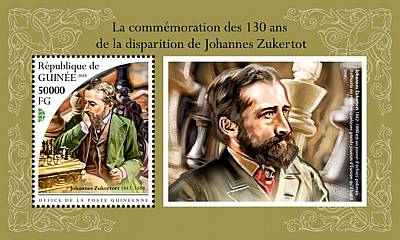
A Zukertort Postage Stamp from Guinea
Meanwhile, Zukertort had decided to make England his permanent home and became a naturalised Englishman in l878.
Zukertort tied with Anderssen for 2nd prize in a master tournament in Leipzig in 1877, but his first major international event was Paris 1878, when he tied for lst place with Winawer and won the play-oft. In 1880 he beat the French champion, Rosenthal, in a match 7-1, and the following year he beat Blackburne +7 -2 – 5. The greatest performance of his career came in 1883, when in the London Tournament he won lst prize, three points ahead of Steinitz, who came 2nd. His victory was certain two weeks before the end of the tournament when he had a score of 22 out of 23. With victory secure, he went on to lose his last three games, the strain having proved too much.
Zukertort was advised by his doctor to give up serious chess but he refused and within a short time left England for a chess tour of the United States, Canada and Europe. On his return from this tour, he left almost immediately to play a second match for the world title against Steinitz. This took place in 1886. Zukertort was in no fit state of health
for such a match, and it proved too much for him. He lost by +5 -10 =5 and returned to England a physical and nervous wreck.
Zukertort never fully recovered. He continued to play chess, but with little success. He died at Charing Cross Hospital on 20th June 1888 of cerebral haemorrhage, following a game at Simpson’s ‘Divan’.”
“One of the most talented players of all time and possibly an English Prussian Polish Jewish grandmaster, the antecedents and early career of Zukertort are shrouded in mystery, a mystery that was the more complete in that the only account of these comes from Zukertort with a lack of corroboration so great that perhaps he really was telling the truth. Whatever the truth may be it is certain that he was a great chess player, one of those who carry with them the aura of certain genius. According to Zukertort, then, he was born in Lublin of mixed Prussian and Polish descent and his mother was the Baroness Krzyzanovska. The name of his mother sounds incredibly like an invention of W. C. Fields and it is difficult to believe that his father’s name, Zukertort, was not Jewish.
Again according to Zukertort he studied chemistry at Heidelberg and physiology at Berlin, claiming to have obtained his doctorate of medicine at Breslau University. His versatility was astonishing. He spoke nine languages including Hebrew and was acquainted with several more. He had been a soldier, having fought in several campaigns for Prussia against Austria, Denmark and France; and once had been left for dead on the battlefield.
A music critic, editor of a political paper, on the staff of Bismarck’s newspaper, the Allgemeine Zeitung; gifted with a memory so colossal that he never forgot a game he played; a consummate fencer, a blindfold simultaneous player of undoubted repute (he had played as many as fifteen simultaneously blindfold) and a grandmaster with justified pretensions towards the world title: most of these attributes we have to take on Zukertort’s word. But there is enough left that is substantiated to show his great importance in the history of chess.
His early chess career had much to do with Anderssen whom he beat in a match, when Anderssen had grown old, in 1871 in Germany by +5-2, having lost a previous match to him in Berlin in 1868 by +3 -8 =1. On the strength of his win over Anderssen in the second match he was invited to play in a small but strong tournament in London in 1872 where he came 3rd below Steinitz and Blackburne. Immediately afterwards he played a match with Steinitz in which he was overwhelmingly defeated by +1-7 =4.It is unlikely that this was for the World Championship since no mention was made of the title at the time and the stakes were small, £2O for the winner and £l0 for the loser.
Despite this disastrous loss, which contained the seeds of further disasters, Zukertort felt that London was his true home and decided to stay in England, becoming a naturalized citizen in 1878. His results in tournament and match play from then on showed a steep upward curve. He was 2nd in London 1876, lst in a small tournament in Cologne 1877 and :2nd at Leipzig that year. He came lst in a big tournament at Paris 1878 where he tied with Winawer and won the play-off.
In 1880 he won a match in London against Rosenthal by +7 -l =11 and in the following year he was 2nd to Blackburne in Berlin. He was no less than 3 points behind Blackburne but he avenged this by beating him in a match in London the same year by +7 -2 =5.
A comparative setback came in a great tournament at Vienna in 1882 when he tied for fourth place with Mackenzie, below Steinitz, Winawer and Mason but in 1883 came the peak of his career when
he won lst prize in the great London tournament, 3 points ahead of Steinitz and 5.5 points ahead of Blackburne who came 3rd.
The remarkable nature of his victory is to be seen from the fact that he was sure of first prize with some two weeks still to go when he had a score of 22/23. But, ominously, his health was giving way and he had been sustaining himself by the use of drugs. He lost his last three games. It is very probable that this high point in his career was also the time when his health began to deteriorate under the excessive nervous strains by his conscious efforts to out rival Steinitz.
Thus, though he had been warned by his doctor he refused to abandon serious play and in 1886 he played his match for the World Championship against Steinitz in the USA, losing by +S -10 =5. The strain was this time too great an and he returned to England with his health completely shattered.
This was reflected in his subsequent results. =7th in London 1886 and =3rd in a smaller tournament at Nottingham that year, he had disastrous results throughout 1887: =l5th at Frankfurt-am-Main, 4th in a small tournament in London and a match loss there to Blackburne by +1-5:8.
In the last year of his life he was =7th in London in 1888 playing to the last possible moment, he died from a cerebral haemorrhage after a game at Simpson’s Divan.
Despite a career that stopped as if it were halfway, Zukertort is clearly one of the chess immortals and there is about his best game a sort of resilient and shining splendour that no other player possesses.”
Zukertort was buried in the Brompton Cemetery. He are details.
Several opening variations have been named after Zukertort :
The Zukertort Defence in the Vienna Game, a variation advocated by Zukertort from 1871.
After 6 exd5 Bg4T 7 Nf3 Black castles, sacrificing a piece for counterattack :
The Zukertort Opening, 1.Nf3 abhorred by Ruy Lopez, used by Zukertort always as a preliminary
to 2.d4, now the fourth most popular opening move, after 1.e4, 1.d4, and 1 c4.
The Zukertort variation, in the Spanish opening, favoured by Zukertort in the 1880s :
but laid to rest soon after.
The Zukertort Variation in the Philidor Defence :
Possibly the Colle-Zukertort Opening is the most well-known
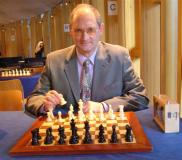
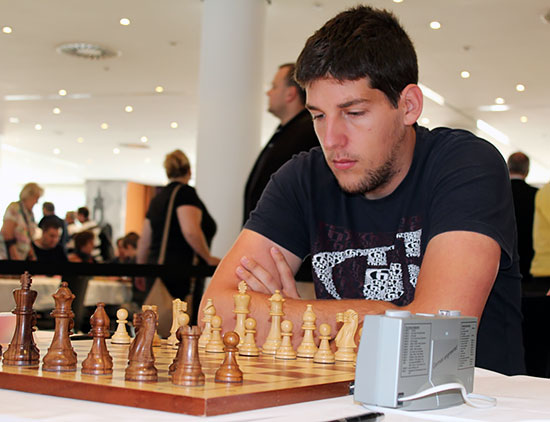
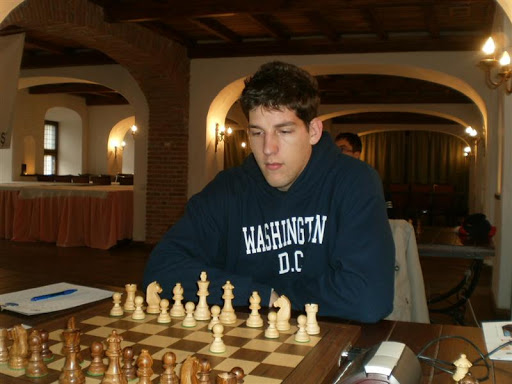
“Grandmaster (2012). Won a double GM norm during the 13th European Individual Championship (2012) where he scored 6/11 and followed with another norm at the Caissa GM event in September 2012, gaining his GM title on 23 September 2012 at the age of 21 years 3 months and 21 days. (1)
Won the 3rd 4NCL Congress in July 2015. (2)
Son of Tamas Fodor Sr.”
Tamas plays for 4NCL Cheddleton, Wood Green (in the London League) and Hendon.
From The Encyclopedia of Chess(Robert Hale, 1970 and 1976) by Anne Sunnucks :
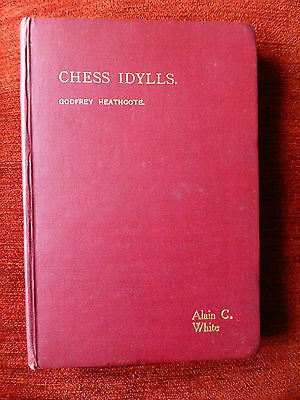
“Problem composer, and deemed to be on of the great masters of the art. Heathcote was born on 20th July 1870 in Manchester, and died on 24th April 1952. whilst in office as the President of the British Chess Problem Society. An advocate of the model mate, Heathcote was one of few composers with the power to combine model mates with strategy. In 1918 a collection of his problems appeared in the A. C. White Christmas series under the title Chess Idylls”
From The Encyclopaedia of Chess (Batsford, 1977), Harry Golombek OBE, John Rice writes:
“British problemist, generally regarded as the outstanding English composer of model-mate problems. President of British Chess Problem Society 1951-2.”
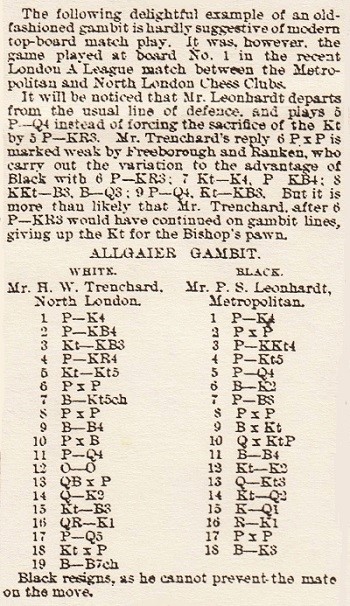
“Herbert William Trenchard (8 September 1857, Thorncombe – 15 April 1934, London) was an English chess master.
He took 11th and tied for 4-5th in London in 1886, shared twice 3rd at Cambridge 1890 and Oxford 1891, tied for 4-5th at Brighton 1892, took 2nd at London 1892 (B tourn), tied for 3rd-4th at Woolhall Spa 1893, and took 3rd at London 1896,[1]
He also participated at Vienna 1898 (Kaiser-Jubiläumsturnier, Siegbert Tarrasch and Harry Pillsbury won) and took 19th place there.[2][3]”
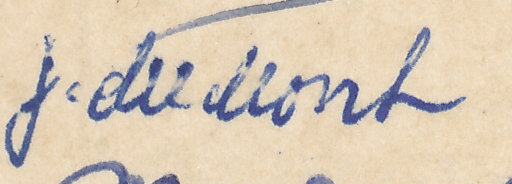
Gordon Thomas Crown with Julius Du Mont observingSignature of J du Mont from a Brian Reilly “after dinner” postcard from Southsea 1951.
BCN Remembers Julius du Mont (15-xii-1881 07-iv-1956
From British Chess Magazine, Volume LXXXVI, Number 5, 1956 we have this obituary written by DJ Morgan :
In our February issue we wrote an appreciation of one of the distinguished past editors of this magazine, R. C. Griffith. He had been followed in the chair in 1938 by our present Games’ Editor, and when he, in turn, was called in 1940 to sterner duties, he was succeeded by Julius du Mont. During the war years, and through the difficult post-war period, till 1949, he held the reins. As we wrote on another occasion, “His had been difficult years: the “B.C.M.” had survived when so much else had succumbed during the stress and strain of total war.” lt is with regret that we now record his death on April 7th, in a Hastings nursing home, at the age of seventy-four, after a protracted illness.
du Mont was born in Paris-a little-known fact which he himself once disclosed to us-on December 15th, 1881. lt was there also that he received his education. His early bent and ambitions were musical. The tradition that chess and music have a close relationship may be traced as far back, at least, as Philidor’s great eminence in both. du Mont was truly in the line of such dual personalities. He pursued his musical studies at the Frankfort-on-Main Conservatoire and at Heidelberg, and soon became established as a concert pianist.’ Later he achieved great success as a music teacher, and among his pupils was the well-known concert pianist, Edna lles. The French and German background also explains his facility as a linguist.
He came to England as a young man and brought with him a considerable talent for chess. Settling in London, he rapidly improved as a player, and successes followed. At the Kentish Congress, Tunbridge Wells, 1912, he came equal second and third. He was Champion of the strong Hampstead Club for two years, and Middlesex Champion in 1913 and 1915. He quickly mastered our language and showed this during the First World War by writing a manual on the Lewis gun. After the war, music kept its place in his life, but more and more chess became his main activity. He forsook playing and turned to journalism and authorship, and his output of books is evidence of his gifts and industry. Titles come readily to mind: Chess Openings lllustrated, Centre Counter Defence (1919) and Centre and Danish Gambit (1920); The Elements of Chess (1925) ; Ihe Basis of Combination in Chess (1938) ; 200 Miniature Games (1941); More Miniature Games (1953); (with Dr. Tartakower) 500 Master aomes of Chess, two volumes (1952), to which was added a third volume in 1954, 100 Master Games of Chess. He also translated Edward Lasker’s Chess Strategy, and Alekhine’s two volumes of My Best Games of Chess (the first with M. E. Goldstein).
The wealth of material ready to hand combined with a foreigner’s gift of lucid expression in “the other tongue” made his books very popular. To the great value and importance of these books, a whole generation of chess-players will readily testify.
For some years, du Mont was chess editor of The Field and of The Manchester Guardian. During the last war he organized chess championships for the Armed Services. We pay tribute to his services to the game, to his many kindnesses and friendships to its players, and, in particular, to his devotion to this magazine.-D. J. M.
D. C., who enjoyed a long friendship with our late Editor, writes to us as follows-
By the death of J. du Mont, the chess world has lost an eminent and popular personality. That this popularity was well deserved will be apparent even to those who knew him only slightly.
Essentially kind, he performed many generous acts, and having, by his own efforts, become the best-known British writer on chess, he not only filled this position with modesty and dignity, but was liberal in the help he gave to those starting on the road he had so successfully followed.
In the tournament room-where his presence was always welcome-he was invariably quiet and courteous, and although gifted with a fine wit, he never used it
unkindly. He *as an excellent companion, and players at many congresses will recall the happy times they spent in their visits to him at all hours of the evening. It is sad to think that these gatherings have now irrevocably reached their end: to quote A. E. Housman’s beautiful lines-
They come and were and ore not
And come no more anew.
But as long as a literature of chess remains, the name of Julius du Mont will not be forgotten. His many friends, however, have no need of his writings in order to keep alive their memory of him.
In Chess Secrets I learned from the Masters, Edward Lasker, Hollis and Carter, 1952 :
J. Du Mont became the author of a number of interesting monographs on chess openings, and for many years he was the Editor of the British Chess Magazine. It was he who translated my own translation of Schachstrategie which I attempted in the summer of 1913. Naturally, my English was not fit to be printed. Du Mont had to rewrite everything I had written, and except for his untiring labours Chess Strategy might never have been published. He gave the book a certain literary flavour, which no doubt added greatly to its popularity. It went into fourteen printings before it was replaced by Modern Chess Strategy in 1945.
Du Mont was a pianist of note and I took lessons from him; however, the time I took from my chess activities to practise the piano was shamefully meagre. No wonder I have been told more than once that as a pianist I am a good chess player.”
From Chess World, Volume 11, Number 6, June 1956, page 128 we have this appreciation from ME Goldstein:
“I first met du Mont at the Hampstead Chess Club 37 years ago (1919). He was one of a team of strong players , which included RC Griffith PW Sergeant, H. Saunders (runner-up in a British Championship) and W. Winter.
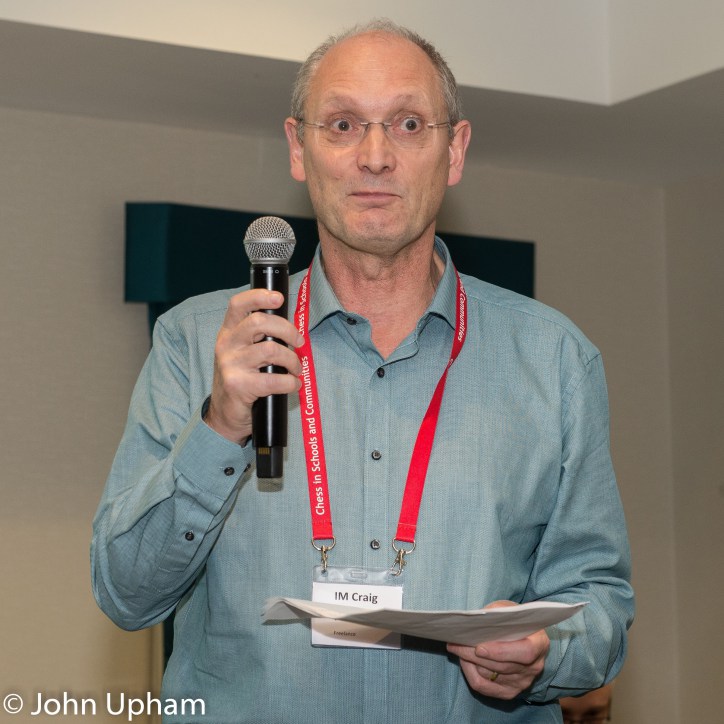
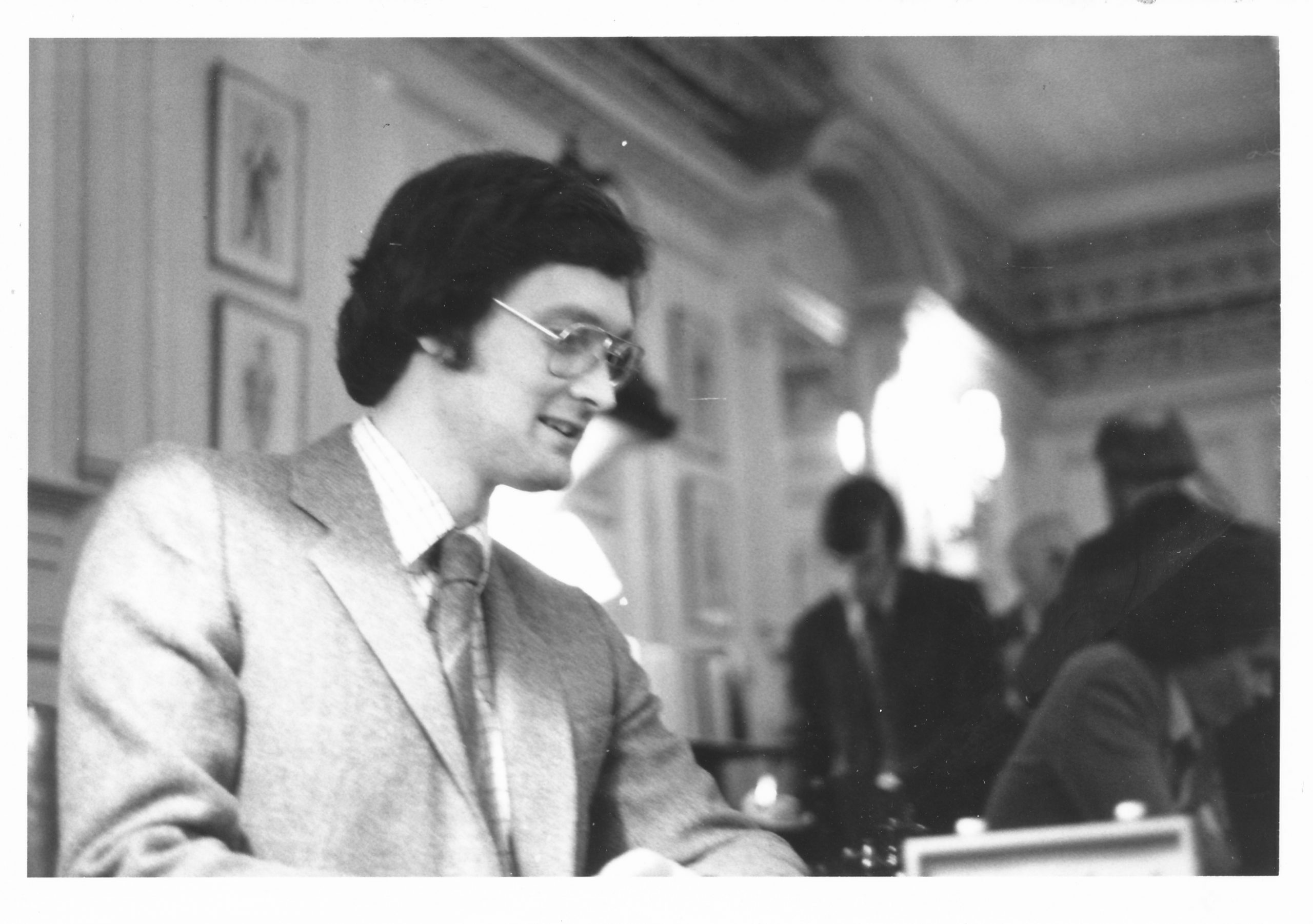
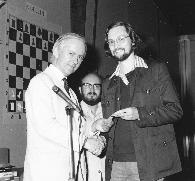
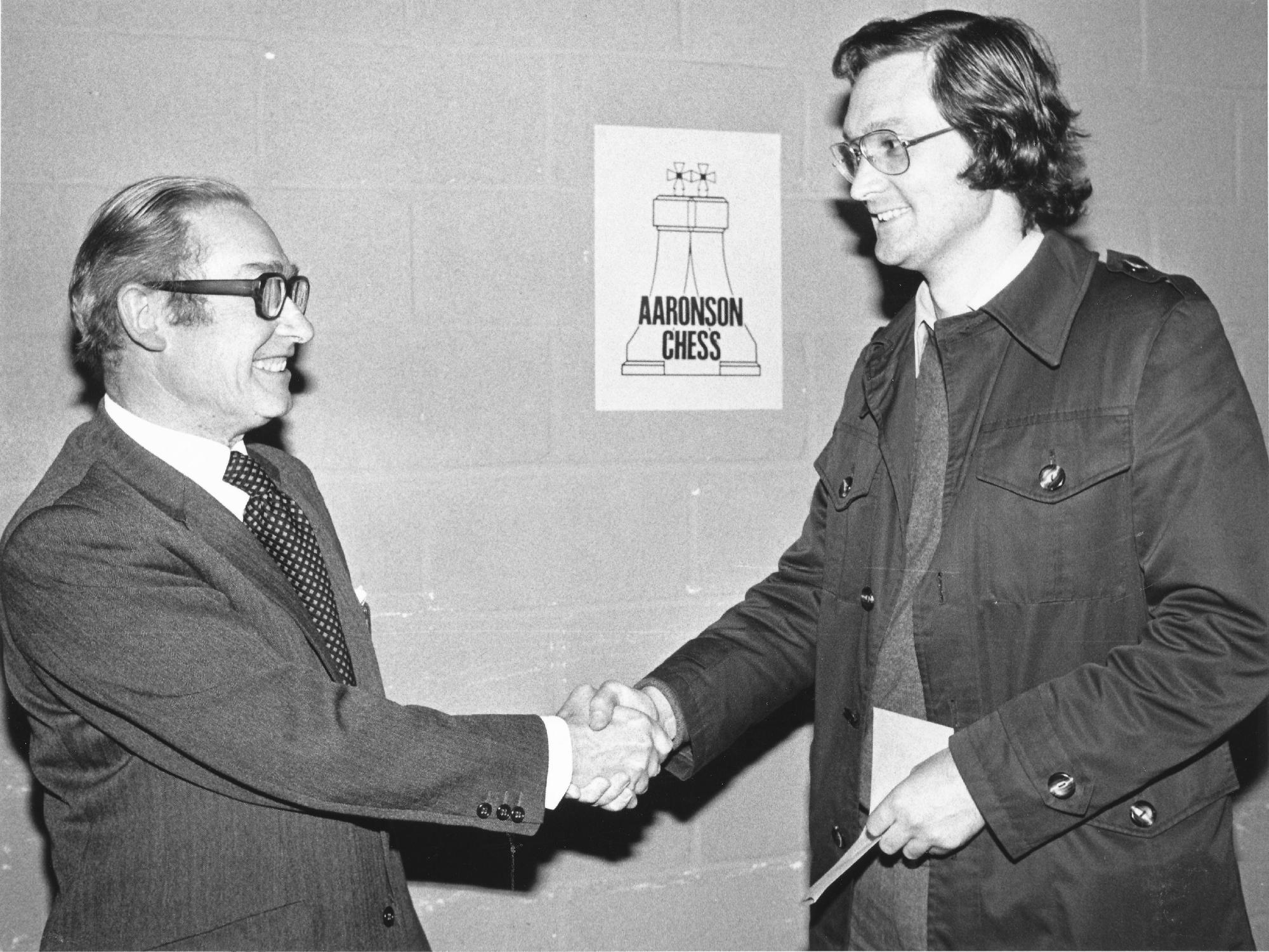
IM Craig Pritchett (right) with Leonard Barden and Stewart Reuben
From The Encyclopedia of Chess by Harry Golombek :
Scottish international master and teacher. Prtichett, probably the strongest native-born Scottish player since the days of Captain Mackenzie in the nineteenth century, has represented Scotland with success in five Olympiads : 1966, 1970, 1972, 1974 and 1976. He has also played for Scotland in the Students Olympiads of 1968, 1969 and 1970.
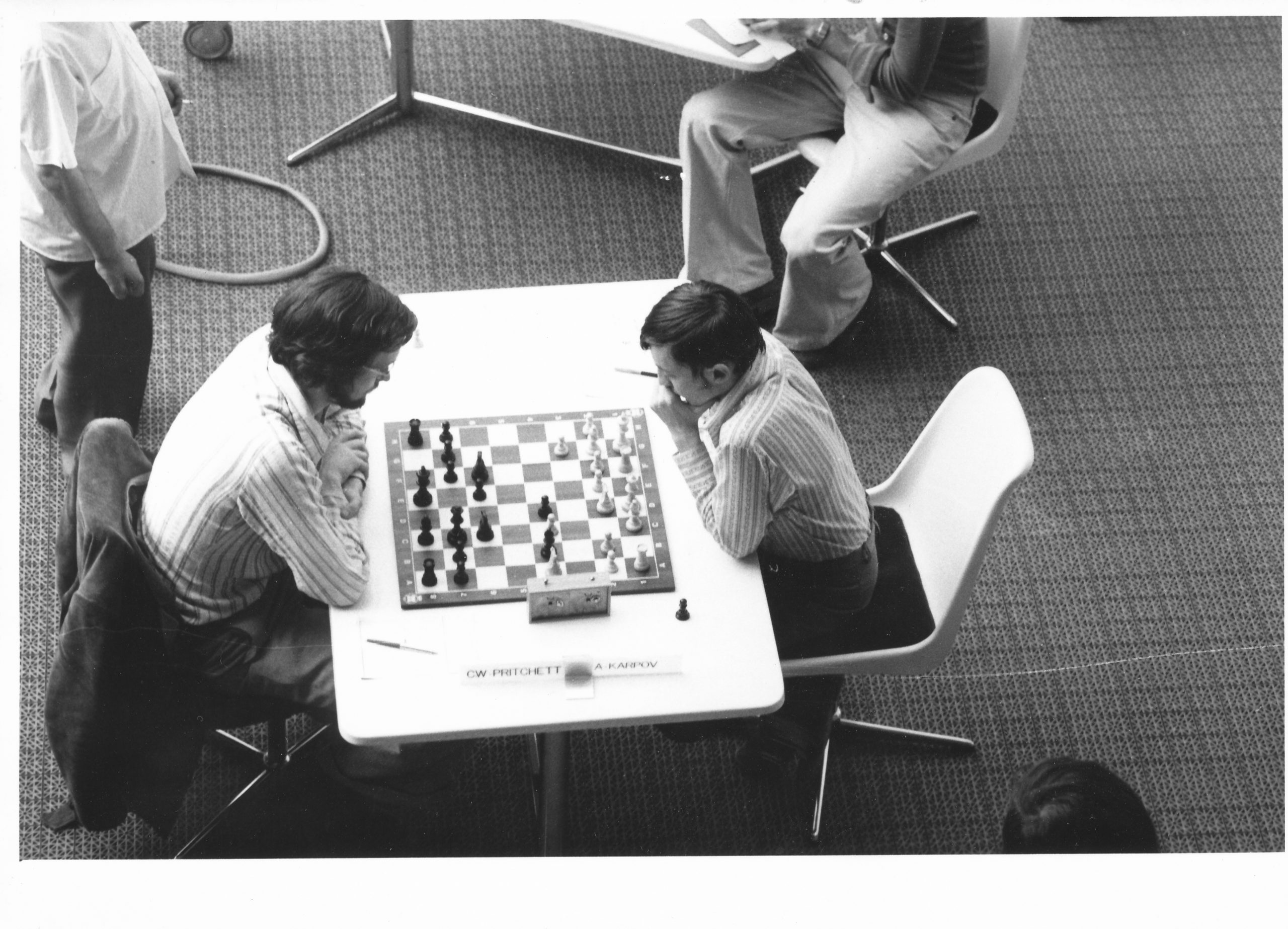
Pritchett playing Karpov at Nice 1974.
His first individual success was in the European Junior Championship in Groningen 1969/70 where he came -3rd with Belyavsky. At Decin (Czechoslovakia) 1974 he came 1st in the Masters B section.
He obtained the first part of an international master norm at the Nice Olympiad in 1974 where he scored 60% on top board. In 1975 he again achieved a master norm at the strong Pula Zonal tournament where he came -7th/14.
IM Craig Pritchett (right) at the Aaronson Masters
He was chess correspondent of the Glasgow Herald and author of The Sicilian Scheveningen, Batsford, London, 1977. (article by Harry Golombek)
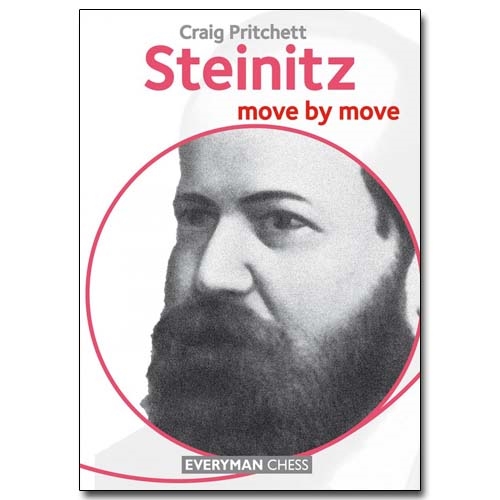
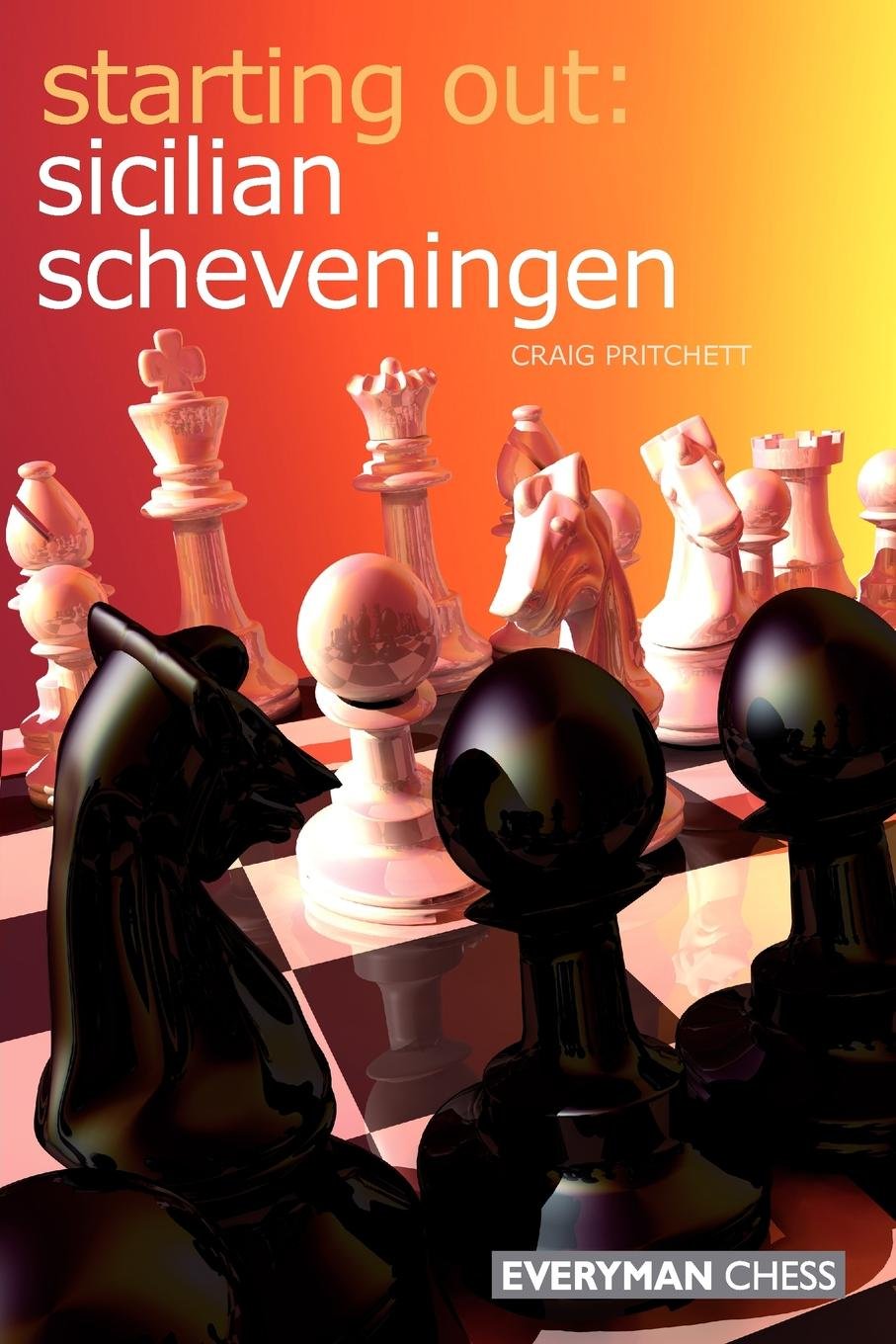
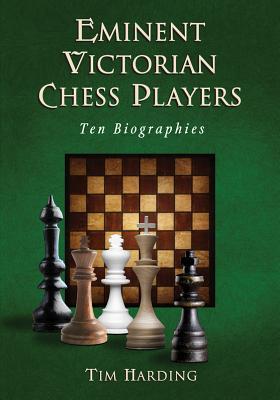
The Sicilian ScheveningenNimzo Indian 4 e3 Nimzowitsch Hubner & Taimanov VariationsChess for RookiesSteinitz Move by MovePlay the EnglishHeroes of Classical ChessGreat Chess RomanticsStarting Out : Sicilian Scheveningen
Save as PDF
We focus on the British Chess Scene Past & Present!
This website uses cookies to improve your experience. We'll assume you're ok with this, but you can opt-out if you wish. Cookie settingsACCEPT
Privacy & Cookies Policy
Privacy Overview
This website uses cookies to improve your experience while you navigate through the website. Out of these cookies, the cookies that are categorized as necessary are stored on your browser as they are as essential for the working of basic functionalities of the website. We also use third-party cookies that help us analyze and understand how you use this website. These cookies will be stored in your browser only with your consent. You also have the option to opt-out of these cookies. But opting out of some of these cookies may have an effect on your browsing experience.
Necessary cookies are absolutely essential for the website to function properly. This category only includes cookies that ensures basic functionalities and security features of the website. These cookies do not store any personal information.
 Save as PDF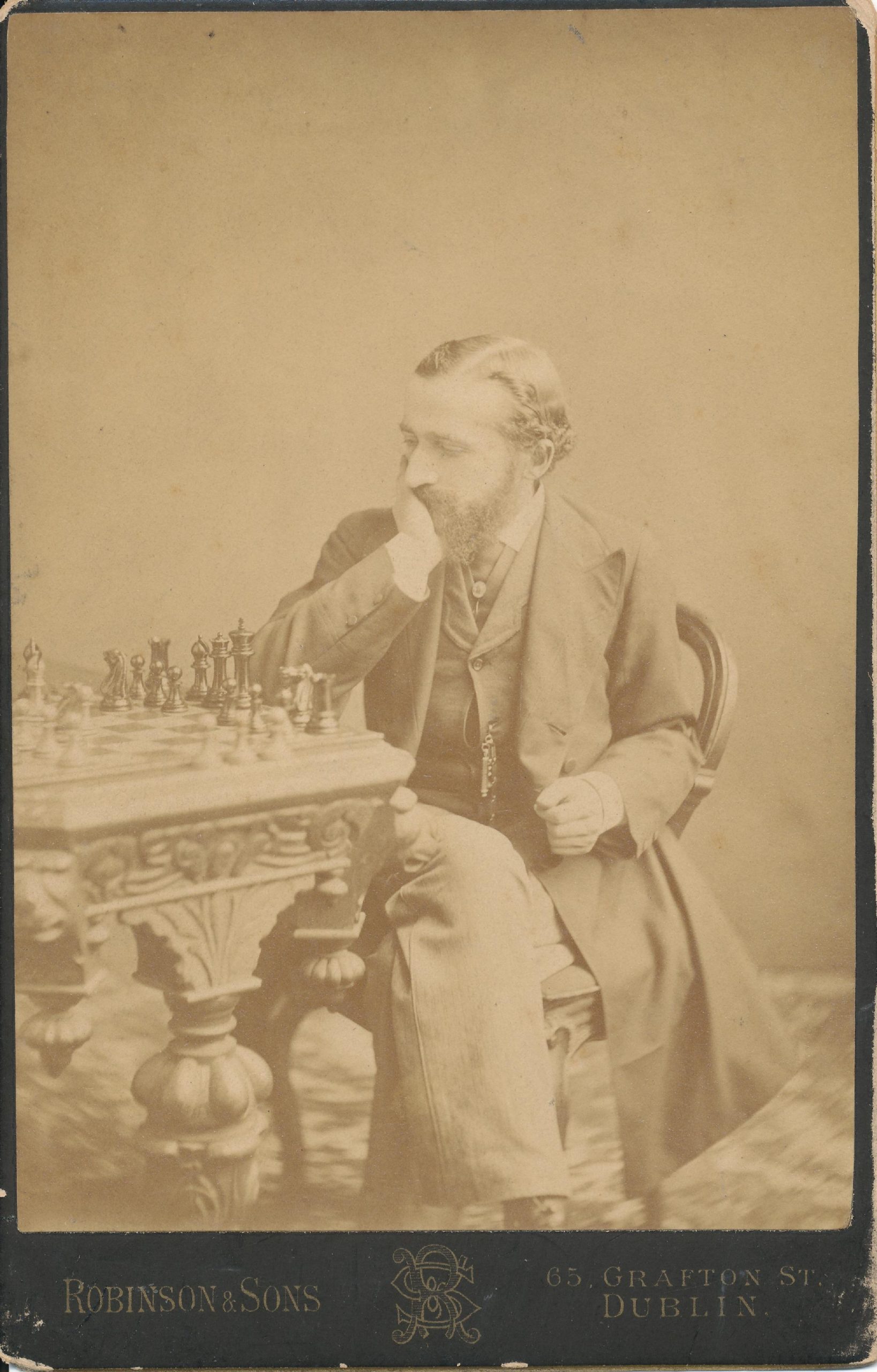
![Godfrey Heathcote (20-vii-1870 24-iv-1952) [Source: Chess Pie, 1922; scanned by M.McDowell]](http://britishchessnews.com/wp-content/uploads/2020/06/20.07-G.Heathcote-Chess-Pie-1922.jpg)