Tag Archives: Author

Happy Birthday GM Keith Arkell (08-i-1961)

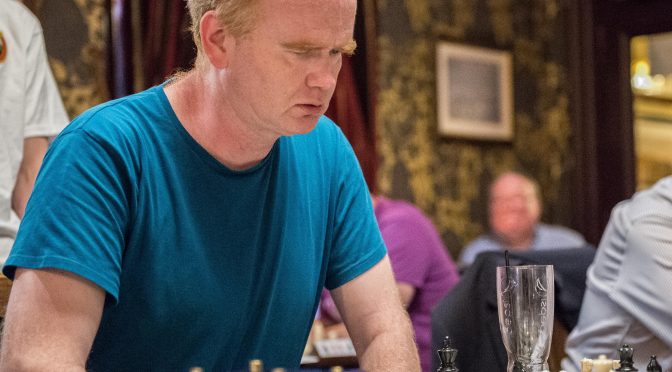
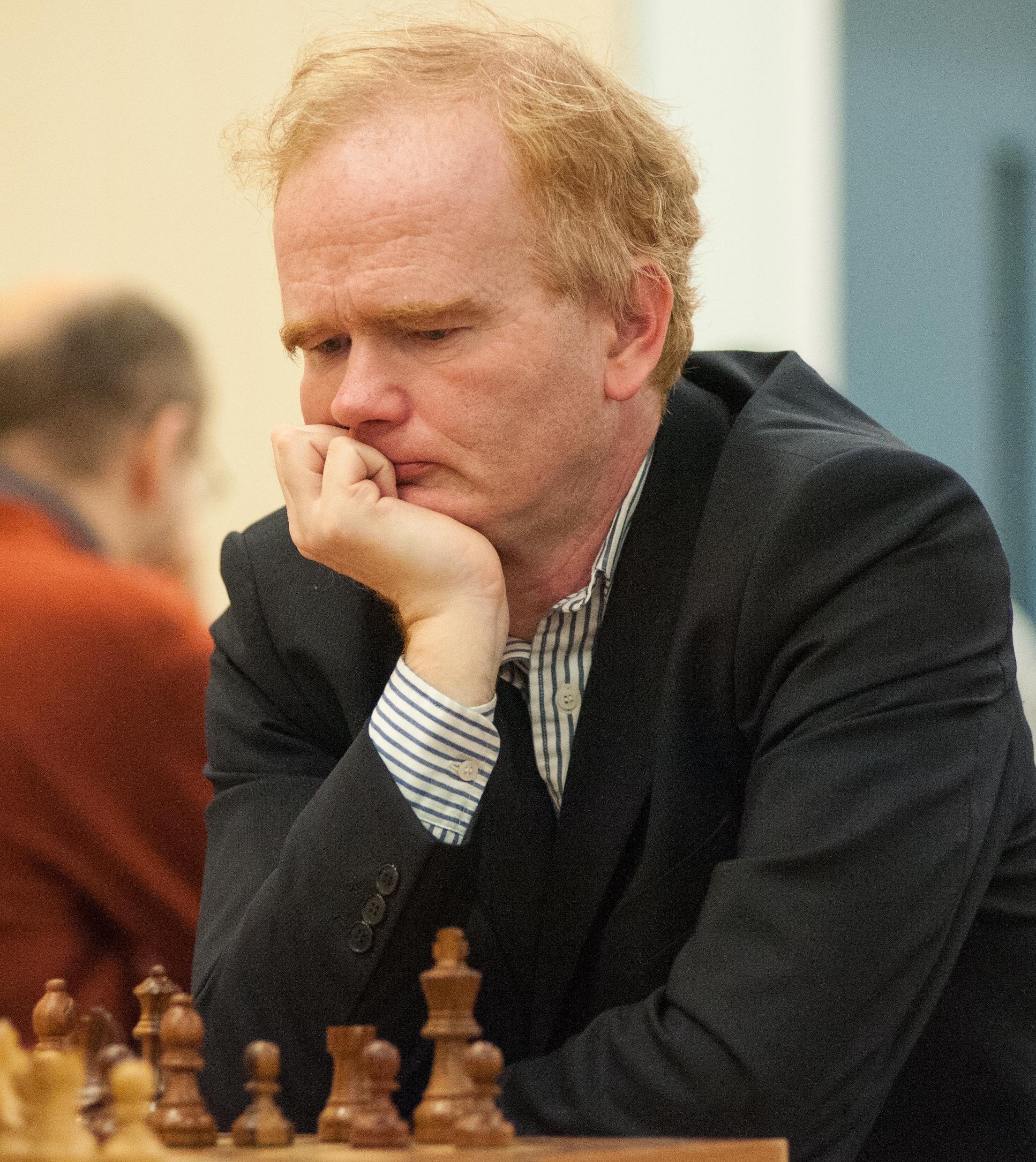
Keith Arkell, London Chess Classic 2021, Courtesy of John Upham Photography

We send birthday wishes to GM Keith Arkell, born this day (January 8th) in 1961.

Keith Arkell
Keith Arkell

Here is Keith’s Wikipedia entry

GM Keith Arkell (ENG)

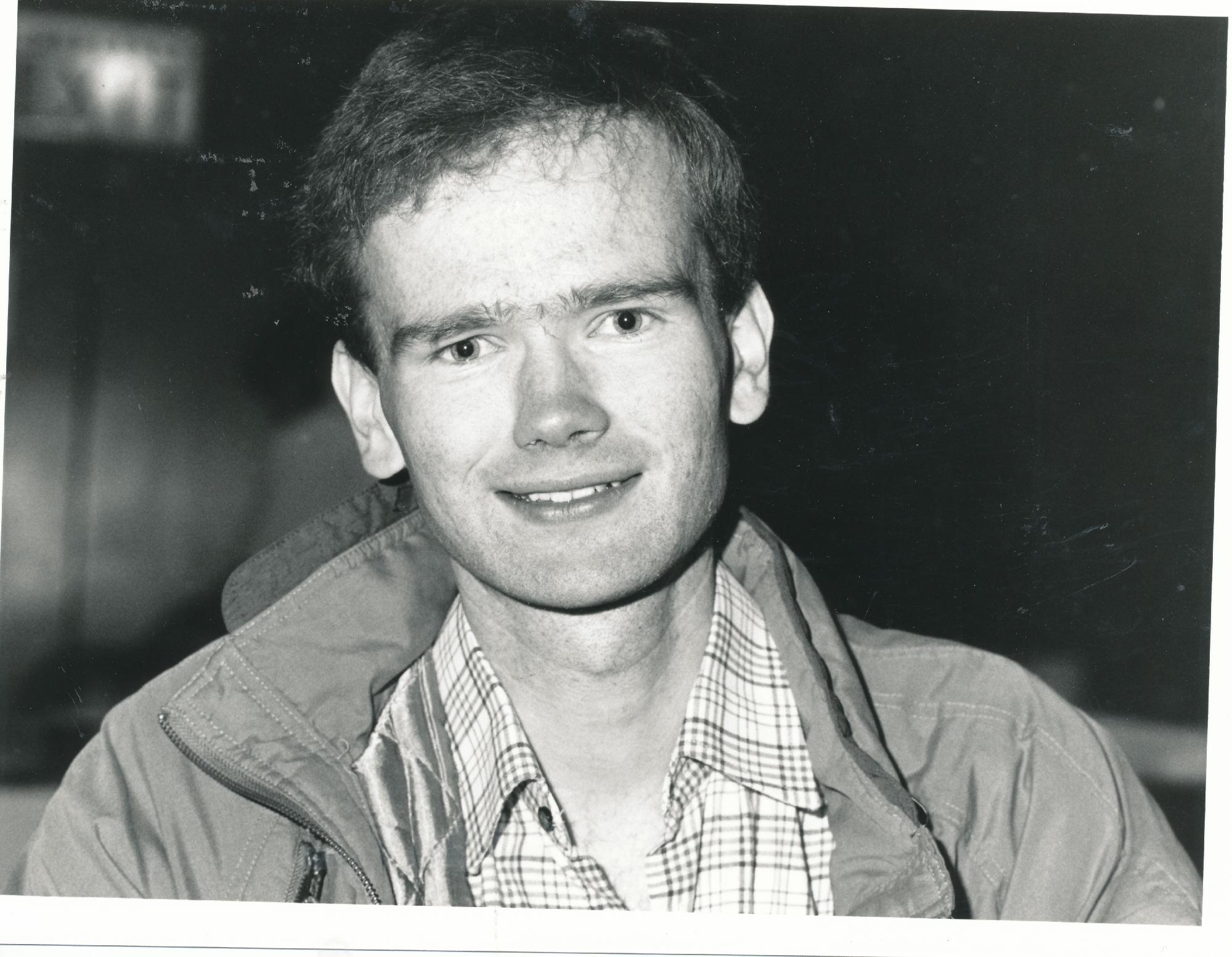
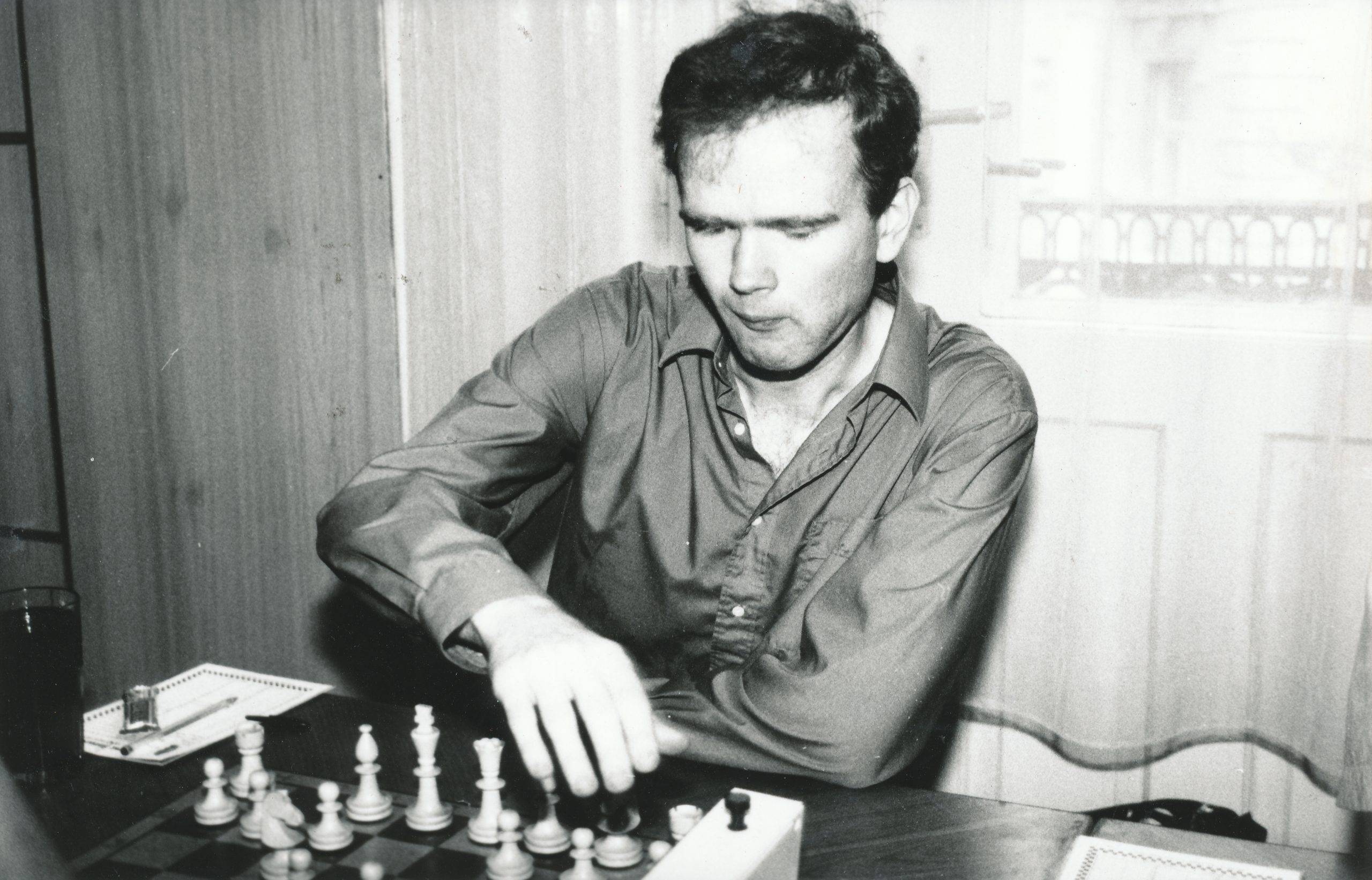
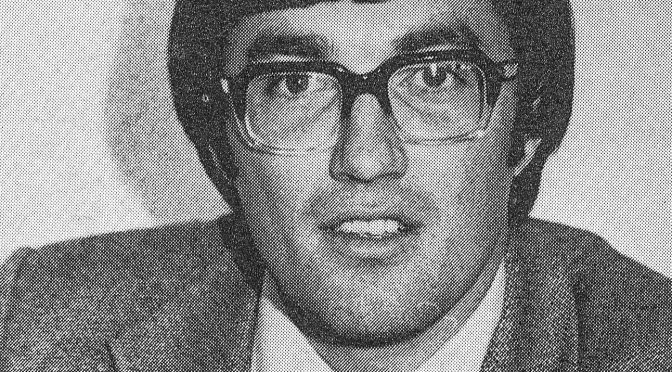
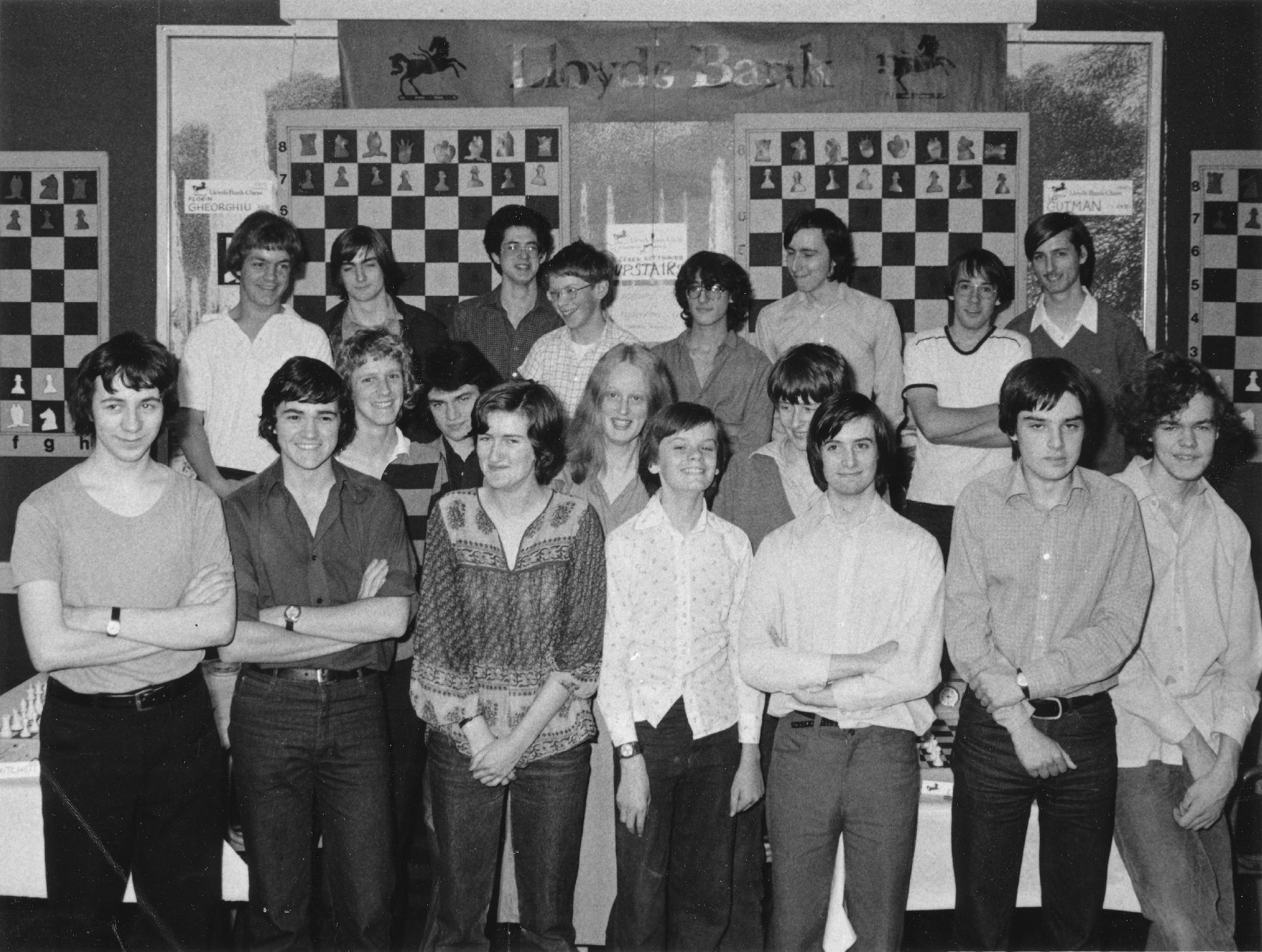
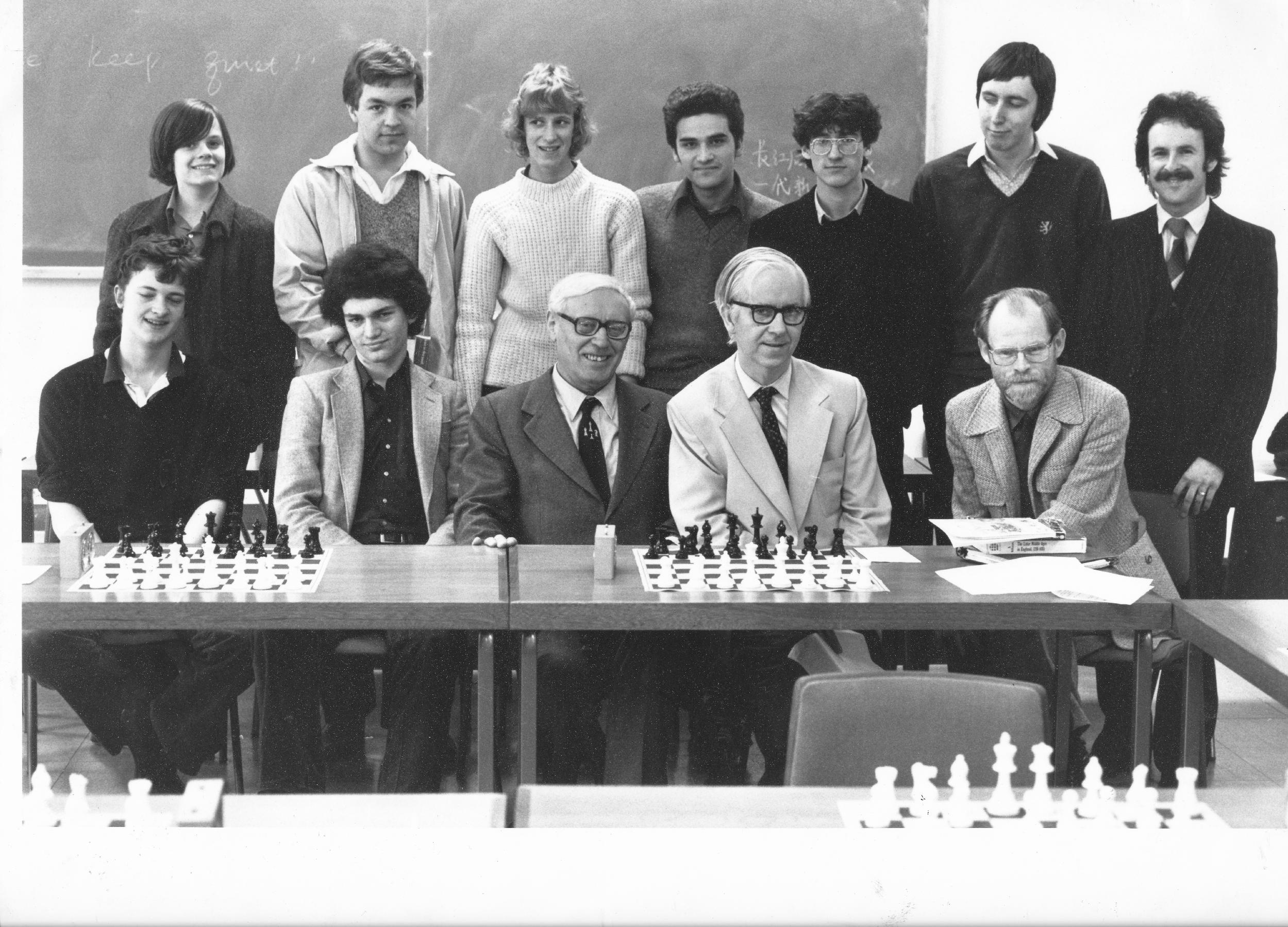
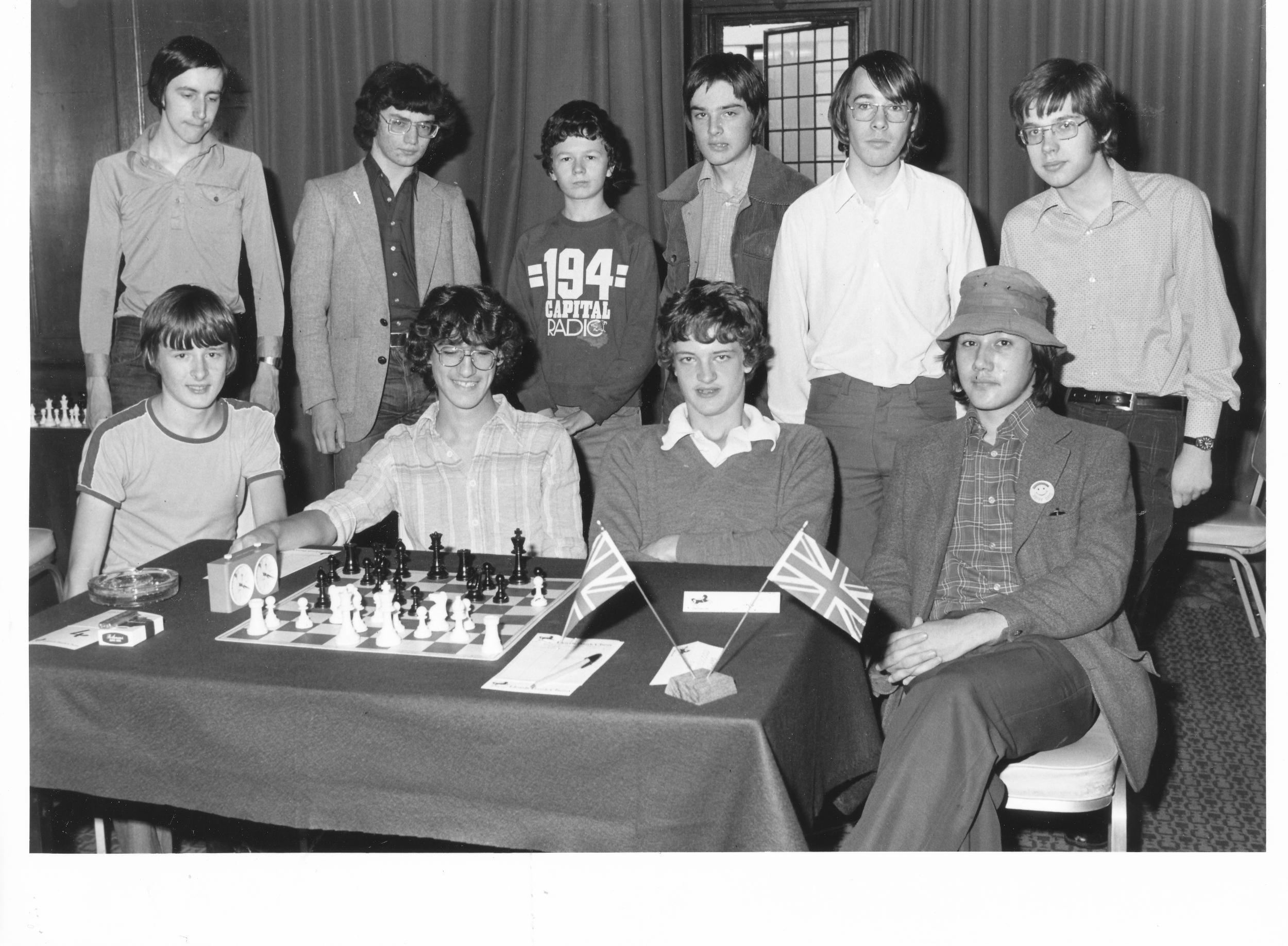
This was written about Keith aged 18 prior to the 1979 Spassky vs the BCF Junior Squad simultaneous display :

“Rednal, Birmingham. Rating 188. 2nd Lloyds Bank junior international, 1979.”

GM Keith Arkell
GM Keith Arkell

Keith was Southern Counties (SCCU) champion for the 2014-15 season sharing with Jonathan Hawkins

Keith finally secured the Grandmaster title in 1995 as a result of the final leg of the French League Championship. Keith gained the IM title in 1985 and then made his three norms at Ostend 1990, Parthenay in France in 1993, and in the French League finishing in March. He became England’s 26th holder of the GM title.
On August 8th 2021 Keith became the 2nd British Online Champion

Here is an interview with ChessBase from 2016.

GM Keith Arkell
GM Keith Arkell

[embedyt] https://www.youtube.com/watch?v=4PIzZG4FlZ8[/embedyt]

[pgn]
[Event “BCF-chT 1415 (4NCL)”]
[Site “England”]
[Date “2015.02.14”]
[Round “5.164”]
[White “Rogers, Jonathan”]
[Black “Arkell, Keith C”]
[Result “1/2-1/2”]
[ECO “B12”]
[WhiteElo “2277”]
[BlackElo “2497”]
[Annotator “Saunders,J/Arkell”]
[PlyCount “82”]
[EventDate “2014.11.15”]
[EventType “team-swiss”]
[EventRounds “11”]
[EventCountry “ENG”]
[SourceTitle “EXT 2016”]
[Source “ChessBase”]
[SourceDate “2015.10.08”]
[SourceVersion “1”]
[SourceVersionDate “2015.10.08”]
[SourceQuality “1”]
[WhiteTeam “Barbican II”]
[BlackTeam “Cheddleton”]
[WhiteTeamCountry “ENG”]
[BlackTeamCountry “ENG”]

{[%evp 0,82,19,38,72,69,71,77,64,2,30,17,14,9,29,24,35,-30,-50,-74,-74,-75,-88,
-128,-3,-16,-56,-32,-43,-43,10,5,20,16,16,-4,5,-3,-68,-61,-45,-40,-37,-1273,68,
-201,-202,-210,-197,-207,-208,-228,-194,-183,-149,-150,-148,-143,-143,-141,138,
141,141,150,138,140,138,173,201,198,198,210,213,236,232,190,225,138,142,100,
114,95,114,95,92]} 1. e4 c6 2. d4 d5 3. e5 c5 4. c4 e6 5. Nf3 cxd4 6. Nxd4 Bb4+
$5 ({Databases are peppered with games where Keith has played} 6… Nc6 {
but perhaps he wanted to keep his opponent guessing.}) 7. Nc3 Ne7 8. h4 Nbc6 9.
a3 $5 {Jonathan, perhaps with the far-sighted plan of not being strangled
slowly in a rook and pawn endgame, wants to provoke something sharp.} Bxc3+ 10.
bxc3 Nxe5 11. Bf4 N5g6 (11… Nxc4 12. Bxc4 dxc4 {is tempting but maybe} 13.
Nb5 O-O 14. Qxd8 Rxd8 15. Nc7 Nd5 16. O-O-O $5 {gives White a bit of
compensation. Instead, Black gives back material to get some pressure on the
e-file.}) 12. Bg3 e5 13. h5 exd4 14. hxg6 Nxg6 15. Qxd4 O-O 16. cxd5 Re8+ 17.
Be2 Ne7 18. Rd1 Nf5 19. Qd3 {[diag]} Qg5 (19… Qg5 {We haven’t quite got
there yet, but we’re coming up to a spectacular mutual oversight which needs
explaining. Seeking enlightenment (and also wanting to be sure that the moves
were correctly recorded – mix-ups do happen), I got in touch with Keith on
FaceBook to ask what happened. Keith responded at some length, centring on his
thoughts as he planned the move 19…Qg5. What followed are his own words,
lightly edited by me: “It’s impossible to fully explain how such a thing can
happen, but let me try anyway. So, I’m sitting there analysing the move I want
to play in principle – which at the time was 19…Qd8-g5. I know that my
advantage increases if I can make the move, but obviously I am concerned about
his possible reply} 20. Qb5 {So I analyse} Re4 {(other moves didn’t look very
good to me)} 21. d6 {- the only move that could give me any problem, as it
threatens to win a piece. Visualising the position, I then hoped that} Be6 {
would be strong, as it threatened the winning 22…Bc4. Of course, the main
potential drawback to this is that he can then fork my rooks with} 22. Qxb7 {
I would then need} Rxe2+ {to work or I would be lost! So – and don’t forget,
all this is before playing 19…Qg5 – I set about analysing 22…Rxe2+ as I
(wrongly!) believed that 19…Qg5 hinged on this. So, 22…Rxe2+} 23. Kxe2 Bc4+
24. Kf3 {(obviously forced) and then, I thought, ”please let 24…Re8 be a
winning move”! It certainly looked winning. It was obvious he had to either
put a rook on e1 or his bishop on e5 to stop …Be2 mate. I didn’t look beyond}
Re8 {[diag]} 25. Rde1 ({I saw a pretty mate against} 25. Rhe1 {which was} Qh5+
26. Kf4 g5+ {(my favourite move!)} 27. Kxf5 Qg6+ 28. Kg4 f5+ 29. Kh3 Qh5+ 30.
Bh4 Qxh4#) ({so that just left the irritating} 25. Be5 {to deal with. Find a
good move there and I could play 19…Qg5. I decided that 25…h5 must be
winning and anyway certainly left him in trouble.}) 25… Bd5+ 26. Qxd5 Nh4+ {
So I analysed no more and plunged in with 19…Qg5. He quickly replied 20 Qb5
and, after briefly running through all those nice lines again, I confidently
played 20…Re4. He continued following my analysis, with 21 d6?? and I had 21.
..Be6?? ready for him. So there you have it. The explanation is that we were
playing out a variation I had analysed way ahead, and I didn’t stop properly
to check if there might be something else going on!”}) 20. Qb5 Re4 21. d6 $4 (
21. O-O Nxg3 22. fxg3 Re5 $5 {seems to be broadly equal.}) 21… Be6 $4 ({
What Keith had missed in his move 19 analysis, and what Jonathan also missed
when playing 21.d6, was the bone-crushing} 21… Nxg3 $3 {, which is game over
as} 22. Qxg5 {allows} Rxe2# {mate, while a capture on g3 loses the queen to 22.
..Qxb5 as the e2 bishop is pinned.}) 22. Qd3 $4 (22. O-O $1 Rd8 23. Bd3 {
and White is well in the game.}) 22… Nxg3 {This time Black doesn’t fluff his
lines.} 23. fxg3 Qe5 $1 24. Rh4 (24. d7 Rd8 {makes no material difference,
while a king move such as}) (24. Kf1 {loses to} Bc4 {.}) 24… Bg4 25. Qxe4 $1
({A much better bet than} 25. Rxg4 Rxg4 {, which looks pretty hopeless for
White.}) 25… Qxe4 26. Rxg4 Qe5 $6 ({There seems to be no reason not to
snatch a pawn with} 26… Qxg2 27. d7 Rd8 {, with very reasonable winning
chances.}) 27. d7 Qxc3+ $2 ({After this, Black’s winning chances evaporate.}
27… Rd8 {keeps the Black flag flying, though it’s by no means obvious how he
can go about winning.}) 28. Kf1 Rd8 29. Re4 $1 {White’s firm control of the
e-file is his salvation.} Qc6 ({Possibly another oversight, but it turns out
to be non-critical as the following tactical sequence doesn’t leave Black too
much to do to save the game. After} 29… Kf8 30. Bb5 Qf6+ 31. Ke1 g6 32. Re8+
Kg7 33. Rxd8 Qxd8 34. Rc1 {, the game peters out to a draw.}) 30. Re8+ Rxe8 31.
d8=Q g6 32. Qd5 Qc3 33. Bc4 Qf6+ 34. Kg1 Re7 35. Rf1 Qb6+ 36. Kh1 Qc7 {The
zenith of White’s game – Houdini scores it at +2.13 – but it is hard to see
how White can bring any more pressure to bear on Black’s position or make
meaningful progress. Maybe Magnus Carlsen would have found a way.} 37. Qd4 a6
38. Rd1 b5 39. Bf1 Re8 40. Kh2 Qc2 41. Qd3 Qc5 1/2-1/2

[/pgn]

[embedyt] https://www.youtube.com/watch?v=LJgiN5MgOns[/embedyt]

[pgn]
[Event “Crawley e2e4 Gatwick op 10”]
[Site “Crawley”]
[Date “2016.10.26”]
[Round “1”]
[White “Arkell, Keith C”]
[Black “Wadsworth, Matthew J”]
[Result “1-0”]
[ECO “D23”]
[WhiteElo “2450”]
[BlackElo “2290”]
[Annotator “Keith Arkell”]
[PlyCount “159”]
[EventDate “2016.10.26”]
[EventType “swiss”]
[EventRounds “9”]
[EventCountry “ENG”]
[SourceTitle “Arkell’s Endings : Game 1”]
[Source “ChessBase”]
[SourceDate “2017.10.13”]
[SourceVersion “1”]
[SourceVersionDate “2017.10.13”]
[SourceQuality “1”]

{[%evp 0,159,19,29,23,-4,25,20,30,-2,20,22,9,-6,15,-19,-25,-6,-8,-13,6,-4,-3,
-3,6,-21,-8,-11,22,0,7,1,14,1,3,11,8,0,5,5,29,50,52,22,21,24,45,27,63,69,55,70,
72,80,74,14,33,25,26,42,34,44,48,48,68,63,89,99,98,92,126,116,115,116,116,122,
128,113,128,129,132,133,135,151,158,147,151,136,137,132,142,134,152,152,156,
152,162,164,163,152,152,152,163,153,153,161,157,136,153,153,153,161,157,157,
162,157,157,157,157,157,158,134,158,134,208,189,189,189,189,141,189,165,182,
160,177,156,202,184,193,202,210,195,208,221,276,293,377,373,545,373,639,373,
373,367,365,381,371,480,537,732,1259,28004]} {Taken from Arkell’s Endings,
Game 14, pp 68-71} 1. Nf3 d5 2. c4 c6 3. d4 Nf6 4. Qc2 dxc4 5. Qxc4 Bg4 6. Nbd2
Nbd7 7. g3 e6 8. Bg2 Be7 9. O-O Bh5 10. a4 $1 $146 (10. b3) 10… a5 11. Qb3
Qb6 12. Qxb6 Nxb6 13. b3 Nfd5 14. Bb2 O-O 15. Nc4 Nxc4 {This capture gave me
some encouragement as my pawn will gain in stature, and I will have long-term
prospects on the b-file.} 16. bxc4 Nb4 17. Rfd1 Rfd8 18. c5 Bf6 19. e3 b6 {
Against a waiting move I planned Rab1 and Ba3} 20. cxb6 Rab8 21. Rac1 Rxb6 22.
Rd2 Bg6 23. Bc3 Be4 {[#]} {I think this was an oversight and he had missed my
25th move.} 24. Ne5 Bxg2 25. Nc4 Ra6 26. Kxg2 {Now I have the kind of position
I like: no weaknesses and a guarantee of permanent pressure against his
queenside pawns.} Rda8 27. Nxa5 {It was hard to resist playing in this
straightforward manner. It will now be a very tough task for Wadsworth to hang
on to his backward c-pawn.} (27. Rb1 {runs into} c5) ({and} 27. Rb2 {allows}
Nd3) 27… Nd5 28. Nb7 Rxa4 29. Rdc2 Ra2 30. Be1 g6 31. Kf3 {[%csl Gc6] With
e3 defended I’m now threatening to capture his pawn.} Rxc2 32. Rxc2 Ne7 33.
Bb4 Ra6 34. Nc5 Ra7 {The c-pawn is lost whatever he does} ({For example} 34…
Rb6 35. Ba5 Rb5 36. Bd8 {with Nd3 or Ne4 to follow}) 35. Ne4 Kg7 {[#]} 36. Bxe7
{I could have exchanged both minor pieces, but felt that the subsequent ending
would be more favourable if I kept the knight, which tends to be more
effective than a bishop at close quarters.} Bxe7 37. Rxc6 h5 38. h3 {[#]} {
How do you set about winning such a position? Clearly not with the pieces
alone, but using pawns will unavoidably involve exchanges, and you don’t
want too many swaps as rook, knight and pawn versus rook and bishop is usually
a simple draw. The answer is somewhere in-between. Ideally you would like to
fix the kingside with g4-g5, and then organise e3-e4 and d4-d5.} Rb7 39. g4
hxg4+ 40. hxg4 Ra7 {[#]} {I was pleased to see this and thought he should
prefer 40…g5, but I guess he was reluctant to put a pawn on the same colour
as his bishop. 40…f5 was also interesting, but I didn’t expect him to
weaken his pawns in such a cavalier manner.} 41. g5 {Now I have a free hand to
slowly improve my position because …f6 will always leave Black with too many
weaknesses. So many times this is what we strive for in chess – leaving the
opponent without any real counterplay is often half the battle.} Ra5 42. Kf4
Ra7 43. Rb6 Bd8 44. Rb5 Rd7 45. Kg4 Be7 46. Ra5 Bd8 47. Ra8 {[#]} {If you
study the great endgame players such as Magnus Carlsen and Anatoly Karpov, you
cannot fail to observe their endless patience. Maintaining the tension rather
than committing oneself to immediate action tends to have a wearisome effect
on the opponent, as well as forcing them to defend accurately to avoid further
damage.} Be7 48. Rc8 Rb7 49. Re8 Rc7 50. Rb8 Rd7 51. f4 Rc7 52. Kf3 Ra7 53. Nc5
Rc7 54. Nd3 Ra7 55. Rc8 Bd6 56. Ke4 Rb7 57. Nf2 {From g4 the knight will have
a choice of entry points into the heart of Black’s position.} Be7 58. Ng4 Ra7
59. Rb8 Bd6 60. Rb5 Be7 61. Ke5 Ra3 {Spooked by my intention to make progress
with e3-e4 and d4-d5, combined with Nf6 and Rb8, Matthew gives some ground.}
62. Rb7 Ra5+ 63. Ke4 Kf8 64. Nf6 Ra8 65. Ke5 Rd8 66. Nh7+ Ke8 67. e4 Ra8 68.
Nf6+ Kf8 69. d5 exd5 70. exd5 Rd8 71. Rb6 {[#]} {Threatening to win on the
spot with 72 d6.} Bc5 72. Rc6 Ba3 73. d6 {Inch by inch I’ve brought about a
winning position. The rest is relatively straightforward.} Kg7 74. Kd5 Bb2 75.
Ng4 Ba3 76. Ne5 f6 77. Rc7+ Kg8 78. Nf7 Bxd6 79. Nxd6 fxg5 80. fxg5 1-0
[/pgn]

Arkell's Odyssey
Arkell’s Odyssey
Arkell's Endings, Keith Arkell, GingerGM, 2020, ISBN-10 : 1527265595
Arkell’s Endings, Keith Arkell, GingerGM, 2020, ISBN-10 : 1527265595

BCN has reviewed Arkell’s Endings in depth

Remembering GM Harry Golombek OBE (01-iii-1911 07-i-1995)

Harry Golombek, OBE (from the rear cover of A History of Chess)
Signature of H Golombek from a Brian Reilly "after dinner" postcard from Southsea 1951.
Signature of H Golombek from a Brian Reilly “after dinner” postcard from Southsea 1951.

We remember Harry Golombek OBE who passed away on Saturday, January 7th, 1995.

The Amersham Advertiser of Wednesday, 18th January 1995, on page 6, reported, “His funeral was due to be held as 12.30pm (today), at Chilterns Crematorium, Whielden Lane, Amersham.” (Thanks Steve Mann!).

Harry Golombek was born on Wednesday, March 1st, 1911 in Lambeth, London and his parents were Barnet (Berl) Golombek (Golabek) (1878-1943) and Emma Golombek (née Sendak) (1883-1967).

The Polish word Golabek translates to “small dove” in English.

Barnet was a “Dealer of gas fittings” and was 33 when Harry was born and Emma was 26. Both of his parents were born in Zambov which is in the Lomza Gubernia region of the Kingdom of Poland which existed from 1867 – 1917. Their nationalities are both recorded as Russian in the 1911 UK census.  we don’t know (as yet) when Barnet and Emma settled in the UK.

Harry had a brother Abraham (born in 1906) and a sister Rosy born in 1908. The family lived in 200b, Railton Road, Herne Hill. Lambeth.

200b, Railton Road, Herne Hill, Lambeth, SE24 0JT

He is a recorded with a service number of 992915 as being a member of The Royal Regiment of Artillery in 1939 and was discharged as having reached the age limit in 1956 aged 45 and one day.

Harry Golombek's record of discharge in 1956 from the Army.
Harry Golombek’s record of discharge in 1956 from the Army.

Harry married his long time nurse, Noel Frances Judkins (1941 – 2011) in January 1988 and they had (born in 1992) one son : Oliver Golombek-Judkins  BVSc MRCVS who is a successful Somerset based veterinary surgeon. The marriage was recorded in the district of Kensington & Chelsea.

37, Albion Crescent, Chalfont St Giles, Buckinghamshire, HP8 4ET : the home of Harry Golombek OBE

The date of probate was 22 Mar 1995 and the executor of HGs will was David Anderton OBE.

In 1966 Harry became an Officer of the Order of the British Empire (OBE), Civil division awarded in the 1966 Queen’s Birthday (rather than New Years) Honours list.

The citation read simply :

Harry Golombek. For services to Chess : He was the first UK person to be so honoured.

Hastings memorial bench for Harry Golombek OBE
Hastings memorial bench for Harry Golombek OBE, Courtesy of John Upham Photography

The Harry Golombek memorial bench at St Giles Churchyard, Chalfont St Giles in Buckinghamshire. Photogra[h courtesy of Geoff Chandler.
The Harry Golombek memorial bench at St Giles Churchyard, Chalfont St Giles in Buckinghamshire. Photograph courtesy of Geoff Chandler.
The Harry Golombek memorial bench at St Giles Churchyard, Chalfont St Giles in Buckinghamshire. Photogra[h courtesy of Geoff Chandler.
The Harry Golombek memorial bench at St Giles Churchyard, Chalfont St Giles in Buckinghamshire. Photograph courtesy of Geoff Chandler.
In 1985 Harry was awarded the long overdue (but Honorary) title of Grandmaster by FIDE.

Harry was Southern Counties (SCCU) Champion in the 1955-56 and 1963-64 seasons.

Harry was in 1974-82 a FIDE Zonal President and from 1978-96 he was the FIDE Permanent Fund Administrator.

Sadly, he never received the Presidents Award for Services to Chess from either the BCF or ECF : maybe a posthumous award is long overdue?

Harry Golombek, aged 20, becomes the youngest winner of the Surrey Challenge Cup in 1931. British Chess Magazine 1931, September, page 419.
Harry Golombek RIP by Bernard Cafferty

Here (from British Chess Magazine, Volume CXV (115), 1995, Number 2 (February), pp.83-85 is this obituary from Bernard Cafferty :

Harry Golombek OBE (1 iii 1911-7 i 1995), British Champion in 1947, 1949 and 1955, was a grandmaster amongst journalists and book writers, and “Mr Chess” for many of the British public in the decades after the war when his Times column was the main source of up-to-date information on the doings of Botvinnik, Bronstein, Smyslov, Keres, Tal and the other top players.

Harry ran a weekly Saturday column along with daily reports during World Championships, British Championships, Hastings, Paignton …when only The Guardian provided a similar service to the chess community up to 1972. I often recall him grumbling at editorial incisions of his column, which, even so, was more extensive and ‘heavy’ than anything we enjoy now. He loved references to music, the theatre and the arts as a parallel to chess. In fact, he was columnist and correspondent with the paper from 1945 till 1985, and columnist of the Observer 1955-1979. His work at The Times came to an end after he suffered a mild stroke, though he struggled on for a time when, in pre-Wapping days, his work was handicapped by ever earlier deadlines.

Harry was the BCF delegate to FIDE for decades after 1948 and played a part in framing the rules. His view was that the Soviet Union, which he visited as arbiter for Botvinnik’s matches in the 1950s and 1960s as well as for the second part of the 1948 World Championship Match-Tournament, did not throw its weight about so much until after 1970 when a sort of cultural offensive in FIDE and elsewhere was undertaken.

Harry played for England at three Olympiads before the war and six after. Educated at a London grammar school, he was the son of immigrant Polish parents who had been repressed by the last Tsar, to whom his father once sent a message of defiance from the safety of England. A favourite reference of his was the London Boys’ Championship of the late 1920s where he first came to prominence.

His first experience of chess journalism came in the period 1938-40 when he was editor of BCM, till being called to army service. Harry worked in the code-breaking department at Bletchley Park during the war; the Official Secrets Act prohibited him from revealing much of what he knew of this fantastic scientific operation where he was associated with such famous names as Alan Turing, Jack Good, Hugh Alexander and Stuart Milner-Barry. A graduate of London University in Modern Languages, Harry had been called up into the Royal Artillery, but his knowledge of languages, particularly German, meant that he was soon transferred to the Intelligence Corps.

Harry was a life-long supporter of Surrey Cricket Club. His family ran a grocery shop near Kennington Oval which he sold after 1945 when he made the decision to become a chess professional’ He was reputed to have one of the finest chess libraries in Britain, which he has left to the BCF to form the nucleus of a national chess library with bequests from Sir Richard Clarke, RJ Broadbent and GH Diggle.

Amongst the many books he wrote, pride of place must be taken by his work on Capablanca’s best games and the one on the 1948 Match-Tournament at the Hague and Moscow as well as a later book on Reti. Who can forget his account of the delay at the Polish border for the train which was taking players and journalists to Moscow from the Hague in 1948? A Polish general, forgetful of recent history, declared that the train could riot proceed since no-one crossed the Polish frontier without the appropriate documentation and security checks (Euwe’s extensive analytical notebooks in Dutch were the stumbling block). It only needed Botvinnik to hear this for him to phone up Moscow and have the Polish authorities overruled by those who enjoyed real power in the post-war world.

Another famous article which comes to mind is Harry’s long account of the 1967 Sousse Interzonal, complete with the J’adoubovich incident, Fischer’s fickleness, and the camel on the beach. This appeared in the BCM, of course, where H. G. was the editor for Overseas News and the Games Department from the late 1940’s until the late ‘sixties. His work here was a cut above most contemporary chess journalism’ since he was so often on the spot at top events and he had access to all of the world’s chess press. As a consequence, he was often the contact man for arranging participation of the world’s leading players at Hastings. From this flowed his work for The Friends of Chess, the body that raised funds and helped gain invitations to foreign events for our up and comings. It was in 1966 that he gained the OBE for services to chess.

Harry had a dry acerbic wit and a fund of stories that made him a welcome after-dinner speaker and lecturer. He seemed to be a life long bachelor, but he married late in life (this corrects an error in the Times obituary of 9 January. In his declining years he spent his last days in a rest home for the elderly in Gerrards Cross where his main contact with the outside world was Gerry Walsh who had often driven him to and from the Hastings Congress in the last couple of decades of his life.

A Grandmaster Amongst Journalists

Harry Golombek, was, without a doubt, one of the finest chess writers ever, and his lengthy stint as Overseas News editor of the BCM results in some classic reports.

As a tribute to Harry’s work we (BCM) have decided to reprint word for word, his extraordinary account of the 1967 Sousse Interzonal. The article that follows is an exact reproduction of his eyewitness report, as it appears in the 1968 BCM Bound Volume, January magazine. This was the tournament that had everything: Bolbochan vanishing, Fischer withdrawing, Larsen winning, and much more.

We are sure that our current readers, young and old, will be as enchanted with the tale as BCM readers were nearly three decades ago.

Further Recollection from Bernard Cafferty

Here (from British Chess Magazine, Volume CXXXII (132), 2011, Number 3 (March), pp.150-154 is an affectionate collection of memories from Bernard Cafferty :

“In recalling four decades of knowing the GOM of 20th century English chess, one has to stress the ‘English’ aspect. The ‘Harry’ part of his name was much more significant than the Polish surname, and, though he was the most cosmopolitan of men, who fitted into any milieu, my abiding memory of him always throws up the quirks that are the sign of an Englishman. I wonder how many of my readers recall the classic English actors Naunton Wayne and Basil Radford, whose main preoccupation in their films was…. getting to know the latest cricket score from Lords or The Oval.

Harry Golombek. Source : The Anglo-Soviet Radio Chess Match

Indeed, Harry was a long-time member of Surrey Cricket Club, and once, when he came back from being an arbiter at an international tournament in Tenerife, his main comment to me was not about the event or the players, but rather that the volcanic rock of the Atlantic island made for brackish water, so that one could not get…. a decent cup of tea!

Left to right Baruch H Wood, Philip Stuart Milner-Barry, Vera Menchik (playing in the women's world championship (held concurrently with the 1939 Buenos Aires Olympiad) which she won with 17 wins and 2 draws), Sir George Thomas, Conel Hugh O'Donel Alexander and Harry Golombek. England withdrew after their preliminary group due to the outbreak of war despite qualifying for the top final. Thanks to Leonard Barden
Left to right Baruch H Wood, Philip Stuart Milner-Barry, Vera Menchik (playing in the women’s world championship (held concurrently with the 1939 Buenos Aires Olympiad) which she won with 17 wins and 2 draws), Sir George Thomas, Conel Hugh O’Donel Alexander and Harry Golombek. England withdrew after their preliminary group due to the outbreak of war despite qualifying for the top final. Thanks to Leonard Barden

I first met Harry in the early 1950s when I was a teenage student keen on chess and accordingly spent my meagre pocket money on a day out in Manchester to watch the Counties Final match between Lancashire and the all-conquering Middlesex side of those years. Harry and I were about the only spectators. He was there reporting for The Times. I recall that the top board game was between the veterans William Winter and WA Fairhurst. The game duly appeared in the BCM with Harry’s notes, for he was the long-serving Games Editor of that august publication.
Players at the 1946 British Championships in Nottingham : Back (from left to right): Gabriel Wood, Reginald Broadbent, Philip Milner-Barry, Andrew RB Thomas, Baruch H Wood. Front (from left to right): Bob Wade, Frank Parr, William Winter, Robert Combe, Hugh Alexander, Harry Golombek, Gerald Abrahams.. Photograph : BritBase

Perhaps I may enter a belated correction to “Who’s Who” here. Some editions stated that he was editor of BCM after the Second World War. Not so. His stint in the editorial chair was 1938-40, after which he was called up, initially being assigned to the Royal Artillery. Perhaps that is a sign of the speciality of the Services – fitting a square peg in a round hole – but he was swiftly transferred to the Intelligence Corps, perhaps at the behest of Hugh Alexander who knew that Harry had studied German at his London grammar school in Camberwell and then at London University.

[pgn]
[Event “Budapest Maroczy Memorial”]
[Site “Budapest”]
[Date “1952.03.19”]
[Round “10”]
[White “Geller, Efim P”]
[Black “Golombek, Harry”]
[Result “1/2-1/2”]
[ECO “E41”]
[Annotator “Wolfgang Heidenfeld & British Chess News”]
[PlyCount “48”]
[EventDate “1952.03.03”]
[EventType “tourn”]
[EventRounds “17”]
[EventCountry “HUN”]
[SourceTitle “MCD”]
[Source “ChessBase”]
[SourceDate “1999.07.01”]
[SourceVersion “1”]
[SourceVersionDate “1999.07.01”]
[SourceQuality “1”]

{[%evp 0,44,19,31,14,-14,-11,-3,33,33,30,19,55,72,62,62,81,82,85,27,98,89,78,
78,78,109,101,116,116,116,57,-6,4,0,218,221,205,194,168,0,0,0,0,0,0,0,0]} {
This game is a rare example of a drawn game receiving a brilliancy prize :
something that HG was very proud of. Notes by Wolfgang Heidenfeld from Draw!,
George Allen & Unwin, 1982, pp. 103 – 4} 1. d4 Nf6 2. c4 e6 3. Nc3 Bb4 4. e3 {
This quiet solidating move of Rubinstein’s has steadily grown in esteem since
the “Nimzo” became a going concern in the late ‘twenties. Its popularity has
outstripped all its rivals. 4. Qb3, 4.Qc2, 4.Bg5 and 4.a3} c5 {With the square
d4 overprotected (unlike the position after Qc2 or Qb3), this move does not
force White into possibly premature decisions on how to conduct the struggle
for the centre.} 5. a3 cxd4 6. axb4 dxc3 7. Nf3 {A gambit move typical of
Geller. Golombek accepts – mainly in order to see what is going to happen.}
cxb2 (7… O-O {followed by …d5 would be perfectly satisfactory.}) 8. Bxb2 d5
9. c5 b6 $2 {Foolhardy play by the usually so careful Golombek, who seems to
have been infected by the spirit of his opponent.} (9… O-O {was necessary,
though White would have full value for his pawn – the a-file, a strong pair of
bishops, and pressure by the Q-side pawns. Now Black has to struggle for
survival.}) 10. Bb5+ Bd7 11. Bxd7+ {[#]} Nfxd7 $1 {An unpleasant necessity, for
} (11… Nbxd7 $2 12. c6 {with complete paralysis of the Q-side.}) ({If} 11…
Qxd7 12. cxb6 Qb5 $2 13. Rxa7 $1 $18) 12. Qc2 {Before hacking into the K-side
by Bg7 : White first wishes to obtain control of the square c6. This is so
important, the resultant strangulation so fatal, that Black has to surrender
the whole K-side (not merely the g-pawn) as the lesser evil.} (12. Bxg7 Rg8 13.
Bb2 Rxg2 14. Qa4 bxc5 15. bxc5 Qc7 16. Nd4 $18) ({Some critics have suggested}
12. Qa4 {as even stronger, because c6 is under direct control of the white Q,
but this deployment of the Q also has its drawbacks. First of all she can no
longer assist the B by capturing on h7, secondly she is subject to swapping
offers.} {e.g.} bxc5 13. bxc5 Qc8 $1 14. Bxg7 Rg8 15. Bd4 Qc6 16. Qc2 Rg6 {
with an unclear position.}) 12… Nc6 $1 13. Bxg7 Nxb4 14. Qb1 $1 {but after
the text the N hangs, the KR hangs and , if it moves, the KRP will go. Is
there a saving clause for Black?} ({Of course, not} 14. Qb3 $2 Nxc5) 14… Rg8
15. c6 {So as to eliminate the counter loss of the exchange after 16. Qh7: Rg7:
! 17. Qg7: Nc2+} (15. Qxh7 Rxg7 16. Qxg7 Nc2+ 17. Ke2 Nxa1 18. c6 Nb3 19. cxd7+
Ke7 20. Ne5 Qg8 21. Qh6 f6 22. Qh4 Rf8 $16) {After the deflection of the black
N white hopes to enjoy his extra material at leisure and without futher
complications. However…} 15… Nxc6 ({If Black tries} 15… Nc5 $2 16. Qxh7
Rxg7 17. Qxg7 Nc2+ 18. Kd2 Nxa1 19. Ne5 $1 Qe7 20. Rxa1 O-O-O 21. Nxf7 Rf8 22.
Rxa7 {and wins.}) 16. Qxh7 {[#]} Nf6 $1 {An amazing combination! Black gives
up both rooks so as to land in an unavoidable perpetual check.} 17. Bxf6 Qxf6
18. Qxg8+ Kd7 $1 ({Not} 18… Ke7 $2 19. Qg5 $18) 19. Ne5+ Nxe5 20. Qxa8 Nf3+
$1 {The diagonal for the Q is re-opened with gain of time.} {White choses a
less elegant sequel :} 21. gxf3 ({The thematic continuation would now be} 21.
Ke2 Qb2+ 22. Kxf3 Qf6+ {so that Black administers his perpetual without
regaining any material.}) 21… Qxa1+ 22. Ke2 Qa2+ {and agreed drawn. – there
is no escape from the perpetual check. :} 23. Kf1 Qb1+ 24. Kg2 Qg6+ {etc.}
1/2-1/2
[/pgn]

The Judges / Arbiters from the 1953 Zurich Candidates tournament : Harry Golombek, Alois Nagler and Alex Crisovan

Clearly, under the conditions of 1940, a linguist was just what was needed to make up the team of mathematicians, cryptographers and such like who were tasked with breaking the secrecy of German coded messages.

The BCF Team at the Amsterdam Olympiad 1954. Left to right : Barden, Clarke, Penrose, Wade, Golombek (board three) and Alexander

I once mentioned the misunderstanding over the “Who’s Who” entry to Brian Reilly. He laughed it off, saying that it was almost certainly the abiding fault of HG – not taking Brian’s repeated advice to fit a new typewriter ribbon!

Harry Golombek and Gordon Crown in around 1946-47.

I could relate to that since Harry’s handwritten game scores, written in pencil and descriptive notation, were very hard to decipher, a real scribble that only the man himself could make sense of. When I asked him why he did not use algebraic notation, he commented that he wrote for so many English-language outlets: The Times, The Times Weekend Supplement, Observer and chess book publishers like Bells and Penguin who knew their audiences of those years were supporters of the Pawn to King’s Knight Three school. In fact, Harry commented, he had made more money out of his Penguin book The Game of Chess than from all his other extensive book authorship and journalism.

The Game of Chess, Harry Golombek, 1954, Penguin Books

and the paperback version :

The Game of Chess, Harry Golombek, 1954, Penguin Books

Moreover, it took him about three whole days to assemble the documents and papers to enable him to fill in his income tax form.

Harry Golombek simultaneous display at Hull Chess Club. Year and photographer unknown

That reminds me that, when he was in his final years, and in an old person’s rest home, he arranged for his extensive library to be transferred in many large tea chests from his house in Chalfont St Giles, Bucks, to the St Leonards address where I had worked for the BCM for the last 12 years and which had recently been vacated as a result of Murray Chandler deciding to transfer BCM operations to London. I had the task, arranged with The Friends of Chess and the BCF, to do a sort-out and preliminary catalogue of his books and magazines which Harry was bequeathing to the BCF to form the nucleus of a National Chess Library. That would be a pleasant enough task, but it was prolonged into many weeks by having to decant the valuable chess material from the tea chests, much of it covered in dust and even spiders’ webs, from the many financial and other papers to do with his financial affairs. It was then that I first learned what a ‘tip sheet’ was, and it was not until stockbroker David Jarrett, BCF Hon Treasurer, came down for a visit that the dross amongst the many papers was separated from the gold and passed to Harry’s executor David Anderton.
Harry Golombek contemplates his options after White (JH Donner) played 9.a3 in the 1952 Anglo-Dutch Match. Donner won in 33 moves and the game was BCM #11,074

Reverting to the cup of tea story, the first time I got to know Harry well was at the British Championship at Leicester in 1960. Many of the participants were lodged in University accommodation near the venue. Every evening, after play had finished, a number of us got together for a chat over a cup of tea in the accommodation unit’s kitchen. There Harry would regale us with stories from his many visits abroad, particularly to Moscow for the world title matches involving Botvinnik. Harry had formed many interesting views on Soviet society. Amongst the stories he told was of the all-pervasive dead hand of the bureaucracy. He was used to filing his reports on the match in English at the Central Post Office. One day, a clerk behind the grille, told him he could not accept it, since the regulations stated that all outgoing material had to be in Russian.

Harry Golombek, Stanley Sedgwick, Brian Reilly and DJ Morgan in the garden of Brian Reilly. Photo probably taken by Freddy Reilly.

With his logical mind, and not appreciating the discipline and associated bureaucracy which the rulers tried to impose on Soviet society, Harry commented that “Yesterday, I submitted in English and it was accepted”, at which the clerk drew herself up to her full height and stated firmly: “Yesterday was yesterday, today is today”. Harry’s considered views included these: Communism would never be made to work properly in Russia, since the Russians lack the requisite discipline. “They should have tried it on the Germans. They might have made it work”. He once commented that when he went to Germany in the decade or so after the war, he was aware that some of those whom he met had been strong supporters of Nazism: “If they had had their way, they would have turned me into a bar of soap!”. I got a benefit from Harry being in Moscow. I wanted to get a copy of Chigorin’s collected games by Grekov, a very rare item. Harry duly promised to seek one out on his next visit to Moscow and a second-hand copy of this fine book came to me through the post some weeks later. No charge to me, of course.

Harry Golombek in play against Borislav Ivkov, Hastings 1955/6.

Harry played a big role in drawing up the Rules of Chess as they applied to post-1945 competitive play. He served on the appropriate FIDE commission for decades and always argued that too precise a codification limited the discretion of the arbiter to apply a common sense solution to a concrete set of circumstances. Alas, that sensible approach has been moved away from in recent times, especially with the introduction of quick-play finishes and associated fine points about time limits.

Kick Langeweg plays Hugh Alexander in the Anglo-Dutch Match of October 7th , 1961. Peter Clarke (right) is playing Johan Teunis Barendregt and Harry Golombek observes

A final shrewd comment from Harry, based on his Moscow experience: “In 1917, the new Bolshevik regime claimed that they were abolishing all titles, privilege and so on. The result? Forty years later they have the most class-conscious society I have encountered.” One proof of this might be given – the Soviet internal passport system, one point of which required the holder (and for a long time no peasant was allowed such an identity document – who, then, could claim that the Tsar had abolished serfdom in the middle of the 19th century?) to state his/her ethnic origin: Russian, Ukrainian, Kalmyk, Armenian, Jew and so on. The Western mind boggles… ”

Harry Golombek during a team event, Jonathan Penrose on the adjacent board.

We leave the final word in reminiscences of Golombek to his near-neighbour in Chalfont St Giles, Barry Sandercock :

” Harry was a very interesting man to talk to and liked to talk about the early days when he played against some of the great players. He was also very knowledgeable on many subjects, the arts, music etc. I played him when he gave a simul at Gerrards Cross in 1955 (Jan.21st} and managed a draw after 3 hours play. I remember, the local paper once wrote an article about him, calling him an ex-world champion. I got a letter published where I pointed out that he was an ex-British Champion not ex-world champion. I hope he didn’t see that!”

Harry Golombek awaits the start of the game during an Anglo team match.

“To finish, a characteristic Golombek game, with his own notes. I (Ed) have selected one of the games from his victorious British Championship playoff match against Broadbent in 1947. It is characteristic of him in many ways. The game features a typically smooth positional build-up, from his beloved English Opening, played with the Nh3 development plan, which was a particular favourite of his. The notes are also very typically Golombek – concentrating in the main on verbal explanations, with relatively few variations, but also characterised by occasionally extreme dogmatism in his assessments, such as the notes to moves 1, 2 and 6, for example. The game and notes were published in the December 1947 issue of The British Chess Magazine.”

[pgn]
[Event “British CF-34 Championship playoff”]
[Site “London”]
[Date “1947.10.19”]
[Round “2”]
[White “Golombek, Harry”]
[Black “Broadbent, Reginald Joseph”]
[Result “1-0”]
[ECO “A26”]
[Annotator “Harry Golombek, BCM. December 1947”]
[PlyCount “75”]
[EventDate “1947.10.18”]
[EventType “match”]
[EventRounds “6”]
[EventCountry “ENG”]
[SourceTitle “MCL”]
[Source “ChessBase”]
[SourceDate “1999.07.01”]
[SourceVersion “1”]
[SourceVersionDate “1999.07.01”]
[SourceQuality “1”]

{[%evp 0,75,27,-16,-21,-12,-15,-42,18,20,9,-1,0,-17,-13,-15,-15,-5,2,-1,19,9,
18,5,19,14,16,35,45,45,69,27,33,21,54,47,61,61,95,128,208,170,223,244,281,285,
252,188,248,172,195,213,189,161,161,121,159,119,140,106,195,243,604,735,762,
784,868,879,879,884,906,690,743,830,896,785,1011,1065]} 1. c4 {I do not regard
this system of defence as at all satisfactory. Black, by abandoning control of
the white squares in the centre to the first player, simply plays into his
hands..} e5 ({Both} 1… Nf6) ({and} 1… e6 {are to be preferred.}) 2. Nc3 Nc6
({and here better is} 2… Nf6 {[%csl Gd5] , which does at least make some
attempt to contest the square d5}) 3. g3 g6 4. Bg2 Bg7 5. d3 d6 6. Nh3 {
For the pros and cons of this method of attack, the reader is referred to the
remarks made in my game v BH Wood in a previous number of The British Chess
Magazine. I would only add that it is even more effective against a king’s
fianchetto by Black, and this gives White further objects of attack on the
kingside.} Nge7 ({Here, A R B Thomas played against me, at Nottingham 1946}
6… Be6 7. f4 Qd7 8. Ng5 Nge7 9. O-O O-O 10. Nd5 h6 11. Nxe6 fxe6 12. Nxe7+
Qxe7 13. e3 Kh7 14. Qg4 {leaving White with a won game because of his strong
kingside attack.}) 7. f4 O-O 8. O-O h6 {[#] Partly with the idea of limiting
the scope of White’s knight and partly so as to set up a formation with the
king on h7 and pawn on f5, with possibilities of a counterattack on the
kingside. But he never gets time for this, and meanwhile, he has created pawn
weaknesses in his own position.} ({A colourless move like} 8… Bd7 {, though
not entirely satisfactory, was better than any positively harmful line such as
the text.}) 9. Nf2 {The knight is centralised and will prove of great use on
this square during the subsequent course of this game.} f5 10. Bd2 Kh7 11. Rb1
{Preparing further pressure on the white squares by b4-5. The luxurious
advantages furnished by White’s plan are such that he has the best of both
worlds – attacks on both the kingside and the queenside.} Nd4 {In order to
stem White’s attack on the white squares by c7-c6.} 12. e3 Ne6 13. b4 c6 14. b5
{Just in time; Black was threatening d6-d5.} c5 (14… d5 15. bxc6 bxc6 16.
cxd5 cxd5 17. Qb3 Nc5 18. Qb5 {and White wins material}) ({whilst if} 14… Nc5
15. bxc6 bxc6 16. Na4 {is very strong}) 15. a4 Rb8 16. Nd5 Qe8 {Pursuing the
faulty plan of bringing his queen over to the kingside to f7. 16…Nxd5 was
imperative.} 17. Bc3 Bd7 18. Qd2 Qf7 19. fxe5 dxe5 20. Qb2 Rbe8 {Black cannot
defend his e-pawn but strives to create tactical complications.} 21. Ne4 {
Over-ambitious. This move wins, it is true, but only after some hair-raising
adventures. The simple 21 Ng4 would have won the e-pawn and the game without
much bother.} ({If now} 21. Bxe5 Nxd5 22. Bxd5 Bxe5 23. Qxe5 Ng5 24. Bxf7 Rxe5
{with good counterchances for Black.}) 21… fxe4 {Courageously and
ingeniously played;} ({If} 21… Nc8 22. Bxe5 {is deadly}) 22. Rxf7 Rxf7 23. h4
{White must play this weakening move to prevent Black’s Ng5} ({If} 23. Bxe5
Nxd5 24. cxd5 Bxe5 25. Qxe5 (25. dxe6 Bxb2 26. exf7 Rf8 27. Rxb2 exd3 $14)
25… Ng5 26. Qc3 Ref8 27. dxe4 Nh3+ 28. Bxh3 Bxh3 29. Qa1 Rf2 $19 {and Black
wins}) 23… Nf5 24. Bxe5 exd3 {Black must now give up the exchange, after
which he has only two minor pieces for the queen. But he has a dangerous
passed pawn on d3 and White’s king is exposed to attack. White, therefore,
still has to play accurately to win, in spite of the disparity in material.}
25. Bxg7 Nexg7 26. Nf6+ Rxf6 27. Qxf6 Rxe3 {[#]} 28. Rb2 $1 {A simple move,
which took me a great deal of time to find. It is imperative to stop the
advance of the d-pawn,} (28. Rd1 {Will not do} {because of} Rxg3 {threatening
Rxg2+ followed by Ne3+. With the rook on b2 this threat does not exist.} 29.
Qd8 Be6 30. Rxd3 {is 2020 analysis}) 28… Rxg3 29. Kf2 Rg4 ({If} 29… Ne3 30.
Kxg3 Nh5+ 31. Kf3 Nxf6 32. Kxe3 {with an easily won ending}) 30. Bd5 {
threatening Qf7 and a mating attack.} Be8 {Possibly overlooking White’s 32nd
move, which wins a piece.} (30… Rf4+ 31. Ke1 Be6 32. Bxe6 Re4+ 33. Kd2 Nxe6 {
and White’s superioroty in material will tell}) 31. Qf8 g5 32. h5 {A neat
little finishing touch.} Rf4+ ({If now} 32… Bxh5 33. Bg8+ Kh8 (33… Kg6 34.
Qf7#) 34. Bf7+ Kh7 35. Qg8# {And since otherwise, mate on the move is
threatened, Black must give up a piece, after which it is all over.}) 33. Ke1
Ne7 34. Qxe7 Bxh5 35. Be4+ Kg8 36. Bxd3 Rd4 37. Be2 Nf5 38. Qxc5 1-0
[/pgn]

From The Anglo-Soviet Radio Chess Match by Klein and Winter :

“Harry Golombek is a Londoner, He was born in 1911, and learned chess when twelve years of age. He is another of those who went through the mill of the British Boys’ Championship, winning it in 1926. He has played in most English international tournaments, and has represented Great Britain in team tournaments. In the London International Tournament, 1946, he came fifth.

A graduate of London University, he served in the Foreign Office during the war, but has since retired to the country (Chalfont St. Giles). His literary activities include 50 Great Games of Modern Chess

Fifty Great Games of Modern Chess, Harry Golombek,

Legend, according to James Pratt, has it that HG wrote the book without the aid of a chess set!

and Capablanca’s Hundred Best Games.

Capablanca's 100 Best Games of Chess, H. Golombek, Bell and Sons, London, 1947
Capablanca’s 100 Best Games of Chess, H. Golombek, Bell and Sons, London, 1947

He reports chess tournaments for The Times, and edits The Times Weekly chess column.

The World Chess Championship 1954

His chess is perhaps not inspired and lacks the spark of enterprise, but he is a solid player on the whole and is apt to hold the best to a draw.”

[pgn]
[Event “British CF-42 Championship”]
[Site “Aberystwyth”]
[Date “1955.09.02”]
[Round “11”]
[White “Franklin, Michael J”]
[Black “Golombek, Harry”]
[Result “0-1”]
[ECO “E14”]
[Annotator “Harry Golombek & British Chess News”]
[PlyCount “84”]
[EventDate “1955.08.22”]
[EventType “swiss”]
[EventRounds “11”]
[EventCountry “GBR”]
[SourceTitle “EXT 2018”]
[Source “ChessBase”]
[SourceDate “2017.10.13”]
[SourceVersion “1”]
[SourceVersionDate “2017.10.13”]
[SourceQuality “1”]

{[%evp 0,80,19,31,14,30,51,19,13,27,27,26,34,34,24,36,7,-17,10,10,10,0,15,28,
26,31,28,8,28,2,11,22,12,-2,-7,-53,-67,-91,-66,-89,-69,-139,-124,-180,-82,-171,
-72,-118,-134,-134,-100,-189,-148,-185,-157,-299,-183,-203,-208,-220,-246,-246,
-239,-293,-232,-271,-252,-259,-272,-384,-430,-480,-485,-642,-662,-812,-823,
-905,-1012,-1147,-1220,-2391,-1139]} {See British Chess Magazine, 1955,
October, page 313 and British Chess, page 79.} 1. d4 {1) BCM 1955, p313.} Nf6
2. Nf3 b6 3. c4 Bb7 4. e3 {Intending a solid development with Bd3 and Nc3 with
an eventual occupation of the centre with e4.} e6 5. Bd3 Be7 6. Nc3 c5 7. O-O
cxd4 8. Nxd4 ({or} 8. exd4 d5 {when Black will concentrate his attack on the
isolated d-pawn.}) 8… O-O 9. e4 d6 10. Qe2 Nbd7 $1 {Much stronger} ({than}
10… Nc6 {as on d7 the knightwill have excellent prospects of advancing to
the attack either on c5 or e5.}) 11. b3 Rc8 12. Bb2 Qc7 13. Rac1 Rfe8 {An
important part of Black’s system not only making room for the knight to defend
on f8 but also facilitating the important d5 advance.} 14. Kh1 a6 {[#]
completing the transposition to a kind of Sicilian Defence position.} 15. f4 $6
$146 {Though it is usual to make a thrust with the kingside pawns in such
positions, this move it not good. Black’s kingside position and all his pieces
are so menacingly placed for counterattack that White should really be
concerned with strengthening his own pawn structure before embarking on attack.
Hence the indicated move is 15.f3.} ({Many of White’s problem after f4 stem
from the loose bishop on d3. Hence tucking it away with} 15. Bb1 {is sensible.}
Bf8 {has four games in Megabase 2020.}) (15. f3) 15… Qc5 $1 {Black does not
immediately threaten Qxd4 because of Na4 winning the queen; but he does
threaten b5 after which the knight would be en prise.} 16. Nc2 (16. Na4 Qh5 17.
Qxh5 Nxh5 18. g4 Nxf4 19. Rxf4 e5 20. Rf3 exd4 21. Bxd4 b5 $1 $17) 16… Qh5
17. Rf3 ({Again the exchange of queens would be bad for white because of} 17.
Qxh5 Nxh5 18. g4 Nc5 $1 $19) 17… Nc5 18. Ne1 Nxd3 19. Nxd3 {[#]} d5 $1 20.
Nf2 (20. cxd5 exd5 21. e5 Ne4 {threatens Ng3+ whilst after a double pawn
exchange the rook on e8 dangerously comes to life.}) 20… dxc4 21. g4 $2 {
This is White’s losing move.} Qa5 (21… Nxg4 $2 {Golombek gives} 22. Nxg4 Qxg4
23. Rg1 {but, in fact, after} Qh4 24. Qg2 g6 {Black is winning anyway.}) 22. g5
Nd7 23. Rh3 cxb3 24. axb3 (24. Qh5 Nf8) 24… Nf8 25. Rg1 {intending Ng4 – f6+.
Black’s reply nips this in the bud and prepares a queenside counterattack
especially against the sensetive point at c3.} Bc5 26. Rg2 Bd4 27. Qe1 Rc7 28.
Rd3 Rd7 29. Qd2 Red8 30. h4 Qb4 31. Qe2 Bxf2 $1 {Forcing White to yield
control of the d-file and winning another pawn in complete safety.} 32. Rxd7
Rxd7 33. Rxf2 Qxb3 34. h5 b5 {Decisive! Owing to the weakness of the e-pawn, a
direct consequence of this move, White cannot withstand the attack of Black’s
b-pawn.} 35. h6 b4 36. Nd5 {desperation} exd5 37. hxg7 dxe4 $1 {Quickest.} 38.
gxf8=Q+ Kxf8 39. Kh2 e3 40. Qg4 Qd1 {and White resigned.} 41. Qxd1 Rxd1 42. Re2
Rd2 0-1
[/pgn]

Here is HGs entry from Hooper & Whyld (The Oxford Companion to CHESS) :

“English player and author. International Master (1950), International Arbiter (1954), honorary Grandmaster (1985). In 1945 Golombek became chess correspondent of The Times, a position he held until 1989. Also in 1945 he decided to become a professional chess-player.

The World Chess Championship 1957, Macgibbon & Kee, H. Golombek

He won the British Championship three times (1947, 1949, 1955) and was equal first in 1959 but lost the play-off (to Jonathan Penrose) and played in nine Olympiads from 1935 to 1962. An experienced arbiter and a good linguist, supervisor of many important tournaments and matches, he served for 30 years on the FIDE Commission that makes, amends, and arbitrates upon The laws and rules of chess.

His many books include Capablanca’s Hundred Best Games (1947),

The World Chess Championship 1948 (1949),

The World Chess Championship by Harry Golombek

Réti’s Best Games of Chess (1954),

Réti's Best Games of Chess, Harry Golombek, Bell, 1954
Réti’s Best Games of Chess, Harry Golombek, Bell, 1954

and A History of Chess (1976).”

Golombek accurate but unforceful

H. Golombek, the Present Chess Correspondent of The Times is in every way a contrast to Alexander. His forte is accurate positional play which brings him many good victories against the ordinary rank and file but rarely yields better than a draw against the very best. The grand master needs more than accuracy to shake his equanimity.
Golombek has a wide theoretical knowledge and seems equally at home in every type of opening, though his preference is for the close variety. He is a fine analyst and has
written a number of very interesting books of which I must make special mention of The World Chess Championship 1948. During a sojourn in hospital I worked my hardest to flnd flaws in the annotations to this work, but quite without success.

He is Games Editor of the British Chess Magazine and has considerably enhanced the reputation of that journal. Very popular abroad, he was asked to officiate as judge at the world championship match in Moscow between Botvinnik and Smyslov. Although as far as settling disputes is concerned the job was, I understand, a sinecure, the appointment was a high honour both to Golombek himself and to the country he represents.


Chess : A History, H. Golombek, Putnam, London, New York, 1976

From The Encyclopaedia of Chess (Robert Hale 1970 & 1976), Anne Sunnucks :

“International Master and International Chess Judge. British Champion in 1947, 1949 and 1955. Captained the British Chess Federation team for many years in Chess Olympiads. In the 1972 Olympiad, captained the BCF women’s team. Chess author and chess correspondent of The Times since 1945 and the Observer since 1955. British Chess Federation to FIDE.

Post-banquet photograph - left to right : Harry Golombek, Andras Adorjan, Danny Wright, Brian Eley, Michael Stean, D. Silk, Robert Silk, AK Henderson. The Robert Silk Fellowship Tournament, Canterbury, 1973. Source : British Chess Magazine, Volume 93, Number 5, page 192
Post-banquet photograph – left to right : Harry Golombek, Andras Adorjan, Danny Wright, Brian Eley, Michael Stean, D. Silk, Robert Silk, AK Henderson. The Robert Silk Fellowship Tournament, Canterbury, 1973. Source : British Chess Magazine, Volume 93, Number 5, page 192

Born in London on 1st March 1911, Golombek learned to play chess at the age of 12 and in 1929 won the London Boy’s Championship. Two years later he became the youngest player to win the Surrey Championships. After graduating in languages at London University, Golombek devoted his full time to chess, apart from the way years, when served in the army and at the Foreign Office, and was awarded the OBE for his services to the game in 1966. He was the editor of the British Chess Magazine from 1938 to 1939 and for many years served as its games editor. He is now its overseas news editor. In his capacity as International Chess Judge, he has acted as judge in World Championship matches since 1954.

Two thirds of the BCF team for the 1964 Tel Aviv Olympiad. : Owen Hindle, Michael Franklin, Harry Golombek and Michael Haygarth

He has competed in a number of international tournaments, his best results being 1st at Antwerp 1938, 1st at Leeuwarden 1947, 1st at Baarn 1948 and -4th with Barcza, Foltys and Gliogoric at Venice 1949. in 1951, he represented the British Chess Federation in the Zonal tournament at Bad Pyrmont and came 5th, qualifying for the Interzonal. ”

Harry Golombek, Peter Wells, Ray Keene, Leonard Barden and henry Mutkin take part in the obligatory "Staring at the board" posed picture during the 1985 Varsity Match
Harry Golombek, Peter Wells, Ray Keene, Leonard Barden and Henry Mutkin take part in the obligatory “Staring at the board” posed picture during the 1985 Varsity Match

His publications include : Capablanca’s 100 Best Games of Chess (1947); World Chess Championship 1948 (1949); Pocket Guide to the Chess Openings (1949);

A Pocket Guide to the Chess Openings, RC Griffith and H Golombek Bell & Sons, 1949

Hastings Tournament 1948-1949 (1949);

Hastings Tournament 1948-1949, H Golombek and W Ritson Morry, En Passant, 1949

Southsea Tournament 1949 (1949); Prague 1946 (1950);

Prague 1946, H Golombek, CHESS, Sutton Coldfield, 1950

Budapest 1952 (1952);

Budapest 1952, H. Golombek, British Chess Magazine, 1952

50 Great Games of Modern Chess (1952); Reti’s Best Games of Chess (1954); 22nd USSR Championship (1956);

22nd USSR Championship, H. Golombek, British Chess Magazine, (1956)

World Chess Championship 1957 (1957); Modern Opening Chess Strategy (1959);

Modern Opening Chess Strategy, H, Golombek, Macgibbon & Kee, London (1960)

and a translation of The Art of the Middle Game by P. Keres and A. Kotov.

He enjoys classical music and has been known to be successful on the Stock Exchange.”

A reasonable enquiry might be : “What did Harry write about himself?” Well, according to

The Encyclopaedia of Chess (Batsford, 1977)

The Encyclopaedia of Chess

we have :

“British international master, three times British champion and the first person to figure in that country’s Honours List on account of his services to chess. Golombek was born in London and lived there till the Second World War. Educated as Wilson’s Grammar School and the University of London, he became London Boy Champion in 1929 and London University Champion 1930-3. By this time he was part of a trio of the leading players in England, the other two being Alexander and Milner-Barry. (Ed : It is curious that HG does not mention William Winter : maybe they were not like minded souls?)

Harry Golombek OBE
Harry Golombek OBE

His best result in the British championship before the Second World War was -2nd with EG Sergeant, 1/2 a point below Alexander at Brighton 1938. In that year he won first prize in a small international tournament at Antwerp ahead of Koltanowski. In 1938 too he became editor of the British Chess Magazine and occupied this post till he entered the army in 1940.

Harry Golombek OBE
Harry Golombek OBE

Before the war he had already played in three International Team Tournaments (or Olympiads as they subsequently became called) at Warsaw 1935, Stockholm 1937 and Buenos Aires 1939.

Morris (Moses) Sobkowski, Anatoly Karpov and Harry Golombek

After the Buenos Aires event he went onto play in an international tournament at Montevideo where he came second to the World Champion, Alexander Alekhine.

Brian Reilly, Ray Keene, George Botterill, Anatoly Karpov, Harry Golombek and Viktor Korchnoi

In the war he served first in the Royal Artillery, from 1940-1 and then, for the rest of the war, in the Foreign Office at Bletchley Park, employed (like Alexander, Milner-Barry and quite a number of other chess-players) in code breaking.

John Nunn, Adrian Hollis and Harry Golombek posing for the obligatory "staring at the board" picture for the 19?? Varsity Match sponsored by Lloyds Bank
John Nunn, Adrian Hollis and Harry Golombek posing for the obligatory “staring at the board” picture for the 19?? Varsity Match sponsored by Lloyds Bank

After the war he made chess and writing about the game his livelihood, becoming Times Chess Correspondent in 1945 and Observer Chess Correspondent in 1955. As a player he had a consistently good record in the British Championship, coming in the prize list on fourteen out of eighteen occasions he competed in the event. He was British Champion at Harrogate 1947, Felixstowe 1949 and Aberystwyth 1955.

Harry Golombek OBE
Harry Golombek OBE

Here is HGs win against his old friend PS Milner-Barry from Aberystwyth 1955 :

[pgn]
[Event “British CF-42 Championship”]
[Site “Aberystwyth”]
[Date “1955.08.25”]
[Round “4”]
[White “Golombek, Harry”]
[Black “Milner Barry, Philip Stuart”]
[Result “1-0”]
[ECO “E02”]
[Annotator “Harry Golombek and British Chess News”]
[PlyCount “83”]
[EventDate “1955.08.22”]
[EventType “swiss”]
[EventRounds “11”]
[EventCountry “GBR”]
[SourceTitle “British Chess Magazine a”]
[Source “ChessBase”]
[SourceDate “2017.10.13”]
[SourceVersion “1”]
[SourceVersionDate “2017.10.13”]
[SourceQuality “1”]

{[%evp 0,5,19,31,14,-14,-11,-21]} {This is BCM game # 11,769. annotated in
October 1955, page 310 onwards. This was reproduced in British Chess, page 78.
} 1. d4 Nf6 2. c4 e6 3. g3 d5 4. Bg2 dxc4 5. Qa4+ Bd7 {An inferior defence} ({
to} 5… Nbd7 {since it eventually results in White getting control of the
centre.}) 6. Qxc4 Bc6 7. Nf3 Nbd7 8. Nc3 Nb6 ({In a later round Dr. Aitken
played against me here} 8… Be7 {but after} 9. O-O O-O 10. Qd3 Nd5 11. Nxd5
exd5 (11… Bxd5 $6 12. e4 $1) 12. Bf4 {White obtained enduring pressure on
Black’s queen’s side.}) 9. Qd3 Nbd5 {preventing White from playing e4.} ({
Another way of doing this was} 9… Bb4 {then, as in another game I had
against Dr. Aitken (European Zonal, Munich, 1954)} 10. O-O O-O 11. a3 Bxc3 12.
Qxc3 a5 13. b3 {gives White much the better game thanks to his two bishops and
pressure along the c-file.}) 10. O-O {Threatening Ne5} {inducing the following
exchange.} Nxc3 11. bxc3 {[#] is much stronger All four games that reached
this position were won by White.} ({than} 11. Qxc3 {since White’s central pawn
majority will now prove most embarrasing for Black.}) 11… Be4 {Not a good
manoeuvre.} ({He should play} 11… Be7 {and hasten to get castled.}) 12. Qb5+
Bc6 $146 (12… c6 $2 {is the move given by Megabase 2020.}) (12… Qd7 13. Qb3
$1 {threatening Ne5 is very strong.}) 13. Qb3 Be7 14. c4 O-O 15. Bb2 Qd6 {
Hoping to relieve his position by exchanging queens after Qb4. White at once
extinguishes this hope.} 16. a3 Rab8 (16… Rad8 {is better.}) 17. Rfd1 b5 $2 {
Almost certainly the losing blunder.} ({Better was} 17… Rfe8 18. a4 $16) 18.
c5 Qd8 ({Worse still is} 18… Qd5 19. Qxd5 Bxd5 20. Ne5 Bxg2 21. Kxg2 {
when Nc6 cannot be prevented.}) 19. Ne5 Bxg2 20. Kxg2 Qe8 21. Qf3 Nd5 22. e4
Nf6 ({Not} 22… f6 23. Nd3 {and the black knight is lost.}) 23. Bc3 c6 24.
Rdb1 {Threatening to break through on the a-file with fatal effect, therefore
Black decides to give up the a-pawn to obtain some freedom. and prevent
White’s rooks from occupying that file.} a5 25. Bxa5 Ra8 26. Bc3 Qc8 27. Qe2 {
Preparing for an eventual break through in the centre by f3, Qb2, Nd3-b4 and
the pawn advance d5.} Nd7 28. Nd3 e5 {[#] Apparently Black has at length
secured some counterplay but now comes a crippling blow} 29. d5 $1 cxd5 30.
exd5 Nxc5 31. Nxe5 $18 Qf5 32. Qf3 Qxf3+ 33. Kxf3 Bf6 {Otherwise Nc6} 34. Rxb5
Nd7 35. Nxd7 Bxc3 36. Ra2 Rfd8 37. Nb6 Ra5 ({After} 37… Rab8 38. a4 {the
further advance of the a-pawn is not to be prevented.}) 38. a4 f5 39. Rc2 Rxb5
40. axb5 Bd4 {Seemingly winning one of the passed pawns but} 41. Nc8 {and
Black resigned} Rxd5 (41… Kf8 42. d6 Ke8 43. b6 {etc}) 42. Ne7+ 1-0
[/pgn]

Harry Golombek OBE plays Sir Philip Stuart Milner-Barry OBE

He represented England in six more Olympiads, Helsinki 1952, Amsterdam 1954, Moscow 1956, Munich 1958, Leipzig 1960 and Varna 1962.

Harry Golombek OBE
Harry Golombek OBE

His best individual international results were first prizes at small tournaments in Leeuwarden 1947, Baarn 1948 and Paignton 1950 (above Euwe and Donner); =4th with O’Kelly at Beverwijk 1949, =4th with Barcza, Foltys and Gligoric at Venice 1949, and 5th at the European Zonal tournament at Bad Pyrmont 1951, thereby becoming the first British player to have qualified for the Interzonal. He was awarded the OBE in the Queen’s Birthday List in 1966.

Harry Golombek, Norman Fishlock-Lomax and Denis Victor Mardle at the Stevenson Memorial Tournament at Bognor Regis, 1969 (?)
Harry Golombek, J. Norman Fishlock-Lomax and Denis Victor Mardle at the 11th RHS Stevenson Memorial Tournament at Bognor Regis, 1964. Source : BCM, 1964, May, pag2 126.

A founding member of the FIDE Commission for the Rules of Chess, he became a FIDE International Judge and as such officiated at six World Championship matches. He was also chief arbiter at a FIDE Candidates tournament, at an Interzonal and two European Team Championship finals, etc. When the FIDE President, Dr Euwe, had to return home from Reykjavik before the 1972 Spassky-Fischer match got started. Golombek represented FIDE in Iceland and did much to ensure that the match took place and that it continued to be played.

Harry gave more than the average number of simultaneous displays in this career. For the photograph below Leonard Barden provided the following caption :

“Harry was invited because it was the 50th anniversary of his victory in the London Boys 1929 a success which he often referred to in his Times column. There were seven 30-board simuls that day, the top three being England Juniors v USSR (Spassky, Vasyukov, Kochiev) where Spassky had the worst simultaneous result of his career. No 4 was by Murray Chandler, Harry was No5 and the others by Whiteley and Rumens. The juniors who played the Russians were personally invited.”

Harry was invited because it was the 50th anniversary of his victory in the London Boys 1929 a success which he often referred to in his <em>Times</em> column. There were seven 30-board simuls that day, the top three being England Juniors v USSR (Spassky, Vasyukov, Kochiev) where Spassky had the worst simultaneous result of his career. No 4 was by <a href="http://britishchessnews.com/2020/04/04/happy-birthday-gm-murray-graham-chandler-mnzm-04-iv-1960/">Murray Chandler</a>, Harry was No5 and the others by <a href="http://britishchessnews.com/2020/07/07/bcn-remembers-im-andrew-whiteley-09-vi-1947-07-vii-2014/">Whiteley</a> and <a href="http://britishchessnews.com/2020/07/08/remembering-fm-david-edward-rumens-23-ix-1939-08-vii-2017/">Rumens</a>. The juniors who played the Russians were personally invited.
Harry was invited because it was the 50th anniversary of his victory in the London Boys 1929 a success which he often referred to in his Times column. There were seven 30-board simuls that day, the top three being England Juniors v USSR (Spassky, Vasyukov, Kochiev) where Spassky had the worst simultaneous result of his career. No 4 was by Murray Chandler, Harry was No5 and the others by Whiteley and Rumens. The juniors who played the Russians were personally invited.

A prolific writer and translator of books on the game, he has had some thirty-five books published on various aspects of chess. Among them are : Capablanca’s Best Games of Chess, London, New York 1947; Reti’s Best Games of Chess, London 1954; New York 1975;  The Game of Chess, London 1954; Modern Opening Chess Strategy, London 1959; A History of Chess, London, New York 1976.

Harry Golombek OBE
Harry Golombek OBE

From British Chess (Pergamon Press, 1983),  Botterill, Levy, Rice and Richardson,  we have this rather brief biography :

“Thee times British Champion (Harrogate 1947, Felixstowe 1949, Aberystwyth 1955) and the first person to figure on the Honours List for services to Chess. He has represented England in 9 Olympiads. A FIDE International Judge and Arbiter has has officiated at 6 World Championship matches. He is chess correspondent of The Times and a prolific writer and translator”

Here is his brief Wikipedia entry

and here is a fascinating insight into HGs Bletchley Park days.

Bill Hartston wrote this excellent obituary published in The Independent.

A recent article from Andre Schultz of Chessbase.

Edward Winter has written this interesting article last updated in December 2020 despite announcing self-dormancy in March 2020.

[pgn]
[Event “County Match”]
[Site “England”]
[Date “1963.??.??”]
[Round “?”]
[White “Golombek, Harry”]
[Black “Footner, John Kenneth”]
[Result “1-0”]
[ECO “D94”]
[Annotator “Golombek,Harry”]
[PlyCount “47”]
[EventDate “1963.??.??”]
[EventType “game”]
[EventCountry “GBR”]
[SourceTitle “EXT 2020”]
[Source “ChessBase”]
[SourceDate “2019.10.17”]
[SourceVersion “1”]
[SourceVersionDate “2019.10.17”]
[SourceQuality “1”]

{[%evp 0,47,19,31,14,-14,43,38,70,63,59,10,25,13,21,34,34,34,51,50,33,19,18,26,
11,46,30,24,6,46,46,34,21,1,6,-9,32,-23,-15,-11,7,-15,-20,7,6,-23,3,-57,122,
128] [source: Paul Keres & Alexander Kotov: Art of the Middle Game, London
1964, p. 27-29]} 1. d4 Nf6 2. c4 g6 3. Nc3 d5 4. cxd5 Nxd5 5. e3 Bg7 6. Bc4 {
White’s first assault on the d5-square; Black has already made his intentions
clear by placing his King’s Bishop on g7 and by opening u the d-file, all so
as to put pressure on d4.} Nb6 7. Bb3 O-O 8. Nf3 Na6 {Why here rather than on
c6? Because Black wishes to pursue his strategic line of attack on d4 by
playing c7-c5.} 9. O-O c5 10. a4 {A strong move that is indirectly concerned
with the control of d5,} ({and is a clear improvement on} 10. h3 cxd4 11. exd4
Nc7 12. Re1 Be6 {; when Black has full control of the d5-square
(Simonson-Evans, New York 1951). Now, however, White always has in reserve the
a4-a5 thrust which undermines Black’s central control.}) 10… Bg4 11. h3 cxd4
12. exd4 ({And not} 12. hxg4 dxc3 {; when Black has the advantage owing to the
increased range of his King’s Bishop.}) 12… Bxf3 {He decides to accept the
pawn sacrifice; but White’s attack grows too strong after this as does his
pressure on the d5-square,} ({and Black would have been better advised to play
the discreet} 12… Bf5) 13. Qxf3 Qxd4 ({Black would have a very bad game after
} 13… Bxd4 14. Rd1 {when White would be threatening both Be3 and Nb5 and
Black could not well play} e5 {on account of} 15. Bh6) 14. a5 Qb4 15. Ba2 {
The reader will note how important it is to stick to the plan of controlling
d5.} ({And not} 15. axb6 Qxb3 16. Qxb7 Nc5 17. Qxe7 axb6 {when Black has the
advantage.}) 15… Nc4 16. Nd5 {Now d5 is firmly in White’s hands; the
strategic purpose has been fulfilled and it only remains to work out the
tactical exploitation.} Ne5 17. Qg3 Qxa5 ({Or} 17… Qd6 18. Bf4 {and the
permanent pin, with the threat of Re1, is decisive.}) {White can now win a
pawn back by 18.Nxe7+, but he has a much stronger move that utilizes to the
full his positional advantage of two Bishops.} 18. Bg5 e6 19. Nf6+ Bxf6 ({After
} 19… Kh8 {White has a winning attack by} 20. Qh4 h5 21. Bxe6 Qb6 22. Bg4 {
(threatening 23.Bxh5). If then} Nxg4 23. hxg4 Qb4 24. f4 Qc5+ 25. Kh1 Bxf6 26.
Bxf6+ Kg8 27. f5 {(or even 27.Be7) and White wins.}) 20. Bxf6 Nd7 21. Bc3 Qh5
22. Rad1 Nac5 23. Rd4 a5 {Fending off White’s threat of winning a piece by 24.
b4; but there is an even more deadly threat that he cannot parry.} 24. Rh4 {
Resigns.} ({For if} 24. Rh4 Qf5 25. Bb1 Qd5 26. Rxh7 Kxh7 27. Qh4+ {and mates,
as} Qh5 {is not a defence owing to the pin of the g-pawn.}) 1-0
[/pgn]

Here we have  a selection of publications not already mentioned above :

Southsea Chess Tournament, Harry Golombek, En Passant, 1949
B.C.M. Quarterly, number 3: 4th Candidates Tournament 1959, Golombek, Harold, 19??.
B.C.M. Quarterly, number 3: 4th Candidates Tournament 1959, H. Golombek, 19??.
B.C.M. Quarterly, number 6: 1930 Scarborough International Tournament, Golombek, Harold, 1962.
B.C.M. Quarterly, number 6: 1930 Scarborough International Tournament, H. Golombek,, 1962.
Chess, Harry Golombek and Hubert Phillips, HG & G Witherby, 1959
Instructions to Young Chess Players, Harry Golombek, The Brompton Library, 1966
Fischer v Spassky, the World Chess Championship, 1972, Harry Golombek, Times Newspapers, 1973
The Laws of Chess and Their Interpretations, H. Golombek, Pitman Publishing, 1976
Improve Your Chess, Harry Golombek, Pitman, 1976
The Best Games of C.H.O'D. Alexander, 1976
The Best Games of C.H.O’D. Alexander, 1976
A Dataday Chess Diary for 1979 with a foreword from Harry Golombek
B.C.M. Classic Reprints, number 20: World Chess Championship 1948, Golombek, Harold, 01-03-1982 (1949). ISBN 978-0-900846-35-9.

Remembering WIM Elaine Pritchard (née Saunders) (07-i-1926 07-i-2012)

Dorée Elaine Zelia Saunders
Signature of Elaine Saunders from a Brian Reilly "after dinner" postcard from Hastings Christmas Congress, 1945-1946
Signature of Elaine Saunders from a Brian Reilly “after dinner” postcard from Hastings Christmas Congress, 1945-1946

We remember Elaine Pritchard who passed away ten years this day on Saturday, January 7th, 2012.

Dorée Elaine Zelia Saunders was born on Thursday, January 7th, 1926. Her father was Henry de Beaufort Saunders (b. 7 Aug 1900, Folkestone, Kent d. Between Jul 1989 and Sep 1989) and her mother was Dorée Nellie Irene Dudley (b. 3 May 1900, d. 9 Jun 1970)

In the 1939 register Henry is listed as a Garage proprietor who had “retired through incapacitation”. He is recorded as a Air Raid Precautions Warden who was also a first aider. His wife is listed as undertaking “unpaid domestic duties”. The record for Elaine is blanked out with “This Record Officially Closed” meaning that they believe that she might still be alive. They are listed as residing at The George & Dragon Hotel in High Wycombe, Buckinghamshire.

The George and Dragon Hotel, High Street, West Wycombe, Buckinghamshire , HP14 3AB

She was taught chess by her father and then her early trainer was Charles Dealtry Locock who lived with the family in the hotel above.

Elaine aged 10 playing her father Henry de Beaufort Saunders

[embedyt] https://www.youtube.com/watch?v=zsfLYRuau_8[/embedyt]

[pgn]
[Event “Blindfold casual”]
[Site “ENG”]
[Date “1936.??.??”]
[Round “?”]
[White “Pritchard, Elaine”]
[Black “Saunders, Henry de Beaufort”]
[Result “1-0”]
[ECO “C51”]
[Annotator “British Chess News”]
[PlyCount “41”]
[EventDate “1936.??.??”]
[SourceTitle “chessgames.com”]

{[%evp 0,41,19,28,34,33,13,13,9,-41,-37,-31,44,43,69,20,50,19,4,3,31,-53,-54,
-46,-19,-15,-6,-3,1,-11,174,30,363,311,860,884,975,857,902,955,970,987,978,
1029]} 1. e4 e5 2. Nf3 Nc6 3. Bc4 Bc5 4. b4 Bxb4 5. c3 Bc5 6. d4 exd4 7. cxd4
Bb6 8. O-O d6 9. Bb2 (9. Nc3) 9… Na5 {[#]} (9… Nf6 10. Nbd2) 10. Nc3 $6 (
10. Bd3 Ne7) 10… Nxc4 (10… Ne7) 11. Qa4+ Qd7 (11… c6) 12. Qxc4 Nf6 13. e5
dxe5 $2 14. dxe5 (14. Ba3 $1) 14… Nh5 $2 (14… Qg4) 15. h3 (15. e6 $3 fxe6
16. Rad1 $18) 15… f5 $4 16. exf6 Nxf6 17. Rfe1+ Kf8 18. Ba3+ (18. Rad1) 18…
c5 19. Bxc5+ Bxc5 20. Qxc5+ Kg8 21. Rad1 {and Black resigned.} 1-0
[/pgn]

She married David Pritchard on Friday March 7th 1952 in the Chelsea Registry Office. Elaine was living at Wylderne, Bridge Street, Great Kimble, Aylesbury HP17 9TW. At the time of their marriage David was a Flight Lieutenant.

Elaine and David had a daughter, Wanda H Zelia Pritchard on March 21st 1958. She became Wanda Dakin who was also a chess player. Wanda attended Guildford High School for Girls and then Royal Holloway College, Egham.

In their later years Elaine and David lived at Badgers Wood, Hascombe Road, Godalming, Surrey, GU8 4AA :

Badgers Wood, Hascombe Road, Godalming, Surrey, GU8 4AA

From British Chess (Pergamon Press, 1983), Botterill, Levy, Rice and Richardson :

“Chesswise I seem already to have lived an alarmingly long time, the era of Capablanca and Alekhine back across the war years was another world. The three games I have chosen belong to three distinctly different periods in these fifty years – the juvenile long-ago, the most elderly present and the middle when I was playing tolerably well and was awarded the WIM title.

My father, assisted by a 2d. (= almost 1p) book of rules from Smiths, taught me the moves at somewhere round the age of five. We were rescued by the problemist CD Locock who noticed me playing in a girls’ tournament two years later. It was he who brought me up on a diet of the Scotch, the Evans and any gambit that was going. We analysed them in some depth – for those days – and my severe task-master made me copy out long columns of dubious lines. He also made me his guinea-pig for his Imagination in Chess and it is small wonder that I still find it hard to resist a sacrifice, and much of my undoing comes from premature sorties such as f4 and Qh5.

Miss Elaine Saunders, the girl chess champion playing in the annual WW White Memorial Tournament in Sevenoaks. on June 25th 1939. Source : https://www.chessmarginalia.com/miss-elaine-saunders/

In retrospect he must have been a brilliant teacher. Starting in 1936 a succession of girls’ titles came my way including the FIDE under-21, and in 1939 the British Ladies at the age of 13. It is hard to assess how strong or weak one was at the time because there has been such a marked improvement in the standard of play among women over recent years. At all events, those pre-war years were happy ones, especially away from chess which took second place to horses and more physical pastimes.

Thirteen Years Old Chess Champion Elaine Saunders, of Twickenham has entered for next months British Ladies' Championship. Source : The People, July 23rd, 1939.
Thirteen Years Old Chess Champion Elaine Saunders, of Twickenham has entered for next months British Ladies’ Championship. Source : The People, July 23rd, 1939.

The incident which received the most publicity was the ‘affair Alekhine’. Most of the pre-war giants were kindly if a little condescending towards me but the new World Champion – he had just regained the title from Euwe – showed me no mercy. He took on 30 Kent players at the Charing Cross Hotel and after 5 hours demolished all except myself. The ending was equal. He stood over our board and glowered. ‘Give the child a draw’, said someone in Russian in the audience, which despite them mid-night hour were everywhere on chairs and even under tables. ‘I know what I am doing’ came the reply, and of course he did. I lost.

At 13 the world changed. I almost gave up chess. There were no celebrations after that Ladies Championship. The foreign masters packed their bags for home; we packed them for exile in Buckinghamshire and filling sandbags.

My saddest personal loss of the war was Vera Menchik, perhaps the strongest lady player of all time.

Leaving university with a poor, but lightning degree in French, I was employed by the Foreign Office and spent the next few years in London. While at college I had won the Notts County Championship and like to remember my last game on top board for county against the great HE Atkins, so many times British Champion, making his final appearance for Leicestershire.

I forsook women’s events and achieved probably my best results, finishing equal 3rd in the London Championship final, having beaten David Hooper with an Allgaier Gambit, and qualifying for the British Championship at Buxton in a section which included L. Barden, V. Berger and DB Pritchard.

Marrying David in 1952, we went to the Far East for three years and on our return I made a come-back to women’s chess and won the title at Blackpool in 1956. I was consequently despatched to the Western Zonal in Venice and finished equal 2nd with Lazaravic. This qualified me for the Interzonal, but my daughter Wanda arrived (March 21st 1958) before I could get to the starting post. Meanwhile with Eileen Tranmer we represented the BCF in the first women’s Olympiad in Emmen in 1957 where we finished 7th. The Finals went well for me and included a draw against Rubtsova, the then world champion. The results of the two tournaments were sufficient for me to be awarded the IWM title. My BCF grading at that time was 200 and has gone down ever since!

Friedl Rinder (Germany) plays Elaine Pritchard at the Havering Women's Tournament in Romford on August 25th 1967. Tournament was won by Nona Gaprindashvilli Mandatory Credit: Photo by ANL/Shutterstock (1876414a)
Friedl Rinder (Germany) plays Elaine Pritchard at the Havering Women’s Tournament in Romford on August 25th 1967. Tournament was won by Nona Gaprindashvilli
Mandatory Credit: Photo by ANL/Shutterstock (1876414a)

And so some 20 years on and still a teacher, we reach the final period, that of comparative dotage. Notwithstanding, I have been fortunate enough to have played in the last four Olympiads at Skopje, Medellin, Haifa and Buenos Aires, twice as captain of the team. It was, of course, pleasurable to win a silver medal at Haifa, despite the fact that the East European bloc was missing. The last of the three games comes from Haifa at a crucial stage. Playing for a team has always seemed more fun.

Also in my dotage belong two books, Chess for Pleasure

Chess for Pleasure by Elaine Pritchard

and The Young Chess Player (Faber) and organisation of girl’s chess, particularly the Faber Cup”

The Young Chess Player by Elaine Pritchard

[pgn]
[Event “Plymouth Congress”]
[Site “?”]
[Date “1938.01.05”]
[Round “?”]
[White “Gordon, ?.”]
[Black “Saunders, Elaine”]
[Result “0-1”]
[ECO “A85”]
[Annotator “British Chess News”]
[PlyCount “36”]
[SourceTitle “British Chess, page 225.”]

{[%evp 0,28,19,31,19,-16,-9,-1,55,48,101,81,76,61,70,56,86,48,33,35,57,19,19,
-35,0,0,0,0,0,0,0]} {This was played at the same age (12) as when Elaine
played Alekhine. Her opponent in this game won the section.} 1. d4 d5 2. c4 e6
3. Nc3 f5 4. Nf3 c6 5. e3 Bd6 6. Bd3 Nf6 7. O-O Nbd7 8. a3 $6 (8. cxd5 cxd5 9.
b3) 8… Ne4 $1 9. Qc2 g5 $146 {g5 for Black in the Stonewall is a very common
idea and theme and should be played.} 10. Nd2 {planning to control e4 with f3}
g4 $1 {[#] inviting the losing move} 11. f3 $4 {Fatally weaking the dark
squares around the White king.} (11. b4 $11 {is fine for White.}) 11… Bxh2+
$1 12. Kxh2 Qh4+ 13. Kg1 g3 {The point!} 14. Re1 Qh2+ {and White resigned.} {If
} 15. Kf1 Qh1+ 16. Ke2 Qxg2+ 17. Kd1 Nf2+ 18. Ke2 e5 {and Black is clearly
winning.} 0-1
[/pgn]

[pgn]
[Event “Stevenson Memorial”]
[Site “Bognor Regis”]
[Date “1959.04.??”]
[Round “6”]
[White “Pritchard, Elaine”]
[Black “Hollis, Adrian Swayne”]
[Result “1-0”]
[ECO “C01”]
[Annotator “British Chess News”]
[PlyCount “49”]
[EventDate “1959.04.??”]
[EventType “swiss”]
[EventRounds “10”]
[EventCountry “ENG”]
[SourceTitle “British Chess, page 226”]
[Source “ChessBase”]
[SourceDate “1998.11.16”]
[SourceVersion “1”]
[SourceVersionDate “1998.11.16”]
[SourceQuality “1”]

{[%evp 0,43,19,38,30,51,38,23,26,11,12,-26,-14,-9,24,34,39,41,28,28,38,0,29,-2,
21,0,1,3,4,38,17,-29,-11,-39,-11,19,29,-151,12,12,110,-21,-16,-1,346,340]} 1.
e4 e6 2. d4 d5 3. exd5 exd5 4. Bd3 Nc6 5. c3 Bd6 6. Nf3 Bg4 7. O-O Nge7 8. Re1
Qd7 9. Nbd2 O-O-O 10. b4 Ng6 11. b5 (11. Qa4) 11… Nce7 12. Qa4 Kb8 13. Ba3 {
[#]} (13. Ne5 Bxe5 (13… Nxe5 14. dxe5 Bc5 15. Nb3 Bb6 16. Be3)) 13… Rhe8 $6
$146 (13… Nf4 14. Bf1 f6 15. Bc5 Nc8 16. Qb3 $15) 14. Bxd6 Qxd6 $6 (14…
cxd6 {Keeping a knight out of c5}) 15. c4 (15. Ne5) 15… dxc4 16. Nxc4 Qf6 17.
Nfe5 Be6 $6 {[#]} (17… Nxe5 18. Nxe5 Bc8) 18. Nc6+ $5 {Attractive but not
sound in 2021.} (18. Be4 $16) 18… Nxc6 19. bxc6 b6 (19… Bd5 20. cxb7 Bc6
$17) 20. Bxg6 hxg6 21. Ne5 Qe7 $4 {Ooops!} 22. Nd7+ $1 {and Black resigned.} {
If} Ka8 {then} 23. Qa6 Rb8 24. Nxb8 Rxb8 25. d5 {Elaine wrote : I was pleased
with this win as it gave me a score of 6/10 in a very strong tournament. My
opponent, one of the leading young players of the day, is now better known as
a correspondence grandmaster.} 1-0
[/pgn]

[pgn]
[Event “Olympiad Women-07 Final A”]
[Site “Haifa”]
[Date “1976.11.06”]
[Round “6”]
[White “Canela, Teresa”]
[Black “Pritchard, Elaine”]
[Result “0-1”]
[ECO “C42”]
[BlackElo “2055”]
[Annotator “British Chess News”]
[PlyCount “40”]
[EventDate “1976.10.31”]
[EventType “team-tourn”]
[EventRounds “7”]
[EventCountry “ISR”]
[SourceTitle “EXT 2019”]
[Source “ChessBase”]
[SourceDate “2018.10.10”]
[SourceVersion “1”]
[SourceVersionDate “2018.10.10”]
[SourceQuality “1”]
[WhiteTeam “Spain (W)”]
[BlackTeam “England (W)”]
[WhiteTeamCountry “ESP”]
[BlackTeamCountry “ENG”]

{[%evp 0,38,28,23,24,18,38,26,53,35,32,-11,-11,7,20,28,42,10,48,3,-16,-64,-34,
-152,-66,-150,-157,-183,-183,-156,-160,-160,-45,-298,-290,-522,-522,-833,-955,
-29997,-29998]} 1. e4 e5 2. Nf3 Nf6 3. Nxe5 d6 4. Nf3 Nxe4 5. d4 d5 6. Be3 {
A rare alternative to} ({the main stream} 6. Bd3 Nc6 7. O-O Be7 8. c4 Nb4 9.
Be2 O-O 10. Nc3 Bf5 11. a3 Nxc3 12. bxc3 Nc6 13. Re1 Re8 14. cxd5 Qxd5 15. Bf4
Rac8 16. h3 {is the MML in 2021 it would appear.}) 6… c6 $146 {This is only
game in the history of recorded chess in which c6 was played in this position!}
(6… Bd6 {is more active.}) 7. Nbd2 Bd6 8. Bd3 f5 9. Ne5 {Spot the threat!}
O-O {[#]} 10. f3 $2 {This is really rather amusing. White plays Ne5 to
threaten Qh5+ and then blunders with f3 allowing Black to do the same!} f4 {
Second best and objectively good of course.} ({Winning is the brutal and
unsubtle} 10… Qh4+ 11. g3 Nxg3 $1 12. Bf2 f4 13. Rg1 Qxh2 14. Nf1 Nxf1 15.
Bxf1 Bf5 $19) 11. Nxe4 (11. Bf2 Nxf2 12. Kxf2 Nd7 $19) 11… Bxe5 (11… dxe4
12. fxe4 fxe3 13. Nf3 Bg4 $19) 12. dxe5 fxe3 13. Nd6 Qh4+ 14. g3 Qb4+ 15. Ke2 {
[#]} Bh3 (15… Bg4 $3 16. fxg4 Rf2+ 17. Kxe3 Qc5# {is quite pretty and an
unusual mating pattern}) 16. Rg1 $2 (16. c3 Qxb2+ 17. Qc2 Qxc2+ 18. Bxc2 Nd7
$17) 16… Rxf3 17. Bxh7+ Kh8 (17… Kxh7 18. Kxf3 Bg4+ 19. Kxe3 Bxd1 20. Raxd1
) 18. Bg6 Bg4 19. Qe1 Rf4+ {and White resigned} 20. Kxe3 (20. Kd3 Qd4#) 20…
Qd4# 0-1
[/pgn]

From The Encyclopaedia of Chess (Robert Hale 1970 & 1976), edited by Anne Sunnucks :

“International Woman Master (1957) and British Woman Champion in 1939, 1946, 1956 and 1965.

Rowena Bruce and Elaine Saunders at Nottingham 1946 where they tied for 1st place. Elaine won the play-off with 2.5/3. Courtesy of Keverel Chess.

Elaine Pritchard was, as a child, one of the few girl prodigies in the history of the game. She was taught the moves by her father when she was 5.5 and started to play in tournaments at the age of 7. When she was 10 years old, she won an under-21 girls’ tournament sponsored by FIDE and at the age of 13 won the British Ladies Championship for the first time.

She is married to David Pritchard, ex-Southern Counties Champion and Malayan Champion in 1955, when she was stationed with the RAF in Singapore, who tells of how when he first met her, when she was about 7, she was unable to reach the far side of the board.

Her successes in more recent years include 2nd in the Western European Women’s Zonal Tournament of 1957 and 6th in the same event at Arenys de Mar in 1966; 3rd at Havering 1967 and 3rd at Paignton 1967. She played for the British Chess Federation team in the First Women’s Chess Olympiad at Emmen in 1957.”

From The Encyclopaedia of Chess, Edited by Harry Golombek :

“International Woman master and British Woman champion 1939, 1946, 1956 and 1965, she was a girl prodigy with perhaps the most natural talent for the game of any British-born woman. She was playing competitive chess at the age of seven and was only ten when she won the FIDE Girls Open chess championship (under-21) in London in 1936, winning eleven out of twelve games played.

British Girl Champion (under-18) 1936-8 she won the British Women’s Championship in 1939 at the age of thirteen. Winning the title on three more occasions she hardly ever had a bad result in the event but, by profession a teacher, she did not always have the time to devote to the game.

Her best international results were 2nd in the Western European Zonal Women’s tournament in 1957 (the year she gained the Woman master title), and two 3rd places in Paignton and Havering 1967. She represented the B.C.F. in Women’s Olympiads at Emmen 1957, Skopje 1972, Medellin in 1974 and Haifa 1976. (H.G.)”

Elaine did not merit mention by Hooper & Whyld it would appear.

The following obituary by James Pratt appeared in the February 2012 issue of British Chess Magazine :

“Via Godalming Chess Club we learn of the death of International Woman Master, Elaine Pritchard (née Dorée Elaine Zelia Saunders ) (7 i 1926 Brentford – 7 i 2012 Gloucester). British Lady Champion in 1939, 1946, 1956 and 1965, she became an IWM in 1957. A child prodigy, she won the World Girls Under 21s at the age of ten and first captured the British Ladies title at the outbreak of WWII. Mrs Pritchard wrote two books, Chess for Pleasure and The Young Chess Player. She was an occasional BCM contributor. Her last published grade was in 2003. She was an Honorary Life Member of the ECF.”

and here courtesy of Edward Winter is an excellent article on chess prodigies including many scanned photographs of Elaine.

and here is an obituary for the ECF written by Stewart Reuben

and here is her Wikipedia entry

and some more photographs.

and finally a discussion of Elaine on the English Chess Forum.

Remembering Brian Reilly (12-xii-1901 29-xii-1991)

Brian Patrick Reilly (12-xii-1901, 29-xii-1991)
Signature of Brian Reilly from an after dinner post card from Hastings 1945-46

We remember Brian Patrick Reilly who passed away on December 29th, 1991, thirty years ago today.

Brian Reilly probably sometime in the 1920s.

From The Encyclopaedia of Chess (Batsford, 1977), Harry Golombek OBE (written by Wolfgang Heidenfeld) :”Irish master born at Menton, of Irish descent, who has represented Ireland in nine Olympic team tournaments between 1935 and 1968; three times on top board.

Brian observes a game during one of the early 1930s tournaments in Nice

He was also Irish representative at seven FIDE congresses. Reilly played in a number of small international tournaments, wining first prize at Nice 1931 and sharing fourth prize with Klein and EG Sergeant behind Reshevsky, Capablanca and Sir G. Thomas at Margate 1935.

Brian Reilly playing Dr. Josep Vallve probably at Barcelona Chess Club in June 1935. Brian won in 61 moves.

Winner of Irish championship in 1959 and 1960. General Editor of British Chess Magazine since 1949.”

Brian Reilly and friends

His obituary in British Chess Magazine was written by Bernard Cafferty and appeared in Volume CXII (112, 1992), Number 2 (February), page 70:

Brian with journalist colleagues.

“With great regret we have to report that Brian Patrick Reilly has, to use the older term, ‘joined the great majority’.

Brian analysing with Irish team mate, Wolfgang Heidenfeld

B. P. Reilly (Menton, 12 xii 1901-Hastings, 29 xii l99l) was born into an expatriate family on the French Riviera, and so was bilingual. He learned his chess in France where he had many friends and acquaintances. He knew Alekhine in the 1920s and 1930s and was a witness at Alekhine’s wedding.

[pgn]
[Event “Kent County CA-29 Premier”]
[Site “Margate”]
[Date “1936.04.23”]
[Round “8”]
[White “Reilly, Brian Patrick”]
[Black “Thomas, George Alan”]
[Result “1-0”]
[ECO “E95”]
[Annotator “British Chess News”]
[PlyCount “73”]
[EventDate “1936.04.15”]
[EventType “tourn”]
[EventRounds “9”]
[EventCountry “ENG”]
[SourceTitle “EXT 1999”]
[Source “ChessBase”]
[SourceDate “1998.11.16”]
[SourceVersion “1”]
[SourceVersionDate “1998.11.16”]
[SourceQuality “1”]

{[%evp 0,69,19,31,14,30,50,30,43,31,33,56,30,38,55,55,57,21,31,0,0,-4,28,20,30,
30,28,24,35,28,50,36,32,31,40,24,46,56,60,67,97,80,80,71,89,75,109,105,89,113,
86,84,169,180,172,183,183,98,99,87,90,95,111,87,87,95,91,66,134,127,438,422]}
1. d4 Nf6 2. Nf3 g6 3. c4 Bg7 4. Nc3 O-O 5. e4 d6 6. Be2 Nbd7 7. O-O e5 8. Re1
Re8 9. Bf1 exd4 10. Nxd4 Nc5 11. f3 Nh5 (11… a5) 12. Be3 Be5 13. g3 (13. Qd2)
13… a5 $146 {[#]} 14. Qd2 $16 {Black has yet to equalise and White maintains
an edge.} Ne6 15. Nce2 (15. Rad1) 15… Nxd4 16. Nxd4 Bd7 17. Bg2 a4 18. Rac1
c5 19. Ne2 (19. Nb5) 19… a3 20. b3 Bc6 21. Rcd1 Qc7 22. Nc3 Qa5 $6 23. Nd5 $1
Qxd2 24. Rxd2 Rab8 25. Red1 {[#]} b5 $2 {A natural enough looking move but Sir
George has missed something} 26. cxb5 Bxd5 {Black is forced to make this
unpalatable exchange.} ({If} 26… Bxb5 27. f4 Bb2 28. Nc7 $18 {is the problem
for Black} Rec8 29. Nxb5 Rxb5 30. Rxd6 {and the d-pawn falls.}) 27. Rxd5 $18 {
f4 is on the horizon.} Nf6 28. R5d2 Rxb5 29. Bf1 Rb6 30. Bc4 Rc8 31. Rc2 Kg7
32. Kg2 h6 33. f4 $16 Ng4 $4 {Sir George blunders} (33… Bb2 34. Kf3) 34. Bg1
Bd4 35. Rxd4 $1 {and Black resigned} {since} cxd4 36. Bxd4+ Kf8 37. Bxb6 1-0
[/pgn]

Many years later he was to do extensive research on Alekhine’s life, and was the first to establish (though he did not publish the fact) that the Russian did not complete his doctorate studies at the Sorbonne, so that “Dr” Alekhine must be considered a purely honorary title.

Brian won the Nice tournament of 1931, ahead of Noteboom, Mieses, . . . Sir George Thomas . . . Znosko-Borovsky. . . and played for Ireland at the 1935 Olympiad beating Fine.

Crosstable for Nice 1931 from Megabase 2020

These results, taken with his fourth place at Margate 1935, behind Reshevsky, Capablanca and Sir George Thomas, made it clear that he was of IM strength.

Nice Masters, 1931. Standing : Daniel Noteboom, Abraham Baratz, George Renaud (Organiser),  Telling (Tournament Director), Marcel Duchamp, Brian Reilly (winner), Seated : Eugene Znokso-Borovsky,, Arpad Vajda, Sir George Thomas, Jacques Mieses, Stefano Roselli del Turco, Jacob Adolf Seitz. British Chess Magazine, 1931, page 201
Nice Masters, 1931. Standing : Daniel Noteboom, Abraham Baratz, George Renaud (Organiser), Telling (Tournament Director), Marcel Duchamp, Brian Reilly (winner), Seated : Eugene Znokso-Borovsky,, Arpad Vajda, Sir George Thomas, Jacques Mieses, Stefano Roselli del Turco, Jacob Adolf Seitz. British Chess Magazine, 1931, page 201

We are grateful to Tony Gillam for providing the following score which has only recently come to light. See Warsaw Olympiad 1935, The Chess Player, Nottingham, 2020.

[pgn]
[Event “Warsaw ol (Men)”]
[Site “Warsaw”]
[Date “1935.08.31”]
[Round “19”]
[White “Reilly, Brian Patrick”]
[Black “Mikenas, Vladas Ivanovich”]
[Result “1-0”]
[ECO “D95”]
[Annotator “British Chess News”]
[PlyCount “107”]
[EventDate “1935.08.16”]
[EventType “team”]
[EventRounds “19”]
[EventCountry “POL”]
[SourceTitle “Tony Gillam”]
[Source “ChessBase”]
[SourceDate “2003.11.25”]
[SourceVersion “1”]
[SourceVersionDate “2003.11.25”]
[SourceQuality “1”]
[WhiteTeam “Ireland”]
[BlackTeam “Lithuania”]
[WhiteTeamCountry “IRL”]
[BlackTeamCountry “LTU”]

{[%evp 0,107,19,31,14,30,45,39,20,40,69,45,23,12,39,-4,15,21,52,32,79,77,100,
84,93,19,18,39,35,13,87,85,89,99,102,76,58,29,35,27,23,20,29,32,35,35,40,34,40,
37,48,51,50,41,63,65,80,69,85,91,97,95,106,96,104,98,98,104,108,107,107,115,
125,125,125,134,148,120,146,121,191,134,136,129,136,136,136,136,171,170,268,
148,150,120,224,168,149,159,189,195,317,195,265,170,535,535,535,535,1060,1083]
} 1. d4 Nf6 2. Nf3 g6 3. c4 Bg7 4. Nc3 d5 5. e3 O-O 6. Qb3 c6 7. Be2 e6 (7…
dxc4 8. Bxc4) 8. O-O Nbd7 9. Qc2 {[#]} (9. Rd1) 9… Nb6 $6 $146 (9… b6) 10.
b3 a5 11. Bb2 a4 12. c5 a3 13. Bc1 Nbd7 14. Na4 Qc7 15. Bxa3 Ne4 16. Bb2 f5 17.
Nc3 e5 18. Nxe5 Nxe5 19. dxe5 Bxe5 20. f4 Bxc3 21. Bxc3 Nxc3 22. Qxc3 Re8 23.
a4 Qe7 24. Rf3 Be6 25. b4 Bd7 26. Ra3 $18 {From now on Reilly outplays Mikenas
from a better position.} Ra7 27. Rf1 Rea8 28. Rfa1 Be8 29. Qd4 h6 30. a5 Bf7 {
Blacks bishop is pretty awful !} 31. a6 bxa6 32. Rxa6 Rxa6 33. Rxa6 Rxa6 34.
Bxa6 Be8 35. Be2 h5 36. Bf3 Bf7 37. g3 Kh7 38. h4 Bg8 39. Kf2 Qb7 40. Be2 Bf7
41. Qb2 Be8 42. Qe5 Bf7 43. Qf6 Be8 44. Qd8 Bd7 45. Qa5 Kg7 46. Ba6 Qb8 47. Qb6
Qe8 48. Qc7 Kh6 49. Qe5 Qa8 50. Be2 Qc8 51. Qe7 Be8 {Black can do nothing
useful apart from resign.} 52. Qf8+ Kh7 53. b5 $1 Qd7 54. b6 {and Black
resigned. Source : Reilly’s notebook and Tony Gillam.} 1-0
[/pgn]

During the war Brian was interned in France as a British citizen, coming close to starvation for a time. He described all this in the very detailed account of his life in the September 1980 BCM, on which we have drawn, along with the many reminiscences Brian passed on to the present writer.

Brian analysing with the Irish team at an Olympiad

After working for the Sutton Coldfield magazine just after the war (he did not get on well with B. H. Wood, thinking him not very business-like – do we put this too diplomatically?) Brian was a freelance translator in the pharmaceutical industry before taking over BCM in 1949. At the time the magazine was technically bankrupt.

Sir George Thomas And Brian Reilly Sir George Thomas (left), leader of the British chess team, playing Irishman Brian Reilly at the Easter Chess Congress, Margate, April 24th 1935. (Photo by Harry Todd/Fox Photos/Getty Images)
Sir George Thomas And Brian Reilly
Sir George Thomas (left), leader of the British chess team, playing Irishman Brian Reilly at the Easter Chess Congress, Margate, April 24th 1935. (Photo by Harry Todd/Fox Photos/Getty Images)

In 1964 he moved the office from London to St Leonards, showing his business acumen yet again. He ran the bookstall for many years at the Hastings Congress at the Sun Lounge and the Falaise Hall.

Brian Reilly setting up the BCM bookstall at Hastings

After the union troubles of 1970-71 and the Fischer boom he arranged for the magazine to be typeset by his son Freddy at the family home in West Norwood. This led to an expansion in the pagination after some teething troubles.

Brian Reilly playing Cesar Munoz (Ecuador) in round 8 of the Leipzig Olympiad played on 23rd October 1960. The game was drawn in 48 moves.

All this while, Brian was playing for Ireland in Olympiads, and attending to FIDE affairs as a FIDE delegate.

Brian relaxing during a FIDE Congress dinner.
Brian relaxing during a FIDE Congress dinner

After the death of his son Freddy in 1980, the magazine was sold to the BCF and Brian retired as editor in September 1981, remaining as a consultant for nearly a decade.

Brian Reilly, Ray Keene, George Botterill, Anatoly Karpov, Harry Golombek and Viktor Korchnoi

His last years were spent in Hastings, where it was his wont to carry on with the long sea-front walks that he had practised since a breakdown in health due to overwork. He had strong views on correct diet and exercise which he could expound to anyone willing to listen. The fact that he could walk up to six miles a day in his late eighties and that his faculties, including his memory, only seemed to be weakening in his last two years, is proof enough of the validity of his theories.

Brian Reilly playing Wolfgang Unzicker on board 1 during the preliminaries of the 1960 Leipzig Olympiad.

On his 90th birthday he attended the office and drank a glass of champagne to celebrate the occasion. We have the testimony of Mrs Arnold, who worked with him so long, that he was still talking of visiting the Hastings Congress. This was on Boxing Day, the day after he had been admitted to St Helen’s Hospital with a chest infection. He assured her he would be up and about again, but old friends such as Harry Golombek and Ritson Morry waited for him in vain as Hastings got under way. . .

Brian Reilly at a FIDE Congress (possibly Nice 1974?)

BCM readers, too, must be counted amongst his old friends who will miss him. They should be aware that, but for Brian, and his decades of hard work. there would now be no BCM.”

Brian Reilly in the BCM office. Photographed most likely by Freddy Reilly.

From British Chess Magazine, Volume CI (101), Number 8 (August), pp 352 – 369 a conversation between B.P. Reilly and W.H. Cozens :

Brian Reilly conversation with William Harold Cozens, part 1
Brian Reilly conversation with William Harold Cozens, part 2
Brian Reilly conversation with William Harold Cozens, part 3
Brian Reilly conversation with William Harold Cozens, part 4
Brian Reilly conversation with William Harold Cozens, part 5
Brian Reilly conversation with William Harold Cozens, part 6
Brian Reilly conversation with William Harold Cozens, part 7

He won the BCF President’s Award in 1983 along with BH Wood

Here is his Wikipedia entry

[pgn]
[Event “Olympiad-06”]
[Site “Warsaw”]
[Date “1935.08.20”]
[Round “6”]
[White “Reilly, Brian Patrick”]
[Black “Fine, Reuben”]
[Result “1-0”]
[ECO “A98”]
[Annotator “ChessBase”]
[PlyCount “79”]
[EventDate “1935.08.16”]
[EventType “team-tourn”]
[EventRounds “19”]
[EventCountry “POL”]
[SourceTitle “EXT 2004”]
[Source “ChessBase”]
[SourceDate “2003.11.25”]
[SourceVersion “1”]
[SourceVersionDate “2003.11.25”]
[SourceQuality “1”]
[WhiteTeam “Ireland”]
[BlackTeam “US of America”]
[WhiteTeamCountry “IRL”]
[BlackTeamCountry “USA”]

{[%evp 0,79,19,31,33,12,74,67,60,60,65,56,49,50,50,58,73,53,60,48,180,218,218,
177,181,188,174,198,218,201,192,206,178,185,185,123,122,98,172,88,129,101,149,
57,38,67,34,63,7,27,88,0,0,94,154,154,161,173,173,183,312,363,328,534,790,833,
1052,1084,1150,1064,1084,1145,1147,1180,1176,517,556,458,1076,1137,29997,29998]
} 1. d4 e6 2. Nf3 f5 3. g3 Nf6 4. Bg2 Be7 5. c4 d6 6. Nc3 O-O 7. O-O Qe8 8. Qc2
Nbd7 9. e4 Nh5 $2 10. exf5 exf5 11. Re1 Ndf6 (11… Qf7 $2 12. Ng5) 12. Ng5 $1
c6 13. d5 c5 14. Bd2 Ng4 15. Nb5 Qd8 16. Ne6 Bxe6 17. Rxe6 a6 18. Rae1 Rf7 19.
Nc3 Ne5 20. Nd1 f4 21. Be4 $1 g6 22. Bc3 Ng7 23. Bxe5 $1 dxe5 24. Nc3 Rf8 25.
Rd1 fxg3 26. hxg3 Nxe6 27. dxe6 Qe8 28. Rd7 Bf6 29. Bd5 $1 Kh8 30. Ne4 Bg7 (
30… Be7 31. Qc3 Bf6 32. Nxf6 Rxf6 33. Qxe5 Qf8 34. Rf7 $18) 31. Nd6 Qb8 32.
e7 $1 Re8 33. Nf7+ Kg8 34. Nxe5+ Kh8 35. Nf7+ Kg8 36. Nd6+ Kh8 37. Qe4 $1 Bd4
38. Kg2 Bf6 39. Qe6 Bxe7 (39… Bg7 40. Qg8+ Rxg8 41. Nf7#) 40. Qe5+ 1-0

[/pgn]

Brian Reilly conversation with William Harold Cozens, part 8
Brian Reilly conversation with William Harold Cozens, part 9
Brian Reilly conversation with William Harold Cozens, part 10
Brian Reilly conversation with William Harold Cozens, part 11
Brian Reilly conversation with William Harold Cozens, part 12
Brian Reilly conversation with William Harold Cozens, part 13
Brian Reilly conversation with William Harold Cozens, part 14
Brian Reilly conversation with William Harold Cozens, part 15
Brian Reilly conversation with William Harold Cozens, part 16
Brian Reilly conversation with William Harold Cozens, part 17
Brian Reilly conversation with William Harold Cozens, part 16
Brian Reilly conversation with William Harold Cozens, part 18
Brian Reilly conversation with William Harold Cozens, part 1

Happy Birthday IM Vaidyanathan Ravikumar (26-xii-1959)

IM Vaidyanathan Ravikumar

Vaidyanathan Ravikumar (“Ravi” to his friends) was born in Paramakudi, Ramanathapuram, Tamil Nadu, India on Saturday, December 26th, 1959. On this day Nelson Rockefeller announced that he would not seek the Republican Party nomination for 1960.

Ravi credits his father N. Vaidyanathan for help with his early chess development.

An early image of Vaidyanathan Ravikumar from page 81 of Ulf Andersson's Decisive Games
An early image of Vaidyanathan Ravikumar from page 81 of Ulf Andersson’s Decisive Games

In 1978 Ravi won the Asian Junior Championships in Tehran and was awarded the International Master title as a consequence. Ravi was India’s second International Master : Manuel Aaron was the first in 1961.

"Ravi" at the 2013 UKCC Terafinal at Loughborough Grammar School, Courtesy of John Upham Photography
“Ravi” at the 2013 UKCC Terafinal at Loughborough Grammar School, Courtesy of John Upham Photography

His earliest recorded game in Megabase 2020 was from the 3rd of September 1978 and was from the World Under-20 Championships in Graz, Austria. The event was won by Sergei Dolamatov and Ravi finished =25th on 6.5/13. The following year (Norway, 1979) Ravi improved to =12th with 7.5/13 and the title was won by Yasser Seirawan. James Plaskett was =3rd.

Ravi at the UKCC Southern Gigafinal 2014 at the Rivermead Leisure Centre, Reading. Courtesy of John Upham Photography

By now ( 1979) Ravi had graduated from The University of Madras with a degree in commerce and relocated to England seeking more playing opportunities. He played in his first Lloyd’s Bank Open in 1979.

Ravi and IM Andrew Martin providing the commentary for the 2015 British Championships in Warwick. Courtesy of John Upham Photography

Ravi made his first appearance for India in an Olympiad at Valetta, Malta 1980. In 1981 he was runner-up to Bjarke Sahl in the 6th North Sea Cup followed by a creditable equal 10th in the 68th British Championships at Morecambe won by Paul Littlewood. In round eight he played this attractive game against Daniel King. Notes by PC Griffiths :

[pgn]
[Event “British CF-68 Championship”]
[Site “Morecambe/ Lancashire”]
[Date “1981.08.11”]
[Round “8”]
[White “King, Daniel J”]
[Black “Ravikumar, Vaidyanathan”]
[Result “0-1”]
[ECO “C06”]
[WhiteElo “2320”]
[BlackElo “2325”]
[Annotator “PC Griffiths & British Chess News”]
[PlyCount “84”]
[EventDate “1981.08.03”]
[EventType “swiss”]
[EventRounds “11”]
[EventCountry “ENG”]
[SourceTitle “BCM, 1981, page 432.”]
[Source “ChessBase”]
[SourceDate “1998.11.16”]
[SourceVersion “1”]
[SourceVersionDate “1998.11.16”]
[SourceQuality “1”]

{[%evp 0,84,26,16,41,46,23,50,2,12,-1,18,10,-5,-3,7,-1,-12,0,2,2,5,1,10,10,2,0,
25,55,4,21,36,50,-15,-2,-68,30,-17,-41,-34,-41,-33,-39,-43,-36,-43,-45,-39,-39,
-45,-16,-37,-23,-39,40,44,44,25,-36,-28,-33,-1,-1,-64,-48,-27,-27,-18,10,-304,
-291,-332,-292,-586,-427,-686,-317,-333,-322,-322,-104,-661,-662,-659,-671,
-670,-691]} 1. e4 e6 2. d4 d5 3. Nd2 Nf6 4. e5 Nfd7 5. Ngf3 (5. Bd3 c5 6. c3
Nc6 7. Ne2 cxd4 8. cxd4 f6 9. exf6 Nxf6 10. Nf3 Bd6 11. O-O Qc7 12. Bg5 O-O 13.
Bh4 Nh5 14. Qc2 h6 15. Bh7+ Kh8 16. Bg6 Rxf3 17. Bxh5 Rf8 18. Bg3 Bd7 19. Rac1
{is, more or less the main line in 2020.}) 5… c5 6. c3 Nc6 7. Bd3 Qb6 8. O-O
{There is in any case no convenient way to defend the d-pawn again; if White
does not wish to play a gambit here, 5. Ne2 and later Ndf3 is the normal
method.} cxd4 9. cxd4 Nxd4 10. Nxd4 Qxd4 11. Nf3 Qb6 12. Qa4 {One of White’s
intentions with his twelfth move is in some circumstances to switch the queen
to g4, though on the whole the main danger to Black comes on the queenside in
this variaton.} a6 ({Another common move here is} 12… Qb4 13. Qc2 Qc5 14. Qe2
Be7) 13. a3 h6 ({More common is} 13… Qc6 14. Qg4 g6) 14. b4 $6 $146 (14. Be3
$1 Qxb2 $4 15. Bd4 b5 16. Qd1 Qxa3 17. Rxa3 Bxa3 $18) 14… Be7 15. Be3 Qd8 16.
Bd4 O-O 17. Rfe1 Re8 18. Rad1 Nf8 19. Qb3 Bd7 20. a4 Rc8 21. Re2 b5 {[#]} {
Not easy to tell where White goes wrong in this game; his position still
lookes quite good, yet he is unable to penetrate Black’s fortress anywhere.
Perhaps he should have tried to occupy the c-file earlier?} 22. a5 Qc7 23. Qb2
Qb7 24. Nd2 Rc6 25. Qa3 {[#]} Rc4 $1 {For the exchange he will get a strong
passed pawn, play on the long white diagonal and useful targets in the white b
and e pawns.} 26. Bxc4 (26. Nxc4 bxc4 {would cost a second pawn at once.})
26… dxc4 27. Ne4 Ng6 28. Qg3 {A king-side attack would seem the best chance.
Nf4 and then Nd3 can scarcely be permitted.} ({but if} 28. g3 Bc6 29. Rde1 Rd8
{things just get worse.}) 28… Bxb4 29. Bc5 Bxa5 30. h4 h5 31. Qg5 Bc6 $2 {
and now it is Black’s turn to go astray…} (31… c3 {was correct}) 32. Nf6+
$1 gxf6 33. exf6 $18 Bc3 {[#]} 34. Bd4 $2 (34. Rd4 $3 {and Stockfish 12
excitedly announces mate in 13.}) 34… Bb4 $19 35. Qxh5 Bxg2 $19 (35… Rd8)
36. Qg5 $2 Qf3 $1 37. h5 Bh3 $2 (37… Bd6) 38. hxg6 $18 Qg4+ 39. Qxg4 Bxg4 40.
Re4 $4 {the final blunder after a roller coaster ride…} (40. f3 $1 Bxf3 41.
Rh2 Be4 42. g7 Bh7 43. Kg2 $18) 40… Bxd1 $19 41. g7 Bc2 42. Rh4 Bh7 {and
white resigned} 0-1
[/pgn]

IM Vaidyanathan Ravikumar v. Vassily Smyslov, Lloyds Bank Open, round 6, 30th August 1981. The game was drawn in 33 moves.

In 1982 Ravi scored a creditable =3rd at the 1982 British Championships (Mile’s year) in Torquay including wins over Basman, Muir and Plaskett :

Cross table for the 1982 British Championship in Torquay

1983 included an excellent win over James Tarjan at the Lloyds Bank Open but Danny King got revenge for his 1981 defeat!

[pgn]
[Event “Lloyds Bank op 07th”]
[Site “London”]
[Date “1983.08.29”]
[Round “6”]
[White “Tarjan, James Edward”]
[Black “Ravikumar, Vaidyanathan”]
[Result “0-1”]
[ECO “E71”]
[WhiteElo “2535”]
[BlackElo “2400”]
[Annotator “British Chess News”]
[PlyCount “118”]
[EventDate “1983.08.24”]
[EventType “swiss”]
[EventRounds “9”]
[EventCountry “ENG”]
[SourceTitle “EXT 2000”]
[Source “ChessBase”]
[SourceDate “1999.11.16”]
[SourceVersion “1”]
[SourceVersionDate “1999.11.16”]
[SourceQuality “1”]

{[%evp 0,118,19,31,14,-14,31,41,60,47,41,45,40,30,27,44,62,50,54,58,55,36,66,
66,70,67,76,76,81,80,153,87,183,7,0,-91,-66,-71,-77,-85,-85,-73,-85,-79,-85,
-110,-95,-115,-130,-143,-151,-177,-175,-183,-180,-177,-189,-179,-181,-174,-159,
-176,-164,-222,-222,-222,-222,-222,-230,-215,-212,-205,-241,-251,-209,-228,
-220,-228,-239,-237,-205,-216,-222,-234,-239,-251,-221,-238,-238,-272,-376,
-394,-398,-396,-314,-324,-306,-325,-316,-323,-393,-415,-395,-433,-249,-292,
-325,-334,-341,-342,-348,-385,-388,-394,-394,-422,-420,-420,-431,-431,-431]} 1.
d4 Nf6 2. c4 c5 3. d5 d6 4. Nc3 g6 5. e4 Bg7 6. Bd3 O-O 7. h3 (7. Nge2) 7… a6
{third most popular after 7…e6} (7… e6 8. Nf3 exd5 9. exd5) 8. a4 e5 9.
Nge2 b6 10. Bg5 h6 11. Be3 Kh7 $146 12. Qd2 Nbd7 13. f3 Nh5 14. h4 Ra7 15. g3
$16 f5 {[#]} 16. O-O-O $6 {Sgt. Wilson would probably ask if long castling was
“wise” before preventing f4.} (16. exf5 gxf5 17. O-O-O $14) 16… f4 $1 $17 17.
Bf2 fxg3 18. Nxg3 Nxg3 19. Bxg3 Rxf3 20. Qg2 Rf8 21. Rdg1 $19 {Optically this
appears encouraging for White but Black has it all under control.} Qe8 (21…
h5) 22. Be1 Nf6 23. Be2 Nh5 24. Qh2 Nf4 25. h5 g5 26. Kc2 Nxe2 27. Qxe2 Raf7
28. Rg3 Rf4 29. b3 Qf7 30. Qg2 Rf1 31. a5 bxa5 32. Na4 Rxh1 33. Qxh1 Qf4 34.
Qg2 Bd7 35. Nb6 Be8 36. Rh3 a4 37. bxa4 Qf1 38. Qxf1 Rxf1 39. Kd2 g4 40. Rh2
Rf4 41. Nc8 Bf8 42. Bg3 Rf3 43. Bh4 Bxh5 {[#]} 44. Be7 $2 (44. Rf2) 44… g3 $1
$19 45. Rh1 (45. Rxh5 g2 46. Ke2 Rg3 {is crushing.}) 45… Rf2+ {Black now
shows good technique is wrapping this game up.} 46. Ke3 Re2+ 47. Kd3 g2 48. Rg1
Bxe7 49. Nxe7 Bf3 50. Nf5 Rxe4 51. Nxd6 Rh4 52. Ke3 Rh1 53. Kf2 Kg6 54. Nb7 e4
55. Rxg2+ Bxg2 56. Kxg2 Rc1 57. d6 Rd1 58. Nxc5 Rxd6 59. Nxe4 Rd4 {A great win
from Ravi against a strong GM.} 0-1
[/pgn]

Ravi at the closing ceremony of the 2014 British Championships at Aberystwyth. Courtesy of John Upham Photography

Ravi’s second Olympiad appearance for India came at Thessaloniki, Greece in 1984. This year provided Ravi’s highest FIDE rating of 2415 in January.

IM Vaidyanathan Ravikumar and friends at the 1990 NatWest Young Masters

Ravi continued to be active as a player until 2000 when he started a career in coaching. He was the National Coach of the Emirates for eight years and has accompanied the ECF junior chess team to World Youth Chess Championships in 2014, held in Al Ain, UAE.

Ravi at the 2014 British Championships at Aberystwyth. Courtesy of John Upham Photography

According to Spectrum Chess Calculation : “He is an experienced chess coach and provides chess coaching in 10 schools in Hertfordshire”

His first book was Karpov’s Best Games, Chess Check, 1984.

Following that Ravi wrote a biographical work on Ulf Andersson :

Ulf Andersson's Decisive Games, IM Vaidyanathan Ravikumar, Peja International, 1985.
Ulf Andersson’s Decisive Games, IM Vaidyanathan Ravikumar, Peja International, 1985.

and then

Play the Benko Gambit, Vaidyanathan Ravikumar, Pergamon Press, 1991

followed by

The Closed Sicilian, Vaidyanathan Ravikumar, Tournament Chess, 1993
Chess Tactics Quiz Book, Chess Check, Vaidyanathan Ravikumar, 2004

and most recently

Spectrum Chess Calculation, Vaidyanathan Ravikumar, Chess Check, 2011

There were also works on Anatoly Karpov and Jan Timman as well as works on the Caro-Kann Defence.

Ravi is also India’s first vegan IM!

Seasons and Birthday Greetings to WIM Rita Atkins (25-xii-1969)

WIM Rita Atkins, Courtesy of John Upham Photography

BCN wishes Happy Birthday (and seasonal greetings) to WIM Rita Atkins (25-xii-1969)

Rita Zimmersmann was born on Thursday, December 25th 1969 in Hungary.

She became a Women’s International Master in 1992.

Her peak FIDE rating according to Felice was 2225 in January 1998 aged 29, however according to MegaBase 2020 her peak rating was 2280 in July 1992 aged 23.

Rita has played for the Cambridgeshire CCA and 4NCL Blackthorne Russia.

Rita’s first recorded game in Megabase 2020 was runner-up the 5th Schoeneck Under-18 Girl’s Open with 5.5/7.

In 1990 she was =runner-up with 6/9 in the Aarhus Women’s tournament.

She was =1st in the Budapest Women’s IM tournament securing a norm.

Crosstable for the 1991 Budapest IM Women's tournament
Crosstable for the 1991 Budapest IM Women’s tournament

[pgn]
[Event “Budapest Spring op 08th”]
[Site “Budapest”]
[Date “1992.??.??”]
[Round “?”]
[White “Atkins, Rita”]
[Black “Almasi, Zoltan”]
[Result “1-0”]
[ECO “C48”]
[WhiteElo “2255”]
[BlackElo “2390”]
[Annotator “British Chess News”]
[PlyCount “59”]
[EventDate “1992.03.??”]
[EventType “swiss”]
[EventRounds “9”]
[EventCountry “HUN”]
[SourceTitle “CBM 030 Extra”]
[Source “ChessBase”]
[SourceDate “1992.11.01”]
[SourceVersion “1”]
[SourceVersionDate “1992.11.01”]
[SourceQuality “1”]

{[%evp 0,59,33,1,12,18,11,21,20,2,19,16,19,13,13,21,21,20,2,6,6,4,37,15,7,13,
19,22,12,-14,48,35,45,40,70,41,48,-3,2,-24,12,3,11,4,246,407,380,387,581,605,
1220,1092,2161,2161,29989,29990,29991,29992,29993,29988,29995,29996]} 1. e4 e5
2. Nf3 Nc6 3. Nc3 Nf6 4. Bb5 Nd4 (4… Bb4) 5. Nxd4 (5. Ba4) 5… exd4 6. e5
dxc3 7. exf6 Qxf6 8. dxc3 c6 (8… Qe5+ 9. Qe2) 9. Bd3 d5 10. Be3 {[#]} Be6 $6
$146 {Looks rather passive. Maybe Black was considering long castling but
surely that is unplayable?} (10… Bd6 {is much more sensible and “main line”.
The bishop compliments the structure and the c8 bishop can find a decent home
later.}) 11. Qd2 {Discourages long castling for sure.} Bd6 12. O-O-O $16 {
On the other hand, long castles for white is totally the right way to go.} Qe7
13. Kb1 {possibly worried about d4 from Black.} O-O 14. f4 {Pushing the king
side pawns looks like the right plan commensurate with long castling. White’s
attack appears to be mich faster than Blacks.} b5 $2 {Too ambitious.} (14…
Rfe8) 15. f5 $18 Bd7 16. Rde1 {Black’s position is starting to creak.} Be5 17.
g4 f6 18. g5 Rfe8 19. Rhg1 fxg5 20. Bxg5 Qd6 21. Qf2 Bf6 $2 {[#]} 22. Re6 $1 {
It is likely that Black had missed this clever shot} Bxe6 23. Bxf6 g6 24. Qh4 {
Black can resign with dignity.} Bxf5 25. Bxf5 {It is mate in eight !} Qf8 26.
Bxg6 hxg6 27. Rxg6+ Kf7 28. Qh7+ Ke6 29. Be7+ ({Two moves faster to mate is}
29. Bd4+ Kf5 30. Qh5+ Ke4 31. Qe2+ Kf5 32. Qg4#) 29… Kf5 30. Rf6+ {and Black
threw in the Tal ! A good win against a strong opponent.} 1-0
[/pgn]

In 1992 she became Hungarian Women’s champion with 8/11 :

Crosstable for 1992 Hungarian Women's Championship
Crosstable for 1992 Hungarian Women’s Championship

With the white pieces Rita both 1.e4 and 1.d4 playing open Sicilians, the Trompowsky Attack and the Accelerated London System.

As the second player she plays the Sicilian Four Knights, the Modern Benoni and recently, the Czech System.

WIM Rita Atkins, Courtesy of John Upham Photography

In 1997 Rita relocated to England and played in her first 4NCL weekend for Slough. She married IM Michael Hennigan and settled in London.

By 2014 Rita had transferred to Blackthorne in the Four Nations Chess League and had become Rita Atkins.

In the last few years Rita has become active in the field of chess education and has combined her interests of mathematics and chess especially in the teaching of children. She has presented at various London Chess Conferences and works with John Foley within ChessPlus.

WIM Rita Atkins at the 2016 London Chess Conference  : The Didactics of Chess, Courtesy of John Upham Photography.
WIM Rita Atkins at the 2016 London Chess Conference : The Didactics of Chess, Courtesy of John Upham Photography.

[embedyt] https://www.youtube.com/watch?v=AOTJKk_m4T0[/embedyt]

Happy Birthday IM Graeme Buckley (25-xii-1971)

IM Graeme Buckley, London Chess Classic, 2021, courtesy of John Upham Photography

BCN sends best wishes to Graeme Buckley on his birthday.

Graeme Noel Buckley was born on Saturday, December 25th, 1971 in Wolverhampton, West Midlands.

His first chess club was Bushbury which is also known as Bilston Sports & Social Club Ltd. His father David is the long time club President.

Graeme’s first recorded games in Megabase 2020 were at the 1987 British Championship in Swansea were he scored a modest 4/11.

Graeme married IM Susan Lalic in Sutton, Surrey in 2001 and they reside in Sutton. They have two daughters, Lucy and Emma who attend Nonsuch High School for Girls following in the footsteps of their mother.

Graeme became a FIDE Master in 1994 and an International Master in 1995.

IM Graeme Buckley, courtesy of John Upham Photography

[pgn]
[Event “4NCL : Bolton”]
[Site “?”]
[Date “1995.05.??”]
[Round “11”]
[White “Buckley, Graeme N”]
[Black “Quillan, Gary M”]
[Result “1-0”]
[ECO “A45”]
[Annotator “British Chess News”]
[PlyCount “33”]
[SourceTitle “BCM, 1995, page 354”]
[WhiteTeam “Midland Monarchs”]
[BlackTeam “North West Eagles”]

{[%evp 0,12,19,31,14,-9,-11,2,24,5,6,3,5,-49,0]} 1. d4 Nf6 2. Bg5 Ne4 3. Bh4 (
3. Bf4 c5 4. f3 Qa5+ 5. c3 Nf6 6. d5) 3… c5 4. f3 g5 5. fxe4 gxh4 6. e3 Qb6
7. Nc3 Qxb2 (7… e6) 8. Nd5 Kd8 9. Rb1 Qa3 10. Qh5 Nc6 $6 (10… Qxa2 11. Rd1)
11. Nf3 $16 f6 $146 (11… cxd4 12. exd4 e6) (11… e6 12. Qg5+ Be7 13. Nxe7
Nxe7 14. Kf2 Qxa2 15. Bd3 Rg8 16. Qxc5 b6 17. Qd6 Qa4 18. Rb5 Ba6 19. Rhb1 Bxb5
20. Rxb5 Rc8 21. Ne5 $13) 12. Be2 Qxa2 $2 (12… cxd4 13. O-O) 13. O-O $18 Nb4
$2 {[#]} 14. Rxb4 $1 cxb4 15. Ne5 $1 fxe5 16. Qxe5 e6 17. Qf6+ {and Black
resigned.} (17. Qxh8 exd5 18. Qxf8+ Kc7 19. Qc5+ Kd8 20. Rf8#) 1-0
[/pgn]

He has played for Midland Monarchs and Wood Green in 4NCL, Surrey CCA, Wimbledon 4NCL Guildford and Bushbury (in Wolverhampton)

According to ChessBase Graeme reached his highest FIDE rating in July 2003, aged 32 of 2420.

Graeme teaches chess in many Surrey Schools and in conjunction with Susan.

Graeme has been a director of Surrey County Chess Association for four years resigning in 2011.

Graeme was Southern Counties (SCCU) champion for the 2009-10 season

According to Easy Guide to the Queen’s Gambit Accepted, Cadogan, 1998 :

“Graeme Buckley caused a stir in his first year as a professional player securing his International Master title in a matter of months, quickly followed by his first grandmaster norm. More recently he has been involved in some major coaching projects. In 1996 he was manager of the English youth team, who achieved the impressive double of winning both the Glorney and Faber Cups.”

With the white pieces Graeme playa the Queen’s Gambit nowadays with Nf3 appearing before c4 having flirted with the Trompowski in the early days.

As the second player he plays the Sicilian Scheveningen, the King’s Indian and not the Queen’s Gambit Accepted despite authoring a book about it!

Following this article a comment was made by a BCN reader as follows:

Mr Buckley taught me chess as a child. If there is any way he might see this post, I want to thank him for instilling a love of the game that has lasted to this day. A fine player and a great man. Thank you IM Buckley from the bottom of my heart.

[pgn]
[Event “BCF-chT 0708 (4NCL)”]
[Site “Sunningdale”]
[Date “2007.11.16”]
[Round “2”]
[White “King, Daniel J”]
[Black “Buckley, Graeme N”]
[Result “0-1”]
[ECO “C02”]
[WhiteElo “2528”]
[BlackElo “2390”]
[Annotator “British Chess News”]
[PlyCount “44”]
[EventDate “2007.09.15”]
[EventType “team”]
[EventRounds “11”]
[EventCountry “ENG”]
[SourceTitle “EXT 2008”]
[Source “ChessBase”]
[SourceDate “2007.11.25”]
[SourceVersion “1”]
[SourceVersionDate “2007.11.25”]
[SourceQuality “1”]

{[%evp 0,44,19,38,40,41,41,1,15,-10,-7,-11,5,-11,3,-4,-9,-5,13,-37,-37,-26,-21,
-14,7,-20,0,0,-18,-35,-35,-72,-73,-86,-40,-162,-144,-211,-274,-475,-475,-474,
-510,-542,-509,-509,-509]} 1. e4 c5 2. Nf3 e6 3. c3 d5 4. e5 Nc6 5. d4 Bd7 6.
Be2 Nge7 7. O-O Rc8 8. a3 Nf5 9. dxc5 $146 (9. b4 cxd4 10. cxd4 Be7 11. Bb2 Qb6
12. Qd2 O-O 13. Rd1 f6 14. Nc3 fxe5 15. dxe5 Be8 16. Rac1 Bh5 17. Na4 Qd8 18.
Nc5 Bxc5 19. Rxc5 $11) 9… Bxc5 10. Bd3 Nh4 11. Nbd2 Bb6 12. Qe2 O-O 13. Nxh4
Qxh4 14. g3 Qh3 $11 15. Nb3 $6 (15. Nf3 Qh5) 15… f6 $1 16. exf6 $6 (16. Be3
$19) 16… e5 $1 {[%cal Ge5e4]} 17. Be3 e4 18. Bb5 (18. Bxb6 exd3 19. Qxd3 axb6
20. fxg7 Kxg7 $19) 18… Bg4 19. f3 exf3 20. Rxf3 Ne5 21. Nd2 Nxf3+ 22. Nxf3
Rxf6 0-1
[/pgn]

Multiple Choice by Graeme Buckley
Easy Guide to the Queen's Gambit Accepted by Graeme Buckley
Easy Guide to the Queen’s Gambit Accepted by Graeme Buckley
Trends in the Trompovsky, Vol. 4
IM Graeme Buckley, Surrey Open 2013, courtesy of John Upham Photography
IM Graeme Buckley, Surrey Open, 2013, courtesy of John Upham Photography

Remembering IM William Winter (11-ix-1897 18-xii-1955)

William Winter, British Open Chess Champion, 1934. The verso frontispiece of Chess for Match Players, William Winter, London, Lawrence & Wishart, 1st edition. 1936
Author's inscription from Chess for Match Players, William Winter, London, Lawrence & Wishart, 1st edition. 1936
Author’s inscription from Chess for Match Players, William Winter, London, Lawrence & Wishart, 1st edition. 1936

BCN remembers William (Willy) Winter who passed away on Sunday, December 18th, 1955 from tuberculosis (at the time known as “the white plague”). He refused to enter a sanatorium.

There is some variation from sources who quote his Date of Birth. All have 11th of September as the date but vary by the year giving either 1898 or 1899. However careful research by John Townsend (Wokingham) gives 1897 and this work is cited by Edward Winter.

Late in 2021 historian Gerard Killoran (Ilkley) discovered this clipping from the Hampshire Advertiser – Wednesday 22 September 1897 p.2:

Hampshire Advertiser - Wednesday 22 September 1897 p.2
Hampshire Advertiser – Wednesday 22 September 1897 p.2

which confirms JTs evidence from the 1939 register.

His father was William Henderson Winter and his mother Margaret Winter. He was born in Medstead, Hampshire. In the 1911 census their address was recorded as “The Boynes”,  Four Marks, Alton, Hampshire and the family had two servants : a cook and a housemaid. In 1936 Winter lived at The Old Cottage, North Road, Three Bridges, Sussex.

In the second quarter of 1933 William married Amelia Jennett (née Potter) in the district of Pancras. William knew Amelia as Molly and wrote about her extensively in his memoirs. Amelia was married to Dennis Jennett but Dennis had an affair with another woman and a convenient to all parties “arrangement” was entered into. However, Willy’s father was less than impressed.

From The Encyclopedia of Chess (Robert Hale 1970&1976), Anne Sunnucks :

“International Master, chess. professional and British Champion in 1935 and 1936, William Winter is one of the most colourful  figures that British chess has produced. A born bohemian, Winter could on many occasions have been mistaken for a tramp, yet he was equally capable of turning up at a dinner or some other official occasion, well-groomed and looking the split image of his famous uncle, Sir James Barrie, and making a speech of such wit and culture that every other speech would seem flat.

Born in Medstead in Hampshire on 11th September 1898, of Scottish parentage. Winter’s mother was the youngest sister of Sir James Barrie, and his father a brilliant scholar who had entered St. Andrew’s University at the age of 16, taken honours in classics and then won a scholarship to Cambridge to read mathematics.

Winter was taught to play chess by his father, who was a strong player, when he was 12. From the time he was introduced to the game his main aim in life was to become a first-class player, and his previous interest, cricket, had to take a back seat.

When he was 15, he joined the city of London Chess club, one of the leading clubs in the country, and his game-rapidly improved. He went up to Cambridge to read law for a year during-the l9l4-l9l8 war, before he became of age for military service and joined the Honourable Artillery Company. While he was stationed at Leeds he learned that the British champion, F. D. Yates, and the Mexican master, A. G. Conde, were in the habit of playing chess on a Saturday afternoon in a café in Bradford.

Winter started going to this café and made the acquaintance of the two masters, who would occasionally give him a game.

On returning to Cambridge when the war was over, Winter became President of the University Chess Club and also started to take an active interest in politics. He joined the University Socialist Society and the local branch of the Independent Labour Party, and when the Communist Party was formed he became a Communist.

In 1919 Winter became Cambridge University Champion and won a match against R. H. V. Scott, a leading British player, by a score of 4-2, thereby securing for himself an invitation to play in the Victory Congress at Hastings. His lack of experience of master play proved too great a handicap, and he came 11th out of 12.

Edo rating profile for William Winter from http://www.edochess.ca/players/p7187.html

On leaving Cambridge after taking his degree in 1919, Winter persuaded his parents to allow him a year in which to play chess before settling down to a career. He hoped that during that year he might be able to prove that he had sufficient talent to become a professional player. This did not prove the case, and Winter had to resign himself to becoming a solicitor.

[pgn]
[Event “Varsity Oxford-Cambridge”]
[Site “Oxford”]
[Date “1919.03.14”]
[Round “1”]
[White “Winter, William”]
[Black “Tylor, Theodore Henry”]
[Result “1-0”]
[ECO “D61”]
[Annotator “Britbase & BH Wood”]
[PlyCount “59”]
[EventDate “1919.03.14”]
[EventType “team”]
[EventRounds “1”]
[EventCountry “ENG”]
[SourceTitle “Britbase”]
[SourceVersion “2”]
[SourceVersionDate “1998.08.06”]
[SourceQuality “1”]
[WhiteTeam “Cambridge University”]
[BlackTeam “Oxford University”]
[WhiteTeamCountry “ENG”]
[BlackTeamCountry “ENG”]

{[%evp 0,59,80,5,5,-48,-17,-8,4,-10,5,11,20,35,49,21,48,14,28,2,80,78,68,51,53,
41,93,149,126,72,40,47,54,72,105,38,151,98,142,138,85,78,78,77,129,98,258,289,
289,181,183,188,183,184,184,184,186,186,186,193,198,87]} 1. d4 d5 2. c4 e6 3.
Nc3 Nf6 4. Bg5 Nbd7 5. e3 Be7 6. Nf3 O-O 7. Qc2 c5 8. Rd1 cxd4 9. Nxd4 a6 $2 ({
Better} 9… dxc4 10. Bxc4 Qa5 {PW Sergeant-FD Yates, corr. 1909.} 11. Bh4 Ne5
12. Be2 Ng6 13. Bg3 e5 14. Nb3 Qb6 15. O-O Be6) 10. cxd5 Nxd5 11. Bxe7 Nxe7 12.
Bd3 Ng6 $146 (12… Nf6 {is better – BHW? – CHESS, Dec 1962, p62}) 13. h4 Re8
14. Bxg6 (14. h5 Ngf8 15. h6 g6 16. O-O $5 Qh4 17. Nf3 $1 Qxh6 18. Ne4 $44)
14… hxg6 15. h5 gxh5 16. Rxh5 g6 17. Rh3 Kg7 18. Ke2 Rh8 19. Rg3 Qe8 ({If}
19… Rh6 {White intended} 20. Rh1 $1 Qh8 (20… Rxh1 21. Nxe6+ $1) (20… Nf6
$5 {Fritz6} 21. Rxh6 Kxh6 22. Nf3 $14) 21. Nxe6+ fxe6 22. Rxg6+ {etc.}) (19…
Nf6 $5 {[%emt 0:00:04] Rybka} 20. Nxe6+ Bxe6 21. Rxd8 Raxd8 {/\ Rh1/Rh4}) 20.
Ne4 Nf6 21. Qc3 $1 e5 (21… Nxe4 22. Nxe6+ Kg8 23. Qg7#) 22. Nd6 {[#]} Qd7 $2
(22… Qa4 {prolongs but does not save the game – BHW} 23. N4f5+ Bxf5 24. Nxf5+
Kg8 25. Qxe5 Qc4+ 26. Kf3 Rh5 27. Qxf6 Qc6+ 28. Qxc6 Rxf5+ 29. Ke2 bxc6 30. b3
$16 {[%emt 0:00:04] Rybka}) 23. N4f5+ Kg8 24. Nxc8 Qb5+ 25. Qd3 Qxd3+ 26. Rxd3
Rxc8 27. Ne7+ Kg7 28. Nxc8 Rxc8 29. Rh3 Ne4 30. Rh4 {Sources: Cheltenham
Chronicle, 26 April 1919; CHESS, 15 December 1962, p62; Cambridge Chess by RG
Eales, p12} (30. Rh4 Rc2+ 31. Kd1 Rc4 32. Ke1 Nxf2 33. Rxc4 Nxd3+ 34. Ke2 b5
35. Rc6 $16) 1-0
[/pgn]

In 1921 he became articled to a London firm, but after a dispute with his father, which resulted in his allowance being stopped, Winter had to give up his articles and decided to concentrate his energies on politics. He went to live in Bristol and addressed open-air meetings all over the city on behalf of the Communist party, until he was arrested for sedition and sentenced to six months imprisonment. After his release Winter continued his political activities until he was forced to abandon them on medical advice.

[pgn]
[Event “Victory Congress Chief Tournament”]
[Site “Hastings”]
[Date “1919.08.13”]
[Round “3”]
[White “Winter, William”]
[Black “Yates, Fred Dewhirst”]
[Result “1-0”]
[ECO “D34”]
[Annotator “British Chess News”]
[PlyCount “73”]
[EventDate “1919.08.11”]
[EventType “tourn”]
[EventRounds “11”]
[EventCountry “ENG”]
[SourceTitle “EXT 1999”]
[Source “ChessBase”]
[SourceDate “1998.11.16”]
[SourceVersion “1”]
[SourceVersionDate “1998.11.16”]
[SourceQuality “1”]

{[%evp 0,73,15,15,19,15,55,56,27,21,22,30,61,11,22,-8,1,22,47,30,33,34,34,22,
22,4,-12,-3,33,-2,-2,-13,-9,-4,-9,6,0,-20,25,28,77,-10,49,61,61,69,76,66,75,83,
109,80,90,83,135,99,113,132,138,149,193,180,372,365,567,578,570,580,669,677,
772,716,693,651,802,523]} 1. d4 d5 2. Nf3 c5 3. c4 e6 4. cxd5 exd5 5. Nc3 Be6
6. g3 Nc6 7. Bg2 Nf6 8. O-O Be7 9. dxc5 Bxc5 10. Bg5 Be7 11. Nd4 O-O 12. Nxe6 (
{Relevant:} 12. Rc1 Qd7 13. e3 h6 14. Bf4 g5 15. Nxc6 bxc6 16. Be5 Ng4 17. f4
Nxe3 18. Qh5 Kh7 19. fxg5 Bxg5 20. h3 Nxg2 21. Kxg2 Bxc1 22. Rxc1 Rg8 23. Ne2
Rg5 {0-1 (23) Marchand,M-Olland,A Utrecht/Amsterdam 1917}) 12… fxe6 13. Bh3
Qd7 {[#]} 14. Qb3 $146 ({Predecessor:} 14. e4 d4 15. Qb3 Kf7 16. Rad1 h6 17.
Bxf6 Bxf6 18. f4 Na5 19. Qb5 Nc6 20. e5 Be7 21. Qc4 Na5 22. Rxd4 Nxc4 23. Rxd7
b6 24. Nb5 Rfd8 25. Nc7 Rxd7 26. Bxe6+ Kg6 27. Bxd7 Bc5+ 28. Kh1 Rd8 29. Rd1
Be7 30. Be8+ Kf5 31. Rxd8 Bxd8 32. Bd7+ Kg6 33. Nd5 Kf7 34. b3 Nb2 35. e6+ Kf8
36. Bb5 Nd1 37. Kg2 Bf6 38. Kf1 Nc3 39. e7+ {1-0 (39) Malmgren,B-Nissen,H
Copenhagen 1916}) 14… Bc5 15. e3 h6 16. Bxf6 Rxf6 17. Rac1 b6 18. Bg2 Raf8
19. Na4 Qf7 20. Rc2 Ne5 21. Nxc5 bxc5 22. f4 c4 23. Qc3 Nd7 24. e4 h5 25. Qd4
Nb6 26. Rd1 h4 27. exd5 hxg3 28. hxg3 Qg6 29. Rc3 Nxd5 30. Bxd5 Rxf4 $2 (30…
exd5 31. Qxd5+ R8f7 $18) 31. Bxe6+ Qxe6 32. gxf4 Qg4+ 33. Kh2 Qe2+ 34. Kg3 Rf7
35. Re3 Qh5 36. Qd8+ Kh7 37. Qh4 1-0
[/pgn]

Having given up politics, Winter decided to try his luck as a chess professional. This proved to be a success, and within two years he was making a reasonable living teaching the game, playing games for fees at St. George’s Cafe in St. Martin’s Lane in London and writing for The Manchester Guardian and The Daily Worker.

Winter remained a chess professional for the rest of his life, apart from the war years. He wrote two chess best sellers: Chess for Match Players, published in 1936

Chess for Match Players, William Winter, Carroll & Nicholson, 1936

and reprinted in 1951, and Kings of Chess;

Kings of Chess, William Winter, Carroll and Nicholson Ltd, 1954

and was co-author with F. D. Yates of Modern Master Play,

Modern Master Play, FD Yates and W. Winter, 1930

and with FD Yates of World Championship Candidates Tournament, 1953.

Winter never reached the very highest ranks as a player, although he won the British Championship twice and represented his country in four Chess Olympiads: Hamburg in 1930, Prague in 1931, Folkestone in 1933 and Warsaw in 1935. In the Great Britain v. U.S.S.R. radio match in 1946 he defeated Bronstein in the first round and then characteristically went out and celebrated his victory in such a way that his defeat in the return round was inevitable.

William Winter (11-IX-1897, 18-XII-1955)

Although he achieved no great successes in international tournaments, in individual games he beat many of the world’s leading players, including Nimzowitsch and Vidmar, and had draws against Capablanca and Botvinnik among others.

William Winter (11-IX-1898, 18-XII-1955)
William Winter (11-IX-1897, 18-XII-1955)

He died of tuberculosis in London in December 1955, after refusing to go into a sanatorium.”

In Kings, Commoners and Knaves, (Russell Enterprises, 1999), page 393 Winter quotes Winter (!) from Chess Masterpieces (Marshall) as follows:

I consider [Winter v Vidmar, London, 1927] to be my best game partly on account of the eminence of my opponent and partly because of the importance of the occasion on which it was played, and also because on three occasions in which the situation was extremely complicated. I was fortunate enough to discover the only continuation which not only was necessary to secure victory, but to actually save the game

Here is that game:

[pgn]
[Event “London British Empire Club”]
[Site “London”]
[Date “1927.10.24”]
[Round “11”]
[White “Winter, William”]
[Black “Vidmar, Milan Sr”]
[Result “1-0”]
[ECO “E32”]
[Annotator “British Chess News and CHESS”]
[PlyCount “87”]
[EventDate “1927.10.10”]
[EventType “tourn”]
[EventRounds “11”]
[EventCountry “ENG”]
[SourceTitle “HCL, Chess, 1963, page 13”]
[Source “ChessBase”]
[SourceDate “1999.07.01”]
[SourceVersion “2”]
[SourceVersionDate “1999.07.01”]
[SourceQuality “1”]

{[%evp 0,87,27,27,30,5,-4,-11,18,-5,20,-10,-2,-6,51,66,50,47,56,48,51,42,35,35,
39,28,74,62,65,40,66,45,45,33,173,136,163,127,133,45,47,26,26,26,26,26,36,10,
28,41,268,255,268,272,268,210,201,137,110,110,305,341,393,416,417,415,438,490,
485,313,559,484,493,458,538,637,879,878,874,912,912,677,807,807,1928,2308,2500,
2769,2769,2571]} {Annotated in CHESS, Volume 28 (1963), #426 (February 1963),
page 133 presumably by BH Wood.} 1. d4 Nf6 2. c4 e6 3. Nc3 Bb4 4. Qc2 O-O 5.
Bg5 d6 6. e3 Qe7 {An extremely rare variation best forgotten.} (6… Nbd7 7.
Bd3 h6) 7. Bd3 $146 h6 {This manoeuvre should have been played earlier.} 8.
Bxf6 Qxf6 9. Nge2 Bxc3+ 10. Nxc3 Nc6 11. a3 e5 12. d5 Nb8 {A further loss of
time which is practically fatal.} ({Black should have played instead} 12… Ne7
13. Nb5 Bd7) 13. O-O Qe7 14. f4 f5 15. fxe5 Qxe5 16. Rf3 f4 $2 {[#] Black’s
KBP is in any event vulnerable, and there is probably nothing better than this
sacrifice which frees his game, and which leaves White a backward pawn on the
King’s file.} 17. Qf2 $1 $18 Bg4 18. Rxf4 Nd7 19. h3 g5 20. Rxf8+ Rxf8 21. Qe1
Bh5 22. Qd2 Re8 23. Re1 g4 24. hxg4 Nf6 $2 {[#] Probably losing. Winter
brilliantly refutes this enterprising sacrifice,} ({whereas after} 24… Bxg4
$16 {Black is by no means lost.}) 25. gxh5 Ng4 26. Ne4 $1 Qh2+ 27. Kf1 Qxh5 28.
Ng3 Rf8+ 29. Nf5 Ne5 ({White’s king also eacapes after} 29… Qh1+ 30. Ke2 Qh5
31. Ne7+ Kg7 32. Qc3+ Ne5+ 33. Kd2) 30. e4 Qh2 ({If} 30… Qh1+ 31. Kf2 Ng4+
32. Kg3 $1) 31. Re3 Qh1+ 32. Ke2 Rf6 33. Rg3+ Kf8 34. Kf2 Qa1 35. Be2 Qb1 36.
Qe3 Qxb2 37. Qxa7 Ke8 38. Qa8+ Kd7 39. Rg7+ Nf7 40. Qa4+ c6 ({If} 40… Kc8 41.
Rg8+ Nd8 42. Qa8+ Kd7 43. Qxd8#) 41. dxc6+ Ke6 42. c7 Rxf5+ 43. exf5+ Kf6 44.
Rxf7+ 1-0
[/pgn]

From The Anglo-Soviet Radio Chess Match by Klein and Winter :

The Anglo-Soviet Radio Chess Match, E. Klein and W. Winter (1947, Pitman)

“W. Winter was born in 1899 in Hampshire. A Cambridge graduate in Law, he devoted himself eventually entirely to chess and is the only Englishman who, despite all vicissitudes, has faithfully remained a professional. After winning the Cambridge University Championship in 1921 he competed in a number of international tournaments. His outstanding performance was in the tournament in Scarborough 1928, which he won. He won the British Championship in 1935 and 1936, and has represented his country on four occasions in international team tournaments. In Hamburg, 1930, he was undefeated.

Scene at London. From left to right - Seated : Fairhurst, List and Winter in play. Standing König and Sir George Thomas
Scene at London. From left to right – Seated : Fairhurst, List and Winter in play. Standing König and Sir George Thomas

His literary activities include Chess for Match Players and The Alekhine-Capablanca World Title Match, 1927. He edits the chess column in the Soviet Weekly.

Games Played In the World's Championship Match between Jose Paul Capablanca and Alexander Alekhine, FD Yates and W, Winter, 1928, Printing Craft Limited
Games Played In the World’s Championship Match between Jose Paul Capablanca and Alexander Alekhine, FD Yates and W, Winter, 1928, Printing Craft Limited

His chess record is erratic and does not reflect his true ability. He is capable of some of the finest chess, but often plays too impulsively. His greatest strength lies in King’s side attacks. which he handles with skill and accomplishment.”

William Winter (11-IX-1897, 18-XII-1955)

From the Preface of The World Chess Championship : 1951 by Lionel Sharples Penrose we have :

“Mr. Winter’s chess career has been a long one and he occupies an extremely high position among British players. He has been British Champion twice, in 1935 and 1936. Among other notable successes was his first place in the Scarborough International Tournament in 1928. He defeated Nimzovich in the London Tournament in 1927. Against the present world championship contenders he has a very fine score, a draw against Botvinnik at Nottingham in 1936 and a win and a loss against Bronstein in the Radio Match, Great Britain v U.S.S.R. in 1946. Mr. Winter is a specialist in writing about the art of chess, and players throughout the country owe a great deal to his deep and logical expositions.”

Games Played in the World's Championship Match between Alexander Alekhin (Holder of the Title) and E D Bogoljubow (Challenger), Printing Craft Limited, 1930, FD Yates and W. Winter
Games Played in the World’s Championship Match between Alexander Alekhin (Holder of the Title) and E D Bogoljubow (Challenger), Printing Craft Limited, 1930, FD Yates and W. Winter

From The Encyclopedia of Chess (BT Batsford, 1977) Edited by Harry Golombek :

International Master and twice British Champion (1935 and 1936), Winter was an excellent illustration of Réti’s thesis that players tend to be opposite over the board to their character in real life. Over the board he was classical, scientific and sober; away from the board he was revolutionary, moved by his emotions (he contrived to be both a fervent Communist and a staunch patriot), and more often than not, drunk.

His university career, where he read law, coincided with the First World War and, after a brief interruption for military service he returned to Cambridge where in 1919 he became university champion and defeated R. H. V. Scott (a strong player who won the British Championship in 1920) in a match by 4-2. On the strength of this he was invited to play in the Hastings Victory tournament of 1919 where, however, he did badly, coming 11th out of 12.

William Winter (11-ix-1897, 18-xii-1955)

After an interval during which he fervently pursued a political career to such an extent as to incur a six-months prison sentence for sedition (Winter always denied the sedition and said that the charge was trumped-up one), he took up the career of chess professional. The life suited him since it enabled him to lead the kind of Bohemian existence that pleased his artistic temperament. It should be mentioned that he was a nephew of Sir James Barrie and would have fitted in well on one of his uncle’s plays.

As a player he was eminently sound and, being an apostle of Tarrasch, a fine clear strategist. But he was lacking in tactical ability and his poor health and his way of life interfered with his consistency and impaired his stamina. But he had a number of fine victories over great players (Bronstein, Nimzowitsch and Vidmar for example).

IM William Winter (11-ix-1897, 18-xii-1955)

[pgn]
[Event “Match/Nation ENG-URS radio”]
[Site “Radio”]
[Date “1946.06.19”]
[Round “1”]
[White “Bronstein, David Ionovich”]
[Black “Winter, William”]
[Result “0-1”]
[ECO “B76”]
[Annotator “British Chess News”]
[PlyCount “54”]
[EventDate “1946.06.19”]
[EventType “team-match”]
[EventRounds “2”]
[SourceTitle “MCL”]
[Source “ChessBase”]
[SourceDate “1999.07.01”]
[SourceVersion “1”]
[SourceVersionDate “1999.07.01”]
[SourceQuality “1”]

{[%evp 0,54,19,31,72,53,86,70,70,47,28,24,90,80,67,49,45,30,17,1,-1,-33,-4,-14,
-14,-17,-17,-25,-31,-32,-29,-28,-32,-46,-21,-51,-47,-34,-29,-8,-26,-134,-134,
-149,-160,-183,-189,-216,-211,-251,-257,-271,-286,-286,-286,-297,-289]} 1. e4
c5 2. Nf3 d6 3. d4 cxd4 4. Nxd4 Nf6 5. Nc3 g6 6. Be3 Bg7 7. f3 Nc6 8. Qd2 O-O
9. Nb3 (9. O-O-O d5 10. exd5 Nxd5 11. Nxc6 bxc6 12. Bd4 e5 13. Bc5 Be6 14. Ne4
Re8 15. h4 h6 16. g4) 9… Be6 10. Nd5 Bxd5 11. exd5 Ne5 12. Be2 Qc7 13. O-O
Nc4 $15 14. Bxc4 Qxc4 15. Rad1 Rfc8 16. Rf2 Nd7 (16… a5) 17. Bg5 $6 (17. c3
$142) 17… Bxb2 18. Bxe7 Nb6 (18… Bc3 19. Qd3 Qb4) 19. Bxd6 Rd8 20. Na5 $2 (
20. Qb4 $15) 20… Qa6 $19 21. Qb4 Rxd6 22. c4 Bg7 23. Rfd2 Bh6 24. Rd3 Rad8
25. a4 Bf8 26. Qb5 Qxb5 27. axb5 R6d7 $19 0-1
[/pgn]

He played in four Olympiads: Hamburg 1930 (scoring 76.7% on 4th board), Prague 1931 (58.8% on 4th board), Folkestone 1933 (59.1% on 3rd board) and Warsaw 1935 (41.7% on 1st board). He was selected to play at Stockholm in 1937 but, having “lost” his passport three times. he was refused a fresh one by the authorities.

His best international individual results were =6th at London 1927, and =5th at Lodz 1935.

His career as a chess journalist (he wrote for the Manchester Guardian following FD Yates and the Daily Worker) was somewhat impeded and spoilt by his Bohemian ways, be he wrote some excellent works on chess : Chess for Match Players, London, 1936″

Winter was a popular subject for his Swiss namesake, Edward Winter and there are several mentions in his excellent books.

In Chess Facts and Fables (McFarland, 2006) we have Chess Note 2819, page 71 which shows a photograph (from CHESS, November 1935) taken in Poland of Winter and Max Krauser, Heavyweight wrestling Champion of Europe. Quite what the occasion we are not told.

Here is an excellent article (as you’d expect) from Edward Winter

Apart from all of the contributions above possibly the most comprehensive comes from FM Steve Giddins writing in three parts in British Chess Magazine, during 2006 and 2007 :

Postscript: Since our article was published we were contacted by Steve Giddins who informed us that he owned the copyright to the articles (rather than the publisher BCM) and that he did not wish us to make them available via this article.

[pgn]
[Event “London British Empire Club”]
[Site “London”]
[Date “1927.10.12”]
[Round “3”]
[White “Thomas, George Alan”]
[Black “Winter, William”]
[Result “0-1”]
[ECO “E38”]
[Annotator “British Chess News and CHESS”]
[PlyCount “34”]
[EventDate “1927.10.10”]
[EventType “tourn”]
[EventRounds “11”]
[EventCountry “ENG”]
[SourceTitle “HCL, CHESS, 1963, page 13”]
[Source “ChessBase”]
[SourceDate “1999.07.01”]
[SourceVersion “2”]
[SourceVersionDate “1999.07.01”]
[SourceQuality “1”]

{[%evp 0,34,19,31,14,-14,-11,-3,33,-19,0,-1,57,49,13,24,24,47,53,-43,-43,-26,
-118,7,7,-103,-103,-103,-62,-176,-129,-201,-216,-198,-186,-502,-571]} 1. d4 Nf6
2. c4 e6 3. Nc3 Bb4 4. Qc2 c5 5. dxc5 Na6 6. a3 Bxc3+ 7. Qxc3 Nxc5 8. b4 Nce4
9. Qd3 (9. Qd4 $142 d5 10. c5 b6 11. f3 bxc5 12. bxc5 Qa5+ 13. Qb4 Qxb4+ 14.
axb4 Nc3 15. Bb2 (15. e3) 15… Nb5 16. e4 Bd7 17. Bxf6 gxf6 18. exd5 exd5 19.
Bxb5 Bxb5 20. Ne2 Kd7 21. Nd4 $16) ({Euwe prefers} 9. Qc2 d5 10. f3) 9… d5 {
[#]} 10. cxd5 $2 $146 {[#]} (10. Bb2 $142 dxc4 11. Qxd8+ Kxd8 12. Rc1 (12. f3
c3 13. Rd1+ Bd7 14. Ba1 $15)) (10. f3 $1 Nd6 11. c5 Nc4 $14) 10… Nxf2 $1 11.
Kxf2 Ng4+ 12. Kg3 (12. Ke1 Qf6 13. Rb1 Qf2+ 14. Kd2 Qxf1 15. Bb2 Qf4+ 16. e3
Qh6 $19) 12… Qf6 13. Nf3 (13. Kxg4 h5+ {leads to mate.} 14. Kh3 (14. Kg3 h4+
15. Kh3 e5+ 16. Qf5 Qxf5+ 17. g4 Qxf1#) 14… e5+ 15. g4 Qxf1+ 16. Kh4 Qf2+ 17.
Qg3 hxg4+ 18. Bh6 Rxh6+ 19. Kg5 f6#) 13… Qxa1 14. Bd2 Nf6 (14… exd5) 15. e4
exd5 16. exd5 O-O 17. Bc3 $2 (17. Rg1 {loses more slowly.}) 17… Qxc3 {
and White resigns} 0-1
[/pgn]

In the “Mid-October” issue of CHESS for 1962, (Volume 27, Number 418)  we had the following announcement:

WILLIAM WINTER’S AUTOBIOGRAPHY

Edited by David Hooper, will be serialised in CHESS commencing with our next number. Nephew of Sir James Barrie, twice British Chess Champion, a lifelong Communist and freethinker, imprisoned for his political views, “Willie Winter”, with his Bohemian way of life, was undoubtedly the most colourful figure in British Chess for many decades irrespective of whether you agree with his views (most readers may not!), you will find him a delightful writer whose gifted pen draws you engrossed from page to Page.

And so, for your delectation, here are William Winter’s Memoirs.

Here is a facsimile of the front cover of Arthur Hill’s version of the above:

William Winter's Memoirs, William Winter, Privately published by Arthur Hills, Pulborough, Sussex, November 1997, No ISBN
William Winter’s Memoirs, William Winter, Privately published by Arthur Hills, Pulborough, Sussex, November 1997, No ISBN

Remembering David Pritchard (19-x-1919 12-xii-2005)

David Parlett (lhs) & David Brine Pritchard (rhs) in 2005. Editors of Games & Puzzles magazine
David Parlett (lhs) & David Pritchard (rhs) in 2005. Editors of Games & Puzzles magazine

We remember David Pritchard who passed away on Monday, December 12th, 2005.

David Brine Pritchard was born on Sunday, October 19th, 1919. On this day the first US Distinguished Service Medal was awarded to a living female recipient, Anna Howard Shaw.

He was born in Wandsworth taking his mothers’  Winifred maiden name of Brine (as was customary in those days). His father was Arthur Pritchard (DoB : 4th January 1890) and he was the managing director of an Engineering Company. Arthur and Winifred married in Maidenhead, Berkshire in 1917.

At the time of the 1939 census David was a chiropodist and recorded as single and living in Munee Cottage, Main Street, Bedford. Main Street appears to have been renamed to Main Road which is in Biddenham. It is likely DBPs cottage was something like :

48 and 50 Main Road Biddenham, Bedford, Hertfordshire

During the second world War David joined the Royal Air Force and was stationed in the Far East and following the war, he switched to intelligence work also for the RAF. He attained the rank of Squadron Leader and played much chess during this period of his life.

In 1950 David completed his first book : The Right Way to Play Chess, Elliot Right Way Books, 1950, ISBN 1-58574-046-2

The Right Way to Play Chess, Elliot Right Way Books, DB Pritchard, 1950.

(Ed : This was the first chess book of this article’s author and was thoroughly consumed!)

On page 224 of said book David wrote :

Chessplayers – and this must be whispered – are generally an egotistical, ill-mannered crowd. If they conformed to common rules of decorum these words would not have to be written

followed by

I once carried out a private survey at a well-known chess restaurant where a large number of ‘friendly’ games are always in progress. In less than 30 per cent of those observed was resignation made with a good grace. In two-thirds of the games the loser either knocked his king over, abruptly pushed the pieces into the centre of the board, started to set up the men for a fresh game, or got up and walked away without saying a word to his opponent.

He married Elaine Saunders in between January and March of 1952 in the Cheslsea Registry Office.

Elliot Right Way Books was an excellent choice of publisher for David and only 36 minutes by car from his new home in Godalming.

He won the Singapore Championship in 1954 and the Malaysian Championship in 1955.

Visiting https://www.chesshistory.com/winter/winter97.html you will find two images of David and Elaine playing chess in Singapore.

David and Elaine had a daughter, Wanda on March 21st 1958. She became Wanda Dakin who was also a successful chess player. Wanda attended Guildford High School for Girls and then Royal Holloway College, Egham.

David was Southern Counties (SCCU) champion for the 1958-59 and 1965-66 seasons.

From the British Championships, 1959 in York we have this sparkling game with Frank Parr :

[pgn]
[Event “British CF-46 Championship”]
[Site “York/ North Yorkshire”]
[Date “1959.08.10”]
[Round “1”]
[White “Parr, Frank”]
[Black “Pritchard, David Brine”]
[Result “0-1”]
[ECO “A65”]
[Annotator “British Chess News”]
[PlyCount “56”]
[EventDate “1959.08.10”]
[EventType “swiss”]
[EventRounds “11”]
[EventCountry “GBR”]
[SourceTitle “MCD”]
[Source “ChessBase”]
[SourceDate “1999.07.01”]
[SourceVersion “1”]
[SourceVersionDate “1999.07.01”]
[SourceQuality “1”]

{[%evp 0,56,36,23,18,-16,32,37,40,44,42,40,37,41,54,30,68,60,53,45,110,50,64,
32,40,-46,-83,-83,-50,-39,-71,-48,-37,-71,-71,-70,-58,-39,-49,-287,-338,-362,
-362,-399,-360,-306,-325,-325,-377,-393,-419,-478,-466,-468,-485,-485,-509,
-511,-513]} 1. d4 Nf6 2. c4 c5 3. d5 g6 4. Nc3 d6 5. e4 Bg7 6. Bd3 O-O 7. Nge2
e6 8. O-O exd5 9. cxd5 Re8 10. Bg5 a6 11. a4 Nbd7 12. f4 $6 {[#]} (12. h3 {
seems to be wise}) 12… c4 $1 13. Bxc4 Qb6+ 14. Kh1 Ng4 $17 {White is
struggling} 15. a5 $146 (15. Qd2) 15… Nf2+ (15… Qc5 $1 16. Bd3 Nf2+ 17.
Rxf2 Qxf2) 16. Rxf2 ({Better was} 16. Kg1 $1 Nxd1+ 17. axb6 Ne3 18. Bb5 Nxf1
19. Kxf1 $15) 16… Qxf2 17. e5 f5 18. e6 b5 $1 19. Ba2 h6 20. Qg1 Qxg1+ 21.
Nxg1 Nc5 $19 22. Bh4 b4 23. Nd1 b3 24. Bb1 Bb7 25. Nc3 Bxc3 26. bxc3 Bxd5 27.
e7 b2 28. Ra3 Be4 {Powerful attacking play from DBP once he seized the
initiative with 12…c4!} 0-1
[/pgn]

By now David had developed an  interest in chess variants and board games in general.

David was the  Chairman of the organising committee for the Battle of Britain Chess Tournament : he was runner-up in the first year to RF Boxall.

[pgn]
[Event “British CF-57 Championship”]
[Site “Coventry/ West Midlands”]
[Date “1970.08.15”]
[Round “6”]
[White “Pritchard, David Brine”]
[Black “Penrose, Jonathan”]
[Result “1-0”]
[ECO “E98”]
[Annotator “British Chess News”]
[PlyCount “105”]
[EventDate “1970.08.10”]
[EventType “swiss”]
[EventRounds “11”]
[EventCountry “GBR”]
[SourceTitle “EXT 1999”]
[Source “ChessBase”]
[SourceDate “1998.11.16”]
[SourceVersion “1”]
[SourceVersionDate “1998.11.16”]
[SourceQuality “1”]

{[%evp 0,105,26,40,28,-14,49,40,40,37,37,39,37,31,46,38,82,63,73,55,71,57,54,
-21,-25,-17,-14,-8,8,11,29,-3,14,6,13,-12,-1,-27,-12,-30,-4,1,-3,-2,12,14,58,
50,43,40,50,50,38,60,26,-1,0,-34,-28,0,0,14,29,-81,-49,-43,-62,-97,-46,-41,-19,
-9,0,0,151,130,118,118,250,233,238,258,230,230,230,325,266,271,290,278,278,278,
666,706,29977,29978,29981,29982,29983,29984,29985,29986,29987,29988,29989,
29990,29995,29996]} 1. d4 Nf6 2. c4 g6 3. Nc3 Bg7 4. e4 d6 5. Be2 O-O 6. Nf3 e5
7. O-O (7. dxe5 $6 dxe5 8. Qxd8 Rxd8 9. Nxe5 Nxe4 $1 $15) 7… Nc6 8. d5 Ne7 9.
Ne1 Nd7 10. Nd3 f5 11. exf5 {A digression from the norm} (11. Bd2 Nf6 12. f3 f4
13. c5 g5 14. cxd6 cxd6 15. Nf2 Ng6 16. Qc2 {etc}) 11… Nxf5 12. f3 Nf6 13.
Nf2 c5 (13… Nd4) 14. Bd3 a6 (14… Nd4 15. Nfe4) 15. a4 {[#]} (15. Bg5) 15…
Bd7 (15… Nd4 16. Be3 Nh5 17. Nfe4 Nf4 18. Kh1 {was Hort – Penrose, Palma de
Mallorca, 1969, 1-0.}) 16. Nfe4 Qc7 17. Rb1 b5 18. b3 Nxe4 19. Nxe4 Rab8 20.
axb5 axb5 21. Bg5 bxc4 22. bxc4 Bh6 23. Qd2 Bxg5 24. Qxg5 $16 Kg7 25. Rxb8 Qxb8
26. Qd2 Nd4 27. Qg5 Bf5 28. Rb1 Qc7 29. Rb2 Bxe4 30. Bxe4 Qa5 31. Qc1 Rb8 32.
Kf2 Rb4 33. Kg3 Rxb2 34. Qxb2 Qe1+ 35. Kh3 Ne2 36. Qb7+ Kg8 37. Qb8+ Kg7 38.
Qc7+ Kg8 $2 (38… Kh6 $11) 39. Qxd6 $18 Nf4+ 40. Kg4 Nxg2 41. Qe6+ Kf8 42.
Qd6+ Kg8 43. Qd8+ Kf7 44. Qd7+ Kf8 45. Qxh7 $18 {[#]} Qg1 $4 (45… Qd2) 46.
Qh6+ Ke7 47. d6+ Kxd6 48. Qxg6+ Kc7 49. Qc6+ Kd8 50. Qd6+ Kc8 51. Bf5+ Kb7 52.
Qd7+ Ka6 53. Qc6+ {and Black resigned.} 1-0
[/pgn]

In 1970 he brought out his third book :  Begin Chess, David Pritchard, Elliot Right Way Books, 1952

Begin Chess by David Brine Pritchard, Elliot Right Way Books, 1970

David became President of British Chess Variants Society and wrote many books on variants and indoor games.

Here is an interview compiled by Hans Bodlaender about David’s Encyclopedia of Chess Variants :

Encyclopedia of Chess Variants, DB Pritchard, GAMES & PUZZLES PUBLICATIONS, 1994

Particularly interesting was this Q&A :

Do you think computers and the Internet will have effect on chess and on chess variants? If so, in what way?

I think that the Internet will inevitably introduce chess to more players but I forsee chess variants, because of their novelty, benefitting in particular from publicity on the net. I expect variants to gain more and more adherents in the future.

David was preparing a second edition before he passed away. This was completed and made available on-line by John Beasley.

The Pritchard family lived at Badgers Wood, Hascombe Road, Godalming, Surrey, GU8 4AA in an idyllic location :

Badgers Wood, Hascombe Road, Godalming, Surrey, GU8 4AA

and here is the exceptional interior with games room :


Badgers Wood, Hascombe Road, Godalming, Surrey, GU8 4AA

At the time of his passing he had five grand children.

From British Chess Magazine, Volume CXXVI (126, 2006), Number 2 (February), page 76 :

“David Brine Pritchard (19 x 1919 Streatham, London – 12 xiii 2005, London) has died following a fall . He was a strong amateur player and a successful author of books on chess and other games.

David Pritchard was a Squadron Leader in the RAF during the war and later rejoined it to work in intelligence. Whilst serving with the RAF he won the Malayan Chess Championships in 195, and he was also instrumental in the running the UK event known as the Battle of Britain Tournament which attracted a strong field in its heyday and generated revenue for the RAF Benevolent Fund.

He was a dangerous attacking played who scored a number of notable scalps in the British Championship including Penrose and Miles, without ever achieving the consistency required to challenge for the leading positions.  He won the Southern Counties championships in 1959 and 1966.

As an author, Pritchard’s most successful book was The Right Way to Play Chess (Elliott, 1950, with numerous reprints), which is still to be found for sale in many British bookshops.

He will also be remembered as a leading authority on chess variants: he was reported to be in the process of preparing a second edition of The Encyclopedia of Chess Variants (1994) at the time of his death. He was also a very good correspondence player, an inventor composer of chess puzzles of all sorts (some of which appeared in BCM) and his interest in Fairy chess dated back to the 1940s.

His wife Elaine Pritchard, the leading woman player of the 1950s and 1960s, and their daughter Wanda (who also played competitive chess) survive him. We send them our condolences on behalf of BCM and its readers.”

David Pritchard (19-x-1919 12-xii-2005), Passport photograph

He was a leading member of Godalming Chess Club and played in the Surrey Border League. The David Pritchard Shield was presented in his memory.

The David Pritchard Shield from the Surrey Border League

Here is David’s Wikipedia entry

The Family Book of Games, DB Prichard, Brockhampton Press, 1994
Popular Chess Variants, DB Pritchard, Batsford, 2000, ISBN 0713485787

Remembering FM Peter Clarke (18-iii-1933 11-xii-2014)

Peter Clarke at the 1963 Ilford Whitsun Congress. Source : British Chess Magazine, Volume LXXXIII, Number 7 (July), page 194
PH Clarke
PH Clarke

We remember FM Peter Clarke who passed away on Thursday, December 11th, 2014 whilst living at Chapel House, Bude, Cornwall, EX23 9SQ

Peter Hugh Clarke was born on Saturday, March 18th 1933 in West Ham, London. Peter was born to Hugh Clarke (21st April 1905, West Ham – April 1961)and Gertrude Olive (née Ekblom) (7th May 1909, Bournemouth – October 2005, Stratton, Cornwall).  Hugh and Gertrude married on June 4th 1932 in Forest Gate in Essex.

In July 1962 Peter married Margaret Eileen Elizabeth (Peggy) Wood, the daughter of BH Wood. Margaret passed away in 2018 in Bude, Cornwall.

From The Modest Master of Morwenstow by James Pratt (sadly, as yet, unpublished) :

“Peter Hugh Clarke was born in London on 18th March, 1933. At the age of eight or nine he taught himself the game from ‘The Book of Knowledge’ and played friendly games with his cousin, who was about a year older. Peter’s father supported his game for many years. PHC was a student at St. Bonaventures School and London University. World War II, and its even longer aftermath, robbed him of a number of playing opportunities. It is surprising that he had no childhood heroes, although later the play of Botvinnik, Keres and Smyslov impressed him.”

Peter Clarke with father, Courtesy of Keverel Chess
Peter Clarke with father, Hugh Clarke, Courtesy of Keverel Chess

From British Chess (Pergamon, 1983) written by George Botterill :

Chess correspondent of The Sunday Times, Clarke played for England in the Olympiads of 1954, 56, 58, 60, 62, 66 and 68. He has never won the British Championship but has come 2nd on 5 occasions.

A fine writer. His best books are Mikhail Tal’s Best Games of Chess

Mikhail Tal's Best Games of Chess, PH Clarke, Bell, 1961
Mikhail Tal’s Best Games of Chess, PH Clarke, Bell, 1961

and Petrosian’s Best Games of Chess 1946-1963 both published by Bell.

Petrosian's Best Games of Chess 1946-1963, PH Clarke, George Bell & Sons Ltd, 1964
Petrosian’s Best Games of Chess 1946-1963, PH Clarke, George Bell & Sons Ltd, 1964

The most remarkable thing about Clarke’s chess career was they way in which he became transformed, in about 1968-9, into the most drawish of players. In British tournaments he has become notorious for correct but dull solidity.”

Peter was Southern Counties (SCCU) Champion for the 1954-55 season.

Peter was England’s third Correspondence Grandmaster (CGM) in 1980 after Keith Richardson and Adrian Hollis.

Peter at the dinner table

From BCM / ECF :

“FIDE and British Master P.H. Clarke will be best remembered as biographer to Tal and to Petrosyan, but he was so much more. The young Clarke played for Ilford CC in the London League and for Essex at county level. Doing national service he was to learn the Russian that was to so shape his writings.

The 1964 England Olympiad (Tel Aviv) Team : Owen Hindle, Čeněk Kottnauer, Peter Clarke, Michael Franklin, Norman Littlewood & Michael Haygarth

For a brief period in the late 1950s, and early sixties, he was the number two player in England, ahead of the vastly more experienced Alexander and Golombek. He played, of course, below Jonathan Penrose, a partnership that bore fruit when preparing openings; latterly they both became Correspondence Grandmasters.”

FM Peter Hugh Clarke

[pgn]
[Event “British CF-44 Championship”]
[Site “Plymouth/ Devon”]
[Date “1957.08.27”]
[Round “8”]
[White “Alexander, Conel Hugh O’Donel”]
[Black “Clarke, Peter Hugh”]
[Result “0-1”]
[ECO “B43”]
[Annotator “Clarke,Peter”]
[PlyCount “114”]
[EventDate “1957.08.19”]
[EventType “swiss”]
[EventRounds “11”]
[EventCountry “ENG”]
[SourceTitle “EXT 2001”]
[Source “ChessBase”]
[SourceDate “2000.11.22”]
[SourceVersion “1”]
[SourceVersionDate “2000.11.22”]
[SourceQuality “1”]

{[%evp 0,114,19,38,72,49,51,40,38,29,69,62,79,61,94,75,63,61,61,39,37,44,9,-29,
-7,-47,-23,-38,-31,-45,-43,-44,-45,-44,-40,-45,-41,-51,-70,-57,-61,-61,-38,-45,
-58,-77,-67,-57,-47,-74,-81,-76,-67,-70,-55,-59,-65,-59,-81,-88,-86,-66,-87,
-76,-78,-83,-75,-117,-111,-123,-120,-120,-87,-84,-88,-78,-91,-117,-128,-128,
-50,-66,-70,-63,-69,-73,-89,-99,-53,-76,-86,-101,-90,-105,-85,-96,-83,-96,-96,
-96,-104,-101,-114,-136,-165,-176,-170,-181,-192,-192,-185,-231,-181,-230,-263,
-327,-209]} 1. e4 c5 2. Nf3 e6 3. d4 cxd4 4. Nxd4 a6 5. Nc3 (5. Be2 Nf6 6. Nc3
(6. Bf3 e5 $1 7. Nb3 d5 $1)) (5. c4 Nf6 6. Nc3 Bb4 7. Bd3 Nc6 8. Nc2 Bxc3+ 9.
bxc3 d5 10. exd5 exd5 11. Ba3 Be6 12. Qe2 Qa5 13. O-O Qxc3 14. Rab1 dxc4 15.
Bf5 O-O-O $132 {Bannik-Furman, USSR-ch 1957}) (5. Bd3 Nc6 6. Be3 Qc7 7. O-O Nf6
8. c4 b6 9. Nd2 Bb7 10. Qe2 Be7 11. Rac1 O-O 12. a3 Nxd4 13. Bxd4 $11 {
Penrose-Clarke, BCF-ch 1957}) 5… Qc7 6. g3 (6. Be2 Nf6 (6… Bb4 7. O-O Nf6
8. Qd3 (8. Bd2 $5 Bxc3 9. Bxc3 Nxe4 10. Bb4 {Lipnitsky}) 8… Nc6 9. Nxc6 dxc6
10. f4 $1 {Olafsson-Pilnik, Rejkjavik m 1957}) 7. O-O d6 8. f4 Nc6) 6… b5 7.
a3 Bb7 8. Bg2 Nf6 9. O-O Nc6 10. Nde2 (10. Nxc6 $142 Bxc6 11. Bf4 d6 12. Re1
Be7 13. Qe2 O-O 14. Rad1 Rfd8 $11) 10… Be7 11. b3 O-O 12. Bb2 Rfd8 13. Nf4
Rac8 (13… b4 14. axb4 Nxb4 15. Qe2 (15. e5 $2 Bxg2 16. exf6 Bxf6 $1) 15… d5
) 14. Re1 d6 15. Rc1 Ne5 $1 16. Nd3 Qb6 $1 17. Qe2 Nfd7 18. Kh1 Bf6 19. Nxe5 (
19. f4 $142) 19… Bxe5 20. Nd1 Qc5 21. c4 Bxb2 22. Qxb2 (22. Nxb2 Qxa3 $17 23.
cxb5 axb5 24. Qxb5 $2 Qxb2 25. Rb1 Bc6 $19) (22. b4 Bxc1 $1 23. bxc5 Rxc5 24.
cxb5 axb5 $19) 22… Ne5 $1 23. Re3 bxc4 24. bxc4 (24. f4 Ng4 25. Rxc4 Qh5 26.
Bf3 Qh3 $1) 24… Bc6 25. Rec3 Rb8 26. Qe2 Rb6 27. f4 Nd7 28. Nf2 Rdb8 29. Nd3
Qd4 30. Qf2 $2 (30. c5 $142 $5 Rb3 $1 31. Rxb3 Rxb3 32. Nb4 Bb5 33. c6 $1 Nb6 (
33… Bxe2 $2 34. cxd7 $18) 34. c7 Nc8 35. Nc6 (35. Qe1 a5 36. Nc2 (36. Nc6
Bxc6 37. Rxc6 Rxa3) 36… Qb2 37. Ne3 Qxa3) 35… Rc3 $1) 30… Qxf2 31. Nxf2
Nc5 32. Kg1 $2 (32. Bf3 $142) 32… f6 $138 (32… Rb1) 33. Kf1 (33.
Bf3 $142) 33… Rb1 34. Rxb1 Rxb1+ 35. Ke2 Rb2+ (35… f5 36. Ke3 fxe4 $19) 36.
Ke3 e5 37. Bf3 Kf7 (37… Ne6 $5) 38. f5 Ke7 39. h4 Kd7 40. Nd3 Nxd3
41. Kxd3 Ra2 42. Ke3 Kc7 43. Bh5 Kb6 44. Bf7 Kc5 45. Bd5 Ba4 46. Bb7 Kb6 47.
Bd5 Rg2 48. Kf3 Rb2 49. Ke3 (49. Bg8 h6 50. Rd3 Kc6 $1 51. Bd5+ (51. Rd5 Rb3+
52. Kf2 Rxa3 53. Ra5 Ra2+ 54. Ke3 Bb3) 51… Kc7 52. Be6 Bc2 $1 53. Rc3 Kc6 $19
) 49… Bc2 $1 50. Bg8 (50. Kd2 Bxe4+ 51. Kc1 Rb1+) 50… h6 51. Be6 Kc5 {
} 52. Bf7 a5 53. Be6 a4 54. Bd5 Bb3 55. Bf7 Ra2 56.
Rd3 (56. Be8 Rxa3 57. Bxa4 Kb4 58. Rxb3+ Rxb3+ 59. Bxb3 Kxb3 60. Kd3 h5 $19)
56… Rxa3 57. Rd5+ Kb4 $1 (57… Kb4 58. Rb5+ Kc3 59. c5 Bxf7 60. cxd6 Kc4+
61. Ke2 Kxb5 62. d7 Bc4+ 63. Kf2 Rd3) 0-1
[/pgn]

FM Peter Hugh Clarke (18-iii-1933, 11-xii-2014)
FM Peter Clarke

“At the British Championships itself he finished second on his first appearance; he was to tie for silver medal on no less than five occasions, appearing, almost without a break for thirty years, a run that ended in 1982. He represented the BCF – as it then was – in eight Olympiads, playing on top board in 1966.

Borislav Ivkov playing Peter Clarke at the 1960 Leipzig Olympiad. The game was a QGA which was drawn

The Clarke family moved to the West of England in the late Sixties. PHC played in thirteen WECU Championships, and lost only twice. As a player he could be cautious, agreeing too readily to draws. Accuracy and respect meant more to him than ambition. The biographer became a journalist as illness cut short his playing career. In his time he beat Larsen, Penrose and Szabo.

Kick Langeweg plays Hugh Alexander in the Anglo-Dutch Match of October 7th , 1961. Peter Clarke (right) is playing Johan Teunis Barendregt and Harry Golombek observes

In 1962 he married BH Wood’s daughter, Peggy. They had three daughters. In 1975 my mother happened across Peter and Peggy on Morecambe prom. ‘Never’ she was later to tell me, ‘have I seen a couple more in love.'”

Peter Clarke & Peggy Wood in 1962, Courtesy of Keverel Chess

We are grateful to James Pratt to allow us to quote from the the sadly unpublished “Modest Master from Morwenstow” as follows :

PHC by John Littlewood :

“Peter had a relatively short career at the top and it is interesting to comment on his style. In essence, his great strength lay in positional understanding which backed-up his defensive skills rather than helped his ability to create wins; in other words, he won games in which his opponents over-pressed or opted for dubious positional moves.

Peter Hugh Clarke (left) and Donner (right) Date: November 26, 1957 at the Wageningen Zonal, The Netherlands. Courtesy of Alamy

After doing well in English chess, he was perhaps pushed into international chess too early for him to develop his own personal creative style. Playing for England and meeting strong players, he tended towards a rather negative approach that may have been necessary for the team but was not good for his own personal progress, as shown when he later met English opponents who outstripped him in their positive will-to-win. His friendship with Penrose (a far stronger player) led to far too many draws which did neither of them any good.

Mikhail Tal's Best Games of Chess, PH Clarke. Bell, 1961
Mikhail Tal’s Best Games of Chess, PH Clarke. Bell, 1961

To be fair, Peter was not an easy player to beat but, on the other hand, he was not too hard to draw against if you felt so inclined. His forte lay in his knowledge of the game and his excellent writing skills, where he was at his happiest; there is hardly a book of his that I haven’t enjoyed.”

Petrosian's Best Games of Chess 1946-1963, PH Clarke, Bell, 1971
Petrosian’s Best Games of Chess 1946-1963, PH Clarke, Bell, 1971

Writing in BCM 04/64, John Littlewood called PHC a self-style non-tactician and disagreed with Clarke’s belief in the inner logic (‘I have made no mistakes and therefore my position is OK.’) of positions where tactics are to the fore.

FM Peter Hugh Clarke
FM Peter Clarke

PHC by Leonard Barden :

“Peter’s contribution to British Chess was important as a player and even more so as a writer. His best period was 1956-61. He, Penrose and myself used to stay in the same hotel during the British Championships and prepare and analyse together, although we played hard when actually paired. Peter was the solid man in the English team, gradually taking over the role of Golombek. It was important that we did reasonably well in this period which provided a bridge between the Alexander/Golombek era and the rise of Keene/Hartston.

Meliton Borja of the Philippines v. Peter Clarke from the 1958 Munich Olympiad played on October 9th 1958. The game was drawn in 49 moves. From the collection of David Jarrett with many thanks.

Peter was always a good friend to me and his family gave me hospitality each year during the Ilford Congress. Peter’s books, especially the one about Tal, were real works of scholarship in an era where there were no computers to facilitate the job. He could have achieved more as a player if he had been able to concentrate fully on that, but the economic climate then was poor for professionals.”

Peter and life long friend, Jonathan Penrose, Courtesy of Keverel Chess

PHC by Bernard Cafferty :

“Right up to that point of his illness in the 1980’s he had worthily defended the reputation of the older generation in the British Championship, as the last survivor, still active at that level, from the Penrose era. I first saw Peter at the 1951 British Championship at Chester and first played him at the 1952 Bristol Universities individual contest.

24th USSR Chess Championships, PH Clarke, British Chess Magazine, 1959

He left the University of London before taking his degree (study of chess rather taking over his life), but then had the good fortune to go on to study Russian while doing his National Service, around 1954-55. Or was he still in the Army when the Moscow 1956 Olympiad took place? He certainly did well there, perhaps less affected than other Westerners by the strangeness of the place that was just recovering slightly from the depths of Stalin’s baleful influence.


VV Smyslov - My Best Games of Chess, edited and translated by PH Clarke, Routledge and Kegan Paul, 1958
VV Smyslov – My Best Games of Chess, edited and translated by PH Clarke, Routledge and Kegan Paul, 1958

I do recall that for a couple of years Peter changed his cautious style. This was around 1957-58 when he scored one of his two wins against Penrose. Was it at Ilford?* I remember that the game appeared with notes by B.H. Wood in ‘The Illustrated London News’ column.

(*Subsequent to this article being posted LWB was kind enough to clear up BCs above query :

Southend 1958.  Clarke beat Penrose, Penrose beat Barden, Barden beat Clarke.  Clarke/Barden 4/5, Penrose 3.5/5.)


Cien Miniaturas Rusas


I used to see Peter regularly at the Paignton and Hastings Congresses in the 1990’s but not in the last couple of years. His health seems restored.”

Peter with Brian Reilly observing playing ? with ? in the background.

PHC by Ken Harman :

“I am very pleased to hear about your book about Peter Clarke; not sure I can contribute much as I wasn’t a friend of his so only knew him through seeing him and Margaret at chess tournaments. He was a quiet spoken gentleman who played such quiet positional chess that I would call it ‘monastic chess’. I think Clarke thought chess a search for spiritual truth, only to be found in the cloisters of spiritual truth, only to be found in the cloisters of contemplative life – ‘The Thomas Merton of Chess’, if you like. Of course, I have no idea if he was a spiritual man in real life but his chess always struck me as if he was reaching for heaven and found hell in a doubled pawn. He seemed like a nice man and I suspect his wife Margaret was the dominant one. I have his book on Mikhail Tal’s Best Games of Chess (Bell 1961) which is signed by him and may well have been his copy, because as you open the book – there is a small newspaper clipping and a photo of Clarke sellotaped which is rather unusual being that the book is about Tal, and not him. ”

Peter plays Erich Gottlieb Eliskases at the 1960 Leipzig Olympiad

PHC by Alan P. Borwell (ICCF Honorary President) :

“I first met Peter at the 1959 BCF Congress in York when I was a member of local organising committee and then at Paignton and when York played & won the National Club Championship in 1964/5.

In 1966 I played Peter in the British Chess Championship in last round in Sunderland.”

Peter analyses "al fresco" at Tel Aviv 1958 with Owen Hindle and (back to camera) Harry Golombek and Michael Haygarth : thanks Leonard Barden.
Peter analyses “al fresco” at Tel Aviv 1958 with Owen Hindle and (back to camera) Harry Golombek and Michael Haygarth : thanks Leonard Barden.

and from Wikipedia :

Peter Hugh Clarke (18 March 1933 – 11 December 2014) was an English chess player, who hold titles FIDE master (FM) and International Correspondence Chess Grandmaster (1980), FIDE International arbiter (1976), Chess Olympiad individual silver medal winner (1956).

Peter Clarke started playing chess at the age of six. He twice won the London Boys’ Chess Championship (1950, 1951). He was British Chess Championship multiplier participant where five times won silver medal.

Since 1959, Peter Hugh Clarke has been working as a chess journalist in the newspaper Sunday Times and magazine British Chess Magazine. He known as the biographical book’s author of Mikhail Tal (1961) and Tigran Petrosian (1964). Thanks to his good knowledge of Russian language, he translated the book about Vasily Smyslov in 1958. In 1963 he wrote a book 100 Soviet Chess Miniatures.

Peter Clarke played for England in the Chess Olympiads :

In 1954, at second reserve board in the 11th Chess Olympiad in Amsterdam (+2, =2, -3),
In 1956, at reserve board in the 12th Chess Olympiad in Moscow (+7, =5, -0) and won individual silver medal,
In 1958, at fourth board in the 13th Chess Olympiad in Munich (+2, =10, -3),
In 1960, at third board in the 14th Chess Olympiad in Leipzig (+4, =7, -3),
In 1962, at second board in the 15th Chess Olympiad in Varna (+3, =10, -2),
In 1964, at second board in the 16th Chess Olympiad in Tel Aviv (+2, =8, -2),
In 1966, at first board in the 17th Chess Olympiad in Havana (+2, =10, -1),
In 1968, at third board in the 18th Chess Olympiad in Lugano (+0, =7, -1).
Also he played for England in the World Student Team Chess Championship (1954, 1959)and in the Clare Benedict Chess Cup (1960-1961, 1963, 1965, 1967-1968) where won team silver medal (1960) and 4 bronze medals (1961, 1963, 1967, 1968).

In later years, Peter Clarke active participated in correspondence chess tournaments. In 1977, he won British Correspondence Chess Championship. In 1976, Peter Clarke was awarded the International Correspondence Chess Master (IMC) title and received the International Correspondence Chess Grandmaster (GMC) title four years later.