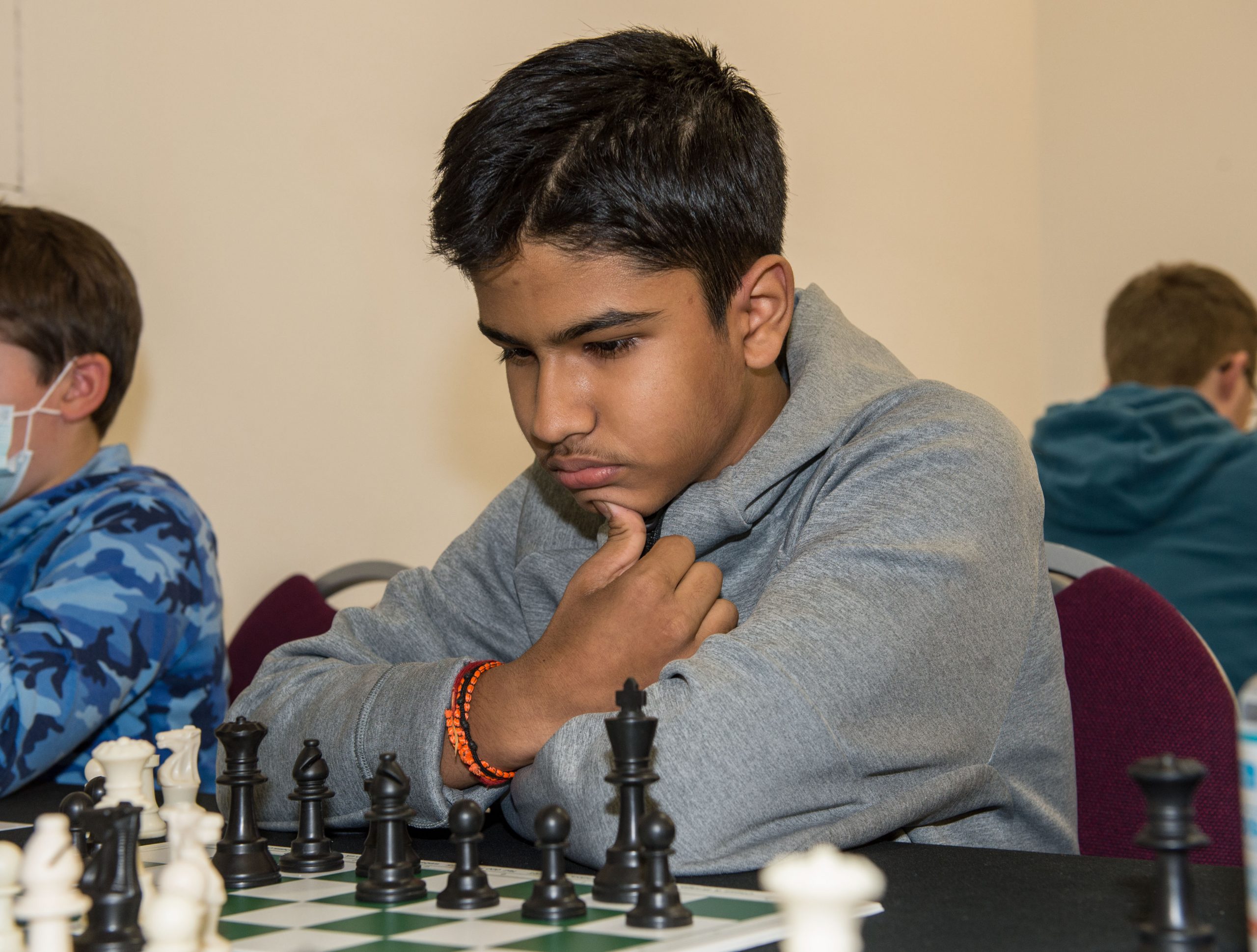
BCN sends birthday wishes to FM Shreyas (known as “Shrey” by his friends) Royal born on Friday, January 9th, 2009. “Hallelujah” by Alexandra Burke was number one in the UK hit parade.
Shreyas attended The Pointer School in Blackheath, London, SE3 whose motto is “The Lord is my Shepherd”.
In October 2021 BCN secured an interview with Shreyas via his father Jitendra and below is mostly from that interview:
BCN: What caused his initial interest in chess and at what age?
His initial interest in chess was capturing or as he used to call it ‘eating’ pieces but as he grew more mature, he loved that there were so many possibilities in chess, so much still left to explore! At the Age of 6 he learnt and got an interest in chess.
BCN: Has Shreyas had any chess teachers or coaches?
Jyothi Lal N. with a peak of 2250 FIDE but is very knowledgeable and helped from just above beginner to 1800. He was Shreyas’s first coach.
Meszaros Gyula (Julian) who was an IM with a peak of 2465 FIDE and was an endgame master which helped him from 1800-2100.
His Current Coach is GM John Emms with a peak of around 2600 FIDE, he is an expert in many fields such as Positional Play, Openings, Strategic chess etc and has also made a big impact on how to prepare against opponents. He had helped him from 2100-2300 so far in just under a year!
BCN: Which chess clubs and/ or Teams does Shreyas represent?
He represents SV Erkenschwick from Germany and Wasa SK from Sweden for online events as he has joined them during the pandemic. He started his 4NCL career with KJCA Kings in January 2019 but now mainly represents Wood Green which he has played for in online events in and will also represent them in the upcoming 4NCL weekends.
His first appearance in Megabase 2022 comes from the 2015 British Under-8 Championship in Coventry, the eventual winner being Dhruv Radhakrishnan.
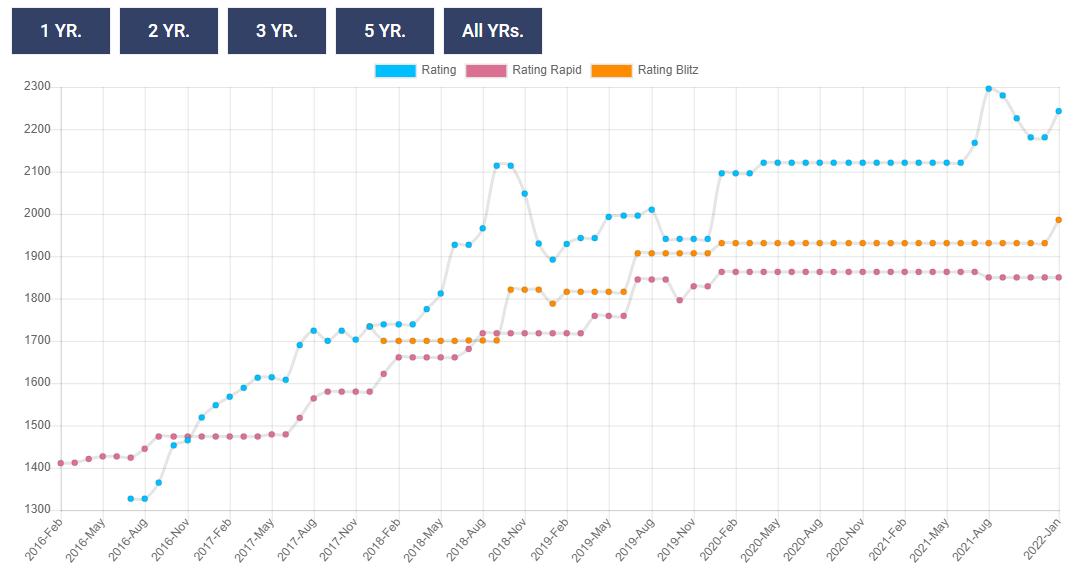
Progress from those early days has only been interrupted by school examination breaks and the Covid pandemic:
FIDE Rating progress chart for FM Shreyas Royal
In August 2016 in Bournemouth Shreyas scored an impressive 6/6 to win the British Under-8 Championship.
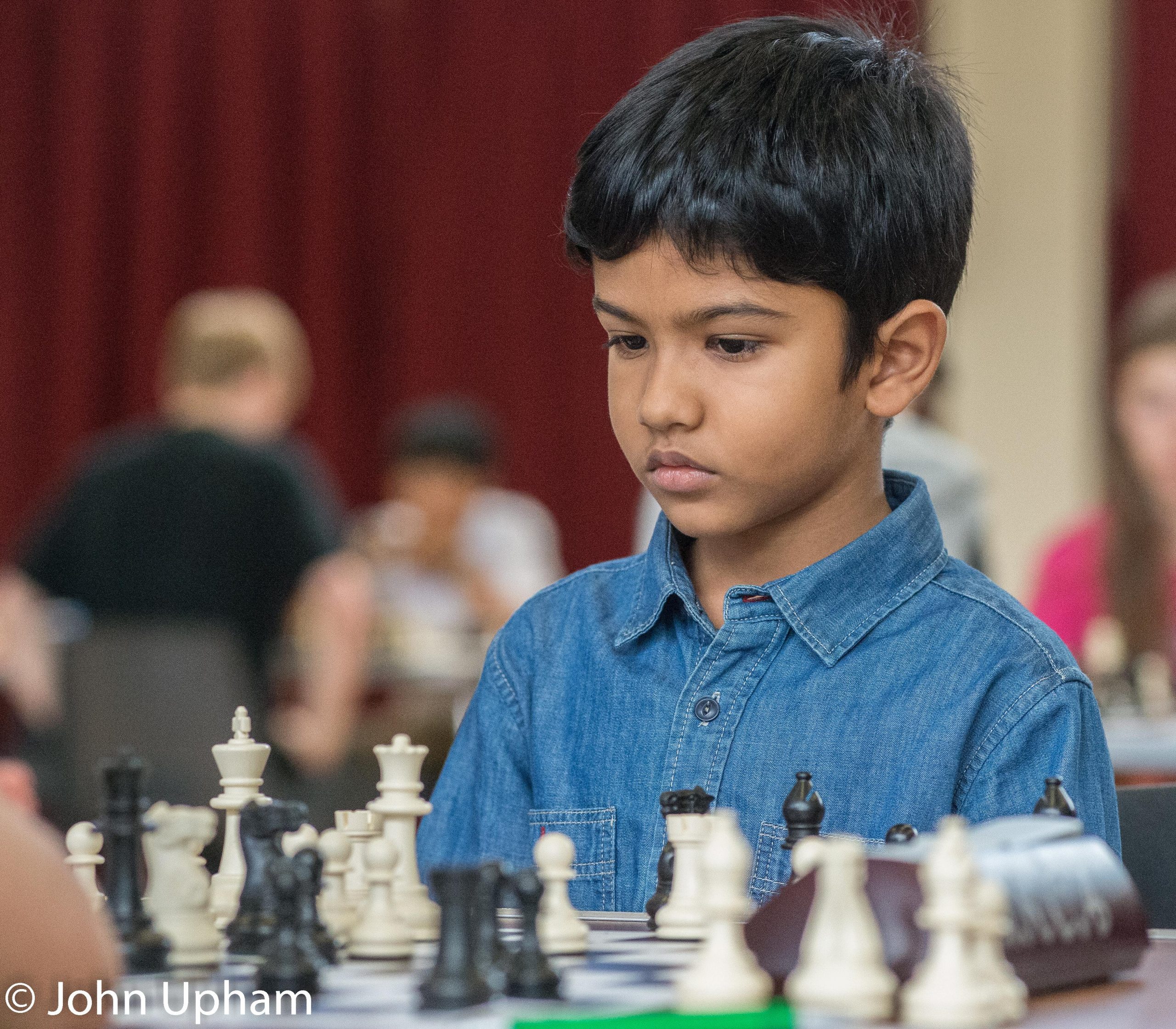
Shreyas Royal at the 2016 UKCC Delancey Terafinal in Loughborough courtesy of John Upham Photography
BCN: What was his first memorable tournament success?
This was the 2016 European Schools Under-7 championship where he was runner-up without any preparation or work on chess!
Shreyas Royal at the 2016 UKCC Delancey Southern Gigafinal in Reading courtesy of John Upham Photography
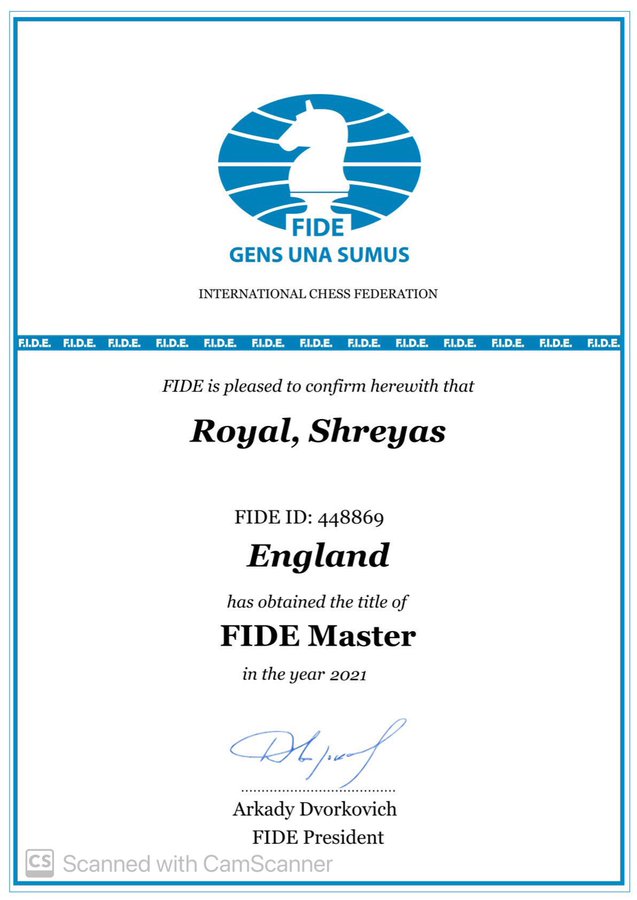
In 2021 Shreyas was awarded the FM title by FIDE:
FIDE FM Certificate for Shreyas Royal
BCN: Which chess players past & present are inspirational for him?
Magnus Carlsen, world champion and broke many FIDE records also is an inspiration for most of this generation. He likes his slow grinding and almost winning from any opening or ending. This is his favourite player of all time.
Garry Kasparov played brilliant attacking chess and calculated like a machine.
Bobby Fischer played a similar style to Kasparov but was more talented than both Magnus and Kasparov in his opinion as he worked all by himself at a time in the USA when chess was not so popular while for the Russians, they had brilliant coaches and had one good player after the other. He rates him a bit lower because Fischer quit competitive chess a bit too early and could not reach the heights he was worthy of.
Alireza Firouzja
Fabiano Caruana
BCN: What are his favourite openings with the White pieces?
He plays 1.d4 pretty much all the time.
MegaBase 2020 has 294 games with 1.d4 and one solitary 1.g3 from March 2021. The 1.d4 games feature main line Queen’s Gambit / Catalan type positions championing 5.Nge2 against the King’s Indian Defence and the exchange variation against the Grunfeld.
BCN: and what are his preferred defences as the second player?
Really depends on what they play, against every opening he has got one or two lines which he enjoys equally.
Megabase 2022 informs us that Shreyas defends the main line Closed Variation of the Ruy Lopez and main line Giuoco Piano. Previously he essayed the Sicilian Najdorf.
BCN: Does he have any favourite chess books?
Not really as he is not such a big fan of chess books, but he likes My 60 Memorable Games by Bobby Fischer. Fundamental Chess Endings and Encyclopedia of Chess Combinations.
BCN: Which tournaments are planned for 2022?
We have pencilled in a couple of norm and Open (France, Spain, Germany etc.) tournaments in European countries.
BCN: What are his favourite subjects outside of chess?
His favourite subjects outside chess are Science, History, Maths with Science as his favourite, History as his second favourite and Maths as his third favourite.
BCN: Does Shreyas play any physical sports?
He does Football, Cricket and a bit of Lawn Tennis.
BCN: What are his plans and aspirations for the future?
To become a world chess champion one day, but it’s very expensive to even get to the level of IM! Currently we are looking for sponsors who can help support Shreyas to get there.
BCN remembers IMC James Adams who passed away aged 91 on July 27th, 2013 in Worcester Park, Kingston Upon Thames, Surrey.
James Frederick Adams was born on September 4th, 1921 in Lambeth. His parents were James J Adams (DoB: 10th October 1884) who was a plumber’s mate and Lucy M Adams (née Ayres, DoB: 22nd December 1886). He had an older brother who was William A Adams who was also a plumber’s mate and and Uncle George T (DoB: 8th March 1882) who was the plumber who presumably had many mates.
At the time of the 1939 register James was a telephone operator.
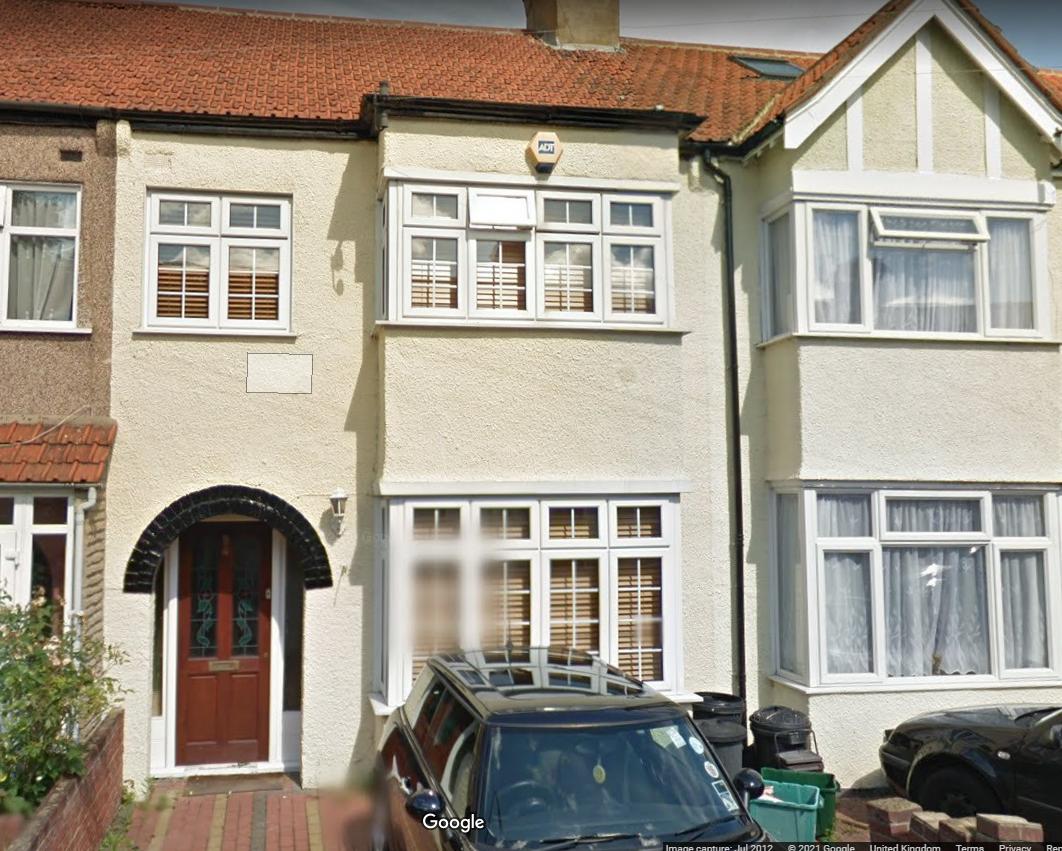
The Adams family lived at 52, Broadway Gardens, Mitcham, Surrey, CR4 4EE (rather than 001 Cemetery Lane)
52, Broadway Gardens, Mitcham, Surrey, CR4 4EE
From CHESS, 1991, March, page 91 we have:
“Whatever Happened to Human Effort?
I am giving up postal chess after 57 years for the reason that, like Jonathan Penrose and recently Nigel Short, I am increasingly disturbed over the increase in the use of computers in correspondence play. It is impossible to prove but one has the feeling that many opponents see nothing wrong in using a machine and I see no pleasure in having to bash one’s brains out against a computer. I am happy in the knowledge that I won my FIDE IM title long before dedicated chess computers were ever heard of. I shudder to think of the proliferation in the use of computers in a competition like the World CC Championship. I don’t wonder that Penrose objects.
Unfortunately, this is the sort of thing against which it is impossible to legislate. The BCCA has banned their use but it doesn’t mean a thing.
The latest monstrosity is where Kasparov plays a match against another GM and both are allowed to use computers whilst the game is in progress. To me, this is absolutely shocking. Dr. Nunn admits to the use of computers in the compilation of one of his books and I see that even ordinary annotators use a programme like Fritz to assist with their notes to a game. What happened to human effort?
Anyway, I have about five postal games left in progress and when they are finished I will call it a day.
Jim Adams
Worcester Park, Surrey
So who was Jim Adams?
From British Chess (Pergamon Press, 1983) Botterill, Levy, Rice and Richardson we have this:
The smoke-laden atmosphere of the chess rooms of St. Bride’s Institute, in the heart of the City of London, could hardly be considered a positive encouragement to any ambitions to become an International Master, but certainly this was so in my case. Let me explain the sequence of events.
Face-to-face, or over-the-board chess, had been my main interest since my war-time days as a member of the Civil Defence. Passing time between air-raids led to the adoption of many pastimes and an absorbing game such as chess was ideal. Fortunately for me, one of my ambulance station colleagues was a very fine player named A. F. (Algy) Battersby, later to become General Secretary of the British Correspondence Chess Association.
He had spent the greater part of the First World War playing chess in the Sinai Desert and, with his tremendous experience, he brought to the game strategical ideas and tactical skills that, in those early days, were well beyond my comprehension.
Arthur Frank Battersby, BIRTH 2 JUN 1887 • Brixton, Surrey, England DEATH 11 APR 1955 • Surrey, England
‘Algy’ was kind enough to say some years afterwards that I was ‘the best pupil he ever had’, but whether this was true or not, he certainly passed on to me the theoretical groundwork that was to be so useful to me in later years. Among other books, he encouraged me to purchase the Nimzowitch classic My System, with the kindly warning that I would not understand it at first reading but would perhaps get some grasp of the ideas at a second or third attempt.
My System was a revelation to me and proved to be the greatest help to an understanding of the game that I had ever received. Up to my fortuitous meeting with ‘Algy’, my games had been of a simple tactical nature. Pieces were left en prise, oversights and blunders were the order of the day and an actual checkmate came as a surprise not only to the loser but often to the winner as well!
To win a game through sheer strength of position was completely unknown to me, but ‘Algy’ and Nimzowitch changed all that! Under their combined influence my general playing strength improved enormously and I was soon second only to ‘Algy’ in such tournaments as were held in my home town of Mitcham, where the local chess club was revived after the war.
Our club soon attracted a few strong players and we played regularly in county competitions and, later, the London Chess League. During those years chess was an absolute joy to me and all my spare time was spent at the local club or at chess matches, whilst Saturday afternoons were spent at the now defunct Gambit Chess Room, in Budge Row, where I passed countless hours playing chess, pausing only to order light refreshment from the indefatigable ‘Eileen’, a waitress of somewhat uncertain age who almost certainly regarded all chess players as raving lunatics!
The ‘Gambit’ could never have been a viable commercial proposition on what we bought and it was eventually thought necessary to introduce a minimum charge depending on the time of day. Gone for ever were the days when one could spend the entire evening playing chess, analysing, or having a crack at the local Kriegspiel experts, all for the price of two cups of tea and the occasional sandwich. Sadly, it all disappeared in the aftermath of the
war.
By 1950 I had become Match Captain of the Mitcham Chess Club and, of course, responsible for arranging various matches. Getting a team together was not difficult as the club membership was quite large for such a lowly club. The playing standard too was surprisingly high and whilst I, myself, was fortunate enough to win the club championship several times it was never easy.
On one occasion a ‘friendly’ match had been arranged with the BBC and all was well until a ‘flu epidemic a few days before the date of the match laid most of the Mitcham players low. On the morning of the match I was left with five players for a 1O-board match! As it was only a ‘friendly’ and in order to avoid disappointing all concerned I took myself off to the Gambit and recruited a few of the ‘regulars’ to help us out. It must be remembered that most of the strongest players in London frequented the ‘Gambit’ and since those pressganged into service were extremely strong players it seemed only courteous to give them the honour of playing on the top five boards, leaving the Mitcham ‘stars’ who, coincidentally, were our usual top board players, to bring up the rear.
Now this composite team, in my judgement, was probably good enough to win the London League A Division and it was no surprise when we won 10-0. Only a friendly indeed! Any Match Captain would have given his queen’s rook for such a team but, whilst the BBC players were warned beforehand of the composition of our team, they were not amused and further matches were not arranged!
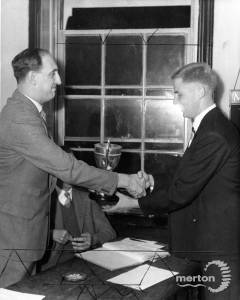
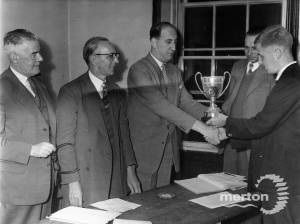
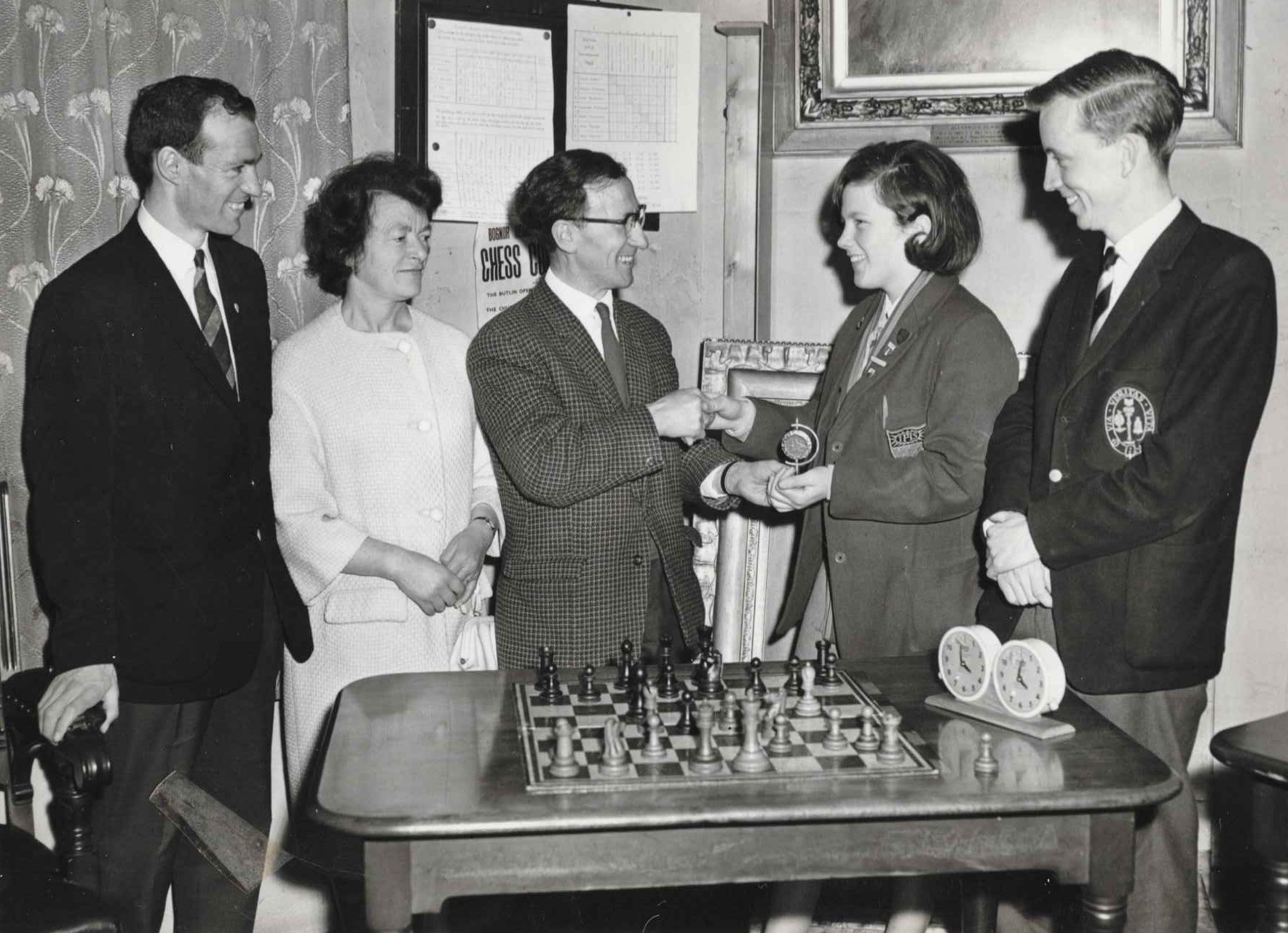
Mr A Corish (right), receives the Chess Champion cup from Mr J Adams. 18th September 1958 from the Merton Advertiser, Photographer unknown.
Round about this time I was playing regularly in London League matches, nearly all of which were held at St. Bride’s Institute, where my story began. A non-smoker myself, I found the conditions intolerable. The place seemed to be completely airless and Government warnings about the dangers of smoking did not exist! not exist! Consequently, the entire playing area was reminiscent of the Black Hole of Calcutta! Always susceptible to headaches, I began to return home physically ill after every match. If this was playing chess for pleasure then something was wrong!
Mr A Corish (right), receives the Chess Champion cup from Mr J Adams. 18th September 1958 from the Merton Advertiser, Photographer unknown.
However, salvation was at hand. Ever since the war I had been playing a few games by post under the auspices of the BCCA (British Correspondence Chess Association ), and my somewhat traumatic experiences at St. Bride’s were beginning to make postal chess a far more attractive way of playing the
game. And so my chess career started all over again!
My correspondence chess activities up to the 1960s were not particularly successful, although I had managed to win three Premier Sections and finish
equal third in the British Correspondence Championship of 1962-63. However, during that time a group of BCCA players, of whom I was one, were
becoming somewhat dissatisfied with the Association’s attitude towards international chess and eventually a splinter group formed a rival organization which became known as the British Correspondence Chess Society.
The BCCS was, almost from the start, internationally orientated and it was possible to play foreign players, many of master strength. With strong opposition it seemed easier to improve and my first real success came in the Eberhardt Wilhelm Cup in 1966-67 when I was able to obtain the lM norm giving me a half=master title. However, gone were the days when a superficial analysis was enough before posting a move, which even if it was not the best, was generally good enough to hold one’s own with even the best of British CC players at that time. Fortunately for British chess, the situation is now vastly different and the strongest British CC players are recognized as being among the best in the world.
The Eberhardt Wilhelm Cup consisted of players all of master or near-master strength and it was in one of the games I played in this tournament that I played probably the most surprising move of my life.
To win the full IM title involved getting one more IM norm and happily for my prospects, I was selected for the British team in both the Olympiad Preliminary of 1972 and the European Team Championships of 1973.
Although I was trifle unlucky to miss the IM norm by half a point in the European Championship I finally clinched the coveted IM title in the Olympiad Preliminary which, although starting a few months before the European tournament, went on so long that I was in suspense long after the European games finished.
One of my most interesting games in the European Team Championship of 1973 was against F. Grzeskowiak, himself an IM and a feared attacking player.
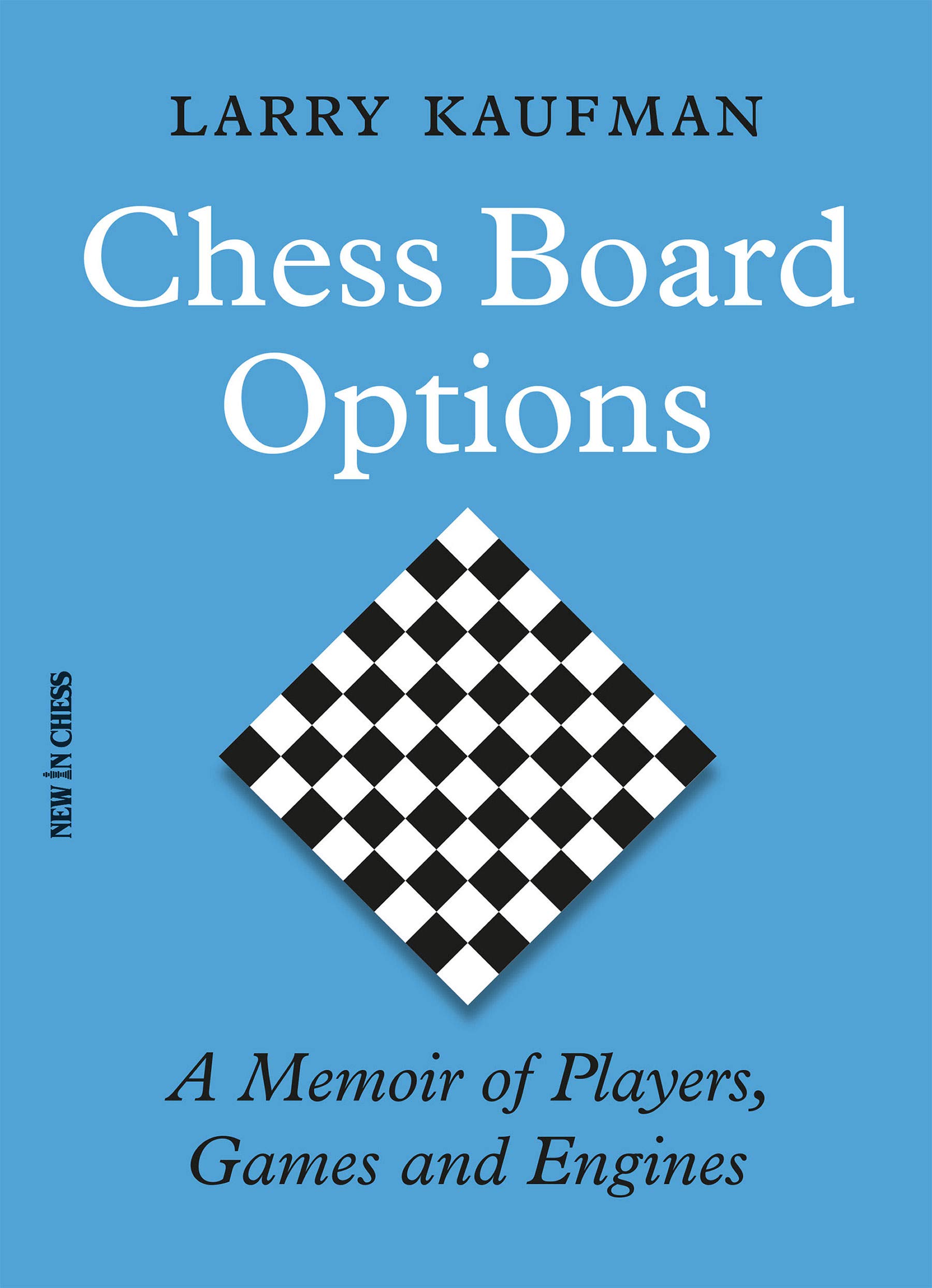
Chess Board Options, Larry Kaufman, New in Chess, 15th July 2021, ISBN-13 : 978-9056919337
From the publisher:
“Larry Kaufman can safely be called an exceptional chess grandmaster
Larry Kaufman started out as a prodigy, however not in chess but as a whizz kid in science and math. He excels at shogi (Japanese chess) and Go, and is also a world-famous computer programmer and a highly successful option trader. Remarkably, as a chess player he only peaked at the weirdly late age of fifty.
Yet his victories in the chess arena are considerable. Over a career span of nearly sixty years Kaufman won the state championships of Massachusetts, Maryland, Florida, Virginia, D.C. and Pennsylvania. He was an American Open Champion and won the U.S. Senior Championship as well as the World Senior Championship.
‘Never a great chess player’ himself (his words), he met or played chess greats such as Bobby Fischer, Bent Larsen, Walter Browne, Boris Spassky, Viktor Kortchnoi and many others. He worked as a second to legendary grandmaster Roman Dzindzichashvili, and coached three talented youngsters to become International Master, one of them his son Raymond.
This engrossing memoir is rife with stories and anecdotes about dozens of famous and not-so-famous chess players. In one of the most remarkable chapters Larry Kaufman reveals that the American woman chess player that inspired Walter Tevis to create the Beth Harmon character of Netflix’s The Queen’s Gambit fame, is his former girlfriend. You will learn about neural networks, material values and how being a chess master helps when trading options. And find lots of memorable but little-known annotated games.
Larry Kaufman is an American Grandmaster. He has been involved in computer chess since 1967, when he worked on ‘MacHack’, the first computer that competed in tournaments with human players. More recently he has been working on the programs Rybka and Komodo.
Praise for the best-selling opening manual Kaufman’s New Repertoire for Black and White:
“Kaufman’s book is a pleasure to read.” — Miguel Ararat, Florida Chess Magazine
“Kaufman does an outstanding job.” — IM Gary Lane, Chess Moves Magazine”
GM Larry Kaufman
The memoirs of a relatively obscure grandmaster might not be at the top of your wish list, I guess.
The title might be considered slightly odd as well, referring in part to his career as an options trader, with perhaps also some reflections on options for the further development of chess.
Nevertheless, Larry Kaufman has some interesting stories to tell, and much to say about the future of our favourite game. You’ll also find, appropriately enough, 64 games, some played by the author, some by players he knew, and some by computers against grandmasters, all with brief but pertinent annotations. I’d urge you to stop and take a look inside rather than just pass it by.
The introduction provides some background biographical information concerning his 60 year chess career.
Here’s an early game: the book provides annotations as far as move 20.
In Part 1, Kaufman introduces us to some of the 20th century champions he has known, with plenty of anecdotes and a few games along the way. We meet Fischer, Spassky and Kasparov, Korchnoi, Larsen, Gligoric and others. For me, though, the most interesting chapters here are about the lesser known players. We go all the way back to Harold Phillips (1874-1967), a family friend, who had played Steinitz in simuls back in 1894. I guess this must make Kaufman one of the youngest players to have a shared opponent with Steinitz. In 1961 or 1962 there was a kindly old man who ‘gave generous and valuable free chess lessons to the kids’. This was the notorious Norman Whitaker: of course they knew nothing of his background at the time.
Then there was Steve Brandwein (1942-2015), a new name to me. ‘Although he retired from tournament play at only 22 years of age, … he … was a very strong player … and probably taught me more about the finer points of chess than any other individual.’ Kaufman compares him to Bernie Sanders, and describes him as ‘perhaps the best-liked chess master I’ve ever known’, who could, if he’d wanted have become a grandmaster, or perhaps, had he been prepared to compromise, a US President.
Even more interesting (although readers of New in Chess might have read about this before), is Diana Lanni, who, according to Kaufman, may have been the major inspiration behind the character of Beth Harmon in The Queens Gambit. He also sees himself as the closest match to Harry Beltik, and Walter Browne as Benny Watts.
Part 2 looks at Larry Kaufman’s life outside chess: his time as an options trader and his interest in Shogi, Go and other games.
In Part 3, he shows us some of his most memorable games and talks about his chess students, including his son Ray.
This was his first win against a grandmaster, and helped him towards his first IM norm.
This game helped propel him to a shared first place and the grandmaster title in the 2008 World Seniors.
Part 4 is about computer chess. Kaufman has been involved in this since 1967, when, as a student at MIT, he had a part-time job working on MacHack. Today, he’s part of the Komodo team. After a brief résumé of his career in computer chess, we see some recent games between engines and grandmasters. These days, the engines give the GMs considerable odds.
Particularly interesting here is a 2020 16-game match (15’+10″) between Komodo and GM Alex Lenderman. In every game, Komodo played White without a knight. In half the games, Lenderman played without a pawn, in four games he had all his pieces but without castling rights, and four games were played using Fischerrandom rules, but with kings and rooks on their usual squares. On the first day, using its standard version, Komodo lost three games, with just one draw. It then switched to the Monte Carlo Tree Search version, which seeks the best practical chances rather than the objectively best moves. In the remaining twelve games, all of which are published here, Komodo scored three wins, seven draws and only two losses.
Here’s a Komodo win. Kaufman’s brief annotations don’t mention a significant improvement for Komodo pointed out by Stockfish 14.
Part 5 comprises short essays on various topics such as: ratings, openings and piece values, along with suggestions for the reform of competitive chess and thoughts about the future.
Kaufman is perhaps best known, at least in the USA, for a 1999 Chess Life article about the values of the pieces. As someone involved in teaching beginners, this is of considerable interest to me. I’d really like to stop my pupils trading BN for RP on f7 and thinking they have an advantage because points are equal and they’ve exposed the enemy king. He suggests that, while the traditional values (1, 3, 3+, 5) are reasonable for positions without queens, in the presence of queens we should teach 1, 4, 4+, 6, 11. That will resolve my problem: the trade on f7 will now win 7 points but lose 8+ points.
I found this book a riveting read, especially parts 4 and 5, but then it covers a number of topics which are of particular interest to me. If the topics appeal to you too, or if you have a general love of chess culture, I’d give it a very strong recommendation. Fascinating, well written, and, as usual with New in Chess, well produced.
Here is the citation from the 1997 BCF Official Chess Yearbook for the 1996 President’s Award :
He has almost single handedly fostered, developed and maintained Richmond Junior Chess for two decades. This year Richmond Juniors have won the major National competitions, and the Richmond Chess Initiative has blossomed under his skills. However, his work has fostered chess as a whole.
He formed the Richmond Junior Club with Mike Fox in 1975. He has built it up and kept it going from a nucleus of a handful of juniors on a Saturday to over 40 juniors on a Saturday morning, and over 30 on a Saturday afternoon, 48 weeks a year, running four Thames Valley League teams during the week. The club has over 175 members.
The Richmond record under his dedication has included winning numerous EPSCA, NYCA and National individual titles at all ages with a wide range of individuals, both boys and girls. He has generated ‘team spirit’ as well as individual motivation whilst enabling individual Richmond schools to claim their own successes from their own efforts that completed his with the Junior Club.
He has been responsible for recognising early the talent of many England juniors. He has then encouraged and facilitated their development. Many of these have subsequently becomes Masters whom he has persuaded to come back and coach at the club. However, he has also been unfailing in encouraging the less gifted players and facilities for them.
He has never sought any monetary reward and has given considerable extra time to recording, annotation and distributing games, as well as calculating grades for hundreds of players, on top of running the club activities and organising and running numerous tournaments for Richmond and non-Richmond juniors. This year he was instrumental in initiating the new Richmond rapidplays.
He has, with Mike Fox, been instrumental in opening chess up to a much wider audience, whilst destroying the mythical image of introverted individuals, that some of the general public held. They have achieved this by producing their ‘Chess Addict’ books and articles in order to provide spice and humour alongside the ‘normal’ literature, and not to forget ‘Move One’ published in 1990.
Although aided by help from other sponsors, he has been the cornerstone of the relatively recently formed Richmond Chess Initiative. He provided guidance and skills to assist local councillors, business men and schools to build up a local structure to publicise and develop further still Richmond as a recognised centre of chess. This included helping to establish the Richmond International, the first of which in 1994 was held at the Star and Garter Home and was held again in 1995. He was awarded the Initiative’s reward for services in 1996.
It’s Monday 28 August 1871. Join me at Simpson’s Divan in the Strand, where, after a satisfying lunch of roast beef, accompanied by a bottle of their finest claret, followed by a glass of brandy and a Havana cigar, we adjourn to the chess room to watch the great Wilhelm Steinitz in action.
He introduces us to his friend Mr Sich, who is, he informs us, a wine merchant. The two gentlemen are engaged in an exciting battle. At one point Herr Steinitz is a rook ahead but his king seems to be in trouble. He manages to survive and win the game, but could Mr Sich have done better?
I reach into my pocket. “Look, Herr Steinitz! I’m a time traveller from 150 years into the future. I can press a few buttons on this small machine and talk to anyone in the world. I can press a few more buttons, enter the moves of the game you just played and show you both where you went wrong.”
“You might have been impressed by Ajeeb, but my machine is a million times better. You see, Mr Sich, you might have played your rook to queen one on move 28, announcing check to Herr Steinitz’s king. You were still winning, though, but on move 32, if you’d played your queen to queen’s knight five you could then have exchanged everything off on queen seven and advanced your king’s bishop’s pawn to the end of the board. Two moves later, you could still have drawn by exchanging rooks, but instead you left your own king defenceless.”
But now it’s time to bid our farewells and leave: we have a journey to make. Our destination is Hammersmith. We’re excited by the prospect of travelling on the Underground Railway, so head for Charing Cross Station. Just eight weeks earlier, following a banquet attended by Mr Gladstone two days previously, the District Railway started running trains round part of what would become the Inner Circle. In a few years time we’ll be able to take the train directly to Hammersmith, and the line will later be extended to exotic destinations such as Richmond and Ealing. 90 years later a schoolboy playing his friends on the train between Ravenscourt Park and Richmond will develop a lifelong chess obsession, but that’s another story for another time.
For now, we must take the underground train as far as Paddington, and change onto the Hammersmith and City Railway. When we reach our destination we spot a pub called the George just round the corner: it was rebuilt in 1911 and is now part of the Belushi’s chain. We could stop for a drink there, or in several other pubs nearby, but instead we’ll take a stroll down King Street.
After half a mile or so we’ll pass what is now Hammersmith Town Hall, which we visited in our last journey, and notice, in 2021, that it’s being redeveloped. If we look across the street we’ll see Dalling Road, and the building which, we hope, will soon be the site of a new Mind Sports Centre.
Then we pass another pub. This was the Hampshire Hog, but is now just the Hampshire, serving Indian cuisine as well as beers, wines and spirits. Mine’s a pint of London Pride: what are you having?
Why have I brought you here? Because this pub, like the George and many others in the area, was owned by the Sich family. The brewery was purchased by one John Sich in 1790 and later run by his sons, John junior and Henry. The two brothers both had numerous children, many of whom were involved in the family business.
But let’s stop there. News has just come in that Herr Steinitz and Mr A Sich played again two days after the game we witnessed. Again, Herr Steinitz survived a totally lost position to win, in an encounter which was even more exciting that their previous game, with a lot of bamboozling tactics. Probably worth a separate article, I think.
You’ll notice that Mr S missed a simple mate in 5 on move 38 before blundering away first the win and then the draw. Still impressive, though, that he could achieve winning positions in level play against the world’s strongest active player.
What else do we know about him? He was very active in the St James’s Club from 1860 onwards, where he was a second category player, receiving odds from Loewenthal and Valentine Green, but conceding odds to weaker players. We’ll meet at least one of his opponents, EE Humphreys, in a later article. He played published games on level terms against Steinitz in 1871, as we’ve seen, and against Loewenthal in 1873 and 1874, before disappearing from the chess scene. Tim Harding comments that his forename is unknown, but perhaps we can find out. Let’s continue our walk.
Back in the 1960s, when such things were allowed, the Hampshire Hog was the place where teachers from nearby Latymer Upper School would take their pupils for a drink. We’re now going to head away from King Street towards the river. Not so easy to cross the Great West Road, but we could perhaps cheat (as I’m an alumnus they might let me in) by following in the distinguished footsteps of the likes of GM Michael Stean and IM David Goodman, taking the school’s Secret Subway to the dining hall and the Prep department, and then out onto Upper Mall.
We’re now at the start of the notorious Round the River Run (or, in my case, walk) which takes you along the river, over Barnes Railway Bridge, along the towpath on the other side, across Hammersmith Bridge and back to where you started. We won’t do that now, not least because Hammersmith Bridge is currently closed for repairs, but will take a gentle walk by the river in the direction of Chiswick.
Passing the Old Ship, we’ll stop off at the Black Lion. Thanks for offering: I’ll have another pint of Pride. It would be rude not to, given how close we are to where it’s brewed. Above one of the corner tables is a portrait of local resident AP Herbert, whose wife was regularly seen at the Hammersmith Town Hall chess tournaments.
While we’re here, news comes in that Herr Steinitz and Mr A Sich have played another game.
I’m not sure what 7. Ng5 was all about: my pupils get their knuckles rapped if they play moves like that. Steinitz chose to go for the attack rather than regain the exchange on move 26, but Sich missed a draw on move 34.
It’s time to continue our walk, passing Fuller’s (London Pride) Brewery and soon reaching St Nicholas’s Church. Turning up Church Street towards the busy Hogarth Roundabout, a stark contrast to the bucolic views of the Thames, you’ll see a tower on your right with the words LAMB BREWERY. This was the name of the Sich family concern: little other than the tower remains.
But we still haven’t identified A Sich. Let’s return to John and Henry. John had a son named Alexander who was born in 1837, while, two years later, Henry’s son Arthur John was born. So we have two gentlemen named A Sich who were of the right age. As he was active from 1860 onwards, the older cousin seems more likely. A better reason is that, in the days when people were referred to by their full initials and surnames, the chess player was always ‘A. Sich’, never ‘A.J. Sich’. We also know from Steinitz that he was a wine merchant. As it happens, 1871 was a census year, so let’s travel back 150 years again and join the enumerator.
Here, in Church Street, where we’re standing now, is Arthur John, a brewer, with his wife and children. And just round the corner, in Sunbury House, The Mall, Chiswick, is Alexander, a wine merchant, with his wife (who just happened to be Arthur’s sister Helen: nothing like keeping it in the family) and children. This seems confirmation that it was Alex, not Artie, who played chess against Steinitz. We know quite a lot more about them as well. Al was very much concerned with municipal affairs throughout his life, while Art was involved with the army volunteers. Unlike his cousin, he seemed to prefer real soldiers to wooden soldiers.
Time for a final drink, I think. While we’re at the Hogarth Roundabout we could choose the George & Devonshire, which has probably always been a Fuller’s pub, but, to continue the theme of our pub crawl, we might prefer to walk up towards Turnham Green to visit another former Sich pub, the Lamb (formerly the Barley Mow, but its name was changed to that of the original brewery).
While we’re there, there’s another game to look at. Steinitz is White again and plays the King’s Gambit. Again, Sich is doing well at one point, but misdefends, allowing a neat sacrificial finish.
We could, I suppose, visit the Watermans Arms in Brentford, which comes with a recommendation from food critic and West London Chess Club secretary Andy Hayler. Close by is the Watermans Arts Centre, which in turn is across the road from the rather wonderful Musical Museum and a short walk from the London Museum of Water and Steam, which itself is just across the railway line from the new Brentford Stadium. Will they be seeing Premiership football there next season, I wonder?
We could also travel further west to the Bell in Hounslow. Back in the 1980s or thereabouts Hounslow Chess Club met nearby, and the Bell was often the venue for our post mortems after we played them in the Thames Valley League. There are plenty of other former Sich pubs still around as well: see the link below.
Before I leave you, there’s one further reference connecting Alexander Sich to the game of chess.
In 1903 the Chiswick Library Committee, of which Alex was a member, decided to allow their committee room to be used as a games room. Chess, draughts and dominoes were provided so that the local louts could avoid trouble by playing some nice quiet games.
Unfortunately, it didn’t work out as planned. The boys resorted to games of their own: ‘coddam’, noisy larking, horse-play and pitching cinders. The good citizens of Chiswick were not at all happy, and, after a few weeks, the club was closed down. Alexander Sich said that he did not regret that they had made the experiment. It could hardly have been more different from the pre-lockdown chess group at Whitton Library. There’s a moral there somewhere, but I’m not sure what it is. (Coddam, since you asked, is ‘an old game, usually with three players on each side, based around guessing which of the players’ hands is hiding a coin or button.’)
Meanwhile, the Sich Brewery hit problems during the First World War and was sold off in 1920. Their neighbour, Fuller’s, however, survives and thrives to this day.
This is the second of a series of articles about Steinitz’s English amateur opponents. The next instalment will be coming shortly.
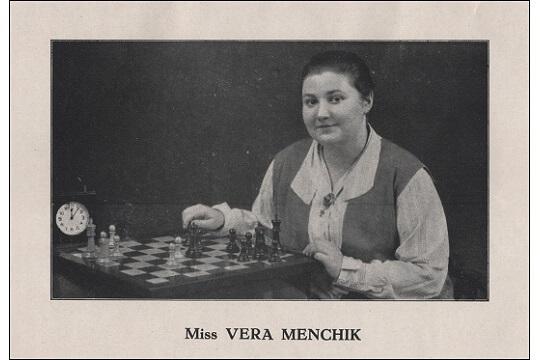
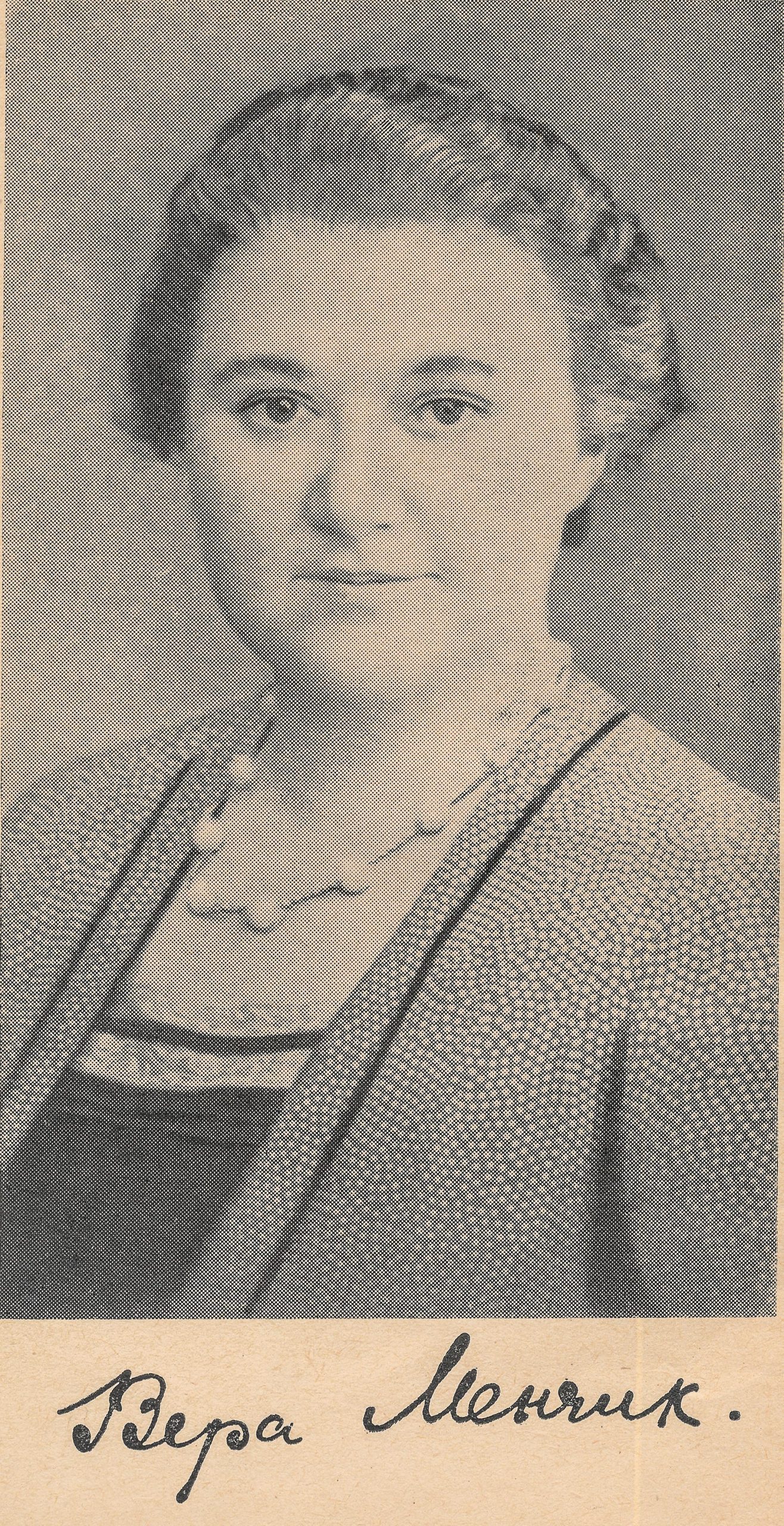
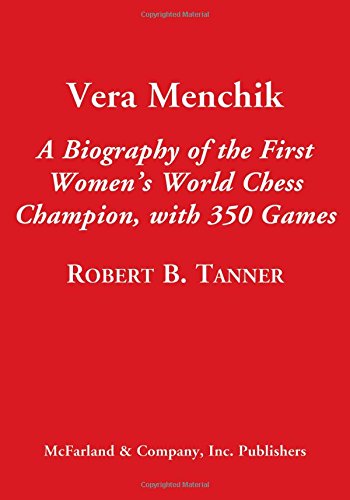
Few people know the story of Vera Menchik yet it deserves to be told. She was the first women’s world chess champion in 1927 and retained the title undefeated until her untimely death at the age of 38 in 1944 during a rocket attack on London. She is more properly compared with the great male players of her era against whom she scored creditably. The absence of a full biography of Vera in English reflects the peculiar circumstances of her life and death.
Vera was, in modern terminology, a refugee and essentially a stateless person for much of her life. She was born in Moscow in 1906 during the period of the Russian Empire to an expatriate family who was forced to flee when she was 15 following the Russian Revolution having lost their livelihood. As they passed through Europe, her father and mother split up in his homeland Czechoslovakia which had been created out of the ruins of the Austro-Hungarian empire. She arrived in England and took up residence in the seaside town of Hastings. (The fact that Hastings had hosted the world’s longest series of annual chess tournaments since 1895 was a happy coincidence.) Vera never attained British nationality until near the end of her life even though she had been domiciled in England from 1921. She won the first-ever Women’s World Championships held in London in 1927 under a Russian flag; thereafter she nominally represented Czechoslovakia until finally she represented England in 1939 following her marriage to a senior official within the British Chess Federation.
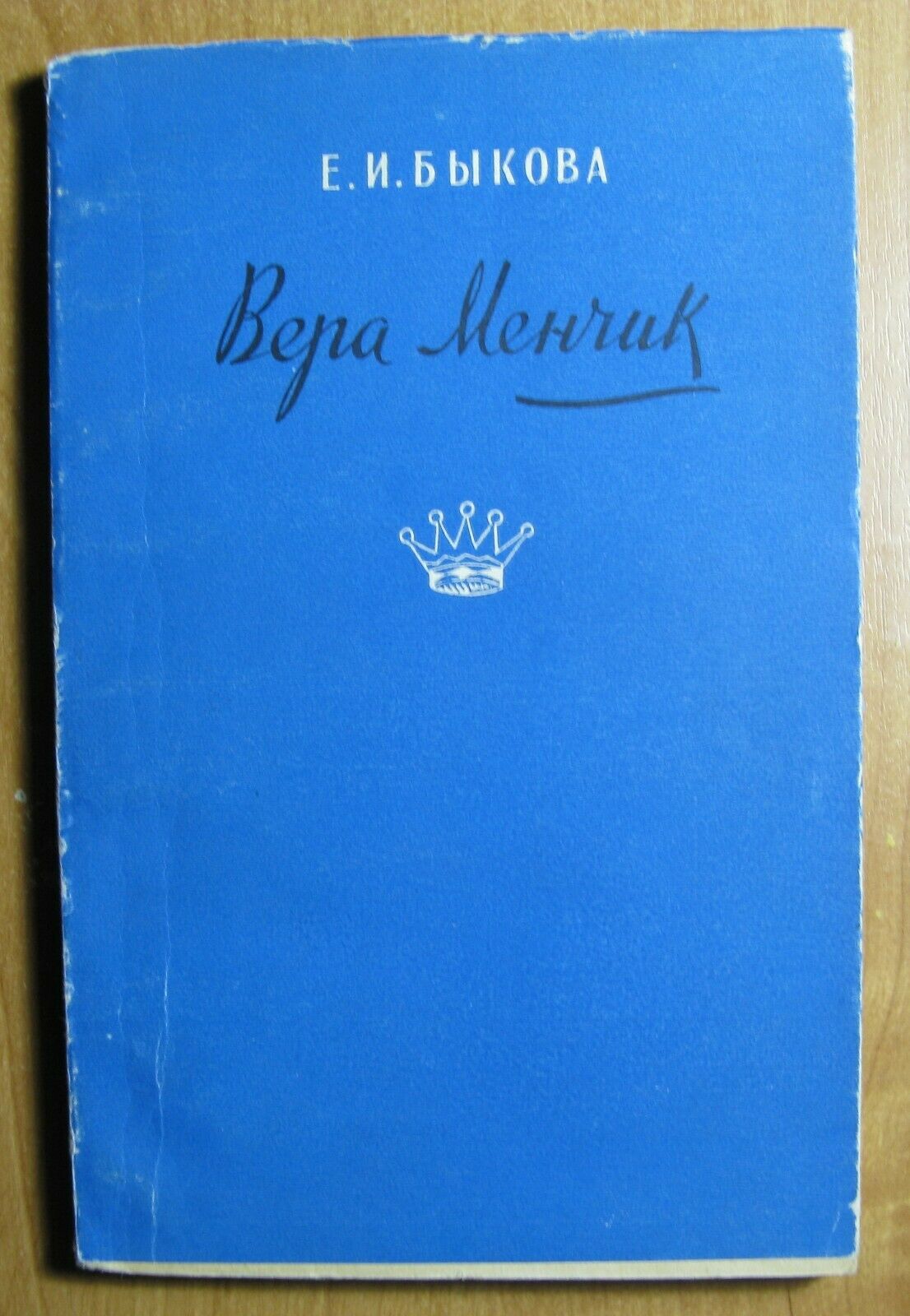
Vera Menchik., EI Bykova, Moscow, 1957, 176 pages, 4s 7d.
Vera’s grandfather was Arthur Illingworth, a wealthy trader from Lancashire who had set up business in Moscow where his Anglo-Russian daughter Olga married František Menčik. He was a successful estate manager. Vera learned chess from her father and performed well at school. Her younger sister Olga was also a good chess player and the sisters remained close throughout their lives.
Vera was a woman in a man’s world – she had to struggle harder to achieve the kind of recognition which was accorded to men. She appeared like a comet in the sky and it would be many years until other women were able to reach her level. At her first major international tournament at Karlsbad in 1929, she was the only female participant in a tournament of 22 great players. Even as women’s world champion, some of the male players objected to her participation. The Viennese master Albert Becker joked that anybody who lost to her should belong to the Vera Menchik Club. By an irony of history, he became its first member losing to her in the third round. She beat many other grandmasters during her career including the Dutchman Max Euwe in 1930 and 1931 (both at Hastings) who was to become world champion in 1935.
Although she is often portrayed as being Russian or Czech or latterly British, she was a true cosmopolitan. She knew that life could be unstable in any country. She had lived through the Russian Revolution; one parent was left behind in Czechoslovakia; she had moved westwards across Europe and embraced different cultures and languages at formative stages of her life. It is no wonder that she learned also to speak Esperanto which was designated to be the world’s lingua franca before English achieved its dominance. As a leading chess player, she travelled back to Moscow and to Czechoslovakia several times as well as to South America for her final match to retain the women’s world champion title in 1939. She needed to be self-sufficient and was obtained roles as the games editor of a chess magazine as well as being appointed the manager of the National Chess Centre in Oxford Street which was destroyed during the Blitz in 1940.
She survived most of the war and now a widow moved in with her mother and sister to a house in south London. They took the precaution of going down to the cellar during bombing raids. Tragically the house received a direct hit from a flying bomb and the entire family was wiped out. Hardly any of her possessions remained save for one dented trophy. The records at the national chess centre were destroyed as were her personal effects including her chess memorabilia. At least there remains a record of the moves played in her games which serve as testimony to her remarkable career as not only the first women’s world chess champion but also a woman who broke boundaries wherever she went and demonstrated that a woman is capable of standing on her own feet professionally and leading a full and eventful life.
The Bomb Attack
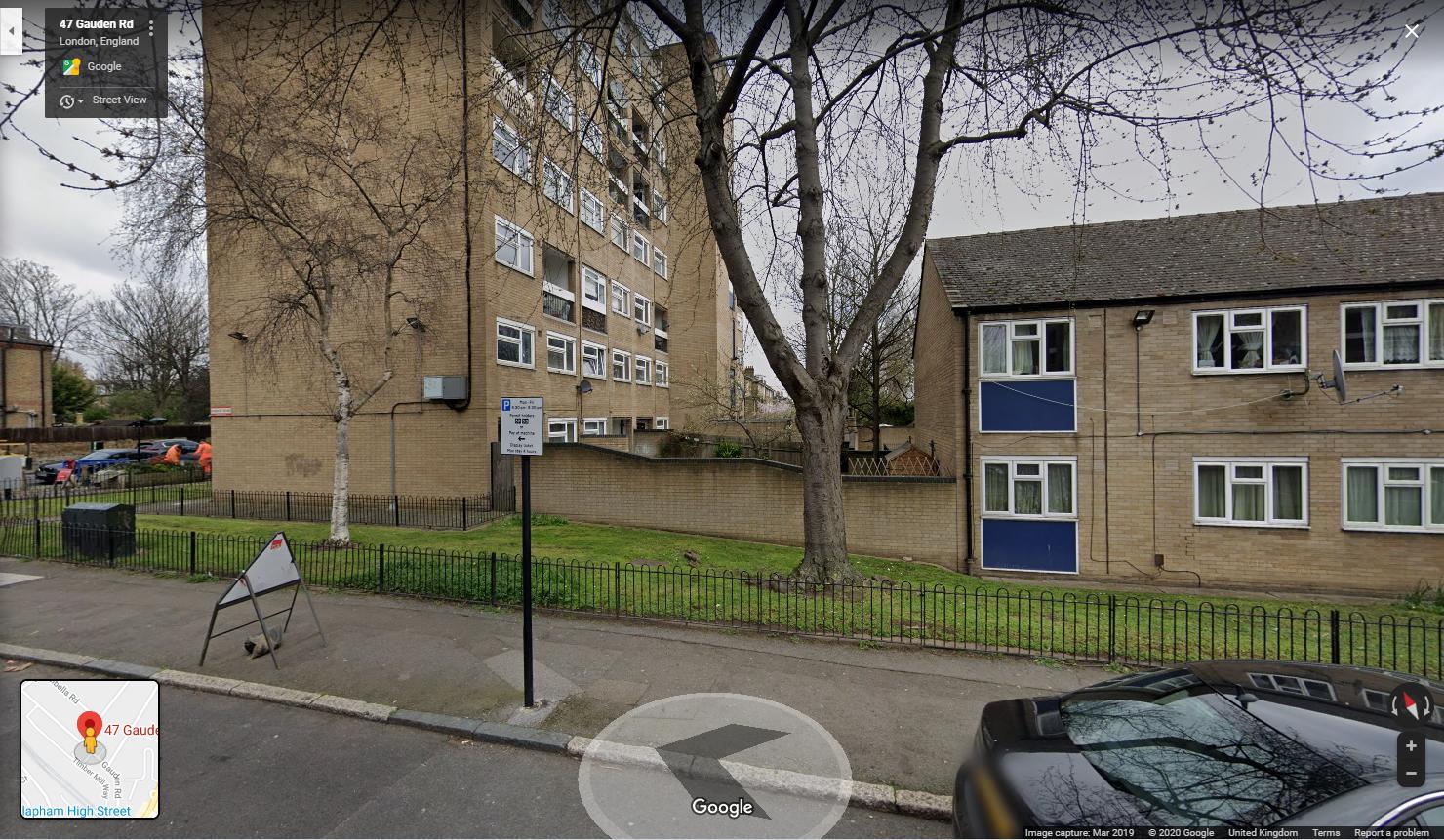
BCN remembers that in the early morning of Tuesday, June 27th, 1944 (i.e. 77 years ago) Vera Menchik, her sister Olga, and their mother were killed in a V-1* flying bomb attack which destroyed their home at 47 Gauden Road in the Clapham area of South London.
We now know that the V1 in question landed at 00:20 hrs on the 27th and led to the death of a total of 11 people including the Menchik household. Here is a summary of recorded V1 and V2 landings in the Clapham, SW4 area.
(*The V-1 was an early cruise missile with a fairly crude guidance system.)
47, Gauden Road, Clapham, SW4 6LW in more modern times.
All three were cremated at the Streatham Park Crematorium on 4 July 1944. Vera was 38 years old.
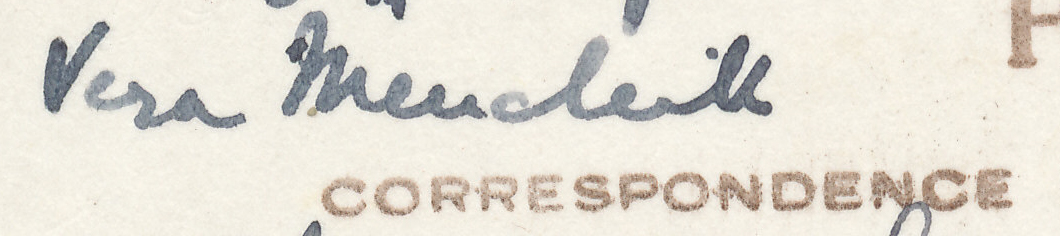
Signature of Vera Menchik from a Brian Reilly “after dinner” postcard from Margate 1936.
Vera’s Parents and Sister
Vera Frantsevna Menchik (or Věra Menčíková) was born in Moscow on Friday, 16th February, 1906. Her father was František Menčik, was born in Bystrá nad Jizerou, Bohemia. František and Olga were married on June 23rd 1905 in Moscow and notice of this marriage appeared in British newspapers on July 22nd 1905. Vera’s sister was Olga Rubery (née Menchik) and she was born in Moscow in 1908. Olga Menchik married Clifford Glanville Rubery in 1938. Vera married Rufus Henry Streatfeild Stevenson on October 19th 1937.
Her Maternal Roots
Our interest in unearthing her maternal English heritage / roots has led to the following:
Her mother was Olga (née Illingworth (1885 – 27 vi 1944). Olga’s parents were Arthur Wellington Illingworth and Marie Illingworth (née ?). Arthur was born in October 1852 in the district of Salford, Lancashire, his parents were George Illingworth (1827-1887) and Alice Whewell (1828-1910).
In the 1861 census Arthur is recorded as being of eight years of age and living in the Illingworth household.
In the 1871 census Arthur is recorded as being of eighteen years of age and living in the Illingworth household of nine persons at 5, Lancaster Road, Pendleton, Lancashire. Arthur’s occupation is listed as being a merchants apprentice. In fact, he was a stock and share broker.
Arthur died in Moscow on February 21st 1898. Probate was recorded in London on July 6th, 1900 as follows:
Illingworth Arthur Wellington of Moscow Russia merchant died 21st February 1898 Probate London 6th July to Walter Illingworth stock and share-broker Effects £4713 7s
£4713 7s in 1898 equates roughly to £626,600.00 in 2020 so it would appear that Arthur was considerably successful and almost certainly left money to Olga Illingworth.
What do we conclude from all of this? Quite simply that Vera’s maternal roots were from Salford in Lancashire.
BCM Announcement
The August 1944 British Chess Magazine (Volume LXIV, Number 8, page 173 onwards) contained this editorial from Julius du Mont:
Julius du Mont, Editor of British Chess Magazine from 1940 to 1949
“British Chess has suffered a grievous and irreparable loss in the death by enemy action of Mrs. R.H.S. Stevenson known through all the world where chess is played as Vera Menchik.
We give elsewhere (below : Ed.) an appreciation of this remarkable woman. Quite apart from her unique gifts as a chess-player-the world may never see her equal again among women players-she had many qualities which endeared her to all who knew her, the greatest among them being here great-hearted generosity.
We sympathise with our contemporary “CHESS” : Vera Menchik was for some years their games editor. Few columns have been conducted with equal skill and efficiency and none, we feel sure, with a greater sense of responsibility.
The news of this remarkable tragedy will be received by the chess world with sorrow and with abhorrence of the wanton and useless robot methods of a robot people.
One shudders at the heritage of hatred which will be theirs, but their greatest punishment will come with their own enlightenment.”
BCM Contemporary Obituary from EGR Cordingley
From page 178 of the same issue we have an obituary written by EGR Cordingley :
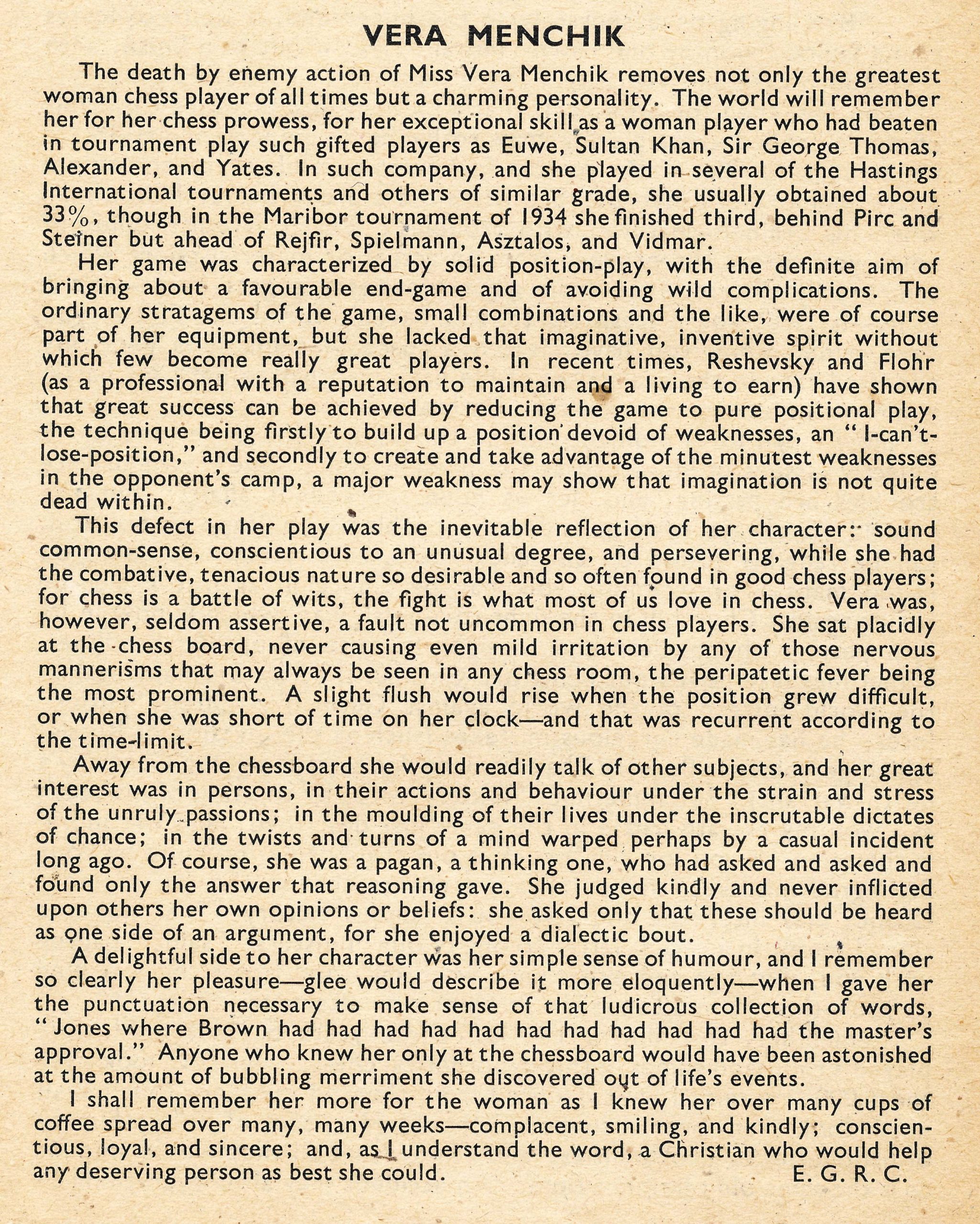
“The death by enemy action of Miss Vera Menchik removes not only the greatest woman chess player of all times but a charming personality.
The world will remember her for her chess prowess, for her exceptional skill as a woman player who had beaten in tournament play such gifted players as Euwe, Sultan Khan, Sir George Thomas, Alexander and Yates. In such company, and she played in several of the Hastings International tournaments and other of similar grade, she usually obtained about 33%, though in the Maribor tournament of 1934 she finished third, behind Pirc and Steiner but ahead of Rejfir, Spielmann, Asztalos and Vidmar.
Her game was characterised by solid position-play, with the definite aim of bringing about a favourable end-game and of avoiding wild complications. The ordinary stratagems of the game, small combinations and the like, were of course part of her equipment, but she lacked that imaginative, inventive spirit without which few become really great players.
In recent times, Reshesvky and Flohr (as a professional with a reputation to maintain and a living to earn) have shown that great success can be achieved by reducing the game to pure positional play, the technique being firstly to build up a position devoid of weaknesses, an ‘I can’t lose position,’ and secondly to create and take advantage of the minutest weaknesses in the opponent’s camp, a major weakness may show that imagination is not quite dead within.
This defect in her play was the inevitable reflection of her character: sound common-sense, conscientious to an unusual degree, and persevering, while she had the combative, tenacious nature so desirable and so often found in good chess players; for chess is battle of wits, the fight is what most of use love in chess. Vera was, seldom assertive, a fault not uncommon in chess players. She sat placidly at the chess board, never causing even mild irritation by any of those nervous mannerisms that may always be seen in any chess room, the peripatetic fever being the most prominent. A slight flush would rise when the position grew difficult, or when she was short of time on her clock – and that was recurrent according to the time-limit.
Away from the chessboard show would readily talk of other subjects, and her great interest was in persons, in their actions and behaviour under the strain and stress of the unruly passions; in the moulding of their lives under the inscrutable dictates of chance; in the twists and turns of a mind warped perhaps by a casual incident long ago. Of course, she was a pagan, a thinking one, who had asked and asked and found only the answer that reasoning gave. She judged kindly and never inflicted upon others her own opinions or beliefs: she asked only that these should be heard as one side of any argument, for she enjoyed a dialectic bout.
A delightful side to her character was her simple sense of humour, and I remember so clearly her pleasure – glee would describe it more eloquently – when I gave her the punctuation necessary to make sense of that ludicrous collection of words, ‘Jones where Brown had had had had had had had had had had had the master’s approval’ Anyone who knew her only at the chessboard would have been astonished at the amount of bubbling merriment she discovered of of life’s events.
I shall remember her more for the woman as I knew her over many cups of coffee spread over many, many weeks – complacent, smiling, and kindly; conscientious, loyal, and sincere; as I understand the word, a Christian who would help any deserving person as best she could. E. G. R. C.
”
and here is the original article as printed:
British Chess Magazine, Volume LXIV (1944), Number 8, August, Page 178
BCM 1958 Appreciation by Peter Clarke
From British Chess Magazine, Volume LXXVIII (78, 1958), Number 7 (July), page 181 onwards) we have this retrospective from Peter Clarke:
“The night of June 27th,1944, Vera Menchik, World Woman Champion, was killed when an enemy bomb demolished her home in London; with her perished her mother and sister Olga. In these tragic circumstances the chess world lost its greatest woman player, still undefeated and at the height of her powers.
Vera Francevna Menchik was born in Moscow on February 16th, 1906, of an English mother and Czech father. There she spent her childhood, showing a love for literature, music, and, of course, chess, which at the age of nine she was taught by her father. She had a natural bent for the game and when only fourteen shared second and third places a schoolboys (!) tournament. The following year, 1921, the family came to England, where Miss Menchik lived the rest of her life.
As if by some fortunate coincidence, the Menchiks settled in Hastings, though it was not until the spring of 1923 that Vera joined the famous chess club. Her natural shyness and lack of knowledge of English caused this delay. However, they did not handicap her too much
as she herself afterwards wrote: ‘Chess is a quiet game and therefore the best hobby for a person who cannot speak the language.”
She studied the game eagerly, and very soon her talent caught the attention of the Hungarian grandmaster, Géza Maróczy, who was resident at Hastings at that time. Thus there began the most important period in her development as a player; a sound and mature understanding of positional play-and a thorough knowledge of a few special openings and defences: in particular the French Defence. The influence of
the grandmasters ideas was clearly apparent in her style throughout the whole of her career.
Miss Menchik’s rise to fame was meteoric: by 1925 she was undoubtedly the strongest player of her sex in the country, having twice defeated the Champion, E. Price, in short matches; and only two years later she won the first Women’s World Championship in London with the terrific score 10.5-0.5. She was just twenty-one, but already in a different class from any other woman in the world. For seventeen years until her death Vera Menchik reigned supreme in women’s chess, defending her world title successfully no less than seven times (including a match with Sonja Graf at Semmering in 1937, which Miss Menchik won 11.5-4.5. In the seven tournaments for the World Championship she played 83 games; winning 78, drawing 4, and losing 1 only! However, what was more remarkable was that she was accepted into the sphere of men’s chess as a master in her own right, a feat which no woman had done before or has done since. Up to then, women’s chess had been a very poor relation of the masculine game, but here was a woman who was a worthy opponent for the strongest masters.
Flohr wrote of her: ‘Vera Menchik was the first woman in the world who played chess strongly…who played like a man.’ It was as the ambassador extraordinary, so to speak, of the women’s game that Miss Menchik really made her greatest contribution to chess. Wherever she went, at home and abroad, she aroused great interest among her sex; others were eager to follow her, to identify themselves with her. Nowadays women’s chess is well organized, and much of the credit for this must go to Vera Menchik for first bringing it into the light. Among her many personal successes in international tournaments perhaps the greatest was at Ramsgate in 1929: as one of the foreign masters (she was still of Czech nationality) she shared second and third places with Rubinstein, * point behind Capablanca and above, among others, her tutor Maróczy.
Even the greatest masters recognized Miss Menchik’s ability; Alekhine himself, writing on the Carlsbad Tournament of 1929, said: ‘Vera Menchik is without doubt an exceptional phenomenon among women. She possesses great aptitude for the game…The chess
world must help her develop her talent!’
The Vera Menchik Club
An amusing incident occurred at this tournament. There were naturally sceptics among the masters over the lady’s participation. Flohr recalls how one of these, the Viennese master Becker, suggested:
‘Whoever loses to the Woman Champion will be accepted as a member of the Vera Menchik Club which I intend to organize.’
Becker was the first to lose to her, and that evening the masters chided him: “Professor Becker, you did not find it very difficult to join the club. You can be the Chairman.’ And forthwith he was chosen as Chairman for three years. Everyone wished that the new club would soon obtain more members! Indeed, the Vera Menchik Club has many famous names on its lists-Euwe, Reshevsky, Colle, Yates, Sultan Khan, Sir G. A. Thomas, Alexander, to mention a few.
In 1935 Miss Menchik returned to the country of her birth to take part in the great international tournament in Moscow. To be truthful, she had very little success, but she was everywhere treated with respect and sympathy by masters and spectators alike. The Soviet master l. Maiselis, writing in CHESS in 1944.(Shakhmaty za 1944 god), related the following entertaining anecdote from the tournament: One day a group of players and organizers were discussing the chances of Alekhine and Euwe in the forthcoming match. Flohr said: ‘It is quite clear that I will be World Champion.’ We looked at him inquiringly.
‘It’s very simple,” continued Flohr, ‘Euwe wins a match against Alekhine, Vera Menchik beats Euwe (at that time her score against Euwe was +2, =1, -1) and I will somehow beat Miss Menchik.’
We laughed at this good-natured joke, and we laughed all the more the next day when Flohr was unable, despite every effort, to defeat her in a vital game.
ln 1937 Miss Menchik married R. Stevenson, but in chess she continued to use her maiden name, made famous by so many victories. Her husband, a well-known organizer, became, Secretary of the B.C.F: in the following year and remained so until his death in 1943.
Since the days of Vera Menchik women’s chess has taken great strides forward; now there is a special committee of F.I.D.E. to look after its needs.- Only last year the first lnternational Women’s Team Tournament took place ln Emmen, Holland; the new World Champions, the U.S.S.R., became the first holders of the Vera Menchik Cup. So chess goes onwards, but the name of its first Queen will ever be remembered.”
From The Encyclopaedia of Chess (Robert Hale, 1970 & 1976) by Anne Sunnucks :
“Woman World Champion from 1927 to 1944. Vera Menchik was born in Moscow on 16th February 1906 of an English mother and a Czech father. Her father taught her to play chess when she was 9.
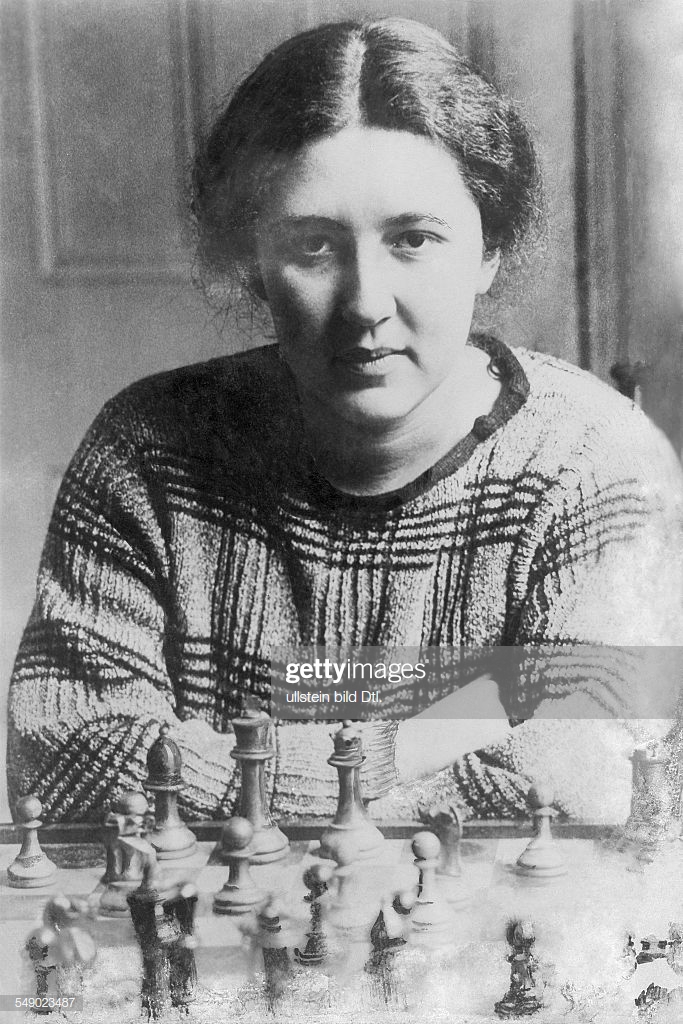
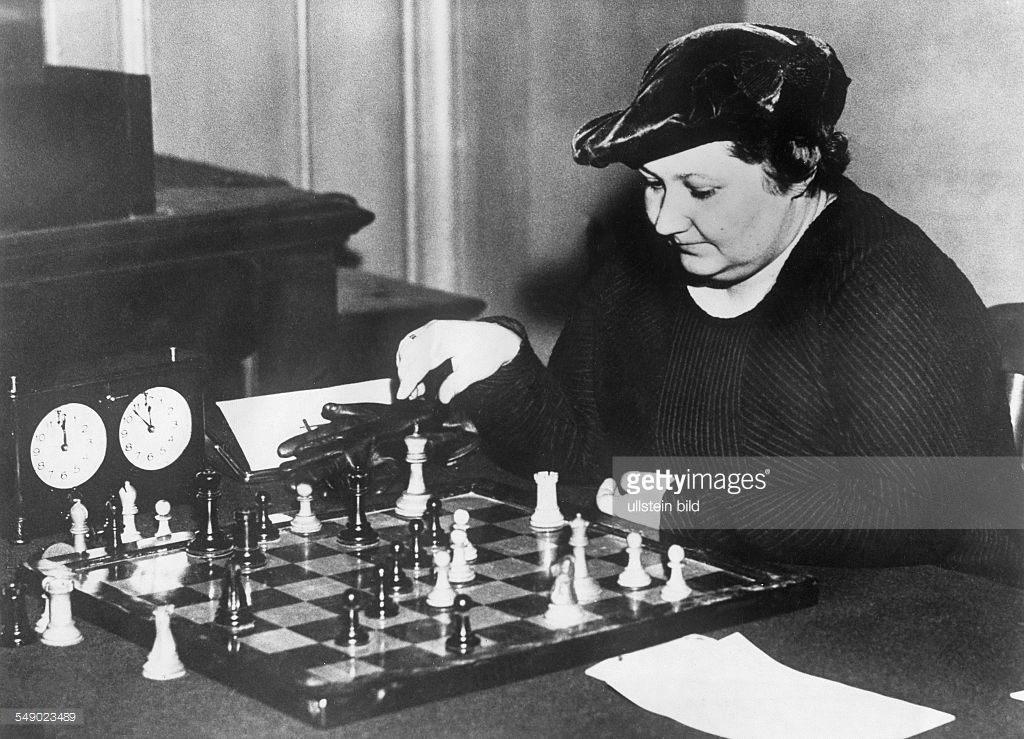
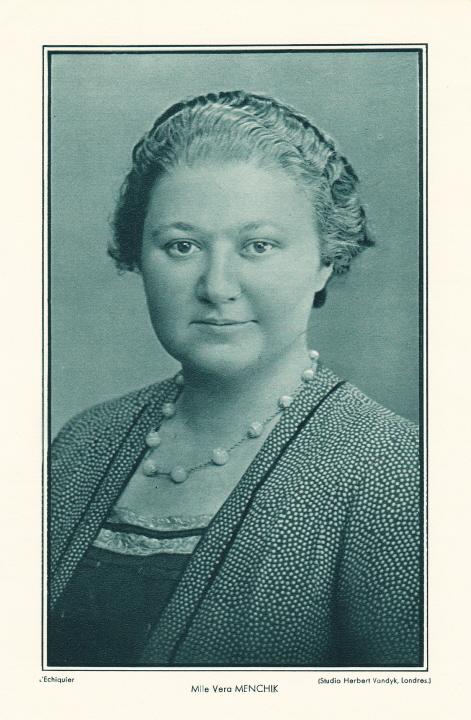
Vera Menchik 1906-1944 chess playerin, CZ / GB portrait with chess board late twenties (Photo by ullstein bild / ullstein bild via Getty Images)
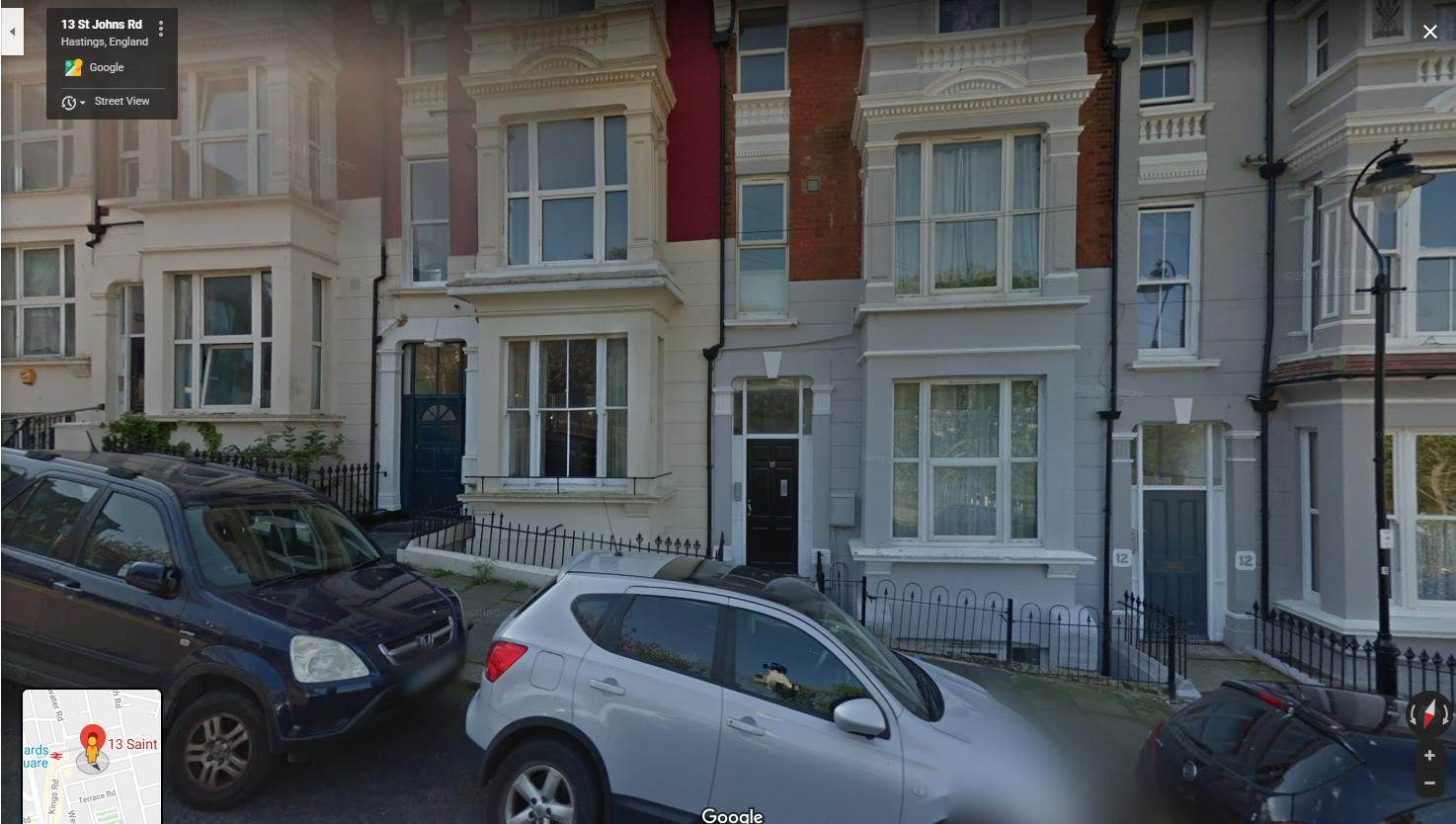
In 192l her family came to England and settled in Hastings (at 13, St. John’s Road, St. Leonards-on-Sea, TN37 6HP) :
13, St. John’s Road, St. Leonards-on-Sea, TN37 6HP
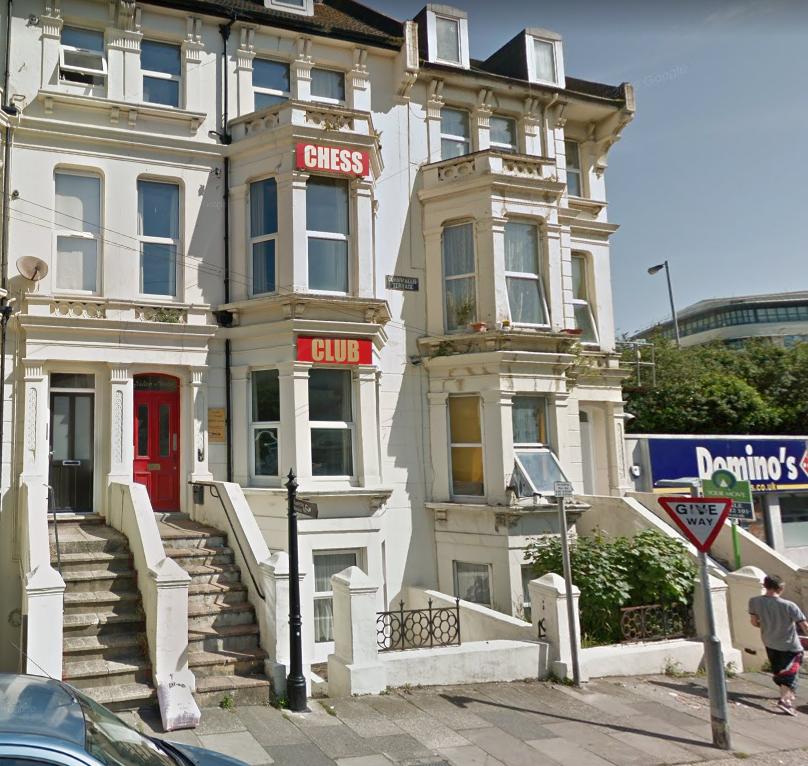
Two years later, when she was 17, Vera joined Hastings Chess Club,
Hastings Chess Club : 2 Cornwallis Terrace, Hastings TN34 1EB
where she became a pupil of Geza Maroczy. The first Women’s World Championship was held in 1927. Vera Menchik won with a score of 10.5 out of 11. She defended her title successfully in Hamburg in 1930, in Prague in 1931, in Folkestone in 1933, in Warsaw in 1935, in Stockholm in 1937 and in Buenos Aires in 1939. She played 2 matches against Sonja Graf, her nearest rival, in 1934 when she won +3 -1 and in 1937, in a match for her title when she won +9 -1 =5.
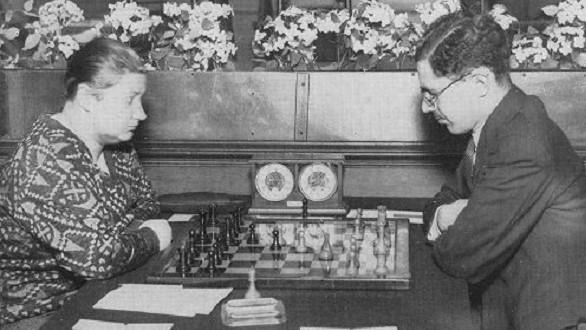
Isaac Kashdan plays Vera Menchik during the Hastings Congress on December 28th, 1931. Kashdan won in 45 moves in a classical French.
The first woman ever to play in the British Championship and the first to play in a master tournament, Vera Menchik made her debut in master chess at Scarborough 1928 when she scored 50 per cent. The following year she played in Paris and Carlsbad, and it was at Carlsbad that the famous Menchik Club was formed. The invitation to Vera Menchik to compete among such players as Capablanca, Euwe, Tartakower and Nimzowitch was received with amusement by many of the masters. The Viennese master, Becker was particularly scornful, and in the presence of a number of the competitors he suggested that anyone who lost to Vera Menchik should be granted membership of the Menchik Club. He himself became the first member. Other famous players who later joined the club were Euwe, Reshevsky, Sultan Khan, Sir George Thomas, C. H. O’D. Alexander, Colle and Yates.
Her greatest success in international tournaments was at Ramsgate in 1929, when she was =2nd with Rubinstein, half a point behind Capablanca and ahead of Maroczy. In 1934 she was 3rd at Maribor, ahead of Spielmann and Vidmar. In 1942 she won a match against Mieses +4 -l -5. In 1937 Vera Menchik married R. H. S. Stevenson, who later became Hon. Secretary of the British Chess Federation. He died in 1943. She continued to use her maiden name when playing chess. On her marriage she became a British subject.
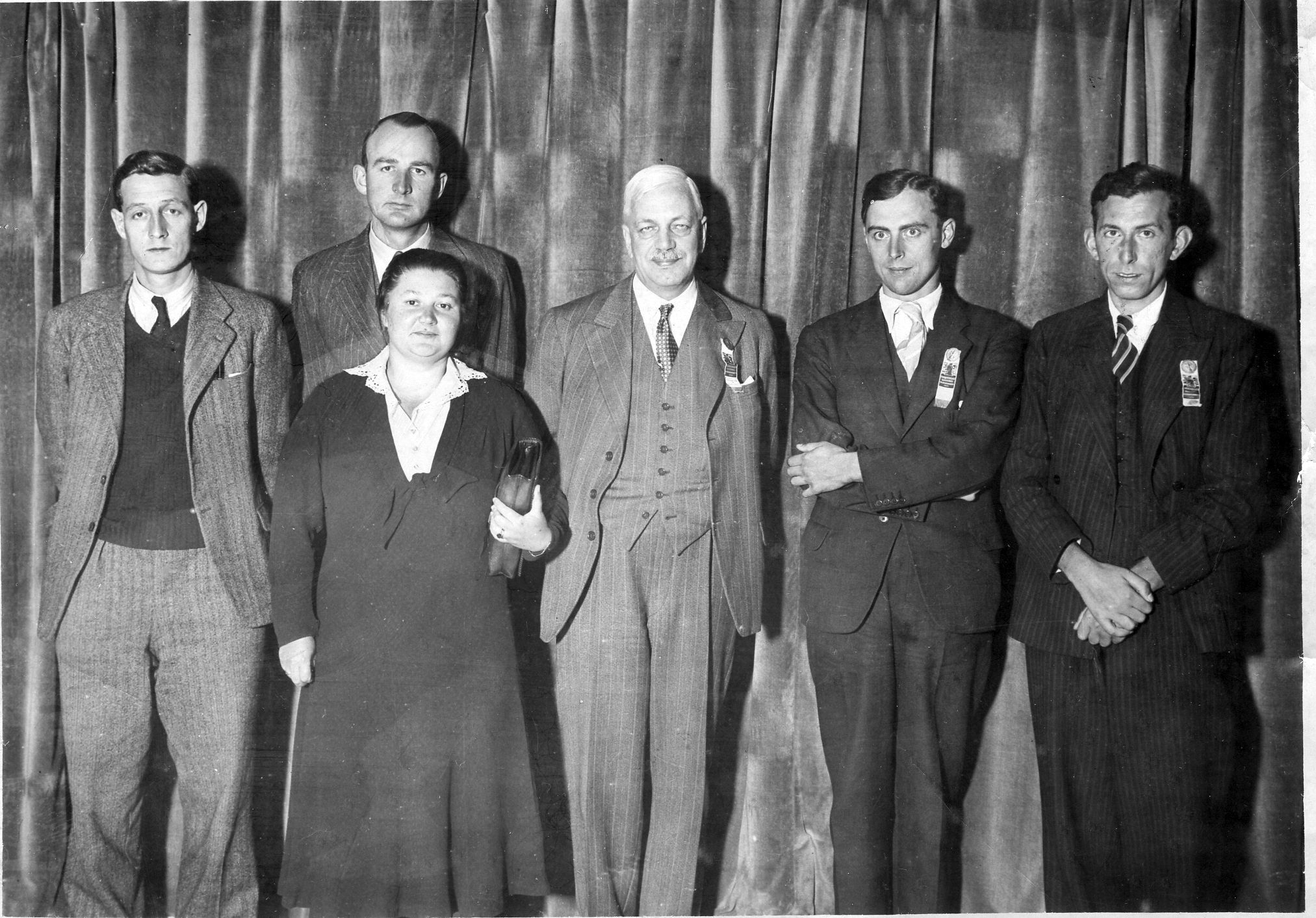
Left to right Baruch H Wood, Philip Stuart Milner-Barry, Vera Menchik (playing in the women’s world championship held concurrently with the Olympiad which she won with 17 wins and 2 draws), Sir George Thomas, Conel Hugh O’Donel Alexander and Harry Golombek. England withdrew after their preliminary group due to the outbreak of war despite qualifying for the top final. Thanks to Leonard Barden
From 1941 until her death she was Games Editor of CHESS. She also gave chess lessons and managed the National Chess Centre, which opened in 1939 at John Lewis’s in Oxford Street, London and was destroyed by a bomb in 1940.
In 1944 Vera Menchik was a solid positional player, who avoided complications and aimed at achieving a favourable endgame. Her placid temperament was ideal for tournament play. Her main weakness was possibly lack of imagination. Her results have made her the most successful woman player ever.”
Vera Menchik
From The Encyclopaedia of Chess, (BT Batsford, 1977) by Harry Golombek :
Probably the strongest woman player in the history of the game, Vera Menchik was born in Moscow and, though her father was a Czechoslovak and her mother English, she played for most of her
life under English colours.
In l92l her family came to Hastings in England and there Vera became a pupil of the great Hungarian master, Geza Maroczy. This was to have a dominating influence on her style of play which was solidly classical, logical and technically most well equipped. Such a style enabled her to deal severely not only with her fellow women players but also with contemporary masters and budding masters. Vera did extremely well, for example, against C. H. O’D. Alexander
and P. S. Milner-Barry, but lost repeatedly to H. Golombek who was able to take advantage of her lack of imagination by the use of more modern methods.
Vera was soon predominent in women’s chess. In the first Women’s World Championship tournament, at London in 1927, she won the title with a score of 10.5 out of 11 and retained the championship with great ease at all the subsequent Olympiads (or International Team tournaments as they were then known more correctly) at Hamburg 1930, Prague 1931, Folkestone 1933, Warsaw 1935, Stockholm 1937 and Buenos Aires 1939.
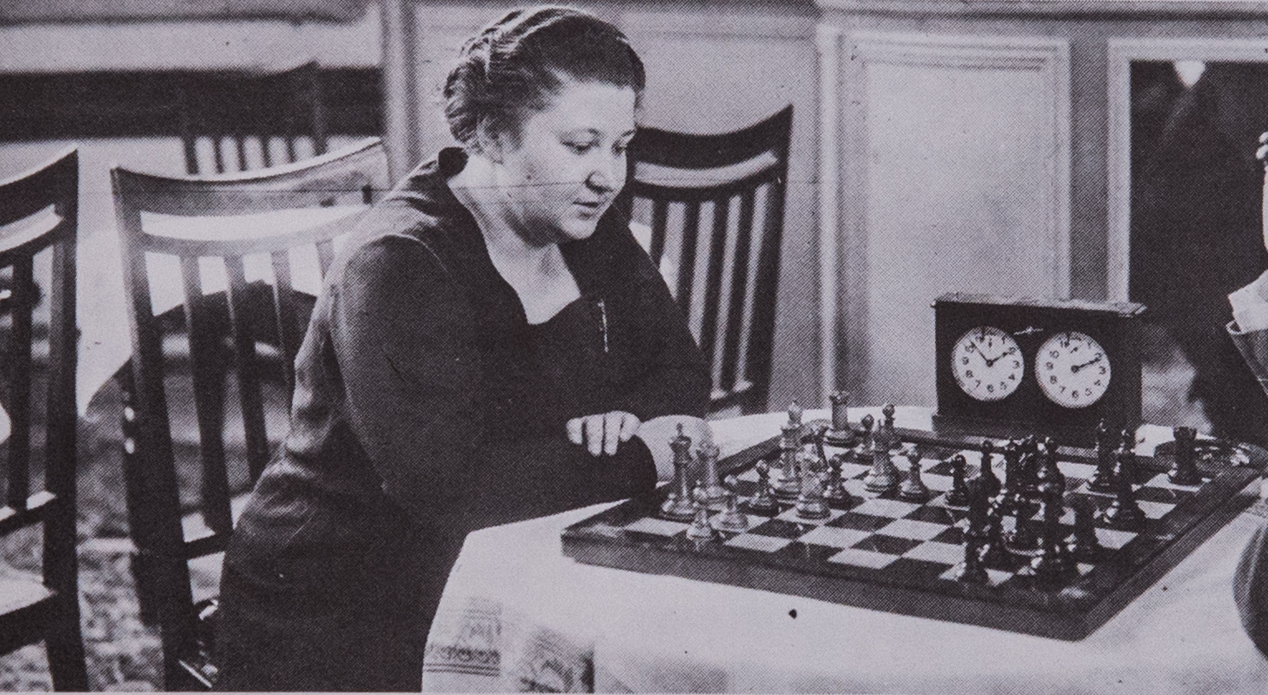
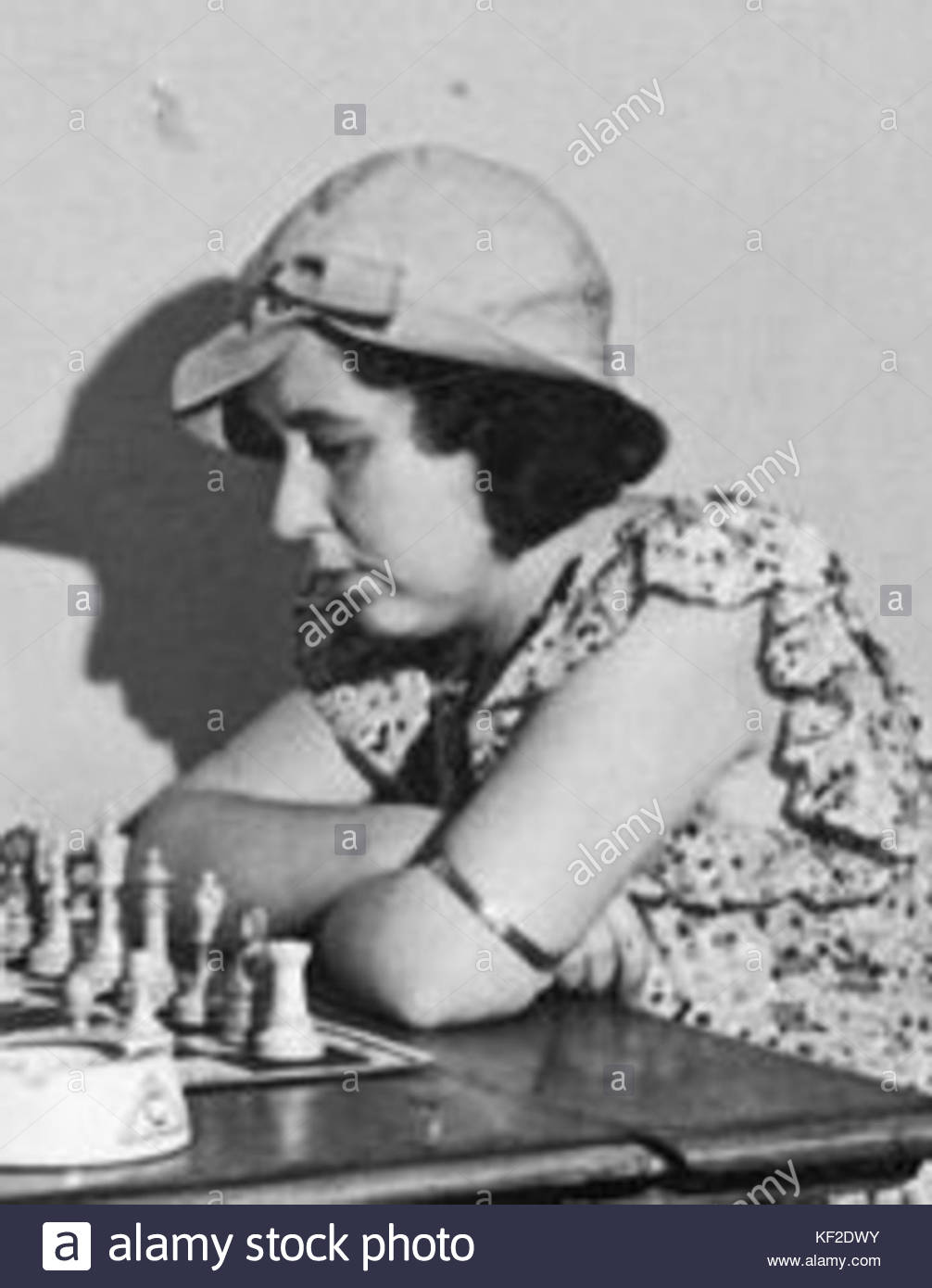
Vera Menchik at Margate 1935, photographer unknown
With Sonja Graf, the player who came nearest to her in strength among her female contemporaries, she played two matches and demonstrated her undoubted superiority by beating her in 1934 (+3-l) and again in a match for the title in l937 (+9-l=5).
In 1937 Vera officially became a British citizen by marrying the then Kent and later B.C.F. Secretary, R. H. S. Stevenson (Rufus Henry Streatfeild Stevenson: ed).
(Rufus Henry Streatfeild Stevenson was home news editor of the British Chess Magazine, secretary of the Southern Counties Chess Union and match captain of the Kent County Chess Association).
Oddly enough, Sonja Graf, many years later, also became a Mrs Stevenson by marrying an American of that name some years after the Second World War.
Vera Menchik also played and held her own in men’s tournaments. She did well in the British championship and her best performance in international chess was =2nd with Rubinstein in the Ramsgate Team Practice tournament ahead of her old teacher, Maroczy. She also had an excellent result at Maribor in 1934 where she came 3rd, ahead of Spielmann and Vidmar.
Her husband died in 1943 and Vera herself, together with her younger sister Olga and her mother, was killed by a V1 bomb that descended on the Stevenson home in London in 1944.
Vera Menchik, circa 1935, Historic Collection / Alamy Stock Photo
This was a sad and premature loss, not only for British but for world chess, since there is no doubt she would have continued to dominate the female scene for many years.
As a person Vera was a delightful companion, jolly and full of fun and understanding. As a player she was not only strong but also absolutely correct and without any prima donna behaviour. Generous in defeat and modest in victory, she set a great example to all her contemporaries.
An example of Vera’s attacking play at its best against her nearest rival, Sonja Graf, is shown by the following game which was played in her 1937 match at Semmering in Austria :
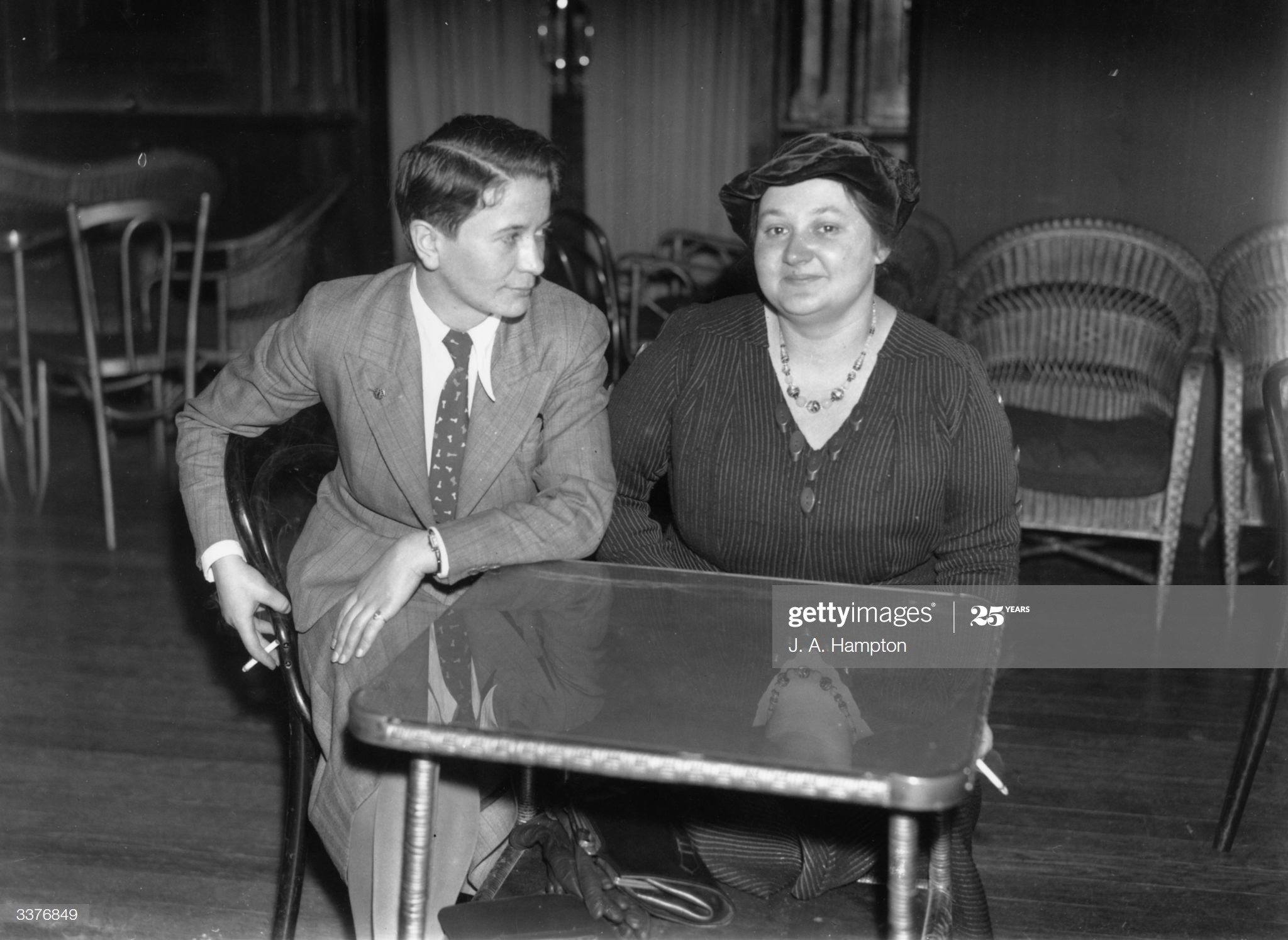
27th November 1936: Britain’s world chess champion Vera Menchik (right) and challenger Sonja Graf after signing a contract at the Bloomsbury Hotel, London, to play for the championship of the world over 16 games. (Photo by J. A. Hampton/Topical Press Agency/Getty Images)
From The Oxford Companion to Chess, (Oxford University Press, 1984) by Hooper and Whyld :
“Woman World Champion from 1927 until her death. Daughter of a Czech father and an English mother, Menchik was born in Moscow, learned chess when she was nine, settled in England around
1921, and took lessons from Maroczy a year or so later. In 1927 FIDE organized both the first Olympiad and the first world championship tournament for women. These events were run concurrently, except in 1928, until the Second World War began, and Menchik won the women’s tournament every time; London 1927 (+10=1); Hamburg 1930 (+6=1 — 1); Prague 1931 (+8);
Folkestone 1933 ( + 14); Warsaw 1935 (+9); Stockholm 1937 (+14); and Buenos Aires 1939 ( + 17=2). She played in her first championship tournament as a Russian, the next five as a Czech,
and the last as a Briton. She also won on two matches against her chief rival, the German-born Sonja Graf (c. 1912-65): Rotterdam, 1934 (+3-1), and Semmering, 1937 (+9=5—2),
Vera Menchik in a pre-event posed picture in which she faces unstoppable checkmate in one from Hastings 193? She was about to play Sir GA Thomas.
In international tournaments which did not exclude men Menchik made little impression; one of her best results was at Maribor 1934 (about category 4) when she took third place alter Pirc and L. Steiner ahead of Spielmann. In 1937 she married the English chess organizer Rufus Henry Streatfeild Stevenson (1878-1943), A chess professional, she gave lessons, lectures, and displays, and was appointed manager of the short-lived National Chess Centre in 1939. In 1942 she defeated Mieses in match play (+4=5-1), She, her younger sister Olga (also a player), and their mother were killed in a bombing raid.
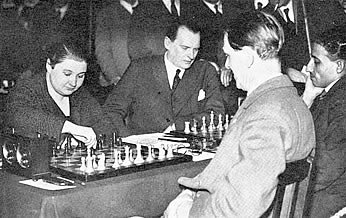
From left to right: Vera Menchik, Alexander Alekhine, Géza Maróczy and Sultan Khan. From London International Masters, 1st February, 1932, French Defence, drawn in 32 moves.
Her style was positional and she had a sound understanding of the endgame. On occasion she defeated in tournament play some of the greatest masters, notably Euwe, Reshevsky, and Sultan Khan. Men she defeated were said to belong to the Menchik club. When world team championships for women (women’s chess Olympiads) were commenced in 1957 the trophy for the winning team was called the Vera Menchik Cup.”
BCM 1994 Appreciation by Bernard Cafferty
From British Chess Magazine, Volume CXIV (114, 1994), Number 8 (August), page 424 onwards) we have this retrospective from Bernard Cafferty:
Fifty yezus ago the chess world was tragically robbed of its most talented female representative of the first half of this century. A Vl rocket (ed: The V1 was not a rocket but a flying bomb) fell on a house in Gauden Road, Clapham, London, that was the residence of Russian-born Vera Menchik, her younger sister and their mother. The trio were sheltering in the cellar, as they usually did during the Nazi air raids on London. The house was completely destroyed. The air-raid shelter in the garden was all that was left.
Vera Menchik was born in Moscow on 16 February 1906, and died on 26 June 1944. The date of death is usually given as 27 June, but Ken Whyld has seen the death certificate and tells us the tragedy occurred before midnight, not after.
The young Vera grew up in a cosmopolitan family in Moscow, where her Czech father and English mother lived in a six-room flat, which they had to share, after 1917, with families from ‘the lower depths’ (the name of a famous play by Gorky which could also be translated as ‘on Skid Row’). In autumn 1921 the family left Soviet Russia and came
to England where they lived in Hastings.
Botvinnik recalls that he visited the Menchik household in Hastings in 1935, where he met Vera’s grandmother. Then, in 1936, he visited the other house in London, after the Nottingham 1936 tournament. At that time the Soviet Embassy arranged a reception in an attempt to counter the awful image of a country deep in the throes of the show trials and widespread repression. However, only Botvinnik, Menchik, Capablanca and Lasker turned up.
Vera Menchik was taught the moves of chess by her father, Franz, when she was nine years old. However, she only took the game seriously from the age of 17, when she joined the Hastings and St Leonards Chess Club, which at that time had its famous extensive sea-front premises near the pier.
According to the 1957 book in Russian by Bykova, on which this account is largely based, Vera only knew Russian when she cam to England, and one of the reasons for her to join the chess club was that a fluent knowledge of English was not necessary for her to be able to benefit from such a silent activity as chess.
The young Vera was fortunate in that the Hungarian grandmaster, Géza Maróczy, had a professional engagement with the Hastings club at this time, and the young lady became his most famous pupil. Her sound style with no fear of long endgames was a mirror of her mentor. She was also helped by Professor JAJ Drewitt, another Hastings club member, in the study of openings, particularly the closed openings.
Vera was initially counted as a Russian and did not enter the British Women’s Championship at the traditional August BCF Congress. However, she made her debut in international chess at a lower section of the 1923-24 Hastings Congress. In 1925 she beat the leading English player Edith Price by a score of +5 =2 -3 in two private matches. She duly took part in the Hastings Congresses, year after year. In the 1926-27 event she scored her first big success by sharing first place with the young Milner-Barry on 6.5(9) in the Premier Reserves.
By 1927, VM was ready to enter the first Women’s World Championship, which was played at the 4th FIDE Congress, alongside the Olympiad in London. She conceded only one draw in her eleven games and so took the title which she was to retain with ease from that day, when she was just 21, till her death 17 years later. In her first title attempt, she
was counted as a Russian, but at the next five (at the Hamburg 1930, Prague 1931,
Folkestone 1933, Warsaw 1935 and Stockholm 1937 Olympiads) she played as a representative of Czechoslovakia. It was only after her marriage to the prominent English organiser R. H. S. Stevenson in 1937 that she was counted as British and played under the Union Flag in her last title defence at Buenos Aires 1939.
Her dominance can be gauged from the fact that she won all eight games at Prague, all 14 at Folkestone, all 9 at Warsaw, all 14 at Stockholm and conceded just two draws in 19 games in 1939. The most serious challenge came in a title match at Semmering-Baden with Sonja Graf, then of Germany. Here too it was largely one-sided: +9 =5 -2.
She made her debut against male masters in an international tournament at Scarborough in 1928, finishing equal 7-8 in a field of 10, but in only the following year, at the Kent Easter Congress, she had one of her best results.
It was decided to run a Scheveningen tournament at Ramsgate with seven foreign masters pitted against seven home representatives. As was only to be expected, Capablanca came top of the ‘external examiners’, yet the next placing was a sensation: Capablanca 5.5(7) followed by Miss Menchik and Rubinstein 5, Koltanowski and Maroczy 4.5, Soultanbeieff 4 and Znosko-Borovsky 3. Sir George Thomas, whom Menchik beat, scored 3 to head the English team of Yates, Winter, Michel, Tylor and E. G. Sergeant.
Naturally enough, after this it was inevitable that foreign invitations should follow. Later in 1929 the young ‘Russian’ took part in a Paris tournament and then in the great Carlsbad tournament, the last of a wonderful series. Her presence here created some scepticism, and on the eve of the first round the Austrian theoretician Becker suggested that a Vera Menchik club be formed, membership of which would be granted only to those who lost to the lady. According to Flohr, there was an expectation that it would be a small select club, but Becker was quickly proved wrong for he became its first member in the third round! His only consolation was that the club proved far more extensive and democratic as the years rolled by. In fact the club came to include grandmasters such as Euwe (who earned a two-fold qualification) Sultan Khan and Reshevsky as well as masters such as Saemisch, Colle, Golombek, Sir George Thomas, Alexander…
However, Miss Menchik could not make much of the universally strong opposition and made only three points out of 20, finishing last, three points behind Sir George Thomas. With further experience she was to have more impressive results, such as her 8th place at London 1932, won by Alekhine, where she came ahead of Milner-Barry, Sir George, Burger and Winter.
A high spot of the 1930s for Vera was her participation in the 1935 Moscow tournament, but her return to her native city was so taken up with social engagements that she was unable to give of her best, and she scored only one and a half points from 19 games though she did take a draw off the winner of second prize, Flohr.
Vera had to eke out a living from teaching chess, adjudications and simultaneous exhibitions. After her return from Buenos Aires she lived in London. She was appointed administrator of the new National Chess Centre at John Lewis’s store in Oxford Street, which, alas, was destroyed by enemy action in 1940.
Her last great success was a match with the veteran GM, Jacques Mieses who was a refugee from anti-Semitic German. Played in 1942, the result was +4 =5 -1.
In 1943 Vera’s husband died. In 1944 she was playing in the championship of the West London Club, a strong event which included Sir George Thomas, PM List, EG Sergeant and Mieses amongst the players. Doubtless she was looking forward to the resumption of International chess activity after the war. It was not to be. We live in an age when the achievements of women players such as Gaprindashvili, Chirburdanidze, Xie Jun and the Polgar sisters have built on the pioneer work of Vera Menchik. Yet the path of the pioneer is always the hardest.
Finally, by all accounts of contemporaries, Vera was a cultured and sympathetic person who never gave cause for offence amongst the many players she met. Had she lived, she would have continued to be a jewel in the crown of British chess, which had to drag itself up from the boot straps after the devastation of war. What a tragic loss.
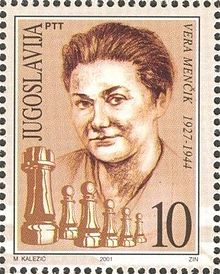
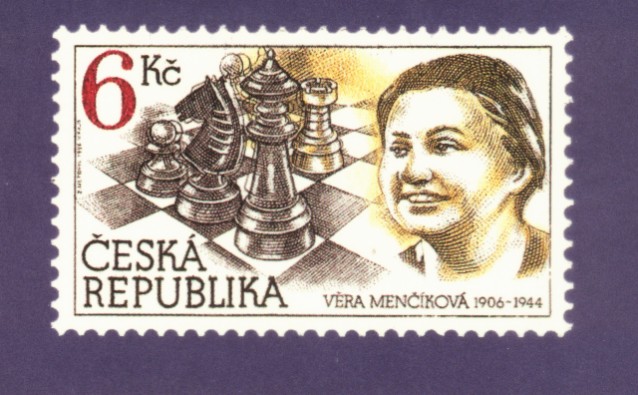
Vera Menchik commemorated on a postage stamp from the Czech Republic
She was inducted to the World Chess Hall of Fame in 2011.
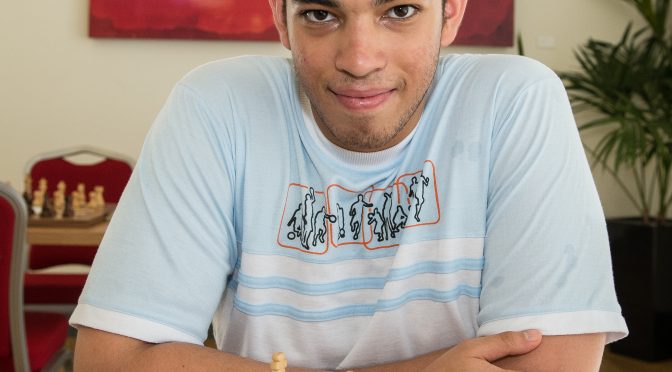
BCN wishes Happy Birthday to GM Daniel Fernandez who at 26 is currently England’s youngest Grandmaster. The previous GM title holder was Jonathan Hawkins in 2014 making two in seven years.
Daniel Howard Fernandez was born in Stockport, Manchester on Sunday, March 5th 1995. “Think Twice” by Celine Dion was top of the UK hit parade.
Daniel started playing chess at the age of seven (after his father taught him the rules) and at this time attended King’s School, Harpenden. His first chess club was Little Heath which became the ECF Small Club of the Year in 2015. They play in the Potter’s Bar area and include IM John Pigott in their membership.
At Little Heath Chess Club Daniel was coached by Mark Uniacke (who worked extensively on the early chess engine HIARCS).
Daniel went up to Queen’s College, Cambridge to read mathematics and left to become a Data Analyst at Mu Sigma Inc. He can speak several languages (including Serbian!) and works as a translator when opportunities arise.
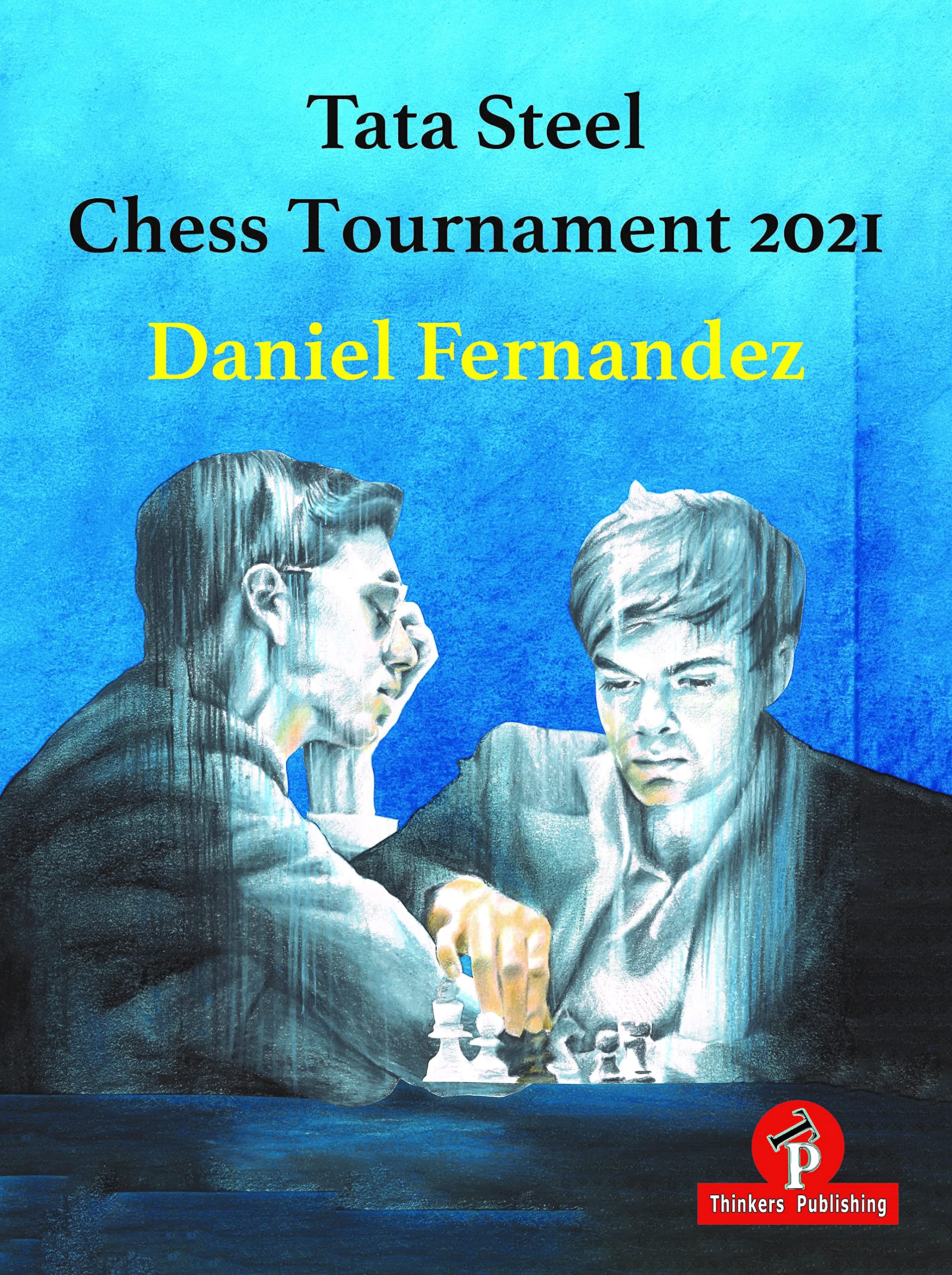
He currently lives in Australia offering coaching and writing chess books (for Thinkers Publishing) and columns for Chessbase. In his spare time (!) Daniel is studying for The Master of Complex Systems degree at The University of Sydney.
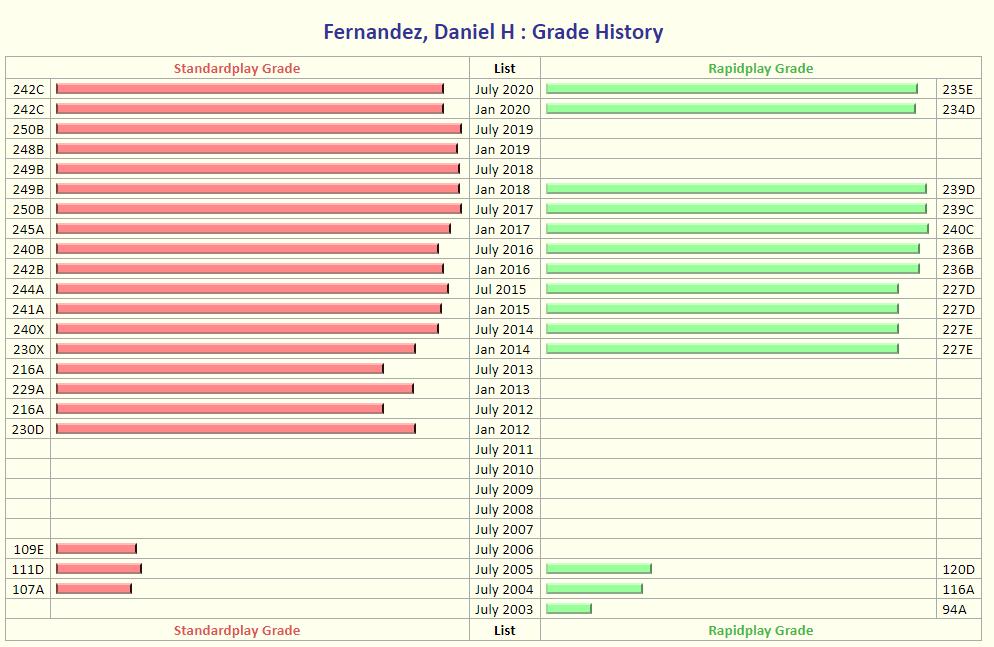
Daniel’s first ECF graded game was rapidplay on July 5th 2003 in the SCCU Junior Under-14 Final.
His first standard play game was in August 2003 at the Edinburgh based British Under-8 Championship.
On August 13th 2004 in Scarborough Daniel became British Under-9 Champion sharing the title with Daniel Hunt & Saravanan Sathyanandha.
The Fernandez family relocated to Singapore in August, Daniel attending the Anglo-Chinese School in Singapore. He was swiftly recruited into the Singapore Chess Federation’s (SCF) National Junior Squad. Also in that squad were Danielle Ho and Howard Chiu (remember this for later!).
Barely three weeks after his Scarborough triumph on September 4th 2004 Daniel played his first FIDE rated game in the 5th Asian Under-10 Championship organised by the ASEAN Chess Confederation. His performance in this event was rewarded with a FIDE Master title in 2005. Because he was no longer active in English events the ECF had the unusual scenario of having a ten year old FIDE Master with a published grade of ~120!
In typically modest fashion Daniel confesses that he did not “deserve” the FM title at this time and that it was the consequence of the strong position of the ASEAN and SCF organisations within world chess. At the same event Wesley So gained his FM title in the Under-12 section.
FM Daniel Fernandez
Another interesting consequence of the relocation was that when Daniel returned to England in 2012 his last published grading went from ~ 120 to ~230!
One of the motivations of returning to England was to obtain the necessary entrance requirement to study mathematics at Cambridge. This he did by studying for A-levels at Manchester Grammar School.
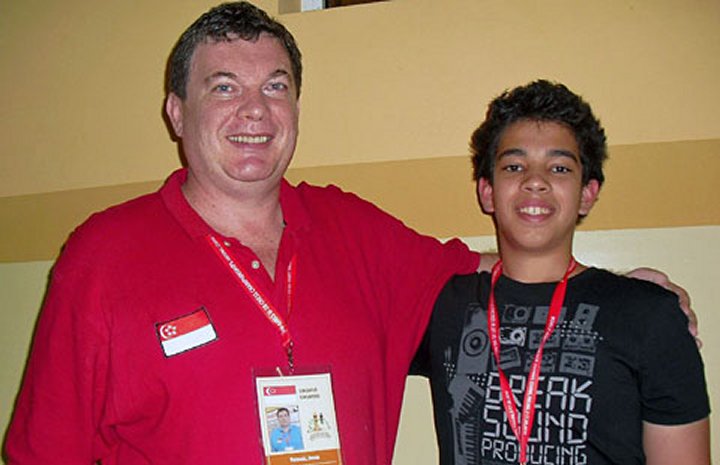
Daniel with IM Jovan Petronic during the 2010 world juniors in Chotowa, Poland | Photo: Diana Mihajlova
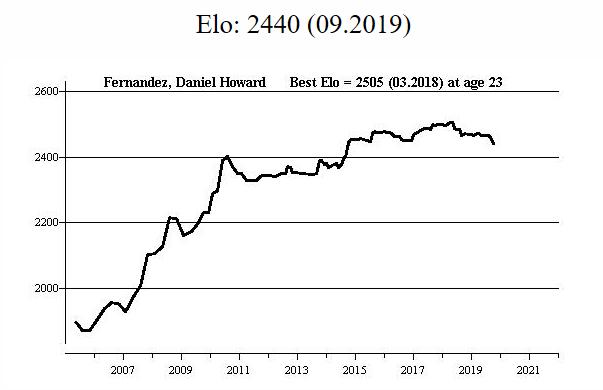
Consequently Daniel’s FIDE rating profile also showed a fast pace of development:
FIDE rating profile for Daniel Fernandez
Sydney 2009 and Sydney 2010 both provided IM norms with the third one coming from Kuala Lumpar 2010 and with these Daniel became an International Master in 2010 the title being confirmed at the 3rd quarter Presidential Board Meeting 2010, 24-25 July 2010, Tromso in Norway.
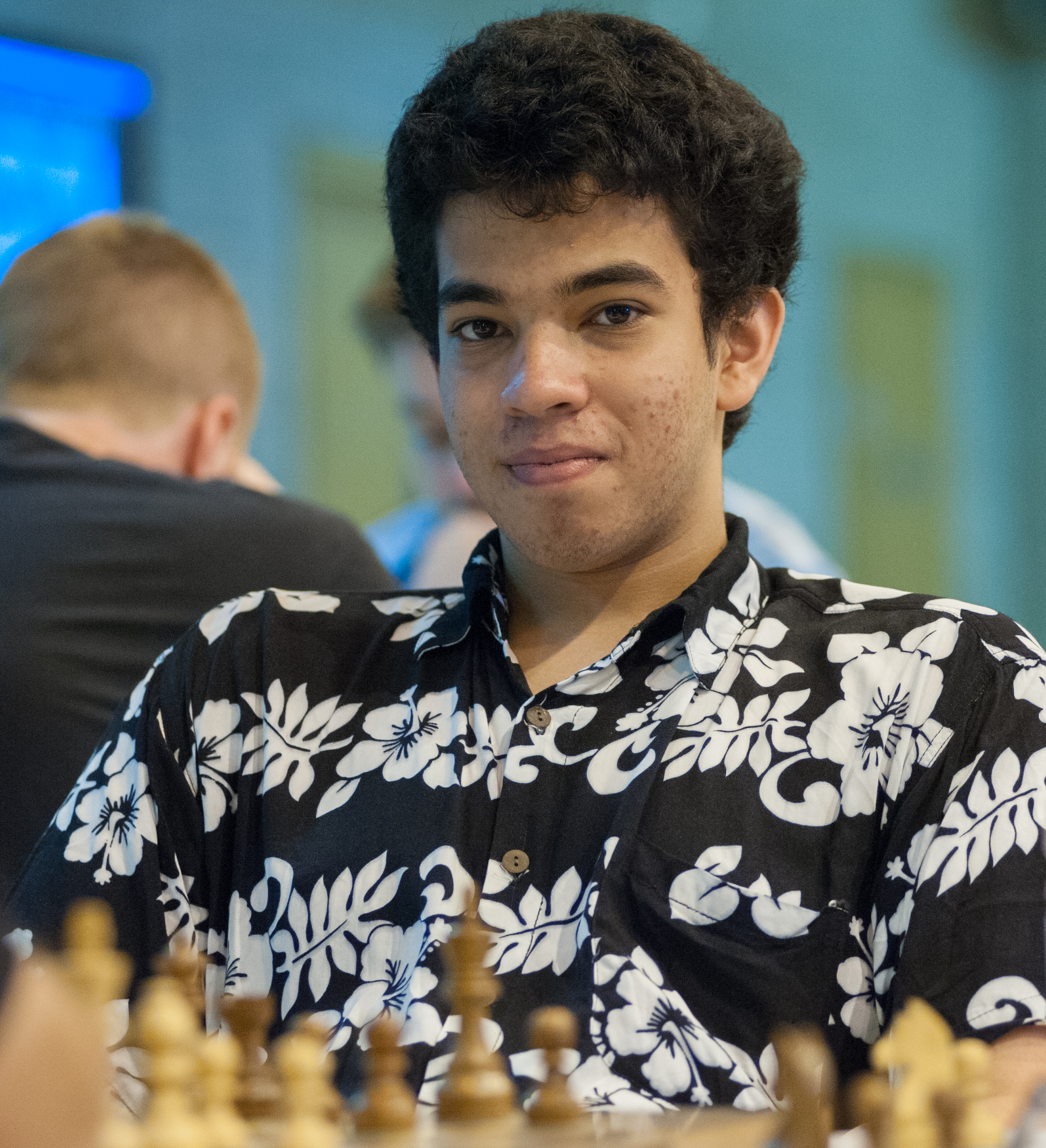
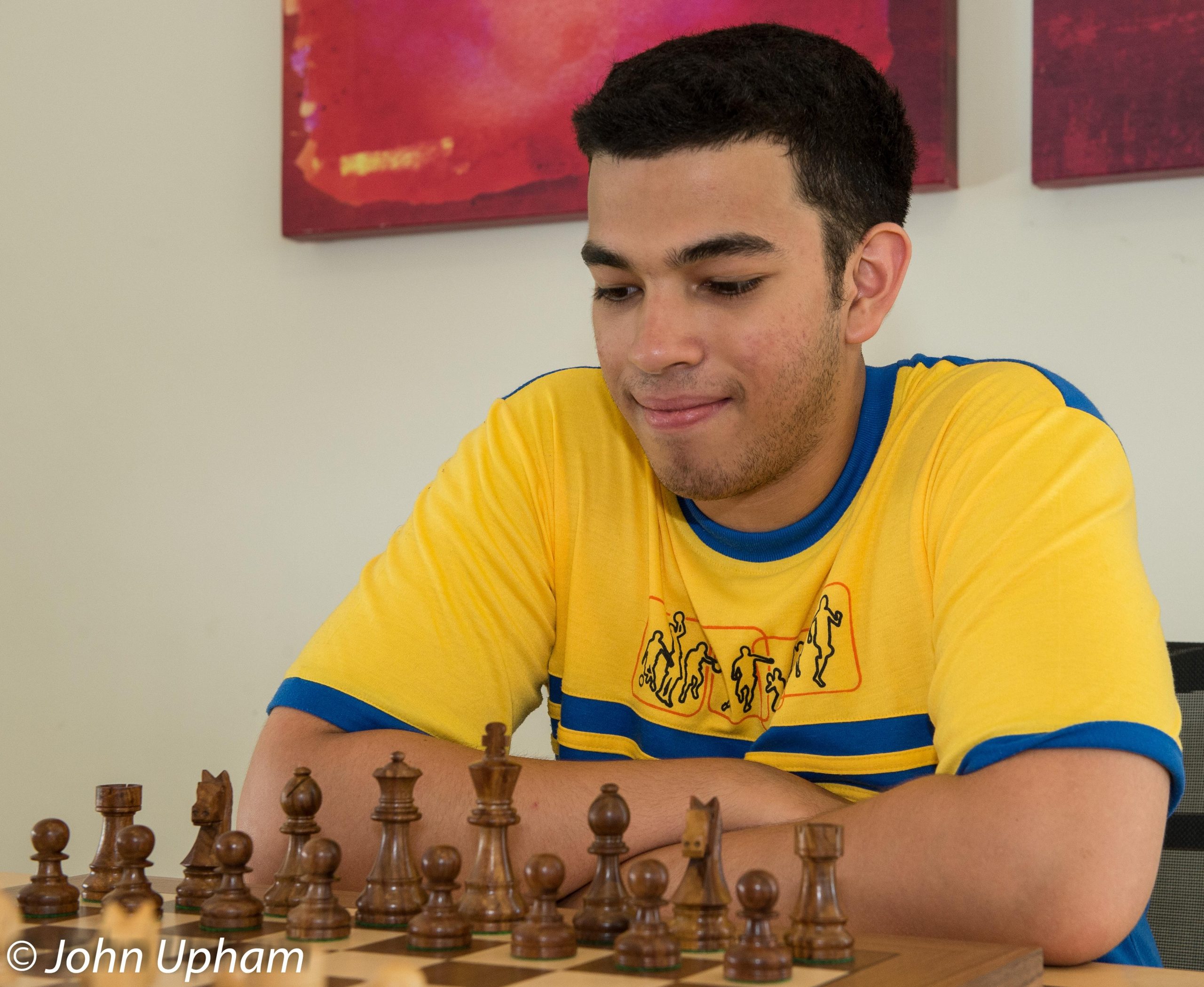
IM Daniel Fernandez, 100th British Championships, Round 5, Torquay. Courtesy of John Upham Photography
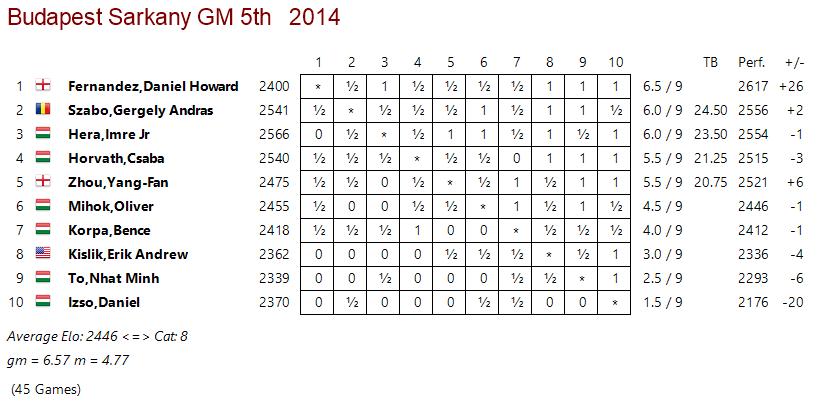
He won the Budapest Sarkany Tournament in 2014 as follows:
Full Crosstable from Budapest Sarkany Tournament, 2014.
earning his first GM norm in the process.
IM Daniel Fernandez, 101st British Championships, Aberystwyth. Courtesy of John Upham Photography
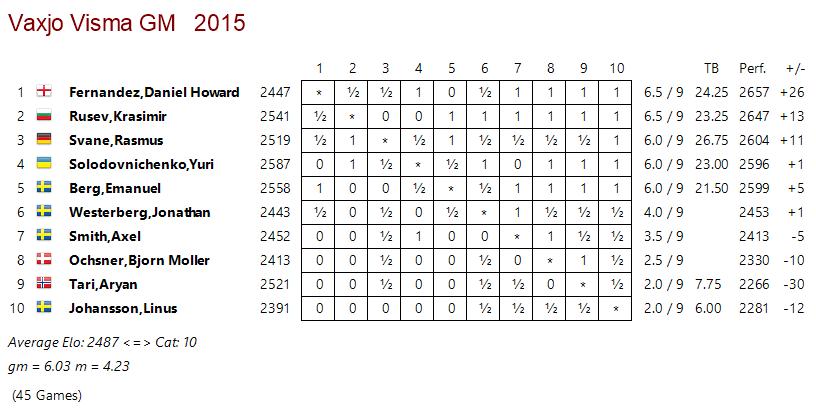
BCN asked Daniel for three of his favourite games. The first one is this Polish Defence game from 2015 played at the Visma Arena in Vaxjo, Sweden. First we have the crosstable showing that Daniel earnt his second GM norm from this event.
Full Crosstable for Vaxjo, Visma tournament in Sweden, 2015.
and here is the game:
and during the 2015/15 4NCL season Daniel obtained his final GM norm playing for Wood Green.
In March 2015 he made his first of three Varsity match appearences for Cambridge re-uniting with Danielle Ho and Howard Chiu (remember those names from earlier?).
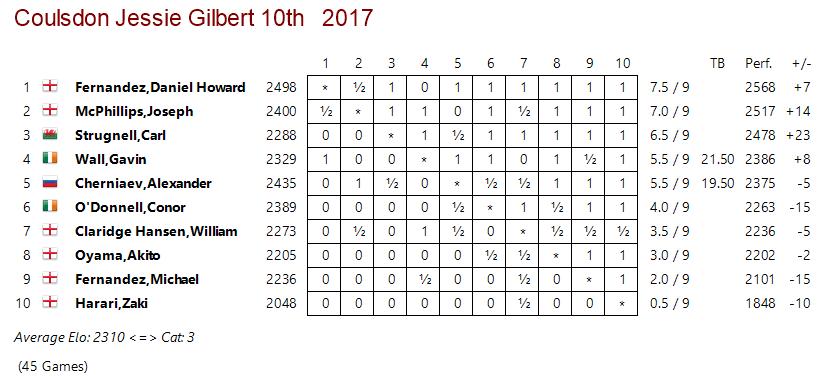
Daniel won the 10th Jessie Gilbert Memorial in 2017:
Full Crosstable from the 2017 10th Jessie Gilbert Memorial
and also in 2017 Daniel was awarded the Grandmaster title at the 88th FIDE Congress 2017, 7-15 October, Goynuk, Antalya, Turkey.
On March 11th Daniel represented Cambridge in the 135th Varsity Match at the RAC Club in Pall Mall. According to chess24.com ‘IM Daniel Fernandez, playing board 2 for Cambridge, was awarded the Brilliancy Prize by GM Ray Keene in consultation with McShane and Speelman, for his “high-class swindle” after recovering from a bad blunder.’ See here for details.
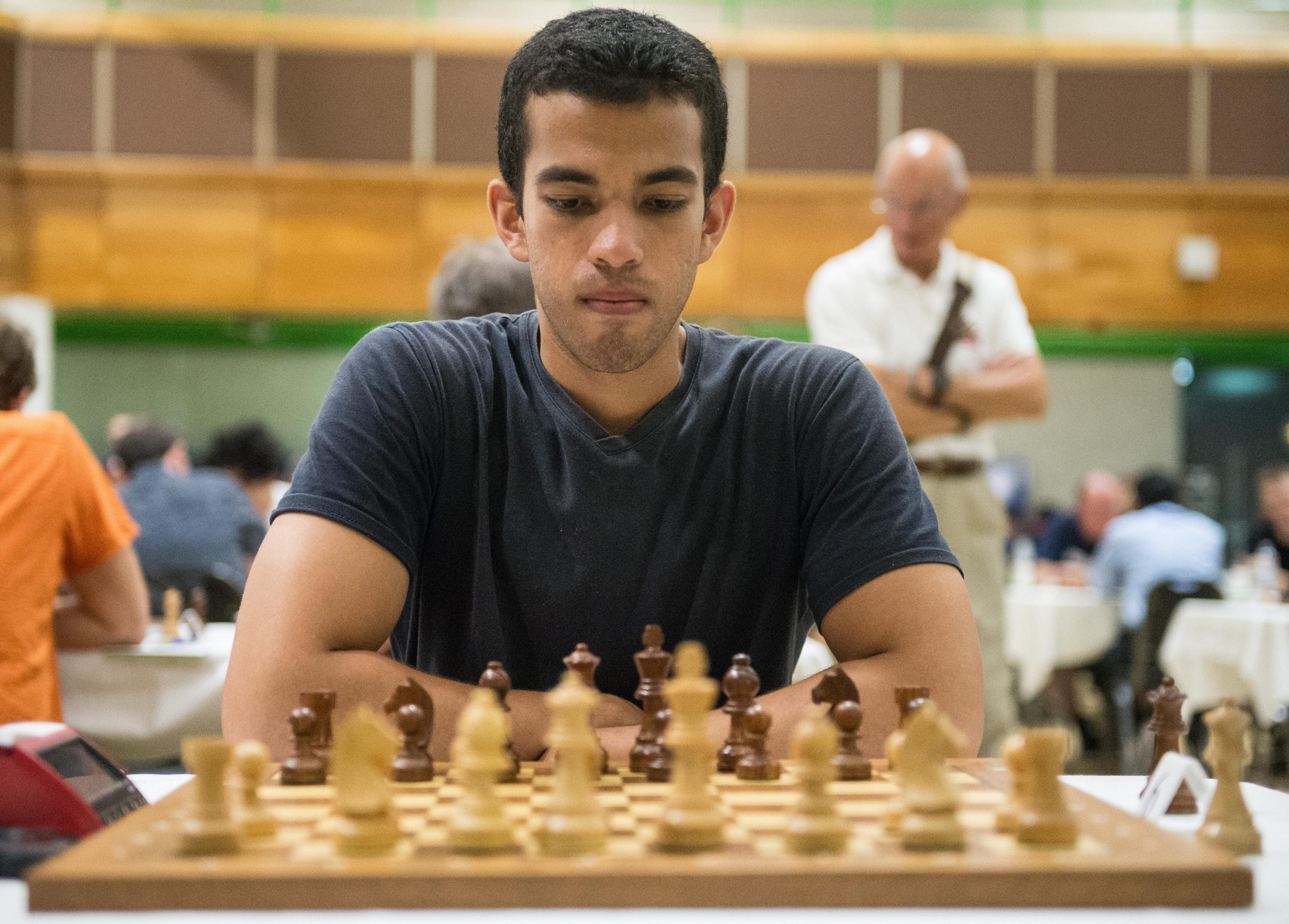
GM Daniel Fernandez, 2019 British Championships, Torquay. Courtesy of John Upham Photography
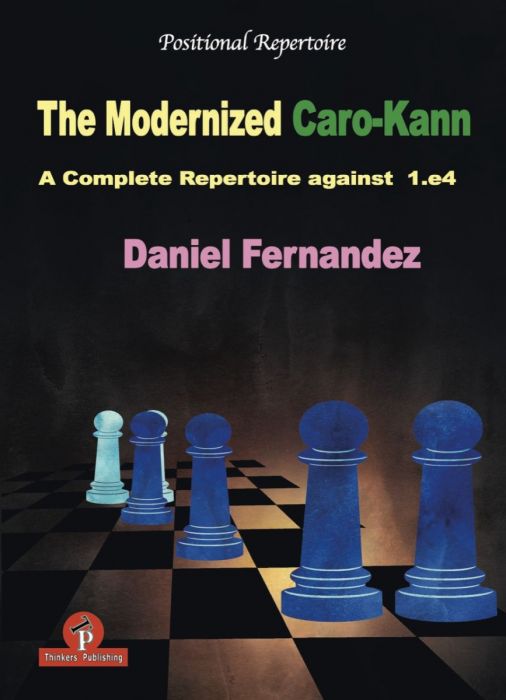
In 2018 Daniel ventured into the world of book writing when Thinker’s Publishing released The Modernized Caro-Kann on September 8th 2018. This was a repertoire book for Black based around the Smyslov Variation :
The Modernized Caro-Kann, Daniel Fernandez, Thinkers Publishing, 2018
From the rear cover we have:
“GM Daniel Fernandez (born 1995) has been an active and accomplished player for several years. He represented his native Singapore twice at Olympiads (2010 and 2012) before transferring to the English chess federation. There, he won the national classical titles at U-18 and U-21 levels and worked to become a Grandmaster while simultaneously studying at Cambridge. The Caro-Kann was instrumental in his quest for that title. Currently, Daniel is known in the chess scene not only as a solid player, but also as a mentor figure to younger English players, as a producer of well-received commentary and analysis, and as a multilingual chess coach. This is his first book.”
From January 2019 we have this interesting encounter between Gawain Jones and Daniel from the annual 4NCL meeting of Guildford and Wood Green:
With the White pieces Daniel has played a wide range of first moves but the majority move by far is 1.e4. His choice versus the Najdorf is some eclectic : sometime ago 6. Rg1 was the favourite and now 6.a4 is preferred.
Against 1…e5 Daniel offers a main line Ruy Lopez.
What does a Caro-Kann expert play against the Caro-Kann? Nowadays the Two Knights Variation is employed!
As the second player he plays the Sicilian Najdorf as well as the Caro-Kann plus an equal mixture of the Grünfeld and King’s Indian Defences.
In 2019 Daniel was interviewed by Edwin Lam on behalf of ChessBase : fascinating reading!
In the same year Daniel joined IM Adam Taylor’s venture Making Grandmasters.
Our final games is from July 2019 :
Daniel’s most recent publication is The Modernized Modern Defence from Thinker’s Publishing:
The Modernized Modern Defence, Daniel Fernandez, Thinker’s Publishing, 2021
and BCN has been told that Daniel has a book in the pipeline about the Tata Steel 2021 tournament at Wijk aan Zee.
BCN remembers Nancy Elder MBE who passed away on Wednesday, March 4th 1981, i.e. forty years ago in Perth, Western Australia.
Nancy Conchar Gordon was born on Tuesday, May 25th 1915. On the same date was born Robin Day in High Wycombe who went on to design the polypropylene stacking chair.
Nancy was born in Kirmabreck, Kirkcudbrightshire in the Dumfries and Galloway council area of Scotland.
In the 1939 register Nancy was living at 18 Thornton Avenue, Urmston, Manchester, M41 5DJ with a married couple, William Furnish (a railway time keeper) and Gertrude Furnish who performed unpaid domestic duties. Presumably Nancy was their lodger.
18 Thornton Avenue, Urmston, Manchester, M41 5DJ
Her occupation was given as a teacher of music and physical training. At this time she was single at the age of twenty-four.
In the mid-1940s Nancy relocated from Manchester to Dundee where she continued her teaching career at Dundee High School. During that time she encouraged and coached a number of players some of whom represented Scotland.
In 1950 in Tealing, Angus, Scotland Nancy married David Livie Elder. They had a daughter Christine who played chess as a junior. Tealing has a strong connection with the Elder family.
According to Alan McGowan (Chess Scotland): “She was the main instigator in forming both the Schools’ and Primary League in Dundee, and she assisted in the organisation of the Dundee 1967 International Centenary Tournament.”
When she passed away Nancy was living at 39 Whitefauld Road, Dundee, DD2 1RJ :
39 Whitefauld Road, Dundee, DD2 1RJ
Her passing was reported in the Dundee Courier and Advertiser on March 6th 1981 as follows :
Nancy Elder dies after heart attack on flight
Mrs Nancy Elder 39 Whitefauld Road, Dundee, a former music teacher at Dundee High School and one of Scotland’s best known chess players, has died after taking ill on a flight to Australia.
She was off for a long holiday which she planned to spend with relatives and friends from the world of international chess, but, after suffering a heart attack on a plane from Singapore, had been in intensive care in Perth, Western Australia.
Her daughter Christine, a primary school teacher in Tighnabruaich, received daily telephone reports on her mother’s condition from a cousin and, at the weekend, heard that she was improving gradually.
The shock news of her mother’s death came late on Wednesday night.
Mrs. Elder, who went into semi-retirement recently, has been to the fore in chess for about 35 years at local, national and international levels.
Nancy Elder MBE. Source : Milos Petronic
She has represented her country five times, having taken part in the chess Olympiad in Yugoslavia in 1963 and 1973, in Israel in 1976, in Buenos Aires in 1978 and in Malta last year.
Buenos Aires Olympiad 1978. From left: Morag McGhee, Nancy Elder, Owen Hindle, Kathleen Hindle and Lynne Houston. Courtesy of Chess Scotland
She turned down the chance to take part on three other occasions.
Haifa Olympiad 1976 – Scotland v Switzerland. From left: Nancy Elder, Kathleen Hindle, Lynne Houston. Courtesy of Chess Scotland
She was awarded the MBE for her services to chess in 1974.
She was President of Dundee Chess Club, chairman of the congress committee of the Scottish Chess Association and on the council of the Scottish Junior Chess Association.
Self-taught
She started playing chess during her school days with her brother and the two of them were more-or-less self taught.
It wasn’t until after the Second World War that she received any sort of coaching, by which time she had established her own style.
She retired on April 14th last year after 24 years in the music department of Dundee High School, where she specialised in teaching the oboe.
She continued to teach privately.
Dundee Courier and Advertiser, March 6th 1981
From British Chess Magazine, Volume CI (101, 1981), Number 6 (June), pp. 219-220 we have this obituary from Bernard Cafferty :
“Nancy C. Elder, MBE, died in Perth, Western Australia on March 4th 1981. Mrs. Elder had recently retired after a lifetime of teaching, her last post being in Dundee. I well remember her account of teaching under difficult conditions in World War 2 in Manchester. 15 Scottish Women’s Champion (the record for the event which she set-up at Troon in 1980).
Prizegiving at the 1966 Scottish Championships. From the left: Michael Fallone, Nancy Elder, W.P. McColl, President of Dundee Chess Club, Kathleen Patterson, Gerald Bonner. Courtesy of Chess Scotland
Mrs Elder was a regular competitor in the British Women’s Championship (sometimes in rivalry with her daughter Christine) and showed her playing strength with a score of 5.5/12 on board two for Scotland at the Women’s Chess Olympiad, Malta, 1980.
Malta Olympiad 1980 Left-right: Kathleen, Rosie Giulian, Owen Hindle (Team Captain), Nancy Elder, Lynne Houston. Courtesy of Chess Scotland
I am sure she will be best remembered though for her decades of effort in the organising of chess in Scotland, particularly for juniors and in schools, in recognition of which she was awarded the MBE, the only such honour ever given for services to chess ‘north of the border’ as Alan Borwell puts it in his Newsflash obituary.”
Chess Scotland award the Nancy Elder Cup annually for an individual competition for “club level” players.
We are grateful to Helen Milligan who told BCN :
My most memorable incident was when I refused to play in the Scottish Ladies at the annual Congress, preferring to try to improve my chess by playing in the Open section (really the B-Grade, below the Championship proper). I got given a piece of Nancy’s mind for that – she did not approve!
BCN remembers Nancy Elder MBE who passed away on Wednesday, March 4th 1981, i.e, forty years ago in Perth, Western Australia.
Nancy Conchar Gordon was born on Tuesday, May 25th 1915. On the same date was born Robin Day in High Wycombe who went on to design the polypropylene stacking chair.
Nancy was born in Kirmabreck, Kirkcudbrightshire in the Dumfries and Galloway council area of Scotland.
In the 1939 register Nancy was living at 18 Thornton Avenue, Urmston. Manchester, M41 5DJ with a married couple, William Furnish (a railway time keeper) and Gertrude Furnish who performed unpaid domestic duties. Presumably Nancy was a lodger.
18 Thornton Avenue, Urmston. Manchester, M41 5DJ
Her occupation was given as a teacher of music and physical training. At this time she was single at the age of twenty-four.
In the mid-1940s Nancy relocated from Manchester to Dundee where she continued her teaching career at Dundee High School. During that time she encouraged and coached a number of players some of whom represented Scotland.
In 1950 in Tealing, Angus, Scotland Nancy married David Livie Elder. They had a daughter Christine who played chess as a junior. Tealing has a strong connection with the Elder family.
According to Alan McGowan (Chess Scotland): “She was the main instigator in forming both the Schools’ and Primary League in Dundee, and she assisted in the organisation of the Dundee 1967 International Centenary Tournament.”
When she passed away Nancy was living at 39 Whitefauld Road, Dundee, DD2 1RJ :
39 Whitefauld Road, Dundee, DD2 1RJ
Her passing was reported in the Dundee Courier and Advertiser on March 6th 1981 as follows :
Nancy Elder dies after heart attack on flight
Mrs Nancy Elder 39 Whitefauld Road, Dundee, a former music teacher at Dundee High School and one of Scotland’s best known chess players, has died after taking ill on a flight to Australia.
She was off for a long holiday which she planned to spend with relatives and friends from the world of international chess, but, after suffering a heart attack on a plane from Singapore, had been in intensive care in Perth, Western Australia.
Her daughter Christine, a primary school teacher in Tighnabruaich, received daily telephone reports on her mother’s condition from a cousin and, at the weekend, heard that she was improving gradually.
The shock news of her mother’s death came late on Wednesday night.
Mrs. Elder, who went into semi-retirement recently, has been to the fore in chess for about 35 years at local, national and international levels.
Nancy Elder MBE. Source : Milos Petronic
She has represented her country five times, having taken part in the chess Olympiad in Yugoslavia in 1963 and 1973, in Israel in 1976, in Buenos Aires in 1978 and in Malta last year.
Buenos Aires Olympiad 1978. From left: Morag McGhee, Nancy Elder, Owen Hindle, Kathleen Hindle and Lynne Houston. Courtesy of Chess Scotland
She turned down the chance to take part on three other occasions.
Haifa Olympiad 1976 – Scotland v Switzerland. From left: Nancy Elder, Kathleen Hindle, Lynne Houston. Courtesy of Chess Scotland
She was awarded the MBE for her services to chess in 1974.
She was President of Dundee Chess Club, chairman of the congress committee of the Scottish Chess Association and on the council of the Scottish Junior Chess Association.
Self-taught
She started playing chess during her school days with her brother and the two of them were more-or-less self taught.
It wasn’t until after the Second World War that she received any sort of coaching, by which time she had established her own style.
She retired on April 14th last year after 24 years in the music department of Dundee High School, where she specialised in teaching the oboe.
She continued to teach privately.
Dundee Courier and Advertiser, March 6th 1981
From British Chess Magazine, Volume CI (101, 1981), Number 6 (June), pp. 219-220 we have this obituary from Bernard Cafferty :
“Nancy C. Elder, MBE, died in Perth, Western Australia on March 4th 1981. Mrs. Elder had recently retired after a lifetime of teaching, her last post being in Dundee. I well remember her account of teaching under difficult conditions in World War 2 in Manchester. 15 Scottish Women’s Champion (the record for the event which she set-up at Troon in 1980).
Prizegiving at the 1966 Scottish Championships. From the left: Michael Fallone, Nancy Elder, W.P. McColl, President of Dundee Chess Club, Kathleen Patterson, Gerald Bonner. Courtesy of Chess Scotland
Mrs Elder was a regular competitor in the British Women’s Championship (sometimes in rivalry with her daughter Christine) and showed her playing strength with a score of 5.5/12 on board two for Scotland at the Women’s Chess Olympiad, Malta, 1980.
Malta Olympiad 1980 Left-right: Kathleen, Rosie Giulian, Owen Hindle (Team Captain), Nancy Elder, Lynne Houston. Courtesy of Chess Scotland
I am sure she will be best remembered though for her decades of effort in the organising of chess in Scotland, particularly for juniors and in schools, in recognition of which she was awarded the MBE, the only such honour ever given for services to chess ‘north of the border’ as Alan Borwell puts it in his Newsflash obituary.”
Chess Scotland award the Nancy Elder Cup annually for an individual competition for “club level” players.
We are grateful to Helen Milligan who told BCN :
My most memorable incident was when I refused to play in the Scottish Ladies at the annual Congress, preferring to try to improve my chess by playing in the Open section (really the B-Grade, below the Championship proper). I got given a piece of Nancy’s mind for that – she did not approve!
BCN remembers Nancy Elder MBE who passed away on Wednesday, March 4th 1981, i.e, forty years ago in Perth, Western Australia.
Nancy Conchar Gordon was born on Tuesday, May 25th 1915. On the same date was born Robin Day in High Wycombe who went on to design the polypropylene stacking chair.
Nancy was born in Kirmabreck, Kirkcudbrightshire in the Dumfries and Galloway council area of Scotland.
In the 1939 register Nancy was living at 18 Thornton Avenue, Urmston. Manchester, M41 5DJ with a married couple, William Furnish (a railway time keeper) and Gertrude Furnish who performed unpaid domestic duties. Presumably Nancy was a lodger.
18 Thornton Avenue, Urmston. Manchester, M41 5DJ
Her occupation was given as a teacher of music and physical training. At this time she was single at the age of twenty-four.
In the mid-1940s Nancy relocated from Manchester to Dundee where she continued her teaching career at Dundee High School. During that time she encouraged and coached a number of players some of whom represented Scotland.
In 1950 in Tealing, Angus, Scotland Nancy married David Livie Elder. They had a daughter Christine who played chess as a junior. Tealing has a strong connection with the Elder family.
According to Alan McGowan (Chess Scotland): “She was the main instigator in forming both the Schools’ and Primary League in Dundee, and she assisted in the organisation of the Dundee 1967 International Centenary Tournament.”
When she passed away Nancy was living at 39 Whitefauld Road, Dundee, DD2 1RJ :
39 Whitefauld Road, Dundee, DD2 1RJ
Her passing was reported in the Dundee Courier and Advertiser on March 6th 1981 as follows :
Nancy Elder dies after heart attack on flight
Mrs Nancy Elder 39 Whitefauld Road, Dundee, a former music teacher at Dundee High School and one of Scotland’s best known chess players, has died after taking ill on a flight to Australia.
She was off for a long holiday which she planned to spend with relatives and friends from the world of international chess, but, after suffering a heart attack on a plane from Singapore, had been in intensive care in Perth, Western Australia.
Her daughter Christine, a primary school teacher in Tighnabruaich, received daily telephone reports on her mother’s condition from a cousin and, at the weekend, heard that she was improving gradually.
The shock news of her mother’s death came late on Wednesday night.
Mrs. Elder, who went into semi-retirement recently, has been to the fore in chess for about 35 years at local, national and international levels.
Nancy Elder MBE. Source : Milos Petronic
She has represented her country five times, having taken part in the chess Olympiad in Yugoslavia in 1963 and 1973, in Israel in 1976, in Buenos Aires in 1978 and in Malta last year.
Buenos Aires Olympiad 1978. From left: Morag McGhee, Nancy Elder, Owen Hindle, Kathleen Hindle and Lynne Houston. Courtesy of Chess Scotland
She turned down the chance to take part on three other occasions.
Haifa Olympiad 1976 – Scotland v Switzerland. From left: Nancy Elder, Kathleen Hindle, Lynne Houston. Courtesy of Chess Scotland
She was awarded the MBE for her services to chess in 1974.
She was President of Dundee Chess Club, chairman of the congress committee of the Scottish Chess Association and on the council of the Scottish Junior Chess Association.
Self-taught
She started playing chess during her school days with her brother and the two of them were more-or-less self taught.
It wasn’t until after the Second World War that she received any sort of coaching, by which time she had established her own style.
She retired on April 14th last year after 24 years in the music department of Dundee High School, where she specialised in teaching the oboe.
She continued to teach privately.
Dundee Courier and Advertiser, March 6th 1981
From British Chess Magazine, Volume CI (101, 1981), Number 6 (June), pp. 219-220 we have this obituary from Bernard Cafferty :
“Nancy C. Elder, MBE, died in Perth, Western Australia on March 4th 1981. Mrs. Elder had recently retired after a lifetime of teaching, her last post being in Dundee. I well remember her account of teaching under difficult conditions in World War 2 in Manchester. 15 Scottish Women’s Champion (the record for the event which she set-up at Troon in 1980).
Prizegiving at the 1966 Scottish Championships. From the left: Michael Fallone, Nancy Elder, W.P. McColl, President of Dundee Chess Club, Kathleen Patterson, Gerald Bonner. Courtesy of Chess Scotland
Mrs Elder was a regular competitor in the British Women’s Championship (sometimes in rivalry with her daughter Christine) and showed her playing strength with a score of 5.5/12 on board two for Scotland at the Women’s Chess Olympiad, Malta, 1980.
Malta Olympiad 1980 Left-right: Kathleen, Rosie Giulian, Owen Hindle (Team Captain), Nancy Elder, Lynne Houston. Courtesy of Chess Scotland
I am sure she will be best remembered though for her decades of effort in the organising of chess in Scotland, particularly for juniors and in schools, in recognition of which she was awarded the MBE, the only such honour ever given for services to chess ‘north of the border’ as Alan Borwell puts it in his Newsflash obituary.”
Chess Scotland award the Nancy Elder Cup annually for an individual competition for “club level” players.
We are grateful to Helen Milligan who told BCN :
My most memorable incident was when I refused to play in the Scottish Ladies at the annual Congress, preferring to try to improve my chess by playing in the Open section (really the B-Grade, below the Championship proper). I got given a piece of Nancy’s mind for that – she did not approve!
We focus on the British Chess Scene Past & Present!
This website uses cookies to improve your experience. We'll assume you're ok with this, but you can opt-out if you wish. Cookie settingsACCEPT
Privacy & Cookies Policy
Privacy Overview
This website uses cookies to improve your experience while you navigate through the website. Out of these cookies, the cookies that are categorized as necessary are stored on your browser as they are as essential for the working of basic functionalities of the website. We also use third-party cookies that help us analyze and understand how you use this website. These cookies will be stored in your browser only with your consent. You also have the option to opt-out of these cookies. But opting out of some of these cookies may have an effect on your browsing experience.
Necessary cookies are absolutely essential for the website to function properly. This category only includes cookies that ensures basic functionalities and security features of the website. These cookies do not store any personal information.