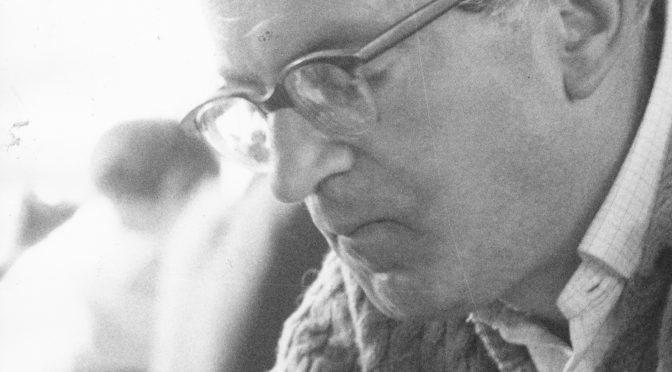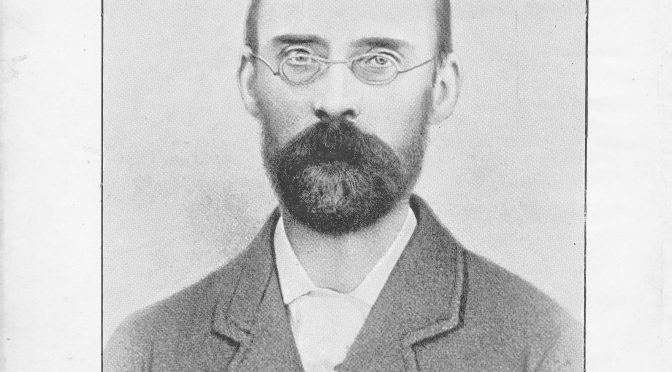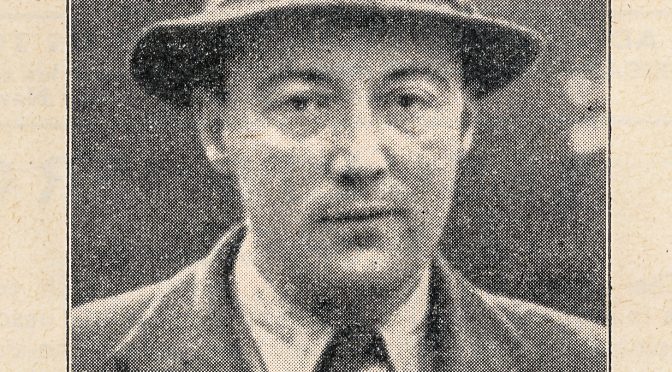
Robert Forbes Combe (16 August 1912 – 12 February 1952)
https://en.wikipedia.org/wiki/Robert_Forbes_Combe
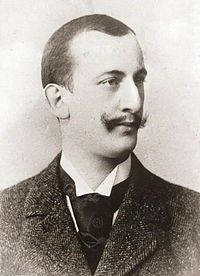
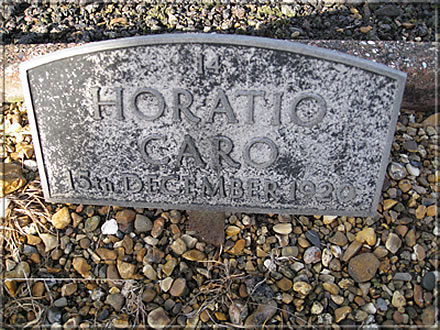
We remember Horatio Caro who passed away on Wednesday, December 15th, 1920.
Horatio Caro was born on Saturday, July 5th 1862. On the same day Heinrich Georg Bronn, German geologist and paleontologist passed away.
His parents were (in the 1861 census) Jacob and Mathilda Caro (née Lüpschütz, possibly Lipschütz) living at 4, Warwick Place, Jesmond, Newcastle upon Tyne.
Horatio’s birth was recorded at Lombard Street, Newcastle upon Tyne.
Jacob and Horatio moved to Berlin to live at 2, Winterfeld Strasse. They both had joint German/British citizenship.
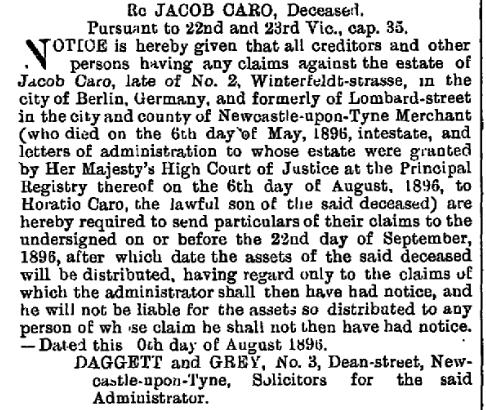
In 1896 Jacob passed away and his affairs were handled by family solicitors, Daggett and Grey of 3 Dean Street, Newcastle-upon-Tyne:
On December 15th 1920 JHD Reid, Master of the Institution of South Grove (a workhouse) recorded the discharge of Horatio. The reason stated was “dead”.
His death was registered in Mile End Old Town and he is buried in the East Ham Jewish cemetery, London Borough of Newham, Greater London located at Section E Row 18 Plot 14.
According to Wolfgang Heidenfeld in The Encyclopedia of Chess (Batsford, 1977), Harry Golombek OBE :
“A minor English master who spent most of his chess life in Berlin. Though he had indifferent tournament not much better match results (he lost to Mieses, and Winawer, drew twice with Von Bardeleben and beat Lewitt), his name has become immortal through the Caro-Kann Defence, which he expounded in his own journal, Brüderschaft, in 1886.”
The Caro-Kann Defence is characterised by
(as an alternative to the French Defence) in which the c8 bishop may be active from an early stage.
Caro famously was able to overcome Emanuel Lasker in just 14 moves in 1890 :
There is also the Caro Variation of the Ponziani Defence which was known since the 1850s and recommended by Caro in Deutsches Wochenschach, 1893:
From Chess, Facts and Fables (McFarland and Company, Inc., 2006), page 12, Chess Note 3096, Edward Winter :
“We can now add a tenth specimen to the collection (of ‘Rare queen sacrifices’), having noted the following position on page 81 of Brüderschaft, 10 March 1888 :
The magazine (see also page 155 of the 12 May 1888 issue) stated that in this game, played in February 1888 (in Berlin?), Horatio Caro mated his unidentified opponent in five moves as above.”
In another place we are grateful to Brian Denman who mentioned that Caro made an appearance for the Great Britain team in the 1898 cable match against America. He lost on board 3 against John Barry.
Richard James replied : “He also represented Berlin in a cable match against New York in 1905. EdoChess has his highest rating as 2545 (11th in the world) in 1892.”
In a Comment to this post Tim Harding asks : “Caro was one of the British invitees to the London 1899 international but he withdrew before the start because of illness. Does anyone know what was wrong with him?”
Also, according to Richard James :
“He spent most of his life in Germany. Page 353 of the Jubiläums-Ausgabe (1926) of Kagans Neueste Schachnachrichten (yes, I also read Edward Winter’s Chess Notes) claims that he lived in Frankfurt up to his 22nd year and in Berlin from 1882 onwards (arithmetic fail). Some sources claim, incorrectly, that he died in Berlin.
His death was registered in Mile End Old Town. In the 1911 census there are a lot of Caros in St George in the East, just the other side of the Commercial Road from Mile End Old Town, from their first names clearly Jewish. There’s also Blanche Caro, a 65-year-old Polish born widow, described as a furrier, in hospital in Mile End Old Town.”
There is extensive discussion from the same above source.
From Wikipedia :
“Horatio Caro (5 July 1862 – 15 December 1920) was an English chess master.
Caro was born in Newcastle upon Tyne, England,[1] but spent most of his chess career in Berlin, Germany. He played several matches. In 1892, he drew with Curt von Bardeleben (+2 –2 =2), lost to Szymon Winawer (+2 –3 =1). In 1897, he lost to Jacques Mieses (+3 –4 =3). In 1903, he drew with Bardeleben (+4 –4 =0). In 1905, he won against Moritz Lewitt (+4 –3 =5).
In tournaments, he won in Berlin (1888, 1891, 1894, 1898 (jointly), and 1903). He also took 10th at Berlin 1883, took 4th at Berlin 1887, tied for 2nd-3rd at Nuremberg 1888, took 3rd at Berlin 1889, took 2nd at Berlin 1890.
He took 3rd at Berlin 1894, took 9th at Berlin 1897, took 17th at Vienna 1898, took 4th at Berlin 1899, tied for 6-7th at Berlin 1902, tied for 11-12th at Coburg 1904, tied for 7-8th at Barmen 1905, took 9th at Berlin 1907, tied for 3-5th at Berlin 1908, and took 4th at Berlin 1911.
Caro died in London at age 58.
His claim to fame is linked to the opening Caro-Kann Defence (B12), which he analysed along with Marcus Kann and jointly published about on the German journal Bruederschaft in 1886.”
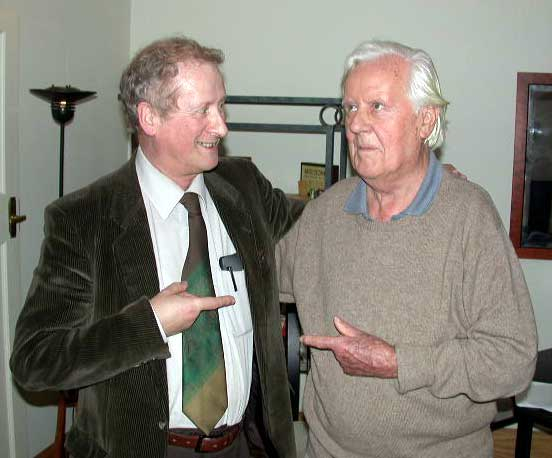
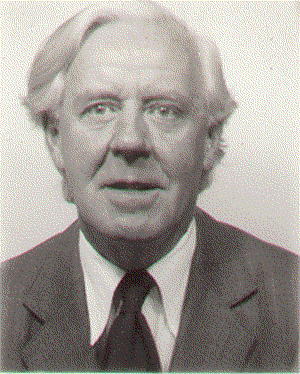
We remember David Pritchard who passed away on Monday, December 12th, 2005.
David Brine Pritchard was born on Sunday, October 19th, 1919. On this day the first US Distinguished Service Medal was awarded to a living female recipient, Anna Howard Shaw.
He was born in Wandsworth taking his mothers’ Winifred maiden name of Brine (as was customary in those days). His father was Arthur Pritchard (DoB : 4th January 1890) and he was the managing director of an Engineering Company. Arthur and Winifred married in Maidenhead, Berkshire in 1917.
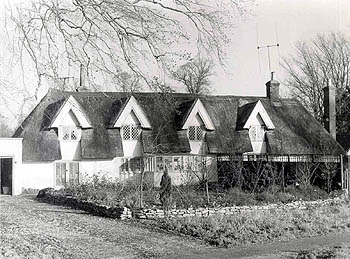
At the time of the 1939 census David was a chiropodist and recorded as single and living in Munee Cottage, Main Street, Bedford. Main Street appears to have been renamed to Main Road which is in Biddenham. It is likely DBPs cottage was something like :
During the second world War David joined the Royal Air Force and was stationed in the Far East and following the war, he switched to intelligence work also for the RAF. He attained the rank of Squadron Leader and played much chess during this period of his life.
In 1950 David completed his first book : The Right Way to Play Chess, Elliot Right Way Books, 1950, ISBN 1-58574-046-2
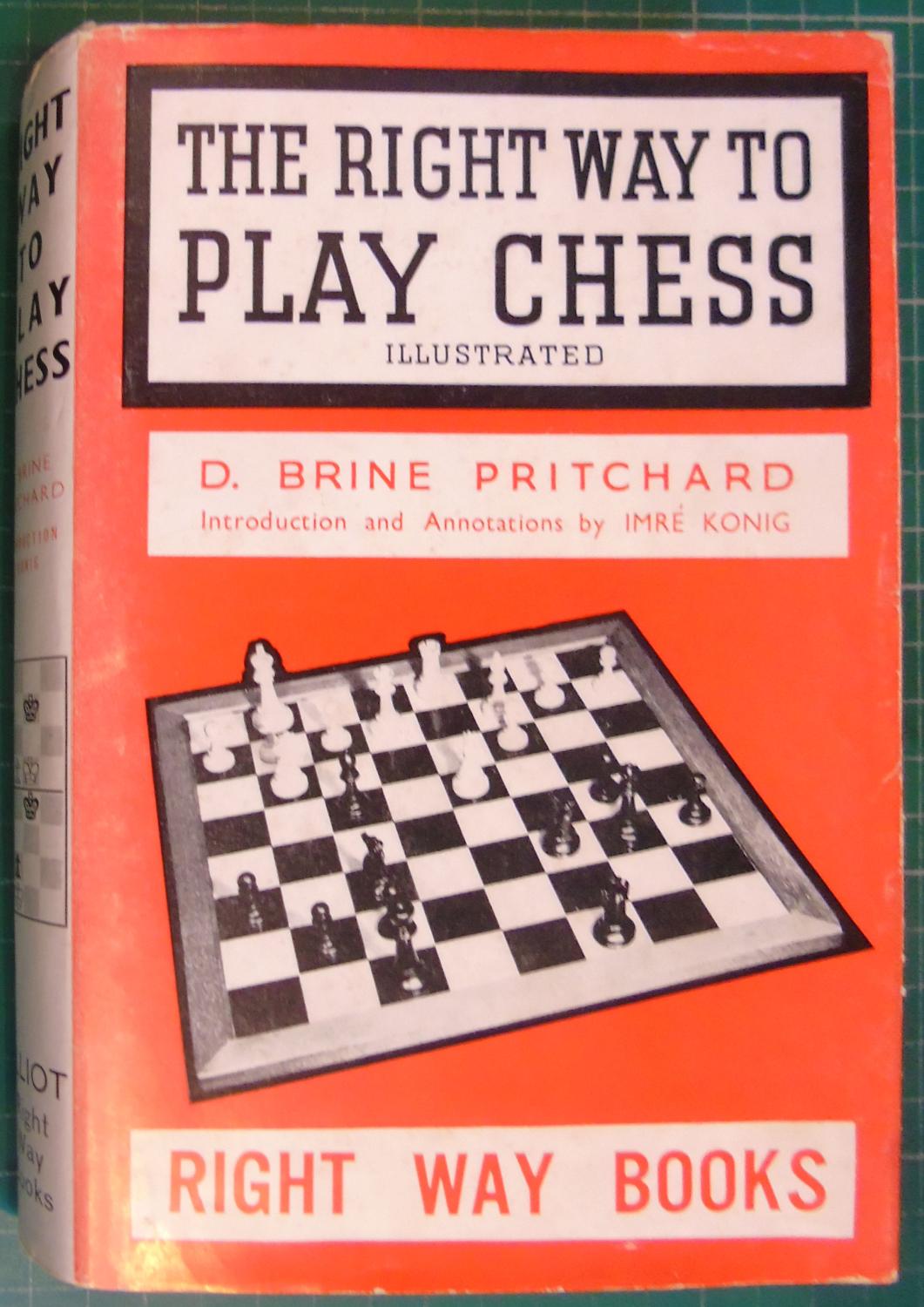
(Ed : This was the first chess book of this article’s author and was thoroughly consumed!)
On page 224 of said book David wrote :
Chessplayers – and this must be whispered – are generally an egotistical, ill-mannered crowd. If they conformed to common rules of decorum these words would not have to be written
followed by
I once carried out a private survey at a well-known chess restaurant where a large number of ‘friendly’ games are always in progress. In less than 30 per cent of those observed was resignation made with a good grace. In two-thirds of the games the loser either knocked his king over, abruptly pushed the pieces into the centre of the board, started to set up the men for a fresh game, or got up and walked away without saying a word to his opponent.
He married Elaine Saunders in between January and March of 1952 in the Cheslsea Registry Office.
Elliot Right Way Books was an excellent choice of publisher for David and only 36 minutes by car from his new home in Godalming.
He won the Singapore Championship in 1954 and the Malaysian Championship in 1955.
Visiting https://www.chesshistory.com/winter/winter97.html you will find two images of David and Elaine playing chess in Singapore.
David and Elaine had a daughter, Wanda on March 21st 1958. She became Wanda Dakin who was also a successful chess player. Wanda attended Guildford High School for Girls and then Royal Holloway College, Egham.
David was Southern Counties (SCCU) champion for the 1958-59 and 1965-66 seasons.
From the British Championships, 1959 in York we have this sparkling game with Frank Parr :
By now David had developed an interest in chess variants and board games in general.
David was the Chairman of the organising committee for the Battle of Britain Chess Tournament : he was runner-up in the first year to RF Boxall.
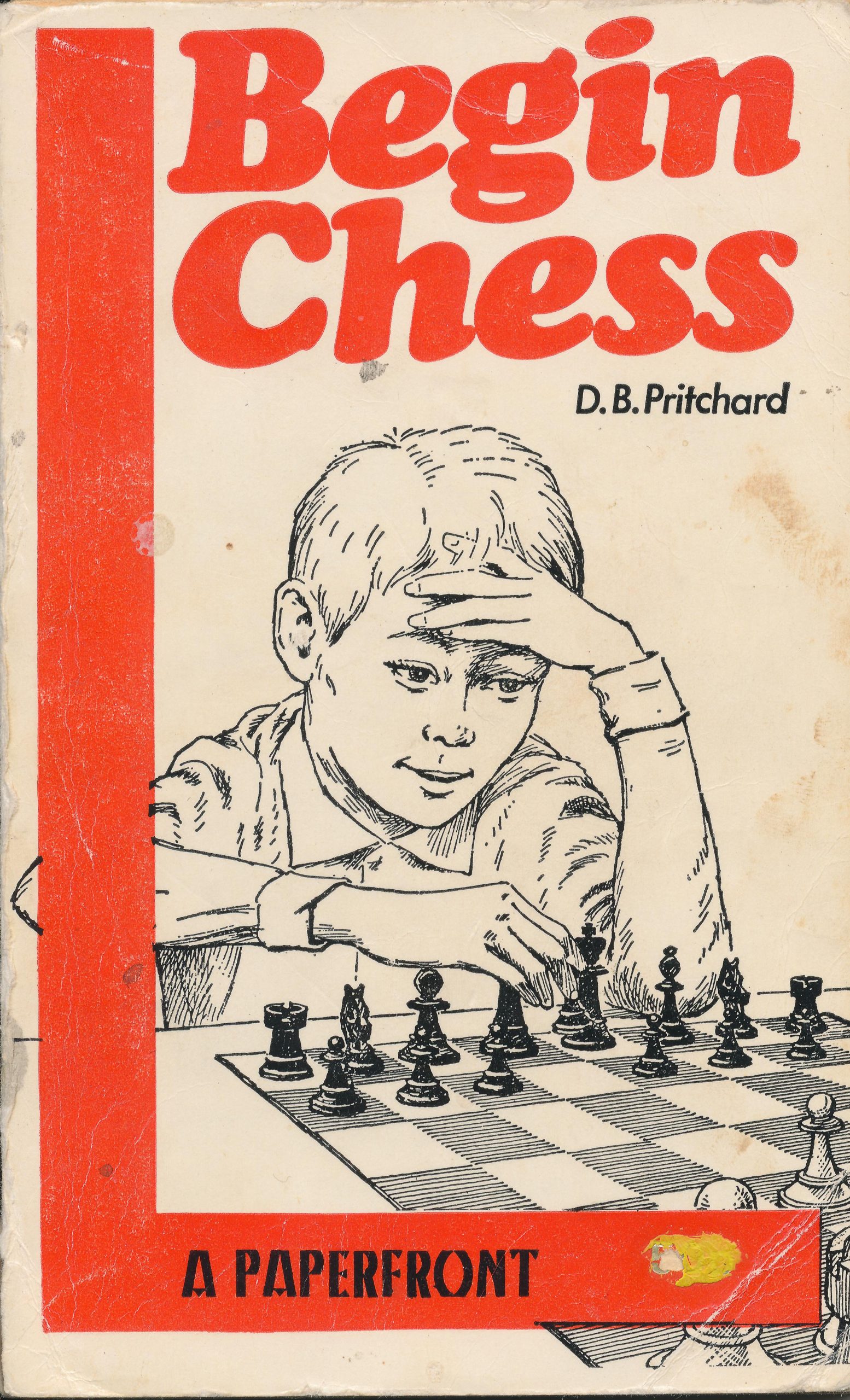
In 1970 he brought out his third book : Begin Chess, David Pritchard, Elliot Right Way Books, 1952
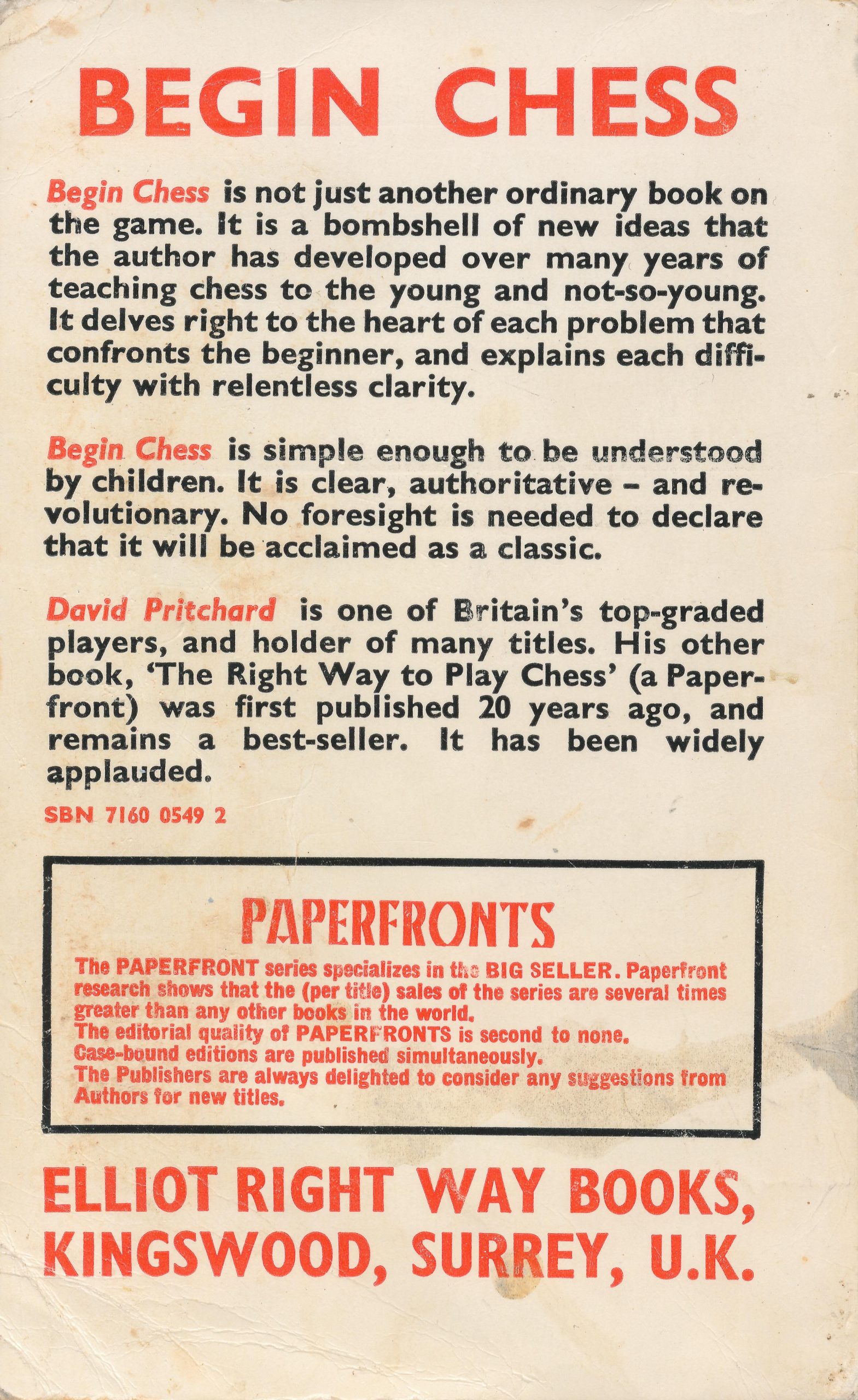
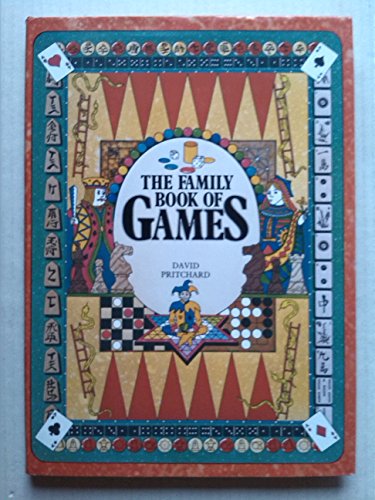
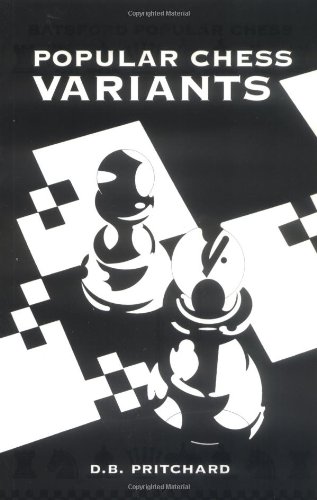
David became President of British Chess Variants Society and wrote many books on variants and indoor games.
Here is an interview compiled by Hans Bodlaender about David’s Encyclopedia of Chess Variants :
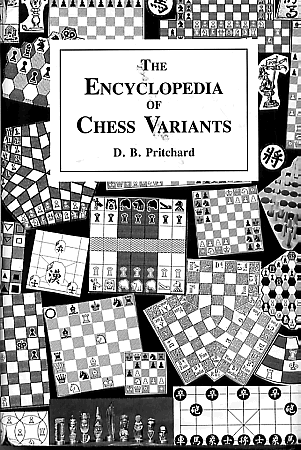
Particularly interesting was this Q&A :
Do you think computers and the Internet will have effect on chess and on chess variants? If so, in what way?
I think that the Internet will inevitably introduce chess to more players but I forsee chess variants, because of their novelty, benefitting in particular from publicity on the net. I expect variants to gain more and more adherents in the future.
David was preparing a second edition before he passed away. This was completed and made available on-line by John Beasley.
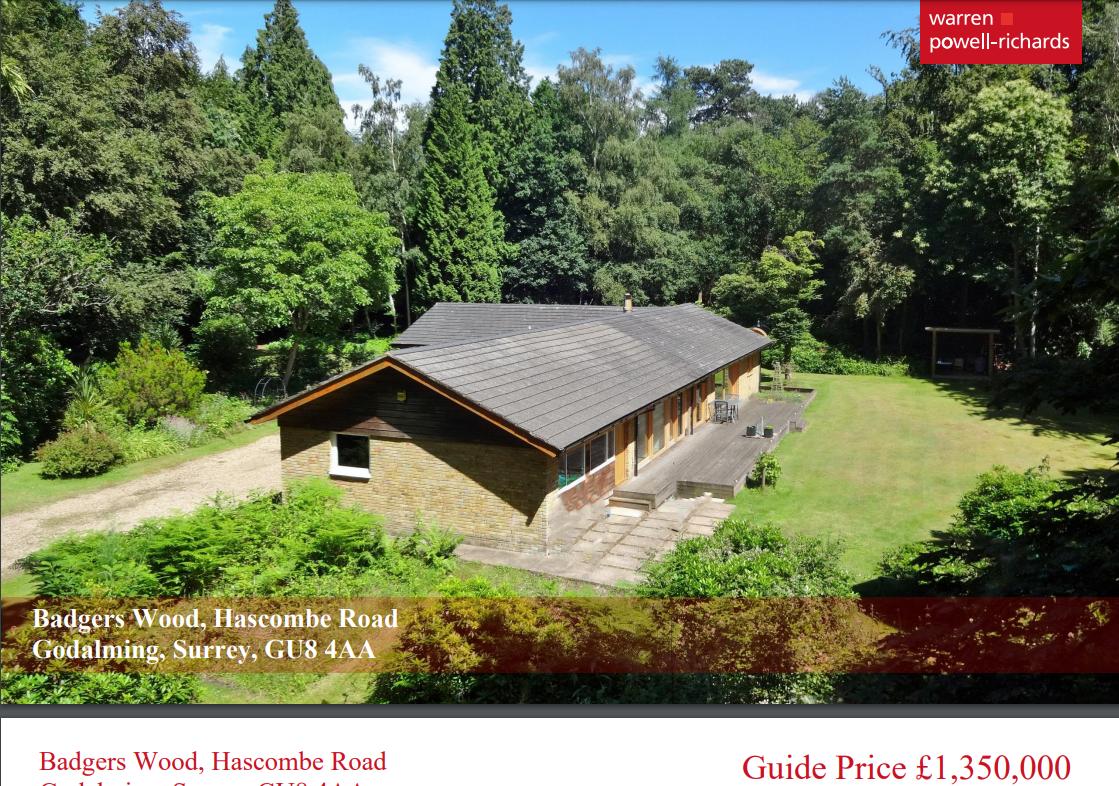
The Pritchard family lived at Badgers Wood, Hascombe Road, Godalming, Surrey, GU8 4AA in an idyllic location :
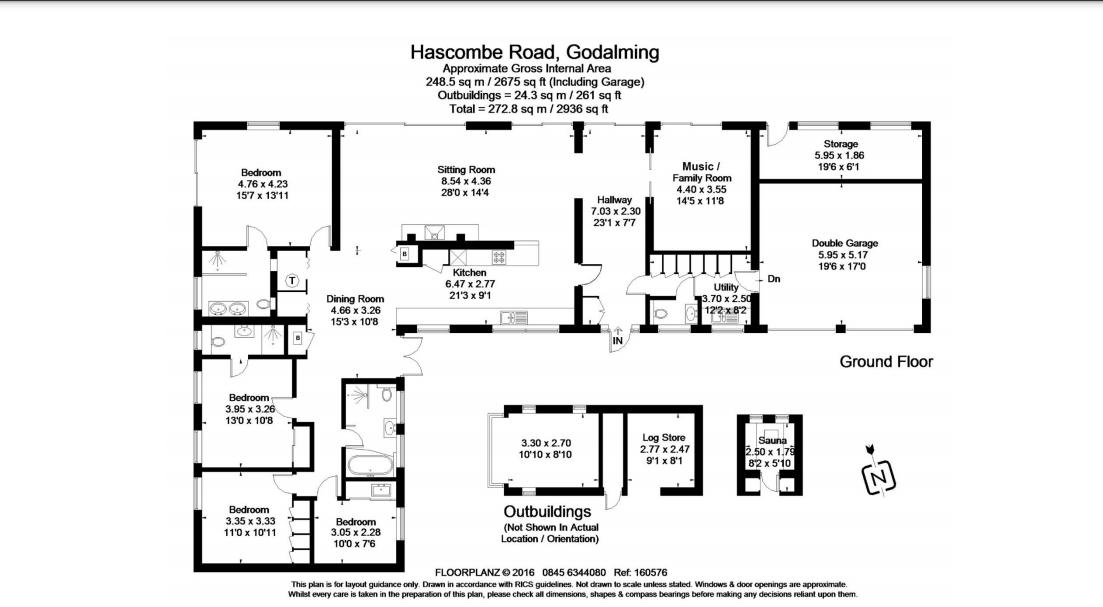
and here is the exceptional interior with games room :
At the time of his passing he had five grand children.
From British Chess Magazine, Volume CXXVI (126, 2006), Number 2 (February), page 76 :
“David Brine Pritchard (19 x 1919 Streatham, London – 12 xiii 2005, London) has died following a fall . He was a strong amateur player and a successful author of books on chess and other games.
David Pritchard was a Squadron Leader in the RAF during the war and later rejoined it to work in intelligence. Whilst serving with the RAF he won the Malayan Chess Championships in 195, and he was also instrumental in the running the UK event known as the Battle of Britain Tournament which attracted a strong field in its heyday and generated revenue for the RAF Benevolent Fund.
He was a dangerous attacking played who scored a number of notable scalps in the British Championship including Penrose and Miles, without ever achieving the consistency required to challenge for the leading positions. He won the Southern Counties championships in 1959 and 1966.
As an author, Pritchard’s most successful book was The Right Way to Play Chess (Elliott, 1950, with numerous reprints), which is still to be found for sale in many British bookshops.
He will also be remembered as a leading authority on chess variants: he was reported to be in the process of preparing a second edition of The Encyclopedia of Chess Variants (1994) at the time of his death. He was also a very good correspondence player, an inventor composer of chess puzzles of all sorts (some of which appeared in BCM) and his interest in Fairy chess dated back to the 1940s.
His wife Elaine Pritchard, the leading woman player of the 1950s and 1960s, and their daughter Wanda (who also played competitive chess) survive him. We send them our condolences on behalf of BCM and its readers.”
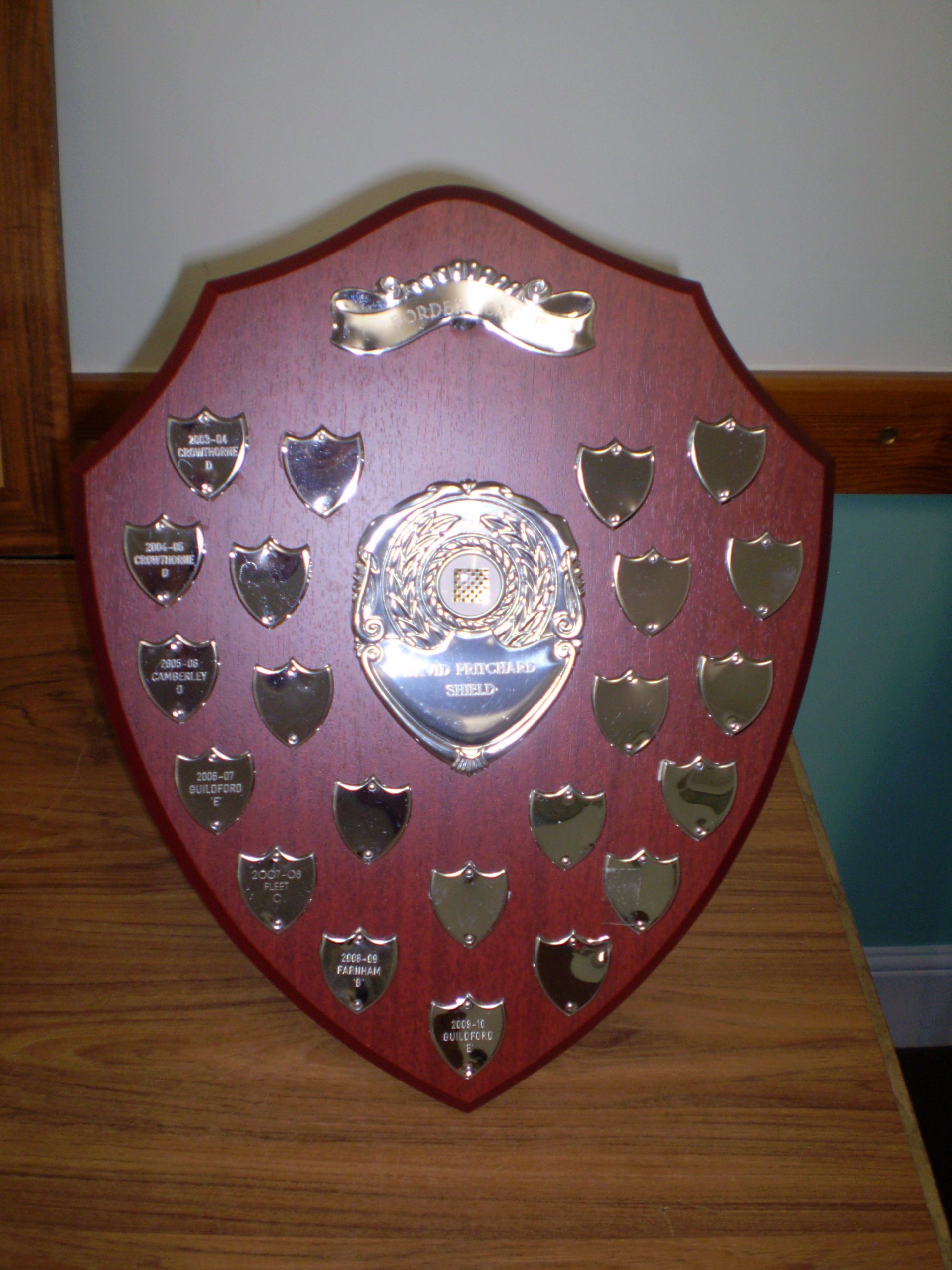
He was a leading member of Godalming Chess Club and played in the Surrey Border League. The David Pritchard Shield was presented in his memory.
Here is David’s Wikipedia entry
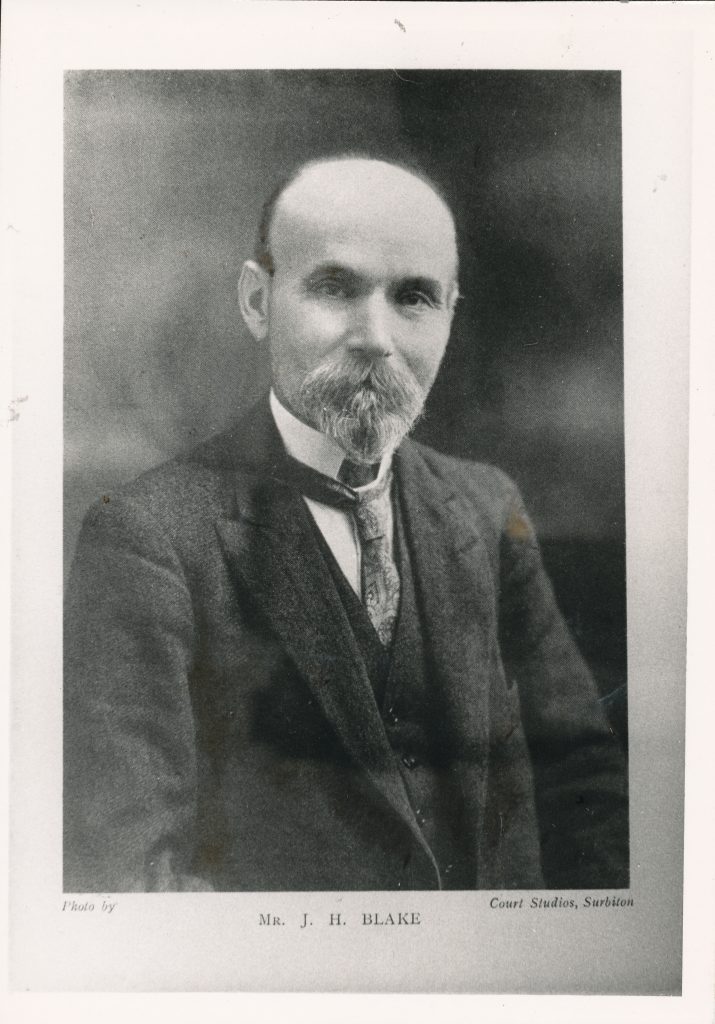
We remember English player Joseph Blake who passed away on Tuesday, December 11th, 1951.
Joseph Henry Blake was born on Thursday, February 3rd, 1859 in Farnborough, Hampshire. His parents were Joseph Denner and Eliza Blake (née Early). In 1871 Joseph (aged 12) had a brother Frank (aged 10), sisters Annie (8), Elizabeth S (7), Eliza E (1) and a servant, Kate Longman aged 18. The family lived in Lydia Cottage, Hewitts Road, Millbrook, South Stoneham, Hampshire.
According to the 1861 census Joseph was two years old and living with his parents and Frank in Rotten Row, Yeovil, Somerset.
In 1881 the family has upped sticks again and moved to 2 St. Lawrence Road, Saint Mary, Eastleigh, Hampshire. This address is also given as the South West Telegraph Office. Eliza was now the head of the household and a widower. Apart from Eliza E aged 11 everyone worked for the railway.
In 1891 Joseph had become Head of the Household (aged 32) and they had acquired a servant (Anna M Cornell) and a blacksmith (Francis Cornell) from Braintree in Essex.
In 1900 Joseph married Alice New in Cheltenham, Gloucestershire. They lived at 24, Barton Road, Eastleigh, Hampshire. Tragically, Alice passed away in 1903.
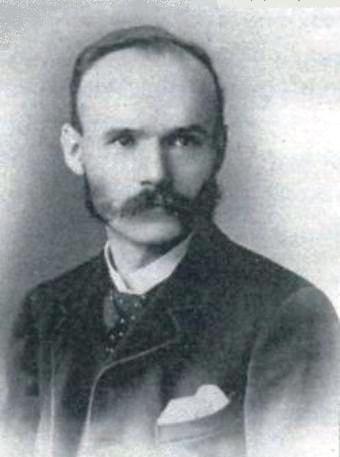
By 1911 Joseph was 52 and had retained his career as a Railway Clerk. He lived at 33, Broomfield Road, Tolworth, Surrey :
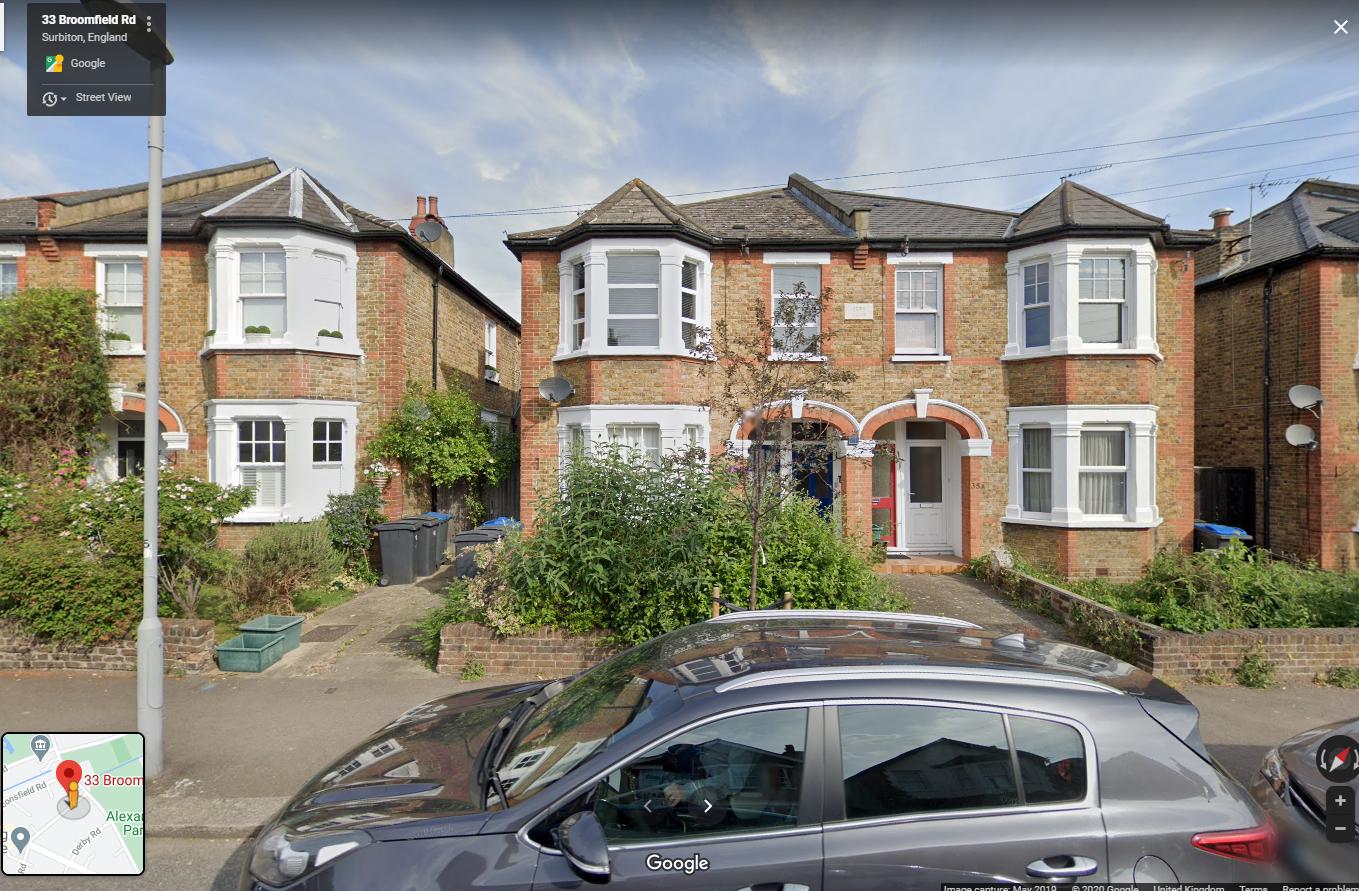
He is recorded as the head of a household of one and a widower.
In 1939 Joseph was living at 10 Springfield Court, Springfield Road, Kingston Upon Thames, Surrey. He was now retired.
No doubt there would have been other addresses not captured by the census records.
According to The Encyclopedia of Chess, (Batsford, 1977), Harry Golombek OBE :
“A leading British player in the 1890s and for many years editor of the Games Section of the British Chess Magazine between the two world wars. Blake’s best tournament performance came at the age sixty-three when, at Weston-super-Mare in 1922, he came 1st ahead of Maróczy, Kostić, Sir George Thomas and Yates.
The remarkable feature about Blake’s chess career is that he retained his skill and his comprehension of the game for a much longer period that most chess players. This extended from 1887 when he was 1st at the Counties Chess Association tournament at Stamford ahead of Bird and Pollock, a performance he was to repeat in 1891 at Oxford, to 1909 when he tied with H. E. Atkins for first place in the British Championship, to 1923 when he won the Weston-super-Mare tournament, right into the 1930s when he was principal annotator for the British Chess Magazine.”
and according to The Encyclopedia of Chess (Robert Hale, 1970 & 1976), Anne Sunnucks :
“One of the leading British players at the end of the last century and the beginning of the present century. Born on 3rd February 1859. Represented England in the Anglo-American cable matches in 1902 and 1909. His best results were 1st in the Counties’ Chess Association Tournament 1887, ahead of Bird and MacDonnell; =1st with HE Atkins in the 1909 British Championship, but lost the play-off for the title; 1st at Weston-super-Mare 1922 ahead of Maroczy, Kostich, Sir George Thomas and Yates, and winner of the brilliancy prize for his game against Sir George Thomas; 2nd in the international correspondence chess tournament organised by Le Monde Illustre in 1895.
Blake was President of the Southern Counties Chess Association in 1911 and President of the Hampshire Chess Association from 1910-1912 and from 1927-1929. He was also Hon. Secretary of the City of London Chess Club for some years.”
According to Tim Harding in the excellent Correspondence Chess in Britain and Ireland, 1824-1987 :
Railway clerk Joseph Henry Blake, the leading English correspondence player of the 1890s; also a strong OTB amateur player. He was a regular contributor to British Chess Magazine from the 1880s to the late 1930s.
In British Chess Magazine, Volume XXXIX (39, 1919), Number 3 (March) we have the following from Julius du Mont : “I presume it relates more particularly to chess professionals in this country, at any rate, it does not seem to me that the jews hold rank amongst first-class amateurs in proportion to their numbers.
In London there are very few if any of the class of RC Griffith, GA Thomas, JH Blake, HG Cole, EG Sergeant, and many others to say nothing of the younger recruits , W.Winter and RHV Scott.”
From the 1949 British Chess Magazine (written by RN Coles) we have this :
JH Blake is Ninety
After an absence of ten years I looked in recently on the Kingston and Thames Valley Chess Club. There were many new faces and a number of familiar ones, among the latter one of rosy countenance, trim beard and twinkling eyes, none other than JH Blake, more vigorous than ever and attaining his 90th birthday on the 3rd February.
Twenty years ago in this same club I (RN Coles) was learning the game, now middle age approaches. Blake was an elderly man in those days, who had retired from all competitive play because of the strain it imposed; now, so far from showing the weight of years, he is back in competitive chess again. He won the club championship last year and is in a fair way to repeating his victory this year. Of all the ‘Grand Old Men’ of chess, few have still been champions in their 90th year.
Older readers of the BCM will remember him as their Games Editor for many years, but few memories will cover the whole series of his successes beginning with a 1st at Stamford in 1887. Even 1922 must seem a distant year to the generation of today. That was the year that Maroczy and Kostic were invited to Weston-super-Mare to meet such rising young English masters as FD Yates and Sir George Thomas. And the first prize amongst those talented players was won by JH Blake, who had been born just when Morphy returned to England after his Paris Victory over Anderssen !
All readers of the BCM and all players everywhere will wish Britain’s oldest master continued health and increasing vigour, and those who knew him today will be surprised if he does not continue his attack for another decade at least.
Besides winning the first prize at Weston Blake also won the brilliancy prize with the following game : (#10,229)
British Chess Magazine, Volume LXXII (72, 1952), Number 2 (February), pp.44-46 contained an obituary with articles from MDB* :
*(Careful investigation by Richard James suggest that MDB is Mabel Dorothy Barker, JHB’s niece in 6th Cross Road.)
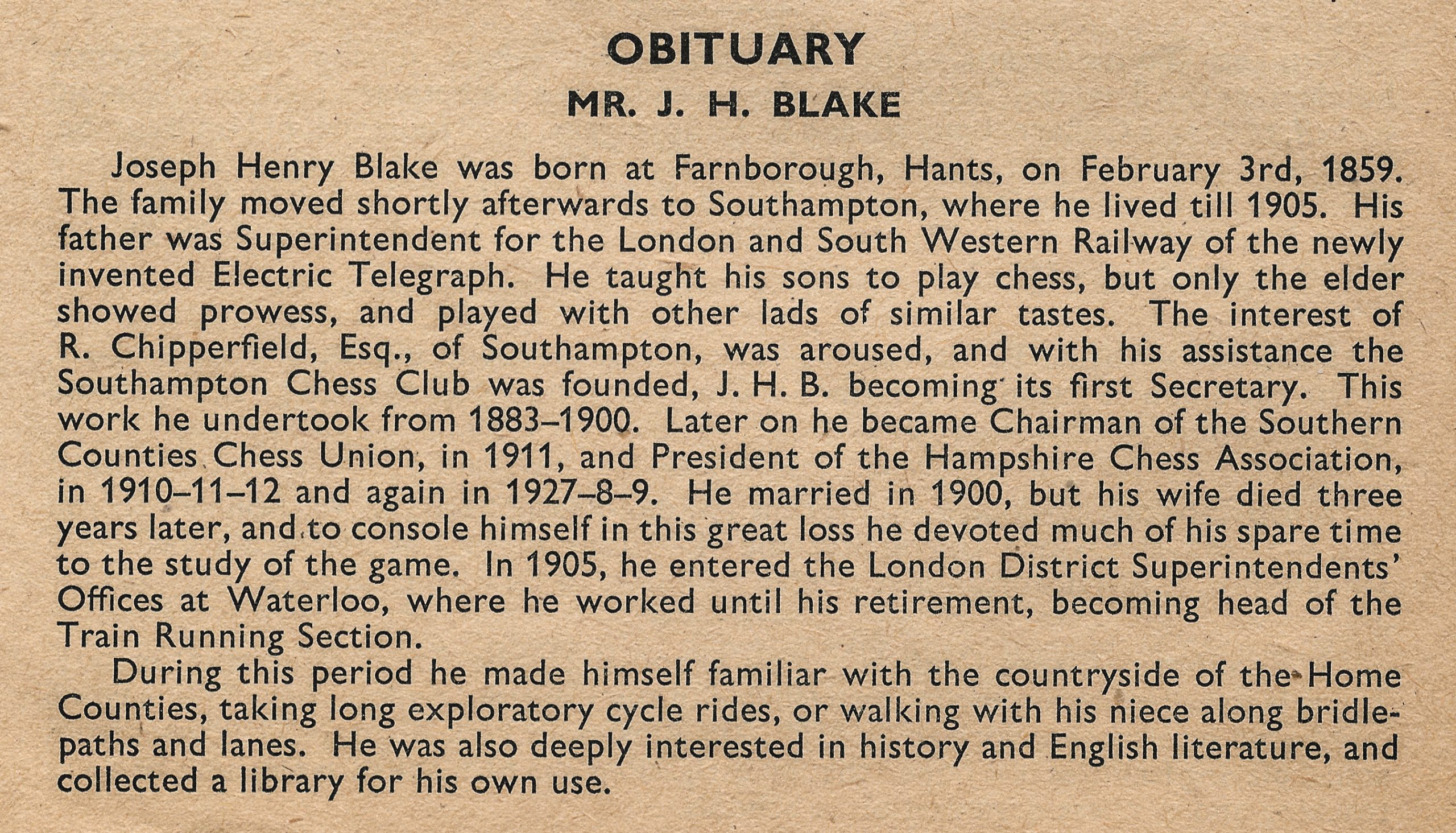
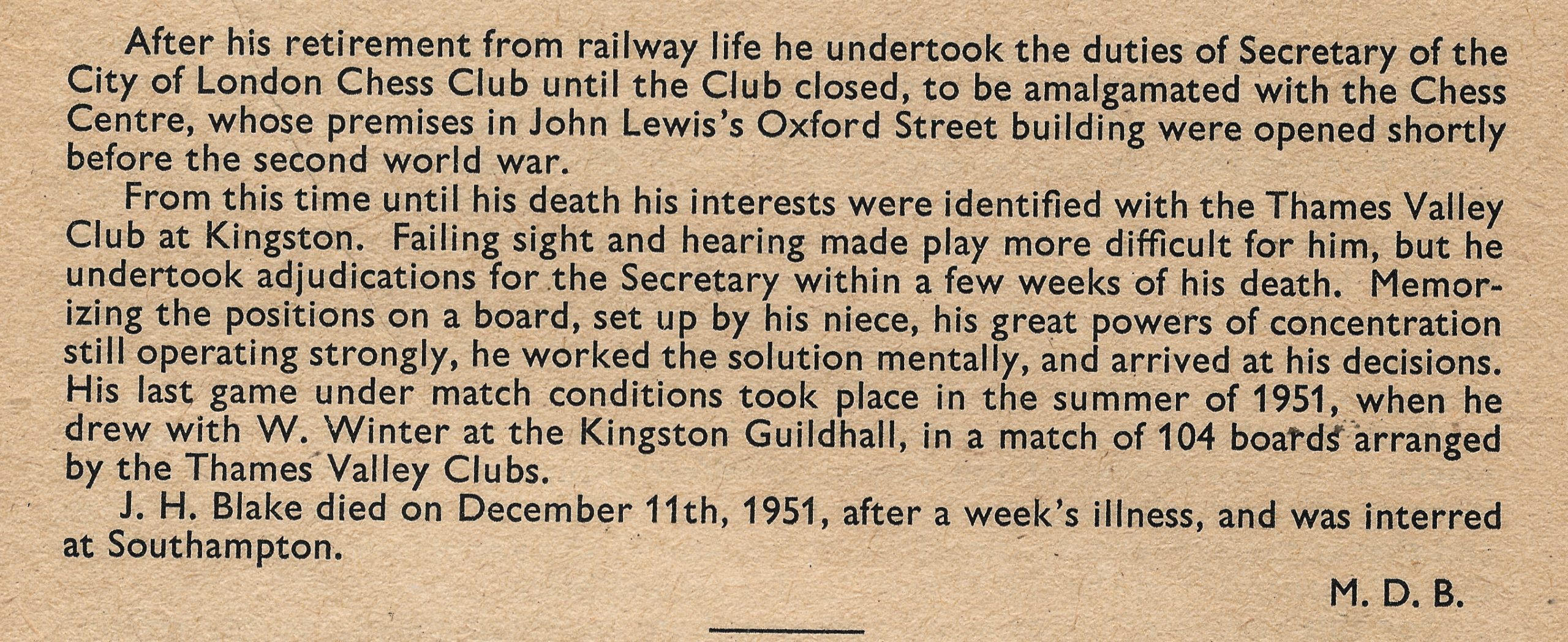
and EG Sergeant :
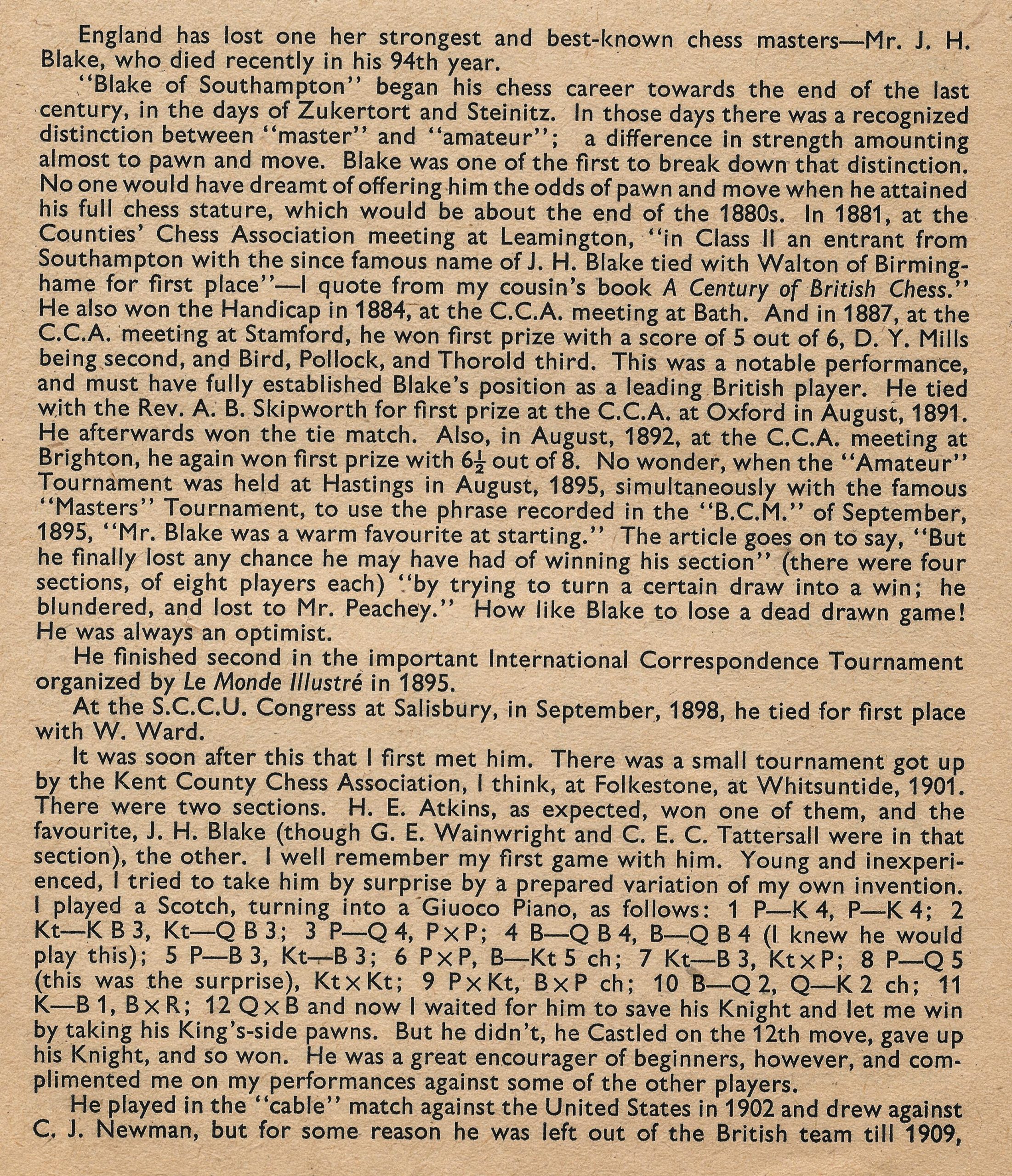
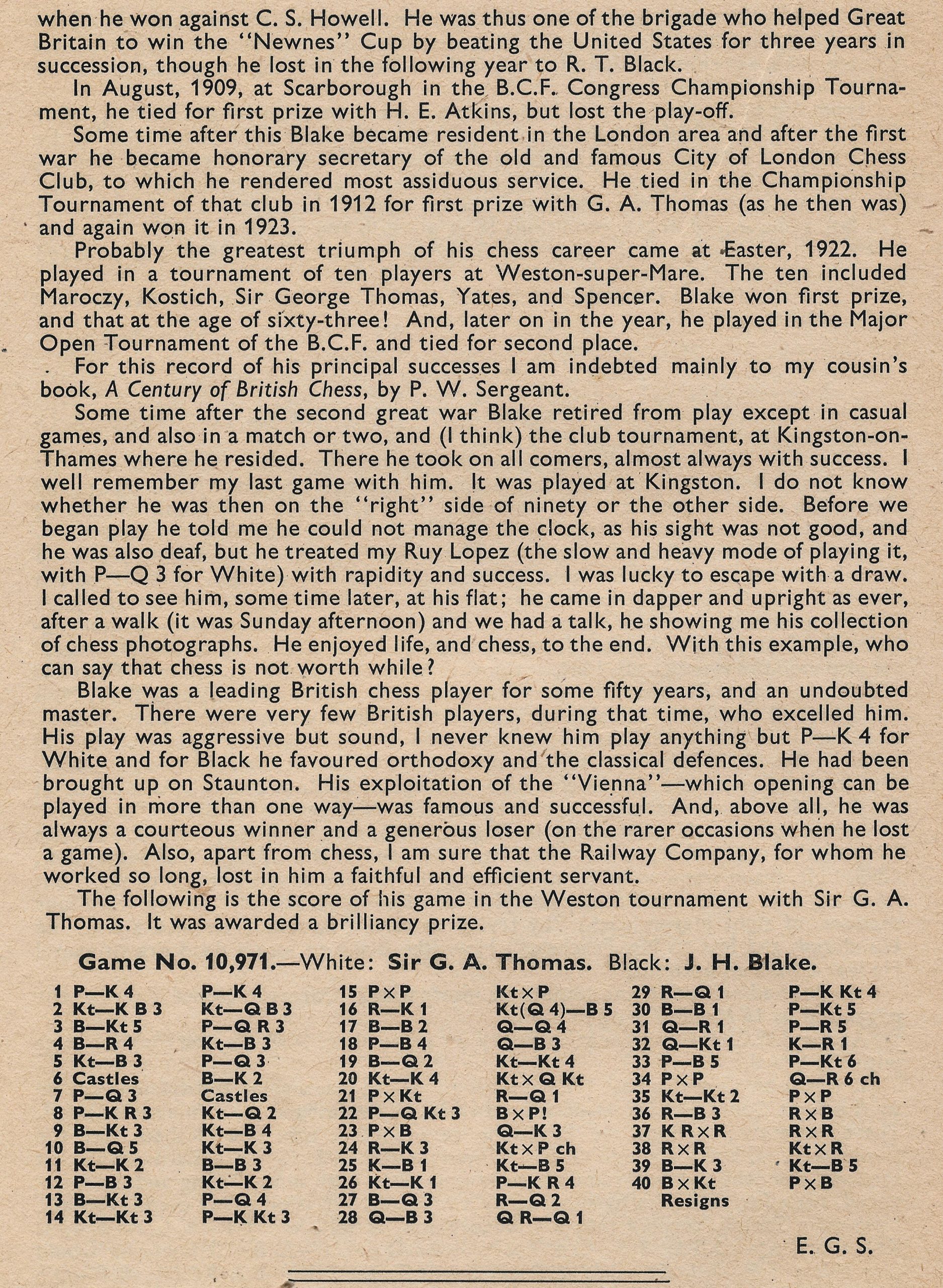
For more on this game and its often mis-reported continuation see this article from Edward Winter.
From Wikipedia :
“Joseph Henry Blake (3 February 1859, Farnborough, Hampshire – 11 December 1951, Kingston-upon-Thames) was an English chess master.
Blake won many tournaments played in England toward the end of the 19th century and the beginning of the 20th century. He won at Stamford 1887, Oxford 1891 (joint), Brighton 1892, Cambridge 1893, and Salisbury 1898 (joint). He also took 5th at Manchester 1882, tied for 3-4th at Birmingham 1883 (Section B), took 4th at Bath 1884, tied for 6-8th at London 1889 (Henry Bird won), took 2nd at Cambridge 1890, tied for 3rd-4th at Woodhall Spa 1893, shared 2nd at Craigside 1895, took 3rd at Hastings (Amateur) 1895, took 2nd, behind Henry Ernest Atkins, at Bristol 1896, and won at Folkestone 1901.
He took 2nd in an international correspondence tournament organised by Le Monde Illustré in 1895, shared 1st in the 1909 British Championship in Scarborough but lost to Atkins the play-off, and shared 1st at London 1911. He was British correspondence champion in 1922.
Blake represented England in cable matches against the United States in 1902, 1909 and 1910.
His best achievement was victory, ahead of Géza Maróczy, George Alan Thomas, Fred Yates and Boris Kostić, at Weston-super-Mare 1922. He shared 2nd at London 1922 (Major Open), tied for 7-8th at Hastings International Chess Congress 1922/23 (Akiba Rubinstein won), took 2nd, behind Thomas, at London 1923, took 5th at Liverpool 1923 (Jacques Mieses won), tied for 7-8th at Hastings 1923/24 (Max Euwe won), tied for 6-7th at Weston-super-Mare 1924 (Euwe won), took 2nd, behind R.P. Michell, at London 1925, took 4th at London 1926 (Victor Buerger won), and tied for 7-9th at Weston-super-Mare 1926 (Euwe won).”
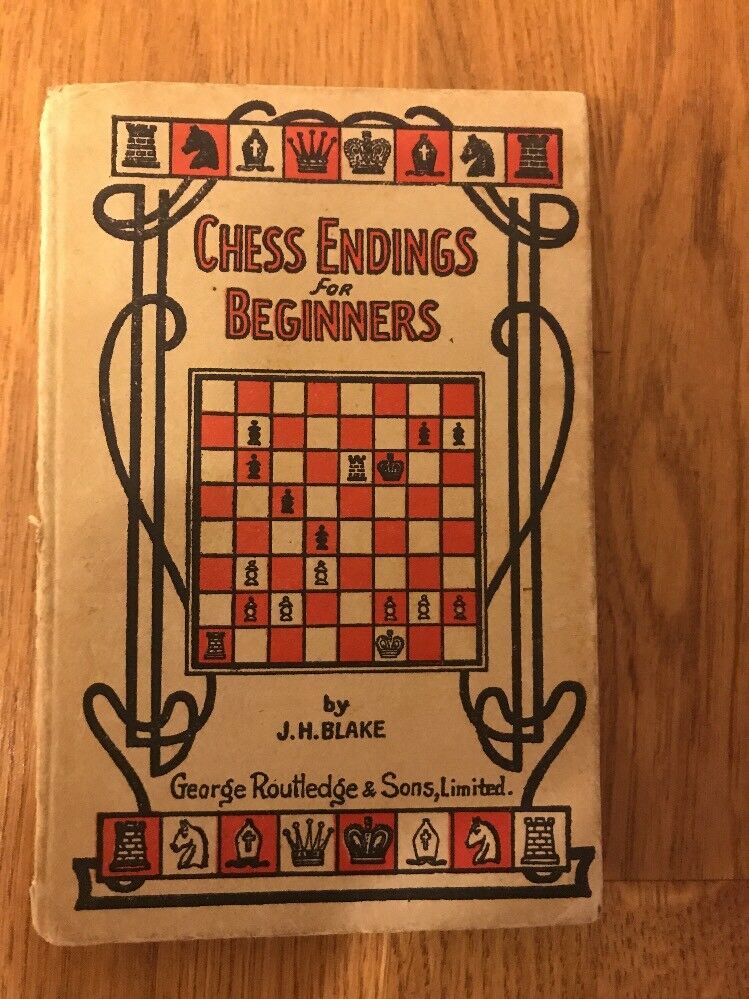
He is the author of Chess endings for beginners (London 1900).
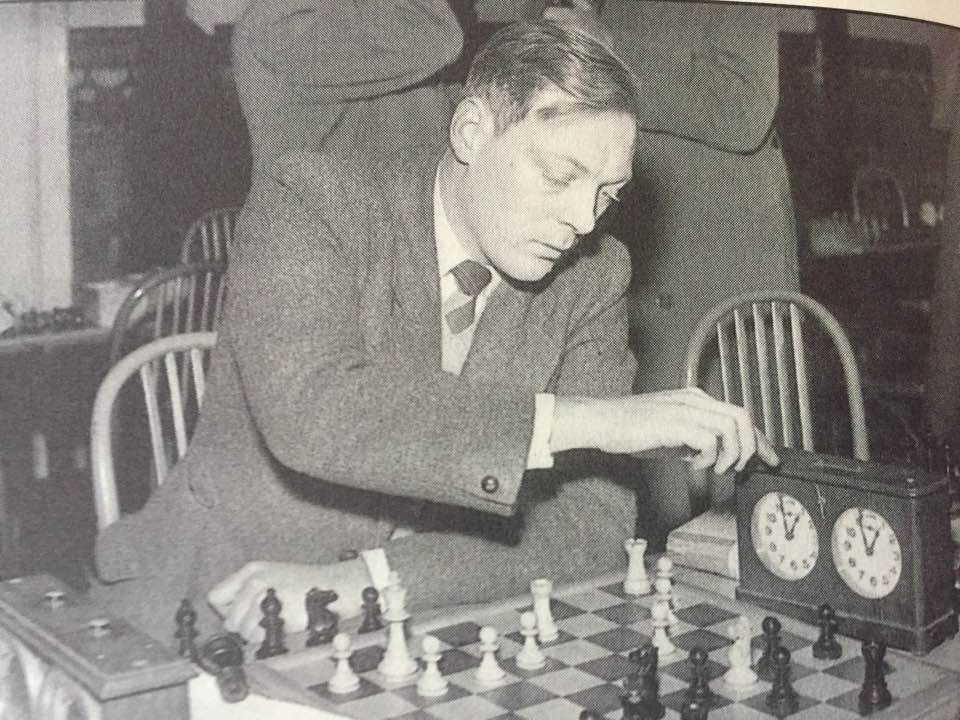
We remember John Fuller who passed away aged 76 on Wednesday, December 8th 2004. His death was recorded in the district of Lancaster. At the end of his life he lived in Carnforth, in Lancashire.
John Arthur Fuller was born in Hendon, Middlesex on Saturday, May 12th 1928. His parents were Horace Arthur Fuller (a Bank Officer) and Phyllis Fuller (née Gooch).
John had three brothers: Julian Frederick who was two years older, Nigel Anthony who was three years younger and Adrian Easterbrook who was six years younger.
They lived at 12, High View, Pinner in Middlesex.
On August 26th 1939, aged eleven, John (described as a scholar) departed from Liverpool on board the SS Ceramic (part of the Shaw Savill & Albion Company shipping line) and duly arrived one hundred and twenty days later in Sydney, New South Wales.
The family returned to Liverpool in March 1945 on board the Athlone Castle which was of the Union-Castle Mail Steamship Company Ltd. John was now sixteen years old.
According to ancestry.co.uk he is survived by a son, Robin. The family tree indicates that John had two sons and two daughters but his wife is marked as Private and so her name is not visible. We speculate that it may be Ann Fuller (née ?) but this is awaiting confirmation.
From The Encyclopedia of Chess (Robert Hale, 1972 & 1976) by Anne Sunnucks :
“British Master, British Boy Champion in 1946 and British Correspondence Champion from 1953-1955. Born on 12th May 1928 Fuller learned to play chess when he was 11. In 1946 , the year in which he won the British Boys Championship, he also tied for the London Boys Championship. He went on to win the Middlesex Championship three times and the Warwickshire Championship twice. Fuller played for England in matches between Scotland and the Netherlands and in the Clare Benedict International Team Tournament. He also had the best British score in the Premier Tournament at Hastings in 1949 and 1955.
He was a design engineer.”
From The Encyclopedia of Chess (Batsfords, 1977) by Harry Golombek:
“British master and design engineer by profession. British Boy Champion in 1946. Fuller was a player of great promise with a fine understanding of the game. But a serious illness disturbed the even flow of his chess career and, though he recovered and made some more appearences in the chess world, he eventually withdrew from chess on an international and national level.
Fuller played twice in the Hastings Premier tournament: =5th 1949/50 and 6th in 1955/6.”
The Oxford Companion to Chess is silent on JAF.
There has been considerable discussion of JAF in another place.
BCN would like to acknowledge help received from Richard James, Leonard Barden, Rob Fuller and John Upham in putting this article together.
Subsequent to this post being originally published in 2020 our attention was kindly drawn by John Saunders to the obituary in BCM, Volume 125 (2005), #5 (May), page 247. Here is the article:
John Fuller (12 v 1928 – 8 xii 2004, Carnforth) was a British Master and British correspondence champion in 1954 and 1955. Having spent some of the war years in Australia, he quickly made his mark in junior chess on his return to Britain. He shared first place with Leonard Barden in the 1946 London Boys’ Championship and went on to win the British Boys’ Championship in 1946 with 5/5 in the final section, ahead of Gordon Crown and Leonard Barden. He beat an off-form Crown in nine moves in the last round (see game above) He played a number of correspondence games with Crown, himself a richly gifted player, who w0as to die tragically young in 1947, and it was reported that Fuller had the better of these encounters.
Fuller became a design engineer, but his business and chess careers were both affected by a serious bout of tuberculosis when he was a young man. He won the Hastings Premier Reserves ‘B’ with 8/9 in 1947/48 ahead of Alan Phillips and Arthur Winser, and in 1949 Leonard Barden remembers playing off with him for a place in the 1949/50 Hastings premier after the two of them had made similar scores at the 1949 British Championship.
“We played the match at Sir George Thomas’s flat in autumn 1949… and John crushed me in that. Not sure of the score, I think it was 2.5- 0.5.”
He played in the Hastings Premier in 1949/50 and again in 1955/56,and made the best British scores on both occasions – 4/9 and 3.5/9 respectively. He also represented England in matches against Scotland and the Netherlands, and in the Clare Benedict team tournament. He only appeared three times in British Championships, scoring 6.5 in 1949, 5.5 in 1950 and 6.5 in 1958. He ranked in the top ten of the British Chess Federation Grading List on six occasions, with a best place of third equal in 1958. He seems to have dropped out of over the board competition chess shortly after being awarded the (now defunct) British Master title in 1963/64.
Harry Golombek referred to Fuller in The Encyclopaedia of Chess (1977) as a player of great promise with a fine understanding of the game”. Alan Phillips told BCM that he was “one of the most promising players of his generation… he slaughtered me three times”.
Leonard Barden had the following memories of John Fuller: “He was a member of West London Chess Club, which was historically significant as his good friend and fellow member (both living in Harrow) was Jim Slater, who 25 years later told me that knowing John was one of the factors which kept his interest in chess up to the point where he became our Maecenas… John was a tall redhead, outgoing and friendly, and a natural talent who also worked on theory. With the better opportunities available to later generations I’m sure he would have reached IM strength.”
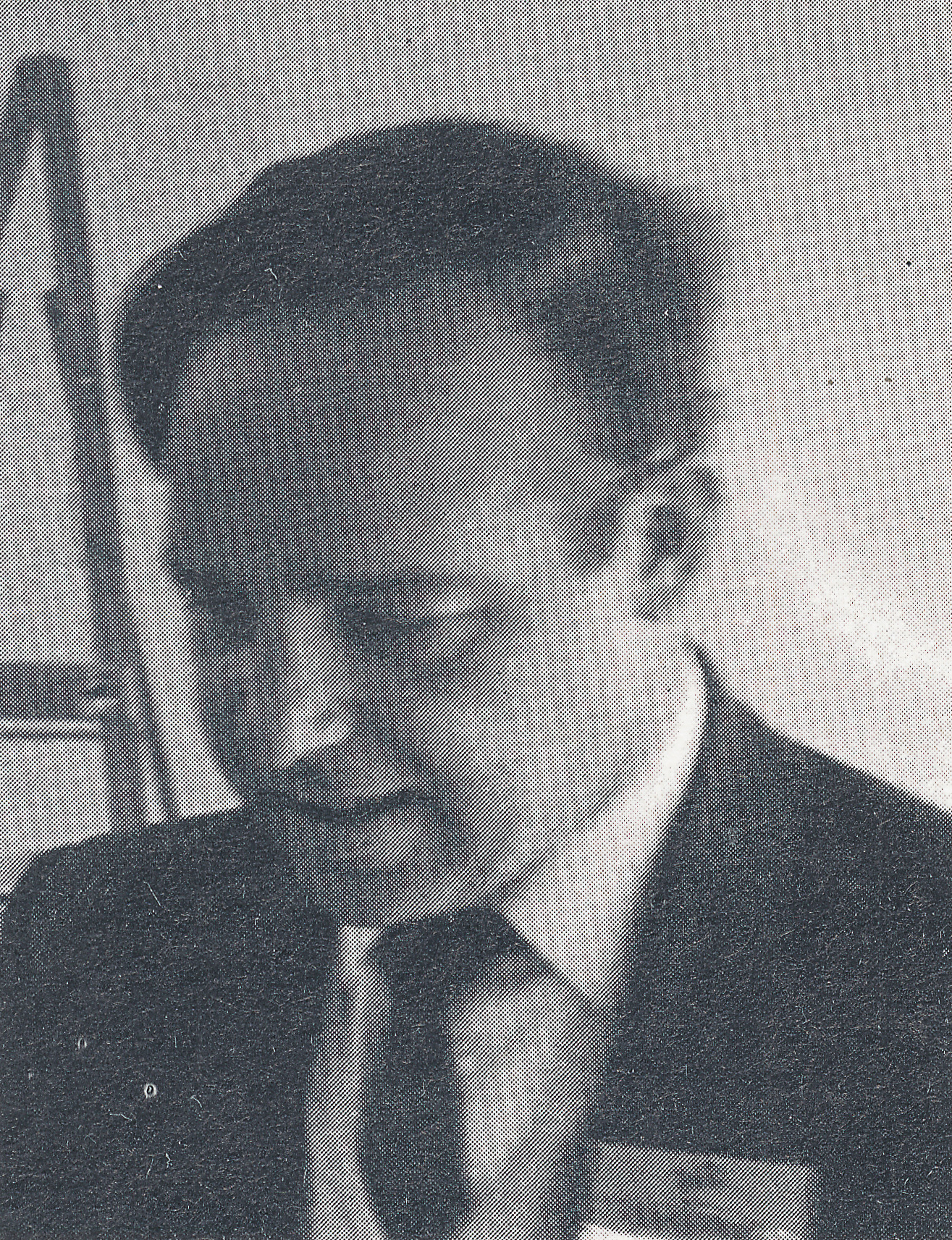
BCN remembers Dr. A(lfred) Christopher Reeves who passed away on Monday, December 3rd, 2012 in St. Agnes, Cornwall. His probate record (#4073868) is dated December 3rd, 2012 being recorded in the Bristol registry.
Alfred Christopher Reeves was born in Wharfedale, Yorkshire on Sunday, February 19th, 1939. His mother’s name was Tomlin.
Alfred detested his first name to the extent that he asked people to call him Christopher and, when asked, told them that the A was for Arthur. For this reason much of the chess literature uses Arthur whereas public records use Alfred.
In British Chess Magazine, Volume 133 (2013), Number 1 (January), page 2 we have this obituary from James Pratt:
“Alfred Christopher Reeves (Leeds, 19 ii 1939 – St Agnes?, 3 xii 2012). Chris Reeves was a FIDE Master of Composition. He toyed with entering the priesthood but became a child psychotherapist. He started composing (“…my solace and diversion …”) in 1960, largely specialising in the orthodox two move field. Though not a prolific composer, his work was known worldwide.
He was Sub-Editor of The Problemist”
From the The Encyclopaedia of Chess (Batsford, 1977), Harry Golombek OBE, John Rice writes:
“British problemist, output consists of skilfully constructed two-movers in the modern style.”
From The Encyclopedia of Chess (Robert Hale, 1970 & 1976), Anne Sunnucks wrote: :
“Problem composer. Since 1960 he has composed about 70 modern-style two movers, and is considered to be one of the most talented British composers. His originality and technique enable him to build into tangible form what would be no more than a passing idea for most composers. He has edited the problem section of Correspondence Chess, and he controlled BCF tourneys and International Team matches.”
From British Chess (Pergamon Press, 1983) Botterill, Levy, Rice and Richardson we have this:
“I was born on February 19th, 1939, the second son of a doctor who practised in a busy Yorkshire coal-mining town. As a youngster I acquired a taste for chess problems as soon as I learnt the moves of the game.
I owe my initiation to the admirable column which DM Davey used to run in the weekly review The Tablet and to the enterprise of one of the masters of the boarding school to which I was sent when still quite young. Davey’s column catered for novice chess problemists like myself by conducting graded solving tournaments with modest handicaps.
These tournaments ran conveniently the length of the school term, just long enough to sustain a young person’s enthusiasm, The teacher in question used to put the week’s problem up on the school noticeboard and dozens of small schoolboys participated as a result. The Tablet column was not only a boon for beginners like me. It had a very discriminating band of solvers who were given ample space to express their views on each week’s problems. This had the additional effect of making it a popular forum for budding composers who need the stimulus and encouragement of audience response in what is, after all, a very solitary sort of pastime.
My fascination with chess problems soon diverted my energies away from the game itself. I was eight when I began solving. Another 13 years elapsed before I seriously tried my hand at composing. My immediate inspiration was the example of the then young trio of British composers, Barry Barnes, Michael Lipton and John Rice. Their latest work incorporating, try-play, and often exploiting complex patterns of relationships between mates, was regarded as unacceptably, ultramodern, in some quarters but found ready appreciation with the solvers of Davey’s column.
Other sorts of problems I had enjoyed; these I wanted to emulate. The powerful attraction their work had on me has made me chary ever since of the strictures of self-appointed guardians of chess problem ‘taste’, who suggest that the modern two-mover cannot hold the same interest for the solver as the more traditional type. It certainly did not have a negative effect on me.
Problem I was one of my earliest compositions, in fact the first to gain any sort of award. At the time I was a theological student destined for the priesthood. I recall having felt some scruples about indulging in the frivolous pastime of chess problem composition not that it prevented me from becoming thoroughly addicted!
I have found that a bad conscience makes a good chess problem, and the greatest spur for composition is the feeling that one should really be busy doing something else. The problem shows a duel between the white queen and the black knight on d5, each of whose eight possible moves feature as a unique defence against one of the white queen tries. Solvers have often found the key to this problem’ quite elusive.
Problem I
The Tablet, 30th June, 1962
3rd Honorary Mention BCPS Ring Tournament
White to play and mate in 2
1.Qa1?…Nc7!
1.Qa4?…Nb6!
1.Qb1?…N5b4!
1.Qc1?…Nc3!
1.Qe1?…Ne3!
1.Qf1?…N5f4!
1.Qg4?…Nf6!
1.Qg1?…Ne7!
Key! Qb3!
The 1960s were my golden period of problem composition. They were my solace and diversion as I passed by way of theological studies through an Oxford degree to the foothills of a different career from the one I had originally envisaged, not the ‘cure of souls’ but the management and treatment of emotionally disturbed children and their families. By the end of the decade I was
already engaged in working as a Child Psychotherapist. Since then I have found that human problems have tended to displace my former involvement with problems of the chess pieces. Whereas
between 1960 and 1970 I composed seventy problems, in the subsequent decade I could manage only a dozen more. The reason for this slowing down in production, however, has not only been the demands of personal, family and professional life.
As a composer I have concentrated almost exclusively on the orthodox two-move field, one which if not yet exhausted nevertheless presents a major challenge to the composer to find something new to say or some new way of saying it. It is no accident (though I admit to a slight feeling of regret) of heterodox problems has expanded enormously in the past few years.
Of my eighty or so problems, fifty have been honoured in tournaments, ten with First prizes, ten with other prizes and the rest with Honourable Mentions and Commendations. My ambition is to
reach a respectable century of compositions, though I being to wonder whether I shall ever make the mark. I would also like to reach the FIDE Master norm for problem composition. I have
had twenty of my problems included in the triennial FIDE Albums so far, a few of them joint compositions. Here again, however, my productivity (or lack of it) may eventually tell against me.
Still, the problemist must always keep the business of honours in perspective. Composing problems is an essentially private business. Your opponent is the power of the pieces, not a fellow sitting opposite Vou. Unlike the chess player, one can keep one’s defeats to oneself when one puts the pieces away after a fruitless evening pondering over a board, so it seems only fair that
one’s successes likewise should be modestly recorded.
By a coincidence two of the three problems which I have selected to round off this brief note about myself and my compositions are ones which got no recognition from the tournament judge
at the time, although I count them amongst my best works.
I have chosen a trio of problems all roughly on the same theme, namely, the four possible moves of the pawn from its starting square. In chess problem parlance this is called the BP4M* theme when applied to the Black pawn, and the Albino theme when applied to the White pawn.
II and III show two ways in which four mates can be provided to meet each of the BP4M moves, only to be changed in the next phase of play. In II, the change is between mates set before the key and those operative after it; in III, the change is more radical, involving the transfer of the WR from one position to another, thereby creating two separate but related (or ‘twin’) problems. Incidentally, a good way to begin to get a taste of what composing involves is to take a problem like III and try to express the theme in full (here the changed BP4M) without resorting to the twinning device.
My last example, IV, shows a duel between white and black pawns, with the four Albino tries being met by the four possible BP4M defences.
(* BP4M is BCNs replacement for a word starting with p now considered by some as offensive.).
Whilst the player may rejoice in a victory soundly accomplished I can think of few pleasures to compare with the satisfaction which comes from accomplishing the sort of task which IV entails, especially when one is fairly sure that it has not been successfully achieved before. For me, at all events, this is what two-mover chess problem composition is all about: its is the ‘art if the all-but-impossible’!”
Problem II
Die Schwalbe August, 1965
White to play and mate in 2
1…dxc6+ 2. Bxc6
1…d6 2.Nd5
1…d5 2.Qb4
1…dxe6 2.Bc8
Key 1.Qxe5! (2.exd7)
1…dxc6 2.Nxc6
1…d6 2.Qf6
1…d5 2.Qc7
1…dxe6 2.Qxe6
1…Rd5+ 2.Nd5
Problem III
1st Prize
Problemist Twin Tournament 1966-67
White to play and mate in 2
Problem IV
Probleemblad, May, 1965
White to play and mate in 2
Here is a collection of his compositions from the super Meson Database
Clearly Chris was a hugely popular figure in the problem world. Here is a collection of tributes from the BCPS.
We remember IM Bob Wade OBE who was born 102 years ago today on Sunday, April 10th 1921
In 1979 Queen’s Birthday Honours List, Civil Division Bob Wade was awarded the OBE. The citation read simply : “For services to Chess”
He won the BCF Presidents’ Award in 1986.
In the Foreword to the 2009 ECF Yearbook, President Gerry Walsh wrote :
“As I started this report I had just heard the sad news that IM Bob Wade had died aged 87. I first met Bob at one of the Whitby Congresses and in 1972 he played in the Teeside GM Tournament where I recall he beat the three Hungarian players Portisch, Bilek and Sax (ed : aged 51).”
Geurt Gijssen wrote in Chesscafe.com :
“I received the sad news that Bob Wade passed away at the age of eighty seven. He played his last tournament in London in August. When I was young I read about his exploits as a chess player, and he was the arbiter in many important chess events. I met him in 1993 when I was the organizer of the first part of the match Karpov – Timman, played in The Netherlands in three different cities: Zwolle, Arnhem, and Amsterdam. He was the only member of the Appeals Committee and Bob was always present watching the games in the playing hall. He gave me invaluable advice about all elements of the match venues. It was very clear that he was an experienced chess player and arbiter, and I learned many things from him. May he rest in peace.”
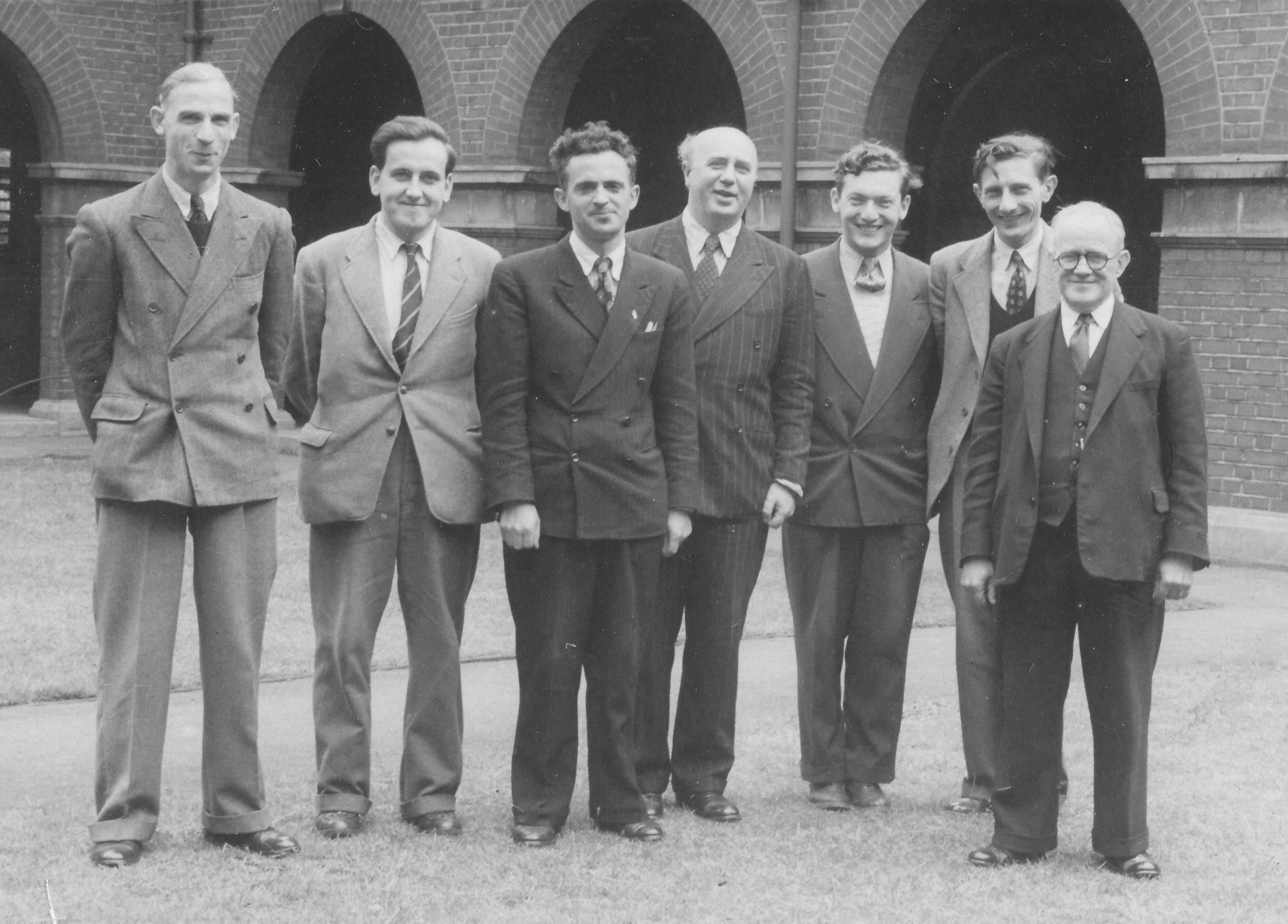
Wade was Southern Counties (SCCU) champion for the 1956-57, 1957-58 and 1964-65 seasons.
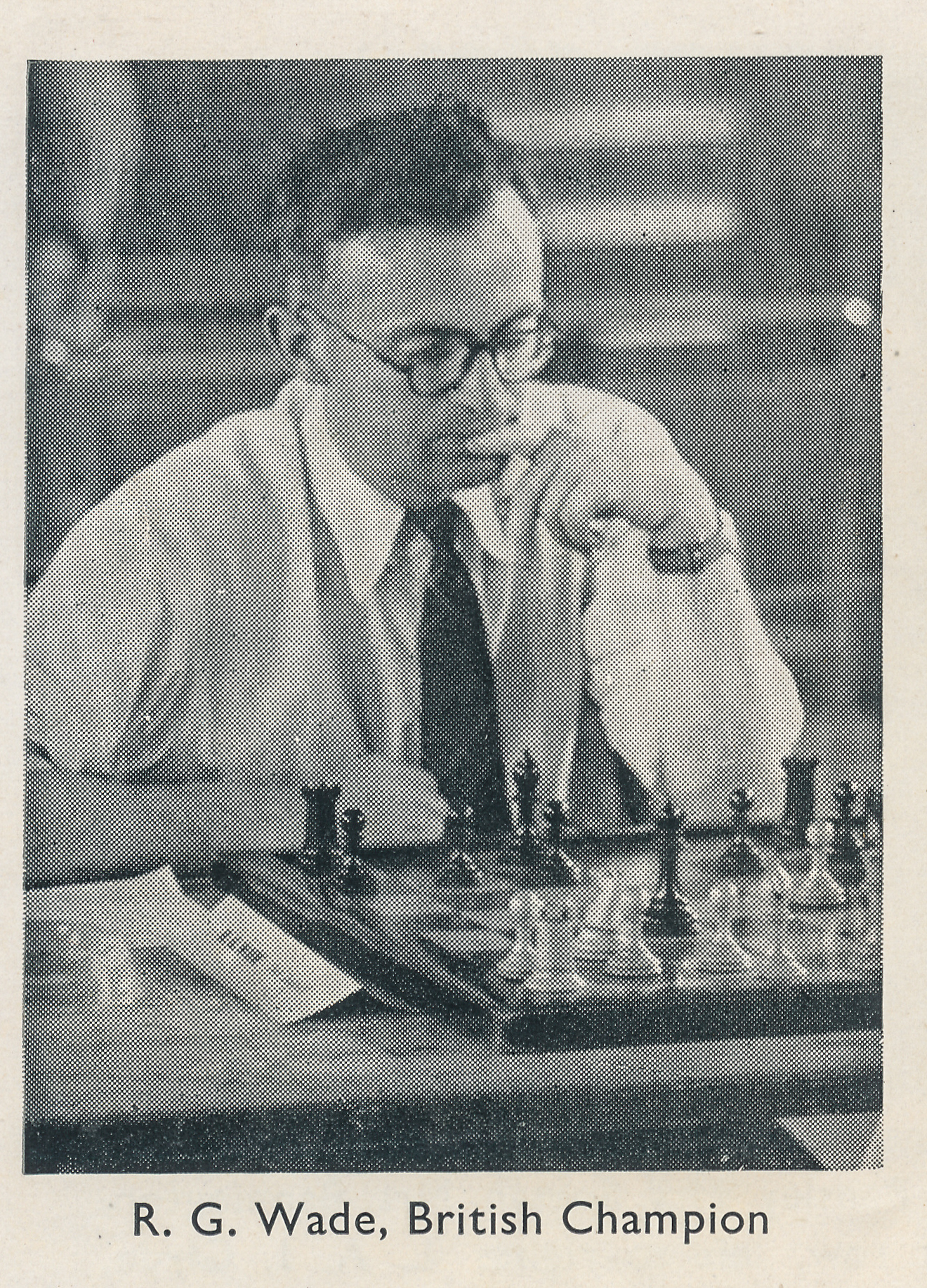
From the Preface of The World Chess Championship : 1951 by Lionel Sharples Penrose we have :
“Mr. Wade is also passionately devoted to the game. Before coming to Europe, he was three times champion of New Zealand. He had played in tournaments in England but his chief successes have been on the Continent. At Venice in 1950, he obtained a high place in a very severe contest in which some of the strongest Russia, Czech, Dutch, French, Italian, North and South American players took part. Much of his time is occupied in chess organising and teaching. He is an acting vice-president of the F.I.D.É and in this official capacity he attended the match in Moscow, which is the subject of this book.”
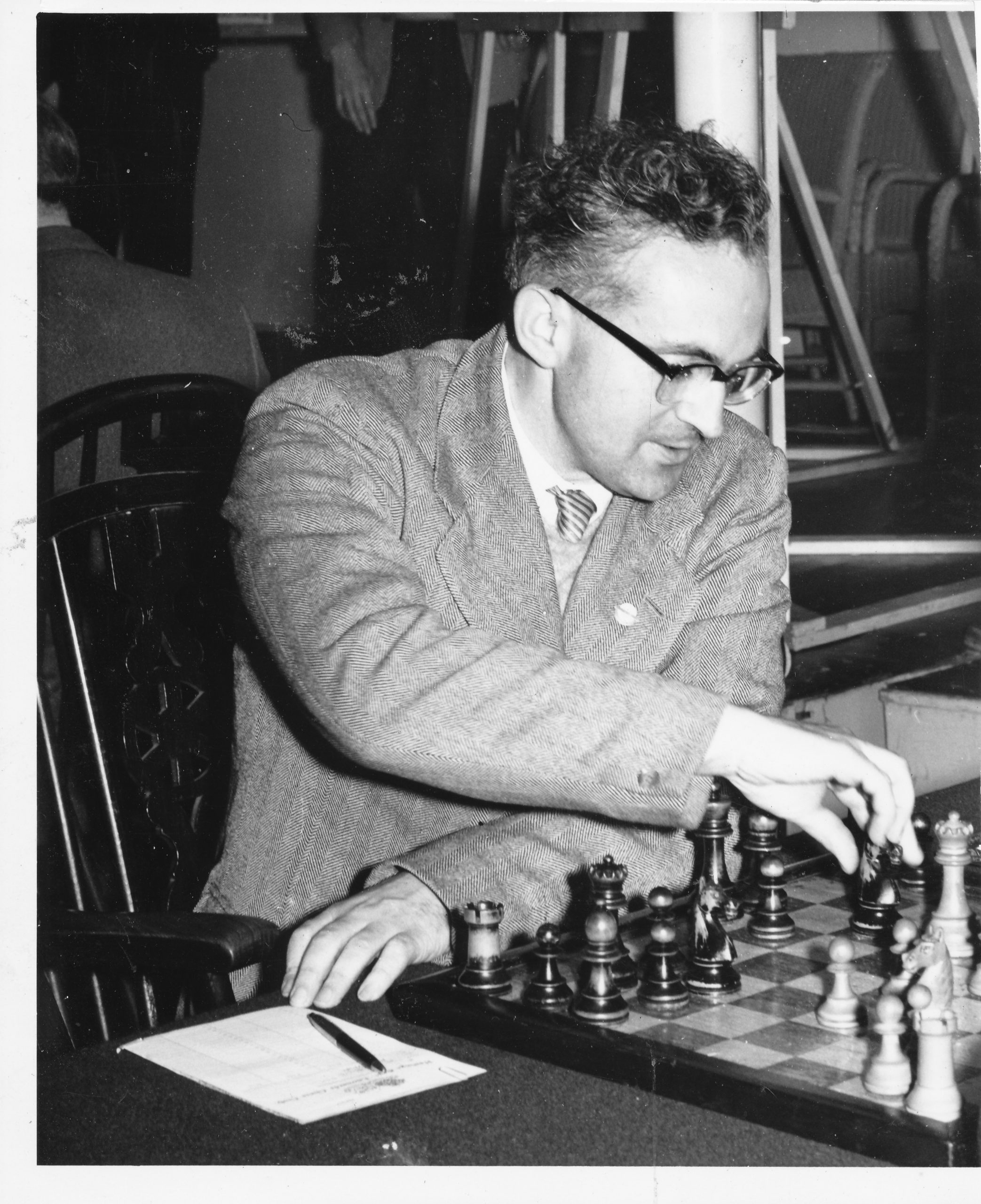
Paul McKeown researched (and Simon Spivack asked permission to reproduce his words) the earliest part of Bob’s life as follows:
“On May 20th, 1919, Thomas Graham Wade, aged 27, Sergeant in the NZ Expeditionary Force, repatriated with honour from war-time service in Egypt, Gallipoli and France, married Amy Lilian Neave, aged 21, in South Dunedin. A New Zealander of Scots and English descent, his family was Graham from Montrose. The family name, Wade, came from Marshall George Wade, the soldier and engineer who led the Hanoverian forces against the Scots at the time of the 1745 Jacobite Rebellion and was immortalised in the original third verse of the British national anthem:
Lord, grant that Marshal Wade,
May by thy mighty aid,
Victory bring.
May he sedition hush and like a torrent rush,
Rebellious Scots to crush,
God save the King.
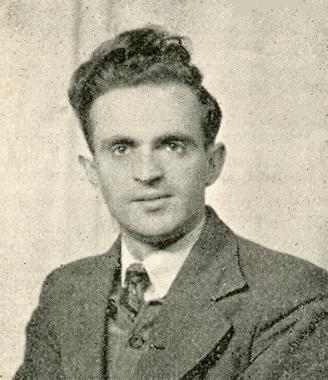
Robert Graham Wade, known in the Scots manner to his family as Robin, and later to his many friends as Bob, was their first child, born April 10th, 1921, at Dunedin. Over the next few years he was joined by sisters, Lilian, Agnes, Betty, June, his brother Ted and finally by his youngest sister Amy. The family lived for a number of years at Portobello.
At that time, Portobello was a scattered community of about 150 people with three shops and a pub on the Otago Peninsula. Bob attended Portobello Primary School, a small country school, finished “dux” or top of class, and then attended the King Edward Technical High School at Stuart Street in Dunedin.”
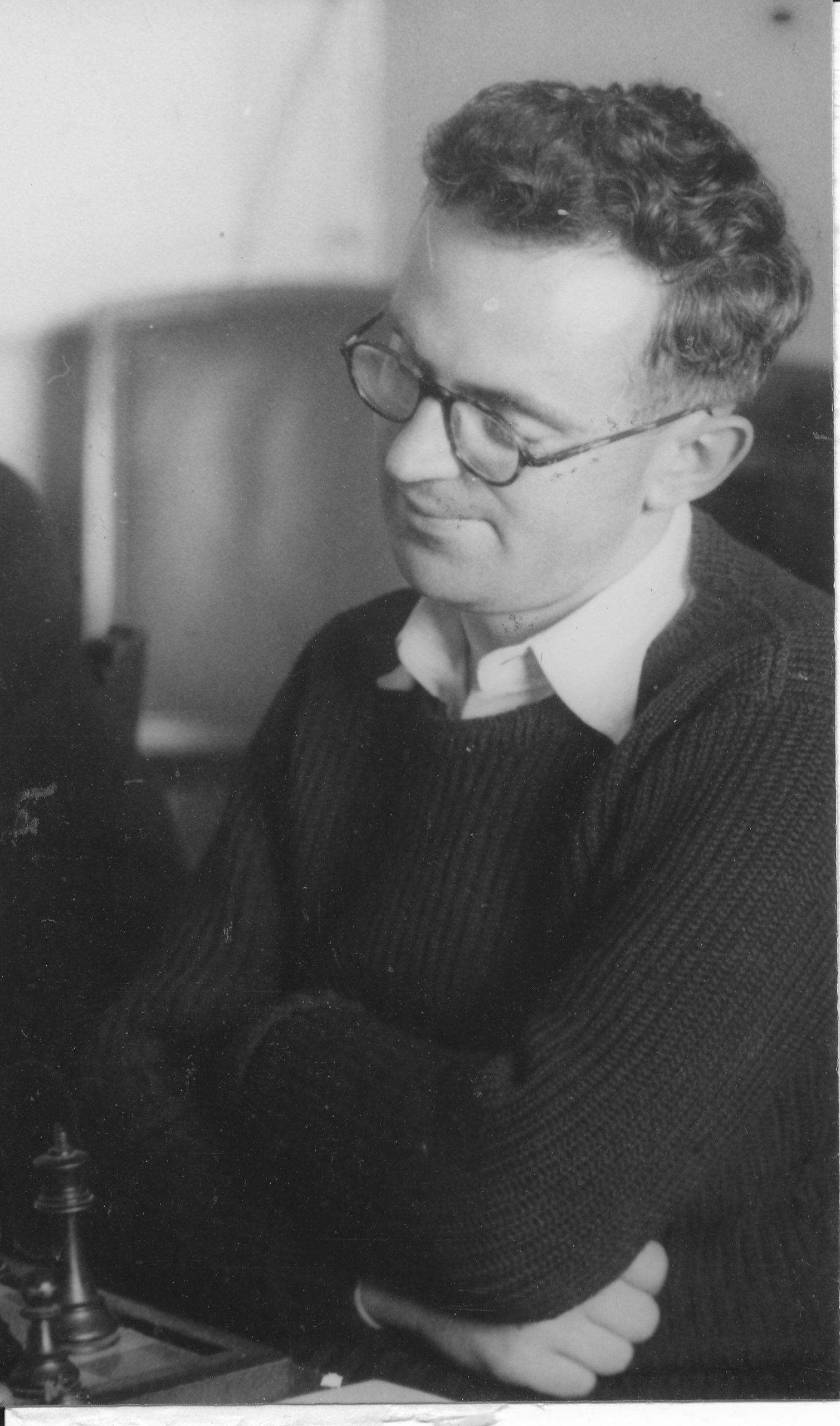
In The Oxford Companion to Chess (OUP, 1984 & 1996), Hooper & Whyld:
“Wade Variation, 147, also known as the Modern Variation, in the Queen’s Gambit Declined, Meran Variation, from Bogoljubow-Wade, Oldenburg, 1949;
1239 in the French Defence, introduced by Wade in a match against Schmid in 1950.
Hooper & Whyld go on to write :
“New Zealand-born Robert Graham Wade (1921- ) won the championship of his homeland three times before moving to England as a young man, He won the British Championship twice and trained many English players.”
Aside from the two variations mentioned by Hooper & Whyld there are other Wade Variations :
which Jim Plaskett dubbed the “Sidestep Variation”
and
which is the Pytel-Wade Variation of the Scandinavian Defence.
Anne Sunnucks wrote in The Encyclopaedia of Chess (Robert Hale, 1970 & 1976) :
“International Master (1950), International Judge (1958), New Zealand Champion three times and British Champion in 1952 and 1970.
Bob Wade was born in New Zealand on 10th April 1921 and is a professional chess player. He has lived in England for many years and has played regularly for the British Chess Federation team in Chess Olympiads. He has played a prominent part in coaching schemes for juniors and is largely responsible for recent successes of English juniors in international events.
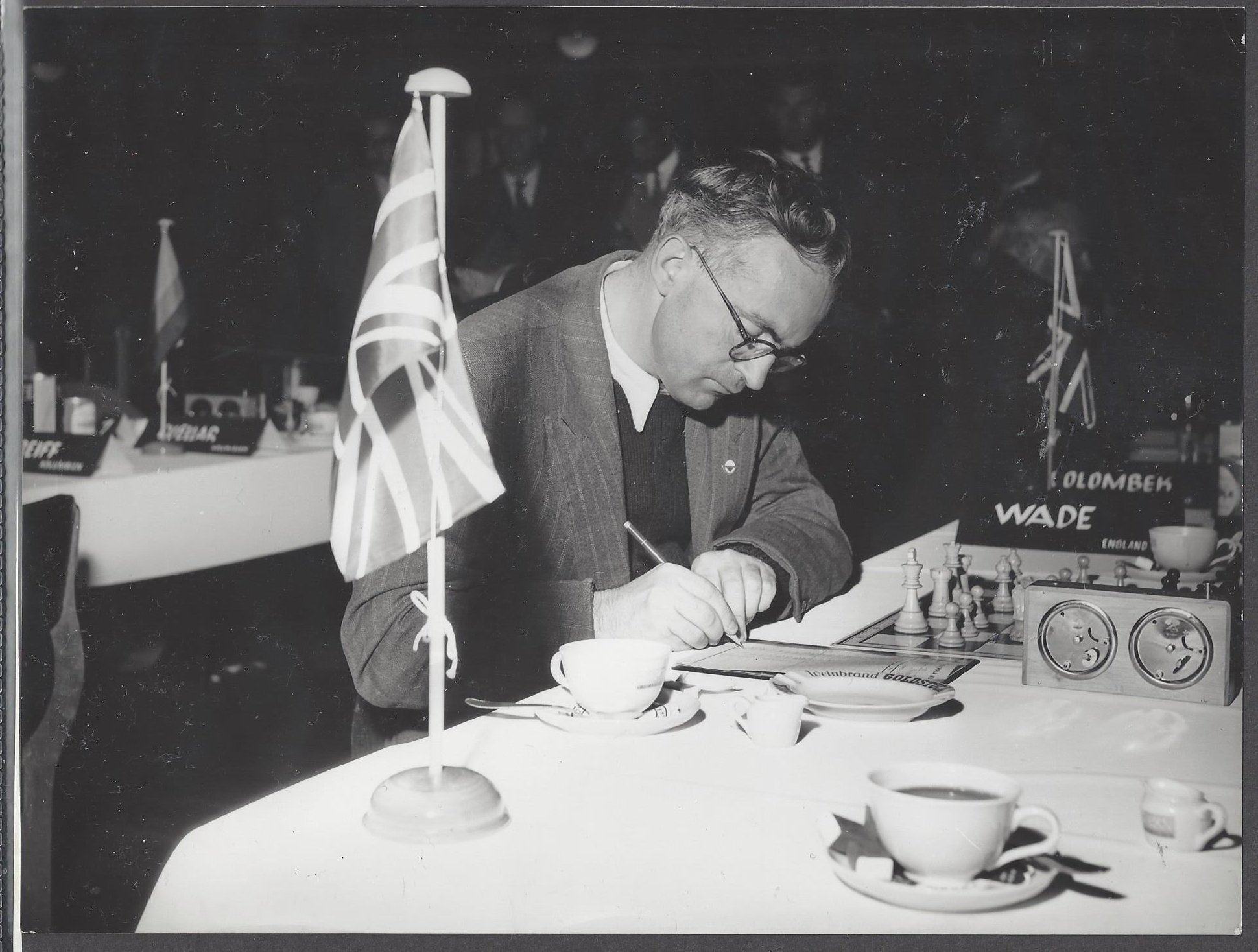
He is chess correspondent of Associated Newspapers and Independent Television News and editor of a series of books on Contemporary Chess Openings published by Batsford.
Author of a number of books on the game, his publications include books on the World Championship of 1951, 1957 (ed : this book was, in fact, by Golombek) and 1963, the first in collaboration with W. Winter; The Closed Ruy Lopez (Batsford, 1970) in collaboration with LS Blackstock and PJ Booth: World Chess Championship (Batsford, 1972) in collaboration with Svetozar Gligoric; Games of RJ Fischer (Batsford, 1972) in collaboration with KJ O’Connell and Soviet Chess (Neville Spearman, 1968).
Wade was a member of the FIDE Laws Commission from 1950 to 1952.”
From The Encyclopedia of Chess (Batsford, 1977), Harry Golombek OBE :
“International Master who was born at Dunedin, New Zealand, but came to live In England in 1946 and has represented both countries on different occasions. He has nearly always done well in British Championships and won the title in Chester in 1952 and again at Coventry in 1970. He had played for the British Chess Federation at the Olympiads of 1954, 1956, 1958, 1960 and 1962, winning the shortest game of the Varna Olympiad in that year in nine moves against Anton Kinzel of Austria
He played for the New Zealand team at the 1970 Olympiad at Siegen but returned to the BCF team at Skopje in 1972.
His best individual international results were a fifth place at Venice 1950 and again fifth at the Masters section of the Capablanca Memorial at Cienfuegos in Cuba in 1975. Possessor of a sharp clear-cut style of play, he once drew a match with the West German grandmaster Lothar Schmid with neither side drawing a game, though this was before Schmid received the grandmaster title.
He has done much valuable work in England teaching the young, and was responsible for the text of a highly successful television series in 1975.
His main books are : Soviet Chess, London, 1967; Botvinnik-Bronstein Match 1951 (in co-operation with W. Winter), London, Toronto 1951; Match Petrosian-Botvinnik, London, 1963; Sousse 1967, The Chess Player, Nottingham, 1968.”
From British Chess (Pergamon Press, 1983) we have this article from George Botterill :
“In the Birthday Honours list of 1979 Bob Wade was awarded the OBE for his services to chess. Few rewards can have been more thoroughly earned. For some reason, Bob has always been held in greater esteem abroad than in the country for which he has done so much. But the many players who have turned to him for advice or who have simply enjoyed his hospitality, which is always ungrudgingly available to fellow chess players, know the measure of his dedication to the game.
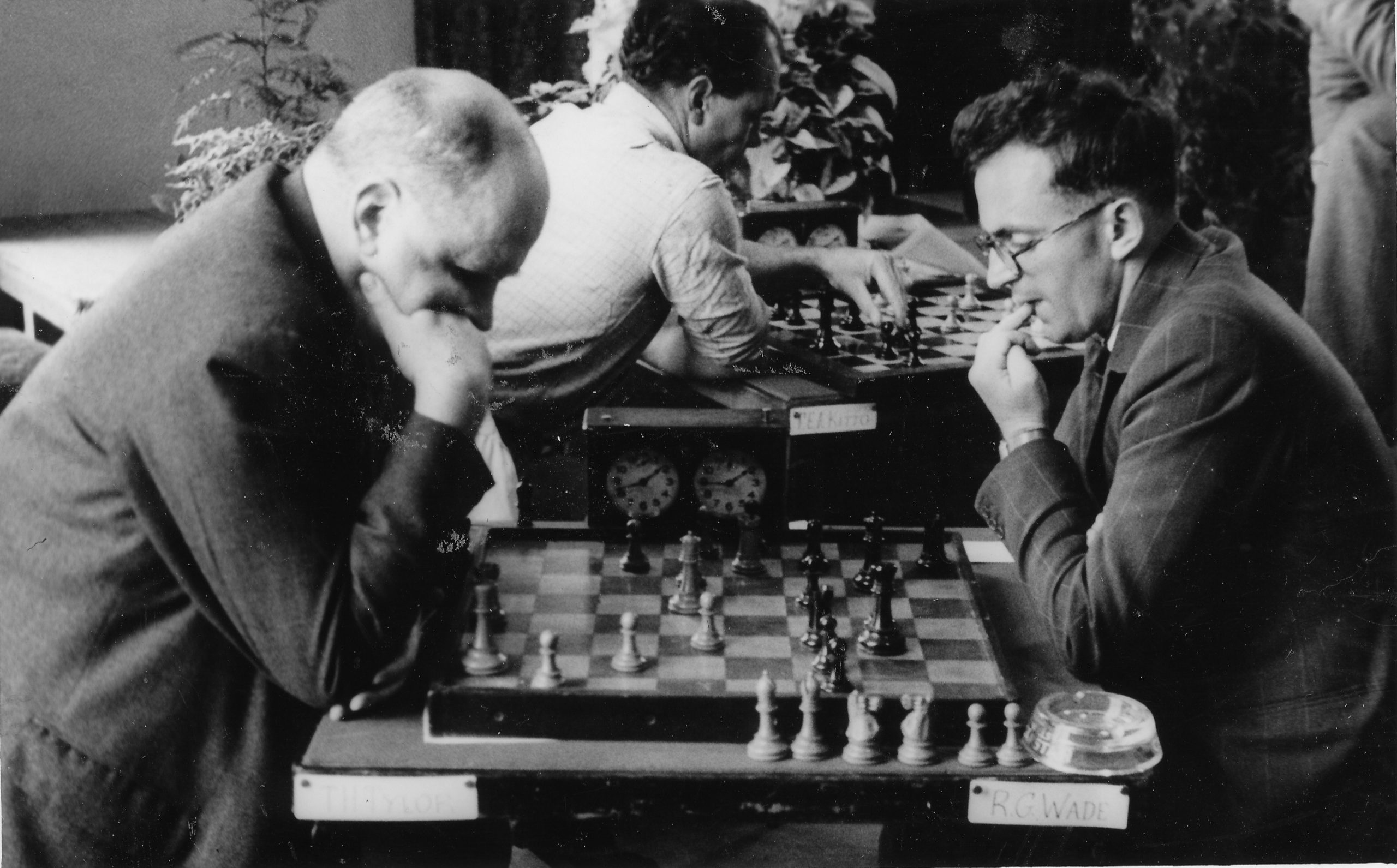
Wade was born in Dunedin, a third generation New Zealander of Scots and English ancestry. He started a a career as a civil servant in the Department of Scientific and Industrial Research. Having won the New Zealand Championship in 1944 and 1945 he was sent over to participate in the British Championship of 1946. The result was not exactly a success – a mere 3.5 points out of 11. But Bob was not to be disheartened so easily. Feeling he was capable of better things, he took leave of absence in 1947 and did the circuit, such as it then was, of chess tournament in Europe and North America.
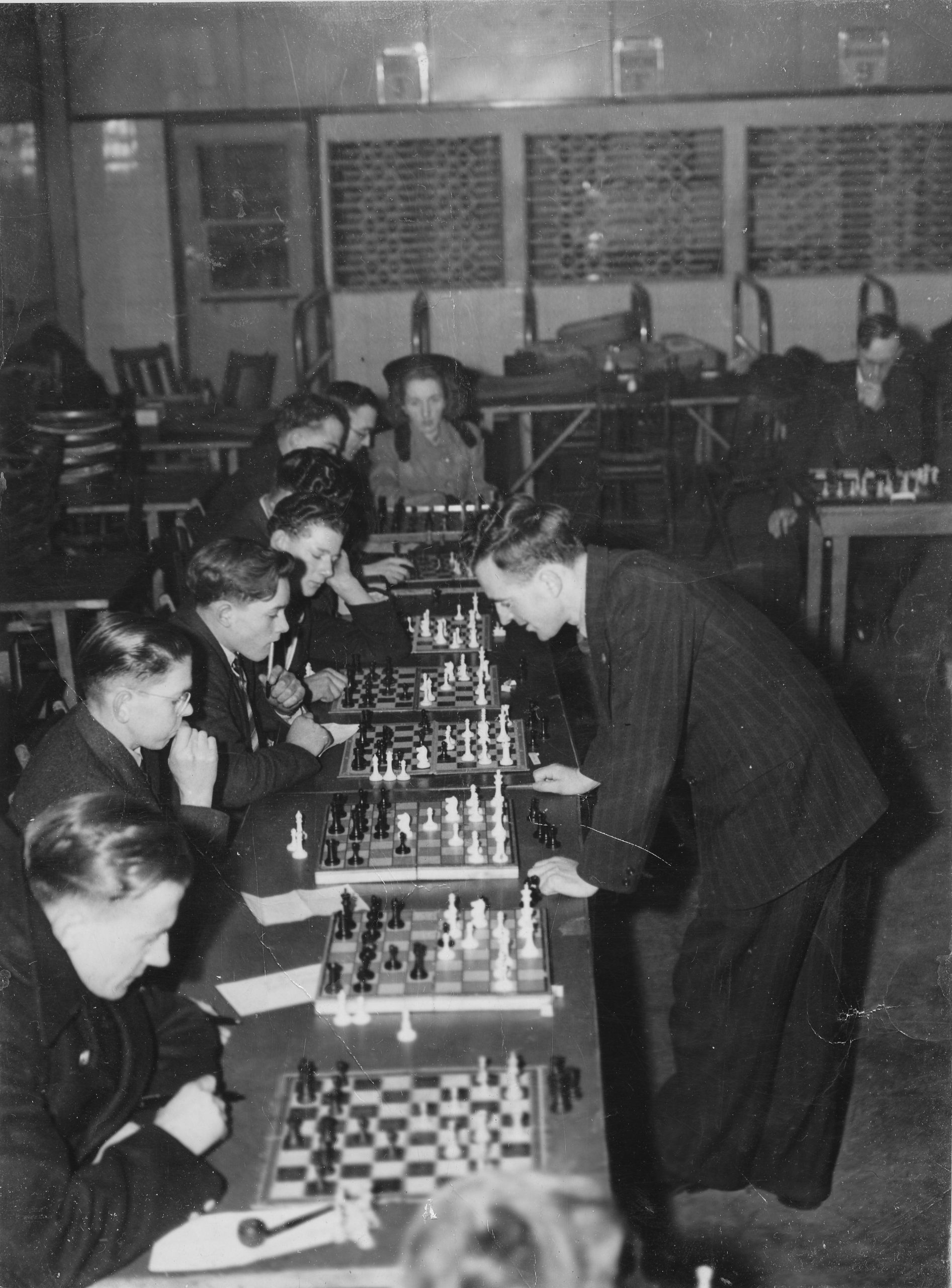
When he returned to New Zealand he found that he had been transferred to another department in a civil service reorganisation. The new job was not so congenial. He stuck it out for 6 months – during which time he won the New Zealand Championship for a third time – and then handed in his resignation to take up the precarious life of a chess professional.
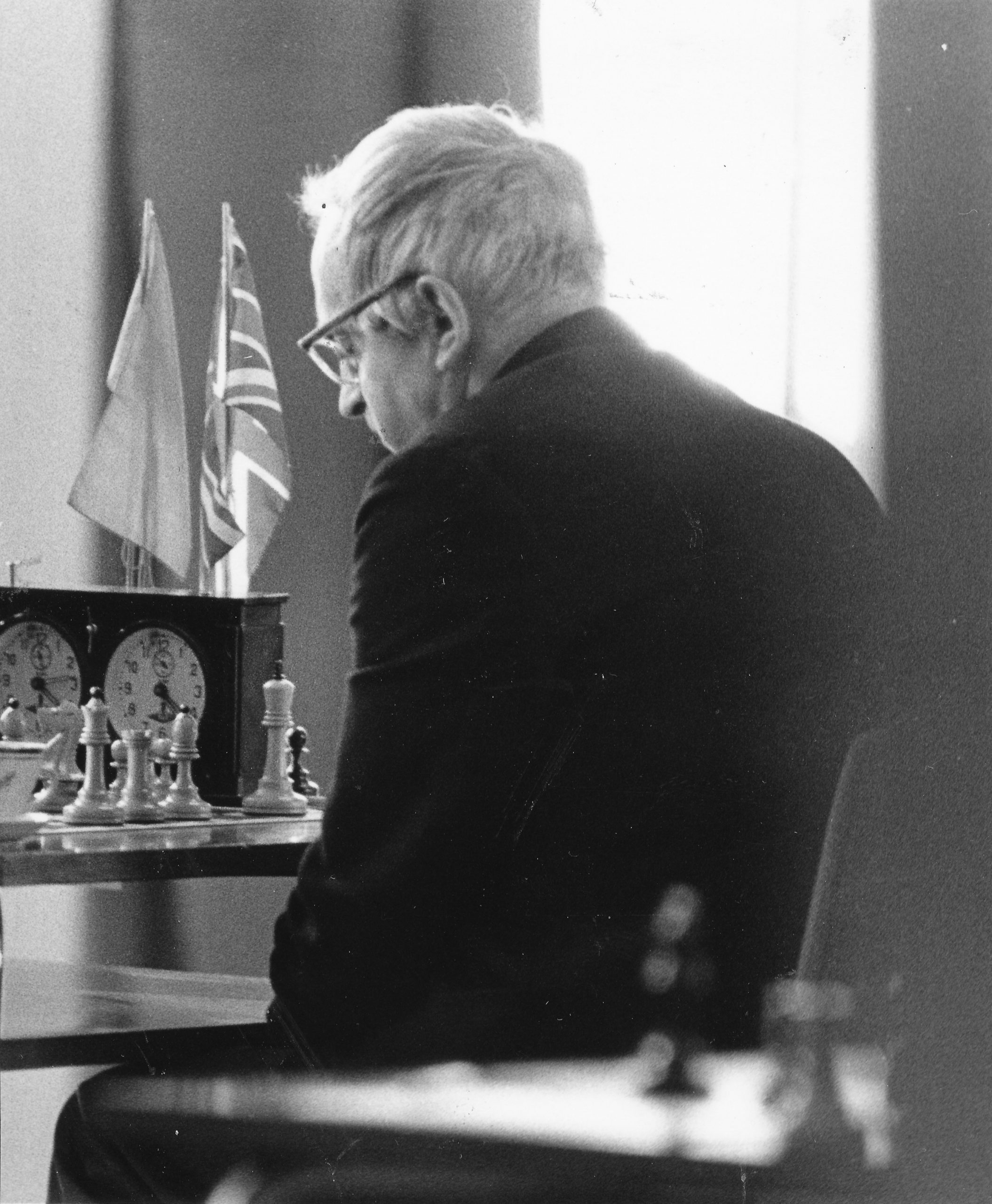
Settling in Britain he soon gained the IM title (ed : 1950). But even in those days when still a young man Wade did not concentrate exclusively on his own playing career. In 1949 he went to the FIDE congress and was one of the five people – the others were BH Wood, Ragozin, Zubarev and Rogarde – who collaborated on the writing of the official rules for the game.
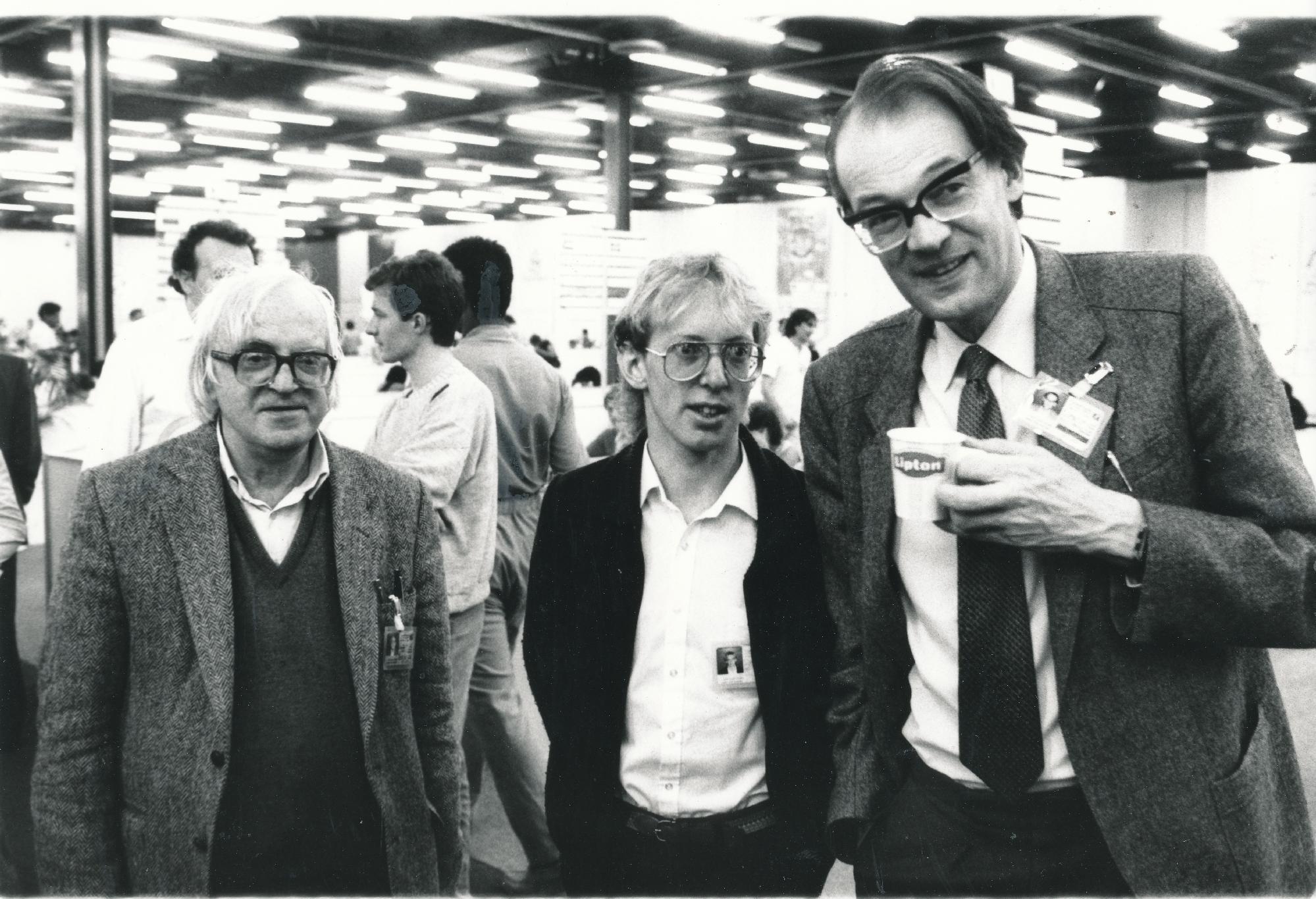
He also served as a member of the commission that determined who the original holders of international titles would be. When you consider that Wade was also on the 1950 commission that decided the composition of the World Championship Interzonals, it becomes apparent that this man played a significant part in the shaping the structure of modern international chess.
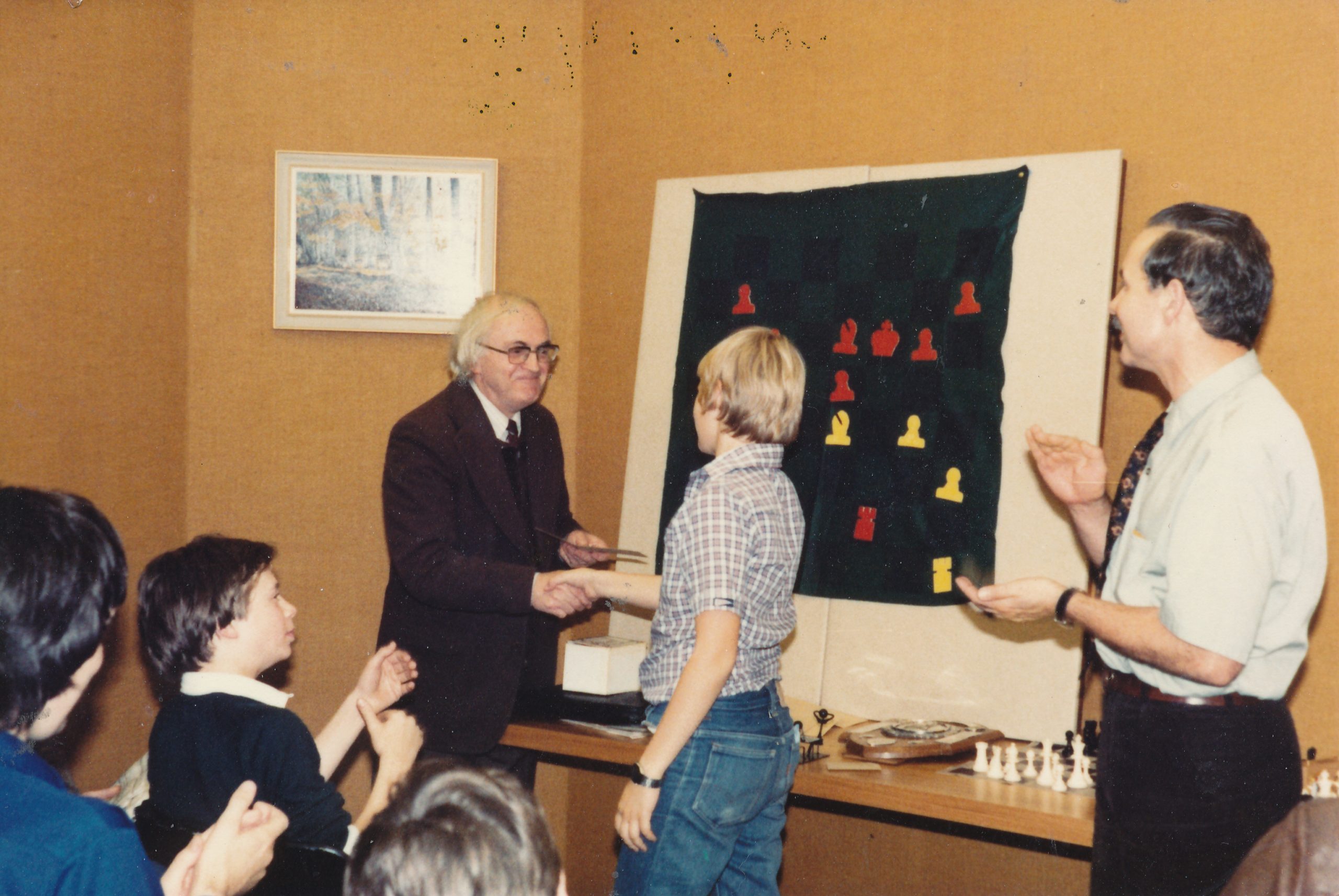
Although rarely at the top in international tournaments, Wade was always a very dangerous player, capable on his day of beating anybody in the world. He won the British Championship twice at Chester in 1952 and at Coventry in 1970.
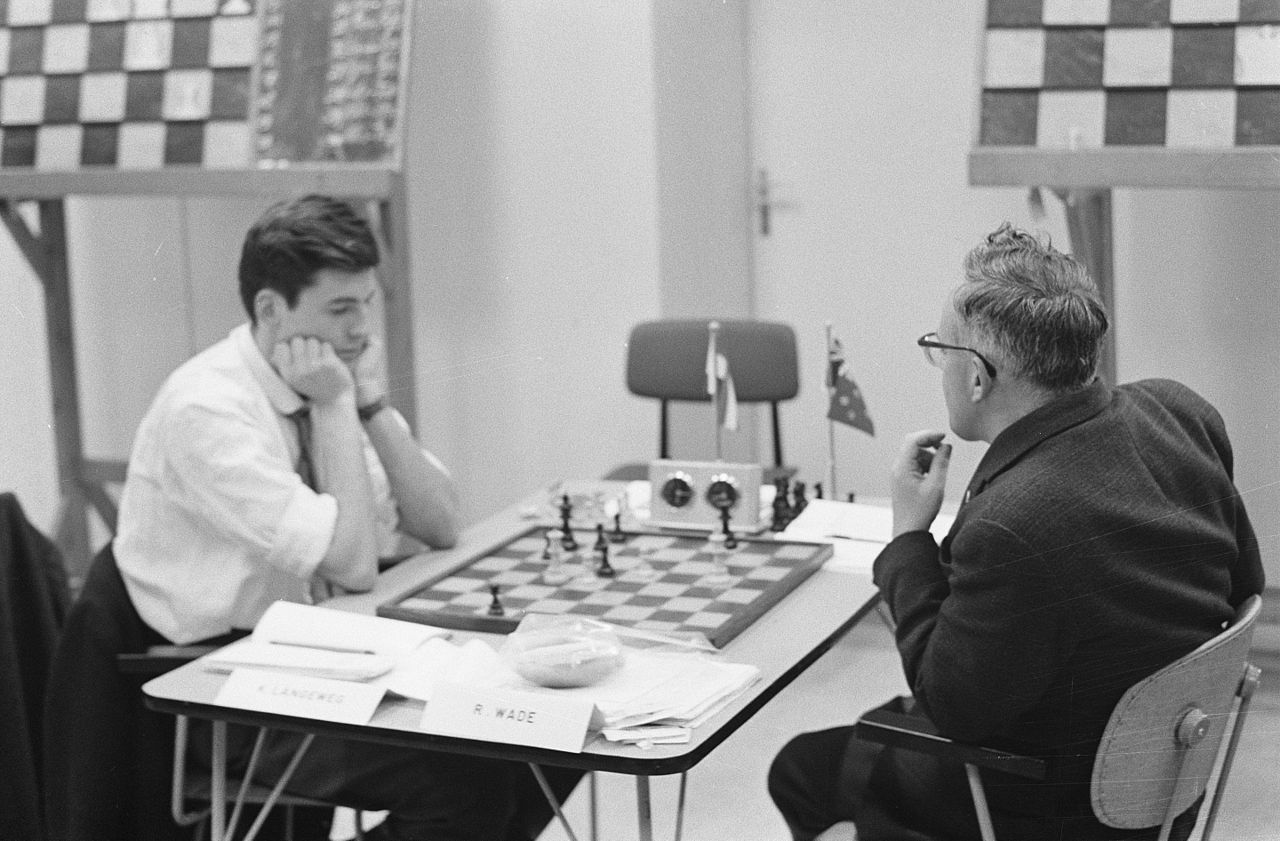
In recent years Wade has put his main energies into junior training and organisation and also into his work as the editor of Batsford’s highly productive and extremely successful series of chess books.
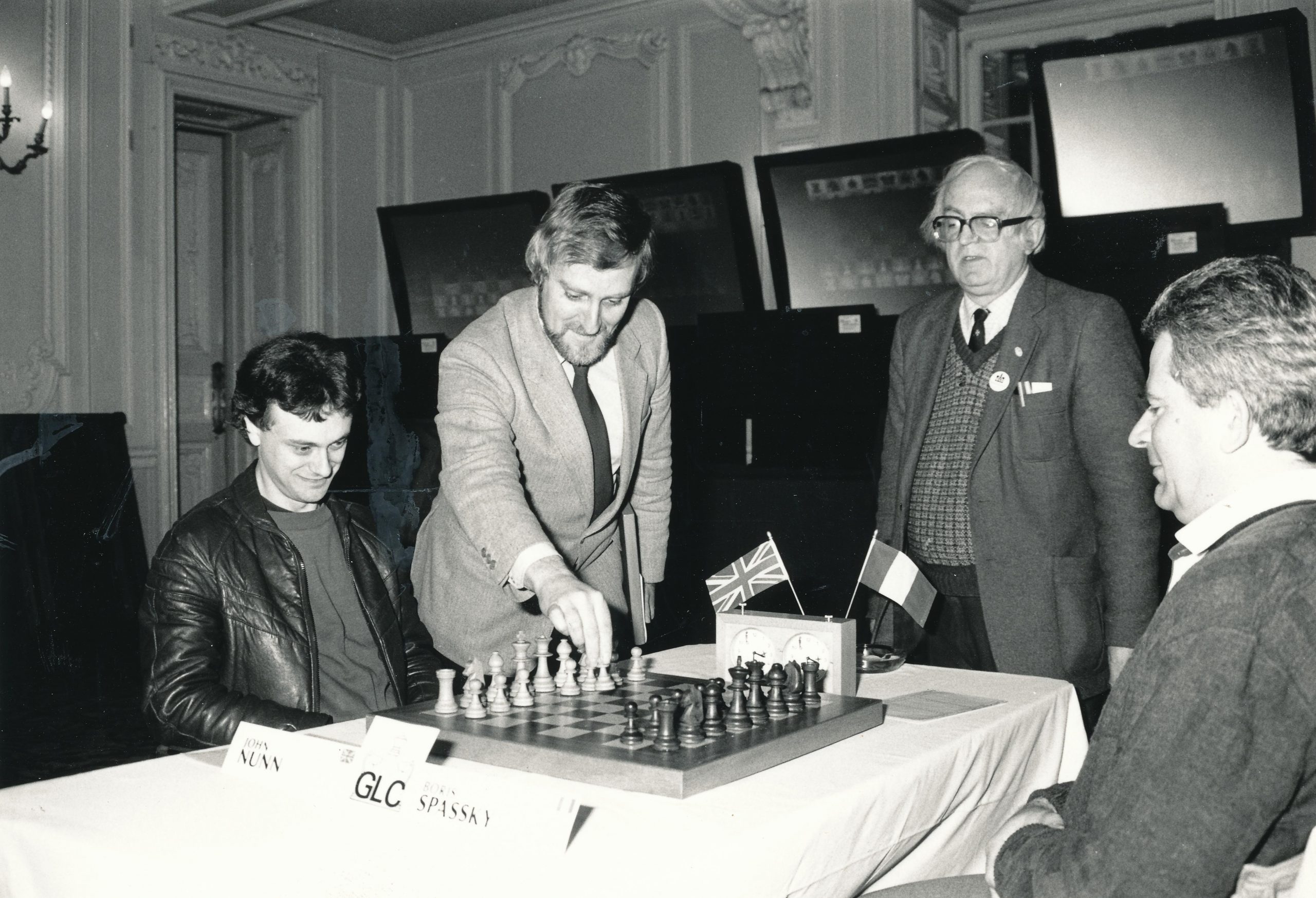
It is hard to say in what department one should place Wade’s greatest contributions to British Chess. Living through what is retrospect look to have been the Dark Ages of British chess – the 1950s and 1960s – he has demonstrated that even in a social and cultural environment that made playing chess economically ‘impossible’ profession to follow it was still possible to dedicate a life to chess, if one had the determination.
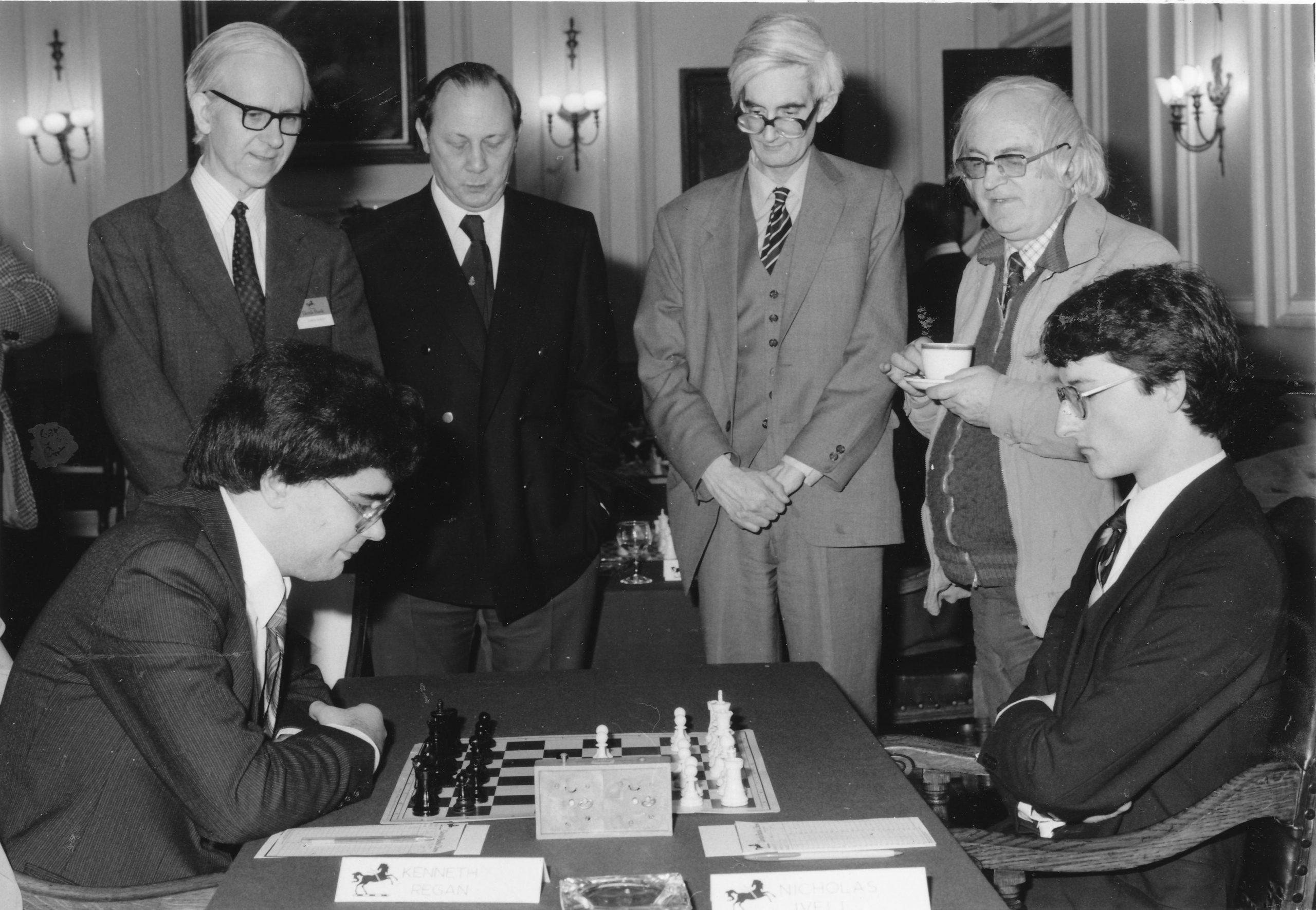
During those years he was really the only British Player who regularly active in international tournaments. Since then he has been constantly active as an author, editor and adviser, always working to transform Britain into a country more congenial to good chess.
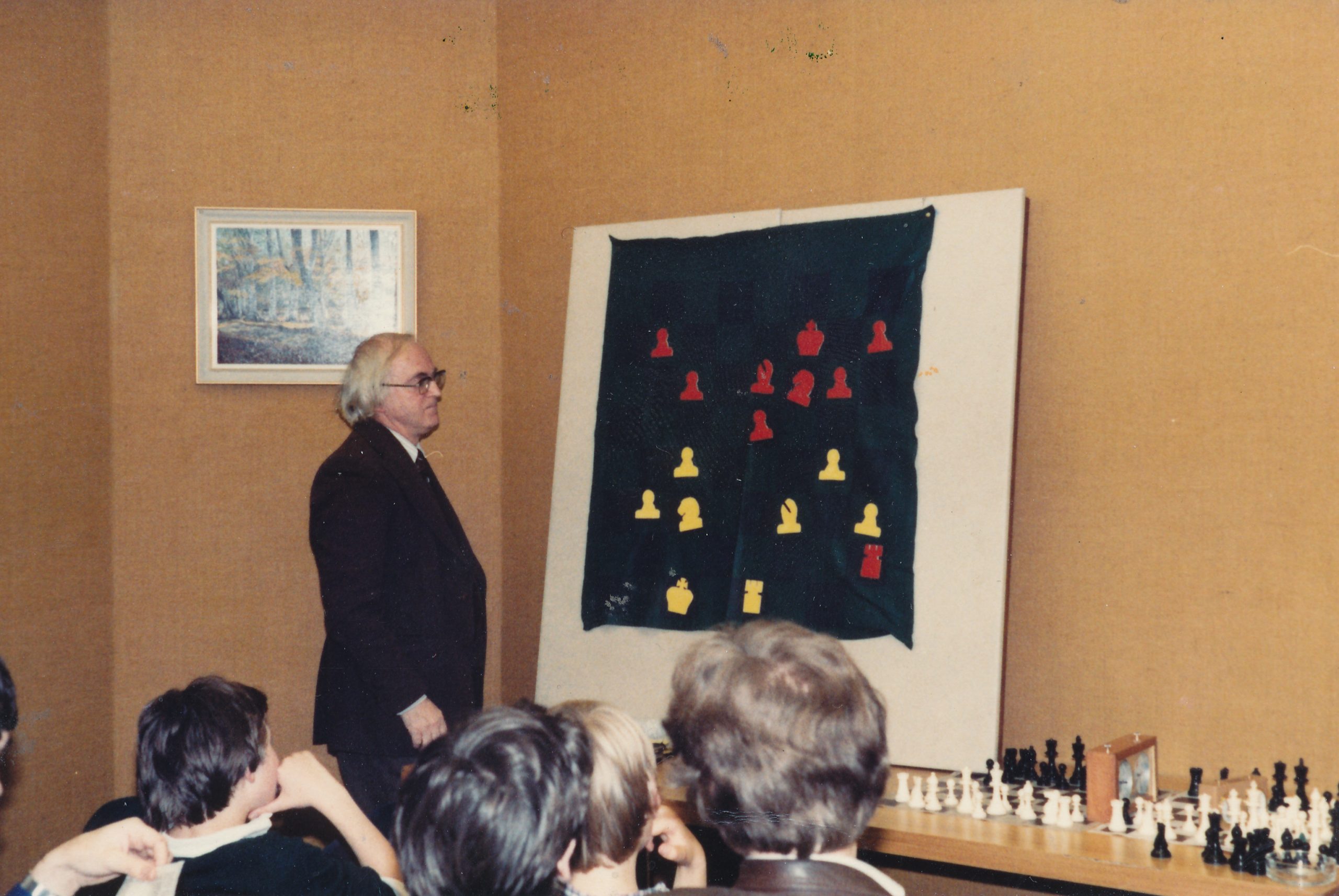
But we suspect that he might regard this role as trainer and coach as the most important thing of all. He is, quite appropriately the British Chess Federation’s Chief National Coach.
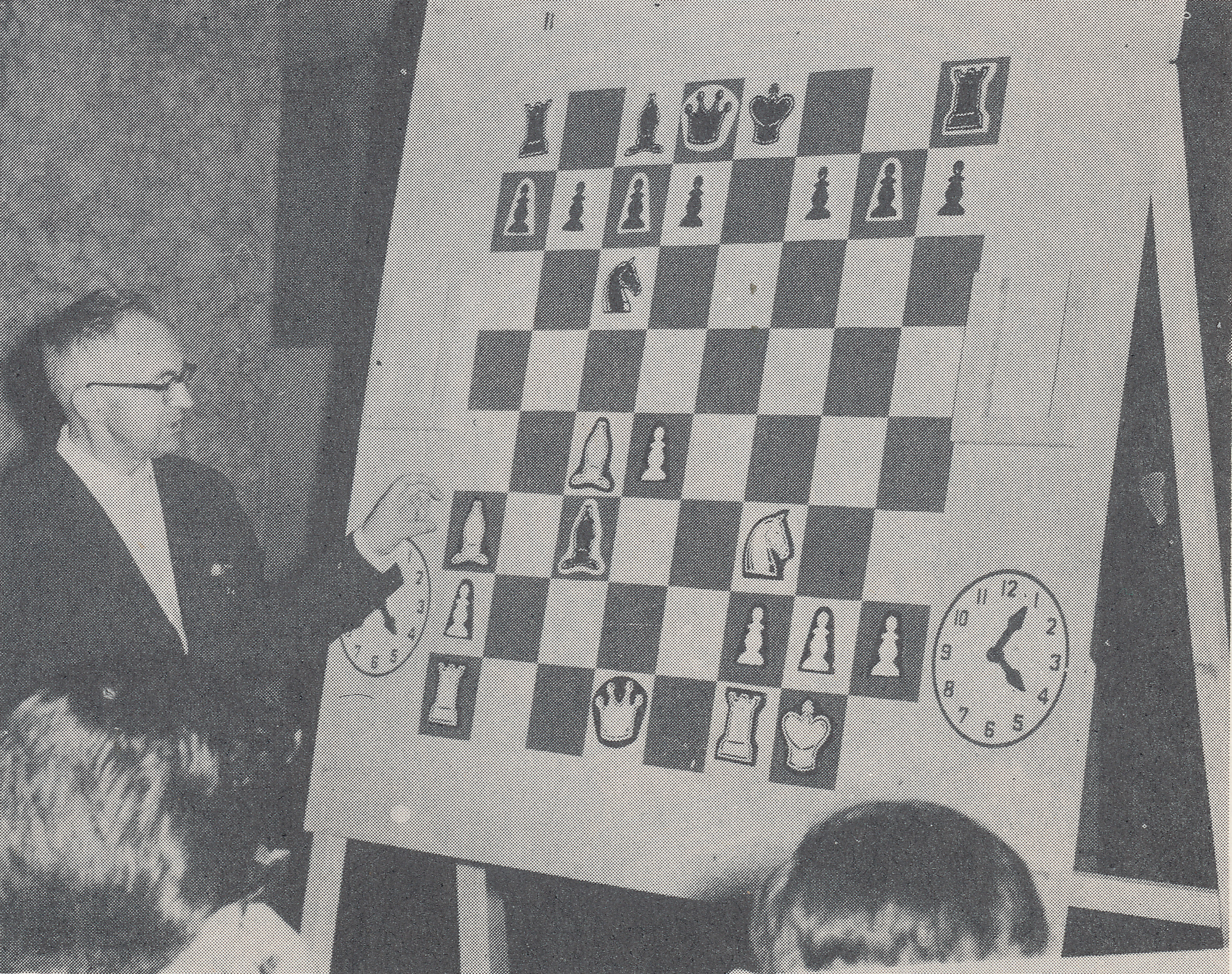
If one had to choose a single best game from Wade’s whole tournament career, it would probably be this one.
George Botterill
In the January 2009 issue of British Chess Magazine John Saunders wrote a ten page obituary as follows :
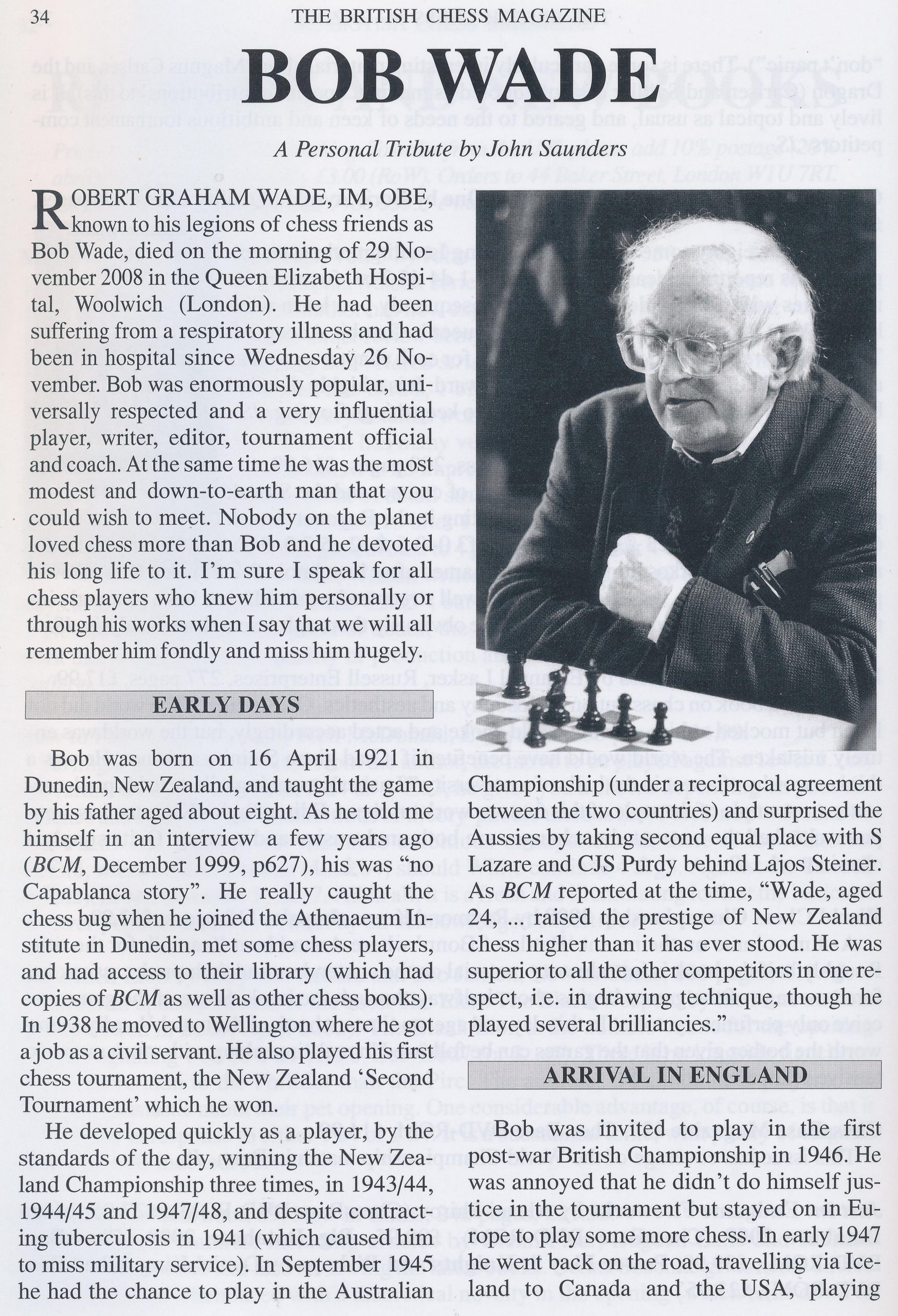
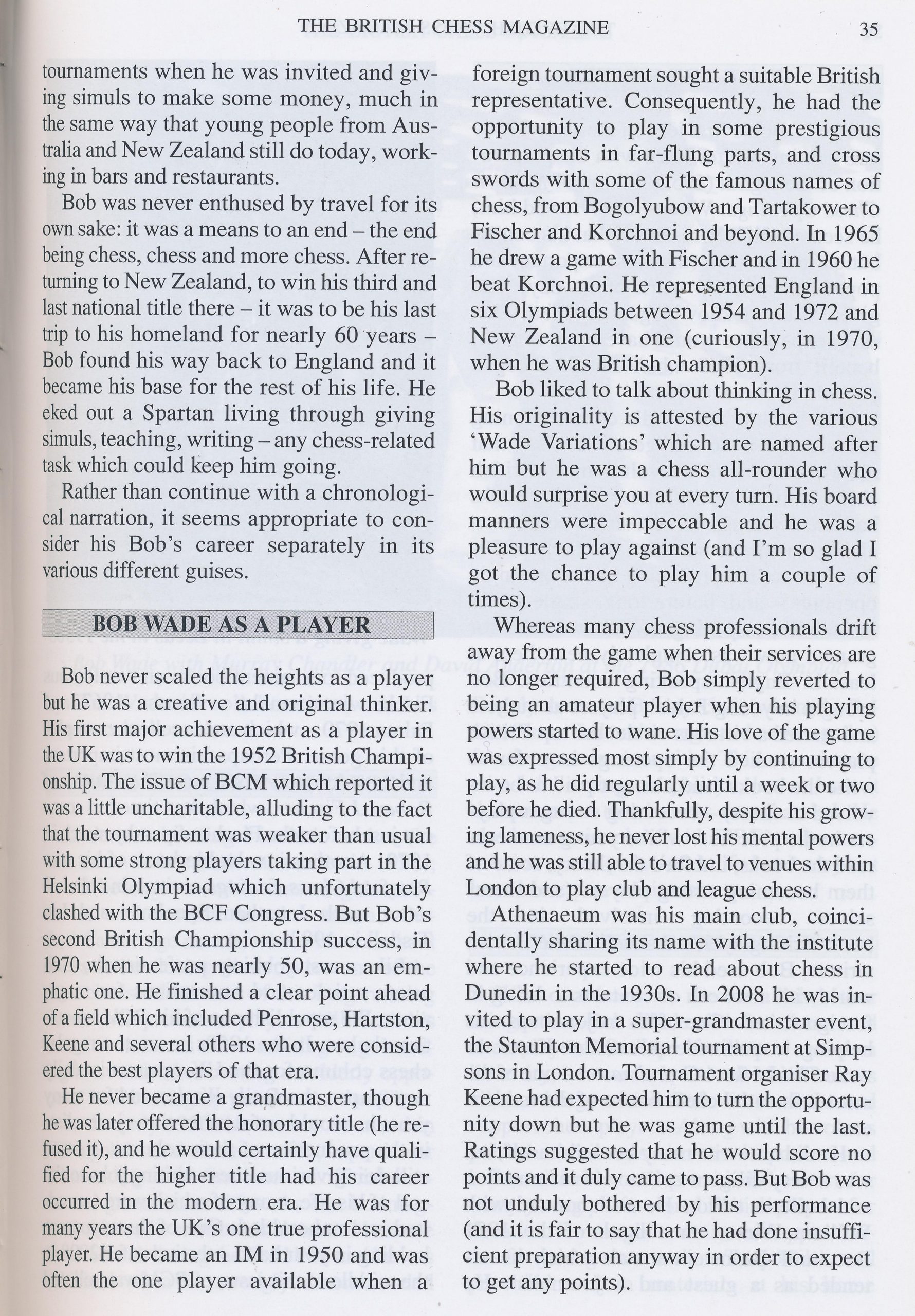
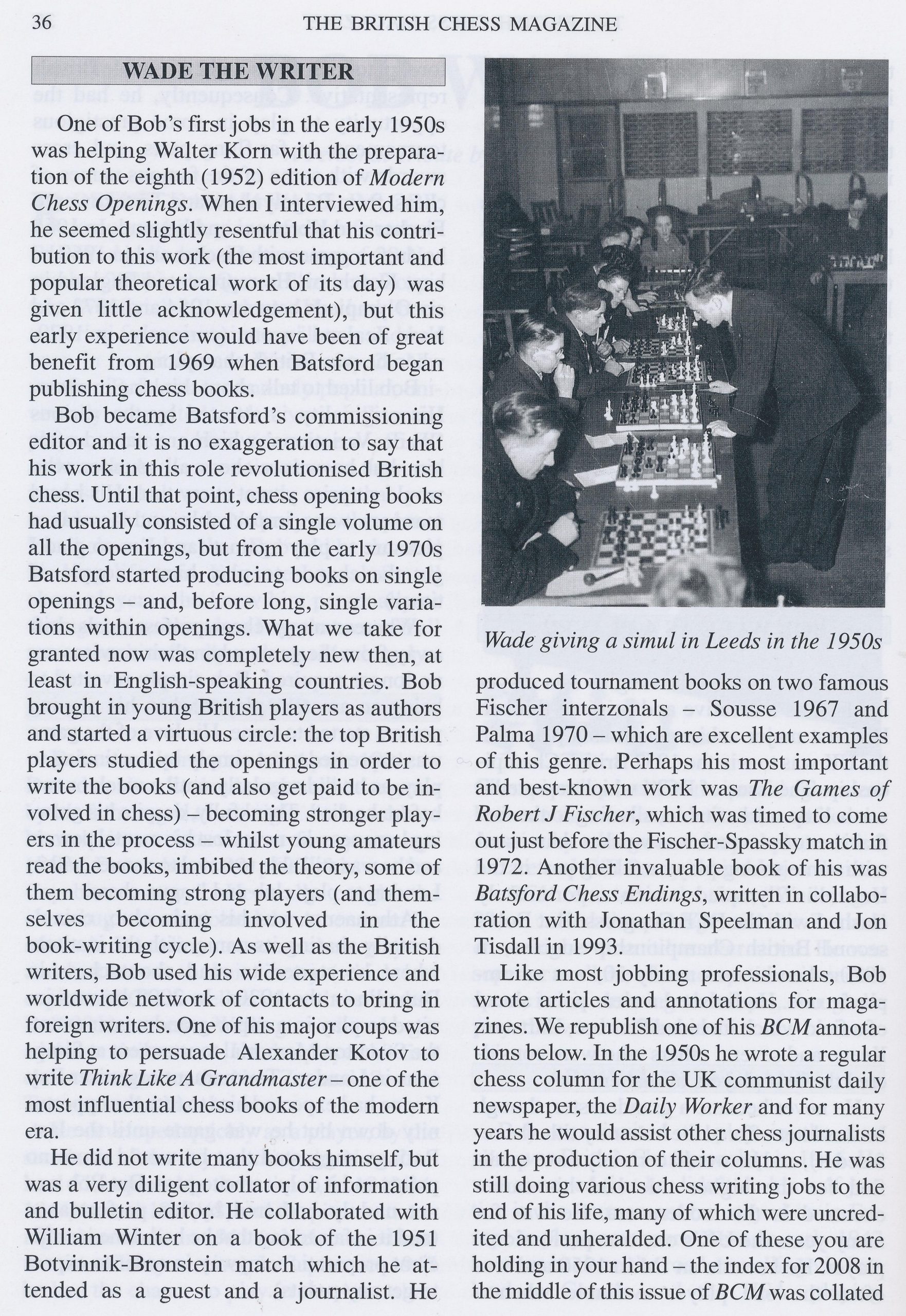
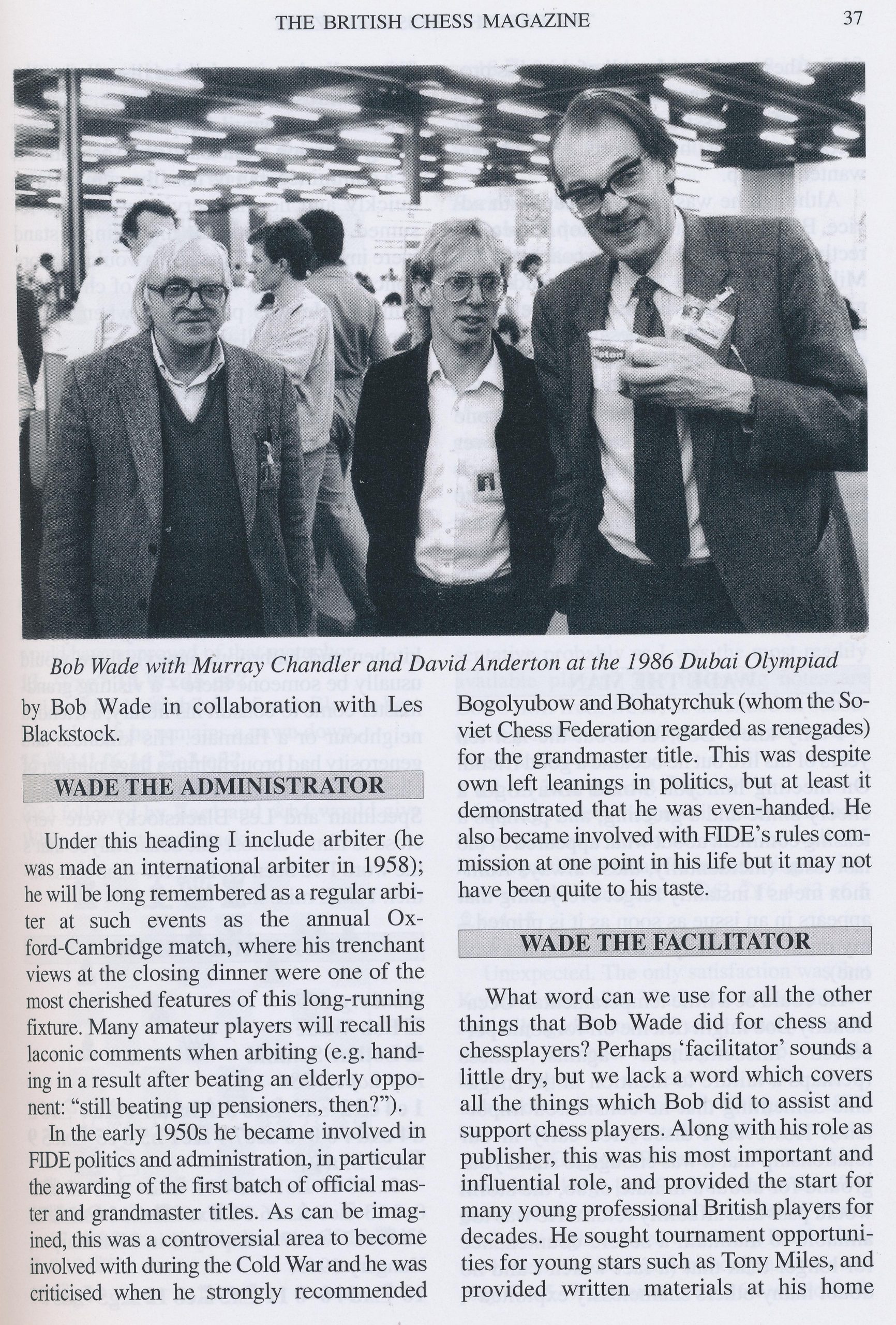
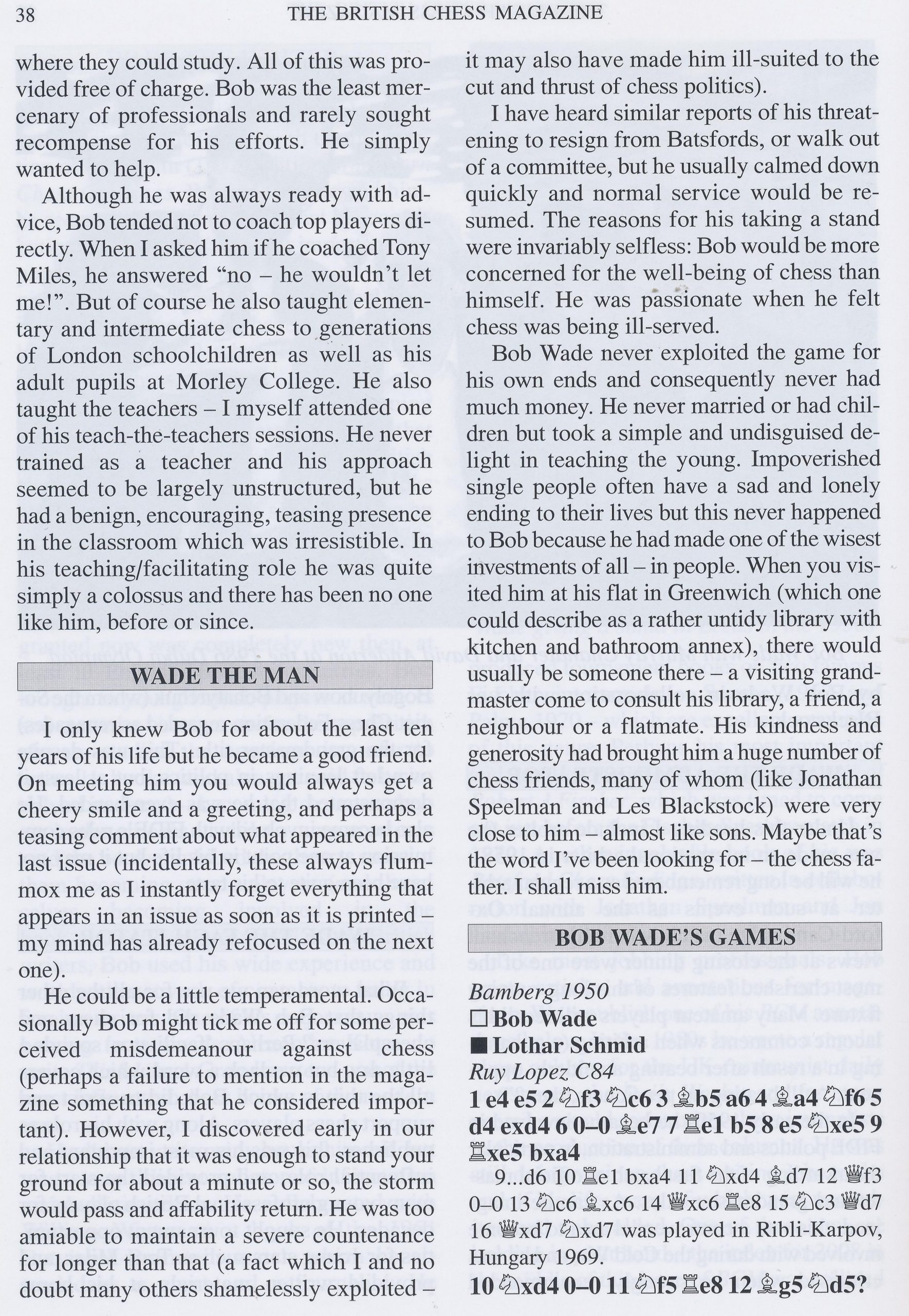
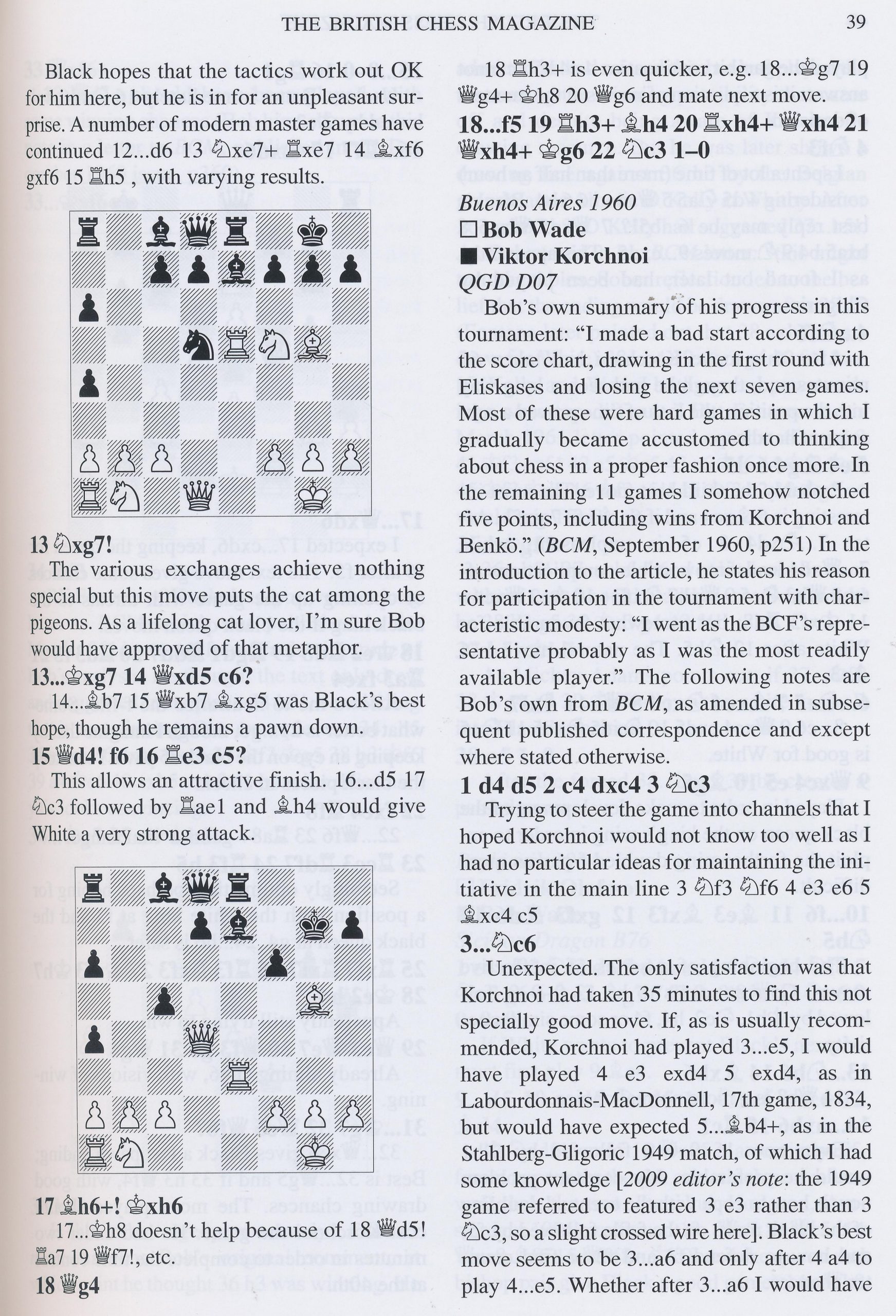
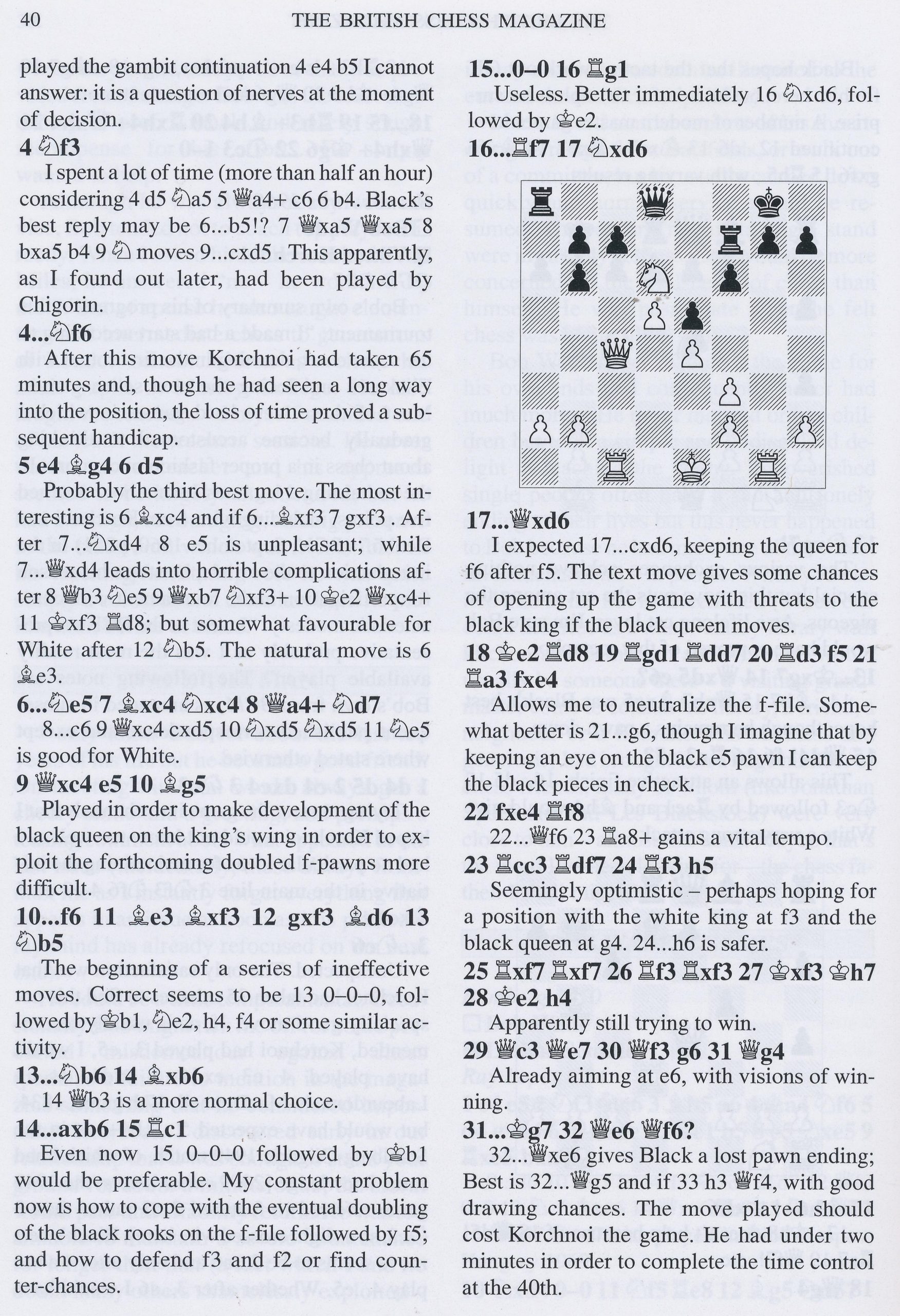
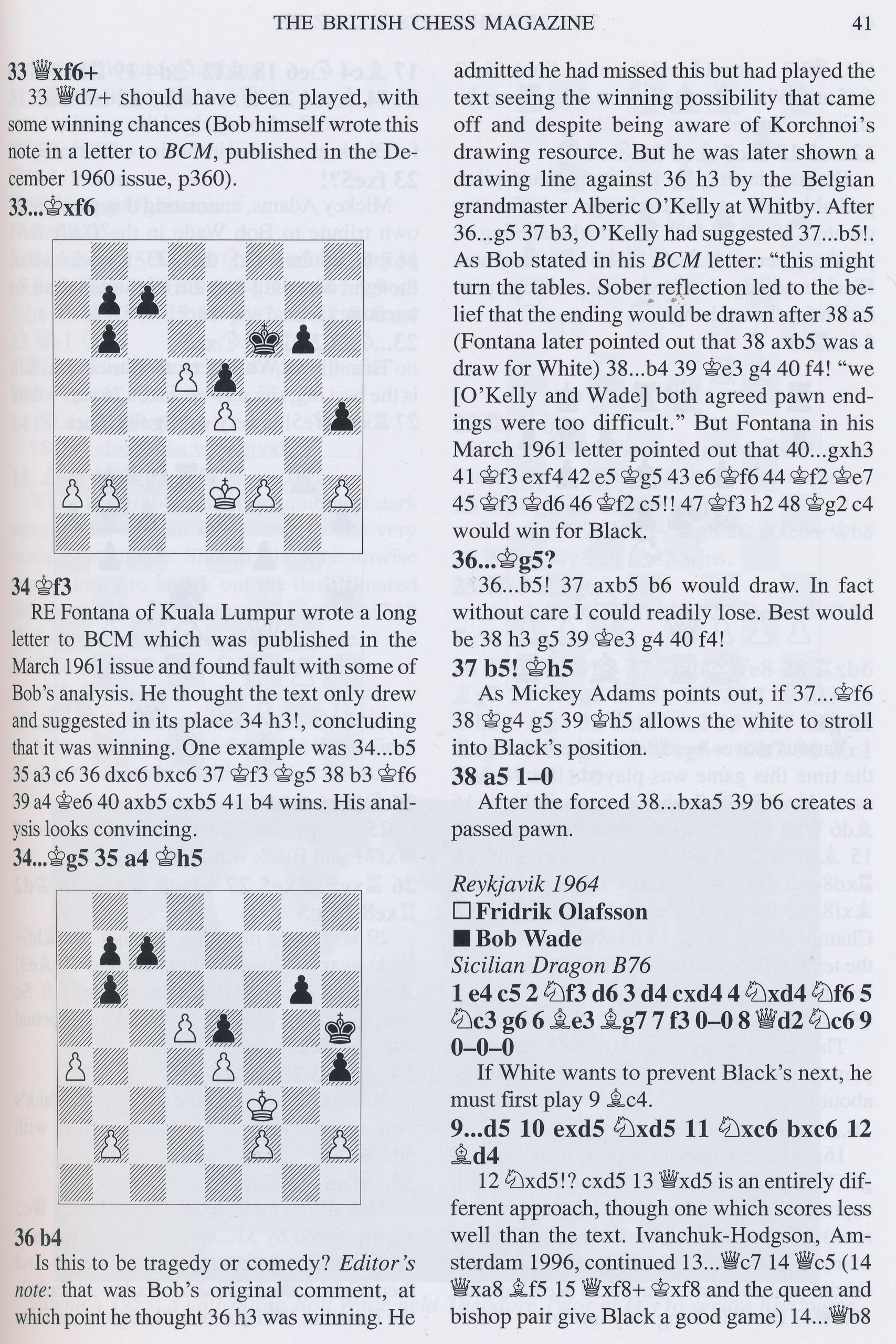
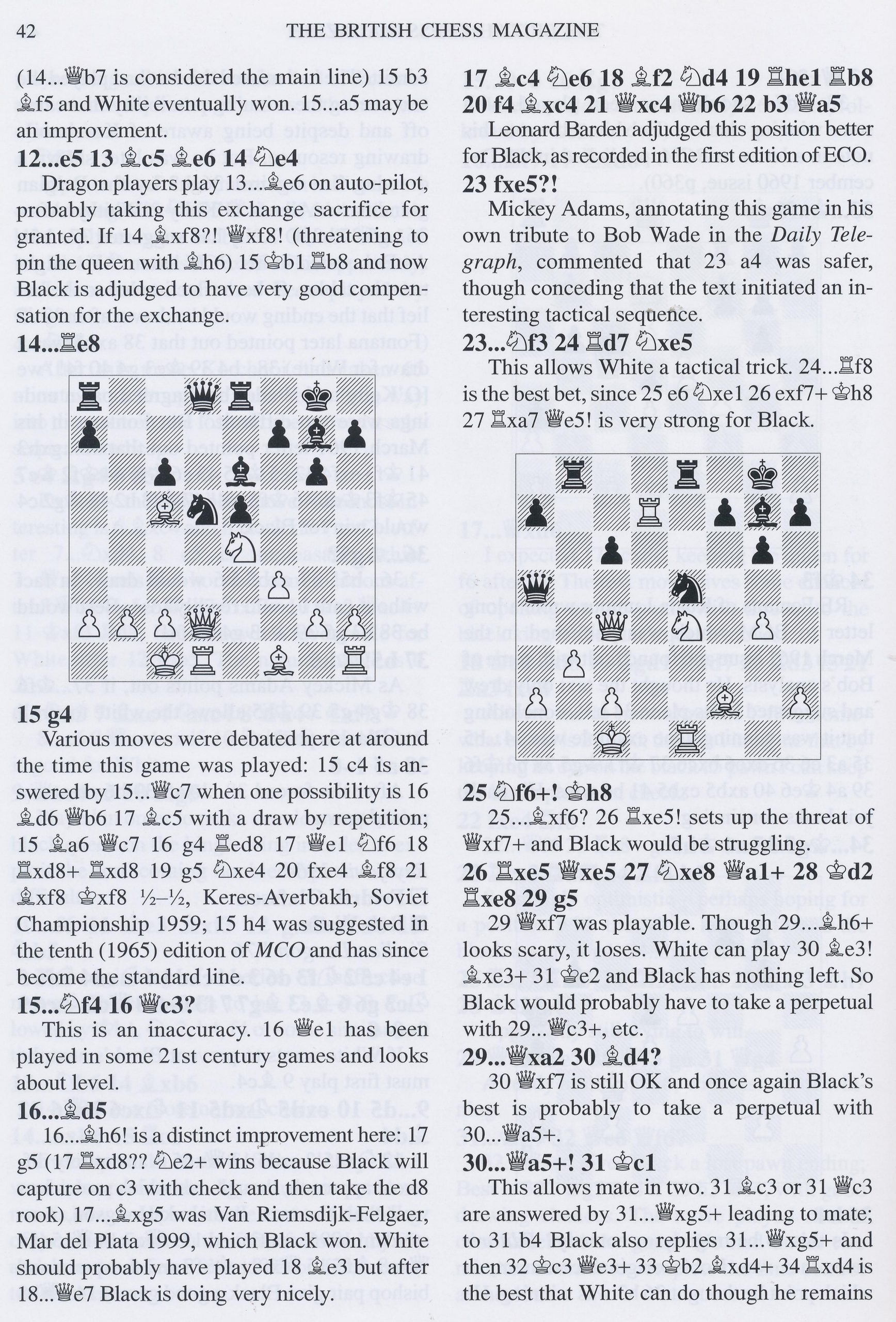
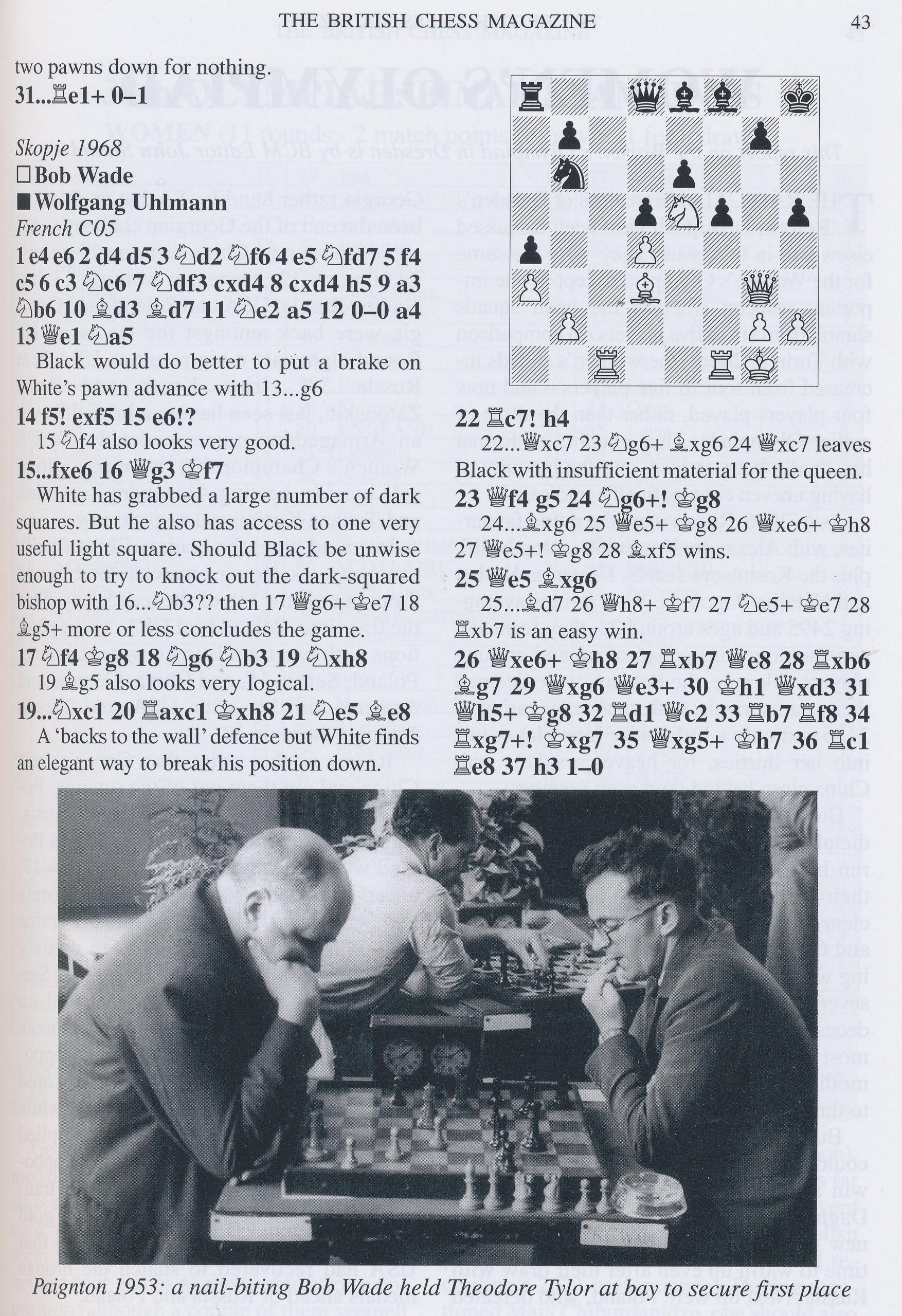
Leonard Barden wrote this obituary
Here is Bob’s Telegraph obituary.
John Saunders interviewed Bob at his Blackheath home and wrote this extensive article for the 1999 British Chess Magazine.
His detailed results in Olympiads, from olimpbase.org, follow.
Amsterdam 1954, England board 4, 6/12 (+4−4=4);
Moscow 1956, England board 3, 6½/14 (+2−3=9);
Munich 1958, England 1st reserve, 7/14 (+5−5=4);
Leipzig 1960, England 2nd reserve, 6/11 (+4−3=4);
Varna 1962, England 2nd reserve, 6/12 (+4−4=4);
Siegen 1970, New Zealand board 2, 9/15 (+7−4=4);
Skopje 1972, England board 3, 7½/14 (+4−3=7).
Wade won several middle-strength Master events in the British Isles: Ilford 1957 and 1968, Paignton 1959, Dublin 1962, and Southend-on-Sea 1965.
Wade was generally no more than a middle-ranking player in strong international tournaments. His other highlights against high-standard international-level competition include:
tied 4–5th at Haifa/Tel Aviv 1958 on 7½/13 (winner Samuel Reshevsky);
3rd at Bognor Regis 1959 on 7/10 (winner Erno Gereben);
5th at Reykjavík 1964 on 7½/13 (winner Mikhail Tal);
tied 4–5th at Málaga 1966 on 7/11; (winners Alberic O’Kelly de Galway and Eleazar Jiménez);
6th at Briseck 1971 on 7/13 (winner Gideon Barcza);
5th at Cienfuegos ‘B’ 1975 on 10/17; (winners Julio Boudy and Amador Rodriguez);
tied 7–12th in the World Senior Championship, Bad Woerishofen 1992, on 7½/11 (winner Efim Geller).
Wade was the only British player to have faced Bobby Fischer in tournament play (outside of Olympiads). They met three times, with Wade drawing one game and losing the other two.
Towards the end of his life Bob lived at 3, Hardy Road, Greenwich, London, SE3 7NS
His detailed Wikipedia entry may be found here
Bob was an active author and wrote (or co-wrote) around 22 books as follows :
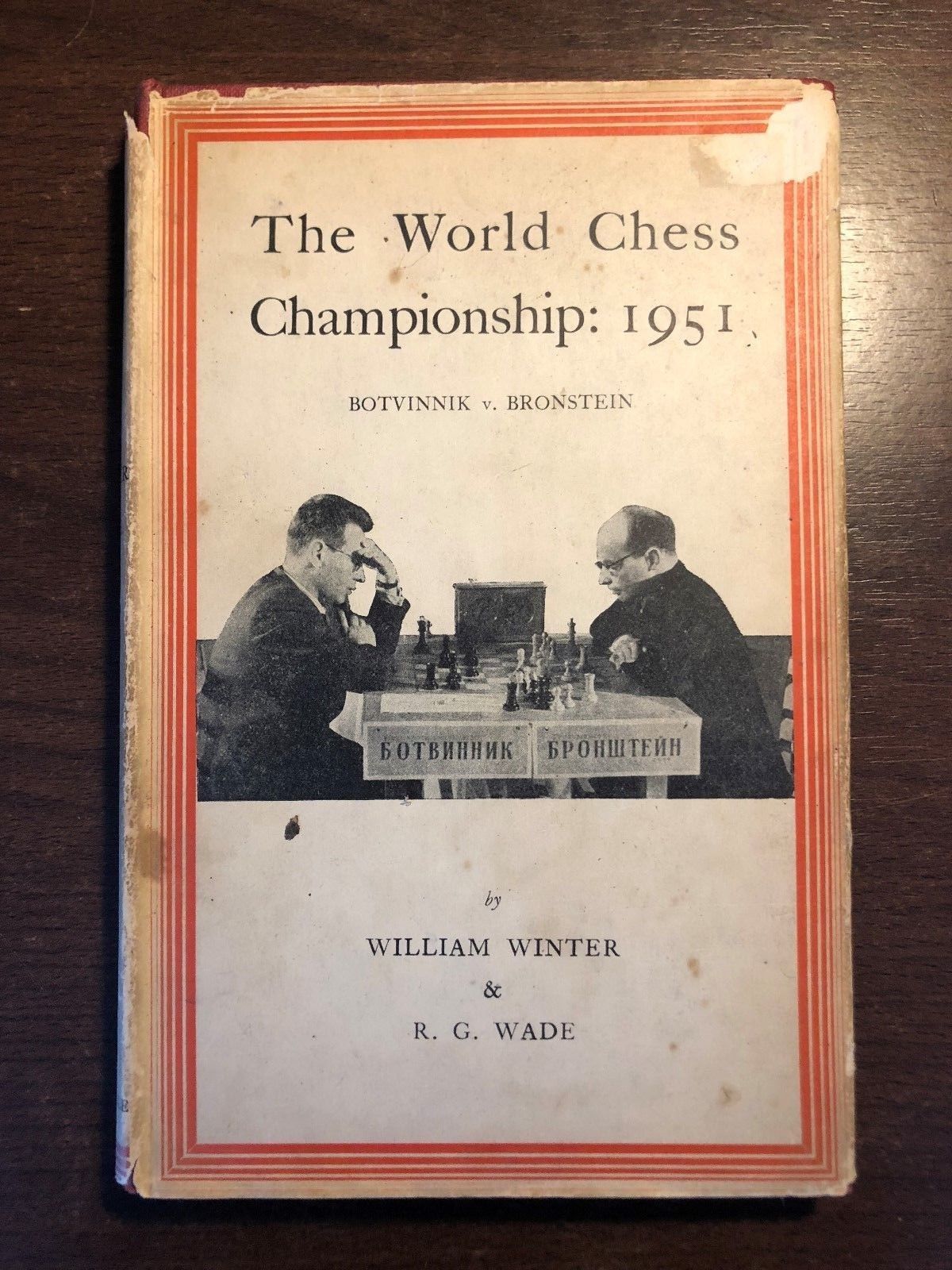
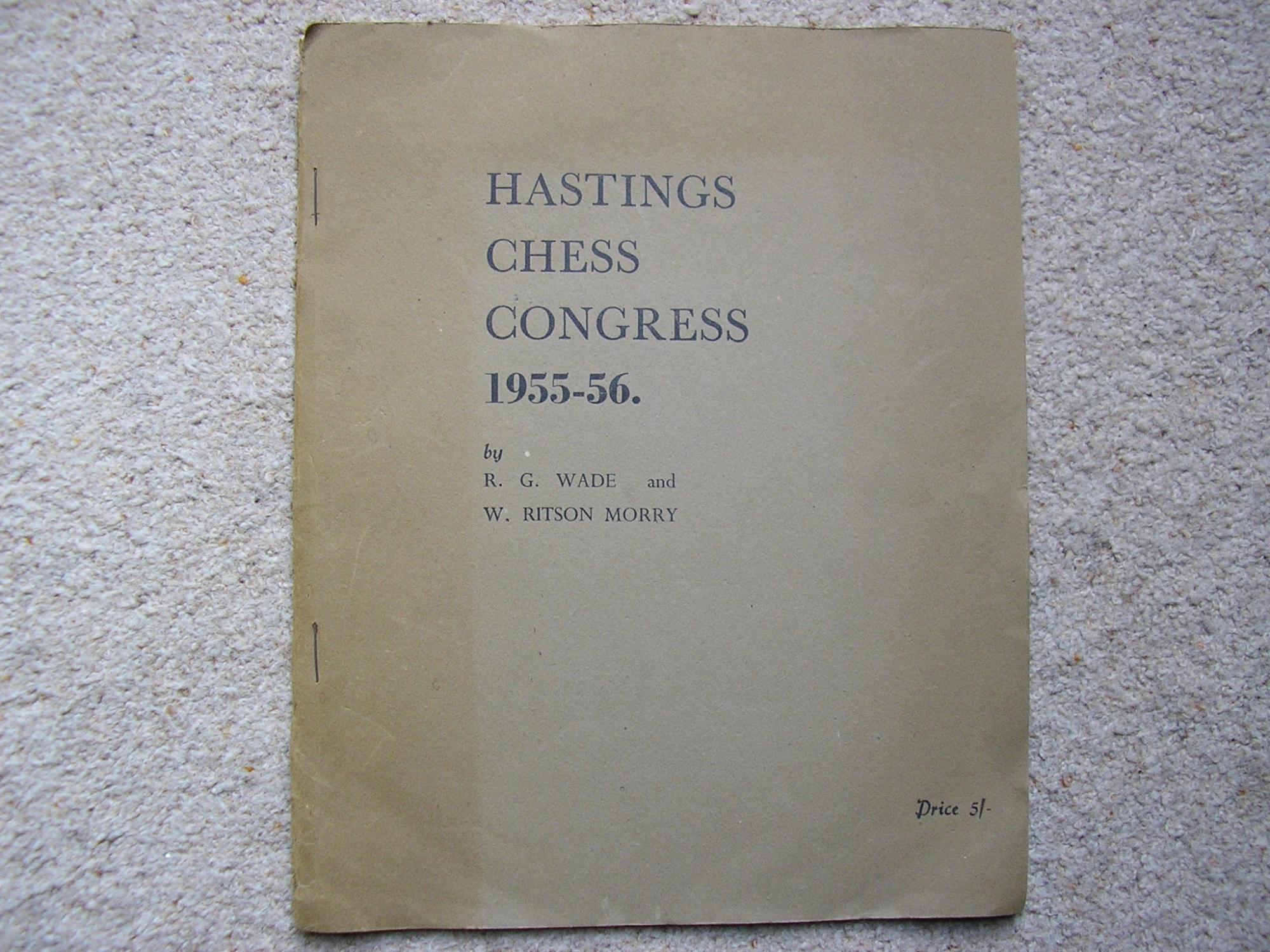
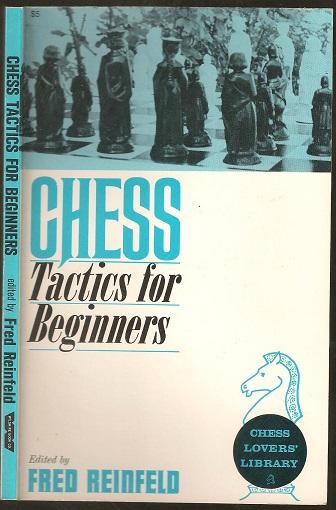
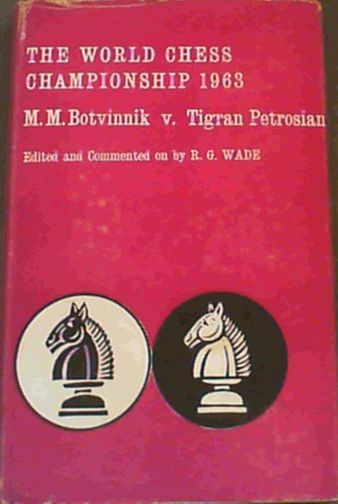
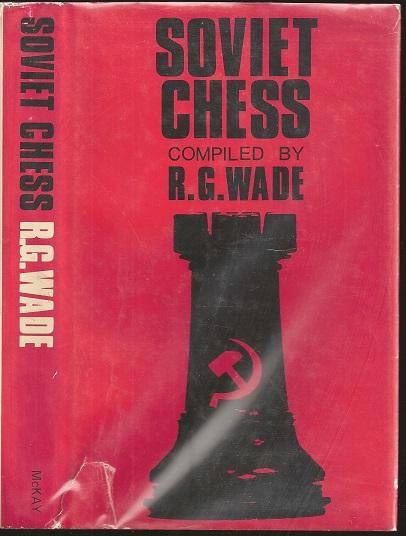
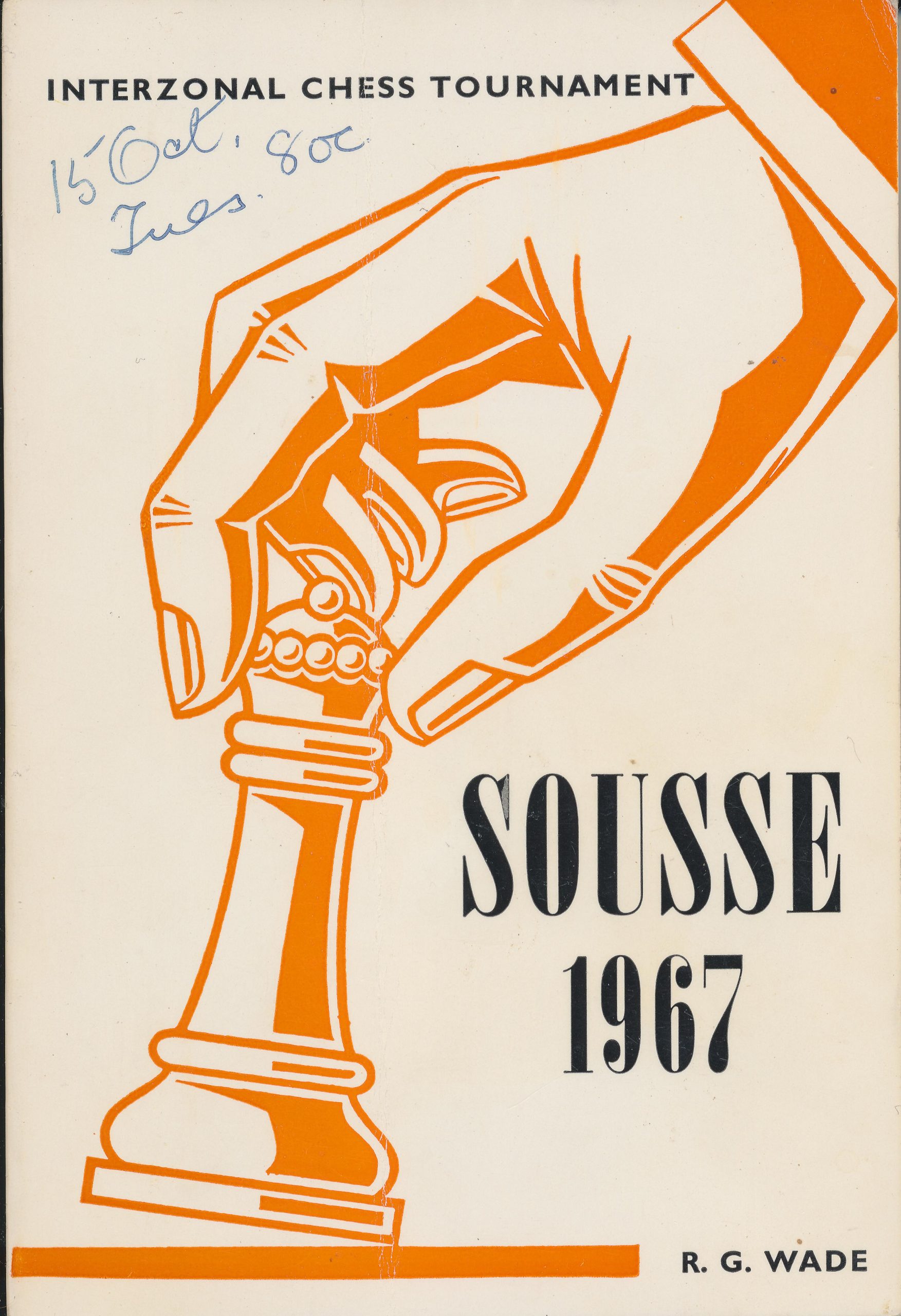
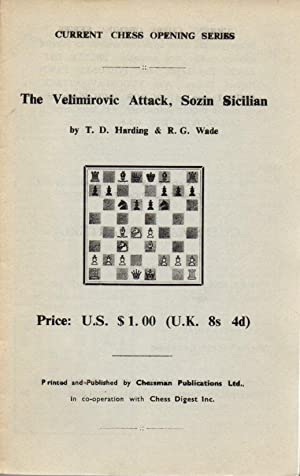
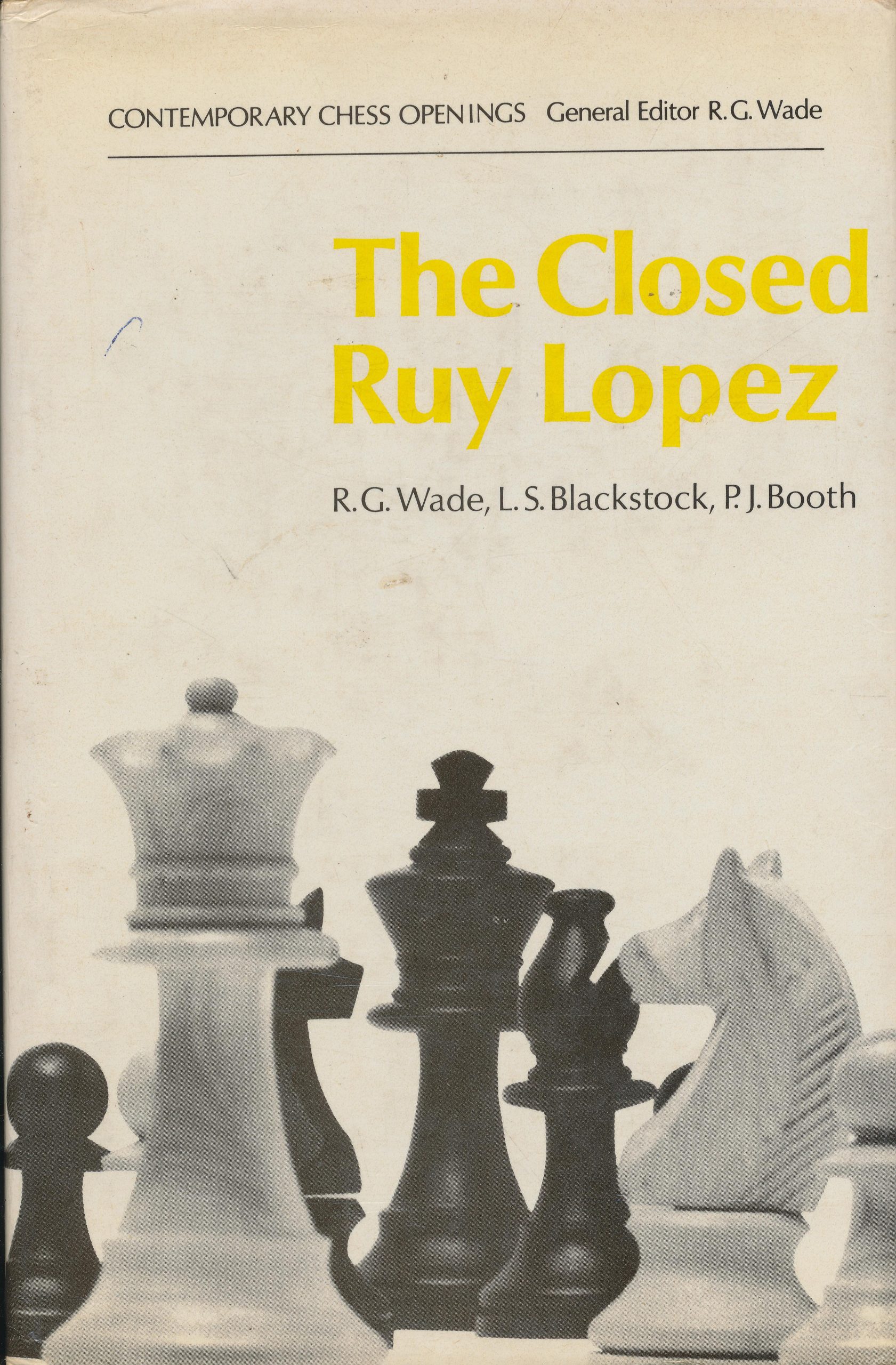
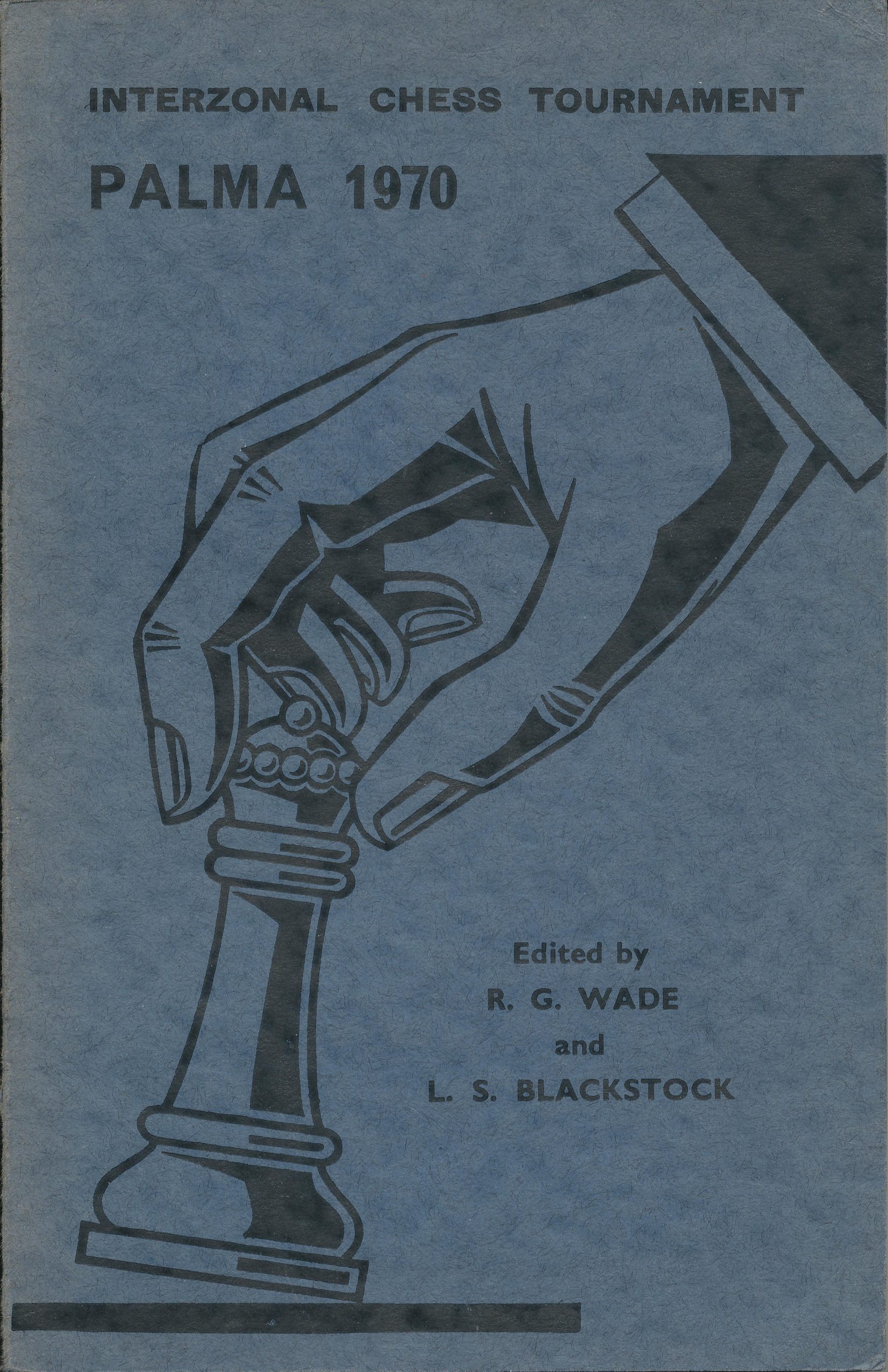
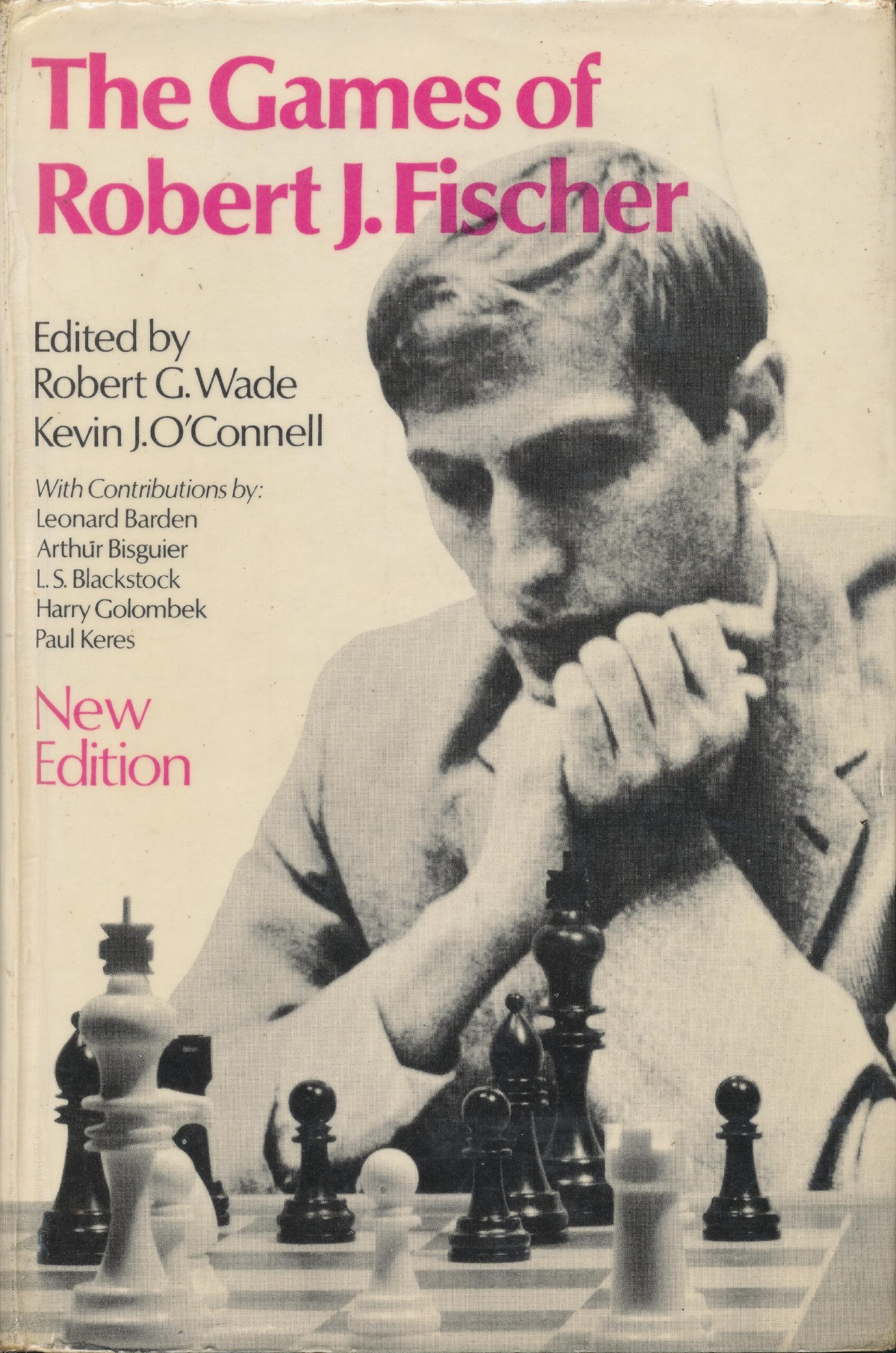
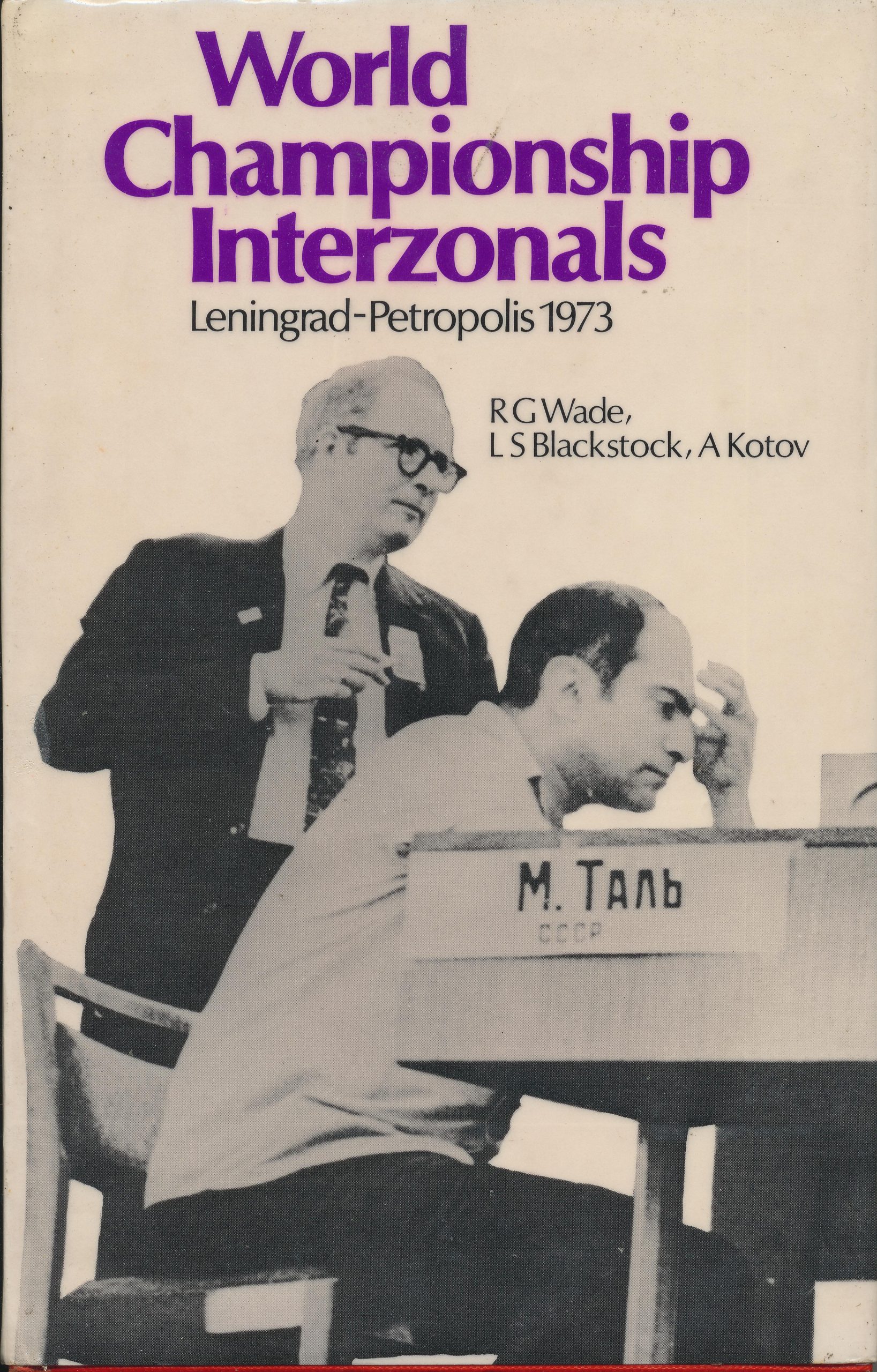
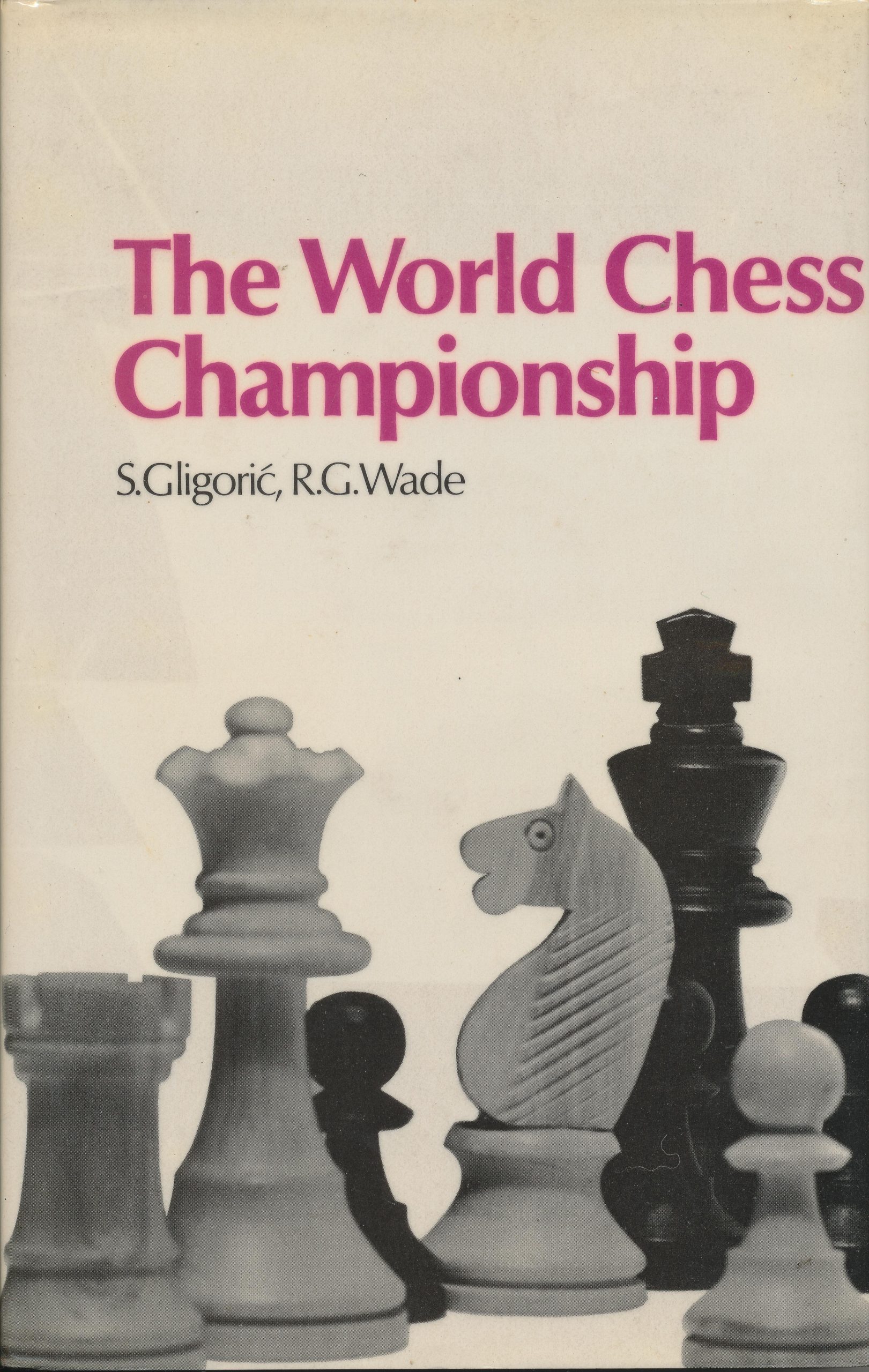
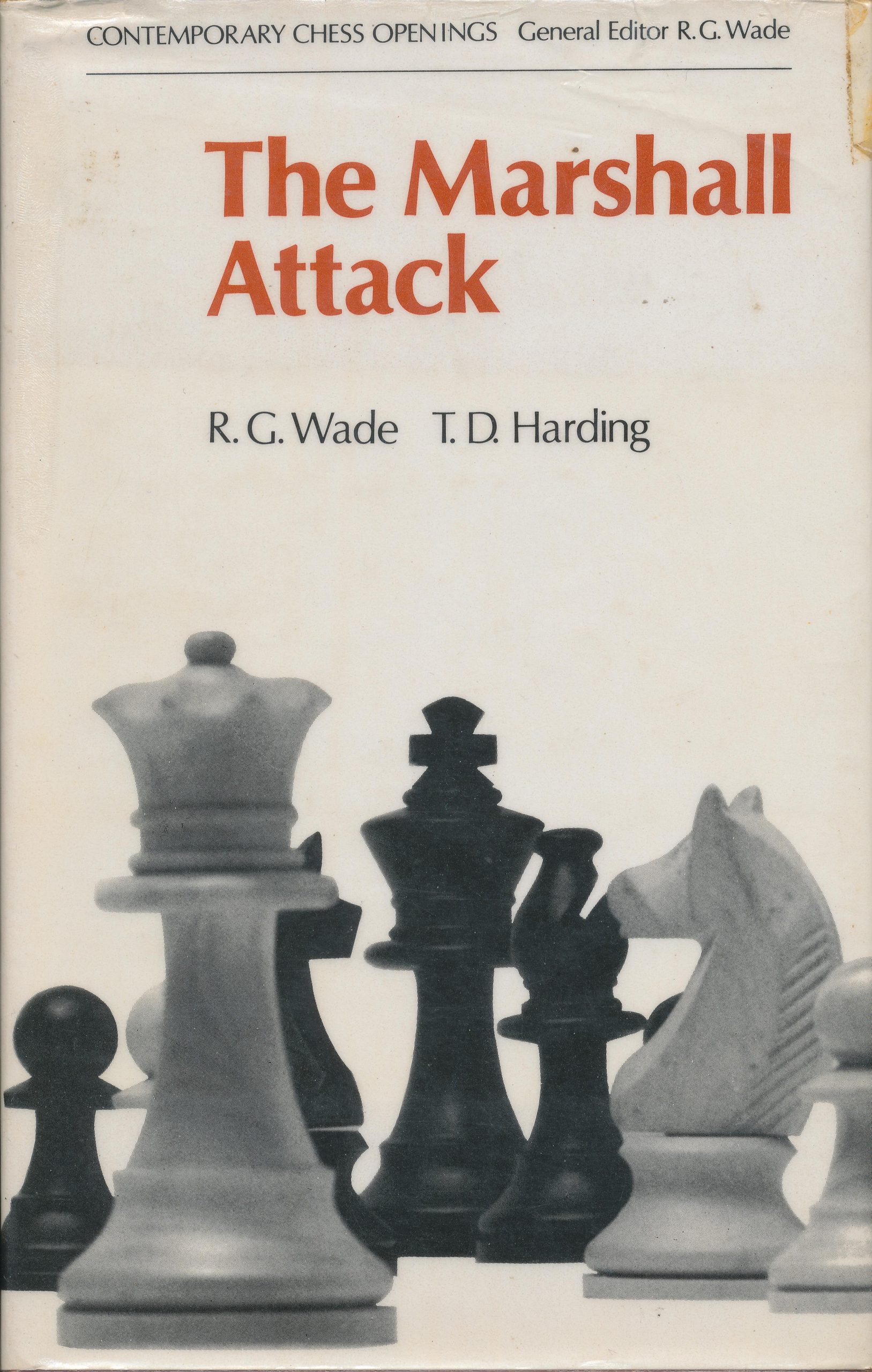
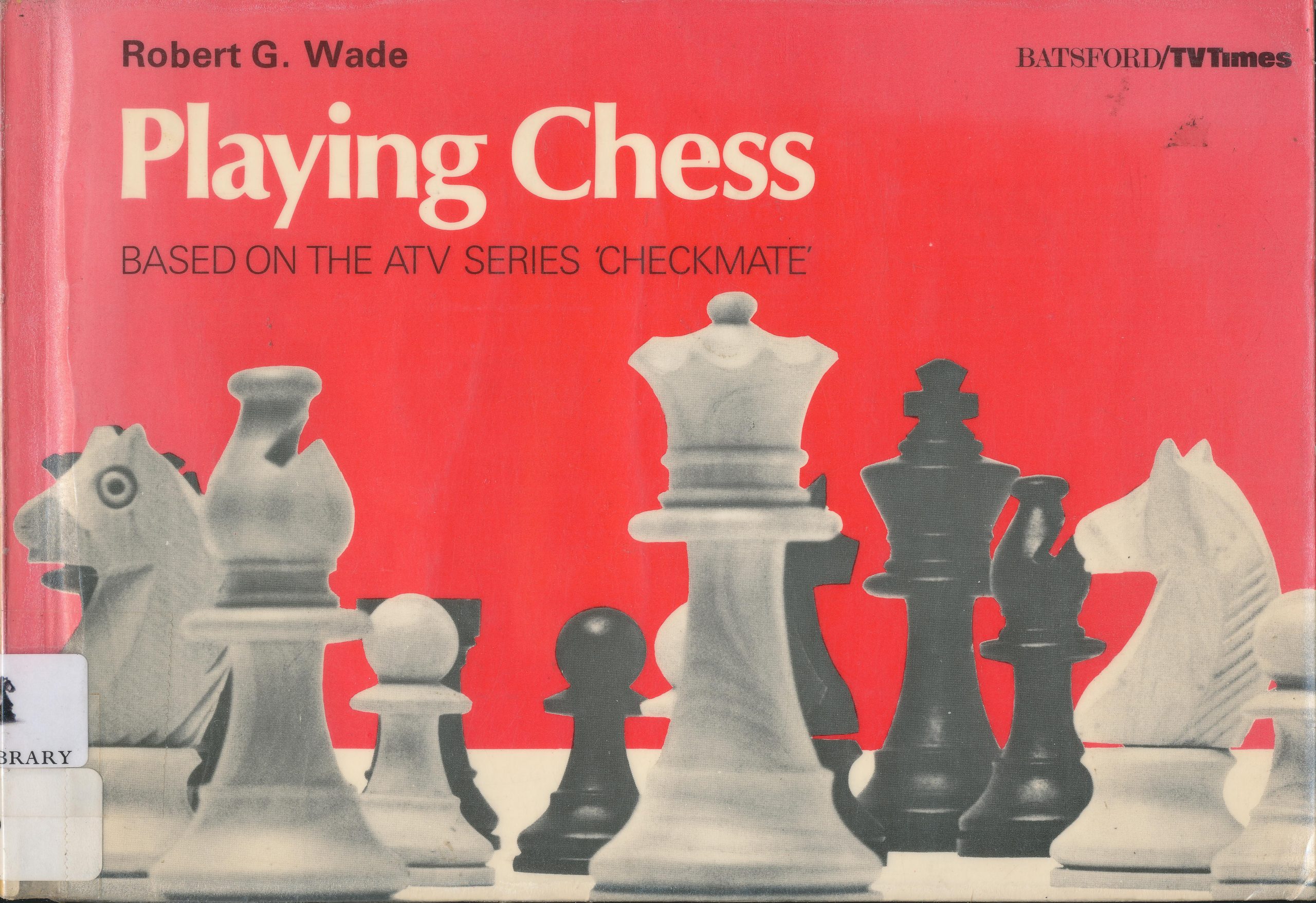
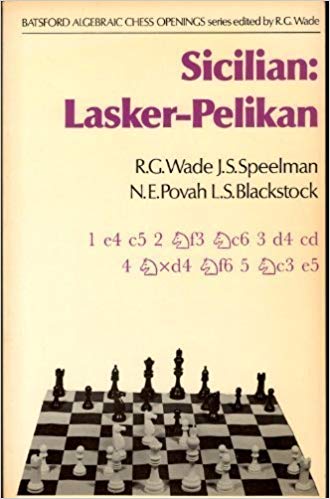
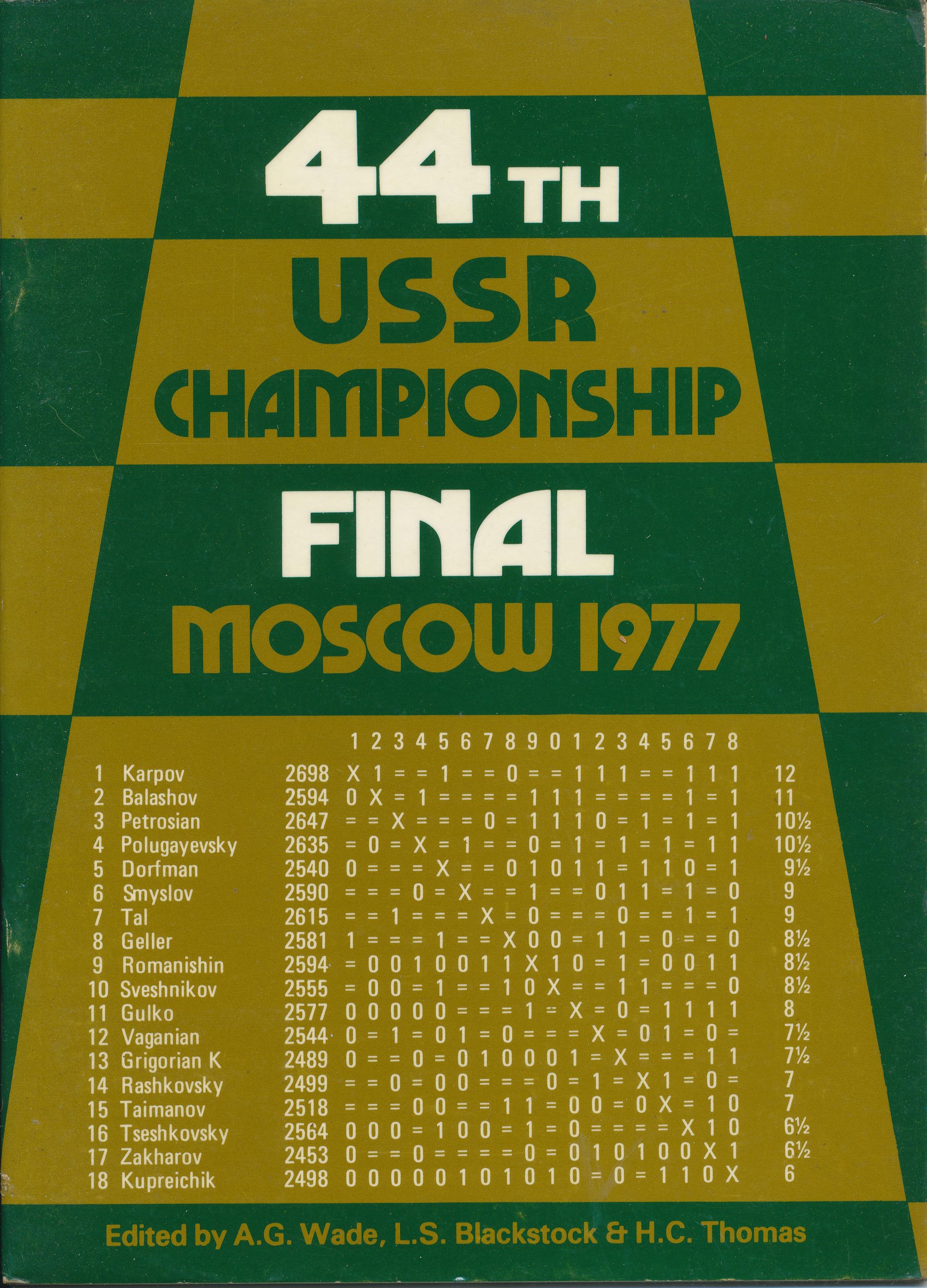
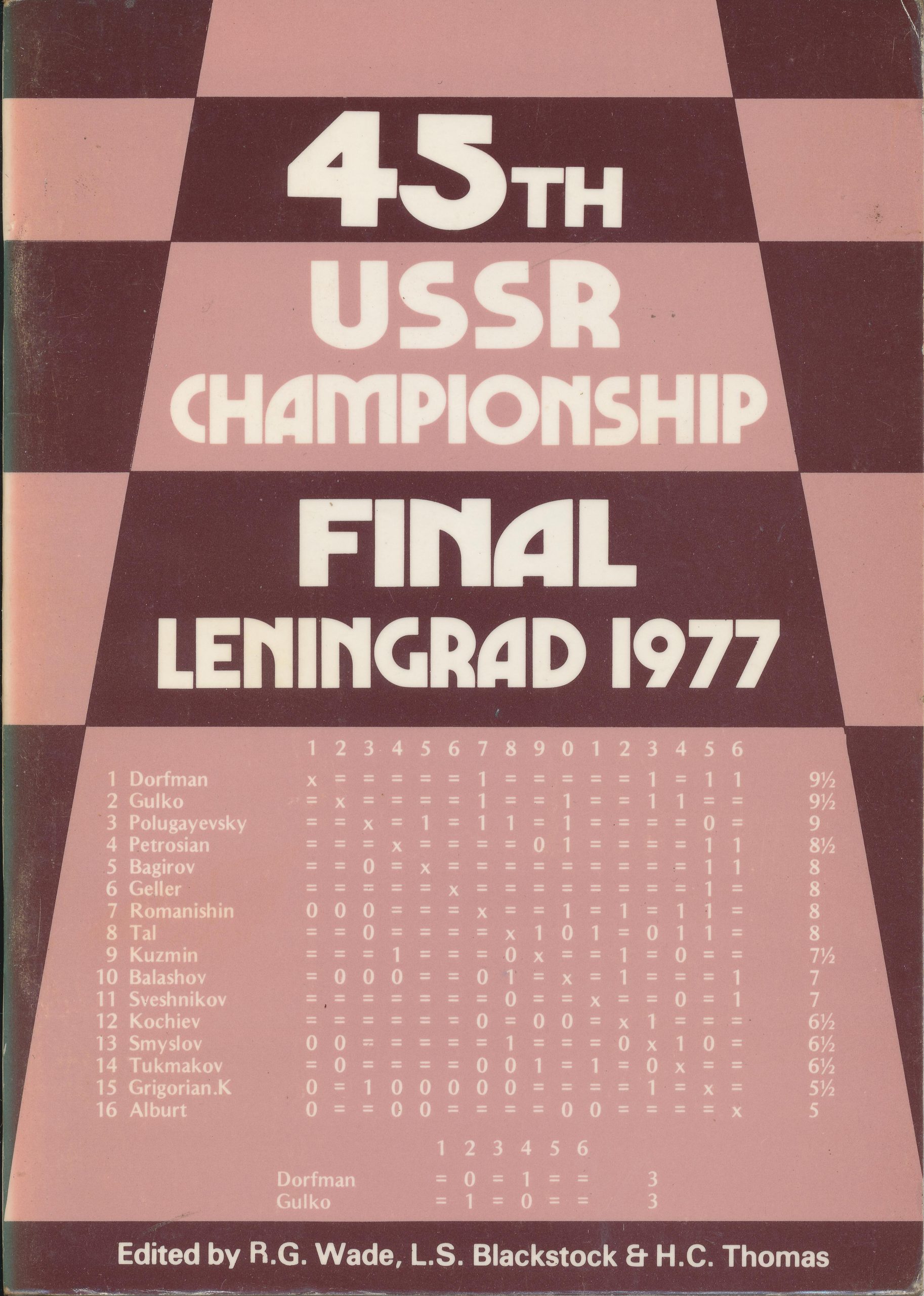
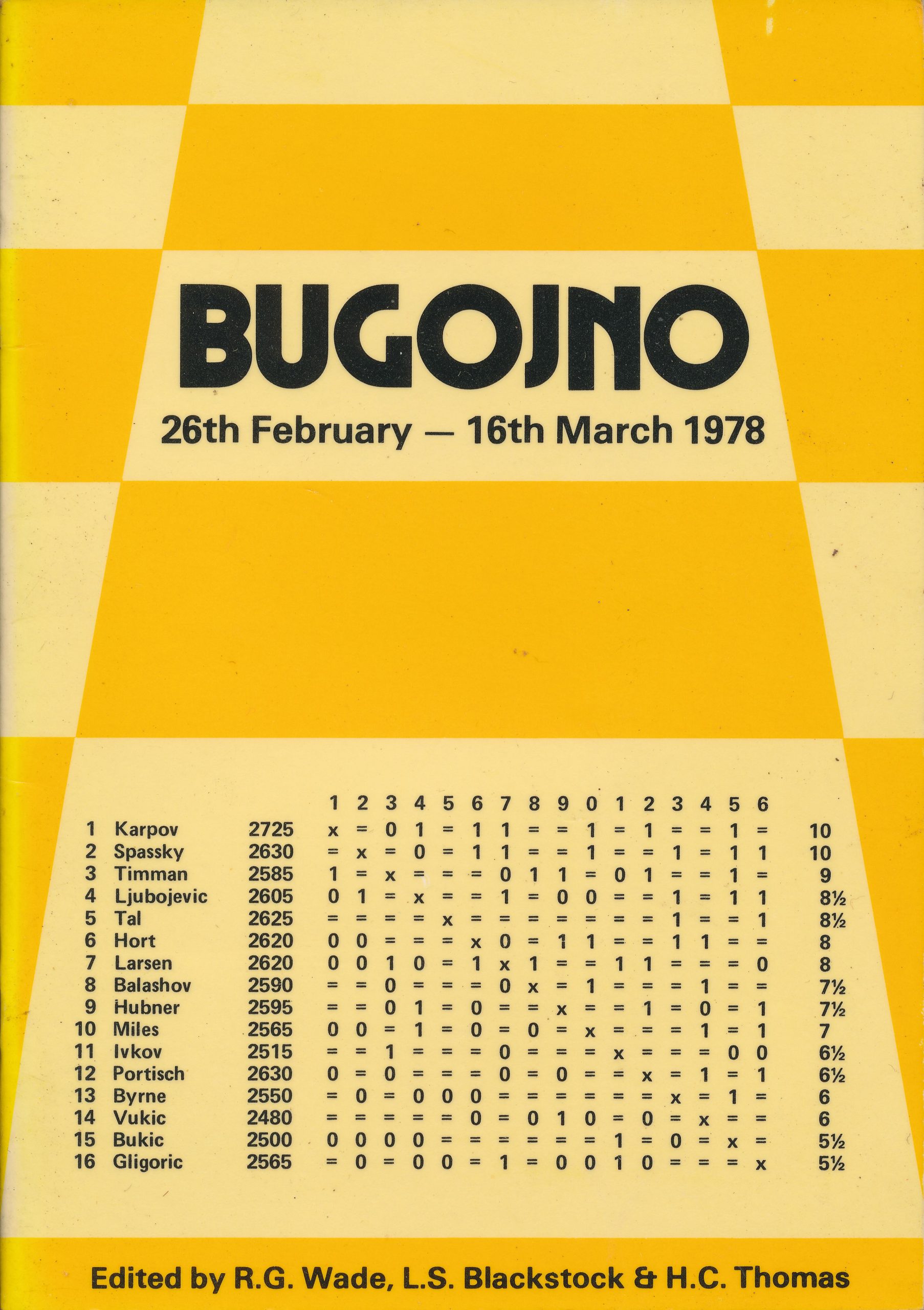
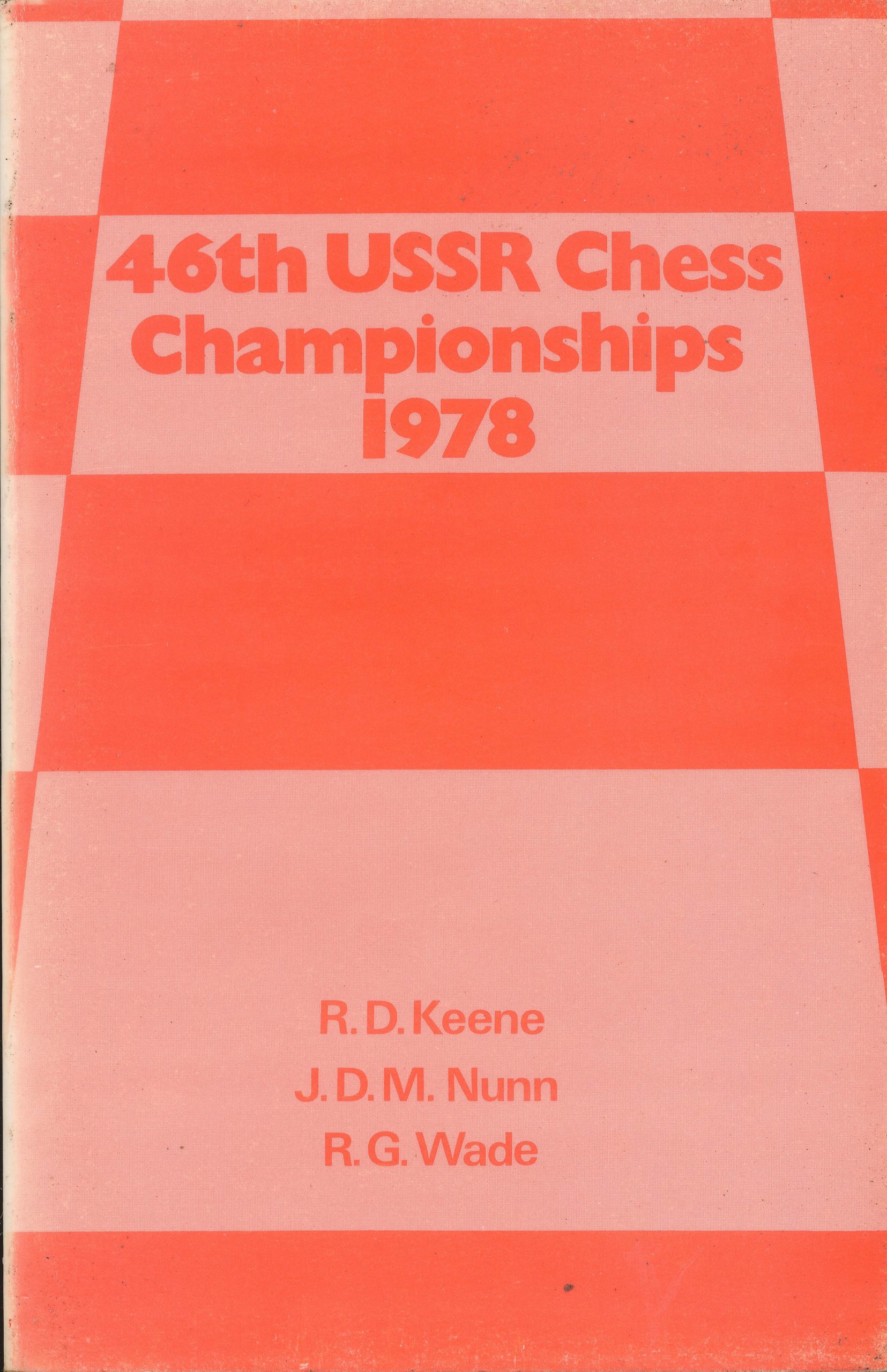
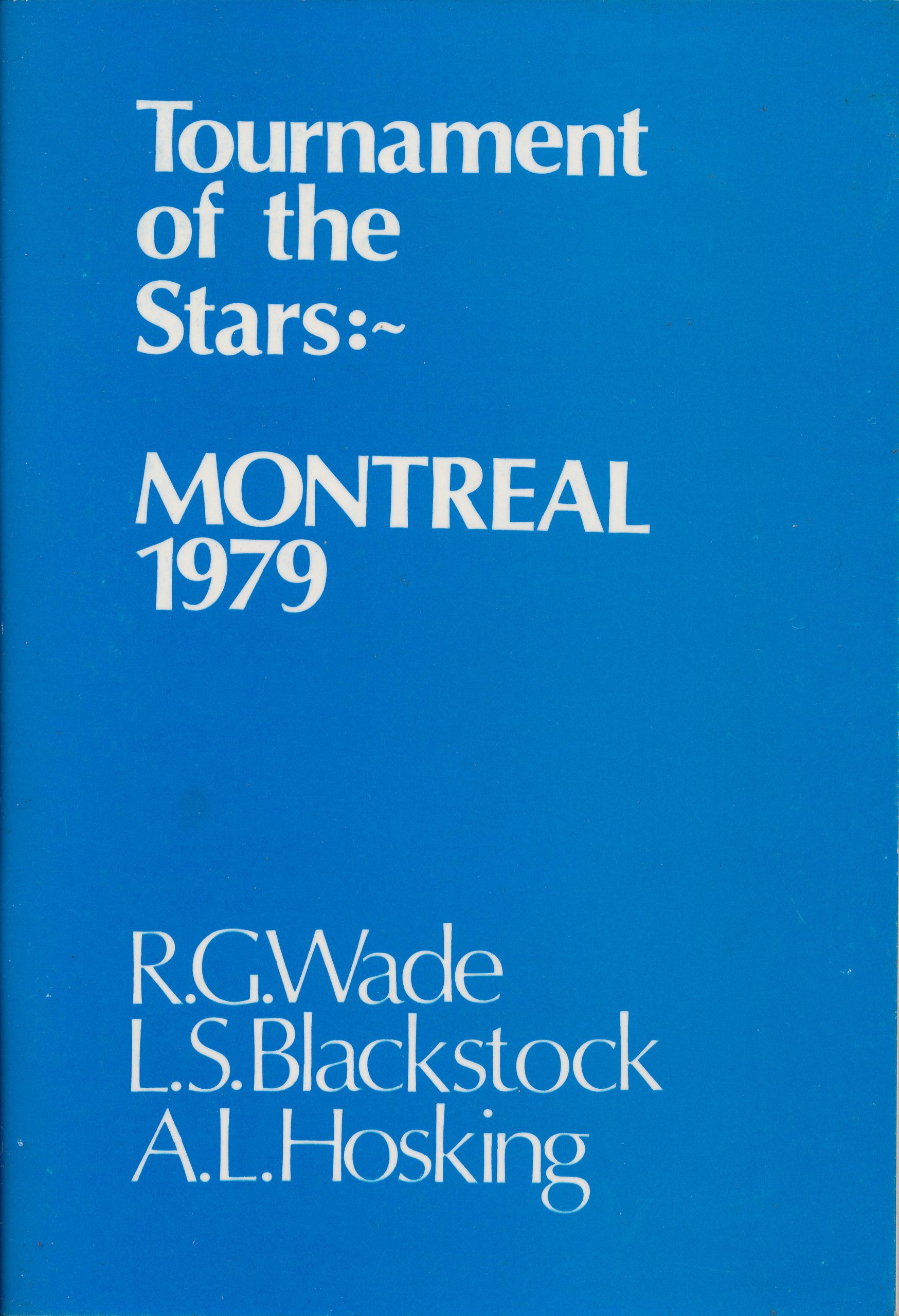
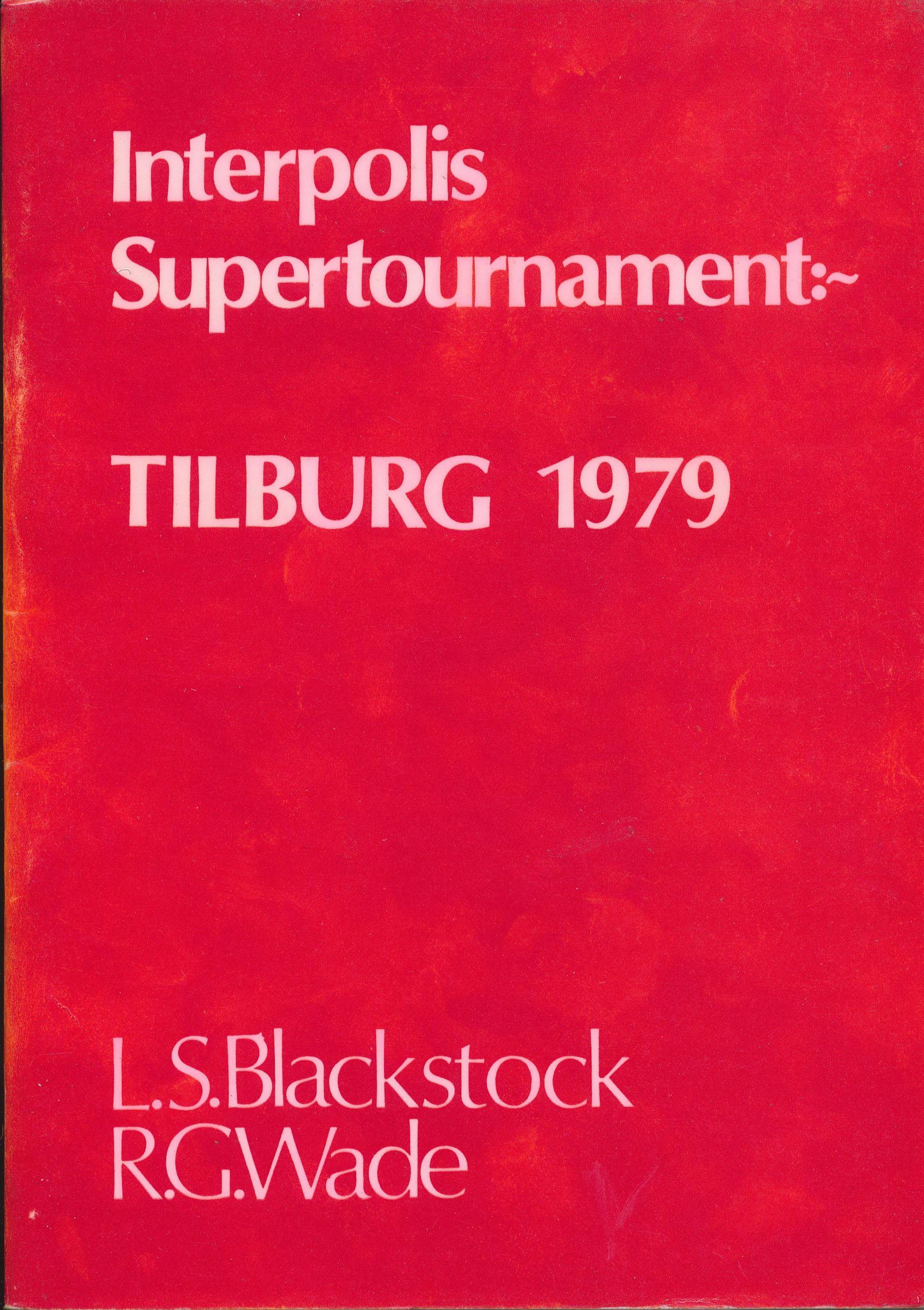
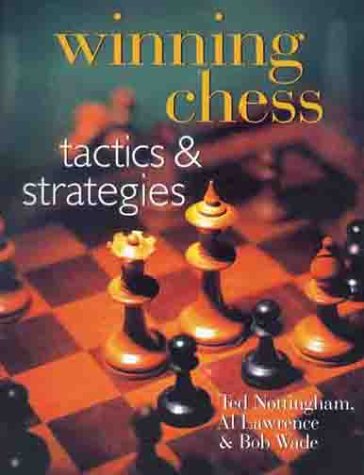
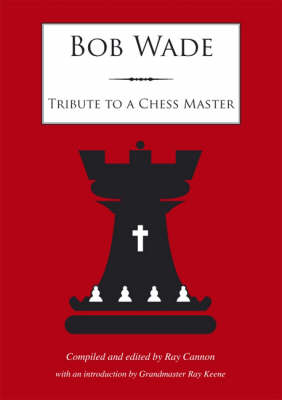
In 2007 Ray Cannon published the following tribute :
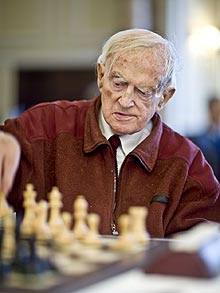
However, Paul McKeown remains Bob’s official biographer.
We remember Anthony Dickins who passed away this day (Wednesday, November 25th) in 1987.
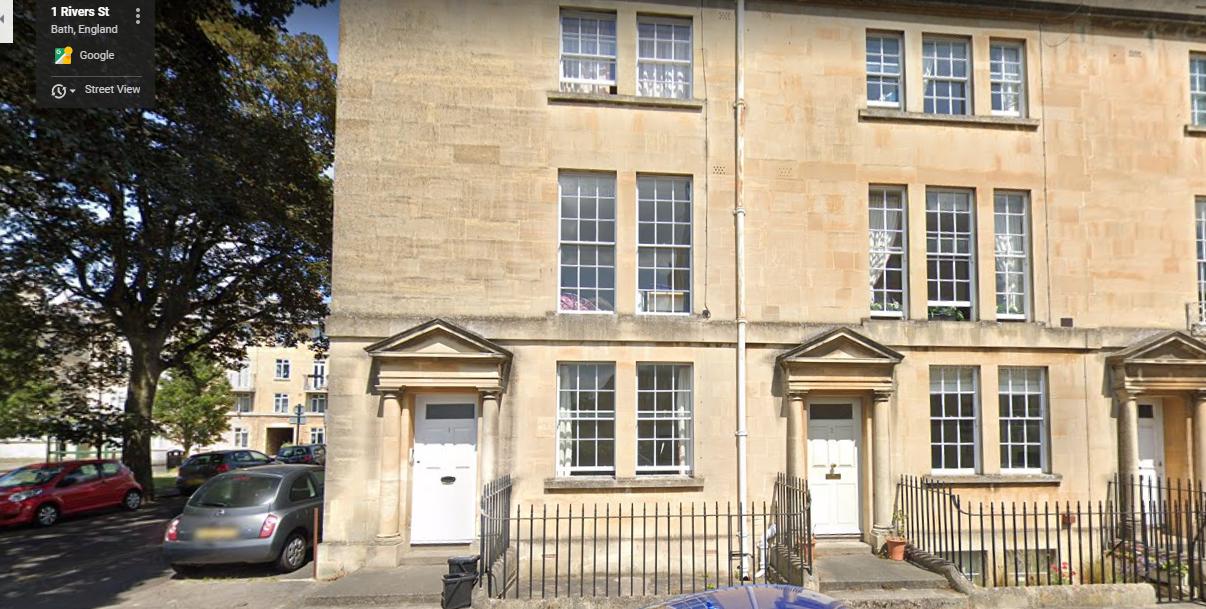
Anthony Stewart Mackay Dickins was born at 1 Rivers Street, Bath, Somerset on Sunday, November 1st, 1914. On this day was the Battle of Coronel — The Royal Navy suffered its first defeat of World War I, after a British squadron commanded by Rear-Admiral Sir Christopher Cradock met and was defeated by superior German forces led by Vice-Admiral Maximilian von Spee in the eastern Pacific.
Anthony’s parents were Frederick and Florence Dickins (née Mackay) Frederick was a Captain in the Royal Artillery and was born on 25th November 1879, commissioned on May 26th 1900. He became a Colonel on 26th May 1930 and retired November 25th 1936. He was alive in 1972 (aged 92) and living in Bexhill passing away aged 101/102. He was awarded the CIE which is “Companion, Order of the Indian Empire in 1914”.
Anthony was baptised on December 29th in Seend, Wiltshire. Anthony had a brother Frederick James Douglas born in 1907 who married Nellie or Peggie Moist (records are unclear).
It would appear that Florence and Anthony (aged 5) travelled to Bombay from Plymouth on board the SS City of York (Ellerman Lines) departing December 26th, 1919 presumably to visit his father in India. The ships master was J. McKellan.
At the time of the 1939 Census Anthony was residing in the Tavistock Hotel in Tavistock Square. His occupation was given as journalist and editor and described as single.
From the Hull Daily Mail (extant and renamed Hull Live) of March 4th, 1939 we have this part review of a magazine called The Joys of Poetry. Anthony was the editor :
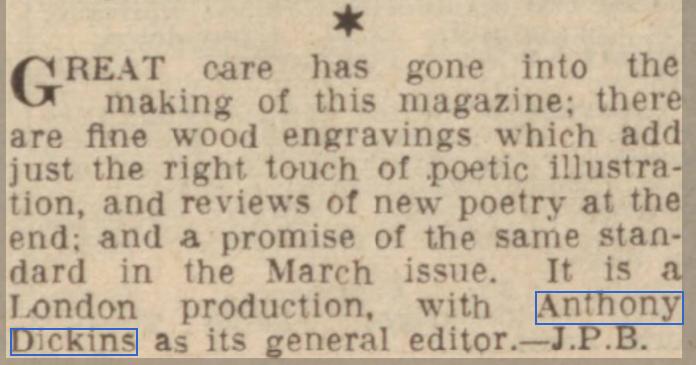
He died in Lambeth Wednesday, November 25th) in 1987. We have yet to determine where he was buried or cremated.
From http://chesscomposers.blogspot.com/2012/10/november-1st.html :
“Anthony Dickins wrote A Guide to Fairy Chess (1967) and other books about fairy chess. He edited the column of non-original fairy problems for “The Problemist”. He was specialized in constructional problems and was also an International Judge.”
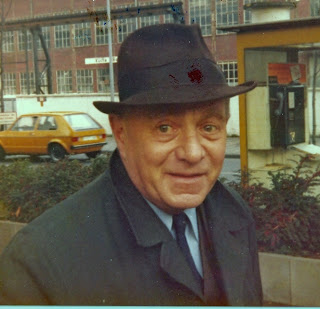
From British Chess (Pergamon Press, 1984), Botterill, Levy, Rice and Richardson :
(article by ASMD and edited by JM Rice)
“Chess first entered my life seriously about 1950 at the well-known Mandrake Social and Chess Club in Meard Street, Soho, run by Harold Lommer and Boris Watson. Purely literary connections took me there in the first place, as it was a rendezvous for the literary fraternity, such as Dylan Thomas, David Gascoyne and others.
After the war Harold converted a small wine-vault into a tiny cramped chess-room, with some dozen tables and boards. Many well-known
personalities in the world of Chess were occasional visitors, such as Grandmasters Ossip Bernstein, Paul Keres, Jacques Mieses and Friedrich Sämisch; British Champions Willy Winter, Bob Wade and Dr. Fazekas; M. J. Franklin, now a British Master, and the Problemists, Dr. E. T. O. Slater and B. J. da C. Andrade. Mieses was then in his late eighties and charged a fee of half-a-crown (12.5 pence) for a game. When his name was mispronounced ‘Mister My-ziz’ he would say ‘I am Meister Mieses, not Mister My-ziz’.
Sämisch once played fourteen of us blindfold, defeating all except one, a very strong Indian player, Atta, who obtained a draw. My regular ‘partners’ were Vicki Weiss, the famous cartoonist, his brother Oscar, Richard Crewdson, Mr Keller (a professional who played sharply for a shifty shilling), Brian Mason, Colin ‘Puffer’ Evans, (whose strategy was to puff cigarette ash and smoke all over the board to bemuse the opponent) and Bob Troy (who always fell fast asleep immediately after making each move and had to be wakened on his next turn to play). There was a juke-box in the next room constantly blaring forth pop and bop. Most of all I played with Alex Distler, and with him always’variants of the game’ like Cylindrical Chess, Rifle Chess, Progressive Chess, or the Losing Game.
In this colourful and inspiring, if rather smoky and noisy, atmosphere I composed my first six chess problems, helpmates and cylindricals, though I did not then know of the existence of Problem books or magazines, nor had I heard of Sam Loyd, Max Lange, or T. R. Dawson when the Mandrake closed in the late fifties and Harold Lommer retired to Spain to write his two monumental works on Endgame Studies.
For the next 10 years or so I played at the West London and Athenaeum Chess Clubs, for Middlesex County and at Hastings congresses, meanwhile regularly solving the problems in the two evening newspapers for practice.
In 1965, in my 51st year, I discovered chess-problem magazines and the British Chess Problem Society, and was soon asked by John Rice to join the Fairy
Chess Correspondence Circle, whose director, W. Cross, perhaps the greatest solver of all time, guided my early footsteps in fairyland. At this point I compiled for my own use a summary of all the usual rules and conventions in Fairy Chess, as these were numerous and complicated. It occurred to me that a few other people might also welcome such a summary, so I put it into book form as A Guide to Fairy Chess, which I published by myself in 1967 under the imprint ‘The O Press’, a pun on the name ‘Kew’ where I was then living.
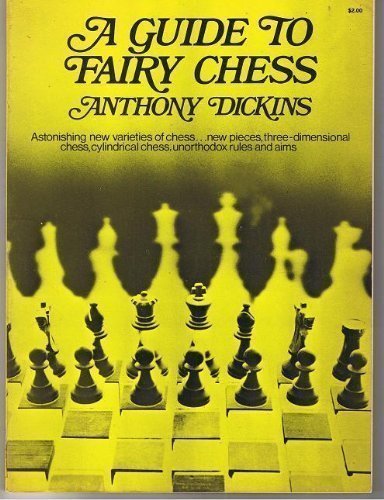
To my amazement it had rave reviews (‘the comprehensive work, so long awaited’, ‘more like an encyclopaedia’, ‘the bible of Fairy Chess’) and sold like hot cakes, going into three editions, each one enlarged and revised, the third produced by Dover Publications, New York, in 1971. Two years later I edited Dover’s publication of T. R. Dawson’s Five Classics of Fairy Chess.
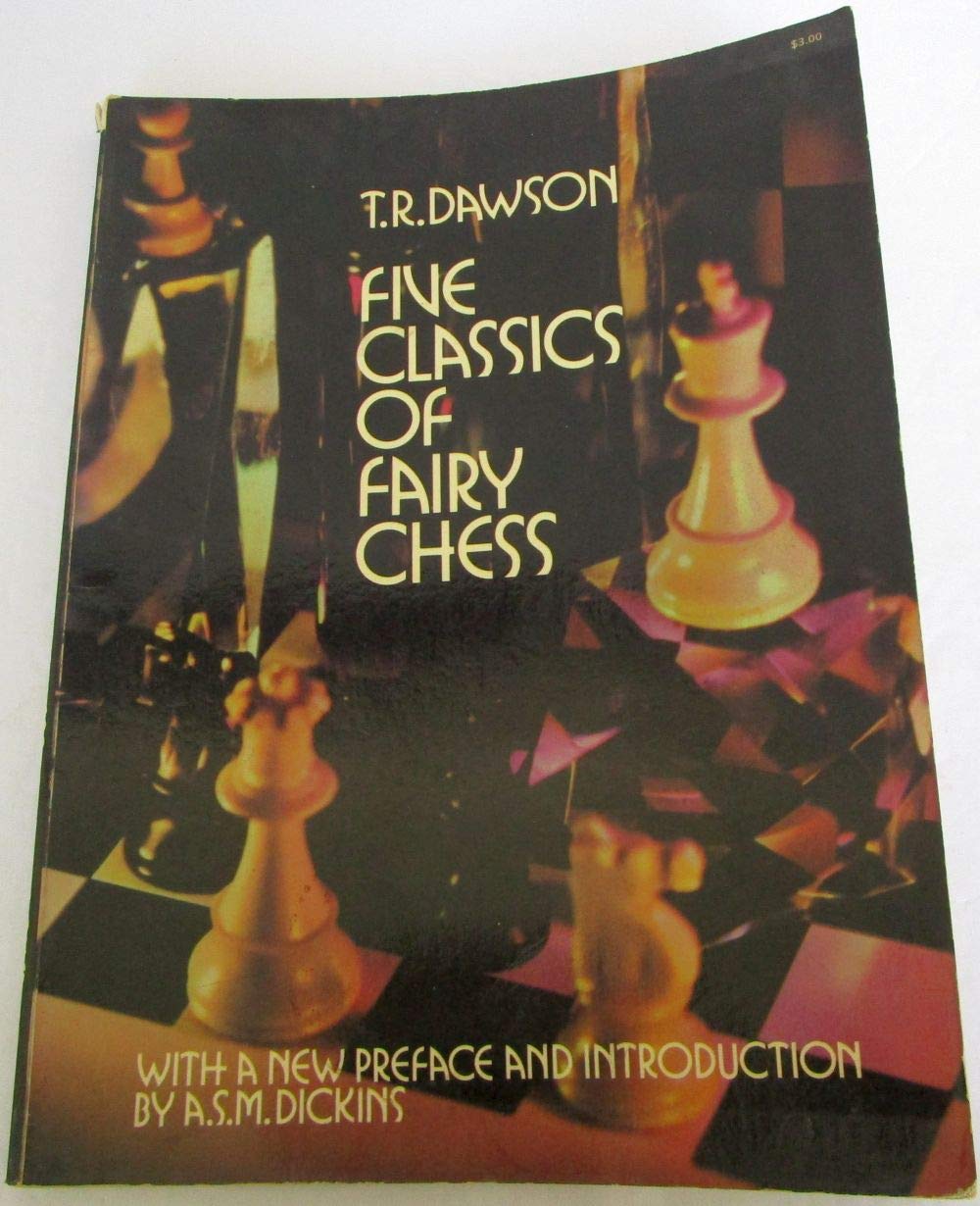
In 1970 I flew to the States to spend a few days in the J. G. White collection in Cleveland, Ohio, researching historical material on Fairy Chess. This Ohio collection has the largest chess library in the world, and to my surprise I found that it contains also ‘every book or article ever written on or about ‘Omar Khayyam and Alice in Wonderland . To find oneself suddenly and unexpectedly transported, as if by magic carpet, into a superbly organised library with the most complete collections in the world of the three subjects that happen to be one’s own three principal literary interests is an experience that must approach closely to entering Nirvana, and I am happy to have had it. This visit enabled me to write A Short History of Fairy Chess (1975) and to give the lecture Alice in Fairyland to the Lewis Carroll Society in London, published in their journal Jabberwocky and reprinted by myself in 1976 (2nd edn 1978) .
In 1972 I decided to present my (by then) extensive collection of Fairy Chess books and magazines to my old university library at Cambridge to prevent the possible break-up of the collection as a single unit, and to ensure that at least one fairly complete Fairy Chess collection was retained in Britain.
In 1968 I was invited to open a Fairy Chess section in The Problemist, organ of the BCPS, which I handed over to Dr. C. C. L. Sells in 1970, and from 1974 to 1981 I ran another column in that magazine called ‘Other Types’. This chess journalism has brought me into touch with many problemists, and made many friends for me, in foreign countries.
In 1967, on a visit to Mannheim for the Schwalbe annual meeting, I met Wilhelm Karsch, then editor of Feenschach, and in 1968 in Munich I again met Dr. Karl Fabel, whom I first came to know in London in 1967, and also Peter Kniest, one of the two present editors of Feenschach. In 1969, on a visit to Paris, a meeting was arranged for me at the late Jean Oudot’s flat, with Pierre Monr6al, J. P. Boyer, F. de Lionnais (author of the Dictionnaire des Echecs) and other French problemists, and altogether I have attended twenty three major problemist meetings in various countries, including FIDE meetings in The Hague, Wiesbaden, Canterbury and Helsinki. It has been my constant aim to try to encourage and cultivate the practice and study of Fairy Chess and to keep alive the great legacy that T.R. Dawson left to the world when he died in 1951.
In recent years I have developed close relations with the younger generation of West German problemists, who are very active in Fairy Chess, centred round 29-year-old Bernd Ellinghoven, who helps Peter Kniest to edit Feenschach and who printed my last booklet, Fairy Chess Problems (1979), containing poems as well as problems, combined in a new kind of fairy technique, for I believe that Fairy Chess represents in many ways the ‘poetry’ of Chess.
For the 50th birthday of T. R. Dawson on the 28th November 1939 a certain Dr Lazarus of Budapest wrote in Fairy Chess Review: ‘T. R. D. these three letters represent a conception in the Poetry of Chess which is amongst the most ingenious of all its turns, one of its most strange and interesting phases… Without T.R.D. human culture would lack a factor in its development’. Those people (and there are some) who would banish Fairy Chess altogether from Caissa’s realm resemble the iron-hearted Mr. Gradgrinds who would abolish romance, mystery, poetry, invention, discovery and imagination from human life.
Elsewhere I have written: ‘The Game for Murderers, The Problem for Philosophers, Fairy Chess for Sufis’, because the aim of the game-player is to ‘mate’ (kill) the opponent (from Arabic, mat _ dead), while the problemist has no personal opponent to kill, but merely a philosophical problem to resolve. In Fairy Chess, however, the adept is transported to another plane of existence, to an ‘undiscovered country from whose bourne no traveller returns’,to new’dimensions’ of thought (as in 3- and 4-dimensional problems) – in short, to Fairyland, to Nirvana.
The three problems represent my early, middle and later compositions. The helpmate in three moves (Black plays first in a helpmate) is a miniature culminating in an ideal Mate. C. H. O’D. Alexander was much tickled by what he called ‘the deceptive pawn’ on a2, which unexpectedly does not promote.
The Construction Task with 113 White moves, all ‘maintaining’ the legal stalemate position in which Black finds himself, is a standing record that defeated the previous record of 112 such moves obtained independently by six problemists in six countries, one of them an lnternational Master of FIDE.
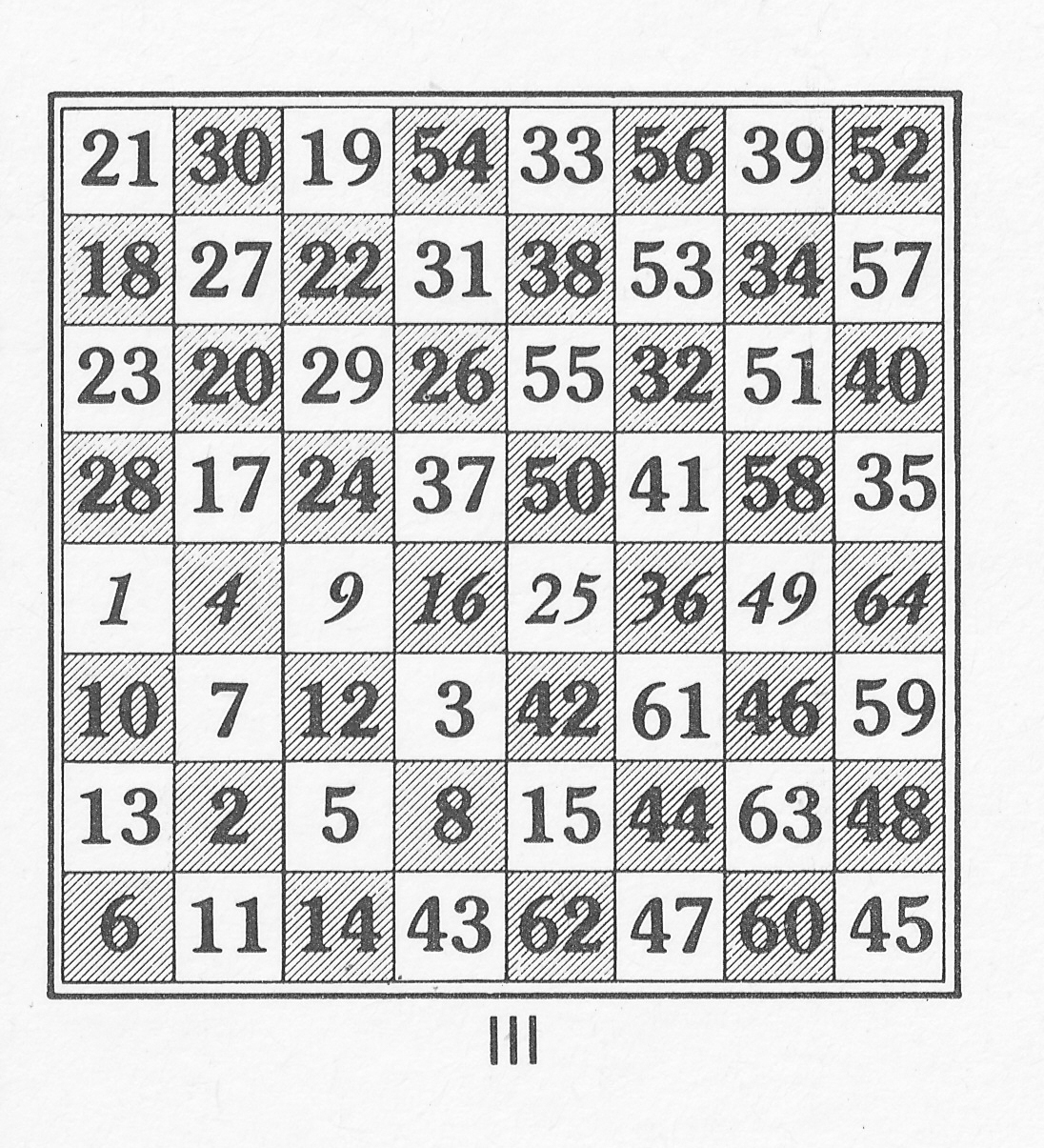
The Knight’s Tour is one of the oldest genres of Fairy Chess, dating from the earliest days of chess, and in TR Dawson’s Fairy Chess Review he published many of them., including some that showed the ‘square numbers’ (1,4,9,16,25,36,49,64) all on one rank – in the present example I have added the extra strict condition that as many as possible of the numbers 1 to 16 must be in the SW corner and as many as possible of the numbers 1 to 32 must be in the W half of the board.
For two reasons the perfect ideal in this task cannot be attained, firstly because of the given position of the number 25, and secondly because it is not possible to make a Knight’s tour on a 4 x 4 board in the SW corner.
Solutions :
1. Helpmate, Evening News, 20th February 1957 dedicated to Harold Lommer
Helpmate in 3 moves
1. Kd5 Nb1
2. Kc4 e8=Q
3. Kb3 Qb5 mate
2. Construction Task Record, Feenschach 9341 Sep/Oct 1969 dedicated to Karl Fabel
113 unforced stalemate maintenances with Promotion in Play (Pawn promotions count as 4 moves) unforced as W has some moves that do not maintain stalemate, so he is not ‘forced’ to maintain it.
3. Knight’s Tour Chessics 5(180) July, 1978 dedicated to D. Nixon.
Knights tour with
a) All square number on 4th rank
b) maximum of 1-16 in SW quad
c) maximum of 1-32 in W half
From The Encyclopaedia of Chess (Batsford, 1977), Harry Golombek OBE, John Rice writes:
“British problemist, Founder of Q Press (1967) to publish books on fairy problems: A Guide to Fairy Chess (1967); An Album of Fairy Chess (1970); The Serieshelpmate (co-author, 1971). Has presented a large collection of problem books to Cambridge University Library. International Judge (1975).”
We remember Amos Burn who passed away on November 25th, 1925.
Amos Burn was born in Kingston-Upon-Hull on Sunday, December 31st 1848 to Amos and Mary Burn (née Webster). His father is recorded as a merchant. Amos and Mary were residents of Bourne Street at the time of the birth.
On February 15th 1849 Amos was baptized in All Saints Anglican Church, Sculcoates, Kingston-Upon-Hull
Amos married Martha Ann Jäger in Birkenhead on Dec 27th 1879. They had two daughters Elsie Martha, born 24th Oct 1880 and Hilda Marian, born 26th Oct 1881.
For further detail of ABs family please consult the excellent Amos Burn : A Chess Biography by Richard Forster
From British Chess Magazine, Volume XLV (45, 1925), page 491 we have this brief obituary notice (presumably written by RC Griffiths:
“Chessplayers all over the world will regret to hear that the well-known chess editor of The Field died in his flat at Luexembourg Gardens, Hammersmith, on November 25th, after a stroke the previous day, at the age of seventy-seven.
From British Chess Magazine, Volume XLV (45, 1925), page 491 we have this brief obituary notice (presumably written by RC Griffith:
We regret that as our December magazine is already paged we must leave an obituary notice and an appreciation of all he has done for Chess till next month.”
From British Chess Magazine, Volume XLVI (46, 1926), page 9 we have this detailed obituary (written by JH Blake:
“We had only just time last month to announce the decease of this famous player and chess editor. On the afternoon of 24th November he was at the City of London Chess Club in to all appearances normal health; he took a fellow-member home with him, and after completing the annotation of a game for his paper, was chatting with his guest when the fatal seizure overtook him; he never fully recovered consciousness, and died the following afternoon. He was buried at Hammersmith Cemetery on the 27th November.
Amos Burn was born at Hull on the 31st December, 184B. By way of coincidence, no less than three of the band of English chess masters were sons of the Yorkshire port, the other two being Boden (over twenty-two years senior) and Wisker (very little older than Burn).
In his early teens he was apprenticed to a firm of Liverpool cotton brokers. Most of the year l870 was spent in London. At least once, and probably three times in his life, he made prolonged business visits to America; the occasion as to which there is most certainty was about 1893-5, when he was a year or two at Chicago; Liverpool information puts another visit about 1902-3 (which would account for his non-participation in the Monte Carlo tournaments); and hints dropped by himself point to such a visit in 1882-3 ; this would account for his not competing in either event at the London congress of 1833, and for the non-inclusion of his portrait in the large group picture painted by A. Rosenbaum about 1882, and now hanging in the City of London Chess Clubroom. Upon returning to England he always settled down again in business at Liverpool, where he
was occupied, for some time at any rate, in sea insurance. From which it will be seen that at no time of his life was he dependent upon chess-playing as a means of livelihood; although it is difficult to resist the impression that at some periods, particularly 1886, 1B89 and 189B, the claims of business sat very lightly upon him.
His initiation into chess was made at about sixteen years of age, and is to be credited to John Saul, of the Liverpool Chess Club, who took great pains with his pupil, and is believed to have had much influence in the early formation of a sound style. So apt was the pupil, so thorough the teacher, that when in 1867 he joined the Liverpool Chess Club, he was placed at once in the Pawn and move class, and one of his earliest club exploits was to win the club handicap tournament; a rise not much less phenomenal than that of Blackburne at Manchester a few years earlier.
During his stay in London in 1870 he joined the City of London Chess Club, playing for it in a match with the Westminster Chess Club, and joining in the winter handicap, where however, he was knocked out in an early round. He seized every opportunity of obtaining practice with the best players of the day, and no doubt it was during this period that he came under the influence of Steinitz, whose tuition he later in life gratefully acknowledged to have been invaluable to him, and whom he unhesitatingly ranked as the world’s greatest player. During this year (and not 1887 as most notices of his career have stated) the first British Chess Association (Lowenthal’s) held a challenge cup tournament; Burn was a competitor, and tied for first prize with his townsman, Wisker, but was defeated in the tie-game. His next public appearances were at the annual tournaments of the Counties Chess Association, a provincial body formed for the express purpose of holding annual tournaments for about three classes of players, at some provincial town, and lasting one week; its principal tournament was, in the middle of the seventies, for a cup, to be held a year by the winner.
In 1873 Burn tied with Skipworth for first place (no tie-game was played), in 1874 he was first, in 1875 second (8. W. Fisher, late of the Battersea Club first), and first in 1876, this last victory making the cup his own. He did not appear in public play again until 1BB3, when (perhaps out of practice after a business stay in America) he was much less successful, only taking fourth prize at the Counties Association meeting at Birmingham.
The year 1886 marked his (rather late) entry upon the international tournament arena. The resuscitated British Chess Association held a masters’ tournament in London, in which Burn tied with Blackburne for first place, but lost the tie-game. From 1886 to 1912 inclusive he competed in twenty-two international tournaments;
we append a tabular statement giving all necessary particulars.
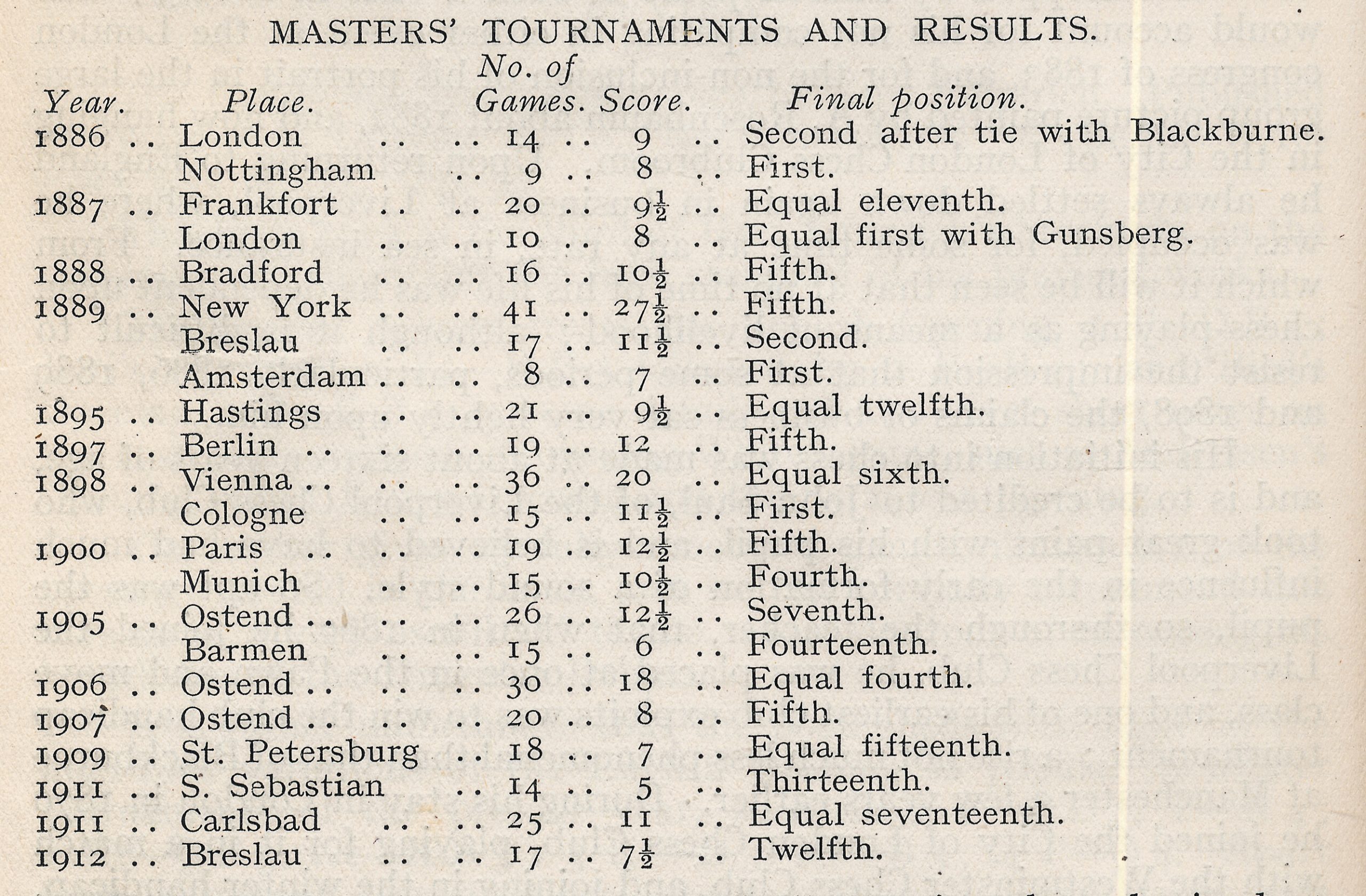
The greatest success was beyond all question that obtained at Cologne in 1898, where he was first to such renowned rivals as Charousek (second), Tchigorin (fourth), Steinitz (fifth) and Schlechter (equal sixth). But no mean place in the order of merit must be assigned to the second prize at Breslau in 18B9, where Dr. Tarrasch achieved the first of his great Series of successes, and such players as Bardeleben, Blackburne, Gunsberg, Mason and Schallopp were amongst the less successful competitors. The book of that tournament, in recognition of so striking a success, following upon the New York tournament with the Amsterdam victory treading closely upon its heels described Burn as the “tournament hero of the year”
In 1898 the Cologne tournament followed hard upon the long struggle at Vienna; these events of these two years go to prove his remarkable power of endurance : he fared best in the most prolonged. efforts.
During this period of international activity Burn did not altogether eschew competitors of a national or sectional character. Early in 1889 he won first prize in an Irish Chess Association tournament at Dublin, Pollock and Mason taking the next two places. In 1897-8-9 and 1901 he competed at Llandudno for the Craigside challenge cup, which he won three times in the four tournaments. He also won a Midland counties tournament at Birmingham in 1899, with Atkins second.
Of individual match play there is not much to record. A match with Bird in 1886 (two more opposed styles of play could hardly be imagined) was begun as one of five up, with the score at four all was extended to ten up, and was finally drawn by agreement with the score at at nine all. In the same year a match of five up with Captain Mackenzie was drawn with as score of four all; the curiosity of this
match is that Mackenzie won the first four games and Burn the last four. A match is known to have been played in 1875 with the Rev. John Owen, the leading player of the Liverpool club until Burn’s rise ; this Burn won by 11 to 6. Mr. Owen, however, told the present writer (about 1895) that he had contested several matches with Burn, who had not always been the winner; no record remains of these encounters; but as neither player had any love for the practice of recording the moves of a game during its progress its absence is not surprising. Similarly, a short match was begun with the Rev. A. B. Skipworth at his Lincolnshire rectory, somewhere in the late eighties, but whether finished is doubtful; probably the record of this is buried in the files of a Horncastle or Louth newspaper in which Mr. Skipworth conducted a chess column at the time.
Burn took part in the matches by cable with America on four occasions. In 1896 and 1898 he lost to Showalter; in 1907 he drew with Marshall; and in 1911 he defeated Marshall (who was then in London) over the board.
His connection with the Liverpool Chess Club lasted from 1867 until his death. He served the offices of librarian in 1877, vice-president in 1880, president in 1881, 1888, 1890, 1891, 1892, 1908, 1909, 1910 and 1911. In 1887 he was elected an honorary member retaining that qualification until then end. In 1888 he was presented by the club with a handsome chessboard and set of chessmen, the box bearing an inscribed silver plate, in recognition of the tournament successes he had already achieved, and as a token of the high esteem in which he was held by his fellow members.
As a chess journalist Burn commenced in 1871 when he edited
a column in the Liverpool Weekly Albion, how long this continued we do not know. In 1911 he became chess editor of the Liverpool Courier. His annotation of games for this column attracted wjde-spread notice and was much quoted both at home and abroad. When therefore, on the death in 1913 of Leopold Hoffer, Burn was appointed to The Field, it was to the general satisfaction of British chessplayers everywhere. His treatment of the games published in that paper was of the most sound and reliable character, and no pains were ever spared to arrive at the inner secret of the most intricate position. The high standard set by Steinitz when editing the same column thirty to forty years before, was worthily maintained by his quondam pupil on becoming his successor.
Burn’s style of play was solid and prudent rather than aggressive; he has more than once mentioned with pardonable pride that amongst his peers of master rank he was chiefly famed for “stubborn defence.” A favourite aphorism was, “The player who combinates is lost !” Nevertheless it is to be at least suspected that this was
the result of his early chess education and a strong power of self-control rather than of his predilections. An oft-repeated saying, perhaps the one which will be in London longest remembered, was “toujours attaque” ; his preference for being first player was stronger than that of most players, strong as that often is; and when shown
a game or position he had very little hesitation in taking sides, almost always with the attack; only with the defence when his initial judgment told him that unsoundness was afoot. But “counterattack is the soul of defence,” and in that he could be terrible. A collection of, say, twenty of his best games would probably yield a large pre-
ponderance of Black as his side. Once interested in a game (or position) his concentration upon it was of the most intense kind, and could only with difficulty be diverted. Even in skittle play, a cup of coffee, ordered at the start, would stand at his elbow unnoticed; was the opponent at some point long in moving he would suddenly become aware of its presence, and lift the cup; but let the opponent at the same instant raise his hand to move, back went the cup to the table untasted, and the beverage would be eventually consumed quite cold. His pipe fared little better; badly loaded, it took innumerable matches to light, was laid down after a few puffs, went out, and was
re-lit with the same difficulty. Did a friendly onlooker hint that a difference in the loading of the pipe would save much trouble, he would, if he succeeded in gaining attention, be quietly and painlessly extinguished with “How long have you been a smoker ?” The same intensity of concentration was carried into his work for the Field, and it is known that he often sat through the small hours of the morning to complete an analysis rather than interrupt the current of his ideas. Had he but spared himself in this respect —!
Of short figure, slight frame, and abstemious in habit, he was remarkably ” wiry ” ; at 77 his head of hair was quite untouched by the hand of time, and but for the grizzling of the beard he would have passed for no more than sixty. Perhaps a little difficult of approach by strangers, when his attention and interest were once gained he was the soul of courtesy, and would take unstinted trouble to oblige his interlocutor, or to help a colleague.
At the chessboard his courtesy to his opponent was perfect; he “played the game” in the best sense of the words; and his tribute to Blackburne’s chivalry as an opponent was worth the more because it accorded with his practise. With him passes the last of the line of English great masters!
In 2006 an article by WD Rubinstein was published in the Oxford Dictionary of National Biography
From The Oxford Companion to Chess (OUP, 1984), Hooper & Whyld :
“One of the world’s top ten players at the end of the 19th century. Born in Hull : he learned chess when 16, came to London at the age of 21, and rapidly established himself as a leading English player, A pupil of Steinitz, he developed a similar style; both he and his master were among the world’s best six defensive players, according to Nimzowitsch. Not wishing to become yet another impecunious professional. Burn decided to put his work (first a cotton broker then a sugar broker) before his chess, and he remained an amateur. He made several long visits to America, and was often out of practice when he played serious chess.
Until his thirty-eighth year he played infrequently and only in national events, always taking first or second prize. From 1886 to 1889 he played more often. In 1886 he drew matches with Bird (+9-9) and Mackenzie (+4=2-4); at London 1887 he achieved his best tournament result up to this time, first prize (+8—1) equal with Gunsberg (a play-off was drawn +1=3—1); and at Breslau 1889 he took second place after Tarrasch ahead of Gunsberg, After an isolated appearance at Hastings 1895 he entered another spell of chess activity, 1897-1901, The best achievement of his career was at Cologne 1898, first prize ( + 9=5-1) ahead of Charousek, Chigorin, Steinitz, Schlechter, and Janowski. At Munich 1900 he came fourth (+9=3—3). His Last seven international tournaments began with Ostend 1905 and ended with Breslau 1912. A comparative success, in view of his age. was his fourth prize shared with Bernstein and Teichmann after Schlechter, Maroczy, and Rubinstein at Ostend 1906; 36 players competed in this five-stage event, 30 games in all for those who completed the course.
Retired from both business and play he made his home in London and edited the chess column of The Field from 1913 until his death. A shy and retiring man, a loyal companion to those who came to know him, he freely gave advice to young and aspiring players.”
The front cover of the November 1975 issue of the British Chess Magazine featured Amos Burn :
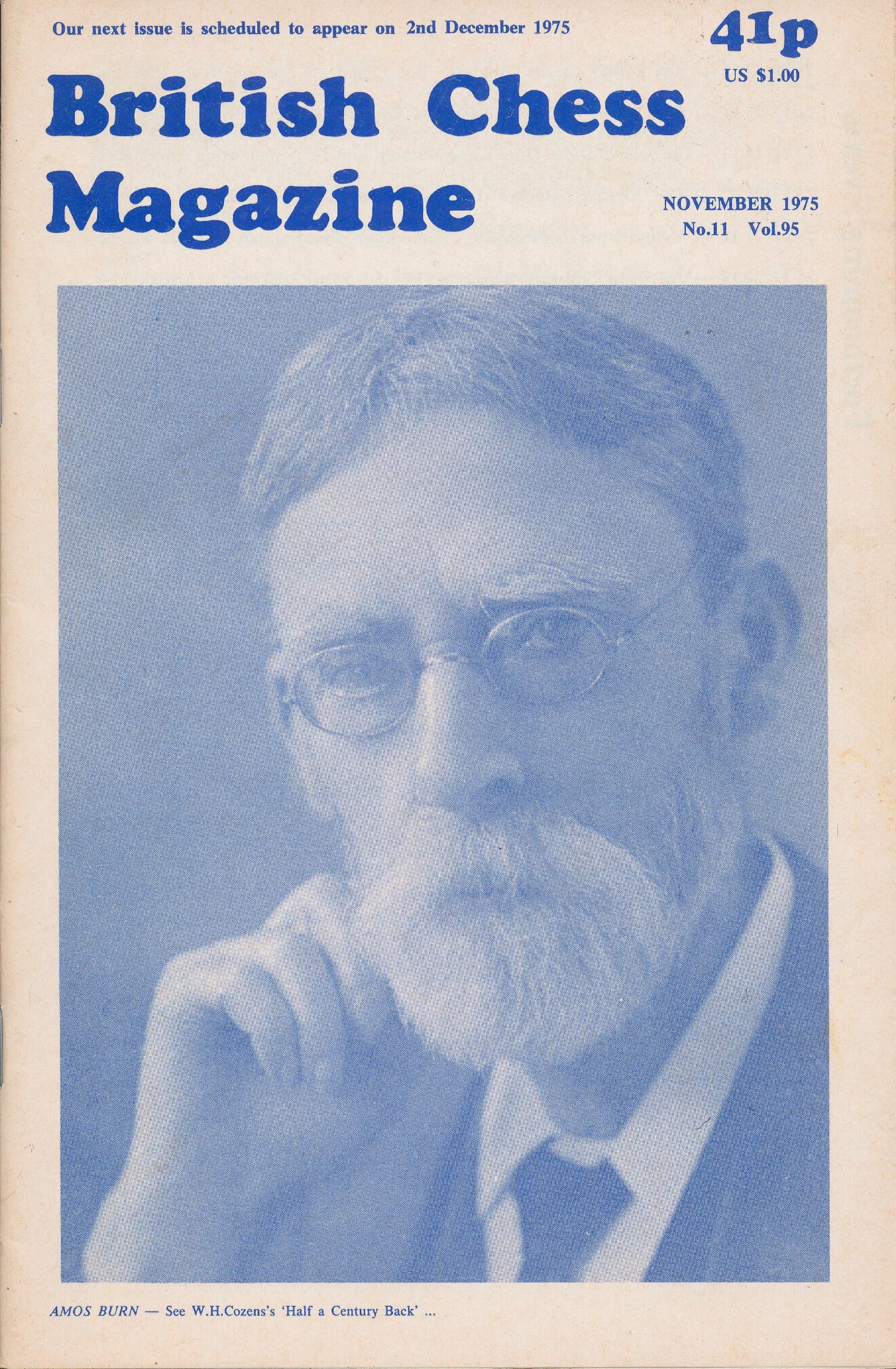
From British Chess Magazine, 1975, November, pp. 481-483 :
Amos Burn was a very different figure and his career is poorly documented. He is overdue, not for a reappraisal but simply an appraisal, He was born (in Hull) in 1848 – an incredible 127 years ago. All the years that could have been his prime as a chessplayer he devoted to business. (Marine insurance was his speciality.) He was based in Liverpool but travelled considerably, including several crossings of the Atlantic – quite an undertaking in those days. He played some casual chess, soon overshadowing the Rev. John Owen to become Liverpool’s answer to Manchester’s Blackburne. He also played for the City of London Chess Club; but it was not until he was nearly 40, presumably with his financial position secured, that he entered the international chess arena. Between the ages of 38 and 64 he played in 22 international tournaments. At Breslau (1889) he was second to Tarrasch, above Louis Paulsen, Blackburne, Schallop … In Amsterdam the same year he was first, ahead of Emanuel Lasker. His finest achievement was first place at Cologne 1898, in front of Charousek, Chigorin, Steinitz, Schlechter et al., (16 in all) with a win against Steinitz. The lack of a book on Cologne 1898 is – since the publication of Mannheim 1914′: the biggest gap in tournament literature.
At Karlsbad 1911 he defeated not only the winner, as mentioned above, but also Alekhine, whom he steered into a knight versus bad bishop ending. His style was unashamedly modelled on that of Steinitz, and marked by extreme tenacity. To him is attributed the epigram ‘He who combinates is lost’. He could play a combination when in the mood but he much preferred to let the opponent break his own back by attacking too impetuously. Nimzowitsch wrote: ‘The number of really great defensive players is very small’, adding that he knew of only six: Steinitz, Emanuel Lasker, Burn, Bernstein, Duras and Louis Paulsen.
In the 1911 Cable Match between G.B. and the U.S.A. Marshall came from San Sebastian straight to London and asked permission for his top board game to be played over the board. When he found that his opponent was to be the 64-year-old Amos Burn he must have smiled, for he had twice defeated him resoundingly – at Paris 1900 (also having some fun at Burn’s expense in his annotations to the game) and again at Ostend 1905. This time he was in for a shock. Within twenty moves the old man had won his queen for two pieces. Marshall played on, probably with a red face, until move 37, rather than have his loss cabled home too early. Against Burn he might have spared himself the trouble.
Burn was a superb annotator. His work, notably in ‘The Field‘ from 1913 on, sets a standard to which one looks back nostalgically in these days of hieroglyphics. The day before he died, at the age of 77,he had been at work on analysis and annotation. Tournaments were now plentiful enough for it to be possible to pick out the band of regular professionals, and to assess their prowess. Tartakower was placed 2, 5, l, 5; Reti 5, 5’ 5,-11; Grunfeld 4,8,8,9; Nimzowitsch was erratic with 1,2,9; so was Rubinstein with 1, 2, 3, 12. Marshall was consistent with 3, 4, 5. Lasker, Capablanca and Alekhine appeared once each – with distinction, of course.”
The Burn Variation is a line in the french defence dating from the 1870s, played regularly by Burn at the tournaments of Hastings
1895, Cologne 1898, and Vienna 1898. More recently it has been favoured by Petrosyan.
From The Encyclopedia of Chess (Robert Hale, 1970 & 1976), Anne Sunnucks :
“A leading British player of his day, Amos Burn was born in Hull on 31st December 1848. He learned the game when he was 16 and an apprentice with a firm of Liverpool cotton-brokers, but it was not until 1886 that he achieved his first major tournament success by coming 2nd in the London tournament and 1st at Nottingham. These results gained him an invitation to Frankfurt 1887, which marked the beginning of his career as an international player.
Burn’s greatest successes were 1st at Amsterdam 1889, ahead of Lasker, 2nd at Breslau 1889, behind Tarrasch but ahead of Mieses, Von Bardeleben, Bauer, Gunsberg and Paulsen; and 1st at Cologne 1898, ahead of Charousek, Steiniitz, Tchigorin and Schlecter.
After the St. Petersburg 1909 tournament, Burn’s results began to deteriorate and he finally retired from tournament chess after the Breslau 1912 tournament.
From 1913 until his death, Burn was chess editor of The Field. He died on 25th November 1925.”
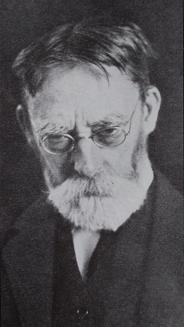
From The Encyclopedia of Chess (Batsford, 1977), Harry Golombek OBE :
“British Grandmaster and second only to Blackburne in late nineteenth-century British chess. He was born in Hull and learned to play chess at sixteen, but devoted little time to the game at first, preferring to establish himself in a commercial career.
He returned to chess in his middle thirties, his first major national success being first prize at Nottingham 1886 and second prize at London 1886. Within three years he had gained an international reputation by winning at Amsterdam 1889, ahead of Lasker, and finishing 2nd to Tarrasch at Breslau 1889. Burn continued to appear in international tournaments until the age of sixty-four, his most notable triumph being first prize at Cologne 1898 in front of Charousek, Steinitz, Chigorin and Schlechter. He was chess editor of The Field from 1913 until his death in 1925.”
Edward Winter wrote a feature article on the game McDonald-Burn, Liverpool, 1910
and from that game we have the move that made that game memorable :
Black to move : did you find it? (if not see the foot of this article)
William Winter wrote the following in the February issue of CHESS for 1963, (Volume 28, Number 426, pp.128-134):
“For my win over Niemtsovich I am partly indebted to Amos Burn. Before the tournament I happened to mention to him that Niemtsovich was playing a system, beginning with 1.P-QN3, the idea of which was to control the square at his K5 from the flank, and eventually occupy it with a knight. The old master told me that in his younger days he had played many games with the Rev. John Owen who regularly adopted this opening, and that he could make little headway against it, until he hit on the idea of at once occupying the key square with a pawn and defending it with everything he could pile on. This plan I adopted with complete success. After my third move I saw Niemtsovich shake his head, and in fact he was never comfortable.”
According to Edward Winter in Chess Notes Burn lived at 19 Luxemburg Gardens, London W6, England (Amos Burn, The Quiet Chessmaster by R.N. Coles, page 7).
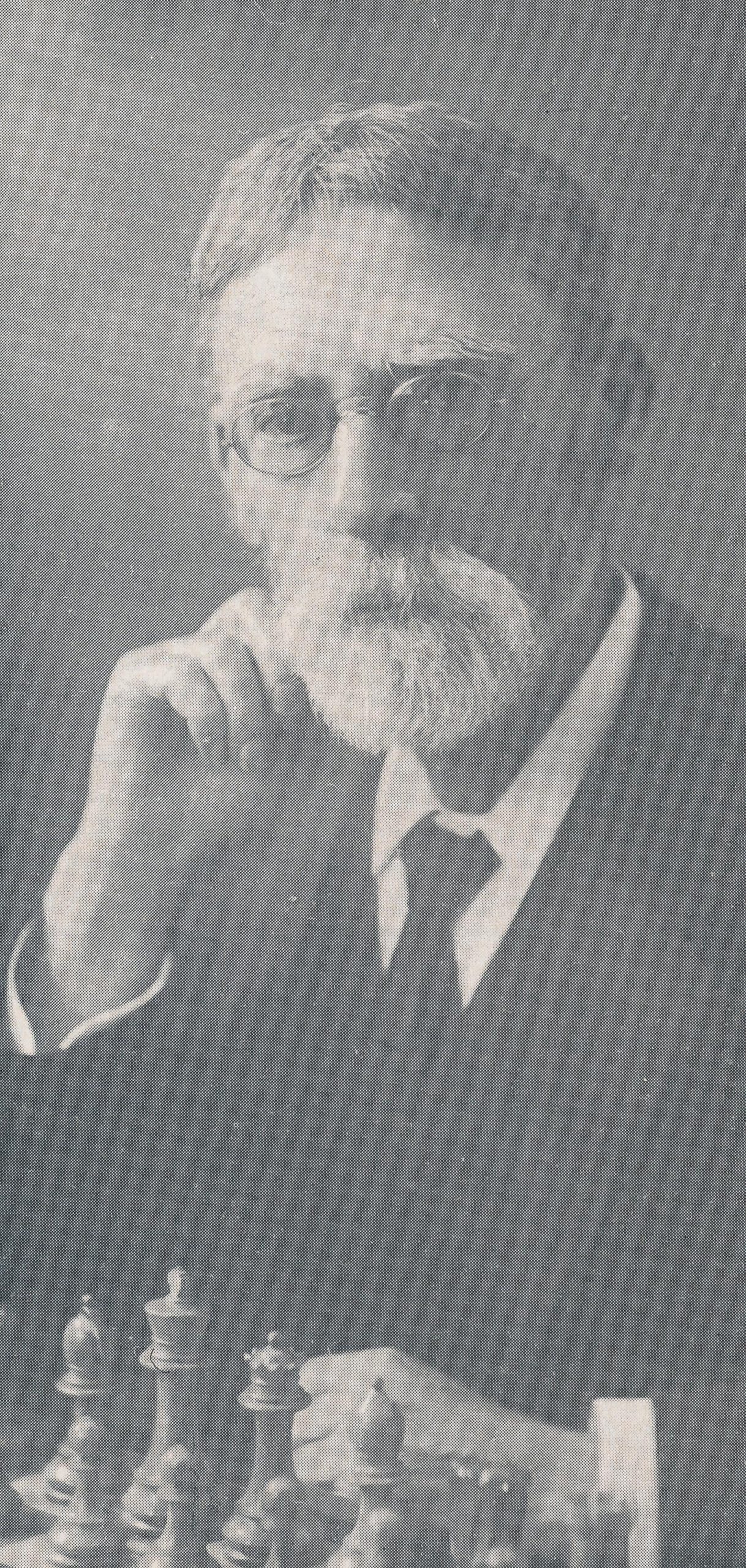
and an excellent article from the Liverpool Museum is here
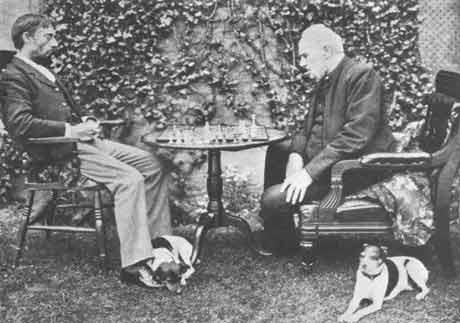
and in case you did not spot the move : Burn played 33…Qg4!!