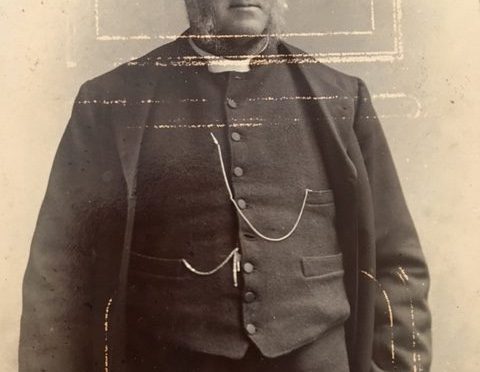
We remember Reverend John Owen who passed away on the 24th November 1901 in Twickenham.)
John Owen was born on April 8th, 1827 to John and Sarah Owen in Marchington, Uttoxeter, Staffordshire.
He was baptised at Marchington, St. Peter on April 9th, 1827 by H. Bennett and their residence was recorded as “Brook House”. His father is recorded as being a gentleman.
From The Oxford Companion to Chess (OUP, 1984) by Hooper & Whyld :
“English player, vicar of Hooton, Cheshire, from 1862 to 1900. In 1858, playing under the pseudonym ‘Alter’, he lost (=2-5) a match against Morphy, who conceded pawn and a move. (Hoffer attributed this poor result to Owen’s just being married.) Subsequently Owen played better. He drew a match with Kolisch in 1860 (+4-4) and at the London tournament of 1862 took third prize after Andersen (whom he defeated) and L. Paulsen ahead of Dubois, GA MacDonnell, Steinitz and Blackburne.
From 1857 to 1898 Owen played in more than a dozen tournaments, all of them in Great Britain.
He liked close openings and often played the Queen’s Fianchetto Defence, sometimes named after him, and the Larsen Opening.”
From The Encyclopedia of Chess (Batsford, 1977), Harry Golombek OBE :
Probably, the strongest of all the chess-playing reverends of the nineteenth century. Owen came 3rd at Birmingham 1858, below Löwenthal and Falkbeer, but ahead of Saint-Amant, Staunton and Bird; but is should be pointed out that the method of play was still by the old knock-out system.
He was also =3rd with MacDonnell in the first congress of the British Chess Association at London in 1862.
He also had the distinction of losing matches to Morphy, Zukertort and Burn, though he beat Burn in a later match. He drew a match with Kolisch in 1860.
Sunnucks is silent on Owen.
According to The Complete Chess Addict (Faber&Faber, 1987), Mike Fox & Richard James :
“For the record (and because it’s so impressive) here is the most devout team of all time, If there is anything in the efficacy of prayer they’d be tough to stop :
“John Owen (8 April 1827 – 24 November 1901) was an English vicar and strong amateur chess master. He ranked among the world’s top ten chess players for certain periods of the 1860s. He was a major figure in English chess from the mid 1850s to the 1890s.
Owen was born in Marchington, and obtained his early schooling at Repton School, Derbyshire. In 1850 he graduated from Trinity College, Cambridge, and received his M.A. from Cambridge three years later. He was ordained by the Church of England in 1851, and served as Vicar of Hooton, Cheshire from 1862 to his retirement in 1900.
In 1858 he won a chess game against the young American master Paul Morphy, the world’s best player, who was then touring Europe.”
This led to a match between the two. Despite being given odds of pawn and the move (meaning he started the game with an extra pawn and always moved first), Owen lost the match 6–1, never winning a game.
His performance in the very strong 1862 London tournament, the first international round-robin event (in which each participant plays every other) was more impressive. He finished third, ahead of future world champion Wilhelm Steinitz, and was the only player to win against the eventual tournament winner, Adolf Anderssen. Louis Paulsen placed second. This result was arguably Owen’s top lifetime chess achievement.
Owen continued to play frequently and often successfully in British tournaments into the 1890s, and performed strongly in several matches against top British players, who were essentially chess professionals. He never competed outside the British Isles. He died in Twickenham.
Owen is the eponym of Owen’s Defence, a chess opening characterised by the moves 1.e4 b6. Owen was the first strong player to play this frequently, including in his victory over Morphy.”
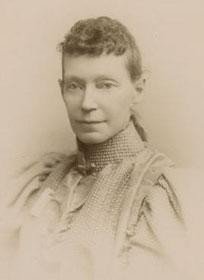
We remember Mary Rudge who passed away one hundred and two years this day on Saturday, 22-xi-1919.
She was born in Leominster, Herefordshire on February 6th, 1842. Her father was Henry Rudge (born 1794 in Gloucestershire) who was a surgeon and General Practitioner. Her mother was Eliza Rudge (née Barrett) who was born in Ledbury, Herefordshire in 1802.
Mary was part of a typically large household and according to the 1851 census she had sisters Sarah (23), Caroline (18), Emily H (12), brothers Henry (14) and Alfred (10). Assisting Henry with medical matters was William S Boyce and acting as a “General Servant” was Thomas Rotheroe (18). Their address is given as “21, Middle Marsh, Leominster, Herefordshire, England” (HR6 8UP). According to HM Land Registry : “Middlemarsh is in the Leominster North & Rural ward of Herefordshire, County of, Herefordshire, Worcestershire and Warwickshire.”
By 1861 the household had relocated to 62, Broad Street, Leominster and the servants were James Price (18) whose occupation is given as a Groom and Sarah Gardener (21) who was the House Servant.
Mary moved, “helpless from rheumatism”, at some point, to Truro and then to the British Home for Incurables, Streatham. She died in Guys Hospital, London, on 22 November 1919.
Editor of British Chess Magazine at the time of her obituary was Isaac McIntyre Brown who afforded Mary a pathetic three lines.
“As we go to press we learn with great sorrow of the death, at Streatham last month, of Miss Mary Rudge, winner of the International Ladies’ tournament in 1897.”
Golombek, Hooper&Whyld and Sunnucks are all silent on Rudge.
From Wikipedia :
“Mary Rudge (6 February 1842 in Leominster – 22 November 1919 in London) was an English chess master.
Rudge was born in Leominster, a small town in Herefordshire, England. She began playing chess in a correspondence tournament in 1872. The first mention of over the board competition is in August 1874 when she played in the second class at the Meeting of the Counties’ Chess Association at Birmingham. After the death of her father, Henry Rudge, she moved to Bristol where she started playing chess seriously.
Rudge was the first woman member of the Bristol Chess Club, which did not allow women to be members of the club until she joined in 1872. She played against Joseph Henry Blackburne, who gave a blindfold simultaneous display against ten opponents. The following year she played in another blindfold simultaneous display given by Johannes Hermann Zukertort. In March 1887 she played and drew on board six for Bristol against Bath at the Imperial Hotel in Bristol. At the beginning of 1888, Rudge played and won on board six for Bristol & Clifton against City Chess & Draughts Club. The following year, she won the Challenge Cup of Bristol & Clifton Chess Club. In 1889, she became the first woman in the world to give simultaneous chess exhibitions. She won the Ladies’ Challenge Cup at Cambridge 1890, and won the second class at the Southern Counties’ tournament at Clifton 1896.[1]”
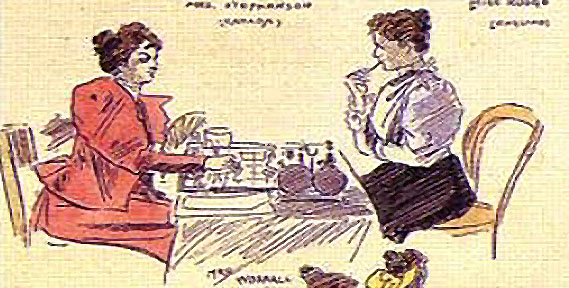
Miss Stevenson & Mary Rudge
“First Women’s International Chess Congress
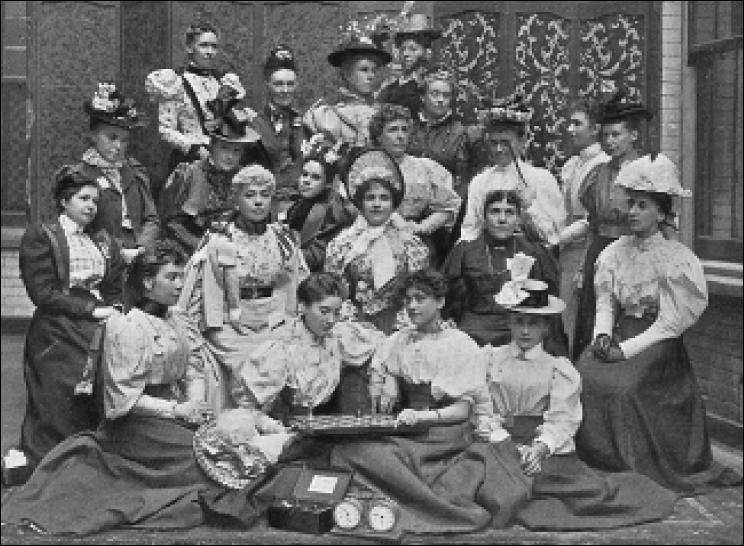
She was a winner of the first Women’s International Chess Congress under the management of the Ladies’ Chess Club of London in conjunction with the Women’s Chess Club of New York. Lady Newnes was president of the Tournament Committee, and Sir George Newnes, Baron Albert Salomon von Rothschild, Mr. Harry Nelson Pillsbury and some others offered prizes. The tournament was played at the Hotel Cecil in the Masonic Hall for six days, but the final rounds were decided at the Ideal Café, the headquarters of the Ladies’ Chess Club, from 22 June to 3 July 1897.[2] Miss Rudge was 55 years old and the oldest of the 20 players,[3] and had substantial experience playing chess at the time. She was a well-known English player, ranking in chess strength with the first class of the leading men’s clubs. She won the event with 18 wins and 1 draw, followed by Signorina Louisa Matilda Fagan (Italy), Miss Eliza Mary Thorold (England), Mrs. Harriet Worrall (USA), Madame Marie Bonnefin (Belgium), Mrs. F.S. Barry (Ireland), Lady Edith Margaret Thomas (England), among others.”
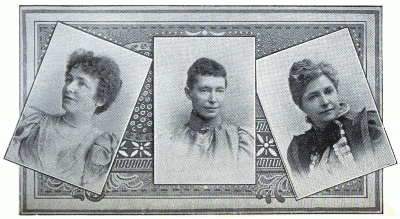
Mrs. Bowles (Hon. Sec.); Miss Rudge; and Mrs. Fagan from chesscafe.com
“Over the next years, she took part in various competitions, playing in Bristol and Dublin. In 1898, she played against world champion Emanuel Lasker in a simultaneous display at the Imperial Hotel. Lasker was unable to finish all the games in the time available, and Rudge’s was one of those unfinished. He conceded defeat because he would be lost with best play.”
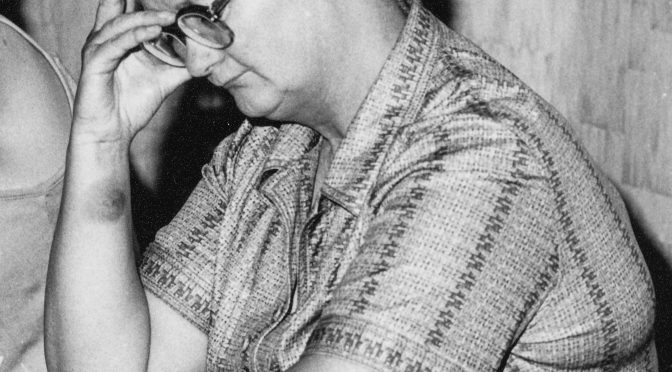
We remember WIM Anne Sunnucks who passed away this day, November 22nd, 2014, aged 87 years at a retirement village in Meadow Park, Braintree, Essex.
Patricia Anne Sunnucks was born on Monday, 21st February 1927 in the district of Kensington, London. Her father was Stanley Lloyd Sunnucks and her mother was Edith Vera Constance Sendell.
Anne had one brother, James Horace George, who died in March 2005 in Colchester, Essex.
Stanley died on 29th January 1953 in Brentwood, Essex. Edith passed away in March 1975 in Bracknell, Berkshire.
In September 1984 in Bracknell, Berkshire Anne married Richard C Mothersill.
“International Woman master and British Women’s Champion 1957, 1958 and 1964. Her best international result was a 2nd in the 1954 Western European Zonal. This qualified her for the 1955 Women’s Candidates tournament, but as this held in the USSR and she was at the time serving as a Major in the British Army, the authorities would not give her leave to participate.
Miss Sunnucks has represented England a number of times in Olympiads and team matches. She has compiled The Encyclopedia of Chess, London, 1970.”
From The Encyclopedia of Chess (Robert Hale, 1970 & 1976), Anne Sunnucks :
“International Woman Master (1954) and winner of the British Ladies’ Championship in 1957, 1958 and 1964.
Born on 21st February 1927 Anne learned the moves at the age of 8 but did not take up chess seriously until she was 21, when she joined the same club as International Master, Imre König” whose pupil she became.
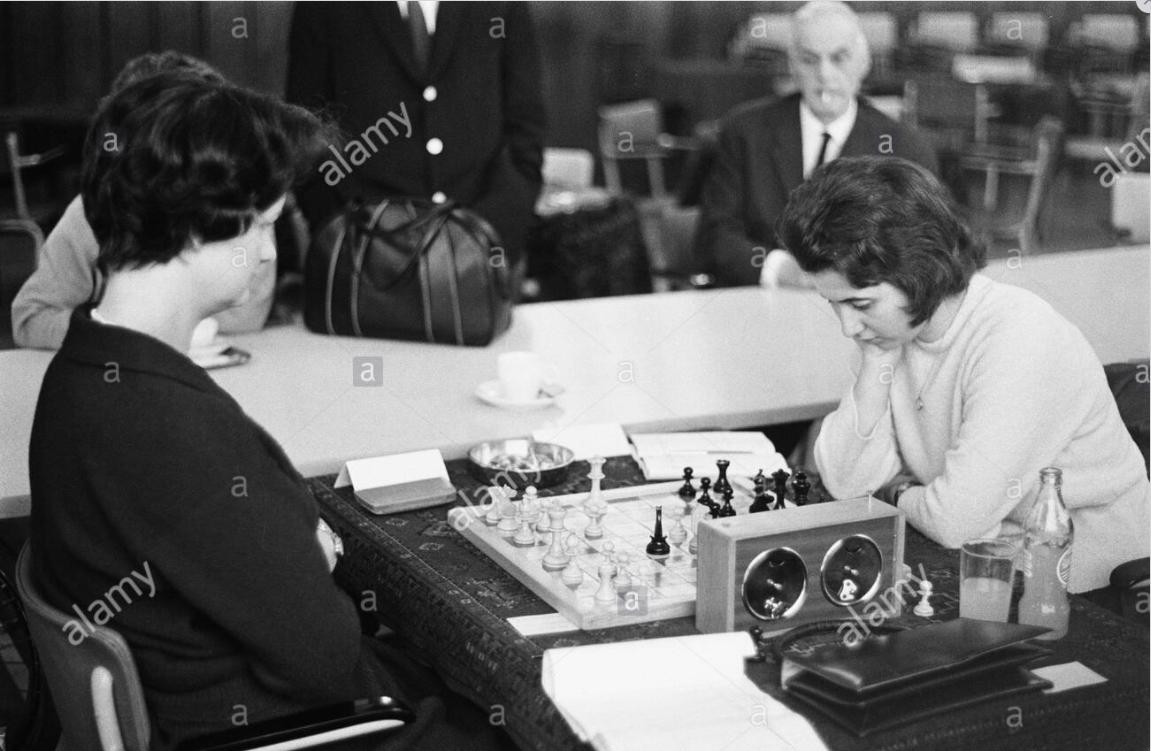
Danlon ladies chess tournament, left Anne Sunnucks , right Katarina Blagojević-Jovanovic Date: October 23, 1962
In the 1954 Western European Zonal tournament, she came 2nd and qualified for the 1955 Women’s Candidates tournament but was unable to compete.
She played for Great Britain v. the USSR in 1954 and for the British Chess Federation team in the Women’s Chess Olympiads of 1966 and 1972. She also represented the BCF in the Western European Zonal tournaments of 1963 and 1966.”
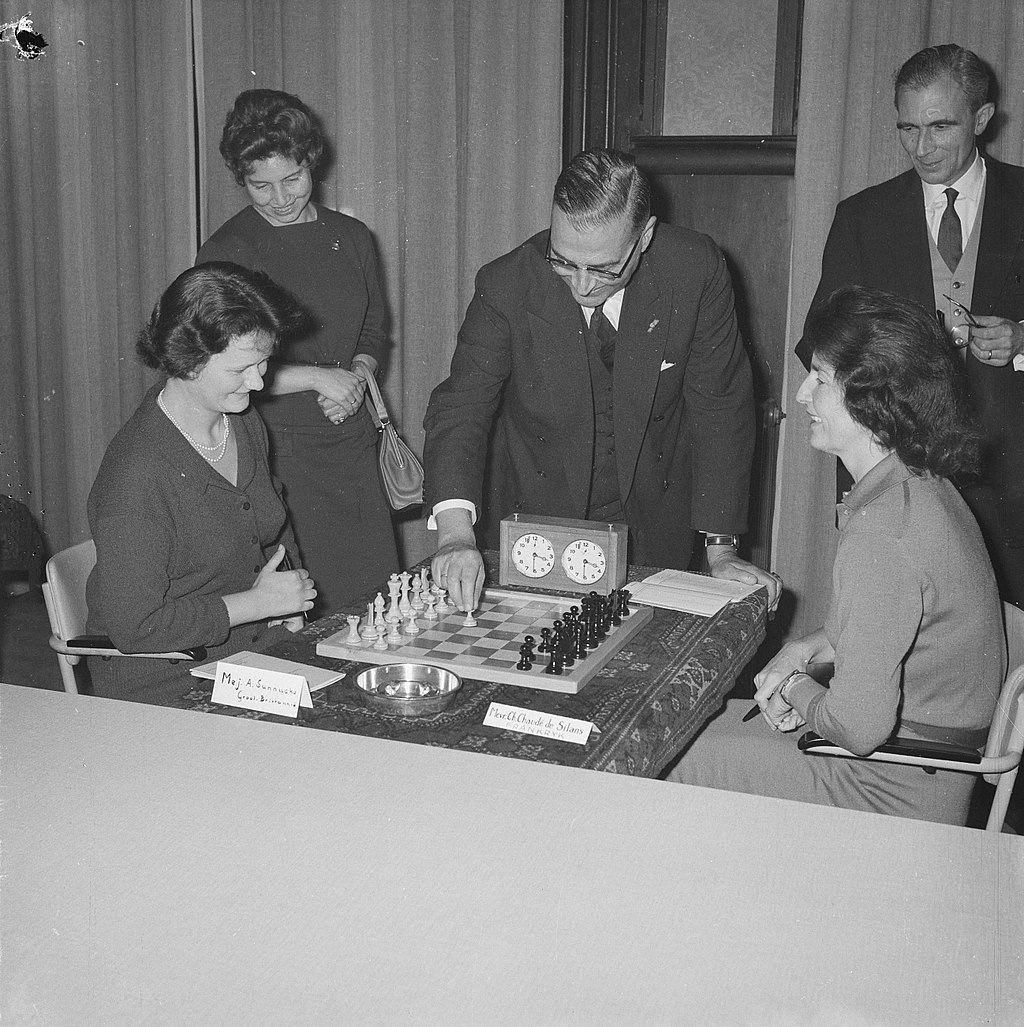
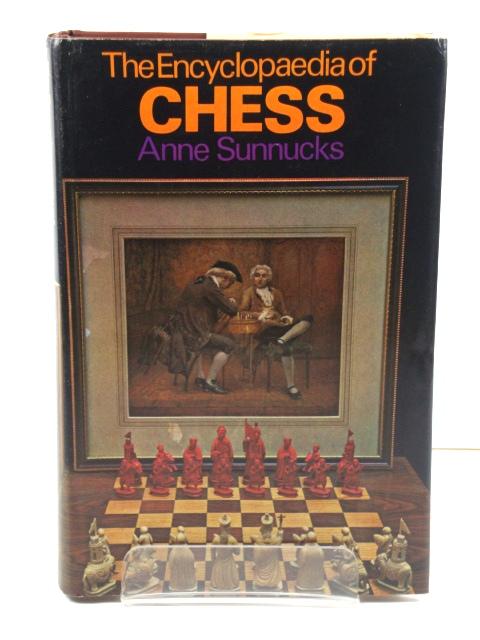
Anne Sunnucks vs Chaudé de Silans (Amsterdam, 1962)The Encyclopedia of Chess by Anne Sunnucks
Anne created Camberley Chess Club in 1972. She offered to open her spacious home at 28, Brackendale Close, Camberley for weekly club nights and matches.
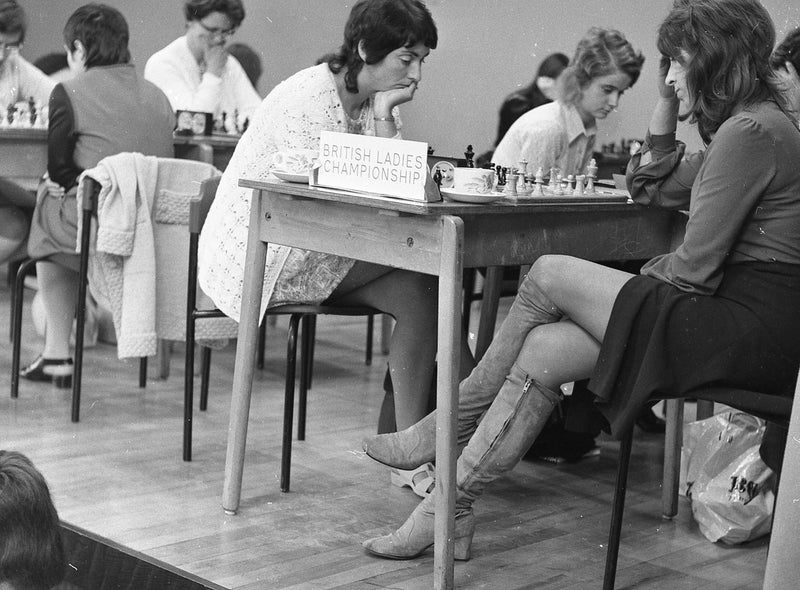
Anne Sunnucks (third from left) playing in the 1971 British Ladies Championship in Palatine School, Blackpool. Courtesy of Lancashire Evening Post.
Anne was a director of BMS (?, Mothersill, Sunnucks) Chess Supplies Ltd. which retailed chess books and equipment which the grateful membership purchased!
From Brian Towers : It is also worth noting that she was an occasional contributor to the weekly chess ‘Magazine’ programme which was broadcast on the Third Network (the precursor to Radio 3) between Autumn 1958 and Summer 1964.
According to Megabase2020, her highest Elo rating was 2045 but we suspect it was in reality, quite a bit higher.
In 1972 Anne was awarded with a FIDE Medal of Merit. Anne was made an Honorary Life Member of the BCF and then ECF.
From Wikipedia :
Patricia Anne Sunnucks (21 February 1927 – 22 November 2014[1]) was an author and three-times British Women’s Chess Champion (1957, 1958, 1964). During her chess career she was always known as Anne Sunnucks.
She was educated at Wycombe Abbey School[2], Buckinghamshire. Although she learned how to play chess at the age of 8, she did not play seriously until the age of 21, when she joined the same chess club as Imre König, who became her tutor. By finishing tied for second place in the 1953 British Women’s Championship she became one of three British representatives in the 1954 Western European Zonal.
Sunnucks earned the Woman International Master title by placing second in the 1954 Western European Zonal. Although this result qualified her to play in the next event in the Women’s World Championship sequence, she was a major in the Women’s Royal Army Corps and the authorities would not allow her to travel to the USSR where the 1955 Women’s Candidates tournament was being held. Sunnucks represented England several times in Olympiads and team matches, including Great Britain vs. USSR 1954, the Anglo-Dutch match in 1965, and top board for the British Chess Federation (BCF) team at the 1966 Women’s Chess Olympiad at Oberhausen. She participated in the Women’s World Championship cycle two more times, representing the BCF in the Western European Zonal tournaments of 1963 and 1966. Sunnucks won both the Army and the Combined Services Championships in 1968, and was the only woman to compete in either. Sunnucks compiled The Encyclopaedia of Chess (1970, second edition: 1976).
James Derrick Slater was born on Wednesday, March 13th, 1929. On the same day “Leon Trotsky gave his first interview to the foreign press in his apartment in Turkey, saying he was writing a book tracing the history of his opposition to Joseph Stalin and expressing a desire to go to Germany because he preferred the care of German physicians.”
He was born in Heswall, Cheshire (Wirral, Merseyside was the registration district) to Hubert Slater and Jessica Alexandra Barton.
He arrived (aged 31) in Southampton on board the Pretoria Castle as a first class passenger whilst resident in 16, Stafford Terrace, Kensington and his occupation was given as Company Director.
He died on 18th November 2015 in Cranleigh, Surrey aged 86. He had four children one of which is Mark Slater.
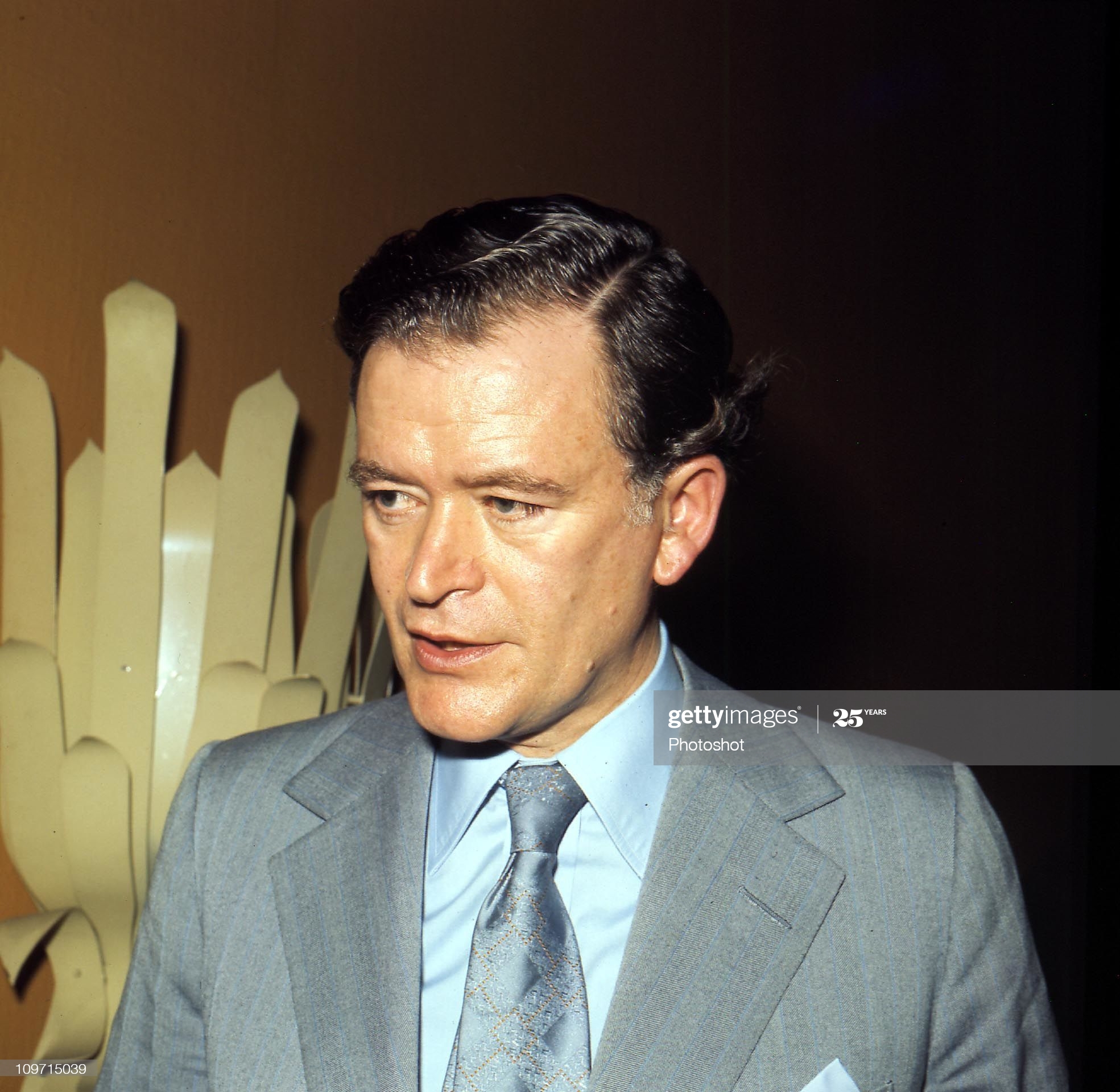
James Slater, Chairman Slater Walker Securities plc Director, British Leyland. (Photo by Photoshot/Getty Images)
Jim wrote his chess autobiography as follows :
(This text was retrieved using the Wayback machine via https://web.archive.org/web/20110909053137/http://www.jimslater.org.uk/views/chess/)
“As a boy Jim Slater enjoyed playing Monopoly and draughts but his main indoor hobby was chess. He stopped playing chess after leaving school as he found it took too much time and concentration while studying for accountancy.
It was not until a colleague asked Jim to teach him to improve his game in the late 1960s that his interest in chess was rekindled. For a short while Jim joined a London chess club (Richard James reveals that this is West London Chess Club as mentioned in their internal magazine) but found he preferred correspondence chess which he could play much more conveniently when he returned home in the evening. Jim did quite well in his correspondence club, going up a few grades, until he reached a level at which it became hard work.
Jim had maintained a link with Leonard Barden, who was a British Champion and a chess correspondent. With his help Jim began subsidising the annual Hastings Tournament with a view to expanding it so that leading players would have a chance to qualify as international masters. Other countries would not invite British players to play in their tournaments until they became international masters so they were in an impossible situation. The small amount of help Jim was able to give to Hastings was arranged in a very low-key way and attracted very little publicity. The World Chess Championship would prove to be a very different proposition.
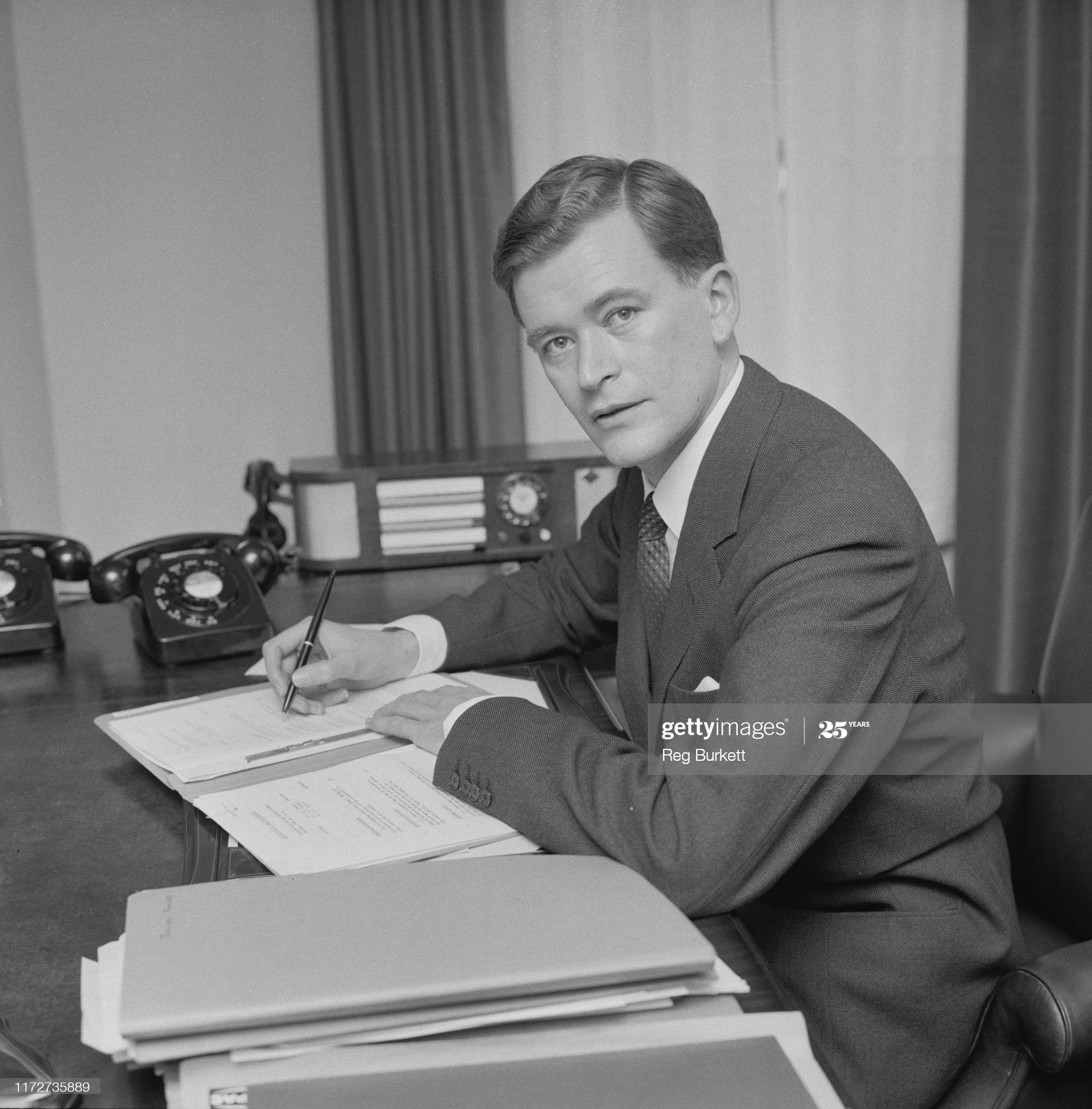
British accountant, investor and business writer Jim Slater (1929 – 2015) signing documents at a desk, UK, 11th May 1965. (Photo by Reg Burkett/Daily Express/Hulton Archive/Getty Images)
For the previous two decades the Russians had dominated world chess and then the West produced two exceptional players – Bobby Fischer of the USA and Bent Larsen of Denmark. In particular, Fischer had fantastic potential but he was handicapped by being extremely temperamental.
In the final rounds of the World Chess Championship the players were playing the best of ten games. In the quarter finals Fischer won six games to nil. In the semi-final Fischer was paired with Larsen and also beat him six games to nil. This had never happened before in world chess, and for the first time it looked as if the Russians were going to get a run for their money.
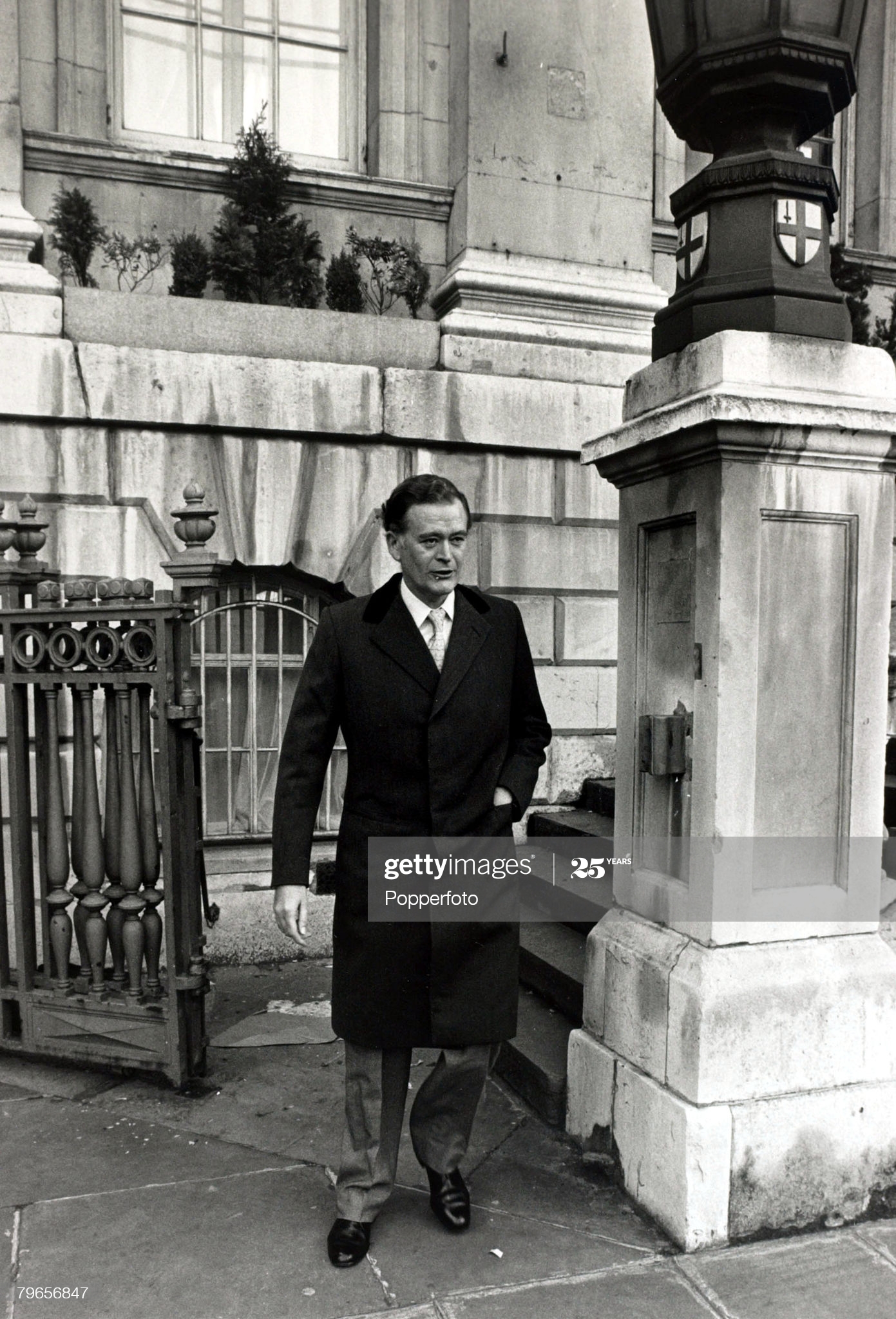
Personalities, Crime, pic: 3rd December 1976, Financier Jim Slater arriving at London’s Mansion House Police Court to face fraud charges involving more than 4,000,000 (Photo by Popperfoto via Getty Images/Getty Images)
In the last qualifier Fischer came up against Petrosian, a brilliant defensive player. Fischer won the first game but lost the second. The next three games were drawn. It was said by some that Fischer had a bad cold and everyone wondered if he could regain his earlier momentum. After this relapse he won the next four games. This made Fischer challenger to Spassky. Spassky too was a brilliant attacking player and had been a chess genius since early childhood, so it promised to be an exceptional match.
While preparations were being made for the World Championship in Iceland, Fischer started to complain about the prize money which he thought should be doubled.
‘I was driving into London early one Monday morning in mid-July feeling disappointed that after all this build-up Fischer might not be taking on Spassky, when it suddenly occurred to me that I could easily afford the extra prize money personally. As well as providing me with a fascinating spectacle for the next few weeks it would give chess players throughout the world enormous pleasure for the match to proceed.’
Jim Slater
From The Complete Chess Addict (Faber&Faber, 1987) , Mike Fox & Richard James:
“Jim Slater, the financier and children’s author, was a strong schoolboy player. He gave up chess for finance. This turned out a very good thing for chess, since he was able to tempt Bobby Fischer (with a £50,000 increase in stake-money) into playing Boris Spassky for the world title in 1972. Here’s what the young Slater was capable of:”
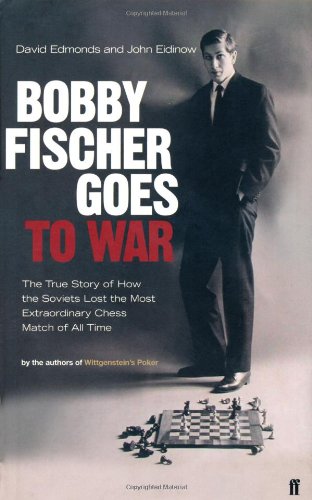
Bobby Fischer Goes to War, Faber&Faber, 2004
From Bobby Fischer Goes to War , David Edmonds and John Eidinow, Faber & Faber, 2004 we have a fuller account as follows :
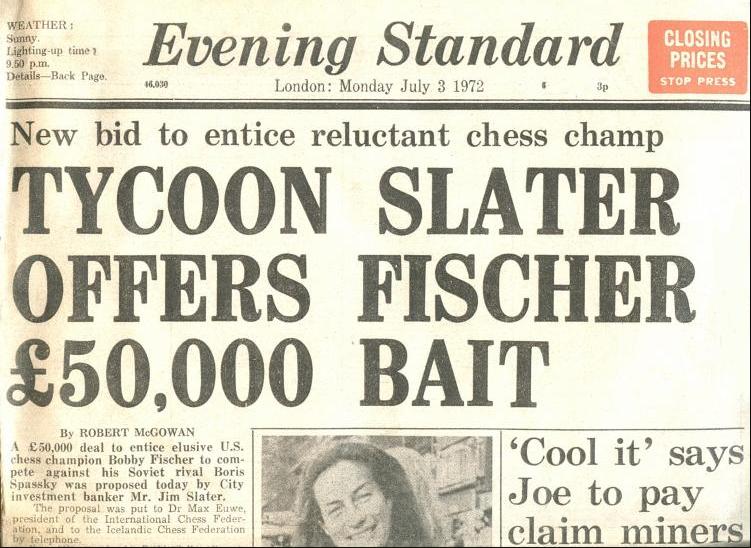
“Driving to work in London early on Monday morning, 3 July, Jim Slater was upset by a radio report on the challenger’s non-appearance in Reykjavik. Slater was a businessman who had set up his own company, Slater Walker Securities, in 1964, when he was in his mid-thirties. His partner, Peter Walker, had left the business to become a Conservative member of parliament and a government minister under Edward Heath and,later, Margaret Thatcher. At the time of the Fischer-Spassky match, the company reportedly had a controlling interest in 250 companies around the world. Supremely confident, decisive, ruthless in business, Slater had by then amassed a fortune of, in his own words,’£6 million and rising’. A gambler by nature, the one big luxury he allowed himself was to play bridge for thousands of pounds with stronger opponents.
He was also a chess fan and supporter of the game, subsidizing the annual Hastings tournament. In the years following Fischer-Spassky, he would, alongside the former British champion and journalist Leonard Barden (who provided the vision and organization), transform the state of British chess by channelling funds into junior competition. Now he decided that he could easily afford the money to send Fischer to Reykjavik – or expose the American as a coward. He would double the prize, putting an additional £50,000 ($125,000) into the pot. Arriving at his office that Monday morning, he passed on his offer through Barden, who then spoke to Marshall, giving the US attorney some background details about this championship angel. Marshall then talked to Fischer. Slater says he also telephoned his friend David Frost, who in turn rang his friend Henry Kissinger’ Kissinger then contacted Fischer. What motivated Slater?’As well as providing me with a fascinating spectacle for the next few weeks, I could give chess players throughout the world enormous pleasure’
Slater’s offer made headlines in London’s Evening Standard and his house was soon swarming with reporters. When he returned from work, he told his astonished wife,’I had a good idea on the way to the office.’The good idea was couched in challenging terms: ‘If he isn’t afraid of Spassky, then I have removed the element of money’
London Edition of the Evening Standard, July 3rd, 1972. Retrieved from https://chesshistory.com/winter/extra/spasskyfischer.html
It is not altogether clear how the British offer finally persuaded Fischer. Paul Marshall certainly had a hand, initially pushing it as the answer to all Fischer’s financial demands.’But he wouldn’t accept it; he says.’His experiences with people promising things had taught him not to believe them, particularly with money. And he wanted proof. And he said no.’Marshall tried to change his mind. Phoning Barden, the attorney took his place in the gallery of callers that saved the match.’I said if I were them I would rephrase the offer. Slater should say he didn’t think his money was at risk, because Fischer was just making excuses. He should say that deep down Fischer was frightened. I said Bobby might be piqued by that challenge – and he was. I knew Bobby was very very competitive and combative and would not like to be thought of as a chicken.’ Slater denies this version of events. He maintains it was always his idea to express his offer as a taunt. He never spoke to Fischer and never received a word of gratitude from him.’Fischer is known to be rude, graceless, possibly insane,’he says.’I didn’t do it to be thanked. I did it because it would be good for chess.'”
The match between Fischer and Spassky was a most exciting one and fully up to everyone’s expectations. Fischer won the match.
A few months later, in an endeavour to help our young players, Jim Slater offered on behalf of The Slater Foundation to give a prize of £5,000 (about £75,000 in today’s money) to the first British grand master and £2,500 to the next four. Over the next few years Great Britain went from having no grand masters to twenty and became one of the strongest teams of young chess players in the world.”
and here is his entry from chessgames.com which lists one game from 1947 : “James Derrick Slater, better known as Jim Slater, was an English accountant, investor and business writer. Slater became a well-known chess patron in the 1970s, when he stepped in to double the prize fund of the Fischer-Spassky world championship match at a time when Fischer was threatening not to play, thereby enabling the match to go forward. Afterwards he provided significant financial backing for the development of young British players, many of whom later contributed to Britain becoming one of the world’s strongest chess countries in the 1980s.”
From The Oxford Companion to Chess (OUP, 1984) by Hooper and Whyld :
“British chess patron, financier, children’s author, Slater achieved wide fame in the chess world on the occasion of the Spassky-Fischer world championship match of 1972. Fischer showed reluctance to play and apparently decided to do so when Slater added £50,000 to the prize fund. Slater has also made contributions to many other chess causes and in 1973 set-up the Slater Foundation, a charitable trust which, among other activities, pays for the coaching of young players and provides help for their families if needed. Leonard Barden advises the trust on chess matters. In the 1970s, partly owing to this patronage, junior players in Britain became as strong as those in any other country.”
From The Encyclopedia of Chess (Batsford, 1977) by Harry Golombek:
“An English financier, a great patron and benefactor of chess, both on a national and world level. Passionately devoted to chess from schooldays. He said that on leaving school he hesitated between the alternatives of become a chess master and of going into business, opting for the latter on the grounds that he was not sure of his chess-playing prowess.
It is perhaps a fortunate thing for chess that he did not become a chess-master, since he offer of a £50,000 increase to the stake at the match at Reykjavik in Iceland in 1972 may well have swayed Fischer into consenting to play. He established a Slater Foundation Fund which helps young English players to go and play abroad.”
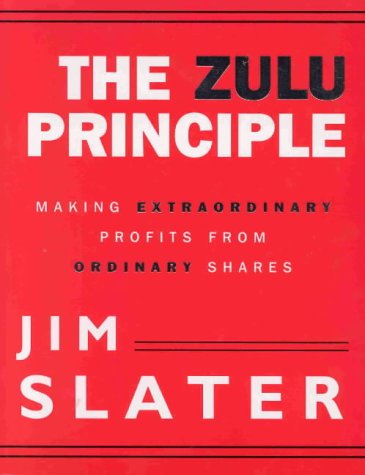
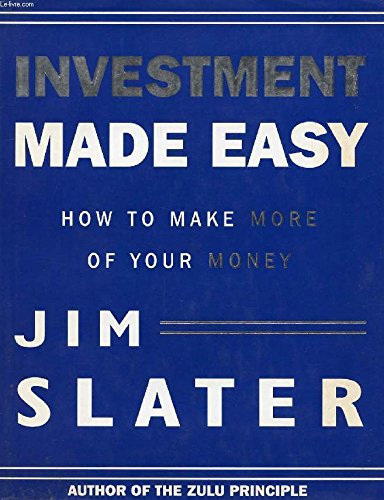
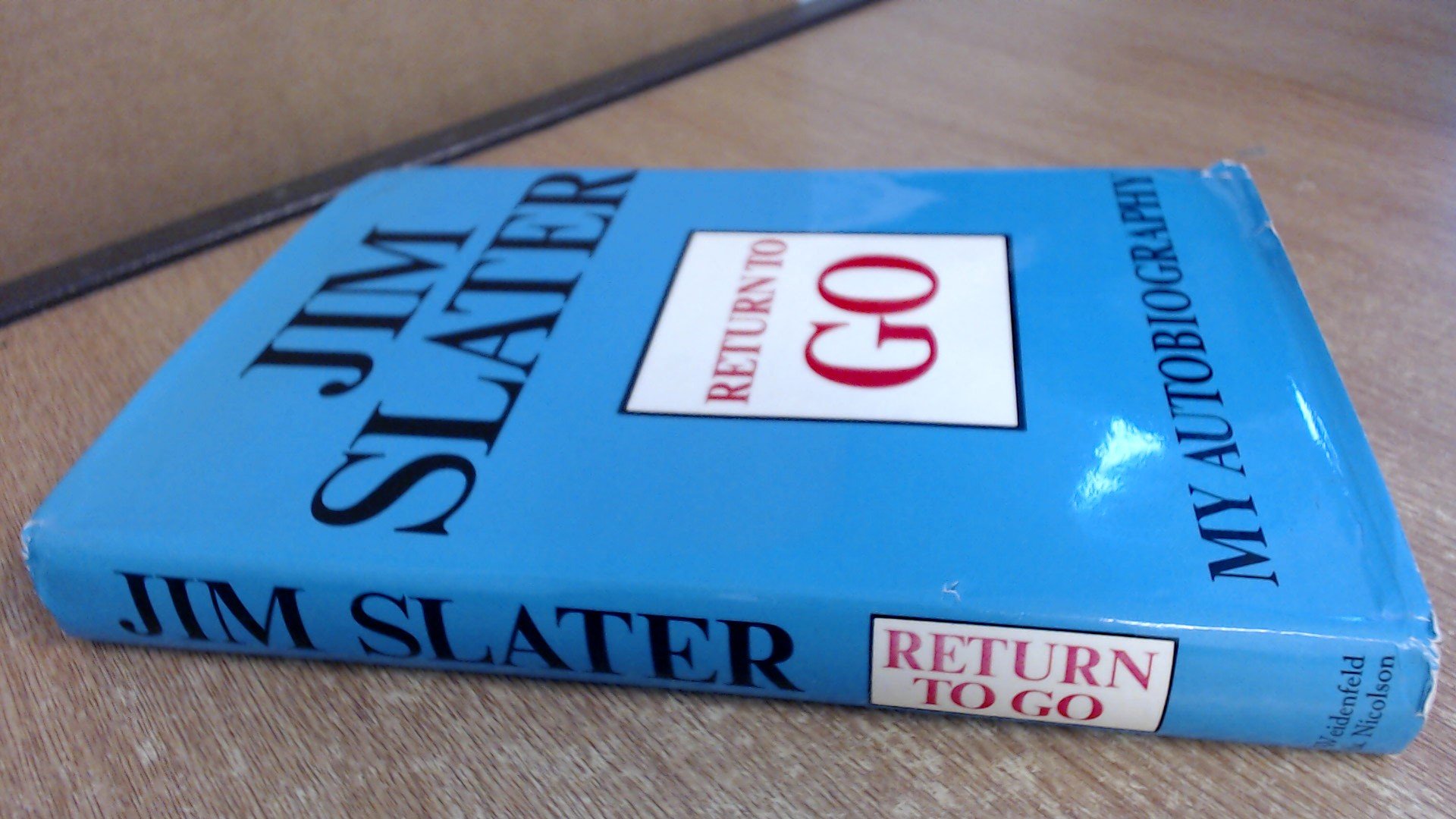
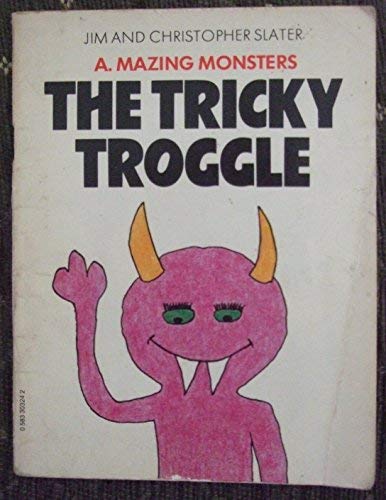
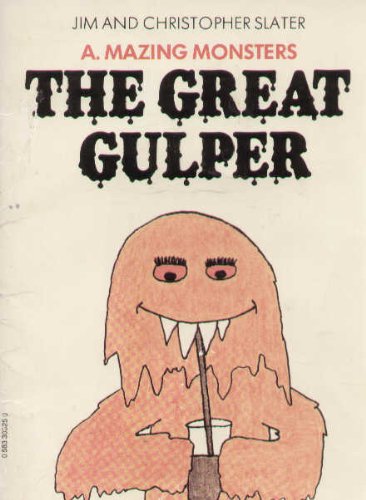
The Zulu Principle, Jim SlaterInvestment Made Easy, Jim SlaterReturn to Go, Jim SlaterThe Tricky Troggle, James and Christopher SlaterThe Great Gulper, James and Christopher Slater
We remember Gordon Crown who died this day (November 17th) in 1947.
Gordon Thomas Crown was born on Thursday, June 20th, 1929 to James Crown (born 18th November 1899) and Hilda M Crown (born 3rd October 1900, née Sharrott).
James was a refrigerating engineer and Hilda carried out unpaid domestic duties. The birth was registered in the district of West Derby, Lancashire.
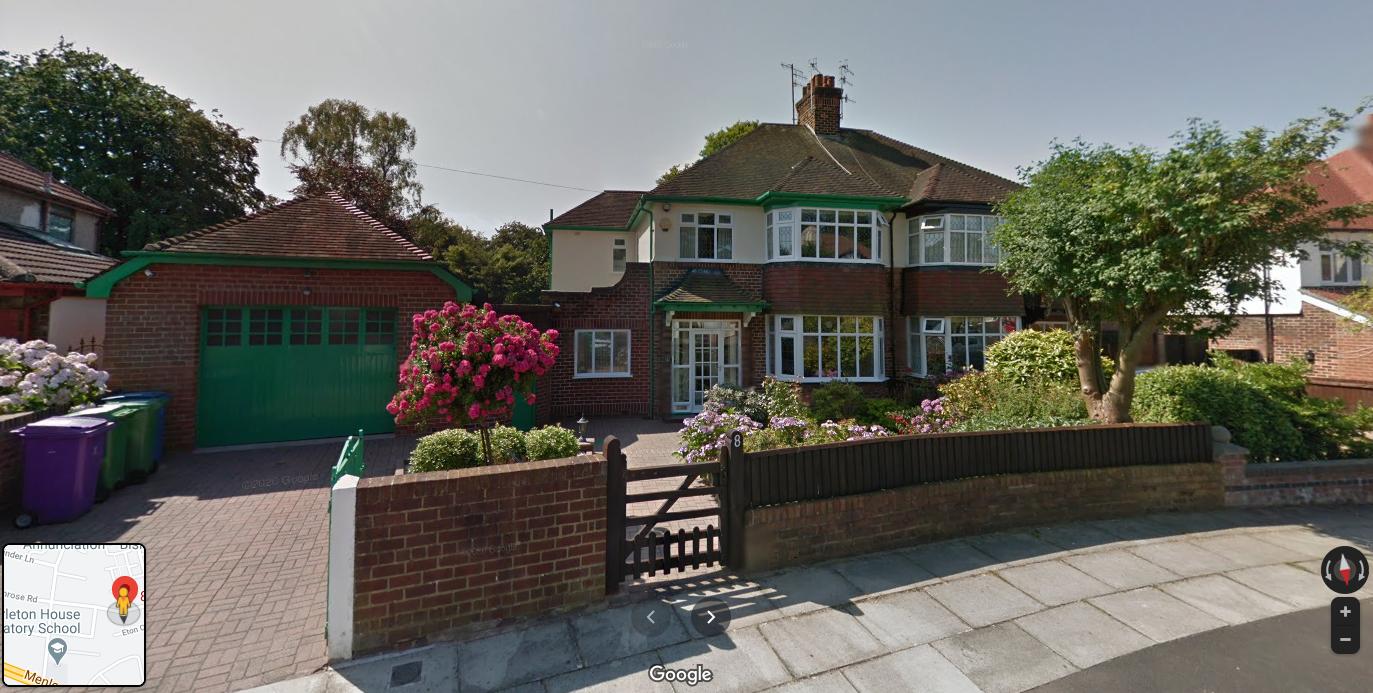
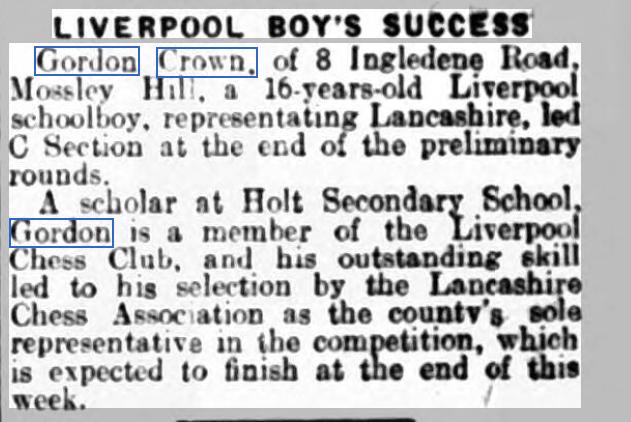
According to the electoral register of 1939 they lived at 8 Ingledene Road, Liverpool, Liverpool C.B., Lancashire, England. (This is L18 3HJ in this day and age.)
According to Zoopla : “This 4 bed freehold semi-detached house is located at 8 Ingledene Road, Liverpool L18 3HJ and has an estimated current value of £581,000. Ingledene Road has 19 properties on it with an average current value of £492,220, compared to an average property value of £325,035 for L18. There have been 5 property sales on Ingledene Road, L18 over the last 5 years with an average house price paid of £474,900. There are currently 108 properties for sale in L18 with an average asking price of £372,163 and 59 properties to rent in L18 with an average asking rent of £408 pw.”
Jon D’Souza-Eva (Oxford) wrote to us on November 17th, 2021 to reveal:
“I always thought that Gordon Crown was an only child, but after a little searching I found that he had a younger brother, Rodney, who was born and died in 1938.
There’s also a rather mysterious redacted entry in the Crown household in the 1939 register. I can’t find evidence for any other siblings who might account for it.”
and we asked Leonard Barden about this replying:
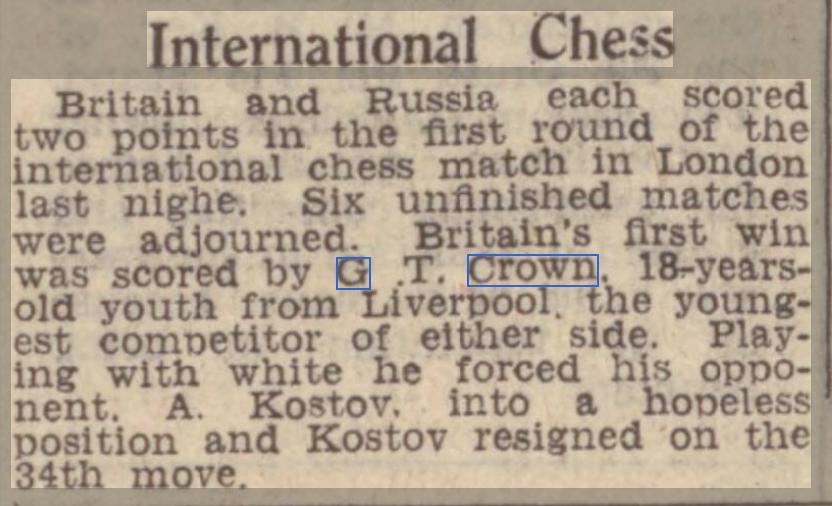
“I can’t confirm the Rodney, but Gordon died the night after I visited him on a daily leave pass from RAF Padgate. I didn’t know about it for two weeks because of the lack of news facilities at my camp. But then when I heard I wrote to his mother and she sent back the Kotov photo with a very sad letter from which one phrase has remained in my memory:
“Our other son died nine years ago and Gordon was all we had”….”
Liverpool Echo 15 April 1946
Both Sunnucks and Hooper & Whyld are silent on GTC : surprising!
From CHESS, Volume 12 (1947), Number 138 (March), page 176:
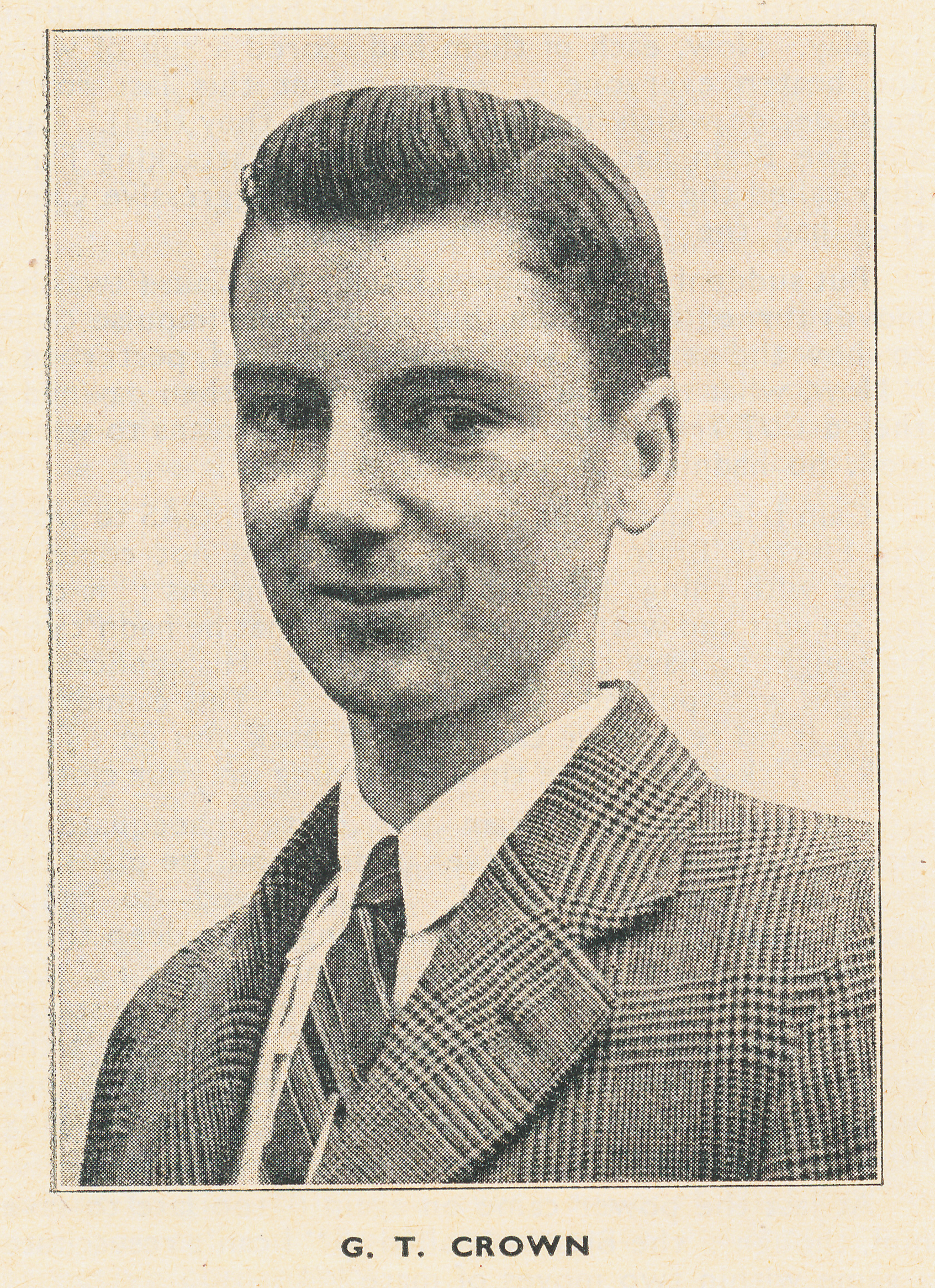
“G. T. Crown…England’s 17.5 Year Old International
“Gordon T. Crown, who takes his place in an England team at the age of 17.5, was born at Liverpool on June 20th, 1929. He learnt the moves at the age of nine, being first made aware of chess by the match between the BBC and the listeners over the radio. Until 1944, he had few opportunities for over-the-board play and was forced to devote himself to studying books and magazines.
In 1944-5 he entered for the Lancashire Junior Championship and won it as his first attempt; he repeated his success last year and also entered for the senior event, in which he reached the semi-final, only to throw away a won game against HG Rhodes.
In April 1946, he played in the British Boys’ Championship at Hastings and came second, losing only in his final game. In August he played in the Nottingham Congress, was placed in one of the Major sections and “was quite satisfied” he reports, at finishing half-a-point outside the prize list, especially as he was the only one to defeat EG Sergeant, who topped the section.
At Hastings, the situation was curiously reversed. Here he won the section, his only loss being to EG Sergeant, who finished just outside the prize list.
He has just finished school and is waiting to enter a University where he intends to study Geography and History. For private reading, he enjoys best Military and Naval History – apart from good detective stories.
Apart from chess, he is interested in most games, both indoor and outdoor, with special preference for tennis ad table-tennis when it is a matter of playing and cricket for reading about.
He is diabetic – but so was one of the players in the Davis Cup team which recently crushed Australia! His games show the evidence of deep and extensive study of the game combined with an ever-ready imagination.
“Gordon Crown is one the sad might-have-beens of the world of chess. In his short life he had already shown himself to be of master strength and a potentially very great player when suddenly, at the age of eighteen, he died during an operation.
He learnt chess when aged nine and soon became one of the best players, first in Liverpool,, his home town, and then in Lancashire, of which county he won the Junior Championship three years in succession.
Crown first came into national prominence when he came second in the British Boys Championship in 1946. (Ed : the winner was John Fuller) In the Hastings Congress of 1946/7 he won first place in a strong Premier Reserves Section.
The last year of his life even saw him reaching out to international success, Playing on board 9 for Britain against The Netherlands he scored 1.5 out of 2 against L.J. Tummers. Then he won third prize in the British Championship at Harrogate. As a result of this success he was promoted to board 4 for Britain against Australia in a radio match when he beat Dr. M. Gellis.
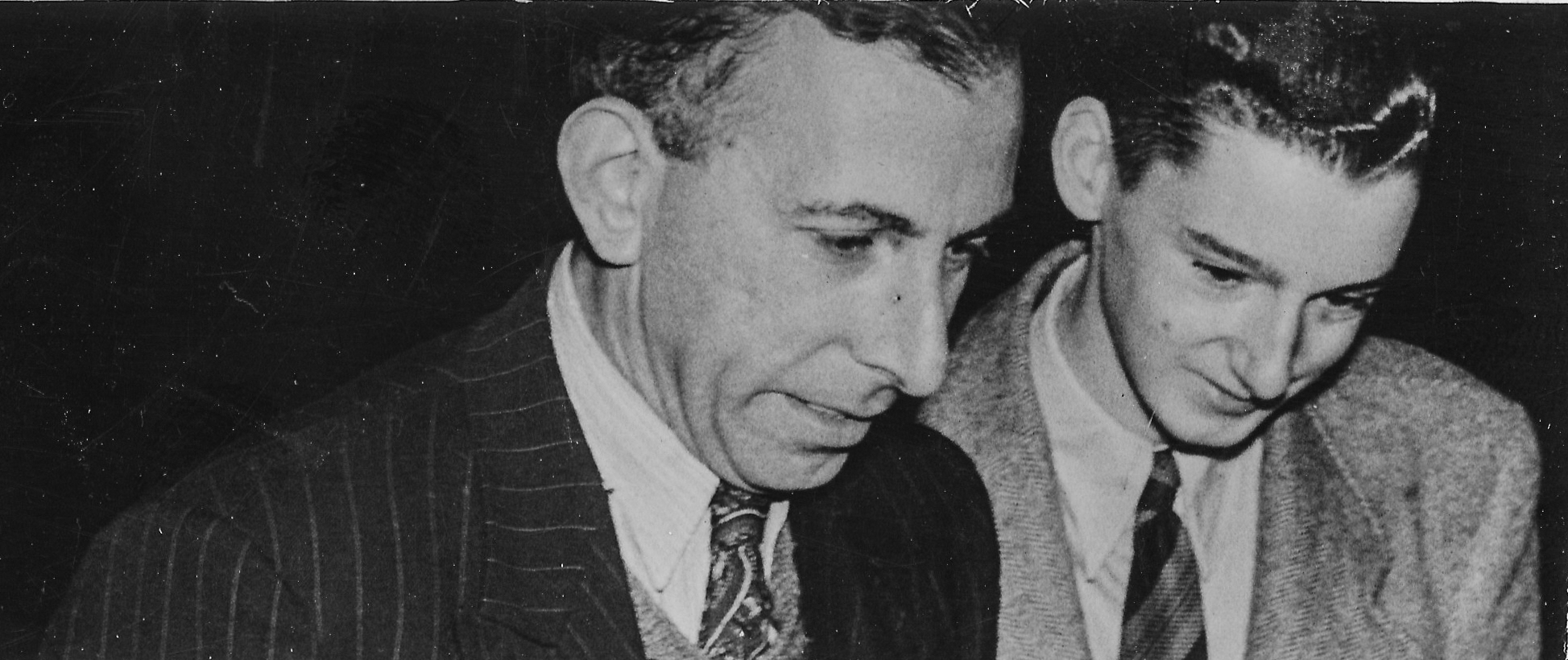
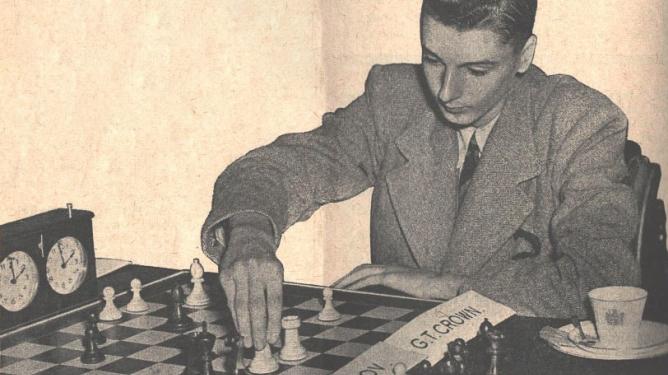
Harry Golombek and Gordon Crown in around 1946-47.
In September 1947 he was hurried to hospital suffering from peritonitis and, being a diabetic, succumbed under the operation.
As a player he excelled in both the opening and endgame phases and possessed a style of play that stamped him as a future grandmaster. As a person he was modest, clever and a very agreeable companion. This was great loss for British and, almost certainly, world chess.”
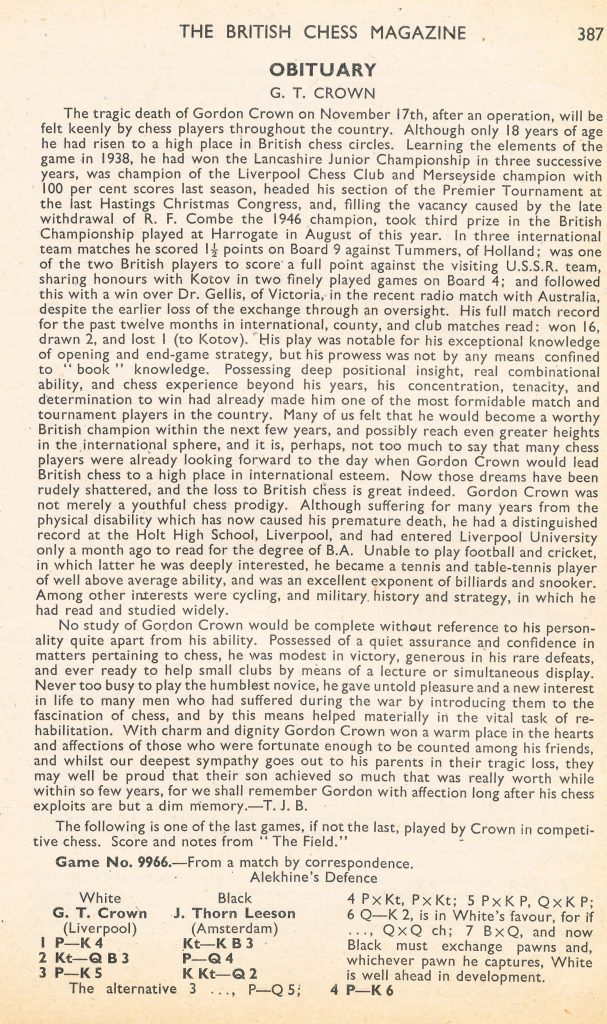
We have reproduced his obituary from British Chess Magazine, Volume LXVII (1947), Number 12 (December), Page 387-8 and we assume that this was written by TJ Beach:
“The tragic death of Gordon on November 17th after an operation, will be felt keenly-by chess players throughout the country. Although only l8 years of age he had risen to a high place in British chess circles. Learning the elements of the game in 1938, he had won the Lancashire Junior Championship in three successive years, was champion of the Liverpool Chess Club and Merseyside champion with 100 per cent scores last season, headed his section of the Premier Tournament at the last Hastings Christmas Congress, and, filling the vacancy caused by the late withdrawal of R. F. Combe the 1946 champion, took third prize in the British Championship played at Harrogate in August of this year.
In three international team matches he scored l.5 points on Board 9 against Tummers, of Holland; was one of the two British players to score a full point against the visiting U.S.S.R. team, sharing honours with Kotov in two finely played games on Board 4; and followed this with a win over Dr. Gellis, of Victoria, in the recent radio match with Australia, despite the earlier loss of the exchange through an oversight. His full match record for the past twelve months in international, county, and club matches read: won 16, drawn 2, and lost l. (to Kotov).
His play was notable for his exceptional knowledge of opening and end-game strategy, but his prowess was not by any means confined to “book” knowledge. Possessing deep positional insight, real combinational ability, and chess experience beyond his years, his concentration, tenacity, and determination to win had already made him one of the most formidable match and tournament players in the country. Many of us felt that he would become a worthy British champion within the next few years, and possibly reach even greater heights in the international sphere, and it is, perhaps, not too much to say that many chess players were already looking forward to the day when Gordon Crown would lead British chess to a high place in international esteem: Now those dreams have been rudely shattered, and the loss to British chess is great indeed.
Gordon Crown was not merely a youthful chess prodigy. Although suffering for many years from the physical disability which has now caused his premature death, he had a distinguished record at the Holt High School, Liverpool, and had entered Liverpool University only a month ago to read for the degree of B.A. Unable to play football and cricket, in which latter he was deeply interested, he became a tennis and table-tennis player of well above average ability and was an excellent exponent of billiards and snooker. Among other interests were cycling, and military history and strategy, in which he had read and studied widely.
No study of Gordon Crown would be complete without reference to his personality quite apart from his ability. Possessed of a quiet assurance and confidence in matters pertaining to chess, he was modest in victory, generous in his rare defeats, and ever ready to help small clubs by means of a lecture or simultaneous display.
Never too busy to play the humblest novice, he gave untold pleasure and a new interest in life to many men who had suffered during the war by introducing them to the
fascination of chess, and by this means helped materially in the vital task of rehabilitation. With charm and dignity Gordon Crown won a warm place in the hearts and affections of those who were fortunate enough to be counted among his friends, and whilst our deepest sympathy goes out to his parents in their tragic loss, they may well ae proud that their son achieved so much that was really worth while within so few years, for we shall remember Gordon with affection long after his chess exploits are but a dim memory.-T. J. B.”
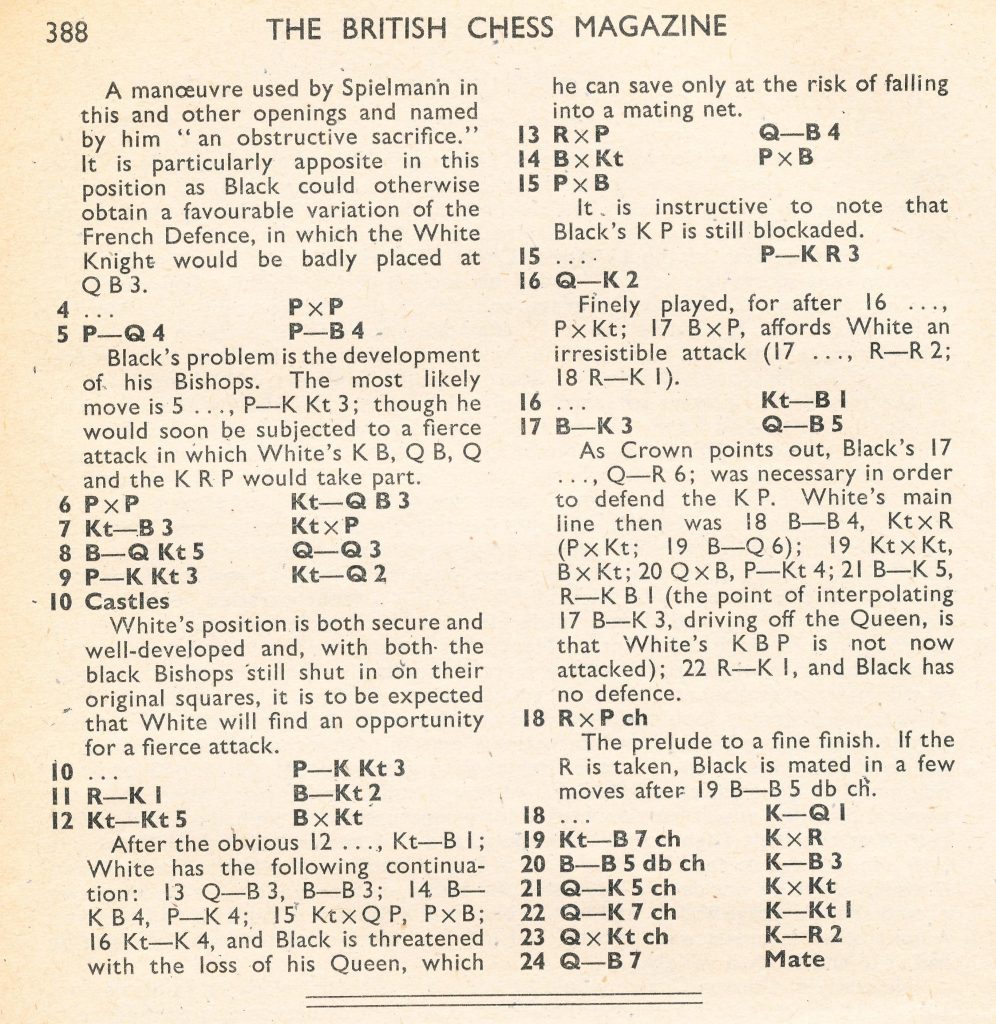
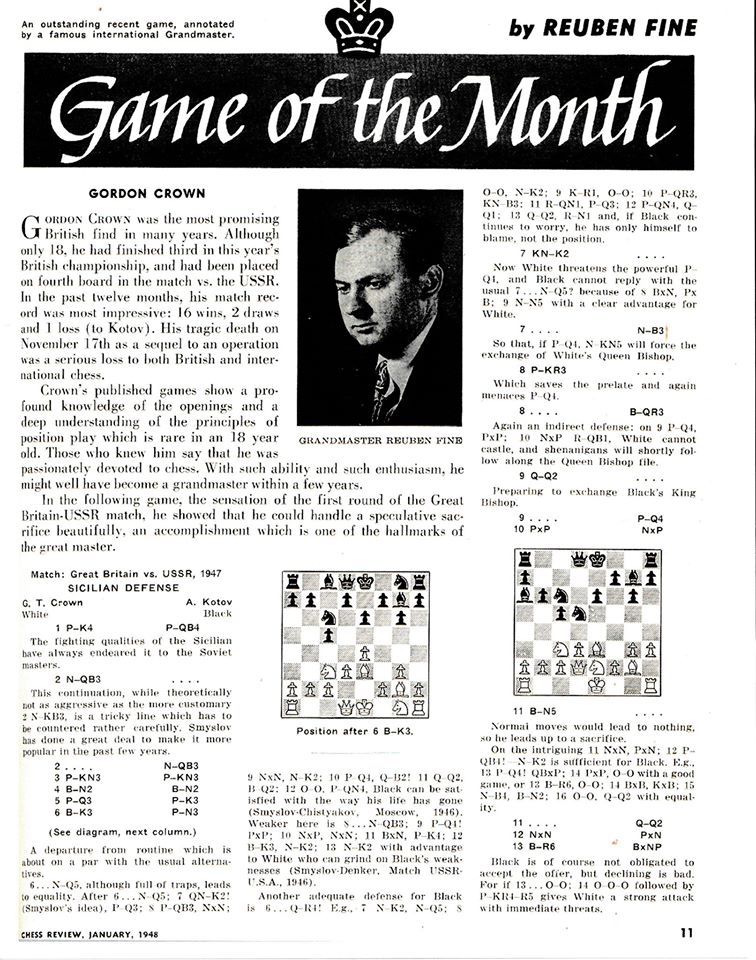
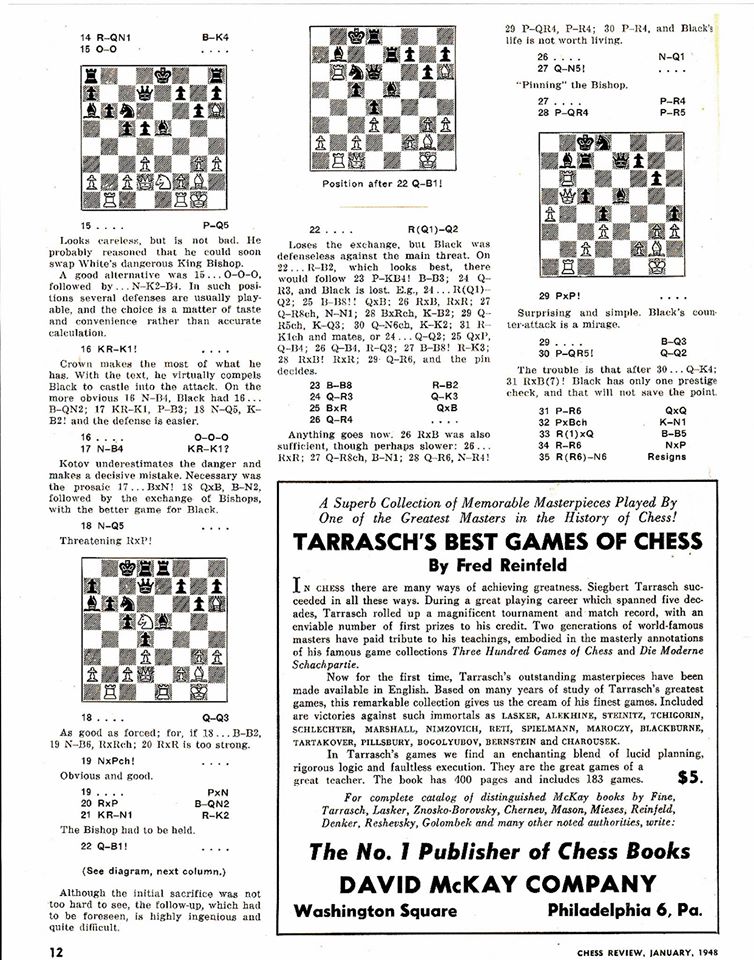
The following is one of the last games, if not the last; played by Crown in competitive chess. Score and notes from “The Field”
and here is the scan of the original article:
Obituary of Gordon Thomas Crown, part one
and
Obituary of Gordon Thomas Crown, Part Two
We are grateful to Leonard Barden on the identity of T.J.B. :
“Thomas John Beach, wartime RAF navigator with Distinguished Flying Cross, leading light of Liverpool chess, regular British championship player for many years, chairman of BCF junior selectors, father of a leading Midlands expert, a good and dedicated man” TJB was the father of Richard Beach who won the British Boys Under 18 title in 1961.
According to the British Chess Magazine, 1943, March, page 56 GTC lived at 8 Ingledene Road, Calderstones, Liverpool 18, England.
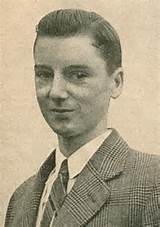
Gordon Thomas Crown, from CHESS, 1948, January, page 86
On 17 November 1947 he was admitted to hospital, complaining of a stomach upset. Diagnosed too late with appendicitis, complicated by his diabetes, he died in the operating theatre.
His friend (and former British champion) Leonard Barden speculates that had he lived, Crown would have become at least a strong Grandmaster, further noting that he was ” … open, friendly and modest as well as a clear and enthusiastic explainer of his chess ideas; I think he would have been like Keres or Gligoric in their countries, a model for our young players.”
Harry Golombek was similarly impressed with Crown’s play, stating that “In his short life, he had already shown himself to be of master strength and was potentially a very great player.”
We are grateful to be able to use comments from long time friend, Leonard Barden posted under the nom de plume of Roberts Partner on chessgames.com :
“As to the circumstances of Crown’s death. The finger of blame must be pointed at the family doctor for failing to make a timely correct diagnosis. On Sunday 16 November 1947 a chess friend visited the Crown home at Ingledene Road, Liverpool, and found Crown in bed. He explained that his doctor had diagnosed a stomach upset and had recommended rest. The friend and Crown played and analysed together for several hours, and Crown did not appear in any physical discomfort. But that night after the friend left his condition deteriorated and he was rushed to hospital where he died in the early morning hours of 17 November. There was also a belief among some Liverpool chess players that the hospital procedures could have been better.”
and
“On another thread some CG posters expressed surprise at the Ritson Morry v Crown game where Morry fell into a well-known opening trap.
The British championship at Harrogate in August 1947 was played in a spa building where the underfloor heating was still switched on. This coincided with one of the warmest summers on record (it was the year in which Compton and Edrich made their memorable cricket achievements for Middlesex). By the second week of the BCF congress older and overweight players (the latter group including Ritson Morry) were wilting. Ritson also had some long adjourned games, and by the time of his game with Crown in the final round was exhausted. The game finished in 15-20 minutes so by the time other players went to spectate after their opening moves there was just a reset board with no sign of the players and no indication of what had transpired. Other final round results went Crown’s way so that he finished third outright and thus got selected on a high board for the USSR match.”
Western Daily Press 22 September 1947
and here is an article by ddtru (?) in chess.com : full article
We are grateful to renowned chess historian, Taylor Kingston for supplying these scans of an article from Chess Life in 1947 about Gordon Crown written by Reuben Fine :
Chess Life article about Gordon Thomas Crown, Part One
and
Chess Life article about Gordon Thomas Crown, Part Two
From Wikipedia:
“Gordon Thomas Crown (20 June 1929 – 17 November 1947) was a promising British chess player who died of appendicitis at the age of eighteen. He is best known for his win against the Russian Grandmaster Alexander Kotov shortly before his death.
Crown was born in Liverpool in 1929. He finished second in the British under 18 championship in 1946 and improved rapidly, winning the Premier Reserve section of the 1946/7 Hastings International Chess Congress. This led to his being placed on the reserve list for the 1947 British Chess Championship. Following the withdrawal of the defending champion Robert Forbes Combe, he was allowed to play in the championship, where he finished third (Harry Golombek won).
Consequently, he was selected to play for the British team in the 1947 Britain-USSR match, where he caused a sensation by defeating the Soviet Grandmaster Alexander Kotov, though he lost the return game. He also defeated Max Gellis in a Britain-Australia radio match.”
Interestingly, via the EC Forum, Geoff Chandler pointed out a note by Edward Winter in which Bill Hartston recounts advice from David Bronstein : “Look at the games of Gordon Crown. He really understood chess”. From NOW! magazine, (6-12 February 1981, page 80.): thanks Geoff !
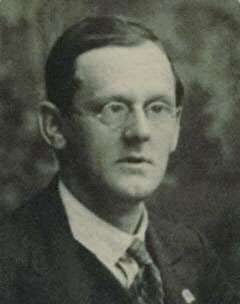
We remember Fred Yates who passed (or, at least was recorded as passing) on Friday, November 11th, 1932.
Fred (not Frederick) Dewhirst (not Dewhurst) was born in Birstall, Leeds on Wednesday, January 16th 1884, the same year as Harry S Truman and Eleanor Roosevelt.
An obituary appeared in Volume LII (52, 1932), Number 12 (December), pp.525-528 of the British Chess Magazine by PW Sergeant :
“The chess world has had many heavy bereavements during the year which is coming to an end; but to the British section of it there has been no bereavement like the last, which robbed it of F.D.Yates, when still in the prime of his chess career. The circumstances of his end were tragic. On the night of Tuesday, November 8th, he gave a very successful exhibition at Wood Green, only dropping one half-point in 16 games. On the following night he was in the company of a chess friend until fairly late, and then went back to his room in Coram Street, Bloomsbury. He was never seen alive again. It was not until Friday morning that anxiety was felt at Coram Street as to what he might be doing; for he was in the habit of secluding himself for many hours at a stretch when busy with work.
Fred Dewhirst Yates
On Friday, however, when no answer could be got to knocks on the door of his room, which was locked, and a smell of gas was noticed, the door was at last broken open, and he was found dead in bed.
It came out at the inquest before the St. Pancras coroner on November 15 that , though the gas-taps in the room were securely turned off, there had been an escape from what a gas companies official described as an obsolete type of fitting attached to the meter in the room. The meter, it appears, was on the floor, and the fitting must have been accidentally dislodged. A verdict was recorded of Accidental Death; and the coroner directed that the gas-pipes from the room should remain in the custody of the court. The body was conveyed to Leeds for burial on the morning of November 16.
So prematurely passed away one who may with justice be called one of the finest exponents of British chess, and an international master whose strength was recognised all over the world.
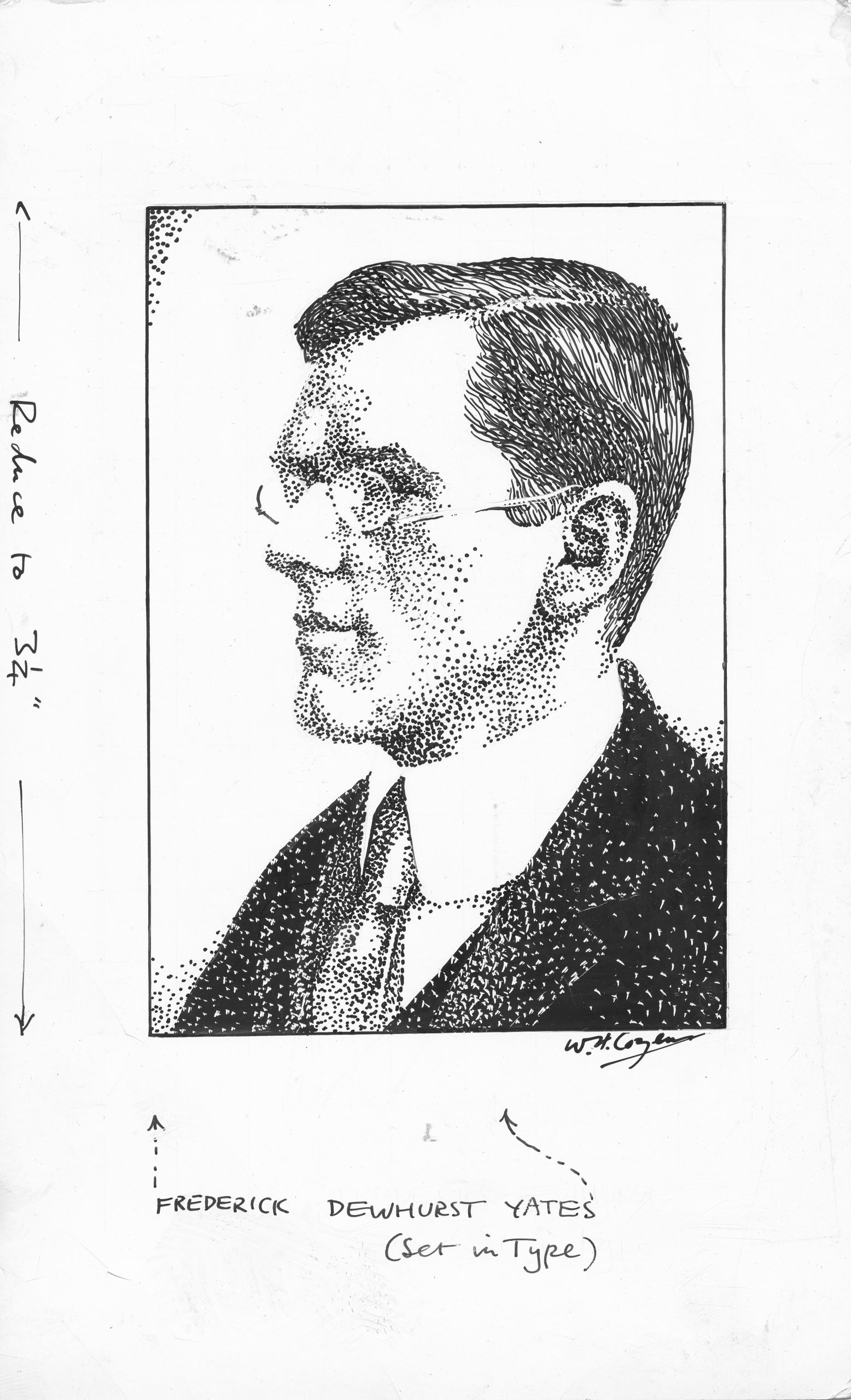
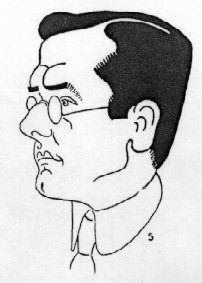
Fred Yates as drawn by WH Cozens for BCM
Frederick Dewhurst (sic) was born at Birstall, near Leeds, on January 16, 1884. He did not develop his chess power very young, at the B.C.F. congress at the Crystal Palace in 1907 only playing in the Second Class, though he then won first prize in one of the two sections. At Tunbridge Wells next year he tied for fourth place in a section of the First Class. He was admitted to the British Championship at Scarborough in 1909 (in which year he was Yorkshire Champion), and there tied with Blackburne for fourth and fifth prizes, after HE Atkins, JH Blake, and W. Ward.
In the same event at Oxford in 1910 he again tied with Blackburne, but this time for second and third prizes, Atkins being first, though losing in his individual encounter with Yates. In 1911, at Glasgow, Yates still further improved his position, this time tieing with Atkins for first place; but in the tie-match Atkins won somewhat easily.
Atkins stood down for the first time at Richmond in 1912; but the success of RC Griffith left Yates second, in company with the late HG Cole. At last in 1913, Yates gained his ambition, and at Cheltenham won the British Championship with the fine score of 9 out of a possible 11, 1.5 points above J. Mahood and 2 above Blackburne. In the ruined Congress at Chester in 1914 he tied for first place with Blackburne; and, as Blackburne was unable to play a deciding match, Yates won his second championship.
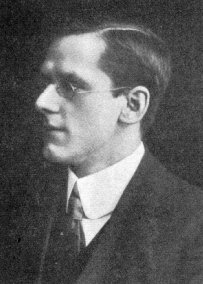
Fred Dewhirst Yates, Jacoby Archive
Since the War he gained the title again in 1921, 1926, 1928 and 1931, thus making a record of six championships, second only to Atkin’s record of nine (ed : in 1969 at the Rhyl Congress Jonathan Penrose OBE was to surpass Atkins record by one.)
Yate’s six victories were gained in sixteen attempts In addition must be mentioned his success in the Hastings tournament, in the New Year of 1921, for holders of the British Championship only.
Fred Yates
His other successes in this country, including his two wins in the in the Anglo-American cable match, in 1910-11, need not detain us; for limitations of space demand that we shall come to Yates as an international master. His first essay was at Hamburg in 1910, on the invitation of the German Chess Federation. Though he did badly, only getting one win in 16 games, the win was a remarkable effort, at the expense of no less a celebrity than Dr. Tarrasch.
At Pistyan two years later he did a little better. He had to wait until after the War for a third attempt; but it will be best to give what we believe to be a full record of his performances in international event:- (to be added).
These lists, however, furnish no just view of the strength of Yates’s play, which always was most fully exhibited against the leading competitors in tournaments. Among his triumphs must be noted his particularly his wins against Alekhine at Hastings, 1922, and Carlsbad 1923 (a brilliancy prize game); against Euwe, Scarborough, 1928; against Nimzowitsch , Carlsbad, 1929; against Bogoljuboff, London, 1922, and Baden-Baden, 1925; against Tartakover, Hastings and Kecskemet, 1927; against Kmoch and Rubinstein, Budapest, 1926; against Spielmann and Vidmar, San Remo, 1930; and his draws with Alekhine and Capablanca at New York, 1924. The harder the opposition, the better his play. Conversely, against what should have proved easier opponents he was apt. at times, to show less of his skill. In this, of course, he was not peculiar, even among the experts.
Generally speaking, however, he was a remarkably tenacious player, who would not abandon a game while there was the slightest chance of a win or a draw. This was not due to mere obstinacy, as may sometimes have appeared, but to the depth of his vision, which gained for him among the German commentators the title of ein tiefe Denker(ed : a deep thinker) – no small testimony from those from whom it came. With a robuster physique there is no knowing to what a position he might have attained in the chess world. The late Amos Burn always had the highest opinion of is powers, and always pointed out, too, the handicap under which a player labours who has to report the events in which he takes part – equivalent, he would say, to giving the other competitors Pawn and move!
Yates was unfortunate in embracing professionalism in an era when the rewards were becoming less and less, and finally reached a stage when they scarcely provided the means of a bare existence. He was a fine simultaneous player, whose exhibitions always delighted by their combination of speed, precision and flashes of brilliance.
As commentator he was very good indeed, and his contributions, especially to The Manchester Guardian, where noted alike for their accuracy and for a sense of style.
He had a journalistic training, outside chess. He was not, in fact, ‘a mere chessplayer’, in spite of his intense devotion to the game. It was his extreme reticence which gave such an impression to all but those whom he admitted to intimacy. They at least knew his widespread interest in other things; and W. Winter’s recent tribute to him in the Guardian in no way exaggerates his charm as a companion among those who knew him best. To them his loss is one which cannot be replaced.”
An Appeal
No doubt all chessplayers in England will have read with sorrow of the death of F.D.Yates at the early age of 46, and more especially will the circumstances of it be a shock to many.
An inquest was held, as has already been reported, and was attended by his two sisters, who have practically no means, as was the case of Yates himself. Certain chessplayers who attended the funeral agreed to make themselves responsible for the funeral expenses, but as the body was removed to Birstall in Yorkshire for burial in the family grave, the expenses were considerably heavier than was anticipates and, with the money owing to the landlady, comes to a total of £51 2s and 0d.
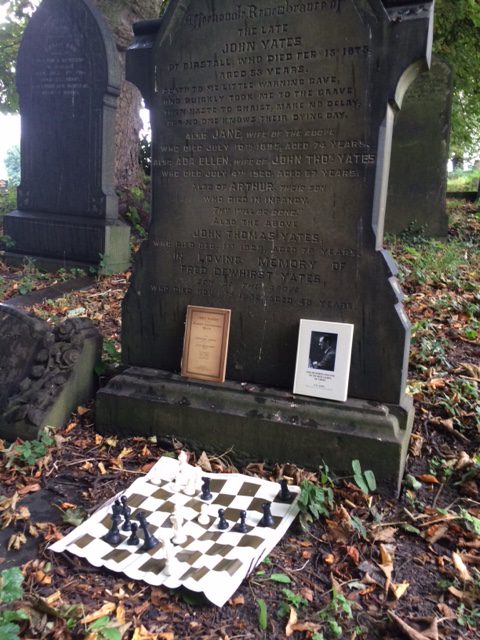
The gravestone of FD Yates, courtesy of Matthew Sadler
We feel quite sure that when our readers know, they will like to show their last recognition of the value which F.D.Yates was to English chess by giving a donation towards the sum.
The London Chess League, whose finances are not in a very satisfactory state, as in the case of most chess concerns, has agreed to donate £3 towards this. Their president has given £1 1s 0d., and one or two other members have promised donations. We shall be happy to receive any contributions towards this fund, and will give acknowledgment in future issues.”
From The Oxford Companion to Chess (OUP, 1984) by Hooper and Whyld :
“English player. British Champion 1913,1914,1921,1926,1928, and 1931, Around 1909 he gave up his profession in accountancy to become a chess professional. Of the many international tournaments in which he competed from Hamburg 1910 to Hastings 1931—2 he made his best results in the B Final, Kecskemet 1927, first (+4=2-1) equal with Tartakower, and at San Remo 1930, the strongest tournament of the year, when he came fifth after Alekhine,, Nimzowitsch, Rubinstein, and Bogoljubow ahead of Spielmann,
Vidmar, and Tartakower.
A tenacious player, he could be a dangerous opponent. In tournament play he defeated most of the greatest masters of his time on one occasion or another, and among these victories were two defeats of Alekhine (Hastings 1922, Carlsbad 1923), and three defeats of Bogoljubow (London 1922, Baden-Baden 1925, Scarborough 1927) and Rubinstein (London 1925, Moscow 1925, Budapest 1926), A careful and conscientious writer, he conducted a chess column in the Yorkshire Post, was chess correspondent of the Manchester Guardian , and wrote three books (see foot of article) in collaboration with William Winter (1898-1955).
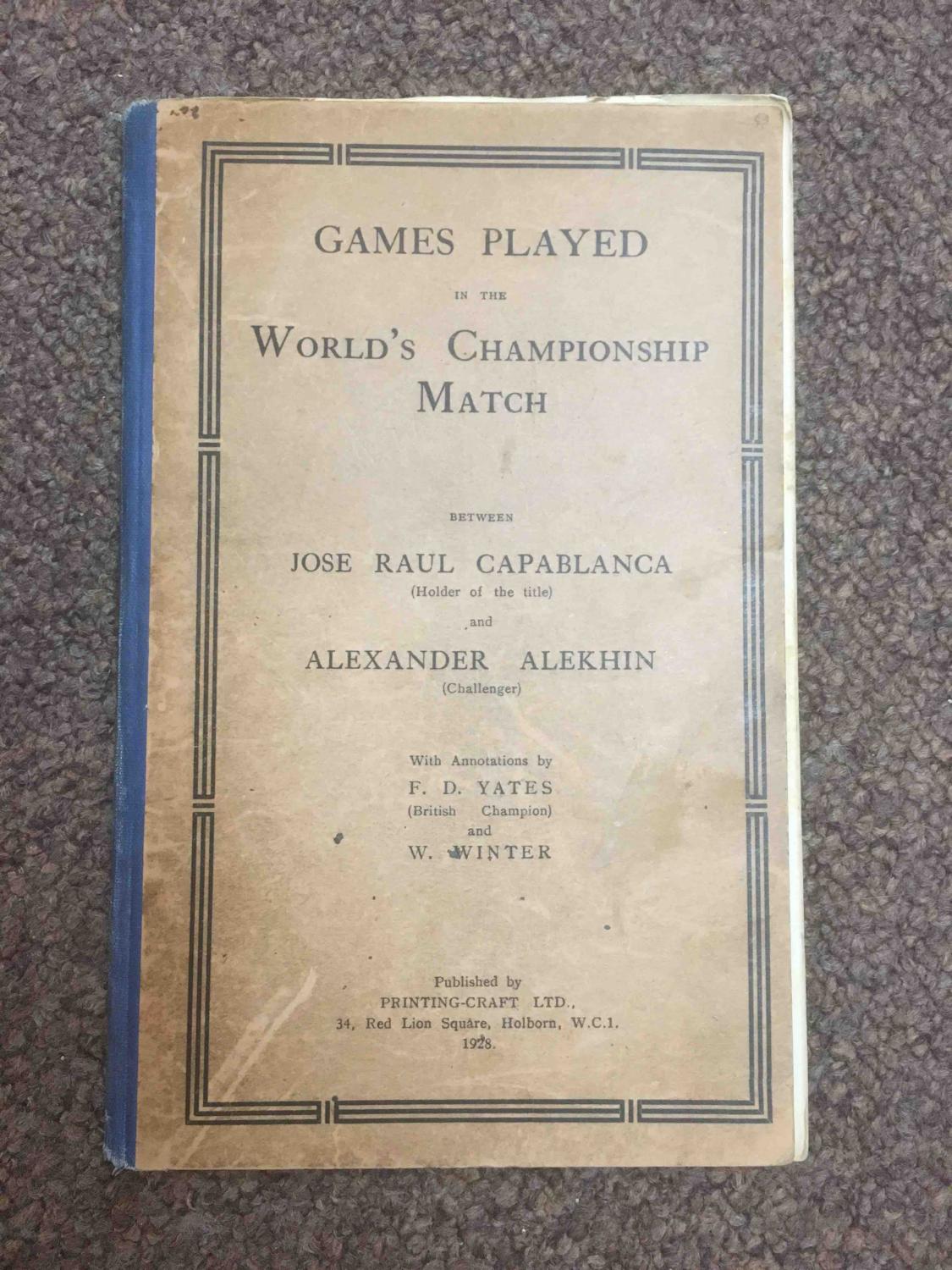
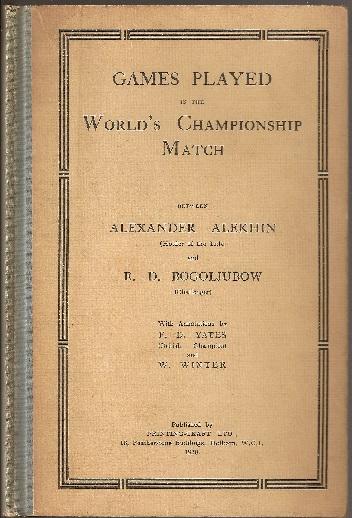
Games Played In the World’s Championship Match between Jose Paul Capablanca and Alexander Alekhine, FD Yates and W, Winter, 1928, Printing Craft LimitedGames Played in the World’s Championship Match between Alexander Alekhine (Holder of the Title) and E D Bogoljubow (Challenger), Printing Craft Limited, 1930, FD Yates and W. Winter
A leak from a faulty gas pipe connection killed Yates while he was asleep. His book One-hundred- and-one of My Best Games of Chess was published in 1934.”
From The Encyclopedia of Chess (Robert Hale, 1970 & 1976)by Anne Sunnucks :
“International Master and British Champion in 1913, 1914, 1921, 1926, 1928 and 1931.
Born in Birstall, near Leeds in Yorkshire, on 16th January 1884, Yates was 25 before he played in the British Championship for the first time. In 1909, having won the Yorkshire Championship, his entry was accepted for the British Championship at Scarborough, and he tied with Blackburne for 4th prize. The following year he again tied with Blackburne, this time for 2nd prize, and in 1911 he tied with Atkins for 1st prize but lost the play-off for the title. In 1913, he succeed in winning the British Championship for the first time.. During his career he competed in the British Championship 16 times and won the title on six occasions.
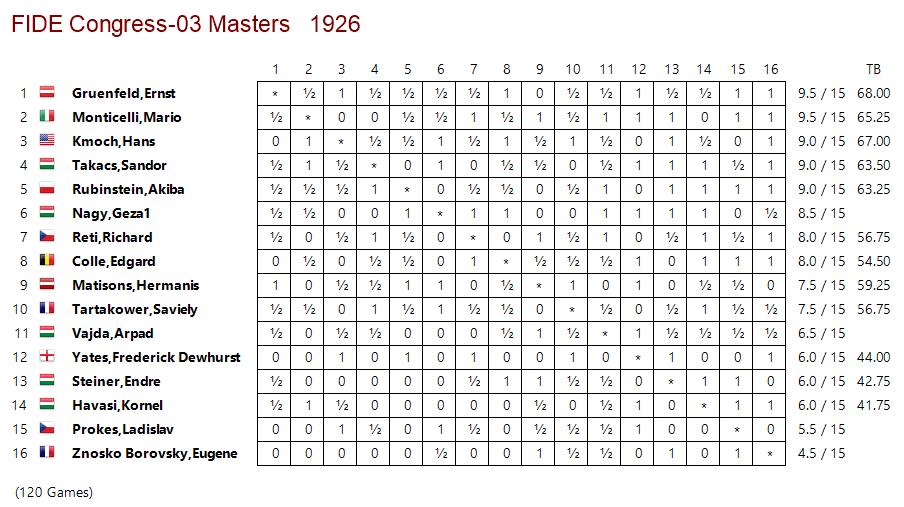
In International tournaments his record did not do him justice as far as his final placings were concerned. However, in studying his performance in detail, his wins were often against the strongest players and his losses against those at the bottom of the tables. This was particularly apparent in the results of the 1926 Budapest tournament.
Cross Table for Budapest 1926
During the course of his career, Yates beat practically every contemporary Grandmaster, with the exception of Lasker and Capablanca. His victory over Alekhine at Carlsbad 1923 came at the end of a combination 18 moves deep and won the brilliancy prize, while his victory over Vidmar at San Remo in 1930 was described by Alekhine as the finest game played since the war.
Other outstanding wins were against Bogoljubow at London 1922, against Rubinstein at Budapest 1926, against Tartakover at Hastings 1927, against Euwe at Scarborough 1928 and against Nimzowitsch at Scarborough 1929. The stronger the opposition the better Yates played.
His losses against weaker players may well have been due to ill-health and lack of necessary stamina to play consistently throughout a long tournament. He was continually troubled by a hacking cough and could not afford to carry out the medical advice that he should go to the Riviera for a cure.
He was a professional chess player at a time when it was difficult to make a livelihood out of chess and he was often handicapped by having to report an event in which he was playing. A number of his contemporaries believed that, had he lived in different circumstances his talent would have placed him among the contenders for the World Championship.
For some years Yates ran the chess column for The Manchester Guardian. He was co-author with Winter of Modern Master Play and of books on the Capablanca vs Alekhine and Alekhine v. Bogoljubov World Championship matches.
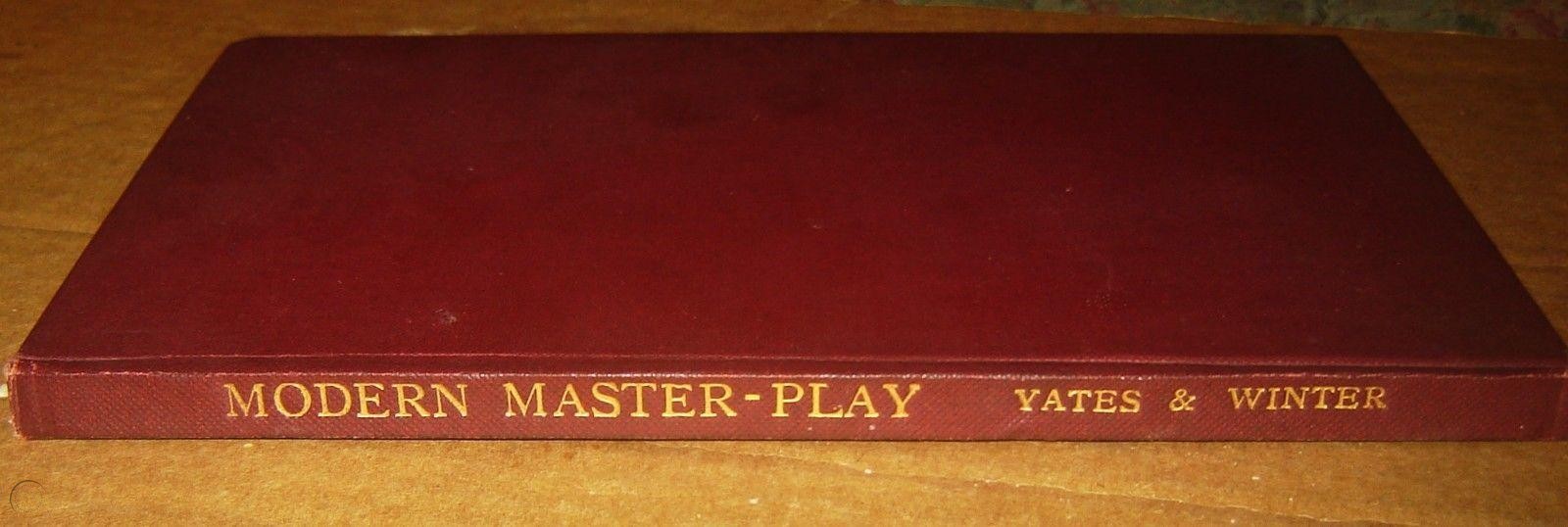
Modern Master Play, FD Yates and W. Winter, 1930
Yates had a great number of interests apart from chess and had a very versatile mind which enabled him to talk on a wide range of subjects. He was extremely modest and rarely kept the scores of his games and never submitted them to the press.
He died in tragic circumstances, On 11th November 1932, he was found dead in his bedroom from gas poisoning. At the inquest it was established that there was a faulty connection in the gas meter in his room and a verdict of accidental death was returned.”
From The Encyclopedia of Chess (Batsford, 1977) by Harry Golombek:
“A British master. Yates trained as an accountant but in 1909 abandoned this career in favour of chess and journalism. In 1911 he tied for first prize with Atkins in the British Championship losing the play-off match. Two years later he won the event – the first of six such victories (1913, 1914, 1921, 1926, 1928 and 1931).
In international tournaments Yate’s results were generally mediocre, but he was capable on occasion of defeating the strongest opposition and his victims included Alekhine, Reti, Bogoljubow, Tartakower, Rubinstein, Euwe, Nimzowitsch and Vidmar. He was a regular competitor at the Hastings Christmas Congresses, winning in 1920/1 and finishing in 3rd place on four occasions: 1923/4, 1924/5, 1926/7 and 1929/30.
Yates was for many years the chess correspondent of The Manchester Guardian and, in addition, wrote Modern Master Play, London, Philadelphia 1929 (with W. Winter as co-author) and books of the 1927 Capablanca-Alekhine, London 1928, and the 1929 Alekhine-Bogoljubow World Championship matches, London, 1930.
He died from being accidentally asphyxiated in his rooms by a faulty gas connection.”
In the March issue of CHESS for 1963, (Volume 28, Number 427, pp.147-155) William Winter wrote this:
The genius of F. D. Yates
I use the words ‘one of the most talented chess players’ advisedly. I have known personally all the world champions of my time, as well as most of the principal challengers, and I have no hesitation in saying that, at his best, he displayed a chess genius second to none. His victory over Vidmar at San Remo was described by Alekhine in 1931 as the finest game played since the war, and his win against Alekhine himself at Carlsbad is in the same category. The final combination here is eighteen moves deep. There are other games nearly as good and I am quite sure that had Yates been born a Soviet player, encouraged to develop his natural genius along proper lines, he would have been a close challenger for the world title ! Even I never knew the number of great games Yates had played until I came to write his Memorial Book. He was one of those modest souls who never kept the scores of his games and never submitted them to the press, so the only way I could get hold of many true masterpieces was to delve them out of continental magazines and tournament books.
One of the noticeable things about his play was that it took the best opposition to get the best out of him. While the tournament scores of most players are built up on points below them in the list, with Yates the reverse was often the case. I remember in particular one tournament at Budapest in 1926 when his score was made up almost entirely of wins against those above him. Rubinstein, Reti, and Tartakover were among his victims on that occasion and, at one time or another, he secured the scalp of every contemporary grand master. excepting Lasker and Capablanca. He. always played particularly well against Alekhine who once told me he was always relieved when his game with Yates was over. I was not surprised. Alekhine actually lost twice and in several others had hairbreadth escapes.
One of the principal reasons for Yates’ inconsistency was the fact that he was continually troubled by a hacking cough aggravated during the winter by the long cold journeys he had to take in the course of the exhibition tours which formed his means of livelihood. He was medically advised that a winter spent on the Riviera would probably effect a cure, but of course Yates was only an English chess genius and he could not afford it. “Couldn’t afford it.” Of how many hopes and human aspirations have these words sounded the death knell. There is scarcely one of us who, at some period of his or her life has. not found a cherished ambition frustrated by them. That is why I always laugh when I see the way of life in capitalist countries described as free. Until economic obstacles to human aspirations are removed, the words, couldn’t afford it’ deleted from the language, and man permitted to develop his natural attainments without let or hindrance, it is farcical to talk about freedom. Compared with this it is surely of little importance that we have the right to choose which press Lord we allow to poison our minds, or to put a cross opposite the name of Tweedledum or Tweedledee on a ballot paper.
Chill penury
Yates certainly is a striking example of one who was precluded from real greatness by economic sanctions. None the less he left a fine reputation behind him. He won the British Championship on six occasions and on the international field won a number of high. prizes. Lasker rightly described him as Blackburne’s legitimate successor. Of Yates the man I have already given my opinion and there is no need to say any more of his high principles or his hatred of cruelty or meanness in any form, but I cannot leave the subject without drawing attention to the extraordinary versatility of his mind. He seemed to have read something of every subject and assimilated what he had read so that he could talk entertainingly on them all.
Had crossword puzzles been fashionable in his days he would have been a first class solver. From 1926 to his death in 1932 he and I lived on the terms of the closest intimacy and I learned much from him, particularly in the line of chess literature and journalism. I have already spoken of our work for the Manchester Guardian. We also wrote three books together, the Alekhine-Capablanca and the Alekhine-Bogolyubov match books, and a more ambitious work, Modern Master Play, in which we presented profiles of the leading players of the day with annotated examples of their best games. What impressed me most about this work was the meticulous care with which he used the English language. As a writer I had always been satisfied as long as I could find words to express my ideas, but Yates wanted far more than that and I was sometimes slightly irritated by the time he took to formulate a single sentence. I never knew him spend a whole morning putting in a comma and an afternoon taking it out again, but I can quite imagine him doing it. Such literary style as I do possess owes a great deal to him.
Shock of his death
During the six years we were associated he was more like an older brother than a friend and it took me a very long time to recover from the shock when, in the Gambit Café, I heard the terrible news that he had been found dead in his bedroom from the effects of gas poisoning. I had seen him two nights before when we made plans for a new book on the lines of Modern Master Play, dealing with the younger masters of the day.
An exhaustive enquiry was held by one of the most experienced coroners in London and it was conclusively proved that death was due to a faulty gas fitting. Wynne-Williams, Yates’s pupil whom he had been teaching on the very night of his death, gave evidence of his cheerful demeanour, and the Coroner went out of his way to state categorically that this was a case of a tragic accidental death. In spite of all this some of the vile calumniators I have mentioned before, who are always seeking for slime to throw at their betters, sank so low as to suggest that Yates committed suicide. I have even heard the report quite recently. No fouler lie could possibly be invented to smirch the memory of a courageous and noble man.
“Yates almost won the British Championship in 1911, when he tied for first place with Henry Atkins, but lost the play-off. He went on to secure the title in 1913, 1914, 1921, 1926, 1928 and 1931
Despite considerable domestic success, his record in international tournaments did not do him justice. Often the winner against his strongest opponents, he would then lose to those at the bottom of the table. This was particularly apparent at the Budapest tourney of 1926.
His lack of consistency was attributed to poor health and loss of stamina. A constant hacking cough went unchecked, as his funds did not stretch to a holiday in warmer climes; the advice given by his doctor. He was also subjected to journalistic pressures, frequently reporting on the tournaments in which he was playing. Yet, dedicating himself to the playing side of chess would have earned him insufficient sums to make a living. A number of his contemporaries believed that his talent could have placed him among the world championship contenders, had his circumstances been different. Nevertheless, in his time, he defeated most of his illustrious adversaries, the most notable exceptions being Emanuel Lasker and José Raúl Capablanca. His victory against Alexander Alekhine at Karlsbad in 1923 won the brilliancy prize, while his win against Milan Vidmar at San Remo in 1930 was described by Alekhine as the finest game played since the war.”
As a journalist he was the chess columnist of The Manchester Guardian and with William Winter, the co-author of Modern Master Play (1929). He wrote accounts of two world championship encounters; those between Capablanca and Alekhine, and Alekhine and Bogoljubow.
In team competition, he played at the first, third and fourth Olympiads, representing the ‘British Empire’ team. On each occasion, he made a plus score and at London 1927, earned a team bronze medal/
His life ended prematurely, when a leaking gas pipe caused him to asphyxiate during his sleep.
According to the inscription on Yates’ gravestone,[7] his birth name was actually Fred Dewhirst Yates. However, throughout his chess career he was known by the name at the head of this article or simply as F.D. Yates, both of which featured in his posthumously published, part-biographical, ‘My Best Games’ Collection.
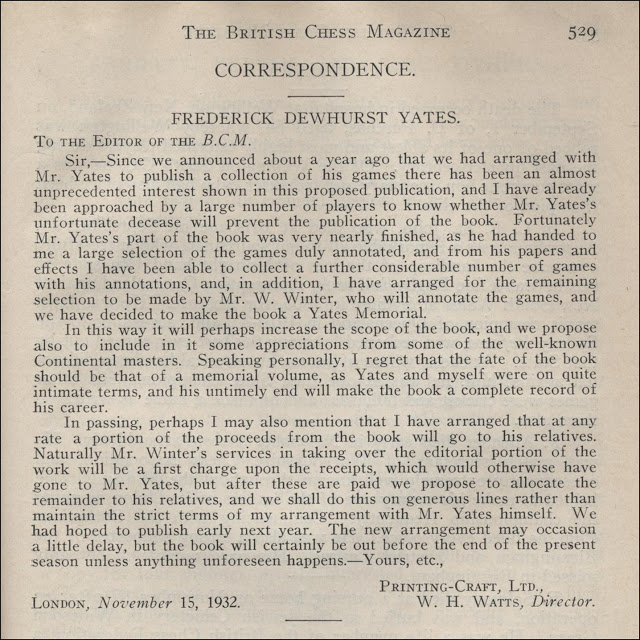
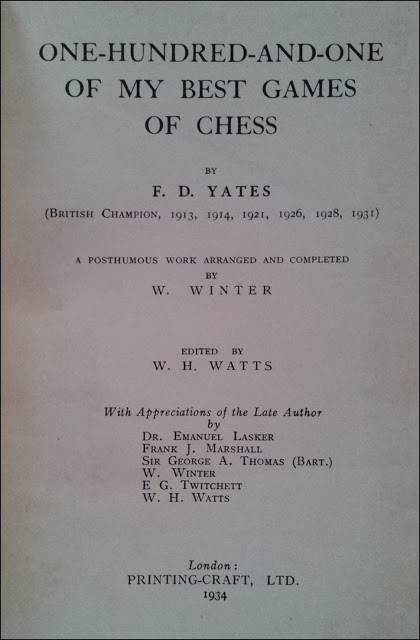
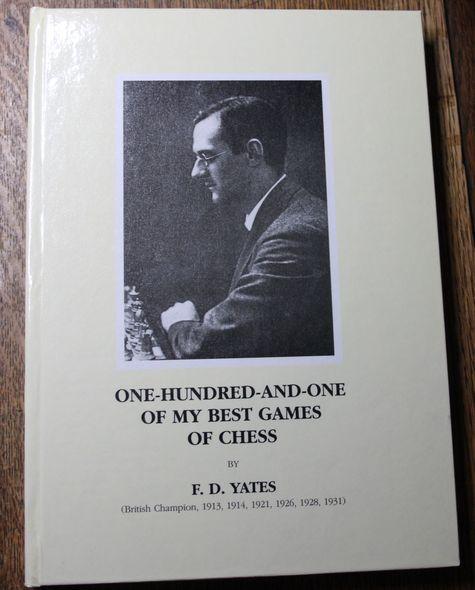
Letter to BCM from WH Watts of Printing Craft Limited announcing the publication of One-Hundred-and-one of my Best Games of Chess, by F. D. Yates, London 1934.One-Hundred-and-one of my Best Games of Chess, by F. D. Yates, London 1934.One Hundred and One of My Best Games of Chess, FD Yates
BCN remembers Reginald Bonham (known as “Bon”) who passed away, this day, March 16th in 1984 in Worcester, Worcestershire.
In 1970 New Years Honours, Civil Division he was awarded the MBE for “Services to the blind”. Interestingly, in 1992 his sister Mary also received an MBE for “Services to the blind” This is surely an unusual happening.
Reginald Walter Bonham was born on Wednesday, January 31st 1906 : the same day as the Ecuador–Colombia earthquake which measured 8.8 on the Richter Scale.
He was born in St. Neots, Huntingdonshire, Cambridgeshire.
In the 1911 census aged 5 he lived in the High Street, St. Neots with William R Bonham (father, master butcher, aged 45), Edith Mary Ann Bonham (mother, 38), Howard William Bonham (6), Maurice George Bonham (3) and Ernest Charles Bonham (1). The family had a servant / domestic duties assistant called Elise Annie Goss aged 18. The census did not record any disability for Reginald.
Reg, like others in his family, suffered from deficient eyesight and was therefore unable to attend a “mainstream” school.
From 1922 – 1925 he attended the Royal Worcester College for the Blind (originally Worcester College for the Blind Sons of Gentlemen) in Whittington Road, Worcester, WR5 2JX. The Headmaster (GC Brown) encouraged his chess and rowing talents and in 1926 he was sent up to St. Catherine’s College, Oxford to read mathematics.
Reginald was a highly competant rower, competing for his college and reaching the trial stage for the Oxford Varsity crew.
In 1934 Reg founded the Braille Chess Magazine.
In the 1939 census he was recorded as living at 4, St. Catherine’s Hill, Worcester, WR5 with his wife, Josephine Bonham (born 24th September 1904). Reginald was listed as being a Mathematics tutor at the Royal Worcester College for the Blind (originally Worcester College for the Blind Sons of Gentlemen) in Whittington Road, Worcester, WR5 2JX. The college is now named New College Worcester. Their home was around a mile from the College. Josephine was listed as carrying out “unpaid domestic duties”.
He taught a combination of Braille and mathematics and was an amateur thespian and keen bridge player.
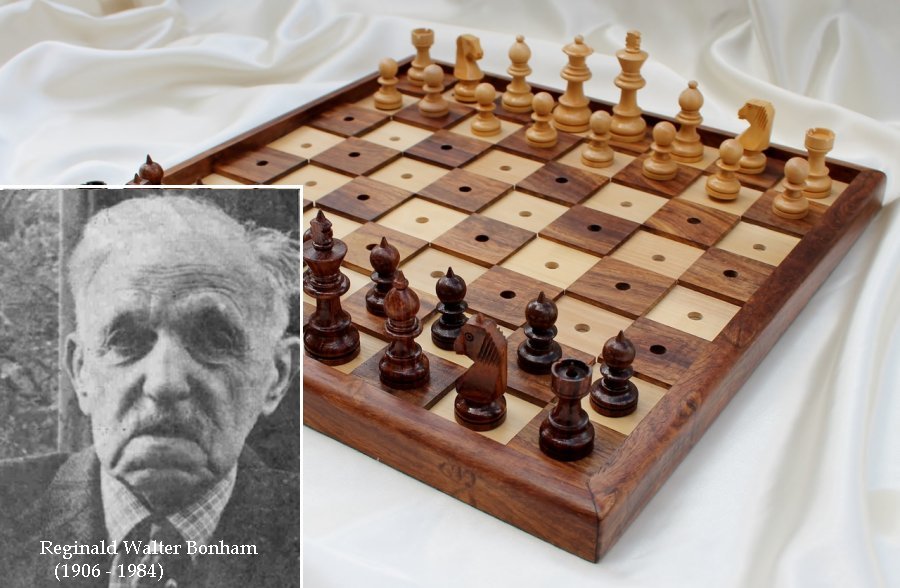
RW Bonham and a Braille chess set set-up incorrectly
Interestingly RWB in 1939 was an ARP (Air Raid Precautions) Warden and a St. John Ambulance volunteer for the College.
He was Worcester champion twenty times and four times Midlands champion winning the Birmingham Post Cup twice.
On June 6th 1947 Bonham played in Birmingham in a match between Great Britain and Czechoslovakia playing Ladislav Alster and won this attractive game :
He was Blind World Champion in 1958 and Correspondence Blind World Champion in 1957, 1959, 1961, 1964 (jointly) and 1966.
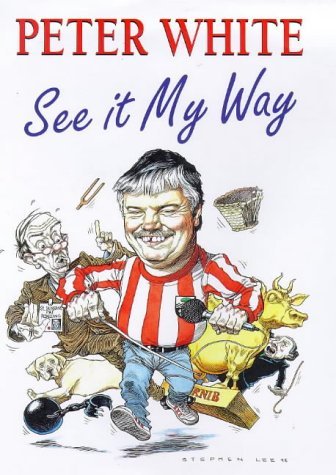
One of his students was broadcaster Peter White MBE who described Bon in his autobiography See it My Way
See it My Way, Peter White, 1994
From British Chess Magazine, Volume XCII (92, 1972) Number 6 (June), page 216 we have this item in News in Brief :
“At the closing ceremony of the 4th Chess Olympiad for the Blind at Pula, Yugoslavia (April 6-18) the International Braille Chess Association awarded the title of Correspondence Grandmaster of the Blind to R.W. Bonham of Worcester, for having won the Postal Championship more than three times.”
From British Chess Magazine, Volume CIV (104, 1984) Number 5 (May), page 194 we have this obituary :
“We regret to announce the death in March of two early winners of the grandmaster title (the other was Comins Mansfield MBE).
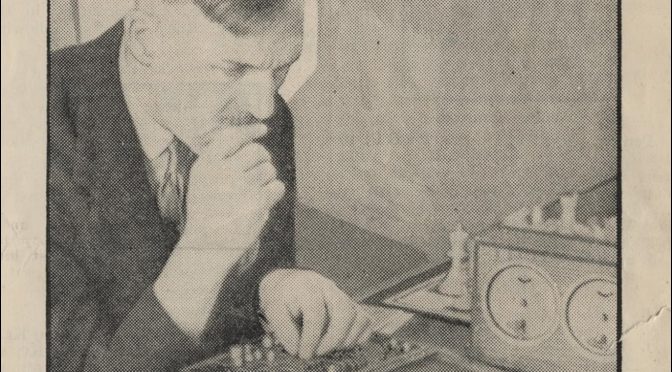
R.W.Bonham (31 i 1906 – 16 iii 1984) died at Worcester, where he had long served as a Master at the Royal Worcester College for the Blind. In the 1950s he took part in the British Championship with success. Many older players will remember him fingering his special board before announcing his move and checking his clock with its markers outside the glass face.
He was also active in postal play, taking part in international events in the decade after the war when few British players ventured “into Europe”. A note in the 1972 BCM (page 216) records the award of the title Correspondence GM of the Blind by the International Braille Chess Association, so his omission from the recent book British Chess seems rather unfortunate.
Among the titles won by Reginald Bonham were British Correspondence Championship, shared in 1947 with J. Cairncross and shared in 1951 with E. Brown) and Midland Champion (1947 and 1950).
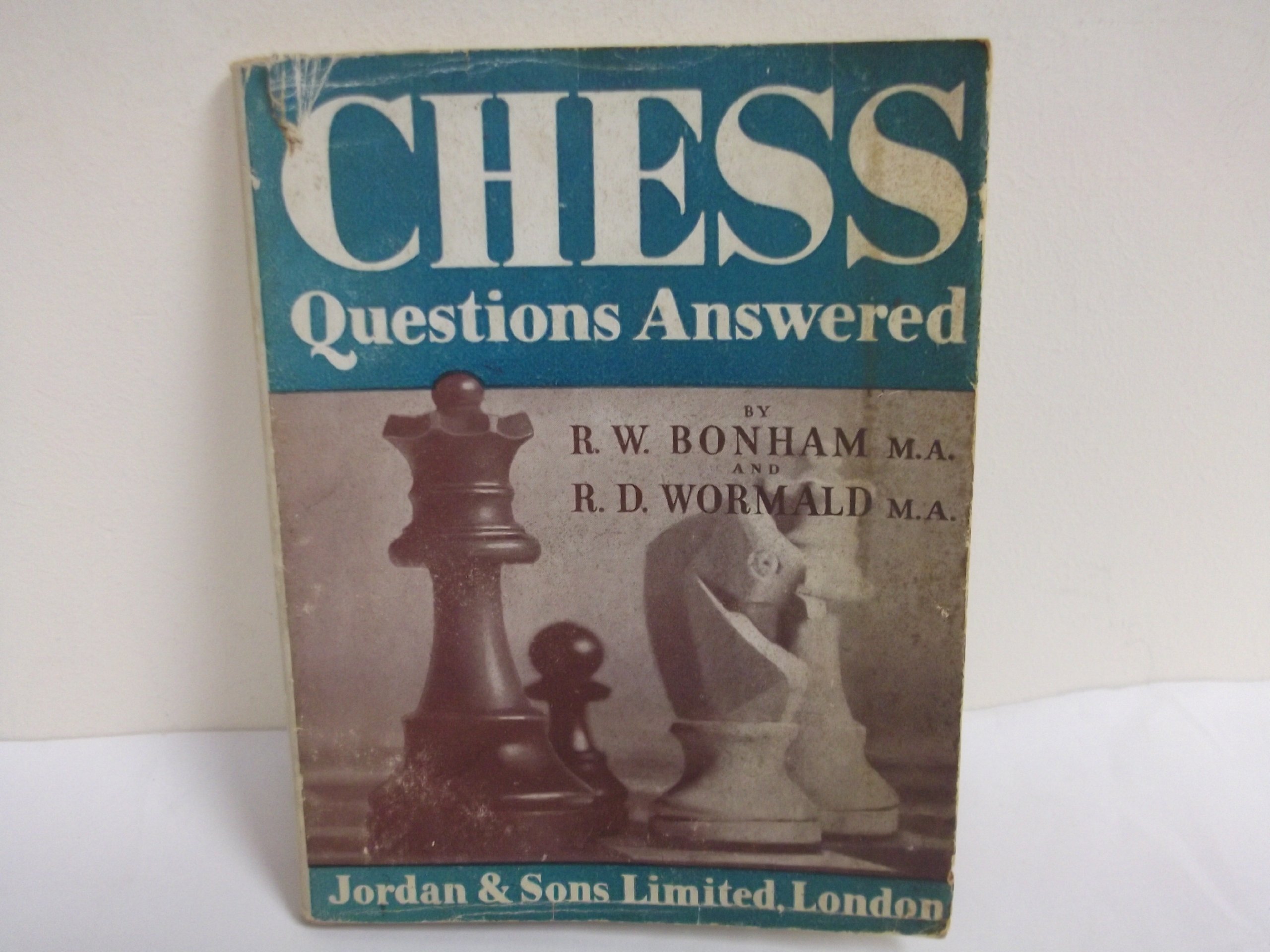
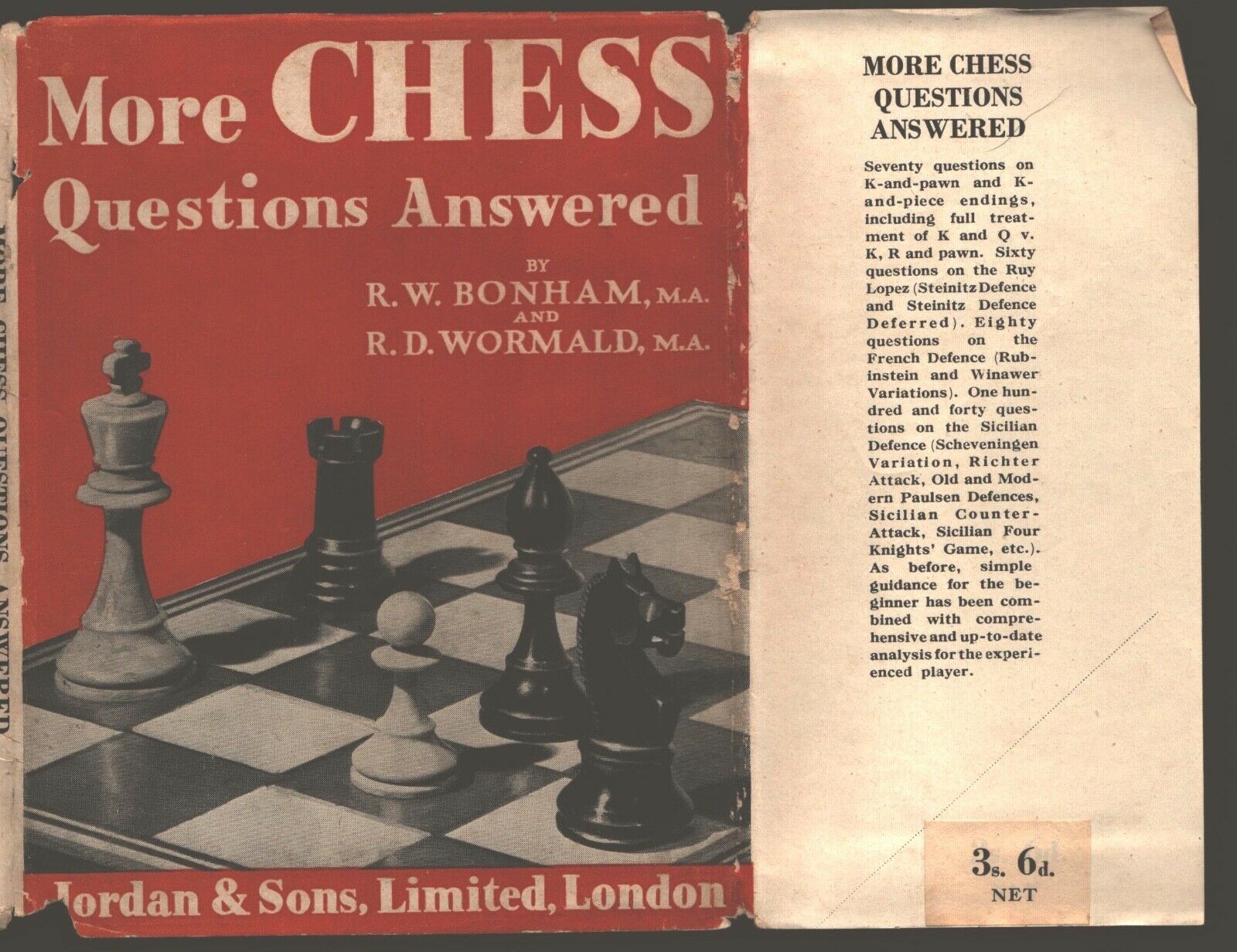
He was also (with Wormald) joint author of those fine little books Chess Questions Answered and More Chess Questions Answered.”
Sadly, RWB did not merit articles in Sunnucks or Golombek’s Encyclopedias or Hooper’s and Whyld’s Oxford Companion or, as mentioned previously, British Chess.
BCN remembers Reginald Bonham (known as “Bon”) who passed away, this day, March 16th in 1984 in Worcester, Worcestershire.
In 1970 New Years Honours, Civil Division he was awarded the MBE for “Services to the blind”. Interestingly, in 1992 his sister Mary also received an MBE for “Services to the blind” This is surely an unusual happening.
Reginald Walter Bonham was born on Wednesday, January 31st 1906 : the same day as the Ecuador–Colombia earthquake which measured 8.8 on the Richter Scale.
He was born in St. Neots, Huntingdonshire, Cambridgeshire.
In the 1911 census aged 5 he lived in the High Street, St. Neots with William R Bonham (father, master butcher, aged 45), Edith Mary Ann Bonham (mother, 38), Howard William Bonham (6), Maurice George Bonham (3) and Ernest Charles Bonham (1). The family had a servant / domestic duties assistant called Elise Annie Goss aged 18. The census did not record any disability for Reginald.
Reg, like others in his family, suffered from deficient eyesight and was therefore unable to attend a “mainstream” school.
From 1922 – 1925 he attended the Royal Worcester College for the Blind (originally Worcester College for the Blind Sons of Gentlemen) in Whittington Road, Worcester, WR5 2JX. The Headmaster (GC Brown) encouraged his chess and rowing talents and in 1926 he was sent up to St. Catherine’s College, Oxford to read mathematics.
Reginald was a highly competant rower, competing for his college and reaching the trial stage for the Oxford Varsity crew.
In 1934 Reg founded the Braille Chess Magazine.
In the 1939 census he was recorded as living at 4, St. Catherine’s Hill, Worcester, WR5 with his wife, Josephine Bonham (born 24th September 1904). Reginald was listed as being a Mathematics tutor at the Royal Worcester College for the Blind (originally Worcester College for the Blind Sons of Gentlemen) in Whittington Road, Worcester, WR5 2JX. The college is now named New College Worcester. Their home was around a mile from the College. Josephine was listed as carrying out “unpaid domestic duties”.
He taught a combination of Braille and mathematics and was an amateur thespian and keen bridge player.
RW Bonham and a Braille chess set set-up incorrectly
Interestingly RWB in 1939 was an ARP (Air Raid Precautions) Warden and a St. John Ambulance volunteer for the College.
He was Worcester champion twenty times and four times Midlands champion winning the Birmingham Post Cup twice.
On June 6th 1947 Bonham played in Birmingham in a match between Great Britain and Czechoslovakia playing Ladislav Alster and won this attractive game :
He was Blind World Champion in 1958 and Correspondence Blind World Champion in 1957, 1959, 1961, 1964 (jointly) and 1966.
One of his students was broadcaster Peter White MBE who described Bon in his autobiography See it My Way
See it My Way, Peter White, 1994
From British Chess Magazine, Volume XCII (92, 1972) Number 6 (June), page 216 we have this item in News in Brief :
“At the closing ceremony of the 4th Chess Olympiad for the Blind at Pula, Yugoslavia (April 6-18) the International Braille Chess Association awarded the title of Correspondence Grandmaster of the Blind to R.W. Bonham of Worcester, for having won the Postal Championship more than three times.”
From British Chess Magazine, Volume CIV (104, 1984) Number 5 (May), page 194 we have this obituary :
“We regret to announce the death in March of two early winners of the grandmaster title (the other was Comins Mansfield MBE).
R.W.Bonham (31 i 1906 – 16 iii 1984) died at Worcester, where he had long served as a Master at the Royal Worcester College for the Blind. In the 1950s he took part in the British Championship with success. Many older players will remember him fingering his special board before announcing his move and checking his clock with its markers outside the glass face.
He was also active in postal play, taking part in international events in the decade after the war when few British players ventured “into Europe”. A note in the 1972 BCM (page 216) records the award of the title Correspondence GM of the Blind by the International Braille Chess Association, so his omission from the recent book British Chess seems rather unfortunate.
Among the titles won by Reginald Bonham were British Correspondence Championship, shared in 1947 with J. Cairncross and shared in 1951 with E. Brown) and Midland Champion (1947 and 1950).
He was also (with Wormald) joint author of those fine little books Chess Questions Answered and More Chess Questions Answered.”
Sadly, RWB did not merit articles in Sunnucks or Golombek’s Encyclopedias or Hooper’s and Whyld’s Oxford Companion or, as mentioned previously, British Chess.
BCN remembers Reginald Bonham (known as “Bon”) who passed away, this day, March 16th in 1984 in Worcester, Worcestershire.
In 1970 New Years Honours, Civil Division he was awarded the MBE for “Services to the blind”. Interestingly, in 1992 his sister Mary also received an MBE for “Services to the blind” This is surely an unusual happening.
Reginald Walter Bonham was born on Wednesday, January 31st 1906 : the same day as the Ecuador–Colombia earthquake which measured 8.8 on the Richter Scale.
He was born in St. Neots, Huntingdonshire, Cambridgeshire.
In the 1911 census aged 5 he lived in the High Street, St. Neots with William R Bonham (father, master butcher, aged 45), Edith Mary Ann Bonham (mother, 38), Howard William Bonham (6), Maurice George Bonham (3) and Ernest Charles Bonham (1). The family had a servant / domestic duties assistant called Elise Annie Goss aged 18. The census did not record any disability for Reginald.
Reg, like others in his family, suffered from deficient eyesight and was therefore unable to attend a “mainstream” school.
From 1922 – 1925 he attended the Royal Worcester College for the Blind (originally Worcester College for the Blind Sons of Gentlemen) in Whittington Road, Worcester, WR5 2JX. The Headmaster (GC Brown) encouraged his chess and rowing talents and in 1926 he was sent up to St. Catherine’s College, Oxford to read mathematics.
Reginald was a highly competant rower, competing for his college and reaching the trial stage for the Oxford Varsity crew.
In 1934 Reg founded the Braille Chess Magazine.
In the 1939 census he was recorded as living at 4, St. Catherine’s Hill, Worcester, WR5 with his wife, Josephine Bonham (born 24th September 1904). Reginald was listed as being a Mathematics tutor at the Royal Worcester College for the Blind (originally Worcester College for the Blind Sons of Gentlemen) in Whittington Road, Worcester, WR5 2JX. The college is now named New College Worcester. Their home was around a mile from the College. Josephine was listed as carrying out “unpaid domestic duties”.
He taught a combination of Braille and mathematics and was an amateur thespian and keen bridge player.
RW Bonham and a Braille chess set set-up incorrectly
Interestingly RWB in 1939 was an ARP (Air Raid Precautions) Warden and a St. John Ambulance volunteer for the College.
He was Worcester champion twenty times and four times Midlands champion winning the Birmingham Post Cup twice.
On June 6th 1947 Bonham played in Birmingham in a match between Great Britain and Czechoslovakia playing Ladislav Alster and won this attractive game :
He was Blind World Champion in 1958 and Correspondence Blind World Champion in 1957, 1959, 1961, 1964 (jointly) and 1966.
One of his students was broadcaster Peter White MBE who described Bon in his autobiography See it My Way
See it My Way, Peter White, 1994
From British Chess Magazine, Volume XCII (92, 1972) Number 6 (June), page 216 we have this item in News in Brief :
“At the closing ceremony of the 4th Chess Olympiad for the Blind at Pula, Yugoslavia (April 6-18) the International Braille Chess Association awarded the title of Correspondence Grandmaster of the Blind to R.W. Bonham of Worcester, for having won the Postal Championship more than three times.”
From British Chess Magazine, Volume CIV (104, 1984) Number 5 (May), page 194 we have this obituary :
“We regret to announce the death in March of two early winners of the grandmaster title (the other was Comins Mansfield MBE).
R.W.Bonham (31 i 1906 – 16 iii 1984) died at Worcester, where he had long served as a Master at the Royal Worcester College for the Blind. In the 1950s he took part in the British Championship with success. Many older players will remember him fingering his special board before announcing his move and checking his clock with its markers outside the glass face.
He was also active in postal play, taking part in international events in the decade after the war when few British players ventured “into Europe”. A note in the 1972 BCM (page 216) records the award of the title Correspondence GM of the Blind by the International Braille Chess Association, so his omission from the recent book British Chess seems rather unfortunate.
Among the titles won by Reginald Bonham were British Correspondence Championship, shared in 1947 with J. Cairncross and shared in 1951 with E. Brown) and Midland Champion (1947 and 1950).
He was also (with Wormald) joint author of those fine little books Chess Questions Answered and More Chess Questions Answered.”
Sadly, RWB did not merit articles in Sunnucks or Golombek’s Encyclopedias or Hooper’s and Whyld’s Oxford Companion or, as mentioned previously, British Chess.
BCN remembers Reginald Bonham (known as “Bon”) who passed away, this day, March 16th in 1984 in Worcester, Worcestershire.
In 1970 New Years Honours, Civil Division he was awarded the MBE for “Services to the blind”. Interestingly, in 1992 his sister Mary also received an MBE for “Services to the blind” This is surely an unusual happening.
Reginald Walter Bonham was born on Wednesday, January 31st 1906 : the same day as the Ecuador–Colombia earthquake which measured 8.8 on the Richter Scale.
He was born in St. Neots, Huntingdonshire, Cambridgeshire.
In the 1911 census aged 5 he lived in the High Street, St. Neots with William R Bonham (father, master butcher, aged 45), Edith Mary Ann Bonham (mother, 38), Howard William Bonham (6), Maurice George Bonham (3) and Ernest Charles Bonham (1). The family had a servant / domestic duties assistant called Elise Annie Goss aged 18. The census did not record any disability for Reginald.
Reg, like others in his family, suffered from deficient eyesight and was therefore unable to attend a “mainstream” school.
From 1922 – 1925 he attended the Royal Worcester College for the Blind (originally Worcester College for the Blind Sons of Gentlemen) in Whittington Road, Worcester, WR5 2JX. The Headmaster (GC Brown) encouraged his chess and rowing talents and in 1926 he was sent up to St. Catherine’s College, Oxford to read mathematics.
Reginald was a highly competant rower, competing for his college and reaching the trial stage for the Oxford Varsity crew.
In 1934 Reg founded the Braille Chess Magazine.
In the 1939 census he was recorded as living at 4, St. Catherine’s Hill, Worcester, WR5 with his wife, Josephine Bonham (born 24th September 1904). Reginald was listed as being a Mathematics tutor at the Royal Worcester College for the Blind (originally Worcester College for the Blind Sons of Gentlemen) in Whittington Road, Worcester, WR5 2JX. The college is now named New College Worcester. Their home was around a mile from the College. Josephine was listed as carrying out “unpaid domestic duties”.
He taught a combination of Braille and mathematics and was an amateur thespian and keen bridge player.
RW Bonham and a Braille chess set set-up incorrectly
Interestingly RWB in 1939 was an ARP (Air Raid Precautions) Warden and a St. John Ambulance volunteer for the College.
He was Worcester champion twenty times and four times Midlands champion winning the Birmingham Post Cup twice.
On June 6th 1947 Bonham played in Birmingham in a match between Great Britain and Czechoslovakia playing Ladislav Alster and won this attractive game :
He was Blind World Champion in 1958 and Correspondence Blind World Champion in 1957, 1959, 1961, 1964 (jointly) and 1966.
One of his students was broadcaster Peter White MBE who described Bon in his autobiography See it My Way
See it My Way, Peter White, 1994
From British Chess Magazine, Volume XCII (92, 1972) Number 6 (June), page 216 we have this item in News in Brief :
“At the closing ceremony of the 4th Chess Olympiad for the Blind at Pula, Yugoslavia (April 6-18) the International Braille Chess Association awarded the title of Correspondence Grandmaster of the Blind to R.W. Bonham of Worcester, for having won the Postal Championship more than three times.”
From British Chess Magazine, Volume CIV (104, 1984) Number 5 (May), page 194 we have this obituary :
“We regret to announce the death in March of two early winners of the grandmaster title (the other was Comins Mansfield MBE).
R.W.Bonham (31 i 1906 – 16 iii 1984) died at Worcester, where he had long served as a Master at the Royal Worcester College for the Blind. In the 1950s he took part in the British Championship with success. Many older players will remember him fingering his special board before announcing his move and checking his clock with its markers outside the glass face.
He was also active in postal play, taking part in international events in the decade after the war when few British players ventured “into Europe”. A note in the 1972 BCM (page 216) records the award of the title Correspondence GM of the Blind by the International Braille Chess Association, so his omission from the recent book British Chess seems rather unfortunate.
Among the titles won by Reginald Bonham were British Correspondence Championship, shared in 1947 with J. Cairncross and shared in 1951 with E. Brown) and Midland Champion (1947 and 1950).
He was also (with Wormald) joint author of those fine little books Chess Questions Answered and More Chess Questions Answered.”
Sadly, RWB did not merit articles in Sunnucks or Golombek’s Encyclopedias or Hooper’s and Whyld’s Oxford Companion or, as mentioned previously, British Chess.
The Braille Chess Association has this entry in its Hall of Fame.
Chess Questions Answered, RW Bonham & RD Wormald, Jordan & Sons Ltd, London, 1945More Chess Questions Answered, RW Bonham & RD Wormald, Jordan & Sons Ltd, London, 1948
We focus on the British Chess Scene Past & Present!
This website uses cookies to improve your experience. We'll assume you're ok with this, but you can opt-out if you wish. Cookie settingsACCEPT
Privacy & Cookies Policy
Privacy Overview
This website uses cookies to improve your experience while you navigate through the website. Out of these cookies, the cookies that are categorized as necessary are stored on your browser as they are as essential for the working of basic functionalities of the website. We also use third-party cookies that help us analyze and understand how you use this website. These cookies will be stored in your browser only with your consent. You also have the option to opt-out of these cookies. But opting out of some of these cookies may have an effect on your browsing experience.
Necessary cookies are absolutely essential for the website to function properly. This category only includes cookies that ensures basic functionalities and security features of the website. These cookies do not store any personal information.