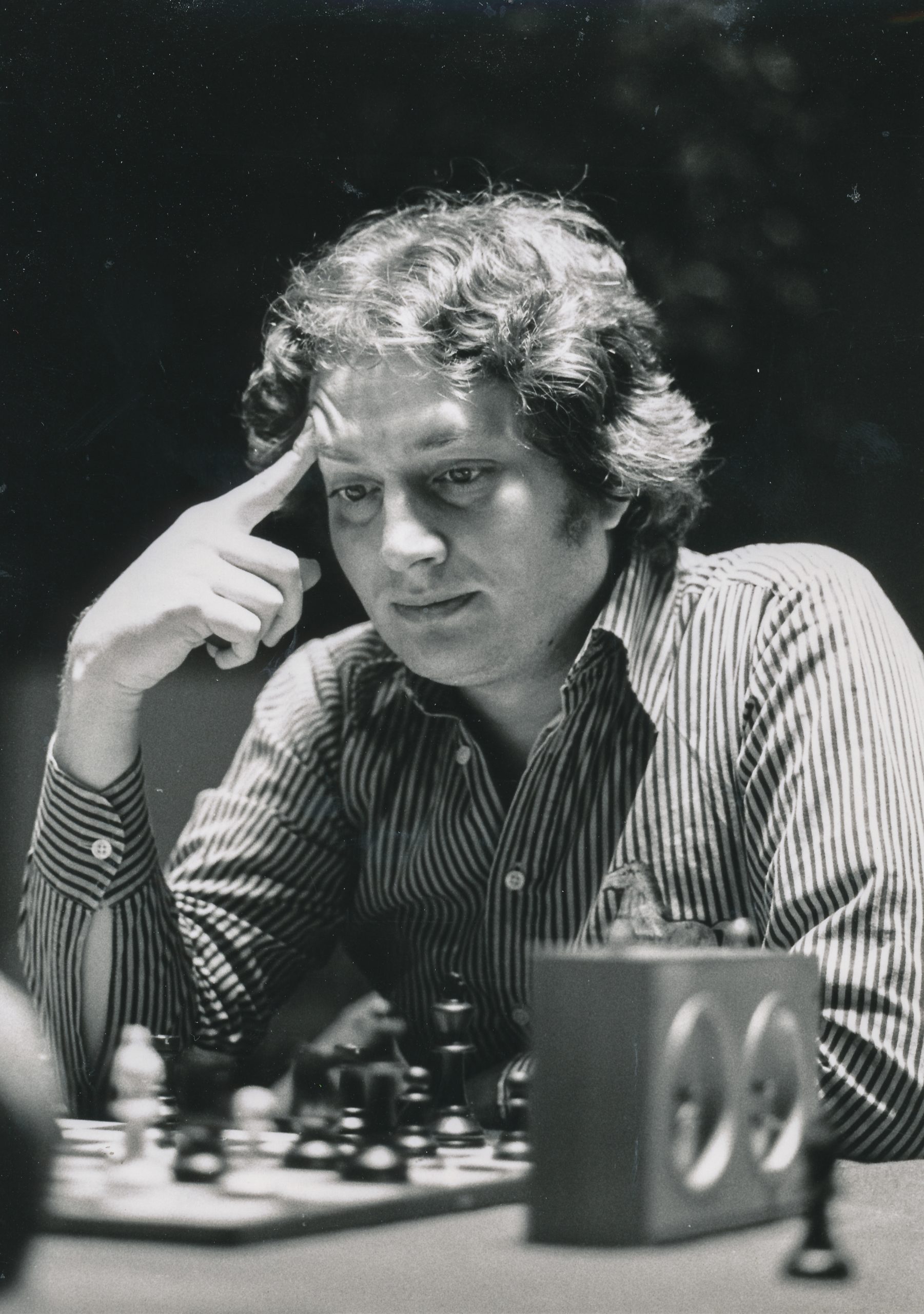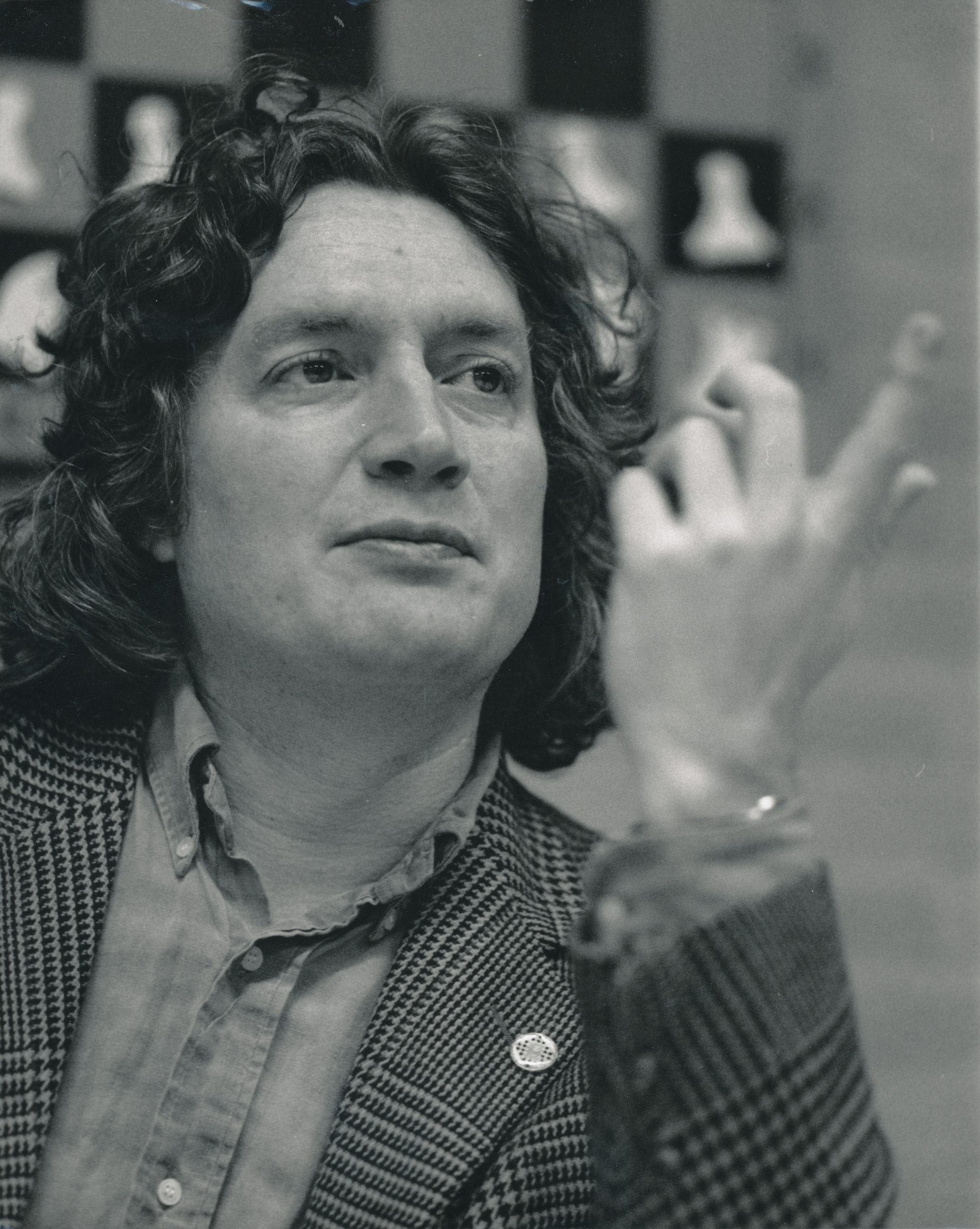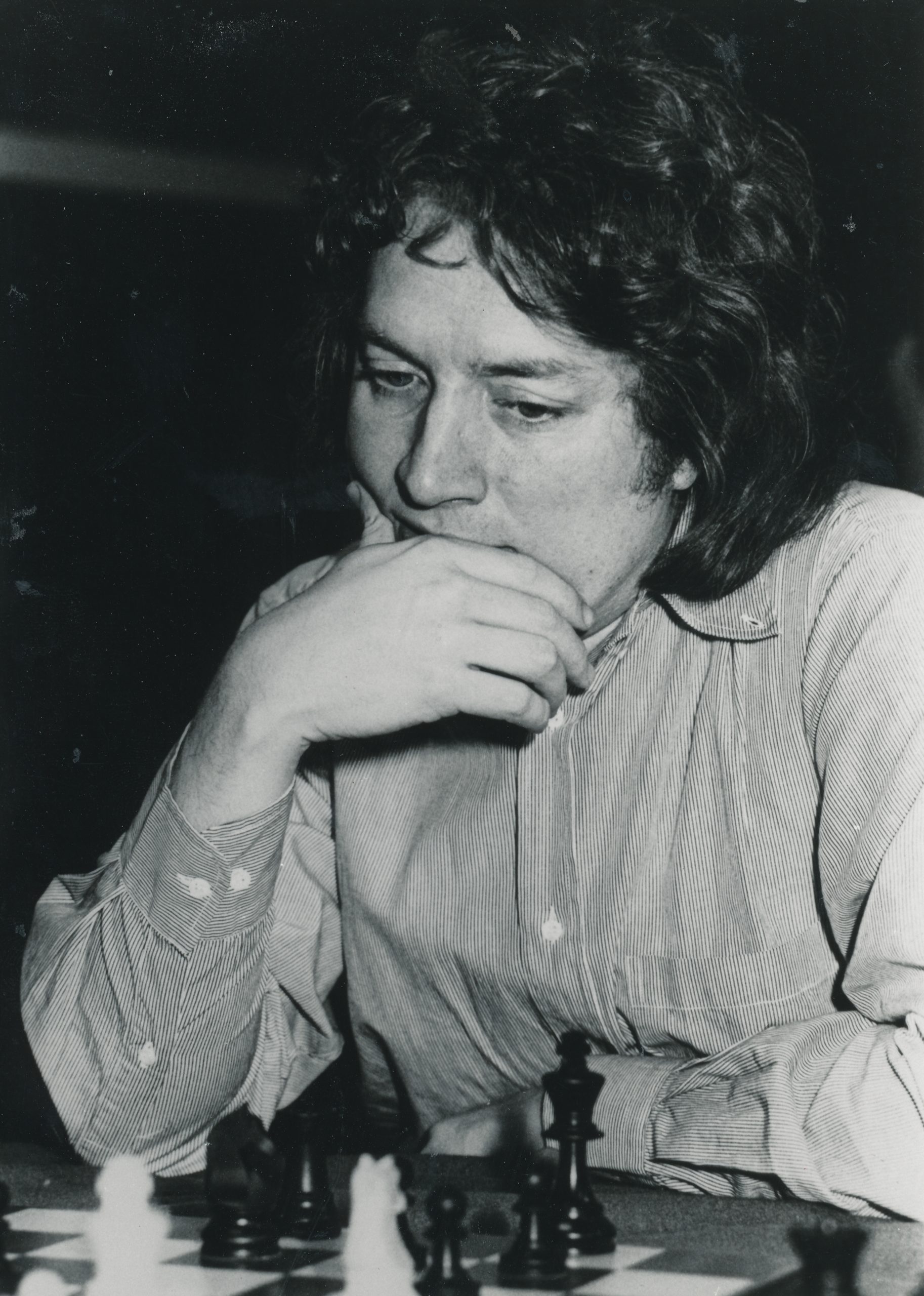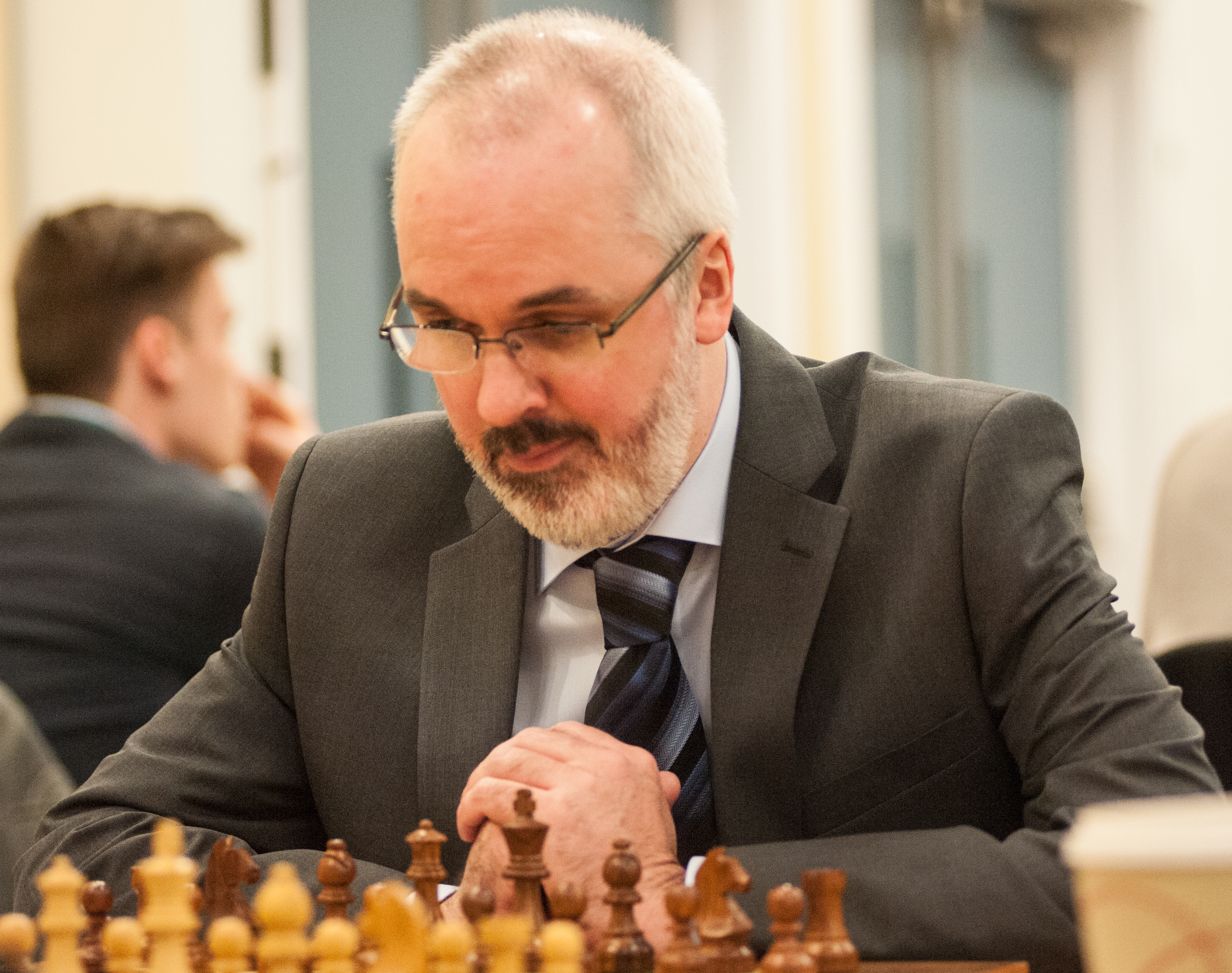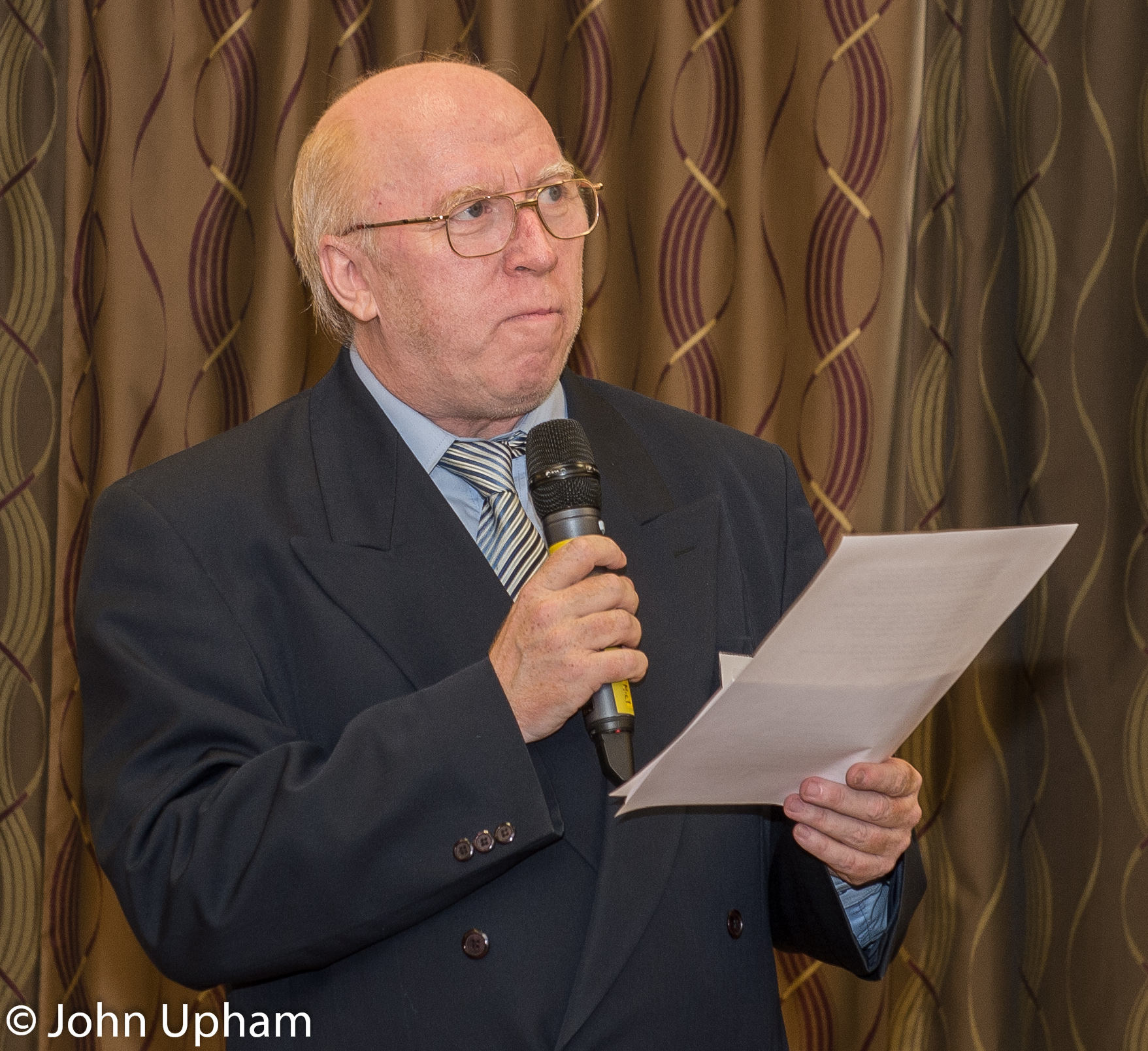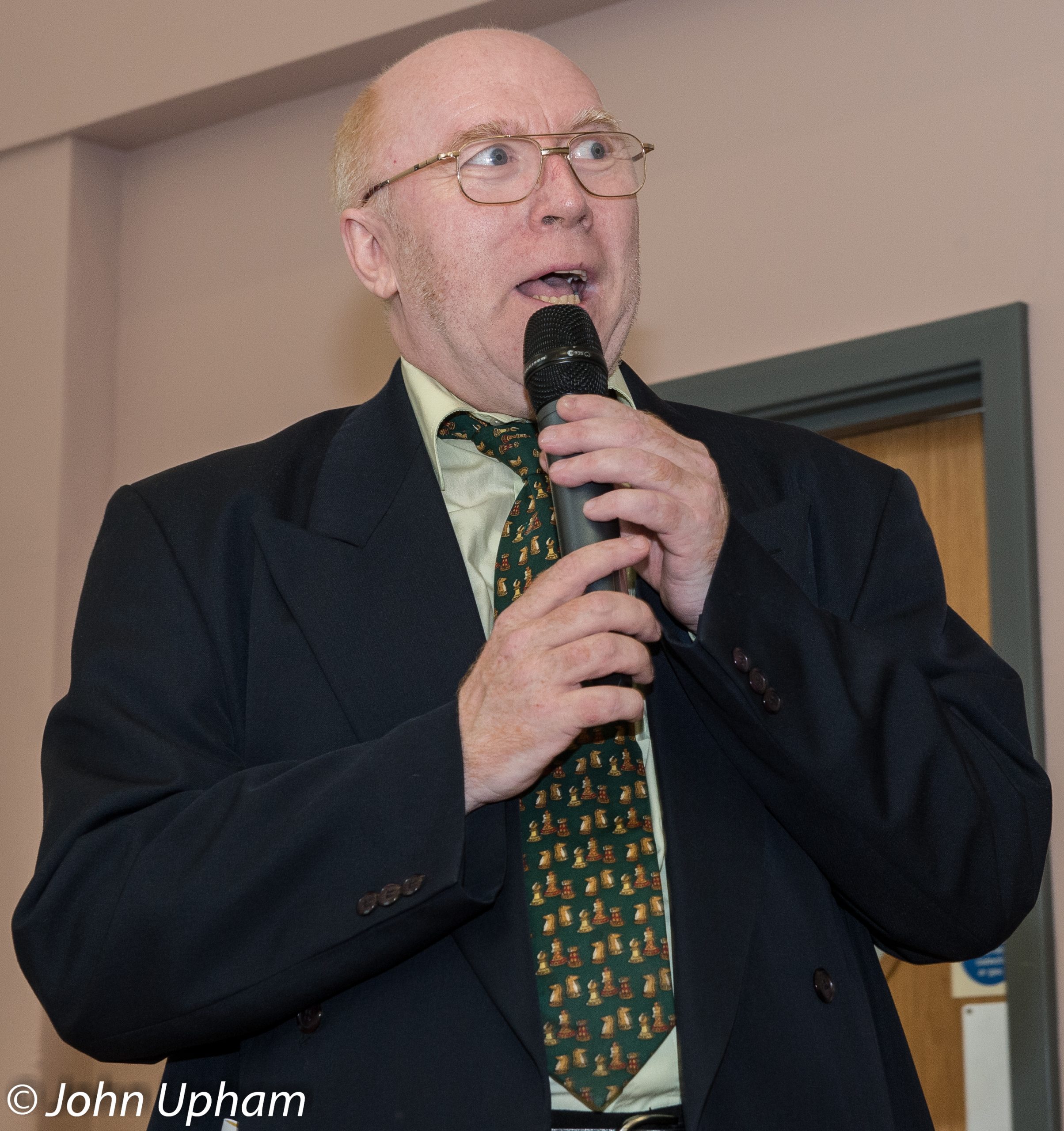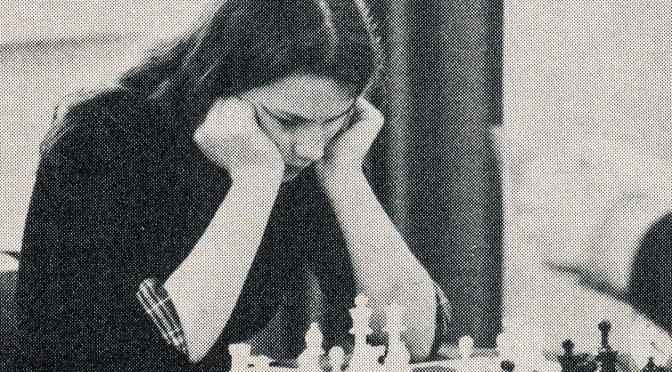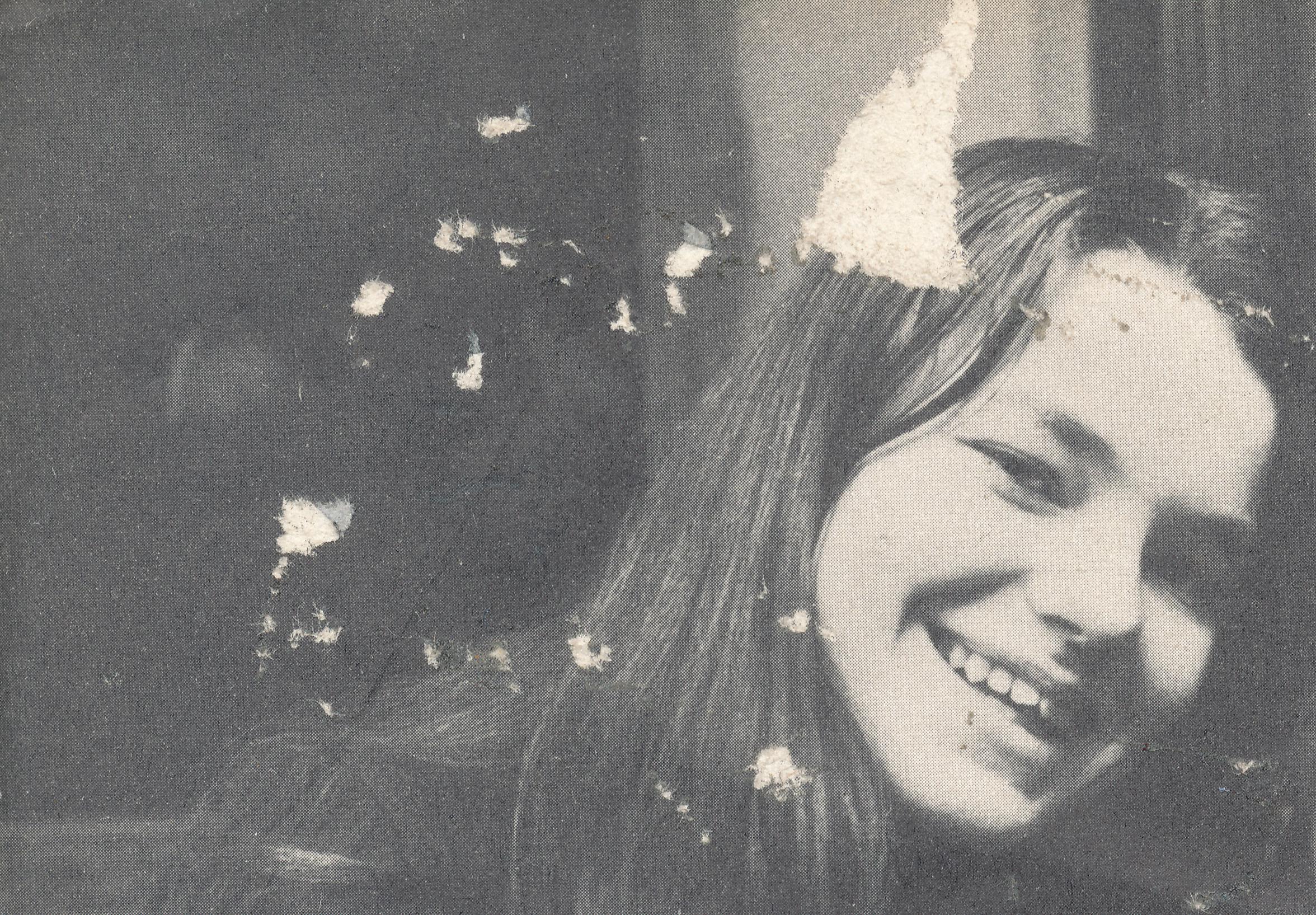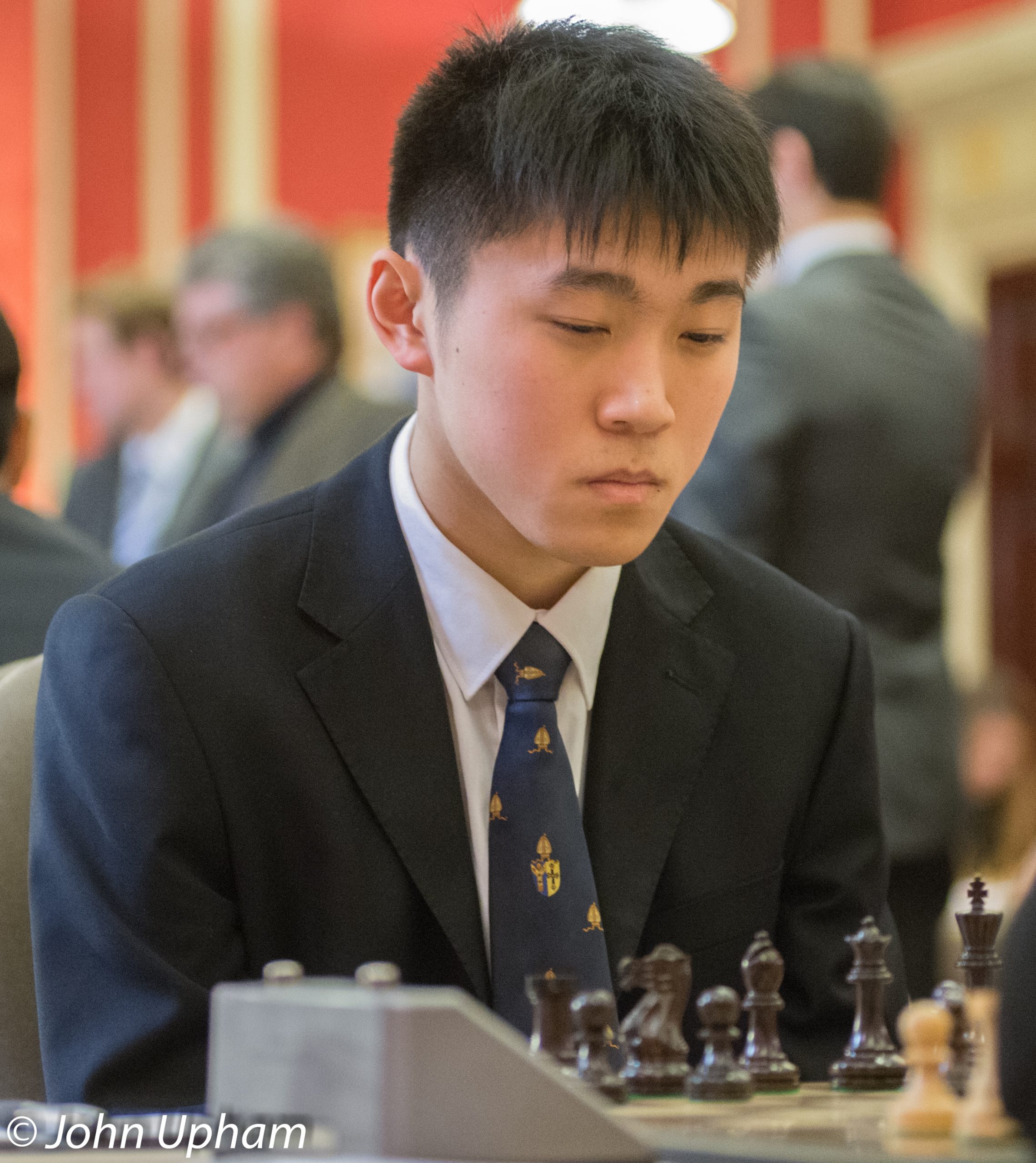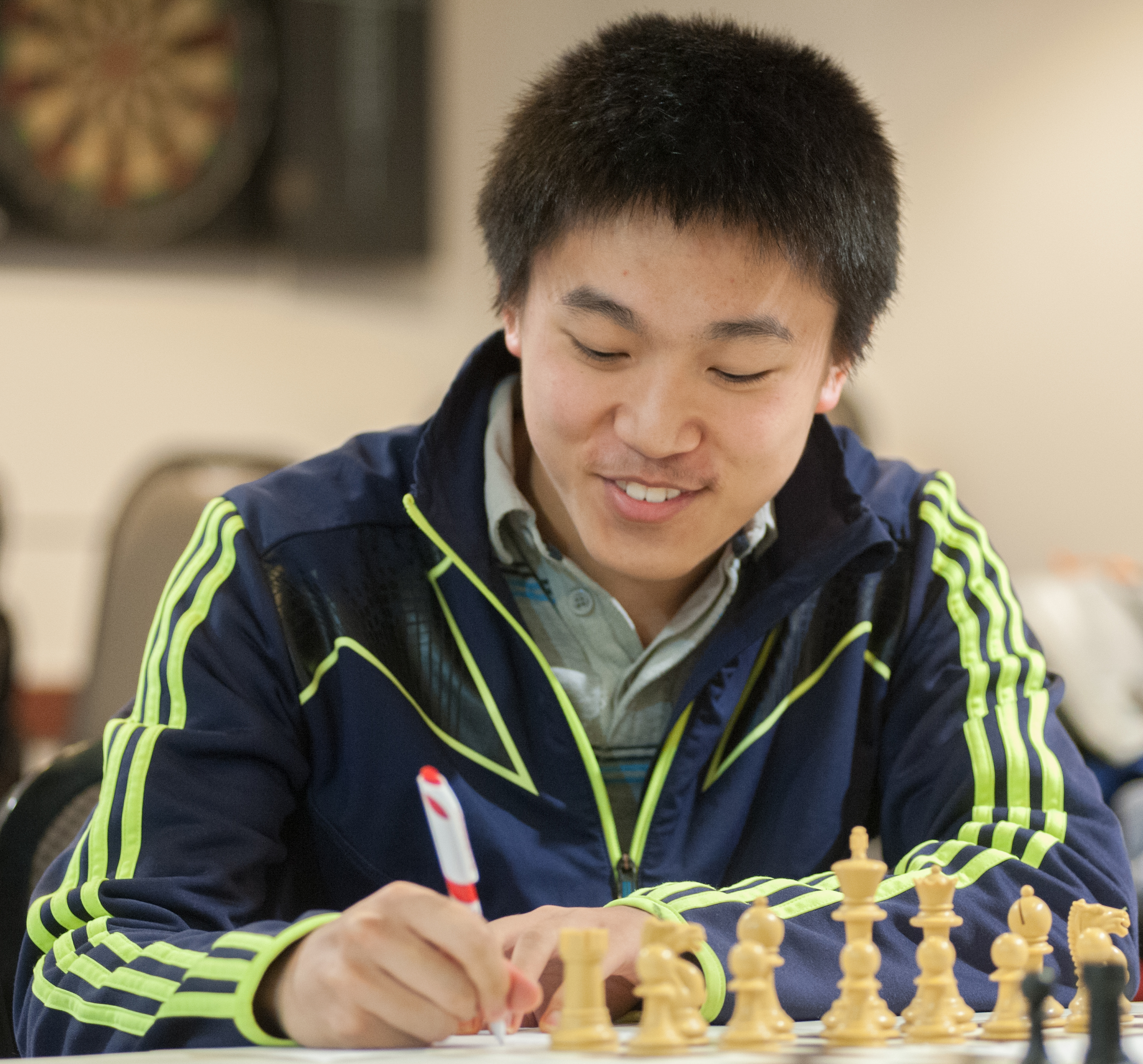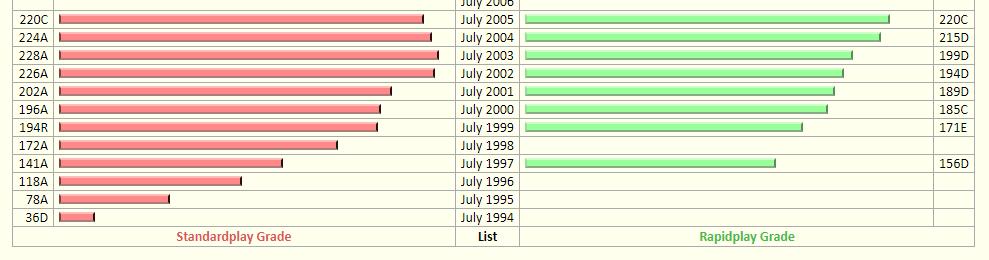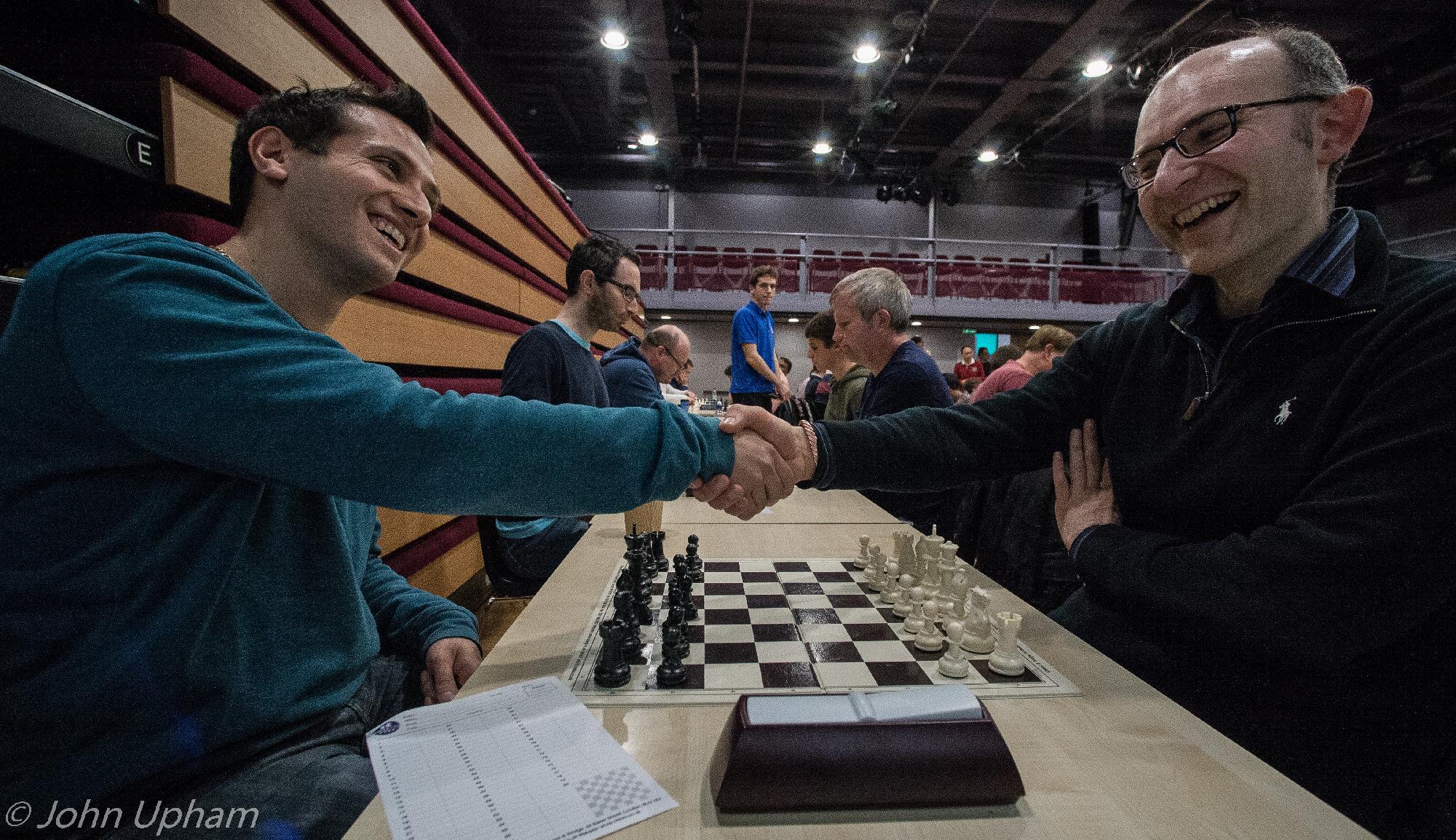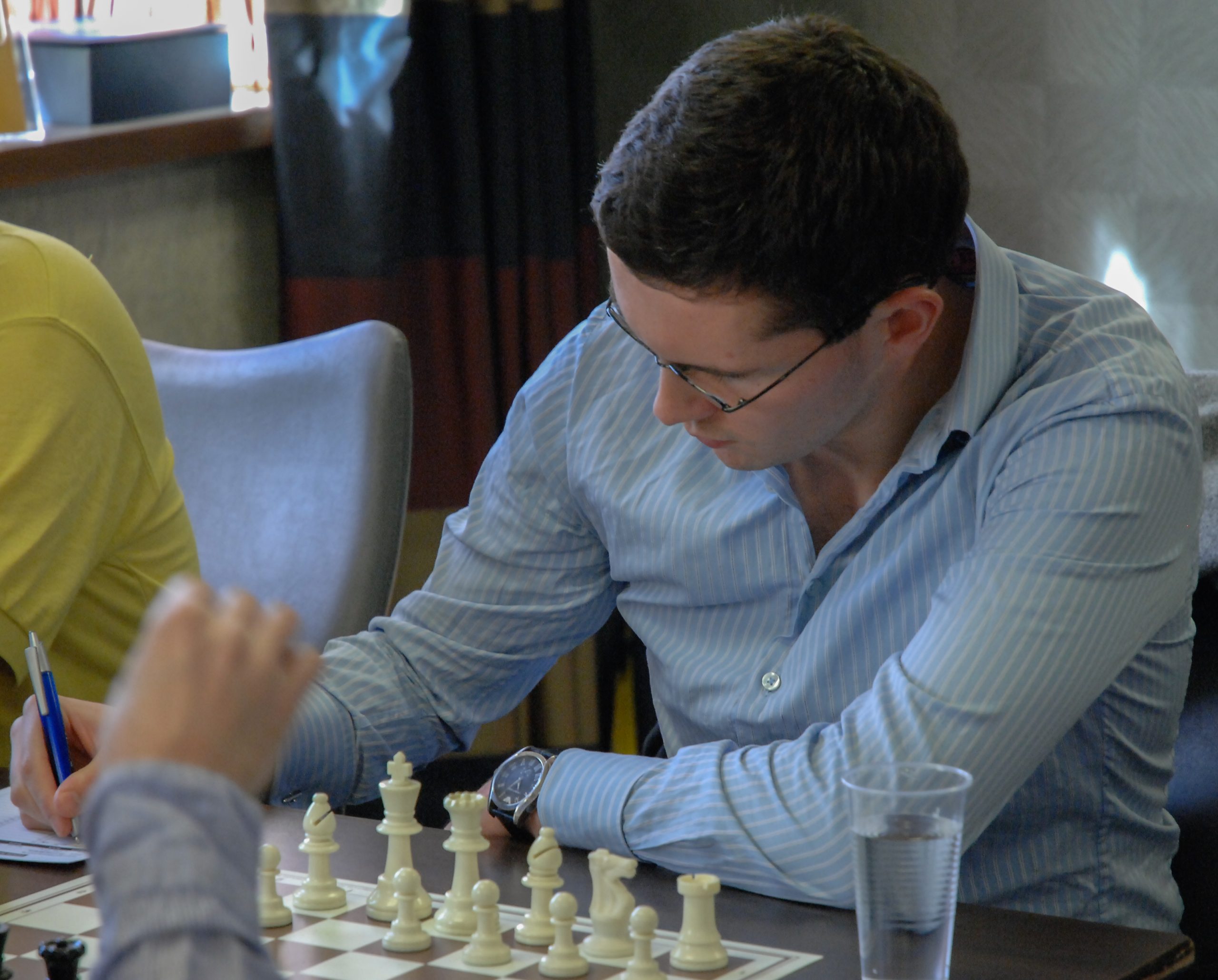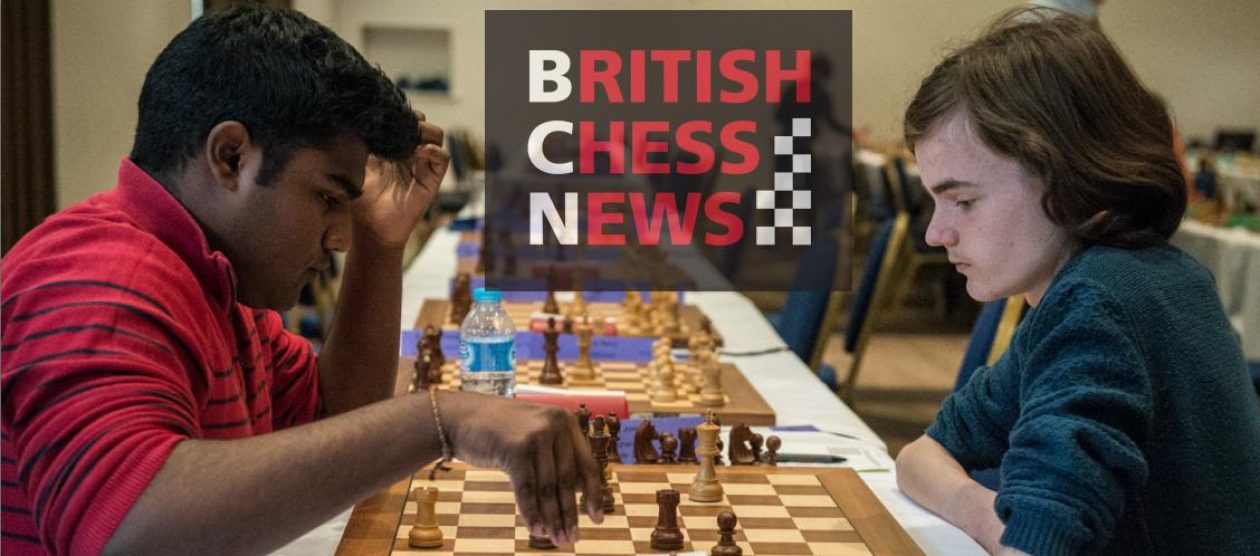
David Anderton OBE from the final 4NCL weekend of 2014, courtesy of John Upham Photography
BCN remembers CM David Anderton OBE who passed away on Friday, April 1st 2022.
In the 1977 New Years Honours List, Civil Division, David was awarded the OBE. The citation read simply : “For services to Chess”
David William Anderton was born in the district of Walsall, Staffordshire, West Midlands. His mother’s maiden name was Coltart and David resided in Walsall.
David was married to Doreen in 2005.
David Anderton (rhs) congratulates Sir Philip Stuart Milner-Barry for winning the “Board of Honour ” game versus Edward Lasker at the 1976 Lloyds Bank Match by Telex, London – New York. From BCM, volume XCVI (96) Number 11 (August), Page 494. The venue was the Bloomsbury Hotel, London. Photo courtesy of Lloyds Bank
David was an Honorary Life Vice-President of the English (formerly British) Chess Federation.
John Nunn, David Anderton and Jonathan Speelman
“David won the ECF President’s Award in 2009 following his stepping down as ECF legal expert. This is the citation from the 2010 ECF Yearbook :
“As this is Gerry Walsh’s last year as President it was considered appropriate that he be allowed to choose someone receive the award. Gerry has worked with David for all his time with BCF and ECF and has selected him due to his tireless and selfless devotion to both the BCF and ECF over many years.
David Anderton OBE, ? and Teresa Needham
Most of you will know David and will agree that this is a well deserved award. It is fair to state that David’s assistance over the years has been invaluable and that without it many areas of the Federation would have found it difficult, if not impossible to operate.
Jim Plaskett with David Anderton OBE at the 1983 Benedictine International (Manchester)
Since my election David has been a constant friend and confidante. He has invariable given sound advice throughout my term of office. It was John Wickham who rang me and suggested that due to my length of tenure, a special award might be in order.
Jim accepts the 1981 Grand Prix shield from David Anderton OBE
After years of selfless and generous devotion serving as ECF President, International Director, Captain of the England Team and legal adviser, this seems to be a fitting tribute.
From the Praxis Bath Zonal Tournament of 1987. David Anderton OBE is second from right
David’s advice both legal and general, has been invaluable in such matters as the John Robinson legacy and the change of name from BCF to ECF Limited, and I certainly hope that this advice will continue.
Gerry Walsh”
Bob Wade OBE, Murray Chandler MNZM and David Anderton OBE
David is a FIDE Candidate Master.
From the BCF 1979-80 Year Book of Chess : Robert Bellin, the new British Champion, explains the secret to the Mayor of Chester (?) and to David Anderton, BCF President
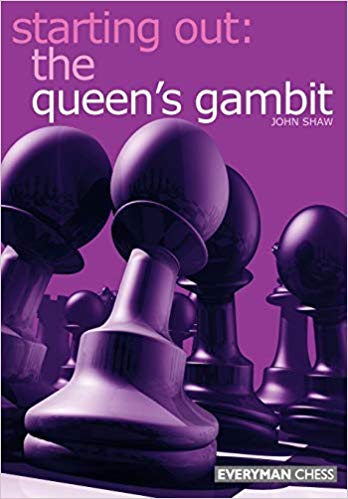
With the White pieces David exclusively plays 1.d4 aiming for a Queen’s Gambit and main lines.
With Black David plays the Winawer and the Classical French plus the Lenningrad Dutch.
Mrs. Joan Agar; Chairman of Leigh Interests, presents the Leigh trophy (for 1981) to Mark Hebden. Left, David Anderton, BCF President; on the right Malcolm Wood, Leigh’s Chief Executive. BCM, 1981, page 104
DW Anderton OBE plays BH Wood MBE in 1981 in a Blitz tournament outside of the National Film Theatre. Photograph courtesy of John Saunders
During 1989-93 David was an Executive Board Member of FIDE.
The England Team from the 1990 Novi Sad Olympiad : John Nunn, Jon Speelman, Julian Hodgson, David Anderton OBE (Captain), Nigel Short, Michael Adams and Murray Chandler
In 2015 David stood down from all of his roles within the ECF.
David Anderton OBE, Paul Bazalgette (Senior Partner at Philips & Drew) and Tony Banks (GLC Arts & Recreation Department) at the 1982 Philips and Drew Kings Tournament Opening Ceremony. Photograph by Clive Field
David has won the British Seniors Championship in 2003 (shared), 2005, 2007 (shared), 2009 (shared) and 2011.
BCN wishes happy birthday to Barry Barnes (01-viii-1937)
Barry Peter Barnes was born in Brighton and his mother’s maiden name was Simpole. (Barry is a cousin of Julian Ivan Peter Simpole, who was a Brighton school teacher and who taught Edward Gerard Winter to play chess).
Barry now lives in Halling, Rochester, Kent with his wife Jean.
From The Encyclopedia of Chess (Robert Hale, 1970 & 1976) by Anne Sunnucks :
“International Master of FIDE for Chess Compositions (1967) and International Judge of FIDE for Chess Compositions (1967).
Born on 1st August 1937, Barnes works in transport advertising. He has composed about 250 two-move problems. With Lipton and Rice, he has contributed to the advance of the modern two-mover. Problem Editor of Two-Move and Twin sections of The Problemist. Co-author with M.Lipton and JM Rice of The Two-Move Chess Problem : Tradition and Development (Faber and Faber 1966).
“A promising career as a county chess player came to an end when I was given Brian Harley’s classic book Mate in Two Moves in the belief that it would help my chess, but it had quite the opposite effect. My interest in competitive chess waned, and I was on the road to an an International Master title for problems!
Early influences in my problem career were the weekly chess problem solving competition in The Observer (my first problem published there was in 1955), a teenage friendship with J. M. Rice and M. Lipton (both now lnternational Masters), Herbert Grasemann’s book Problem Schach / with its near revolutionary post-war German problem ideas, and the expert British problemist, A. R. Gooderson who had I but known it only a few years earlier was the officiating master when my Hove Grammar School played Steyning Grammar at chess.
In the late 1950s and early 1960s, the genuinely original problems I was making in cooperation and in competition with Rice and Lipton were being published mostly abroad in such specialist problem magazines as Die Schwatbe (with its inspired two-move editor, Hermann Albrecht) where I gained the epithet the English prize-snatcher’! It was also written that the work of the avant-garde composers, Rice, Lipton and Barnes, was like a fresh two-move wind blowing from our island. It was sad but true at that time that the specialist magazine of the British Chess problem Society (founded 1918), The problemist, was unreceptive to change and our often bizarre ideas.
A milestone of sorts was reached when I won lst prize for problem I in 1958, a prize for the best new problem by a member of the British Commonwealth aged under 21. In 1966, I was invited by problemist Grandmaster Comins Mansfield, who was President of the FIDE Problem Commission, to act as Secretary at the Barcelona meeting. With Mr. Mansfield’s retirement, I became the British Member to the Commission, and at the Wiesbaden meeting, 1974, I was elected 2nd Vice-President. (1st Vice-President from 1982)
The FIDE Problem Commission meets annually to discuss matters relating to all branches of problem chess, to organize the World Chess Composing Tournament (WCCT), the World Chess Solving Competition (WCSC), and to publish FIDE Album anthologies of the best problems. It was on the strength of my success in these FIDE Albums that the Commission granted me the titles in 1967 of ‘lnternational Master of the FIDE for Chess Composition’ and ‘lnternational Judge of the FIDE for Chess Composition’. Since 1974, I have been Chairman of the Titles Sub-Committee of the Commission.
Since 1965, I have been the two-move editor of The Problemist and have served almost without break on the BCPS Committee. I have contributed to The Encyclopaedia of Chess by Anne Sunnucks (Robert Hale, 1970), I am co-author, with J. M. Rice and M. Lipton, of The Two-Move Chess Problem: Tradition & Development‘ (Faber A Faber, 1966), and I am the sole author of Comins Mansfield MBE: Chess Problems of a Grandmaster: (British Chess Problem Society, 1976) and Pick of the Best Chess Problems (Elliot Right Way Books, 1976)
To date I have made just over 300 two-movers and some helpmates.”
From The Encyclopaedia of Chess (Batsford, 1977), Harry Golombek OBE, John Rice writes:
“British problem composer, output about 400, nearly all modern style two-movers. Two-move sub-editor of The Problemist. Secretary of the FIDE Problem Commission during C. Mansfield’s Presidency. Co-author of The Two-Move Chess Problem: Tradition and Development (1966).”
The Two Move Chess Problem : Tradition and Development
Author of Pick of the Best Chess Problems (1976)
Pick of the best Chess Problems
Comins Mansfield MBE : Chess Problems of a Grandmaster (1976).
Comins Mansfield MBE: Chess Problems of a Grandmaster, BP Barnes, 1976
International Judge (1967); international master (1967).
Source: The Problemist, May 1996. Photo taken March 1996 at the Mansfield Centenary Meeting at Paisley, when Barry Barnes delivered a lecture on Comins Mansfield. Left to right: Geoffrey Mansfield (son of Comins), Robert Gray and Barry Barnes, International Master of Chess Composition.
From https://achievement.org/achiever/demis-hassabis-ph-d/ :
Demis Hassabis, the eldest of three, was born in London on July 27, 1976, to a Greek Cypriot father and a Chinese Singaporean mother.
(Originally his surname was spelt Hassapis and his brother George retained this spelling.)
“Demis Hassabis was born in London, England. He is of both Greek and Chinese ancestry; his father came from Cyprus, his mother from Singapore. Demis and his family moved frequently as his father pursued a variety of business and creative ventures.
Demis was four years old when he saw his father and an uncle playing chess and asked them to teach him the game. He took to it quickly and was soon beating both of them. He showed a precocious aptitude for all games employing logic and strategy. ”
Demis Hassabis
When 13 (in 1989) Demis achieved a FIDE rating of 2300 which, at the time, was the second highest rating for his age. First highest was Judit Polgar.
Demis was SCCU Under-18 champion in 1989 and was presented with the “old Trophy” according to the SCCU report.
Lawrence Cooper, Demis Hassabis, Cathy Haslinger and Dharshan Kumaran in around 1986. Possibly at a Lloyds Bank event.
Demis was a Candidate Master and brother of George Hassapis.
Demis started off with Hampstead Junior Chess Club.
He then played for Barnet Knights, Queens College College Union and Finchley chess clubs.
Demis Hassabis courtesy of Cathy Rogers
According to Tryfon Gavriel :
Demis wrote a hit computer game called “The theme park”, that was at the top of the charts for six months and sold than more 3.5 million copies. He also did quite well in the 1997 Mind Sports Olympiad.
Demis Hassabis, IMMO KLINK/CONTOUR BY GETTY IMAGES
Hassabis returned to academia to obtain his PhD in cognitive neuroscience from University College London (UCL) in 2009 supervised by Eleanor Maguire. He sought to find inspiration in the human brain for new AI algorithms.
Danny Gormally wrote (in March 2014) this :
“Demis Hassapis is a former chess prodigy who recently sold his company to Google for £400 million. Demonstrating that if you have the brainpower to be good at chess, you are far better off putting that intelligence to use in some other activity where you might actually get rewarded. Then in fairness, even most strong chess players aren’t as bright as Demis.”
In May 2021 Demis was cited by Dominic Cummings in his evidence to the Commons Heath, and Science and Technology committees as having played an important contribution to managing and understanding the PHE and NHS data during the early stages of the Covid-19 pandemic in the UK.
We are delighted to offer (Arthur) John Roycroft best wishes on his birthday, this day (July 25th) in 1929.
John was born in Hendon, London and his mother’s maiden name was Banks.
AJR aged 9, courtesy of the BCPS web site.
John moved to Brighton and then evacuated to Calcot, North Wales and returned to Brighton when the threat of war had subsided.
He married Betty in 1961 and they had a son and a daughter and now have several grand children.
He claimed that he had never suffered a common cold.
John is Platinum Life Member of the English Chess Federation and an “ECF Supporter”.
The Chess Endgame Study
“From The Oxford Companion to Chess (Oxford University Press, 1984) by David Hooper and Ken Whyld :
English study composer and author, International Judge of Chess Compositions (1959), Computer systems analyst.
In 1965 he founded EG, a quarterly publication which became the world’s first and only long-running magazine devoted wholly to studies.
His Test Tube Chess (1972), the best English language guide to the art of studies., was revised and republished as The Chess Endgame Study (1981).
Test Tube Chess, AJ Roycroft, Faber and Faber Limited, 1972, ISBN 0 571 09573 9
Studies are commonly classified by means of the GBR code of which he was co-inventor.”
From The Encyclopedia of Chess (Robert Hale, 1970 & 1976) by Anne Sunnucks :
“FIDE Judge of Endgame Studies. Born on 25th July 1929. Founder of the Chess Endgame Study Circle in London in March 1965.and its quarterly magazine EG, the first and only publication exclusively devoted to the composed chess ending. Roycroft who is a computer systems analyst and lives in London, has composed about 20 endgame studies.”
Marcus Harvey at the 2013 Hastings International Congress, Courtesy of John Upham Photography
BCN wishes Happy Birthday to IM Marcus Ross Harvey born on this day (Wednesday, July 24th) in 1996. Killing Me Softly by the Fugees was top of the hit parade.
Marcus was born in Oxford and attended The Marlborough School, Woodstock, Oxfordshire and then (in 2014) at The University of Southampton he studied mathematics.
Originally playing for Bicester Marcus now represents Witney Chess Club in local leagues.
Marcus first played in the British Championship in 2011 (Sheffield).
Marcus Harvey at the 2013 King’s Place Rapidplay, courtesy of John Upham Photography
Originally playing for Oxford he now plays for Wood Green in the Four Nations Chess League (4NCL) and Southampton University in the Southampton League.
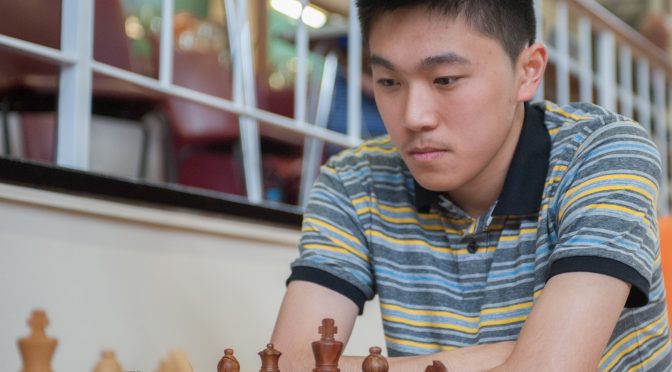
Marcus playing IM Yang-Fan Zhou at the 2013 Delancey UKCC Terafinal at Loughborough Grammar School. Courtesy of John Upham Photography.
In 2014 Marcus won the title of “Strat” (the overall Terafinal winner) of the 2014 Delancey UK Chess Challenge at Loughborough Grammar School.
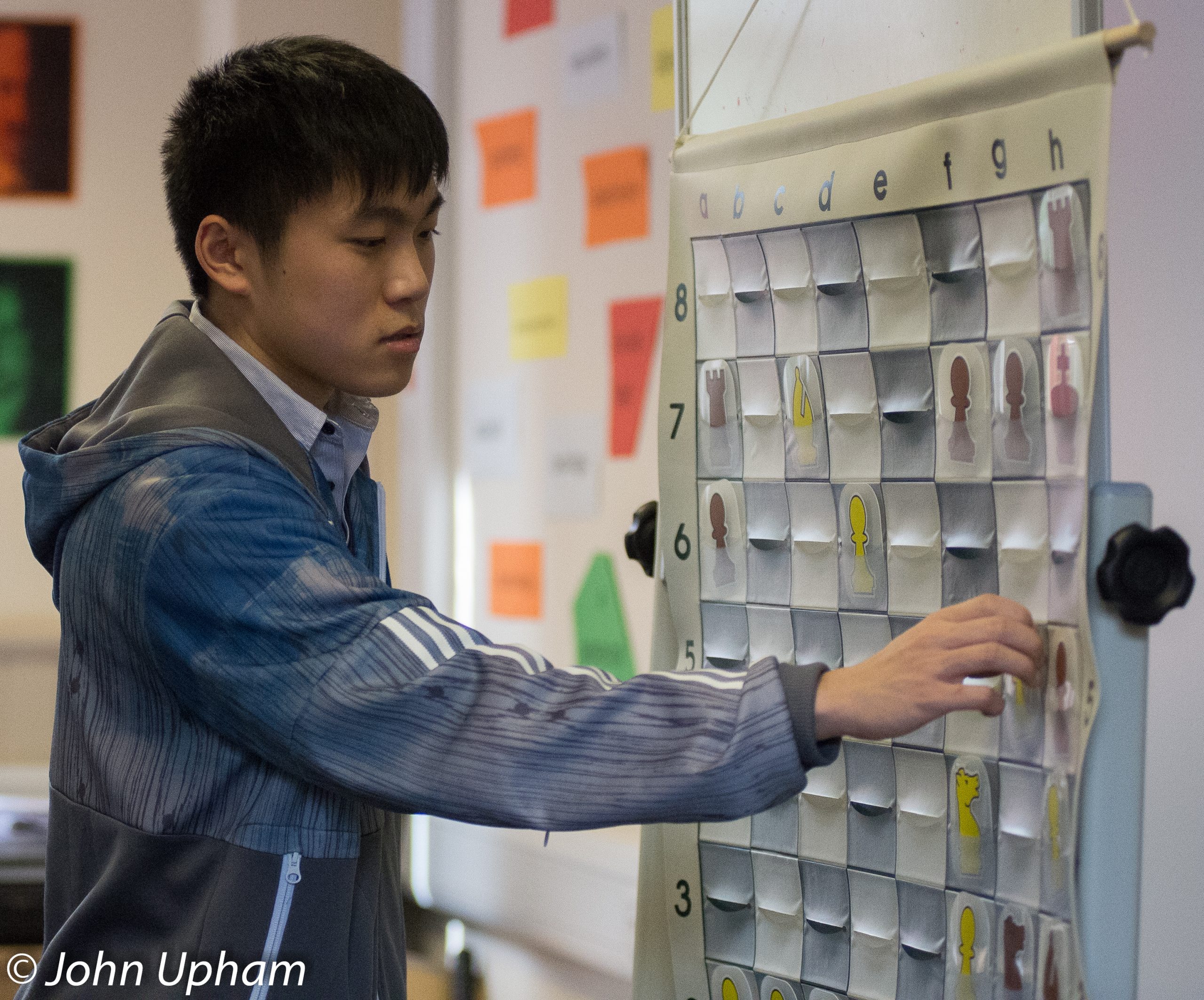
Marcus Harvey at the 2013 Delancey UKCC Terafinal at Loughborough Grammar School, courtesy of John Upham Photography.
Marcus has a FIDE rating of 2440 and an ECF grading of 240.
2014 Delancey UKCC Terafinal winner, Marcus Harvey at Loughborough Grammar School. Courtesy of John Upham Photography
In 2018 he won the Witney Open outright with 4/5 and, in the same year, was runner-up to David Howell in the UK Blitz Open with 12.5/15 and a of 2589.
In 2019 he was =1st (with Mark Hebden) in the 4NCL Easter Open in Stevenage. Later that year Marcus was losing semi-finalist (to Gawain Jones) in the London Classic Blitz Knockout.
Marcus, on home ground, won the 43rd Kidlington Open in 2020 and followed this with and is the current 2020 English Online Blitz Champion beating IM Andrew Greet, FM Jonah Willow, IM Ameet Ghasi and IM Andrew Horton in the final.
In the Pro chess league he represents UK Lions.
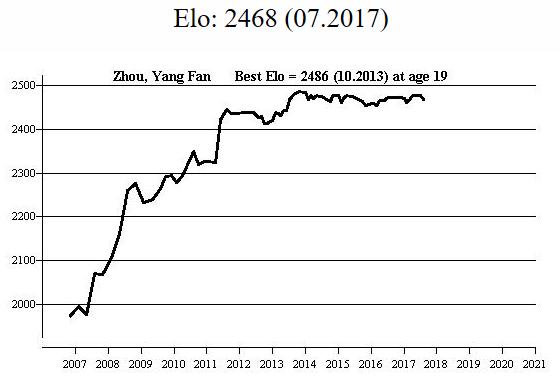
Marcus Harvey’s FIDE rating profile according to Megabase 2020
Marcus overcame Rory McLean, Theo Koury, Steven Coles, FM Alexis Harakis, CM Jonathan Pein and rapidplay / blitz specialist IM Ameet Ghasi to share first place.
Over the 19th – 23rd August 2021 Marcus played in the Wood Green Invitational round-robin event at Oddfellows Hall, Stafford.
Marcus scored 6/9 and secured his second International Master Norm and a TPR of 2532.
<img class=” wp-image-18696″ src=”http://britishchessnews.com/wp-content/uploads/2021/02/untitled_wgi.jpg” alt=”Wood Green Invitational Round-Robin event at Oddfellows Hall, Stafford. August Bank Holiday Weekend, 2021″ width=”654″ height=”229″ /> Wood Green Invitational Round-Robin event at Oddfellows Hall, Stafford. August Bank Holiday Weekend, 2021
Over the August Bank Holiday weekend of 2021 Marcus played in the Northumbrian Masters GM Tournament at the splendid Marriott MetroCentre, Gateshead scoring 6/9 and TPR of 2559 and earing his fourth IM norm. His standard play rating of 2451 (September 2021) is sufficient and now only requires the next FIDE Congress to ratify the IM title.
Marcus enjoys playing the Smyslov-Larsen opening with white
and the classical French and the Nimzo-Indian Defence.
It is clear that Marcus is now surely a strong candidate for England’s next Grandmaster.
Sir George Thomas, President of the Anglo-Soviet Chess Circle. Captain of the British Team
We remember Sir George Alan Thomas who died on July 23rd, 1972
Signature of GA Thomas from a Brian Reilly “after dinner” postcard from Hastings Christmas Congress, 1945-1946
From The Encyclopedia of Chess (BT Batsford, 1977) by Harry Golombek :
“British international master, born in Constantinople (previously Byzantium and currently Istanbul : Ed.) His mother (Lady Edith Margaret Thomas : Ed) was one of the strongest English women players, winner of the first Ladies tournament at Hastings 1895.
(Ed : his father was Sir George Sydney Meade Thomas)
Thomas was an all-round athlete who excelled at tennis, hockey and badminton as well as chess. He captained the English badminton team and was All England Badminton Singles champion from 1920 to 1923.”
Sir George Alan Thomas : “During his playing career, he won 78 national titles in the United Kingdom and a further 12 French titles; he also competed in 29 out of 30 English internationals, winning 50 matches in the process.”
Here is an excellent article (albeit stating GT was a Grandmaster and was president of the British Chest Federation!) from the National Badminton Museum.
“Thomas won the British chess championship twice, in 1923 and 1934 and represented England in the Olympiads of 1927 where he tied with Norman Hansen for the best score – 80% on board 3, 1930, 1931, 1935, 1937 and 1939.
Passenger list from RMS Alacantra showing Sir George Thomas arriving at Buenos Aires on September 19th, 1939Entry for Sir George Thomas from above image.
In international tournaments his greatest successes were 1st at Spa (ahead of Tartakower) and =1st at Hastings 1934/5 (tied with Euwe and Flohr, ahead of Capablanca and Botvinnik).
Sir George Thomas, British Chess Champion, Southsea Congress, 1923 Photograph by Gilbert N Fulcher, Southsea
He was known for his keen sense of sportsmanship and for his ability to encourage and inspire younger players. He served for many years on the BCF Junior selection committee and was for a time Games Editor of the British Chess Magazine. FIDE awarded him the titles of international master (1950) and International Judge (1952). (article by Ray Keene)”
British chess champion Sir George Thomas playing at the Annual British Chess Federation Championship in Yarmouth, England, July 11th 1935. (Photo by Harry Todd/Fox Photos/Getty Images)
Thomas with the White pieces was predominantly a Ruy Lopez devotee.
With the Black pieces against 1.e4 he defended the Lopez and the Queen’s Gambit Declined was his favourite versus 1.d4
From The Encyclopedia of Chess (Robert Hale 1972 and 1976) by Anne Sunnucks :
“International Master (1950), International Judge (1952) and British Champion in 1923 and 1934. All England Badminton Singles Champion, All England Badminton Doubles Champion, Wimbledon tennis player and county hockey player.
Sir George Thomas was born in Constantinople on 14th June 1881. His mother, Lady Thomas, won the first ever ladies’ tournament, which was held in conjunction with the Hastings International Chess Tournament of 1895.
He learned the moves at the age of 4, and as a boy met many of the world’s leading players, including Steinitz, Lasker, Tchigorin and Pillsbury, in his mother’s drawing-room.
Scene at London. From left to right – Seated : Fairhurst, List and Winter in play. Standing König and Sir George Thomas
Apart from serving as a subaltern in the Army during the 1914-1918 war, Sir George has devoted his life to sport. He played tennis at Wimbledon, played hockey for Hampshire, captained the English Badminton team and was All England Badminton Singles Champion from 1920-1923 and doubles champion nine times.
Sir George Thomas And Brian Reilly Sir George Thomas (left), leader of the British chess team, playing Irishman Brian Reilly at the Easter Chess Congress, Margate, April 24th 1935. (Photo by Harry Todd/Fox Photos/Getty Images)
Sir George played chess for England regularly from 1910 to 1939. He played for the British Chess Federation in the Chess Olympiads of 1927,1930, 1931, 1933, 1935, 1937 and 1939, and captained the team which withdrew from the Buenos Aires Olympiad in 1939 on the out-break of war.
A Brian Reilly “after dinner” postcard from Margate 1936.The Grand Hotel, Cliftonville, Margate. Venue for the Margate tournaments.
His first appearance in the British Championship was in he came 2nd. He also came 2nd in 192l and in 1923 won the first time, thus becoming British Chess Champion and Badminton Champion in the same year.
Sir George’s best performance was at Hastings 1934-1935, when he came =1st. In the last round he needed only a draw against R. P. Michell to come lst, ahead of Euwe, Capablanca, Flohr and Lilienthal, but he lost and had to be content with sharing lst prize with Euwe and Flohr.
Nice Masters, 1931. Standing : Daniel Noteboom, Abraham Baratz, George Renaud (Organiser), John J O’Hanlon, Marcel Duchamp, Brian Reilly (winner), Seated : Eugene Znokso-Borovsky,, Arpad Vajda, Sir George Thomas, Jacques Mieses, Stefano Roselli del Turco, Jacob Adolf Seitz. British Chess Magazine, 1931, page 201
During his career he has beaten Capablanca, Botvinnik (in consecutive rounds at Hastings 1934-35), Flohr and and drawn with Nimzowitsch, Rubinstein and Capablanca. He been noted for his sportsmanship and for his interest in and encouragement of young players.
Partie d’échecs Sir Georges Thomas, le célèbre joueur d’échecs britannique, jouant contre sa plus jeune adversaire âgée de 8 ans, à Londres, Royaume-Uni le 24 octobre 1934. (Photo by Keystone-France\Gamma-Rapho via Getty Images)
Since his retirement until the last few years, Sir George continued to attend tournaments as a spectator.
He is the author of The Art of Badminton, published in 1923.
The Art of Badminton
He died on 23rd July 1972 in a London nursing home.”
In the March issue of CHESS for 1963, (Volume 28, Number 427, pp.147-155) William Winter wrote this:
Sir George Thomas
Another great figure of the period between the wars, Sir G. A. Thomas, is happily still with us, although he gave up competitive play some years ago. I think I must have played more games with him than with any other master and he was my principal rival in the battles for the British Championship which we each won twice.
Although he lacks Yates’ spark of genius he is a very fine player indeed and one of the few Englishmen who is a real master of the endgame. Both nationally and internationally he has an excellent record, probably the best of a number of performances being his tie with Euwe and Flohr for lst prize at Hastings 1934-5. Capablanca and Botvinnik were among the also-rans. Thomas beat both of them, a splendid performance when we consider the small number of games ever lost by either. He is the only native Englishman to have scored a win over Capablanca. He acted as captain of all the British teams of which I formed part and an excellent leader he made, firm when necessary, but always considerate to his men especially when they were doing badly.
Sir Thomas, as he was called, is much missed on the Continent where he was highly popular and did a great deal to increase the prestige of British chess.
Here is Part II of GM Matthew Sadler’s appreciation of Sir George.
From The Oxford Companion to Chess (OUP, 1984) by Hooper & Whyld :
“English player. International Master (1950), International Arbiter (1952), British champion 1923 and 1934. His mother, who taught him chess, was winner of one of the first women’s tournaments, Hastings 1895, He played in more than 80 tournaments and achieved his best result at Hastings 1934-5 (about category 9), when he scored +6-1—2 to share first prize with Euwe and Flohr ahead of Botvinnik and Capablanca. Thomas played in seven Olympiads from 1927 to 1939, and in the first the highest percentage score was made by him ( + 9=6) and the Dane Holgar Norman-Hansen (1899- ) (+11=2—2). A leading English player for more than 25 years, Thomas fought many battles at the famous City of London club, winning 16 of the annual championships from 1913-14 to 1938-9. In his sixty-ninth year he gave up competitive chess when, after a hard game, ‘the board and men began to swim before my eyes,’ He continued his active interest in junior events and his visits, now as a spectator, to chess events.
A man of few words, imperturbable, of fine manners. Sir George Thomas was respected throughout the chess world for his sportsmanship and impartiality, and his opinion was often sought when disputes arose between players. The inheritor of both a baronetcy and private means, he
devoted his life to games and sports. Besides his chess he was a keen hockey player, a competitor in international lawn tennis (reaching the last eight at Wimbledon on one occasion), and winner of about 90 badminton titles, notably the All-England men’s singles championship which he won four times, from 1920 to 1923.”
Bill Hartston wrote this in “On the Knight Shift”, Chapter 20 of the The Chess Player’s Bedside Book (Batsford, 1975) :
“In the days when chess was perhaps a more noble pastime, one of England’s leading players was the Baronet, Sir George Thomas. A true gentleman and sportsman, he considered it rather unprincipled to analyse adjourned games before their resumption and could only be persuaded to look at his own positions after being assured that his opponents were certainly taking full advantage of the adjournment in this manner.”
Prof. Julian Farrand at the King’s Place Rapidplay, 2013, courtesy of John Upham Photography
BCN mourns the passing of Dr. Julian Farrand (13-viii-1935 17-vii-2020). He was 84 years of age.
Julian Thomas Farrand was born August 13th, 1935 in Doncaster in the West Riding of Yorkshire.
Dr. Farrand QC(Hon), formerly the Insurance Ombudsman, became the Pensions Ombudsman, and he had been a Law Commissioner and a University Professor of Law at the University of Manchester where he was Dean of the faculty.
His first recorded game in Megabase 2020 was white at the 1968 British Championships in Bristol against life-long friend CGM Keith Bevan Richardson. Together with Raymond Brunton Edwards, Julian and Keith were long-time trustees of the BCFs Permanent Invested Fund (PIF).
Julian played for Pimlico, Cavendish and Insurance in the London League and he maintained a standard play grading of 172A in 2020 as well as a FIDE rating of 1943 for standard play. He also played in the London Public Services League, the Central London League and the City Chess Association League. He made regular appearances in the Bronowski Trophy competition and the World Senior’s Team Tournament.
His (according to Megabase 2020) peak Elo rating was 2238 in April, 2004 aged 69. It is likely to have been higher than that if it was measured.
Julian joined Barbican following its merger with Perception Youth to become Barbican Youth in the Four Nations Chess League (4NCL).
His favourite openings with white were : The Richter-Veresov Opening in later years and the English/Barcza Opening in earlier times.
With Black he enjoyed the Czech System and the Lenningrad Dutch.
His son, Tom, is a strong player and a successful barrister with expertise in Intellectual Property Rights, Trademarks and Copyright law.
His wife (married in 1992), Baroness Hale of Richmond, served as President of the Supreme Court of the United Kingdom from 2017 to 2020, and serves as a member of the House of Lords as a Lord Temporal.
Julian Farrand with Lady Hale at a Buckingham Palace reception. Photo : Press Association
Memorial messages have been posted on the English Chess Forum and many will, no doubt, follow. Included are older games from John Saunders not found in the online databases.
In 2015 Julian (together with fellow trustees Keith Richardson and Ray Edwards) received the ECF President’s Award for services to the Permanent Invested Fund.
Here is the citation from the 2015 award :
“Julian is best known as the first-ever English ombudsman (in insurance). He is the husband of law lord Baroness Hale. I (SR) first met him at about the age of 12 year old when playing for my school. He is about four years older. Both Ray and Julian are members of the Book of the Year Committee and have been reviewing books for this purpose for many years. Both are quite strong chess players, indeed playing for England in the same team in the European 60+ Team Championship in Vienna 11-20 July 2015. Keith was to have been a member of the same team, but his wife’s ill-health forced him to withdraw.”
IM Lawrence Hugh Cooper, photograph from Cathy Rogers
BCN wishes Happy Birthday to IM Lawrence Cooper (16-vii-1970)
Lawrence was born in Stone, Staffordshire and attend Walton High School, Stafford.
Lawrence Cooper, Demis Hassabis, Cathy Haslinger and Dharshan Kumaran in around 1986. Possibly at a Lloyds Bank event.
He became a FIDE Master in 1989 and then an International Master in 2001.
Lawrence was awarded the FIDE International Organiser title in 2011 and the FIDE Arbiter title in 2016.
Tim Dickinson and Lawrence Cooper at the 2012 London Chess Classic, Olympia
His peak rating was 2430 in January 1988.
Lawrence plays for Wood Green in the Four Nations Chess League (4NCL) plus Newport (Shropshire), Stafford, Bushbury and Worcestershire CCA in other competitions.
Lawrence Cooper (centre with trophy) being presented with 1992 BCF Counties Championship trophy by WIM Cathy Forbes. Others in the group include Michael Gough, Alan A Smith, Gerald Acey, Mike P Townsend, Malcolm Armstrong, Martin Costley, Alan Crombleholme, Graeme N Buckley, Paul Wallace, Mark A . Wheeler, Dave Carless, Darren P Wheeler, Keith Thompson, Ralph MA Allen and Graham SmithFull caption in image belowFull caption for above 1986 BCF Junior Squad group photograph
IM Lawrence Cooper, photography by Fiona Steil-Antoni
We focus on the British Chess Scene Past & Present !
This website uses cookies to improve your experience. We'll assume you're ok with this, but you can opt-out if you wish. Cookie settingsACCEPT

Privacy & Cookies Policy
Privacy Overview
This website uses cookies to improve your experience while you navigate through the website. Out of these cookies, the cookies that are categorized as necessary are stored on your browser as they are as essential for the working of basic functionalities of the website. We also use third-party cookies that help us analyze and understand how you use this website. These cookies will be stored in your browser only with your consent. You also have the option to opt-out of these cookies. But opting out of some of these cookies may have an effect on your browsing experience.
Necessary cookies are absolutely essential for the website to function properly. This category only includes cookies that ensures basic functionalities and security features of the website. These cookies do not store any personal information.