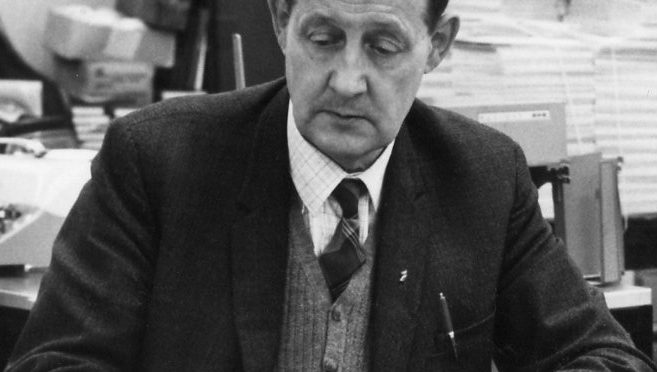
Tag Archives: Remembering

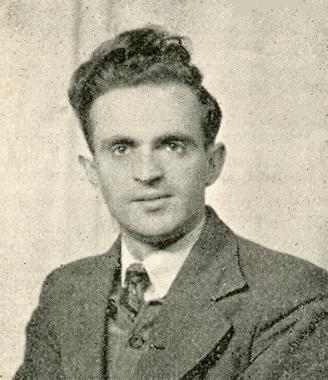
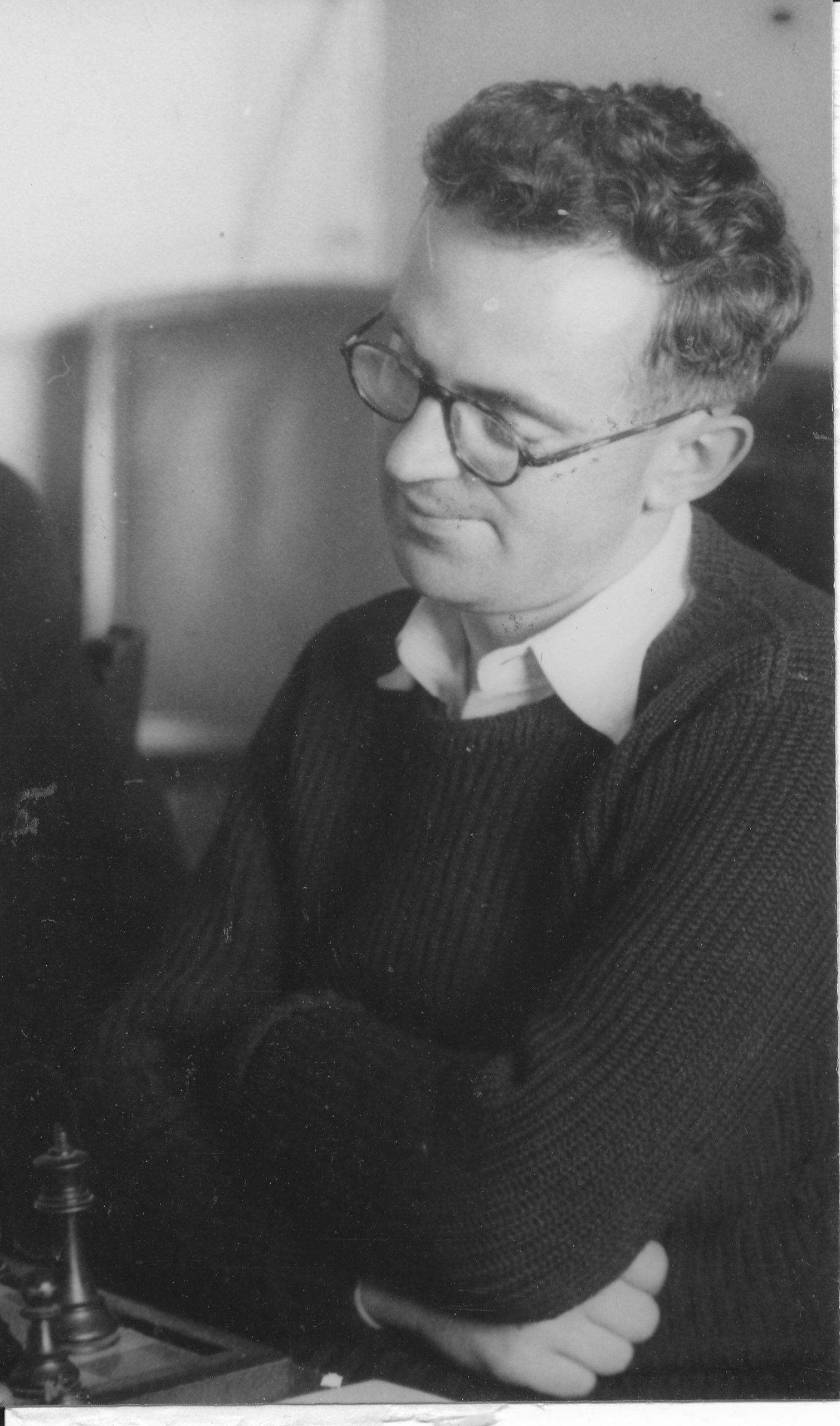
Death Anniversary of BH Wood MSc FCS OBE (13-vii-1909 04-iv-1989)

We remember “BH” Wood MSc FCS OBE who passed away on Tuesday April 4th, 1989 in the district of Birmingham.

He was buried alongside his wife Marjorie in the Sutton Coldfield Cemetery Extension which was opened in 1934 as an extension to the Holy Trinity Church.

Yorkshire Childhood

Baruch Harold Wood (generally known as BH Wood, or simply “BH”, by the chess world) was born on Tuesday, July 13th 1909 in Ecclesall, Sheffield, Yorkshire. The registration district was Ecclesall Bierlow.
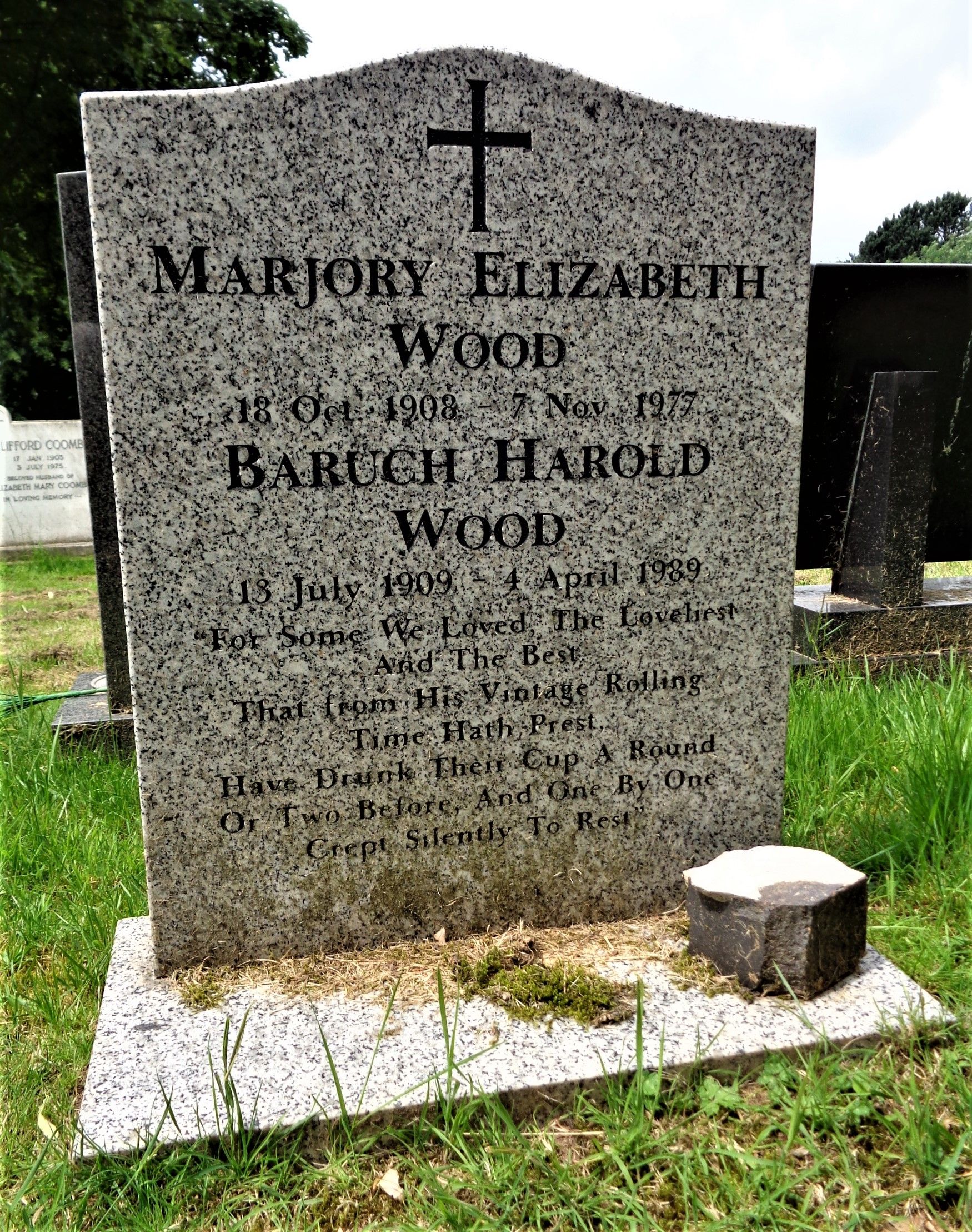
Gravestone of BH & ME Wood, photo by Glen Livet

The birth record suggests that he was baptised as Harold Baruch Wood. His parent’s were Baruch Talbot (1881-1951) and Florence Muriel Wood (née Herington). He appears as Harold Baruch on the 1911 census.
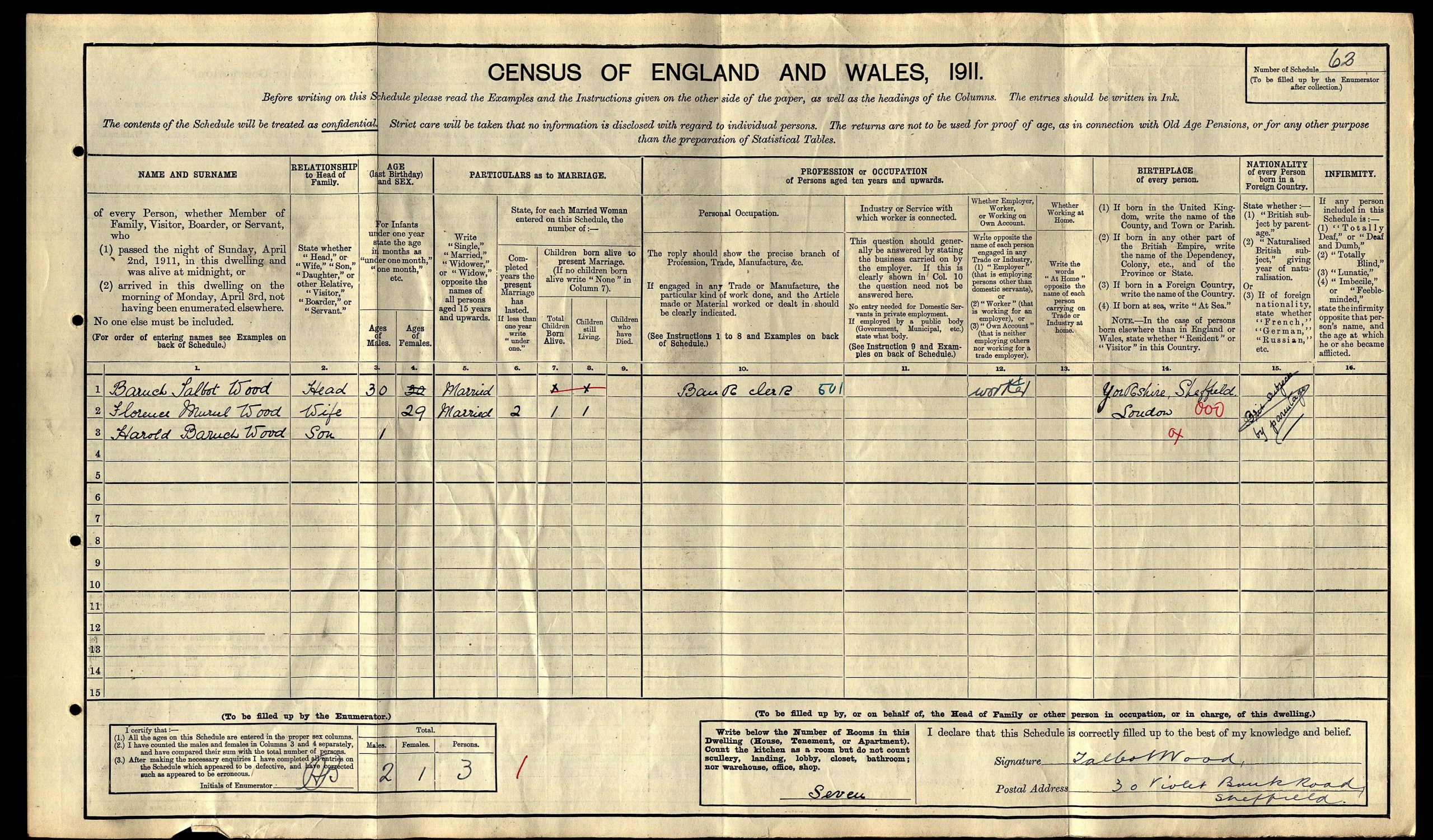
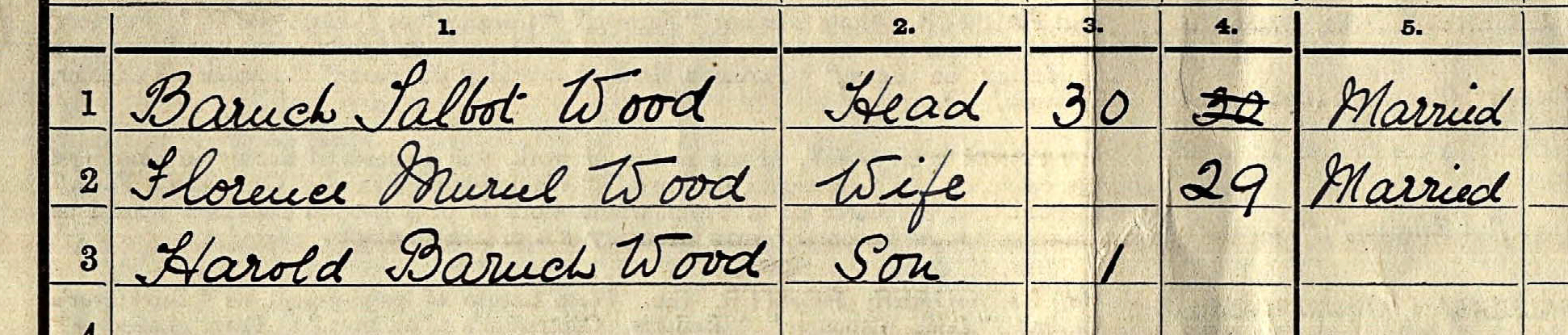
1911 Census record for the Wood household

Interestingly, the Census form was signed by Talbot Wood so maybe BHs father also did not like his own first name! At the time of the Census the family lived at 30, Violet Bank Road, Nether Edge, Sheffield, S7 1RZ.

Welsh School Days

Baruch attended Friars School, Bangor (established in 1557) along with William Ritson Morry. BHW was one year and three months older than WRM so it is entirely possible that they had met.

Marriage to Marjory

In October 1936 BHW married Marjory Elizabeth Farrington in Ross, Herefordshire. When Marjory died on 7th September 1977 they were living at 146, Rectory Road, Sutton Coldfield, West Midlands. Baruch and Marjory had four children, FM Christopher Wood, Philip, Frank and Peggy.
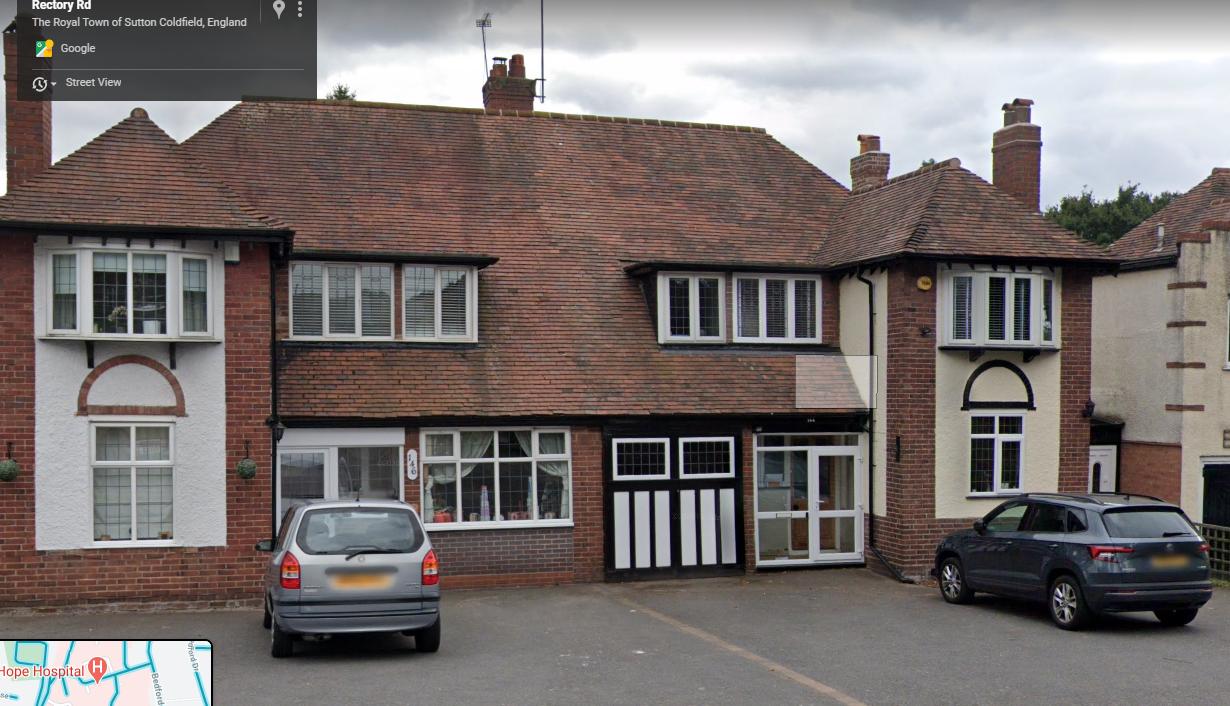
146, Rectory Road, The Royal Town of Sutton Coldfield, West Midlands, B75 7RS

Honours

In the 1984 New Years Honours List, Civil Division, BHW was awarded the OBE. The citation read simply : “For services to Chess”

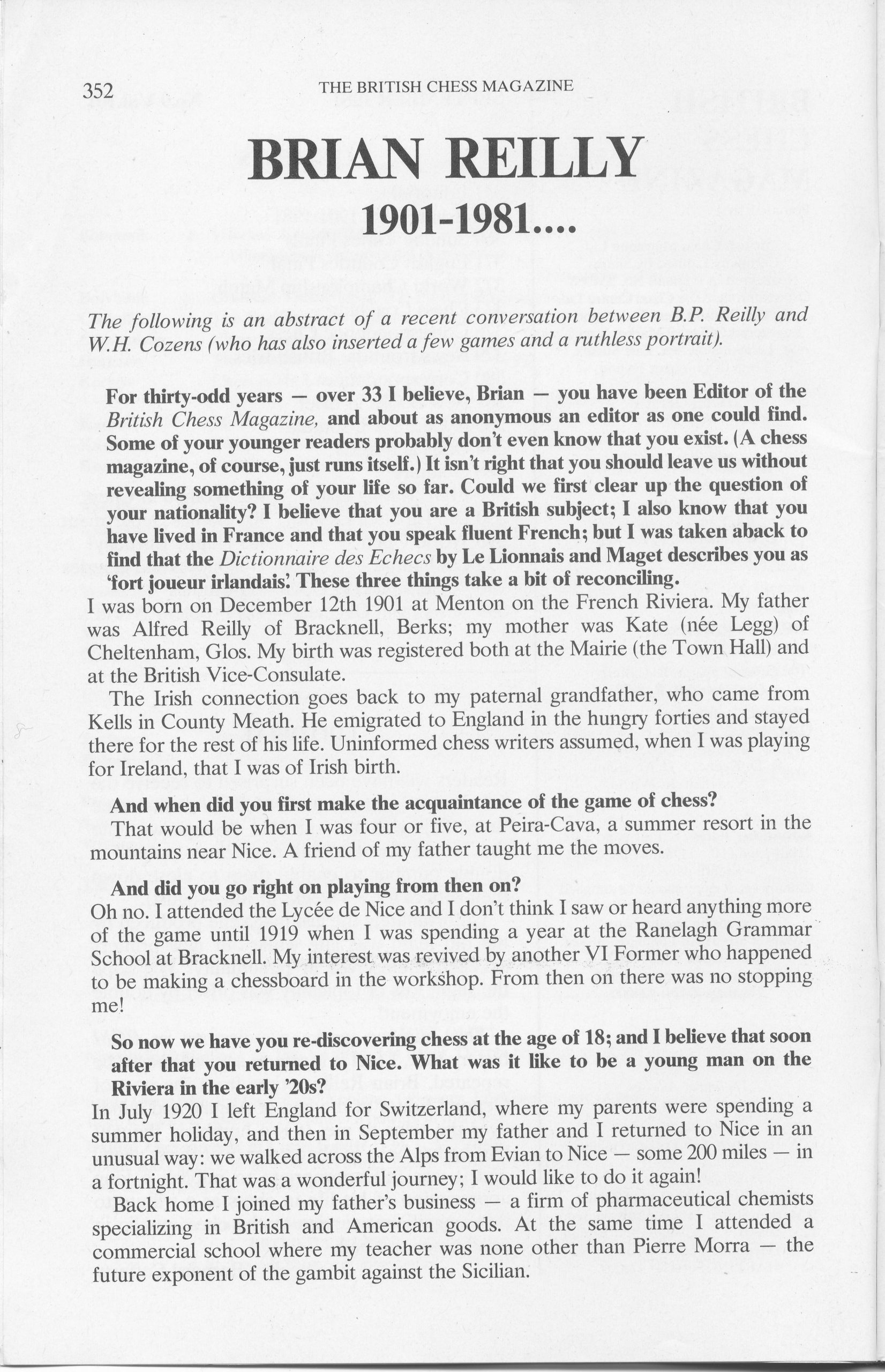
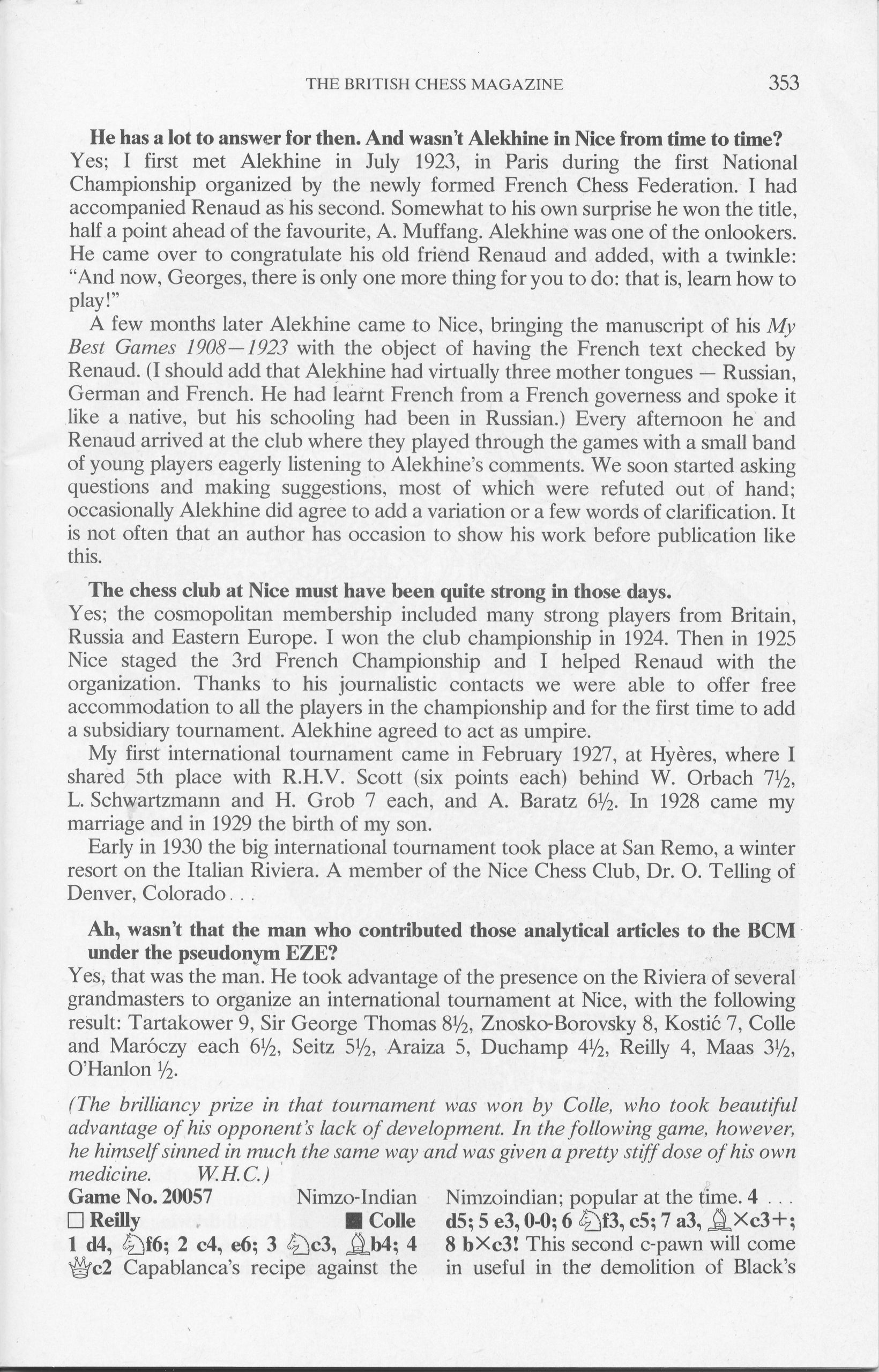
He won the BCF President’s Award in 1983 alongside TJ Beach and Brian Reilly.
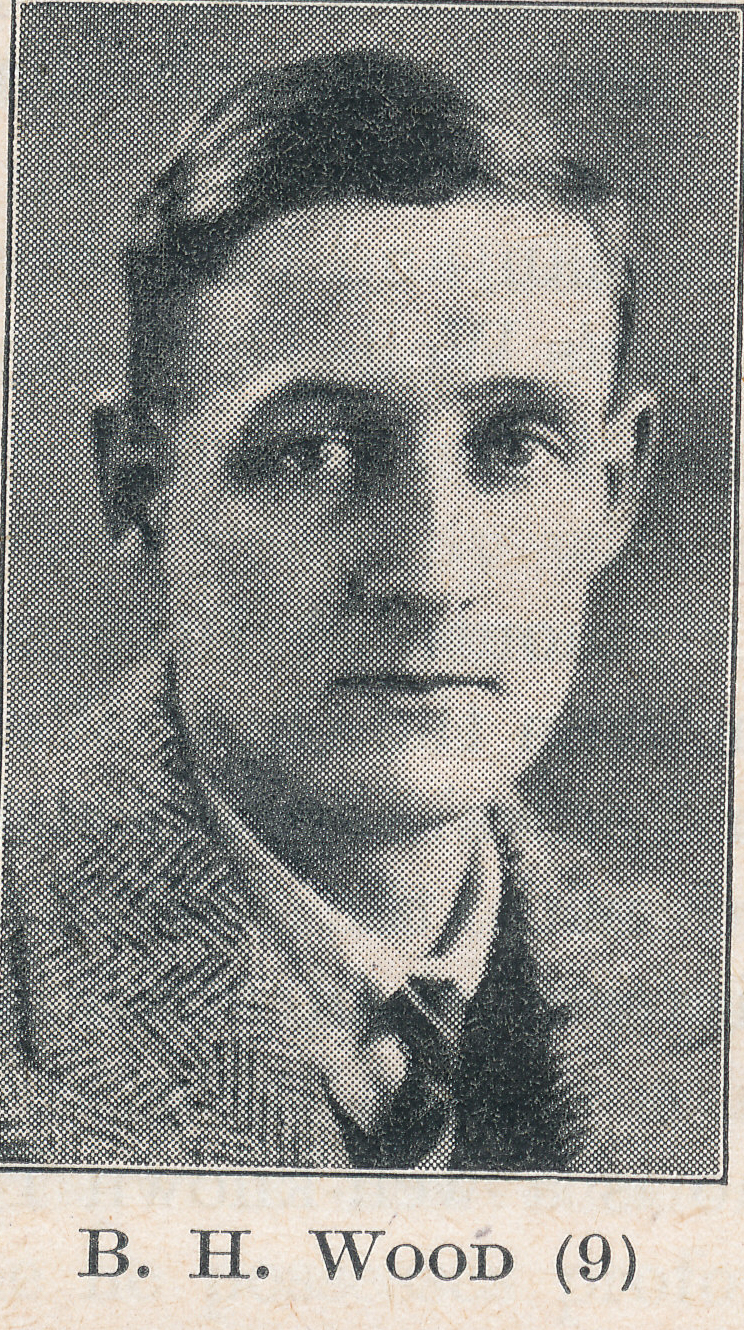
BH Wood playing board 9 in the Anglo team in the Anglo-Soviet Radio Team Match of 1946

The 1946 Anglo-Soviet Radio Match

From The Anglo-Soviet Radio Chess Match by Klein and Winter :

“BH Wood was born in Sheffield in 1909. A great lover of the game, he founded the magazine Chess in 1935, and has written a book for beginners. He scored a notable success by winning the British Correspondence Championship on one occasion. Wood has competed in the British Championship on several occasions, and in a number of Premier Reserves tournaments. He also played for Great Britain in the international team tournament (ed. Olympiad) at Buenos Aires in 1939.
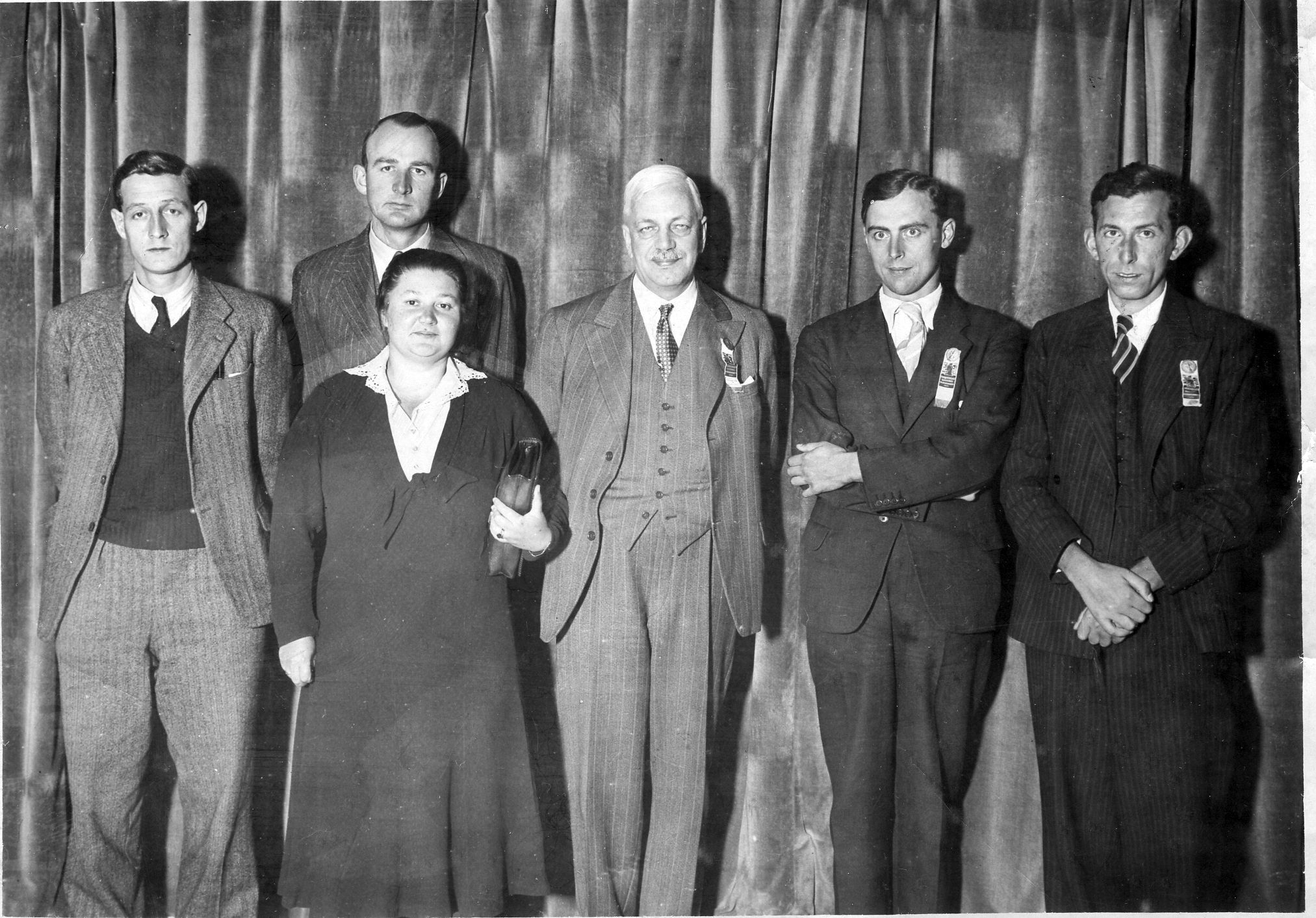
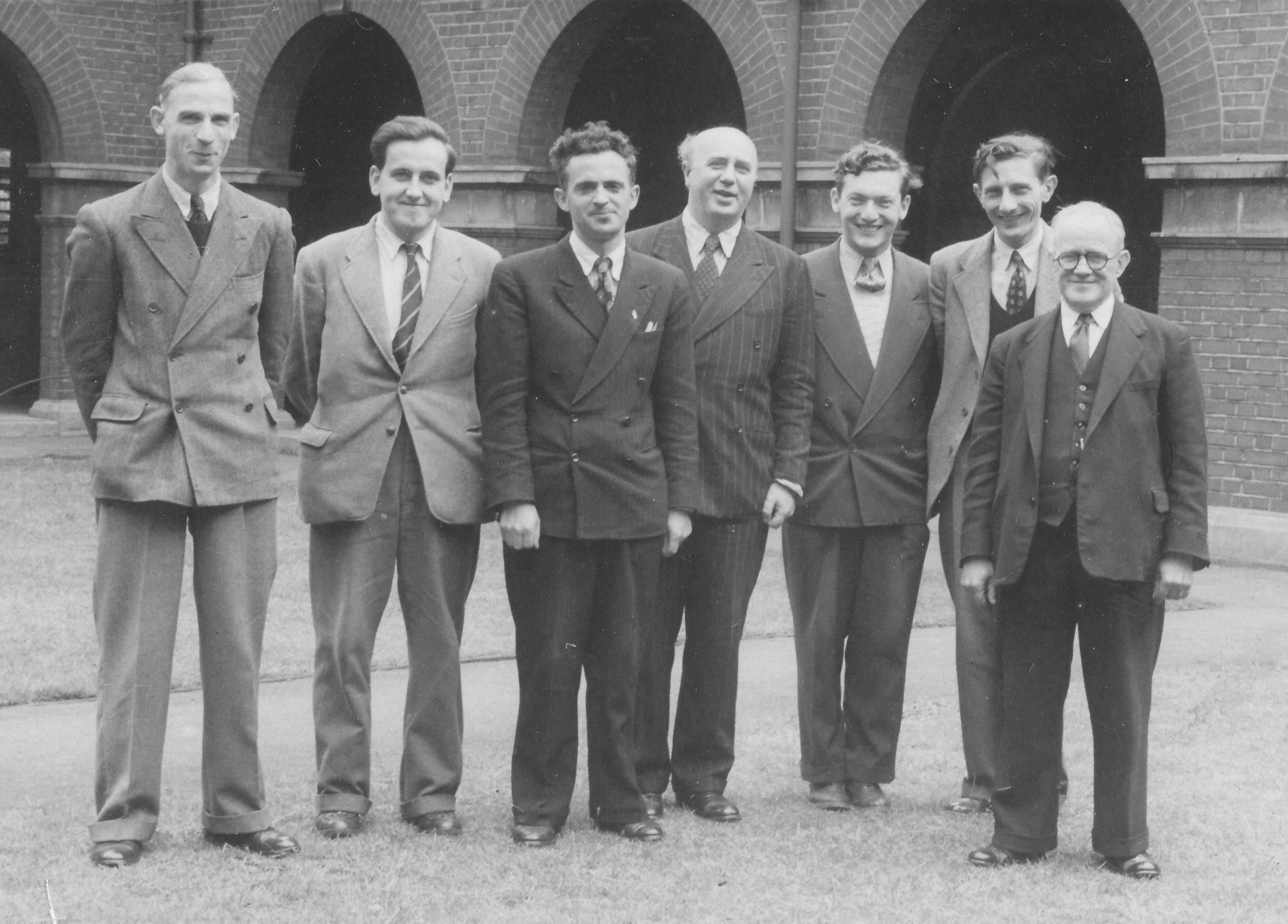
Left to right Baruch H Wood, Stuart Milner-Barry, Vera Menchik (playing in the women's world championship (held concurrently with the 1939 Buenos Aires Olympiad) which she won with 17 wins and 2 draws), Sir George Thomas, Conel Hugh O'Donel Alexander and Harry Golombek. England withdrew after their preliminary group due to the outbreak of war despite qualifying for the top final. Thanks to Leonard Barden
Left to right Baruch H Wood, Stuart Milner-Barry, Vera Menchik (playing in the women’s world championship (held concurrently with the 1939 Buenos Aires Olympiad) which she won with 17 wins and 2 draws), Sir George Thomas, Conel Hugh O’Donel Alexander and Harry Golombek. England withdrew after their preliminary group due to the outbreak of war despite qualifying for the top final. Thanks to Leonard Barden

He is a graduate of the University of Wales and Birmingham University. He has been very active in recent years in giving simultaneous exhibitions and in organising correspondence chess.”
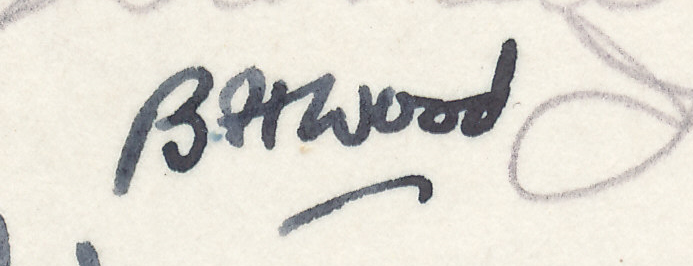
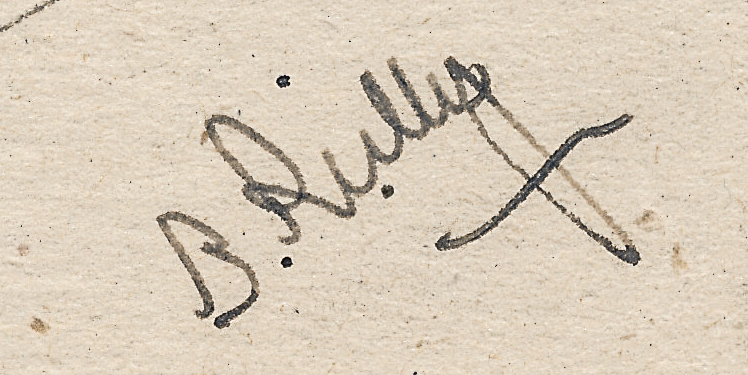
Signature of BH Wood from a Brian Reilly "after dinner" postcard from Margate 1936.
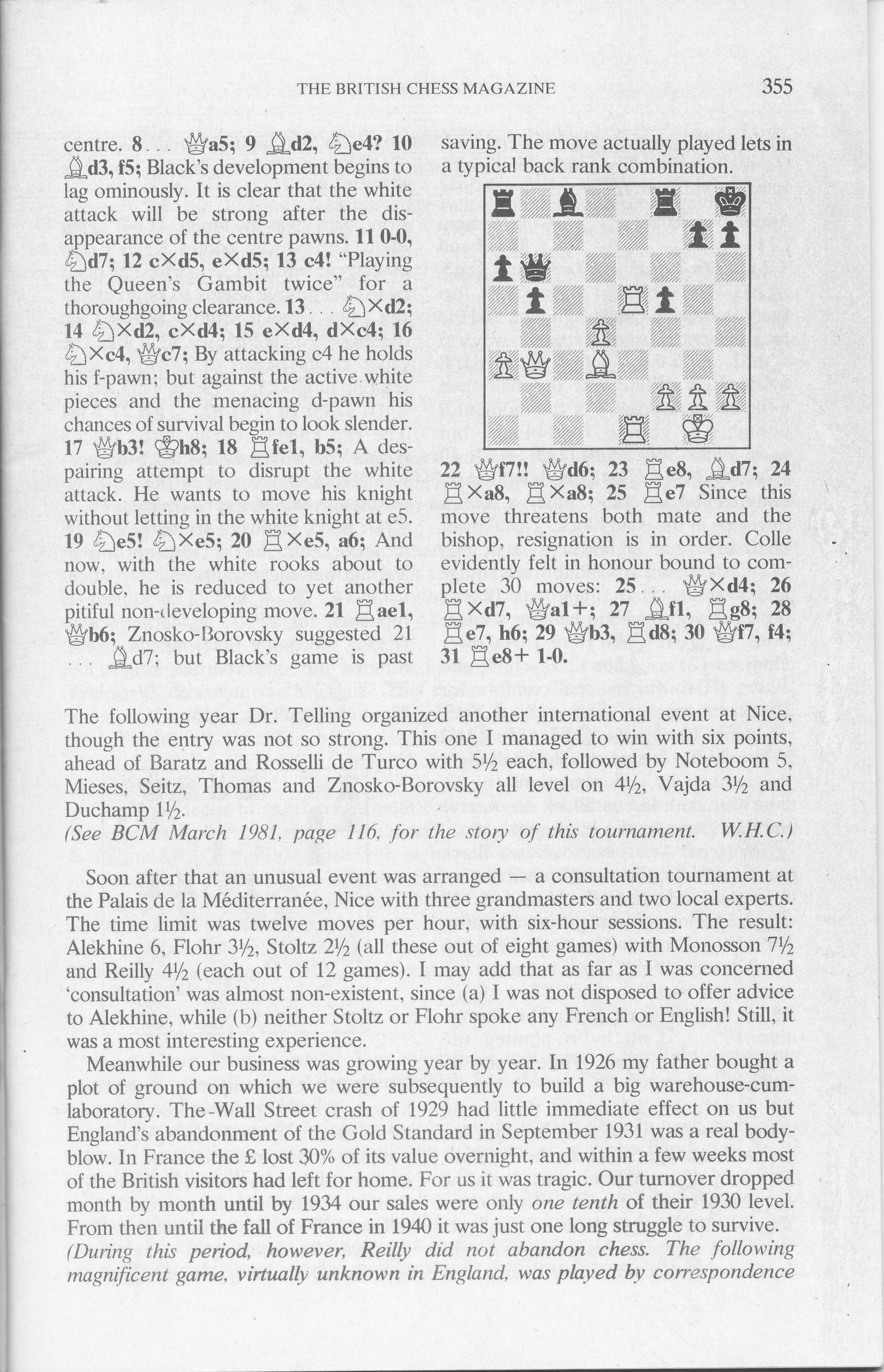
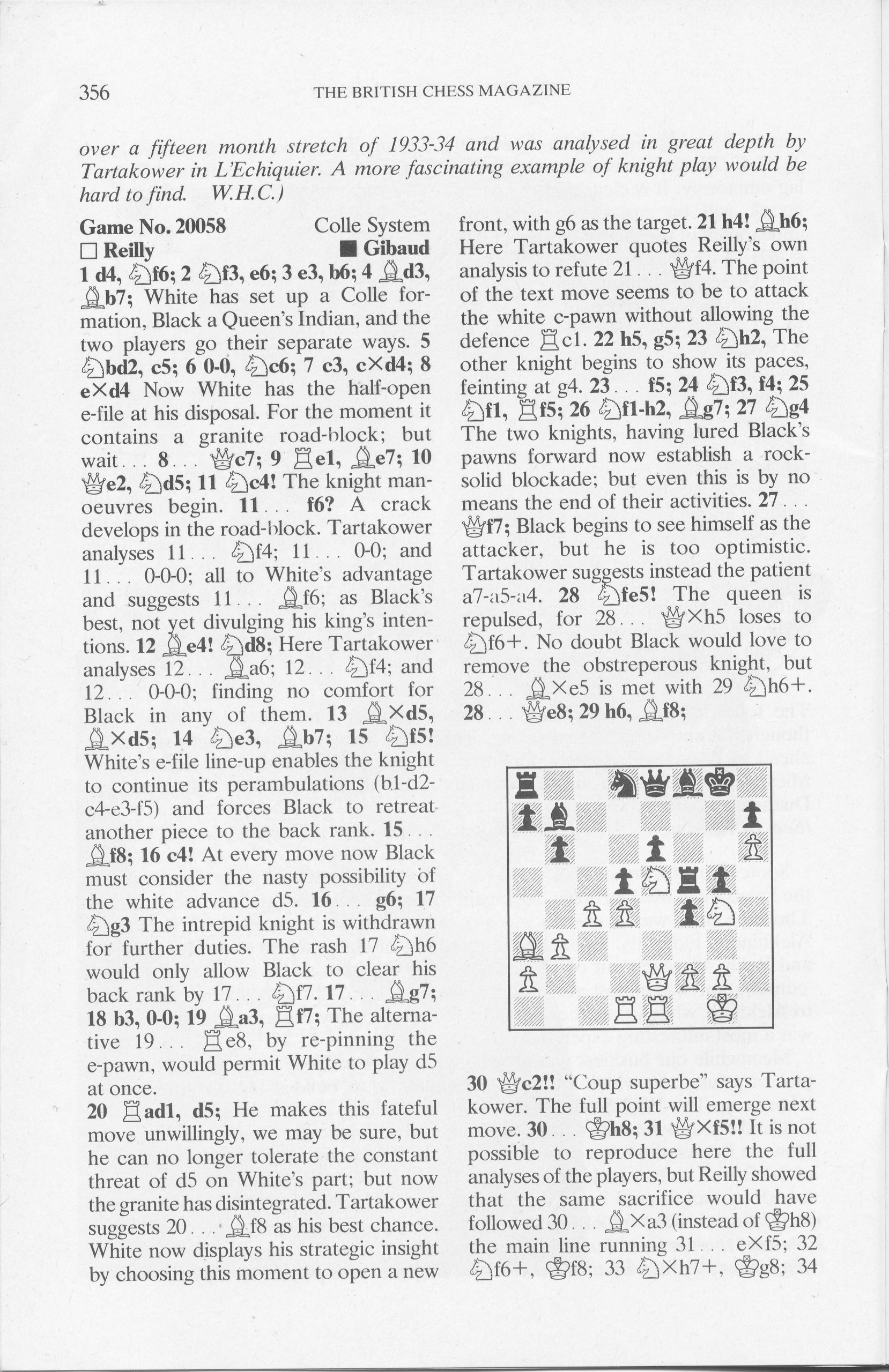
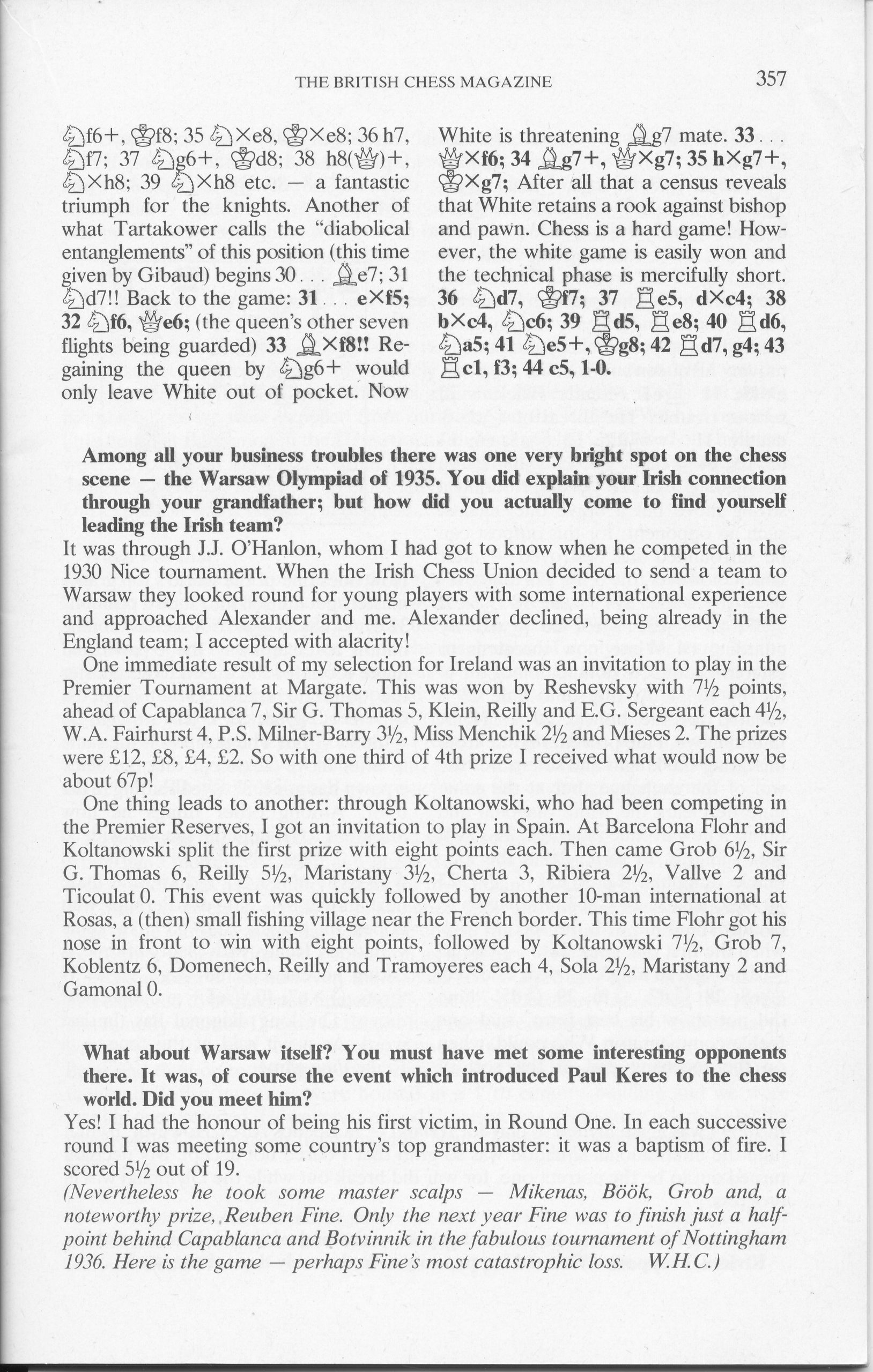
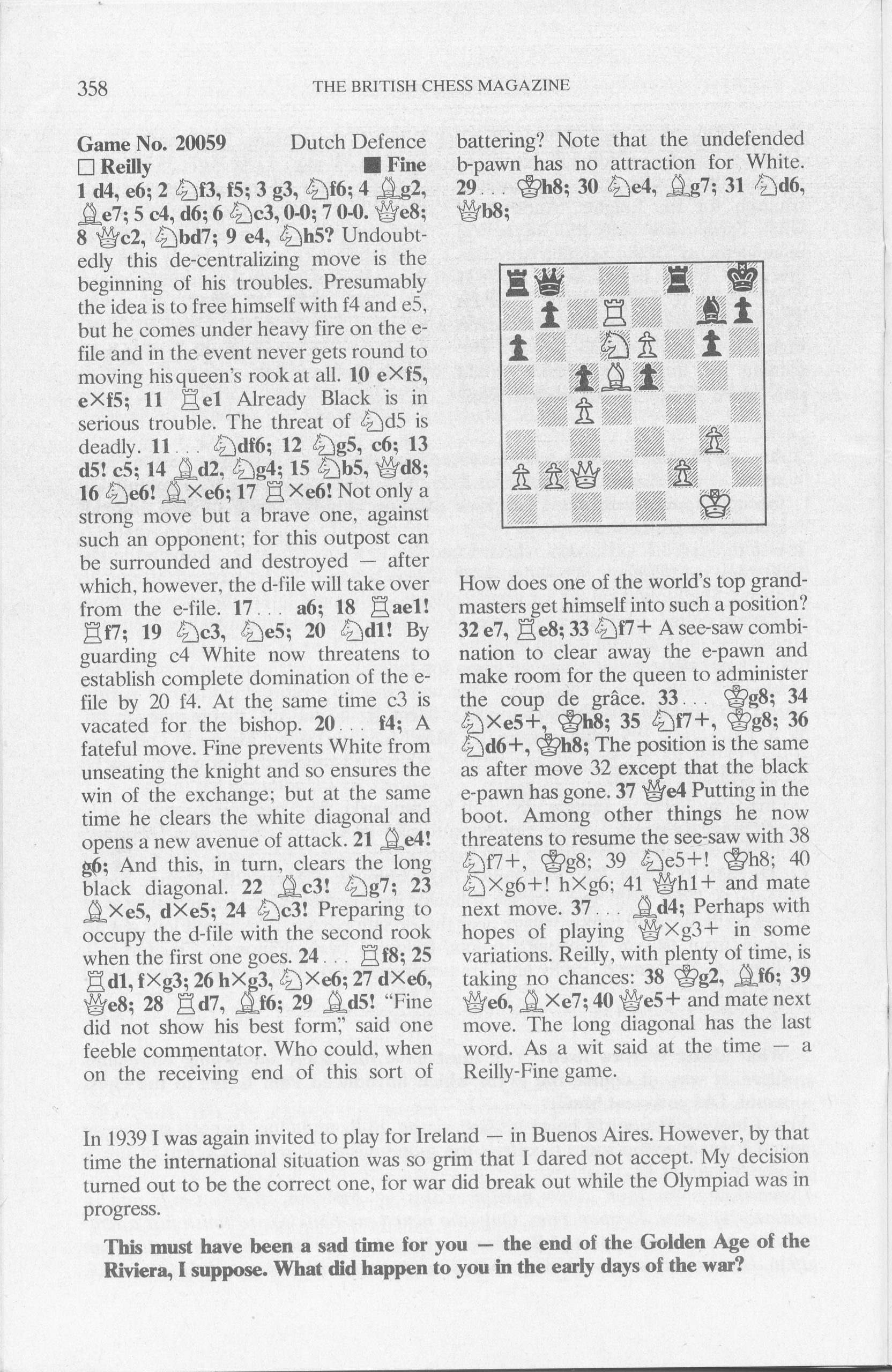
Signature of BH Wood from a Brian Reilly “after dinner” postcard from Margate 1936.

Between 1938 and 1957, BH won the championship of Warwickshire eight times. He held the record (until 2006) for the most Birmingham & District Chess League Individual titles – nine, all won in Division 1: 1937, 1939, 1954, 1956, 1958, 1960, 1966, 1967, and 1983. He was the Records Secretary for the League from 1951-61.

Birth of a Magazine
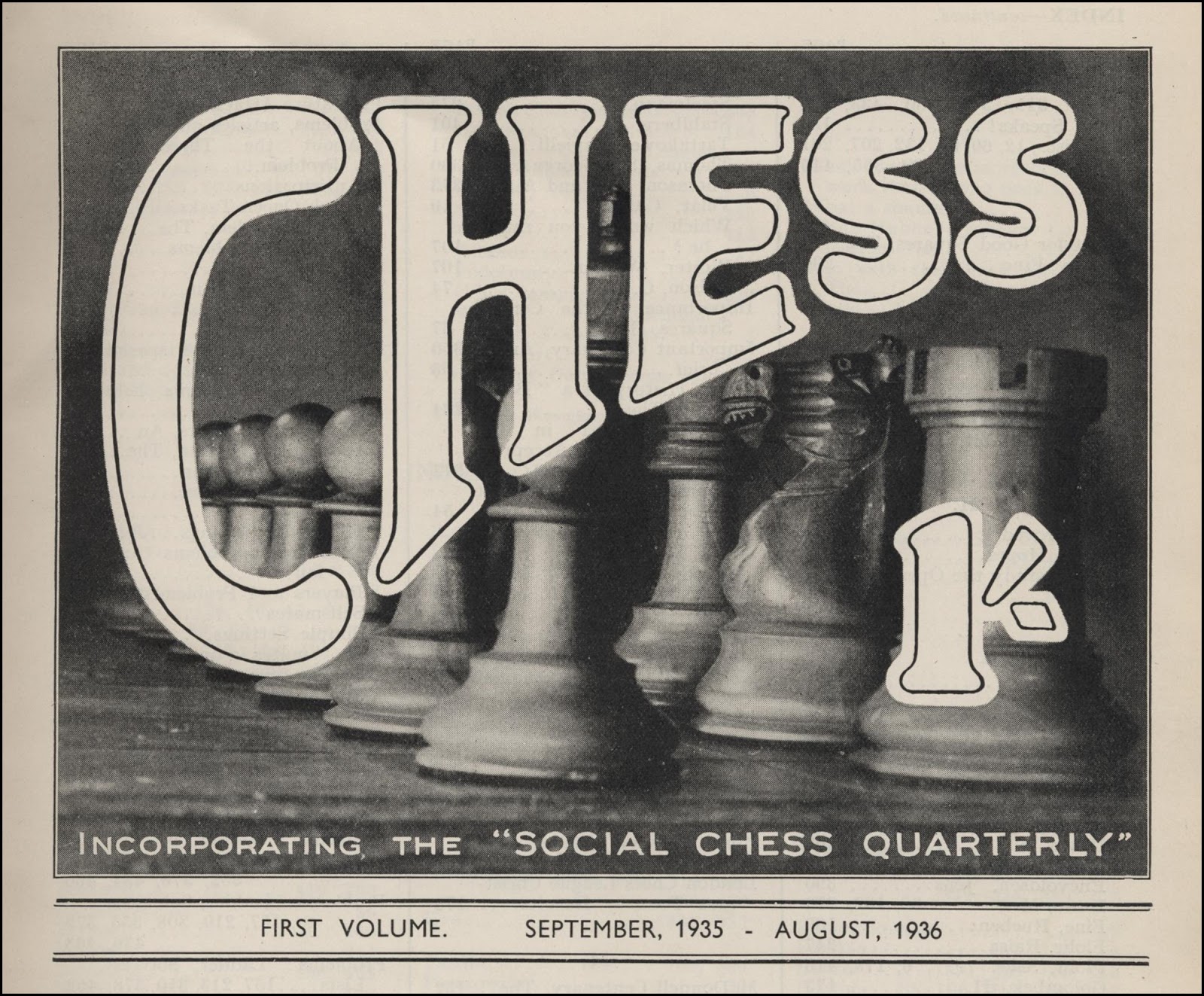
CHESS Cover for volume 1, September 1935 - August 1936. Source : Michael Clapham
CHESS Cover for volume 1, September 1935 – August 1936. Source : Michael Clapham

From CHESS, Volume 52 (1987), Number 1014-15 (Christmas), we have the very last issue of the magazine for which BH was the Editor before becoming Founding Editor (and Paul Lamford became Editor). BH Wrote:

“Countless people have asked me ‘Why did you start CHESS?’ I was in love with university life and has just taken an M.Sc., a waste of time after a good first-class honours, and decided to have a go at replacing the old Chess Amateur, which had closed down.  I had edited the students’ magazine in both Bangor and Birmingham. The first had been produced by The Daily Post Printers in Liverpool, who agreed to print  1,000 copies for £90. That £90 would be nearly £2,400 now.
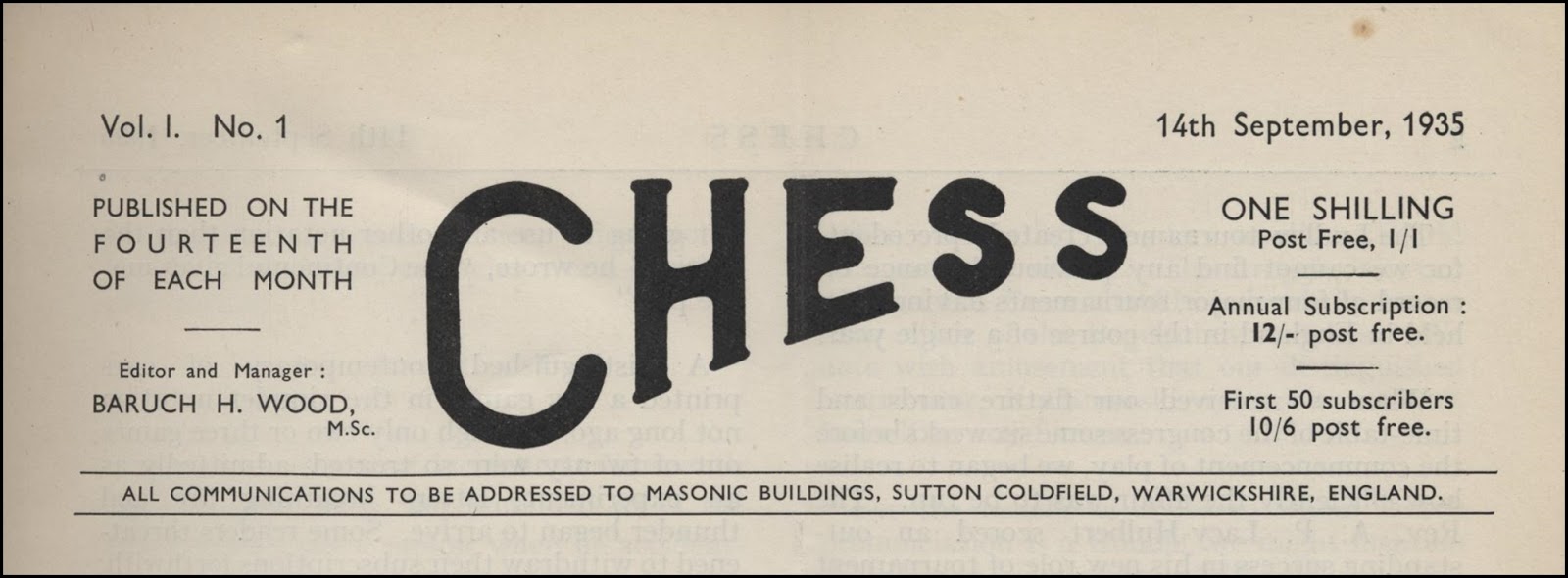
CHESS masthead for Volume 1, Number 1, 1935. Source : Michael Clapham

A year’s subscription I announced as 10 shillings (50p).

Two bits of luck! J.H. Van Meurs, a Dutchman who did a lot for British Chess, had listed in his still young B.C.F. Year Book some hundreds of chess clubs.

W.H. Watts, another great figure of those days, had floated a rather short-lived magazine The Chess Budget, donated a ‘Budget Cup‘, for knock-out team competition and published excellent books on big tournaments, etc. He handed me a list of keen chess players all around the world. I spent a week addressing envelopes by hand to all the clubs and people.

To individuals I sent single copies of CHESS; to each club three copies, inviting payment or subscriptions. Hardly anybody failed to pay. Obviously there was a demand for a chess magazine with a lighter touch than the B.C.M.

Years later, I learnt why Mr. Watts had been so generous. He had fallen out with the establishment and welcomed the arrival of a new publication.

Within three months I was selling 3,000 copies an issue.

Some early ideas were chessy short stories , cartoons and a competition for humorous anecdotes.

I soon went to Amsterdam for the first Euwe-Alekhine match. I traced Alekhine to his hotel room with difficulty. He was officially incommunicado. He came to the door in pyjamas, and within five minutes we had agreed to a £5 article per month. I was, of course, already on conversational terms with him (and remained so!).

Now I fell into trap. 3,000 readers in four months meant 6,000 in eight months, 9,000 in  a year…?

Not so! This is extrapolation, a matter of calculation full of risks.

My preparations had been too good. In the remaining eight months of the year I picked up only a thousand more readers. Alekhine lost the title. With three months to go, my money ran out, I struggled to the end of the year.  The twelfth issue was pathetically thin compared with the first few but renewals staring rolling in and CHESS blossomed again.

The fifty-two years since have been gruelling, unremitting toil but fascinating interest. How we bought our own presses and the effect this had on the world’s chess press – A law suit that went to appeal – How CHESS linked people in Malta, Australia, Hungary – Adventures in ‘simuls’, postal chess etc. How we helped police to identify a drowned man, etc. So many tales to tell!

BHW

BCF Obituary

Here is an obituary from the BCF Yearbook 1989 – 1990, page 14 :

B.H. Wood, O.B.E

Baruch H. Wood, O.B.E., founder of CHESS, and the magazines editor for 52 years, died at the age of 79 on 4th April.

Born in Sheffield on 13 July 1909, “B.H.”, as he was widely known in chess circles, took up the game early playing competitively at school and at University. After graduating from the University College of Wales, Bangor with a 1st class honours degree in chemistry, he took an MSc at Birmingham University. Soon, however, his love of chess took him away from a career in chemistry, with his launch of CHESS in 1935.  He was to continue as editor, publisher, for many years printer, and often major contributor, for over half a century.
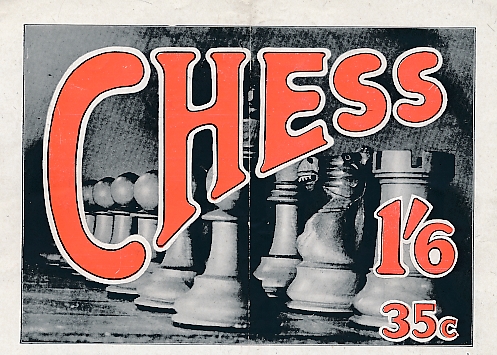
CHESS, Sutton Coldfield

The magazine quickly won an international reputation for its frankness and outspokenness. It speaks much for the character and determination of its editor that he was able to continue publishing CHESS throughout the difficult years of the Second World War, whilst holding a full-time job as director of a chemical research laboratory in Lichfield.

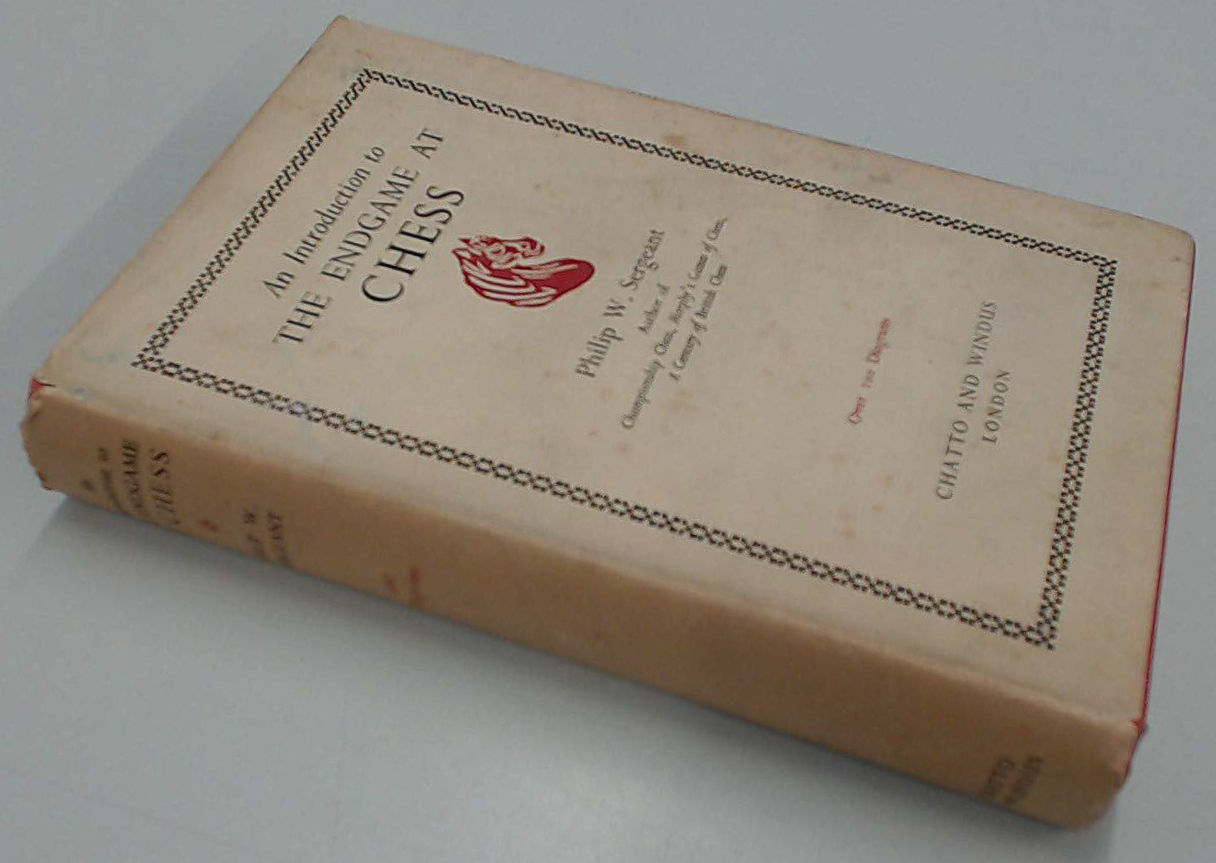
Wood will be best remembered for the magazine, and for his other journalistic activities. He was for many years chess correspondent of The Daily Telegraph and of The Illustrated London News, and his best known book Easy Guide to Chess went through three editions and many impressions.
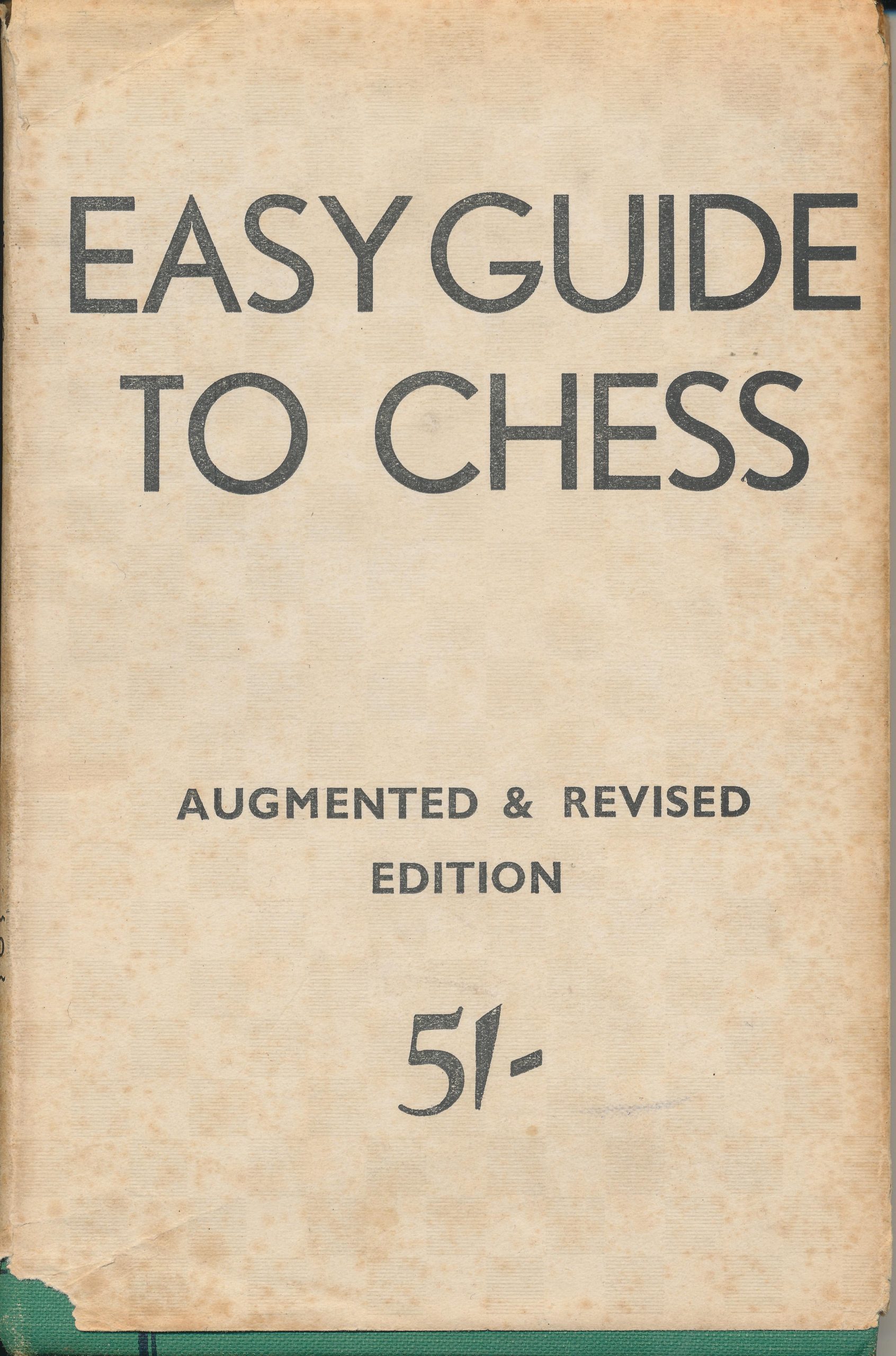
Easy Guide to Chess, BH Wood, CHESS, Sutton Coldfield, 1945

The above book (albeit the later Cadogan version) is available online.
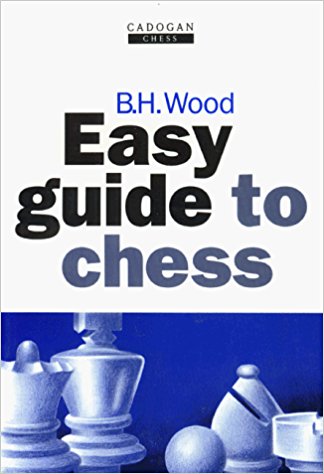
Easy Guide to Chess
Easy Guide to Chess

Nigel Davies wrote “One of the best beginners books on the market.”

Wood’s feat in writing, publishing, printing and selling his own book may be unique. However, Wood was no mean player as his draw against the then world champion Max Euwe, who became a life-long friend, testifies.

He represented England in the International Team Championship at Buenos Aires in 1939, scoring 50%. He also took first prize in international tournaments at Baarn 1947, Paignton 1954, Whitby 1963, Thorshavn 1967 and Jersey 1975 and was second in the 1948 British Championship. He was British Correspondence Chess Champion in 1945.
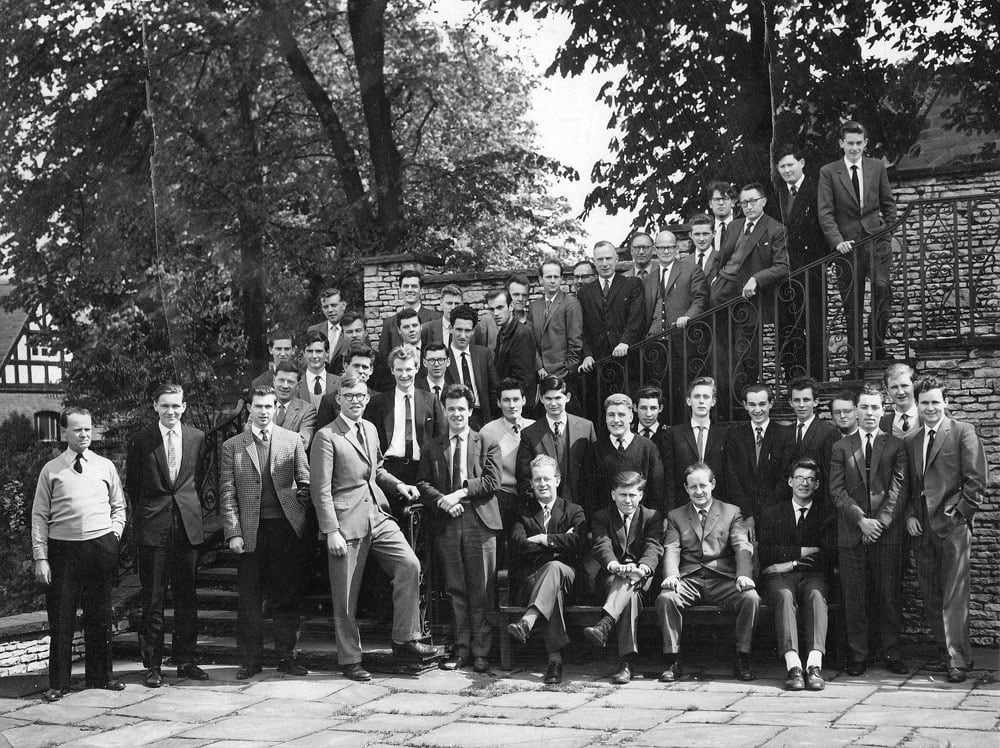
The Cedars Chess Club May 1962 - Baruch is seated, second from the right. Photograph sourced from ECF obituary.
The Cedars Chess Club May 1962 – Baruch is seated, second from the right. Photograph sourced from ECF obituary.

A life member of F.I.D.E. Wood was also an International Arbiter, and organised 21 annual chess festivals at seaside venues from the 50’s onwards. In addition he was an active behind-the-scenes inspirer of many chess events, and in particular was known as a driving spirit of university chess, being until the time of his death President of the British University Chess Association.
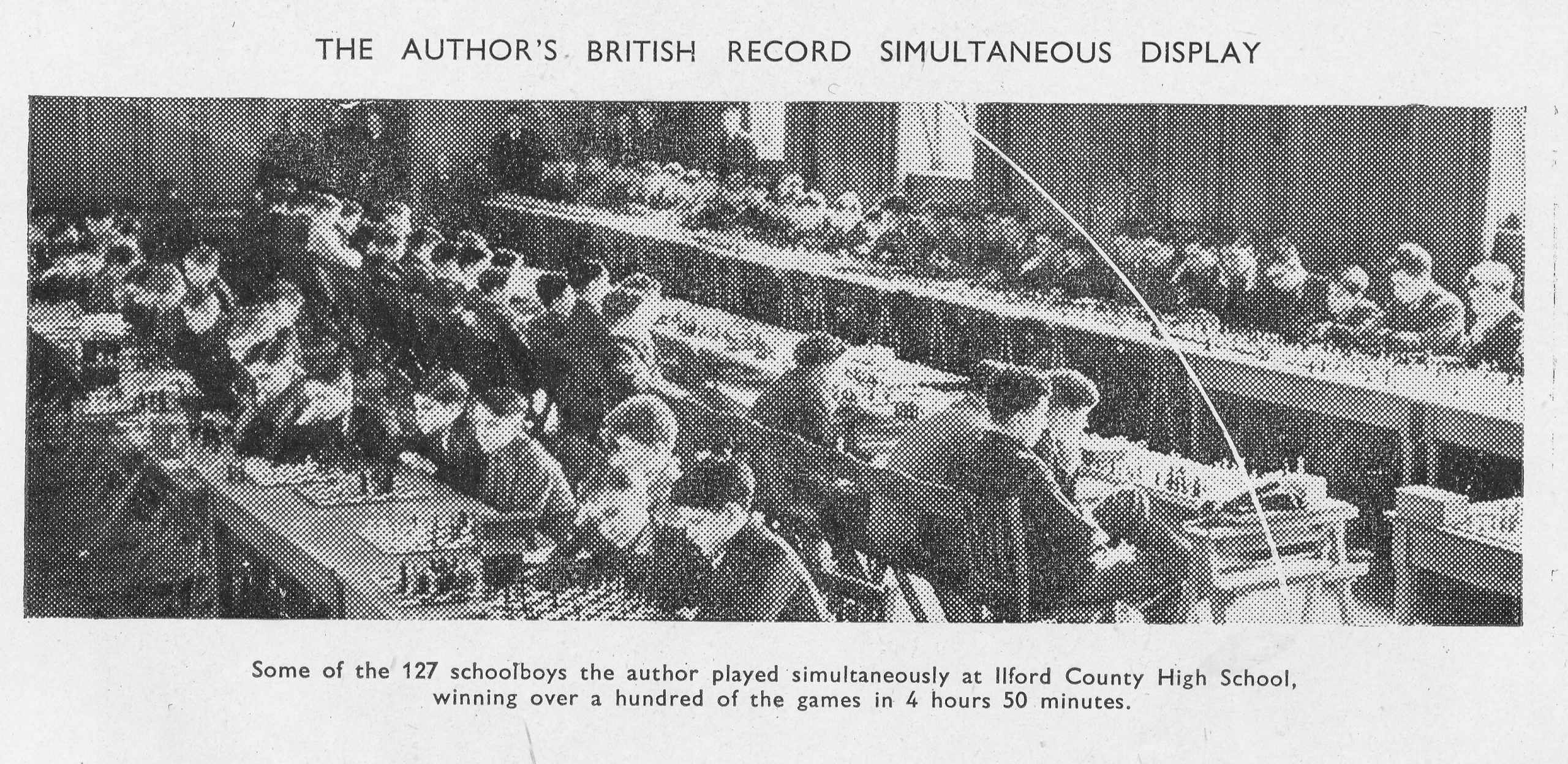
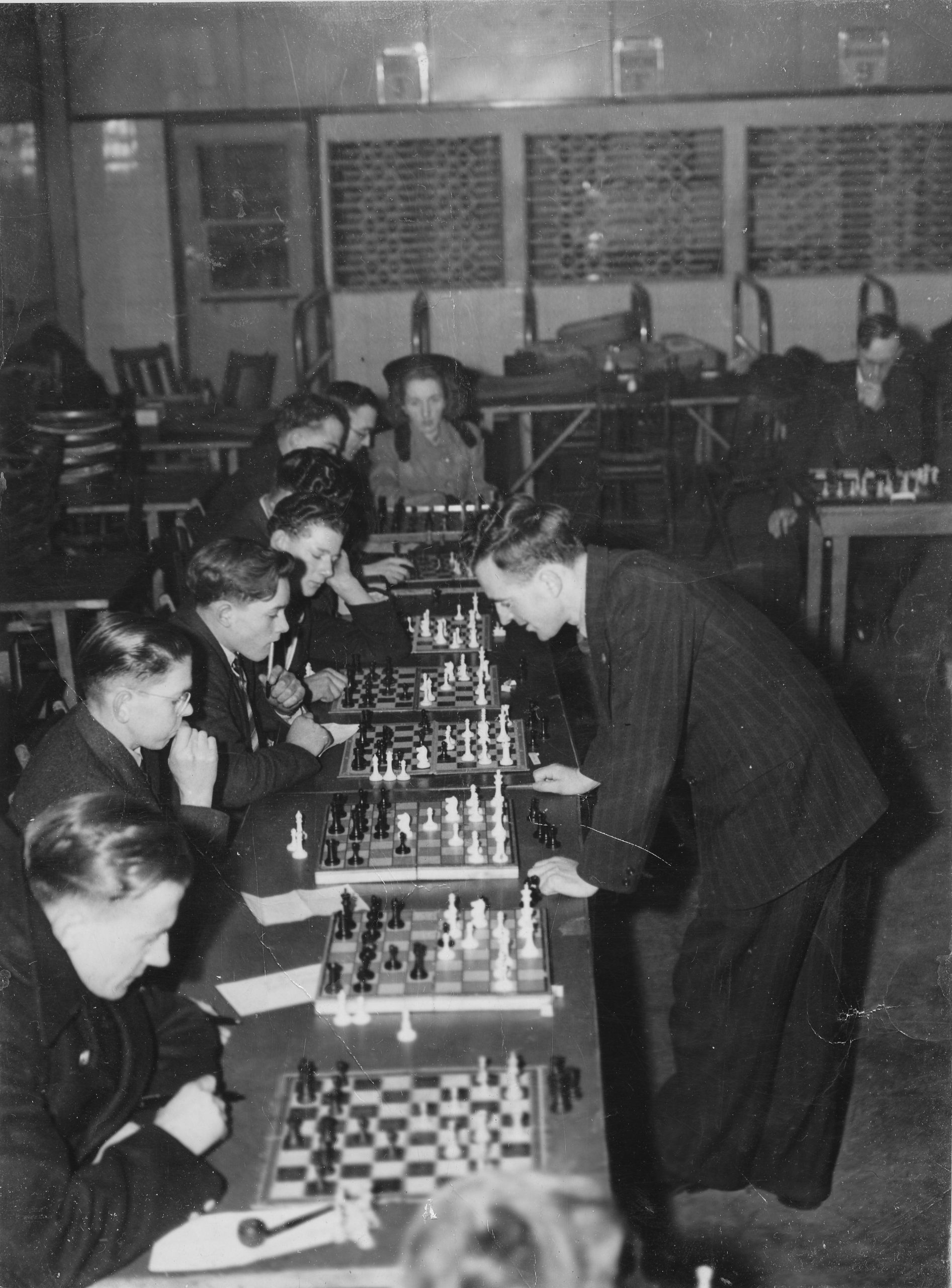
The Author's British Record Simultaneous Display. Some of the 127 schoolboys the author played simultaneously ay Ilford County High School, Winning over a a hundred of the games in 4 hours and 50 minutes.
The Author’s British Record Simultaneous Display. Some of the 127 schoolboys the author played simultaneously at Ilford County High School, Winning over a a hundred of the games in 4 hours and 50 minutes.

He founded the Postal Chess Club and League and was for many years President of the British Postal Chess Federation.
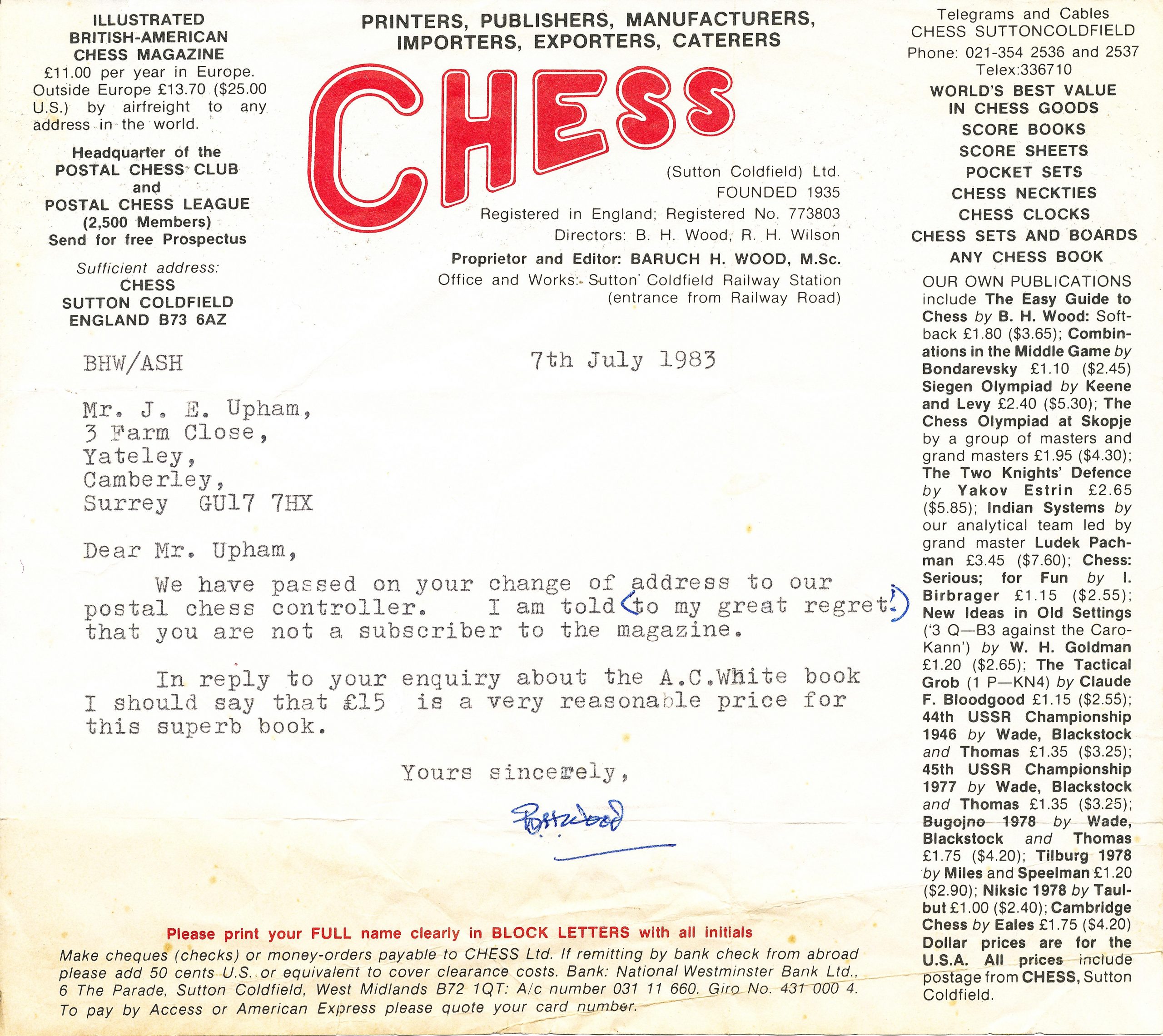
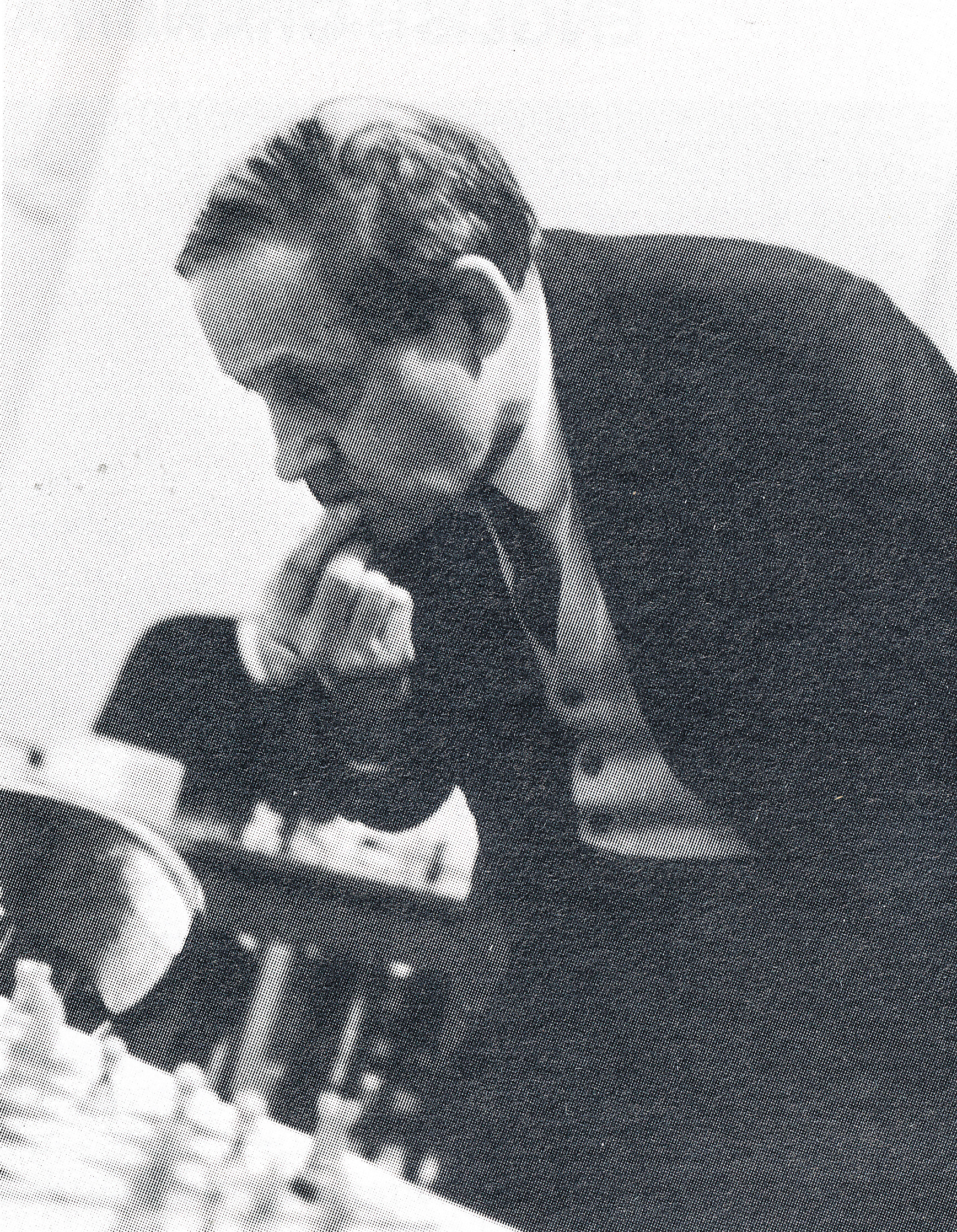
Letter from BH Wood to JE Upham dated 7th July 1983
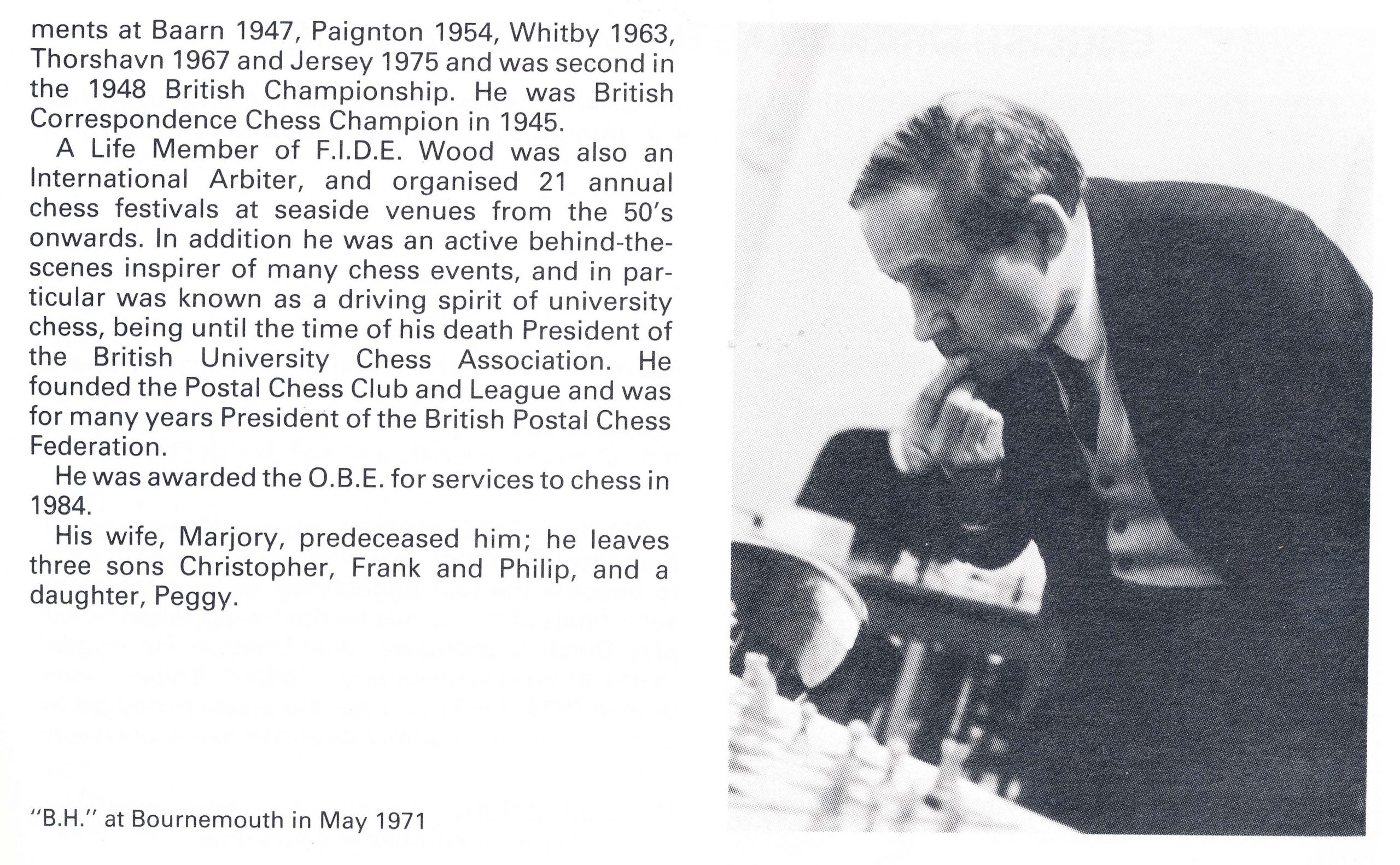
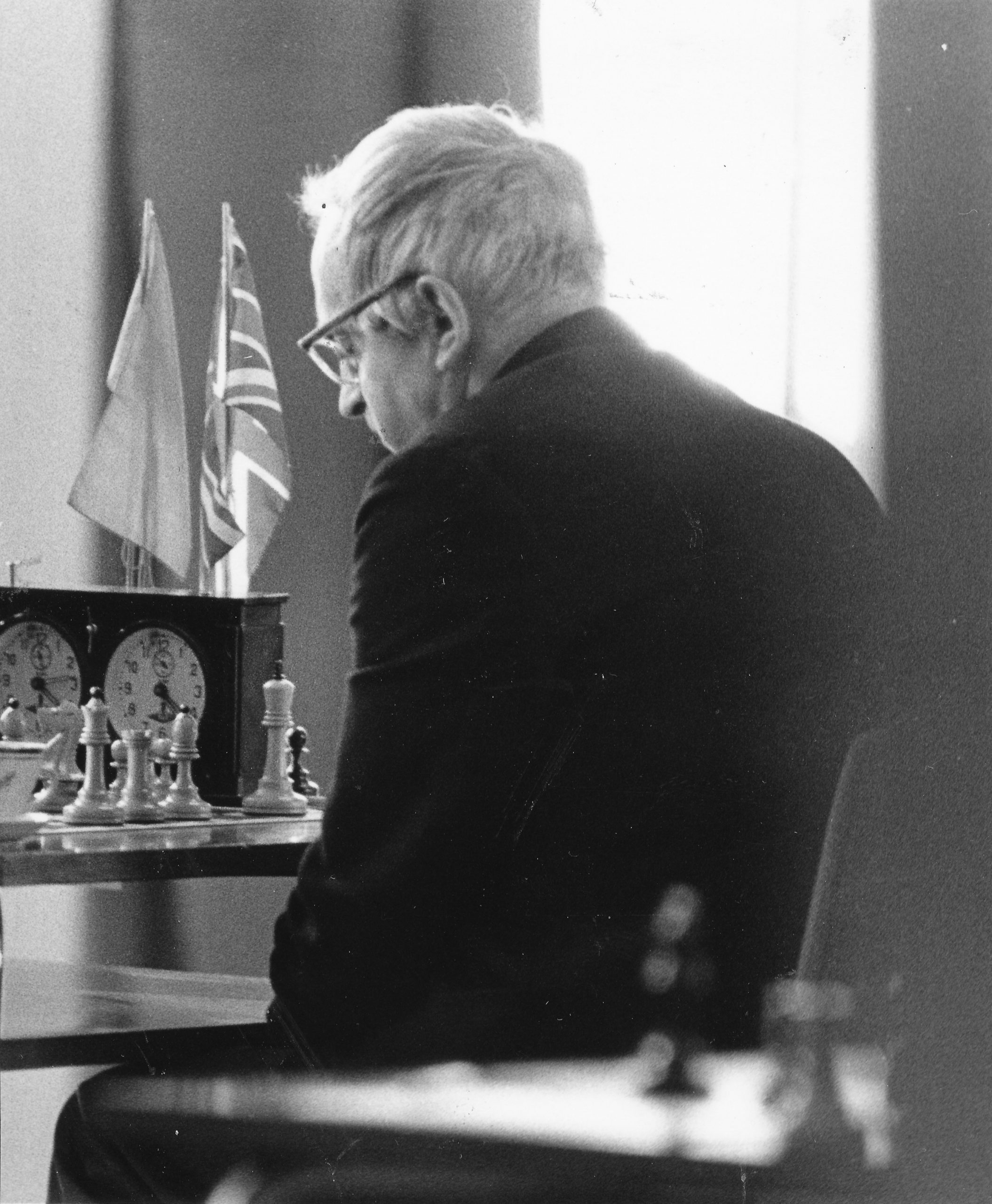
"B.H." at Bournemouth in May 1971
“B.H.” at Bournemouth in May 1971

He was awarded the O.B.E. for services to chess in 1984.

His wife Marjory, predeceased him; he leaves three sons Christopher, Frank and Philip, and a daughter Peggy.
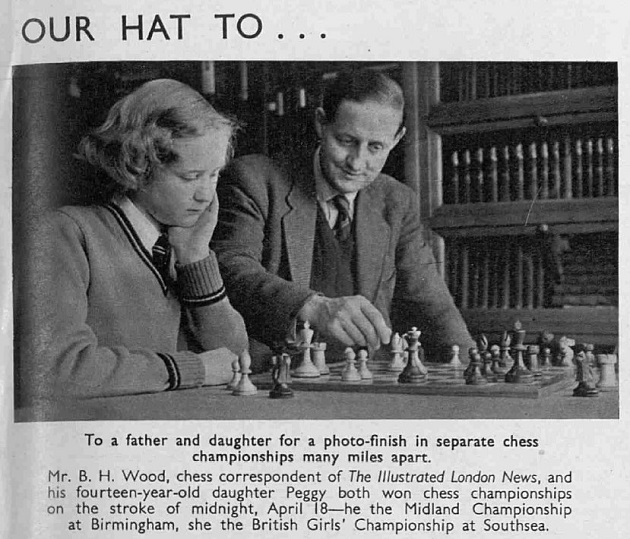
BH Wood & his daughter Peggy Clarke
BH Wood & his daughter Peggy

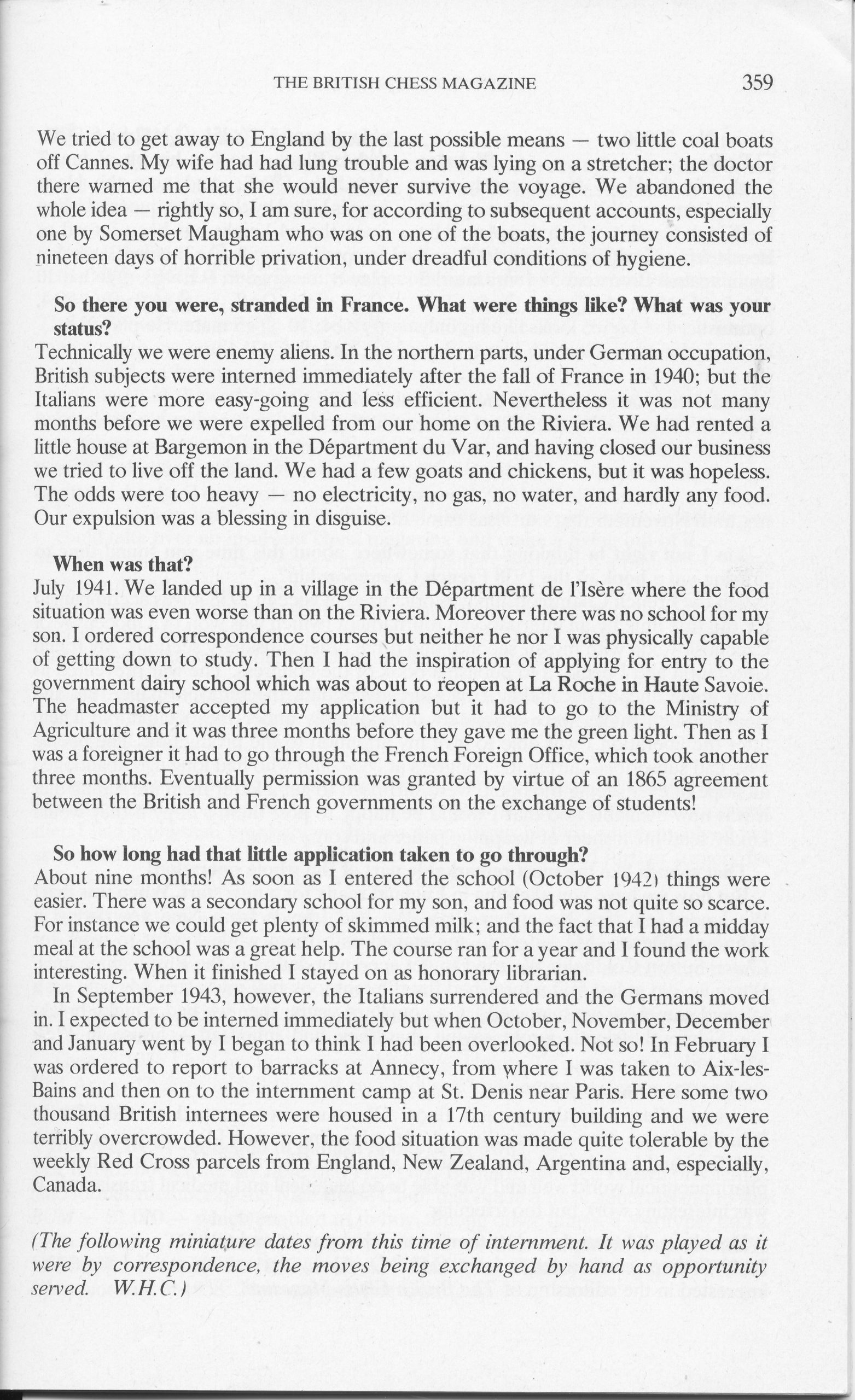
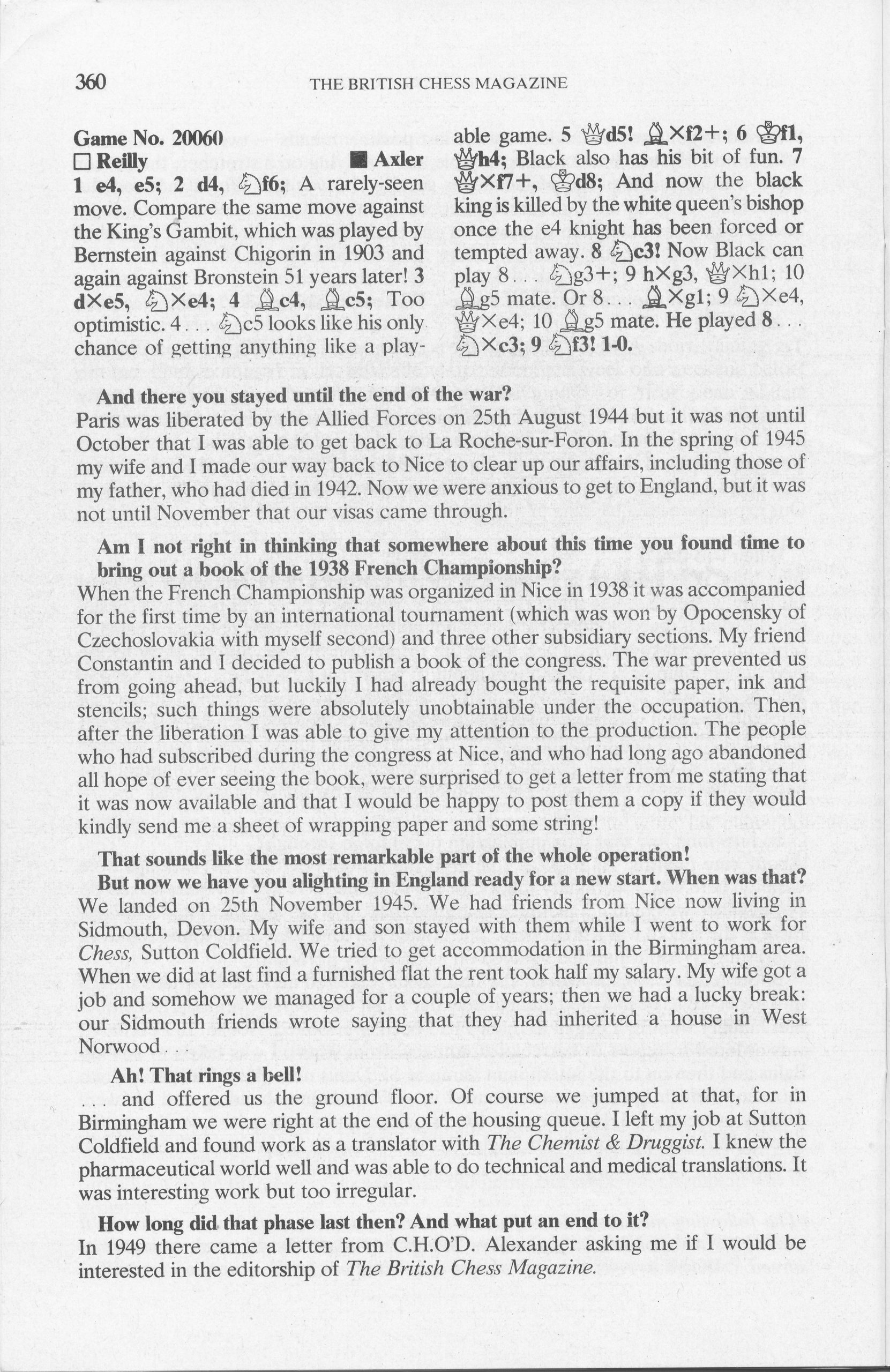
and here is the article as it appeared in the Yearbook.
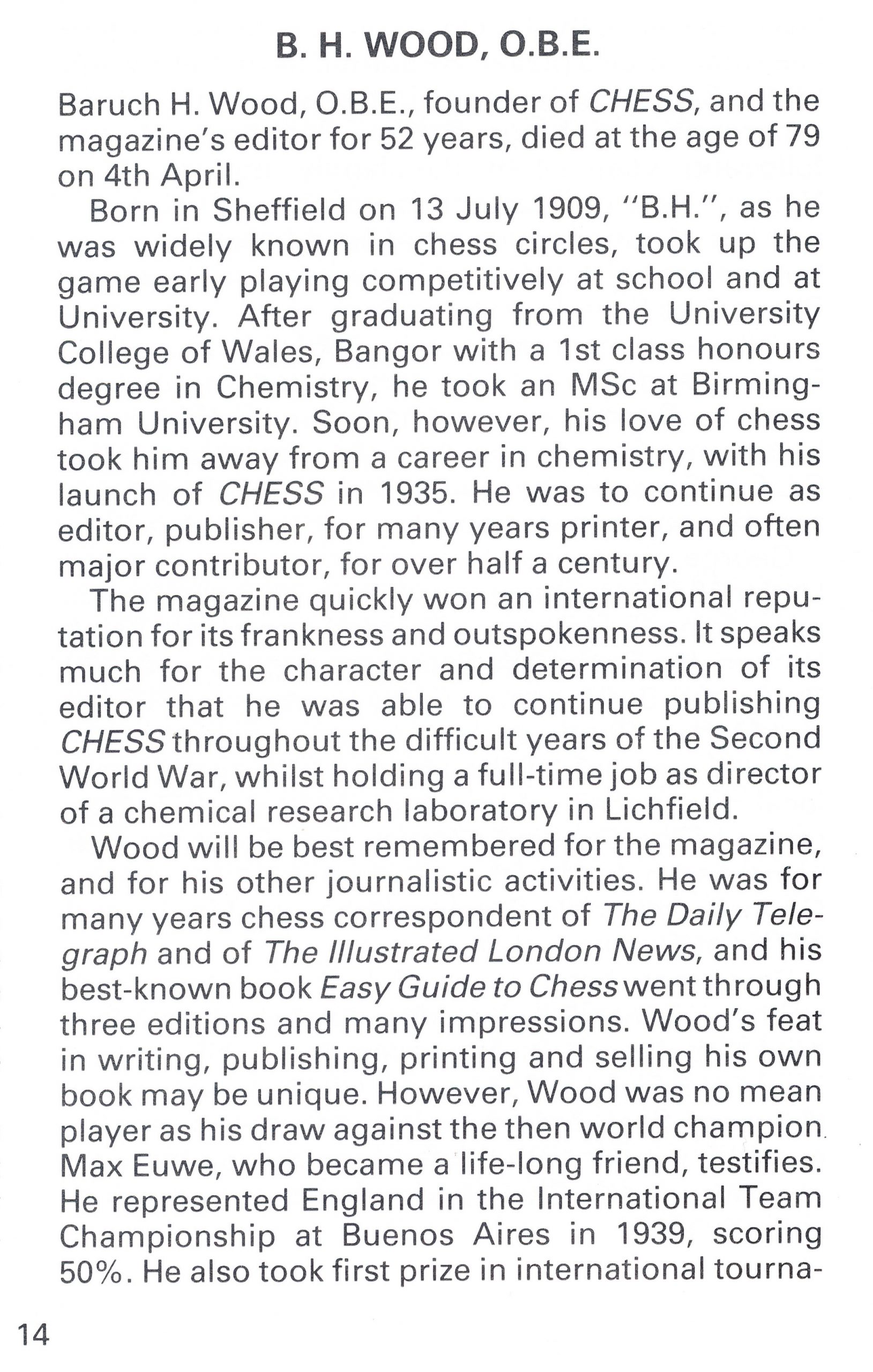
BCF Yearbook, 1989-90, page 14
BCF Yearbook, 1989-90, page 15

Golombek on Wood

From The Encyclopaedia of Chess (Batsford, 1977)  by Harry Golombek :

“A well known British player, editor of Chess (starting 1935) and chess correspondent of The Daily Telegraph and Illustrated London News. A FIDE judge, he has founded and conducted 21 annual chess festivals, notably at Whitby, Eastbourne and Southport.
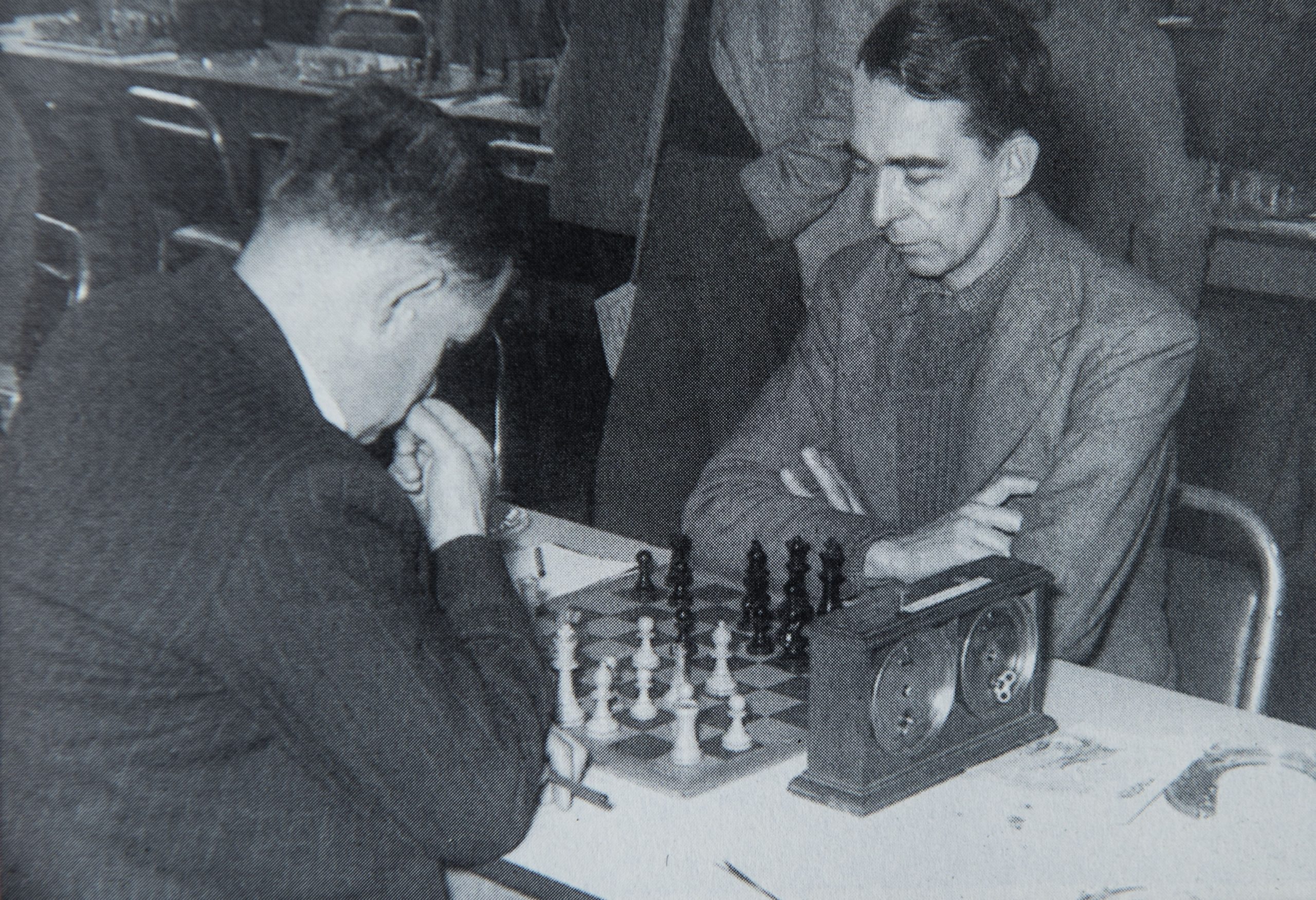
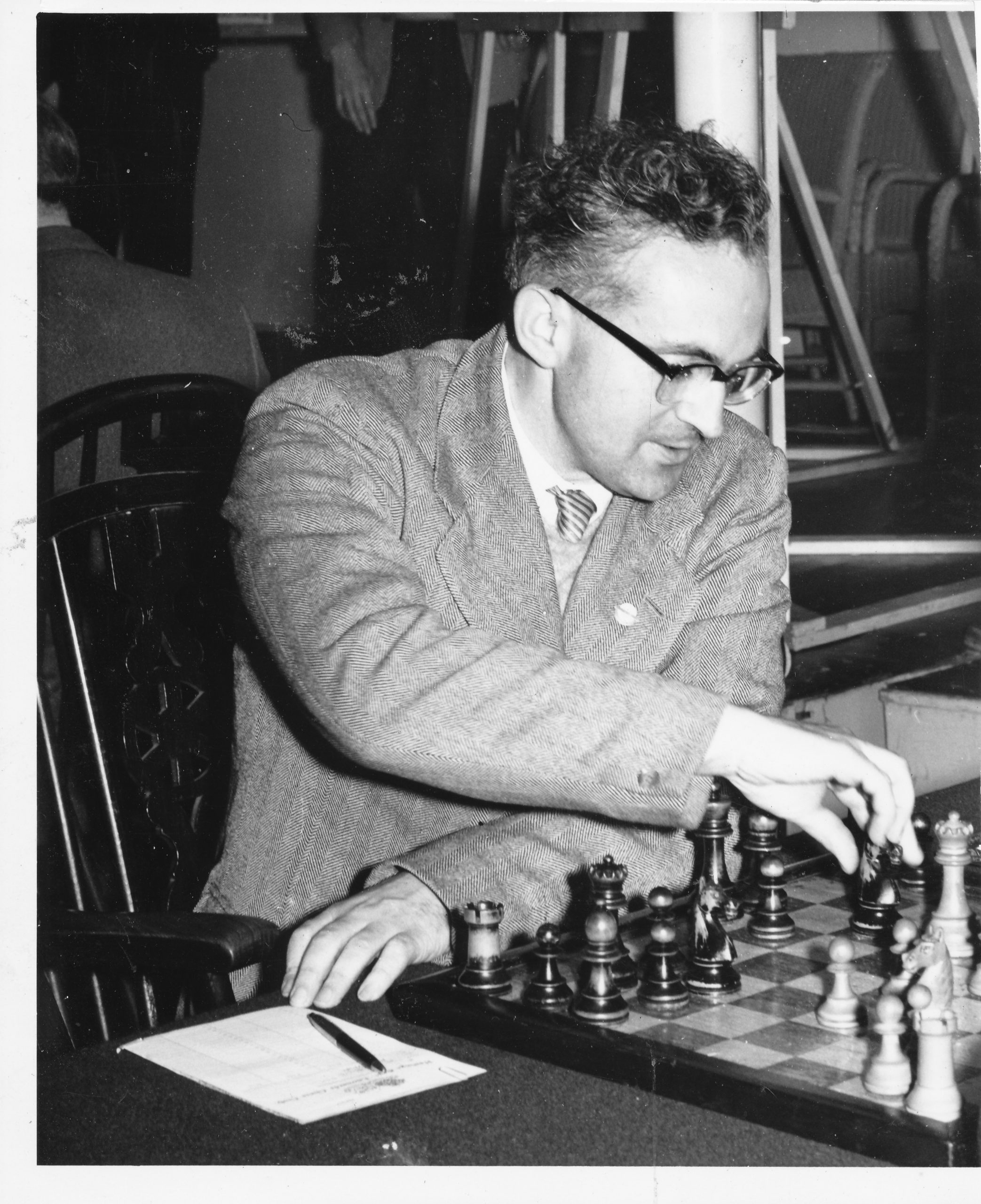
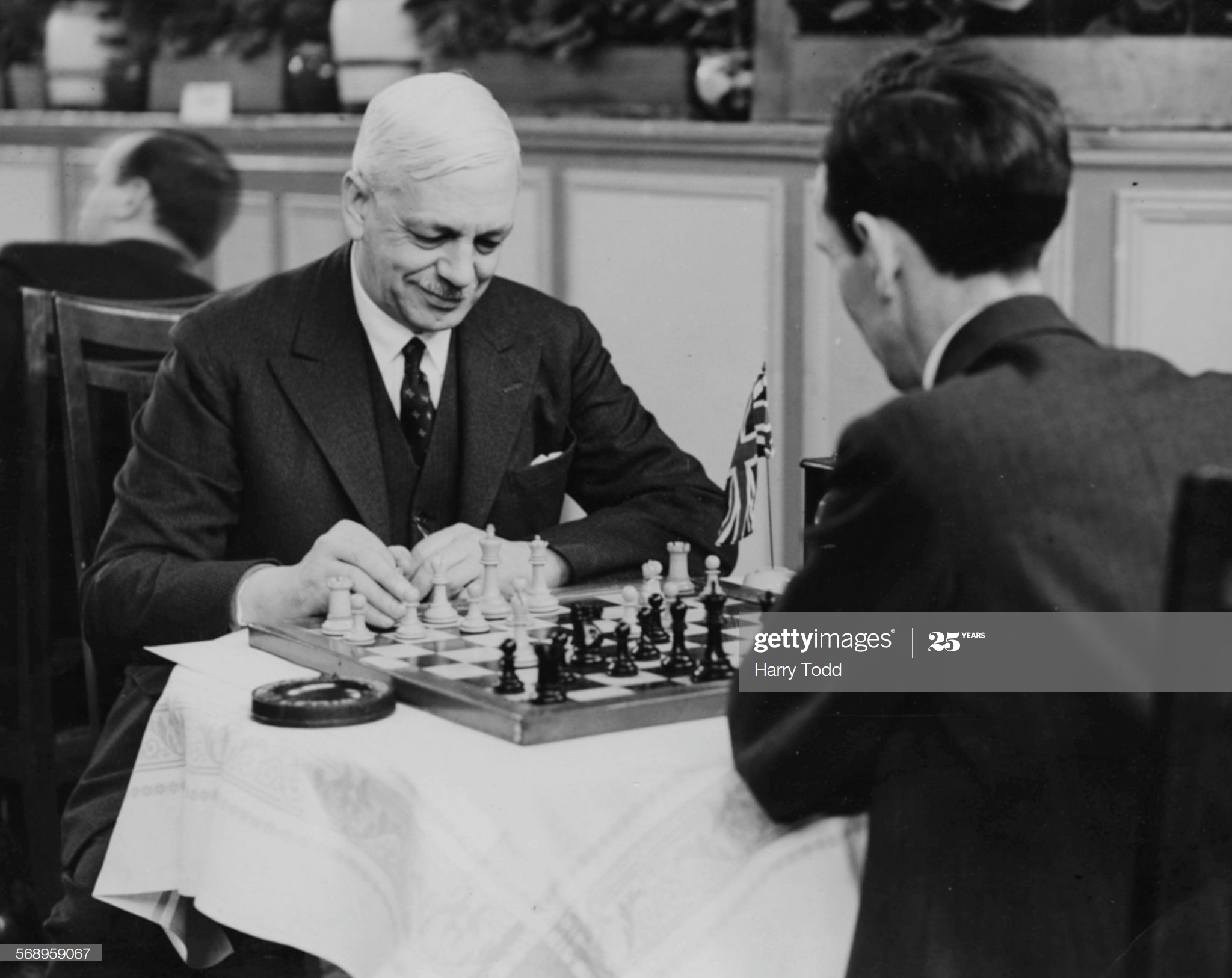
BH Wood playing AY "Johnnie" Green in the 1956 British Championships in Blackpool, photographer unknown
BH Wood playing AY “Johnnie” Green in the 1956 British Championships in Blackpool, photographer unknown

Winner of a number of small and semi-international tournaments : Baarn 1947, Paignton 1954, Whitby 1963, Thorshavn 1967, and Jersey 1975.

Played for the BCF in the International Team Tournament at Buenos Aires 1939. His best tournament result was probably his equal second in the British Championship at London 1948.

In 1954 BHW was sued BH Wood for libel by William Ritson Morry over a letter BHW sent to Henry Golding of the Monmouthshire County Chess Association warning him of WRMs financial history. Here is a summary of the action :
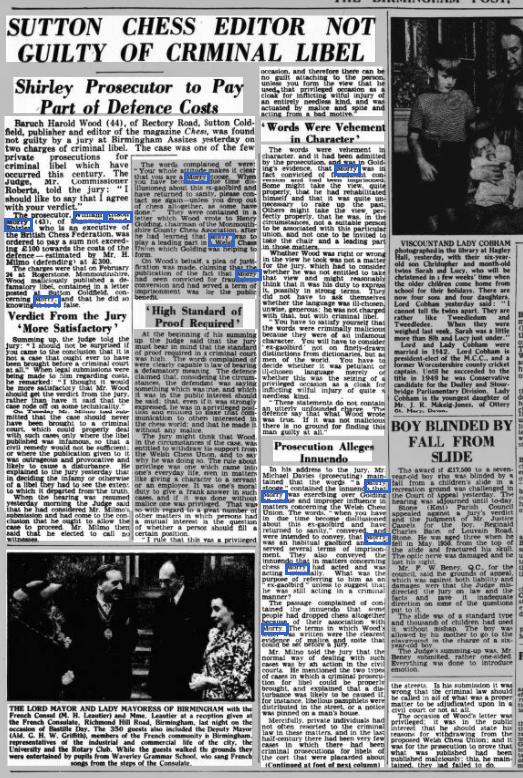
The Birmingham Post, July 15th, 1954

and two years in 1956 we have this telling photograph of Ritson and BH playing at the British Championships in Blackpool. It must have been an entertaining pairing for the organisers if no-one else!
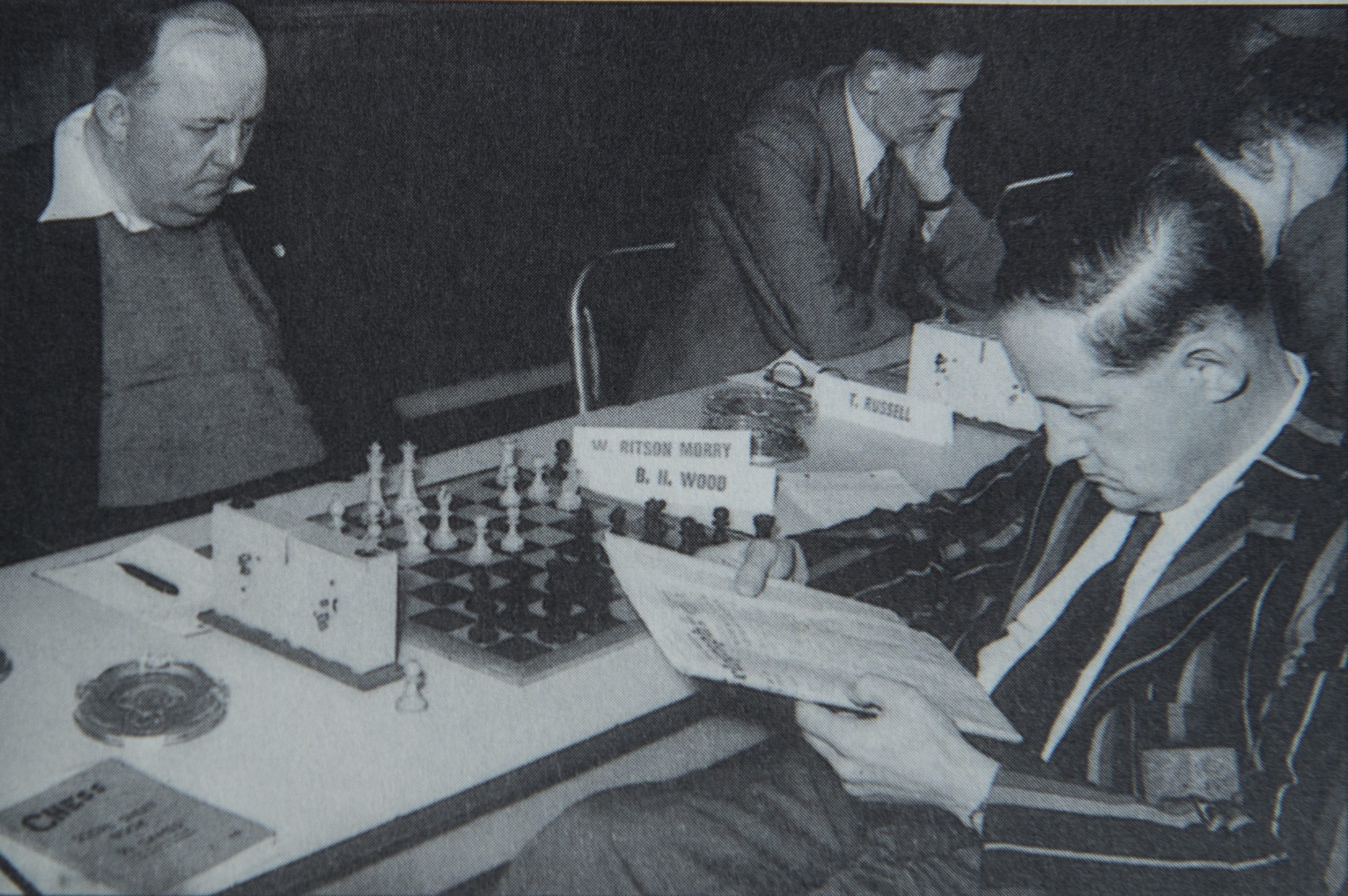
William Ritson Morry playing Baruch Harold Wood at the British Championships in Blackpool from 1956
William Ritson Morry playing BH Wood at the British Championships in Blackpool from 1956

Possibly WRM was thinking this as they played:
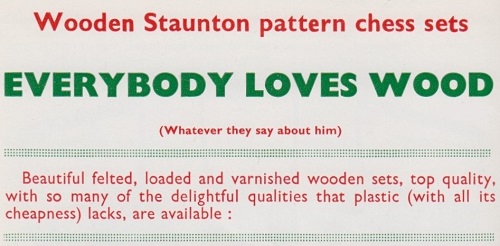
Everybody Loves Wood

Among his books are : Easy Guide to Chess, Sutton Coldfield 1942 et seq; World Championship Candidates Tournament 1953, Sutton Coldfield 1954. “
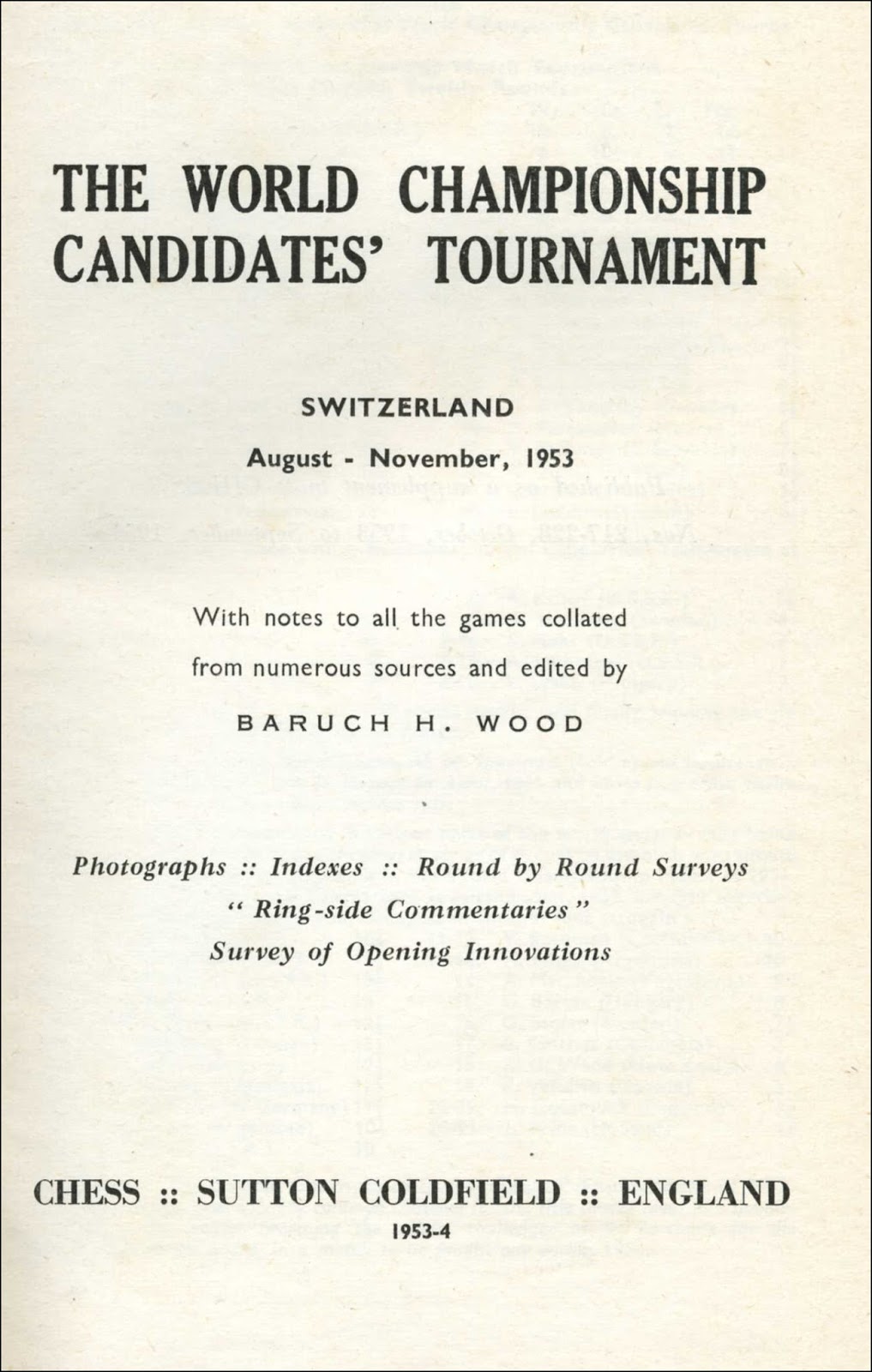
World Championship Candidates Tournament 1953, BH Wood, CHESS, Sutton Coldfield, 1954

Cafferty on Wood (1989)

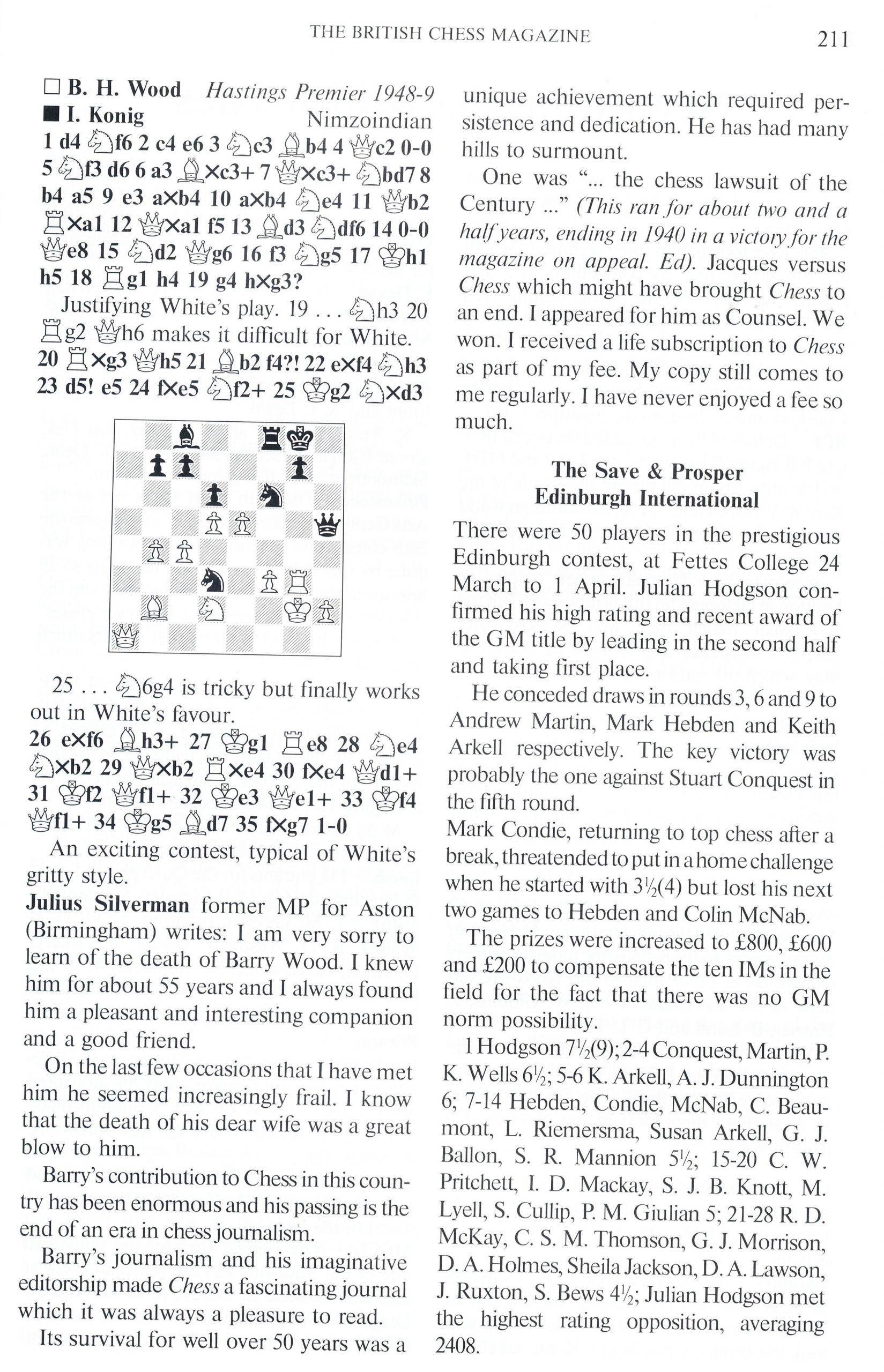
Here is the obituary from British Chess Magazine, Volume CIX (1989, 109), Number 5 (May), pages 210 – 211:

B. H. WOOD

Baruch Harold Wood (13 viii 1909-4 iv 1989) popularly known as “B. H.” was a significant figure of the last fifty-odd years in British chess. His life touched practically all aspects of the game as player, both OTB and CC, magazine publisher and editor, organiser of club, congress and university chess, journalist . . . the list seems endless. In 1984 he was awarded the OBE for services to chess.

Born at Sheffield, which he sometimes used as an excuse when he was accused of stubbornness, (“It’s my Yorkshire blood, you know”) he was educated in North Wales (Friar’s School, and then University College, Bangor) and at Birmingham University.

He started his chess magazine at Sutton Coldfield in 1935 as an impecunious graduate who could not find suitable work in the Depression, and his lively style ensured that it was a beacon in British chess for fifty years to come! For many British chess fans he was “Mr Chess” yet it seems a miracle that he kept the magazine going in the difficult times when interest in the game was at a low ebb. He may well have subsidised it from his journalistic work (Birmingham Post, Illustrated London News and Daily Telegraph) and from his wartime work as manager of a chemical laboratory (“The first time I ever earned a decent salary”).

His duodenal ulcer prevented him doing military service, and later in life he suffered from failing eyesight and the inability to walk which resulted from his diabetes, not diagnosed till he had suffered from it for decades.

He worked a seven-day week on the magazine, and his wife who predeceased him was often unsure when he would be home such was his devotion to the work. At times he would take off for trips abroad or long simul tours through Britain while trying to keep the magazine on schedule.

One of his last long tours was in 1967 when he drove Botvinnik around the UK. The world champion was duly impressed by the work load and wrote a very favourable account of the trip, revealing incidentally that Barry was still paying off the mortgage on his large house in Rectory Road, Sutton Coldfield where the car was parked on the forecourt as the garage was the reserve storage for a large library of chess books! His ability to quote chemical formula from memory also impressed Botvinnik.

He brought up a family of four, all of whom were skilled players, apart, perhaps from the youngest boy. Daughter Peggy
was prominent in women’s chess and married Peter Clarke at the time of the Botvinnik visit. Elder sons Chris and Frank were of over-200 strength, but had seen too much of their father’s life at close hand to want to take over the business from him. He ultimately sold out to Pergamon in 1987 though negotiations had been started much earlier. It was probably too much of a wrench to let go until failing health left him with little alternative, but he described
the terms as very generous.

Barry was a gifted linguist who was welcome abroad for his un-English approach of having a go at the native tongue. As a player he was at his best in the late 1930s (a member of the 1939 Olympiad team in Buenos Aires) till the 1950s. He should really have won the 1948 British Championship when he had the enterprising idea of having Paul Schmidt as personal coach! Yet his tournament wins run on as late as Guernsey 1975 and he was playing in the First Division of the Birmingham League within a few weeks of his death. The flesh may have been weak but a great spirit kept him going to the end.

Shall we ever see his like again?

Julius Silverman former MP for Aston (Birmingham) writes: I am very sorry to learn of the death of Barry Wood. I knew him for about 55 years and I always found him a pleasant and interesting companion and a good friend. On the last few occasions that I have met him he seemed increasingly frail. I know that the death of his dear wife was a great blow to him.

Barry’s contribution to Chess in this country has been enormous and his passing is the end of an era in chess journalism.
Barry’s journalism and his imaginative editorship made Chess a fascinating journal which it was always a pleasure to read.
Its survival for well over 50 years was a unique achievement which required persistence and dedication. He has had many
hills to surmount.

One was “… the chess lawsuit of the Century …” (This ran for about two and a half years, ending in 1940 in a victory for the magazine on appeal, Ed). Jacques versus Chess which might have brought Chess to an end. I appeared for him as counsel. We won. I received a life subscription to Chess as part of my fee. My copy still comes to me regularly. I have never enjoyed a fee so much.

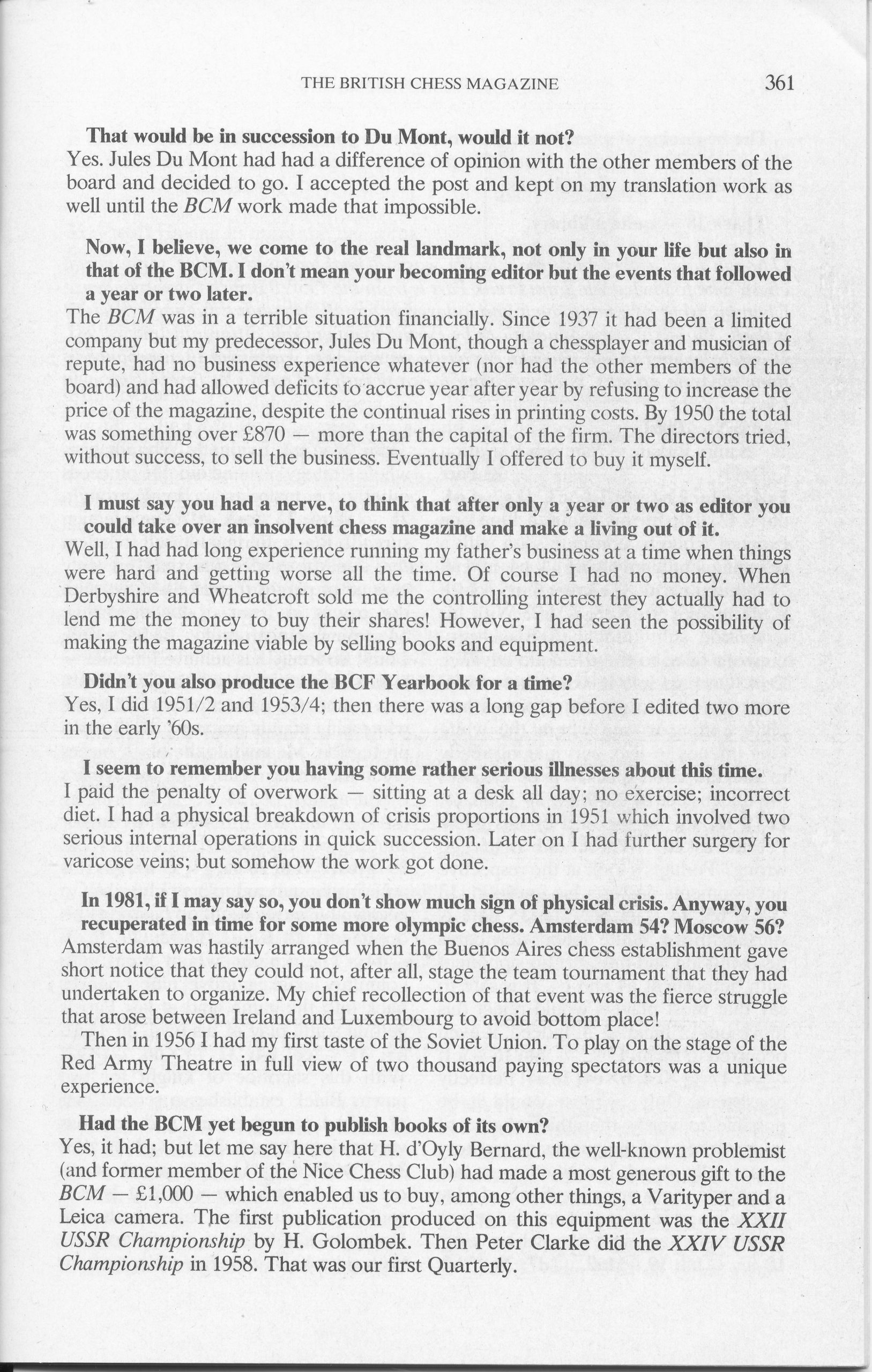
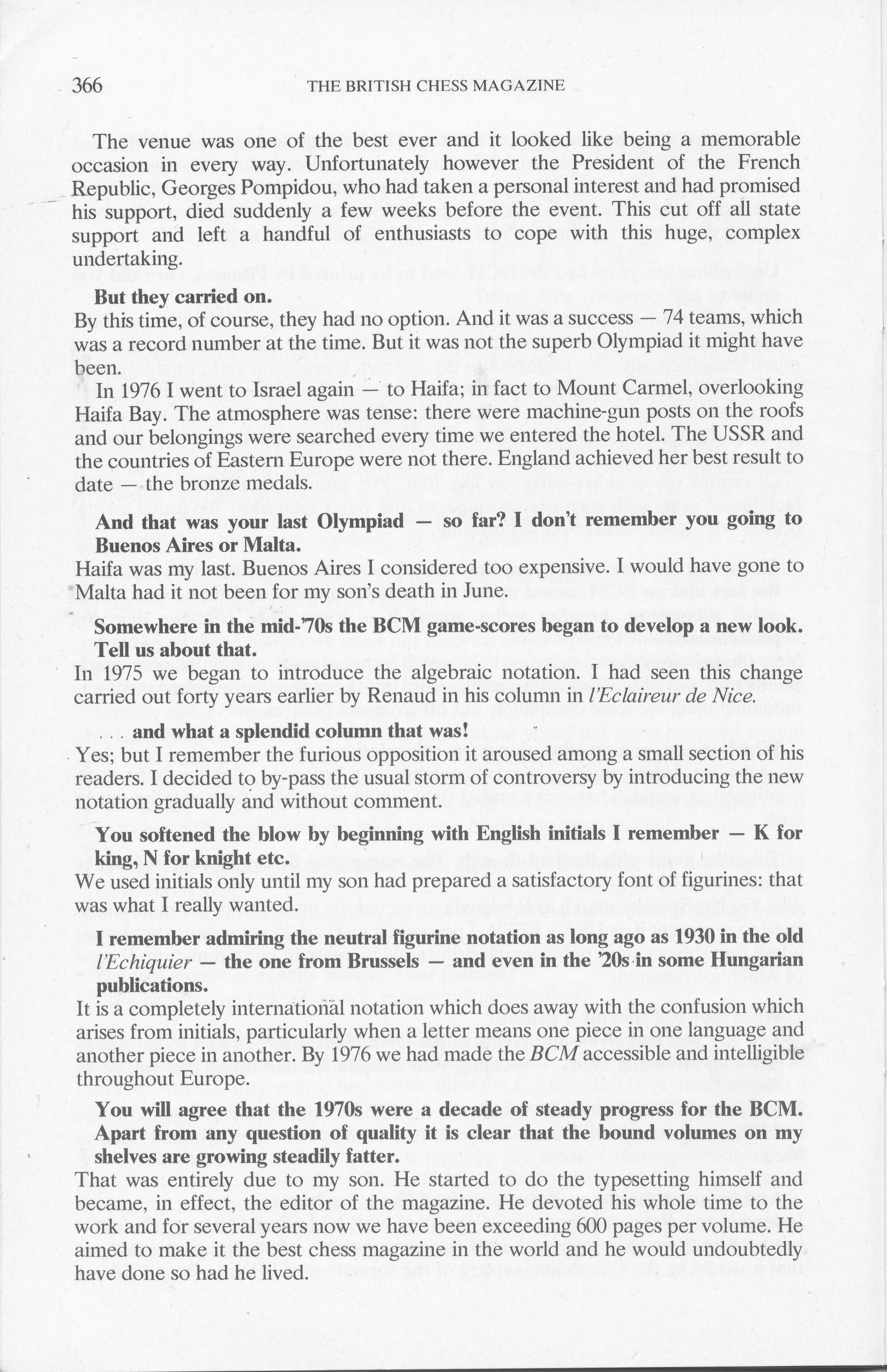
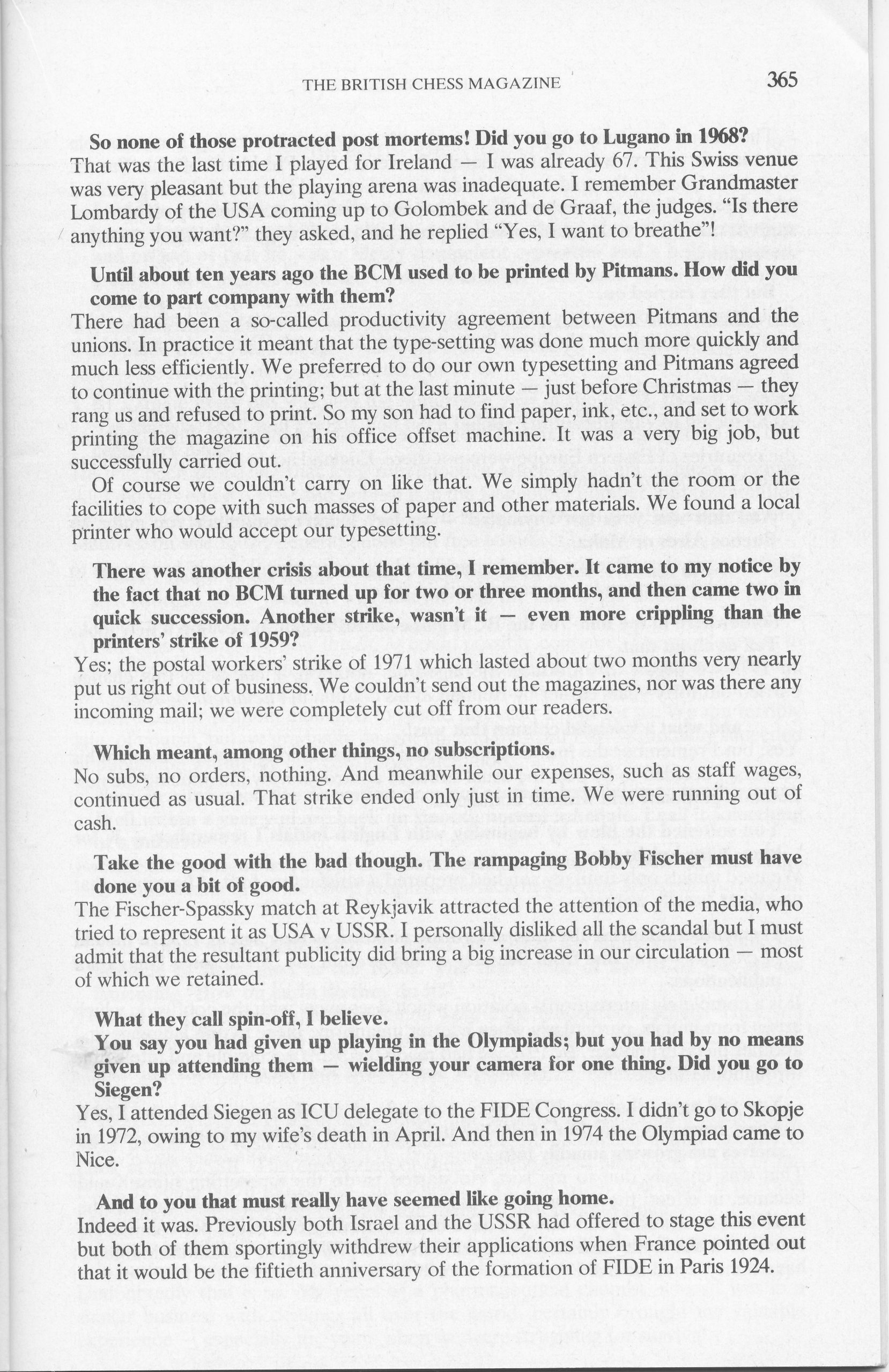
Here is the article in its original form:
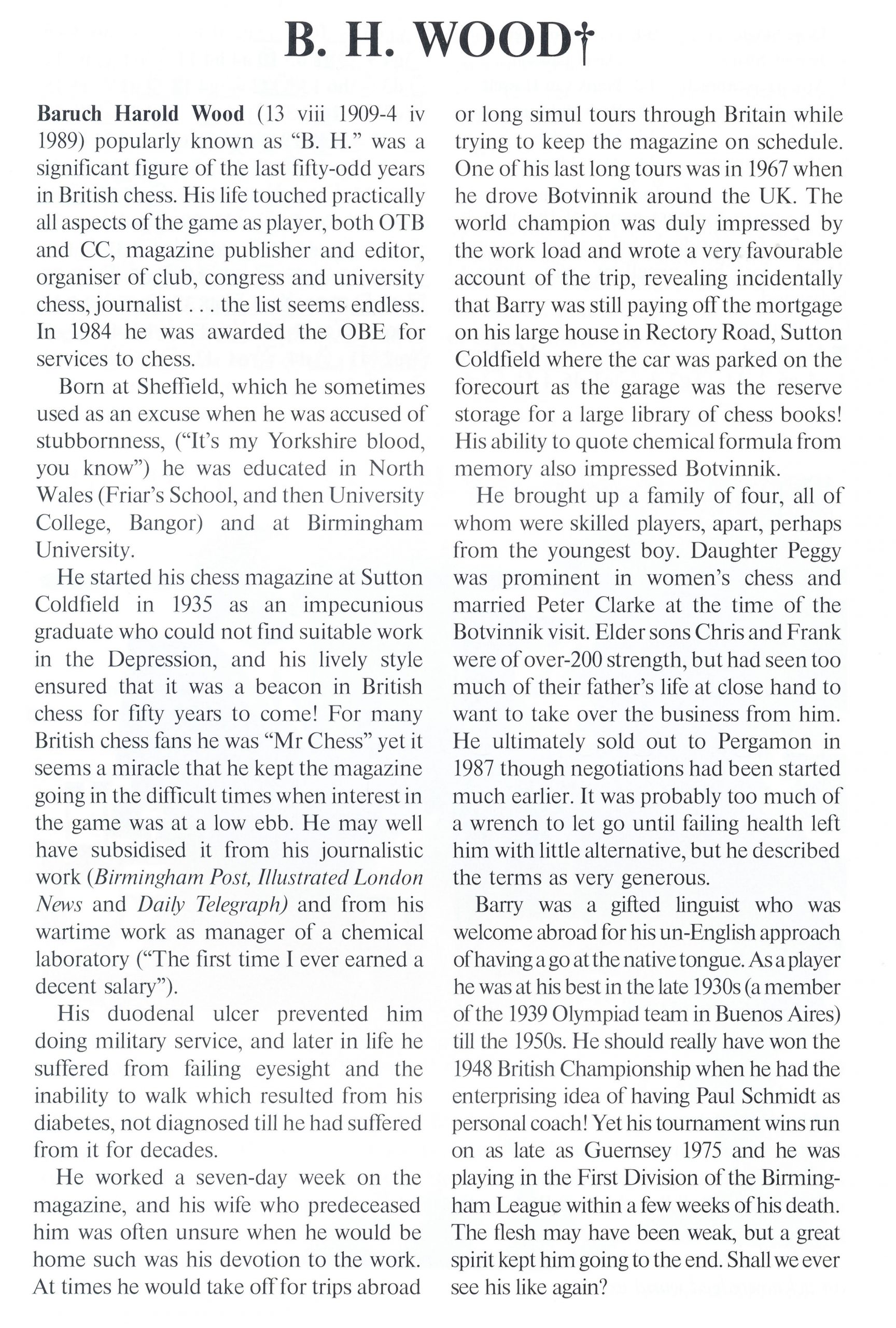
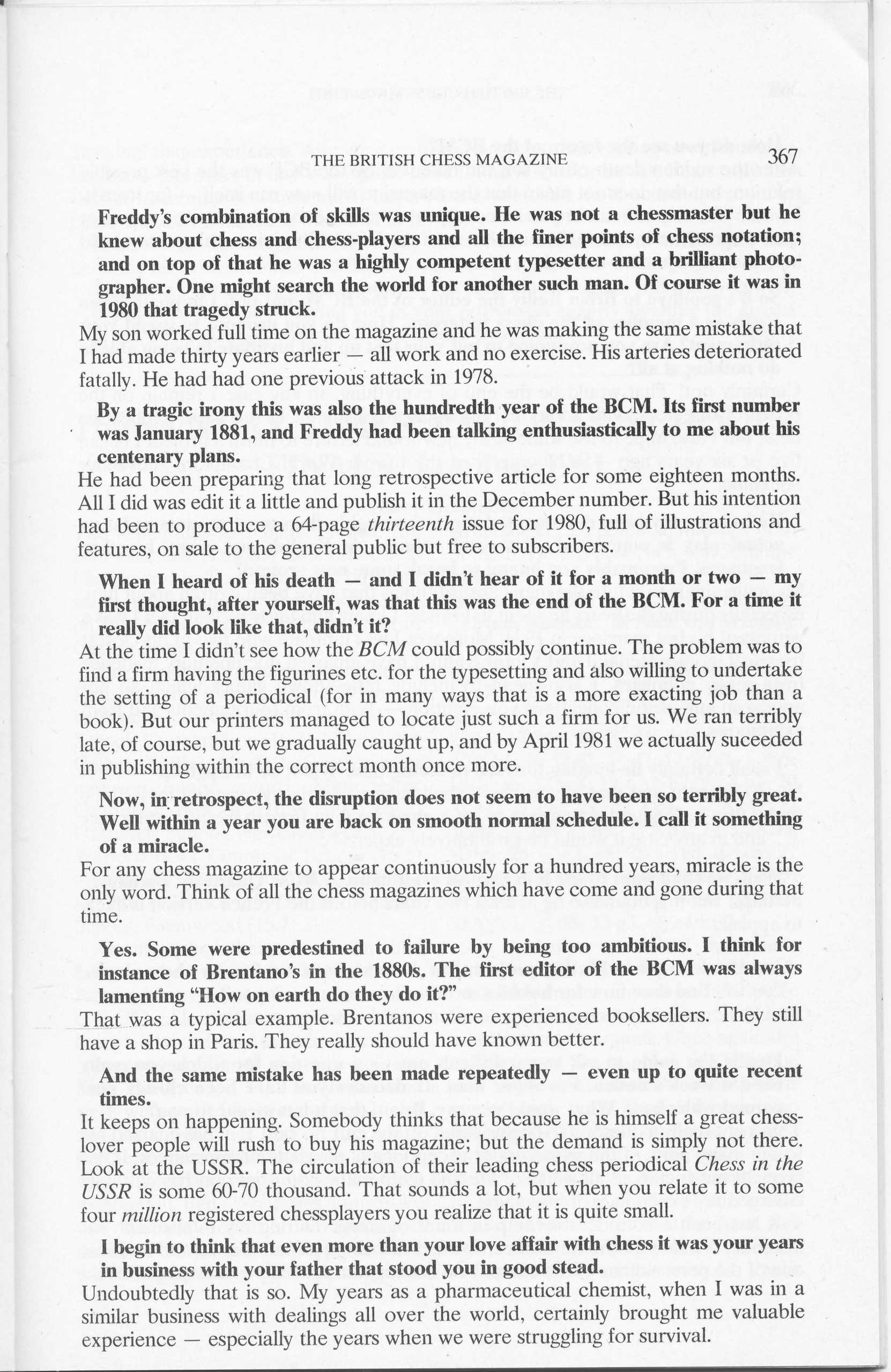
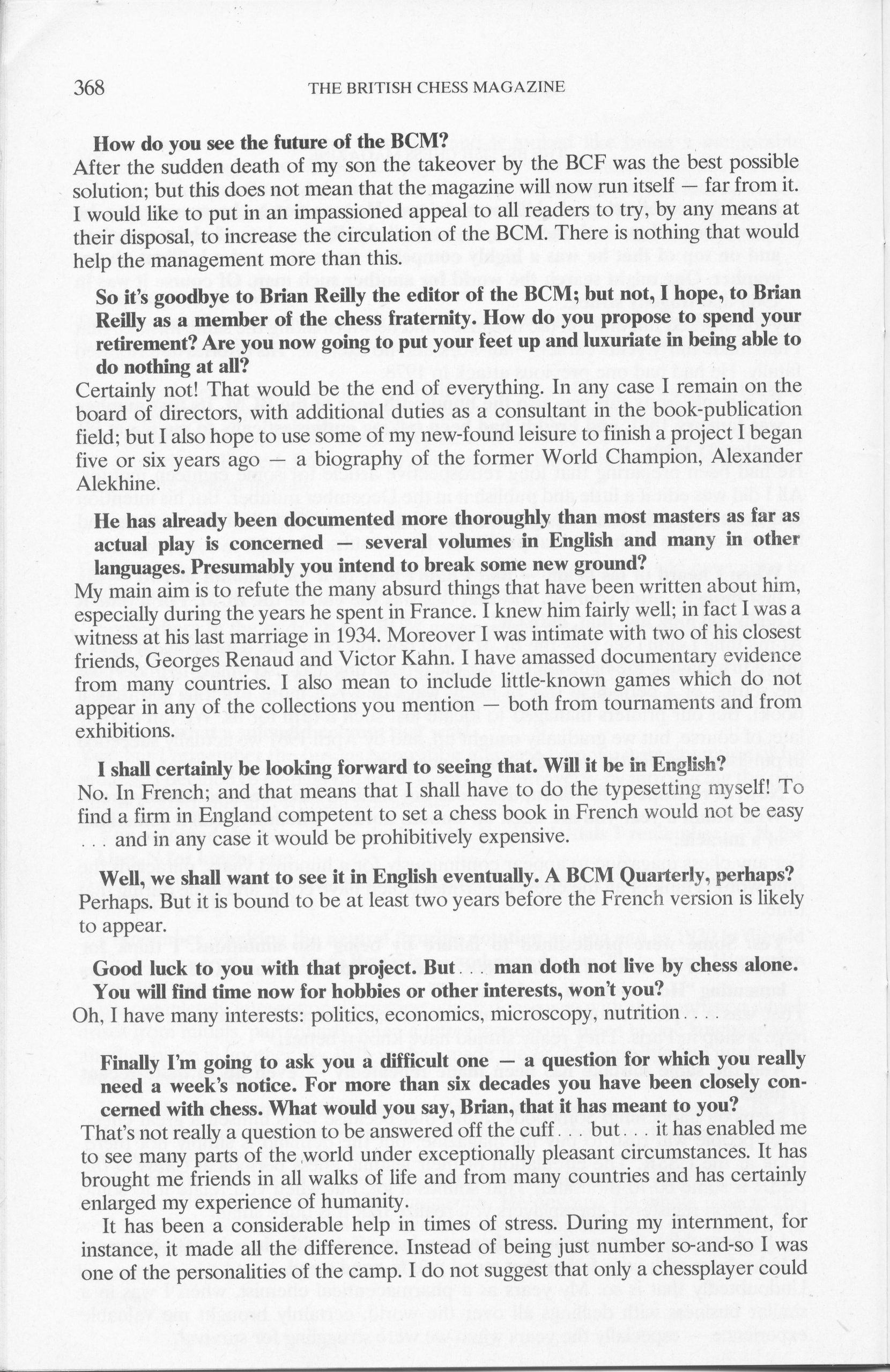
British Chess Magazine, Volume CX (109), Number 5 (May), page 210
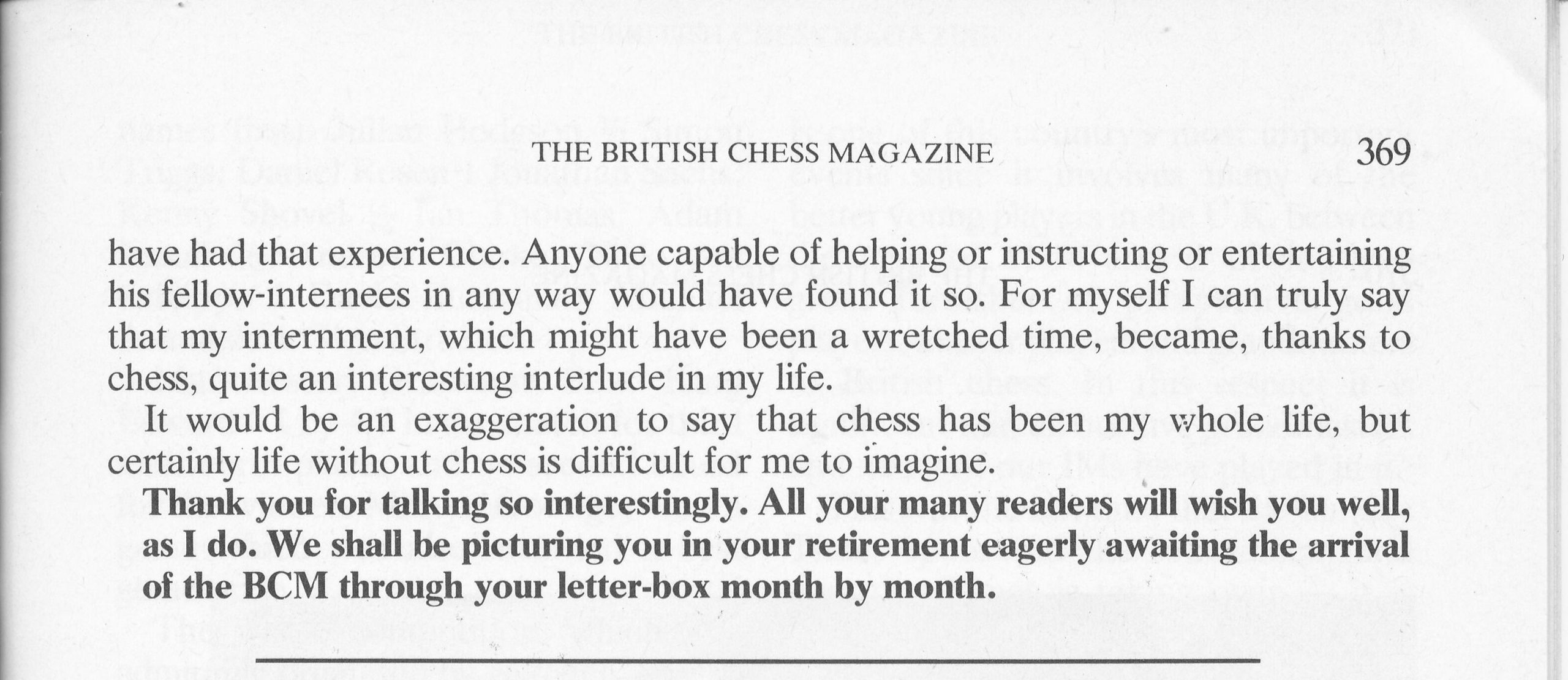
British Chess Magazine, Volume CX (109), Number 5 (May), page 211

Bernard on Barry (2004)

REMEMBERING BARRY WOOD (1909-1939)

by Bernard Cafferty

One of the most influential figures in British chess of the 20th century was B. H. Wood, whom I knew personally from 1951, and whom I played regularly, over a period of three decades, till l moved from Birmingham to Hastings in 1981. Here are some
memories of the man who was thought of by many in Britain as “Mr Chess”.

Born in Sheffield, Baruch Harold Wood had his secondary education in North Wales at the same grammar school as W Ritson
Morry who was later to become his Midlands colleague and bitter rival. BH always attributed his well-known stubbornness (he never resigned early) to “his Yorkshire blood”. Wood and Morry were to be students together at Birmingham University after BH gained his BSc in Wales. Then the pair faced the hard task of finding work in depression-struck mid-1930s England. BH founded his monthly magazine CHESS in 1935, an act of amazing optimism which only his great appetite for work could justify. The magazine was based in Sutton Coldfield, just north of Birmingham, at gloomy premises known as Masonic Buildings.

The early decades of this publication were marked by the outpouring of glorious journalism of a popular sort. The man’s love
of the game shone through his work and he recruited such contributors as the chatty Koltanowski and the prince of annotators
Alexander Alekhine. Later he became the long-serving columnist of the Birmingham Post, from 1949 of the weekly Illustrated London News, and even later of the Daily Telegraph. A feature of the magazine was its lively letters from readers which made for more interesting reading than the equivalent occasional letter to be found in the staid
BCM. The readers also made pertinent contributions to opening theory, especially in going through the 1946 MCO with a fine toothcomb and reporting their discoveries to Sutton Coldfield.

BH wrote a best-selling Easy Guide to Chess which went through several editions and was far more user-friendly than other primers on the market at the time. He also designed a luxury set, the Coldfield, and produced various chess clocks with new features. BH was a member of the BCF Olympiad side that played in the first part of the Buenos Aires Olympiad in the autumn of 1939. After the team’s withdrawal due to the outbreak of war, he stayed on in Argentina for a short while, taking part in a short tournament where he met the legendary Alekhine.
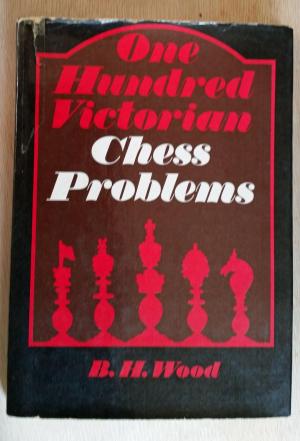
One Hundred Victorian Chess Problems, BH Wood, Wayland Publishers, London, 1972

BH was married to Marjorie, a Birmingham primary school teacher, and had three sons and a daughter. The elder two boys,
Chris and Frank, were strong players but not Philip. His daughter Peggy was our leading girl player of the 1950s, and married Peter Clarke in 1962. One should note that BH was not Jewish, as many assumed from the name Baruch – he was generally addressed as Barry by his wife and close friends. Others called him just by the initials BH. Everyone in British chess knew exactly who you meant when you said BH. Many thought of him as a sharp business-man. In any event, the fearsome workload he shouldered meant that none of his children, seeing this at first hand, aspired to carry on the magazine as a family business. To many in the British chess community who had never seen top players in action, BH was their first contact with the wider chess world due to the exhausting simul tours he made to many clubs the length and breadth of the UK.

Later, he organized CHESS Festivals starting from 1953. These were our earliest open tournaments, held at attractive venues such as Cheltenham, Whitby, Eastbourne and Southport. These events created the opportunity for British amateurs to meet continental grandmaster opposition like Donner and O’Kelly. BH had great confidence in his ability – his MSc at Birmingham University was in chemistry, but in 1946-7 he started studying nuclear physics privately, telling Brian Reilly, who was employed by him at that time, that it was the science of the future. I have to simply marvel at this – where did he find the time? In his self-portrait in connection with the GB-USSR match of 1946 he revealed that he had been studying Russian privately with a view to taking an external degree in it at Birmingham University.

The post-war decade saw him at his most active. He was BCF delegate at early FIDE meetings post-1946, the period that saw the mighty Soviet Union admitted to membership in 1947. BH was instrumental in maintaining Spain’s membership of FIDE at the same time, despite Soviet opposition to Franco’s fascism. He claimed to me he was always a most welcome guest in Spain thereafter.

Battles with the BCF

BH had been exempt from military service due to a duodenal ulcer. He spent the war keeping the magazine alive in his spare time as he was put in charge of a research laboratory at the Birmingham Chemical Company. During the war the government had the power under emergency legislation to direct citizens into any sort of work that would contribute to the war effort. His comment to me on that intensive period was: “It was the first time I ever drew a decent salary”. After a short spell as BCF FIDE delegate, he fell out with the ruling body in the early 1950s. His view was that the national body was ultra-conservative and not open to fresh ideas such as the knockout championship open to all which he organised in 1949-50. Lo and behold, a few months later the BCF started organising regional competitions to arrange for qualification for the British Championship! BH often criticised the BCF in his magazine. In June 1950 he wrote the first of a planned series of articles on the evergreen theme “Where is British Chess Going?” and forwarded a copy to the BCF just before publication. The BCF legal eagle Professor Wheatcroft immediately threatened to take out an injunction, so putting the frighteners on the printers. Rather than delay the July issue (not that subscribers were not used to a rather irregular schedule!), BH brought out the issue with white space, on two pages, a dramatic way of alerting the readers to the dispute. The promised articles, which he said would appear after the dispute was settled, never appeared.
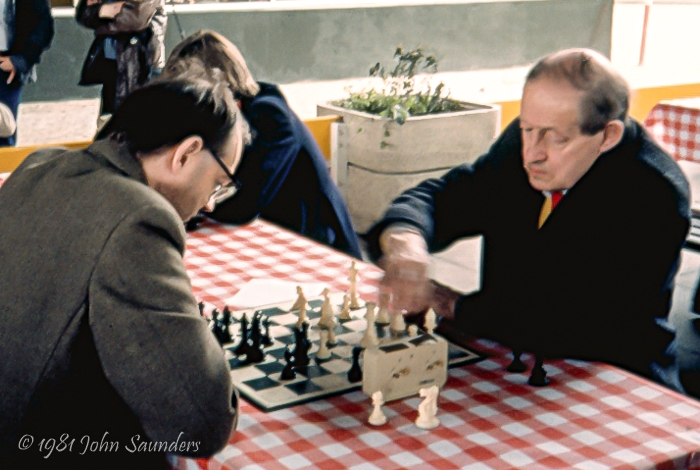
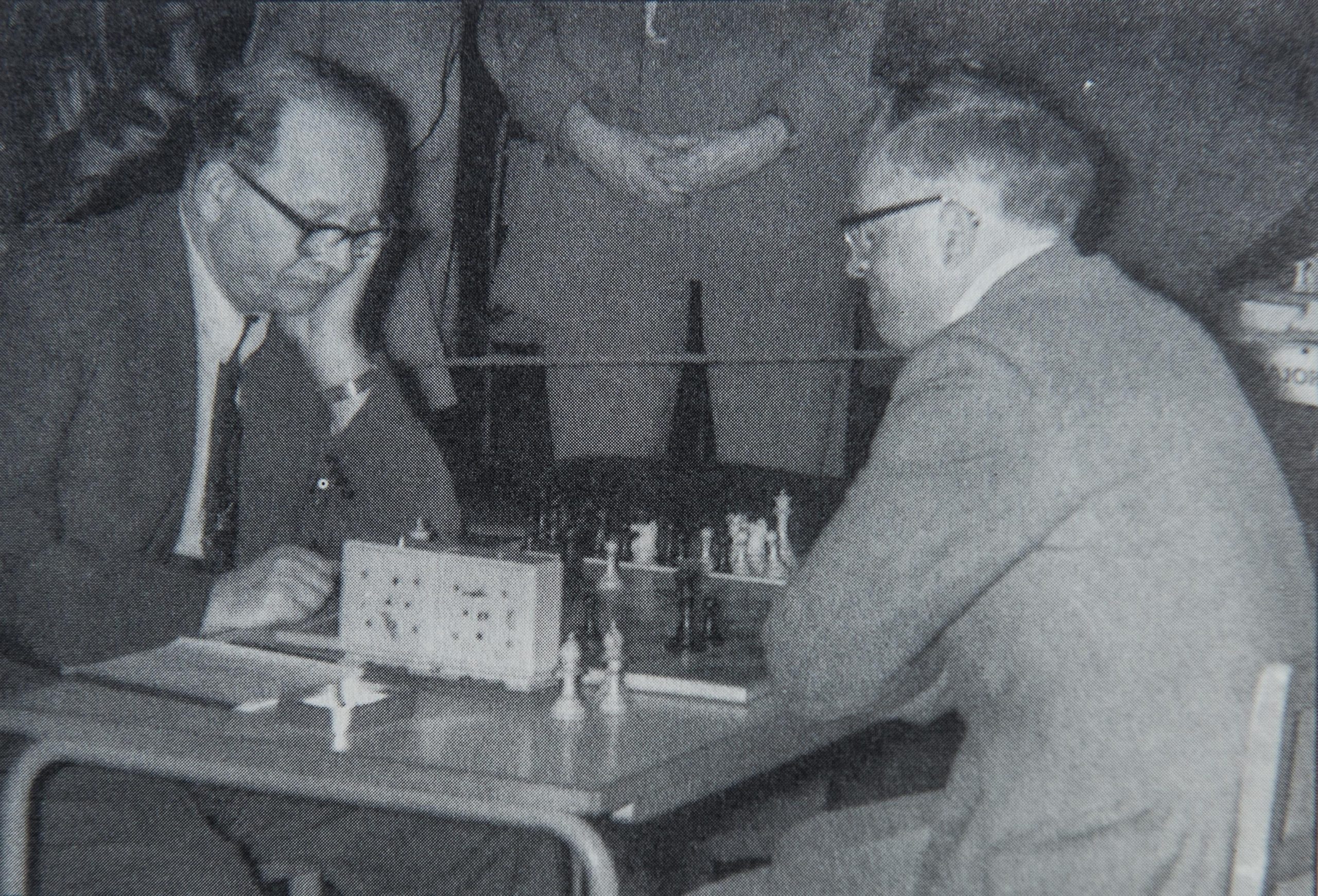
DW Anderton OBE plays BH Wood MBE in 1981 in a Blitz tournament outside of the National Film Theatre. Photograph courtesy of John Saunders

There were also tensions with BCF figures like Alexander and Golombek, in the latter case probably due to professional rivalry and Harry G’s identification with the BCM. Another prominent figure with whom BH crossed swords was the flamboyant Liverpool barrister Gerald Abrahams who threatened to sue over a report in CHESS of gambling debts incurred “on the turf’.

BH was no stranger to litigation. For example he had had a lawsuit with Jaques culminating in 1940 over the use of the term
“genuine Staunton-pattern sets” in his advertising. The case was initially lost, a potentially crippling blow, but then won on appeal with the aid of solicitor Julius Silverman (later a prominent Birmingham MP), Ritson Morry, Sir George Thomas and
other well-wishers. When Wood-Morry hostility was at its height in the early 1950s over pro- and anti-BCF views, BH drew attention in a letter to a Welsh chess organiser to Ritson’s short period in jail. The uncomplimentary term ‘gaolbird’ was used. A court case followed which the penurious Ritson, having been struck off as a solicitor could hardly afford, yet BH was cleared on the defence of justification. My fellow students and I at Birmingham University could only marvel at the daily press reports on the wrangles between two of our patrons whom we had feted at a celebratory dinner only a short while before.

Here is the point at which to mention BH’s support for chess in the universities. He was the long-time President of the
BUCA (British Universities’ Chess Association) and turned up at many of their events with support. He loaned equipment in the early days when not every chess club had sufficient clocks for a match – bear in mind that the austerity period in Britain lasted for years after 1945. BH also supported correspondence chess, being the founder of the Postal Chess League, a team event very popular in its day but now defunct.

BH’s best playing performance was the British Championship of 1948 when he came second to Broadbent. The Midlander had actually started with 6.5 points from seven games, but the unsatisfactory position arose that he had to meet Broadbent in the last round when each had an adjourned game still to finish off.
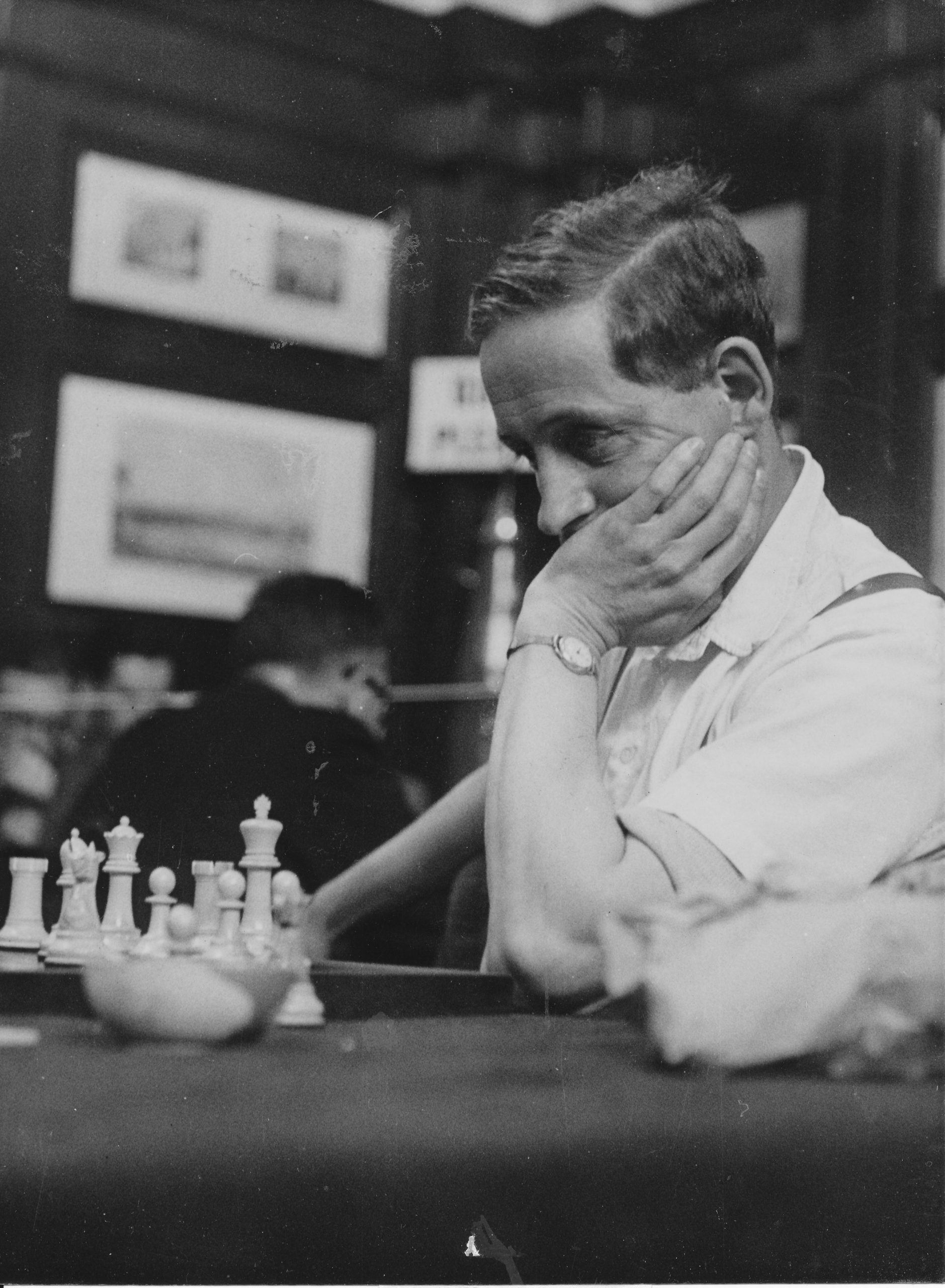
BH Wood during the 1948 British Championships at Bishopsgate Institute, London. Taken on August 30th 1948 by Keystone Press Agency

The tension got to BH, he missed a clear winning chance against the Northerner and lost. Yet he should really have taken the title on the merits of the positions he had achieved. His rivals resented the fact that he had hired a second, namely Paul Schmidt, the Estonian player who was once thought of as almost as good as Keres in his native land. Schmidt had won the German Championship during the war in 1941. The British amateurs of 1948 were not impressed by this intrusion of professionalism and the importation of someone who carried the taint of possible Nazism. According to Brian Reilly, Gerald Abrahams was particularly scathing.

BH made a good impression on Botvinnik when the latter stayed at the Wood residence in Rectory Road, Sutton Coldfield, in 1967 (the reference for those who can read Russian is Baturinsky’s “…Tvorchestvo” trilogy on Botvinnik. The article was entitled: Albion shakhmatny i inoy. It appears on pp435 -448 of the third volume. A shortened version appears in English in Botvinnik’s autobiography Achieving the Aim). When I drew BH’s attention to the article and its peculiar title he responded with his usual erudite comment: ‘Albion? Yes, that’s the Roman reference to the white cliffs of Dover”. For most Brummies, “The Albion” did not mean a local pub, but rather the West Bromwich Albion football team!

In theory, the communist Botvinnik should have been distant from his host, the Midlands entrepreneur and business man, who drove him round to his engagements in Britain for three weeks, but their common love of chess triumphed over ideological
differences. In particular, the speed of production of CHESS, now on its own presses, was compared very favourably by the Soviet Patriarch to that of Shakhmaty v SSSR. British trade unions had a different view of course, in pre-Thatcher days, and BH had some tricky obstacles to overcome in this field. The Muscovite Botvinnik recorded the fact that the garage of BH’s large house was full of chess books (as were various rooms – to the abiding despair of Marjorie), so the family car was always parked outside on the drive. BH revealed to Botvinnik that he had not been able pay off his mortgage for decades due to the variable cash flow from his business and journalism.

BH was in love with study as a young man, he once told me, and he had a facility in various European languages, which made him always welcome abroad. Over the years, BH had a number of employees who were strong players, such as Brian Reilly, Owen Hindle and Robert Bellin, but none of them lasted long. Owen Hindle, a person of placid temperament, stuck it out the longest, but even he had his patience tried by the ‘boss’. One cannot hide the fact that BH was a controversial figure – perhaps the clue after all is that reference to his stubbornness and Yorkshire blood? I contributed to his magazine for many years, but certainly never wanted to work for him full-time!

I used to see BH in the last decade of his life only in the Hastings press room. For his age, he still took on a fantastic workload. Peter Clarke once commented that his father-in-law gave the impression of believing he would live for ever. Finally, Anno Domini told and BH sold his business to Robert Maxwell of Pergamon fame/notoriety in 1988.

In his final year, BH suffered from diabetes, and the resulting inability to walk meant he was confined to a wheelchair, but he still insisted on visiting Hastings one last time, where, in his prime, he had specialised in taking away Premier score sheets. Often they were taken not just to his hotel room, but even back to Sutton Coldfield, so hindering the work of other chess journalists unless Ritson or later, Peter Griffiths had got in first to create the bulletin.

What a character! We lack such a colourful figure nowadays. Where he still alive today, I imagine he would still be trying to put a bomb under the BCF.

Winter, Jaques and Wood

From Chess Explorations (Cadogan Chess, 1996) by Edward Winter we have further detail on the Jaques court case:

“Paul Timson, a lawyer, sends us reports on two legal  cases connected with chess. In 1939 B.H.Wood found himself in the dock for having advertised for sale in CHESS in 1937 ‘genuine Staunton chessmen’. The plaintiffs were John Jaques & Son, Ltd. Sir George Thomas., Max Euwe and Lodewijk Prins appeared as witnesses for the defence. The case is referred to by Fred Wren in his article ‘Tales of a Woodpusher: Woodpusher’s Woodpile’, which appeared in Chess Review, 1949 and was reprinted in Reinfeld’s The Treasury of Chess Lore. The issues of CHESS of the time also contained a huge amount of material on the case. The decision was that ‘Staunton’ alone was permissible description, but that the phrase ‘genuine Staunton’ implied a product made by Jaques & Son Ltd., as opposed to any Staunton pattern.  However, B.H. Wood appealed and, in 1940, won.”

Other Sources

If you can get access then we recommend the eleven-page “B.H. Wood and his chess playing family” article in the August-2009 issue of Chess Monthly written by his son Chris Wood (helped by brother Frank).

Likewise The Chess Lawsuit of the Century is detailed in CHESS, volume 52, Number 1018, pp.392 – 394 by BHW himself.

Here is an obituary from the MCCU

Background information from Sutton Coldfield Chess Club

Alekhine’s Articles for CHESS by Michael Clapham

Here is his Wikipedia entry.
Death Anniversary of IM Robert Wade OBE (10-iv-1921 29-xi-2008)

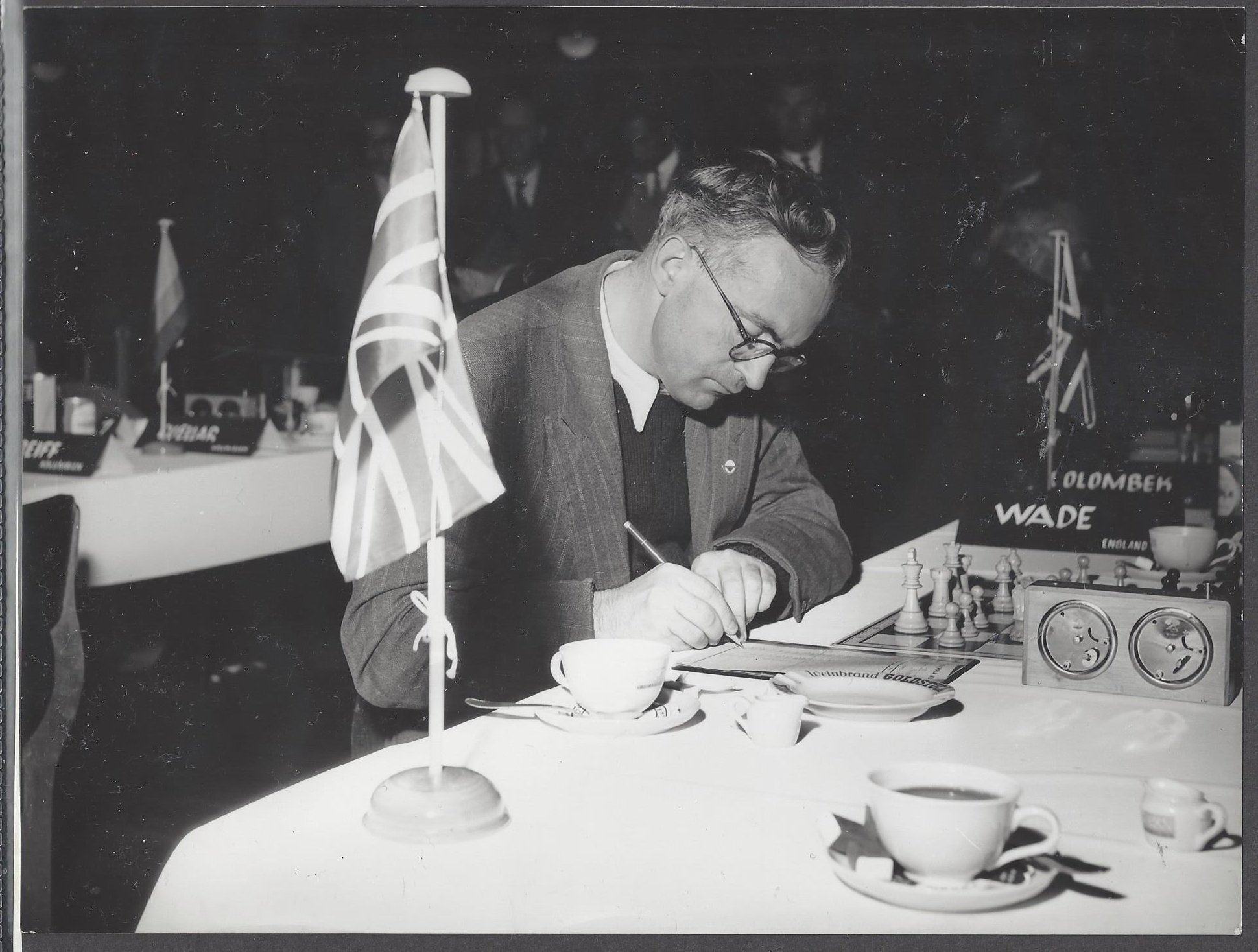
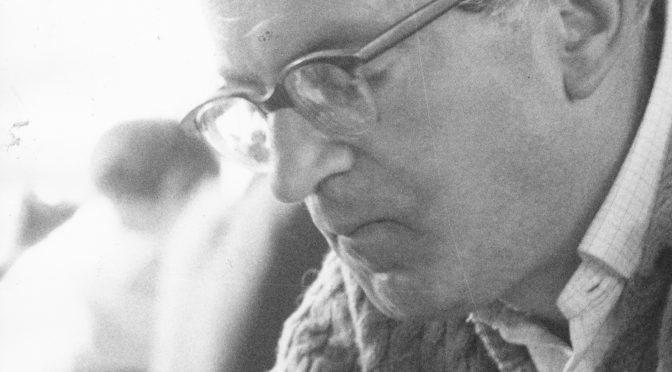
We remember IM Bob Wade OBE who was born 100 years ago today on Sunday, April 10th 1921

In 1979 Queen’s Birthday Honours List, Civil Division Bob Wade was awarded the OBE. The citation read simply : “For services to Chess”

He won the BCF Presidents’ Award in 1986.

In the Foreword to the 2009 ECF Yearbook, President Gerry Walsh wrote :

“As I started this report I had just heard the sad news that IM Bob Wade had died aged 87. I first met Bob at one of the Whitby Congresses and in 1972 he played in the Teeside GM Tournament where I recall he beat the three Hungarian players Portisch, Bilek and Sax (ed : aged 51).”

Geurt Gijssen wrote in Chesscafe.com :

“I received the sad news that Bob Wade passed away at the age of eighty seven. He played his last tournament in London in August. When I was young I read about his exploits as a chess player, and he was the arbiter in many important chess events. I met him in 1993 when I was the organizer of the first part of the match Karpov – Timman, played in The Netherlands in three different cities: Zwolle, Arnhem, and Amsterdam. He was the only member of the Appeals Committee and Bob was always present watching the games in the playing hall. He gave me invaluable advice about all elements of the match venues. It was very clear that he was an experienced chess player and arbiter, and I learned many things from him. May he rest in peace.”

From the 1952 Ilford Congress (30 May - 2 June) and originally published in BCM, July 1952, page 187. (l-r) : Harold Israel, Alan Phillips, Bob Wade, Otto Friedman, Abe Yanofsky, Alfred William Bowen and Harold Meek. Thanks to John Saunders and Leonard Barden
From the 1952 Ilford Congress (30 May – 2 June) and originally published in BCM, July 1952, page 187. (l-r) : Harold Israel, Alan Phillips, Bob Wade, Otto Friedman, Abe Yanofsky, Alfred William Bowen and Harold Meek. Thanks to John Saunders and Leonard Barden

Wade was Southern Counties (SCCU) champion for the 1956-57, 1957-58 and 1964-65 seasons.

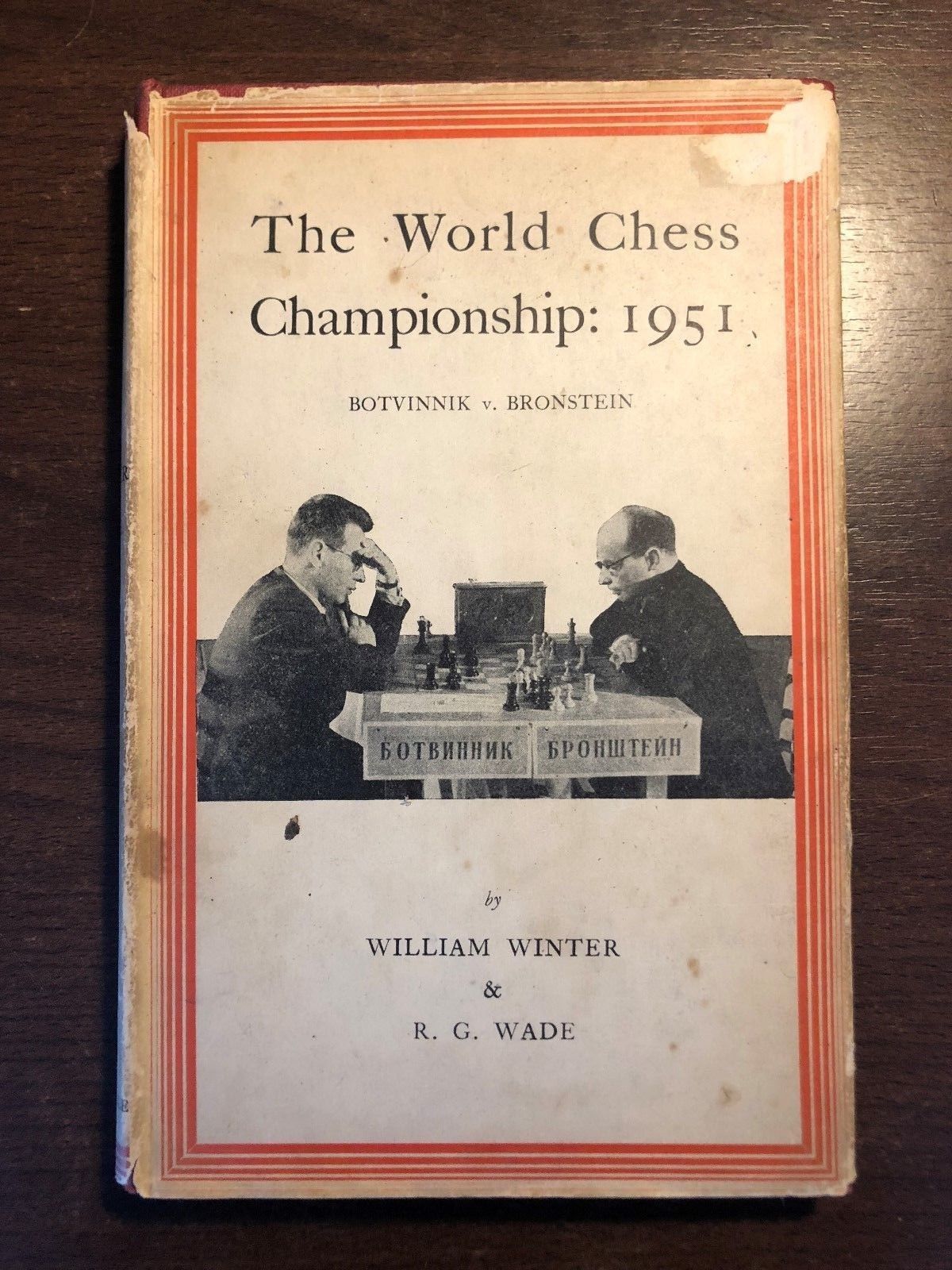
From the Preface of The World Chess Championship : 1951 by Lionel Sharples Penrose we have :

“Mr. Wade is also passionately devoted to the game. Before coming to Europe, he was three times champion of New Zealand. He had played in tournaments in England but his chief successes have been on the Continent. At Venice in 1950, he obtained a high place in a very severe contest in which some of the strongest Russia, Czech, Dutch, French, Italian, North and South American players took part. Much of his time is occupied in chess organising and teaching. He is an acting vice-president of the F.I.D.É and in this official capacity he attended the match in Moscow, which is the subject of this book.”

IM Bob Wade
IM Bob Wade

Paul McKeown researched (and Simon Spivack asked permission to reproduce his words) the earliest part of Bob’s life as follows:

“On May 20th, 1919, Thomas Graham Wade, aged 27, Sergeant in the NZ Expeditionary Force, repatriated with honour from war-time service in Egypt, Gallipoli and France, married Amy Lilian Neave, aged 21, in South Dunedin. A New Zealander of Scots and English descent, his family was Graham from Montrose. The family name, Wade, came from Marshall George Wade, the soldier and engineer who led the Hanoverian forces against the Scots at the time of the 1745 Jacobite Rebellion and was immortalised in the original third verse of the British national anthem:

Lord, grant that Marshal Wade,
May by thy mighty aid,
Victory bring.

May he sedition hush and like a torrent rush,
Rebellious Scots to crush,
God save the King.

IM Bob Wade
IM Bob Wade

Robert Graham Wade, known in the Scots manner to his family as Robin, and later to his many friends as Bob, was their first child, born April 10th, 1921, at Dunedin. Over the next few years he was joined by sisters, Lilian, Agnes, Betty, June, his brother Ted and finally by his youngest sister Amy. The family lived for a number of years at Portobello.

At that time, Portobello was a scattered community of about 150 people with three shops and a pub on the Otago Peninsula. Bob attended Portobello Primary School, a small country school, finished “dux” or top of class, and then attended the King Edward Technical High School at Stuart Street in Dunedin.”

IM Bob Wade
IM Bob Wade

In The Oxford Companion to Chess (OUP, 1984 & 1996), Hooper & Whyld:

“Wade Variation, 147, also known as the Modern Variation, in the Queen’s Gambit Declined, Meran Variation, from Bogoljubow-Wade, Oldenburg, 1949;

1239 in the French Defence, introduced by Wade in a match against Schmid in 1950.

Hooper & Whyld go on to write :

“New Zealand-born Robert Graham Wade (1921- ) won the championship of his homeland three times before moving to England as a young man, He won the British Championship twice and trained many English players.”

Aside from the two variations mentioned by Hooper & Whyld there are other Wade Variations :

which Jim Plaskett dubbed the “Sidestep Variation”

and

which is the Pytel-Wade Variation of the Scandinavian Defence.

Anne Sunnucks wrote in The Encyclopaedia of Chess (Robert Hale, 1970 & 1976) :

“International Master (1950 Ed: actually 1954), International Judge (1958), New Zealand Champion three times and British Champion in 1952 and 1970.

Bob Wade was born in New Zealand on 10th April 1921 and is a professional chess player. He has lived in England for many years and has played regularly for the British Chess Federation team in Chess Olympiads. He has played a prominent part in coaching schemes for juniors and is largely responsible for recent successes of English juniors in international events.

Bob Wade v. Aldecoa of the Philippines from the 1958 Munich Olympiad played on October 9th 1958. The game was won by Bob in 60 moves. From the collection of David Jarrett with many thanks.

He is chess correspondent of Associated Newspapers and Independent Television News and editor of a series of books on Contemporary Chess Openings published by Batsford.

Author of a number of books on the game, his publications include books on the World Championship of 1951, 1957 (ed : this book was, in fact, by Golombek) and 1963, the first in collaboration with W. Winter; The Closed Ruy Lopez (Batsford, 1970) in collaboration with LS Blackstock and PJ Booth: World Chess Championship (Batsford, 1972) in collaboration with Svetozar Gligoric; Games of RJ Fischer (Batsford, 1972) in collaboration with KJ O’Connell and Soviet Chess (Neville Spearman, 1968).

Wade was a member of the FIDE Laws Commission from 1950 to 1952.”

From The Encyclopedia of Chess (Batsford, 1977), Harry Golombek OBE :

“International Master who was born at Dunedin, New Zealand, but came to live In England in 1946 and has represented both countries on different occasions. He has nearly always done well in British Championships and won the title in Chester in 1952 and again at Coventry in 1970. He had played for the British Chess Federation at the Olympiads of 1954, 1956, 1958, 1960 and 1962, winning the shortest game of the Varna Olympiad in that year in nine moves against Anton Kinzel of Austria

He played for the New Zealand team at the 1970 Olympiad at Siegen but returned to the BCF team at Skopje in 1972.

His best individual international results were a fifth place at Venice 1950 and again fifth at the Masters section of the Capablanca Memorial at Cienfuegos in Cuba in 1975. Possessor of a sharp clear-cut style of play, he once drew a match with the West German grandmaster Lothar Schmid with neither side drawing a game, though this was before Schmid received the grandmaster title.

He has done much valuable work in England teaching the young, and was responsible for the text of a highly successful television series in 1975.

His main books are : Soviet Chess, London, 1967; Botvinnik-Bronstein Match 1951 (in co-operation with W. Winter), London, Toronto 1951; Match Petrosian-Botvinnik, London, 1963; Sousse 1967, The Chess Player, Nottingham, 1968.”

From British Chess (Pergamon Press, 1983) we have this article from George Botterill :

“In the Birthday Honours list of 1979 Bob Wade was awarded the OBE for his services to chess. Few rewards can have been more thoroughly earned. For some reason, Bob has always been held in greater esteem abroad than in the country for which he has done so much. But the many players who have turned to him for advice or who have simply enjoyed his hospitality, which is always ungrudgingly available to fellow chess players, know the measure of his dedication to the game.

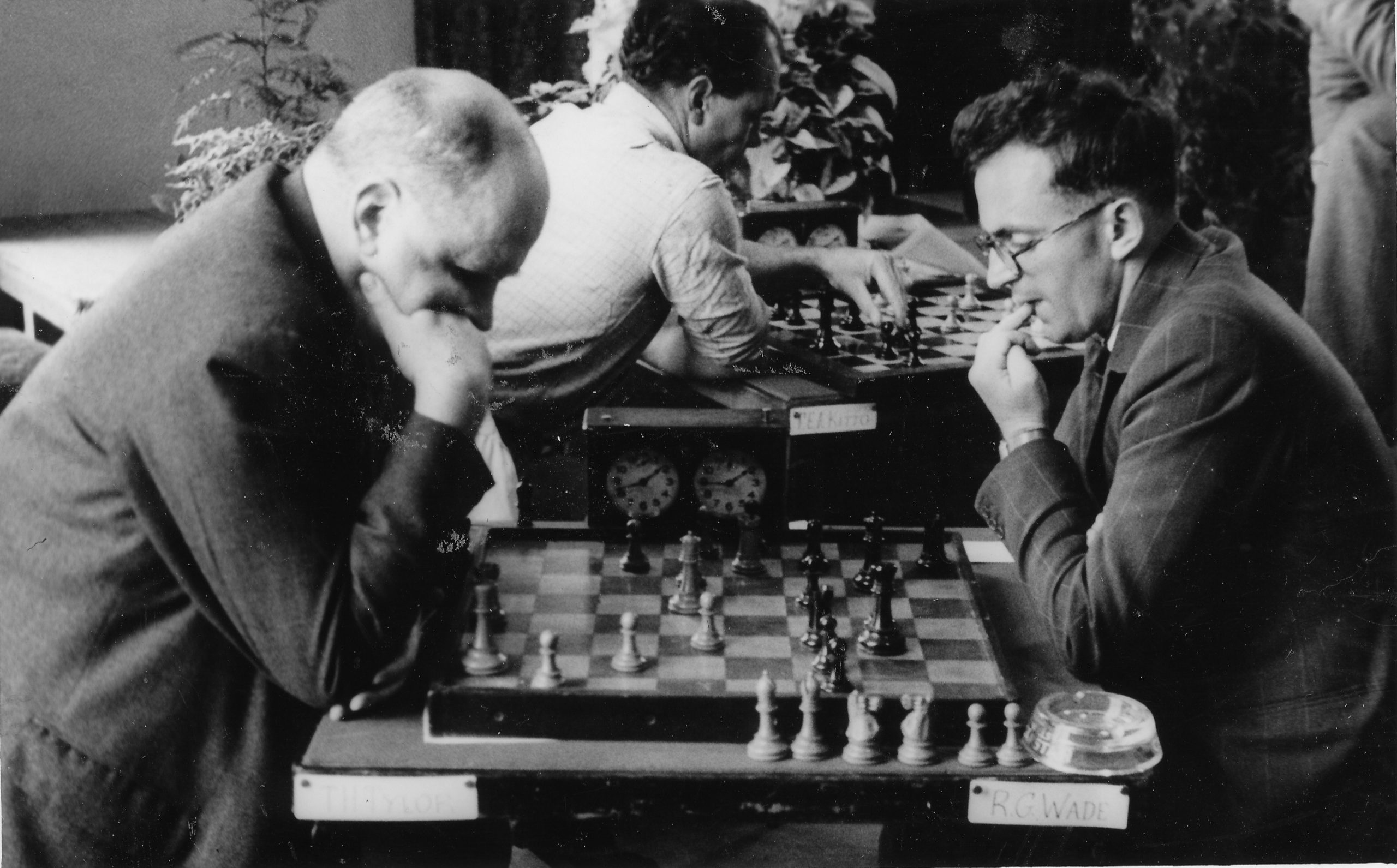
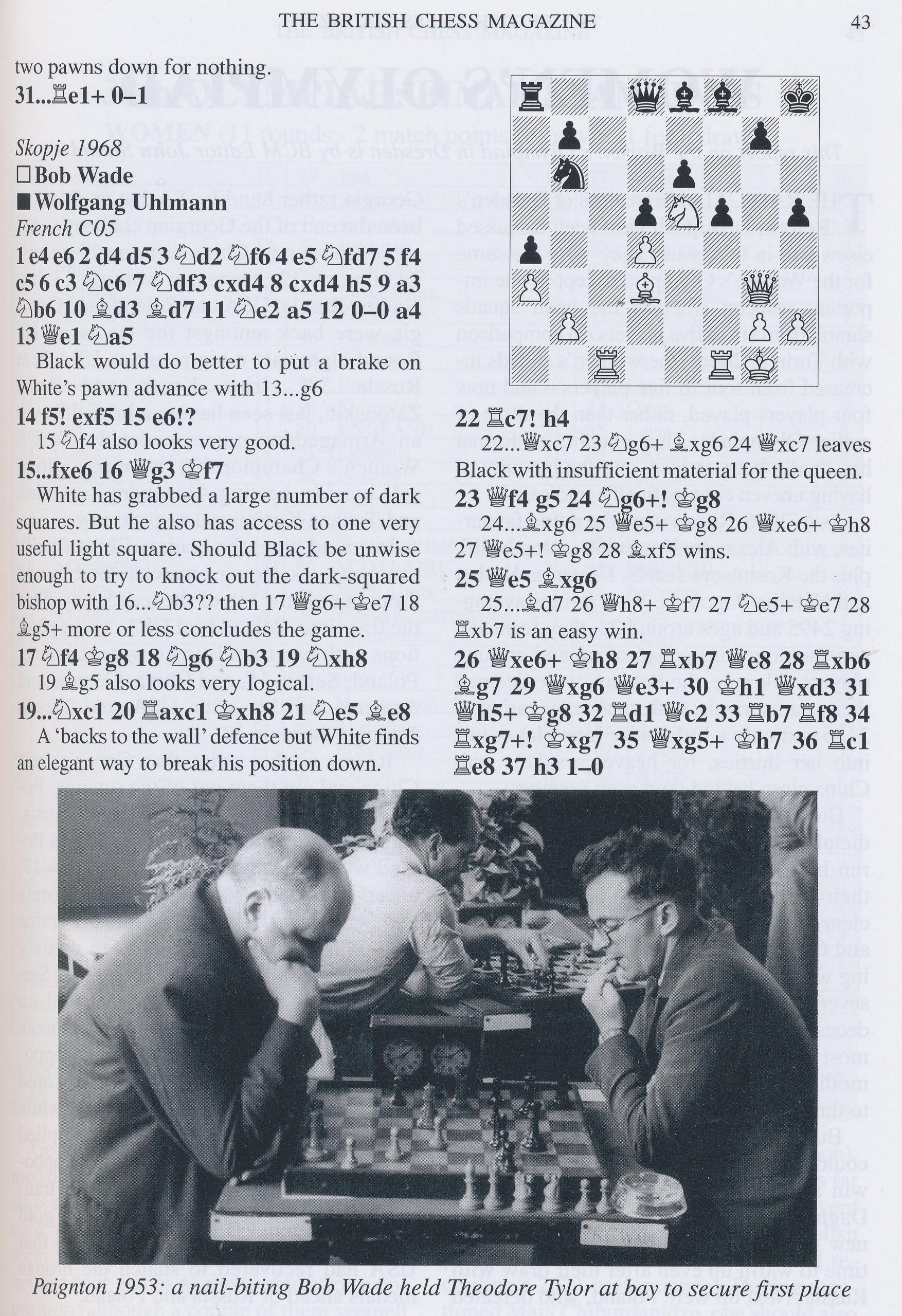
Theodore Tylor vs Bob Wade at Paignton 1953. Bob held TT to a draw to secure first place.
Theodore Tylor vs Bob Wade at Paignton 1953. Bob held TT to a draw to secure first place

Wade was born in Dunedin, a third generation New Zealander of Scots and English ancestry. He started a a career as a civil servant in the Department of Scientific and Industrial Research. Having won the New Zealand Championship in 1944 and 1945 he was sent over to participate in the British Championship of 1946. The result was not exactly a success – a mere 3.5 points out of 11. But Bob was not to be disheartened so easily. Feeling he was capable of better things, he took leave of absence in 1947 and did the circuit, such as it then was, of chess tournament in Europe and North America.
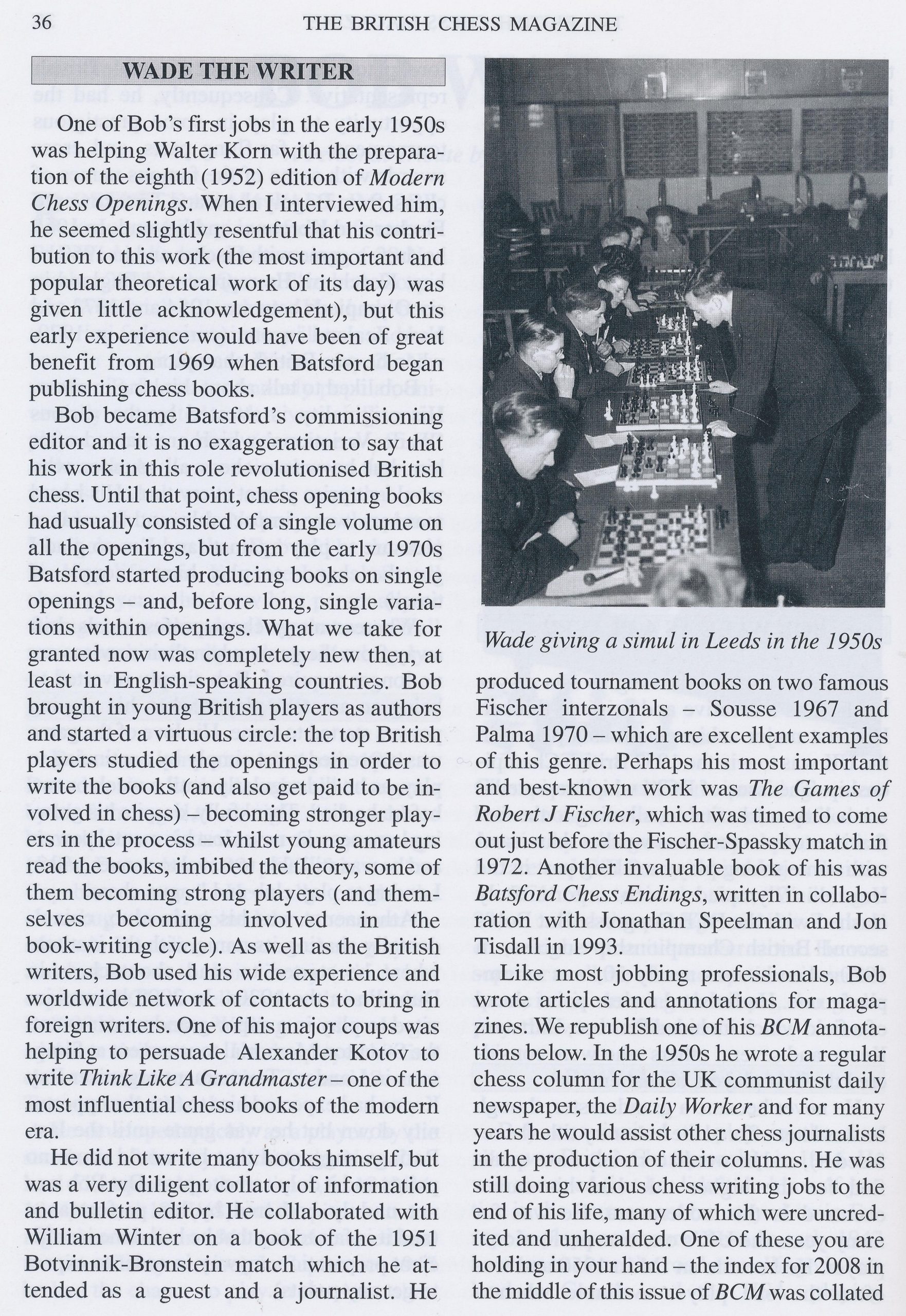
Bob giving a simul in Leeds in the 1950s

When he returned to New Zealand he found that he had been transferred to another department in a civil service reorganisation. The new job was not so congenial. He stuck it out for 6 months – during which time he won the New Zealand Championship for a third time – and then handed in his resignation to take up the precarious life of a chess professional.

IM Bob Wade
IM Bob Wade

Settling in Britain he soon gained the IM title (ed : 1954). But even in those days when still a young man Wade did not concentrate exclusively on his own playing career. In 1949 he went to the FIDE congress and was one of the five people – the others were BH Wood, Ragozin, Zubarev and Rogarde – who collaborated on the writing of the official rules for the game.

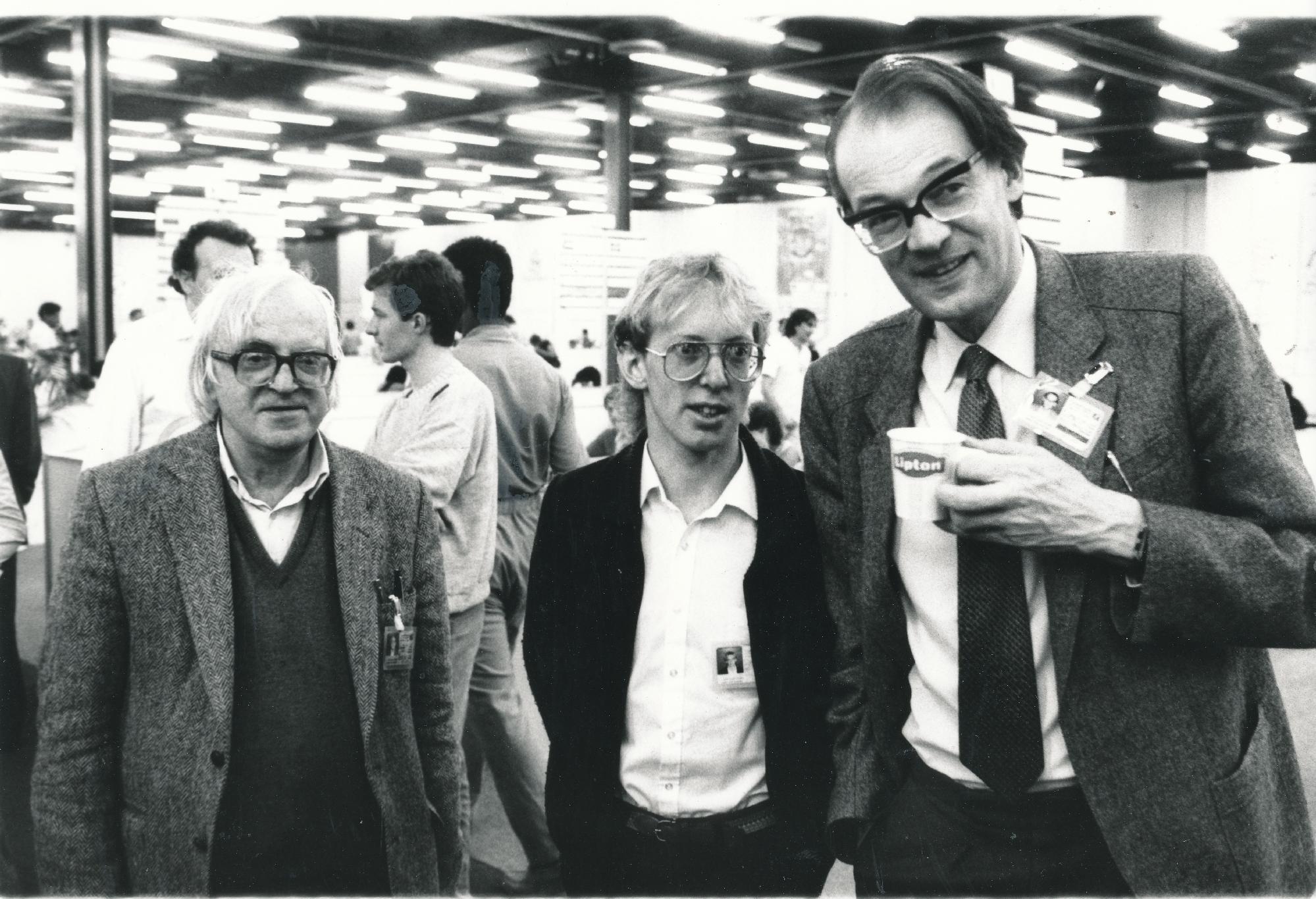
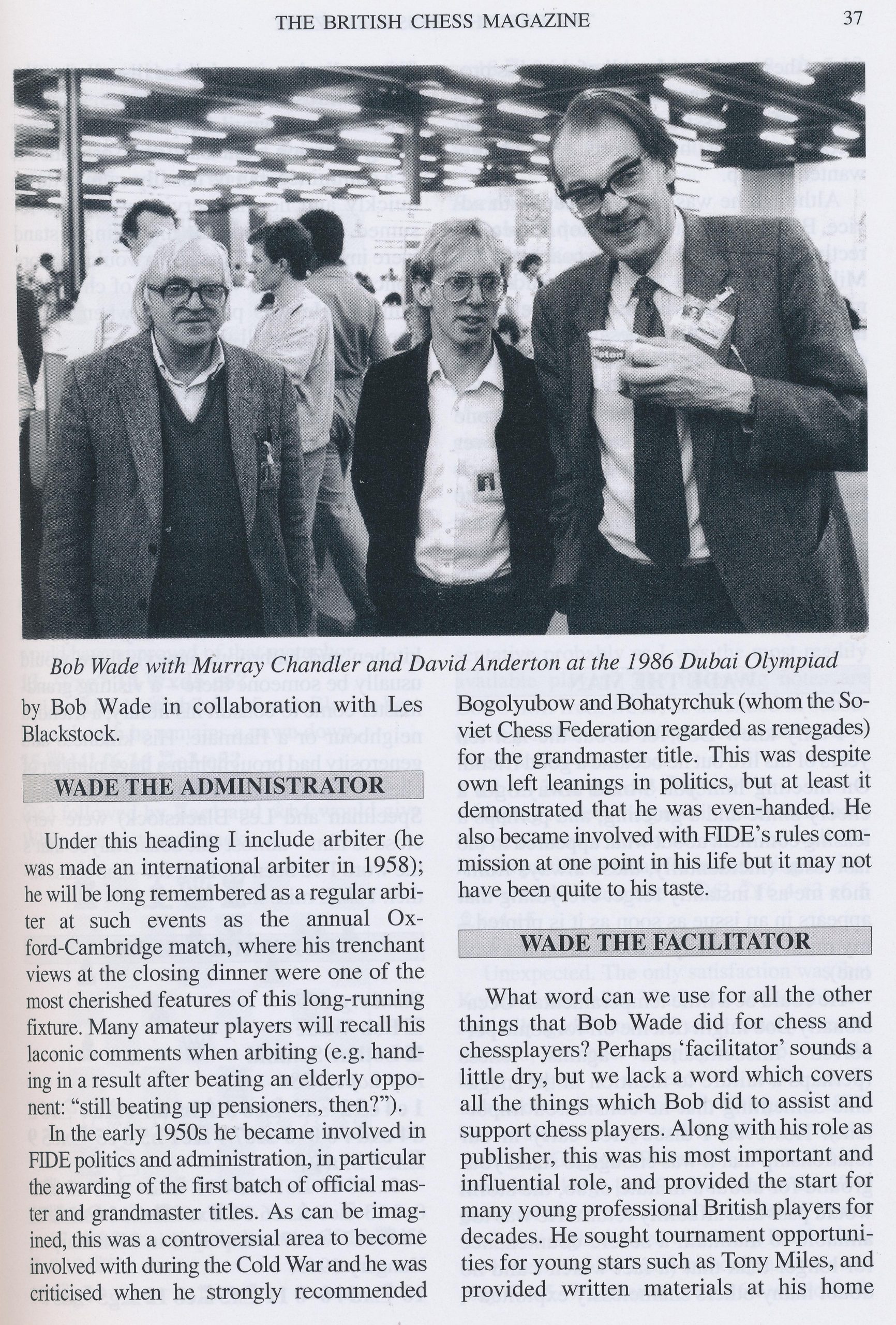
Bob Wade OBE, Murray Chandler MNZM and David Anderton OBE at the 1986 Dubai Olympiad. Photograph by Frits Agterdenbos

He also served as a member of the commission that determined who the original holders of international titles would be. When you consider that Wade was also on the 1950 commission that decided the composition of the World Championship Interzonals, it becomes apparent that this man played a significant part in the shaping the structure of modern international chess.

Bob at a CentYMCA event with Neil Carr, Mike Wills, Aaron Rose and Jon Ady

Although rarely at the top in international tournaments, Wade was always a very dangerous player, capable on his day of beating anybody in the world. He won the British Championship twice at Chester in 1952 and at Coventry in 1970.

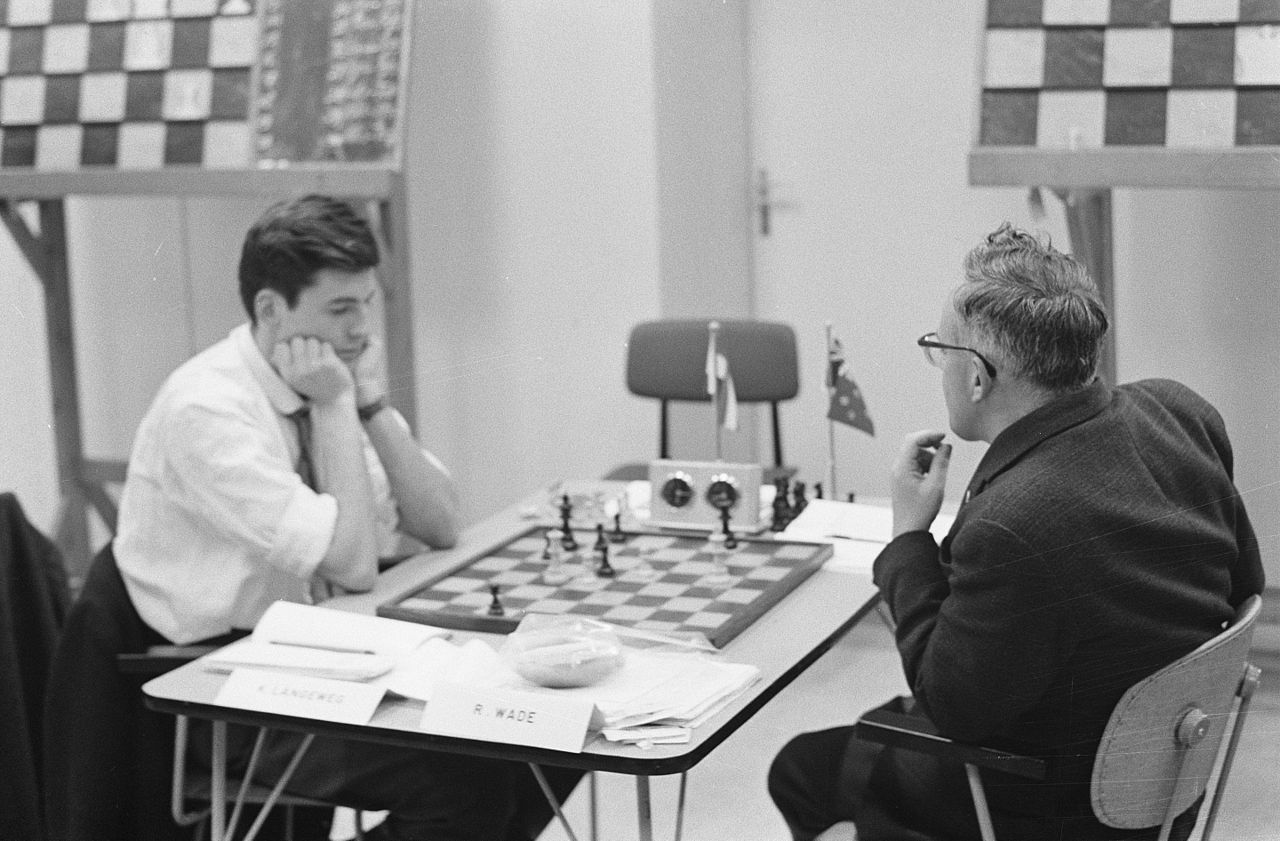
Bob playing Kick Langeweg at IBM 1961.

In recent years Wade has put his main energies into junior training and organisation and also into his work as the editor of Batsford’s highly productive and extremely successful series of chess books.

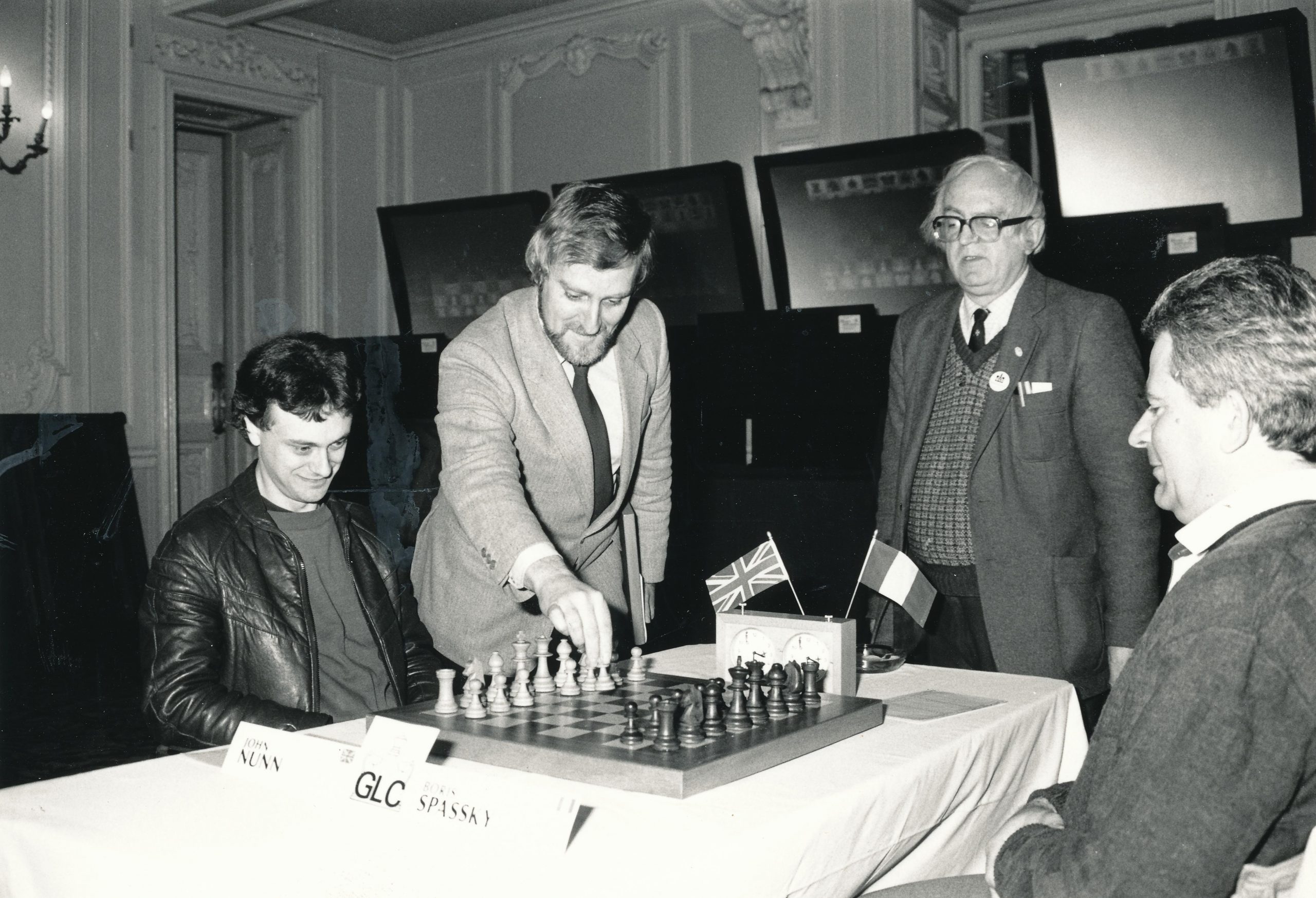
Bob with John Nunn and Boris Spassky at the GLC Masters

It is hard to say in what department one should place Wade’s greatest contributions to British Chess. Living through what is retrospect look to have been the Dark Ages of British chess – the 1950s and 1960s – he has demonstrated that even in a social and cultural environment that made playing chess economically ‘impossible’ profession to follow it was still possible to dedicate a life to chess, if one had the determination.

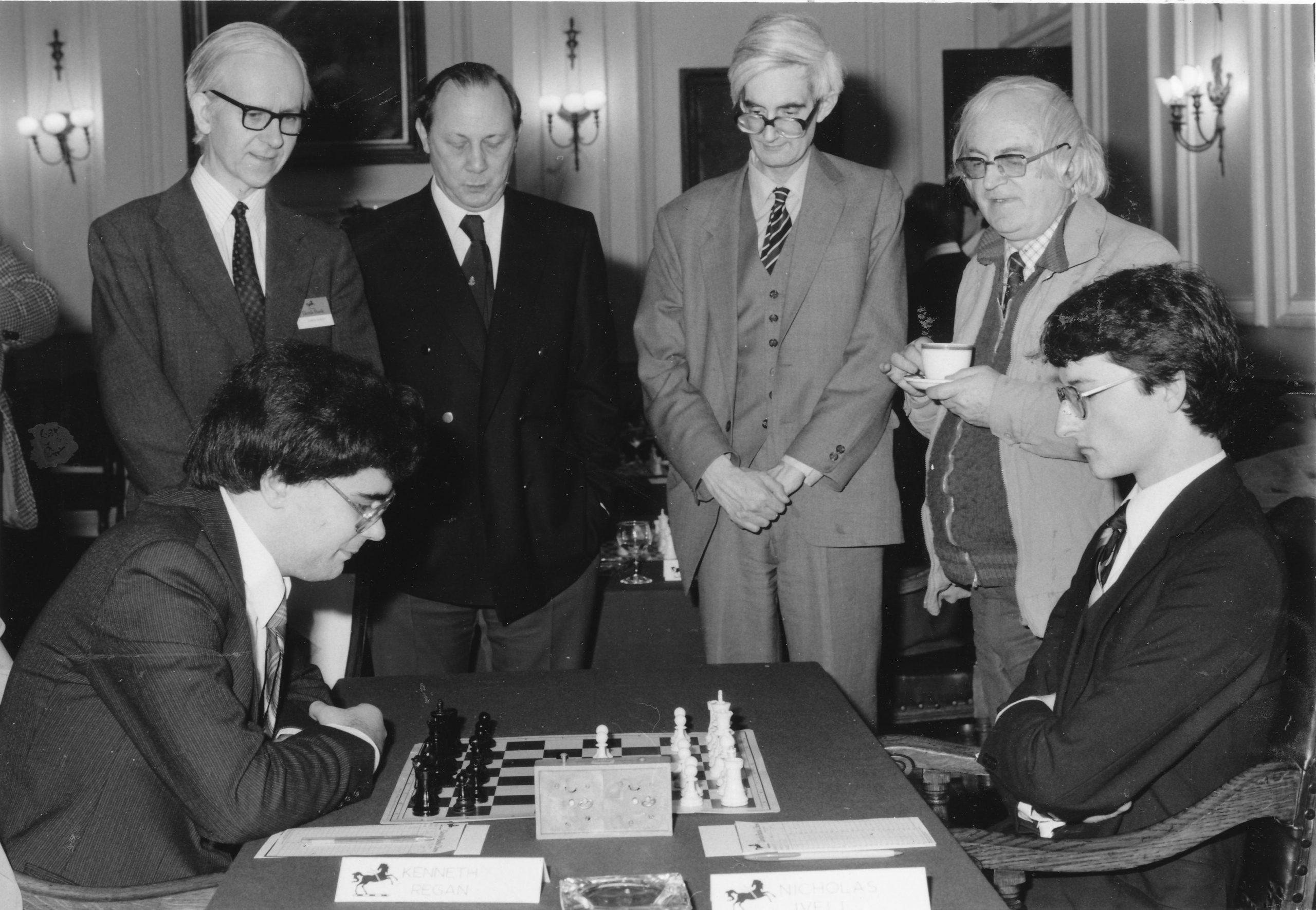
Leonard Barden, Henry Mutkin, Adrian Hollis and Bob Wade observe Nick Ivell vs Ken Regan at the 1983 Varsity match

During those years he was really the only British Player who regularly active in international tournaments. Since then he has been constantly active as an author, editor and adviser, always working to transform Britain into a country more congenial to good chess.

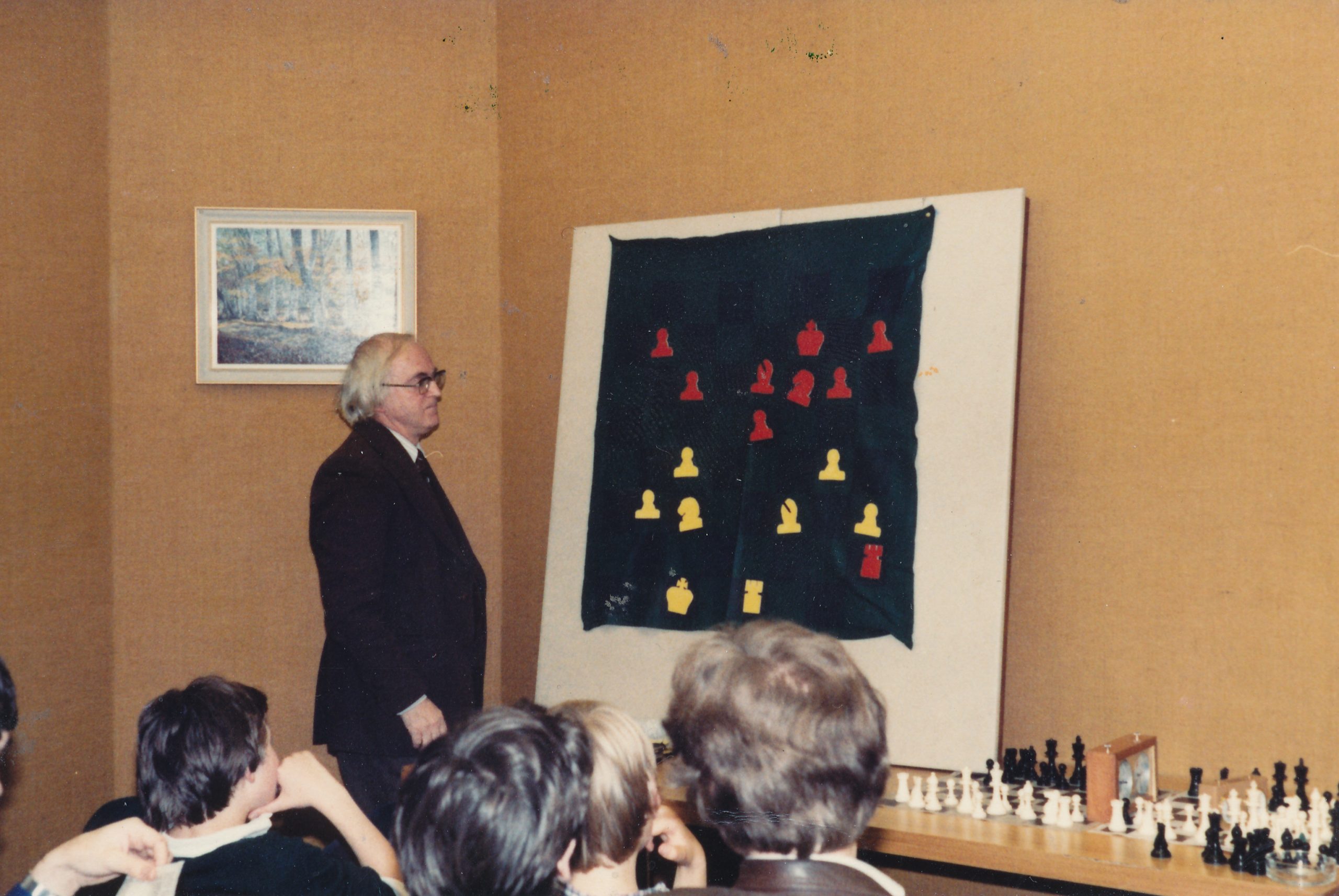
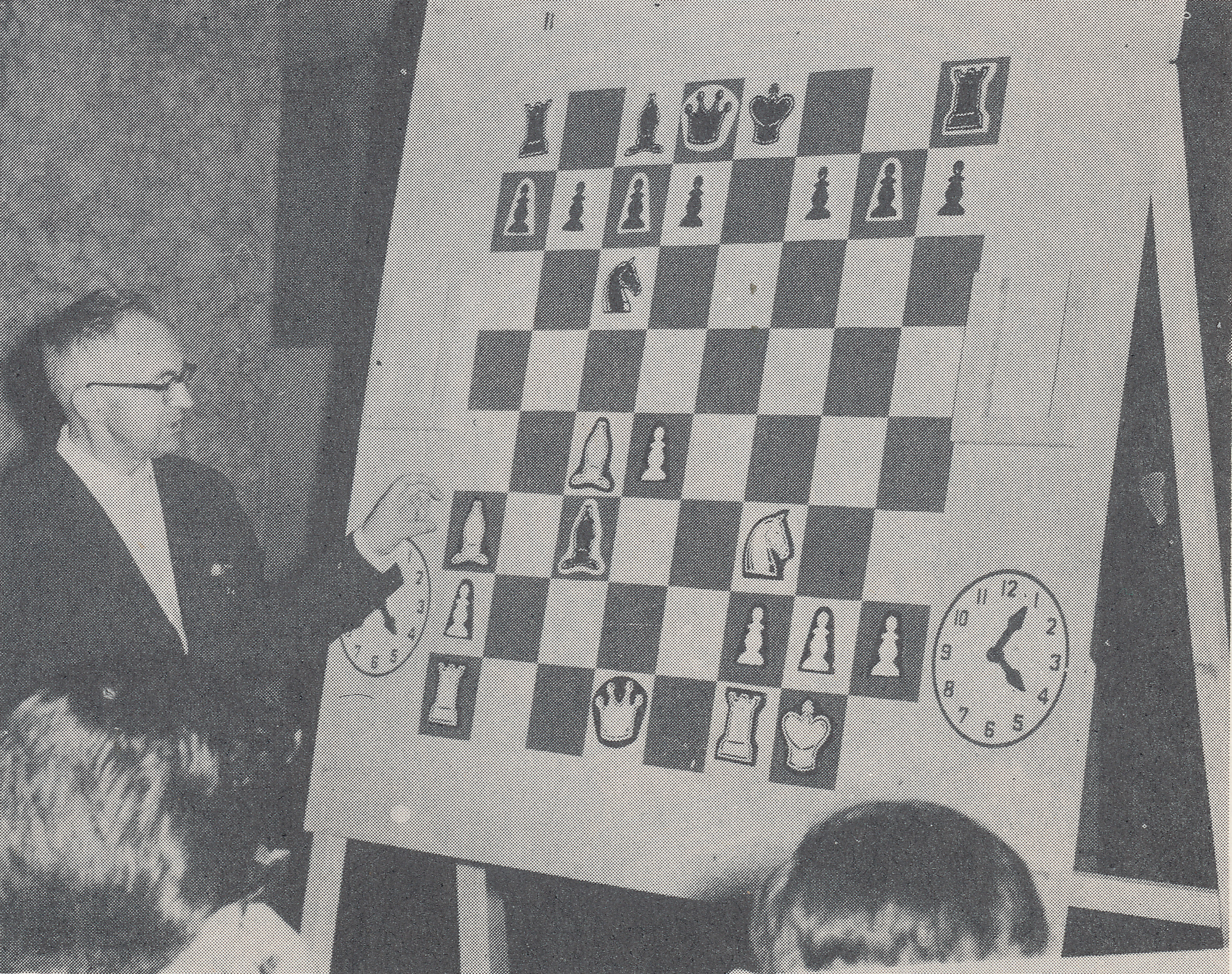
Bob at the demo board at London Central YMCA chess club.

But we suspect that he might regard this role as trainer and coach as the most important thing of all. He is, quite appropriately the British Chess Federation’s Chief National Coach.

Bob doing one of the things he loved best : teaching. He was discussing a position at Havana 1965. Dr JR Capablanca, son of the former world champion, on the right, interpreted.

If one had to choose a single best game from Wade’s whole tournament career, it would probably be this one.

George Botterill

Dr. Fazekas (left) playing Bob Wade at an Ilford Congress, photographer unknown

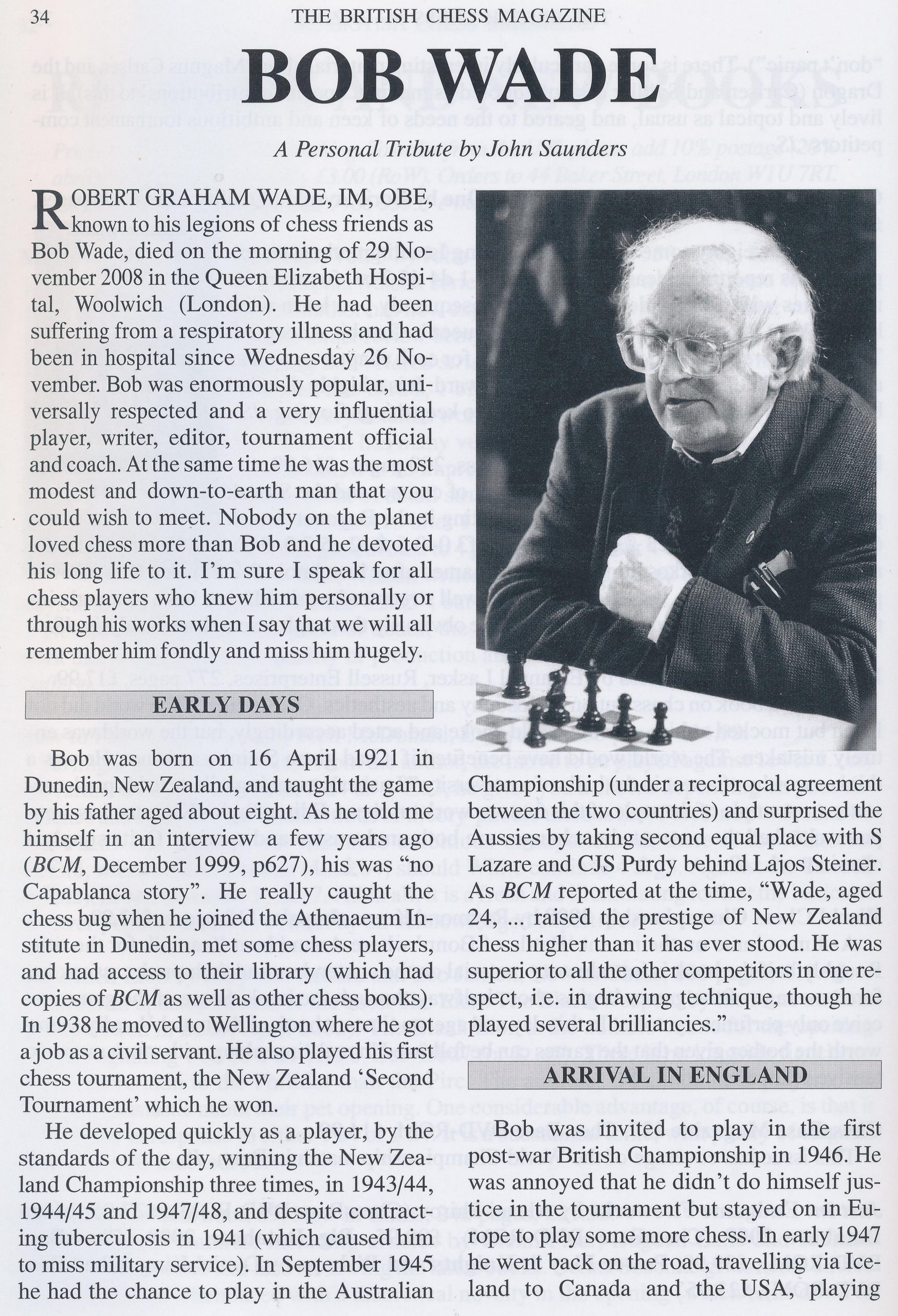
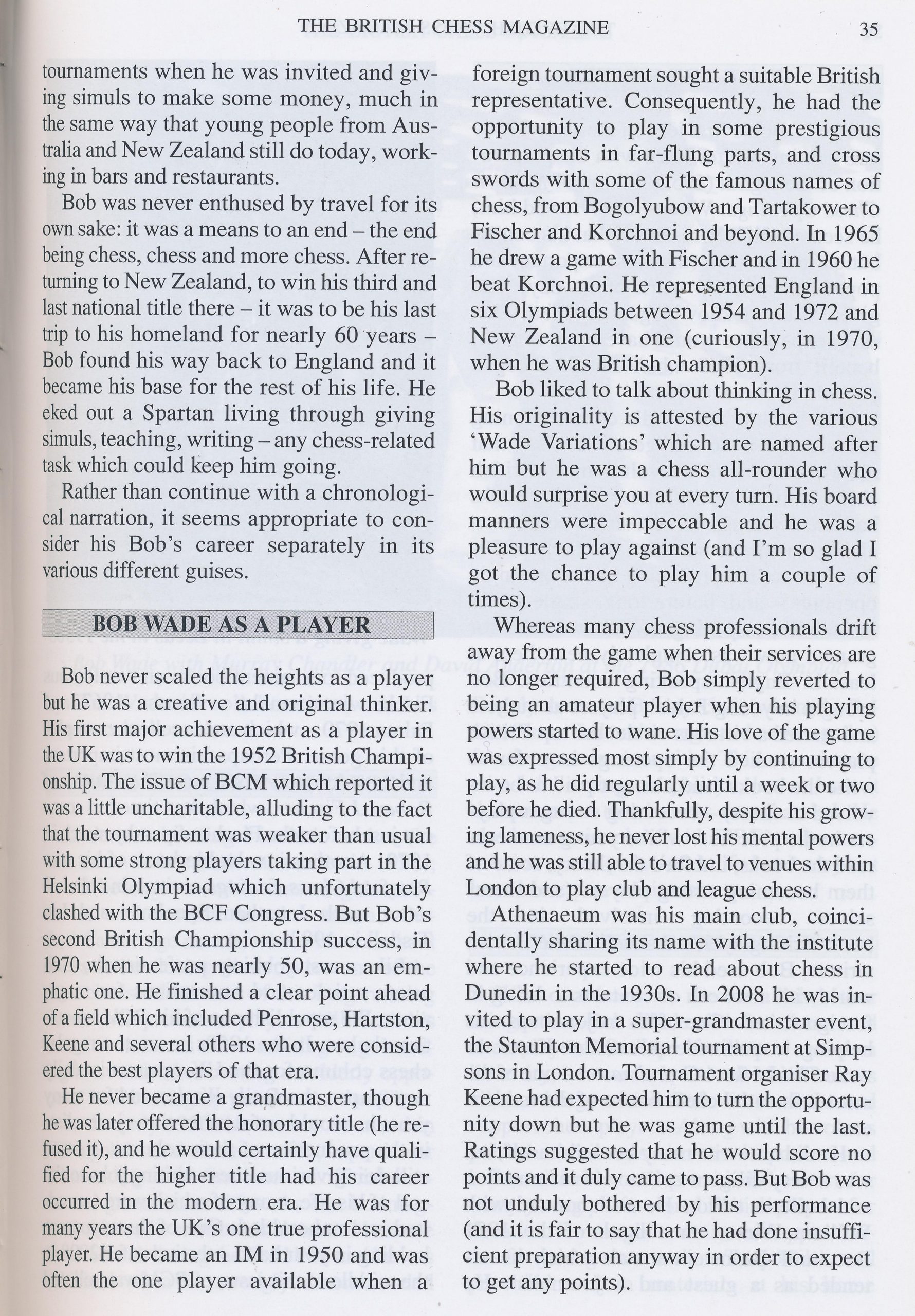
In the January 2009 issue of British Chess Magazine John Saunders wrote a ten page obituary as follows :

British Chess Magazine, Volume CXXIX (129, 2009), #1 (January), pp. 34-43

Leonard Barden wrote this obituary

Here is Bob’s Telegraph obituary.
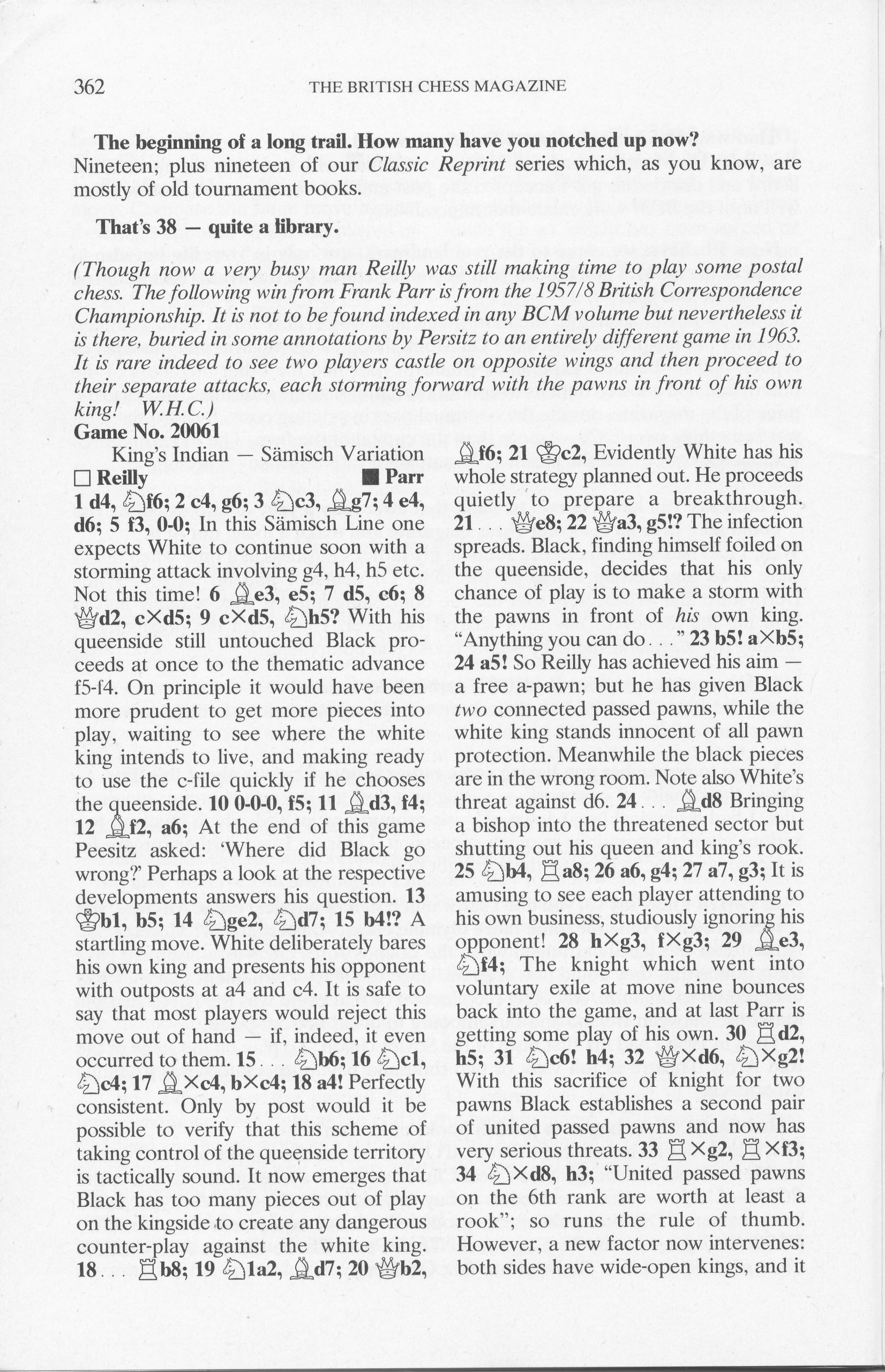
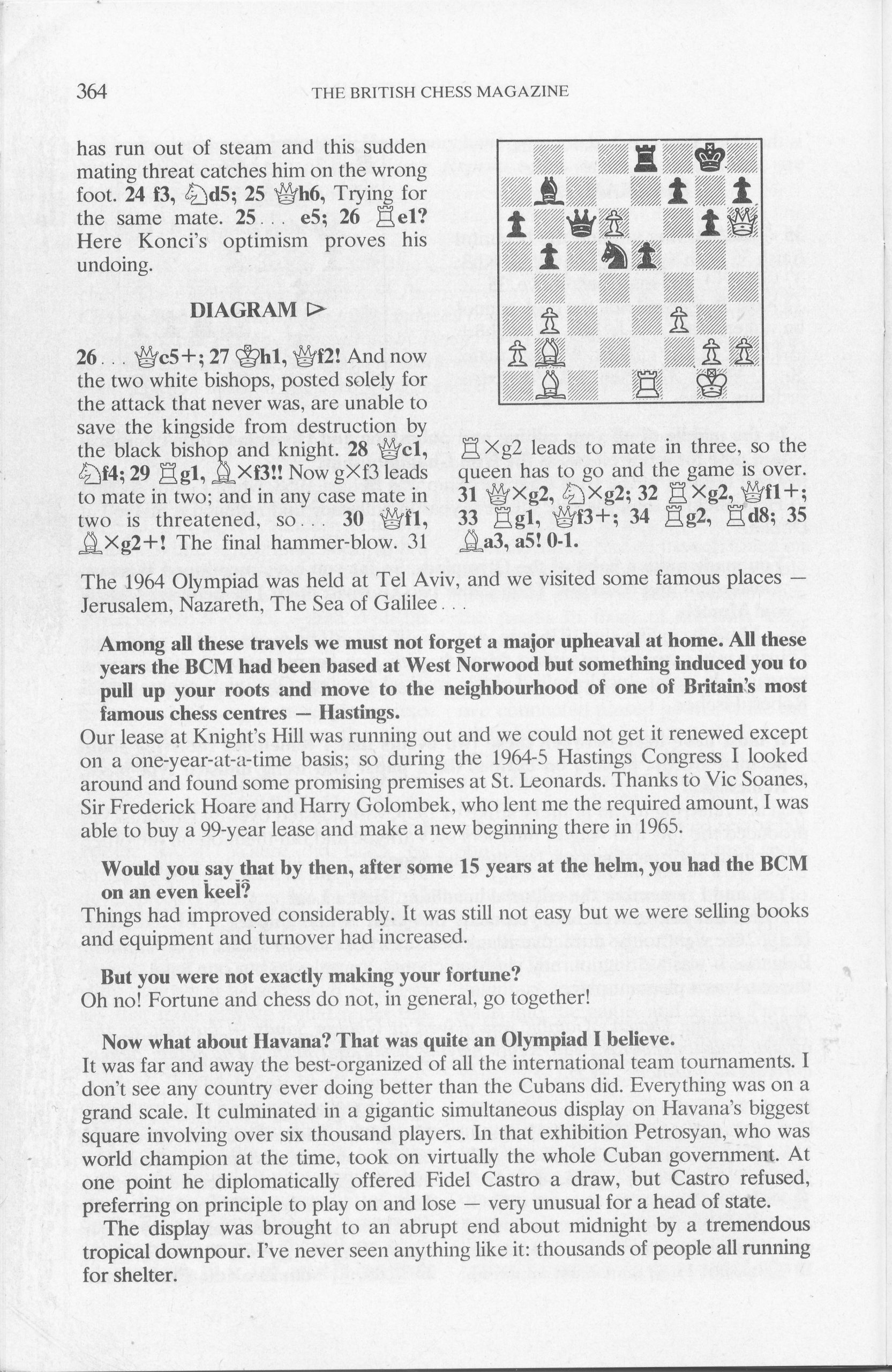
John Saunders interviewed Bob at his Blackheath home and wrote this extensive article for the 1999 British Chess Magazine.

His detailed results in Olympiads, from olimpbase.org, follow.

Amsterdam 1954, England board 4, 6/12 (+4−4=4);
Moscow 1956, England board 3, 6½/14 (+2−3=9);
Munich 1958, England 1st reserve, 7/14 (+5−5=4);
Leipzig 1960, England 2nd reserve, 6/11 (+4−3=4);
Varna 1962, England 2nd reserve, 6/12 (+4−4=4);
Siegen 1970, New Zealand board 2, 9/15 (+7−4=4);
Skopje 1972, England board 3, 7½/14 (+4−3=7).
Wade won several middle-strength Master events in the British Isles: Ilford 1957 and 1968, Paignton 1959, Dublin 1962, and Southend-on-Sea 1965.

Wade was generally no more than a middle-ranking player in strong international tournaments. His other highlights against high-standard international-level competition include:

tied 4–5th at Haifa/Tel Aviv 1958 on 7½/13 (winner Samuel Reshevsky);
3rd at Bognor Regis 1959 on 7/10 (winner Erno Gereben);
5th at Reykjavík 1964 on 7½/13 (winner Mikhail Tal);
tied 4–5th at Málaga 1966 on 7/11; (winners Alberic O’Kelly de Galway and Eleazar Jiménez);
6th at Briseck 1971 on 7/13 (winner Gideon Barcza);
5th at Cienfuegos ‘B’ 1975 on 10/17; (winners Julio Boudy and Amador Rodriguez);
tied 7–12th in the World Senior Championship, Bad Woerishofen 1992, on 7½/11 (winner Efim Geller).
Wade was the only British player to have faced Bobby Fischer in tournament play (outside of Olympiads). They met three times, with Wade drawing one game and losing the other two.

His detailed Wikipedia entry may be found here

Bob was an active author and wrote (or co-wrote) around 22 books as follows :

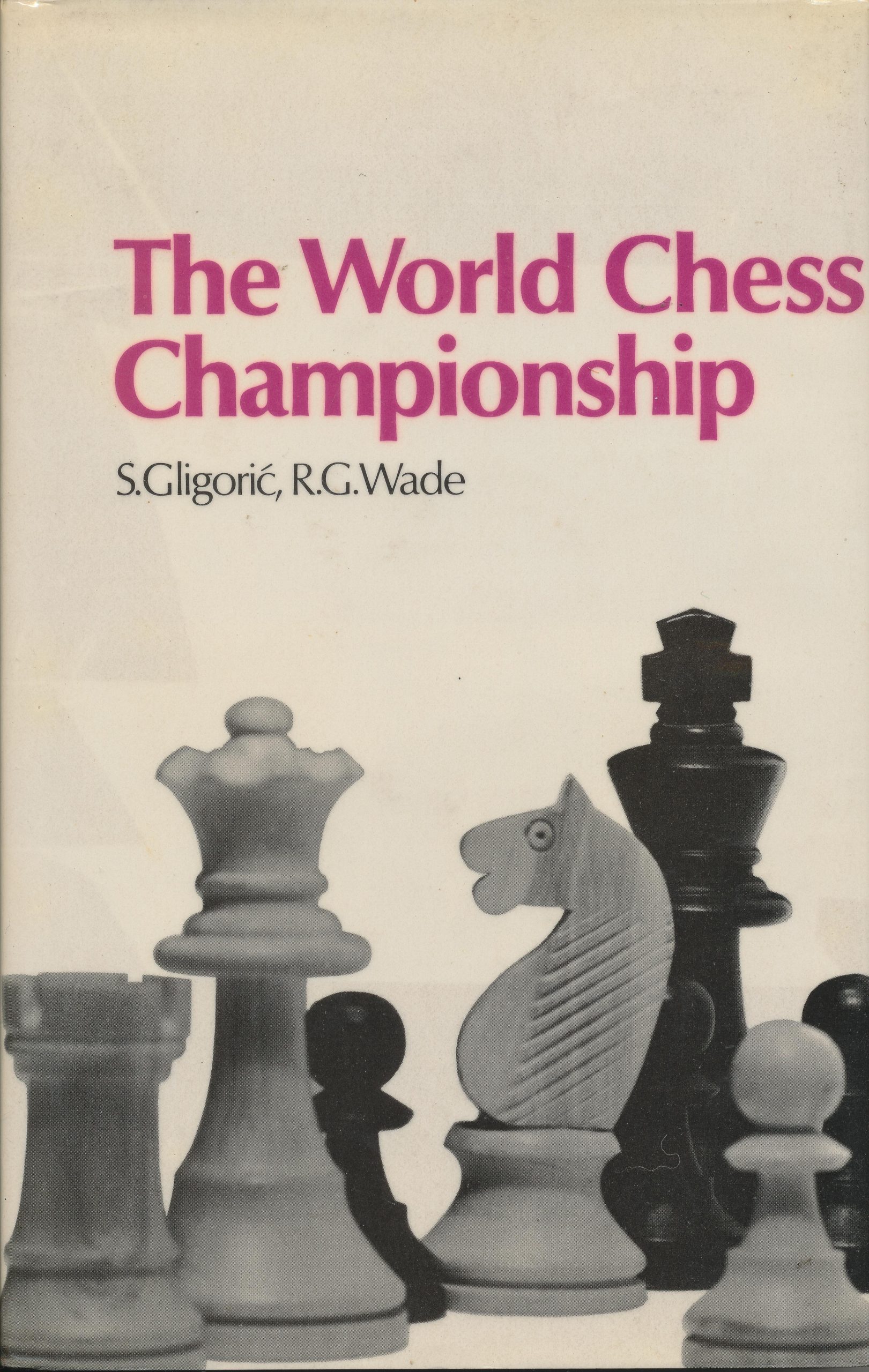
The World Chess Championship, W.Winter & RG Wade, Turnstille Press, 1951
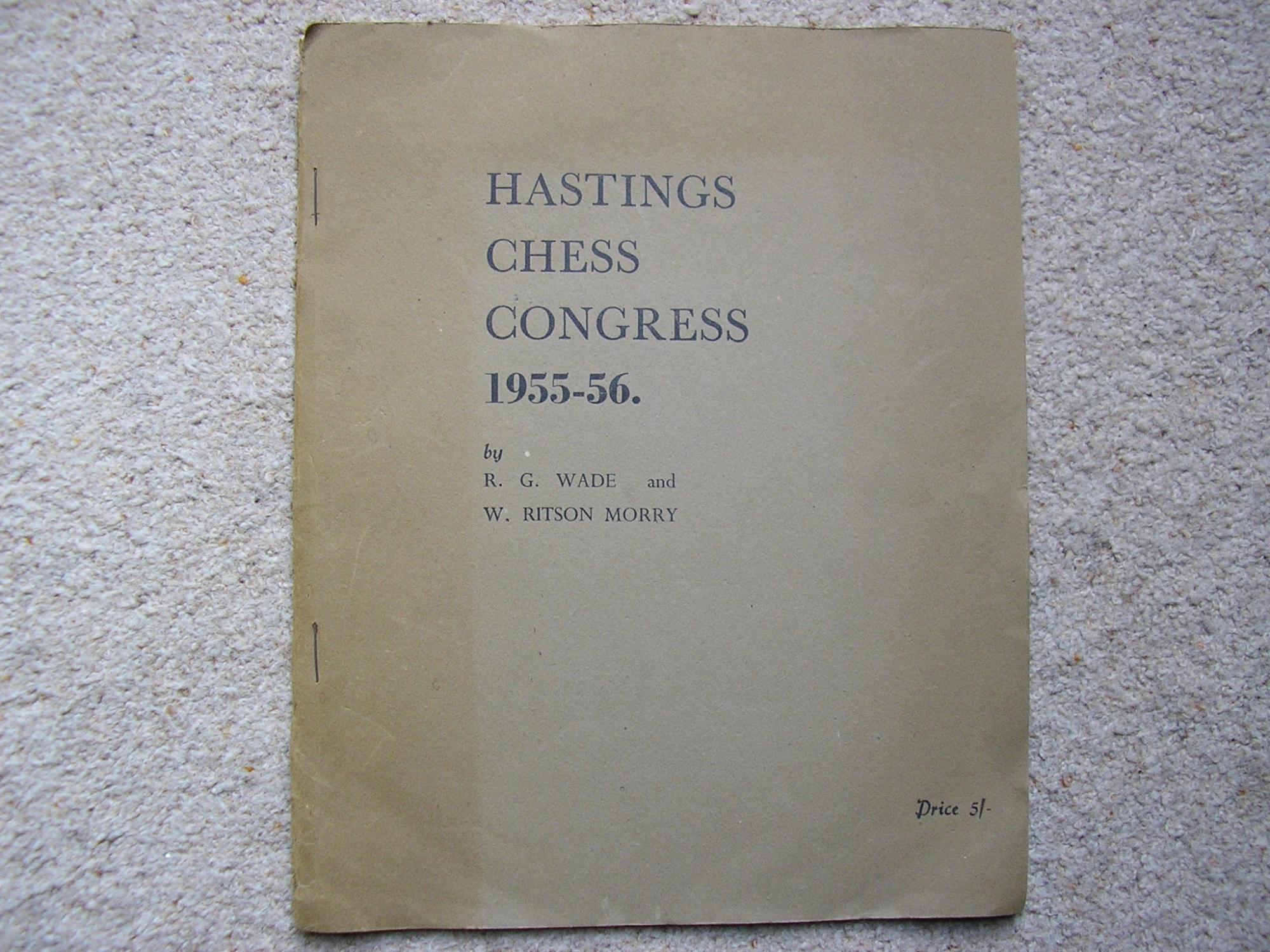
Hastings Chess Congress 1955-56, RG Wade & W. Ritson Morry, En Passant Chess Publications
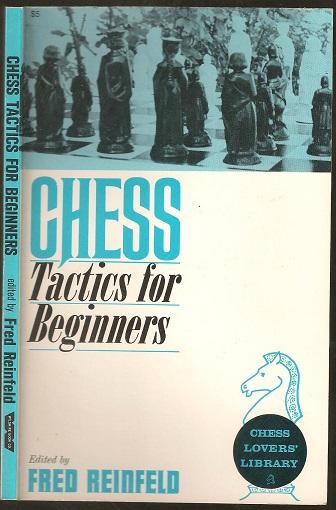
Chess Tactics for Beginners, RG Wade, Bott and Morrison, 1960
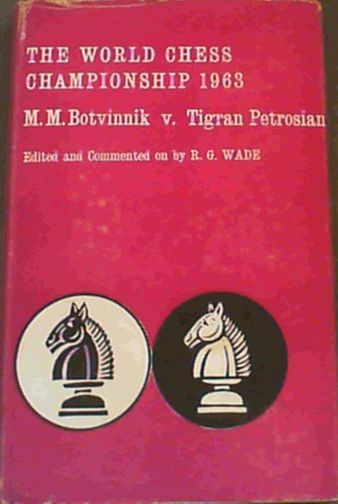
The World Chess Championship: 1963 Botvinnik vs Petrosian, Wade
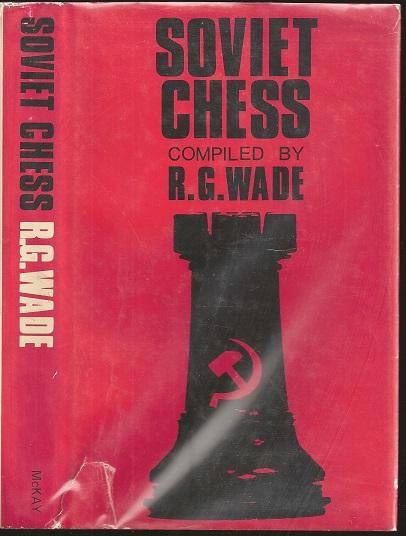
Soviet Chess, RG Wade, Neville Spearman (UK), David McKay Company, Inc, New York, 1968
Soviet Chess, RG Wade, Neville Spearman (UK) & David McKay Company, Inc, New York, 1968
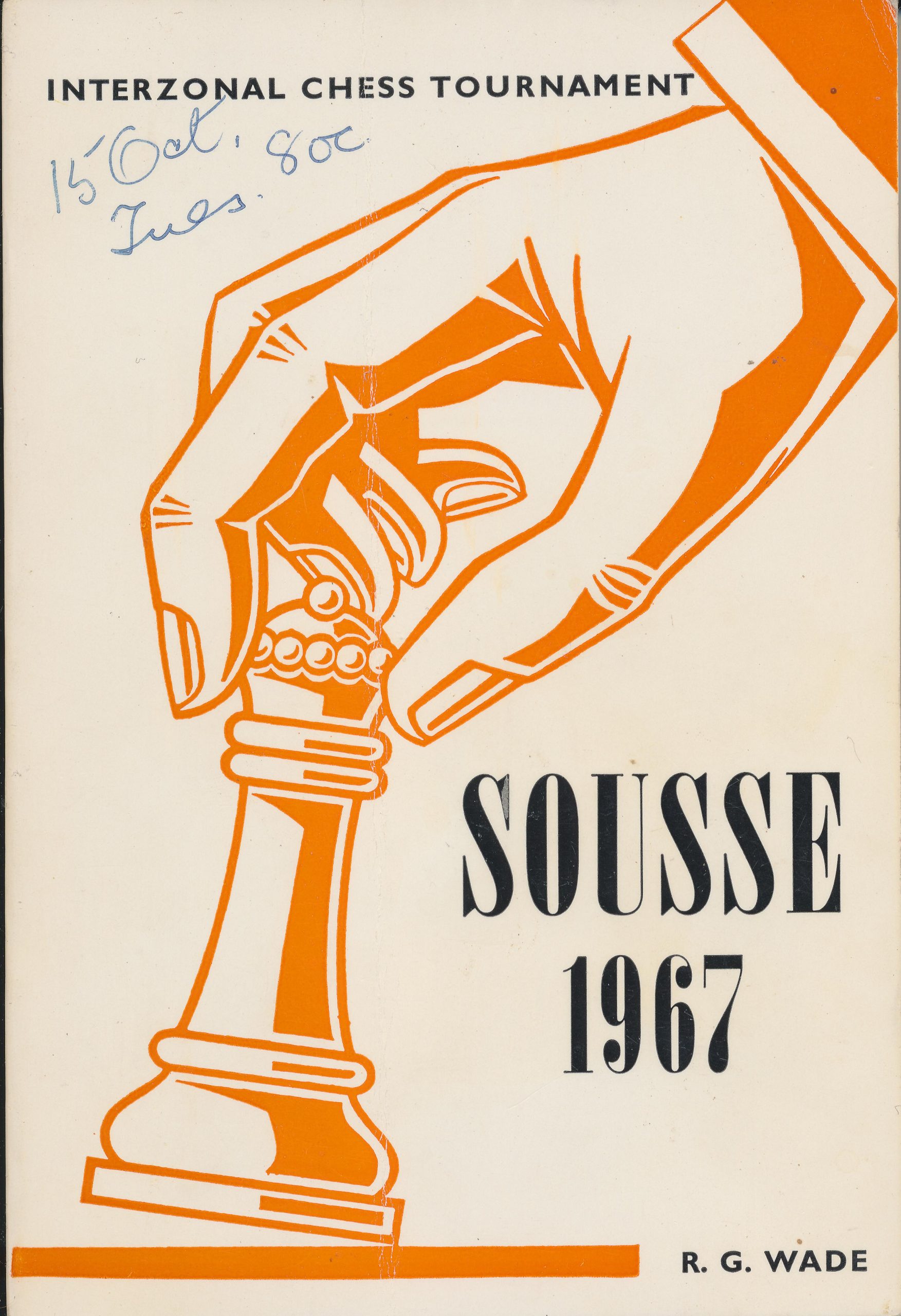
Sousse 1967 : International Chess Tournament, RG Wade, The Chess Player, 1968
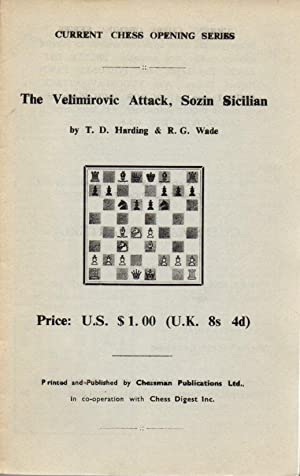
The Velimirovic Attack, Sozin Sicilian, TD Harding and RG Wade, Chessman Publications Ltd., 1969.
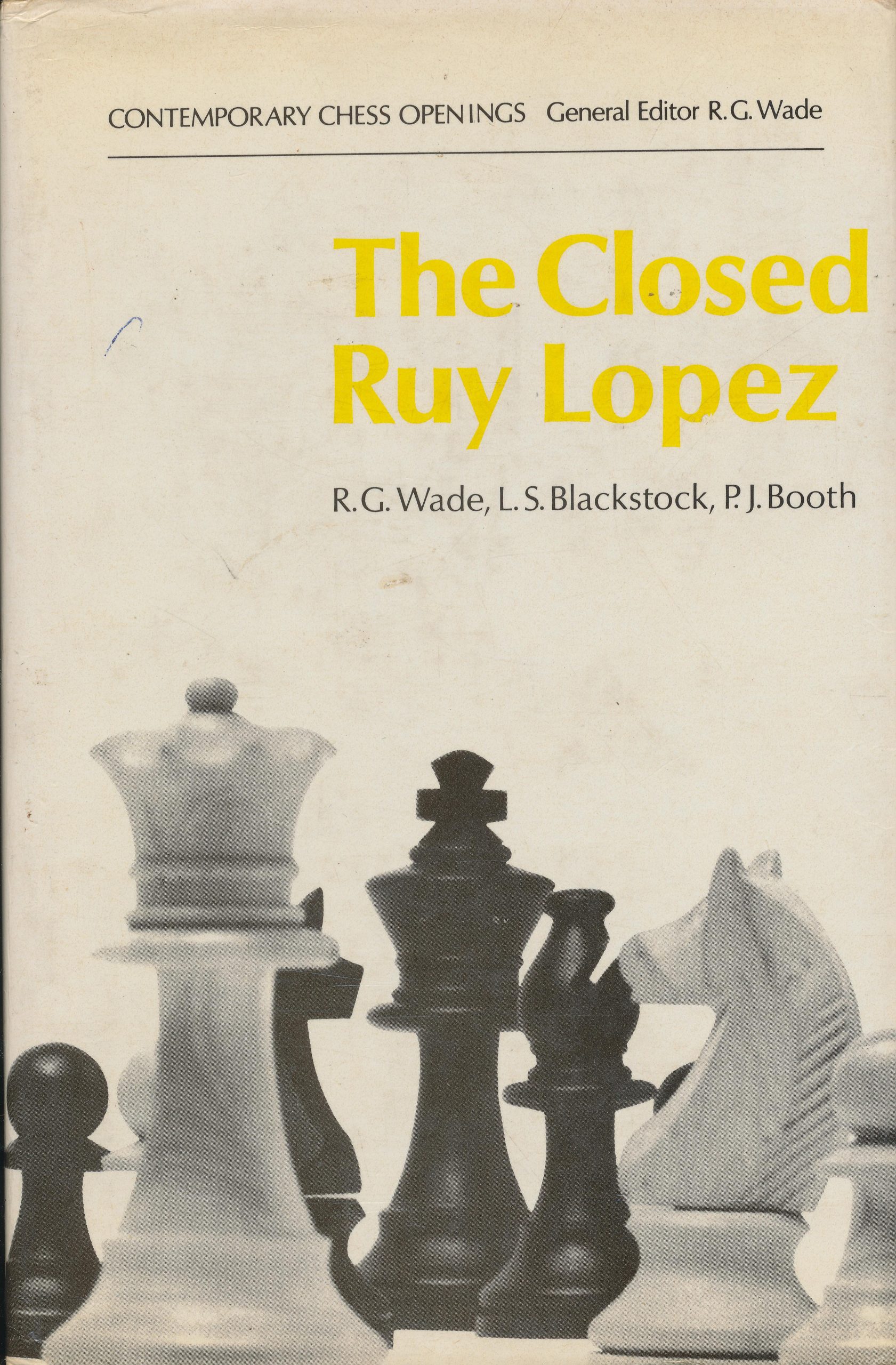
The Closed Ruy Lopez, Wade, Blackstock and Booth, Batsford, 1970
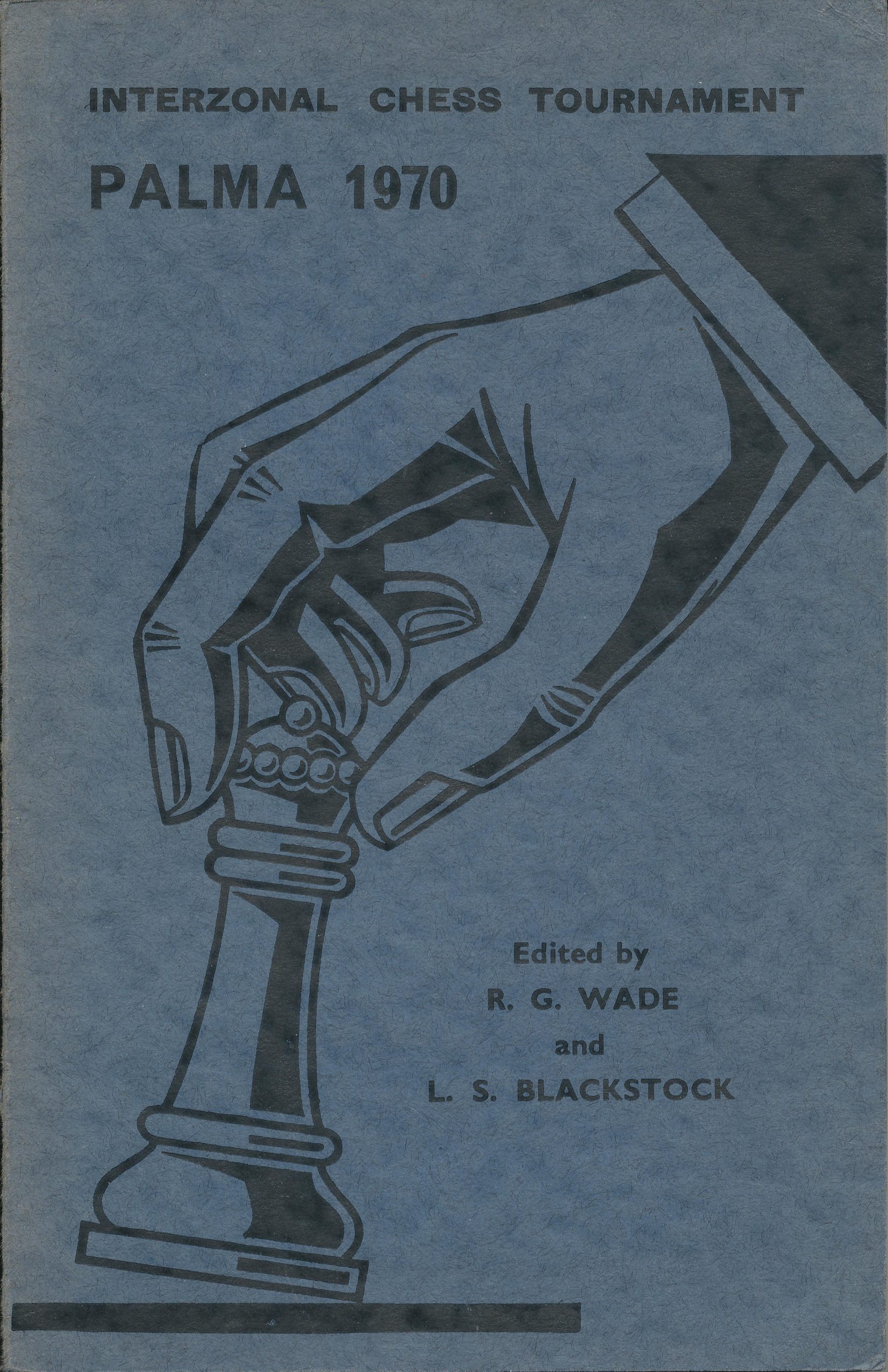
Palma 1970 : Interzonal Chess Tournament, RG Wade and LS Blackstock, The Chess Player, 1970
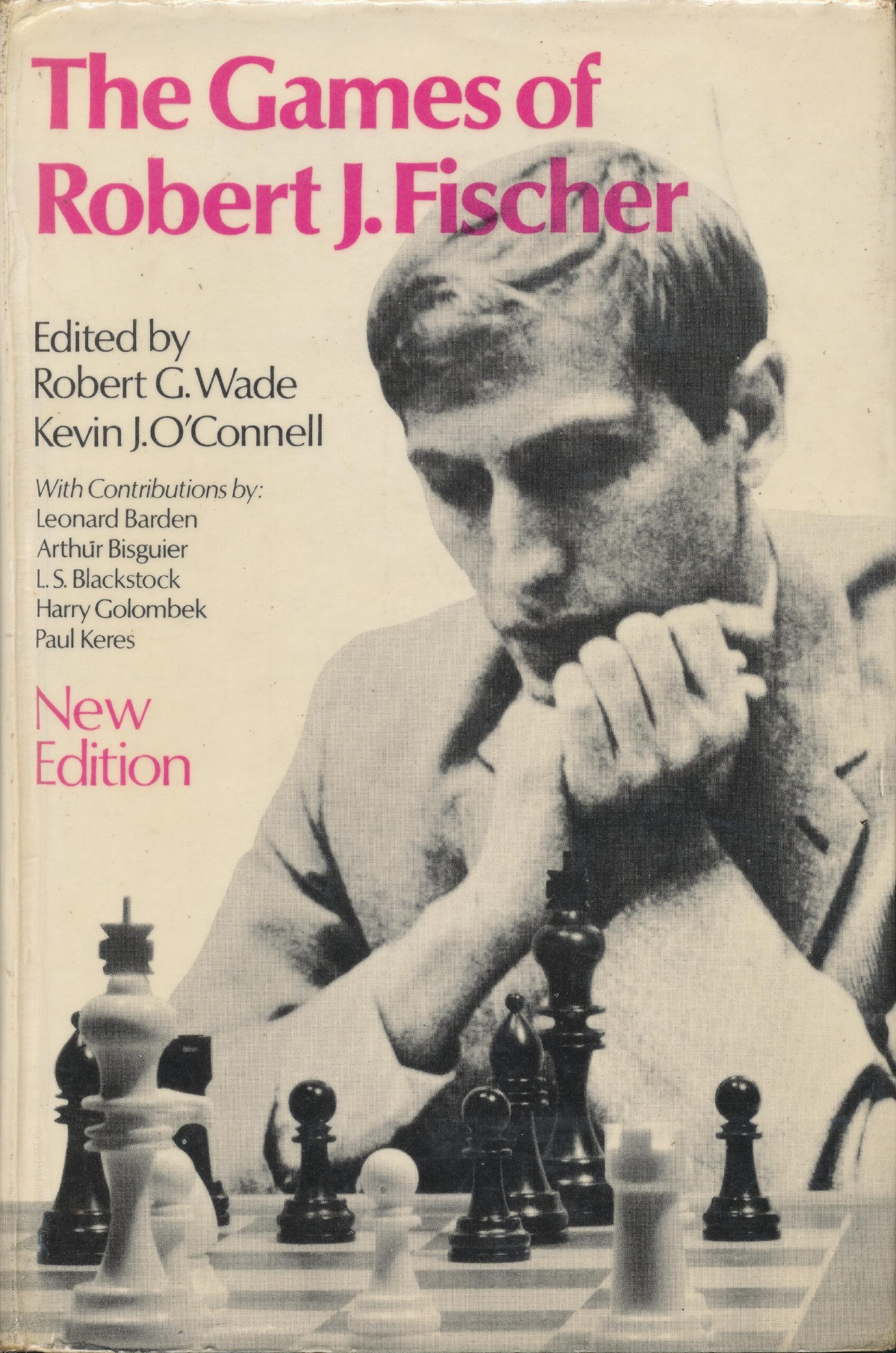
The Games of Robert J. Fischer, Robert Wade and O'Connell, Batsford 1972, 2nd ed. 1972, reprinted 1973, First limp edition 1981, Reprinted 1985, 1981, 1989, Second edition (The Complete Games of Bobby Fischer) 1992
The Games of Robert J. Fischer, Robert Wade and O’Connell, Batsford 1972, 2nd ed. 1972, reprinted 1973, First limp edition 1981, Reprinted 1985, 1981, 1989, Second edition (The Complete Games of Bobby Fischer) 1992
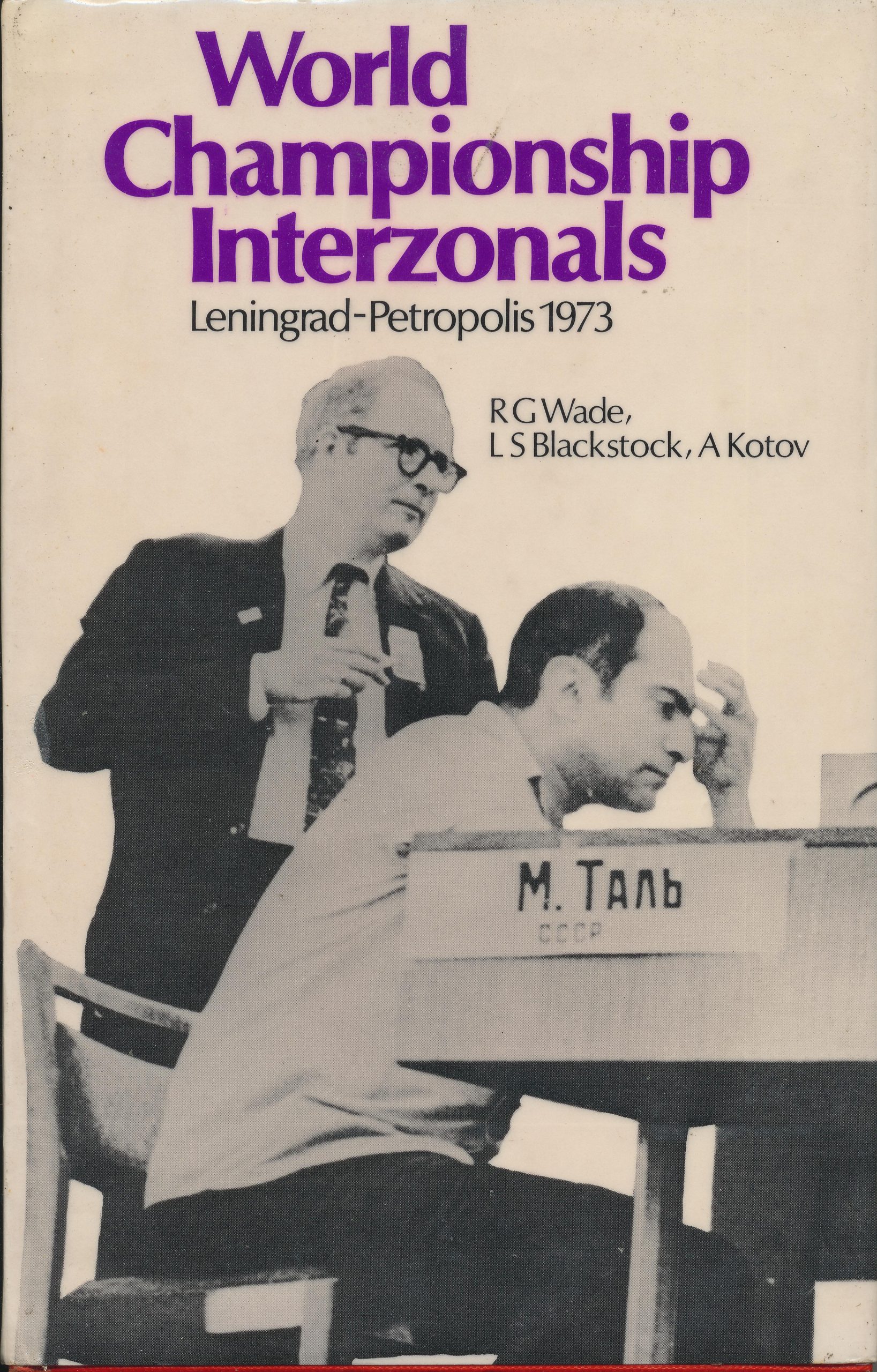
World Championship Interzonals, Wade, Blackstock and Kotov, Batsford, 1974
The World Chess Championship, Gligoric and Wade, Batsford, 1974
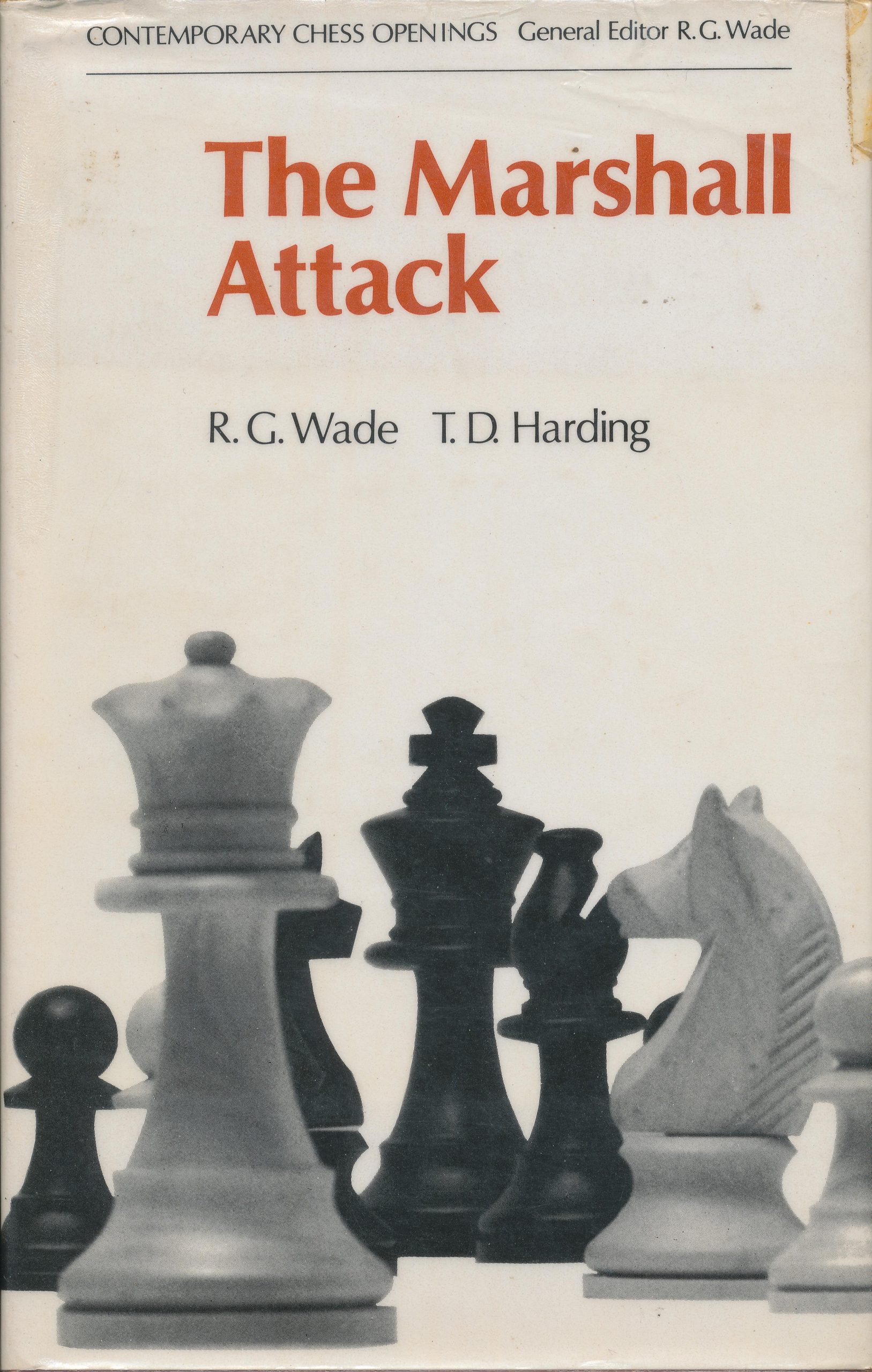
The Marshall Attack, Wade & Harding, Batsford, 1974
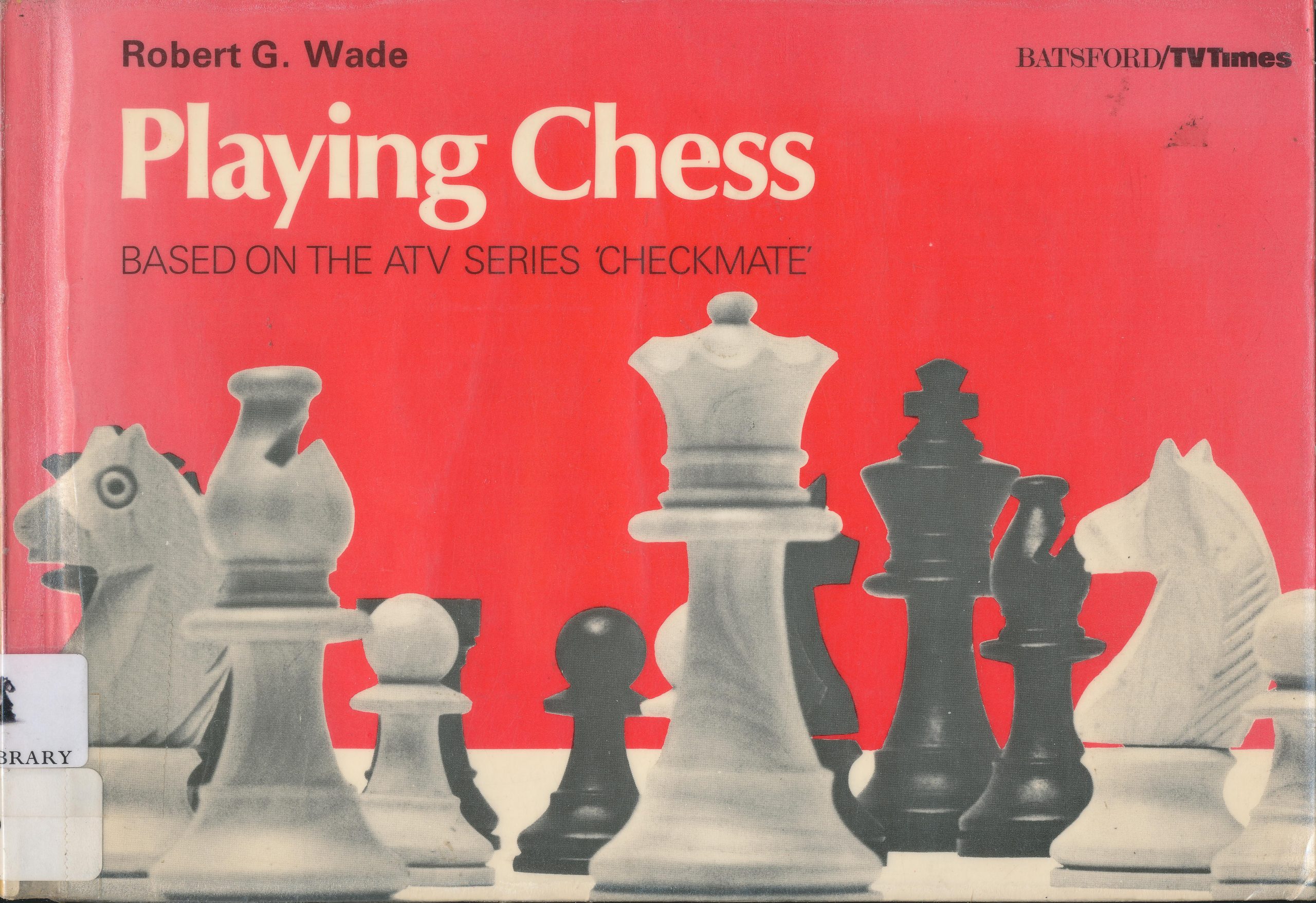
Playing Chess, RG Wade, Batsford/TVTimes, 1974
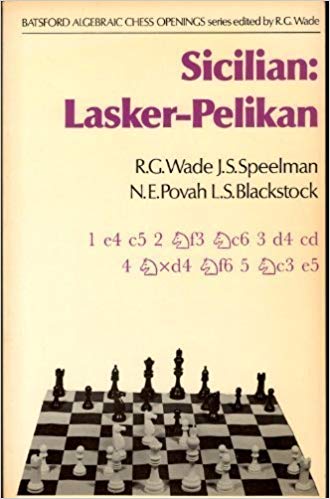
Sicilian Lasker-Pelikan, 1978, Batsford, Wade, Speelman, Povah and Blackstock
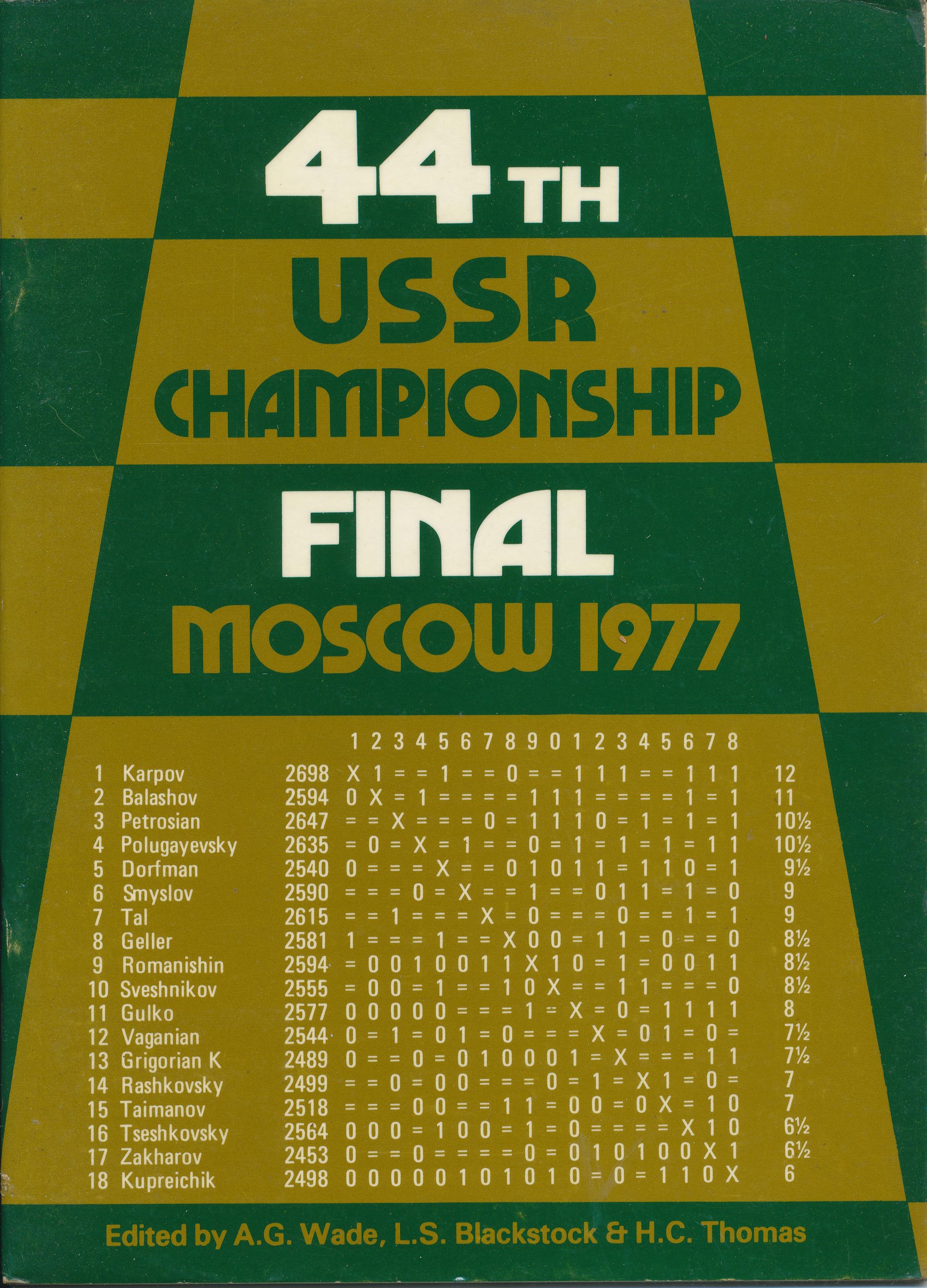
44th USSR Championship Final Moscow 1977, RG Wade, LS Blackstock and HC Thomas, Master Chess Publications, 1977
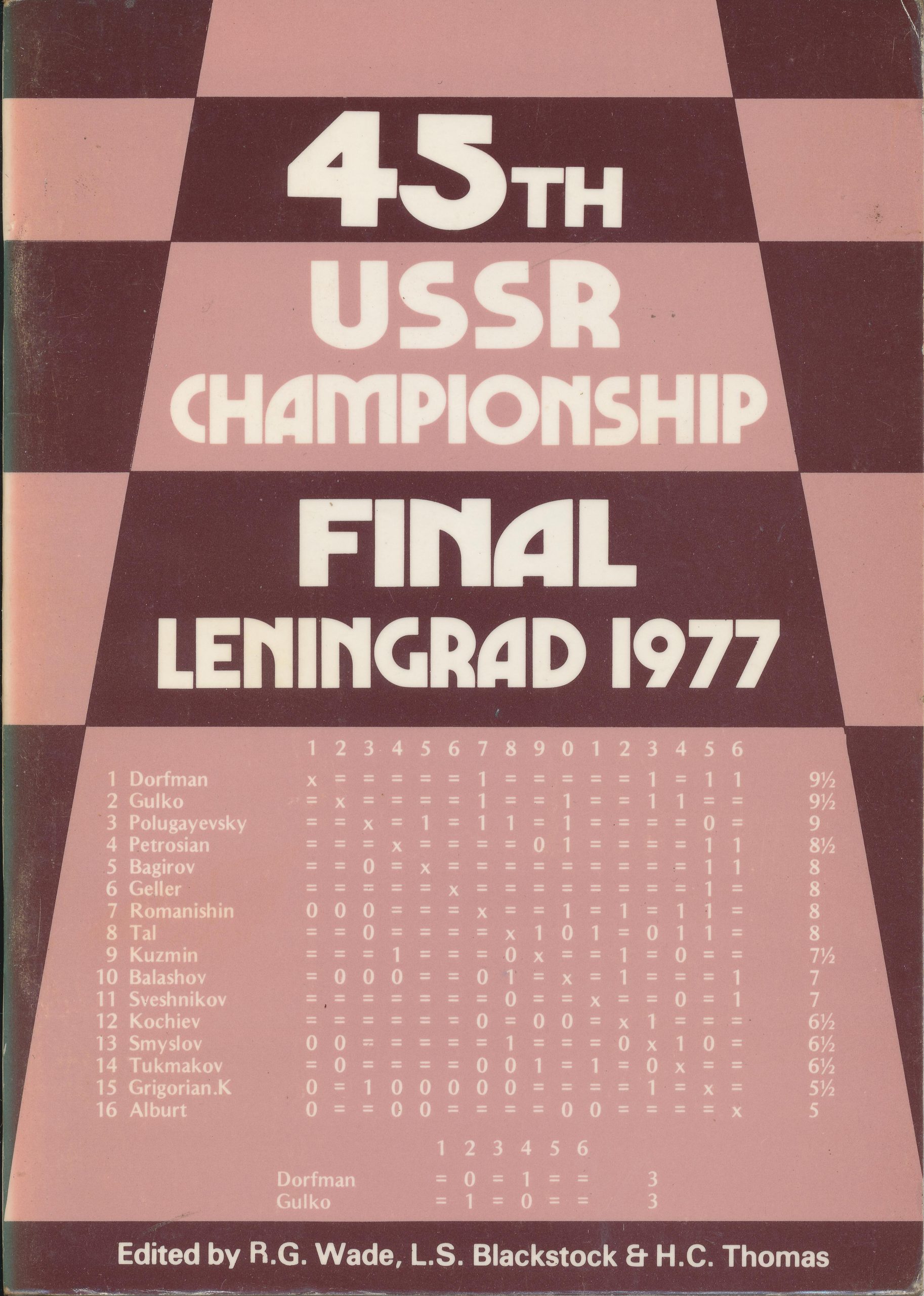
45th USSR Championship Final Leningrad 1977, RG Wade, LS Blackstock and HC Thomas, Master Chess Publications, 1977
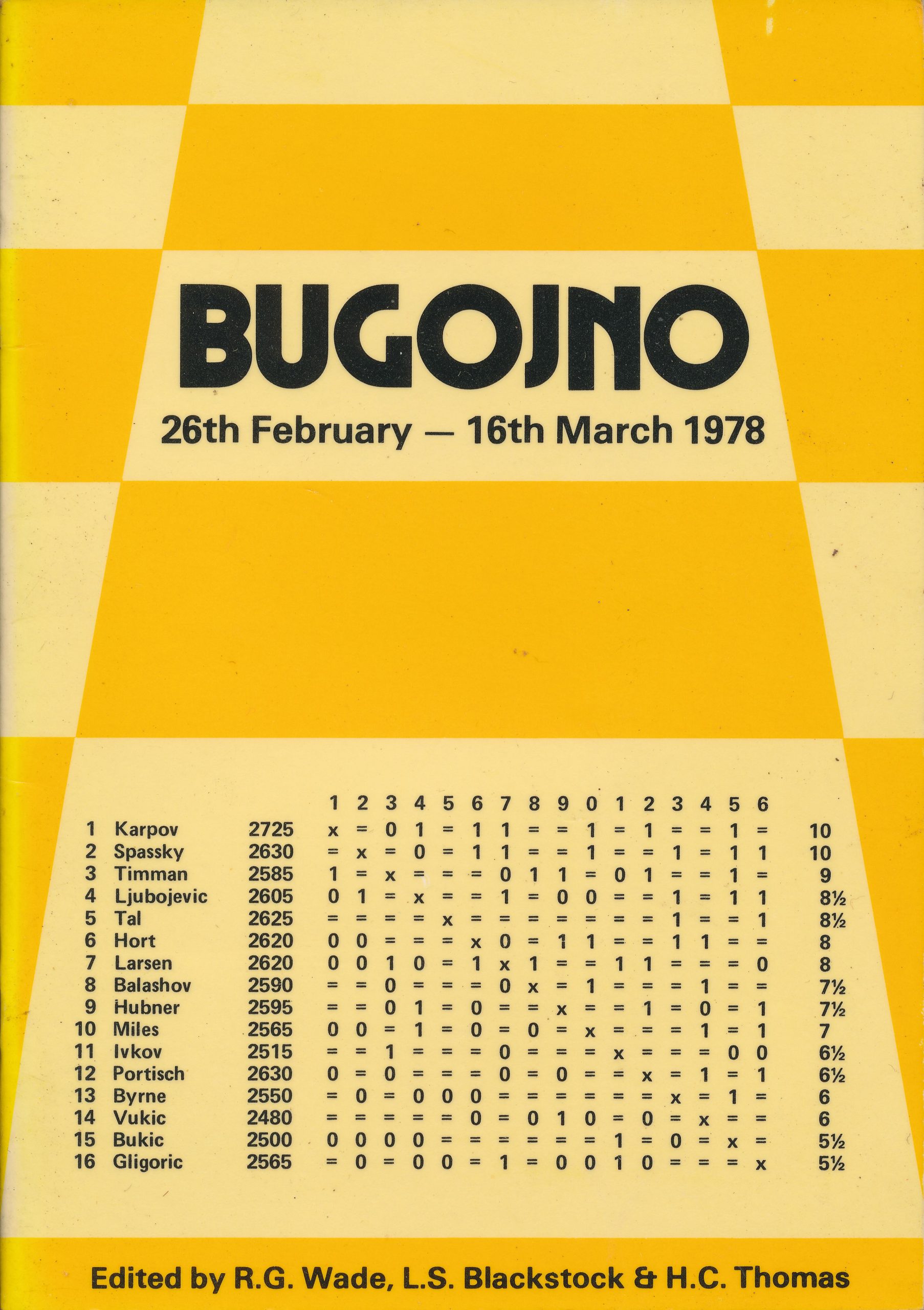
Bugojno, 1978, RG Wade, LS Blackstock and HC Thomas, Master Chess Publications, 1978
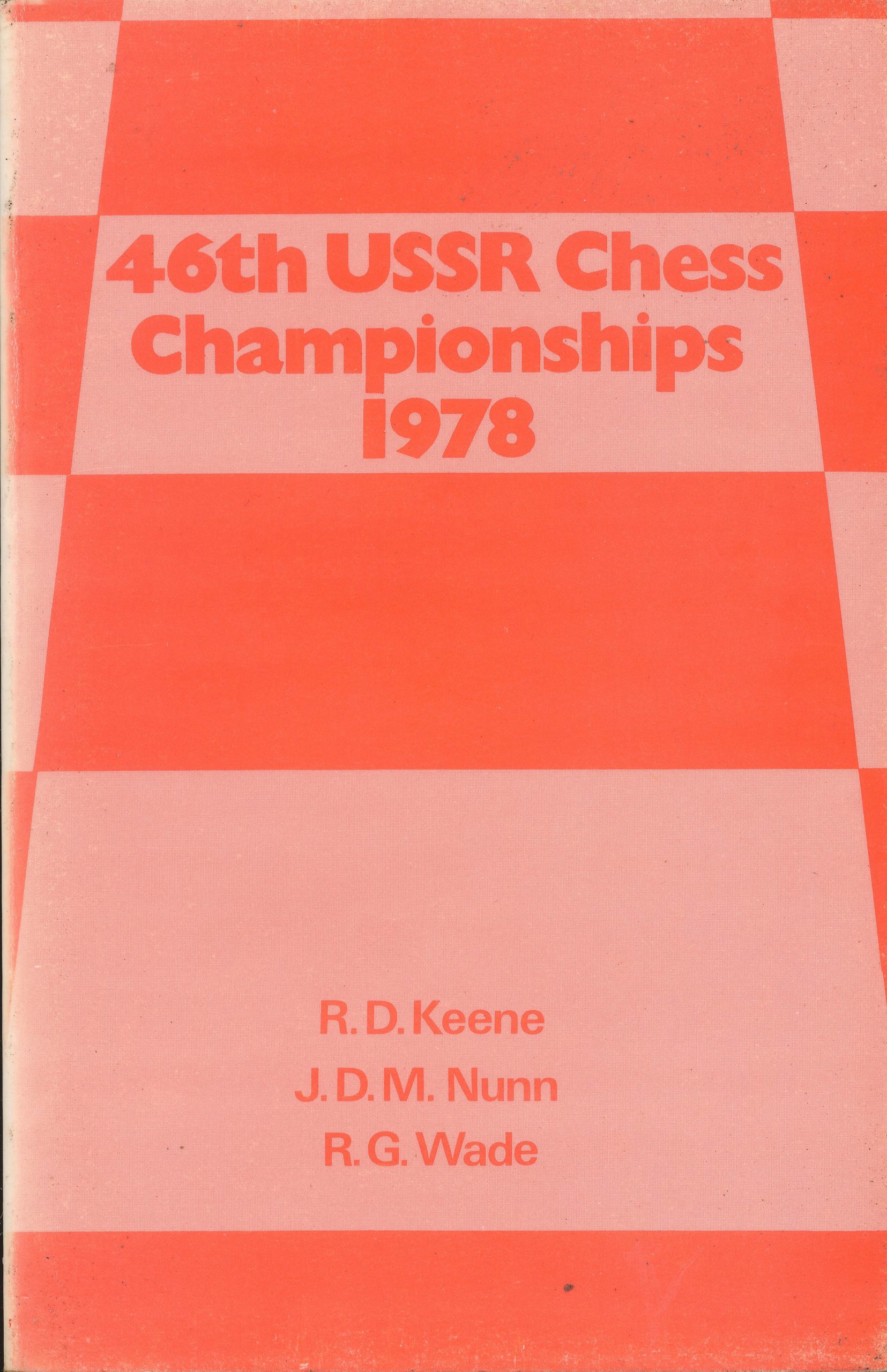
46th USSR Chess Championships 1978, RD Keene, JDM Nunn, RG Wade, Master Chess Publications, 1978, ISBN 0 906634 00 8
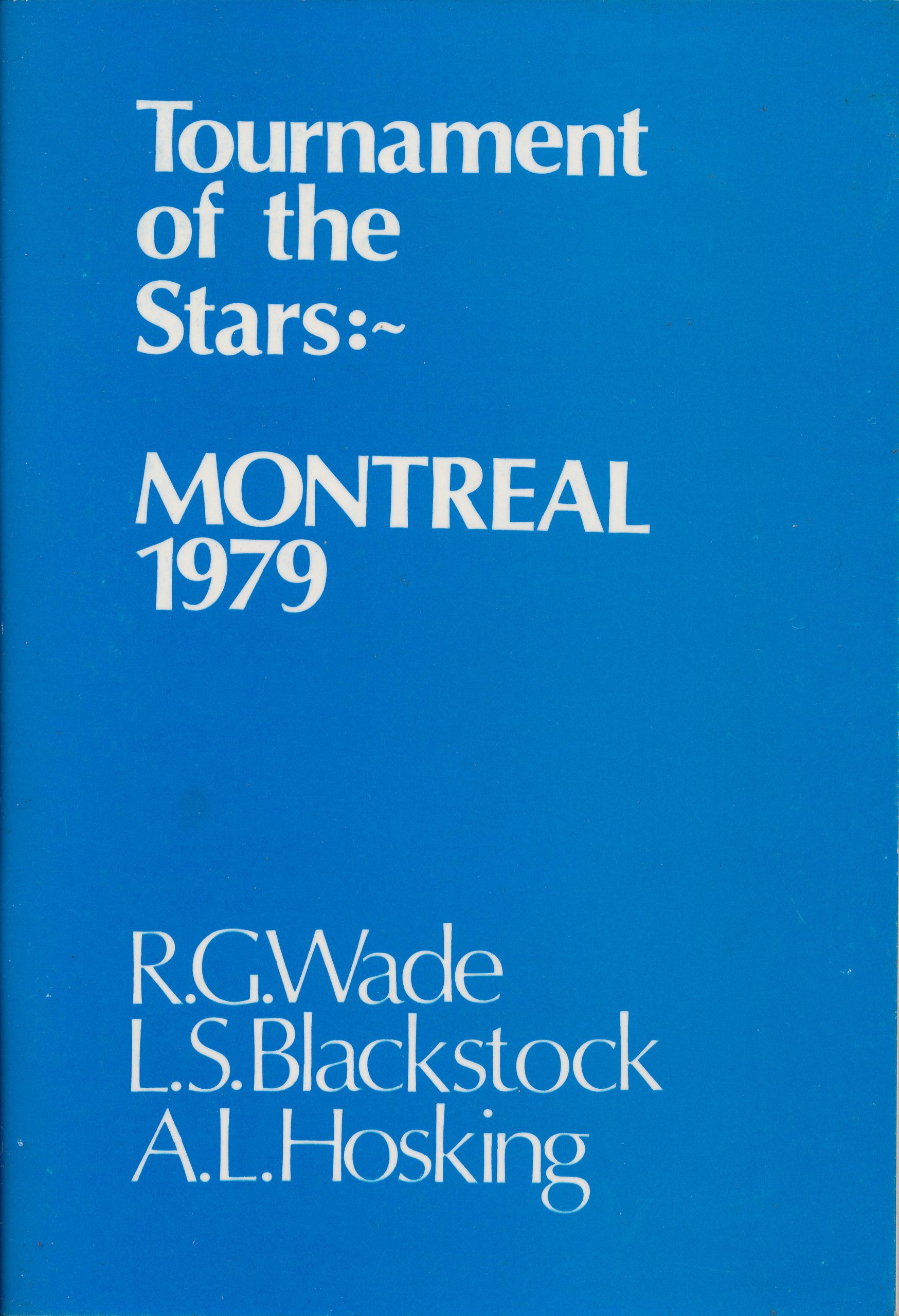
Tournament of the Stars:~ Montreal 1979, RG Wade, LS Blackstock, AL Hosking, Master Chess Publications, 1979
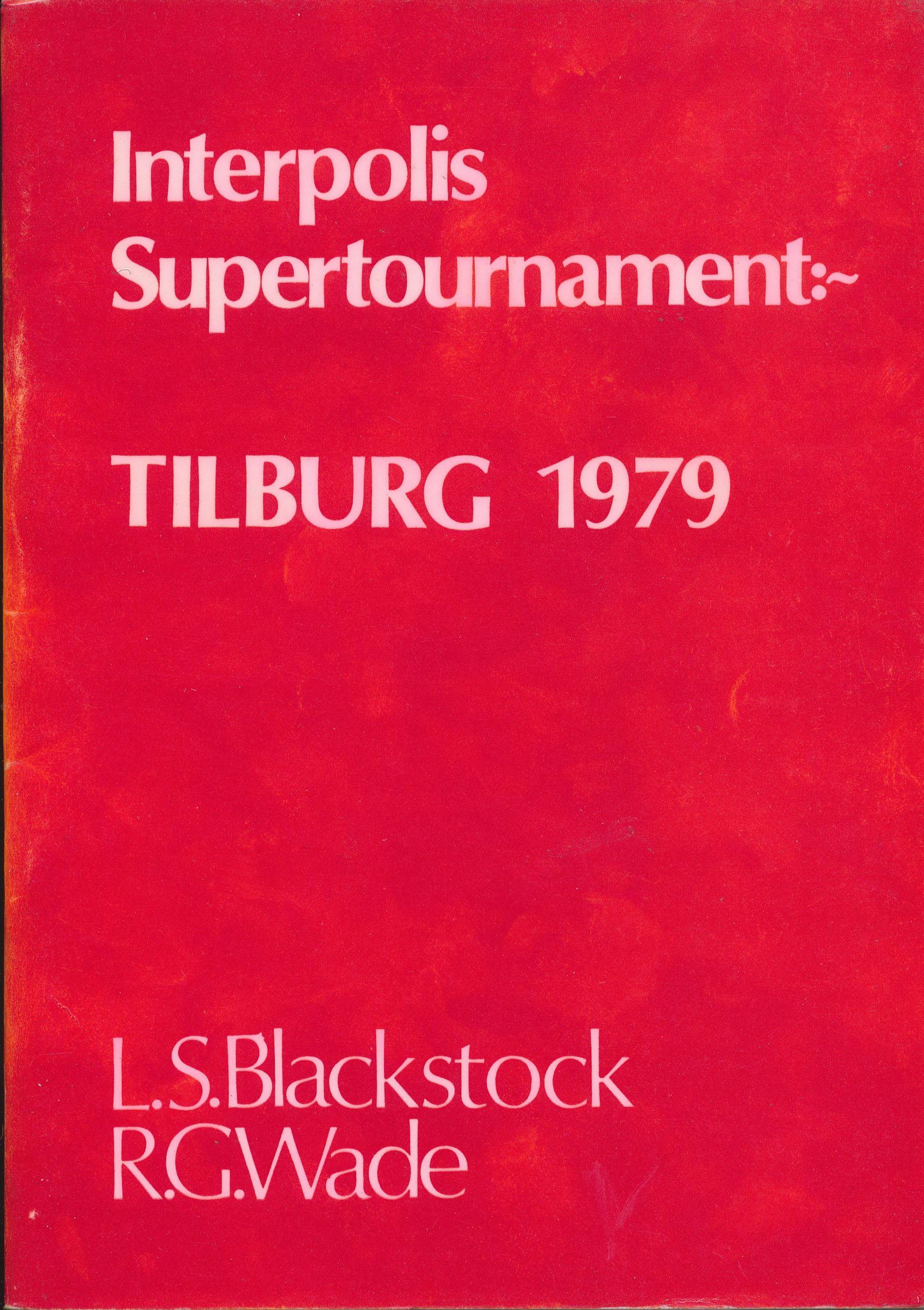
Interpolis Supertournament:~ Tilburg 1979, LS Blackstock & RG Wade, Master Chess Publications, Chess, Sutton Coldfield, 1979
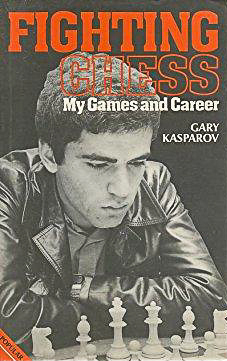
Fighting Chess, Kasparov and Wade, Harper Collins, 1983
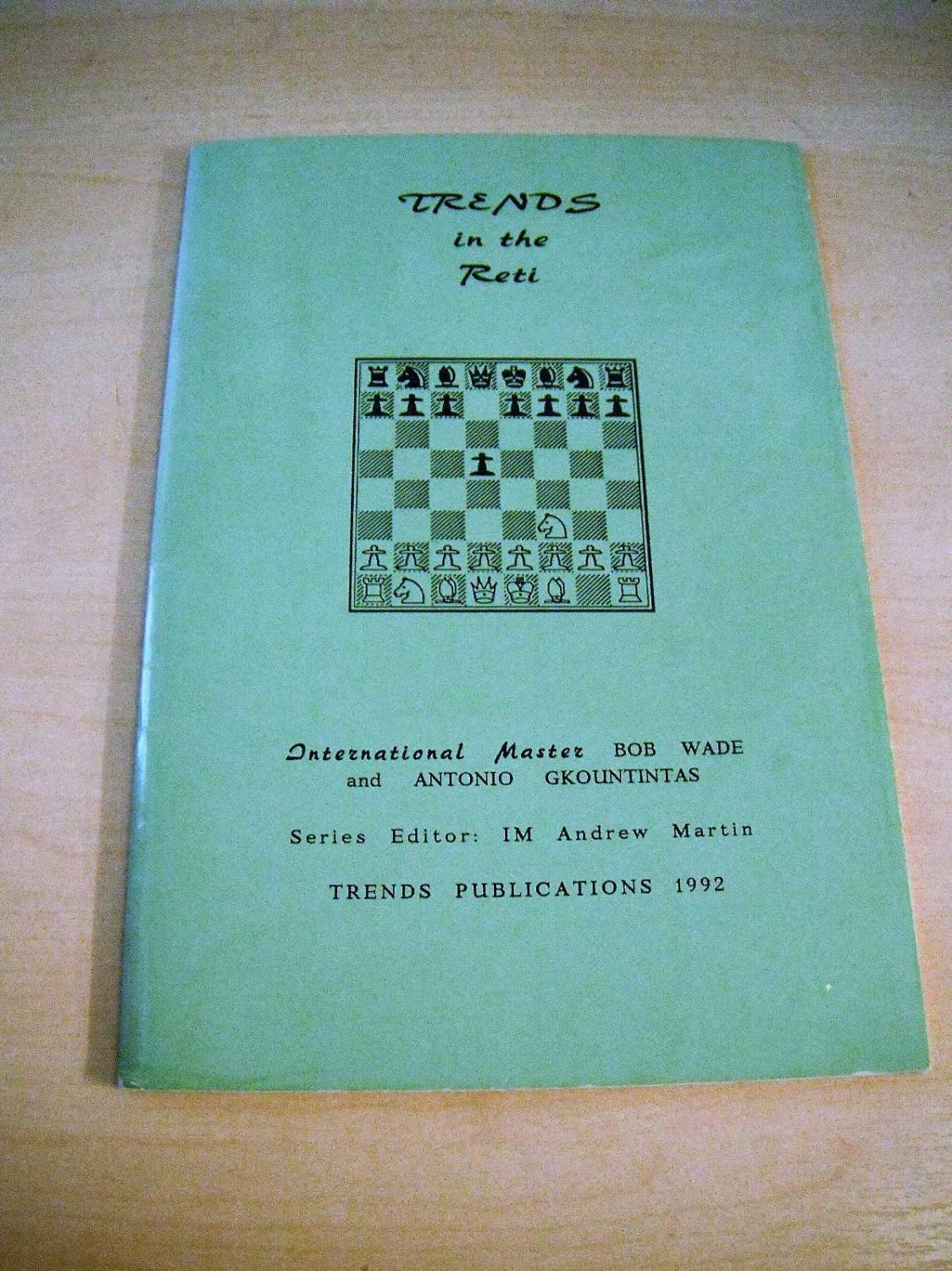
Trends in the Reti, Volume 1, RG Wade, 1992
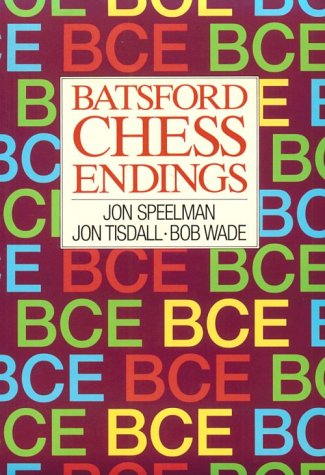
Batsford Chess Endings, Speelman, Tisdall and Wade, 1993
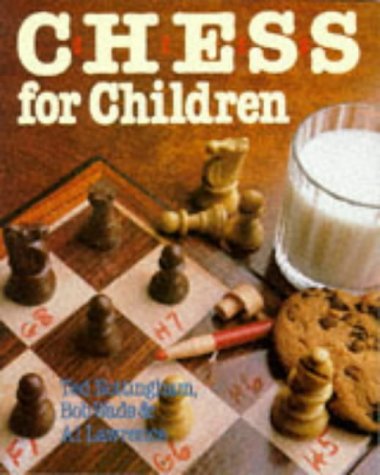
Chess for Children, Ted Nottingham and Bob Wade, Sterling Juvenile, 1996
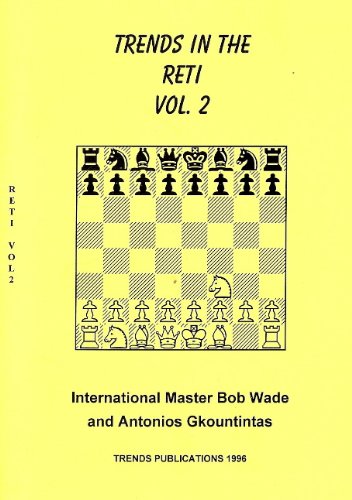
Trends in the Reti, Volume 2, RG Wade, 1996
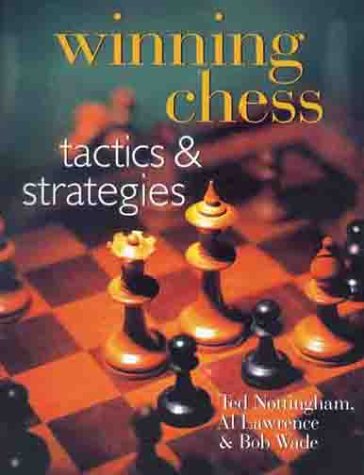
Winning Chess : Tactics and Strategies, Sterling Juvenile, 2001

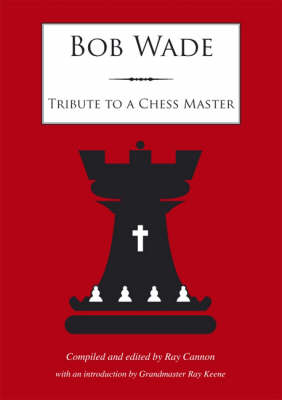
In 2007 Ray Cannon published the following tribute :

Bob Wade : Tribute to a Chess Master, Ray Cannon & Ray Keene, Impala, 2007

However, Paul McKeown remains Bob’s official biographer.

IM Robert Wade OBE
IM Robert Wade OBE

Death Anniversary of IM Robert Wade OBE (10-iv-1921 29-xi-2008)

We remember IM Bob Wade OBE who was born 100 years ago today on Sunday, April 10th 1921

In 1979 Queen’s Birthday Honours List, Civil Division Bob Wade was awarded the OBE. The citation read simply : “For services to Chess”

He won the BCF Presidents’ Award in 1986.

In the Foreword to the 2009 ECF Yearbook, President Gerry Walsh wrote :

“As I started this report I had just heard the sad news that IM Bob Wade had died aged 87. I first met Bob at one of the Whitby Congresses and in 1972 he played in the Teeside GM Tournament where I recall he beat the three Hungarian players Portisch, Bilek and Sax (ed : aged 51).”

Geurt Gijssen wrote in Chesscafe.com :

“I received the sad news that Bob Wade passed away at the age of eighty seven. He played his last tournament in London in August. When I was young I read about his exploits as a chess player, and he was the arbiter in many important chess events. I met him in 1993 when I was the organizer of the first part of the match Karpov – Timman, played in The Netherlands in three different cities: Zwolle, Arnhem, and Amsterdam. He was the only member of the Appeals Committee and Bob was always present watching the games in the playing hall. He gave me invaluable advice about all elements of the match venues. It was very clear that he was an experienced chess player and arbiter, and I learned many things from him. May he rest in peace.”

From the 1952 Ilford Congress (30 May - 2 June) and originally published in BCM, July 1952, page 187. (l-r) : Harold Israel, Alan Phillips, Bob Wade, Otto Friedman, Abe Yanofsky, Alfred William Bowen and Harold Meek. Thanks to John Saunders and Leonard Barden
From the 1952 Ilford Congress (30 May – 2 June) and originally published in BCM, July 1952, page 187. (l-r) : Harold Israel, Alan Phillips, Bob Wade, Otto Friedman, Abe Yanofsky, Alfred William Bowen and Harold Meek. Thanks to John Saunders and Leonard Barden

Wade was Southern Counties (SCCU) champion for the 1956-57, 1957-58 and 1964-65 seasons.

From the Preface of The World Chess Championship : 1951 by Lionel Sharples Penrose we have :

“Mr. Wade is also passionately devoted to the game. Before coming to Europe, he was three times champion of New Zealand. He had played in tournaments in England but his chief successes have been on the Continent. At Venice in 1950, he obtained a high place in a very severe contest in which some of the strongest Russia, Czech, Dutch, French, Italian, North and South American players took part. Much of his time is occupied in chess organising and teaching. He is an acting vice-president of the F.I.D.É and in this official capacity he attended the match in Moscow, which is the subject of this book.”

IM Bob Wade
IM Bob Wade

Paul McKeown researched (and Simon Spivack asked permission to reproduce his words) the earliest part of Bob’s life as follows:

“On May 20th, 1919, Thomas Graham Wade, aged 27, Sergeant in the NZ Expeditionary Force, repatriated with honour from war-time service in Egypt, Gallipoli and France, married Amy Lilian Neave, aged 21, in South Dunedin. A New Zealander of Scots and English descent, his family was Graham from Montrose. The family name, Wade, came from Marshall George Wade, the soldier and engineer who led the Hanoverian forces against the Scots at the time of the 1745 Jacobite Rebellion and was immortalised in the original third verse of the British national anthem:

Lord, grant that Marshal Wade,
May by thy mighty aid,
Victory bring.

May he sedition hush and like a torrent rush,
Rebellious Scots to crush,
God save the King.

IM Bob Wade
IM Bob Wade

Robert Graham Wade, known in the Scots manner to his family as Robin, and later to his many friends as Bob, was their first child, born April 10th, 1921, at Dunedin. Over the next few years he was joined by sisters, Lilian, Agnes, Betty, June, his brother Ted and finally by his youngest sister Amy. The family lived for a number of years at Portobello.
At that time, Portobello was a scattered community of about 150 people with three shops and a pub on the Otago Peninsula. Bob attended Portobello Primary School, a small country school, finished “dux” or top of class, and then attended the King Edward Technical High School at Stuart Street in Dunedin.”

IM Bob Wade
IM Bob Wade

In The Oxford Companion to Chess (OUP, 1984 & 1996), Hooper & Whyld:

“Wade Variation, 147, also known as the Modern Variation, in the Queen’s Gambit Declined, Meran Variation, from Bogoljubow-Wade, Oldenburg, 1949;

1239 in the French Defence, introduced by Wade in a match against Schmid in 1950.

Hooper & Whyld go on to write :

“New Zealand-born Robert Graham Wade (1921- ) won the championship of his homeland three times before moving to England as a young man, He won the British Championship twice and trained many English players.”

Aside from the two variations mentioned by Hooper & Whyld there are other Wade Variations :

which Jim Plaskett dubbed the “Sidestep Variation”

and

which is the Pytel-Wade Variation of the Scandinavian Defence.

Anne Sunnucks wrote in The Encyclopaedia of Chess (Robert Hale, 1970 & 1976) :

“International Master (1950 Ed: actually 1954), International Judge (1958), New Zealand Champion three times and British Champion in 1952 and 1970.

Bob Wade was born in New Zealand on 10th April 1921 and is a professional chess player. He has lived in England for many years and has played regularly for the British Chess Federation team in Chess Olympiads. He has played a prominent part in coaching schemes for juniors and is largely responsible for recent successes of English juniors in international events.

Bob Wade v. Aldecoa of the Philippines from the 1958 Munich Olympiad played on October 9th 1958. The game was won by Bob in 60 moves. From the collection of David Jarrett with many thanks.

He is chess correspondent of Associated Newspapers and Independent Television News and editor of a series of books on Contemporary Chess Openings published by Batsford.

Author of a number of books on the game, his publications include books on the World Championship of 1951, 1957 (ed : this book was, in fact, by Golombek) and 1963, the first in collaboration with W. Winter; The Closed Ruy Lopez (Batsford, 1970) in collaboration with LS Blackstock and PJ Booth: World Chess Championship (Batsford, 1972) in collaboration with Svetozar Gligoric; Games of RJ Fischer (Batsford, 1972) in collaboration with KJ O’Connell and Soviet Chess (Neville Spearman, 1968).

Wade was a member of the FIDE Laws Commission from 1950 to 1952.”

From The Encyclopedia of Chess (Batsford, 1977), Harry Golombek OBE :

“International Master who was born at Dunedin, New Zealand, but came to live In England in 1946 and has represented both countries on different occasions. He has nearly always done well in British Championships and won the title in Chester in 1952 and again at Coventry in 1970. He had played for the British Chess Federation at the Olympiads of 1954, 1956, 1958, 1960 and 1962, winning the shortest game of the Varna Olympiad in that year in nine moves against Anton Kinzel of Austria

He played for the New Zealand team at the 1970 Olympiad at Siegen but returned to the BCF team at Skopje in 1972.

His best individual international results were a fifth place at Venice 1950 and again fifth at the Masters section of the Capablanca Memorial at Cienfuegos in Cuba in 1975. Possessor of a sharp clear-cut style of play, he once drew a match with the West German grandmaster Lothar Schmid with neither side drawing a game, though this was before Schmid received the grandmaster title.

He has done much valuable work in England teaching the young, and was responsible for the text of a highly successful television series in 1975.

His main books are : Soviet Chess, London, 1967; Botvinnik-Bronstein Match 1951 (in co-operation with W. Winter), London, Toronto 1951; Match Petrosian-Botvinnik, London, 1963; Sousse 1967, The Chess Player, Nottingham, 1968.”

From British Chess (Pergamon Press, 1983) we have this article from George Botterill :

“In the Birthday Honours list of 1979 Bob Wade was awarded the OBE for his services to chess. Few rewards can have been more thoroughly earned. For some reason, Bob has always been held in greater esteem abroad than in the country for which he has done so much. But the many players who have turned to him for advice or who have simply enjoyed his hospitality, which is always ungrudgingly available to fellow chess players, know the measure of his dedication to the game.

Theodore Tylor vs Bob Wade at Paignton 1953. Bob held TT to a draw to secure first place.
Theodore Tylor vs Bob Wade at Paignton 1953. Bob held TT to a draw to secure first place

Wade was born in Dunedin, a third generation New Zealander of Scots and English ancestry. He started a a career as a civil servant in the Department of Scientific and Industrial Research. Having won the New Zealand Championship in 1944 and 1945 he was sent over to participate in the British Championship of 1946. The result was not exactly a success – a mere 3.5 points out of 11. But Bob was not to be disheartened so easily. Feeling he was capable of better things, he took leave of absence in 1947 and did the circuit, such as it then was, of chess tournament in Europe and North America.
Bob giving a simul in Leeds in the 1950s

When he returned to New Zealand he found that he had been transferred to another department in a civil service reorganisation. The new job was not so congenial. He stuck it out for 6 months – during which time he won the New Zealand Championship for a third time – and then handed in his resignation to take up the precarious life of a chess professional.

IM Bob Wade
IM Bob Wade

Settling in Britain he soon gained the IM title (ed : 1954). But even in those days when still a young man Wade did not concentrate exclusively on his own playing career. In 1949 he went to the FIDE congress and was one of the five people – the others were BH Wood, Ragozin, Zubarev and Rogarde – who collaborated on the writing of the official rules for the game.

Bob Wade OBE, Murray Chandler MNZM and David Anderton OBE at the 1986 Dubai Olympiad. Photograph by Frits Agterdenbos

He also served as a member of the commission that determined who the original holders of international titles would be. When you consider that Wade was also on the 1950 commission that decided the composition of the World Championship Interzonals, it becomes apparent that this man played a significant part in the shaping the structure of modern international chess.

Bob at a CentYMCA event with Neil Carr, Mike Wills, Aaron Rose and Jon Ady

Although rarely at the top in international tournaments, Wade was always a very dangerous player, capable on his day of beating anybody in the world. He won the British Championship twice at Chester in 1952 and at Coventry in 1970.

Bob playing Kick Langeweg at IBM 1961.

In recent years Wade has put his main energies into junior training and organisation and also into his work as the editor of Batsford’s highly productive and extremely successful series of chess books.

Bob with John Nunn and Boris Spassky at the GLC Masters

It is hard to say in what department one should place Wade’s greatest contributions to British Chess. Living through what is retrospect look to have been the Dark Ages of British chess – the 1950s and 1960s – he has demonstrated that even in a social and cultural environment that made playing chess economically ‘impossible’ profession to follow it was still possible to dedicate a life to chess, if one had the determination.

Leonard Barden, Henry Mutkin, Adrian Hollis and Bob Wade observe Nick Ivell vs Ken Regan at the 1983 Varsity match

During those years he was really the only British Player who regularly active in international tournaments. Since then he has been constantly active as an author, editor and adviser, always working to transform Britain into a country more congenial to good chess.

Bob at the demo board at London Central YMCA chess club.

But we suspect that he might regard this role as trainer and coach as the most important thing of all. He is, quite appropriately the British Chess Federation’s Chief National Coach.

Bob doing one of the things he loved best : teaching. He was discussing a position at Havana 1965. Dr JR Capablanca, son of the former world champion, on the right, interpreted.

If one had to choose a single best game from Wade’s whole tournament career, it would probably be this one.

George Botterill

Dr. Fazekas (left) playing Bob Wade at an Ilford Congress, photographer unknown

In the January 2009 issue of British Chess Magazine John Saunders wrote a ten page obituary as follows :

British Chess Magazine, Volume CXXIX (129, 2009), #1 (January), pp. 34-43

Leonard Barden wrote this obituary

Here is Bob’s Telegraph obituary.
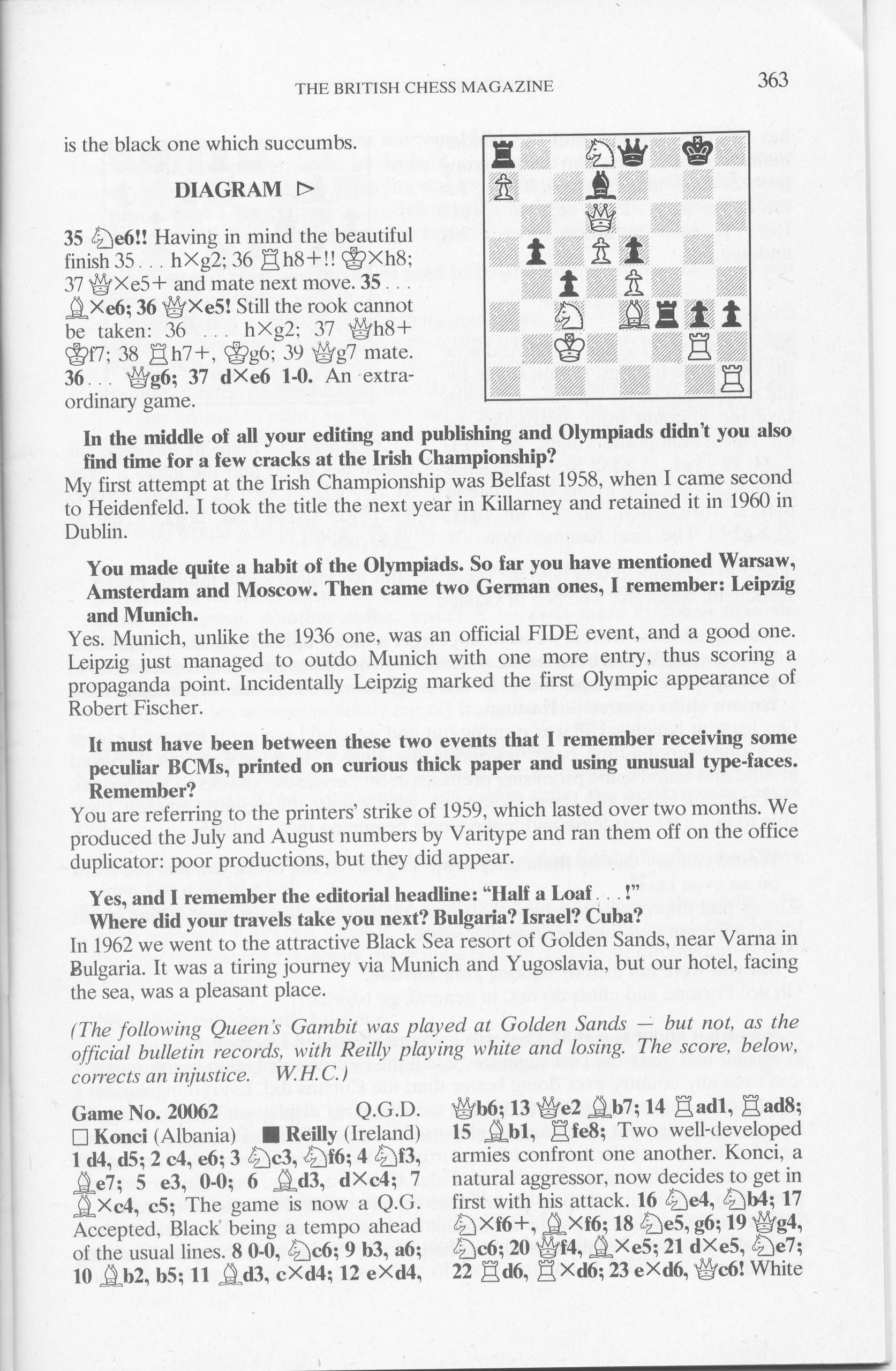
John Saunders interviewed Bob at his Blackheath home and wrote this extensive article for the 1999 British Chess Magazine.

His detailed results in Olympiads, from olimpbase.org, follow.

Amsterdam 1954, England board 4, 6/12 (+4−4=4);
Moscow 1956, England board 3, 6½/14 (+2−3=9);
Munich 1958, England 1st reserve, 7/14 (+5−5=4);
Leipzig 1960, England 2nd reserve, 6/11 (+4−3=4);
Varna 1962, England 2nd reserve, 6/12 (+4−4=4);
Siegen 1970, New Zealand board 2, 9/15 (+7−4=4);
Skopje 1972, England board 3, 7½/14 (+4−3=7).
Wade won several middle-strength Master events in the British Isles: Ilford 1957 and 1968, Paignton 1959, Dublin 1962, and Southend-on-Sea 1965.

Wade was generally no more than a middle-ranking player in strong international tournaments. His other highlights against high-standard international-level competition include:

tied 4–5th at Haifa/Tel Aviv 1958 on 7½/13 (winner Samuel Reshevsky);
3rd at Bognor Regis 1959 on 7/10 (winner Erno Gereben);
5th at Reykjavík 1964 on 7½/13 (winner Mikhail Tal);
tied 4–5th at Málaga 1966 on 7/11; (winners Alberic O’Kelly de Galway and Eleazar Jiménez);
6th at Briseck 1971 on 7/13 (winner Gideon Barcza);
5th at Cienfuegos ‘B’ 1975 on 10/17; (winners Julio Boudy and Amador Rodriguez);
tied 7–12th in the World Senior Championship, Bad Woerishofen 1992, on 7½/11 (winner Efim Geller).
Wade was the only British player to have faced Bobby Fischer in tournament play (outside of Olympiads). They met three times, with Wade drawing one game and losing the other two.

His detailed Wikipedia entry may be found here

Bob was an active author and wrote (or co-wrote) around 22 books as follows :

The World Chess Championship, W.Winter & RG Wade, Turnstille Press, 1951
Hastings Chess Congress 1955-56, RG Wade & W. Ritson Morry, En Passant Chess Publications
Chess Tactics for Beginners, RG Wade, Bott and Morrison, 1960
The World Chess Championship: 1963 Botvinnik vs Petrosian, Wade
Soviet Chess, RG Wade, Neville Spearman (UK), David McKay Company, Inc, New York, 1968
Soviet Chess, RG Wade, Neville Spearman (UK) & David McKay Company, Inc, New York, 1968
Sousse 1967 : International Chess Tournament, RG Wade, The Chess Player, 1968
The Velimirovic Attack, Sozin Sicilian, TD Harding and RG Wade, Chessman Publications Ltd., 1969.
The Closed Ruy Lopez, Wade, Blackstock and Booth, Batsford, 1970
Palma 1970 : Interzonal Chess Tournament, RG Wade and LS Blackstock, The Chess Player, 1970
The Games of Robert J. Fischer, Robert Wade and O'Connell, Batsford 1972, 2nd ed. 1972, reprinted 1973, First limp edition 1981, Reprinted 1985, 1981, 1989, Second edition (The Complete Games of Bobby Fischer) 1992
The Games of Robert J. Fischer, Robert Wade and O’Connell, Batsford 1972, 2nd ed. 1972, reprinted 1973, First limp edition 1981, Reprinted 1985, 1981, 1989, Second edition (The Complete Games of Bobby Fischer) 1992
World Championship Interzonals, Wade, Blackstock and Kotov, Batsford, 1974
The World Chess Championship, Gligoric and Wade, Batsford, 1974
The Marshall Attack, Wade & Harding, Batsford, 1974
Playing Chess, RG Wade, Batsford/TVTimes, 1974
Sicilian Lasker-Pelikan, 1978, Batsford, Wade, Speelman, Povah and Blackstock
44th USSR Championship Final Moscow 1977, RG Wade, LS Blackstock and HC Thomas, Master Chess Publications, 1977
45th USSR Championship Final Leningrad 1977, RG Wade, LS Blackstock and HC Thomas, Master Chess Publications, 1977
Bugojno, 1978, RG Wade, LS Blackstock and HC Thomas, Master Chess Publications, 1978
46th USSR Chess Championships 1978, RD Keene, JDM Nunn, RG Wade, Master Chess Publications, 1978, ISBN 0 906634 00 8
Tournament of the Stars:~ Montreal 1979, RG Wade, LS Blackstock, AL Hosking, Master Chess Publications, 1979
Interpolis Supertournament:~ Tilburg 1979, LS Blackstock & RG Wade, Master Chess Publications, Chess, Sutton Coldfield, 1979
Fighting Chess, Kasparov and Wade, Harper Collins, 1983
Trends in the Reti, Volume 1, RG Wade, 1992
Batsford Chess Endings, Speelman, Tisdall and Wade, 1993
Chess for Children, Ted Nottingham and Bob Wade, Sterling Juvenile, 1996
Trends in the Reti, Volume 2, RG Wade, 1996
Winning Chess : Tactics and Strategies, Sterling Juvenile, 2001

In 2007 Ray Cannon published the following tribute :

Bob Wade : Tribute to a Chess Master, Ray Cannon & Ray Keene, Impala, 2007

However, Paul McKeown remains Bob’s official biographer.

IM Robert Wade OBE
IM Robert Wade OBE

Death Anniversary of IM Robert Wade OBE (10-iv-1921 29-xi-2008)

We remember IM Bob Wade OBE who was born 100 years ago today on Sunday, April 10th 1921

In 1979 Queen’s Birthday Honours List, Civil Division Bob Wade was awarded the OBE. The citation read simply : “For services to Chess”

He won the BCF Presidents’ Award in 1986.

In the Foreword to the 2009 ECF Yearbook, President Gerry Walsh wrote :

“As I started this report I had just heard the sad news that IM Bob Wade had died aged 87. I first met Bob at one of the Whitby Congresses and in 1972 he played in the Teeside GM Tournament where I recall he beat the three Hungarian players Portisch, Bilek and Sax (ed : aged 51).”

Geurt Gijssen wrote in Chesscafe.com :

“I received the sad news that Bob Wade passed away at the age of eighty seven. He played his last tournament in London in August. When I was young I read about his exploits as a chess player, and he was the arbiter in many important chess events. I met him in 1993 when I was the organizer of the first part of the match Karpov – Timman, played in The Netherlands in three different cities: Zwolle, Arnhem, and Amsterdam. He was the only member of the Appeals Committee and Bob was always present watching the games in the playing hall. He gave me invaluable advice about all elements of the match venues. It was very clear that he was an experienced chess player and arbiter, and I learned many things from him. May he rest in peace.”

From the 1952 Ilford Congress (30 May - 2 June) and originally published in BCM, July 1952, page 187. (l-r) : Harold Israel, Alan Phillips, Bob Wade, Otto Friedman, Abe Yanofsky, Alfred William Bowen and Harold Meek. Thanks to John Saunders and Leonard Barden
From the 1952 Ilford Congress (30 May – 2 June) and originally published in BCM, July 1952, page 187. (l-r) : Harold Israel, Alan Phillips, Bob Wade, Otto Friedman, Abe Yanofsky, Alfred William Bowen and Harold Meek. Thanks to John Saunders and Leonard Barden

Wade was Southern Counties (SCCU) champion for the 1956-57, 1957-58 and 1964-65 seasons.

From the Preface of The World Chess Championship : 1951 by Lionel Sharples Penrose we have :

“Mr. Wade is also passionately devoted to the game. Before coming to Europe, he was three times champion of New Zealand. He had played in tournaments in England but his chief successes have been on the Continent. At Venice in 1950, he obtained a high place in a very severe contest in which some of the strongest Russia, Czech, Dutch, French, Italian, North and South American players took part. Much of his time is occupied in chess organising and teaching. He is an acting vice-president of the F.I.D.É and in this official capacity he attended the match in Moscow, which is the subject of this book.”

IM Bob Wade
IM Bob Wade

Paul McKeown researched (and Simon Spivack asked permission to reproduce his words) the earliest part of Bob’s life as follows:

“On May 20th, 1919, Thomas Graham Wade, aged 27, Sergeant in the NZ Expeditionary Force, repatriated with honour from war-time service in Egypt, Gallipoli and France, married Amy Lilian Neave, aged 21, in South Dunedin. A New Zealander of Scots and English descent, his family was Graham from Montrose. The family name, Wade, came from Marshall George Wade, the soldier and engineer who led the Hanoverian forces against the Scots at the time of the 1745 Jacobite Rebellion and was immortalised in the original third verse of the British national anthem:

Lord, grant that Marshal Wade,
May by thy mighty aid,
Victory bring.

May he sedition hush and like a torrent rush,
Rebellious Scots to crush,
God save the King.

IM Bob Wade
IM Bob Wade

Robert Graham Wade, known in the Scots manner to his family as Robin, and later to his many friends as Bob, was their first child, born April 10th, 1921, at Dunedin. Over the next few years he was joined by sisters, Lilian, Agnes, Betty, June, his brother Ted and finally by his youngest sister Amy. The family lived for a number of years at Portobello.
At that time, Portobello was a scattered community of about 150 people with three shops and a pub on the Otago Peninsula. Bob attended Portobello Primary School, a small country school, finished “dux” or top of class, and then attended the King Edward Technical High School at Stuart Street in Dunedin.”

IM Bob Wade
IM Bob Wade

In The Oxford Companion to Chess (OUP, 1984 & 1996), Hooper & Whyld:

“Wade Variation, 147, also known as the Modern Variation, in the Queen’s Gambit Declined, Meran Variation, from Bogoljubow-Wade, Oldenburg, 1949;

1239 in the French Defence, introduced by Wade in a match against Schmid in 1950.

Hooper & Whyld go on to write :

“New Zealand-born Robert Graham Wade (1921- ) won the championship of his homeland three times before moving to England as a young man, He won the British Championship twice and trained many English players.”

Aside from the two variations mentioned by Hooper & Whyld there are other Wade Variations :

which Jim Plaskett dubbed the “Sidestep Variation”

and

which is the Pytel-Wade Variation of the Scandinavian Defence.

Anne Sunnucks wrote in The Encyclopaedia of Chess (Robert Hale, 1970 & 1976) :

“International Master (1950 Ed: actually 1954), International Judge (1958), New Zealand Champion three times and British Champion in 1952 and 1970.

Bob Wade was born in New Zealand on 10th April 1921 and is a professional chess player. He has lived in England for many years and has played regularly for the British Chess Federation team in Chess Olympiads. He has played a prominent part in coaching schemes for juniors and is largely responsible for recent successes of English juniors in international events.

Bob Wade v. Aldecoa of the Philippines from the 1958 Munich Olympiad played on October 9th 1958. The game was won by Bob in 60 moves. From the collection of David Jarrett with many thanks.

He is chess correspondent of Associated Newspapers and Independent Television News and editor of a series of books on Contemporary Chess Openings published by Batsford.

Author of a number of books on the game, his publications include books on the World Championship of 1951, 1957 (ed : this book was, in fact, by Golombek) and 1963, the first in collaboration with W. Winter; The Closed Ruy Lopez (Batsford, 1970) in collaboration with LS Blackstock and PJ Booth: World Chess Championship (Batsford, 1972) in collaboration with Svetozar Gligoric; Games of RJ Fischer (Batsford, 1972) in collaboration with KJ O’Connell and Soviet Chess (Neville Spearman, 1968).

Wade was a member of the FIDE Laws Commission from 1950 to 1952.”

From The Encyclopedia of Chess (Batsford, 1977), Harry Golombek OBE :

“International Master who was born at Dunedin, New Zealand, but came to live In England in 1946 and has represented both countries on different occasions. He has nearly always done well in British Championships and won the title in Chester in 1952 and again at Coventry in 1970. He had played for the British Chess Federation at the Olympiads of 1954, 1956, 1958, 1960 and 1962, winning the shortest game of the Varna Olympiad in that year in nine moves against Anton Kinzel of Austria

He played for the New Zealand team at the 1970 Olympiad at Siegen but returned to the BCF team at Skopje in 1972.

His best individual international results were a fifth place at Venice 1950 and again fifth at the Masters section of the Capablanca Memorial at Cienfuegos in Cuba in 1975. Possessor of a sharp clear-cut style of play, he once drew a match with the West German grandmaster Lothar Schmid with neither side drawing a game, though this was before Schmid received the grandmaster title.

He has done much valuable work in England teaching the young, and was responsible for the text of a highly successful television series in 1975.

His main books are : Soviet Chess, London, 1967; Botvinnik-Bronstein Match 1951 (in co-operation with W. Winter), London, Toronto 1951; Match Petrosian-Botvinnik, London, 1963; Sousse 1967, The Chess Player, Nottingham, 1968.”

From British Chess (Pergamon Press, 1983) we have this article from George Botterill :

“In the Birthday Honours list of 1979 Bob Wade was awarded the OBE for his services to chess. Few rewards can have been more thoroughly earned. For some reason, Bob has always been held in greater esteem abroad than in the country for which he has done so much. But the many players who have turned to him for advice or who have simply enjoyed his hospitality, which is always ungrudgingly available to fellow chess players, know the measure of his dedication to the game.

Theodore Tylor vs Bob Wade at Paignton 1953. Bob held TT to a draw to secure first place.
Theodore Tylor vs Bob Wade at Paignton 1953. Bob held TT to a draw to secure first place

Wade was born in Dunedin, a third generation New Zealander of Scots and English ancestry. He started a a career as a civil servant in the Department of Scientific and Industrial Research. Having won the New Zealand Championship in 1944 and 1945 he was sent over to participate in the British Championship of 1946. The result was not exactly a success – a mere 3.5 points out of 11. But Bob was not to be disheartened so easily. Feeling he was capable of better things, he took leave of absence in 1947 and did the circuit, such as it then was, of chess tournament in Europe and North America.

Bob giving a simul in Leeds in the 1950s

When he returned to New Zealand he found that he had been transferred to another department in a civil service reorganisation. The new job was not so congenial. He stuck it out for 6 months – during which time he won the New Zealand Championship for a third time – and then handed in his resignation to take up the precarious life of a chess professional.

IM Bob Wade
IM Bob Wade

Settling in Britain he soon gained the IM title (ed : 1954). But even in those days when still a young man Wade did not concentrate exclusively on his own playing career. In 1949 he went to the FIDE congress and was one of the five people – the others were BH Wood, Ragozin, Zubarev and Rogarde – who collaborated on the writing of the official rules for the game.

Bob Wade OBE, Murray Chandler MNZM and David Anderton OBE at the 1986 Dubai Olympiad. Photograph by Frits Agterdenbos

He also served as a member of the commission that determined who the original holders of international titles would be. When you consider that Wade was also on the 1950 commission that decided the composition of the World Championship Interzonals, it becomes apparent that this man played a significant part in the shaping the structure of modern international chess.

Bob at a CentYMCA event with Neil Carr, Mike Wills, Aaron Rose and Jon Ady

Although rarely at the top in international tournaments, Wade was always a very dangerous player, capable on his day of beating anybody in the world. He won the British Championship twice at Chester in 1952 and at Coventry in 1970.

Bob playing Kick Langeweg at IBM 1961.

In recent years Wade has put his main energies into junior training and organisation and also into his work as the editor of Batsford’s highly productive and extremely successful series of chess books.

Bob with John Nunn and Boris Spassky at the GLC Masters

It is hard to say in what department one should place Wade’s greatest contributions to British Chess. Living through what is retrospect look to have been the Dark Ages of British chess – the 1950s and 1960s – he has demonstrated that even in a social and cultural environment that made playing chess economically ‘impossible’ profession to follow it was still possible to dedicate a life to chess, if one had the determination.

Leonard Barden, Henry Mutkin, Adrian Hollis and Bob Wade observe Nick Ivell vs Ken Regan at the 1983 Varsity match

During those years he was really the only British Player who regularly active in international tournaments. Since then he has been constantly active as an author, editor and adviser, always working to transform Britain into a country more congenial to good chess.

Bob at the demo board at London Central YMCA chess club.

But we suspect that he might regard this role as trainer and coach as the most important thing of all. He is, quite appropriately the British Chess Federation’s Chief National Coach.

Bob doing one of the things he loved best : teaching. He was discussing a position at Havana 1965. Dr JR Capablanca, son of the former world champion, on the right, interpreted.

If one had to choose a single best game from Wade’s whole tournament career, it would probably be this one.

George Botterill

Dr. Fazekas (left) playing Bob Wade at an Ilford Congress, photographer unknown

In the January 2009 issue of British Chess Magazine John Saunders wrote a ten page obituary as follows :

British Chess Magazine, Volume CXXIX (129, 2009), #1 (January), pp. 34-43

Leonard Barden wrote this obituary

Here is Bob’s Telegraph obituary.

John Saunders interviewed Bob at his Blackheath home and wrote this extensive article for the 1999 British Chess Magazine.

His detailed results in Olympiads, from olimpbase.org, follow.

Amsterdam 1954, England board 4, 6/12 (+4−4=4);
Moscow 1956, England board 3, 6½/14 (+2−3=9);
Munich 1958, England 1st reserve, 7/14 (+5−5=4);
Leipzig 1960, England 2nd reserve, 6/11 (+4−3=4);
Varna 1962, England 2nd reserve, 6/12 (+4−4=4);
Siegen 1970, New Zealand board 2, 9/15 (+7−4=4);
Skopje 1972, England board 3, 7½/14 (+4−3=7).
Wade won several middle-strength Master events in the British Isles: Ilford 1957 and 1968, Paignton 1959, Dublin 1962, and Southend-on-Sea 1965.

Wade was generally no more than a middle-ranking player in strong international tournaments. His other highlights against high-standard international-level competition include:

tied 4–5th at Haifa/Tel Aviv 1958 on 7½/13 (winner Samuel Reshevsky);
3rd at Bognor Regis 1959 on 7/10 (winner Erno Gereben);
5th at Reykjavík 1964 on 7½/13 (winner Mikhail Tal);
tied 4–5th at Málaga 1966 on 7/11; (winners Alberic O’Kelly de Galway and Eleazar Jiménez);
6th at Briseck 1971 on 7/13 (winner Gideon Barcza);
5th at Cienfuegos ‘B’ 1975 on 10/17; (winners Julio Boudy and Amador Rodriguez);
tied 7–12th in the World Senior Championship, Bad Woerishofen 1992, on 7½/11 (winner Efim Geller).
Wade was the only British player to have faced Bobby Fischer in tournament play (outside of Olympiads). They met three times, with Wade drawing one game and losing the other two.

His detailed Wikipedia entry may be found here

Bob was an active author and wrote (or co-wrote) around 22 books as follows :

The World Chess Championship, W.Winter & RG Wade, Turnstille Press, 1951
Hastings Chess Congress 1955-56, RG Wade & W. Ritson Morry, En Passant Chess Publications
Chess Tactics for Beginners, RG Wade, Bott and Morrison, 1960
The World Chess Championship: 1963 Botvinnik vs Petrosian, Wade
Soviet Chess, RG Wade, Neville Spearman (UK), David McKay Company, Inc, New York, 1968
Soviet Chess, RG Wade, Neville Spearman (UK) & David McKay Company, Inc, New York, 1968
Sousse 1967 : International Chess Tournament, RG Wade, The Chess Player, 1968
The Velimirovic Attack, Sozin Sicilian, TD Harding and RG Wade, Chessman Publications Ltd., 1969.
The Closed Ruy Lopez, Wade, Blackstock and Booth, Batsford, 1970
Palma 1970 : Interzonal Chess Tournament, RG Wade and LS Blackstock, The Chess Player, 1970
The Games of Robert J. Fischer, Robert Wade and O'Connell, Batsford 1972, 2nd ed. 1972, reprinted 1973, First limp edition 1981, Reprinted 1985, 1981, 1989, Second edition (The Complete Games of Bobby Fischer) 1992
The Games of Robert J. Fischer, Robert Wade and O’Connell, Batsford 1972, 2nd ed. 1972, reprinted 1973, First limp edition 1981, Reprinted 1985, 1981, 1989, Second edition (The Complete Games of Bobby Fischer) 1992
World Championship Interzonals, Wade, Blackstock and Kotov, Batsford, 1974
The World Chess Championship, Gligoric and Wade, Batsford, 1974
The Marshall Attack, Wade & Harding, Batsford, 1974
Playing Chess, RG Wade, Batsford/TVTimes, 1974
Sicilian Lasker-Pelikan, 1978, Batsford, Wade, Speelman, Povah and Blackstock
44th USSR Championship Final Moscow 1977, RG Wade, LS Blackstock and HC Thomas, Master Chess Publications, 1977
45th USSR Championship Final Leningrad 1977, RG Wade, LS Blackstock and HC Thomas, Master Chess Publications, 1977
Bugojno, 1978, RG Wade, LS Blackstock and HC Thomas, Master Chess Publications, 1978
46th USSR Chess Championships 1978, RD Keene, JDM Nunn, RG Wade, Master Chess Publications, 1978, ISBN 0 906634 00 8
Tournament of the Stars:~ Montreal 1979, RG Wade, LS Blackstock, AL Hosking, Master Chess Publications, 1979
Interpolis Supertournament:~ Tilburg 1979, LS Blackstock & RG Wade, Master Chess Publications, Chess, Sutton Coldfield, 1979
Fighting Chess, Kasparov and Wade, Harper Collins, 1983
Trends in the Reti, Volume 1, RG Wade, 1992
Batsford Chess Endings, Speelman, Tisdall and Wade, 1993
Chess for Children, Ted Nottingham and Bob Wade, Sterling Juvenile, 1996
Trends in the Reti, Volume 2, RG Wade, 1996
Winning Chess : Tactics and Strategies, Sterling Juvenile, 2001

In 2007 Ray Cannon published the following tribute :

Bob Wade : Tribute to a Chess Master, Ray Cannon & Ray Keene, Impala, 2007

However, Paul McKeown remains Bob’s official biographer.

IM Robert Wade OBE
IM Robert Wade OBE

Death Anniversary of IM Robert Wade OBE (10-iv-1921 29-xi-2008)

We remember IM Bob Wade OBE who was born 100 years ago today on Sunday, April 10th 1921

In 1979 Queen’s Birthday Honours List, Civil Division Bob Wade was awarded the OBE. The citation read simply : “For services to Chess”

He won the BCF Presidents’ Award in 1986.

In the Foreword to the 2009 ECF Yearbook, President Gerry Walsh wrote :

“As I started this report I had just heard the sad news that IM Bob Wade had died aged 87. I first met Bob at one of the Whitby Congresses and in 1972 he played in the Teeside GM Tournament where I recall he beat the three Hungarian players Portisch, Bilek and Sax (ed : aged 51).”

Geurt Gijssen wrote in Chesscafe.com :

“I received the sad news that Bob Wade passed away at the age of eighty seven. He played his last tournament in London in August. When I was young I read about his exploits as a chess player, and he was the arbiter in many important chess events. I met him in 1993 when I was the organizer of the first part of the match Karpov – Timman, played in The Netherlands in three different cities: Zwolle, Arnhem, and Amsterdam. He was the only member of the Appeals Committee and Bob was always present watching the games in the playing hall. He gave me invaluable advice about all elements of the match venues. It was very clear that he was an experienced chess player and arbiter, and I learned many things from him. May he rest in peace.”

From the 1952 Ilford Congress (30 May - 2 June) and originally published in BCM, July 1952, page 187. (l-r) : Harold Israel, Alan Phillips, Bob Wade, Otto Friedman, Abe Yanofsky, Alfred William Bowen and Harold Meek. Thanks to John Saunders and Leonard Barden
From the 1952 Ilford Congress (30 May – 2 June) and originally published in BCM, July 1952, page 187. (l-r) : Harold Israel, Alan Phillips, Bob Wade, Otto Friedman, Abe Yanofsky, Alfred William Bowen and Harold Meek. Thanks to John Saunders and Leonard Barden

Wade was Southern Counties (SCCU) champion for the 1956-57, 1957-58 and 1964-65 seasons.

From the Preface of The World Chess Championship : 1951 by Lionel Sharples Penrose we have :

“Mr. Wade is also passionately devoted to the game. Before coming to Europe, he was three times champion of New Zealand. He had played in tournaments in England but his chief successes have been on the Continent. At Venice in 1950, he obtained a high place in a very severe contest in which some of the strongest Russia, Czech, Dutch, French, Italian, North and South American players took part. Much of his time is occupied in chess organising and teaching. He is an acting vice-president of the F.I.D.É and in this official capacity he attended the match in Moscow, which is the subject of this book.”

IM Bob Wade
IM Bob Wade

Paul McKeown researched (and Simon Spivack asked permission to reproduce his words) the earliest part of Bob’s life as follows:

“On May 20th, 1919, Thomas Graham Wade, aged 27, Sergeant in the NZ Expeditionary Force, repatriated with honour from war-time service in Egypt, Gallipoli and France, married Amy Lilian Neave, aged 21, in South Dunedin. A New Zealander of Scots and English descent, his family was Graham from Montrose. The family name, Wade, came from Marshall George Wade, the soldier and engineer who led the Hanoverian forces against the Scots at the time of the 1745 Jacobite Rebellion and was immortalised in the original third verse of the British national anthem:

Lord, grant that Marshal Wade,
May by thy mighty aid,
Victory bring.

May he sedition hush and like a torrent rush,
Rebellious Scots to crush,
God save the King.

IM Bob Wade
IM Bob Wade

Robert Graham Wade, known in the Scots manner to his family as Robin, and later to his many friends as Bob, was their first child, born April 10th, 1921, at Dunedin. Over the next few years he was joined by sisters, Lilian, Agnes, Betty, June, his brother Ted and finally by his youngest sister Amy. The family lived for a number of years at Portobello.

At that time, Portobello was a scattered community of about 150 people with three shops and a pub on the Otago Peninsula. Bob attended Portobello Primary School, a small country school, finished “dux” or top of class, and then attended the King Edward Technical High School at Stuart Street in Dunedin.”

IM Bob Wade
IM Bob Wade

In The Oxford Companion to Chess (OUP, 1984 & 1996), Hooper & Whyld:

“Wade Variation, 147, also known as the Modern Variation, in the Queen’s Gambit Declined, Meran Variation, from Bogoljubow-Wade, Oldenburg, 1949;

1239 in the French Defence, introduced by Wade in a match against Schmid in 1950.

Hooper & Whyld go on to write :

“New Zealand-born Robert Graham Wade (1921- ) won the championship of his homeland three times before moving to England as a young man, He won the British Championship twice and trained many English players.”

Aside from the two variations mentioned by Hooper & Whyld there are other Wade Variations :

which Jim Plaskett dubbed the “Sidestep Variation”

and

which is the Pytel-Wade Variation of the Scandinavian Defence.

Anne Sunnucks wrote in The Encyclopaedia of Chess (Robert Hale, 1970 & 1976) :

“International Master (1950 Ed: actually 1954), International Judge (1958), New Zealand Champion three times and British Champion in 1952 and 1970.

Bob Wade was born in New Zealand on 10th April 1921 and is a professional chess player. He has lived in England for many years and has played regularly for the British Chess Federation team in Chess Olympiads. He has played a prominent part in coaching schemes for juniors and is largely responsible for recent successes of English juniors in international events.

Bob Wade v. Aldecoa of the Philippines from the 1958 Munich Olympiad played on October 9th 1958. The game was won by Bob in 60 moves. From the collection of David Jarrett with many thanks.

He is chess correspondent of Associated Newspapers and Independent Television News and editor of a series of books on Contemporary Chess Openings published by Batsford.

Author of a number of books on the game, his publications include books on the World Championship of 1951, 1957 (ed : this book was, in fact, by Golombek) and 1963, the first in collaboration with W. Winter; The Closed Ruy Lopez (Batsford, 1970) in collaboration with LS Blackstock and PJ Booth: World Chess Championship (Batsford, 1972) in collaboration with Svetozar Gligoric; Games of RJ Fischer (Batsford, 1972) in collaboration with KJ O’Connell and Soviet Chess (Neville Spearman, 1968).

Wade was a member of the FIDE Laws Commission from 1950 to 1952.”

From The Encyclopedia of Chess (Batsford, 1977), Harry Golombek OBE :

“International Master who was born at Dunedin, New Zealand, but came to live In England in 1946 and has represented both countries on different occasions. He has nearly always done well in British Championships and won the title in Chester in 1952 and again at Coventry in 1970. He had played for the British Chess Federation at the Olympiads of 1954, 1956, 1958, 1960 and 1962, winning the shortest game of the Varna Olympiad in that year in nine moves against Anton Kinzel of Austria

He played for the New Zealand team at the 1970 Olympiad at Siegen but returned to the BCF team at Skopje in 1972.

His best individual international results were a fifth place at Venice 1950 and again fifth at the Masters section of the Capablanca Memorial at Cienfuegos in Cuba in 1975. Possessor of a sharp clear-cut style of play, he once drew a match with the West German grandmaster Lothar Schmid with neither side drawing a game, though this was before Schmid received the grandmaster title.

He has done much valuable work in England teaching the young, and was responsible for the text of a highly successful television series in 1975.

His main books are : Soviet Chess, London, 1967; Botvinnik-Bronstein Match 1951 (in co-operation with W. Winter), London, Toronto 1951; Match Petrosian-Botvinnik, London, 1963; Sousse 1967, The Chess Player, Nottingham, 1968.”

From British Chess (Pergamon Press, 1983) we have this article from George Botterill :

“In the Birthday Honours list of 1979 Bob Wade was awarded the OBE for his services to chess. Few rewards can have been more thoroughly earned. For some reason, Bob has always been held in greater esteem abroad than in the country for which he has done so much. But the many players who have turned to him for advice or who have simply enjoyed his hospitality, which is always ungrudgingly available to fellow chess players, know the measure of his dedication to the game.

Theodore Tylor vs Bob Wade at Paignton 1953. Bob held TT to a draw to secure first place.
Theodore Tylor vs Bob Wade at Paignton 1953. Bob held TT to a draw to secure first place

Wade was born in Dunedin, a third generation New Zealander of Scots and English ancestry. He started a a career as a civil servant in the Department of Scientific and Industrial Research. Having won the New Zealand Championship in 1944 and 1945 he was sent over to participate in the British Championship of 1946. The result was not exactly a success – a mere 3.5 points out of 11. But Bob was not to be disheartened so easily. Feeling he was capable of better things, he took leave of absence in 1947 and did the circuit, such as it then was, of chess tournament in Europe and North America.

Bob giving a simul in Leeds in the 1950s

When he returned to New Zealand he found that he had been transferred to another department in a civil service reorganisation. The new job was not so congenial. He stuck it out for 6 months – during which time he won the New Zealand Championship for a third time – and then handed in his resignation to take up the precarious life of a chess professional.

IM Bob Wade
IM Bob Wade

Settling in Britain he soon gained the IM title (ed : 1954). But even in those days when still a young man Wade did not concentrate exclusively on his own playing career. In 1949 he went to the FIDE congress and was one of the five people – the others were BH Wood, Ragozin, Zubarev and Rogarde – who collaborated on the writing of the official rules for the game.

Bob Wade OBE, Murray Chandler MNZM and David Anderton OBE at the 1986 Dubai Olympiad. Photograph by Frits Agterdenbos

He also served as a member of the commission that determined who the original holders of international titles would be. When you consider that Wade was also on the 1950 commission that decided the composition of the World Championship Interzonals, it becomes apparent that this man played a significant part in the shaping the structure of modern international chess.

Bob at a CentYMCA event with Neil Carr, Mike Wills, Aaron Rose and Jon Ady

Although rarely at the top in international tournaments, Wade was always a very dangerous player, capable on his day of beating anybody in the world. He won the British Championship twice at Chester in 1952 and at Coventry in 1970.

Bob playing Kick Langeweg at IBM 1961.

In recent years Wade has put his main energies into junior training and organisation and also into his work as the editor of Batsford’s highly productive and extremely successful series of chess books.

Bob with John Nunn and Boris Spassky at the GLC Masters

It is hard to say in what department one should place Wade’s greatest contributions to British Chess. Living through what is retrospect look to have been the Dark Ages of British chess – the 1950s and 1960s – he has demonstrated that even in a social and cultural environment that made playing chess economically ‘impossible’ profession to follow it was still possible to dedicate a life to chess, if one had the determination.

Leonard Barden, Henry Mutkin, Adrian Hollis and Bob Wade observe Nick Ivell vs Ken Regan at the 1983 Varsity match

During those years he was really the only British Player who regularly active in international tournaments. Since then he has been constantly active as an author, editor and adviser, always working to transform Britain into a country more congenial to good chess.

Bob at the demo board at London Central YMCA chess club.

But we suspect that he might regard this role as trainer and coach as the most important thing of all. He is, quite appropriately the British Chess Federation’s Chief National Coach.

Bob doing one of the things he loved best : teaching. He was discussing a position at Havana 1965. Dr JR Capablanca, son of the former world champion, on the right, interpreted.

If one had to choose a single best game from Wade’s whole tournament career, it would probably be this one.

George Botterill

Dr. Fazekas (left) playing Bob Wade at an Ilford Congress, photographer unknown

In the January 2009 issue of British Chess Magazine John Saunders wrote a ten page obituary as follows :

British Chess Magazine, Volume CXXIX (129, 2009), #1 (January), pp. 34-43

Leonard Barden wrote this obituary

Here is Bob’s Telegraph obituary.

John Saunders interviewed Bob at his Blackheath home and wrote this extensive article for the 1999 British Chess Magazine.

His detailed results in Olympiads, from olimpbase.org, follow.

Amsterdam 1954, England board 4, 6/12 (+4−4=4);
Moscow 1956, England board 3, 6½/14 (+2−3=9);
Munich 1958, England 1st reserve, 7/14 (+5−5=4);
Leipzig 1960, England 2nd reserve, 6/11 (+4−3=4);
Varna 1962, England 2nd reserve, 6/12 (+4−4=4);
Siegen 1970, New Zealand board 2, 9/15 (+7−4=4);
Skopje 1972, England board 3, 7½/14 (+4−3=7).
Wade won several middle-strength Master events in the British Isles: Ilford 1957 and 1968, Paignton 1959, Dublin 1962, and Southend-on-Sea 1965.

Wade was generally no more than a middle-ranking player in strong international tournaments. His other highlights against high-standard international-level competition include:

tied 4–5th at Haifa/Tel Aviv 1958 on 7½/13 (winner Samuel Reshevsky);
3rd at Bognor Regis 1959 on 7/10 (winner Erno Gereben);
5th at Reykjavík 1964 on 7½/13 (winner Mikhail Tal);
tied 4–5th at Málaga 1966 on 7/11; (winners Alberic O’Kelly de Galway and Eleazar Jiménez);
6th at Briseck 1971 on 7/13 (winner Gideon Barcza);
5th at Cienfuegos ‘B’ 1975 on 10/17; (winners Julio Boudy and Amador Rodriguez);
tied 7–12th in the World Senior Championship, Bad Woerishofen 1992, on 7½/11 (winner Efim Geller).
Wade was the only British player to have faced Bobby Fischer in tournament play (outside of Olympiads). They met three times, with Wade drawing one game and losing the other two.

His detailed Wikipedia entry may be found here

Bob was an active author and wrote (or co-wrote) around 22 books as follows :

The World Chess Championship, W.Winter & RG Wade, Turnstille Press, 1951
Hastings Chess Congress 1955-56, RG Wade & W. Ritson Morry, En Passant Chess Publications
Chess Tactics for Beginners, RG Wade, Bott and Morrison, 1960
The World Chess Championship: 1963 Botvinnik vs Petrosian, Wade
Soviet Chess, RG Wade, Neville Spearman (UK), David McKay Company, Inc, New York, 1968
Soviet Chess, RG Wade, Neville Spearman (UK) & David McKay Company, Inc, New York, 1968
Sousse 1967 : International Chess Tournament, RG Wade, The Chess Player, 1968
The Velimirovic Attack, Sozin Sicilian, TD Harding and RG Wade, Chessman Publications Ltd., 1969.
The Closed Ruy Lopez, Wade, Blackstock and Booth, Batsford, 1970
Palma 1970 : Interzonal Chess Tournament, RG Wade and LS Blackstock, The Chess Player, 1970
The Games of Robert J. Fischer, Robert Wade and O'Connell, Batsford 1972, 2nd ed. 1972, reprinted 1973, First limp edition 1981, Reprinted 1985, 1981, 1989, Second edition (The Complete Games of Bobby Fischer) 1992
The Games of Robert J. Fischer, Robert Wade and O’Connell, Batsford 1972, 2nd ed. 1972, reprinted 1973, First limp edition 1981, Reprinted 1985, 1981, 1989, Second edition (The Complete Games of Bobby Fischer) 1992
World Championship Interzonals, Wade, Blackstock and Kotov, Batsford, 1974
The World Chess Championship, Gligoric and Wade, Batsford, 1974
The Marshall Attack, Wade & Harding, Batsford, 1974
Playing Chess, RG Wade, Batsford/TVTimes, 1974
Sicilian Lasker-Pelikan, 1978, Batsford, Wade, Speelman, Povah and Blackstock
44th USSR Championship Final Moscow 1977, RG Wade, LS Blackstock and HC Thomas, Master Chess Publications, 1977
45th USSR Championship Final Leningrad 1977, RG Wade, LS Blackstock and HC Thomas, Master Chess Publications, 1977
Bugojno, 1978, RG Wade, LS Blackstock and HC Thomas, Master Chess Publications, 1978
46th USSR Chess Championships 1978, RD Keene, JDM Nunn, RG Wade, Master Chess Publications, 1978, ISBN 0 906634 00 8
Tournament of the Stars:~ Montreal 1979, RG Wade, LS Blackstock, AL Hosking, Master Chess Publications, 1979
Interpolis Supertournament:~ Tilburg 1979, LS Blackstock & RG Wade, Master Chess Publications, Chess, Sutton Coldfield, 1979
Fighting Chess, Kasparov and Wade, Harper Collins, 1983
Trends in the Reti, Volume 1, RG Wade, 1992
Batsford Chess Endings, Speelman, Tisdall and Wade, 1993
Chess for Children, Ted Nottingham and Bob Wade, Sterling Juvenile, 1996
Trends in the Reti, Volume 2, RG Wade, 1996
Winning Chess : Tactics and Strategies, Sterling Juvenile, 2001

In 2007 Ray Cannon published the following tribute :

Bob Wade : Tribute to a Chess Master, Ray Cannon & Ray Keene, Impala, 2007

However, Paul McKeown remains Bob’s official biographer.

IM Robert Wade OBE
IM Robert Wade OBE

Death Anniversary of Philip Walsingham Sergeant (27-i-1872 20-x-1952)

October 20, 2020 All day

Philip Walsingham Sergeant from A Century of British Chess from a photograph by F.A. Swaine Ltd. (1934)
BCN remembers Philip Walsingham Sergeant who passed away on Monday, October 20th 1952. PWS was born in Kensington on Saturday, January 27th, 1872 to Lewis Sergeant and Emma Louisa Sergeant (née Robertson) and was baptised at All Saints Church, Notting Hill. According to PWS’s baptism record Lewis was an author. According to PWS in A Century of British Chess : “When I was seven years of age – about the period, by the way, in which my father began to teach me Greek – he began also to initiate me into chess. Not that he designed it  as a consolatory set-off to my application to Greek; for he loved the Classics well, though, going up to Cambridge with  small classical exhibition, he had turned to Mathematics, and therein took his degree. ” According to the 1881 census PWS (aged 9) lived with his parents and numerous siblings : Dorothy (aged 7), Winifred (6), Hilda (5), Bernard (2), John (his grandfather aged 76) and Mary (his grandmother aged 75). They had staff, Elizabeth Fraser and Sarah Martin. They lived at 10, Addison Road, North, Kensington. According to “Joseph Foster. Oxford Men and Their Colleges, 1880-1892. 2 vols. Oxford, England: James Parker and Co, 1893″ : PWS attended St. Paul’s School and then Trinity College, Oxford to read Classics where he attained Honour Moderations. and here is the record from the above publication :
Entry for Philip Walsingham Sergeant in Joseph Foster. <em>Oxford Men and Their Colleges</em>, 1880-1892. 2 vols. Oxford, England: James Parker and Co, 1893
Entry for Philip Walsingham Sergeant in Joseph Foster. Oxford Men and Their Colleges, 1880-1892. 2 vols. Oxford, England: James Parker and Co, 1893
We do not know if PWS played in the Varsity matches of 1892 – 1895 : Britbase does not (yet) include player details for these matches. PWS married Minnie Boundford (born 27th February 1889) in 1909 in Hampstead and they lived at 5, Dukes Avenue, Chiswick where PWS was listed as an author and Minnie as someone who carried out “unpaid domestic duties”. Minnie was 17 years younger than PWS. Minnie’s father was a joiner and a carpenter. They had two daughters Margaret (born 1910) and Kathleen (born 1911). In October 1946 Minnie and PWS remarried. Presumably this was rather unusual in that day and age. According to The Oxford Companion to Chess (OUP, 2nd edition, 1996) by Hooper and Whyld : PWS was an English author of biographical games collections for Charousek, Morphy and Pillsbury as well as other works of importance such as A Century of British Chess (1943) and Championship Chess (1938). From The Encyclopedia of Chess (BT Batsford, 1977) by Harry Golombek : “A professional writer on chess and popular historical subjects. Without any pretentions to mastership, he represented Oxford University in the years 1892 – 5 and assisted RC Griffith in preparing three editions of Modern Chess Openings. In chess he dealt with a number of important subjects : Morphy’s Games of Chess, London, 1916; Charousek’s Games of Chess, London, 1919; Pillsbury’s Chess Career (in collaboration with WH Watts), London, 1923; Championship Chess, London, 1938. All these are lucidly and carefully written but suffer from the defect that, being neither a master player nor a professional annotator, he was not competent to deal with the annotational part of the work. Probably his best book on chess was A Century of British Chess, London, 1934. From British Chess Magazine, Volume LXX11 (72), Number 11 (November), page 324 we have this rather brief obituary (presumably written by Brian Reilly): “We regret to have to report the death, at the age of eighty-one of Philip W. Sergeant, the author of A Century of British Chess, which we imagine is in most chess libraries. He was the author of several well-known historical books – but we are only concerned here with his chess activities, which included representing Oxford University 1892-5; helping RC Griffith with two editions of Modern Chess Openings; playing for Middlesex, winning the chess championship of the authors’ club for several year, and latterly as an honoured member; and occasionally obtaining the championship of the Guildford Chess Club. Our sympathy with his widow and two daughters is sincere.” ” He was a cousin of EG Sergeant.

From Wikipedia : “Philip Walsingham Sergeant (27 January 1872, Notting Hill, London[1] – 20 October 1952)[2] was a British professional writer on chess and popular historical subjects.[3][4] He collaborated on the fifth (1933), sixth (1939), and seventh (1946) editions of Modern Chess Openings, an important reference work on the chess openings. He also wrote biographical game collections of Paul Morphy (Morphy’s Games of Chess (1916) and Morphy Gleanings), Rudolf Charousek (Charousek’s Games of Chess (1919)), and Harry Nelson Pillsbury (Pillsbury’s Chess Career, with W. H. Watts, 1922), and other important books such as A Century of British Chess (1934) and Championship Chess (1938).” Harry Golombek writes that, “Without any pretensions to mastership, he represented Oxford University in the years 1892-5”.[3] Golombek considers A Century of British Chess probably Sergeant’s best chess book, but opines that although Sergeant’s chess books are lucidly written, they suffer from the defect that, as a non-master, he was not competent to deal with the annotational aspect of his work. He was a second cousin of Edward Guthlac Sergeant.
Philip Walsingham Sergeant
Charousek's Games of Chess
Charousek’s Games of Chess
The Rice Memorial Chess Tournament, 1916
Pillsbury's Chess Career, London, 1923
Pillsbury’s Chess Career, London, 1923
A Century of British Chess, London, 1934
An Introduction to the Endgame at Chess

Details

Death Anniversary of Philip Walsingham Sergeant (27-i-1872 20-x-1952)

BCN remembers Philip Walsingham Sergeant who passed away on Monday, October 20th 1952.

PWS was born in Kensington on Saturday, January 27th, 1872 to Lewis Sergeant and Emma Louisa Sergeant (née Robertson) and was baptised at All Saints Church, Notting Hill. According to PWS’s baptism record Lewis was an author.

According to PWS in A Century of British Chess :

“When I was seven years of age – about the period, by the way, in which my father began to teach me Greek – he began also to initiate me into chess. Not that he designed it  as a consolatory set-off to my application to Greek; for he loved the Classics well, though, going up to Cambridge with  small classical exhibition, he had turned to Mathematics, and therein took his degree. ”

According to the 1881 census PWS (aged 9) lived with his parents and numerous siblings : Dorothy (aged 7), Winifred (6), Hilda (5), Bernard (2), John (his grandfather aged 76) and Mary (his grandmother aged 75). They had staff, Elizabeth Fraser and Sarah Martin. They lived at 10, Addison Road, North, Kensington.

According to “Joseph Foster. Oxford Men and Their Colleges, 1880-1892. 2 vols. Oxford, England: James Parker and Co, 1893″ :

PWS attended St. Paul’s School and then Trinity College, Oxford to read Classics where he attained Honour Moderations.

and here is the record from the above publication :

Entry for Philip Walsingham Sergeant in Joseph Foster. <em>Oxford Men and Their Colleges</em>, 1880-1892. 2 vols. Oxford, England: James Parker and Co, 1893
Entry for Philip Walsingham Sergeant in Joseph Foster. Oxford Men and Their Colleges, 1880-1892. 2 vols. Oxford, England: James Parker and Co, 1893

We do not know if PWS played in the Varsity matches of 1892 – 1895 : Britbase does not (yet) include player details for these matches.

PWS married Minnie Boundford (born 27th February 1889) in 1909 in Hampstead and they lived at 5, Dukes Avenue, Chiswick where PWS was listed as an author and Minnie as someone who carried out “unpaid domestic duties”. Minnie was 17 years younger than PWS. Minnie’s father was a joiner and a carpenter.

They had two daughters Margaret (born 1910) and Kathleen (born 1911).

In October 1946 Minnie and PWS remarried. Presumably this was rather unusual in that day and age.

According to The Oxford Companion to Chess (OUP, 2nd edition, 1996) by Hooper and Whyld :

PWS was an English author of biographical games collections for Charousek, Morphy and Pillsbury as well as other works of importance such as A Century of British Chess (1943) and Championship Chess (1938).

From The Encyclopedia of Chess (BT Batsford, 1977) by Harry Golombek :

“A professional writer on chess and popular historical subjects. Without any pretentions to mastership, he represented Oxford University in the years 1892 – 5 and assisted RC Griffith in preparing three editions of Modern Chess Openings.

In chess he dealt with a number of important subjects : Morphy’s Games of Chess, London, 1916; Charousek’s Games of Chess, London, 1919; Pillsbury’s Chess Career (in collaboration with WH Watts), London, 1923; Championship Chess, London, 1938.

All these are lucidly and carefully written but suffer from the defect that, being neither a master player nor a professional annotator, he was not competent to deal with the annotational part of the work. Probably his best book on chess was A Century of British Chess, London, 1934.

From British Chess Magazine, Volume LXX11 (72), Number 11 (November), page 324 we have this rather brief obituary (presumably written by Brian Reilly):

“We regret to have to report the death, at the age of eighty-one of Philip W. Sergeant, the author of A Century of British Chess, which we imagine is in most chess libraries. He was the author of several well-known historical books – but we are only concerned here with his chess activities, which included representing Oxford University 1892-5; helping RC Griffith with two editions of Modern Chess Openings; playing for Middlesex, winning the chess championship of the authors’ club for several year, and latterly as an honoured member; and occasionally obtaining the championship of the Guildford Chess Club. Our sympathy with his widow and two daughters is sincere.”
”

He was a cousin of EG Sergeant.

From Wikipedia :

“Philip Walsingham Sergeant (27 January 1872, Notting Hill, London[1] – 20 October 1952)[2] was a British professional writer on chess and popular historical subjects.[3][4] He collaborated on the fifth (1933), sixth (1939), and seventh (1946) editions of Modern Chess Openings, an important reference work on the chess openings. He also wrote biographical game collections of Paul Morphy (Morphy’s Games of Chess (1916) and Morphy Gleanings), Rudolf Charousek (Charousek’s Games of Chess (1919)), and Harry Nelson Pillsbury (Pillsbury’s Chess Career, with W. H. Watts, 1922), and other important books such as A Century of British Chess (1934) and Championship Chess (1938).”

Harry Golombek writes that, “Without any pretensions to mastership, he represented Oxford University in the years 1892-5”.[3] Golombek considers A Century of British Chess probably Sergeant’s best chess book, but opines that although Sergeant’s chess books are lucidly written, they suffer from the defect that, as a non-master, he was not competent to deal with the annotational aspect of his work.

He was a second cousin of Edward Guthlac Sergeant.

Philip Walsingham Sergeant

Charousek's Games of Chess
Charousek’s Games of Chess

The Rice Memorial Chess Tournament, 1916

Pillsbury's Chess Career, London, 1923
Pillsbury’s Chess Career, London, 1923

A Century of British Chess, London, 1934

An Introduction to the Endgame at Chess

Death Anniversary of Philip Walsingham Sergeant (27-i-1872 20-x-1952)

BCN remembers Philip Walsingham Sergeant who passed away on Monday, October 20th 1952.

PWS was born in Kensington on Saturday, January 27th, 1872 to Lewis Sergeant and Emma Louisa Sergeant (née Robertson) and was baptised at All Saints Church, Notting Hill. According to PWS’s baptism record Lewis was an author.

According to PWS in A Century of British Chess :

“When I was seven years of age – about the period, by the way, in which my father began to teach me Greek – he began also to initiate me into chess. Not that he designed it  as a consolatory set-off to my application to Greek; for he loved the Classics well, though, going up to Cambridge with  small classical exhibition, he had turned to Mathematics, and therein took his degree. ”

According to the 1881 census PWS (aged 9) lived with his parents and numerous siblings : Dorothy (aged 7), Winifred (6), Hilda (5), Bernard (2), John (his grandfather aged 76) and Mary (his grandmother aged 75). They had staff, Elizabeth Fraser and Sarah Martin. They lived at 10, Addison Road, North, Kensington.

According to “Joseph Foster. Oxford Men and Their Colleges, 1880-1892. 2 vols. Oxford, England: James Parker and Co, 1893″ :

PWS attended St. Paul’s School and then Trinity College, Oxford to read Classics where he attained Honour Moderations.

and here is the record from the above publication :

Entry for Philip Walsingham Sergeant in Joseph Foster. <em>Oxford Men and Their Colleges</em>, 1880-1892. 2 vols. Oxford, England: James Parker and Co, 1893
Entry for Philip Walsingham Sergeant in Joseph Foster. Oxford Men and Their Colleges, 1880-1892. 2 vols. Oxford, England: James Parker and Co, 1893

We do not know if PWS played in the Varsity matches of 1892 – 1895 : Britbase does not (yet) include player details for these matches.

PWS married Minnie Boundford (born 27th February 1889) in 1909 in Hampstead and they lived at 5, Dukes Avenue, Chiswick where PWS was listed as an author and Minnie as someone who carried out “unpaid domestic duties”. Minnie was 17 years younger than PWS. Minnie’s father was a joiner and a carpenter.

They had two daughters Margaret (born 1910) and Kathleen (born 1911).

In October 1946 Minnie and PWS remarried. Presumably this was rather unusual in that day and age.

According to The Oxford Companion to Chess (OUP, 2nd edition, 1996) by Hooper and Whyld :

PWS was an English author of biographical games collections for Charousek, Morphy and Pillsbury as well as other works of importance such as A Century of British Chess (1943) and Championship Chess (1938).

From The Encyclopedia of Chess (BT Batsford, 1977) by Harry Golombek :

“A professional writer on chess and popular historical subjects. Without any pretentions to mastership, he represented Oxford University in the years 1892 – 5 and assisted RC Griffith in preparing three editions of Modern Chess Openings.

In chess he dealt with a number of important subjects : Morphy’s Games of Chess, London, 1916; Charousek’s Games of Chess, London, 1919; Pillsbury’s Chess Career (in collaboration with WH Watts), London, 1923; Championship Chess, London, 1938.

All these are lucidly and carefully written but suffer from the defect that, being neither a master player nor a professional annotator, he was not competent to deal with the annotational part of the work. Probably his best book on chess was A Century of British Chess, London, 1934.

From British Chess Magazine, Volume LXX11 (72), Number 11 (November), page 324 we have this rather brief obituary (presumably written by Brian Reilly):

“We regret to have to report the death, at the age of eighty-one of Philip W. Sergeant, the author of A Century of British Chess, which we imagine is in most chess libraries. He was the author of several well-known historical books – but we are only concerned here with his chess activities, which included representing Oxford University 1892-5; helping RC Griffith with two editions of Modern Chess Openings; playing for Middlesex, winning the chess championship of the authors’ club for several year, and latterly as an honoured member; and occasionally obtaining the championship of the Guildford Chess Club. Our sympathy with his widow and two daughters is sincere.”
”

He was a cousin of EG Sergeant.

From Wikipedia :

“Philip Walsingham Sergeant (27 January 1872, Notting Hill, London[1] – 20 October 1952)[2] was a British professional writer on chess and popular historical subjects.[3][4] He collaborated on the fifth (1933), sixth (1939), and seventh (1946) editions of Modern Chess Openings, an important reference work on the chess openings. He also wrote biographical game collections of Paul Morphy (Morphy’s Games of Chess (1916) and Morphy Gleanings), Rudolf Charousek (Charousek’s Games of Chess (1919)), and Harry Nelson Pillsbury (Pillsbury’s Chess Career, with W. H. Watts, 1922), and other important books such as A Century of British Chess (1934) and Championship Chess (1938).”

Harry Golombek writes that, “Without any pretensions to mastership, he represented Oxford University in the years 1892-5”.[3] Golombek considers A Century of British Chess probably Sergeant’s best chess book, but opines that although Sergeant’s chess books are lucidly written, they suffer from the defect that, as a non-master, he was not competent to deal with the annotational aspect of his work.

He was a second cousin of Edward Guthlac Sergeant.

Philip Walsingham Sergeant

Charousek's Games of Chess
Charousek’s Games of Chess

The Rice Memorial Chess Tournament, 1916

Pillsbury's Chess Career, London, 1923
Pillsbury’s Chess Career, London, 1923

A Century of British Chess, London, 1934

An Introduction to the Endgame at Chess

Death Anniversary of Philip Walsingham Sergeant (27-i-1872 20-x-1952)

BCN remembers Philip Walsingham Sergeant who passed away on Monday, October 20th 1952.

PWS was born in Kensington on Saturday, January 27th, 1872 to Lewis Sergeant and Emma Louisa Sergeant (née Robertson) and was baptised at All Saints Church, Notting Hill. According to PWS’s baptism record Lewis was an author.

According to PWS in A Century of British Chess :

“When I was seven years of age – about the period, by the way, in which my father began to teach me Greek – he began also to initiate me into chess. Not that he designed it  as a consolatory set-off to my application to Greek; for he loved the Classics well, though, going up to Cambridge with  small classical exhibition, he had turned to Mathematics, and therein took his degree. ”

According to the 1881 census PWS (aged 9) lived with his parents and numerous siblings : Dorothy (aged 7), Winifred (6), Hilda (5), Bernard (2), John (his grandfather aged 76) and Mary (his grandmother aged 75). They had staff, Elizabeth Fraser and Sarah Martin. They lived at 10, Addison Road, North, Kensington.

According to “Joseph Foster. Oxford Men and Their Colleges, 1880-1892. 2 vols. Oxford, England: James Parker and Co, 1893″ :

PWS attended St. Paul’s School and then Trinity College, Oxford to read Classics where he attained Honour Moderations.

and here is the record from the above publication :

Entry for Philip Walsingham Sergeant in Joseph Foster. <em>Oxford Men and Their Colleges</em>, 1880-1892. 2 vols. Oxford, England: James Parker and Co, 1893
Entry for Philip Walsingham Sergeant in Joseph Foster. Oxford Men and Their Colleges, 1880-1892. 2 vols. Oxford, England: James Parker and Co, 1893

We do not know if PWS played in the Varsity matches of 1892 – 1895 : Britbase does not (yet) include player details for these matches.

PWS married Minnie Boundford (born 27th February 1889) in 1909 in Hampstead and they lived at 5, Dukes Avenue, Chiswick where PWS was listed as an author and Minnie as someone who carried out “unpaid domestic duties”. Minnie was 17 years younger than PWS. Minnie’s father was a joiner and a carpenter.

They had two daughters Margaret (born 1910) and Kathleen (born 1911).

In October 1946 Minnie and PWS remarried. Presumably this was rather unusual in that day and age.

According to The Oxford Companion to Chess (OUP, 2nd edition, 1996) by Hooper and Whyld :

PWS was an English author of biographical games collections for Charousek, Morphy and Pillsbury as well as other works of importance such as A Century of British Chess (1943) and Championship Chess (1938).

From The Encyclopedia of Chess (BT Batsford, 1977) by Harry Golombek :

“A professional writer on chess and popular historical subjects. Without any pretentions to mastership, he represented Oxford University in the years 1892 – 5 and assisted RC Griffith in preparing three editions of Modern Chess Openings.

In chess he dealt with a number of important subjects : Morphy’s Games of Chess, London, 1916; Charousek’s Games of Chess, London, 1919; Pillsbury’s Chess Career (in collaboration with WH Watts), London, 1923; Championship Chess, London, 1938.

All these are lucidly and carefully written but suffer from the defect that, being neither a master player nor a professional annotator, he was not competent to deal with the annotational part of the work. Probably his best book on chess was A Century of British Chess, London, 1934.

From British Chess Magazine, Volume LXX11 (72), Number 11 (November), page 324 we have this rather brief obituary (presumably written by Brian Reilly):

“We regret to have to report the death, at the age of eighty-one of Philip W. Sergeant, the author of A Century of British Chess, which we imagine is in most chess libraries. He was the author of several well-known historical books – but we are only concerned here with his chess activities, which included representing Oxford University 1892-5; helping RC Griffith with two editions of Modern Chess Openings; playing for Middlesex, winning the chess championship of the authors’ club for several year, and latterly as an honoured member; and occasionally obtaining the championship of the Guildford Chess Club. Our sympathy with his widow and two daughters is sincere.”
”

He was a cousin of EG Sergeant.

From Wikipedia :

“Philip Walsingham Sergeant (27 January 1872, Notting Hill, London[1] – 20 October 1952)[2] was a British professional writer on chess and popular historical subjects.[3][4] He collaborated on the fifth (1933), sixth (1939), and seventh (1946) editions of Modern Chess Openings, an important reference work on the chess openings. He also wrote biographical game collections of Paul Morphy (Morphy’s Games of Chess (1916) and Morphy Gleanings), Rudolf Charousek (Charousek’s Games of Chess (1919)), and Harry Nelson Pillsbury (Pillsbury’s Chess Career, with W. H. Watts, 1922), and other important books such as A Century of British Chess (1934) and Championship Chess (1938).”

Harry Golombek writes that, “Without any pretensions to mastership, he represented Oxford University in the years 1892-5”.[3] Golombek considers A Century of British Chess probably Sergeant’s best chess book, but opines that although Sergeant’s chess books are lucidly written, they suffer from the defect that, as a non-master, he was not competent to deal with the annotational aspect of his work.

He was a second cousin of Edward Guthlac Sergeant.

Philip Walsingham Sergeant

Charousek's Games of Chess
Charousek’s Games of Chess

The Rice Memorial Chess Tournament, 1916

Pillsbury's Chess Career, London, 1923
Pillsbury’s Chess Career, London, 1923

A Century of British Chess, London, 1934

An Introduction to the Endgame at Chess

Death Anniversary of Brian Reilly (12-xii-1901 29-xii-1991)

Signature of Brian Reilly from an after dinner post card from Hastings 1945-46

We remember Brian Patrick Reilly who passed away on December 29th, 1991.

Brian Reilly probably sometime in the 1920s.

From The Encyclopaedia of Chess (Batsford, 1977), Harry Golombek OBE (written by Wolfgang Heidenfeld) :”Irish master born at Menton, of Irish descent, who has represented Ireland in nine Olympic team tournaments between 1935 and 1968; three times on top board.

Brian observes a game during one of the early 1930s tournaments in Nice

He was also Irish representative at seven FIDE congresses. Reilly played in a number of small international tournaments, wining first prize at Nice 1931 and sharing fourth prize with Klein and EG Sergeant behind Reshevsky, Capablanca and Sir G. Thomas at Margate 1935.

Brian Reilly playing Dr. Josep Vallve probably at Barcelona Chess Club in June 1935. Brian won in 61 moves.

Winner of Irish championship in 1959 and 1960. General Editor of British Chess Magazine since 1949.”

Brian Reilly and friends

His obituary in British Chess Magazine was written by Bernard Cafferty and appeared in Volume CXII (112, 1992), Number 2 (February), page 70:

Brian with journalist colleagues.

“With great regret we have to report that Brian Patrick Reilly has, to use the older term, ‘joined the great majority’.

Brian analysing with Irish team mate, Wolfgang Heidenfeld

B. P. Reilly (Menton, 12 xii 1901-Hastings, 29 xii l99l) was born into an expatriate family on the French Riviera, and so was bilingual. He learned his chess in France where he had many friends and acquaintances. He knew Alekhine in the 1920s and 1930s and was a witness at Alekhine’s wedding.

Many years later he was to do extensive research on Alekhine’s life, and was the first to establish (though he did not publish the fact) that the Russian did not complete his doctorate studies at the Sorbonne, so that “Dr” Alekhine must be considered a purely honorary title.

Brian won the Nice tournament of 1931, ahead of Noteboom, Mieses, . . . Sir George Thomas . . . Znosko-Borovsky. . . and played for Ireland at the 1935 Olympiad beating Fine.

Crosstable for Nice 1931 from Megabase 2020

These results, taken with his fourth place at Margate 1935, behind Reshevsky, Capablanca and Sir George Thomas, made it clear that he was of IM strength.

Nice Masters, 1931. Standing : Daniel Noteboom, Abraham Baratz, George Renaud (Organiser), John J O'Hanlon, Marcel Duchamp, Brian Reilly (winner), Seated : Eugene Znokso-Borovsky,, Arpad Vajda, Sir George Thomas, Jacques Mieses, Stefano Roselli del Turco, Jacob Adolf Seitz. British Chess Magazine, 1931, page 201
Nice Masters, 1931. Standing : Daniel Noteboom, Abraham Baratz, George Renaud (Organiser), John J O’Hanlon, Marcel Duchamp, Brian Reilly (winner), Seated : Eugene Znokso-Borovsky,, Arpad Vajda, Sir George Thomas, Jacques Mieses, Stefano Roselli del Turco, Jacob Adolf Seitz. British Chess Magazine, 1931, page 201

During the war Brian was interned in France as a British citizen, coming close to starvation for a time. He described all this in the very detailed account of his life in the September 1980 BCM, on which we have drawn, along with the many reminiscences Brian passed on to the present writer.

Brian analysing with the Irish team at an Olympiad

After working for the Sutton Coldfield magazine just after the war (he did not get on well with B. H. Wood, thinking him not very business-like – do we put this too diplomatically?) Brian was a freelance translator in the pharmaceutical industry before taking over BCM in 1949. At the time the magazine was technically bankrupt.

Sir George Thomas And Brian Reilly Sir George Thomas (left), leader of the British chess team, playing Irishman Brian Reilly at the Easter Chess Congress, Margate, April 24th 1935. (Photo by Harry Todd/Fox Photos/Getty Images)
Sir George Thomas And Brian Reilly
Sir George Thomas (left), leader of the British chess team, playing Irishman Brian Reilly at the Easter Chess Congress, Margate, April 24th 1935. (Photo by Harry Todd/Fox Photos/Getty Images)

In 1964 he moved the office from London to St Leonards, showing his business acumen yet again. He ran the bookstall for many years at the Hastings Congress at the Sun Lounge and the Falaise Hall.

Brian Reilly setting up the BCM bookstall at Hastings

After the union troubles of 1970-71 and the Fischer boom he arranged for the magazine to be typeset by his son Freddy at the family home in West Norwood. This led to an expansion in the pagination after some teething troubles.

Brian Reilly playing Cesar Munoz (Ecuador) in round 8 of the Leipzig Olympiad played on 23rd October 1960. The game was drawn in 48 moves.

All this while, Brian was playing for Ireland in Olympiads, and attending to FIDE affairs as a FIDE delegate.

Brian relaxing during a FIDE Congress dinner.
Brian relaxing during a FIDE Congress dinner

After the death of his son Freddy in 1980, the magazine was sold to the BCF and Brian retired as editor in September 1981, remaining as a consultant for nearly a decade.

Brian Reilly, Ray Keene, George Botterill, Anatoly Karpov, Harry Golombek and Viktor Korchnoi

His last years were spent in Hastings, where it was his wont to carry on with the long sea-front walks that he had practised since a breakdown in health due to overwork. He had strong views on correct diet and exercise which he could expound to anyone willing to listen. The fact that he could walk up to six miles a day in his late eighties and that his faculties, including his memory, only seemed to be weakening in his last two years, is proof enough of the validity of his theories.

Brian Reilly playing Wolfgang Unzicker on board 1 during the preliminaries of the 1960 Leipzig Olympiad.

On his 90th birthday he attended the office and drank a glass of champagne to celebrate the occasion. We have the testimony of Mrs Arnold, who worked with him so long, that he was still talking of visiting the Hastings Congress. This was on Boxing Day, the day after he had been admitted to St Helen’s Hospital with a chest infection. He assured her he would be up and about again, but old friends such as Harry Golombek and Ritson Morry waited for him in vain as Hastings got under way. . .

Brian Reilly at a FIDE Congress (possibly Nice 1974?)

Brian Reilly at a FIDE Congress (possibly Nice 1974?)

BCM readers, too, must be counted amongst his old friends who will miss him. They should be aware that, but for Brian, and his decades of hard work. there would now be no BCM.”

Brian Reilly in the BCM office. Photographed most likely by Freddy Reilly.

From British Chess Magazine, Volume CI (101), Number 8 (August), pp 352 – 369 a conversation between B.P. Reilly and W.H. Cozens :

Brian Reilly conversation with William Harold Cozens, part 1

Brian Reilly conversation with William Harold Cozens, part 2

Brian Reilly conversation with William Harold Cozens, part 3

Brian Reilly conversation with William Harold Cozens, part 4

Brian Reilly conversation with William Harold Cozens, part 5

Brian Reilly conversation with William Harold Cozens, part 6

Brian Reilly conversation with William Harold Cozens, part 7

He won the BCF President’s Award in 1983 along with BH Wood

Here is his Wikipedia entry

Brian Reilly conversation with William Harold Cozens, part 8

Brian Reilly conversation with William Harold Cozens, part 9

Brian Reilly conversation with William Harold Cozens, part 10

Brian Reilly conversation with William Harold Cozens, part 11

Brian Reilly conversation with William Harold Cozens, part 12

Brian Reilly conversation with William Harold Cozens, part 13

Brian Reilly conversation with William Harold Cozens, part 14

Brian Reilly conversation with William Harold Cozens, part 15

Brian Reilly conversation with William Harold Cozens, part 16

Brian Reilly conversation with William Harold Cozens, part 17
Brian Reilly conversation with William Harold Cozens, part 16

Brian Reilly conversation with William Harold Cozens, part 18
Brian Reilly conversation with William Harold Cozens, part 1