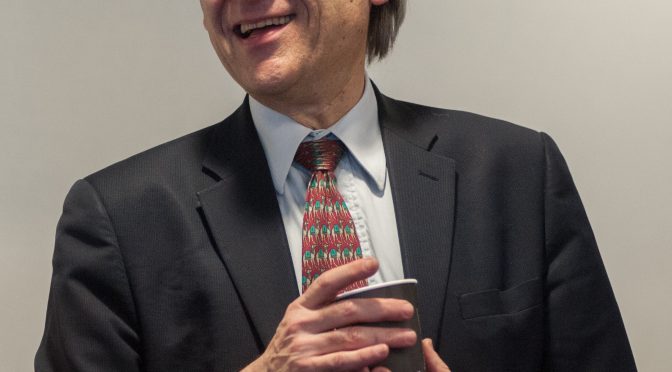
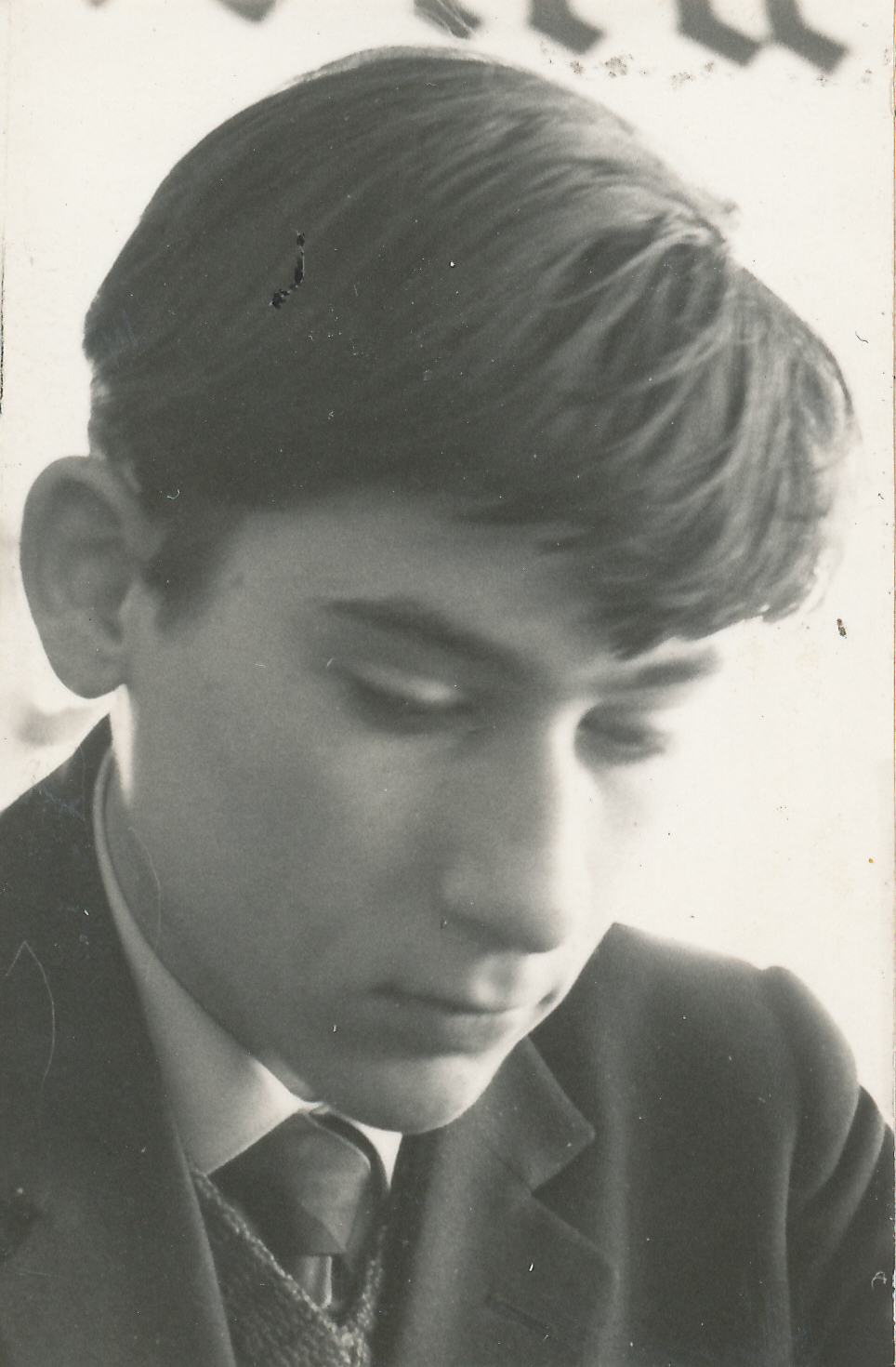
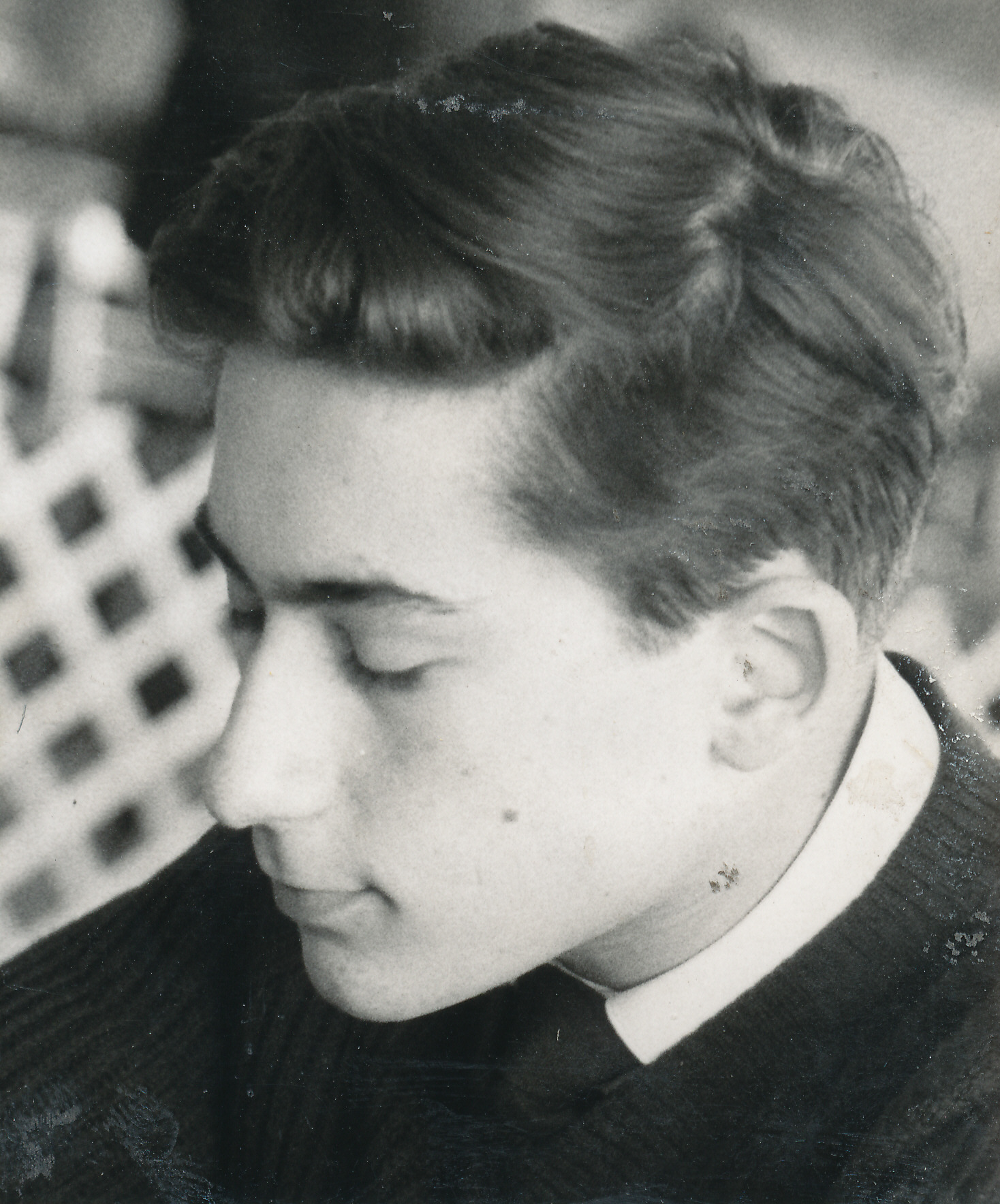
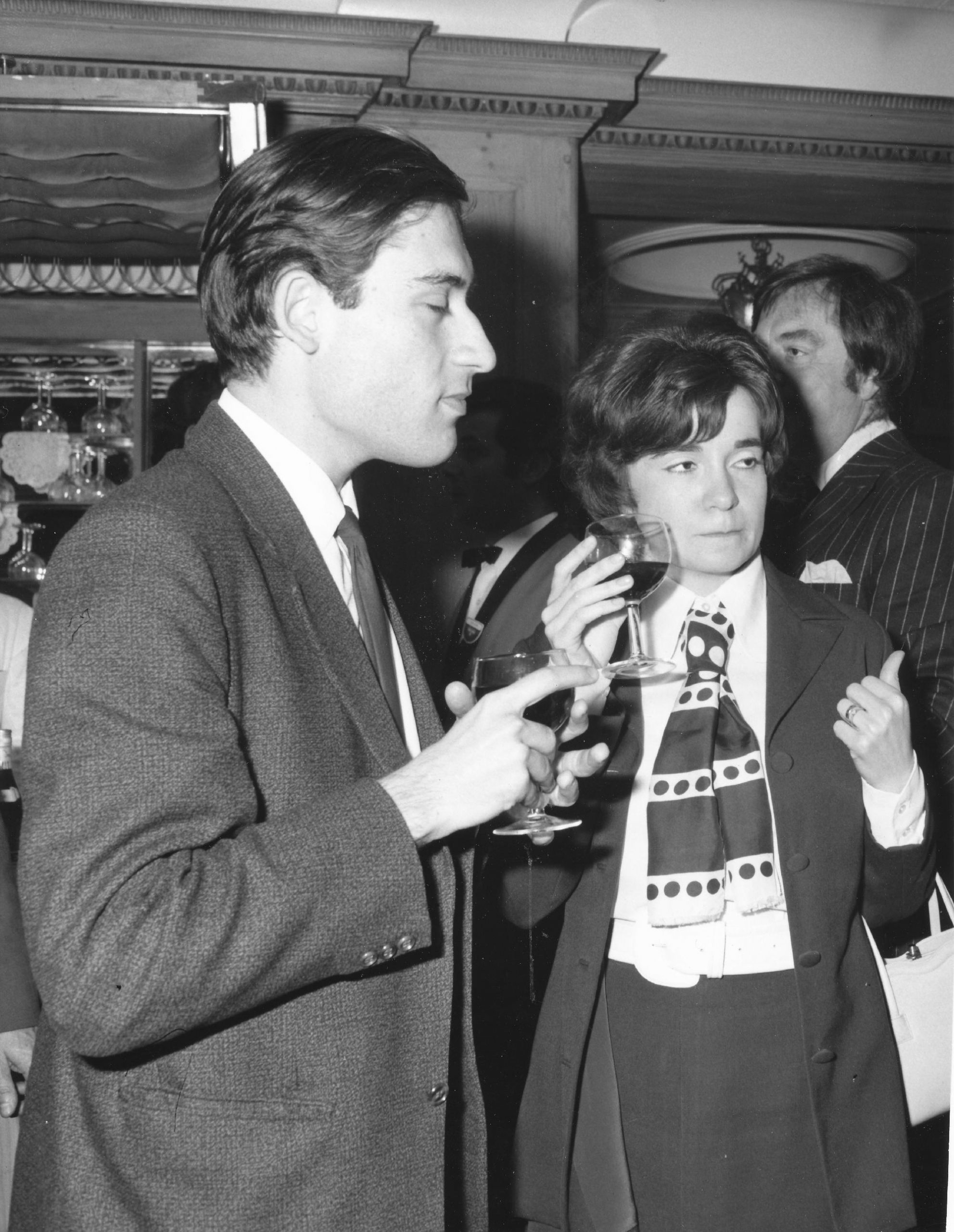
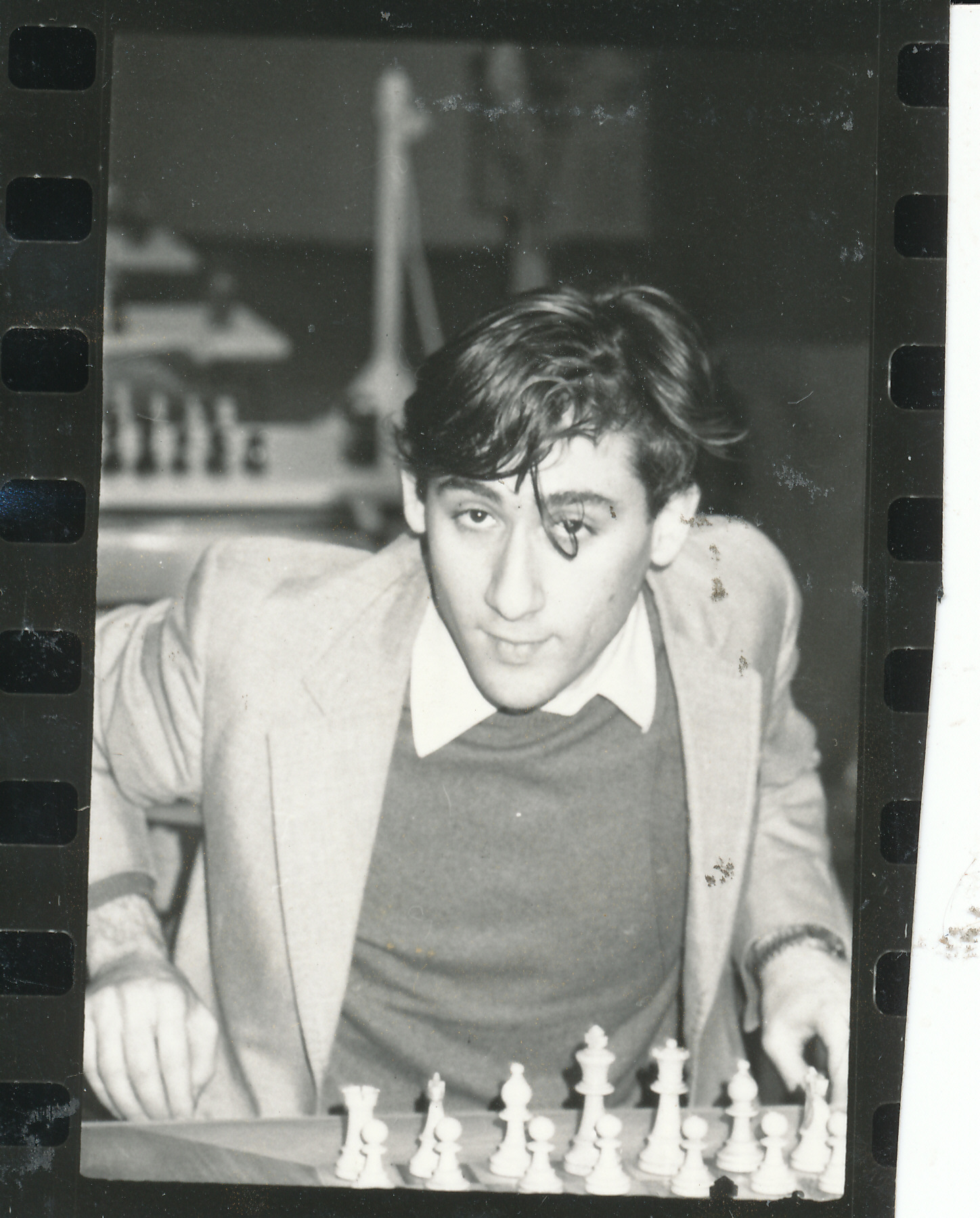
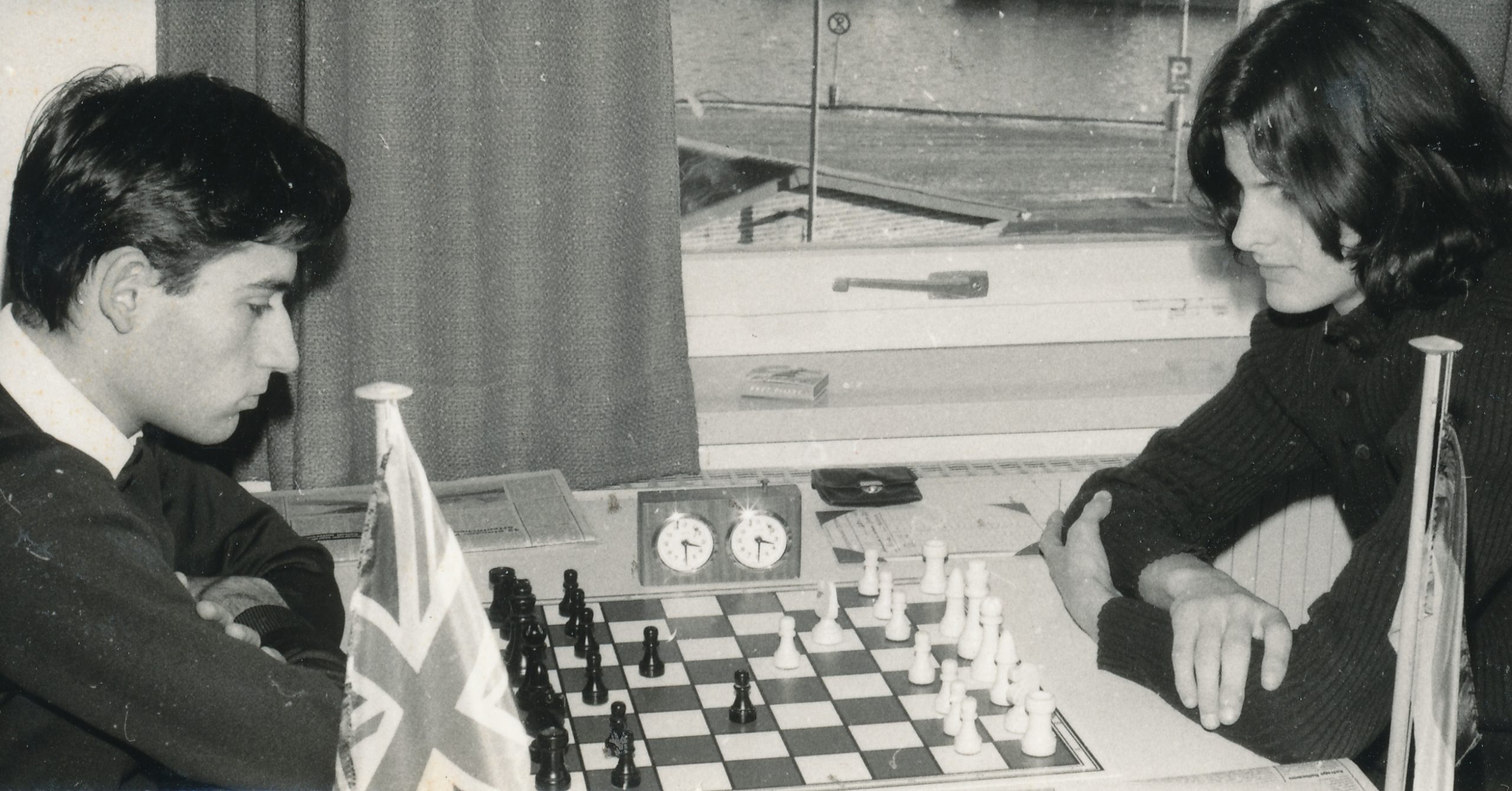
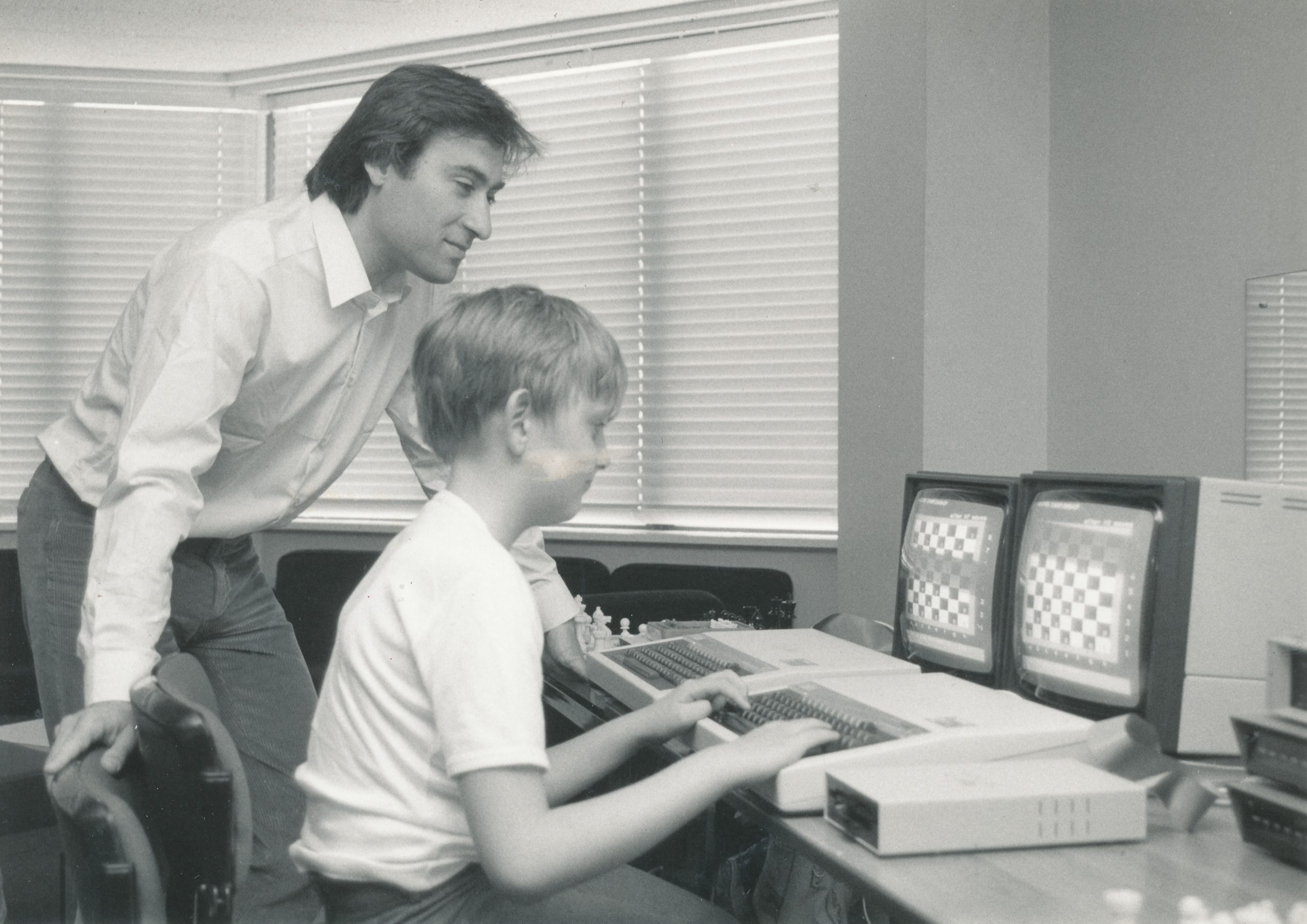
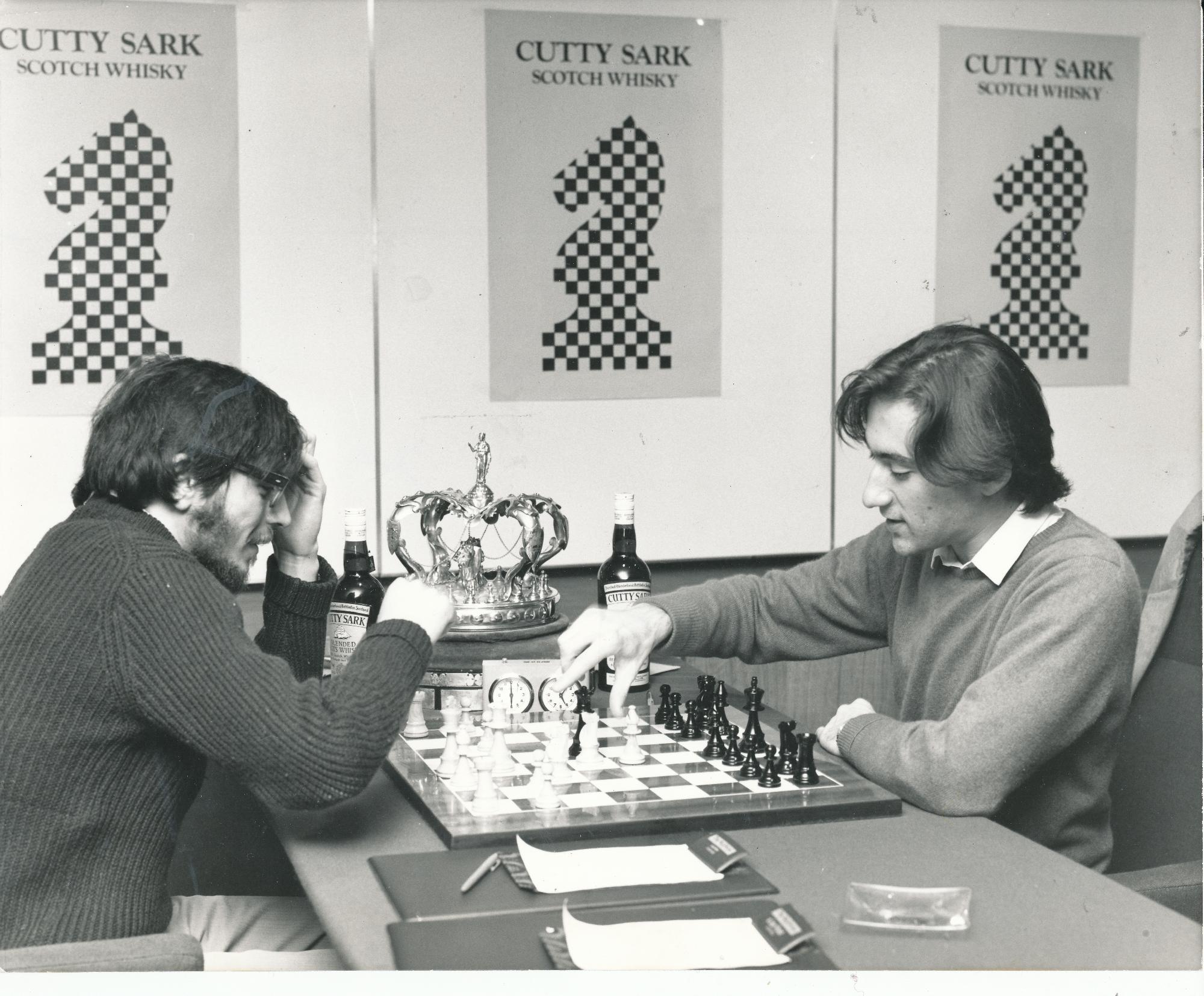
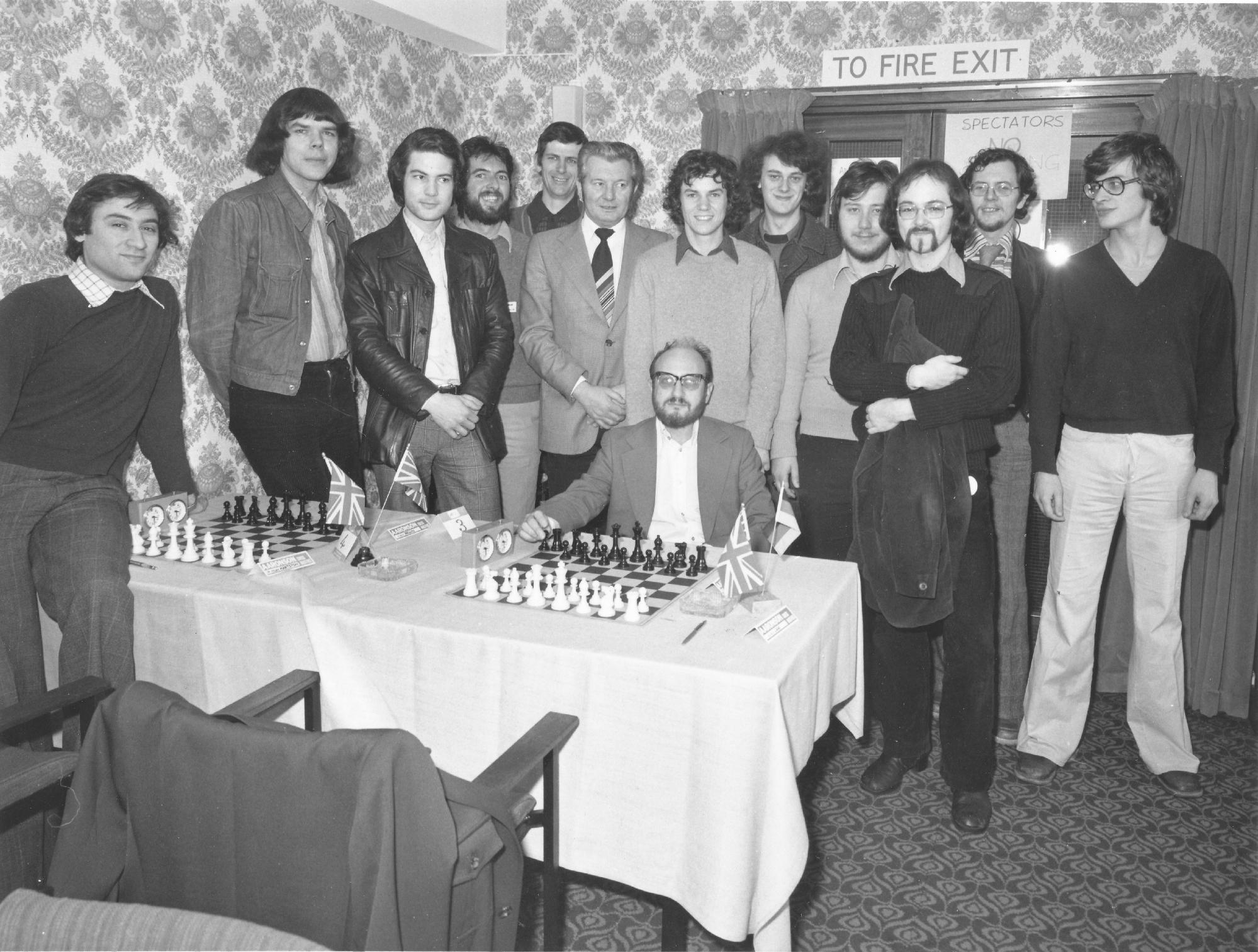
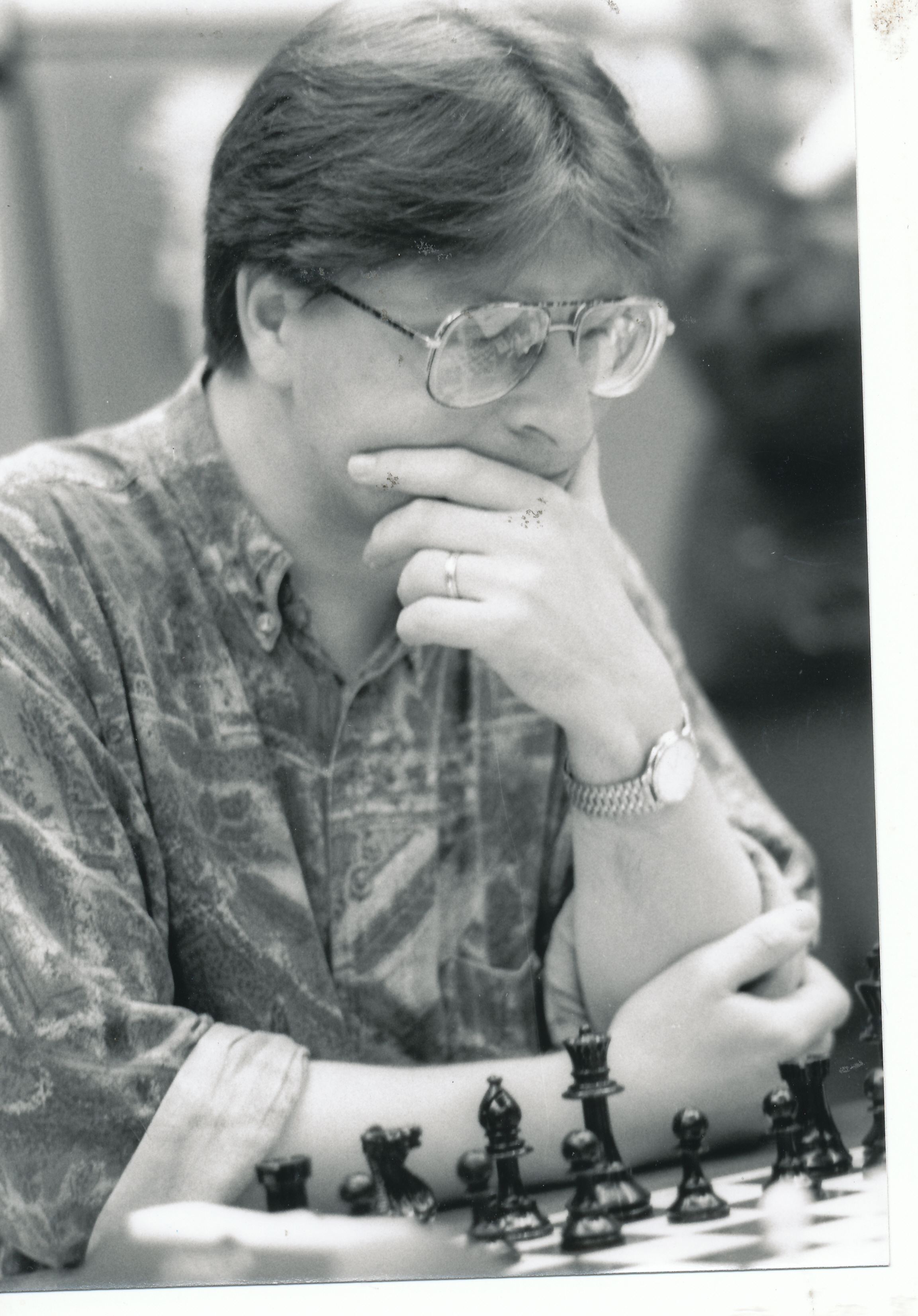
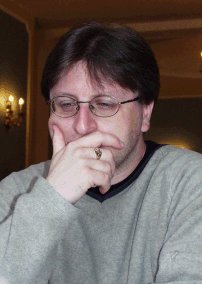
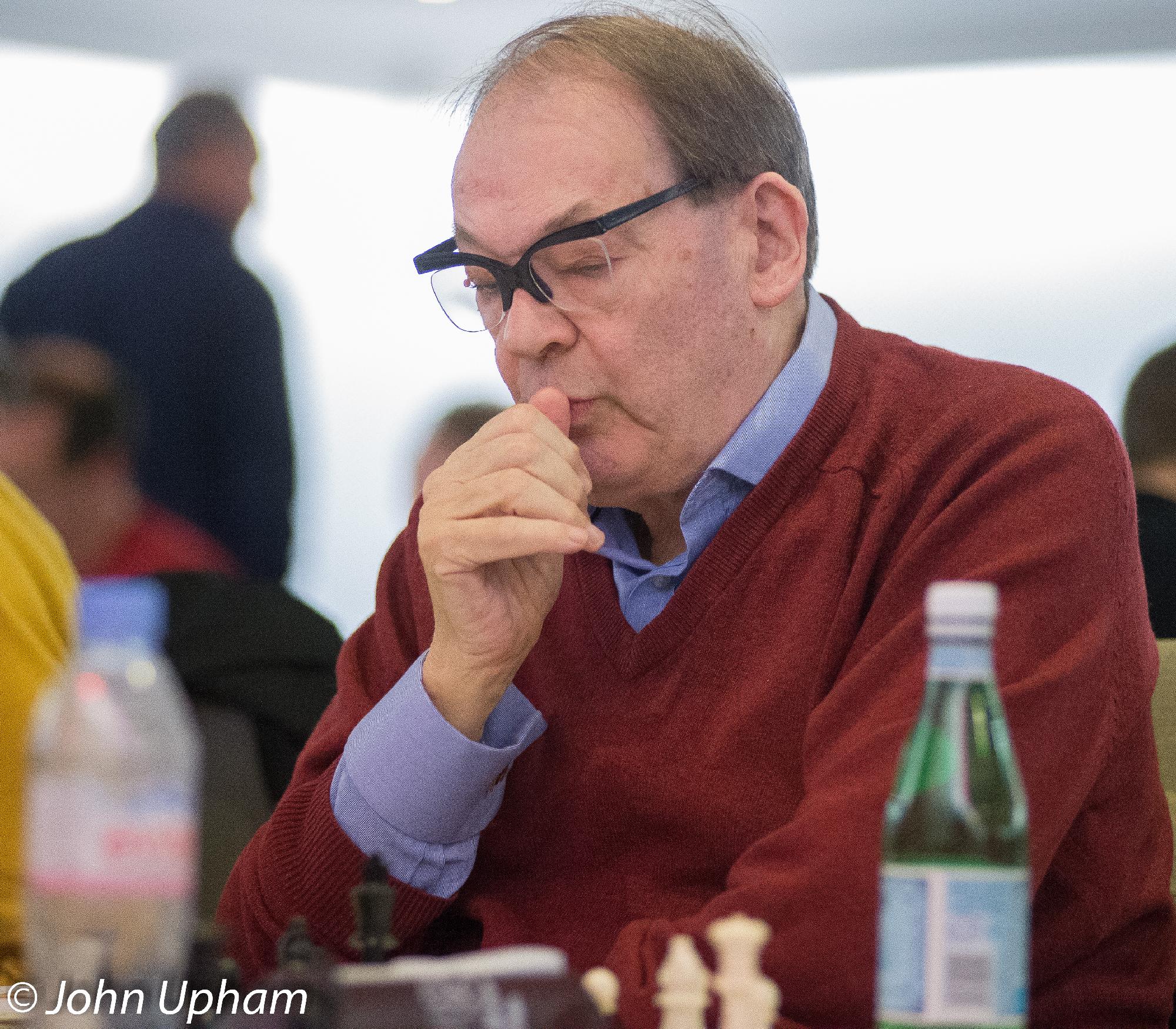
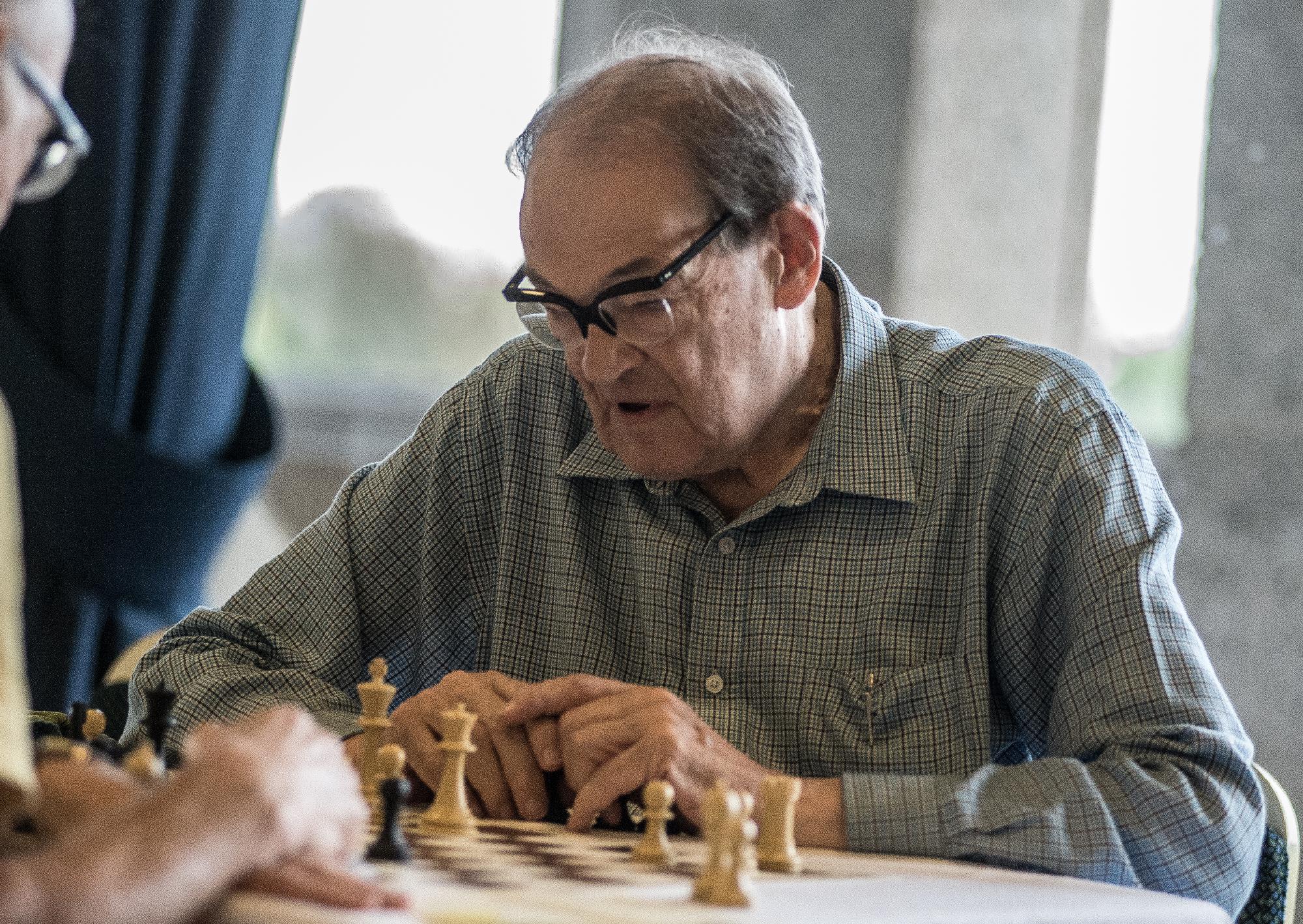
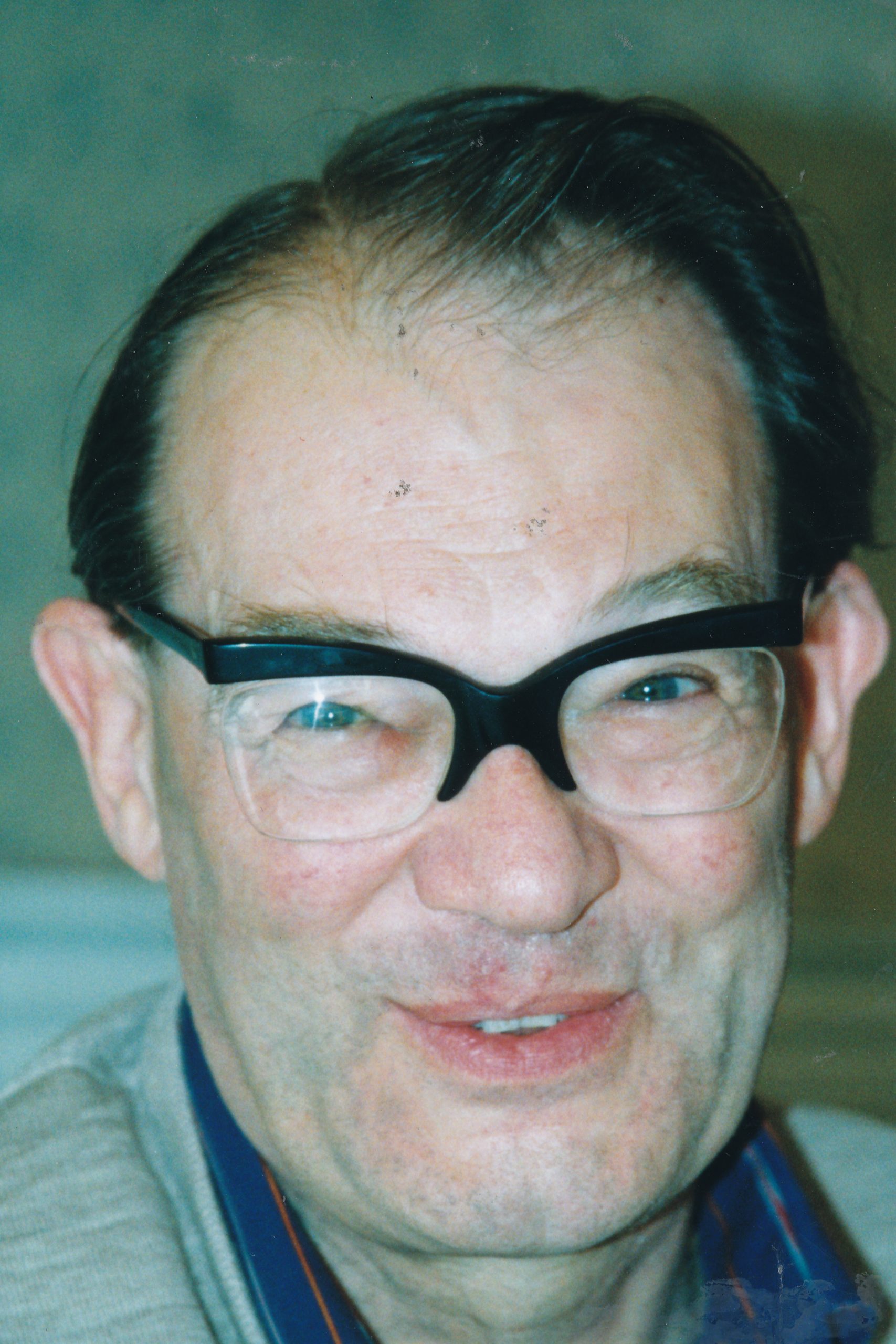
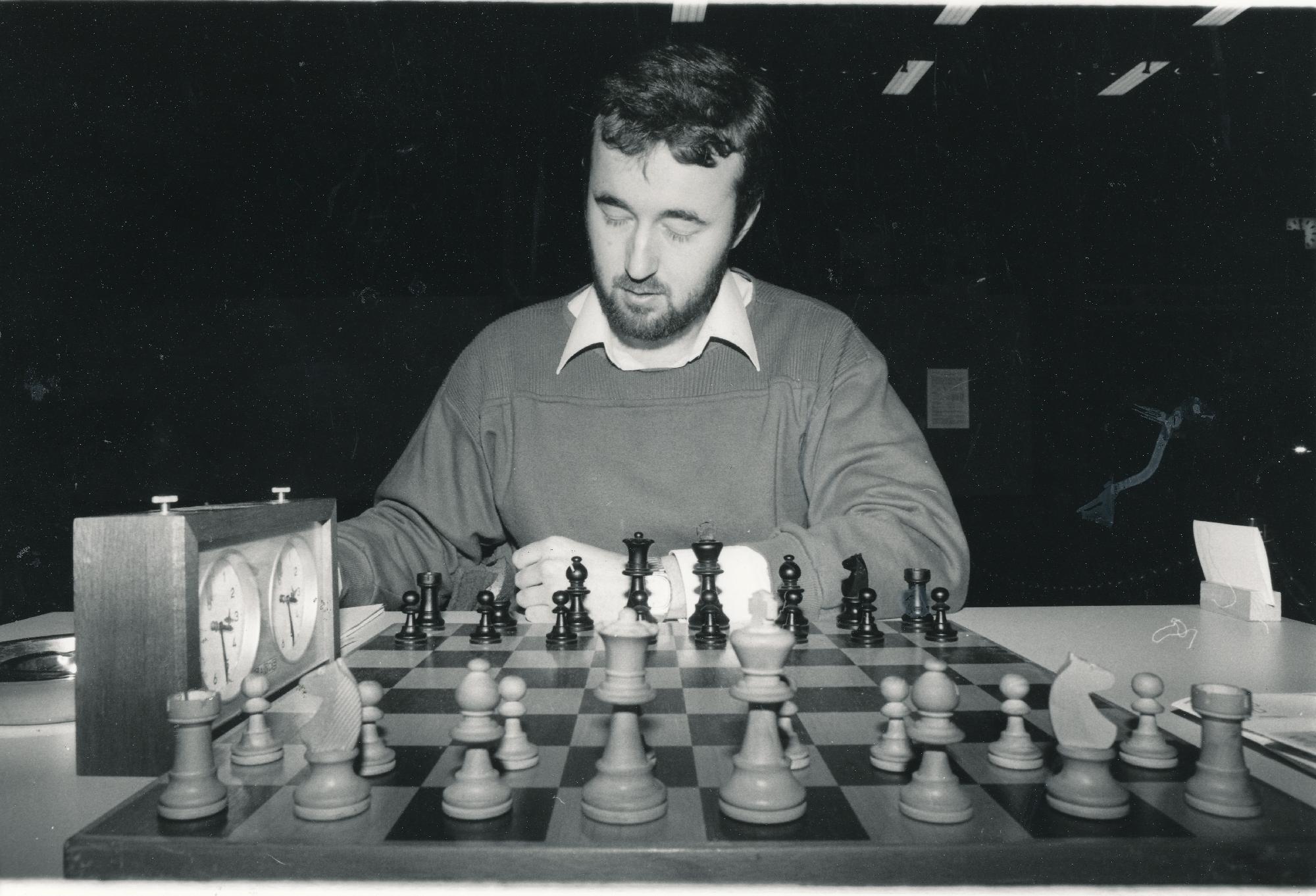
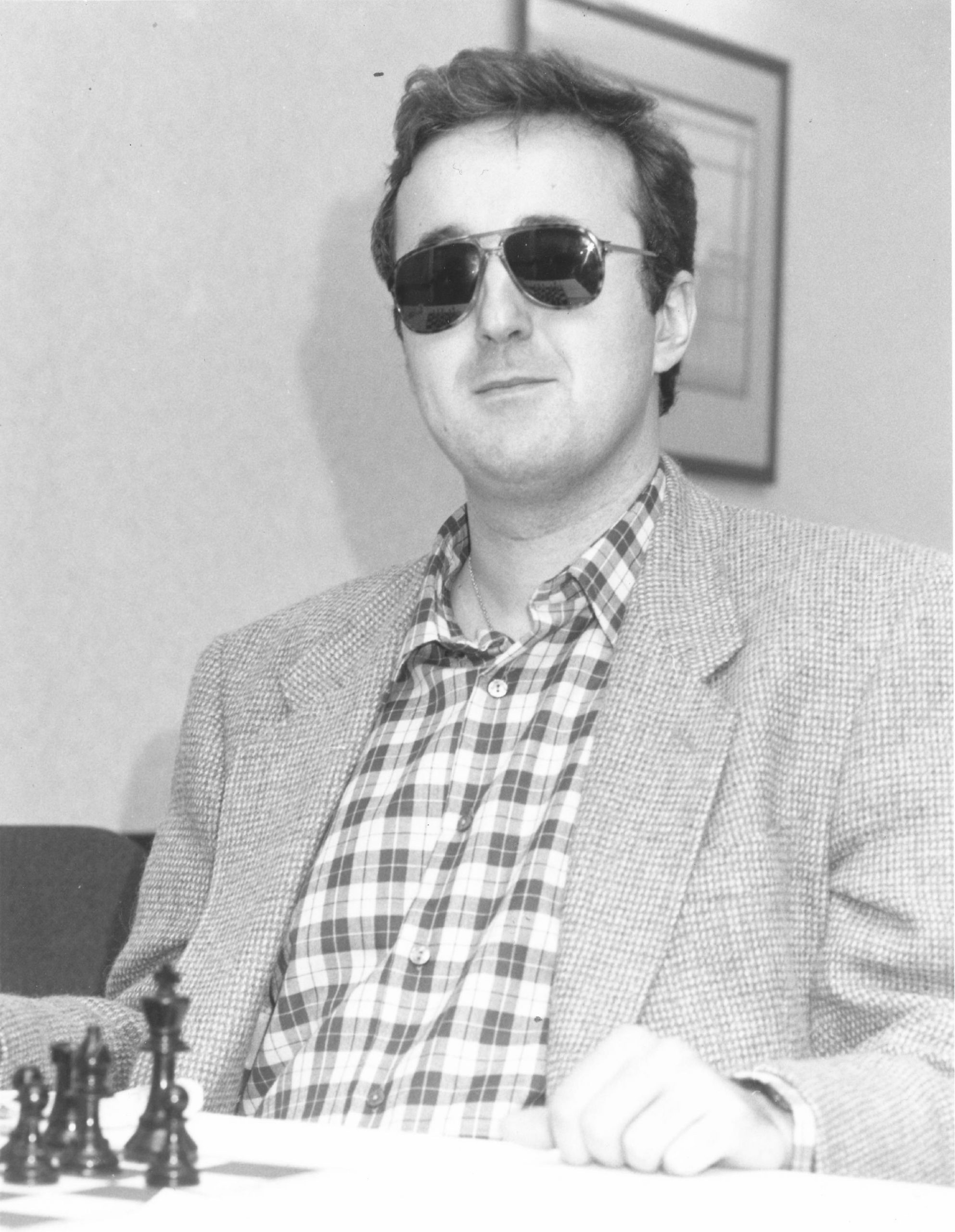
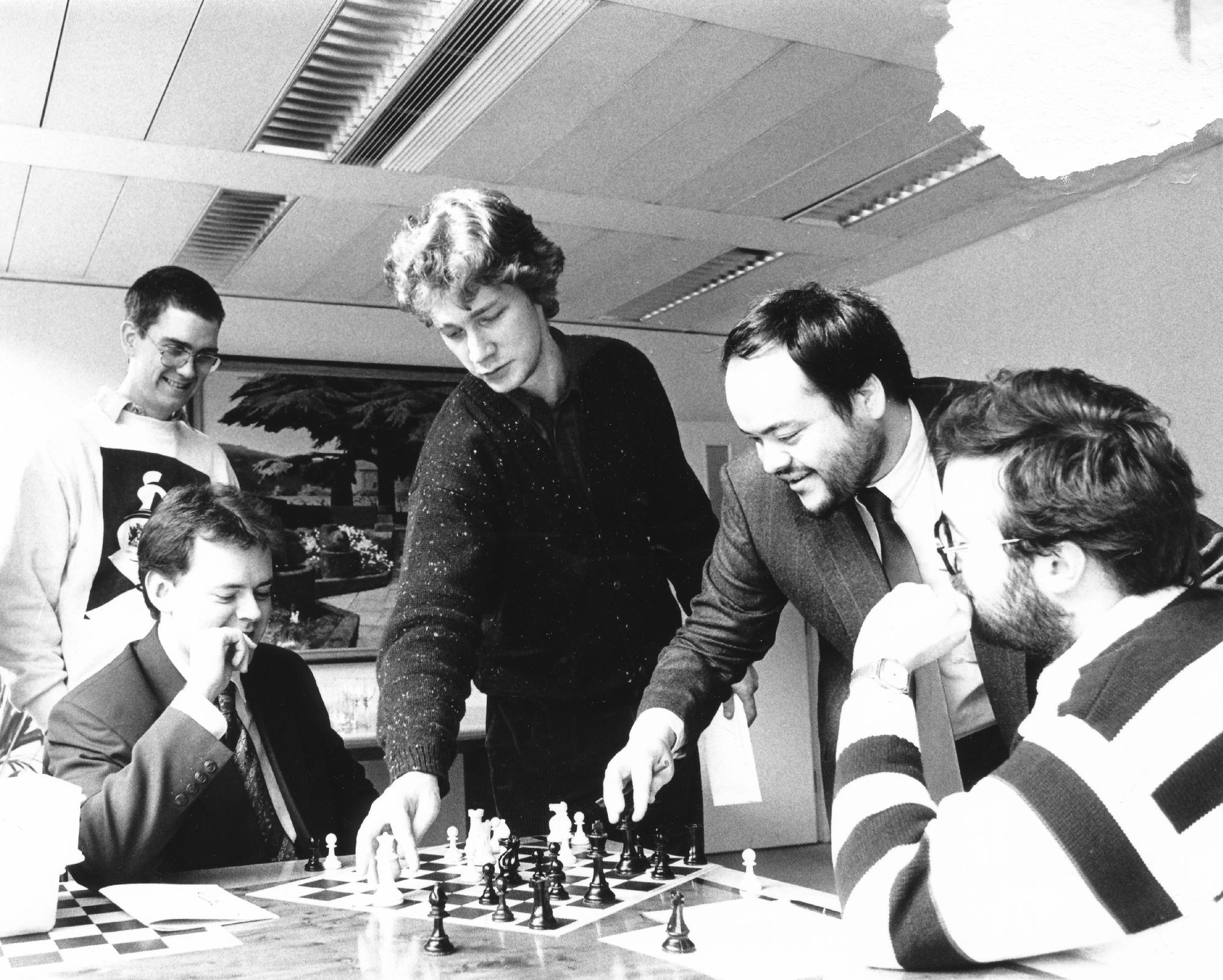
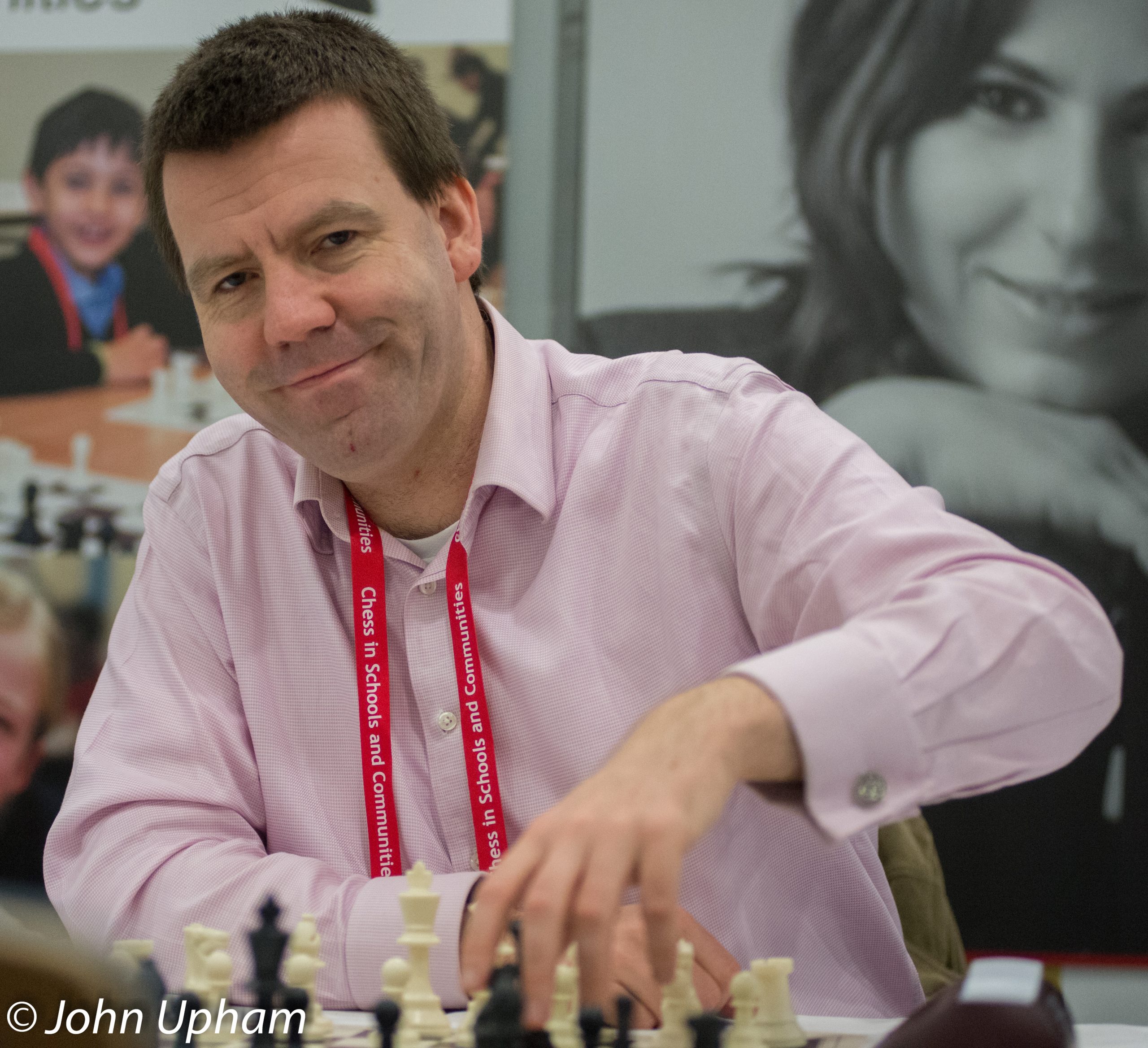
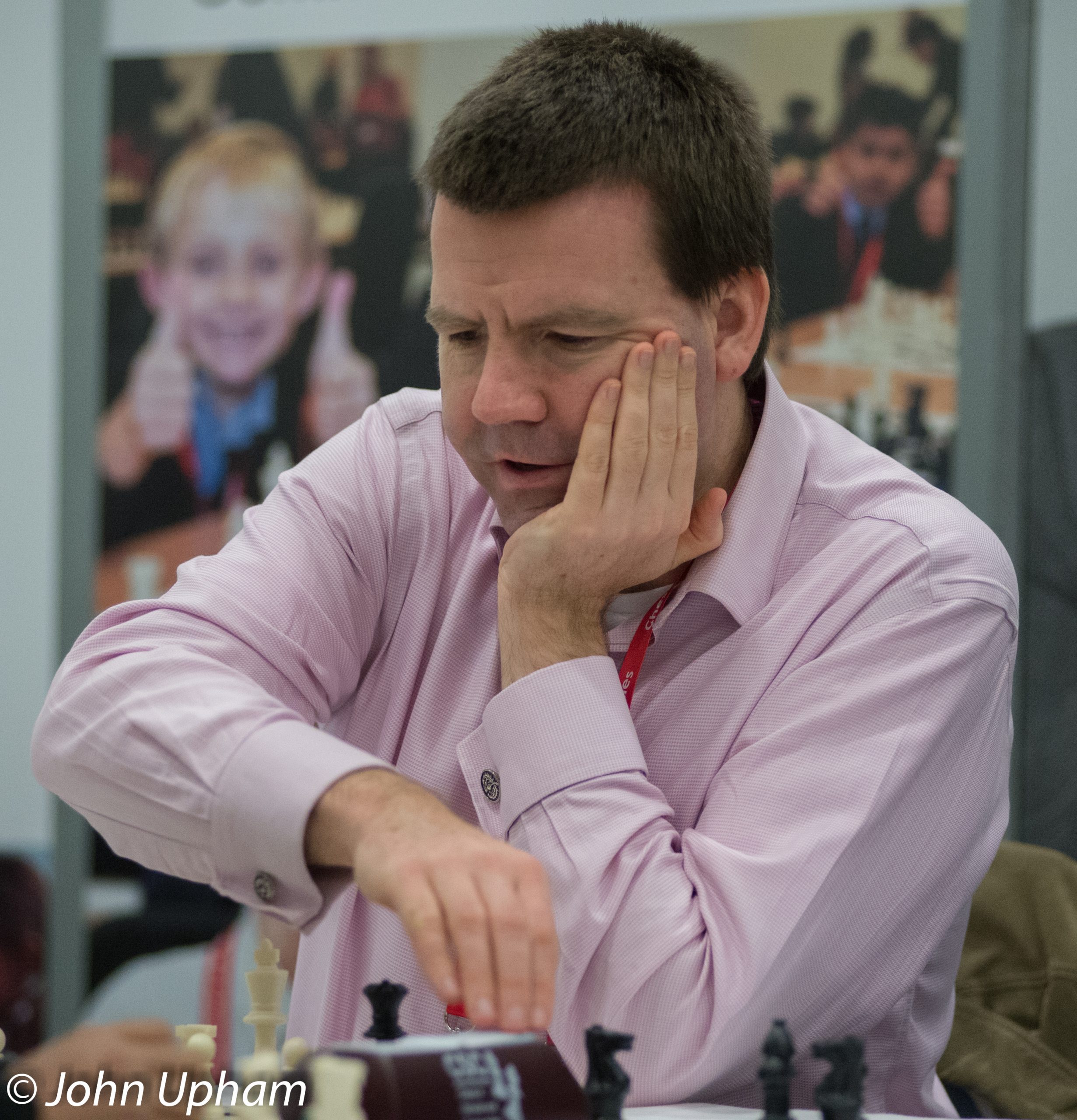
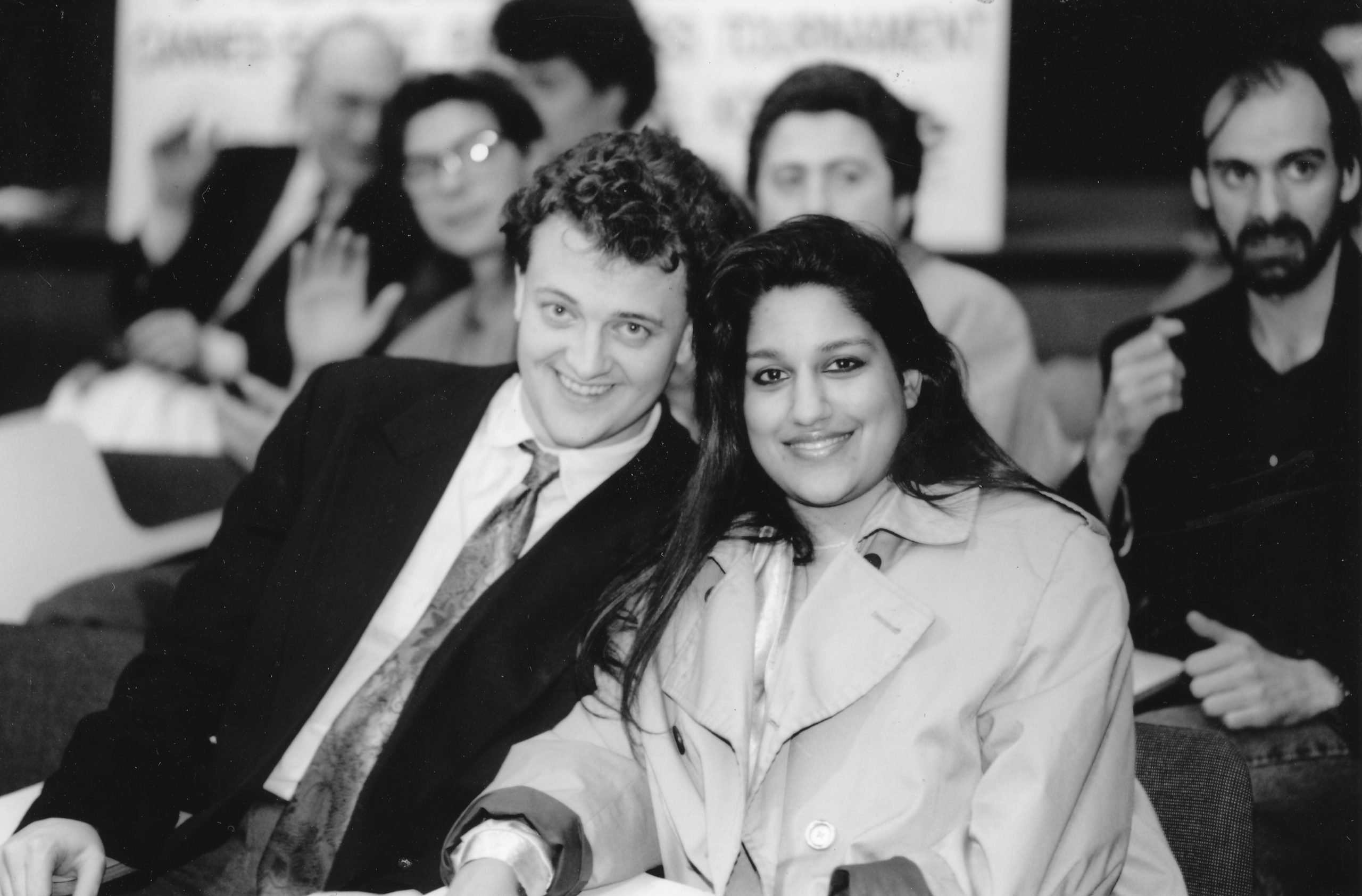
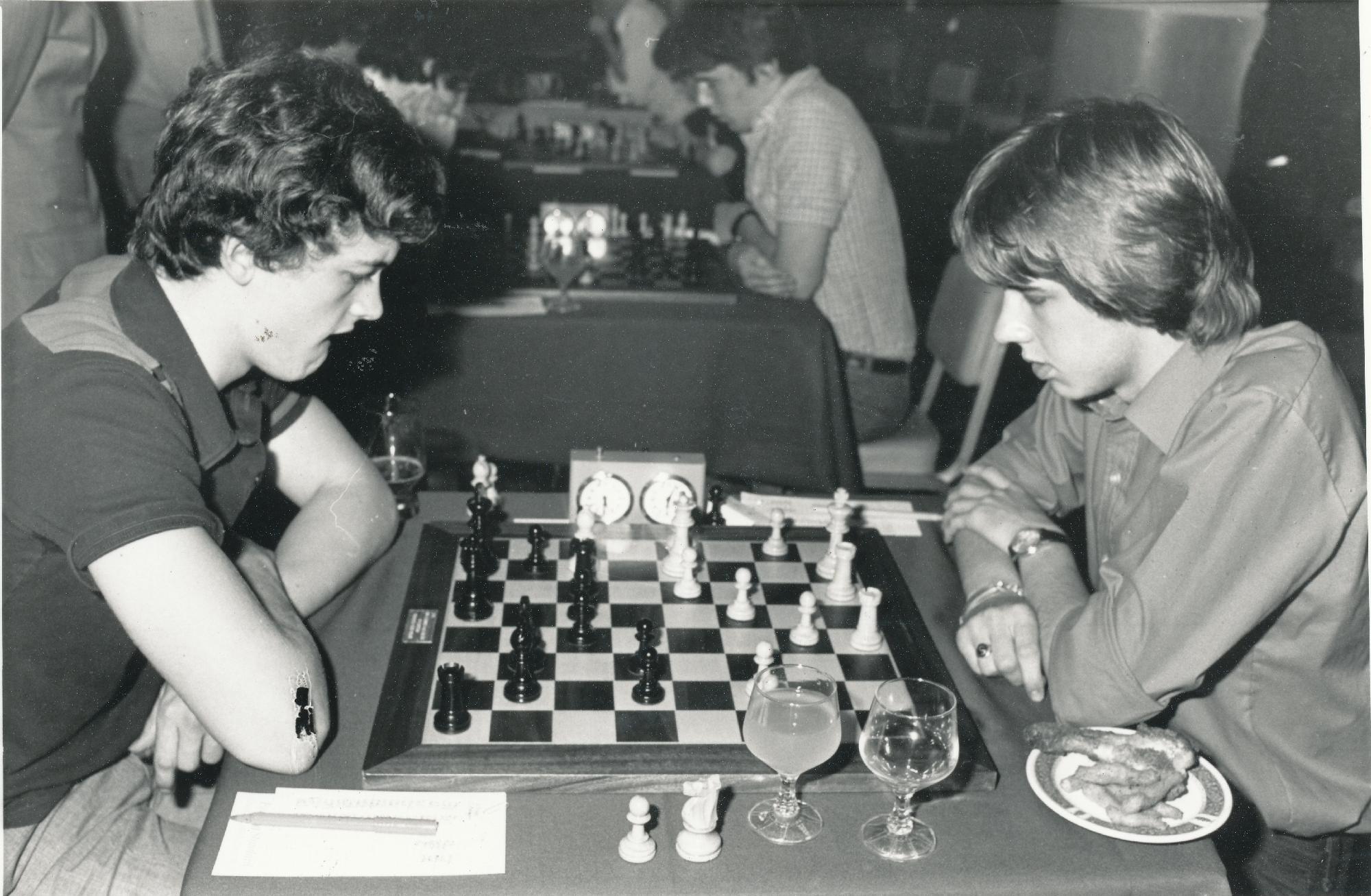
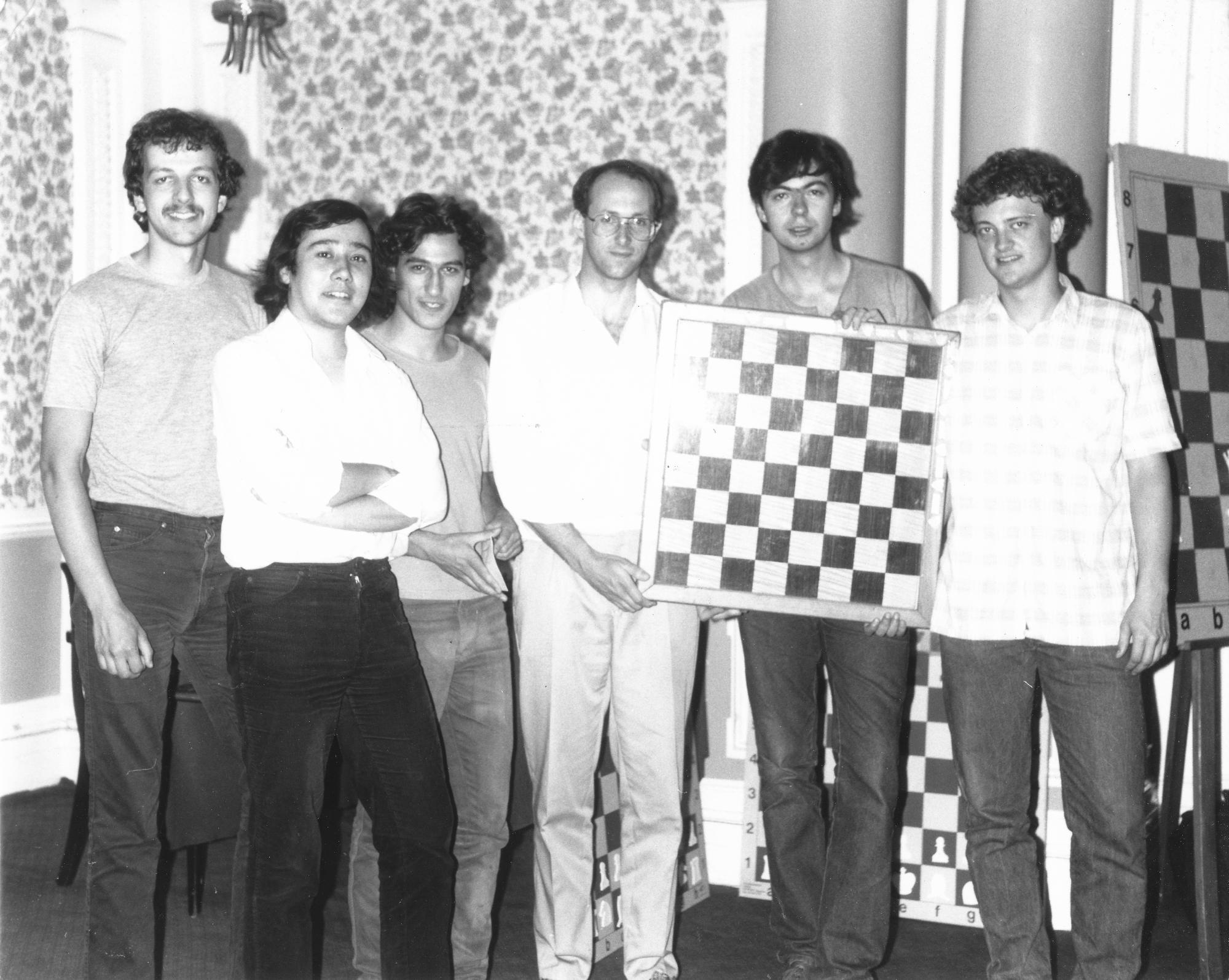
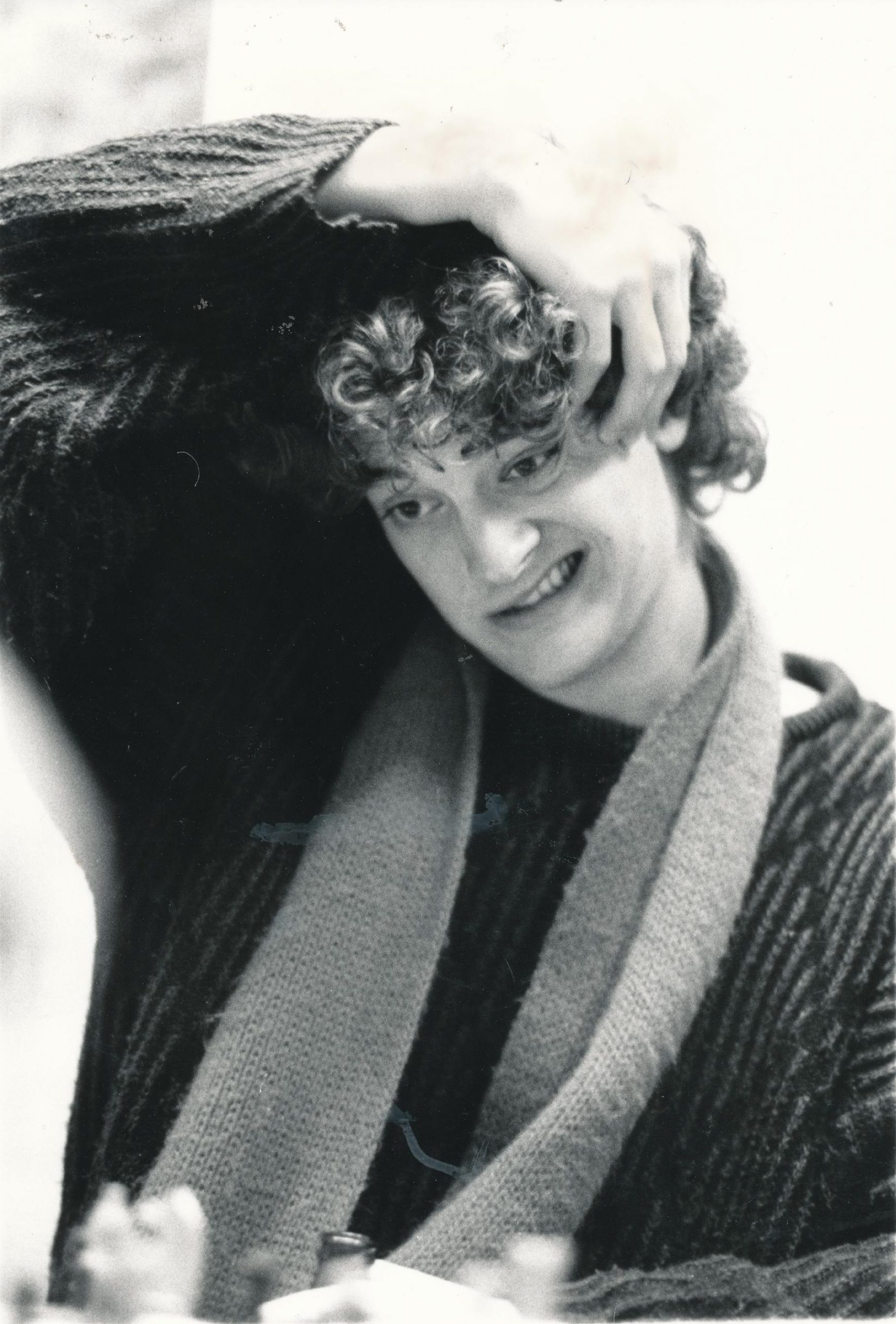
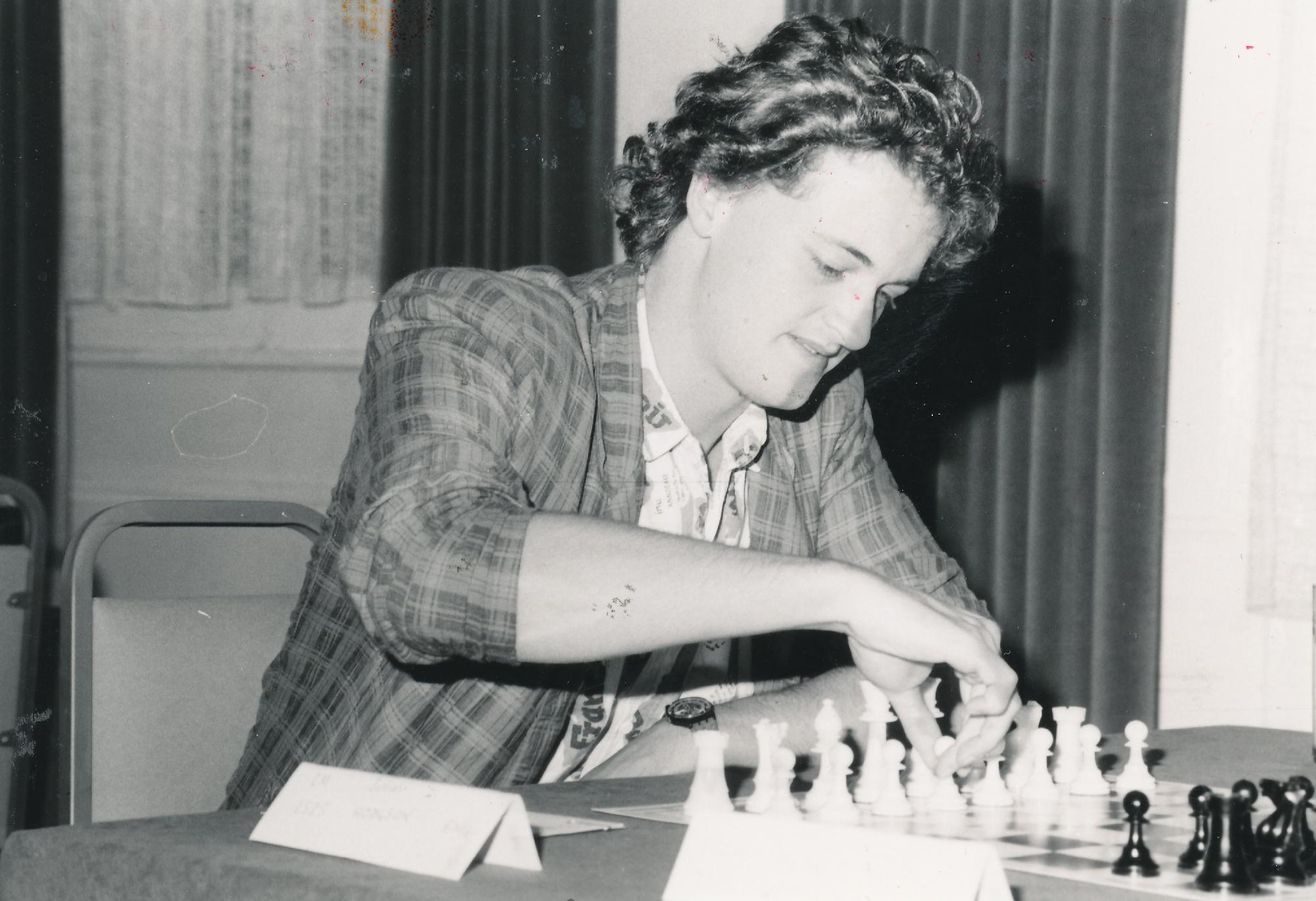
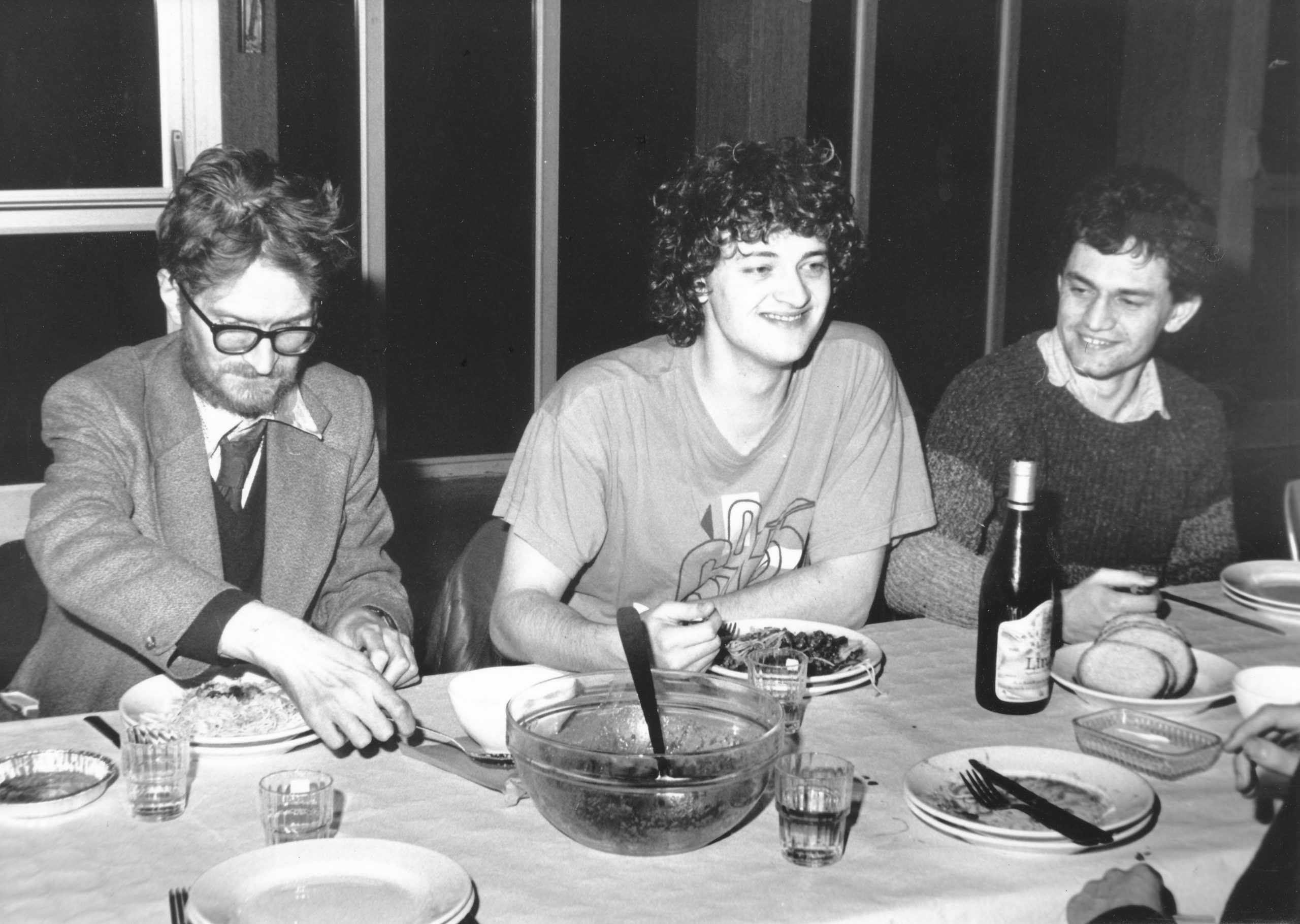
BCN wishes IM John Pigott all the best on his birthday (15-viii-1957)John Christopher Pigott was born in Croydon, Surrey and his mother’s maiden name was Fletcher.
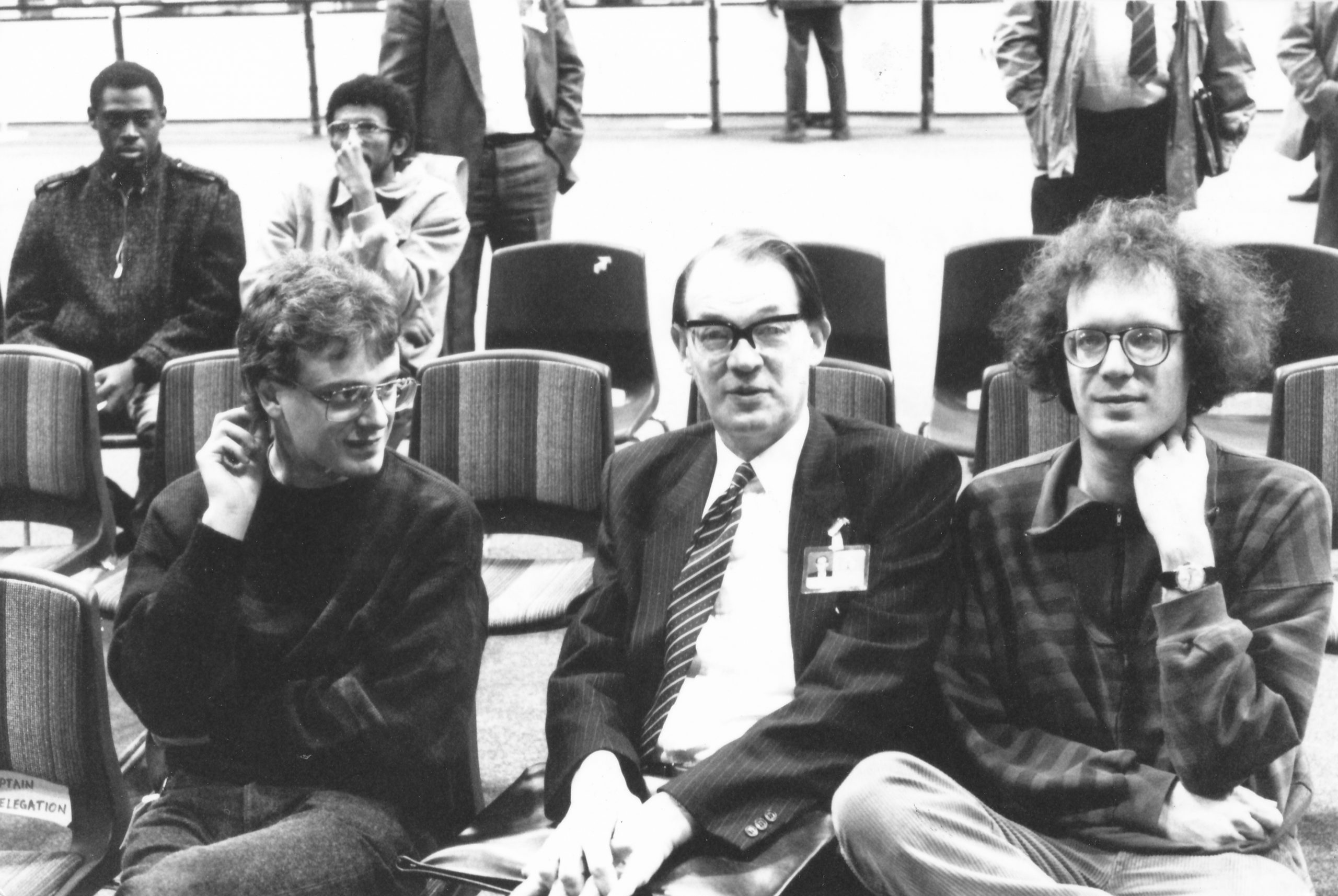
In 1975 John was selected by the BCF junior selectors and travelled with Jonathan Speelman and Peter J Lee (Hampshire) to the 8th Biel International Open in Switzerland. Leonard Barden wrote in the October 1975 British Chess Magazine (the cover was of Geller and Smyslov) :
“17-year-old John Pigott’s 8.5/11 included wins against IM Kluger, IM Messing and the 1975 Budapest Champion Rajna and earned him 2,000 Swiss francs in prize money. The three English juniors who competed, Pigott, Speelman and Lee were chosen by the BCF junior selectors and travelled to Switzerland with the help of grant from the Slater Foundation and the London Chess Club.”
John represented England at the 1975 Anglo-Dutch match (25th and 26th of October) scoring 0.5/2 versus Paul van der Sterren. The game scores appear to either have been lost on not recorded.
In 1976 John scored 4.5/5 in the Surrey Open and shared the 3rd, 4th and 5th prize.
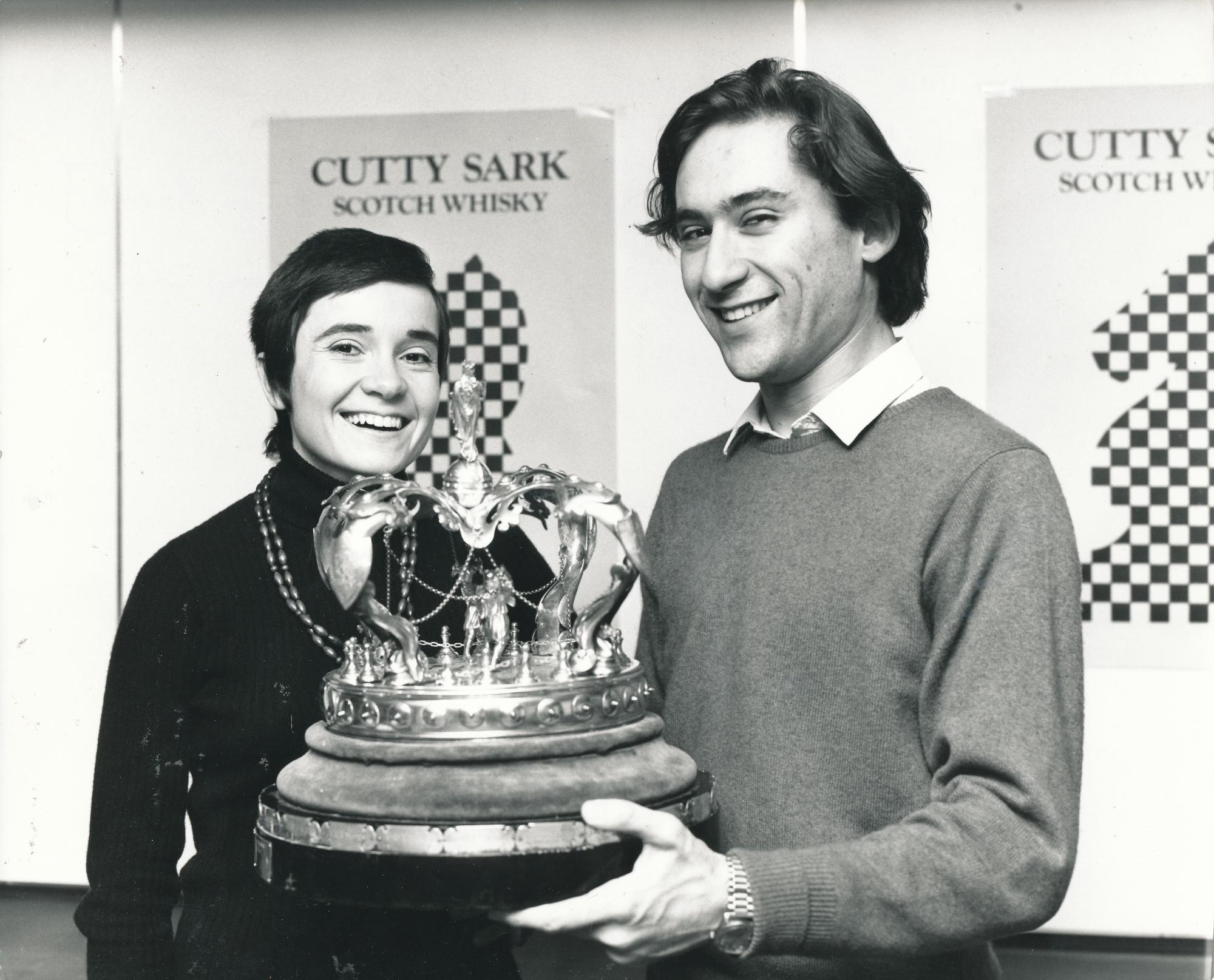
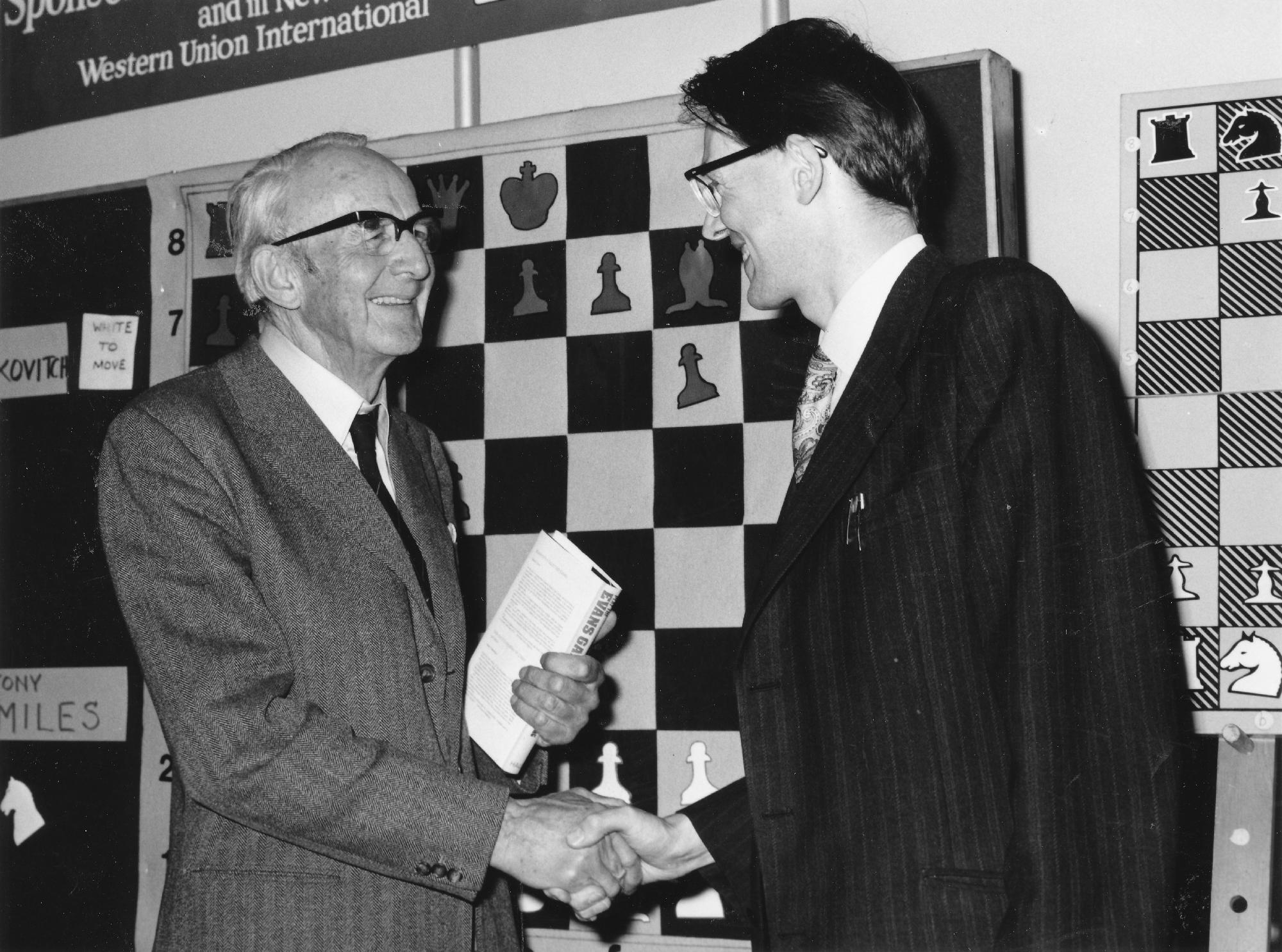
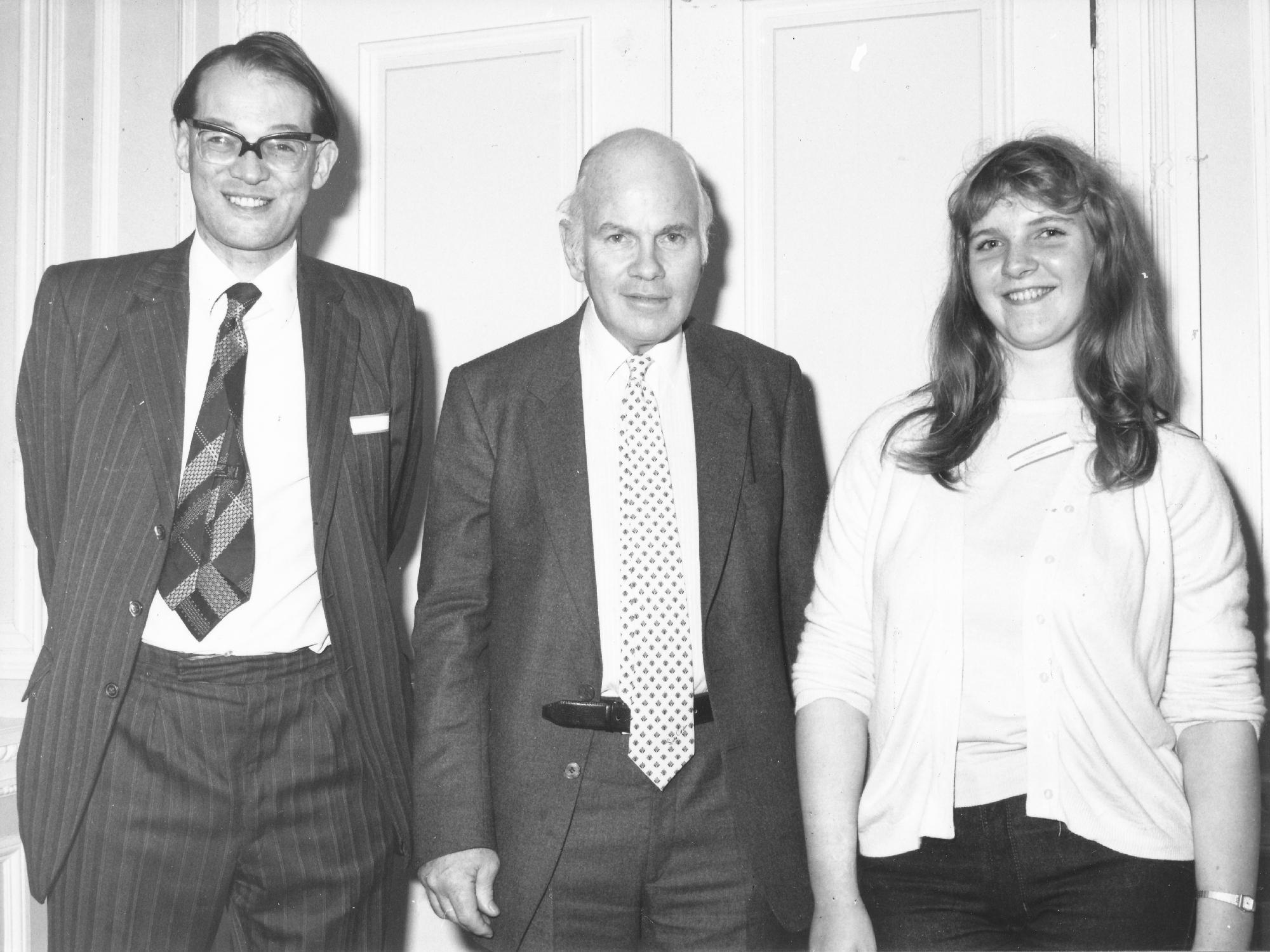
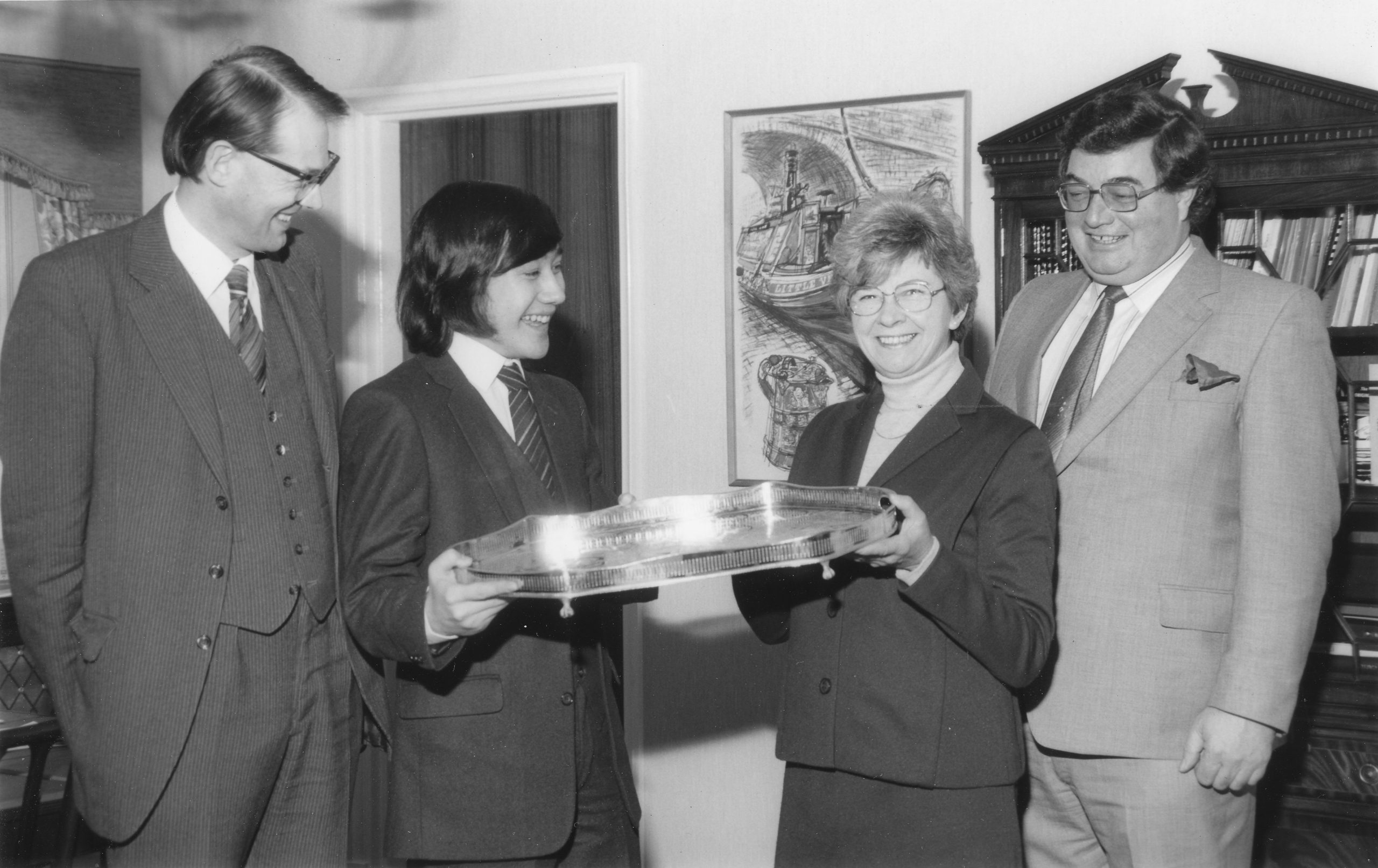
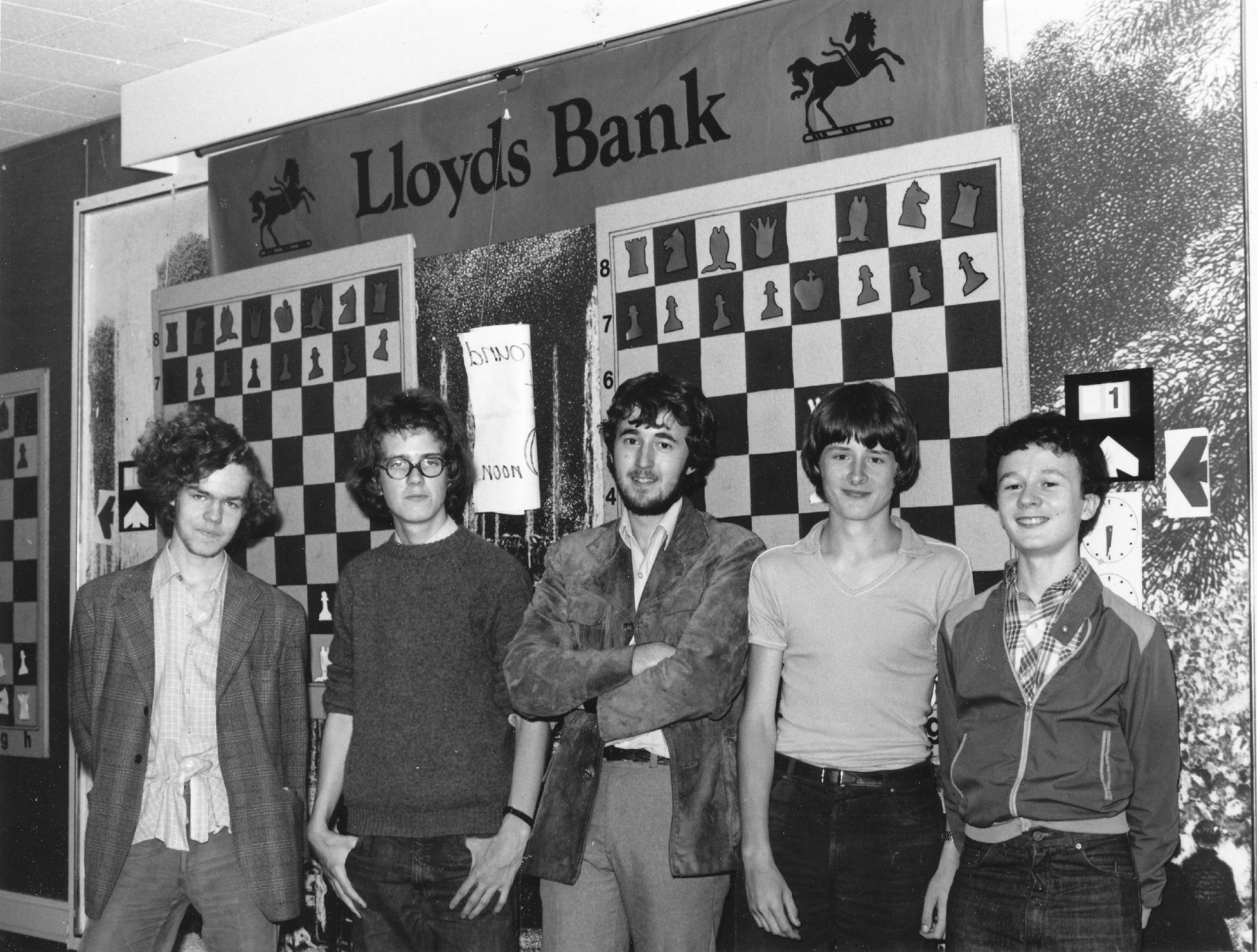
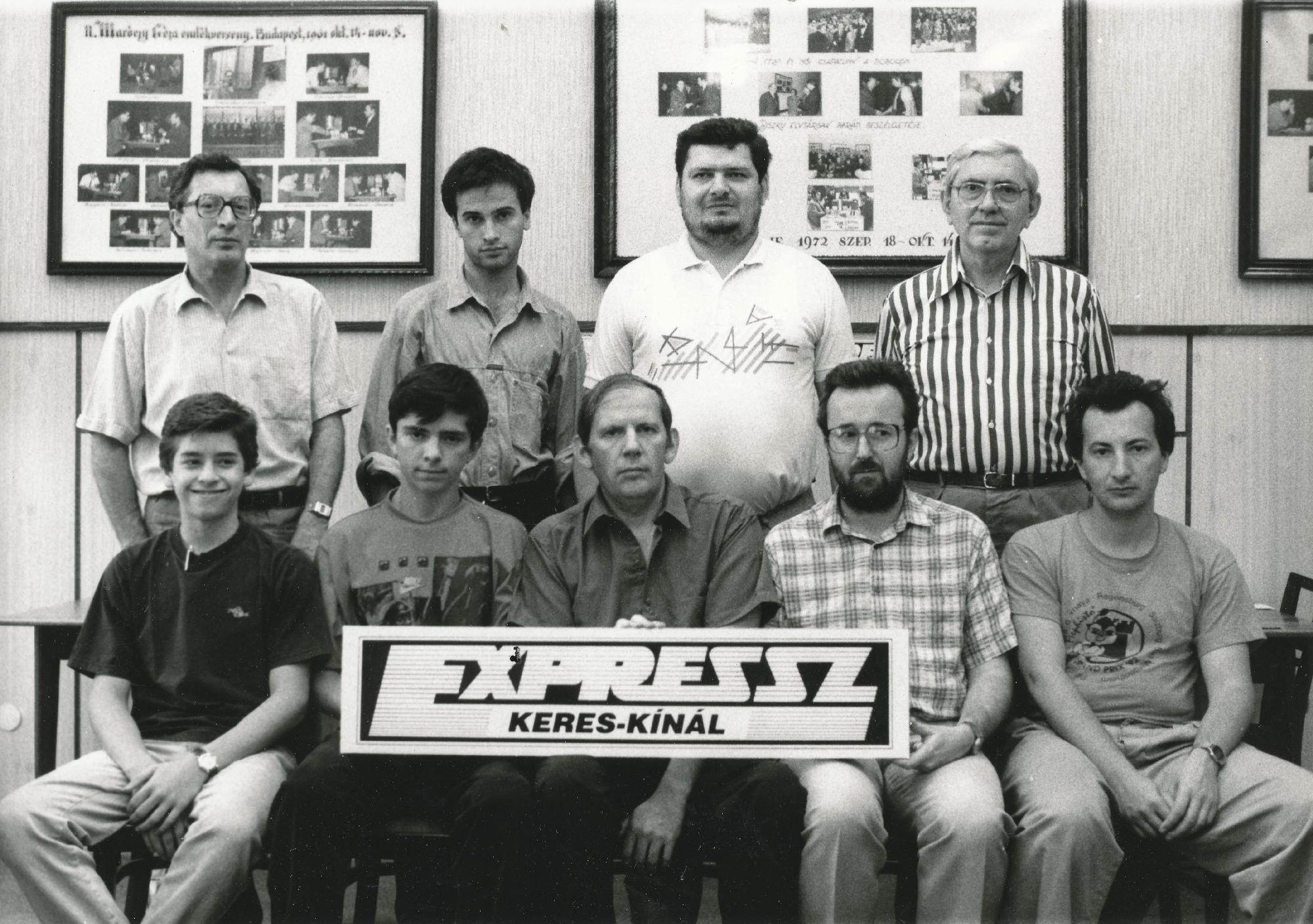
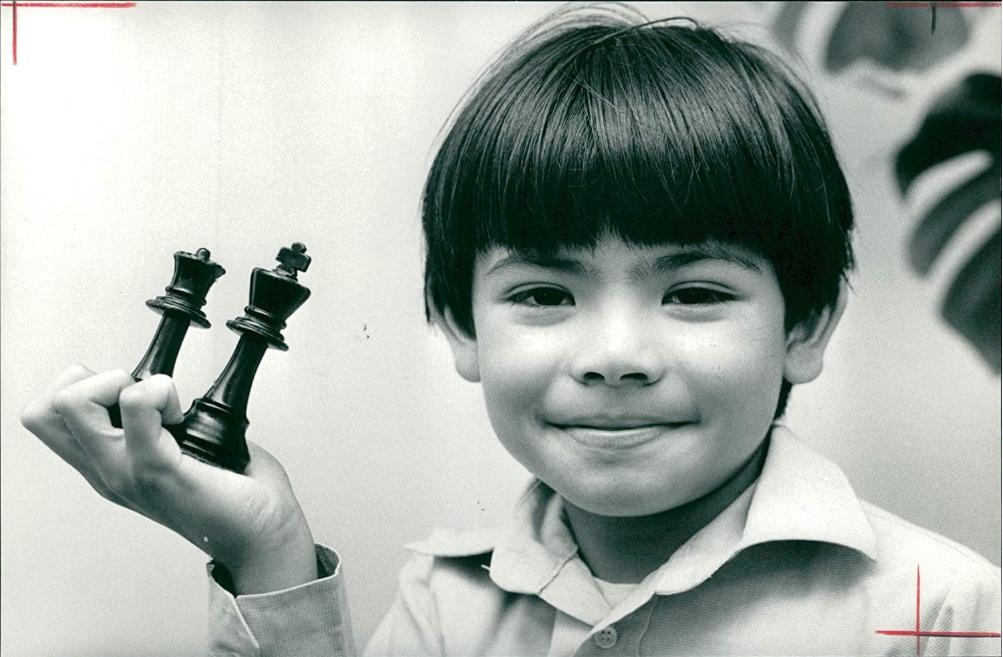
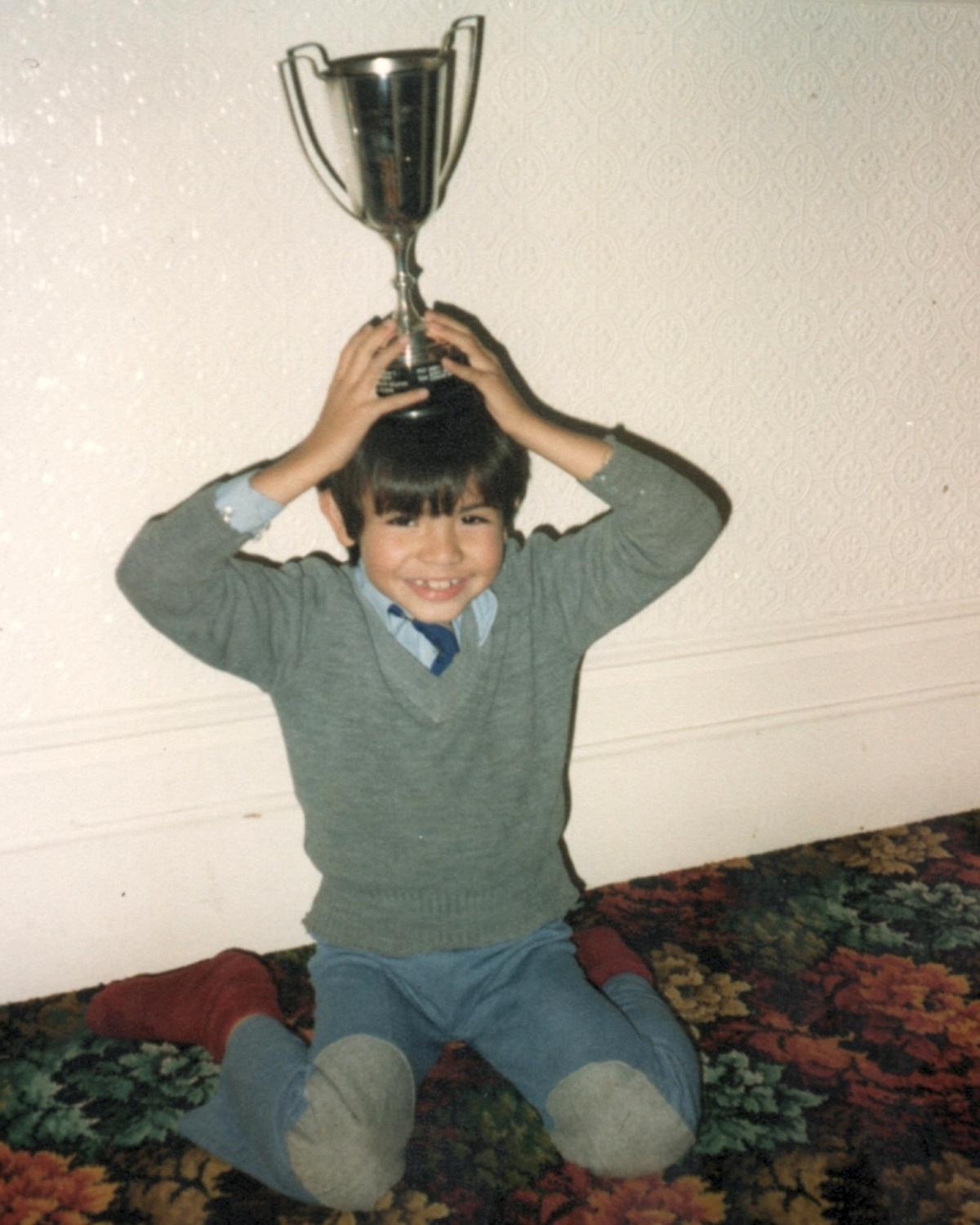
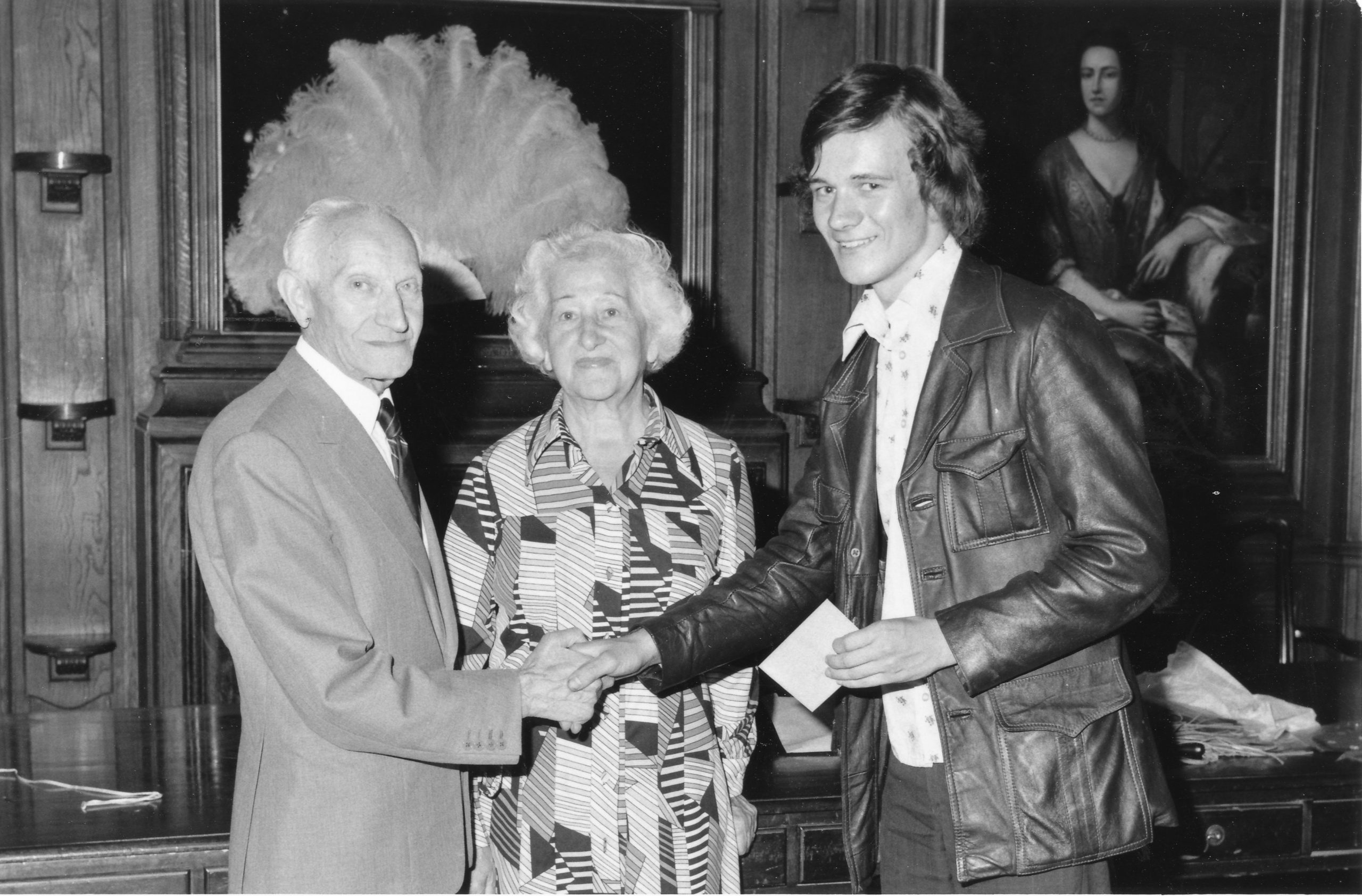
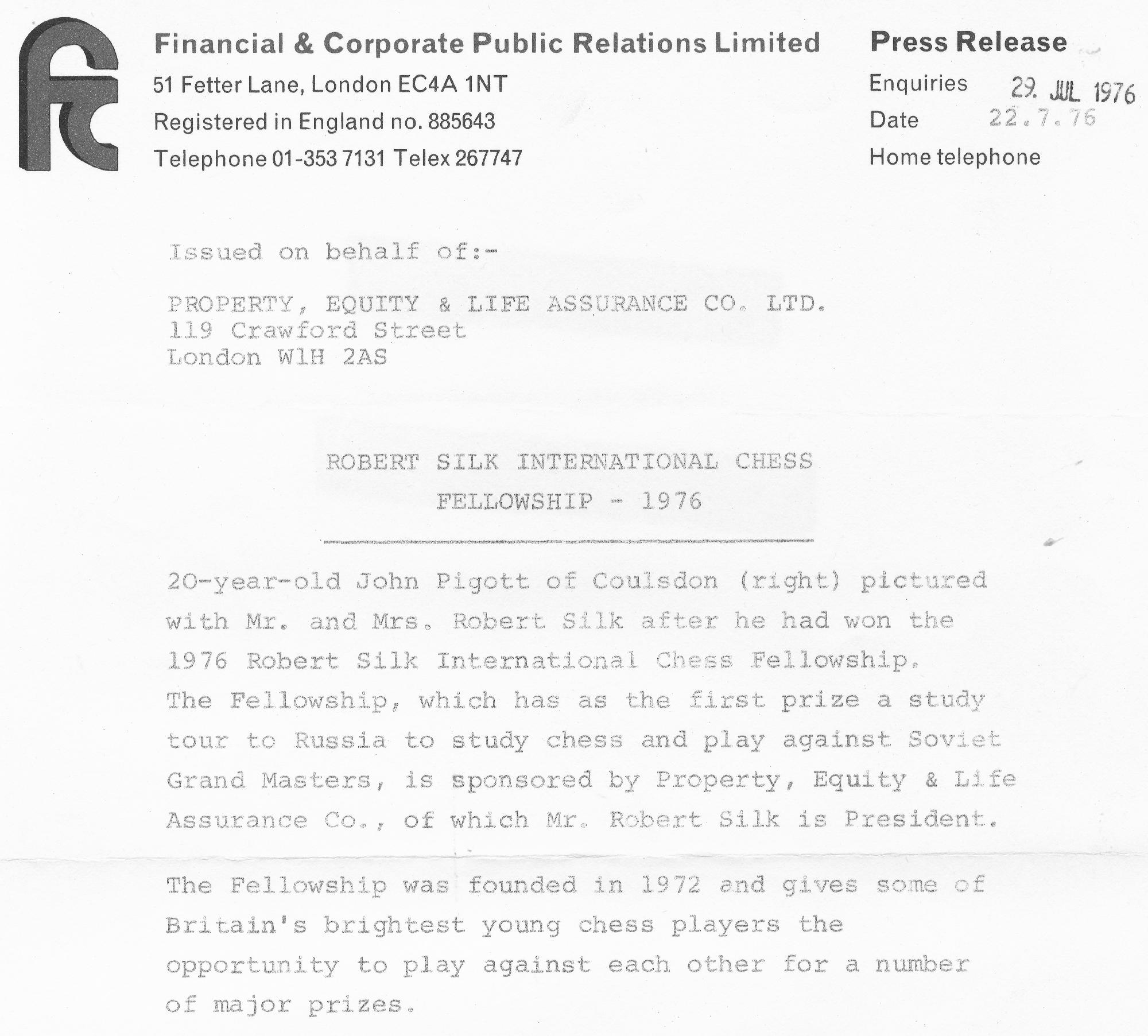
The caption is in the photograph belowThe caption is in the photograph above
John became a FIDE Master in 1984 and an International Master in 2017, a gap of some 33 years!
John plays for Little Heath, 4NCL Barbican, Hon Members LCCL and King’s Head chess clubs.
After a sojourn from chess John returned to the ECF grading list in January 2015 with a grading of 269F attracting some attention.
His highest FIDE rating was 2419 in February 2018 at the age of 61.
With the white pieces John plays the Queen’s Gambit and the Giuoco Piano.
As the second player John enjoys the Sicilian Najdorf and the Nimzo Indian Defence.
On the “glorious twelfth” of August we celebrate the birthday of one of England’s most popular chess players and writers, IM Bill Hartston.
William Roland Hartston was born in Willesden, Middlesex on Tuesday, August 12th, 1947. His father was William Hartston, a significant member of the Royal College of Physicians who was married to Mary Roland. Bill has a sister.
Bill Hartston
He studied at the City of London School and then studied mathematics at Jesus College, Cambridge and graduated with a BA in 1968 and an MA in 1972, but did not complete his PhD on number theory.
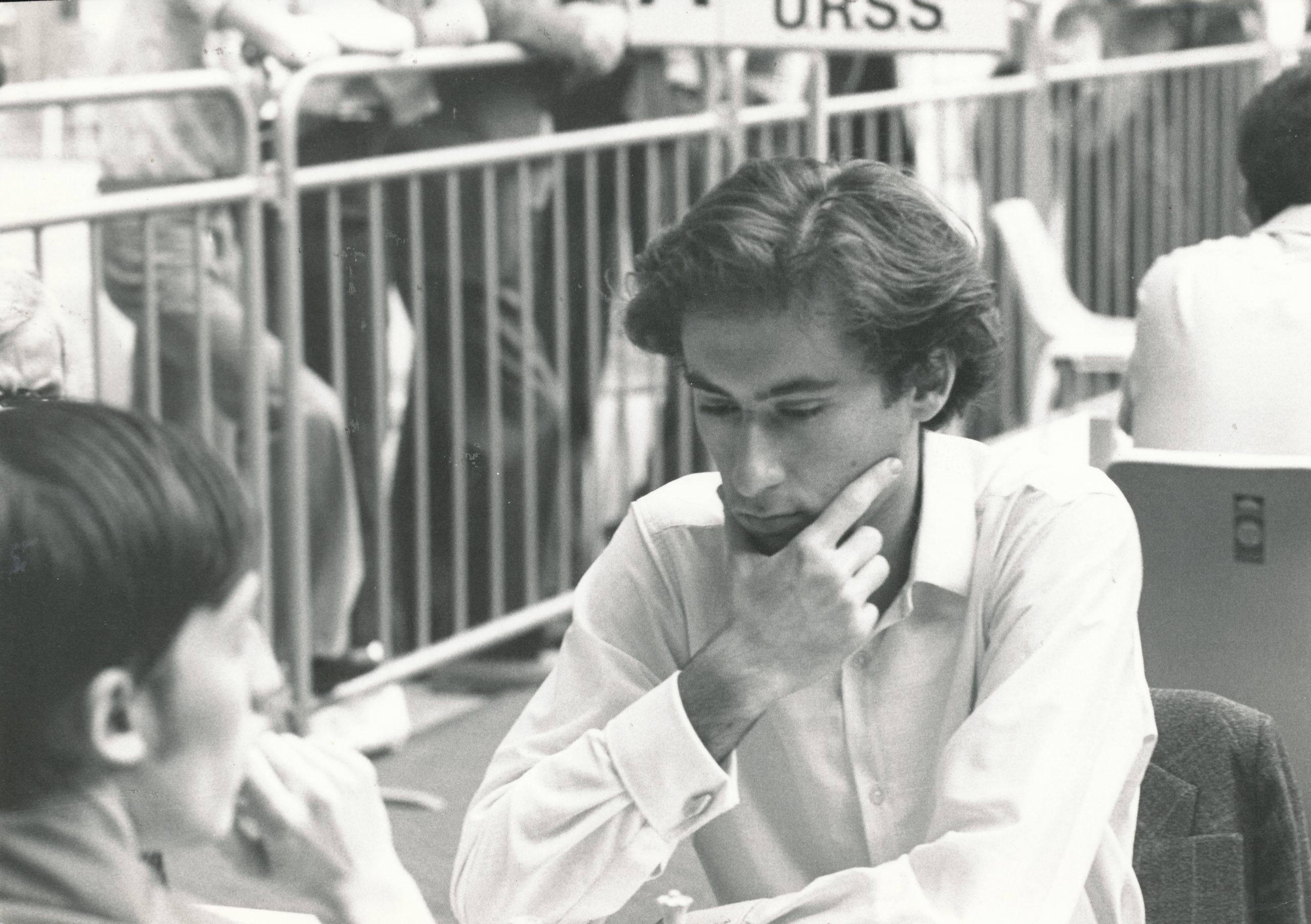
An early Bill Hartston, event unknown
While studying for his PhD at Cambridge, Hartston developed an intricate system for balancing an entire chess set on top of a single rook. Here is an article with an explanation letter from Bill.
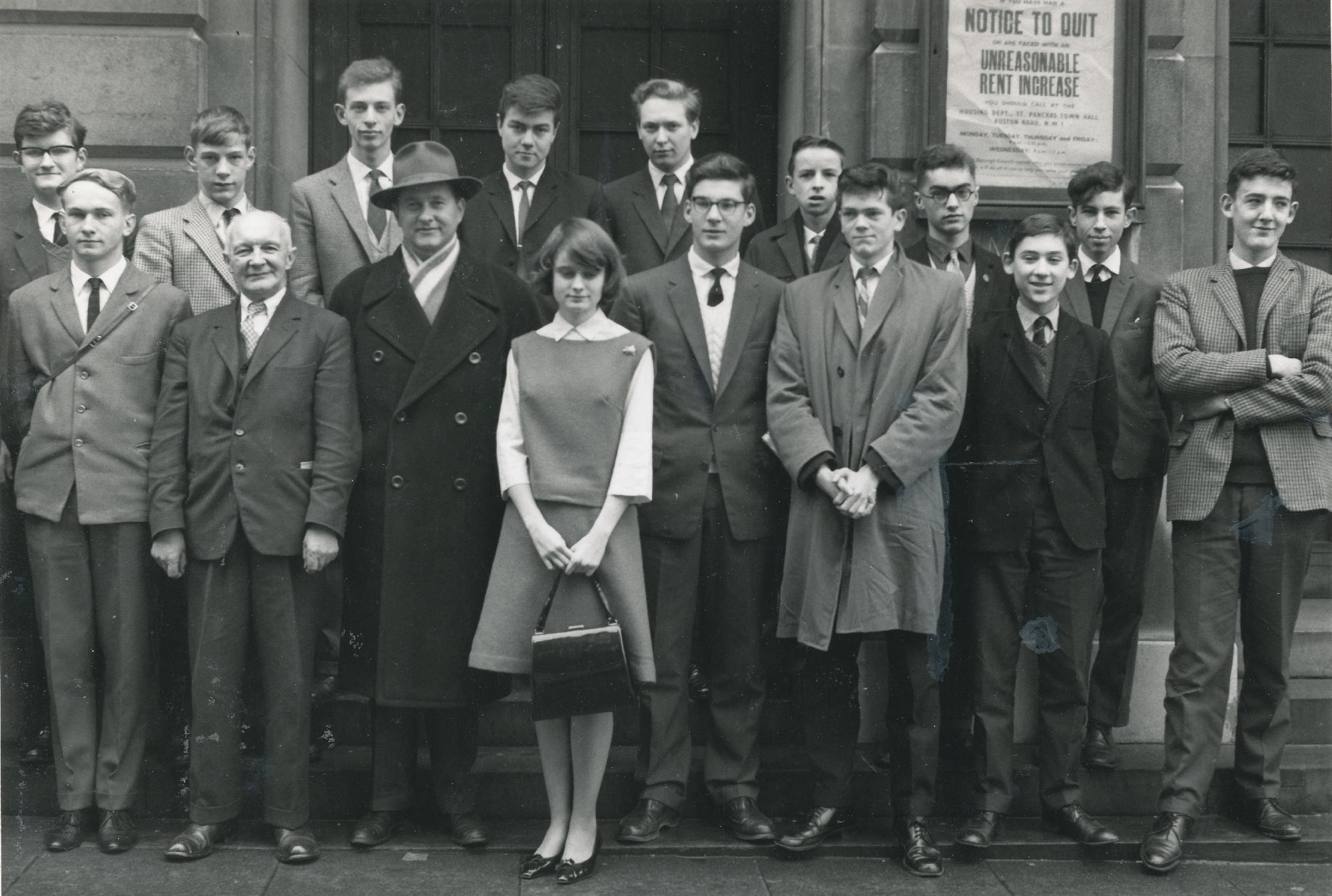
Some of the participants in the Paul Keres display on November 25th, 1962, at St Pancras Town Hall, London WC1. Back row : AJ. Whiteley, D, Floyer, PJ Collins, PJ Adams, RC Vaughan, KB Harman, D. Parr, DNL Levy, Front row : MV Lambshire, AE Hopkins (selector) Paul Keres, Miss D. Dobson, RE Hartley, BC Gillman, WR Hartston and PN Lee. Photograph by AM Reilly. Source : BCM, 1963, page 13
Bill married Dr. Jana Malypetrova in January, 1970 in Cambridge. In 1978 Bill married Elizabeth Bannerman, also in Cambridge and from that marriage he had two sons, James and Nicholas.
Bill and Dr. Jana Hartston (née Malypetrova)
Bill became an International Master in 1972 and his highest FIDE rating was 2485 in January 1979.
William Hartston
With the white pieces Bill almost exclusively played 1.e4 and the Ruy Lopez.
With the black pieces Bill played the Sicilian Taimanov and the Czech Benoni.
Bill plays his trusty Sicilian Taimanov against an unknown opponent
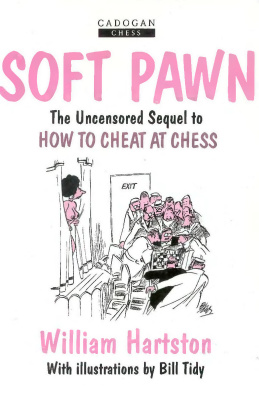
Bill is a self-proclaimed follower of Prof. AJ Ayer (See the Acknowledgements in “Soft Pawn”) Clint Eastwood and Tottenham Hotspur Football Club.
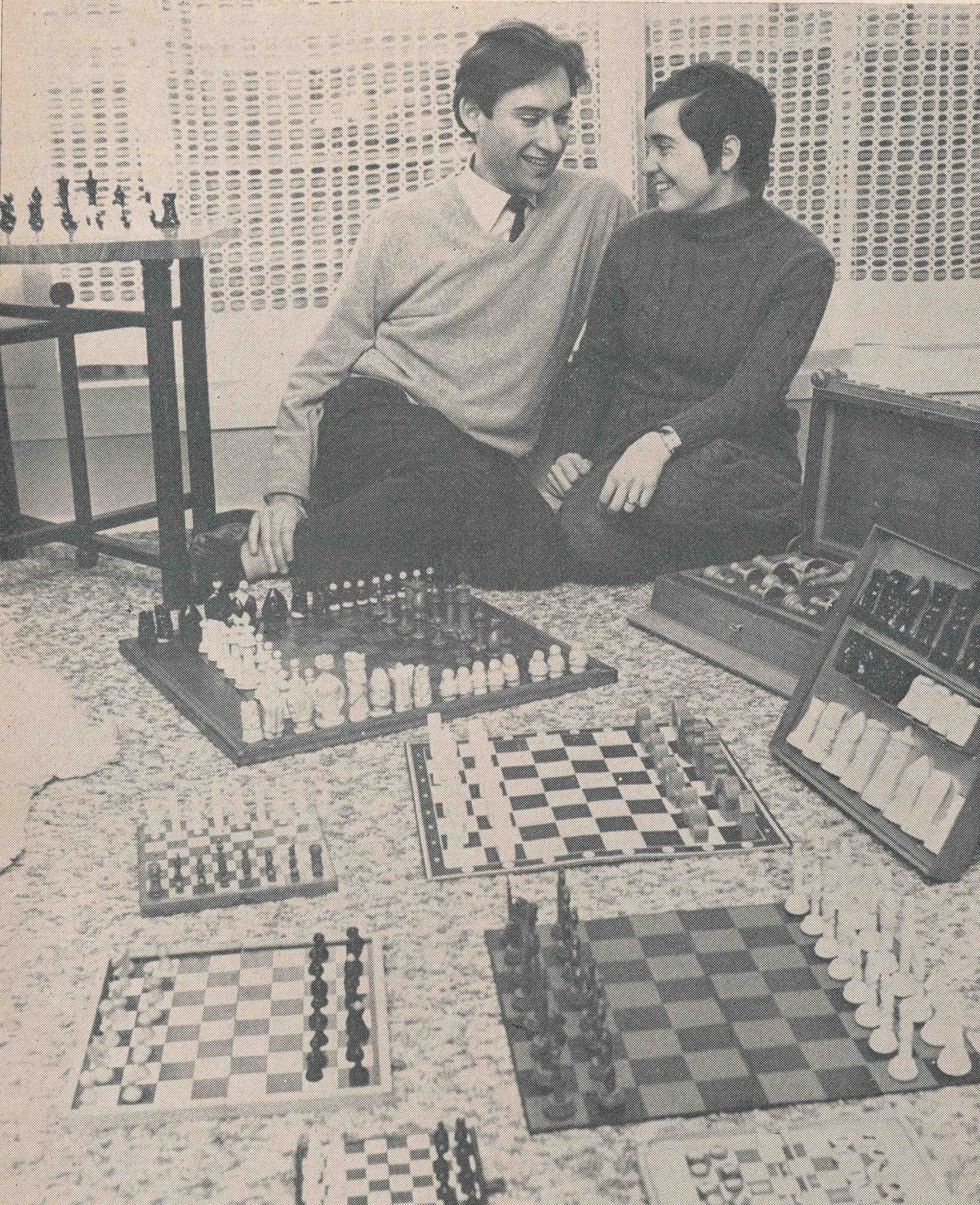
Bill and Jana Hartston are shown with some of their many chess sets. CHESS, August 1973, page 323
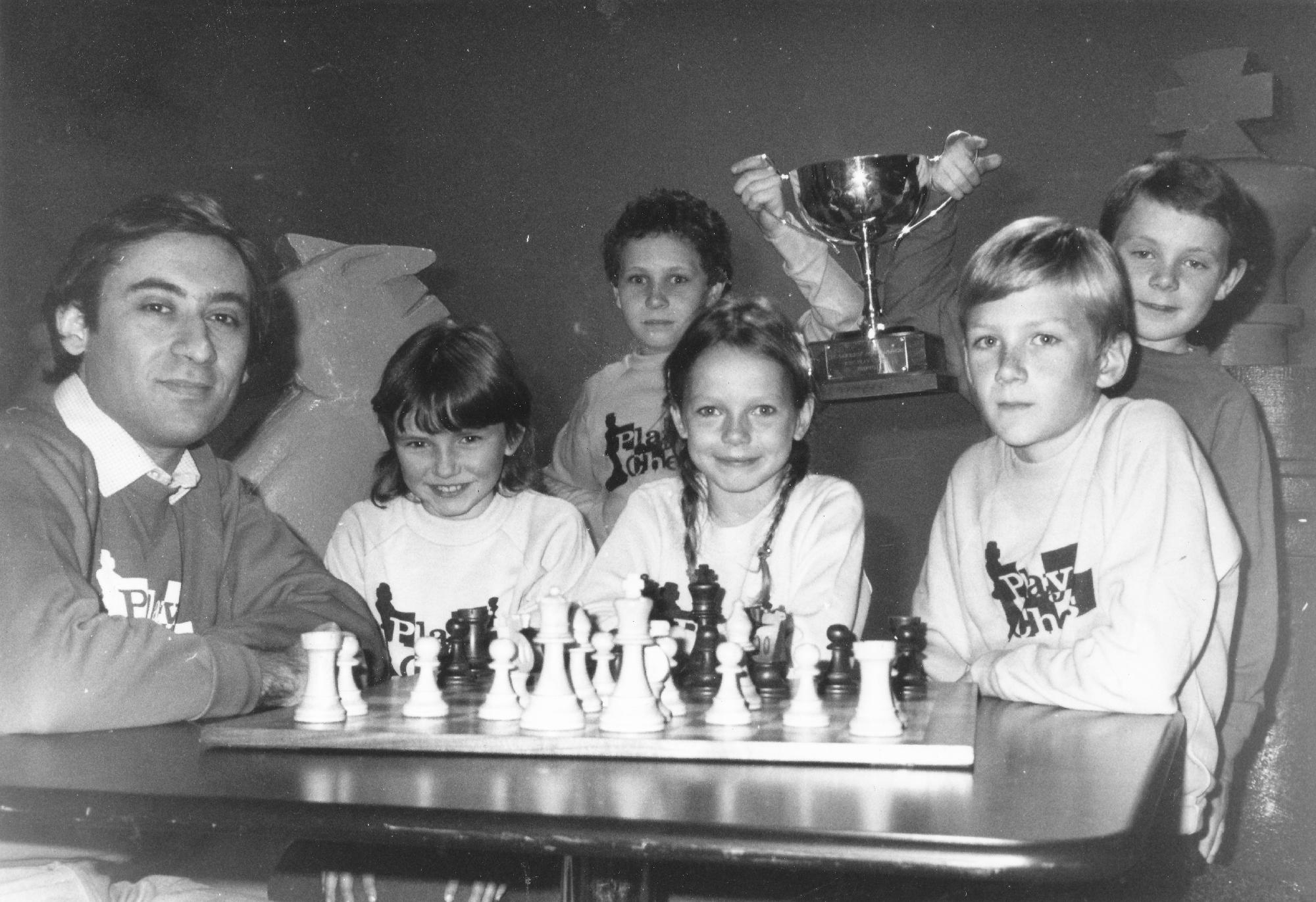
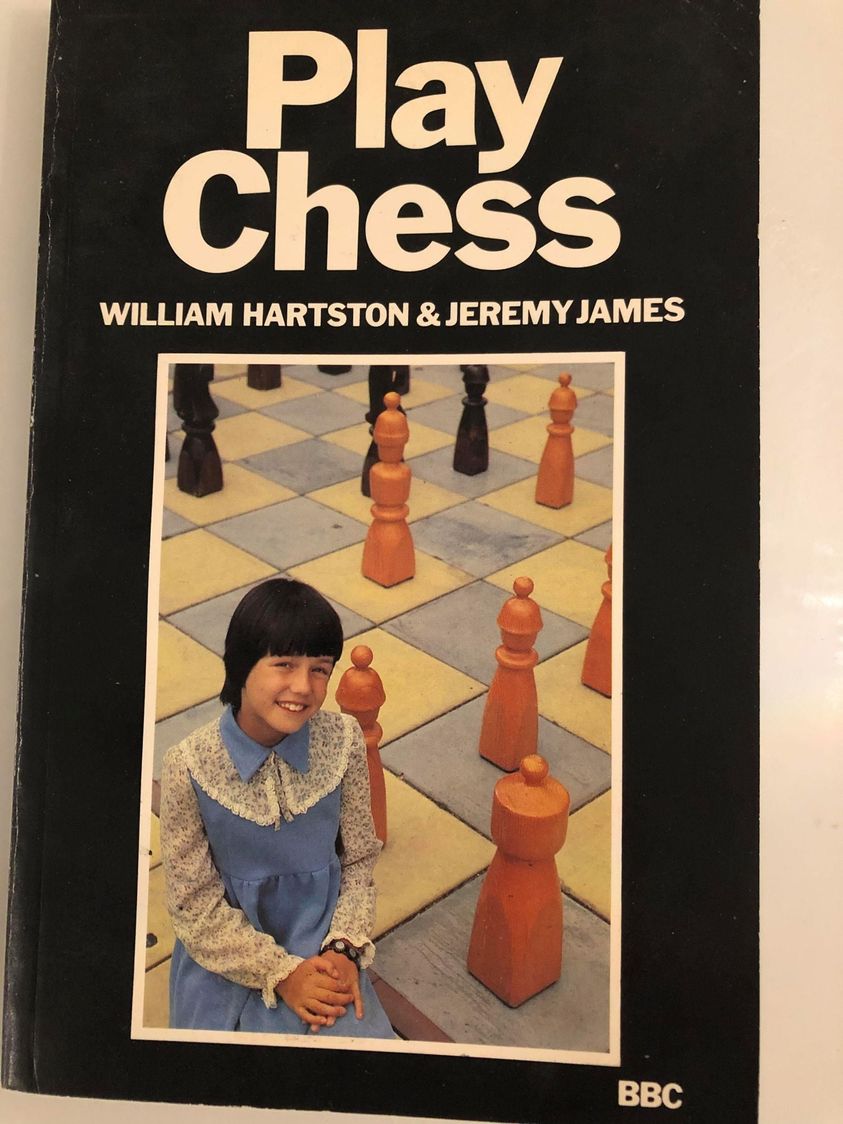
Bill was the chess correspondent of The Independent and The Mail on Sunday. He was also a regular presenter and commentator for television. He worked with Jeremy James on the BBC’s Master Game. and has appeared on ITVs Play Chess
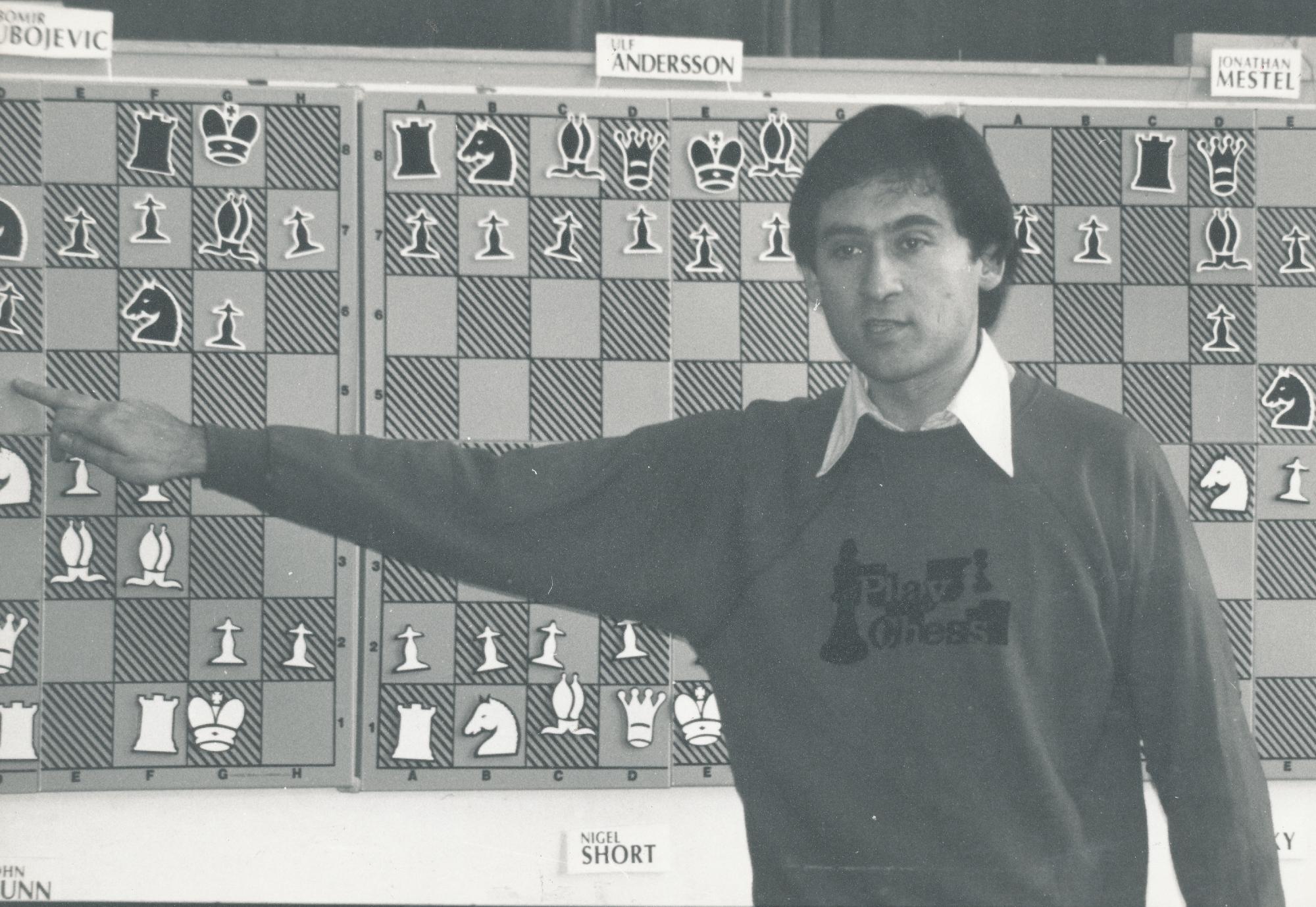
Bill Hartston on Play Chess
In modern times Bill has made regular appearances with World Cluedo champion, Josef Kollar on Channel Four’s Gogglebox with a pair of painted breasts as background.
In modern times Bill has made regular appearances with World Cluedo champion, Josef Kollar on Channel Four’s Gogglebox
Bill revived the Beachcomber column in the Daily Express.
The Master Game, Series 6&7 with Jeremy James and Bill Hartston
Bill is an industrial psychologist.
Curiously the 1984 edition of the usually reliable The Oxford Companion to Chess by Hooper and Whyld does not have an entry for the twice British Champion : was this simply an oversight ? Jana is also not mentioned.
Bill wrote about himself in British Chess (Pergamon, 1983) :
“To summarise more than 20 years of playing competitive chess in a few hundred words is an impossible task. My attitude to the game has changed a great deal, especially in recent times, but I have always enjoyed and felt at home in the tense and lively atmosphere of chess tournaments, whether as a competitor, spectator or journalist.
Caption as per photograph belowCaption for above photograph
I consider myself lucky to have been a ‘promising junior’ just at the time when chess was beginning to be taken seriously as a sport in England. The English team consisted mainly of amateurs and there were clear opportunities for anyone willing to work at the game.
As a result of the changing attitudes to the game in this country, the development between 1965, when I first played for the national team, and 1975 was far greater than in any other decade.
One statistic which I have always found personally amusing is that I progressed from youngest player in 1967 for the Clare Benedict tournament to become the oldest in the 1971 team. From promising junior to veteran in four years = is this a record ?
Bill Hartston commentating on games from the Phillips & Drew King’s 1982
Since my second British Championship win in 1975, I have been writing more and playing less. I always realised that I was not going to become a sufficiently strong player to be happy just wandering round the tournament circuit, but giving up chess entirely is, of course, unthinkable.
I believe now that the time is ripe for chess to be presented to far wider audiences and I like to think that some of what I do will help in that aim. If the Master Game television series and “Soft Pawn” cannot sell chess to the masses then nothing will.”
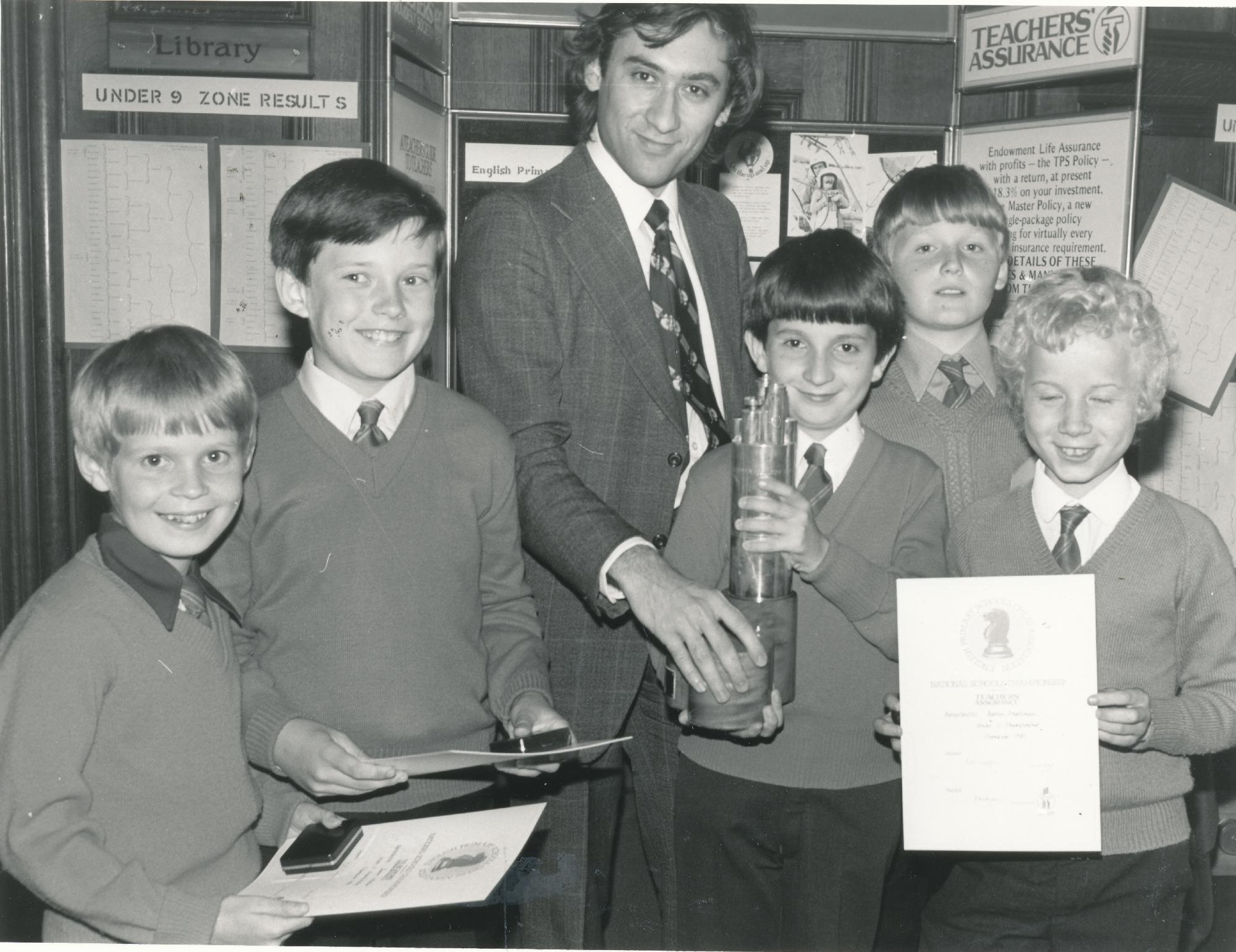
Bill was always a keen supporter of junior chess. Here at the Teachers Assurance National Schools Championships in 1980
Harry Golombek wrote the following in a 1980 Dataday chess diary :
“Hartston played hardly at all during the period from my last entry of him in the 1977 diary and that little, though respectable, was hardly the performance of an active master. His equal 3rd to 5th at the big Aaronson’s Masters Tournament (a swiss system event with 72 players) did not really affect his rating and indeed he finished up without changing his Elo rating at all.
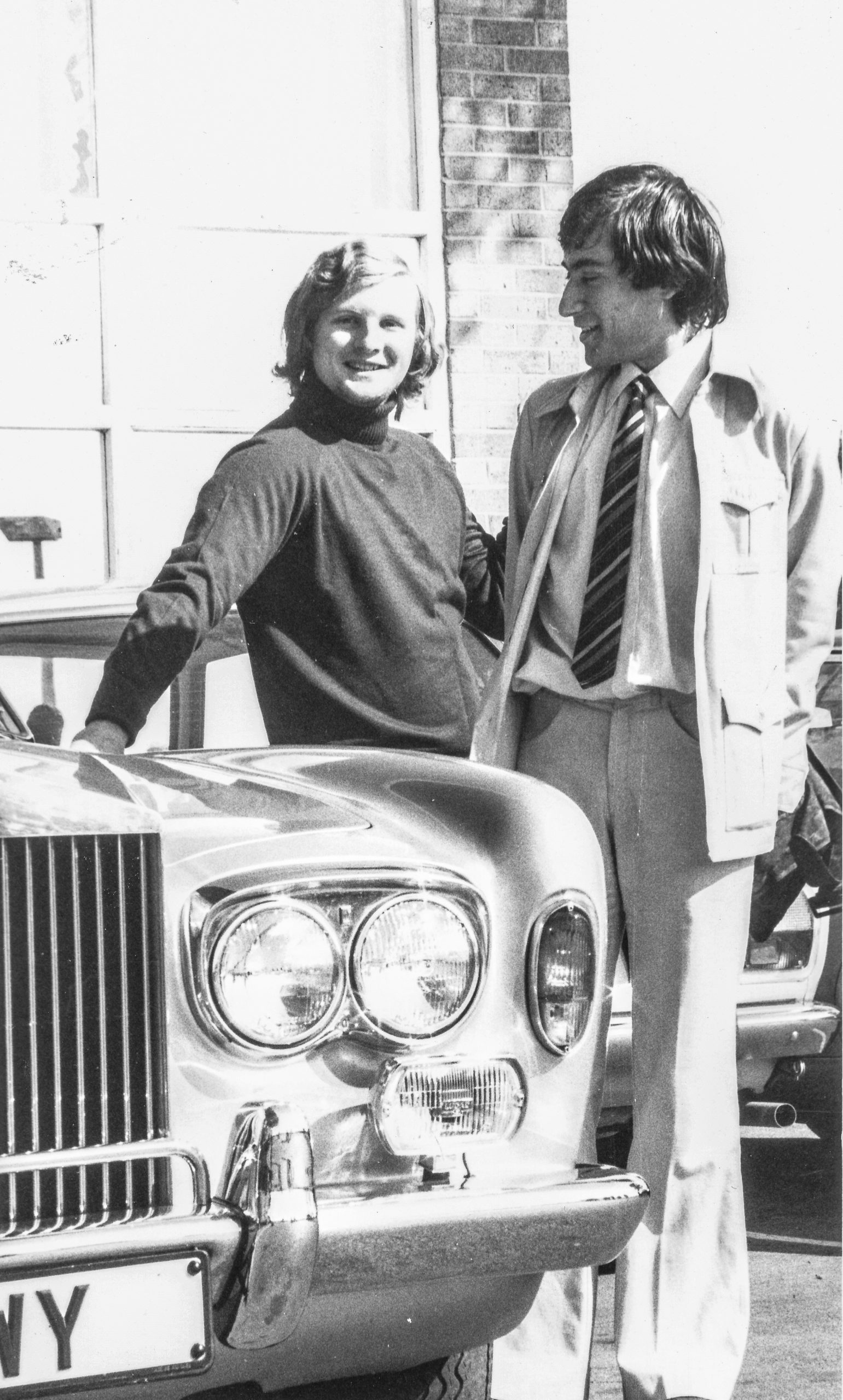
Tony Miles & Bill Hartston admire a Rolls-Royce
Nevertheless, this glimpse of his true powers was impressive as can be seen in the following game which was played in the 6th round of the Aaronson tournament.”
From The Encyclopedia of Chess(Robert Hale, 1970 & 1976) by Anne Sunnucks :
“International Master (1972) and British Champion (1973) William Hartston was born in London on the 12th August 1947. He was taught to play chess by his father when he was seven and five years later joined Enfield Chess Club. His results in junior events included 1st in the London Boys’ Under 16 Championship and 2nd in the British Boys’ Under 15 Championship in 1962 and =2nd in the British Boys Under 18 Championship in 1963.
Bill had a keen interest in computer chess and technology
In 1965, Hartston made his first appearance in the British Championship and came =5th. In the same year he won the Ilford and Paignton Premier tournaments. Playing on board 3 for England in the 1966 Olympiad. Hartston scored the best result of any British player, 66.7%.
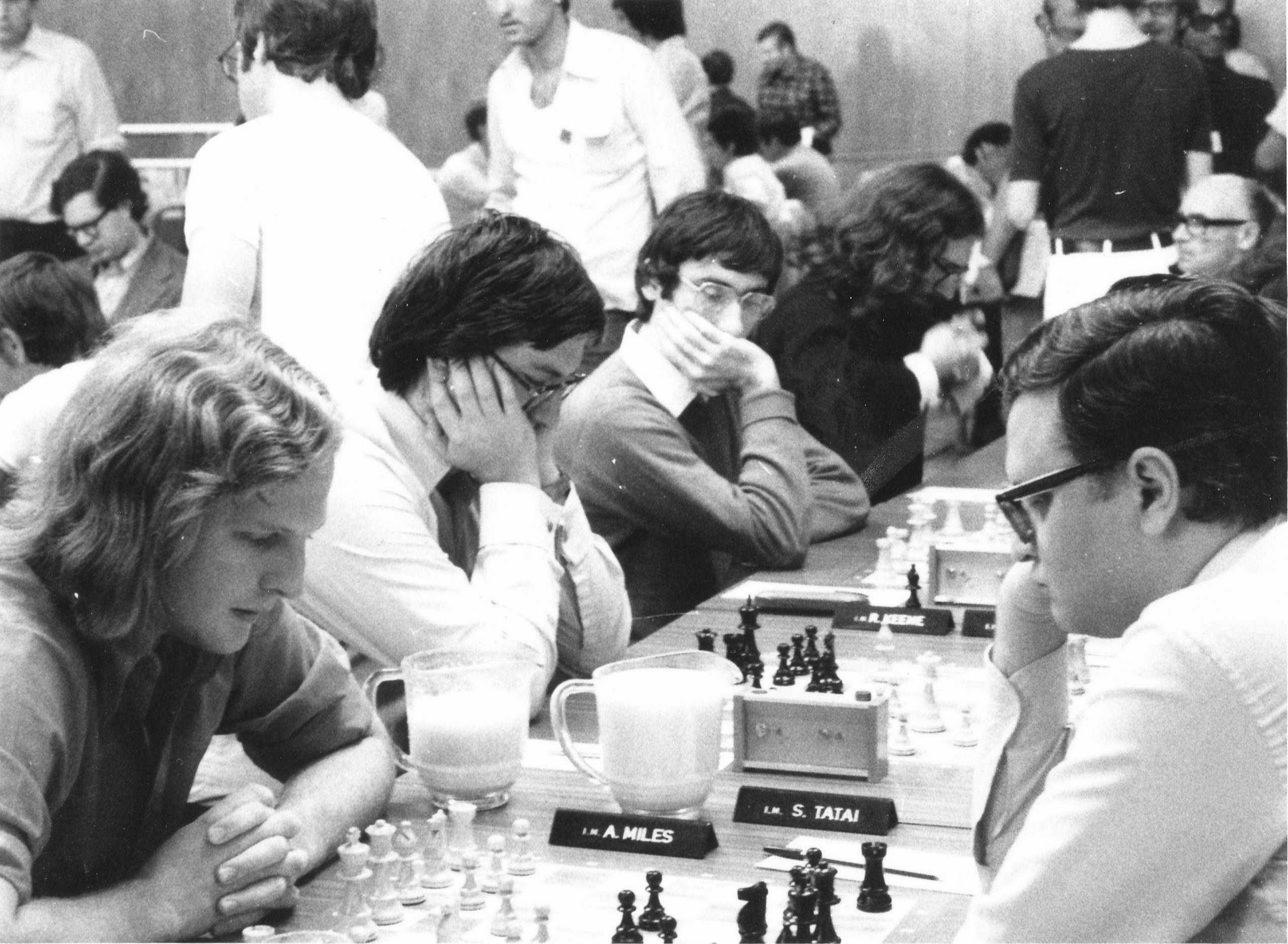
England plays Italy at Haifa 1976. Miles played Tatai, Keene played Toth, Hartston played Grinza and Mestel played Micheli
In the Olympiad of 1970, he had the best overall score on board 3, 12.5 out of 16 and in the Olympiad of 1972 he won the prize for the 3rd best score on board 2, 12.5 out of 18. In 1972 he narrowly failed to qualify for the Interzonal tournament, when he came 3rd in the Zonal tournament at Vranjacka Banja.”
Mike Basman plays Bill during the play-off for the 1973 British Championship
From The Encyclopedia of Chess (Batsford, 1977) by Harry Golombek :
“British International Master and twice British Champion. Hartston was born in London and his early chess was played there., where he became London Boy (Under-16 Champion in 1962.
He was educated at the City of London School and Jesus College, Cambridge, where he took a degree in mathematics.
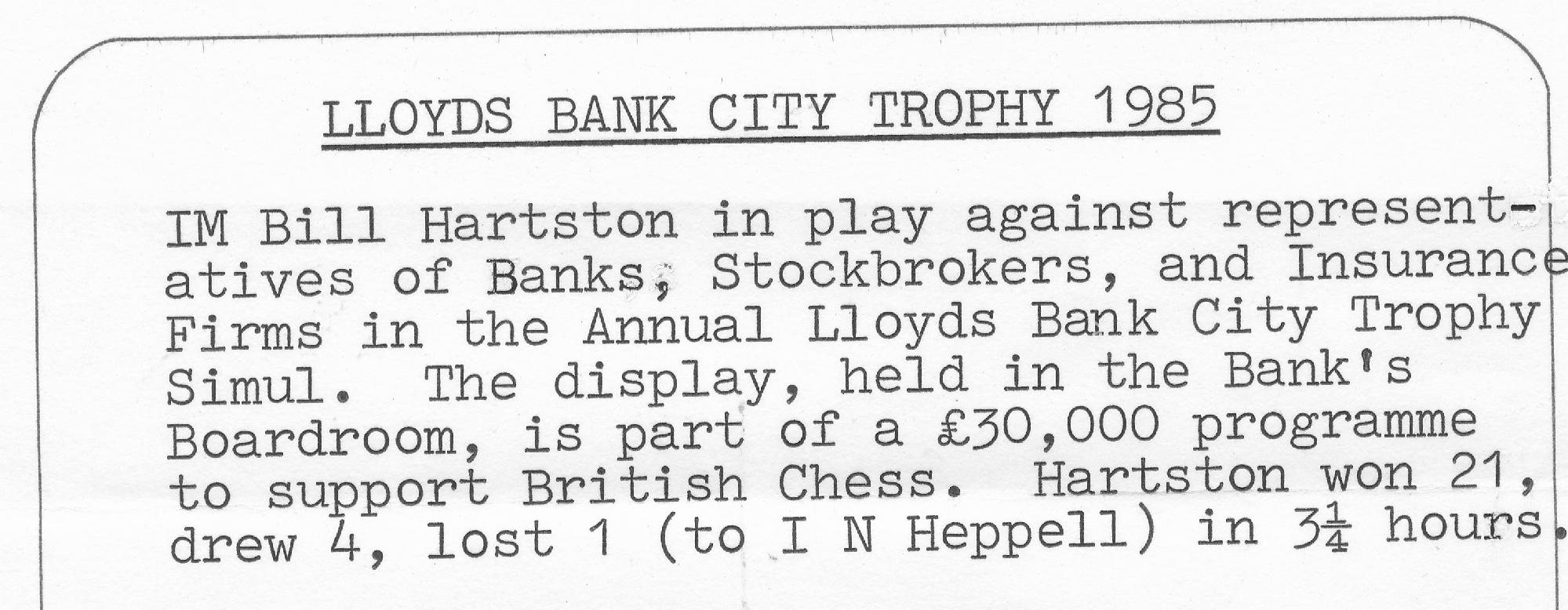
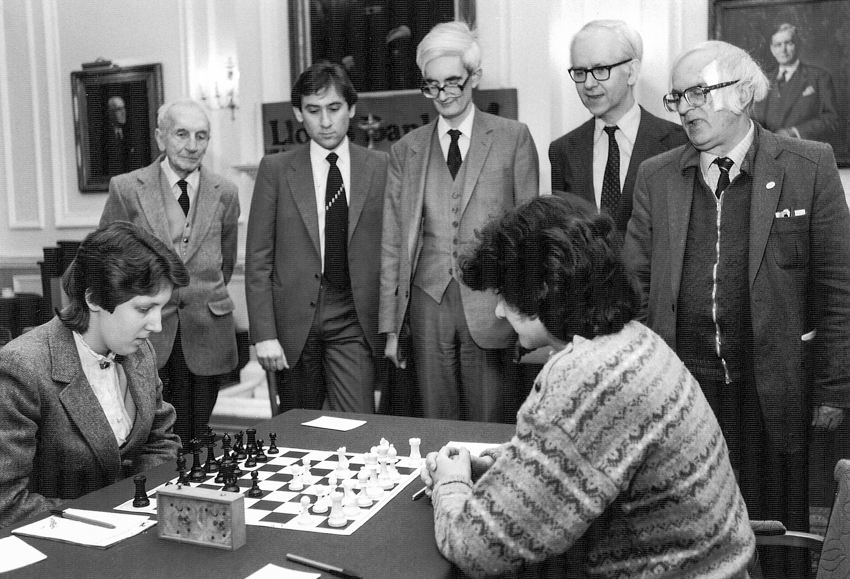
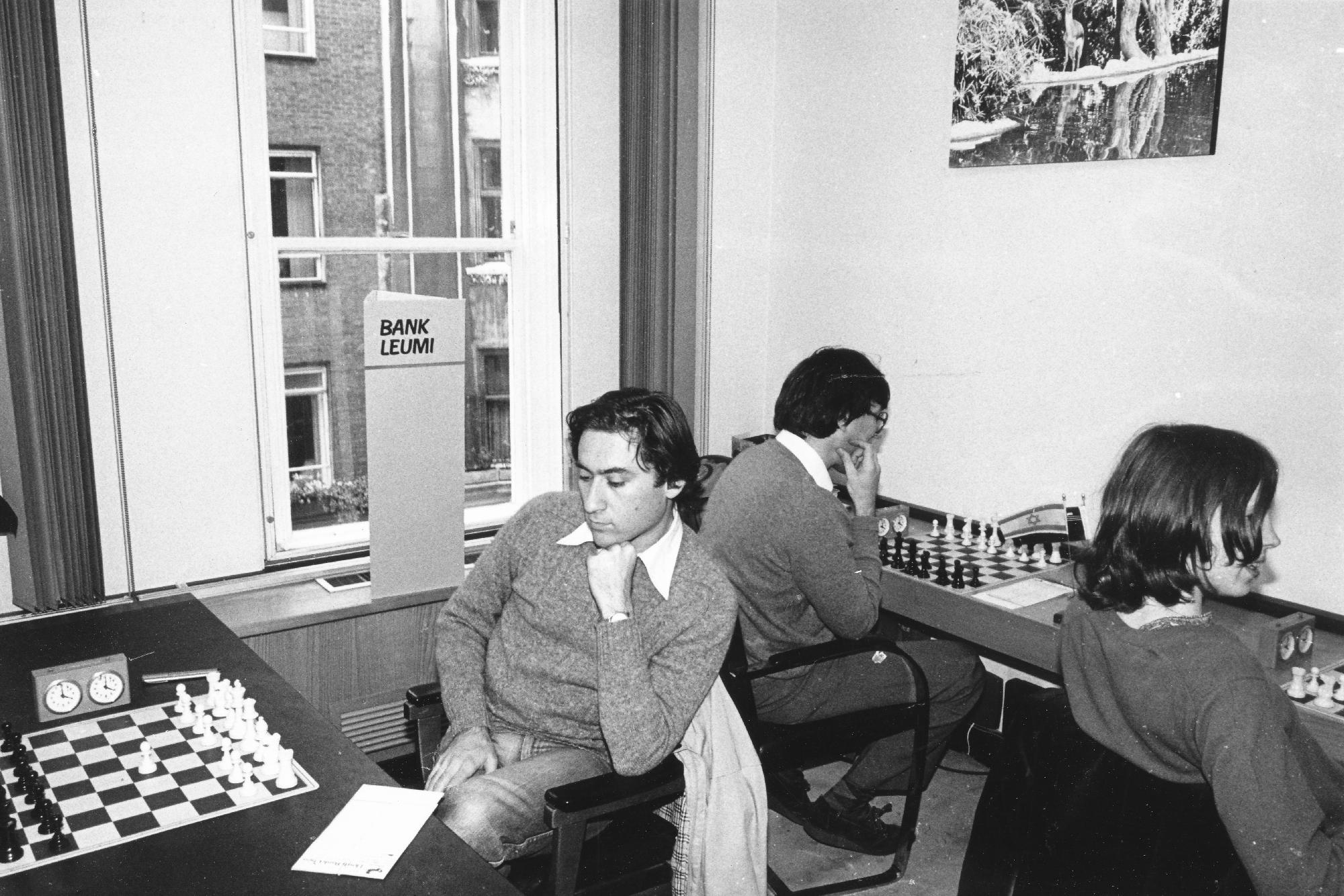
Bill Hartston (far left) at the Lloyds Bank Masters
It soon became clear that he was one of the leading young players in England and a rivalry developed between him and Raymond Keene in which first one and then the other obtained the upper hand.
After a number of near misses he won the British Championship at Eastbourne in 1973 and again at Morecambe in 1975.
Jana & Bill Hartston celebrate a family double at the British Championships in 1973 at Eastbourne
Internationally he has already had a distinguished career and has been especially good and consistent in his representation of England at the Olympiads. At Havana in 1966 he scored 66.7% on board 3 but did not play at Lugano in 1968. Again on board 3 at Siegen in 1970 he obtained the best score on board 3 with 78.1%.
From the 1985 Varsity Match : Laura Cohen (Newnham), Brian Reilly (BCM), Bill Hartston (Cambridge), Adrian Hollis (Oxford), Anita Rakshit (St. Hilda’s), Leonard Barden (The Guardian etc) and Bob Wade (BCF)
At Skopje 1972 he fulfilled the second norm of the international master title with 12.5 points out of 18 on second board. Playing on first board at Nice 1974 he attained 52.7% and had a most meritorious and well fought draw with the World Champion, Karpov.
Bill Hartston draws with Anatoly Karpov at Nice 1974
He achieved a breakthrough in the field of international tournament chess when he came third in a strong Premier tournament at Hastings 1972/3
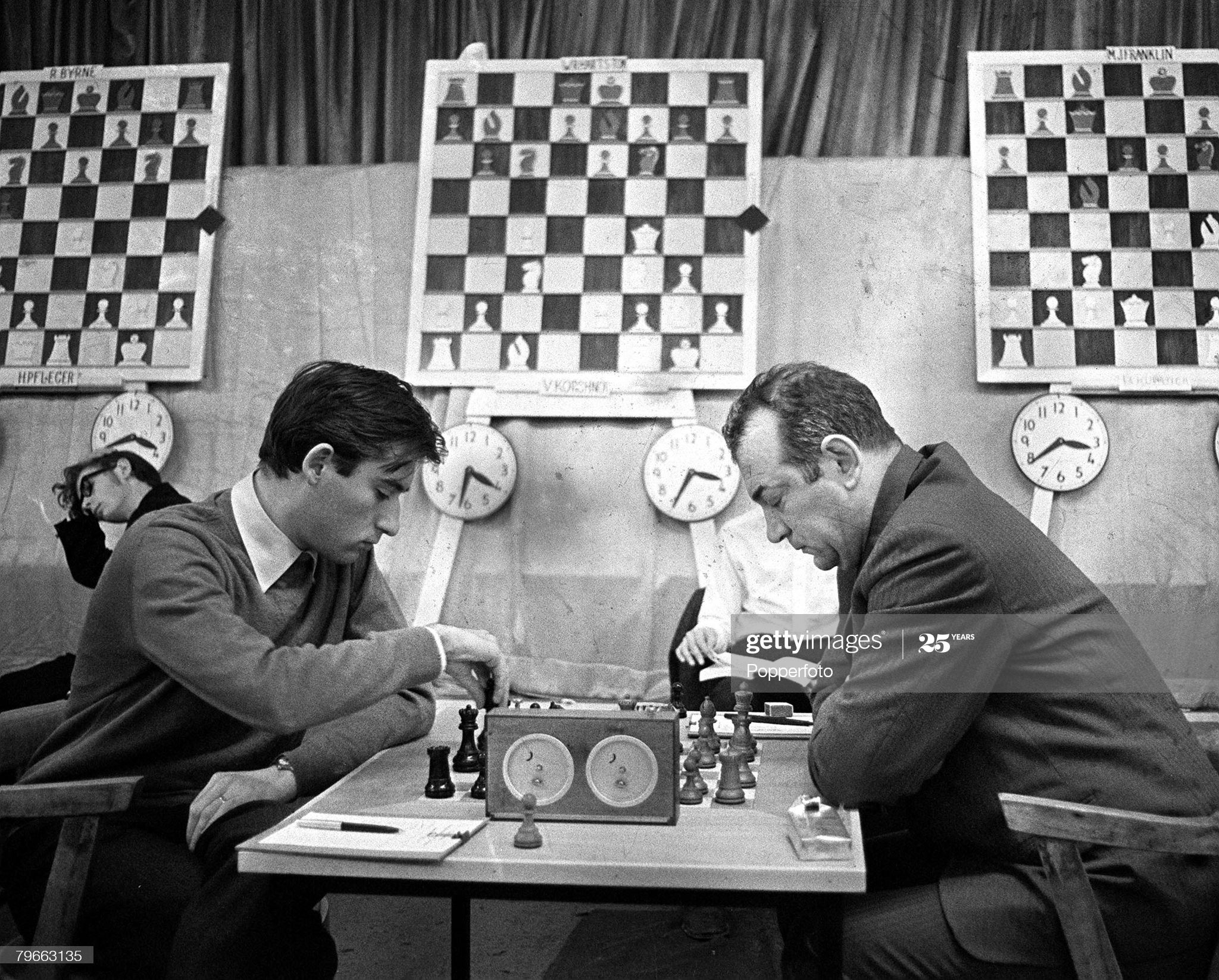
Hastings, England, 4th January 1972, Chess, Russian Grand Master Viktor Korchnoi (right) is pictured in a match with William Hartston (UK) during the 47th Hastings International Chess Tournament (Photo by Popperfoto via Getty Images/Getty Images)
and in 1973 he scored a first at Alicante.
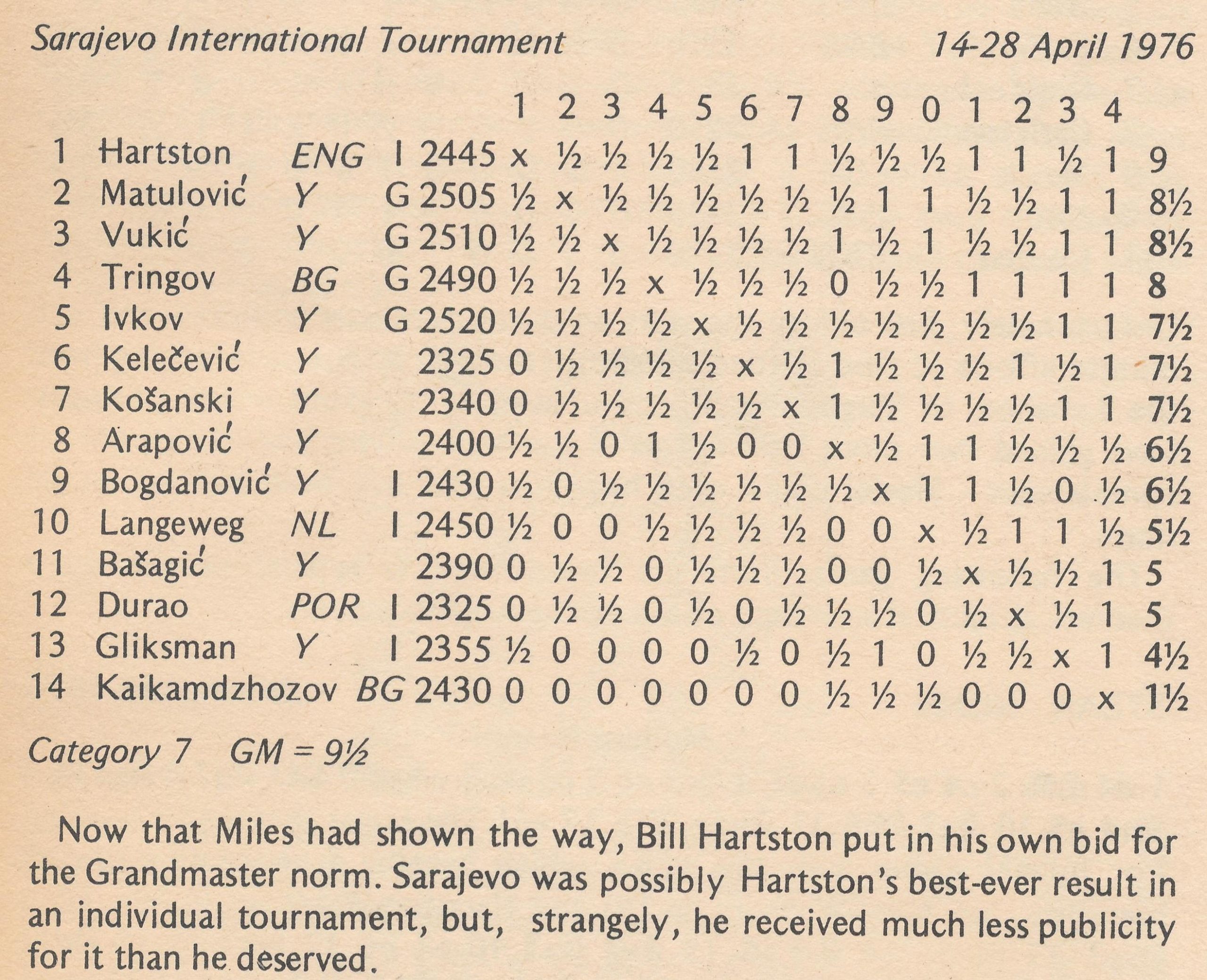
His best tournament result came three years later when he won 1st prize at Sarajevo 1976.
Sarajevo 1976 Crosstable from English Chess Explosion (1980)
His style of play is sound and competent in all the spheres of the game. That he can be brilliant when necessary he demonstrated his beautiful brilliancy game against the Finnish grandmaster Westerinen at Allicante in 1973. He has a fine, broad knowledge of the openings and has written a number of articles and books on that theme.
Bill was always a keen supporter of junior chess. event unknown.
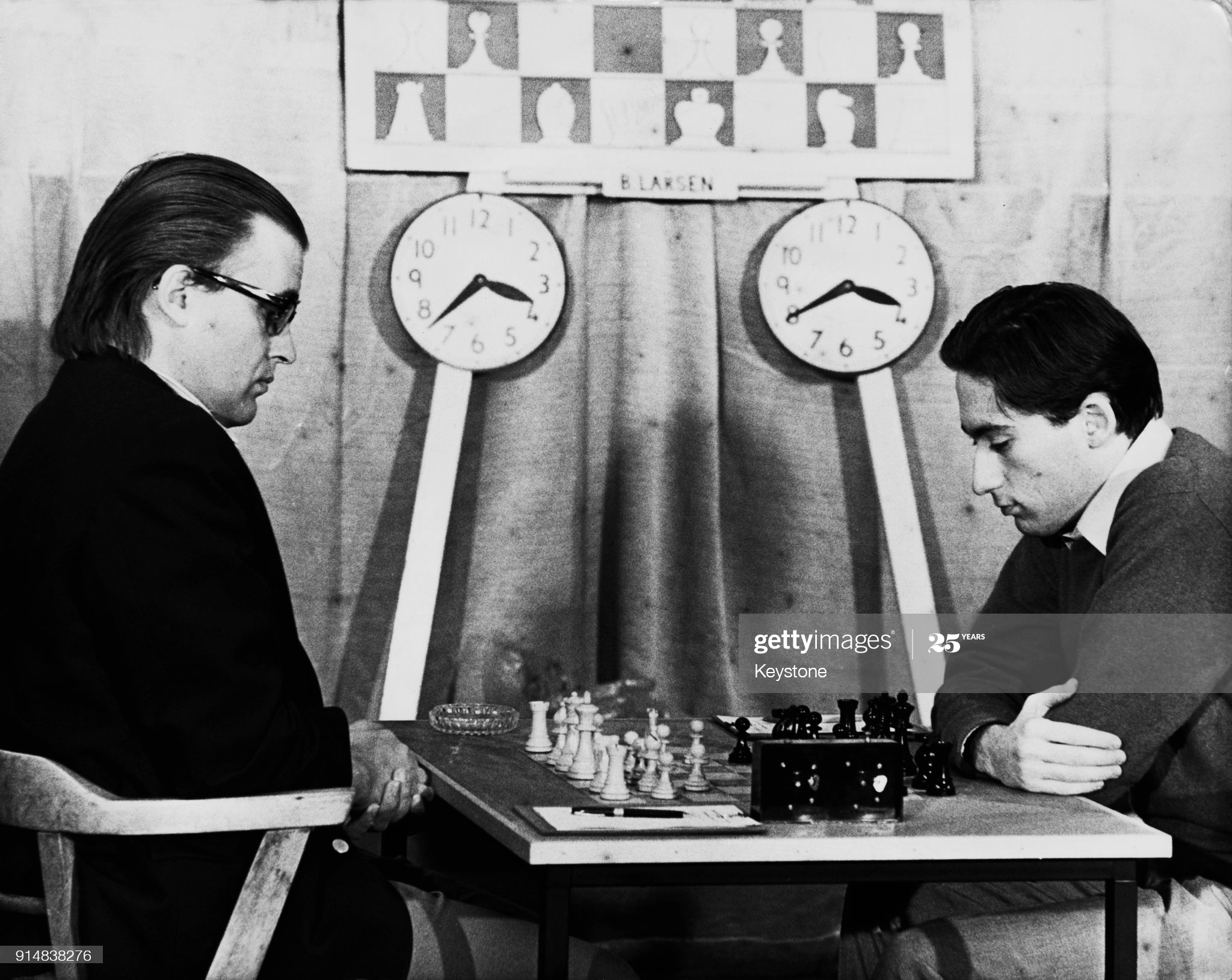
Danish chess grandmaster Bent Larsen (1935 – 2010, left) takes on English player William Hartston (right) during the annual Hastings International Chess Congress, UK, 13th January 1973. Larsen won the game. (Photo by Keystone/Hulton Archive/Getty Images)Bill plays board 5 for England versus Israel Telechess Olympiad match in September 1981. Board 6 was Paul Littlewood and board 7 was Nigel Short.
A lucid and entertaining writer, he has also appeared with success in BBC Television chess programmes.
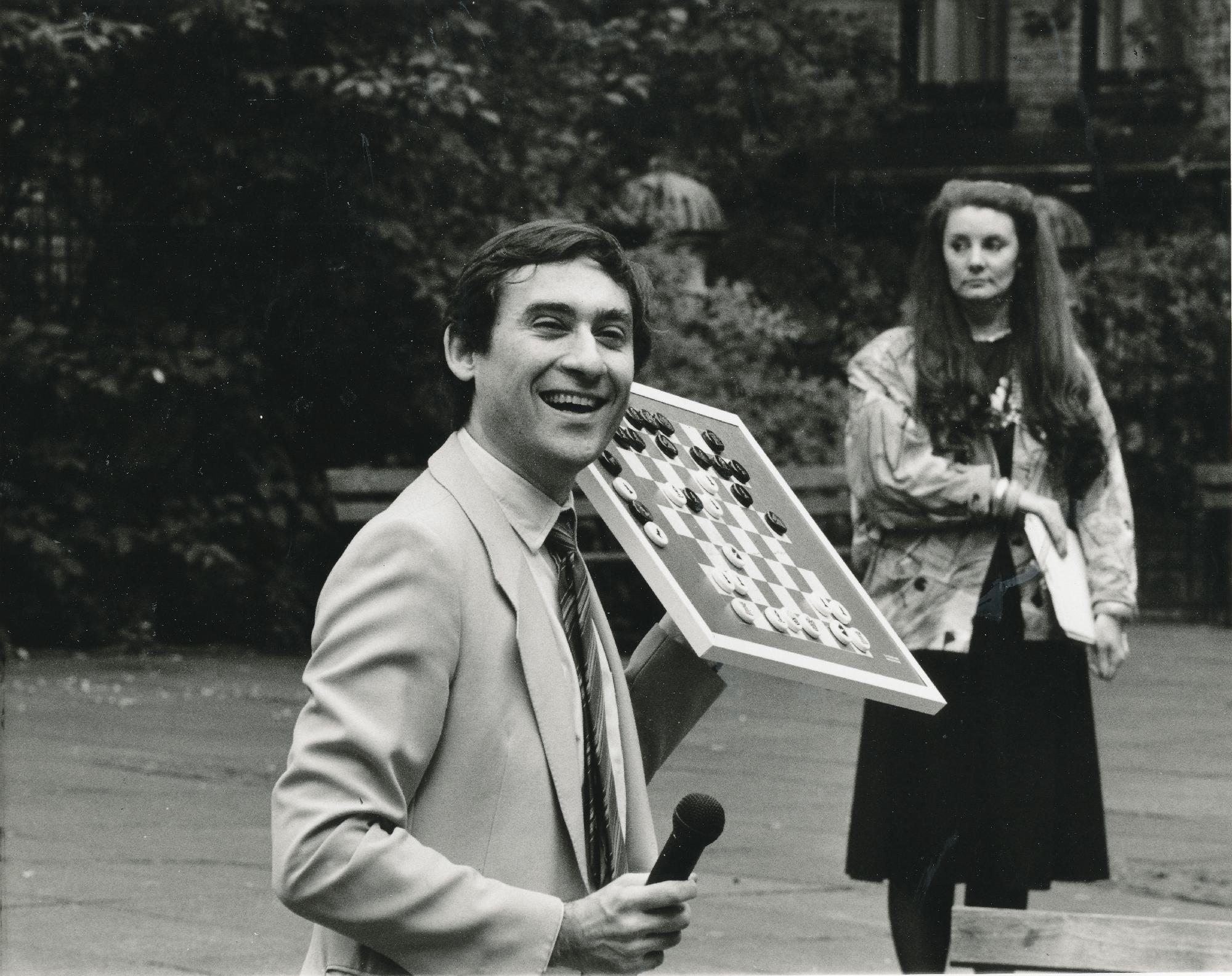
Bill Hartston at a promotional event
Among his chief works are :
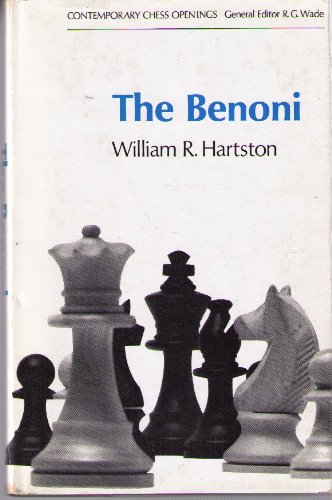
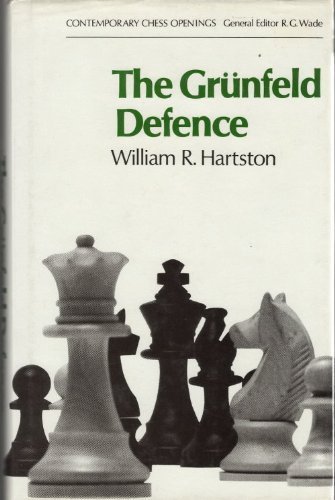
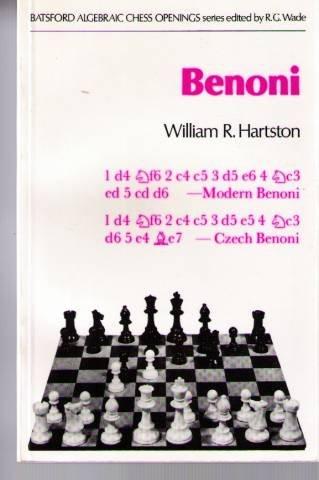
The Benoni, London, 1969 The Grunfeld Defence, London, 1971 The Best Games of CHO’D Alexander (with H. Golombek), Oxford, 1976.”
Here is an interesting interview published in the Streatham & Brixton Chess Club blog concerning the alleged “turning down the Hastings draw offer” story.
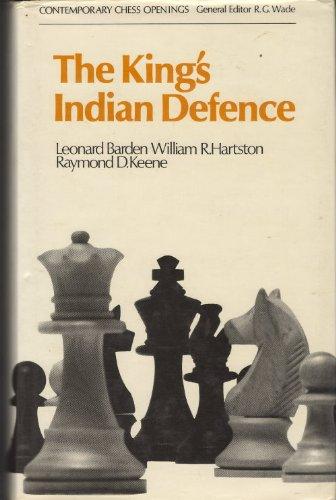
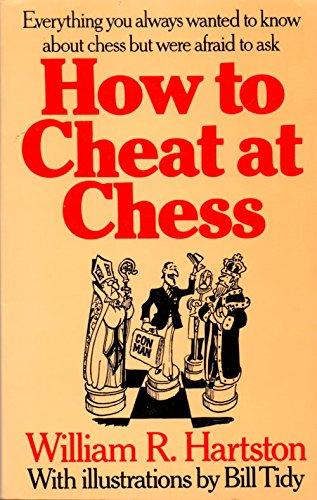
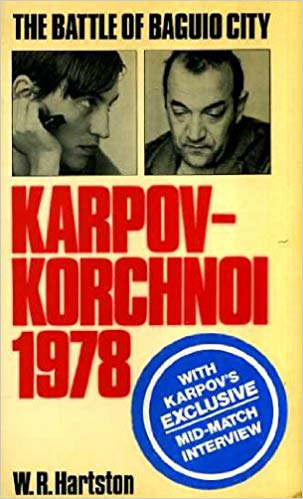
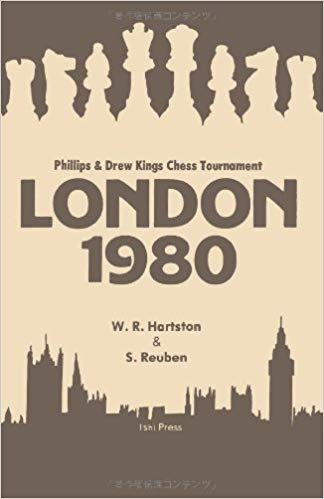
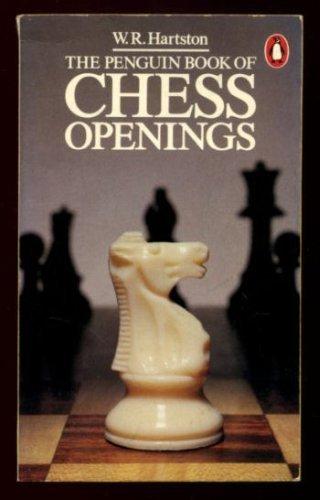
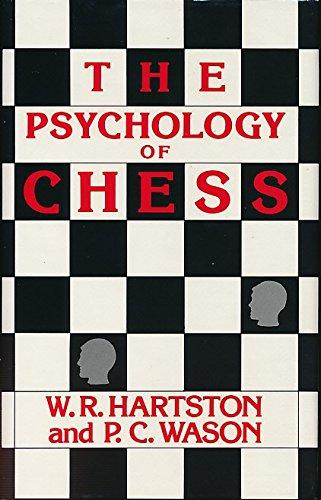
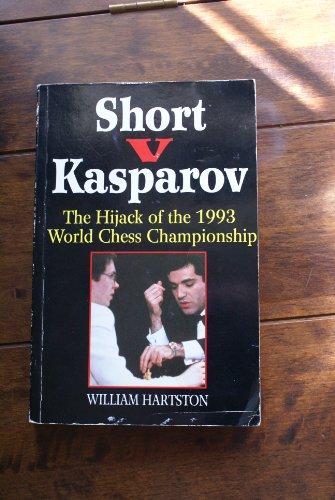
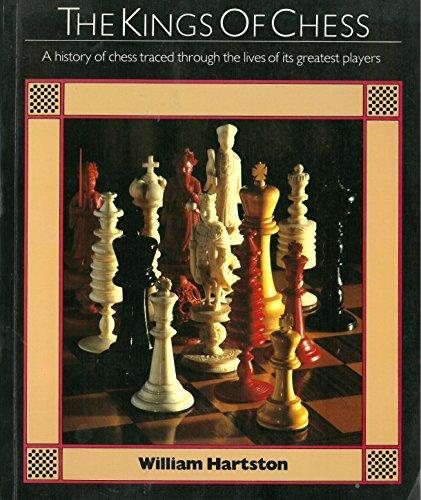
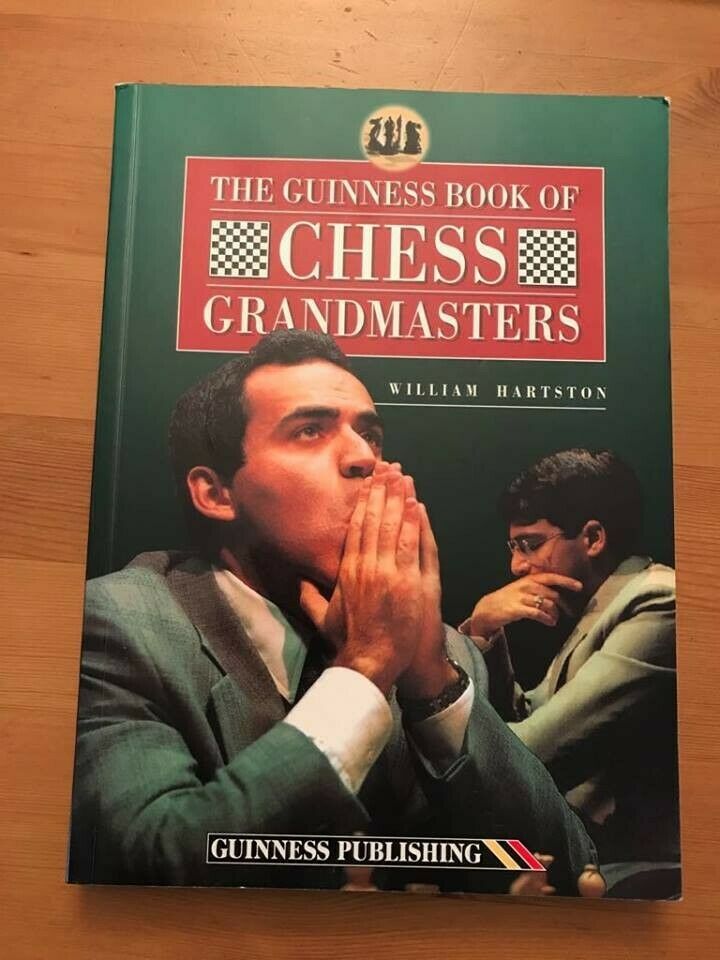
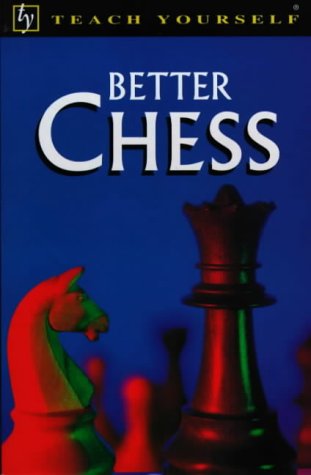
The King’s Indian Defence, 1969The Benoni, 1969How to Cheat at Chess, 1976The Best Games of C.H.O’D. Alexander, 1976The Grünfeld Defence, 1977Benoni, 1977Karpov-Korchnoi, 1978Soft Pawn, 1980The Phillips & Drew King’s Chess Tournament, 1980Play Chess, Hartston & Jeremy James, BBC, 1980The Penguin Book of Chess Openings, 1981The Psychology of Chess, 1984Short vs Kasparov, 1993The Kings of Chess, 1995The Guinness Book of Chess Grandmasters, 1996Teach Yourself Better Chess, Bill Hartston, Teach Yourself Books 08/01/1997, ISBN 13: 9780340670408
BCN wishes Happy Returns to IM Angus Dunnington (09-viii-1967)
Angus James Dunnington was born in Wakefield, West Yorkshire, his mother’s maiden name was Townend.
He has lived in Castleford, West Yorkshire and most recently in Lockerbie, Dumfriesshire.
Angus became a FIDE Master in 1990 and an International Master in 1991.
Angus has been a recipient of a Chess Journalists of America award and was chess correspondent for The Yorkshire Post. He has been an Olympiad trainer.
Angus has played for 4NCL White Rose and his peak FIDE rating was 2450 in January 1996, aged 29.
He won Toulouse 1993 with 6.5/9, we was first equal (3) in the London Agency tournament on 1997 with 6/9, we was equal first in the 1999 Hampstead IM tournament with 6.5/9.
As White Angus prefers a Reti style double fianchetto, the King’s Indian Attack and also the Queen’s Gambit and is an expert on the Catalan and KIA.
As Black Angus essays the Modern Defence most of the time.
His most recent ECF grading was 212E in 2005 and was 232A in 1996.
In 2018 after a lengthy absence Angus made a welcome return to the Scottish Championship Open with a strong =3rd place.
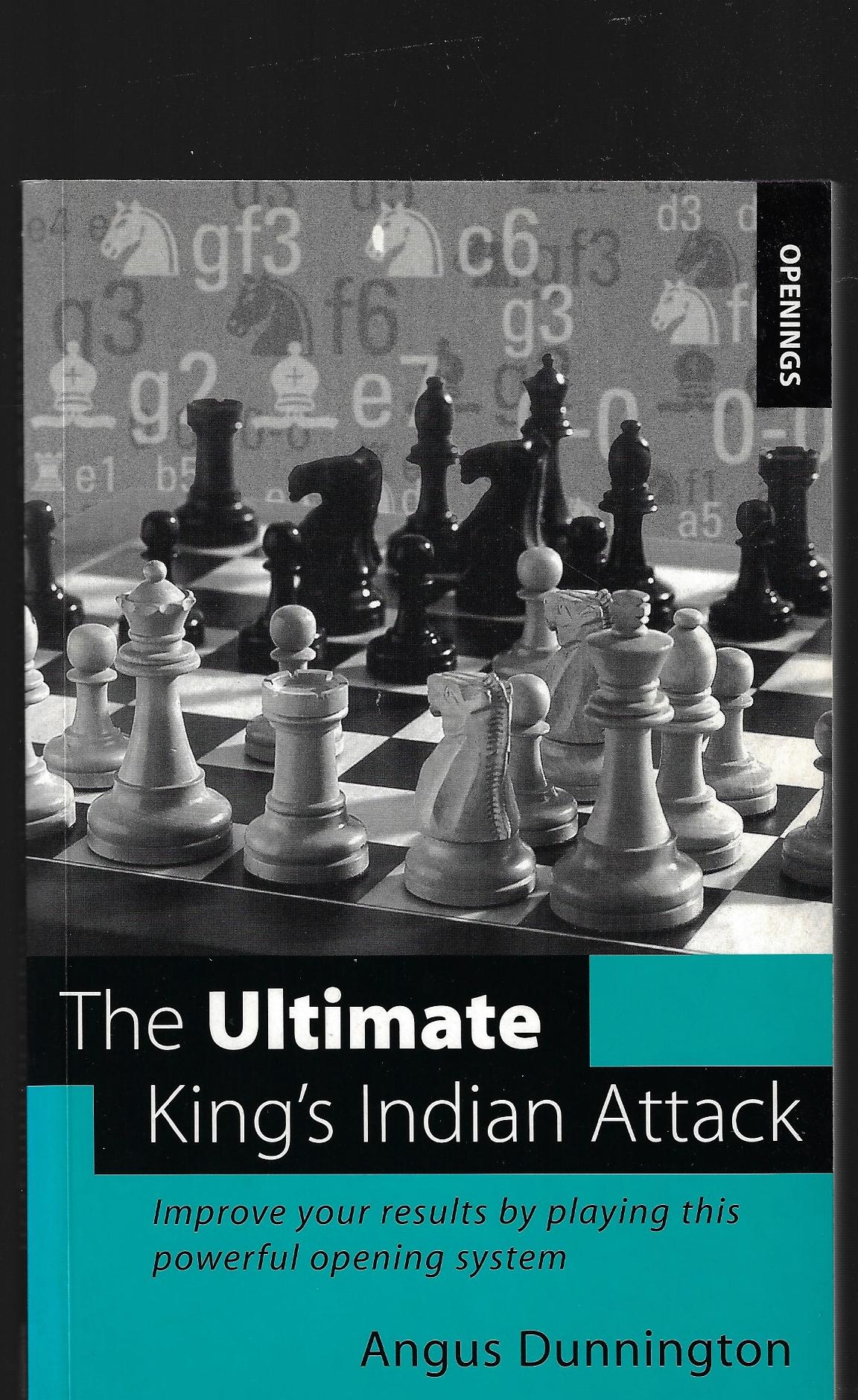
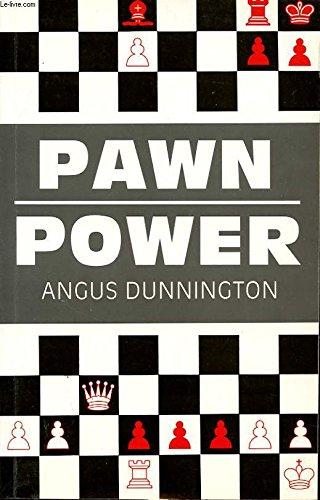
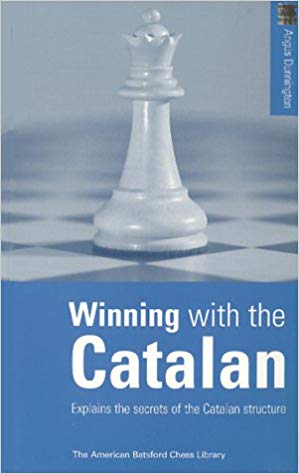
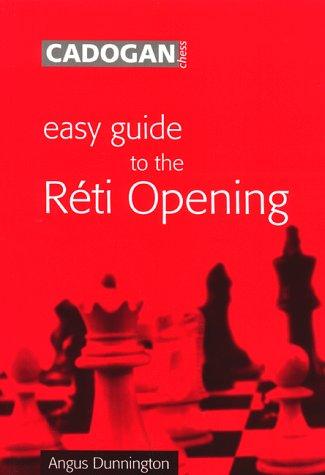
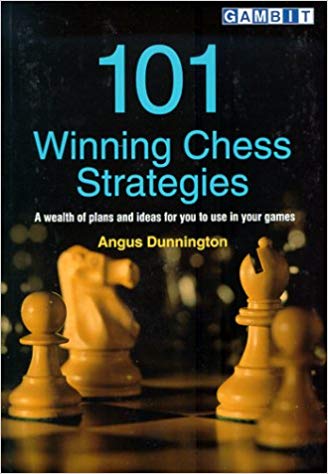
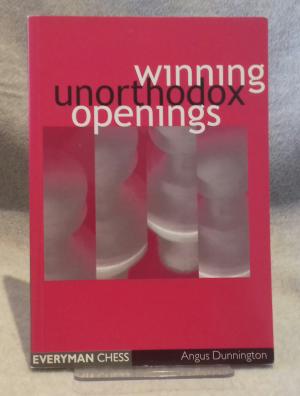
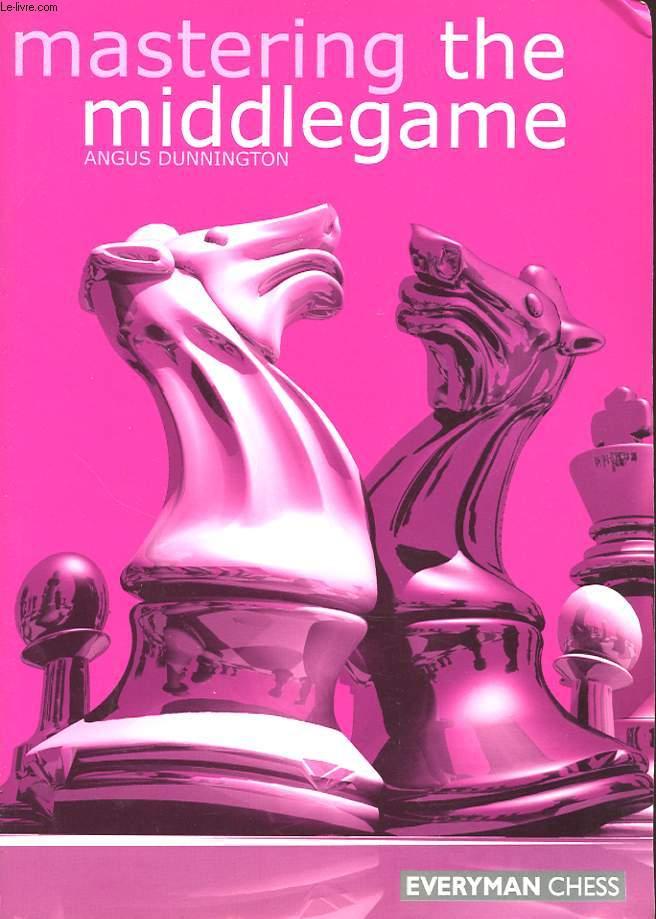
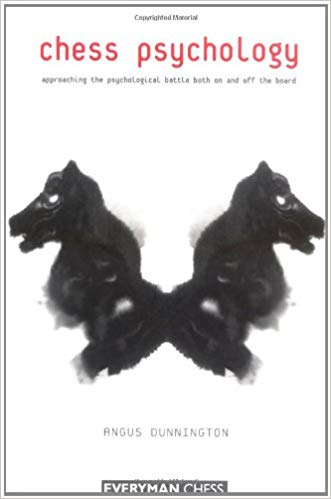
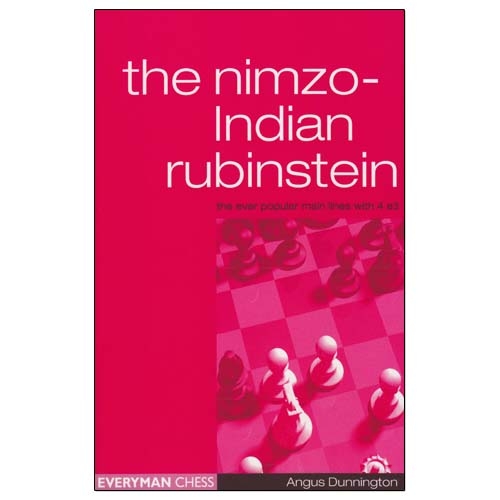
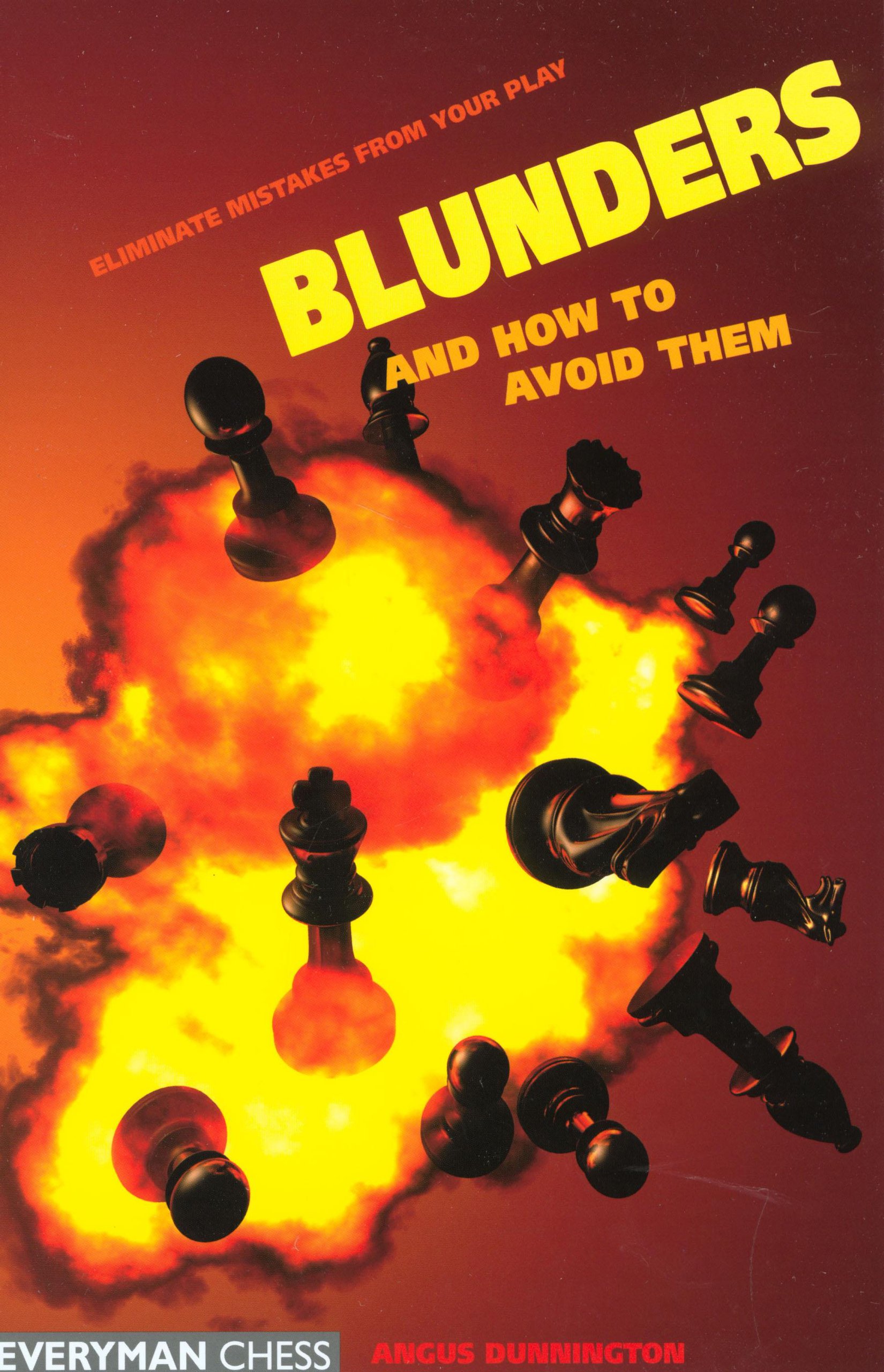
The Ultimate King’s Indian Attack, 1993Pawn Power !, 1994Winning with the Catalan, 1997Easy Guide to the Reti Opening101 Winning Chess Strategies, 1999Winning Unorthodox Openings, 2000Mastering the Middlegame, 2001Chess Psychology, 2003Nimzo-Indian Rubinstein: Complex Lines with 4e3, 2004Blunders and How to Avoid Them, 2004IM Angus Dunnington, photograph by Cathy Rogers
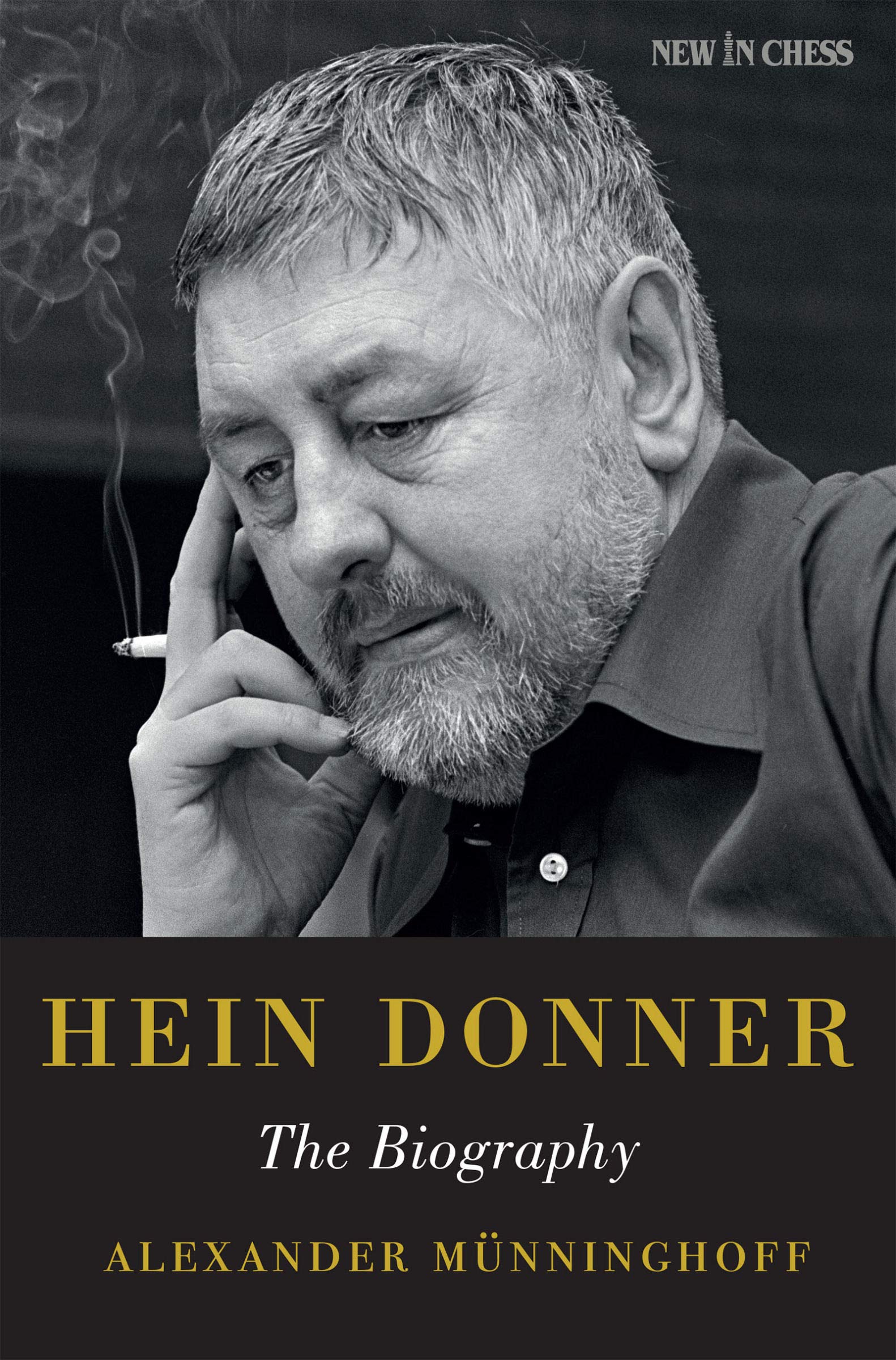
Hein Donner : The Biography : Alexander Münninghoff
Alexander Münninghoff: 1944-2020
“Alexander Münninghoff is an award-winning author from the Netherlands. He wrote the acclaimed biography of the man that was dethroned by Hein Donner as Dutch champion: former World Chess Champion Max Euwe. His memoir The Son and Heir, which tells the complex story of the Münninghoff family in the 20th century, is an international bestseller.”
From the rear cover :
“Hein Donner (1927-1988) was a Dutch Grandmaster and one the greatest writers on chess of all time. He was born into a prominent Calvinistic family of lawyers in The Hague.
His father, who had been the Minister of Justice and later became President of the Dutch Supreme Court, detected a keen legal talent in his son. But Hein opted for a bohemian lifestyle as a chess professional and journalist. He scored several excellent tournament victories but never quite fulfilled the promise of his chess talent.
Hein Donner developed from a chess player-writer into a writer-chess player. His provocative writings and his colourful persona made him a national celebrity during the roaring sixties. His book ‘The King’, a fascinating and often hilarious anthology spanning 30 years of chess writing, is a world-wide bestseller and features on many people’s list of favourite chess books. The author Harry Mulisch, his best friend, immortalized Hein Donner in his magnum opus The Discovery of Heaven. In 2001 the book was adapted for film, with Stephen Fry playing the part that was based on Donner. Included in Hein Donner is the interview in which Harry Mulisch tells about his friendship with Donner.
After suffering a stroke at the age of 56, Donner lived his final years in a nursing home. He continued writing however, typing with one finger, and won one of the Netherlands’ most prestigious literary awards. Alexander Münninghoff has written a captivating biography of a controversial man and the turbulent time and age he lived in.”
First, a bit of background. This biography was originally published in Dutch in 1994. Only now, a quarter of a century later, has it appeared in an English translation, partly in response to the success of The King, a collection of Donner’s writings.
Sadly, Alexander Münninghoff died at the age of 76 on 28 April this year, just before the publication of this book.
Johannes Hendrikus Donner (Jan Hein to the chess world, Hein to his friends) was one of the most colourful and controversial chess players of his time. His family have been for many years prominent in politics and law: his father was a government minister, his oldest brother was President of the European Court of Justice, and his nephew also a government minister. It was clear from an early age that Jan Hein was different. Troublesome and obnoxious, lazy but gifted. His father had him assessed by a professor of psychology who found him ‘very egocentric and immature/unbalanced’, with ‘a certain angst, with, in contrast, an inclination towards narcissism, and a sense of inferiority, with, in contrast, an inclination to act tough’.
Possibly the ideal combination of attributes for a chess player and journalist.
What should we make of a man who donated his prize from Venice 1968 to the Viet Cong, on the condition that the proceeds were used to buy machine guns rather than medicines? A man who wrote that women were hopeless at chess and would never learn? A man who used his chess columns to insult his fellow Dutch players, most notably a long running feud with his older contemporary Lodewijk Prins?
Someone, I think, who was deliberately provocative, who spoke and acted to gain a response more than anything else.
Like everyone else, I found The King highly entertaining, but my enjoyment was tempered by the feeling that he was someone I wouldn’t have liked had I known him.
Münninghoff, however, knew him and clearly liked him, and, as an outstanding writer and journalist, was the ideal person to tell the story of Donner’s relatively short but eventful life. This is a conventional biography, following his life from birth to death and, as you might expect, is crammed full of entertaining anecdotes. We learn a lot about his often chaotic personal life (he was married three times) as well as his career both as a chess player and a journalist. There’s also a lot of fascinating information about chess in the Netherlands during the post war decades. It’s not an academic biography, though: a rather inadequate index of names, no sources and few footnotes (I’d have welcomed more).
You might have expected a colourful and provocative player to have a similarly colourful and provocative style, but in fact his play was mostly rather dull, with a lot of short draws. His results were wildly erratic: at his best he could win strong grandmaster tournaments, but these triumphs would be interspersed with disasters. He had wins to his credit against most of the top non-Russians, even including Fischer, but an abysmal record against Soviet grandmasters. (Looking at his games in MegaBase it’s also notable how well he scored against English opponents.) He was also famous for losing a remarkable number of miniatures.
Even so, the games selection at the end is slightly disappointing. Games are sometimes discussed in the text but don’t appear in the book. One example is his 1957 win over Troianescu, which he considered one of his best:
On p128 we’re told that his 1961 loss to Korchnoi appears at the back of the book as game 23. No, it doesn’t: the index tells us Viktor is on p259, but neither he nor the game is anywhere to be seen.
I’m always happy to oblige:
What we actually get is a short collection of 18 games with brief annotations: wins, losses and draws, followed by another 16 short defeats, intended as a supplement to Tim Krabbé’s collection which you can find online here.
Donner would have been amused that his biography should contain more embarrassing defeats than brilliant victories. “I love all positions. Give me a difficult positional game, I’ll play it. Give me a bad position, I’ll defend it. Openings, endgames, complicated positions, and dull, drawn positions, I love them all and will give my best efforts. But totally winning positions I cannot stand.”
Anyone who was following international chess between the 1950s and the 1970s will undoubtedly want to read this book. For younger readers it will be ancient history, but still a highly entertaining read.
If you’ve read The King this book will need no recommendation from me, and, likewise, if you’ve read this book you certainly won’t want to miss The King.
A thoroughly enjoyable, if informal, biography of a fascinating and unusual personality which comes highly recommended, but is slightly let down by the rather perfunctory games section.
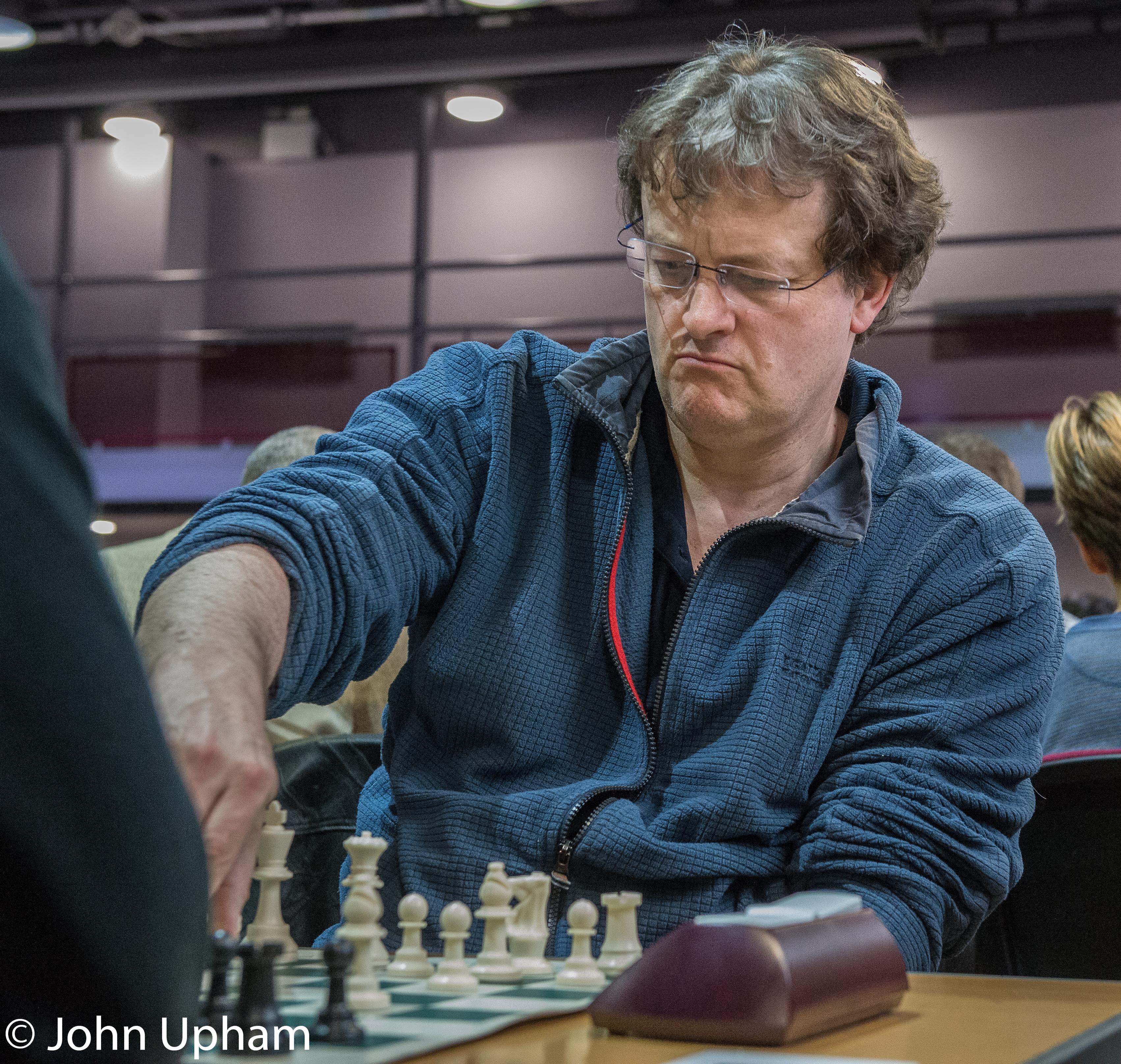
David Anderton OBE from the final 4NCL weekend of 2014, courtesy of John Upham Photography
BCN remembers CM David Anderton OBE who passed away on Friday, April 1st 2022.
In the 1977 New Years Honours List, Civil Division, David was awarded the OBE. The citation read simply : “For services to Chess”
David William Anderton was born in the district of Walsall, Staffordshire, West Midlands. His mother’s maiden name was Coltart and David resided in Walsall.
David was married to Doreen in 2005.
David Anderton (rhs) congratulates Sir Philip Stuart Milner-Barry for winning the “Board of Honour ” game versus Edward Lasker at the 1976 Lloyds Bank Match by Telex, London – New York. From BCM, volume XCVI (96) Number 11 (August), Page 494. The venue was the Bloomsbury Hotel, London. Photo courtesy of Lloyds Bank
David was an Honorary Life Vice-President of the English (formerly British) Chess Federation.
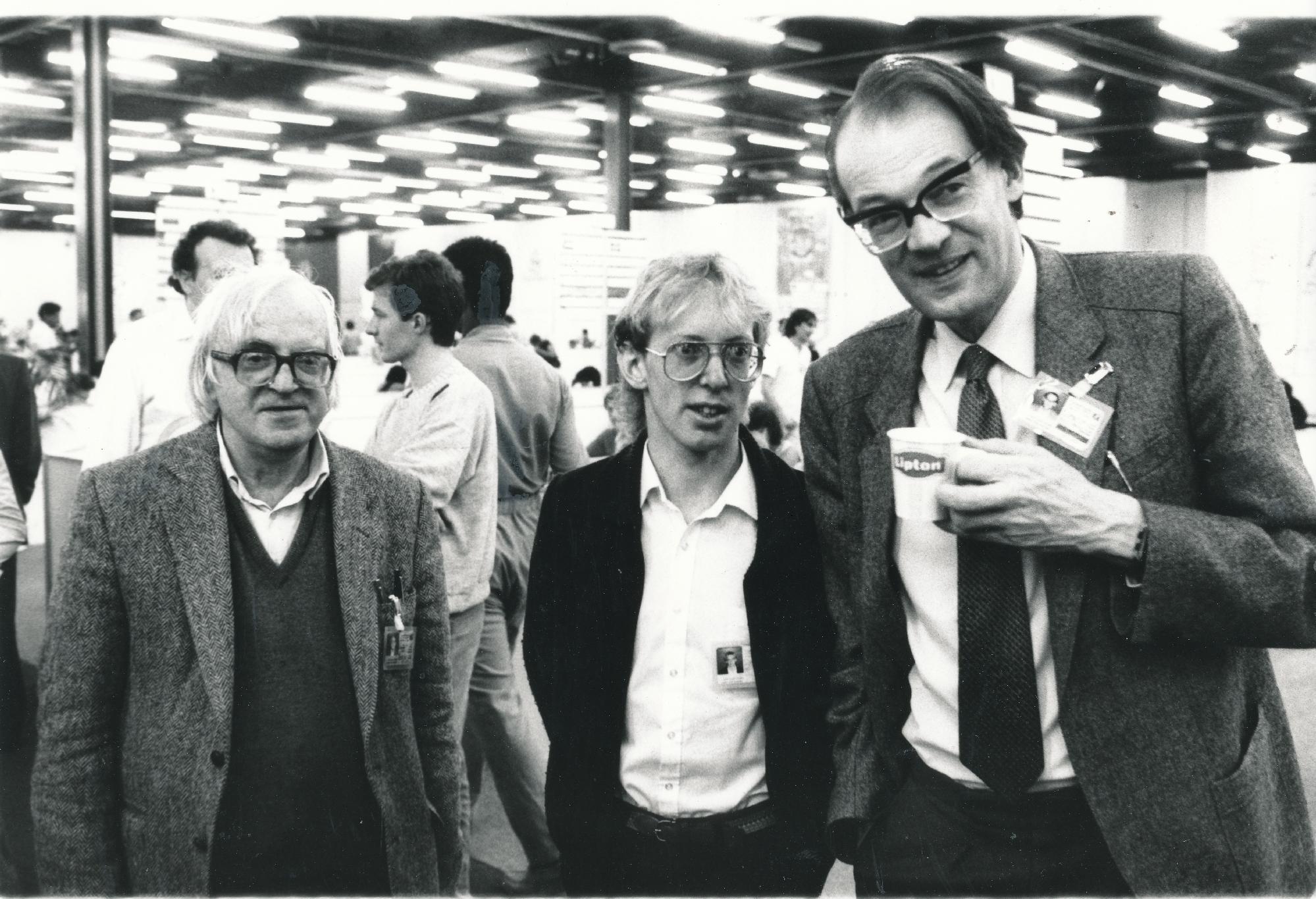
John Nunn, David Anderton and Jonathan Speelman
“David won the ECF President’s Award in 2009 following his stepping down as ECF legal expert. This is the citation from the 2010 ECF Yearbook :
“As this is Gerry Walsh’s last year as President it was considered appropriate that he be allowed to choose someone receive the award. Gerry has worked with David for all his time with BCF and ECF and has selected him due to his tireless and selfless devotion to both the BCF and ECF over many years.
David Anderton OBE, ? and Teresa Needham
Most of you will know David and will agree that this is a well deserved award. It is fair to state that David’s assistance over the years has been invaluable and that without it many areas of the Federation would have found it difficult, if not impossible to operate.
Jim Plaskett with David Anderton OBE at the 1983 Benedictine International (Manchester)
Since my election David has been a constant friend and confidante. He has invariable given sound advice throughout my term of office. It was John Wickham who rang me and suggested that due to my length of tenure, a special award might be in order.
Jim accepts the 1981 Grand Prix shield from David Anderton OBE
After years of selfless and generous devotion serving as ECF President, International Director, Captain of the England Team and legal adviser, this seems to be a fitting tribute.
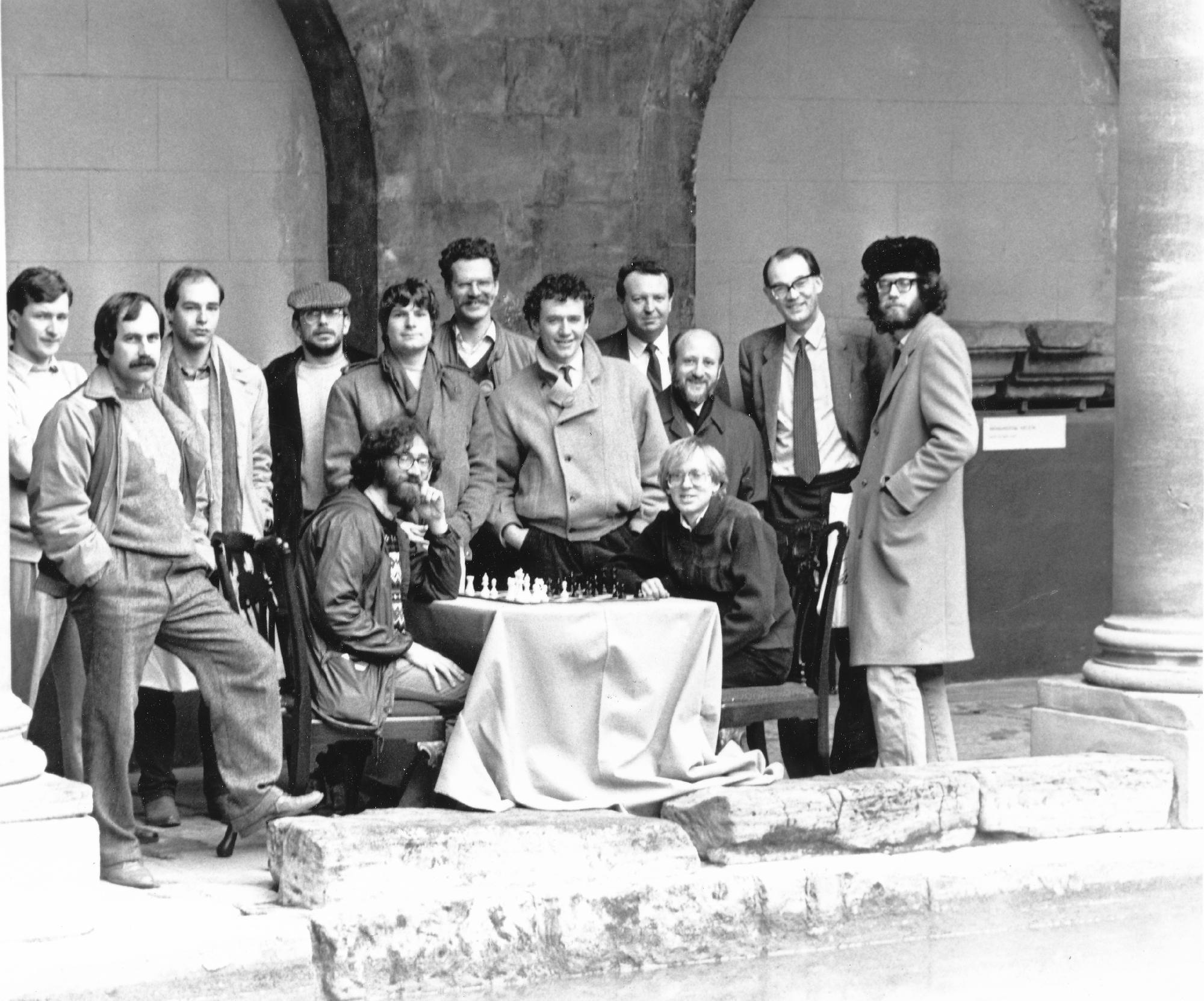
From the Praxis Bath Zonal Tournament of 1987. David Anderton OBE is second from right
David’s advice both legal and general, has been invaluable in such matters as the John Robinson legacy and the change of name from BCF to ECF Limited, and I certainly hope that this advice will continue.
Gerry Walsh”
Bob Wade OBE, Murray Chandler MNZM and David Anderton OBE
David is a FIDE Candidate Master.
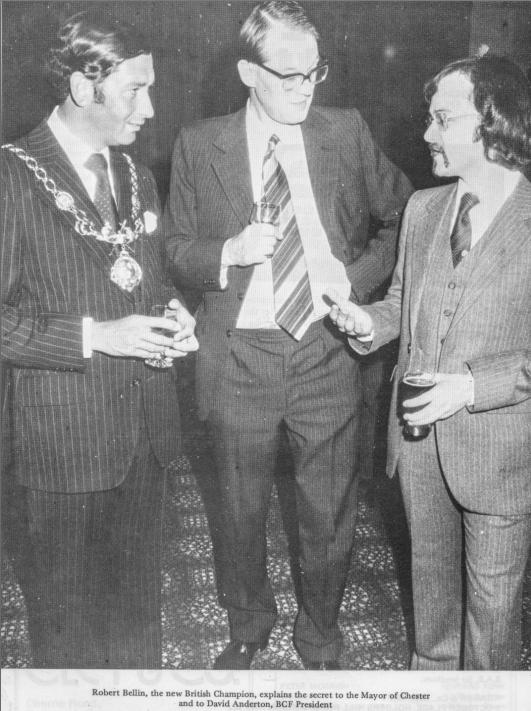
From the BCF 1979-80 Year Book of Chess : Robert Bellin, the new British Champion, explains the secret to the Mayor of Chester (?) and to David Anderton, BCF President
With the White pieces David exclusively plays 1.d4 aiming for a Queen’s Gambit and main lines.
With Black David plays the Winawer and the Classical French plus the Lenningrad Dutch.
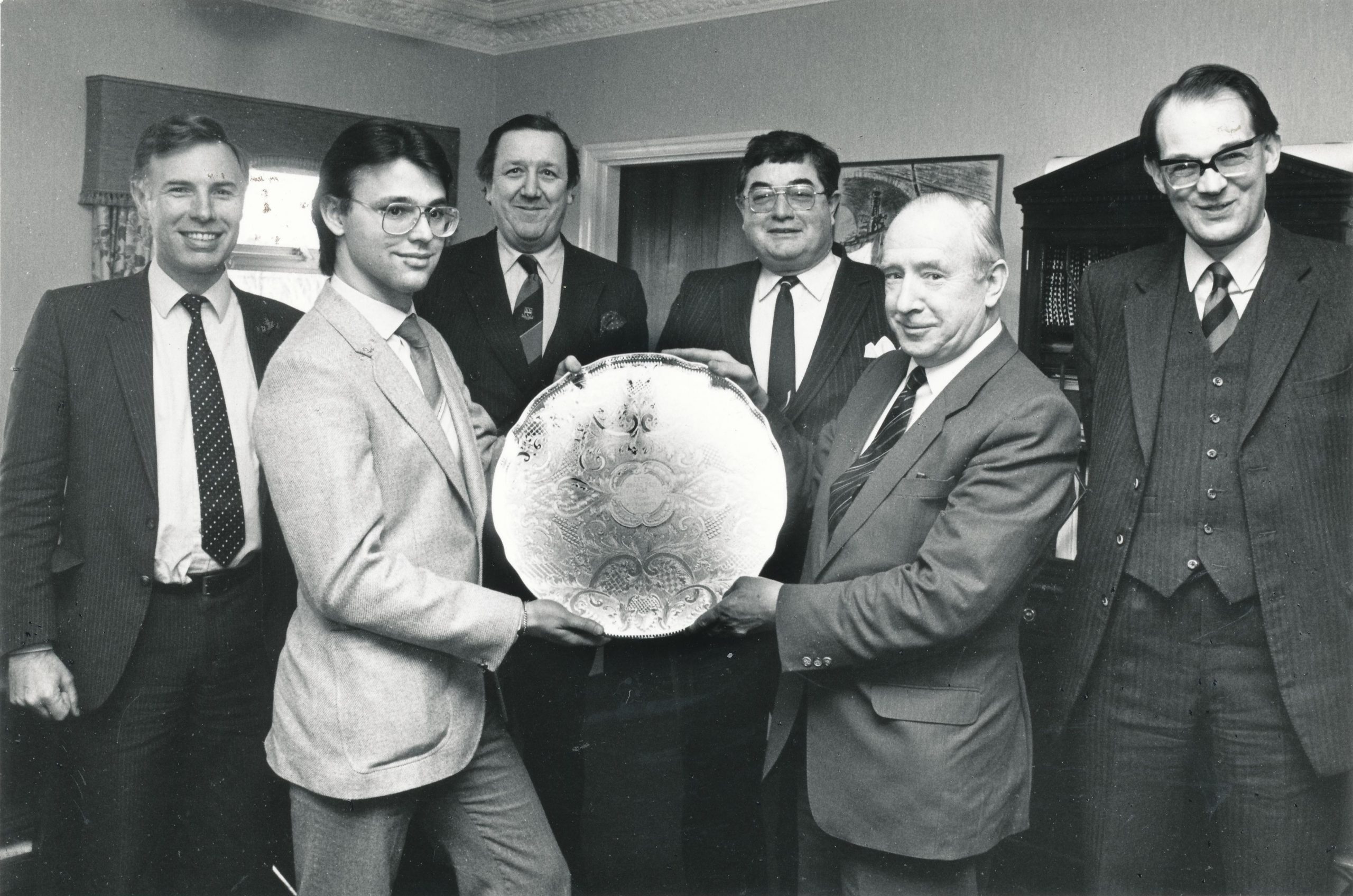
Mrs. Joan Agar; Chairman of Leigh Interests, presents the Leigh trophy (for 1981) to Mark Hebden. Left, David Anderton, BCF President; on the right Malcolm Wood, Leigh’s Chief Executive. BCM, 1981, page 104
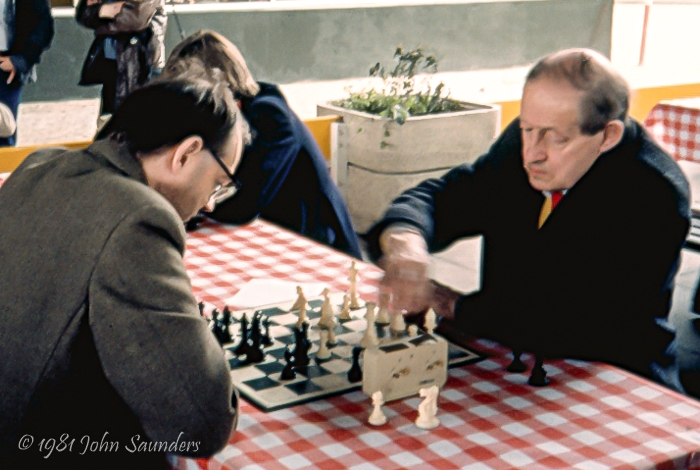
DW Anderton OBE plays BH Wood MBE in 1981 in a Blitz tournament outside of the National Film Theatre. Photograph courtesy of John Saunders
During 1989-93 David was an Executive Board Member of FIDE.
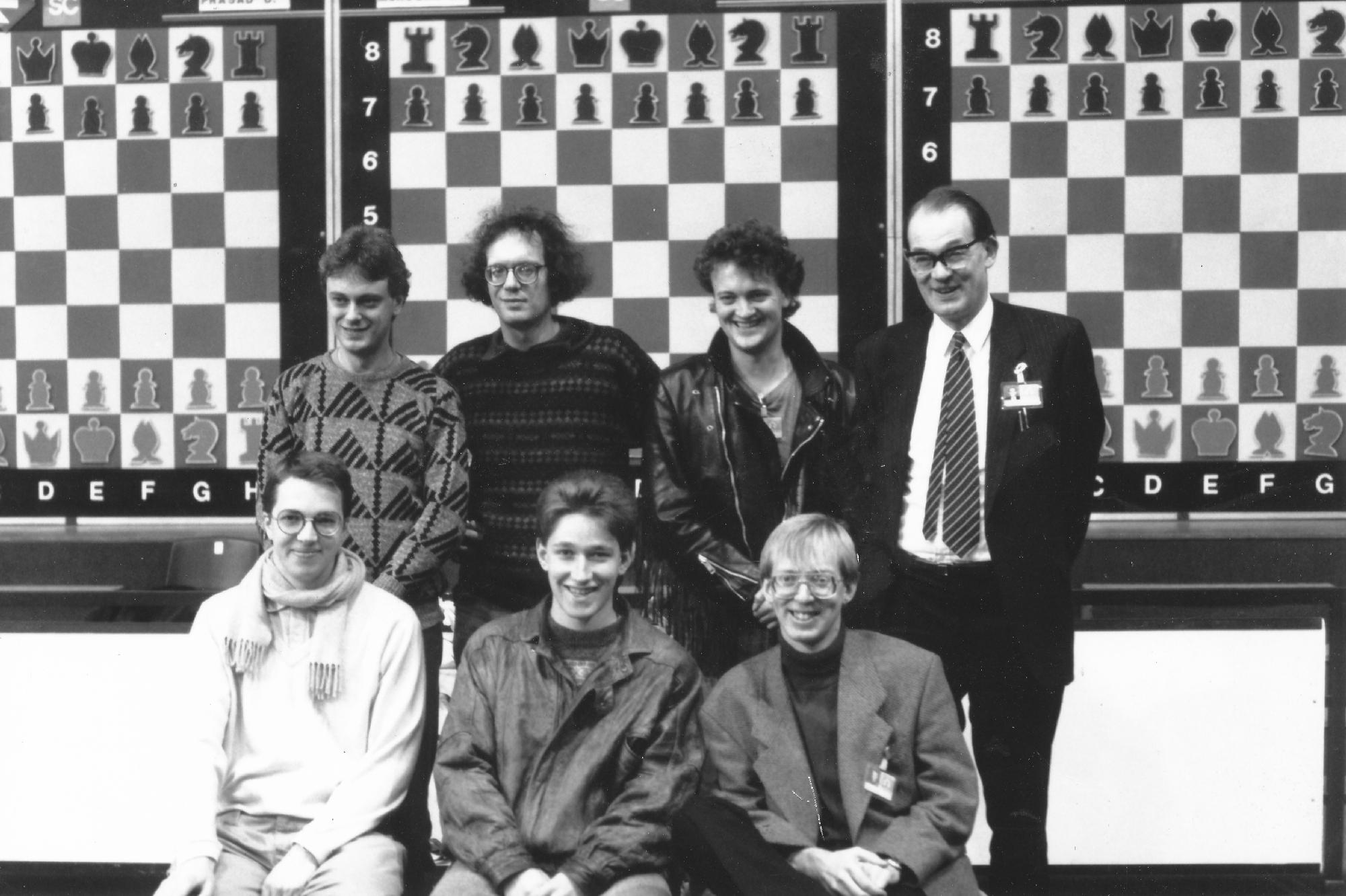
The England Team from the 1990 Novi Sad Olympiad : John Nunn, Jon Speelman, Julian Hodgson, David Anderton OBE (Captain), Nigel Short, Michael Adams and Murray Chandler
In 2015 David stood down from all of his roles within the ECF.
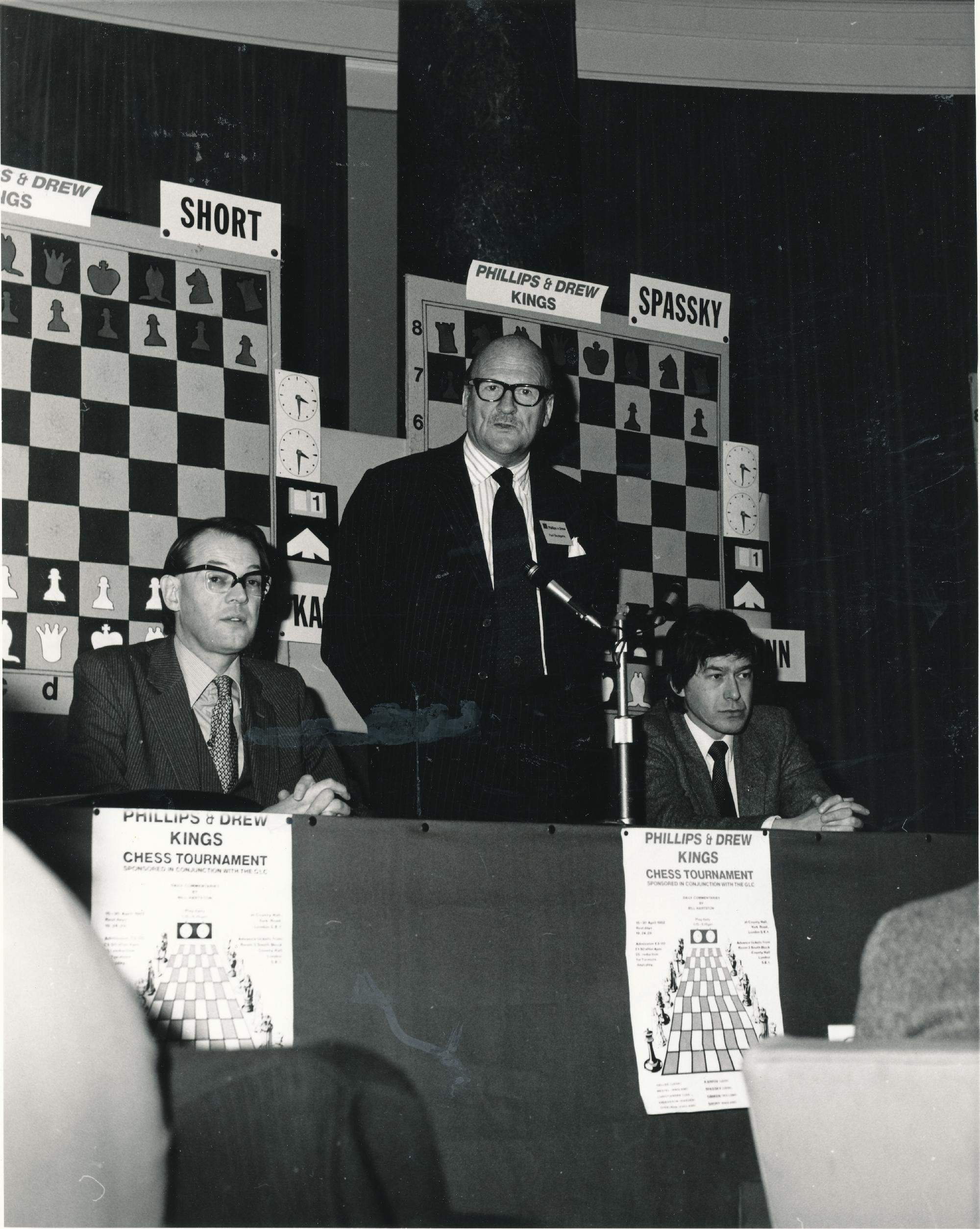
David Anderton OBE, Paul Bazalgette (Senior Partner at Philips & Drew) and Tony Banks (GLC Arts & Recreation Department) at the 1982 Philips and Drew Kings Tournament Opening Ceremony. Photograph by Clive Field
David has won the British Seniors Championship in 2003 (shared), 2005, 2007 (shared), 2009 (shared) and 2011.
We send best wishes to GM Nigel Davies on his birthday, this day (July 31st) in 1960.
Nigel Rodney Davies was born in Southport, Merseyside.
He lived in the Wirral, Merseyside, moved to Sidcup and then to St. Helen’s, Merseyside where he resides with his chess playing son, Sam who is ECF 1928A currently.
In July 2020 Nigel graduated with a BSc (Hons) in Computing from Edge Hill University.
Nigel Davies (centre) at a Lloyds Bank event
He became an FIDE Master in 1980, an International Master in 1982 and a Grandmaster in 1993.
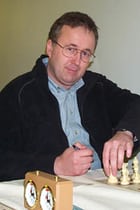
Nigel Davies
He won the British Under-21 Championship in 1979 (Chester) and the British Rapidplay Championship in 1987.
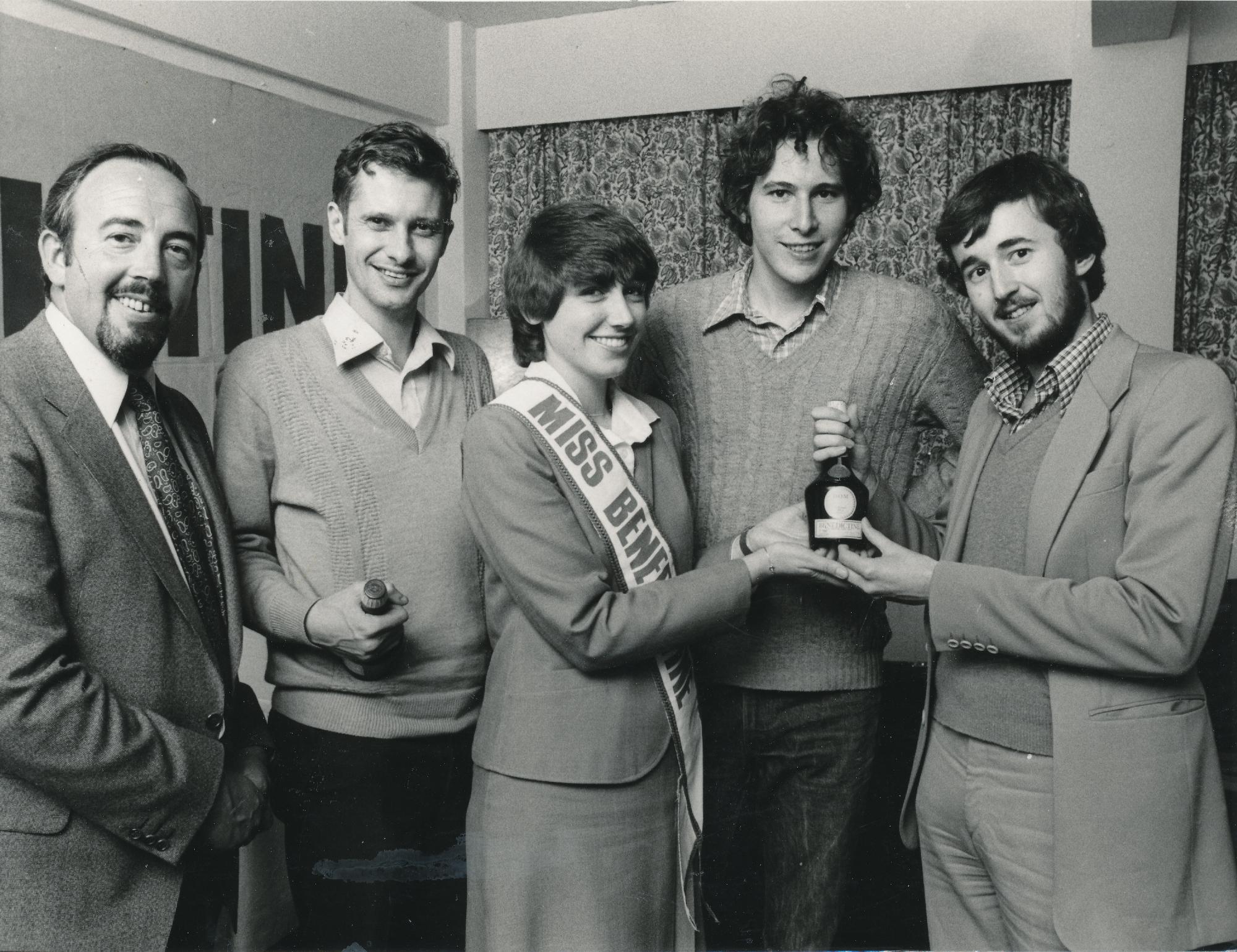
Nigel receives a much welcome prize (in Manchester) from Miss Benedictine in 198?
He won The Regency Ramsgate Masters 1980, Wrexham 1994, Katrineholm 1995 and the Blackpool Hilton Premier in 2003.
In 2015 Nigel transferred his international allegiance from England (the English Chess Federation) to Wales (Welsh Chess Union). He maintains an ECF standard play rating of 2448E.
William Watson, Jonny Hector, Alexander Khalifman, Jonathan Tisdall and Nigel Davies at the 1991 Watson, Farley, Williams tournament in London.
His peak FIDE rating was 2530 in January 1995 at the age of 35.
Nigel’s repertoire with White is wide including Queen’s Gambit, King’s Indian Attack, English/Reti and the Ruy Lopez.
As black Nigel’s repertoire is also varied and difficult to pin down. The Modern Defence is a favourite and is the Nimzo-Indian Defence.
Nigel is an active user of Twitter and may be found @GMNigelDavies
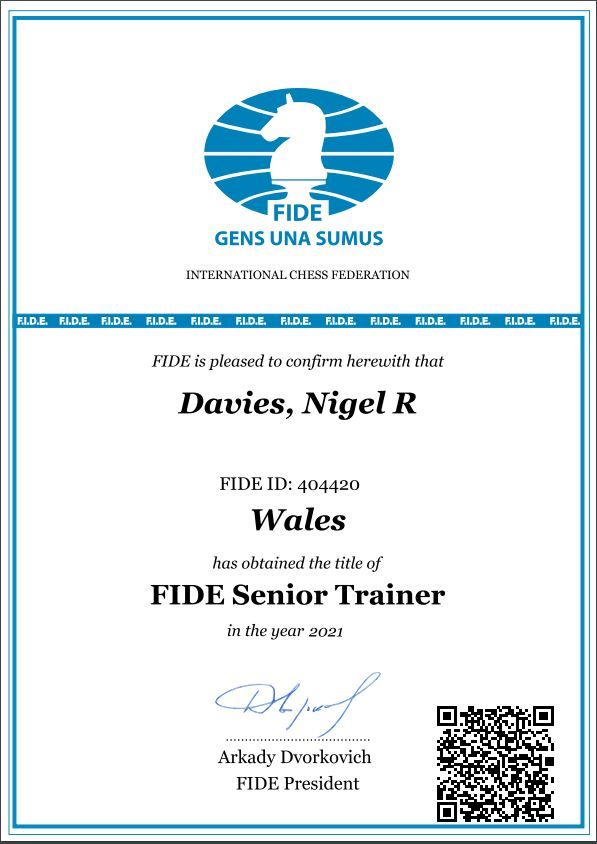
In 2020 the Welsh Chess Union successfully endorsed Nigel’s application to FIDE to become a FIDE Senior Trainer which he became in 2021:
Nigel Davies, FIDE Senior Trainer
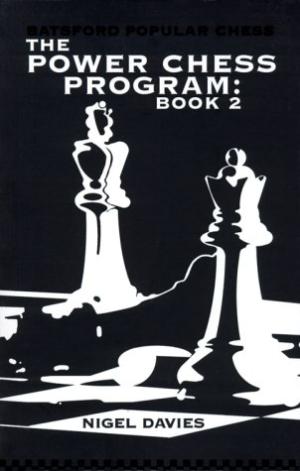
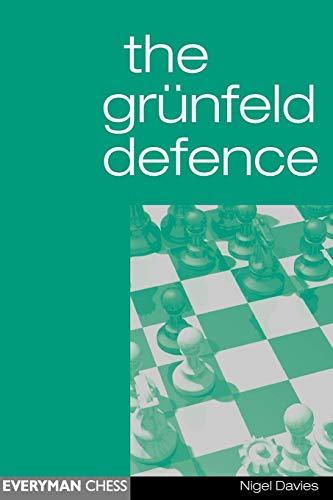
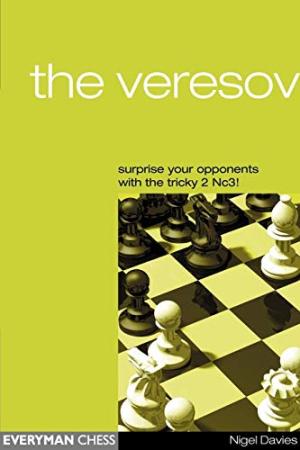
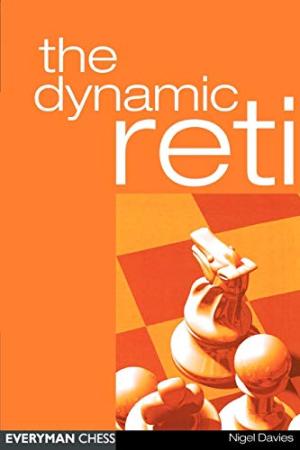
Nigel has had many books and DVDs published :
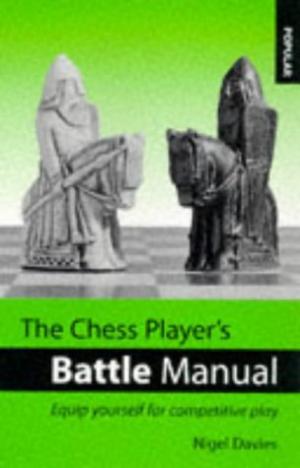
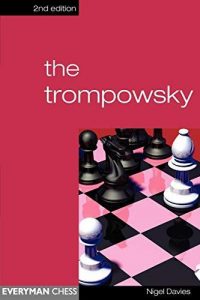
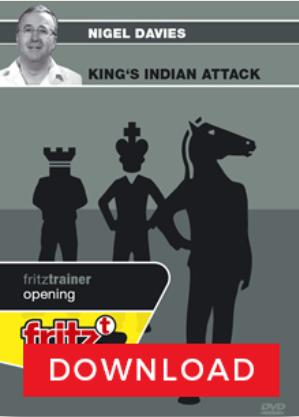
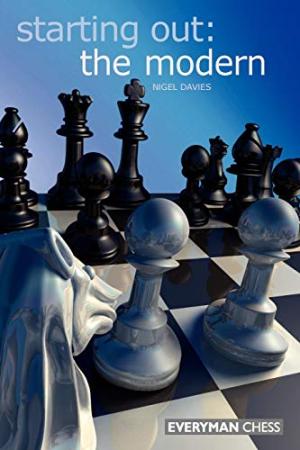
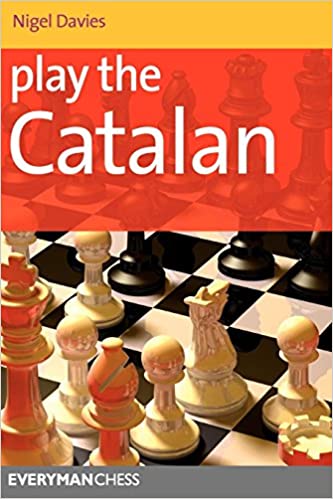
The Chess Player’s Battle Manual. Batsford. ISBN 0-7134-7043-7The Power Chess Program. Batsford. ISBN 0-7134-8415-2.The Grünfeld Defence. Everyman Chess. ISBN 1-85744-239-3.The Veresov. Everyman Chess. ISBN 9781857443356.The Dynamic Reti. Everyman Chess. ISBN 9781857443523.The Trompowsky. Everyman Chess. ISBN 1857443764.King’s Indian Attack. Hamburg: ChessBase. ISBN 978-3-86681-071-6.Starting Out: The Modern. Everyman Chess. ISBN 9781857445664.Play the Catalan. Gloucester Publishers plc (formerly Everyman Publishers plc). ISBN 9781857445916.
From https://achievement.org/achiever/demis-hassabis-ph-d/ :
Demis Hassabis, the eldest of three, was born in London on July 27, 1976, to a Greek Cypriot father and a Chinese Singaporean mother.
(Originally his surname was spelt Hassapis and his brother George retained this spelling.)
“Demis Hassabis was born in London, England. He is of both Greek and Chinese ancestry; his father came from Cyprus, his mother from Singapore. Demis and his family moved frequently as his father pursued a variety of business and creative ventures.
Demis was four years old when he saw his father and an uncle playing chess and asked them to teach him the game. He took to it quickly and was soon beating both of them. He showed a precocious aptitude for all games employing logic and strategy. ”
Demis Hassabis
When 13 (in 1989) Demis achieved a FIDE rating of 2300 which, at the time, was the second highest rating for his age. First highest was Judit Polgar.
Demis was SCCU Under-18 champion in 1989 and was presented with the “old Trophy” according to the SCCU report.
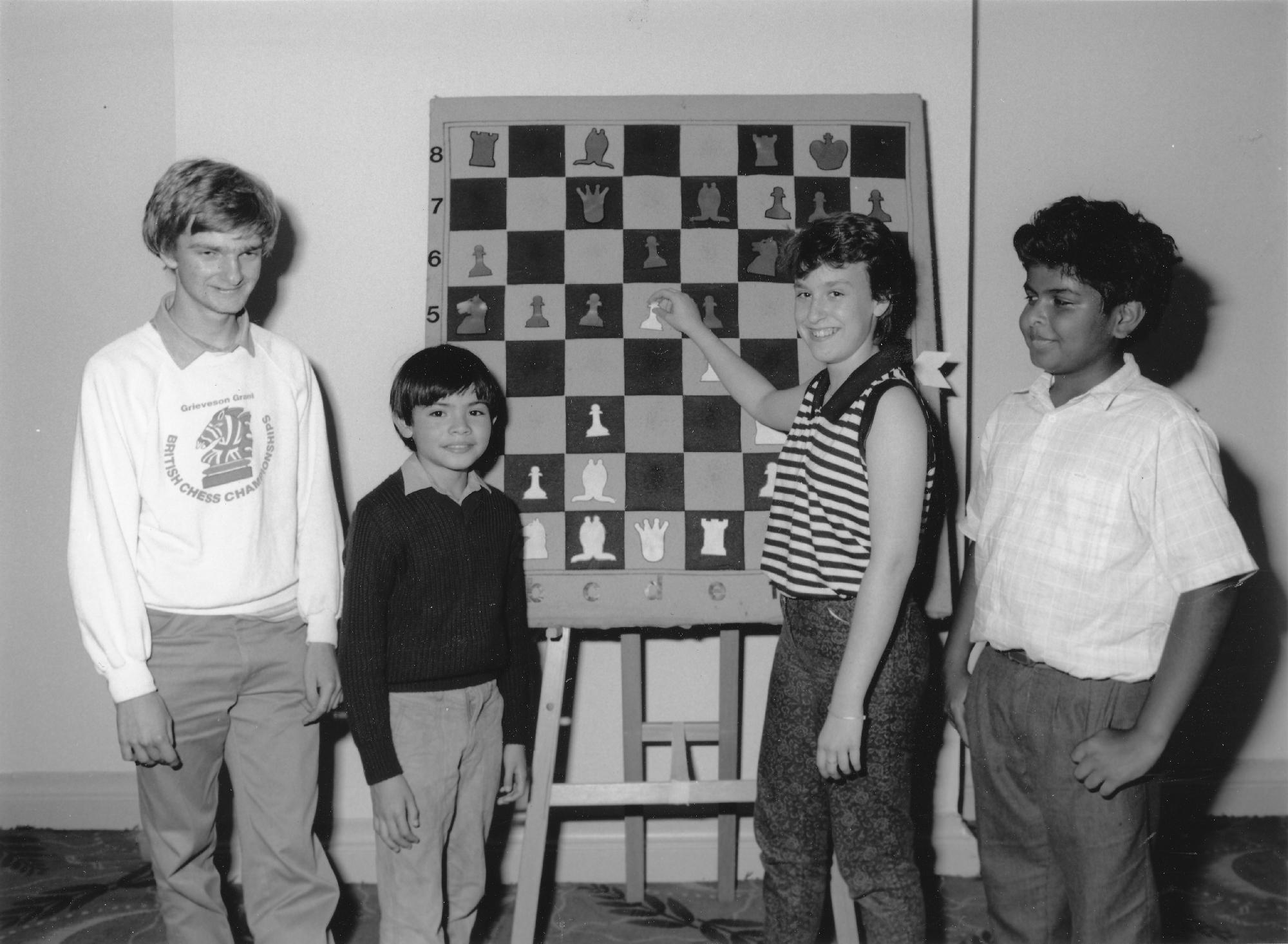
Lawrence Cooper, Demis Hassabis, Cathy Haslinger and Dharshan Kumaran in around 1986. Possibly at a Lloyds Bank event.
Demis was a Candidate Master and brother of George Hassapis.
Demis started off with Hampstead Junior Chess Club.
He then played for Barnet Knights, Queens College College Union and Finchley chess clubs.
Demis Hassabis courtesy of Cathy Rogers
According to Tryfon Gavriel :
Demis wrote a hit computer game called “The theme park”, that was at the top of the charts for six months and sold than more 3.5 million copies. He also did quite well in the 1997 Mind Sports Olympiad.
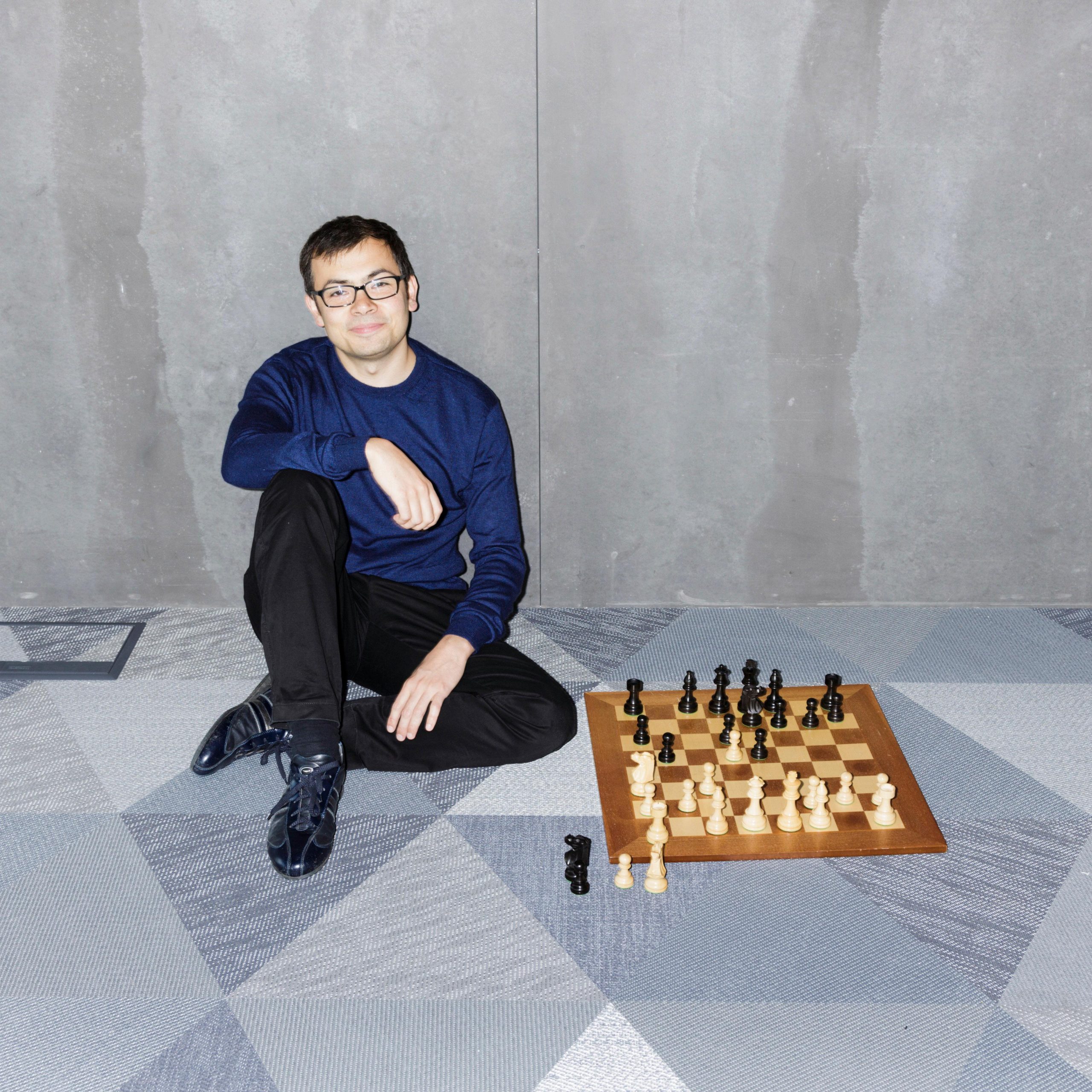
Demis Hassabis, IMMO KLINK/CONTOUR BY GETTY IMAGES
Hassabis returned to academia to obtain his PhD in cognitive neuroscience from University College London (UCL) in 2009 supervised by Eleanor Maguire. He sought to find inspiration in the human brain for new AI algorithms.
Danny Gormally wrote (in March 2014) this :
“Demis Hassapis is a former chess prodigy who recently sold his company to Google for £400 million. Demonstrating that if you have the brainpower to be good at chess, you are far better off putting that intelligence to use in some other activity where you might actually get rewarded. Then in fairness, even most strong chess players aren’t as bright as Demis.”
In May 2021 Demis was cited by Dominic Cummings in his evidence to the Commons Heath, and Science and Technology committees as having played an important contribution to managing and understanding the PHE and NHS data during the early stages of the Covid-19 pandemic in the UK.
We send best wishes to GM Julian Hodgson on his birthday, this day July 25th) in 1963.
Julian Michael Hodgson was born at St. Mary Abbott’s Hospital, Marloes Road, Kensington, West London son of (Ronald) George Hodgson and Johanna Hodgson (née Birch) and the birth was registered in the district of Hammersmith.
Julian’s father has asserted to be a descendent of George Jeffreys, 1st Baron Jeffreys and we are looking to establish this claim following further research.
Julian attended St. Paul’s School (See below) and then attended The University of Leicester for one year.
Julian married Lizette and David Norwood was his Best Man.
Julian and Lizette Hodgson
(Curiously both Felice and Gaige state Julian was born in Saint Asaph in Wales. This is incorrect.)
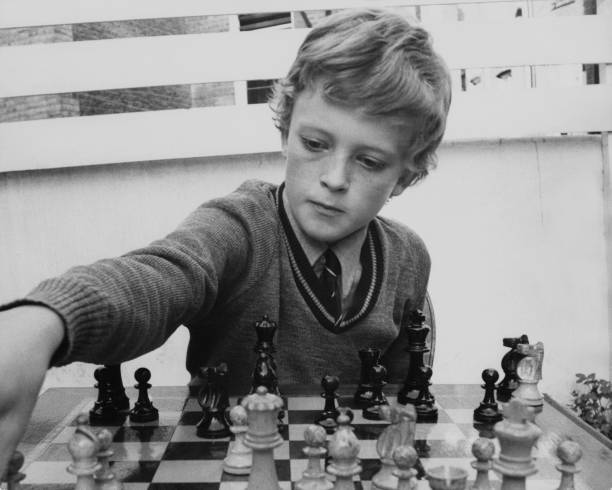
Julian Hodgson
Harry Golombek wrote this about Julian in a 1980 Dataday chess diary :
“I think that the first time I saw Julian Hodgson in play was some four years ago in a London tournament. Upon my arrival Leonard Barden told him that he must now be careful how he played as Golombek was watching.
Julian and Nigel Short play Korchnoi in a simul. Leonard Barden observes.
“Who”, enquired the twelve-year old Julian, “is Golombek?”
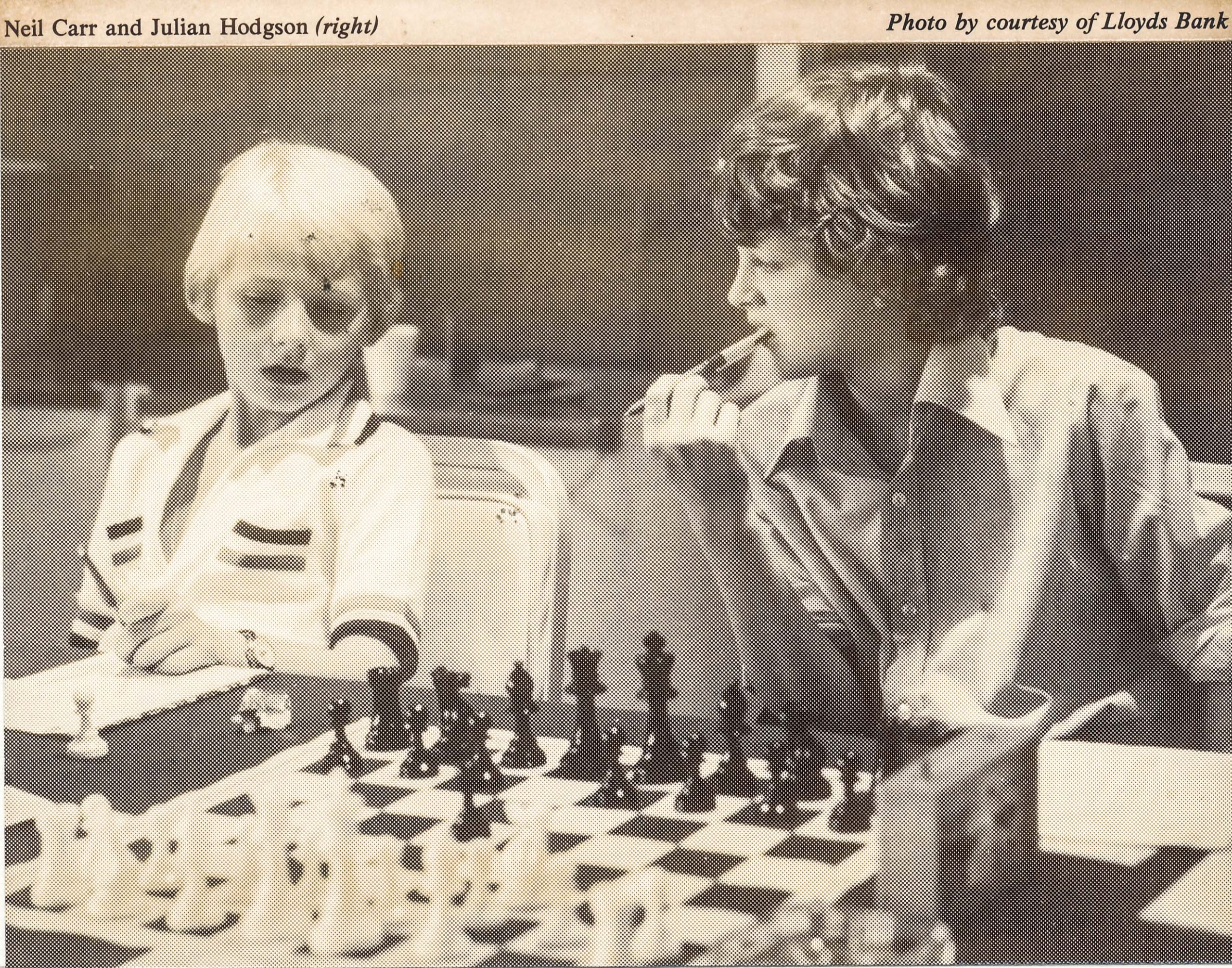
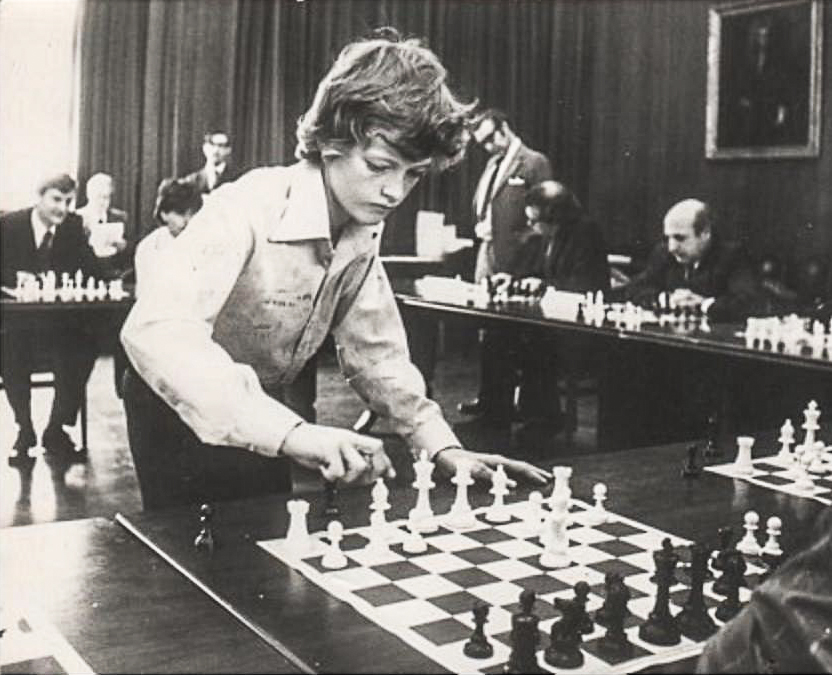
Neil Carr and Julian Hodgson at the 1976 Lloyds Bank Match by Telex, London – New York. From BCM, volume XCVI (96) Number 11 (August), Page 494. The venue was the Bloomsbury Hotel, London. Photo courtesy of Lloyds Bank.Julian Hodgson aged 13 in 1976 giving a simultaneous display at the Guildhall in London scoring +14=2-4. Photograph courtesy of the Keystone agency.
I felt grateful at the time that he did not say who or what is Golombek but I tell this story chiefly to show the cheerful insouciance with which Master Hodgson treated all comers whether chess masters or chess rabbits.
Julian playing Simon L Triggs. Event and photographer unknown
Julian astonishing maturity as a player has been impressive ever since at the age of ten, he won the Southern Counties Under 14 Championships in 1973. Since then he has acquired a host of such championships culminating in the British Under-21 Championship in 1977.
Streatham & Brixton becoming BCF National Club Champions in 1989. The team was Tony Kosten, Mark Hedben, Daniel King, Nigel Povah (Captain), Joe Gallagher and Julian Hodgson : quite a strong team
Perhaps his most remarkable performance so far has been his equal 3rd in a strong challengers section at Hastings where he scored 7.5 out of 10. 1977 was a good year for him and here, from the Lloyds Bank Silver Jubilee Tournament of that year is his fine win over a strong opponent :
Here is his entry (written by Richard W O’Brien) in British Chess (Pergamon Press, 1983, Botterill, Levy, Rice and Richardson) :
“Following a series of excellent results Julian, at the tender age of 11, became the second youngest ever to play in an international tournament when he took part in the London Chess Club International Invitation tournament in September 1974. Only Reshevsky had been younger. Julian’s first opponent was Michael Woodhams, an Australian international who had just scored 15.5/18 in the recent Olympiad (Nice)
The following year he became the youngest player ever to win the London Amateur Championship. A year later he reached a grading of 200 (BCF), only Reshevsky, Pomar, Karpov and Kasparov had done so at an earlier age.
By now he was at St. Paul’s School, which was in the process of becoming one of the strongest chess playing schools in the country. In 1977 he shared first place with WN Watson (also St. Paul’s) in the British U21 Championship. Progress was however not as fast as had at one time been anticipated
It was at Ramsgate, late in 1980 before his first IM norm. A month later he finished second in the Hastings Challenger. Other good results followed in 1981. First he was selected for the Glorney Cup and shortly afterwards did well to come fourteenth in the British Championship (Morecambe). He represented England in the World Youth Team championships scoring 4/6. His second IM norm followed when he shared fifth place at Manchester in the same year. Good results in weekend congresses meant that he finished fourth in the Leigh Grand Prix. The year had finished with Julian needing a draw in the last round at Ramsgate to get his title. He lost and was to wait another 12 months to achieve his final norm.
The England Team from the 1990 Novi Sad Olympiad : John Nunn, Jon Speelman, Julian Hodgson, David Anderton OBE (Captain), Nigel Short, Michael Adams and Murray Chandler
When the final norm came it arrived out of the blue. With a score of 2.5/5 at Lewisham in November 1982 the chances seemed remote, 3.5/4 was required against a strong field and it even seemed doubtful whether he could actually play those he needed to play. He scored 2.5/3 and now had to play Jon Tisdall, who still had a chance of winning the tournament.
Julian finished second equal in the tournament behind Jim Plaskett who had beaten him earlier.
Julian Hodgson
The next six weeks saw Julian come equal first in the Pergamon sponsored British Lightning championship, a highly creditable sixth in the Nightflight International at Brighton (equivalent to an IM rating) and second place yet again in the Hastings Challengers.
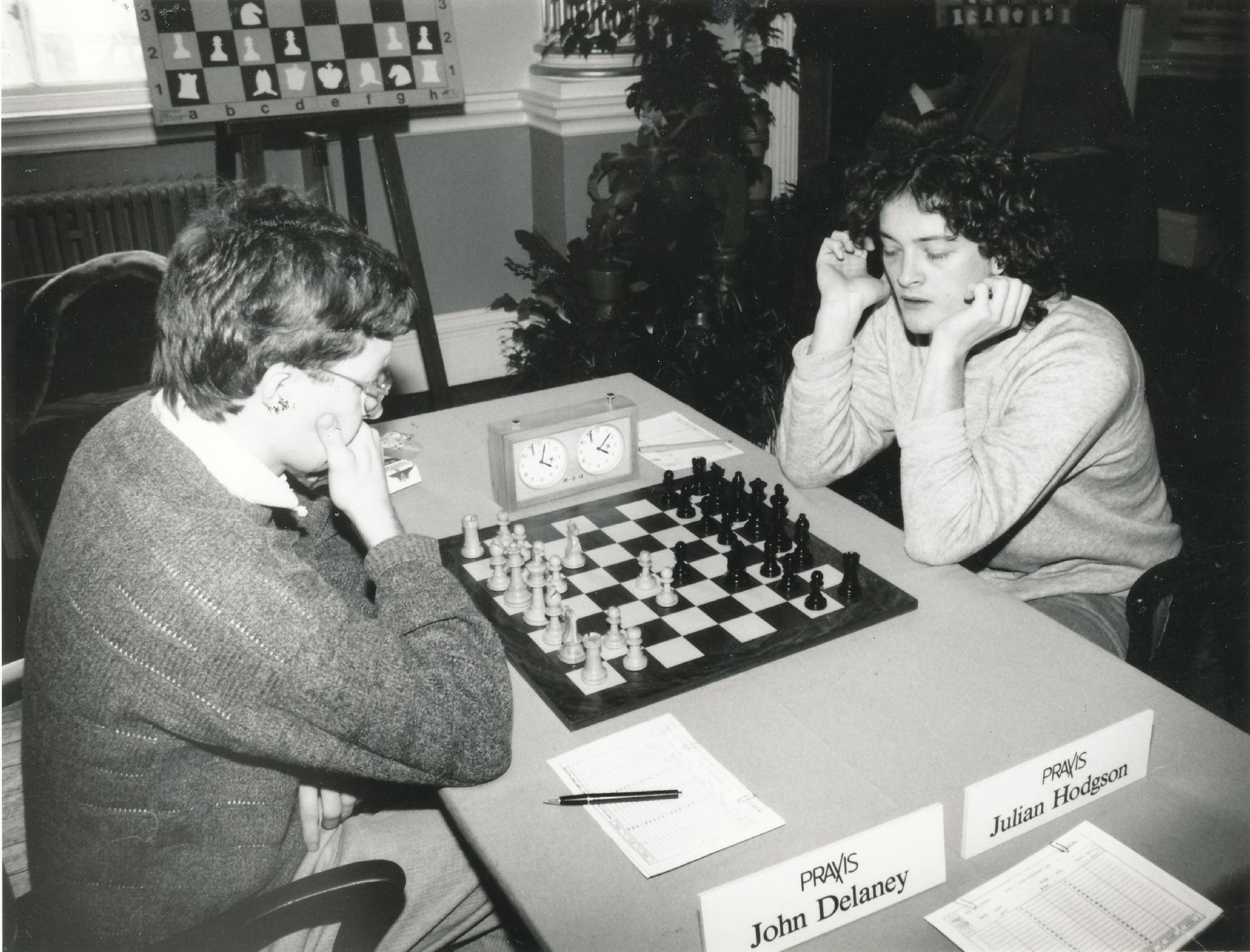
John Delaney plays Julian Hodgson at the Bath Zonal Tournament in 1987
Earlier in 1983 he scored 6.5/9 at Lugano, probably Europe’s strongest ever Swiss (Swiss !) tournament, losing narrowly to Jan Timman.
Julian Hodgson. Event and photographer unknown.
He left Leicester University after just one year preferring to concentrate on chess.
FM Andrew Whiteley, IM Julian Hodgson and FM Byron Jacobs at Cappelle Le Grand, 1988. Photograph by Caroline Winkler
He plays fairly regularly for Streatham & Brixton Chess Club which encouraged juniors for several years. Daniel King is another junior who also played frequently for Streatham. ”
This is what was written about Julian prior to the 1979 Spassky vs the BCF Junior Squad simultaneous display : “St Paul’s and Shepherds Bush. Rating 210. Standard London Amateur Champion at age 12, 1975.
Standard London under-18 champion, 1976. British under-21 co-champion, 1977. Youngest ever to beat two grandmasters in successive games, 1978.”
Aside from more formal achievements, he developed a sharp, relentless, attacking style of play and against lesser opponents this frequently resulted in devastating quick wins, earning him the epithet “Grandmaster of Disaster”.
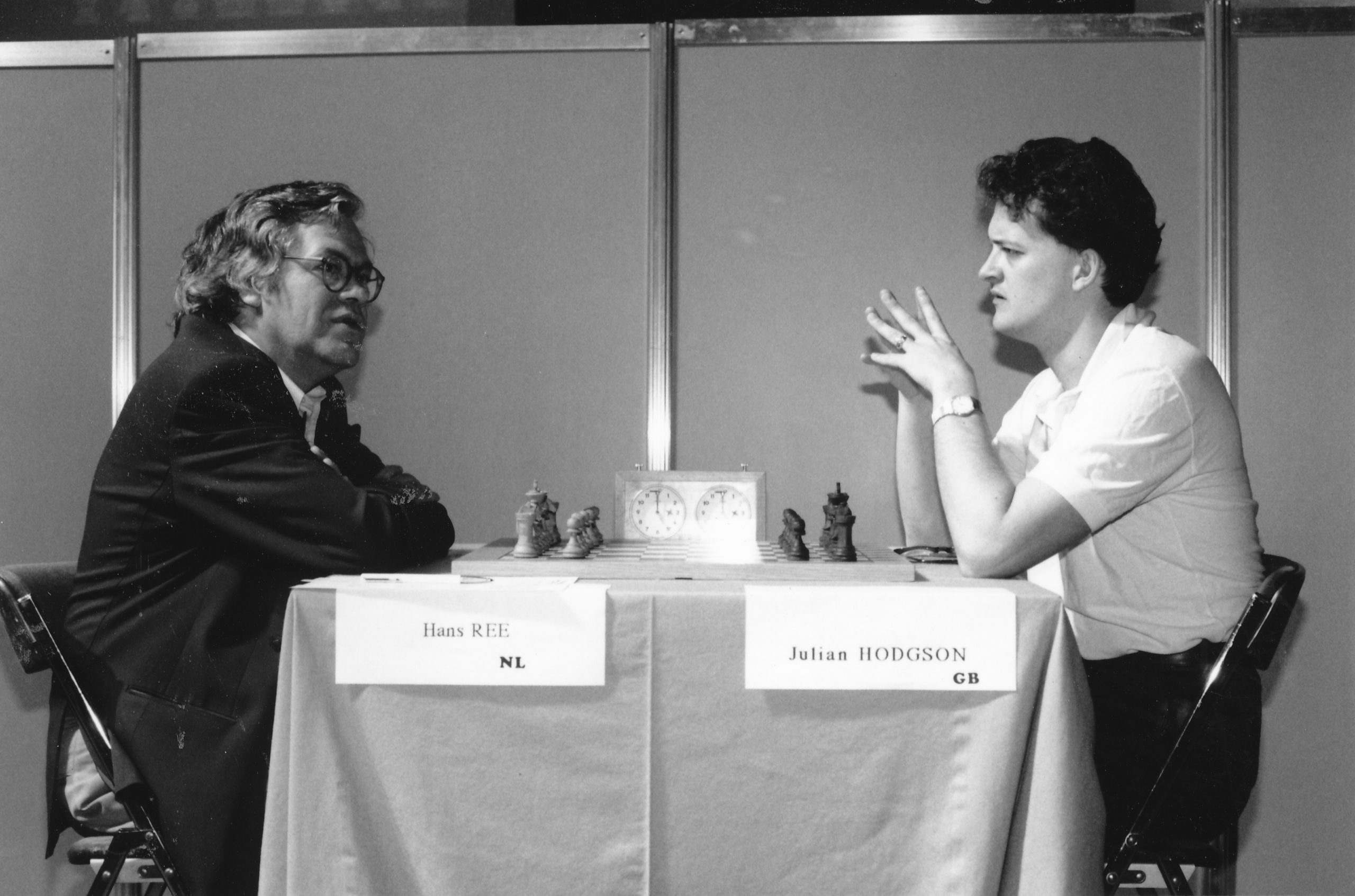
Hans Ree plays Julian Hodgson at the Cannes Team Tournament, 1992
Hodgson’s greatest legacy as a chess player may however lie in his resurrection of an almost forgotten opening system. The Trompowsky Attack (1.d4 Nf6 2.Bg5) had floundered in the doldrums for many years, prior to his adoption and development of the opening. In interviews, he reveals that this was born out of laziness and a reluctance to learn established chess opening theory. It soon became his weapon of choice with the white pieces, leading to a surprising popularisation of the system, the spawning of a whole generation of devotees and ironically, a number of theoretical guides, containing a high quota of Hodgson’s own games and analysis. Indeed, his expert treatment of the system once prompted fellow grandmaster Joe Gallagher to write that it should be renamed the Hodgson–Trompowsky Attack, a view shared by many other masters. A chess journalist once wrote that Hodgson put the ‘romp’ into Trompowsky.
A related, but more obscure version of the system (1.d4 d5 2.Bg5), has been dubbed by some the Hodgson Attack and by others the Pseudo-Trompowsky or Queen’s Bishop Attack.
and
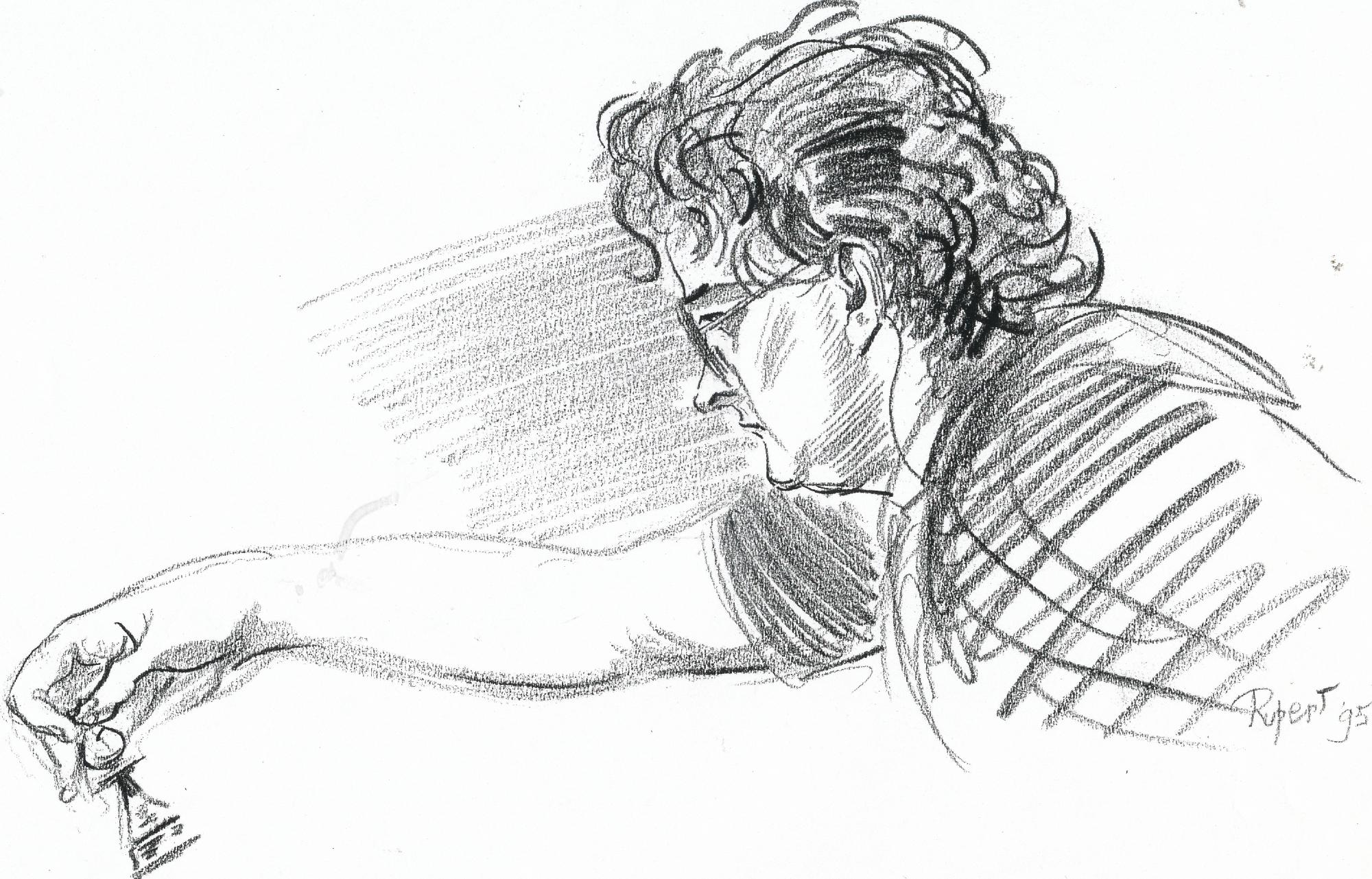
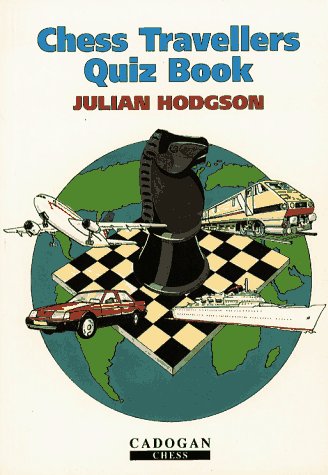
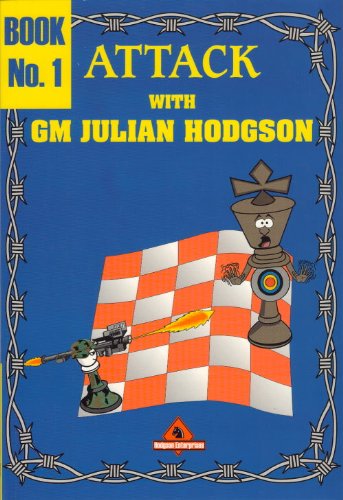
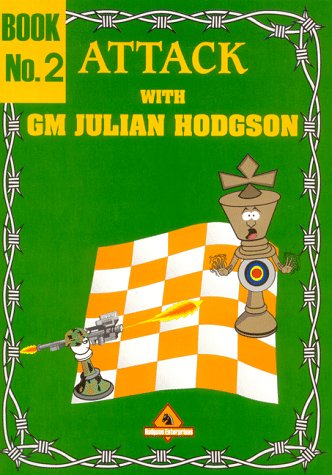
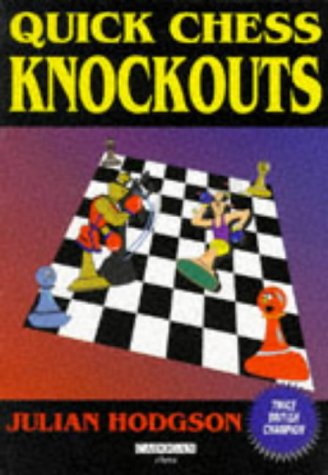
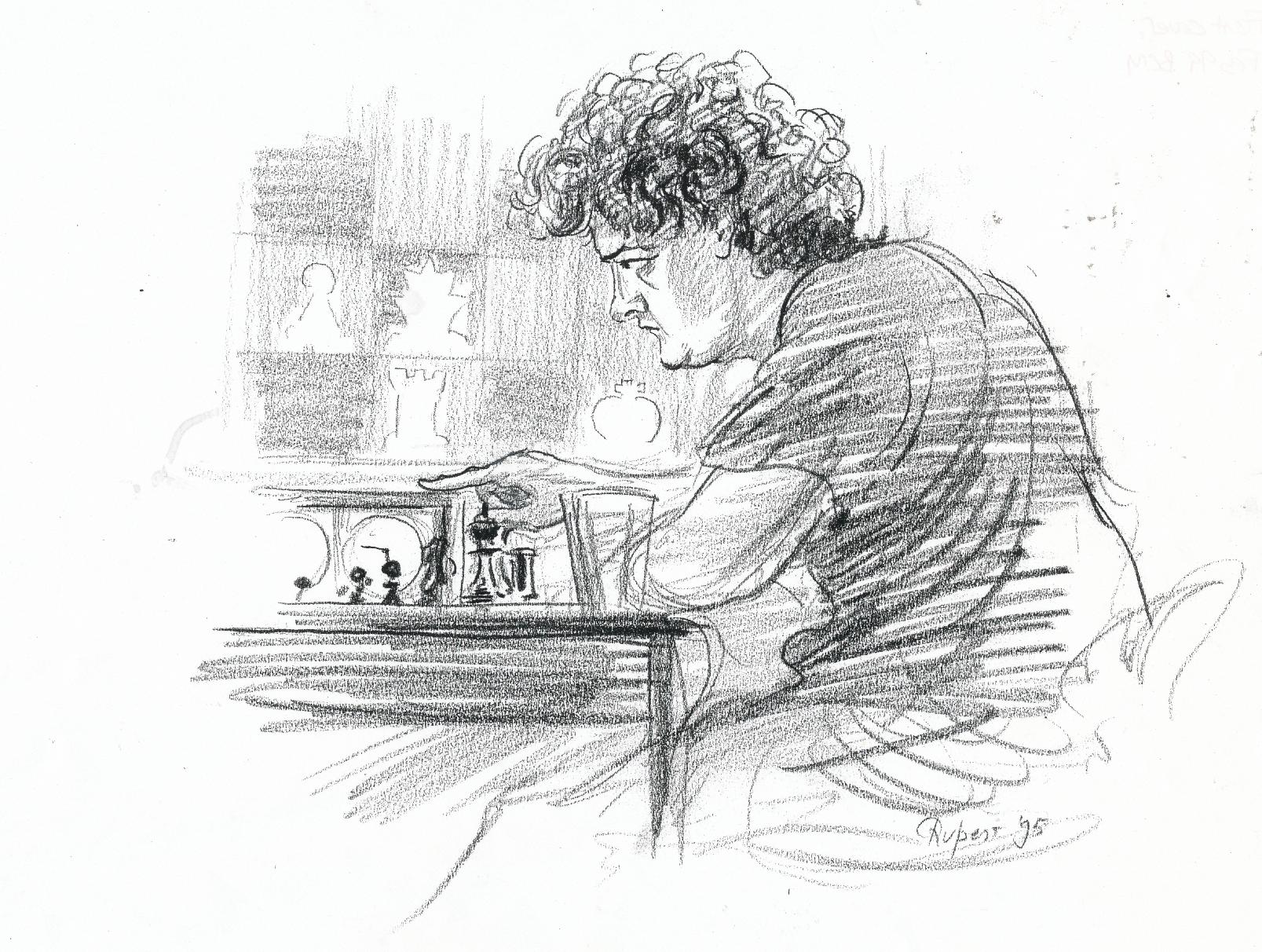
Julian, Dominic Lawson and Matthew SadlerChess Traveller’s Quiz Book, Julian Hodgson, Cadogan Press, 1996, ISBN-13 : 978-1857440300Attack with Julian Hodgson, Book No.1Attack with Julian Hodgson, Book No.2Quick Chess KnockoutsJulian Hodgson drawn by Rupert van der Linden
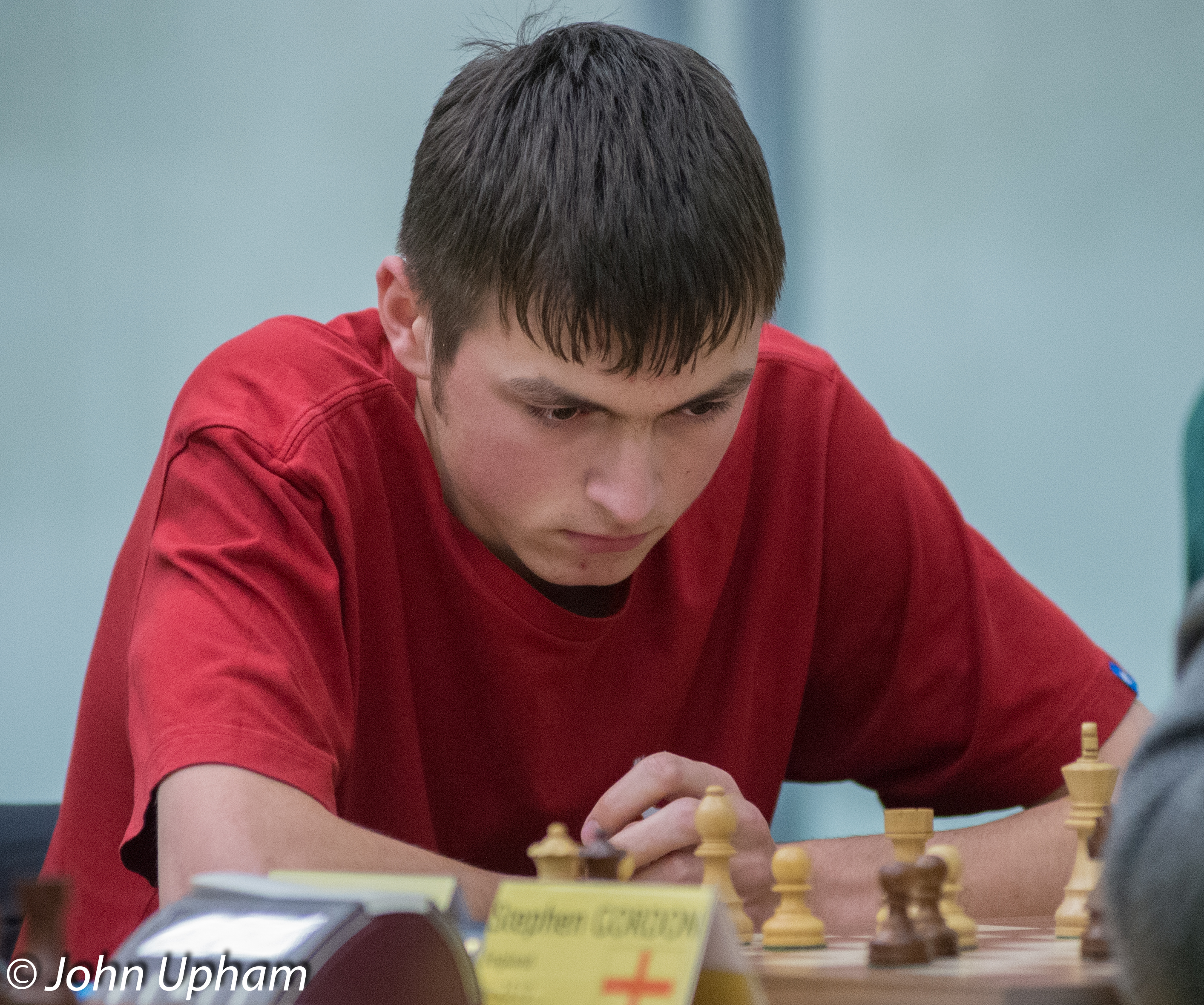
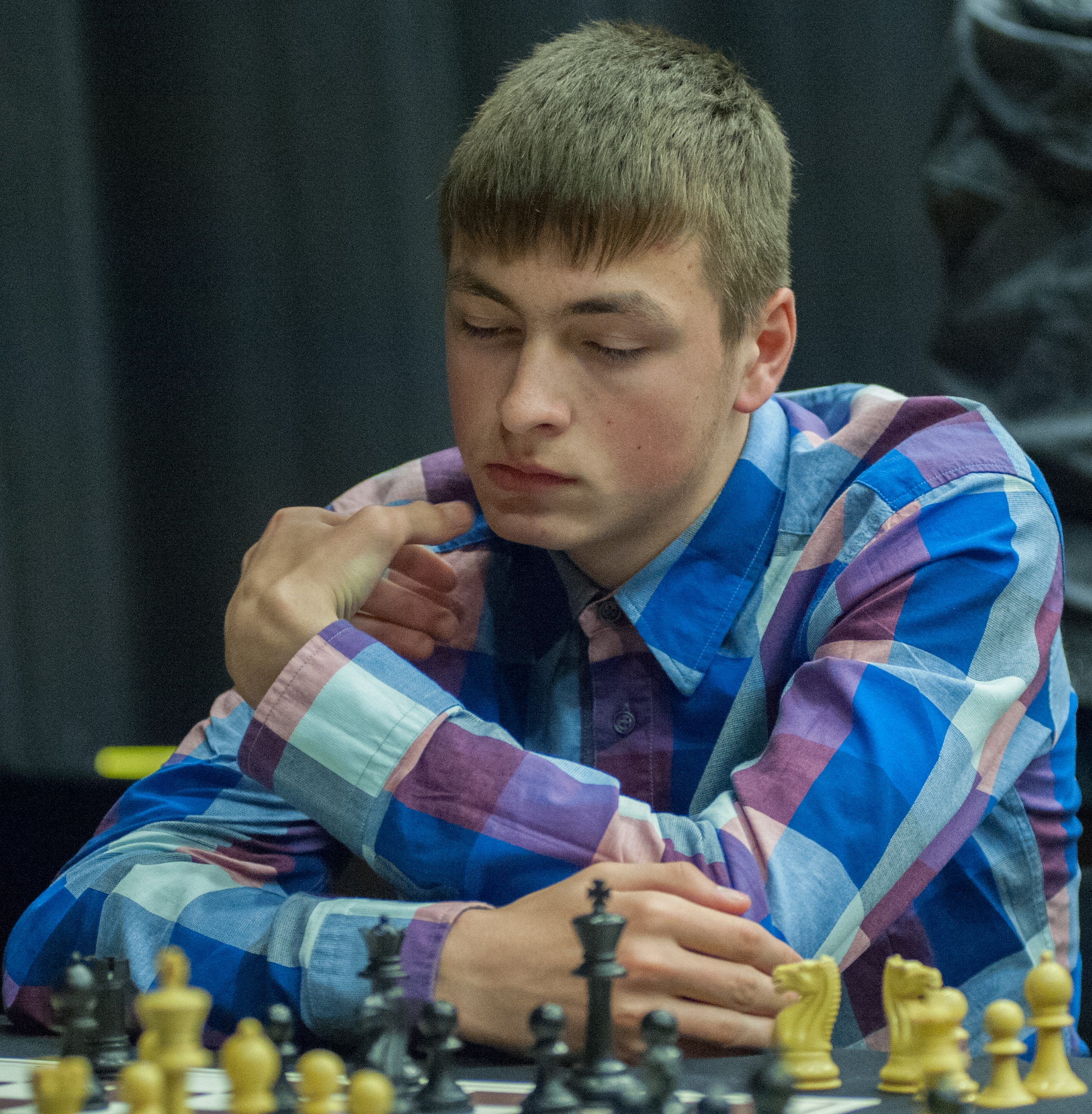
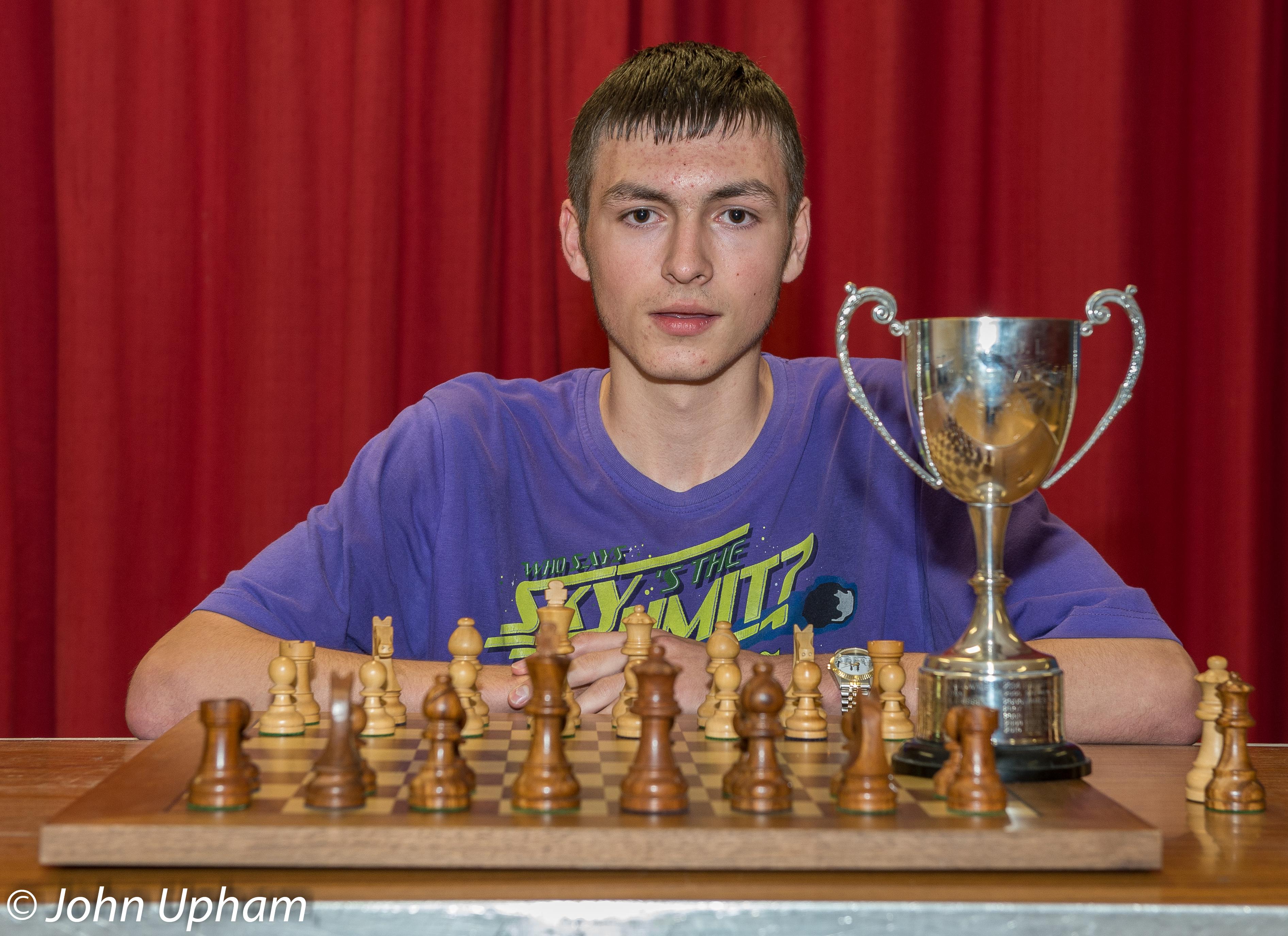
Marcus Harvey at the 2013 Hastings International Congress, Courtesy of John Upham Photography
BCN wishes Happy Birthday to IM Marcus Ross Harvey born on this day (Wednesday, July 24th) in 1996. Killing Me Softly by the Fugees was top of the hit parade.
Marcus was born in Oxford and attended The Marlborough School, Woodstock, Oxfordshire and then (in 2014) at The University of Southampton he studied mathematics.
Originally playing for Bicester Marcus now represents Witney Chess Club in local leagues.
Marcus first played in the British Championship in 2011 (Sheffield).
Marcus Harvey at the 2013 King’s Place Rapidplay, courtesy of John Upham Photography
Originally playing for Oxford he now plays for Wood Green in the Four Nations Chess League (4NCL) and Southampton University in the Southampton League.
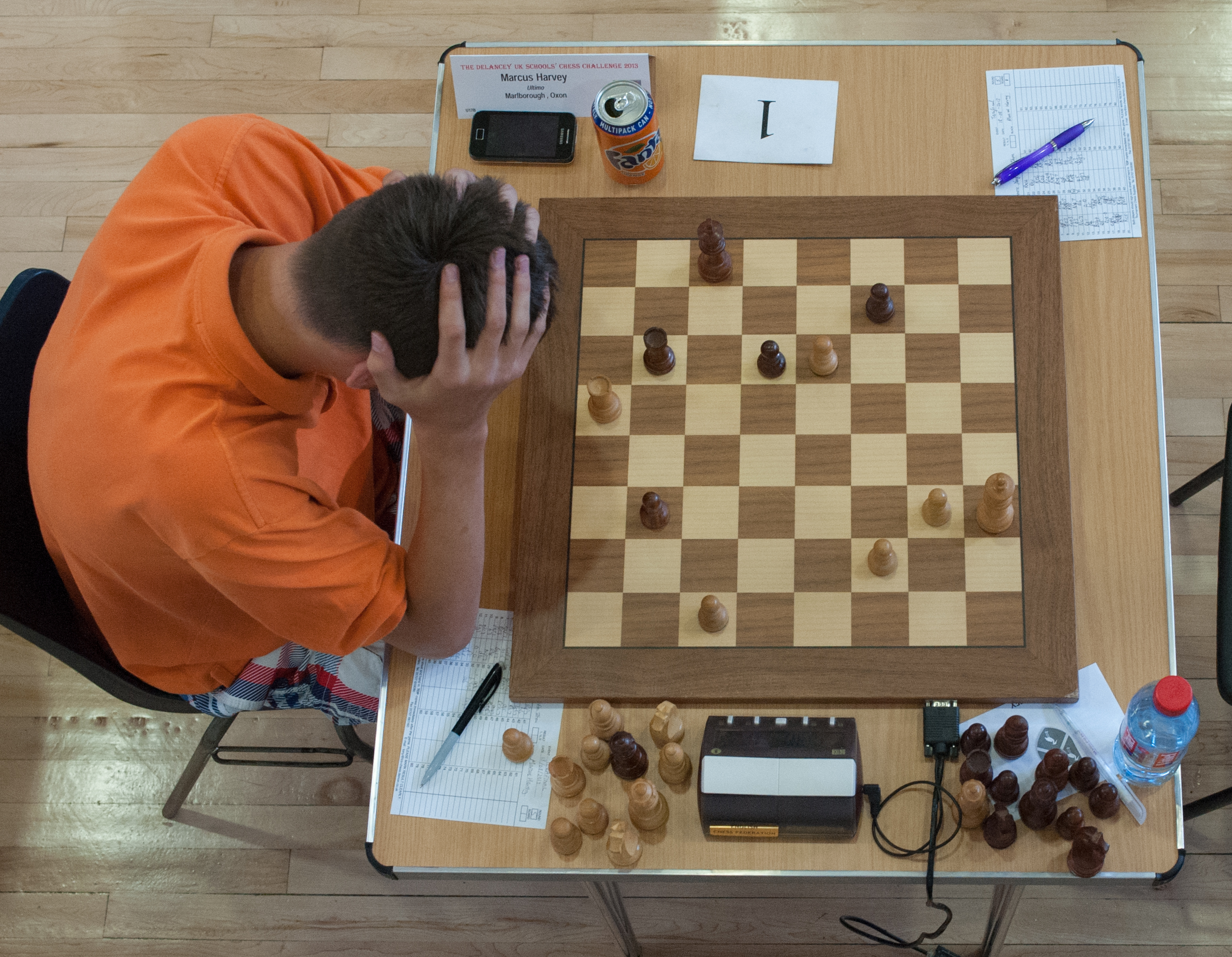
Marcus playing IM Yang-Fan Zhou at the 2013 Delancey UKCC Terafinal at Loughborough Grammar School. Courtesy of John Upham Photography.
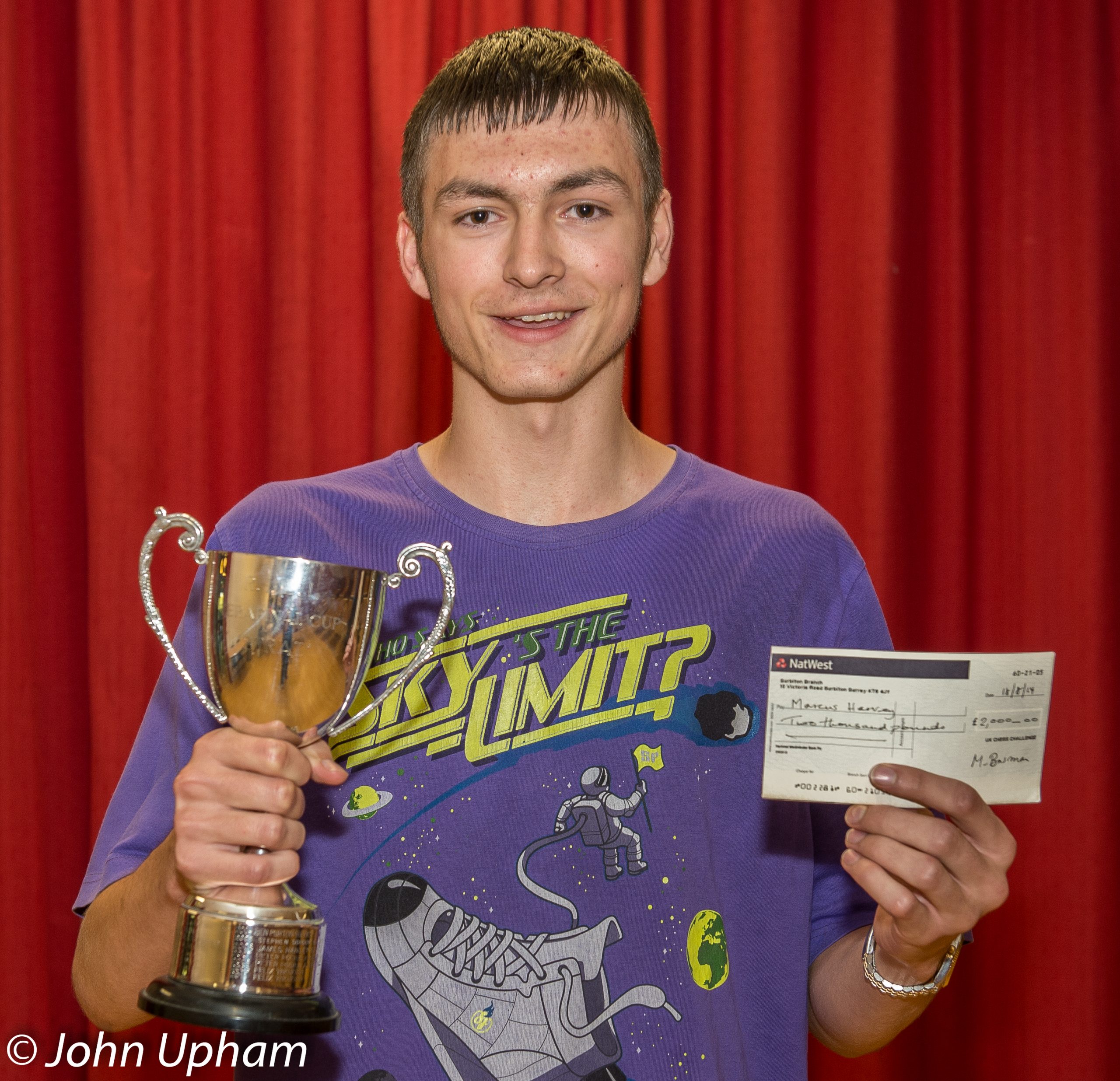
In 2014 Marcus won the title of “Strat” (the overall Terafinal winner) of the 2014 Delancey UK Chess Challenge at Loughborough Grammar School.
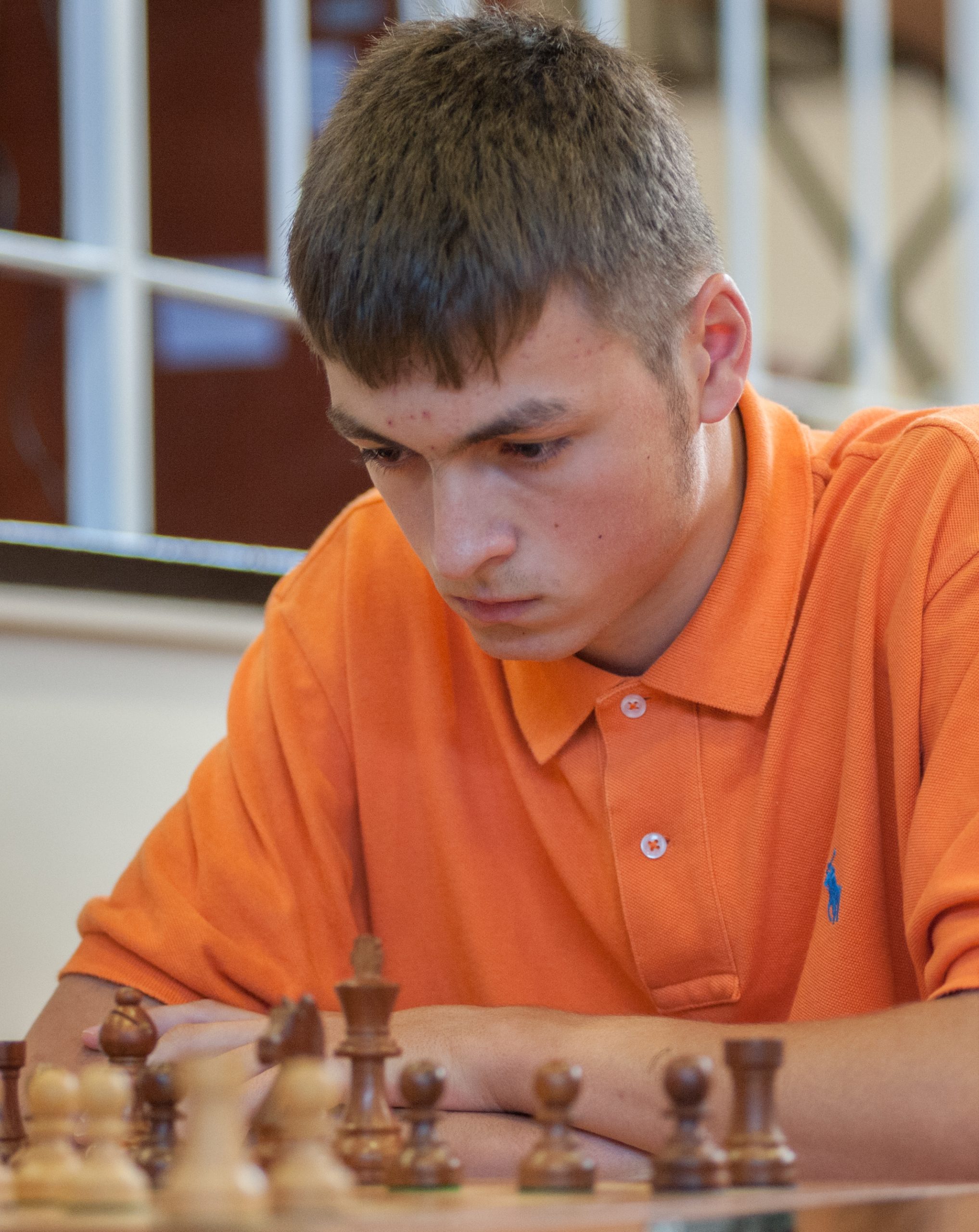
Marcus Harvey at the 2013 Delancey UKCC Terafinal at Loughborough Grammar School, courtesy of John Upham Photography.
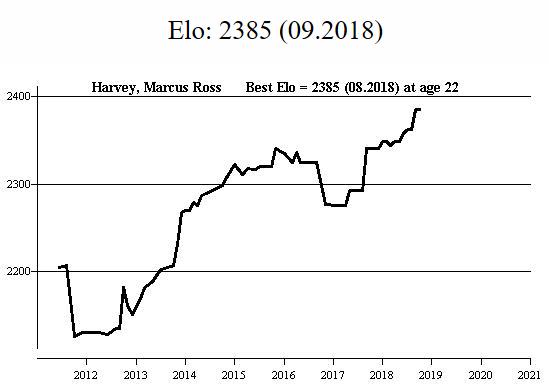
Marcus has a FIDE rating of 2440 and an ECF grading of 240.
2014 Delancey UKCC Terafinal winner, Marcus Harvey at Loughborough Grammar School. Courtesy of John Upham Photography
In 2018 he won the Witney Open outright with 4/5 and, in the same year, was runner-up to David Howell in the UK Blitz Open with 12.5/15 and a of 2589.
In 2019 he was =1st (with Mark Hebden) in the 4NCL Easter Open in Stevenage. Later that year Marcus was losing semi-finalist (to Gawain Jones) in the London Classic Blitz Knockout.
Marcus, on home ground, won the 43rd Kidlington Open in 2020 and followed this with and is the current 2020 English Online Blitz Champion beating IM Andrew Greet, FM Jonah Willow, IM Ameet Ghasi and IM Andrew Horton in the final.
In the Pro chess league he represents UK Lions.
Marcus Harvey’s FIDE rating profile according to Megabase 2020
Marcus overcame Rory McLean, Theo Koury, Steven Coles, FM Alexis Harakis, CM Jonathan Pein and rapidplay / blitz specialist IM Ameet Ghasi to share first place.
Over the 19th – 23rd August 2021 Marcus played in the Wood Green Invitational round-robin event at Oddfellows Hall, Stafford.
Marcus scored 6/9 and secured his second International Master Norm and a TPR of 2532.
<img class=” wp-image-18696″ src=”http://britishchessnews.com/wp-content/uploads/2021/02/untitled_wgi.jpg” alt=”Wood Green Invitational Round-Robin event at Oddfellows Hall, Stafford. August Bank Holiday Weekend, 2021″ width=”654″ height=”229″ /> Wood Green Invitational Round-Robin event at Oddfellows Hall, Stafford. August Bank Holiday Weekend, 2021
Over the August Bank Holiday weekend of 2021 Marcus played in the Northumbrian Masters GM Tournament at the splendid Marriott MetroCentre, Gateshead scoring 6/9 and TPR of 2559 and earing his fourth IM norm. His standard play rating of 2451 (September 2021) is sufficient and now only requires the next FIDE Congress to ratify the IM title.
Marcus enjoys playing the Smyslov-Larsen opening with white
and the classical French and the Nimzo-Indian Defence.
It is clear that Marcus is now surely a strong candidate for England’s next Grandmaster.
FM Marcus Ross Harvey
Save as PDF
We focus on the British Chess Scene Past & Present!
This website uses cookies to improve your experience. We'll assume you're ok with this, but you can opt-out if you wish. Cookie settingsACCEPT
Privacy & Cookies Policy
Privacy Overview
This website uses cookies to improve your experience while you navigate through the website. Out of these cookies, the cookies that are categorized as necessary are stored on your browser as they are as essential for the working of basic functionalities of the website. We also use third-party cookies that help us analyze and understand how you use this website. These cookies will be stored in your browser only with your consent. You also have the option to opt-out of these cookies. But opting out of some of these cookies may have an effect on your browsing experience.
Necessary cookies are absolutely essential for the website to function properly. This category only includes cookies that ensures basic functionalities and security features of the website. These cookies do not store any personal information.
 Save as PDF