Tag Archives: 4NCL

Best wishes FM Peter Batchelor (10-xii-1996)

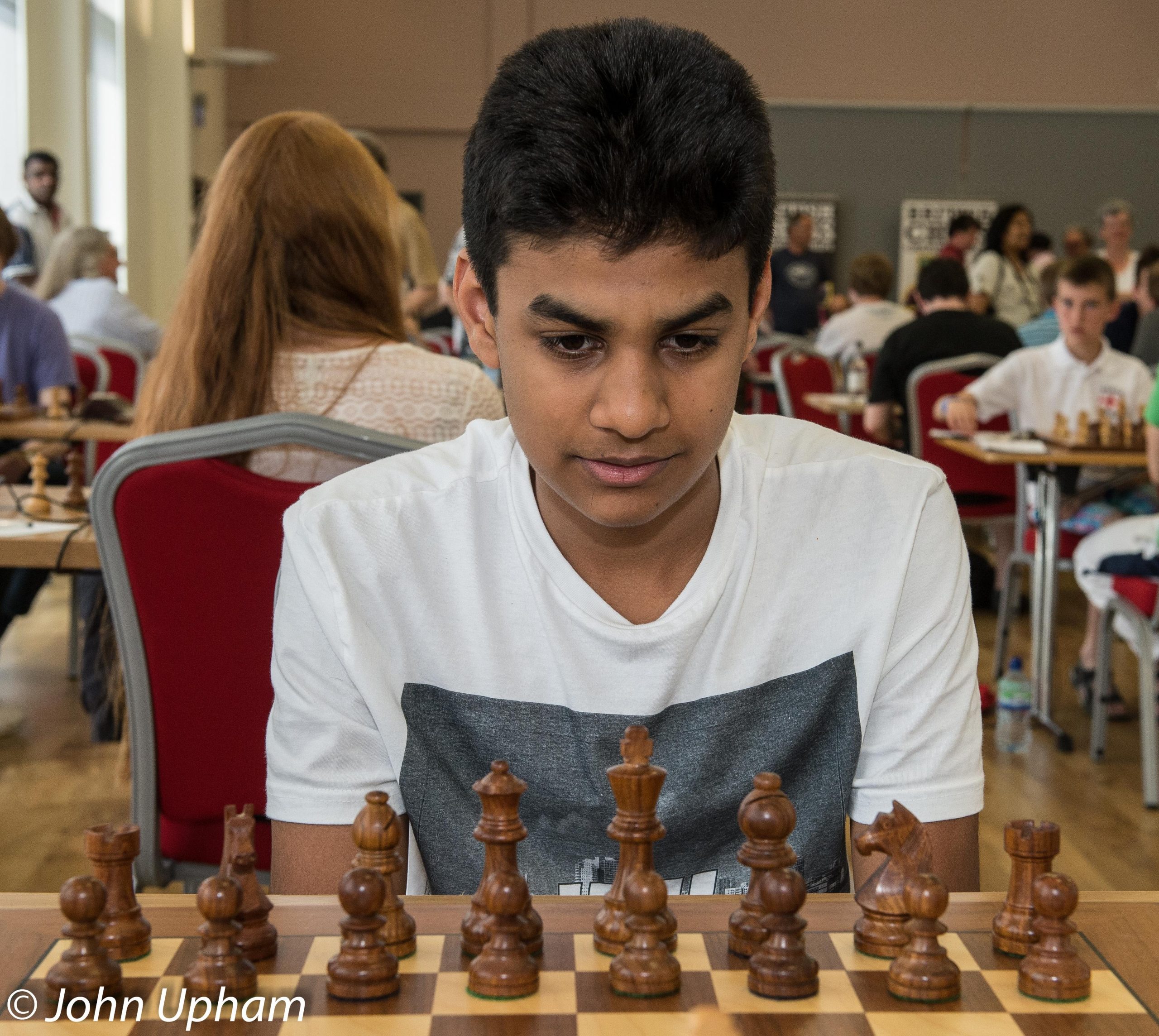
FM Peter Batchelor at the 2014 British Championships, Courtesy of John Upham Photography

Best wishes to FM Peter Batchelor on his birthday.

Peter J Batchelor was born on Tuesday, December 10th, 1996. “Breath” by The Prodigy was the UK Number One Single. His father is the player Guy Batchelor.

Peter’s first recorded rapidplay event was on the 17th of July 2005 in the Barnet Knights Under-9 tournament where he scored 4/6 and his first (!) standard play event was on August 20th 2005 being the British Land UK Terafinal which was not such a happy result.

His first published ECF grading was 56E in July 2006 at the age of ten with a rapidplay grading of 57A.

Peter played league chess in the Middlesex and London Leagues playing initially for Willesden & Brent and then with Wanstead & Woodford both with his father Guy.

Peter attended the Capital City Academy which is a “specialist sports and arts Academy in Willesden, North West London, in the borough of Brent.” He has returned there post-graduation to teach chess and run the school chess club.

Peter studied mathematics at the University of Warwick and now lives in London.

According to Ben Purton : “I captain Peter in the 4NCL chess league, he is one of the most professional and talented players on my squad. He is extremely smart and nice to be around. Peter would be an asset to any organisation in the future and any graduate scheme would be foolish not to take such a person on.

I have seen him grow in to one of the best U21 chess players in the UK and hope to see him gain his IM title soon.”

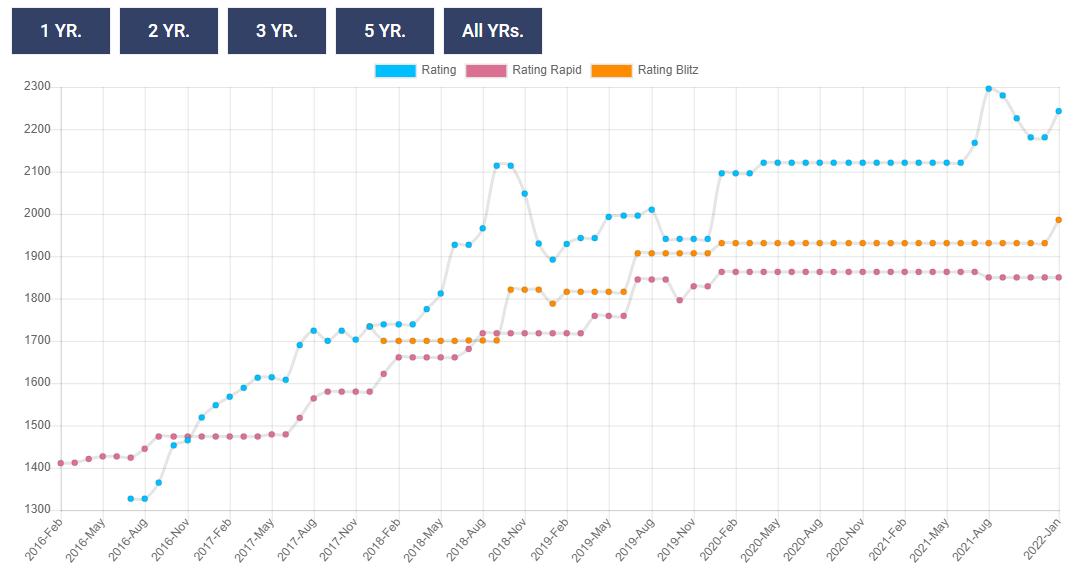
Peter became a FIDE Master in 2015 and, according to Felice and Megabase 2020 his peak FIDE rating was 2365 in December 2016.

FIDE rating profile for Peter Batchelor according to Megabase 2020

Peter plays for Grantham Sharks in the Four Nations Chess League (4NCL).

With the white pieces Peter plays the Queen’s Gambit and the Trompowsky Attack.

As the second player Peter plays the Classical variation of the Caro-Kann and the Alartortsev Variation.
On chess.com Peter plays under the nom de plume of Pbatch.

Peter Batchelor, 4NCL Final weekend, 2014, Courtesy of John Upham Photography

[pgn]
[Event “GBR-ch 104th”]
[Site “Llandudno”]
[Date “2017.08.04”]
[Round “7”]
[White “Rudd, Jack”]
[Black “Batchelor, Peter J”]
[Result “0-1”]
[ECO “E24”]
[WhiteElo “2252”]
[BlackElo “2309”]
[Annotator “British Chess News”]
[PlyCount “40”]
[EventDate “2017.07.29”]
[EventType “swiss”]
[EventRounds “9”]
[EventCountry “WLS”]
[SourceTitle “CBM 179 Extra”]
[Source “ChessBase”]
[SourceDate “2017.08.23”]
[SourceVersion “1”]
[SourceVersionDate “2017.08.23”]
[SourceQuality “1”]

{[%evp 0,40,19,31,14,-14,-11,4,33,-47,-26,-31,-25,-25,-4,-22,0,-4,-6,-13,-24,
-9,7,-9,-12,-29,-29,-63,-23,-32,-20,-28,-26,-36,82,96,58,-99,-86,-277,-277,
-268,-271]} 1. d4 Nf6 2. c4 e6 3. Nc3 Bb4 4. f3 d5 5. a3 Bxc3+ 6. bxc3 c5 7. e3
{the runner-up in this position} (7. cxd5 Nxd5 8. dxc5 Qa5 9. e4 Ne7 10. Be3
O-O {is more common.}) 7… O-O 8. Bd3 (8. cxd5 exd5 9. Bd3 b6 10. Ne2 Ba6 11.
O-O) 8… dxc4 (8… Nc6) 9. Bxc4 Qc7 10. Ba2 (10. Qd3 Nc6 11. Ne2 Rd8) 10…
Nc6 $146 (10… b6) 11. Ne2 b6 12. O-O Ba6 $1 13. Rf2 Rfd8 14. Qa4 Na5 15. e4
cxd4 16. cxd4 $15 {[#]} e5 $6 (16… Rac8) 17. Bb2 Bxe2 18. dxe5 $2 (18. Rxe2
$16) 18… Rd2 $1 19. exf6 $2 Rxb2 20. Bd5 Qc5 $1 0-1
[/pgn]

FM Peter Batchelor at the 2013 British Championships, Courtesy of John Upham Photography

Happy Birthday WGM Dr. Jana Bellin (09-xii-1947)

WGM Dr. Jana Bellin, Courtesy of John Upham Photography

Happy birthday WGM Dr. Jana Bellin on this day (December 9th) in 1947.

Jana Malypetrova
Jana Malypetrova

From The Encyclopedia of Chess (Robert Hale, 1970 & 1976), Anne Sunnucks :

“International Woman Master (1969), Czech Woman Champion in 1965 and 1967 and British Woman Champion since 1970.

Jana Malypetrova
Jana Malypetrova

Jana was born in Prague on the 9th December 1947 and learned to play chess at the age of eleven. She made her first appearance in the international field when she played 2nd board for Czechoslovakia in Women’s Chess Olympiad in Oberhausen in 1966.

Jana Malypetrova and Inna Vesela, Harrachov 1963

In the same year she represented Czechoslovakia in the Zonal tournament at Varna and came 11th.

Jana Malypetrova
Jana Malypetrova

She is now married to the British International Master, William Hartston, and played 1st board for England in the Women’s Chess Olympiad in Skopje in 1972 and represented England in the Zonal tournament in Wijk aan Zee in 1973 in which she tied for 1st place. In the same year she came =6th in the Interzonal Tournament. She is a doctor.”

Jana & Bill Hartston celebrate a family double at the British Championships in 1973 at Eastbourne

From The Encyclopedia of Chess (Batsford, 1977), Harry Golombek OBE :

“Born in Prague, Czechoslovakia, but moved to England in 1970 after her marriage to WR Hartston. Czechoslovak Woman champion in 1965 and 1967 (under her maiden name of Malypetrova) and British Ladies champion in the five years 1970 to 1974. International Woman master since 1969.”

Bill and Jana Hartston are shown with some of their many chess sets. CHESS, August 1973, page 323

From British Chess (Pergamon Press, 1983) Botterill, Levy, Rice and Richardson :

Hastings International Chess Congress 21 year old Jana Malypetrova From Czechoslovakia And Vassily Smyslov From Russia. Mandatory Credit: Photo by Michael Fresco/ANL/Shutterstock (1876232a)

“Jana Miles was born 9 December 1947 in Prague, Czechoslovakia. She moved to England when she married Bill Hartston. Divorced from Hartston in 1978, she subsequently married Tony Miles.

Hastings International Chess Congress 21 year old Jana Malypetrova From Czechoslovakia And Vassily Smyslov From Russia. Mandatory Credit: Photo by Michael Fresco/ANL/Shutterstock (1876232a)

She was Czech woman champion in 1965 and 1967 and has regularly been the British Ladies Champion since moving to this country. She is a doctor of medicine.”

Bill and Dr, Jana Hartston (née Malypetrova)

[pgn]
[Event “Olympiad Women-09”]
[Site “Valetta”]
[Date “1980.12.06”]
[Round “14”]
[White “Bellin, Jana M”]
[Black “Fischdick, Gisela”]
[Result “1-0”]
[ECO “A72”]
[WhiteElo “2220”]
[BlackElo “2235”]
[Annotator “Jana Miles & British Chess News”]
[PlyCount “119”]
[EventDate “1980.11.20”]
[EventType “team-swiss”]
[EventRounds “14”]
[EventCountry “MLT”]
[SourceTitle “EXT 2019”]
[Source “ChessBase”]
[SourceDate “2018.10.10”]
[SourceVersion “1”]
[SourceVersionDate “2018.10.10”]
[SourceQuality “1”]
[WhiteTeam “England (W)”]
[BlackTeam “Germany (W)”]
[WhiteTeamCountry “ENG”]
[BlackTeamCountry “GER”]

{[%evp 0,119,19,31,14,-14,-11,0,28,50,81,61,72,74,99,105,105,87,93,61,46,25,28,
17,28,16,26,26,24,36,29,43,53,64,81,50,46,89,33,87,14,29,4,-81,-89,-85,-85,-19,
-20,14,0,0,0,0,18,17,0,0,24,35,64,97,148,64,109,117,135,140,232,151,200,227,
408,223,251,148,167,208,225,240,253,229,232,182,232,217,208,200,224,204,206,
240,256,294,291,302,294,288,397,406,497,503,506,504,524,539,537,554,561,570,
591,609,617,617,619,655,670,669,670,695,1012,28087]} 1. d4 Nf6 2. c4 e6 3. Nf3
c5 4. d5 exd5 5. cxd5 d6 6. Nc3 g6 7. e4 Bg7 8. Bg5 a6 ({Another possibility
is to chase the bishop immediately e.g.} 8… h6 9. Bh4 g5 10. Bg3 Nh5 11. Bb5+
Kf8 12. e5 Nxg3 13. fxg3 dxe5 14. O-O a6 15. Bd3 b5 16. Nd2 c4 17. Qh5 f6 $146
(17… Ra7 18. Bg6) 18. Bc2 Bd7 19. a4 Be8 20. Bg6 Nd7 21. axb5 Bxg6 22. Qxg6
axb5 23. Rxa8 Qxa8 24. Nde4 Qe8 25. Qf5 Qd8 26. Kh1 Kg8 27. Nxb5 {winning
(Miles-Hernandez, Biel 1977). No wonder Benoni players seem to have abandoned
this particular line.}) 9. Nd2 {Last played in 2005} b5 10. Be2 O-O 11. Qc2 {
[#]} {Curiously this same game appears with two move orders in the same (1981)
year of BCM. This move order is game #19833 on page 83 of volume CI (101).}
Nbd7 ({and this move order with annotations appears in the same BCM volume as
game #20197 on page 545. This version is reproduced in British Chess, page 189.
} 11… h6 12. Bh4 Nbd7 (12… Re8 13. O-O Qc7 14. Rae1 Nbd7 15. a4 b4 16. Nd1
b3 17. Qb1 Rb8 18. Ne3 Rb4 19. Nec4 Rxa4 20. Bg3 Bf8 21. f4 Nb6 22. Nxb6 Qxb6
23. Nc4 Qd8 24. Bh4 Be7 25. Bd3 Bb7 {as in J.Miles – D. Cramling, Oslo, 1980;}
{the game continued} 26. e5 $1 dxe5 27. fxe5 $4 ({but} 27. d6 $1 {should win
for White e.g.} Bxd6 28. fxe5 Bxe5 29. Bxf6 Bxf6 30. Rxe8+ Qxe8 31. Rxf6 $18)
27… Qxd5 {and Black won,}) 13. a4 b4 14. Nd1) 12. a4 b4 13. Nd1 h6 14. Bh4
Re8 {A new move in 1980 was} 15. Ne3 $146 {and now, as any hyponotist might
say, we are back in the room. The two versions of this game have transposed to
the same position.} (15. f3 {was the previous move from 1977.}) 15… b3 16.
Qb1 Qe7 $146 (16… Rb8 {has become the modern move in this position}) 17. O-O
Rb8 18. Ra3 $5 Rb4 19. f3 {With the idea of stabilising the centre and
surrounding the b3 pawn. After this move I left my boarda and went to survey
the situation of our men’s team.} {On returning I found that Black had played}
Nxe4 $2 {BCN : Despite the ? mark in BCM modern day engines find that this IS
the best move and asses the position as =(0.00) Am curious to know what the
annotater thought was better for Black since no alternative was provided.} (
19… Ne5 20. Rxb3 Rxb3 21. Nxb3 g5 22. Be1 Nh5 23. g3 $16) {At first the
situation looked grim} 20. Bxe7 Nxd2 21. Qc1 Nxf1 {[#]} {Eventually I realised
I could recapture on f1 with the king! So} 22. Kxf1 $1 $15 {protecting the
bishop and neutralising any unpleasing pins.} (22. Bxf1 $2 Rxe7 23. Nc4 Bd4+
24. Kh1 Rxc4 25. Bxc4 Bxb2 $1 $19 {and Black wins.}) (22. Nxf1 $2 Rxe7 23. Bd3
Ne5 $19 {and White is getting squashed.}) 22… Rxe7 23. Nc4 Bb7 24. Qd1 $1 {
To get rid of the miserable rook on a3} Bd4 25. Rxb3 Rxb3 26. Qxb3 Bxd5 27. Qc2
$11 Re6 {At last a defensive move from Black. By now she realised things were
not going to plan.} 28. Na5 Nf6 29. Bxa6 g5 $6 {BCN : This does not help
Black’s cause one little bit : quite the opposite.} (29… Be5) 30. Bc4 $1 {
The only move but sufficient} Bxc4+ 31. Nxc4 d5 32. Na3 c4 33. a5 Be5 34. g3
Bc7 $2 {By now we were both in considerable time trouble.} 35. Qa4 $1 {Black
spotted the tactic below and played in desperation} c3 ({Intending to answer}
35… Ra6 {with} 36. Nxc4 $1) 36. bxc3 Ra6 37. Nc4 $1 {(Anyway!)} dxc4 38. Qxc4
Rxa5 (38… Ra7 39. Qc5 Rb7 40. a6 Rb1+ 41. Ke2 Rb2+ 42. Kd3 Bb8 43. a7 Bxa7
44. Qxa7 Rxh2 45. c4 {and wins}) 39. Qxc7 Ra1+ 40. Kg2 Ra2+ 41. Kg1 $1 $18 {
[#] A sealed move} ({If} 41. Kh3 $2 g4+ 42. fxg4 Nh7 43. Qd8+ ({and Black can
probably hold the draw.} 43. g5 Nxg5+ 44. Kg4 Rxh2) 43… Kg7 44. Qd4+ Kg6 45.
Qd3+ Kg7 46. g5 Nxg5+ 47. Kg4 Rxh2 48. Qd1 Kf6 {gives Black hope of hanging in.
}) 41… Ra1+ 42. Kf2 Ra2+ 43. Ke1 {The king is safest here.} Rxh2 44. c4 Nh7
45. c5 Nf8 46. c6 Rc2 47. Qd6 Ne6 48. f4 gxf4 49. gxf4 Nxf4 50. Qd8+ (50. c7 $4
Ne6 $11 {was the annotation in 1981 and probably is the correct assesment.} 51.
Qd8+ Nxd8 52. cxd8=Q+ Kg7 53. Qd4+ Kg8 54. Qg4+ Kf8 55. Qa4 Rc1+ 56. Kf2 Rb1 {
makes the task difficult for White}) 50… Kg7 51. c7 Ne6 52. c8=Q Rxc8 53.
Qxc8 Ng5 54. Qf5 Ne6 55. Kf2 Nf8 56. Kg3 Ng6 57. Kg4 Nf8 58. Kh5 Ng6 59. Qg4
Kh7 60. Qd4 {and at last 1-0.} 1-0
[/pgn]

Sir Philip Stuart Milner-Barry OBE presents Dr. Jana Hartston with the ? prize

From Wikipedia :

“Jana Bellin (née Malypetrová; born 9 December 1947) is a British, formerly Czechoslovak chess player. She was awarded the Woman International Master chess title in 1969 and the Woman Grandmaster title in 1982.

Moment of concentration for reigning women's champion of Great Britain Jana Hartston and some of the 30 Post Officer players - all men who challenged her at postal headquarters London on September 6. Jana beat seven, drew with sixteen and lost to seven.
Moment of concentration for reigning women’s champion of Great Britain Jana Hartston and some of the 30 Post Officer players – all men who challenged her at postal headquarters London on September 6. Jana beat seven, drew with sixteen and lost to seven.

Bellin was born in Prague, Czechoslovakia. She was the Czech Women’s Champion in 1965 and 1967 under her maiden name of Malypetrová. After her marriage to William Hartston she moved to England in 1970 and won the British Women’s Championship in 1970, 1971, 1972, 1973, 1974, 1976, 1977 (after a play-off), and 1979.

Moment of concentration for reigning women's champion of Great Britain Jana Hartston and some of the 30 Post Officer players - all men who challenged her at postal headquarters London on September 6. Jana beat seven, drew with sixteen and lost to seven.
Moment of concentration for reigning women’s champion of Great Britain Jana Hartston and some of the 30 Post Officer players – all men who challenged her at postal headquarters London on September 6. Jana beat seven, drew with sixteen and lost to seven.

She has fifteen appearances in the Women’s Chess Olympiads, representing Czechoslovakia in 1966 and 1969 and England thirteen times from 1972 through 2006, seven times on first board.

Moment of concentration for reigning women's champion of Great Britain Jana Hartston and some of the 30 Post Officer players - all men who challenged her at postal headquarters London on September 6. Jana beat seven, drew with sixteen and lost to seven.
Moment of concentration for reigning women’s champion of Great Britain Jana Hartston and some of the 30 Post Officer players – all men who challenged her at postal headquarters London on September 6. Jana beat seven, drew with sixteen and lost to seven.

At the Olympiad she earned individual silver medals in 1966 and 1976, a team bronze medal in 1968 with the Czechoslovakian team, and a team silver in 1976 with England.

British Speed Chess Championship Grandmaster Nigel Short Playing Chess In The Park With L-r Susan Arkell Sheila Jackson And Dr Jana Miles. Courtesy of Shutterstock

[pgn]
[Event “Troll Masters”]
[Site “Gausdal”]
[Date “1990.??.??”]
[Round “9”]
[White “Tisdall, Jonathan D”]
[Black “Bellin, Jana”]
[Result “0-1”]
[ECO “E20”]
[WhiteElo “2480”]
[BlackElo “2240”]
[Annotator “British Chess News”]
[PlyCount “44”]
[EventDate “1990.01.??”]
[EventType “swiss”]
[EventRounds “9”]
[EventCountry “NOR”]
[SourceTitle “CBM 016 Extra”]
[Source “ChessBase”]
[SourceDate “1990.07.01”]
[SourceVersion “1”]
[SourceVersionDate “1990.07.01”]
[SourceQuality “1”]

{[%evp 0,44,19,31,14,-14,-11,-3,33,-47,12,7,55,33,95,67,57,45,25,9,-9,32,32,
-10,-24,-23,-27,-27,-21,-17,-14,-10,-4,-34,-43,-32,9,-6,5,-4,-12,-9,-8,-204,
-221,-224,-224]} 1. d4 Nf6 2. c4 e6 3. Nc3 Bb4 4. f3 c5 5. d5 Nh5 6. g3 f5 7.
e4 O-O 8. Nh3 d6 9. dxe6 Bxe6 10. Ng5 $146 Qe7 11. Nxe6 Qxe6 12. Qd5 $6 Qxd5
13. exd5 Bxc3+ 14. bxc3 Nd7 $15 15. Kf2 Ne5 16. Be2 Rae8 17. Bd2 Nf6 18. Rab1
Re7 19. h3 $6 (19. Kg2) 19… Rfe8 20. Rhe1 h6 21. g4 $4 fxg4 22. hxg4 Nexg4+
$1 $19 {and White resigned.} 0-1

[/pgn]

“Bellin is a medical doctor specialising in anaesthetics, and works in intensive care at Sandwell General Hospital, West Bromwich, England.

Jana with Sheila Jackson to her left

She is also Chairman of the FIDE Medical Commission, which supervises drug testing of chess players.

British Speed Chess Championship Grandmaster Nigel Short Playing Chess In The Street With Woman Grandmaster Dr Jana Miles : Credit : Shutterstock

Bellin was married first to International Master William Hartston, then to Grandmaster Tony Miles, and after that to International Master Robert Bellin. She and Bellin have two sons: Robert (born 1988) and Christopher (born 1991).”

Dr. Jana Bellin
Dr. Jana Bellin

She is the granddaughter of thrice Prime Minister of Czechoslovakia, Jan Malypetr. and cousin of author and human rights campaigner Jiří Stránský.

WGM Dr. Jana Bellin, Courtesy of John Upham Photography

Birthday Greetings GM David Howell (14-xi-1990)

GM David Howell at the 2014 British Championships in Aberystwyth, courtesy of John Upham Photography

BCN sends Birthday greetings to David Howell on this day.

David Wei Lang Howell was born in Eastbourne, East Sussex on Wednesday 14th of November 1990. His parents are Martin and Angeline Howell (née Choo).

David Howell faces Andrew Whiteley whilst Jimmy Adams records the moves, photograph courtesy of Mark Huba

An unknown jumble sale (Eastbourne?) provided the Howell family with a chess set.

David learnt the moves from Martin, his father and rapidly improved and he joined Sussex Junior Chess Association and he began representing his county in EPSCA matches and other competitions.

In Torquay in 1998 whilst Nigel Short and Susan Lalic were busy winning the main championships David made his mark by winning the British Under-8 Championship, an event that had started only ten years beforehand.

A trip to Scarborough in 1999 yielded both the Under-9 and Under-10 championships.

Barry Martin, David Howell and Julian Hodgson unveil a blue plaque in honour of Howard Staunton

Sponsorship from now dissolved software company JEB (Hove) enabled David to be coached by Glenn Flear.

David Howell, London Chess Classic, 2013, courtesy of John Upham Photography

David became a FIDE Master at the age of ten years, nine months and 26 days. He became an International Master aged 13 years, 2 months and 22 days.

Finally the Grandmaster title came at 16 years, 1 month and 22 days.

The FIDE rating profile for David Howell according to MegaBase 2020

David’s rise has been well documented both here and here and therefore we will not attempt to improve on these sources.

[embedyt] https://www.youtube.com/watch?v=uI9nJZtnseU[/embedyt]

David was Southern Counties (SCCU) champion for the 2010-11 season sharing with Danny Gormally.

David Howell, British Championships, 2013, Round 11, courtesy of John Upham Photography

[embedyt] https://www.youtube.com/watch?v=QpguQx0A79w[/embedyt]

With the white pieces David is a firm believer in 1.e4 but he has played (and continues to do so) 1.Nf3, 1.c4 and 1.d4 and he has scored 89% over nineteen games with. 1.g3

Like Sheila Jackson and Susan Lalic David was a big fan of the Sicilian Alapin but nowadays the Moscow and Rossolimo variations.

As the second player David prefers open games and has played the closed Ruy Lopez and the Marshall Attack. David also employs the Berlin Defence.
Defending against the Queen’s pawn David is less varied and plumps for the Grünfeld defence most of the time. On critical occasions David will use the Caro-Kann as a winning weapon.

So, a wide repertoire with both the white and black pieces and therefore not easy to prepare for: a very modern player!

GM David Howell
GM David Howell

David has plus scores against Mark Hebden, Peter Wells, Nick Pert, Simon Williams, Jonathan Speelman, Nigel Short and almost all of his fellow British GMs except for Gawain Jones, Michael Adams and Luke McShane.

David started his 4NCL career with Invicta Knights with a FIDE rating of 1432 in May 1999. By 2001 he was playing for Nigel Johnson and his Slough team. In 2004 the inevitable occurred and David transferred (as is common) to either cash rich Wood Green or Guildford. In fact it was Guildford on this occasion. In 2009 David moved to Pride & Prejudice. 2012 saw David playing for Wood Green Hillsmark. In 2015 he switched to Cheddleton and remained with them until 2019 finally returning to Guildford in 2020.

David Howell at the 2014 London Chess Classic, Courtesy of John Upham Photography

In November 2021 David took part in the 108-player FIDE Grand Prix event in Riga and after nine round he lying equal third on 6.5 with with Alireza Firouja and Fabiano Caruana. He eventually finished on 7/11 with a TPR of 2764.

Here is a tough struggle from that event:

[pgn]
[Event “2021 FIDE Chess.com Grand Swiss”]
[Site “Riga”]
[Date “2021.11.03”]
[Round “7.24”]
[White “Ponomariov, Ruslan”]
[Black “Howell, David W L”]
[Result “0-1”]
[ECO “C65”]
[WhiteElo “2631”]
[BlackElo “2658”]
[Annotator “British Chess News”]
[PlyCount “152”]
[EventDate “2021.10.27”]
[EventRounds “11”]
[EventCountry “LAT”]
[SourceTitle “chess-results.com”]

{[%evp 0,152,19,38,25,7,30,29,22,22,12,-1,19,19,42,22,21,21,45,18,12,4,22,3,47,
56,46,44,70,64,64,55,58,43,52,47,37,23,2,8,17,-8,8,6,15,4,8,6,6,1,22,4,-4,0,-5,
0,24,0,0,-17,-10,-11,-18,-12,0,-51,-46,-58,12,-49,-12,-20,-19,-46,-41,-45,-51,
-57,-41,-50,-55,-87,-55,-99,-99,-186,-189,-178,-180,-178,-183,-244,-260,-252,
-236,-224,-224,-226,-191,-178,-190,-190,-177,-193,-172,-176,-175,-208,-208,
-197,-217,-224,-230,-211,-207,-229,-233,-226,-223,-223,-223,-241,-241,-241,
-241,-241,-199,-208,-208,-208,-257,-299,-233,-311,-213,-210,-209,-206,-223,
-255,-249,-272,-275,-275,-274,-470,-274,-348,-289,-383,-286,-296,-266,-590,
-510]} 1. e4 {[%emt 0:00:01]} e5 {[%emt 0:00:23]} 2. Nf3 {[%emt 0:00:08]} Nc6 {
[%emt 0:00:05]} 3. Bb5 {[%emt 0:00:19]} Nf6 {[%emt 0:00:11]} 4. d3 {[%emt 0:00:
27]} Bc5 {[%emt 0:00:07]} 5. Bxc6 {[%emt 0:00:43]} dxc6 {[%emt 0:00:10]} 6. O-O
{[%emt 0:00:22]} Nd7 {[%emt 0:00:13]} 7. c3 {[%emt 0:00:52]} h6 {[%emt 0:00:54]
} ({Relevant:} 7… O-O 8. d4 Bd6 9. Bg5 f6 10. Bh4 Qe8 11. Nbd2 a5 12. Qc2 Qf7
13. Bg3 a4 14. b3 exd4 15. Bxd6 cxd6 16. Nxd4 axb3 17. axb3 Rxa1 18. Rxa1 d5
19. exd5 Qxd5 20. Nc4 Ne5 21. Nb6 Qd8 22. Nxc8 Qxc8 23. Nf5 Qe6 24. Rd1 Nf7 25.
Nd4 Qe7 26. Nf5 Qe6 27. Nd4 Qe7 28. Nf5 Qe6 {1/2-1/2 (28) Oparin,G (2654)
-Firouzja,A (2770) Riga 2021}) 8. d4 {[%emt 0:02:10]} Bd6 {[%emt 0:00:08]} 9.
Nbd2 {[%emt 0:16:05]} O-O {[%emt 0:00:46]} 10. Nc4 {[%emt 0:04:24]} exd4 {
[%emt 0:00:41]} 11. Nxd4 {[%emt 0:02:44]} Nc5 {[%emt 0:18:10] [#]} 12. f3 $146
{[%emt 0:03:44]} ({Predecessor:} 12. e5 Be7 13. f4 f5 14. Be3 Qd5 15. Qe2 Ne4
16. Nd2 Nxd2 17. Bxd2 c5 18. Nf3 Be6 19. Be3 Rfd8 20. Qf2 b6 21. h3 Qc6 22. Kh2
Rd3 23. a3 a5 24. Rg1 a4 25. g4 Rad8 26. Rae1 Qd7 27. g5 Kh7 28. gxh6 gxh6 29.
Rg3 Rg8 30. Reg1 Bf8 31. Rxg8 Bxg8 32. e6 Qxe6 33. Ne5 Rd6 34. Qg2 c4 35. Qb7
Qe7 36. Qf3 Bd5 37. Qh5 Be4 38. Rg6 Bg7 39. Bd4 Rxg6 40. Qxg6+ Kg8 41. Nc6 Qf7
{Fier,A (2560)-Salgado Lopez,I (2584) chess24.com INT 2020 0-1}) 12… Re8 {
[%emt 0:02:00]} 13. Be3 {[%emt 0:05:30]} Bf8 {[%emt 0:06:23]} 14. Qc2 {[%emt 0:
13:36]} a5 {[%emt 0:01:50]} 15. Rad1 {[%emt 0:04:26]} Qe7 {[%emt 0:01:48]} 16.
Bf2 {[%emt 0:03:47]} f6 {[%emt 0:07:17]} 17. b3 {[%emt 0:06:27]} Qf7 {[%emt 0:
01:19]} 18. Rfe1 {[%emt 0:00:35]} a4 {[%emt 0:01:06]} 19. Bg3 {[%emt 0:03:32]}
Ne6 {[%emt 0:06:26]} 20. Nf5 {[%emt 0:02:32]} Nc5 {[%emt 0:03:49]} 21. Nd4 {
[%emt 0:01:02]} Ne6 {[%emt 0:02:15]} 22. Nf5 {[%emt 0:00:27]} g6 {[%emt 0:03:
32]} 23. Nfe3 {[%emt 0:02:44]} h5 {[%emt 0:03:39]} 24. Nb2 {[%emt 0:05:33]} Nc5
{[%emt 0:09:56]} 25. b4 {[%emt 0:06:42]} a3 {[%emt 0:02:04]} 26. Nbc4 {[%emt 0:
00:07]} Na4 {[%emt 0:08:37]} 27. Nxa3 {[%emt 0:02:10]} Nb6 {[%emt 0:00:22]} 28.
Qb2 {[%emt 0:01:05]} Na4 {[%emt 0:05:20]} 29. Qc2 {[%emt 0:00:33]} Be6 {
[%emt 0:01:13]} 30. Rd2 {[%emt 0:04:22]} Nb6 {[%emt 0:07:26]} 31. Qb2 {[%emt 0:
00:25]} Ra4 {[%emt 0:07:13]} 32. Red1 {[%emt 0:06:40]} Bh6 {[%emt 0:01:43]} 33.
Bf2 {[%emt 0:00:58]} Qe7 {[%emt 0:00:50] [#]} 34. Rd4 $6 {[%emt 0:01:24]} Rea8
{[%emt 0:06:17]} 35. Nec2 {[%emt 0:00:15]} Nd7 {[%emt 0:01:29]} 36. c4 {
[%emt 0:03:13]} c5 {[%emt 0:01:55]} 37. bxc5 {[%emt 0:05:51]} Nxc5 {[%emt 0:00:
02]} 38. Qc3 {[%emt 0:00:07]} Bf8 {[%emt 0:01:25]} 39. R4d2 {[%emt 0:00:52]} b6
{[%emt 0:00:30]} 40. Qe3 {[%emt 0:02:02]} Kh7 {[%emt 0:00:33]} 41. Bg3 {
[%emt 0:19:44]} Bh6 {[%emt 0:08:54]} 42. Bf4 $2 {[%emt 0:01:22]} Rxa3 $1 {
[%emt 0:04:55]} 43. Nxa3 {[%emt 0:00:07]} Bxf4 {[%emt 0:01:05]} 44. Qxf4 {
[%emt 0:00:05]} Rxa3 {[%emt 0:00:06]} 45. h4 {[%emt 0:04:38]} Bf7 $19 {[%emt 0:
08:38]} 46. Kh1 {[%emt 0:06:55]} Kg7 {[%emt 0:01:38]} 47. Rc2 {[%emt 0:11:09]}
Nd3 {[%emt 0:06:41]} 48. Qd2 {[%emt 0:00:11]} Qd6 {[%emt 0:02:54]} 49. Rb1 {
[%emt 0:00:55]} Qg3 {[%emt 0:14:02]} 50. Rb3 {[%emt 0:00:08]} Qxh4+ {[%emt 0:
00:16]} 51. Kg1 Rxb3 {[%emt 0:00:19]} 52. axb3 Nc5 {[%emt 0:01:50]} 53. b4 {
[%emt 0:03:32]} Ne6 {[%emt 0:00:05]} 54. c5 {[%emt 0:00:16]} bxc5 {[%emt 0:00:
06]} 55. bxc5 {[%emt 0:00:04]} Qg3 {[%emt 0:00:31]} 56. Qf2 {[%emt 0:01:58]}
Qe5 {[%emt 0:00:06]} 57. c6 {[%emt 0:03:16]} Nd4 {[%emt 0:03:10]} 58. Rd2 {
[%emt 0:01:49]} Nxc6 {[%emt 0:00:07]} 59. Rd7 {[%emt 0:01:10]} Nb8 {[%emt 0:00:
32]} 60. Rd8 {[%emt 0:02:12]} Nc6 {[%emt 0:01:50]} 61. Rd7 {[%emt 0:00:12]} Nb8
{[%emt 0:01:08]} 62. Rd8 {[%emt 0:00:05]} c5 {[%emt 0:00:03]} 63. Rc8 {[%emt 0:
01:59]} Nd7 {[%emt 0:03:55]} 64. Qd2 {[%emt 0:00:27]} Nb6 {[%emt 0:07:15]} 65.
Rc6 {[%emt 0:04:32]} Nc4 {[%emt 0:00:05]} 66. Qd8 {[%emt 0:00:35]} Qd4+ {
[%emt 0:04:29]} 67. Qxd4 {[%emt 0:00:05]} cxd4 {[%emt 0:00:04]} 68. Kf2 {
[%emt 0:00:23]} d3 {[%emt 0:00:31]} 69. Rc8 {[%emt 0:04:08]} h4 {[%emt 0:00:39]
} 70. Rd8 {[%emt 0:01:14]} d2 {[%emt 0:00:06]} 71. Ke2 {[%emt 0:00:05]} g5 {
[%emt 0:01:14]} 72. Rc8 {[%emt 0:03:27]} Kg6 {[%emt 0:00:06]} 73. Rd8 {[%emt 0:
00:33]} Be6 {[%emt 0:00:11]} 74. Kf2 {[%emt 0:00:31]} Kf7 {[%emt 0:00:19]} 75.
Ke2 {[%emt 0:00:21]} Ke7 {[%emt 0:00:11]} 76. Rd4 {[%emt 0:00:08]} Bd7 {
[%emt 0:01:33]} 0-1
[/pgn]

David regularly hosts chess24 commentary of major tournaments, such as the 2020/21 Candidates.

[pgn]
[Event “GBR-ch 102nd”]
[Site “Coventry”]
[Date “2015.07.28”]
[Round “2”]
[White “Storey, Charles”]
[Black “Howell, David W L”]
[Result “0-1”]
[ECO “B11”]
[WhiteElo “2245”]
[BlackElo “2698”]
[Annotator “Sagar Shah”]
[PlyCount “50”]
[EventDate “2015.07.27”]
[EventType “swiss”]
[EventRounds “11”]
[EventCountry “ENG”]
[SourceTitle “CBM 167 Extra”]
[Source “ChessBase”]
[SourceDate “2015.09.14”]
[SourceVersion “1”]
[SourceVersionDate “2015.09.14”]
[SourceQuality “1”]

{[%evp 0,50,33,25,66,68,66,32,83,51,125,127,143,95,111,55,61,-9,-7,-22,-26,-19,
-19,-18,-18,-27,-21,-38,-52,-79,-55,-166,-142,-144,-124,-113,-68,-64,-152,-201,
-159,-136,-148,-167,-169,-186,-196,-231,-248,-234,-29986,-29987,-29988]} 1. e4
c6 2. Nc3 d5 3. Nf3 Bg4 4. h3 Bh5 5. exd5 cxd5 6. g4 Bg6 7. Ne5 Nc6 8. Nxg6
hxg6 9. Bg2 e6 10. d4 Bd6 $15 (10… Bb4 11. O-O Nf6) 11. Be3 $146 (11. Ne2 Qc7
) 11… Rc8 12. Qd3 Nf6 13. Qb5 a6 14. Qe2 Qb6 15. O-O Qxb2 16. Nxd5 Nxd5 17.
Bxd5 Nxd4 18. Bxd4 Qxd4 19. Bxe6 {Diagram [#]} Qf4 $3 {As if absolutely
nothing is threatened, David moves his queen to f4. It’s mate in one but White
has his move. He can pick up the rook with check and then defend with f3. What
does black have up his sleeve after that?} (19… fxe6 $2 20. Qxe6+ Kd8 (20…
Kf8 21. Qxc8+ $18) 21. Rad1 $18) (19… O-O $6 20. Bxc8 $14) 20. Bd5+ {Charles
decide to give this check but now he is quickly mated.} ({The most critical
line is} 20. Bxc8+ Kf8 21. f3 {[#] The only move which prevents mate.} (21.
Rfd1 Qh2+ 22. Kf1 Qh1#) 21… Rxh3 $3 {It’s extremely difficult to see this
calm move. The rook and queen are menacingly placed but it is the bishop who
is going to deliver the coup de grace with a check on c5. It’s impossible to
stop that check. Here are some lines:} 22. Qf2 {This prevents Bc5 but now it
will be a mate down the h-file.} (22. Rf2 Qg3+ 23. Rg2 Bc5+ 24. Kf1 Rh1+ 25.
Rg1 Qxg1#) (22. Rfd1 Bc5+ 23. Kf1 Rh1+ 24. Kg2 Qh2#) 22… Rg3+ $1 23. Kh1 (23.
Kh2 Qh6#) 23… Qh6+ 24. Qh2 Rg1+ $1 25. Rxg1 Qxh2# {A pretty little finish.})
20… Kf8 21. Rfd1 Rxh3 {The threat is Rh1 Bxh1 Qh2 followed by Qxh1#.} 22. Qe4
Qf6 $1 (22… Qh2+ 23. Kf1 Rg3 $1 {is something only computer can find.} 24.
fxg3 Rxc2 $19) 23. Re1 Bc5 24. Kg2 Qxf2+ 25. Kxh3 Bd6 {A very nice finish.
Mate on g3 and h2 both cannot be averted.} 0-1
[/pgn]

[embedyt] https://www.youtube.com/watch?v=YpfIfj0iPIs[/embedyt]

[pgn]
[Event “Gibraltar Masters 17th”]
[Site “Caleta”]
[Date “2019.01.31”]
[Round “10”]
[White “Aronian, Levon”]
[Black “Howell, David W L”]
[Result “0-1”]
[ECO “B13”]
[WhiteElo “2767”]
[BlackElo “2685”]
[Annotator “British Chess News”]
[PlyCount “58”]
[EventDate “2019.01.22”]
[EventType “swiss”]
[EventRounds “10”]
[EventCountry “GGB”]
[SourceTitle “CBM 188 Extra”]
[Source “ChessBase”]
[SourceDate “2019.02.26”]
[SourceVersion “1”]
[SourceVersionDate “2019.02.26”]
[SourceQuality “1”]

{[%evp 0,58,27,25,68,69,57,51,59,29,29,8,57,9,28,1,9,-4,-7,6,-5,-45,-37,-122,
-97,-180,-133,-133,-170,-160,-133,-139,-130,-128,-127,-162,-149,-278,-288,-279,
-253,-272,-301,-303,-276,-318,-297,-311,-297,-331,-316,-332,-349,-336,-338,
-353,-327,-333,-327,-635,-335]} 1. e4 c6 2. d4 d5 3. exd5 cxd5 4. Bd3 Nc6 5. c3
Qc7 {Tartakower} 6. h3 {The trendy line in the exchange variation. White makes
it awkard for black to develop the c8 bishop.} g6 {is the main alternative to .
..Nf6 Black may be preparing …Bf5} ({alternatively} 6… Nf6 7. Ne2 e5 8.
dxe5 Nxe5 9. Bc2 Bd6 10. Nd4 Bd7 11. O-O O-O {and Black is not worse.}) 7. Qc2
{[#]} (7. Nf3 Bf5 8. O-O Nf6 9. Re1 Bxd3 10. Qxd3 Bg7 11. Nbd2 O-O 12. Ne5 Nxe5
13. dxe5 Nd7) 7… f6 $5 {is the engine’s move of choice preparing the
thematic Caro-Kann e5 break.} 8. Ne2 e5 9. O-O Nge7 10. dxe5 $6 (10. Na3) 10…
fxe5 11. c4 $6 {This whole idea looks to be incorrectly evaluated.} e4 $1 12.
Bxe4 (12. Qc3 exd3 13. Qxd3) 12… dxe4 13. Nbc3 Bg7 $17 14. Nd5 Qd6 15. Bf4
Be5 16. Rad1 Bxf4 17. Ndxf4 Qe5 18. b4 {In for a penny, in for a euro…} Nxb4
19. Qb3 Nbc6 20. c5 Qxc5 21. Nc3 Qb4 $19 {Black is winning} 22. Qc2 O-O 23.
Ncd5 Nxd5 24. Nxd5 Qa3 25. Rfe1 Bf5 26. Re3 Qa5 27. Qc4 Rf7 28. Nf6+ Kg7 29.
Rd5 Be6 0-1
[/pgn]

GM David Howell vs IM Eddie Dearing, Drunken Knights vs Wood Green, June 2014, Courtesy of John Upham Photography

It’s Only Me! : Remembering Tony Miles (23-iv-1955 12-xi-2001)

GM Anthony John Miles

We remember one of the most innovative and best loved English players of all time, Tony Miles.

Tony's signature from a presentation copy of European Team Championship 1973. The event was the Anglo-Dutch match of October 1977 at Elvetham Hall
Tony’s signature from a presentation copy of European Team Championship 1973. The event was the Anglo-Dutch match of October 1977 at Elvetham Hall

From British Chess (Pergamon Press, 1983) by Bernard Cafferty :

“If one had to forecast at the start of the 1970s the British chess would have a player in the next decade who would win the World Junior Championship, make plus score against Soviet players in his first years of play against them, and beat such household names as Geller, Bronstein, Larsen, Gligoric, Smyslov, Spassky and Karpov…one would have been called a romantic dreamer.

English chess grandmaster Tony Miles (1955 - 2001), UK, 6th May 1973. (Photo by Hoare/Daily Express/Hulton Archive/Getty Images)
English chess grandmaster Tony Miles (1955 – 2001), UK, 6th May 1973. (Photo by Hoare/Daily Express/Hulton Archive/Getty Images)

If one had gone further and said that the same grandmaster X would become only the second British player this century to beat a reigning world champion, and that as Black in an irregular opening (1 e4 a6 2 d4 b5) then incredulity would indeed have been a fitting reaction.
[embedyt] https://www.youtube.com/watch?v=gGVc_IdcPlU[/embedyt]

Yet all this has come to pass; all the above is fact not fiction, reality not a day dream. Who is grandmaster X? Where did he develop?

Anthony John Miles was born on the 23rd April, 1955, in Birmingham (his birthplace is incorrectly marked (Ed: as London) on the map in Elo’s book on ratings.) He learned the moves at the age of five, became seriously interested in the game at the age of nine or ten, and almost straight away won the Birmingham Primary Schools Championship.

English chess grandmaster Tony Miles (1955 - 2001), UK, 15th May 1973. (Photo by Adam/Daily Express/Hulton Archive/Getty Images)
English chess grandmaster Tony Miles (1955 – 2001), UK, 15th May 1973. (Photo by Adam/Daily Express/Hulton Archive/Getty Images)

In 1965 he joined the Birmingham Chess club and the following year became a pupil at King Edward School (KES) (the alma mater of other strong British players, such as Hugh Alexander and Malcolm Barker, runner-up to Ivkov in the inaugural World Junior Championship held at Birmingham in 1951.)

Tony Miles
Tony Miles

At the Birmingham Club he met strong opposition (another grandmaster-to-be, the postal player Keith Richardson was a member there for a time) since the club’s four teams were all in the higher divisions of the local league. Yet Tony’s school work meant that he could not be called a frequent attender at the club – he turned up for league matches and the club championship, but rarely for skittles except in the summer.

Tony Miles and possibly (?) Peter Clarke at Birmingham 1973

Soon he was playing in the Second Division, by 1968 he was in the First Division, and in the 1969-70 season he was on top board for one of the Club’s three teams in the top Division.
[embedyt] https://www.youtube.com/watch?v=lcUDLhFHjRQ[/embedyt]

Tony made his debut in the BCF Congress at Oxford, 1967, where he was equal 11th in the under-14 Boys Championship won by another rising star, John Nunn. Strangely enough when Tony won this title the following year at Bristol Nunn was 3rd equal!
[embedyt] https://www.youtube.com/watch?v=ZiH8TZJJHEY[/embedyt]

The Edgbaston player was also a regular competitor in the annual Easter Congress held in the same suburb of Birmingham where he lived.
Tony Miles
Tony Miles

The breakthrough to national status came when he was a sixth-former at KES. At the BCF Congress, Blackpool,
1971, he won the under-2l Championship (with Nunn and Jon Speelman equal 2nd and the same year made his international debut in a junior tournament at Nice which he won ahead of various prominent players including the Swiss Hug who was to win the World Junior championship some 4 months later!

Tony Miles and unknown opponent

In the 1971-72 Birmingham and District League season he set up a scoring record, mainly on top board, that may never be equalled (9.5 out of 10).

Tony Miles
Tony Miles

During these school years Tony was a rather taciturn teenager (perhaps to be expected in an only child) but he never fitted in with the conventional image of chessplayer as weedy bookworm.

Tony being presented with the trophy in the photograph below

He always had a fine physique, played rugger at school and later became keen on squash and skiing as a means of keeping fit, though he is the first to admit that he can be rather lethargic (especially in the mornings!)

Tony Miles
Tony Miles

At the time I knew one of his teachers professionally, and heard the occasional report that he was not always up to the best academic standards of KES. My reaction must have seemed heresy at the time, but subsequent events in the post-Fischer era have confirmed that the ability to play chess to international standard may lead to a more worthwhile career than being a run-of-the-mill university graduate.

Tony Miles at Hastings

A sign of Tony’s growing understanding of the finer points of the game came when he strolled into the Birmingham Club the day after the first game of the Spassky-Fischer match and pointed out (correctly as was shown later) the reason why Fischer had made his famous Bxh2 sacrifice/oversight.

Tony Miles & Bill Hartston admire a Rolls-Royce

International recognition came in 1973 when he finished 2nd to Romanishin in the European Junior Championship at Groningen, and Second to Belyavsky in the World Junior at Teeside, as well as sharing 4-6th place in the British Championship at Eastbourne at only the second attempt. His first game to be published round the world was his victory over Bisguier in the Birmingham Easter tournament which he won ahead of Adorjan and Bisguier in the same year.

England plays Italy at Haifa 1976. Miles played Tatai, Keene played Toth, Hartston played Grinza and Mestel played Micheli

The main event of 1974, a break-through for British chess, was the World Junior Championship played in August in sub-tropical Manila. Here he played one of his finest games, against Kochiev, to take the title with a round to spare, thereby becoming lnternational Master.

The 1974 World Junior Chess Champion is Anthony John Miles (England), a 19-year old student at Sheffield University. Tony won the title in Manila with a round to spare. A full report, with games by Bernard Cafferty - who was Miles' second  - will appear in our October issue.
The 1974 World Junior Chess Champion is Anthony John Miles (England), a 19-year old student at Sheffield University. Tony won the title in Manila with a round to spare. A full report, with games by Bernard Cafferty – who was Miles’ second – will appear in our October issue.

Tony’s physical strength showed up to good effect here, not just lasting out the 4 weeks in the baking humidity but coping with the huge load of luggage (on the outward journey huge cases full of Chess Player, Informator and the like; on the return journey this load reinforced with prizes and souvenirs!).

Tony Miles at Wijk aan Zee 1976. Korchnoi was first. Photo taken by Brian or Freddy Reilly

Gaining the title brought regular invitations to tournaments which could not be fitted in well with the demands of his maths course at Sheffield University. In the summer of 1975 he gave up the course after two years, while the University authorities showed their recognition of his distinction at chess by the award of an honorary MA degree.

Tony Miles in relaxed mood

Once free to concentrate wholeheartedly on his true calling he took the grandmaster title in a rush. The first norm came with first prize, August, 1975, at the London Chess Fortnight ahead of Adorjan, Sax and Timman.

Tony Miles
Tony Miles

Hastings 1975-76 was not too good a result, but only a few weeks later he was on his way to a great triumph despite
forced late acceptance of the invitation to the USSR due to lack of finance. He got his visa just in time and went to snowy Dubna, a scientific centre near Moscow, to achieve that most difficult feat – a GM norm in a Soviet tournament ahead of eight GM’s and others
just as strong.

Tony Miles plays Tony Miles : see full caption below
Caption for above photograph

Thus Tony Miles became the first official British grandmaster (the title dates officially only from 1949, so excluding the likes of Staunton, Blackburne and Burn) and took the £5000 Slater prize for the first British GM to add to the £1000 prize for victory in the 1975 Cutty Sark series of weekend and other tournaments. The availability of sponsorship, it goes without saying, has done much to encourage Tony on his chosen path as a chess professional, a far from easy vocation that demands will-power and strong nerves to be successful.

Tony Miles : See full caption below
Full caption for above photograph
Accompanying letter for above photograph

1977 confirmed that here was a genuine grandmaster with first prizes at the Amsterdam IBM and Biel tournaments, and second prize behind Karpov
at the first of the new series of Super grandmaster tournaments (Tilburg, Holland.)

Tony Miles in pensive mood

After his Promotion to the ranks of grandmaster Tony, with his usual directness, said that the only thing left to achieve was to have a crack at Karpov. (His fans might react by saying that there were other mountains to climb such as first place at Hastings and in the British Championship, but then Karpov has not achieved the first either, and only became Soviet Champion after he had taken the world title!)

Tony Miles and Michael Stean at the FIDE Zonal in Amsterdam, 1978. (Source: http://gahetna.nl)

The first chance for this ‘crack’ came with their meeting in the super tournaments at Tilburg and Bugojno, as well as in the 1977 BBC2 TV Master Game’ The
results went much in favour of the (slightly) older man. Tony had to wait till January, 1980 before he could celebrate a victory over Fischer’s successor.

Peter Sowray watching Tony Miles at the Lloyds Bank Masters. Sir Jeremy Morse watches.

By this time Tony had failed in his first bid to get to a title match with the Russian when he fell away after a good start in the 1979 Riga Interzonal (the
second stage of the three-part qualifying cycle). It is a pity that our leading professional in Britain still has to accept so many invitations merely to make a
decent living. As Botvinnik has commented, some properly directed study and training at home may be preferable to too frequent public appearances at the board.

Tony Miles and ? at a Benedictine International in Manchester
Tony Miles and Sergey Kudrin at a Benedictine International in Manchester

What sort of person and player is Tony Miles? He has become a more outgoing person in recent years, and has even overcome his legitimate aversion to
media representatives who attempt to interview him without any background in the game.

Tony Miles
Tony Miles

His style has also gone through various changes. At first he was purely a 1 e4 player with a penchant for tricky Nc6 variations of the Four Knights. This repertoire brought him a string of wins, but once he began meeting masters regularly he had to change his repertoire to include the flank openings and 1 d4 as well as the Sicilian Defence. Some notable contributions to opening theory include Bf4 against the Oueen’s Indian, the defence 1…b6, perhaps now 1…a6.

Tony Miles, now playing under the US flag

Yet his real strength is not in the openings, and he rarely scores quick knockouts. His strength lies in the ability to play a wide variety of positions, to have the patience to play on when there is nothing special in the position and then to recognize the crisis (sometimes more psychological than positional). At this point his fitness and energy tell. It is significant that one of his best wins in the Dubna tournament came in a queen and pawn ending that demanded great patience and technical ability.

10th April 1980: Tony Miles (left) plays 14-year-old Nigel Short in the opening match of the Phillips and Drew Chess Tournament at County Hall, London. (Photo by Wesley/Keystone/Getty Images)

As readers of his weekly column will know he loves to analyse ever more deeply, and seems happier here than in taking intuitive decisions. In the play of the first British grandmaster we see a confirmation of the fact that modern competitive chess is more of a sport (Denksport as the Germans have it) than
an art, more a bitter struggle of strong personalities than an orthodox game.
Bernard Cafferty

[embedyt] https://www.youtube.com/watch?v=K35XeuifzXg[/embedyt]

In British Chess Magazine, Volume CXXII (122, 2002), Number 1 (January) pp. 6-13 appeared this wonderful obituary from John Saunders with contributions from Bernard Cafferty, Colin Crouch, Jon Levitt and Malcolm Hunt :

British Chess Magazine, Volume CXXII (122, 2002), Number 1 (January) pp. 6-13
Tony Miles at Tilburg 1985
By Bogaerts, Rob / Anefo - Interpolisschaaktoernooi Tilburg; Miles (met rugklachten) ligt op massagetafel te wachten op zijn tegenstanderDutch National Archives, The Hague, Fotocollectie Algemeen Nederlands Persbureau (ANeFo), 1945-1989,Auteursrechthebbende Nationaal Archief, Nummer toegang 2.24.01.05 Bestanddeelnummer 933-4181, CC0, https://commons.wikimedia.org/w/index.php?curid=23134281
By Bogaerts, Rob / Anefo – Interpolisschaaktoernooi Tilburg; Miles (met rugklachten) ligt op massagetafel te wachten op zijn tegenstanderDutch National Archives, The Hague, Fotocollectie Algemeen Nederlands Persbureau (ANeFo), 1945-1989,Auteursrechthebbende Nationaal Archief, Nummer toegang 2.24.01.05 Bestanddeelnummer 933-4181, CC0, https://commons.wikimedia.org/w/index.php?curid=23134281
British Chess Magazine, Volume CXXII (122, 2002), Number 1 (January) pp. 6-13
Tony receives the Leigh Grand Prix award from Malcolm Wood (Chief Executive)
Tony receives the 1984 Leigh Grand Prix award from Dr. A Kent, Malcolm Wood (Chief Executive) and David Anderton OBE
British Chess Magazine, Volume CXXII (122, 2002), Number 1 (January) pp. 6-13
Tony playing under the Union flag
British Chess Magazine, Volume CXXII (122, 2002), Number 1 (January) pp. 6-13
Tony Miles reflecting on an adjourned position. Courtesy of Stephanie Bureau.
British Chess Magazine, Volume CXXII (122, 2002), Number 1 (January) pp. 6-13
Tony : always popular with the ladies at a Lloyds Bank event
British Chess Magazine, Volume CXXII (122, 2002), Number 1 (January) pp. 6-13
Tony at a Lloyds Bank event with Ray Keene, Yasser Seirawan and Vassily Smyslov

From The Oxford Companion to Chess, (OUP, 1984 & 1994), Hooper & Whyld :

“English-born player, International Grandmaster (1976). While an undergraduate he entered and won by a margin of one and a half points the World Junior Championship, Manila 1974. The following year his university, Sheffield, awarded him an honorary MA degree for his chess achievements, and he left without completing his studies, to become a chess professional. The successes came quickly; London 1975, first (+6=3-1); Amsterdam 1976, first equal with Korchnoi; Amsterdam 1977, first (+7=7-1); Biel 1977, first (+ 8=6-l); Tilburg 1977, second (+5:4-2), after Karpov, ahead of Hort and Hübner; Tilburg 1978, third (+4=4-3) equal with Dzindzichashvili and Hübner, after Portisch and Timman; London 1980, first (+6=5-2) equal with Andersson and Korchnoi; Las Palmas 1980, first (+6=5) equal with Geller and Petrosian; Baden-Baden 1981, first (+6=7) equal with Ribli, ahead of Korchnoi; Porz Koln l98l-2, second (+8=l-2), behind Tal, ahead of Hort; Biel 1983, first (+5=6), shared with Nunn; Tilburg 1984, first (+5=6), ahead of Belyavsky, Ribli, and Hübner; Portoroz-Ljubljana 1985, first (+4=6-l) equal with Portisch and Ribli; and Tilburg 1985, first (+6=5-3) equal with Hübner and Korchnoi.

Tony making a getaway !

Around this time Miles began to feel the strain of ten years at the top. He was the first British player of modern times who could be seen as a possible challenger for the world title, and in the late 1970s he was well clear of his British rivals. However, largely inspired by Miles’s success, a new generation, led by Short, was in pursuit, and by the mid 1980s Miles was no longer top board in the Olympiad side. Successes became fewer, his marriage ended, and his confidence was weakened.

Tony enjoyed flamboyant shirts

Determined to make a new start, he transferred his allegiance to the USA in 1987, and immediately shared first place with Gulko, who won the play-off, in the US Open Championship.

Tony Miles
Tony Miles

The move was not a lasting success. Miles had indifferent results and was not selected for the US Olympiad team in 1988. He had maintained a home in Germany and commuted to play in the Bundesliga and by 1990 he was spending an increasing proportion of his time in Europe. His confidence began to return, and with it more victories. He was first in two Swiss system events, Rome 1990, ahead of Barayev, Chernin, Smyslov etc, and Bad Worishofen 1990 (shared), and at Biel 1990 was equal
third (+3=9-2) alter Karpov and Andersson.”

Tony Miles
Tony Miles

[pgn]
[Event “Montilla Moriles”]
[Site “Montilla Moriles”]
[Annotator “Raymond Keene”]
[Date “1978.??.??”]
[EventDate “?”]
[Round “2”]
[Result “1-0”]
[White “Anthony Miles”]
[Black “Boris Spassky”]
[ECO “E12”]
[WhiteElo “?”]
[BlackElo “?”]
[PlyCount “55”]

1.d4 {Notes by Raymond Keene, with excerpts from Jan Timman,
and Tony Miles. *** It was Boris Spassky who was partly
responsible for the generally awakened interest in chess after
1972. This, of course, was a consequence of his sensational
world title fight with Fischer. Six years later, the ex-world
champion was to lose a brilliant game to one of the young men
who had been inspired by the contest in Reykjavik. This great
game was played at Montilla, the so-called ‘Wine Tournament’
(Torneo del Vino), August 15-24, 1978. In spite of his setback
here, Spassky still won first prize with 6 1/2 out of 9, ahead
of Miles, Gligoric and Hort on 6. At his best, Miles’ style
exhibited a broad penchant for attack. A tip-top Miles game
always seemed to show him having unlimited reserves ready to
throw into the offensive, however many exchanges had taken
place beforehand. The following beautiful game against a
former world champion is, in my opinion, his best. It
demonstrates clearly not only Miles’ quality of imagination
but also the relentless formation of Tsunami, or attacking
waves, which so magically appeared in his best games. } Nf6
2.Nf3 b6 3.c4 e6 4.Bf4 {“My latest anti-Nimzo-Indian
variation. It has the merit of being completely untried at
master level (consequently unanalysed) and having played it
all of three times, I am now undoubtedly the world’s leading
authority on it. Indeed, after one or two more it will
probably be named after me!” — Tony Miles. “Miles had a
patent on this system against the Queen’s Indian.” — Timman}
Bb7 5.e3 Be7 {“According to Chess Encyclopaedia 5…Ne4 is
good for Black. I, of course, disagree as, it seems, do my
opponents.” — Miles. “Spassky goes for a passive set-up,
allowing White to get a clear opening advantage.” — Timman }
6.h3 {“6 Nc3 Nh5! gives Black less trouble, otherwise Black
might get the bishop pair.” — Timman} O-O 7.Nc3 d5 8.cxd5
exd5 {“8…Nxd5 9 Nxd5 Bxd5 10 Bd3 is slightly better for
White, as in Browne-Miles, Amsterdam 1978. It was probably
better to swap a couple of knights, but even then Black would
feel the pressure.” — Timman.} 9.Bd3 c5 10.O-O Nc6 {The stage
is set. White has prospects against Black’s kingside, while
Spassky has chances on the other side of the board.} 11.Ne5 c4
{!? “11…cxd4 12 Nxc6 Bxc6 13 exd4+=” — Miles} 12.Bc2 a6
13.g4 {The signal for the attack. — Timman} b5 14.g5 Ne8 {In
the diagram, White has already burned his boats. Black has a
dangerous queenside pawn majority and, by advancing his
g-pawn, White has weakened his kingside. White has apparently
staked all on attacking Black’s king, rendered somewhat
exposed by the forced retreat of the knight from f6 How should
White pursue the attack? 15 Qh5 allows Black to play …g6 (a
move he intends to play anyway) with gain of tempo. The
obvious attacking try is 15 Bxh7+ Kxh7 16 Qh5+ Kg8 17 g6 fxg6
(17…Nf6 18 gxf7+) 18 Nxg6 but Black can then defend
satisfactorily by 18…Rf6 when 19 Nxd5 loses to 19…Rxg6+;
18…Nf6 19 Qh8+ Kf7 20 Nxf8 Qxf8 is also not bad for
Black. So Miles played 15 Qg4, a multi-purpose move,
transferring the queen to the kingside, defending the pawn on
g5, vacating d1 for a rook and eyeing d7.} 15.Qg4 g6 16.Rad1
{“White prepares his assault with natural developing
moves. The black counter-offensive on the queenside makes
little difference.” — Timman} Ng7 17.h4 Bb4 {? Up to this
point, the game had been fairly balanced, with White’s
kingside attack countered by defence in depth plus a black
queenside pawn majority. But now Spassky removes a key
defensive piece, clearly miscalculating the tactics that
follow. Probably best is 17…b4 18 Ne2 f6.} 18.Nd7 {!
“Already the final blow. But it needed accurate
calculation.”–Timman} Bc8 {“Forced. 18…Bxc3 19 Nf6+ Kh8 20
bxc3 followed by h5 is hopeless for Black. 18…f5 19 gxf6+/-”
— Miles} 19.Nxd5 {“19 Nf6+? Qxf6 20 Qxc8 Qe6!=+” — Miles}
Kh8 {“If 19…Bxd7 not 20 Nf6+, which is refuted by
20…Qxf6!, when White’s queen would be hanging. Stronger
would be 20 Qxd7 Qxd7 21 Nf6+” — Miles. This game is replete
with such delicate tactics.} 20.N5f6 Ra7 {Best. If 20…Be7 21
Be4 or 20…Ne8 21 Be5. Now White must lose the knight on d7,
but his attack becomes decisive.} 21.d5 { Now the point of
move 16 is revealed.” — Timman} Ne7 {If 21…Na5 22 h5! Rxd7
23 Qh4 gxh5 24 Be5 Re7 [24…Qe7 25 Qe4] 25 Bd4!+ — Miles}
22.Be5 {! Now 22 h5 is not so clear, e.g. 22…Bxd7 23 Qh4
gxh5 with …Ng6 to follow. With the point that 22…Bxd7
fails to 23 Qd4″ — Timman} Rxd7 {Not 22…Bxd7 23 Qd4!} 23.h5
{! “23 Qd4? Nc6! or 23 Nxd7? Qxd7 and …Qg4+. The attack is
still rolling along but it still requires accurate
calculation.” — Timman. Despite exchanges the attack steadily
mounts. } Rxd5 {“23…Rb7 24 Qf4+” — Miles} 24.Qf4 {! The
best square for the queen.} Rxd1 25.Rxd1 Qa5 {Though a piece
ahead, Black is lost. The more natural 25…Qb6 allows 26h6
when the attacked knight cannot move because of Nd5+.} 26.Ne8
{! The death blow.} f6 {Or if 26…Rxe8 27 Qf6 Rg8 (27…Nef5
28 Bxf5 Rxe5 29 h6 Bf8 30 hxg7+ Bxg7 31 Rd8++) 28 h6 mates
quickly: 28…Nef5 29 Bxf5 Bf8 30 Bxc8+.} 27.gxf6 Kg8 {If
27…Nxe8 28 f7+ or 27…Rxe8 28 f7! Rf8 29 h6 Nef5 30 Qxf5
Bxf5 31 hxg7#} 28.Nxg7 {If 28…Nc6 29 hxg6 soon forces
mate. “And Black resigned, crushed. A magnificent attacking
win, all the more considering that Spassky, together with
Karpov, had won the first Bugojno tournament earlier that
year”–Timman. Many players would find Miles’ 18th or 19th
moves more impressive than his fifteenth. But these moves were
susceptible to precise calculation, whereas 15 Qg4 was not. 15
Qg4 stands out as a star move, because White displayed good
judgement in rejecting the tempting 15 Bxh7+ and correctly
chose to pursue the attack by slower means. I think this is
Miles’ best game.} 1-0
[/pgn]

[pgn]
[Event “EU Team-ch07 Final”]
[Site “Skara”]
[Date “1980.01.20”]
[Round “1.1”]
[White “Karpov, Anatoly”]
[Black “Miles, Anthony John”]
[Result “0-1”]
[ECO “B00”]
[WhiteElo “2725”]
[BlackElo “2545”]
[Annotator “Knaak,R”]
[PlyCount “92”]
[EventDate “1980.01.20”]
[EventType “team-tourn”]
[EventRounds “7”]
[EventCountry “SWE”]
[SourceTitle “100 Jahre Schach”]
[Source “ChessBase”]
[SourceDate “2000.04.19”]
[SourceVersion “1”]
[SourceVersionDate “2000.04.19”]
[SourceQuality “1”]
[WhiteTeam “Soviet Union”]
[BlackTeam “England”]
[WhiteTeamCountry “URS”]
[BlackTeamCountry “ENG”]

{[%evp 0,92,19,31,60,53,120,107,113,82,92,58,70,53,70,70,71,85,85,92,48,73,55,
59,58,35,10,14,19,20,50,57,51,74,54,36,33,31,26,11,5,5,5,0,-16,-11,-7,-79,-81,
-97,-97,-190,-238,-353,-325,-302,-196,-202,-197,-187,-212,-196,-205,-218,-201,
-203,-203,-204,-209,-213,-196,-233,-213,-217,-176,-224,-234,-251,-244,-254,
-267,-244,-242,-248,-240,-241,-234,-227,-196,-238,-156,-145,-142,-188,-168] Um
1980 herum dominierte Karpov die Schachwelt völlig. Miles hatte das Pech,
gegen den Weltmeister fast immer die schwarzen Steine führen zu müssen, denn
Karpov war mit Weiß fürchterlich, während er als Nachziehender schon mal ein
schnelles Remis mitmachte. Demzufolge war die persönliche Bilanz in den
Spielen gegeneinander katastrophal für den Engländer. Doch dieses eine Mal
sollte alles anders sein…} 1. e4 a6 $1 {Eine aus psychologischer Sicht
interessante Wahl: Alles andere als ein Sieg ist nun für Karpov ein Misserfolg.
Natürlich klappt so ein Trick nur einmal.} 2. d4 b5 3. Nf3 Bb7 4. Bd3 Nf6 (4…
e6 $142) 5. Qe2 (5. e5 Nd5 6. Ng5 $5 ) 5… e6 6. a4 c5 (6… b4 {(Miles)
}) 7. dxc5 (7. e5 c4 $13 {(Miles)}) (7. c3 c4 8. Bc2 d5 )
7… Bxc5 8. Nbd2 b4 9. e5 Nd5 10. Ne4 Be7 11. O-O $6 {Ein solider Zug, aber
er verpasst eine Chance.} (11. Bg5 $142 {und Weiß kommt zu klarem Vorteil.})
11… Nc6 12. Bd2 (12. Bg5 f6 $1 ) 12… Qc7 13. c4 (13. Ng3 h5
$5) 13… bxc3 14. Nxc3 Nxc3 15. Bxc3 Nb4 $1 {Laut Miles mit ‘=’. Aber
vielleicht ist diese Einschätzung nicht korrekt und Weiß hat noch Vorteil..}
16. Bxb4 Bxb4 17. Rac1 Qb6 18. Be4 (18. Ng5 $5 Be7 19. Qh5 (19. Nxh7 g6 20.
Nf6+ Bxf6 21. exf6 Qd4 $15) 19… Bxg5 20. Qxg5 O-O $13 {(Miles)}) 18… O-O
19. Ng5 {Verpasst die Chance zum Läuferopfer auf h7. Wenn Karpov auf Gewinn
spielen wollte (wovon man ausgehen kann), so war es gegenüber dem Partiezug
auf jeden Fall die bessere Fortsetzung. Der Beweis der Korrektheit des Opfers
mit Computerhilfe ist freilich eine ganz andere Sache als das Spielen am Brett.
} (19. Bxh7+ $1 {ist auf jeden Fall chancenreich:} Kxh7 20. Ng5+ Kg6 $1 21. Qg4
{Komplizierter ist} f5 $1 (21… f6 $2 {!? (Miles)} {aber} 22. Nxe6+ Kf7 23.
Nxf8 Kxf8 (23… Bxf8 24. Qxd7+ Kg8 25. e6 $18) 24. exf6 gxf6 25. Qxd7 Rd8 26.
Qh7 {und Weiß sollte gewinnen.}) 22. Qg3 Qd4 $1 {=/+ (Miles), aber das ist
nicht richtig:} (22… Rg8 23. Rc7 $1 {(Fritz)} Bc6 $1 (23… Rae8 24. Nxe6+
Kf7 25. Ng5+ Ke7 26. e6 $18) 24. Nxe6+ Kf7 25. Qb3 $1 Ke8 (25… Rgf8 26. Rd1
Ke7 27. Rxc6 Qxc6 (27… dxc6 28. Nf4 $18) 28. Qxb4+ $18) 26. Rc1 Ba5 27. Qd1
dxe6 (27… Qxc7 28. Nxc7+ Bxc7 29. e6 $18) 28. R7xc6 $16) 23. h3 $1 (23. Nxe6+
Qg4 24. Nxf8+ Bxf8 25. Qxg4+ fxg4 26. Rfd1 $11) (23. Rc7 Bc6 24. h3 Qxb2 $1 (
24… f4 $2 25. Qg4 Kh6 26. Qh4+ Kg6 27. Rxc6 dxc6 28. Qh7+ Kxg5 29. h4+ Kg4
30. Qg6+ Kxh4 31. Kh2 $18) 25. Nxe6+ Kf7 $13) 23… Kh5 $1 (23… f4 $2 24. Qg4
Kh6 25. Rfd1 Qxe5 26. Qh4+ Kg6 27. Rxd7 $1 Rh8 28. Nf7 $18) 24. Nh7 $1 (24. Rc7
Bd5 25. Nh7 Be7 26. Rxd7 (26. Nxf8 Bxf8 27. Rxd7 Qh4 $1) 26… Bh4 (26… Rh8
27. Rxe7 Rxh7 28. Rxg7 Rxg7 29. Qxg7 Ra7 $11) 27. Qxg7 Rg8 28. Nf6+ Bxf6 29.
Qh7+ Kg5 30. exf6 Kxf6 $11) 24… Be7 (24… Bd2 $6 25. Rfd1 Qf4 26. Qxg7 Bxc1
27. Nxf8 Rxf8 28. Qxf8 Bc6 29. Qf7+ Kh6 30. Rd3 $16) 25. Rcd1 Qxa4 (25… Qh4
26. Qxg7 Rg8 27. Nf6+ Bxf6 28. Qh7+ Kg5 29. f4+ $18) 26. Qxg7 Rg8 27. Nf6+ Bxf6
28. Qh7+ Kg5 29. f4+ Qxf4 30. Rxf4 Kxf4 31. exf6 (31. Qxd7 Rxg2+ 32. Kf1 Rg1+
33. Kxg1 Rg8+ 34. Kf1 Bg2+ 35. Ke1 Bh4+ $11) 31… Rxg2+ 32. Kf1 Be4 {Schwarz
droht nun 33…Rh2 und 33…Rag8.} 33. Rd2 $5 Rxd2 34. Qh6+ Ke5 35. Qxd2 Kxf6
36. Qxd7 {Weiß kann ohne Risiko auf Gewinn spielen.}) 19… h6 20. Bh7+ $6 {
Es ist wahrscheinlich genau an dieser Stelle, wo Karpov ganz gegen seine
Gewohnheit der Sinn für Gefahren verloren geht – vielleicht auch wegen der
provokativen Eröffnung von Schwarz.} ({Nach} 20. Bxb7 Qxb7 21. Qe4 Qxe4 22.
Nxe4 {ergibt sich ein völlig ausgeglichenes Endspiel.}) 20… Kh8 21. Bb1 $6 (
21. Be4) 21… Be7 22. Ne4 (22. Qd3 g6 $15 {(Miles)}) 22… Rac8 {Stellt einen
Bauern ein, denn Kompensation durch etwaige Drohungen auf der Diagonale b1-h7
ergeben sich nicht.} 23. Qd3 $2 ({Nach} 23. Rcd1 {verfügt Schwarz über einen
kleinen Vorteil.}) 23… Rxc1 24. Rxc1 Qxb2 25. Re1 $6 ({Besser} 25. Rd1 $5 g6
26. Nd6) 25… Qxe5 $19 26. Qxd7 Bb4 $1 {Am stärksten, aber auch 26…Rb8 wäre
eine Möglichkeit wegen des fehlenden weißen Luftlochs.} 27. Re3 Qd5 28. Qxd5
Bxd5 {Der Rest ist Sache der Technik, auch ein Karpov kann gegen Läuferpaar +
Mehrbauer nichts machen.} 29. Nc3 Rc8 30. Ne2 g5 31. h4 Kg7 32. hxg5 hxg5 33.
Bd3 a5 34. Rg3 Kf6 35. Rg4 Bd6 36. Kf1 Be5 37. Ke1 Rh8 38. f4 gxf4 39. Nxf4 Bc6
40. Ne2 Rh1+ 41. Kd2 Rh2 42. g3 Bf3 43. Rg8 Rg2 44. Ke1 Bxe2 45. Bxe2 Rxg3 46.
Ra8 Bc7 0-1
[/pgn]

[pgn]
[Event “Biel SKA”]
[Site “Biel”]
[Date “1996.07.30”]
[Round “8”]
[White “Miles, Anthony John”]
[Black “Tukmakov, Vladimir B”]
[Result “1-0”]
[ECO “E12”]
[WhiteElo “2630”]
[BlackElo “2580”]
[Annotator “Miles,Anthony John”]
[PlyCount “133”]
[EventDate “1996.07.22”]
[EventType “tourn”]
[EventRounds “11”]
[EventCountry “SUI”]
[EventCategory “16”]
[SourceTitle “CBM 055”]
[Source “ChessBase”]
[SourceDate “1996.12.01”]
[SourceVersion “1”]
[SourceVersionDate “1996.12.01”]
[SourceQuality “1”]

{[%evp 0,133,19,27,5,-3,25,31,17,26,28,25,58,31,17,22,36,12,8,6,19,-8,51,28,21,
7,4,-23,-15,-20,-21,2,9,-8,-5,-34,-26,-25,-19,-46,0,8,-4,-4,5,-19,40,-3,7,16,4,
22,19,18,18,15,38,30,44,38,41,25,60,58,58,24,0,38,50,19,56,82,84,91,108,88,94,
123,108,108,164,208,222,233,236,231,209,238,243,16,1,39,55,0,0,0,40,0,0,0,64,
54,26,25,39,49,55,34,451,451,458,475,570,570,593,621,621,556,788,1016,730,1047,
1047,998,1098,1098,1098,1142,1226,1279,29975,1098,29989,1279,29989,29990]} 1.
Nf3 Nf6 2. c4 b6 3. Nc3 Bb7 4. d4 e6 5. a3 g6 $5 6. g3 Bg7 (6… Bxf3 $5) 7.
Bg2 Ne4 (7… O-O 8. O-O Ne4 9. Nxe4 Bxe4 10. Bg5 { Qd2+/=}) 8. Nxe4 Bxe4 9.
Bg5 $5 (9. O-O) 9… Qc8 10. Qd2 h6 11. Be3 Nc6 {Nc6-e7-f5} 12. Rc1 (12. d5
Na5 $1) 12… Ne7 13. g4 $5 Qb7 14. h3 f5 $2 (14… O-O-O $1 {g5,f5 /=/+})
15. g5 $1 h5 (15… hxg5 16. Bxg5 Nc6 17. d5 $1 $36) 16. O-O d6 {17…e5}
17. Nh4 $1 {x g6} Bxg2 18. Nxg2 e5 19. f4 $1 {+/=/+/-} exd4 20. Bxd4 Bxd4+ 21.
Qxd4 O-O-O 22. Rf3 $1 {23.Re3} c5 23. Qf6 Rhf8 24. Qe6+ Qd7 25. Qxd7+ Rxd7 (
25… Kxd7) 26. Nh4 $1 $16 {>< g6} Rg8 27. Re3 $1 d5 28. Re6 $1 dxc4 29. Rxc4
Rd1+ 30. Kf2 Kd7 31. Rf6 $1 Rd6 32. Rf7 $1 Ke6 33. Rh7 Nc6 34. Rc3 $1 {35.
Re3} Rd4 35. Re3+ Kd6 36. Kg3 Rd2 37. Rf7 $18 Nd4 38. Rf6+ (38. Kf2 $18) 38…
Kd7 39. Nxg6 (39. Rf7+ {40.Kf2}) 39… Nxe2+ 40. Kh4 Rxg6 41. Rxg6 Nxf4 42.
Rg7+ Kd6 43. Rf3 Rd4 44. Rxf4 $1 Rxf4+ 45. Kxh5 $18 Rf2 46. Rf7 $2 (46. Rxa7
$18) 46… Rxb2 47. Rxf5 c4 48. h4 $1 c3 49. Rf3 c2 50. Rc3 Kd5 51. Kh6 $2 (51.
Kg6 $1) (51. g6 $2 Kd4 52. Rc8 Rb5+ {53…Rc5}) 51… Kd4 52. Rc8 Kd3 53. g6
Rb1 $4 (53… Rb3 $10) 54. g7 Rg1 55. h5 b5 56. Kh7 a5 57. g8=Q Rxg8 58. Kxg8
b4 59. h6 b3 60. h7 b2 61. h8=Q c1=Q 62. Qh7+ Kd4 63. Qg7+ Kd3 64. Qg6+ Kd4 65.
Qf6+ Kd3 66. Qf5+ Kd4 67. Rd8+ 1-0
[/pgn]

Lajos Portisch and Tony Miles

From Wikipedia :
“Personal life

Miles was an only child, born 23 April 1955 in Edgbaston, a suburb of Birmingham, and attended King Edward’s School, Birmingham.[1][2] He was married and divorced twice, and had no children.[1] Miles’ first wife was Jana Hartston, who had previously been married to William Hartston.[2]

Tony with friends at a Lloyds Bank event

Early achievements in chess
He learned the game of chess early in life and made good progress nationally, taking the titles of British under-14 Champion and under-21 Champion in 1968[1] and 1971,[3][4] respectively.

Tony with short hair

In 1973, Miles won the silver medal at the World Junior Chess Championship at Teesside, his first important event against international competition. Both he and compatriot Michael Stean defeated the tournament winner Alexander Beliavsky, but were unable to match the Soviet player’s ruthlessness in dispatching lesser opponents. Miles went on to win this prestigious title the following year in Manila, while a mathematics undergraduate of the University of Sheffield.[1][2]

Tony faces Jonathan Mestel at the Philips & Drew Masters

Taking the decision to pursue the game professionally, Miles did not complete his studies, but, in 1975, was awarded an MA by the University in respect of his chess achievements.[2]

Tony in slightly less formal attire

Further career highlights
In 1976, Miles became the first UK-born, over-the-board chess grandmaster, narrowly beating Raymond Keene to the accolade.[2] The naturalised, German-born Jacques Mieses was awarded the GM title in 1950, while Keith Bevan Richardson had been awarded the GM title for correspondence chess earlier in 1975. For his achievement, Miles won a £5,000 prize, put up by wealthy businessman and chess backer Jim Slater.[1][2]

Tony and friends at a Lloyds Bank event

Miles had a string of good results in the late 1970s and 1980s. He matured into a world class player and won games against high calibre opponents, such as former World Chess Champions Vasily Smyslov, Mikhail Tal and Boris Spassky.

Post mortem analysis with Tony and Garry Kasparov

In 1980 at the European Team Championship in Skara, he beat reigning World Champion Anatoly Karpov with Black, using the extremely unorthodox opening 1. e4 a6!?, the St. George Defence. It is often said that Miles learned the line from offbeat openings enthusiast Michael Basman, but in his book Play the St. George, Basman asserts there is no truth to this. Miles beat Karpov again three years later in Bath in a game that was part of the BBC’s Master Game series, but it was shown only by the (co-producing) German television network, due to a BBC technicians’ strike at the time of broadcast.

Tony in Olympiad play with Jan Timman

Miles won the British Championship just once, in 1982 when the event was held in Torquay. His prime time as a chess player was the mid-1980s. On 20 May 1984 in Roetgen (Germany), Miles set a European record in blind simultaneous chess with 22 games (+10−2=10);[5] this record was not broken until 2009. On the January 1984 Elo rating list, he ranked No. 18 in the world with a rating of 2599. One of his best results occurred at the Tilburg tournament in 1984, where, from a strong field, he emerged sole winner by a clear margin of one and one-half points. The following year, he tied for first at the same event with Robert Hübner and Viktor Korchnoi, playing several of his games while lying face down on a table, having injured his back.[6]

Tony and ? at a Lloyds Bank Masters. Stewart Reuben applauds.

The result was controversial, as many of Miles’ opponents felt they were distracted by the unusual circumstances. A string of good performances culminated in a good showing on the January 1986 Elo rating list, where he climbed to a best-ever position of World No. 9 with a rating of 2610. During this period, there was considerable rivalry with Nunn over who was the United Kingdom’s best player, the two protagonists regularly leapfrogging each other in the world rankings. Nigel Short and Speelman soon added to the competition, as the English national squad entered its strongest period.

Tony about to play Vladimir Kramnik

Never able to qualify out of the Interzonal stages into the Candidates’ series, Miles eventually lost the race to become the first British Candidate when Short did so in 1985. However, he retained top board for England at the Thessaloniki and Dubai Olympiads of 1984 and 1986, helping the team to silver medals at each.

Tony plays Glenn Lambert during the 1976 BCF Congress in Portsmouth. Photo courtesy of Tony Williams

Against Garry Kasparov, Miles had little success, not winning a game against him, and losing a 1986 match in Basel by the score of 5½–½. Following this encounter, Miles commented “I thought I was playing the world champion, not a monster with a thousand eyes who sees everything” (some sources alternatively quote Miles as having the opinion that Kasparov had 22 or 27 eyes).

Miles on a stretcher with back pain, playing in Tilburg (1985)
After he was hospitalised because of a mental breakdown in late 1987, Miles moved to the United States. He finished last in the 1988 U.S. Championship, but continued to play there and had some good results. In 1991, he played in the Championship of Australia, but eventually moved back to England and began to represent his native country again. He was equal first at the very strong Cappelle-la-Grande Open in 1994, 1995, and 1997, and caused a shock at the PCA Intel Rapid Chess Grand Prix in London in 1995, when he knocked out Vladimir Kramnik in the first round and Loek van Wely in the second. His bid to win the event was finally halted in the semifinal by English teammate Michael Adams.

There were four notable victories at the Capablanca Memorial in Cuba (1994, 1995, 1996, and 1999). Miles also tied for first in the 1999 Continental Open in Los Angeles with Alexander Beliavsky, Ľubomír Ftáčnik and Suat Atalık. His last tournament victory was the 2001 Canadian Open Chess Championship in Sackville, New Brunswick.

Miles entered and played at the 2001 British Championship in Scarborough, but withdrew before the final round, apparently because of ill health. His final two games before his death were short draws in the Four Nations Chess League. Miles played in an extraordinary number of chess events during his career, including many arduous weekend tournaments.

The Miles Variation (1.d4 Nf6 2.c4 e6 3.Nf3 b6 4.Bf4) in the Queen’s Indian Defence is named after him.”

Tony started his chess writing career in around 1978 with a series of high quality annotated tournament bulletins of the top events of the period most of which he competed in himself.  For example:

Tilburg 1978, Tony Miles & Jonathan Speelman, Master Chess Publications, 1978
Riga Interzonal 1979, AJ Miles & J Speelman, Batsford, 1979, ISBN 0 7134 3429 5
Rio de Janeiro Interzonal 1979, AJ Miles & M.Chandler, Batsford, 1979, ISBN 0 7134 3427 9
Buenos Aires 1979. AJ Miles, The Chess Player, ISBN 0 906042 31 3
47th USSR Championships 1979, AJ Miles, The Chess Player, 1979, ISBN 0 906042 32 1
Chess from Square One, AJ Miles, Harper Collins, November 1979, ISBN 0713511168
European Team Championship Skara 1980, AJ Miles, The Chess Player, ISBN 0 906042 33X

Of course there are numerous articles about Tony for example :

Vlastimil Hort Remembers Tony Miles

Hort stories: Wrong place wrong time

Chess Corner – Original Maverick: Remembering Tony Miles

Britain’s first chess grandmaster, he paved the way for today’s international competitors

Tony Miles 1955-2001

Kingpin

Tony Miles (1955-2001) by Edward Winter

How Anthony Miles beat a World Champion (Karpov-Miles, Skara 1980)

[embedyt] https://www.youtube.com/watch?v=XIt7McTLy4Y[/embedyt]

Lawrence Trent plays Tony Miles in 2001 at the British Championships in Scarborough
It's Only Me, edited by Geoff Lawton
It’s Only Me, edited by Geoff Lawton
Tony Miles : England's Chess Gladiator, Ray Keene, 2006
Tony Miles : England’s Chess Gladiator, Ray Keene, 2006
Tony Miles : England's Chess Gladiator, Ray Keene, 2006
Tony Miles : England’s Chess Gladiator, Ray Keene, 2006
A Tony Miles memorial
Tony's signature from a presentation copy of Pachman's Decisive Games from Anglo-German match of February 1979 at Elvetham Hall
Tony’s signature from a presentation copy of Pachman’s Decisive Games from Anglo-German match of February 1979 at Elvetham Hall

Remembering David Welch (30-x-1945 09-xi-2019)

David Welch, photograph by John Upham

Just over two years ago today we learnt the sad news that popular longtime Arbiter and Organizer David Welch had passed away at the age of 74 after a long illness : he was being cared for in The Royal Liverpool Hospital. The funeral took place at Landican Crematorium, Arrowe Park CH49 5LW at 12 noon on Friday 6th December. Following the funeral, the wake took place at the Grove House Hotel, Grove Road, Wallasey CH44 4BT.

David was born on Tuesday, October 30th 1945 in Brampton, Chesterfield, Derbyshire and attended Chesterfield Grammar School (see below).

He played for Wallasey Chess Club for many years having initially been a member of Liverpool Chess Club.

David attended Queens’ College, Cambridge reading Natural Sciences (Chemistry) and (according to John Swain) David served Cambridge University Chess Club as Junior Treasurer, Librarian and Bulletin Editor.

In 1968 David and Peter Purland started teaching at the same Liverpool school (Liverpool College) on the same day and continued their friendship from there. David also ran the college scout troop.

In the same year David joined Liverpool Chess Club and became a leading light fairly early on.

David Welch (30-x-1945 09-xi-2019), photograph by John Upham at 2012 4NCL

David became a BCF arbiter in the early 1970s eventually becoming the BCFs Chief Arbiter and then the ECFs Chief Arbiter and was heavily involved in many British Championships around the country.

David was curator of ECF equipment for some time and personally funded much of the BCFs and ECFs early equipment stock.

He became a FIDE International Arbiter as early as 1977 and was awarded the FIDE International Organizer title in 2010.

In 2007 David received the ECF Presidents Award from Gerry Walsh. Here is the citation in full (from the 2008 ECF Yearbook) :

“David Welch started chess organisation early being captain of the Chesterfield Grammar School team that played both in the school’s league and in the local adult league. He joined the Liverpool Chess Club after leaving University in 1968 and has held various posts with them , he is now their President. He set-up the Liverpool Chess Congress in about 1978.

Additionally, he was the director of the Liverpool Chess Congress. Although now defunct this was in its day the largest junior event in the UK (perhaps even the world) having 2000 entrants at the time of Spassky-Fisher (sic). He has also been involved in the Liverpool city of culture initiative.

He had also had a considerable involvement with the ECF. He is the the Merseyside representative to the ECF. He has been helping run the British Championships since 1981; starting at one of the arbiting team he has been Director/Manager of the congress since 2005. He has been Chief Arbiter of the Federation since about 1992. He also does the arbiting at a number of congresses and is, in particular, the Chief Arbiter of the 4NCL.”

David Welch receives FIDE Arbiter Award

David shared the exact same date of birth as long time friend and fellow arbiter, Peter Purland.

Here is an excellent tribute from John Saunders

Here is a tribute from Liverpool College

[pgn]
[Event “Gibraltar Challengers-B 11th”]
[Site “Caleta”]
[Date “2013.01.29”]
[Round “4”]
[White “Welch, David”]
[Black “Gravett, Alan David”]
[Result “1-0”]
[ECO “A38”]
[WhiteElo “1617”]
[BlackElo “1925”]
[Annotator “British Chess News”]
[PlyCount “61”]
[EventDate “2013.01.26”]
[EventType “swiss”]
[EventRounds “5”]
[EventCountry “GGB”]
[SourceTitle “EXT 2014”]
[Source “ChessBase”]
[SourceDate “2013.11.20”]
[SourceVersion “1”]
[SourceVersionDate “2013.11.20”]
[SourceQuality “1”]

{[%evp 0,61,25,30,30,4,14,18,12,10,29,30,18,6,16,7,0,13,0,0,7,7,-2,-2,6,7,8,5,
18,5,13,17,11,-4,41,43,35,56,69,63,73,42,28,66,49,39,78,25,56,10,17,6,205,283,
272,273,547,745,765,838,872,913,1595,29984]} 1. Nf3 Nf6 2. c4 c5 3. Nc3 Nc6 4.
g3 g6 5. Bg2 Bg7 6. O-O O-O 7. d3 d6 8. Bd2 a6 9. Rb1 Rb8 10. a3 b5 11. cxb5
axb5 12. b4 cxb4 13. axb4 Ng4 $6 (13… Bd7 14. Qc1 Qc8 15. Bh6 Bh3 16. Bxg7
Kxg7 17. Qb2 Bxg2 18. Kxg2 $11) 14. Qc1 $1 Nge5 15. Nxe5 Nxe5 16. Bh6 f6 17.
Bxg7 Kxg7 18. d4 Ng4 19. h3 Nh6 20. e4 Be6 21. d5 Bd7 22. Qe3 Qc8 23. Kh2 Ra8
24. Ra1 Qc4 25. Ra7 $11 Bxh3 26. Rxe7+ $1 Rf7 27. Rxf7+ Kxf7 28. Qxh6 $18 Bxg2
29. Qxh7+ Kf8 30. Kxg2 Ra3 31. Rh1 1-0

[/pgn]

in 2016 David received recognition from FIDE for his long service as an International Arbiter. David was the third English arbiter to receive the honour, following Stewart Reuben and Gerry Walsh in 2014.

We send our condolences to all of his many family and friends.

David Welch, photograph by John Upham

Happy Birthday IM James Adair (09-xi-1992)

IM James Adair playing GM Hikaru Nakamura at the London Chess Classic 2014

BCN wishes Happy birthday to IM James Adair.

James Robert Adair was born on Monday, November 9th in 1992 in Reading, Berkshire.

James attended Little Heath School, Tilehurst, Reading and joined Reading Chess Club and was an active player in the Berkshire League and in the Surrey Border League. His father Andrew took up chess to support James as a junior.

He then read Mathematics at The University of York and now is employed by Aviva plc (formerly Norwich Union Assurance) in the field of insurance.

James became a FIDE Master in 2012 and gained his International Master title in August 2014.

According to Felice his best FIDE rating was 2489 in December 2016. According to MegaBase 2020 it was 2492 in August 2018 at the age of 26.

James started his 4NCL career in the 2006/7 season with Conquistadors and then transferred to Guildford not long after. By 2010/11 James was playing for the bar loving Sambuca Sharks team. In 2011 James transferred to 4NCL White Rose as he had just started University in Yorkshire. He was also playing for York RI.

In 2009 he shared equal 1st (4.5/5) with Alexei Slavin in the Uxbridge Open, a sadly missed e2-e4 event. Since then James has had various tournament successes.

FIDE rating profile for IM James Adair

[pgn]
[Event “UK-ch blitz op”]
[Site “Solihull”]
[Date “2018.12.01”]
[Round “13”]
[White “Adair, James R”]
[Black “Pert, Nicholas”]
[Result “1-0”]
[ECO “B32”]
[WhiteElo “2500”]
[BlackElo “2563”]
[Annotator “British Chess News”]
[PlyCount “73”]
[EventDate “2018.12.01”]
[EventType “tourn (blitz)”]
[EventRounds “15”]
[EventCountry “ENG”]
[SourceTitle “EXT 2020”]
[Source “ChessBase”]
[SourceDate “2019.10.17”]
[SourceVersion “1”]
[SourceVersionDate “2019.10.17”]
[SourceQuality “1”]

{[%evp 0,73,28,28,58,51,39,32,1,43,26,25,28,10,10,6,12,9,9,18,26,-13,29,19,31,
20,54,15,17,10,61,66,96,99,99,90,130,131,127,135,127,120,117,113,120,102,88,88,
231,231,235,235,321,319,354,396,391,391,656,754,637,779,803,809,809,617,630,
668,673,764,812,940,1057,1080,2209,29980]} 1. e4 c5 2. Nf3 Nc6 3. d4 cxd4 4.
Nxd4 e5 5. Nb5 d6 6. N1c3 a6 7. Na3 Be7 8. Nc4 b5 9. Ne3 Nf6 10. g3 {Bologan}
Be6 (10… O-O 11. Bg2 b4 12. Ncd5) 11. Bg2 Rc8 (11… O-O 12. O-O) 12. O-O Nd4
13. Bd2 $146 (13. Ncd5) 13… O-O {[#]} 14. a4 b4 15. Ncd5 a5 $6 (15… Bxd5
16. exd5 Rb8) 16. c3 Nc6 17. cxb4 Bxd5 18. exd5 Nxb4 19. Bxb4 axb4 20. a5 $16
Nd7 21. Bh3 $1 Rb8 22. Bxd7 Qxd7 23. Qa4 Qh3 $6 ({Better was} 23… Qc7) 24. a6
$18 f5 {[#]} 25. Qd7 $1 Bg5 26. Nc4 (26. Qe6+ Kh8 27. a7 Ra8 28. Qxd6 f4 29.
Qxf8+ Rxf8 30. a8=Q Kg8 31. Qa6 fxe3 32. fxe3 Bxe3+ 33. Kh1 Rd8 $18) 26… Rbd8
27. Qe6+ Kh8 28. Nxd6 h5 29. Nf7+ Rxf7 30. Qxf7 h4 31. Qh5+ Bh6 32. Qxh4 (32.
a7) 32… Qxh4 33. gxh4 Ra8 34. a7 e4 35. d6 Bf4 36. d7 Bc7 37. Rfc1 {and
Black resigned.} 1-0

[/pgn]

James has plus scores against : Peter Roberson, Jack Rudd, Richard Bates and Matthew Turner amongst others.

[pgn]
[Event “GBR-ch 98th”]
[Site “Sheffield”]
[Date “2011.07.24”]
[Round “1”]
[White “Adair, James”]
[Black “Palliser, Richard”]
[Result “1-0”]
[ECO “B42”]
[WhiteElo “2212”]
[BlackElo “2454”]
[Annotator “British Chess News”]
[PlyCount “77”]
[EventDate “2011.07.24”]
[EventType “swiss”]
[EventRounds “11”]
[EventCountry “ENG”]
[SourceTitle “CBM 143 Extra”]
[Source “ChessBase”]
[SourceDate “2011.08.29”]
[SourceVersion “1”]
[SourceVersionDate “2011.08.29”]
[SourceQuality “1”]

{[%evp 0,77,19,38,72,47,56,34,40,22,64,48,61,61,61,52,57,47,60,53,44,-16,8,2,
58,34,50,42,42,9,36,33,27,30,52,54,88,78,81,42,35,50,70,20,36,31,66,-21,30,65,
36,36,36,36,36,61,85,148,221,195,281,287,288,288,288,194,288,175,176,192,193,
197,255,240,271,227,250,248,248,243]} 1. e4 c5 2. Nf3 e6 3. d4 cxd4 4. Nxd4 a6
5. Bd3 Bc5 6. Nb3 Ba7 7. Qg4 Nf6 8. Qg3 d6 9. Nc3 Nc6 10. Bg5 h6 11. Bd2 e5 12.
O-O-O Nh5 13. Qf3 Nf6 14. Qg3 Nh5 15. Qf3 Nf6 16. h3 $146 (16. Nd5) 16… Be6
17. Nd5 Nd7 $6 18. Qg3 $16 g6 19. f4 exf4 20. Nxf4 Nde5 21. Bc3 $6 $11 (21. Kb1
$16) 21… b5 $2 (21… Qg5 $142) 22. Na5 Nd4 23. Ne2 Nxe2+ 24. Bxe2 Qc7 25.
Nb7 Qxb7 26. Rxd6 Qxe4 27. Bxe5 Bf2 28. Qf3 Qxe5 29. Rxe6+ (29. Qxa8+ Ke7 30.
Rxe6+ fxe6 31. Qb7+ Kf6 32. Qf3+) 29… Qxe6 (29… fxe6) 30. Qxa8+ Ke7 31.
Qxh8 Qxe2 32. Qc3 Kf8 33. Qf3 Be3+ 34. Kb1 Qxf3 35. gxf3 Kg7 36. Re1 Bc5 37. c3
Kf6 38. Kc2 Kf5 39. Re4 $18 1-0
[/pgn]

IM James Adair
IM James Adair

Happy Birthday GM John Shaw (16-10-1968)

GM John Shaw, courtesy of John Upham Photography

BCN offers birthday greetings to GM John Shaw

John K Shaw was born on Wednesday, October 16th, 1968 in Irvine, North Ayrshire, Scotland.

On this day Americans Tommie Smith (gold 19.83 WR) and John Carlos (bronze) famously give the Black Power salute on the 200m medal podium during the Mexico City Olympics to protest racism and injustice against African-Americans.

He became a FIDE Master in 1994 at the age of 26. Five years later in 1999 he became an International Master and finally a Grandmaster in 2006 at the age of 38.

He won the Scottish Championship in 1995 (with IM Steve Mannion and GM Colin McNab), outright in 1998 and in 2000 with AJ Norris.

Not that many years previously (1988) John had a rating of 1700 at the age of 19 and therefore he falls into that rather rare category of GMs who were not strong players as juniors.

According to Felice and Megabase 2020 his peak FIDE rating was 2506 in January of 2002.

FIDE Rating profile for GM John Shaw

John’s FIDE federation is Scotland and is currently ranked fifth in that country.

In 2005 John was interrogated by ChessBase upon his return from Gibraltar.

He acquired his three GM norms at Gibraltar 2003, Calvia Olympiad 2004 and 4NCL Season 2005/6.

According to ChessBase (in 2005) :

“IM John Shaw has written two books for Everyman Chess and co-edited Experts vs. the Sicilian. He has represented Scotland on many occasions, recently in the Olympiad in Calvià, where he obtained his second GM-norm. As John has once had 2500 in Elo, it is his hope that he will complete his Grandmaster title in 2005 with a third GM-norm.

Together with Jacob, John constitutes two thirds of the new chess publisher Quality Chess Europe which has published Experts vs. the Sicilian by ten different authors and Learn from the Legends – Chess Champions at their Best by Romanian GM Mihail Marin.”

John plays / has played for 4NCL Alba and his peak ECF grading was 240B in July 2009.

With the white pieces almost exclusively plays 1.e4 and the Ruy Lopez, Exchange Variation.

As the second player John has a wide repertoire versus 1.e4 essaying the Sicilian La Bourdonnais (Löwenthal) and against 1.d4 the Slav is the weapon of choice.

[pgn]
[Event “BCF-chT 1415 (4NCL)”]
[Site “England”]
[Date “2015.02.15”]
[Round “6.113”]
[White “Palliser, Richard”]
[Black “Shaw, John”]
[Result “0-1”]
[ECO “B83”]
[WhiteElo “2444”]
[BlackElo “2424”]
[Annotator “John Saunders”]
[PlyCount “50”]
[EventDate “2014.11.15”]
[EventType “team-swiss”]
[EventRounds “11”]
[EventCountry “ENG”]
[SourceTitle “EXT 2016”]
[Source “ChessBase”]
[SourceDate “2015.10.08”]
[SourceVersion “1”]
[SourceVersionDate “2015.10.08”]
[SourceQuality “1”]
[WhiteTeam “White Rose”]
[BlackTeam “Wood Green”]
[WhiteTeamCountry “ENG”]
[BlackTeamCountry “ENG”]

{[%evp 0,50,19,38,40,41,41,60,56,30,35,37,27,37,57,45,45,57,50,42,63,89,49,50,
62,7,1,5,1,-1,8,-5,-5,11,-4,-20,-7,-115,-77,-77,-76,-88,-13,-91,-9,-149,-178,
-188,-1,-1548,-1728,-1802,-1854]} 1. e4 c5 2. Nf3 e6 3. Nc3 Nc6 4. d4 cxd4 5.
Nxd4 Nf6 6. Be2 d6 7. Be3 Be7 8. O-O Bd7 9. f4 Nxd4 10. Qxd4 Bc6 11. b4 {
A move apparently first played by James Tarjan in 1980. Curiously, the
aforementioned player has also made a reappearance recently after some
decades’ absence from the game.} b6 12. Bf3 O-O 13. Rad1 Rc8 14. Bf2 Qc7 15. a3
Rfd8 16. Qe3 Bb7 {Perhaps White was now regretting his overly bold 11th move
as it has noticeably weakened the c-file.} 17. Nb5 Qxc2 18. e5 ({Life gets
difficult after this.} 18. Nxa7 Rc3 19. Rc1 $5 Rxe3 20. Rxc2 Rxa3 21. Nb5 Raa8
22. e5 {is suggested by Houdini.}) 18… Nd5 19. Bxd5 Bxd5 20. exd6 Bf8 21.
Nxa7 ({It was a tough choice between this and} 21. Rc1 Qg6 22. Qg3 Rxc1 23.
Rxc1 Qe4 {, which looks pretty good for Black.}) 21… Rc3 22. Qxb6 ({The
alternative was to grovel with} 22. Qe1 Rxa3 23. Nb5 Ra2 {when} 24. Nc3 {
may be answered by} Bb7 $1 {since} 25. Nxa2 $4 {allows mate with} Qc6 {, etc.})
22… Rxd6 23. Qb8 Rd3 ({Houdini suggests} 23… Qe4 {, forcing} 24. Rxd5 Rxd5
{. Though this does not appear wholly convincing to the human eye, the
computer thinks it’s game, set and match.}) 24. Rc1 $2 {[diag]} ({This meets
with a scintillating refutation. The alternative was} 24. Rxd3 $1 Qxd3 25. Re1
{(To cover Qe4)} Qg6 26. Bg3 $1 {when Black still has work to do, e.g.} Rd7 27.
Qb6 h5 28. f5 $1 Qxf5 29. Qf2 Qg6 30. Nb5 {, etc.}) 24… Rg3 $3 {Lawrence
Cooper, with an eye to the g3 square, the location of a famous Frank Marshall
sacrifice back in 1912, asked if the board was showered with gold coins after
this move.} 25. hxg3 (25. Rxc2 Rxg2+ 26. Kh1 Rg3# {mate.}) 25… Qe4 (25… Qe4
{White has a choice between being mated in one move, or in 13 moves after} 26.
Qxf8+ {- I’ll leave readers to amuse themselves working out how White can keep
the game going that long.}) 0-1
[/pgn]

A writer of chess books, John is the Chief Editor of the publishing house Quality Chess and has written the following (amongst others) :

starting out : the ruy lopez
starting out : the queen's gambit
starting out : the queen’s gambit
Quality Chess Puzzle Book
The King's Gambit
The King’s Gambit
Playing 1.e4
Playing 1.e4
Grandmaster versus Amateur by John Shaw
Experts on the Anti-Sicilian (Grandmaster Repertoire Series)

Best Wishes IM Michael Hennigan (08-x-1970)

IM Michael T Hennigan, photo by Cathy Rogers

We send best wishes to IM Michael Hennigan.

Michael Thomas Hennigan was born on October 8th, 1970 in Hammersmith, London. His mother’s name was Donnelly.

Michael attended the City of London School.

Michael became World Under-18 Youth Champion in 1988 in Aguadilla (Puerto Rico).

He became a FIDE Master in 1990 and an International Master title in 1991 and in the same year was British Under-21 Champion at Eastbourne and was British Champion in 1993 in Dundee beating Dharshan Kumaran in the play-off.

In 1995 he was 1st= in the Arnold Cup in Gausdal with Igor Rausis

His peak FIDE rating (according to Felice and Megabase 2020) was 2465 in July 1994 at the age of 24.

He played for North West Eagles in the Four Nations Chess League.

Michael married WIM Rita Zimmersmann and settled in London. Rita subsequently became Rita Atkins.

Michael stopped playing in 2010 but has recently in 2020 started playing online chess on the chess.com platform.

Michael is a Senior Director with FTI Consulting

With the white pieces Michael used to be an e4 player but in 2020 has switched to 1.g3 to get back into the swing of things.

As the second player he plays the Sicilian Four Knights and the King’s Indian Defence.

[pgn]
[Event “BCF-ch”]
[Site “Dundee”]
[Date “1993.??.??”]
[Round “4”]
[White “Hennigan, Michael”]
[Black “Ward, Christopher”]
[Result “1-0”]
[ECO “A04”]
[WhiteElo “2415”]
[BlackElo “2460”]
[Annotator “Bulletin”]
[PlyCount “67”]
[EventDate “1993.08.??”]
[EventType “swiss”]
[EventRounds “11”]
[EventCountry “SCO”]
[SourceTitle “CBM 038”]
[Source “ChessBase”]
[SourceDate “1994.02.01”]
[SourceVersion “1”]
[SourceVersionDate “1994.02.01”]
[SourceQuality “1”]

{[%evp 0,67,19,29,53,4,49,19,15,24,18,24,25,34,34,53,32,24,10,-25,-32,-32,-20,
-18,-26,-22,-15,-18,-7,-19,5,11,21,3,17,-4,1,-16,13,-22,28,26,17,134,134,134,
140,142,185,196,181,170,149,152,219,203,203,203,187,195,247,236,244,265,234,
240,249,111,840,919]} 1. Nf3 c5 2. g3 g6 3. Bg2 Bg7 4. O-O Nc6 5. e4 e6 6. c3
Nge7 (6… d5 7. exd5 exd5 8. Re1+ Nge7 9. d4 cxd4 10. Bg5 $5 dxc3 11. Nxc3 O-O
) 7. d4 cxd4 8. cxd4 d5 9. e5 f6 10. Re1 fxe5 11. dxe5 O-O 12. Bf4 (12. Nc3 $5
d4 13. Ne4 Nxe5 14. Nxd4 Qxd4 15. Qxd4 Nf3+ 16. Bxf3 Bxd4 17. Kg2 e5 $13) 12…
h6 (12… Rxf4 13. gxf4 Qf8 14. Qd2 Bh6 15. Ng5 Nf5 16. Nc3 $14) 13. h4 Bd7 (
13… Rxf4 14. gxf4 Nf5 15. h5 $1 gxh5 (15… g5 16. Bh3 $16) 16. Bh3 $16) 14.
Qd2 Nf5 15. Nc3 Qe7 16. Rad1 Kh7 17. Kh2 $1 Rac8 18. Bf1 Qb4 19.
Bd3 h5 (19… Na5 20. Nxd5 $1 Qxd2 21. Bxd2 $18) 20. Bb1 Nce7 $2 (20… a5) 21.
Nxd5 $3 Qxd2 22. Nf6+ $1 Bxf6 23. Rxd2 Bc6 24. exf6 Bxf3 25. fxe7 Rfe8 26. Bg5
Kg7 (26… Bd5 27. f3 $1 Bxf3 (27… Nxe7 28. Bxe7 Rxe7 29. Rxd5) 28. Be4 (28.
Rxe6 $4 Rc1) 28… Bxe4 29. Rxe4 Kg7 30. Rxe6 Kf7 31. Rf6+ Kg7 32. Rd8 Nxe7 33.
Rd7 $18) 27. Be4 Bxe4 28. Rxe4 Kf7 29. Kg2 Rc5 (29… Rc7 30. Rd8) 30. Rd7 Rb5
31. b3 e5 32. Rc4 Nd4 33. Rcc7 Ra5 34. Rd8 1-0

[/pgn]

[embedyt] https://www.youtube.com/watch?v=KpDgVbMdyHI[/embedyt]

Stuart Conquest vs Michael Hennigan at 4NCL,, photo by Meri Grigoryan

Best Wishes IM Andrew Greet (05-x-1979)

IM Andrew Greet
IM Andrew Greet

BCN sends IM Andrew Greet best wishes on his birthday.

Andrew Neil Greet was born on Friday, October 5th, 1979 to Brian and Janet Greet (née) Neal in the cathedral city of Truro, Cornwall and has resided in St. Austell, Cornwall.

“Message in a Bottle” by The Police held the number one spot in the UK singles chart (three weeks in total). Andrew has a brother David who played as a junior.

Andrew attended Truro School leaving in 1998.

Andrew became a FIDE Master in 2004 and an International Master in 2005. His peak rating (according to Felice and Megabase 2020) was 2456 in April 2016 at the age of 37.

Andrew was British Under-18 Champion in 1996 at the age of 16 sharing the title with Oliver Rosten & Rohan Churm. In 1998 Andrew won the title outright.

From 1998 – 2001 had a break from chess to study Psychology at The University of Kent in Canterbury.

In 2005 he scored a record breaking 11/11 in the Four Nations League playing for Hillsmark Kingfisher. By now, Andrew had moved to Glasgow and had changed his FIDE federation from England to Scotland.

Andrew was joint winner (with Simon Knott) of the Southend Open in 2006.

In April 2009 Andrew joined Quality Chess in Sales and Marketing which led to the position of editor.

In 2010 Andrew became Scottish Champion outright.

In 2017 won outright the Dundee grandmaster tournament : here is the story of the tournament.

In 2018 he played board one for Scotland in the 43rd Olympiad in Batumi.

Andrew is a successful martial artist specialising in a a discipline known as Brazilian Jiujitsu, which is a form of grappling.

Here is an article (by Dave Regis) concerning a simultaneous display at Exeter Chess Club in 2010

From britishchess.co.uk :

“He has a very friendly personality which works well when coaching, and he has coached England juniors on foreign trips.”

[pgn]
[Event “Wellington College op 6th”]
[Site “Crowthorne”]
[Date “2005.01.29”]
[Round “3”]
[White “Cox, John J”]
[Black “Greet, Andrew N”]
[Result “0-1”]
[ECO “E25”]
[WhiteElo “2311”]
[BlackElo “2389”]
[Annotator “British Chess News”]
[PlyCount “48”]
[EventDate “2005.01.28”]
[EventType “swiss”]
[EventRounds “9”]
[EventCountry “ENG”]
[SourceTitle “EXT 2006”]
[Source “ChessBase”]
[SourceDate “2005.11.24”]
[SourceVersion “1”]
[SourceVersionDate “2005.11.24”]
[SourceQuality “1”]

{[%evp 0,48,16,18,18,-23,-3,4,22,-49,-29,-30,-13,-22,-32,-14,33,-11,50,61,53,
43,49,64,64,32,85,61,91,34,46,50,50,-93,-104,-202,-191,-191,-191,-204,-241,
-411,-559,-557,-570,-552,-635,-671,-680,-687,-724]} 1. d4 Nf6 2. c4 e6 3. Nc3
Bb4 4. f3 d5 5. a3 Bxc3+ 6. bxc3 c5 7. cxd5 Nxd5 8. dxc5 Qa5 9. e4 Ne7 10. Be3
O-O 11. Qb3 Qc7 12. Nh3 e5 13. Nf2 Nec6 14. Nd3 (14. Rb1) ({Relevant:} 14. Rb1
Na5 15. Qa4 Be6 16. Be2 Nd7 17. Rb5 b6 18. O-O Rfc8 19. Rd1 Nb7 20. cxb6 axb6
21. Qb4 Qxc3 22. Qxc3 Rxc3 23. Bxb6 Rc6 24. Be3 Nd6 25. Rbb1 Rxa3 26. Nd3 Rc8
27. Ra1 Rxa1 28. Rxa1 f6 {0-1 (28) Gilimshin,A (2607)-Taylor,W (2493) ICCF
email 2004}) 14… Na5 15. Qc2 $146 (15. Qd5) 15… Be6 $14 {[#]} 16. c4 $146 (
16. Nb4) ({Predecessor:} 16. Nb4 Nd7 17. Nd5 Bxd5 18. exd5 Nxc5 19. Rb1 Nd7 20.
c4 Nb6 21. Rb5 Nbxc4 22. Bd2 Rac8 23. Bxa5 Qd7 24. Qb3 Nxa5 25. Rxa5 Qc7 26.
Ra4 Qc1+ 27. Kf2 Rc2+ 28. Kg3 f5 29. Kh3 e4 30. d6+ Kh8 31. Qe6 Qg5 32. Qe7
Qh6+ 33. Qh4 Qxd6 34. fxe4 f4 35. Ra5 Rf6 36. Rh5 Qe6+ 37. Qg4 Qxe4 38. Qd7
Rc3+ 39. g3 Rxg3+ 40. hxg3 Qxh1+ 41. Kg4 Rg6+ 42. Rg5 h5+ 43. Kf5 Rxg5+ 44.
Kxg5 Qxf1 {1/2-1/2 (44) Heim,S (2379)-Ostmoe,G (2327) Gausdal 2003}) 16… Nxc4
17. Bf2 Qa5+ 18. Ke2 Nc6 $19 19. g3 Rfd8 20. Bh3 Rxd3 $1 21. Qxd3 Rd8 22. Bxe6
Rxd3 23. Kxd3 Qd2+ 24. Kxc4 Qc2+ {and White resigned} 0-1
[/pgn]

[pgn]
[Event “BCF-chT 0506 (4NCL)”]
[Site “Birmingham”]
[Date “2005.10.23”]
[Round “2.1”]
[White “Greet, Andrew N”]
[Black “Rowson, Jonathan”]
[Result “1-0”]
[ECO “E11”]
[WhiteElo “2428”]
[BlackElo “2599”]
[Annotator “British Chess News”]
[PlyCount “81”]
[EventDate “2005.10.22”]
[EventType “team”]
[EventRounds “11”]
[EventCountry “ENG”]
[SourceTitle “EXT 2007”]
[Source “ChessBase”]
[SourceDate “2006.11.23”]
[SourceVersion “1”]
[SourceVersionDate “2006.11.23”]
[SourceQuality “1”]
[WhiteTeam “Hilsmark Kingfisher”]
[BlackTeam “Guildford”]
[WhiteTeamCountry “ENG”]
[BlackTeamCountry “ENG”]

{[%evp 0,81,19,31,14,30,28,4,34,34,44,30,30,19,25,27,33,33,29,43,30,34,36,34,
50,25,45,47,40,30,30,18,30,30,25,12,43,34,48,30,38,34,44,36,65,52,73,71,71,38,
44,44,112,80,90,112,131,109,112,99,138,106,190,142,141,101,163,175,257,183,178,
199,187,180,263,259,259,266,262,245,776,836,29991,29992]} 1. d4 Nf6 2. Nf3 e6
3. c4 Bb4+ 4. Bd2 Qe7 5. g3 Nc6 6. Bg2 Bxd2+ 7. Nbxd2 d6 8. O-O a5 9. e4 e5 10.
d5 Nb8 11. Ne1 h5 12. h4 Bg4 13. f3 Bd7 14. Qb3 ({Relevant:} 14. Nd3 Na6 15.
Qe2 Nb4 16. Rfc1 Nxd3 17. Qxd3 c5 18. Qe3 Ng8 19. Bf1 Nh6 20. Bd3 f6 21. Kg2 g5
22. Rh1 g4 23. Be2 O-O-O 24. Rhf1 gxf3+ 25. Nxf3 Rdg8 26. Bd3 Rxg3+ 27. Kxg3
Rg8+ 28. Ng5 fxg5 29. Be2 gxh4+ 30. Kh2 Ng4+ 31. Bxg4 hxg4 32. Qh6 g3+ 33. Kg1
Qg5 34. Qxg5 Rxg5 35. Rf6 Kc7 36. Rh6 {1/2-1/2 (36) Tirabassi,M (2330)-Komarov,
D (2555) Reggio Emilia 2004}) 14… b6 15. Qe3 Na6 {[#]} 16. b3 $146 ({
Predecessor:} 16. Nd3 Nc5 17. Nf2 {1/2-1/2 (17) Loemker,M-Groenegress,W Lemgo
1983}) 16… Nc5 17. Rc1 c6 18. a3 cxd5 19. cxd5 Bb5 20. Rf2 O-O 21. Bf1 Qd7
22. b4 axb4 23. axb4 Na4 24. Kh2 Bxf1 25. Nxf1 Nh7 26. Qd3 f5 27. exf5 $16 Rxf5
28. Rfc2 Rf7 29. Ne3 b5 30. Qg6 Nb6 $6 31. Rc6 (31. Rc7) 31… Ra2+ 32. N1g2
Rf6 33. Qxh5 {[#]} e4 $2 34. f4 (34. Rc7) 34… Nc4 35. Nxc4 bxc4 36. R1xc4 Qa7
37. Qe8+ Rf8 38. Qxe4 Nf6 39. Qe6+ Kh8 (39… Kh7) 40. Rc8 $1 Qf2 41. Rxf8+ 1-0
[/pgn]

Andrew has written a number of publications as follows :

Play the Ruy Lopez, Andrew Greet, Everyman, 2007
Dangerous Weapons 1.e4 e5, Andrew Greet, John Emms & Glenn Flear, Everyman, 2008
Starting Out : The Accelerated Dragon, Andrew Greet, Everyman, 2008
Beating Unusual Chess Defences to 1.e4, Andrew Greet, Everyman, 2011
Play the Queen's Indian, Everyman, Andrew Greet
Play the Queen’s Indian, Everyman, Andrew Greet
IM Andrew Greet
IM Andrew Greet

Happy Birthday GM David Norwood (03-x-1968)

IM David Norwood at the 1988 Oakham Young Masters. Photo by Steven Stepak

We wish David Norwood all the best on his birthday,

David Robert Norwood was born in Farnworth, Bolton, Greater Manchester on October 3rd 1968. His mother’s maiden name was Mellor and his father was an electrician.

Mary Hopkin was still UK number one with “Those were the days” and would remain at number one for six weeks in total.

David Norwood
David Norwood

David read history at Keble College, Oxford before pursuing a successful business career (see below).

David became an International Master in 1985 and a Grandmaster in 1989 and his peak FIDE rating (Felice and Megabase 2020) was 2545 in July 1994 at the age of 26.

GM David Norwood
GM David Norwood

David has a score of +2 against Viswanathan Anand, +1 against Neil McDonald, +2 against Keith Arkell and +2 against Mark Hebden.

Preparing for David would have been fairly straightforward as he played almost the same opening with white and black playing 1.g3 (and less frequently, 1.d4) and the Modern Defence although his did flick the Modern Benoni into the mix every now and then.

[embedyt] https://www.youtube.com/watch?v=xM8wGSBHi2c[/embedyt]

As well as moving to Oxford for University he was =1st at the 1988 (fifth) NatWest Young Masters with 6/9 (along with Adams and Kudrin) securing a GM norm :

Crosstable for 1988 NatWest Young Masters
IM David Norwood at the 1988 NatWest Young Masters. Photo by Tom Elek

In 1990 David became the first Grandmaster to play in the annual Varsity match. This was the 108th such encounter and David played on board one against Jeremy P Sharp of Downing College, Cambridge. David first played in the 107th match in 1989 on board two below James Howell. David played one more time in 1991 scoring 2/3 from his three appearences.

IM David Norwood at the 1991 Varsity Match. Henry Gerald Mutkin (organiser and sponsor) is seated.

According to FIDE David is registered with Andorra which appropriately (for DN) has Catalan as its national language. David has yet to win the Andorran Championship. He first played in the Andorran Open in 2011 and came close to winning in 2013 with 7/9. Since 2017 David has not played in a FIDE rated event.

One of David’s most important claims to fame was being the Best Man at the wedding of Julian and Lizette Hodgson.

A powerful Unisys personal computer being present to Bolton-born GM David Norwood by Alva Rodger (centre), general manager of Unisys banking district ad Dr Brian Bailey, managing director of Infolink, a credit referencing agency.

[pgn]
[Event “London NWYM”]
[Site “London”]
[Date “1988.??.??”]
[Round “?”]
[White “Norwood, David”]
[Black “Kudrin, Sergey”]
[Result “1-0”]
[ECO “A46”]
[WhiteElo “2470”]
[BlackElo “2545”]
[Annotator “British Chess News”]
[PlyCount “71”]
[EventDate “1988.??.??”]
[EventType “tourn”]
[EventRounds “9”]
[EventCountry “ENG”]
[EventCategory “10”]
[SourceTitle “CBM 009”]
[Source “ChessBase”]
[SourceDate “1989.04.01”]
[SourceVersion “1”]
[SourceVersionDate “1989.04.01”]
[SourceQuality “1”]

{[%evp 0,71,21,37,21,38,34,18,55,44,39,35,22,28,98,37,49,47,20,7,0,0,32,39,55,
60,65,46,41,49,33,43,31,54,57,53,59,51,59,71,79,83,108,90,97,74,78,70,105,127,
127,124,133,135,127,133,164,127,127,127,156,227,245,173,192,177,177,82,346,346,
29991,29992,29993,29994]} 1. d4 Nf6 2. Nf3 e6 3. g3 b5 {This is more common
than you might imagine. There are 3500+ games with 3…b5 in MegaBase 2020.} 4.
Bg2 Bb7 5. O-O Be7 (5… c5) 6. Bg5 (6. a4) 6… c5 7. c3 Na6 8. Na3 Qb6 9. c4
b4 10. Nb5 cxd4 11. Qxd4 $146 {[#]} (11. a4 {Pantaleev – Malakhatko, 2009.})
11… Qxd4 12. Nfxd4 Bxg2 13. Kxg2 O-O 14. Rfd1 Rfc8 15. Rac1 Nc5 16. Bf4 {
Preparing Nd6 should black play a6.} a6 17. Nd6 Bxd6 18. Bxd6 Nfe4 19. Nb3 $1 {
[#] with the pawn on g3 the dark squared bishop is perhaps less valuable.} Nxd6
(19… Na4 $6 20. Bxb4 Nxb2 21. Rd4 $16) 20. Rxd6 $16 Na4 (20… Ra7) 21. Rxd7
Nxb2 22. c5 Na4 23. c6 Nc3 24. Na5 Nxa2 25. Rc4 $18 g6 26. c7 Kg7 27. Nb3 g5
28. Nc5 (28. Nd4) 28… Kg6 29. Nd3 b3 30. Ne5+ Kf6 31. f4 (31. Rc5) 31… gxf4
32. gxf4 (32. Nxf7 $1 {is crushing} Kg7 33. Nd8+ Kf6 34. Rxf4+ Kg6 35. Nxe6 {
and its mate in 5.}) 32… Kg7 33. Rxf7+ Kg8 (33… Kh8) 34. f5 $1 b2 35. Rg4+
Kh8 36. Rgg7 {and Black resigned} 1-0
[/pgn]

[embedyt] https://www.youtube.com/watch?v=ZVOqtoKUMoQ[/embedyt]

David is an active director of Genomics Plc, and 4D Pharma Plc, both companies operate in the biomedical sector.

David Norwood
David Norwood

Here is a detailed article about David from the Oxford alumni pages.


[embedyt] https://www.youtube.com/watch?v=LnzDlmKyurM[/embedyt]

As a writer David wrote a chess column for The Daily Telegraph and The Economist (London) and he has written the following books :

The Usbourne Book of Chess Puzzles, David Norwood, 1992
Winning with the Modern, David Norwood, B.T. Batsford Ltd., London, 1994
The Modern Benoni, David Norwood, Cadogan, 1994
Grandmaster Meets Chess Amateur, Steve David and David Norwood, 1995
The Usbourne Guide to Advanced Chess, David Norwood, 1995
Chess Super-Talent, David Norwood, Batsford, September 1995, ISBN-13 ‏ : ‎ 978-0805042238

From Wikipedia :

“David Robert Norwood (born 3 October 1968) is an English businessman who runs an investment fund that finances spin-off companies from Oxford University science departments. He is also a chess grandmaster, chess writer, former captain of the English chess team and now represents Andorra at chess.”

[pgn]
[Event “Bundesliga 9394”]
[Site “Germany”]
[Date “1994.01.29”]
[Round “6.2”]
[White “Loeffler, Stefan”]
[Black “Norwood, David Robert”]
[Result “0-1”]
[ECO “A40”]
[WhiteElo “2440”]
[BlackElo “2525”]
[Annotator “British Chess News”]
[PlyCount “46”]
[EventDate “1993.11.06”]
[EventType “team-tourn”]
[EventRounds “15”]
[EventCountry “GER”]
[SourceTitle “GER-chT”]
[Source “ChessBase”]
[SourceDate “1999.07.01”]
[SourceVersion “1”]
[SourceVersionDate “1999.07.01”]
[SourceQuality “1”]
[WhiteTeam “Zehlendorf”]
[BlackTeam “Solingen”]
[WhiteTeamCountry “GER”]
[BlackTeamCountry “GER”]

{[%evp 0,46,19,31,76,50,32,32,35,29,60,26,34,34,23,42,93,89,91,60,61,49,69,38,
38,32,52,61,55,14,10,12,12,10,12,-192,-173,-209,-216,-383,-444,-722,-753,-840,
-799,-681,-681,-690,-685]} 1. d4 g6 2. c4 Bg7 3. Nc3 c5 4. d5 f5 5. h4 Bxc3+ 6.
bxc3 Nf6 7. h5 Rg8 8. hxg6 hxg6 9. Nf3 Qa5 {[#]} ({Relevant:} 9… d6 10. Ng5
Qa5 11. Qb3 Nbd7 12. Bf4 Rb8 13. e3 b5 14. cxb5 Bb7 15. e4 fxe4 16. Bd2 c4 17.
Bxc4 Nc5 18. Qc2 Rc8 19. O-O Ncd7 20. Bb3 Qxb5 21. c4 Qa6 22. Bc3 Rxc4 23. Bxc4
Qxc4 24. Qb2 Qxd5 25. Rfd1 Qxg5 26. Qxb7 e3 27. Qxa7 e2 28. Rd3 Kf7 29. Re1 Rh8
30. Re3 Qf4 31. Rg3 Rh5 32. Qe3 Qxe3 33. Rxe3 e5 34. R3xe2 Ke6 35. a4 Nd5 36.
Rc2 Nc5 37. a5 Nd3 38. Ra1 N3f4 39. Be1 {Dautov,R (2610)-Vokac,M (2450)
Dortmund 1992 1-0}) 10. Qb3 $146 ({Predecessor:} 10. Bd2 d6 11. Ng5 Nbd7 12.
Qb1 Nb6 13. e3 Bd7 14. Bd3 {1/2-1/2 (14) Finegold,B (2445)-Vokac,M (2465)
Prague 1990}) 10… d6 11. Bg5 Nbd7 12. Nd2 Nb6 13. e4 Bd7 14. f4 fxe4 15. Bxf6
exf6 16. Nxe4 {[#]} O-O-O $1 $11 17. Nxf6 $2 Ba4 $19 18. Qa3 Rgf8 19. Ng4 Rde8+
20. Kd2 Rxf4 21. Ne3 Rf2+ 22. Ke1 Rc2 23. Rh8 Rxc3 0-1
[/pgn]

“The son of an electrician, Norwood graduated with a history degree from Keble College, Oxford University in 1988 before joining city investment bank Banker’s Trust in 1991.”

Peter Wells, Gary Lane, John Emms and David Norwood

“Norwood cofounded Oxford Sciences Innovation, a £600m investment company dedicated to funding deep science from Oxford University, and was its CEO from 2015 to 2019. Formerly he was founder of IP Group plc, a fund that invested in spinoffs from Oxford University’s Chemistry department, in exchange for 50% of the revenues from the licensing of the department’s intellectual property.

In 2017, Norwood donated £1.9M to Keble College’s future hub for innovation at Oxford University.”

From The Times of London, November 20th, 2008 by Ian King, Business Editor :

“Entrepreneur David Norwood swaps City for sun, sea and writing

One of the City’s best-known entrepreneurs resigned all his directorships yesterday – to move to a desert island (in the Bahamas)  where he plans to become a writer.

IM David Norwood and IM Aldo Haik (France) taking a drink at the bar during Cappelle-Le-Grande, 1988. Photograph by Caroline Winkler

David Norwood, a former chief executive of the stockbrokers Evolution and Beeson Gregory, resigned from the boards of a number of companies, including Oxford Advanced Surfaces, ORA Capital, Oxeco and Plus-listed Green Chemicals. He has also given up his role as special projects director at IP Group, the intellectual property commercialisation company, which he started eight years ago and floated on AIM in 2003. Shares of all five companies fell after the news was released.”

GM David Norwood
GM David Norwood