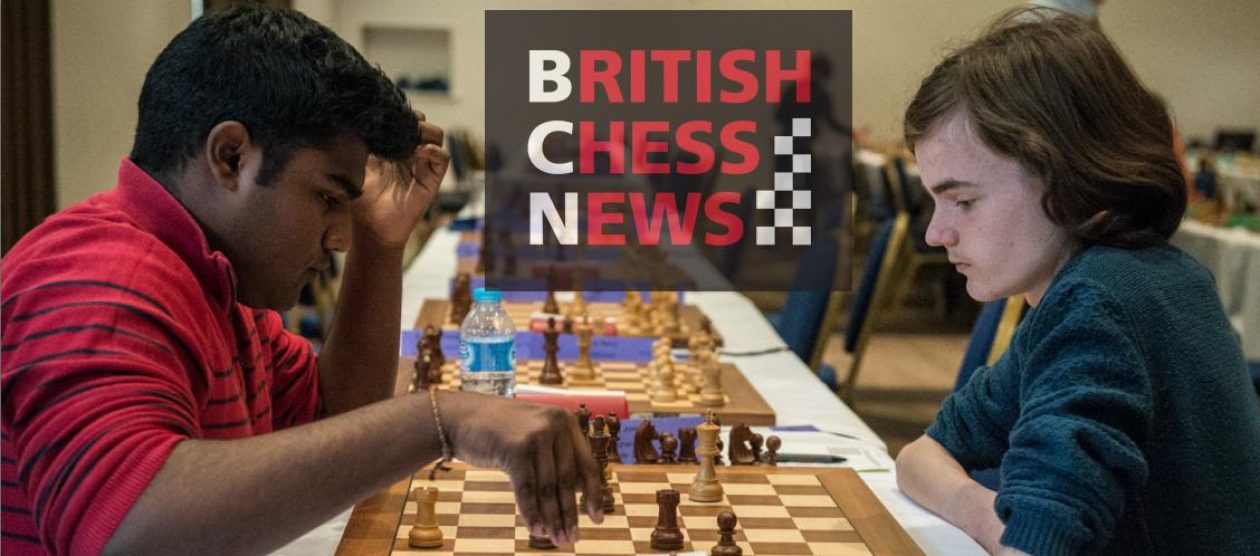
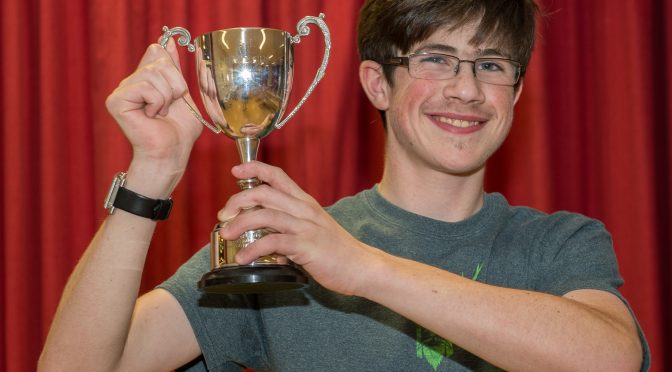
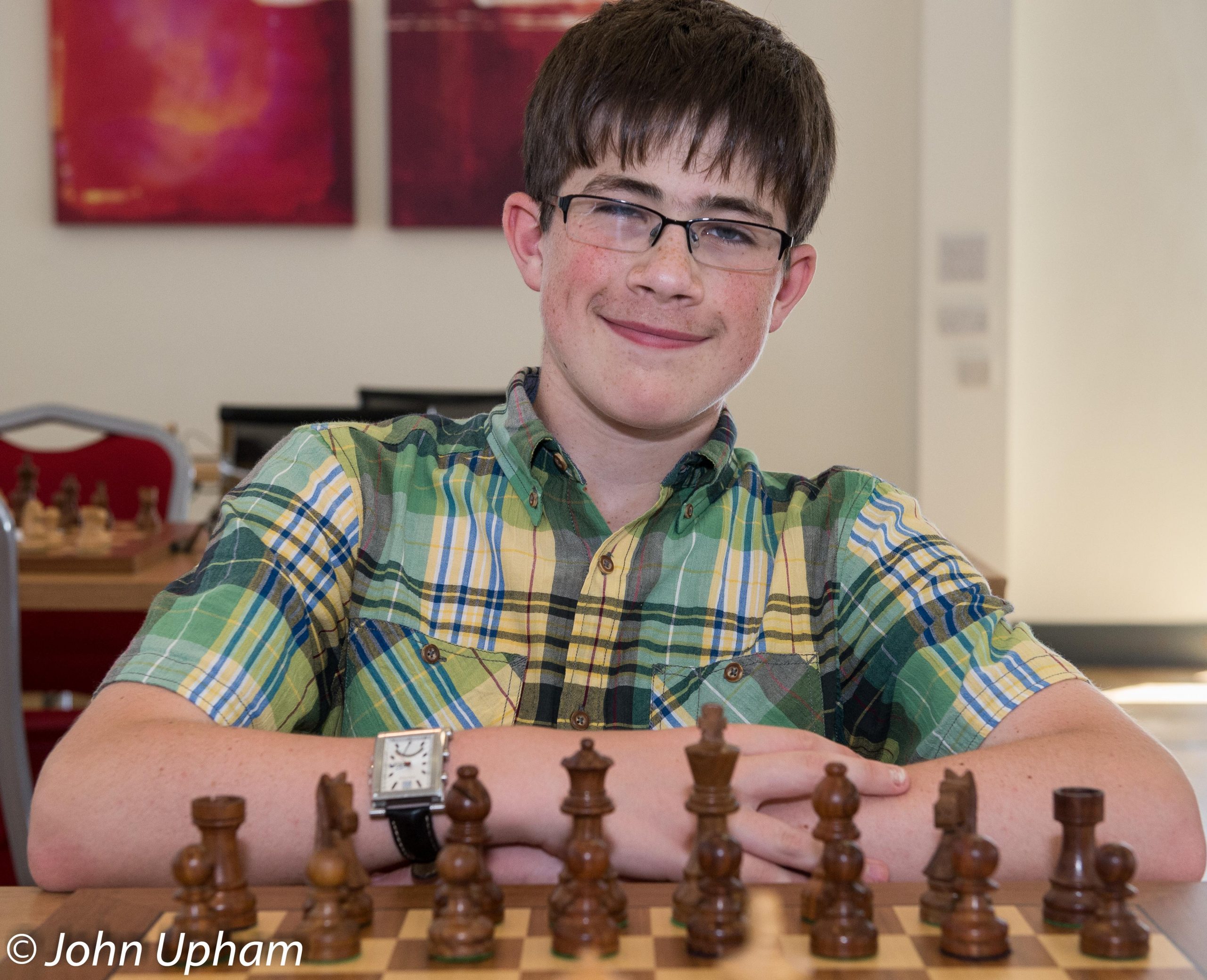
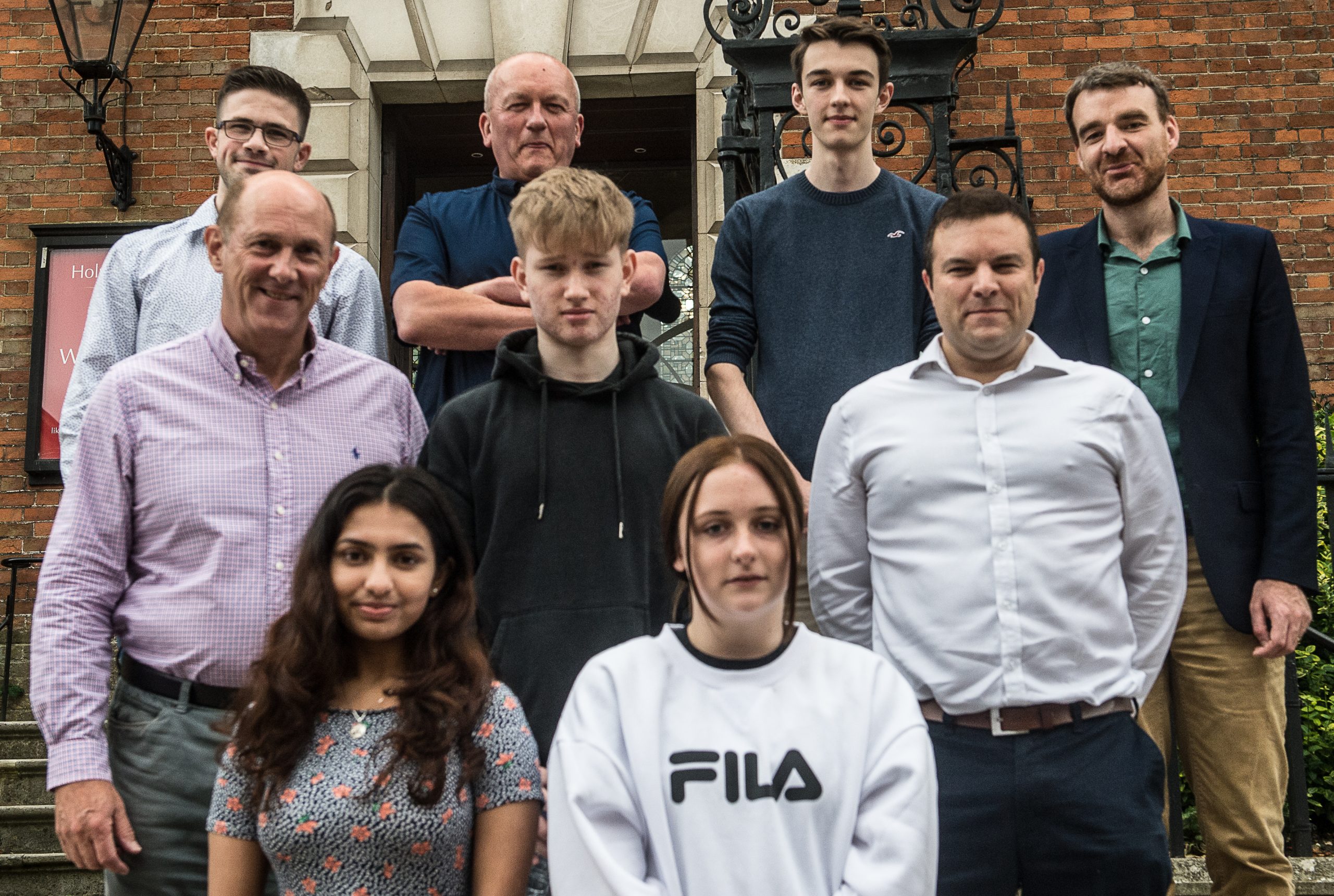
BCN wishes GM Matthew Wadsworth Happy Birthday this day (June 27th).
Previously we reported:
IM Matthew Wadsworth, one of England’s most promising young players, has earned his first Grandmaster norm from his excellent performance in the Four Nations Chess League (4NCL). Matthew, who is twenty, has a current FIDE standard play rating of 2413 and is ranked 34th amongst the active players in England (by FIDE rating) earning his FM title in 2016 and IM title in 2019.
Matthew could leapfrog to Grandmaster status with further norms and by increasing his live rating to 2500. The IM title was ratified at the FIDE Congress, 2nd quarter PB 2019, 27-30 June, Baku, Azerbaijan when his live rating had topped 2400.
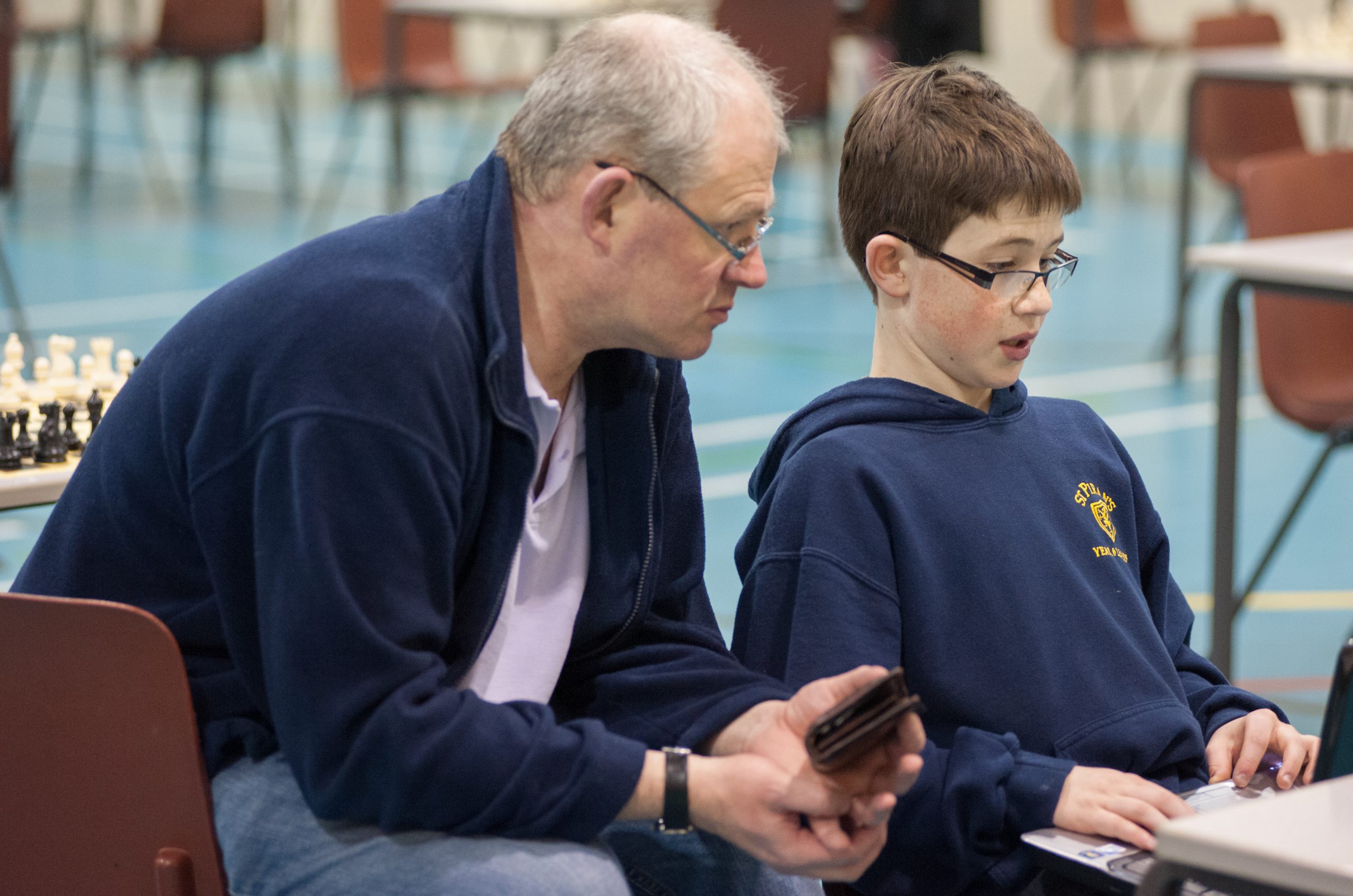
Matthew with father Jim at the 2012 Surrey Congress
Matthew’s first ECF grade was 66A in 2007 (aged 7) and he played for Maidenhead in local leagues, St. Pirans’s School and then Reading School.
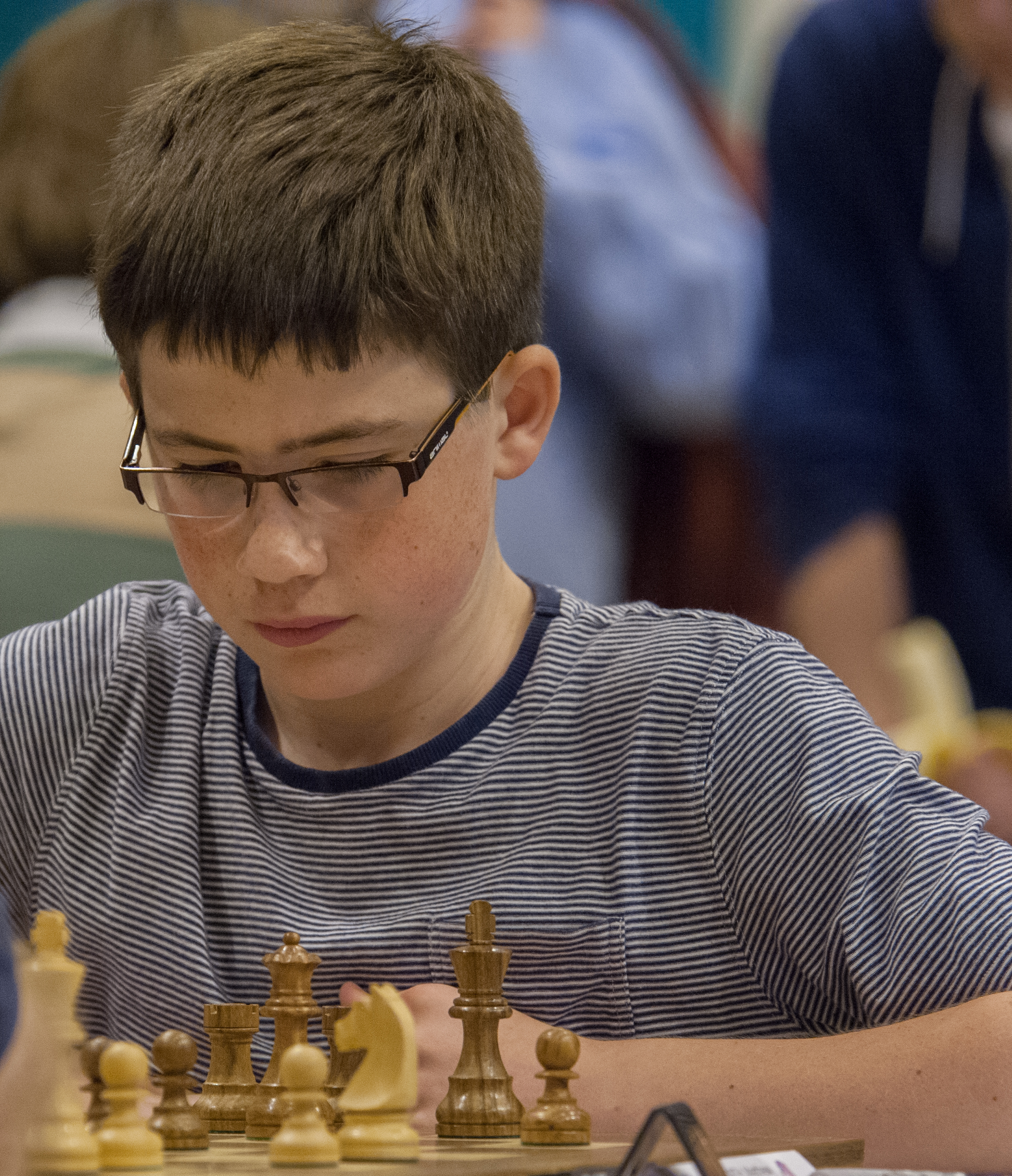
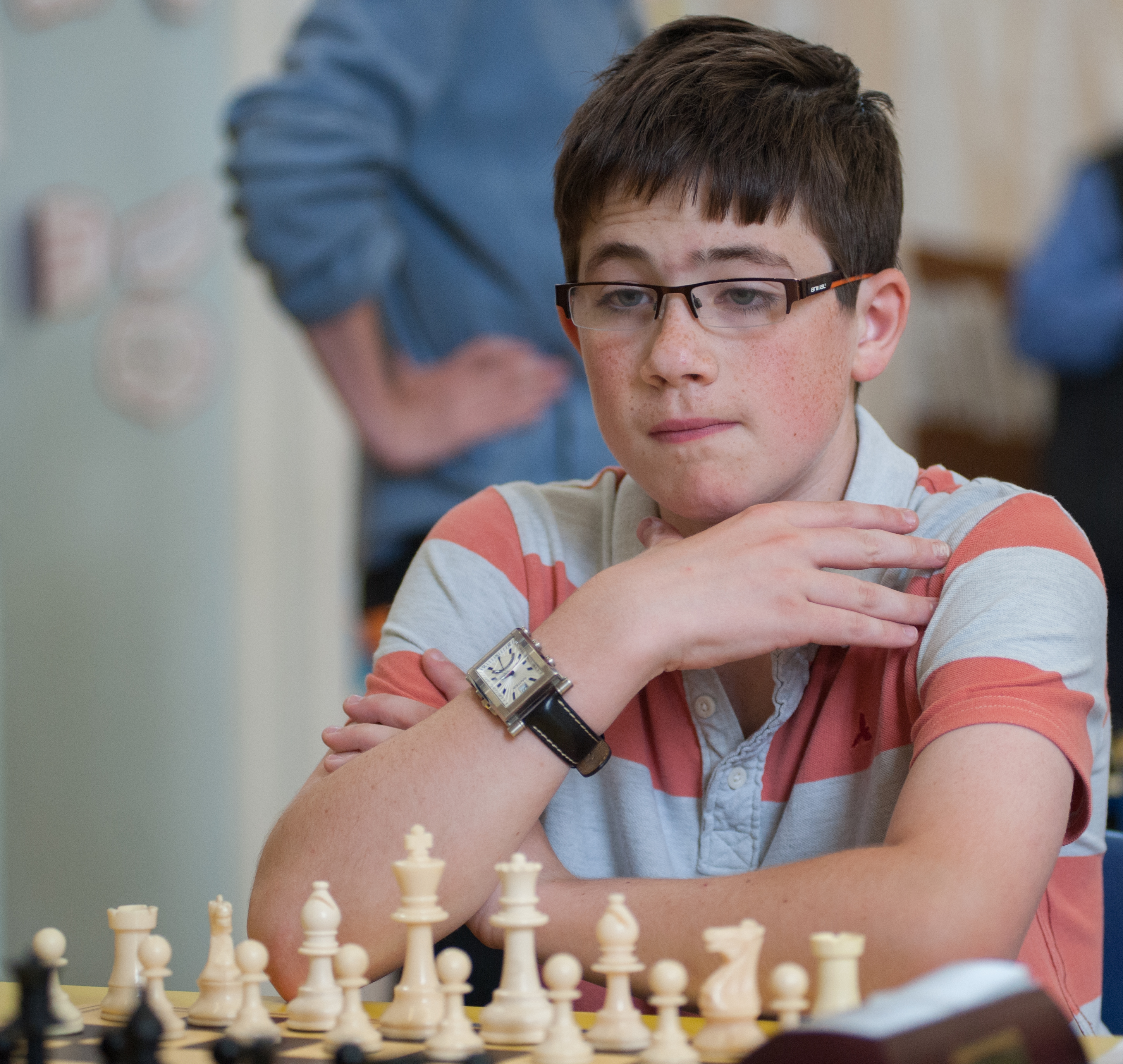
Matthew at the 2013 British Championships in Torquay
Matthew is reading Economics at Queen’s College, Cambridge and rows for the college team.
Matthew joined 4NCL at an early age and played for AMCA (Andrew Martin Chess Academy) soon rising the ranks to the AMCA first team and he currently represents the Guildford 2 team in Division One of the Four Nations Chess League (4NCL). Matthew’s 4NCL results for the 2018-19 season were :
1. Fodor, Tamas Jr, draw
2. Ashton, Adam G, win
3. Gonda, Laszlo, draw
4. Kulon, Klaudia, win
5. Holland, James P, win
6. Stewart, Ashley, win
7. Ledger, Andrew J, win
8. Plat, Vojtech, loss
9. no game
10. Jackson, James P, win
11. no game
giving a performance of 7/9
Matthew at the 2014 British Championships in Aberystwyth
One of the undoubted highlights of Matthews 2018 chess year was his draw with Oxford domiciled GM Hou Yifan, three times Women’s World Champion from China during the annual Varsity match, Matthew representing Cambridge.
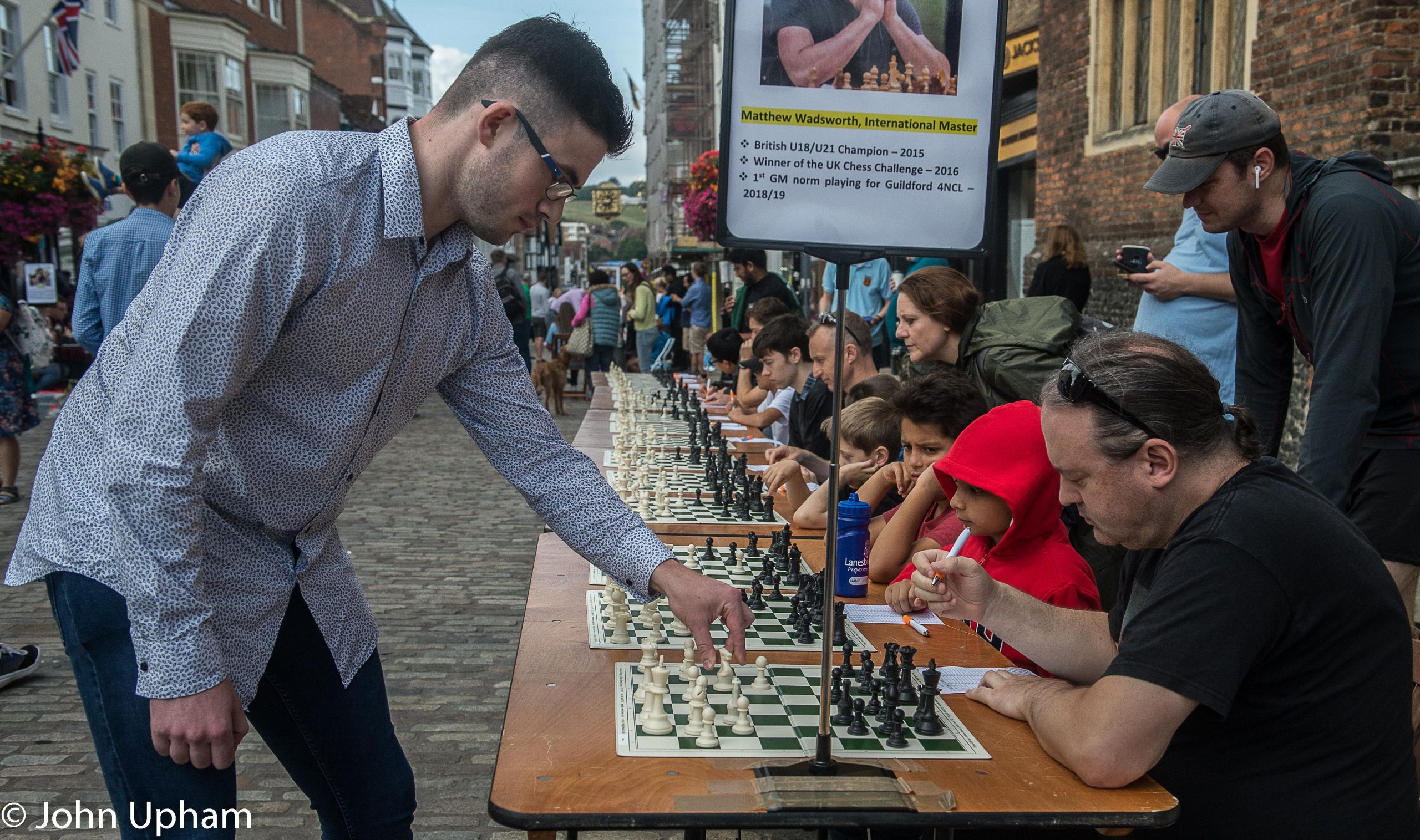
In 2021 Matthew supported Guildford Chess Club in its 125th Anniversary event by being part of the simultaneous display team:
IM Matthew Wadsworth at the Guildford Chess Club 125th Anniversary event on September 11th, 2021. Courtesy of John Upham PhotographyIM Matthew Wadsworth at the Guildford Chess Club 125th Anniversary event on September 11th, 2021. Courtesy of John Upham Photography
Matthew’s GM title was finally confirmed on April 18th 2025 at the 2nd FIDE Council of that year.
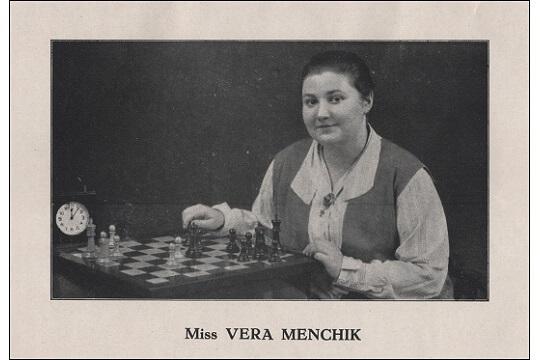
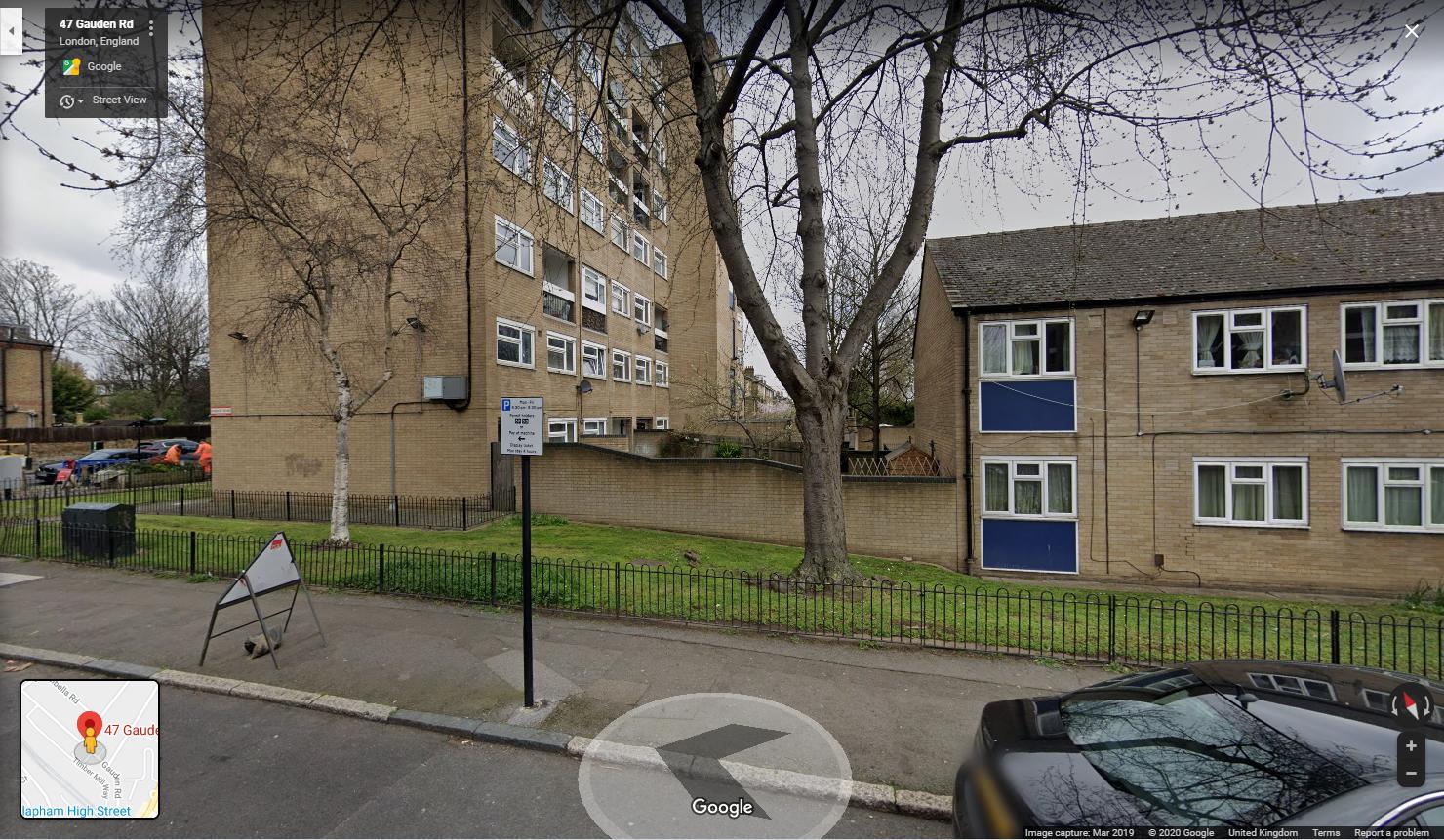
BCN remembers that in the early morning of Tuesday, June 27th, 1944 (i.e. 77 years ago) Vera Menchik, her sister Olga, and their mother were killed in a V-1 flying bomb attack which destroyed their home at 47 Gauden Road in the Clapham area of South London.
We now know that the V1 in question landed at 00:20 hrs on the 27th and led to the death of a total of 11 people including the Menchik household. Here is a summary of recorded V1 and V2 landings in the Clapham, SW4 area.
47, Gauden Road, Clapham, SW4 6LW in more modern times.
All three were cremated at the Streatham Park Crematorium on 4 July 1944. Vera was 38 years old.
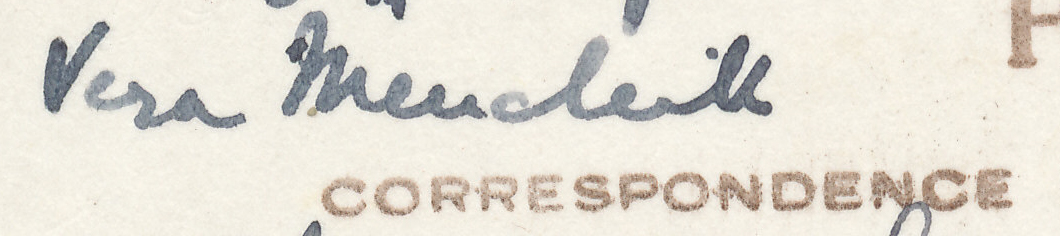
Signature of Vera Menchik from a Brian Reilly “after dinner” postcard from Margate 1936.
Vera’s Parents and Sister
Vera Frantsevna Menchik (or Věra Menčíková) was born in Moscow on Friday, 16th February, 1906. Her father was František Menčik, was born in Bystrá nad Jizerou, Bohemia. František and Olga were married on June 23rd 1905 in Moscow and notice of this marriage appeared in British newspapers on July 22nd 1905. Vera’s sister was Olga Rubery (née Menchik) and she was born in Moscow in 1908. Olga Menchik married Clifford Glanville Rubery in 1938. Vera married Rufus Henry Streatfeild Stevenson on October 19th 1937.
Her Maternal Roots
Our interest in unearthing her maternal English heritage / roots has led to the following:
Her mother was Olga (née Illingworth (1885 – 27 vi 1944). Olga’s parents were Arthur Wellington Illingworth and Marie Illingworth (née ?). Arthur was born in October 1852 in the district of Salford, Lancashire, his parents were George Illingworth (1827-1887) and Alice Whewell (1828-1910).
In the 1861 census Arthur is recorded as being of eight years of age and living in the Illingworth household.
In the 1871 census Arthur is recorded as being of eighteen years of age and living in the Illingworth household of nine persons at 5, Lancaster Road, Pendleton, Lancashire. Arthur’s occupation is listed as being a merchants apprentice. In fact, he was a stock and share broker.
Arthur died in Moscow on February 21st 1898. Probate was recorded in London on July 6th, 1900 as follows:
Illingworth Arthur Wellington of Moscow Russia merchant died 21st February 1898 Probate London 6th July to Walter Illingworth stock and share-broker Effects £4713 7s
£4713 7s in 1898 equates roughly to £626,600.00 in 2020 so it would appear that Arthur was considerably successful and almost certainly left money to Olga Illingworth.
What do we conclude from all of this? Quite simply that Vera’s maternal roots were from Salford in Lancashire.
BCM Announcement
The August 1944 British Chess Magazine (Volume LXIV, Number 8, page 173 onwards) contained this editorial from Julius du Mont:
Julius du Mont, Editor of British Chess Magazine from 1940 to 1949
“British Chess has suffered a grievous and irreparable loss in the death by enemy action of Mrs. R.H.S. Stevenson known through all the world where chess is played as Vera Menchik.
We give elsewhere (below : Ed.) an appreciation of this remarkable woman. Quite apart from her unique gifts as a chess-player-the world may never see her equal again among women players-she had many qualities which endeared her to all who knew her, the greatest among them being here great-hearted generosity.
We sympathise with our contemporary “CHESS” : Vera Menchik was for some years their games editor. Few columns have been conducted with equal skill and efficiency and none, we feel sure, with a greater sense of responsibility.
The news of this remarkable tragedy will be received by the chess world with sorrow and with abhorrence of the wanton and useless robot methods of a robot people.
One shudders at the heritage of hatred which will be theirs, but their greatest punishment will come with their own enlightenment.”
BCM Contemporary Obituary from EGR Cordingley
From page 178 of the same issue we have an obituary written by EGR Cordingley :
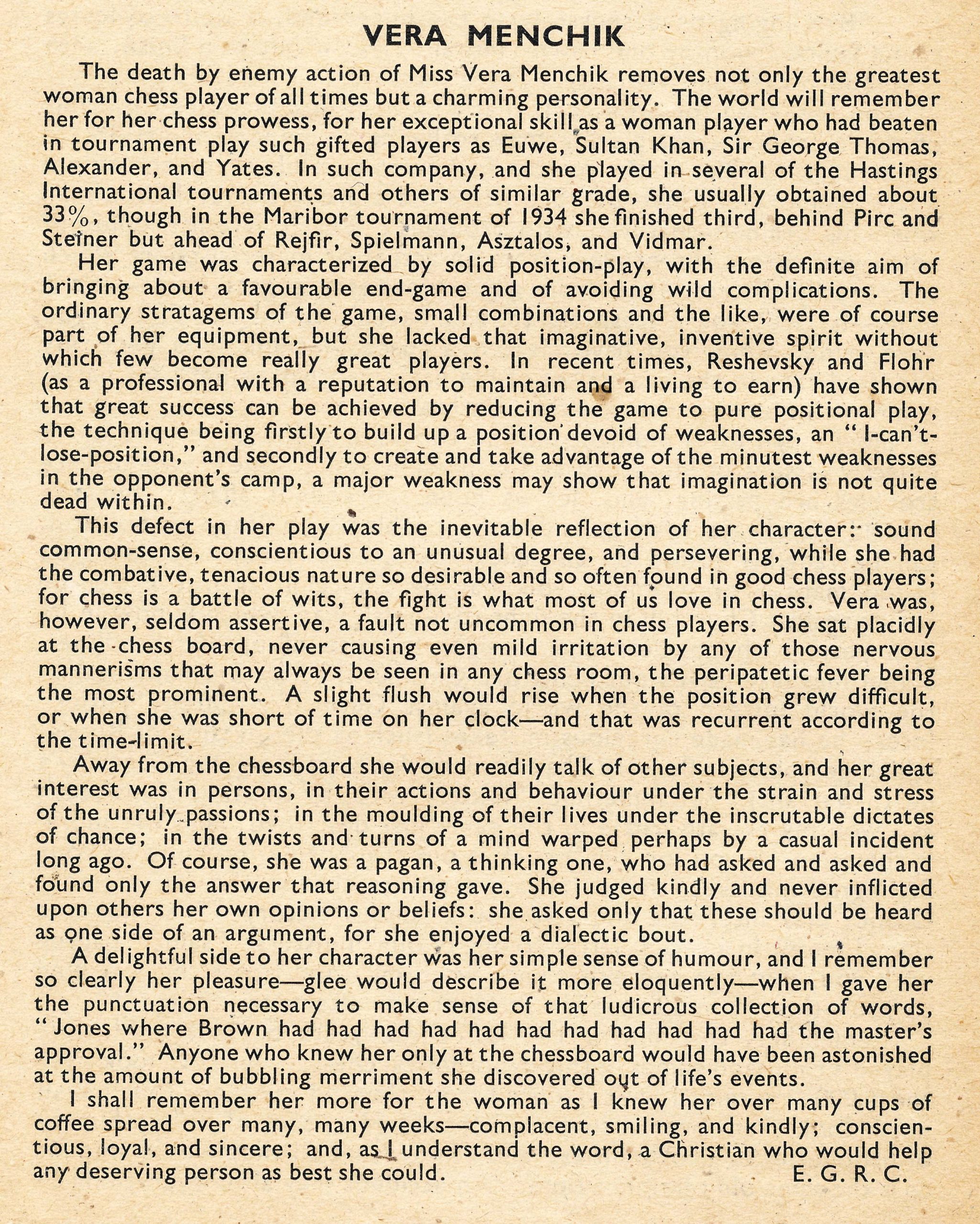
“The death by enemy action of Miss Vera Menchik removes not only the greatest woman chess player of all times but a charming personality.
The world will remember her for her chess prowess, for her exceptional skill as a woman player who had beaten in tournament play such gifted players as Euwe, Sultan Khan, Sir George Thomas, Alexander and Yates. In such company, and she played in several of the Hastings International tournaments and other of similar grade, she usually obtained about 33%, though in the Maribor tournament of 1934 she finished third, behind Pirc and Steiner but ahead of Rejfir, Spielmann, Asztalos and Vidmar.
Her game was characterised by solid position-play, with the definite aim of bringing about a favourable end-game and of avoiding wild complications. The ordinary stratagems of the game, small combinations and the like, were of course part of her equipment, but she lacked that imaginative, inventive spirit without which few become really great players.
In recent times, Reshesvky and Flohr (as a professional with a reputation to maintain and a living to earn) have shown that great success can be achieved by reducing the game to pure positional play, the technique being firstly to build up a position devoid of weaknesses, an ‘I can’t lose position,’ and secondly to create and take advantage of the minutest weaknesses in the opponent’s camp, a major weakness may show that imagination is not quite dead within.
This defect in her play was the inevitable reflection of her character: sound common-sense, conscientious to an unusual degree, and persevering, while she had the combative, tenacious nature so desirable and so often found in good chess players; for chess is battle of wits, the fight is what most of use love in chess. Vera was, seldom assertive, a fault not uncommon in chess players. She sat placidly at the chess boar, never causing even mild irritation by any of those nervous mannerisms that may always be seen in any chess room, the peripatetic fever being the most prominent. A slight flush would rise when the position grew difficult, or when she was short of time on her clock – and that was recurrent according to the time-limit.
Away from the chessboard show would readily talk of other subjects, and her great interest was in persons, in their actions and behaviour under the strain and stress of the unruly passions; in the moulding of their lives under the inscrutable dictates of chance; in the twists and turns of a mind warped perhaps by a casual incident long ago. Of course, she was a pagan, a thinking one, who had asked and asked and found only the answer that reasoning gave. She judged kindly and never inflicted upon others her own opinions or beliefs: she asked only that these should be heard as one side of any argument, for she enjoyed a dialectic bout.
A delightful side to her character was her simple sense of humour, and I remember so clearly her pleasure – glee would describe it more eloquently – when I gave her the punctuation necessary to make sense of that ludicrous collection of words, ‘Jones where Brown had had had had had had had had had had had the master’s approval’ Anyone who knew her only at the chessboard would have been astonished at the amount of bubbling merriment she discovered of of life’s events.
I shall remember her more for the woman as I knew her over many cups of coffee spread over many, many weeks – complacent, smiling, and kindly; conscientious, loyal, and sincere; as I understand the word, a Christian who would help any deserving person as best she could. E. G. R. C.
”
and here is the original article as printed:
British Chess Magazine, Volume LXIV (1944), Number 8, August, Page 178
BCM 1958 Appreciation by Peter Clarke
From British Chess Magazine, Volume LXXVIII (128, 1958), Number 7 (July), page 181 onwards) we have this retrospective from Peter Clarke:
“The night of June 27th,1944, Vera Menchik, World Woman Champion, was killed when an enemy bomb demolished her home in London; with her perished her mother and sister Olga. In these tragic circumstances the chess world lost its greatest woman player, still undefeated and at the height of her powers.
Vera Francevna Menchik was born in Moscow on February 16th, 1906, of an English mother and Czech father. There she spent her childhood, showing a love for literature, music, and, of course, chess, which at the age of nine she was taught by her father. She had a natural bent for the game and when only fourteen shared second and third places a schoolboys (!) tournament. The following year, 1921, the family came to England, where Miss Menchik lived the rest of her life.
As if by some fortunate coincidence, the Menchiks settled in Hastings, though it was not until the spring of 1923 that Vera joined the famous chess club. Her natural shyness and lack of knowledge of English caused this delay. However, they did not handicap her too much
as she herself afterwards wrote: ‘Chess is a quiet game and therefore the best hobby for a person who cannot speak the language.”
She studied the game eagerly, and very soon her talent caught the attention of the Hungarian grandmaster, Géza Maróczy, who was resident at Hastings at that time. Thus there began the most important period in her development as a player; a sound and mature understanding of positional play-and a thorough knowledge of a few special openings and defences: in particular the French Defence. The influence of
the grandmasters ideas was clearly apparent in her style throughout the whole of her career.
Miss Menchik’s rise to fame was meteoric: by 1925 she was undoubtedly the strongest player of her sex in the country, having twice defeated the Champion, E. Price, in short matches; and only two years later she won the first Women’s World Championship in London with the terrific score 10.5-0.5. She was just twenty-one, but already in a different class from any other woman in the world. For seventeen years until her death Vera Menchik reigned supreme in women’s chess, defending her world title successfully no less than seven times (including a match with Sonja Graf at Semmering in 1937, which Miss Menchik won 11.5-4.5. In the seven tournaments for the World Championship she played 83 games; winning 78, drawing 4, and losing 1 only! However, what was more remarkable was that she was accepted into the sphere of men’s chess as a master in her own right, a feat which no woman had done before or has done since. Up to then, women’s chess had been a very poor relation of the masculine game, but here was a woman who was a worthy opponent for the strongest masters.
Flohr wrote of her: ‘Vera Menchik was the first woman in the world who played chess strongly…who played like a man.’ It was as the ambassador extraordinary, so to speak, of the women’s game that Miss Menchik really made her greatest contribution to chess. Wherever she went, at home and abroad, she aroused great interest among her sex; others were eager to follow her, to identify themselves with her. Nowadays women’s chess is well organized, and much of the credit for this must go to Vera Menchik for first bringing it into the light. Among her many personal successes in international tournaments perhaps the greatest was at Ramsgate in 1929: as one of the foreign masters (she was still of Czech nationality) she shared second and third places with Rubinstein, * point behind Capablanca and above, among others, her tutor Maróczy.
Even the greatest masters recognized Miss Menchik’s ability; Alekhine himself, writing on the Carlsbad Tournament of 1929, said: ‘Vera Menchik is without doubt an exceptional phenomenon among women. She possesses great aptitude for the game…The chess
world must help her develop her talent!’
The Vera Menchik Club
An amusing incident occurred at this tournament. There were naturally sceptics among the masters over the lady’s participation. Flohr recalls how one of these, the Viennese master Becker, suggested:
‘Whoever loses to the Woman Champion will be accepted as a member of the Vera Menchik Club which I intend to organize.’
Becker was the first to lose to her, and that evening the masters chided him: “Professor Becker, you did not find it very difficult to join the club. You can be the Chairman.’ And forthwith he was chosen as Chairman for three years. Everyone wished that the new club would soon obtain more members! Indeed, the Vera Menchik Club has many famous names on its lists-Euwe, Reshevsky, Colle, Yates, Sultan Khan, Sir G. A. Thomas, Alexander, to mention a few.
In 1935 Miss Menchik returned to the country of her birth to take part in the great international tournament in Moscow. To be truthful, she had very little success, but she was everywhere treated with respect and sympathy by masters and spectators alike. The Soviet master l. Maiselis, writing in CHESS in 1944.(Shakhmaty za 1944 god), related the following entertaining anecdote from the tournament: One day a group of players and organizers were discussing the chances of Alekhine and Euwe in the forthcoming match. Flohr said: ‘It is quite clear that I will be World Champion.’ We looked at him inquiringly.
‘It’s very simple,” continued Flohr, ‘Euwe wins a match against Alekhine, Vera Menchik beats Euwe (at that time her score against Euwe was +2, =1, -1) and I will somehow beat Miss Menchik.’
We laughed at this good-natured joke, and we laughed all the more the next day when Flohr was unable, despite every effort, to defeat her in a vital game.
ln 1937 Miss Menchik married R. Stevenson, but in chess she continued to use her maiden name, made famous by so many victories. Her husband, a well-known organizer, became, Secretary of the B.C.F: in the following year and remained so until his death in 1943.
Since the days of Vera Menchik women’s chess has taken great strides forward; now there is a special committee of F.I.D.E. to look after its needs.- Only last year the first lnternational Women’s Team Tournament took place ln Emmen, Holland; the new World Champions, the U.S.S.R., became the first holders of the Vera Menchik Cup. So chess goes onwards, but the name of its first Queen will ever be remembered.”
From The Encyclopaedia of Chess (Robert Hale, 1970 & 1976) by Anne Sunnucks :
“Woman World Champion from 1927 to 1944. Vera Menchik was born in Moscow on 16th February 1906 of an English mother and a Czech father. Her father taught her to play chess when she was 9.
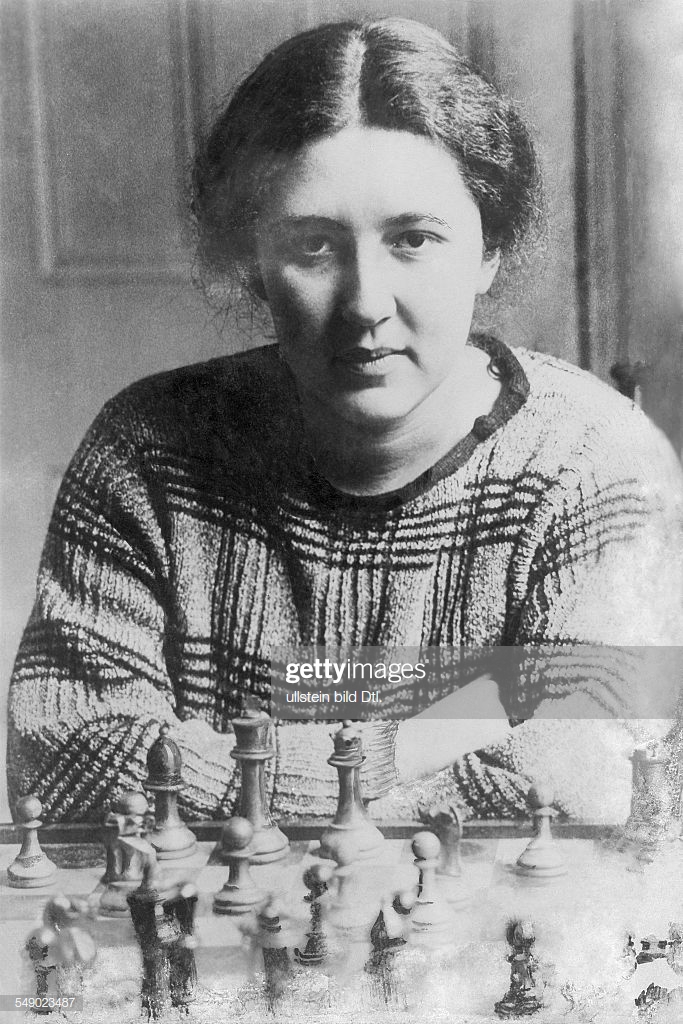
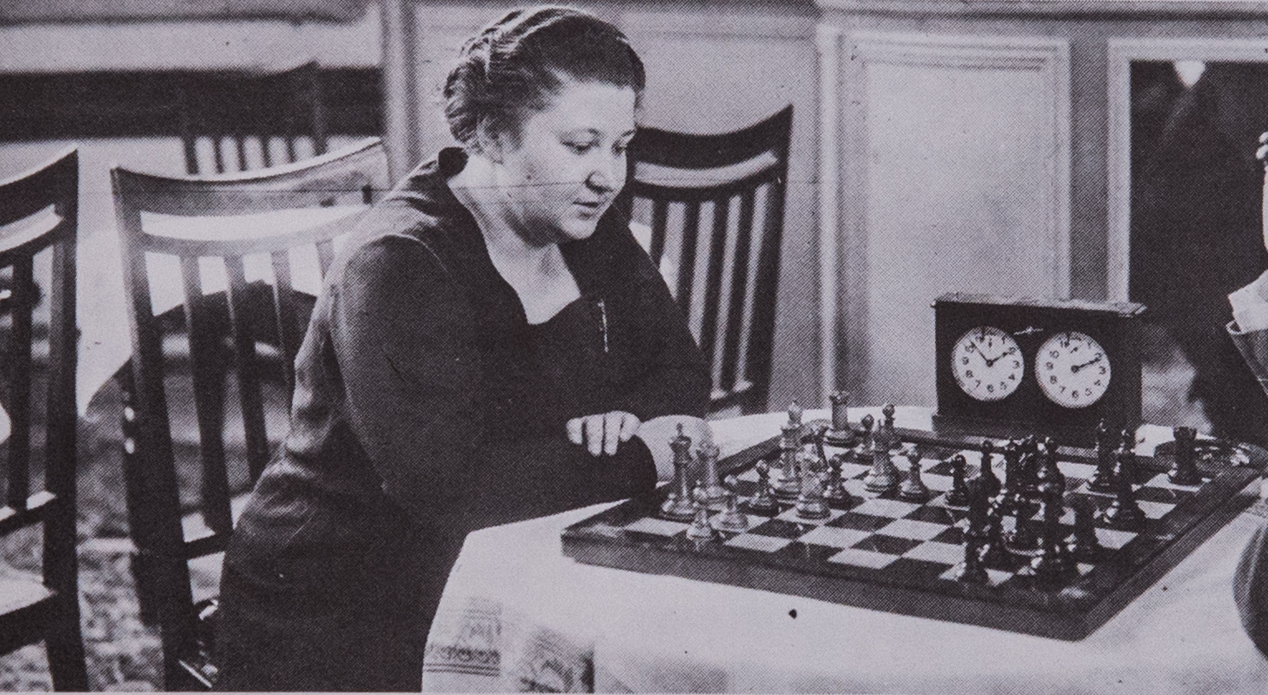
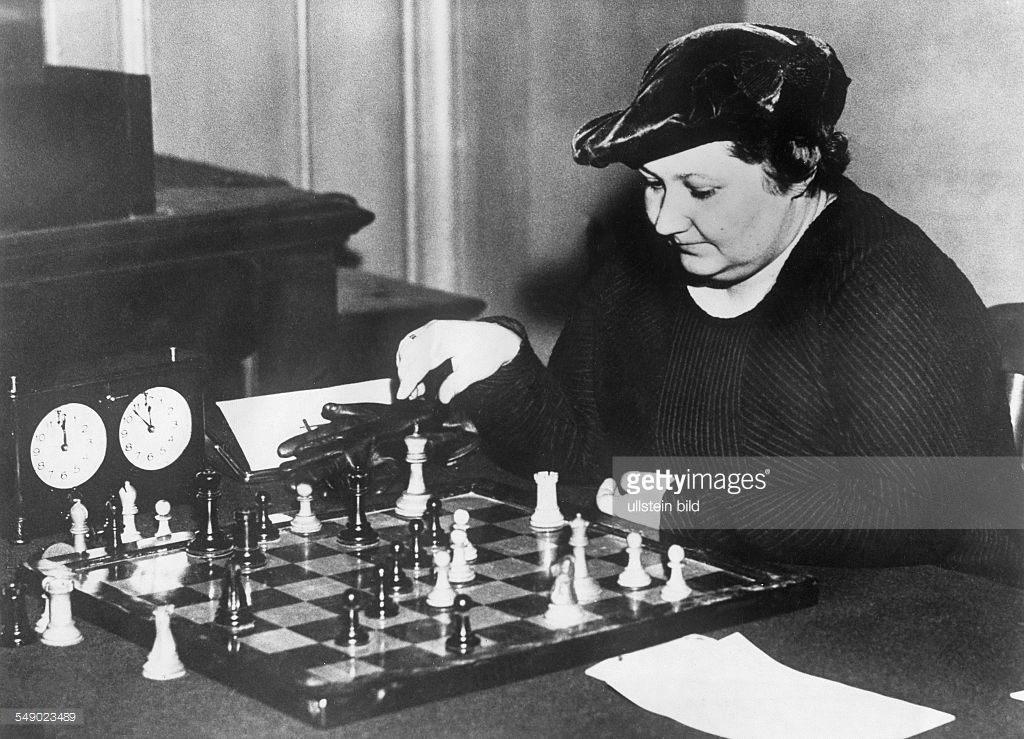
Vera Menchik 1906-1944 chess playerin, CZ / GB portrait with chess board late twenties (Photo by ullstein bild / ullstein bild via Getty Images)
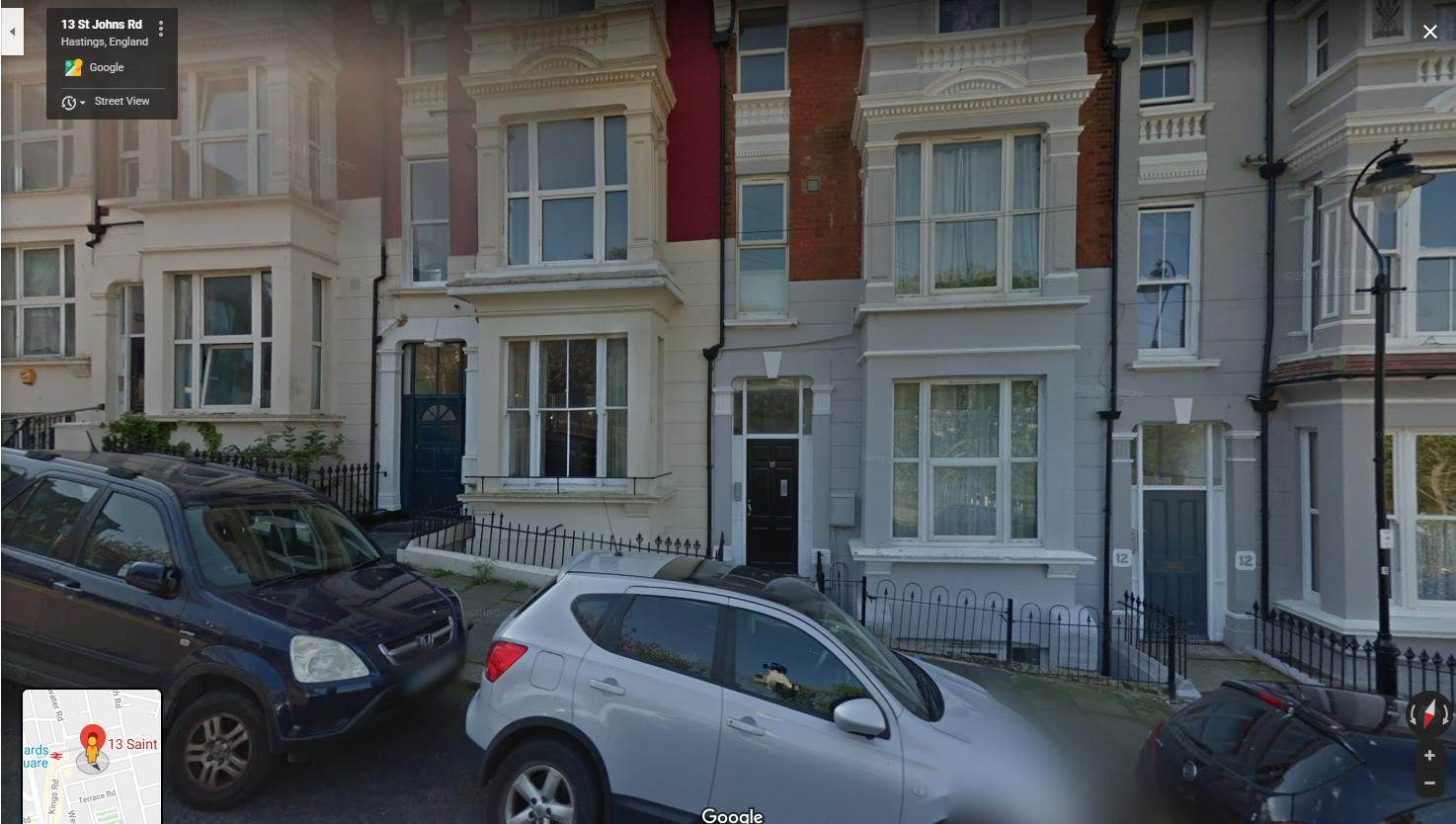
In 192l her family came to England and settled in Hastings (at 13, St. John’s Road, St. Leonards-on-Sea, TN37 6HP) :
13, St. John’s Road, St. Leonards-on-Sea, TN37 6HP
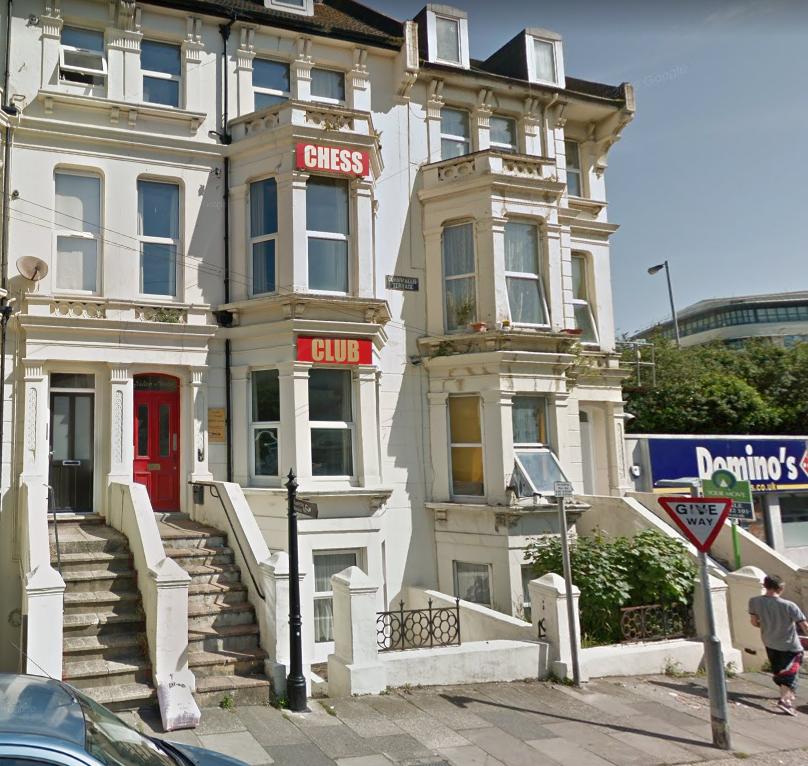
Two years later, when she was 17, Vera joined Hastings Chess Club,
Hastings Chess Club : 2 Cornwallis Terrace, Hastings TN34 1EB
where she became a pupil of Geza Maroczy. The first Women’s World Championship was held in 1927. Vera Menchik won with a score of 10.5 out of 11. She defended her title successfully in Hamburg in 1930, in Prague in 1931, in Folkestone in 1933, in Warsaw in 1935, in Stockholm in 1937 and in Buenos Aires in 1939. She played 2 matches against Sonja Graf, her nearest rival, in 1934 when she won +3 -1 and in 1937, in a match for her title when she won +9 -1 =5.
Isaac Kashdan plays Vera Menchik during the Hastings Congress on December 28th, 1931. Kashdan won in 45 moves in a classical French.
The first woman ever to play in the British Championship and the first to play in a master tournament, Vera Menchik made her debut in master chess at Scarborough 1928 when she scored 50 per cent. The following year she played in Paris and Carlsbad, and it was at Carlsbad that the famous Menchik Club was formed. The invitation to Vera Menchik to compete among such players as Capablanca, Euwe, Tartakower and Nimzowitch was received with amusement by many of the masters. The Viennese master, Becker was particularly scornful, and in the presence of a number of the competitors he suggested that anyone who lost to Vera Menchik should be granted membership of the Menchik Club. He himself became the first member. Other famous players who later joined the club were Euwe, Reshevsky, Sultan Khan, Sir George Thomas, C. H. O’D. Alexander, Colle and Yates.
Her greatest success in international tournaments was at Ramsgate in 1929, when she was =2nd with Rubinstein, half a point behind Capablanca and ahead of Maroczy. In 1934 she was 3rd at Maribor, ahead of Spielmann and Vidmar. In 1942 she won a match against Mieses +4 -l -5. In 1937 Vera Menchik married R. H. S. Stevenson, who later became Hon. Secretary of the British Chess Federation. He died in 1943. She continued to use her maiden name when playing chess. On her marriage she became a British subject.
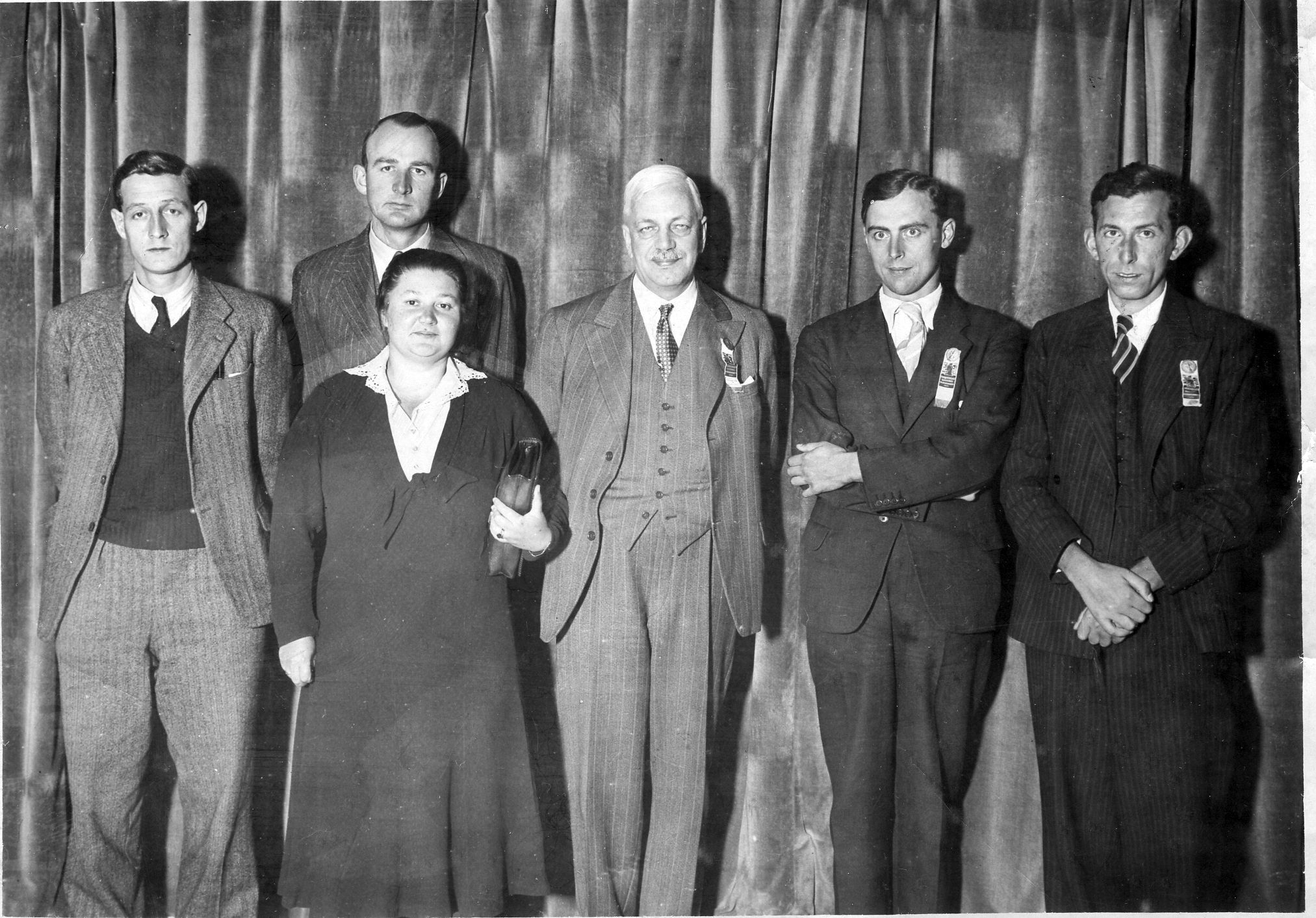
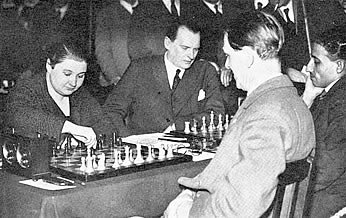
Left to right Baruch H Wood, Philip Stuart Milner-Barry, Vera Menchik (playing in the women’s world championship held concurrently with the Olympiad which she won with 17 wins and 2 draws), Sir George Thomas, Conel Hugh O’Donel Alexander and Harry Golombek. England withdrew after their preliminary group due to the outbreak of war despite qualifying for the top final. Thanks to Leonard Barden
From 1941 until her death she was Games Editor of CHESS. She also gave chess lessons and managed the National Chess Centre, which opened in 1939 at John Lewis’s in Oxford Street, London and was destroyed by a bomb in 1940.
In 1944 Vera Menchik was a solid positional player, who avoided complications and aimed at achieving a favourable endgame. Her placid temperament was ideal for tournament play. Her main weakness was possibly lack of imagination. Her results have made her the most successful woman player ever.”
Vera Menchik
From The Encyclopaedia of Chess, (BT Batsford, 1977) by Harry Golombek :
Probably the strongest woman player in the history of the game, Vera Menchik was born in Moscow and, though her father was a Czechoslovak and her mother English, she played for most of her
life under English colours.
In l92l her family came to Hastings in England and there Vera became a pupil of the great Hungarian master, Geza Maroczy. This was to have a dominating influence on her style of play which was solidly classical, logical and technically most well equipped. Such a style enabled her to deal severely not only with her fellow women players but also with contemporary masters and budding masters. Vera did extremely well, for example, against C. H. O’D. Alexander
and P. S. Milner-Barry, but lost repeatedly to H. Golombek who was able to take advantage of her lack of imagination by the use of more modern methods.
Vera was soon predominent in women’s chess. In the first Women’s World Championship tournament, at London in 1927, she won the title with a score of 10.5 out of 11 and retained the championship with great ease at all the subsequent Olympiads (or International Team tournaments as they were then known more correctly) at Hamburg 1930, Prague 1931, Folkestone 1933, Warsaw 1935, Stockholm 1937 and Buenos Aires 1939.
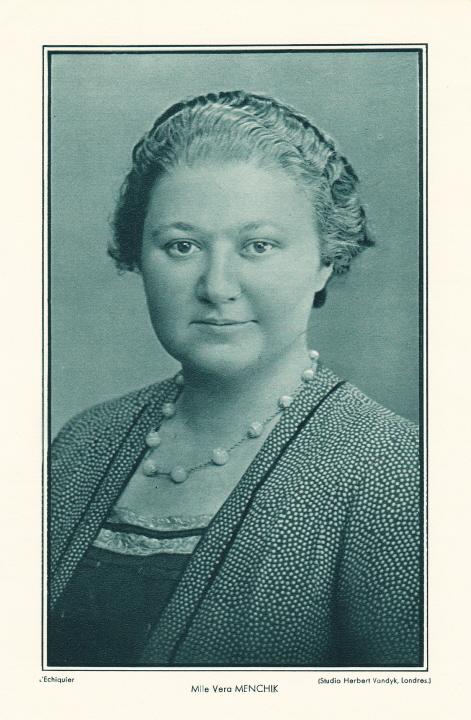
Vera Menchik at Margate 1935, photographer unknown
With Sonja Graf, the player who came nearest to her in strength among her female contemporaries, she played two matches and demonstrated her undoubted superiority by beating her in 1934 (+3-l) and again in a match for the title in l937 (+9-l=5).
In 1937 Vera officially became a British citizen by marrying the then Kent and later B.C.F. Secretary, R. H. S. Stevenson (Rufus Henry Streatfeild Stevenson: ed).
(Rufus Henry Streatfeild Stevenson was home news editor of the British Chess Magazine, secretary of the Southern Counties Chess Union and match captain of the Kent County Chess Association).
Oddly enough, Sonja Graf, many years later, also became a Mrs Stevenson by marrying an American of that name some years after the Second World War.
Vera Menchik also played and held her own in men’s tournaments. She did well in the British championship and her best performance in international chess was =2nd with Rubinstein in the Ramsgate Team Practice tournament ahead of her old teacher, Maroczy. She also had an excellent result at Maribor in 1934 where she came 3rd, ahead of Spielmann and Vidmar.
Her husband died in 1943 and Vera herself, together with her younger sister Olga and her mother, was killed by a V1 bomb that descended on the Stevenson home in London in 1944.
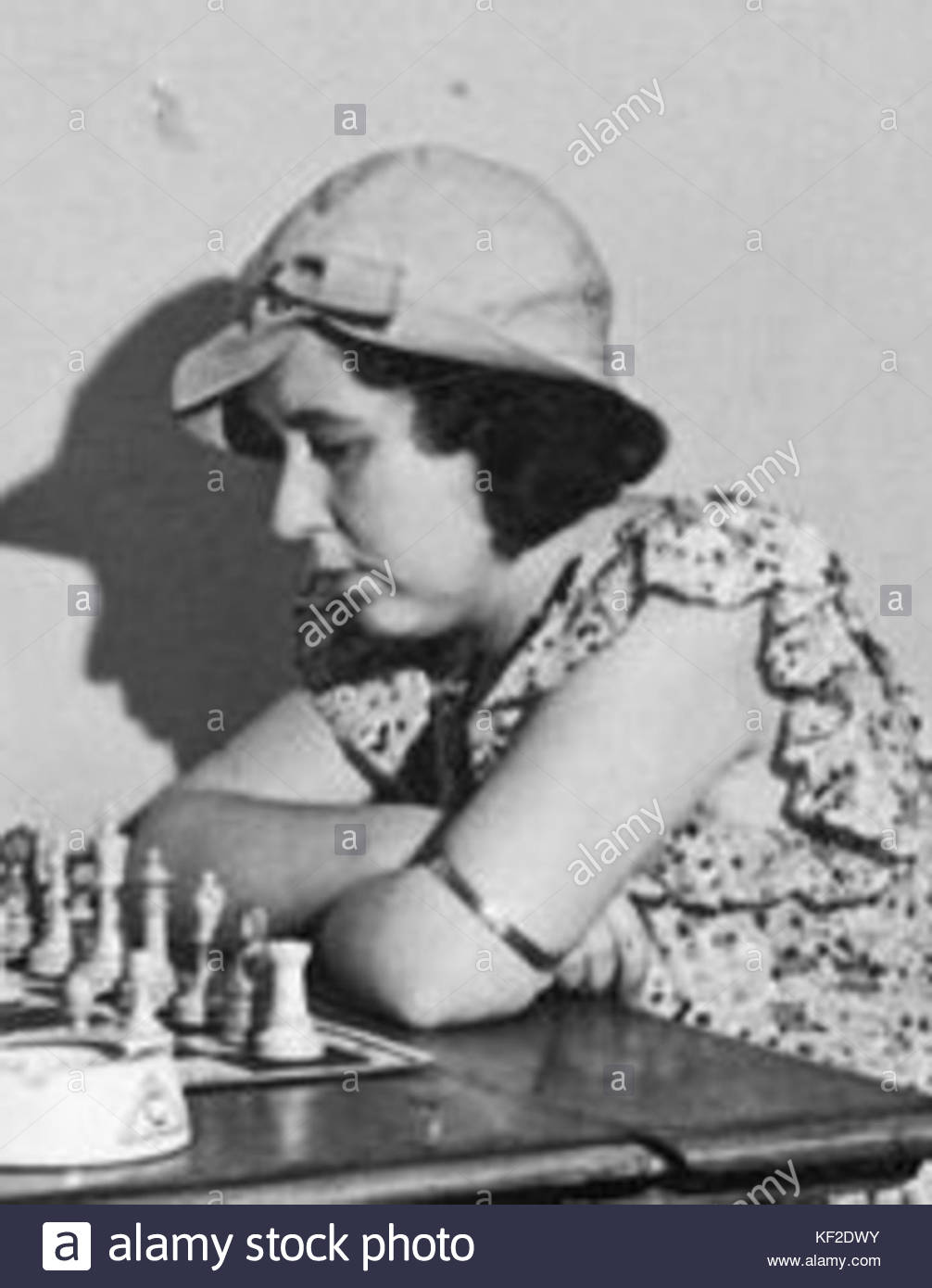
Vera Menchik, circa 1935, Historic Collection / Alamy Stock Photo
This was a sad and premature loss, not only for British but for world chess, since there is no doubt she would have continued to dominate the female scene for many years.
As a person Vera was a delightful companion, jolly and full of fun and understanding. As a player she was not only strong but also absolutely correct and without any prima donna behaviour. Generous in defeat and modest in victory, she set a great example to all her contemporaries.
An example of Vera’s attacking play at its best against her nearest rival, Sonja Graf, is shown by the following game which was played in her 1937 match at Semmering in Austria :
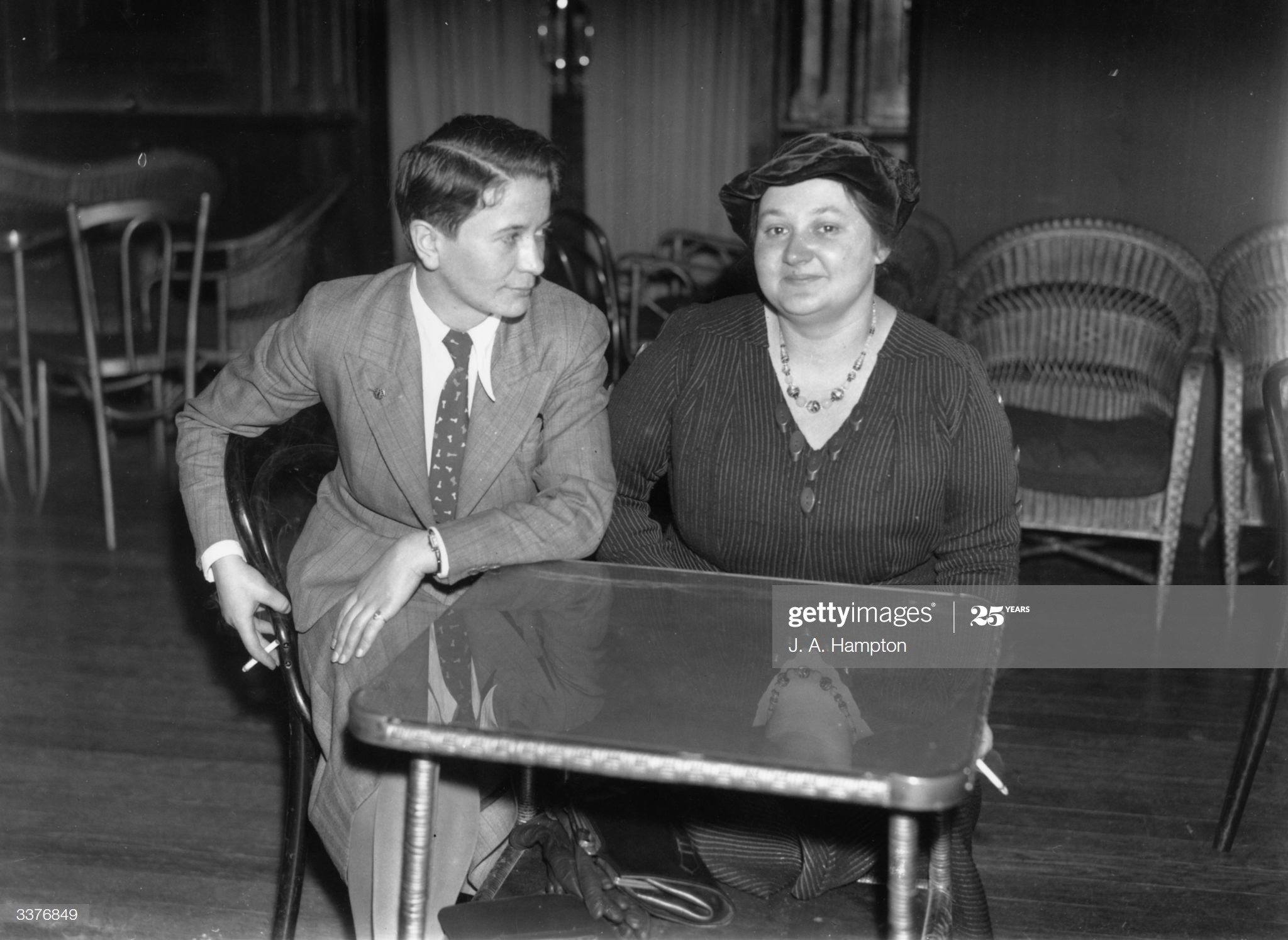
27th November 1936: Britain’s world chess champion Vera Menchik (right) and challenger Sonja Graf after signing a contract at the Bloomsbury Hotel, London, to play for the championship of the world over 16 games. (Photo by J. A. Hampton/Topical Press Agency/Getty Images)
From The Oxford Companion to Chess, (Oxford University Press, 1984) by Hooper and Whyld :
“Woman World Champion from 1927 until her death. Daughter of a Czech father and an English mother, Menchik was born in Moscow, learned chess when she was nine, settled in England around
1921, and took lessons from Maroczy a year or so later. In 1927 FIDE organized both the first Olympiad and the first world championship tournament for women. These events were run concurrently, except in 1928, until the Second World War began, and Menchik won the women’s tournament every time; London 1927 (+10=1); Hamburg 1930 (+6=1 — 1); Prague 1931 (+8);
Folkestone 1933 ( + 14); Warsaw 1935 (+9); Stockholm 1937 (+14); and Buenos Aires 1939 ( + 17=2). She played in her first championship tournament as a Russian, the next five as a Czech,
and the last as a Briton. She also won on two matches against her chief rival, the German-born Sonja Graf (c. 1912-65): Rotterdam, 1934 (+3-1), and Semmering, 1937 (+9=5—2),
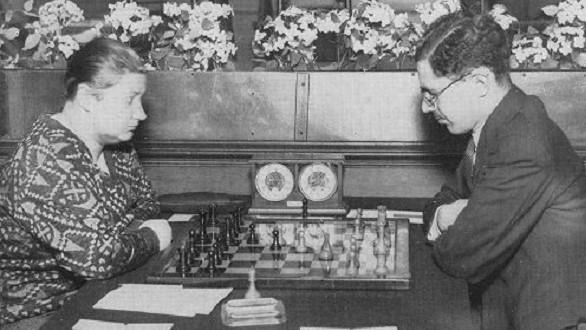
Vera Menchik in a pre-event posed picture in which she faces unstoppable checkmate in one from Hastings 193? She was about to play Sir GA Thomas.
In international tournaments which did not exclude men Menchik made little impression; one of her best results was at Maribor 1934 (about category 4) when she took third place alter Pirc and L. Steiner ahead of Spielmann. In 1937 she married the English chess organizer Rufus Henry Streatfeild Stevenson (1878-1943), A chess professional, she gave lessons, lectures, and displays, and was appointed manager of the short-lived National Chess Centre in 1939. In 1942 she defeated Mieses in match play (+4=5-1), She, her younger sister Olga (also a player), and their mother were killed in a bombing raid.
From left to right: Vera Menchik, Alexander Alekhine, Géza Maróczy and Sultan Khan. From London International Masters, 1st February, 1932, French Defence, drawn in 32 moves.
Her style was positional and she had a sound understanding of the endgame. On occasion she defeated in tournament play some of the greatest masters, notably Euwe, Reshevsky, and Sultan Khan. Men she defeated were said to belong to the Menchik club. When world team championships for women (women’s chess Olympiads) were commenced in 1957 the trophy for the winning team was called the Vera Menchik Cup.”
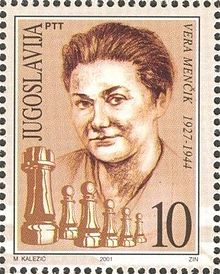
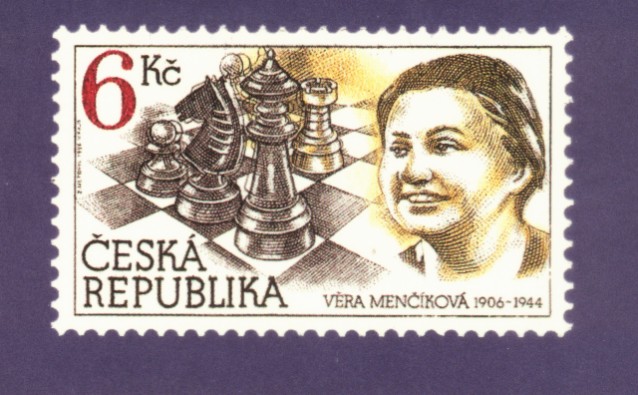
Vera Menchik commemorated on a postage stamp from the Czech Republic
She was inducted to the World Chess Hall of Fame in 2011.
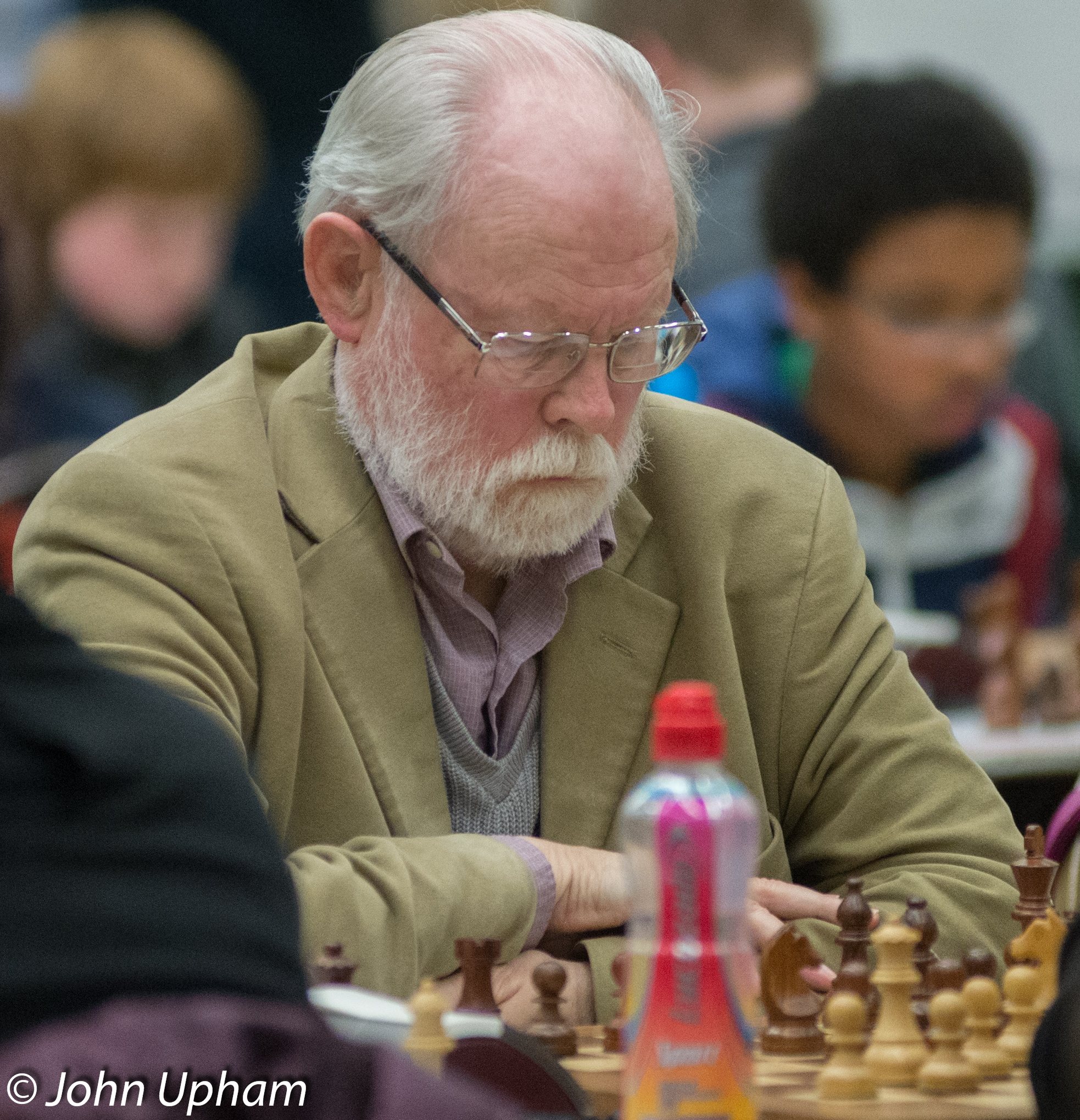
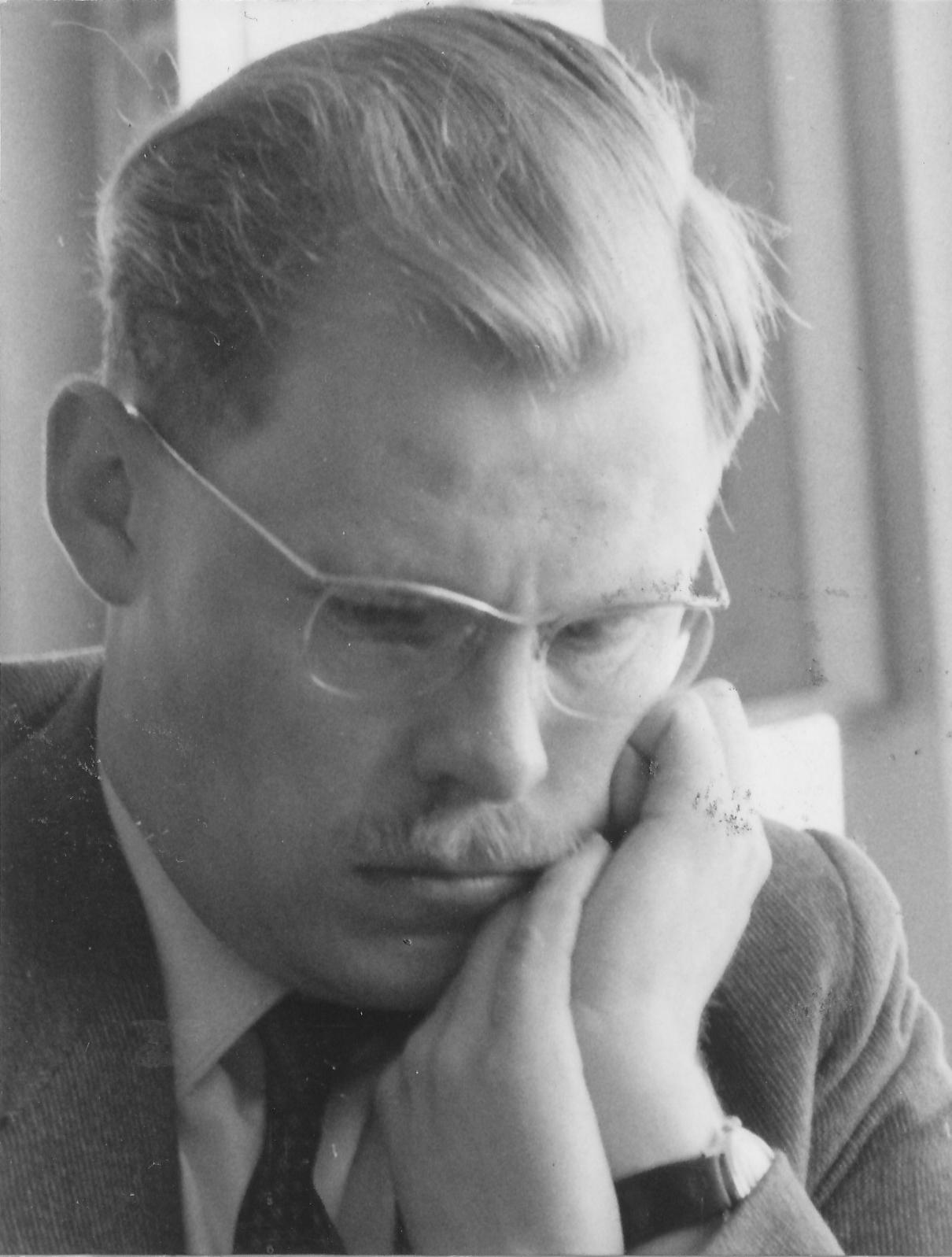
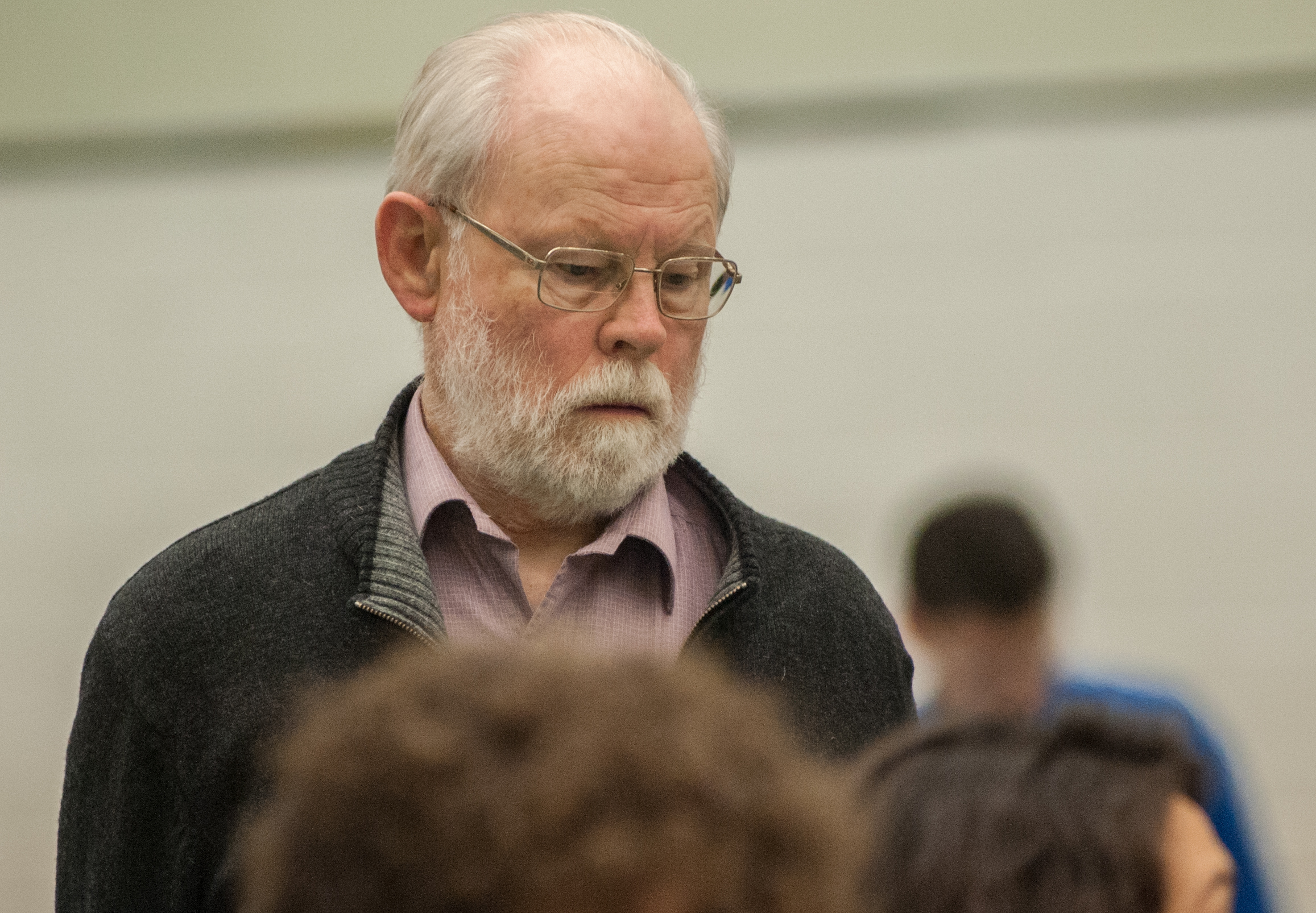
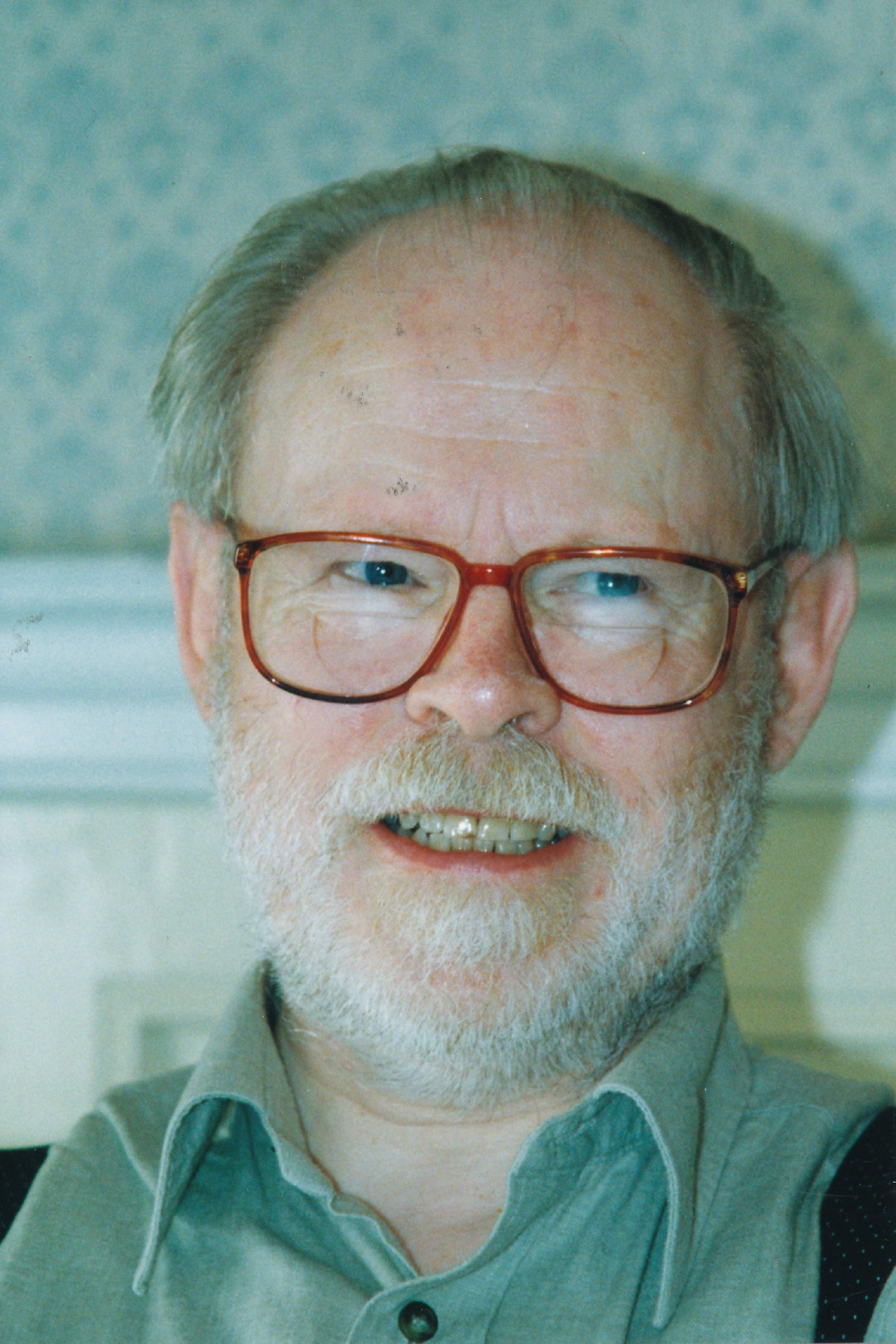
FM Bernard Cafferty, Hastings Congress 2013-14, courtesy of John Upham Photography
BCN wishes FIDE Master Bernard Cafferty best wishes on his 87th birthday, June 27th in 1934.
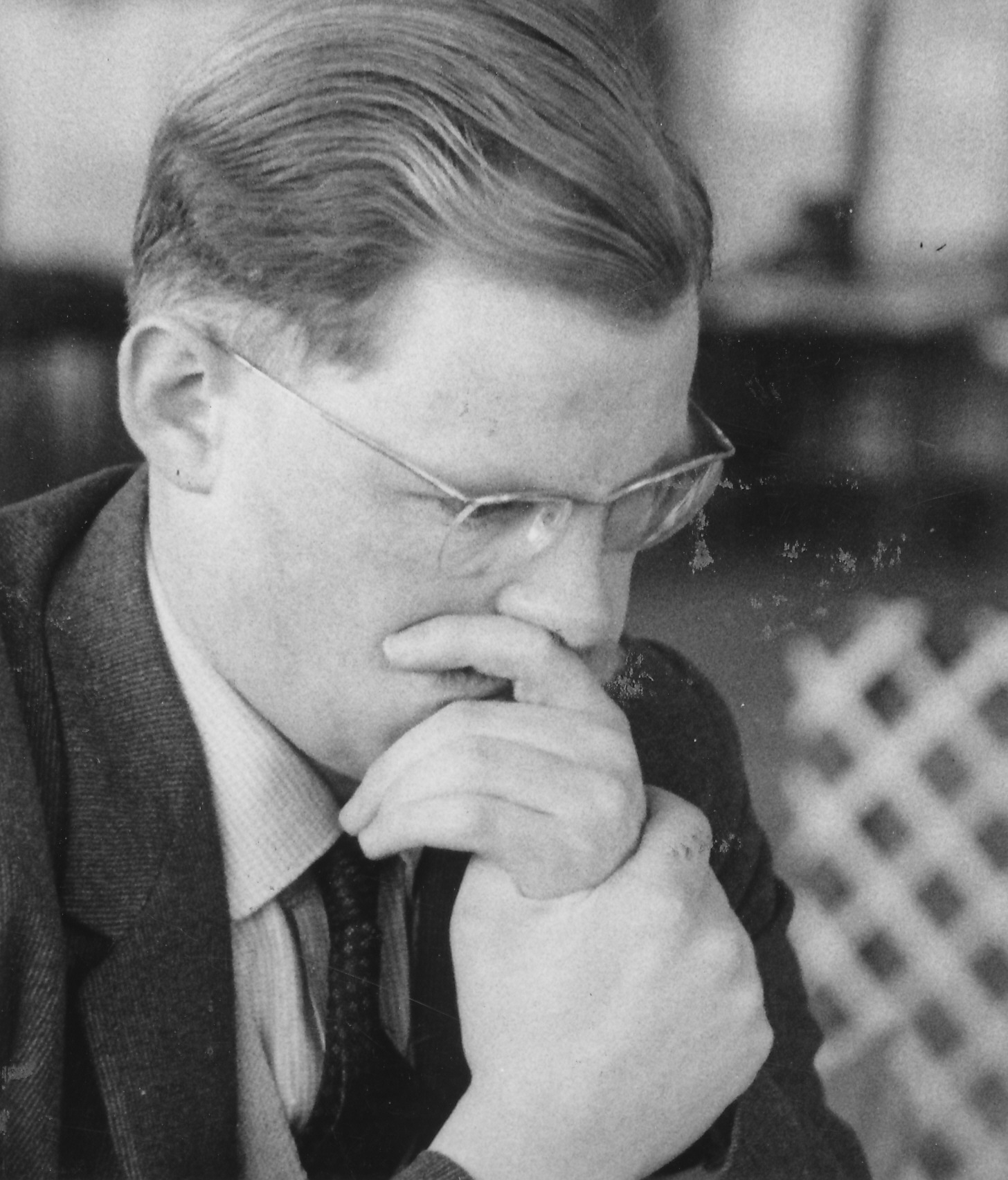
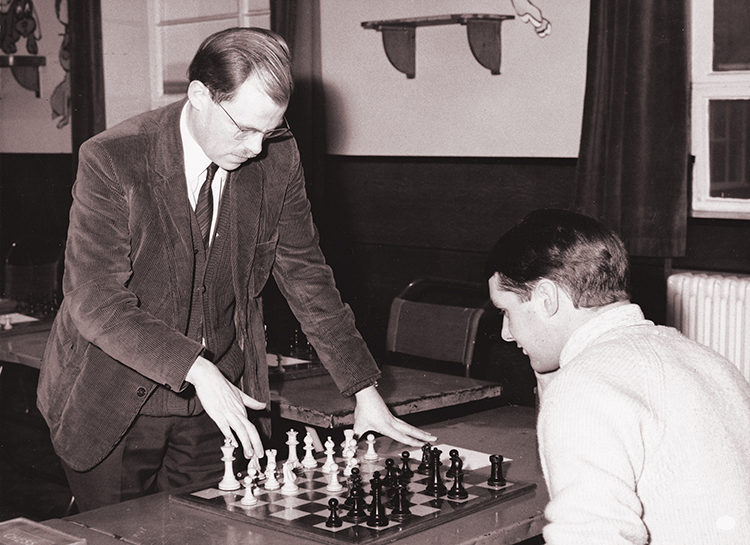
Bernard Cafferty, location, date and photographer unknownOn 14th December, 1968, Bernard gave a simultaneous exhibition held at Anglesey School, Burton. He played 17, won 16 and lost 1 to Trevor Bould who was already Burton Champion, photograph from http://www.derbyshirechess.btck.co.uk/History/Exhibitions, photographer unknown
Bernard was born in Blackburn, Lancashire (his mother’s maiden name was Croft) migrating to Birmingham and now resides in Hastings, East Sussex and is a member of Hastings & St. Leonards Chess Club.
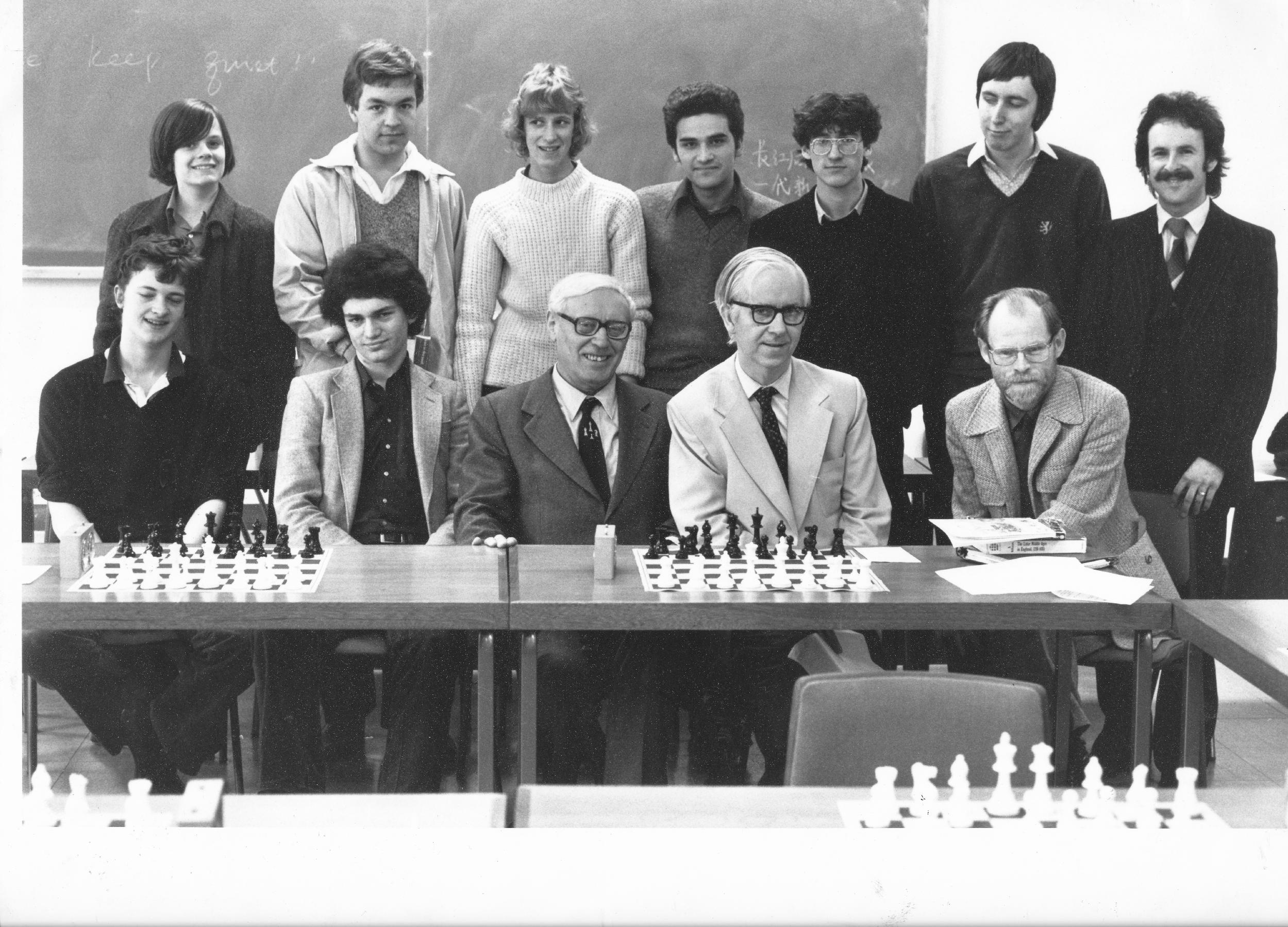
FM Bernard Cafferty (seated, rhs)
Sunnucks notes that he was British Junior Champion in 1952, British Correspondence Champion in 1959 and British Lighting Champion in 1966. He wrote a thesis on Chess in Schools for his University Education Diploma and is now a schoolmaster. His contribution to Anne’s Encyclopedia was on Education and Chess.
He was editor of British Chess Magazine from 1981 to 1991 and continued as Associate Editor until 2011 when FM Steve Giddins took over.
Bernard Cafferty, location, date and photographer unknown
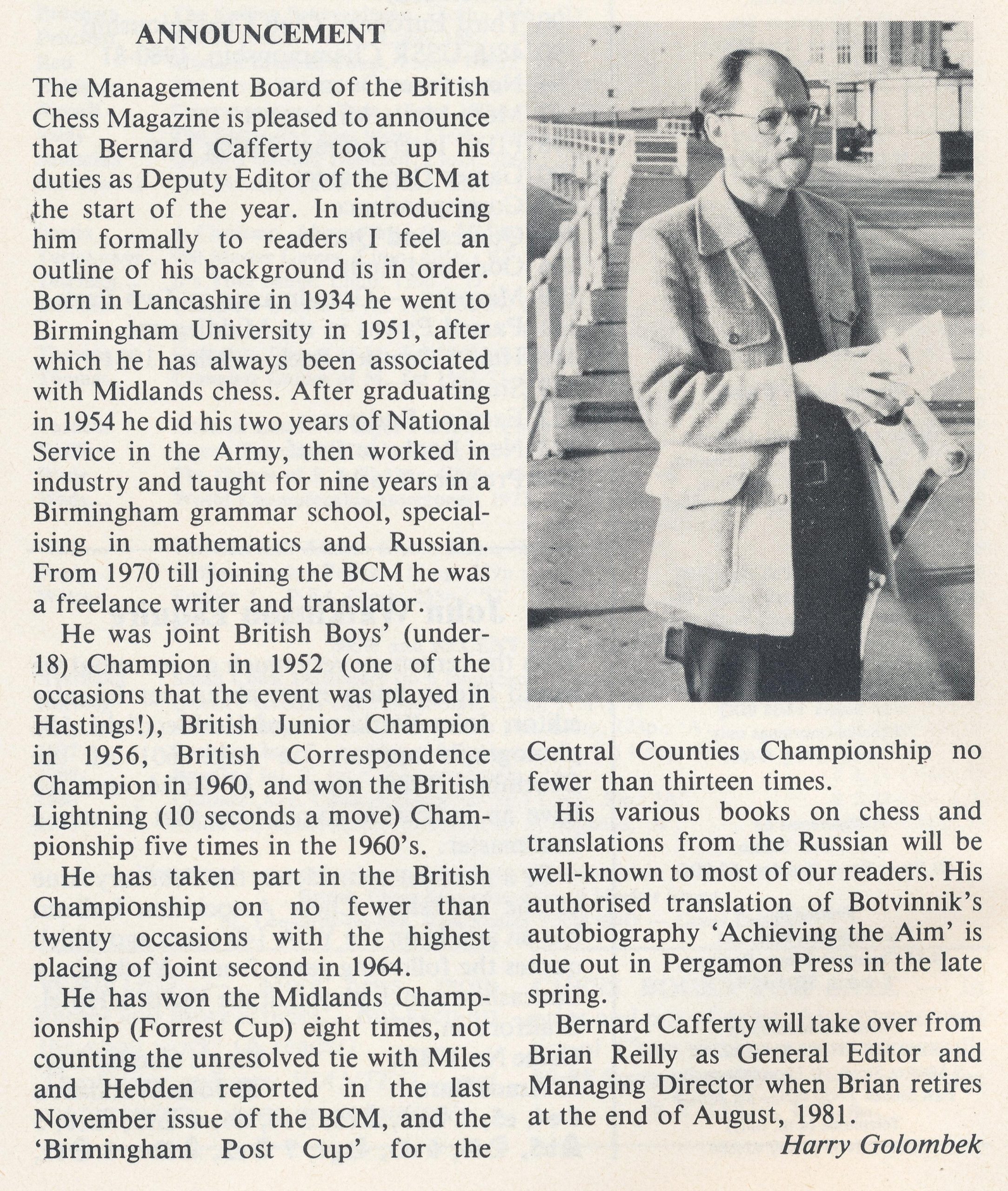
Here is the 1981 announcement (written by Harry Golombek, Chairman of Directors) of his appointment in the British Chess Magazine, Volume CI (101), Number 3, March, page 82 :
British Chess Magazine, Volume 101, Number 3, Page 82
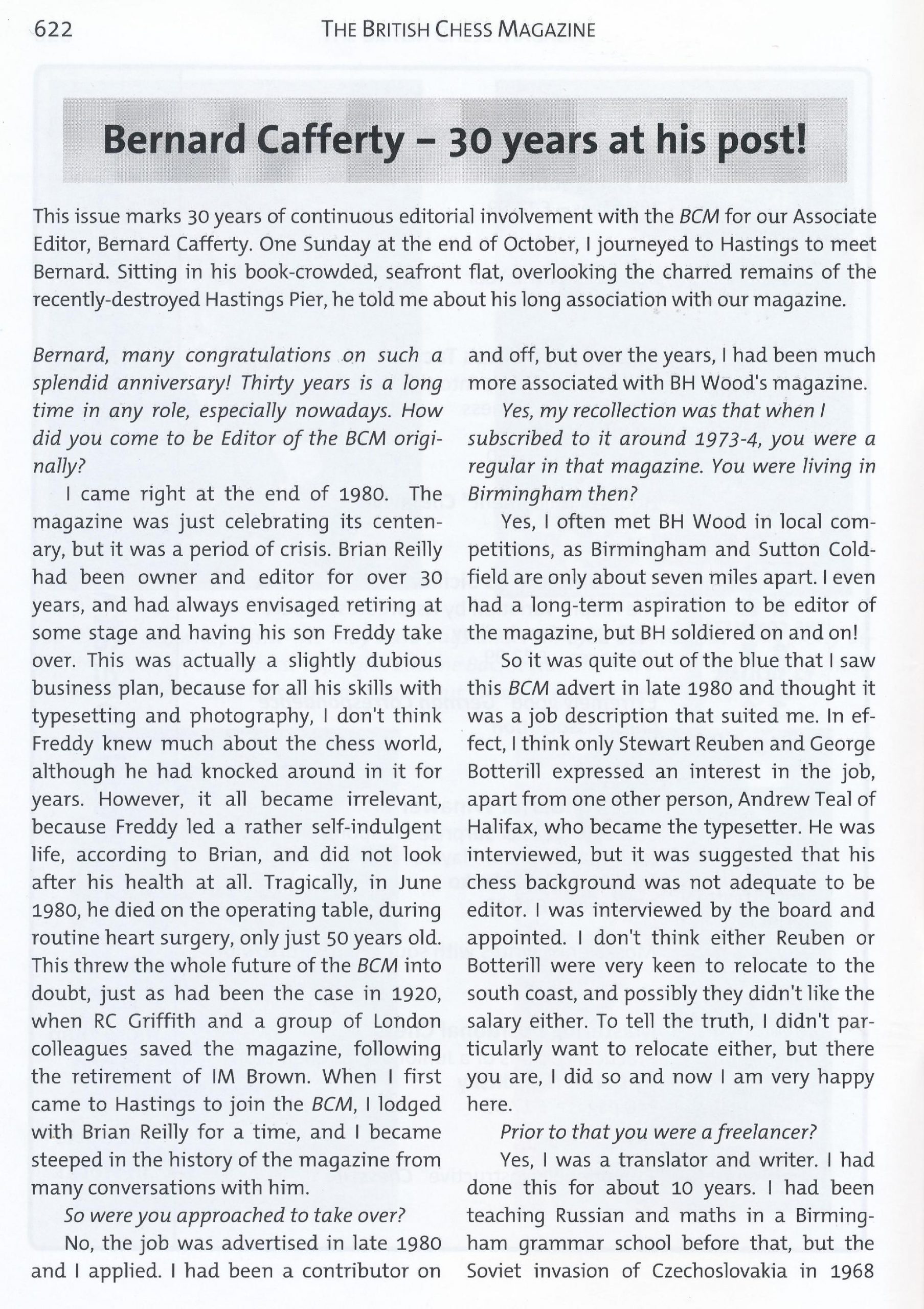
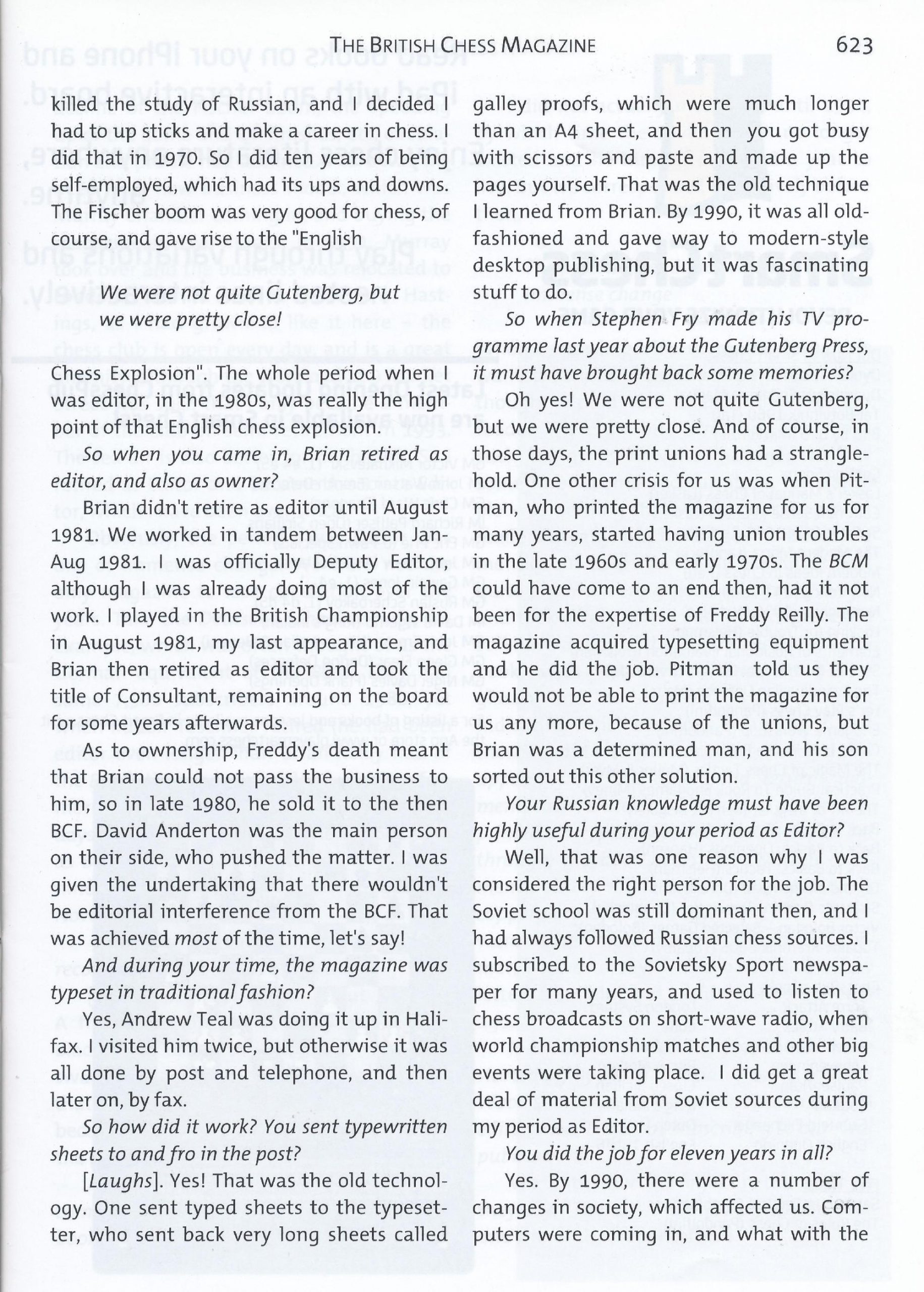
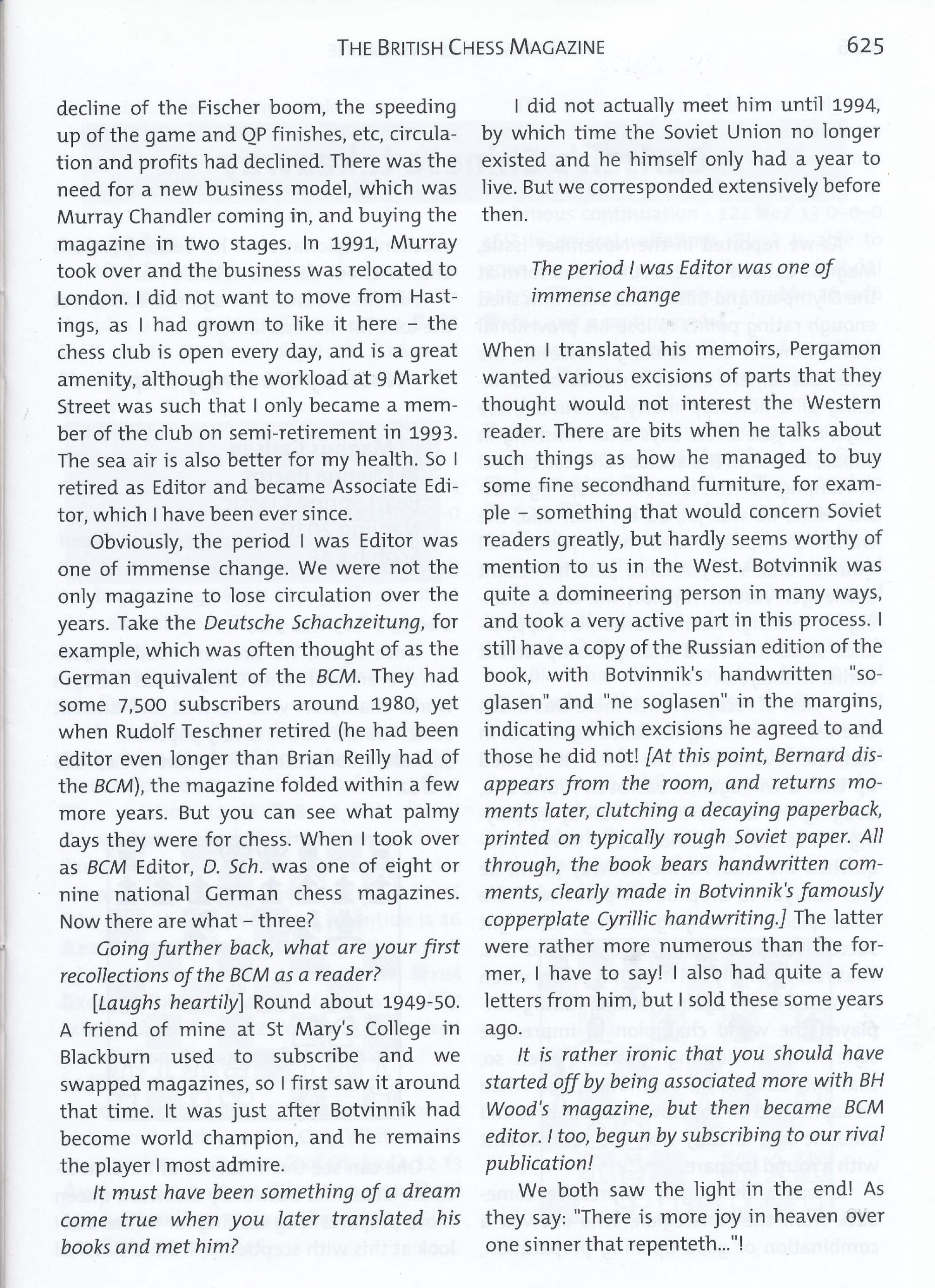
In the December 2010 issue (Volume CXXX (130), Number 12, pages 622 – 625 of British Chess Magazine there was a tribute to Bernard’s 30 years at BCM from editor FM Steve Giddins that was interview based :
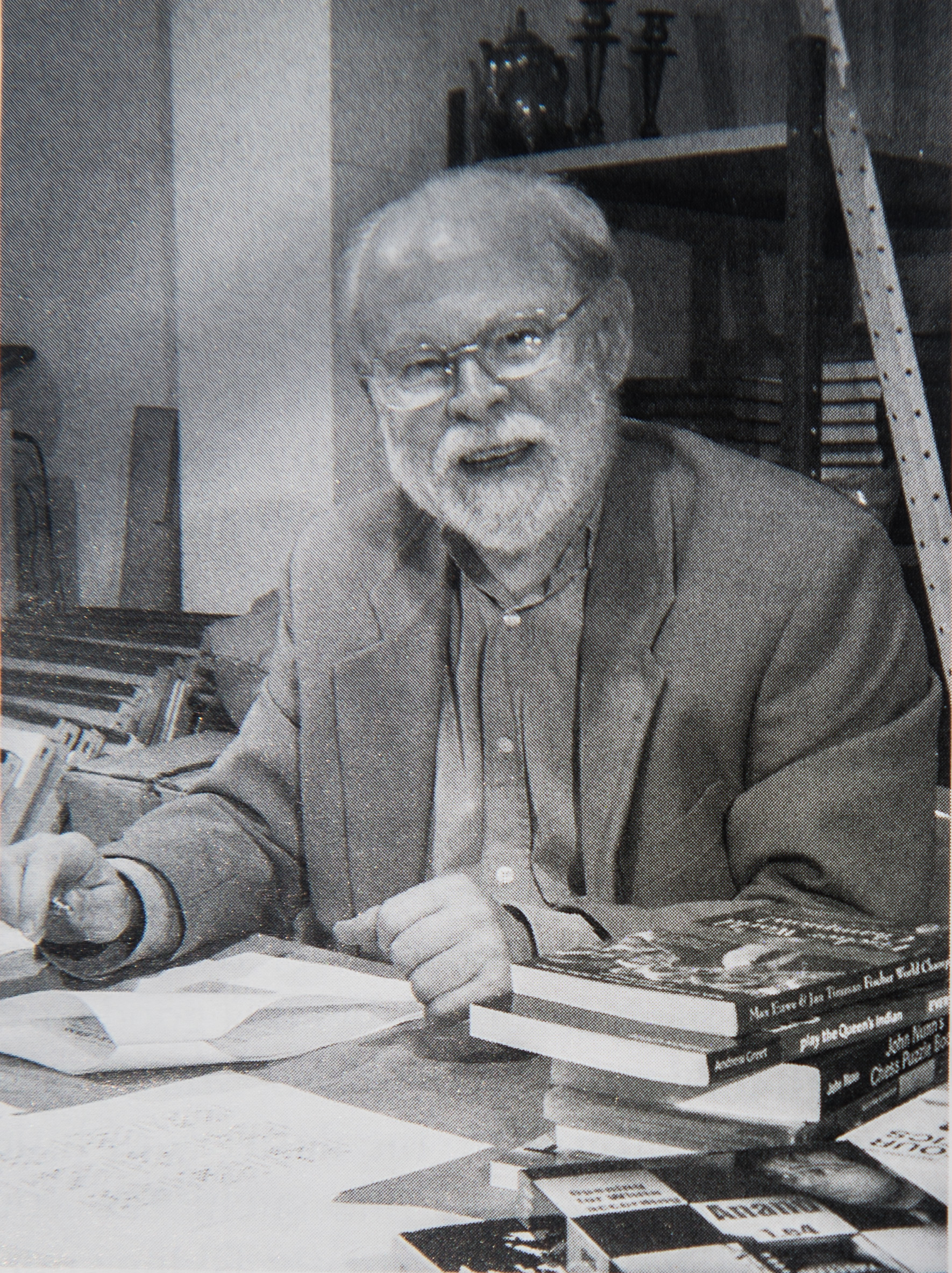
British Chess Magazine, Volume CXXX (103), Number 12, December, Page 622British Chess Magazine, Volume CXXX (103), Number 12, December, Page 623British Chess Magazine, Volume CXXX (103), Number 12, December, Page 625Associate Editor Bernard Cafferty,at work on the magazine in the BCM office, BCM, Volume 130, Number 8, p. 428
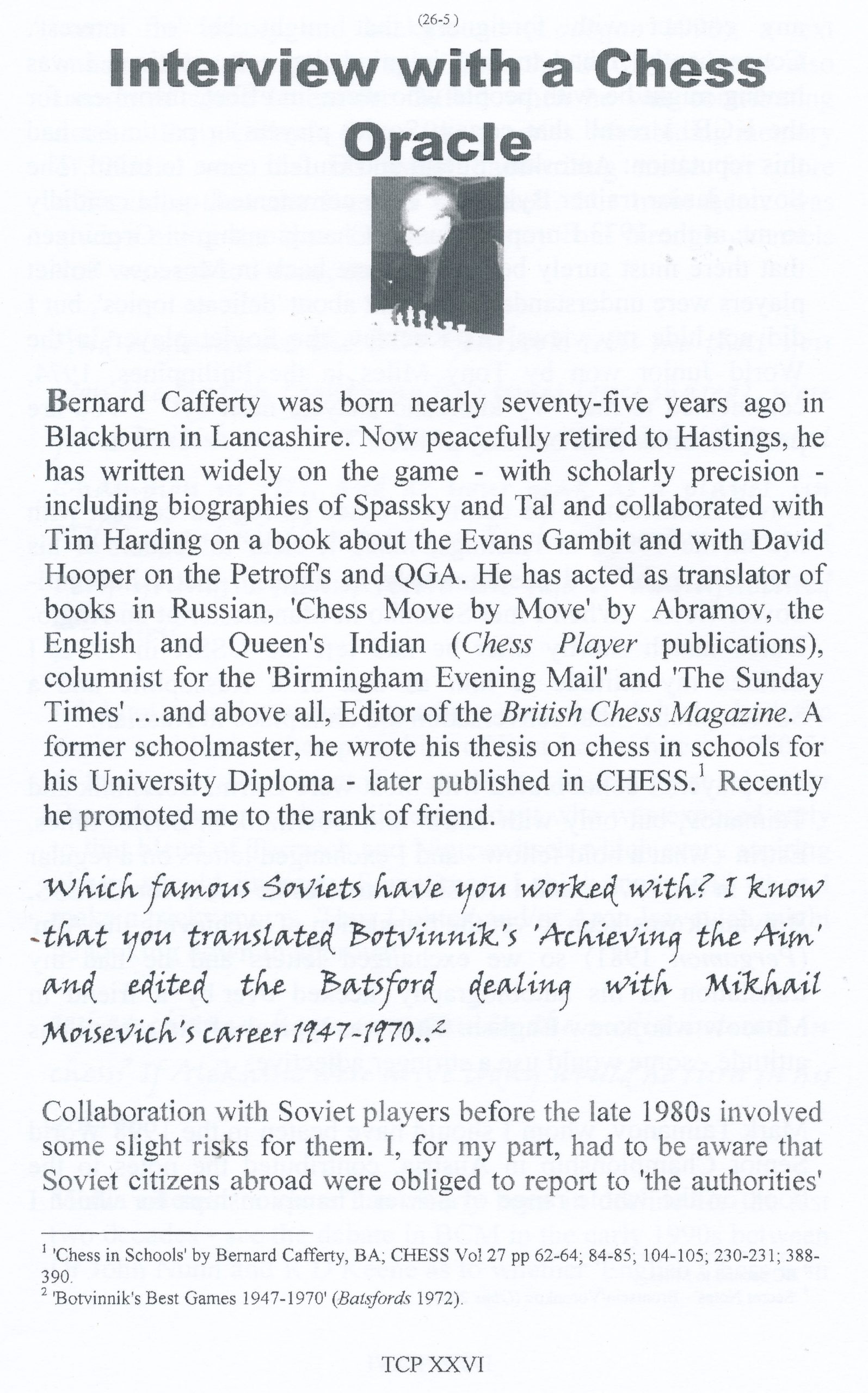
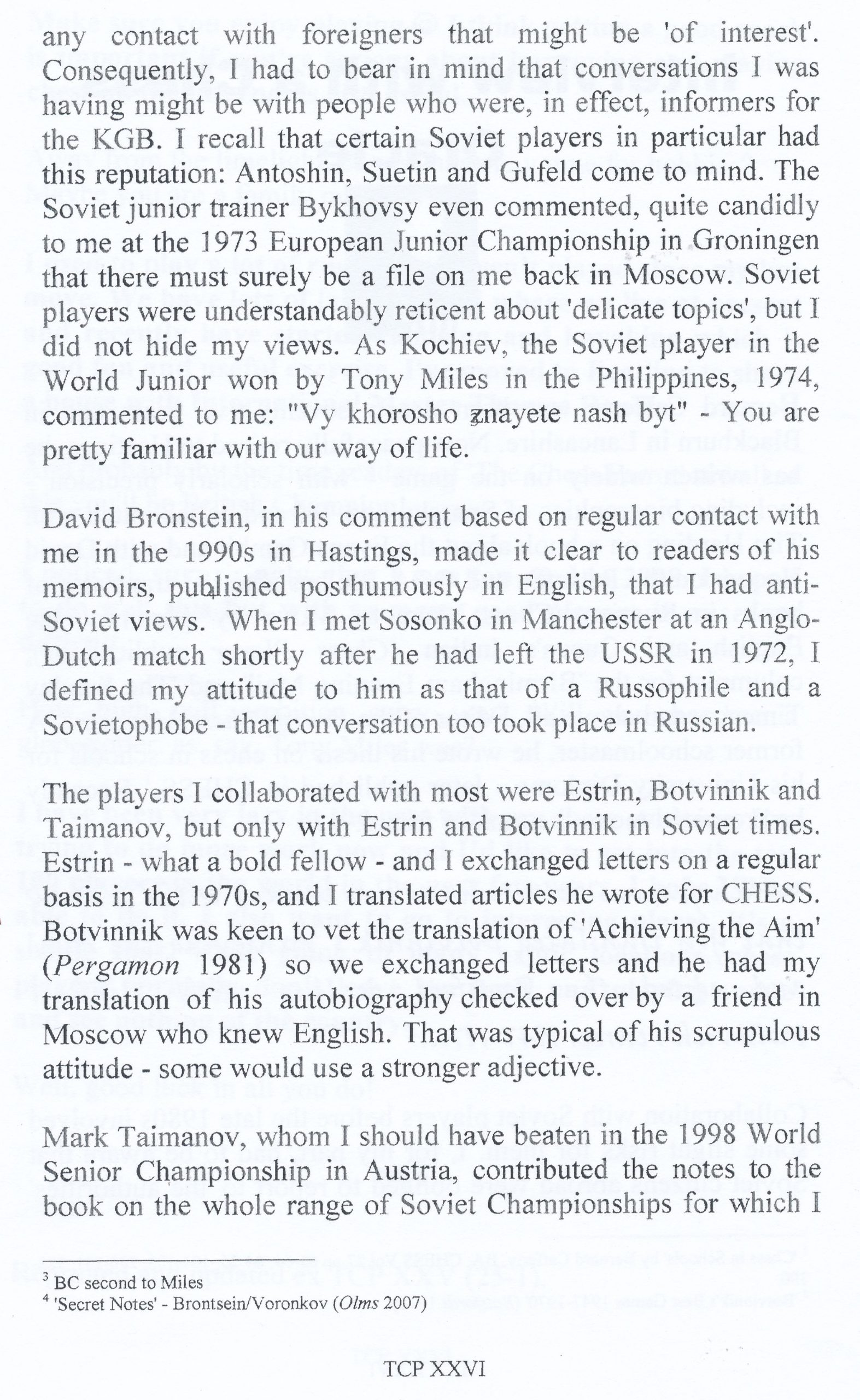
In 2009 Bernard was interviewed by the privately published Chess Parrot whose editor was / is Basingstoke based James Pratt (who became BCMs editor from 2011 – 2015). Here is that previously unseen interview :
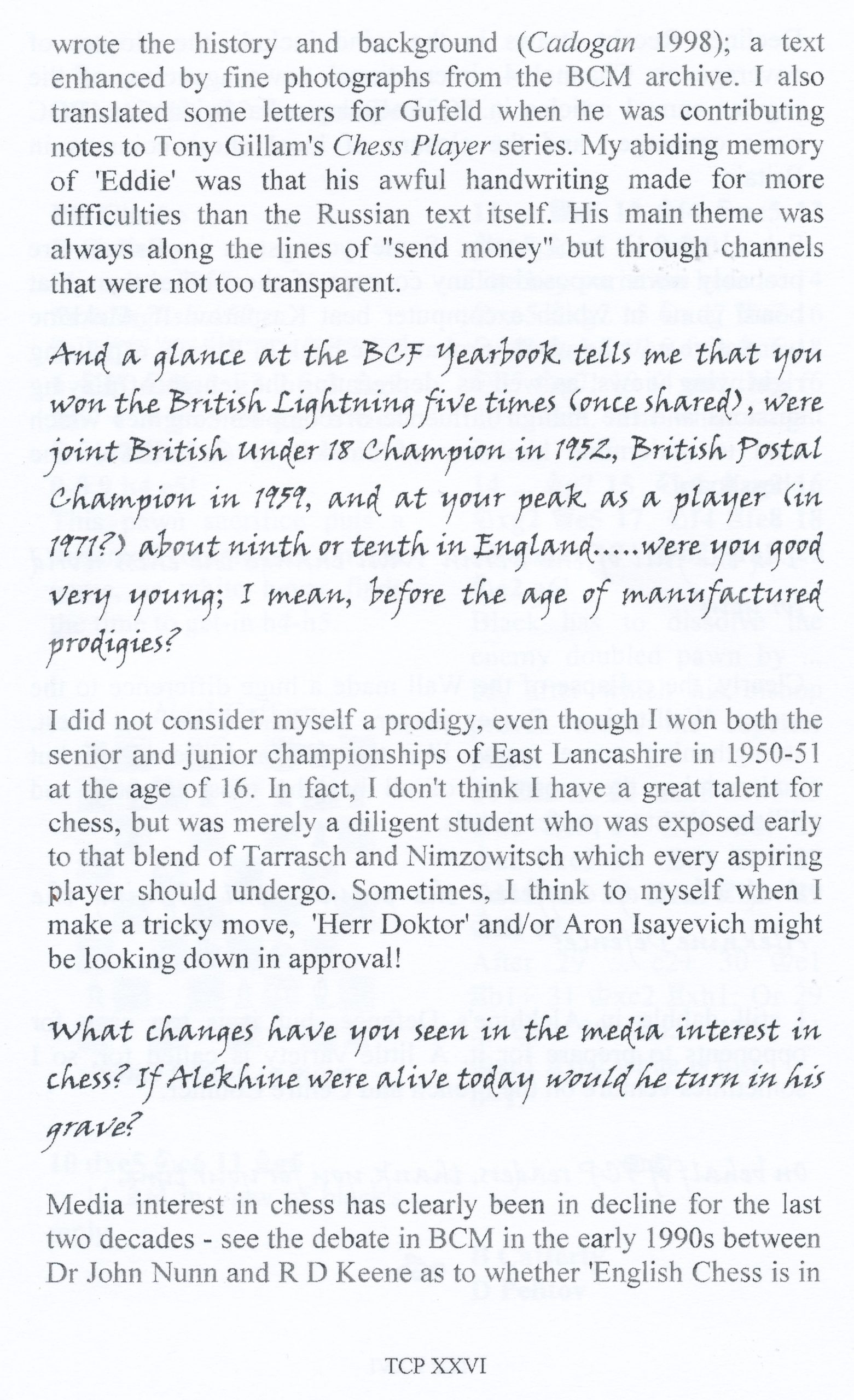
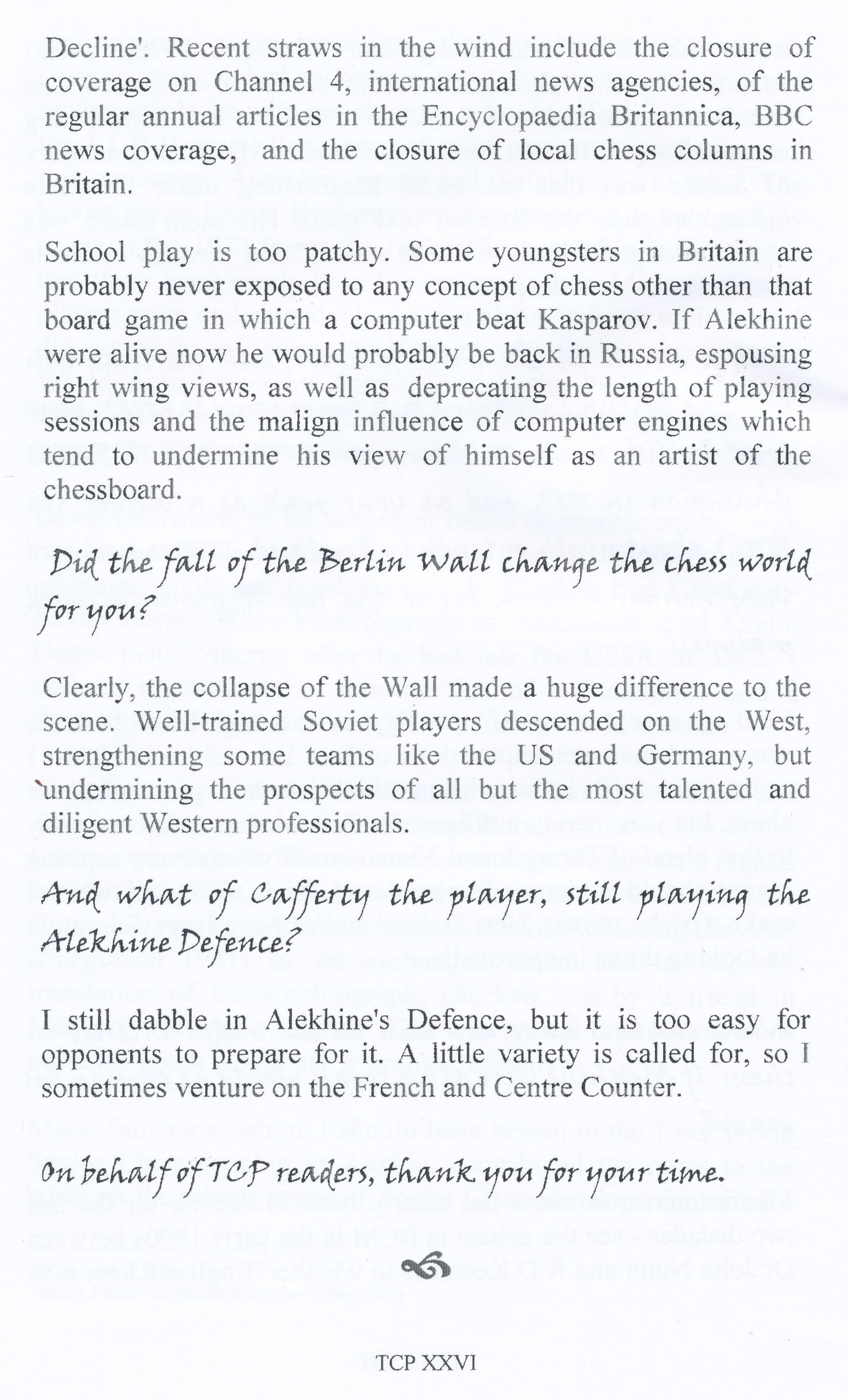
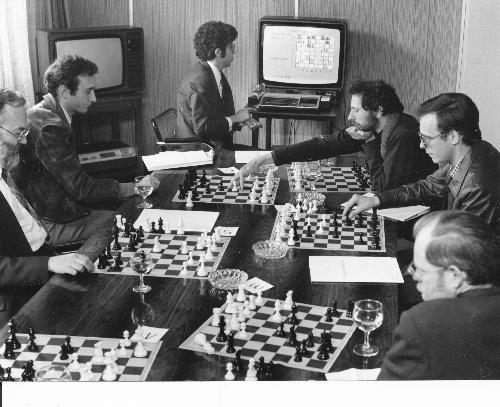
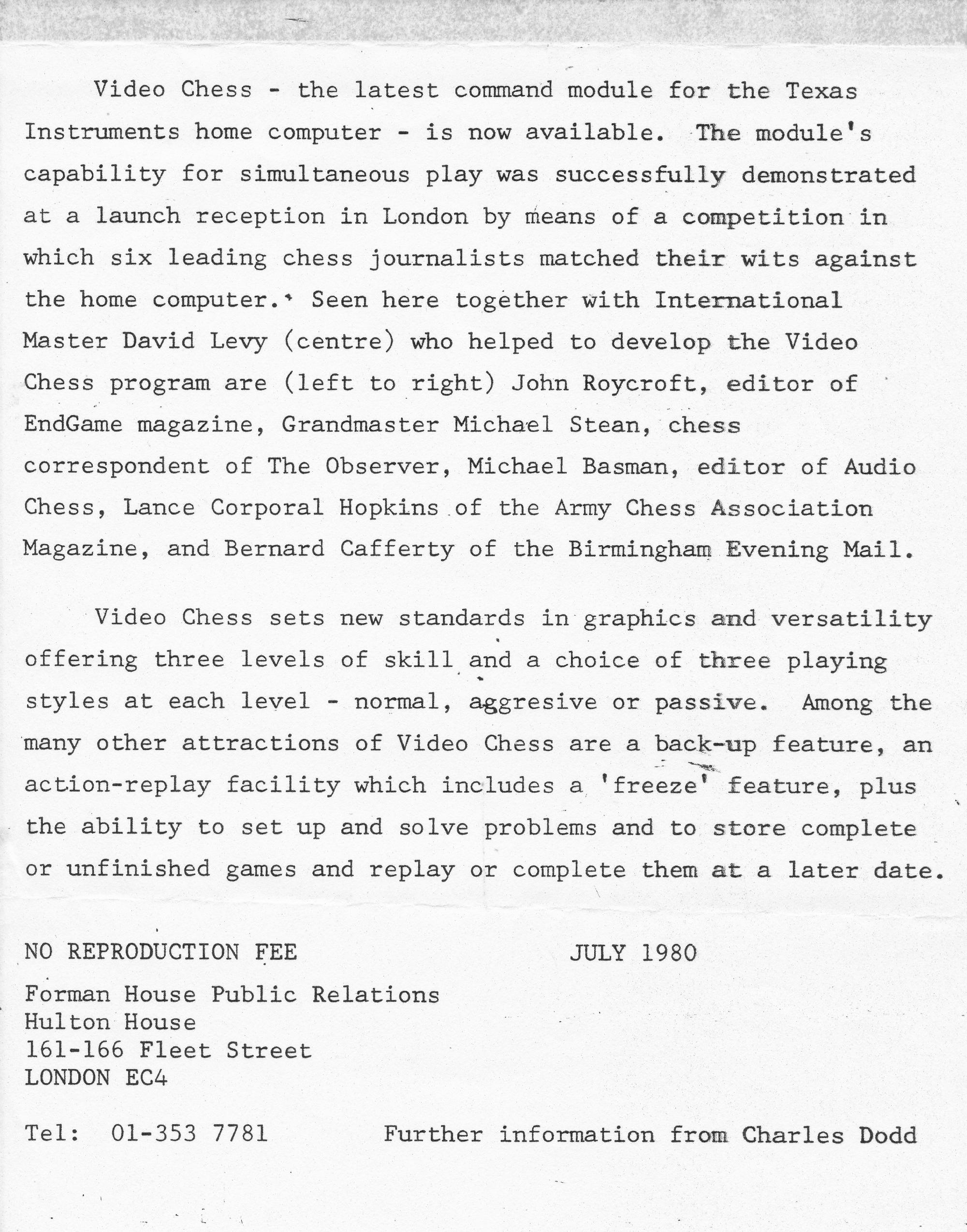
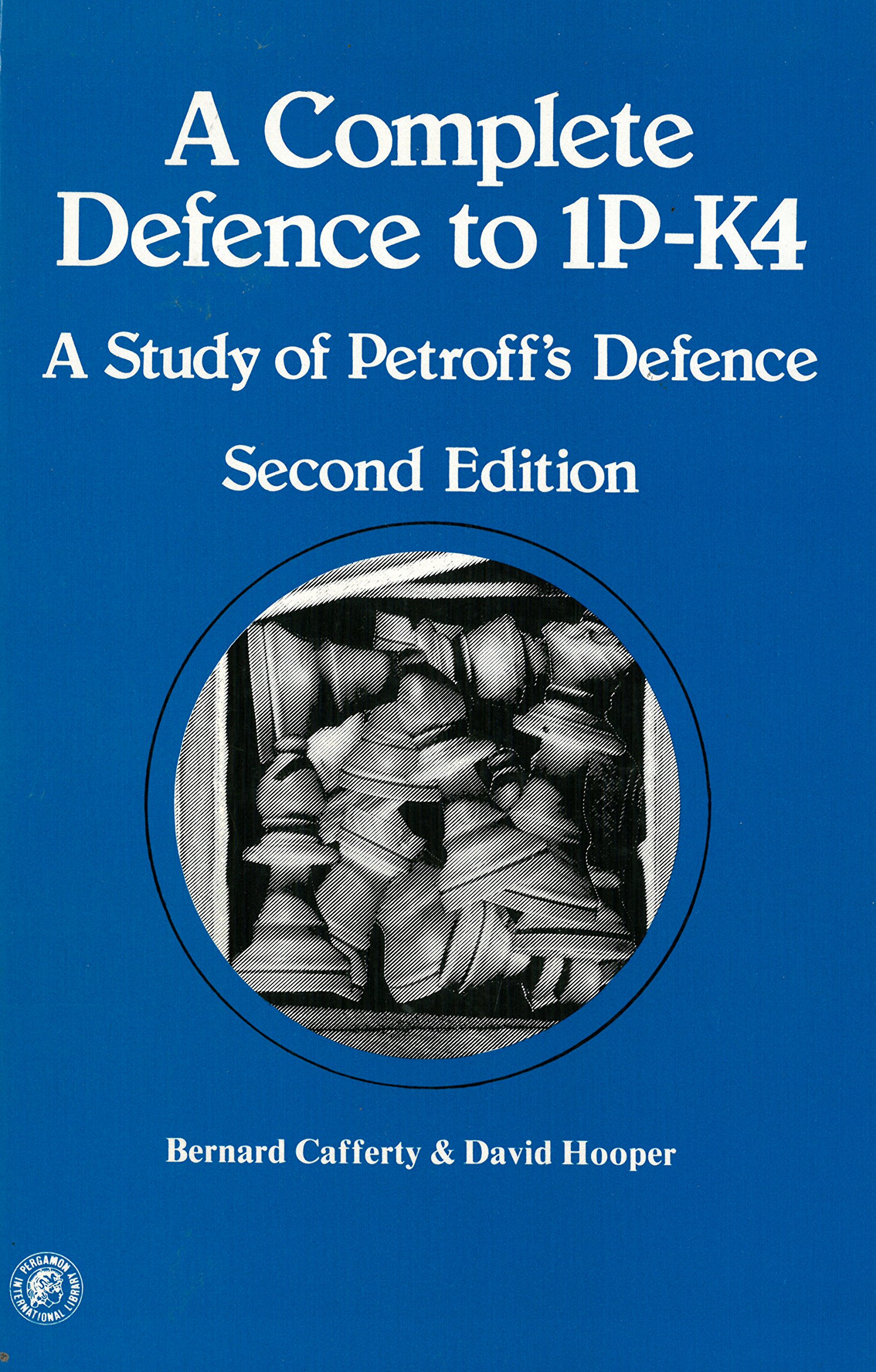
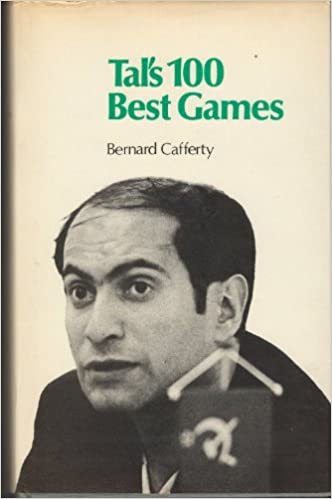
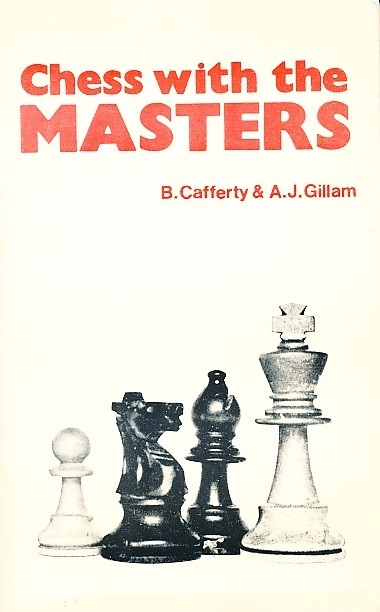
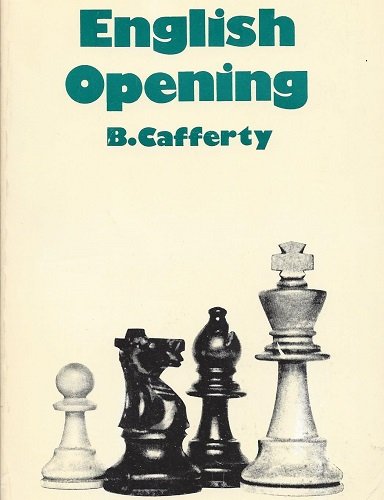
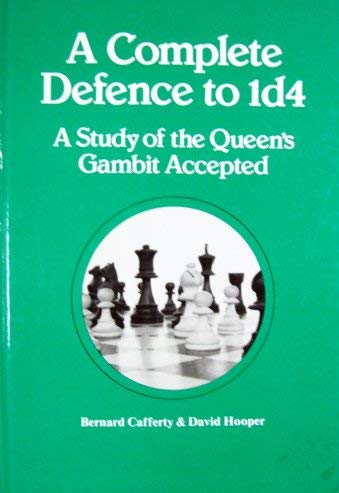
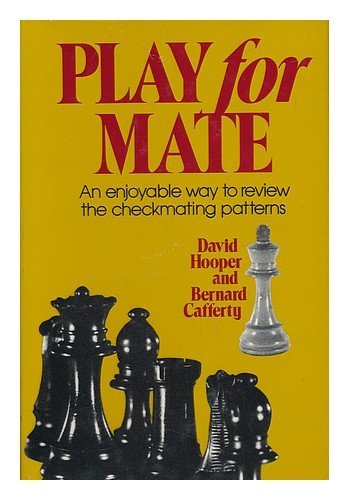
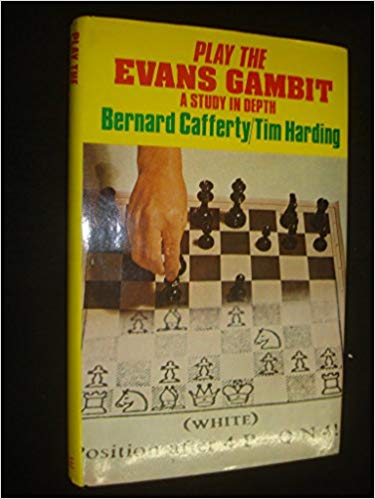
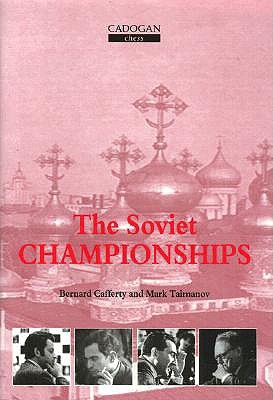
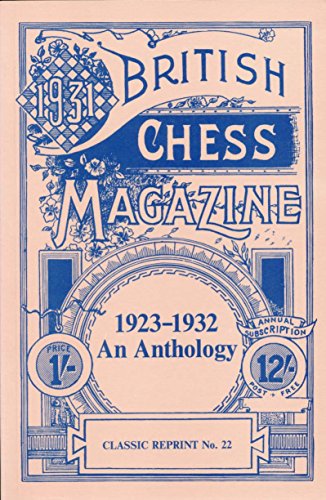
The Chess Parrot, XXVI, Winter/Spring 2009, page 26-5The Chess Parrot, XXVI, Winter/Spring 2009, page 26-5The Chess Parrot, XXVI, Winter/Spring 2009, page 26-5The Chess Parrot, XXVI, Winter/Spring 2009, page 26-5FM Bernard Cafferty at the 2014-15 Hastings Congress, courtesy of John Upham PhotographyVideo Chess Event (See caption below)Video Chess CaptionA Complete Defence to 1P-K4: A Study of Petroff’s Defence (2nd ed.), Pergammon Press, ISBN 0-08-024088-7, 1967Spassky’s 100 Best Games, Bernard Cafferty, BT Batsford, 1972, ISBN 0-7134-0362-4.Tal’s 100 Best Games. Batsford. ISBN 0-7134-2765-5.Chess with the Masters. Chess Player. ISBN 0-900928-95-6.English Opening, The Chess Player, 1977, ISBN 0-900928-92-1A Complete Defence to 1d4: A Study of the Queen’s Gambit Accepted, Pergammon Press, ISBN 0-08-024102-6Play for Mate (1990), DV Hooper and Bernard Cafferty, ISBN-13: 978-0713464740Play The Evans Gambit (co-author Tim Harding). Cadogan. ISBN 1-85744-119-2.The Soviet Chess Championships. Batsford. ISBN 1-85744-201-6.B.C.M. Classic Reprints, number 22: 1923 – 1932 An Anthology, Cafferty, Bernard, 1986. ISBN 978-0-900846-45-8.FM Bernard Cafferty (27-vi-1934)
We focus on the British Chess Scene Past & Present!
This website uses cookies to improve your experience. We'll assume you're ok with this, but you can opt-out if you wish. Cookie settingsACCEPT
Privacy & Cookies Policy
Privacy Overview
This website uses cookies to improve your experience while you navigate through the website. Out of these cookies, the cookies that are categorized as necessary are stored on your browser as they are as essential for the working of basic functionalities of the website. We also use third-party cookies that help us analyze and understand how you use this website. These cookies will be stored in your browser only with your consent. You also have the option to opt-out of these cookies. But opting out of some of these cookies may have an effect on your browsing experience.
Necessary cookies are absolutely essential for the website to function properly. This category only includes cookies that ensures basic functionalities and security features of the website. These cookies do not store any personal information.