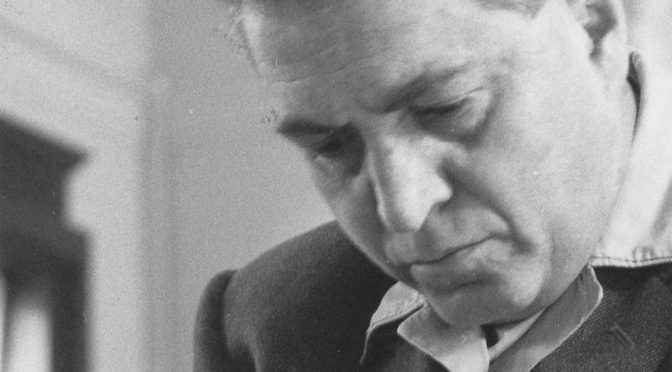
We remember FM Stephen H Berry who passed away, this day, January 4th 2019.
Stephen was born on Sunday, March 18th 1951.
He played for Wimbledon in the London League.
Here is his ECF rating record.
Obituary from Andrew Stone
 Save as PDF
WordPress database error: [Duplicate entry '' for key 'url_hash']ALTER TABLE `wpdrrx_blc_links` ADD UNIQUE KEY `url_hash` (`url_hash`)
We remember FM Stephen H Berry who passed away, this day, January 4th 2019.
Stephen was born on Sunday, March 18th 1951.
He played for Wimbledon in the London League.
Here is his ECF rating record.
Obituary from Andrew Stone
Save as PDF
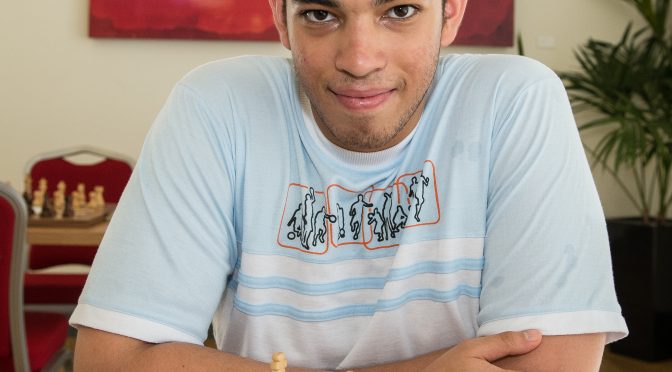
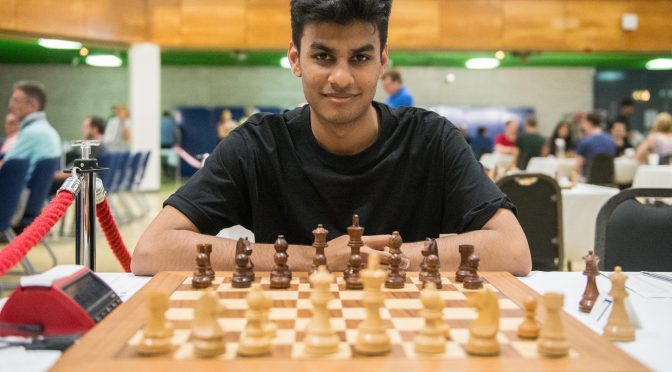
BCN sends birthday wishes to IM Shreyas (known as “Shrey” by his friends) Royal born on Friday, January 9th, 2009. “Hallelujah” by Alexandra Burke was number one in the UK hit parade.
Shreyas attended The Pointer School in Blackheath, London, SE3 whose motto is “The Lord is my Shepherd”. Currently Shreyas is home schooled.
In October 2021 BCN secured an interview with Shreyas via his father Jitendra and below is mostly from that interview:
BCN: What caused his initial interest in chess and at what age?
His initial interest in chess was capturing or as he used to call it ‘eating’ pieces but as he grew more mature, he loved that there were so many possibilities in chess, so much still left to explore! At the Age of 6 he learnt and got an interest in chess.
BCN: Has Shreyas had any chess teachers or coaches?
- Jyothi Lal N. with a peak of 2250 FIDE but is very knowledgeable and helped from just above beginner to 1800. He was Shreyas’s first coach.
- Meszaros Gyula (Julian) who was an IM with a peak of 2465 FIDE and was an endgame master which helped him from 1800-2100.
- His Current Coach is GM John Emms with a peak of around 2600 FIDE, he is an expert in many fields such as Positional Play, Openings, Strategic chess etc and has also made a big impact on how to prepare against opponents. He had helped him from 2100-2300 so far in just under a year!
BCN: Which chess clubs and/ or Teams does Shreyas represent?
He represents SV Erkenschwick from Germany and Wasa SK from Sweden for online events as he has joined them during the pandemic. He started his 4NCL career with KJCA Kings in January 2019 but now mainly represents Wood Green which he has played for in online events in and will also represent them in the upcoming 4NCL weekends.
His first appearance in Megabase 2022 comes from the 2015 British Under-8 Championship in Coventry, the eventual winner being Dhruv Radhakrishnan.
Progress from those early days has only been interrupted by school examination breaks and the Covid pandemic:
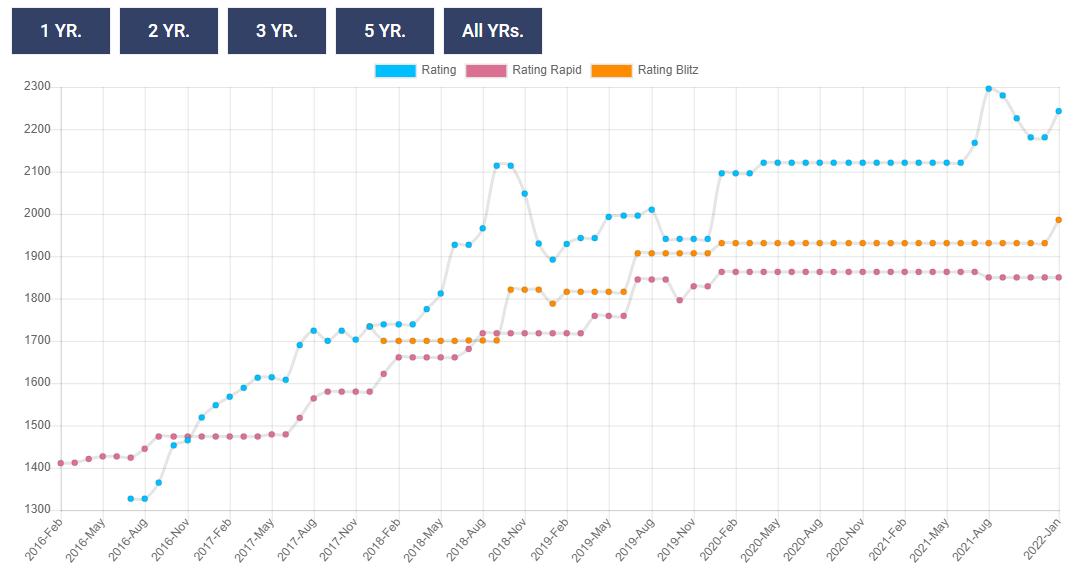
In August 2016 in Bournemouth Shreyas scored an impressive 6/6 to win the British Under-8 Championship.
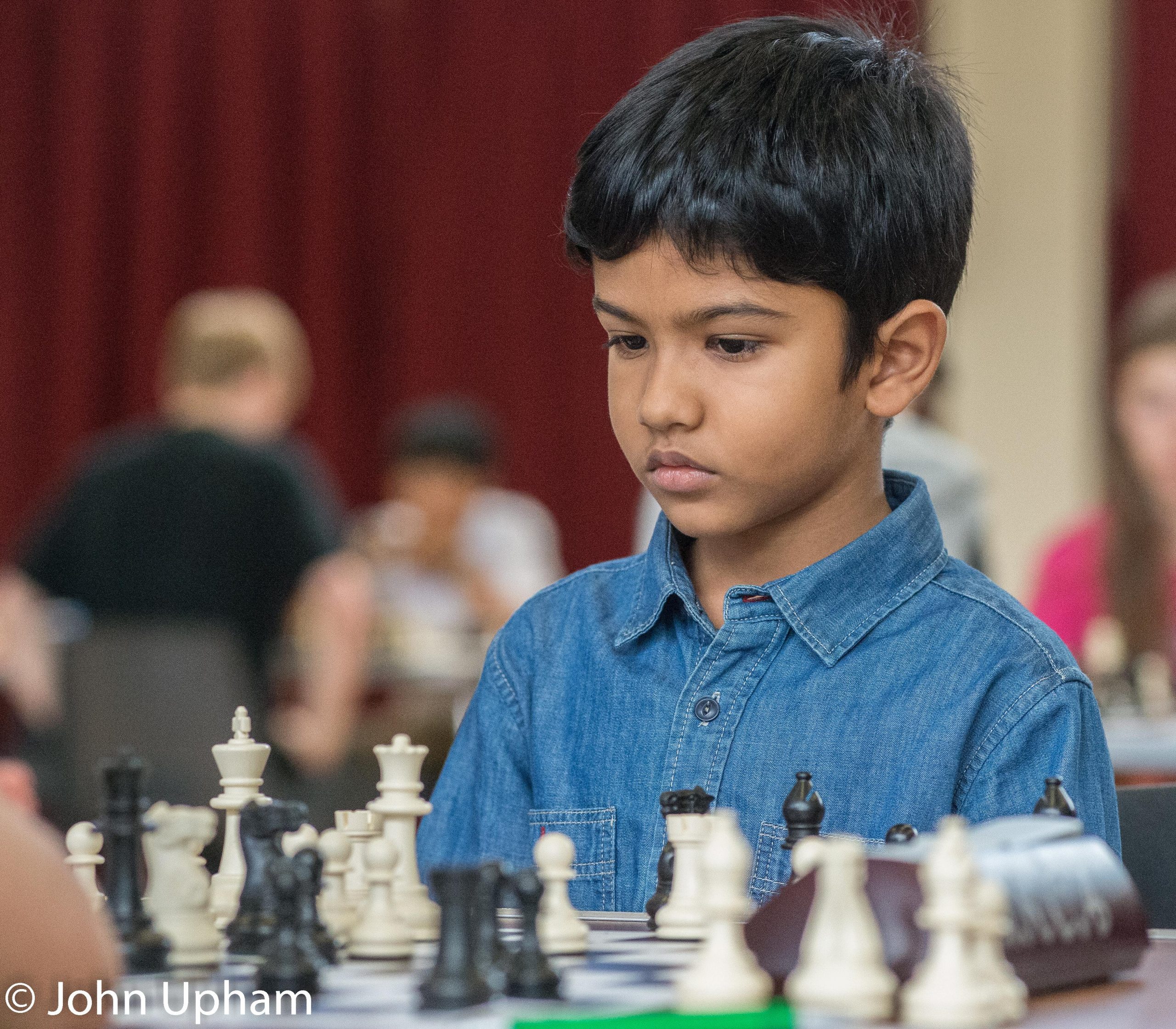
BCN: What was his first memorable tournament success?
This was the 2016 European Schools Under-7 championship where he was runner-up without any preparation or work on chess!
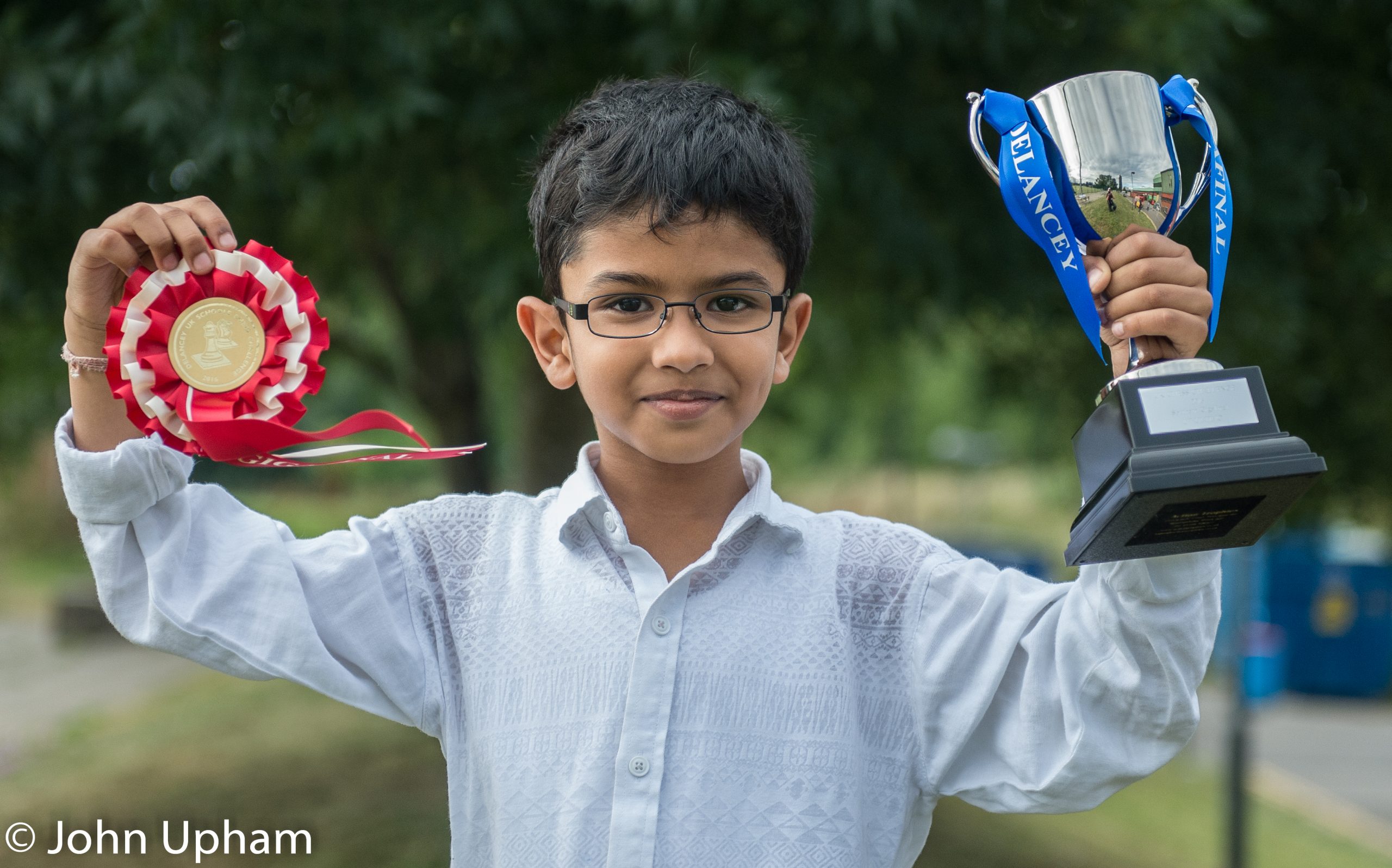
In September 2017 Shreyas travelled to Mamaia in Romania and after nine hard fought rounds tied for first place with 8/9 in the European Youth Chess Championship, Under-8 with Giang Tran Nam (HUN, 1561).
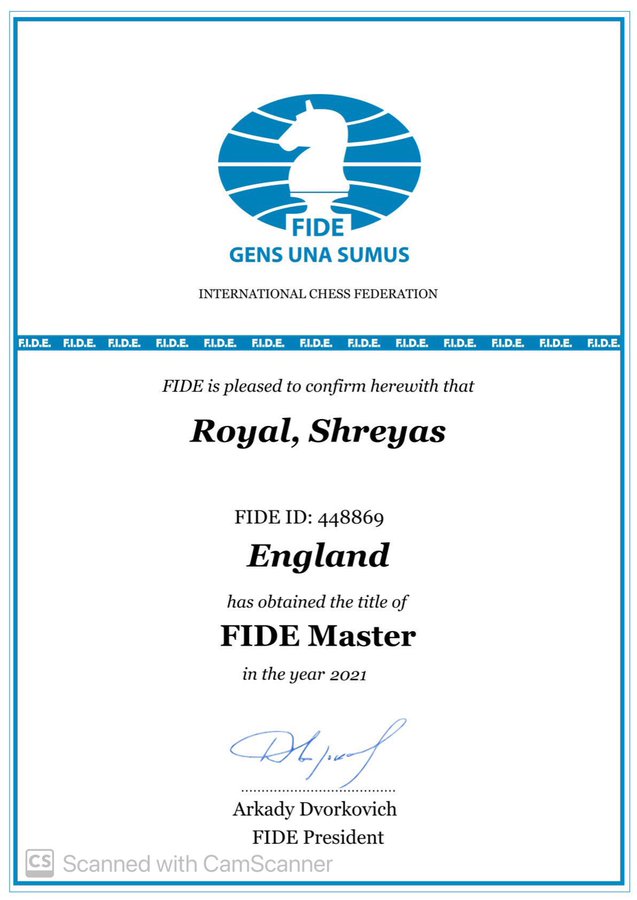
In 2021 Shreyas was awarded the FM title by FIDE:
BCN: Which chess players past & present are inspirational for him?
- Magnus Carlsen, world champion and broke many FIDE records also is an inspiration for most of this generation. He likes his slow grinding and almost winning from any opening or ending. This is his favourite player of all time.
- Garry Kasparov played brilliant attacking chess and calculated like a machine.
- Bobby Fischer played a similar style to Kasparov but was more talented than both Magnus and Kasparov in his opinion as he worked all by himself at a time in the USA when chess was not so popular while for the Russians, they had brilliant coaches and had one good player after the other. He rates him a bit lower because Fischer quit competitive chess a bit too early and could not reach the heights he was worthy of.
- Alireza Firouzja
- Fabiano Caruana
BCN: What are his favourite openings with the White pieces?
He plays 1.d4 pretty much all the time.
MegaBase 2020 has 294 games with 1.d4 and one solitary 1.g3 from March 2021. The 1.d4 games feature main line Queen’s Gambit / Catalan type positions championing 5.Nge2 against the King’s Indian Defence and the exchange variation against the Grunfeld.
BCN: and what are his preferred defences as the second player?
Really depends on what they play, against every opening he has got one or two lines which he enjoys equally.
Megabase 2022 informs us that Shreyas defends the main line Closed Variation of the Ruy Lopez and main line Giuoco Piano. Previously he essayed the Sicilian Najdorf.
BCN: Does he have any favourite chess books?
Not really as he is not such a big fan of chess books, but he likes My 60 Memorable Games by Bobby Fischer. Fundamental Chess Endings and Encyclopedia of Chess Combinations.
BCN: Which tournaments are planned for 2022?
We have pencilled in a couple of norm and Open (France, Spain, Germany etc.) tournaments in European countries.
BCN: What are his favourite subjects outside of chess?
His favourite subjects outside chess are Science, History, Maths with Science as his favourite, History as his second favourite and Maths as his third favourite.
BCN: Does Shreyas play any physical sports?
He does Football, Cricket and a bit of Lawn Tennis.
BCN: What are his plans and aspirations for the future?
To become a world chess champion one day, but it’s very expensive to even get to the level of IM! Currently we are looking for sponsors who can help support Shreyas to get there.
Here is his personal website.
In late December 2021 Camberley Chess Club had Shreyas as their weekly Zoom meeting guest speaker.
and finally three of SRs favourite games:
[pgn]
[Event “British Chess Championship Major Open”]
[Site “?”]
[Date “2018.08.05”]
[Round “9”]
[White “Royal, Shreyas”]
[Black “Jayawarna, Nugith”]
[Result “1-0”]
[ECO “E70”]
[WhiteElo “1927”]
[BlackElo “2013”]
[Annotator “Shreyas Royal”]
[PlyCount “57”]
[SourceTitle “Jitendra”]
{[%evp 0,57,19,17,14,-9,41,45,31,44,44,2,7,2,6,12,41,26,65,-13,27,39,44,41,87,
75,50,46,63,46,82,51,168,230,230,231,258,262,258,149,433,213,161,441,522,195,
500,527,501,169,1531,1211,1221,1268,1296,1314,1336,1370,1375,1397]} 1. d4 Nf6
2. c4 g6 3. Nc3 Bg7 4. e4 d6 5. Nge2 {This is the Kings Indian Defence Kramer
variation} O-O 6. Ng3 e5 7. d5 c6 {I think c6 is a side-line whereas the main
line goes} (7… Nbd7 8. Be2 a5 9. h4 h5 10. Bg5 Qe8 $1 $14 (10… Nc5 $2 {
remember not to fall into this trap} 11. Bxh5 $3 {An astonishing move} gxh5 12.
Nxh5 {With pressure and an initiative} Kh8 13. Qf3 Bg4 14. Qxf6 Bxh5 15. Qxd8
Raxd8 16. Bxd8 Rxd8 17. f3 f5 18. exf5 e4 19. g4 Bf7 20. g5 Bxc3+ 21. bxc3 Bh5
22. fxe4 Re8 23. Kd2 Nxe4+ 24. Kc2 Ng3 25. Rhe1 Be2 26. f6 Kh7 27. Rg1 Re3 28.
Rae1 Kg6 29. Kb2 Nh5 30. Rgf1 Bxf1 31. Rxe3 Bxc4 32. Re7 Bxd5 33. Rxc7 Bc6 34.
f7 Kg7 35. g6 Nf4 36. h5 Ne6 37. Rc8 Nf8 38. Rxf8 Kxf8 39. h6 {1-0 (39) Ward,C
(2423)-Storey,C (2245) Coventry 2015})) 8. Be2 a6 {[#]} ({Relevant:} 8… cxd5
9. cxd5 Nbd7 10. Be3 a5 11. O-O Nc5 12. f3 Bd7 13. Nh1 Qb8 14. a4 Rc8 15. Nf2
h5 16. Bb5 Kh7 17. Nd3 b6 18. Nxc5 bxc5 19. Qd2 Rc7 20. b3 Rb7 21. Bc4 Ng8 22.
Rab1 Qd8 23. f4 exf4 24. Bxf4 Qe7 25. e5 dxe5 26. d6 Qe8 27. Be3 f5 28. Bxc5
Nf6 29. Nd5 Nxd5 30. Bxd5 Bc6 31. Rfc1 Bxd5 32. Qxd5 Rab8 33. Rd1 Rd7 34. Ba3
e4 35. Rbc1 Qe5 36. Qxe5 Bxe5 37. Rc7 Rbd8 38. Rxd7+ {Bologan,V (2640)-Kozul,Z
(2613) Doha 2016 1-0}) 9. dxc6 $146 (9. O-O b5 10. Bg5 Bb7 11. Qd2 {might of
been better despite allowing b5}) ({Predecessor:} 9. O-O cxd5 10. cxd5 Nbd7 11.
Re1 b5 12. b4 Nb6 13. a4 bxa4 14. Nxa4 h5 15. Bg5 Rb8 16. Bxh5 Nbd7 17. Qd2
gxh5 18. Nxh5 Kh7 19. Ra3 Rh8 20. Rf3 a5 21. Nxg7 Kxg7 22. Bxf6+ Nxf6 23. Qg5+
Kf8 24. Rxf6 Rxb4 25. Nc3 Qc7 26. h4 Bh3 27. Re3 {1-0 (27) Bocharov,D (2610)
-Kokarev,D (2628) Vladivostok 2016}) 9… bxc6 $6 {maybe he might of been
intending d5} (9… Nxc6 {[%cal Gc6d4] I think is better}) 10. Bg5 h6 11. Be3
Qc7 12. Qd2 {[%cal Ge3h6]} h5 13. O-O Be6 14. Rad1 Rd8 15. f4 Ng4 $4 {the
losing blunder} (15… exf4 {is an improvement in my opinion} 16. Bxf4 Nbd7)
16. f5 $1 Nxe3 17. Qxe3 $18 Bc8 $4 (17… Qa7 18. c5) 18. fxg6 fxg6 19. Qg5 Kh7
$6 {[#]} 20. Bxh5 $3 (20. Nxh5 $1 {also wins} Bh6 (20… gxh5 21. Bxh5 Qa7+ 22.
c5 Qxc5+ 23. Kh1 Rd7 24. Qg6+ Kg8 25. Qe8+ Kh7 26. Bg6+ Kh6 27. Bf5) 21. Nf6+
Kg7 22. Qg3) 20… gxh5 21. Nxh5 Ra7 {[#]} 22. Rf6 $1 Qb6+ (22… Bxf6 23.
Nxf6+ Kh8 24. Qg8+) 23. Kh1 Re7 24. Rdf1 (24. Rg6 {is mate in six!} {as follows
} Kh8 25. Nf6 Qc7 26. Qh5+ Bh6 27. Rxh6+ Kg7 28. Qg6+ Kf8 29. Rh8#) 24… Qc7
25. Rh6+ Bxh6 26. Nf6+ Kh8 27. Qxh6+ Rh7 28. Nxh7 Qxh7 29. Qf6+ 1-0
[/pgn]
and from more recent times:
[pgn]
[Event “First Saturday IM July 2021”]
[Site “Budapest, Fortuna u. 4. St. G”]
[Date “2021.07.27”]
[Round “2.4”]
[White “Royal, Shreyas”]
[Black “Ilincic, Zlatko”]
[Result “1-0”]
[ECO “E11”]
[WhiteElo “2168”]
[BlackElo “2395”]
[Annotator “Shreyas Royal”]
[PlyCount “95”]
[EventDate “2021.??.??”]
[SourceVersionDate “2018.06.03”]
{[%evp 0,95,19,31,14,-14,-11,0,31,34,64,65,61,30,46,45,45,42,73,34,54,28,18,26,
45,50,48,40,39,41,36,26,37,39,58,43,39,16,19,17,22,9,17,9,22,-9,29,24,41,23,
119,119,130,126,212,208,256,229,200,221,222,222,222,222,224,139,167,157,206,
205,206,207,206,240,237,204,253,282,295,284,299,286,317,313,323,334,380,403,
438,451,483,493,488,524,545,511,520,556]} 1. d4 {this is my first win against
a grandmaster in OTB chess and is a brilliant positional game} Nf6 2. c4 e6 3.
Nf3 Bb4+ 4. Bd2 c5 5. Bxb4 cxb4 6. a3 {this was part of my preparation, I had
played him 2 times before with g3 and a delayed a3 but with no success, he
would always prepare a different line against it so this time I needed to get
him out of his comfort zone} bxa3 7. Rxa3 O-O 8. Nc3 d6 9. e3 ({Relevant:} 9.
e4 Nc6 10. Be2 b6 11. O-O Bb7 12. d5 Nb4 13. Nd4 e5 14. Nf5 g6 15. Nh6+ Kg7 16.
Qd2 Qe7 17. Qg5 Bc8 18. h4 Nc2 19. Ra2 Nd4 20. Bd3 Qd8 21. f4 Nd7 22. Nf5+ Nxf5
23. exf5 Nc5 24. Bb1 Qxg5 25. hxg5 gxf5 26. fxe5 dxe5 27. Bxf5 a5 28. Bc2 Bd7
29. Raa1 Rac8 30. Rae1 Rfe8 31. Re3 e4 32. Bxe4 Re5 33. Ref3 Nxe4 34. Rxf7+ Kg6
35. Nxe4 Rxe4 36. Rxd7 Rcxc4 37. Rd6+ Kxg5 38. Rxb6 Re2 {Banikas,H (2599)
-Cordova,E (2592) Chess.com INT 2020 1/2-1/2 (61)}) 9… b6 (9… Nc6 10. Be2
e5 11. O-O Bg4 {is the the most popular and probably one of the best ways to
play against it}) 10. Be2 Bb7 11. O-O a6 {this structure was not the greatest
way to deal with this} 12. b4 $1 {I had seen some structures similar like
this, when preparing and realized we needed to make use of our queenside
majority} Nbd7 13. Qb1 {[#] I was just asking myself, where do I want my
pieces? It can really help improve your chess if you care about pieces and
always want to improve them, the arrows showed what I wanted my setup to be
like} Qc7 $146 ({Predecessor:} 13… Qb8 14. Rd1 Rc8 15. e4 a5 16. Rb3 axb4 17.
Rxb4 Ra3 18. Rc1 Ra5 19. d5 e5 20. Nd2 Ra8 21. Na4 Qc7 22. Nxb6 Nxb6 23. Rxb6
Rcb8 24. Rc2 Nd7 25. Rb4 Bc8 26. Rcb2 Rxb4 27. Rxb4 g6 28. Nb3 Kg7 29. Bg4 Nc5
30. Bxc8 Nxb3 31. Rxb3 Qxc8 32. Rc3 Ra4 33. Qf1 Qc5 34. Rc1 Ra2 35. g3 h5 36.
Qe1 Rb2 37. h4 Ra2 38. Kf1 Kf6 39. Rc3 Kg7 40. Qe3 Qxe3 41. fxe3 Kf6 42. c5
dxc5 43. Rxc5 {Parligras,M (2601)-Anton,T (2412) Calimanesti Caciulata 2017 1/
2-1/2}) 14. Rc1 Rfc8 15. Nd2 Qb8 {[#]} 16. f3 $1 {Not only is it important to
improve your pieces but it is also important to make your opponent’s pieces
unhappy. I just blunt is potentially dangerous bishop especially when he gets
his queen to a8 it also stops some nasty Be4 or ne4 when my knight gets to b3}
Rc7 (16… d5) 17. b5 a5 18. Na4 Qf8 19. Rac3 Rac8 20. Nb3 e5 {if he just sits
there and waits I just play R3c2 (to stop Nd5 when c5 happens) and c5} 21. Qb2
$1 {this is a fantastic move because it brings my queen back to the king with
Qd2 and stops some potential Qe3+, it also protects my e2 bishop. When the
queen is far away from the king it can be dangerous} Qe7 22. Qd2 g6 23. R3c2 h5
24. c5 $1 {and finally, after a lot of manoeuvring I get my c5 break in} exd4
$2 (24… dxc5) 25. c6 $18 dxe3 26. Qd1 Nc5 27. Nxb6 Rd8 28. cxb7 Rxb7 29. Nd5
$1 Nxd5 30. Qxd5 Nxb3 31. Qxb3 d5 32. Rc8 d4 33. Qd3 Qd7 34. R8c6 Rdb8 $2 (
34… Kg7) 35. Qc2 (35. R1c5) 35… Kg7 36. Qc5 Rd8 37. Qe5+ Kg8 38. Bc4 Qf5
39. Qxf5 gxf5 40. Bd3 $18 {[#]} f4 41. Kf1 Kg7 42. R1c5 a4 43. Ra6 Re8 44. Ke2
h4 45. Rxa4 h3 46. gxh3 Rh8 47. Rxd4 Rxh3 48. Rxf4 {Probably my best game of
all time} 1-0
[/pgn]
and finally:
[pgn]
[Event “Vezerkepzo IM Aug 2021”]
[Site “Budapest, Fortuna u. 4. St. G”]
[Date “2021.08.23”]
[Round “3.3”]
[White “Royal, Shreyas”]
[Black “Rohit, S.”]
[Result “1-0”]
[ECO “E01”]
[WhiteElo “2296”]
[BlackElo “2268”]
[Annotator “Shreyas Royal”]
[PlyCount “53”]
[EventDate “2021.08.21”]
[EventRounds “10”]
[EventCountry “HUN”]
[SourceTitle “Jitendra”]
[SourceDate “2018.06.03”]
[SourceVersionDate “2018.06.03”]
{[%evp 0,53,19,9,42,-10,-16,0,-3,-37,13,6,29,25,20,13,57,36,38,38,52,58,58,72,
72,14,61,23,54,62,58,58,66,52,45,54,78,25,117,123,110,110,146,37,30,44,51,49,
55,13,217,159,236,245,1807,839]} 1. d4 Nf6 2. c4 e6 3. Nf3 d5 4. g3 Bb4+ 5. Bd2
({Relevant:} 5. Nbd2 O-O 6. Bg2 b6 7. O-O Bb7 8. Ne5 a5 9. Qc2 a4 10. Rd1 Bd6
11. cxd5 exd5 12. Ndc4 h6 13. Bf4 Re8 14. Rac1 Na6 15. a3 Bf8 16. Ne3 c5 17.
Nf5 cxd4 18. Nc6 Qd7 19. Bh3 Kh8 20. Ne5 Rxe5 21. Bxe5 Ne4 22. Bxd4 Rc8 23. Qd3
Nac5 24. Qe3 Kh7 25. Bxc5 Nxc5 26. Qf3 d4 27. Rxd4 Qe8 28. Qe3 Qc6 29. f3 Re8
30. Qf2 g6 31. Ne3 Qf6 32. Ng4 Qg7 33. Rcd1 h5 34. Ne3 Nb3 {Dubov,D (2702)
-Carlsen,M (2862) chess24.com INT 2020 1-0}) 5… Bd6 6. Nc3 $5 {This was all
part of my preparation as last time I got some equal Stonewall against him,
this line avoids the stonewall and is tricky to play against as black. Black
needs to very accurate to still get a slightly worse position} O-O (6… c6 $6
7. Qc2 $16 {[%cal Ge2e4,Ge1c1] and now we open the centre and try to
long-castle}) 7. Bg5 c6 8. Bg2 Nbd7 (8… h6 9. Bxf6 Qxf6 10. O-O Qd8 11. c5
Bc7 12. e4 {[%cal Gb2b4] is the main line if he knew I was going to play this,
Nc3 is not so common but effective. Even here we are better because of our
space, centre and better pieces. Our idea now is to do some minority attack})
9. e4 $1 dxe4 10. Nxe4 {[#]} Bc7 $146 {this was not the right square to move
the bishop to, the best move was Bb4+ but even if he did not see that I would
expect Be7 as the pin became very nasty} (10… Bb4+ 11. Nc3 {and once we
fully develop our better pieces and space will give us an advantage}) ({
Predecessor:} 10… Bb4+ 11. Nc3 h6 12. Bf4 Ne4 13. Qc2 Nxc3 14. bxc3 Be7 15.
O-O b6 16. Rfe1 Bb7 17. Rad1 Re8 18. h4 Qc8 19. Bh3 Nf8 20. Ne5 Bd6 21. Qd2 Qc7
22. Bg2 {1/2-1/2 (22) Cordova,E (2571)-Nyzhnyk,I (2665) Saint Louis 2019}) 11.
O-O h6 12. Bh4 $1 Qe7 ({No need to be scared of} 12… g5 $2 13. Nfxg5 $1 hxg5
14. Bxg5 {[%cal Gd1f3,Ga1d1,Gd4d5,Gf1e1] and the pin will be nasty, along with
an exposed king}) 13. Re1 {[%cal Ge1e7] put the rook in line in with the queen
is a normally a good idea} Qb4 $2 {he collapses, but on the other there was
not much better to do because of the pin and I may get some d5 in later} 14.
Nxf6+ Nxf6 15. Bxf6 gxf6 16. Qc1 $1 Kg7 17. c5 $1 {this was a really nice move
because normally when the queen is away from the king the king is in MASSIVE
danger and just before I get along with my attack, I cut of her communications
with the king} Bd8 18. Qf4 Qa5 19. Qg4+ Kh7 20. Qh5 Qc7 21. g4 Kg7 {[#]} 22.
Re3 $1 {I have a lot time and can just slowly improve my pieces, another good
principle is when attacking try to bring in as much pieces as possible} Qd7 23.
Rd1 $1 Bc7 24. Rdd3 $1 b6 $2 {[#] this was not so stupid because he can’t just
sit and wait but on the other hand he could of just turned his prophylactic
brain on… I am now preparing a killer blow} (24… Rh8 {was better}) 25. g5
$3 {I had prepared this move from when I played Rd1} hxg5 (25… fxg5 26. Nxg5
Bf4 27. Rg3 $1) 26. Nxg5 Re8 (26… Rh8 {he thought this would work but…} 27.
Nxe6+ $1 Qxe6 (27… fxe6 28. Rg3+ Bxg3 29. Rxg3+ Kf8 30. Qxh8+ Ke7 31. Rg7#)
28. Rg3+ Bxg3 29. Rxg3+ Kf8 (29… Qg4 30. Rxg4+ Bxg4 31. Qxg4+ Kf8 32. Bxc6)
30. Qxh8+ Ke7 31. Re3) 27. Bxc6 $1 1-0
[/pgn]
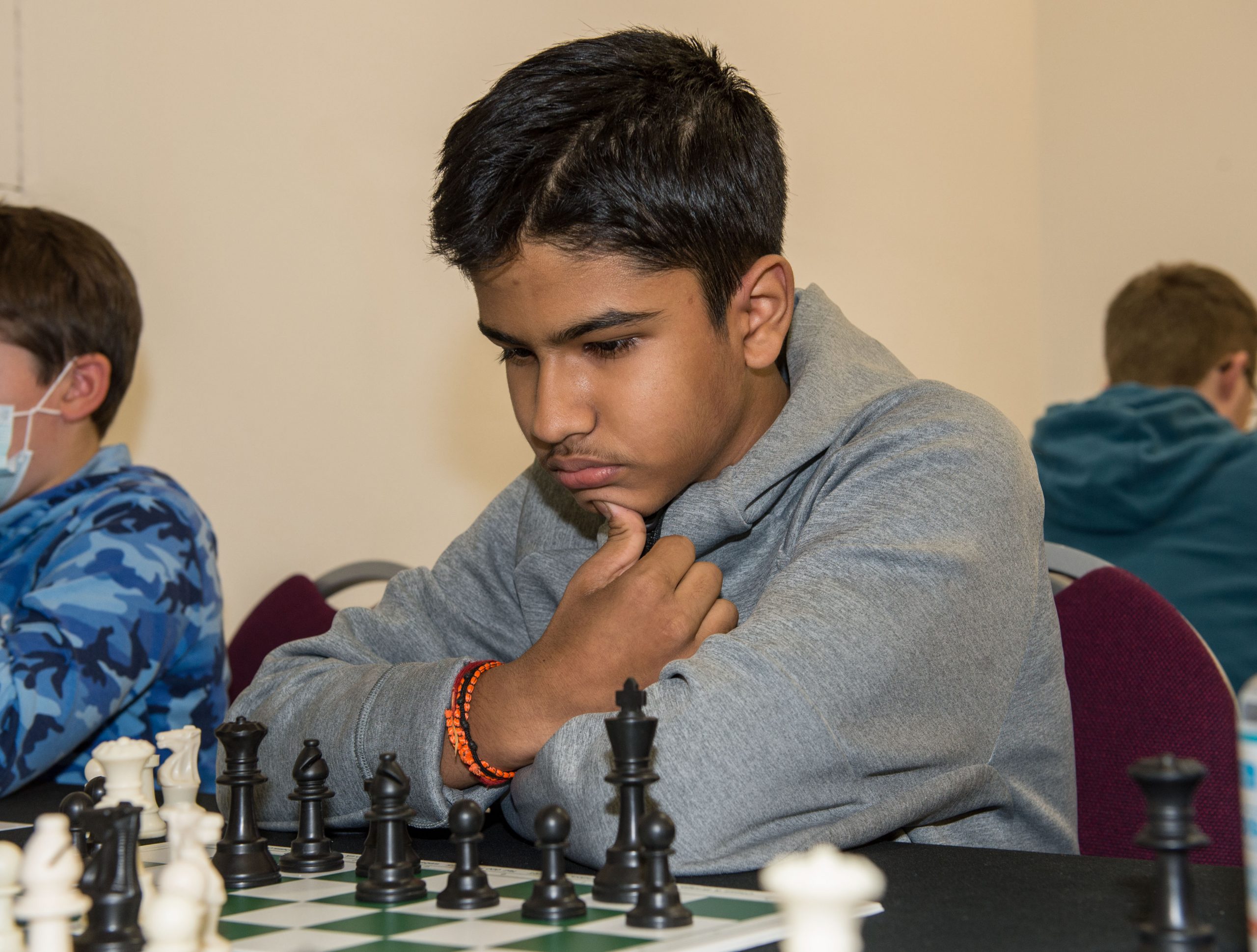
From September 9-14, 2022, Shreyas achieved his first IM norm at the Mindsports GM Tournament in London and earned his second norm, along with a joint 3rd, at the Hit-A-Open Tournament in Slovenia between September 16-22, 2022
At the 4th FIDE Congress of 2022 Shreyas was awarded the IM title and his FIDE standard play rating stands at 2456.
Most recently he has achieved his first GM norm.
Further background here from Leonard Barden.
Save as PDFBCN wishes Happy Birthday to GM Daniel Fernandez who at 26 is currently England’s youngest Grandmaster. The previous GM title holder was Jonathan Hawkins in 2014 making two in seven years.
Daniel Howard Fernandez was born in Stockport, Manchester on Sunday, March 5th 1995. “Think Twice” by Celine Dion was top of the UK hit parade.
Daniel started playing chess at the age of seven (after his father taught him the rules) and at this time attended King’s School, Harpenden. His first chess club was Little Heath which became the ECF Small Club of the Year in 2015. They play in the Potter’s Bar area and include IM John Pigott in their membership.
At Little Heath Chess Club Daniel was coached by Mark Uniacke (who worked extensively on the early chess engine HIARCS).
Daniel went up to Queen’s College, Cambridge to read mathematics and left to become a Data Analyst at Mu Sigma Inc. He can speak several languages (including Serbian!) and works as a translator when opportunities arise.
He currently lives in Australia offering coaching and writing chess books (for Thinkers Publishing) and columns for Chessbase. In his spare time (!) Daniel is studying for The Master of Complex Systems degree at The University of Sydney.
Daniel’s first ECF graded game was rapidplay on July 5th 2003 in the SCCU Junior Under-14 Final.
His first standard play game was in August 2003 at the Edinburgh based British Under-8 Championship.

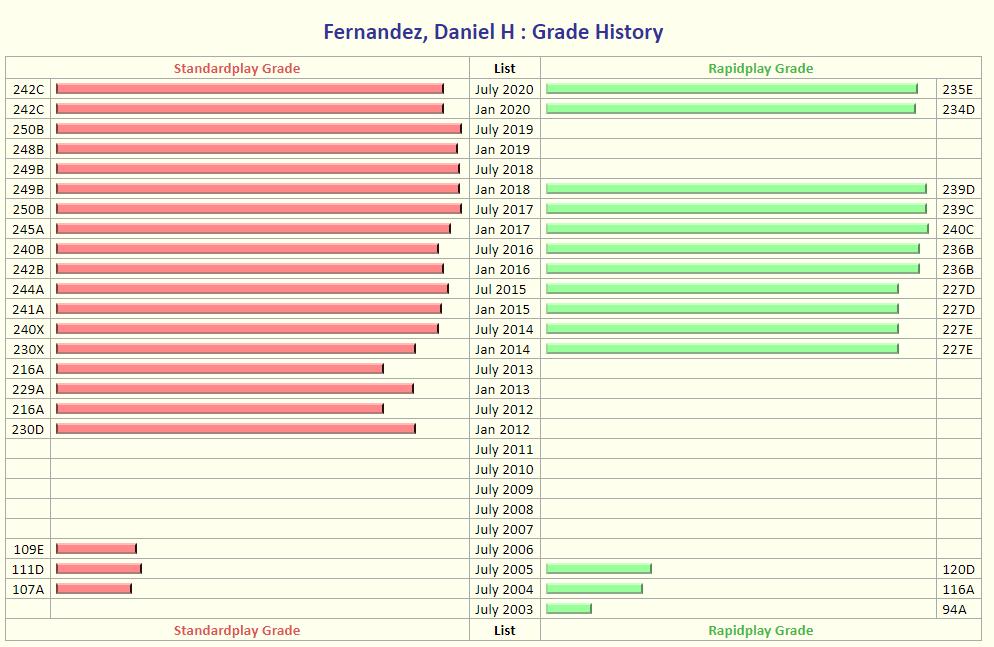
Daniels ECF grading profile demonstrated rapid improvement :
On August 13th 2004 in Scarborough Daniel became British Under-9 Champion sharing the title with Daniel Hunt & Saravanan Sathyanandha.
The Fernandez family relocated to Singapore in August, Daniel attending the Anglo-Chinese School in Singapore. He was swiftly recruited into the Singapore Chess Federation’s (SCF) National Junior Squad. Also in that squad were Danielle Ho and Howard Chiu (remember this for later!).
Barely three weeks after his Scarborough triumph on September 4th 2004 Daniel played his first FIDE rated game in the 5th Asian Under-10 Championship organised by the ASEAN Chess Confederation. His performance in this event was rewarded with a FIDE Master title in 2005. Because he was no longer active in English events the ECF had the unusual scenario of having a ten year old FIDE Master with a published grade of ~120!
In typically modest fashion Daniel confesses that he did not “deserve” the FM title at this time and that it was the consequence of the strong position of the ASEAN and SCF organisations within world chess. At the same event Wesley So gained his FM title in the Under-12 section.
Another interesting consequence of the relocation was that when Daniel returned to England in 2012 his last published grading went from ~ 120 to ~230!
One of the motivations of returning to England was to obtain the necessary entrance requirement to study mathematics at Cambridge. This he did by studying for A-levels at Manchester Grammar School.
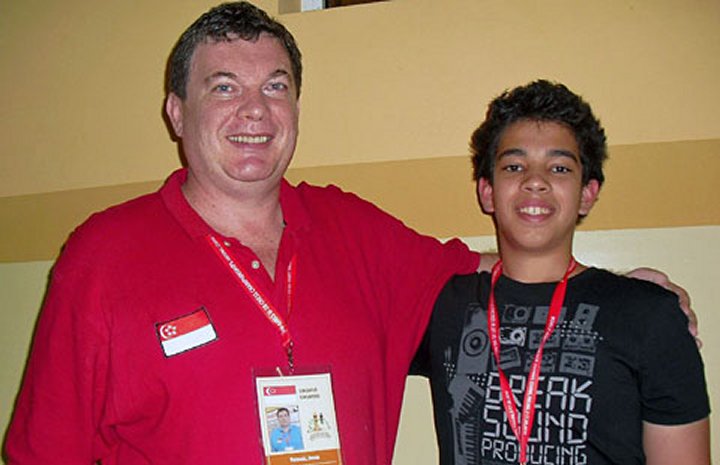
Consequently Daniel’s FIDE rating profile also showed a fast pace of development:
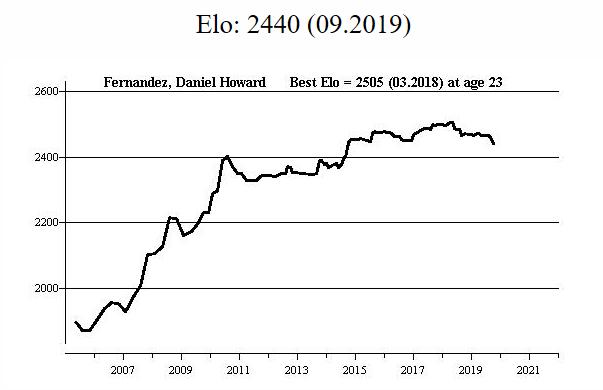
Sydney 2009 and Sydney 2010 both provided IM norms with the third one coming from Kuala Lumpar 2010 and with these Daniel became an International Master in 2010 the title being confirmed at the 3rd quarter Presidential Board Meeting 2010, 24-25 July 2010, Tromso in Norway.
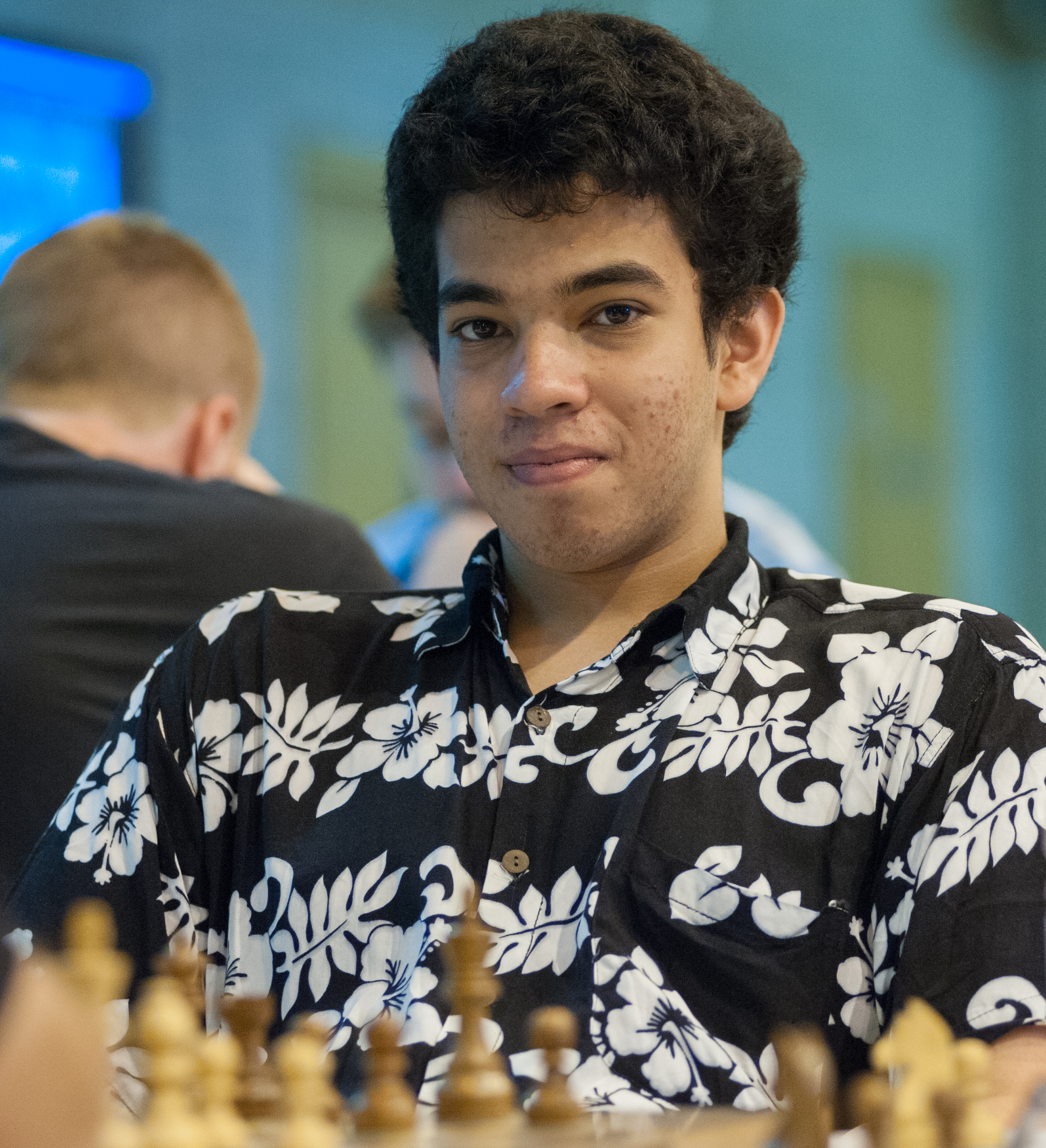
He won the Budapest Sarkany Tournament in 2014 as follows:
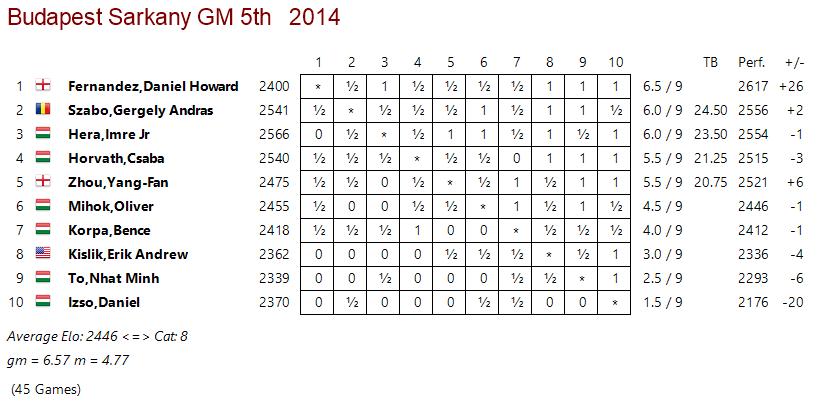
earning his first GM norm in the process.
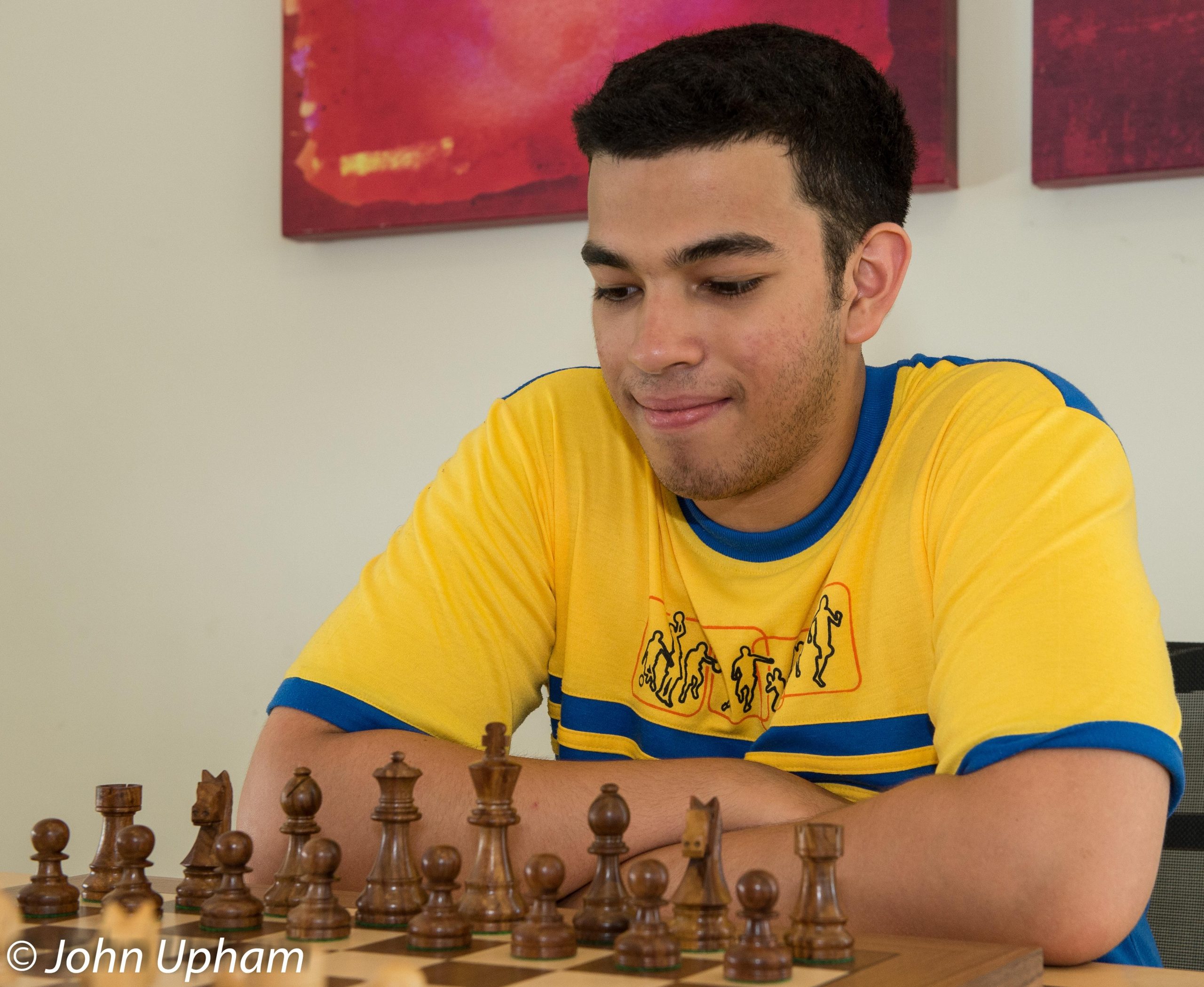
BCN asked Daniel for three of his favourite games. The first one is this Polish Defence game from 2015 played at the Visma Arena in Vaxjo, Sweden. First we have the crosstable showing that Daniel earnt his second GM norm from this event.
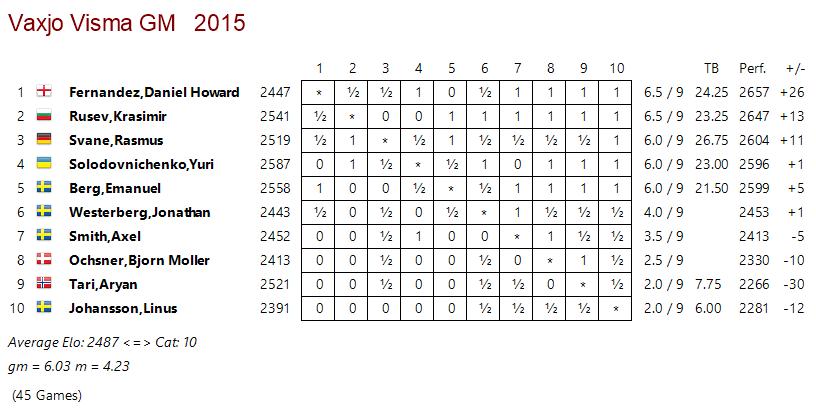
and here is the game:
[pgn]
[Event “Vaxjo Visma GM”]
[Site “Vaxjo”]
[Date “2015.06.27”]
[Round “7”]
[White “Smith, Axel”]
[Black “Fernandez, Daniel Howard”]
[Result “0-1”]
[ECO “B00”]
[WhiteElo “2452”]
[BlackElo “2447”]
[Annotator “British Chess News”]
[PlyCount “86”]
[EventDate “2015.06.24”]
[EventType “tourn”]
[EventRounds “9”]
[EventCountry “SWE”]
[EventCategory “10”]
[SourceTitle “CBM 167 Extra”]
[Source “ChessBase”]
[SourceDate “2015.09.14”]
[SourceVersion “1”]
[SourceVersionDate “2015.09.14”]
[SourceQuality “1”]
{[%evp 0,86,63,13,126,116,101,97,97,97,84,96,96,57,79,51,50,52,38,58,82,70,93,
31,-1,-22,-19,-35,-16,-50,29,-1,0,-22,-36,-36,-36,-92,-81,-92,-84,-82,-73,-104,
-95,-79,-36,-33,-51,-74,-42,-51,-51,-91,-86,-99,-91,-87,-87,-82,-105,-100,-127,
-111,-148,-160,-139,-127,-136,-254,-164,-257,-259,-257,-309,-663,-691,-933,
-153,-747,-809,-824,-875,-986,-1014,-2303,-2794,-29999,-30000]} 1. d4 b5 {
The Polish Defence as used by Spassky against Petrosian.} 2. e4 a6 3. Nf3 {
When is it the right time for White to play a4?} Bb7 4. Bd3 e6 5. O-O c5 6. c3
d6 ({more common is} 6… Nf6 7. Re1 Be7 8. Bg5) 7. Re1 Nd7 8. Nbd2 Qc7 {
A rare choice but must be reasonable.} (8… Be7 9. Nf1 Ngf6 10. Ng3 O-O 11. h3
Qc7) 9. a4 $18 {[#] and eventually we get the thematic break against …b5 The
engines are complimentary of White’s position.} c4 10. Bb1 $6 {This would
appear to be a strange decision.} (10. Bf1 {Maintaining the presssure on
Black’s pawns must be superior.}) 10… Be7 11. Nf1 {You’d imagine that b3 at
some point would make sense leaving the pressure on c4.} Ngf6 12. Ng3 O-O 13.
h4 Rfe8 14. h5 {White seems to be struggling to find a decent plan.} e5 15. Nf5
Bf8 16. axb5 axb5 17. Rxa8 Rxa8 18. Nd2 g6 $1 {If Black can expell the knight
on f5 then probably he is better.} 19. hxg6 hxg6 $17 20. Ne3 Bg7 {Strong
pointing e5 further.} 21. d5 Nc5 {[#] Black is gaining the upper hand.} 22.
Ng4 Bc8 23. Nxf6+ Bxf6 24. Qf3 Bg5 25. Nf1 Qe7 26. Ne3 Nb3 27. Bc2 Nxc1 28.
Rxc1 {Black can now really dominate the dark squares.} Ra2 29. b3 Qa7 30. bxc4
bxc4 31. Qe2 {[#]} Bg4 $1 {Ouch! Perhaps White had missed this shot?} 32. Qe1
Bxe3 33. fxe3 Qa3 $1 {and it is all over bar the shouting…} 34. Kh2 (34. Rb1
Rxc2 35. Rb8+ Kg7 36. Qh4 Qc1+ (36… Bh5 37. Qe7 Qc1+ 38. Kh2 Rxg2+ $1 39.
Kxg2 Qd2+ 40. Kg3 Qe1+ 41. Kh2 Qe2+ 42. Kh3 Qf1+ 43. Kh4) 37. Kh2 Bh5) 34…
Kg7 35. Qf1 Be2 $1 36. Qe1 Qb2 37. Bb1 Ra1 38. Rc2 Qxb1 (38… Qxc2 $1 {
is more efficient} 39. Bxc2 Rxe1) 39. Qxe2 $2 (39. Qxb1 Rxb1 40. Rxe2 {is a
better defence.}) 39… Qg1+ 40. Kg3 Re1 41. Qf2 Rxe3+ $1 42. Kg4 Qd1+ 43. Kg5
Qh5# 0-1
[/pgn]
and during the 2015/15 4NCL season Daniel obtained his final GM norm playing for Wood Green.
In March 2015 he made his first of three Varsity match appearences for Cambridge re-uniting with Danielle Ho and Howard Chiu (remember those names from earlier?).
Daniel won the 10th Jessie Gilbert Memorial in 2017:
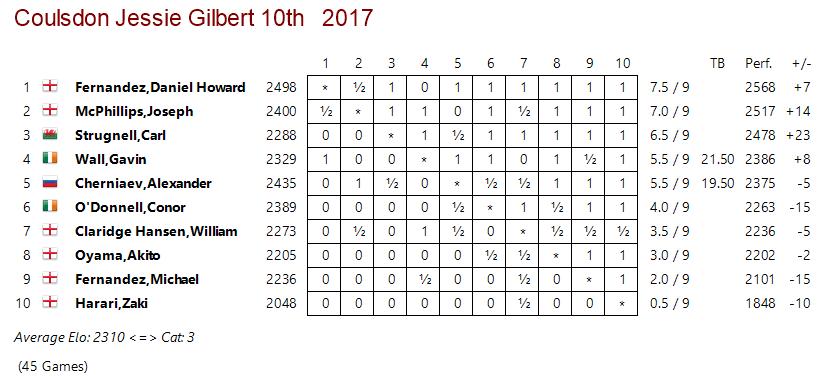
and also in 2017 Daniel was awarded the Grandmaster title at the 88th FIDE Congress 2017, 7-15 October, Goynuk, Antalya, Turkey.
On March 11th Daniel represented Cambridge in the 135th Varsity Match at the RAC Club in Pall Mall. According to chess24.com ‘IM Daniel Fernandez, playing board 2 for Cambridge, was awarded the Brilliancy Prize by GM Ray Keene in consultation with McShane and Speelman, for his “high-class swindle” after recovering from a bad blunder.’ See here for details.
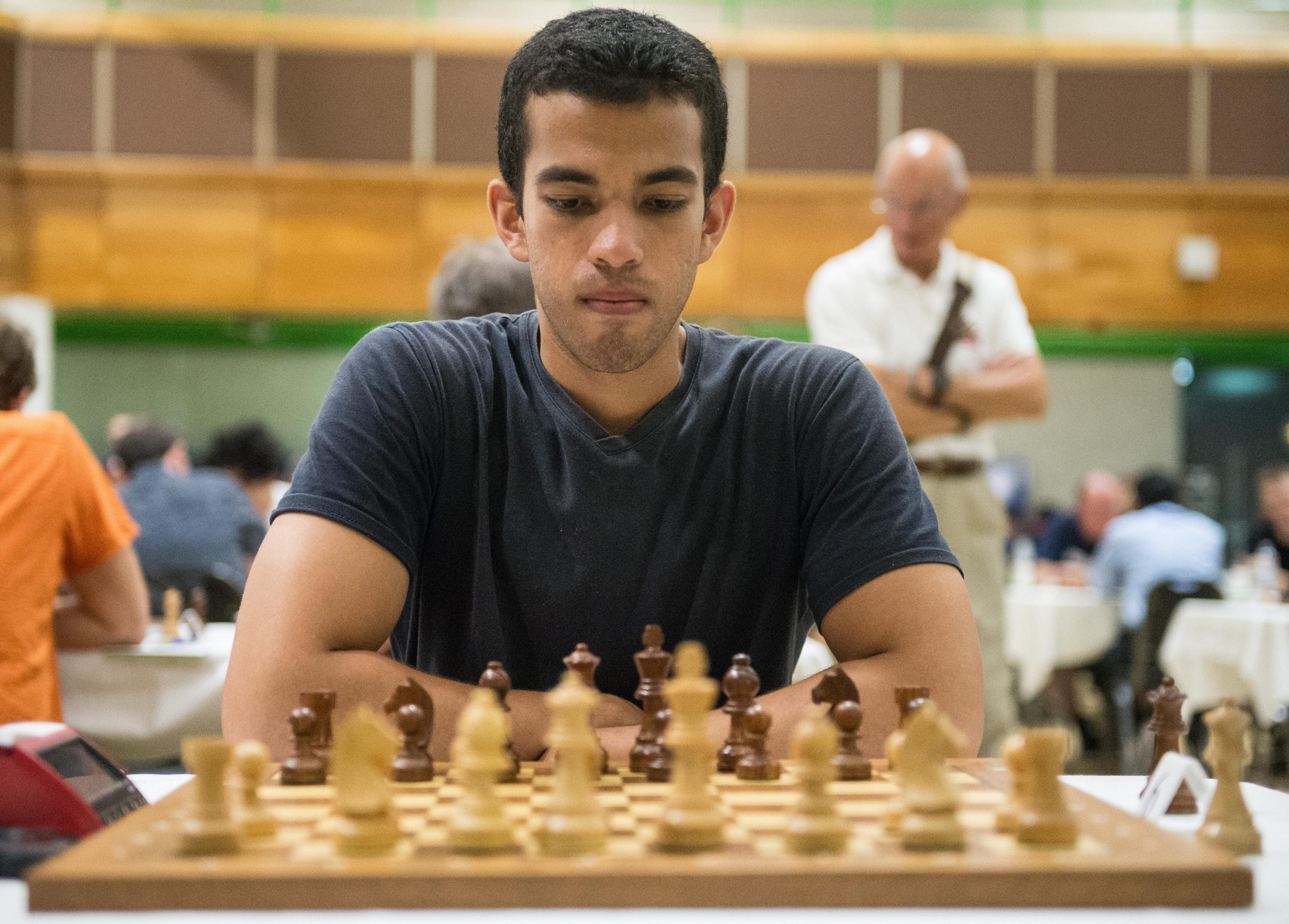
In 2018 Daniel ventured into the world of book writing when Thinker’s Publishing released The Modernized Caro-Kann on September 8th 2018. This was a repertoire book for Black based around the Smyslov Variation :
[fen]r1bqkbnr/pp1npppp/2p5/8/3PN3/8/PPP2PPP/R1BQKBNR w KQkq – 0 1[/fen]
and was reviewed in this place favourably and quickly established Daniel as a significant author.
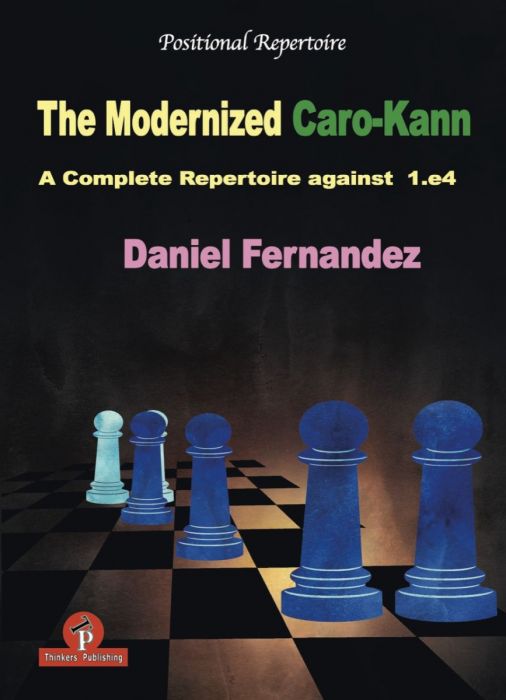
From the rear cover we have:
“GM Daniel Fernandez (born 1995) has been an active and accomplished player for several years. He represented his native Singapore twice at Olympiads (2010 and 2012) before transferring to the English chess federation. There, he won the national classical titles at U-18 and U-21 levels and worked to become a Grandmaster while simultaneously studying at Cambridge. The Caro-Kann was instrumental in his quest for that title. Currently, Daniel is known in the chess scene not only as a solid player, but also as a mentor figure to younger English players, as a producer of well-received commentary and analysis, and as a multilingual chess coach. This is his first book.”
From January 2019 we have this interesting encounter between Gawain Jones and Daniel from the annual 4NCL meeting of Guildford and Wood Green:
[pgn]
[Event “BCF-chTa 1819 (4NCL)”]
[Site “Daventry”]
[Date “2019.01.13”]
[Round “4.13”]
[White “Jones, Gawain C B”]
[Black “Fernandez, Daniel Howard”]
[Result “1/2-1/2”]
[ECO “B12”]
[WhiteElo “2691”]
[BlackElo “2465”]
[Annotator “British Chess News”]
[PlyCount “124”]
[EventDate “2018.11.10”]
[EventType “team-tourn”]
[EventRounds “11”]
[EventCountry “ENG”]
[SourceTitle “CBM 188 Extra”]
[Source “ChessBase”]
[SourceDate “2019.02.26”]
[SourceVersion “1”]
[SourceVersionDate “2019.02.26”]
[SourceQuality “1”]
[WhiteTeam “Guildford”]
[BlackTeam “Wood Green”]
[WhiteTeamCountry “ENG”]
[BlackTeamCountry “ENG”]
{[%evp 0,124,21,36,69,63,74,50,56,34,45,48,52,37,37,37,46,8,46,16,76,62,52,40,
40,13,13,29,32,28,16,22,24,9,9,14,15,11,11,-15,33,8,42,8,-4,-4,0,0,-14,0,0,-63,
-75,-75,-21,-61,-23,-91,-96,-75,-106,-110,-113,-111,-111,-111,-111,-111,-111,
-111,-111,-111,-78,-102,-123,-119,-124,-122,-122,-128,-128,-125,-82,-62,-92,
-111,-102,-130,-126,-123,-137,-182,-142,-164,-127,-127,-127,-127,-122,-202,
-196,-196,-209,-204,-173,-242,-218,-303,-244,-244,-244,-244,-242,-222,-98,-98,
-89,-87,-57,-52,-26,-31,-9,-13,-11,-8,-8]} 1. e4 c6 2. d4 d5 3. e5 Bf5 4. h4 h5
5. Bd3 (5. c4) 5… Bxd3 6. Qxd3 e6 7. Bg5 Qb6 8. Nd2 Ne7 (8… c5) 9. Ngf3 Qa6
10. c4 Nf5 11. O-O Bb4 12. b3 Nd7 13. Rfd1 O-O 14. a3 $146 (14. Nf1) 14… Bxd2
15. Rxd2 Nb6 16. c5 Qxd3 17. Rxd3 Nd7 $11 18. b4 {[#]} b6 $1 19. Rc1 $6 (19.
Rb3 f6) 19… Rfc8 {Black now proceeds to outplay his higher rated opponent.} (
19… bxc5 20. bxc5 Rfb8 $17) 20. Bd2 f6 21. Re1 Kf7 22. g3 bxc5 23. bxc5 Rcb8
24. Bf4 Rb2 25. Rdd1 Rb3 26. Kg2 a5 27. a4 Ra7 28. Re2 Rab7 29. Ra2 Rc3 30.
Raa1 Rbb3 31. Nd2 Rb2 32. exf6 gxf6 33. Nf3 Rbb3 34. Nd2 Rb4 35. Nf3 Rcc4 36.
Rab1 Kg6 37. Bd6 Rxb1 38. Rxb1 Nxd4 39. Nxd4 Rxd4 40. Rb6 Ne5 41. Bxe5 fxe5 42.
Rxc6 Kf6 {[#]} 43. Ra6 $2 (43. Rc8 Rxa4 44. Rf8+ Ke7 45. Rh8 e4 $19) 43… Rxa4
$19 {Black has the upper hand.} 44. f3 d4 45. Ra7 Ra2+ 46. Kf1 Ra3 47. Kf2 e4
48. fxe4 Ke5 49. g4 hxg4 50. h5 Rf3+ 51. Kg2 Kxe4 {Surely Black is winning?}
52. c6 Rc3 53. Rc7 d3 ({Better is} 53… Kd5 {but White’s h-pawn is little
concerning.}) 54. h6 d2 55. Rd7 Rxc6 $6 (55… Rd3 56. Rxd3 Kxd3 57. c7 d1=Q
58. c8=Q Qf3+ 59. Kg1) 56. h7 Rc8 $6 {Sadly this lets the win slip.} ({Better
was} 56… Rc2 57. Kf1 d1=Q+ 58. Rxd1 Rh2) 57. Rxd2 Rh8 58. Rd7 Kf5 59. Kg3 a4
60. Rf7+ Ke5 61. Kxg4 a3 62. Ra7 a2 {and the position is drawn.} 1/2-1/2
[/pgn]
With the White pieces Daniel has played a wide range of first moves but the majority move by far is 1.e4. His choice versus the Najdorf is some eclectic : sometime ago 6. Rg1 was the favourite and now 6.a4 is preferred.
[fen]rnbqkb1r/1p2pppp/p2p1n2/8/3NP3/2N5/PPP2PPP/R1BQKBR1 b KQkq – 0 1[/fen]
Against 1…e5 Daniel offers a main line Ruy Lopez.
What does a Caro-Kann expert play against the Caro-Kann? Nowadays the Two Knights Variation is employed!
As the second player he plays the Sicilian Najdorf as well as the Caro-Kann plus an equal mixture of the Grünfeld and King’s Indian Defences.
In 2019 Daniel was interviewed by Edwin Lam on behalf of ChessBase : fascinating reading!
In the same year Daniel joined IM Adam Taylor’s venture Making Grandmasters.
Our final games is from July 2019 :
[pgn]
[Event “Gent Eastman op 42nd”]
[Site “Gent”]
[Date “2019.07.22”]
[Round “6”]
[White “Fernandez, Daniel Howard”]
[Black “Michiels, Bart”]
[Result “1-0”]
[ECO “A03”]
[WhiteElo “2466”]
[BlackElo “2563”]
[Annotator “British Chess News”]
[PlyCount “63”]
[EventDate “2019.07.20”]
[EventType “swiss”]
[EventRounds “9”]
[EventCountry “BEL”]
[SourceTitle “CBM 191 Extra”]
[Source “ChessBase”]
[SourceDate “2019.09.30”]
[SourceVersion “1”]
[SourceVersionDate “2019.09.30”]
[SourceQuality “1”]
{[%evp 0,63,19,-30,-33,-42,-34,-34,-35,-26,-27,-27,-5,-28,-2,5,14,-30,-62,-77,
-39,-90,-40,-79,-59,-73,-56,-52,-37,-37,-38,-105,44,60,63,56,98,17,60,3,86,32,
61,68,65,66,96,95,118,109,136,153,132,211,211,202,269,280,383,424,450,477,542,
539,782,836]} 1. f4 d5 2. b3 {Larsen would have been proud!} Nf6 3. Bb2 Bf5 4.
Nf3 e6 5. e3 h6 {Black creates a luft on h7 for his light squared bishop.
Otherwise with a knight on e5 combined with a h-pawn push Black could get into
trouble. You might not think it but …h6 scores best for Black and is
labelled “Hot” by Megabase 2020.} (5… Be7 6. Be2 O-O 7. O-O c5 8. Ne5 h6 9.
d3 {is a more usual way to proceed.}) 6. h3 (6. Be2 Be7 7. O-O O-O 8. Ne5 Nbd7
9. d3 Nxe5 10. Bxe5 Nd7 11. Bb2 Bf6 12. d4 c5) {The first appearence for this
TN.} 6… a5 $146 7. g4 Bh7 {As facilitated by h6….} {Now pause the video….
} 8. Bxf6 $5 {I bet you did not predict this capture and nor did I!} Qxf6 9. d4
a4 (9… c5) 10. bxa4 g5 $1 11. fxg5 hxg5 $17 {I’d give Black the nod here but
only just.} 12. Bd3 {[#]} Bd6 (12… Nc6 {would take advantage of White’s lack
of control of b4 and is a bit awkard to meet. Black threatens ….Nb4}) 13. Ke2
{an ugly requirement with the h-file open. This is needed so as White may
re-capture on d3 with the queen.} Nd7 (13… Bxd3+ 14. Qxd3 Nc6) 14. Bxh7 Rxh7
15. c4 dxc4 16. Nbd2 Qg6 17. Nxc4 Ke7 18. Qb1 (18. Qb3) 18… Qxb1 (18… Rxa4
{seems natural}) 19. Rhxb1 Rxh3 20. Nxg5 Rh2+ 21. Kd3 Ra7 ({Why not} 21… Rxa4
{I don’t understand.}) 22. Ne4 $1 $18 {[#] white is getting on top.} Nf6 $2 23.
Nxf6 Kxf6 24. a5 $1 {black must be regretting leaving this pawn on and is
definately worse now.} Bf8 25. Rb5 Rf2 26. a4 Bh6 27. Rh1 Kg6 28. Rhb1 b6 29.
Ne5+ Kh7 30. Rh1 f6 31. Nc6 Ra6 32. Rbh5 {and Black resigned.} 1-0
[/pgn]
Daniel’s most recent publication is The Modernized Modern Defence from Thinker’s Publishing:
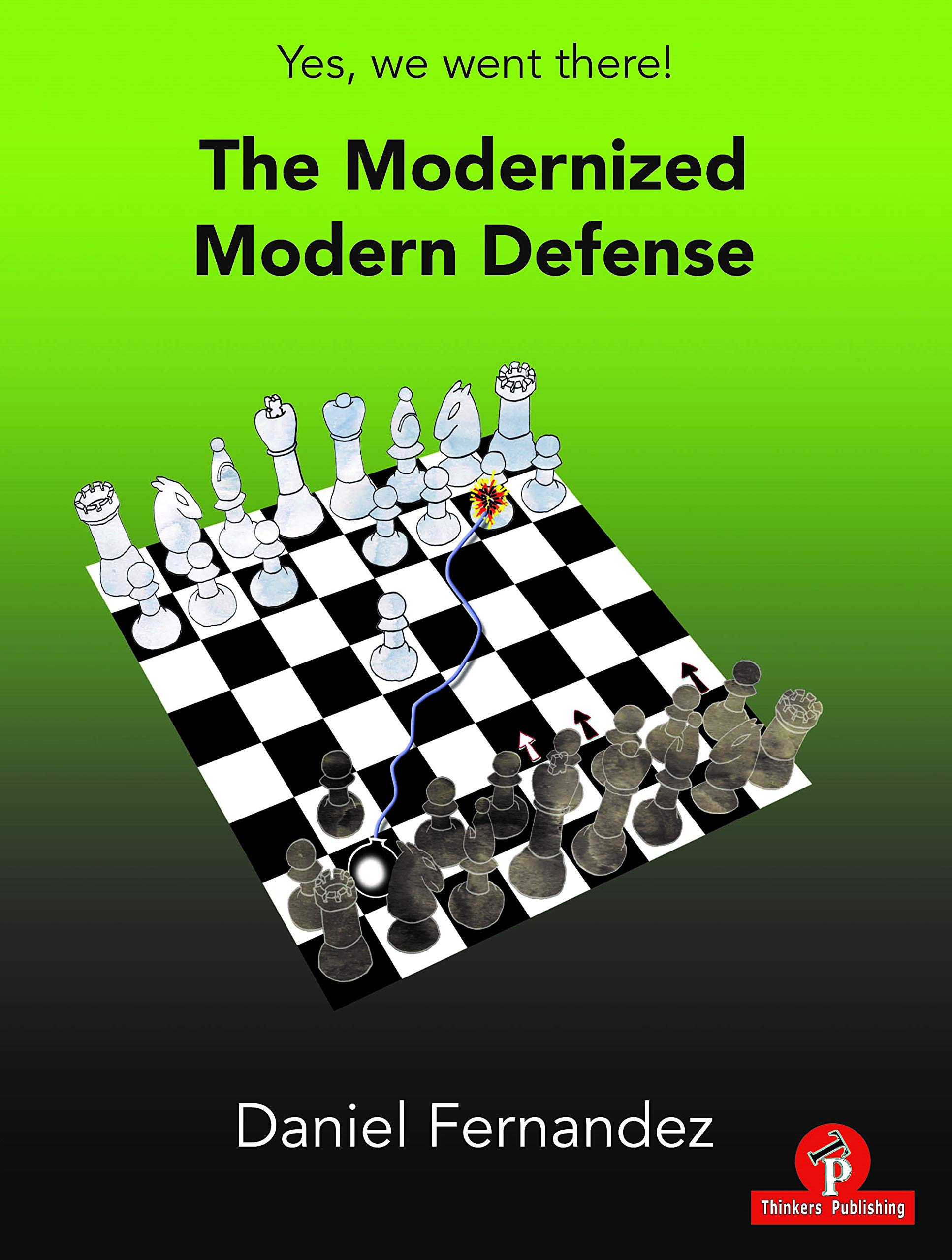
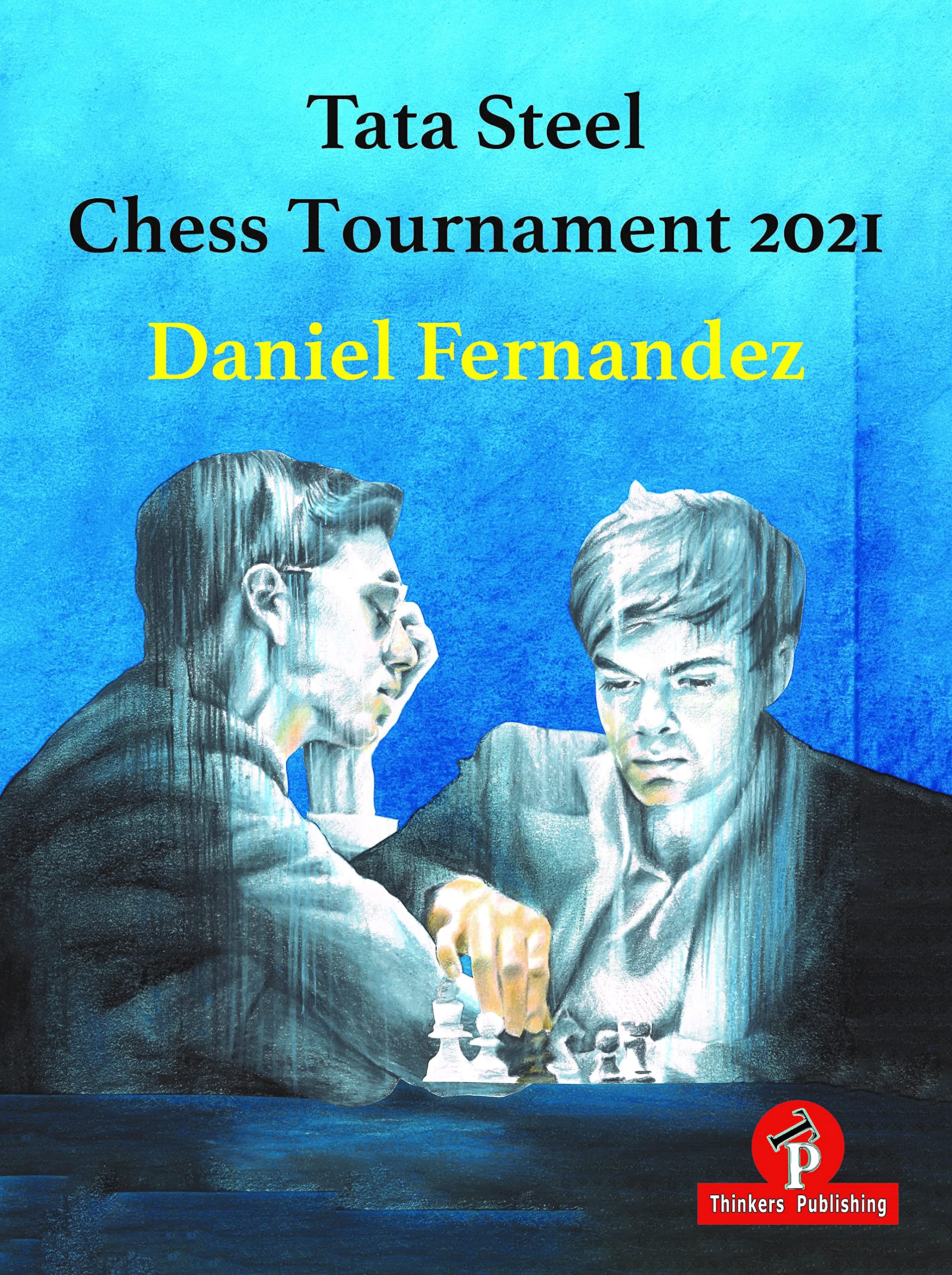
and BCN has been told that Daniel has a book in the pipeline about the Tata Steel 2021 tournament at Wijk aan Zee.
And here it that book!
 Save as PDF
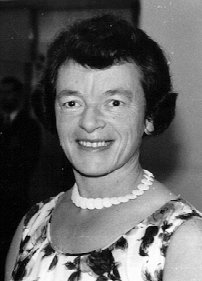
BCN remembers Nancy Elder MBE who passed away on Wednesday, March 4th 1981, i.e. forty years ago in Perth, Western Australia.
Nancy Conchar Gordon was born on Tuesday, May 25th 1915. On the same date was born Robin Day in High Wycombe who went on to design the polypropylene stacking chair.
Nancy was born in Kirmabreck, Kirkcudbrightshire in the Dumfries and Galloway council area of Scotland.
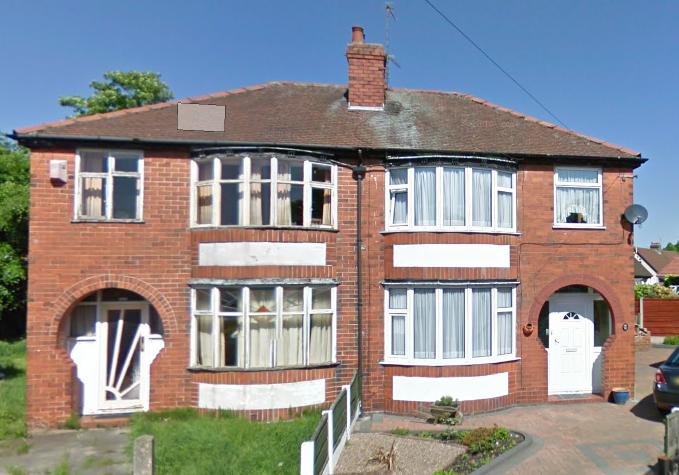
In the 1939 register Nancy was living at 18 Thornton Avenue, Urmston, Manchester, M41 5DJ with a married couple, William Furnish (a railway time keeper) and Gertrude Furnish who performed unpaid domestic duties. Presumably Nancy was their lodger.
Her occupation was given as a teacher of music and physical training. At this time she was single at the age of twenty-four.
In the mid-1940s Nancy relocated from Manchester to Dundee where she continued her teaching career at Dundee High School. During that time she encouraged and coached a number of players some of whom represented Scotland.
In 1950 in Tealing, Angus, Scotland Nancy married David Livie Elder. They had a daughter Christine who played chess as a junior. Tealing has a strong connection with the Elder family.
According to Alan McGowan (Chess Scotland): “She was the main instigator in forming both the Schools’ and Primary League in Dundee, and she assisted in the organisation of the Dundee 1967 International Centenary Tournament.”
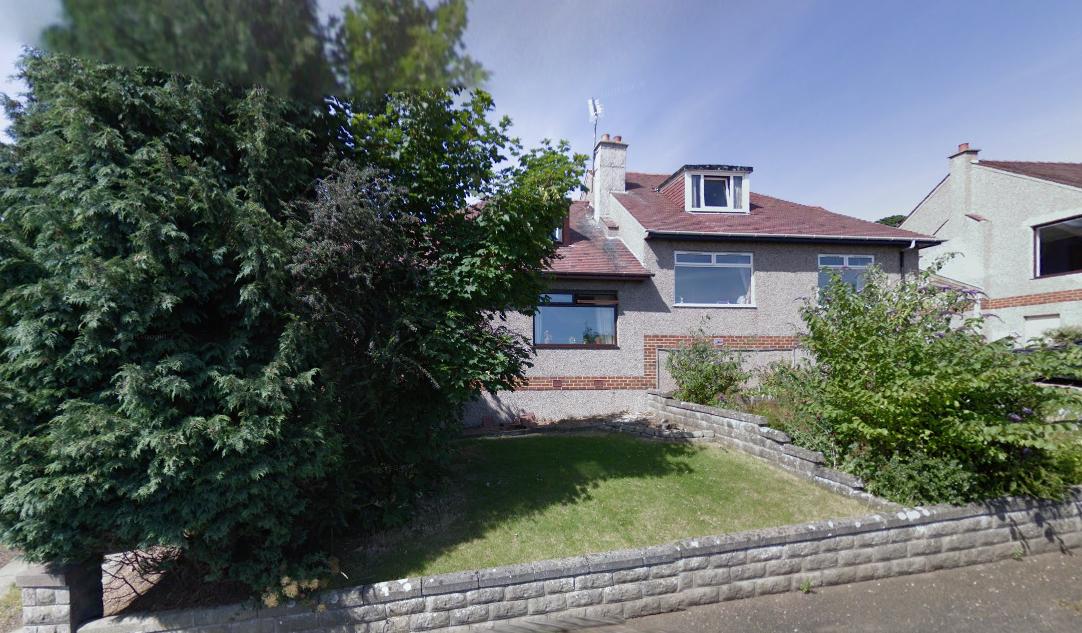
When she passed away Nancy was living at 39 Whitefauld Road, Dundee, DD2 1RJ :
Her passing was reported in the Dundee Courier and Advertiser on March 6th 1981 as follows :
She was off for a long holiday which she planned to spend with relatives and friends from the world of international chess, but, after suffering a heart attack on a plane from Singapore, had been in intensive care in Perth, Western Australia.
Her daughter Christine, a primary school teacher in Tighnabruaich, received daily telephone reports on her mother’s condition from a cousin and, at the weekend, heard that she was improving gradually.
The shock news of her mother’s death came late on Wednesday night.
Mrs. Elder, who went into semi-retirement recently, has been to the fore in chess for about 35 years at local, national and international levels.
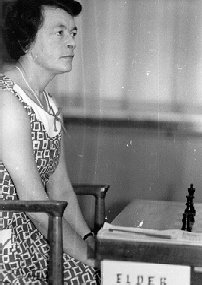
She has represented her country five times, having taken part in the chess Olympiad in Yugoslavia in 1963 and 1973, in Israel in 1976, in Buenos Aires in 1978 and in Malta last year.
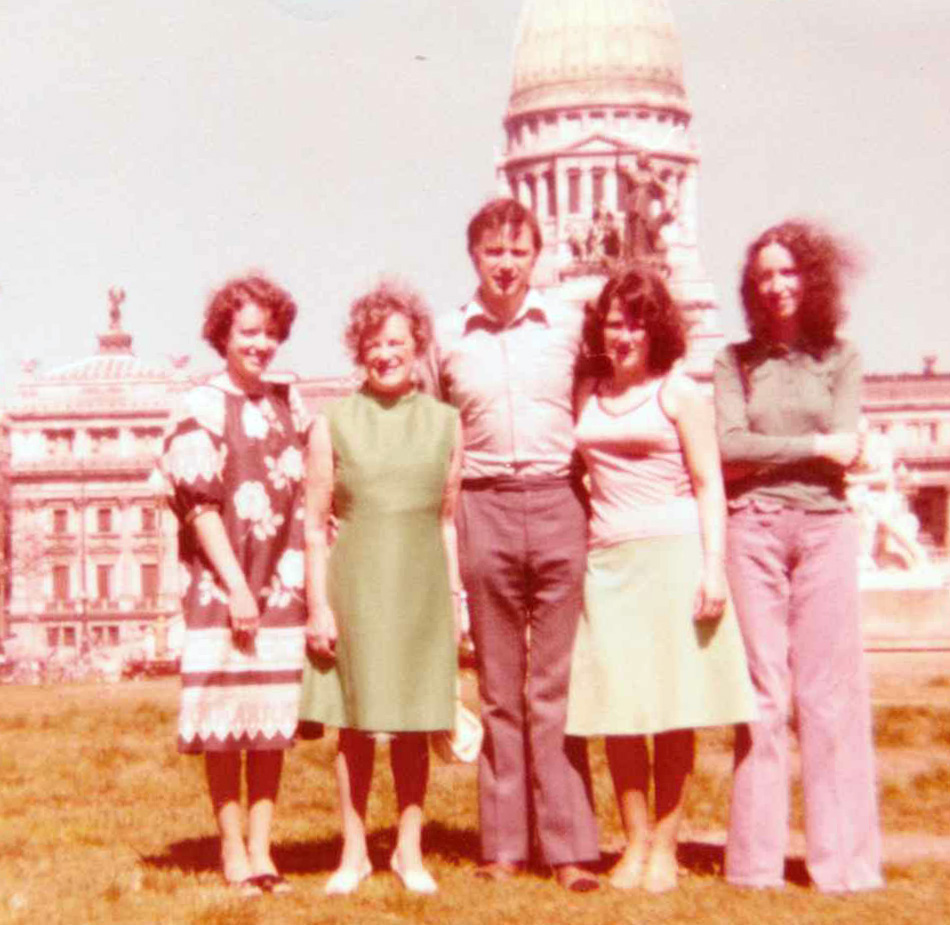
She turned down the chance to take part on three other occasions.
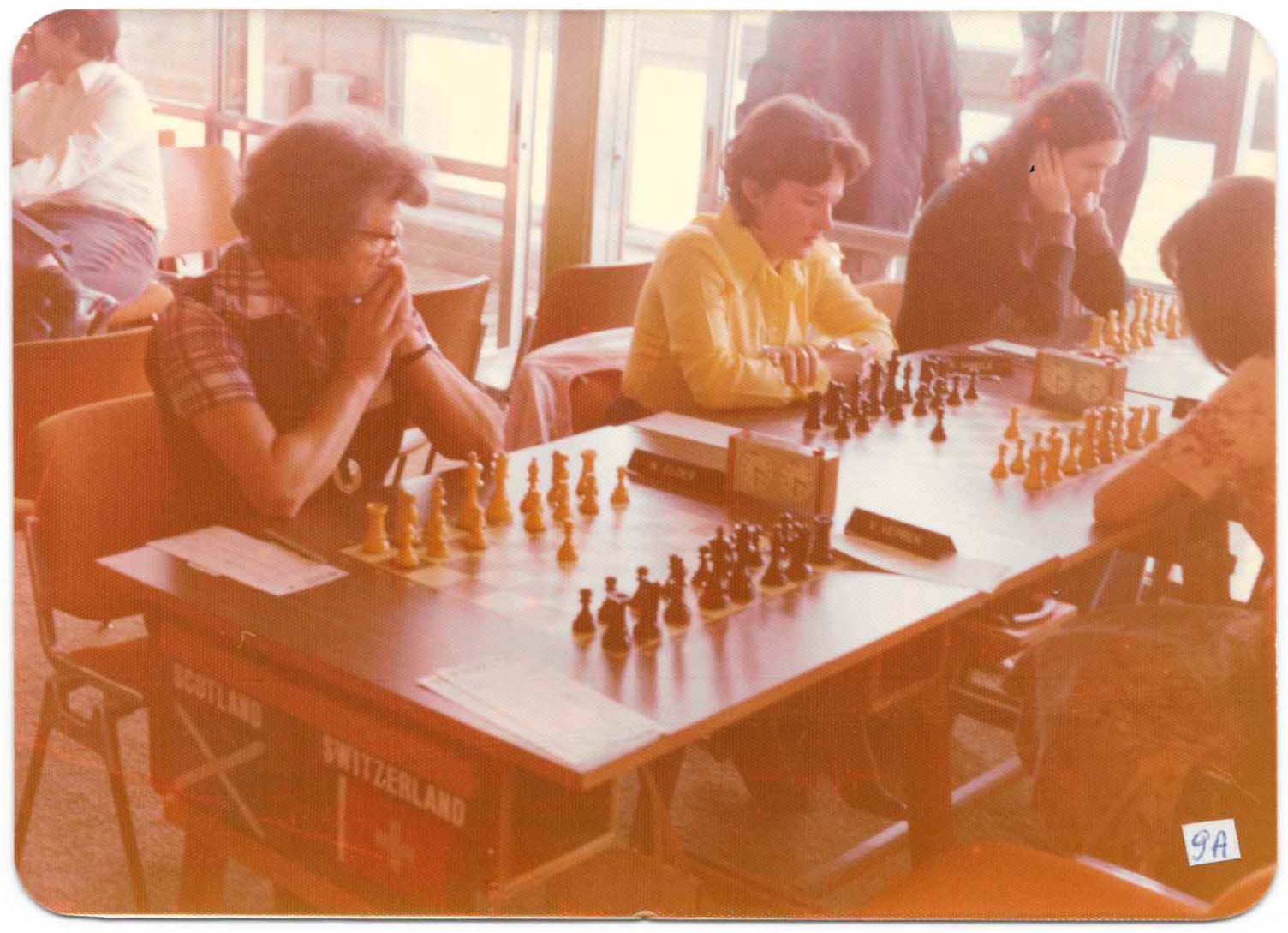
She was awarded the MBE for her services to chess in 1974.
She was President of Dundee Chess Club, chairman of the congress committee of the Scottish Chess Association and on the council of the Scottish Junior Chess Association.
She started playing chess during her school days with her brother and the two of them were more-or-less self taught.
It wasn’t until after the Second World War that she received any sort of coaching, by which time she had established her own style.
She retired on April 14th last year after 24 years in the music department of Dundee High School, where she specialised in teaching the oboe.
She continued to teach privately.
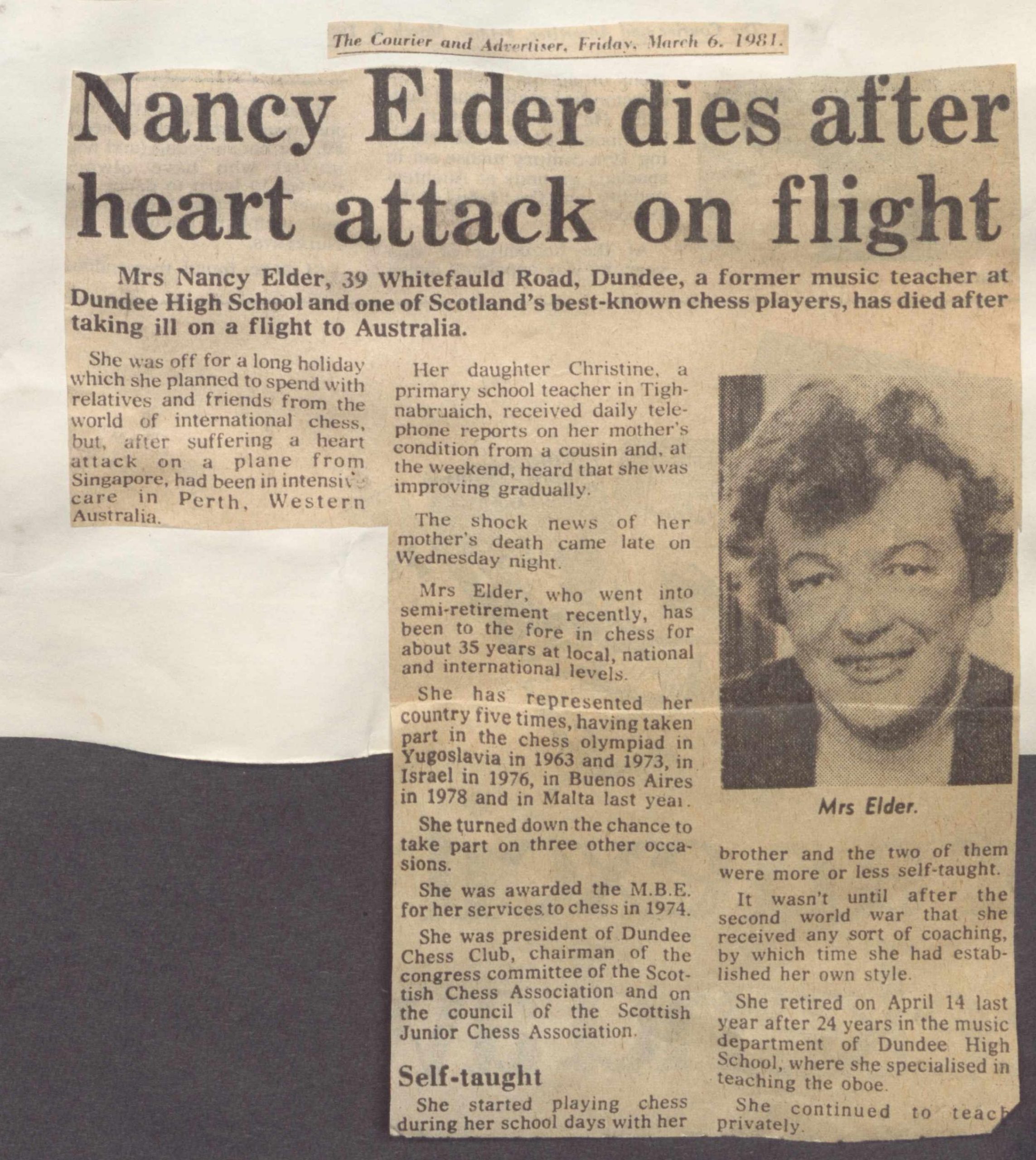
From British Chess Magazine, Volume CI (101, 1981), Number 6 (June), pp. 219-220 we have this obituary from Bernard Cafferty :
“Nancy C. Elder, MBE, died in Perth, Western Australia on March 4th 1981. Mrs. Elder had recently retired after a lifetime of teaching, her last post being in Dundee. I well remember her account of teaching under difficult conditions in World War 2 in Manchester. 15 Scottish Women’s Champion (the record for the event which she set-up at Troon in 1980).
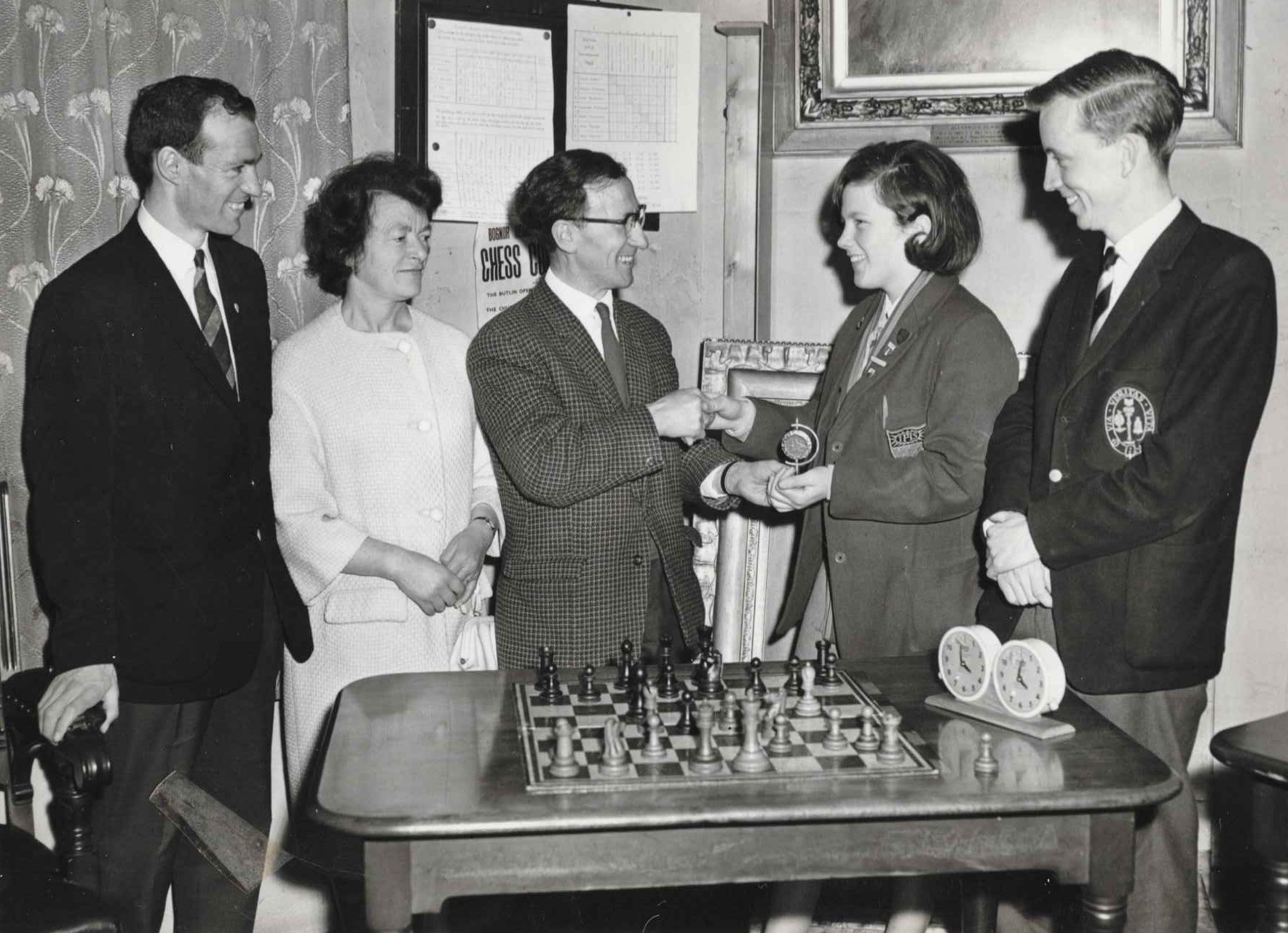
Mrs Elder was a regular competitor in the British Women’s Championship (sometimes in rivalry with her daughter Christine) and showed her playing strength with a score of 5.5/12 on board two for Scotland at the Women’s Chess Olympiad, Malta, 1980.
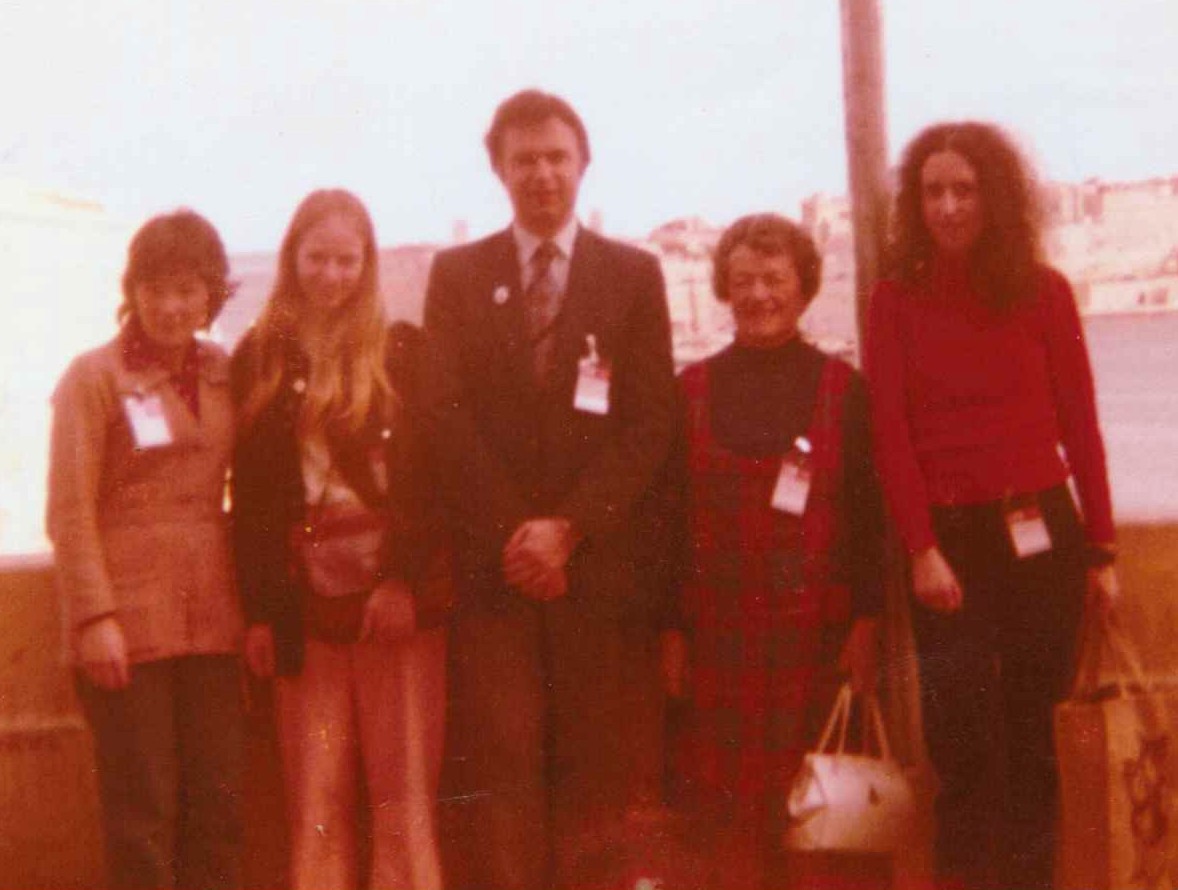
I am sure she will be best remembered though for her decades of effort in the organising of chess in Scotland, particularly for juniors and in schools, in recognition of which she was awarded the MBE, the only such honour ever given for services to chess ‘north of the border’ as Alan Borwell puts it in his Newsflash obituary.”
[pgn]
[Event “British CF-53 Women”]
[Site “Sunderland/ Tyne and Wear”]
[Date “1966.08.??”]
[Round “?”]
[White “Elder, Nancy Conchar”]
[Black “Moore, Gillian A”]
[Result “1-0”]
[ECO “B73”]
[Annotator “British Chess News”]
[PlyCount “71”]
[EventDate “1966.08.08”]
[EventType “tourn”]
[EventRounds “11”]
[EventCountry “GBR”]
[SourceTitle “EXT 1999”]
[Source “ChessBase”]
[SourceDate “1998.11.16”]
[SourceVersion “1”]
[SourceVersionDate “1998.11.16”]
[SourceQuality “1”]
{[%evp 0,71,19,31,72,53,51,40,38,35,42,42,41,21,45,40,44,31,38,44,43,35,37,37,
56,37,60,54,156,124,220,183,183,139,160,91,90,96,101,80,101,0,5,0,6,0,1,16,1,5,
21,25,38,2,28,0,37,8,42,20,45,6,202,261,285,366,920,931,29993,29994,29995,
29996,29997,29998]} 1. e4 c5 2. Nf3 Nc6 3. d4 cxd4 4. Nxd4 Nf6 5. Nc3 d6 6. Be2
g6 7. Be3 Bg7 8. O-O O-O 9. h3 {A choice of Smyslov and Kudrin.} ({A more
modern way to proceed is} 9. Nb3 Be6 10. f4 Qc8 11. Kh1 Rd8 12. Bf3 Bc4 13. Rf2
e5 14. Rd2 Qe6 15. fxe5 Nxe5 16. Nd4 Qe7 17. b3) 9… a6 (9… Bd7 10. Qd2 Rc8
11. f4 a6 12. Rad1 b5 13. a3 Qc7) 10. Qd2 Qc7 11. f4 Rd8 12. Rad1 Nxd4 13. Bxd4
e5 $2 $146 {[#] The only game to feature this position.} (13… Be6) 14. Bxe5
$18 Qb6+ 15. Kh2 (15. Bd4 {Appears more natural.}) 15… Be6 16. Bxf6 (16. Bd4)
16… Bxf6 17. Nd5 {White immediately seeks exchanges.} Bxd5 18. Qxd5 Rac8 19.
Bc4 Qc7 20. Bb3 (20. Bd3) 20… Bxb2 21. a4 Qe7 {Black has equalised after the
earlier blunder.} 22. Rf3 Rc5 23. Qd3 Rc3 24. Qe2 Rdc8 25. Rxc3 Bxc3 26. Rd3
Kf8 27. Qf3 Bb4 28. g4 Rc5 29. Kg2 h6 30. Kf1 {[#]} f5 $2 {after all of
Black’s efforts lashing out is not a good idea.} (30… b5 {was reasonable.})
31. gxf5 gxf5 32. Qh5 $1 {and Black is busted.} fxe4 33. Qxh6+ Qg7 34. Qxd6+
Qe7 35. Qh6+ Qg7 36. Rd8+ {and Black resigned.} 1-0
[/pgn]
Chess Scotland award the Nancy Elder Cup annually for an individual competition for “club level” players.
We are grateful to Helen Milligan who told BCN :
My most memorable incident was when I refused to play in the Scottish Ladies at the annual Congress, preferring to try to improve my chess by playing in the Open section (really the B-Grade, below the Championship proper). I got given a piece of Nancy’s mind for that – she did not approve!
Here are her playing records from the Olympiads.
Here is a potted biography from Chess Scotland.
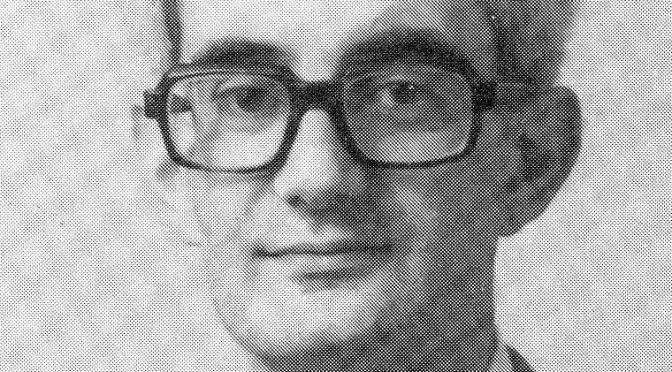
Save as PDFBCN remembers CGM Adrian Hollis who passed away in Wells, Somerset on Tuesday, February 26th 2013 at the age of seventy-two.
Adrian Swayne Hollis was born in Bristol, Avon on Friday, August 2nd 1940. During this critical period the Luftwaffe was wisely extending its Battle of Britain targets to include Britain’s airfields. Furthermore, Bristol was bombed heavily between June 1940 and May 1944. The longest period of regular bombing, known as the ‘Bristol Blitz’ began in autumn 1940 and ended the following spring. The first bombs of the Bristol Blitz fell at around 6 pm on Sunday 24 November 1940.
Adrian was the only child of MI5 director general Roger Henry Hollis KB CBE (later to become Sir Roger Hollis) and Evelyn Esme Hollis (née Swayne) who was Roger’s first wife. Roger was from Wells and Evelyn from Burnham-on-Sea and they were married on July 17th 1937 in Wells Cathedral with Evelyn’s father performing the ceremony.
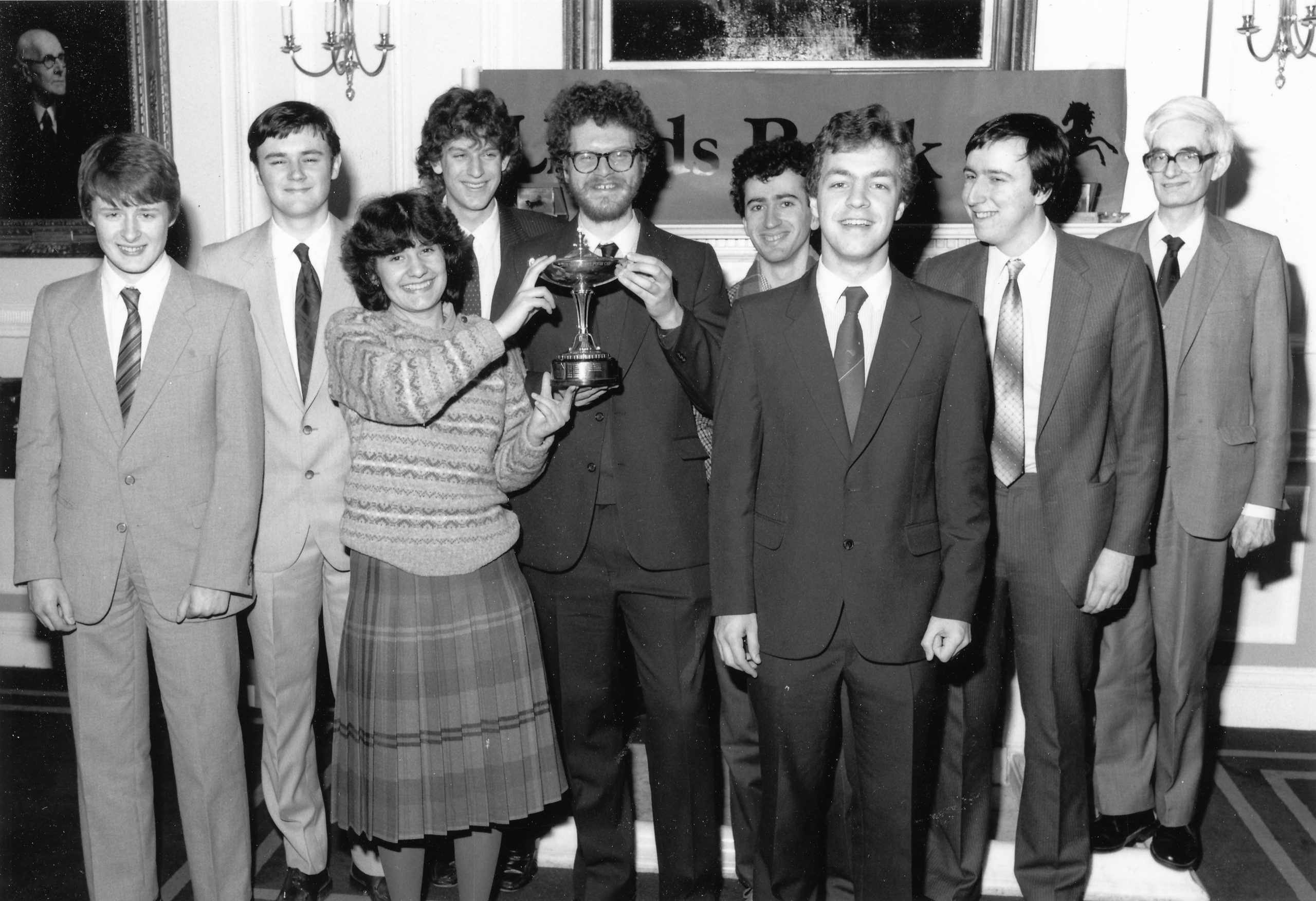
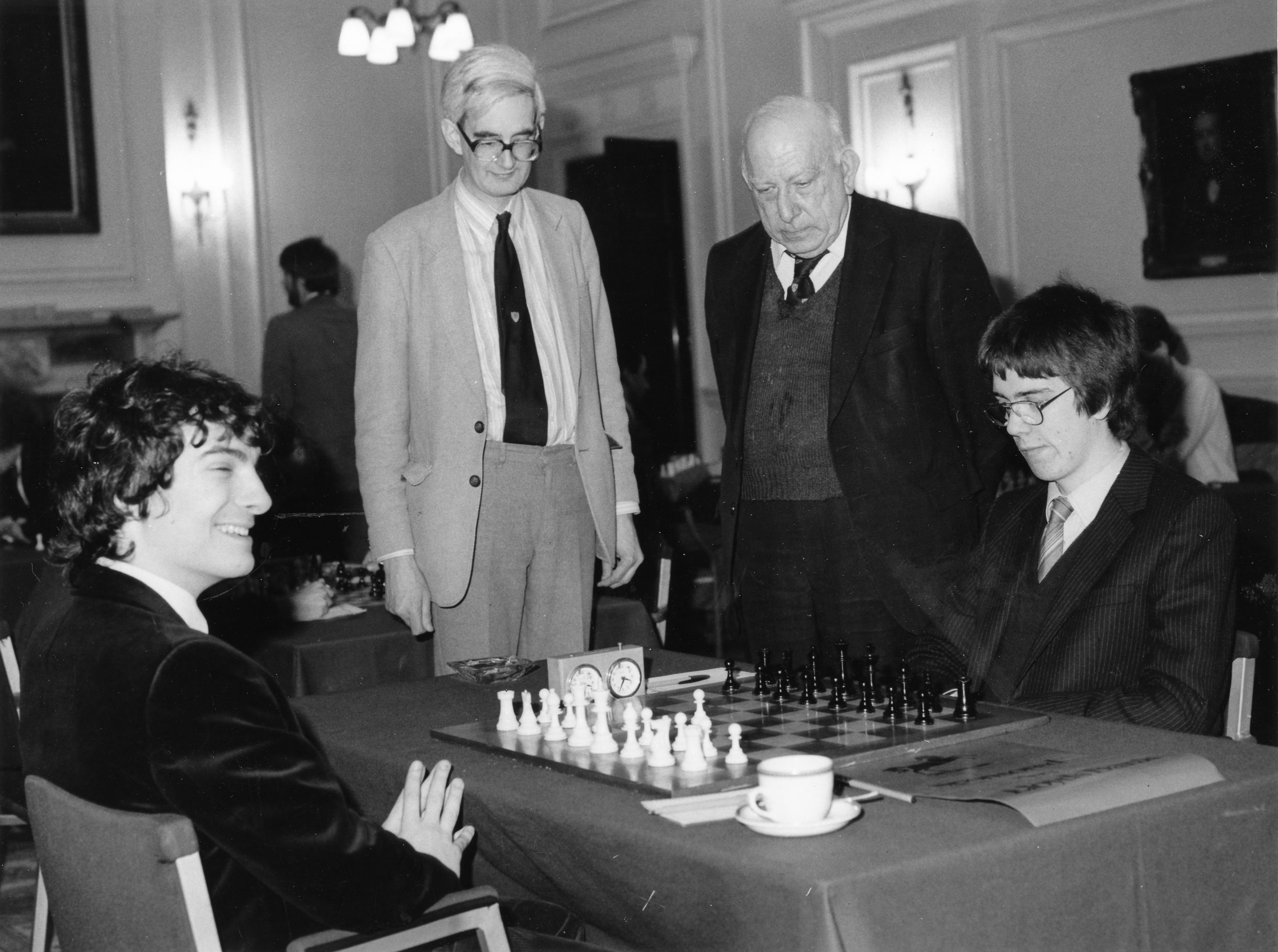
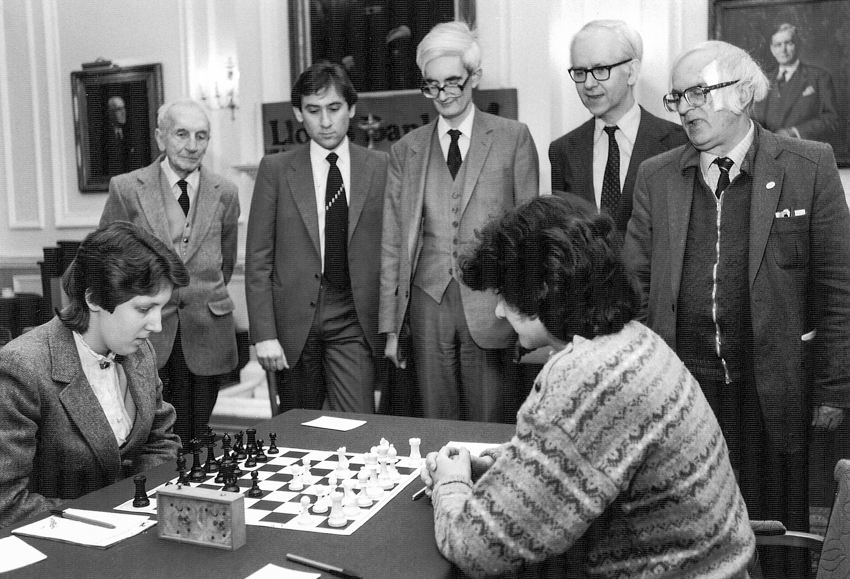
Adrian won a scholarship in classics to Eton College and then went up to Keble College, Oxford where he took a first in mods and greats. Whilst at Keble Adrian represented Oxford in four varsity matches between 1959 and 1962. Indeed, his support for varsity matches was maintained for many years attending a large number into and beyond the Lloyds Bank era. Stalwart organiser Henry Mutkin would always be sure to extend an invitation.
In 1961 Adrian become the youngest ever West of England Champion at the age of 21.
Adrian met Margaret Mair Cameron Edwards in 1967 at St. Andrew’s University where he taught Classics and she taught German. They married in the parish of St. Leonards in St. Andrews and had two daughters, Jennifer Margaret M (b. 1974) and Veronica Swanye (b. 1977) and a son, Michael David C.
He was the Games Editor for the British Correspondence Chess Association (BCCA) resigning in 1969.
In 1984 Adrian was forced to endure allegations against his father by Chapman Pincher (in CPs book Too Secret too Long) that Sir Roger had been a Soviet spy / mole. These allegations were demonstrated to be false. He may well also have been aware of allegations against his friend and chess mentor Graham Mitchell earlier in 1963. Ironically, it was Adrian’s father who initiated the investigation into Graham. Again, the rumours were shown to be unfounded.
Adrian became a director of the company Centre for Medieval and Renaissance Studies Limited on the September 1st 1996 and resigned on May 12th 2007. He was also a Vice President of the West of England Chess Union (WECU).
Between 2003 and 2007 (according to the Electoral Roll) Adrian lived at 63, Bainton Road, Oxford, OX2 7AG :
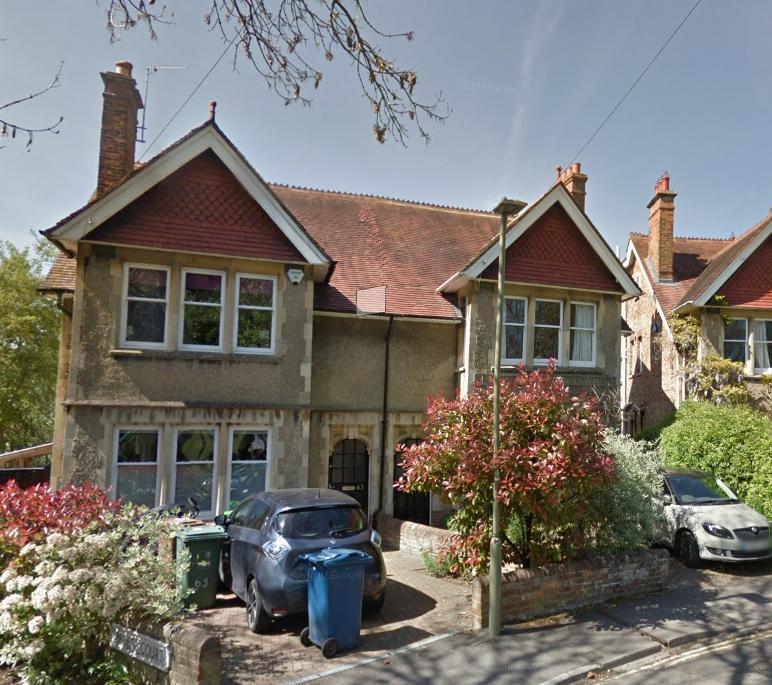
and following his retirement (and the time of the 2008 electoral roll) Adrian had moved to Pound House, Southover, Wells, BA5 1UH :
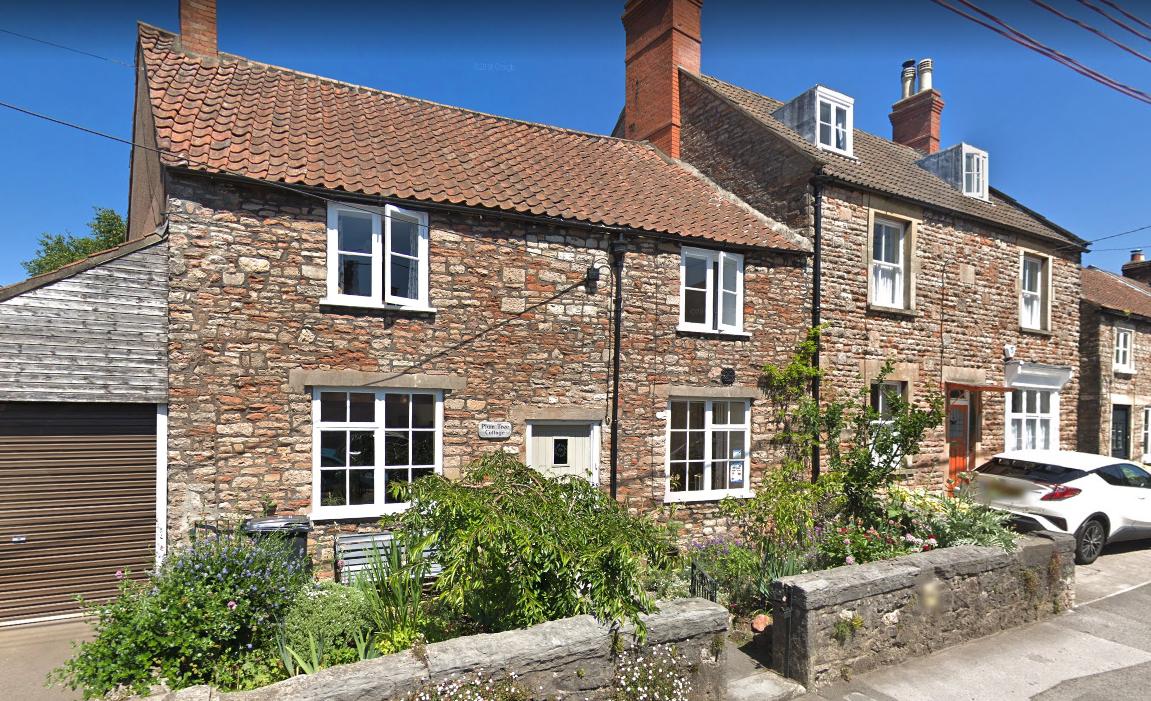
Adrian has written many learned papers and has had two books published :
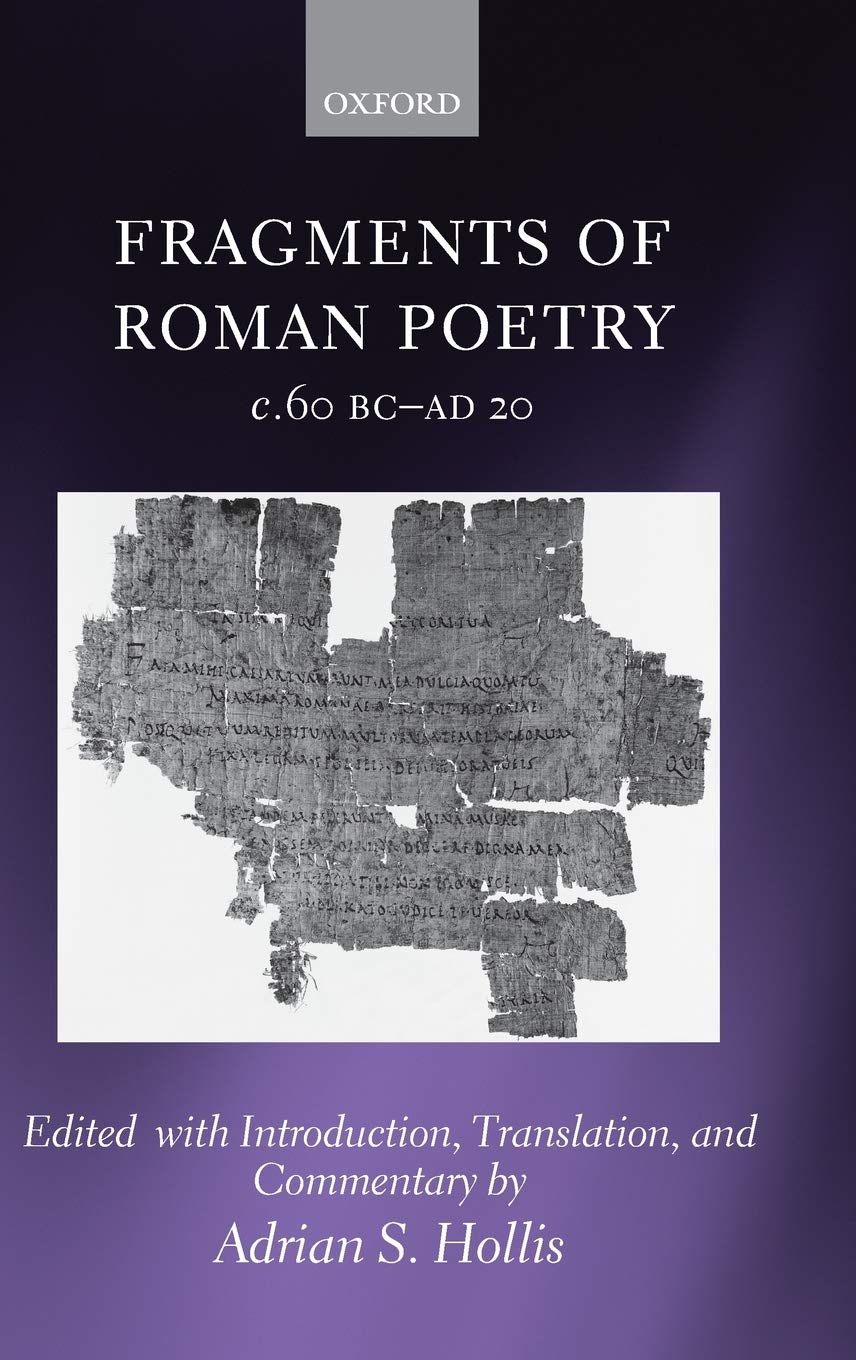
and
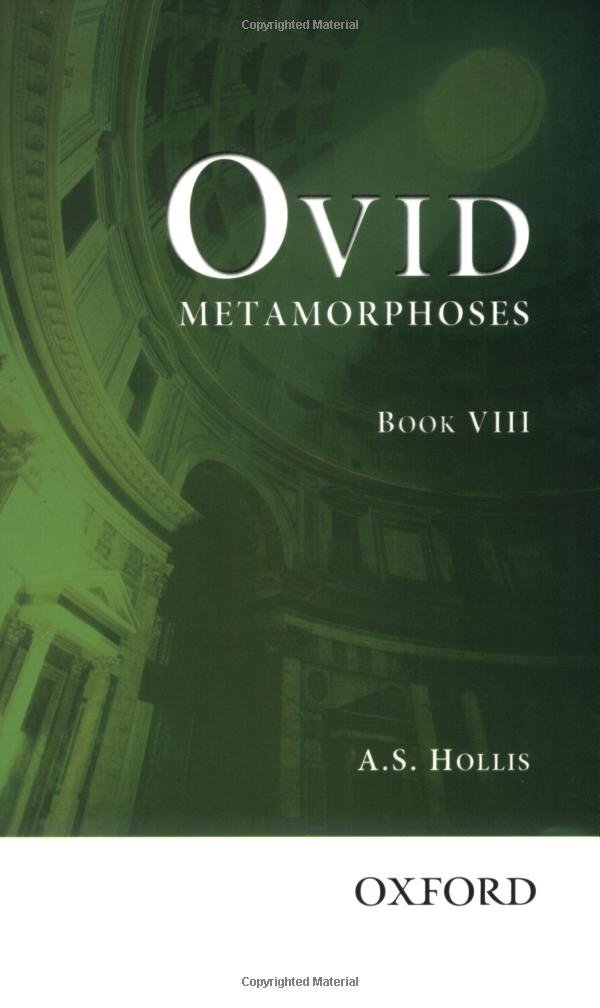
During his time at Keble College, Adrian engaged with and mentored many chess players including Jonathan Rowson (1996), David Norwood (1988), Julian Way, David Goodman (1977) and Dharshan Kumaran (1993).
Julian was a personal student of Adrian’s and was kind enough to tell us :
I do remember Adrian well. He could quote Latin verse ad infinitum. He was an expert on Ovid.
In terms of chess he had a huge pile of Informators in his study still in their cardboard packaging. He was very kind to me and insisted I play above him for Keble in the intercollegiate matches.I gave him a copy of Developments in the Orthodox QGD which I had written in 1987. He was quite taken back when I didn’t want any money for it. He seemed to have quite a lot of respect for me.
I once asked him why he had given me a place at Oxford. He replied that he couldn’t have rejected someone with my passion and enthusiasm.
I kept in touch with Adrian until his passing. He gave me a lovely reference when I resumed my studies in 2007 at Kingston University.
I remember him as a kind and unassuming man. He became a lifelong friend.
From British Chess (Pergamon Press, 1983) Botterill, Levy, Rice and Richardson :
“I was born on August 2nd, 1940, educated at Eton and Christ Church, Oxford and now teach Classics at Keble College, Oxford. I learned the moves at the advanced age of thirteen from a cousin* who himself could have made a good chess player had he not been seduced by Philosophy and brain-teasers; all that remains in the mind from these encounters is a vision of perpetually losing my rooks to fianchettoed bishops.
*We are grateful to John Clarke who informed us that
“The cousin would have been Martin Hollis, who contributed the “Tantaliser” column to the New Scientist for many years. I always enjoyed his puzzles, which for me at any rate were at just the right level of difficulty – neither trivial nor totally impossible.”
My first ever tournament was the London Boys’ Championship 1956-7. In the opening round fate allotted me Black against David Rumens. As it happened, the brochure included a game of his from the previous year in which he had answered 1.d4 with 1…Nc6, quite enough, in my opinion, to condemn him utterly.
[fen]r1bqkbnr/pppppppp/2n5/8/3P4/8/PPP1PPPP/RNBQKBNR w KQkq – 0 1[/fen]
(Ed: The above position did not impress Adrian hugely.)
This view seemed confirmed when within twelve moves of an advance French I was two pawns up. Then, however, aided by my over confidence he worked up a fierce attack, and I just escaped with a draw. Nevertheless, I won the tournament; an opponent remarked how quickly I played my moves.
Thereafter the game was never so easy, but I did reasonably, well, winning the championships of the British Universities, West of England and East of Scotland, and playing for England quite regularly during the 1960s (including 7.5/12 in six Anglo-Dutch matches).
The high spot of my over-the-board chess was the series of World Student team championships from 1960 to 1964 in glamorous places (Leningrad, Helsinki, Mariánské Lázně, Budva and Cracow); most enjoyable of these being Budva, 1963 where one could bathe every day in the Adriatic and I won the (?) gold medal on Board 1 with 7.5/9., the year after Spassky (this must look good in the records, unless they happen to reveal that for the first time in preliminary and final sections, and that England did not qualify for the top final).
[pgn]
[Event “Paignton”]
[Site “?”]
[Date “1966.09.??”]
[Round “?”]
[White “Hollis, Adrian Swayne”]
[Black “Beach, Richard A”]
[Result “1-0”]
[ECO “E63”]
[Annotator “BCN”]
[PlyCount “35”]
[SourceTitle “BCM, 1966, page 289, game”]
{[%evp 0,25,61,14,28,-9,54,37,37,18,25,20,27,19,18,29,45,2,38,27,5,20,14,3,7,
-4,24,-17]} 1. d4 Nf6 2. c4 g6 3. Nf3 Bg7 4. g3 O-O 5. Bg2 d6 6. O-O Nc6 7. Nc3
a6 8. b3 Rb8 9. Bb2 b5 10. cxb5 axb5 11. d5 Na5 12. Nd4 b4 13. Nb1 $11 {[#]} (
13. Na4 e5 14. Nc2 Bd7 15. Ne3 Bh6 16. Bc1 Bxa4 17. bxa4 b3 18. Bd2) 13… e6 (
13… e5) 14. a3 bxa3 15. Rxa3 c5 $2 ({Correct was} 15… e5 16. Rxa5 exd4 17.
Ra3 $16) 16. dxc6 {[#]} {Black punted} Nc4 $2 {but had missed} 17. Qc1 $1 $18 (
{Black was hoping for} 17. bxc4 Rxb2 18. Nc3 $18) 17… Bh6 18. Qxc4 $1 {
and Black resigned} 1-0
[/pgn]
My best chess was probably played at Mariánské Lázně, 1962, where in successive rounds I had favourable draws with Radulov and Hort, coming close to beating the latter. Ironically, I was awarded the British Master title after I had virtually retired from over-the-board chess.
[pgn]
[Event “Paignton”]
[Site “?”]
[Date “1966.09.??”]
[Round “3”]
[White “Hartston, William Roland”]
[Black “Hollis, Adrian Swayne”]
[Result “0-1”]
[ECO “A05”]
[Annotator “Hollis, Keene & BCN”]
[PlyCount “80”]
[SourceTitle “The Spectator, 20th April”]
{[%evp 0,18,19,-22,0,-31,-9,-5,9,-19,-25,-22,-34,-17,-10,5,21,21,31,5,13]} {
This game appeared in The Spectator, April 20th, 2013 as part of an obituary
from Ray Keene. The original source was British Chess Magazine, 1966, page 302,
game #14,225.} 1. g3 Nf6 2. Bg2 d5 3. Nf3 g6 4. b4 {ASH : This set-up, in fact
a primitive form of the Reti, has been patronised recently by Smyslov, among
others. RDK : This set-up, a form of the Reti, has been championed by,
amongst others, Vassily Smyslov.} Bg7 5. Bb2 O-O 6. O-O a5 ({BCN : Nowadays}
6… c6 7. d3 a5 8. a3 axb4 9. axb4 Rxa1 10. Bxa1 Qb6 11. c3 Nbd7 12. Nbd2 e5
13. e4 Re8 {is the modern (2020) continuation.}) 7. b5 ({ASH :} 7. a3 {, or}) (
{even} 7. c3 {came into consideration here.}) 7… c5 $146 {BCN : This was the
first game to feature this position.} 8. d3 (8. bxc6 {ASH: was quite possible.}
) 8… b6 $146 {BCN : This is the only recorded game with this move.} 9. c4 e6
{ASH : Black decides to maintain a pawn centre, without worrying if the pawns
should hang. RDK : Black decides to create a pawn centre without worrying if
the pawns will end up hanging.} 10. Qc2 Bb7 11. Nbd2 Nbd7 {[#]} 12. e3 {
RDK : White has to prevent … d4 and … e5.} Qc7 13. Rad1 ({ASH : Harston
later preferred RDK: Hartston later preferred} 13. Rac1 Rad8) 13… Rad8 14.
Qb1 e5 {ASH : Somewhat risky, but the only way to progress. RDK : Somewhat
risky, but the only way to make progress.} 15. cxd5 Nxd5 16. Nc4 Rfe8 17. Qa1
f6 18. Rc1 Nf8 19. d4 exd4 20. exd4 Ne6 21. Rfd1 {[#]} Ndf4 $1 $17 {ASH :
Seizing his chance. This sacrifice is necessary because the central position
is beginning to look rickety, and appears to be sound. White has terrible
weaknesses and his queen is marooned far away. RDK : Seizing his chance.
This sacrifice is necessary because the central position is beginning to look
rickety. The sacrifice looks sound as White has terrible weaknesses and his
queen is miles away.} 22. gxf4 Nxf4 23. Ne3 (23. Bh1 Qd7 {ASH : is too slow.})
(23. d5 {ASH : Might be a shade better – see next note.}) 23… Nxg2 $19 24.
Kxg2 Be4 $1 (24… Qf4 {ASH : is also possible but the win would not be so
easy after} 25. d5 Rxd5 26. Rxd5 Bxd5 27. Nxd5 Qg4+ {ASH : etc}) 25. Nf1 Qf4
26. Rc3 cxd4 27. Rcd3 Rd5 28. Qc1 Qg4+ 29. Ng3 Rf5 30. h3 {ASH : There is
nothing better} Bxf3+ 31. Kh2 Rh5 32. Rxf3 Qxf3 33. Nxh5 {ASH : The rest is
straightforward} Qxf2+ {RDK : Now it’s straightforward for Black.} 34. Kh1
Qf3+ 35. Kg1 gxh5 36. Bxd4 Qg3+ 37. Kh1 Qxh3+ 38. Kg1 Qg4+ 39. Kh1 Rc8 40. Qd2
Rd8 {and White resigned.} 0-1
[/pgn]
In 1964 I decided that henceforth for me ‘serious’ chess would mean correspondence, while OTB became a pleasant social activity. My introduction to the postal game had been made about 1955 by a colleague of my father’s, International Master Graham Mitchell, to whom I owe an enormous debt for the patience and kindness with which he played a series of games, bearing with me when I lost interest in worsening positions. The switch to postal play was caused by a number of factors, negative and positive : an impending move to Scotland, where there was less OTB chess, frustration at constantly spoiling good positions through mistakes in time pressure – on the other hand a feeling that correspondence chess should suit an academic temperament, and a particularly fascinating game played in 1963-4 with Michael Haygarth (see below) on which I spent so much time and energy that I almost feared it would ruin my post-graduate exams.
[pgn]
[Event “County Correspondence Championship”]
[Site “?”]
[Date “1963.??.??”]
[Round “?”]
[White “Haygarth, Michael John”]
[Black “Hollis, Adrian Swayne”]
[Result “0-1”]
[ECO “B78”]
[Annotator “ASH & British Chess News”]
[PlyCount “106”]
[SourceTitle “British Chess, page 104”]
[WhiteTeam “Yorkshire”]
[BlackTeam “Somerset”]
{[%evp 0,20,19,38,40,41,66,77,66,55,55,20,70,53,40,34,30,28,47,32,47,-3,30]} 1.
e4 c5 2. Nf3 d6 3. d4 cxd4 4. Nxd4 Nf6 5. Nc3 g6 6. Be3 Bg7 7. f3 O-O 8. Bc4 (
8. Qd2 Nc6 9. O-O-O d5 10. exd5 Nxd5 11. Nxc6 bxc6 12. Bd4 e5 13. Bc5 Be6 14.
Ne4 Re8 15. h4 h6 16. g4 Qc7 17. g5 h5 18. Bc4 Red8 19. Qf2 {is modern
practise.}) 8… Nc6 9. Qd2 Bd7 10. h4 (10. O-O-O Rc8 11. Bb3 Ne5 12. h4 h5 13.
Bg5 Rc5 14. Kb1 b5 15. g4 hxg4 16. h5 Nxh5 17. Nd5 Re8 18. Rxh5 gxh5 19. Qh2
Rxd5 20. Bxd5 Qb6 21. Qxh5 e6 22. Bb3) 10… Rc8 {ASH : At that time people
always played the queen’s rook to c8. Later it became the custom to play …
Qa5 and …Rfc8. Later still fashion swung back.} 11. Bb3 Ne5 (11… h5 12.
O-O-O Ne5) 12. Bh6 {ASH : Of all the attacking possibilities, White chooses a
relatively ineffective one.} ({The modern way is} 12. O-O-O h5 13. Bg5 Rc5 14.
Kb1 b5 15. g4 hxg4 16. h5 Nxh5 17. Nd5 Re8 18. Rxh5 gxh5 19. Qh2 Rxd5 20. Bxd5
Qb6 {transposes to a previous line.}) 12… Nc4 {ASH : A nice little finesse.}
13. Bxc4 Bxh6 ({more usual is} 13… Rxc4 14. Bxg7 Kxg7 15. h5 Qa5 16. hxg6
fxg6 (16… hxg6 $4 17. Qh6+ Kg8 18. Qh8#) 17. O-O-O) 14. Qxh6 ({Believe it or
not,} 14. Bxf7+ $4 Kg7 $1 {ASH : Resigns, has actually occurred in an
international (over-the-board!) tournament. BCN : It was, in fact, Zuidema
– Lee, Zurich Junior, 1964.} (14… Kxf7 $2 15. Qxh6) (14… Rxf7 $2 15. Qxh6
$14)) 14… Rxc4 15. O-O-O Rxc3 16. bxc3 Qa5 {ASH : Black has carried out his
exchange sacrifice under unusually favourable circumstances.} 17. Kb2 Rc8 {[#]}
18. Rd3 ({ASH : In a later game (British Correspondence Championship 1965-6).
S.Milan played against me} 18. Qd2 Rc4 19. Nb3 {, keeping more active chances
(the game was drawnin 50 moves).}) 18… Bb5 19. Nxb5 {The exchange of minor
peices suite Black.} (19. Qg5 Rc5 {would be ingenious but not better.}) 19…
Qxb5+ 20. Ka1 Rc5 21. Rb1 Qa6 22. Qc1 Ra5 23. Rb2 b6 24. Qb1 Nd7 25. Rb4 Ne5
26. Re3 Nc4 {[#] ASH : Black’s knight has reached ideal squares, and for the
next few moves makes the White rooks dance to his tune.} 27. Rd3 Rc5 28. Qe1
Ra5 29. Qb1 Ne5 30. Re3 ({ASH : Not} 30. Rd5 Rxd5 31. exd5 Qe2 {and White’s
position collapses.}) 30… Rc5 31. Rb3 b5 32. Qd1 Qc6 33. Qd4 Nc4 34. Rd3 a5
35. g4 {ASH : Natural, but in the end providing a target.} a4 36. Rb4 Ne5 37.
Re3 Qc8 $1 38. Kb1 {[#] ASH : Something must fall so White decides to return
the exchange.} h5 $1 39. gxh5 Nc6 40. Qd3 Nxb4 41. cxb4 Rxh5 42. e5 {Unable to
protect his weaknesses, White tries to break out.} Rxe5 43. Rxe5 dxe5 44. Qxb5
Qc3 45. Qxa4 Qxf3 46. b5 e4 47. b6 e3 48. Qb3 Qf1+ 49. Kb2 e2 50. b7 e1=Q 51.
b8=Q+ Kh7 52. Q8b6 Qc1+ 53. Kc3 Qcf4 {White resigns. A remarkable position,
with four queens on the board. Material is level, but the exposed White king
is helpless. This game was played just before I left Oxford to teach in
Scotland (where, at that time, over-the-board chess was not so strong as it
has since become), and it was to a great extent responsible for turning my
main interest to postal chess.} 0-1
[/pgn]
In 1964-5 I qualified for the British Championship by winning a candidates’ section with 100%, and then competed three times in the British Championship itself (1965-6, 1966-7, 1970-71), winning on each occasion (the first time jointly with S. Milan) and remaining unbeaten. International play also proved successful, and I soon collected the two norms necessary for the IM title (Ed: awarded in 1970).
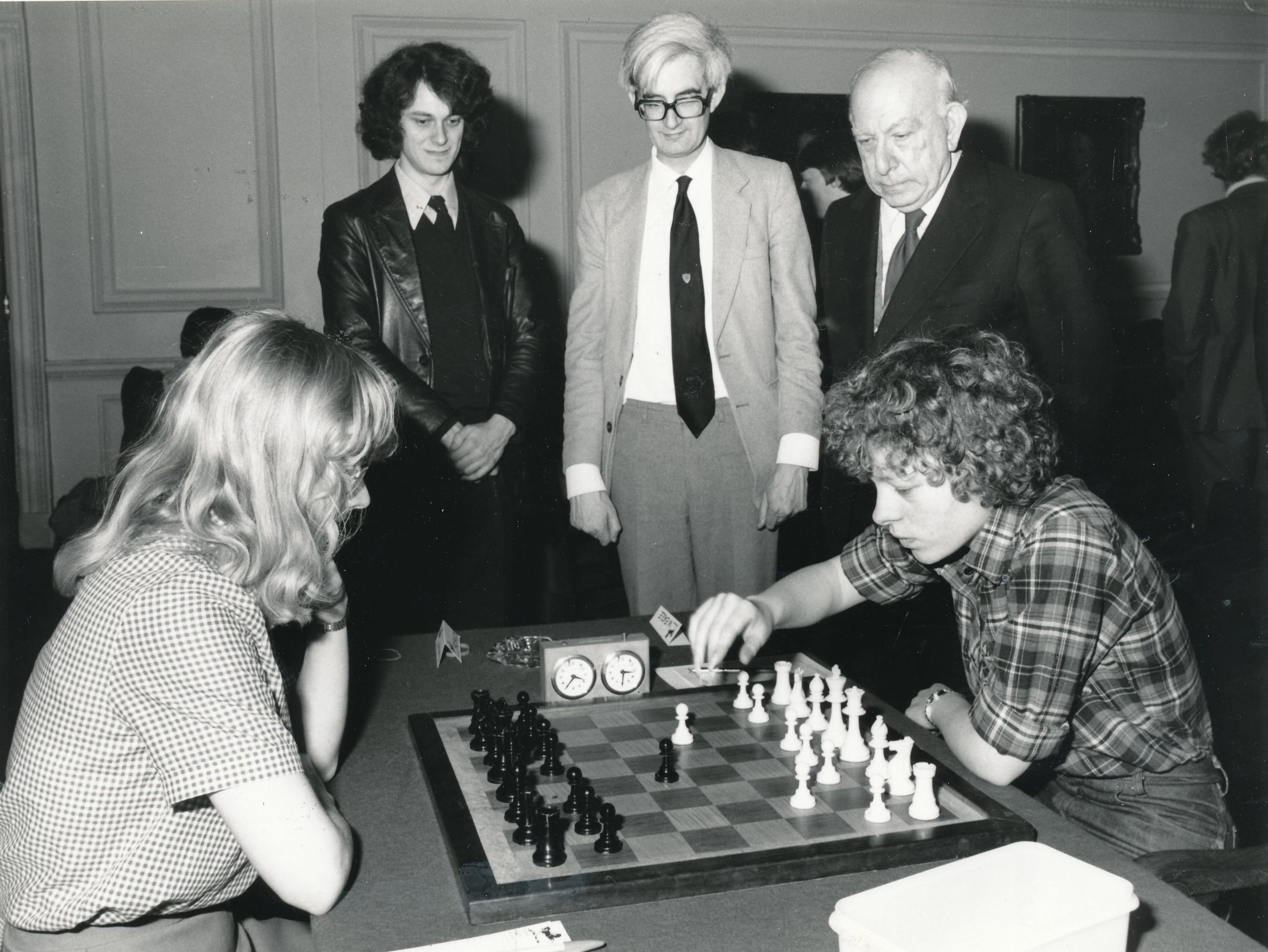
The first chance for the Grandmaster title came on Board 1 in the Seventh Olympiad final. Despite a rare loss with the White pieces(my only defeat with white for a stretch of 15 years), things went well, including a lucky win against the reigning World Champion, Horst Rittner, and the enticing prospect beckoned if only I could beat the Russian Moiseyev. He held a slight advantage since the opening, but I thought I saw the chance of tempting him to an incorrect sacrifice. Back came his move; he had indeed made the sacrifice and the envelope burnt a hole in my pocket during an important meeting (my mind was elsewhere). After a mere two days’ thought I sent my reply. The post between England and the USSR takes about a month for the return trip. Soon after posting my move, as I was walking from the Ashmolean Museum to Keble, just passing the front gate of St. John’s, the realisation of what I had overlooked hit me, and there followed an inexorable wait for the death blow which I now saw only too clearly.
[pgn]
[Event “olm7 fin B1 corr”]
[Site “ICCF corr”]
[Date “1972.??.??”]
[Round “?”]
[White “Moiseev, Oleg Leonidovich”]
[Black “Hollis, Adrian Swayne”]
[Result “1-0”]
[ECO “E42”]
[Annotator “British Chess News”]
[PlyCount “93”]
[EventDate “1972.??.??”]
[EventType “team (corr)”]
[EventRounds “9”]
[SourceTitle “Corr 2002”]
[Source “ChessBase”]
[SourceDate “2002.05.23”]
[SourceVersion “1”]
[SourceVersionDate “2002.05.23”]
[SourceQuality “1”]
{[%evp 0,93,19,-12,-10,-23,0,4,26,26,26,20,30,41,41,41,32,38,67,43,48,32,19,14,
28,16,17,9,46,57,71,70,67,56,71,42,26,27,26,31,36,23,32,33,40,21,37,38,47,34,
82,-2,4,-15,-7,-14,-5,-5,-10,-5,0,4,7,7,10,15,0,-92,13,19,44,45,144,110,106,91,
182,173,190,190,190,190,203,172,241,248,248,248,422,422,568,710,797,1015,29989,
29990]} 1. c4 Nf6 2. d4 e6 3. Nc3 Bb4 4. e3 c5 5. Nge2 d5 6. a3 Bxc3+ (6…
cxd4 7. axb4 dxc3 8. Nxc3 $11) 7. Nxc3 cxd4 8. exd4 dxc4 9. Bxc4 Nc6 10. Be3
O-O 11. O-O b6 12. Qd3 Bb7 13. Rad1 Qd7 (13… h6 $1) 14. Bg5 Nd5 {FS 239:
Taimanow: Schw. steht aussichtsreich Moissejew: +=} 15. Nxd5 exd5 16. Ba2 Rae8
17. Bb1 f5 {Taimanow: Schw. steht aussichtsreich~Moissejew: += B FS 239:
notwendig, aber schwaecht e5} 18. b4 Nd8 19. Bf4 (19. b5 Ne6 (19… Nf7) (19…
Nf7 {FS 239})) 19… Bc6 20. Rfe1 Bb5 21. Qd2 Bc4 22. Be5 Re6 (22… Nf7 23. f4
) 23. Re3 Rg6 24. Rf3 (24. f4 {notwendig, aber schwaecht e5}) 24… Nf7 25. Bf4
(25. Bxf5 Nxe5 {J 3c7, a6 ‘!’ FS 239.} 26. Bxd7 Nxf3+) (25. Rxf5 Nxe5 26. Rxe5
(26. Rxf8+ Kxf8 27. dxe5 Rxg2+) 26… Rxg2+ 27. Kxg2 Qg4+ $1) 25… Nd6 26.
Bxd6 $2 Rxd6 27. Re1 Re6 28. Rxe6 Qxe6 29. Re3 Qf6 30. f4 $1 {FS 239: gegen
f5-f4} g6 31. Re5 Kf7 32. Qe3 {FS 239: P g4} a5 {[#]} 33. g4 axb4 (33… fxg4 {
remis} 34. f5 $11) 34. gxf5 bxa3 35. Qxa3 Qh4 36. fxg6+ hxg6 37. Bxg6+ Kg7 {
‘?’ FS 239.} (37… Kxg6 {gegen f5-f4} 38. Rg5+ Qxg5+ (38… Kf7 39. Qa7+) 39.
fxg5) (37… Kg8 {J g4} 38. Qg3 Rxf4 (38… Qxf4 $6 39. Bf7+ $1) 39. Bf7+ Kxf7
40. Rf5+ Rxf5 41. Qxh4 Be2 {J 5e6}) 38. Qa7+ Kxg6 (38… Kg8 39. Qd7 $2) 39.
Rg5+ Qxg5+ (39… Kf6 40. Qg7+ Ke6 41. Re5+ Kd6 42. Qxf8+ $2) 40. fxg5 Rf4 41.
Kg2 Rg4+ 42. Kf3 Rxg5 43. Qxb6+ Kh5 44. Qe6 Bd3 45. Kf4 Be4 46. Qe8+ Rg6 (46…
Kh4 47. Qe7) (46… Kh6 47. Qh8+ Bh7 48. Qxh7+) 47. Qe5+ 1-0
[/pgn]
So no Grandmaster title, but Great Britain still took the bronze medals, and I scored 6/9 (+5=1-2).
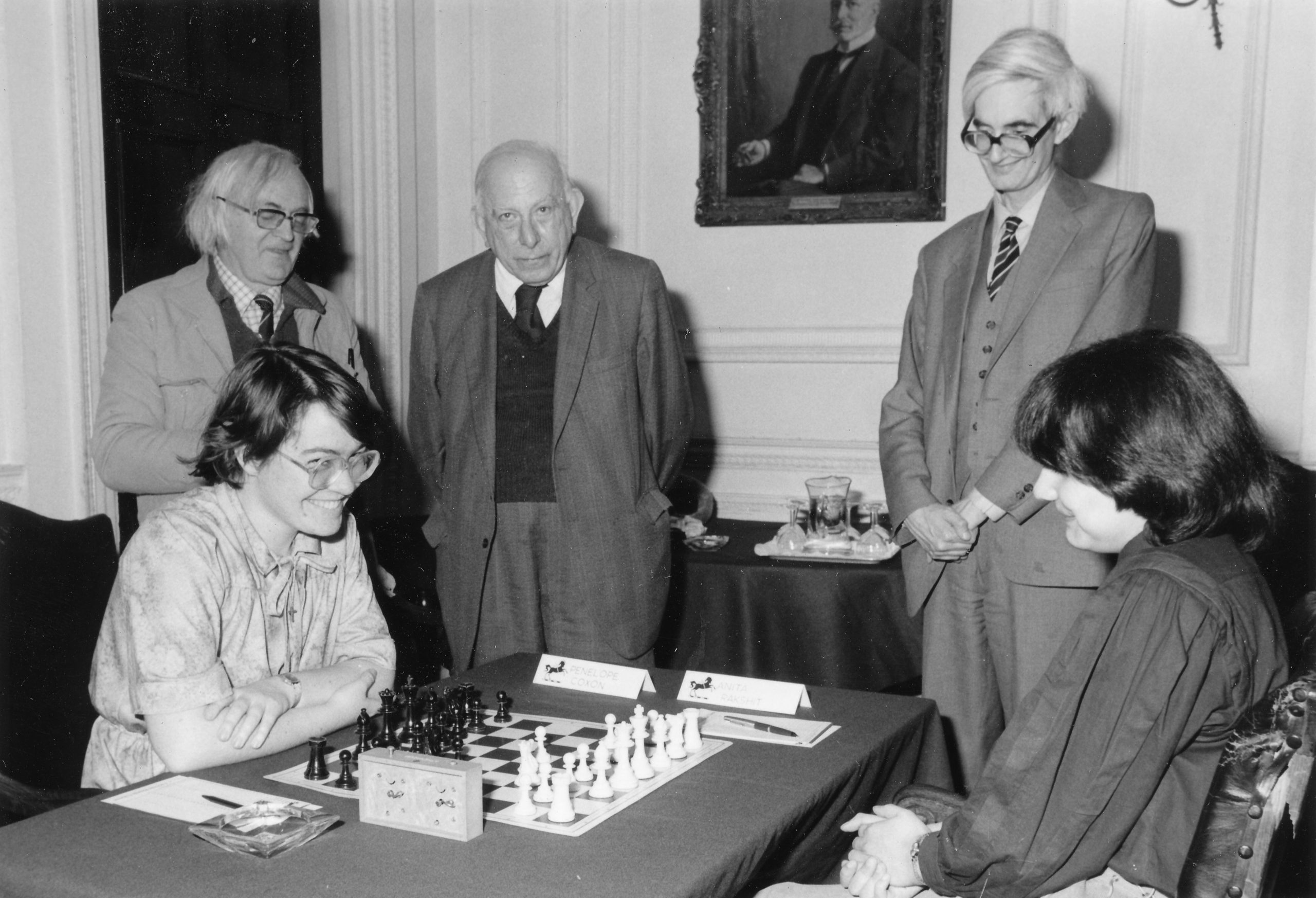
Another opportunity came when the British Postal Chess Federation organised a tournament (1974-6) in memory of its former secretary RJ Potter. This started inauspiciously for me with a heavy defeat at the hands of Grandmaster Endzelins of Australia., a country which has so far provided my least favourite opposition (not only is the postage extremely expensive, but my score to date is 0/2).
From The Potter Memorial, Ken Messere, Chess (Sutton Coldfield), 1979 we have this potted biography from Ken Messere :
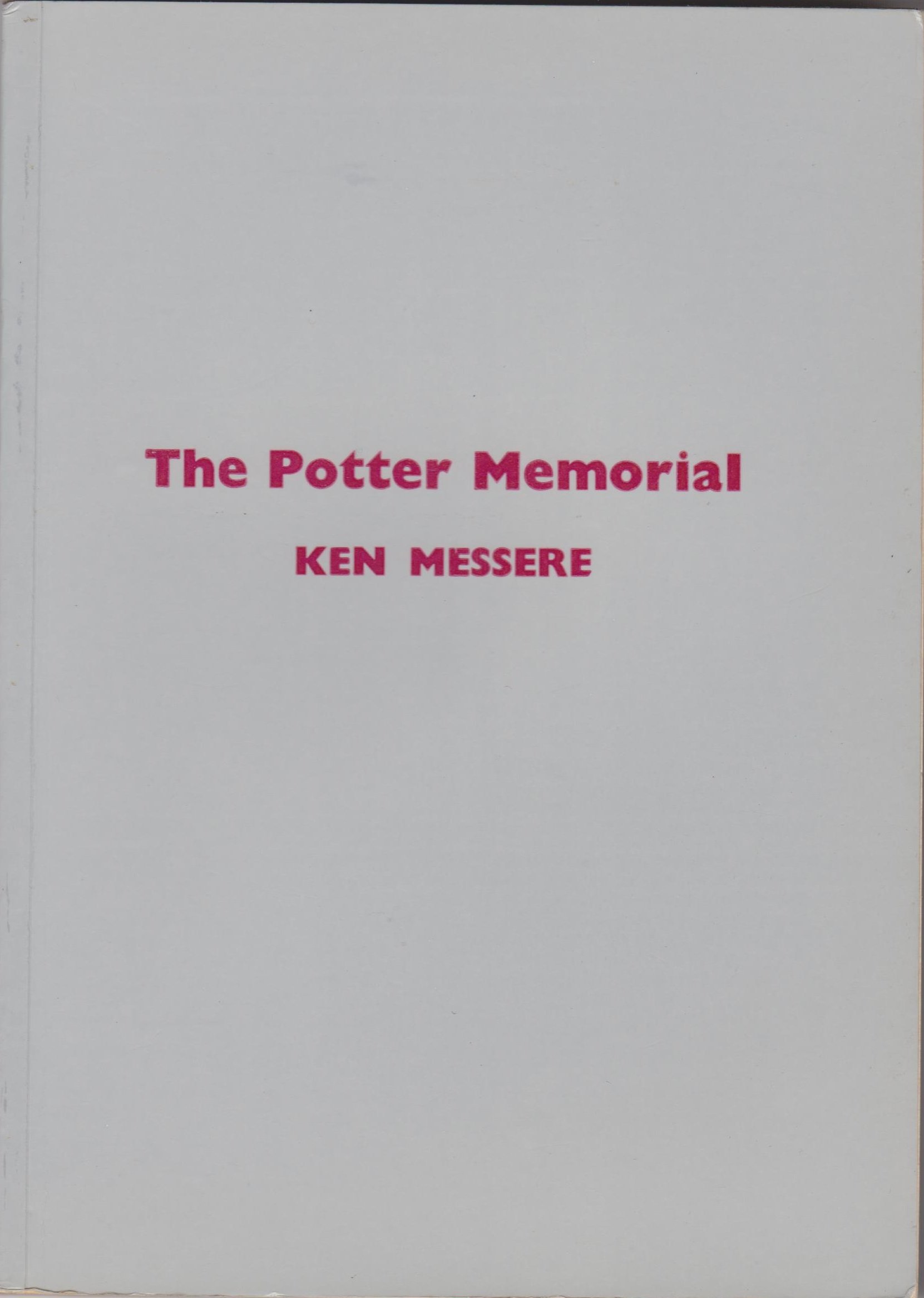
“Adrian Hollis is 36, was educated at Eton and Oxford, has written two books on the poet Ovid and is a Fellow and Tutor in Classics at Keble College, Oxford. He is a British Master at over the board chess and has been Champion of British Universities, West of England and East Scotland.
In 1964, he went to teach at St. Andrews University where his wife, Margaret, taught German. They were married and moved to Keble College in 1967 and now have two daughters. Jennifer is nearly five and Veronica is two.
Adrian began to concentrate on correspondence chess in 1964 and won the British Correspondence Chess Championship jointly in 1966 and outright in 1967 and 1971. He won the I.M. title in 1970 and his fine score of 6/9 on top board for Great Britain in the I.C.C.F. VIIth Correspondence Chess Olympiad Final contributed to the team’s winning the bronze medal in this event.”
and now back to Adrian’s British Chess article…
Thereafter my fortunes improved; one opponent accepted too trustingly some faulty analysis by Szabo in Informator (for a while it seemed that the Hungarian might earn me not one but two points). The East German Dr. Baumbach failed to find an improvement in a line with which I had been successful in the Seventh Olympiad Final.
Also, I had a win with the Black pieces against the Russian Kopylov. The result was a score of 9/12 (+8=2-2), which sufficed for the grandmaster title and first place half a point ahead of the Finn Kauranen.
Since then I have played quite well on second board behind Keith Richardson in the Eighth Olympiad Final (+5=7-0), and very badly indeed (scoring just about 50% in the Heilimo Memorial Tournament organised from Finland (I was much impressed by the strength of the Finnish players, most of whom I had not encountered before). Having twice narrowly failed, I would still like to qualify for the Final of the Individual World Championship. Of course life becomes increasingly busy, but the examples of Hugh Alexander and Graham Mitchell encourage me to believe that one can continue to play well at postal chess longer than over-the-board. So perhaps around the year 2000, when the children are grown up….”
[pgn]
[Event “olm7 fin B1 corr”]
[Site “ICCF corr”]
[Date “1972.??.??”]
[Round “?”]
[White “Hollis, Adrian Swayne”]
[Black “Florian, Tibor”]
[Result “1-0”]
[ECO “D76”]
[Annotator “Averbakh/Hollis/Howell & BCN”]
[PlyCount “121”]
[EventDate “1972.??.??”]
[EventType “team (corr)”]
[EventRounds “9”]
[SourceTitle “Corr 2002”]
[Source “ChessBase”]
[SourceDate “2002.05.23”]
[SourceVersion “1”]
[SourceVersionDate “2002.05.23”]
[SourceQuality “1”]
{[%evp 0,121,18,26,36,-22,54,32,37,19,27,28,30,3,26,19,17,42,20,13,27,31,31,31,
19,24,27,11,47,61,50,85,90,77,66,63,67,54,73,53,40,43,55,36,46,65,45,46,49,49,
48,54,48,69,83,93,102,102,103,112,98,89,114,100,99,91,98,98,94,79,79,82,90,87,
91,85,91,82,78,76,96,101,96,75,100,91,92,103,118,118,118,118,118,118,121,139,
179,182,206,240,191,212,205,205,205,192,192,192,192,183,192,104,155,96,96,96,
100,527,537,28911,29983,29984,29985,29986]} 1. d4 Nf6 2. c4 g6 3. Nf3 Bg7 4. g3
d5 5. cxd5 Nxd5 6. Bg2 O-O ({ASH : It is rather more challenging for Black to
postpone castling, and to organise an immediate attack on White’s d-pawn with}
6… Nb6 7. Nc3 Nc6) 7. O-O Nb6 8. Nc3 Nc6 9. d5 Na5 ({ASH : I have never yet
found an opponent to accept the pawn with} 9… Bxc3 $6 {too risky to accept P}
10. dxc6 Bg7 11. Qc2 bxc6 12. Rd1 Bf5 13. Qb3 Qe8 14. Nd4 Bd7 15. Qc2 {BCN :
is a typical line.}) 10. Bf4 c6 11. dxc6 {ASH : Such are the subtleties of
transposition that, although occasionally played before, this line does not
appear in the Grunfeld books of Hartston or Richardson and Boyd.} Nxc6 ({
ASH : In Olympiad VIII Finals (1977) Dr. S. Aarseth (Norway) played against me
} 11… Qxd1 12. Rfxd1 Nxc6 13. Nd2 $1 Bf5 (13… Be6 {Hollis}) 14. Rac1 Rac8
15. Nde4 Nc4 16. b3 Na3 $6 (16… N4e5 {wastes two tempi}) 17. Nd5 Rfe8 (17…
Kh8 18. Nxe7 $1 Nxe7 19. Bd6) 18. Bg5 Kf8 (18… f6 $5 {although Hollis says
it “hardly appeals”}) 19. Nxe7 Nxe7 20. Nd6 b6 (20… Rxc1 21. Bxc1 {xNa3}) 21.
Nxc8 Bxc8 22. Bxe7+ Kxe7 23. Rc7+ Kf6 24. Bc6 Rf8 25. Rxa7 Nc2 26. Be4 $18 {
Hollis-Aarseth, corr-CCOL8 fin 1975-77}) 12. Qc1 e5 13. Be3 {13 Rd1 was theory
but why drive Black Q where she wants to go?} Nd4 {An outpost which cannot be
maintained.} 14. Rd1 Be6 15. Nxd4 exd4 16. Bxd4 Bxd4 17. e3 Bxe3 18. Qxe3 $14 {
[#] ASH : So White emerges with a small but clear advantage (better placed
pieces, pressure on the b-pawn and on the Black squares).} Qe7 19. Ne4 Bd5 20.
Qc5 Qxc5 21. Nxc5 Bxg2 22. Kxg2 Rac8 $6 {ASH : A difficult decision. Black
surrenders a pawn for some counterplay.} ({ASH : He might have had better
chances of a draw with the passive} 22… Rab8 {better drawing chance despite}
23. Nd7 Nxd7 24. Rxd7 {not sufficient to win}) 23. Nxb7 Rc2 24. b4 Re8 25. Rd8
Rxd8 26. Nxd8 Na4 27. a3 Rc3 28. Re1 Kf8 29. Re5 Rc7 30. h4 h6 31. Ra5 Nc3 32.
Ra6 {threat Nc6 forces play} Rd7 33. Nc6 Rd6 34. a4 Nxa4 35. Rxa4 Rxc6 36. Rxa7
Rc3 37. b5 Rb3 {See page 80 in Essential Chess Endings by Howell.} 38. Rb7 Kg7
39. b6 h5 {This move produces a model endgame as analysed by Hollis etc. [#]
cf ending in Portisch-Petrosian [INF 17-0568] after Portisch’s 47th move.
White plan is to play K to d-file, Black captures f-pawn but then K goes to
c-file and R cannot return behind passed P (only works with b-pawn)} ({Hollis
suspected Black should have played} 39… g5 $5 {not fearing h4-h5}) 40. Kf1 {
The general case of a draw is threatened but not overturned. Averbakh
“Comprehensive Chess Endings” vol 5 (Pergamon ed) analyses both the Hollis and
Portisch endgames (see pp291-292)} Rb2 41. Ke1 Kf6 {As White threatens to
support the advance of his passed P with his K, it is very important for Black
to seek counterplay on the other wing – Averbakh} 42. f3 Rb3 43. Kd2 Rxf3 44.
Kc2 {ASH : The idea is realized.} Rf5 $2 (44… Ke6 $2 45. Rc7 $1 (45. Re7+ $6
Kxe7 46. b7 Rf5 47. b8=Q {hard to see how White can win}) 45… Rf5 {see game})
(44… Rxg3 $6 45. Rc7 $1 {Howell wrongly attributes this move to Hollis but I
don’t find it in Hollis’ notes. Averbakh claims as his?} (45. Rxf7+ Kxf7 46. b7
{Hollis said this may win as Pg6 weak but Averbakh gives:} Rg2+ $1 47. Kc3 Rg3+
48. Kc4 Rg4+ 49. Kc5 Rf4 $1 50. b8=Q Rf5+ 51. Kd6 Kg7 $1 {“Black creates an
impregnable fortress” – Averbakh}) 45… Rg2+ $140 46. Kb3 Rg1 47. Kb2 Rg2+ 48.
Rc2 $1 Rg4 49. Rc3 Rxh4 50. Ka3 Re4 51. b7 Re8 52. Rc8 Re3+ 53. Kb2 Re2+ 54.
Kc3 Re3+ 55. Kc2 Re2+ 56. Kd3 Rb2 57. b8=Q Rxb8 58. Rxb8 Kf5 59. Rf8 f6 60. Ke3
g5 61. Kf3 $18 {Averbakh}) (44… Re3 $3 {is the right plan:} 45. Rc7 Re8 46.
b7 Rb8 {Hollis thought White could now win:} 47. Kd3 Kf5 $1 48. Rxf7+ Kg4 49.
Rf4+ $1 Kxg3 50. Rb4 {[#]} g5 $1 {The saving move not considered in Hollis
article, but later discovered by Russian analysts. Black creates a
countervailing passed pawn.} (50… Kh3 $2 51. Ke2 $1 Kg3 (51… Kg2 52. Rb3) (
51… Re8+ 52. Kf2 Rf8+ 53. Ke3 Rb8 54. Kf3 {as in main line}) 52. Ke3 Kh3 53.
Kf3 Rf8+ 54. Ke4 Rb8 55. Ke5 $18) 51. hxg5 h4 52. g6 (52. Ke2 h3 53. Kf1 h2 54.
Rb3+ Kf4 55. Kg2 Kxg5 $11) 52… h3 53. g7 h2 54. Rb1 Kg2 $11 {Averbakh}) 45.
Rc7 Rb5 46. b7 {“The outwardly active position of Black R prevents his K from
approaching the pawns” – Averbakh} Ke6 (46… Kf5 {according to Fine’s recipe
(idea 47 Rxf7+? Kg4) but..} 47. Kc3 $1 {threat 48 Rxf7+ Kg4 49 Rf4+ and 50 Rb4;
prevents …Kg4 by same idea} f6 $140 (47… Kg4 48. Rc4+ $1 Kxg3 49. Rb4 Rxb7
50. Rxb7 Kxh4 (50… f5 51. Rg7) 51. Rxf7 Kg3 52. Kd2 g5 53. Ke1 $18) 48. Kc4
Rb1 49. Rc5+ Kg4 50. Rb5) 47. Kc3 f6 48. Kc4 Rb1 49. Kc5 Kf5 50. Rd7 $1 $18 {
prevents Kg4 and threatens Rd5+ followed by either Rd6+ or Rd4+ and then
inserting R on b-file} Rc1+ 51. Kd6 Rb1 52. Kc7 Rc1+ 53. Kd8 Rb1 54. Kc8 Kg4
55. Rd6 g5 56. Rxf6 gxh4 57. gxh4 Kxh4 58. Rg6 $1 Kh3 59. Kc7 {According to
Howell, Black resigned here but Hollis gives further moves, see e.g. ‘British
Chess’ pp105-107} Rxb7+ 60. Kxb7 h4 61. Kc6 {ASH : It would be extremely rash
to claim this ending as a theoretical win. The outcome nearly always depends
on a single tempo, and may be swayed by secondary factors (e.g. it proved
vital in the above for White’s rook to be on the seventh rather than the
eighth). But at least this game can be added to the example for future
research. Perhaps this is the kind of problem that one day computers might be
able to solve.} 1-0
[/pgn]
From British Chess Magazine, Volume CXXXIII (133, 2013), Number 4 (April), pp.194-5 we have this obituary written by James Pratt :
Adrian Swayne Hollis (2 viii 1940 Bristol – 26 ii 2013 Wells), British Master and Correspondence Grandmaster (1976), three times British Correspondence Champion, has died. He played most of his OTB chess as a young man, finishing seventh equal at the British Aberystwyth, 1961, when he beat, amongst others, A.R.B. Thomas and former champion, Alan Phillips. He gave future champion, Jonathan Penrose, a tough fight in the last round before conceding the half-point. He played in the Hastings Premier, 1962/3 and emerged with a plus score in the Anglo-Dutch matches. He was an occasional reviewer for BCM.
It was, of course, in the realm of postal player that he shone most brightly!
In 1966 we see him playing board two for England, below Slade Milan, and, two years later, Adrian scored 9/12 in a World Postal Qualifier, narrowly missing a place in the final. In 1971 he won the British Correspondence Championship, easily outdistancing a tough field. He played top board for England in the 1972-7 Olympiad. In 1974-6 he won the Reg Potter Memorial. In the ninth Olympiad – 1982-5 – Adrian Hollis was undefeated on board two. And England took the Gold Medal!
[pgn]
[Event “Alekhine mem-A corr9196”]
[Site “corr”]
[Date “1991.??.??”]
[Round “?”]
[White “Gipslis, Aivars P”]
[Black “Hollis, Adrian Swayne”]
[Result “0-1”]
[ECO “B81”]
[Annotator “Hawkes”]
[PlyCount “64”]
[EventDate “1991.??.??”]
[EventType “tourn (corr)”]
[EventRounds “12”]
[SourceTitle “Corr Nr. 1”]
[Source “ChessBase”]
[SourceDate “1997.09.01”]
[SourceVersion “2”]
[SourceVersionDate “2000.04.19”]
[SourceQuality “1”]
{[%evp 0,64,32,37,46,50,80,80,71,47,43,38,82,21,81,78,77,54,60,63,69,68,77,41,
27,22,70,6,6,3,12,33,18,-2,3,-47,-62,-45,-59,-59,-70,-53,-53,-108,-27,-27,-1,
-116,-143,-148,-88,-204,-180,-252,-271,-247,-199,-231,-468,-531,-562,-531,-638,
-660,-627,-704,-510]} 1. e4 c5 2. Nf3 d6 3. d4 cxd4 4. Nxd4 Nf6 5. Nc3 e6 6. g4
a6 (6… Nc6 7. g5 Nd7 8. Be3 Nde5 9. Be2 a6 10. f4 Nxd4 11. Qxd4 Nc6 12. Qd2
b5 13. Bf3 Qa5 14. O-O Be7 15. Qf2 Rb8 16. Ne2 O-O 17. Bg2 Re8 18. c3 Bd7 19.
Rfd1 Qd8 20. Rd2 Bf8 21. Rad1 $14 {Haag-Penrose, 9 Olympiad}) (6… Be7 7. g5
Nfd7 8. Be3 Nc6 9. Rg1 Nb6 10. Qd2 O-O 11. f4 Nxd4 12. Bxd4 e5 13. Be3 d5 14.
fxe5 Bb4 15. O-O-O Be6 16. Rg3 Na4 17. Bd4 Bxc3 18. Bxc3 Nxc3 19. Rxc3 dxe4 20.
Qf4 Qb6 21. Qxe4 Rac8 22. Rxc8 Rxc8 23. Kb1 g6 24. Bd3 $6 Rd8 $1 {0-1 (43)
Palciauskas-Bang, Axelson mem.}) 7. g5 Nfd7 8. Bg2 (8. Be3 b5 9. a3 Bb7 10. h4
Be7 11. Qd2 Nc6 12. f4 h6 13. Bg2 hxg5 14. hxg5 Rxh1+ 15. Bxh1 Nxd4 16. Qxd4 e5
17. Qd2 exf4 18. Bxf4 Ne5 19. O-O-O Nc4 20. Qg2 Qa5 21. Nd5 b4 $1 {1/2-1/2 (44)
Franzen-Hollis, 10 Olympiad bd.2}) (8. h4 b5 9. a3 Nb6 10. Be3 N8d7 11. h5 Bb7
12. Rh3 $1 Ne5 13. g6 Nbc4 $2 14. Bxc4 Nxc4 15. gxf7+ Kxf7 16. Qg4 Qe7 $2 (
16… Qd7) 17. Bg5 Qd7 18. Nd5 $1 Ra7 19. Rf3+ Ke8 20. Nc7+ $1 {1-0
Kauranen-Estrin, 10 world ch. final}) 8… b5 (8… Nc6 9. f4 h6 10. h4 hxg5
11. hxg5 Rxh1+ 12. Bxh1 Qb6 13. Nf3 g6 14. Qd2 Qc7 15. b3 b5 16. Bb2 Bb7 17.
O-O-O O-O-O 18. Nh2 Nb6 19. Ng4 d5 20. e5 d4 21. Ne4 Nd5 22. Qf2 Qa5 23. Nd6+
Bxd6 24. Bxd5 Bc5 $1 {1/2-1/2 Khasin-Walter, 8 world ch. final}) 9. f4 b4 10.
Nce2 Bb7 11. h4 Nc5 12. Ng3 g6 13. b3 Bg7 14. Bb2 O-O 15. Qd2 Qb6 16. O-O-O a5
17. Nde2 Bxb2+ 18. Kxb2 a4 19. Nc1 axb3 20. cxb3 Nc6 21. h5 Qa5 22. Kb1 {[#]}
Na7 $1 23. Qb2 Nb5 24. Ka1 Nc3 25. Rd2 Ra7 26. Rh2 Rfa8 27. Bf3 Qc7 28. Rc2
Nxa2 29. Nxa2 Rxa2+ 30. Qxa2 Rxa2+ 31. Kxa2 Qa5+ 32. Kb1 Qa3 {Hawkes} (32…
Nxb3 $4 33. Ra2 Qc5 34. Rhc2 Qg1+ 35. Kb2 Qxg3 $4 36. Ra8+ $1 Bxa8 37. Rc8+ Kg7
38. h6# {(Hollis)}) 0-1
[/pgn]
Obituary from Raymond Keene in The Specatator
Obituary from Kenneth Shelton in The Independent
Obituary from ? in The Times
Obituary from John Rhodes in The Chess Improver
Obituary from Bob Jones of Keverel Chess.
Wikipedia article.
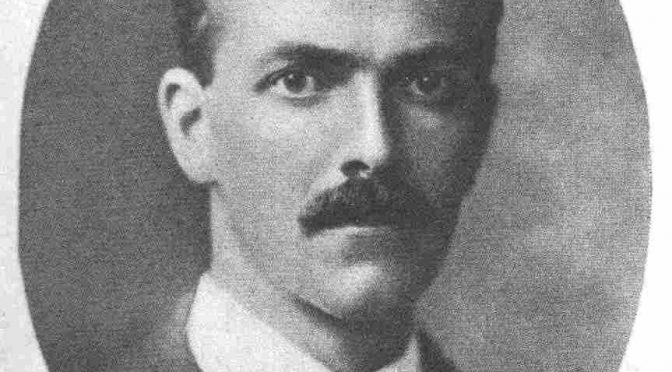
Save as PDFBCN remembers Stanley Kipping who passed away in Walsall on February 17th 1964 at the age of 72 who was always known by friends and family as Stanley.
BCN was fortunate to receive the following part email from John Kipping, a resident of Christchurch, New Zealand.
None of the Kipping family from around that time were referred to by their first name. His brother was Barry (my grandfather), and two sisters, Esme who made jigsaw puzzles and Frieda, named after Frieda Weekly (nee von Richtofen).
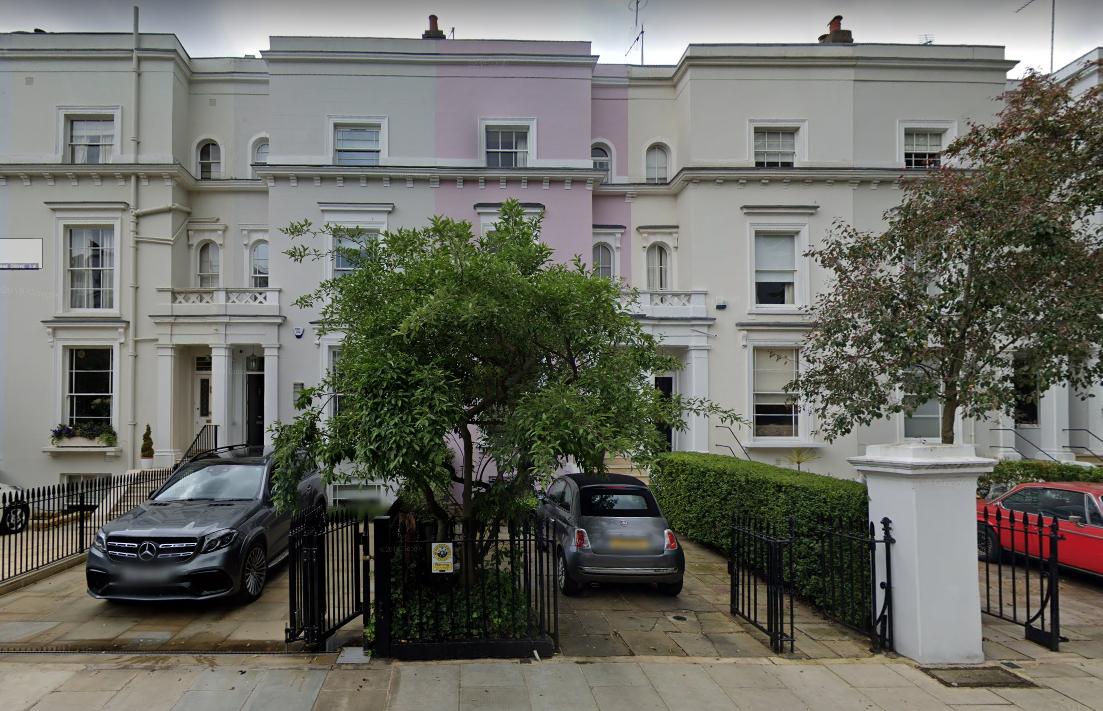
(Cyril Henry) Stanley Kipping was born on Saturday, October 10th, 1891 in 7 Milborne Grove, South Kensington, London, SW10 9SN.
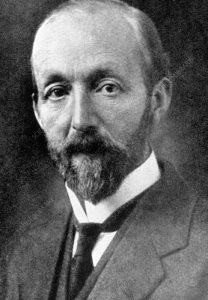
His parents were Frederic Stanley Kipping (28) and Lillian Kipping (24, née Holland) : they married in 1888. Stanley was baptised on May 8th, 1892 in West Brompton, London. Frederic died on 30 April 1949 in Pwllheli, Caernarvonshire, at the age of 85 and Lilian passed away on 4 September 1949 in Pwllheli, Caernarvonshire, at the age of 82.
Frederic was Professor of Chemistry at The University of Nottingham. He undertook much of the pioneering work on silicon polymers and coined the term silicone. He was elected a Fellow of the Royal Society in 1897.
In the 1901 census the family lived at Clumber Road West, Nottingham and brother Frederic Barry Kipping was born on April 14th 1901 and his sister Kathleen Esme was born on 3rd May 1904 also in Nottingham. Kathleen died on 30 August 1951 in Pwllheli, Caernarvonshire.
In 1902 Stanley started at Nottingham High School excelling in mathematics and science and in 1906 he obtained the Oxford and Cambridge Board’s Lower Certificate.
On March 2nd 1908 the Sheffield Daily Telegraph published a matriculation list for London University and CHSK was listed as being in the second division. Following that in 1909 Stanley obtained a Oxford and Cambridge Higher Certificate.
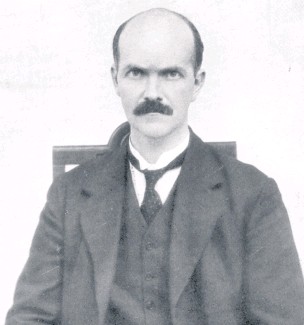
As of the 1911 census the household now included Stanley’s maternal Grandmother, Florence Holland (59) plus a parlourmaid, a housemaid, a cook and a nurse. Stanley was recorded as being a 19 year old science student and they lived at 40, Magadala Road, Nottingham which appears to have been replaced by residential flats. Curiously the address on the Census record was obscured by green insulation tape but insufficiently for it to readable.
According to Stephen C. Askey
“He left school in July 1910 and went to Trinity Hall in Cambridge where he read for the National Sciences Tripos. He played tennis for his college and launched into the composition of chess problems.
He obtained a First in Part I of the Tripos in 1912, a First in Part II in 1913, and was awarded the degree of Bachelor of Arts on 7 June 1913. He began researching in organic chemistry at Cambridge, but in September 1914 decided instead to take a teaching appointment at Weymouth College.”
In 1914 The London Gazette announced that Stanley was promoted within the Chaplain Department of the British Army to Second Lieutenant with a service number of 10940.
On December 23rd 1914 The London Gazette announced the following :
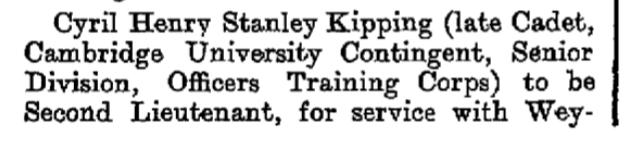
and

On the 9th October 1918 The London Gazette announced :

Again, according to Stephen C. Askey :
“In January 1919 he took his Master of Arts degree at Cambridge, and joined the teaching staff of Bradfield College in Berkshire. But by the summer of that year he became an assistant master at Pocklington School in Yorkshire, where he spent five happy years.
There he used his talent for juggling in 1920 to train a troupe of jugglers who gave a display at a school concert. This popular performance was repeated annually at Pocklington. Meanwhile be continued to compose chess problems and in 1923 published a book for beginners called The Chess Problem Hobby.”
In the 1939 register Stanley was recorded as residing at 67 Wood Green Road, Wednesbury, Staffordshire, England with Martha Partridge (born 29th June 1886) who was his Housekeeper.
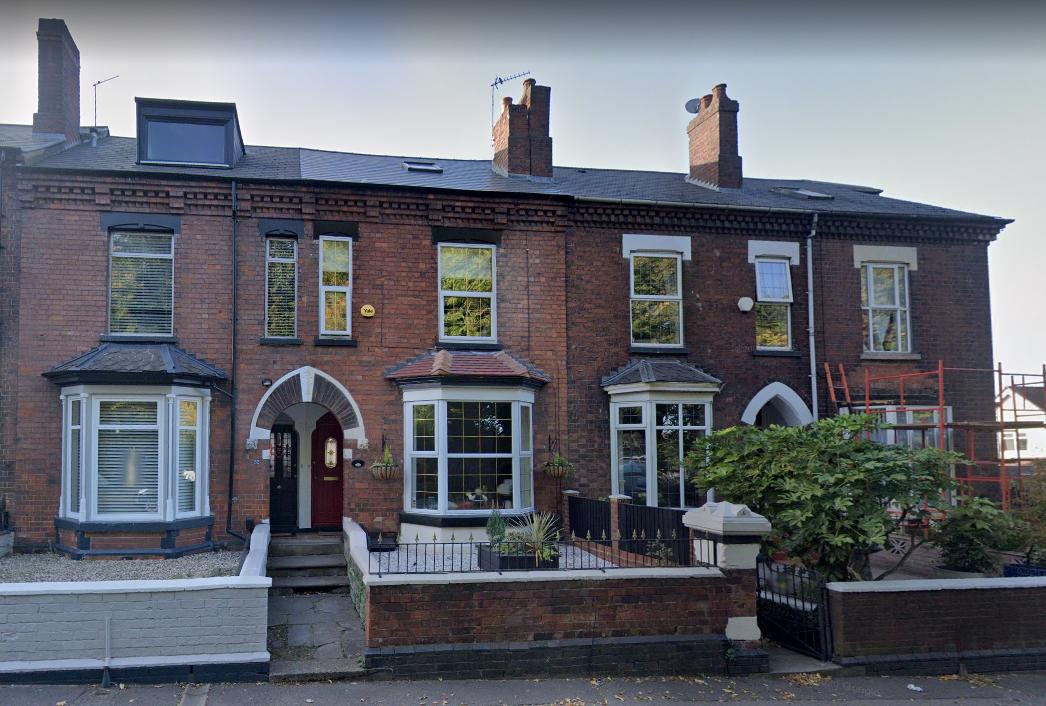
His probate record appears in the England & Wales Government Probate Death Index 1858-2019 as :

From The Encyclopaedia of Chess (Robert Hale 1970 & 1976), Anne Sunnucks :
“International Master of the FIDE for Chess Compositions (1959) and International Judge of the FIDE for Chess Compositions (1957). Born on 10th October 1891. Died on 17th February 1964. Kipping was famous as a composer and an editor which he combined with is duties as Headmaster of Wednesbury High School from 1925 to 1956.
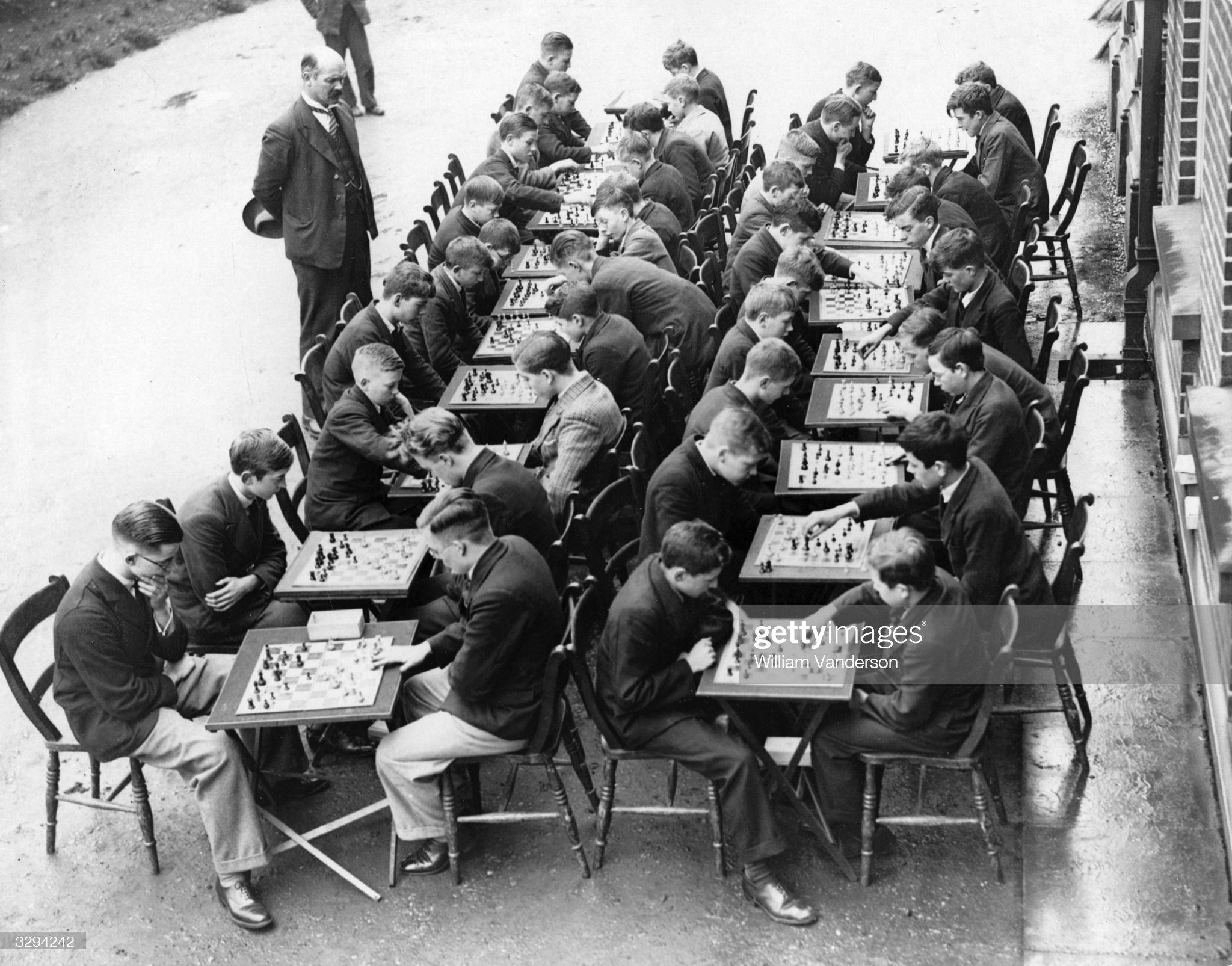
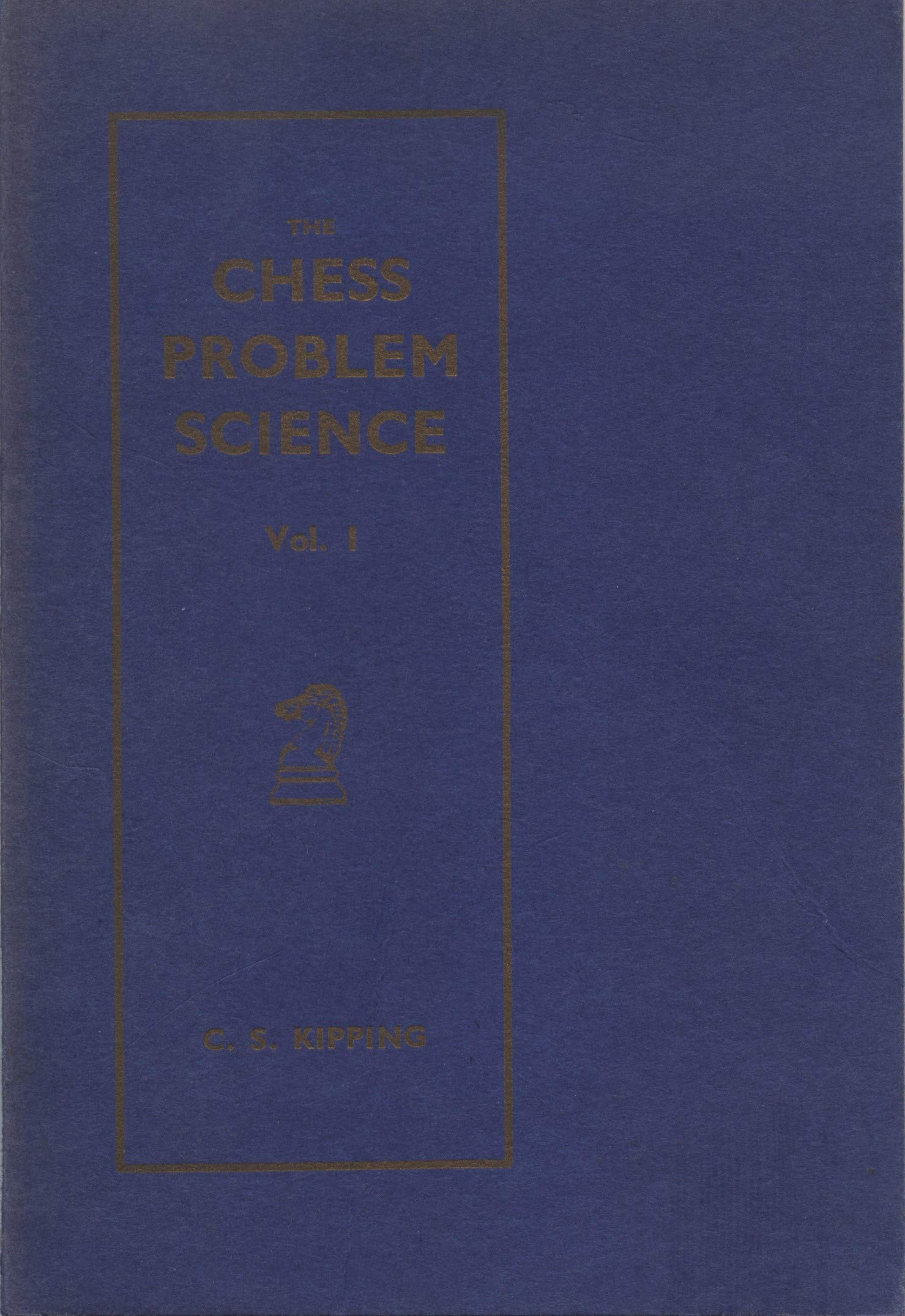
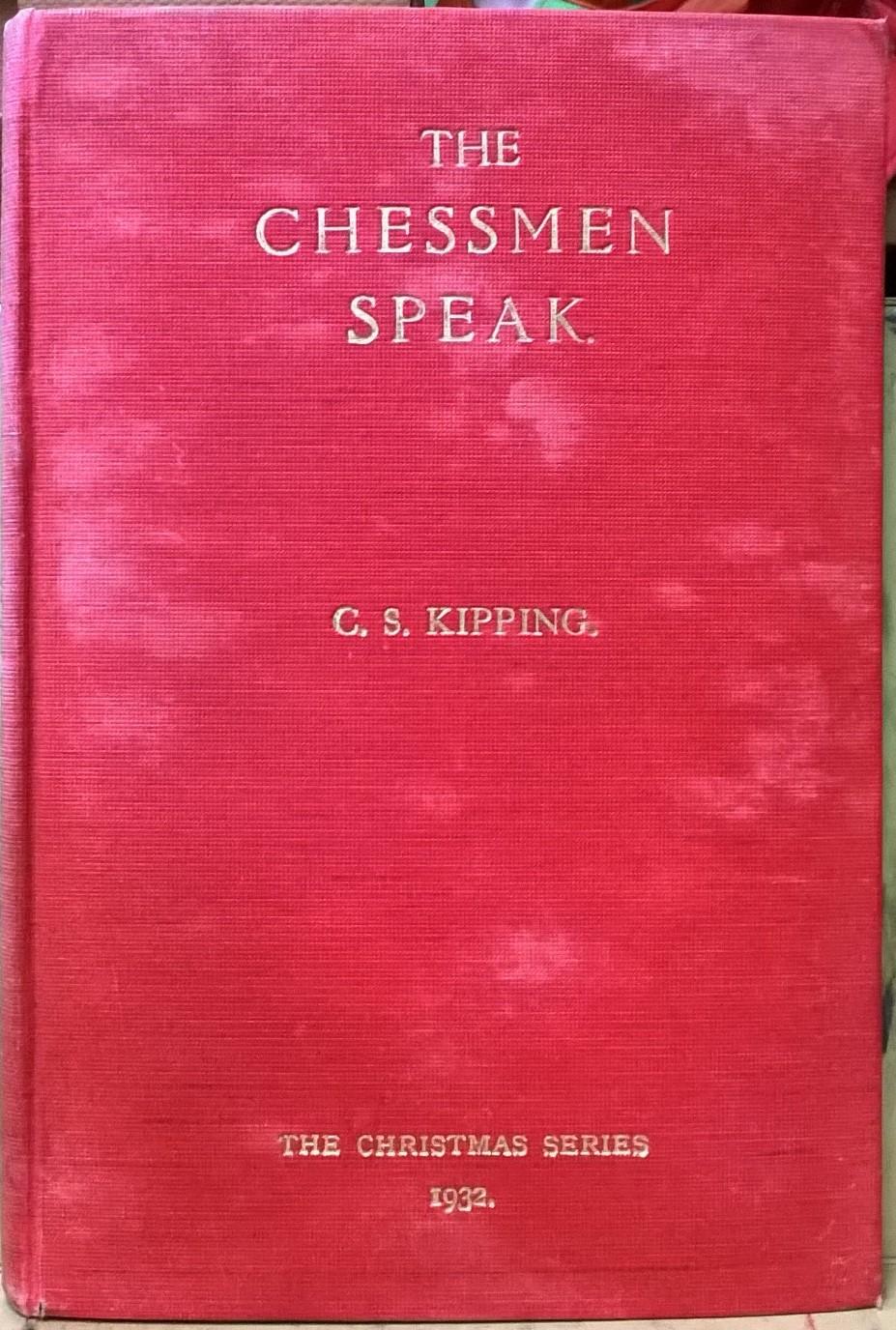
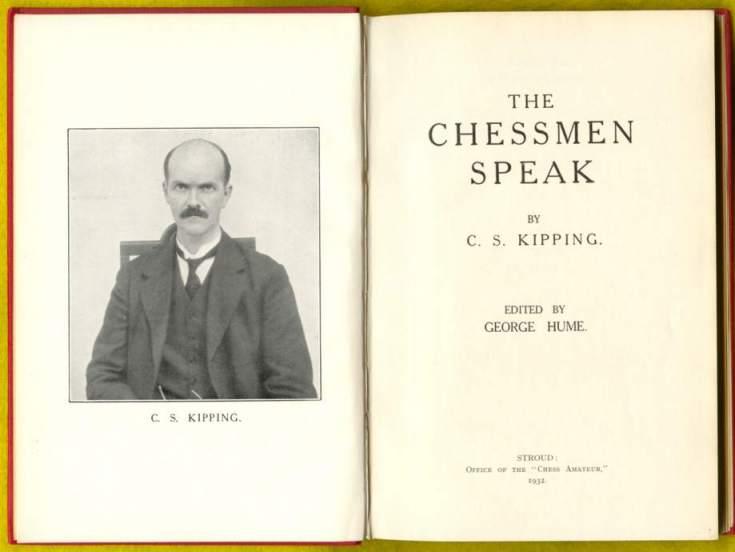
His editorial duties extended over more than forty years, and included the problem sections of Chess, Chess Amateur, and, for 32 years, the specialist magazine The Problemist from 1931. He was noted for his encouragement of beginners. His pamphlet ‘The Chess Problem Hobby‘ is an excellent beginner’s introduction. His other books included Chess Problem Science, The Chessmen Speak and 300 Chess Problems.
Kipping was one of the most prolific composers of all time, with over 7,000 problems to his credit. Many of his strategic three-movers have become classic. He was leading authority on halfpin two-movers. In his latter years, Kipping affectionately known as CSK – was Chairman of the International Problem Board which is now the FIDE Problem Commission.”
From British Chess Magazine, Volume LXXXIV (84, 1964), Number 4 (April), pp. 122-123 by John Rice:
“CS Kipping, one of the most famous of all British problemists, died during February at the age of seventy-two. As a composer, editor, writer and critic Kipping was without equal. It is impossible to do justice in only a few lines to his vast and unique contribution to chess problems: a few factual notes. most of them kindly supplied by RCO Matthews, must suffice.
Kipping was born in London on October 10th, 1891, After completing his studies, he took up teaching as a career, and in 1924 he was appointed the first headmaster of the newly-opened Wednesbury High School, which post he held until his retirement in 1956. He was a bachelor, and, especially during the later years of his life, his interests were centered mainly on the school and on chess problems.
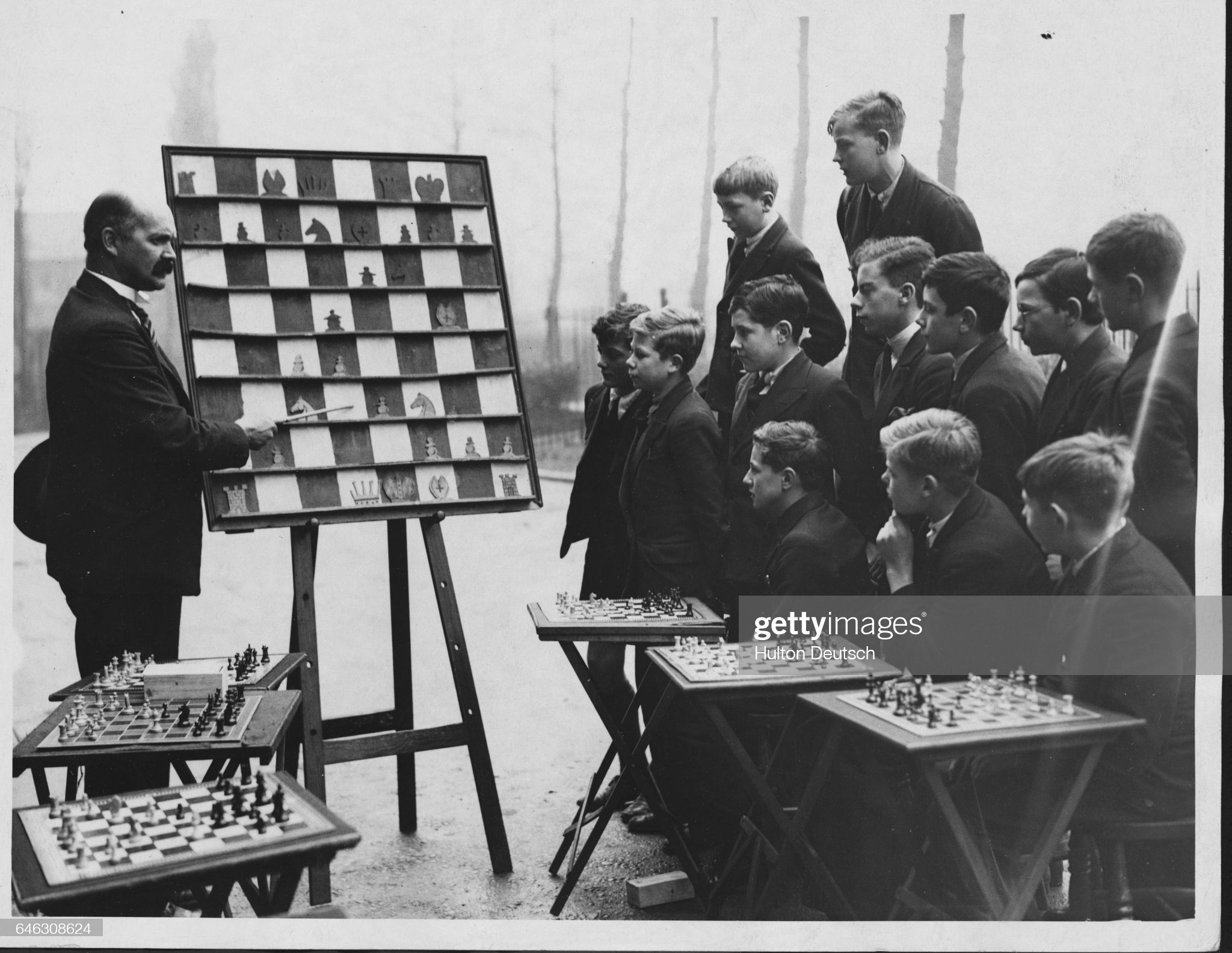
Most readers will know of Kipping as the editor of The Problemist, the bi-monthly journal of the British Chess Problem Society. Before he took over The Problemist in 1931, he had been in charge of the problem section of the Chess Amateur, which he edited with great energy and enthusiasm. As well as The Problemist, he edited the problem pages of Chess from its first appearance. in 1936 until the section was suddenly discontinued without warning or explanation a few years ago. He also edited other columns at various times. He always took great care to help and encourage beginners, and it is probably true that every composer in this country below the age of about fifty came under his influence at one time or another.
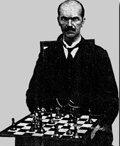
As a young man, Kipping was a fierce avant-garde controversialist, championing the the cause of strategy in the three-mover in opposition to the then dominant model-mate school in this country. His attitude to the two-mover, as readers of The Problemist will know, was always a good deal more conservative; he would not tolerate at any price what he called ‘camouflage force,’ even in the modern problem. Yes, he appreciated the aims of the modern two-move composer much more than his writings on the subject suggest, being always ready to applaud excellence in any type of problem.
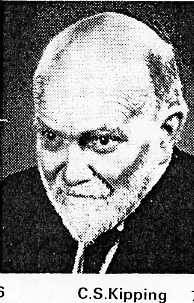
Kipping’s output numbered over 7,000 problems, probably a record. Many of his two-moves especially his ‘aspect’ tasks, were published under pseudonyms, of which the best was known was C.Stanley. He concerned himself little with artistic finish : once he had found a workable setting of a them he was engaged on, he would take little trouble over economy and presentation. Themes in which he interested himself include half-pin (in the two-mover), white King themes, interferences, and the grab theme (in the three-mover), and maximum tasks of all kinds, the subject of one of his books, Chess Problem Science. His other books include 300 Chess Problems (1916), and The Chessmen Speak (1932), in the AC White Christmas series.
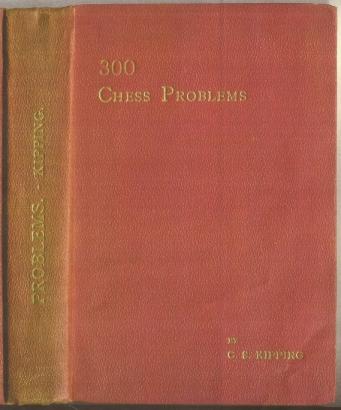
In addition to all his other problem activities, Kipping was chairman of the International Problem Board, and curator of the half-pin section of the White-Hume Collection, which he took over on Hume’s death in 1936.
The majority of Kipping’s best problems were three-movers, three of the most famous of which are quoted here.”
Manchester City News, 1911
[fen]k7/8/N1N5/3B4/K7/8/4p1r1/8 w – – 0 1[/fen]
Mate in three
1 Ka5
First Prize
Dutch East Indies Chess Association Tourney, 1928
[fen]8/BR1pKp1P/k1B1n1P1/3P2Nr/N7/4R1P1/1r2qb2/5Q2 w – – 0 1[/fen]
Mate in three
1 Ra3
First Prize
BCM, 1939 (II)
[fen]1br5/1r5Q/3N2PB/5Pp1/q4pk1/p2p1p1R/B4P1K/1R1N4 w – – 0 1[/fen]
Mate in three
1 Be6
The first problem above was given in The Complete Chess Addict by Mike Fox and Richard James in the Desert Island Chess chapter. It is also given in a discussion of the Steinitz Gambit by ASM Dickins and H Ebert in 100 Classics of the Chessboard. Colin Russ on page 138 of Miniature Chess Problems from Many Countries gives the first problem as does John Rice on page 44 of Chess Wizardry : The New ABC of Chess Problems.
Stanley was the first President of Walsall Kipping Chess Club which includes amongst its members and former members David Anderton OBE and Jana Bellin. We have been provided with the following information by Mike Groombridge:
CS Kipping, strictly speaking, was not the founder of the club, but was involved immediately at the formation of the club, which was originally called The Kipping Chess Club*. [*By March 1945, the club had 3 branches and only then did it formally split into 3 -Walsall, Wolverhampton, and a school (Municipal Secondary School Wolverhampton?) for the purpose of playing in the newly formed Wolverhampton League. Walsall Kipping Chess Club only formally took its name in May 1948, and was separated by then from The Wolverhampton Kipping Chess Club!] The Walsall Club’s minute book contains clippings from a local newspaper of 1942 reporting on the formation of the club. Here are copies:-
‘Walsall’s New Chess Club.-The new chess club, members of which will meet in the evenings for play and social intercourse, already promises to be very successful. The organiser, Mr.A.E.Parsons, of England & Sons, The Bridge (where meetings will be held for the time being) is acting as secretary pro tem, and he has secured as the first president Mr.C.S.Kipping, Headmaster of the Wednesbury High School for Boys, well known as an expert and for the innovation of chess in the curriculum of his school. Mr.Kipping has given valued assistance by the initial provision of boards and pieces. Members will meet on Monday evenings at 6.30 and the club will rely, in the first place, on voluntary subscriptions’. [5.9.42]
and
‘Walsall Chess Club.-Members of the recently formed Chess Club in Walsall had their first meeting on Monday [7th Sept 1942]. They decided to call the club “The Kipping [Chess] Club,” after their president, Mr.C.S.Kipping. Mr. F.D.Fox was appointed chairman, Mr.Gordon Farrell treasurer, and Mr.A.E.Parsons honorary secretary. Mrs.Wright and Miss Powell provided refreshments and were warmly thanked for their contribution to the success of the launching of the club. Mr.H.Lee was subsequently appointed vice-president after occupying the chair for the evening.’ [12.9.42]
Also, here is a copy of a brief sketch of CSK’s chess involvement, penned by David Anderton, for the Club’s Jubilee Chess Tournament:-
C S KIPPING, PRESIDENT 1942-1964
C S Kipping was the editor of the Problemist between 1931 and his death on 17th February 1964 at the age of 72 years. He also edited a problem column in Chess between 1935 and 1960. He [was] one of the most prolific of composers with some 7,000 problems to his name. He pioneered the introduction of strategic three movers in Great Britain and was the leading authority on half pin two movers. He was the Headmaster of Wednesbury Boys High School and introduced chess into the curriculum there in 1927. He gave evidence in the Chancery Division in the case of Re: Dupree’s Trusts in 1944 to the effect that chess teaches concentration, self reliance and reasoning and is a most useful training for the mind. Relying on this evidence, the Court upheld a bequest to establish a junior tournament as charitable and the case still forms the basis of English law on this point.
On a web site now only accessible via the WayBack Machine there is a treasure trove of reminisces and memories of CHSK from himself, friends and pupils.
From The Encyclopaedia of Chess (Batsford, 1977), Harry Golombek OBE, John Rice writes:
“British problemist, enormous output of over 6,000, mainly three-movers but also many two-movers, some published under pseudonyms (e.g. C. Stanley, of Nottingham). Editor of The Problemist, 1931-64. Elected international master honoris causa (1959).”
Anecdotes from former pupils.
A history from the Wolverhampton and District Chess League
Here is his Italian (only) Wikipedia entry.
Here is his entry on chesscomposers.blogspot.com
Save as PDFBCN remembers IM Čeněk Kottnauer (24-ii-1910 14-ii-1996)
Čeněk (pronounced CHEnek) Kottnauer was born in Prague on Thursday, February 24th, 1910. Čeněk was employed in the Ministry of Education in Prague.
Whilst playing in the Lucerne International tournament (28-xii-1952 03-i-1953) he sought political asylum :
From the Milwaukee Journal, January 3, 1953 we have
“Czech Chess Star Asks for Asylum
Lucerne, Switzerland – Cenek Kottnauer, 42, Czecho-Slovakian chess champion and an employee of the ministry of education in Prague, announced Saturday that he would not return to Czech-Slovakia and would request political asylum in Switzerland. Kottnauer had been participating in a chess tournament.
He said that the political situation in his country had grown “more and more critical” and he wanted “to leave before it is too late”. He said that he had been divorced recently and had no children in Czech-Slovakia”.
In a January 2009 post to the English Chess Forum Leonard Barden wrote :
“Cenek Kottnauer defected from Czechoslovakia during the Lucerne New Year tournament of 1952-3 (I am precise on this because I was present). His wife Daniela joined him there, having been smuggled from Prague in the boot of a diplomat’s car. Kottnauer had been a water polo player of international standard before 1939 so came into serious chess only his mid-30s. He made his name with his good showing in the Prague v Moscow match of 1946 and his Bxh7+ win then against Kotov. He competed in great tournaments like Groningen 1946 and Moscow 1947; his first visit to England was in 1947 when the Czech team came here.
In the 1940s he had a job in the Czech sports ministry but got implicated in the purges following the Slansky trial. He also believed that Pachman and Opocensky were involved in the campaign against him.”
Čeněk married Daniela (née Horska, also Czech, having met in Austria) and they had a son Daniel VR Kottnauer. Daniela was born in 1934 and was 24 years younger than Čeněk. She died on February 20th 2008 in a hospice in Essen, Germany close to where Daniel currently resides. Daniel has been a pianist and singer for 30 years, an event manager for 19 years and a coach and VIP limousine driver for 5 years and may be found on LinkedIn.
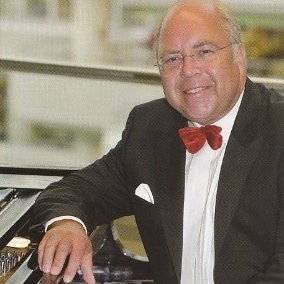
We thank Daniel for providing photographs.
Čeněk became a British citizen on 16th December 1960 when he obtained naturalisation certificate BNA64338.
In 1965 Čeněk and Daniela were living at Flat 2, 7-8 Bathurst Street, London, W2.
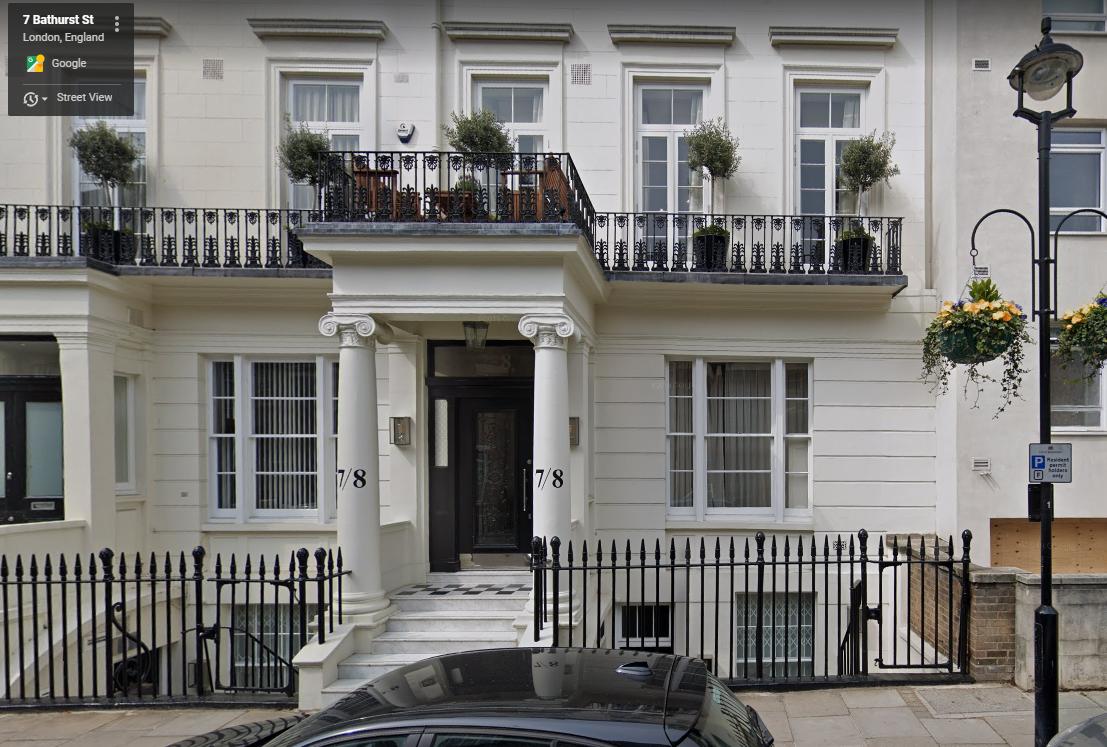
In Kings, Commoners and Knaves (Russell Enterprises, 1999), page 108, Edward Winter wrote :
“The obituaries of Čeněk Kottnauer (1910-1996) have, in common with all of the encyclopaedia entries on him, been strangely wanting in pre-1940s references to his chess career. Czech magazines of the 1930s contain occasional games by ‘Kottnauer’ (no forename or initial given), including the following :
[pgn]
[Event “Prague clock simul”]
[Site “Prague”]
[Date “1932.02.09”]
[Round “?”]
[White “Kottnauer, Cenek”]
[Black “Bogoljubov, Efim”]
[Result “1-0”]
[ECO “D47”]
[Annotator “British Chess News”]
[PlyCount “63”]
[EventDate “1932.??.??”]
[SourceTitle “chessgames.com”]
{[%evp 0,63,19,31,19,-16,24,16,27,44,43,47,54,39,55,63,33,16,2,-2,4,-18,-15,
-35,-43,-46,-45,-45,-18,-23,-23,-33,-43,-49,-29,-29,-34,-88,-86,-86,-65,-107,
-71,-77,-56,-131,-77,-183,-156,-174,-199,-189,-96,-144,-117,-117,29,36,71,88,
138,132,409,422,436,443]} 1. d4 d5 2. c4 c6 3. Nf3 Nf6 4. e3 e6 5. Nc3 Nbd7 6.
Bd3 dxc4 {The Meran Defence} 7. Bxc4 b5 8. Bb3 b4 $1 {Wells} 9. Ne2 Be7 {
has come back into fashion in 2020.} (9… Bb7 {is more common} 10. O-O Bd6 11.
Nf4 O-O 12. Ng5 Bxf4 13. exf4 c5 14. Be3) 10. O-O O-O (10… Bb7 {transposing})
11. Ng3 (11. Nf4) 11… c5 {Black has equalised.} 12. e4 Bb7 13. Re1 $146 (13.
e5) 13… cxd4 14. Nxd4 Nc5 $17 15. Bc2 Rc8 16. Bf4 Qb6 17. e5 Nd5 18. Qh5 $6 (
18. Qg4) 18… g6 19. Qh6 Nxf4 20. Qxf4 Rfd8 21. Rad1 {[#]} Rd5 (21… Nd3 $1
$19) 22. Nh5 Nd7 23. Ng3 Rc4 24. Nge2 Rxe5 25. Bb3 Re4 26. Bxc4 Rxf4 27. Nxf4
Bc5 $2 {[#]} (27… Nc5) 28. Nfxe6 $1 Ba6 (28… fxe6 29. Rxe6 {is crushing})
29. Bb3 Bxd4 $6 30. Rxd4 $1 Nf8 $4 31. Rd8 $1 fxe6 32. Rxe6 {and Bogoljubow
resigned.} 1-0
[/pgn]
Source : Československý šach, January, 1932, page 9. The score was also given, with notes, by Vera Menchik, on page 153 of the April 1932 issue of The Social Chess Quarterly. ”
From Šachový Týdeník, 25th February, 2010 we learnt that Čeněk was twice Prague lightning champion.
In 1943 Čeněk was a clear first overall with 10.5/13 in the Zlin tournament.
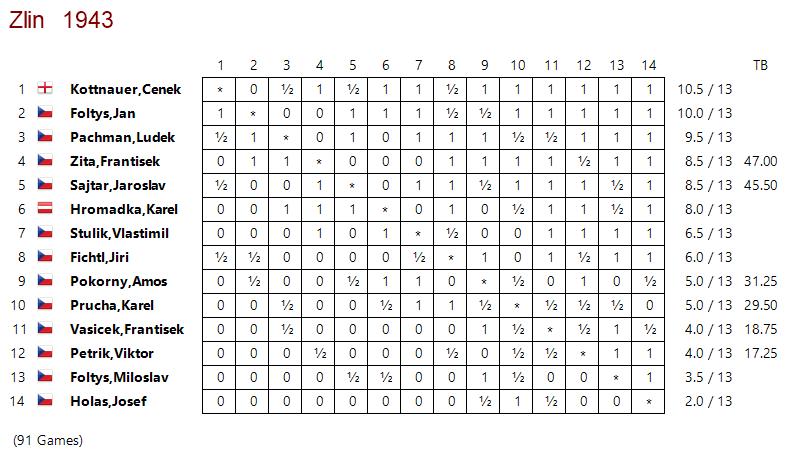
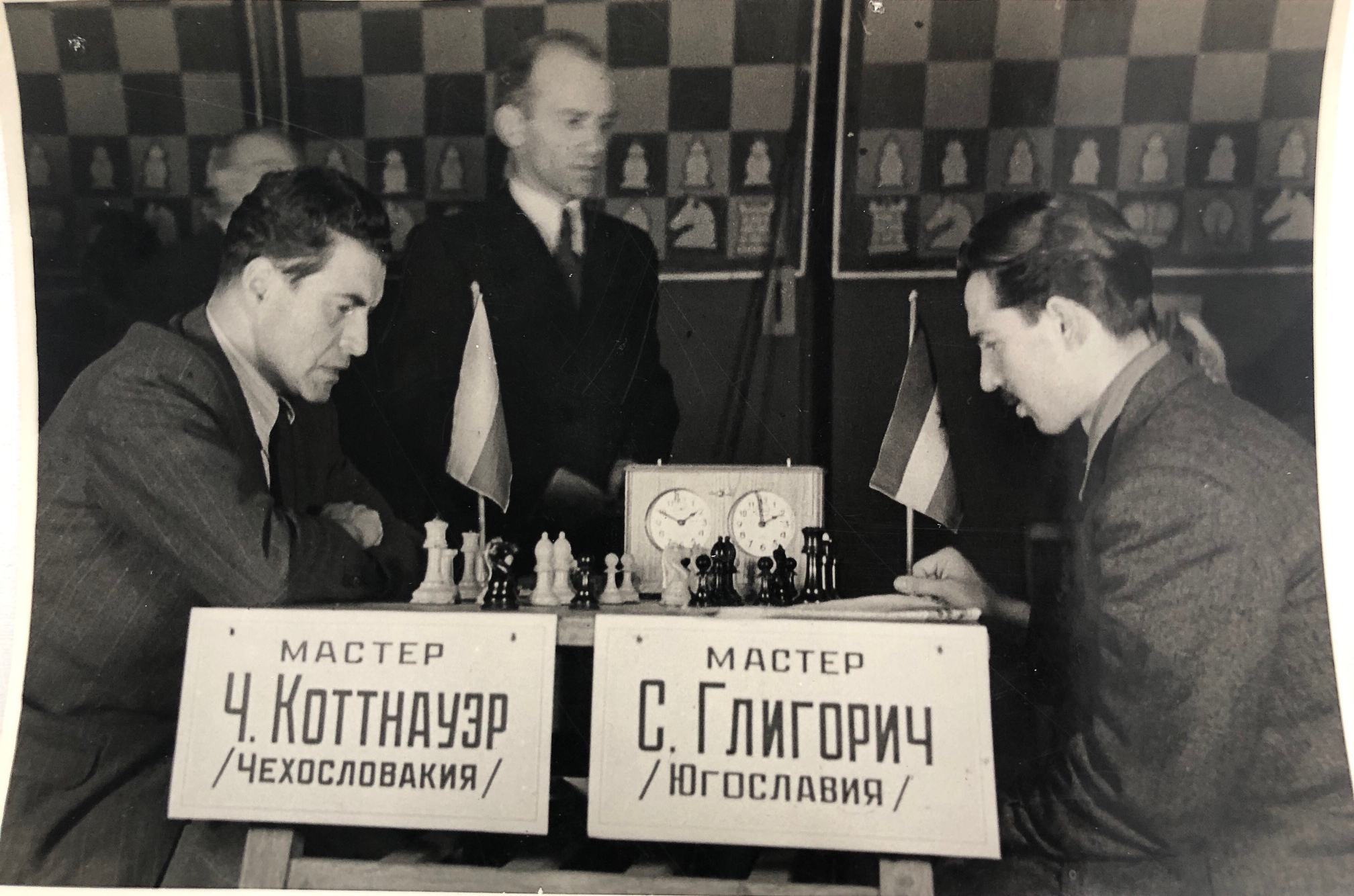
From Bronstein on the King’s Indian, Everyman Chess, 1999, game 25 we have :
“This game is from our hisotoric match with the Czechoslovak team, which took place half in Prague and half in Moscow.
My opponent, an intelligent, clever, athletic man, also played water polo. Then at some point he travelled to a tournament in England, fell in love with a beautiful Englishwoman, and decided to settle down there.”
From The Oxford Companion to Chess (OUP, 1984), David Hooper & Ken Whyld :
International Master (1950), International Arbiter (1951), a Czech player who emigrated to England in 1953 and was naturalised in 1960. He played in Olympiads for Czechoslovakia (1950*, 1952), on the second occasion making the best score (+10=5) on the fourth board, and in two Olympiads for England (1964, 1968). In 1961 he won the Beverwijk Masters tournament (not the concurrent grandmasters event) with a clean score, a fine achievement.
*Ed : In fact, this is not true since Czechoslovakia did not send a team to Dubrovnik 1950. This was the last year the event was limited to sixteen countries.
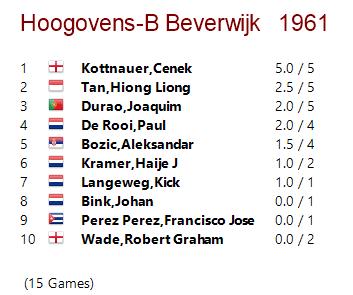
James Pratt, Basingstoke provides the full results from Gino de Felice, Chess Results, 1961 – 1963, Macfarland, 2013 :
Kottnauer 9/9, Wade 5/9, Langeweg 4.5/9, De Rooi 4.5/9, Tan 4.5/9, Kramer 4/9, Bink 3.5/9, Durao 3.5/9, Perez Perez 3.5/9, Bozic 3/9.
Consulting the 2nd edition (1992) of Hooper & Whyld may cause disappointment since there is no entry for CK.
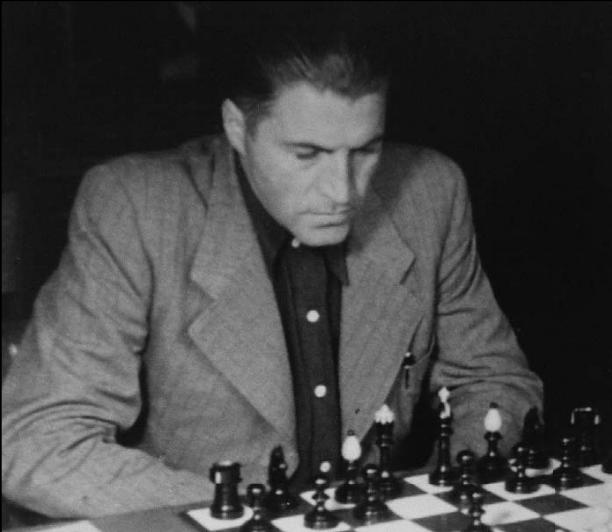
From The Encyclopaedia of Chess (Robert Hale 1970 & 1976), Anne Sunnucks :
“International Master (1950) and International Judge (1951).
Born on 24th February 1910. Kottnauer represented Czechoslovakia in the 1952 Olympiad in Helsinki. In the years after the war his successes in international tournaments included 3rd at Beverwijk 1947, =2nd at Vienna 1947, 4th at Bad Gadstein 1948 and 1st at Lucerne 1953.
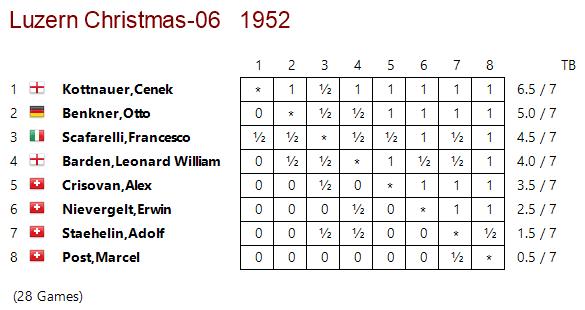
After the Lucerne tournament he sought political asylum in Switzerland. He later settled in England and became a naturalised British citizen. He played for the British Chess Federation in the Olympiads of 1964 and 1968.
Kottnauer has played in the British Championship twice. In 1961 he came =4th, and in 1962 he came =3rd.”
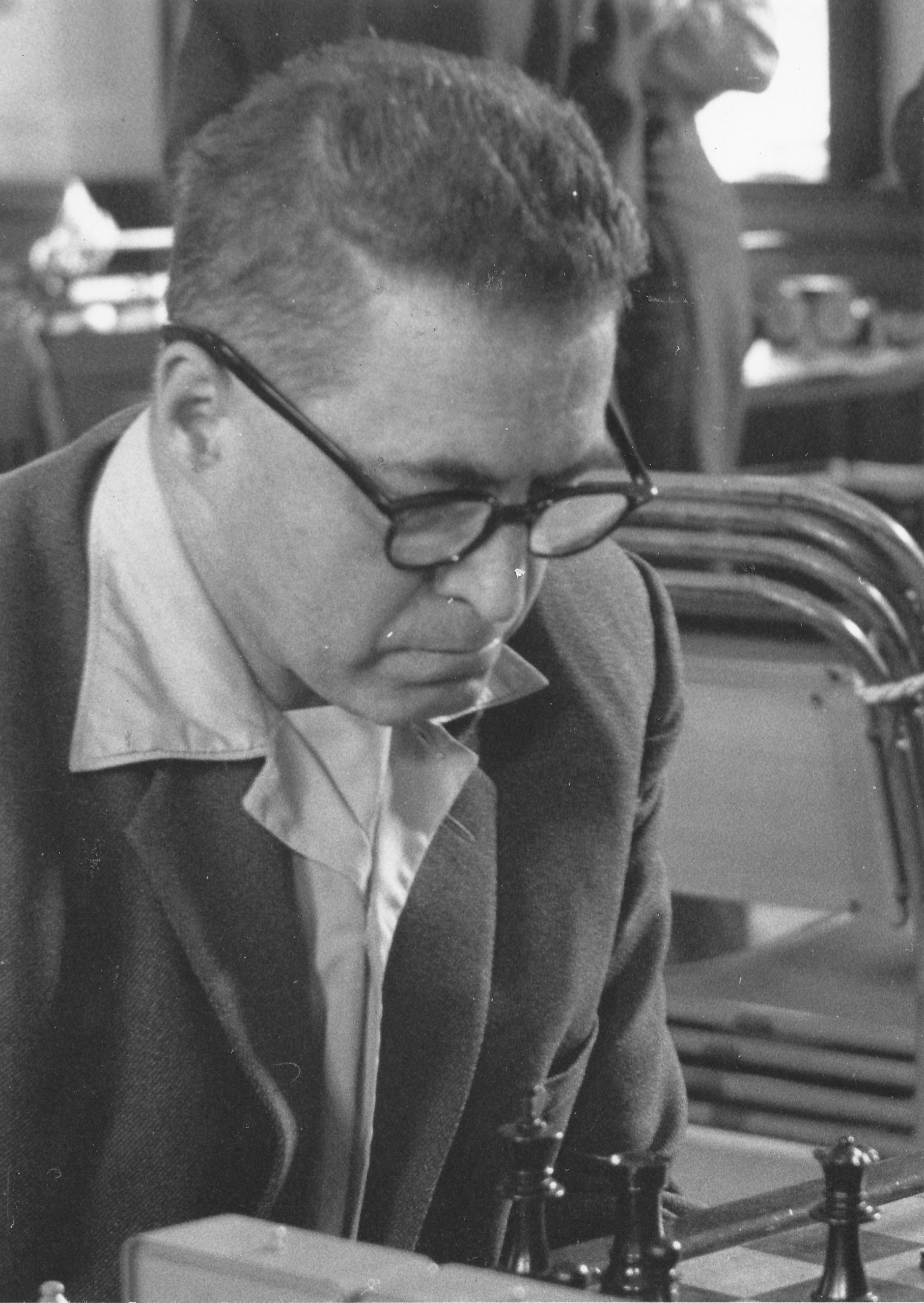
From The Encyclopaedia of Chess (Batsford, 1977), Harry Golombek OBE (entry written by Bill Hartston):
“Born in Czechoslovakia, Kottnauer played for that country in many events including the 1952 Olympiad. He emigrated in 1953 and subsequently took British nationality, representing England in the Olympiads of 1964 and 1968. Awarded FIDE titles of international master in 1950 and International Judge in 1951. Winner of Lucerne 1953 International tournament.
Co-author with TD Harding and GS Botterill of The Sicilian Sozin, Batsford, London, 1974.”
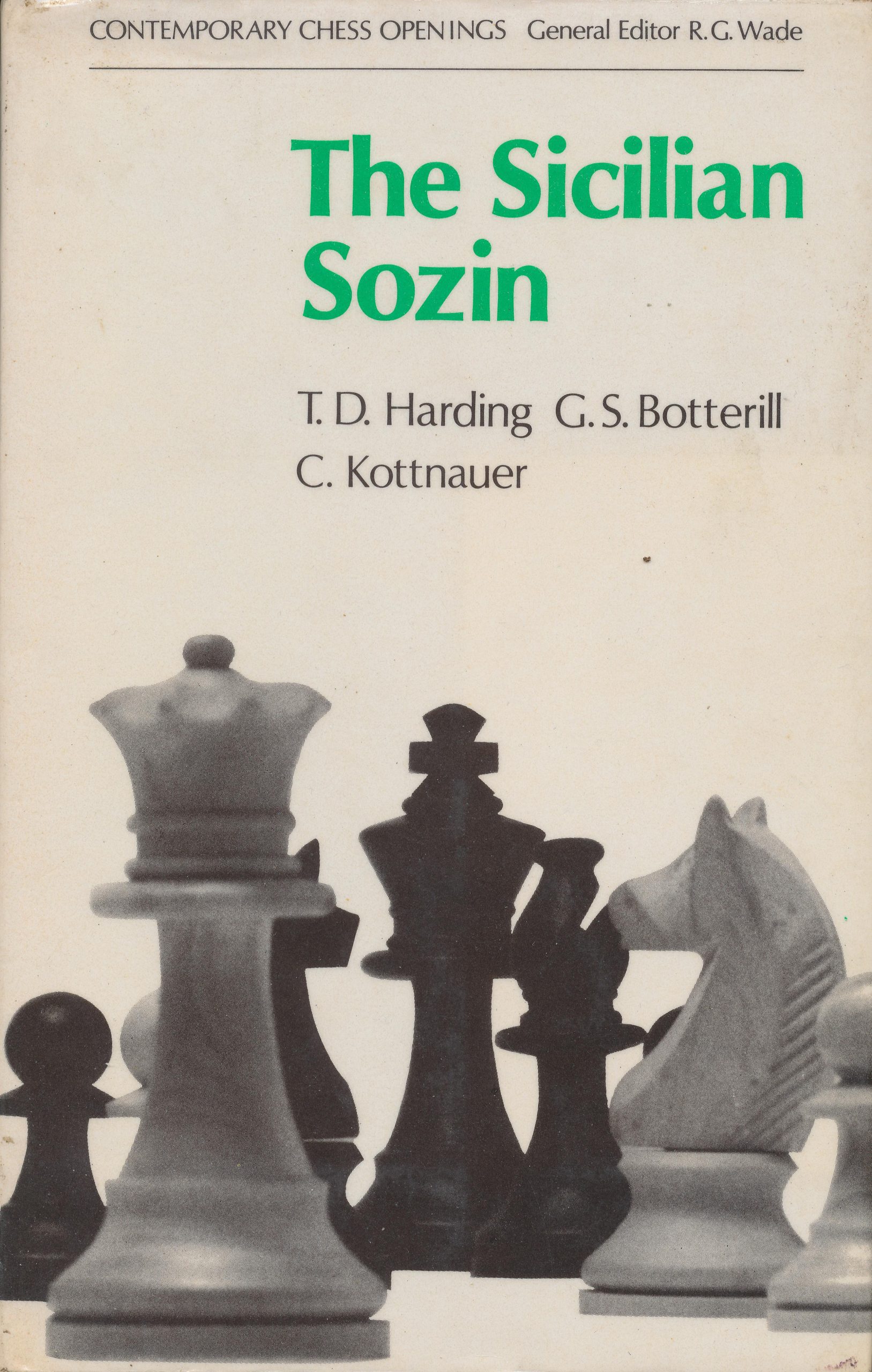
James Pratt, Basingstoke revealed : He would look through opening analysis often proclaiming: ‘What will the master play now?’
From British Chess (Pergamon Press, 1983) we have this insight from Tim Harding :
“At a time when home-grown International Masters were thin on the ground in Britain (the 1950s and 1960s) this Czech-born IM brought a lot of valuable experience to BCF teams.
After emigrating to England in 1953, he became naturalized and subsequently represented the BCF in the Tel Aviv, 1964 and Lugano, 1968, Olympiads. On board one in 1964 he scored +8 =7 -3 (63.9%) on board two below Penrose in 1968 (with some board one games) he scored 41.7: +3 =5 -4.
When FIDE rating lists appeared in the early 1970s, Kottnauer was listed at 2370 but by this time had more or less retired from active play at the top level, although he took (and still takes) a keen interest in coaching promising young players, He was one of the most regular and most valuable coaches at the one-day junior training events organised by the London Chess Association at the Mary Ward Centre in Bloomsbury, London in the mid-1970s.
At this time he also wrote many articles for his friend Grandmaster Pachman, who had been freed to live in West Germany where he became editor of Schach-Archiv, and also made a major contribution to the Batsford opening theory work. The Sicilian Sozin, written in collaboration with George Botterill and Tim Harding, and published in 1974.
Kottnauer’s most active years as a player were however 1946-53; in the year that he came to England he took first prize in the Lucerne, 1953 International tournament. Had he been a professional player throughout the the 1950s, there is little doubt that he would have become a grandmaster.
[pgn]
[Event “Match/City Prague-Moscow 13,0-23,0”]
[Site “Moscow”]
[Date “1946.03.??”]
[Round “2”]
[White “Kottnauer, Cenek”]
[Black “Smyslov, Vassily V”]
[Result “1-0”]
[ECO “D18”]
[Annotator “British Chess News”]
[PlyCount “111”]
[EventDate “1946.03.02”]
[EventType “team-match”]
[EventRounds “6”]
[EventCountry “URS”]
[SourceTitle “MCL”]
[Source “ChessBase”]
[SourceDate “1999.07.01”]
[SourceVersion “1”]
[SourceVersionDate “1999.07.01”]
[SourceQuality “1”]
{[%evp 0,111,80,5,26,-10,34,32,31,31,44,-4,0,7,21,21,2,11,20,0,7,2,-15,-22,-22,
-34,-4,-8,-11,-18,-19,-8,-3,-2,17,5,0,17,57,11,69,10,17,5,16,0,14,7,30,35,106,
110,60,47,166,151,148,159,172,184,192,171,180,166,182,145,160,161,160,162,170,
161,183,139,195,172,185,158,149,113,201,132,214,170,273,187,199,154,223,245,
260,250,267,267,260,265,265,240,247,250,245,260,264,220,265,265,271,202,209,
217,338,378,385,401]} 1. d4 d5 2. c4 c6 3. Nf3 Nf6 4. Nc3 dxc4 5. a4 Bf5 6. e3
e6 7. Bxc4 Nbd7 (7… Bb4 8. O-O Nbd7 9. Qe2) 8. O-O Bb4 9. Qe2 {transposes}
Bg6 10. e4 Bxc3 (10… O-O) 11. bxc3 Nxe4 12. Ba3 {The point of sacrificing
the e-pawn.} Qc7 13. Rfc1 O-O-O 14. a5 Nd6 (14… Rhe8 15. a6 b6 16. Nh4 Nd6
17. Bb3 e5 18. Nxg6 hxg6 19. Qg4) 15. a6 b6 16. Bb3 Bh5 $146 (16… Nf5) 17. h3
Kb8 18. c4 Nc8 (18… Bxf3 19. Qxf3 Nf5) 19. Qe3 Rhe8 20. Bb2 $11 (20. c5 $16)
20… h6 21. Ba4 Ne7 22. Ra3 g5 23. Rb3 Ka8 24. Ba3 Nb8 25. g4 Bg6 26. Ne5 $16
{[#]} f6 $2 (26… Ng8 27. Bb2) 27. Bxe7 fxe5 28. Bxd8 Rxd8 29. Qxe5 Qxe5 30.
dxe5 $18 Be8 31. Rf3 Nxa6 32. Rf8 Kb7 33. Rh8 Nc5 34. Bc2 Kc7 35. Rxh6 Rd4 36.
Rh7+ Bd7 37. Bg6 a5 38. Be8 a4 39. Bxd7 Nxd7 40. Re7 Kb7 41. Rxe6 Nc5 42. Re7+
Ka6 43. Re8 Kb7 44. e6 Re4 45. e7 Na6 46. Rg8 Rxe7 47. Rxg5 Nc5 48. Rxc5 bxc5
49. Ra1 Kc7 50. Rxa4 Kd6 $2 (50… Re4) 51. Ra3 Re1+ 52. Kg2 Rc1 53. Re3 Rxc4
54. g5 Rb4 55. g6 c4 56. h4 {and Black resigned.} 1-0
[/pgn]
As early as the end of the war, when regular play resumed, he was almost of that strength (as wins against Kotov and Smyslov in the February, 1946 Prague v Moscow match showed) but lacking in experience at the top level, which told against him at Groningen, 1946, when he was placed 13th with 9 points out of a possible 19 in a very strong field. This was the first great post-war tournament, with nine Master and eleven Grandmasters (including Botvinnik and former world champion Euwe).
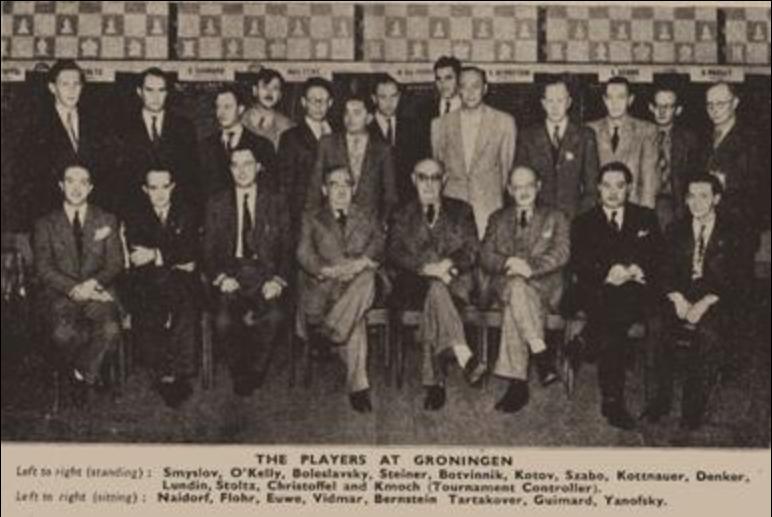
Also in 1946 Kottnauer scored wins against Simagin (in Prague) and Levenfish (in Leningrad) and was clearly one of the up-and-coming stars in a strong Czech team that included Filip and Pachman. In 1950 he was one of the first players to be awarded the FIDE title of International Master.
The following year he was also made a FIDE International Judge (now known as FIDE Arbiter).
Unfortunately there was no Czech representation at the Dubrovnik, 1950 Olympiad, but in 1952, one of his last appearances for Czechoslovakia, Kottnauer achieved a remarkable record playing board four (below Filip, Pachman and Sajtar) at the Helsinki Olympiad. He went through unbeaten with ten wins and five draws (83.3%) and easily won the board prize.
Kottnauer shortly thereafter came to England where he eventually made a successful career as an executive with Trust House Forte’s hotel group; he has also helped with the BBC overseas service Czech-language broadcasts. He lives in West Central London with his wife and their son.
The following is undoubtedly Kottnauer’s most famous win.
[pgn]
[Event “Match/City Prague-Moscow 13,0-23,0”]
[Site “Moscow”]
[Date “1946.03.??”]
[Round “4”]
[White “Kottnauer, Cenek”]
[Black “Kotov, Alexander”]
[Result “1-0”]
[ECO “D49”]
[Annotator “British Chess News and Tim Harding”]
[PlyCount “55”]
[EventDate “1946.03.02”]
[EventType “team-match”]
[EventRounds “6”]
[EventCountry “URS”]
[SourceTitle “BCM, 1949. 193, game #96”]
[Source “ChessBase”]
[SourceDate “1999.07.01”]
[SourceVersion “1”]
[SourceVersionDate “1999.07.01”]
[SourceQuality “1”]
[WhiteTeam “Prague”]
[BlackTeam “Moscow”]
{[%evp 0,55,19,-12,7,-14,-4,-6,41,25,43,54,55,54,37,42,20,26,24,-1,1,-36,-25,
-38,-20,-4,0,6,12,-6,17,-5,-35,-39,0,-47,-47,-149,-60,-60,-60,-43,-27,-28,230,
-144,216,300,740,360,1161,1448,1448,1517,1517,1583,1664,1664]} {Source : BCM,
1946, page 193, game #9649.} 1. c4 ({Megabase 2020 has this as the move order
(which is incorrect).} 1. d4 d5 2. c4 c6 3. Nf3 Nf6 4. Nc3 e6 5. e3 Nbd7 6. Bd3
dxc4) 1… e6 2. d4 d5 3. Nc3 c6 {The so-called Triangle Variation and a
potential prelude to the Abrahams-Noteboom Variation.} 4. Nf3 Nf6 5. e3 Nbd7 6.
Bd3 dxc4 {The Meran Defence} 7. Bxc4 b5 8. Bd3 a6 9. e4 c5 10. e5 ({TDH :
Nowadays (1983)} 10. d5 {is usually preferred but that move was little
analysed at the time. The text leads to a very sharp middle-game in which both
players followed up-to-date theory, which was changed by this game!}) 10…
cxd4 {[#]} 11. Nxb5 $1 axb5 ({TDH : Sozin’s} 11… Nxe5 {is now that approved
recipe for Black. BCM : The latest move is from Euwe v. Walthuis, Amsterdam.}
12. Nxe5 axb5 13. Bxb5+ Bd7 14. Nxd7 Qa5+ 15. Bd2 Qxb5 16. Nxf8 Kxf8 17. a4
Qxb2 18. O-O Ne4) 12. exf6 Qb6 13. fxg7 Bxg7 14. O-O O-O 15. Qe2 (15. Re1 Bb7
16. Bf4 Bd5 17. Ne5 Nxe5 18. Bxe5 Bxe5 19. Bxh7+ Kxh7 20. Qh5+ Kg7 21. Qg5+ {
is a well-known GM agreed draw variation}) 15… Nc5 $6 {[#] TDH : Probably
losing with best play.. White’s next may have surprised Kotov, or perhaps he
thought it was unsound.; Kottnauer says he played the sacrifice ‘without much
thinking’. Stockfish 12 gives this as the top move allowing the Greek gift.} (
15… Ba6 {is SF12’s next top move.}) ({TDH : A few months later, Kotov
reached the same position against Kottnauer at Groningen, varied with the
better move} 15… Bb7 {but went wrong later.} 16. Bxh7+ $2 Kxh7 17. Ng5+ Kg8
18. Qh5 Nf6 $19) 16. Bxh7+ $1 {At this stage SF12 sees no more than a draw for
White but cannot find anything better.} Kxh7 17. Ng5+ Kg6 ({TDH : A game by
Satjar in 1944 had gone instead} 17… Kg8 $2 18. Qh5 Rd8 19. Qxf7+ Kh8 20.
Qh5+ {with a draw} ({In fact} 20. Qg6 Kg8 21. Bf4 $1 $18 {is crushing}) ({
but Kottnauer intended to improve on this by} 20. Bf4 $1 {‘with an
irresistible attack’.})) 18. Qg4 f5 19. Qg3 {Now it is time to “pause the
video” as [#] we reach a critical position.} Kf6 {SF12 rates this as second
best.} ({SF12 gives} 19… Rg8 $1 {as the best defence for Black.} 20. Nxe6+
Kf7 21. Ng5+ Kf8 22. Nh7+ Ke8 23. Re1+ Be6 24. Bh6 Qb7 $11) ({After the game}
19… Rf7 {was recommended for Black, and tried the following year by Pachman
against Kottnauer in the Chigorin Memorial in Moscow.} 20. Bf4 {was played ,
leading to equality,} ({but Vukovic’s} 20. b4 {seems stronger.})) {Kottnauer
opted for ‘power play’ using the maximum activity of his pieces!} 20. Bf4 $1 ({
In the present game, both players had moved very quickly but now Kottnauer
thought for three quarters of an hour, rejecting the theoretical recommendation
} 20. Qh4 {(which at best draws,} {and would have been met by Keres’s idea} e5
$1 {which Kotov knew about).}) 20… Ke7 21. Rac1 Ra7 22. Rfe1 Bd7 (22… Bf6 {
loses to} 23. Nh7 Rf7 ({or} 23… Ne4 24. Rxe4) 24. Nxf6 Rxf6 25. b4 {but
after Kotov’s move ‘I saw in a flash the final breakthrough’, wrote Kottnauer.}
) 23. b4 $1 Na6 $2 ({Against} 23… Na4 {Kottnauer would have had to win in
the endgame, although this would not have been difficult.} 24. Nxe6 Bxe6 25.
Qxg7+ Rf7 26. Bg5+ Kd7 27. Qh8 {Black could then play here} Nc3 {when
Kottnauer gives as best} 28. Rxe6 Qxe6 29. Qxd4+ Kc8 30. Rxc3+ Rac7 31. Rxc7+
Rxc7 32. h4 {winning the ending.}) 24. Nxe6 Bxe6 25. Qxg7+ Rf7 26. Bg5+ Kd7 27.
Qh8 $1 {Now you can see why 23…Na4 was superior -} Qb8 ({Black cannot block
the c-file with} 27… Rc7 {because of} 28. Qd8#) (27… Nc7 28. Qd8#) 28.
Qxd4+ {Black resigned.} 1-0
[/pgn]
and here we have the same game analysed by Tryfon Gavriel :
From British Chess Magazine, Volume CXVI (116, 1996), Number 4 (April), pp 202-203 we have this obituary by Bernard Cafferty :
Čeněk Kottnauer, the Czech/British IM, and the first chess defector died in St. Margaret’s Hospital, London, on 14th February after heart trouble and abdominal cancer.
A giant of a man, a fine athlete and swimmer, he was born on 24th February 1910 and came to prominence in the 1942 tournament in Prague in which Alekhine took part. He extended the great man to 70 moves before resigning. His wins against Kotov and Smyslov in the Moscow-Prague match of 1946 and his 13th place in the great Groningen tournament of the same year confirmed his status, as did his excellent showing for Czechoslovakia in the 1952 Olympiad at Helsinki (+10=5-0 on fourth board). He also took part in the 1947 Chigorin Memorial in Moscow, and won a tournament at Lucerne in early 1953, the same year in which he emigrated to Britain.
On this form he would have gained the GM title had he continued playing, but he had to take a full-time job (with Trusthouse Forte) to support his family.
Čeněk had met his much younger wife in Austria, though she too was Czech. They had a son. The master’s appearences were therefore limited to London League matches and other sporadic events. That he had lost none of his skill was shown when he played top board for England at the 1964 Tel-Aviv Olympiad (Penrose was not available) and made +8=7-3. His only other big event was the Lugano Olympiad of 1968 when he was on second board and made +3=5-4.
Čeněk (pronounced CHEnek) Kottnauer was one of the early professionals in the German Bundesliga; on a visit to his Bayswater flat in 1995 by Murray Chandler and myself, Čeněk told us about the great transport difficulties he had in those days. He mentioned that he had recently had a heart bypass operation and showed us the medication he had to take on a regular basis, opining that after Golombek and Milner-Barry he would be the next to go.
Čeněk was involved in junior coaching in London for many years, wrote extensively for the Dutch and German press and in recent years was a regular visitor to the Lloyds Bank Masters to see old friends and acquaintances. Amongst those he coached were Julian Hodgson, William Watson and Dharshan Kumaran, as well as Stuart Conquest.
In Stuart’s case he came regularly to Hastings to do the coaching which was financed by the Slater Foundation and by Lloyds Bank.
The fruit of his effort was Stuart’s 1981 World U-16 title in Argentina, where Čeněk’s great physical strength came in handy when the huge trophy had to be carried back to Britain.
All his pupils and friends will attest to his wonderful manner. A great personality has left us.”
According to Leonard Barden “Čeněk’s students included Demis Hassabis, then aged six. He once told me that Dharshan Kumaran, then seven, was the more talented of the pair but that Demis was also ‘very clever and tricky’ ”
Daniel tells us that Nigel Short visited his family home for coaching and we believe that both Anita and Mira Rakshit were CKs students. Doubtless there were many more…
[pgn]
[Event “Olympiad-10 Final A”]
[Site “Helsinki”]
[Date “1952.08.30”]
[Round “9”]
[White “Rellstab, Ludwig Sr”]
[Black “Kottnauer, Cenek”]
[Result “0-1”]
[ECO “B50”]
[Annotator “Tim Harding and British Chess News”]
[PlyCount “78”]
[EventDate “1952.08.21”]
[EventType “team-tourn”]
[EventRounds “9”]
[EventCountry “FIN”]
[SourceTitle “MCD”]
[Source “ChessBase”]
[SourceDate “1999.07.01”]
[SourceVersion “1”]
[SourceVersionDate “1999.07.01”]
[SourceQuality “1”]
[WhiteTeam “Germany”]
[BlackTeam “Czechoslovakia”]
[WhiteTeamCountry “GER”]
[BlackTeamCountry “CSR”]
{[%evp 0,78,19,28,40,40,81,18,33,-24,16,-13,2,-20,-43,-39,-34,-42,-42,-84,-66,
-47,-42,-64,-51,-46,-33,-50,-45,-46,-30,-34,-69,-70,-68,-68,-44,-89,-70,-91,
-68,-105,-144,-146,-155,-182,-182,-175,-175,-185,-177,-262,-282,-298,-314,-308,
-227,-236,-254,-267,-267,-337,-350,-361,-277,-280,-364,-338,-326,-373,-328,
-415,-425,-403,-416,-486,-479,-515,-495,-796,-819]} 1. e4 c5 2. Nf3 d6 3. c3
Nf6 4. Bd3 Bg4 5. Bc2 {TDH : Incorrect. BCN : In 2021 Bc2 is the most popular
move in Megabase 2020 but h3 scores slightly better among the top players.} ({
TDH : Pfeiffer-Kottnauer, earlier in the same event, went} 5. h3 Bh5 6. Bc2 {
when} d5 {would be met by} 7. e5 Nfd7 8. g4 Bg6 9. Bxg6 hxg6 10. e6 $1 fxe6 11.
Ng5 {with a promising attack, according to Kottnauer.}) 5… d5 $146 {was a
novelty in 1952 but has not really caught on since.} ({BCN : More usual is}
5… Nc6 6. d3 e6 7. Nbd2 {This position resembles a reversed Hanham Variation
with the bishop on c2 instead of e2.} Be7 8. h3 Bh5 9. Nf1 d5 10. Ng3 Bg6 11.
Qe2 Qc7 12. O-O Bd6) 6. e5 (6. d3) 6… Nfd7 7. d4 e6 8. Be3 Qb6 $15 {[#] TDH :
The position is similar to the 3.e5 variation of the French, except that
Black’s main worry in that line (his queen’s bishop) is here developed
satisfactorily.} 9. b3 cxd4 10. cxd4 Bb4+ 11. Kf1 ({TDH : Not} 11. Nbd2 Bc3 12.
Rc1 Bxf3 {when Black wins a pawn.}) 11… Nc6 $17 12. a3 Be7 13. Nc3 $6 (13.
Nbd2) 13… Rc8 14. Na4 $6 (14. Ne2) 14… Qc7 15. Bd3 f6 16. exf6 Bxf6 17. Rc1
Qd6 18. b4 O-O 19. Be2 a5 20. b5 $2 (20. Nc5) 20… Ne7 21. Nc5 {[#]} Nf5 22.
Nxd7 ({TDH : If} 22. Nxb7 Qxa3 {threatening Nxe3+}) 22… Qxd7 23. Rxc8 Rxc8
24. a4 Qd6 25. Ng1 Qa3 26. Bd2 {TDH : Black was threatening 26…Nxe3+ 27 fxe3
Rc1} Bxe2+ 27. Nxe2 Nxd4 28. Bxa5 Nb3 29. Be1 Qxa4 {TDH: The rest is just
mopping-up :} 30. g4 Qxb5 31. Kg2 Rc4 32. h3 d4 33. Ng3 Qd5+ 34. Qf3 d3 35. Nf1
Bg5 36. Qxd5 exd5 37. f4 Bxf4 38. Bg3 d2 39. Nh2 Bxg3 0-1
[/pgn]
Leonard added :
“After he retired he did chess coaching and, although never named in the BCF’s list of coaches, was the most successful of all in terms of achievements by those he taught. He normally did weekly sessions of a couple of hours and got results through his challenging and sceptical approach to ideas from his pupils.
Kottnauer pupils included Hodgson, Watson, and Kumaran, who all became grandmasters. When he came to our junior invitation tournaments in the mid-seventies I used to give a prize of a game and session with him to exceptional talents. So he played Nigel Short in spring 1975 (probably Short’s first one-to-one with an IM) and was enthusiastic about his promise.
In 1981 when Stuart Conquest was going to the the world U16 championship in Argentina Cenek coached him for several months beforehand and went with him to the event. No news reports were available during the tournament so the first I knew was when Cenek phoned me on his return to London and complained that he was tired having to carry this enormous trophy home (Stuart had broken his arm before the event and played in a sling) and how the food had been terrible but that Eliskases, who was involved in the organisation, had sworn him to secrecy.
I used to visit him a couple of times a month for talk and blitz sessions and have warm memories. A great guy, and a significant figure in the long departed English chess boom.”
Here is an excellent article from Tim Harding originally on chesscafe.com but now via the Wayback Machine.
Here is an obituary from Bill Hartston
Here is his Wikipedia entry
And finally, according to chessgames.com :
“Cenek Kottnauer was born in Prague. He was awarded the IM title in 1950 and became an International Arbiter in 1951. Kottnauer played the Helsinki Olympiad 1952 on board 4 for Czechoslovakia, scoring +10 =5 -0. In 1953 he won the Lucerne international tournament. That same year, he emigrated to England, and eventually became a naturalized citizen and played for England in the Olympiads of 1964 and 1968. In the 1970s he became one of England’s top coaches of young players.”
Save as PDFBCN sends birthday wishes to GM Ravi Haria.
Ravi Haria was born Sunday, February 7th, 1999 in Elstree, Hertfordshire. “Maria” by Blondie was top of the hit parade. Ravi currently resides in London.
Ravi attended Lyonsdown School in Barnet and then The Haberdashers’ Aske’s Boys’ School and now reads History at University College, London.
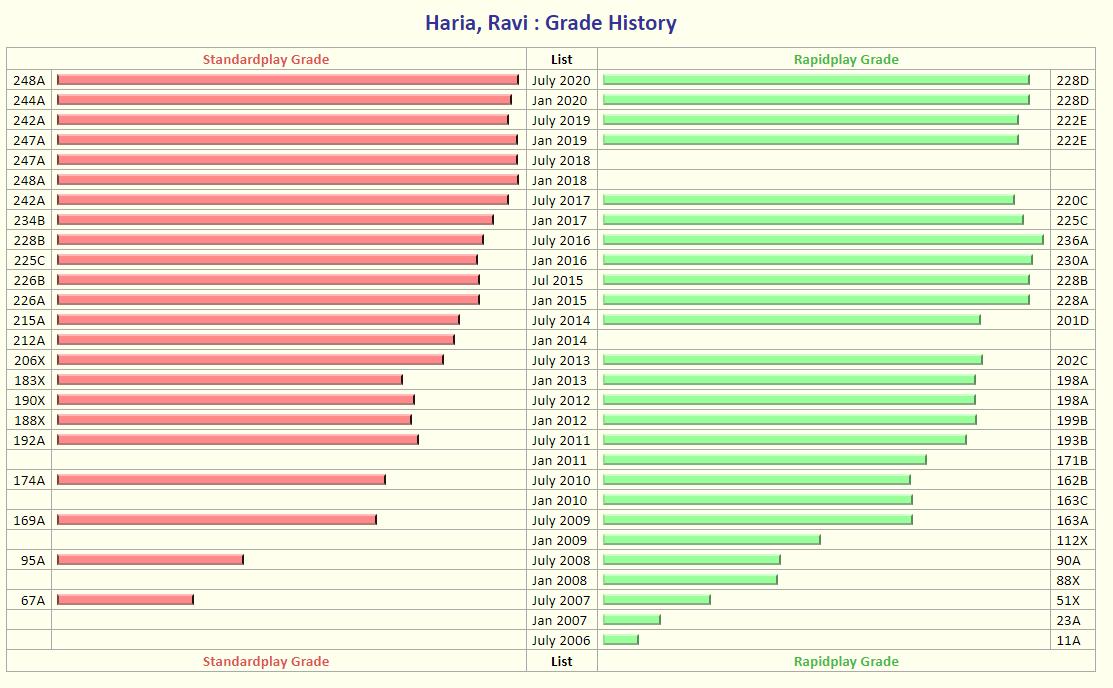
Ravi learnt at the age of 6 and joined Barnet Knights Chess Club in 2005. His first chess teacher was Angela Eyton who taught him the moves and Angela was followed by Tony Niccoli and then Julian Meszoras on his ascent of the chess ladder.
Ravi’s first recorded tournament was the 35th Barnet Knights Under-8 rapidplay on September 25th 2005. Also playing of note were Jonathan Pein and Isaac Sanders.
His first recorded standard play game was in the London Junior Under-10 Championships on December 9th 2006.
By the time he was eight he had attracted the attention of the England selectors and played in the 2008 Commonwealth Championships in New Delhi coming home with a bronze medal.
In 2008 Ravi won the British Under-9 title in Liverpool. He said afterwards:
It was quite nice to be leading everyone and I felt proud of myself. I’m not sure how I control my nerves but it feels really good to win.
His mother Sona said:
It’s a bit overwhelming but we just support him. It means you have to give up a lot of time for him but it’s really nice to see that he’s getting somewhere.
This was followed in 2014 by winning the British Under-18 championship in Aberystwyth aged 15 and then the same title in 2017 in Llandudno.
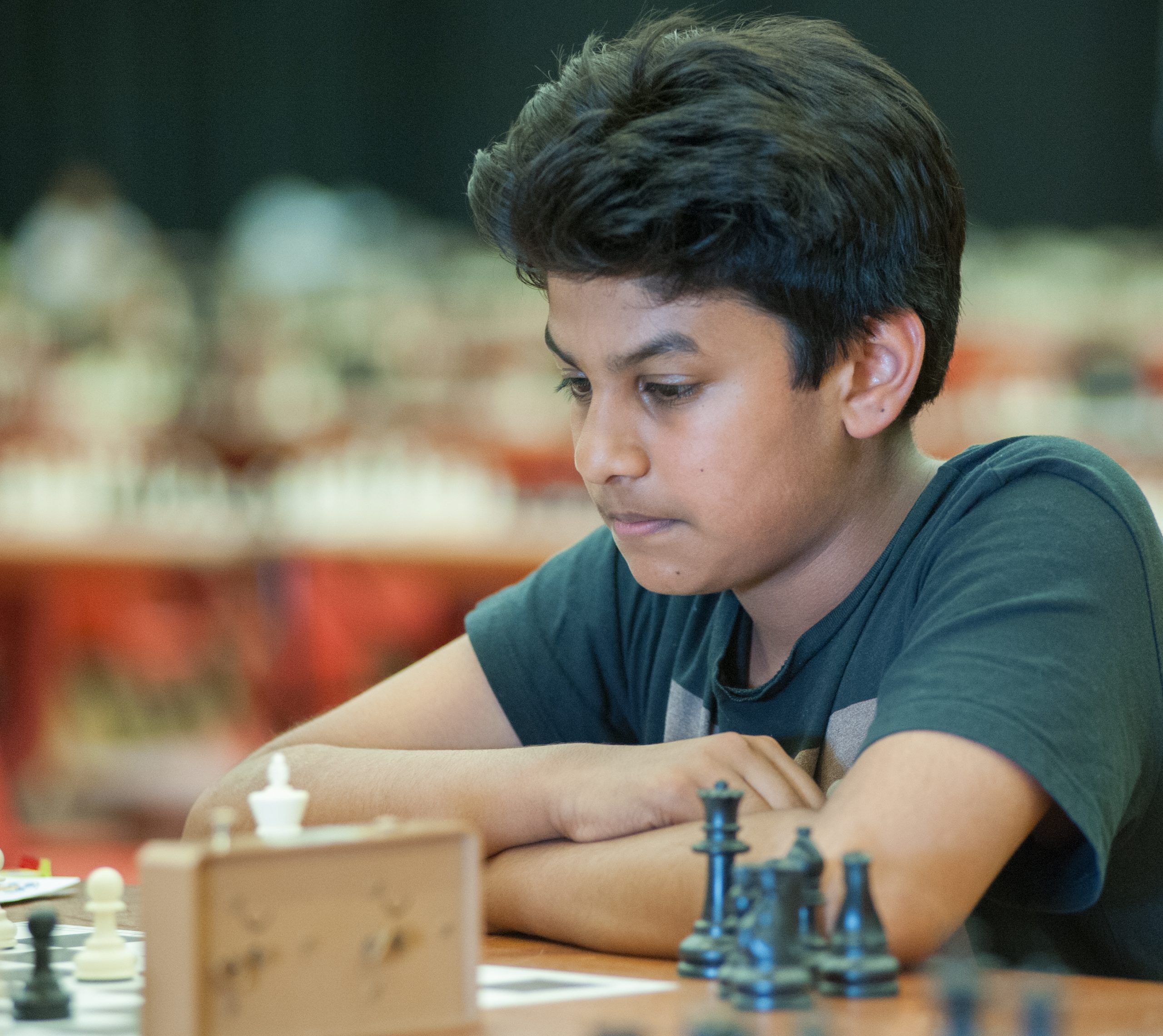
In 2016 Ravi was equal 2nd to Deep Sengupta at the Hastings Masters Open with an impressive 6/9 and a TPR of 2563. This performance secured his second IM norm.
The IM title was conferred at the 88th FIDE Congress 2017, 7-15 October, Goynuk, Antalya, Turkey.
He scored six points after 11 rounds at the 2017 World Junior championship in Italy and 5.5 points at the 2017 WYCC U-18 group in Uruguay.
Ravi completed his British junior titles run by becoming the current (no OTB event in 2020) British Under-21 champion in 2019 in Torquay scoring an emphatic 6.5/9 securing a share of third place.
Ravi became a FIDE Master in 2015 at the age of 16 and and International Master two years later making him England’s second youngest IM after Matthew Wadsworth.
His peak FIDE rating was 2497 in October 2021 and currently (February 2022) is 2490.
In 2019 Ravi teamed up with IM Adam C. Taylor to join Adam’s Making Grandmasters training venture.
On January 28th 2021 Thinker’s Publishing released The Modernised Anti-Sicilians, Volume 1, Rossolimo Variation which is a massive 520 page tome on the following position :
[fen]r1bqkbnr/pp1ppppp/2n5/1Bp5/4P3/5N2/PPPP1PPP/RNBQK2R b KQkq – 0 1[/fen]
which was reviewed by FM Richard Webb.
which we hope will be followed by at least Volume 2!
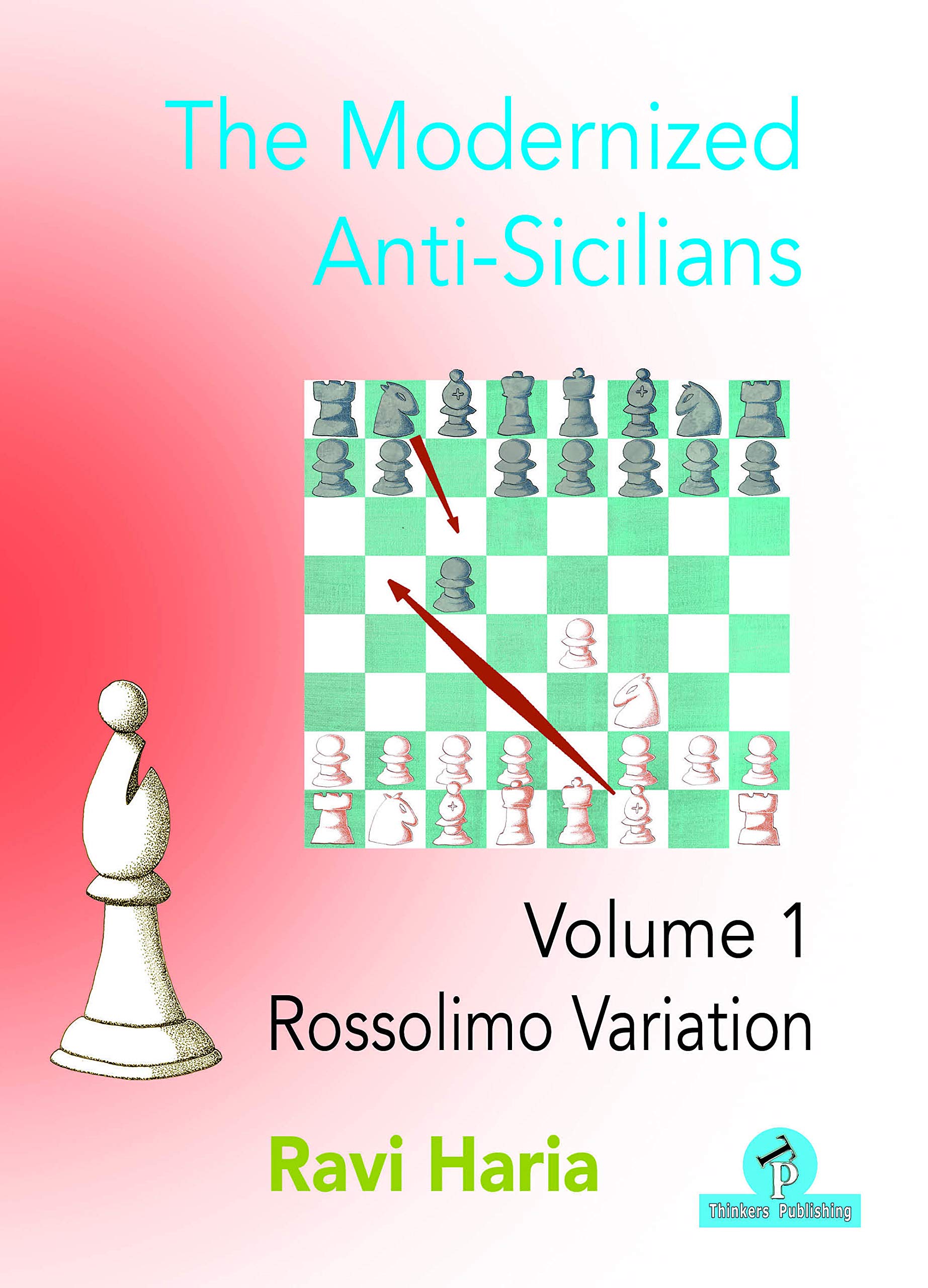
Ravi has plus scores against : Matthew Turner, Simon Williams, William Claridge Hansen, Bob Eames, David Eggleston and Arul Gupta to name but a few.
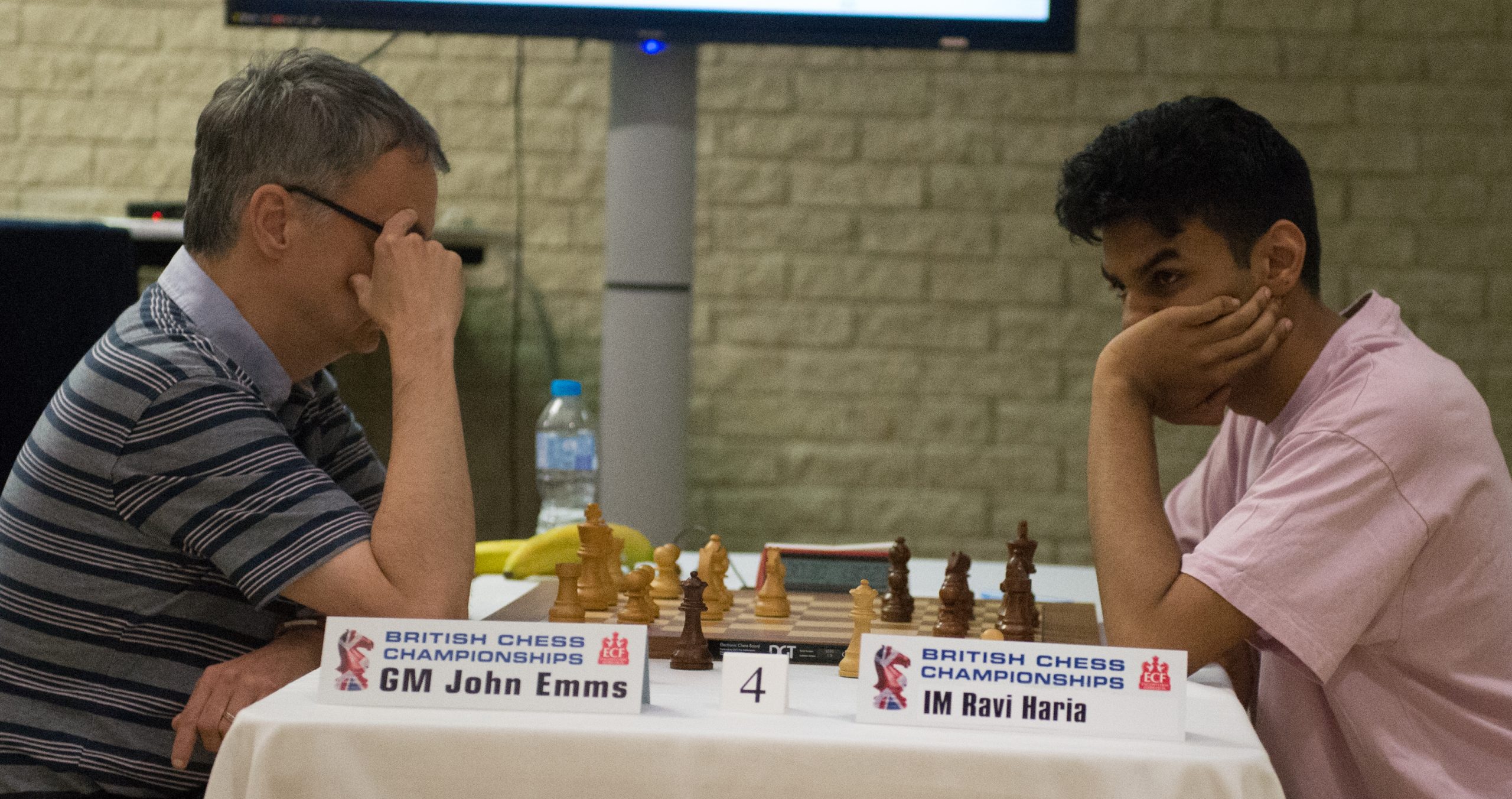
With the white pieces Ravi unsurprisingly plays the Moscow and Rossolimo variations against the Sicilian, the Ruy Lopez and, in recent years, he has adopted the Reti/English complex.
As the second player he plays the French Winawer and (refreshingly) the Abrahams-Noteboom Variation of the Semi-Slav.
For your entertainment we have these two brevities :
[pgn]
[Event “Hastings Masters op 88th”]
[Site “Hastings”]
[Date “2012.12.29”]
[Round “2”]
[White “Haria, Ravi”]
[Black “Pooley, Mark”]
[Result “1-0”]
[ECO “B00”]
[WhiteElo “2032”]
[BlackElo “1693”]
[Annotator “British chess News”]
[PlyCount “27”]
[EventDate “2012.12.28”]
[EventType “swiss”]
[EventRounds “10”]
[EventCountry “ENG”]
[SourceTitle “CBM 152 Extra”]
[Source “ChessBase”]
[SourceDate “2013.02.25”]
[SourceVersion “1”]
[SourceVersionDate “2013.02.25”]
[SourceQuality “1”]
{[%evp 0,27,19,31,80,69,63,60,69,29,74,57,56,50,101,40,96,40,69,57,52,59,196,
71,56,-23,86,56,886,933]} 1. e4 b6 2. d4 Bb7 3. Bd3 d6 4. Qe2 g6 $146 5. Bf4
Bg7 6. Nf3 e6 $6 7. O-O Nc6 8. c3 Nce7 9. Nbd2 Nf6 10. e5 Nd7 $2 (10… Nfd5)
11. Ne4 d5 12. Neg5 c5 $2 {[#]} 13. Nxf7 $1 Qc8 14. Nd6+ 1-0
[/pgn]
and
[pgn]
[Event “Brighton e2e4 Masters”]
[Site “Brighton”]
[Date “2013.02.17”]
[Round “3”]
[White “Haria, Ravi”]
[Black “Whitehead, David J”]
[Result “1-0”]
[ECO “B51”]
[WhiteElo “2053”]
[BlackElo “2055”]
[Annotator “British Chess News”]
[PlyCount “31”]
[EventDate “2013.02.16”]
[EventType “swiss”]
[EventRounds “9”]
[EventCountry “ENG”]
[SourceTitle “CBM 153 Extra”]
[Source “ChessBase”]
[SourceDate “2013.04.22”]
[SourceVersion “1”]
[SourceVersionDate “2013.04.22”]
[SourceQuality “1”]
{[%evp 0,31,19,38,72,69,49,32,64,9,10,5,11,-27,-11,4,19,19,41,36,127,98,122,
107,184,182,172,176,183,210,213,238,503,509]} 1. e4 c5 2. Nf3 Nc6 3. Bb5 d6 4.
Bxc6+ bxc6 5. O-O e5 6. c3 f5 7. exf5 Bxf5 ({Relevant:} 7… Nf6 8. d4 cxd4 9.
cxd4 e4 10. Ng5 d5 11. f3 h6 12. Ne6 Bxe6 13. fxe6 Bd6 14. fxe4 dxe4 15. Nc3
O-O 16. Qe2 Bc7 17. Qc4 Kh8 18. Bf4 Ng4 19. Ne2 Bxf4 20. Nxf4 Qg5 21. Qxc6 Ne3
22. Qxe4 Nxf1 23. Ng6+ Kg8 24. Nxf8 Qe3+ 25. Qxe3 Nxe3 26. Nd7 Re8 27. Re1 Nc2
28. Re4 Nb4 29. Nc5 Kf8 30. a3 Nd5 31. Nd3 Ke7 32. Nf4 Nf6 33. Re5 Kd6 34. Ra5
g5 35. Ra6+ Kc7 36. Nd3 Ne4 37. d5 {Rublevsky,S (2678)-Moranda,W (2578) Warsaw
2010 1-0}) 8. d4 e4 $6 9. dxc5 {[#]} d5 $2 $146 ({Predecessor:} 9… exf3 10.
Qxf3 Be6 11. Re1 Kd7 12. cxd6 Qf6 13. Bf4 Qf5 14. Nd2 Nf6 15. Qe2 Re8 16. Qe3
Qa5 17. Nf3 Bxd6 18. Bxd6 Kxd6 19. Nd4 Qd5 20. Qg3+ Kc5 21. Re5 Kb6 22. Rxd5
Bxd5 23. f3 a5 24. Qxg7 Rhf8 25. b4 axb4 26. cxb4 Nh5 27. Qh6 Nf4 28. Rc1 Kb7
29. b5 cxb5 30. Qd6 Rf7 31. Nxb5 Ree7 32. Nd4 Ka7 33. Rb1 Rb7 34. Nb5+ Ka8 35.
Qd8+ {1-0 (35) Rublevsky,S (2684)-Sveshnikov,E (2563) Herceg Novi 1999}) 10.
Nd4 Qd7 11. Be3 Ne7 $6 12. f3 $1 g6 13. Nd2 Bg7 14. fxe4 dxe4 15. Nc4 O-O $2 (
15… Bxd4 16. Nd6+ Kd8 17. Qxd4 {is crushing}) 16. Nxf5 1-0
[/pgn]
Ravi has played for University College London. Hendon and Cavendish in the London and other leagues and in 4NCL he started with Kings Head, transferring to Cambridge in 2014 and finally moving in 2016 to Wood Green.
In this game Ravi punishes IM Malcolm Pein who has a bad day at the office :
[pgn]
[Event “BCF-chT 1314 (4NCL)”]
[Site “England”]
[Date “2013.11.16”]
[Round “1.125”]
[White “Haria, Ravi”]
[Black “Pein, Malcolm”]
[Result “1-0”]
[ECO “B09”]
[WhiteElo “2151”]
[BlackElo “2371”]
[Annotator “British Chess News”]
[PlyCount “51”]
[EventDate “2013.11.16”]
[EventType “team-swiss”]
[EventRounds “11”]
[EventCountry “ENG”]
[SourceTitle “EXT 2015”]
[Source “ChessBase”]
[SourceDate “2014.11.20”]
[SourceVersion “1”]
[SourceVersionDate “2014.11.20”]
[SourceQuality “1”]
[WhiteTeam “Kings Head”]
[BlackTeam “Wood Green Hilsmark II”]
[WhiteTeamCountry “ENG”]
[BlackTeamCountry “ENG”]
{[%evp 0,46,30,16,62,68,81,59,76,25,46,36,64,64,59,42,32,-12,7,-7,63,101,101,
101,101,81,85,112,77,57,47,-1,-1,-9,11,27,27,27,2,7,5,19,99,96,173,173,173,173,
485]} 1. e4 d6 2. d4 Nf6 3. Nc3 g6 4. f4 Bg7 5. Nf3 Nc6 {a favourite line of
MPs, Vallejo Pons and Keith Richardson} (5… O-O) 6. d5 (6. Bd3) 6… Nb8 7.
Bc4 (7. Bd3) 7… O-O 8. O-O c6 $11 {[#] You might not expect it but this is
a fairly rare position.} 9. a4 $146 (9. dxc6 Nxc6 10. Kh1) 9… b5 $6 {
activating the g7 bishop by a curious route but how weak is the e7 pawn as a
consequence?} 10. axb5 cxb5 11. Nxb5 Nxe4 12. Qe2 Nf6 13. Bd2 Nbd7 14. Nxa7 $5
{probably activating the a8 rook too much!} Bb7 15. Ba5 Qb8 16. Nc6 Bxc6 17.
dxc6 Rxa5 18. Rxa5 Qb6+ 19. Kh1 Qxa5 20. cxd7 e6 $2 {[#] A strange oversight
from Malcolm} (20… Qc7 {is good enough and Black is fine.}) 21. Bxe6 $1 fxe6
22. Qxe6+ Kh8 23. Qxd6 $18 Qf5 {and Black resigned.} {Perhaps} 24. d8=Q Ne4 25.
Q6d7 Rxd8 26. Qxd8+ $18 1-0
[/pgn]
Ravi is Mesutgm on chess.com and lichess
[pgn]
[Event “Reykjavik op”]
[Site “Reykjavik”]
[Date “2018.03.06”]
[Round “1”]
[White “Haria, Ravi”]
[Black “Karlsson, Mikael Johann”]
[Result “1-0”]
[ECO “B31”]
[WhiteElo “2424”]
[BlackElo “2150”]
[Annotator “British Chess News”]
[PlyCount “55”]
[EventDate “2018.03.06”]
[EventType “swiss”]
[EventRounds “9”]
[EventCountry “ISL”]
[SourceTitle “CBM 183 Extra”]
[Source “ChessBase”]
[SourceDate “2018.04.19”]
[SourceVersion “1”]
[SourceVersionDate “2018.04.19”]
[SourceQuality “1”]
{[%evp 0,55,19,31,72,53,66,21,74,31,43,31,49,36,33,18,25,19,23,19,14,-5,17,12,
11,0,14,21,64,63,57,57,57,88,69,69,58,176,186,208,218,237,308,320,409,339,322,
280,318,283,297,287,294,329,469,562,848,696]} 1. e4 c5 2. Nf3 Nc6 3. Bb5 g6 4.
Bxc6 dxc6 5. d3 Bg7 6. h3 e5 7. Be3 b6 8. a4 a5 9. Nbd2 f6 10. Nc4 Be6 11. Qc1
$146 (11. Nfd2) 11… Qc7 12. O-O Rd8 13. Nfd2 Nh6 $6 14. b4 $1 axb4 15. a5 b5
16. Nb6 $18 Nf7 17. Bxc5 Bf8 18. Nb3 Bxc5 $6 (18… Ng5) 19. Nxc5 Ke7 20. Qe3
Rd4 21. f4 Bc8 $2 22. Nb3 (22. Qf2 $1) 22… Rdd8 23. Qc5+ (23. fxe5 Nxe5 24.
d4 $18) 23… Qd6 24. fxe5 Nxe5 25. a6 Nd7 26. Nxd7 Rxd7 27. Qf2 Bb7 28. Nc5
1-0
[/pgn]
Over the 19th – 23rd August 2021 Ravi played in the Wood Green Invitational round-robin event at Oddfellows Hall, Stafford.
Ravi scored 7.5/10 and secured his second Grandmaster Norm and a TPR of 2680.
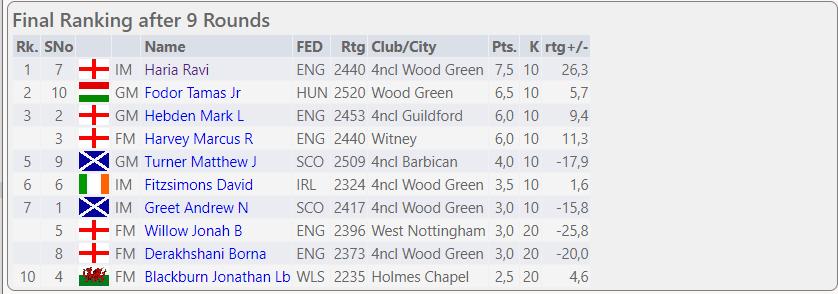
Over the August Bank Holiday weekend of 2021 Ravi played in the Northumbrian Masters GM Tournament at the splendid Marriott MetroCentre, Gateshead winning jointly with Conor Murphy scoring 6.5/9 with a TPR of 2600. This gave Ravi his third and final GM norm.
The norm was ratified at a recent FIDE Congress. As of February 2022 Ravi stood at 2490 for standard-play.
Save as PDFBCN sends Birthday wishes to FM Jimmy Adams
James Bernard Adams was born on Friday, February 7th, 1947 to James Adams and Ivy F Soule in Islington, London. He attended Highbury County Grammar School for Boys.
Jimmy was married to Sharon and they have a daughter, Charlotte.
In 1958 Jimmy at the age of 11 joined his local Islington Chess Club (at the time Islington & North London Chess Club) and soon afterwards became a London Junior Champion. Following this Jimmy played little chess and was working for John Lewis (echoes of CHO’D Alexander and Leonard Barden). Following John Lewis Jimmy worked as a Health and Safety Officer for Islington Council.
At this time Islington Chess Club was one of the strongest in England and included such members as Kenny Harman, Ron Harman, Danny Wright, Stewart Reuben and others. Its most famous member was probably IM Simon Webb
The Spassky-Fischer match of 1972 re-kindled his lapsed interest and he won with a 100% score the London Amateur Championship.
He joined and was a staunch member of London Central YMCA (CENTYMCA) chess club and he wrote a privately published history of the club entitled The CENTYMCA Story. This is now a much sought after publication. His membership continued during the 1970s until around 1979.
During this period Jimmy was extremely active at the Endell Street premises.
Here is Jimmy playing Viktor Korchnoi at Endell Street (in the Phase Two classrooms) :
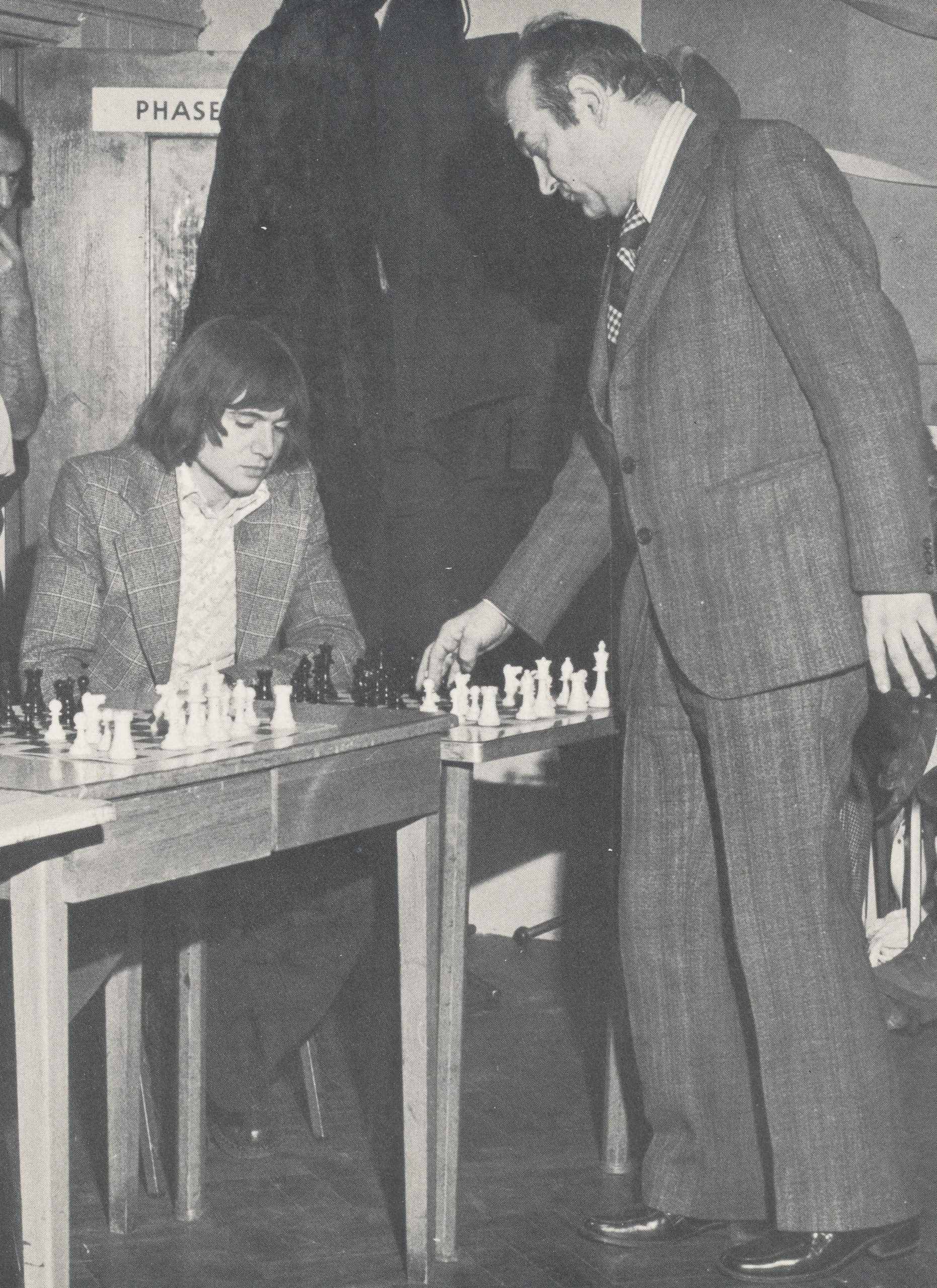
In 1974 Jimmy embarked on a highly successful career as a writer and journalist. He contributed articles to both CHESS and the British Chess Magazine and authored a number of acclaimed books for Batsford, The Chess Player, Caissa Books and latterly, New in Chess. He also self-published the first book on Bobby Fischer’s successor entitled K is for Karpov! His books on Chigorin, Zukertort and Breyer are universally regarded as some of the finest chess biographies published.
In 1979 Jimmy joined Metropolitan Chess Club to play in the London League A Division. He played top board and scored very highly with many significant scalps.
Jimmy gained his FM title in 2014 (at the age of 67!). 67 must be one of the most advanced ages to acquire an FM title. According to Felice his peak rating was 2300 in January 1981 aged 34.
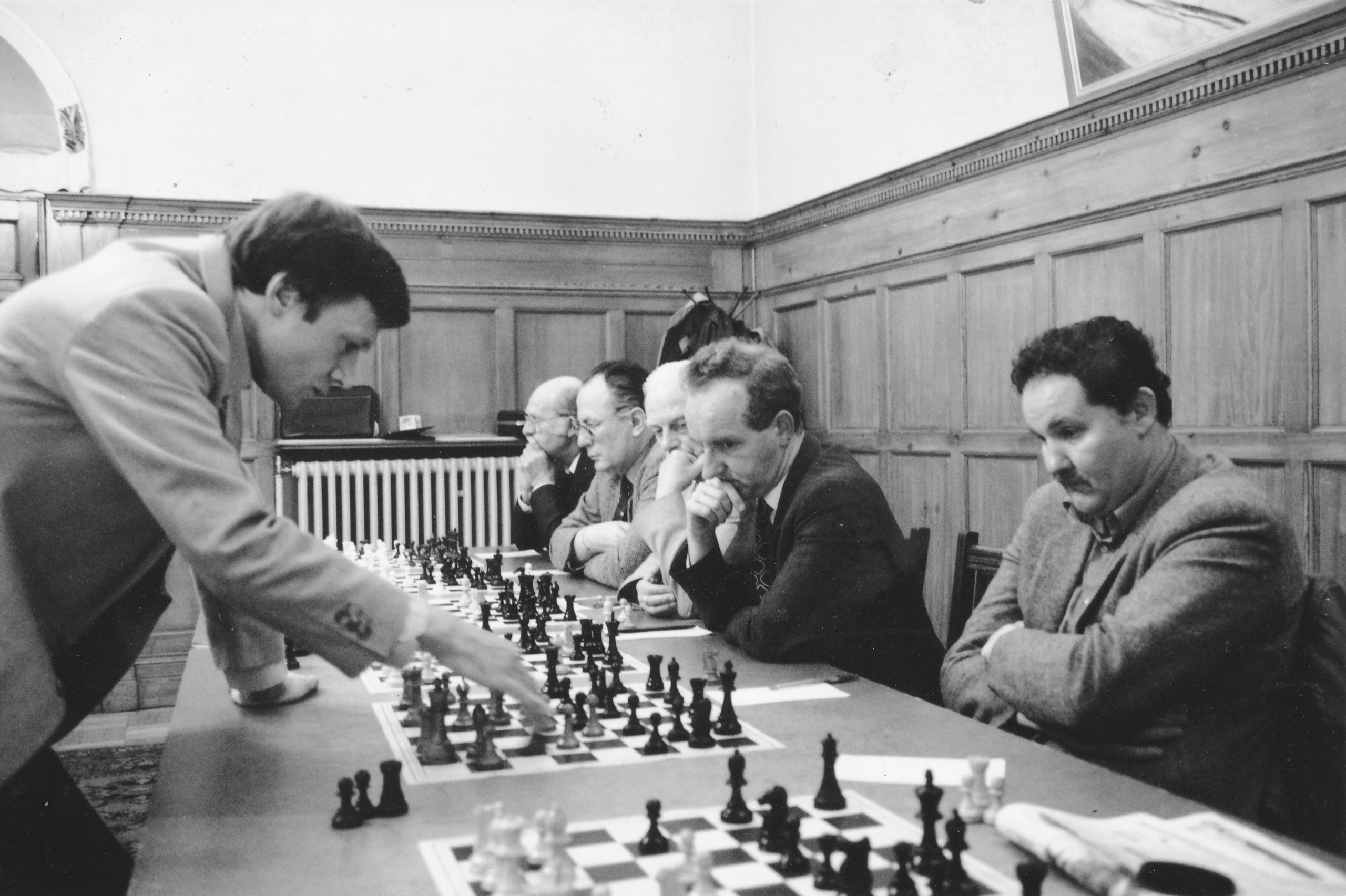
He joined Metropolitan Chess Club. He joined Barbican, as did many other CENTYMCA players, following the hiatus over their Tottenham Court Road venue loss.
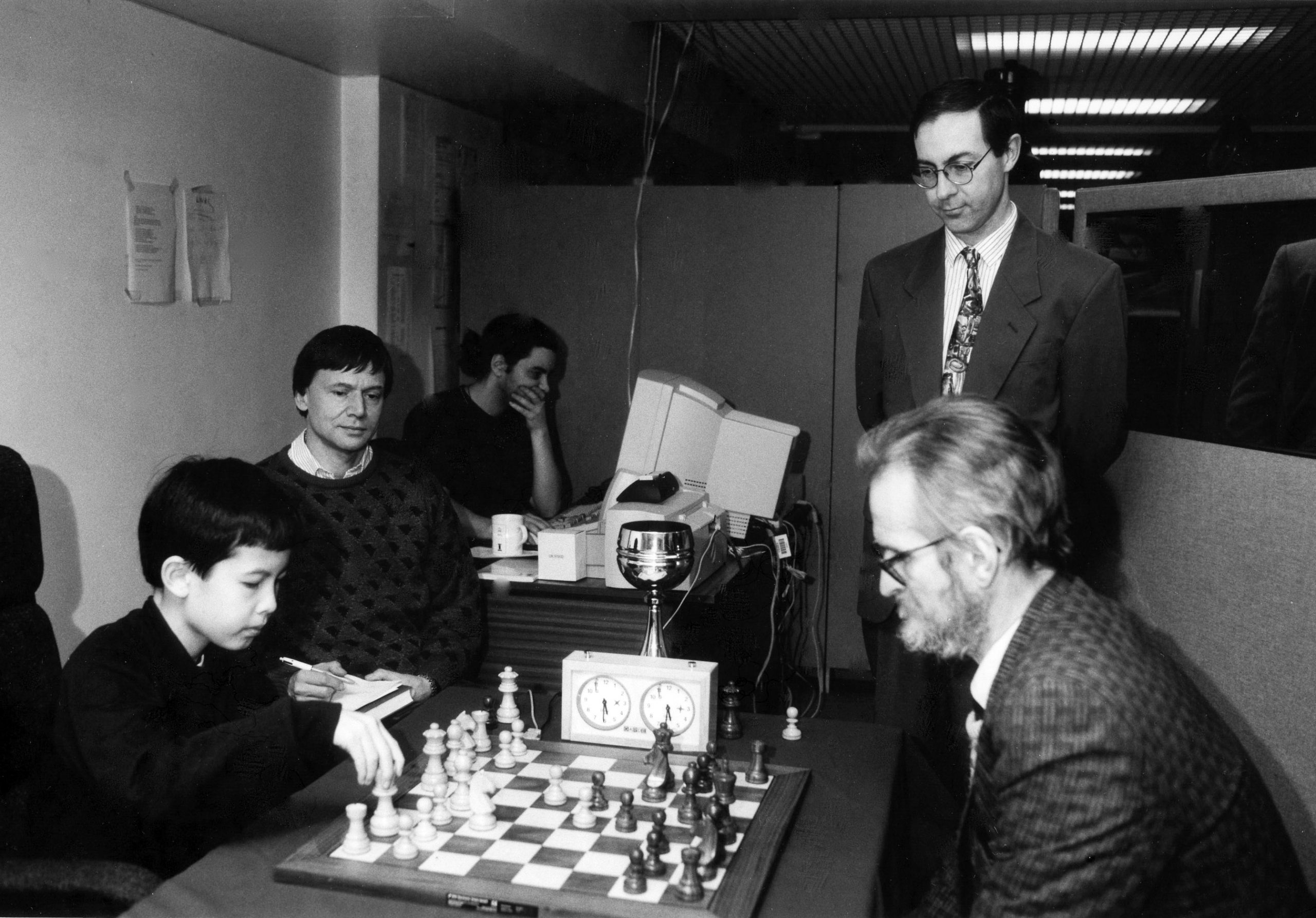
In December 2009 Jimmy visited the London Chess Classic and was photographed with VIP guest Viktor Korchnoi :
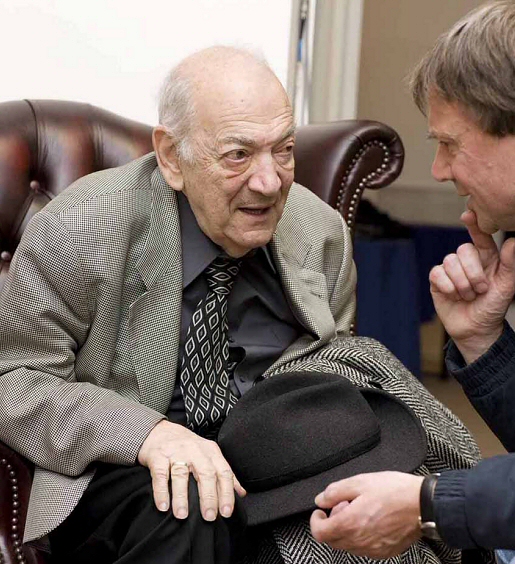
Jimmy was Editor of Middlesex Chessletter and Bayswater Chess in the early 1970s and produced major bulletins on the hugely successful Islington Congresses of the same period. He then worked for Pergamon Chess Books which led to his editorship of CHESS / CHESS Monthly magazine from until 2010 although his name remained on the masthead until February 2012.
In 2012 Jimmy and Ray Cannon attended a meeting of the Ken Whyld Association in Norwich :
In January 2016 Jimmy (together with Josip Asik) became co-editors of British Chess Magazine taking over from James Pratt and John Upham.
Jimmy also jointly edited Chess Informants 109-132 up to 2017 before taking on the role of Deputy Editor of the newly created American Chess Magazine whilst continuing to work as editor for Batsford Chess which had changed ownership over the years and had now been taken under the umbrella of Pavillion Books.
In 2014 Jimmy and Ray attended an event organised by the father of Emma Bentley
Here is an interview with Sarah Hurst from Kingpin Magazine
[pgn]
[Event “Middlesex League”]
[Site “London”]
[Date “1975.10.??”]
[Round “?”]
[White “Goodman, David SC”]
[Black “Adams, James Bernard”]
[Result “0-1”]
[ECO “E61”]
[Annotator “British Chess News”]
[PlyCount “64”]
[EventDate “1975.??.??”]
[EventCountry “ENG”]
[WhiteTeam “YMCA Juniors”]
[BlackTeam “YMCA Tigers”]
[WhiteTeamCountry “ENG”]
[BlackTeamCountry “ENG”]
{[%evp 0,64,19,18,47,-16,43,38,38,37,50,22,20,30,11,18,24,34,64,37,60,61,70,59,
61,35,40,27,27,42,59,15,24,25,25,35,93,98,118,68,71,-28,5,11,41,30,32,11,3,-48,
-18,-93,-88,-82,-82,-82,-65,-45,-63,-83,-79,-70,-70,-130,-135,-222,-220]} 1. d4
Nf6 2. c4 g6 3. Nc3 Bg7 4. Nf3 O-O 5. Bg5 c5 6. e3 d6 (6… cxd4) 7. Be2 Nc6 8.
d5 {[#]} Nb4 {a little unusual….} ({More common is} 8… Na5 9. Nd2 a6 10.
O-O Rb8 11. e4 Bd7) 9. Nd2 $146 (9. a3 Na6 10. O-O) 9… h6 10. Bh4 e5 11. e4
Bd7 12. g4 Qb6 13. a3 $16 Na6 14. Rb1 Rae8 15. Nf1 Qa5 16. f3 Nh7 17. Ne3 f5 $6
18. gxf5 gxf5 19. Qd2 (19. exf5 $18) 19… f4 20. Nc2 $6 {[#]} (20. Nf5 $1 Bxf5
21. exf5 Rxf5 22. Ne4 $18) 20… Bf6 $1 21. Bxf6 Rxf6 22. Rg1+ Kf7 23. Bd3 Ng5
24. Ke2 Qd8 $11 25. h4 Nh3 26. Rg2 Rg8 27. Rxg8 Qxg8 28. Rf1 Rg6 29. Kd1 Rg2
30. Qe1 Qg3 31. Qxg3 fxg3 32. Ne2 Rxe2 0-1
[/pgn]
 Save as PDF