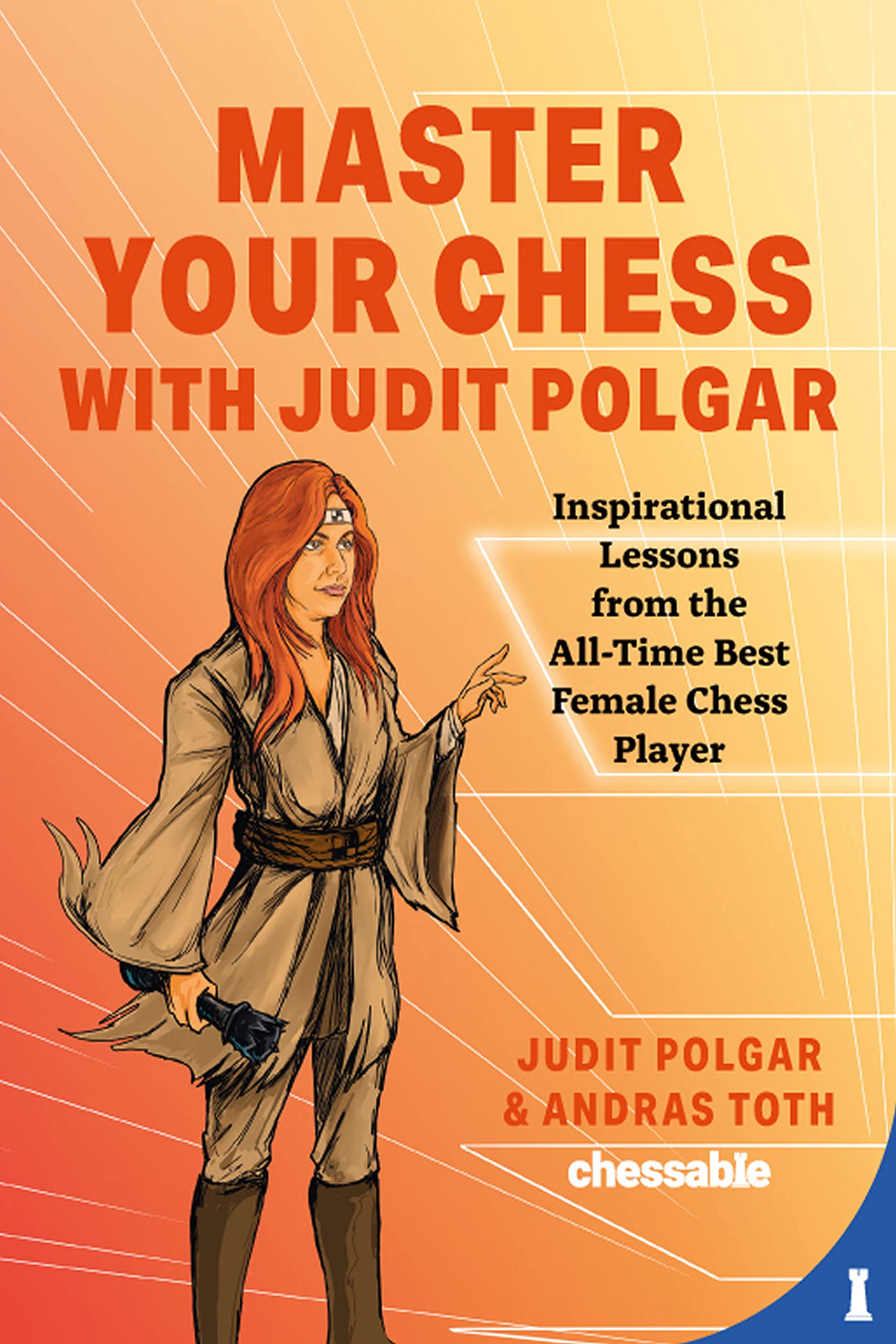
Master Your Chess with Judit Polgar

Master Your Chess with Judit Polgar: Inspirational Lessons from the All-Time Best Female Chess Player by Judit Polgar, Andras Toth, New in Chess, May 31st 2022, ISBN-13 ‏ : ‎ 978-9493257337

From the publisher:

“Judit Polgar was the best female chess player in the world for a record 26 years. In this book she reveals some of the secrets of her success. Together with prize-winning coach, International Master Andras Toth, she has created a course based on the training she received as a young player. It feels like private lessons from one of the best players in the world.

You will learn how to punish the three most common openings mistakes. And how to spot hidden tactical opportunities and how to force your opponent to play weakening moves. You will be taught how to master one of the most difficult skills in chess: seizing the initiative. And you will find the tools to turn yourself into a lean, mean, attacking machine. Master Your Chess with Judit Polgar covers all aspects of the game: from the opening to the endgame. The manual is accessible both for ambitious beginners wanting to build their chess development on a strong foundation and for intermediate players who have hit a plateau and need new insights to leap forward.”

Judit Polgar has been ranked 1st on the Women’s rating list from 1989 to this day. In 2005 she became the only woman in chess history to participate in the World Championship final.
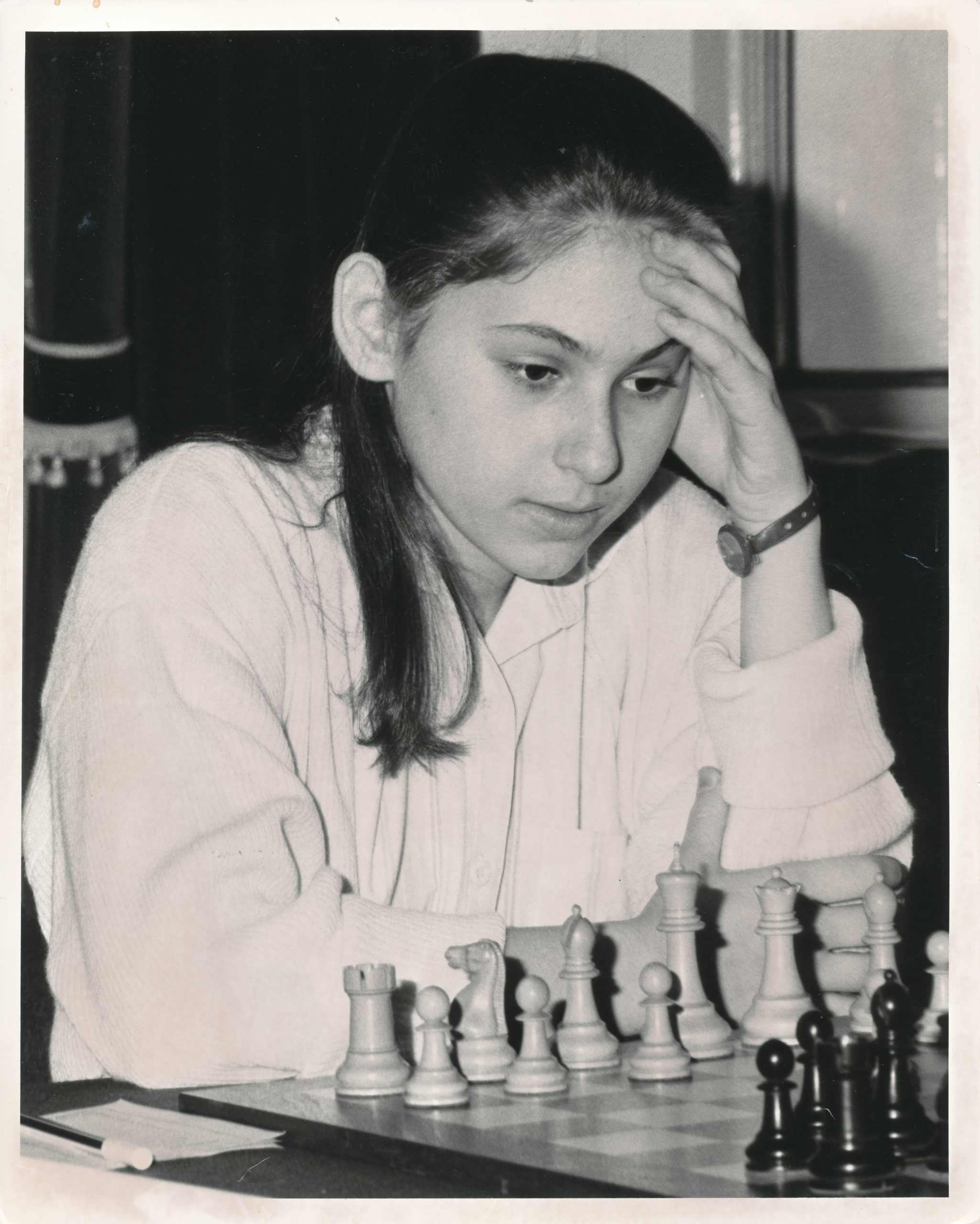
GM Judit Polgar
GM Judit Polgar

What we have here is an online course from chessable.com converted into a book.

Here’s Judit Polgar in the preface:

As an attempt to provide a rock-solid foundation to your game, we are going to cover all aspects of the game from the opening to the endgame. Again, we will do this in a unique and very focused fashion. Instead of wading through masses of opening theory, we are going to examine the main culprits that allow positions to break down.

We are going to look at the foundations of tactical play and will begin to delve into the most common positional themes. Last but not least, we are going to learn about endgame techniques and use endgame studies, not only to establish solid theoretical knowledge but to greatly enhance our calculation skills!

All this is going to be presented to you through a selection of games played by me and other experts of our royal game.

It’s described by Judit as a ‘starter kit’ and on the back cover as for ‘ambitious beginners’. It all depends on what you mean by ‘starter’ and ‘beginner’.

There’s an assumption that the reader is familiar with basic tactical ideas, opening principles and endgame theory, and is able to look ahead and calculate with reasonable proficiency.

For this reason, I’d consider this a book suitable for readers rated in the region of 1500-2000, although ambitious readers of, say, 1250 upwards would also benefit if they were prepared to work hard.

You can read some sample pages on the publisher’s website here.

You’ll observe from the contents that the book covers a wide range of themes across all areas of the game: openings, strategy, tactics and endings. Some of the chapter headings suggest material that wouldn’t be suitable for beginners: for example, Positional Queen Sacrifices, Openings that Thrive on Initiative or Complex Endings. Each chapter is introduced by a page in which the reader is invited to find the best continuation in four diagrammed positions. The diagrams are repeated over the page with the correct answer underneath: these positions are then explained in detail within the chapter.

Judit Polgar is second to none at both playing and selecting games and positions which are at the same time instructive and aesthetically pleasing. Together with her co-author Andras Toth she does an excellent job at explaining the examples, asking questions to the reader where appropriate, avoiding too many variations, and providing short and pertinent nuggets of advice.

Here’s a short game from the second chapter which Judit describes as ‘a particularly educational game to model the dangers of bringing the queen out too soon and neglecting development!’, adding that 12… Nxc3 13. Bxc3 Qb5 14. Nd6+ wins the queen.

Click on any move for a pop-up window.

[pgn]

[Event “Abu Dhabi op 20th”]
[Site “Abu Dhabi”]
[Date “2010.08.12”]
[Round “1”]
[White “Amin, Bassem”]
[Black “Salem, Ghuloom”]
[Result “1-0”]
[ECO “B01”]
[WhiteElo “2568”]
[BlackElo “2302”]
[PlyCount “23”]
[EventDate “2010.08.12”]
[EventType “swiss”]
[EventRounds “9”]
[EventCountry “UAE”]
[SourceTitle “CBM 137 Extra”]
[Source “ChessBase”]
[SourceDate “2010.09.01”]
[SourceVersion “1”]
[SourceVersionDate “2010.09.01”]
[SourceQuality “1”]

1. e4 d5 2. exd5 Qxd5 3. Nc3 Qd6 4. d4 c6 5. Nf3 Nf6 6. Ne5 g6 7. Bf4 Nh5 {[#]} 8.
Be3 Nd7 9. Be2 Nhf6 10. Bf4 Qb4 11. Nc4 Nd5 12. Bd2 1-0

[/pgn]

It’s good to see in Chapter 4 that Polgar, like me, uses the acronym CCTV when teaching tactics, although she refers to Checks, Captures and Threats Variations, while I prefer Checks, Captures, Threats and Violent moves (or looking for Checks, Captures and Threats leads to Victory).

Of course, tactics and strategy always go hand in hand, and, as a brilliant tactician who was brought up on a diet of solving tactical puzzles, even her chapters on strategy include examples with sparkling conclusions. Take this example from Chapter 7 on Misplaced Pieces, where another Hungarian demonstrates his skills.

[pgn]

[Event “SLO-chT”]
[Site “Celje”]
[Date “2003.11.23”]
[Round “9”]
[White “Sax, Gyula”]
[Black “Rogulj, Branko”]
[Result “1-0”]
[ECO “C54”]
[WhiteElo “2520”]
[BlackElo “2411”]
[SetUp “1”]
[FEN “r1b3k1/bpp2ppn/p2p1q1p/4r3/4P3/NBP1B2P/PP3PP1/R2QR1K1 w – – 0 15”]
[PlyCount “15”]
[EventDate “2003.11.17”]
[EventType “team-swiss”]
[EventRounds “9”]
[EventCountry “SLO”]
[SourceTitle “CBM 097 Extra”]
[Source “ChessBase”]
[SourceDate “2004.01.13”]
[SourceVersion “1”]
[SourceVersionDate “2004.01.13”]
[SourceQuality “1”]

{[#]} 15. Bxa7 Rxa7 16. Nc4 Re8 17. e5 dxe5 18. Nxe5 Be6 19. Nxf7 Qxf7 20. Rxe6
Rxe6 21. Qd8+ Nf8 22. Qb8 1-0

[/pgn]

You’ll find a number of endgame studies scattered throughout the book. Here, from the chapter on Unexpected Tactics, is the conclusion of an extraordinary study composed by Yuri Dorogov (Targoviste 1982).

[pgn]

[Event “?”]
[Site “?”]
[Date “????.??.??”]
[Round “?”]
[White “?”]
[Black “?”]
[Result “*”]
[SetUp “1”]
[FEN “Q7/7q/1p6/1kpN4/8/2P3p1/PP1KP3/7q w – – 0 1”]
[PlyCount “9”]

{[#]} 1. Nc7+ Qxc7 2. a4+ Kc4 3. Qg8+ Qd5+ 4. Kc2 Qxg8 5. e4 *

[/pgn]

Black is two queens up, with a pawn seemingly about to promote, but an inspection of the position reveals that there’s no way that 6. b3 can be prevented. Amazing! Who’d have thought it?

Chapter 21, Openings that Thrive on Initiative, includes the Botvinnik Semi-Slav, according to Polgar and Toth a super-exciting opening branch with vast theory and super-complicated games! Here’s an example, described by the authors as a remarkable victory and creative effort by Kaidanov.

[pgn]

[Event “URS-ch FL54”]
[Site “Kuibyshev”]
[Date “1986.??.??”]
[Round “?”]
[White “Oll, Lembit”]
[Black “Kaidanov, Gregory S”]
[Result “0-1”]
[ECO “D44”]
[WhiteElo “2430”]
[BlackElo “2415”]
[PlyCount “55”]
[EventDate “1986.10.??”]
[EventType “tourn”]
[EventRounds “17”]
[EventCountry “URS”]
[EventCategory “9”]
[SourceTitle “MCL”]
[Source “ChessBase”]
[SourceDate “1999.07.01”]
[SourceVersion “1”]
[SourceVersionDate “1999.07.01”]
[SourceQuality “1”]

1. d4 Nf6 2. Nf3 d5 3. c4 e6 4. Nc3 c6 5. Bg5 dxc4 6. e4 b5 7. e5 h6 8. Bh4 g5
9. Nxg5 hxg5 10. Bxg5 Nbd7 11. g3 Qa5 12. exf6 b4 13. Ne4 Ba6 14. Qf3 O-O-O 15.
b3 Nb6 16. Nc5 Bb5 17. Be3 Rd5 18. a4 bxa3+ {[#]} 19. Bd2 Qxd2+ 20. Kxd2 Bxc5 21.
bxc4 Rxd4+ 22. Kc3 Nxc4 23. Bxc4 Rxc4+ 24. Kb3 Rb4+ 25. Kc3 Rb2 26. Rab1 Bb4+
27. Kd4 c5+ 28. Ke5 0-1


[/pgn]

This review wouldn’t be complete without an example of Judit Polgar’s play. There are many of her brilliant tactical finishes in the book, but, like all great players, she also excelled in the ending.

This example comes from Chapter 28: Complex Endings. Judit explains: This endgame was a particularly satisfying one as I managed to execute a wide range of strategic and tactical themes within one game, including some awesome king maneuvers…

[pgn]

[Event “Las Palmas”]
[Site “Las Palmas”]
[Date “1994.??.??”]
[Round “7”]
[White “Polgar, Judit”]
[Black “Lautier, Joel”]
[Result “1-0”]
[ECO “B33”]
[WhiteElo “2630”]
[BlackElo “2625”]
[SetUp “1”]
[FEN “8/5pp1/3p4/p1kPp1br/4B3/1PP5/4KPP1/3R4 w – – 0 36”]
[PlyCount “61”]
[EventDate “1994.05.??”]
[EventType “tourn”]
[EventRounds “9”]
[EventCountry “ESP”]
[EventCategory “17”]
[SourceTitle “CBM 042”]
[Source “ChessBase”]
[SourceDate “1994.10.01”]
[SourceVersion “1”]
[SourceVersionDate “1994.10.01”]
[SourceQuality “1”]

{[#]} 36. Ra1 Kb6 37. Ra4 Bd8 38. Rc4 Kb7 39. Rc6 Rh6 40. g4 g5 41. Kd3 Bb6 42.
f3 Bc7 43. Kc2 Rh2+ 44. Kb1 Rh1+ 45. Kb2 Rh2+ 46. Ka3 Rd2 47. c4 Kb8 48. c5
dxc5 49. Ka4 Kc8 50. Kb5 Kd8 51. Ra6 Rb2 52. Kc4 Rd2 53. Kxc5 Rd4 54. d6 Bb8
55. Ra8 Rb4 56. Bc6 Kc8 57. Bb5 Kb7 58. Rxa5 Rd4 59. Ba6+ Ka8 60. Bc8+ Ba7+ 61.
Kc6 Kb8 62. d7 Rd3 63. Rb5+ Ka8 64. Bb7+ Kb8 65. Ba6+ Ka8 66. Rb8+ 1-0

[/pgn]

As you can see, you get 500 pages of terrific chess in this book, with 287 ‘games’. Some of the positions were familiar to me, but most weren’t.

The book is a sturdy, good-looking hardback: a very welcome from the usual rather flimsy softback books. The presentation is rather unusual, and much more colourful than most chess books, as a result of its being produced from an interactive course. The diagrams are graphic rather than character based, in tasteful two-tone brown. I quite like them myself, but perhaps some readers will prefer something more traditional. Some of the diagrams are enhanced with shaded squares and arrows, which, for me, are more appropriate for a screen than a book, where they don’t display especially well. The book uses a wide sans serif font which is perfect for screen display, but again you might prefer a more traditional serif font. I think it looks rather attractive as there isn’t a lot of heavy text in the book, but you might disagree. Questions are asked in blue, which makes them stand out from the rest of the text. On the whole, I thought the book looked really good: much more appealing than many chess books and excellent value for money: you can get it for under £30 if you shop around.

Then there’s the writing style, which tends towards the hyperbolic. The other day I was teaching a 7-year-old beginner. Whenever he found a checkmate in a puzzle I set him he exclaimed ‘Boom’!. In this book you sometimes get ‘Kaboom!’ instead. Moves are often described as ‘awesome’, ‘super-exciting’ or similar epithets. You might find that this enhances your reading experience, making it more like a personal lesson. On the other hand, you might consider it more suitable for a primary school classroom than for a book written for intelligent adults.

One further minor complaint: as with many books from this publisher, it would have benefited from additional proofreading by a native English speaker.

The quality of the material is outstanding throughout – ‘awesome’ if you prefer. The book covers a wide range of important topics suitable for club standard players. The examples are both educational and inspirational, with clear and helpful annotations. You’ll learn a lot about calculation and tactics, about positional play and strategy, but, more than that, you’ll encounter a lot of excitement, creativity and beauty. Studying this course will undoubtedly improve your chess as well as giving you a greater appreciation of the aesthetics of the game. It’s hard to imagine a more enthusiastic and inspiring guide and role model than the world’s strongest ever woman player. If you prefer, you can purchase the online course instead, but if you favour more traditional media, this book will grace your library.

As long as you’re happy with the presentation and writing style, this book deserves a very strong recommendation for all club players, with the caveat that, despite the suggestion on the back cover, it’s not suitable for complete beginners.

You might also want to visit Chessable to hear Judit talking further about the course.

Richard James, Twickenham 25th October 2022
Richard James
. Richard James

Book Details:

  • Softcover: 510 pages
  • Publisher: New In chess (31 May 2022)
  • Language: English
  • ISBN-10:9493257339
  • ISBN-13:978-9493257337
  • Product Dimensions: ‎17.81 x 3.33 x 23.83 cm

Official web site of New in Chess
GM Judit Polgar
GM Judit Polgar

Richmond Junior Chess Club 1975 – 2006: Part 2

Last time I left you in 1980, when Mike Fox had moved to Birmingham, leaving me in charge of Richmond Junior Club, whose membership included a growing number of very strong and talented young players, inspired by Mike’s teaching and charismatic personality to excel at chess.

I had been the backroom worker to Mike’s front man, but now, reluctantly, I was the front man as well.

My forte was organising rather than teaching, and, wanting to provide experience of serious competitive chess, I ran regular training tournaments for our strongest players.

Here, for instance, is a game from a 1981 training tournament. Aaron Summerscale is now a grandmaster and chess teacher. Nick von Schlippe is now an actor, director and writer, but maintains his interest in chess. Nick was one of a quartet of outstanding players from Colet Court/St Paul’s along with Harry Dixon (now playing chess in South East London), Michael Arundale and Michael Ross.

Click on any move of any game in this article for a pop-up window.

[pgn]

[Event “Richmond Training Tournament (2)”]
[Site “?”]
[Date “1981.05.30”]
[Round “?”]
[White “Summerscale, Aaron”]
[Black “Von Schlippe, Nicolas”]
[Result “1/2-1/2”]
[ECO “E30”]
[Annotator “Tactical Analysis 5.2 (1s)”]
[PlyCount “69”]
[EventDate “2011.10.22”]
[SourceVersionDate “2011.10.23”]

1. d4 Nf6 2. c4 e6 3. Nc3 Bb4 4. a3 Bxc3+ 5. bxc3 c5 6. Bg5 {[#]} b6 $146 {
E30: Nimzo-Indian: Leningrad Variation.} ({Predecessor:} 6… Nc6 7. Nf3 Qa5 8.
Qc1 cxd4 9. Bd2 dxc3 10. Bxc3 Qf5 11. e3 e5 12. h3 O-O 13. g4 Qxf3 {0-1 (13)
Paniagua,B-Garcia Padron,M (1940) Buenos Aires 1978}) 7. e4 {And now e5 would
win.} h6 8. Bxf6 (8. Be3 $5) 8… Qxf6 9. Qd2 d6 10. Nf3 Nc6 11. Be2 O-O 12.
O-O Ba6 13. Rfe1 Na5 14. Qa2 {Inhibits Nb3.} Rac8 {aiming for …cxd4.} 15.
Rac1 Rc7 16. d5 exd5 $2 (16… Re7 $17) 17. cxd5 $14 Bxe2 18. Rxe2 Re8 19. Nd2
Rce7 20. Qc2 c4 21. Rce1 g5 22. Re3 Qg6 23. Qa4 Kf8 24. f3 ({Don’t take} 24.
Nxc4 Rxe4 25. Qxe8+ Rxe8 26. Rxe8+ Kg7 $14) 24… Rc8 25. e5 $2 (25. Qb4 $18)
25… Rxe5 $2 (25… dxe5 $11 {and Black has nothing to worry.} 26. Rxe5 Rxe5
27. Rxe5 Qf6) 26. Rxe5 $18 dxe5 {[#]} 27. Rxe5 $2 (27. Qd7 $1 $18 Ra8 28. Ne4 (
28. Rxe5 Qf6 $14)) 27… Qd6 $2 {[#]} (27… Qf6 $1 $11 28. Re3 Qf5) 28. Qb4 $2
(28. Rf5 $1 $18) 28… Rc5 $11 {The position is equal.} 29. Rf5 {Strongly
threatening Ne4.} Qd7 30. g4 {Black must now prevent Ne4.} Kg7 (30… Kg8 $2
31. Ne4 Qd8 32. Nxc5 $18) 31. Ne4 Rxd5 32. Nf6 Rd1+ 33. Kg2 {The board is on
fire.} Qd8 {Threatens to win with …Nc6.} 34. Nh5+ Kg8 35. Nf6+ {Weighted
Error Value: White=0.49/Black=0.61} 1/2-1/2


[/pgn]

To give you some idea of our strength four decades ago, the leading scores in the 1982 Richmond U14 Championship were:
Nick von Schlippe 5/6
Demetrios Agnos (now a GM) 4½/6
Michael Ross 4/6
Philip Hughes 3½/5
Gavin Wall (now an IM and, for many years Richmond London League captain), Ben Beake, Harry Dixon, Sampson Low (currently secretary of Richmond & Twickenham Chess Club) 3½/6
Ali Mortazavi (now an IM) 3/5
Mark Josse (now a CM), Rajeev Thacker 3/6
and 6 other players, including Chris Briscoe (now a CM).

Here’s a game from that event for your enjoyment.

[pgn]

[Event “Richmond U14 Ch (2)”]
[Site “?”]
[Date “1982.05.29”]
[Round “?”]
[White “Agnos, Demetrios”]
[Black “Wall, Gavin”]
[Result “1/2-1/2”]
[ECO “D05”]
[Annotator “Tactical Analysis 5.2 (1s)”]
[PlyCount “85”]
[SourceVersionDate “2011.10.23”]

1. d4 Nf6 2. Nf3 d5 3. e3 e6 4. Bd3 c5 5. c3 Nc6 6. Nbd2 Bd6 7. Qe2 O-O 8. O-O
e5 9. dxe5 Nxe5 10. Nxe5 {D05: Colle System with …e6.} Bxe5 11. e4 Qc7 12. h3
{Inhibits Bg4. Black is slightly better.} Re8 {[#]} 13. Kh1 $146 ({Predecessor:
} 13. Qf3 Be6 14. c4 d4 15. Re1 b5 16. b3 b4 17. Nf1 a5 18. Rb1 a4 19. Qd1 axb3
20. axb3 {0-1 (37) Franklin,M-Dodson,P corr 1973}) 13… Bd7 {And now …Bf4
would win.} 14. exd5 {[#]} Bxc3 $1 15. Qf3 Bd4 (15… Bxd2 $5 16. Bxd2 Qd6 $11)
16. Nc4 Bb5 {aiming for …Qd7.} 17. Rb1 $2 (17. a4 $11 Bxc4 18. Bxc4) 17…
Rad8 $2 (17… Qd7 $19 {…Rad8 is the strong threat.} 18. b4 Bxc4 19. Bxc4 b5)
18. Bf4 (18. a4 $5 Ba6 19. Bg5 $11) 18… Qd7 19. d6 Bc6 20. Qg3 b5 $36 {
Black is in control.} ({Inferior is} 20… Nh5 21. Qh4 g6 22. Bh2 $17) 21. Nd2
(21. Na5 {was the only chance.}) 21… Nd5 $19 ({And not} 21… Nh5 22. Qh4 g6
23. Bh2 $17) 22. Qh4 h6 23. Bg3 f5 24. Nb3 $2 (24. Nf3 $17) 24… Bf6 25. Qh5
f4 26. Bh2 Qxd6 27. Bg6 $2 (27. Na5 c4 28. Nxc6 Qxc6 29. Bf5) 27… Re5 28. Qd1
Rg5 29. Be4 Qe7 30. Qf3 c4 31. Nc1 (31. Na5 Ba8 32. Bxf4 Nxf4 33. Bxa8) 31…
Nc3 32. Bxc6 Nxb1 33. Bxf4 Nd2 34. Bxd2 Rxd2 35. b3 Qc5 {[#] Strongly
threatening …Rf5.} 36. Be4 Bd4 37. Kg1 $2 (37. bxc4 {was the only defense.}
bxc4 38. Ne2) 37… Qe5 (37… Re5 $142 38. Ne2 Qd6 39. Nxd4 Rxd4) 38. bxc4 Rg3
$2 (38… bxc4 $19 39. h4 Rh5) 39. Bd5+ $11 Kh7 40. Be4+ g6 $2 (40… Kg8 $1
$11 41. Bd5+ Kh7 42. Be4+ Kg8) 41. Qf7+ $18 Qg7 42. Qxg7+ {Dancing on a razor
blade.} (42. Qf4 $18 Rxf2 43. Rxf2) 42… Kxg7 $11 43. Nb3 {Weighted Error
Value: White=0.86/Black=0.89} 1/2-1/2


[/pgn]

The results of our 1983 Under 14 Championship told a fairly similar story.

Scores out of games played (there are either two missing scoresheets or two players took byes in Round 4 and two didn’t play in Round 6) were:

Gavin Wall 6/6
Demetrios Agnos 4½/6
Philip Hughes 4/6
Harry Dixon, Ben Beake, Chris Briscoe 3½/6
Aaron Summerscale 3/5
Michael Ross, James Cavendish, Rajeev Thacker, Mark Josse, Bertie Barlow 3/6
Ali Mortazavi 2½/5
Leslie Faizi 2½/6
Grant Woodhams 2/6
Alan Philips, Chris Bynoe 1/5
Daniel Falush 0/6

At some point I’d acquired a copy of Chess Life and discovered that the members of our small suburban junior chess club were, over the top few boards and applying the conversion factor in use at the time, stronger than the juniors in the whole of the USA.

The significant factor in all this is, for me, not just the strength of the players, but how many are still playing, or at least keeping up with the chess world, and, even more so, how many I’m still in touch with, or have spoken to on social media, almost 40 years on. Talking to them now, they always have very fond memories of their time at Richmond Junior Club.

What we were doing, although I wasn’t aware of it then, was building a lifelong chess community. Producing future GMs and IMs was merely a by-product of the actual purpose.

But it was clear that, as the younger players coming into the club were less strong and less interested than their predecessors, changes had to be made. Perhaps I needed someone who was a much better chess teacher than me and, like Mike Fox, had the charisma to attract strong new members into the club. There was no doubt who the best chess teacher was in my part of the world: Mike Basman. He agreed to help and, for a time in 1983-84 we worked together.

Of course, Mike was, and still is, brilliant, but he’s also a maverick, someone who, like me, prefers to do things in his own way. There were a couple of issues, in particular, where we disagreed.

Mike has always been known for his love of eccentric openings, and he’d sometimes give lessons on these. My view was different: children should, in the first instance, be given a thorough grounding in all the major openings. If they decide later that they want to experiment, that’s fine, but understand the basics first.

My second point was that we were inviting near beginners to training tournaments where clocks and scoresheets were used. My view was, and still is, that children should be able to play a reasonably proficient game without giving away pieces before clocks and scoresheets are used. Clocks and scoresheets add to the game’s already bewildering complexity and, if children are not used to them, they will concentrate too much on remembering to press their clock and working out how to write their moves down and forget about how to play good chess.

This is still one of my big problems with junior chess today: we’re putting children who barely know how the pieces move into tournaments with all the accoutrements of proper grown-up chess: clocks, arbiters, strictly observed silence, touch and move. My view is that this is totally wrong, but, even more so today than 40 years ago, I appear to be in a small minority. Very often, these days, parents are insisting that their children should take part in serious external competitions before they’re ready in terms of both chess and emotional development.

You’ll find out next time how I addressed these two issues over the following years. I had to find my own methods of doing exactly what I wanted. If anyone else wanted to come in with me, that was fine, but I was never going to compromise on doing it someone else’s way rather than mine.

Meanwhile, in April 1984 we were offered the chance of a simul given by Hungarian GM Zoltan Ribli, who at that time was ranked 13th in the world with a rating of 2610. Although we had to pay quite a lot for the privilege, this was too good an offer to turn down. According to the scoresheets that were handed in he scored +13 =4 -2: again, a pretty good performance for a suburban junior chess club! Here’s one of his losses.

[pgn]

[Event “RJCC Simul”]
[Site “?”]
[Date “1984.04.24”]
[Round “?”]
[White “Ribli, Zoltan”]
[Black “Summerscale, Aaron”]
[Result “0-1”]
[ECO “E12”]
[Annotator “Tactical Analysis 5.2 (1s)”]
[PlyCount “92”]
[EventDate “2011.08.12”]
[SourceVersionDate “2011.10.23”]

1. d4 e6 2. c4 b6 3. Nf3 Nf6 4. a3 Bb7 5. Nc3 Be7 6. d5 O-O 7. e4 exd5 8. exd5
Re8 9. Be2 {E12: Queen’s Indian: Unusual White 4th moves, 4 a3, 4 Nc3 Bb7 5 a3
and 4 Nc3 Bb7 .} d6 10. O-O Nbd7 {[#]} 11. Re1 $146 {White is clearly better.}
({Predecessor:} 11. b4 a5 12. Bb2 Nf8 13. Nd4 Ng6 14. Nf5 Bf8 15. Qd4 Qd7 16.
Bd3 axb4 17. axb4 {1-0 (50) Brostrom,G-Fridh,A Norrkoeping 1968}) 11… Nf8 12.
Be3 N6d7 13. h3 Bf6 14. Qc2 Ne5 15. Nxe5 Bxe5 16. Bf1 Qf6 17. Ne4 Qg6 18. Bd3
Bc8 19. f4 Bxb2 20. Qxb2 Bf5 {[#]} 21. g4 $1 Rxe4 (21… Bxe4 $2 22. f5 $1 Qf6
23. Bd4 $1 $18) 22. Bxe4 Bxe4 23. Kh2 f5 24. Rg1 {Black must now prevent gxf5.}
Qh6 25. Rg3 {Re1 is the strong threat.} Ng6 26. Rag1 Nh4 $2 ({Black should play
} 26… Re8 $14) 27. Qf2 $2 (27. gxf5 $18 Nf3+ {[#]} 28. Rxf3 $1 Bxf3 29. f6)
27… fxg4 $11 28. f5 $1 Qh5 29. Rxg4 Nf3+ 30. Qxf3 Bxf3 {Dancing on a razor
blade.} 31. Rxg7+ Kf8 $1 {aiming for …Re8.} (31… Kh8 $2 {is a self mate.}
32. Bd4) 32. Bd4 $2 (32. R1g5 $15 Qxg5 33. Rxg5) 32… Re8 $19 33. Rg8+ Ke7 34.
f6+ Kd8 $1 35. R1g7 Rxg8 36. Rxg8+ Kd7 37. Rg7+ Ke8 38. Rxc7 Bg4 39. Re7+ Kf8
40. Re3 Qh4 41. Rg3 {[#]} Bxh3 $1 42. Bf2 (42. Rxh3 Qxd4) 42… Bf5+ 43. Kg1
Qxf6 44. Be3 Be4 {Threatens to win with …Qh4.} 45. Kh2 Qh4+ 46. Rh3 Qe1 {
Never resign too early! Weighted Error Value: White=0.65/Black=0.31} 0-1

[/pgn]

At that time, we were constitutionally part of Richmond & Twickenham Chess Club, and our accounts were incorporated in theirs. Up to that point we’d made a reasonably healthy profit each year, but in 1983-84 we had only just broken even. At the 1984 AGM the RTCC treasurer wasn’t impressed, thinking we might jeopardise the club’s finances in future, and uttering the immortal words ‘What’s a Ribli Simul?’. (Strangely enough, the other day I chanced upon a record of him playing in a simul some 35 years or so earlier!)

Our turnover was also much larger than that of RTCC so it seemed sensible that we should declare financial independence. I would remain on the committee as the officer responsible for junior chess, providing a link to RJCC. (I still hold that post today, but without the RJCC link.) We already had a parent, Derek Beake, serving as our Treasurer, a role he’d occupy for 22 years, long after his son Ben had given up competitive play.

In 1985 we were again offered the chance of a simul given by a world class player, in this case by local GM John Nunn, who, at the time, was ranked joint 11th in the world (one place behind Ribli) with a rating of 2600. This time we invited a few of our friends from Richmond & Twickenham Chess Club to join us.

Out of 23 games, John scored 14 wins, 6 draws and 3 losses, to RTCC’s Paul Johnstone, a slightly pre-RJCC Richmond Junior (someone suggested the other day I should write something about the pre-RJCC Richmond Juniors, which perhaps I should), to future GM Demetrios Agnos and to the unheralded Leslie Faizi, who had also drawn with Ribli the year before.

[pgn]

[Event “RJCC/R&TCC Simul”]
[Site “?”]
[Date “1985.09.04”]
[Round “?”]
[White “Nunn, John”]
[Black “Faizi, Leslie”]
[Result “0-1”]
[ECO “B80”]
[Annotator “Tactical Analysis 5.2 (1s)”]
[PlyCount “64”]
[SourceVersionDate “2011.10.23”]

1. e4 c5 2. Nf3 e6 3. d4 cxd4 4. Nxd4 Nf6 5. Nc3 d6 6. Be3 Be7 7. f3 a6 8. Qd2
O-O 9. g4 Nc6 {[#]} 10. g5 $146 {B80: Sicilian Scheveningen: 6 g3 and 6 Be3,
including English Attack.} ({Predecessor:} 10. O-O-O Nxd4 11. Bxd4 Nd7 12. h4
b5 13. h5 Ne5 14. Qf2 Qc7 15. f4 Nd7 16. h6 g6 17. Bg7 Re8 18. Bg2 Bb7 19. Rhf1
b4 20. f5 Bg5+ {0-1 (40) Chandler,M (2470)-Govedarica,R (2405) Belgrade 1982})
10… Nd7 11. h4 Nde5 12. Qg2 {And now 0-0-0 would win. White is better.} (12.
f4 Nxd4 13. O-O-O Nef3 $15) 12… Nxd4 13. Bxd4 Nc6 14. Be3 {aiming for 0-0-0.}
b5 15. O-O-O Bd7 16. Kb1 Rc8 17. h5 Re8 18. Qg3 Qa5 19. g6 Bf6 20. gxh7+ Kh8 {
Threatens to win with …Nb4.} 21. Bd2 $2 (21. h6 $18) 21… b4 $11 {Black has
compensation.} 22. Ne2 Ne5 (22… Qc5 $5 23. c3 Rb8 $11) 23. Nc1 $2 {[#]} (23.
Bg5 $16 {Strongly threatening Bxf6.} Qc7 24. c3 (24. Nd4 Bxg5 25. Qxg5 Nxf3 $11
) 24… Bxg5 25. Qxg5 Kxh7 26. Rh3) 23… Qc5 $2 {Really sharp!} (23… Kxh7
24. Be3 $14) (23… Qa4 24. Nb3 $16) ({Better is} 23… Rxc2 $1 $19 24. Kxc2
Qa4+ 25. Kb1 Qxd1) 24. c3 $1 $15 {Hoping for h6.} a5 {…Qb6 is the strong
threat.} ({Don’t play} 24… bxc3 25. Bxc3 Nc4 26. Nd3 Na3+ 27. Ka1 Nc2+ 28.
Kb1 Na3+ 29. Ka1 Nc2+ 30. Kb1 Na3+ $11) (24… Ba4 $5 25. Nb3 Bxb3 26. axb3
bxc3 27. Bxc3 Qe3 $11) 25. Nd3 $2 (25. h6 $16) 25… Nxd3 $19 26. Bxd3 Bb5 (
26… bxc3 $142 {( -> …c2+)} 27. Bxc3 Bxc3) 27. Bc2 Be5 $2 (27… bxc3 $19
28. Bxc3 Bxc3 29. Qxd6 Qxd6 30. Rxd6 Be5) 28. f4 (28. Bf4 $5) 28… bxc3 $40 {
White is in trouble.} 29. Be3 (29. fxe5 $17 cxd2 30. Rxd2 Qxe5 31. Rg1) 29…
Qb4 {Black is clearly winning.} 30. b3 {[#]} a4 $1 ({Resist} 30… Qa3 31. Bc1
Qc5 32. fxe5 $18) 31. fxe5 axb3 32. axb3 Ra8 {Weighted Error Value: White=1.36/
Black=0.95} 0-1

[/pgn]

Even our lesser lights from that generation could play pretty good chess. Here’s a draw against Alan Phillips, who had beaten Ribli the year before (and who contacted me on Twitter a few years ago).

[pgn]

[Event “RJCC/R&TCC Simul”]
[Site “?”]
[Date “1985.09.04”]
[Round “?”]
[White “Nunn, John”]
[Black “Phillips, Alan”]
[Result “1/2-1/2”]
[ECO “C11”]
[Annotator “Tactical Analysis 5.2 (1s)”]
[PlyCount “97”]
[SourceVersionDate “2011.10.23”]

1. d4 {Bulletin} e6 2. e4 d5 3. Nc3 Nf6 4. e5 Nfd7 5. f4 c5 6. Nf3 Nc6 7. Be3
Qb6 8. Na4 Qa5+ 9. c3 cxd4 10. b4 Nxb4 11. cxb4 Bxb4+ 12. Bd2 Bxd2+ 13. Nxd2 b6
14. Kf2 {[#]} Nc5 $146 {C11: French: Classical System: 4 e5 and 4 Bg5 dxe4.} (
14… O-O $11) ({Predecessor:} 14… Ba6 15. Nf3 d3 16. Nb2 Nc5 17. Bxd3 Bxd3
18. Nxd3 Ne4+ 19. Ke3 Rc8 20. Rc1 O-O 21. Qb3 Nc3 22. Rc2 {1-0 (70) Van der
Wiel,J (2515)-Ree,H (2480) Wijk aan Zee 1984 MCL [Bulletin]}) 15. Nxc5 $18 bxc5
16. Nf3 $2 (16. Qc1 $18) 16… Qb6 (16… Rb8 $11 {and Black stays safe.}) 17.
Rc1 $2 ({White must play} 17. Rb1 $18 Qc7 18. Bb5+ Bd7 19. Qa4) 17… c4 $2 (
17… O-O $14) 18. Nxd4 ({Less strong is} 18. Qxd4 f6 $16) 18… Bd7 19. Qd2
O-O 20. Ke3 $2 ({White should try} 20. Be2 $18) 20… Rfc8 $2 (20… f6 $17 {
keeps the pressure on. And now …fxe5 would win.} 21. Ke2 fxe5 22. fxe5 Rf7)
21. Qc3 Rab8 22. Be2 Qb2 23. Qxb2 Rxb2 24. Rc2 Rcb8 25. Rhc1 Ba4 26. Rxb2 Rxb2
27. Bxc4 $2 dxc4 $16 28. Rxc4 $18 {[#] Endgame White threatens Rc8+ and mate.
KRB-KRN} Be8 29. Rc8 Kf8 30. f5 Rxg2 31. Nb5 {aiming for Nd6.} Ke7 ({Don’t do}
31… exf5 32. Nd6 Ke7 33. Rxe8+ Kd7 34. a4 $16) 32. f6+ gxf6 33. exf6+ Kd7 (
33… Kxf6 $5 34. Rxe8 Rxh2 $11) 34. Nd6 Kxd6 $19 35. Rxe8 {KR-KR} Rg6 $2 (
35… Ke5 36. Re7 Kxf6 37. Rxa7 Rxh2) 36. Ra8 Rxf6 {[#] …Rh6 is the strong
threat.} 37. Rxa7 Rh6 $2 (37… Rf1 $19 {Strongly threatening …h5.} 38. a4 h5
39. Ra6+ Ke7) 38. Rxf7 $11 {The position is equal.} Rxh2 39. a4 Ra2 40. Rxh7
Rxa4 41. Rh8 Ke5 42. Rh5+ Kd6 43. Kd3 e5 44. Rh8 Ra7 45. Rd8+ Ke7 46. Rh8 {
Threatens to win with Rh7+.} Ke6 47. Ke3 Rg7 48. Ra8 Kf6 49. Rf8+ {Weighted
Error Value: White=0.84/Black=0.87} 1/2-1/2


[/pgn]

Yes, many of our stronger players from a few years earlier still kept their association with the club, and with chess in Richmond in general (and some of them still keep that association in the 2020s), although they had now outgrown our Saturday morning sessions. We were also no longer successful in attracting strong players into the club. (I suspect, looking back, they just weren’t around in our area: these things come and go.)

I knew I needed to make changes, and that I had to find my own way of running the club rather than trying to work with anyone else.

I wanted to separate the club in order to differentiate between the players who were able to play a proficient game, and who needed experience playing under more serious conditions using clocks and scoresheets, and those younger and less experienced players who were not yet able to play fluently without making regular oversights.

By now home PCs had become available. I was able to use my (admittedly limited) programming skills to write a grading program in BASIC for my BBC Micro into which I entered all our internal club results. I used a pseudo-BCF system with a crude but reasonably effective iterative process providing anti-deflation factor which would take into account my assumption that our members were either improving or remaining stationary at any point.

This gave me the information to decide, by monitoring all the internal results of all our members, which players should be in which group. The decision was made – and my intuition again turned out to be correct (although it’s not how things work today) – that players of primary school age would move up to the higher group when they reached a grade of 50 (equivalent to 1000 Elo). I’ll write a lot more about this, either here or elsewhere, later.

By the start of the 1986-87 season the club had become something totally different. Two things had also happened which would have an enormous impact on the club’s further development.

You’ll find out what they were, and a lot more besides next time.

Minor Pieces 47: George Archer Hooke Part 2

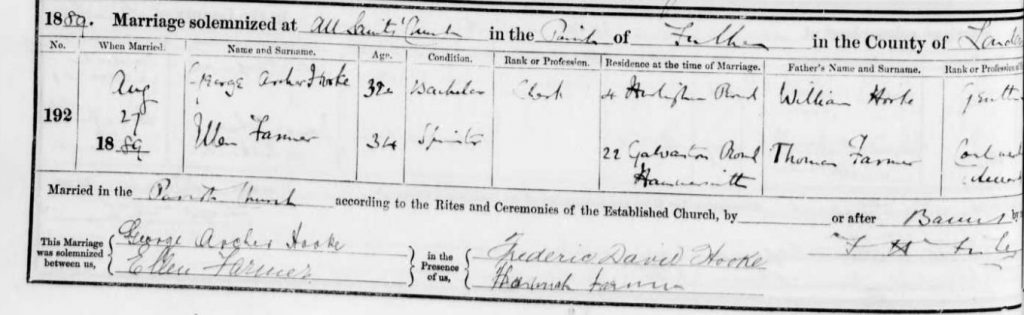
Last time we left George Archer Hooke at the age of 32 in 1889, just having married 34 year old Ellen (Nellie) Farmer.

George and Ellen didn’t waste a lot of time starting a family. Their first child, a daughter named Mildred Alice (was her middle name a tribute to George’s sister?) was born on 18 September 1890.

The 1891 census found George, Ellen and baby Mildred at 22 Galveston Road Putney (just off the South Circular between Putney and Wandsworth). George, Ellen, Mildred. By now Ellen was expecting another child, and, on 7 November that year, they welcomed Frances Louisa into the world.

George was still playing club and county chess regularly.

In this game he demonstrated commendable aggression in the middle game against tinned milk pioneer Arthur James Maas, who, perhaps unwisely, opted for one of his opponent’s favourite openings. Click on any move for a pop-up window.

[pgn]

[Event “City of London CC Championship”]
[Site “?”]
[Date “1892.12.??”]
[Round “?”]
[White “Maas, Arthur James”]
[Black “Hooke, George Archer”]
[Result “0-1”]
[ECO “C44”]
[Annotator “Tactical Analysis 5.2 (1s)”]
[PlyCount “58”]
[SourceVersionDate “2022.09.29”]

1. e4 e5 2. Nf3 Nc6 3. c3 Nf6 4. d4 Nxe4 5. d5 Nb8 6. Nxe5 Qf6 {[#] C44:
Ponziani Opening and Scotch Gambit.} 7. Ng4 $146 ({Predecessor:} 7. Nf3 Bc5 8.
Be3 Bxe3 9. fxe3 Qb6 10. Qd4 Nf6 11. Qe5+ Kd8 12. Ng5 Rf8 13. Nd2 h6 14. Nc4 {
1-0 (51) Kipping,J-Ralli,D Manchester 1854}) 7… Qg6 8. Bd3 {Strongly
threatening 0-0.} f5 {[#] White is clearly better.} 9. O-O $1 {Threatens to
win with Re1!} Bc5 (9… Bd6 10. f3) 10. Be3 {aiming for Ne5.} d6 {Inhibits
Ne5.} 11. Bxc5 Nxc5 12. Re1+ Kf7 13. Ne3 $1 Rf8 $2 (13… Nxd3 $11 14. Qxd3 f4
15. Qxg6+ hxg6) 14. Be2 Kg8 15. Bh5 Qg5 16. Nf1 f4 {[#] Hoping for …Nbd7.}
17. Kh1 $2 {Loses the game.} (17. b4 $15 Ncd7 18. Nfd2) 17… Bf5 {And now …
Nd3 would win.} 18. Bf3 $2 (18. Be2 {was the only chance.}) 18… Nbd7 19. b4
$2 (19. Qd4 {is a better defense.} Nd3 20. Re2) 19… Nd3 $19 {Black is
clearly winning.} 20. Re2 Rae8 21. Nbd2 N7e5 22. Ne4 (22. Qa4 $142 Qf6 23. Qxa7
) 22… Qg6 23. Nfd2 (23. Ned2 $142 Re7 24. Kg1) 23… Qh6 24. Qg1 g5 25. g4
Nxf3 26. Nxf3 Bxe4 27. Qg2 Bxd5 28. Rd2 Ne1 29. Rxd5 Nxg2 {Weighted Error
Value: White=0.87/Black=0.60 Source: East Anglian Daily Times 17 December 1892}
0-1

[/pgn]

On the very day this game was published, George had another reason to celebrate: the birth of a third daughter, named Beatrix Georgina Ellen.

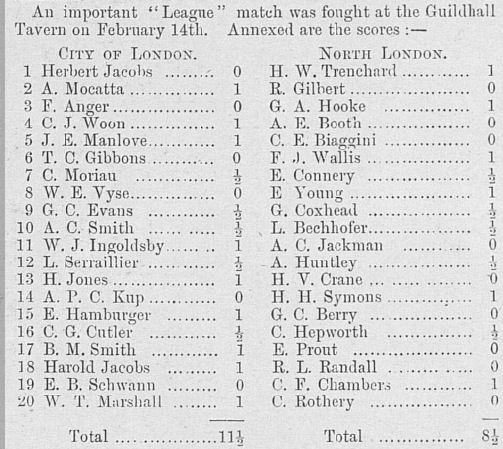
George Archer Hooke was a member of two clubs but chose to play for North London in the London League. This league had started in 1888, and North London followed Athenaeum as title winners in the 1889-90 season. Their second title would come in 1898-99. Here they are, in 1894, losing to George’s other club.

Illustrated Sporting and Dramatic News 24 Feb 1894

Although his team lost, George won his game against Prussian born Fancy Stationer(!) (John Charles) Frederick Anger. There are some interesting names, as always, on both sides. Regular readers will spot Edward Bagehot Schwann playing for City.

The North London Board 17 is also of interest. Back in the 1960s my father, who sang in his church choir, had a score of Handel’s Messiah, edited by the wonderfully named Ebenezer Prout. I always remembered this – and here he is in 1894 playing chess in the London League. Wikipedia confirms that Ebenezer lived in Hackney and played chess: something I never knew until now.

Three months later his team encountered someone even more interesting.

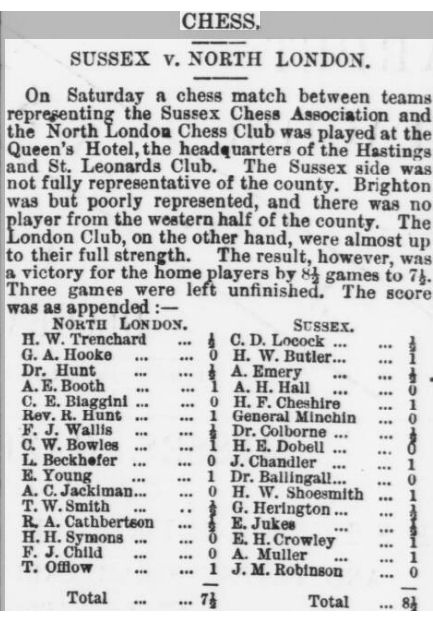
Hastings and St Leonards Observer 26 May 1894

The Sussex board 14, assuming the middle initial should have been A rather than H, was none other than star of The (Even More) Complete Chess Addict and “Wickedest Man on Earth” Aleister Crowley.

A fourth daughter, given the names Ella Kathleen, was born on 8 April 1895, and she would be followed, on 28 November 1896, by George and Ellen’s last child and only son, Cyril George.

The City of London Championship, which, as regular readers will be aware, would soon become very strong, attracting London’s leading amateur players, had started in 1890, and George was often amongst the entries. The closest he came to winning the event came in the 1896-97 season, in which he won his section but lost to the winners of the other three sections in the play-off, with Thomas Francis Lawrence eventually winning his second title.

In this game of fluctuating fortunes against an Essex player, Hooke escapes from a poor position. His opponent seemed to lose the thread of the game, allowing George’s hanging pawns to become a strength rather than a weakness.

[pgn]

[Event “City of London CC Championship”]
[Site “London ENG”]
[Date “1896.11.09”]
[Round “?”]
[White “Wagner, H.”]
[Black “Hooke, George Archer”]
[Result “0-1”]
[ECO “A85”]
[Annotator “Tactical Analysis 5.2 (1s)”]
[PlyCount “82”]
[EventDate “1895.??.??”]
[SourceVersionDate “2022.09.29”]

1. d4 f5 2. c4 Nf6 3. Nc3 e6 4. e3 b6 5. Bd3 Bb7 6. Nf3 Be7 7. O-O O-O {
[#] A85: Dutch Defence: 2 c4 Nf6 3 Nc3.} 8. b3 $146 ({Predecessor:} 8. Be2 Ne4
9. Bd2 a6 10. Ne5 d6 11. Nd3 Nxd2 12. Qxd2 Nd7 13. Nf4 Rf6 14. d5 e5 {0-1 (34)
Lee,F-Mason,J Belfast 1892}) 8… c5 9. Bb2 Na6 {White is slightly better.} 10.
Rc1 Nc7 11. Bb1 Qe8 12. Ne1 Qg6 13. Qe2 Qh6 14. f4 $2 (14. dxc5 $11 {and White
has nothing to worry.} Bxc5 15. Rd1 (15. Nf3 g5 $15)) 14… Ng4 $19 (14… cxd4
15. exd4 Bd6 16. Nd3 $15) 15. h3 {[#]} Nf6 ({And not} 15… cxd4 16. hxg4 (16.
exd4 Nf6 $11) 16… dxc3 17. Bxc3 $11) ({Black should play} 15… Nxe3 $1 $19
16. Qxe3 cxd4) 16. Rd1 Nh5 $40 {White needs to defend precisely.} 17. Qf2 {
Prevents Ng3.} Rad8 18. Bc1 g5 19. fxg5 Bxg5 ({Much weaker is} 19… Qxg5 20.
Ne2 $11) 20. Ne2 Be4 21. Nd3 ({Don’t go for} 21. Bxe4 $2 fxe4 22. Nf4 cxd4 23.
Rxd4 e5 24. Rxe4 exf4 25. exf4 d5 26. cxd5 Nxd5 $19) 21… d6 {And now …Kh8
would win.} 22. Nef4 Nxf4 23. exf4 Bh4 24. Qb2 cxd4 25. Qxd4 Bf6 26. Qe3 Qg7
27. Qe2 Bd4+ 28. Kh2 {Strongly threatening Nb4!} Kh8 $2 {[#] Black has more active pieces.} (28… e5 $17 {Threatens to win with
…Ne6.} 29. Bb2 Ne6) 29. Ne1 $1 $18 Bxb1 {[#]} 30. Rxd4 e5 (30… Qxd4 $2 31.
Bb2 Qg7 32. Bxg7+ Kxg7 33. Qb2+ Kg8 34. Qxb1 $18) 31. Rd1 Ne6 32. Bb2 Be4 33.
fxe5 dxe5 34. Rxd8 Nxd8 (34… Rxd8 $2 {[#]} 35. Rxf5 $3 Bxf5 36. Bxe5 $18) 35.
Nf3 Nc6 36. Rd1 Rg8 37. Rd6 {Black must now prevent Rxc6!} Nd4 38. Bxd4 $2 (38.
Rxd4 $11 {and White is okay.} Bxf3 39. Qxf3 exd4 40. Qd5 Qg3+ 41. Kh1 Qe1+ 42.
Kh2 Qg3+ 43. Kh1 Qe1+ 44. Kh2 Qg3+) 38… exd4 $19 39. Re6 $2 (39. Kh1 $17)
39… d3 {Black is clearly winning.} 40. Qf2 {Inhibits Qg3+.} Bxf3 41. gxf3 d2
$1 {Weighted Error Value: White=0.72/Black=0.49} 0-1

[/pgn]

In 1897 his playing strength was recognised by the national selectors, who picked him as a reserve for the Anglo-American Cable Match. His services weren’t required, but he must have felt honoured to have been considered for such a prestigious event.

There are several games from this period of George Archer Hooke’s life available online, but unfortunately most of them are losses. This club game against Walter Montagu(e) Gattie (whose son plays a walk-on part in this Minor Piece) was a missed opportunity: George was beating his formidable opponent but allowed a sacrifice for a perpetual check.

[pgn]

[Event “City of London v St George’s”]
[Site “?”]
[Date “1897.04.10”]
[Round “?”]
[White “Hooke, George Archer”]
[Black “Gattie, Walter Montagu”]
[Result “1/2-1/2”]
[ECO “C44”]
[Annotator “Tactical Analysis 5.2 (1s)”]
[PlyCount “54”]
[SourceVersionDate “2022.09.29”]

1. e4 e5 2. Nf3 Nc6 3. c3 d5 4. Bb5 dxe4 5. Nxe5 Qd5 6. Bxc6+ {C44: Ponziani
Opening and Scotch Gambit.} bxc6 7. d4 {[#]} exd3 $146 ({Predecessor:} 7… Ba6
8. b3 Nf6 9. c4 Bb4+ 10. Bd2 Qxd4 11. Nxc6 Bxd2+ 12. Nxd2 Qc5 13. b4 Qxc6 {
0-1 (37) Dufresne,J-Anderssen,A Rotterdam 1861}) 8. O-O {Threatens to win with
c4!} Ba6 {Prevents c4.} (8… Qxe5 $2 9. Re1 Qxe1+ 10. Qxe1+ Be6 11. Qe4 $18) (
8… Bd6 $15 {keeps the upper hand.} 9. c4 Qd4 10. Nxd3 Bf5 11. Re1+ Ne7) 9.
Re1 $18 {Strongly threatening c4.} Be7 10. c4 Bxc4 11. Qg4 (11. Nc3 Qc5 $16)
11… Ba6 12. Qxg7 O-O-O 13. Nxf7 {Chess con chili. Pair of Knights!} ({
Less strong is} 13. Qxh8 Nf6 14. Nc3 (14. Qg7 Rg8 $16) 14… Rxh8 $18) 13…
Nf6 14. Nc3 ({Not} 14. Nxh8 Rg8 15. Nc3 (15. Rxe7 $2 Rxg7 16. Rxg7 Qe5 $19)
15… Rxg7 $14) (14. Rxe7 Rhg8 15. Bf4 Rd7 16. Rxd7 Kxd7 17. Ne5+ Kc8 $14)
14… d2 {[#]} (14… Qd7 $142 15. Nxd8 Re8 16. Nxc6 Qxc6) 15. Bxd2 $1 Qxd2 (
15… Qf5 16. Rxe7) 16. Nxh8 Bc5 17. Qxf6 Rf8 18. Qe6+ Kb8 {[#]} 19. Ne4 Rxf2 {
( -> …Rf1#)} (19… Bxf2+ 20. Kh1) 20. Nxf2 Bxf2+ 21. Kh1 Bxe1 22. Rxe1 Bc4
23. Qe8+ Kb7 24. b3 Bd5 25. Qe2 Qf4 (25… Qd4 $142 26. h3 Qxh8) 26. Qe5 $2 (
26. Rf1 $18 Qb4 27. Nf7) 26… Qf2 $11 27. Rg1 Bxg2+ $1 {Weighted Error Value:
White=0.31/Black=0.83 Source: London Evening Standard 12 April 1897} 1/2-1/2

[/pgn]

Hooke lost this game against another strong amateur player of the time, Charles Hugh Sherrard, whose sacrificial attack was crowned by an attractively quiet 24th move.

[pgn]

[Event “Birmingham St George’s v North London”]
[Site “?”]
[Date “1898.04.12”]
[Round “?”]
[White “Sherrard, Charles Hugh”]
[Black “Hooke, George Archer”]
[Result “1-0”]
[ECO “C84”]
[Annotator “Tactical Analysis 5.2 (1s)”]
[PlyCount “55”]
[SourceVersionDate “2022.09.29”]

1. e4 e5 2. Nf3 Nc6 3. Bb5 a6 4. Ba4 Nf6 5. O-O Be7 6. d4 exd4 7. e5 Ne4 8. Re1
Nc5 9. Bxc6 dxc6 10. Nxd4 O-O 11. Nc3 Ne6 {C84: Closed Ruy Lopez: Unusual
White 6th moves.} 12. Nf5 Bg5 {[#]} 13. Qf3 $146 {Threatens to win with Rd1.} (
{Predecessor:} 13. Qg4 Nd4 14. Bxg5 Bxf5 15. Qh4 f6 16. exf6 gxf6 17. Bh6 Rf7
18. Rad1 c5 19. Re3 {1-0 (53) Delmar,E-Pollock,W Skaneateles 1891}) 13… Bxc1
{White is slightly better.} 14. Raxc1 {Strongly threatening Rcd1.} (14. Rexc1
Ng5 15. Qf4 Bxf5 16. Qxf5 Qe7 $11) 14… Nd4 15. Nxd4 {&Bianco is much more
active. The black rooks are badly placed.} Qxd4 16. h3 {Prevents Bg4.} (16.
Rcd1 $6 Qb4 17. Rb1 Rd8 $11) 16… Be6 17. Qg3 Qb4 18. Ne4 Qxb2 19. Nf6+ Kh8
20. Qg5 Qa3 $4 (20… gxf6 21. Qxf6+ Kg8 22. Qg5+ Kh8 23. Qf6+ Kg8 24. Qg5+ Kh8
25. Qf6+ $11) (20… Qxa2 21. Re4 gxf6 22. Qxf6+ Kg8 23. Rh4 $16) (20… h6 $19
21. Qf4 Qxa2) 21. Re4 $1 $18 Bf5 $2 {[#]} ({Inferior is} 21… gxf6 22. Qxf6+
Kg8 23. Rd1 $11 (23. Qg5+ Kh8 $11)) (21… Qxa2 {is a self mate.} 22. Rh4 $1) (
21… Rfe8) 22. Rh4 $1 Bg6 {[#]} 23. Nxh7 $1 Bxh7 24. Kh2 {Threatening mate
with Qh5!} f6 25. Qg6 Kg8 {[#]} 26. Rxh7 $1 Qe7 (26… Rf7 27. e6) 27. e6 f5
28. Qh5 {Weighted Error Value: White=0.28 (precise) /Black=1.47 Source:
Hampshire Telegraph 23 April 1898} 1-0

[/pgn]

This is another loss against Joseph Henry Blake: an interesting game concluding with a magnet sacrifice to draw the king out, not dissimilar to the one Blake missed against the same opponent a decade earlier (you saw it in the previous article).

[pgn]

[Event “North London v Metropolitan”]
[Site “?”]
[Date “1898.12.??”]
[Round “?”]
[White “Blake, Joseph Henry”]
[Black “Hooke, George Archer”]
[Result “1-0”]
[ECO “C26”]
[Annotator “Tactical Analysis 5.2 (1s)”]
[PlyCount “85”]
[SourceVersionDate “2022.09.29”]

1. e4 e5 2. Nc3 Nf6 3. g3 d5 4. exd5 Nxd5 {[#]} 5. Qe2 $146 ({Predecessor:} 5.
Bg2 Nxc3 6. bxc3 Nc6 7. Qe2 Bd6 8. Qb5 O-O 9. Ne2 Ne7 10. O-O c6 11. Qb3 Qc7
12. c4 Be6 13. Qc3 Rad8 14. c5 Nd5 15. Bxd5 Bxd5 16. cxd6 Qc8 17. Bb2 Qh3 18.
Nf4 {1-0 (18) Walbrodt,C-Burn,A Berlin 1897}) 5… Nc6 {White must now prevent
…Ndb4.} 6. Bg2 {[#] C26: Vienna Game: 2…Nf6, sidelines .} Be6 ({Black
should try} 6… Ndb4 $1 $19 7. Bxc6+ Nxc6) 7. Nf3 $11 Bd6 8. O-O {The
position is equal.} ({Much worse is} 8. Qb5 Ndb4 9. Kd1 Bf5 $17) 8… O-O 9.
Ne4 h6 10. d3 f5 11. Nxd6 Qxd6 12. Bd2 (12. b3 $5) 12… Rae8 13. Rfe1 Bd7 {
With the idea …e4.} 14. c3 (14. c4 $5 Ndb4 15. Bc3 $11) 14… g5 15. h3 f4
16. g4 Nf6 17. Rad1 Kg7 18. b4 b5 19. a4 a6 20. axb5 axb5 21. Bc1 Re7 22. Bb2 {
Threatens to win with c4.} (22. c4 $5) 22… Rfe8 23. Nd2 (23. c4 $5) 23… Nd8
(23… h5 $5) 24. c4 Qxb4 25. Nb1 {And now Ba3 would win.} Qb3 26. Nc3 bxc4 {
Hoping for …Bc6.} 27. dxc4 Nf7 28. Nd5 Nxd5 29. Rxd5 Kf6 (29… Bc6 $5 30.
Rd3 Qb7 31. Bxc6 Qxc6 $15) 30. Rb1 {Qd2 is the strong threat. White has strong
compensation.} Qa4 $2 (30… Bc6 $11 {and Black has nothing to worry.}) 31. Ra1
Qb3 32. Ra3 Qb6 33. c5 {Dancing on a razor blade.} Qb5 34. Qc2 $40 {Strongly
threatening Bf1. White has some attack.} Be6 $2 {[#]} (34… Bc6 $11) 35. Rxe5
$3 $18 Qxb2 {[#]} 36. Rxe6+ $1 Rxe6 37. Qxb2+ Kg6 38. Bd5 Re1+ 39. Kg2 {
aiming for Ra6+.} Ne5 40. Ra6+ Kg7 41. Qc3 Rd1 42. Be6 f3+ 43. Kh2 {What a bad
dream for Black. Weighted Error Value: White=0.58/Black=0.91 Source: Penny
Illustrated Paper 10 December 1898} 1-0

[/pgn]

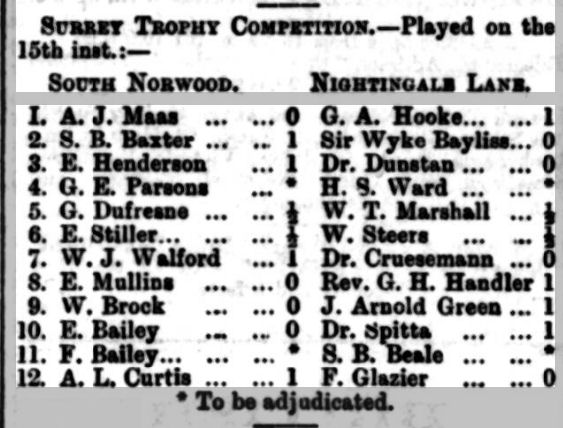
By 1900 Hooke had joined another club: Nightingale Lane, based in Clapham, which, belying its rustic sounding name, was one of the strongest clubs in Surrey, winning the Surrey Trophy in the 1902-03 season. Here he is on top board, ahead of Sir Wyke Bayliss.

Norwood News 24 March 1900


By the time of the 1901 census the family had moved three miles away, to 59 Cloudesdale Road Balham. With five young children at home the family now needed to employ a domestic servant, and Ellen’s mother Hannah Farmer was also there, perhaps helping look after the children.

By now there was a lot more chess action for newspapers to report and consequently less space for amateur games from club matches and tournaments, so George’s games were no longer being published. However, the big moment of his chess career was still to come.

This was in 1903, when he finally made his one and only international appearance in the Anglo-American Cable Match. He was pitted against Hermann Helms, an important figure in US chess over many decades, helping to organise the great New York 1924 and 1927 tournaments, and, in 1951, assisting Regina Fischer in finding chess opportunities for her young son.

Although he lost this game, he put up a good fight. You might think he was rather unfortunate not to share the point. 49… Ne3+ was a very natural move but resulted in the loss of his last pawn. 49… Ne1+ would probably have held the draw.

[pgn]

[Event “Match/Nation ENG-USA”]
[Site “Cable”]
[Date “1903.??.??”]
[Round “?”]
[White “Helms, Hermann”]
[Black “Hooke, George Archer”]
[Result “1-0”]
[ECO “A85”]
[Annotator “Tactical Analysis 5.2 (1s)”]
[PlyCount “121”]
[EventDate “1903.??.??”]
[EventType “team”]
[EventRounds “1”]
[EventCountry “ENG”]
[SourceTitle “EXT 2002”]
[Source “ChessBase”]
[SourceDate “2001.11.25”]
[SourceVersion “1”]
[SourceVersionDate “2001.11.25”]
[SourceQuality “1”]

1. d4 f5 2. c4 e6 3. Nc3 Nf6 4. e3 b6 5. Nf3 Bb7 6. Be2 Be7 {A85: Dutch
Defence: 2 c4 Nf6 3 Nc3.} 7. O-O O-O {[#]} 8. Qc2 $146 ({Predecessor:} 8. b3
Ne4 9. Bb2 d5 10. Rc1 Nd7 11. Qc2 Rc8 12. cxd5 exd5 13. Bd3 c6 14. Ne2 Bd6 15.
Ng3 Qe7 16. Qe2 Rce8 17. Ba6 Ba8 18. Bd3 Qf6 19. Bxe4 fxe4 {0-1 (62) Robinson,
A-Jacobs,H Cable 1898}) 8… Ne4 {White is slightly better.} 9. b3 c5 10. Bb2
Na6 11. a3 Nc7 12. Rfd1 cxd4 13. Nxd4 Nxc3 14. Bxc3 Qe8 15. Bf3 Bxf3 16. Nxf3
d5 17. Be5 Rc8 18. Qb2 {[#] Strongly threatening cxd5. &Bianco is more active.}
Bf6 19. Rac1 dxc4 20. Rxc4 Nd5 21. Rxc8 Qxc8 22. Rc1 Qd7 23. Bxf6 Nxf6 24. Qc2
Rd8 25. Nd4 Ne4 26. f3 Nd6 27. Qc7 Kf7 28. g4 g6 29. f4 fxg4 30. Nc6 Qxc7 31.
Ne5+ {[#] Discovered Attack} Kg8 32. Rxc7 $11 {Endgame KRN-KRN} Nb5 33. Re7
Nxa3 34. Rxa7 Nc2 35. Nxg4 Rd3 36. Nf6+ Kf8 37. Nxh7+ Ke8 38. Nf6+ Kd8 39. Kf2
Rxe3 40. Rd7+ Kc8 41. Rd2 Rc3 42. Rd6 (42. Ne4 $5 Rc6 43. Kf3 $14) 42… Nb4
43. Rxb6 Rxb3 {…Nd3+ is the strong threat.} 44. Kg2 ({Don’t do} 44. Rxe6 Kc7
$16) 44… Kd8 45. Rxe6 {Threatens to win with Rb6.} Rd3 46. h4 Nc2 47. Re8+
Kc7 48. Ng4 (48. f5 $5 Rd2+ 49. Kg3 Rd3+ 50. Kg2 gxf5 51. h5 $18) 48… Rd6 49.
Ne5 {Hoping for Kf3.} Ne3+ $2 {This move loses the game for Black.} ({Black
should try} 49… Ne1+ $14 50. Kg3 Nd3 51. Re7+ Kd8) 50. Kf3 $18 Nd5 51. Rg8
Rf6 52. Nxg6 Kd6 53. h5 Ke6 54. Rg7 (54. h6 $142 {Black must now prevent h7.}
Rf7 55. Nf8+ Kd6 56. h7 Nxf4 57. Ke4 Rxh7 58. Nxh7) 54… Kd6 $2 (54… Rf5 55.
h6 Rh5 56. Nf8+ Kf6 57. Nd7+ Ke6) 55. Kg4 Ne3+ 56. Kg5 Rf5+ 57. Kh4 Rxf4+ (
57… Ra5 $18 58. Rb7 Ng2+ 59. Kg3 Ne3 60. Rb6+ Kc7) 58. Nxf4 Nf5+ 59. Kg5 Nxg7
60. h6 Ne6+ 61. Nxe6 {Weighted Error Value: White=0.26 (precise) /Black=0.52}
1-0

[/pgn]

As the decade wore on Hooke’s name appeared much less in chess columns, but he was still active, and would later remember some of his games from this period as among his favourites.

By 1911 the family had moved house again, just half a mile away, to 100 Drakefield Road Upper Tooting, right by Tooting Common. The census records all five children at home, although Mildred is now studying at Newnham College Cambridge. There’s no occupation listed for Frances, but the three younger children are all at school. The girls all attended St Paul’s Girls School in Hammersmith, while Cyril was educated at St Paul’s School nearby.

Mildred would soon be joined at Newnham by her sister Beatrix, known as Trixie in the family.

Hooke Family Archives (also BCM)

With Trixie now having joined Mildred at Cambridge, George (seen in the photo above from about this time) wrote her regular letters between 1912 and 1914, which, remarkably have survived within the family to this day.

They include several mentions of George’s favourite game.

I shall leave your sisters to tell you of their gaieties. My share has been another successful match game at chess but mainly my energies have been occupied with the Men’s Society and exceptional demands at the Office. (10 Nov 1912)

1913 seemed a quiet year for chess – at least he didn’t write much about it in his letters to Trixie, but the first few months of 1914 were busy.

I played chess on Friday and did not finish my game. Whether it will be adjudicated a win for me I do not know. My advantage was a very minute one. (18 Jan 1914)

My Chess has been successful. On Tuesday I was delighted to beat the Champion of the City Club and on Friday I drew with a weaker player. (15 Feb 1914)

This victory would have been the game against Sir George Alan Thomas mentioned in his BCM obituary below. Sadly, I haven’t been able to identify the circumstances and find the moves of this game.

During the past week I have been fortunate enough to win 2 games of Chess I have 2 more to play – to-morrow and the next day and shall then give it a rest. (1 Mar 1914)

There was less chess activity during the First World War: it’s not clear whether or not George continued playing, although there are records of his participation in county matches after the war.

By the time of the 1921 census the family had moved to 3 Woodlands Road, Barnes, described by an estate agent today as a quiet cul de sac conveniently located within a short walk of Barnes station, which offers a frequent service into Waterloo. George, Ellen and Ella (working as a statistician for the League of Nations) were at home. Mildred was working as a maths teacher King Edward VI High School for Girls, Edgbaston, Birmingham. Frances was teaching domestic science at the Misses Mullins Ladies School in Eastbourne (about which I know nothing). I haven’t been able to locate Beatrix: perhaps she was abroad. Cyril was serving in the Royal Field Artillery in Fyzabad, United Provinces, India.

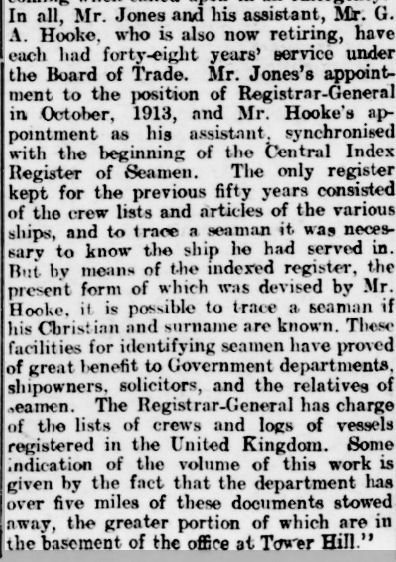
Now he was in his mid 60s, it was time for George to retire from his job with the Board of Trade after 48 years’ service.

East End News and London Shipping Chronicle 26 August 1921

Then, as you saw last time, Barnes Village Chess Club was formed in 1924, right on his doorstep. Now retired, he would have had more time on his hands, and was happy to sign up, soon finding himself with the job of club secretary. The Richmond Herald was eager to report results from clubs within its circulation area, so we suddenly have a lot of information available about George and his new colleagues, not to mention their opponents.

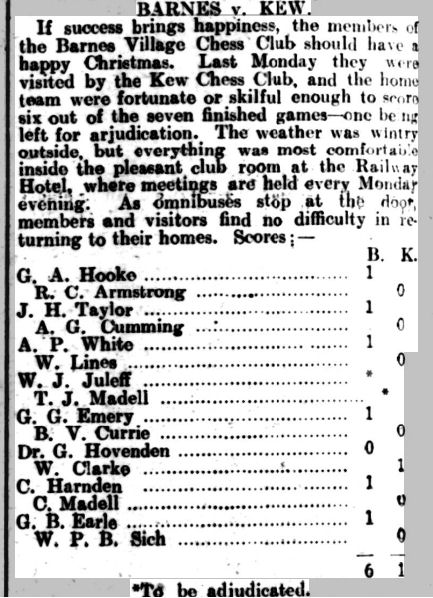
There were a number of new clubs formed in the Richmond area in the inter-war years. One such was Kew, who played Barnes Village in this 1927 match.

Richmond Herald 24 December 1927

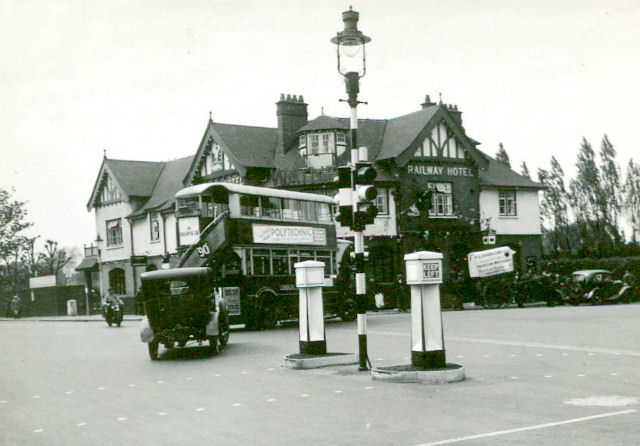
It’s good to know that omnibuses stopped at the door of the Railway Hotel, and here it is, with an omnibus stopping outside.

Source: https://www.closedpubs.co.uk/london/sw13_barnes_railway.html

It’s now been converted into flats, but today the 33 bus will take you back to Richmond, Twickenham and Teddington.

Speaking of pubs, if you have a long memory, the surname of the Kew Board 8 might look familiar. His initials are the wrong way round, but this was Percy Bertram Wardell Sich, the son of Steinitz’s opponent Alexander Sich.

The following year was a sad one for George, with the death of his beloved wife Ellen. Perhaps his sister Alice moved in with him at this point.

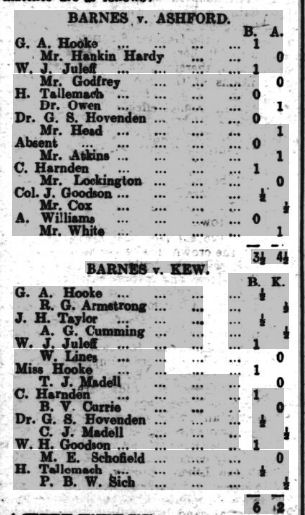
Richmond Herald 15 December 1928

She certainly joined Barnes Village Chess Club in 1928. There she is on Board 4 in the local derby against Kew. You’ll find out more about her next time, but for the moment I’ll just point out that she was an important figure in the development of Ladies’ Chess in England.

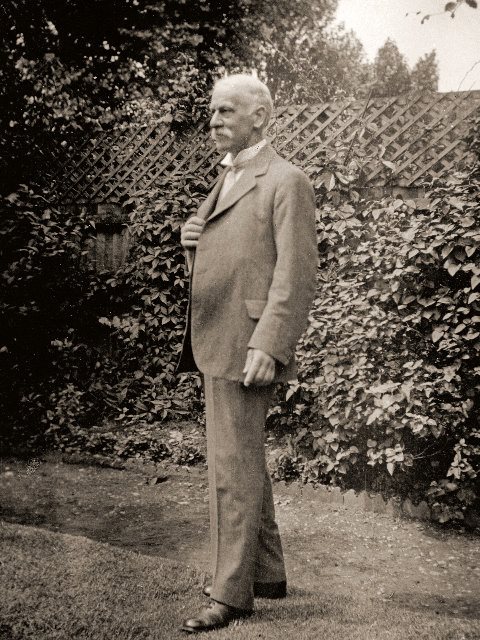
Hooke Family Archives

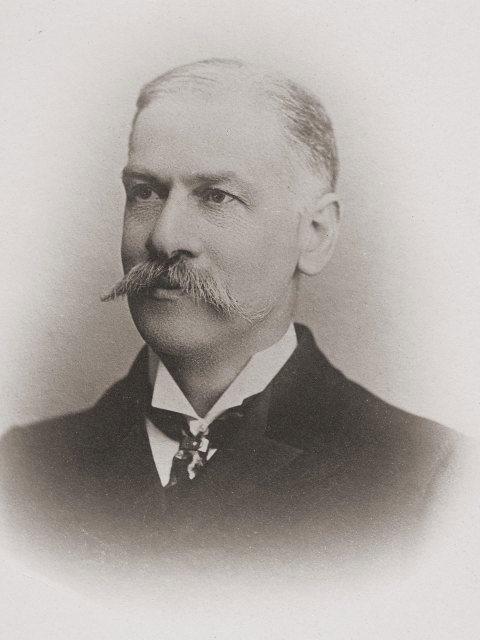
Here’s a photo of George from towards the end of his life, impressively upright, still looking fit and active.

But by 1934 his health was starting to fail. He was no longer playing top board for his club, and, in this match from December that year, his opponent agreed to play their game at his house.

Richmond Herald 15 December 1934

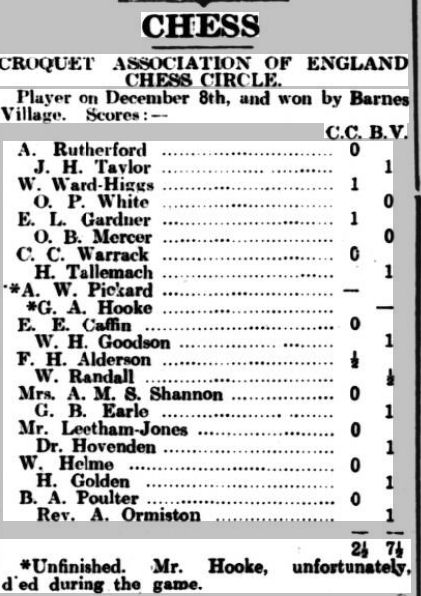
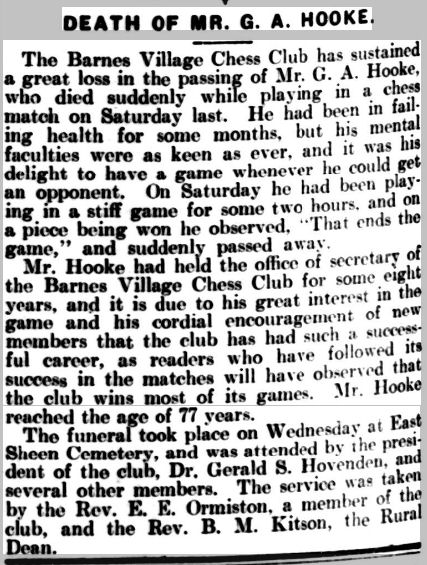
“Mr Hooke, unfortunately, died during the game”: having just won a piece he announced “That ends the game”, stood up and immediately suffered a fatal heart attack. It must have come as quite a shock to his opponent, Mr Pickard. I suppose, though, that George Archer Hooke died happy, doing what he enjoyed most, and in a winning position as well. “That ends the game” must be the perfect last words for any chess player. Very sad, but, at the same time, entirely appropriate.

From elsewhere in the same issue of the Richmond Herald:

Richmond Herald 15 December 1934

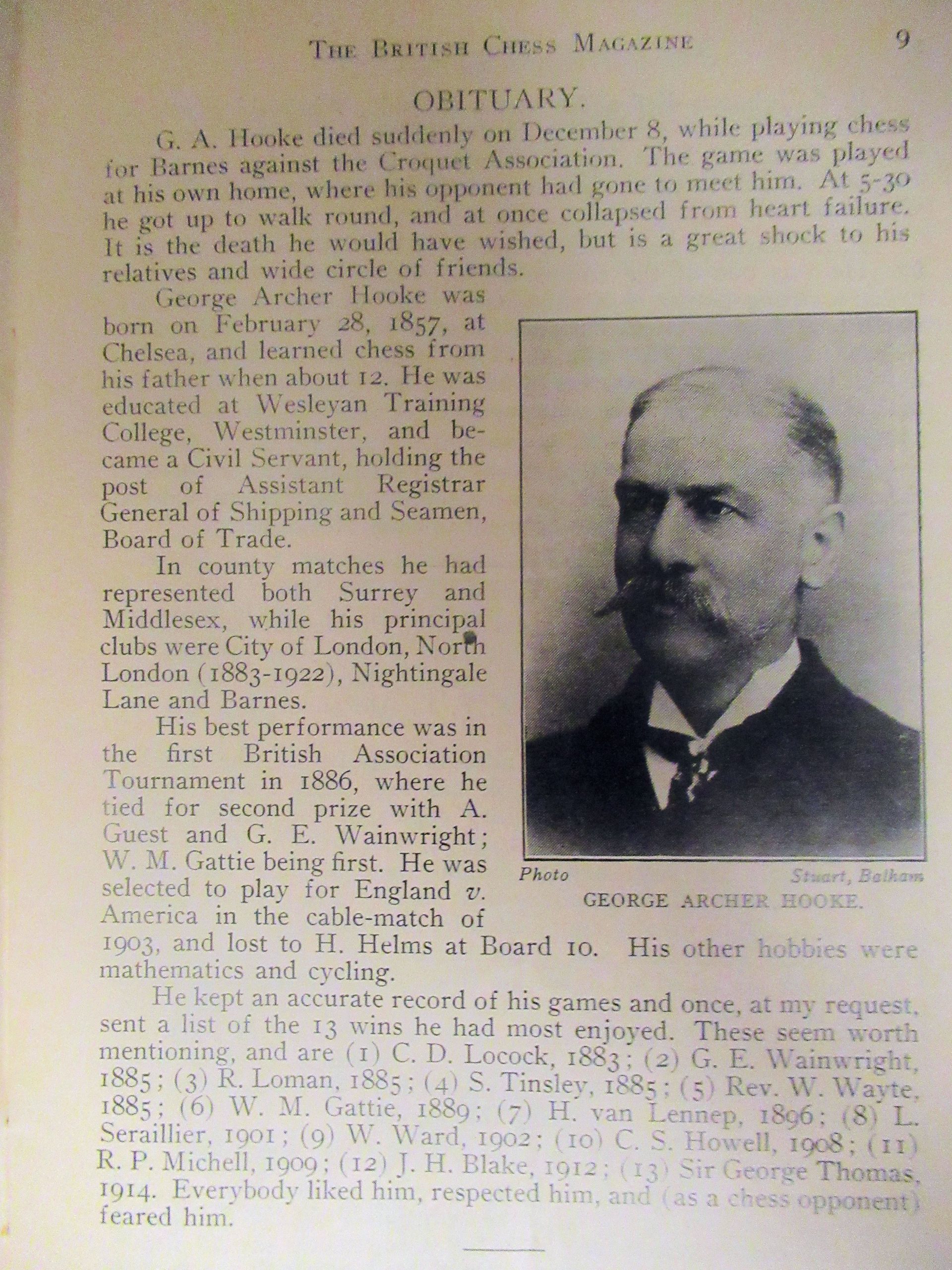
The British Chess Magazine published an excellent obituary the following month.

British Chess Magazine January 1935

What a pity that the scores of most of his favourite games seem to be unavailable. I presume his scoresheets were thrown out many decades ago.

This list demonstrates, though, that he was a dangerous opponent for almost anyone in the country, even into his 60s. Although he wasn’t quite in the same class as some of the other players I’ve featured: George Edward Wainwright, William Ward and Thomas Francis Lawrence, he was still able to beat them and other players of master standard on his day. From the relatively small number of games I’ve been able to find, my impression is that he was a very talented player who played for the love of the game rather than with any ambition to reach the top, and who perhaps hampered himself by his tendency to choose suboptimal openings. I wouldn’t be surprised that, with an important job and five children, he thought he had better things to do with his time than study opening theory. And who could blame him.

He comes across as a man who was liked and respected by everyone who met him, as well as being a formidable chess player. A life well lived, I’m sure you’d agree.

After his retirement from the Board of Trade he took up a new hobby: genealogy, researching the Hooke family back over several centuries. This interest was passed on to his family, along with a lot of letters and photographs, but, as far as I know, not his chess scoresheets.

These are now in the possession of his great grandson Graham Hooke, whose lovingly curated family website has been an inspiration for these articles, and who was himself inspired by the story of George Archer Hooke. Graham has generously given me permission to use the photographs and letters quoted here.

I’d strongly urge you to visit Graham’s website: this is the best place to start.

It remains for me to tell you what happened to George’s children.

Mildred had a distinguished career in education, was Headmistress of Bradford Grammar School for Girls for 28 years, being awarded the OBE.  Towards the end of her life, she married the aeronautical engineer Sir William Farren, a friend since university days. There’s a lot more information from Graham here.

Frances seems to have been the quiet one of the family, who devoted much of her life to looking after her parents. However, her life would take an interesting turn. The 1939 Register finds her in Hadley Wood, near Barnet, working as a maid for the family of (Charles) Herbert Lightoller, who had been 2nd Officer on the Titanic. You can find out a lot more about Herbert here and here. He was portrayed by Kenneth More in the 1958 film A Night to Remember.

Beatrix worked as a statistician, and also studied human remains from the Romano-British period, co-authoring a paper on the subject. She also took up chess, joining her aunt Alice in playing for Barnes Village from at least 1937 to 1948.

Richmond Herald 18 December 1937

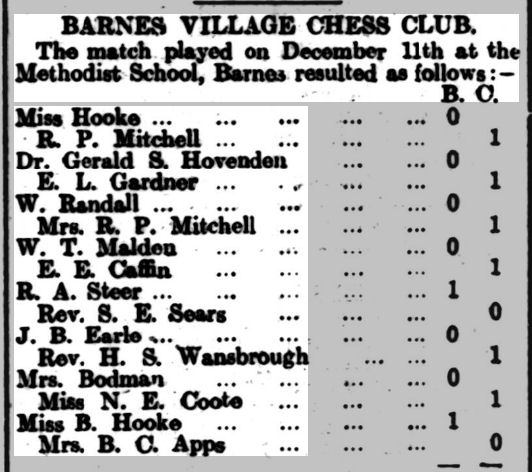
In this match against, I think, the Croquet Association, it’s notable that both teams fielded three ladies.  Reginald Pryce Michell (his name here, as so often, misspelt) was one of England’s strongest players for many years, and his wife Edith Mary Ann (née Tapsell) would have been very well known to Alice Hooke from the world of ladies’ chess. With any luck they’ll be the subject of future Minor Pieces.

In 1950 Beatrix would marry her good friend and teammate Dr Gerald Hovenden, celebrated for being the oldest practicing GP in the country.

Ella, like Frances, never married, and, like Beatrix, also worked as a statistician, although, by 1939 she was working as a school secretary at Nottingham Girls High School, and had been evacuated to Ramsdale Park, a mansion seven miles outside the city.

The only one of George’s children to have a family was Cyril. He joined the Army, winning the Military Cross for gallantry in the First World War, and then serving in India. It was there that he married in 1926, and where his first (of two) sons, named George after his grandfather, was born nine months later. Graham provides a lot more information about his much loved grandfather here.

There will be more about the Hooke family next time, when I tell the story of George Archer Hooke’s chess playing sister Alice Elizabeth.

Sources and Acknowledgements:

ancestry.co.uk
findmypast.co.uk
Wikipedia
EdoChess (George Archer Hooke’s page here)
chessgames.com
British Chess Magazine
Hooke Family History (many thanks to Graham Hooke)
Brian Denman
Gerard Killoran
Other sources as quoted above

Minor Pieces 46: George Archer Hooke Part 1

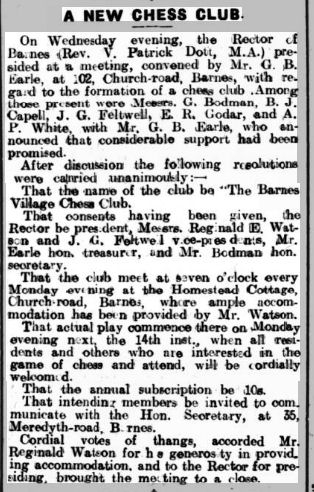
In January 1924 there was some big news for chess players in the Richmond area. A new chess club, the Barnes Village Chess Club, was to be formed.

Richmond Herald 12 January 1924

None of the names at this meeting are familiar, but they soon started playing matches against other local clubs.

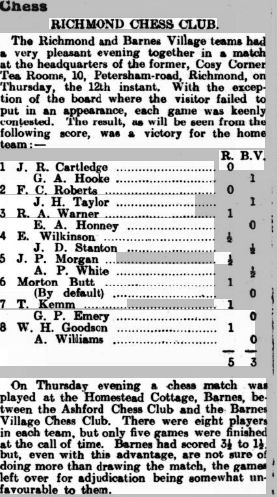
Richmond Herald 21 March 1925

Here they are a year or so later, visiting their Richmond neighbours at the charming Cosy Corner Tea Rooms, as well as entertaining Ashford, who may well have travelled by train on the Waterloo line, but not stopping at Whitton or North Sheen: those stations were only opened in 1930.

And, look! They have two pretty strong veterans on the top two boards, no doubt delighted when a new club opened on their doorstep.

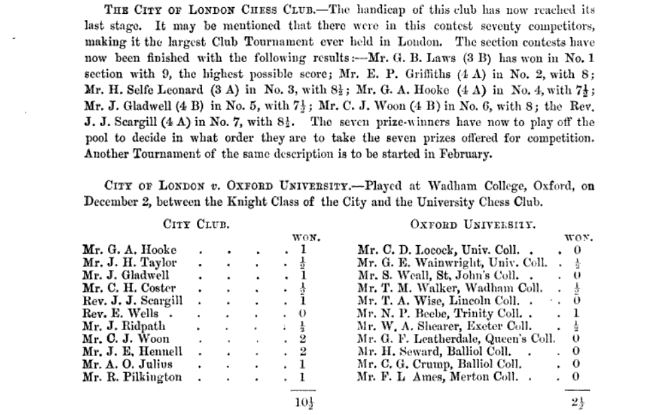
Here they are again, more than forty years earlier, playing again on the top two boards for the City of London Chess Club Knight Class in a match against Oxford University.

The Chess Monthly 1883

Messrs Hooke and Taylor were playing in the Knight Class of the City of London Chess Club: they’d have received odds of a knight when playing master strength opponents in the club handicap tournament. The Morning Post (4 December 1882) reported: “The result was a surprise to both parties, and appeared to puzzle the winners just as it did the losers.”

Mr Hooke’s opponent was the very interesting Charles Dealtry Locock, who will surely feature in a future Minor Piece. Mr Taylor faced George Edward Wainwright, a familiar name to Minor Piece readers. (Part 1 Part 2 Part 3 Part 4)

This wasn’t the first appearance of Mr Hooke in the chess news. His first appearance was in the 11th Counties Chess Association Meeting at the Manor House Hotel, Leamington in October 1881, where he played in the second class section, winning this game. You can click on any move in any game in this article for a pop-up window.

[pgn]

[Event “Counties Chess Ass 2nd Class Leamington”]
[Site “?”]
[Date “1881.10.??”]
[Round “?”]
[White “Bowley, Albert Alexander”]
[Black “Hooke, George Archer”]
[Result “0-1”]
[ECO “C41”]
[Annotator “Tactical Analysis 5.2 (1s)”]
[PlyCount “37”]
[SourceVersionDate “2022.10.04”]

1. e4 {Perrin,F} e5 2. Nf3 d6 3. d4 f5 4. dxe5 fxe4 5. Ng5 d5 6. e6 {And now
Nc3 would win.} Bc5 {Hoping for …Qf6. C41: Philidor Defence.} 7. Nf7 Qf6 {[#]
} 8. f4 $146 {[#]} (8. Qxd5 $2 Bxf2+ 9. Ke2 (9. Kd1 $2 Bxe6 10. Qxb7 Kxf7 $19)
9… Bxe6 $1 10. Qd8+ Kxf7 $17) (8. Qe2 Bxe6 9. Nxh8 Nc6 $11) (8. Be3 $14 Bxe3
9. fxe3) ({Predecessor:} 8. Qe2 Bxe6 9. Nxh8 Nc6 10. c3 O-O-O 11. Be3 d4 12.
cxd4 Nb4 13. Qd2 Bxd4 14. Qxb4 Bxb2 {0-1 (27) Mason,J-Field,O New York (Otis
Field’s) 1868 EXT 2017 [Perrin,F]}) 8… exf3 $1 $19 {Black has a decisive
advantage.} 9. Qxd5 fxg2 $2 $40 {Black goes for the king.} 10. Bxg2 $17 {[#]}
Bxe6 $1 11. Qxc5 $16 Bxf7 (11… Nd7 $14 12. Qxc7 Bxf7) 12. Bxb7 $2 {[#] This
bishop pair is nice.} (12. Bg5 $18 Qe6+ 13. Kd2) 12… Nd7 13. Qe3+ $18 Ne7 {
Strongly threatening …Qh4+.} 14. Bxa8 O-O {[#]} 15. Bg2 (15. Qf4 $1 $18 Rxa8
(15… Qa6 16. Be4) 16. Qxf6 Nxf6 17. Nc3) 15… Nf5 $2 (15… Re8 $17 {
keeps the pressure on.} 16. Nc3 Nf5 17. Qxe8+ Bxe8) 16. Qf2 ({Don’t blunder}
16. Qxa7 $2 Qe5+ 17. Be3 Nxe3 $19) ({Don’t go for} 16. Qe4 $2 Re8 17. Qxe8+
Bxe8 $19) (16. O-O $18 Nxe3 17. Rxf6 Nxc2 18. Rc6 Nxa1 19. Rxc7) 16… Re8+ 17.
Kf1 {[#]} Ne5 $2 (17… Bc4+ $1 $19 18. Kg1 Re2 19. Bd5+ Kh8 20. Bxc4 Rxf2 21.
Kxf2 Qh4+ 22. Kg2 Qe4+ 23. Kg1 Qd4+ 24. Kg2 Qe4+ 25. Kf2 Qxh1) 18. Nc3 $2 (18.
h3 $11 Ng3+ 19. Kg1) 18… Ng4 $19 {( -> …Ng3+)} 19. Qc5 {Weighted Error
Value: White=2.23/Black=1.80 Black mated in 3 moves: Ng3+. Source: Illustrated
Sporting and Dramatic News 31 December 1881} 0-1

[/pgn]

The up-and-coming Joseph Henry Blake from Southampton shared first place in the second class section with George E Walton from Birmingham. The information as to where Hooke finished and how many points he scored seems not to be available. The first three places in the top section were filled by members of the clergy: Charles Edward Ranken, John Owen and William Wayte.

Earlier in 1882 he’d beaten Captain Mackenzie in a simul. He’d also travelled to Manchester for the 12th Counties Chess Association Meeting, where he finished fourth in Class 2 with a score of 7½/11. Here, then, was an ambitious and fast improving young player, keen to play whenever the opportunity arose.

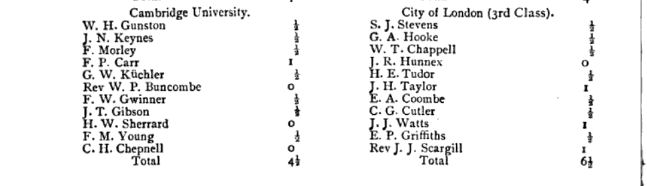
By 1884 George Hooke and John Taylor had both graduated to Class 3 (pawn and two moves). In this match they met a team from Cambridge University.

The Chess Player’s Chronicle 16 Apr 1884

Mr Hooke again faced an interesting opponent in John Neville Keynes, the father of economist and Bloomsbury Group member John Maynard Keynes. By contrast, Mr Taylor’s opponent, Rev William Pengelly Buncombe, spent much of his life as a missionary in Japan.

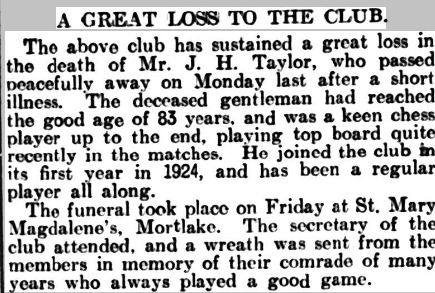
Let’s deal quickly with Mr Taylor. John H Taylor was Irish, born in County Westmeath in 1853, and, by profession a railway accountant, a not uncommon occupation at the time. He was active in the City of London Chess Club in the 1880s and 1890s but seemed to drop out of chess until the Barnes Village club opened its doors, when, in retirement, he threw himself into their activities, right up to the end of his life in 1937.

Richmond Herald 13 February 1937

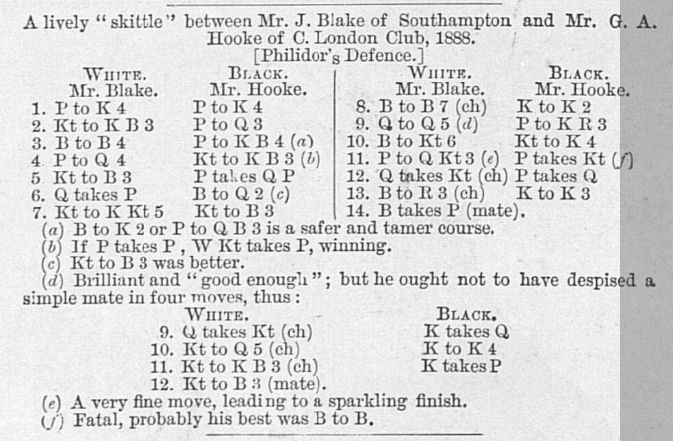
Mr Hooke was rather stronger, and rather more interesting. He’s most famous for a game he lost against the aforementioned Mr Blake, which has been much anthologised, often with the missed brilliancy on move 9 substituted for the actual conclusion, and often also with an incorrect year. Here’s its first appearance in print.

Illustrated Sporting and Dramatic News 22 September 1888

And here it is for you to play through yourself.

[pgn]

[Event “Casual Game: London”]
[Site “?”]
[Date “1888.??.??”]
[Round “?”]
[White “Blake, Joseph Henry”]
[Black “Hooke, George Archer”]
[Result “1-0”]
[ECO “C41”]
[Annotator “Tactical Analysis 5.2 (1s)”]
[PlyCount “27”]
[SourceVersionDate “2022.09.29”]

1. e4 {ChessBase II} e5 2. Nf3 d6 3. Bc4 f5 4. d4 {[#]} Nf6 $146 ({Predecessor:
} 4… fxe4 5. Ng5 d5 6. Bb3 Be7 7. h4 c6 8. dxe5 Bxg5 9. Bxg5 Qd7 10. Nc3 Qg4
11. Qd4 Be6 12. Nxe4 dxe4 13. Bxe6 Qxe6 {1-0 (22) Allen,H-Gilberg,C Brooklyn
(Brooklyn CC) 1869 EXT 2017 [ChessBase II]}) 5. Nc3 exd4 6. Qxd4 {[#] C41:
Philidor Defence.} (6. Nxd4 $18 fxe4 7. Qe2) 6… Bd7 $2 (6… Nc6 $14 7. Qe3
fxe4) 7. Ng5 (7. e5 $142) 7… Nc6 $2 (7… Qe7 $18) 8. Bf7+ Ke7 {[#]} 9. Qd5
$2 (9. Qxf6+ $3 Kxf6 (9… gxf6 10. Nd5#) 10. Nd5+ Ke5 11. Nf3+ Kxe4 12. Nc3#)
9… h6 $1 $15 10. Bg6 Ne5 {Prevents Qf7+.} 11. b3 $2 (11. Be3 $17 Qb8 12. Qb3)
11… hxg5 $4 (11… Qc8 $19 {and all is fine.} 12. Nf7 Nxg6 13. Nxh8 Nxd5 14.
Nxd5+ Ke8 15. Nxg6 fxe4) 12. Qxe5+ $18 dxe5 (12… Be6 $18 13. Qb5 (13. Ba3 c5
$18) 13… f4 14. Qxg5 Kd7) 13. Ba3+ Ke6 14. exf5# {Weighted Error Value:
White=2.05/Black=2.11} 1-0

[/pgn]

You’ll observe that the annotator, not having the benefit of Stockfish 15 to consult, mistakenly refers to Blake’s 11th move as a very fine move. It was a creative try which worked over the board, but Hooke could have won by playing, amongst other moves, 11… Qc8 or Qb8, making room for his king on d8. I’ve always found the 9. Qxf6 variation particularly attractive, with the knights returning to f3 and c3 to deliver mate.

Joseph Henry Blake was another prominent figure with a very long chess career, the latter part of which took place in Kingston. With any luck he’ll be the subject of some Minor Pieces in future.

George Archer Hooke was born in Chelsea on 28 February 1857, the third of twelve children of William Hooke and Harriet Sanders, six of whom tragically died before reaching the age of 20.

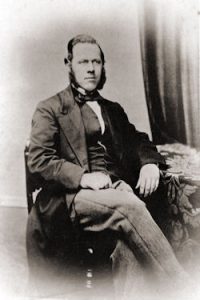
Here, from the family archives, is a photograph of William.

The family are elusive in the 1861 census, but in 1871 we find William working as the manager of a furniture depository living in the Parish of St George’s Hanover Square with his wife and eight children. They have no servants living in, which suggests the family was not especially wealthy.

By 1881 they’re at a different address, but still in the same parish. William seems to be in very much the same job. There are six children at home, along with a granddaughter. George, still living at home, is working as a 3rd Class Clerk in the Seamen’s Registry Office of the Board of Trade. He would remain there for the rest of his working life.

It must have been round about that time that he joined the City of London Chess Club, having learnt the game from his father at the age of about 12. He would soon join the North London Chess Club as well.

Moving into the middle of the 1880s, here’s a game from a match between the City of London and St George’s Chess Clubs, in which he faced the Hon Horace Curzon Plunkett, MP, rancher, agricultural reformer and uncle of writer and chess player Lord Dunsany. (He was ranching in Wyoming at the time: this must have been one of his visits back to London.) As the game was unfinished at the call of time it was adjudicated by Zukertort. His verdict was a draw, but Stockfish 15 disagrees, thinking Hooke had a winning position.

[pgn]

[Event “St George’s v City of London”]
[Site “?”]
[Date “1885.01.??”]
[Round “?”]
[White “Hooke, George Archer”]
[Black “Plunkett, Horace Curzon”]
[Result “1/2-1/2”]
[ECO “A13”]
[Annotator “Tactical Analysis 5.2 (1s)”]
[PlyCount “75”]
[SourceVersionDate “2022.09.29”]

1. Nf3 e6 2. d4 d5 3. e3 Nf6 4. c4 c5 5. Nc3 Nc6 6. Be2 Be7 7. b3 b6 8. Bb2 O-O
9. Rc1 Bb7 10. O-O Rc8 {A13: English Opening: 1…e6.} 11. h3 a6 12. Bd3 $2 (
12. dxc5 $16 {cxd5 is the strong threat.} Bxc5 13. cxd5 Nxd5 14. Nxd5 Qxd5 15.
Qxd5 exd5 16. Rfd1) 12… Bd6 $2 (12… cxd4 $17 13. exd4 dxc4 14. bxc4 Nb4)
13. Kh1 $2 (13. dxc5 $14 {stays ahead.} Bxc5 14. cxd5) 13… Bb8 $2 (13… cxd4
$17 14. Nxd4 Nxd4 15. exd4 Bf4) 14. Ne2 (14. dxc5 $5 dxc4 15. Bxc4 $14) 14…
Ne7 15. dxc5 dxc4 (15… Rxc5 {keeps more tension.} 16. b4 Rc8 17. Bxf6 gxf6
18. c5 e5) 16. Rxc4 {Black must now prevent Bxf6.} Rxc5 17. Bxf6 gxf6 18. Qc2
Rxc4 19. Qxc4 ({Don’t go for} 19. Bxh7+ $2 Kh8 20. bxc4 Bxf3 21. gxf3 f5 22.
Bxf5 (22. Rd1 $2 Qc7 $19) 22… Nxf5 $19) 19… Qd6 20. Rd1 Ng6 {[#] Threatens
to win with …Bxf3.} 21. Bc2 Qe7 {Hoping for …Rc8.} 22. Be4 Bc8 23. Ned4 f5
24. Bc2 (24. Nc6 $5 Qb7 25. Bd3 $11) 24… Qf6 25. e4 fxe4 (25… Bb7 $5 26.
exf5 {[#]} Rc8 $1 $11) 26. Bxe4 {Strongly threatening Nc6.} Rd8 27. Rc1 Bf4 28.
Re1 b5 29. Qc6 Kg7 30. g3 Be5 31. Ne2 Ne7 32. Qb6 Nd5 33. Bxd5 Rxd5 34. Kg2 Rd3
35. Qc6 Bc3 36. Nxc3 $2 (36. Nf4 $18 Bd7 37. Qb7) 36… Rxc3 37. Qe4 Bd7 $2 (
37… h6 $11) 38. Ne5 {Weighted Error Value: White=0.83/Black=1.01. An
unexpected result. Adjudicated a draw by Zukertort. Stockfish thinks White’s
winning. Source: Illustrated Sporting and Dramatic News 21 February 1885}
1/2-1/2

[/pgn]

In August that year he played in the 15th Counties Chess Association Meeting in Hereford, playing in Class 1A where he shared first place with his former antagonist Charles Dealtry Locock.

The parallel Class 1B tournament was won by George Edward Wainwright, and the two Georges then contested a 14-game match in London, with George H winning by the odd point. This match wasn’t well reported: it’s not clear whether it was a formal play-off match to decide the winner of the Hereford tournament or purely a friendly encounter.

In this league game against an anonymous opponent Hooke brought off a neat finish, giving up a rook to force checkmate in the ending.

[pgn]

[Event “North London v Ludgate Circus”]
[Site “?”]
[Date “1885.10.19”]
[Round “?”]
[White “Hooke, George Archer”]
[Black “Unknown”]
[Result “1-0”]
[ECO “C45”]
[Annotator “Tactical Analysis 5.2 (1s)”]
[PlyCount “59”]
[SourceVersionDate “2022.10.04”]

1. e4 e5 2. Nf3 Nc6 3. d4 exd4 4. Nxd4 Bc5 5. Be3 Qf6 6. c3 Nge7 7. Qd2 O-O {
With the idea …d5.} 8. Nb5 {C45: Scotch Game.} Bxe3 9. Qxe3 {[#] Black must
now prevent Nd2.} a6 $146 ({Predecessor:} 9… d5 10. Nxc7 Rb8 11. exd5 Nf5 12.
Qf4 g5 13. Qe4 Bd7 14. Qc2 Qe5+ 15. Be2 Nce7 {1-0 (52) Rynd,J-MacDonnell,G
Dublin 1884}) 10. Nxc7 {White is better.} Rb8 11. Nd2 Qd6 $2 (11… b5 $16 {
is a better defense.}) 12. Qg3 Ne5 {[#]} 13. Nc4 $1 Nxc4 (13… Qxc7 14. Nxe5)
14. Bxc4 Qxg3 15. hxg3 b5 16. Bd3 Bb7 17. O-O-O {Bc2 is the strong threat.} g6
$2 (17… Rfc8 {was called for.}) 18. Bc2 $18 Rfd8 19. Nd5 (19. Rd6 $142) 19…
Nxd5 20. exd5 d6 21. g4 Rbc8 22. Rh6 Kg7 23. g5 {Hoping for f4.} Rh8 24. g4 $2
{& White is more active.} (24. f4 $16) 24… f6 $2 {[#]} (24… Rc4 $11) 25.
gxf6+ $1 ({Not} 25. f4 fxg5 26. fxg5 Rce8 $11) 25… Kxh6 $2 {[#]} (25… Kxf6
$18 26. f4 Rcf8) 26. f4 $1 {White mates.} Bxd5 27. Rd2 Bg2 28. Rxg2 Rc5 29.
Rh2+ Rh5 30. g5# {Weighted Error Value: White=0.41/Black=0.86 Source: Hackney
Mercury And North London Herald, October 31, 1885} 1-0

[/pgn]

In an 1886 match between City of London and St George’s, he encountered one of the Fighting Reverends, Rev William Wayte, who had been one of England’s strongest players back in the 1850s. (You might notice that his Wikipedia page quotes from The Even More Complete Chess Addict, by M Fox and R James.) This time no adjudication was required: George managed to grind out a win with an extra pawn in a rook ending. Towards the end of his life, he mentioned a win against Wayte from 1885 as one of the games that gave him most pleasure: I presume he intended this one, even though the year doesn’t quite tally.

[pgn]

[Event “St George’s v City of London”]
[Site “?”]
[Date “1886.03.04”]
[Round “?”]
[White “Hooke, George Archer”]
[Black “Wayte, William”]
[Result “1-0”]
[ECO “C45”]
[Annotator “Tactical Analysis 5.2 (1s)”]
[PlyCount “113”]
[SourceVersionDate “2022.09.29”]

1. e4 e5 2. Nf3 Nc6 3. d4 exd4 4. Nxd4 Bc5 5. Be3 Qf6 6. c3 Nge7 7. Qd2 a6 8.
Be2 {C45: Scotch Game.} ({Much weaker is} 8. Bg5 Qe5 $15) 8… d5 {[#]} 9. Nxc6
$146 (9. exd5 {feels hotter.} Nxd5 10. Bg5 Qg6 11. Bd3) ({Predecessor:} 9. exd5
Bxd4 10. cxd4 Nxd5 11. Nc3 Be6 12. O-O h6 13. Ne4 Qg6 14. Nc5 Nd8 15. Rac1 O-O
{1-0 (72) Blackburne,J-Hruby,V Vienna 1882}) 9… Bxe3 10. Qxe3 {White has an
edge.} Qxc6 11. exd5 Qxd5 12. O-O Qe6 13. Qf3 O-O 14. Nd2 Bd7 15. Rfe1 Bc6 16.
Qg3 Qh6 17. Nf3 Nd5 18. Nd4 Bd7 19. Bf3 c6 20. Bxd5 cxd5 21. Re5 Bc6 $2 (21…
Qd6 $16) 22. Nf5 $18 Qf6 {[#]} 23. Ne7+ (23. Nxg7 $142 $1 Kh8 24. Nh5) 23…
Kh8 24. Nxd5 Bxd5 25. Rxd5 Rad8 26. Rxd8 Rxd8 {Endgame KQR-KQR} 27. Qc7 Qd6 28.
Qxd6 Rxd6 $14 {KR-KR} 29. Kf1 Rd2 30. b3 Kg8 31. Ke1 Rc2 32. c4 {Black must
now prevent Rd1.} Kf8 33. Rd1 {And now Rd2 would win.} Ke7 34. Rd2 Rc3 {[#]} (
34… Rc1+ $16 35. Ke2 Ke6) 35. Ke2 $2 (35. Re2+ Kd7 36. Kd2) 35… b5 36. cxb5
axb5 37. Rd5 Rc2+ 38. Kf3 Rxa2 39. Rxb5 Rb2 40. g4 h6 41. h4 g6 42. Kg3 Rb1 43.
f3 Rd1 44. Kf4 {Strongly threatening b4.} Rd4+ $2 (44… Kf6 $16) 45. Ke5 $18
Rd3 46. Rb7+ Kf8 47. f4 ({Only move:} 47. Ke4 $18 Rc3 48. b4) 47… Kg7 48. f5
(48. b4 $5) 48… Re3+ 49. Kf4 Rh3 (49… Re1 $16 {is tougher.}) 50. fxg6 {
White is clearly winning.} Kxg6 51. h5+ Kg7 52. b4 Rh1 53. Rc7 Rb1 54. Rc4 Kf6
55. Ke4 ({Less strong is} 55. Rc6+ Ke7 $16) 55… Rd1 56. Rd4 Re1+ 57. Kd5 {
Weighted Error Value: White=0.51/Black=0.76 Source: Illustrated Sporting and Dramatic News 27 March 1886} 1-0

[/pgn]

In the same year, 1886, George won a share of the brilliancy prize for this game in the City of London Chess Club Handicap Tournament against an opponent who got stuck in the mud adopting an unusual defence: we’d now call it a Hippopotamus.

[pgn]

[Event “City of London Handicap Tournament”]
[Site “?”]
[Date “1886.??.??”]
[Round “?”]
[White “Hooke, George Archer”]
[Black “Stevens, Samuel John”]
[Result “1-0”]
[ECO “B00”]
[Annotator “Tactical Analysis 5.2 (1s)”]
[PlyCount “77”]
[SourceVersionDate “2022.10.02”]

1. e4 b6 2. d4 g6 3. Bd3 Bg7 4. Nf3 Bb7 5. Nc3 e6 6. Be3 {B00: Queen’s
Fianchetto Defence, Nimzowitsch Defence.} Ne7 {[#]} 7. Qd2 $146 {& White is
more active.} ({Predecessor:} 7. Ne2 O-O 8. Ng3 f5 9. Qd2 fxe4 10. Nxe4 Bxe4
11. Bxe4 d5 12. Bd3 Nf5 13. O-O {0-1 (30) Robey,J-Mongredien,A London 1862})
7… O-O 8. h4 {White is clearly better.} c5 9. Bh6 (9. dxc5 bxc5 10. h5 (10.
Bxc5 d6 $16) 10… Qb6 $16) 9… cxd4 10. Bxg7 Kxg7 11. Nxd4 f5 $2 (11… Nbc6
12. Ndb5 $14) (11… h5 $16) 12. h5 $18 {Strongly threatening hxg6.} f4 13.
Ncb5 e5 (13… Nec6 $142 14. Nf3 Qf6 15. hxg6 hxg6) 14. Qb4 Nbc6 15. Nxc6 Nxc6
16. Qa3 Qg5 17. h6+ Kh8 18. Nd6 Qxg2 $2 (18… Nd8) 19. O-O-O Rab8 (19… Rfb8
$2 20. Qb3 Nd8 21. Nf7+ Kg8 22. Nxd8+) (19… Qxf2 $142 20. Nxb7 Qe3+ 21. Kb1
f3) 20. Nxb7 Qxf2 21. Nd6 Nd4 (21… Qe3+ $142 22. Kb1 f3) 22. Nc4 b5 23. Qe7
Ne6 {Against Qg7+} 24. Nxe5 Qd4 25. Nxd7 $2 (25. Nf7+ Kg8 26. Ng5) 25… Rbe8
26. Qa3 (26. Qxe6 Rxe6 27. Nxf8 Re8 28. Bxb5 (28. Nxg6+ hxg6 29. Bxb5 Qe3+ 30.
Kb1 Rb8 $17) 28… Qe3+ 29. Kb1 Rxf8 $17) 26… Qxd7 27. Bc4 $1 Nd4 {[#]} (
27… Qe7 $142) 28. Bd5 $2 (28. Bf1 $1 $18 {is the precise move to win.}) 28…
Ne2+ 29. Kb1 b4 $2 {[#]} (29… Qc7 $16 {might work better.}) 30. Qxb4 $2 (30.
Qd3 $1 $18) 30… Rb8 $2 (30… Qe7 $16 31. Qd2 Ng3) 31. Qc4 (31. Qd2 $18 {
is more deadly.}) 31… f3 {aiming for …Qd6.} 32. Qd3 $2 (32. Rhf1 $18) 32…
Qe7 {…g5 is the strong threat.} 33. Qe3 {Threatens to win with Rhf1.} Qb4 $2
(33… g5 $11 {and Black has nothing to worry.}) 34. Bb3 {Black must now
prevent Rhf1. The board is on fire.} a5 $2 (34… Qb6 35. Qg5 Qf6) 35. Qg5 $2
$40 {White is out for blood.} ({Weaker is} 35. Rd7 Qb6 36. Qxb6 (36. Qg5 Qf6
$14) 36… Rxb6 $16) (35. Rhf1) 35… Qxe4 (35… Rbe8) 36. Qxa5 {Intending
Qc7 and mate.} Rfc8 {Against Qc7} (36… Rbe8 37. Rhf1 Qe7) 37. Qg5 Rb6 {
Against Qf6+} (37… Rf8 $18 38. Rhf1 Qf4) 38. Rd8+ Qe8 39. Qe5+ {Weighted
Error Value: White=0.96/Black=1.28 Source: Illustrated London News 28 August
1886} 1-0

[/pgn]

In 1886 Hooke took part in the Amateur Championship of the 2nd British Chess Association Congress in London, scoring an outstanding success. Walter Montagu Gattie won with a score of 15/18, and George Archer Hooke featured in a three-way tie for second with Antony Alfred Geoffrey Guest and George Edward Wainwright. Unfortunately, few of the games from this tournament have been published.

Although most of the games took place during the summer, it was only concluded in October, by which time George was involved in another tournament. This was the British Chess Club 2nd Class Tournament in which he again finished in second place. His score of 3½/5 left him half a point behind Scottish champion Daniel Yarnton Mills. Here’s their game, which resulted in a draw.

[pgn]

[Event “British Chess Club 2nd Class Tourney”]
[Site “?”]
[Date “1886.10.??”]
[Round “?”]
[White “Mills, Daniel Yarnton”]
[Black “Hooke, George Archer”]
[Result “1/2-1/2”]
[ECO “C48”]
[Annotator “Tactical Analysis 5.2 (1s)”]
[PlyCount “75”]
[SourceVersionDate “2022.10.02”]

1. e4 {ChessBase II} e5 2. Nf3 Nc6 3. Nc3 Nf6 4. Bb5 Bc5 5. O-O d6 6. d4 exd4
7. Nxd4 Bd7 8. Bxc6 bxc6 {[#]} 9. Bg5 $146 ({Predecessor:} 9. Nf5 Bxf5 10. exf5
O-O 11. Be3 Bxe3 12. fxe3 d5 13. Qf3 Re8 14. Rad1 Qe7 15. Rd3 Nd7 16. Qg3 Nc5 {
1-0 (46) Newham,W-Gunsberg,I London 1883 EXT 2003 [ChessBase II]}) 9… h6 10.
Bh4 g5 {C48: Four Knights: 4 Bb5, replies other than 4…Bb4.} 11. Bg3 h5 {
…h4 is the strong threat.} 12. e5 {& White is more active.} h4 {White is
better.} 13. exf6 Qxf6 14. Re1+ Kf8 {[#]} 15. Be5 dxe5 {[#]} 16. Ne4 $1 {
Pair of Knights!} Qe7 17. Nxc5 Qxc5 18. Nb3 (18. Nf3 $5 Bg4 {[#]} 19. Nxe5 $1
Bxd1 20. Nd7+ Kg7 21. Nxc5 Bxc2 22. Re7 $11) 18… Qe7 19. Qe2 f6 $36 {Black
has some pressure.} 20. Rad1 Be6 21. Nd4 Bd5 22. c4 {White has compensation.}
Bf7 23. b3 Bh5 {Inhibits Qf3.} 24. Nf3 Kg7 (24… h3 {keeps more tension.} 25.
Qe4 Qe6 26. Nd4 Qg4) 25. Qe3 Bxf3 26. Qxf3 Qe6 27. Qe3 Rhe8 28. Rd2 Re7 (28…
Kg6 {feels hotter.} 29. h3 a6 30. Qc5 a5) 29. Red1 a5 (29… a6 {is
interesting.} 30. h3 e4 31. Rd8 Rxd8 32. Rxd8 Qe5) 30. a4 Rb8 31. h3 g4 32.
hxg4 Qxg4 33. Rd4 exd4 (33… Qg5 $5 34. Qe2 f5 $15) 34. Qxe7+ {The position
is equal.} Kg6 35. f3 Qf4 {aiming for …Qe3+.} 36. Qd7 c5 {Threatens to win
with …Qe3+.} 37. Re1 {Inhibits Qe3+. Black must now prevent Re4.} Rxb3 38.
Qe8+ {Weighted Error Value: White=0.32/Black=0.34 With a draw by perpetual
check. Source: Morning Post 18 October 1886} 1/2-1/2

[/pgn]

Handicap tournaments were a big feature of every competitive chess club at the time, and for many years later. Perhaps they should be revived. They worked something like this.

The players were grouped into classes according to playing strength. If you played someone one class below you, you played Black without your f-pawn. Against someone two classes below you and you were again Black without your f-pawn, but White got to play two moves at the start of the game. Against an opponent three classes below you, you’re White but playing without your queen’s knight. and, against an opponent four classes below you you’re again White and this time without your queen’s rook.

Here’s how George Hooke defeated a player two classes below him who foolishly launched a kamikaze attack right from the opening rather than playing solid, sensible moves. (We start the game with the white pawn already on e4.)

[pgn]

[Event “City of London CC Handicap Tournament”]
[Site “?”]
[Date “1886.??.??”]
[Round “?”]
[White “Staniforth, Henry Smallpage”]
[Black “Hooke, George Archer”]
[Result “0-1”]
[Annotator “Tactical Analysis 5.2 (1s)”]
[SetUp “1”]
[FEN “rnbqkbnr/ppppp1pp/8/8/4P3/8/PPPP1PPP/RNBQKBNR w KQkq – 0 1”]
[PlyCount “42”]
[SourceVersionDate “2022.10.03”]

1. d4 {White is winning.} d6 2. Bd3 Nc6 3. e5 {White wants to mate with Qh5+.}
Nxd4 4. Qh5+ (4. c3 $18 Nf5 5. Nf3) 4… g6 $11 5. Bxg6+ hxg6 6. Qxg6+ (6. Qxh8
$2 {is the wrong capture.} Nxc2+ 7. Ke2 {[#]} Qd7 $1 8. Qxg8 Qg4+ 9. Nf3 Be6
$19) 6… Kd7 {…c5 is the strong threat.} 7. Qg4+ Ne6 8. Nf3 {Black must now
prevent Nd4.} Qe8 9. Nd4 ({But not} 9. Ng5 Qg6 10. Qxe6+ Qxe6 11. Nxe6 Kxe6 $19
) 9… Qf7 10. O-O Ke8 11. exd6 cxd6 12. Re1 {[#]} Nh6 $1 13. Qe4 Nxd4 14. Qxd4
{[#]} Ng4 $1 15. Bf4 (15. f3 Ne5) 15… e5 (15… Bg7 $142 16. Qd2 Bxb2) 16. f3
$2 {[#]} (16. Bg3) 16… Be7 $1 $19 {Black is clearly winning.} 17. Qc3 (17.
Qd2 Qxf4) 17… Qxf4 18. fxg4 Qxh2+ 19. Kf2 Rf8+ 20. Ke2 Bxg4+ 21. Kd2 Bg5+ {
Black took control after the opening. Weighted Error Value: White=1.28/
Black=0.19 (very precise) Source: Illustrated London News 25 September 1886}
0-1


[/pgn]

By now, it seems that, while George Archer Hooke continued to play regularly in matches and club tournaments, he no longer had the time to travel to places like Manchester and Hereford for congresses. Perhaps his work with the Board of Trade was taking up more of his time: as a young man of considerable abilities approaching his 30th birthday he would doubtless have been promoted by now.

Perhaps there was another reason as well.

Here he is, on August 27 1889, now aged 32, marrying 34 year old Ellen Farmer at All Saints Church, Fulham, right by Putney Bridge. Congratulations to the happy couple!

And here, for now, we’ll leave George Archer Hooke, a strong amateur chess player, a high-flying civil servant and now a married man who would waste little time starting a family.

You already know that he was still playing chess in the 1920s so there’s lots more to tell.

You’ll find out what happened next in the second instalment of the story of George Archer Hooke, coming very soon to a Minor Piece near you.


Acknowledgements and sources:

ancestry.co.uk
findmypast.co.uk
Wikipedia
EdoChess (George Archer Hooke’s page here)
BritBase
chessgames.com
Chess Notes (Edward Winter)
Chess Scotland
Hooke Family History (many thanks to Graham Hooke)
Brian Denman
Gerard Killoran