Tag Archives: Correspondance

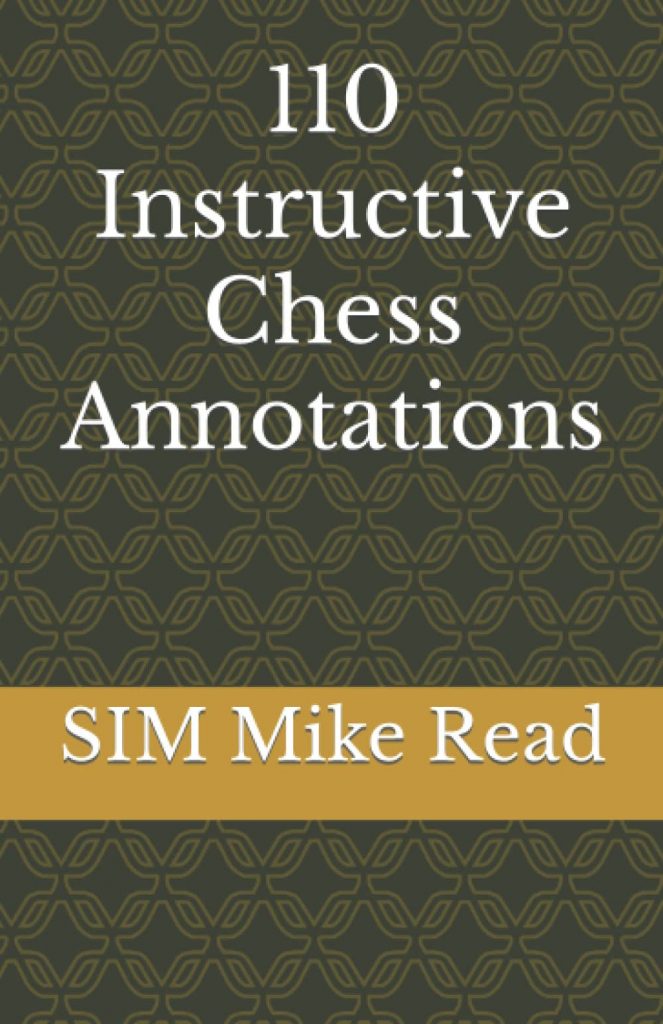
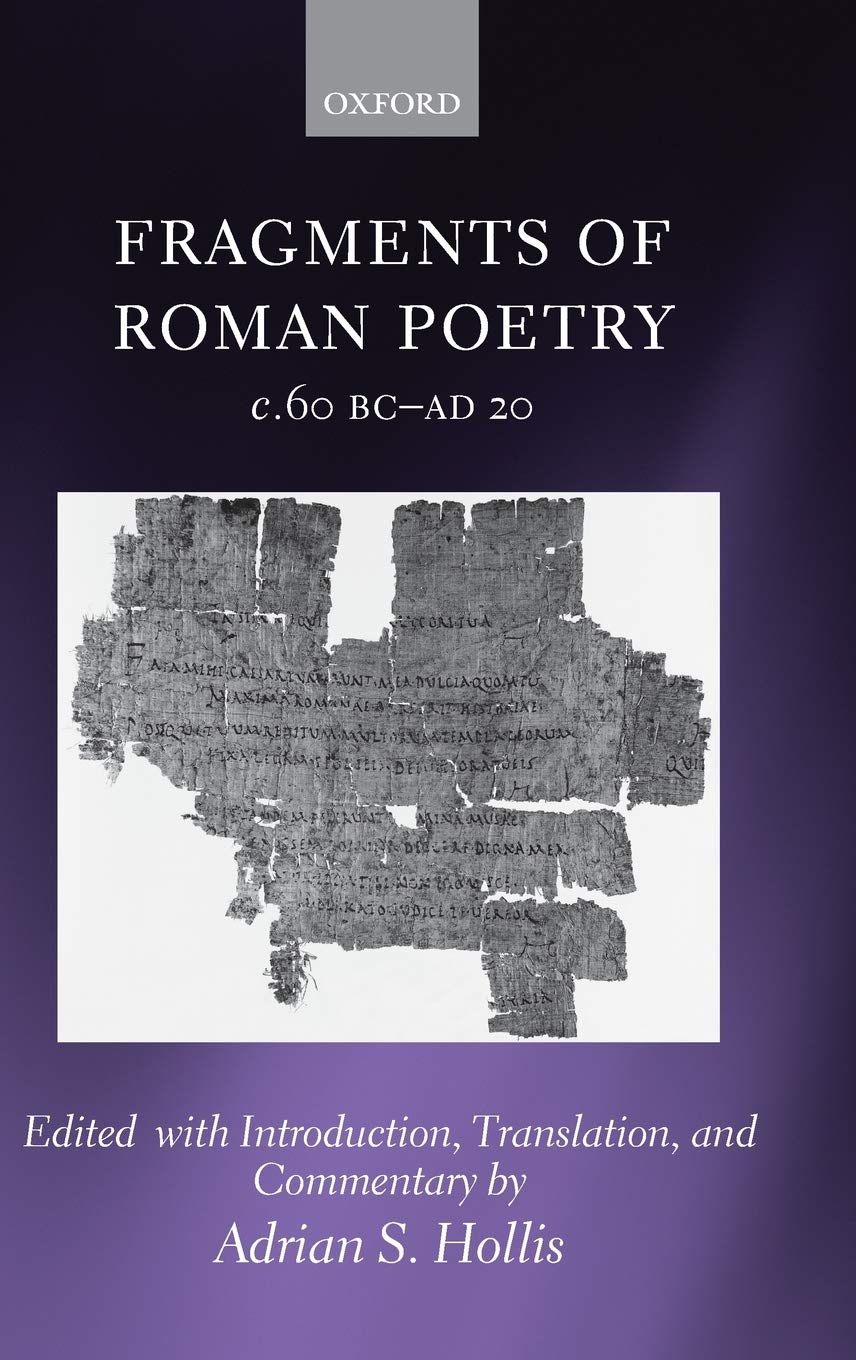
110 Instructive Chess Annotations

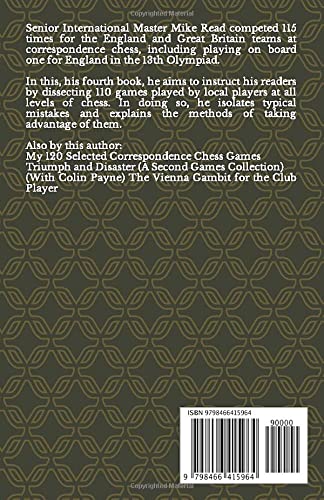
From the back cover:

Senior International Master Mike Read competed 115 times for the England and Great Britain teams at correspondence chess, including playing on board one for England in the 13th Olympiad.

In this, his fourth book, he aims to instruct his readers by dissecting 110 games played by local players at all levels of chess. In doing so, he isolates typical mistakes and explains the methods of taking advantage of them.

Philidor wrote that pawns are the soul of chess. In one sense, yes, but in another sense  the soul of chess is the mass of club and tournament players, without whom the chess world wouldn’t function.  Yes, it might be inspirational to look at games played by top grandmasters, but it’s always been my view that club standard players will learn more from games played at their level than from GM games.

Mike Read shares my opinion. Here’s how he starts his introduction.

One of the surest ways for a club player to improve his playing ability is to study annotated games featuring players of similar strength to themselves. The mistakes, and the instructive methods of taking advantage of them, will be familiar to them from similar happenings in their own games. Meanwhile the notes to such moves will educate the aspiring player in both how to avoid typical errors, and also how to take advantage of them when it is his opponent who is unfortunate enough to err.

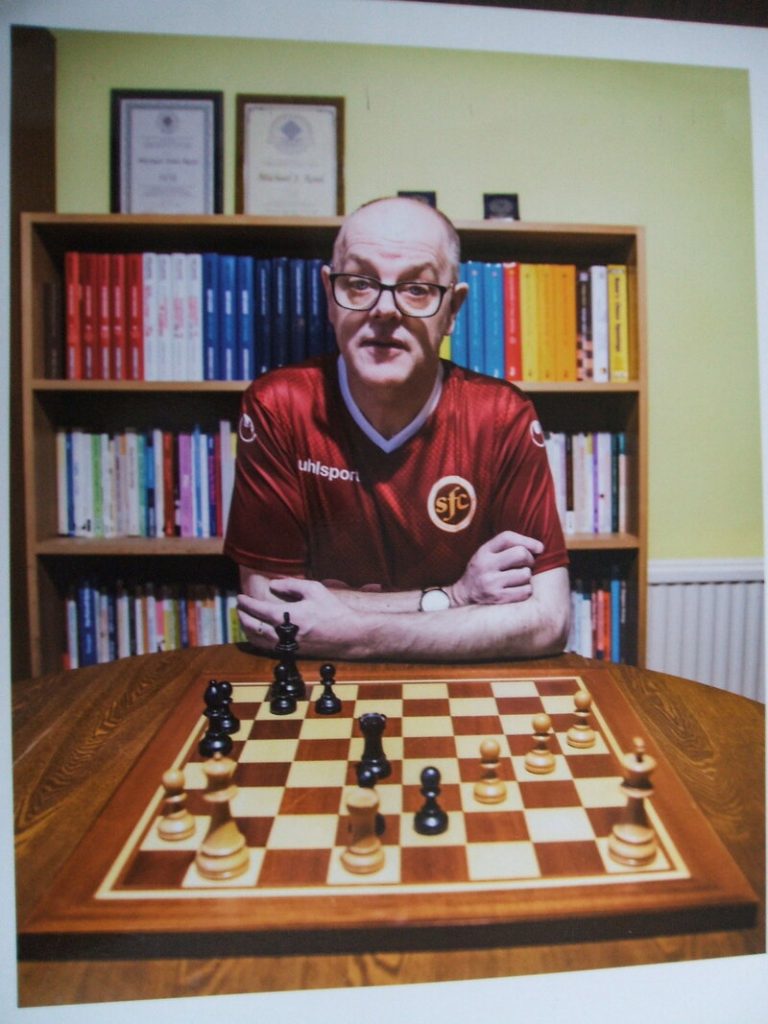
Mike was a strong junior in the 1970s who graduated to correspondence chess which he played with great success up to the year 2000, playing on top board for England and obtaining the title of Senior International Master. You don’t get to that level without being an excellent analyst.

He continues:

It is reasonable for the reader to enquire as to why my correspondence chess career ended at a time when I was still being reasonably successful. The truth is that, during the 1990s, I suffered three nervous breakdowns. I managed to continue to keep on competing during the first two of these and, in fact, had my most successful chess years during the second of them, even though I was barely capable of coping with even the simplest aspects of day to day life. However my third breakdown, which occurred in the period 1999 to 2000 was too much for me to deal with and I was forced to abruptly retire from the game that I love at the beginning of the new millennium.

I was in an absolutely desperate situation at this time, but chess was to prove to be a major factor in my eventual recovery. A number of local players, recognising the severity of the predicament that I was in, made a great effort to assist me and get me out of the house where I had been languishing alone for several months. I do not feel I would ever have recovered, had it not been for the support of the Norfolk chess community.

And again:

Contained within these pages are 110 games, played by Norfolk players of all strengths from superstars of local chess such as John Emms, Owen Hindle and Robert Bellin down to some of the county’s lower graded (but still very talented as you will see!) enthusiasts. All of the games I have included feature top quality opportunities for the aspiring player to learn a lot, and all also feature some very fine chess!

The book is published through Amazon: Mike Read is selling it as cost price as he has no interest in collecting royalties from its sales.

The games are presented, unusually, in ECO code order, so you get all the Sicilian Defence games, for example, together. The annotations, which were produced without computer assistance, are excellent, scoring highly for both clarity and accuracy as well as instructive value. Many readers will, like me, appreciate the human touch. If you look at the sample pages on Amazon you’ll get some idea of their flavour.

Most of them are tactical, often involving spectacular sacrifices, which will delight anyone (and that probably means all of us) who enjoys combinative play.

This was the first game Mike analysed. He witnessed it taking place and decided to annotate it to thank his friend Grant Turner, who had helped and supported him during his breakdown. (If you click on any move you’ll be able to play through the games in this review on a pop-up board.)

[pgn]

[Event “Norwich Dons Club Championship”]
[Site “?”]
[Date “2004.??.??”]
[Round “?”]
[White “Turner, Grant”]
[Black “Osborne, Keith”]
[Result “1-0”]
[ECO “B21”]
[PlyCount “63”]
[EventDate “2004.??.??”]
[SourceVersionDate “2022.05.10”]

1. e4 c5 2. d4 cxd4 3. c3 dxc3 4. Bc4 cxb2 5. Bxb2 e6 6. Nf3 Nc6 7. O-O d6 8.
Nbd2 Nf6 9. Qe2 Qc7 10. Rac1 h6 11. Bb3 e5 12. Nh4 Be7 13. f4 Qb6+ 14. Kh1 O-O
15. fxe5 dxe5 16. Nf5 Bd7 17. Nc4 Qd8 18. Nxe5 Nxe5 19. Bxe5 Bxf5 20. Rxf5 Qb6
21. h3 Rac8 22. Rcf1 Rfd8 23. Bxf6 Bxf6 24. Qg4 Rc6 25. e5 Bg5 26. Rxf7 Kh8 27.
h4 Rg6 28. hxg5 Rxg5 29. Rf8+ Rxf8 30. Rxf8+ Kh7 31. Bc2+ g6 32. Qd7# 1-0

[/pgn]

Another of Mike’s friends, Brian Cunningham, was responsible for the production of this book. In this game he demonstrates that the Stonewall Attack can be a potent weapon at lower club level.

[pgn]

[Event “Norfolk League”]
[Site “?”]
[Date “2005.??.??”]
[Round “?”]
[White “Cunningham, Brian”]
[Black “Carter, Bruce”]
[Result “1-0”]
[ECO “D00”]
[PlyCount “45”]
[EventDate “2005.??.??”]
[SourceVersionDate “2022.05.10”]

1. d4 d5 2. f4 e6 3. Nf3 c5 4. e3 Nc6 5. c3 Nf6 6. Bd3 Be7 7. Nbd2 c4 8. Bc2 b5
9. O-O Bb7 10. Ne5 Nxe5 11. fxe5 Nd7 12. Qf3 O-O 13. e4 Qc7 14. Qg3 f6 15. exd5
Bxd5 16. Ne4 fxe5 17. Bh6 Rxf1+ 18. Rxf1 g6 19. Qf3 Nf6 20. Nxf6+ Bxf6 21. Qxf6
exd4 22. Qf8+ Rxf8 23. Rxf8# 1-0

[/pgn]

At the other end of the spectrum, here’s a game played by Norfolk born GM John Emms.

[pgn]

[Event “World Open Philadelphia”]
[Site “?”]
[Date “1991.??.??”]
[Round “?”]
[White “Yudasin, Leonid”]
[Black “Emms, John”]
[Result “0-1”]
[ECO “C77”]
[PlyCount “44”]
[EventDate “1991.??.??”]
[SourceVersionDate “2022.05.10”]

1. e4 e5 2. Nf3 Nc6 3. Bb5 a6 4. Ba4 Nf6 5. Qe2 b5 6. Bb3 Bc5 7. a4 Rb8 8. axb5
axb5 9. Nc3 O-O 10. Nxb5 d5 11. exd5 e4 12. Ng5 Ne5 13. Nc3 Bg4 14. Qa6 Rxb3
15. cxb3 Nd3+ 16. Kf1 Nxf2 17. Rg1 Nd3 18. Qc4 Qd6 19. Ncxe4 Qf4+ 20. Nf3 Bxf3
21. Nxc5 Be4+ 22. Ke2 Qf2+ 0-1

[/pgn]

I know many readers enjoy collections of games played at amateur level, finding them both more entertaining and more instructive than higher level encounters. If you’re one of these you’ll be entranced by this book.

There are also many readers who like to support authors who prefer to self-publish their books. An admirable sentiment, I think, and if you fall into this category, again you certainly won’t be disappointed.

The word that first comes to my mind when considering this book is ‘generous’. Mike Read generously offers this book at cost price. The size is generous, his tributes to his friends who saved his life after his third breakdown, scattered within the introductions to these games, are also generous. The annotations are also generous in every respect. Mike is generous in his comments about the winners’ play, and also, very often, about the losers’ play as well. You might think that a more critical approach might have made the annotations even more instructive, but this would have been out of place given that they were originally written for a local chess magazine.

Anyone rated between, say, 1000 and 2000 will certainly learn a lot from this book, but stronger players will also benefit. And anyone who just enjoys playing through entertaining games will, like me, fall in love with this book. Don’t be put off by the title, which makes it sound rather dull and didactic (didactic, perhaps, but certainly never dull), or the lack of an illustration on the front cover. It’s what’s inside the book that really matters.

At another level, the book is also a wonderful tribute to all Mike Read’s friends within the Norfolk chess community (a few of whom, sadly, are no longer with us), who helped him when he was going through a very difficult time. Many will find Mike’s story inspirational, and that, again, is a powerful reason why you should buy this book.

It’s my view, and I’m sure Mike, even though he was a chess champion himself, would agree, that, ultimately, chess is less about prodigies, champions and grandmasters, but about forging friendships and building communities of like-minded people who enjoy the excitement, beauty and cerebral challenge of chess.

I’d urge all readers of this review to do themselves a favour, and do Mike a favour as well, by buying a copy.  I really enjoyed this book, and I’m sure you will too. The Amazon link is here.

From https://mikereadsim.weebly.com/photos.html


 Richard James, Twickenham 11th May 2022

Richard James
. Richard James

Book Details:

  • ASIN ‏ : ‎ B09M791556
  • Publisher ‏ : ‎ Independently published (25 Nov. 2021)
  • Language ‏ : ‎ English
  • Paperback ‏ : ‎ 551 pages
  • ISBN-13 ‏ : ‎ 979-8466415964
  • Dimensions ‏ : ‎ 12.85 x 3.18 x 19.84 cm

Official web site of Amazon Publishing

110 Instructive Chess Annotations, SIM Mike Read, Independently published (25 Jan. 2020), ISBN-13 ‏ : ‎ 978-1708364748

Remembering IMC Ken Messere OBE (16-iv-1928 31-iii-2005)

IMC Ken Messere OBE (16-iv-1928 31-iii-2005)

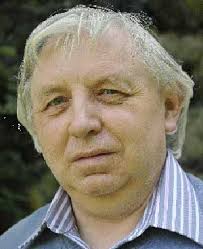
BCN remembers Ken Messere who passed away on Thursday, March 31st 2005 aged 76 in Paris-16E-Arrondissement, Paris, France.

Kenneth Charles Messere was born on Monday, April 16th, 1928 in Richmond-on-Thames, Surrey. His father was Charles (George) Messere (1901-1974) or Eisenberg and aged 26. His mother was Gertrude Marie Newman (1899-1978) and aged 29.

Ken had three siblings: Barbara Marie Messere (1930–2005), Hugh Martin Messere (1932–1985) and Derek R Messere (1934–2012)

Ken attended St. Peter’s College, Oxford from 1946 – 1951 to read philosophy and is reported in the 1951 St. Edmund Hall Magazine, as a member of the Trillick (debating) Society as follows:

‘ That this House would rather be a live Communist than
a dead Democrat.’ The proposer established to his own satisfaction that democracy was founded on ‘selfishness, capitalism and bourgeois hypocrisy.’ He did not satisfy J. F. R. Bonguard of St. Peter’s Hall who opposed, using arguments taken from Hindu philosophy. K. C. Messere of St. Peter’s Hall, spoke third and added some able arguments.

In June 1954 Ken married Mary Elizabeth Humphrey (1929-2003) in Ealing. They had a son Miles Jonathan Messere born in 1964 who passed away in 1965.

Prior the time of his passing his wife Mary was living at 142B, Herbert Road, Woolwich, London, SE18 3PU.

In 1991 he was awarded the OBE (Civil Division) in the Queen’s Birthday honours list. The citation reads: Kenneth Charles Messere, lately Head of Fiscal Affairs Division, OECD, Paris.

Ken appears each year from 1953 to 1967 in the noted publication Britain, Royal And Imperial Calendars the function of which is to list entries for those engaged in UK public service. He worked for HM Customs and Excise. Prompted by this we consulted the venerable A History of Chess in the English Civil Service by Kevin Thurlow (Conrad Press, 2021) on page 447 and found

“He played for Customs. In 1964, he went to work for the Organisation for Economic Cooperation and Development and was head of fiscal affairs from 1971 – 1991. In 1954 he began playing postal chess and became a leading player. He won a semi-final of the 5th World Correspondence Championship (1961 – 64) and became the first English player to compete in a World Championship Final.”

There are 31 games listed at his personal entry at chessgames.com starting with games from 1965.

Chessbase’s Correspondence Database 2020 records 69 games the earliest being from 1958 listing Ken’s federation as being France.

From British Chess (Pergamon Press, 1983) we have this lengthy contribution from Ken himself:

“Between the ages of 6, when I learnt to play and 23 (ed: 1951), when I ceased to be a student, chess had a relatively low priority among various time-competing interests and activities, so I never got around to studying theory. Things changed when I became a civil servant and needed a replacement for philosophy as an intellectually absorbing subject which could be argued about with friends over beers, and for the next 12 years chess became my main interest.

Since 1964 I have been working for the OECD in Paris, where my friends are not chess enthusiasts and, although chess remains a major pleasure, my commitment to it has lessened. Nowadays, out-side correspondence chess, I play only occasional blitz games.

Coming late to serious chess has probably had at least some influence on my deficiencies and stylistic preferences. The deficiencies include an inability to visualize ahead with sufficient clarity to support accurate analysis, slow sight of the board which leads to silly errors through time trouble or failing stamina and less familiarity with theory than my better opponents. As to chess style, I have had to play romantically and subjectively to get good results.

If a game takes the form of a clear-cut position, where strategical objectives are clear and superior technique prevails, then mine generally does not. Consequently I have tended to play either sharp gambits or counter-gambits or to try to render the position sufficiently obscure for imagination and intuition to assume maximum importance. In keeping, my chess heroes have been Alekhine, Bronstein and Tal who revel in fantasy, however much Alekhine may claim that it is logically based.

When I took up competitive chess seriously in 1952, I made some progress and won a few minor tournaments, but in view of the defects already mentioned, it soon became clear that my potential for improvement was limited and that nearly all my games were aesthetically flawed. Fortunately, these defects represent no great handicap at correspondence chess, where I found myself pleased with a reasonable proportion of the game I played, and in addition, capable on the day (or more accurately over the years) of winning against almost anyone. Thus, against world champions I have two wins and one loss, (see below). I also have 80 per cent from five games against Russian grandmasters, even if a meagre 28 per cent from my eighteen games against all correspondence grandmasters. In 1954 when I began playing postal chess competitively, I did sufficiently well in a few British Postal tournaments to be accepted at a reasonably high level in the official international tournaments.

[pgn]
[Event “ICCF Championship 1958-60”]
[Site “?”]
[Date “1958.??.??”]
[Round “?”]
[White “Messere, Kenneth Charles”]
[Black “Bergquist, Rune”]
[Result “1-0”]
[Annotator “Ken Messere and BCN”]
[SetUp “1”]
[FEN “8/1p1bk3/pK5p/2R1P1p1/2pP4/8/8/8 w – – 0 46”]
[PlyCount “11”]
[EventDate “1958.??.??”]
[EventType “tourn”]
[SourceTitle “British Chess, page 168”]

{[%evp 0,11,-29,-29,-59,-59,-11,-90,0,65,207,237,260,260] [#]} 46. d5 $1 {
KCM: Capturing either b or c-pawn loses.} ({In fact} 46. Rxc4 $16 {is also
winning but not as strong.} g4 47. d5 h5 48. e6 Bb5 49. Kc7 $1 Bxc4 50. d6+
Kxe6 51. d7 $18) (46. Kxb7 $2 g4 47. d5 g3 48. Rxc4 h5 49. Rc2 h4 $19) 46… g4
47. Rxc4 h5 48. e6 $18 Bb5 $2 {KCM: the move played enables White to sacrifice
rook and pawn to win with his last pawn.} ({KCM: Correct is} 48… Bxe6 $1 {
KCM: which should draw after} 49. Re4 $1 Kd6 $1 50. Rxe6+ $1 (50. dxe6 $2 Ke7
$1 {KCM: wins for Black. BCN: in fact this is winning for white as follows:}
51. Kc5 g3 52. Re1 b5 53. Kd4 h4 54. Ke5 g2 55. Rc1 a5 56. Rc7+ Ke8 57. Kd6 Kf8
58. e7+ Kf7 59. Rc8 Kf6 60. e8=Q {etc but this was hideously complicated to
work out and SF10 did the work for us!}) 50… Kxd5 51. Rh6 $11) 49. Kc7 $1
Bxc4 50. d6+ Kxe6 51. d7 {and Black resigned six moves later.} 1-0
[/pgn]

Not without luck (see Diagram l), I secured the 75 per cent necessary in two seven-player tournaments to qualify for the fourteen player preliminaries, the winner of which was to qualify for the following world championship. In the 1961-64 preliminaries, I played the best chess of my life, including valid opening innovations, imaginative pawn and piece sacrifices and even a technically efficient win in a queen and pawn end-game. I won the tournament with eleven wins, one draw and one loss, 1.5 points ahead of Maly of Czechoslovakia and two points ahead of Masseev, the Russian favourite, thereby obtaining my first norm towards the International Master title. My first annotated game is the win against Maly (ed: to be inserted once we have tracked down the game score!) which was typical stylistically and also crucial, since if he had won it, he would have qualified for the World Championship instead of me: the second against Bartha of the United States is the most compulsive and difficult tactical game I have ever played, the last five moves alone requiring over 100 hours of analysis.

[pgn]
[Event “W-ch05 sf03 corr”]
[Site “ICCF corr”]
[Date “1962.??.??”]
[Round “?”]
[White “Bartha, Ferenc”]
[Black “Messere, Kenneth Charles”]
[Result “0-1”]
[ECO “A41”]
[Annotator “Messere”]
[PlyCount “92”]
[EventDate “1962.??.??”]
[EventType “tourn (corr)”]
[SourceTitle “Myers”]
[Source “Myers”]
[SourceDate “2012.11.12”]
[SourceVersion “1”]
[SourceVersionDate “2012.11.12”]
[SourceQuality “1”]

{[%mdl 36928][%evp 0,92,19,27,80,59,88,37,24,24,52,32,36,55,64,5,8,10,18,-40,0,
-17,9,-3,-8,-8,1,-20,-13,-123,-40,-48,-27,-55,-48,-48,-11,-2,6,-21,58,92,92,92,
92,102,99,104,150,139,143,135,128,35,153,91,95,-17,-17,23,34,34,26,-18,-18,-18,
-18,-66,0,-6,-1,-47,-72,-72,-72,-105,-40,-40,-52,-51,-50,-50,-50,-70,-40,-28,0,
-86,0,-5,0,0,0,-63,-63] Messere: My game with Bartha, superficially a wild
tactical skirmish, required a number of unexpected moves by both players for
survival even in the beginning. The last five moves, which took me at least
100 hours of analysis going nearly twenty moves deep in several variations,
rendered it quite the most compulsive game I have ever played. That the margin
between win and draw was so fine and that in many variations K and two pawns
defeated K, R, N and pawns made it even more deeply absorbing.} 1. Nf3 {
Myers Harding Messere} d6 2. d4 g6 3. c4 Bg7 4. e4 Bg4 5. Be2 Nc6 6. Be3 e5 7.
d5 Bxf3 8. Bxf3 Nd4 {[#]} 9. Bg4 $146 (9. Bxd4 $1 exd4 10. Nd2 (10. Na3 Ne7 11.
O-O c6 12. Rb1 O-O 13. Nc2 c5 14. b4 Nc8 15. Qd3 Qc7 16. Be2 Re8 17. bxc5 dxc5
18. f4 b5 19. Rxb5 Nd6 20. e5 Nxb5 21. cxb5 Qa5 22. d6 Qxa2 23. Qc4 Qb2 24. Bf3
Rab8 25. Bc6 Red8 26. Qxc5 d3 27. Nb4 d2 28. Nd3 Qb3 29. Nf2 Qa4 30. g3 a6 31.
b6 Rdc8 32. b7 Rxc6 33. Qa7 Rxb7 34. Qxb7 Rc1 35. Qf3 Qd4 36. Kg2 Re1 37. Nd1
Bf8 38. Qf2 Qd5+ 39. Kg1 Rxf1+ 40. Kxf1 f6 41. exf6 Bxd6 42. Qe3 Kf7 43. Ke2
Bc5 44. Qc3 Qe4+ 45. Kf1 Qh1+ 46. Ke2 Qxh2+ 47. Kf3 Qh1+ {0-1 Portisch,
L-Timman,J/Antwerp 1989/}) 10… Ne7 (10… c5 11. dxc6 bxc6 12. b4 Rb8 (12…
Ne7 13. O-O O-O 14. Nb3 Qb6 15. a3 Rab8 16. c5 dxc5 17. Nxc5 Rfd8 18. Nd3 a5
19. Qc2 axb4 20. axb4 Ra8 21. g3 Ra7 22. Rxa7 Qxa7 23. e5 Qa6 24. Re1 Nd5 25.
e6 Qb5 26. exf7+ Kxf7 27. Qe2 Bf6 28. Qe6+ Kg7 29. Ne5 Rf8 30. Bxd5 cxd5 31.
Nd7 Rf7 32. Nxf6 Rxf6 33. Qe7+ Rf7 34. Qe5+ Kh6 35. Qxd4 Qc4 36. Qd2+ Kg7 37.
Rc1 Qe4 38. b5 d4 39. Qb2 Rb7 40. b6 Qe5 41. Ra1 Qc5 42. Rb1 h5 43. Qb5 Qd6 44.
Qb4 Qf6 45. Rb3 Qd8 46. Qb5 Qd6 47. h4 d3 48. Qa6 Rd7 49. Qa1+ Qd4 50. Qd1 d2
51. Rb1 Qe4 {1/2-1/2 Epishin,V-Gulko,B/Yerevan 1996/}) 13. Rb1 Ne7 14. a3 O-O
15. Nb3 c5 16. b5 f5 17. O-O Kh8 18. a4 fxe4 19. Bxe4 d5 20. Bd3 dxc4 21. Bxc4
Qd6 22. Rc1 Rbc8 23. Qd3 Rf5 24. Nd2 Nd5 25. Bxd5 Qxd5 26. Nc4 Rcf8 27. Rce1
Rg5 28. Re4 Rf4 29. Rfe1 h5 30. a5 Kh7 31. g3 Rxe4 32. Rxe4 Rf5 33. b6 axb6 34.
axb6 Rf7 35. Kg2 Re7 36. f3 Rxe4 37. fxe4 Qb7 38. Qf3 Qa6 39. Qb3 Be5 40. Qd3
Bb8 41. e5 Qa2+ 42. Kg1 Kg7 43. Qf1 Qc2 44. Nd6 d3 45. Qf6+ Kh7 46. Qe7+ Kg8
47. Qd8+ Kg7 48. Qd7+ Kh6 49. Nf7+ Kg7 50. Ng5+ Kh6 51. Nf7+ Kg7 52. Nd6+ Kh6
53. Nf7+ {1/2-1/2 Epishin,V-McNab,C/Catalan Bay 2003/}) (10… Nf6 11. O-O Nd7
12. Be2 d3 13. Bxd3 Bxb2 14. Rb1 Bg7 15. f4 O-O 16. Nf3 Qf6 17. Qd2 Bh6 18. g3
Nc5 19. Rbe1 Rae8 20. Bb1 Qd8 21. h4 Qd7 22. Kg2 Qa4 23. Qc2 Re7 24. Rf2 Rfe8
25. Rfe2 Bg7 26. e5 a6 27. h5 Qxc2 28. Bxc2 dxe5 29. hxg6 hxg6 30. fxe5 f5 31.
e6 Bf6 32. g4 fxg4 33. Ne5 Bh4 34. Rh1 Nxe6 35. dxe6 Rxe6 36. Rxh4 Rxe5 37. Rf2
Rg5 38. Rd2 Re7 39. Bd1 Kg7 40. Rxg4 Rxg4+ 41. Bxg4 Re4 42. Bc8 b6 43. Bxa6 Kf7
44. Rd7+ Re7 45. Rxe7+ Kxe7 46. c5 bxc5 47. a4 Kd6 48. a5 {1-0 Epishin,
V-Djuric,S/Cutro 1999/}) 11. Be2 O-O 12. O-O c5 (12… c6 13. Nf3 Qb6 14. Qd2
f5 15. Bd3 fxe4 16. Bxe4 cxd5 17. cxd5 Rac8 18. Qe2 Bf6 19. Ne1 Bg7 20. Nd3
Rce8 21. Rfe1 Qb5 22. g3 Nxd5 23. Nf4 Nc7 24. Qxb5 Nxb5 25. Ne6 Rxe6 26. Bd5
Kh8 27. Rxe6 d3 28. Rd1 Bd4 29. Rxd3 Bxf2+ 30. Kg2 Nd4 31. Re4 Nc2 32. Rf3 Ne1+
33. Rxe1 Rxf3 34. Re8+ {1-0 Epishin,V-Gulko,B/Philadelphia 1998/}) 13. f4 (13.
g3 Nc8 14. h4 Nb6 15. h5 Nd7 16. hxg6 hxg6 17. Kg2 Re8 18. Rh1 Rb8 19. f4 a6
20. a4 d3 21. Bxd3 Bxb2 22. Ra2 Bf6 23. e5 dxe5 24. f5 g5 25. Ne4 Bg7 26. f6
Nxf6 27. Rf2 b5 28. Nxf6+ Bxf6 29. Rh7 e4 30. Qh5 Rb7 31. Be2 bxc4 32. d6 Qxd6
33. Bxc4 Re6 34. Rxf6 Rb2+ 35. Kh3 g4+ 36. Qxg4+ {1-0 Epishin,V-De la Villa
Garcia,J/Lausanne 2001/}) 13… a6 14. Bd3 Rb8 15. h4 b5 16. h5 Nc8 17. hxg6
fxg6 18. Qg4 Kh8 19. b3 Nb6 20. Nf3 Qd7 21. Qxd7 Nxd7 22. g3 bxc4 23. bxc4 Rb2
24. Rf2 Rxf2 25. Kxf2 Rb8 26. Re1 Rb2+ 27. Re2 Rxe2+ 28. Kxe2 Bf6 29. Bc2 Kg7
30. Kd3 g5 31. Ba4 Nb6 32. Be8 Kf8 33. Bh5 gxf4 34. gxf4 Na4 35. e5 Be7 36. Nd2
Nc3 37. Ne4 dxe5 38. d6 Bxd6 39. Nxd6 exf4 40. Ne4 Na4 41. Kc2 {1-0 Epishin,
V-Hennig,D/Hamburg 1997/}) (9. Nc3 Ne7 10. h4 (10. g4 c5 11. h4 a6 12. Be2 Rb8
13. h5 h6 14. hxg6 fxg6 15. g5 hxg5 16. Rxh8+ Bxh8 17. Bxg5 b5 18. b3 bxc4 19.
Bxc4 Qd7 20. Bxa6 Qh3 21. Be3 Nf3+ 22. Ke2 Nd4+ 23. Kd3 Bf6 24. Qh1 Qd7 25. Bc4
Kd8 26. Qg2 Qa7 27. Rh1 Qa3 28. Bc1 Qa5 29. Rh7 Rb7 30. Rf7 Nxd5 31. Bxd5 {
1-0 Ftacnik,L-Lipka,J/Czechia 2001/}) 10… h5 (10… c5 11. h5 a6 12. Be2 f5
13. hxg6 hxg6 14. Rxh8+ Bxh8 15. Bd3 Kd7 16. b4 f4 17. Bxd4 exd4 18. Na4 cxb4
19. c5 Ke8 20. Qg4 dxc5 21. Nxc5 Qc8 22. Qh4 Qxc5 23. Qxh8+ Kf7 24. Qh7+ Kf6
25. Kf1 Re8 26. e5+ Kxe5 27. Qf7 Qc8 28. Re1+ {1-0 Krasenkow,M-Zlotnikov,M/
Voskresensk 1992/}) 11. Be2 c5 12. Bd3 Qd7 13. a3 O-O 14. b4 b6 15. Rb1 f5 16.
bxc5 bxc5 17. Bg5 f4 18. Qa4 Rfd8 19. Qxd7 Rxd7 20. Kd2 Kf7 21. Nb5 Nxb5 22.
Rxb5 Bf6 23. Rhb1 Bxg5 24. hxg5 Ke8 25. Bc2 Kd8 26. Ba4 Rc7 27. Ra5 a6 28. Rb6
Nc8 29. Rbxa6 Rxa6 30. Rxa6 h4 31. Bd1 Rb7 32. Kc2 f3 33. Bxf3 Rf7 34. Bg4
Rxf2+ 35. Kb3 Rxg2 36. Be6 h3 37. Ra8 Rxg5 38. Rxc8+ Ke7 39. Rh8 Rg3+ 40. Ka4
Rc3 41. Kb5 {1-0 Krasenkow,M-Kakageldyev,A/Oviedo 1993/}) ({Relevant:} 9. Nc3
Ne7 10. h4 c5 11. Bg4 f5 12. exf5 gxf5 13. Bh5+ Ng6 14. g4 Qd7 15. gxf5 Qxf5
16. Bg4 Qc2 17. Rb1 h5 18. Bxh5 Qxd1+ 19. Bxd1 Nxh4 20. Ba4+ Ke7 {1/2-1/2 (20)
Salm,M-O’Kelly de Galway,A ICCF corr 1959}) 9… c5 $2 (9… Nf6 $142 $1 {
Messere} 10. Bxd4 exd4 11. Nd2 O-O 12. O-O c5 13. Rb1 Qa5 (13… Re8 14. Bf3
Bh6 15. b4 b6 16. b5 Bxd2 17. Qxd2 Nxe4 18. Bxe4 Rxe4 19. Rfe1 Rxe1+ 20. Rxe1
Qd7 21. a4 a6 22. Qg5 axb5 23. axb5 Kg7 24. h3 h6 25. Qc1 Qf5 26. Rd1 Ra2 27.
Rd2 Qf4 28. Rc2 Qxc1+ 29. Rxc1 d3 30. Kf1 Rc2 31. Rd1 Rxc4 32. Rxd3 Rb4 33. Ke2
Rxb5 34. Re3 c4 35. Rc3 Rb2+ 36. Ke1 b5 37. h4 Kf6 38. g4 Ke5 39. Rf3 f5 40. h5
gxh5 41. Rxf5+ Ke4 42. Rxh5 c3 43. Rxh6 Rb1+ 44. Ke2 c2 45. f3+ Kd4 {0-1
Fernandes,E-Silveira,N/Vitoria BRA 2006/}) 14. Bh3 Qxa2 15. f4 Rae8 16. Re1 Qa5
17. e5 Nh5 18. e6 fxe6 19. Bxe6+ Kh8 20. g3 Qc7 21. Ne4 Bh6 22. Qd3 Ng7 23. Nf2
Nf5 24. Ng4 Bg7 25. h4 b5 26. b3 Qa5 27. Rec1 Rb8 28. Ra1 Qb6 29. Rab1 bxc4 30.
bxc4 Qc7 31. Nf2 Ne3 32. Ne4 Rxb1 33. Rxb1 Rb8 34. Ng5 Bf6 35. Ne4 Bd8 36. Re1
Rb2 37. Nxd6 Rg2+ 38. Kh1 Rxg3 39. Nf7+ Kg7 40. Qe4 Qe7 41. Qe5+ Qf6 42. Nxd8
Qxe5 43. fxe5 d3 44. d6 d2 45. Rb1 Rg2 46. Bg4 Rxg4 47. Ne6+ Kf7 48. d7 Rxh4+
49. Kg1 Rg4+ 50. Kh1 Rd4 51. Nxd4 Ke7 52. Nc2 d1=Q+ 53. Rxd1 Nxd1 54. e6 Nf2+
55. Kg2 Ne4 56. Ne3 Ng5 57. Nd5+ Kd8 58. Nf4 a5 59. Kg3 a4 60. Kg4 h6 61. Nxg6
Nxe6 62. Ne5 a3 63. Kf5 Nf8 {0-1 Beutelhoff,J-Bednarski,J/Dortmund 1975/}) (
9… Ne7 10. Nc3 (10. f4 O-O 11. fxe5 dxe5 12. O-O c5 13. dxc6 bxc6 14. Nc3 Qb6
15. Na4 Qb4 16. b3 Rad8 17. Qc1 f5 18. Bd1 fxe4 19. Nc3 Rxf1+ 20. Kxf1 Rf8+ 21.
Ke1 Nef5 22. a3 Qb6 23. Bf2 e3 24. Bg1 Nh4 25. Qb2 e4 26. b4 Ndf3+ 27. gxf3
exf3 28. c5 f2+ 29. Bxf2 exf2+ 30. Qxf2 Bxc3+ {0-1 Chekhova Kostina,T-Frog,I/
Moscow 1991/}) (10. h4 h5 11. Bh3 O-O 12. Nc3 c5 13. Rc1 f5 14. exf5 Nexf5 15.
Bg5 Bf6 16. Ne4 Be7 17. Rc3 a6 18. Bxf5 Nxf5 19. g4 Nxh4 20. Bh6 Rf7 21. gxh5
g5 22. Rg1 Kh7 23. Nxg5+ Bxg5 24. Bxg5 Qg8 25. Rcg3 Nf5 26. Qc2 e4 27. Rg4 Rg7
28. Qe2 Re8 29. Bf6 Rxg4 30. Rxg4 Qf7 31. Rg6 Nd4 32. Qg4 Rg8 33. Rxg8 Qxg8 34.
Qxe4+ Kh6 35. Bxd4 cxd4 36. Qe6+ Kh7 37. Qxg8+ Kxg8 38. c5 {1-0 Luna,J-Duin,L/
Buenos Aires 1965/}) (10. O-O c5 11. Bxd4 cxd4 12. Qa4+ Kf8 13. f4 exf4 14.
Rxf4 Be5 15. Rf1 Kg7 16. Qb3 b6 17. Nd2 Rf8 18. Qd3 a6 19. Nf3 b5 20. c5 f6 21.
Nxd4 Bxd4+ 22. Qxd4 g5 23. Bf5 Ng6 24. Bxg6 hxg6 25. b4 Qe7 26. Rac1 Rh8 27. h3
g4 28. cxd6 Qxd6 29. Rc6 Qe5 30. Qxe5 fxe5 31. Rff6 gxh3 32. Rxg6+ Kf7 33. Rxa6
hxg2 34. Raf6+ Ke7 35. Re6+ Kf7 36. Rxg2 Rac8 37. Rf2+ Kg7 38. Rxe5 Rh4 39. d6
Rc1+ 40. Kg2 Rd1 41. Rg5+ Kh6 42. Rd5 Rxd5 43. exd5 Rd4 44. Rf8 Rxd5 45. Rd8
Kg5 46. d7 {1-0 Glawischnig,A-Wilczek,R/Feffernitz 1999/}) 10… O-O 11. Nb5 c5
12. dxc6 Nexc6 13. O-O a6 14. Nxd4 exd4 15. Bf4 Re8 16. Re1 Ne5 17. Be2 Qb6 18.
Qb3 Qc6 19. Bf1 Nd7 20. f3 Nc5 21. Qa3 a5 22. Rad1 Ra6 23. Bg3 Qb6 24. b3 Qb4
25. Qxb4 axb4 26. Bd3 Rxa2 27. Bxd6 b6 28. Re2 Rea8 29. Rxa2 Rxa2 30. Bc7 Bh6
31. h4 Nd7 32. Bf1 Rb2 33. Bd6 Rxb3 34. f4 Nc5 35. Rxd4 Ne6 36. Rd3 Rxd3 37.
Bxd3 b3 38. g3 Bg7 39. e5 Bf8 40. Kf2 Bxd6 41. exd6 Kf8 42. Ke3 Ke8 43. f5 Nc5
44. fxg6 fxg6 45. h5 Nxd3 46. hxg6 hxg6 47. Kxd3 Kd7 48. Kc3 Kxd6 49. Kxb3 Ke5
50. Kb4 Kd4 51. g4 g5 52. Kb5 Kd3 53. Kb4 {1/2-1/2 Krijgelmans,J-Marechal,A/
Belgium 2002/}) (9… h5 10. Bxd4 hxg4 11. Bc3 Qh4 12. Qa4+ Kf8 13. Nd2 Bh6 14.
Nf1 Nf6 15. Ng3 Bf4 16. Qb4 b6 17. Bd2 Kg7 18. O-O-O Nh5 19. Qc3 Qf6 20. Rdf1
Rh7 21. Ne2 Rah8 22. f3 Qg5 23. fxg4 Bxd2+ 24. Qxd2 Qxg4 25. Qe3 Nf6 26. Nc3
Rxh2 27. Rxh2 Rxh2 28. Qf3 Qg5+ 29. Kd1 Rxg2 30. Rf2 Rxf2 31. Qxf2 Qg4+ 32. Qe2
a6 {0-1 Facino,H-Dolezal,C/San Fernando 1992/}) 10. Qa4+ $146 (10. Nc3 $5 h5 (
10… Nh6 11. h3 f5 12. exf5 Nhxf5 13. O-O O-O 14. Bd2 a6 15. Be2 b5 16. cxb5
Nxe2+ 17. Qxe2 Nd4 18. Qc4 axb5 19. Nxb5 Nxb5 20. Qxb5 Rb8 21. Qc4 Rxb2 22. Bc3
Rf4 23. Qd3 Rb7 24. a4 Qa8 25. a5 c4 26. Qd2 Bh6 27. Qe2 Qa6 28. Rfb1 Rbf7 29.
Bd2 Rh4 30. Rb6 Qc8 31. Bxh6 Rxh6 32. a6 c3 33. a7 Rxa7 34. Rxa7 c2 35. Qxc2
Qxc2 36. Rb8+ {1-0 Janjgava,L-Fang,J/Philadelphia 1990/}) 11. Qa4+ Kf8 12. Bh3
g5 13. g3 a6 14. Qd1 b5 15. Bf1 b4 16. Nb1 Nh6 17. Nd2 Bf6 18. Bd3 Ng8 19. a3
a5 20. Qa4 Rb8 21. axb4 axb4 22. Qa5 Qe7 23. Qa7 Rb7 24. Qa8+ Kg7 25. Qc8 Rc7
26. Qh3 g4 27. Qg2 Bg5 28. h3 Nh6 29. h4 Bf6 30. Rf1 Ra7 31. Rb1 Ra2 32. Kd1
Qd7 33. Bxd4 exd4 34. Kc1 b3 35. Kd1 Rha8 36. Ke2 Qa4 37. Rfd1 Re8 38. Kf1 Qb4
39. Kg1 Bd8 40. Qf1 Ba5 41. Kh1 Qb7 42. f4 f5 43. Qg2 Bxd2 44. Rxd2 fxe4 45.
Bxe4 Qe7 46. Bd3 Qe3 47. Rbd1 Kf6 48. Re2 Qxe2 49. Bxe2 Rxb2 50. f5 Rexe2 51.
Qf1 Rf2 52. Qe1 Rbe2 53. Qa5 Nxf5 54. Qd8+ Kf7 {0-1 Knyshenko-Katalymov,B/
Sochi 1952/}) 10… Kf8 11. Nd2 (11. Nc3 a6 12. Bxd4 $2 (12. O-O $142 $1 Nf6
13. Qd1 b5 14. cxb5 axb5 15. f3 $16 {Myers}) 12… exd4 13. Ne2 Nf6 14. Bf3 Nd7
15. O-O Ne5 16. Ng3 h5 17. Bd1 h4 18. Ne2 b5 19. cxb5 axb5 20. Qxb5 Rb8 21. Qa6
Rxb2 22. f4 Ng4 23. Qd3 Ne3 24. Rf3 c4 25. Qa3 Nxd1 26. Rxd1 Rxe2 27. e5 d3 28.
Qb4 Rc2 29. a4 Kg8 30. e6 fxe6 31. dxe6 h3 32. Qb7 Bd4+ 33. Rf2 Bxf2+ {0-1
Jackson,D-Harper,B/London 1972/}) 11… h5 (11… Bh6 12. O-O Kg7 13. Bd1 f5
14. Qa3 $16 {[%cal Gb2b4,Ge4f5] Myers}) 12. Bd1 $1 a6 13. Bxd4 (13. b4 $5 b5
14. Qa3 cxb4 15. Qxb4 a5 16. Qc3 b4 17. Qd3 Qh4 18. Nf3 Nxf3+ 19. Bxf3 Bh6 20.
c5 Bxe3 21. Qxe3 dxc5 22. Rc1 $16 {Myers}) (13. O-O $5 a5 14. f4 Nh6 15. h3 Kg8
16. Nb3 Kh7 17. fxe5 Bxe5 18. Nxd4 Bxd4 19. Bxd4 cxd4 20. Bc2 $16 {Myers})
13… exd4 (13… cxd4 $5) 14. b4 $6 (14. O-O $142 $5 h4 15. Rb1 h3 16. g3 Qe8
17. Qa3 Nf6 18. Re1 $16 {Myers}) 14… Bh6 (14… d3 $5) 15. Nf3 b5 $6 (15…
b6 16. bxc5 bxc5 17. O-O $14) (15… Qe7 $2 16. O-O $1 Qxe4 $2 17. Re1 $16) (
15… Qe8 $142 $1 $14 {Harding}) (15… Nf6 $142 $5 $14 {Myers}) 16. Qb3 (16.
cxb5 $5) 16… Nf6 17. Bc2 Kg7 $6 (17… Qb6 $142 $1 $14 {Myers}) 18. O-O Re8 (
18… Qb6 $5) 19. Rae1 $6 (19. bxc5 $142 $1 dxc5 20. Rfe1 Rb8 21. e5 $1 $16 {
Myers}) 19… a5 $2 (19… Qb6 $5) 20. bxc5 bxc4 21. Qxc4 dxc5 22. d6 $1 (22.
e5 $6 Nxd5 23. Be4 $8 (23. Bb3 $2 a4 $17) 23… Nb6 $5 (23… Nf4 $6 24. Bxa8
Qxa8 25. Qxc5 d3 26. Rd1 $16) 24. Qxc5 Rc8 25. Qb5 Nc4 26. Bb7 Rc7 27. Bd5 $14
{Harding}) (22. Qxc5 $2 Rc8 23. Qxd4 Rxc2 24. d6 Re6 25. e5 Nd7 26. Qa7 $132 {
[%cal Yf3d4] Myers}) 22… Nd7 23. e5 $1 Bf4 24. Qd5 $1 Rc8 25. g3 (25. Bb3 $5
Rf8 26. Qe4 Bh6 27. Bc2 $18 {Harding}) 25… Bh6 26. Nh4 $2 (26. e6 $3 {Harding
} fxe6 27. Rxe6 Rxe6 28. Qxe6 Qe8 (28… Nf8 29. Qd5 $1 Qd7 30. Ne5 $18 {
Harding}) 29. Qh3 $1 {[%cal Yf1e1]} Qf7 (29… Nf8 30. Re1 Qc6 31. Ne5 $18 {
Harding}) 30. Nh4 $1 Rd8 31. Bxg6 Qf6 32. Re1 Nf8 33. Bd3 $18 {Myers}) (26. Rb1
{[%cal Yb1b7]} Rb8 27. Rxb8 Qxb8 28. Bb3 Rf8 29. Qe4 $5 Qc8 30. Re1 $18 {Myers}
) 26… Nb6 27. Qe4 Nc4 {[%cal Yc4d6,Yc4e5]} 28. Qb7 $2 (28. Nxg6 $142 $5 {
Messere} Nxd6 $8 (28… Nd2 $2 29. Qf5 Qg5 30. Ne7 Qxf5 31. Nxf5+ $18 {[%cal
Ge5e6]}) 29. Qd3 {[%csl Rh7][%cal Yg6e7]} c4 $8 30. Qxd4 $8 Nf5 31. Qxd8 $8
Rcxd8 $8 (31… Rexd8 $2 32. Bxf5 $18) 32. Bxf5 fxg6 33. Bb1 $14 {Harding}) (
28. Nf5+ $142 $1 {Harding} gxf5 29. Qxf5 $1 Rh8 $8 (29… Kf8 $2 30. d7 $18)
30. Bb3 $5 (30. d7 Rb8 31. e6 Qf6 32. Qxc5 Nb6 33. f4 $1 fxe6 34. Bb3 Nxd7 35.
Qd6 Rbe8 36. Qxd7+ $16 {Harding}) 30… Qg5 31. Qxg5+ Bxg5 32. Bxc4 Bd2 33. Re2
Bc3 34. f4 Rcd8 35. f5 Rhf8 36. Re4 $18 {Myers}) 28… Rxe5 (28… Rb8 29. Qd5
Nd2 30. e6 $1 $16 Rxe6 (30… Nxf1 $2 31. Nf5+ $1 $18) (30… fxe6 31. Qxc5
Nxf1 $2 32. Qa7+ $18) 31. Rxe6 fxe6 32. Qe5+ Qf6 33. Qxc5 Kg8 34. Qc7 Rf8 (
34… Qd8 35. Bxg6 $18) 35. Nxg6 Nxf1 36. Nxf8 Be3 37. fxe3 Nd2 38. Bh7+ Kxf8
39. Qc8+ Kg7 40. Qg8+ Kh6 41. Qg6+ Qxg6 42. Bxg6 dxe3 43. d7 e2 44. Kf2 Nf3 45.
Kxe2 Nd4+ 46. Ke3 Nc6 47. Be4 Nd8 48. Kd4 $18 {Harding}) 29. Rxe5 Nxe5 30. Bxg6
$5 (30. f4 Qd7 {Tait} (30… Nc4 $5 31. Bxg6 Nxd6 32. Nf5+ Kxg6 33. Nxd6 Qxd6
34. Qxc8 d3 35. Qh8 d2 36. Rd1 $11) (30… Nd7 31. Bxg6 fxg6 32. Re1 Rb8 33.
Re7+ Qxe7 34. dxe7 Rxb7 35. e8=Q Nf8 36. Qe5+ $18 {Myers}) 31. Qe4 Nc6 (31…
Qxd6 $1 32. fxe5 Qc6 33. Qg2 Qxg2+ 34. Kxg2 c4 $15 {Myers}) 32. Nxg6 Qxd6 33.
Ne5 (33. Nh4 Kf8 $1 34. Qh7 Qf6 35. Bd3 Ne7 36. Rc1 $11 {Myers}) (33. Qf5 Qe6
34. Nh4 Kf8 35. Qxh5 Ne7 36. Nf5 $11 {Myers}) 33… d3 34. Bxd3 Qd4+ 35. Qxd4
Nxd4 36. Rb1 Nc6 37. Nxc6 Rxc6 38. Bc4 Kg6 39. Rb7 f5 40. Ra7 $16) (30. Qd5 $2
Nd7 $1 31. Bb3 Qf6 32. Rd1 Rd8 $17 {Myers}) (30. Re1 $5 d3 31. Ba4 d2 32. Rxe5
Qxd6 33. Rd5 {Harding} Qe6 34. Rd7 Rb8 35. Rxf7+ Qxf7 36. Qxb8 Bg5 37. Qb2+ $16
{Myers}) 30… Qd7 $8 (30… Nd7 $2 31. Bxh5 Rb8 32. Nf5+ Kh7 33. Qd5 $18 {
Myers}) (30… Rb8 $6 31. Qd5 fxg6 (31… Nxg6 $2 32. Nf5+ $18) 32. Qxe5+ Kh7 (
32… Qf6 33. Qxc5 $18) 33. Qxc5 $1 Bf8 34. Qa7+ Bg7 35. d7 $1 $18) (30… Nxg6
$2 31. Nf5+ Kf8 32. Nxh6 Ne5 33. Re1 $18) 31. Nf5+ $2 (31. Qxd7 $142 $1 Nxd7
32. Bxh5 Bg5 33. Nf5+ Kf6 34. Ne7 $1 Rh8 35. Bg4 Ne5 36. Nd5+ Kg6 37. Bd1 $16 {
Myers}) 31… Kf6 32. Qxd7 Nxd7 33. Ne7 Rb8 $2 (33… fxg6 $6 34. Nxc8 c4 35.
f4 c3 36. Kf2 Bg7 37. Ke2 Ke6 38. Re1 Kd5 39. h3 $14 {Myers}) (33… Rh8 $142
$1 34. Bxh5 $1 c4 $5 (34… Bf8 35. Nd5+ Ke6 $15 {Harding}) 35. Bg4 Ne5 $1 36.
Nd5+ Kg6 37. Bc8 Bd2 38. f4 Nd3 39. d7 c3 $17 {Myers}) 34. Bf5 $2 (34. Bxh5
$142 $1 Bd2 35. Bg4 $1 Nf8 36. Rd1 Rb2 37. Nc6 Rxa2 38. d7 $1 Nxd7 39. Bxd7 d3
40. Be8 $16 {Myers}) 34… Rb7 $1 (34… Ne5 35. f4 $5 (35. Bc8 Bf8 36. Nd5+
Kg7 37. d7 Nc6 38. Rc1 $14) 35… Nc4 36. Nc6 Nxd6 37. Nxb8 Kxf5 38. Nc6 d3 39.
Kf2 c4 40. Nxa5 $14) 35. Be4 $2 (35. f4 $5 Bf8 $1 (35… c4 36. Rd1 d3 37. Bxd7
Rxd7 38. Nd5+ Ke6 39. Ne3 Rxd6 40. Nxc4 $14 {Harding}) 36. Re1 $1 (36. Rc1 $2
Bxe7 37. dxe7 Kxe7 38. Bxd7 Rxd7 39. Rxc5 d3 40. Rc1 Kf6 $17 {Harding}) 36…
c4 37. Bxd7 Rxd7 38. Nd5+ Kg6 39. Nb6 Rxd6 40. Nxc4 Rd5 41. Rd1 $11 {Myers}) (
35. Re1 $5 c4 36. Bxd7 Rxd7 37. Nd5+ Kg7 38. Nb6 Rxd6 39. Nxc4 Rd5 40. Rd1 $11
{Myers}) 35… Rb2 36. Ng8+ Ke5 $1 (36… Kg7 $2 37. Nxh6 Kxh6 38. Bf5 $1 Nf6
39. d7 Nxd7 40. Bxd7 Rxa2 41. Rd1 $16 {Myers}) 37. Bc6 Kxd6 $2 (37… Nb8 $142
$1 {Myers} 38. Be8 (38. f4+ Kxd6 39. Be8 Bg7 40. Bxf7 Nd7 $17) 38… Bd2 39.
Bxf7 (39. d7 Nxd7 40. Bxd7 c4 41. Be8 Ke6 42. Ba4 c3 $19 {Myers}) 39… Kxd6
40. f4 Nd7 41. Nh6 Ke7 42. Bxh5 c4 $1 (42… Rxa2 43. Nf5+ Kf6 44. Nd6 Be3+ 45.
Kh1 a4 46. g4 a3 $17 {Harding}) 43. Nf5+ Kf8 44. Nxd4 Be3+ 45. Kh1 Bxd4 46. Rd1
c3 47. Rxd4 c2 48. Rc4 Rxa2 49. Rc8+ Ke7 50. Re8+ Kf6 51. Rc8 Ra1+ 52. Kg2 c1=Q
53. Rxc1 Rxc1 $19 {Myers}) 38. Bxd7 Bd2 (38… Kxd7 39. Nxh6 Ke6 $1 40. Re1+
Kd5 41. Re8 c4 42. Nf5 c3 $1 (42… Rxa2 43. Rd8+ Ke4 44. Nxd4 c3 45. Nb3 a4
46. Nc5+ Ke5 47. Nd3+ Ke4 48. Nc5+ $11 {Harding}) 43. Rd8+ Ke4 44. Nxd4 Rd2 45.
f3+ Ke5 46. Nc6+ Kf6 47. Rc8 c2 48. Nxa5 Rd1+ 49. Kg2 $1 c1=Q 50. Rxc1 Rxc1 51.
Nb3 Rc2+ 52. Kh3 Rxa2 53. f4 {Harding} Kf5 54. Nd4+ Ke4 55. Nb5 Rd2 56. Nc7 Rd7
57. Na6 Kd5 $1 58. Kh4 Rb7 59. Kxh5 Kd6 60. Kg5 Rb6 $19 {Myers}) 39. Bf5 $6 (
39. Be8 $2 c4 40. Bxf7 c3 41. Bg6 c2 42. Bxc2 Rxc2 43. Nf6 Rxa2 (43… Ke5 44.
Nxh5 d3 {Messere} 45. a4 Ra2 46. Rd1 Kd4 47. Nf6 Bc3 48. Kf1 Rxa4 $17 {Myers})
44. Ne4+ Kd5 45. Nxd2 Rxd2 46. Ra1 d3 47. Rxa5+ Kd4 48. Ra1 Kc3 $17 {Myers}) (
39. Ba4 $5 c4 40. Nf6 Rxa2 (40… Ke5 41. Nd7+ Kd6 42. Nf6 Rxa2 43. Bb5 c3 $15)
41. Bb5 Kc5 (41… c3 $5 42. Bc4 Rb2 43. Ne4+ Ke7 44. Bd3 f5 45. Nxd2 Rxd2 46.
Bxf5 Kf6 (46… c2 47. Bxc2 Rxc2 48. Rd1 Rc4 $15) 47. Be4 d3 (47… Ke5 {
Harding} 48. Re1 Kf6 49. f4 a4 50. Ra1 $14) 48. Rc1 c2 49. Bf3 Ke5 50. Bxh5 Kd4
$19 {Myers}) 42. Be8 d3 43. Bxf7 Rb2 (43… Kd4 $5) 44. Ne4+ Kd4 45. Nxd2 Rxd2
46. Ra1 $8 Rb2 $3 (46… c3 $5 47. Ra4+ Ke5 48. Rxa5+ Kf6 49. Bxh5 c2 50. Ra1
Re2 51. Bxe2 d2 $1 52. Rd1 $1 c1=Q 53. h4 $14) 47. Rxa5 (47. Ra4 $5 d2 (47…
Rb4 $5 48. Rxa5 c3 49. Rd5+ Ke4 $11) 48. Bxh5 Rb5 49. Bg4 (49. Be2 Rb4 50. Ra1
c3 51. Bd1 Kd3 52. Kg2 a4 $11) 49… Rb4 50. Ra1 c3 51. Bf5 Ke5 52. Bd3 Rb2 53.
Kf1 $16) 47… c3 48. Rd5+ $8 Ke4 49. f3+ $8 Ke3 50. Bg6 Rb1+ 51. Kg2 Rd1 52.
Re5+ $8 (52. Bxd3 Rd2+ 53. Kh3 Rxd3 $17) 52… Kd4 53. Re4+ Kc5 54. Re8 d2 $1
55. f4 Rc1 56. Bxh5 c2 57. Rd8 d1=Q 58. Bxd1 cxd1=Q 59. Rxd1 Rxd1 $19) 39… c4
40. Rb1 (40. a4 d3 41. Kg2 Ke5 42. Bh7 Ke6 43. Kf3 f5 44. Nh6 $8 Bxh6 45. Bg8+
Ke5 46. Bxc4 Kd4 $17 {Myers}) 40… Rxa2 41. Rb8 $6 (41. Rb7 $142 $5 $17 {Myers
}) 41… a4 $5 (41… d3 $1 42. Rd8+ (42. Nf6 $2 Ke5 43. Bxd3 cxd3 44. Nxh5
Ra1+ 45. Kg2 Bc3 $19 {Harding}) 42… Ke5 43. Bxd3 cxd3 44. Rxd3 a4 45. Kg2 Ke6
(45… Bb4 46. Nh6 a3 47. Nxf7+ Kf6 48. Rf3+ Kg7 49. Ne5 Re2 $19 {Harding}) 46.
Rd8 a3 47. Re8+ Kd5 48. Nf6+ Kc4 49. Rc8+ Kb3 50. Rb8+ Ka4 51. Nd7 Rc2 52. Nb6+
Ka5 53. Ra8+ Kxb6 54. Rxa3 f6 $19 {Myers}) 42. Rc8 c3 43. Be4 Bg5 (43… a3 $5
44. Rc6+ Ke5 (44… Kd7 $2 45. Nf6+ Ke7 46. Nd5+ Kf8 47. Ra6 c2 48. Bxc2 Rxc2
49. Rxa3 Kg7 $15 {Harding}) 45. Bh7 Rb2 46. f4+ Bxf4 47. gxf4+ Kxf4 48. Ne7 a2
49. Rf6+ Ke5 50. Rf1 c2 51. Nc6+ Kd5 52. Bxc2 Kxc6 53. Be4+ Kd6 $17 {Myers})
44. h4 (44. f4 $5 Re2 45. Bf3 Rb2 $2 (45… a3 $142 $1 46. fxg5 (46. Bxe2 a2
47. Ra8 c2 $17) 46… a2 $1 47. Rc6+ Kd7 48. Nf6+ Ke7 49. Nd5+ Kf8 50. Bxe2
a1=Q+ $17 {Harding}) 46. Rc6+ $5 (46. fxg5 c2 47. Rc6+ Kd7 48. Nf6+ Kd8 49.
Bxh5 (49. Bd5 Ke7 50. Ng8+ Ke8 51. Nf6+ Ke7 52. Ng8+ $11 {Myers}) (49. Rd6+ Ke7
50. Rd7+ Ke6 51. Bd5+ Ke5 52. Re7+ Kd6 53. Rd7+ $11 {Myers}) 49… d3 50. Ne4
Ke7 51. Rc7+ Kd8 52. Rc5 Ke7 53. Rc7+ $11 {Harding}) 46… Kd7 47. fxg5 a3 48.
Nf6+ Kd8 (48… Ke7 $142 49. Nd5+ $11 {Harding}) 49. Rd6+ Kc7 50. Rc6+ (50.
Rxd4 $4 a2 $19 {Harding}) 50… Kd8 51. Bd5 c2 52. Bxf7 d3 53. Ne4 a2 54. Bxa2
Rxa2 55. g6 $16 {Myers}) (44. Rc6+ Ke5 $1 45. Bh7 (45. f3 $2 Re2 46. Rc5+ Kd6
47. Rxg5 Rxe4 48. fxe4 c2 49. Rd5+ Ke6 50. Rc5 d3 $19 {Messere}) 45… f5 46.
f4+ Bxf4 47. gxf4+ Kxf4 48. Ne7 Kf3 {[%cal Ra2a1]} 49. h3 c2 50. Nxf5 Ra1+ 51.
Kh2 c1=Q 52. Rxc1 Rxc1 53. Nxd4+ Ke3 $17 {Harding}) 44… Re2 $1 45. Bd3 (45.
Bf3 Re1+ 46. Kg2 a3 $1 (46… Be7 47. Bxh5 a3 48. Bxf7 Kd7 $1 49. Nxe7 Rxe7 $17
) 47. Rc6+ Kd7 48. hxg5 a2 49. Nf6+ Ke7 50. Rc7+ Kd8 51. Ra7 c2 $19 {Myers})
45… Rd2 $6 (45… a3 $142 $5 {Harding} 46. Rc4 $3 (46. Bxe2 a2 47. Ra8 c2 48.
Rxa2 c1=Q+ 49. Kg2 Qc8 50. Ra5 Qc2 (50… Qxg8 51. Rxg5 Qc8 52. Rxh5 $11 {Tait}
) 51. Bxh5 Be3 52. Ra6+ Kc5 53. Rf6 d3 54. Ne7 Bd4 $17 {Myers}) (46. hxg5 Re1+
47. Kg2 a2 48. Ra8 a1=Q 49. Rxa1 Rxa1 50. Nh6 Ra7 51. Kf3 Kc5 $17 {Harding})
46… a2 47. Rxd4+ Ke5 48. Ra4 c2 49. Bxc2 Rxc2 50. hxg5 Rc1+ 51. Kg2 a1=Q 52.
Rxa1 Rxa1 53. f4+ $5 (53. Nf6 Ra2 54. Nxh5 Kf5 55. Nf4 Kxg5 56. Nd5 Kf5 $11 {
Tait}) 53… Kf5 54. Nh6+ Kg6 55. g4 Ra2+ 56. Kh3 Ra3+ 57. Kh4 hxg4 58. Kxg4
Ra1 59. Nf5 $11 {Myers}) 46. Be4 $2 (46. Bb5 $3 a3 47. Rc6+ $1 (47. hxg5 a2 48.
Rc6+ Ke5 49. Rc5+ Ke6 $15) 47… Kd5 (47… Ke5 48. Rc5+ Kd6 49. Rc6+ Ke5 50.
Rc5+ Kd6 51. Rc6+ $11 {Harding}) 48. hxg5 a2 49. Nf6+ $8 Ke5 50. Ra6 (50. f4+
Kf5 51. Ra6 $8 Rd1+ $8 52. Kf2 a1=Q 53. Bd3+ $1 Rxd3 54. Rxa1 c2 $1 $11 {Myers}
) 50… Rd1+ 51. Kg2 a1=Q 52. f4+ Kf5 53. Bd3+ Rxd3 54. Rxa1 c2 $11 {Myers})
46… a3 $1 (46… Be7 47. Rc6+ (47. Ra8 d3 48. Rxa4 Rd1+ 49. Kg2 d2 50. Bc2
Rc1 51. Bb3 $11 {Messere}) 47… Ke5 48. Bg2 Bd6 49. Nh6 Ke6 50. Bh3+ Kd5 51.
Bg2+ $11 {Myers}) (46… Rd1+ $5 47. Kg2 a3 $1 48. Rc6+ Ke5 49. Kf3 a2 50. Rc5+
Kd6 51. Rc6+ Kd7 52. Ra6 a1=Q 53. Rxa1 Rxa1 54. hxg5 Ra2 $19 {Myers}) (46… a3
$1 47. hxg5 a2 48. Rd8+ (48. Ra8 $5 Rd1+ 49. Kg2 a1=Q 50. Rxa1 Rxa1 51. Nh6 Ra7
$17) 48… Kc5 49. Ra8 (49. Rc8+ $5 Kb4 50. Rb8+ Kc5 51. Rc8+ Kd6 52. Rd8+ Kc7
53. Ra8 Rd1+ $17) 49… Rd1+ (49… Kc4 50. Kg2 d3 51. Nf6 $11 {Myers}) (49…
c2 50. Bxc2 Rxc2 51. Kg2 d3 52. Kf3 d2 53. Ke2 Kd4 $17 {Myers}) 50. Kg2 a1=Q
51. Rxa1 Rxa1 52. Nh6 $1 {Messere} Re1 53. Bc2 Re2 54. Bf5 c2 $19 {Myers}) (
46… Bxh4 47. gxh4 a3 48. Kg2 a2 49. Ra8 c2 50. Bxc2 Rxc2 51. Nh6 d3 $17) 0-1
[/pgn]

IMC Ken Messere OBE (16-iv-1928 31-iii-2005)

The quality of my chess in the 1965-68 World Championship was much inferior. The tournament began disastrously. I went in for three losing variations as Black and made a suicidal clerical error in the opening so that after 3 months I had four losses from four games. Later, there were compensations. I won against V. Zagarovsky, the reigning world champion (the third annotated game) and obtained just (but only just) the necessary 33.3% per cent to obtain the correspondence chess international master title. For this I needed a win and draw from my last two games which
after 3.5 years, had to be adjudicated.

[pgn]
[Event “W-ch05 corr6568”]
[Site “ICCF corr”]
[Date “1965.??.??”]
[Round “?”]
[White “Estrin, Yakov Borisovich”]
[Black “Messere, Kenneth Charles”]
[Result “0-1”]
[ECO “C45”]
[Annotator “Ken Messere and BCN”]
[PlyCount “110”]
[EventDate “1965.??.??”]
[EventType “tourn (corr)”]
[EventRounds “16”]
[SourceTitle “Corr Nr. 1, British Ches”]
[Source “ChessBase”]
[SourceDate “1997.09.01”]
[SourceVersion “2”]
[SourceVersionDate “2000.04.19”]
[SourceQuality “1”]

1. e4 Nc6 2. d4 e5 3. Nf3 exd4 4. Nxd4 Bc5 5. Nb3 Bb4+ 6. c3 Be7 {[#]} 7. Be2
$146 ({Relevant:} 7. f4 d6 8. Bc4 Nf6 9. O-O Nxe4 10. Bxf7+ Kxf7 11. Qd5+ Be6
12. Qxe4 Bf6 13. f5 Bxb3 14. axb3 Re8 15. Qd5+ Kf8 16. Bf4 Qe7 17. Nd2 a6 18.
Ra4 Qf7 19. Qd3 d5 20. Nf3 h6 21. Qd2 Re4 22. Rxe4 dxe4 23. Nd4 Nxd4 24. cxd4
Rd8 25. Qb4+ Kg8 26. Be5 Qd5 27. Bxf6 gxf6 28. Qe7 Qd6 29. Qxe4 Qxd4+ 30. Qxd4
Rxd4 31. Rc1 c6 32. Rc3 Rf4 33. Rg3+ Kf7 34. Rg6 Rxf5 35. Rxh6 Kg7 36. Rh3 a5 {
Lazarevic,M-Gaprindashvili,N Leningrad 1964 1/2-1/2}) 7… Nf6 8. N1d2 d5 9.
exd5 Nxd5 10. Nf3 O-O 11. O-O Bf5 12. Nbd4 Nxd4 13. Nxd4 Bg6 14. Qb3 Nb6 15.
Bf3 c6 16. Bf4 Bd6 17. Ne6 fxe6 18. Qxe6+ Rf7 19. Qxd6 Qxd6 20. Bxd6 Nc4 21.
Rfd1 Nxb2 22. Rd4 Re8 23. h4 h6 24. a4 Nd3 25. a5 Ne1 $16 {Here I offered
Estrin a draw but he turned the offer down.} 26. a6 $17 (26. Bd1) 26… Nxf3+
27. gxf3 b6 28. f4 {KCM: I refused draw offers from Estrin at 28 and 30 and
later the shadow of adjudication came into play.} c5 29. Rdd1 Bc2 30. Re1 Rc8
31. Re3 Rc6 32. Be5 b5 33. Kh2 h5 34. Rg3 g6 35. Ra2 Bf5 36. Rg1 Rd7 37. Re1
Kf7 38. Ree2 b4 $2 {KCM:Believing there were only three moves left to play, I
wanted to show the adjudicator a passed pawn on the sixth rank and sent this
and the 39th move as a conditional; BCN: The engines both rate this as the
best move by some margin.} ({KCM: Both the slower} 38… Ke6) ({and} 38… Be6
{were both better.}) 39. Reb2 (39. Rab2 Rb6 40. cxb4 cxb4 $19) 39… Rb6 $2 {
BCN: The ? is rather harsh since this move is still good for Black.} ({KCM:
Better} 39… Be6 40. Ra4 b3 41. c4 Rb6) 40. Ra5 bxc3 41. Rxb6 $2 (41. Bxc3 $1
{draws after} Rxb2 42. Bxb2 c4 ({or} 42… Rc7 43. Be5 {KCM: Another
adjudication induced error?}) 43. Rc5) 41… axb6 42. a7 Be4 $1 43. Ra4 $1 {
KCM: Other moves lose quickly.} Ba8 $1 ({BCN: According to SF} 43… c2 $1 44.
Rxe4 Rxa7 45. Rc4 Ra2 46. Bc7 b5 47. Rxc5 b4 $17) 44. Bxc3 Ke6 ({KCM: Not}
44… b5 $2 45. Ra6 {draws. At this point we learnt adjudication was postponed
5 months, but now I am winning. BCN: SF evaluates this as dead level!}) 45.
Ra6 Rd6 46. Ra1 b5 $1 47. Ra5 Rb6 (47… b4 {KCM: Not} 48. Be5 {draws}) 48. Bd2
$11 Kd5 49. Be3 Kc4 50. Ra1 Rc6 51. Rd1 Rc8 ({KCM: Not} 51… Rc7 $4 52. Rd8 $1
Rxa7 53. Rc8 {draws}) 52. Rd6 $2 {BCN: this is Black’s losing move although
KCM does not mention this.} ({BCN: In fact, Estrin should have played} 52. Rc1+
Kd5 53. Rd1+ {and Black cannot make progress.}) 52… b4 $1 {KCM: Only this
pawn sacrifice wins} 53. Rxg6 ({KCM: is no better} 53. Rb6 Rc7) 53… b3 54. f5
Rc7 55. f6 b2 {and wins} 0-1
[/pgn]

Fortunately, the win and draw were relatively clear, though this would not have been so a few moves earlier. An an illustration of how the threat of adjudication breeds irrationality, Diagram II gives the closing stages of my win against J.Estrin of the USSR – a more recent correspondence chess world champion. My only other game against a world champion was against the winner of this tournament, Hans Berliner of the United States, with whom I collaborated on a book of the tournament. The collaboration was stimulating but not without friction, since I had to write 75 per cent of the book to see it ever finished. It took a year to complete, 3 years to appear (published by BCM) but in the end was well-reviewed, sold over 2000 copies and royalties are still (gently) drifting in.

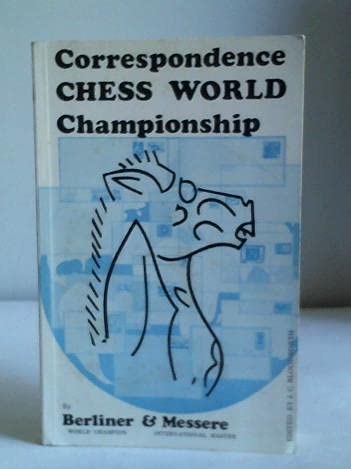
The Fifth Correspondence Chess World Championship, Hans Berliner & Ken Messere, British Chess Magazine, BCM Quarterly Nunber 14, 5th December 1971, ISBN 978-0-900846-05-2.


In the early seventies, in order to reduce numbers of games, I retreated altogether from individual tournaments, just playing twice for England in the Olympiads. Whether team play did not suit my style, or whether my technique had improved but imagination withered, I drew nine of my seventeen games from the two tournaments, winning four and losing four. As England looked likely to aspire to medals for the first time ever, my 50 per cent would not help matters and I gladly retreated to first reserve, which to my dismay required taking over five unfinished games of Hugh Alexander, who died during the tournament, and who, for me, has always been England’s most attractive player and writer. My most uncomfortable decision in correspondence chess was a rejection of Hugh’s intended continuation in one of these games, {Diagram III). Of these five games, I lost one and drew four and England won a bronze medal.

In 1974 was invited to compete in the Potter Memorial Tournament of four postal grandmasters and nine international masters. After so many years of responsible’ team chess for England, I went beserk and sacrificed a pawn in ten of the twelve games, trying later to salvage inferior end-games. Result 33 % per cent. B. H. Wood invited me to write a book of the tournament, to which a number of the players contributed and this was published in 1979.

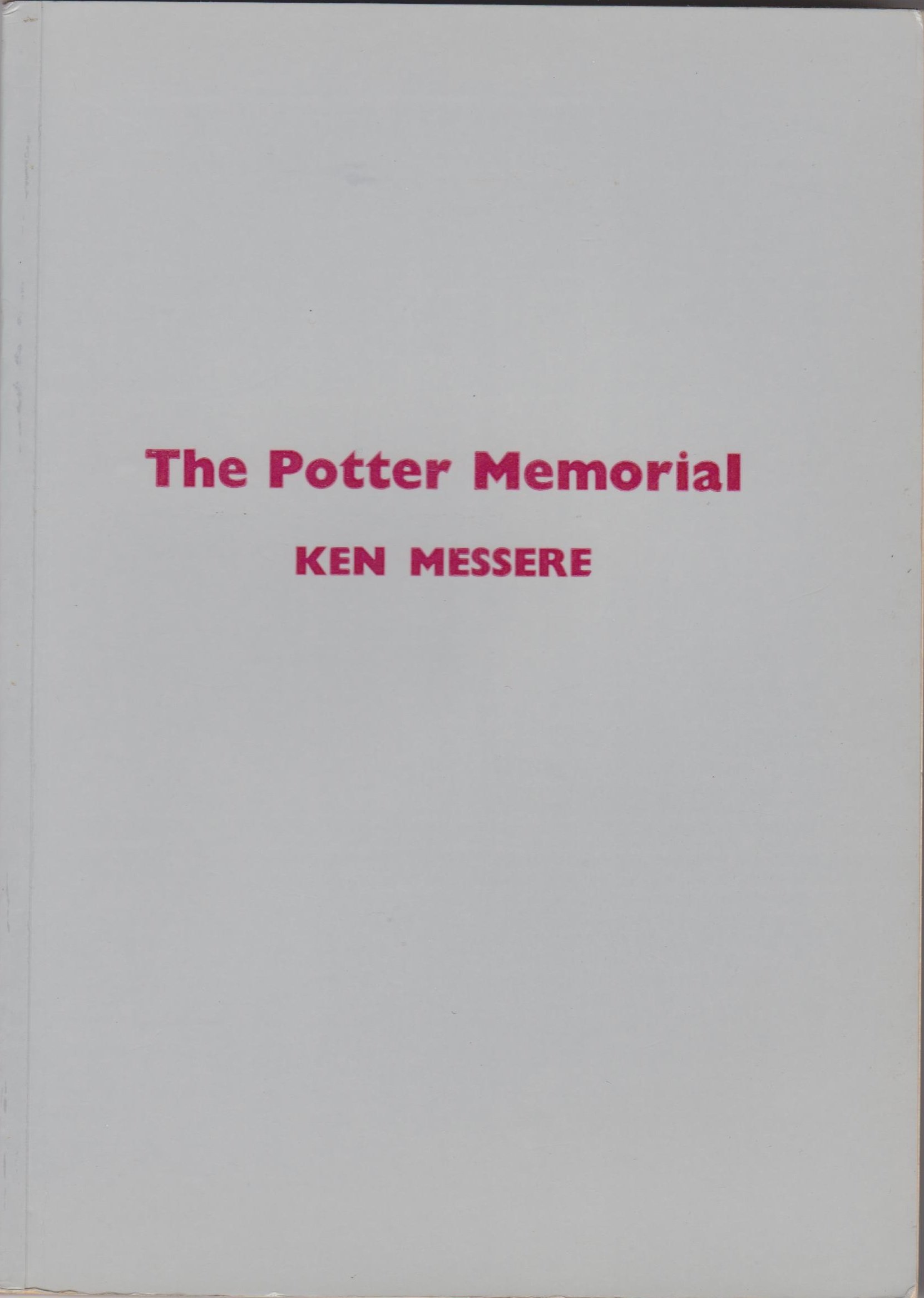
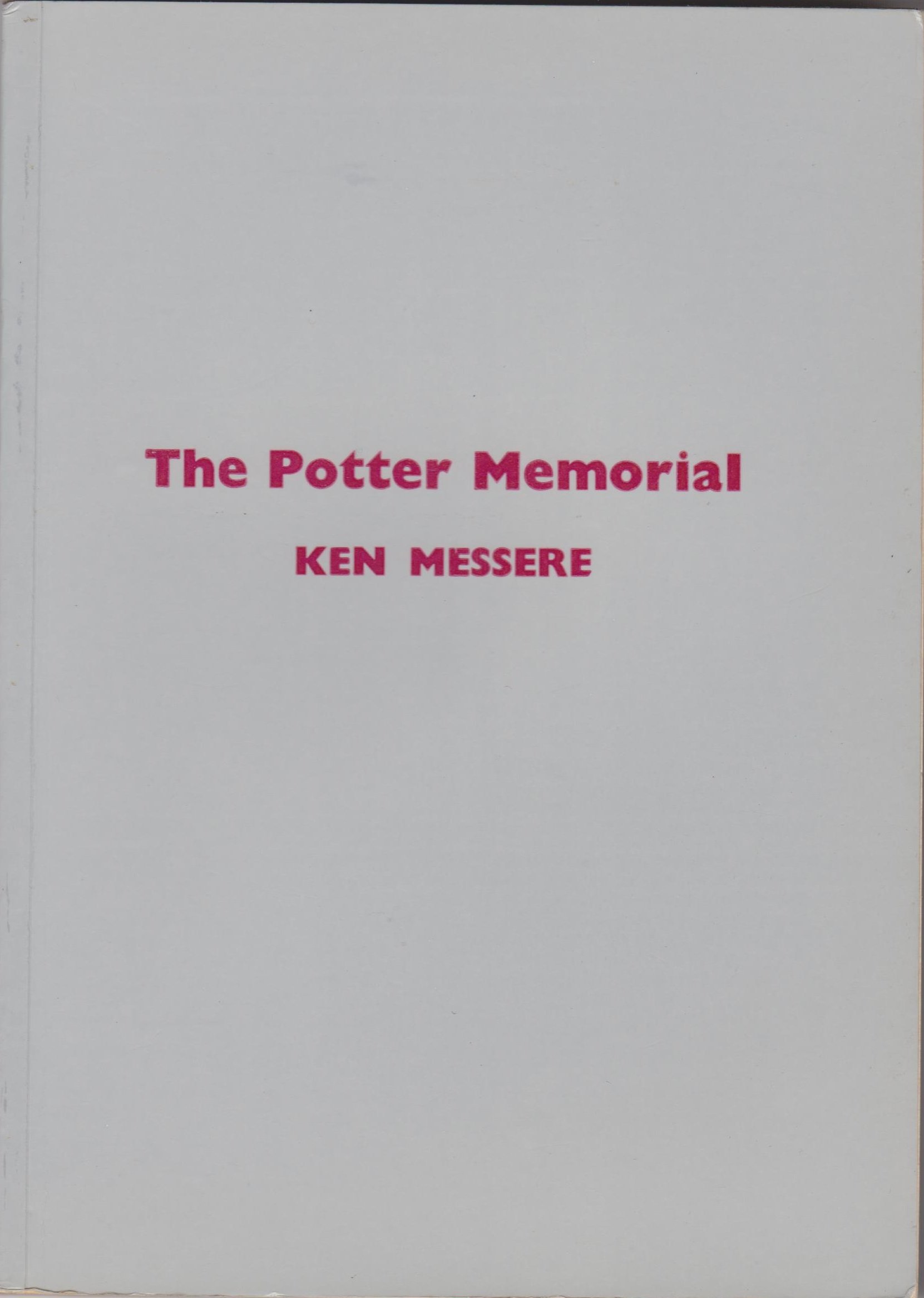
The Potter Memorial, Ken Messere, CHESS (Sutton Coldfield), 1975

Also in 1979 I began to play in another invitation tournament of thirteen players organised by the Australian Correspondence Chess League, which became a memorial to CJS Purdy, its president and the first world postal champion, who died soon after the tournament began. At the time of writing, this tournament, comprising four grandmasters (including one former world champion and two runners-up) and eight international masters, is still in its early stages.”

From British Chess Magazine, Volume CXXV (125, 2005), Number 5 (May), page 226 we have this obituary:

“Kenneth Charles Messere (16 iv 1928, Richmond – 31 iii 2005, Paris) was one of Britain’s strongest correspondence players (he held the correspondence IM title) and well-known author of books on the subject. After graduating from Oxford University, Ken Messere went to HM Customs and Excise, and thence to the Organisation for Economic Development (OECD) where he became head of the fiscal affairs division and a world expert on fiscal law. He reached the final of 1965-8 world correspondence championship, beating world champions Zagorovsky and Estrin, and wrote the book of the tournament with Hans Berliner (published by BCM)”

From The Potter Memorial by Ken Messere, CHESS (Sutton Coldfield), “Chess for Modern Times” Series, 1975 we have this potted biography:

“Compiler of this book, took 3rd place in 1957 and 2nd in 1968 in the championship of the Postal Chess Club. Scores of 4.5 out of 6 in the ICCF Masters 1957-8 and 4/6 in the 1959-61 Championship took him to victory with 11/5 out of 13 in the 1961-3 semi-finals, securing him his first international master norm and qualifying him for the 5th World Championship 1964-7 in which he scored 5.5, just enough for the IM title, with wins over Zagorovsky, then world champion and Estrin, world champion now. Ken Messere collaborated with Berliner, who won it, in a book on the tournament.

He then switched to play exclusively as a member of the British Olympiad team, taking over 2nd board when Alexander died.

The switch back from rather cautious team play to enterprising individual games in 1974-7 provides some of the subject matter of this book.”


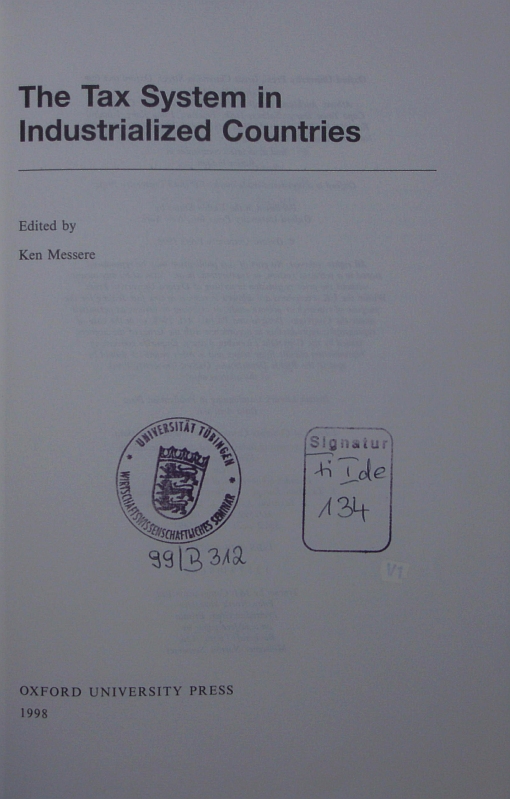
The Tax System in Industrialized Countries, Ken Messere, Oxford University Press, 1998, ISBN 10: 1982933135 / ISBN 13: 9781982933135

Remembering GM Dr. Jonathan Penrose OBE (07-x-1933 30-xi-2021)

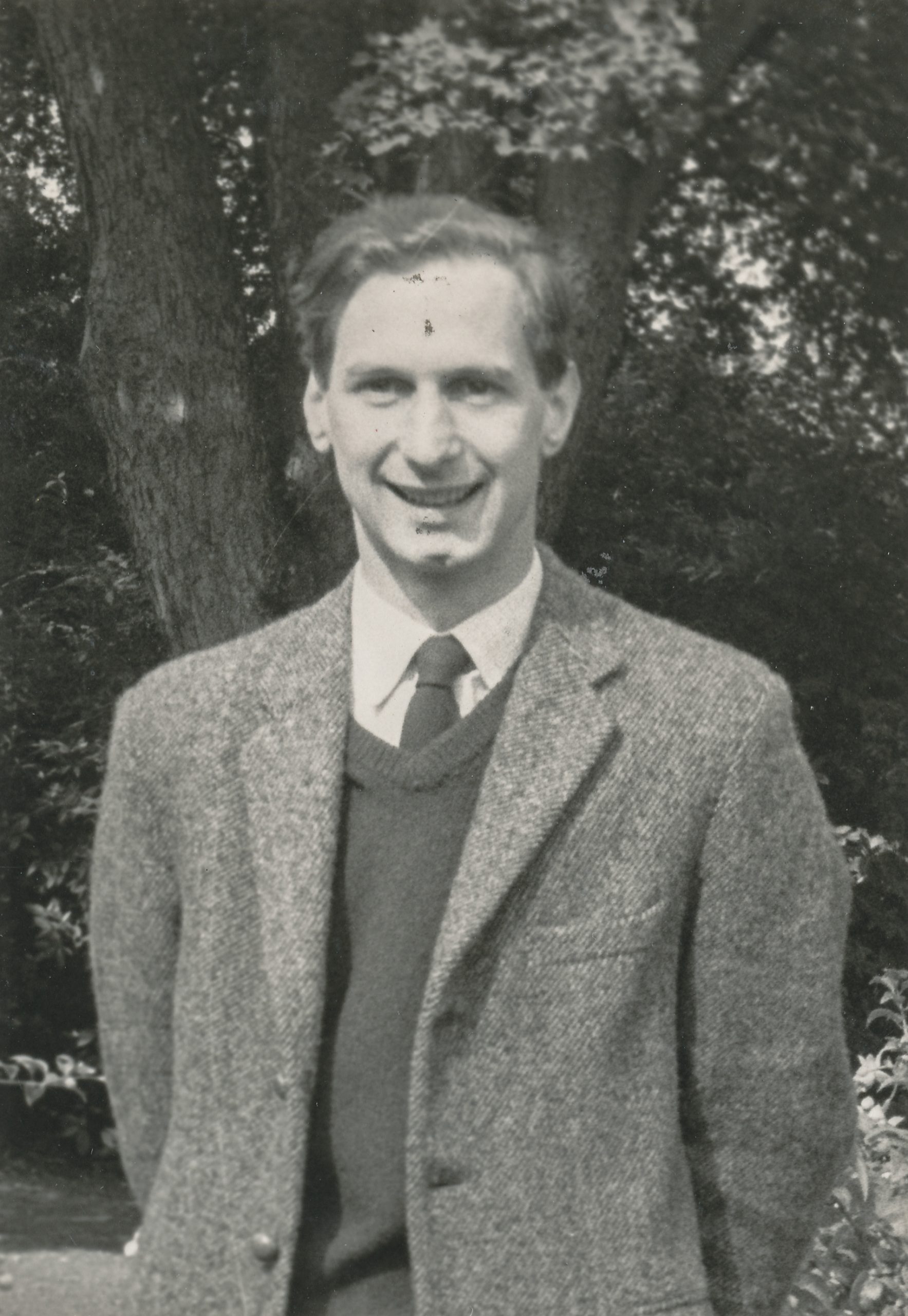
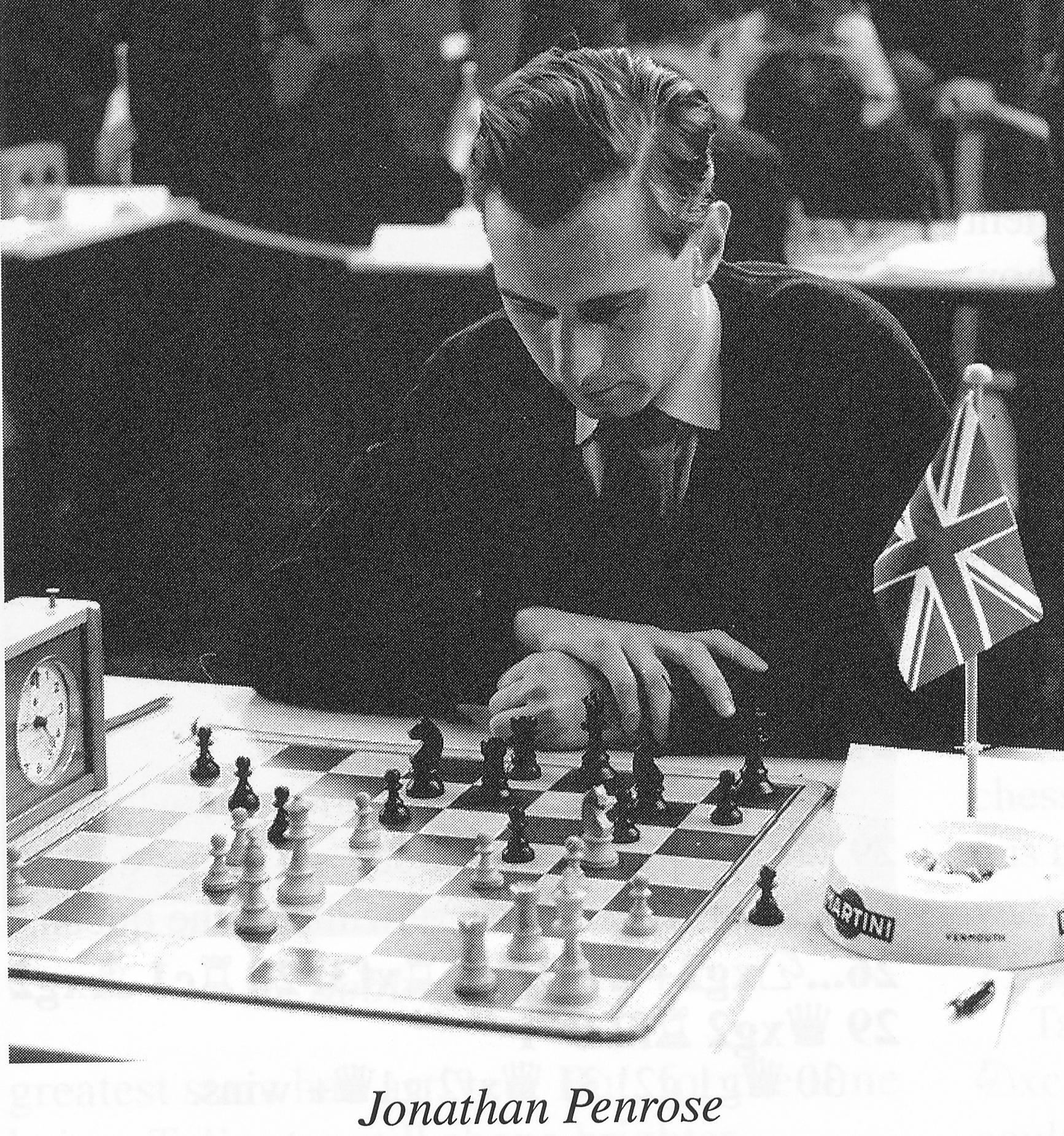
IM Dr. Jonathan Penrose OBE in the garden of Brian Reilly

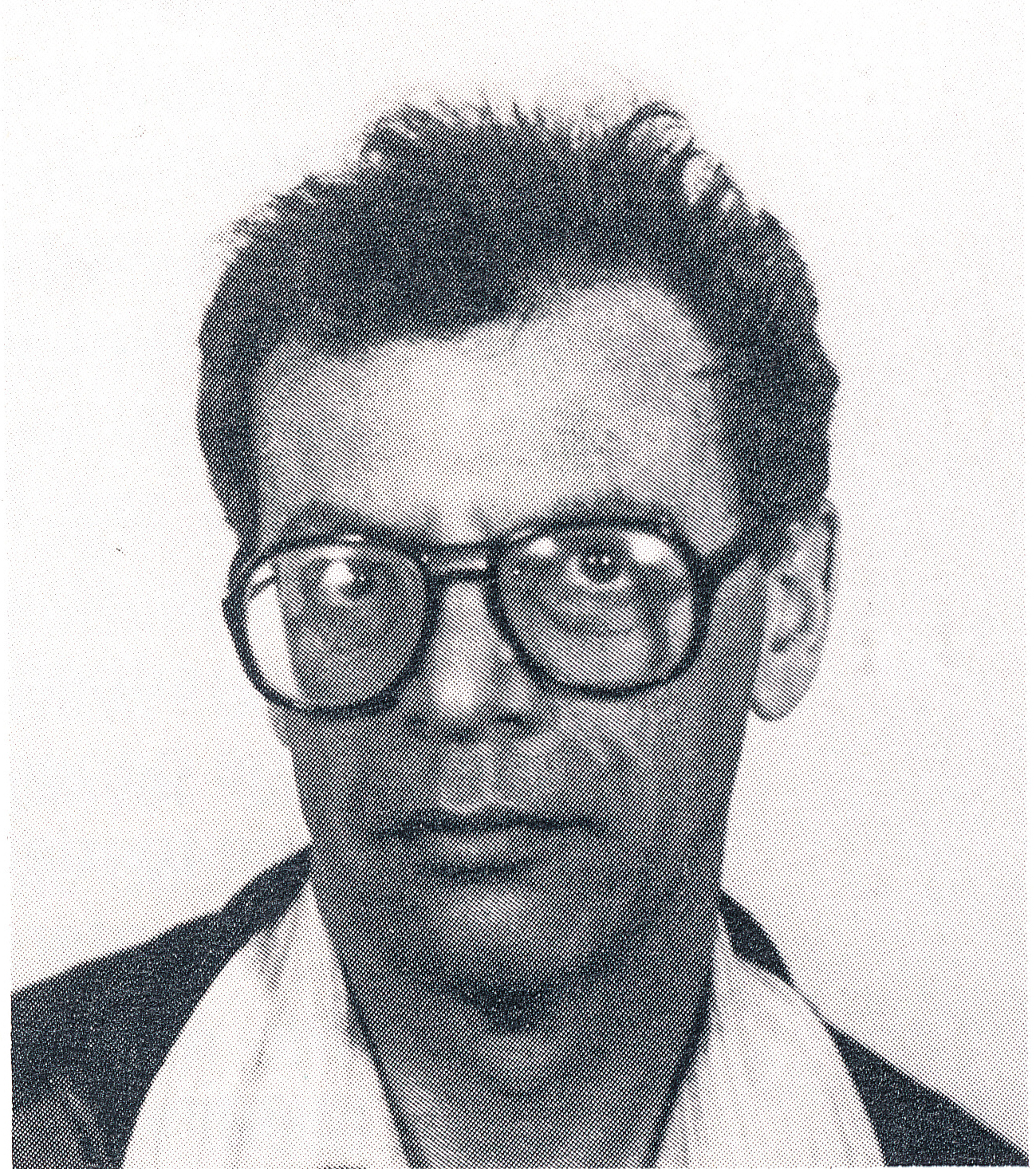
BCN remembers GM Dr. Jonathan Penrose OBE who passed away on Tuesday, November 30th, 2021.

In the 1971 New Years Honours List Jonathan was made an Officer of the Order of the British Empire (OBE) The citation read “For services to Chess.”

In 1993 following representations by Bob Wade and Leonard Barden FIDE granted the title of Grandmaster to Jonathan. Here is a detailed discussion of that process. Note that this was not an Honorary title (as received by Jacques Mieses and Harry Golombek).

From British Chess (Pergamon Press, 1983) by Botterill, Levy, Rice and Richardson : (article by George Botterill)

“Penrose is one of the outstanding figures of British chess. Yet many who meet him may not realize this just because he is one of the quietest and most modest of men. Throughout the late 1950s and the whole of the 1960s he stood head and shoulders above any of his contemporaries.

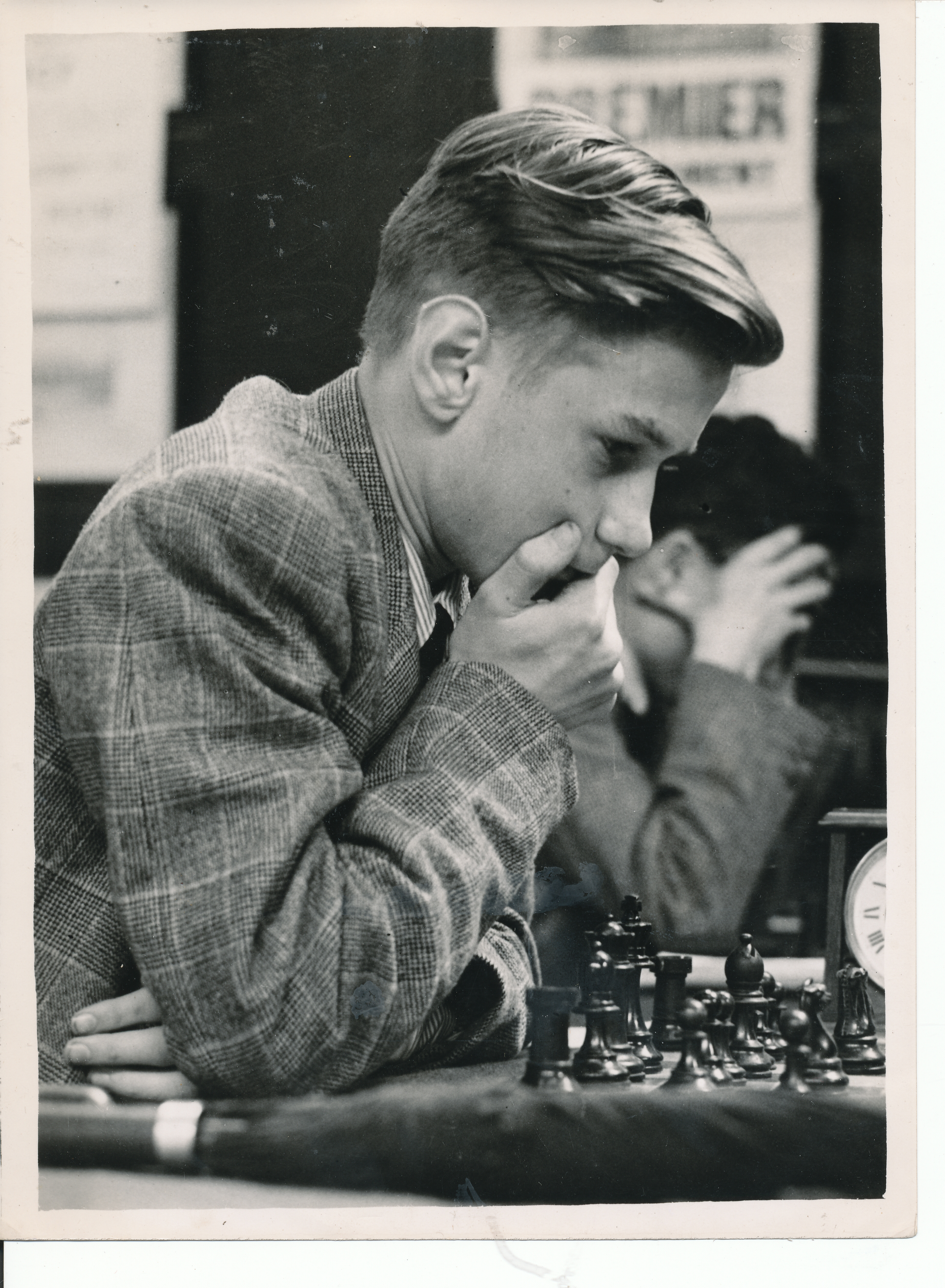
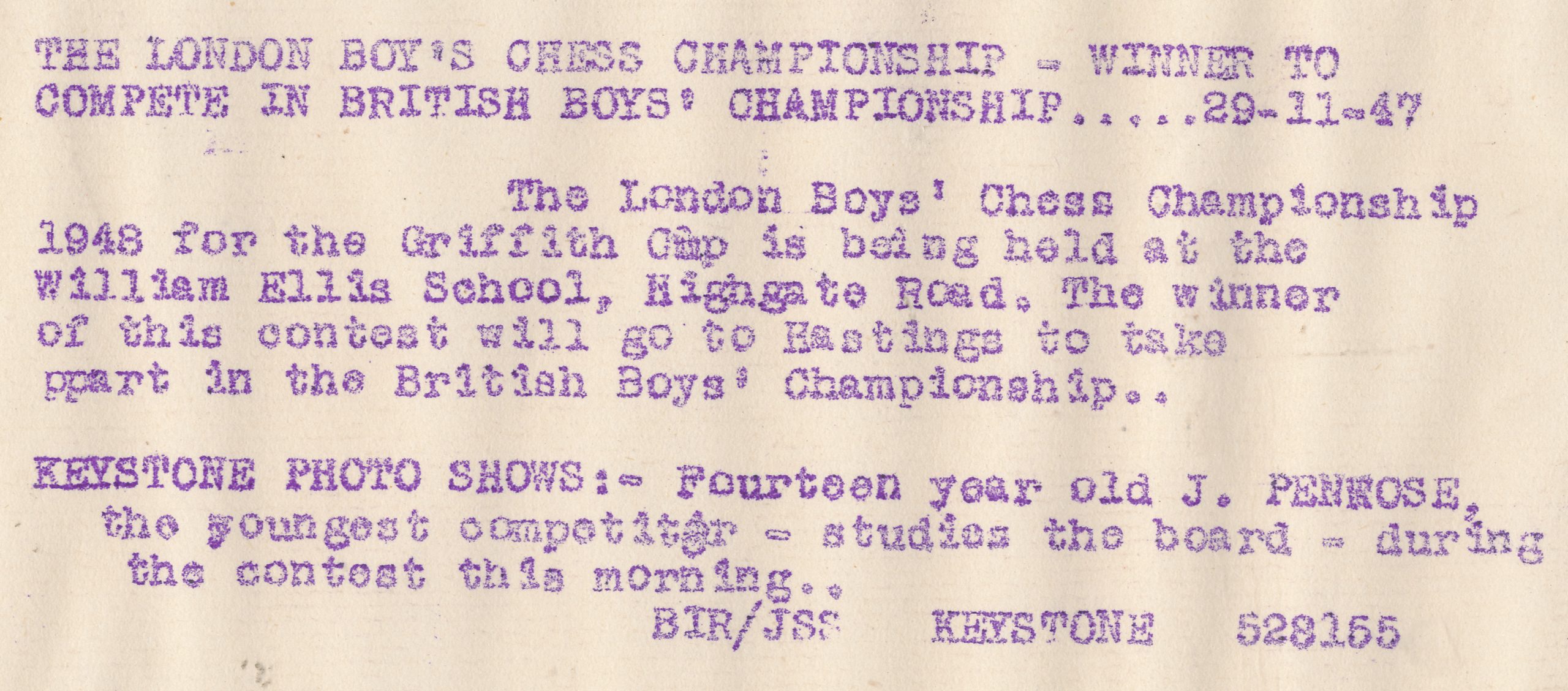
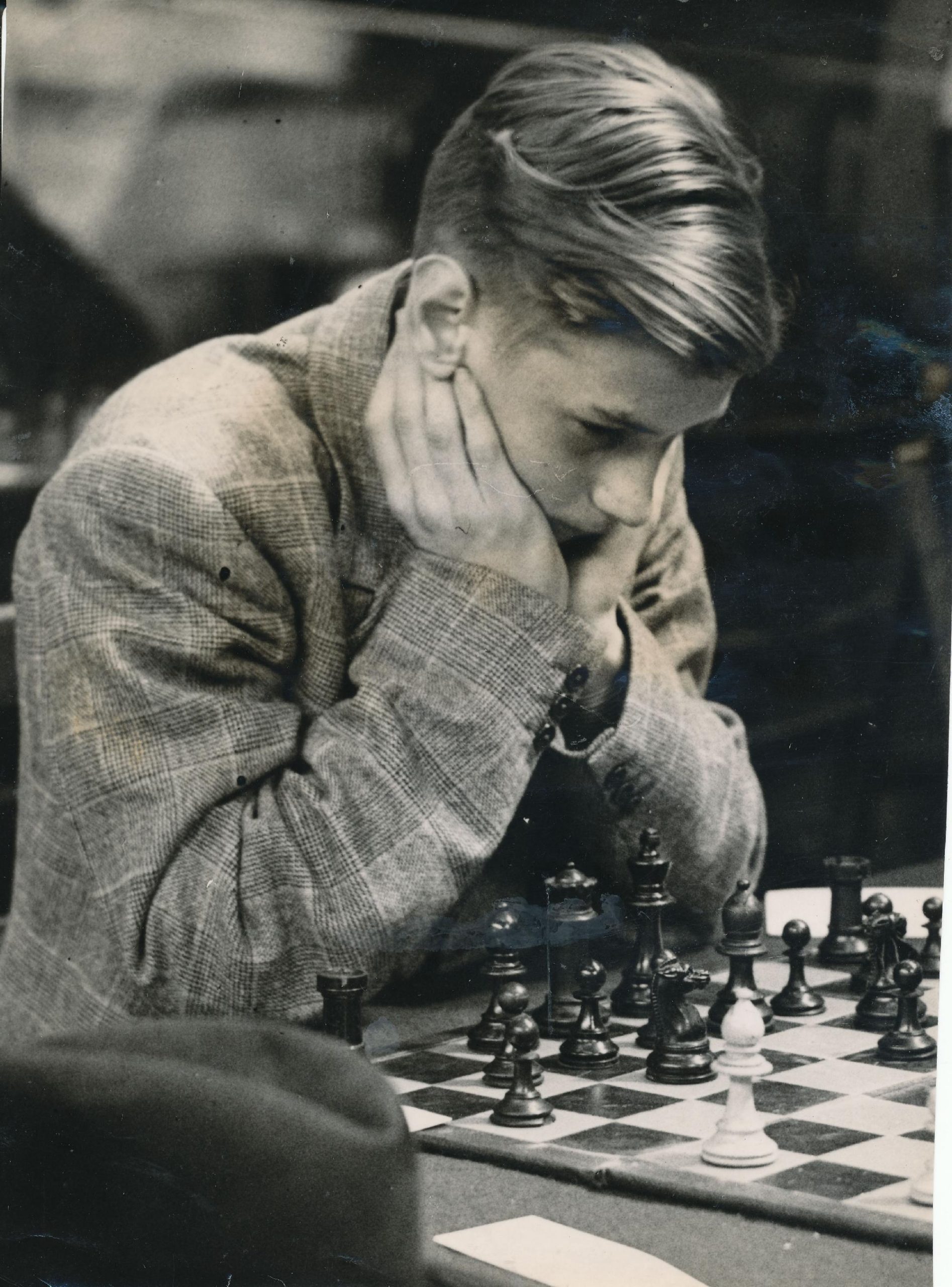
See caption below
See caption below
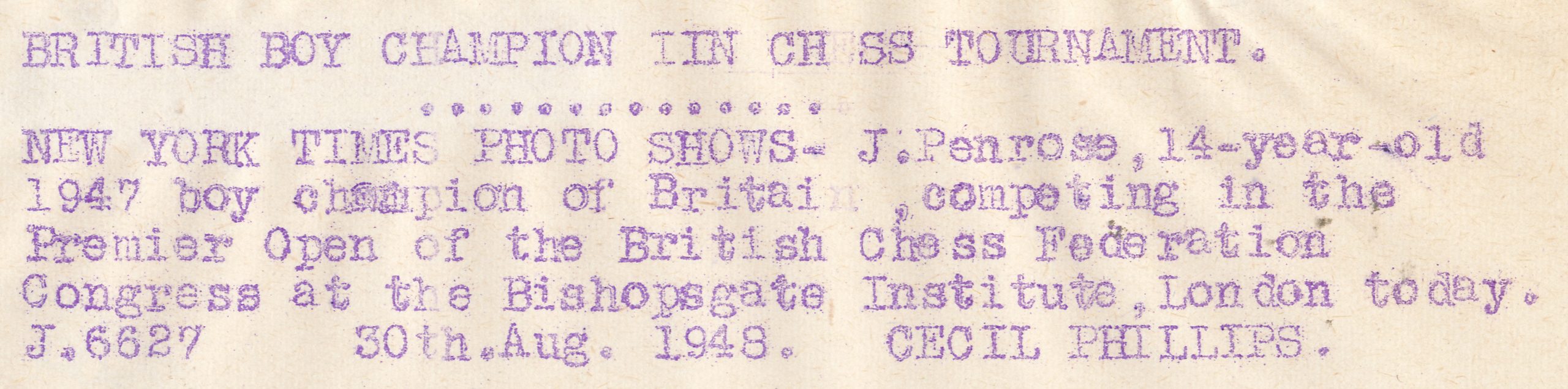
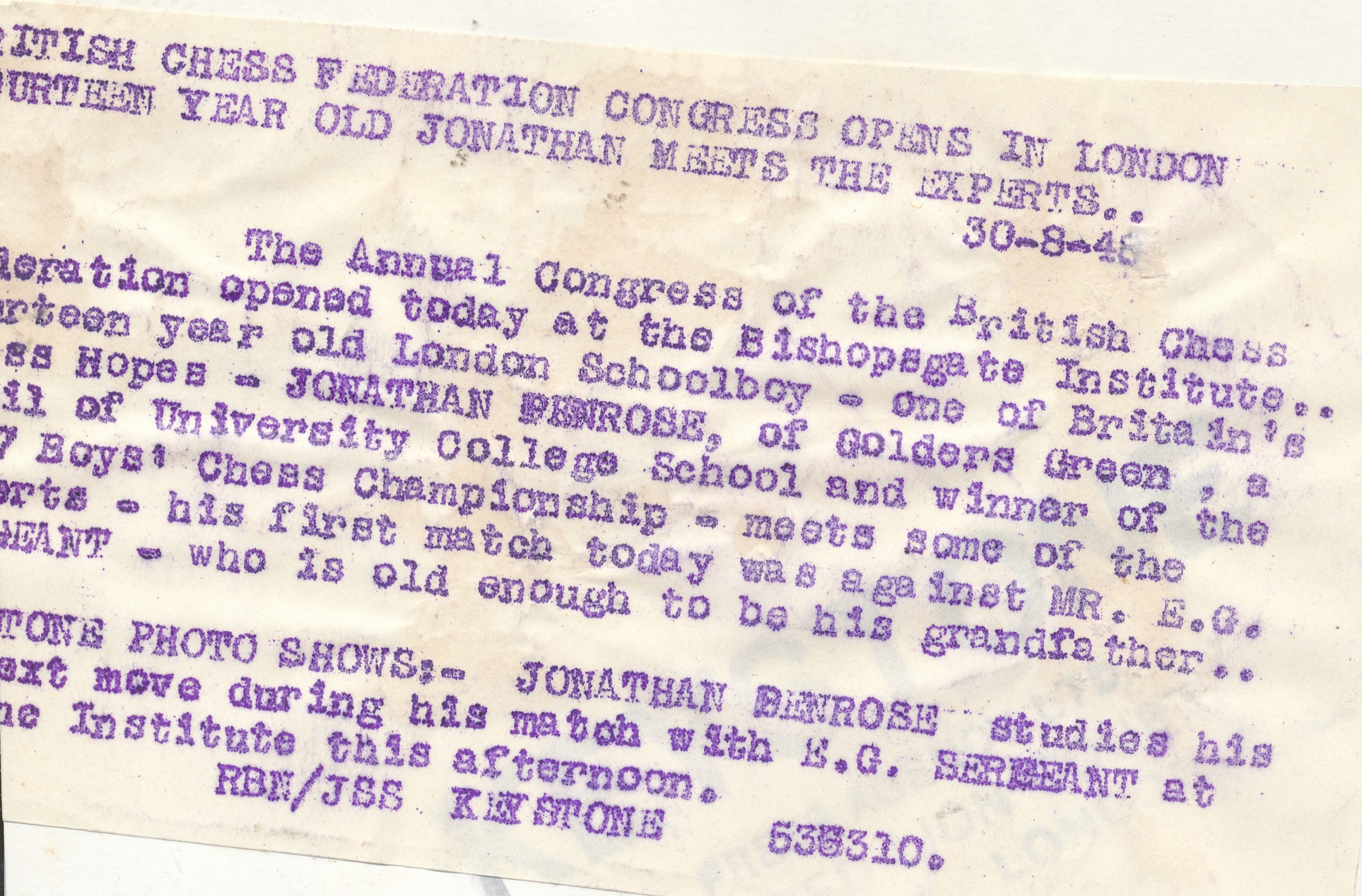
Press agency caption for photograph above

His extraordinary dominance is revealed by the fact that he won the British championship no less than ten times (1958-63 and 1966-69, inclusive), a record that nobody is likely to equal in the future.

At his best his play was lucid, positionally correct, energetic and tactically acute. None the less, there is a ‘Penrose problem’: was he a ‘Good Thing’ for British chess? The trouble was that whilst this highly talented player effectively crushed any opposition at home, he showed little initiative in flying the flag abroad. There is a wide-spread and justifiable conviction that only lack of ambition in the sphere of international chess can explain why he did not secure the GM title during his active over-the-board playing career.

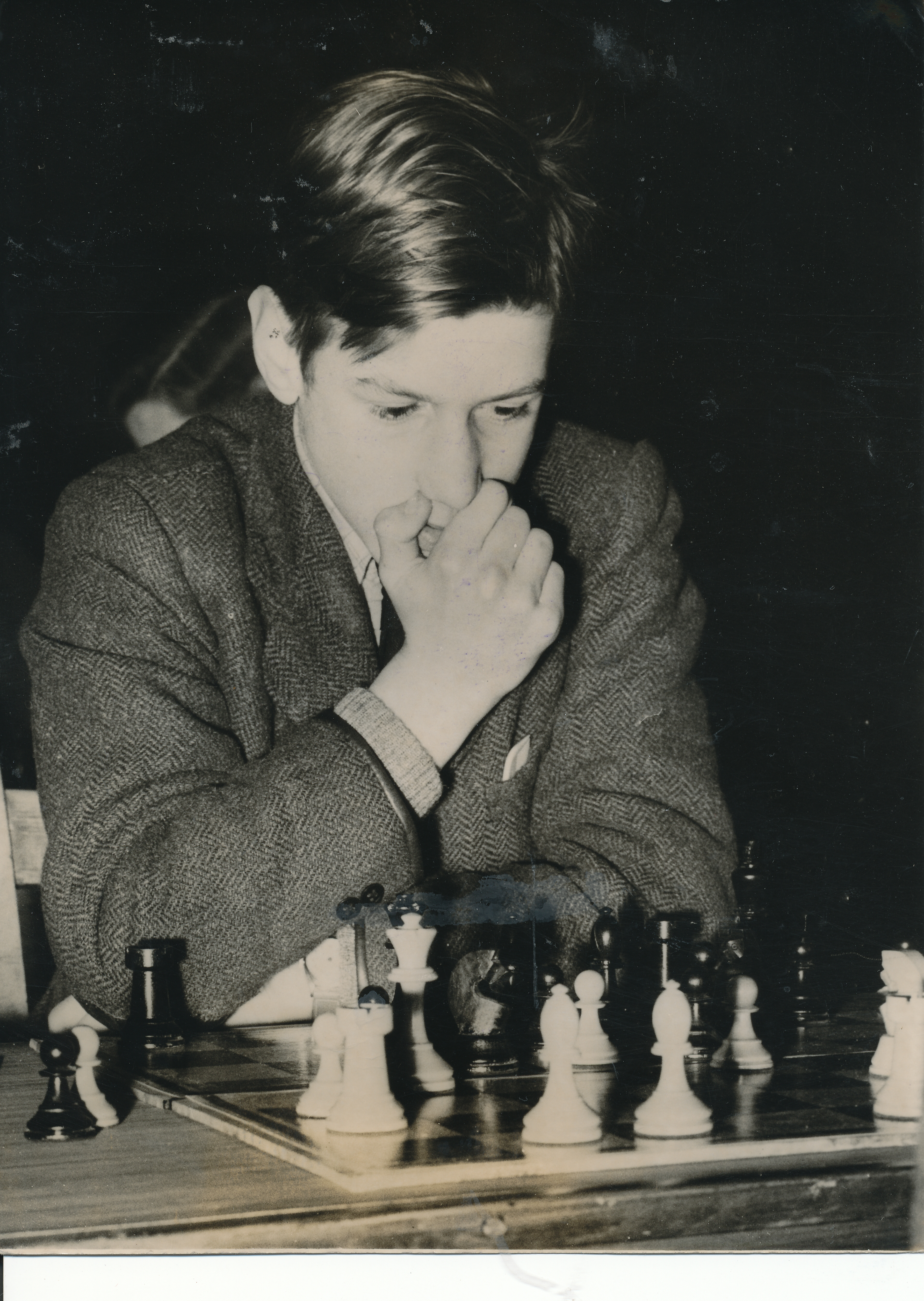
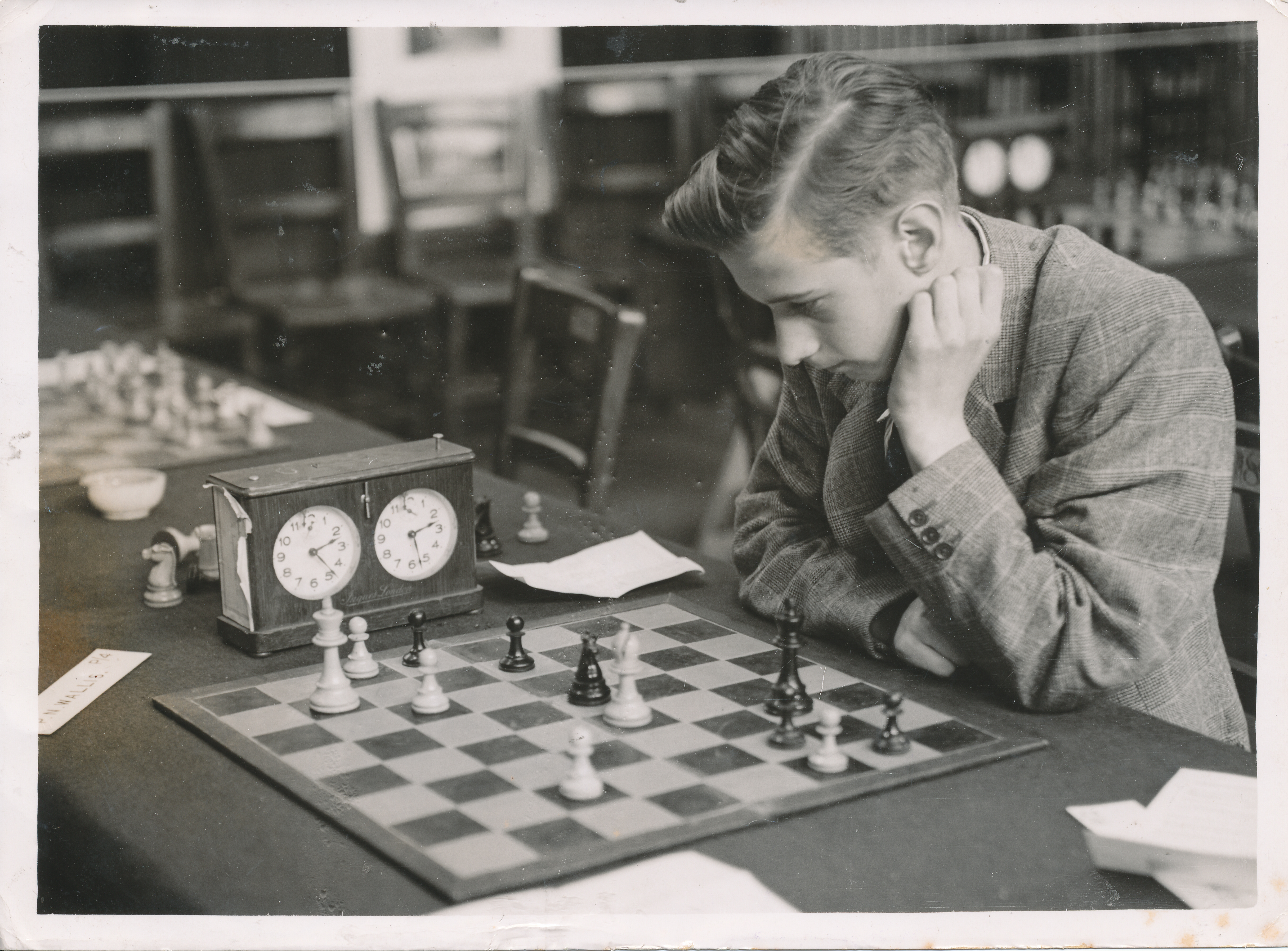
See caption below
See caption below
Press agency caption for above photograph

It would be unjust, however, to blame Penrose for any of this. The truth is simply that he was not a professional chessplayer, and indeed he flourished in
a period in which chess playing was not a viable profession in Britain. But even if the material awards available had been greater Penrose would almost certainly have chosen to remain an amateur. For he was cast in that special intellectual and ethical tradition of great British amateurs like H. E. Atkins, Sir George Thomas and Hugh Alexander before him.

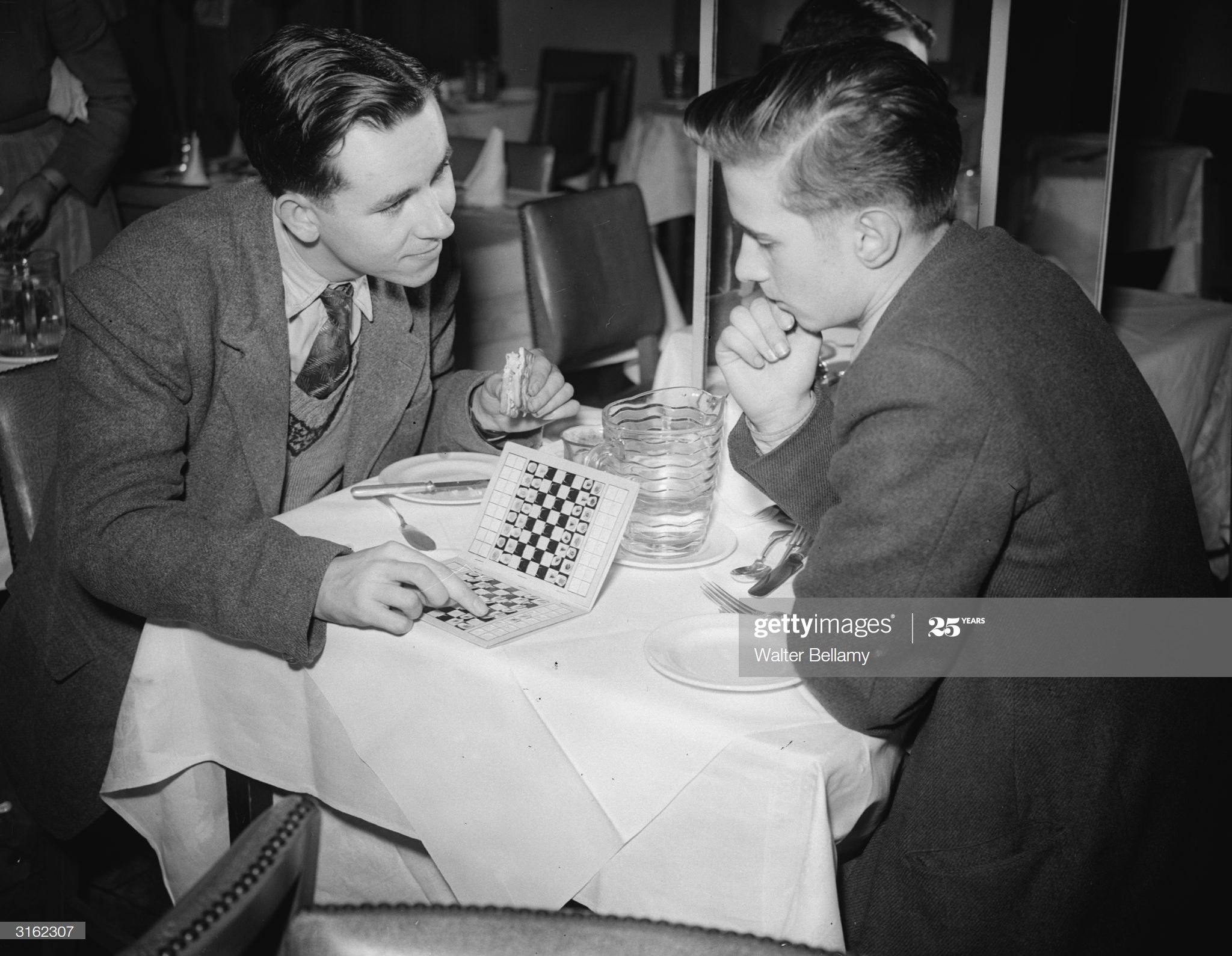
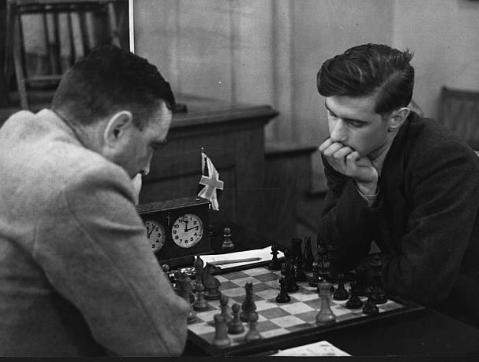
Travel Chess 2nd January 1951: British chess champions Jonathan Penrose and Leonard Barden ponder over a portable travel game in a restaurant. (Photo by Walter Bellamy/Express/Getty Images)
Travel Chess
2nd January 1951: British chess champions Jonathan Penrose and Leonard Barden ponder over a portable travel game in a restaurant. (Photo by Walter Bellamy/Express/Getty Images)

His family background indicates early academic inclinations in a cultural atmosphere in which chess was merely a game something at which one excelled through sheer ability, but not to be ranked alongside truly serious work. It is noteworthy that Penrose, unique in this respect amongst British chess masters, has never written at any length about the game. He has had other matters to concentrate on when away from the board, being a lecturer in psychology. (His father, Professor L. S. Penrose, was a distinguished geneticist.)

IM Dr. Jonathan Penrose OBE

Being of slight physique and the mildest and most amiable of characters, it is probably also true that Penrose lacked the toughness and ‘killer instinct’ required to reach the very top. Nervous tension finally struck him down in a dramatic way when he collapsed during play in the Siegen Olympiad of 1970. We can take that date as the end of the Penrose era.

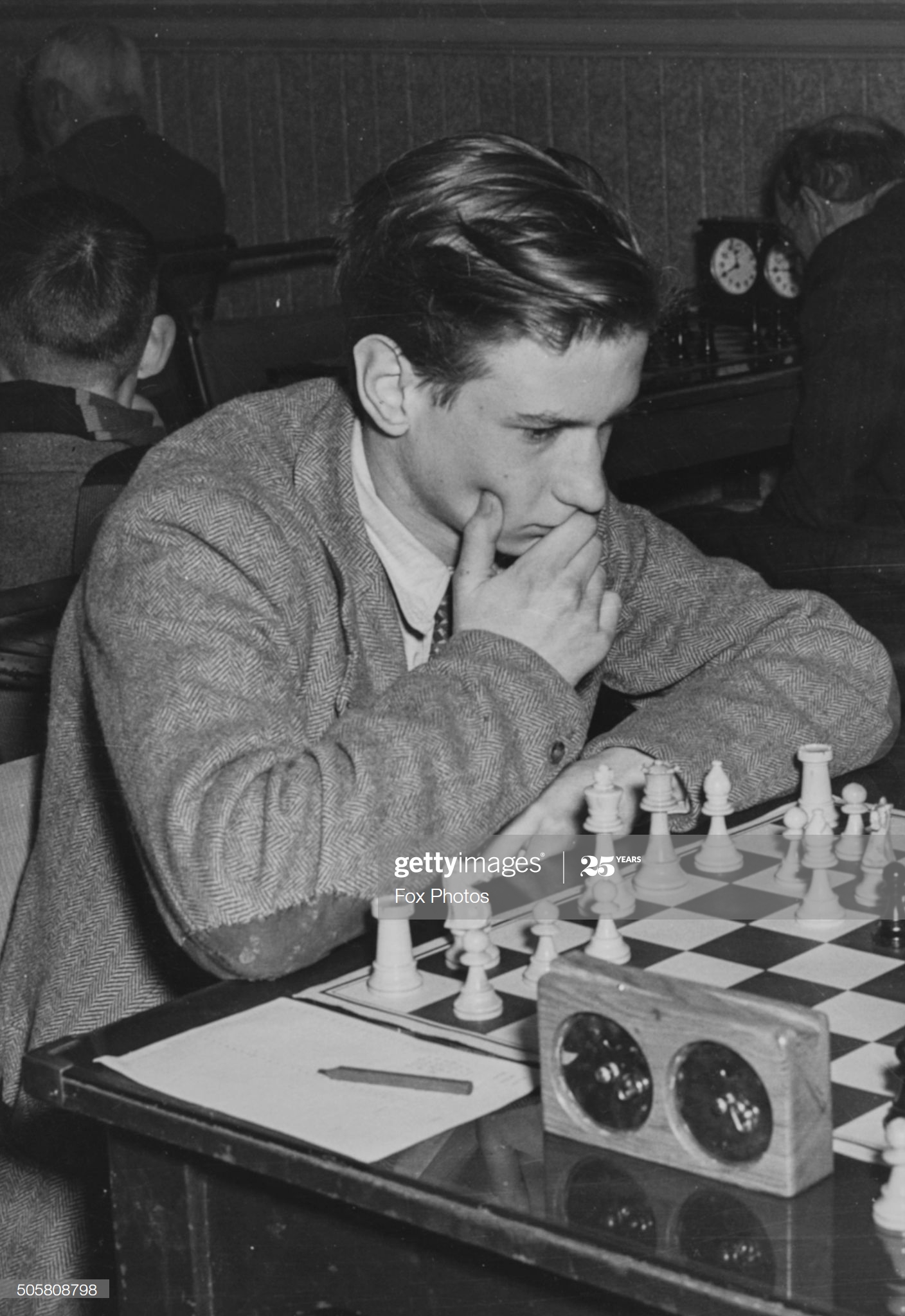
Jonathan Penrose Chess Grandmaster Jonathan Penrose pictured during a chess match, circa 1960. (Photo by Fox Photos/Hulton Archive/Getty Images)
Jonathan Penrose
Chess Grandmaster Jonathan Penrose pictured during a chess match, circa 1960. (Photo by Fox Photos/Hulton Archive/Getty Images))

Since, then though he has not by any means entirely given up, his involvement in the nerve-wracking competitions of over-the-board play has been greatly reduced. instead he has turned to correspondence chess, which is perhaps the ideal medium for his clear strategy and deep and subtle analysis. So Penrose’s career it not over. He has moved to another, less stressful province of the kingdom of chess.

IM Dr. Jonathan Penrose OBE

For the first game, however, we shall turn the clock right back to 1950 and the see the Penrose in the role of youthful giant killer.

[pgn]
[Event “Southsea”]
[Site “Southsea”]
[Date “1950.??.??”]
[Round “3”]
[White “Penrose, Jonathan”]
[Black “Bogoljubow, Efim”]
[Result “1-0”]
[ECO “B56”]
[Annotator “George Botterill & BCN”]
[PlyCount “61”]
[EventDate “1950.??.??”]
[EventType “swiss”]
[EventRounds “10”]
[EventCountry “ENG”]
[SourceTitle “EXT 1999”]
[Source “ChessBase”]
[SourceDate “1998.11.16”]
[SourceVersion “1”]
[SourceVersionDate “1998.11.16”]
[SourceQuality “1”]

{[%evp 0,61,19,31,72,53,68,72,74,26,26,35,78,54,64,49,91,81,85,45,69,69,49,55,
46,30,64,74,93,97,132,124,124,98,152,152,152,76,65,59,51,64,64,64,20,20,38,14,
116,159,216,216,216,223,223,223,511,570,615,900,1224,2338,29993,29994]} {
Jonathan was 17 years old when this game was played.} 1. e4 c5 2. Nf3 d6 3. d4
cxd4 4. Nxd4 Nf6 5. Nc3 Nbd7 {A pretty rare continuation, not hitting White’s
centre but maybe aiming for c5 at some point.} 6. g3 a6 7. Bg2 e6 8. O-O Be7 9.
b3 (9. Be3) 9… Qc7 10. Bb2 O-O 11. Kh1 $146 {This was a novelty in 1950} (11.
a4 Rb8 12. a5 b5 13. axb6 Qxb6 14. g4 {was Dubov – Korobov, 2017.}) 11… Rd8
12. Qe2 $146 (12. f4 Nc5 {was Rayner – Arakhamia Grant, 2001, 0-1.}) 12… Nf8
$2 {“With a knight on f8 I cannot be mated”, as Larsen is fond of saying. But
here it is more important that Black loses control over e5.} (12… Bf8 {
to be followed by …Rb8, …b5 and …Bb7 seems a better scheme of
development. With the rooks on d8 and b8 Black must beware of White’s little
tactic e5 dxe5 Nc6 forking the rooks. But in most cases Black should get at
least one pawn and fair value for the exchange.}) 13. f4 $16 Rb8 14. Rad1 Bd7
15. e5 (15. g4 d5 16. e5) 15… Ne8 {[#]} 16. Nf5 $1 {A familiar trick in the
Sicilian} Ng6 ({if} 16… exf5 17. Nd5 $18) 17. Nxe7+ Nxe7 18. Ne4 d5 19. Nd6
$1 Qa5 $2 (19… Bc6) 20. Qh5 (20. g4) 20… Nxd6 21. exd6 Nf5 22. g4 Nxd6 {[#]
} ({Of course not} 22… Ne3 $4 23. Qe5 $18 {with a double attack on g7 and e3}
(23. Qg5 {is crushing also} g6 24. Qf6 d4 25. Bxd4 e5 26. fxe5 Nxg4 27. Qxf7+
Kh8 28. e6+ Ne5 29. Qf6+ Kg8 30. Bxe5 {and its mate in 6.})) 23. f5 $1 Qxa2 24.
Be5 (24. fxe6 Bxe6 25. Qe5) 24… Ne8 {Giving up the exchange does not help
much.} (24… Bb5 25. Rf2 {[%cal Gd1a1] threatening Ra1} Qa5 26. fxe6 {wins
quickly}) 25. fxe6 Bxe6 26. Bxb8 Rxb8 27. Qe5 $1 Rc8 28. Bxd5 Nf6 29. Bxe6 Re8
30. Bxf7+ Kxf7 31. Rxf6+ $1 1-0
[/pgn]

From The Encyclopedia of Chess (BT Batsford, 1977) by Harry Golombek :

“British international master and ten times British Champion, Penrose was born in Colchester and came from a chess-playing family.

Lionel Sharples Penrose, FRS (11 June 1898 – 12 May 1972)

His father and mother (Margaret)  both played chess and his father, Professor Lionel Sharples Penrose, in addition to being a geneticist of world-wide fame, was a strong chess-player and a good endgame composer. Jonathan’s older brother Oliver, was also a fine player.

Oliver Penrose FRS FRSE (born 6 June 1929) is a British theoretical physicist

Roger Penrose won the Nobel prize for physics in 2020.

Roger Penrose. Nobel Laureate

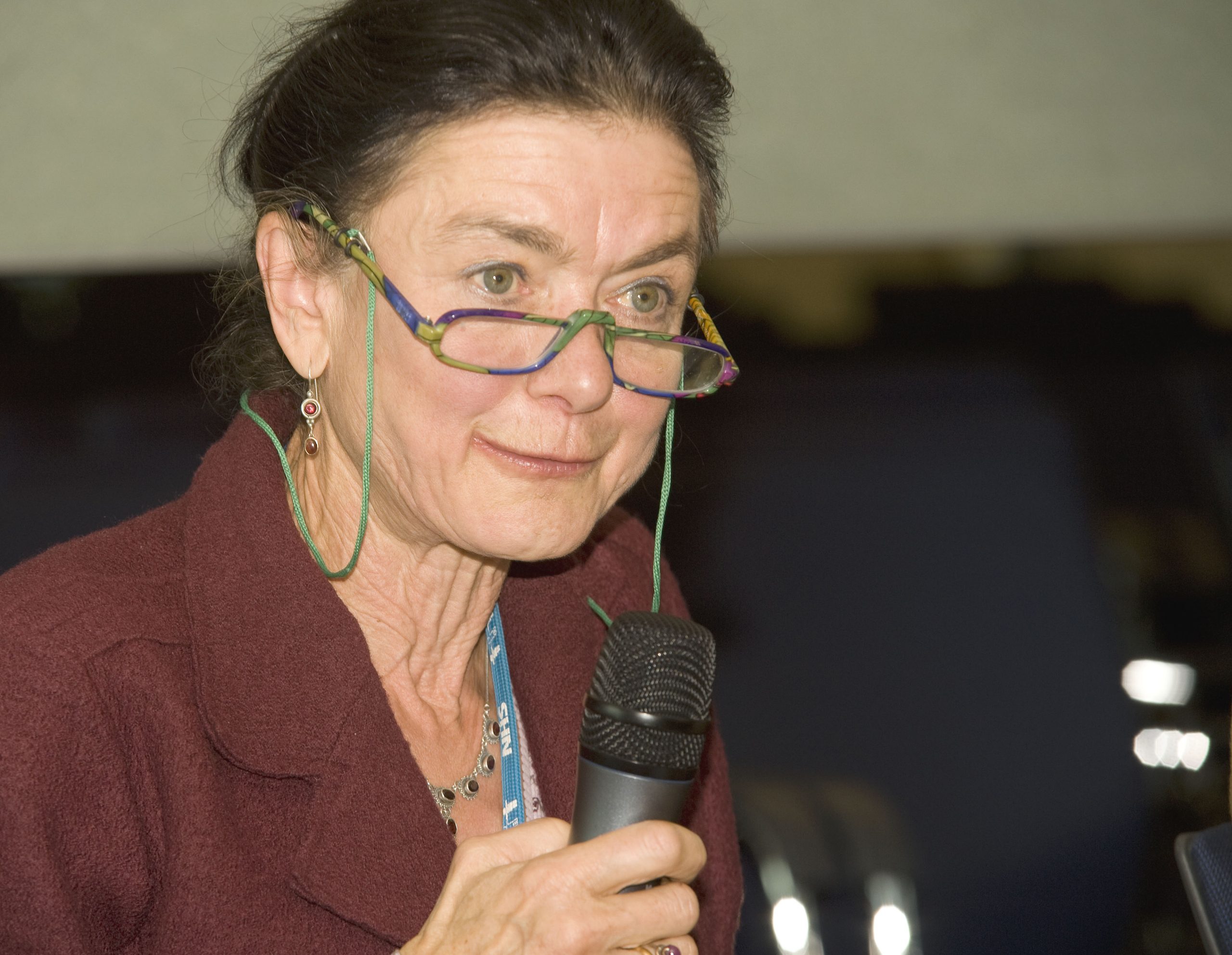
Shirley Hodgson (née Penrose) is a high flying geneticist.

Prof. Shirley Hodgson

Jonathan learnt chess at the age of four, won the British Boys championship at thirteen and by the time he was fifteen was playing in the British Championship in Felixstowe in 1949.

Press agency caption for photograph above

A little reluctant to participate in international tournaments abroad, he did best in the British Championship which he won a record number of times, once more than HE Atkins. He won the title consecutively from 1958 to 1963 and again from 1966 to 1969.

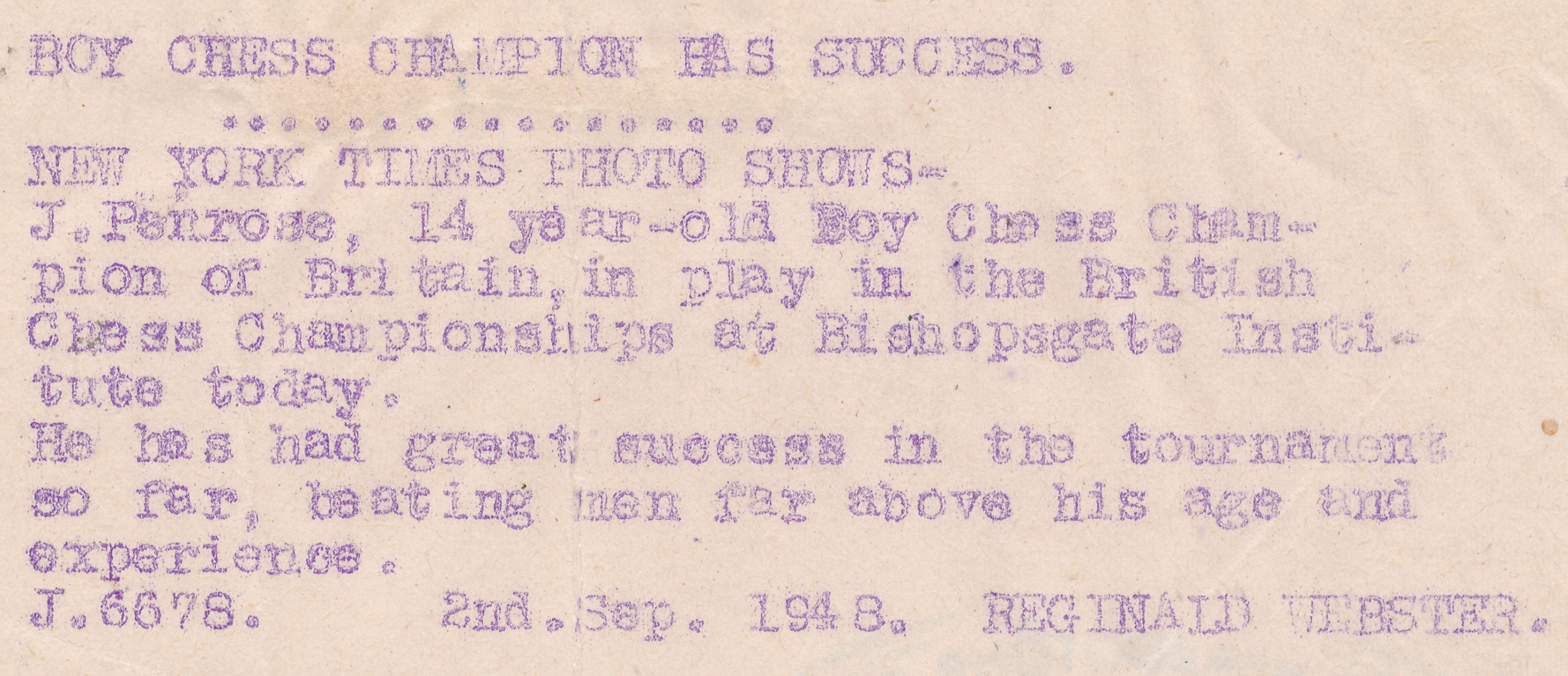
Boy Chess Champion. New York Times photo shows 14 year old J. Penrose 14 year old by chess champion of Britain, in play at the British Chess Championships at Bishopsgate Institute today. He has had great success in the tournament so far, beating men far above his age and experience. 2nd September 1948. Photograph by Reginald Webster
Press agency caption for photograph above

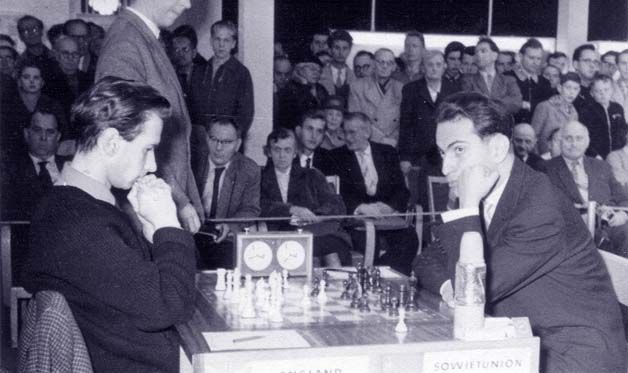
He also played with great effect in nine Olympiads. Playing on a high board for practically all the time, he showed himself the equal of the best grandmasters and indeed, at the Leipzig Olympiad he distinguished himself by beating Mikhail Tal, thereby becoming the first British player to defeat a reigning World Champion since Blackburne beat Lasker in 1899.

ARB Thomas and Jonathan Penrose at the Hastings Congress of 1950/1951

[pgn]
[Event “Olympiad-14 Final A”]
[Site “Leipzig”]
[Date “1960.11.08”]
[Round “11”]
[White “Penrose, Jonathan”]
[Black “Tal, Mikhail”]
[Result “1-0”]
[ECO “A65”]
[Annotator “Knaak,R”]
[PlyCount “77”]
[EventDate “1960.10.28”]
[EventType “team-tourn”]
[EventRounds “11”]
[EventCountry “DDR”]
[SourceTitle “EXT 1999”]
[Source “ChessBase”]
[SourceDate “1998.11.16”]
[SourceVersion “1”]
[SourceVersionDate “1998.11.16”]
[SourceQuality “1”]
[WhiteTeam “England”]
[BlackTeam “Soviet Union”]
[WhiteTeamCountry “ENG”]
[BlackTeamCountry “URS”]

{[%evp 0,77,14,29,8,5,0,0,58,58,90,90,99,98,98,98,92,41,71,54,67,47,50,50,60,
17,11,11,11,29,25,-24,26,32,78,97,133,100,113,100,96,82,124,87,113,107,150,179,
179,220,220,229,229,229,269,201,201,201,201,201,206,205,252,252,252,252,308,
319,432,402,479,480,534,549,866,881,888,888,895,895] Jonathan Penrose war
Jahre lang einer der führenden englischen Spieler. 1979 spielte er seine
letzten Partien, die auch von der Mega Datenbank erfasst sind; seine
Schachlaufbahn war damit aber noch lange nicht beendet, denn nun stieg er im
Fernschach zur absoluten Weltspitze auf. Doch im Nahschach wird sein Name wohl
für immer mit dieser einen Partie von der Schacholympiade in Leipzig verknüpft
sein. Die Sowjetunion war auf einem Triumpfmarsch sondergleichen – jedes
einzelnen Match wurde gewonnen und bis zur letzten Runde gab es auch keine
einzige Niederlage in einer Einzelpartie, bis eben zu dieser.} 1. d4 $1 {
Penrose war ein e4-Spieler und warf Tal nun aus der Vorbereitung.} Nf6 2. c4 e6
3. Nc3 c5 {Tal will den vollen Punkt. Objektiv ist Ben-Oni aber leider
minderwertig.} 4. d5 exd5 5. cxd5 g6 6. e4 d6 7. Bd3 Bg7 8. Nge2 O-O 9. O-O {
Ich spiele diesen Aufbau selbst und glaube an ihn. Weiß wird das Feld g4 mit
h2-h3 schützen und steht dann schon zu f2-f4 bereit. Schwarz krankt an seiner
Raumnot – ein Zug wie Bg4 steht hier nicht zur Verfügung.} a6 {Alternativen
wie Na6-c7 und erst dann a6 sowie auch 9…b6 gelten heute als
aussichtsreicher. RR: Diese aus schwarzer Sicht pessimistische Einschätzung
gilt seit dem Buch von John Watson über die Ben-Oni-Verteidigung nicht mehr.
Viel mehr scheint der Aufbau mit 9…a6 sogar am besten zu sein.} 10. a4 Qc7
11. h3 Nbd7 12. f4 Re8 13. Ng3 c4 14. Bc2 Nc5 (14… Rb8 $1 15. Be3 Nc5 {
ist die Hauptvariante.}) 15. Qf3 (15. Be3 Nfxe4 16. Ncxe4 Nxe4 17. Bxe4 f5 18.
Qe2 fxe4 19. f5 $13) 15… Nfd7 ({Schwarz sollte} 15… Rb8 {spielen, um
möglichst schnell b5 durchzusetzen. Nach} 16. e5 dxe5 (16… Nfd7 17. Nce4 Nxe4
18. Nxe4 dxe5 19. f5 $36) 17. fxe5 Rxe5 18. Bf4 Nfd7 {erhält Schwarz Spiel für
die Qualität.}) 16. Be3 b5 17. axb5 Rb8 18. Qf2 axb5 {Das nun folgende
Bauernopfer ist zum Standardverfahren für diesen Stellungstyp und die ganze
Variante mit Ld3 und Sge2 geworden.} 19. e5 $1 dxe5 20. f5 $1 (20. fxe5 Rf8 21.
d6 Qc6 22. Nce4 Bxe5 $13) 20… Bb7 21. Rad1 Ba8 $2 ({Es gibt eine Grundregel
bei dieser Bauernstruktur: Wenn Schwarz den “störenden” Bauern e5 zurückopfern
kann, sollte er es auch tun.} 21… e4 $1 {mit unklarer Stellung; Schwarz kann
z.B. nach Bf4 immer ganz gut die Qualität opfern, weil der Bg7 dann noch mehr
zum Riesen wird.}) 22. Nce4 $16 {Ein Traumfeld für jeden Springer.} Na4 $6 {
Verliert glatt.} 23. Bxa4 bxa4 24. fxg6 fxg6 25. Qf7+ Kh8 26. Nc5 Qa7 27. Qxd7
(27. Nge4 $1) (27. Rf2 $1 {droht Springerabzug}) 27… Qxd7 28. Nxd7 Rxb2 29.
Nb6 Rb3 30. Nxc4 Rd8 31. d6 Rc3 32. Rc1 Rxc1 33. Rxc1 Bd5 34. Nb6 Bb3 35. Ne4
h6 36. d7 Bf8 37. Rc8 Be7 38. Bc5 Bh4 39. g3 1-0
[/pgn]

Jonathan Penrose vs Mikhail Tal, Leipzig Olympiad, 1960, 1-0, Modern Benoni

A deep strategist who could also hold his own tactically, he suffered from the defect of insufficient physical stamina and it was this that was to bring about a decline in his play and in his results. He collapsed during a game at the Ilford Chess Congress, and a year later, at the Siegen Olympiad of 1970, he had a more serious collapse that necessitated his withdrawal from the event after the preliminary groups had been played. The doctors found nothing vitally wrong with him that his physique could not sustain.

[embedyt] https://www.youtube.com/watch?v=r6mlebk_34c[/embedyt]

He continued to play but his results suffered from a lack of self-confidence and at the Nice Olympiad of 1974 he had a wretched result on board 3, winning only 1 game and losing 6 out of 15.

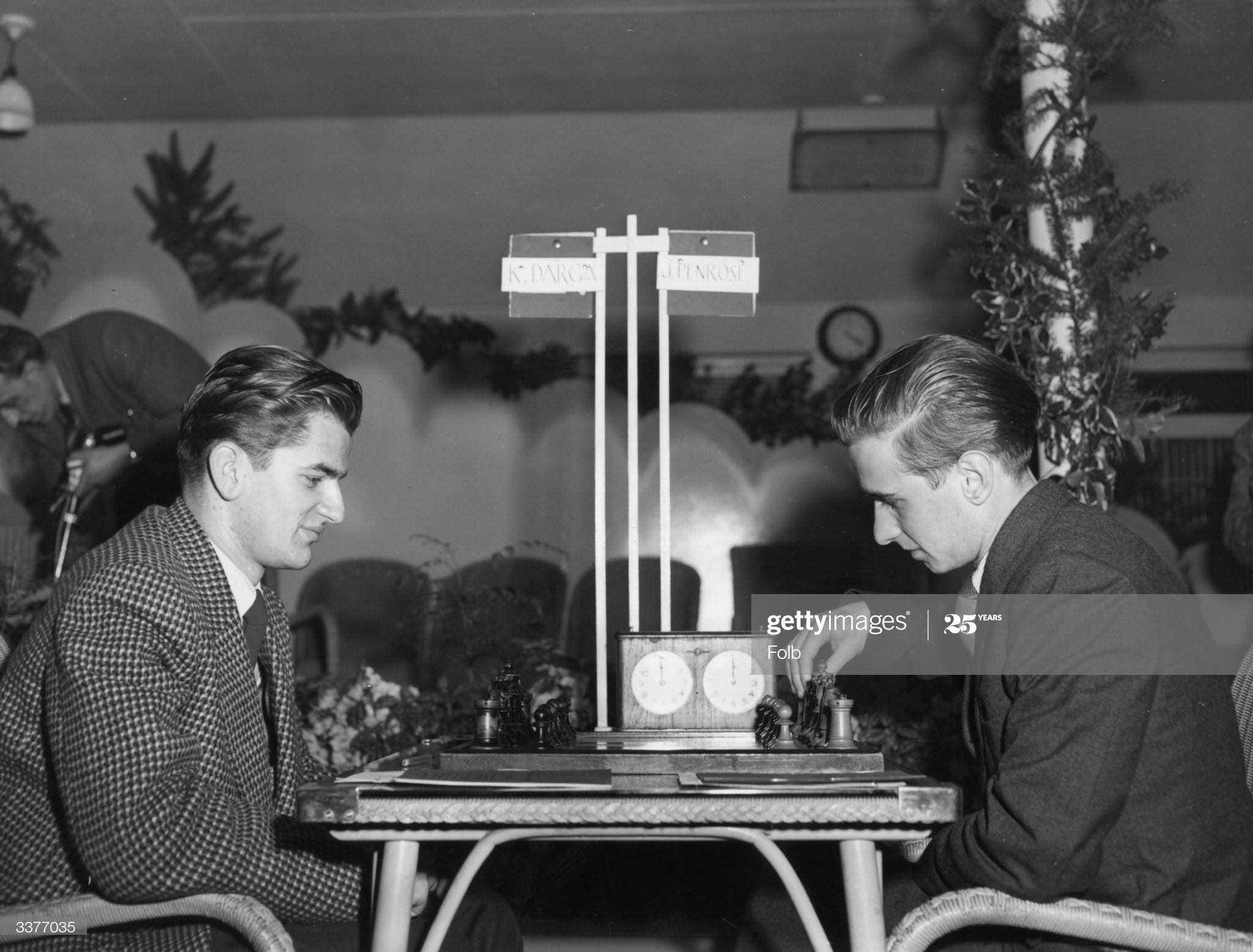
Darga V Penrose 29th December 1955: Klaus Darga of Germany in play against Britain's Jonathan Penrose during the International Chess Congress at Hastings. (Photo by Folb/Topical Press Agency/Getty Images)
Darga V Penrose
29th December 1955: Klaus Darga of Germany in play against Britain’s Jonathan Penrose during the International Chess Congress at Hastings. (Photo by Folb/Topical Press Agency/Getty Images)

Possibly too his profession (a lecturer in psychology) was also absorbing him more and more and too part less and less in international and national chess.

Jonathan Penrose
Jonathan Penrose

Yet, he had already done enough to show that he was the equal of the greatest British players in his command and understanding of the game and he ranks alongside Staunton, Blackburne, Atkins and CHO’D Alexander as a chess figure of world class.”

Here is his Wikipedia entry

From The Oxford Companion to Chess by Hooper & Whyld :

“The leading English player during the 1960s, International Master (1961), International Correspondence Chess Master (1980), lecturer in psychology. Early in his chess career Penrose decided to remain an amateur and as a consequence played in few international tournaments. He won the British Championship from 1958 to 1963 and from 1966 to 1969, ten times in all (a record); and he played in nine Olympiads from 1952 to 1974, notably scoring + 10=5 on first board at Lugano 1968, a result bettered only by the world champion Petrosyan.

IM Dr. Jonathan Penrose OBE

In the early 1970s Penrose further restricted his chess because the stress of competitive play adversely affected his health.”

The second edition (1996) adds this :

“He turned to correspondence play, was the highest rated postal player in the world 1987-9, and led the British team to victory in the 9th Correspondence Olympiad.”

[pgn]
[Event “olm8 fin B4 corr”]
[Site “ICCF corr”]
[Date “1977.??.??”]
[Round “?”]
[White “Penrose, Jonathan”]
[Black “Tompa, Janos”]
[Result “1-0”]
[ECO “B48”]
[Annotator “Andrew Martin & BCN”]
[PlyCount “61”]
[EventDate “1977.??.??”]
[EventType “team (corr)”]
[EventRounds “12”]
[SourceTitle “Corr 2002”]
[Source “ChessBase”]
[SourceDate “2002.05.23”]
[SourceVersion “1”]
[SourceVersionDate “2002.05.23”]
[SourceQuality “1”]

{[%evp 0,59,19,38,40,41,41,32,50,22,81,63,88,56,68,60,55,48,91,78,64,64,36,62,
41,29,56,56,50,30,34,3,32,38,18,31,48,48,41,40,90,31,30,51,183,-72,-72,177,164,
164,160,310,262,262,275,253,253,299,726,726,29991,29992]} 1. e4 c5 2. Nf3 e6 3.
d4 cxd4 4. Nxd4 a6 {The Sicilian Kan or Paulsen} 5. Nc3 {It’s a matter of
taste between this} ({and} 5. c4 {although in correspondence play the more
lively alternative is generally preferred.}) 5… Qc7 6. Bd3 Nc6 7. Be3 Nf6 8.
O-O Ne5 ({Alternatives are} 8… Nxd4 9. Bxd4 Bc5) ({or} 8… b5) 9. Be2 $1 {
Perfectly justified by the fact that Black is wasting time with his knight.
White withdraws in order to kick back with f4.} ({9.Be2! is a clear
improvement on} 9. h3 {, which does rather weaken the king position for no
other reason than to prevent the illusory threat of Ng4.}) 9… b5 10. f4 Nc4
11. Bxc4 Qxc4 12. e5 {[#]} Nd5 ({Some thought must have been given to the
complicated alternative} 12… b4 {which gives White a dangerous attack but
nothing clear.} {A sample line illustrates the difficulty Black would face is}
13. Qf3 {[%cal Gf3a8]} (13. exf6 bxc3 14. b3 Qd5 15. fxg7 Bxg7) 13… Rb8 (
13… bxc3 $1 14. Qxa8 cxb2 15. Rab1 Nd5 16. Bf2 Bb4 17. Qb8) 14. exf6 bxc3 15.
b3 Qc7 16. f5 Bb7 17. Bf4 d6 18. Qe3 e5 19. fxg7 Bxg7 20. f6 $1 {Perhaps he
could survive such a position but the king would be trapped and uncomfortable
on his central perch.}) 13. Nxd5 Qxd5 14. Qe2 Bb7 15. Rad1 Qe4 {It is
essential for the black queen to remain in the centre to try and inhibit the
white attack by keeping active.} ({To that end grabbing material with} 15…
Qxa2 {would be equivalent to suicide; after} 16. b3 $1 {shutting off the white
square escape followed quickly by f5 White would have a winning attack.}) 16.
Qf2 Be7 17. f5 Bh4 $146 (17… O-O $2 18. f6 $18) (17… O-O-O 18. Rd3 {
[%cal Gd3c3]}) 18. Qd2 {[%cal Gf1f4] threatening Rf4 and a double capture on e6
} Qd5 19. c3 h5 {[%cal Gh5h3] attempting to get the pawn to h3. a very slow
procedure which is rapidly punished.} ({better was} 19… Bd8 20. a4 {keeping
the black king centralised.}) 20. a4 $1 {Stopping any thoughts of queenside
castling and weakening Black’s hold on the critical white squares.} Be7 21.
axb5 Qxe5 $2 {[#]} (21… axb5 22. fxe6 dxe6 23. Qf2 O-O-O $16) 22. Nc6 $1 dxc6
23. Qd7+ Kf8 24. Bd4 $18 Bc8 ({If} 24… Qb8 25. fxe6 f6 26. Bxf6 {wins}) 25.
Qxc6 Qb8 26. fxe6 f6 27. Bc5 $1 {[%cal Gd1d8]} Bxe6 28. Bxe7+ Kf7 ({If} 28…
Kxe7 29. Rfe1 Qc8 30. Rd6 $18 (30. Rxe6+ Qxe6 31. Qb7+ Kf8 32. Qxa8+ $18)) 29.
Bxf6 {An excellent final stroke.} gxf6 30. Rd7+ {and Black resigned.} {If} Bxd7
31. Qxf6+ {is a quick mate.} 1-0
[/pgn]

Here is a discussion about Jonathan on the English Chess Forum

From The Encyclopedia of Chess (Robert Hale, 1970 & 1976) by Anne Sunnucks :

“International Master (1961) and British Champion in 1958 1959, 1960, 1961, 1962, 1963, 1966, 1967, 1968 and 1969.

Jonathan Penrose was born in Colchester on 7th October 1933, the son of Professor LS Penrose, the well-known geneticist, who was also a strong player and composer of endgame studies.

The whole Penrose family plays chess and Jonathan learned the game when he was 4. At the age of 12 he joined Hampstead Chess Club and the following year played for Essex for the first time, won his first big tournament, the British Boys’ Championship, and represented England against Ireland in a boy’s match, which was the forerunner of the Glorney Cup competition, which came into being the following year.

By the time he was 17 Penrose was recognised as one of the big hopes of British Chess. Playing in the Hastings Premier Tournament for the first time in `1950 – 1951, he beat the French Champion Nicholas Rossolimo and at Southsea in 1950 he beat two International Grandmasters, Effim Bogoljubov and Savielly Tartakower.

Penrose played for the British Chess Federation in a number of Chess Olympiads since 1952. In 1960, at Leipzig, came one of the best performances of his career, when he beat the reigning World Champion, Mikhail Tal. He became the first British player to beat a reigning World Champion since JH Blackburne beat Emmanuel Lasker in 1899, and the first player to defeat Tal since he won the World Championship earlier that year. Penrose’s score in this Olympiad was only half-a-point short of the score required to qualify for the International Grandmaster title.

IM Dr. Jonathan Penrose OBE

His ninth victory in the British Championships in 1968 equalled the record held by HE Atkins, who has held the title more times than any other player.

Penrose is a lecturer in psychology at Enfield College of Technology and has never been in a position to devote a great deal of time to the game. He is married to a former contender in the British Girls Championship and British Ladies’s Championship, Margaret Wood, daughter of Frank Wood, Hon. Secretary of the Oxfordshire Chess Association.
Again from British Chess : “In updating this report we find striking evidence of Penrose’s prowess as a correspondence player. Playing on board 4 for Britain in the 8th Correspondence Chess Olympiad he was astonishingly severe on the opposition, letting slip just one draw in twelve games! Here is one of the eleven wins that must change the assessment of a sharp Sicilian Variation.”


[pgn]
[Event “olm8 corr7384”]
[Site “ICCF corr”]
[Date “1973.??.??”]
[Round “?”]
[White “Penrose, Jonathan”]
[Black “Krantz, Kjell Erik”]
[Result “1-0”]
[ECO “B33”]
[Annotator “George Botterill & Hugh Myers”]
[PlyCount “53”]
[EventDate “1973.??.??”]
[EventType “team (corr)”]
[EventRounds “10”]
[SourceTitle “Myers”]
[Source “Myers”]
[SourceDate “2012.11.12”]
[SourceVersion “1”]
[SourceVersionDate “2012.11.12”]
[SourceQuality “1”]
[WhiteTeam “England”]
[BlackTeam “Sweden”]
[WhiteTeamCountry “ENG”]
[BlackTeamCountry “SWE”]

{[%mdl 41472][%evp 0,53,38,17,41,46,37,22,21,42,22,35,30,61,21,-2,-6,-6,10,-7,
-7,-10,-16,-1,-14,3,6,-16,-5,-13,-11,6,-4,-4,-16,45,29,41,63,0,13,38,13,61,59,
67,84,97,94,299,291,294,294,308,300,294]} 1. e4 {Myers Botterill} c5 2. Nf3 e6
3. d4 cxd4 4. Nxd4 Nf6 5. Nc3 Nc6 6. Ndb5 d6 7. Bf4 e5 8. Bg5 a6 9. Na3 Be6 10.
Nc4 Rc8 11. Bxf6 gxf6 12. Ne3 Ne7 13. Bd3 Qb6 14. O-O Qxb2 {Larsen} (14… Bh6
15. Ned5 Nxd5 16. exd5 Bd7 17. Qh5 Bg7 18. Rab1 h6 19. Kh1 O-O 20. f4 Rc7 21.
Qf3 Bc8 22. Qg3 Kh8 23. Qf2 Qxf2 24. Rxf2 b5 25. a4 b4 26. Na2 a5 27. c3 bxc3
28. Nxc3 Rc5 29. Rd1 Bb7 30. Bb5 Kg8 31. g3 Rd8 32. Kg1 Kf8 33. Kf1 Ke7 {
1/2-1/2 Koch,H-Bergmann,H/corr 1989/}) (14… Rg8 15. Ncd5 Bxd5 16. Nxd5 Nxd5
17. exd5 h6 18. a4 (18. c3 Rc7 19. Rb1 Qa5 20. a4 Kd8 21. c4 f5 22. b4 Qb6 23.
Be2 f6 24. a5 Qa7 25. Re1 Rcg7 26. Bf1 f4 27. b5 axb5 28. Rxb5 Rc7 29. Qd3 Rg5
30. h4 Rgg7 31. Qf5 Rgf7 32. Be2 f3 33. Bxf3 Rxc4 34. Qe6 {1-0 Miettinen,
K-Pickett,C/corr ICCF 1995/}) 18… Rc7 19. Qf3 Qxb2 20. Qxf6 Qd4 21. Rad1 Qg4
22. g3 h5 23. Rde1 Be7 24. Qh6 Qg5 25. Qxg5 Bxg5 26. Rb1 Ke7 27. Rb2 a5 28.
Rfb1 Rb8 29. Ba6 Bd2 30. Bxb7 Rc4 31. Bc6 Rxb2 32. Rxb2 Rb4 33. Ra2 Bc3 34. Ra3
Bd4 35. Rd3 h4 36. Kg2 hxg3 37. hxg3 Bc5 38. Rb3 {1/2-1/2 Fishbein,A-Agdestein,
E/Stavanger 1989/}) (14… Qc6 15. a4 Kd8 16. Qf3 f5 17. Ned5 f4 18. a5 Rg8 19.
h3 f5 20. Nb6 Rc7 21. Kh1 Bf7 22. Qd1 Rg5 23. Rg1 h6 24. Qd2 Bh5 25. exf5 Nxf5
26. Be4 Qe8 27. Ncd5 Rcg7 28. Ra4 Nd4 29. Nxf4 Bf7 30. Bxb7 Qb5 31. Be4 Qxb2
32. Nfd5 Bxd5 33. Nxd5 Qb7 34. Rb4 Qc8 35. Rgb1 Nb5 36. c4 Na3 37. R1b3 Nxc4
38. Qc3 Nb6 39. Rxb6 Qxc3 40. Rxc3 Kd7 41. Rb8 {1-0 Conde,J-Jordaan,W/corr
2003/}) (14… Bg7 15. Ncd5 Bxd5 16. exd5 O-O 17. Qh5 Ng6 18. Nf5 Rc7 19. Rae1
Re8 20. Re3 Nf4 21. Qg4 Ng6 22. h4 Qxb2 23. h5 Qxa2 24. hxg6 fxg6 25. Nxd6 f5
26. Nxf5 gxf5 27. Qxf5 Qxd5 28. Be4 Qd6 29. Qxh7+ Kf8 30. Rf3+ Rf7 31. Rxf7+
Kxf7 32. Qh5+ Kf8 33. Rd1 Qe7 34. Rd3 Bf6 35. Rf3 Qg7 36. Rg3 Qh8 37. Qf5 Rd8
38. Rh3 Qg7 39. Rh7 Qg5 40. Rh8+ Ke7 41. Rh7+ Kf8 42. Qe6 Rd1+ 43. Kh2 Qf4+ 44.
g3 Qxf2+ 45. Kh3 Bg7 46. Qc8+ {1-0 Borngaesser,R-Gelzenleichter,S/Dortmund op
1987/}) 15. Ncd5 Bxd5 16. exd5 (16. Nxd5 $5 Nxd5 17. exd5 Qd4 (17… Rc7 18.
Qf3 Ke7 19. Qe3 h5 20. a4 Bh6 21. Qa7 Bd2 22. Rab1 Qd4 23. Qxd4 exd4 24. Rb3
Ba5 25. Rfb1 b6 26. Rd1 Rc5 27. Bxa6 Rxd5 28. Bc4 Re5 29. Rxd4 Re1+ 30. Bf1 Rc8
31. c4 Ra1 32. g3 Rc5 33. Rd5 Rxd5 34. cxd5 Rxa4 35. Re3+ Kf8 36. h4 Rd4 37.
Rd3 Rxd3 38. Bxd3 Kg7 39. f3 Be1 40. Kg2 Kh6 41. Kh3 {1/2-1/2 Dickl,E-Kammer,R/
Saarlouis op 1999/}) 18. Qf3 (18. c4 Bh6 19. Re1 Ke7 20. Re4 Qc3 21. Rb1 Rc7
22. Qf3 Bf4 23. Re2 h5 24. Rc2 Qd4 25. c5 Rxc5 26. Rxb7+ Kf8 27. Rxc5 Qxc5 28.
g3 Bg5 29. h4 Kg7 30. hxg5 Qc1+ 31. Kg2 Qxg5 32. Qf5 {1-0 Grabics,M-Gosztola,I/
HUN 1998/}) 18… Bg7 (18… Ke7 19. Rab1 Rc7 20. Rb3 Bh6 21. Rfb1 b5 22. Rb4
Qc5 23. a4 Bd2 24. Rh4 Bg5 25. Rg4 h5 26. Re4 Qxd5 27. axb5 axb5 28. h4 Bd2 29.
Rxb5 Qa8 30. Qe2 Bc3 31. Rc4 Rhc8 32. Rxc7+ Rxc7 33. Be4 Qa1+ 34. Kh2 Qe1 35.
Qxe1 Bxe1 36. Kg1 Rc4 37. Bf5 Rf4 38. Bh3 Bxf2+ 39. Kh2 Rxh4 40. g3 Rc4 41.
Rb7+ Kf8 42. Bf5 Rc3 43. Rb3 Bxg3+ 44. Kh3 Rxb3 45. cxb3 Be1 46. b4 Bxb4 47.
Kh4 d5 48. Kxh5 Ke7 49. Kg4 Kd6 50. Kf3 {0-1 Bely,M-Brinck Claussen,B/Hastings
ENG 1963/}) (18… h5 19. Rab1 b5 20. a4 Qg4 21. Qxg4 hxg4 22. axb5 axb5 23.
Rxb5 Rh5 24. Rb7 Be7 25. Ra1 e4 26. Bxe4 Re5 27. f3 f5 28. Bd3 gxf3 29. gxf3
Rxd5 30. Raa7 Re5 31. f4 Re1+ 32. Kf2 Bh4+ 33. Kg2 Re7 34. Bxf5 Rxb7 35. Rxb7
Rc4 36. Kf3 Be1 37. Bd3 Rb4 38. Ra7 Bd2 39. f5 Bc3 40. Be4 Be5 41. h4 Rb1 42.
h5 Rf1+ 43. Ke2 Rf4 44. Bc6+ Kf8 45. h6 Kg8 46. Bd5 Kh7 47. Rxf7+ Kxh6 48. c4
Kg5 49. Be6 Bd4 {1/2-1/2 Lakos,N-Horvath,S/HUN 1997/}) 19. a4 h5 20. Rfd1 Qc5
21. Rab1 Rc7 22. Rb3 Qa5 23. Qe4 Ke7 24. Rdb1 Rb8 25. Rb6 Qd2 26. g3 a5 27. h4
Bf8 28. Qf5 Qh6 29. R1b5 Qg6 30. Qxg6 fxg6 31. Bxg6 Bh6 32. Rxa5 Rg8 33. Bxh5
Rxg3+ 34. fxg3 Be3+ 35. Kg2 Bxb6 36. Rb5 Bc5 37. Bg6 b6 38. a5 bxa5 39. Rxa5
Kf8 40. Kf3 Kg7 41. Bd3 Rb7 42. Ra8 Rb1 43. Rd8 Ra1 44. Kg4 Ra7 45. Kf5 Re7 46.
Be4 {1-0 Lang,J-Wohlleben,M/corr 1998/}) (16. Rb1 Qd4 17. Nxd5 Nxd5 18. exd5
Rc7 19. Re1 Ke7 20. c4 Bh6 21. Qf3 b6 22. Re4 Qc5 23. Qh5 Bd2 24. Rg4 Be3 25.
Kh1 Qa3 26. Qf5 h5 27. Re4 Bc5 28. f4 Rh6 29. Ree1 Rg6 30. Rf1 Bd4 31. fxe5
dxe5 32. Rbd1 Qxa2 33. Qf3 Rh6 34. Rde1 Qd2 35. Bb1 Rxc4 36. d6+ Kxd6 37. Qb7
b5 38. Bf5 Qc3 39. Qxf7 Kc6 40. Qf8 Qd2 41. Rb1 h4 42. Qc8+ {1-0 Tsenkov,
L-Veloso Fargnoli,R/corr IECG 2006/}) 16… Qd4 (16… Rc7 17. a4 Qd4 18. Qf3
Qf4 19. Qe2 f5 20. g3 Rg8 21. Rfb1 Qg5 22. Bxa6 f4 23. Rxb7 Rxb7 24. Bxb7 Bh6
25. Nf1 Nf5 26. c3 Qh4 27. Rb1 Qh3 28. Bc6+ Ke7 29. Rb7+ Kf6 30. Bd7 Rg5 31.
Qe4 fxg3 32. hxg3 Rh5 33. a5 Bf4 34. Qg2 Qg4 35. gxf4 Qxf4 36. Bxf5 Rxf5 37.
Ng3 Rg5 38. Rb4 Qc1+ 39. Kh2 Kg7 40. Qf3 Kg6 41. Rg4 h6 42. a6 {1-0 Mainka,
R-Kammer,R/Saarlouis op 1998/}) 17. Rb1 $5 {[#] This seems to be much more
dangerous for Black} ({than the immediate} 17. Qf3 Qf4 18. Qh3 e4 (18… Qh6 $5
19. Qg4 Qf4 20. Qxf4 exf4 21. Nf5 Nxf5 22. Bxf5 Rc7 23. Rfe1+ $14) (18… Bg7
$5 19. Rab1 b5 20. a4 e4 {[%cal Gf6f5]} 21. Rb4 $1 $14 {Myers}) 19. g3 Qf3 20.
Nc4 exd3 21. Nxd6+ Kd8 22. Nxf7+ Ke8 23. Nd6+ Kd8 24. Nf7+ Ke8 25. Nxh8 Qf5 26.
g4 Qxd5 27. cxd3 Bg7 28. Qxh7 Kd7 29. Rfe1 Rg8 30. Rab1 b5 31. Ng6 Nc6 32. Nf4
Qf7 33. Qf5+ Kc7 34. Rbc1 Bf8 35. Rxc6+ Kxc6 36. Re6+ Kb7 37. Qd5+ Ka7 38.
Rxa6+ Kxa6 39. Qxf7 Rxg4+ 40. Kf1 Rxf4 41. Qxf8 {1-0 Lombardy,W-Markland,P/
Nice FRA 1974/}) (17. Qh5 $5 Rc7 (17… Nxd5 18. Qf3 Rc5 19. Rab1 b5 20. Nxd5
Qxd5 21. Qxd5 Rxd5 22. a4 bxa4 23. Rb8+ Ke7 24. Rb7+ Ke8 25. Rb8+ Ke7 26. Rb7+
Ke8 27. Rb8+ Kd7 28. Rfb1 Rd4 29. R1b7+ Kc6 30. Rxf7 a3 31. Ra8 Ra4 32. Rfa7 d5
33. Bxa6 Kc5 34. Rd7 a2 35. Rxd5+ Kb6 {0-1 Guzek,H-Roelens,R/corr 1995/}) (
17… Rg8 18. Rab1 Rc7 19. Rfd1 Qf4 20. g3 Qh6 21. Qe2 Qh3 22. Rb4 Qd7 23. Qf3
Bh6 24. Nf5 Bf8 25. Nxe7 Kxe7 26. Bf5 Qd8 27. Rdb1 Qa8 28. a4 Bh6 29. Qb3 Bd2
30. Rxb7 Ba5 31. Rxc7+ Bxc7 32. Qb7 Qb8 33. Rb3 Rd8 34. Qc6 {1-0 Brzeski,
M-Roszkowski,R/Grodzisk Mazowiecki POL 2007/}) 18. Rfd1 Qf4 19. g3 Qg5 20. Qf3
f5 (20… Qh6 21. Ng4 Qg5 22. Nxf6+ Kd8 23. Nxh7 Qh6 24. Qxf7 Bg7 25. Qe6 Ng8
26. Bg6 Nf6 27. Nxf6 {1-0 Roberts,A-Adair,D/corr 1993/}) 21. Nxf5 Nxf5 22. Bxf5
Bg7 23. Rab1 Qf6 (23… O-O 24. Rb6 Qe7 25. Rdb1 Re8 26. R1b4 h6 27. Bd3 Rd8
28. Qf5 Kf8 29. h4 Rdd7 30. Qh7 a5 31. Ra4 Rc5 32. Rg4 Qf6 33. Bf5 Rdc7 34.
Rxd6 {1-0 Nemeth,A-Hogye,I/corr 1990/}) 24. Kg2 b5 25. Rb4 O-O 26. a4 Rc5 27.
axb5 Rxb5 28. Rxb5 axb5 29. Rb1 Rb8 30. Rb4 Qd8 31. Bd3 h6 32. h4 Ra8 33. Rxb5
Rb8 34. c4 Qc7 35. Qe4 Kf8 36. Qe3 Ke7 37. Be4 Rxb5 38. cxb5 Qc4 39. b6 Qb4 40.
Kh2 Kd8 41. Kh3 Bf8 42. Kg4 Qd4 43. Kf5 Qa4 44. Kg4 f5+ 45. Kxf5 Qd7+ {1/2-1/2
Popovic,P-Matulovic,M/Vinkovci 1982/}) 17… Rc7 $1 ({The natural} 17… b5 {
would be countered by} 18. a4 $1 {(Botterill) breaking up the black queenside.}
Bh6 ({If then} 18… Qxa4 19. Ra1 {followed by Rxa6}) 19. Qf3 Qf4 20. Qh3 $16)
18. Qf3 (18. g3 Bh6 19. Qf3 Bxe3 20. fxe3 Qxd5 21. Qxf6 O-O 22. Rb4 e4 23. Bxe4
Qh5 24. Rxb7 Rxb7 25. Bxb7 Ng6 26. Qxd6 Qg5 27. Qd4 Rd8 28. Qe4 a5 29. c4 Kg7
30. Bd5 Rd7 31. Rf5 Qd8 32. Qd4+ f6 33. g4 h6 34. g5 hxg5 35. Rxg5 Rd6 36. Rg3
Qb8 37. Qe4 f5 38. Qxf5 Rf6 39. Qd3 Qb2 40. Rf3 Rxf3 41. Bxf3 Qa1+ 42. Qd1 Qxa2
43. Qd4+ Kh6 44. c5 a4 45. c6 a3 46. Be4 Qe6 47. Bd5 Qf5 48. e4 Qg4+ 49. Kf1
Qf3+ 50. Ke1 Qh1+ 51. Kd2 Qxh2+ 52. Kc1 a2 53. Qa1 Ne5 54. Qxa2 {1/2-1/2
Arnason,A-Jonasson,B/Reykjavik ISL 1984/}) (18. a3 Bh6 19. Rb4 Qc3 20. Rc4 Rxc4
21. Nxc4 Nc8 22. Qh5 b5 23. Qxh6 bxc4 24. Qxf6 Rf8 25. Bf5 Ne7 26. Rb1 Nxf5 27.
Qxf5 Kd8 28. Qf6+ Kd7 29. h4 Qxc2 30. Rb7+ Kc8 31. Qe7 Qc1+ {1/2-1/2 Roux,
O-Rouzaud,P/Montigny Le Bretonneux 2004/}) 18… Qf4 (18… Bg7 $1 19. Rb3 O-O
20. Nf5 Qf4 21. Qxf4 exf4 22. Nxd6 Rd8 23. Rxb7 Nxd5 24. Rxc7 Nxc7 25. Ne4 Nd5
26. Rb1 f5 27. Ng5 h6 28. Nh3 Nc3 29. Rb6 Nxa2 30. Nxf4 Nc1 31. Rxa6 Be5 32. g3
Bxf4 33. gxf4 Nxd3 34. cxd3 Kg7 35. Ra3 Rd4 36. Rc3 Rxf4 37. Rc4 Rg4+ 38. Rxg4+
fxg4 39. Kg2 Kf6 40. Kg3 Kg5 {1/2-1/2 Achilles,E-Schuster,P/corr 1996/}) (18…
f5 19. Nxf5 Nxf5 20. Bxf5 Bg7 21. Be4 b5 22. Qg4 Bf6 23. Qf5 Rg8 24. a4 b4 25.
Rfd1 Qc4 26. c3 Ke7 27. cxb4 Rb8 28. Bd3 Qa2 29. Ra1 Qb3 30. Bxa6 Rxb4 31. Rac1
Rc3 32. Bb5 {1/2-1/2 Geenen,M-Prasad,D/Novi Sad 1990/} Bh4) 19. Qe2 (19. Qxf4
exf4 20. Nc4 (20. Nf5 Nxd5 21. Be4 Nc3 22. Rxb7 Rxb7 23. Bxb7 a5 24. Bc6+ Kd8
25. Re1 Kc7 26. Be8 d5 27. Bxf7 Bc5 28. Ng7 Rb8 29. Ne8+ Kd8 30. Nxf6 Rb2 31.
Nxd5 Rxc2 32. Rf1 Ne2+ 33. Kh1 Bxf2 34. Rd1 Kc8 35. a4 Kb7 36. Bh5 Nc3 37. Nxc3
Rxc3 38. Bf3+ Kc7 39. Rf1 h6 40. Be2 Be3 41. g3 fxg3 {0-1 Jung,T-Mueller,B/
corr GER 1998/}) 20… Nxd5 21. Na5 Nc3 22. Rb6 Be7 23. Nxb7 O-O 24. Nxd6 Bxd6
25. Rxd6 Nxa2 26. Rxa6 Nb4 27. Rxf6 Nxd3 28. cxd3 Rd8 29. Rxf4 Rxd3 30. g3 Rd2
31. Ra1 Rd6 32. Kg2 Kg7 33. Ra8 h6 34. h4 Rb7 35. Rf5 Rc6 36. Rf4 Rd6 37. h5
Rd5 38. g4 f5 39. gxf5 Rf7 40. f6+ Kh7 41. Rh4 Rxf6 42. Ra7+ Kh8 43. f4 Rff5
44. Kf3 Rxh5 {1/2-1/2 De Groot,K-Noire,E/corr IECG 2003/}) 19… e4 $2 $146 {
[#]} (19… Nc8 20. c3 e4 21. Nd1 f5 22. f3 Qe5 23. fxe4 fxe4 24. Bxe4 Bg7 25.
Rf5 Qe7 26. Qg4 Be5 27. Bd3 h5 28. Qe4 Bg7 29. Qf3 Kd8 30. c4 Qe1+ 31. Bf1 Re7
32. Qd3 Qa5 33. Qc2 Bd4+ 34. Kh1 Rhe8 35. Nf2 Re1 36. Nd3 R8e2 37. Qb3 Rxb1 38.
Qxb1 Qxa2 39. Qxb7 Re7 40. Qb4 Qa1 41. c5 a5 42. Qb5 h4 43. Nf4 Bf6 44. cxd6
Nxd6 45. Qb8+ Nc8 {1/2-1/2 Bussmeyer,H-Zeltwanger,A/corr 1998/}) (19… Bh6 20.
Nc4 Nc8 21. Rb4 Qg5 22. Ne3 f5 23. Nxf5 Qd2 24. Nxd6+ Nxd6 25. Qxe5+ Kd7 26.
Rb6 Ne8 27. Qxh8 Be3 28. Bf5+ {1-0 Ghinda,M-Tseitlin,M/Pernik 1978/}) (19…
Bg7 $5) (19… Rg8 $5) (19… f5 $5) 20. Bxa6 $1 bxa6 21. Rb8+ $1 (21. Qxa6 $1
f5 22. Rb8+ Nc8 23. Rxc8+ Rxc8 24. Qxc8+ $18) 21… Nc8 {Botterill: It is easy
to see that the piece sacrifice is amply justified by the fact that Black’s
king’s rook and king’s bishop canot communicate with the other side of the
board.} (21… Rc8 22. Rxc8+ Nxc8 23. Qxa6 Kd8 24. Rb1 $18) 22. Qxa6 Kd8 23.
Rfb1 Qe5 {[%cal Ye5c3]} 24. Rxc8+ $1 Rxc8 25. Qa5+ Ke8 (25… Rc7 26. Rb8+ Kd7
27. Qb5+ Rc6 28. Qxc6+ Ke7 29. Qe8#) 26. Qa4+ Kd8 27. Rb7 (27. Rb7 Qe7 {
leading to a disastrous endgame.} ({If} 27… Rc7 28. Rb8+ Rc8 29. Qa5+ Kd7 30.
Rb7+ {and mates shortly.} Ke8 31. Qa4+ Kd8 32. Qd7#) (27… Qa1+ 28. Nf1 Rc7
29. Rb8+ Rc8 30. Qa5+ Kd7 31. Rb7+ Ke8 32. Qa4+ Kd8 33. Qd7#) 28. Rxe7 {
Botterill} Bxe7 29. Qxe4 Rb8 30. f3 Rb5 31. Nf5 Rb1+ 32. Kf2 Re8 33. Qa4 h6 34.
Qa5+ Kc8 35. Qa8+ Kd7 36. Qa7+ Kd8 37. Ng7 Rf8 38. Ne6+ fxe6 39. dxe6 Kc8 40.
Qxe7 $18 {Myers}) 1-0
[/pgn]

Penrose was awarded the O.B.E. for his services to chess in 1971.”

Penrose was Southern Counties Champion for 1949-50.

In 1983 Jonathan became England’s fifth Correspondence Grandmaster (CGM) following Keith Richardson, Adrian Hollis, Peter Clarke and Simon Webb.

Sadly, there is no existent book on the life and games of Jonathan Penrose : a serious omission in chess literature.

Dr. Jonathan Penrose OBE

Remembering IMC James Adams (04-ix-1921 27-vii-2013)

IMC James Adams (04-ix-1921 27-vii-2013)

BCN remembers IMC James Adams who passed away aged 91 on July 27th, 2013 in Worcester Park, Kingston Upon Thames, Surrey.

James Frederick Adams was born on September 4th, 1921 in Lambeth. His parents were James J Adams (DoB: 10th October 1884) who was a plumber’s mate and Lucy M Adams (née Ayres, DoB: 22nd December 1886). He had an older brother who was William A Adams who was also a plumber’s mate and and Uncle George T (DoB: 8th March 1882) who was the plumber who presumably had many mates.

At the time of the 1939 register James was a telephone operator.

The Adams family lived at 52, Broadway Gardens, Mitcham, Surrey, CR4 4EE (rather than 001 Cemetery Lane)

52, Broadway Gardens, Mitcham, Surrey, CR4 4EE

From CHESS, 1991, March, page 91 we have:

“Whatever Happened to Human Effort?

I am giving up postal chess after 57 years for the reason that, like Jonathan Penrose and recently Nigel Short, I am increasingly disturbed over the increase in the use of computers in correspondence play. It is impossible to prove but one has the feeling that many opponents see nothing wrong in using a machine and I see no pleasure in having to bash one’s brains out against a computer. I am happy in the knowledge that I won my FIDE IM title long before dedicated chess computers were ever heard of. I shudder to think of the proliferation in the use of computers in a competition like the World CC Championship. I don’t wonder that Penrose objects.

Unfortunately, this is the sort of thing against which it is impossible to legislate. The BCCA has banned their use but it doesn’t mean a thing.

The latest monstrosity is where Kasparov plays a match against another GM and both are allowed to use computers whilst the game is in progress. To me, this is absolutely shocking. Dr. Nunn admits to the use of computers in the compilation of one of his books and I see that even ordinary annotators use a programme like Fritz to assist with their notes to a game. What happened to human effort?

Anyway, I have about five postal games left in progress and when they are finished I will call it a day.

Jim Adams
Worcester Park, Surrey

So who was Jim Adams?

From British Chess (Pergamon Press, 1983) Botterill, Levy, Rice and Richardson we have this:

The smoke-laden atmosphere of the chess rooms of St. Bride’s Institute, in the heart of the City of London, could hardly be considered a positive encouragement to any ambitions to become an International Master, but certainly this was so in my case. Let me explain the sequence of events.

Face-to-face, or over-the-board chess, had been my main interest since my war-time days as a member of the Civil Defence. Passing time between air-raids led to the adoption of many pastimes and an absorbing game such as chess was ideal. Fortunately for me, one of my ambulance station colleagues was a very fine player named A. F. (Algy) Battersby, later to become General Secretary of the British Correspondence Chess Association.
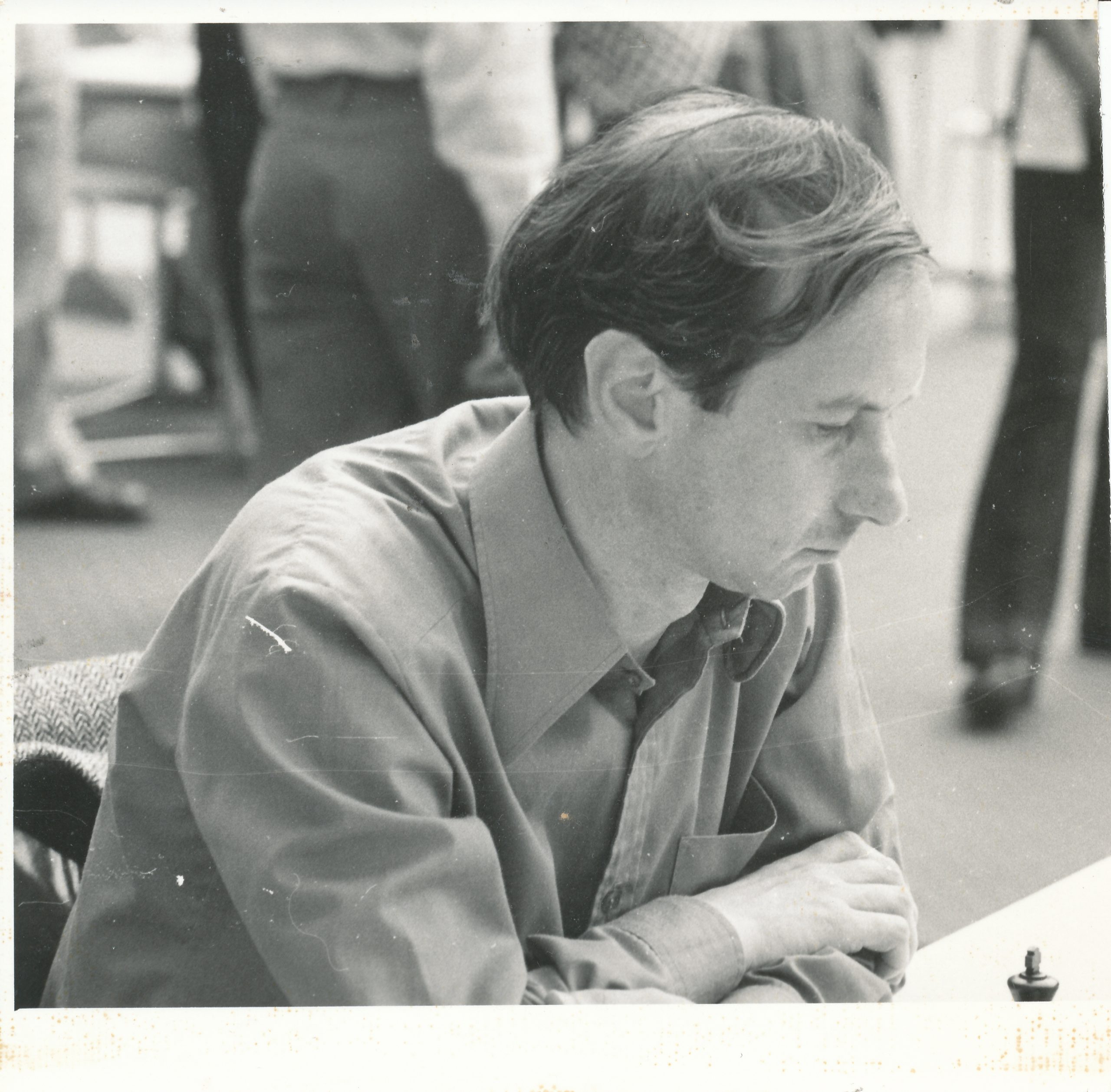
He had spent the greater part of the First World War playing chess in the Sinai Desert and, with his tremendous experience, he brought to the game strategical ideas and tactical skills that, in those early days, were well beyond my comprehension.
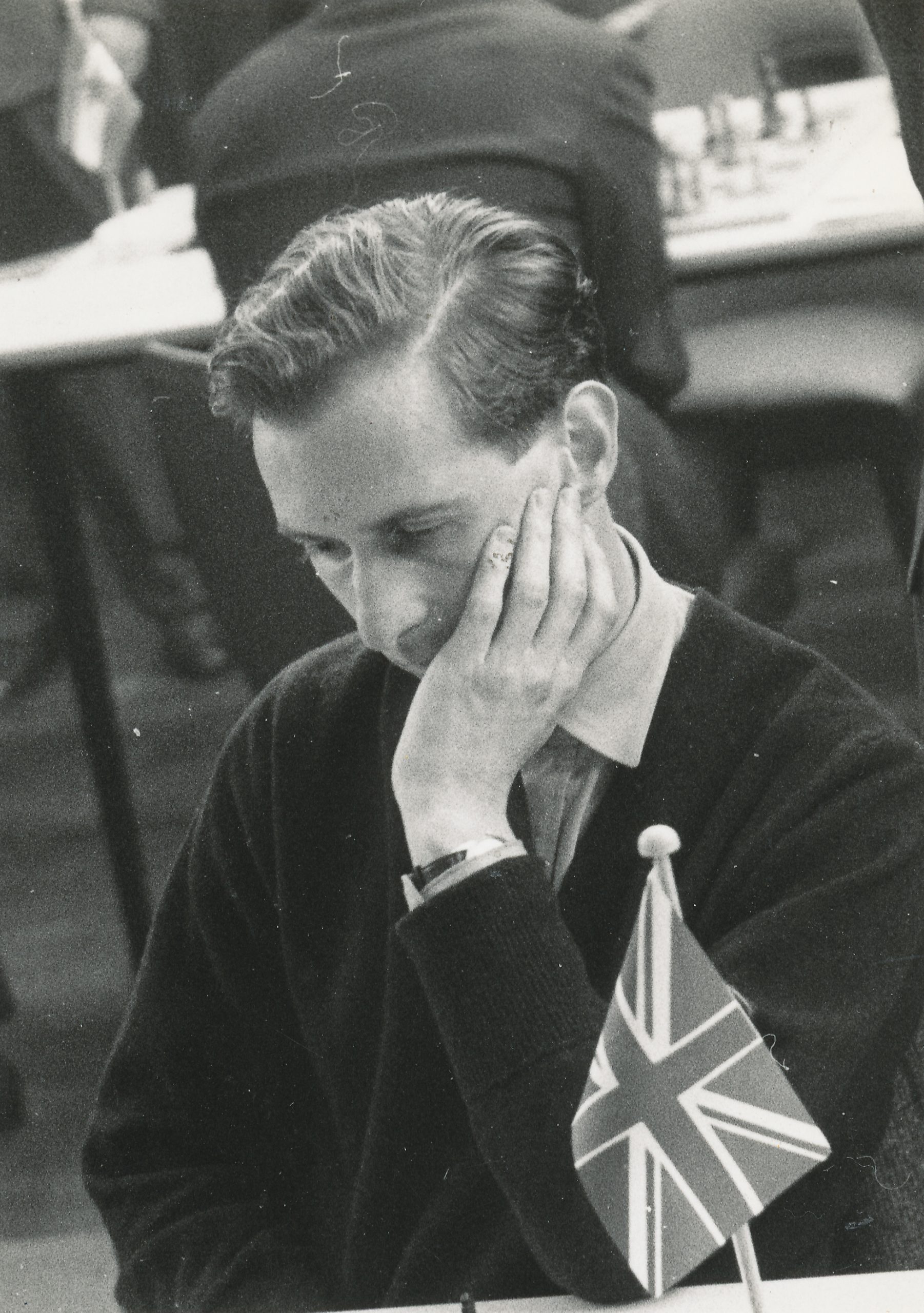
Arthur Frank Battersby, BIRTH 2 JUN 1887 • Brixton, Surrey, England  DEATH 11 APR 1955 • Surrey, England
Arthur Frank Battersby, BIRTH 2 JUN 1887 • Brixton, Surrey, England DEATH 11 APR 1955 • Surrey, England

‘Algy’ was kind enough to say some years afterwards that I was ‘the best pupil he ever had’, but whether this was true or not, he certainly passed on to me the theoretical groundwork that was to be so useful to me in later years. Among other books, he encouraged me to purchase the Nimzowitch classic My System, with the kindly warning that I would not understand it at first reading but would perhaps get some grasp of the ideas at a second or third attempt.

My System was a revelation to me and proved to be the greatest help to an understanding of the game that I had ever received. Up to my fortuitous meeting with ‘Algy’, my games had been of a simple tactical nature. Pieces were left en prise, oversights and blunders were the order of the day and an actual checkmate came as a surprise not only to the loser but often to the winner as well!

To win a game through sheer strength of position was completely unknown to me, but ‘Algy’ and Nimzowitch changed all that! Under their combined influence my general playing strength improved enormously and I was soon second only to ‘Algy’ in such tournaments as were held in my home town of Mitcham, where the local chess club was revived after the war.

Our club soon attracted a few strong players and we played regularly in county competitions and, later, the London Chess League. During those years chess was an absolute joy to me and all my spare time was spent at the local club or at chess matches, whilst Saturday afternoons were spent at the now defunct Gambit Chess Room, in Budge Row, where I passed countless hours playing chess, pausing only to order light refreshment from the indefatigable ‘Eileen’, a waitress of somewhat uncertain age who almost certainly regarded all chess players as raving lunatics!

The ‘Gambit’ could never have been a viable commercial proposition on what we bought and it was eventually thought necessary to introduce a minimum charge depending on the time of day. Gone for ever were the days when one could spend the entire evening playing chess, analysing, or having a crack at the local Kriegspiel experts, all for the price of two cups of tea and the occasional sandwich. Sadly, it all disappeared in the aftermath of the
war.

By 1950 I had become Match Captain of the Mitcham Chess Club and, of course, responsible for arranging various matches. Getting a team together was not difficult as the club membership was quite large for such a lowly club. The playing standard too was surprisingly high and whilst I, myself, was fortunate enough to win the club championship several times it was never easy.

On one occasion a ‘friendly’ match had been arranged with the BBC and all was well until a ‘flu epidemic a few days before the date of the match laid most of the Mitcham players low. On the morning of the match I was left with five players for a 1O-board match! As it was only a ‘friendly’ and in order to avoid disappointing all concerned I took myself off to the Gambit and recruited a few of the ‘regulars’ to help us out. It must be remembered that most of the strongest players in London frequented the ‘Gambit’ and since those pressganged into service were extremely strong players it seemed only courteous to give them the honour of playing on the top five boards, leaving the Mitcham ‘stars’ who, coincidentally, were our usual top board players, to bring up the rear.

Now this composite team, in my judgement, was probably good enough to win the London League A Division and it was no surprise when we won 10-0. Only a friendly indeed! Any Match Captain would have given his queen’s rook for such a team but, whilst the BBC players were warned beforehand of the composition of our team, they were not amused and further matches were not arranged!

Mr A Corish (right), receives the Chess Champion cup from Mr J Adams. 18th September 1958 from the Merton Advertiser, Photographer unknown.

Round about this time I was playing regularly in London League matches, nearly all of which were held at St. Bride’s Institute, where my story began. A non-smoker myself, I found the conditions intolerable. The place seemed to be completely airless and Government warnings about the dangers of smoking did not exist! not exist! Consequently, the entire playing area was reminiscent of the Black Hole of Calcutta! Always susceptible to headaches, I began to return home physically ill after every match. If this was playing chess for pleasure then something was wrong!

Mr A Corish (right), receives the Chess Champion cup from Mr J Adams. 18th September 1958 from the Merton Advertiser, Photographer unknown.

However, salvation was at hand. Ever since the war I had been playing a few games by post under the auspices of the BCCA (British Correspondence Chess Association ), and my somewhat traumatic experiences at St. Bride’s were beginning to make postal chess a far more attractive way of playing the
game. And so my chess career started all over again!

My correspondence chess activities up to the 1960s were not particularly successful, although I had managed to win three Premier Sections and finish
equal third in the British Correspondence Championship of 1962-63. However, during that time a group of BCCA players, of whom I was one, were
becoming somewhat dissatisfied with the Association’s attitude towards international chess and eventually a splinter group formed a rival organization which became known as the British Correspondence Chess Society.

The BCCS was, almost from the start, internationally orientated and it was possible to play foreign players, many of master strength. With strong opposition it seemed easier to improve and my first real success came in the Eberhardt Wilhelm Cup in 1966-67 when I was able to obtain the lM norm giving me a half=master title. However, gone were the days when a superficial analysis was enough before posting a move, which even if it was not the best, was generally good enough to hold one’s own with even the best of British CC players at that time. Fortunately for British chess, the situation is now vastly different and the strongest British CC players are recognized as being among the best in the world.

The Eberhardt Wilhelm Cup consisted of players all of master or near-master strength and it was in one of the games I played in this tournament that I played probably the most surprising move of my life.

[pgn]
[Event “Eberhardt Wilhelm Cup”]
[Site “Correspondence”]
[Date “1967.??.??”]
[Round “?”]
[White “John F Adams”]
[Black “E Ott”]
[Result “1-0”]
[ECO “B18”]
[Annotator “James Adams”]
[PlyCount “39”]
[EventDate “1967.??.??”]
[SourceTitle “British Chess, page 13”]
[WhiteTeam “England”]
[BlackTeam “Hungary”]

{[%evp 0,39,19,38,60,60,55,40,50,35,39,46,55,55,38,26,27,18,22,36,31,28,62,31,
18,19,24,15,19,5,66,26,30,38,38,18,30,17,34,210,203,204]} {This game appears
on page 13 of British Chess, Pergamon Press.} 1. e4 c6 2. d4 d5 3. Nc3 dxe4 4.
Nxe4 Bf5 5. Ng3 Bg6 6. h4 h6 7. Nf3 Nd7 8. h5 Bh7 9. Bd3 Bxd3 10. Qxd3 Qc7 11.
Bd2 Ngf6 12. O-O-O e6 13. Kb1 O-O-O 14. c4 c5 15. Bc3 cxd4 16. Nxd4 {[#] So
far this is all “book” and whilst White has more space in the centre, Black’s
position is quite sound and he can look forward to a good game. The normal
move for Black is now 16…a6 which also has the recommendation of the World
Champion Botvinnik. My opponent had the quite laudable idea of saving a
“tempo” and clearly did not fear Nb5 by White. Unfortunately for him there was
a gigantic flaw in his reasoning.} Bc5 $6 $146 ({Relevant:} 16… a6 17. Qe2
Bd6 18. Nf1 Nc5 19. Nb3 Nxb3 20. axb3 Qb6 21. Nd2 Bc5 22. f4 a5 23. Be5 Qc6 24.
Rhf1 Bb4 25. f5 Bxd2 26. Bxf6 gxf6 27. Rxd2 Rxd2 28. Qxd2 Rd8 29. Qxa5 Qxg2 30.
Qa8+ Kc7 31. Qa5+ Kc8 32. Qa8+ Kc7 33. Qa5+ {1/2-1/2 (33) Reshevsky,S-Sherwin,
J New York 1966}) 17. Nb5 (17. Qe2) 17… Qb6 $2 ({Much better was} 17… Qf4
$11 18. Qd2 Qxd2 19. Rxd2) 18. b4 $18 a6 ({Black had undoubtedly seen all this
and also seen that} 18… Bxf2 {would lose to} 19. Nd6+ Kb8 20. Nxf7) 19. bxc5
Nxc5 {Black must have awaited my next move with some complacency.} 20. Qd6 $3 (
20. Bd4 axb5 21. Qe3 bxc4+ 22. Kc2 Rd5 {with full equality. Unhappily for his
dreams I had prepared a move which he had obviously not anticipated.}) 1-0
[/pgn]

To win the full IM title involved getting one more IM norm and happily for my prospects, I was selected for the British team in both the Olympiad Preliminary of 1972 and the European Team Championships of 1973.

Although I was trifle unlucky to miss the IM norm by half a point in the European Championship I finally clinched the coveted IM title in the Olympiad Preliminary which, although starting a few months before the European tournament, went on so long that I was in suspense long after the European games finished.

[pgn]
[Event “olm8 qual GP3 B6 corr”]
[Site “ICCF corr”]
[Date “1973.??.??”]
[Round “?”]
[White “Adams, James F”]
[Black “Butnaru, Corneliu”]
[Result “1-0”]
[ECO “B96”]
[Annotator “James Frederick Adams”]
[PlyCount “57”]
[EventDate “1973.??.??”]
[EventType “team (corr)”]
[EventRounds “10”]
[SourceTitle “Corr 2002”]
[Source “ChessBase”]
[SourceDate “2002.05.23”]
[SourceVersion “1”]
[SourceVersionDate “2002.05.23”]
[SourceQuality “1”]
[WhiteTeam “Great Britain”]
[BlackTeam “Rumania”]

{[%evp 0,55,19,29,40,40,80,76,70,26,29,26,61,47,68,14,46,51,76,79,79,9,-22,-17,
0,0,0,-5,27,4,132,-41,45,172,248,253,253,274,274,260,256,263,263,275,260,245,
262,255,283,273,439,544,483,494,568,578,600,643]} 1. e4 c5 2. Nf3 d6 3. d4 cxd4
4. Nxd4 Nf6 5. Nc3 a6 6. Bg5 e6 7. f4 b5 8. e5 dxe5 9. fxe5 Qc7 10. Qe2 ({
If now} 10. exf6 Qe5+ {recovers the piece with a good game}) 10… Nfd7 11.
O-O-O Bb7 12. Qg4 {A promising pawn sacrifce} Qxe5 $6 (12… Nxe5 $2 13. Nxe6
Nxg4 14. Nxc7#) (12… Qb6 13. Be2 Nxe5 14. Qh3 Nbd7 15. Rhe1 $16) 13. Bd3 (13.
Bxb5 axb5 14. Rhe1 h5 15. Qh4 Qc5 16. Qg3 Bc6 $15) (13. Be2 Bc5 14. Rhe1 Bxd4
15. Rxd4 Nc6 16. Rd2 $16) 13… Nf6 $2 {Losing} ({Relevant:} 13… h6 14. Bh4
g5 15. Nxe6 h5 16. Qxg5 Bh6 17. Rhe1 fxe6 18. Bg6+ Kf8 19. Rf1+ Kg8 20. Bf7+
Kh7 21. Bg6+ Kg8 22. Bf7+ Kh7 23. Bg6+ {1/2-1/2 (23) Dueball,J-Kerr,B Skopje
1972}) 14. Bxf6 {[#]} Qxf6 $146 ({Predecessor:} 14… gxf6 15. Bf5 Qe3+ 16. Kb1
h5 17. Nxe6 Qxe6 18. Qd4 Nc6 19. Qd7+ Qxd7 20. Bxd7+ Ke7 21. Bxc6 Bxc6 22.
Rhe1+ {1-0 (22) Kogan-Kotenko,G corr 1971}) 15. Rhe1 $18 (15. Nxe6 $1) 15… h5
{[#]} 16. Nxe6 $18 {It is interesting to note that ex-World Champion M. Tal
played this same sacrifice a few months later in a simultaneous display at
Teeside.} (16. Qg3 $18) 16… hxg4 ({Tal’s opponent, fearful of the great man,
declined the sacrifice by} 16… Be7 {but after} 17. Bxb5+ {had to resign.}
axb5 18. Nc7+ Kf8 19. Rd8+ Bxd8 20. Re8#) {My opponent, unfettered by such
considerations of invincibility, decided to say “Show me”.} 17. Bxb5+ Ke7 {
In this position I now spent hours upon hours of simply delightful analysis.
Surelt there was a forced mate? But it was not to be found and so….} (17…
axb5 {Obviously not} 18. Nc7#) 18. Nxf8+ Qe6 ({or} 18… Kxf8 19. Re8#) 19.
Nxe6 fxe6 20. Bc4 Rh6 21. Nd5+ Bxd5 22. Rxd5 Nd7 23. Rg5 Kf6 {After all the
blood and thunder White is a pawn up and proceeds to win another.} 24. Rxg4
Rxh2 25. Rxe6+ Kf5 26. Reg6 Nf8 27. Bd3+ Ke5 {Black has been driven into a
mating net.} 28. R4g5+ {and Black resigned} {For, if} Kd4 ({whilst} 28… Kf4 {
leads to} 29. Rf5+ Ke3 30. Rg3+ Kd4 31. c3#) 29. Kd2 $1 {and mates} 1-0
[/pgn]

One of my most interesting games in the European Team Championship of 1973 was against F. Grzeskowiak, himself an IM and a feared attacking player.

[pgn]
[Event “EU-chT1 qual 2-08 corr”]
[Site “ICCF corr”]
[Date “1973.??.??”]
[Round “?”]
[White “Grzeskowiak, Felix”]
[Black “Adams, James F”]
[Result “0-1”]
[ECO “C99”]
[Annotator “James Fredeick Adams”]
[PlyCount “90”]
[EventDate “1973.??.??”]
[EventType “team (corr)”]
[EventRounds “10”]
[SourceTitle “Corr 2002”]
[Source “ChessBase”]
[SourceDate “2002.05.23”]
[SourceVersion “1”]
[SourceVersionDate “2002.05.23”]
[SourceQuality “1”]

{[%evp 0,90,19,31,34,25,34,15,18,-10,2,-5,24,-4,4,7,0,-46,-16,-9,-7,-7,2,17,23,
-23,-11,-18,27,0,27,46,41,44,40,55,45,17,29,26,8,14,41,27,12,8,13,-12,6,-26,
-35,-88,-89,-43,-44,-84,-31,-82,-31,-34,-18,-87,-87,-89,-97,-75,0,-95,-129,
-147,-114,-114,-107,-207,-194,-182,-231,-269,-141,-257,-108,-216,-166,-253,
-304,-291,-476,-476,-456,-475,-501,-581,-695]} 1. e4 e5 2. Nf3 Nc6 3. Bb5 a6 4.
Ba4 Nf6 5. O-O Be7 6. Re1 b5 7. Bb3 O-O 8. c3 d6 9. h3 Na5 {Chigorin Variation}
10. Bc2 c5 11. d4 Qc7 12. Nbd2 cxd4 13. cxd4 Nc6 14. a3 Bd7 15. Nb3 ({Relevant:
} 15. Nf1 Rfc8 16. Bb3 Be8 17. Ng3 g6 18. Bg5 Nd7 19. Bxe7 Nxe7 20. Qd2 Nc6 21.
Qh6 Nf8 22. Nf5 gxf5 23. exf5 Nd8 24. Re4 Nde6 25. Rg4+ {1-0 (25) Gutierrez
Castillo,J-Henao,R Medellin 1972}) 15… a5 16. Be3 a4 17. Nbd2 Rfc8 18. Bd3 {
[#]} Qb7 $146 {at the time in correspondence chess} ({Predecessor:} 18… Qb8
19. Nf1 Na5 20. Rc1 Rxc1 21. Qxc1 Nb3 22. Qc2 Bd8 23. dxe5 dxe5 24. Bg5 Nh5 25.
Bxd8 Qxd8 26. Ne3 Rc8 27. Qb1 Nd4 28. Qd1 Nb3 29. Bc2 Be6 30. Qxd8+ Rxd8 31.
Nxe5 Nf4 32. Nf3 h6 33. h4 Bc4 34. g3 Ne6 35. Rd1 Rc8 36. Bxb3 Bxb3 37. Rd2 Rb8
38. Ne5 b4 39. axb4 Rxb4 40. f3 Rb5 41. Nd5 a3 42. bxa3 Ra5 43. Ne7+ Kf8 44.
N7c6 Rxa3 45. Rd7 Ra1+ 46. Kf2 Ra2+ 47. Ke3 Kg8 48. Rxf7 {Watzl,L-Madsen,S
ICCF corr 1950 1-0}) 19. Qe2 exd4 20. Nxd4 Ne5 21. Bc2 $146 Nc4 22. Bg5 {
Setting a little trap} Rc5 ({so that if} 22… Nxb2 23. Rab1 Nc4 24. Nxc4 Rxc4
25. Qxc4 {and wins.}) {It must be remembered here that, in order to get the IM
title, I had to play for a win in practically every game and Black’s aggressive
play from now on should be viewed in that context.} 23. f4 {I had hoped for
tis natural reply which, however, leaves the white king dangerously exposed
and gives Black many tactical chances.} Nxd2 24. Qxd2 Qa7 {threatening …Rxc2!
} 25. Kh1 h6 $1 {At the right time.} 26. Bxf6 ({White cannot play} 26. Bh4 {
because of} Nxe4 $1 {and so is forced to concede Black the two bishops, thus
greatly enhancing my attacking prospects.}) 26… Bxf6 27. Bd1 Rac8 28. Rb1 d5
{Although allowing} 29. e5 {this move opens up more lines for the deadly
bishops.} Bh4 30. Rf1 Rc4 31. Ne2 Bf5 32. Ra1 ({I had expected} 32. Rc1 {
here to try to exchange a pair of rooks but Black is obviously well on top in
any case.}) 32… Qd7 33. Kh2 d4 {With complete command of the c-file, two
beautifully-placed bishops, a lurking, menacing queen plus a pawn with the
Nimzowitsch “lust to expand”, Black has an easily won game.} 34. b3 axb3 35.
Bxb3 d3 $1 {Black can afford to give up the exchange but White declines with
thanks!} 36. Ng1 Rc3 37. Bd1 Be7 $1 {Black hammers at White’s many weaknesses
and forces White’s pieces into awkward positions.} 38. Qb2 Rc2 $1 {Played with
hardly any thought. If the exchange sacrifice does not work here there’s no
justice!} 39. Qb3 Qd4 {Grzeskowiak is in terrible trouble and at last decides
to win some material in the hopes of salvaging something from the position.
but it is all too late now!} 40. Bxc2 Rxc2 41. Rab1 Be6 42. Qxb5 Bd5 43. Rf3 ({
The attempt to preserve material by} 43. Nf3 {would soon lose} {after} Qxf4+
44. Kh1 Qg3 45. Rg1 (45. Ne1 Bxg2+ {etc}) 45… Bxf3 {and it is all over.})
43… Bxf3 44. Nxf3 Qf2 45. Rg1 ({If} 45. Ne1 {Black soon wins by} Qxf4+ 46.
Kh1 Qf1+ 47. Kh2 Re2 {for if now} 48. Qxd3 Rxg2+ {wins the queen.}) 45… Qxf3
{and White resigned. A most satisfactory win.} 0-1
[/pgn]

Here is a discussion of James Adams on the English Chess Forum initiated by Matt Mackenzie (Millom, Cumbria)

Here is his entry on the ICCF web site.

Here is his entry from chessgames.com

39 Games of James Adams (27) of thirty nine of his games.

Remembering CGM Adrian Hollis (02-viii-1940 26-ii-2013)

BCN remembers CGM Adrian Hollis who passed away in Wells, Somerset on Tuesday, February 26th 2013  at the age of seventy-two.

Adrian Swayne Hollis was born in Bristol, Avon on Friday, August 2nd 1940. During this critical period the Luftwaffe was wisely extending its Battle of Britain targets to include Britain’s airfields. Furthermore, Bristol was bombed heavily between June 1940 and May 1944. The longest period of regular bombing, known as the ‘Bristol Blitz’ began in autumn 1940 and ended the following spring. The first bombs of the Bristol Blitz fell at around 6 pm on Sunday 24 November 1940.

Adrian was the only child of MI5 director general Roger Henry Hollis KB CBE (later to become Sir Roger Hollis) and Evelyn Esme Hollis (née Swayne) who was Roger’s first wife. Roger was from Wells and Evelyn from Burnham-on-Sea and they were married on July 17th 1937 in Wells Cathedral with Evelyn’s father performing the ceremony.

Adrian won a scholarship in classics to Eton College and then went up to Keble College, Oxford where he took a first in mods and greats. Whilst at Keble Adrian represented Oxford in four varsity matches between 1959 and 1962. Indeed, his support for varsity matches was maintained for many years attending a large number into and beyond the Lloyds Bank era. Stalwart organiser Henry Mutkin would always be sure to extend an invitation.
In 1961 Adrian become the youngest ever West of England Champion at the age of 21.
Adrian met Margaret Mair Cameron Edwards in 1967 at St. Andrew’s University where he taught Classics and she taught German. They married in the parish of St. Leonards in St. Andrews and had two daughters, Jennifer Margaret M (b. 1974) and Veronica Swanye (b. 1977) and a son, Michael David C.

He was the Games Editor for the British Correspondence Chess Association (BCCA) resigning in 1969.

In 1984 Adrian was forced to endure allegations against his father by Chapman Pincher (in CPs book Too Secret too Long) that Sir Roger had been a Soviet spy / mole. These allegations were demonstrated to be false. He may well also have been aware of allegations against his friend and chess mentor Graham Mitchell earlier in 1963. Ironically, it was Adrian’s father who initiated the investigation into Graham. Again, the rumours were shown to be unfounded.

Adrian became a director of the company Centre for Medieval and Renaissance Studies Limited on the September 1st 1996 and resigned on May 12th 2007. He was also a Vice President of the West of England Chess Union (WECU).

Between 2003 and 2007 (according to the Electoral Roll) Adrian lived at 63, Bainton Road, Oxford, OX2 7AG :

63, Bainton Road, Oxford, OX2 7AG

and following his retirement (and the time of the 2008 electoral roll) Adrian had moved to Pound House, Southover, Wells, BA5 1UH :

Pound House, Southover, Wells, BA5 1UH

Adrian has written many learned papers and has had two books published :

Fragments of Roman Poetry C.60 BC-Ad 20, AS Hollis, Oxford University Press, 2007

and

Ovid Metamorphoses VIII (Schools Edition): Bk. 8, AS Hollis. Oxford University Press, 2008

During his time at Keble College, Adrian engaged with and mentored many chess players including Jonathan Rowson (1996), David Norwood (1988), Julian Way, David Goodman (1977) and Dharshan Kumaran (1993).

CGM Adrian Hollis
CGM Adrian Hollis

Julian was a personal student of Adrian’s and was kind enough to tell us :

I do remember Adrian well. He could quote Latin verse ad infinitum. He was an expert on Ovid.
In terms of chess he had a huge pile of Informators in his study still in their cardboard packaging. He was very kind to me and insisted I play above him for Keble in the intercollegiate matches.

I gave him a copy of Developments in the Orthodox QGD which I had written in 1987. He was quite taken back when I didn’t want any money for it. He seemed to have quite a lot of respect for me.

I once asked him why he had given me a place at Oxford. He replied that he couldn’t have rejected someone with my passion and enthusiasm.
I kept in touch with Adrian until his passing. He gave me a lovely reference when I resumed my studies in 2007 at Kingston University.
I remember him as a kind and unassuming man. He became a lifelong friend.

CGM Adrian Hollis
CGM Adrian Hollis

From British Chess (Pergamon Press, 1983) Botterill, Levy, Rice and Richardson :

“I was born on August 2nd, 1940, educated at Eton and Christ Church, Oxford and now teach Classics at Keble College, Oxford. I learned the moves at the advanced age of thirteen from a cousin* who himself could have made a good chess player had he not been seduced by Philosophy and brain-teasers; all that remains in the mind from these encounters is a vision of perpetually losing my rooks to fianchettoed bishops.

*We are grateful to John Clarke who informed us that

“The cousin would have been Martin Hollis, who contributed the “Tantaliser” column to the New Scientist for many years. I always enjoyed his puzzles, which for me at any rate were at just the right level of difficulty – neither trivial nor totally impossible.”

Adrian Hollis. Source : The Potter Memorial

My first ever tournament was the London Boys’ Championship 1956-7. In the opening round fate allotted me Black against David Rumens. As it happened, the brochure included a game of his from the previous year in which he had answered 1.d4 with 1…Nc6, quite enough, in my opinion, to condemn him utterly.

[fen]r1bqkbnr/pppppppp/2n5/8/3P4/8/PPP1PPPP/RNBQKBNR w KQkq – 0 1[/fen]

(Ed: The above position did not impress Adrian hugely.)

This view seemed confirmed when within twelve moves of an advance French I was two pawns up. Then, however, aided by my over confidence he worked up a fierce attack, and I just escaped with a draw. Nevertheless, I won the tournament; an opponent remarked how quickly I played my moves.

Thereafter the game was never so easy, but I did reasonably, well, winning the championships of the British Universities, West of England and East of Scotland, and playing for England quite regularly during the 1960s (including 7.5/12 in six Anglo-Dutch matches).

Leonard Barden, Henry Mutkin, Adrian Hollis and Bob Wade observe Nick Ivell vs Ken Regan at the 1983 Varsity match

The high spot of my over-the-board chess was the series of World Student team championships from 1960 to 1964 in glamorous places (Leningrad, Helsinki, Mariánské Lázně, Budva and Cracow); most enjoyable of these being Budva, 1963 where one could bathe every day in the Adriatic and I won the (?) gold medal on Board 1 with 7.5/9., the year after Spassky (this must look good in the records, unless they happen to reveal that for the first time in preliminary and final sections, and that England did not qualify for the top final).

[pgn]
[Event “Paignton”]
[Site “?”]
[Date “1966.09.??”]
[Round “?”]
[White “Hollis, Adrian Swayne”]
[Black “Beach, Richard A”]
[Result “1-0”]
[ECO “E63”]
[Annotator “BCN”]
[PlyCount “35”]
[SourceTitle “BCM, 1966, page 289, game”]

{[%evp 0,25,61,14,28,-9,54,37,37,18,25,20,27,19,18,29,45,2,38,27,5,20,14,3,7,
-4,24,-17]} 1. d4 Nf6 2. c4 g6 3. Nf3 Bg7 4. g3 O-O 5. Bg2 d6 6. O-O Nc6 7. Nc3
a6 8. b3 Rb8 9. Bb2 b5 10. cxb5 axb5 11. d5 Na5 12. Nd4 b4 13. Nb1 $11 {[#]} (
13. Na4 e5 14. Nc2 Bd7 15. Ne3 Bh6 16. Bc1 Bxa4 17. bxa4 b3 18. Bd2) 13… e6 (
13… e5) 14. a3 bxa3 15. Rxa3 c5 $2 ({Correct was} 15… e5 16. Rxa5 exd4 17.
Ra3 $16) 16. dxc6 {[#]} {Black punted} Nc4 $2 {but had missed} 17. Qc1 $1 $18 (
{Black was hoping for} 17. bxc4 Rxb2 18. Nc3 $18) 17… Bh6 18. Qxc4 $1 {
and Black resigned} 1-0
[/pgn]

My best chess was probably played at Mariánské Lázně, 1962, where in successive rounds I had favourable draws with Radulov and Hort, coming close to beating the latter. Ironically, I was awarded the British Master title after I had virtually retired from over-the-board chess.

[pgn]
[Event “Paignton”]
[Site “?”]
[Date “1966.09.??”]
[Round “3”]
[White “Hartston, William Roland”]
[Black “Hollis, Adrian Swayne”]
[Result “0-1”]
[ECO “A05”]
[Annotator “Hollis, Keene & BCN”]
[PlyCount “80”]
[SourceTitle “The Spectator, 20th April”]

{[%evp 0,18,19,-22,0,-31,-9,-5,9,-19,-25,-22,-34,-17,-10,5,21,21,31,5,13]} {
This game appeared in The Spectator, April 20th, 2013 as part of an obituary
from Ray Keene. The original source was British Chess Magazine, 1966, page 302,
game #14,225.} 1. g3 Nf6 2. Bg2 d5 3. Nf3 g6 4. b4 {ASH : This set-up, in fact
a primitive form of the Reti, has been patronised recently by Smyslov, among
others. RDK : This set-up, a form of the Reti, has been championed by,
amongst others, Vassily Smyslov.} Bg7 5. Bb2 O-O 6. O-O a5 ({BCN : Nowadays}
6… c6 7. d3 a5 8. a3 axb4 9. axb4 Rxa1 10. Bxa1 Qb6 11. c3 Nbd7 12. Nbd2 e5
13. e4 Re8 {is the modern (2020) continuation.}) 7. b5 ({ASH :} 7. a3 {, or}) (
{even} 7. c3 {came into consideration here.}) 7… c5 $146 {BCN : This was the
first game to feature this position.} 8. d3 (8. bxc6 {ASH: was quite possible.}
) 8… b6 $146 {BCN : This is the only recorded game with this move.} 9. c4 e6
{ASH : Black decides to maintain a pawn centre, without worrying if the pawns
should hang. RDK : Black decides to create a pawn centre without worrying if
the pawns will end up hanging.} 10. Qc2 Bb7 11. Nbd2 Nbd7 {[#]} 12. e3 {
RDK : White has to prevent … d4 and … e5.} Qc7 13. Rad1 ({ASH : Harston
later preferred RDK: Hartston later preferred} 13. Rac1 Rad8) 13… Rad8 14.
Qb1 e5 {ASH : Somewhat risky, but the only way to progress. RDK : Somewhat
risky, but the only way to make progress.} 15. cxd5 Nxd5 16. Nc4 Rfe8 17. Qa1
f6 18. Rc1 Nf8 19. d4 exd4 20. exd4 Ne6 21. Rfd1 {[#]} Ndf4 $1 $17 {ASH :
Seizing his chance. This sacrifice is necessary because the central position
is beginning to look rickety, and appears to be sound. White has terrible
weaknesses and his queen is marooned far away. RDK : Seizing his chance.
This sacrifice is necessary because the central position is beginning to look
rickety. The sacrifice looks sound as White has terrible weaknesses and his
queen is miles away.} 22. gxf4 Nxf4 23. Ne3 (23. Bh1 Qd7 {ASH : is too slow.})
(23. d5 {ASH : Might be a shade better – see next note.}) 23… Nxg2 $19 24.
Kxg2 Be4 $1 (24… Qf4 {ASH : is also possible but the win would not be so
easy after} 25. d5 Rxd5 26. Rxd5 Bxd5 27. Nxd5 Qg4+ {ASH : etc}) 25. Nf1 Qf4
26. Rc3 cxd4 27. Rcd3 Rd5 28. Qc1 Qg4+ 29. Ng3 Rf5 30. h3 {ASH : There is
nothing better} Bxf3+ 31. Kh2 Rh5 32. Rxf3 Qxf3 33. Nxh5 {ASH : The rest is
straightforward} Qxf2+ {RDK : Now it’s straightforward for Black.} 34. Kh1
Qf3+ 35. Kg1 gxh5 36. Bxd4 Qg3+ 37. Kh1 Qxh3+ 38. Kg1 Qg4+ 39. Kh1 Rc8 40. Qd2
Rd8 {and White resigned.} 0-1
[/pgn]

In 1964 I decided that henceforth for me ‘serious’ chess would mean correspondence, while OTB became a pleasant social activity. My introduction to the postal game had been made about 1955 by a colleague of my father’s, International Master Graham Mitchell, to whom I owe an enormous debt for the patience and kindness with which he played a series of games, bearing with me when I lost interest in worsening positions. The switch to postal play was caused by a number of factors, negative and positive : an impending move to Scotland, where there was less OTB chess, frustration at constantly spoiling good positions through mistakes in time pressure – on the other hand a feeling that correspondence chess should suit an academic temperament, and a particularly fascinating game played in 1963-4 with Michael Haygarth (see below) on which I spent so much time and energy that I almost feared it would ruin my post-graduate exams.

[pgn]
[Event “County Correspondence Championship”]
[Site “?”]
[Date “1963.??.??”]
[Round “?”]
[White “Haygarth, Michael John”]
[Black “Hollis, Adrian Swayne”]
[Result “0-1”]
[ECO “B78”]
[Annotator “ASH & British Chess News”]
[PlyCount “106”]
[SourceTitle “British Chess, page 104”]
[WhiteTeam “Yorkshire”]
[BlackTeam “Somerset”]

{[%evp 0,20,19,38,40,41,66,77,66,55,55,20,70,53,40,34,30,28,47,32,47,-3,30]} 1.
e4 c5 2. Nf3 d6 3. d4 cxd4 4. Nxd4 Nf6 5. Nc3 g6 6. Be3 Bg7 7. f3 O-O 8. Bc4 (
8. Qd2 Nc6 9. O-O-O d5 10. exd5 Nxd5 11. Nxc6 bxc6 12. Bd4 e5 13. Bc5 Be6 14.
Ne4 Re8 15. h4 h6 16. g4 Qc7 17. g5 h5 18. Bc4 Red8 19. Qf2 {is modern
practise.}) 8… Nc6 9. Qd2 Bd7 10. h4 (10. O-O-O Rc8 11. Bb3 Ne5 12. h4 h5 13.
Bg5 Rc5 14. Kb1 b5 15. g4 hxg4 16. h5 Nxh5 17. Nd5 Re8 18. Rxh5 gxh5 19. Qh2
Rxd5 20. Bxd5 Qb6 21. Qxh5 e6 22. Bb3) 10… Rc8 {ASH : At that time people
always played the queen’s rook to c8. Later it became the custom to play …
Qa5 and …Rfc8. Later still fashion swung back.} 11. Bb3 Ne5 (11… h5 12.
O-O-O Ne5) 12. Bh6 {ASH : Of all the attacking possibilities, White chooses a
relatively ineffective one.} ({The modern way is} 12. O-O-O h5 13. Bg5 Rc5 14.
Kb1 b5 15. g4 hxg4 16. h5 Nxh5 17. Nd5 Re8 18. Rxh5 gxh5 19. Qh2 Rxd5 20. Bxd5
Qb6 {transposes to a previous line.}) 12… Nc4 {ASH : A nice little finesse.}
13. Bxc4 Bxh6 ({more usual is} 13… Rxc4 14. Bxg7 Kxg7 15. h5 Qa5 16. hxg6
fxg6 (16… hxg6 $4 17. Qh6+ Kg8 18. Qh8#) 17. O-O-O) 14. Qxh6 ({Believe it or
not,} 14. Bxf7+ $4 Kg7 $1 {ASH : Resigns, has actually occurred in an
international (over-the-board!) tournament. BCN : It was, in fact, Zuidema
– Lee, Zurich Junior, 1964.} (14… Kxf7 $2 15. Qxh6) (14… Rxf7 $2 15. Qxh6
$14)) 14… Rxc4 15. O-O-O Rxc3 16. bxc3 Qa5 {ASH : Black has carried out his
exchange sacrifice under unusually favourable circumstances.} 17. Kb2 Rc8 {[#]}
18. Rd3 ({ASH : In a later game (British Correspondence Championship 1965-6).
S.Milan played against me} 18. Qd2 Rc4 19. Nb3 {, keeping more active chances
(the game was drawnin 50 moves).}) 18… Bb5 19. Nxb5 {The exchange of minor
peices suite Black.} (19. Qg5 Rc5 {would be ingenious but not better.}) 19…
Qxb5+ 20. Ka1 Rc5 21. Rb1 Qa6 22. Qc1 Ra5 23. Rb2 b6 24. Qb1 Nd7 25. Rb4 Ne5
26. Re3 Nc4 {[#] ASH : Black’s knight has reached ideal squares, and for the
next few moves makes the White rooks dance to his tune.} 27. Rd3 Rc5 28. Qe1
Ra5 29. Qb1 Ne5 30. Re3 ({ASH : Not} 30. Rd5 Rxd5 31. exd5 Qe2 {and White’s
position collapses.}) 30… Rc5 31. Rb3 b5 32. Qd1 Qc6 33. Qd4 Nc4 34. Rd3 a5
35. g4 {ASH : Natural, but in the end providing a target.} a4 36. Rb4 Ne5 37.
Re3 Qc8 $1 38. Kb1 {[#] ASH : Something must fall so White decides to return
the exchange.} h5 $1 39. gxh5 Nc6 40. Qd3 Nxb4 41. cxb4 Rxh5 42. e5 {Unable to
protect his weaknesses, White tries to break out.} Rxe5 43. Rxe5 dxe5 44. Qxb5
Qc3 45. Qxa4 Qxf3 46. b5 e4 47. b6 e3 48. Qb3 Qf1+ 49. Kb2 e2 50. b7 e1=Q 51.
b8=Q+ Kh7 52. Q8b6 Qc1+ 53. Kc3 Qcf4 {White resigns. A remarkable position,
with four queens on the board. Material is level, but the exposed White king
is helpless. This game was played just before I left Oxford to teach in
Scotland (where, at that time, over-the-board chess was not so strong as it
has since become), and it was to a great extent responsible for turning my
main interest to postal chess.} 0-1
[/pgn]

In 1964-5 I qualified for the British Championship by winning a candidates’ section with 100%, and then competed three times in the British Championship itself (1965-6, 1966-7, 1970-71), winning on each occasion (the first time jointly with S. Milan) and remaining unbeaten. International play also proved successful, and I soon collected the two norms necessary for the IM title (Ed: awarded in 1970).

Linda Brownson (Newnham & Basildon), left, playing Maria Eagle (Pembroke & Formby) being observed by John Nunn, Adrian Hollis and Harry Golombek posing for the obligatory "staring at the board" picture for the 1981 Varsity Match sponsored by Lloyds Bank.
Linda Brownson (Newnham & Basildon), left, playing Maria Eagle (Pembroke & Formby) being observed by John Nunn, Adrian Hollis and Harry Golombek posing for the obligatory “staring at the board” picture for the 1981 Varsity Match sponsored by Lloyds Bank.

The first chance for the Grandmaster title came on Board 1 in the Seventh Olympiad final. Despite a rare loss with the White pieces(my only defeat with white for a stretch of 15 years), things went well, including a lucky win against the reigning World Champion, Horst Rittner, and the enticing prospect beckoned if only I could beat the Russian Moiseyev. He held a slight advantage since the opening, but I thought I saw the chance of tempting him to an incorrect sacrifice. Back came his move; he had indeed made the sacrifice and the envelope burnt a hole in my pocket during an important meeting (my mind was elsewhere). After a mere two days’ thought I sent my reply. The post between England and the USSR takes about a month for the return trip. Soon after posting my move, as I was walking from the Ashmolean Museum to Keble, just passing the front gate of St. John’s, the realisation of what I had overlooked hit me, and there followed an inexorable wait for the death blow which I now saw only too clearly.

[pgn]
[Event “olm7 fin B1 corr”]
[Site “ICCF corr”]
[Date “1972.??.??”]
[Round “?”]
[White “Moiseev, Oleg Leonidovich”]
[Black “Hollis, Adrian Swayne”]
[Result “1-0”]
[ECO “E42”]
[Annotator “British Chess News”]
[PlyCount “93”]
[EventDate “1972.??.??”]
[EventType “team (corr)”]
[EventRounds “9”]
[SourceTitle “Corr 2002”]
[Source “ChessBase”]
[SourceDate “2002.05.23”]
[SourceVersion “1”]
[SourceVersionDate “2002.05.23”]
[SourceQuality “1”]

{[%evp 0,93,19,-12,-10,-23,0,4,26,26,26,20,30,41,41,41,32,38,67,43,48,32,19,14,
28,16,17,9,46,57,71,70,67,56,71,42,26,27,26,31,36,23,32,33,40,21,37,38,47,34,
82,-2,4,-15,-7,-14,-5,-5,-10,-5,0,4,7,7,10,15,0,-92,13,19,44,45,144,110,106,91,
182,173,190,190,190,190,203,172,241,248,248,248,422,422,568,710,797,1015,29989,
29990]} 1. c4 Nf6 2. d4 e6 3. Nc3 Bb4 4. e3 c5 5. Nge2 d5 6. a3 Bxc3+ (6…
cxd4 7. axb4 dxc3 8. Nxc3 $11) 7. Nxc3 cxd4 8. exd4 dxc4 9. Bxc4 Nc6 10. Be3
O-O 11. O-O b6 12. Qd3 Bb7 13. Rad1 Qd7 (13… h6 $1) 14. Bg5 Nd5 {FS 239:
Taimanow: Schw. steht aussichtsreich Moissejew: +=} 15. Nxd5 exd5 16. Ba2 Rae8
17. Bb1 f5 {Taimanow: Schw. steht aussichtsreich~Moissejew: += B FS 239:
notwendig, aber schwaecht e5} 18. b4 Nd8 19. Bf4 (19. b5 Ne6 (19… Nf7) (19…
Nf7 {FS 239})) 19… Bc6 20. Rfe1 Bb5 21. Qd2 Bc4 22. Be5 Re6 (22… Nf7 23. f4
) 23. Re3 Rg6 24. Rf3 (24. f4 {notwendig, aber schwaecht e5}) 24… Nf7 25. Bf4
(25. Bxf5 Nxe5 {J 3c7, a6 ‘!’ FS 239.} 26. Bxd7 Nxf3+) (25. Rxf5 Nxe5 26. Rxe5
(26. Rxf8+ Kxf8 27. dxe5 Rxg2+) 26… Rxg2+ 27. Kxg2 Qg4+ $1) 25… Nd6 26.
Bxd6 $2 Rxd6 27. Re1 Re6 28. Rxe6 Qxe6 29. Re3 Qf6 30. f4 $1 {FS 239: gegen
f5-f4} g6 31. Re5 Kf7 32. Qe3 {FS 239: P g4} a5 {[#]} 33. g4 axb4 (33… fxg4 {
remis} 34. f5 $11) 34. gxf5 bxa3 35. Qxa3 Qh4 36. fxg6+ hxg6 37. Bxg6+ Kg7 {
‘?’ FS 239.} (37… Kxg6 {gegen f5-f4} 38. Rg5+ Qxg5+ (38… Kf7 39. Qa7+) 39.
fxg5) (37… Kg8 {J g4} 38. Qg3 Rxf4 (38… Qxf4 $6 39. Bf7+ $1) 39. Bf7+ Kxf7
40. Rf5+ Rxf5 41. Qxh4 Be2 {J 5e6}) 38. Qa7+ Kxg6 (38… Kg8 39. Qd7 $2) 39.
Rg5+ Qxg5+ (39… Kf6 40. Qg7+ Ke6 41. Re5+ Kd6 42. Qxf8+ $2) 40. fxg5 Rf4 41.
Kg2 Rg4+ 42. Kf3 Rxg5 43. Qxb6+ Kh5 44. Qe6 Bd3 45. Kf4 Be4 46. Qe8+ Rg6 (46…
Kh4 47. Qe7) (46… Kh6 47. Qh8+ Bh7 48. Qxh7+) 47. Qe5+ 1-0
[/pgn]

So no Grandmaster title, but Great Britain still took the bronze medals, and I scored 6/9 (+5=1-2).

Bob Wade, Harry Golombek and Adrian Hollis observe Penny Coxon (Newnam) and Anita Rakshit (St. Hilda's) during the 1983 Varsity match sponsored by Lloyds Bank
Bob Wade, Harry Golombek and Adrian Hollis observe Penny Coxon (Newnham) and Anita Rakshit (St. Hilda’s) during the 1983 Varsity match sponsored by Lloyds Bank

Another opportunity came when the British Postal Chess Federation organised a tournament (1974-6) in memory of its former secretary RJ Potter.  This started inauspiciously for me with a heavy defeat at the hands of Grandmaster Endzelins of Australia., a country which has so far provided my least favourite opposition (not only is the postage extremely expensive, but my score to date is 0/2).

Adrian Hollis (far right) as Club President of the 1985 Oxford team of Peter Wells, Karl Bowden, Anita Rakshit, Kenny Shovel, IM Colin McNab, IM Jon Levitt, FM Neil Dickinson and FM John Hawksworth

From The Potter Memorial, Ken Messere, Chess (Sutton Coldfield), 1979 we have this potted biography from Ken Messere :

The Potter Memorial, Ken Messere, Chess (Sutton Coldfield), 1979

“Adrian Hollis is 36, was educated at Eton and Oxford, has written two books on the poet Ovid and is a Fellow and Tutor in Classics at Keble College, Oxford. He is a British Master at over the board chess and has been Champion of British Universities, West of England and East Scotland.

In 1964, he went to teach at St. Andrews University where his wife, Margaret, taught German. They were married and moved to Keble College in 1967 and now have two daughters. Jennifer is nearly five and Veronica is two.

Adrian began to concentrate on correspondence chess in 1964 and won the British Correspondence Chess Championship jointly in 1966 and outright in 1967 and 1971. He won the I.M. title in 1970 and his fine score of 6/9 on top board for Great Britain in the I.C.C.F. VIIth Correspondence Chess Olympiad Final contributed to the team’s winning the bronze medal in this event.”

and now back to Adrian’s British Chess article…

Thereafter my fortunes improved; one opponent accepted too trustingly some faulty analysis by Szabo in Informator (for a while it seemed that the Hungarian might earn me not one but two points). The East German Dr. Baumbach failed to find an improvement in a line with which I had been successful in the Seventh Olympiad Final.

Also, I had a win with the Black pieces against the Russian Kopylov. The result was a score of 9/12 (+8=2-2), which sufficed for the grandmaster title and first place half a point ahead of the Finn Kauranen.

Since then I have played quite well on second board behind Keith Richardson in the Eighth Olympiad Final (+5=7-0), and very badly indeed (scoring just about 50% in the Heilimo Memorial Tournament organised from Finland (I was much impressed by the strength of the Finnish players, most of whom I had not encountered before). Having twice narrowly failed, I would still like to qualify for the Final of the Individual World Championship. Of course life becomes increasingly busy, but the examples of Hugh Alexander and Graham Mitchell encourage me to believe that one can continue to play well at postal chess longer than over-the-board. So perhaps around the year 2000, when the children are grown up….”

Adrian Hollis and Harry Golombek observer Andrew Dyson (Trinity) having played 1.d4 versus IM William Watson (Merton) during the 1984 Varsity match sponsored by Lloyds Bank

[pgn]
[Event “olm7 fin B1 corr”]
[Site “ICCF corr”]
[Date “1972.??.??”]
[Round “?”]
[White “Hollis, Adrian Swayne”]
[Black “Florian, Tibor”]
[Result “1-0”]
[ECO “D76”]
[Annotator “Averbakh/Hollis/Howell & BCN”]
[PlyCount “121”]
[EventDate “1972.??.??”]
[EventType “team (corr)”]
[EventRounds “9”]
[SourceTitle “Corr 2002”]
[Source “ChessBase”]
[SourceDate “2002.05.23”]
[SourceVersion “1”]
[SourceVersionDate “2002.05.23”]
[SourceQuality “1”]

{[%evp 0,121,18,26,36,-22,54,32,37,19,27,28,30,3,26,19,17,42,20,13,27,31,31,31,
19,24,27,11,47,61,50,85,90,77,66,63,67,54,73,53,40,43,55,36,46,65,45,46,49,49,
48,54,48,69,83,93,102,102,103,112,98,89,114,100,99,91,98,98,94,79,79,82,90,87,
91,85,91,82,78,76,96,101,96,75,100,91,92,103,118,118,118,118,118,118,121,139,
179,182,206,240,191,212,205,205,205,192,192,192,192,183,192,104,155,96,96,96,
100,527,537,28911,29983,29984,29985,29986]} 1. d4 Nf6 2. c4 g6 3. Nf3 Bg7 4. g3
d5 5. cxd5 Nxd5 6. Bg2 O-O ({ASH : It is rather more challenging for Black to
postpone castling, and to organise an immediate attack on White’s d-pawn with}
6… Nb6 7. Nc3 Nc6) 7. O-O Nb6 8. Nc3 Nc6 9. d5 Na5 ({ASH : I have never yet
found an opponent to accept the pawn with} 9… Bxc3 $6 {too risky to accept P}
10. dxc6 Bg7 11. Qc2 bxc6 12. Rd1 Bf5 13. Qb3 Qe8 14. Nd4 Bd7 15. Qc2 {BCN :
is a typical line.}) 10. Bf4 c6 11. dxc6 {ASH : Such are the subtleties of
transposition that, although occasionally played before, this line does not
appear in the Grunfeld books of Hartston or Richardson and Boyd.} Nxc6 ({
ASH : In Olympiad VIII Finals (1977) Dr. S. Aarseth (Norway) played against me
} 11… Qxd1 12. Rfxd1 Nxc6 13. Nd2 $1 Bf5 (13… Be6 {Hollis}) 14. Rac1 Rac8
15. Nde4 Nc4 16. b3 Na3 $6 (16… N4e5 {wastes two tempi}) 17. Nd5 Rfe8 (17…
Kh8 18. Nxe7 $1 Nxe7 19. Bd6) 18. Bg5 Kf8 (18… f6 $5 {although Hollis says
it “hardly appeals”}) 19. Nxe7 Nxe7 20. Nd6 b6 (20… Rxc1 21. Bxc1 {xNa3}) 21.
Nxc8 Bxc8 22. Bxe7+ Kxe7 23. Rc7+ Kf6 24. Bc6 Rf8 25. Rxa7 Nc2 26. Be4 $18 {
Hollis-Aarseth, corr-CCOL8 fin 1975-77}) 12. Qc1 e5 13. Be3 {13 Rd1 was theory
but why drive Black Q where she wants to go?} Nd4 {An outpost which cannot be
maintained.} 14. Rd1 Be6 15. Nxd4 exd4 16. Bxd4 Bxd4 17. e3 Bxe3 18. Qxe3 $14 {
[#] ASH : So White emerges with a small but clear advantage (better placed
pieces, pressure on the b-pawn and on the Black squares).} Qe7 19. Ne4 Bd5 20.
Qc5 Qxc5 21. Nxc5 Bxg2 22. Kxg2 Rac8 $6 {ASH : A difficult decision. Black
surrenders a pawn for some counterplay.} ({ASH : He might have had better
chances of a draw with the passive} 22… Rab8 {better drawing chance despite}
23. Nd7 Nxd7 24. Rxd7 {not sufficient to win}) 23. Nxb7 Rc2 24. b4 Re8 25. Rd8
Rxd8 26. Nxd8 Na4 27. a3 Rc3 28. Re1 Kf8 29. Re5 Rc7 30. h4 h6 31. Ra5 Nc3 32.
Ra6 {threat Nc6 forces play} Rd7 33. Nc6 Rd6 34. a4 Nxa4 35. Rxa4 Rxc6 36. Rxa7
Rc3 37. b5 Rb3 {See page 80 in Essential Chess Endings by Howell.} 38. Rb7 Kg7
39. b6 h5 {This move produces a model endgame as analysed by Hollis etc. [#]
cf ending in Portisch-Petrosian [INF 17-0568] after Portisch’s 47th move.
White plan is to play K to d-file, Black captures f-pawn but then K goes to
c-file and R cannot return behind passed P (only works with b-pawn)} ({Hollis
suspected Black should have played} 39… g5 $5 {not fearing h4-h5}) 40. Kf1 {
The general case of a draw is threatened but not overturned. Averbakh
“Comprehensive Chess Endings” vol 5 (Pergamon ed) analyses both the Hollis and
Portisch endgames (see pp291-292)} Rb2 41. Ke1 Kf6 {As White threatens to
support the advance of his passed P with his K, it is very important for Black
to seek counterplay on the other wing – Averbakh} 42. f3 Rb3 43. Kd2 Rxf3 44.
Kc2 {ASH : The idea is realized.} Rf5 $2 (44… Ke6 $2 45. Rc7 $1 (45. Re7+ $6
Kxe7 46. b7 Rf5 47. b8=Q {hard to see how White can win}) 45… Rf5 {see game})
(44… Rxg3 $6 45. Rc7 $1 {Howell wrongly attributes this move to Hollis but I
don’t find it in Hollis’ notes. Averbakh claims as his?} (45. Rxf7+ Kxf7 46. b7
{Hollis said this may win as Pg6 weak but Averbakh gives:} Rg2+ $1 47. Kc3 Rg3+
48. Kc4 Rg4+ 49. Kc5 Rf4 $1 50. b8=Q Rf5+ 51. Kd6 Kg7 $1 {“Black creates an
impregnable fortress” – Averbakh}) 45… Rg2+ $140 46. Kb3 Rg1 47. Kb2 Rg2+ 48.
Rc2 $1 Rg4 49. Rc3 Rxh4 50. Ka3 Re4 51. b7 Re8 52. Rc8 Re3+ 53. Kb2 Re2+ 54.
Kc3 Re3+ 55. Kc2 Re2+ 56. Kd3 Rb2 57. b8=Q Rxb8 58. Rxb8 Kf5 59. Rf8 f6 60. Ke3
g5 61. Kf3 $18 {Averbakh}) (44… Re3 $3 {is the right plan:} 45. Rc7 Re8 46.
b7 Rb8 {Hollis thought White could now win:} 47. Kd3 Kf5 $1 48. Rxf7+ Kg4 49.
Rf4+ $1 Kxg3 50. Rb4 {[#]} g5 $1 {The saving move not considered in Hollis
article, but later discovered by Russian analysts. Black creates a
countervailing passed pawn.} (50… Kh3 $2 51. Ke2 $1 Kg3 (51… Kg2 52. Rb3) (
51… Re8+ 52. Kf2 Rf8+ 53. Ke3 Rb8 54. Kf3 {as in main line}) 52. Ke3 Kh3 53.
Kf3 Rf8+ 54. Ke4 Rb8 55. Ke5 $18) 51. hxg5 h4 52. g6 (52. Ke2 h3 53. Kf1 h2 54.
Rb3+ Kf4 55. Kg2 Kxg5 $11) 52… h3 53. g7 h2 54. Rb1 Kg2 $11 {Averbakh}) 45.
Rc7 Rb5 46. b7 {“The outwardly active position of Black R prevents his K from
approaching the pawns” – Averbakh} Ke6 (46… Kf5 {according to Fine’s recipe
(idea 47 Rxf7+? Kg4) but..} 47. Kc3 $1 {threat 48 Rxf7+ Kg4 49 Rf4+ and 50 Rb4;
prevents …Kg4 by same idea} f6 $140 (47… Kg4 48. Rc4+ $1 Kxg3 49. Rb4 Rxb7
50. Rxb7 Kxh4 (50… f5 51. Rg7) 51. Rxf7 Kg3 52. Kd2 g5 53. Ke1 $18) 48. Kc4
Rb1 49. Rc5+ Kg4 50. Rb5) 47. Kc3 f6 48. Kc4 Rb1 49. Kc5 Kf5 50. Rd7 $1 $18 {
prevents Kg4 and threatens Rd5+ followed by either Rd6+ or Rd4+ and then
inserting R on b-file} Rc1+ 51. Kd6 Rb1 52. Kc7 Rc1+ 53. Kd8 Rb1 54. Kc8 Kg4
55. Rd6 g5 56. Rxf6 gxh4 57. gxh4 Kxh4 58. Rg6 $1 Kh3 59. Kc7 {According to
Howell, Black resigned here but Hollis gives further moves, see e.g. ‘British
Chess’ pp105-107} Rxb7+ 60. Kxb7 h4 61. Kc6 {ASH : It would be extremely rash
to claim this ending as a theoretical win. The outcome nearly always depends
on a single tempo, and may be swayed by secondary factors (e.g. it proved
vital in the above for White’s rook to be on the seventh rather than the
eighth). But at least this game can be added to the example for future
research. Perhaps this is the kind of problem that one day computers might be
able to solve.} 1-0
[/pgn]

From British Chess Magazine, Volume CXXXIII (133, 2013), Number 4 (April), pp.194-5 we have this obituary written by James Pratt :

Adrian Swayne Hollis (2 viii 1940 Bristol – 26 ii 2013 Wells), British Master and Correspondence Grandmaster (1976), three times British Correspondence Champion, has died. He played most of his OTB chess as a young man, finishing seventh equal at the British Aberystwyth, 1961, when he beat, amongst others, A.R.B. Thomas and former champion, Alan Phillips. He gave future champion, Jonathan Penrose, a tough fight in the last round before conceding the half-point. He played in the Hastings Premier, 1962/3 and emerged with a plus score in the Anglo-Dutch matches. He was an occasional reviewer for BCM.

From the 1985 Varsity Match : Laura Cohen (Newnham), Brian Reilly (BCM), Bill Hartston (Cambridge), Adrian Hollis (Oxford), Anita Rakshit (St. Hilda's), Leonard Barden (The Guardian etc) and Bob Wade (BCF)
From the 1985 Varsity Match : Laura Cohen (Newnham), Brian Reilly (BCM), Bill Hartston (Cambridge), Adrian Hollis (Oxford), Anita Rakshit (St. Hilda’s), Leonard Barden (The Guardian etc) and Bob Wade (BCF)

It was, of course, in the realm of postal player that he shone most brightly!

In 1966 we see him playing board two for England, below Slade Milan, and, two years later, Adrian scored 9/12 in a World Postal Qualifier, narrowly missing a place in the final. In 1971 he won the British Correspondence Championship, easily outdistancing a tough field. He played top board for England in the 1972-7 Olympiad. In 1974-6 he won the Reg Potter Memorial. In the ninth Olympiad – 1982-5 – Adrian Hollis was undefeated on board two. And England took the Gold Medal!

[pgn]
[Event “Alekhine mem-A corr9196”]
[Site “corr”]
[Date “1991.??.??”]
[Round “?”]
[White “Gipslis, Aivars P”]
[Black “Hollis, Adrian Swayne”]
[Result “0-1”]
[ECO “B81”]
[Annotator “Hawkes”]
[PlyCount “64”]
[EventDate “1991.??.??”]
[EventType “tourn (corr)”]
[EventRounds “12”]
[SourceTitle “Corr Nr. 1”]
[Source “ChessBase”]
[SourceDate “1997.09.01”]
[SourceVersion “2”]
[SourceVersionDate “2000.04.19”]
[SourceQuality “1”]

{[%evp 0,64,32,37,46,50,80,80,71,47,43,38,82,21,81,78,77,54,60,63,69,68,77,41,
27,22,70,6,6,3,12,33,18,-2,3,-47,-62,-45,-59,-59,-70,-53,-53,-108,-27,-27,-1,
-116,-143,-148,-88,-204,-180,-252,-271,-247,-199,-231,-468,-531,-562,-531,-638,
-660,-627,-704,-510]} 1. e4 c5 2. Nf3 d6 3. d4 cxd4 4. Nxd4 Nf6 5. Nc3 e6 6. g4
a6 (6… Nc6 7. g5 Nd7 8. Be3 Nde5 9. Be2 a6 10. f4 Nxd4 11. Qxd4 Nc6 12. Qd2
b5 13. Bf3 Qa5 14. O-O Be7 15. Qf2 Rb8 16. Ne2 O-O 17. Bg2 Re8 18. c3 Bd7 19.
Rfd1 Qd8 20. Rd2 Bf8 21. Rad1 $14 {Haag-Penrose, 9 Olympiad}) (6… Be7 7. g5
Nfd7 8. Be3 Nc6 9. Rg1 Nb6 10. Qd2 O-O 11. f4 Nxd4 12. Bxd4 e5 13. Be3 d5 14.
fxe5 Bb4 15. O-O-O Be6 16. Rg3 Na4 17. Bd4 Bxc3 18. Bxc3 Nxc3 19. Rxc3 dxe4 20.
Qf4 Qb6 21. Qxe4 Rac8 22. Rxc8 Rxc8 23. Kb1 g6 24. Bd3 $6 Rd8 $1 {0-1 (43)
Palciauskas-Bang, Axelson mem.}) 7. g5 Nfd7 8. Bg2 (8. Be3 b5 9. a3 Bb7 10. h4
Be7 11. Qd2 Nc6 12. f4 h6 13. Bg2 hxg5 14. hxg5 Rxh1+ 15. Bxh1 Nxd4 16. Qxd4 e5
17. Qd2 exf4 18. Bxf4 Ne5 19. O-O-O Nc4 20. Qg2 Qa5 21. Nd5 b4 $1 {1/2-1/2 (44)
Franzen-Hollis, 10 Olympiad bd.2}) (8. h4 b5 9. a3 Nb6 10. Be3 N8d7 11. h5 Bb7
12. Rh3 $1 Ne5 13. g6 Nbc4 $2 14. Bxc4 Nxc4 15. gxf7+ Kxf7 16. Qg4 Qe7 $2 (
16… Qd7) 17. Bg5 Qd7 18. Nd5 $1 Ra7 19. Rf3+ Ke8 20. Nc7+ $1 {1-0
Kauranen-Estrin, 10 world ch. final}) 8… b5 (8… Nc6 9. f4 h6 10. h4 hxg5
11. hxg5 Rxh1+ 12. Bxh1 Qb6 13. Nf3 g6 14. Qd2 Qc7 15. b3 b5 16. Bb2 Bb7 17.
O-O-O O-O-O 18. Nh2 Nb6 19. Ng4 d5 20. e5 d4 21. Ne4 Nd5 22. Qf2 Qa5 23. Nd6+
Bxd6 24. Bxd5 Bc5 $1 {1/2-1/2 Khasin-Walter, 8 world ch. final}) 9. f4 b4 10.
Nce2 Bb7 11. h4 Nc5 12. Ng3 g6 13. b3 Bg7 14. Bb2 O-O 15. Qd2 Qb6 16. O-O-O a5
17. Nde2 Bxb2+ 18. Kxb2 a4 19. Nc1 axb3 20. cxb3 Nc6 21. h5 Qa5 22. Kb1 {[#]}
Na7 $1 23. Qb2 Nb5 24. Ka1 Nc3 25. Rd2 Ra7 26. Rh2 Rfa8 27. Bf3 Qc7 28. Rc2
Nxa2 29. Nxa2 Rxa2+ 30. Qxa2 Rxa2+ 31. Kxa2 Qa5+ 32. Kb1 Qa3 {Hawkes} (32…
Nxb3 $4 33. Ra2 Qc5 34. Rhc2 Qg1+ 35. Kb2 Qxg3 $4 36. Ra8+ $1 Bxa8 37. Rc8+ Kg7
38. h6# {(Hollis)}) 0-1
[/pgn]

Obituary from Raymond Keene in The Specatator

Obituary from Kenneth Shelton in The Independent

Obituary from ? in The Times

Obituary from John Rhodes in The Chess Improver

Obituary from Bob Jones of Keverel Chess.

Wikipedia article.

Remembering FM Peter Clarke (18-iii-1933 11-xii-2014)

Peter Clarke at the 1963 Ilford Whitsun Congress. Source : British Chess Magazine, Volume LXXXIII, Number 7 (July), page 194
PH Clarke
PH Clarke

We remember FM Peter Clarke who passed away on Thursday, December 11th, 2014 whilst living at Chapel House, Bude, Cornwall, EX23 9SQ

Peter Hugh Clarke was born on Saturday, March 18th 1933 in West Ham, London. Peter was born to Hugh Clarke (21st April 1905, West Ham – April 1961)and Gertrude Olive (née Ekblom) (7th May 1909, Bournemouth – October 2005, Stratton, Cornwall).  Hugh and Gertrude married on June 4th 1932 in Forest Gate in Essex.

In July 1962 Peter married Margaret Eileen Elizabeth (Peggy) Wood, the daughter of BH Wood. Margaret passed away in 2018 in Bude, Cornwall.

From The Modest Master of Morwenstow by James Pratt (sadly, as yet, unpublished) :

“Peter Hugh Clarke was born in London on 18th March, 1933. At the age of eight or nine he taught himself the game from ‘The Book of Knowledge’ and played friendly games with his cousin, who was about a year older. Peter’s father supported his game for many years. PHC was a student at St. Bonaventures School and London University. World War II, and its even longer aftermath, robbed him of a number of playing opportunities. It is surprising that he had no childhood heroes, although later the play of Botvinnik, Keres and Smyslov impressed him.”

Peter Clarke with father, Courtesy of Keverel Chess
Peter Clarke with father, Hugh Clarke, Courtesy of Keverel Chess

From British Chess (Pergamon, 1983) written by George Botterill :

Chess correspondent of The Sunday Times, Clarke played for England in the Olympiads of 1954, 56, 58, 60, 62, 66 and 68. He has never won the British Championship but has come 2nd on 5 occasions.

A fine writer. His best books are Mikhail Tal’s Best Games of Chess

Mikhail Tal's Best Games of Chess, PH Clarke, Bell, 1961
Mikhail Tal’s Best Games of Chess, PH Clarke, Bell, 1961

and Petrosian’s Best Games of Chess 1946-1963 both published by Bell.

Petrosian's Best Games of Chess 1946-1963, PH Clarke, George Bell & Sons Ltd, 1964
Petrosian’s Best Games of Chess 1946-1963, PH Clarke, George Bell & Sons Ltd, 1964

The most remarkable thing about Clarke’s chess career was they way in which he became transformed, in about 1968-9, into the most drawish of players. In British tournaments he has become notorious for correct but dull solidity.”

Peter was Southern Counties (SCCU) Champion for the 1954-55 season.

Peter was England’s third Correspondence Grandmaster (CGM) in 1980 after Keith Richardson and Adrian Hollis.

Peter at the dinner table

From BCM / ECF :

“FIDE and British Master P.H. Clarke will be best remembered as biographer to Tal and to Petrosyan, but he was so much more. The young Clarke played for Ilford CC in the London League and for Essex at county level. Doing national service he was to learn the Russian that was to so shape his writings.

The 1964 England Olympiad (Tel Aviv) Team : Owen Hindle, Čeněk Kottnauer, Peter Clarke, Michael Franklin, Norman Littlewood & Michael Haygarth

For a brief period in the late 1950s, and early sixties, he was the number two player in England, ahead of the vastly more experienced Alexander and Golombek. He played, of course, below Jonathan Penrose, a partnership that bore fruit when preparing openings; latterly they both became Correspondence Grandmasters.”

FM Peter Hugh Clarke

[pgn]
[Event “British CF-44 Championship”]
[Site “Plymouth/ Devon”]
[Date “1957.08.27”]
[Round “8”]
[White “Alexander, Conel Hugh O’Donel”]
[Black “Clarke, Peter Hugh”]
[Result “0-1”]
[ECO “B43”]
[Annotator “Clarke,Peter”]
[PlyCount “114”]
[EventDate “1957.08.19”]
[EventType “swiss”]
[EventRounds “11”]
[EventCountry “ENG”]
[SourceTitle “EXT 2001”]
[Source “ChessBase”]
[SourceDate “2000.11.22”]
[SourceVersion “1”]
[SourceVersionDate “2000.11.22”]
[SourceQuality “1”]

{[%evp 0,114,19,38,72,49,51,40,38,29,69,62,79,61,94,75,63,61,61,39,37,44,9,-29,
-7,-47,-23,-38,-31,-45,-43,-44,-45,-44,-40,-45,-41,-51,-70,-57,-61,-61,-38,-45,
-58,-77,-67,-57,-47,-74,-81,-76,-67,-70,-55,-59,-65,-59,-81,-88,-86,-66,-87,
-76,-78,-83,-75,-117,-111,-123,-120,-120,-87,-84,-88,-78,-91,-117,-128,-128,
-50,-66,-70,-63,-69,-73,-89,-99,-53,-76,-86,-101,-90,-105,-85,-96,-83,-96,-96,
-96,-104,-101,-114,-136,-165,-176,-170,-181,-192,-192,-185,-231,-181,-230,-263,
-327,-209]} 1. e4 c5 2. Nf3 e6 3. d4 cxd4 4. Nxd4 a6 5. Nc3 (5. Be2 Nf6 6. Nc3
(6. Bf3 e5 $1 7. Nb3 d5 $1)) (5. c4 Nf6 6. Nc3 Bb4 7. Bd3 Nc6 8. Nc2 Bxc3+ 9.
bxc3 d5 10. exd5 exd5 11. Ba3 Be6 12. Qe2 Qa5 13. O-O Qxc3 14. Rab1 dxc4 15.
Bf5 O-O-O $132 {Bannik-Furman, USSR-ch 1957}) (5. Bd3 Nc6 6. Be3 Qc7 7. O-O Nf6
8. c4 b6 9. Nd2 Bb7 10. Qe2 Be7 11. Rac1 O-O 12. a3 Nxd4 13. Bxd4 $11 {
Penrose-Clarke, BCF-ch 1957}) 5… Qc7 6. g3 (6. Be2 Nf6 (6… Bb4 7. O-O Nf6
8. Qd3 (8. Bd2 $5 Bxc3 9. Bxc3 Nxe4 10. Bb4 {Lipnitsky}) 8… Nc6 9. Nxc6 dxc6
10. f4 $1 {Olafsson-Pilnik, Rejkjavik m 1957}) 7. O-O d6 8. f4 Nc6) 6… b5 7.
a3 Bb7 8. Bg2 Nf6 9. O-O Nc6 10. Nde2 (10. Nxc6 $142 Bxc6 11. Bf4 d6 12. Re1
Be7 13. Qe2 O-O 14. Rad1 Rfd8 $11) 10… Be7 11. b3 O-O 12. Bb2 Rfd8 13. Nf4
Rac8 (13… b4 14. axb4 Nxb4 15. Qe2 (15. e5 $2 Bxg2 16. exf6 Bxf6 $1) 15… d5
) 14. Re1 d6 15. Rc1 Ne5 $1 16. Nd3 Qb6 $1 17. Qe2 Nfd7 18. Kh1 Bf6 19. Nxe5 (
19. f4 $142) 19… Bxe5 20. Nd1 Qc5 21. c4 Bxb2 22. Qxb2 (22. Nxb2 Qxa3 $17 23.
cxb5 axb5 24. Qxb5 $2 Qxb2 25. Rb1 Bc6 $19) (22. b4 Bxc1 $1 23. bxc5 Rxc5 24.
cxb5 axb5 $19) 22… Ne5 $1 23. Re3 bxc4 24. bxc4 (24. f4 Ng4 25. Rxc4 Qh5 26.
Bf3 Qh3 $1) 24… Bc6 25. Rec3 Rb8 26. Qe2 Rb6 27. f4 Nd7 28. Nf2 Rdb8 29. Nd3
Qd4 30. Qf2 $2 (30. c5 $142 $5 Rb3 $1 31. Rxb3 Rxb3 32. Nb4 Bb5 33. c6 $1 Nb6 (
33… Bxe2 $2 34. cxd7 $18) 34. c7 Nc8 35. Nc6 (35. Qe1 a5 36. Nc2 (36. Nc6
Bxc6 37. Rxc6 Rxa3) 36… Qb2 37. Ne3 Qxa3) 35… Rc3 $1) 30… Qxf2 31. Nxf2
Nc5 32. Kg1 $2 (32. Bf3 $142) 32… f6 $138 (32… Rb1) 33. Kf1 (33.
Bf3 $142) 33… Rb1 34. Rxb1 Rxb1+ 35. Ke2 Rb2+ (35… f5 36. Ke3 fxe4 $19) 36.
Ke3 e5 37. Bf3 Kf7 (37… Ne6 $5) 38. f5 Ke7 39. h4 Kd7 40. Nd3 Nxd3
41. Kxd3 Ra2 42. Ke3 Kc7 43. Bh5 Kb6 44. Bf7 Kc5 45. Bd5 Ba4 46. Bb7 Kb6 47.
Bd5 Rg2 48. Kf3 Rb2 49. Ke3 (49. Bg8 h6 50. Rd3 Kc6 $1 51. Bd5+ (51. Rd5 Rb3+
52. Kf2 Rxa3 53. Ra5 Ra2+ 54. Ke3 Bb3) 51… Kc7 52. Be6 Bc2 $1 53. Rc3 Kc6 $19
) 49… Bc2 $1 50. Bg8 (50. Kd2 Bxe4+ 51. Kc1 Rb1+) 50… h6 51. Be6 Kc5 {
} 52. Bf7 a5 53. Be6 a4 54. Bd5 Bb3 55. Bf7 Ra2 56.
Rd3 (56. Be8 Rxa3 57. Bxa4 Kb4 58. Rxb3+ Rxb3+ 59. Bxb3 Kxb3 60. Kd3 h5 $19)
56… Rxa3 57. Rd5+ Kb4 $1 (57… Kb4 58. Rb5+ Kc3 59. c5 Bxf7 60. cxd6 Kc4+
61. Ke2 Kxb5 62. d7 Bc4+ 63. Kf2 Rd3) 0-1
[/pgn]

FM Peter Hugh Clarke (18-iii-1933, 11-xii-2014)
FM Peter Clarke

“At the British Championships itself he finished second on his first appearance; he was to tie for silver medal on no less than five occasions, appearing, almost without a break for thirty years, a run that ended in 1982. He represented the BCF – as it then was – in eight Olympiads, playing on top board in 1966.

Borislav Ivkov playing Peter Clarke at the 1960 Leipzig Olympiad. The game was a QGA which was drawn

The Clarke family moved to the West of England in the late Sixties. PHC played in thirteen WECU Championships, and lost only twice. As a player he could be cautious, agreeing too readily to draws. Accuracy and respect meant more to him than ambition. The biographer became a journalist as illness cut short his playing career. In his time he beat Larsen, Penrose and Szabo.

Kick Langeweg plays Hugh Alexander in the Anglo-Dutch Match of October 7th , 1961. Peter Clarke (right) is playing Johan Teunis Barendregt and Harry Golombek observes

In 1962 he married BH Wood’s daughter, Peggy. They had three daughters. In 1975 my mother happened across Peter and Peggy on Morecambe prom. ‘Never’ she was later to tell me, ‘have I seen a couple more in love.'”

Peter Clarke & Peggy Wood in 1962, Courtesy of Keverel Chess

We are grateful to James Pratt to allow us to quote from the the sadly unpublished “Modest Master from Morwenstow” as follows :

PHC by John Littlewood :

“Peter had a relatively short career at the top and it is interesting to comment on his style. In essence, his great strength lay in positional understanding which backed-up his defensive skills rather than helped his ability to create wins; in other words, he won games in which his opponents over-pressed or opted for dubious positional moves.

Peter Hugh Clarke (left) and Donner (right) Date: November 26, 1957 at the Wageningen Zonal, The Netherlands. Courtesy of Alamy

After doing well in English chess, he was perhaps pushed into international chess too early for him to develop his own personal creative style. Playing for England and meeting strong players, he tended towards a rather negative approach that may have been necessary for the team but was not good for his own personal progress, as shown when he later met English opponents who outstripped him in their positive will-to-win. His friendship with Penrose (a far stronger player) led to far too many draws which did neither of them any good.

Mikhail Tal's Best Games of Chess, PH Clarke. Bell, 1961
Mikhail Tal’s Best Games of Chess, PH Clarke. Bell, 1961

To be fair, Peter was not an easy player to beat but, on the other hand, he was not too hard to draw against if you felt so inclined. His forte lay in his knowledge of the game and his excellent writing skills, where he was at his happiest; there is hardly a book of his that I haven’t enjoyed.”

Petrosian's Best Games of Chess 1946-1963, PH Clarke, Bell, 1971
Petrosian’s Best Games of Chess 1946-1963, PH Clarke, Bell, 1971

Writing in BCM 04/64, John Littlewood called PHC a self-style non-tactician and disagreed with Clarke’s belief in the inner logic (‘I have made no mistakes and therefore my position is OK.’) of positions where tactics are to the fore.

FM Peter Hugh Clarke
FM Peter Clarke

PHC by Leonard Barden :

“Peter’s contribution to British Chess was important as a player and even more so as a writer. His best period was 1956-61. He, Penrose and myself used to stay in the same hotel during the British Championships and prepare and analyse together, although we played hard when actually paired. Peter was the solid man in the English team, gradually taking over the role of Golombek. It was important that we did reasonably well in this period which provided a bridge between the Alexander/Golombek era and the rise of Keene/Hartston.

Meliton Borja of the Philippines v. Peter Clarke from the 1958 Munich Olympiad played on October 9th 1958. The game was drawn in 49 moves. From the collection of David Jarrett with many thanks.

Peter was always a good friend to me and his family gave me hospitality each year during the Ilford Congress. Peter’s books, especially the one about Tal, were real works of scholarship in an era where there were no computers to facilitate the job. He could have achieved more as a player if he had been able to concentrate fully on that, but the economic climate then was poor for professionals.”

Peter and life long friend, Jonathan Penrose, Courtesy of Keverel Chess

PHC by Bernard Cafferty :

“Right up to that point of his illness in the 1980’s he had worthily defended the reputation of the older generation in the British Championship, as the last survivor, still active at that level, from the Penrose era. I first saw Peter at the 1951 British Championship at Chester and first played him at the 1952 Bristol Universities individual contest.

24th USSR Chess Championships, PH Clarke, British Chess Magazine, 1959

He left the University of London before taking his degree (study of chess rather taking over his life), but then had the good fortune to go on to study Russian while doing his National Service, around 1954-55. Or was he still in the Army when the Moscow 1956 Olympiad took place? He certainly did well there, perhaps less affected than other Westerners by the strangeness of the place that was just recovering slightly from the depths of Stalin’s baleful influence.


VV Smyslov - My Best Games of Chess, edited and translated by PH Clarke, Routledge and Kegan Paul, 1958
VV Smyslov – My Best Games of Chess, edited and translated by PH Clarke, Routledge and Kegan Paul, 1958

I do recall that for a couple of years Peter changed his cautious style. This was around 1957-58 when he scored one of his two wins against Penrose. Was it at Ilford?* I remember that the game appeared with notes by B.H. Wood in ‘The Illustrated London News’ column.

(*Subsequent to this article being posted LWB was kind enough to clear up BCs above query :

Southend 1958.  Clarke beat Penrose, Penrose beat Barden, Barden beat Clarke.  Clarke/Barden 4/5, Penrose 3.5/5.)


Cien Miniaturas Rusas


I used to see Peter regularly at the Paignton and Hastings Congresses in the 1990’s but not in the last couple of years. His health seems restored.”

Peter with Brian Reilly observing playing ? with ? in the background.

PHC by Ken Harman :

“I am very pleased to hear about your book about Peter Clarke; not sure I can contribute much as I wasn’t a friend of his so only knew him through seeing him and Margaret at chess tournaments. He was a quiet spoken gentleman who played such quiet positional chess that I would call it ‘monastic chess’. I think Clarke thought chess a search for spiritual truth, only to be found in the cloisters of spiritual truth, only to be found in the cloisters of contemplative life – ‘The Thomas Merton of Chess’, if you like. Of course, I have no idea if he was a spiritual man in real life but his chess always struck me as if he was reaching for heaven and found hell in a doubled pawn. He seemed like a nice man and I suspect his wife Margaret was the dominant one. I have his book on Mikhail Tal’s Best Games of Chess (Bell 1961) which is signed by him and may well have been his copy, because as you open the book – there is a small newspaper clipping and a photo of Clarke sellotaped which is rather unusual being that the book is about Tal, and not him. ”

Peter plays Erich Gottlieb Eliskases at the 1960 Leipzig Olympiad

PHC by Alan P. Borwell (ICCF Honorary President) :

“I first met Peter at the 1959 BCF Congress in York when I was a member of local organising committee and then at Paignton and when York played & won the National Club Championship in 1964/5.

In 1966 I played Peter in the British Chess Championship in last round in Sunderland.”

Peter analyses "al fresco" at Tel Aviv 1958 with Owen Hindle and (back to camera) Harry Golombek and Michael Haygarth : thanks Leonard Barden.
Peter analyses “al fresco” at Tel Aviv 1958 with Owen Hindle and (back to camera) Harry Golombek and Michael Haygarth : thanks Leonard Barden.

and from Wikipedia :

Peter Hugh Clarke (18 March 1933 – 11 December 2014) was an English chess player, who hold titles FIDE master (FM) and International Correspondence Chess Grandmaster (1980), FIDE International arbiter (1976), Chess Olympiad individual silver medal winner (1956).

Peter Clarke started playing chess at the age of six. He twice won the London Boys’ Chess Championship (1950, 1951). He was British Chess Championship multiplier participant where five times won silver medal.

Since 1959, Peter Hugh Clarke has been working as a chess journalist in the newspaper Sunday Times and magazine British Chess Magazine. He known as the biographical book’s author of Mikhail Tal (1961) and Tigran Petrosian (1964). Thanks to his good knowledge of Russian language, he translated the book about Vasily Smyslov in 1958. In 1963 he wrote a book 100 Soviet Chess Miniatures.

Peter Clarke played for England in the Chess Olympiads :

In 1954, at second reserve board in the 11th Chess Olympiad in Amsterdam (+2, =2, -3),
In 1956, at reserve board in the 12th Chess Olympiad in Moscow (+7, =5, -0) and won individual silver medal,
In 1958, at fourth board in the 13th Chess Olympiad in Munich (+2, =10, -3),
In 1960, at third board in the 14th Chess Olympiad in Leipzig (+4, =7, -3),
In 1962, at second board in the 15th Chess Olympiad in Varna (+3, =10, -2),
In 1964, at second board in the 16th Chess Olympiad in Tel Aviv (+2, =8, -2),
In 1966, at first board in the 17th Chess Olympiad in Havana (+2, =10, -1),
In 1968, at third board in the 18th Chess Olympiad in Lugano (+0, =7, -1).
Also he played for England in the World Student Team Chess Championship (1954, 1959)and in the Clare Benedict Chess Cup (1960-1961, 1963, 1965, 1967-1968) where won team silver medal (1960) and 4 bronze medals (1961, 1963, 1967, 1968).

In later years, Peter Clarke active participated in correspondence chess tournaments. In 1977, he won British Correspondence Chess Championship. In 1976, Peter Clarke was awarded the International Correspondence Chess Master (IMC) title and received the International Correspondence Chess Grandmaster (GMC) title four years later.

Happy Birthday IM Nigel Povah (17-vii-1952)

IM Nigel Povah, courtesy of John Upham Photography

BCN wishes IM Nigel Edward Povah all the best on his birthday, July 17th in 1952.

Nigel Povah, from Knightmare, Volume 2 (1976-77) drawn by Chris Jones.

Nigel was born in Wandsworth, London.

He became a FIDE Master in 1980, an International Master in 1983 and an International Correspondence Master in 1983. He became England’s 7th ICCF GM in 1989. His predecessors were :

210048 Markland, Peter Richard ENG GM 1984
210060 Penrose, Dr. Jonathan ENG GM 1983
210178 Webb, Simon ENG GM 1983
210011 Clarke, Peter Hugh ENG GM 1980
210029 Hollis, Adrian Swayne ENG GM 1976
210062 Richardson, Keith Bevin ENG GM 1975

Nigel has been Southern Counties (SCCU) champion for the 1974-75 and 1975-76 seasons.

Nigel Povah, circa 1979

Nigel has played for Streatham & Brixton Club (see the Andrew Martin video below) and was part of this very strong London club which developed many original opening ideas.

Nigel was a strong opening theoretician and developed ideas in the Sicilian Lasker-Pelikan, Sveshnikov and English Openings amongst others.

Knightmare magazines are a valuable source of information about the club and it’s members.

Below we have the game Berg-Povah, Wijk aan Zee, 1979 annotated by Streatham & Brixton team mate, IM Andrew Martin :

[embedyt] https://www.youtube.com/watch?v=BInpPM5r_qE[/embedyt]

and here is the game in full:

[pgn]
[Event “Wijk aan Zee”]
[Site “Wijk aan Zee”]
[Date “1979.??.??”]
[Round “?”]
[White “Berg, Klaus”]
[Black “Povah, Nigel Edward”]
[Result “0-1”]
[ECO “B33”]
[BlackElo “2325”]
[Annotator “British Chess News”]
[PlyCount “80”]
[EventDate “1979.??.??”]
[EventType “game”]
[EventRounds “1”]
[EventCountry “NED”]
[SourceTitle “EXT 2010”]
[Source “ChessBase”]
[SourceDate “2010.11.25”]
[SourceVersion “1”]
[SourceVersionDate “2010.11.25”]
[SourceQuality “1”]

{[%evp 0,80,19,38,72,45,56,-6,11,19,27,51,51,46,29,9,-7,2,2,-1,-1,5,7,13,6,-85,
-6,-45,91,51,79,-60,43,-29,13,-95,-107,-106,-158,-151,-150,-276,-302,-756,-877,
-877,-121,-117,-136,-122,-91,-105,-80,-141,-81,-199,-198,-161,0,-32,-68,-61,
-44,-22,-72,-80,-80,-76,-84,-86,-79,-44,-73,-97,-81,-145,-129,-135,-146,-29991,
-29992,-29993,-29994]} 1. e4 c5 2. Nf3 Nc6 3. d4 cxd4 4. Nxd4 Nf6 5. Nc3 e6 6.
Ndb5 d6 7. Bf4 e5 8. Bg5 a6 9. Na3 b5 10. Bxf6 gxf6 11. Nd5 f5 12. Bxb5 axb5
13. Nxb5 Qa5+ 14. c3 Qa4 {[#]} 15. Ndc7+ $146 ({Relevant:} 15. Nf6+ Kd8 16.
Nxd6 Qxd1+ 17. Rxd1 Bxd6 18. Rxd6+ Kc7 19. Rd2 Rxa2 20. O-O fxe4 21. Nxe4 Rd8 {
0-1 (20) Luchtmeijer,A-Povah,N (2320) Hastings 1977}) 15… Kd8 16. Qd5 Rb8 $11
17. Qxc6 $2 (17. O-O $11 Na7 18. Nxd6 Kxc7 19. Nxf7 $11) 17… Bd7 18. Ne6+
fxe6 19. Qc7+ Ke7 20. Qxd6+ (20. Nxd6 Bh6 21. Qc5 Kf6 $19) 20… Kf6 21. Qxb8
Qxe4+ 22. Kf1 Qd3+ (22… Bc6 $1 {[#]}) 23. Kg1 Bxb5 24. h3 Rg8 25. Kh2 Kf7 26.
Qb7+ Be7 27. Rhd1 Qc4 28. b3 Bc6 29. Qxe7+ Kxe7 30. bxc4 Rxg2+ 31. Kh1 Rxf2+
32. Kg1 Rg2+ 33. Kf1 Rh2 34. a4 e4 35. Kg1 Rxh3 36. Kg2 Rxc3 37. a5 e3+ 38. Kg1
Rxc4 39. a6 Rh4 40. Kf1 Bf3 0-1
[/pgn]

Nigel continues to play for Guildford in the Surrey League and in the Surrey Border League as well as Guildford in the Four Nations Chess League (4NCL).

Nigel started the highly successful 4NCL teams sponsored by his company Guildford A&DC (Assessment & Development Consultants) and the 4NCL team(s) are now run by Roger Emerson and Julien Shepley having taken a back seat since June 2017.

His peak rating was 2385 in January 1980 aged 28.

Nigel is married to Gill and has a daughter Lucy and a son, Jonathan.

In recent times Nigel has been playing more nationally and internationally and and has become a specialist in the Accelerated London System (with 2.Lf4) and is a regular on the International veterans circuit.

In 2021 Nigel is a leading light in the preparations for Guildford Chess Club’s 125th Anniversary celebrations.

[pgn]
[Event “British CF-66 Championship”]
[Site “Chester/ Cheshire”]
[Date “1979.08.09”]
[Round “4”]
[White “Povah, Nigel Edward”]
[Black “Horner, Jeff”]
[Result “1-0”]
[ECO “C61”]
[WhiteElo “2325”]
[BlackElo “2390”]
[Annotator “British Chess News”]
[PlyCount “67”]
[EventDate “1979.08.06”]
[EventType “swiss”]
[EventRounds “11”]
[EventCountry “GBR”]
[SourceTitle “MCD”]
[Source “ChessBase”]
[SourceDate “1999.07.01”]
[SourceVersion “1”]
[SourceVersionDate “1999.07.01”]
[SourceQuality “1”]

{[%evp 0,67,16,28,25,18,24,15,20,-15,10,34,21,37,22,6,60,55,77,50,53,38,67,64,
68,73,68,68,67,43,37,32,25,43,41,41,33,36,40,36,38,30,42,48,48,68,78,55,77,-61,
71,58,188,195,216,429,429,471,471,531,528,537,537,398,397,397,510,522,556,559]
} 1. e4 e5 2. Nf3 Nc6 3. Bb5 Nd4 4. Ba4 Nxf3+ 5. Qxf3 Qf6 6. Qg3 Bc5 7. O-O Ne7
8. d3 h6 9. Be3 (9. Nc3) 9… Bb6 10. c4 $146 Bxe3 $6 (10… c6 11. Nc3) 11.
fxe3 Qg5 12. Qxg5 hxg5 13. Nc3 c6 14. c5 b6 15. b4 bxc5 16. bxc5 Ba6 17. Bb3 f6
18. Rfd1 Ng6 19. d4 exd4 20. exd4 Nf4 21. Rd2 {[#]} O-O-O 22. g3 Ne6 23. Rb1
Rhe8 24. Rdb2 $16 d5 (24… Nxd4 25. Bc4 Bb5 26. a4 a6 27. axb5 axb5 28. Rd1
bxc4 29. Rxd4) 25. exd5 $18 cxd5 26. Ba4 Rf8 27. Nb5 Kd7 28. Nd6+ Ke7 29. Rb7+
Bxb7 30. Rxb7+ Nc7 31. Rxc7+ Ke6 32. Rxg7 a5 33. g4 Rg8 34. Bd7+ 1-0
[/pgn]

Here is an article written by Richard W. O’Brien from British Chess, Pergamon Press, 1983 :

“Nigel Povah was for the majority of the seventies a chess professional. He mixed playing with teaching in various schools and also coached individuals. He is a BCF qualified coach. Danny King (our second youngest international master) and the late Ian Wells were two who clearly benefited from his teachings.

On the playing front he won numerous congresses including Hammersmith 1970, Paignton 1974, LARA 1974, Evening Standard 1974, LARA(again) 1978 and Charlton 1979. In 1975 he won the SCCU Championship and again in 1976. He first played in international tournaments in 1973 when as one of the weaker players in the tournament he produced excellent annotations for the bulletin, even for the games he lost. These were the first signs of becoming a chess writer. To date he has shared first place in four international tournaments Robert Silk 1976, Malta 1976, Malta(again) 1979 and Wijk aan Zee Master Reserves 1979. It can be seen that 1979 was a good year. He also shared 4th place in the British Championship and represented
England at senior level against Denmark in the same year.

[pgn]
[Event “Islington Open”]
[Site “?”]
[Date “1974.??.??”]
[Round “?”]
[White “Povah, Nigel Edward”]
[Black “Hindle, Owen Mark”]
[Result “1-0”]
[ECO “B78”]
[Annotator “Nigel Povah”]
[PlyCount “53”]
[SourceTitle “British Chess, page 223”]

{[%evp 0,19,20,27,51,51,99,86,88,36,33,31,97,58,58,42,44,31,38,13,47,-1]} 1. e4
c5 2. Nf3 d6 3. d4 cxd4 4. Nxd4 Nf6 5. Nc3 g6 6. Be3 Bg7 7. f3 Nc6 8. Qd2 O-O
9. Bc4 Bd7 10. O-O-O Rc8 11. Bb3 Ne5 12. h4 h5 13. Nd5 $5 $146 {My own idea
against the then new 12…h5!? (Nigel’s idea does not appear in MegaBase 2020
until 1983 so he was way ahead of his time.)} ({The 2020 main line is} 13. Bg5
Rc5 14. Kb1 b5 15. g4 hxg4 16. h5 Nxh5 17. Nd5 Re8 18. Rxh5 gxh5 19. Qh2 Rxd5
20. Bxd5 Qb6 21. Nf5) 13… Nxd5 14. Bxd5 Nc4 $2 (14… e6 {is better}) 15.
Bxc4 Rxc4 16. g4 hxg4 17. h5 g5 $6 ({An alternatve is} 17… e5 $5) 18. h6 Be5
19. b3 Rc8 20. h7+ Kh8 21. Bxg5 gxf3 $2 (21… Qb6 $1 {was a better try.}) 22.
Bh6 f2 23. Qxf2 Qb6 {[#]} 24. Qg1 $1 f5 $1 {forced} ({(a passing move such as)
} 24… a6 {as White was threatening} 25. Qg8+ $3 Rxg8 26. hxg8=Q+ Kxg8 27.
Rdg1+) 25. Rd2 $1 Bxd4 26. Rg2 $3 Bb2+ 27. Kxb2 {and Black resigned and there
is no answer to 28. Rg8+ Rxg8 29. hxg8=Q+ Rxg8 30. Bg7#. Not surprisingly this
game collected a brilliancy prize.} 1-0
[/pgn]

His road to the lM title has been long and hard. On several occasions he got close to the norm requirement just to fail. At Lloyds Bank in 1978 and 1980 and Lewisham 1981 he got the necessary three norms. Had he then ceased playing (with an Elo of 23751 he would automatically have had the lM title confirmed at Lucerne in 1982. He however continued playing and became the victim of some complicated and, with respect, unfair FIDE regulations, and his title was delayed until 1983. Clearly had the General Assembly met between January 1982 and June 1982 he would have been awarded the title at least a year earlier!

He has written several books-Chess Training published by Faber, English:Four Knights Batsford, How to Play the English Batsford and was co-author of Sicilian: Lasker-Pelikan Batsford. These last three Batsford publications indicate his interest in current theory. Two of the games which follow- v Berg (see 16…Rb8) and v Speelman (see 12 NgS)certainly confirm this. The Streatham and Brixton club owe much to Nigel Povah in becoming one of the strongest clubs in the country. At one time an average second division side (London league) they have since won the league and been in contention more than once. For several years he was one of the main three organisers at the club and even today still continues to play for them and is currently their National Club match-captain although he now lives some twenty miles away in Guildford.

In 1979 he organised the First Regency International at Ramsgate. In conjunction with Ian Josephs (sponsor) and Bob Wade (controller) this has become a highly successful annual event.

Now married, his wife Gill presented him with a daughter Lucy shortly after the completion of the Regency International in 1982.

He now works for ICL as training consultant and limits his over the board chess to club chess for Streatham.

He has recently taken up postal chess and in 1983 after competing in the BPCF Jubilee he became a correspondence International Master.

He has a BSc in Psychology and an MSc in Occupational Psychology.”

[pgn]
[Event “Westergate”]
[Site “?”]
[Date “1983.??.??”]
[Round “?”]
[White “Povah, Nigel Edward”]
[Black “Speelman, Jonathan Simon”]
[Result “1-0”]
[ECO “D37”]
[Annotator “Nigel Povah”]
[PlyCount “49”]
[SourceTitle “British Chess, page 221”]
[SourceDate “2020.07.16”]
[SourceVersionDate “2020.07.16”]

{[%evp 0,22,19,31,14,-14,-11,0,0,6,24,26,18,8,46,51,56,35,70,53,53,39,42,32,36]
} 1. d4 Nf6 2. c4 e6 3. Nf3 d5 4. Nc3 Be7 5. Bf4 O-O 6. e3 c5 7. dxc5 Bxc5 8.
cxd5 Nxd5 9. Nxd5 exd5 10. a3 Nc6 11. Bd3 Bb6 ({As Black plays Bc7 later maybe
} 11… Bd6 {is a better choice now.}) (11… h6 12. Bc2 {with Qd3 to follow
and White stands better.}) 12. Ng5 $1 ({White had threatened} 12. Bxh7+ Kxh7
13. Qc2+ {(with the bishop on c5)}) (12. O-O Bg4 13. h3 Bh5 14. b4 Re8 15. Rc1
a6 16. g4 Bg6 17. Bxg6 hxg6 18. Qd3 d4 19. e4 {Speelman – Geller, Philips &
Drew, London, 1982, 1/2-1/2.}) 12… h6 13. Qh5 Bc7 $6 {It looks obvious that
Black should seek to exchange bishops in order to rule out ideas such as Nh7
and Bxh6 etc.} ({He should try} 13… Qf6 $1 {with the idea of …Bf5 to
follow.} 14. Nh7 Ba5+ (14… Qxb2 15. O-O $16) 15. Kf1 Qxb2 16. Rd1 Re8 17.
Bxh6 gxh6 18. Qxh6 Bd8 19. Nf6+ Bxf6 20. Bh7+ Kh8 21. Bg6+) 14. g3 $1 Bxf4 $2 {
Opening the g-file} ({but if} 14… d4 15. Nxf7 Rxf7 16. Bc4 $16) ({or} 14…
Ne5 15. Bxe5 Bxe5 16. Nxf7 Qf6 17. Nxe5 Qxf2+ 18. Kd1 $16) 15. gxf4 d4 16.
O-O-O Qd5 17. Rhg1 Bd7 ({Not} 17… f6 $4 18. Ne6 $3 Qxh5 (18… Qxe6 19. Rxg7+
Kxg7 20. Qg6+ $16 Kh8 21. Qh7#) 19. Rxg7+ Kh8 20. Rh7+ Kg8 21. Rg1+ $16) 18.
Kb1 Rac8 19. e4 Qb3 20. e5 Nb4 $2 {Short of time and with Whte preparing to
sacrifice on g7, Black gets desperate.} (20… Ne7 {was better} {when} 21. Nf3
$1 {threatens Nxd4 and 22.Rxg7+ Kxg7 23.Rg1+ Ng6 24.Rxg6+}) 21. axb4 Bb5 22.
Qe2 $1 Bc6 23. Ne4 {Black lost on time but as his solitary threat of} Bd5 {
is answered by} 24. Nf6+ Kh8 {and} 25. Nxd5 {he is quite lost.} 1-0
[/pgn]

Streatham & Brixton becoming BCF National Club Champions in 1989. The team was Tony Kosten, Mark Hedben, Daniel King, Nigel Povah (Captain), Joe Gallagher and Julian Hodgson : quite a strong team !
Streatham & Brixton becoming BCF National Club Champions in 1989. The team was Tony Kosten, Mark Hedben, Daniel King, Nigel Povah (Captain), Joe Gallagher and Julian Hodgson : quite a strong team

According to Chess Training : “Two of his pupils were members of England’s victorious 4-man team in the World Under-16 team event.”

Here is his Wikipedia entry :

[pgn]
[Event “Malta International Tournament”]
[Site “Malta”]
[Date “1976.??.??”]
[Round “?”]
[White “Kotov, Alexander Alexandrov”]
[Black “Povah, Nigel Edward”]
[Result “0-1”]
[ECO “A46”]
[Annotator “Nigel Povah”]
[PlyCount “54”]
[EventDate “1976.??.??”]
[SourceTitle “British Chess, page 223”]

{[%evp 0,54,19,31,25,27,56,5,64,34,58,56,58,59,57,50,42,23,22,30,30,38,25,27,
39,-26,-38,-66,-83,-45,-39,-71,-18,-7,-9,4,24,26,46,48,30,59,101,85,68,-127,
-34,-204,-219,-380,-414,-414,-443,-443,-426,-672,-708]} 1. d4 Nf6 2. Nf3 c5 3.
c3 b6 $5 {It is customary to play 3…e6 before playig b6 in order to
recapture on c5 with the bishop.} ({i.e.} 3… e6 4. dxc5 Bxc5) 4. dxc5 bxc5 5.
e4 Bb7 ({Naturally not} 5… Nxe4 $2 6. Qd5 $18) 6. e5 Nd5 7. Bb5 {This
position resembles the c3 variation of the Sicilian Defence, where White’s
pawn on c3 would normally be on d4, and Black’s pawn c5 would be on b6; in
such circumstances the move Bb5 is not normally played since Black intends to
continue with e6 and not d6.} e6 8. O-O Be7 9. Nbd2 O-O 10. Ne4 f5 11. exf6
Nxf6 12. Neg5 ({If} 12. Nd6 $6 Bxf3 13. Qxf3 Bxd6 14. Qxa8 Qb6 {followed by
Nc6 wins}) 12… Qc7 $1 13. g3 (13. a3 $2 {Black threatened} h6 14. Nh3 Ng4 {
winning}) ({If} 13. Qe2 h6 14. Nxe6 dxe6 15. Qxe6+ Kh8 16. Nh4 Be4 $17) 13…
h6 14. Nh3 Nd5 {threatening 15…Nxc3 16.bxc3 Bxf3} ({If instead} 14… Ng4 15.
Nf4 g5 16. Nxg5 hxg5 ({or here} 16… Nxh2 17. Nfxe6 Nf3+ 18. Qxf3 $18) 17.
Qxg4 $16) (14… Nh5 15. Nh4 $1 $16) 15. Ne1 {[#]} c4 $5 {to prevent the
bishop retreating and to vacate the c5 square for Black’s pieces. however,
overlooking White’s reply.} 16. Qg4 Nb6 $1 {The c-pawn is more important than
the h-pawn.} 17. Bxh6 Rf7 18. Be3 ({If} 18. Ng5 Bxg5 19. Bxg5 a6 $19) 18… Qe5
({If} 18… a6 19. Bxb6 Qxb6 20. Bxc4) 19. a4 $2 (19. Bxb6 $142 Qxb5 20. Bd4
Qxb2 $13) 19… Qd5 20. f3 Bc5 21. Ng2 a6 22. a5 $5 (22. Ng5 axb5 (22… Rf5
23. Ne4 $1 $16) 23. Nxf7 Kxf7 {with obscure complications}) 22… axb5 23. axb6
{[#]} Rxf3 $1 (23… Rxa1 $143 24. Rxa1 Rxf3 25. Bxc5 Qxc5+ 26. Qd4 (26. Kh1))
24. Rxa8 (24. Rxf3 Rxa1+ 25. Kf2 Bxe3+ {wins the exchange}) 24… Rxf1+ 25.
Kxf1 Qxg2+ 26. Ke1 Bxa8 27. Bxc5 $2 ({White’s last hope was} 27. Qh5 Bf3 28.
Qe8+ Bf8 29. Nf4 Qh1+ {and Black just wins.}) 27… Bf3 0-1
[/pgn]

Sicilian Lasker-Pelikan
Chess Training : Nigel Povah
English : Four Knights
How to play the English Opening
Assessment Centres and Global Talent Management
IM Nigel Povah, courtesy of John Upham Photography

Happy Birthday FM Peter Markland (13-iv-1951)

Peter Markland. Source: British Chess, Pergamon Press, 1983

BCN wishes a happy birthday to Peter Markland born on Friday, April 13th, 1951

From the rear cover of “Sicilian:…e5 :

“P.R. Markland is a British Master, and a member of many English international teams, including those at the 1972 and 1974 Olympiads, and is also a British correspondence international”

Peter first qualified to the British Championship in 1967 (Oxford) and obtained an IM and GM norm at Hastings 1971.

In 1984 he became a Grandmaster for correspondence chess (GMC).

Peter became a banker and lives in Woodbridge, Suffolk, IP13.

Following excellent recent work by Paul McKeown, the English Chess Federation made a request to FIDE to grant Peter the much overdue title of FIDE Master. This was awarded in 2021.

From British Chess (Pergamon Press, 1983) we have this contribution from Peter himself:

“1951 seems to have been a vintage year for chessplayers and although I cannot claim to count myself in the company of Andersson, Karpov, Ribli and Sax we do all share the same year of birth.

Although I learned the moves at the age of 5, I only took any real interest in the game at 13 when I began to play schools chess. Compared with such as Nigel Short I was a very late starter!

I was educated at Bolton School and played for Bolton and Lancashire in my early years. This was fortunate in that all three of these teams enjoyed great success in the late 1960s. In all three teams I played along side Martyn Corden who was to precede my rise to international level himself by playing in the Siegen Olympiad team in 1970. In 1967, I qualified for the British Championship at my first attempt and I was pleased to score 5/11. The following year the school team won The Sunday Times tournament playing without Martyn Corden in the finals.

Up to this time I had concentrated chiefly on junior teams and had won the NCCU junior titles. Over Christmas and New Year of both 1966-7 and 1967-8 I travelled down to play at the Devon Junior Congress at Plymouth but in 1968 I decided to try my luck at Hastings. This proved to be one of the turning points of my career.

I was placed in the Challengers Reserves for 1968-9 and after the first round loss (to the eventual winner) my play gained momentum and I qualified for the Challengers the following year. The intervening year passed quietly with a trip to Ireland in the Glorney Cup. I went up to Balliol College, Oxford in October 1969.

The Scottish Junior International, Glasgow, 1969. l-r: David Watt, Rene Borngässer, David Levy, Heinz Wirthensohn, Peter Markland. Courtesy of Chess Scotland

The Hastings Challengers tournament 1969-70 began when I met the same opponent as in the previous year in the first round. This time I managed to come out on top. By the time the last round came, I had played most of the leaders and had 6/8 including two pleasing wins with my favourite defence at the time – the Sicilian Pelikan variation.

Sicilian:...e5 by TD Harding & PR Markland, Batsford, 1976, ISBN 0 7134 3209 8
Sicilian:…e5 by TD Harding & PR Markland, Batsford, 1976, ISBN 0 7134 3209 8

In the last round I was paired against de Veauce who had a reputation as a good strategist and whom I hoped to unsettle tactically. I had white and my plan failed. He outplayed me in the opening and middlegame and I sacrificed my isolated centre pawn to activate my pieces.

[pgn]
[Event “Christmas Congress 1969/70-Challenger”]
[Site “Hastings”]
[Date “1970.01.07”]
[Round “9”]
[White “Markland, Peter Richard”]
[Black “De Veauce, Louis”]
[Result “1-0”]
[ECO “C54”]
[Annotator “Peter Markland / British Chess News”]
[PlyCount “69”]
[EventDate “1969.12.29”]
[EventType “swiss”]
[EventRounds “9”]
[EventCountry “ENG”]
[SourceTitle “British Chess, page 158.”]
[Source “ChessBase”]
[SourceDate “2000.11.22”]
[SourceVersion “1”]
[SourceVersionDate “2000.11.22”]
[SourceQuality “1”]

{[%evp 0,69,19,28,23,19,22,4,4,2,-2,37,-6,-19,2,2,14,45,42,29,26,28,28,32,32,
23,60,33,67,43,37,30,11,6,84,13,13,-24,1,-3,3,13,0,0,0,-12,-14,-12,-19,-15,-21,
0,0,0,-55,-37,-23,-31,-8,-16,0,0,0,-41,0,-25,-46,0,29993,29994,29995,29996]} {
From British Chess (Pergamon Press, 1983), pp158: In the last round I was
paired against de Veauce who had a reputation as a good strategist and whom I
hoped to unsettle tactically. I had white and my plan failed. He outplayed me
in the opening and middlegame and I sacrificed my isolated centre pawn to
activate my pieces.} 1. e4 e5 2. Nf3 Nc6 3. Bc4 Bc5 4. c3 Nf6 5. d4 exd4 6.
cxd4 Bb4+ 7. Bd2 Bxd2+ 8. Nbxd2 d5 9. exd5 Nxd5 10. Qb3 Nce7 11. O-O O-O 12.
Rfe1 Nb6 13. Bd3 h6 (13… Bf5 14. Rxe7 Bxd3 15. Rae1 Bg6) 14. a4 $6 a5 {[#]}
15. h3 $146 Nc6 16. Rac1 Qd5 17. Qxd5 $6 (17. Be4) 17… Nxd5 18. Nb3 Ncb4 19.
Be4 b6 20. Na1 Bd7 21. Nc2 Ra7 22. Nxb4 Nxb4 $15 23. b3 Be6 24. Re3 Rc8 25. Ne5
Rd8 26. Rd1 c5 27. d5 Bxd5 28. Bxd5 Rxd5 29. Rxd5 Nxd5 30. Rd3 Nb4 31. Rd6 {[#]
} {In the diagrammed position it is clear that a draw should result although
perhaps white has some chances of advantage after the fall of black’s b-pawn.
Instead the game continued} Re7 32. f4 {[#]} f6 $2 33. Ng6 {Now white has a
clear edge.} Rb7 $4 34. Rd8+ Kf7 35. f5 {and Black resigned.} 1-0
[/pgn]

So I then had to wait had to wait to see the other results before I could confirm a somewhat lucky place in the Premier.

In 1970 I had the opportunity to travel with the student team to the Olympiad in Haifa. My score of 5.5/7 was reasonably pleasing but the standard of opposition was far from good.

Peter Markland at Hastings 1970-71

At the end of the year came the Hastings Premier – a tournament which I can only describe as the highlight of my career. I began nervously and lost a nondescript game to Uhlmann in the first round. My confidence grew with two comfortable draws with Portisch (the eventual winner) and Keene. In round four I met the surprise leader, Mestrovic (who had 3/3) and perhaps partly due to the fact that this game was played on 1st January I won convincingly in 18 moves.

Peter Markland during his game with Portisch on December 30th 1970

[pgn]
[Event “Christmas Congress 1970/71-46 Premier”]
[Site “Hastings”]
[Date “1971.01.01”]
[Round “4”]
[White “Markland, Peter Richard”]
[Black “Mestrovic, Zvonimir”]
[Result “1-0”]
[ECO “B00”]
[Annotator “British Chess News”]
[PlyCount “35”]
[EventDate “1970.12.29”]
[EventType “tourn”]
[EventRounds “9”]
[EventCountry “ENG”]
[SourceTitle “EXT 1999”]
[Source “ChessBase”]
[SourceDate “1998.11.16”]
[SourceVersion “1”]
[SourceVersionDate “1998.11.16”]
[SourceQuality “1”]

{[%evp 0,35,19,29,72,-9,56,41,67,53,31,46,46,24,40,-8,-1,0,49,19,91,70,307,341,
444,451,486,486,580,688,754,767,1527,598,633,633,633,622]} {Possibly this game
was influenced by the previous nights celebrations?} 1. e4 c5 2. c3 b6 3. d4 e6
4. Nf3 Bb7 5. Bd3 Nf6 $6 (5… Ne7 6. O-O Ng6 7. Bg5 Be7 8. Bxe7 Qxe7 9. Re1
O-O $10 {Florian-Haag, Gyula 1965}) 6. Nbd2 (6. Qe2 Be7 7. O-O Nc6 8. a3) 6…
d5 (6… Nc6) 7. exd5 {A rare choice} (7. e5) 7… Qxd5 8. O-O Bd6 $6 $146 (
8… Be7 $142 {0-0}) 9. Re1 Qh5 $2 {Black will regret this…} 10. dxc5 $16 {
[#]} (10. Qa4+ Nbd7) 10… Bxc5 $4 ({Not much better is} 10… Qxc5 11. Ne4
Nxe4 12. Rxe4 $1 Nd7 (12… Bxe4 $4 13. Bxe4 $18 Nc6 14. Be3 {and Black can
resign})) 11. Re5 $1 $18 g5 {desperation} (11… Qg4 12. h3 Qf4 13. Ne4 $18)
12. Rxg5 Qh6 13. Ne4 (13. Rxc5 $1 bxc5 14. Ne4) 13… Nxe4 14. Bxe4 Bxe4 {[#]}
15. Rxc5 $1 Qg7 16. Qa4+ (16. Rc8+ Ke7 17. Rc7+ Ke8 18. Qd6) 16… Nd7 17. Qxe4
Rd8 18. Rg5 {and the tournament leader resigned.} 1-0
[/pgn]

The next four rounds brought an uneventful draw with Wade and three exciting encounters with Byrne, Krogius and Gligoric all of which after several reversals of fortune ended in draws.

Peter Markland at Hastings 1970-71

In the last round I was to play Hort who needed to to win to gain a share of first prize. He played a horribly passive opening and by move 14 I was already well on top. To try to compensate he snatched a queenside pawn and gave me the chance to play the type of move one can only dream about!

[pgn]
[Event “Christmas Congress 1970/71-46 Premier”]
[Site “Hastings”]
[Date “1971.01.07”]
[Round “9”]
[White “Markland, Peter Richard”]
[Black “Hort, Vlastimil”]
[Result “1-0”]
[ECO “A24”]
[Annotator “Peter Markland / British Chess News”]
[PlyCount “59”]
[EventDate “1970.12.29”]
[EventType “tourn”]
[EventRounds “9”]
[EventCountry “ENG”]
[SourceTitle “British Chess, Pergamon P”]
[Source “ChessBase”]
[SourceDate “1998.11.16”]
[SourceVersion “1”]
[SourceVersionDate “1998.11.16”]
[SourceQuality “1”]

{[%evp 0,59,35,14,69,16,79,73,73,18,32,38,25,17,43,30,30,13,13,18,21,31,26,25,
66,55,79,54,99,70,93,58,82,75,141,147,149,144,153,103,106,106,85,130,100,-7,22,
-192,317,277,443,310,729,231,301,317,332,414,565,616,29993,29994]} 1. e4 c6 2.
c4 g6 3. Nc3 Bg7 4. g3 e5 5. Bg2 d6 6. Nge2 Nd7 7. O-O Ngf6 8. d3 O-O 9. h3 Nc5
10. Be3 {[#]} a5 (10… Ne6) 11. f4 exf4 $6 12. gxf4 Qe7 13. Qd2 Rb8 $146 14.
Rae1 $18 Ncd7 15. Ng3 Ne8 16. d4 $16 Nc7 17. e5 dxe5 18. fxe5 Qb4 (18… c5 19.
Bg5 Qe8 20. Nce4 $16) 19. Bh6 Qxc4 20. Bxg7 Kxg7 21. Re4 $1 Ne6 22. Rh4 {
Crude but effective!} h5 {[#] Now pause the video as the saying goes….} 23.
Bd5 $3 {PRM : I remember that as soon as I played this move Hort’s face fell.
There was an also an eerie silence in the spectators – no doubt some felt I
had taken leave of my senses. The move is basically a square clearance with
gain of tempo. The piece cannot be accepted. So, the queen is lost and with
it the game.} Qxf1+ ({The peice cannot be accepted as} 23… cxd5 {loses to}
24. Nxh5+ $1 gxh5 ({or} 24… Kh8 25. Nf6+ Kg7 26. Rh7#) ({or} 24… Kg8 25.
Qh6 $1 {wins} gxh5 26. Qxh5 $18) 25. Qg2+ Kh6 26. Rf5 $1 $18 (26. Qg4 $4 Qxd4+
$1 $19) 26… Ng7 27. Qxg7+ Kxg7 28. Rg5+ Kh8 29. Rhxh5# {so, the queen is
lost and with it the game.}) 24. Kxf1 cxd5 25. Nxd5 b6 26. Nf4 Nxf4 27. Qxf4
Ba6+ 28. Kg1 Bd3 29. Qg5 Kh8 30. Qh6+ {and Black resigned.} (30. Qh6+ Kg8 31.
Rxh5 $1 $18) 1-0
[/pgn]

This victory meant an equal second on 5/9 with Gligoric, Hort, Krogius and Uhlmann and both a GM and IM norm.

[embedyt] https://www.youtube.com/watch?v=5mZS5j-97hY[/embedyt]

As a result of this I became a regular member of the England side. During 1971 my results were erratic, possibly caused by too much play. I was pleased with my 3.5 score in my first Clare Benedict, although I lost my first game for England due to nervousness and I was first equal with George Botterill in the Slater Young Masters at Hastings (again). Here I declined a last round draw offer, blundered almost next move and lost to an up-and-coming junior by the name of Michael Stean! On the debit side my performances in the British Championship, The Oxford International Congress and the Robert Silk tournament left room for improvement.

Whilst playing with Bolton in the National Club Championship, we had never won the competition although we had reached the semi-finals many times. This year, 1971, playing for Oxford University, we won the tournament beating our old rivals Cambridge University in the final on board count.

The Hastings tournament of 1971-72 saw me firmly entrenched near the bottom. It is very difficult in this type of international tournament when one becomes marked as an out-of-form player. All the other players make extra efforts to beat you and this drains your strength further.

My main problem at Hastings was a lack of defence to 1.e4. I lost five games against this move. In the last round I had a very interesting struggle against Karpov who needed to win this game to tie first with Korchnoi who had beaten him in the previous round, but the strength of 1.e4 proved too much.

The summer of 1972 saw the advent of my University finals and thus I played very little for the first six months of the year – even I had to decline an invitation to the Teeside GM event. Later in the year I played in the student Olympiad in Graz and then in the Olympiad is Skopje.

In the preliminaries we had drawn Yugoslavia and Switzerland, who were the only other teams likely to qualify for the ‘A’ final. We missed qualification narrowly and I think that every team member had one poor result in the qualifying rounds – mine being a scraped draw against a Syrian team.

We won the ‘B’ final by beating the Israeli team in the last round and I felt pleased by my score of 11.5/16 with no losses. Indeed, in my last round game with Balshan I was quite rightly instructed to agree a draw in a winning position to secure the team’s first place.

I feel that this tournament from my point of view aptly demonstrates the difference in title norms in the early 1970s and today. I played five players who had no Elo ratings and only four titled players. Hence an IM norm would not have been available under any circumstances. The main reason for the lack of Elo ratings in 1972 was that the new system had only just been introduced and for many players this was their first Elo-rated tournament. In the last Elo list, all but one of the sixteen players are rated, there are now four GMs and five IMs amongst my opponents and the norm figures would be 10.5/16 and 12.5/16 for IM and GM respectively.

Here is my best game from the Olympiad. It is indicative of an early combination prevailing through into a winning ending.

[pgn]
[Event “Olympiad-20 Preliminaries B”]
[Site “Skopje”]
[Date “1972.09.22”]
[Round “4”]
[White “Markland, Peter Richard”]
[Black “Bhend, Edwin”]
[Result “1-0”]
[ECO “B10”]
[Annotator “Peter Markland”]
[PlyCount “133”]
[EventDate “1972.09.18”]
[EventType “team-tourn”]
[EventRounds “7”]
[EventCountry “YUG”]
[SourceTitle “EXT 2000”]
[Source “ChessBase”]
[SourceDate “1999.11.16”]
[SourceVersion “1”]
[SourceVersionDate “1999.11.16”]
[SourceQuality “1”]
[WhiteTeam “England”]
[BlackTeam “Switzerland”]
[WhiteTeamCountry “ENG”]
[BlackTeamCountry “SUI”]

{[%evp 0,133,14,14,69,26,20,13,40,7,7,-7,11,12,13,11,3,0,24,6,6,11,11,27,38,
-34,-41,-44,-40,11,45,-28,-34,-42,-50,-32,-29,53,53,137,150,144,122,148,131,
127,160,127,172,127,219,177,206,138,130,119,115,115,129,115,103,117,113,106,
102,95,109,80,66,66,65,-3,151,152,158,147,210,230,183,212,221,224,232,246,182,
182,188,166,176,178,174,176,176,176,126,120,154,248,248,248,0,0,0,0,0,0,0,0,0,
0,0,0,0,0,416,838,982,1012,1016,1002,1012,1022,1022,1032,1032,1032,1032,1032,
1032,1032,1687,1527,29971,1032,29993,29994]} 1. e4 c6 2. c4 d5 3. exd5 cxd5 4.
cxd5 Nf6 5. Nc3 Nxd5 6. Bc4 Nb6 7. Bb3 Nc6 8. Nf3 g6 9. a4 a5 10. d4 Bg7 11.
Be3 Nb4 12. d5 $1 $146 O-O 13. O-O Bf5 14. Bd4 Bh6 $6 15. Ne5 $1 N6xd5 16. Nxd5
Nxd5 17. Qf3 Nf6 {[#]} 18. Nxf7 $1 Qxd4 19. Nxh6+ Kh8 20. Nxf5 gxf5 21. Qxf5
Qxb2 22. Rab1 Qd2 23. Rfd1 Qh6 24. Be6 Ra6 25. Qe5 Qh4 26. Bd5 Qxa4 27. Qxe7
Re8 28. Qxb7 Rd6 29. Bb3 Rxd1+ 30. Rxd1 Qe4 31. Qxe4 Nxe4 32. Re1 Rc8 33. f3
Nc3 34. Re7 a4 35. Bc2 Nd5 36. Rxh7+ Kg8 37. Be4 Rc7 38. Rxc7 Nxc7 39. Bd3 a3
40. Bc4+ Kg7 41. Kf2 Nb5 42. g4 Nc3 43. h4 Kf6 44. Ke3 a2 45. Bxa2 Nxa2 46. Kf4
Nc3 47. g5+ Ke6 48. h5 Nd5+ 49. Ke4 Nc3+ 50. Kf4 Nd5+ 51. Kg4 Ne3+ 52. Kg3 Kf5
53. h6 Kg6 54. f4 Nf5+ {[#]} 55. Kf3 $1 Nd6 56. Kg4 Kh7 57. Kh5 Ne4 58. g6+ Kg8
59. f5 Nf6+ 60. Kg5 Ne4+ 61. Kf4 Nf6 62. h7+ Kg7 63. Ke5 Nd7+ 64. Ke6 Nf8+ 65.
Ke7 Kh8 66. g7+ Kxh7 67. Kxf8 1-0
[/pgn]

In 1973 I was once more plagued by too many invitations and played indifferently throughput the year. The only bright spots were my score of 3/7 on boards 3 and 4 of the European Team Finals and second place in the Woolacombe International.

1974 was once again an Olympiad year. The England team won the Clare Benedict for the first time in Menorca and I was able to contribute 5/6 winning both a board prize and the best score prize. I was drafted into the Olympiad team as a late replacement and although we qualified easily enough for the ‘A’ finals this was in no way due to my efforts as I had a 50% score in the preliminaries.

We had qualified for the ‘A’ final with one round to spare and our last group match against the USE (from which the score was to be carried forward) began the final matches. It had been decided, as a tactical measure and in our view of our differing styles, that I should take black whenever we had this colour on the fourth board, so that Whiteley and Stean could utilize a greater proportion of whites. This worked to a limited extent and indeed, Stean obtained an IM Norm. Also, as it worked out I played in matches against seven of the top eight teams (being rested against Yugoslavia) and only three teams below us. In the end, I was pleased with my +3 =1 -4 with black in the finals to give overall a 50& score.

During 1973 and 1974 I was co-author of two books in the Batsford opening series, both with Tim Harding on Sicilian Defence variations.

The Sicilian Richter-Rauzer, TD Hardign and PR Markland, Batsford, 975, ISBN 0 7134 2979 8
The Sicilian Richter-Rauzer, TD Harding and PR Markland, Batsford, 975, ISBN 0 7134 2979 8
Review Notice for The Sicilian Richter-Rauzer, TD Hardign and PR Markland, Batsford, 975, ISBN 0 7134 2979 8
Review Notice for The Sicilian Richter-Rauzer, TD Harding and PR Markland, Batsford, 975, ISBN 0 7134 2979 8

I also wrote a best game collection of Karpov which was by far the most interesting of the three books to write.

The Best of Karpov, PR Markland, Oxford University Press, 1975, ISBN 10: 0192175343

At about this time, I decided to embark upon a career in banking and to abandon that of a professional chessplayer. Since then I have concentrated on correspondence chess.

Having received  master certificate, I entered a European and World tournament in both of which I finished first. The second of these two results qualified me for the world Championship Semi-finals. But first attempt in the eleventh championship ended in failure to qualify.

As a result of an invitation received by the BPCF I played in the Eino Heilimo Memorial Grandmaster event. I have , however, qualified as a postal IM by scoring the required seven points and had an outside chance of trying for first place at one stage.

Here is my best game from this event.

[pgn]
[Event “Heilimo mem-B corr7782”]
[Site “Finland”]
[Date “1977.??.??”]
[Round “?”]
[White “Duenhaupt, Heinz Wilhelm”]
[Black “Markland, Peter Richard”]
[Result “0-1”]
[ECO “B25”]
[Annotator “Peter Markland”]
[PlyCount “80”]
[EventDate “1977.??.??”]
[EventType “tourn (corr)”]
[EventRounds “13”]
[EventCountry “FIN”]
[SourceTitle “Corr Nr. 1”]
[Source “ChessBase”]
[SourceDate “1997.09.01”]
[SourceVersion “2”]
[SourceVersionDate “2000.04.19”]
[SourceQuality “1”]

{[%evp 0,80,14,12,86,19,14,12,34,21,21,17,24,18,20,17,23,15,15,14,14,12,21,14,
34,58,52,48,65,0,38,9,0,-43,-72,-73,-24,-101,-84,-84,-24,-24,-52,-149,-153,
-153,-19,-127,-35,-52,-27,-27,-2,8,50,-167,-165,-202,-25,-20,-20,-7,-191,-252,
-244,-240,-252,-252,-262,-263,-279,-281,-279,-281,-288,-323,-315,-388,-422,
-421,-336,-309,-288]} 1. Nf3 g6 2. g3 Bg7 3. Bg2 c5 4. e4 Nc6 5. O-O e5 6. d3
Nge7 7. Nc3 O-O 8. Nd2 d6 9. Nc4 Be6 ({Doctor Dunhaupt used this set-up
against Shamkovich in the BdF Jubilee 1970-74, when Black preferred 9…Nd4?
with the result that after} 9… Nd4 $2 10. a4 Be6 11. Nd5 Qd7 12. c3 Ndc6 13.
a5 Rae8 14. Qa4 {White had a considerable advantage.}) 10. Nd5 f5 (10… Qd7 {
Playing Forintos in the Eino Heilimo White once again achieved a good game
after} 11. a4 Kh8 12. c3 Ng8 13. a5 Rae8 14. f4 Qc8 15. Be3) 11. c3 Qd7 12. a4
Rae8 13. a5 Kh8 14. Qa4 $2 {[#] In this position this move leaves the queen
exposed in the forthcoming attack. It is interesting to note that Doctor
Dunhaupt has had some success with this set-up.} f4 15. gxf4 {This capture is
forced to prevent 15…f3} (15. f3 {loses a pawn on d5}) ({If} 15. Nxe7 {
Black can prepare the doubling of rooks with} Rxe7 ({of transfer his queen to
the kingside after} 15… Qxe7)) 15… Bh3 16. f3 ({After} 16. Qd1 Bxg2 17.
Kxg2 exf4 18. Nxf4 d5 $1 {Black still has a strong attack.}) 16… Bxg2 17.
Kxg2 exf4 18. Nxf4 {[#]} d5 $1 {To capture this pawn would allow the black
rook on e8 access to the e2 square with fatal consequences for White.} 19. Na3
{The problem with the knight retreat is that both d2 and e3 are excluded
because of the hanging knight on f4 whilst the retreat chosen leaves the queen
cut off.} ({For example,} 19. exd5 Nxd5 20. Nxd5 Re2+ 21. Rf2 (21. Kh1 Qh3) (
21. Kg1 Qh3) 21… Qxd5) 19… g5 20. Nh5 Ng6 $1 {White must accept the second
pawn because otherwise the threat of 21…Nh4+ is too strong.} 21. Bxg5 h6 22.
Be3 $1 {The only chance. This bishop heads for g1 to defend the weak h2 square.
} d4 23. cxd4 cxd4 24. Bg1 ({A further point is that} 24. Bf2 {is met by} Rxf3
$1) 24… Nh4+ 25. Kh1 (25. Kg3 Be5+ 26. Kxh4 Rg8 {wins quickly.}) 25… Qh3
26. Qc2 Rxf3 27. Rf2 ({The alternative defence of} 27. Rfd1 {could be met by
either} Ref8 {threatening 28…Rf2} ({or} 27… Be5 {and 28…Rg8})) 27… Ref8
28. Raf1 {[#]} Qxf1 $1 {This temporary queen sacrifice wins by force.} 29. Rxf1
Rxf1 30. Qe2 {the best chance to prevent 30…Nf3} ({After} 30. Ng3 Re1 31. Nc4
Nf3 32. Ne2 Nxg1 33. Nxg1 Rff1) 30… Ne5 {preventing 31.Qg4. Now the threat
of 31…Rc1 and 32…Nef3 cannot be prevented even by White’s next move.} 31.
Nxg7 Rc1 $1 32. Nf5 Nhf3 {the most accurate.} 33. Qf2 ({If} 33. Kg2 Rxg1+ 34.
Kf2 Rh1 35. Kg3 Rg8+ {wins. The rest is easy.}) 33… Rg8 34. Ng3 Rxg1+ 35.
Qxg1 Nxg1 36. Kxg1 Nxd3 37. Nc4 Rc8 38. Nd6 Rc1+ 39. Kg2 Nxb2 40. e5 Nd3 {
and White resigned.} 0-1
[/pgn]

Here is his brief Wikipedia entry.

The English Chess Forum has discussed Peter.

Peter’s games are here.

[pgn]
[Event “Olympiad-21 Final A”]
[Site “Nice”]
[Date “1974.06.28”]
[Round “13”]
[White “Debarnot, Roberto Luis”]
[Black “Markland, Peter Richard”]
[Result “0-1”]
[ECO “B38”]
[Annotator “Keene,R”]
[PlyCount “42”]
[EventDate “1974.06.15”]
[EventType “team-tourn”]
[EventRounds “15”]
[EventCountry “FRA”]
[SourceTitle “EXT 2000”]
[Source “ChessBase”]
[SourceDate “1999.11.16”]
[SourceVersion “1”]
[SourceVersionDate “1999.11.16”]
[SourceQuality “1”]
[WhiteTeam “Argentina”]
[BlackTeam “England”]
[WhiteTeamCountry “ARG”]
[BlackTeamCountry “ENG”]

{[%evp 0,42,19,31,14,-14,43,-5,-20,-1,3,-6,41,32,20,23,23,19,28,32,39,39,47,32,
38,30,44,51,62,55,54,32,58,41,45,-95,-6,-169,-169,-162,-208,-233,-231,-280,
-285]} 1. d4 Nf6 2. c4 c5 3. Nf3 cxd4 4. Nxd4 Nc6 5. Nc3 g6 6. e4 d6 7. Be2 Bg7
8. Be3 O-O 9. O-O Nxd4 (9… Bd7) 10. Bxd4 Be6 11. Rc1 Qa5 12.
f4 Rfc8 13. b3 a6 14. f5 Bd7 (14… gxf5 $2 15. exf5 Bxf5 16. b4 $1 $16) 15.
Qe1 (15. Bxf6 Bxf6 16. Nd5 Bg5 17. f6 exf6 $1) 15… Bc6 16. Qh4 (16. fxg6 hxg6
17. Nd5 Qxe1 18. Nxe7+ Kf8 19. Nxg6+ fxg6 20. Rcxe1 Ke7 21. e5 $13) 16… b5
17. g4 $2 b4 18. g5 {[#]} Nxe4 $3 19. f6 (19. Bxg7 Qc5+ 20. Rf2 Qxf2+ $1) 19…
Qxg5+ 20. Qxg5 Nxg5 21. h4 Ne6 0-1
[/pgn]