In January 1924 there was some big news for chess players in the Richmond area. A new chess club, the Barnes Village Chess Club, was to be formed.
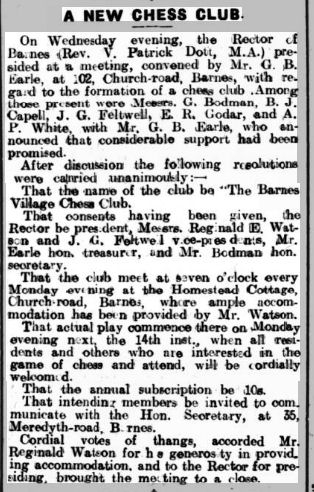
None of the names at this meeting are familiar, but they soon started playing matches against other local clubs.
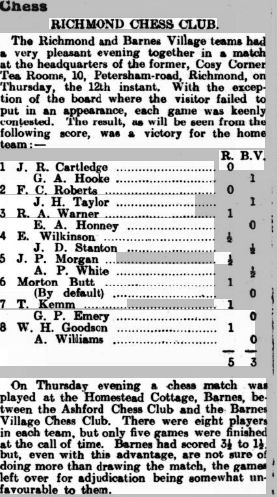
Here they are a year or so later, visiting their Richmond neighbours at the charming Cosy Corner Tea Rooms, as well as entertaining Ashford, who may well have travelled by train on the Waterloo line, but not stopping at Whitton or North Sheen: those stations were only opened in 1930.
And, look! They have two pretty strong veterans on the top two boards, no doubt delighted when a new club opened on their doorstep.
Here they are again, more than forty years earlier, playing again on the top two boards for the City of London Chess Club Knight Class in a match against Oxford University.
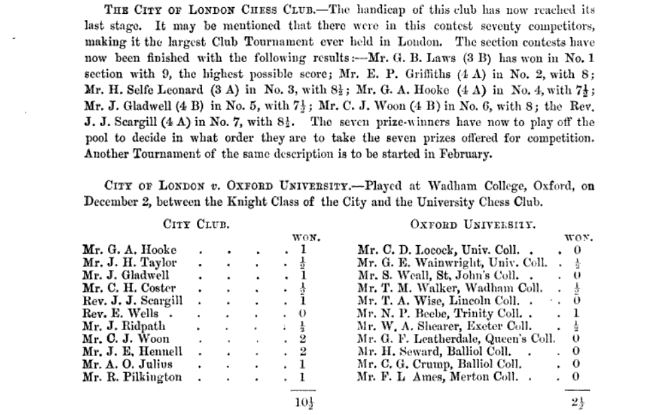
Messrs Hooke and Taylor were playing in the Knight Class of the City of London Chess Club: they’d have received odds of a knight when playing master strength opponents in the club handicap tournament. The Morning Post (4 December 1882) reported: “The result was a surprise to both parties, and appeared to puzzle the winners just as it did the losers.”
Mr Hooke’s opponent was the very interesting Charles Dealtry Locock, who will surely feature in a future Minor Piece. Mr Taylor faced George Edward Wainwright, a familiar name to Minor Piece readers. (Part 1 Part 2 Part 3 Part 4)
This wasn’t the first appearance of Mr Hooke in the chess news. His first appearance was in the 11th Counties Chess Association Meeting at the Manor House Hotel, Leamington in October 1881, where he played in the second class section, winning this game. You can click on any move in any game in this article for a pop-up window.
[pgn]
[Event “Counties Chess Ass 2nd Class Leamington”]
[Site “?”]
[Date “1881.10.??”]
[Round “?”]
[White “Bowley, Albert Alexander”]
[Black “Hooke, George Archer”]
[Result “0-1”]
[ECO “C41”]
[Annotator “Tactical Analysis 5.2 (1s)”]
[PlyCount “37”]
[SourceVersionDate “2022.10.04”]
1. e4 {Perrin,F} e5 2. Nf3 d6 3. d4 f5 4. dxe5 fxe4 5. Ng5 d5 6. e6 {And now
Nc3 would win.} Bc5 {Hoping for …Qf6. C41: Philidor Defence.} 7. Nf7 Qf6 {[#]
} 8. f4 $146 {[#]} (8. Qxd5 $2 Bxf2+ 9. Ke2 (9. Kd1 $2 Bxe6 10. Qxb7 Kxf7 $19)
9… Bxe6 $1 10. Qd8+ Kxf7 $17) (8. Qe2 Bxe6 9. Nxh8 Nc6 $11) (8. Be3 $14 Bxe3
9. fxe3) ({Predecessor:} 8. Qe2 Bxe6 9. Nxh8 Nc6 10. c3 O-O-O 11. Be3 d4 12.
cxd4 Nb4 13. Qd2 Bxd4 14. Qxb4 Bxb2 {0-1 (27) Mason,J-Field,O New York (Otis
Field’s) 1868 EXT 2017 [Perrin,F]}) 8… exf3 $1 $19 {Black has a decisive
advantage.} 9. Qxd5 fxg2 $2 $40 {Black goes for the king.} 10. Bxg2 $17 {[#]}
Bxe6 $1 11. Qxc5 $16 Bxf7 (11… Nd7 $14 12. Qxc7 Bxf7) 12. Bxb7 $2 {[#] This
bishop pair is nice.} (12. Bg5 $18 Qe6+ 13. Kd2) 12… Nd7 13. Qe3+ $18 Ne7 {
Strongly threatening …Qh4+.} 14. Bxa8 O-O {[#]} 15. Bg2 (15. Qf4 $1 $18 Rxa8
(15… Qa6 16. Be4) 16. Qxf6 Nxf6 17. Nc3) 15… Nf5 $2 (15… Re8 $17 {
keeps the pressure on.} 16. Nc3 Nf5 17. Qxe8+ Bxe8) 16. Qf2 ({Don’t blunder}
16. Qxa7 $2 Qe5+ 17. Be3 Nxe3 $19) ({Don’t go for} 16. Qe4 $2 Re8 17. Qxe8+
Bxe8 $19) (16. O-O $18 Nxe3 17. Rxf6 Nxc2 18. Rc6 Nxa1 19. Rxc7) 16… Re8+ 17.
Kf1 {[#]} Ne5 $2 (17… Bc4+ $1 $19 18. Kg1 Re2 19. Bd5+ Kh8 20. Bxc4 Rxf2 21.
Kxf2 Qh4+ 22. Kg2 Qe4+ 23. Kg1 Qd4+ 24. Kg2 Qe4+ 25. Kf2 Qxh1) 18. Nc3 $2 (18.
h3 $11 Ng3+ 19. Kg1) 18… Ng4 $19 {( -> …Ng3+)} 19. Qc5 {Weighted Error
Value: White=2.23/Black=1.80 Black mated in 3 moves: Ng3+. Source: Illustrated
Sporting and Dramatic News 31 December 1881} 0-1
[/pgn]
The up-and-coming Joseph Henry Blake from Southampton shared first place in the second class section with George E Walton from Birmingham. The information as to where Hooke finished and how many points he scored seems not to be available. The first three places in the top section were filled by members of the clergy: Charles Edward Ranken, John Owen and William Wayte.
Earlier in 1882 he’d beaten Captain Mackenzie in a simul. He’d also travelled to Manchester for the 12th Counties Chess Association Meeting, where he finished fourth in Class 2 with a score of 7½/11. Here, then, was an ambitious and fast improving young player, keen to play whenever the opportunity arose.
By 1884 George Hooke and John Taylor had both graduated to Class 3 (pawn and two moves). In this match they met a team from Cambridge University.
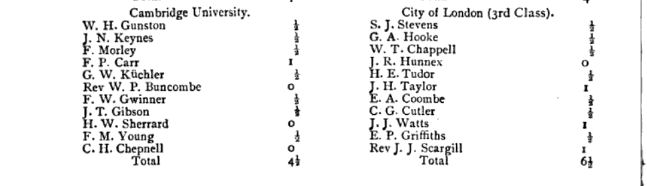
Mr Hooke again faced an interesting opponent in John Neville Keynes, the father of economist and Bloomsbury Group member John Maynard Keynes. By contrast, Mr Taylor’s opponent, Rev William Pengelly Buncombe, spent much of his life as a missionary in Japan.
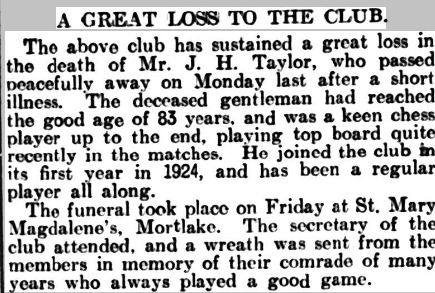
Let’s deal quickly with Mr Taylor. John H Taylor was Irish, born in County Westmeath in 1853, and, by profession a railway accountant, a not uncommon occupation at the time. He was active in the City of London Chess Club in the 1880s and 1890s but seemed to drop out of chess until the Barnes Village club opened its doors, when, in retirement, he threw himself into their activities, right up to the end of his life in 1937.
Mr Hooke was rather stronger, and rather more interesting. He’s most famous for a game he lost against the aforementioned Mr Blake, which has been much anthologised, often with the missed brilliancy on move 9 substituted for the actual conclusion, and often also with an incorrect year. Here’s its first appearance in print.
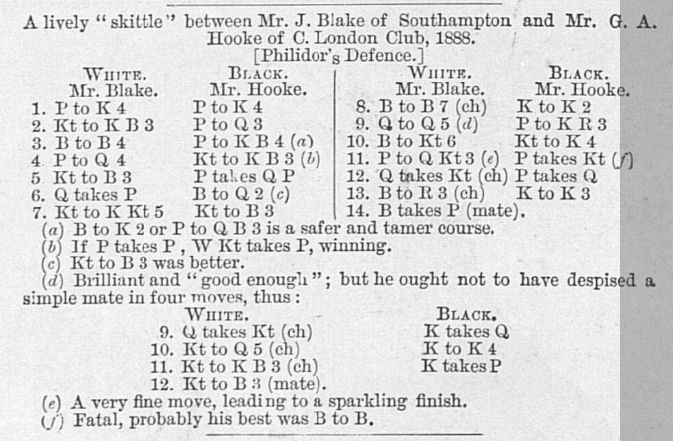
And here it is for you to play through yourself.
[pgn]
[Event “Casual Game: London”]
[Site “?”]
[Date “1888.??.??”]
[Round “?”]
[White “Blake, Joseph Henry”]
[Black “Hooke, George Archer”]
[Result “1-0”]
[ECO “C41”]
[Annotator “Tactical Analysis 5.2 (1s)”]
[PlyCount “27”]
[SourceVersionDate “2022.09.29”]
1. e4 {ChessBase II} e5 2. Nf3 d6 3. Bc4 f5 4. d4 {[#]} Nf6 $146 ({Predecessor:
} 4… fxe4 5. Ng5 d5 6. Bb3 Be7 7. h4 c6 8. dxe5 Bxg5 9. Bxg5 Qd7 10. Nc3 Qg4
11. Qd4 Be6 12. Nxe4 dxe4 13. Bxe6 Qxe6 {1-0 (22) Allen,H-Gilberg,C Brooklyn
(Brooklyn CC) 1869 EXT 2017 [ChessBase II]}) 5. Nc3 exd4 6. Qxd4 {[#] C41:
Philidor Defence.} (6. Nxd4 $18 fxe4 7. Qe2) 6… Bd7 $2 (6… Nc6 $14 7. Qe3
fxe4) 7. Ng5 (7. e5 $142) 7… Nc6 $2 (7… Qe7 $18) 8. Bf7+ Ke7 {[#]} 9. Qd5
$2 (9. Qxf6+ $3 Kxf6 (9… gxf6 10. Nd5#) 10. Nd5+ Ke5 11. Nf3+ Kxe4 12. Nc3#)
9… h6 $1 $15 10. Bg6 Ne5 {Prevents Qf7+.} 11. b3 $2 (11. Be3 $17 Qb8 12. Qb3)
11… hxg5 $4 (11… Qc8 $19 {and all is fine.} 12. Nf7 Nxg6 13. Nxh8 Nxd5 14.
Nxd5+ Ke8 15. Nxg6 fxe4) 12. Qxe5+ $18 dxe5 (12… Be6 $18 13. Qb5 (13. Ba3 c5
$18) 13… f4 14. Qxg5 Kd7) 13. Ba3+ Ke6 14. exf5# {Weighted Error Value:
White=2.05/Black=2.11} 1-0
[/pgn]
You’ll observe that the annotator, not having the benefit of Stockfish 15 to consult, mistakenly refers to Blake’s 11th move as a very fine move. It was a creative try which worked over the board, but Hooke could have won by playing, amongst other moves, 11… Qc8 or Qb8, making room for his king on d8. I’ve always found the 9. Qxf6 variation particularly attractive, with the knights returning to f3 and c3 to deliver mate.
Joseph Henry Blake was another prominent figure with a very long chess career, the latter part of which took place in Kingston. With any luck he’ll be the subject of some Minor Pieces in future.
George Archer Hooke was born in Chelsea on 28 February 1857, the third of twelve children of William Hooke and Harriet Sanders, six of whom tragically died before reaching the age of 20.
Here, from the family archives, is a photograph of William.
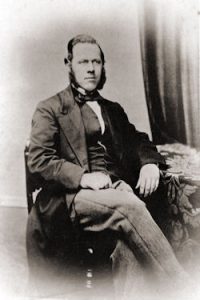
The family are elusive in the 1861 census, but in 1871 we find William working as the manager of a furniture depository living in the Parish of St George’s Hanover Square with his wife and eight children. They have no servants living in, which suggests the family was not especially wealthy.
By 1881 they’re at a different address, but still in the same parish. William seems to be in very much the same job. There are six children at home, along with a granddaughter. George, still living at home, is working as a 3rd Class Clerk in the Seamen’s Registry Office of the Board of Trade. He would remain there for the rest of his working life.
It must have been round about that time that he joined the City of London Chess Club, having learnt the game from his father at the age of about 12. He would soon join the North London Chess Club as well.
Moving into the middle of the 1880s, here’s a game from a match between the City of London and St George’s Chess Clubs, in which he faced the Hon Horace Curzon Plunkett, MP, rancher, agricultural reformer and uncle of writer and chess player Lord Dunsany. (He was ranching in Wyoming at the time: this must have been one of his visits back to London.) As the game was unfinished at the call of time it was adjudicated by Zukertort. His verdict was a draw, but Stockfish 15 disagrees, thinking Hooke had a winning position.
[pgn]
[Event “St George’s v City of London”]
[Site “?”]
[Date “1885.01.??”]
[Round “?”]
[White “Hooke, George Archer”]
[Black “Plunkett, Horace Curzon”]
[Result “1/2-1/2”]
[ECO “A13”]
[Annotator “Tactical Analysis 5.2 (1s)”]
[PlyCount “75”]
[SourceVersionDate “2022.09.29”]
1. Nf3 e6 2. d4 d5 3. e3 Nf6 4. c4 c5 5. Nc3 Nc6 6. Be2 Be7 7. b3 b6 8. Bb2 O-O
9. Rc1 Bb7 10. O-O Rc8 {A13: English Opening: 1…e6.} 11. h3 a6 12. Bd3 $2 (
12. dxc5 $16 {cxd5 is the strong threat.} Bxc5 13. cxd5 Nxd5 14. Nxd5 Qxd5 15.
Qxd5 exd5 16. Rfd1) 12… Bd6 $2 (12… cxd4 $17 13. exd4 dxc4 14. bxc4 Nb4)
13. Kh1 $2 (13. dxc5 $14 {stays ahead.} Bxc5 14. cxd5) 13… Bb8 $2 (13… cxd4
$17 14. Nxd4 Nxd4 15. exd4 Bf4) 14. Ne2 (14. dxc5 $5 dxc4 15. Bxc4 $14) 14…
Ne7 15. dxc5 dxc4 (15… Rxc5 {keeps more tension.} 16. b4 Rc8 17. Bxf6 gxf6
18. c5 e5) 16. Rxc4 {Black must now prevent Bxf6.} Rxc5 17. Bxf6 gxf6 18. Qc2
Rxc4 19. Qxc4 ({Don’t go for} 19. Bxh7+ $2 Kh8 20. bxc4 Bxf3 21. gxf3 f5 22.
Bxf5 (22. Rd1 $2 Qc7 $19) 22… Nxf5 $19) 19… Qd6 20. Rd1 Ng6 {[#] Threatens
to win with …Bxf3.} 21. Bc2 Qe7 {Hoping for …Rc8.} 22. Be4 Bc8 23. Ned4 f5
24. Bc2 (24. Nc6 $5 Qb7 25. Bd3 $11) 24… Qf6 25. e4 fxe4 (25… Bb7 $5 26.
exf5 {[#]} Rc8 $1 $11) 26. Bxe4 {Strongly threatening Nc6.} Rd8 27. Rc1 Bf4 28.
Re1 b5 29. Qc6 Kg7 30. g3 Be5 31. Ne2 Ne7 32. Qb6 Nd5 33. Bxd5 Rxd5 34. Kg2 Rd3
35. Qc6 Bc3 36. Nxc3 $2 (36. Nf4 $18 Bd7 37. Qb7) 36… Rxc3 37. Qe4 Bd7 $2 (
37… h6 $11) 38. Ne5 {Weighted Error Value: White=0.83/Black=1.01. An
unexpected result. Adjudicated a draw by Zukertort. Stockfish thinks White’s
winning. Source: Illustrated Sporting and Dramatic News 21 February 1885}
1/2-1/2
[/pgn]
In August that year he played in the 15th Counties Chess Association Meeting in Hereford, playing in Class 1A where he shared first place with his former antagonist Charles Dealtry Locock.
The parallel Class 1B tournament was won by George Edward Wainwright, and the two Georges then contested a 14-game match in London, with George H winning by the odd point. This match wasn’t well reported: it’s not clear whether it was a formal play-off match to decide the winner of the Hereford tournament or purely a friendly encounter.
In this league game against an anonymous opponent Hooke brought off a neat finish, giving up a rook to force checkmate in the ending.
[pgn]
[Event “North London v Ludgate Circus”]
[Site “?”]
[Date “1885.10.19”]
[Round “?”]
[White “Hooke, George Archer”]
[Black “Unknown”]
[Result “1-0”]
[ECO “C45”]
[Annotator “Tactical Analysis 5.2 (1s)”]
[PlyCount “59”]
[SourceVersionDate “2022.10.04”]
1. e4 e5 2. Nf3 Nc6 3. d4 exd4 4. Nxd4 Bc5 5. Be3 Qf6 6. c3 Nge7 7. Qd2 O-O {
With the idea …d5.} 8. Nb5 {C45: Scotch Game.} Bxe3 9. Qxe3 {[#] Black must
now prevent Nd2.} a6 $146 ({Predecessor:} 9… d5 10. Nxc7 Rb8 11. exd5 Nf5 12.
Qf4 g5 13. Qe4 Bd7 14. Qc2 Qe5+ 15. Be2 Nce7 {1-0 (52) Rynd,J-MacDonnell,G
Dublin 1884}) 10. Nxc7 {White is better.} Rb8 11. Nd2 Qd6 $2 (11… b5 $16 {
is a better defense.}) 12. Qg3 Ne5 {[#]} 13. Nc4 $1 Nxc4 (13… Qxc7 14. Nxe5)
14. Bxc4 Qxg3 15. hxg3 b5 16. Bd3 Bb7 17. O-O-O {Bc2 is the strong threat.} g6
$2 (17… Rfc8 {was called for.}) 18. Bc2 $18 Rfd8 19. Nd5 (19. Rd6 $142) 19…
Nxd5 20. exd5 d6 21. g4 Rbc8 22. Rh6 Kg7 23. g5 {Hoping for f4.} Rh8 24. g4 $2
{& White is more active.} (24. f4 $16) 24… f6 $2 {[#]} (24… Rc4 $11) 25.
gxf6+ $1 ({Not} 25. f4 fxg5 26. fxg5 Rce8 $11) 25… Kxh6 $2 {[#]} (25… Kxf6
$18 26. f4 Rcf8) 26. f4 $1 {White mates.} Bxd5 27. Rd2 Bg2 28. Rxg2 Rc5 29.
Rh2+ Rh5 30. g5# {Weighted Error Value: White=0.41/Black=0.86 Source: Hackney
Mercury And North London Herald, October 31, 1885} 1-0
[/pgn]
In an 1886 match between City of London and St George’s, he encountered one of the Fighting Reverends, Rev William Wayte, who had been one of England’s strongest players back in the 1850s. (You might notice that his Wikipedia page quotes from The Even More Complete Chess Addict, by M Fox and R James.) This time no adjudication was required: George managed to grind out a win with an extra pawn in a rook ending. Towards the end of his life, he mentioned a win against Wayte from 1885 as one of the games that gave him most pleasure: I presume he intended this one, even though the year doesn’t quite tally.
[pgn]
[Event “St George’s v City of London”]
[Site “?”]
[Date “1886.03.04”]
[Round “?”]
[White “Hooke, George Archer”]
[Black “Wayte, William”]
[Result “1-0”]
[ECO “C45”]
[Annotator “Tactical Analysis 5.2 (1s)”]
[PlyCount “113”]
[SourceVersionDate “2022.09.29”]
1. e4 e5 2. Nf3 Nc6 3. d4 exd4 4. Nxd4 Bc5 5. Be3 Qf6 6. c3 Nge7 7. Qd2 a6 8.
Be2 {C45: Scotch Game.} ({Much weaker is} 8. Bg5 Qe5 $15) 8… d5 {[#]} 9. Nxc6
$146 (9. exd5 {feels hotter.} Nxd5 10. Bg5 Qg6 11. Bd3) ({Predecessor:} 9. exd5
Bxd4 10. cxd4 Nxd5 11. Nc3 Be6 12. O-O h6 13. Ne4 Qg6 14. Nc5 Nd8 15. Rac1 O-O
{1-0 (72) Blackburne,J-Hruby,V Vienna 1882}) 9… Bxe3 10. Qxe3 {White has an
edge.} Qxc6 11. exd5 Qxd5 12. O-O Qe6 13. Qf3 O-O 14. Nd2 Bd7 15. Rfe1 Bc6 16.
Qg3 Qh6 17. Nf3 Nd5 18. Nd4 Bd7 19. Bf3 c6 20. Bxd5 cxd5 21. Re5 Bc6 $2 (21…
Qd6 $16) 22. Nf5 $18 Qf6 {[#]} 23. Ne7+ (23. Nxg7 $142 $1 Kh8 24. Nh5) 23…
Kh8 24. Nxd5 Bxd5 25. Rxd5 Rad8 26. Rxd8 Rxd8 {Endgame KQR-KQR} 27. Qc7 Qd6 28.
Qxd6 Rxd6 $14 {KR-KR} 29. Kf1 Rd2 30. b3 Kg8 31. Ke1 Rc2 32. c4 {Black must
now prevent Rd1.} Kf8 33. Rd1 {And now Rd2 would win.} Ke7 34. Rd2 Rc3 {[#]} (
34… Rc1+ $16 35. Ke2 Ke6) 35. Ke2 $2 (35. Re2+ Kd7 36. Kd2) 35… b5 36. cxb5
axb5 37. Rd5 Rc2+ 38. Kf3 Rxa2 39. Rxb5 Rb2 40. g4 h6 41. h4 g6 42. Kg3 Rb1 43.
f3 Rd1 44. Kf4 {Strongly threatening b4.} Rd4+ $2 (44… Kf6 $16) 45. Ke5 $18
Rd3 46. Rb7+ Kf8 47. f4 ({Only move:} 47. Ke4 $18 Rc3 48. b4) 47… Kg7 48. f5
(48. b4 $5) 48… Re3+ 49. Kf4 Rh3 (49… Re1 $16 {is tougher.}) 50. fxg6 {
White is clearly winning.} Kxg6 51. h5+ Kg7 52. b4 Rh1 53. Rc7 Rb1 54. Rc4 Kf6
55. Ke4 ({Less strong is} 55. Rc6+ Ke7 $16) 55… Rd1 56. Rd4 Re1+ 57. Kd5 {
Weighted Error Value: White=0.51/Black=0.76 Source: Illustrated Sporting and Dramatic News 27 March 1886} 1-0
[/pgn]
In the same year, 1886, George won a share of the brilliancy prize for this game in the City of London Chess Club Handicap Tournament against an opponent who got stuck in the mud adopting an unusual defence: we’d now call it a Hippopotamus.
[pgn]
[Event “City of London Handicap Tournament”]
[Site “?”]
[Date “1886.??.??”]
[Round “?”]
[White “Hooke, George Archer”]
[Black “Stevens, Samuel John”]
[Result “1-0”]
[ECO “B00”]
[Annotator “Tactical Analysis 5.2 (1s)”]
[PlyCount “77”]
[SourceVersionDate “2022.10.02”]
1. e4 b6 2. d4 g6 3. Bd3 Bg7 4. Nf3 Bb7 5. Nc3 e6 6. Be3 {B00: Queen’s
Fianchetto Defence, Nimzowitsch Defence.} Ne7 {[#]} 7. Qd2 $146 {& White is
more active.} ({Predecessor:} 7. Ne2 O-O 8. Ng3 f5 9. Qd2 fxe4 10. Nxe4 Bxe4
11. Bxe4 d5 12. Bd3 Nf5 13. O-O {0-1 (30) Robey,J-Mongredien,A London 1862})
7… O-O 8. h4 {White is clearly better.} c5 9. Bh6 (9. dxc5 bxc5 10. h5 (10.
Bxc5 d6 $16) 10… Qb6 $16) 9… cxd4 10. Bxg7 Kxg7 11. Nxd4 f5 $2 (11… Nbc6
12. Ndb5 $14) (11… h5 $16) 12. h5 $18 {Strongly threatening hxg6.} f4 13.
Ncb5 e5 (13… Nec6 $142 14. Nf3 Qf6 15. hxg6 hxg6) 14. Qb4 Nbc6 15. Nxc6 Nxc6
16. Qa3 Qg5 17. h6+ Kh8 18. Nd6 Qxg2 $2 (18… Nd8) 19. O-O-O Rab8 (19… Rfb8
$2 20. Qb3 Nd8 21. Nf7+ Kg8 22. Nxd8+) (19… Qxf2 $142 20. Nxb7 Qe3+ 21. Kb1
f3) 20. Nxb7 Qxf2 21. Nd6 Nd4 (21… Qe3+ $142 22. Kb1 f3) 22. Nc4 b5 23. Qe7
Ne6 {Against Qg7+} 24. Nxe5 Qd4 25. Nxd7 $2 (25. Nf7+ Kg8 26. Ng5) 25… Rbe8
26. Qa3 (26. Qxe6 Rxe6 27. Nxf8 Re8 28. Bxb5 (28. Nxg6+ hxg6 29. Bxb5 Qe3+ 30.
Kb1 Rb8 $17) 28… Qe3+ 29. Kb1 Rxf8 $17) 26… Qxd7 27. Bc4 $1 Nd4 {[#]} (
27… Qe7 $142) 28. Bd5 $2 (28. Bf1 $1 $18 {is the precise move to win.}) 28…
Ne2+ 29. Kb1 b4 $2 {[#]} (29… Qc7 $16 {might work better.}) 30. Qxb4 $2 (30.
Qd3 $1 $18) 30… Rb8 $2 (30… Qe7 $16 31. Qd2 Ng3) 31. Qc4 (31. Qd2 $18 {
is more deadly.}) 31… f3 {aiming for …Qd6.} 32. Qd3 $2 (32. Rhf1 $18) 32…
Qe7 {…g5 is the strong threat.} 33. Qe3 {Threatens to win with Rhf1.} Qb4 $2
(33… g5 $11 {and Black has nothing to worry.}) 34. Bb3 {Black must now
prevent Rhf1. The board is on fire.} a5 $2 (34… Qb6 35. Qg5 Qf6) 35. Qg5 $2
$40 {White is out for blood.} ({Weaker is} 35. Rd7 Qb6 36. Qxb6 (36. Qg5 Qf6
$14) 36… Rxb6 $16) (35. Rhf1) 35… Qxe4 (35… Rbe8) 36. Qxa5 {Intending
Qc7 and mate.} Rfc8 {Against Qc7} (36… Rbe8 37. Rhf1 Qe7) 37. Qg5 Rb6 {
Against Qf6+} (37… Rf8 $18 38. Rhf1 Qf4) 38. Rd8+ Qe8 39. Qe5+ {Weighted
Error Value: White=0.96/Black=1.28 Source: Illustrated London News 28 August
1886} 1-0
[/pgn]
In 1886 Hooke took part in the Amateur Championship of the 2nd British Chess Association Congress in London, scoring an outstanding success. Walter Montagu Gattie won with a score of 15/18, and George Archer Hooke featured in a three-way tie for second with Antony Alfred Geoffrey Guest and George Edward Wainwright. Unfortunately, few of the games from this tournament have been published.
Although most of the games took place during the summer, it was only concluded in October, by which time George was involved in another tournament. This was the British Chess Club 2nd Class Tournament in which he again finished in second place. His score of 3½/5 left him half a point behind Scottish champion Daniel Yarnton Mills. Here’s their game, which resulted in a draw.
[pgn]
[Event “British Chess Club 2nd Class Tourney”]
[Site “?”]
[Date “1886.10.??”]
[Round “?”]
[White “Mills, Daniel Yarnton”]
[Black “Hooke, George Archer”]
[Result “1/2-1/2”]
[ECO “C48”]
[Annotator “Tactical Analysis 5.2 (1s)”]
[PlyCount “75”]
[SourceVersionDate “2022.10.02”]
1. e4 {ChessBase II} e5 2. Nf3 Nc6 3. Nc3 Nf6 4. Bb5 Bc5 5. O-O d6 6. d4 exd4
7. Nxd4 Bd7 8. Bxc6 bxc6 {[#]} 9. Bg5 $146 ({Predecessor:} 9. Nf5 Bxf5 10. exf5
O-O 11. Be3 Bxe3 12. fxe3 d5 13. Qf3 Re8 14. Rad1 Qe7 15. Rd3 Nd7 16. Qg3 Nc5 {
1-0 (46) Newham,W-Gunsberg,I London 1883 EXT 2003 [ChessBase II]}) 9… h6 10.
Bh4 g5 {C48: Four Knights: 4 Bb5, replies other than 4…Bb4.} 11. Bg3 h5 {
…h4 is the strong threat.} 12. e5 {& White is more active.} h4 {White is
better.} 13. exf6 Qxf6 14. Re1+ Kf8 {[#]} 15. Be5 dxe5 {[#]} 16. Ne4 $1 {
Pair of Knights!} Qe7 17. Nxc5 Qxc5 18. Nb3 (18. Nf3 $5 Bg4 {[#]} 19. Nxe5 $1
Bxd1 20. Nd7+ Kg7 21. Nxc5 Bxc2 22. Re7 $11) 18… Qe7 19. Qe2 f6 $36 {Black
has some pressure.} 20. Rad1 Be6 21. Nd4 Bd5 22. c4 {White has compensation.}
Bf7 23. b3 Bh5 {Inhibits Qf3.} 24. Nf3 Kg7 (24… h3 {keeps more tension.} 25.
Qe4 Qe6 26. Nd4 Qg4) 25. Qe3 Bxf3 26. Qxf3 Qe6 27. Qe3 Rhe8 28. Rd2 Re7 (28…
Kg6 {feels hotter.} 29. h3 a6 30. Qc5 a5) 29. Red1 a5 (29… a6 {is
interesting.} 30. h3 e4 31. Rd8 Rxd8 32. Rxd8 Qe5) 30. a4 Rb8 31. h3 g4 32.
hxg4 Qxg4 33. Rd4 exd4 (33… Qg5 $5 34. Qe2 f5 $15) 34. Qxe7+ {The position
is equal.} Kg6 35. f3 Qf4 {aiming for …Qe3+.} 36. Qd7 c5 {Threatens to win
with …Qe3+.} 37. Re1 {Inhibits Qe3+. Black must now prevent Re4.} Rxb3 38.
Qe8+ {Weighted Error Value: White=0.32/Black=0.34 With a draw by perpetual
check. Source: Morning Post 18 October 1886} 1/2-1/2
[/pgn]
Handicap tournaments were a big feature of every competitive chess club at the time, and for many years later. Perhaps they should be revived. They worked something like this.
The players were grouped into classes according to playing strength. If you played someone one class below you, you played Black without your f-pawn. Against someone two classes below you and you were again Black without your f-pawn, but White got to play two moves at the start of the game. Against an opponent three classes below you, you’re White but playing without your queen’s knight. and, against an opponent four classes below you you’re again White and this time without your queen’s rook.
Here’s how George Hooke defeated a player two classes below him who foolishly launched a kamikaze attack right from the opening rather than playing solid, sensible moves. (We start the game with the white pawn already on e4.)
[pgn]
[Event “City of London CC Handicap Tournament”]
[Site “?”]
[Date “1886.??.??”]
[Round “?”]
[White “Staniforth, Henry Smallpage”]
[Black “Hooke, George Archer”]
[Result “0-1”]
[Annotator “Tactical Analysis 5.2 (1s)”]
[SetUp “1”]
[FEN “rnbqkbnr/ppppp1pp/8/8/4P3/8/PPPP1PPP/RNBQKBNR w KQkq – 0 1”]
[PlyCount “42”]
[SourceVersionDate “2022.10.03”]
1. d4 {White is winning.} d6 2. Bd3 Nc6 3. e5 {White wants to mate with Qh5+.}
Nxd4 4. Qh5+ (4. c3 $18 Nf5 5. Nf3) 4… g6 $11 5. Bxg6+ hxg6 6. Qxg6+ (6. Qxh8
$2 {is the wrong capture.} Nxc2+ 7. Ke2 {[#]} Qd7 $1 8. Qxg8 Qg4+ 9. Nf3 Be6
$19) 6… Kd7 {…c5 is the strong threat.} 7. Qg4+ Ne6 8. Nf3 {Black must now
prevent Nd4.} Qe8 9. Nd4 ({But not} 9. Ng5 Qg6 10. Qxe6+ Qxe6 11. Nxe6 Kxe6 $19
) 9… Qf7 10. O-O Ke8 11. exd6 cxd6 12. Re1 {[#]} Nh6 $1 13. Qe4 Nxd4 14. Qxd4
{[#]} Ng4 $1 15. Bf4 (15. f3 Ne5) 15… e5 (15… Bg7 $142 16. Qd2 Bxb2) 16. f3
$2 {[#]} (16. Bg3) 16… Be7 $1 $19 {Black is clearly winning.} 17. Qc3 (17.
Qd2 Qxf4) 17… Qxf4 18. fxg4 Qxh2+ 19. Kf2 Rf8+ 20. Ke2 Bxg4+ 21. Kd2 Bg5+ {
Black took control after the opening. Weighted Error Value: White=1.28/
Black=0.19 (very precise) Source: Illustrated London News 25 September 1886}
0-1
[/pgn]
By now, it seems that, while George Archer Hooke continued to play regularly in matches and club tournaments, he no longer had the time to travel to places like Manchester and Hereford for congresses. Perhaps his work with the Board of Trade was taking up more of his time: as a young man of considerable abilities approaching his 30th birthday he would doubtless have been promoted by now.
Perhaps there was another reason as well.
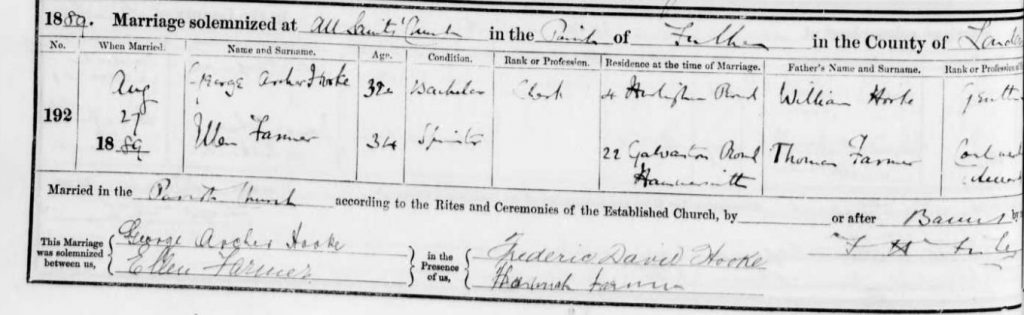
Here he is, on August 27 1889, now aged 32, marrying 34 year old Ellen Farmer at All Saints Church, Fulham, right by Putney Bridge. Congratulations to the happy couple!
And here, for now, we’ll leave George Archer Hooke, a strong amateur chess player, a high-flying civil servant and now a married man who would waste little time starting a family.
You already know that he was still playing chess in the 1920s so there’s lots more to tell.
You’ll find out what happened next in the second instalment of the story of George Archer Hooke, coming very soon to a Minor Piece near you.
Acknowledgements and sources:
ancestry.co.uk
findmypast.co.uk
Wikipedia
EdoChess (George Archer Hooke’s page here)
BritBase
chessgames.com
Chess Notes (Edward Winter)
Chess Scotland
Hooke Family History (many thanks to Graham Hooke)
Brian Denman
Gerard Killoran