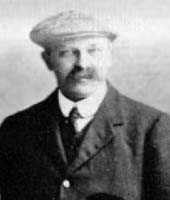
Charles Masson Fox was born on Friday, November 9th 1866 in Falmouth, Cornwall. his father, Howard, was 29 and his mother, Olivia Blanche Orme, was 22. He had one brother and two sisters.
His sister Olivia Lloyd was born on 5 February 1868 in Falmouth, Cornwall, when Charles Masson was 1 year old. His sister Stella was born on 11 December 1876 in Falmouth, Cornwall, when Charles Masson was 10 years old. In 1881 he was living in Sherborne, Dorset. In 1901 he was once more living in Falmouth and his profession was that of a timber merchant. His brother Howard Orme died on 7 June 1921 in Falmouth, Cornwall. His father Howard passed away on 15 November 1922 in Cornwall. His mother Olivia Blanche passed away on 12 March 1930 in Falmouth, Cornwall, at the age of 85.
Sadly, neither Hooper & Whyld, Sunnucks or Golombek mention Fox in their works.
“Charles Masson Fox (9 November 1866 – 11 October 1935) was a Cornish businessman who achieved international prominence in the world of chess problems and a place in the gay history of Edwardian England.
Masson Fox was born into a Quaker family (although he was not related to the Quakers’ founder George Fox) and was a cousin of the fraudulent sinologist Sir Edmund Backhouse, 2nd Baronet. Living throughout his life in the Cornish seaside town of Falmouth, Fox in the early decades of his life was a senior partner of his family’s timber firm, Fox Stanton & Company, and was also on the Board of Messrs G C Fox & Company, a long-established firm of shipping agents.
C.M.Fox’s gravestone at Budock Quaker Burial Ground
Fox is described by chess historian Thomas Rayner Dawson (1889–1951) as “a friendly man, kind, mellow, lovable, bringing peace and comfort and serene joy with him”. He was also a discreet but active homosexual. In 1909 he visited Venice with his friend James Cockerton, meeting the writer Frederick Rolfe and becoming the reluctant recipient of Rolfe’s famous Venice Letters, in which the gay subculture of Venice is vividly described.
In 1912–13 Fox was blackmailed by a woman who accused him of seducing her 16-year-old son. Eventually Fox reported the matter to the police and the woman was sent to prison for five years and her son for one year, with hard labour.[1] However, Fox was profoundly affected by the publicity surrounding the case, which was reported in detail in the local press. The predictable result of his courageous action was the destruction of his reputation, and the compromise of his business and social life in Falmouth.
Although he continued to live in Cornwall, the focus of his social life shifted to London, and in the last two decades of his life, Fox became prominent in the world of chess. He was elected President of the Cornwall Chess Association, played a prominent part in the development of the British Chess Problem Society, and is still renowned as one of the greatest ever exponents of fairy chess (chess problems with variations in the rules).”
From The Problemist Fairy Chess Supplement, 1933 :
What is the shortest game
ending in this position?
Charles Masson Fox was born on Friday, November 9th 1866 in Falmouth, Cornwall. his father, Howard, was 29 and his mother, Olivia Blanche Orme, was 22. He had one brother and two sisters.
His sister Olivia Lloyd was born on 5 February 1868 in Falmouth, Cornwall, when Charles Masson was 1 year old. His sister Stella was born on 11 December 1876 in Falmouth, Cornwall, when Charles Masson was 10 years old. In 1881 he was living in Sherborne, Dorset. In 1901 he was once more living in Falmouth and his profession was that of a timber merchant. His brother Howard Orme died on 7 June 1921 in Falmouth, Cornwall. His father Howard passed away on 15 November 1922 in Cornwall. His mother Olivia Blanche passed away on 12 March 1930 in Falmouth, Cornwall, at the age of 85.
Sadly, neither Hooper & Whyld, Sunnucks or Golombek mention Fox in their works.
“Charles Masson Fox (9 November 1866 – 11 October 1935) was a Cornish businessman who achieved international prominence in the world of chess problems and a place in the gay history of Edwardian England.
Masson Fox was born into a Quaker family (although he was not related to the Quakers’ founder George Fox) and was a cousin of the fraudulent sinologist Sir Edmund Backhouse, 2nd Baronet. Living throughout his life in the Cornish seaside town of Falmouth, Fox in the early decades of his life was a senior partner of his family’s timber firm, Fox Stanton & Company, and was also on the Board of Messrs G C Fox & Company, a long-established firm of shipping agents.
C.M.Fox’s gravestone at Budock Quaker Burial Ground
Fox is described by chess historian Thomas Rayner Dawson (1889–1951) as “a friendly man, kind, mellow, lovable, bringing peace and comfort and serene joy with him”. He was also a discreet but active homosexual. In 1909 he visited Venice with his friend James Cockerton, meeting the writer Frederick Rolfe and becoming the reluctant recipient of Rolfe’s famous Venice Letters, in which the gay subculture of Venice is vividly described.
In 1912–13 Fox was blackmailed by a woman who accused him of seducing her 16-year-old son. Eventually Fox reported the matter to the police and the woman was sent to prison for five years and her son for one year, with hard labour.[1] However, Fox was profoundly affected by the publicity surrounding the case, which was reported in detail in the local press. The predictable result of his courageous action was the destruction of his reputation, and the compromise of his business and social life in Falmouth.
Although he continued to live in Cornwall, the focus of his social life shifted to London, and in the last two decades of his life, Fox became prominent in the world of chess. He was elected President of the Cornwall Chess Association, played a prominent part in the development of the British Chess Problem Society, and is still renowned as one of the greatest ever exponents of fairy chess (chess problems with variations in the rules).”
From The Problemist Fairy Chess Supplement, 1933 :
What is the shortest game
ending in this position?
Charles Masson Fox was born on Friday, November 9th 1866 in Falmouth, Cornwall. his father, Howard, was 29 and his mother, Olivia Blanche Orme, was 22. He had one brother and two sisters.
His sister Olivia Lloyd was born on 5 February 1868 in Falmouth, Cornwall, when Charles Masson was 1 year old. His sister Stella was born on 11 December 1876 in Falmouth, Cornwall, when Charles Masson was 10 years old. In 1881 he was living in Sherborne, Dorset. In 1901 he was once more living in Falmouth and his profession was that of a timber merchant. His brother Howard Orme died on 7 June 1921 in Falmouth, Cornwall. His father Howard passed away on 15 November 1922 in Cornwall. His mother Olivia Blanche passed away on 12 March 1930 in Falmouth, Cornwall, at the age of 85.
Sadly, neither Hooper & Whyld, Sunnucks or Golombek mention Fox in their works.
“Charles Masson Fox (9 November 1866 – 11 October 1935) was a Cornish businessman who achieved international prominence in the world of chess problems and a place in the gay history of Edwardian England.
Masson Fox was born into a Quaker family (although he was not related to the Quakers’ founder George Fox) and was a cousin of the fraudulent sinologist Sir Edmund Backhouse, 2nd Baronet. Living throughout his life in the Cornish seaside town of Falmouth, Fox in the early decades of his life was a senior partner of his family’s timber firm, Fox Stanton & Company, and was also on the Board of Messrs G C Fox & Company, a long-established firm of shipping agents.
C.M.Fox’s gravestone at Budock Quaker Burial Ground
Fox is described by chess historian Thomas Rayner Dawson (1889–1951) as “a friendly man, kind, mellow, lovable, bringing peace and comfort and serene joy with him”. He was also a discreet but active homosexual. In 1909 he visited Venice with his friend James Cockerton, meeting the writer Frederick Rolfe and becoming the reluctant recipient of Rolfe’s famous Venice Letters, in which the gay subculture of Venice is vividly described.
In 1912–13 Fox was blackmailed by a woman who accused him of seducing her 16-year-old son. Eventually Fox reported the matter to the police and the woman was sent to prison for five years and her son for one year, with hard labour.[1] However, Fox was profoundly affected by the publicity surrounding the case, which was reported in detail in the local press. The predictable result of his courageous action was the destruction of his reputation, and the compromise of his business and social life in Falmouth.
Although he continued to live in Cornwall, the focus of his social life shifted to London, and in the last two decades of his life, Fox became prominent in the world of chess. He was elected President of the Cornwall Chess Association, played a prominent part in the development of the British Chess Problem Society, and is still renowned as one of the greatest ever exponents of fairy chess (chess problems with variations in the rules).”
From The Problemist Fairy Chess Supplement, 1933 :
What is the shortest game
ending in this position?
Charles Masson Fox was born on Friday, November 9th 1866 in Falmouth, Cornwall. his father, Howard, was 29 and his mother, Olivia Blanche Orme, was 22. He had one brother and two sisters.
His sister Olivia Lloyd was born on 5 February 1868 in Falmouth, Cornwall, when Charles Masson was 1 year old. His sister Stella was born on 11 December 1876 in Falmouth, Cornwall, when Charles Masson was 10 years old. In 1881 he was living in Sherborne, Dorset. In 1901 he was once more living in Falmouth and his profession was that of a timber merchant. His brother Howard Orme died on 7 June 1921 in Falmouth, Cornwall. His father Howard passed away on 15 November 1922 in Cornwall. His mother Olivia Blanche passed away on 12 March 1930 in Falmouth, Cornwall, at the age of 85.
Sadly, neither Hooper & Whyld, Sunnucks or Golombek mention Fox in their works.
“Charles Masson Fox (9 November 1866 – 11 October 1935) was a Cornish businessman who achieved international prominence in the world of chess problems and a place in the gay history of Edwardian England.
Masson Fox was born into a Quaker family (although he was not related to the Quakers’ founder George Fox) and was a cousin of the fraudulent sinologist Sir Edmund Backhouse, 2nd Baronet. Living throughout his life in the Cornish seaside town of Falmouth, Fox in the early decades of his life was a senior partner of his family’s timber firm, Fox Stanton & Company, and was also on the Board of Messrs G C Fox & Company, a long-established firm of shipping agents.
C.M.Fox’s gravestone at Budock Quaker Burial Ground
Fox is described by chess historian Thomas Rayner Dawson (1889–1951) as “a friendly man, kind, mellow, lovable, bringing peace and comfort and serene joy with him”. He was also a discreet but active homosexual. In 1909 he visited Venice with his friend James Cockerton, meeting the writer Frederick Rolfe and becoming the reluctant recipient of Rolfe’s famous Venice Letters, in which the gay subculture of Venice is vividly described.
In 1912–13 Fox was blackmailed by a woman who accused him of seducing her 16-year-old son. Eventually Fox reported the matter to the police and the woman was sent to prison for five years and her son for one year, with hard labour.[1] However, Fox was profoundly affected by the publicity surrounding the case, which was reported in detail in the local press. The predictable result of his courageous action was the destruction of his reputation, and the compromise of his business and social life in Falmouth.
Although he continued to live in Cornwall, the focus of his social life shifted to London, and in the last two decades of his life, Fox became prominent in the world of chess. He was elected President of the Cornwall Chess Association, played a prominent part in the development of the British Chess Problem Society, and is still renowned as one of the greatest ever exponents of fairy chess (chess problems with variations in the rules).”
From The Problemist Fairy Chess Supplement, 1933 :
What is the shortest game
ending in this position?
Charles Masson Fox was born on Friday, November 9th 1866 in Falmouth, Cornwall. his father, Howard, was 29 and his mother, Olivia Blanche Orme, was 22. He had one brother and two sisters.
His sister Olivia Lloyd was born on 5 February 1868 in Falmouth, Cornwall, when Charles Masson was 1 year old. His sister Stella was born on 11 December 1876 in Falmouth, Cornwall, when Charles Masson was 10 years old. In 1881 he was living in Sherborne, Dorset. In 1901 he was once more living in Falmouth and his profession was that of a timber merchant. His brother Howard Orme died on 7 June 1921 in Falmouth, Cornwall. His father Howard passed away on 15 November 1922 in Cornwall. His mother Olivia Blanche passed away on 12 March 1930 in Falmouth, Cornwall, at the age of 85.
Sadly, neither Hooper & Whyld, Sunnucks or Golombek mention Fox in their works.
“Charles Masson Fox (9 November 1866 – 11 October 1935) was a Cornish businessman who achieved international prominence in the world of chess problems and a place in the gay history of Edwardian England.
Masson Fox was born into a Quaker family (although he was not related to the Quakers’ founder George Fox) and was a cousin of the fraudulent sinologist Sir Edmund Backhouse, 2nd Baronet. Living throughout his life in the Cornish seaside town of Falmouth, Fox in the early decades of his life was a senior partner of his family’s timber firm, Fox Stanton & Company, and was also on the Board of Messrs G C Fox & Company, a long-established firm of shipping agents.
C.M.Fox’s gravestone at Budock Quaker Burial Ground
Fox is described by chess historian Thomas Rayner Dawson (1889–1951) as “a friendly man, kind, mellow, lovable, bringing peace and comfort and serene joy with him”. He was also a discreet but active homosexual. In 1909 he visited Venice with his friend James Cockerton, meeting the writer Frederick Rolfe and becoming the reluctant recipient of Rolfe’s famous Venice Letters, in which the gay subculture of Venice is vividly described.
In 1912–13 Fox was blackmailed by a woman who accused him of seducing her 16-year-old son. Eventually Fox reported the matter to the police and the woman was sent to prison for five years and her son for one year, with hard labour.[1] However, Fox was profoundly affected by the publicity surrounding the case, which was reported in detail in the local press. The predictable result of his courageous action was the destruction of his reputation, and the compromise of his business and social life in Falmouth.
Although he continued to live in Cornwall, the focus of his social life shifted to London, and in the last two decades of his life, Fox became prominent in the world of chess. He was elected President of the Cornwall Chess Association, played a prominent part in the development of the British Chess Problem Society, and is still renowned as one of the greatest ever exponents of fairy chess (chess problems with variations in the rules).”
From The Problemist Fairy Chess Supplement, 1933 :
What is the shortest game
ending in this position?
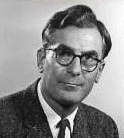
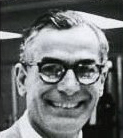
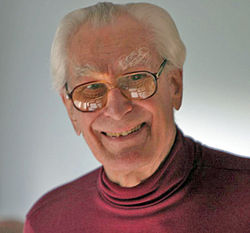
BCN remembers Richard Guy who passed away in Calgary, Alberta, Canada on Monday, March 9th, 2020 at the splendid age of 103.
Early Life
Richard Kenneth Guy was born on Saturday, 30th September 1916. On this day construction on the Hell Gate Bridge in New York City was completed.
He was born in Nuneaton, Warwickshire to William Alexander Charles Guy and Augusta Adeline Guy (née Tanner). RKGs parents had married in the final quarter of 1915 in Solihull. William was headmaster of Atherstone Elementary School.
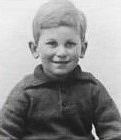
Richard Guy
Growing Up
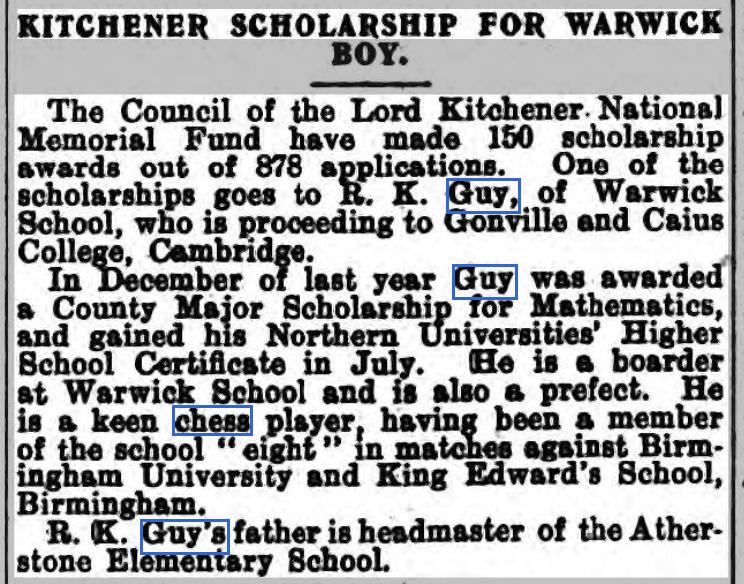
Richard attended Warwick School excelling in mathematics where he was a boarder and prefect. In December 1934 He obtained a County Major Scholarship for Mathematics provided by the Lord Kitchener Memorial Fund gaining his Northern Universities Higher School Certificate in July 1935.
Warwick and Warwickshire Advertiser 25 May 1935
He went up to Gonville and Caius College, Cambridge University in October 1935 graduating in 1938. Stephen Hawking was also an alumni of Caius College.
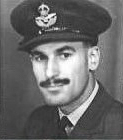
Richard Guy
The 1939 register records Richard aged 23 living as a lodger in the Blower household of six at 436 Buxton Road, Stockport, Cheshire, England. This address has since been converted to residential flats. He was a teacher of mathematics in a local secondary school.
RAF and the Weather Years
During the second world war Richard saw non-combative service in the Royal Air Force working on forecasting the weather and improving the methodologies. This work was a critical component of the British war effort.
In the final quarter of 1940 Richard married Nancy Louise Thirian in Bingham, Nottingham. Nancy (in fact, she was known as Louise) was born in Islington in the third quarter of 1918 and passed away in 2010. They had three children and Michael JT Guy was also a significant mathematician.
According to Wikipedia : “In November 1942, Guy received an emergency commission in the Meteorological Branch of the Royal Air Force, with the rank of flight lieutenant. He was posted to Reykjavik, and later to Bermuda, as a meteorologist. He tried to get permission for Louise to join him but was refused. While in Iceland, he did some glacier travel, skiing, and mountain climbing, marking the beginning of another long love affair, this one with snow and ice.”
Richard Guy
Teaching and Research
In August 1951 Richard relocated to Singapore and taught for ten years at The University of Malaya and following that he worked at the Indian Institute of Technology in Delhi. Finally, in 1965, he moved to Calgary and taught in the Mathematics Department at The University of Calgary. For fuller details of his extensive mathematical career see the many links at the foot of this article.
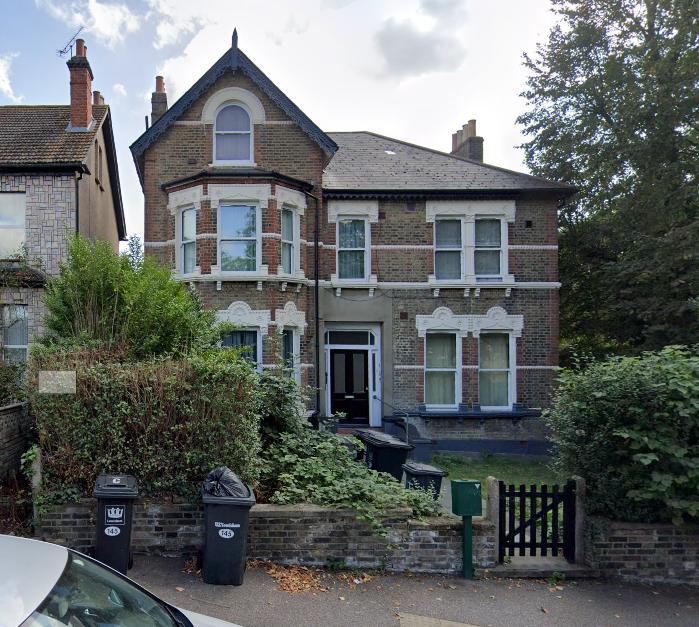
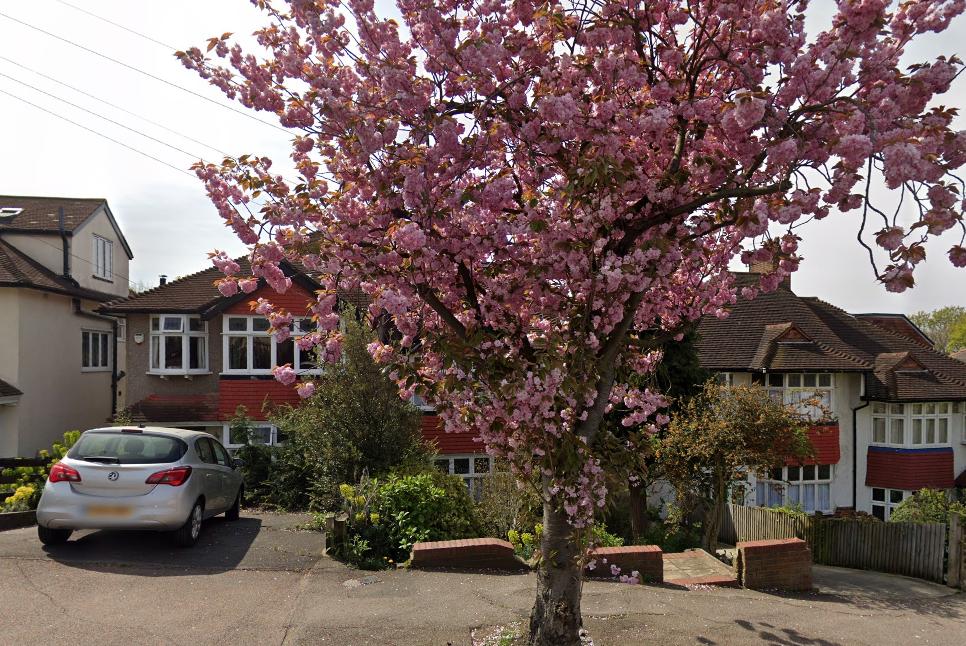
RKGs final address in England was 145 Sunderland Road, Forest Hill, London SE23 2PX:
145 Sunderland Road, Forest Hill, London SE23 2PX
Chess Playing
Richard’s chess career was active whilst at Warwick School. As a boarder and prefect he played for the school “eight” in matches against teams such as Birmingham University and King Edward’s School, Birmingham.
Richard Guy
Richard’s interest turned away from over-the-board play but he did find time to compete in the Major Open of the August 1946 British Championships in Nottingham. Only two game scores are known where he lost to Dr. Fazekas and Gordon Crown: both very strong opponents.
Richard Guy
Chess Writing and Composing
The December 1947 edition of British Chess Magazine contains RKGs very first Endings column taking over from TR Dawson. The column was introduced thus:
“Mr RK Guy has kindly consented to take over the Endings Section. All communications should now be sent to him at 33 Westwood Park Forest Hill London SE23.” TRD went on to write:
“With this page I reluctantly terminate on health grounds some forty years of work in the Endings field, and my contributions to this corner of the British Chess Magazine. To the many readers of these pages, a Merry Christmas and steadily improving years.”
33 Westwood Park, Forest Hill, London SE23 3QG
RKG was to edit this column until his final piece in June 1951. RKG wrote in the July 1951 column (now edited by HF Blandford): “My address after August will be University of Malaya, Singapore. I have enjoyed these few years, and am sorry to leave you, although you will be in capable hands. HFB is player and problemist, but his greatest love is for endings, and he has won many international prizes.”
RKG is known for almost 200 endgame studies.
This is study #53, page 57 from Test Tube Chess by AJ Roycroft:
RK Guy The Field, 28 xii 1940
win, 3+2
The win is by a white king march from the h-file onto the same file as the pawn, instead of the reverse!
1.Bb4!/i Rh2+;
2.Kg7 Rg2+;
3.Kf7 Rf2+;
4.Ke6 Re2+/ii;
5.Kd5 Re3;
6.Kd4 wins
(i) Why not 1.d8=Q. Because of 1…Rb8; 2.Qxb8 stalemate!
(ii) 4…Rf8 not on because of 5.Bxf8
and this one is study #148, page 106 of the same publication:
(i) 3…Kd3;4.Rd5+ Qd5;5.Sf4+ Ke4;6.Sxd5 Kxd5;7.h4 wins.
(ii) 4…Kd3;5.Rf3+ Kxd2;6.Se4+, or 5…Kd4;6.Sf5+.
(iii) 5…Kd5;6.Rd4+ Kxd4;7.Sf5+.
A lot of checks, but also a lot of play.
In 2020 John Beasley wrote: “Richard did not achieve the same renown in our field as he has in the field of recreational mathematics, but his studies are neat and many are also instructive, a point which he considered important. We have been the richer for his presence.”
Along with Hugh Blandford and John Roycroft, RKG was one of the inventors of the GBR code (Guy–Blandford–Roycroft code), a system of representing the position of chess pieces on a chessboard. Publications such as EG magazine use it to classify endgame types and to index endgame studies.
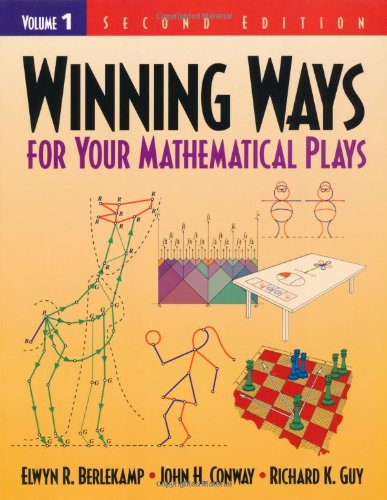
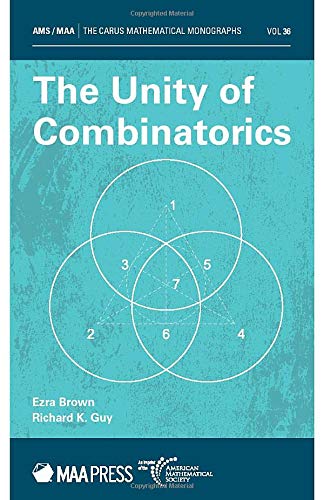
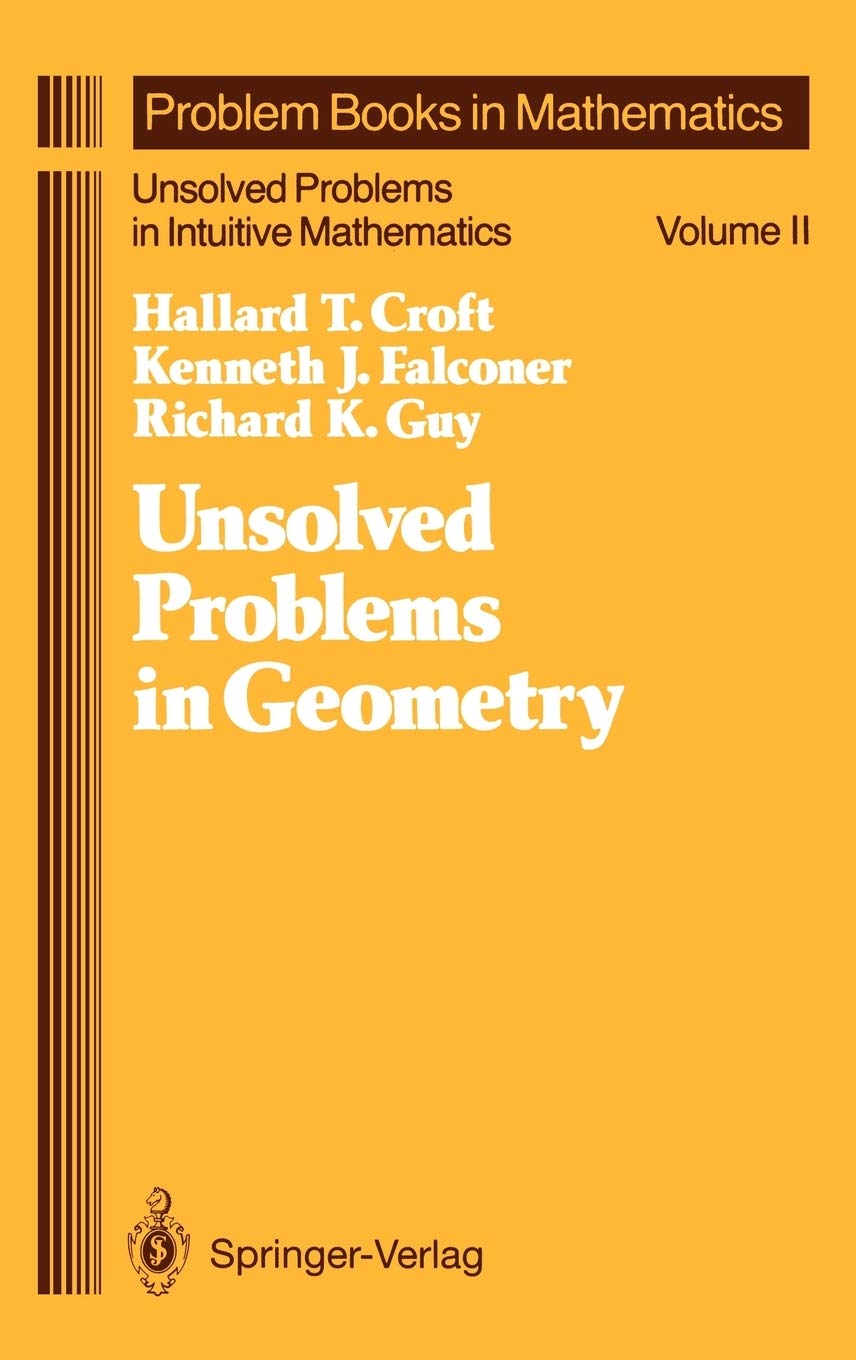
Richard Kenneth GuyWinning WaysThe Unity of Combinatorics, Ezra Brown and RK Guy, American Mathematical Society (30 May 2020)Unsolved Problems in Geometry, RK Guy, Springer Verlag, 1994
BCN remembers Richard Guy who passed away in Calgary, Alberta, Canada on Monday, March 9th, 2020 at the splendid age of 103.
Early Life
Richard Kenneth Guy was born on Saturday, 30th September 1916. On this day construction on the Hell Gate Bridge in New York City was completed.
He was born in Nuneaton, Warwickshire to William Alexander Charles Guy and Augusta Adeline Guy (née Tanner). RKGs parents had married in the final quarter of 1915 in Solihull. William was headmaster of Atherstone Elementary School.
Richard Guy
Growing Up
Richard attended Warwick School excelling in mathematics where he was a boarder and prefect. In December 1934 He obtained a County Major Scholarship for Mathematics provided by the Lord Kitchener Memorial Fund gaining his Northern Universities Higher School Certificate in July 1935.
Warwick and Warwickshire Advertiser 25 May 1935
He went up to Gonville and Caius College, Cambridge University in October 1935 graduating in 1938. Stephen Hawking was also an alumni of Caius College.
Richard Guy
The 1939 register records Richard aged 23 living as a lodger in the Blower household of six at 436 Buxton Road, Stockport, Cheshire, England. This address has since been converted to residential flats. He was a teacher of mathematics in a local secondary school.
RAF and the Weather Years
During the second world war Richard saw non-combative service in the Royal Air Force working on forecasting the weather and improving the methodologies. This work was a critical component of the British war effort.
In the final quarter of 1940 Richard married Nancy Louise Thirian in Bingham, Nottingham. Nancy (in fact, she was known as Louise) was born in Islington in the third quarter of 1918 and passed away in 2010. They had three children and Michael JT Guy was also a significant mathematician.
According to Wikipedia : “In November 1942, Guy received an emergency commission in the Meteorological Branch of the Royal Air Force, with the rank of flight lieutenant. He was posted to Reykjavik, and later to Bermuda, as a meteorologist. He tried to get permission for Louise to join him but was refused. While in Iceland, he did some glacier travel, skiing, and mountain climbing, marking the beginning of another long love affair, this one with snow and ice.”
Richard Guy
Teaching and Research
In August 1951 Richard relocated to Singapore and taught for ten years at The University of Malaya and following that he worked at the Indian Institute of Technology in Delhi. Finally, in 1965, he moved to Calgary and taught in the Mathematics Department at The University of Calgary. For fuller details of his extensive mathematical career see the many links at the foot of this article.
RKGs final address in England was 145 Sunderland Road, Forest Hill, London SE23 2PX:
145 Sunderland Road, Forest Hill, London SE23 2PX
Chess Playing
Richard’s chess career was active whilst at Warwick School. As a boarder and prefect he played for the school “eight” in matches against teams such as Birmingham University and King Edward’s School, Birmingham.
Richard Guy
Richard’s interest turned away from over-the-board play but he did find time to compete in the Major Open of the August 1946 British Championships in Nottingham. Only two game scores are known where he lost to Dr. Fazekas and Gordon Crown: both very strong opponents.
Richard Guy
Chess Writing and Composing
The December 1947 edition of British Chess Magazine contains RKGs very first Endings column taking over from TR Dawson. The column was introduced thus:
“Mr RK Guy has kindly consented to take over the Endings Section. All communications should now be sent to him at 33 Westwood Park Forest Hill London SE23.” TRD went on to write:
“With this page I reluctantly terminate on health grounds some forty years of work in the Endings field, and my contributions to this corner of the British Chess Magazine. To the many readers of these pages, a Merry Christmas and steadily improving years.”
33 Westwood Park, Forest Hill, London SE23 3QG
RKG was to edit this column until his final piece in June 1951. RKG wrote in the July 1951 column (now edited by HF Blandford): “My address after August will be University of Malaya, Singapore. I have enjoyed these few years, and am sorry to leave you, although you will be in capable hands. HFB is player and problemist, but his greatest love is for endings, and he has won many international prizes.”
RKG is known for almost 200 endgame studies.
This is study #53, page 57 from Test Tube Chess by AJ Roycroft:
RK Guy The Field, 28 xii 1940
win, 3+2
The win is by a white king march from the h-file onto the same file as the pawn, instead of the reverse!
1.Bb4!/i Rh2+;
2.Kg7 Rg2+;
3.Kf7 Rf2+;
4.Ke6 Re2+/ii;
5.Kd5 Re3;
6.Kd4 wins
(i) Why not 1.d8=Q. Because of 1…Rb8; 2.Qxb8 stalemate!
(ii) 4…Rf8 not on because of 5.Bxf8
and this one is study #148, page 106 of the same publication:
(i) 3…Kd3;4.Rd5+ Qd5;5.Sf4+ Ke4;6.Sxd5 Kxd5;7.h4 wins.
(ii) 4…Kd3;5.Rf3+ Kxd2;6.Se4+, or 5…Kd4;6.Sf5+.
(iii) 5…Kd5;6.Rd4+ Kxd4;7.Sf5+.
A lot of checks, but also a lot of play.
In 2020 John Beasley wrote: “Richard did not achieve the same renown in our field as he has in the field of recreational mathematics, but his studies are neat and many are also instructive, a point which he considered important. We have been the richer for his presence.”
Along with Hugh Blandford and John Roycroft, RKG was one of the inventors of the GBR code (Guy–Blandford–Roycroft code), a system of representing the position of chess pieces on a chessboard. Publications such as EG magazine use it to classify endgame types and to index endgame studies.
Richard Kenneth GuyWinning WaysThe Unity of Combinatorics, Ezra Brown and RK Guy, American Mathematical Society (30 May 2020)Unsolved Problems in Geometry, RK Guy, Springer Verlag, 1994
BCN remembers Richard Guy who passed away in Calgary, Alberta, Canada on Monday, March 9th, 2020 at the splendid age of 103.
Early Life
Richard Kenneth Guy was born on Saturday, 30th September 1916. On this day construction on the Hell Gate Bridge in New York City was completed.
He was born in Nuneaton, Warwickshire to William Alexander Charles Guy and Augusta Adeline Guy (née Tanner). RKGs parents had married in the final quarter of 1915 in Solihull. William was headmaster of Atherstone Elementary School.
Richard Guy
Growing Up
Richard attended Warwick School excelling in mathematics where he was a boarder and prefect. In December 1934 He obtained a County Major Scholarship for Mathematics provided by the Lord Kitchener Memorial Fund gaining his Northern Universities Higher School Certificate in July 1935.
Warwick and Warwickshire Advertiser 25 May 1935
He went up to Gonville and Caius College, Cambridge University in October 1935 graduating in 1938. Stephen Hawking was also an alumni of Caius College.
Richard Guy
The 1939 register records Richard aged 23 living as a lodger in the Blower household of six at 436 Buxton Road, Stockport, Cheshire, England. This address has since been converted to residential flats. He was a teacher of mathematics in a local secondary school.
RAF and the Weather Years
During the second world war Richard saw non-combative service in the Royal Air Force working on forecasting the weather and improving the methodologies. This work was a critical component of the British war effort.
In the final quarter of 1940 Richard married Nancy Louise Thirian in Bingham, Nottingham. Nancy (in fact, she was known as Louise) was born in Islington in the third quarter of 1918 and passed away in 2010. They had three children and Michael JT Guy was also a significant mathematician.
According to Wikipedia : “In November 1942, Guy received an emergency commission in the Meteorological Branch of the Royal Air Force, with the rank of flight lieutenant. He was posted to Reykjavik, and later to Bermuda, as a meteorologist. He tried to get permission for Louise to join him but was refused. While in Iceland, he did some glacier travel, skiing, and mountain climbing, marking the beginning of another long love affair, this one with snow and ice.”
Richard Guy
Teaching and Research
In August 1951 Richard relocated to Singapore and taught for ten years at The University of Malaya and following that he worked at the Indian Institute of Technology in Delhi. Finally, in 1965, he moved to Calgary and taught in the Mathematics Department at The University of Calgary. For fuller details of his extensive mathematical career see the many links at the foot of this article.
RKGs final address in England was 145 Sunderland Road, Forest Hill, London SE23 2PX:
145 Sunderland Road, Forest Hill, London SE23 2PX
Chess Playing
Richard’s chess career was active whilst at Warwick School. As a boarder and prefect he played for the school “eight” in matches against teams such as Birmingham University and King Edward’s School, Birmingham.
Richard Guy
Richard’s interest turned away from over-the-board play but he did find time to compete in the Major Open of the August 1946 British Championships in Nottingham. Only two game scores are known where he lost to Dr. Fazekas and Gordon Crown: both very strong opponents.
Richard Guy
Chess Writing and Composing
The December 1947 edition of British Chess Magazine contains RKGs very first Endings column taking over from TR Dawson. The column was introduced thus:
“Mr RK Guy has kindly consented to take over the Endings Section. All communications should now be sent to him at 33 Westwood Park Forest Hill London SE23.” TRD went on to write:
“With this page I reluctantly terminate on health grounds some forty years of work in the Endings field, and my contributions to this corner of the British Chess Magazine. To the many readers of these pages, a Merry Christmas and steadily improving years.”
33 Westwood Park, Forest Hill, London SE23 3QG
RKG was to edit this column until his final piece in June 1951. RKG wrote in the July 1951 column (now edited by HF Blandford): “My address after August will be University of Malaya, Singapore. I have enjoyed these few years, and am sorry to leave you, although you will be in capable hands. HFB is player and problemist, but his greatest love is for endings, and he has won many international prizes.”
RKG is known for almost 200 endgame studies.
This is study #53, page 57 from Test Tube Chess by AJ Roycroft:
RK Guy The Field, 28 xii 1940
win, 3+2
The win is by a white king march from the h-file onto the same file as the pawn, instead of the reverse!
1.Bb4!/i Rh2+;
2.Kg7 Rg2+;
3.Kf7 Rf2+;
4.Ke6 Re2+/ii;
5.Kd5 Re3;
6.Kd4 wins
(i) Why not 1.d8=Q. Because of 1…Rb8; 2.Qxb8 stalemate!
(ii) 4…Rf8 not on because of 5.Bxf8
and this one is study #148, page 106 of the same publication:
(i) 3…Kd3;4.Rd5+ Qd5;5.Sf4+ Ke4;6.Sxd5 Kxd5;7.h4 wins.
(ii) 4…Kd3;5.Rf3+ Kxd2;6.Se4+, or 5…Kd4;6.Sf5+.
(iii) 5…Kd5;6.Rd4+ Kxd4;7.Sf5+.
A lot of checks, but also a lot of play.
In 2020 John Beasley wrote: “Richard did not achieve the same renown in our field as he has in the field of recreational mathematics, but his studies are neat and many are also instructive, a point which he considered important. We have been the richer for his presence.”
Along with Hugh Blandford and John Roycroft, RKG was one of the inventors of the GBR code (Guy–Blandford–Roycroft code), a system of representing the position of chess pieces on a chessboard. Publications such as EG magazine use it to classify endgame types and to index endgame studies.
Richard Kenneth GuyWinning WaysThe Unity of Combinatorics, Ezra Brown and RK Guy, American Mathematical Society (30 May 2020)Unsolved Problems in Geometry, RK Guy, Springer Verlag, 1994
BCN remembers Richard Guy who passed away in Calgary, Alberta, Canada on Monday, March 9th, 2020 at the splendid age of 103.
Early Life
Richard Kenneth Guy was born on Saturday, 30th September 1916. On this day construction on the Hell Gate Bridge in New York City was completed.
He was born in Nuneaton, Warwickshire to William Alexander Charles Guy and Augusta Adeline Guy (née Tanner). RKGs parents had married in the final quarter of 1915 in Solihull. William was headmaster of Atherstone Elementary School.
Richard Guy
Growing Up
Richard attended Warwick School excelling in mathematics where he was a boarder and prefect. In December 1934 He obtained a County Major Scholarship for Mathematics provided by the Lord Kitchener Memorial Fund gaining his Northern Universities Higher School Certificate in July 1935.
Warwick and Warwickshire Advertiser 25 May 1935
He went up to Gonville and Caius College, Cambridge University in October 1935 graduating in 1938. Stephen Hawking was also an alumni of Caius College.
Richard Guy
The 1939 register records Richard aged 23 living as a lodger in the Blower household of six at 436 Buxton Road, Stockport, Cheshire, England. This address has since been converted to residential flats. He was a teacher of mathematics in a local secondary school.
RAF and the Weather Years
During the second world war Richard saw non-combative service in the Royal Air Force working on forecasting the weather and improving the methodologies. This work was a critical component of the British war effort.
In the final quarter of 1940 Richard married Nancy Louise Thirian in Bingham, Nottingham. Nancy (in fact, she was known as Louise) was born in Islington in the third quarter of 1918 and passed away in 2010. They had three children and Michael JT Guy was also a significant mathematician.
According to Wikipedia : “In November 1942, Guy received an emergency commission in the Meteorological Branch of the Royal Air Force, with the rank of flight lieutenant. He was posted to Reykjavik, and later to Bermuda, as a meteorologist. He tried to get permission for Louise to join him but was refused. While in Iceland, he did some glacier travel, skiing, and mountain climbing, marking the beginning of another long love affair, this one with snow and ice.”
Richard Guy
Teaching and Research
In August 1951 Richard relocated to Singapore and taught for ten years at The University of Malaya and following that he worked at the Indian Institute of Technology in Delhi. Finally, in 1965, he moved to Calgary and taught in the Mathematics Department at The University of Calgary. For fuller details of his extensive mathematical career see the many links at the foot of this article.
RKGs final address in England was 145 Sunderland Road, Forest Hill, London SE23 2PX:
145 Sunderland Road, Forest Hill, London SE23 2PX
Chess Playing
Richard’s chess career was active whilst at Warwick School. As a boarder and prefect he played for the school “eight” in matches against teams such as Birmingham University and King Edward’s School, Birmingham.
Richard Guy
Richard’s interest turned away from over-the-board play but he did find time to compete in the Major Open of the August 1946 British Championships in Nottingham. Only two game scores are known where he lost to Dr. Fazekas and Gordon Crown: both very strong opponents.
Richard Guy
Chess Writing and Composing
The December 1947 edition of British Chess Magazine contains RKGs very first Endings column taking over from TR Dawson. The column was introduced thus:
“Mr RK Guy has kindly consented to take over the Endings Section. All communications should now be sent to him at 33 Westwood Park Forest Hill London SE23.” TRD went on to write:
“With this page I reluctantly terminate on health grounds some forty years of work in the Endings field, and my contributions to this corner of the British Chess Magazine. To the many readers of these pages, a Merry Christmas and steadily improving years.”
33 Westwood Park, Forest Hill, London SE23 3QG
RKG was to edit this column until his final piece in June 1951. RKG wrote in the July 1951 column (now edited by HF Blandford): “My address after August will be University of Malaya, Singapore. I have enjoyed these few years, and am sorry to leave you, although you will be in capable hands. HFB is player and problemist, but his greatest love is for endings, and he has won many international prizes.”
RKG is known for almost 200 endgame studies.
This is study #53, page 57 from Test Tube Chess by AJ Roycroft:
RK Guy The Field, 28 xii 1940
win, 3+2
The win is by a white king march from the h-file onto the same file as the pawn, instead of the reverse!
1.Bb4!/i Rh2+;
2.Kg7 Rg2+;
3.Kf7 Rf2+;
4.Ke6 Re2+/ii;
5.Kd5 Re3;
6.Kd4 wins
(i) Why not 1.d8=Q. Because of 1…Rb8; 2.Qxb8 stalemate!
(ii) 4…Rf8 not on because of 5.Bxf8
and this one is study #148, page 106 of the same publication:
(i) 3…Kd3;4.Rd5+ Qd5;5.Sf4+ Ke4;6.Sxd5 Kxd5;7.h4 wins.
(ii) 4…Kd3;5.Rf3+ Kxd2;6.Se4+, or 5…Kd4;6.Sf5+.
(iii) 5…Kd5;6.Rd4+ Kxd4;7.Sf5+.
A lot of checks, but also a lot of play.
In 2020 John Beasley wrote: “Richard did not achieve the same renown in our field as he has in the field of recreational mathematics, but his studies are neat and many are also instructive, a point which he considered important. We have been the richer for his presence.”
Along with Hugh Blandford and John Roycroft, RKG was one of the inventors of the GBR code (Guy–Blandford–Roycroft code), a system of representing the position of chess pieces on a chessboard. Publications such as EG magazine use it to classify endgame types and to index endgame studies.
Richard Kenneth GuyWinning WaysThe Unity of Combinatorics, Ezra Brown and RK Guy, American Mathematical Society (30 May 2020)Unsolved Problems in Geometry, RK Guy, Springer Verlag, 1994
BCN remembers Hugh Blandford who was a British composer.
Hugh Francis Blandford was born on Wednesday, January 24th in 1917 in South Stoneham, Hampshire, England.
On this day Ernest Borgnine was born and an earthquake measuring 6.3 in magnitude struck Anhui Province, China, causing 101 deaths.
Hugh’s father was the Rev Albert Francis Blandford and his mother was Alice Rhoda Crumpton Evans. Hugh had two younger brothers, Philip Thomas. and Evan Arthur.
The family moved to Jamaica and he spent his early childhood there until he was nine years old when they sailed from Kingston, Jamaica with his family to Bristol on board the SS Carare (Elders & Fyffes Line) :
Passenger Manifest (part) for SS Carare , 30th May 1926.
His mother Alice Rhoda Crumpton passed away on 19 July 1964 in Minehead, Somerset, at the age of 79.
His father Rev Albert Francis passed away in December 1967 in Somerset at the age of 79.
He had three children during his marriage.
He died in Hatfield, Hertfordshire on Sunday, September 20th, 1981.
Blandford is also known for participating in defining the GBR (Guy, Blandford Roycroft) code.
In 1961 he was awarded the title of “International Judge of the FIDE for Chess Composition”
CM Bent wrote the following obituary in the British Chess Magazine, Volume CI (101, 1981), Number 12 (December), page 532 :
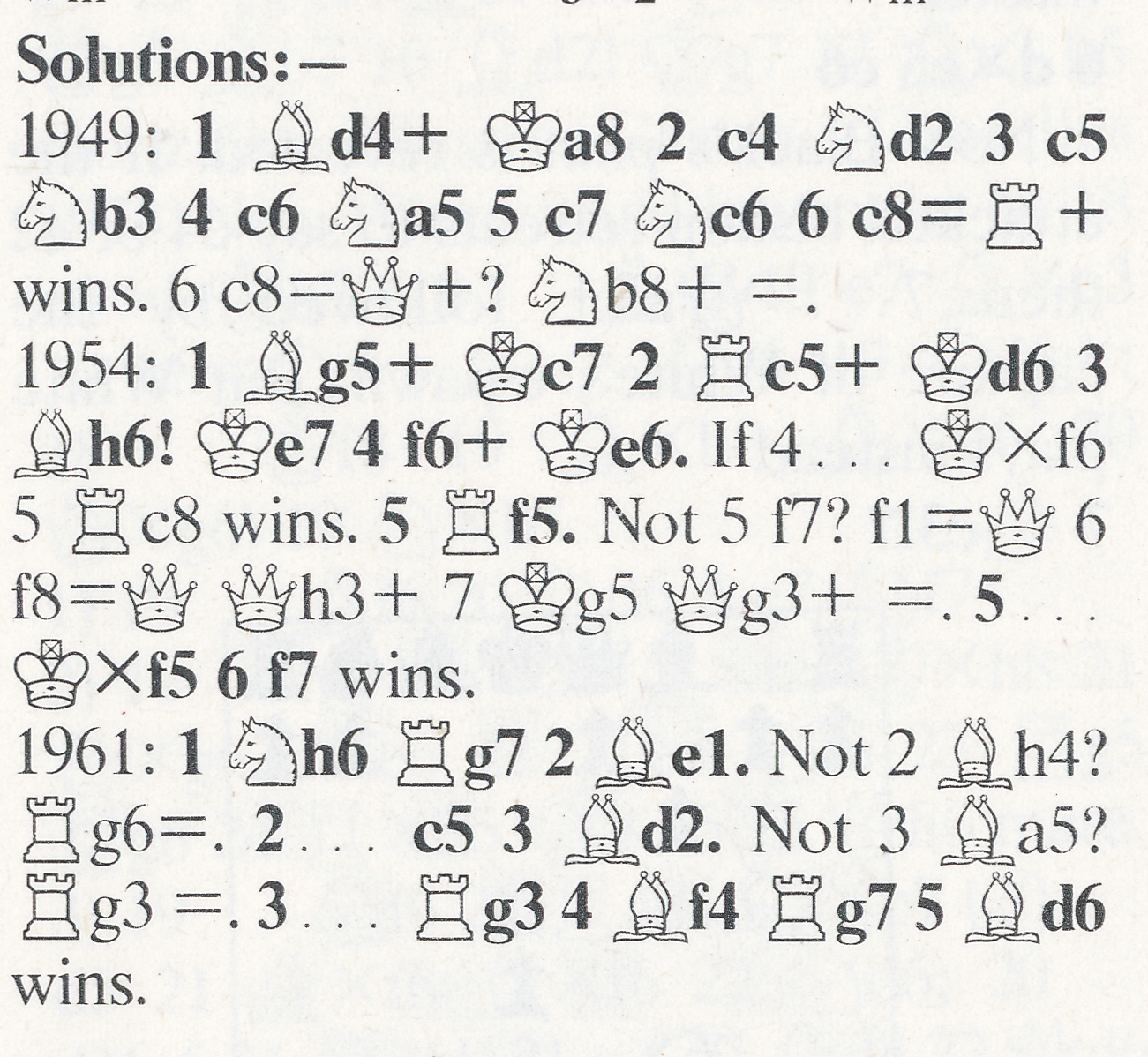
“The modest and self-effacing composer who formerly conducted our Studies column from 1951-1972 died in September. His work as a metallurgist and his family responsibilities allowed him to make periodical contributions over a long span and to offer us many of his own original compositions.
His style, as with his manner, was essentially quiet and it was a rarity for him to compose anything other than wins.
His last voluntary labour was to compile an index for E.G. of all studies published there to date. His loss to the world of of studies will be greatly felt.
The first prize winner below is a classic of exquisite refinement and matches the immaculate handwriting which was always such an elegant feature of his work”
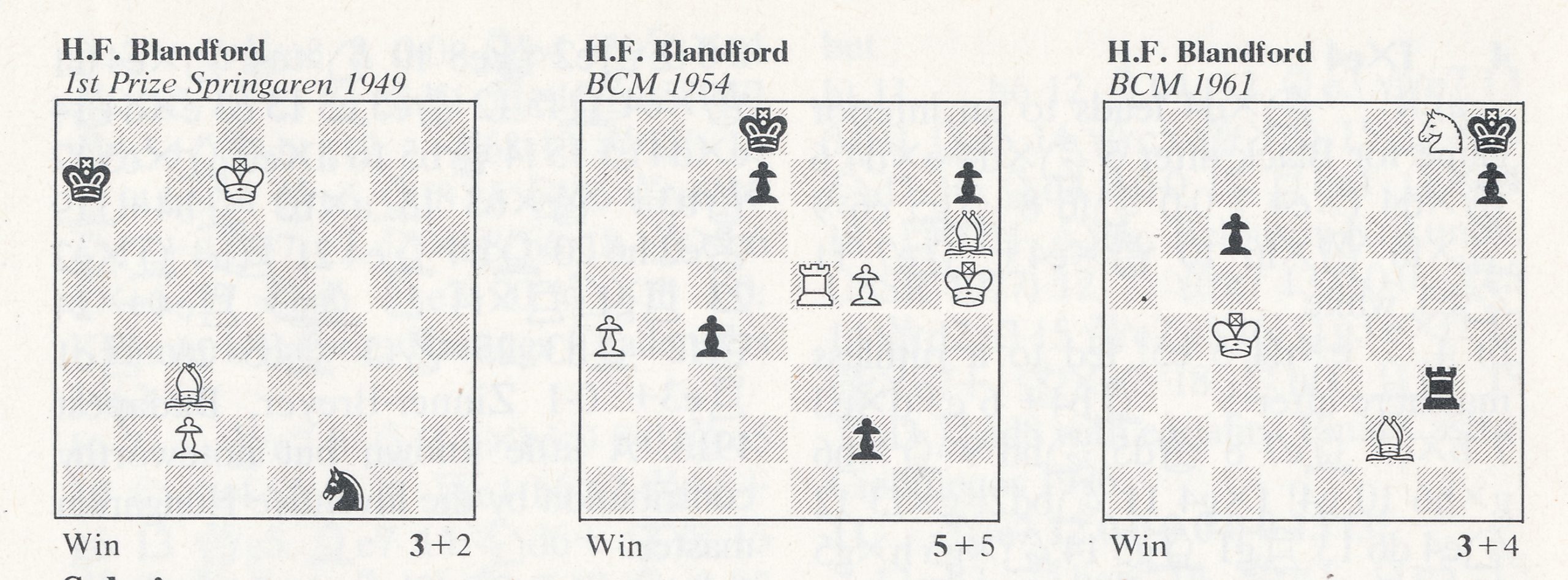
Studies by Hugh Francis BlandfordSolutions to studies by Hugh Francis Blandford
“British study composer and FIDE Judge of Endgame Studies. Born on 24th January 1917. Since July 1951, Hugh Blandford has conducted the Endings Section of the British Chess Magazine. By profession a metallurgist, he was married and had two children. Of his 60 or more studies he was best known for the excelsior theme.”
From Wikipedia :
Hugh Francis Blandford (24 January 1917 – 20 September 1981) was a chess endgame composer born in Southampton, England.[1]
He spent several years of his childhood in Jamaica with his father, the Reverend Albert Francis (Frank) Blandford, a Minister in the Congregational church, his mother and two younger brothers, Evan Arthur and Philip Thomas Blandford. All three brothers then returned to England and attended Eltham College (the School for the Sons of Missionaries) in South-east London, while their parents remained in Jamaica. He married Marjorie Cox, whom he had worked with during the Second World War.
He played chess from his schooldays and as well as playing, also started to compose original chess endings. He became known in the field of chess endgame studies for a small but elegant body of compositions, expertly edited and published after Hugh’s death by his long-standing chess endings colleague, John Roycroft.[2]
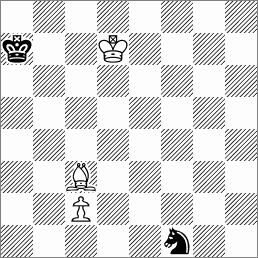
1st Prize, Springaren 1949, White to move and win
Hugh Blandford was co-inventor with Richard Guy – and, later, with John Roycroft – of the Guy–Blandford–Roycroft code for classifying studies.[3] In July 1951 he began as the endgame study editor for the British Chess Magazine.[4][5] He was made an International Judge for Chess Composition[4] in 1961.[6]
A metallurgist, he continued to compose chess endgame studies until the end of his life, dying of a heart attack in early retirement in Hatfield, England, on 20 September 1981.
We focus on the British Chess Scene Past & Present!
This website uses cookies to improve your experience. We'll assume you're ok with this, but you can opt-out if you wish. Cookie settingsACCEPT
Privacy & Cookies Policy
Privacy Overview
This website uses cookies to improve your experience while you navigate through the website. Out of these cookies, the cookies that are categorized as necessary are stored on your browser as they are as essential for the working of basic functionalities of the website. We also use third-party cookies that help us analyze and understand how you use this website. These cookies will be stored in your browser only with your consent. You also have the option to opt-out of these cookies. But opting out of some of these cookies may have an effect on your browsing experience.
Necessary cookies are absolutely essential for the website to function properly. This category only includes cookies that ensures basic functionalities and security features of the website. These cookies do not store any personal information.