Tag Archives: History

The Gijon International Chess Tournaments, 1944-1965

The Gijon International Chess Tournaments, 1944-1965

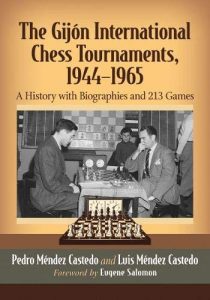
The Gijon International Chess Tournaments, 1944-1965 : Pedro Méndez Castedo & Luis Méndez Castedo

Pedro Méndez Castedo & Luis Méndez Castedo

Pedro Mendez Castedo is an amateur chess player, an elementary educational guidance counselor a member of the Asturias Chess History Commission, a bibliophile and a researcher of the history of Spanish and Asturian chess. He lives in San Martin del Rey Aurelio, Spain. Luis Mendez Castedo is an amateur chess player, a full teacher at a state school, a member of the Asturias Chess History Commission, a bibliophile and an investigator of the history of Spanish chess. He lives in Gijon, Spain.


When I mention Gijón, what’s the first thing that comes to mind? Mustard? No, that’s Dijon. Dijon’s in France, but Gijón’s on the north coast of Spain, on the Bay of Biscay.

Small international chess tournaments were held there between 1944 and 1951, then between 1954 and 1956, and, finally, in 1965. These were all play all events, with between 8 and 12 players: a mixture of visiting masters and local stars. A bit like Hastings, you might think, but these tournaments usually took place in July, not in the middle of winter.

The strength of the tournaments varied, but some famous names took part. Alekhine played in the first two events and Euwe in 1951. A young Larsen played in 1956, while other prominent masters such as Rossolimo, Darga, Donner, Prins, Pomar and O’Kelly also took part. The local player Antonio Rico played in every event, with fluctuating fortunes: winning in 1945 ahead of Alekhine and 1948, but also finishing last on several occasions. English interests were represented on three occasions by Mr CHESS, BH Wood.

A nice touch is the Foreword, written by Gene Salomon, a Gijón native who played in the 1947 event before emigrating first to Cuba and then to the United States.

The main part of the book comprises a chapter on each tournament. We get a crosstable and round by round individual scores (it would have been better if these didn’t spill over the page: you might also think that progressive scores would be more useful). We then have, another nice touch, a summary of what was happening in the world at large, and in the chess world, that year. Then we have a games selection, some with light annotations: words rather than variations, giving the impression that little if any use was made of engines.

The book concludes with a chapter on ‘Special Personages’: Félix Heras, the tournament organizer, and, perhaps to entice British readers, BH Wood. Appendices provide a table of tournament participation and biographical summaries of the players.

Returning to the main body of the book, let’s take the 1950 tournament as a not entirely random example. A year in which I have a particular interest.

We learn a little about the football World Cup, the Korean War and a Spanish radio programme, the first Candidates Tournament and the Dubrovnik chess olympiad.

The big news from Gijón was the participation of the French player Chantal Chaudé de Silans, the only female to take part in  these events, and rather unfairly deprived of her acute accent here. She scored a respectable 3½ points, beating Prins and Grob (yes, the 1. g4 chap).

Rossolimo won the event with 8½/11, just ahead of Dunkelblum and Pomar on 8. Prins and Torán, playing in his home city, finished on 7 points.

This game, between Arturo Pomar and Henri Grob, won the first brilliancy prize.

1. d4 Nf6 2. c4 g6 3. Nc3 d5 4. cxd5 Nxd5 5. g3 Bg7 6. Bg2 c6 7. e3 h5 8. Nge2 h4 9. Qb3 Nxc3 10. bxc3 Nd7 11. a4 Nb6 12. a5

12… Nd7 13. a6 Qc7 14. Qc4 Nb6 15. Qc5 Rh5 16. Qa3 bxa6 17. Nf4 Rh8 18. Qc5 Bb7 19. Ba3 e5 20. Nd3 exd4 21. cxd4 Rh5 22. Ne5 O-O-O 23. g4 Nd7 24. Qc2 Rxe5 25. dxe5 Nxe5 26. Rb1 h3 27. Be4 Nxg4 28. Ke2 a5 29. Rxb7 Kxb7 30. Rb1+ Kc8 31. Bxc6 Ne5 32. Bb7+ Kb8 33. Ba6+ Qb6 34. Bd6+ Ka8 35. Rxb6 1:0

The annotations – by result rather than analysis – neither convince nor stand up to computer scrutiny. We’re told at the start of the game that ‘Pomar takes the initiative from Black’s error in the opening and does not relinquish it until the final victory’, but the annotations refute this claim. After criticizing several of Grob’s moves but none of Pomar’s, we’re told, correctly, that Black could have gained an advantage by playing 25… Qa5+. However, Grob’s choice was second best, not a ‘serious mistake’: Stockfish 10 tells me 26… a5 was still better for Black, and 27… a5 (in both cases with the idea of Ba6) was equal, though I guess those moves might not be easy to find without assistance. It was his 27th move, and perhaps also his 26th, which deserved the question mark.

This game was played in the last round of the tournament, on 26 July 1950.  Two days later a boy would be born who would learn chess, develop an interest in the game’s history and literature, and be asked to review this book. What is his verdict?

An enjoyable read, a nice book, but not a great book. If you collect McFarland books you’ll want it. If you have a particular passion for Spanish chess history, you’ll want it. Otherwise, although the book is not without interest, it’s probably an optional extra.

The tournaments, apart perhaps from Alekhine’s participation in the first two events, are not, in the overall scheme of things, especially significant. The games, by and large, aren’t that exciting. The annotations are, by today’s standards, not really adequate. The translation and presentation could have been improved.

Just another thought: we could do with a similarly structured book about the Hastings tournaments. There was one published some years ago, but a genuine chess historian could do much better.

Richard James, Twickenham 20 November 2019
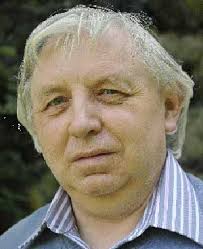
Richard James
Richard James

Book Details :

  • Softcover : 244 pages
  • Publisher: McFarland (30 July 2019)
  • Language: English
  • ISBN-10: 1476676593
  • ISBN-13: 978-1476676593
  • Product Dimensions: 17.8 x 1.5 x 25.1 cm

Official web site of McFarland
The Gijon International Chess Tournaments, 1944-1965

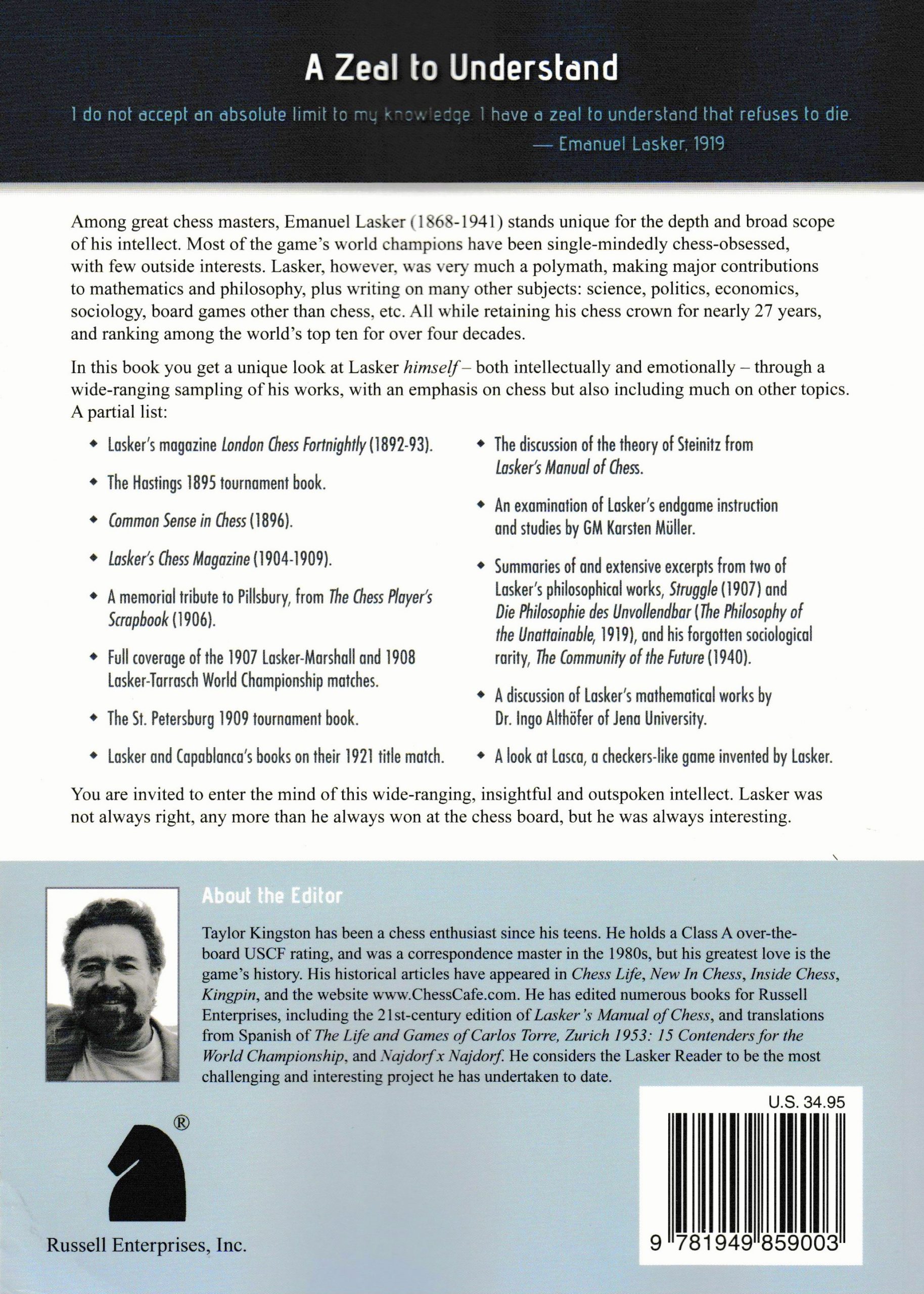
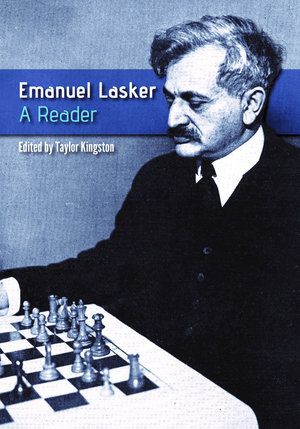
Emanuel Lasker : A Reader : A Zeal to Understand

Emanuel Lasker: A Reader

Emanuel Lasker: A Reader: A Zeal to Understand : Taylor Kingston

Taylor Kingston

Taylor Kingston has been a chess enthusiast since his teens. He holds a Class A over-the-board USCF rating, and was a correspondence master in the 1980s, but his greatest love is the game’s history. His historical articles have appeared in Chess Life, New In Chess, Inside Chess, Kingpin, and the Chess Café website. He has edited numerous books, including the 21st-century edition of Lasker’s Manual of Chess, and translations from Spanish of The Life and Games of Carlos Torre, Zurich 1953: 15 Contenders for the World Championship, and Najdorf x Najdorf. He considers the Lasker Reader to be the most challenging and interesting project he has undertaken to date.


Taylor Kingston
Taylor Kingston

When I’m asked who my favourite chess player is, I always answer ‘Emanuel Lasker’.

Why? Partly because he was a player who didn’t really have a style. Like Magnus Carlsen, with whom he has sometimes been compared, he just played chess. But more because he was such an interesting personality. Unlike most champions (Euwe and Botvinnik were exceptions) he had a life outside chess, on several occasions taking long breaks from the game. And what a life it was: mathematician, philosopher, writer, playwright, bridge player, and, lest we forget, chess player.

Chess historians are finally taking notice of this fascinating man. In 2009 a massive volume about him was published in German, edited by Richard Forster and others. Last year the first of three volumes of a greatly expanded edition of this work appeared in English. If you have any interest at all in chess history you should certainly possess this book, and, like me, you’ll be eagerly looking forward to volumes 2 and 3.

What we have here might best be seen as a companion to this work, and, if you’re a Lasker fan or have any interest in chess history you’ll want this as well.

Taylor Kingston has compiled and edited a collection of Lasker’s own writings, not just on chess but covering every aspect of his multi-faceted personality.

We start with the London Chess Fortnightly, which Lasker published for a year between 1892 and 1893, annotating his own games as he was trying to establish himself as a contender for Steinitz’s world title. Here and throughout the book, the editor adds the occasional contribution from Stockfish 8.

Lasker and Steinitz met in 1894, with our hero becoming the second official world champion as a result of winning the match. Both players annotated some of the games for newspaper columns. In 1906 Lasker published this in his chess magazine, which we’ll come to later, but in this book they appear in the correct chronological place.

The Hastings 1895 tournament book (if you don’t have a copy I’d like to know why) was unusual in that all the games were annotated by one of the other participants. The six games Lasker annotated feature here.

Lasker’s first book, Common Sense in Chess, was published the following year. We have here an extract from Chapter 9, the End Game.

We then jump forward to 1904. The longest and, for chess players, perhaps the most interesting section of the book covers Lasker’s Chess Magazine, which was published in New York between November 1904 and January 1909. The games themselves give the reader an overview of chess during those years, with amateurs as well as masters being represented. Lasker’s annotations and, in some cases, game introductions, were often colourful in nature and tell us a lot about the man himself.

Burn-Forgacs (Ostend 1906), for instance, ‘begins like a summer breeze and ends like a winter’s gale’.

1. d4 d5 2. c4 e6 3. Nc3 Nf6 4. Bg5 Nbd7 5. e3 c6 6. Nf3 Qa5 7. Nd2 Ne4 8. Ndxe4 dxe4 9. Bh4 e5 10. Be2 f5 11. O-O g6 12. c5

‘Here the red lantern flashes out; queen and bishop prepare to take the diagonal from b3 to e6 and f7, which are woefully weak, and the black king will be in grave peril.’

12… Bg7 13. Qb3 Nf8 14. Bc4 Qc7 15. d5 h6 16. d6 Qd7 17. Be7 Ne6 18. Nb5 cxb5 19. Bxb5 1-0

Another major chapter concerns the 1908 Lasker-Tarrasch world championship match. After some details of the background to the match (there was little love lost between the two players: Edward Lasker quoted Tarrasch as saying ‘the only words I will address to him are check and mate!). Taylor Kingston presents the games with annotations from Lasker’s Chess Magazine, Tarrasch’s book of the match and other contemporary sources, along with the usual computer interjections.

We then have a chapter on Lasker’s unsuccessful 1921 match against Capablanca, and another on his non-appearance at New York 1927. Lasker’s Manual of Chess was first published in German in 1926: here we have an excerpt in which he discusses the theory of Steinitz.

Lasker’s chess writings are completed by an article on Lasker and the Endgame by guest contributor Karsten Müller, and a short section on Lasker’s problems and endgame studies.

The last 75 pages of the book consider other aspects of Lasker’s life: his philsophy, his contributions to mathematics, and Lasca, a board game he invented.

Perhaps the most interesting section offers extracts from The Philosophy of the Unattainable, his most important philosophical work, published in 1919. As far as Taylor Kingston is aware, it has never been published in English.

Lasker’s last work, The Community of the Future, was published in 1940, five months before his death. Here, Lasker considers the problems faced by the world and proposes a ‘non-competitive community’ as his solution, with ‘self-hope co-operatives’ to deal with unemployment. Again, fascinating reading, and, you might think, his utopian ideas are still of some relevance today.

The book is a well-produced paperback. There are a few notation errors caused by translation from descriptive to algebraic, but this shouldn’t cause you too much bother. I hope I’ve convinced you that this book deserves a place on your shelves.

Richard James, Twickenham 20 November 2019

Richard James
Richard James

Book Details :

  • Softcover : 400 pages
  • Publisher: Russell Enterprises (19 April 2019)
  • Language: English
  • ISBN-10: 1949859002
  • ISBN-13: 978-1949859003
  • Product Dimensions: 17.8 x 2.5 x 25.4 cm

Official web site of Russell Enterprises

Emanuel Lasker: A Reader: A Zeal to Understand

Birthday of IA Stewart Reuben (14-iii-1939)

Birthday of Stewart Reuben (14-iii-1939)

Here is his Wikipedia entry

His personal catchphrase is “If only I had been consulted eariler”

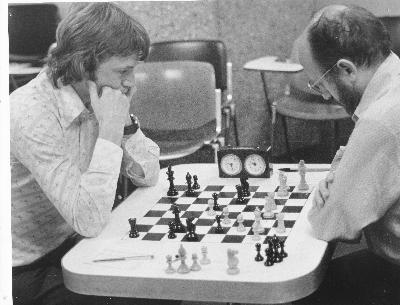
Jimmy Adams and Stewart Reuben
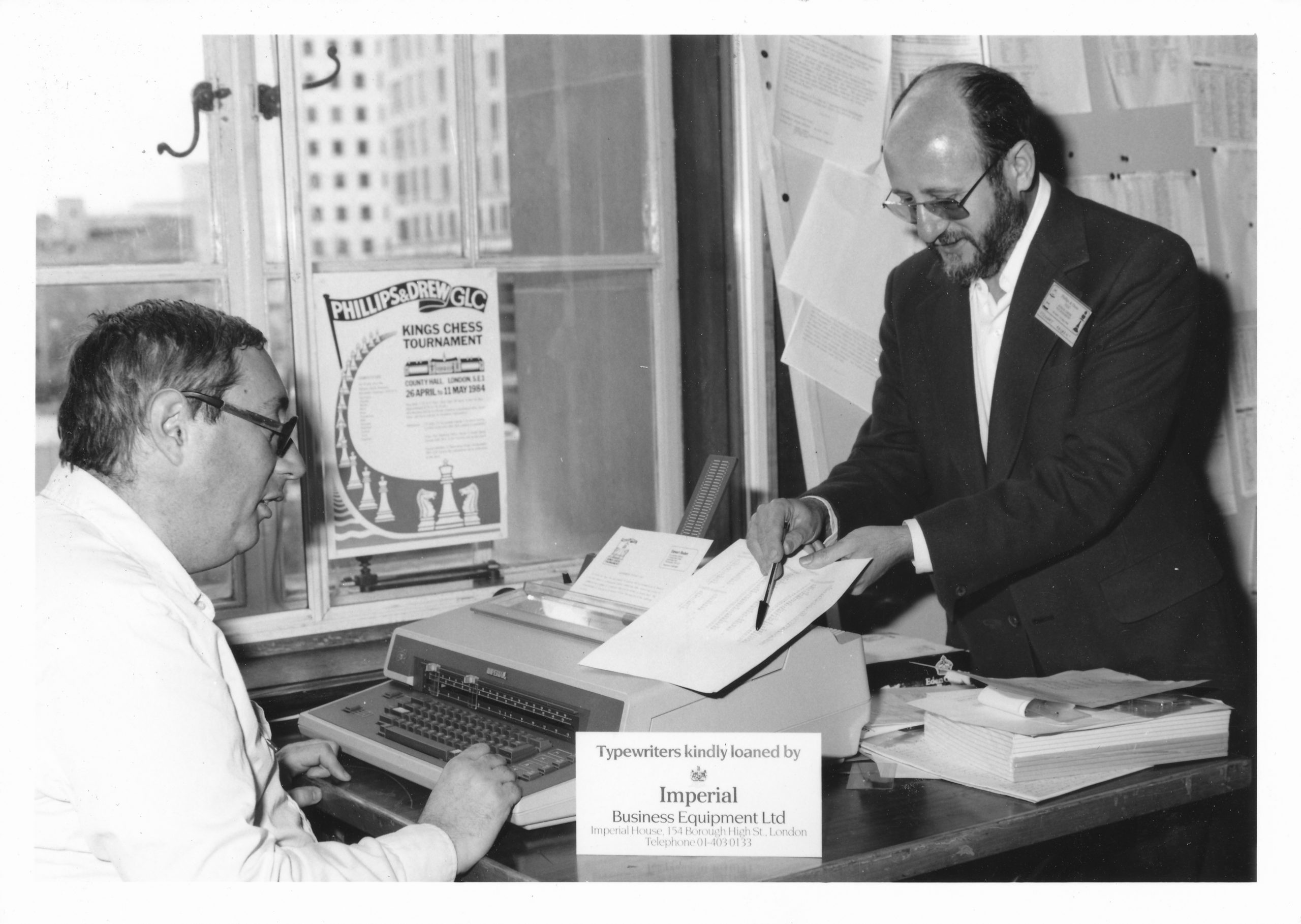
Richard W. O'Brien and Stewart Reuben working on a bulletin
Richard W. O’Brien and Stewart Reuben working on a bulletin
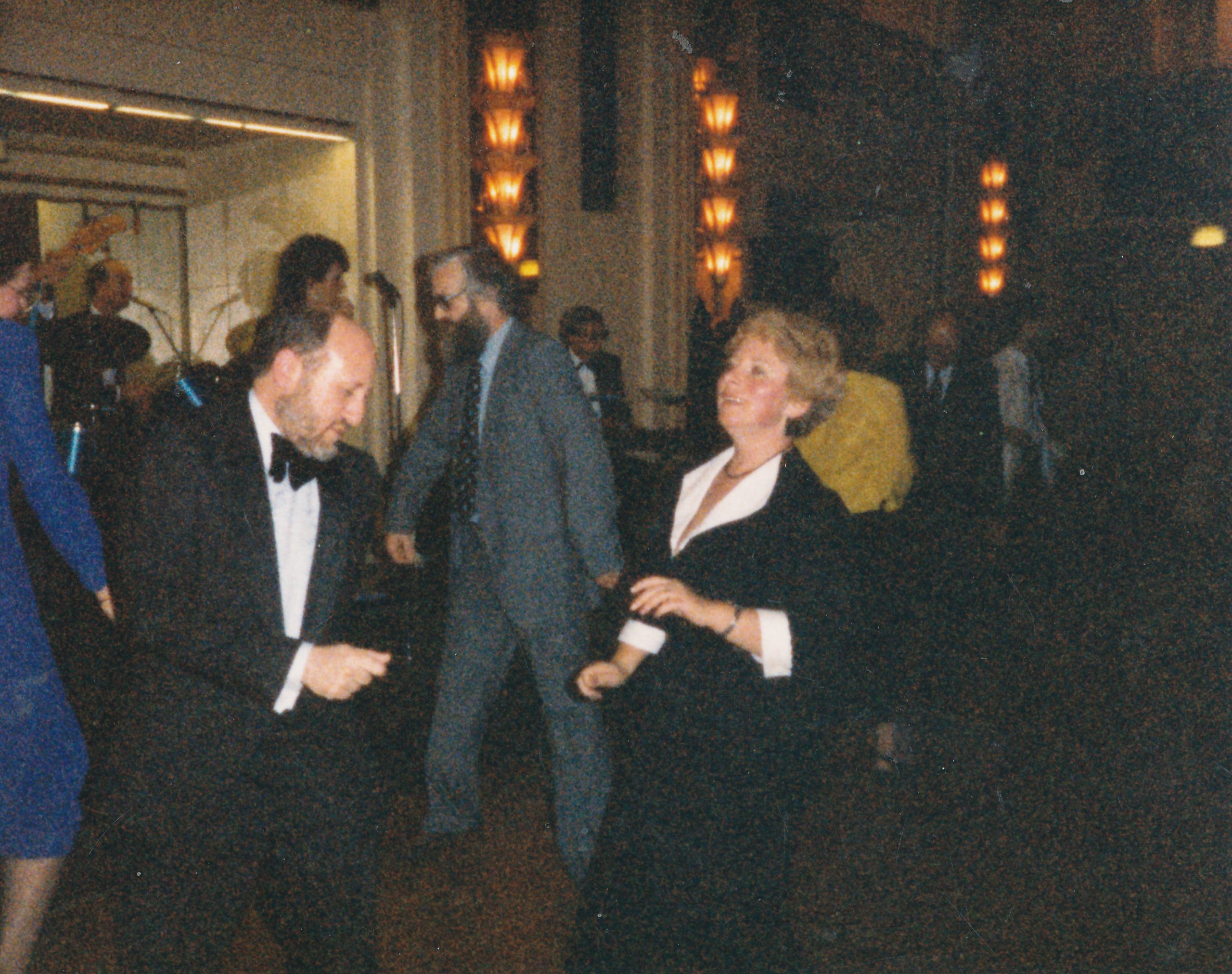
SR attempting to dance
Stewart Reuben interviews Stewart Reuben at the home of Stewart Reuben
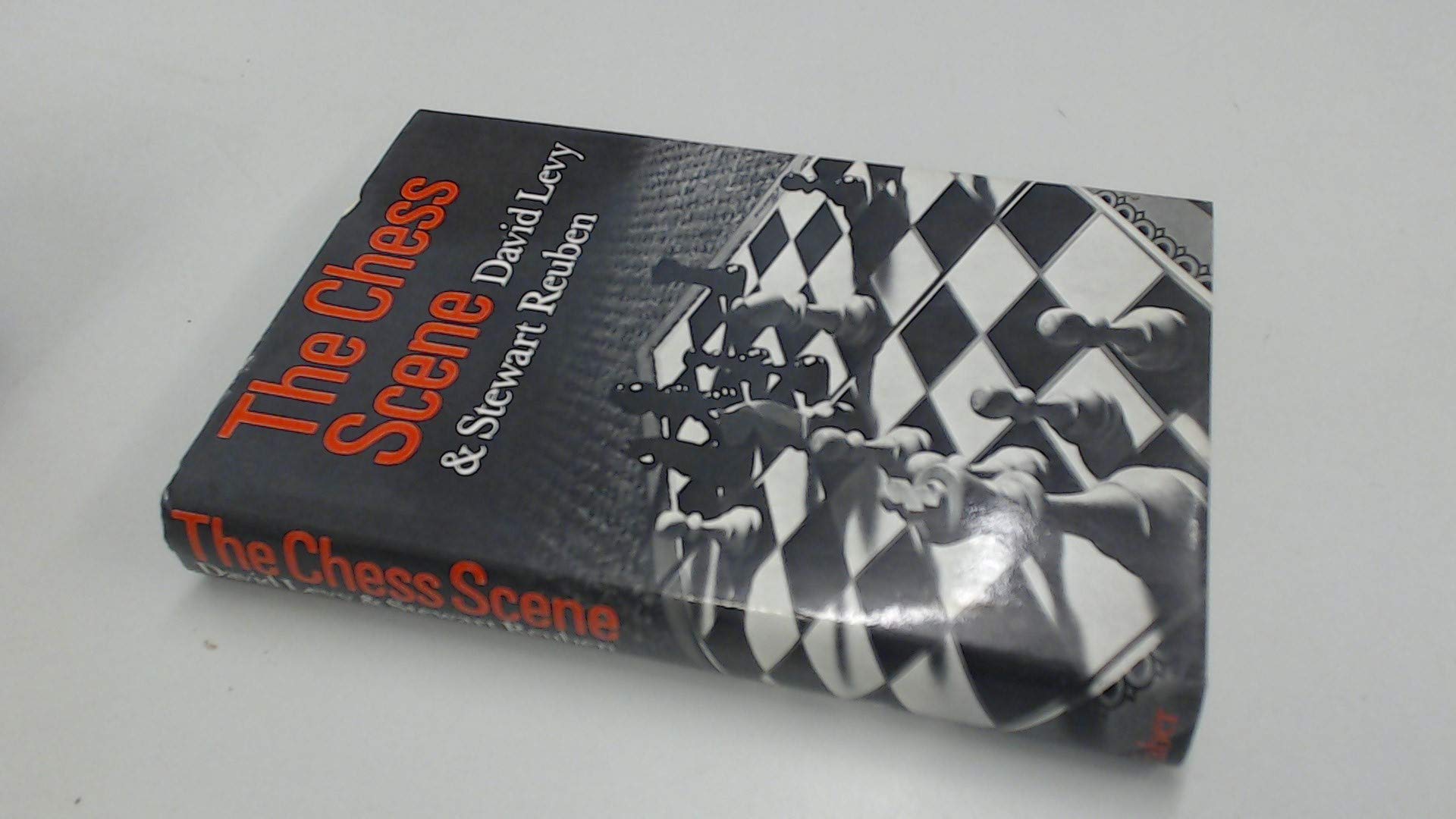
The Chess Scene
The Chess Scene
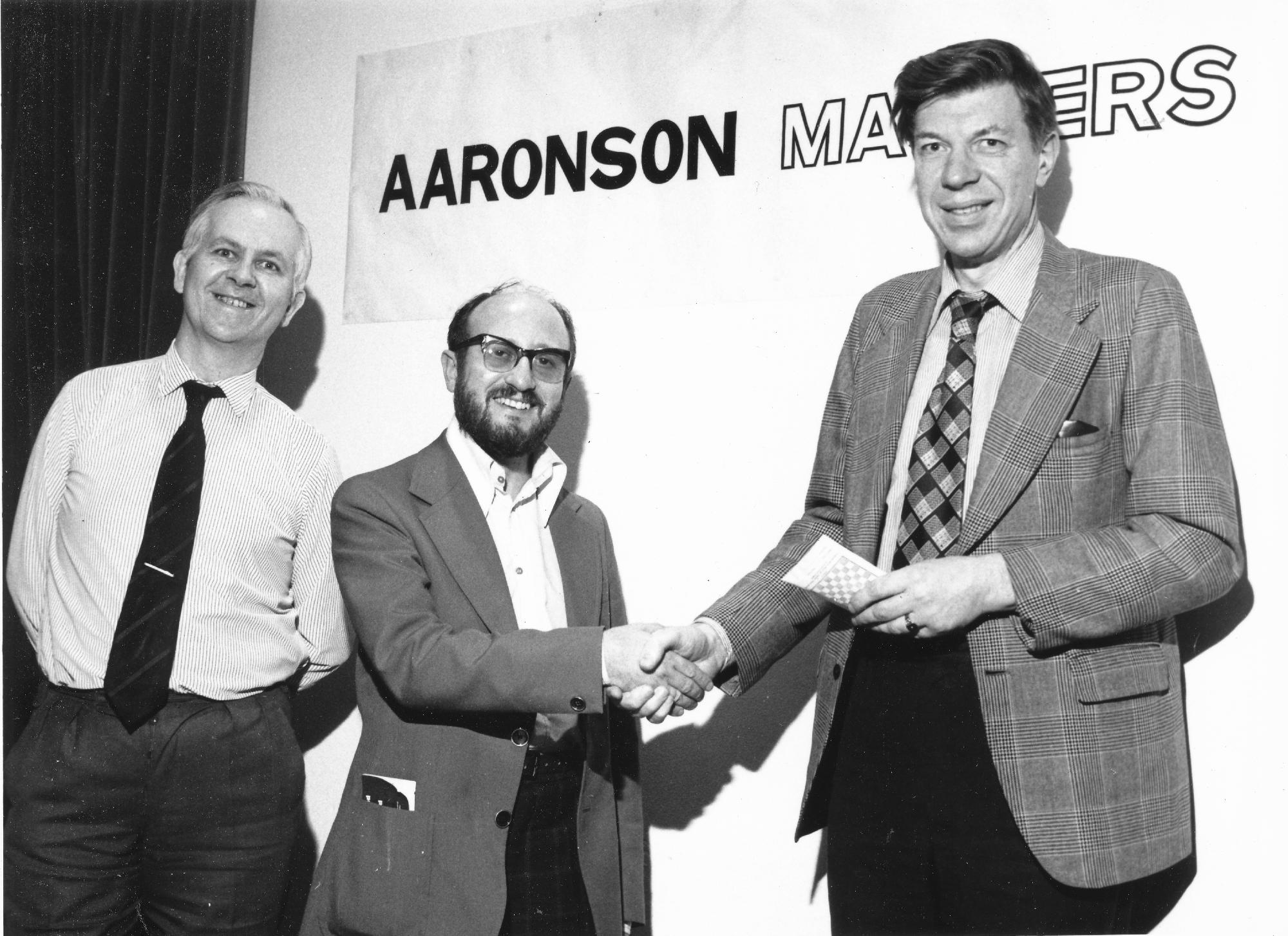
Leonard Barden, Stewart Reuben and Michael Franklin at the 1978 Aaronson Masters
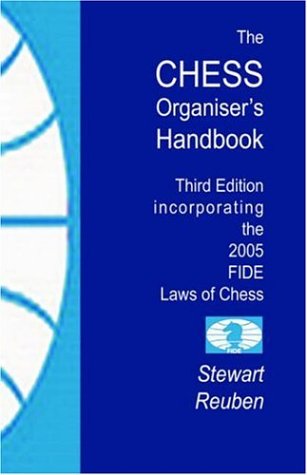
The Chess Organiser's Handbook
The Chess Organiser’s Handbook
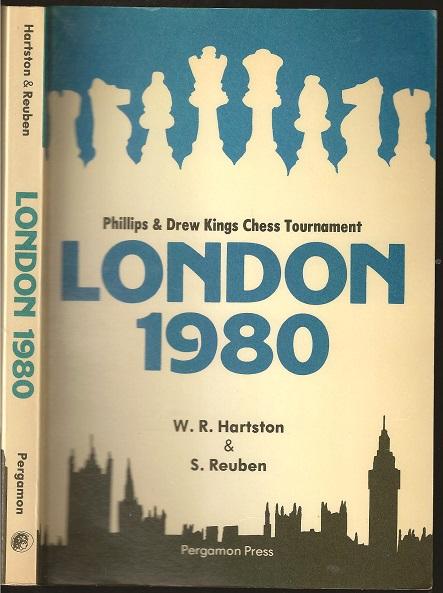
London 1980: Phillips and Drew Kings Chess Tournament

Birthday of IA Stewart Reuben (14-iii-1939)

Birthday of Stewart Reuben (14-iii-1939)

Here is his Wikipedia entry

His personal catchphrase is “If only I had been consulted eariler”

Jimmy Adams and Stewart Reuben
Richard W. O'Brien and Stewart Reuben working on a bulletin
Richard W. O’Brien and Stewart Reuben working on a bulletin
SR attempting to dance
Stewart Reuben interviews Stewart Reuben at the home of Stewart Reuben
The Chess Scene
The Chess Scene
Leonard Barden, Stewart Reuben and Michael Franklin at the 1978 Aaronson Masters
The Chess Organiser's Handbook
The Chess Organiser’s Handbook
London 1980: Phillips and Drew Kings Chess Tournament

Birthday of IA Stewart Reuben (14-iii-1939)

Birthday of Stewart Reuben (14-iii-1939)

Here is his Wikipedia entry

His personal catchphrase is “If only I had been consulted eariler”

Jimmy Adams and Stewart Reuben
Richard W. O'Brien and Stewart Reuben working on a bulletin
Richard W. O’Brien and Stewart Reuben working on a bulletin
SR attempting to dance
Stewart Reuben interviews Stewart Reuben at the home of Stewart Reuben
The Chess Scene
The Chess Scene
Leonard Barden, Stewart Reuben and Michael Franklin at the 1978 Aaronson Masters
The Chess Organiser's Handbook
The Chess Organiser’s Handbook
London 1980: Phillips and Drew Kings Chess Tournament

Birthday of IA Stewart Reuben (14-iii-1939)

Birthday of Stewart Reuben (14-iii-1939)

Here is his Wikipedia entry

His personal catchphrase is “If only I had been consulted eariler”

Jimmy Adams and Stewart Reuben
Richard W. O'Brien and Stewart Reuben working on a bulletin
Richard W. O’Brien and Stewart Reuben working on a bulletin
SR attempting to dance
Stewart Reuben interviews Stewart Reuben at the home of Stewart Reuben
The Chess Scene
The Chess Scene
Leonard Barden, Stewart Reuben and Michael Franklin at the 1978 Aaronson Masters
The Chess Organiser's Handbook
The Chess Organiser’s Handbook
London 1980: Phillips and Drew Kings Chess Tournament

Death Anniversary of Julius du Mont (15-xii-1881 07-iv-1956)

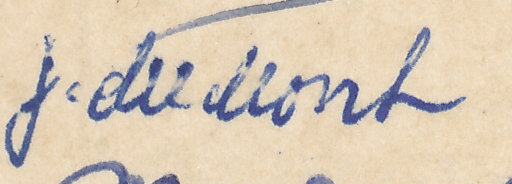
Signature of J du Mont from a Brian Reilly "after dinner" postcard from Southsea 1951.
Signature of J du Mont from a Brian Reilly “after dinner” postcard from Southsea 1951.

BCN Remembers Julius du Mont (15-xii-1881 07-iv-1956)

Here is his Wikipedia entry

From British Chess Magazine, Volume LXXXVI, Number 5, 1956 we have this obituary written by DJ Morgan :

In our February issue we wrote an appreciation of one of the distinguished past editors of this magazine, R. C. Griffith. He had been followed in the chair in 1938 by our present Games’ Editor, and when he, in turn, was called in 1940 to sterner duties, he was succeeded by Julius du Mont. During the war years, and through the difficult post-war period, till 1949, he held the reins. As we wrote on another occasion, “His had been difficult years: the “B.C.M.” had survived when so much else had succumbed during the stress and strain of total war.” lt is with regret that we now record his death on April 7th, in a Hastings nursing home, at the age of seventy-four, after a protracted illness.

du Mont was born in Paris-a little-known fact which he himself once disclosed to us-on December 15th, 1881. lt was there also that he received his education. His early bent and ambitions were musical. The tradition that chess and music have a close relationship may be traced as far back, at least, as Philidor’s great eminence in both. du Mont was truly in the line of such dual personalities. He pursued his musical studies at the Frankfort-on-Main Conservatoire and at Heidelberg, and soon became established as a concert pianist.’ Later he achieved great success as a music teacher, and among his pupils was the well-known concert pianist, Edna lles. The French and German background also explains his facility as a linguist.

He came to England as a young man and brought with him a considerable talent for chess. Settling in London, he rapidly improved as a player, and successes followed. At the Kentish Congress, Tunbridge Wells, 1912, he came equal second and third. He was Champion of the strong Hampstead Club for two years, and Middlesex Champion in 1913 and 1915. He quickly mastered our language and showed this during the First World War by writing a manual on the Lewis gun. After the war, music kept its place in his life, but more and more chess became his main activity. He forsook playing and turned to journalism and authorship, and his output of books is evidence of his gifts and industry. Titles come readily to mind: Chess Openings lllustrated, Centre Counter Defence (1919) and Centre and Danish Gambit (1920); The Elements of Chess (1925) ; Ihe Basis of Combination in Chess (1938) ; 200 Miniature Games (1941); More Miniature Games (1953); (with Dr. Tartakower) 500 Master aomes of Chess, two volumes (1952), to which was added a third volume in 1954, 100 Master Games of Chess. He also translated Edward Lasker’s Chess Strategy, and Alekhine’s two volumes of My Best Games of Chess (the first with M. E.Goldstein).

The wealth of material ready to hand combined with a foreigner’s gift of lucid expression in “the other tongue” made his books very popular. To the great value and importance of these books, a whole generation of chess-players will readily testify.

For some years, du Mont was chess editor of The Field and of The Manchester Guardian. During the last war he organized chess championships for the Armed Services. We pay tribute to his services to the game, to his many kindnesses and friendships to its players, and, in particular, to his devotion to this magazine.-D. J. M.

D. C., who enjoyed a long friendship with our late Editor, writes to us as follows-

By the death of J. du Mont, the chess world has lost an eminent and popular personality. That this popularity was well deserved will be apparent even to those who knew him only slightly.

Essentially kind, he performed many generous acts, and having, by his own efforts, become the best-known British writer on chess, he not only filled this position with modesty and dignity, but was liberal in the help he gave to those starting on the road he had so successfully followed.

In the tournament room-where his presence was always welcome-he was invariably quiet and courteous, and although gifted with a fine wit, he never used it
unkindly. He *as an excellent companion, and players at many congresses will recall the happy times they spent in their visits to him at all hours of the evening. It is sad to think that these gatherings have now irrevocably reached their end: to quote A. E. Housman’s beautiful lines-

They come and were and ore not
And come no more anew.

But as long as a literature of chess remains, the name of Julius du Mont will not be forgotten. His many friends, however, have no need of his writings in order to keep alive their memory of him.

In Chess Secrets I learned from the Masters, Edward Lasker, Hollis and Carter, 1952 :

J. DuMont became the author of a number of interesting monographs on chess openings, and for many years he was the Editor of the British Chess Magazine. It was he who translated my own translation of Schachstrategie which I attempted in the summer of 1913. Naturally, my English was not fit to be printed. DuMont had to rewrite everything I had written, and except for his untiring labors Chess Strategy might never have been published. He gave the book a certain literary flavor, which no doubt added greatly to its popularity. It went into fourteen printings before it was replaced by Modern Chess Strategy in 1945.

DuMont was a pianist of note and I took lessons from him; however, the time I took from my chess activities to practise the piano was shamefully meagre. No wonder I have been told more than once that as a pianist I am a good chess player.”

Death Anniversary of Julius du Mont (15-xii-1881 07-iv-1956)

Signature of J du Mont from a Brian Reilly "after dinner" postcard from Southsea 1951.
Signature of J du Mont from a Brian Reilly “after dinner” postcard from Southsea 1951.

BCN Remembers Julius du Mont (15-xii-1881 07-iv-1956)

Here is his Wikipedia entry

From British Chess Magazine, Volume LXXXVI, Number 5, 1956 we have this obituary written by DJ Morgan :

In our February issue we wrote an appreciation of one of the distinguished past editors of this magazine, R. C. Griffith. He had been followed in the chair in 1938 by our present Games’ Editor, and when he, in turn, was called in 1940 to sterner duties, he was succeeded by Julius du Mont. During the war years, and through the difficult post-war period, till 1949, he held the reins. As we wrote on another occasion, “His had been difficult years: the “B.C.M.” had survived when so much else had succumbed during the stress and strain of total war.” lt is with regret that we now record his death on April 7th, in a Hastings nursing home, at the age of seventy-four, after a protracted illness.

du Mont was born in Paris-a little-known fact which he himself once disclosed to us-on December 15th, 1881. lt was there also that he received his education. His early bent and ambitions were musical. The tradition that chess and music have a close relationship may be traced as far back, at least, as Philidor’s great eminence in both. du Mont was truly in the line of such dual personalities. He pursued his musical studies at the Frankfort-on-Main Conservatoire and at Heidelberg, and soon became established as a concert pianist.’ Later he achieved great success as a music teacher, and among his pupils was the well-known concert pianist, Edna lles. The French and German background also explains his facility as a linguist.

He came to England as a young man and brought with him a considerable talent for chess. Settling in London, he rapidly improved as a player, and successes followed. At the Kentish Congress, Tunbridge Wells, 1912, he came equal second and third. He was Champion of the strong Hampstead Club for two years, and Middlesex Champion in 1913 and 1915. He quickly mastered our language and showed this during the First World War by writing a manual on the Lewis gun. After the war, music kept its place in his life, but more and more chess became his main activity. He forsook playing and turned to journalism and authorship, and his output of books is evidence of his gifts and industry. Titles come readily to mind: Chess Openings lllustrated, Centre Counter Defence (1919) and Centre and Danish Gambit (1920); The Elements of Chess (1925) ; Ihe Basis of Combination in Chess (1938) ; 200 Miniature Games (1941); More Miniature Games (1953); (with Dr. Tartakower) 500 Master aomes of Chess, two volumes (1952), to which was added a third volume in 1954, 100 Master Games of Chess. He also translated Edward Lasker’s Chess Strategy, and Alekhine’s two volumes of My Best Games of Chess (the first with M. E.Goldstein).

The wealth of material ready to hand combined with a foreigner’s gift of lucid expression in “the other tongue” made his books very popular. To the great value and importance of these books, a whole generation of chess-players will readily testify.

For some years, du Mont was chess editor of The Field and of The Manchester Guardian. During the last war he organized chess championships for the Armed Services. We pay tribute to his services to the game, to his many kindnesses and friendships to its players, and, in particular, to his devotion to this magazine.-D. J. M.

D. C., who enjoyed a long friendship with our late Editor, writes to us as follows-

By the death of J. du Mont, the chess world has lost an eminent and popular personality. That this popularity was well deserved will be apparent even to those who knew him only slightly.

Essentially kind, he performed many generous acts, and having, by his own efforts, become the best-known British writer on chess, he not only filled this position with modesty and dignity, but was liberal in the help he gave to those starting on the road he had so successfully followed.

In the tournament room-where his presence was always welcome-he was invariably quiet and courteous, and although gifted with a fine wit, he never used it
unkindly. He *as an excellent companion, and players at many congresses will recall the happy times they spent in their visits to him at all hours of the evening. It is sad to think that these gatherings have now irrevocably reached their end: to quote A. E. Housman’s beautiful lines-

They come and were and ore not
And come no more anew.

But as long as a literature of chess remains, the name of Julius du Mont will not be forgotten. His many friends, however, have no need of his writings in order to keep alive their memory of him.

In Chess Secrets I learned from the Masters, Edward Lasker, Hollis and Carter, 1952 :

J. DuMont became the author of a number of interesting monographs on chess openings, and for many years he was the Editor of the British Chess Magazine. It was he who translated my own translation of Schachstrategie which I attempted in the summer of 1913. Naturally, my English was not fit to be printed. DuMont had to rewrite everything I had written, and except for his untiring labors Chess Strategy might never have been published. He gave the book a certain literary flavor, which no doubt added greatly to its popularity. It went into fourteen printings before it was replaced by Modern Chess Strategy in 1945.

DuMont was a pianist of note and I took lessons from him; however, the time I took from my chess activities to practise the piano was shamefully meagre. No wonder I have been told more than once that as a pianist I am a good chess player.”

Death Anniversary of Julius du Mont (15-xii-1881 07-iv-1956)

Signature of J du Mont from a Brian Reilly "after dinner" postcard from Southsea 1951.
Signature of J du Mont from a Brian Reilly “after dinner” postcard from Southsea 1951.

BCN Remembers Julius du Mont (15-xii-1881 07-iv-1956)

Here is his Wikipedia entry

From British Chess Magazine, Volume LXXXVI, Number 5, 1956 we have this obituary written by DJ Morgan :

In our February issue we wrote an appreciation of one of the distinguished past editors of this magazine, R. C. Griffith. He had been followed in the chair in 1938 by our present Games’ Editor, and when he, in turn, was called in 1940 to sterner duties, he was succeeded by Julius du Mont. During the war years, and through the difficult post-war period, till 1949, he held the reins. As we wrote on another occasion, “His had been difficult years: the “B.C.M.” had survived when so much else had succumbed during the stress and strain of total war.” lt is with regret that we now record his death on April 7th, in a Hastings nursing home, at the age of seventy-four, after a protracted illness.

du Mont was born in Paris-a little-known fact which he himself once disclosed to us-on December 15th, 1881. lt was there also that he received his education. His early bent and ambitions were musical. The tradition that chess and music have a close relationship may be traced as far back, at least, as Philidor’s great eminence in both. du Mont was truly in the line of such dual personalities. He pursued his musical studies at the Frankfort-on-Main Conservatoire and at Heidelberg, and soon became established as a concert pianist.’ Later he achieved great success as a music teacher, and among his pupils was the well-known concert pianist, Edna lles. The French and German background also explains his facility as a linguist.

He came to England as a young man and brought with him a considerable talent for chess. Settling in London, he rapidly improved as a player, and successes followed. At the Kentish Congress, Tunbridge Wells, 1912, he came equal second and third. He was Champion of the strong Hampstead Club for two years, and Middlesex Champion in 1913 and 1915. He quickly mastered our language and showed this during the First World War by writing a manual on the Lewis gun. After the war, music kept its place in his life, but more and more chess became his main activity. He forsook playing and turned to journalism and authorship, and his output of books is evidence of his gifts and industry. Titles come readily to mind: Chess Openings lllustrated, Centre Counter Defence (1919) and Centre and Danish Gambit (1920); The Elements of Chess (1925) ; Ihe Basis of Combination in Chess (1938) ; 200 Miniature Games (1941); More Miniature Games (1953); (with Dr. Tartakower) 500 Master aomes of Chess, two volumes (1952), to which was added a third volume in 1954, 100 Master Games of Chess. He also translated Edward Lasker’s Chess Strategy, and Alekhine’s two volumes of My Best Games of Chess (the first with M. E.Goldstein).

The wealth of material ready to hand combined with a foreigner’s gift of lucid expression in “the other tongue” made his books very popular. To the great value and importance of these books, a whole generation of chess-players will readily testify.

For some years, du Mont was chess editor of The Field and of The Manchester Guardian. During the last war he organized chess championships for the Armed Services. We pay tribute to his services to the game, to his many kindnesses and friendships to its players, and, in particular, to his devotion to this magazine.-D. J. M.

D. C., who enjoyed a long friendship with our late Editor, writes to us as follows-

By the death of J. du Mont, the chess world has lost an eminent and popular personality. That this popularity was well deserved will be apparent even to those who knew him only slightly.

Essentially kind, he performed many generous acts, and having, by his own efforts, become the best-known British writer on chess, he not only filled this position with modesty and dignity, but was liberal in the help he gave to those starting on the road he had so successfully followed.

In the tournament room-where his presence was always welcome-he was invariably quiet and courteous, and although gifted with a fine wit, he never used it
unkindly. He *as an excellent companion, and players at many congresses will recall the happy times they spent in their visits to him at all hours of the evening. It is sad to think that these gatherings have now irrevocably reached their end: to quote A. E. Housman’s beautiful lines-

They come and were and ore not
And come no more anew.

But as long as a literature of chess remains, the name of Julius du Mont will not be forgotten. His many friends, however, have no need of his writings in order to keep alive their memory of him.

In Chess Secrets I learned from the Masters, Edward Lasker, Hollis and Carter, 1952 :

J. DuMont became the author of a number of interesting monographs on chess openings, and for many years he was the Editor of the British Chess Magazine. It was he who translated my own translation of Schachstrategie which I attempted in the summer of 1913. Naturally, my English was not fit to be printed. DuMont had to rewrite everything I had written, and except for his untiring labors Chess Strategy might never have been published. He gave the book a certain literary flavor, which no doubt added greatly to its popularity. It went into fourteen printings before it was replaced by Modern Chess Strategy in 1945.

DuMont was a pianist of note and I took lessons from him; however, the time I took from my chess activities to practise the piano was shamefully meagre. No wonder I have been told more than once that as a pianist I am a good chess player.”

Death Anniversary of Julius du Mont (15-xii-1881 07-iv-1956)

Signature of J du Mont from a Brian Reilly "after dinner" postcard from Southsea 1951.
Signature of J du Mont from a Brian Reilly “after dinner” postcard from Southsea 1951.

BCN Remembers Julius du Mont (15-xii-1881 07-iv-1956)

Here is his Wikipedia entry

From British Chess Magazine, Volume LXXXVI, Number 5, 1956 we have this obituary written by DJ Morgan :

In our February issue we wrote an appreciation of one of the distinguished past editors of this magazine, R. C. Griffith. He had been followed in the chair in 1938 by our present Games’ Editor, and when he, in turn, was called in 1940 to sterner duties, he was succeeded by Julius du Mont. During the war years, and through the difficult post-war period, till 1949, he held the reins. As we wrote on another occasion, “His had been difficult years: the “B.C.M.” had survived when so much else had succumbed during the stress and strain of total war.” lt is with regret that we now record his death on April 7th, in a Hastings nursing home, at the age of seventy-four, after a protracted illness.

du Mont was born in Paris-a little-known fact which he himself once disclosed to us-on December 15th, 1881. lt was there also that he received his education. His early bent and ambitions were musical. The tradition that chess and music have a close relationship may be traced as far back, at least, as Philidor’s great eminence in both. du Mont was truly in the line of such dual personalities. He pursued his musical studies at the Frankfort-on-Main Conservatoire and at Heidelberg, and soon became established as a concert pianist.’ Later he achieved great success as a music teacher, and among his pupils was the well-known concert pianist, Edna lles. The French and German background also explains his facility as a linguist.

He came to England as a young man and brought with him a considerable talent for chess. Settling in London, he rapidly improved as a player, and successes followed. At the Kentish Congress, Tunbridge Wells, 1912, he came equal second and third. He was Champion of the strong Hampstead Club for two years, and Middlesex Champion in 1913 and 1915. He quickly mastered our language and showed this during the First World War by writing a manual on the Lewis gun. After the war, music kept its place in his life, but more and more chess became his main activity. He forsook playing and turned to journalism and authorship, and his output of books is evidence of his gifts and industry. Titles come readily to mind: Chess Openings lllustrated, Centre Counter Defence (1919) and Centre and Danish Gambit (1920); The Elements of Chess (1925) ; Ihe Basis of Combination in Chess (1938) ; 200 Miniature Games (1941); More Miniature Games (1953); (with Dr. Tartakower) 500 Master aomes of Chess, two volumes (1952), to which was added a third volume in 1954, 100 Master Games of Chess. He also translated Edward Lasker’s Chess Strategy, and Alekhine’s two volumes of My Best Games of Chess (the first with M. E.Goldstein).

The wealth of material ready to hand combined with a foreigner’s gift of lucid expression in “the other tongue” made his books very popular. To the great value and importance of these books, a whole generation of chess-players will readily testify.

For some years, du Mont was chess editor of The Field and of The Manchester Guardian. During the last war he organized chess championships for the Armed Services. We pay tribute to his services to the game, to his many kindnesses and friendships to its players, and, in particular, to his devotion to this magazine.-D. J. M.

D. C., who enjoyed a long friendship with our late Editor, writes to us as follows-

By the death of J. du Mont, the chess world has lost an eminent and popular personality. That this popularity was well deserved will be apparent even to those who knew him only slightly.

Essentially kind, he performed many generous acts, and having, by his own efforts, become the best-known British writer on chess, he not only filled this position with modesty and dignity, but was liberal in the help he gave to those starting on the road he had so successfully followed.

In the tournament room-where his presence was always welcome-he was invariably quiet and courteous, and although gifted with a fine wit, he never used it
unkindly. He *as an excellent companion, and players at many congresses will recall the happy times they spent in their visits to him at all hours of the evening. It is sad to think that these gatherings have now irrevocably reached their end: to quote A. E. Housman’s beautiful lines-

They come and were and ore not
And come no more anew.

But as long as a literature of chess remains, the name of Julius du Mont will not be forgotten. His many friends, however, have no need of his writings in order to keep alive their memory of him.

In Chess Secrets I learned from the Masters, Edward Lasker, Hollis and Carter, 1952 :

J. DuMont became the author of a number of interesting monographs on chess openings, and for many years he was the Editor of the British Chess Magazine. It was he who translated my own translation of Schachstrategie which I attempted in the summer of 1913. Naturally, my English was not fit to be printed. DuMont had to rewrite everything I had written, and except for his untiring labors Chess Strategy might never have been published. He gave the book a certain literary flavor, which no doubt added greatly to its popularity. It went into fourteen printings before it was replaced by Modern Chess Strategy in 1945.

DuMont was a pianist of note and I took lessons from him; however, the time I took from my chess activities to practise the piano was shamefully meagre. No wonder I have been told more than once that as a pianist I am a good chess player.”