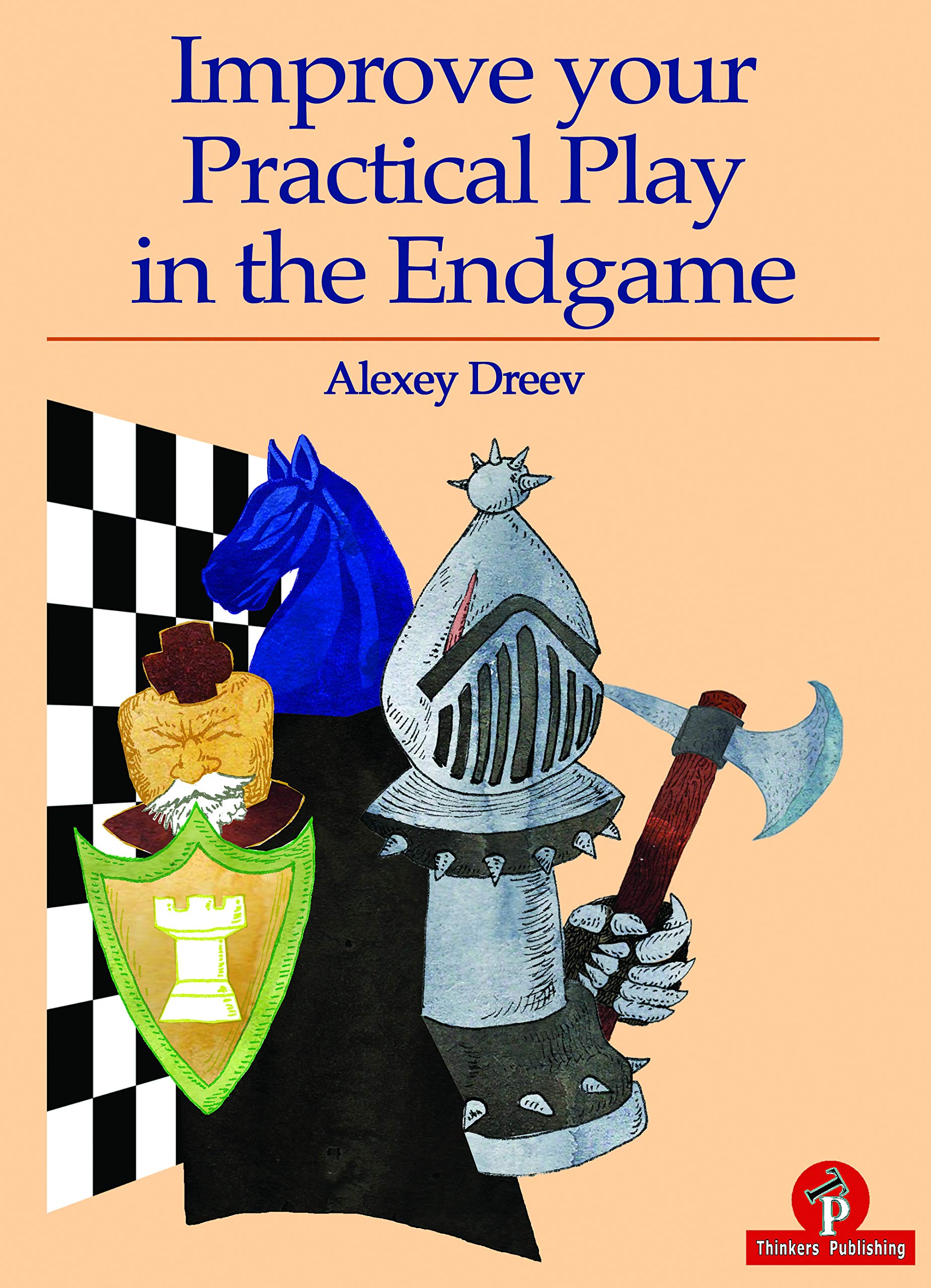
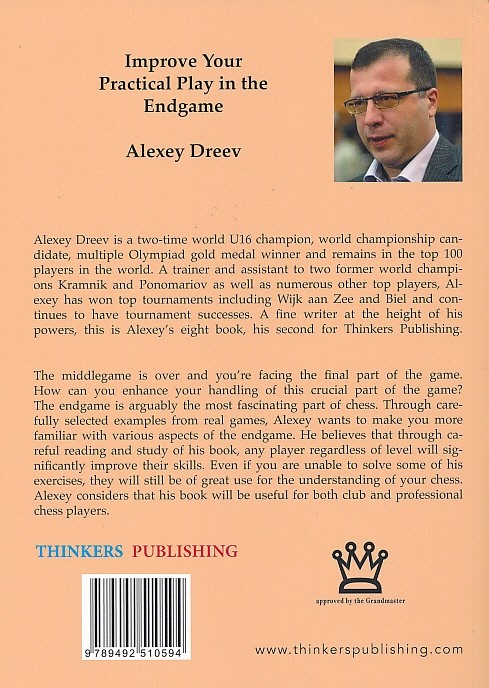
Improve Your Practical Play in the Endgame : Alexey Dreev
“After a bad opening, there is hope for the middle game. After a bad middle game, there is hope for the endgame. But once you are in the endgame, the moment of truth has arrived.” – Edmar Mednis
From Wikipedia :
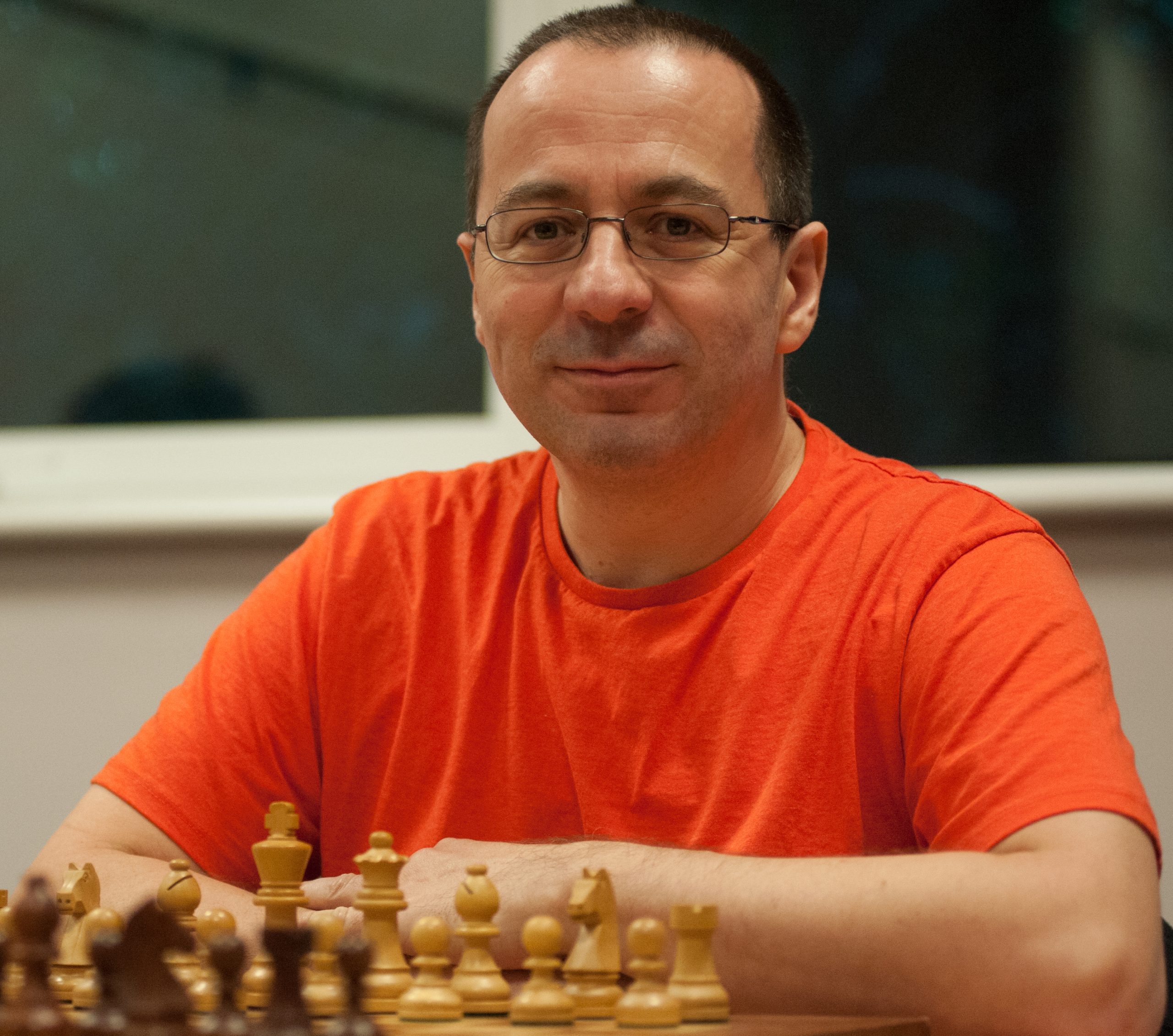
Alexey Sergeyevich Dreev (Russian: Алексей Сергеевич Дреев; born 30 January 1969[1]) is a Russian chess player. He was awarded the title Grandmaster by FIDE in 1989.
While being a promising young chess talent, he was for a period coached by the world-class chess trainer Mark Dvoretsky.
As with every recent Thinkers Publishing publication high quality paper is used and the printing is clear. The book can easily be laid flat next to the board and does not require weights to prevent it from “self-closing” (a particular bugbear of ours !). Each diagram is clear and the instructional text is typeset in two column format, which, we find, enables the reader to maintain their place easily. Figurine algebraic notation is used throughout and the diagrams are placed adjacent to the relevant text and each diagram has a “to move” indicator.
There is no index which, unfortunately, is a standard feature of Thinkers Publishing books. Also missing is a bibliography.
This author of this book is Alexey Dreev, super GM who reached the quarter finals of the candidates in 1991.
This excellent book is packed full of instructive, exciting endgames, taken from top level games, including many of Dreev’s own games
extensively analysed with short pithy didactic comments.
Many of the examples are complex and require serious study to really gain the understanding of practical endgames.
This book is a pleasure to read with an excellent layout and plenty of diagrams making it easy to peruse anywhere.
The book is divided up into six chapters, but not on piece configurations (except for chapter 5) but on aspects of play:
- Particular Endgames,
- Defence,
- Hidden Resources,
- Prophylaxis,
- Pawn Endgames and Transitioning into Pawn Endgames,
- Converting
Each chapter has eight or nine examples analysed in depth followed by a similar number of exercises which will really test the reader;
I did get a few right without moving any pieces.
One of favourite chapters is Particular Endgames which mostly covers positions with material imbalance such as Q v pieces
which the vast majority of players would find fascinating. There is an excellent example no 3 showing the use of a space advantage in B+2Ns endgame.
Following is the first example in the Chapter on Defence and a new perspective on a famous game.
My other favourite chapter is Pawn Endgames and Transitioning into Pawn Endgames which shows the rich complexity of king and pawn endgames
and the crucial importance of this topic.
In my experience, this transition is commonly mishandled by players of all standards: I have spoiled winning endgames in this area and I have seen countless games spoiled by poor play in pawn endgames, so study of this chapter will reap rich rewards for a reader.
FM Richard Webb, Chineham, Hampshire, 17th January 2020
Book Details :
- Paperback : 248 pages
- Publisher: Thinkers Publishing; 1 edition (5 Oct. 2019)
- Language: English
- ISBN-10: 9492510596
- ISBN-13: 978-9492510594
- Product Dimensions: 16.5 x 1.9 x 22.9 cm
Official web site of Thinkers Publishing
 Save as PDF
What a wonderful post you have written, thanks for sharing!