Minor Pieces 26: George Edward Wainwright Part 1

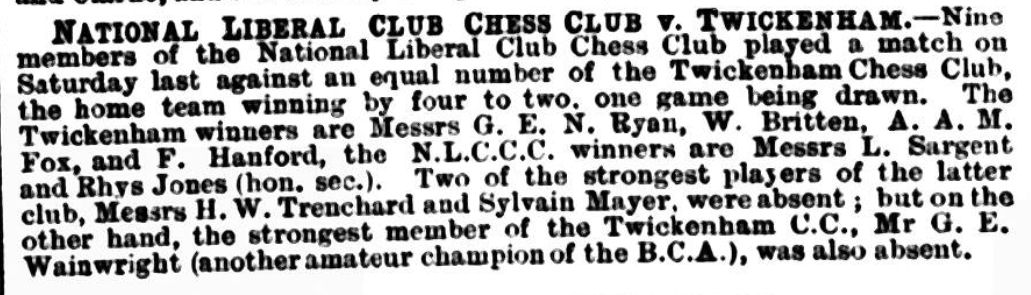
The Field 19 March 1892

Here’s a match from 1892 between Twickenham Chess Club and the National Liberal Club Chess Club (sounds a bit like Battersea Power Station Station, doesn’t it?).

There are some familiar names among Twickenham’s successful players, but you’ll also see that their strongest player Mr G E Wainwright, an amateur champion of the British Chess Association, was absent.

A name we haven’t seen in other matches, but a very significant one. Players like Ryan, Britten and Fox were strong club players (round about 2000-2200 by today’s standards, I guess, but George Edward Wainwright was a genuine master standard player.

Here he is, from a few years later. Very few photographs seem to have survived.
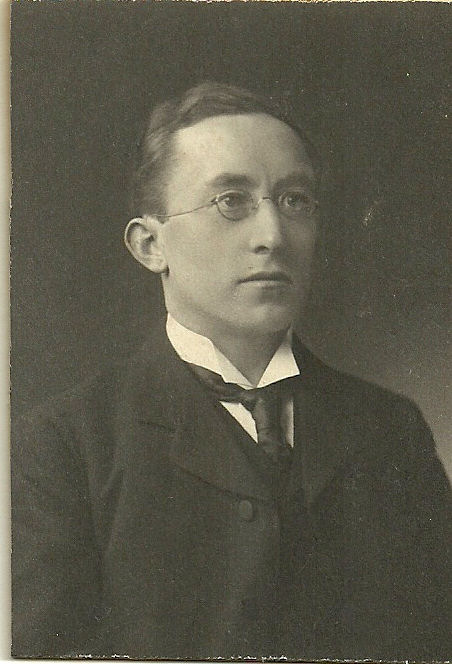
American Chess Magazine 1898: taken from a public member tree on ancestry.co.uk

George Edward Wainwright was born in Redcar, a seaside resort in North Yorkshire, on 2 November 1861.  His father, David, was originally a chemist but later became an independent minister of religion. David sadly died before young George reached his first birthday, and the family moved to Bradford, where his mother Annie (Ann Eliza Tetley) worked as a schoolteacher. At some point before the 1891 census they moved north to the spa town of Ilkley, whose Moor is famous in song. (Ilkley is also famous for its splendid new chess centre, one of whose instigators is Andrew Wainwright. I have no idea at present whether or not he’s related.)

George was a pupil at Bradford Grammar School, where, I’d assume, he learnt chess. In June 1880 he represented his school in a match against the Old Boys. He won an exhibition to University College Oxford later that year, and, the following year was awarded a Classical Scholarship involving five years of study.

Oxford Men and Their Colleges 1880-1892

He was the Treasurer, and later President, of the chess club there and played five times in Varsity matches: on board 6 in 1881 and on board 2 in the subsequent four years. It looks like he improved very rapidly in his first year at Oxford. In March 1882, the University team played a series of matches in which he scored 8½/9, including two wins on top board against the Rev Charles Ranken in a match against former Oxford students.

This game comes from the 1883 Varsity Match. The analysis of all games in this article was produced using Stockfish 14 in ChessBase. Click on any move to display a pop-up board.

[pgn]

[Event “11th Oxford – Cambridge Varsity m”]
[Site “London ENG”]
[Date “1883.03.17”]
[Round “?”]
[White “Wainwright, George Edward”]
[Black “Raymond, Edward Lancelot”]
[Result “1-0”]
[ECO “C51”]
[Annotator “Tactical Analysis 5.1 (1s)”]
[PlyCount “73”]
[EventDate “1883.??.??”]
[Source “The Field, 1883”]

1. e4 e5 2. Nf3 Nc6
3. Bc4 Bc5 4. b4 Bb6 5. a4 a6 6. b5 $146 {C51: Evans Gambit: Declined and
Accepted without 5…Ba5.} ({Predecessor:} 6. O-O d6 7. a5 Ba7 8. b5 axb5 9.
Bxb5 Nge7 10. d4 exd4 11. Nxd4 Bd7 12. Nxc6 Nxc6 13. Bb2 O-O 14. Qd5 {1-0 (42)
Minckwitz/Chigorin/Wittek-Schottlaender/Schwarz,J/Schwe Berlin 1881}) 6… axb5
7. Bxb5 Nd4 8. Bb2 {Black is slightly better.} Nxb5 (8… c6 $5 {[%cal Rc6b5]}
9. Bc4 Nf6 10. Nxd4 Bxd4 11. Bxd4 exd4 $15) 9. axb5 (9. Bxe5 {looks sharper.}
Nf6 10. axb5 Rxa1 11. Bxa1 Nxe4 12. O-O) 9… Rxa1 10. Bxa1 d6 {…f5 is the
strong threat.} 11. d4 exd4 12. Nxd4 Ne7 13. O-O O-O 14. Qh5 f5 15. Nd2 Qe8 16.
Qg5 {[%cal Od4e6] Threatens to win with Ne6!} Qf7 {Against Ne6} 17. Nxf5 Nxf5 (
{Inferior is} 17… Bxf5 18. exf5 Nxf5 19. h3 $15) 18. exf5 Bxf5 19. c4 (19.
Nf3 {is more resistant.}) 19… Be6 (19… Bd3 $142 20. Rc1 Bxf2+ 21. Kh1 Re8)
20. Kh1 Qd7 $2 (20… Qg6 $19 21. Qxg6 hxg6) 21. Re1 {[%cal Oe1e6] And now
Rxe6! would win.} Rf7 22. Ne4 {aiming for Nf6+.} Kf8 (22… Bxc4 $2 23. Nf6+
Rxf6 24. Bxf6 $18) 23. Qh4 h6 {[#]} (23… Bf5 $11) 24. f4 $2 {White is more
active.} (24. Nf6 $1 $16 {[%mdl 512]} Qc8 (24… gxf6 25. Qxh6+) 25. f4) 24…
c6 $2 {[%mdl 8192] [#]} ({Don’t take} 24… Bxc4 25. Nf6 Qxb5 26. Ne8 $18) (
24… Ba5 $11 25. Rc1 Qe7) 25. Ng5 $2 (25. Nf6 $1 $18 gxf6 (25… Rxf6 26. Bxf6
gxf6 27. Qxf6+ Bf7 28. Qxh6+ Kg8 29. Qg5+ Kf8 30. f5) (25… Qc8 26. Nh5 Bd8
27. Qg3 Bf6 28. Bxf6 gxf6 29. Qg6) 26. Qxh6+ Kg8 27. Bxf6 Rh7 28. Qg6+ Kf8 29.
Ra1 Bf5 30. Ra8+ Bd8 31. Qg5) 25… Bxc4 $2 {This bishop pair is nice.} (25…
hxg5 $17 {and life is bright.} 26. Qh8+ Ke7 27. Bxg7 Rxf4) 26. Nxf7 $18 {
White is clearly winning.} Bxf7 27. Qg3 {[%csl Ga1][%cal Rg3g7]} Bh5 28. f5 Bd8
29. bxc6 bxc6 30. Re6 d5 31. Rd6 Qc7 {[#]} (31… Bh4 $142 32. Rxd7 Bxg3 33.
hxg3 Bg4 34. Bxg7+ Ke8) 32. Bxg7+ $1 {[%mdl 512]} Ke8 (32… Kf7 33. Bxh6) 33.
Be5 {White threatens Qg8+ and mate.} Qf7 {Inhibits Qg8+.} 34. Rxc6 (34. Bd4
$142 Bc7 35. Qe3+ Qe7 36. Re6 Qxe6 37. Qxe6+ Kf8 38. Qc8+ Be8 39. Qxc7) 34…
Qxf5 {[%cal Rf5f1]} 35. Qg8+ Qf8 36. Re6+ Be7 {[#]} 37. Rxe7+ $1 {[%mdl 512]
Weighted Error Value: White=1.01/Black=1.03} 1-0

[/pgn]

After Oxford, it was time for George to find a job – and a wife. On 7 September 1886 he married Alice Margaret Pictor, from the village of Box, in Wiltshire, six miles or so from the city of Bath. The young couple settled in Chiswick, where their first two children, George Edward junior (1887) and Philip Francis (1889) were born.

Here, from shortly before his marriage, is a game from a club match.

[pgn]

[Event “St George’s v City of London”]
[Site “London ENG”]
[Date “1886.04.04”]
[Round “?”]
[White “Lewis, Frederick Hyman”]
[Black “Wainwright, George Edward”]
[Result “1/2-1/2”]
[ECO “C42”]
[Annotator “Tactical Analysis 5.1 (1s)”]
[PlyCount “113”]
[EventDate “1890.??.??”]
[Source “The Field, 29 May 1886”]

1. e4 e5 2. Nf3 Nf6 3. Nxe5
d6 4. Nf3 Nxe4 5. d4 d5 6. Bd3 Nc6 7. O-O Be7 8. a3 {C42: Petroff Defence: 3
Nxe5 and unusual White 3rd moves.} Bg4 {[#]} 9. Be3 $146 ({Predecessor:} 9. Be2
O-O 10. Nc3 f5 11. Ne1 Bxe2 12. Nxe2 Bd6 13. f3 Ng5 14. Bxg5 Qxg5 15. f4 Qe7 {
1-0 (40) City Gouda-City Nijmegen corr 1851}) 9… O-O 10. h3 {The position is
equal.} Bh5 (10… Bxf3 $5 11. Qxf3 f5 $11) 11. Nbd2 $2 (11. c4 $11) 11… f5
$17 {[%cal Bf7f5,Bf5f4][%mdl 32]} 12. Nb3 f4 13. Bc1 Ng5 (13… Qd7 {feels
hotter.} 14. Re1) 14. Be2 Ne4 15. Nh2 Bxe2 16. Qxe2 Bd6 17. Nf3 {Prevents Qg5.}
Qd7 18. c4 (18. Qb5 $5 {[%cal Rb5d5]} Nf6 19. Qd3 $11 (19. Qxb7 $2 a6 $19))
18… dxc4 19. Qxe4 (19. Qxc4+ {looks sharper.} Qf7 20. Qb5 Rfe8 21. Qxb7 Qc4
22. Nc5) 19… cxb3 20. Qd5+ (20. Ng5 Qf5 21. Qe6+ Qxe6 22. Nxe6 Rf6 $17) (20.
Qd3 {is interesting.} Na5 21. Bd2 Qf5 22. Qe2 Nc6 23. Qc4+) 20… Qf7 21. Qxf7+
Rxf7 22. Bd2 a5 {[%cal Ba7a5,Ba5a4][%mdl 32]} 23. Rfe1 Rf5 24. Rac1 a4 25. Bc3
b5 26. Ne5 Bxe5 27. dxe5 Ne7 28. Rcd1 c6 29. Rd7 Nd5 30. Bd4 Re8 31. e6 Ne7 32.
Be5 f3 33. gxf3 {[%cal Bg2f3,Bf3f4][%mdl 32]} (33. h4 $5 {[%cal Rg2g4]}) 33…
Rg5+ 34. Kh2 Nd5 $2 {[%mdl 8192] [#]} (34… Rg6 $17 {and life is bright.
White must now prevent …Nf5.} 35. f4 Rxe6) 35. f4 $1 $18 Rg6 36. f5 Rg5 37.
Rg1 $2 (37. Bd4 $18) 37… Rxg1 $11 38. Kxg1 {[%mdl 4096] Endgame KRB-KRN} Ne7
$1 39. Rc7 ({But not} 39. f6 gxf6 40. Bxf6 Nf5 $17) 39… Nxf5 40. Rxc6 Nh4 {
[#] And now …Nf3+ would win.} 41. Bc3 Nf3+ 42. Kg2 (42. Kf1 $5 {[%cal Rc6c7]}
) 42… Ng5 43. Rb6 Nxe6 44. Rxb5 Nf4+ 45. Kf1 Rd8 46. f3 Rd1+ 47. Kf2 Rh1 48.
Ke3 Ne6 49. Ra5 Rxh3 50. Rxa4 {aiming for Ra7.} g5 51. Rb4 {Strongly
threatening a4.} h5 52. Kf2 {Threatens to win with Kg2.} ({Much weaker is} 52.
Rxb3 g4 53. Rb5 (53. Rb8+ Kf7 $11) 53… Rxf3+ 54. Ke4 h4 $11) 52… Rh2+ 53.
Kg1 Rc2 54. Rxb3 {White wants to play a4.} Nf4 55. Bf6 Kf7 56. Be5 {Hoping for
Bxf4.} Ne2+ 57. Kf1 {White used his chance. Weighted Error Value: White=0.37/
Black=0.40} 1/2-1/2

[/pgn]

George had obtained a clerical job in the Civil Service, working for the Local Government Board, which supervised public health, poor relief and local government, and was also responsible for the registration of births, marriages and deaths. There’s a suggestion in an obituary that he was working on Births, Marriages and Deaths at Somerset House for at least part of his career. I’d assume that some LGB employees would have been based within local government throughout the country, and, if we follow his movements, this might have been the case with George Edward Wainwright.

At some point round about 1890 the family moved to Teddington, and it’s there we find them in the 1891 census. They’re living in a house called St Ronan’s in Kingston Road. This seems to have been next door to the Catholic church close to the junction with Fairfax Road and opposite Normansfield Hospital. (The wonderful theatre is often used as a venue for operas and concerts, and the Museum of Learning Difficulties, well worth a visit, features an information board about Reginald Saunderson.)

As you’d expect, George junior and Philip are there, along with George’s mother Ann, a retired schoolmistress, a 21-year-old cousin named Nelly Fenton and two young servants, Annie Beauchamp and Emily Riley. Although he’s just described as a clerk, he’d already, because of his academic qualifications, be pretty high up and doing well for himself. Alice, of course, was also at home, heavily pregnant with the couple’s only daughter, who would be born that May and given the names Constance Margaret. A third son, David, would be born in 1894.

If George walked back up Kingston Road towards Teddington, he’d soon have what would later become Bushy Park Road on his left (an OS map from a few years later shows it under construction), where, some 40 years later, the Misses Ada and Louisa Padbury would sell ham and beef. A turning on the right a bit further up named Cornelius Road was not at that point built up, but in the 1900s would acquire houses and a new name in honour of the reigning monarch: King Edward’s Grove. It was there that, in the 1920s, one of his future opponents, Edward Guthlac Sergeant, would briefly make his home, and also where the Misses Padbury would move after retiring from their Ham and Beef Stores. Their great nephew would spend the first two years of his life there as well,  but that’s another story for another time and place.

George had been very active in chess circles through the later 1880s, most notably winning the British Amateur Championship in 1889. On moving to Teddington, he would have wasted no time joining Twickenham Chess Club. But with a growing family, and, you would imagine, increasing responsibility at work, he played less often during the 1890s, contenting himself with club and county matches.

On 7 April 1894, for example, he was on Board 19 in a 108-board match between the South and North of England, where he drew his game against our old friend (and possibly my distant relation by marriage) Edwin Marriott.
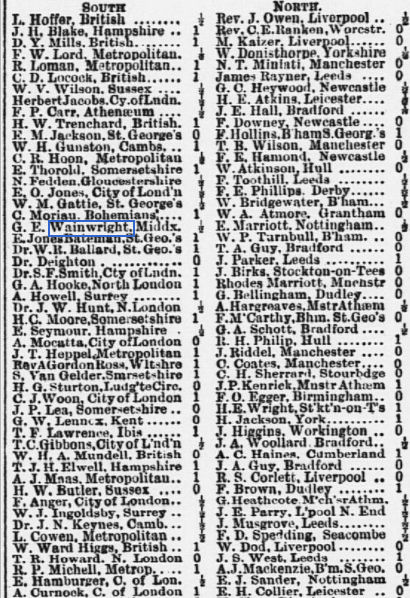
Lots of great names there on both sides, some of whom will be featured later in this series, but Wainwright’s position on board 19 suggests that he wasn’t regarded as any more than a strong amateur at that point. He was still, in 1894, representing Middlesex, but he was soon to move, and to leave Twickenham Chess Club.

By 1895 he was living in Guildford, joining the local club and now representing Surrey in county chess.

This game from a county match demonstrates that George was a player with an enterprising style and considerable tactical ability.

[pgn]

[Event “Surrey v Kent”]
[Site “?”]
[Date “1896.12.12”]
[Round “?”]
[White “Wainwright, George Edward”]
[Black “Williams, Grantham”]
[Result “1-0”]
[ECO “C14”]
[Annotator “Tactical Analysis 5.1 (1s)”]
[PlyCount “57”]
[Source “Pall Mall Gazette, 15 December 1896”]

1. e4 e6 2.
d4 d5 3. Nc3 Nf6 4. Bg5 Be7 5. Bxf6 Bxf6 6. Nf3 a6 7. Bd3 {[#] C14: French:
Classical System: 4 Bg5 Be7 main line.} h6 $146 {[%cal Oc7c5]} (7… c5 $5) ({
Predecessor:} 7… Be7 8. Qe2 dxe4 9. Nxe4 Nd7 10. O-O-O O-O 11. g4 Nf6 12.
Nxf6+ Bxf6 13. h4 Qd6 14. Qe4 g6 {1-0 (27) Mieses,J-Walbrodt,C Berlin 1894}) 8.
O-O c6 9. e5 {White is better.} Be7 {[%cal Bf6e7,Be7c5,Bc5b6][%mdl 32]} 10. a3
c5 11. dxc5 Bxc5 12. b4 Bb6 13. Qe2 Nc6 {And now …Nd4 would win.} 14. Rfd1
Qc7 15. Rac1 {Na4 is the strong threat.} Nd4 (15… Nxb4 {is more complex.} 16.
Nb5 axb5 17. axb4 O-O 18. c3 Bd7) 16. Nxd4 Bxd4 {[#]} 17. Nb5 Bxf2+ 18. Qxf2
axb5 19. Bxb5+ Kf8 $2 {[%mdl 8192] This costs Black the game.} (19… Bd7 $14
20. Bxd7+ Qxd7) 20. c4 $18 dxc4 (20… Kg8 $142 21. cxd5 Qxe5) 21. Rxc4 Qe7 22.
Qb6 {White threatens Rd8+ and mate.} g6 23. Rc7 Qg5 {[#]} 24. Rxf7+ $3 {
[%mdl 512] White mates.} Kxf7 25. Qc7+ Kg8 26. Rd8+ {[%mdl 64] Skewer} Qxd8 27.
Qxd8+ Kh7 28. Qe7+ Kg8 29. Bd3 {Weighted Error Value: White=0.28 (precise) /
Black=0.72} 1-0

[/pgn]

The administrative headquarters of Surrey County Council moved from Newington (Southwark) to the newly built County Hall in Kingston in 1893: perhaps he was involved in some way. It’s also possible his job might have then taken him to Guildford, which would explain the move. Perhaps, though, he was commuting to the capital from nearby London Road station, which had opened in 1885. A train would have taken him directly to Waterloo, from where Somerset House was a short walk across the bridge.

With his family now growing he seems to have had more time for chess, and in 1898, as a result of games like the one below, he had come to the attention of the national selectors, being picked as a reserve for the Great Britain team in their third annual cable match against the United States of America.

[pgn]

[Event “British Chess Club v St George’s CC”]
[Site “?”]
[Date “1898.01.22”]
[Round “?”]
[White “Wainwright, George Edward”]
[Black “Jones-Bateman, Ernest”]
[Result “1-0”]
[ECO “D00”]
[Annotator “Tactical Analysis 5.1 (1s)”]
[PlyCount “58”]
[Source “Westminster Gazette, 24 January 1898”]

1. d4 d5 2. e3 e6 3. Bd3 c5 4.
c3 Nc6 5. f4 f5 6. Nf3 Nf6 7. O-O {[#] D00: 1 d4 d5: Unusual lines.} Bd7 $146 (
{Predecessor:} 7… Bd6 8. Ne5 O-O 9. Nd2 Ne4 10. Ndf3 Bxe5 11. Nxe5 Nxe5 12.
fxe5 c4 13. Bxe4 fxe4 14. Rxf8+ Qxf8 {0-1 (60) Pillsbury,H-Halpern,J New York
1894}) 8. Ne5 Be7 9. Nd2 {Black is slightly better.} Nxe5 10. fxe5 Ng4 11. Qf3
cxd4 $2 (11… O-O $15 {stays ahead.}) 12. exd4 $16 Qb6 {aiming for …Nxe5.}
13. Re1 O-O-O 14. b4 {[%cal Bb2b4,Bb4c5][%mdl 32]} h5 {[%cal Oe7b4]} 15. Nb3 g5
16. Bd2 {a4 is the strong threat.} (16. h3 $6 Nh6 $14) 16… Bb5 17. a4 Bc4 {
Loses the game.} ({Black should play} 17… Bxd3 $14 18. Qxd3 Kb8) 18. Nc5 $18
Bxc5 19. bxc5 (19. dxc5 Qa6 $16) 19… Qa6 20. Bxc4 Qxc4 21. Reb1 (21. Bxg5
Rdg8 $16) (21. h3 Nh6 $16) (21. a5 $142) 21… Rdg8 $2 (21… f4 {is a better
chance.} 22. Rb4 (22. h3 Nh6 $16) 22… Qa6) 22. Rb4 {White is clearly winning.
} (22. h3 Nh6 $14) 22… Qa6 23. Rab1 ({Weaker is} 23. h3 Nh6 $16) 23… Rh7
24. c4 ({Not} 24. h3 Nh6 $16) 24… dxc4 25. c6 b6 26. a5 Qxa5 {[#]} 27. Rxb6
$3 {[%mdl 576] Deflection} Qxb6 28. Rxb6 axb6 29. Qa3 {Against Ra7. White
threatens Qa8+ and mate.} Rd8 {Weighted Error Value: White=0.20 (precise) /
Black=0.77} 1-0

[/pgn]

The following year, he was in the team facing a promising young tactician named Frank Marshall.

A long and exciting game ensued, in which our man was perhaps fortunate to escape into a fortress-like draw.

[pgn]

[Event “Match/Nation ENG-USA”]
[Site “Cable”]
[Date “1899.??.??”]
[Round “?”]
[White “Marshall, Frank James”]
[Black “Wainwright, George Edward Sr”]
[Result “1/2-1/2”]
[ECO “D00”]
[Annotator “ChessBase II”]
[PlyCount “120”]
[EventDate “1899.??.??”]
[EventType “team”]
[EventRounds “1”]
[EventCountry “ENG”]
[SourceTitle “EXT 2002”]
[Source “ChessBase”]
[SourceDate “2001.11.25”]
[SourceVersion “1”]
[SourceVersionDate “2001.11.25”]
[SourceQuality “1”]

1. d4 d5 2. e3 Nd7 ({Predecessor:} 2… e6 3. c4 c6 4. Nc3 Nf6
5. Nf3 Bd6 6. Bd3 Nbd7 7. e4 dxe4 8. Nxe4 Nxe4 9. Bxe4 Nf6 10. Bc2 Bd7 11. O-O
Qc7 12. c5 Bf4 13. Bxf4 Qxf4 14. Ne5 Rd8 15. g3 Qh6 16. Qe2 Bc8 17. Rad1 Qh3
18. f4 {1-0 (38) Berger,J-Albin,A Cologne 1898}) 3. f4 e6 4. Nf3 Ngf6 5. Bd3 c5
6. c3 {D00: 1 d4 d5: Unusual lines.} b6 (6… Be7 7. Nbd2 Rb8 8. Qe2 Qa5 (8…
c4 $5 {[%cal Rc4d3]} 9. Bc2 b5 $11) 9. O-O b5 $2 {[%mdl 8192]} (9… O-O $14)
10. e4 $2 (10. dxc5 $18 b4 11. Nb3) 10… dxe4 $14 11. Nxe4 Nxe4 12. Bxe4 Nf6
$2 ({Black should try} 12… O-O $14) 13. Bd3 $2 (13. Bc6+ $18 Kf8 14. f5)
13… O-O 14. Bd2 (14. f5 $5) 14… Qb6 15. Kh1 b4 $11 {Just,G-Wagner Michel,A/
Erfurt 1973}) 7. O-O Bb7 8. Ne5 {The position is equal.} Bd6 9. Nd2 c4 (9…
cxd4) 10. Bc2 {[%cal Oe3e4]} Qc7 (10… O-O {/\ Re8, Nf8}) 11. Qe2 b5 12. e4
Nb6 {[#]} (12… O-O $2 {[%mdl 8192] 12…Nxe4 0.00}) (12… dxe4) (12… dxe4
$11 13. a4 e3) 13. Nxf7 $1 $18 {[%mdl 512]} Qxf7 14. e5 Bc7 {[%cal Of6e4] …
Ne4! is the strong threat.} (14… Be7 $2 {14…Bc7 1.44}) 15. exf6 gxf6 (15…
Qxf6 $2 {15…gxf6 1.50} 16. f5) 16. Bf5 {White is more active.} Kd7 17. Bh3
Rae8 18. Nf3 Rhg8 (18… Kd8 {/\ Bc8}) 19. Bd2 Bd6 $2 {[#]} ({Better is} 19…
Bc8 $14) 20. Rae1 $2 (20. Ne5+ $1 $18 {[%mdl 512] is the precise move to win.}
Bxe5 21. dxe5) 20… Nc8 $2 {[#]} (20… f5 $16) 21. Ne5+ $1 {[%mdl 512]} Bxe5
(21… fxe5 $2 22. fxe5 Qe7 23. exd6 Nxd6 24. Qh5) 22. fxe5 f5 {[#]} 23. Bg4 {
[%mdl 512] Inhibits h5.} Ne7 (23… Qg7 24. Bh5) 24. Bh5 Ng6 25. Bg5 {Inhibits
Qe7.} Rc8 $2 (25… Bc6 26. g4 Kc7 27. gxf5 exf5) 26. Bf6 {[%cal Of1f5] Hoping
for Rxf5!} Qf8 27. Qd2 {Inhibits Qh6.} Rc6 28. Kh1 Rb6 29. g4 fxg4 30. Bg5 {
[%cal Bf6g5,Bg5h6,Bh6f8,Bf8d6][%mdl 32]} (30. Bxg4 Ne7 $16) 30… Qe8 31. Bh6 {
And now Rf6 would win.} ({Less strong is} 31. Bxg4 Nf8 32. Rf3 Kc7 $16) 31…
Kc7 32. Rf6 ({Not} 32. Bxg4 Ne7 33. Bg5 b4 $16) 32… Bc8 33. Ref1 Kb8 34. Bf8
Rb7 (34… b4 $142 35. Bxb4 Qa4) 35. Bd6+ Ka8 {[#]} 36. Rf8 $3 {[%mdl 512]}
Rxf8 (36… Qxf8 37. Bxf8) 37. Rxf8 Qxf8 38. Bxf8 Nxf8 39. Qg5 Bd7 40. Qe7 Rb8
41. Bxg4 Kb7 {[#]} 42. Bxe6 $1 {[%mdl 512]} Nxe6 43. Qxd7+ {[%mdl 4096]
Endgame KQ-KRN} Nc7 44. Qxh7 Rf8 45. h4 (45. Kg2 $142) 45… Rf2 46. h5 Rxb2
47. h6 $2 (47. Qh6 $18 {and White stays clearly on top.}) 47… b4 $16 48. cxb4
{[%cal Ob4b5] Threatens to win with b5!} c3 49. Qd3 c2 50. Qxc2 Rxc2 51. h7
Rxa2 (51… Rc1+ $2 52. Kg2 $18) 52. h8=Q $11 {KQ-KRN} Re2 53. Qf8 a6 54. Qc5
Re4 55. Kg2 Rg4+ 56. Kf2 Rf4+ 57. Ke3 Re4+ 58. Kd3 Re1 59. Kd2 Re4 60. Kc2 Re2+
{Black escapes into a draw. Weighted Error Value: White=0.42/Black=0.45}
1/2-1/2

[/pgn]

It seems that, by now in his late 30s, George Edward Wainwright was approaching the peak of his powers over the chessboard.

The 1901 census located the family in the parish of Stoke next Guildford. George, described as a Principal for the Local Government Board, and Alice were at home, along with their three youngest children, George’s mother, a governess to help look after the youngsters, a cook and a housemaid. George junior, meanwhile, was boarding at Pilgrim House School, Westerham, Kent.

We’ll leave him there for the time being, a senior civil servant working for the Local Government Board, a family man, and an English international chess player renowned for his dashing attacks.

The story of George Edward Wainwright’s life and chess career will be continued in the next Minor Piece.

If you want more, and, if you enjoy attacking chess or British chess history you certainly should, historian Gerard Killoran, who lives in Wainwright’s home town, Ilkley, is currently working on a biography. I can’t wait to read it.

Sources:

ancestry.co.uk

findmypast.co.uk/British Newspaper Collection

MegaBase 2022

EDO historical chess ratings (Rod Edwards)

Yorkshire Chess History (Steve Mann)

chessgames.com

BritBase