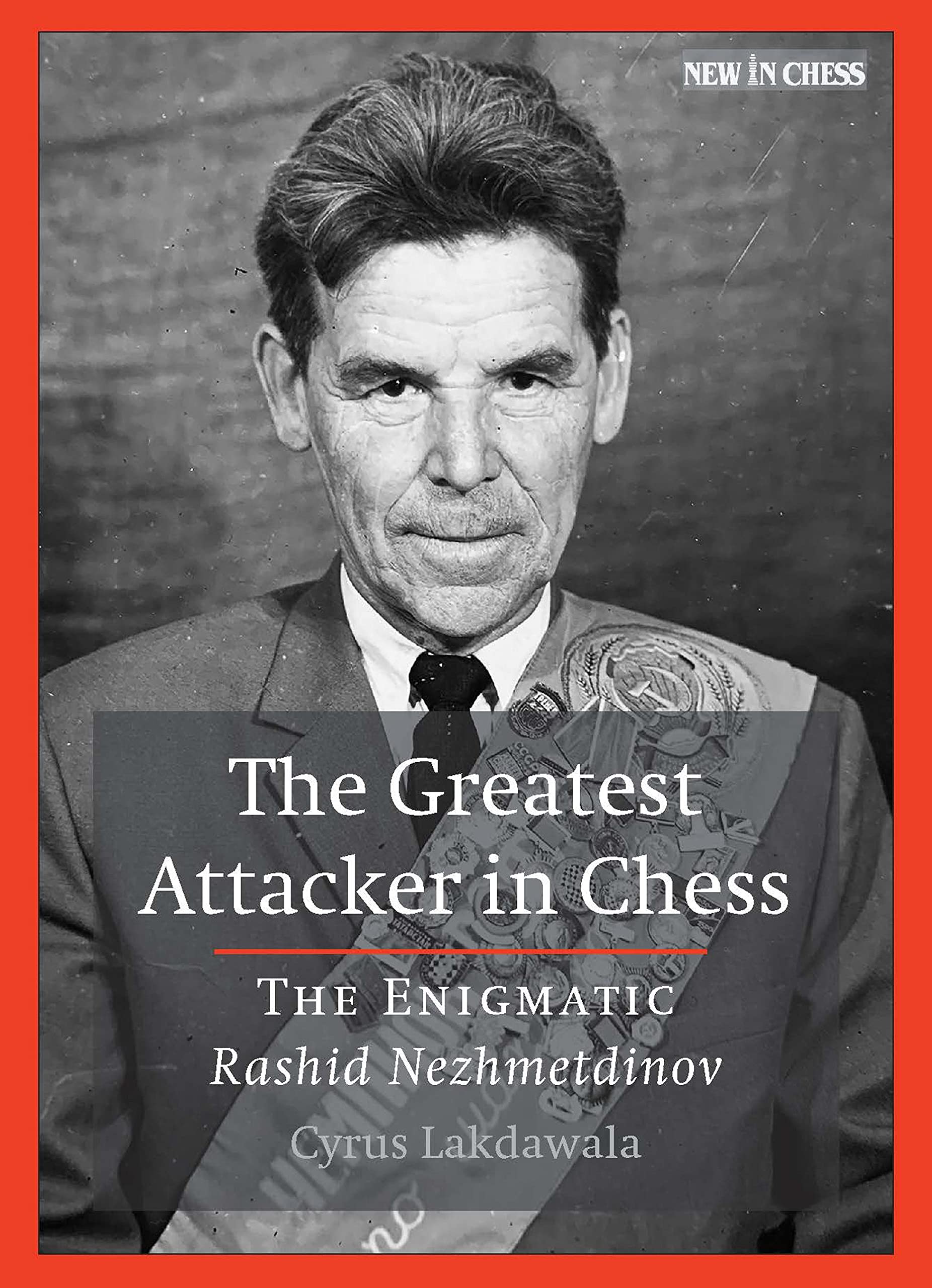
From the publisher:
“Rashid Nezhmetdinov (1912-1974) played fearless attacking chess. With his dazzling style, the Soviet master already was a legend during his lifetime, but international fame largely eluded him. Only once did he get permission to show his exceptional talent in a tournament abroad. Five times Nezhmetdinov was chess champion of the Russian Federation. In the 1961 Soviet Championship, he won the ‘Best Game’ prize for a spectacular win against Mikhail Tal who praised his opponent for his ‘amazing creativity.’ Other stars that ‘Nezh’ defeated in grand style included Spassky, Polugaevsky, Bronstein, and Geller.
His games, full of tactical pyrotechnics, are his legacy and have reached an ever-growing audience. Nezhmetdinov’s shocking strategic queen sacrifice, in 1962 against Chernikov, as shown on Agadmator’s YouTube channel, has become the best-watched chess video of all time with millions of views. In this book, Cyrus Lakdawala pays tribute to the genius of the enigmatic Nezhmetdinov, a Tatar who grew up as an orphan in the part of the Soviet Union that is now Kazakhstan.
In more than one hundred impressive and instructive games and positions, Lakdawala shows how Nezhmetdinov fought for the initiative, how he bluffed and sacrificed, and how he kept his cool to out-calculate his opponents. Lakdawala’s lucid writing perfectly matches the power of ‘Nezh’s’ moves. This wonderful collection celebrates Nezhmetdinov as the Greatest Attacker in Chess.”
Cyrus Lakdawala is an International Master who lives in San Diego, CA. He has been teaching chess for four decades and is a prolific and widely read author. Much acclaimed books of his are How Ulf Beats Black, Clinch It! and Winning Ugly in Chess. He twice won the Best Instructional Book Award of the Chess Journalists of America (CJA), in 2017 for Chess for Hawks and in 2020 for In the Zone: The Greatest Winning Streaks in Chess History.
We all know and love the games of the great world champions, but there are also a few players who, while not reaching the summit, have become cult figures amongst chess fans for their creativity, imagination and brilliance.
Albin Planinc is one, and another is Rashid Nezhmetdinov, the subject of this book. He has been the subject of several books over the years, and now the prolific Cyrus Lakdawala adds his name to the lists.
Here’s Lakdawala in his Preface:
If you asked the question ‘Who do you believe was the most tactically creative player of the 20th century?’ then I’m guessing that most chess players would pick either Alekhine, Bronstein, Tal or Kasparov. Now we have a new potential entry for the top spot: Rashid Nezhmetdinov. Why are so many people irrestistibly drawn to Mikhail Tal’s chess games? The spirit of Nezhmetdinov the pirate lived on in his friend’s games. Tal was merely a more powerful extension of Nezhmetdinov. Nezhmetdinov was Tal’s trainer and muse in his successful 1960 bid to dethrone Botvinnik as World Champion. Tal explained that Nezhmetdinov taught him ‘paradox’, taking risk-taking to previously unheard-of levels. Then Tal, his stylistic offspring, displayed to the world the power of this radical new style, when in 1960 he defeated the great Mikhail Botvinnik in a match for the World Championship. If you love Tal’s games, then by default you will automatically love Nezhmetdinov’s.
Who doesn’t love Tal’s games? Book collectors who enjoy brilliant tactics and sacrifices will surely have several collections of Tal’s games on their shelves. They’ll really need a collection of Nezhmetdinov’s games as well. Is this the right one for you?
If you’ve read other books by Cyrus Lakdawala, you’ll know what to expect. His, shall we say, picturesque style of writing divides the critics. There are those who find his friendly approach and sometimes outrageous metaphors draw them in, and others who find this distracts them from the chess. You pay your money, or not, as the case may be, and take your choice.
The annotations, as is customary with this author, feature Moments of Contemplation, where you’re encouraged to think about the position, and Exercises, split into Planning, Combination Alert and Critical Decisions, inviting you to guess the next move. There are also Principles (in italics) offering you nuggets of general advice. All this will help less experienced readers navigate their way through the book and gain tangible benefits which they’ll be able to employ in their own games.
Here’s an early game. Click on any move for a pop-up window.
This is one of his most famous victories – against a formidable opponent. If you haven’t seen it before, do take a look.
The ChessBase score concludes here. Lakdawala adds the moves 34. Ka6 Ndb4#, commenting, in typical style: This is an overkill on par with Rasputin’s murder, where the unlucky monk was stabbed, shot, poisoned, bludgeoned, and then, for good measure, drowned.
Your opinion of the book will depend on how you react to this sort of thing. Here are another couple of examples.
Everyone knows that the Dragon, much the same as a Bond villain babe, is simultaneously beautiful and dangerous.
You are on trial for your life for a murder you committed in front of a police station and 30 witnesses, most of whom recorded you with their cell phone video cameras. Your victim fought back and your blood was found on her and on the knife you used to stab her. I just described Aronin’s position’s chance of being found Not Guilty by the jury.
You might enjoy them. You might be prepared to live with them even though you think they’re both irrelevant and bordering on tasteless, and that the publisher might have made more use of the Delete key. Or you might decide there’s no way you’d buy a book written like that. Me, I’m in the middle camp, as I am with most things.
In this game from towards the end of his career he defeats a future world champion.
Even if you don’t care for Lakdawala’s prose, you should admire his hard work and enthusiasm. He knows his audience, knows exactly what he’s doing and has perfected his art over many years. You may well think that his colourful annotations are a perfect match for Nezhmetdinov’s colourful chess.
For many readers, this will be a hugely enjoyable read, and one which may also take their play to new levels of creativity. You’ll find 116 ‘games’ (about half complete games – not all won by Nezhmetdinov – and the others just conclusions) against many of the Soviet greats of the time: Bronstein, Tal, Korchnoi and others. As you’ve seen, the book is a cornucopia of daring attacks and sacrifices, not all of which are completely sound. The book is produced to New in Chess’s customary high standards and can be highly recommended to anyone not put off by the author’s writing style.
You can read some sample pages on the publisher’s website here.
Richard James, Twickenham 30th September 2022
Book Details:
- Softcover: 288 pages
- Publisher: New In chess (25 Feb. 2022)
- Language: English
- ISBN-10:907168900X
- ISBN-13:978-9071689000
- Product Dimensions: 17.15 x 1.88 x 23.57 cm
Official web site of New in Chess