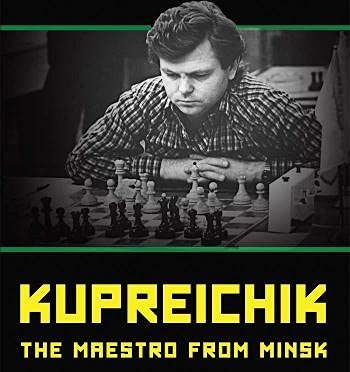
From the London Chess Centre Publishing web site:
“Kupreichik: The Maestro from Minsk features tributes to the legendary attacker from those who regularly faced him at the board, including Alexander Beliavsky, Oleg Romanishin, Evgeny Sveshnikov and Vladimir Tukmakov. Kupreichik also inspired the next generation, as the contributions of Boris Gelfand, Garry Kasparov, Andrey Kovalev and Rauf Mamedov reveal.
Our picture of Viktor Kupreichik is completed by a series of pen portraits from his family, which make clear the kind and principled man this hero of Belarusian chess was, as well as his love for the 64 squares.
Translated by Ken Neat, this work is also a collection of Kupreichik’s best games, many annotated by the man himself. His wins over Tal and Zilbershtein are legendary examples of the power of a knight sacrifice on d5 in the Open Sicilian. Inside you will learn not just about handling Kupreichik’s favourite Classical Sicilian, Slav and King’s Indian, but attacking and sacrificial chess in general. Readers even have the chance to solve 26 positions and so play like Kupreichik!
Viktor Kupreichik (1949-2017) was a leading Soviet Grandmaster in the 1970s and 1980s, famed for his attacking prowess. He twice won a staggering five games in a row at the super-strong USSR Championship. A former world student champion, Kupreichik won many tournaments, including the Masters section at Wijk aan Zee in 1977 and the Hastings Premier of 1981/82.
with forewords by Anastasia Sorkina and Genna Sosonko”
If I asked you to guess who played this game you’d be forgiven for thinking Tal. (Click on any move in any game in this review for a pop-up window)
You’d be partly right: Tal was playing – the black pieces. Spoilsport Stockfish will tell you he should have won, but it’s not easy, even for a genius, to defend against that sort of attack over the board. It was played in Sochi i n 1970, in a match tournament between a team of young layers and a team of grandmasters.
On the white side was the hero of this book, Viktor Davydovich Kupreichik (1949-2017). This book, unusually without a credited author, was compiled by his family and friends after his death and published in Russian in 2019 to celebrate what would have been his 70th birthday. Here we have an English translation from London Chess Centre Publishing.
Genna Sosonko wrote the foreword to the English edition:
A master of attack, he demonstrated play that you rarely see nowadays. Even today when playing over games by Minsk’s favourite, an expression of Tal’s comes to mind – “tasty chess”.
Memories of him have been written by world champions, trainers, colleagues, friends and Viktor’s pupils. They all remember not only a wonderful chess player, but also an extraordinary personality. Even in the world of Soviet chess, Viktor was distinguished by his independence.
Mikhail Tal, Viktor’s idol, once said that his favourite squares on the chess board were d5 and f5. Viktor, who was similar to Tal not only in his constant striving for the initiative, but also the incredible boldness of his play, repeatedly placed his pieces en prise too on these very squares. And his most brilliant firework display began with a knight sacrifice on d5 in a game with Tal himself.
If you’re a fan of Tal’s games, then (and who isn’t?), you’ll enjoy Kupreichik’s games as well. You might put him in the same category as other chess mavericks such as Nezhmetdinov and Planinc: a player who valued creativity, beauty and excitement above results.
One of the contributors, Boris Gelfand, recalls, as an 11-year-old in 1979, being deeply impressed by this game.
Kupreichik’s niece, Anastasia Sorokina, is President of the Belarus Chess Federation and a FIDE Vice-President. She wrote the foreword to the Russian edition.
The publication of this book is timed to coincide with the 70th birthday of an outstanding chess-player, the first Belarusian Grandmaster, a true friend and a wonderful person, Viktor Davydovich Kupreichik. Vitek – that’s what his friends and the fans called him.
In the distant 1980s the name of Kuprechik resounded throughout the country. He was recognised in the street, fans would queue up to watch him play, and largely thanks to him a chess boom began in the Republic.
and
A sensitive and tactful person, he did not like boasting and bravado, so when the idea of this book emerged I wanted to make it modest, like him, but at the same time show all the power of his chess talent and the charm of his human character.
The first half of the book, then, comprises tributes to Kupreichik from friends and colleagues, including Kasparov and Karpov, very often with annotated games.
His friend Andrey Kovalev describes this encounter as ‘one of the best King’s Indian games in the history of chess’.
See what you think.
Throughout his long career, lasting 55 years or so, Kupreichik remained loyal to his favourite openings. He preferred 1. e4 with White, replying to 1. e4 with the Sicilian, and to 1. d4 with the King’s Indian or the Slav. If you enjoy these openings yourself you’ll find a lot of inspiration from the games in this book.
The second major section of the book is a collection of games annotated by Kupreichik himself. Those he annotated for Chess Informant have had verbal explanations added by the editorial team.
Here’s a quick win against Nigel Short.
By now you might be wondering why Kupreichik isn’t better known, or why he never reached the heights these games would suggest he deserved (his highest rating was 2575). I guess he was one of those players who loved chess too much, who valued beauty above success.
You might also think there are many higher rated players who deserve to be the subject of a games collection. You may well be right, up to a point, but were their games as entertaining as Kupreichik’s?
Here’s one final example: another spectacular miniature.
At the end of the book you’ll find a puzzle section: 26 tactical puzzles based on his games, spaciously laid out with only two diagrams per page. Finally, and charmingly, we have short memoirs from his closest family: his sister, niece and daughter.
There are also 16 pages of photographs, on glossy paper. Here you’ll see pictures of Kupreichik throughout his life, from the young boy with his parents to playing in tournaments at the end of his life: sadly he was denied the pleasures of old age. You’ll see him playing chess – and also playing football and volleyball.
All in all, it’s a delightful book: 85 games brimming with exciting tactics and sacrifices as well as reminiscences of someone who was a much loved human being as well as a highly creative player.
It’s beautifully produced as well: a handsome hardback which will look good on your bookshelf. It’s refreshingly free from typos and the translation is, as you’d expect from Ken Neat, outstanding. I very much hope that the London Chess Centre plan to publish more books of this quality.
The one thing that’s missing, for me, is a career summary. I’d have appreciated a full list of Kupreichik’s tournament results and perhaps also his ratings over the years. We do, however, have indexes of openings and opponents.
While it might not be an essential purchase, many readers will enjoy this book. If it appeals to you it comes with a strong recommendation.
If you enjoy games collections you’ll want this book. If you enjoy the games of players like Tal, Nezhmetdinov and Planinc, you certainly won’t be disappointed in this book. If you play the Sicilian (with either colour), the King’s Indian or the Slav, or you’re an e4 player looking for new ideas, you’ll find this book inspirational.
Here are some sample pages in pdf format.
Richard James, Twickenham 6th March 2023
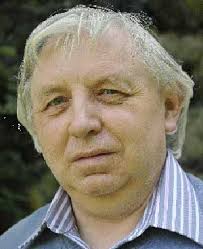
Book Details :
- Hardback: 344 pages
- Publisher: London Chess Centre Publishing; New edition (10 Sept. 2021)
- Language: English
- ISBN-10:0948443960
- ISBN-13:978-0948443961
- Product Dimensions: 15.24 x 3.49 x 23.5 cm
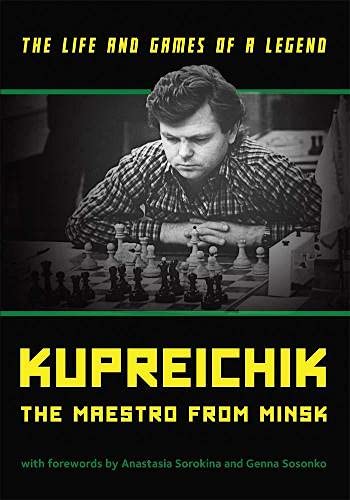
Kupreichik: The Maestro From Minsk, Translated by Ken Neat, London Chess Centre Publishing; New edition (10 Sept. 2021), ISBN-13 : 978-0948443961