Tag Archives: 2023

Remembering Edith Baird (née Winter-Wood) (??-??-1859 01-ii-1924)

We remember Edith Baird (née Winter-Wood)

Edith Elina Helen Winter-Wood was born, probably in 1859*, to Thomas Winter-Wood, a writer and poet, and Eliza Ann (née Sole) Winter-Wood in Boulogne, France.

(*Despite 22nd February 1859 appearing in Wikipedia we are unable to locate a primary source for this date. Contemporary secondary sources always just gave 1859 as her year of birth. Census records imply that she was born between April 1859 and March 1860. Her marriage record from 1st December 1880 describes her as being ‘of full age’: at least 21 years old, so born before December 1859. However, her death record from 1st February 1924 gives her age as 63, implying that she was born between February 1860 and January 1861. Either her death record is incorrect or she added a couple of months to her age when she married. )

Many secondary and tertiary sources incorrectly give the Winter-Wood family home of Hareston Manor (now a venue for weddings) near Brixton, Plymouth, Devon as her birthplace.
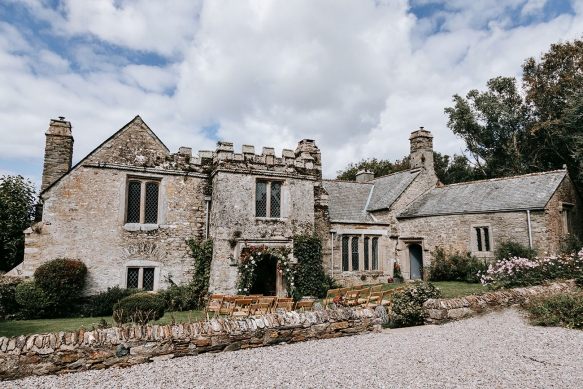
Hareston Manor near Plymouth

The family was resident in Boulogne in at least 1858 (as discussed below) and a UK birth certificate for Edith does not appear to exist. Having said that, a French birth certificate has yet to be located. Both Brian Denman and Chris Ravilious are satisfied that Edith was born in Boulogne and various census records attest to this. Ed: both Richard James and myself (JEU) have examined the evidence carefully and Boulogne would appear to be correct.

Thomas Winter-Wood was born in Har(e)ston, Devon in 1819 and was himself a strong player having been educated at Plympton Grammar School (now known as Hele’s School). Thomas was the son of John Wood-Winter who, in 1824, reversed the order of the family surname. Thomas sold the family estate leaving the Winter-Woods with substantial means, with each family member able to pursue their leisure interests whilst retaining a number of domestic staff.
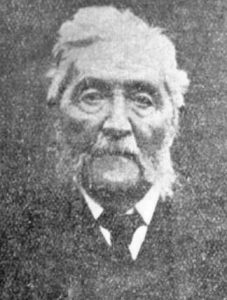
Thomas Winter-Wood (1819-1905) in 1903.

Thomas taught all of his family to play chess and Edith learnt at an early age. Both Edward J and Carslake W also learnt early on, Edward (aged 11 in 1858) played members of Boulogne Chess Club giving them rook odds and ten years later Edward joined London Chess Club.

According to Tartajubow :

“(Edward) played in several tournaments and in blindfold simuls he drew two games against Lowenthal and one against Blackburne. In 1878 he joined the Croydon Chess Club and once in one of their tournaments scored 23-7. He also enjoyed success in many other club tournaments, correspondence chess and problem solving tournaments. Many of his problems appeared in leading publications of the day.”

and, also according to Tartajubow :

“Her other brother, Carslake W. Wood (1849 – 1924), lived with his mother’s brother, Major Sole of the 5th Militia of West York, in Torquay. While travelling Europe with the Soles, he also developed a taste for painting and on many occasions donated his paintings as prizes in chess tournaments.”
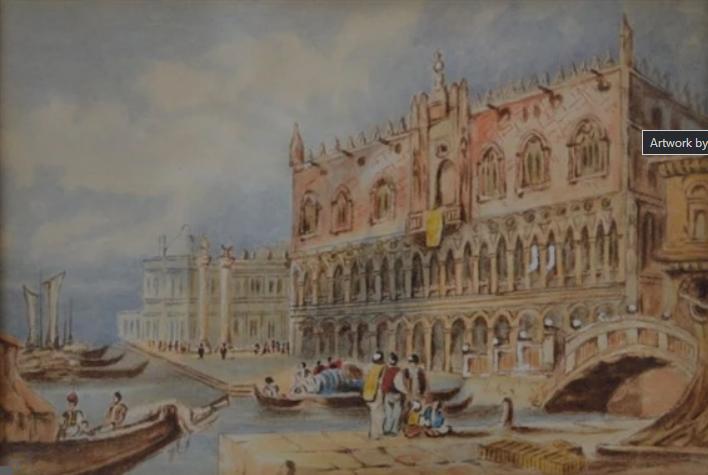
The Doge’s Palace, Venice 1880s by Carslake W Winter-Wood

According to F. R. Gittins (in The Chess Bouquet 1897):

“The moves came to her, as she says, by a kind of instinct before she was out of her first decade. She did not, however, commence composing problems until some years after her marriage, which took place in 1880, to Deputy Inspector-General W. J. Baird, M.D., R.N., whose distinguished services have been mentioned in despatches and rewarded with four medals and two clasps. Eight years later she composed her first problem, and commenced a wonderful series of successes, having gained eleven first, nine second, and six third prizes, and been honourably mentioned nine times.”
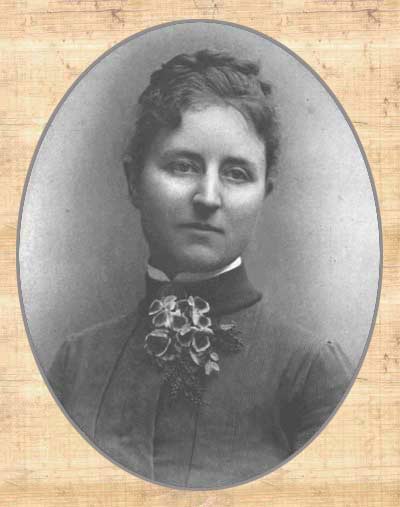
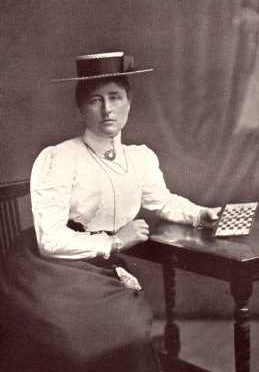
Edith Baird (née Winter-Wood)

According to the old ChessDevon web site (sadly only available via the WayBack Machine)

“In 1893, for instance, she entered The Hackney Mercury 3-mover tournament, with a limit of 6 pieces. Most of the great composers of the time had entered, – B. G. Laws, P. H. Williams and James Raynor among them, but she won 1st prize. As one American critic observed, ‘The fact that the tourney assumed an almost international character rendered the triumph of the distinguished lady victor as noteworthy as it was creditable’.”

Here is this first prize (1):

Baird, Edith Elina Helen
Hackney Mercury, 1893
1st Prize

The problem solutions may be found at the foot of this article.

She very quickly progressed and was soon producing problems that were described as being “exceedingly pretty” and which ‘displayed unmistakable aptitude for the intricacies of chess.’ Her work 700 Chess Problems was published by Henry Sotheran Ltd in 1902 and took her 14 years to complete.”
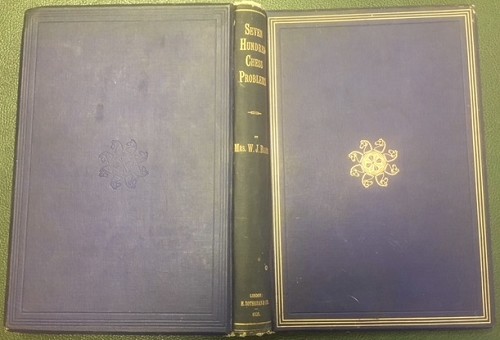
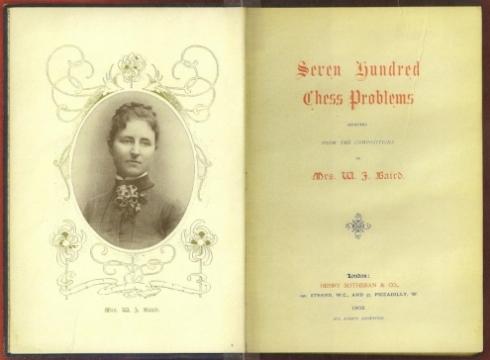
Seven Hundred Chess Problems. Selected from the compositions of Mrs. W. J. Baird, WJ Baird, 1902
Seven Hundred Chess Problems

700 Chess Problems may be downloaded from here.

Edith also had a brief career in chess competitions in the 1890s, winning the 1897 Sussex Ladies Championship without losing a game.

Few samples of her play survive, but they show her to be a proficient player with, as you might expect from a problemist, a keen tactical eye. In this game she finishes neatly with a queen sacrifice.

In this game, from a blindfold simul against the London-based Dutch organist and chess master Rudolf Loman (1861-1932), she uses a tactic to reach an equal ending.

According to the 1871 census the Winter-Wood household lived at “Hareston”, Tavistock Road, Croydon, Surrey and consisted of Thomas (52 and Landowner), Eliza (44) plus Edith’s brothers Edward J (23 and Banker) and Carslake W (22 and retired banker), Marie A (17), Edith (11) plus three (!) domestic servants.

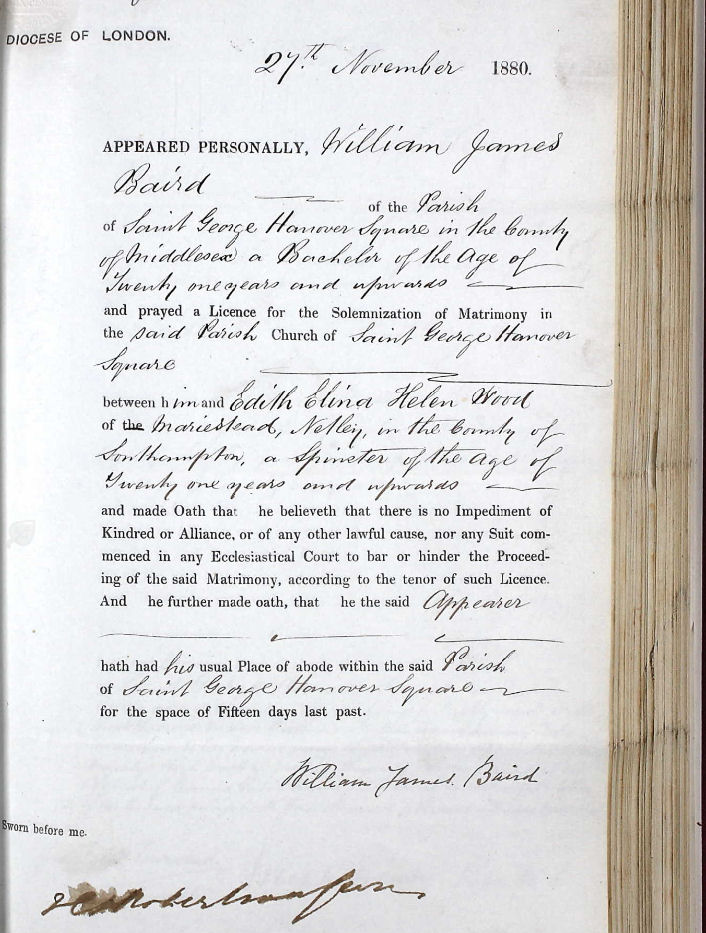
In 1880 (‘of full age’) Edith married the Deputy Inspector-General of Fleets and Hospitals, William James Baird, MD, of the Royal Navy, in the parish church of St George Hanover Square.  (You’ll see that she married under the surname Wood rather than Winter-Wood.) William was almost thirty years her senior, having been born in Londonderry in 1831. The 1881 census found them in lodgings in Durham House, Hotspur Street, Tynemouth, North Tyneside: presumably William was there in connection with his work.  Later the same year, their only child, Lilian Edith Baird, was born in the same place.
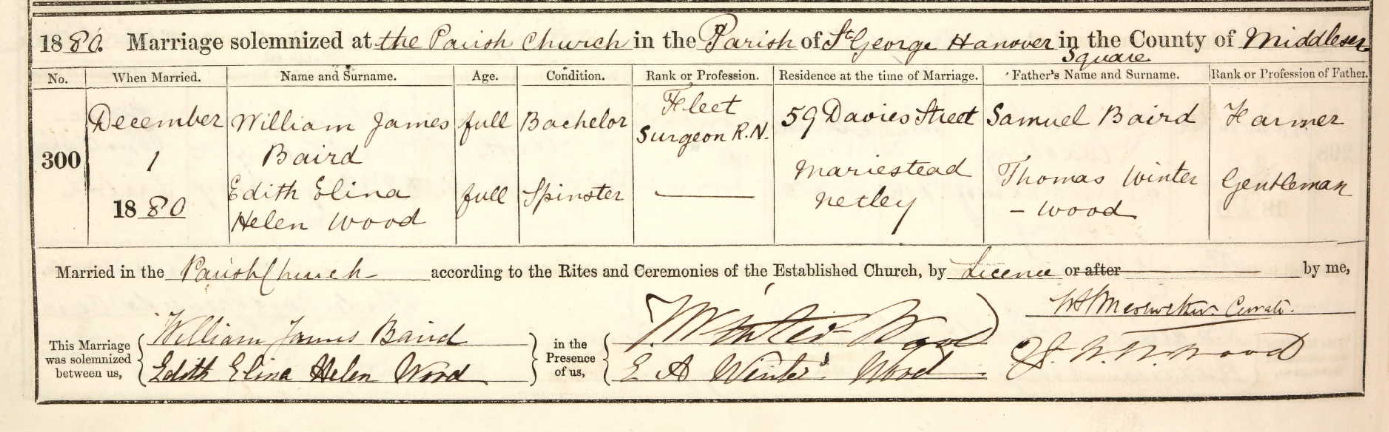
William and Edith’s marriage recorded in the Parish Register of St George Hanover Square
William Baird and Edith (Winter-)Wood’s marriage bonds

Lilian would become a child prodigy whose first problem was published before she was 10 years old. She was also an accomplished poet and painter like her mother. Although she had over 70 problems published by the age of thirteen, Lilian gave up chess composing while still in her teens.
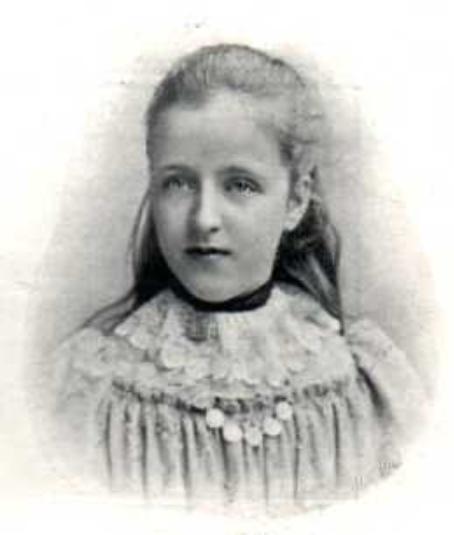
Lilian Edith Strong (née Baird)

(Lilian merits a full article in this place in her own right : added to ToDo list!)

By 1891 William had retired and the family had settled in Brighton living at 14 College Terrace, where they employed a servant, Louisa Howard (23). In 1901 the census enumerator found them at the same address, their servant now being Lilian Millard (25).
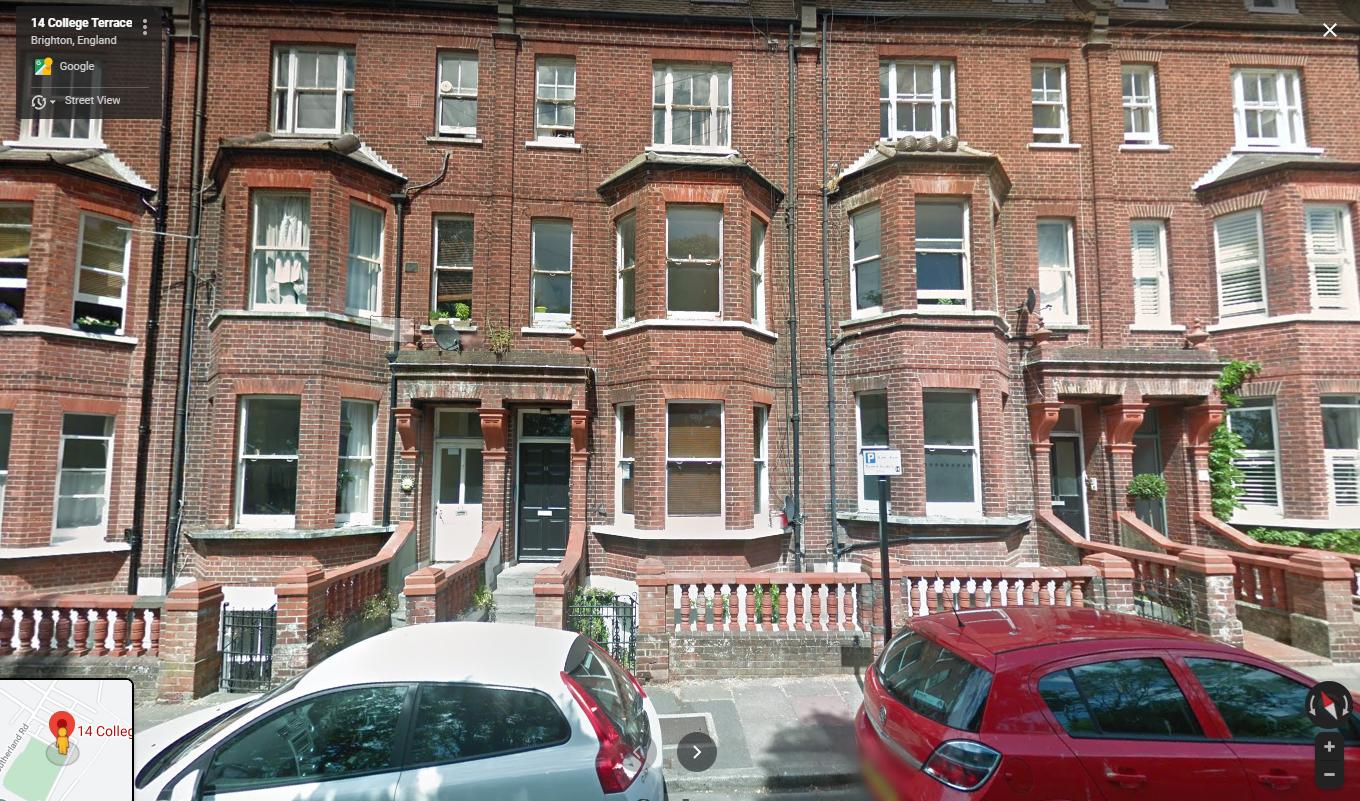
14 College Terrace, Brighton, East Sussex. BN2 0EE

William died in 1907, and Lilian had married in 1910: the 1911 census found Edith living in a boarding house named Mountcoombe in Surbiton. The house no longer exists, but its name, minus a letter, survives in Mountcombe Close, now a location for residential flats. Shortly afterwards, she joined her brothers in Paignton, Devon, close to her family’s ancestral roots.

Returning to Edith’s family, by the time of the 1881 census the Winter-Wood household (bar Edith) had relocated to “Mariestead”, Netley Abbey, Southampton and had shrunk to Thomas, Eliza and a mere two servants. Edith gave this address when she married William Baird.
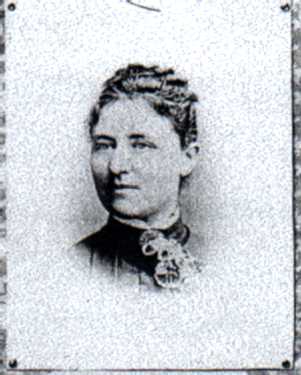
Edith Baird (née Winter-Wood)

In the 1891 census the Winter-Wood household consisted of Thomas (72), Eliza (64) plus Edith’s brothers Edward (43) and Carslake (42) all of whom were described as “living on means”. They had returned to three domestic servants : Mary Scoble (65), Carrie Stephens (22) and Kate Truman (just 12). They lived at 14, The Crescent, Plymouth, PL8 2AP. Nothing remains of this property, it would appear. By 1901, the family had moved again, to “Kenwick”, Paignton, Devon. They were back down to two servants: Florence Gagg (18) was the housemaid and Sarah Chambers (59) the cook. Thomas died in 1905, and the 1911 census gives their address as “Hareston”, Totnes Road, Paignton. Eliza, Edward and Carslake’s servants were now Laura Ellen Gagg (25 – presumably related to Florence) and Sarah Tulley.

In an interview with the Westminster Gazette (1st September 1894) Edith was asked why chess has always been a man’s game.

“Frivolous and fashionable women would begrudge the time and thought it requires; busy mothers of families could not, of course, spare time for it, and the great majority of unmarried girls have not, I’m afraid, the necessary patience. Then, too, it is, I must confess, an unsociable game. It is most suitable for quiet and reflective people, and for invalids. It seems always to have attracted clever strategists like military and naval commanders, and also great politicians. I wish girls would take to it more, because it is such excellent mental discipline, and brings out one’s patience. It would also be a useful corrective to the tendency to jump at conclusions which many women have. The great charm is that it is a home accomplishment. A woman is not expected to leave her fireside for the sake of chess. It is a stable kind of amusement for which she never need sully her womanliness or her good reputation. Many of the outdoor sports, innocent and healthy enough, lead to a great deal of flirtation and general frivolity.”

F.R. Gittins (op. cit.) described her as follows:

“Mrs. Baird, however, is something more even than the Queen of Chess-problem composers. She is, for example, an enthusiastic and skilful archer, and, living as she does in Brighton, has for some time been a prominent member of the Furze Hill Archery Club, of which she is a member of the committee, and in which, she has, for two years in succession, taken the medal for the highest aggregate score of the season. She also paints and illuminates charmingly, and has a pretty inherited talent for writing verse. Her book of illuminations, in fact, is described as “so chaste and delicate in design as to recall the ancient illuminated books which are treasured in museums and art galleries.” In politics she is a staunch Liberal, while the modern movement against all cruelty to animals – whether inflicted under the name of sport or in the interests of science – finds in her one of its most ardent champions.  Besides the déclassement derived from chess, she is also a great believer in girls making themselves independent of marriage, from a monetary point of view, by having a definite occupation. When it is added that she never allows chess, painting, or any other favourite pursuit to occupy her time until all the domestic matters of home have been seen to, we have said sufficient to show how finely-rounded and complete a life this brilliantly clever woman leads. It is only left to add that her manner is kind and  charming, and that she is thoughtfulness and considerateness itself to all her friends. She is, moreover, the most loving of mothers, and has been heard to declare that if anything were to happen to “Lily”, she would never compose another chess problem.”

Edith was also an avid bicyclist who was known to have ridden 25 miles (on one of those old style bicycles) to discuss an adjourned chess game.
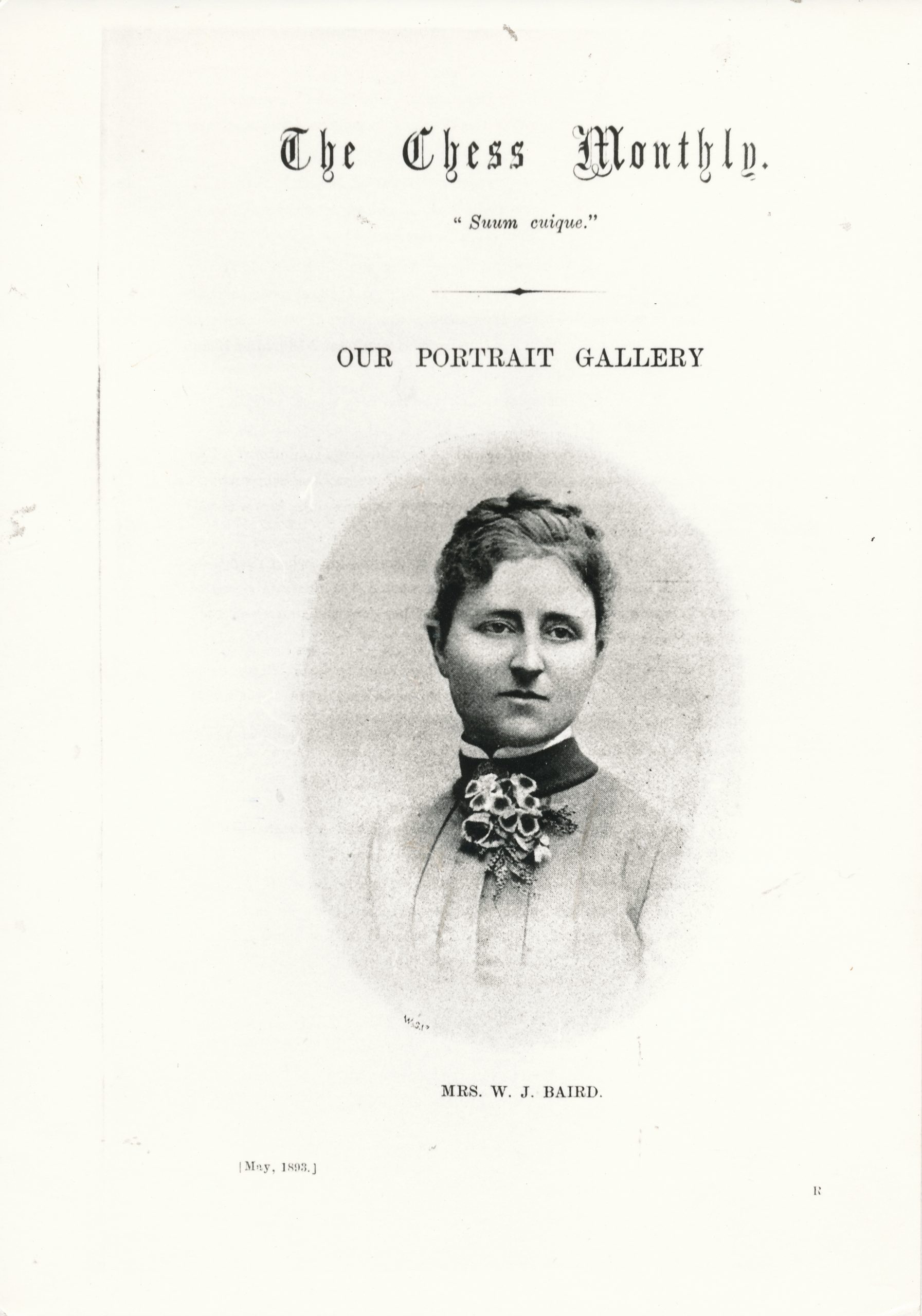
Edith Elina Helen Baird

On Friday, February 1st, 1924 Edith passed away. The probate record is dated April 29th and was granted to Herbert Percy Strong, a Lieutenant-Colonel in the Indian Army, who was Lilian’s husband. The initial value of the effects was £18110 5s 7d which was subsequently resworn to £16627 13s 11d.

Probate record for Edith Baird (1924)

Both Sunnucks and Golombek are silent on Edith. This is somewhat surprising since Anne liked to mention female players and problemists.

From The Oxford Companion to Chess by Hooper & Whyld :

EDITH ELINA HELEN (née Winter Wood) (1859-1924), British problem composer. Her parents, two brothers, and daughter were all good players or clever problemists.

She composed over 2,000 problems which were not profound but were noted for their soundness; only a dozen or so were faulted. Her Seven Hundred Chess Problems was published in 1902. She became deeply absorbed in retractors, and her other book The Twentieth Century Retractor appeared in 1907. They are two of the most beautiful chess books ever to appear, printed and bound by the King’s printer Henry Sotheran, and sold at less than cost.
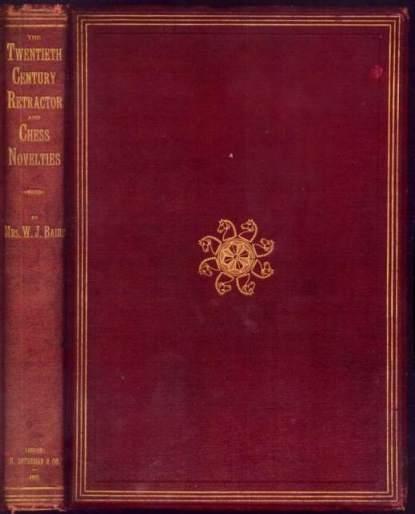
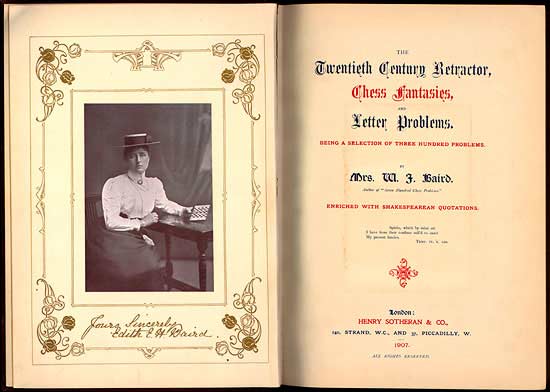
The Twentieth Century Retractor
The Twentieth Century Retractor, Chess Fantasies, and Letter Problems: Being a Selection of Three Hundred Problems, Mrs WJ Baird, London: Henry Sotheran and Co. 1902.

The Twentieth Century Retractor may be read online here.

The dedication for The Twentieth Century Retractor was somewhat unusual :

“Dedicated to
The Sun
The Glorious Orb which
Animates and Beautifies
The Earth
By Giving It
Warmth, Light and Life”

and Edward Winter discusses the beauty of the book in Chess Note 3164.

From British Chess Magazine, Volume XLIV, (44, 1924), page 103 we have this brief obituary notice written by RC Griffth :

“We much regret to hear of the death, at Paignton, on February 1st, of Mrs. W.J. Baird, much of the distinguished of women problem composers throughout the world. As our problem editors will no doubt deal fully with her work and her triumphs, we shall say no more here that she took a keen interest in chess over-the-board also, and in 1897 secured the county championship  of Sussex among players of her own sex. By birth she was a Winter-Wood and thus a member of a distinguished West of England chess family”

From British Chess Magazine, Volume XLIV, (44, 1924), page 125 we have this obituary written by RC Griffth :

“A deep shadow has been cast over the chess world by the death of Mrs. W.J. Baird, which occurred on 1st February last at Paignton. The end was most unexpected, but it is a comfort to her relatives that the passing away was peaceful. She was the daughter of Mr. T. Winter-Wood, who and whose family have been identified with chess for generations. She was born in 1859 and composed her first problem in 1888, and it was not long after this date that she was given the title of the “Queen of Chess,” since not only did she distinguish herself in a happy way as a prolific composer, but proved a valiant opponent over the board, testified by her securing the ladies’ championship of Sussex in 1897.

Mate in Two (2)

Among her other accomplishments were painting, particularly illuminating, poetry (which may have been inherited from her gifted father) and archery, in which sport she was skilful. Her chess problems were generally of the light texture order never profound, but always pleasing to the ordinary solver. She must have composed over 2,000 problems of one sort or another, and this large output in about thirty-five years could not be conducive to highest results. Her problem tourney honours were numerous, though she did not as a rule see these, generally entering her problems to oblige admiring conductors of competitions.

Mate in Two (3)

In 1902 she published Seven Hundred Chess Problems and in 1907 The Twentieth Century Retractor, Chess Fantasies and Letter Problems, 320 illustrations (Sotheran & Co.). Both were editions de luxe. Mrs. Baird was credited with the being the originator of the complicated retractor of which she was a proficient exponent, but since she ceased composing these fancies, interest in them has waned.

Mate in Three (4)

During the last few years her activity, after a period of quiescence has been marked, her attention being directed principally to ‘Mutates’ and Picture or Letter Problems. In addition to the enthusiasm which, shown by her actual work, she has generously promoted several competitions, one still current in the Morning Post, particulars of which we announced last month. A remarkable feature of the deceased’s problems was their soundness less than one per cent. being cooked after leaving her hands, evidence of painstaking application!

Mate in Three (5)

There is now, since the decease of Mrs. Baird’s father, Mr. T. Winter-Wood and her brother, Mr. E.J. Winter-Wood, only Mr. Carslake Winter-Wood left to represent the family in the chess circle, Mrs. Strong, her daughter, who at one time promised to emulate her mother, having apparently abandoned the game and its problems. There can be no question that Mrs. Baird stood in front of all lady composers, her nearest rival probably being the late Mrs. T. B. Rowland, and indeed a number of her compositions rank high in the world’s collection. We have not space this month to quote specimens, but hope to do so next issue.

Mate in Three (6)

Since the above was in type we have been informed of the sudden death of Mr. Carslake Winter-Wood on the 24th February.”

The Late Mrs. W. J. Baird,

The Masters said:-

“Lay by the board, the problem is not sound;
There’s none can solve unless a Morphy’s found.”
* * *
A knight I saw, his royal head bowed;
Methought a bishop moved and prayed aloud.
The Queen, alas, and their attendants gone,
Only did the Kings linger sadly on.
And roaming far afield a Rook forlorn,
And here and there a long-forgotten pawn.
“Oh! is there none who can this problem solve?”
“Seek her round who our highest hopes revolve”
And so we brought it to our ‘Problem Queen’
Who faced the field with heart and eye serene.
* * *
“Go leave me now and I will rest awhile,”
Then hand outstretched and swift triumphant smile :
“The Bishops move! with him the key,” she cried –
“Life’s problem solved at last! I’m satisfied.”

M.S.M.

White retracts his last move; then plays. Black moves so that White can mate at once. (7)

(Please note that there are factual errors in most of the sources quoted below.)

Here is her Wikipedia entry

Here is more from chessproblem.net

Article from Tartajubow (but the author mistakenly conflates Edith and Lilian) on Edith Baird and other Bairds

Queens of Problem Chess by Satanick Mukhuty from chessbase.com

More from Sarah Beth Durst (aka BatGirl), quoting from Gittins.

Via the Wayback Machine Chess Devon have this excellent article

British Chess News would like to thank Brian Denman for providing a file of Edith Baird’s games, and Tim Harding, for sending us the pdf of The Chess Bouquet.

Solution to problems:

(1)

1.Qg7! (2.Qc7#)
1…Kc6 2.c5 Kxc5 3.Qc7#
1…Kxc4 2.Qd4+ Kb3 3.Qb4#
1…Kb6 2.Sb5 Ka6/Ka5, Kc6/Kc5 3.Qa7, Qc7#
1…Kd6 2.Sb5+ Ke6, Kc7/Kc5 3.Sd4, Qc7#

(2) 1.Bg2

(3) 1.Qb2

(4) 1.Qh8

(5) 1.Nc1

(6) 1.Rd8

(7) White retracts Nd5xRb6, then 1. Nd6 Rc6 2. Nb7#


Happy Birthday GM Raymond Keene OBE (29-i-1948)

We send birthday wishes to GM Raymond Keene OBE.

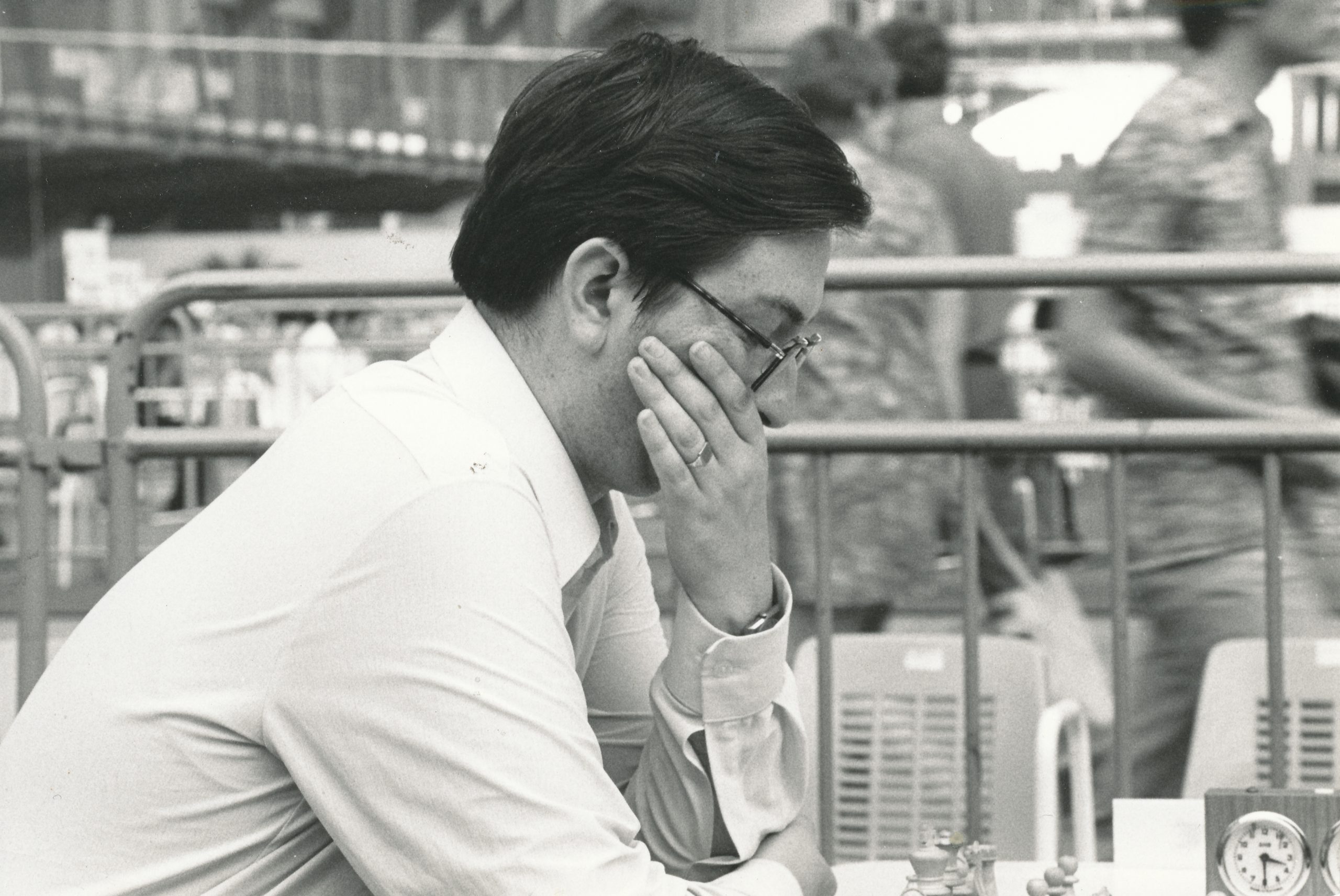
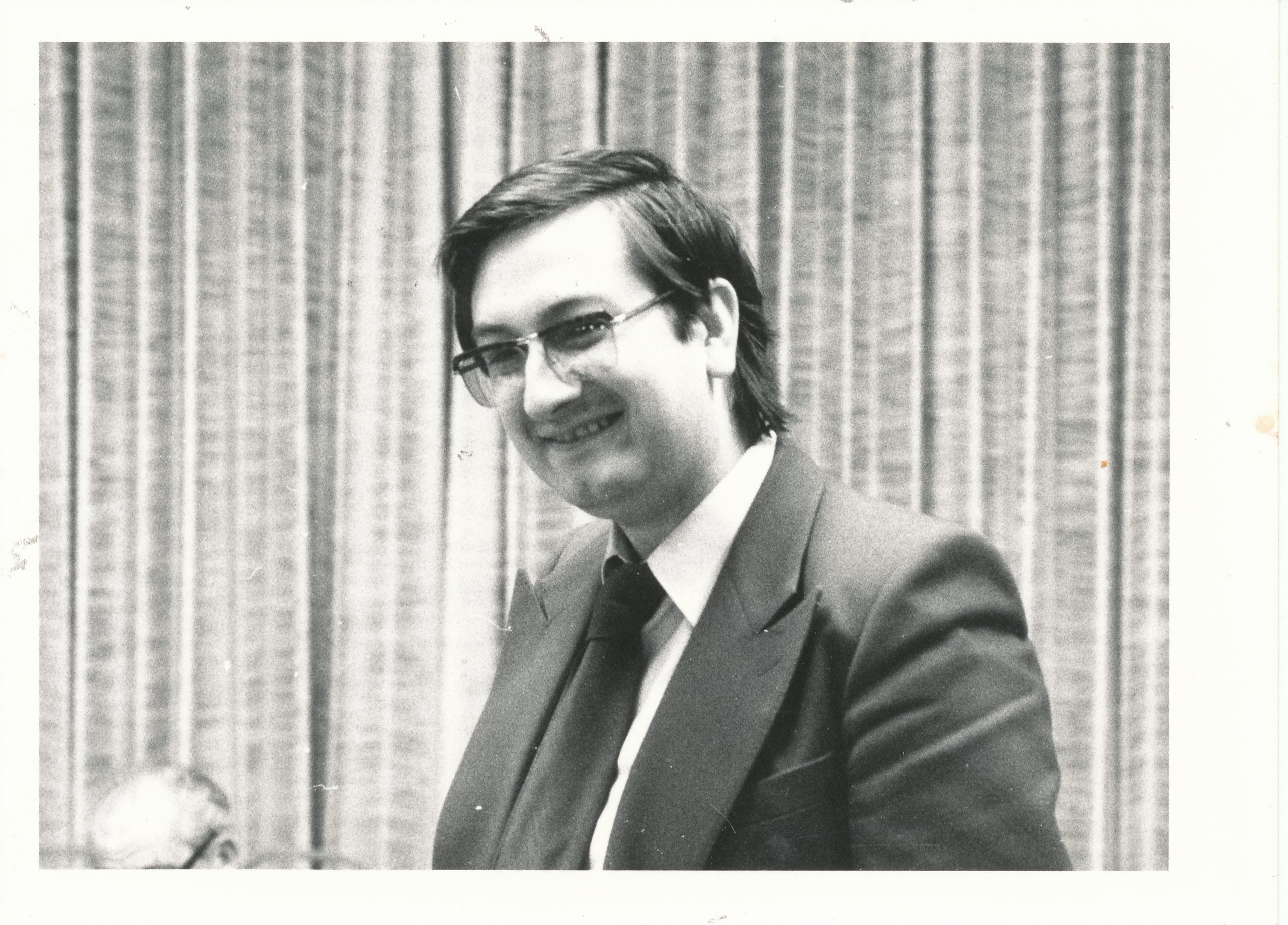
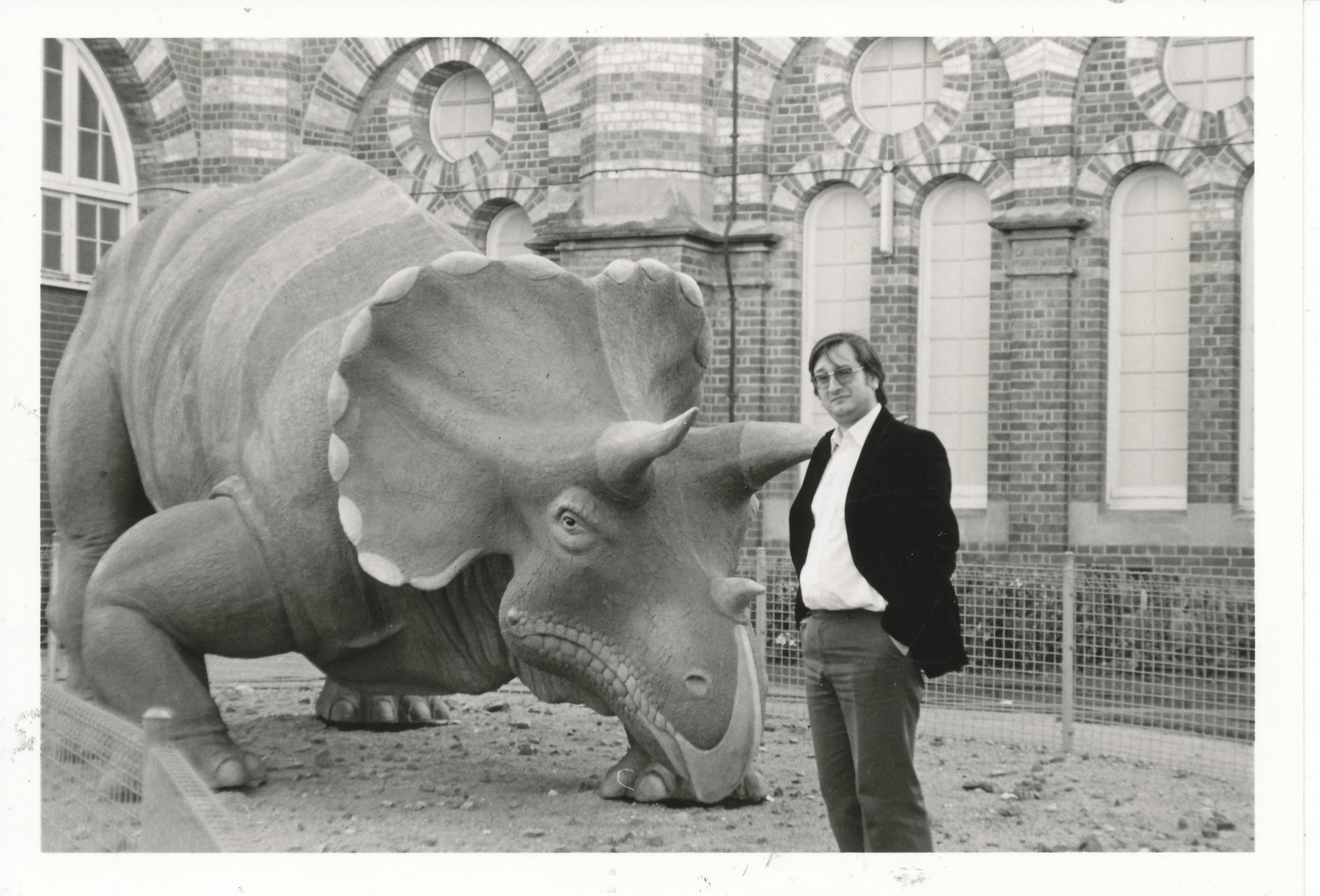
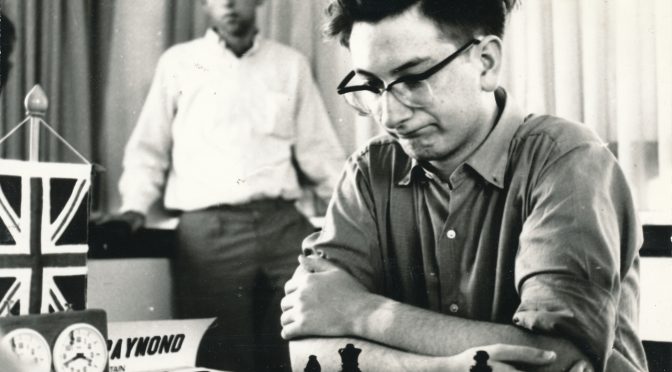
Raymond Dennis Keene was born on Thursday, January 29th 1948 in Wandsworth, London to Dennis Arthur and Doris Anita Keene (née Leat). Dennis and Doris were married in 1943 in Camberwell. Doris was born on May 27th, 1921 in Lambeth and was a shorthand and invoice typist.

Dennis and Doris also had a daughter Jackie Keene who later married chess historian, RG Eales. Jackie is Emeritus Professor at The University of Kent in the Faculty of Arts and Humanities. Jackie played in the Glorney Cup.

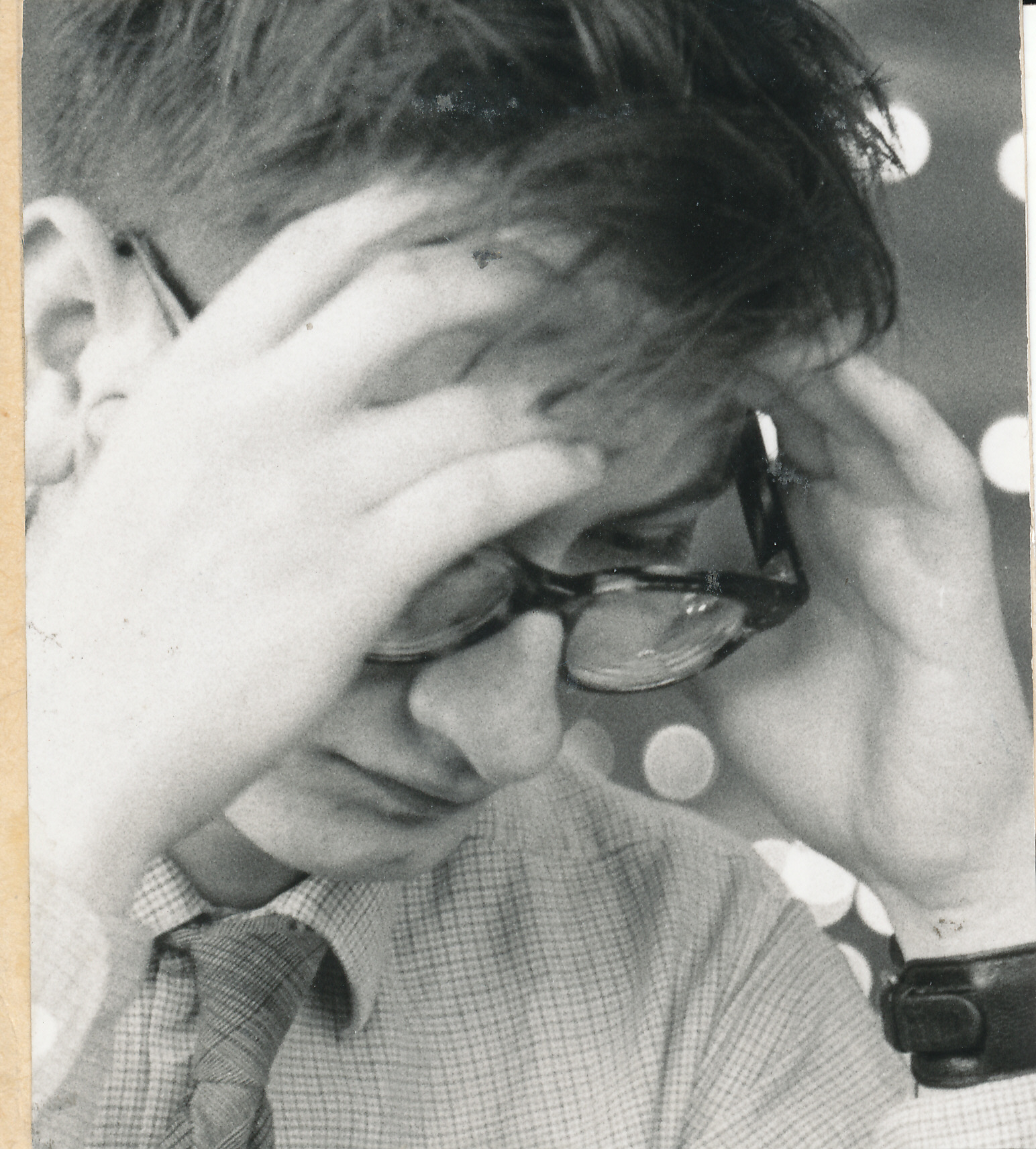
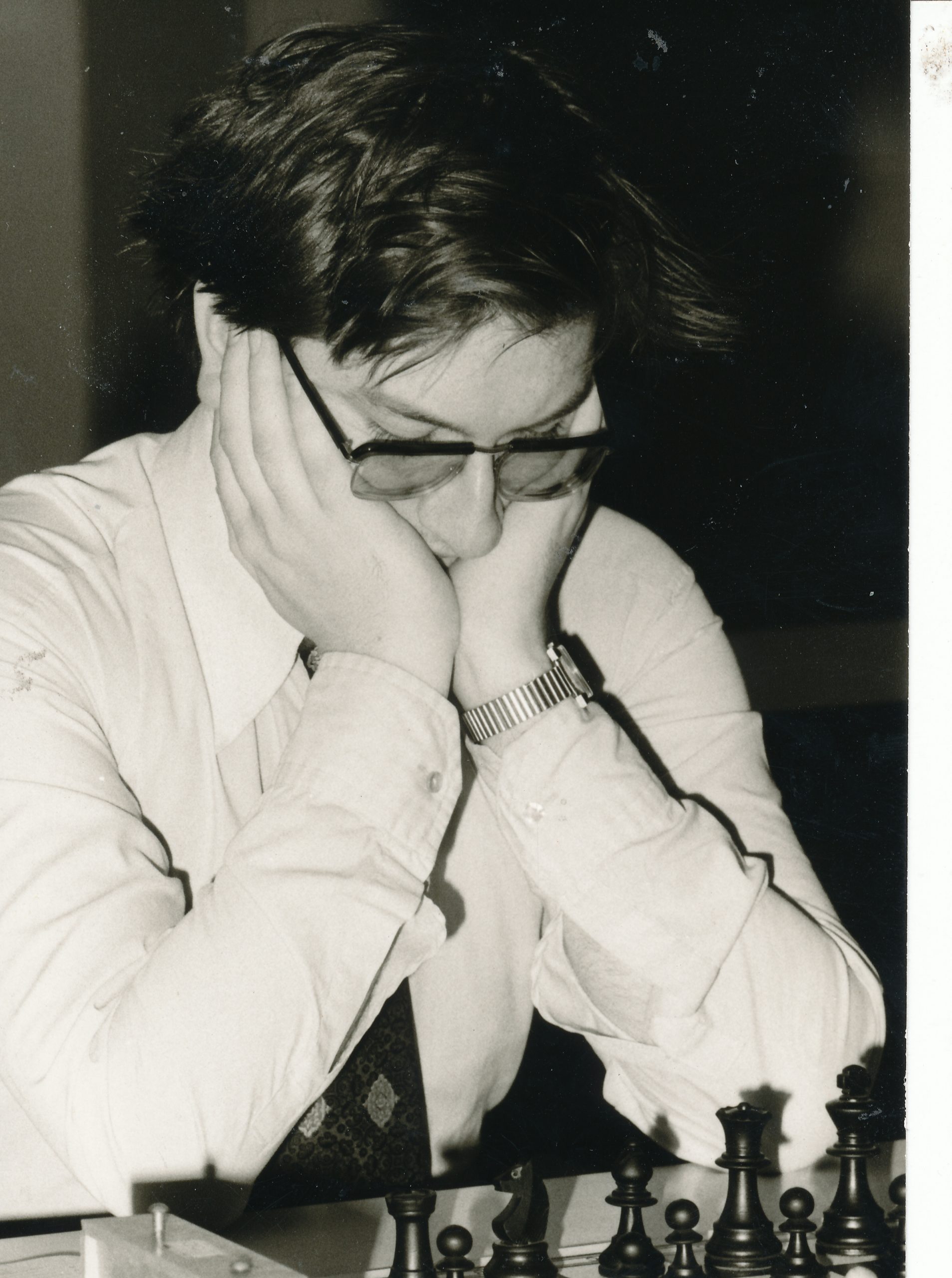
Raymond Keene
Raymond Keene

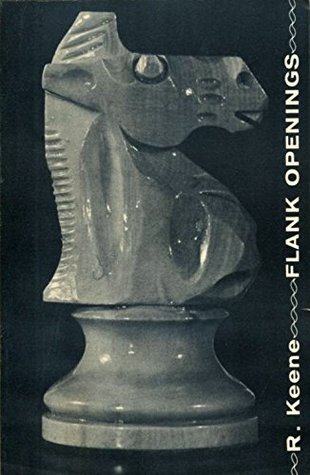
Ray was educated at Dulwich College between 1959 and 1966 thereby becoming an Old Alleynian. In 1967 Ray went up to Trinity College, Cambridge to study Modern Languages specialising in German and graduating with an MA. Amongst their Alumni are five spies including Blunt, Burgess and Philby. During the gap between Dulwich College and Cambridge Ray (aged 18) wrote his first (and one of his best) book : Flank Openings :

Flank Openings, Raymond Keene, British Chess Magazine, 1967.

Being published at the age of 19 this must be close to the earliest age an English player has had a chess book published that was not ghost written. (Leave a comment if you know differently!)

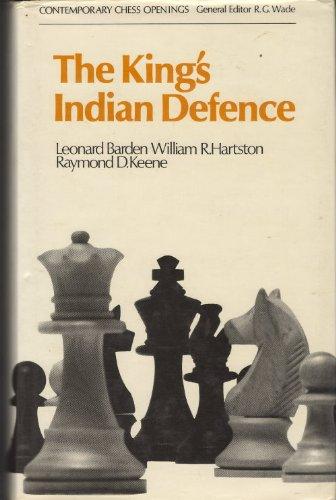
Following this legendary tome Ray collaborated with Leonard Barden and Bill Hartston on The King’s Indian Defence from BT Batsford Ltd:

The King's Indian Defence, Barden, Keene and Hartston, BT Batsford, 1969.
The King’s Indian Defence, Barden, Keene and Hartston, BT Batsford, 1969.

and in 1972 we have

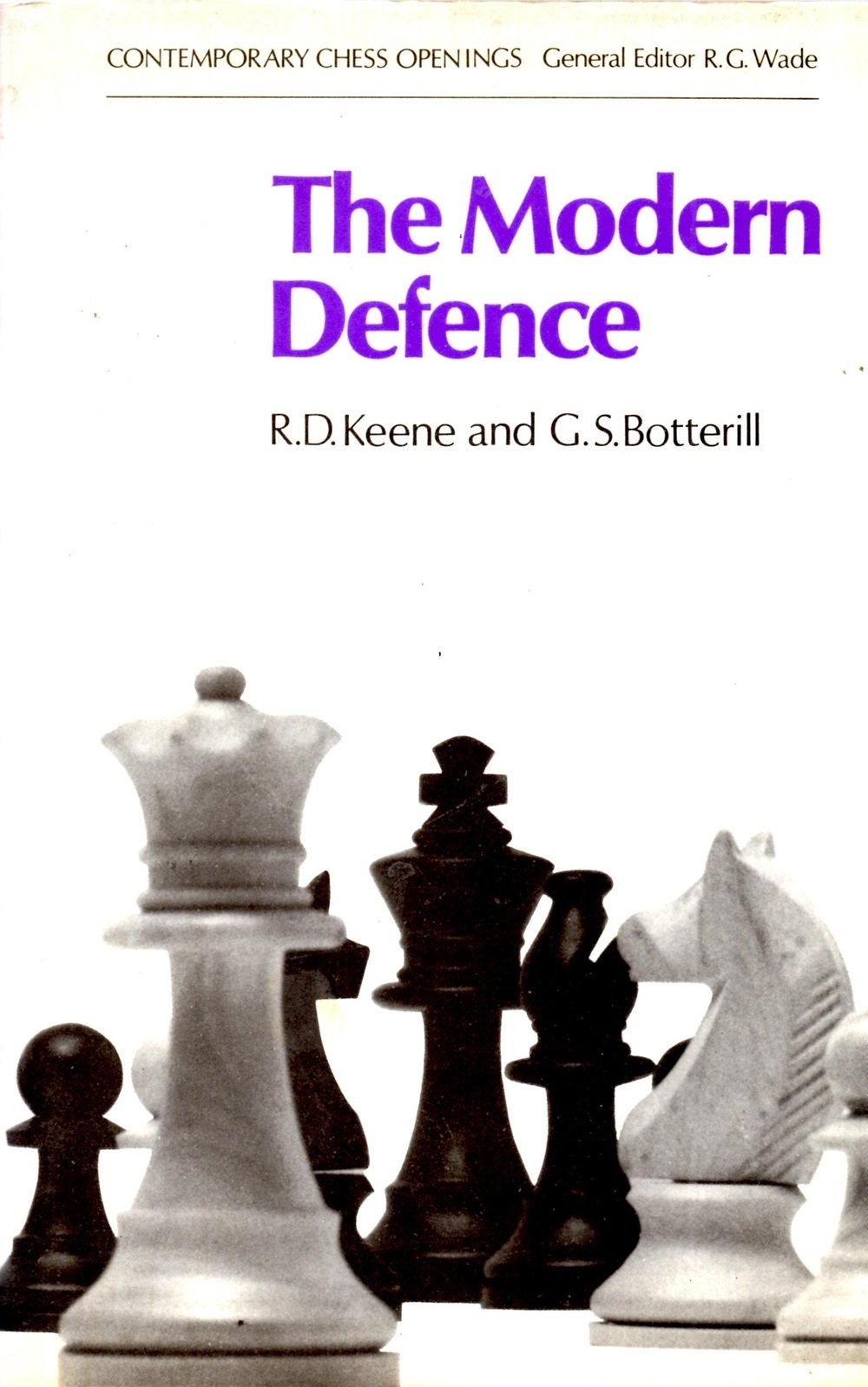
The Modern Defence, BT Batsford, 1972, GS Botterill and RD Keene

followed in 1973 by

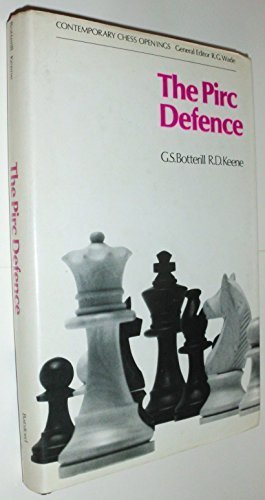
The Pirc Defence, BT Batsford, 1973, GS Botterill and RD Keene

All of which were favourably received helping Batsford to establish a strong reputation.

In July 1974 Ray married ex-ballerina (and now Dance Teacher) Annette Sara Goodman in Brighton, East Sussex. Annette became a director of World Memory Championships International Limited on January 17th 2008 and resigned on April 9th 2008. They have one son, Alexander Phillip Simon Keene, born in 1991. Godfather to Alexander is Scottish International, IM David Levy.

Annette is the sister of IM David Simon Charles Goodman who now resides in New York.

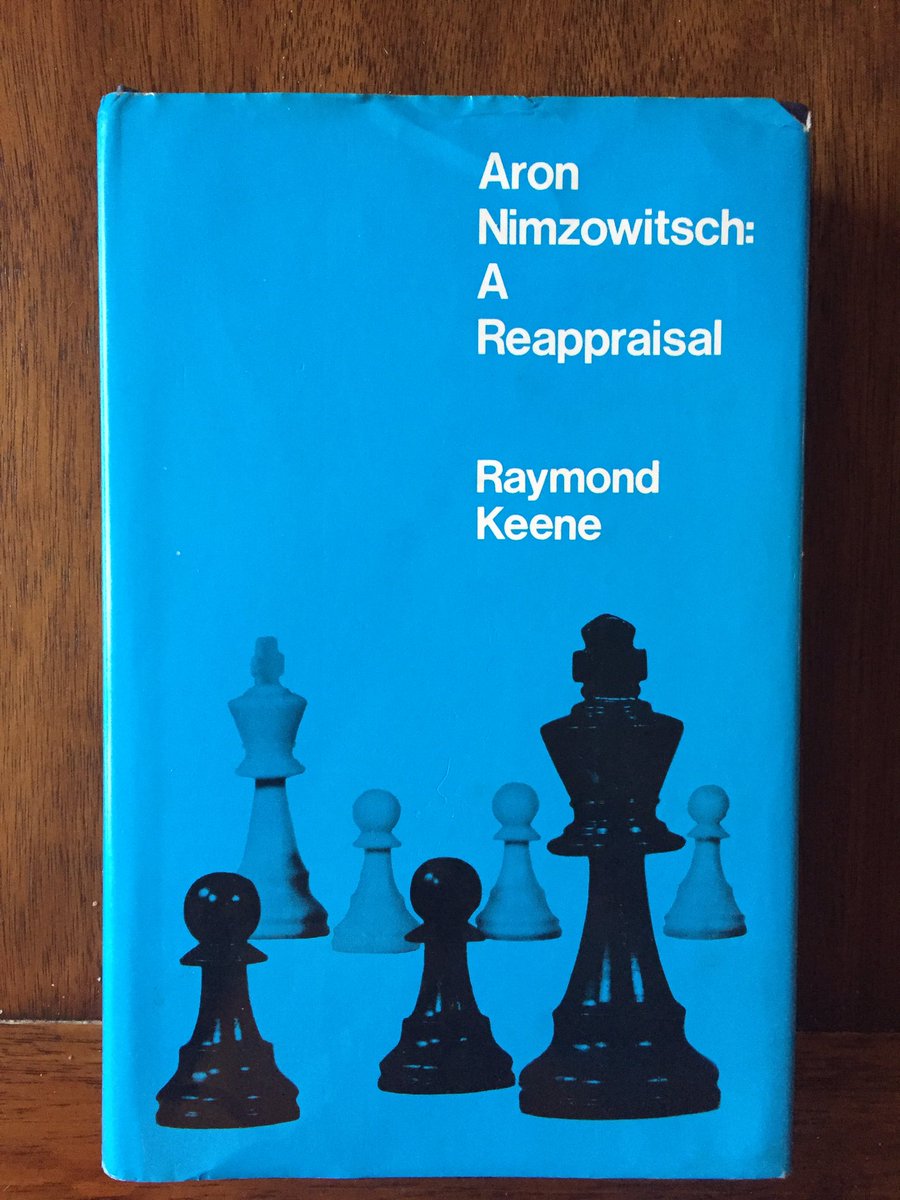
Also in 1974 George Bell & Sons published Ray’s most acclaimed work (and arguably his best) : Aron Nimzowitsch: A Reappraisal

Aron Nimzowitsch: A Reappraisal, RD Keene, George Bell & Sons, 1974

Alexander is currently the Company Secretary of the aforementioned company, Julian (a retired teacher from Brighton) is another active director.

In 1985 Ray became the sixth British chess player to be awarded the OBE when it was awarded in the Queen’s Birthday Honours List. The citation read “For Services to Chess”.

According to Companies House Ray has held a total of 30 directorships in various companies such as :

  • Brain Plan 2020
  • World Mind Mapping Championships
  • World Speed Reading Championships
  • Buzan International Technology
  • Buzan World
  • The World is My Oyster
  • World Memory Championships
  • Intelligent Resources and Services
  • Outside in Pathways
  • UK Primary Schools Memory Championships
  • UK Schools Memory Championships
  • The School Memory Championships
  • The Schools Memory Championship
  • Mental Literacy for All
  • Festival of the Mind
  • Festival of the Mind International
  • The Brain Trust
  • Impala (London)
  • Tony Buzan International
  • World Memory Championships International
  • World Peace and Prosperity Foundation
  • Zeticula
  • Mind Masters Management
  • Intellectual Leisure
  • Brain Sports Olympiad
  • Mind Sports Promotions

(Our particular favourite has to be the unpretentiously entitled “World Peace and Prosperity Foundation” although “The World is My Oyster” runs it a close second.)

Ray, Annette and Julian Simpole currently live in Clapham Common North Side, London, England.

From The Oxford Companion to Chess by David Hooper and Ken Whyld :

Ray Keene
Ray Keene

English player and author, British champion 1971, From 1966 he played in several Olympiads and his performance in two of them, Nice 1974 ( + 7=6-2) and Haifa 1976 (+4=6), gained him the title of International Grandmaster (1976). His best tournament win was at Dortmund 1980 (category 8), He studied the games and teaching of Staunton and Nimzowitsch and revealed with unusual insight the strategy of the former and the stratagems of the latter in two books: Staunton : the English World Champion (1975) and Nimzowitsch: a Reappraisal (1974). He also wrote Flank Openings (3rd edn, 1979); these openings are the ones which he prefers to play, which he knows best, and which suit his solid positional style.

From The Encyclopaedia of Chess by Anne Sunnucks :

International Master (1972), British Champion in 1971 and a regular member of the British team since 1966 playing on top board on a number of occasions.

Ray Keene
Ray Keene

Raymond Keene was born on 29th January 1948 in London and learned to play chess at the age of six. He began to play seriously when he was thirteen. While at Dulwich College from 1959 -1966 he played top bard for the school team which won the Sunday Times National Schools’ Chess Tournament in 1965 and 1966.

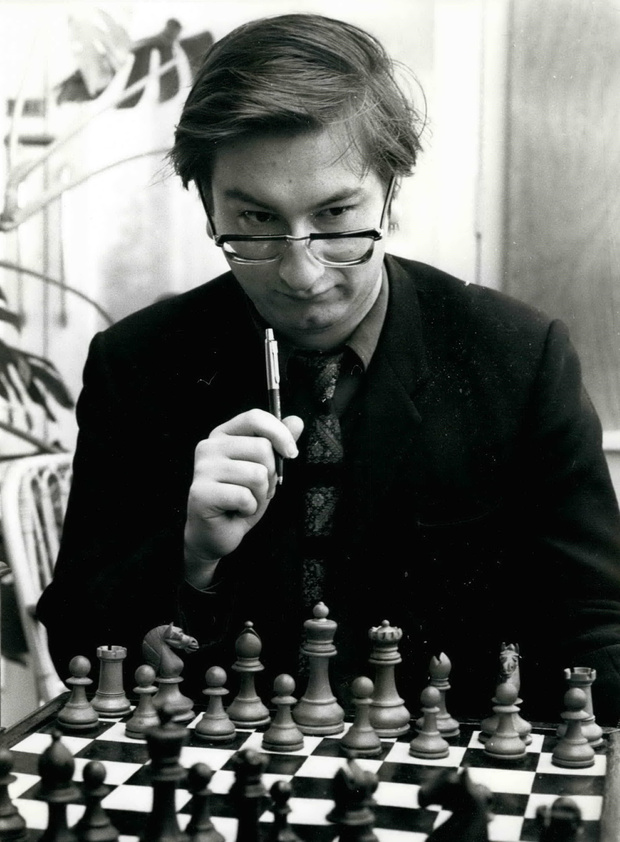
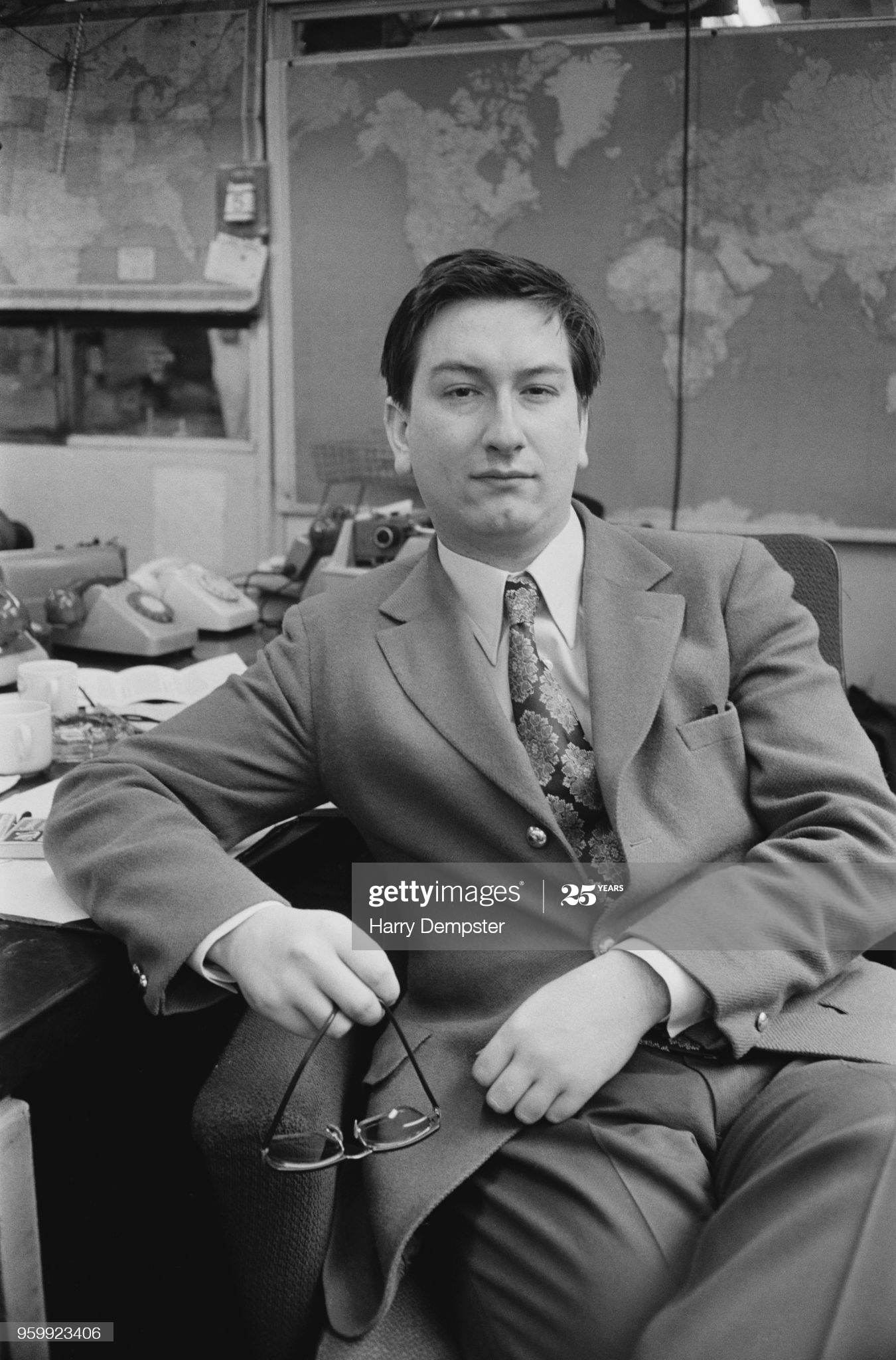
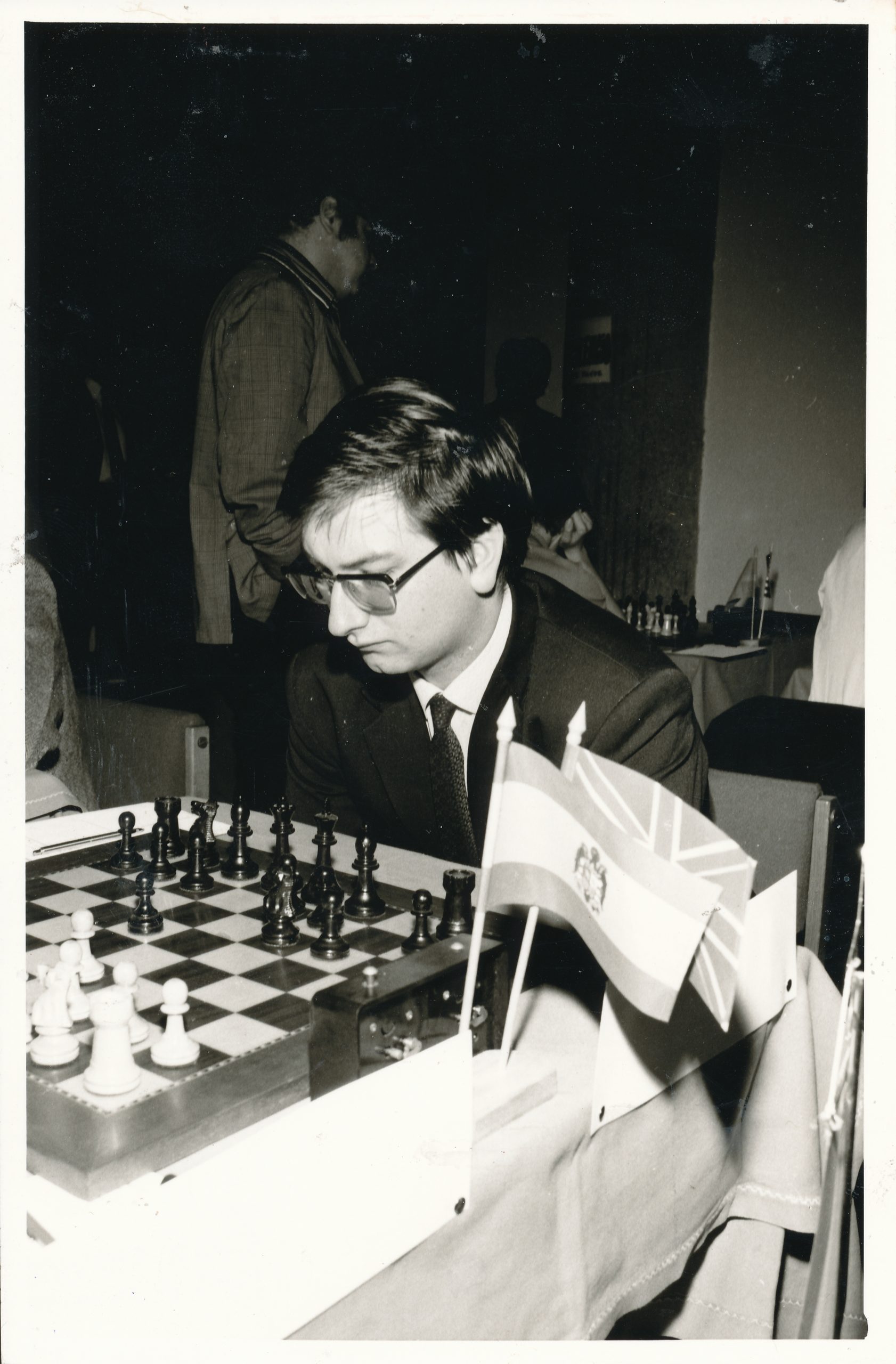
English chess player Raymond Keene, winner of the 1971 British Chess Championship, posed in London on 6th June 1972. Raymond Keene has been awarded the chess title International Master. (Photo by Harry Dempster/Daily Express/Hulton Archive/Getty Images)

In 1964, he won the London and British Boys’ Under 18 Championship (ed : In fact, the title was shared with Brian Denman) and the following year, at the age of seventeen, he became the youngest player to win the Surrey Championship. While at Cambridge he graduated in German Literature (B.A. Honours), he played top board for the university.

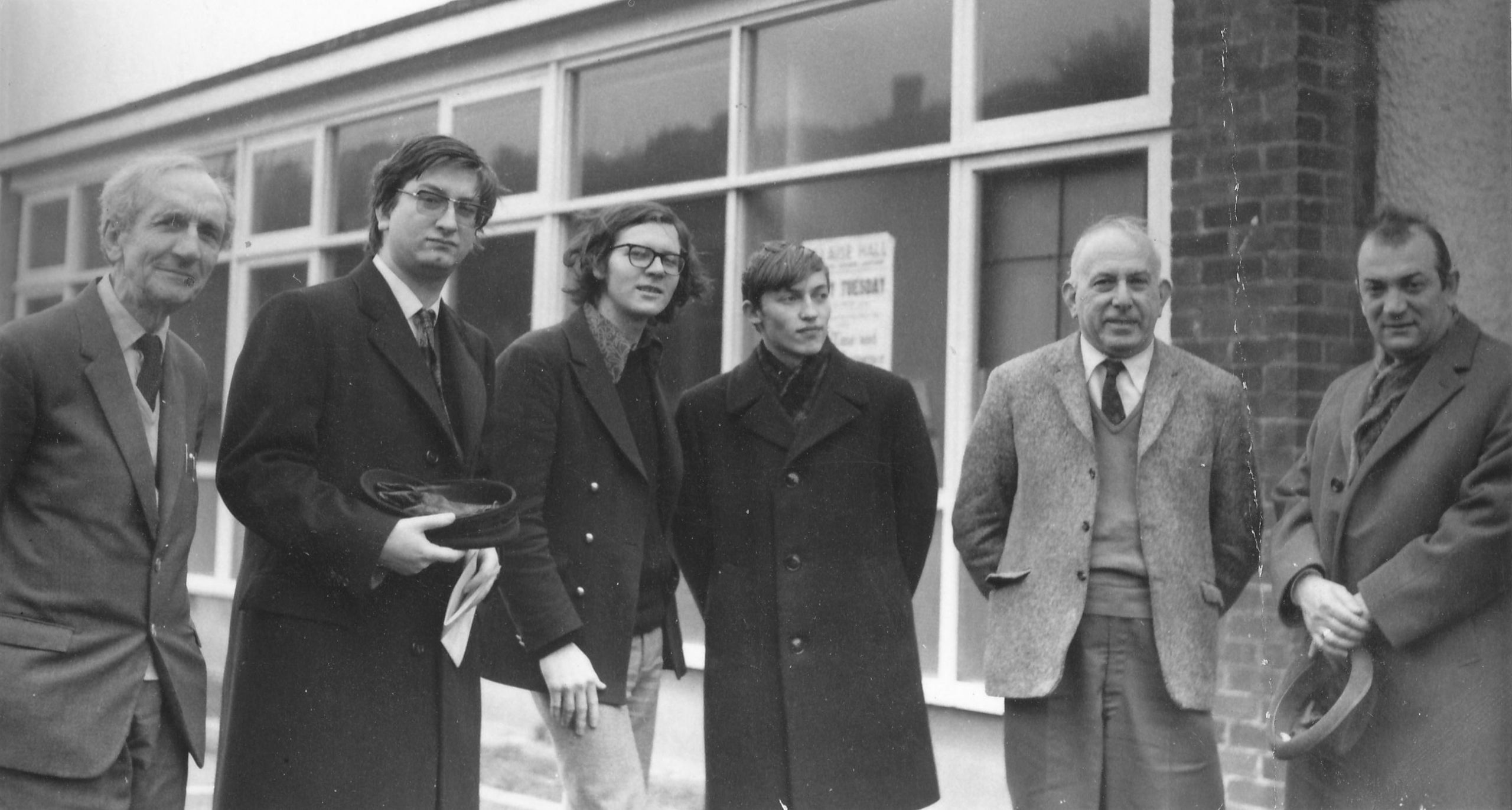
Brian Reilly, Ray Keene, George Botterill, Anatoly Karpov, Harry Golombek and Viktor Korchnoi

During his chess career, he has beaten both Botvinnik and Gligoric, In 1967, he came 2nd in the World Junior Championship and in 1968 he won the prize for the best score on board 4 in the Lugano Olympiad.

Raymond Denis Keene
Raymond Keene

A difficult player to beat, Keene played in four British Championships without losing a game and also went through the Lugano and Siegen Olympiads unbeaten in 33 games.

At Oxford in 1973, Keene set up what he believes is an English speed record for simultaneous chess, scoring 100 wins, 5 draws and 1 loss in 4.5 hours.

Raymond Denis Keene
Raymond Keene

From The Encyclopaedia of Chess by Harry Golombek :

“British Grandmaster, British Champion 1971, Keene was born in London and was both London Boy Champion and British Junior Champion in 1964 (ed : In fact, the title was shared with Brian Denman).

Educated at Dulwich College and Trinity College, Cambridge, he soon became recognised, along with Hartston, as one of the two leading younger players in England. His style of play was different from that of his rival, being more complicated and less direct; but, like Hartston, he became a most formidable opening theorist with a vast knowledge of opening theory.

His first Olympiad was at Havana 1966 where he was the youngest member of the side and scored 65% on board six. In 1968 at Lugano he obtained 76.5% on board four and in 1970 at Siegen, playing on board two in the preliminaries and board one in the finals he score 68.8%.

Raymond Denis Keene
Raymond Keene

The year 1971 saw a double achievement, for in that year he won the British Championship at Blackpool and also secured the title of International Master.

Playing on top board in the 1972 Olympiad at Skopje, he scored 11.5 out of 20.

Ray & friend
Ray & friend

In 1974 he came 6th in a very strong Hastings tournament and then won first prize in the Capablanca Memorial Masters in Cuba. At the Nice Olympiad he scored 66.66% on 2nd board, attaining the first leg of the grandmaster norm. At Mannheim 1975 he was 3rd in the German Open championship and in that year he also came 2nd at Alicante. In 1976 he was 2nd at the Aarhus tournament in Denmark. He finished a most successful year in international chess by fulfilling the second grandmaster norm on 2nd board in the Haifa Olympiad, thereby becoming England’s second international grandmaster (after Tony Miles). (Harry Golombek)”

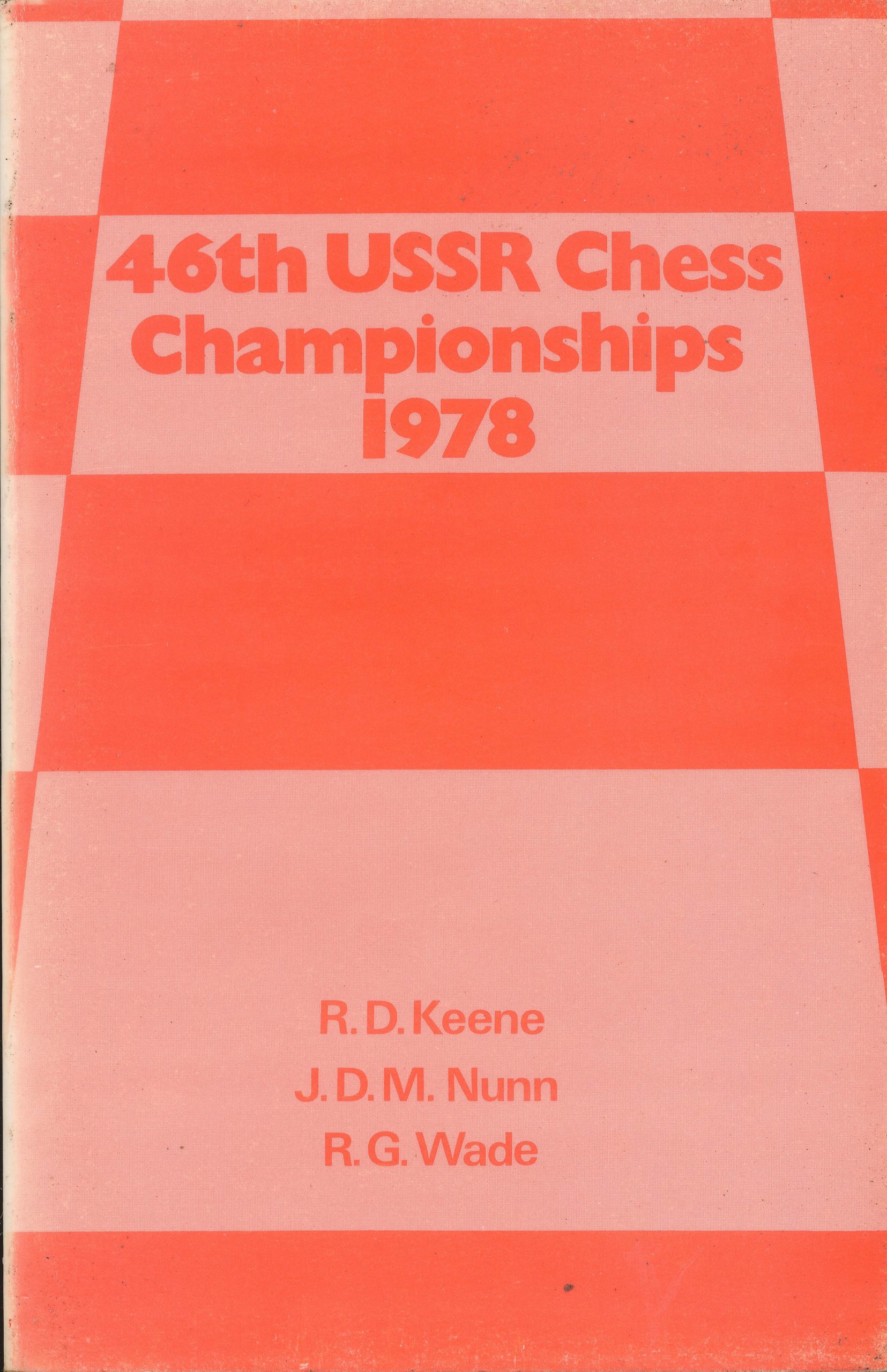
46th USSR Chess Championships 1978, RD Keene, JDM Nunn, RG Wade, Master Chess Publications, 1978, ISBN 0 906634 00 8

Ray was Southern Counties (SCCU) champion for the 1966-67 season.

Here is his extensive Wikipedia article

Noted historian Olimpu G Urcan writes on Alekhine versus Keene

and Edward Winter writes extensively about Ray’s journalistic activities

and finally, Keenipedia. A web site created by his many admirers…

Murray Chandler, Ray Keene and Miguel Najdorf

Best Wishes IM Richard Bates (27-i-1979)

IM Richard Bates
IM Richard Bates

Best Birthday wishes to IM Richard Adam Bates born on this day (January 27th) in 1979.

Richard has won the Southern Counties (SCCU) championship in the 2015-16, 2016-17 (with Nick Pert) and 2017-18 seasons.

IM Richard Adam Bates

Richard Bates
Richard Bates
IM Richard Bates
IM Richard Bates

IM Richard Bates

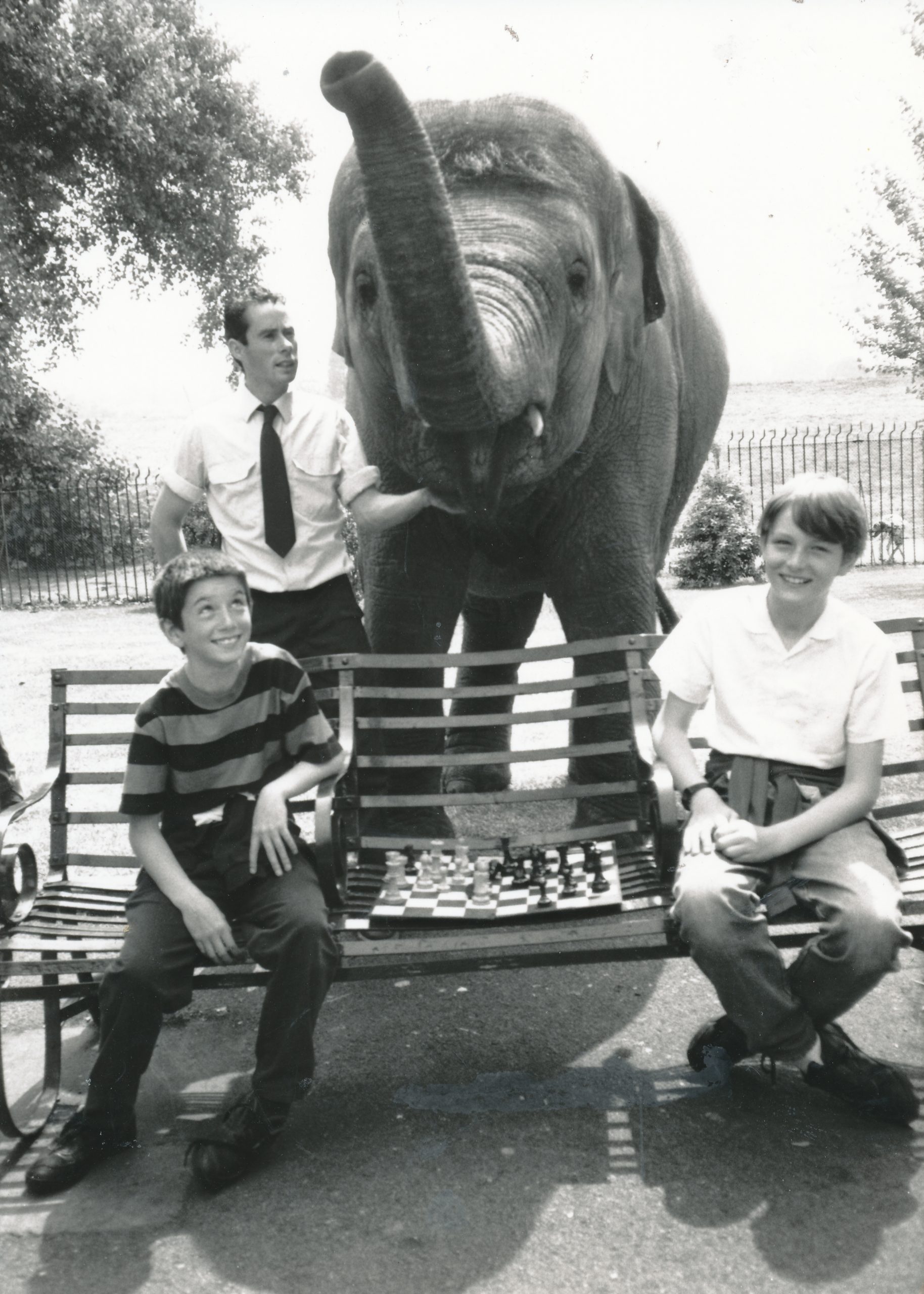
Sheen Mount Under Eleven Chess Champion Richard Bates and Robin Laisby enjoying a game during time out from the Teachers Assurance National Primary Schools Chess Championships. Malaysian Elephant Leyang Leyang and her keeper Duncan McGinnie help them not to forget their chess moves.

Happy Birthday IM David Cummings (24-i-1961)

Birthday of IM David H Cummings (24-i-1961)

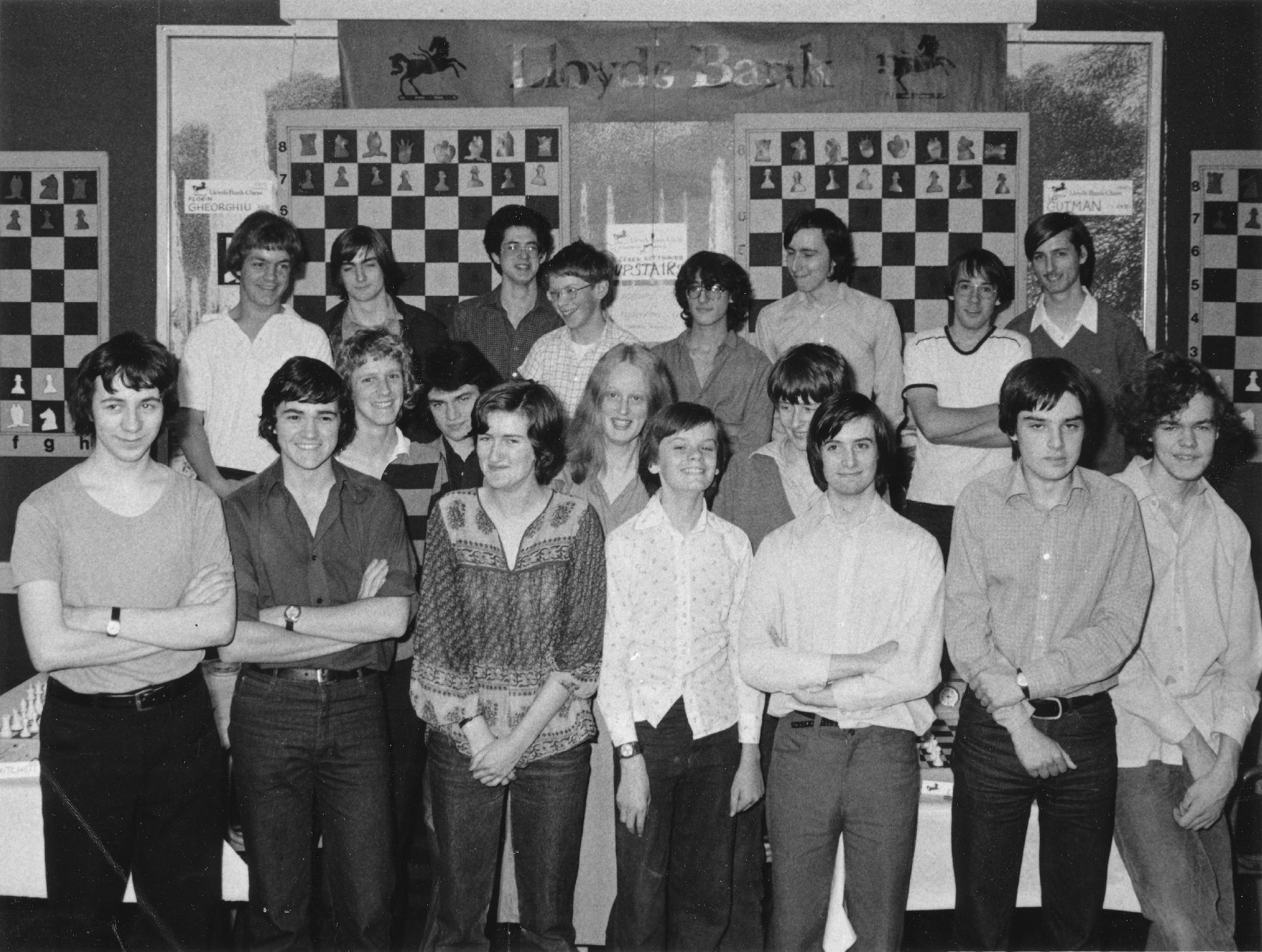
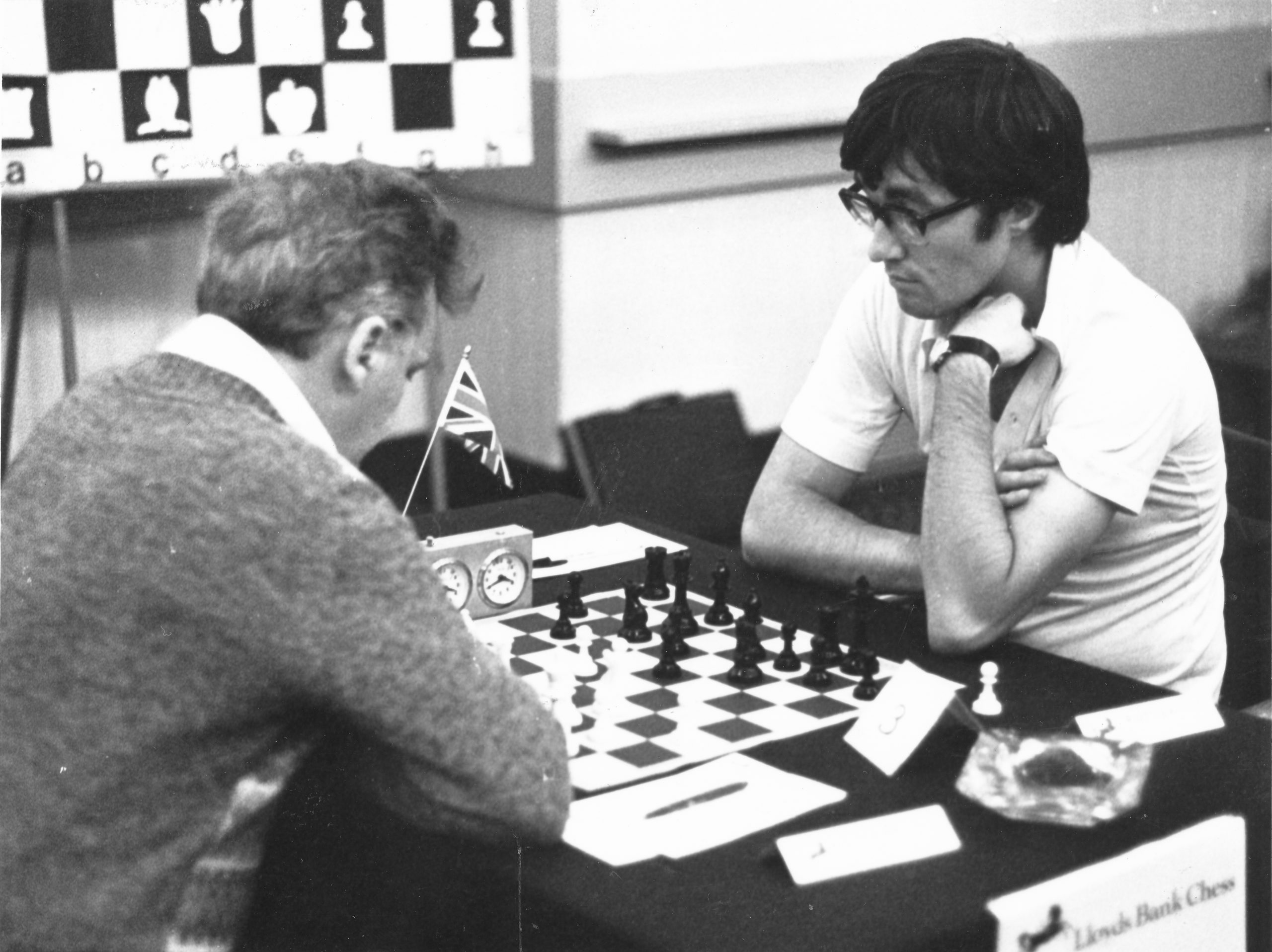
David Cummings (front, second from right) at a Lloyds Bank event

This was written about David who was 18 just prior to the 1979 Spassky vs the BCF Junior squad simultaneous display :

“Varndean and Brighton. Rating 207. British men’s championship finalist, 1977. First Danish junior international championship, 1978.”

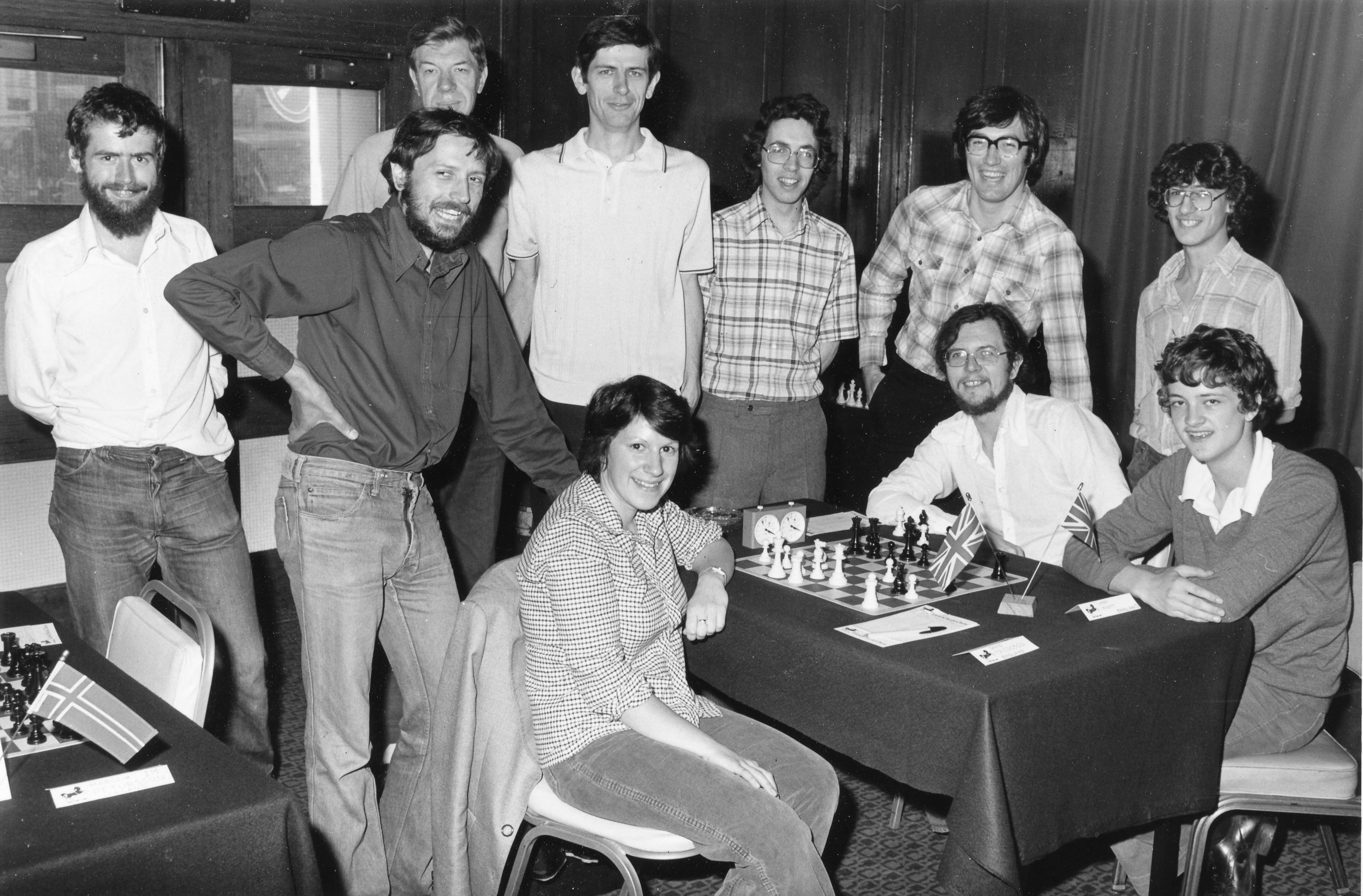
At the Lloyds Bank Masters : Front (l-r) : Joel Benjamin, Ian Wells, Rear : Peter Morrish, Stewart Reuben, Richard Beville, Gary Senior, Richard Webb, John Hawksworth, Andrew King, Nigel Short, Mark Ginsburg, Daniel King, David Cummings, Erik Teichmann, John Brandford and Micheal Pagden

David was joint (with PG Large) Southern Counties (SCCU) champion in the 1979-80 season.

IM David H Cummings
IM David H Cummings

David is currently a Canadian resident and registered with FIDE as CAN.

Best Wishes IM Adam Taylor (23-i-1998)

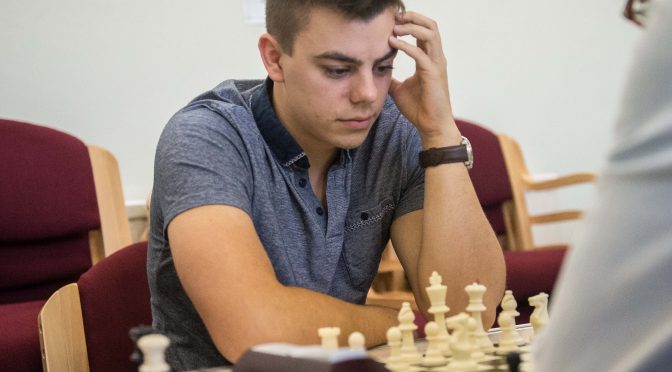
We send best wishes to IM Adam Taylor on his birthday.

Adam Christopher Taylor was born on Friday, January 23rd, 1998 in Colchester, Essex. Adam has a sister, Nathalie Leanne Taylor who also plays and studied History & Economics at The University of York. His mother Deborah was always supportive during his chess career.

He attended The Gilberd School, Colchester until 2014 and then Colchester Sixth Form College and currently resides in Colchester, Essex.

ECF grading profile for IM Adam C Taylor

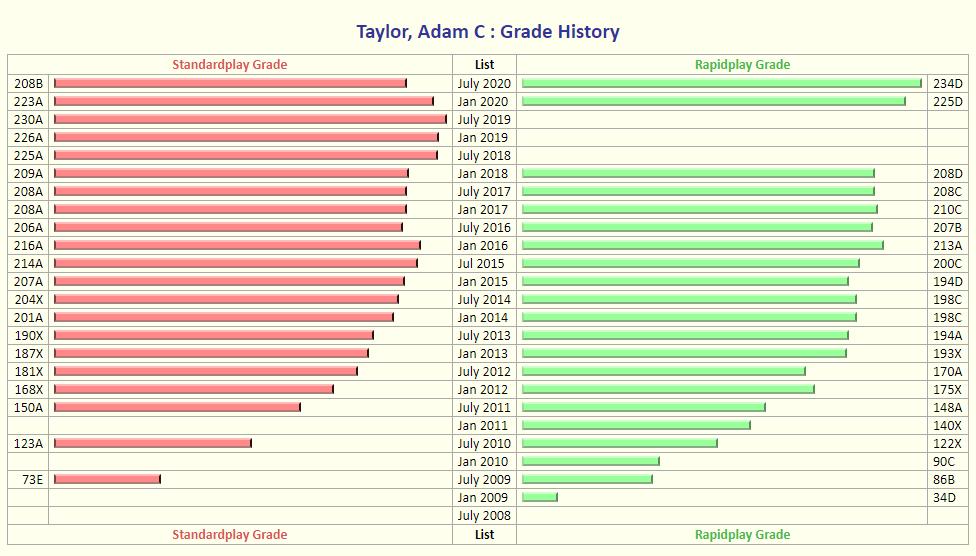
Adam’s first recorded rapidplay event was the Basildon Junior Congress resulting in a published grade of 34D and his first graded standard play event was the 2009 London Junior Under-12 Championships and his first published standard-play grading was 73E.

In that same year at Torquay Adam won the British Under-12 title sharing with Radha Jain.

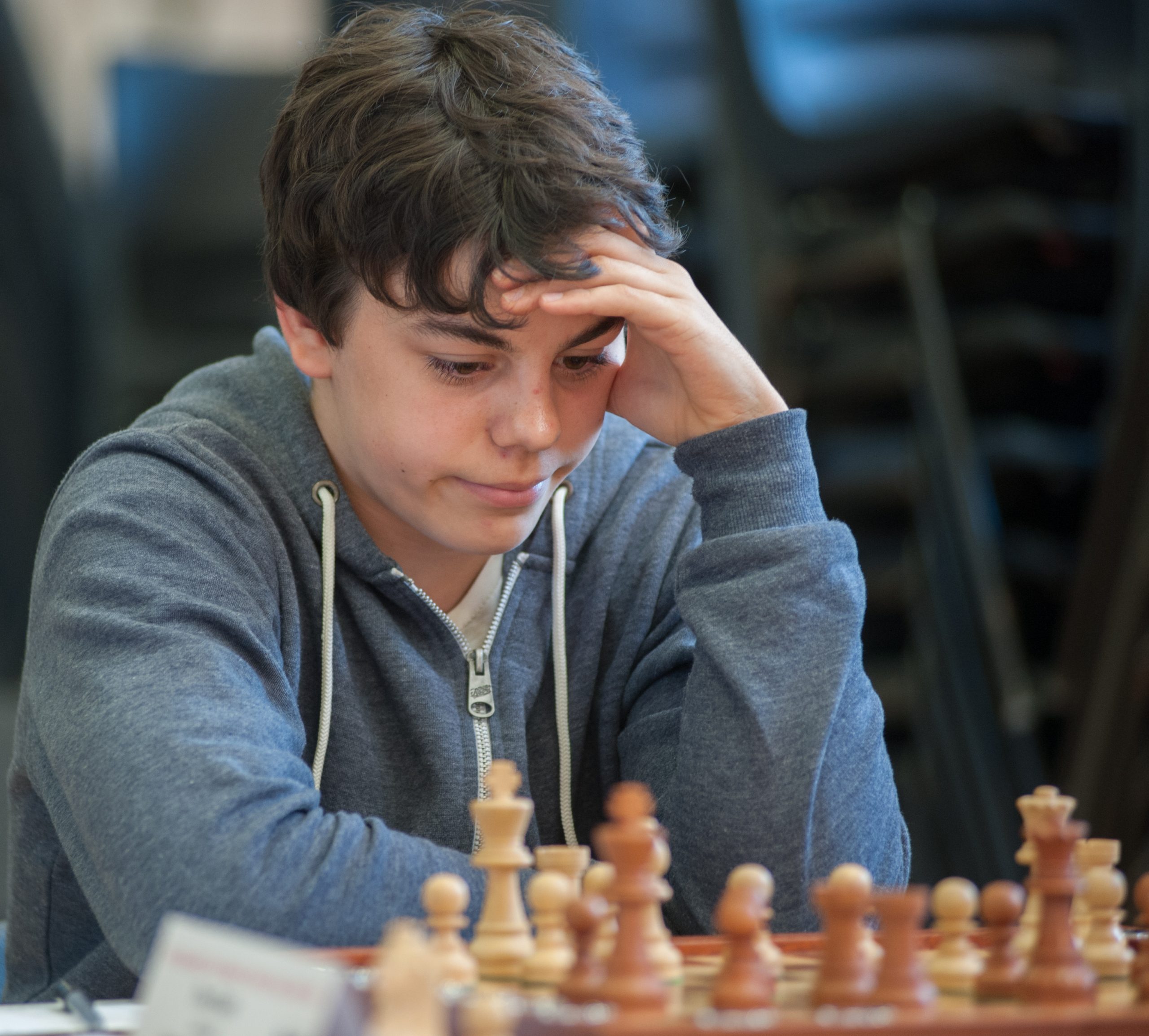
Adam C Taylor at the 2013 UK Chess Challenge Terafinal. Courtesy of John Upham Photography

Adam made his first 4NCL appearance in May 2012 for SC Stars followed by Anglian Avengers. In 2018 the lure of the big lights of Division One beckoned and Wood Green became Adam’s team now playing for Wood Green Monarchs in the Online 4NCL championship.

In 2017 Adam scored an impressive 6/9 (and =2nd) when he travelled to Greece to play in the Heraklion 1st Capablanca Memorial.

The Hastings Open in 2018 saw an excellent =7th with 6.5/10.

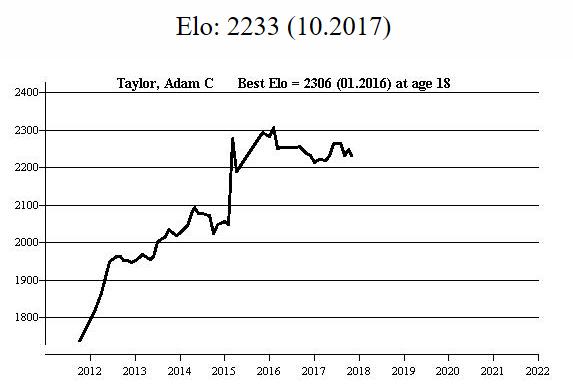
Adam’s IM title was ratified in June of 2019 in Baku and currently (January 2021) holds a FIDE standard play rating of 2347 and an ECF standard play rating of 2260A. His highest ECF standard play grading was 230A in July 2019. We expect this to be exceeded once OTB play resumes.

Battersea Chess Club celebrated Adams’s title in style with this article written by Leon Watson

FIDE rating profile for IM Adam C Taylor from MegaBase 2020.

Adam has played for Bury St. Edmunds and Manningtree and now Battersea in the London League and Wood Green in the Four Nations Chess League (4NCL) and has made many appearances in the UKCC Terafinal.

Adam is known as Tayip99 on chess.com and as AdamTaylor2301 on LiChess.com and regularly streams on Twitch and other platforms.

Adam C Taylor, Courtesy of John Upham Photography

On the 13th of September 2019 Adam became the sole director of MakingGrandmasters Limited which lists on its web site a number of leading young English players engaging in coaching such as Matthew Wadsworth, Ravi Haria and Daniel Fernandez to name but a few.

One of Adam’s more notable students is Guildford Chess Club member Jessica Mellor who, in 2018, won Gold in the Under-11 category of the European Schools Championship.

More recently Adam has taken a back seat from chess and has become a golf professional.

With the white pieces Adam favours a Reti/English set-up where c4 quickly follows a king side fianchetto. Here is a typical game of Adam’s with the white against a strong opponent :

With the black pieces Adam essays the Berlin Defence and the Sicilian Najdorf as well as the Benko Gambit and Nimzo-Indian Defence.

IM Adam C Taylor, Courtesy of John Upham Photography

Happy Birthday IM Paul Littlewood (18-i-1956)

IM Paul Littlewood. Source : British Chess, Pergamon Press, 1983.

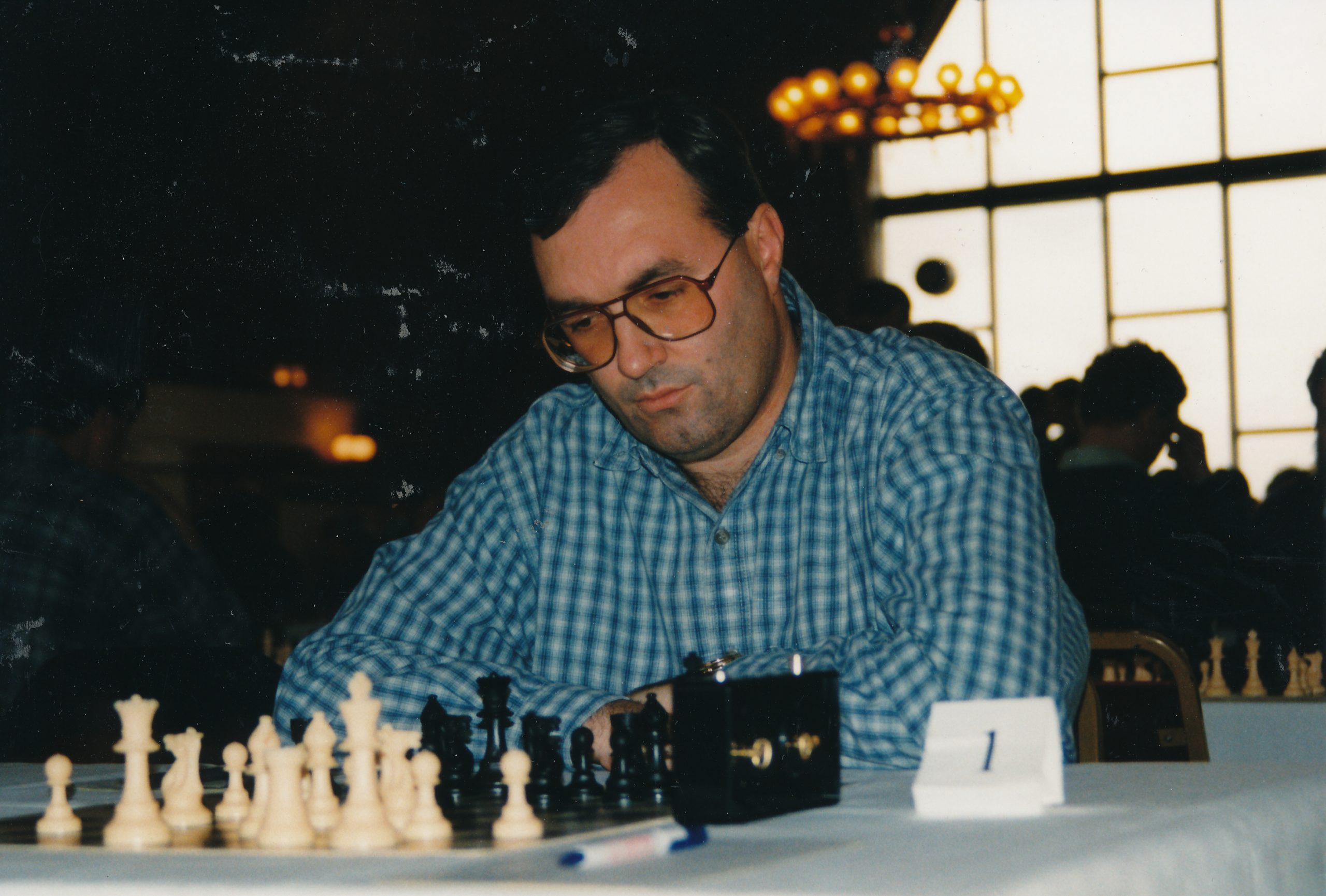
BCN wishes Happy Birthday to Paul Littlewood

Paul Edwin Littlewood was born on Wednesday, January 18th, 1956 in Skegness, East Lindsey, Lincolnshire. His parents were John and Jean Littlewood (née) Hadwick. Paul’s chess playing uncle was Norman Littlewood.

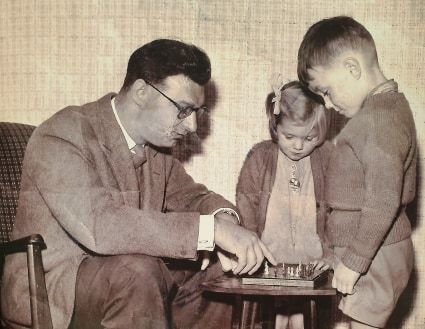
John and Paul on Skegness beach circa 1958. Kindly supplied by Paul Littlewood. George and Ringo are out of shot !
John, Jenny and Paul Littlewood, circa 1962. Kindly supplied by Paul Littlewood.

Paul attended Glenburn Comprehensive School in Skelmersdale from 1967 and then read Natural Sciences at Christ’s College, Cambridge from 1974.

Paul played badminton for Lancashire and Cambridge and, in 1971, won the English Schools Mixed Championship when he was 15 years old.

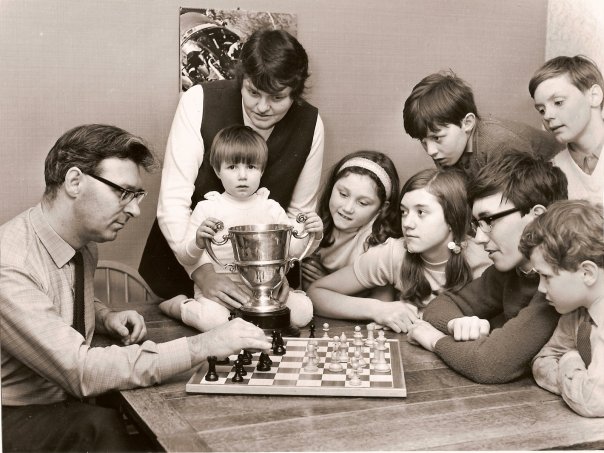
Paul and family receive a chess lesson from John following John's win in the 1972 Southport Open
Paul and family receive a chess lesson from John following John’s win in the 1972 Southport Open

On leaving University Paul taught science at Southbrook Comprehensive, Daventry. Four years later Paul became a dealer at Phillips & Drew and followed this as an Executive Director at Goldman Sachs. Stays at Lehman Brothers and JP Morgan were followed by a change of direction and since then Paul has been director of various food supply companies retiring in 2014.

Paul is married (3rd November 2006) to (his second wife) Fiona and lives in St. Albans, Hertfordshire.

PEL won the ECF President’s Award in 2007 and from the 2008 ECF Yearbook we have the following citation :

“International Master and accomplished bridge player. From British Chess champion (1981) Paul has presided over the 4NCL as chairman during its most successful period. When he became chairman over ten years ago the league consisted of two divisions and 32 teams. The league has now expanded to four divisions and a total of 72 teams. Most of England’s juniors play 4NCL. During this time 4NCL became one of the strongest leagues in Europe, at one time boasting a Division 1 rivalling the Bundesliga in strength in the top matches.

Paul has demonstrated the sound judgement of Solomon when dealing with league disputes and has drawn on his business acumen, honed during a successful career in the City with Goldman Sachs to make 4NCL the financially stable and expanding league it is today.”

Roll of Honour

  • British U18 Champion 1972
  • British U21 Champion 1975
  • British Champion 1981
  • As a junior represented England in Glorney Cup
  • International Master 1980

From British Chess (Pergamon Press, 1983) by Botterill, Levy. Rice and Richardson we have this article from Richard W. O’Brien :

“Paul Littlewood was destined to become a strong player from birth. His father John was for some time one of the strongest players in the country and represented England on many occasions. His uncle Norman was for a few years not far behind. Paul, however, has surpassed them both and has become the first in the family to reach IM status. (Ed: JEL was very much worthy of the IM title but insufficient events of the right type held him back).

A. Howard Williams, Martyn J. Corden, Paul E. Littlewood and A. Jonathan Mestel

All three are essentially attacking players. There have been times in recent years when play at the Hastings Premier has become dull. However, Paul one of the English representatives at the last three tournaments, was certainly not to blame. (His game against Brito of Brazil which follows is a striking example of this).”

Coached by his father, Paul became British U18 champion in 1972 and three years later became British U21 champion.

Clearly more interested in an academic career he went up to Cambridge and then followed his father into the teaching profession. Opportunities to play in strong tournaments were thus very limited. These opportunities, however, were grasped in both hands. Three times in thirteen months between August 1978 and August 1979 he obtained an IM norm and thus the title.

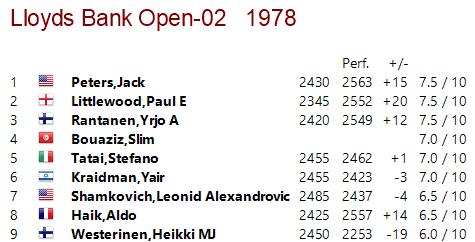
Partial crosstable for the Lloyds Bank Open, 1978

The first caused a sensation as it was totally unexpected. He shared first place at Lloyds Bank ahead of several grandmasters including Shamkovich, who was the first grandmaster he ever defeated.

Leonid Shamkovich plays Paul Littlewood during the 1978 Lloyds Bank Masters. Paul won the game.

Eight months later Aaronson Masters was won and then came the final norm, also at Lloyds Bank.

Tournaments abroad were limited although he represented England students. He did play at Kringsja (2nd equal) in 1978 and Borovo where he scored 6.5.13 finishing ahead of 3 GMs.

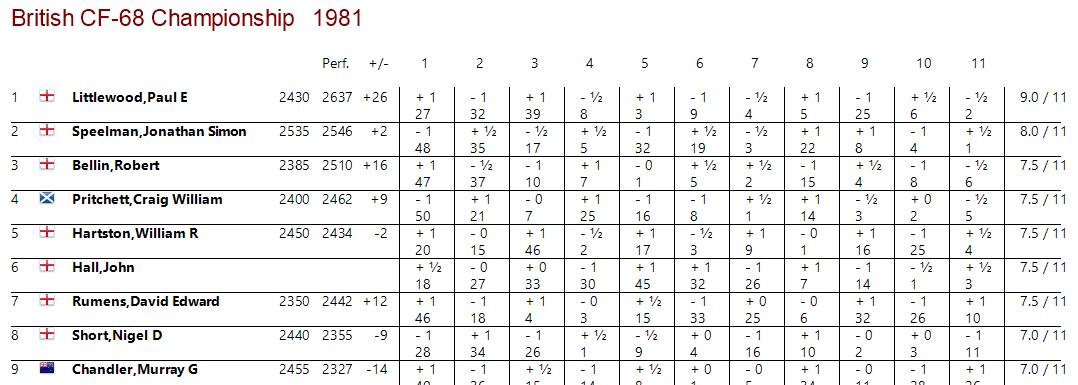
In 1981 came his finest achievement – winning the British Championship with a massive 9/11.

Partial crosstable from the 1981 British Championship in Morecambe

His father who was also competing in the championship was as proud as could be and deservedly so (he also coached Sheila Jackson who retained her British Ladies Championship that year). His excellent all round play took him to the title and only once during the tournament did he stand worse. His endgame play was so good that CHESS even published an article solely on these endings.

Paul Littlewood and friends during the 1978 Lloyds Bank Masters

Duties at school in Daventry meant he was, in February 1982, unable to take part in the zonal at Marbella. This followed an excellent Hastings when as British Champion he made a plus score – a rare event indeed.

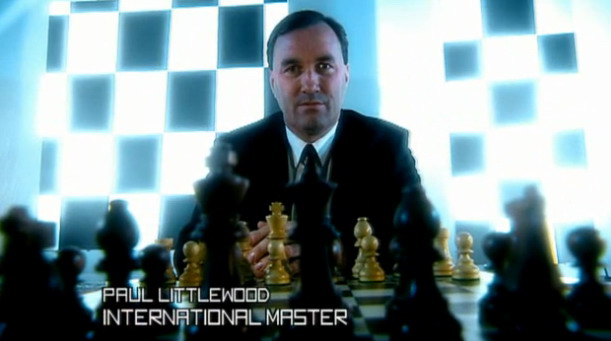
IM Paul Littlewood during filming for the "Trick of the Mind" series from Derren Brown
IM Paul Littlewood during filming for the “Trick of the Mind” series from Derren Brown

In the summer he gave up teaching and joined Phillips & Drew (stockbrokers). He now (ed : this was in 1983) lives with his (first) wife Sue and family in the wilds of Essex (Billericay).

IM Paul Littlewood, event and photographer unknown

Paul gives a simultaneous display in Letchworth.

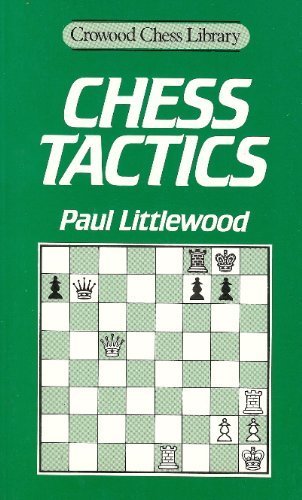
Chess Tactics, Paul Littlewood, Crowood Chess Library, 1991

Remembering Roland Scott (25-iii-1888 10-i-1953)

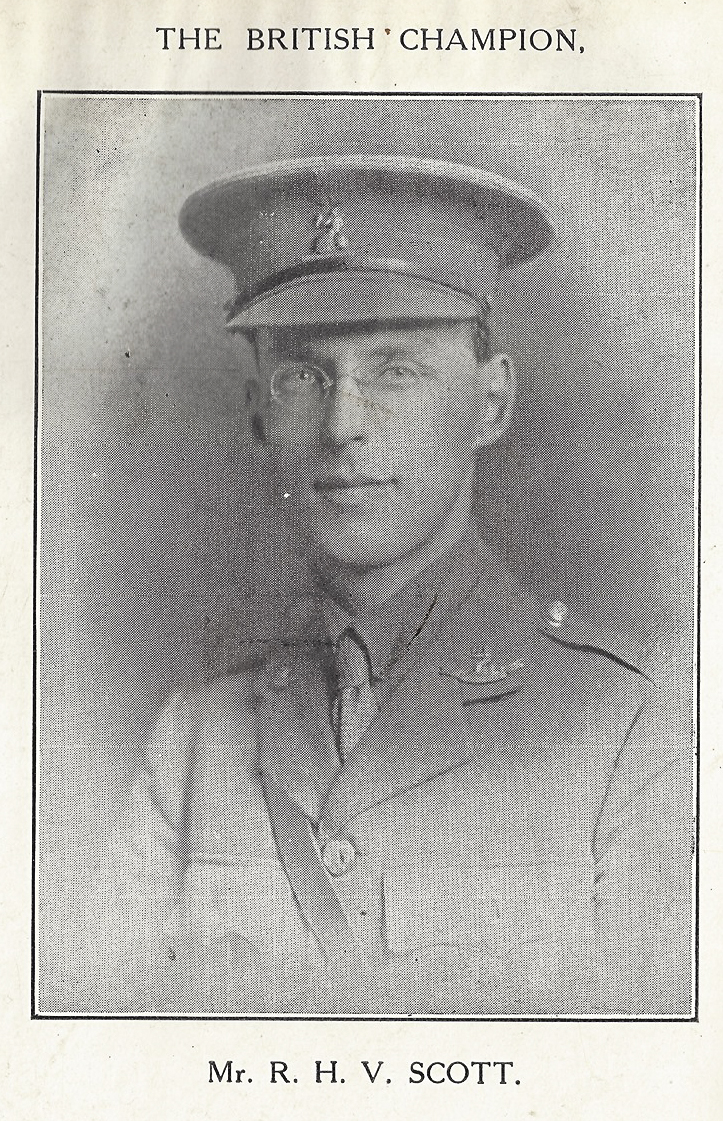
Roland Henry Vaughan Scott, 1920 British Champion, British Chess Magazine, Volume XLI (1920), Number 10 (October), page 304

BCN remembers Roland Scott who passed away in Monte Carlo on Saturday, January 10th, 1953.

Roland Henry Vaughan Scott was born in either Barnes (or Holloway depending which Census record is correct). His parents were Walter Frederick Scott, a GP who was born in April 1960 and died in 1891 when Roland was three years of age.

His mother was Lucy (Lucie and Lucia have also been recorded) Vaughan was born in 1855 and died in October 1933.

Roland had three sisters, Nina Vaughan Scott Lucie Audrey Scott (who died before her first birthday) and Sybil Anne Vaughan Scott and a brother Guy Francis D Scott who lived until 1977.

In 1891 Roland lived in Tottenham, in 1901 in Hampstead and in 1911 in St. Pancras where he was listed as a law clerk.

In 1917 The London Gazette lists him as a lieutenant in the Norfolk Regiment.

The 1920 electoral rolls for the Gospel Oak polling district lists Scott as voter #2006 living at 2, Estelle Road, North St. Pancras which is now in Belsize Park, NW3 2JX. At the same address was his sister Lucie and in 1921 they were joined by brother Guy.

In July 1922 in the district of Brighton Roland married Irma Clareboudt. No children from the marriage are recorded.

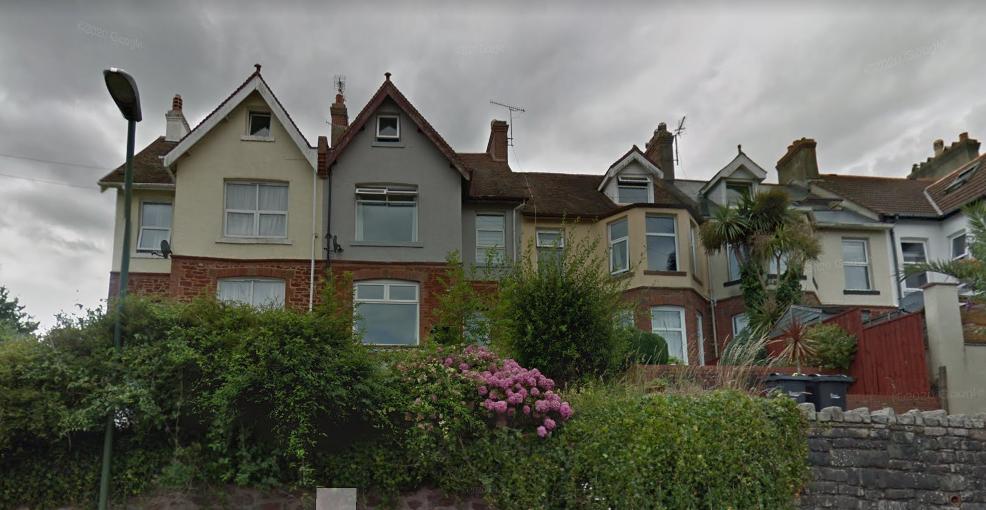
The 1939 register lists Scott as “War Disabled ? Officer Retired In War 1914” (invalided from army) and Irma as a saleswoman (born 25th July 1895) living at 42, Sherwell Lane, Paignton, Torquay, TQ2 6BD.

42, Sherwell Lane, Paignton, Devon, TQ2 6BD.

The April 1953 British Chess Magazine (Volume LXXIII, Number 4, page 101 onwards) contained this obituary from DJ Morgan:

It is with much regret that we record the death, on January 10th, at Monte Carlo, of R. H. V. Scott. He had long been out of active chess, but older readers will need no reminding of the 1920 British Champion, with his quiet manner but attacking chess; one who was composure itself at the table but aggressiveness personified on the board.

The son of a doctor, Scott was born in 1889. He was nineteen before taking to the game, but a ready aptitude combined with great enthusiasm led to rapid progress. He joined the Hampstead Club in 1908, and in his first tournament, the Third Class, came out first. ln the years that follow he pursued the game with much energy.

At the B.C.F. Congress, Glasgow, l9ll, he won the only section of the First Class. In 1913 and in 1914 he was Hampstead Club Champion. In 1913 he was tenth in the British Championship, at Cheltenham, and equal fifth to sixth at Chester in the following year, defeating Yates and drawing with Blackburne.

In 1915 he came second in the City of London Club Championship, but won that of the Metropolitan Club. During the same year he lost a short match with Sir G. A. Thomas 1-3. The war years, with a commission in the Norfolk Regiment, intervened, but chess filled his available moments.

In 1916 he defeated L. I. Estrin, a young Russian who was Hampstead Champion, 5-2 in a match. ln 1919 he lost a match with Winter at Hastings (2-4), and shared seventh to eighth positions with Dr. Olland (Holland) at the B.C.F. Hastings Victory Congress, with victories over Olland,

R. P. Michell, Marchand, and Conde. Then came the B.C.F. Edinburgh Congress of 1920, Scott became British Champion, losing only
to Sir G. A. Thomas.

In this year he also drew a match, 3-3, with Marchand, of Holland, also at Hastings. There followed three more appearances in the championship, Malvern, 1921 (equal fifth to sixth); Southsea,1923 (equal third to fourth); and Southport, 1924 (fourth). And with this Scott passed out of British chess. Ill health and failing eyesight, direct results of sufferings and injuries endured on active service during the war, began to take their toll. On medical advice he sought a warmer climate, and the Riviera henceforth became his home.

We find him sharing seventh to eighth positions at the Hyères Congress, in 1926, and coming equal fifth to sixth, with B. Reilly (our Editor’s first international tourney we believe), at Hyères, 1927.

The days of active play were over, but his great interest in the game remained. Scott was a natural attacking player, more likely, perhaps, to win the Brilliancy Prize than the First Prize.

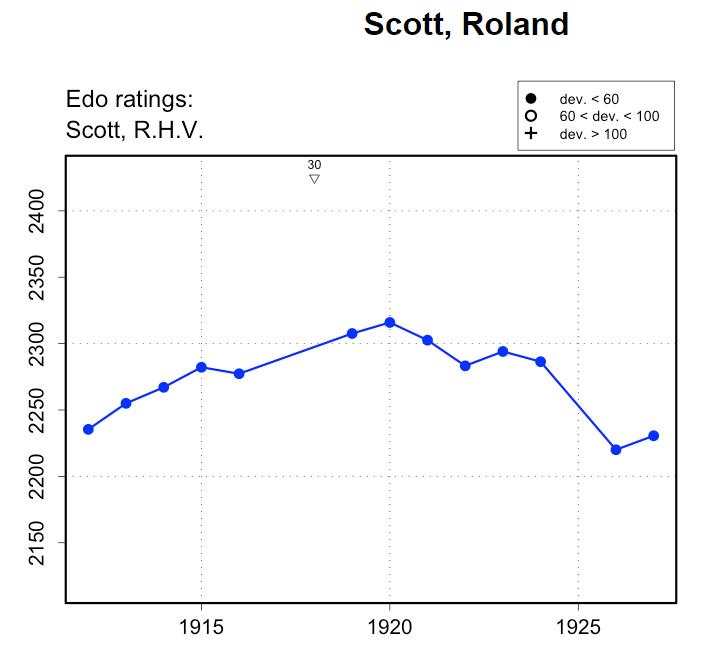
Edo rating profile for RHV Scott

We have given the bare outline of a career that was all too short, one cut down, in a sense before reaching full maturity. Contemporary records sometimes expressed the need for more stability in Scott’s chess, but they chronicle games of his that speak forcibly of the imaginative, refreshing, and invigorating qualities of his play. We offer an early game, the Brilliancy Prize winner, City of London C.C. Championship, 1913-14. White’s 20th move sets the game alight.

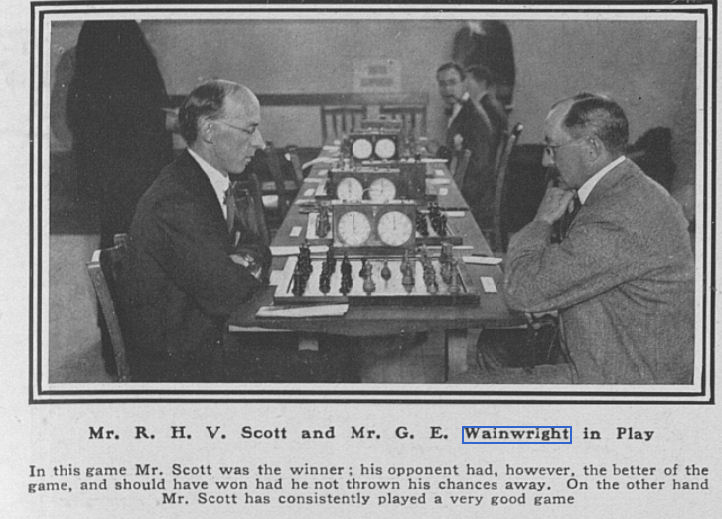
RHV Scott plays GE Wainwright in 1921, The Sphere, 1921

From British Chess Magazine, Volume XLI (1920), Number 10 (October), page 305 we have the following report of his exploits winning the 1920 British Championship in Edinburgh:

“We are glad to be able to present to our readers a photograph of the new champion, Mr. R.H.V Scott. He informs us that it is his most recent one, taken in 1917 when subaltern in the Norfolk Regiment. He saw service with the latter in France, and, as is probably know to most of our subscribers, was badly gassed, from the effects of which is now happily quite recovered.

His victory in the recent Congress in Edinburgh is welcome from at least two points of view; one, that he is one of our youngest first class players (ed: he was 32 at the time, a veteran by the standards of 2022!), having been born in 1889 (ed: this should have been 1888), and therefore may justifiably be expected to improve still further with experience and some curbing of his impatience in defence; and, two, that he claim to represent the more brilliant school of chess, that of Pillsbury, Marshall, Charousek, and Morphy, rather than the more solid school, of say, Steinitz and Rubinstein, who theory was the pilling up of small advantages.

Scott has an excellent “nose” for attack, and has some exceedingly “chessy” ideas. During the congress he put a much greater restraint on himself than is his wont, and we believe this to be the reason he so improved on his previous records.

He had what might be described as the worst of the draw, since he had Black against Sir George  Thomas, EG Sergeant and RP Michell. Some writers have described him as lucky to win, but a study of his games and a comparison with those of others in the tourney go to prove that he played more far-sightedly than any of the others.

We are quite aware that the form of any player is variable, and we have seen Sir George Thomas play much better chess and much less strainedly than he did at Edinburgh. EG Sergeant was generally playing quite at his best, but once or twice his play deteriorated, perhaps as the result of a sleepless night, he then seemed bereft of ideas, and allowed the clock to beat him. This also was the case with Michell, who had many a rush to save his flag falling before the necessary moves were made. Now Scott almost invariably had time to spare.

Perhaps the worst reversal of form was that of JH Blake; but he had been working very hard and late for some time right up to the day the Congress commenced, and was not really in a fit state of health to take part.

Scott has twice before competed for the Championship; in 1913 where he finished eighth, and in 1914 when he was fifth, beating FD Yates, the then Champion and drawing with JH Blackburne.

He has won several brilliancy prizes in congress and club tourneys, and was the champion of the Hampstead Chess Club (where he may have been said to have learnt the game) in 1913 and 1914. He was first acquainted with the moves in 1908.

He is keen on all sports, and puts his whole energy into each line he may be taking. With yet more self-restraint we think his chess will still further improve, and we venture to prophesy this will not be the last British Chess Championship he will win.”

In his memoirs William Winter wrote this:

“I also had the opportunity of playing a number of semi-serious games with RHV Scott and D. Miller, two of the leading London amateurs. Scott was probably the most brilliant combinative played England has ever seen and had already won almost every honour except the British Championship, which fell to him in 1920.

Since those days I have played over hundreds of games, including the beautiful brilliancies of the modern Russian school, and Scott’s best combinations stand up quite well beside them. There were however weaknesses in his play which I shall discuss later. Miller was just the opposite type, a dour solid player exceptionally hard to beat. He is, I am glad to say, still with us, but Scott died a few years ago – he had been out of chess for a long time.”

and this:

“It is entirely legitimate, and can prove very useful until one comes up against an opponent like Capablanca who had no weaknesses of any kind. ln Scott’s case, one of his foibles was an aversion to exchanging queens, and I took full advantage of this in the first two games of the match both of which I won with comparative ease; but Scott was not finished yet.’ In the third game he tied me up in a variation of the Sicilian which I had not previously seen, and in the fourth I made the fatal mistake in going for an early win of material and allowing him a king’s side attack. Things now looked bad for me. I had the black pieces in the fifth game and I dared not play my favourite Sicilian defence because I could not discover a satisfactory answer to his new line.”

Strangely, none of the Encyclopaedia’s by Golombek, Sunnucks or Hooper & Whyld felt that RHVS merited an entry. However Gaige does not forget.

Here is an interesting article from “introuble2” entitled 100 years ago… chess in London during World War I in which Scott is mentioned.

Here is an excellent article from John Saunders

Remembering William Ritson Morry (05-ix-1910 08-i-1994)

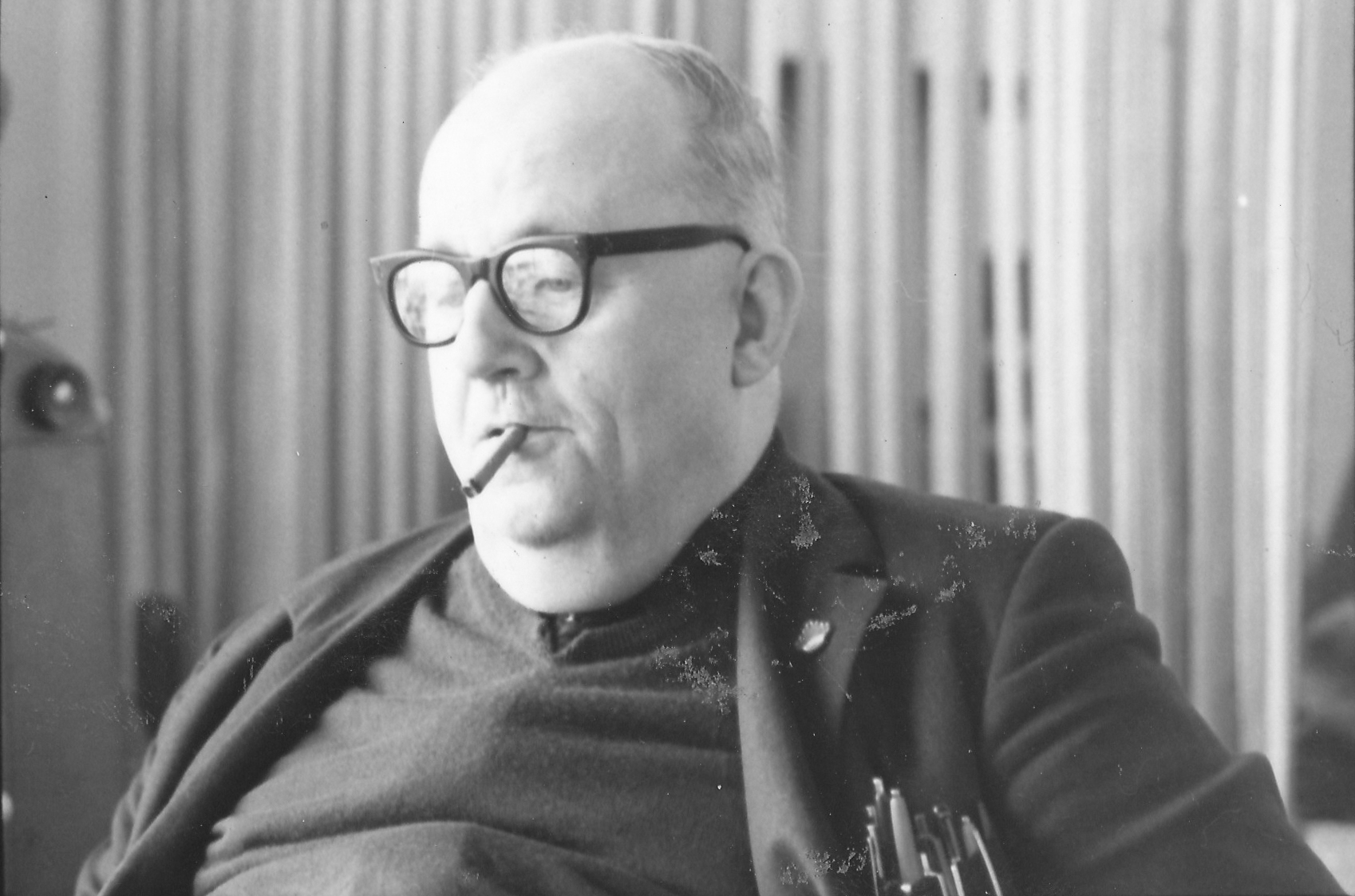
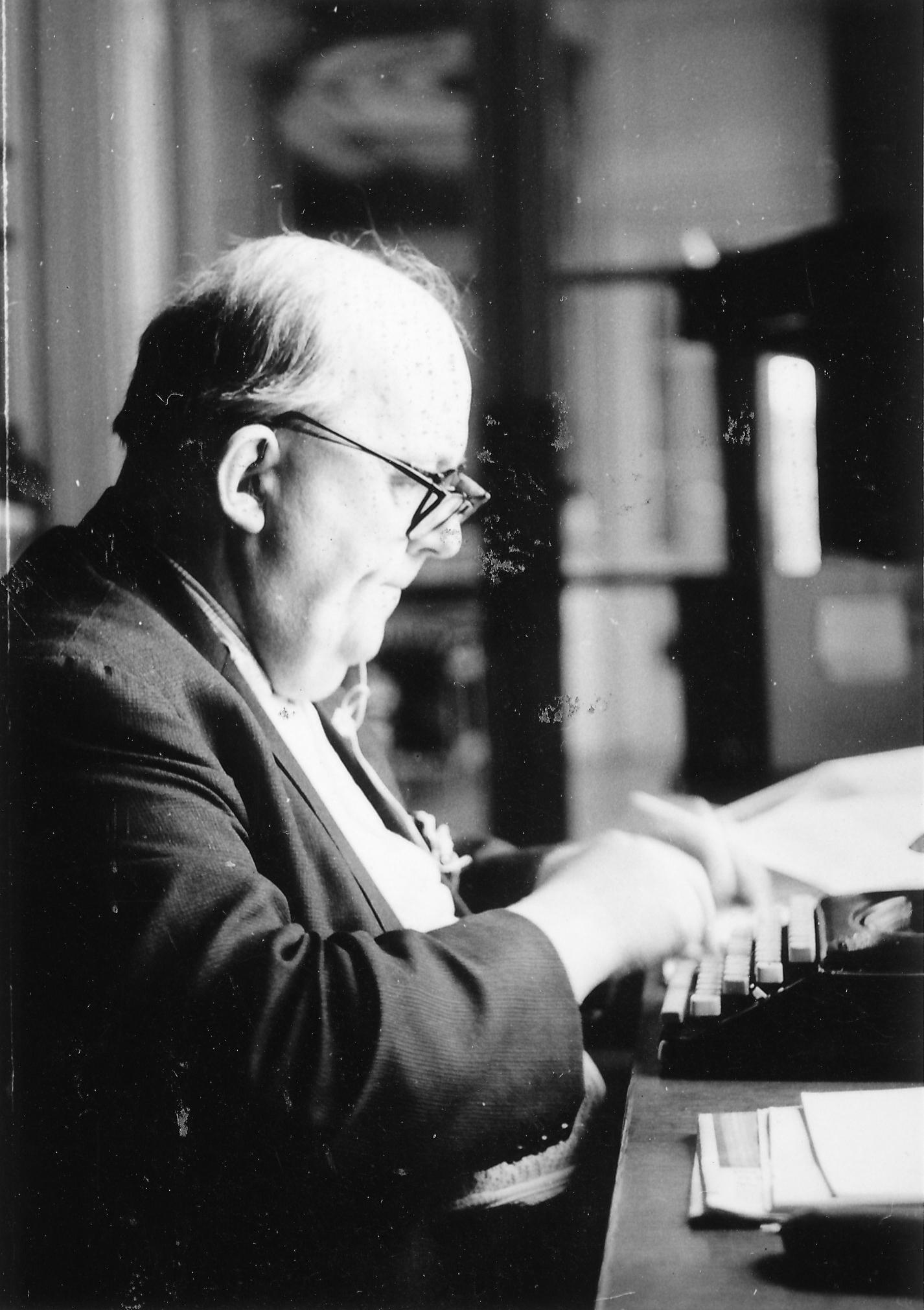
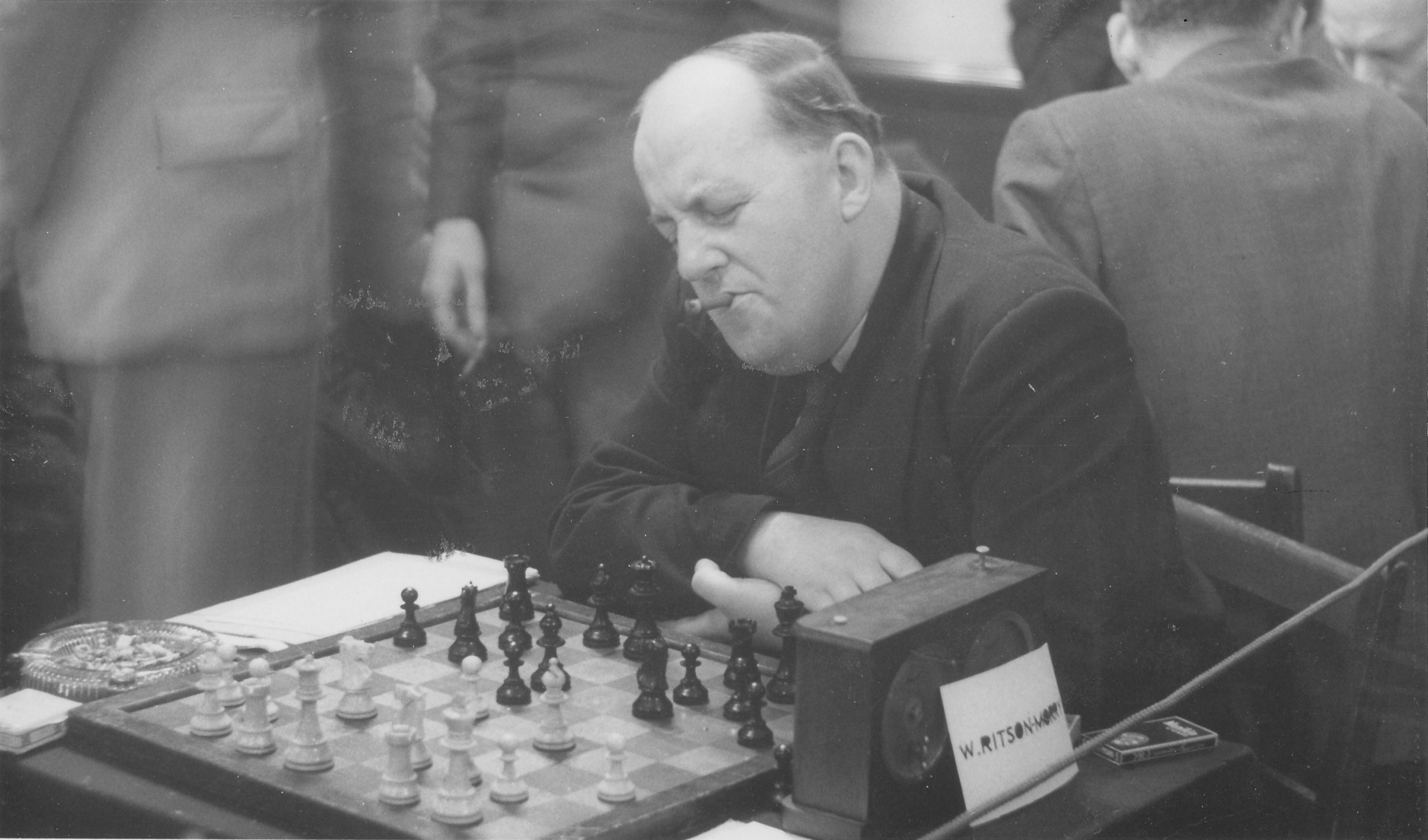
William Ritson Morry (05-ix-1910 08-i-1994)

We remember William Ritson Morry who passed away on Saturday, January 8th, 1994.

(A point of detail : It is incorrect, but many do, to write WRM hyphenated. His first name was William, his middle name was Ritson and his surname was Morry. He chose to use his middle name and was known by his friends as Ritson. Maybe this was because he father was also William Morry?)

WRM was born in the Wirral on Monday, September 5th 1910 and his father  was William Doughty Morry (born 16th July 1877). William was a sub-postmaster and seller of fancy goods. His mother was Norah Morry (née Holloway) who undertook “unpaid domestic duties”.

Ritson attended Friars School, Bangor (established in 1557) along with BH Wood. BHW was one year and three months older than WRM so it is entirely possible that they had met.

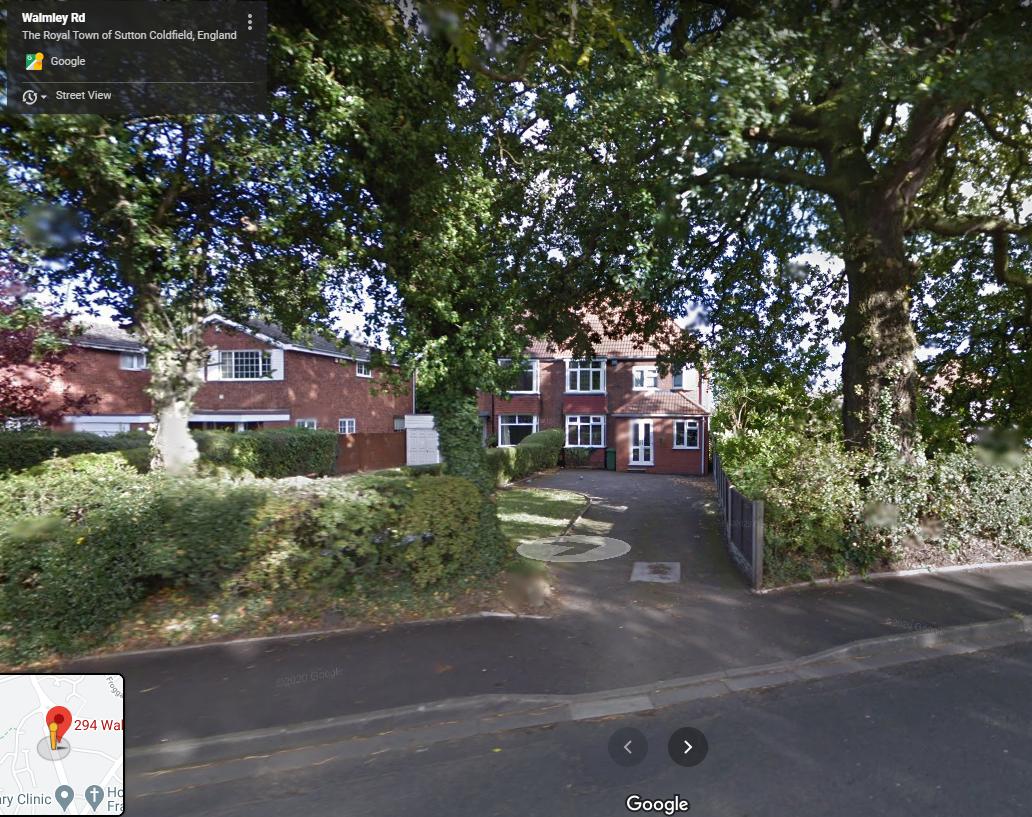
In the 1939 register he is recorded as being a solicitor with his own practice and was living at 294 Walmley Road, Royal Sutton Coldfield, Warwickshire with his parents : he was 29 years old.

294 Walmley Road, Royal Sutton Coldfield, Warwickshire, B76, 2PL

In 1940 WRM married Nellie Cooper in Sutton Coldfield.

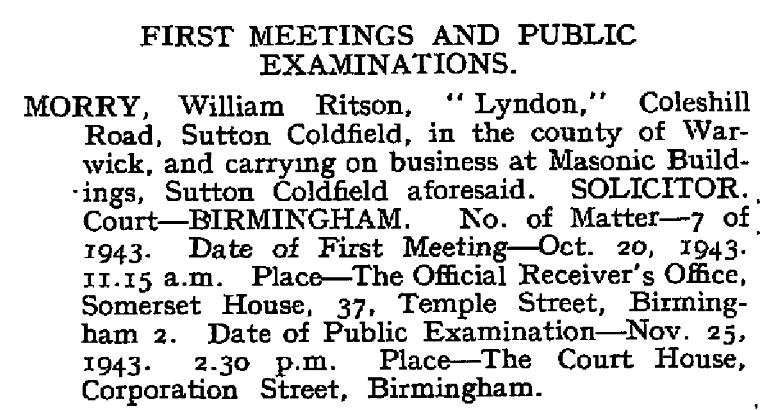
In 1943 WRM was mentioned in the London Gazette several times:

WRM appears in the London Gazette in 1943.

It would appear that this was the start of his first bankruptcy proceedings..

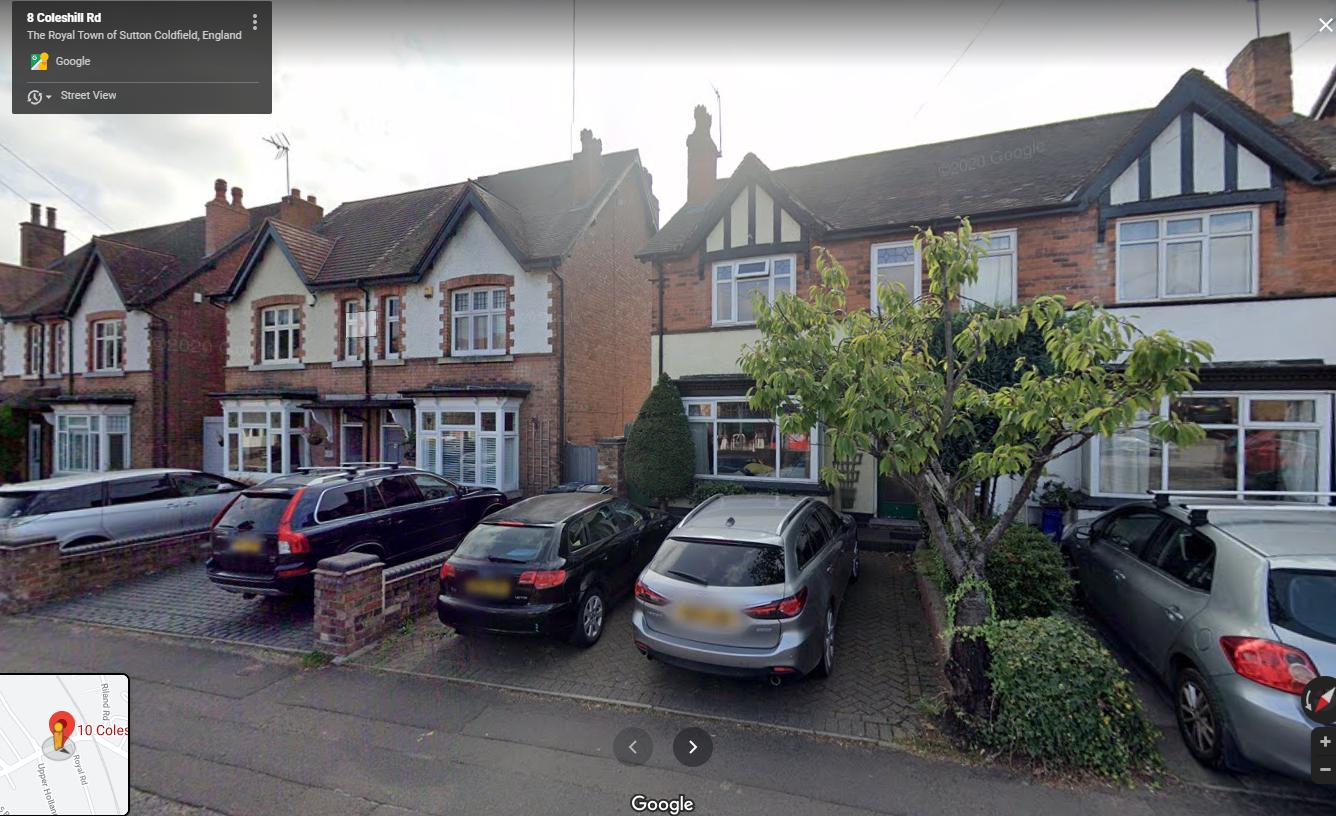
WRM was, by now, living at “Lyndon”, Coleshill Road, Sutton Coldfield, Warwickshire :

Lyndon, Coleshill Road, Sutton Coldfield, Warwickshire

and in the same year on September 30th he was officially made bankrupt as recorded in the London Gazette, order number 195. This notice was repeated in the Edinburgh Gazette of the same year.

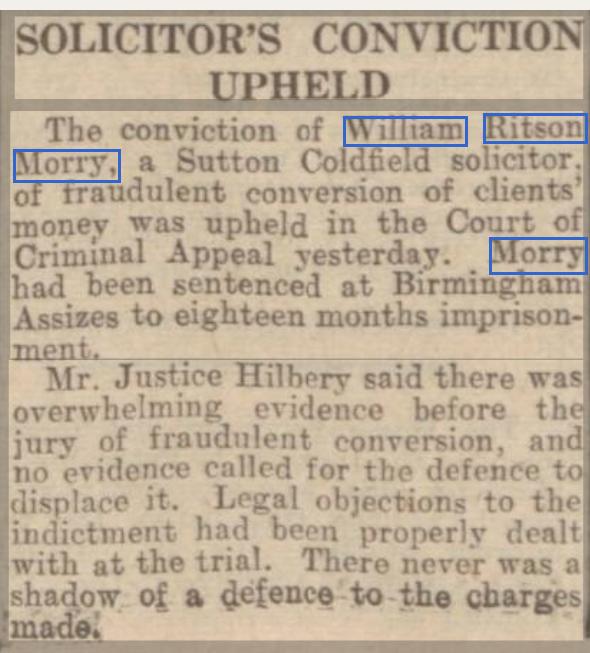
On the 8th of June 1944 he was recorded as being struck-off the list of solicitors under the Solicitors Acts of 1932 to 1941. It was determined that WRM had engaged in “fraudulent conversion of clients money”

Birmingham Daily Post 30 October 1945

For more on this see the excellent Chess in the Courts by Edward Winter.

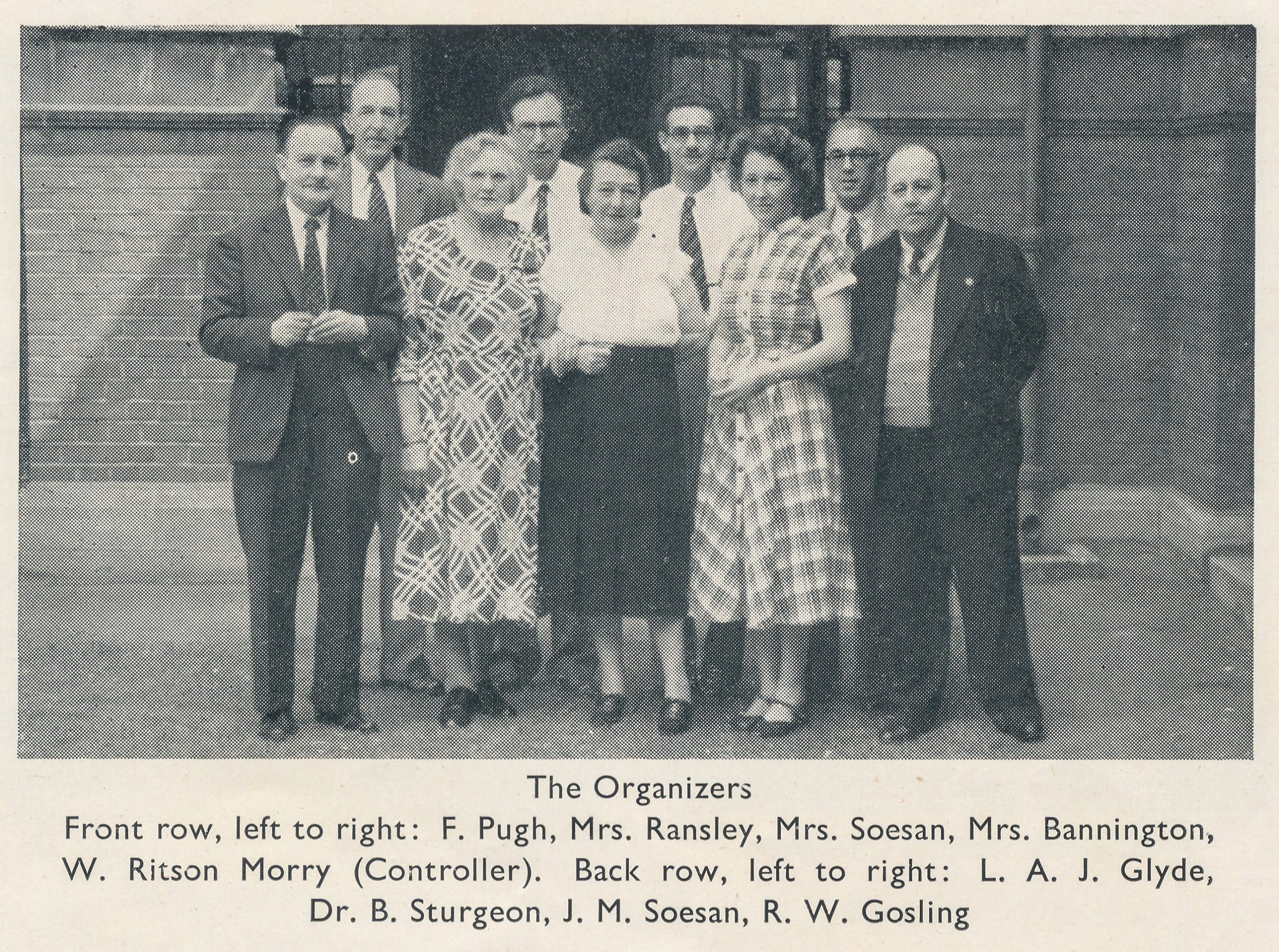
Here is an image of the organisers of the 1953 Whitsun Congress at Ilford including WRM:

The organisers, Front row, left to right: F. Pugh, Mrs. Ranslet, Mrs. Soesan, Mrs. Bannington, W Riston Morry (Controller). Back row, left to right: L. A. J. Glyde, Dr. B. Sturgeon, J. M. Soesan, R. W. Gosling

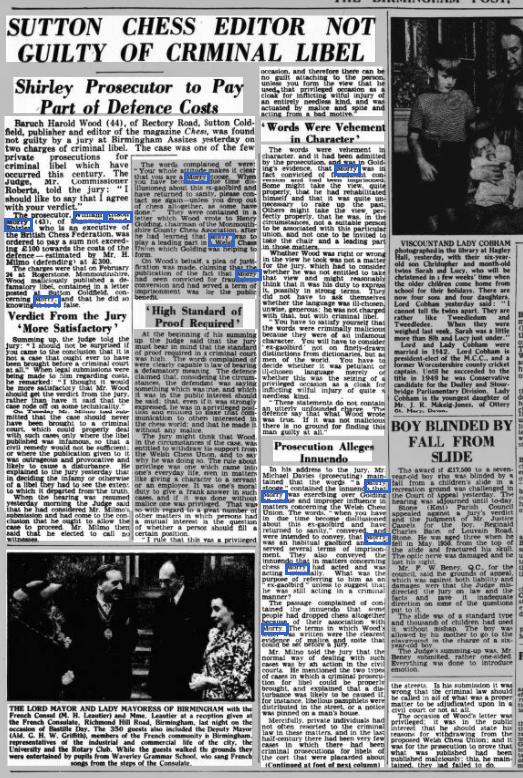
In 1954 WRM sued BH Wood for libel over a letter BHW sent to Henry Golding of the Monmouthshire County Chess Association warning him of WRMs financial history. Here is a summary of the action :

The Birmingham Post, July 15th, 1954

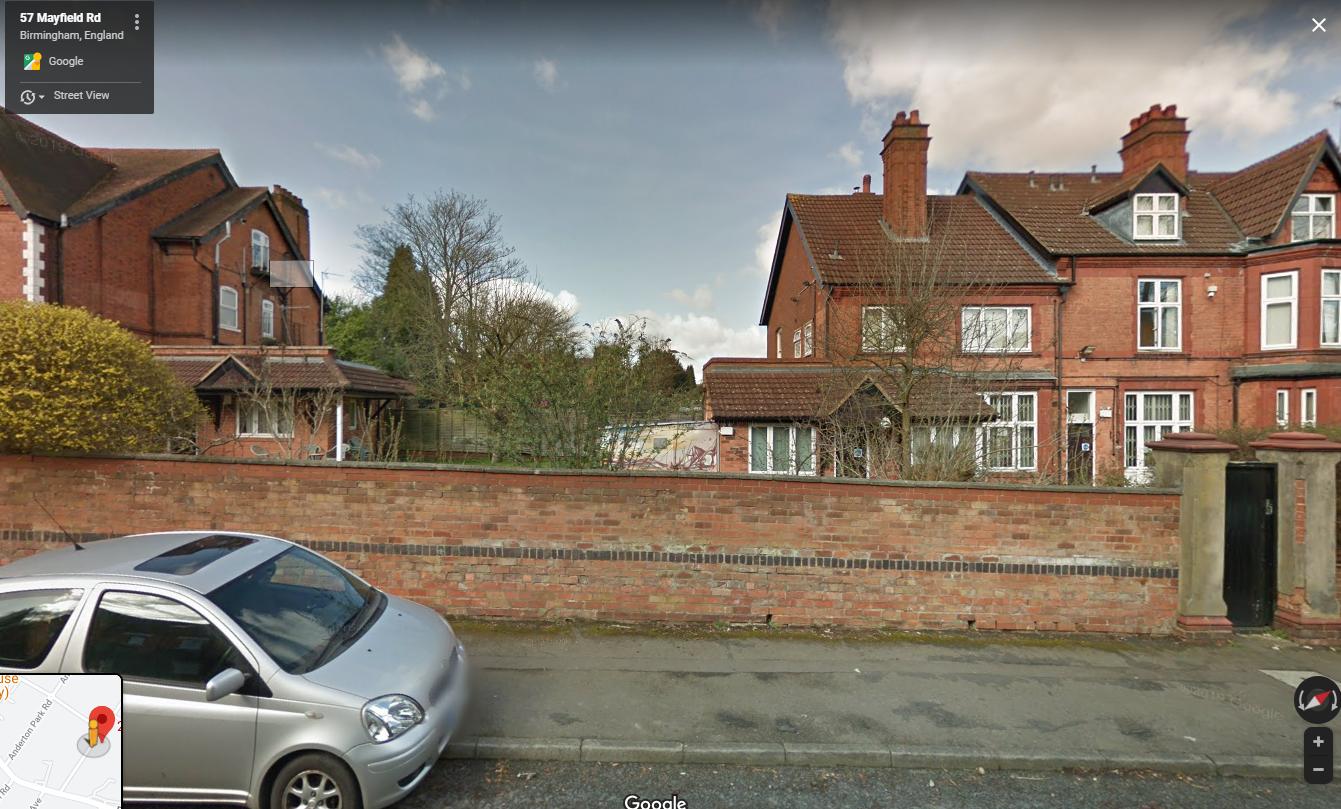
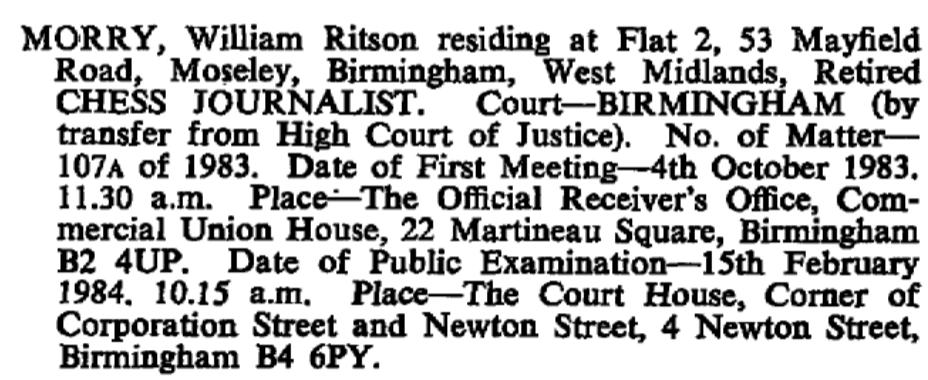
In 1983 WRM was living at Flat 2, 53, Mayfield Road, Moseley, Birmingham, West Midlands and recorded as a Retired Chess Journalist. Elsewhere he was recorded as a freelance chess and cricket journalist.

57, Mayfield Road, Moseley, Birmingham, B13 9HT

and, unfortunately, in this year he made another appearance in the London Gazette (2nd September 1983) having been made bankrupt.

London Gazette, 2nd September 1983

However, despite these unfortunate life events WRMs contribution to chess goes above and beyond them as he won the BCF President’s Award in 1984.

From British Chess Magazine, Volume CXIV (114, 1994), Number 2 (February), pp. 98 – 99 we have this obituary from Bernard Cafferty:

W Ritson Morry – a Tribute

That great chess character, known to everybody simply as Ritson, has left us in the fullness of years, coincidentally during the first Hastings Congress he missed for decades.

William Ritson Morry (5 ix 1910-8 i 1994) was a player, organiser, writer, arbiter and occasional sponsor of tournaments whose life touched so many aspects of chess that it is hard to know where to begin.

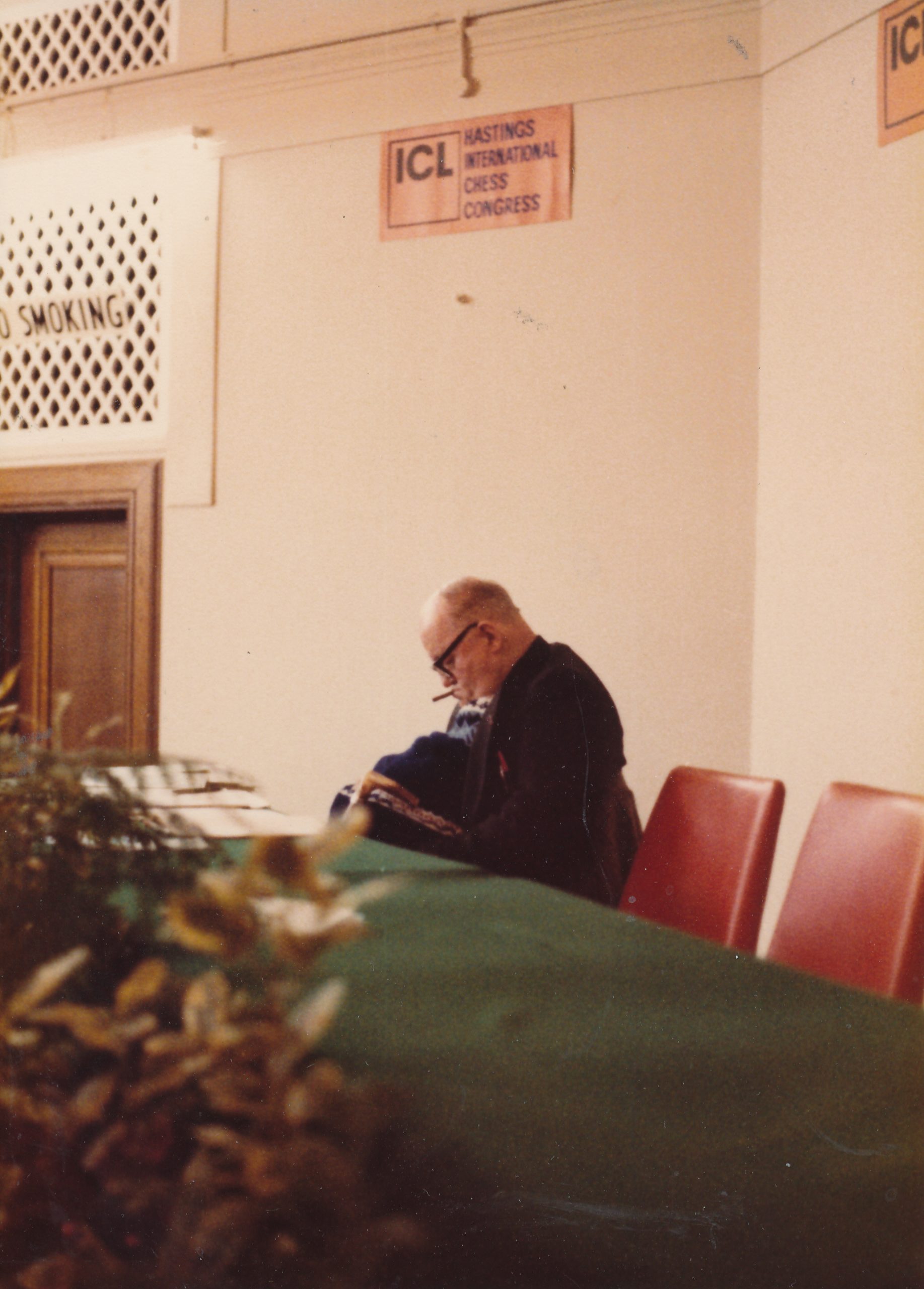
William Ritson Morry (05-ix-1910 08-i-1994)

Ritson was educated in North Wales at the same school as BH Wood. Both were at Birmingham University at the same time, after which Ritson trained as a solicitor. As early as 1930 he founded the Birmingham Junior League, and a little later wrote a chess column for a time for a local newspaper, though Ritson is hardly the first person you think of as someone who would hit deadlines consistently. He was equal second in a rather unrepresentative British Championship of 1936 and equal third in 1951. An unfortunate incident in the mid-1940s led to him being struck off, whereupon he became a chess professional, who eked out a precarious living for the last 48 years of his life. Yet, I never heard him complain, for he was able to immerse himself in chess full time, and what could be better than that?

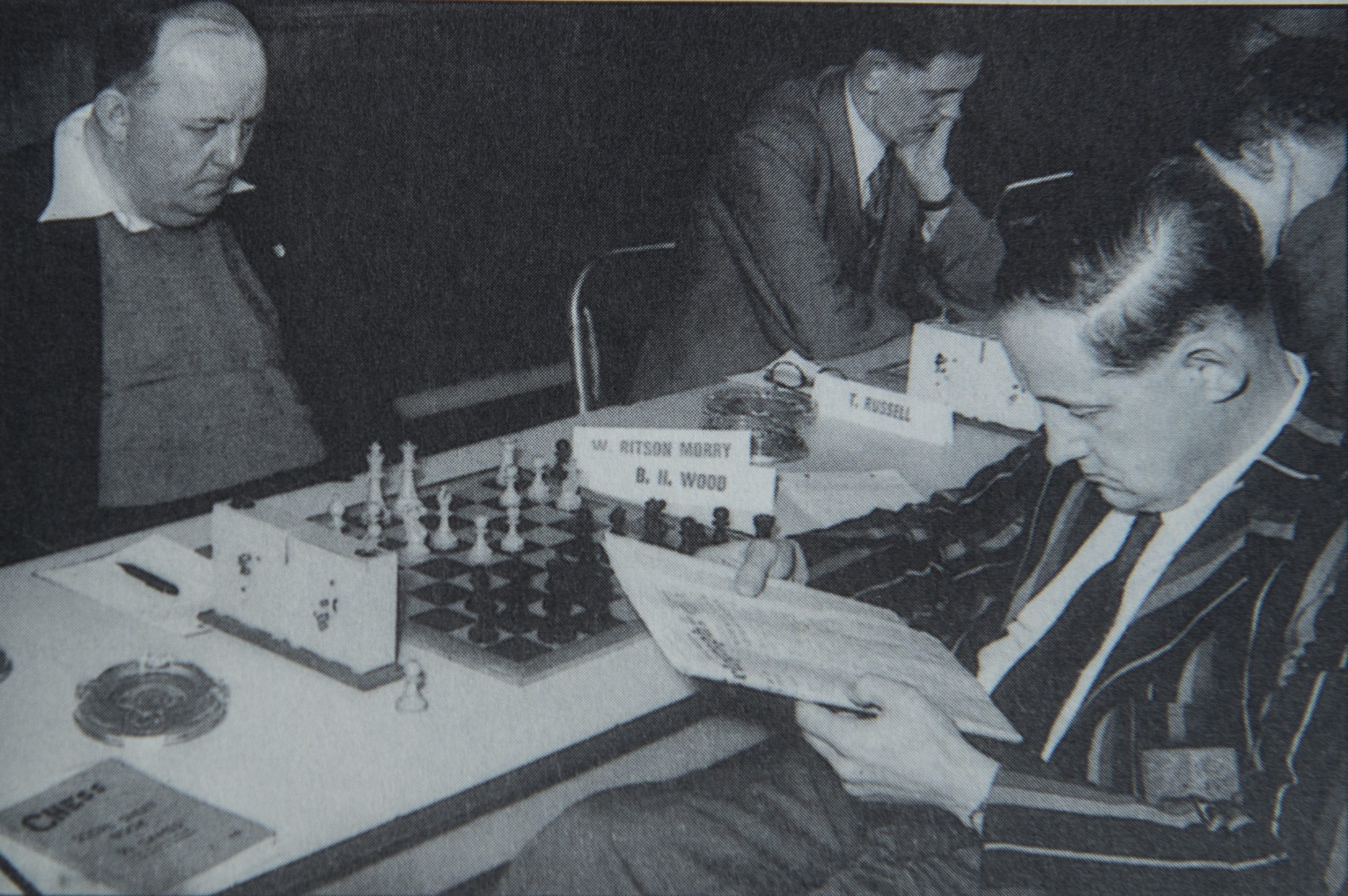
William Ritson Morry playing Baruch Harold Wood at the British Championships in Blackpool from 1956

He ran a series of newsletters, which hardly covered their expenses and produced and British Championship and Hastings bulletins for many years. 1951 was a significant year in his life, for he gained the FIDE Arbiter title (he was always an expert on the rules and many of the conventions we all play to were codified by him, or under his guidance). Later on Ritson, a great raconteur, was the life and soul of the show in Hastings which, along with the Warwickshire chess team and Erdington CC, was the great love of his life.

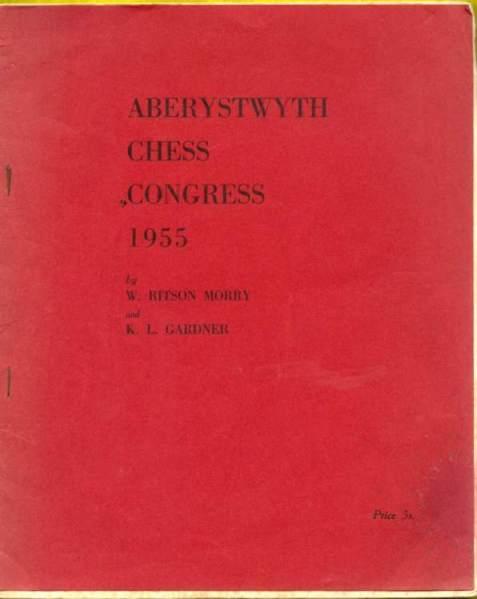
Aberystwyth Chess Congress 1955, W Ritson Morry and KL Gardiner, En Passant Chess Publications, 1955

At times he seemed to run Hastings almost single-handed in the Frank Rhoden era. In fact GM Vasyukov went back to Moscow in 1966 and wrote that Ritson Morry was the only controller to be seen in the morning, afternoon and evening sessions of play. I recall that Ritson was amused when I told him of this, but did not demur. To show that there was life in the old dog, he organised a series of Birmingham international tournaments in the 1970s at which Tony Miles got much of his early experience.

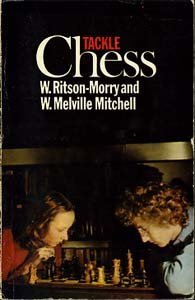
Tackle Chess by William Ritson-Morry & W Melville Mitchell

One such tournament was financed by him alone, on the basis of the sale of a piece of land in Sutton Coldfield where a change of planning status had led to a windfall profit.


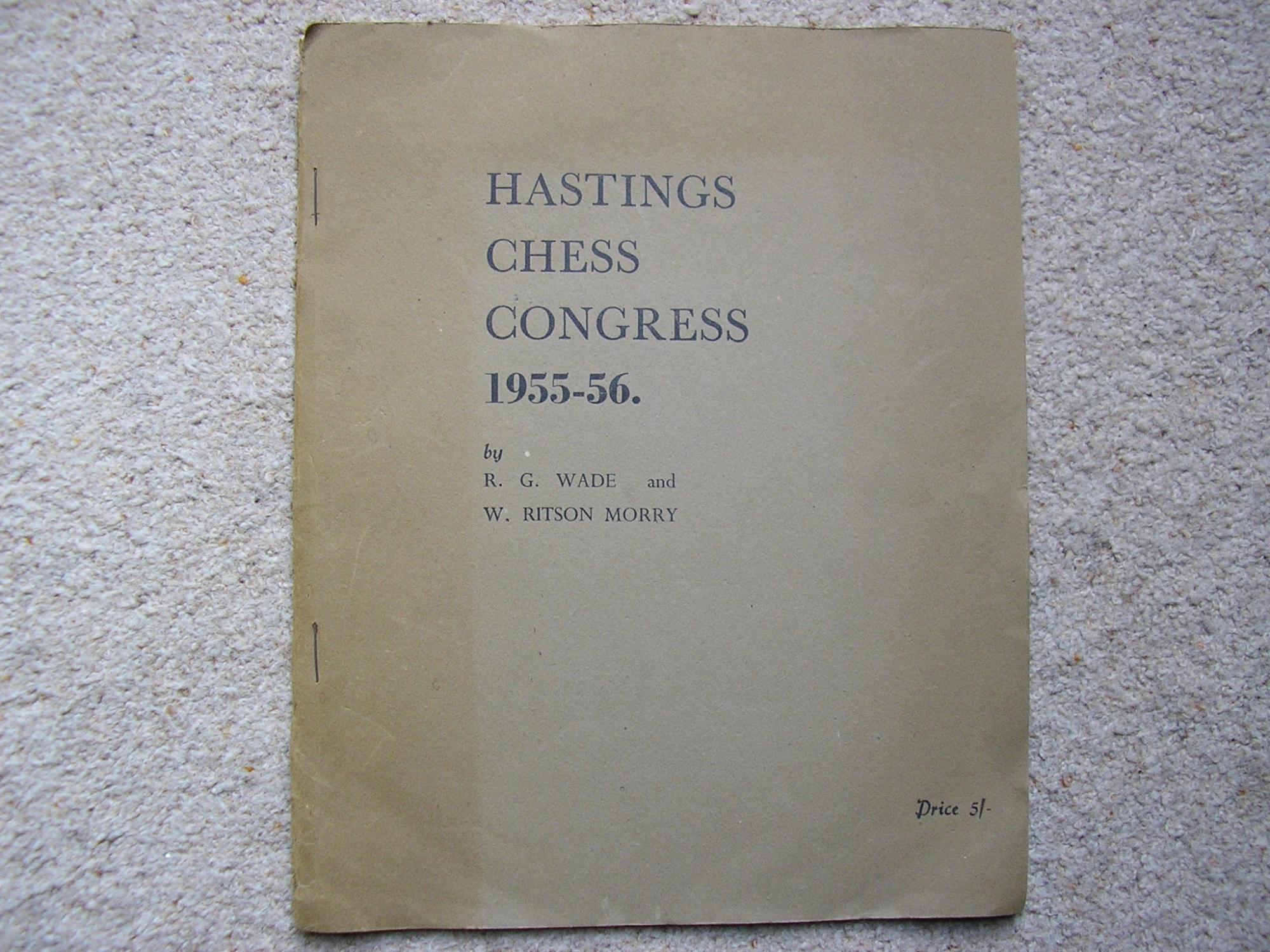
Hastings Chess Congress 1955-56, RG Wade & W. Ritson Morry, En Passant Chess Publications

He also saved Hastings in late 1974,by giving a partial guarantee when another sponsor reduced his contribution. A few years later the Inland Revenue made him bankrupt when they could not get their piece of the action out of the deal. Doubtless Ritson thought that the money had gone to a worthier cause. I must not fail to mention his love of gambling or his erudition. Many is the time when you could have an exposition from him of the law of England, the practice of the courts and the police, or the political news of the day.

William Ritson Morry (05-ix-1910 08-i-1994)

He was deeply immersed in local Labour Party politics in Birmingham and was a friend of football referee, ‘rainmaker’ Dennis Howell, one-time Minister for Sport. Ritson also played a great deal of postal chess, winning the British title in 1943. His book on the game written in conjunction with a Birmingham schoolmaster Mel Mitchell is a very instructive one, and he also wrote many reports and amusing articles for BCM, particularly one on of the failings of the Elo rating system regulations.

Here is a game Ritson won against the veteran German GM at the London Easter congress of 1940:

Bernard wrote about WRM a year later for the centenary edition of the programme for the Hastings International Congress :

“‘Ritson’ as we all knew him was an institution in British Chess, active as a player, writer,  organiser, drafter of rules and well-known for his skill as a raconteur, Educated in North Wales, he spent the rest of his life, from university days onwards, in Birmingham, but the Hastings Congress was very close to his heart.  He played in a number of pre-war events, and also a few post-war, but by the time of the Frank Rhoden revival of the mid-1950s he was firmly in the saddle organising the post-Christmas traditional event. In fact I recall how perturbed Frank Rhoden was when the news came that Ritson might emigrate to the West Indies.  It was not clear then how he could be replaced, for he supervised the morning, afternoon and evening sessions at the Sun Lounge (his favourite venue) and later at the Falaise Hall when the congress was still of such a size that we could all, including the Premier, be fitted into one room.

William Ritson-Morry
William Ritson Morry

Ritson also did game commentaries for some years and produced a bulletin for at least three decades. He was greatly encouraging of younger talent and the objective historian has to recall the indignation he felt when players like Tony Miles and Nigel Short were not happy with the restraints imposed by financial stringency.

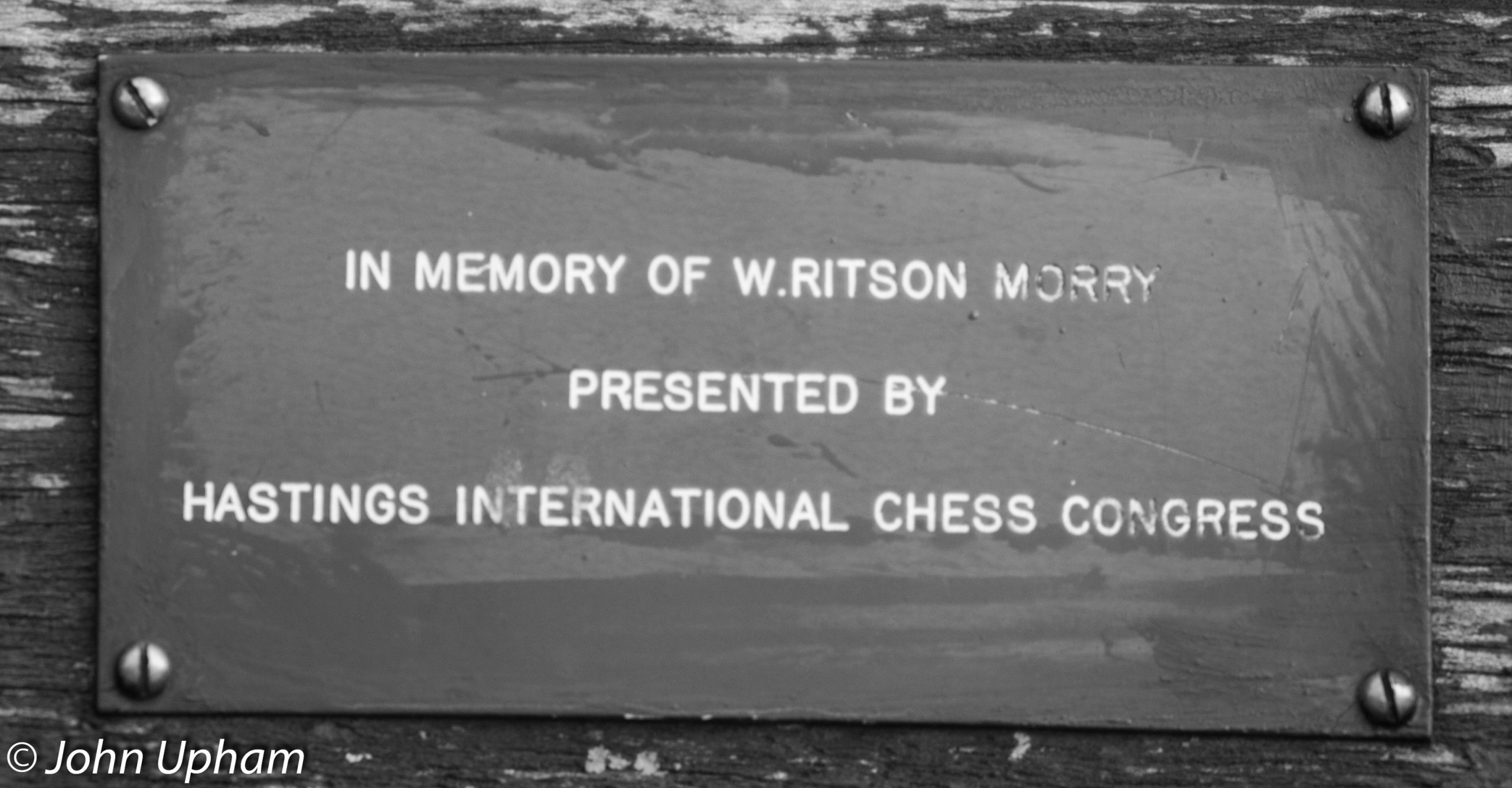
Hastings bench memorial bench for William Ritson Morry

In his declining years Ritson was still a regular until his illness of late 1993, and a fixture at the “gate” where the public paid their entrance money at the Cinque Ports Hotel. The choice of word is deliberate as a visit to the dogs and the bookmaker was one of his rare pleasures outside chess.  Best of all, however, one recalls him telling his fund of stories and reminisces to anyone who cared to listen. His voice, alas, has been stilled, and we are left to recall his selfless devotion to chess and, in particular, to the Hastings Congress.

Here is an obituary from the Midland Counties Chess Union

Here is an in-depth article from William Hartston in The Independent

William Ritson Morry (05-ix-1910 08-i-1994)

Here is a biography from the Midland Counties  Chess Union newsletter from 1994.

From The Encyclopaedia of Chess by Harry Golombek :

Midlands organiser and player who was a chess professional and journalist. As a player his best performances were an =2nd in the British Championship 1936 and an = 3rd in 1951.

In the international field his best results have been an =3rd with List in the Major Open A section of the Nottingham congress of 1936 and =1st with Milner-Barry in the Premier Reserves A at the Hastings congress 1946/7. He has played for England in international matches against the Netherlands (thrice) and against Czechoslovakia and Yugoslavia.

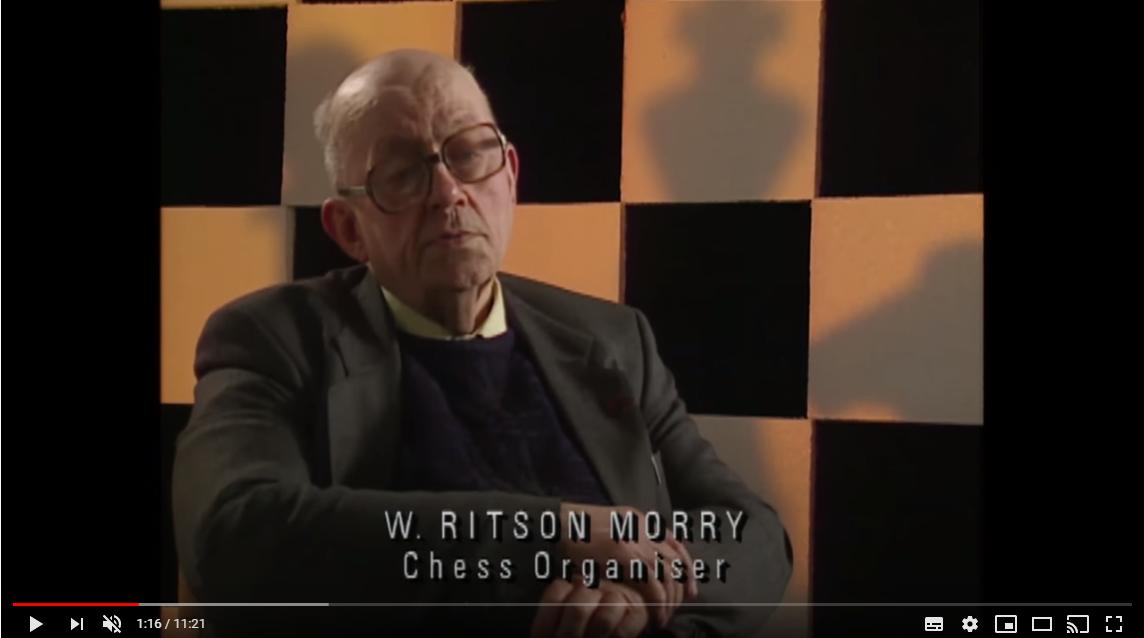
William Ritson Morry talking about Malik Mir Sultan Kahn

A keen and accomplished correspondence player, he had the title of British Postal Master on account of his winning the British Correspondence Championship in 1943.

But it is as tournament and congress organiser that he is best known. He founded the Birmingham Junior League in 1930 and has organised thirty-four Birmingham congresses. He conceived the idea of a junior world championship and in 1951 he held the first World Junior Championship tournament at Birmingham (won by Borislav Ivkov). In the same year he was awarded the title of FIDE judge. He has also had much to do with the organisation of the Hastings Christmas chess congresses in the 1970s.

William Ritson Morry (05-ix-1910 08-i-1994)

He has written much for British chess magazines and was the co-author along with the late W. R. Mitchell  of Tackle Chess, London, 1967.

Happy Birthday IM George Botterill (08-I-1949)

IM George Steven Botterill (08-I-1949) by Nigel Eddis

We send birthday wishes to IM George Steven Botterill born on this day (January 8th) in 1949.

Here is his Wikipedia page

Brian Reilly, Ray Keene, George Botterill, Anatoly Karpov, Harry Golombek and Viktor Korchnoi

and here is his academic page

Capa vs Corzo Rerun ? Nigel Short had 1977 British Champion George Botterill on the ropes at The National Bank of Dubai Open. In the photo Nigel is considering 42 Rh5 The champ just escaped with a draw.

IM George Steven Botterill (08-I-1949)
The Modern Defence, BT Batsford, 1972, GS Botterill and RD Keene
The Pirc Defence, BT Batsford, 1973, GS Botterill and RD Keene
British Chess, Pergamon Press, 1983. Editors : GS Botterill, DNL Levy, JM Rice and MJ Richardson