Tag Archives: Problemist

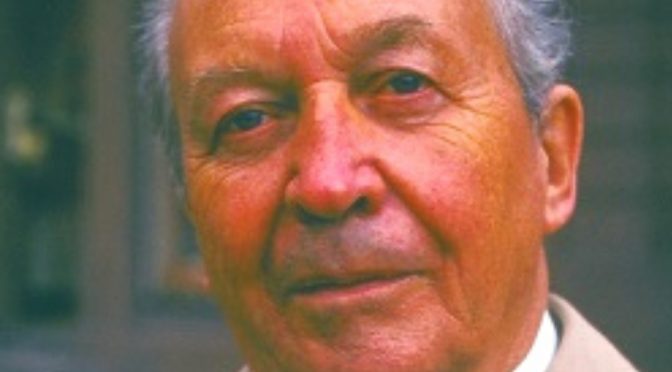
Happy Birthday Barry Barnes (01-viii-1937)

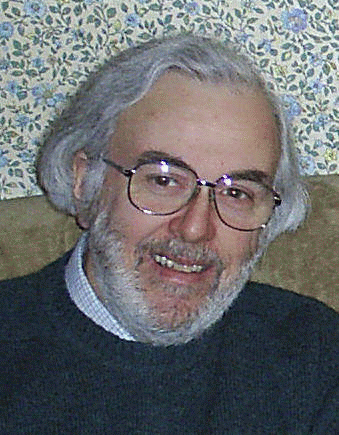
Barry Barnes by Jean Barnes

BCN wishes happy birthday to Barry Barnes (01-viii-1937)

Barry Peter Barnes was born in Brighton and his mother’s maiden name was Simpole. (Barry is a cousin of Julian Ivan Peter Simpole, who was a Brighton school teacher and who taught Edward Gerard Winter to play chess).

Barry now lives in Halling, Rochester, Kent with his wife Jean.

From The Encyclopedia of Chess (Robert Hale, 1970 & 1976) by Anne Sunnucks :

“International Master of FIDE for Chess Compositions (1967) and International Judge of FIDE for Chess Compositions (1967).

Born on 1st August 1937, Barnes works in transport advertising. He has composed about 250 two-move problems. With Lipton and Rice, he has contributed to the advance of the modern two-mover. Problem Editor of Two-Move and Twin sections of The Problemist. Co-author with M.Lipton and JM Rice of The Two-Move Chess Problem : Tradition and Development (Faber and Faber 1966).

Barry Peter Barnes
Barry Peter Barnes


BP Barnes
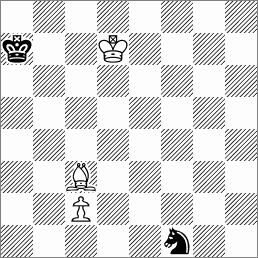
2nd Prize Problem T.T. 1964

[fen]6q1/5p2/1Q6/8/3rPN2/5P1P/2PP1NPp/R1B1K1kr w – – 0 1[/fen]

White to play and mate in two moves

(a) Diagram
(b) With black pawn at KN2 (g7)

(a) Solution
1. B-R3!

(b) Solution 1. K-K2!

From British Chess (Pergamon Press, 1983) by GS Botterill, DNL Levy, JM Rice and MJ Richardson :

Barry wrote about himself as follows :

“A promising career as a county chess player came to an end when I was given Brian Harley’s classic book Mate in Two Moves in the belief that it would help my chess, but it had quite the opposite effect. My interest in competitive chess waned, and I was on the road to an an International Master title for problems!

Early influences in my problem career were the weekly chess problem solving competition in The Observer (my first problem published there was in 1955), a teenage friendship with J. M. Rice and M. Lipton (both now lnternational Masters), Herbert Grasemann’s book Problem Schach / with its near revolutionary post-war German problem ideas, and the expert British problemist, A. R. Gooderson who had I but known it only a few years earlier was the officiating master when my Hove Grammar School played Steyning Grammar at chess.

In the late 1950s and early 1960s, the genuinely original problems I was making in cooperation and in competition with Rice and Lipton were being published mostly abroad in such specialist problem magazines as Die Schwatbe (with its inspired two-move editor, Hermann Albrecht) where I gained the epithet the English prize-snatcher’! It was also written that the work of the avant-garde composers, Rice, Lipton and Barnes, was like a fresh two-move wind blowing from our island. It was sad but true at that time that the specialist magazine of the British Chess problem Society (founded 1918), The problemist, was unreceptive to change and our often bizarre ideas.

A milestone of sorts was reached when I won lst prize for problem I in 1958, a prize for the best new problem by a member of the British Commonwealth aged under 21. In 1966, I was invited by problemist Grandmaster Comins Mansfield, who was President of the FIDE Problem Commission, to act as Secretary at the Barcelona meeting. With Mr. Mansfield’s retirement, I became the British Member to the Commission, and at the Wiesbaden meeting, 1974, I was elected 2nd Vice-President. (1st Vice-President from 1982)

The FIDE Problem Commission meets annually to discuss matters relating to all branches of problem chess, to organize the World Chess Composing Tournament (WCCT), the World Chess Solving Competition (WCSC), and to publish FIDE Album anthologies of the best problems. It was on the strength of my success in these FIDE Albums that the Commission granted me the titles in 1967 of ‘lnternational Master of the FIDE for Chess Composition’ and ‘lnternational Judge of the FIDE for Chess Composition’. Since 1974, I have been Chairman of the Titles Sub-Committee of the Commission.

Since 1965, I have been the two-move editor of The Problemist and have served almost without break on the BCPS Committee. I have contributed to The Encyclopaedia of Chess by Anne Sunnucks (Robert Hale, 1970), I am co-author, with J. M. Rice and M. Lipton, of The Two-Move Chess Problem: Tradition & Development‘ (Faber A Faber, 1966), and I am the sole author of Comins Mansfield MBE: Chess Problems of a Grandmaster: (British Chess Problem Society, 1976) and Pick of the Best Chess Problems (Elliot Right Way Books, 1976)

To date I have made just over 300 two-movers and some helpmates.”

From The Encyclopaedia of Chess (Batsford, 1977), Harry Golombek OBE, John Rice writes:

“British problem composer, output about 400, nearly all modern style two-movers. Two-move sub-editor of The Problemist. Secretary of the FIDE Problem Commission during C. Mansfield’s Presidency. Co-author of The Two-Move Chess Problem: Tradition and Development (1966).”

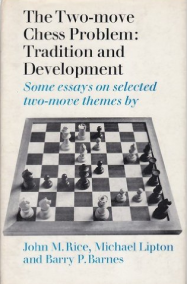
The Two Move Chess Problem : Tradition and Development

Author of Pick of the Best Chess Problems (1976)

Pick of the best Chess Problems

Comins Mansfield MBE : Chess Problems of a Grandmaster (1976).

Comins Mansfield MBE: Chess Problems of a Grandmaster, BP Barnes, 1976

International Judge (1967); international master (1967).

Source: The Problemist, May 1996. Photo taken March 1996 at the Mansfield Centenary Meeting at Paisley, when Barry Barnes delivered a lecture on Comins Mansfield. Left to right: Geoffrey Mansfield (son of Comins), Robert Gray and Barry Barnes, International Master of Chess Composition.

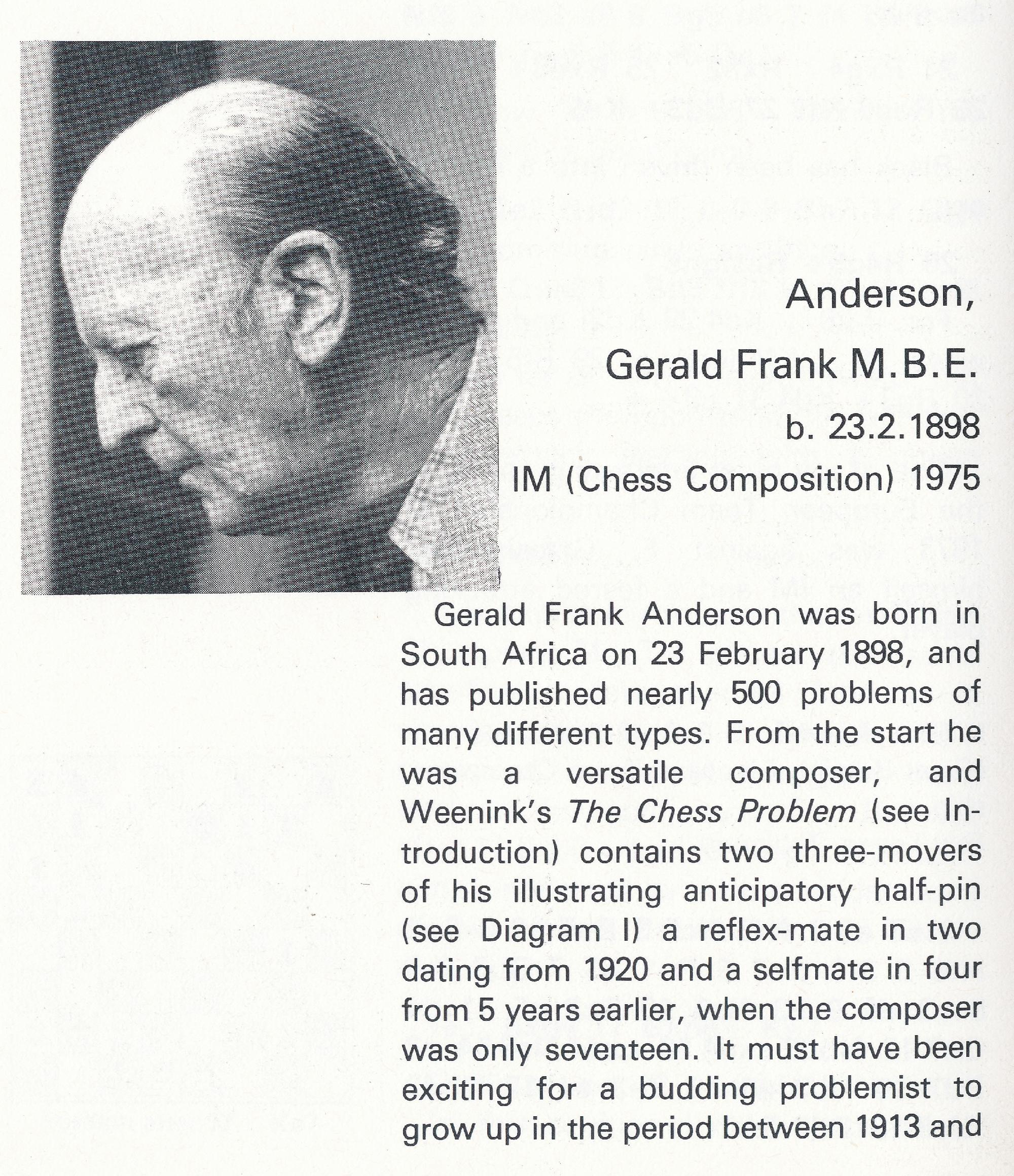
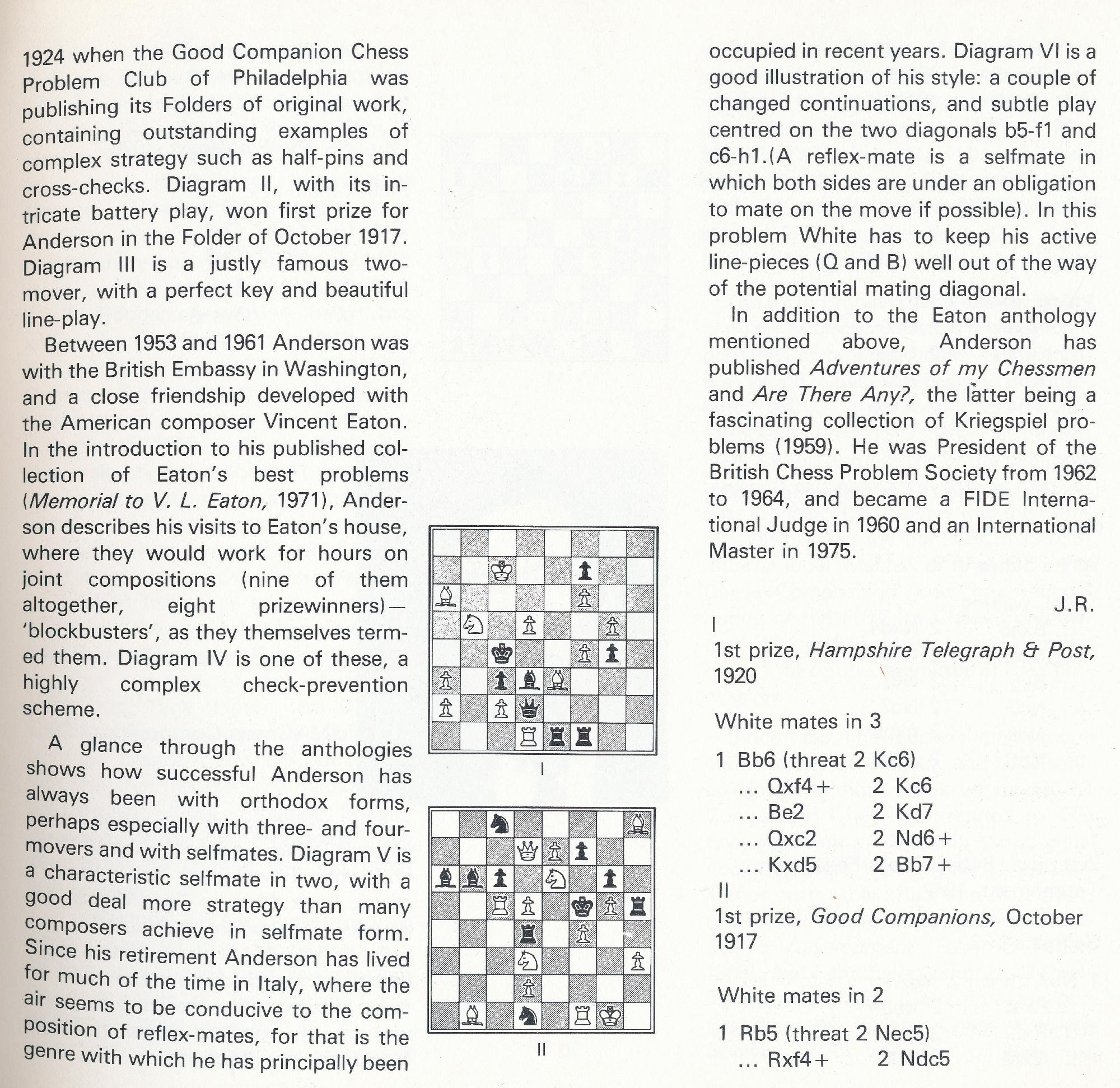
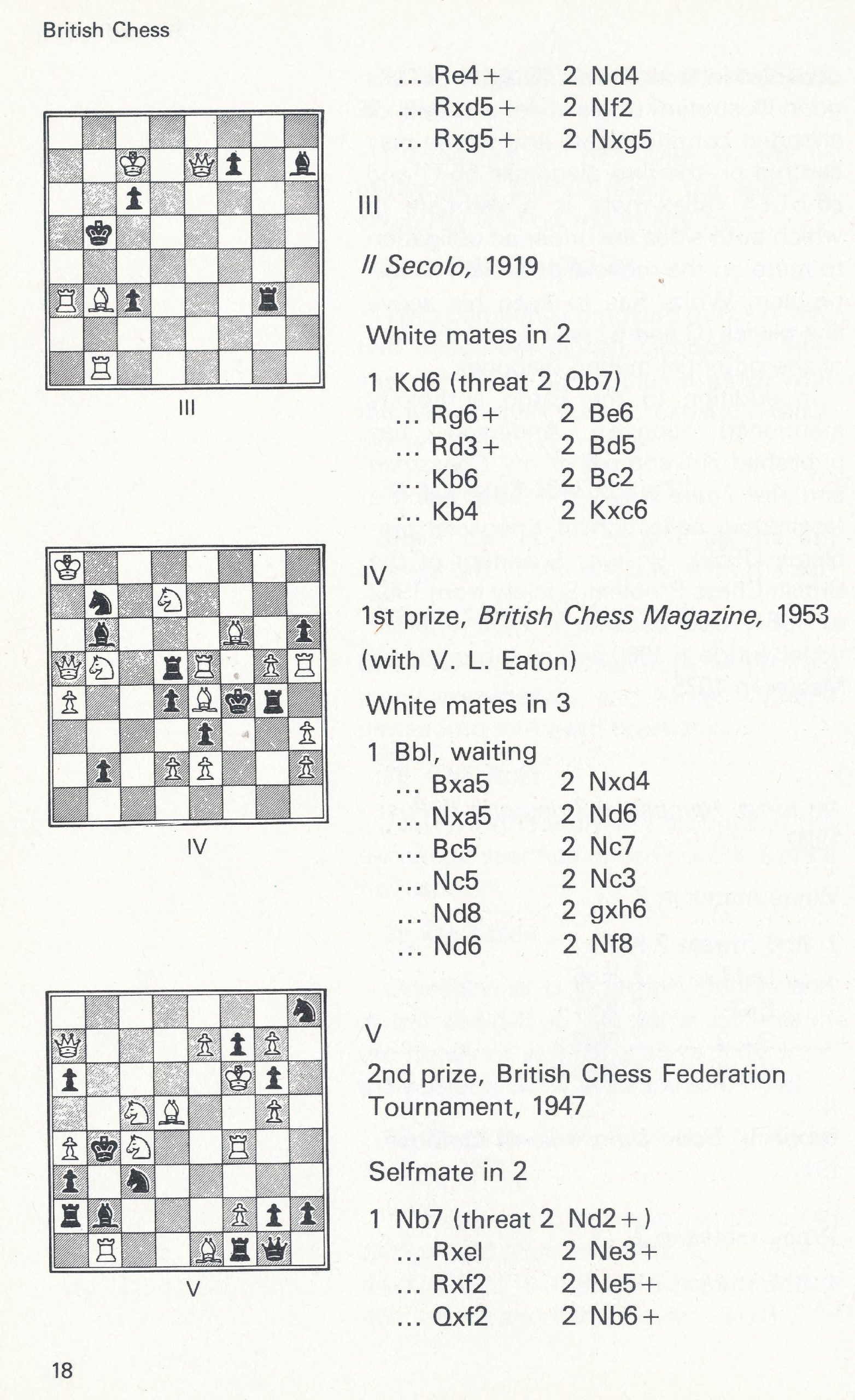
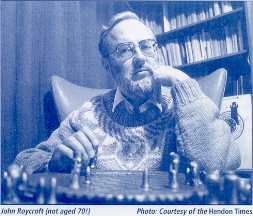
Happy Birthday (Arthur) John Roycroft (25-vii-1929)

(Arthur) John Roycroft

We are delighted to offer (Arthur) John Roycroft best wishes on his birthday, this day (July 25th) in 1929.

John was born in Hendon, London and his mother’s maiden name was Banks.

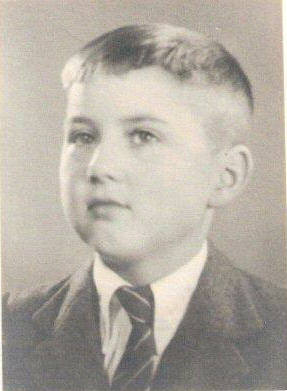
AJR aged 9, courtesy of the BCPS web site.

John moved to Brighton and then evacuated to Calcot, North Wales and returned to Brighton when the threat of war had subsided.

He married Betty in 1961 and they had a son and a daughter and now have several grand children.

He claimed that he had never suffered a common cold.

John is Platinum Life Member of the English Chess Federation and an “ECF Supporter”.

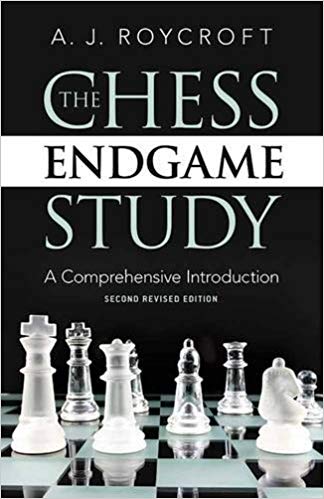
The Chess Endgame Study

“From The Oxford Companion to Chess (Oxford University Press, 1984) by David Hooper and Ken Whyld :

English study composer and author, International Judge of Chess Compositions (1959), Computer systems analyst.

In 1965 he founded EG, a quarterly publication which became the world’s first and only long-running magazine devoted wholly to studies.

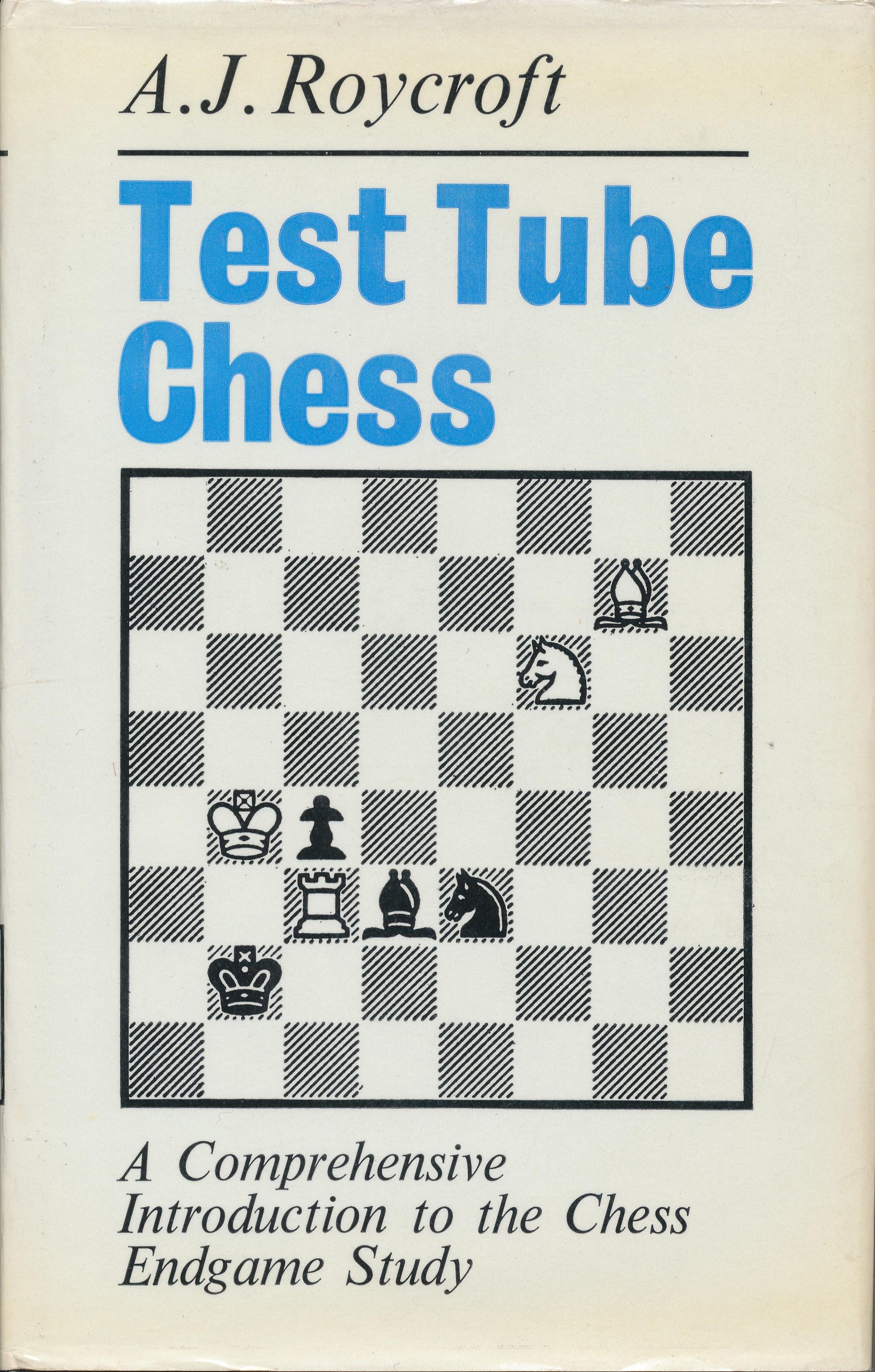
His Test Tube Chess (1972), the best English language guide to the art of studies., was revised and republished as The Chess Endgame Study (1981).

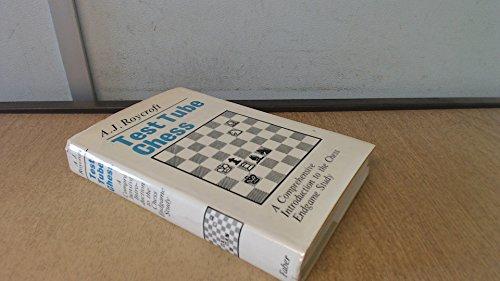
Test Tube Chess, AJ Roycroft, Faber and Faber Limited, 1972, ISBN 0 571 09573 9

Studies are commonly classified by means of the GBR code of which he was co-inventor.”

From The Encyclopedia of Chess (Robert Hale, 1970 & 1976) by Anne Sunnucks :

“FIDE Judge of Endgame Studies. Born on 25th July 1929. Founder of the Chess Endgame Study Circle in London in March 1965.and its quarterly magazine EG, the first and only publication exclusively devoted to the composed chess ending. Roycroft who is a computer systems analyst and lives in London, has composed about 20 endgame studies.”

AJ Roycroft

“EG” July 1965

[fen]5B2/8/7N/1pK5/2p5/2Rbn3/1k6/8 w – – 0 1[/fen]

Solution :
1.Bg7 Kb1; 2.Nf6 b4; 3.Kxb4 Kb2 4.Bh8 Nc2+; 5.Ka4 Kxc3 6.Ne4++

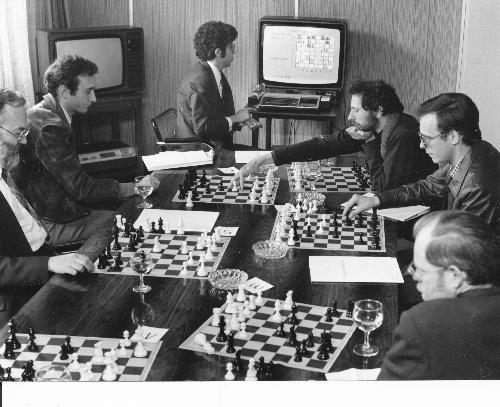
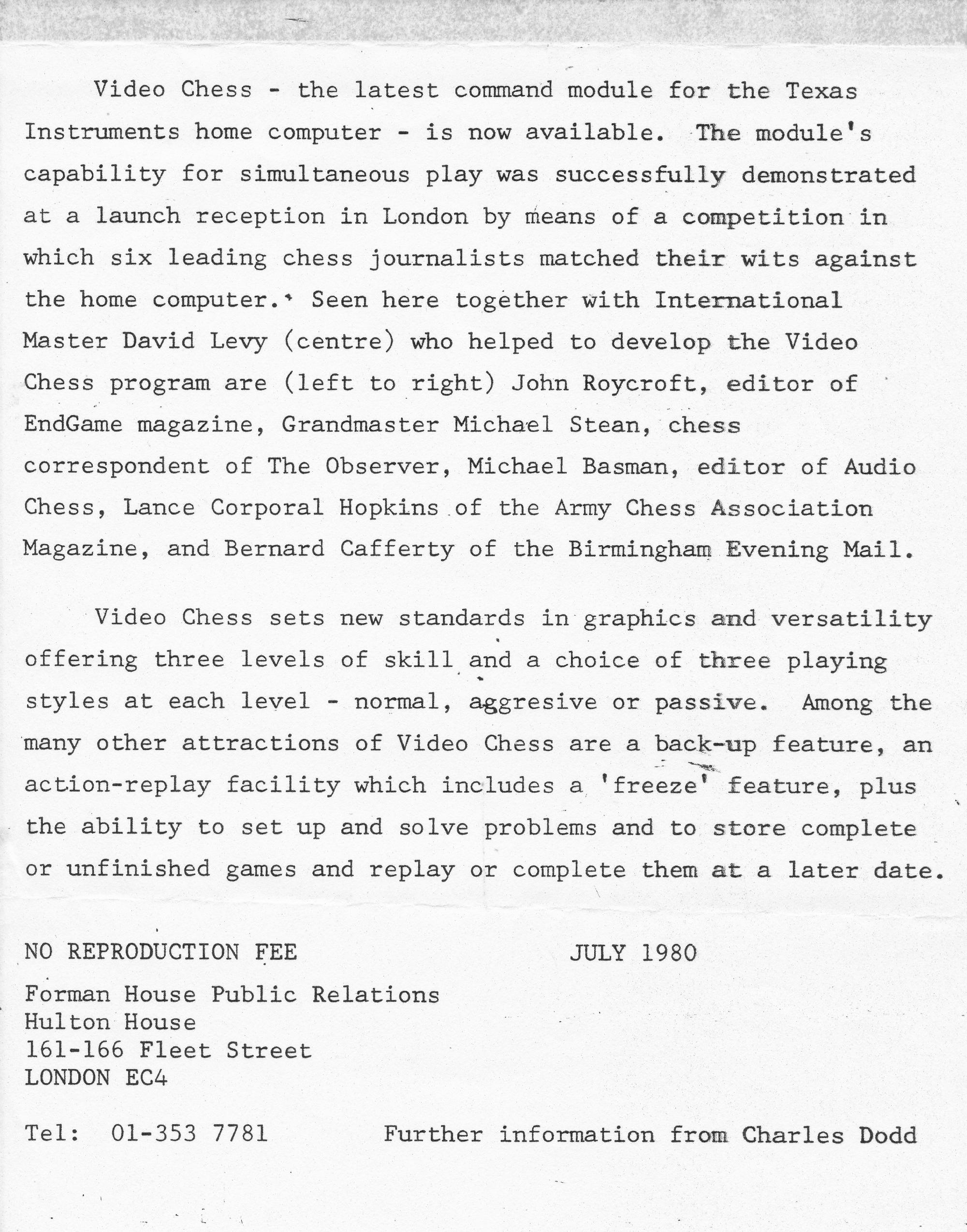
Video Chess Event (See caption below)
Video Chess Caption
Video Chess Caption

AJR won the BCF President’s Award in 1995.

Here is AJRs Wikipedia entry

Here is AJR talking about himself on the BPCS web site

Here is his entry from the Chess Programming Wiki

Test Tube Chess
Test Tube Chess

Happy Birthday John Rice (19-vii-1937)

John Michael Rice
John Rice

BCN sends best wishes to John Rice on his birthday, July 19th in 1937.

John Michael Rice was born in Scarborough, Yorkshire, North Riding, his mother’s maiden name was Blake. John lives in Surbiton, Surrey and teaches Modern Languages at Tiffin School, Kingston-Upon-Thames.

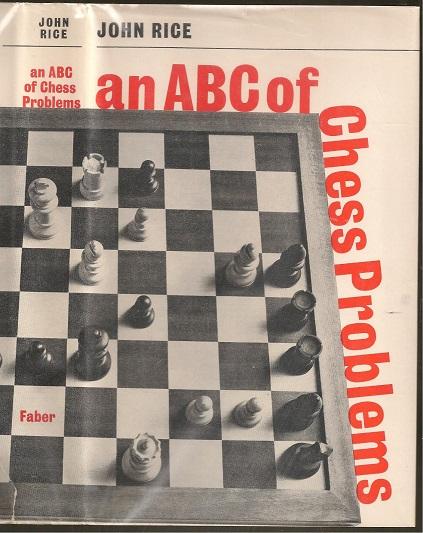
An ABC of Chess Problems

From An ABC of Chess Problems :

“The author is one of the country’s most prolific foremost composers and problem critics. He has gained mainly tourney honours, both at home and abroad, and since 1961 has been editor of a flourishing problem section in the British Chess Magazine, the country’s leading chess periodical. He lives in London and teaches Modern Languages at Tiffin School, Kingston-Upon-Thames.”

From chesscomposers.blogspot.com :

John Rice was the chief editor of the problems section of the “British Chess Magazine” from 1961 until 1974 and is a faithful collaborator of “The Problemist“. He has written “Chess Problem: Introduction to an Art” (1963) together with Robin Matthews and Michael Lipton and “The Two-Move Chess Problem” (1966), “Serieshelpmates” (1978) with Anthony Dickins or “Chess Wizardry: The New ABC of Chess Problems” (1996).

Translated from https://peoplepill.com/people/john-michael-rice/ :

“Since the mid-fifties he has composed problems of all kinds, but above all in two moves. In the 1960s he was editor of the problems section of the British Chess Magazine. Since 1999 he has been editor of The Problemist magazine.

International Master of Composition since 1969 and International Judge for Composition since 1972.

President of the PCCC (Permanent Commission for Chess Composition) from 2002 to 2006.

He worked as a teacher of modern languages ​​in a school in Kingston-upon-Thames.

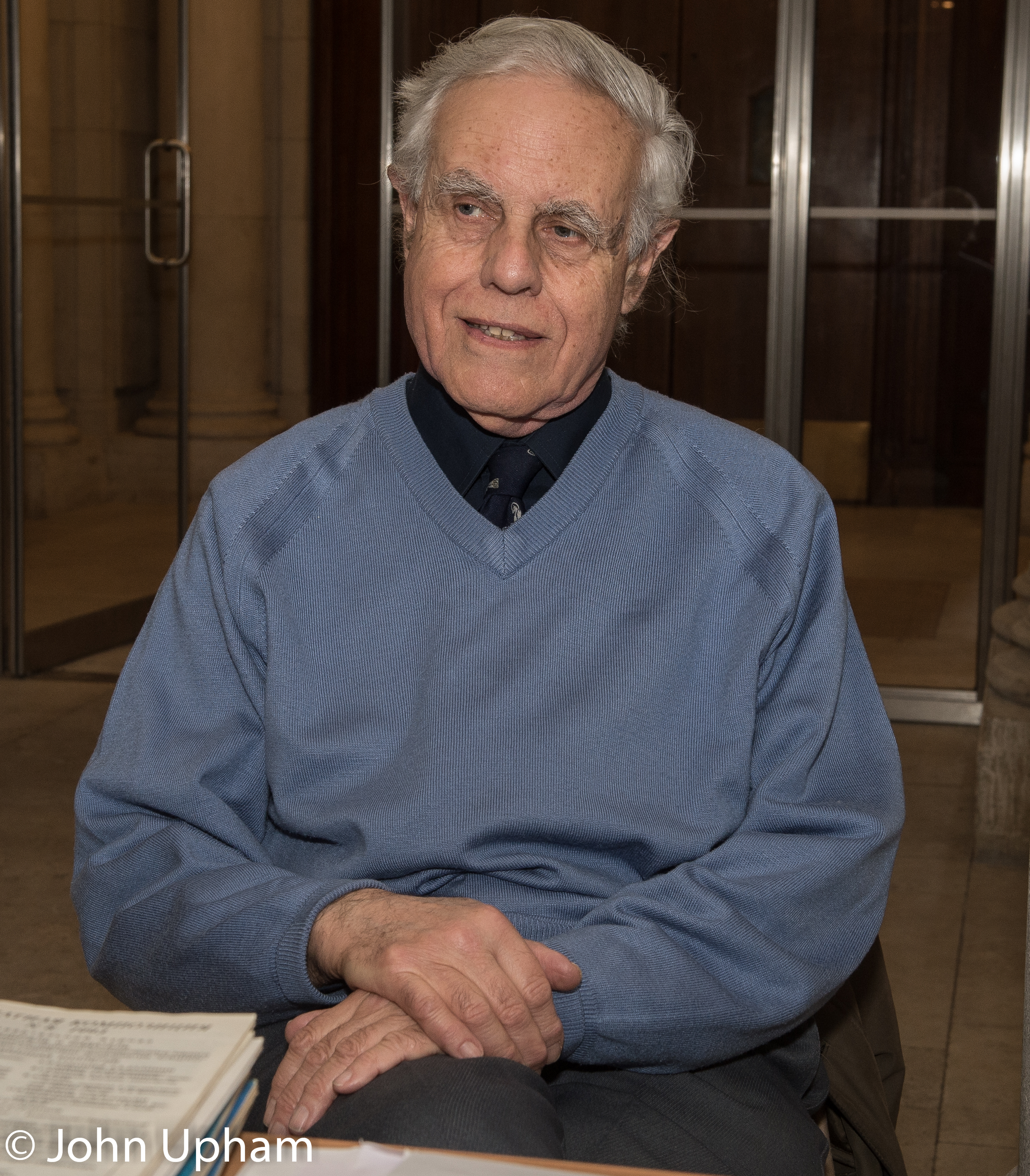
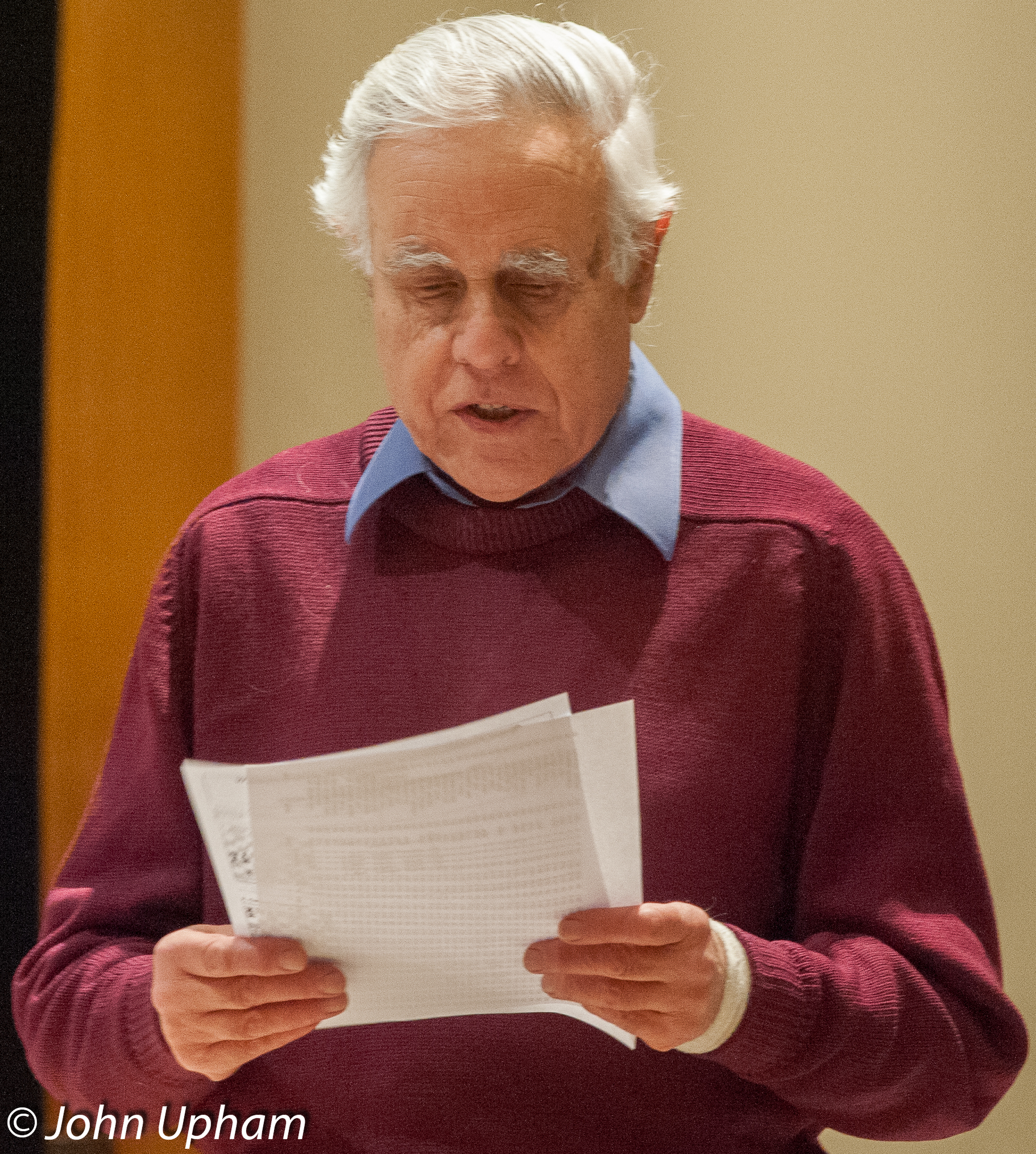
John Rice at a Winton Capital BCPS Problem Solving event at Eton College, courtesy of John Upham Photography
Winton Capital British Chess Problem Solving Championships 2016

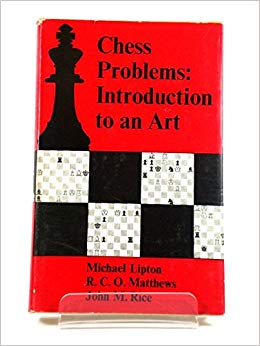
Together with Barry Barnes and Michael Lipton he wrote the book Chess Problems: Introduction to an Art (Faber & Faber, London 1963).

Chess Problems : Introduction to an Art

He composes mostly direct mates, but can composes as well in other genres, including fairies. He is an International Judge for twomovers, helpmates and fairy problems and the former President of the PCCC from 2004 until 2006.

John was awarded the title of “International Grandmaster for chess compositions” in 2015.

From British Chess, Pergamon Press, 1983 by GS Botterill, DNL Levy, JM Rice and MJ Richardson :

“I was taught the moves of chess in 1947 at the age of ten and quickly realised that I liked the game no more than Ludo or Snakes and Ladders where the chances of losing seemed to me unfairly high. But the chess pieces and their moves fascinated me, so it is hardly surprising that before long I had turned to problems and become an ardent fan of Brian Harley in his Observer column, especially as I had come across and paid two shillings (!) for his Mate in Two Moves in a second-hand bookshop in Reigate. Harley, together with T. R. Dawson in the British Chess Magazine and C. S. Kipping in CHESS, provided the sources of my first solving pleasure and the inspiration for my first efforts at composition. Among my early successes was problem l, heavily constructed but strategically rich, a first prize winner in a tournament for composers under 21, one of a series organised by the British Chess Problem Society.

1

1st Prize, BCPS Under-21 Tournament, 1955

[fen]4B1N1/4nqr1/r3R3/R4npk/3pQB1P/4p1pP/4P1N1/5K2 w – – 0 1[/fen]

White mates in 2.

1 Bd6 (threat Qg4)
1…Nxd6+;2.Qf3
1…Nh6+;2.Qf3
1…Nxh4+;2.Nf4
1…g4;2.Rh6
1…gxh4;2.Qxh4

I had grown up in Scarborough (Yorkshire), out of contact with other problem enthusiasts, and a chance meeting in December, 1954 with Michael Lipton in Cambridge, where we were both taking Scholarship examinations, brought the realisation that there was far more to the two-move chess problem than the solidly entrenched traditionalism espoused in those days by the columns of The Problemist and CHESS. Very soon the bulk of my output was in the modern style (with set and try-play) and published abroad, notably in Die Schwalbe, whose two-move editor, Hermann Albrecht, did much to stimulate my interest. Problem 2 gained a coveted prize in an extremely strong formal tournament judged by Michael
Lipton, following an article of his on the potentialities of the half-battery theme (illustrated here by the arrangement on the c-file).

2

5th prize, 133rd Theme Tournament, Die Schwalbe, 1961.

[fen]B4b2/5b2/4p3/R1B2pp1/P1k2qQ1/P1Npp3/1KN5/2R2n2 w – – 0 1[/fen]

White mates in 2

1.N2~? Bg7+!
1.Nd4!? e2!
1.N3~? Bxc5!
1.Ne2! d~!
1.Ne4!!

The half-battery is only one of several themes which have commanded my attention over the past 20 years, others being white self-pin in try and key (illustrated by problem 3), Grimshaw and Nowotny (problem 4), reciprocal and cyclic play (problem V, the first published example of cyclic mates in three phases), pawn-promotion effects, and tasks of various types, especially open gates. My total problem output numbers about 600.

3

The Tablet, Commended, BCPS Ring Tournament 1958; Brian Harley Award

[fen]1b1r4/3n4/6b1/5Q2/3p1p1R/3Pkp1R/2P1N2K/3BB2n w – – 0 1[/fen]

White mates in 2

1.Rxf4? (threat 2.Rhxf3)
Ne5; 2.Re4
Ng3; 2.Rfxf3
1.Nxf4! (threat 2.Rxf3)
Ne5;2.Ng2
Ng3;2.Nd5

In 1961 I took over from S. Sedgwick the editorship of the problem section of the British Chess Magazine, which post I held until December, 1974. It was a source of pride to me that I was now doing the job once done by the great T. R Dawson, though I knew that I could never bring to it the same tireless energy and all-round expertise which he had displayed so impressively. At about the same time I embarked with Michael Lipton and Robin Matthews on a venture which was to have repercussions throughout the entire problem world,
namely a series of books on problems published by Faber and Faber. The first, Chess Problems: Introduction to an Art (Lipton, Matthews and Rice), appeared in 1963, and was followed three years later by The Two-move Chess Problem: Tradition and Development, also with Michael Lipton, but this time the third collaborator was Barry Barnes, who has long been a close friend and influence. The third book in the series, An ABC of Chess Problems (1970), was a solo effort.

4

4th prize, BCF Tournament 123, 1970

[fen]3RK3/b1RN4/r3pPn1/1p1N3Q/1Bpk4/6q1/5P2/1B6 w – – 0 1[/fen]

White mates in 2

1.N5b6?, Rxb6/Bxb6/Qd3/Qd6;
2.Qc5/Ne5/Nc5/Qd1 … Qg5!

1…Qg5!

1.N7b6!, Rxb6/Bxb6/Qd3/Qd6/Qxc7;
2.Bc5/Nf4/Nc3/Bc3/Nxc7

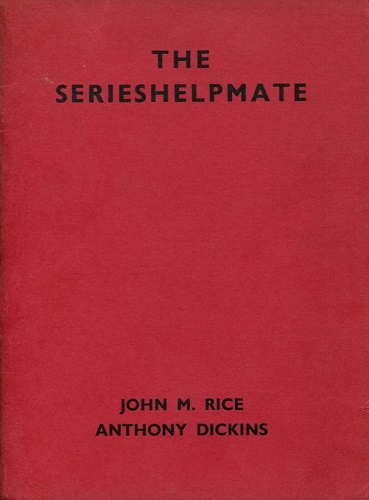
My interest in Fairy Chess dates from a meeting in the mid-1960s with the late John Driver, whose enthusiasm for the pleasures to be derived from non-orthodox forms I found highly infectious. Fairy problems soon began to appear in the BCM column and were favourably received. The serieshelpmate, where White remains stationary while Black plays a sequence of moves to reach a position where White can mate in one, has perhaps interested me more than any other non-orthodox form (see problem Vl), and in 1971 I collaborated with Anthony Dickins to produce a book on the subject, The Serieshelpmate (published by the Q Press, first edition 1971, second edition 1978).

5

1st Prize, Problem  37th Theme Tournament, 1961-62

[fen]1Q5B/1p1k1p2/r5r1/b1PN1p2/2KR3q/8/8/8 w – – 0 1[/fen]

White mates in 2

Set: 1…Kc6; 2. Qe8 (A)
1…Ke6; 2. Qc8 (B)

Try: 1.Nb6+?, Kc6;2.Qc8 (B)
Ke6;2.Qd6 (C)
Ke7!

Key : 1.Nf6+! Kc6;2.Qd6 (C)
Ke6;2.Qe8 (A)

Since 1974 my problem activities have necessarily been restricted by the demands of family life (wife and two sons, none of them much interested in chess) and my career (schoolmaster, formerly Head of Modern Languages Department and now Director of Studies at Tiffin School, Kingston Upon Thames. Other leisure-time interests (not that there is much leisure time) include cricket and classical music.”

6

2nd Prize, BCF Tournament  127, 1971

[fen]qk6/prb5/pN1p4/p7/P3K3/6p1/6r1/7b b – – 0 1[/fen]

Serieshelpmate in 13

1.Bd8;2.Kc7;3.Kc6;4.Rf7;5.Rf3;6.Rc2;7.g2;8.Rf7;9.Rb7;10.Kc7;11.Kb8;12.Rc8;13Bc7, Nd7 mate.

John Michael Rice
John Rice

From The Encyclopaedia of Chess (Batsford, 1977), Harry Golombek OBE, John Rice write about himself:

“British problem composer, output about 500, mainly modern-style two-movers but also several helpmates, serieshelpmates and fairy problems. Editing: problem section of British Chess Magazine (1961-1974). Author of An ABC of Chess Problems(1970), and co-author of Chess Problems: Introduction to an Art (1963), The Two-move Chess Problem: Tradition and Development (1966) and The Serieshelpmate (1971). International master (1969): International Judge (1972).”

The Two Move Chess Problem : Tradition and Development
John Rice at a Winton Capital BCPS Problem Solving event at Eton College
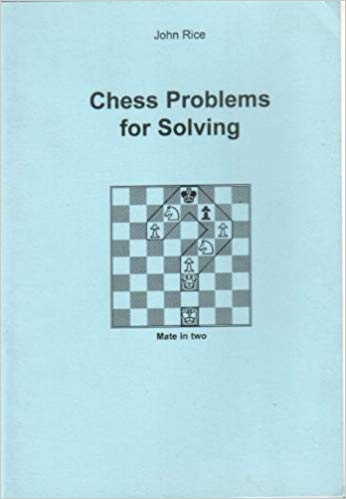
Chess Problems for Solving
The Serieshelpmate
The Serieshelpmate
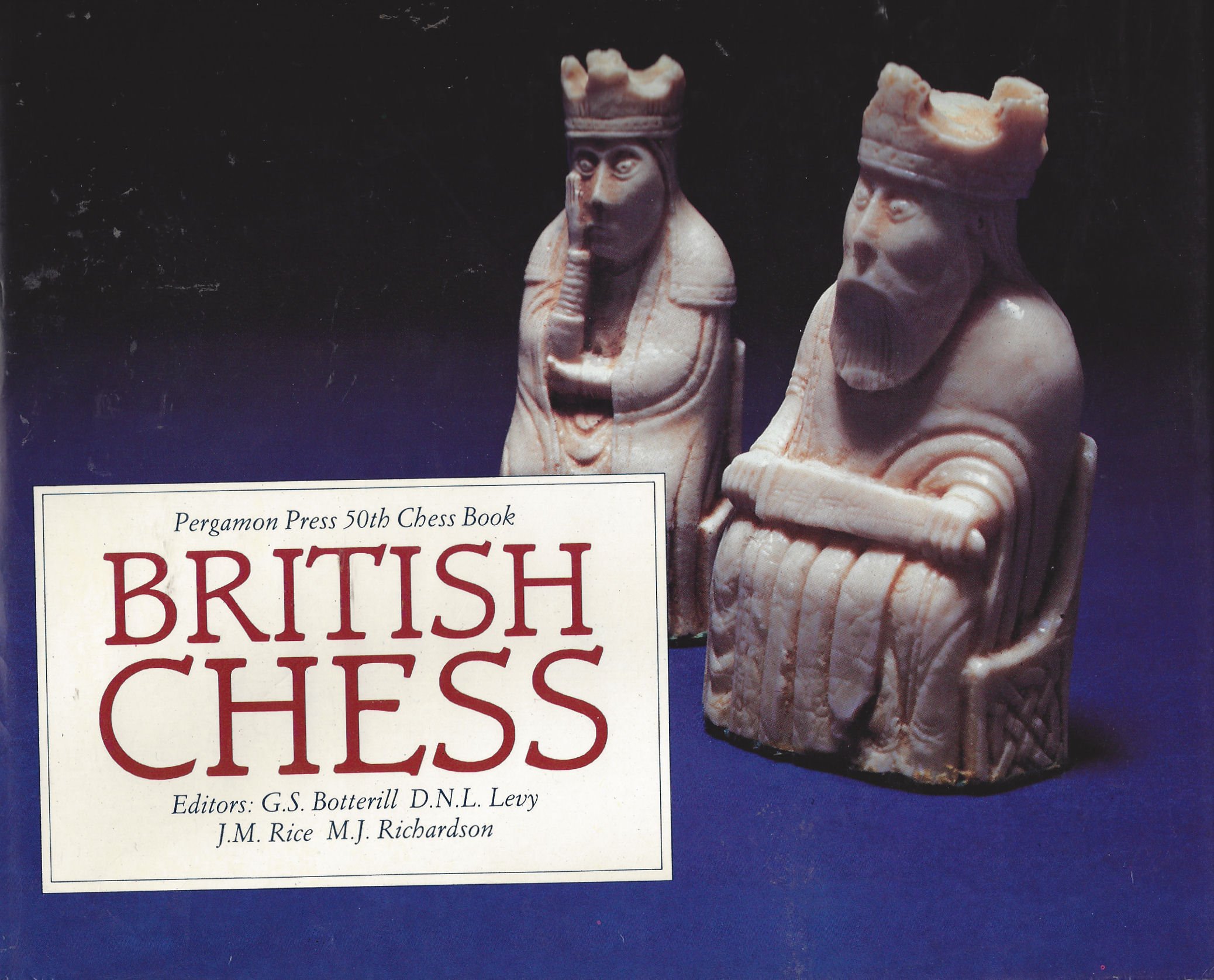
British Chess, Pergamon Press, 1983. Editors : GS Botterill, DNL Levy, JM Rice and MJ Richardson

Remembering Guy Chandler (21-viii-1889 25-v-1980)

Death Anniversary of Guy Wills Chandler (21-viii-1889 25-v-1980), scanned from Chess Pie 1922 by Michael McDowell

Remembering Guy Wills Chandler (21-viii-1889 25-v-1980)

From The Encyclopaedia of Chess by Anne Sunnucks :

“International Judge of FIDE for Chess Compositions, Chandler, who was born on 21st August 1889, has composed about 125 two and three-move problems, all in traditional style. Some 30 have gained tourney honours. He was the chess editor of the Hampshire Telegraph and Post from 1911-1921 and he was a founder member of the British Chess Problem Society, Its Hon. Secretary from 1919 – 1925 and Hon. Secretary and Treasurer since 1951.

G.W.Chandler
Commended “The Problemist” 1960

[fen]8/4p3/2Bqr3/8/4p2R/1R1n1k2/3Q3P/1K6 w – – 0 1[/fen]

White to play and mate in two moves

From The Encyclopaedia of Chess (Batsford, 1977), Harry Golombek OBE, John Rice writes:

“British problemist, active as a composer mainly during the 1920 and 1930s, specialising in model-mate three-movers. Best known for his work as Secretary of the British Chess Problem Society 1919-25 and as Secretary and Treasurer from 1952. International Judge (1957). “

Remembering Brian Harley (27-10-1883 18-v-1955)

Brian Harley (27-10-1883 18-v-1955), from chesscomposers.com and Chess Notes

Death Anniversary of Brian Harley (27-10-1883 18-v-1955)

From chesscomposers.com :

“Brian Harley composed mostly two- or threemovers and wrote many books to make chess problems more popular: for instance his “Mate in Two Moves” inspired Geoff Foster’s first steps into problem dom.
Harley’s “The Modern Two-move Chess Problem” written in collaboration with Comins Mansfield is probably the best known of his efforts.

Brian Harley was the inventor of the term “mutate” for the block problems with changed mates. He was the president of the British Chess Problem Society from 1947 until 1949. In his honour, each year the British magazine “The Problemist” awards the best twomover problem with the “Brian Harley” award.”

and Edward Winter writes about Brian Harley (scroll down a little).

Here is BHs obituary from British Chess Magazine, Volume LXXV, Number 9, pages 284 – 287 written by S. Sedgwick :

“With the death of Brian Harley on May 18th,1955, the chess problem is the poorer by an authoritative exponent, and a writer of unusual clarity and popular appeal. His sudden passing at his home at Bognor Regis will be mourned. by a very wide circle of friends; to his wife and son, with whom he enjoyed an enduring happiness, we extend our deep-felt sympathy.

Born at Saffron-Walden, Essex, on October 27th,1883, Harley was educated at Wellingborough and Haileybury. Qualifying as an actuary he entered the National Provident Institution, in whose employment, apart from War Service, he passed his professional life, until his retirement in 1947.

As a player he had initially a considerable reputation, above that enjoyed as a problemist. Two books, Chess and its Stars and Chess for the Fun of it, reflect this aspect of his chess work. When playing was eventually renounced for problems he still retained his love of annotation, bringing to this a wide knowledge, larded by the apt witticism and an approach that was neither superficial yet avoided the pitfalls of pedantry.

Chess and its Stars
Chess and its Stars

His first problem appeared at the age of fifteen, in 1898. Whilst Harley’s early period has some noteworthy items, it lacks the verve and distinction of his later output, following his awakening of interest in the mutate in 1916_and the fertile years following his appointment as Chess Editor of The Observer, London, in 1919. In England under the lead o[ Phillip Williams in the Chess Amateur, the mutate had sprung into popularity during and after the Great War, with Harley among its ardent exponents. He continued the cult in his Observer column, where he did much to popularize it. It is possibly symbolic that when Williams died in 1922 his travelling board and men should pass to Harley; it would be difficult to find a comparable instrument that has witnessed the genesis of so much concentrated chess devilry, implicit in all mutates, as this board used first by Williams and then by Harley.

In July, 1919, Harley published his system in the Good Companion folder. This paper, the outcome of much thought, attempted to evaluate the constituent parts of a chess problem on a semi-mathematical basis. Point values were set down for the elements in White keys, Black defences thereto, and the resultant White mates, the summation giving values for comparison with other works similarly treated. In an accompanying paper on the block-change it was here that Harley introduced the term “mutate,” the word passing, without cavil, into the current idiom. Under the evocative power of Harley’s work and pen his Observer feature from 1919 onwards has come to rank with the great columns of the past. No composer of substance was absent from its pages and the result is a collection of works and descriptive criticism that has enriched the chess literature of the world. Early on, Harley came to know the late Godfrey Heathcote, and the welcome presence of the great composers name in the column gave it a sublimity possessed by no other comparable English journal. Harley’s comments on his contributors work was one of the many attractive features of his column. He kept the popular approach very much in mind without unduly over-weighting it; this, blended with a brand of humour all his own (often literary in character), and a grasp of essentials drove home the salient points of a problem to the uninitiated solver with a peculiar vividness. He could ‘be incisive when wanted, technical when he pleased, his gentle rebuke for the inferior production or undetected flaw could not be other than well taken, authoritative without ostentation, his succinct criticisms are now legendary to be treasured and repeated when the occasion demands. An incorrigible faddist in his regard for the short threat in the three-mover, Harley seldom admitted this type to his pages, pleading aversion by solvers. He conducted over one hundred solving contests during his column’s life; these weekly battles of wits affording enormous pleasure to all concerned.

Chess for the Fun of It

To his column came the established composer and the hesitant, possibly young, beginner. To this last group Harley gave every encouragement and unreservedly of his advice and help. There must be few British composers who have not felt his benefit directly, through the medium of his wonderful letters, lit all the way through by the warm glow of an endearing personality.

Harley’s constructive powers brought him to the front rank of the world’s composers. His output of 450 includes long range work in four and five moves and in later years, sui-mates. In the chess-men he found a pliable medium for the realization of an unusual vision and creative gift. In the two-mover he gave to the mutate much substantial and classic work. He appears to have given to this type more specialized attention than any other in the two-move field. Elsewhere in this length his work covers a wide variety of themes with a strong liking for task renderings. A composer with few serious constructive foibles, his mode of expression, in consequence suffered little. His was not the temperament to linger with one theme and squeeze it dry. One or two renderings of the theme on hand and he would pass to the next. Hence the diversity of his work which imbues it with especial charm. To underline this point one could indicate, almost at random, Harley’s entries in the multimate tourney of the Cleveland Chess Bulletin. Certainty the theme had few attractions for him but his entries showed how superbly such problem ideas could be clothed.

In the three-mover Harley has graced both sides of the aesthetic fence, and that with distinction, giving equally to the strategic and model-mate genre. His friendship with Heathcote however influenced him considerably here and one is inclined to the view, that in this length, Harley held firmly to the eternal values in chess art. In both types Harley attained especially in task renderings, rare heights of complexity and construction. His lighter mood showed to the full-to the incipient solver much of the low cunning of which the three-mover is capable.

He came to the sui in the late forties. When Heathcote was convalescing in London, following an operation, Harley took some specimens with him when he visited his friend The ensuing discussion stimulated Harley to further experiments and the authentic touch of the great master of technique is evident in his work here also. Harley gave many of his works to his own “Observer” column but did not neglect the other sources of publication. To quote his own words his ideal problem was “a mixture of art, science, humour, and puzzlement.” His best work shows brilliantly his love for the integration of the beautiful and the true inner essence and spirit of chess.

His contribution to the literary and technical side of chess problems outside his journalistic work is seen in his two books Mate in Two (1931) and Mate in Three (1943).
Mate in Two is stamped with all Harley’s inimitable style and remains a mine of information for all levels. Standing, as it does, mid-way between the old and the new, the book, apart from an absorbing chapter on changed play, reflects and even labours under the influence of the “Good Companion” period. Harley in later editions to a certain extent remedied this deficiency and the book, now long out of print, lies on our shelf, its fundamentals unimpaired, as one of the classic expositions in the art. Mate in Three, written from a’ narrower viewpoint, proved another successful publication. Here Harley entered more controversial ground, crossing swords. with hitherto established theory. The book, although not evoking absolute technical authority, gives a broad and eloquent outline, written from the artistic standpoint, of three-move work fundamentally, with few significant omissions. Made memorable by the inclusion of many works both by Harley and Heathcote, the book is that of a true artist, and is of great importance theoretically as the one modern work devoted to this length by an English author.

101 Chess Puzzles
101 Chess Puzzles

A further important contribution to chess problem theory was his thesis on “Black Correction” read before the British Chess Problem Society on November 29th, 1935. In the mid thirties, this thesis, more than anything else, was instrumental in precipitating a flood of work on correction and associated ideas. Readers of this magazine will recall this period, and I trust that this short recapitulation will still the tiresome arguments regarding the choice between “correction” and “continued defences.” Harley’s choice is at once apt and descriptive and it should not be forgotten that here, he touched upon White Correction, an esoteric aristocrat, greeted by ten years or so of utter silence before systematic investigation by the moderns.

Elected President of the British Chess Problem Society in 1947-1949 it so happened that I was its Secretary at the time. We exchanged hundreds of letters on problematic subjects, the scope of his knowledge always affording surprise. The Society benefited enormously from his advice and counsel, and during the somewhat delicate situation arising from the arbitration in the two-move section of the 1948 Olympic Tourney it was with alacrity that one turned to a mind of the calibre of Harley. Coming to the man he was widely read, a Latin scholar, and his knowledge of Dickens was above average; a keen bridge player, an instrumentalist (piano), all the varied facets of his character would come out at some time in his chess writings. His physical presence at any gathering gave it stature. Of medium height, lovable, somewhat dapper, the shrewd contemplative face of this chess Barrie with its ever present cigarette holder and fund of anecdote has enriched and enlivened many a dull Committee Meeting.

Mate in Two Moves
Mate in Two Moves

On the death of Anthony Guest in 1925, Harley succeeded as Problem Editor of the Morning Post until 1932. In addition he was Problem Editor of Empire Review, 1923-1926, and Time and Tide, from 1951 until his death. Lesser appointments included several technical journals where he acted under pseudonyms. Amusing were the anagrammatical pseudonyms used occasionally for composing in Hilary Bream and Harry Blaine.

Brian’s integrity and character endeared him to innumerable correspondents and solvers. Most of us nourish a characteristic Brian Harley story; one must suffice here. It concerns the time when Brian was introduced to the late Sir John Simon who made the delightful response “l need no introduction for I meet him every Sunday and for years hive wrestled with his problems, eventually solving them in the House of Commons.” For this weekly enrichment of our lives we have much to thank him for.

In middle life Brian married Ella Margaret Beddall; there is one son, Nigel. With his wife, Brian shared many problematic triumphs and it was to her that his various books were dedicated.

Mate in Three Moves
Mate in Three Moves

Before closing this brief review of Brian’s achievements a word should be said regarding the summary end of his work in the Observer and a tribute paid by one of his many solvers in this column. On the former it will be regarded with universal regret by all problemists that no arrangements have been made to continue Brian’s incomparable work in the journal he served with such distinction. Regarding the latter am very grateful to Halford W. L. Reddish, Esq., for an appreciation that admirably epitomizes the feelings of us all on this melancholy occasion.

Mr. Halford Reddish writes-

“l am one of thousands of solvers, from the expert to the merest tyro, who will miss our weekly battle with Brian Harley in the Observer. In the world of chess and chess problems his name and fame are secure. His characteristically titled Chess for the Fun of It is a delightful exposition of the game: his Mate in Two Moves and Mate in Three Moves are classics in their particular field.

To those of us who knew Brian personally his passing leaves an unfillable gap. I had known him and admired him and loved his witty, cheery, kindly personality for many years. He was one of those rare beings who became a close friend even before our first meeting-for we had corresponded for a long time before we first came face to face. And although chess and chess problems were our primary link he had many other interests which kept him young and keen in mind after his retirement from business and which enlarged and enriched his correspondence. It is typical of him that no letter came from him without some mention of his dear wife, who shared to the full his varied interests. To her and to his only son to the deep sympathy of his many friends.”

From The Encyclopaedia of Chess (Batsford, 1977), Harry Golombek OBE, John Rice writes:

“British problemist, known perhaps less for his problems (mainly two- and three-movers) than for his influential writing and editing. Chess correspondent of the Observer for over twenty years. Books include: Mate in Two Moves (1931), Mate in Three Moves (1943), and published posthumously) The Modern Two-Move Chess Problem, with problems by C. Mansfield (1958), President of the British Chess Problem Society 1947-9″

The Modern Two- Move Chess Problem, Brian Harley and Comins Mansfield, Museum Press, London, 1944 & 1958

Happy Birthday GM John Nunn (25-iv-1955)

"John DM Nunn Britain' Number 2 chess grandmaster and winner of the Benedictine International Chess Championship Tournament in Manchester pictured during the Benedictine Tournament. September 15th , 1980. Photograph by John C Madden"
“John DM Nunn Britain’ Number 2 chess grandmaster and winner of the Benedictine International Chess Championship Tournament in Manchester pictured during the Benedictine Tournament. September 15th , 1980. Photograph by John C Madden”

BCN wishes GM John Nunn Happy Birthday (25-iv-1955). John resides in Bude, Cornwall with his wife Petra (née Fink) having previously resided in Chobham, Surrey.  John became a director of Gambit Publications Ltd. on January 30th, 1997 along with  Murray Chandler and Graham Burgess. WFM Petra Nunn is the German editor.

Harry Golombek OBE wrote the following (presumably in 1978) in the 1979 Dataday chess diary:

“Fortunate is the country which has a number six player as good and as effective as John Nunn. As I wrote last time, ‘The former European Junior champion is such a fine player and pursues the game with such energy when he does play that one is apt to forget he is an amateur with only a limited amount of time to spare for study of the game.’

He like Mestel, obtained a grandmaster norm at the Lord John tournament where he score 5.5 points coming just below Mestel but beating both Quinteros and Torre in the process.

At the Moscow Team tournament, already mentioned, he had a magnificent result scoring 3.5 out of 7 on board 4. Perhaps it was this performance that increased his Elo rating by 30 points and when I say board 4 it should be realised that opposition consisted of such players as the former world champion Tal and many other genuine grandmasters. I give the entertaining and fighting draw he had with Tal as Moscow.”

[pgn]
[Event “EU-chT 06th Final”]
[Site “Moscow (Russia)”]
[Date “1977.04.??”]
[Round “5.3”]
[White “Tal, Mihail”]
[Black “Nunn, John DM”]
[Result “1/2-1/2”]
[ECO “D32”]
[WhiteElo “2620”]
[Annotator “British Chess News”]
[PlyCount “57”]
[EventDate “1977.04.13”]
[EventType “team-tourn”]
[EventRounds “7”]
[EventCountry “URS”]
[SourceTitle “EU-chT”]
[Source “ChessBase”]
[SourceDate “1999.07.01”]
[SourceVersion “2”]
[SourceVersionDate “1999.07.01”]
[SourceQuality “1”]
[WhiteTeam “Soviet Union”]
[BlackTeam “England”]
[WhiteTeamCountry “URS”]
[BlackTeamCountry “ENG”]

{[%evp 0,49,19,-12,-9,-12,-4,-4,12,5,15,20,19,11,8,-24,-13,-20,-11,-47,-41,-16,
-25,-52,-3,18,-17,39,38,1,27,22,50,-8,-13,-27,-27,-27,-27,-22,-9,-6,-8,-11,-20,
-45,-36,-35,0,-37,0,0]} 1. c4 Nf6 2. Nc3 e6 3. Nf3 c5 4. e3 Nc6 5. d4 d5 6.
cxd5 (6. a3 a6 7. dxc5 Bxc5 8. b4 Ba7 9. Bb2 O-O 10. Qc2 Qe7 11. Rd1 Rd8 12.
Be2 {is the modern main line.}) 6… exd5 7. Bb5 a6 8. Bxc6+ bxc6 9. Qa4 (9.
O-O Bd6 10. dxc5 Bxc5 11. b3 O-O 12. Bb2 Bg4 13. Rc1 Bd6 14. Ne2 Rc8 15. Ne5
Bxe5 16. Bxe5) 9… Bd7 10. O-O (10. Ne5) 10… Be7 $146 (10… Bd6) 11. dxc5
Bxc5 {[#]} 12. e4 $1 O-O (12… dxe4 $2 13. Nxe4 Nxe4 14. Qxe4+ Qe7 15. Qc2 $1
{is really rather awkward for Black.}) (12… h6 {gets marks for bravery.}) 13.
Bg5 Be7 14. Rad1 Nxe4 $1 {Black correctly seeks exchanges to reduce White’s
pressure.} 15. Nxe4 dxe4 16. Ne5 $6 (16. Qxe4) 16… Bxg5 17. Nxd7 {[#] who
would want to have this position versus Tal but Nunn remains calm and finds
the best and only continuation.} Re8 18. Qxc6 e3 $1 19. fxe3 (19. Ne5 $2 Qe7
20. Rd5 exf2+ 21. Kxf2 Bf4) 19… Bxe3+ 20. Kh1 Qe7 21. Rfe1 Rad8 $11 22. Re2
h6 23. g3 Qb4 24. Rd3 Rc8 25. Rdxe3 {Agreed drawn.} Rxc6 {the game would have
continued} 26. Rxe8+ Kh7 27. Nf8+ Kg8 28. Ng6+ Kh7 29. Nf8+ {etc.} 1/2-1/2
[/pgn]

From British Chess (Pergamon Press, 1983), pp.201- 210:

“It is a difficult task to pick out three games from many hundreds played over the years. What criteria should be used in the selection? Brilliance, strength of opponent, importance of result – all these are reasons for a game to stand out in one’s memory. As this selection is autobiographical I have given prominence to the last criterion and so I will give one game from each of the tournaments in which I gained an International title, and one game from a team tournament.

The first of these tournaments was the European Junior Championships held over the new year 1974-5 in the Dutch town of Groningen. It was only by chance that I played in this event at all. Originally Jonathan Mestel was the English representative, but he was invited to play in concurrent Hastings Premier and so I travelled to Groningen instead.

The organisation of the Championship has changed over the years, but at that time a seven-round Swiss formed a preliminary event, with the top ten of the twenty-eight participants going on to an all-play-all final section. The score thought to be sufficient for qualification was 4.5/7 and the accepted method of reaching this target was to win one’s first two games and then draw all the others., facilitated by the fact that one’s opponents would also require draws to reach the magic figure 4.5. However tie-breaking in the final was decided  firstly by the score in the preliminaries and secondly by the result of the individual game in the final, so it was clearly an advantage to outstrip one’s rivals in the Swiss. I started with the requisite two wins and then drew my next three games, but in round six with the white pieces I decided to play for the win against Manny Rayner of Wales. I felt slightly self-conscious playing amidst a row of boards on which peace has been concluded at an early stage, but I did gain the full point. The game stirred up a certain amount of comment and I even heard one player’s second declare

You can’t trust Nunn!

In such a short race there will inevitably be upsets and the unlucky man on this occasion was Alexander Ivanov, the Russian representative.

The final round started less smoothly for me and after five rounds the leading scores were Borokowski 4, Szekely 3.5 and van der Sterren and myself on 3. I had already beaten van der Sterren, who had tied with me in the preliminaries, so in view of the tie-break rules, I had effectively half-a-point advantage over the rest of the field. In round six I played Borkowski and a win for would leave the tournament wide open.

[pgn]
[Event “EU-ch U21 fin-A”]
[Site “Groningen”]
[Date “1975.01.02”]
[Round “6”]
[White “Borkowski, Franciszek”]
[Black “Nunn, John DM”]
[Result “0-1”]
[ECO “B09”]
[Annotator “John Nunn & British Chess News”]
[PlyCount “61”]
[EventDate “1974.12.27”]
[EventType “tourn”]
[EventRounds “9”]
[EventCountry “NED”]
[SourceTitle “EXT 2000”]
[Source “ChessBase”]
[SourceDate “1999.11.16”]
[SourceVersion “1”]
[SourceVersionDate “1999.11.16”]
[SourceQuality “1”]

{[%evp 0,56,33,25,79,73,87,74,80,47,36,39,32,38,33,39,59,7,7,-56,-68,-74,-83,
-162,-154,-176,-26,4,4,4,4,8,25,25,25,-45,-45,-45,0,0,0,0,0,-112,-114,-324,
-324,-432,-213,-211,-219,-249,-199,-204,-189,-210,-208,-613,-625]} 1. e4 g6 2.
d4 Bg7 3. Nc3 d6 4. f4 Nf6 5. Nf3 O-O 6. Bd3 {At the time that this game was
played} Na6 {was only seen infrequently.} 7. e5 ({the most common idea today
is to exploit the position of the knight on a6 by means of the solid build-up.
} 7. O-O c5 8. d5) {In my preparations for the tournament I wondered if} 7…
Nd7 $5 {was possible. The knight has more chances to return quickly to active
play on d7.} ({The “standard” refutation of 6…Na6 would normally follow} 7…
Ne8 8. Be3 c5 9. dxc5 Nxc5 10. Bxc5 dxc5 {and Black’s knight and king’s bishop
are out of play, giving White a clear plus.}) 8. h4 {I had already used 6…
Na6 once in this tournament and the speed with which my opponent played 8.h4
indicated that this line had been prepared.} ({Other attempts to wipe out
Black are} 8. Ng5 Nb6 9. O-O) ({and} 8. e6 {A sketchy analysis indicated that
none of these moves won instantly, so I decided to risk the line in a game. In
fact these ideas for White have not proved popular.} fxe6 9. Ng5 Nf6 10. Qe2
Nb4 11. Bc4 d5 12. Bb3) 8… c5 9. h5 cxd4 10. hxg6 hxg6 $1 ({Some analysis of
} 10… dxc3 {with Jon Speelman had convinced me that it might be playable but
over the board I decided that} 11. gxf7+ ({BCN: In fact modern analysis shows}
11. Ng5 $1 {[#]} hxg6 12. Bxg6 Nf6 13. exf6 fxg6 14. fxg7 Kxg7 15. Kf2 {
is totally winning for White.}) 11… Rxf7 12. Ng5 {looked rather dangerous so
I played the (relatively) quieter text move.}) 11. Ng5 $2 (11. Nxd4) 11… dxe5
(11… Nxe5 12. Nce4 Qa5+ 13. Bd2 Nxd3+ 14. cxd3 Qb5 $19) (11… dxc3 {was
impossible due to} 12. Bxg6 fxg6 13. Qd5+ {mating}) 12. f5 $1 {an unexpected
but strong move, bringing the other bishop into the attack.} (12. Qg4 Nf6 13.
Qh4 dxc3 14. fxe5 Nh5 {would, on the other hand, allow Black to defend
comfortably.}) 12… Nf6 {I used over an hour on this move. This move may
appear suicidal but in fact White has difficulty breaking through. In
practical play it was hard to be sure that White could not somehow deliver
mate so I settled for the safer move 12…Nf6.} ({unable to decide whether to
play} 12… gxf5 {or not.} 13. Qh5 (13. Bxf5 Nf6) 13… Nf6 14. Qh3 dxc3 15.
Nh7 Ng4 $1 (15… Re8 16. Bh6 {“wins”} {BCN: in fact} cxb2 (16… f4 17. Nxf6+
Bxf6 18. Qh5 cxb2 19. Bh7+ Kh8 20. Rb1) 17. Nxf6+ exf6 18. Rd1 Qa5+ 19. Ke2 e4
{is a crazy line}) 16. Nf6+ Nxf6 17. Bh6 cxb2 18. Rb1 Qa5+ 19. Kf1 f4 20. Qh4
e4 $1 21. Bxg7 Qh5 $1 {winning}) 13. fxg6 Bg4 14. gxf7+ Rxf7 15. Ne2 ({After
the game a spectator approached me and explained that he had expected} 15. Bg6
{However, after} Bxd1 16. Bxf7+ Kf8 17. Ne6+ Kxf7 18. Nxd8+ Rxd8 19. Nxd1 {
although White has won the exchange for a pawn the counterattack} Nb4 20. O-O
Nxc2 21. Rb1 e4 {wins for Black.}) ({I aslo considered the alternative queen
sacrifice} 15. Qxg4 Nxg4 16. Bh7+ Kf8 17. Ne6+ Ke8 18. Nxd8 Rxd8 19. Ne4 Nb4
20. Ng5 Rf6 {when the manoeuvre …Nd5-e3 should give Black the advantage.})
15… Qd5 16. Bg6 Rff8 17. Qd3 {threatening Bh7+} e4 {[#]} 18. Qxd4 $2 ({
Another bad move is} 18. Nxe4 {due to} Nb4 19. Nxf6+ Rxf6 20. Bh7+ Kf8 {
with a decisive counterattack.}) ({Two days after this game Borkowski came up
to me and claimed that the astonishing move} 18. Nc3 $1 {would have won. This
is certainly best as Black cannot reply} dxc3 $2 (18… exd3 19. Nxd5 Rae8 20.
cxd3) ({The critical line is} 18… Qe5 19. Ncxe4 Nc5 20. Qc4+ Ne6 21. Rh4 Rac8
22. Qb3 Rc6 {with an extremely double edged position. In this line the balance
between defence and attackwould have been preserved whereas after 18.Qxd4?
Black triumphs.}) {as} 19. Bh7+ {wins}) 18… Qxd4 19. Nxd4 Rad8 20. Be3 ({If}
20. Nge6 Rd6 ({BCN:} 20… Nb4 $1 21. Be3 Nxc2+ 22. Nxc2 Bxe6 23. Bxa7 Rd3 $17)
21. Nxf8 $2 ({BCN:} 21. Bf5) 21… Kxf8 22. Be3 Nd5 {picks up a piece.}) 20…
Nb4 {threatening …Rxd4} 21. Rc1 $2 {BCN: This appears to be the losing
blunder.} (21. a3 Rxd4 22. axb4 Rxb4) 21… Nbd5 $19 22. Bf2 {Both bishops are
in danger,} ({for example} 22. Bd2 e3 {is catastrophic}) 22… Nf4 {Wins two
pieces for a rook while maintaining the initiative} 23. Bf5 Rxd4 24. Bxd4 Bxf5
25. g3 Ne6 26. Nxe6 Bxe6 27. Bxa7 Ng4 28. Bc5 Bxb2 {and white resigned which
surprised me since I was expecting} {the trap} 29. Bxe7 Bxc1 $2 ({but of course
} 29… Bc3+ 30. Kd1 Nf2+ 31. Ke2 Bc4+ 32. Ke3 Rf3# {is effective.}) 30. Bxf8
Kxf8 31. O-O+ {when Black would only win with difficulty.} 0-1
[/pgn]

I scored well in the three rounds after this game and appeared to have a good chance of winning. However in the penultimate round I lost to Lars-Ake Schneider in only 18 moves so as the last round started the leading scores were Szekely 5.5 out of 8 with Schneider, Borkowski and myself on 5. Skekely was White against Borkowski while I had White against the Israeli Grunfeld. Schneider blundered quickly and lost, while to my surprise Skekely drew in only 14 moves. The way was now open to the title if only I could defeat my opponent. However after 4.5 hours play I had only a slight advantage. But then a curious thing happened. I made my 40th move with a minute or two left on my clock and Grunfeld, who had half an hour left, replied almost immediately. The game was played to a finish without adjournment and now, with an hour on my clock, I was able to see that his 40th move was a mistake allowing a decisive combination. This small event decided the result of the tournament and so I became European Junior Champion and an International Master.

The second game was played in the Finals of the European Team Championship held at Moscow 1977. This event which takes place every three years, is second in importance only to the biennial Olympiads. The twenty teams entering were divided into five preliminary groups to produce seven qualifiers for the final. The USSR, as previous winners, were admitted directly to the final to make up the total of eight countries represented at Moscow. England qualified ahead of Holland, the other teams in this preliminary group being Wales and France. Since the matches in the final take place over eight boards this event is much more test of strength in the depth than the four board Olympiads and so England was not expected to do well, especially in view of the absence of Tony Miles. Nevertheless the final result of bottom place was a disappointment. My individual performance of 50% against strong opposition was quite satisfactory, but it was the following game which made the tournament particularly enjoyable for me.

We now move ahead to the summer of 1978. At this time I had a 9-game grandmaster norm from the Lord John Cup held in London during September 1977 and so I needed a 15-game norm to actually gain the title. In July I played in an event at Lublin in Poland at which, however, there was no GM norm. My play showed evidence of lack of practice and my final position was rather low.

Then I went on to the annual Tungsram tournament held in Budapest during August. This was a much stronger event (category 10) and the GM norm was a formidable 10 out of 15. However my play was much better than in Poland and, after a first round loss, I began to score well. After 12 rounds the leading scores were Kuzmin 8, Nunn 7.5 and Csom, Jansa, Adorjan and Mednis 7. I could have had half a point more if I had not overlooked a combination two (!) moves deep winning Kuzmin’s queen, but, apart from this incident Kuzmin had played very well and seemed to be heading for first prize.

My sights were firmly set on scoring 2.5 from the last three games to reach the GM norm and my interest in winning the tournament was secondary. However, Kuzmin was destined to lose his next two games and so these two objectives became one and the same.

In these final games I was to be White against F. Portisch (Lajos’ brother), Black against GM Jansa and in the last round White against Hardicsay, the weakest player in the tournament. The plan was clear – I had to win both games with White and hold Jansa to a draw with the Black pieces. The execution, however, was more difficult.

While preparing for F. Portisch I noticed that he played either the French or the Sicilian Pelikan. Since I was playing only for the win I naturally hoped he would opt for the complications of the Pelikan. Two days before this game I had been given a copy of the latest issue of the Hungarian chess magazine, Magyar Sakkelet, containing a game Honfi – Piasetki in which Honfi had played 11.Bxb5!? and won with the aid of a novelty. This piece sacrifice seemed to be ideal for stirring up as much trouble as possible and so I decided to try it in the game, at the same time hoping that F. Portsich had not read his magazine!

The first obstacle had been surmounted, but two more remained. The opening went badly against Jansa, but I managed to restrict myself to a small disadvantage in the early middle game. To my good fortune the Czech Grandmaster was going through a bad patch, having started with 7/10 anf then scored only half a point from his next three games. With only two rounds to go his interest in the tournament had dissipated and rather try to exploit his edge he offered a draw. Of course I was only too pleased to accept.

Before the last round I was extremely nervous but bolstered my confidence with that thought that Hardicsay had only managed to score 3.5/14 , and indeed had accumulated only half a point from his last six games. In most cases this was due to his chronic addiction to time trouble. At first things went well. I accepted a pawn sacrifice and gradually seemed to be repelling my opponent’s threats. But at a crucial moment I chose a faulty bishop move and suddenly my difficulties were growing from move to move. Before long I was pawn down with an inferior position. My only hope lay in the fact that Hardicsay had only seconds to make the last eight moves of the time control. Exploiting this, I regained the pawn and even adjourned with a slight plus.

After a one hour break play was resumed and once again Hardicsay played well, almost completely neutralizing my advantage. I cunningly made some pass moves with my King until he was once again in time trouble and then tried my last winning attempt!

In the event my opponent made a mistake and a further session was not necessary. The two spectators who had stuck it out to the end dashed up to congratulate me and Hardicsay gave me a distinctly sour look (justifiably!)- I had become a Grandmaster!

From The Encyclopaedia of Chess (Batsford, 1977) by Harry Golombek OBE :

British International master and European Junior Champion, 1975. Born in London, Nunn learned chess at the age of four and soon revealed a great aptitude for the game.


Graham Ladds and John Nunn. See full caption below.
Supplied caption for above picture.

He came 6th in the Norwich Junior international tournament in 1970 and went up to Oxford University to take a mathematics degree at a very early age. He played on top board for the University from 1972-6 and is now preparing for a doctorate there.

John DM Nunn
John DM Nunn

He won the European Junior Championship and with it the international master title in Groningen in 1975. In that year too he was equal first in the IBM Master tournament, and at London in 1975 he reached an international master norm coming 5th in the international tournament there. He played on bottom board at the Haifa Olympiad 1976 and scored 64.2%

GM John Nunn
GM John Nunn

From The Oxford Companion to Chess by Hooper & Whyld :

English player. International Grandmaster (1978), British champion 1980. He went to Oxford at the unusually young age of 15, graduated in 1973. Gained his B.Sc. the following year and his
doctorate in 1978.

GM John Nunn
GM John Nunn


A Junior Research Fellow, he lectured in mathematics until 1981 when he became a professional player. By then he had already achieved several good results in international tournaments: Budapest 1978, first; Hastings 1979-80, first (4-5 = 10) equal with Andersson; Baden-bei-Wien 1980, category 12, third (+5=10) after Spassky and Belyavsky: Helsinki 1981, first (+5 = 6) equal with Matulovich; and Wiesbaden 1981, first (+6=3). In the category 12 Wijk aan Zee tournament 1982, Nunn came first ( + 5=7 — 1) equal with Balashov ahead of Tal, Hubner, and Timman and at Helsinki 1983 he came second (+5 = 6) after Karlsson.

Maia Chiburdanidze and John Nunn from Lloyds Bank, 1985

Possessing a remarkably quick sight of the board, Nunn is an expert solver: he made the second highest individual score in the world team solving championship, 1978, and won the solving championship of Great Britain in 1981.

Lubomir Kavalek and John Nunn

Here is an excellent article from ChessBase

Polugayevsky-Nunn European team championship :

[pgn]
[Round “1.3”]
[White “Polugaevsky, Lev”]
[Black “Nunn, John DM”]
[Result “0-1”]
[ECO “A77”]
[WhiteElo “2635”]
[BlackElo “2515”]
[Annotator “johnu”]
[PlyCount “64”]
[EventDate “1980.01.20”]
[EventType “team-tourn”]
[EventRounds “7”]
[EventCountry “SWE”]
[SourceTitle “EU-chT”]
[Source “ChessBase”]
[SourceDate “1999.07.01”]
[SourceVersion “2”]
[SourceVersionDate “1999.07.01”]
[SourceQuality “1”]
[WhiteTeam “Soviet Union”]
[BlackTeam “England”]
[WhiteTeamCountry “URS”]
[BlackTeamCountry “ENG”]

{[%evp 0,64,19,9,21,44,45,37,46,15,12,56,70,84,108,114,123,92,82,65,73,58,59,
13,30,26,27,27,27,27,29,6,17,-128,-135,-75,-75,-69,-89,-122,-70,-43,-75,-145,
-164,-153,-153,-194,-194,-235,-235,-235,-260,-278,-279,-284,-290,-290,-290,
-465,-460,-617,-537,-536,-555,-1071,-878]} 1. d4 Nf6 2. Nf3 c5 3. d5 e6 4. c4
exd5 5. cxd5 d6 6. Nc3 g6 7. e4 Bg7 8. Be2 O-O 9. O-O Re8 10. Nd2 Nbd7 11. Qc2
Ne5 12. b3 Nh5 13. Bxh5 gxh5 14. Bb2 Bd7 15. Rae1 Qh4 16. f4 Ng4 17. Nf3 Bd4+
18. Kh1 Nf2+ 19. Rxf2 Qxf2 20. Qc1 Bh3 21. Rg1 Kf8 22. Nxd4 cxd4 23. f5 dxc3
24. Qxc3 Rxe4 25. gxh3 Ke8 26. Qd3 Re1 27. Rxe1+ Qxe1+ 28. Kg2 Rc8 29. f6 Kd7
30. Qxh7 Qd2+ 31. Kg3 Qxd5 32. Kh4 Re8 0-1
[/pgn]

GM John Nunn
GM John Nunn

[embedyt] https://www.youtube.com/watch?v=0NvSfumCNxo[/embedyt]

Here is his Wikipedia entry

46th USSR Chess Championships 1978, RD Keene, JDM Nunn, RG Wade, Master Chess Publications, 1978, ISBN 0 906634 00 8


The Benoni for the Tournament Player
Solving in Style
Solving in Style
The Complete Pirc
The Complete Pirc
Secrets of Rook Endings
Secrets of Pawnless Endings
New Ideas in the Pirc Defence
Beating the Sicilian 3
The King Hunt
The King Hunt
Secrets of Grandmaster Chess
Secrets of Practical Chess
Nunn's Chess Openings
Nunn’s Chess Openings
John Nunn's Chess Puzzle Book
John Nunn’s Chess Puzzle Book
101 Brilliant Chess Miniatures
Learn Chess
Learn Chess
Secrets of Minor-Piece Endings
Understanding Chess Move by Move
John Nunn's Best Games
John Nunn’s Best Games
Endgame Challenge
Endgame Challenge
Tactical Chess Endings
Learn Chess Tactics
Learn Chess Tactics
Mammoth Book of the World's Greatest Chess Games
Mammoth Book of the World’s Greatest Chess Games
Grandmaster Chess Move by Move
Understanding Chess Endgames
Nunn's Chess Endings
Nunn’s Chess Endings
Understanding Chess Middlegames
Chess Tactics Workbook for Kids

[pgn]
[Event “Lugano op”]
[Site “Lugano”]
[Date “1986.??.??”]
[Round “?”]
[White “Nunn, John DM”]
[Black “Tukmakov, Vladimir B”]
[Result “1-0”]
[ECO “B57”]
[WhiteElo “2585”]
[BlackElo “2570”]
[Annotator “Nunn,J”]
[PlyCount “51”]
[EventDate “1986.02.??”]
[EventType “swiss”]
[EventRounds “9”]
[EventCountry “SUI”]
[SourceTitle “CBM 001”]
[Source “ChessBase”]
[SourceDate “2004.01.01”]
[SourceVersion “1”]
[SourceVersionDate “2004.01.01”]
[SourceQuality “1”]

{[%evp 0,51,38,23,44,51,80,55,53,51,51,30,53,39,69,55,69,52,71,22,61,56,51,50,
40,38,35,40,42,33,42,48,68,30,37,45,45,46,48,50,51,29,39,0,25,-81,84,84,119,72,
72,106,183,177]} 1. e4 c5 2. Nf3 d6 3. d4 cxd4 4. Nxd4 Nf6 5. Nc3 Nc6 6. Bc4
Qb6 7. Nb3 e6 8. O-O Be7 9. Bg5 Ne5 $6 {Although 9…Ne5 forces the bishop to
retreat, Black will waste time later after White plays f4.} ({Black’s best
line is probably} 9… a6 10. Bxf6 gxf6 11. Qh5 Nd4 {as played in
Nunn-Martinovic, Amsterdam 1975.}) 10. Be2 Bd7 11. Kh1 Ng6 {A necessary
precaution since} (11… O-O 12. f4 Ng6 13. e5 dxe5 14. Bxf6 Bxf6 15. Qxd7 {
does not give Black enough for the piece. Now, on the other hand, 12 f4 is met
by 12…h6.}) 12. Be3 Qc7 13. f4 O-O 14. Qe1 {We have reached a type of
Scheveningen position in which Black’s knight is on g6 rather than c6. This
favours White since the knight is subject to attack by f5 and has less
influence on the centre.} Rfe8 15. Rd1 Bc6 {Here the bishop is exposed to
attack by Nd4, so it would have been safer to play 15…Bf8.} 16. Bf3 d5 17. e5
Ne4 18. Nd4 Nxc3 (18… Bb4 19.
Nxd5) 19. Qxc3 Rac8 20. Qe1 {The queen returns to the kingside to help an
attack based on the move f5.} Bd7 21. Qg3 Qb6 $6 {Black provokes a crisis by
attacking the b2 pawn, which White cannot easily defend (e.g. 22 b3 Rc3).
However by placing his queen opposite White’s bishop he allows a tactical
breakthrough. 21…Qa5 was a better defence.} 22. f5 $1 exf5 {22…Bh4 23 Qh3
exf5 is no better after 24 Bxd5 Rxe5 25 Bxf7+ Kh8 (or 25…Kxf7 26 Nxf5 with a
winning attack) 26 Bxg6 Qxg6 27 Bf4 and White wins material.} 23. Bxd5 Bh4 24.
Nxf5 $6 {Flashy, but not the best. Simply 24 Qh3 transposes to the last note
and wins safely.} Bxg3 25. Bxb6 axb6 $2 {The obvious move, but it loses
immediately. 25…Bxe5 was the best, when White has nothing better than to
play 26 Bxa7 with an extra pawn – winning perhaps, but much more complex than
24 Qh3.} 26. Nd6 $1 {Surprisingly Black has no way to play on, e.g. 26…Bxe5
27 Bxf7+ Kh8 28 Bxe8 Rxe8 29 Nxe8 Bxe8 30 Rd8 or 26…Bh4 27 Bxf7+ Kh8 28 Bxe8
Rxe8 29 Nf7+ and 30 Rxd7.} 1-0

[/pgn]

Chess Endgame Workbook for Kids
The Chess Endgame Exercise Book Paperback, JDM Nunn, Gambit Publications Ltd., 2020
Desert Island Chess Puzzle Omnibus, Adams, Nunn, Burgess, So, Gambit Publications Ltd., 2021, ISBN-13 : 978-1911465652
GM John Nunn
GM John Nunn

Remembering Godfrey Heathcote (20-vii-1870 24-iv-1952)

Godfrey Heathcote (20-vii-1870 24-iv-1952) [Source: Chess Pie, 1922; scanned by M.McDowell]
BCN remembers Godfrey Heathcote (20-vii-1870 24-iv-1952)

From The Encyclopedia of Chess(Robert Hale, 1970 and 1976) by Anne Sunnucks :

“Problem composer, and deemed to be on of the great masters of the art. Heathcote was born on 20th July 1870 in Manchester, and died on 24th April 1952. whilst in office as the President of the British Chess Problem Society. An advocate of the model mate, Heathcote was one of few composers with the power to combine model mates with strategy. In 1918 a collection of his problems appeared in the A. C. White Christmas series under the title Chess Idylls

Here is an appreciation from chesscomposers.blogspot.com

Chess Idylls (1918)
Chess Idylls (1918)

From The Encyclopaedia of Chess (Batsford, 1977), Harry Golombek OBE, John Rice writes:

“British problemist, generally regarded as the outstanding English composer of model-mate problems. President of British Chess Problem Society 1951-2.”

Remembering Timothy Whitworth (31-vii-1932 17-iv-2019)

Timothy George Whitworth

BCN remembers Timothy George Whitworth (31-vii-1932 17-iv-2019)

Endgame Magic
Endgame Magic

Here is an excellent article from Brian Stephenson

and here is an appreciation by John Beasley

Endgame Magic
Endgame Magic

Here is an obituary from The Guardian

Leonid Kubbel's Chess Endgame Studies
Leonid Kubbel’s Chess Endgame Studies
Mattison's Chess Endgame Studies
Mattison’s Chess Endgame Studies
Mattison's Chess Endgame Studies, Whitworth, T. G., 01-12-1987. ISBN 978-0-900846-47-2., British Chess Magazine, Quarterly, Number 23
Mattison’s Chess Endgame Studies, Whitworth, T. G., 01-12-1987. ISBN 978-0-900846-47-2., British Chess Magazine, Quarterly, Number 23
The Platov Brothers : Their Chess Endgame Studies
Timothy George Whitworth
The Best of Bent, TG Whitworth

Remembering Joseph Edmund Peckover (15-xi-1896 – 16-iv-1982)

We remember Joseph Edmund Peckover (15-xi-1896 – 16-iv-1982)

From The Encyclopedia of Chess by Anne Sunnucks :

Born in London on the 15th November 1896, Peckover has lived in New York since 1921. He has composed about 70 endgame studies :

[fen]2K5/2P5/1R6/8/7B/8/b3k3/8 w – – 0 1[/fen]

JE Peckover , 1st Prize, Problem 1958 – 59 Award July 1960.

Here is his Wikipedia entry

Here is his entry on chesscomposers.com