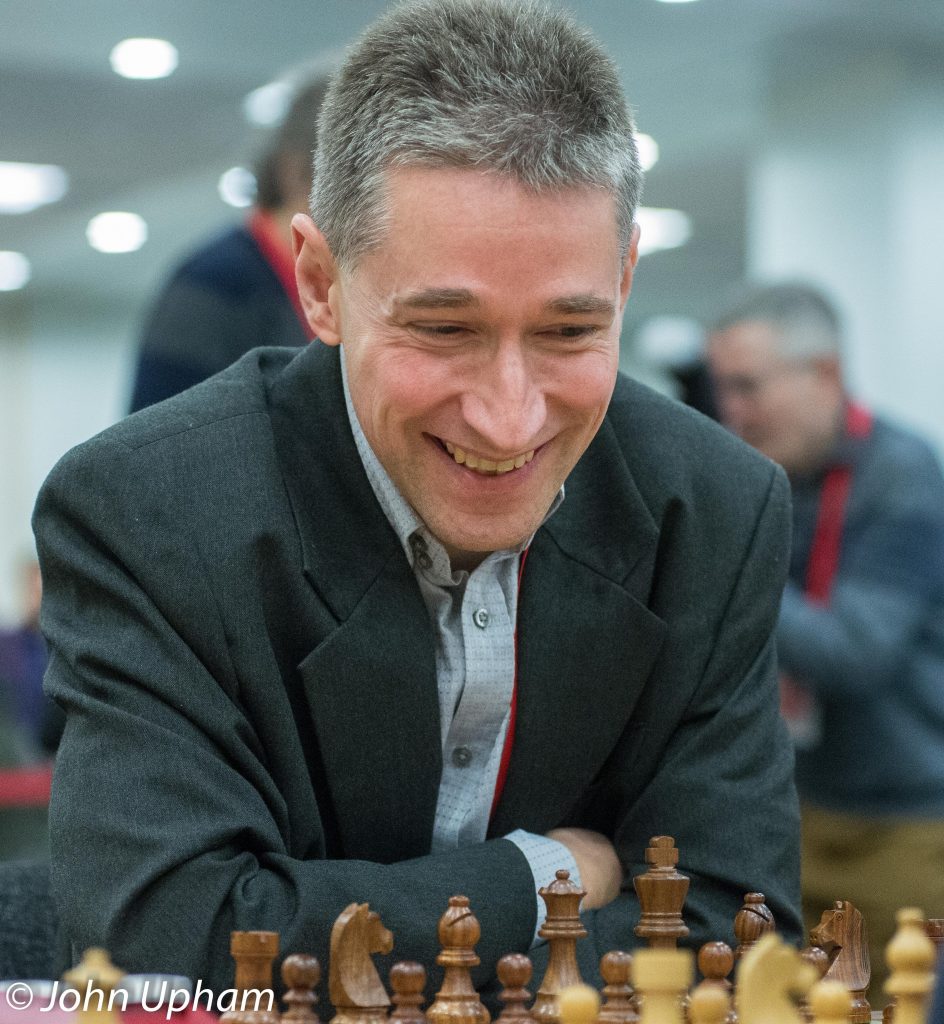
We send best wishes to GM Michael Adams on his birthday, this day (November 17th) in 1971
Michael was Southern Counties (SCCU) champion in the 1996-97 season.
His Wikipedia entry is here

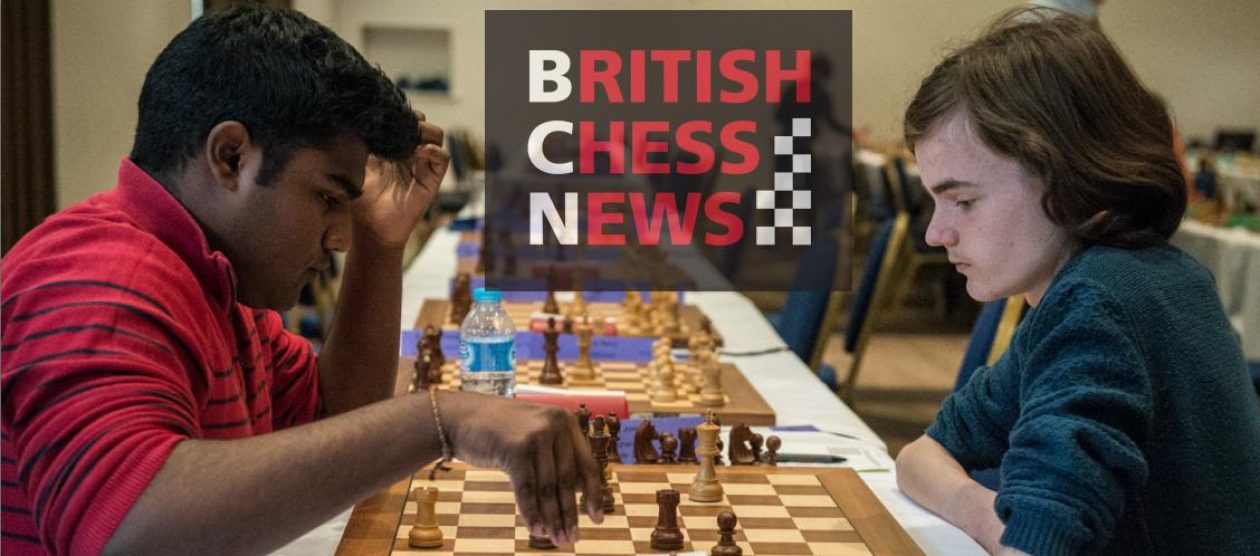
We send best wishes to GM Michael Adams on his birthday, this day (November 17th) in 1971
Michael was Southern Counties (SCCU) champion in the 1996-97 season.
His Wikipedia entry is here
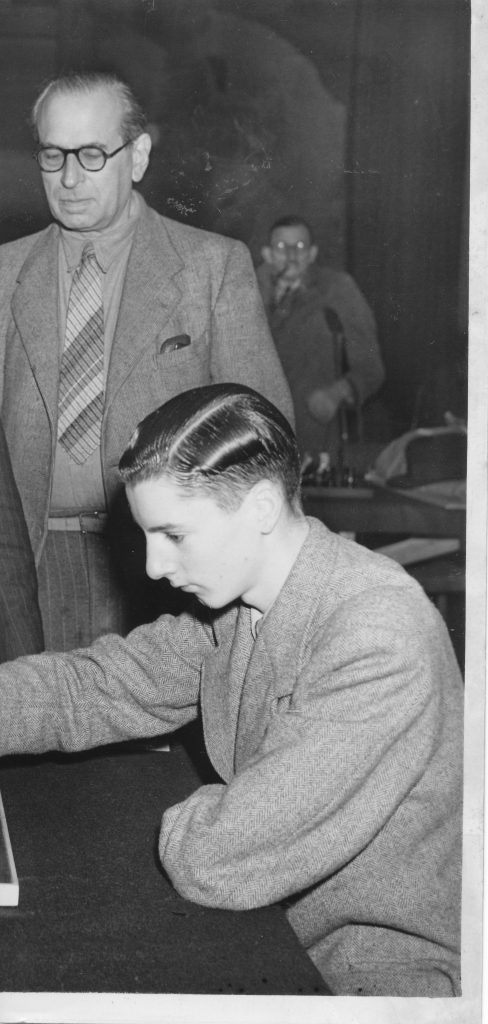
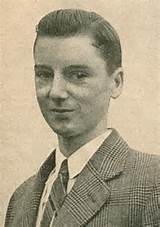
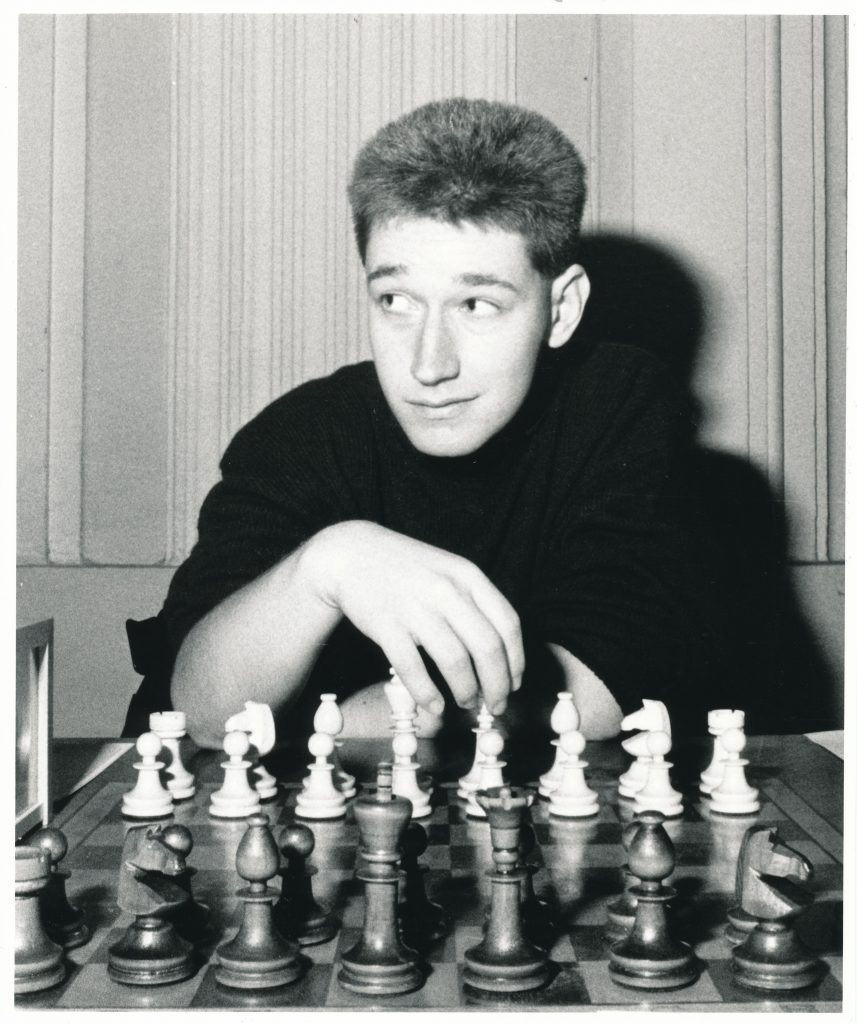
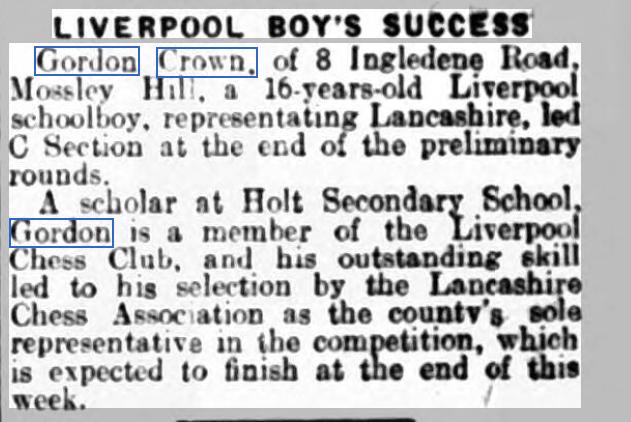
We remember Gordon Crown who died this day (November 17th) in 1947.
Gordon Thomas Crown was born on Thursday, June 20th, 1929 to James Crown (born 18th November 1899) and Hilda M Crown (born 3rd October 1900, née Sharrott).
James was a refrigerating engineer and Hilda carried out unpaid domestic duties. The birth was registered in the district of West Derby, Lancashire.
Gordon attended Holt Secondary School which is now known as Childwall Sports and Science Academy.
According to the electoral register of 1939 they lived at 8 Ingledene Road, Liverpool, Liverpool C.B., Lancashire, England. (This is L18 3HJ in this day and age.)
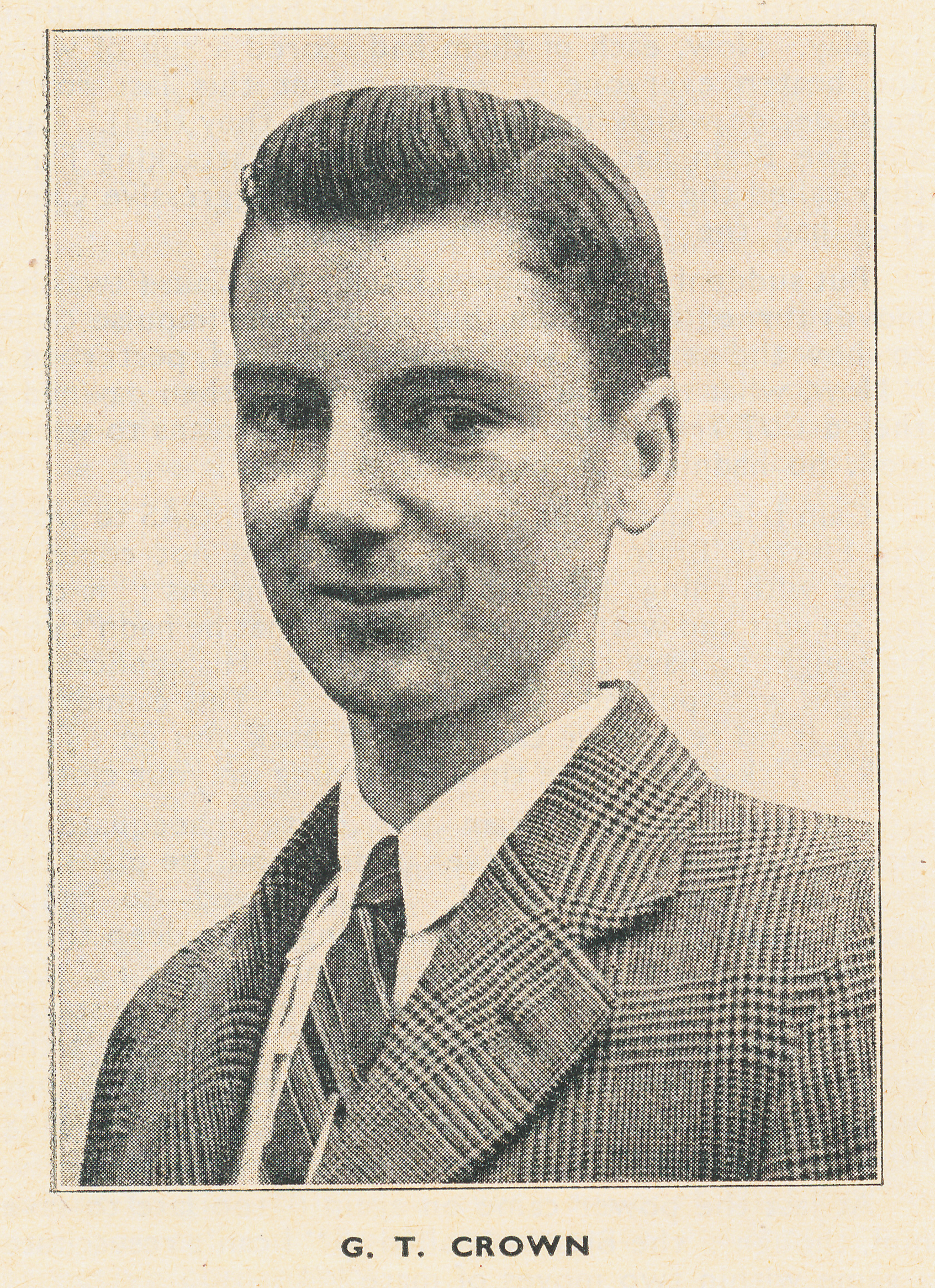
According to Zoopla : “This 4 bed freehold semi-detached house is located at 8 Ingledene Road, Liverpool L18 3HJ and has an estimated current value of £581,000. Ingledene Road has 19 properties on it with an average current value of £492,220, compared to an average property value of £325,035 for L18. There have been 5 property sales on Ingledene Road, L18 over the last 5 years with an average house price paid of £474,900. There are currently 108 properties for sale in L18 with an average asking price of £372,163 and 59 properties to rent in L18 with an average asking rent of £408 pw.”
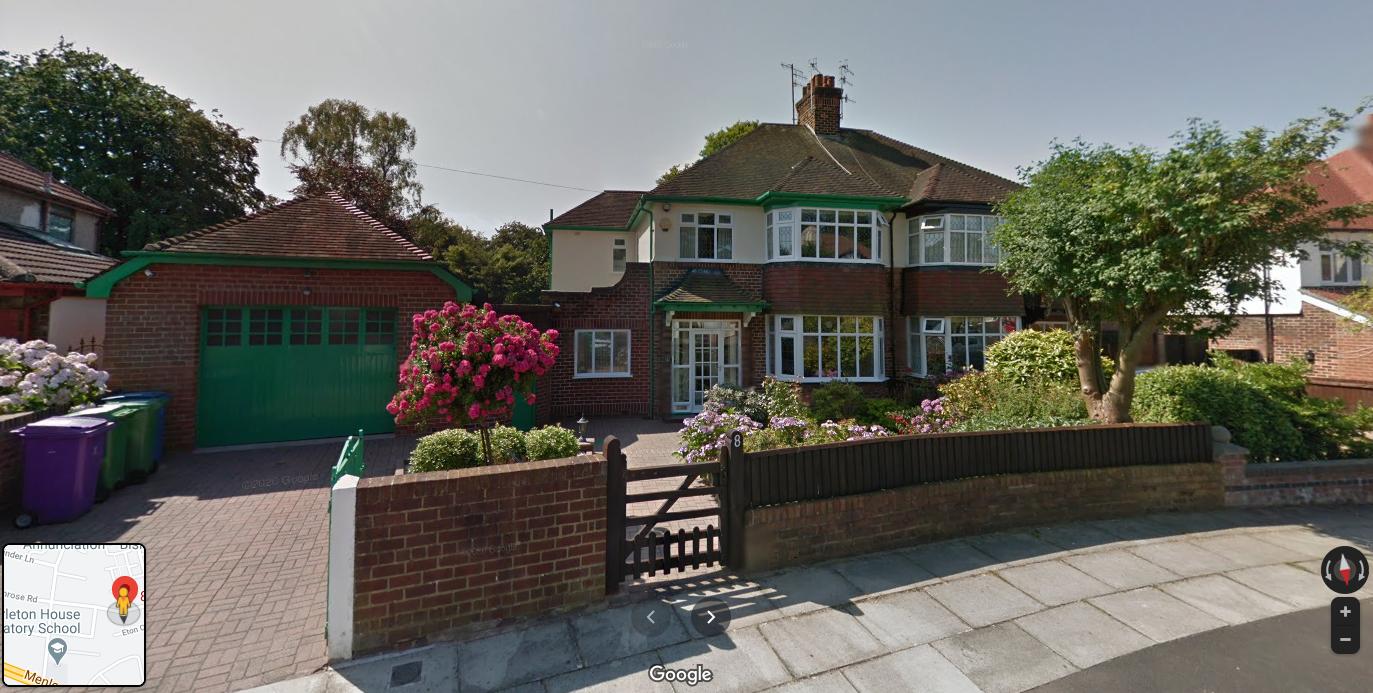
Jon D’Souza-Eva (Oxford) wrote to us on November 17th, 2021 to reveal:
“I always thought that Gordon Crown was an only child, but after a little searching I found that he had a younger brother, Rodney, who was born and died in 1938.
There’s also a rather mysterious redacted entry in the Crown household in the 1939 register. I can’t find evidence for any other siblings who might account for it.”
and we asked Leonard Barden about this replying:
“I can’t confirm the Rodney, but Gordon died the night after I visited him on a daily leave pass from RAF Padgate. I didn’t know about it for two weeks because of the lack of news facilities at my camp. But then when I heard I wrote to his mother and she sent back the Kotov photo with a very sad letter from which one phrase has remained in my memory:
“Our other son died nine years ago and Gordon was all we had”….”
Both Sunnucks and Hooper & Whyld are silent on GTC : surprising!
From CHESS, Volume 12 (1947), Number 138 (March), page 176:
“G. T. Crown…England’s 17.5 Year Old International
“Gordon T. Crown, who takes his place in an England team at the age of 17.5, was born at Liverpool on June 20th, 1929. He learnt the moves at the age of nine, being first made aware of chess by the match between the BBC and the listeners over the radio. Until 1944, he had few opportunities for over-the-board play and was forced to devote himself to studying books and magazines.
In 1944-5 he entered for the Lancashire Junior Championship and won it as his first attempt; he repeated his success last year and also entered for the senior event, in which he reached the semi-final, only to throw away a won game against HG Rhodes.
In April 1946, he played in the British Boys’ Championship at Hastings and came second, losing only in his final game. In August he played in the Nottingham Congress, was placed in one of the Major sections and “was quite satisfied” he reports, at finishing half-a-point outside the prize list, especially as he was the only one to defeat EG Sergeant, who topped the section.
At Hastings, the situation was curiously reversed. Here he won the section, his only loss being to EG Sergeant, who finished just outside the prize list.
He has just finished school and is waiting to enter a University where he intends to study Geography and History. For private reading, he enjoys best Military and Naval History – apart from good detective stories.
Apart from chess, he is interested in most games, both indoor and outdoor, with special preference for tennis ad table-tennis when it is a matter of playing and cricket for reading about.
He is diabetic – but so was one of the players in the Davis Cup team which recently crushed Australia! His games show the evidence of deep and extensive study of the game combined with an ever-ready imagination.
From The Encyclopedia of Chess (Batsford, 1977), Harry Golombek OBE :
“Gordon Crown is one the sad might-have-beens of the world of chess. In his short life he had already shown himself to be of master strength and a potentially very great player when suddenly, at the age of eighteen, he died during an operation.
He learnt chess when aged nine and soon became one of the best players, first in Liverpool,, his home town, and then in Lancashire, of which county he won the Junior Championship three years in succession.
Crown first came into national prominence when he came second in the British Boys Championship in 1946. (Ed : the winner was John Fuller) In the Hastings Congress of 1946/7 he won first place in a strong Premier Reserves Section.
The last year of his life even saw him reaching out to international success, Playing on board 9 for Britain against The Netherlands he scored 1.5 out of 2 against L.J. Tummers. Then he won third prize in the British Championship at Harrogate. As a result of this success he was promoted to board 4 for Britain against Australia in a radio match when he beat Dr. M. Gellis.
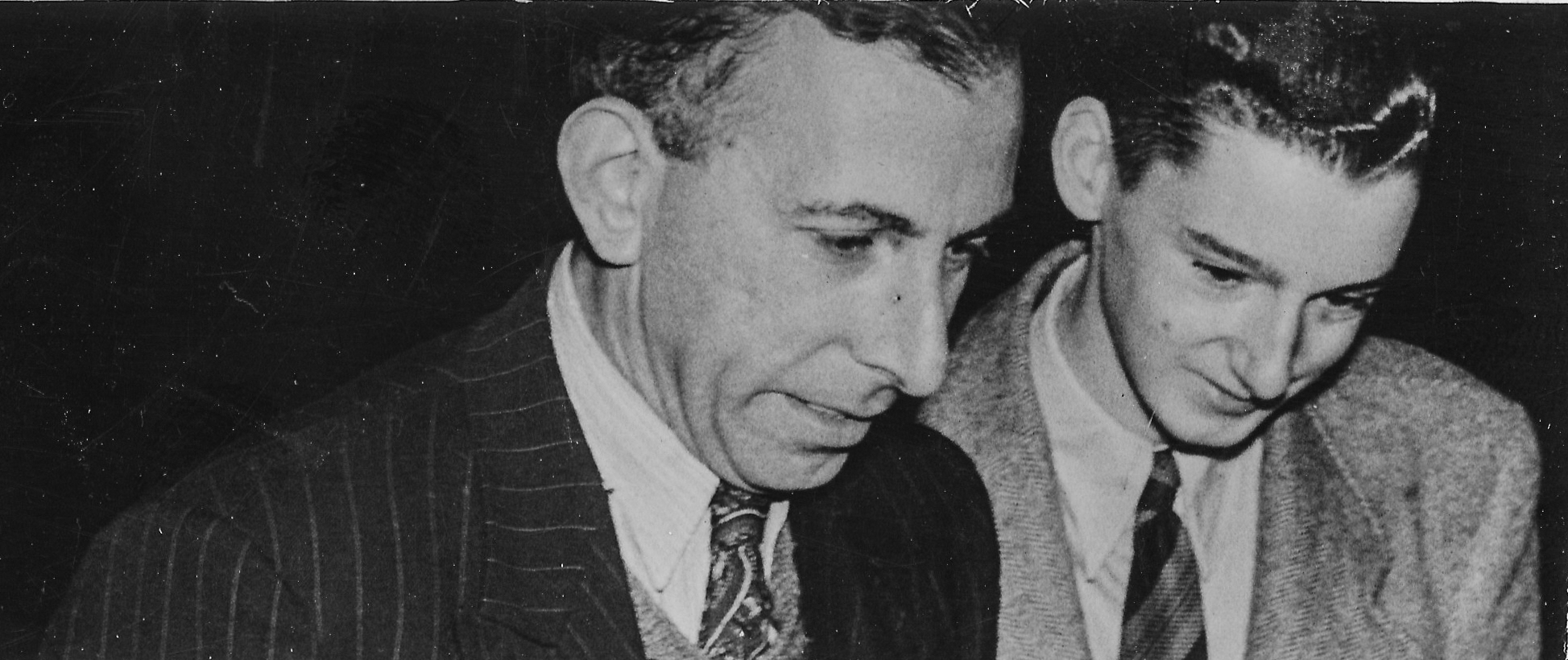
In September 1947 he was hurried to hospital suffering from peritonitis and, being a diabetic, succumbed under the operation.
As a player he excelled in both the opening and endgame phases and possessed a style of play that stamped him as a future grandmaster. As a person he was modest, clever and a very agreeable companion. This was great loss for British and, almost certainly, world chess.”
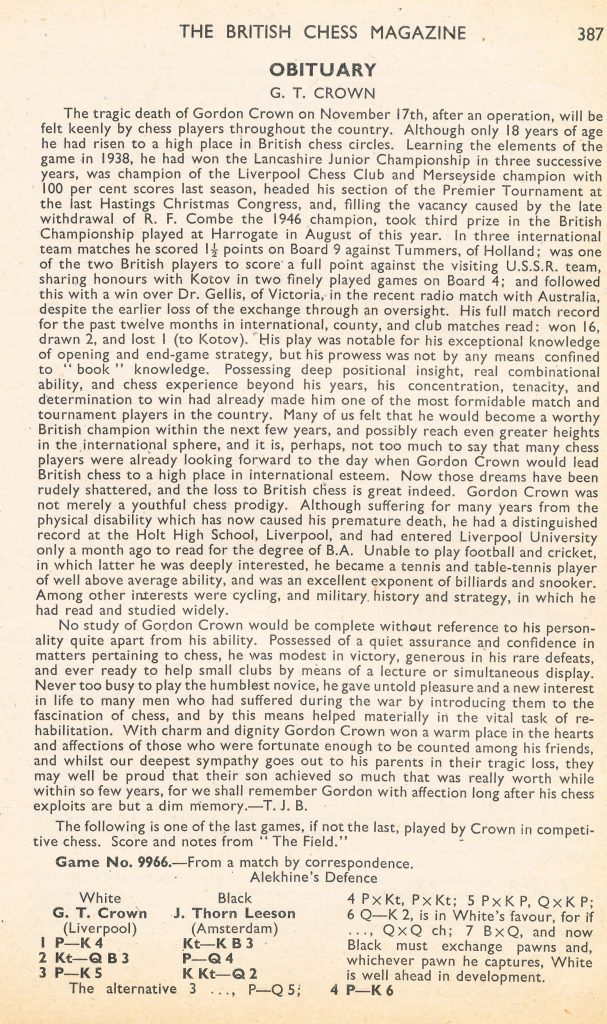
We have reproduced his obituary from British Chess Magazine, Volume LXVII (1947), Number 12 (December), Page 387-8 and we assume that this was written by TJ Beach:
“The tragic death of Gordon on November 17th after an operation, will be felt keenly-by chess players throughout the country. Although only l8 years of age he had risen to a high place in British chess circles. Learning the elements of the game in 1938, he had won the Lancashire Junior Championship in three successive years, was champion of the Liverpool Chess Club and Merseyside champion with 100 per cent scores last season, headed his section of the Premier Tournament at the last Hastings Christmas Congress, and, filling the vacancy caused by the late withdrawal of R. F. Combe the 1946 champion, took third prize in the British Championship played at Harrogate in August of this year.
In three international team matches he scored l.5 points on Board 9 against Tummers, of Holland; was one of the two British players to score a full point against the visiting U.S.S.R. team, sharing honours with Kotov in two finely played games on Board 4; and followed this with a win over Dr. Gellis, of Victoria, in the recent radio match with Australia, despite the earlier loss of the exchange through an oversight. His full match record for the past twelve months in international, county, and club matches read: won 16, drawn 2, and lost l. (to Kotov).
His play was notable for his exceptional knowledge of opening and end-game strategy, but his prowess was not by any means confined to “book” knowledge. Possessing deep positional insight, real combinational ability, and chess experience beyond his years, his concentration, tenacity, and determination to win had already made him one of the most formidable match and tournament players in the country. Many of us felt that he would become a worthy British champion within the next few years, and possibly reach even greater heights in the international sphere, and it is, perhaps, not too much to say that many chess players were already looking forward to the day when Gordon Crown would lead British chess to a high place in international esteem: Now those dreams have been rudely shattered, and the loss to British chess is great indeed.
Gordon Crown was not merely a youthful chess prodigy. Although suffering for many years from the physical disability which has now caused his premature death, he had a distinguished record at the Holt High School, Liverpool, and had entered Liverpool University only a month ago to read for the degree of B.A. Unable to play football and cricket, in which latter he was deeply interested, he became a tennis and table-tennis player of well above average ability and was an excellent exponent of billiards and snooker. Among other interests were cycling, and military history and strategy, in which he had read and studied widely.
No study of Gordon Crown would be complete without reference to his personality quite apart from his ability. Possessed of a quiet assurance and confidence in matters pertaining to chess, he was modest in victory, generous in his rare defeats, and ever ready to help small clubs by means of a lecture or simultaneous display.
Never too busy to play the humblest novice, he gave untold pleasure and a new interest in life to many men who had suffered during the war by introducing them to the
fascination of chess, and by this means helped materially in the vital task of rehabilitation. With charm and dignity Gordon Crown won a warm place in the hearts and affections of those who were fortunate enough to be counted among his friends, and whilst our deepest sympathy goes out to his parents in their tragic loss, they may well ae proud that their son achieved so much that was really worth while within so few years, for we shall remember Gordon with affection long after his chess exploits are but a dim memory.-T. J. B.”
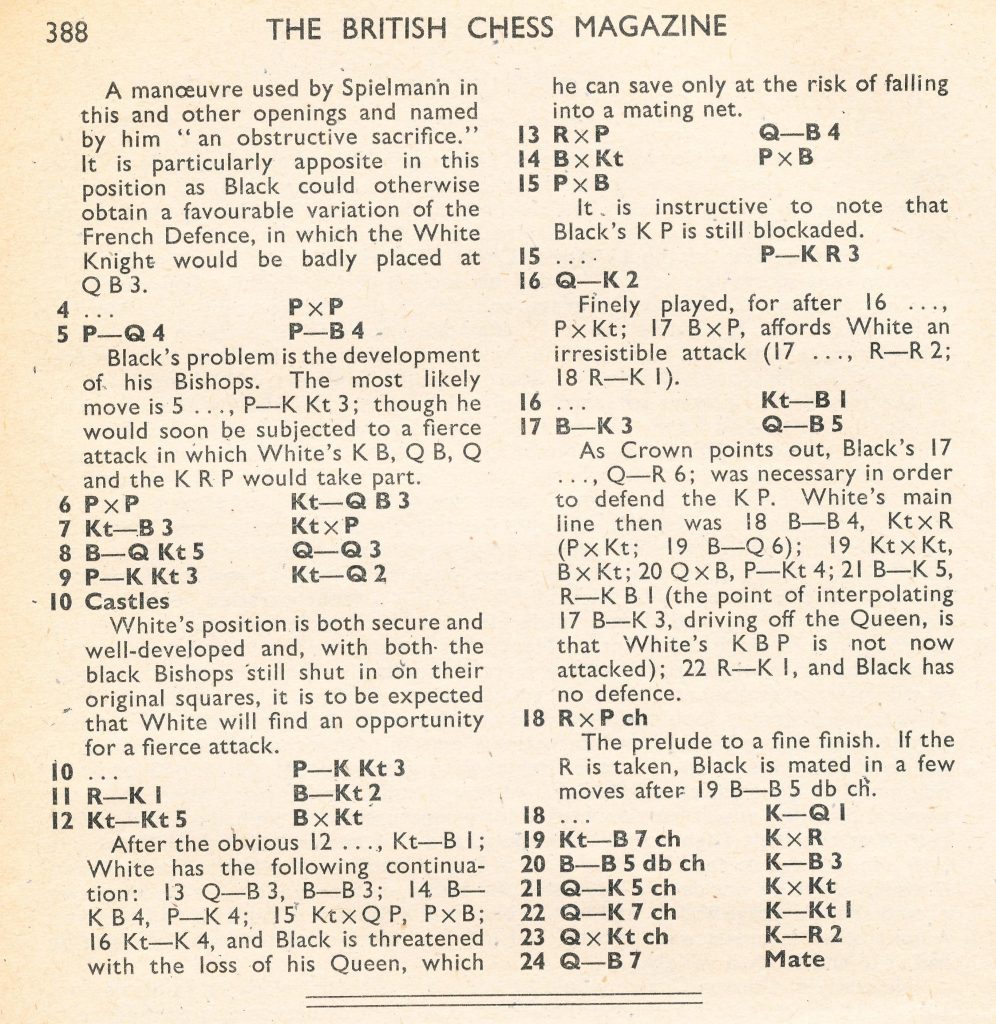
The following is one of the last games, if not the last; played by Crown in competitive chess. Score and notes from “The Field”
and here is the scan of the original article:
and
We are grateful to Leonard Barden on the identity of T.J.B. :
“Thomas John Beach, wartime RAF navigator with Distinguished Flying Cross, leading light of Liverpool chess, regular British championship player for many years, chairman of BCF junior selectors, father of a leading Midlands expert, a good and dedicated man” TJB was the father of Richard Beach who won the British Boys Under 18 title in 1961.
According to the British Chess Magazine, 1943, March, page 56 GTC lived at 8 Ingledene Road, Calderstones, Liverpool 18, England.
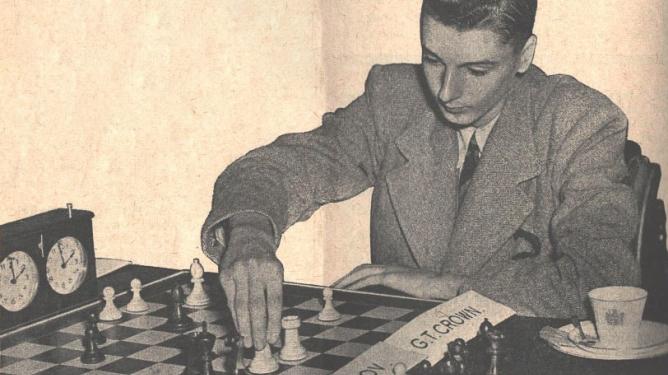
On 17 November 1947 he was admitted to hospital, complaining of a stomach upset. Diagnosed too late with appendicitis, complicated by his diabetes, he died in the operating theatre.
His friend (and former British champion) Leonard Barden speculates that had he lived, Crown would have become at least a strong Grandmaster, further noting that he was ” … open, friendly and modest as well as a clear and enthusiastic explainer of his chess ideas; I think he would have been like Keres or Gligoric in their countries, a model for our young players.”
Harry Golombek was similarly impressed with Crown’s play, stating that “In his short life, he had already shown himself to be of master strength and was potentially a very great player.”
We are grateful to be able to use comments from long time friend, Leonard Barden posted under the nom de plume of Roberts Partner on chessgames.com :
“As to the circumstances of Crown’s death. The finger of blame must be pointed at the family doctor for failing to make a timely correct diagnosis. On Sunday 16 November 1947 a chess friend visited the Crown home at Ingledene Road, Liverpool, and found Crown in bed. He explained that his doctor had diagnosed a stomach upset and had recommended rest. The friend and Crown played and analysed together for several hours, and Crown did not appear in any physical discomfort. But that night after the friend left his condition deteriorated and he was rushed to hospital where he died in the early morning hours of 17 November. There was also a belief among some Liverpool chess players that the hospital procedures could have been better.”
and
“On another thread some CG posters expressed surprise at the Ritson Morry v Crown game where Morry fell into a well-known opening trap.
The British championship at Harrogate in August 1947 was played in a spa building where the underfloor heating was still switched on. This coincided with one of the warmest summers on record (it was the year in which Compton and Edrich made their memorable cricket achievements for Middlesex). By the second week of the BCF congress older and overweight players (the latter group including Ritson Morry) were wilting. Ritson also had some long adjourned games, and by the time of his game with Crown in the final round was exhausted. The game finished in 15-20 minutes so by the time other players went to spectate after their opening moves there was just a reset board with no sign of the players and no indication of what had transpired. Other final round results went Crown’s way so that he finished third outright and thus got selected on a high board for the USSR match.”
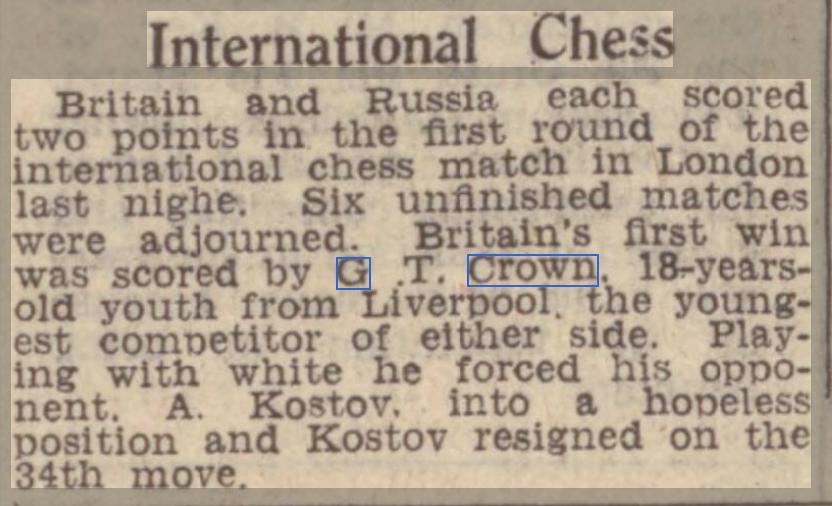
and here is an article by ddtru (?) in chess.com : full article
We are grateful to renowned chess historian, Taylor Kingston for supplying these scans of an article from Chess Life in 1947 about Gordon Crown written by Reuben Fine :
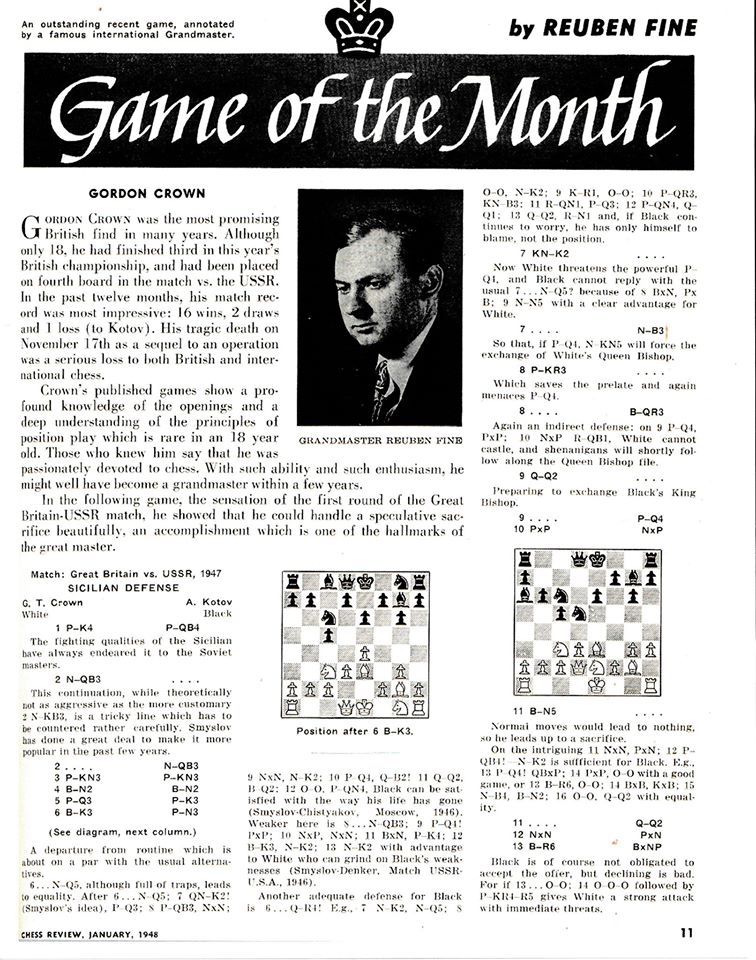
and
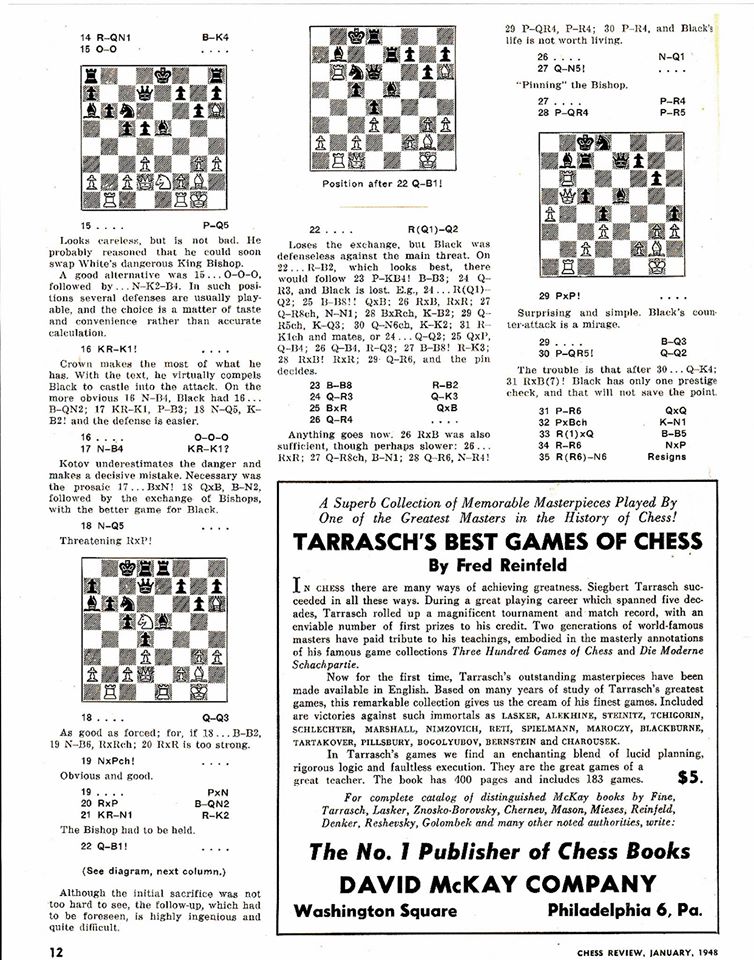
From Wikipedia:
“Gordon Thomas Crown (20 June 1929 – 17 November 1947) was a promising British chess player who died of appendicitis at the age of eighteen. He is best known for his win against the Russian Grandmaster Alexander Kotov shortly before his death.
Crown was born in Liverpool in 1929. He finished second in the British under 18 championship in 1946 and improved rapidly, winning the Premier Reserve section of the 1946/7 Hastings International Chess Congress. This led to his being placed on the reserve list for the 1947 British Chess Championship. Following the withdrawal of the defending champion Robert Forbes Combe, he was allowed to play in the championship, where he finished third (Harry Golombek won).
Consequently, he was selected to play for the British team in the 1947 Britain-USSR match, where he caused a sensation by defeating the Soviet Grandmaster Alexander Kotov, though he lost the return game. He also defeated Max Gellis in a Britain-Australia radio match.”
Interestingly, via the EC Forum, Geoff Chandler pointed out a note by Edward Winter in which Bill Hartston recounts advice from David Bronstein : “Look at the games of Gordon Crown. He really understood chess”. From NOW! magazine, (6-12 February 1981, page 80.): thanks Geoff !