Minor Pieces 3: Septimus Swyer

Between 31 August and 9 November 1888, five prostitutes were brutally murdered in Whitechapel, in London’s East End. Their killer was never caught, and is known to us now as Jack the Ripper. Several later murders in the same area might have been committed by the same person.

What you all want to know is this: did Jack the Ripper play chess?

Hundreds of possible suspects have been mentioned over the years: almost everyone, it seems, who was in the right place at the right time, and even some who almost certainly weren’t.

Several of these suspects have chess connections.

First on our list is the artist Walter Sickert. From The (Even More) Complete Chess Addict: ‘According to a well-argued book by Stephen Knight, Jack the Ripper … was in fact the painter Walter Sickert as part of a three-man team. One of the things we know about Sickert was that he was a keen chess-player’.

Sadly, this source is notoriously unreliable. I searched the newspaper archives for any connection between Sickert and chess. All I could find was a critic’s view of a portrait of political activist and atheist Charles Bradlaugh: ‘But the clever artist should have placed a chessboard on the table over which the intellectual face of Mr. B. is bending. He habitually plays chess, I am given to understand, with members of the high aristocracy, and recently checkmated a Bishop.’ This must surely refer to Bradlaugh, who was known to be a chess player, rather than Sickert, although history doesn’t record whether the famous atheist used a bishop to checkmate the Bishop. Perhaps Mike Fox had read a biography of Sickert which provided more information, but I can find no evidence of the artist being particularly interested in chess.

More recently, the crime novelist Patricia Cornwell took up the theory of Sickert being Jack, but I don’t think the evidence stands up.

Number two on our list is none other than Lewis Carroll. We know, of course, that he was a chess enthusiast: you can read more here. I’ve known the compiler of this information, Roger Scowen, on and off for many years: we recently exchanged emails and hope to meet up soon for a few games once it’s safe to do so. But was Carroll Jack the Ripper? To me, it seems like a totally ridiculous suggestion.

Moving swiftly on, let’s visit the Langdon Down Museum of Learning Disability in Teddington – and if you’ve never been there you really ought to. Some of the inmates there at Normansfield were identified by John Langdon Down as having a specific genetic condition which is now known as Down Syndrome. Others, like James Henry Pullen, might now be diagnosed as being on the autism spectrum. Facilities were also available for members of wealthy families with mental health conditions, one of whom, who features, with a mention of his chess prowess, in a display in the museum, was Reginald Treherne Bassett Saunderson. Saunderson certainly didn’t have an intellectual disability, but today he’d probably be diagnosed as schizophrenic. His story is told here.

In this game he was winning most of the way through against a strong opponent, but eventually came off second best.

[pgn]

[Event “Kingstown Society Correspondence Tournament”]
[Date “1903.??.??”]
[White “Saunderson, Reginald Treherne Bassett”]
[Black “Flear, Frederick William”]
[Result “0-1”]
[ECO “C39”]
[PlyCount “68”]

1. e4 e5 2. f4 exf4 3. Nf3 g5 4. h4 g4 5. Ne5 h5 6. Bc4 Nh6 7. d4 d6 8. Nd3 f3
9. gxf3 Be7 10. Be3 Bxh4+ 11. Kd2 gxf3 12. Qxf3 Bg4 13. Qf4 Nc6 14. Nc3 f5 15.
Be6 Bf6 16. Nd5 Bxd4 17. exf5 Bf6 18. Qe4 Be5 19. Rad1 Nf7 20. Rdf1 Kf8 21.
N3f4 Ng5 22. Ng6+ Kg7 23. f6+ Bxf6 24. Bxg5 Bxg5+ 25. Kd3 Bxe6 26. Nxh8 Ne5+
27. Kc3 Bxd5 28. Qxd5 Qxh8 29. Rhg1 Kh6 30. Qe6+ Ng6+ 31. Kd3 Re8 32. Qh3 Re3+
33. Qxe3 Bxe3 34. Kxe3 Qxb2 0-1

[/pgn]

Saunderson was certainly a pretty good chess player, and certainly killed a lady of, reputedly, ‘ill-fame’, but, born in 1873, he was much too young to have been the original Jack the Ripper.

Let’s try again. Lord Randolph Churchill, Winston’s dad, was certainly a chess player, and certainly an opponent of Steinitz. By all accounts he was a pretty unpleasant and unpopular man, but, although he sometimes appears in lists of possible suspects, there’s absolutely no evidence that he had anything at all to do with the Whitechapel Murders.
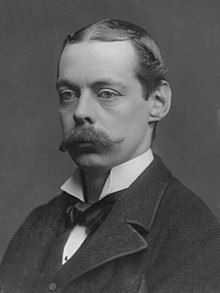
Lord Randolph Churchill

[pgn]

[Event “Blindfold simul”]
[Site “Oxford ENG”]
[Date “1870.05.17”]
[White “Steinitz, Wilhelm”]
[Black “Churchill, Lord Randolph”]
[Result “1-0”]
[ECO “C39”]
[PlyCount “65”]

1. e4 e5 2. f4 exf4 3. Nf3 g5 4. h4 g4 5. Ne5 Qe7 6. d4 d6 7. Nxg4 Qxe4+ 8. Qe2
d5 9. Ne5 Nh6 10. Nc3 Bb4 11. Qxe4 dxe4 12. Bxf4 Nf5 13. O-O-O Bxc3 14. bxc3
Nd6 15. c4 f6 16. c5 fxe5 17. Bxe5 Nf7 18. Bxh8 Nxh8 19. Re1 b6 20. Rxe4+ Kd8
21. Bc4 Bb7 22. Rg4 Ng6 23. h5 Ne7 24. Re1 Nbc6 25. d5 Nb4 26. c6 Bc8 27. Rg7
Nbxc6 28. dxc6 Nxc6 29. Bb5 Bb7 30. Rd1+ Ke8 31. Rxc7 Kf8 32. Rf1+ Kg8 33. Bc4+
1-0

[/pgn]

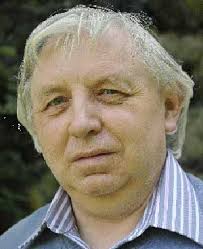
Finally, meet S Swyer. He played Steinitz in the second round of a handicap tournament at the City of London Chess Club in 1871-72: among the other participants was J Swyer, a first round loser. Tim Harding (Steinitz in London) suggests that the two Swyers were probably brothers, but doesn’t provide any further information. Swyer is an uncommon surname so it’s not too difficult to find out more.

The Swyer family came from near Shaftesbury, in Dorset. Walter Swyer and Sarah Lush (Buckland) Swyer had a daughter, Sarah, followed by seven sons. Walter and Robert, John and George, James and William, and, as was the custom in educated families at the time, their seventh son was named Septimus. Let’s get J Swyer out of the way first. John was a bank manager who spent most of his life in Dorset. James was a chemist and druggist, living in Bethnal Green in London’s East End at the time of the 1871 census, so it must have been him, rather than John, who played chess at the City of London Chess Club.
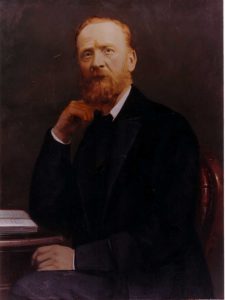
James Swyer

S Swyer, then, was Septimus. In 1871 he was a General Practitioner, living in Brick Lane, Spitalfields, not very far from his brother Jim. As well as being a GP he specialised in obstetrics and gynaecology.

Both Swyers were placed in Class IV (of V) at the City of London Club, so when Steinitz was paired against Septimus he took the white pieces in both games, but had to play without his queen’s knight.

[pgn]

[Event “City of London Handicap Tournament”]
[Site “London ENG”]
[Date “1871.12.??”]
[Round “2”]
[White “Steinitz, Wilhelm”]
[Black “Swyer, Septimus”]
[Result “1-0”]

[SetUp “1”]
[FEN “rnbqkbnr/pppppppp/8/8/8/8/PPPPPPPP/R1BQKBNR w KQkq – 0 1”]
[PlyCount “89”]

{[#]} 1. e4 e5 2. f4 d6 3. Nf3 Nc6 4. c3 Bg4 5. Bc4 exf4 6. d4 Bxf3 7. Qxf3 g5
8. h4 Bh6 9. g3 Qf6 10. hxg5 Bxg5 11. gxf4 Bh6 12. Be3 a6 13. O-O-O Nge7 14. e5
dxe5 15. dxe5 Nxe5 16. Rxh6 Nxf3 17. Rxf6 O-O 18. Bc5 Rae8 19. Rh6 b6 20. Bxe7
Rxe7 21. Bd5 Kg7 22. Rhh1 Ne5 23. fxe5 Rxe5 24. Rdg1+ Kf6 25. Rh6+ Ke7 26. Bb3
Rh8 27. Rg7 Re1+ 28. Kd2 Rf1 29. Ke2 Rf5 30. Rhxh7 Rf8 31. Rg3 a5 32. Rf3 Rf6
33. Rxf6 Kxf6 34. Rh6+ Kg5 35. Rh3 f5 36. Rh7 c5 37. Kf3 Rf6 38. Rg7+ Kh6 39.
Rf7 Rxf7 40. Bxf7 Kg5 41. a4 Kf6 42. Bc4 Ke5 43. b3 f4 44. Bd3 Kd5 45. Kxf4 1-0

[/pgn]

This game suggests that Septimus was a reasonably competent player, but handicapped by a lack of opening knowledge.

[pgn]

[Event “City of London Handicap Tournament”]
[Site “London ENG”]
[Date “1872.01.??”]
[Round “2”]
[White “Steinitz, Wilhelm”]
[Black “Swyer, Septimus”]
[Result “1-0”]
[SetUp “1”]
[FEN “rnbqkbnr/pppppppp/8/8/8/8/PPPPPPPP/R1BQKBNR w KQkq – 0 1”]
[PlyCount “73”]

{[#]} 1. e4 e5 2. f4 d6 3. Nf3 Nc6 4. c3 h6 5. Bc4 Nf6 6. d3 Bg4 7. Qb3 Na5 8.
Bxf7+ Ke7 9. Qa4 Nc6 10. Bg6 Bh5 11. Nh4 Rg8 12. Bxh5 Nxh5 13. Qb3 Nf6 14. Qxb7
Kd7 15. Nf3 Rb8 16. Qa6 Rb6 17. Qa4 Qc8 18. fxe5 Ra6 19. e6+ Kxe6 20. Qc4+ Kd7
21. d4 Na5 22. Qf7+ Be7 23. b4 Nb7 24. O-O Nd8 25. Qb3 Nxe4 26. Qxg8 Bf6 27.
Re1 Qb7 28. Bxh6 gxh6 29. Qh7+ Kc8 30. Rxe4 d5 31. Re8 Qc6 32. Re3 Ra3 33. Rae1
Rxc3 34. Rxc3 Bxd4+ 35. Nxd4 Qxc3 36. Nf3 d4 37. Qe4 1-0

[/pgn]

It was much the same story the second time around, but here the game was truncated when Swyer, in a difficult position, hung a rook.
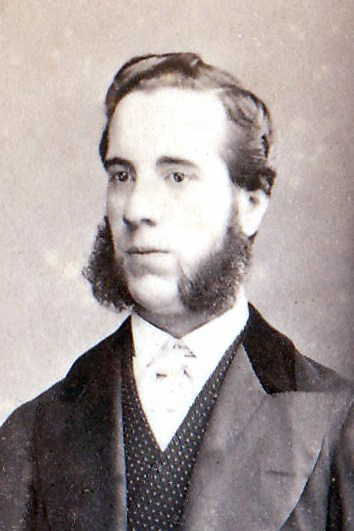
Dr Septimus Swyer

Swyer was a colourful character whose life was not short on controversy. In 1861 a cat, allegedly belonging to his neighbour, broke into his shop and shattered all his medicines, including a bottle of Godfrey’s Cordial, but the narcotic had no effect on the feline intruder. He sued for damages, but his neighbour claimed it was a different moggy and the case was thrown out.

His first wife died in 1874 and he remarried in 1880. It was stated his second wife’s husband was still alive (it seems he lived until 1912) and she was tried for bigamy, but acquitted.

In 1888 he was still in the same area, but in 1891, shortly after the last possible Ripper murder, he suddenly emigrated to the USA. He certainly had financial problems, but who knows?

Dr Septimus Swyer was in the right place at the right time, had the required medical knowledge, and left the country in a hurry. Only circumstantial evidence. Was he Jack the Ripper? Unlikely, I would have thought, but at least, unlike our other four chess-playing (or perhaps not in the case of Sickert) suspects, a possibility. I guess we’ll never know.


Sources:

There’s a lot more about Swyer as a Ripper suspect (but do bear in mind the proviso at the top of the first post) at:
Dr Septimus Swyer + proviso – Casebook: Jack the Ripper Forums

A lot more again here from a direct descendant (one of his sons emigrated to Australia) at:
Septimus Swyer (hibeach.net)

Photographs of James and Septimus Swyers taken from family trees at:
Genealogy, Family Trees and Family History Records online – Ancestry®

Photograph of Lord Randolph Churchill from Wikipedia.
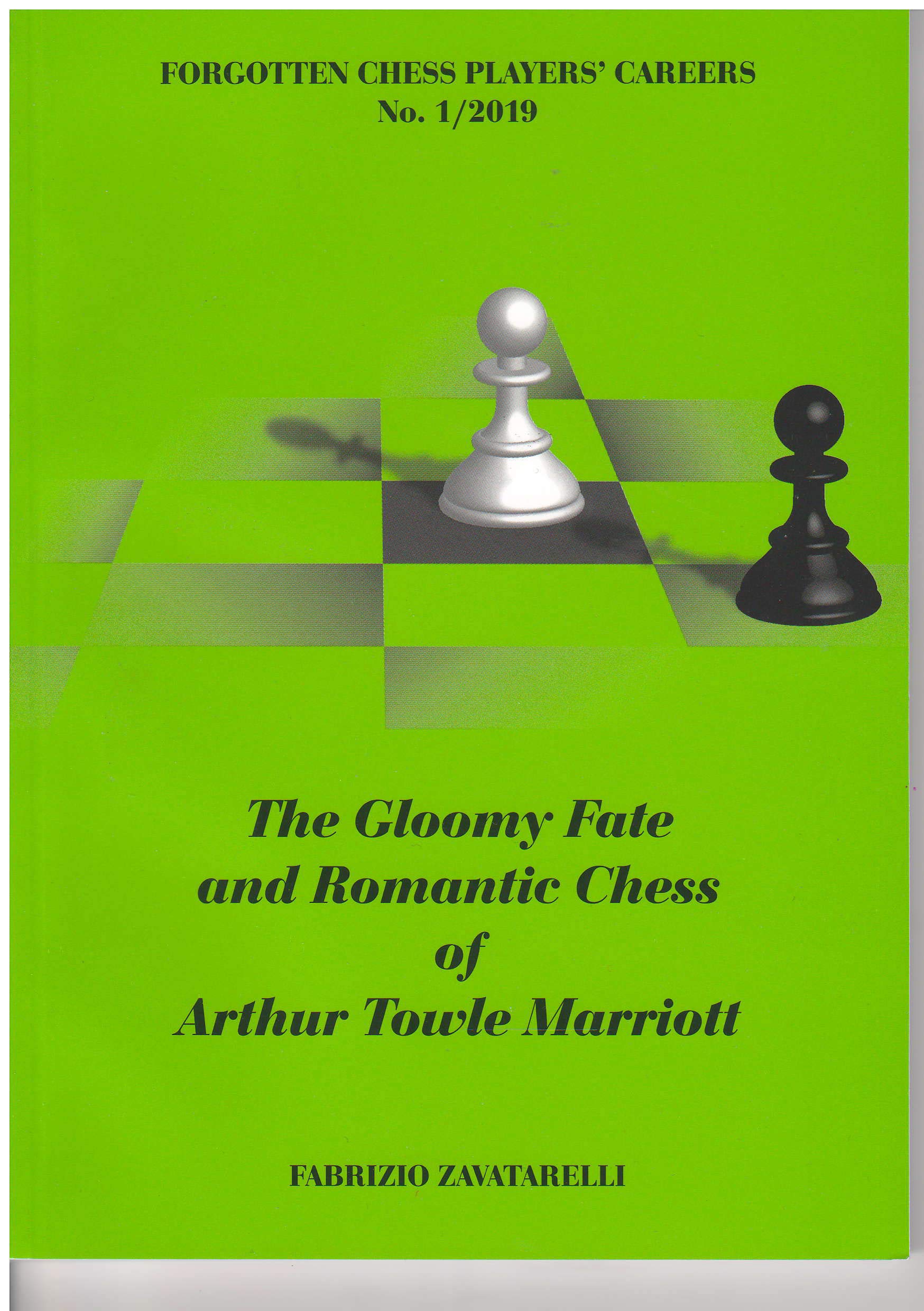
The Gloomy Fate and Romantic Chess of Arthur Towle Marriott

The Gloomy Fate and Romantic Chess of Arthur Towle Marriott : Fabrizio Zavatarelli

The Gloomy Fate and Romantic Chess of Arthur Towle Marriott, Fabrizio Zavatarelli, Moravian Chess, 2019, ISBN 978-8071890164

From the publisher:

Biography of prominent Nottingham chess-player (1859-1884). Biography contents 156 annotated games with comments mostly from contemporary sources. A. T. Marriott played chess with many contemporary chess players of this time, e.g. Blackburne, Freeborough, MacDonnell, Thorold, etc.

I won’t quote the publisher’s introduction, as it’s the same as you’ll find in this book.

This is the first volume in a different series, though, featuring the careers of forgotten chess players. In this case the author is Fabrizio Zavatarelli, an Italian chess historian, who has written a book on Kolisch and co-authored one on Neumann, Hirschfeld and Suhle, both published by McFarland. An author, then, with a proven track record as an excellent writer and researcher in this field. A helpful feature of the book is a rating system for games: one star: of some interest, two stars: worthy of an anthology, and three stars (there are none in this book): a masterpiece.

Arthur who? You may well ask. I hadn’t heard of him until I saw the advance publicity for this book. Arthur Towle Marriott, it turns out, was the youngest and strongest member of a chess playing family. We have 156 games, with contemporary annotations, along with a few problems, and we follow him as he travels the country, playing chess wherever and whenever he can.

Marriott was born in Nottingham on 25 November 1859, the youngest son of Thomas and Sarah. There is information about his family now available online which Zavatarelli was either unable to find or which wasn’t available when he was researching the book. A footnote suggests that Sarah’s maiden name was probably Lacey: it wasn’t: she was Sarah Green. He also states that no mention of the family can be found in the 1861 and 1871 census records: in fact the 1871 record has now been found, but not, as yet, the 1861 record. You can find out more information about the chess playing Marriotts here.

His earliest games, mostly played by correspondence, date from 1876, about the time of his 17th birthday. But a few months later he was playing, and winning, in a match between Nottingham against Leicester. As an example of Marriott’s play at this time, here’s a casual game played at his chess club.

[pgn]

[Event “Nottingham Mechanics Institute”]
[Date “1877.10.26”]
[White “Marriott, Arthur Towle”]
[Black “Moore, G.”]
[Result “1-0”]
[ECO “C33”]
[PlyCount “43”]

1. e4 e5 2. f4 exf4 3. d4 g5 4. Bc4 d6 5. Nc3 c6 6. Nf3 Bg7 7. O-O Bg4 8. Qd3
Qe7 9. Bxf7+ Kxf7 10. Nxg5+ Qxg5 11. Rxf4+ Nf6 12. e5 dxe5 13. Ne4 Qg6 14. dxe5
Re8 15. exf6 Bf8 16. Ng5+ Qxg5 17. Qxh7+ Ke6 18. Re4+ Qe5 19. Rxe5+ Kxe5 20.
Bf4+ Kxf4 21. Rf1+ Kg5 22. h4# 1-0

[/pgn]

From this game you can tell that he was a highly talented tactician with a love, which would last the rest of his life, of rather dubious gambits.

Marriott played in the 2nd Class Tournament at Grantham over the following New Year, outclassing the opposition to win with a 100% score. In August 1878 he travelled to Hull for a series of games against Edward Freeborough, later to find fame as the co-author of Chess Openings Ancient and Modern. Two months later, Blackburne was in town for a simul, and, underestimating his young opponent, was mated in only 17 moves.

We follow Marriott’s career and travels over the next few years, visiting London, for example, to take on the chess automaton ‘Mephisto’, possibly operated by Gunsberg at the time. But at some point, possibly early 1881, he contracted tuberculosis. Undeterred, he continued playing chess between bouts of his illness.

Everyone loves a good king hunt, so take a look at this.

[pgn]

[Event “Nottingham?”]
[Date “1881.??.??”]
[White “Marriott, Arthur Towle”]
[Black “Amateur”]
[Result “1-0”]
[ECO “C44”]
[PlyCount “45”]
1. e4 e5 2. d4 exd4 3. c3 dxc3 4. Bc4 Nc6 5. Nf3 d6 6. Nxc3 Nf6 7. Ng5 Ne5 8.
Bb3 h6 9. f4 Bg4 10. fxe5 Bxd1 11. Bxf7+ Ke7 12. exf6+ gxf6 13. Nd5+ Kd7 14.
Be6+ Kc6 15. Be3 fxg5 16. Rc1+ Kb5 17. Nxc7+ Ka5 18. b4+ Ka4 19. Kxd1 d5 20.
Nxd5 Bxb4 21. Rc4 a5 22. Kc2 Kb5 23. a4+ 1-0

[/pgn]

Curiously, the moves up to 15. Be3 were duplicated in a 21st century game (Haller – Torretta Wasselonne Open 2009), but White ended up repeating moves in a winning position.

The Danish Gambit was one of Marriott’s favourite openings, as was the Boden-Kieseritzky Gambit, which he also played with colours reversed: yes – the currently fashionable (in some circles) Stafford Gambit.

[pgn]

[Event “Nottingham”]
[Date “1880.08.??”]
[White “B”]
[Black “Marriott, Arthur Towle”]
[Result “0-1”]
[ECO “C42”]
[PlyCount “16”]
1. e4 e5 2. Nf3 Nf6 3. Nxe5 Nc6 4. Nxc6 dxc6 5. d3 Bc5 6. Bg5 Nxe4 7. Bxd8
Bxf2+ 8. Ke2 Bg4# 0-1

[/pgn]

It’s very clear from the games in this book that Arthur Towle Marriott was a player with an outstanding tactical imagination: deadly against opponents who failed to develop their pieces in the opening. Not everything stands up to computer analysis, but he was more interested in playing a beautiful game than winning prosaically.

Playing in a tournament against master standard opposition, though, is another matter entirely. Would he be able to raise his game and become a world class player like Blackburne, or would he remain just a tricky tactician like Bird?

A tournament in Birmingham in August 1883 gave him the chance to find out by taking on some of the country’s leading amateurs under serious match play conditions.

In the first round he faced Nelson Fedden, and this time forsook his beloved gambits for a more cautious start.

[pgn]

[Event “Birmingham Counties CA 1st Class”]
[Date “1883.08.01”]
[Round “1”]
[White “Marriott, Arthur Towle”]
[Black “Fedden, Nelson”]
[Result “1-0”]
[ECO “C77”]
[PlyCount “125”]

1. e4 e5 2. Nf3 Nc6 3. Bb5 a6 4. Ba4 Nf6 5. d3 d6 6. c3 Be7 7. Be3 b5 8. Bb3
Bb7 9. Nbd2 O-O 10. Nf1 Qd7 11. h3 d5 12. Ng3 dxe4 13. dxe4 Bd6 14. Nh4 Ne7 15.
f3 Rfd8 16. Bg5 Ne8 17. Nhf5 c5 18. Qe2 c4 19. Bc2 f6 20. Be3 Qc7 21. Qf2 Rd7
22. Rd1 g6 23. Nh6+ Kg7 24. h4 Ng8 25. h5 Nxh6 26. hxg6 hxg6 27. Rxh6 Bc5 28.
Nf5+ gxf5 29. Qg3+ Kf8 30. Bxc5+ Qxc5 31. Rh8+ Ke7 32. Rh7+ Kd8 33. Rdxd7+ Kc8
34. Rc7+ Qxc7 35. Rxc7+ Kxc7 36. exf5 Rd8 37. Qf2 Nd6 38. Qc5+ Kd7 39. a4 Rh8
40. Kf2 Rh5 41. axb5 axb5 42. Qb6 Rg5 43. g4 Rg8 44. b3 Rc8 45. bxc4 Rxc4 46.
Bd3 Rxc3 47. Bxb5+ Nxb5 48. Qxb7+ Nc7 49. Qb8 Rc6 50. Qf8 Nd5 51. Qf7+ Ne7 52.
g5 fxg5 53. f6 Re6 54. fxe7 Rxe7 55. Qf5+ Kd6 56. Qxg5 Re8 57. Ke3 Kd5 58. f4
Kd6 59. Qf6+ Re6 60. Qd8+ Kc6 61. f5 Rd6 62. Qe8+ Kd5 63. Qb5# 1-0

[/pgn]

This game suggested that he could make the grade, but, had he been in full health he would no doubt have concluded more quickly and efficiently rather than missing some simple mates. He lost to Thorold, the eventual winner, in the second round, and then, playing poorly, to Ranken. At that point he was forced to withdraw from the tournament on health grounds. In November he travelled down to Bournemouth, hoping the sea air would improve his health, and, of course, played a lot of chess while he was there. He returned home in early 1884, but his condition was worsening and he spent some time in the TB Sanatorium at Ventnor on the Isle of Wight. It was all to no avail, though, and that dreadful disease claimed his life on the night of 21-22 November, just a few days before his 25th birthday.

Here’s a problem: White to play and mate in 3 moves (Nottingham Guardian 1884). You’ll find the solution at the end of this review.

[fen]8/8/1BR5/3p1NN1/8/3k4/8/2K5 w – – 0 1[/fen]

Arthur Towle Marriott is one of the great might-have-beens of English chess history. He was a highly creative and imaginative attacking player who was very much at home in the 19th century world of romantic gambit play. A real chess enthusiast, he played wherever he went: casual games, club matches or tournaments, simultaneous displays, odds games, blindfold games, they all came alike to him. You’ll even find a game of four-handed chess here. He was very popular as well: everyone who knew him soon became fond of him, and you’ll also find a few lovely anecdotes within these pages. But he was strong enough to beat the likes of Blackburne and Gunsberg in one-to-one games. EdoChess gives him a peak rating of 2376 in 1881, placing him 66th in the world. It’s quite possible that, had he lived, he’d have reached grandmaster level.

What you get is everything currently known about Marriott’s life and chess. What you don’t get is external contextualisation: there’s a lot more to be told about his family background, some of which I’ll endeavour to do at a future date in my Minor Pieces series. There’s much that could be written about some of his opponents, who also have their stories. You also don’t get computer-assisted analysis: he played some highly complex games, and, inevitably, many of the annotations fail to meet with Stockfish’s approval. Finally, you don’t get professional production values. The publisher uses a different – and less suitable – diagram font than in the Mackenzie book: it’s not always easy to distinguish between some of the white and black pieces.

One of my particular interests is in the history of chess in Leicester (a city with which I have various personal connections), and Marriott played in several matches between his and my father’s home towns. If you’re interested in chess at this time and place you’ll be sure to want this book. If you have a general interest in 19th century chess history, if you love the romantic 19th century style of play, where gambits are offered and accepted, and where pieces are sacrificed for speculative attacks, you won’t be disappointed by the specimens here. If you just want to find out about an unjustly forgotten figure in chess history, one who, in some ways, typified the spirit of his age, again, go right ahead and buy it.


Problem solution: 1. Ng3 d4 2. Nh3 Ke3 3. Rc3#. The two knights withdraw to set up a pin mate. Not profound, but rather charming, I think.


Richard James, Twickenham 27th May 2021

Richard James
. Richard James

Book Details :

  • Softback : 160 pages
  • Publisher: Publishing House Moravian Chess (1 Jan. 2019)
  • Language: English
  • ISBN-10:8071890162
  • ISBN-13:978-8071890164

Official web site of Moravian Chess

The Gloomy Fate and Romantic Chess of Arthur Towle Marriott, Fabrizio Zavatarelli, Moravian Chess, 2019, ISBN 978-8071890164