Carlsen’s Neo-Møller : A Complete and Surprising Repertoire Against the Ruy Lopez : FM Ioannis Simeonidis
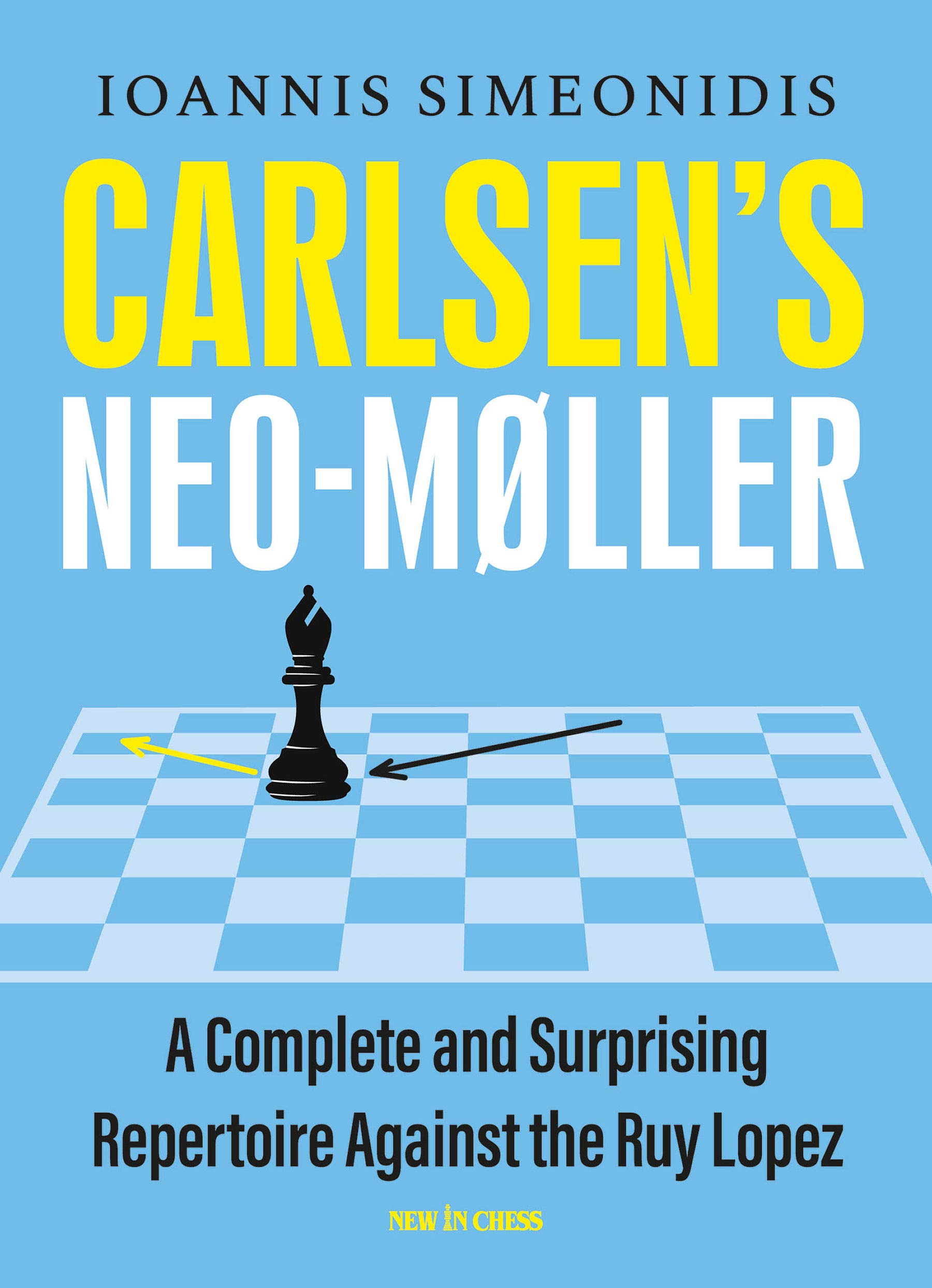
From the book’s rear cover :
“White players will thoroughly dislike the Neo-Møller!
The Ruy Lopez is one of the most important chess openings, hugely popular with amateurs and masters alike. Black players allowing the Ruy Lopez main lines are usually condemned to passivity, defending a slightly worse (though solid) position for as long as White chooses this situation to continue.
World Champion Magnus Carlsen doesn’t like passivity. He likes unconventional and active systems that allow him to take command and put pressure on his opponent from early on.
That’s why Magnus Carlsen revolutionized the old Møller Attack, one of the sharpest and most uncompromising variations against the Ruy Lopez. As yet largely disregarded and unexplored by the majority of players, Carlsen’s new approach allows Black to break free early and start giving White a hard time.
FIDE Master Ioannis Simeonidis is the first to investigate this system, cover it in detail, and make it easy to grasp for club players. He has called it the Neo-Møller. Simeonidis has made lots of exciting discoveries, presents many new ideas and shows that it is a reliable and playable system.
Since the Neo-Møller is a very early deviation from the main lines, it’s easy for Black to actually get it on the board and take opponents out of their comfort zone. Simeonidis has created a compact, accessible and inspirational book. One thing looks certain: White players of the Ruy Lopez are going to thoroughly dislike the Neo-Møller!”

“Ioannis Simeonidis (1975) is a Greek FIDE Master and FIDE Trainer. He is a contributor to New In Chess Yearbook, the world’s leading publication on chess opening news. Simeonidis is the inventor of a recent new system in the Sicilian (the line 2.Nc3 d6 3.d4!?), also played by Magnus Carlsen.”
End of blurb…
FM Ioannis Simeonidis recommends meeting the venerable Ruy Lopez with 3…a6; 4.Ba4 Nf6; 5.00 Bc5
which is rather an unusual choice. In fact, it is the fifth most popular option and, according to an updated version of Megabase 2020, we have the following ranking of popularity:
- 5…Be7 : 83439 games
- 5…b5 : 27907 games
- 5…Nxe4 : 13462 games
- 5…d6 : 3378 games
- 5…Bc5 : 3248 games
- 5…Bd6 : 67 games
and therefore, it is the least popular of the decent alternatives to 5…Be7. For that reason players with the white pieces may be caught unawares facing a sound line.
Its adherents include a fairly reasonable (!) selection of players such as Caruana, Kramnik and Anand and the most frequent of these are Onischuk, Stefanova, Anand and Gareyev. They would certainly make at least our B team! In fact, Alexander Onischuk has played this line 55 times up to 2020.
Carlsen himself has played 5…Bc5 versus players such as Wesley So, Hikaru Nakamura, Maxime Vachier Lagrave, Francisco Vallejo Pons and Sergey Karjakin hence the title of the book rather than say, the more obvious, but less eye catching, Onischuk’s Neo-Møller!

The full list of Contents is
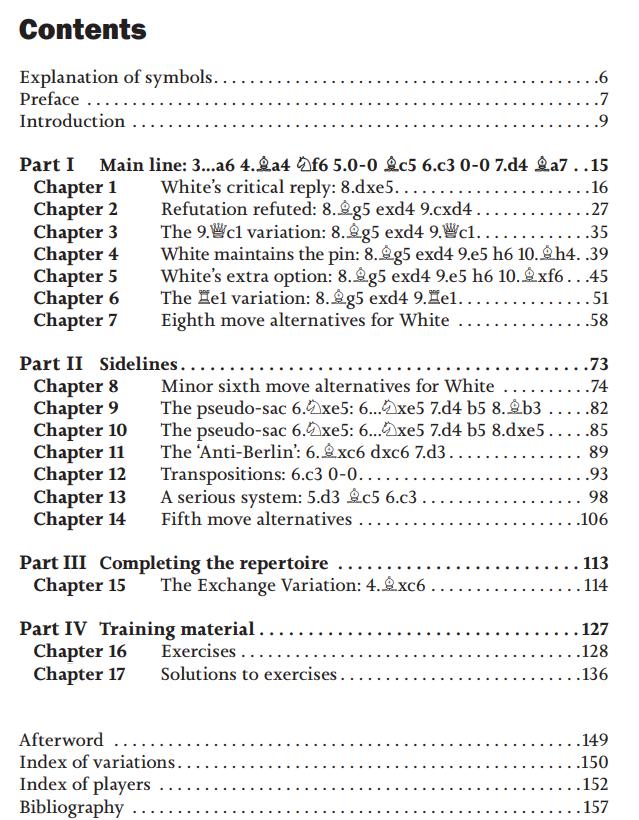
and we recommend that you inspect sample pages for yourself.
Although the bulk of the book analyses the above position it also examines earlier deviations, For example 4.Bxc6, the Exchange variation is considered.
This has been relatively rarely essayed by the top players in recent years but it retains its popularity at club level. I have played several 5th move options as black so I was interested to see what was the author recommended.
And, perhaps predictably, 5…Bg4 immediately pinning the knight and preparing to answer 6.h3 with 6…h5 !! is the preference.
is not an unsurprising choice recommendation as it is the choice of many chess engines and seems to equalise quite easily. A well-known pair of sisters have used this line to draw their tournament games several times.
After 4.0-0 Nf6 many 5th moves such as 5.d3, 5.Qe2, 5.Nc3, 5.d4 and 5.Bxc6 (The Delayed Exchange variation) are all examined.
Against the first three of these moves the recommendation is 5…Bc5 when play will sometimes transpose to main lines.
The Centre Attack (5.d4) is an interesting choice which may catch some black players out but 5…exd4; 6.e5 Ne4; 7.0-0 Nc5
or 6.0-0 Be7; 7.e5 Ne4; 8.Nd4 00; 9.Nf5 d5!
should allow black to equalise satisfactorily.
The rest of the book, as you would expect, mainly concentrates on the main line starting 6.c3 but many other 6th moves are completely playable the most interesting being the knight sacrifice 6.Nxe5!? when 6…Nxe5 7.d4 b5; 8.Bb3 Bxd4; 9.Qxd4 d6
where black’s position is comfortable or 8.dxe5 Ne4 when black must know the theory after the tricky move 9.Qd5 which black can refute with 9…Bb7! when after 10.Qxb7 c6 trapping the Queen seems good for black .
The main line 6.c3
has 7 chapters of analysis with 6…0-0 ;7.d4 Ba7; when 8.Bg5 was originally thought to refute the Møller but the game Anton Smirnov v Tamir Nabaty in 2016 won by black seems to have changed the assessment:
Since black has not committed to …b5 he does not have to worry about a possible a4 by White but taking on c6 and Ne5 has to be watched for so black will sometimes play exd4 as in the line 6.c3 00; 7.d4 Ba7; 8 Bg5 exd4; 9.e5 h6; 10.Bh4 g5; 11.Bc6 dxc6 12.Nxg5!? with a scary looking position for both players where black seems to be doing well.
Far more popular has been 5…b5; 6.Bb3 Bc5 played by both Shirov and Kamsky but Carlsen’s line seems to stand up to computer analysis and will make a lot of White players think early in the game.
The Møller can lead to a variety of sharp and hairy positions which are not for the faint hearted but, will appeal to black players with a tactical mind that want to fight hard to win with the black peices.
It is already catching on with Shirov, Stefanova and Gustafsson giving it a go and this could hopefully spice up world chess that is already bored with the Berlin!
Colin Lyne, Farnborough, Hampshire, 7th June, 2021
Book Details :
- Paperback : 160 pages
- Publisher: New in Chess (15th December, 2020)
- Language: English
- ISBN-10:9056919377
- ISBN-13:978-9056919375
- Product Dimensions: 17.53 x 1.09 x 23.55 cm
Official web site of New in Chess
 Save as PDF
One thought on “Carlsen’s Neo-Møller : A Complete and Surprising Repertoire Against the Ruy Lopez”